EP3147649A1 - Method for determining a settling rate of at least one foulant in oil-based fluids - Google Patents
Method for determining a settling rate of at least one foulant in oil-based fluids Download PDFInfo
- Publication number
- EP3147649A1 EP3147649A1 EP16190068.3A EP16190068A EP3147649A1 EP 3147649 A1 EP3147649 A1 EP 3147649A1 EP 16190068 A EP16190068 A EP 16190068A EP 3147649 A1 EP3147649 A1 EP 3147649A1
- Authority
- EP
- European Patent Office
- Prior art keywords
- oil
- based fluid
- settling rate
- foulant
- transmittance
- Prior art date
- Legal status (The legal status is an assumption and is not a legal conclusion. Google has not performed a legal analysis and makes no representation as to the accuracy of the status listed.)
- Granted
Links
Images

Classifications
-
- G—PHYSICS
- G01—MEASURING; TESTING
- G01N—INVESTIGATING OR ANALYSING MATERIALS BY DETERMINING THEIR CHEMICAL OR PHYSICAL PROPERTIES
- G01N21/00—Investigating or analysing materials by the use of optical means, i.e. using sub-millimetre waves, infrared, visible or ultraviolet light
- G01N21/17—Systems in which incident light is modified in accordance with the properties of the material investigated
- G01N21/59—Transmissivity
-
- C—CHEMISTRY; METALLURGY
- C10—PETROLEUM, GAS OR COKE INDUSTRIES; TECHNICAL GASES CONTAINING CARBON MONOXIDE; FUELS; LUBRICANTS; PEAT
- C10G—CRACKING HYDROCARBON OILS; PRODUCTION OF LIQUID HYDROCARBON MIXTURES, e.g. BY DESTRUCTIVE HYDROGENATION, OLIGOMERISATION, POLYMERISATION; RECOVERY OF HYDROCARBON OILS FROM OIL-SHALE, OIL-SAND, OR GASES; REFINING MIXTURES MAINLY CONSISTING OF HYDROCARBONS; REFORMING OF NAPHTHA; MINERAL WAXES
- C10G75/00—Inhibiting corrosion or fouling in apparatus for treatment or conversion of hydrocarbon oils, in general
-
- G—PHYSICS
- G01—MEASURING; TESTING
- G01N—INVESTIGATING OR ANALYSING MATERIALS BY DETERMINING THEIR CHEMICAL OR PHYSICAL PROPERTIES
- G01N15/00—Investigating characteristics of particles; Investigating permeability, pore-volume or surface-area of porous materials
- G01N15/04—Investigating sedimentation of particle suspensions
-
- G—PHYSICS
- G01—MEASURING; TESTING
- G01N—INVESTIGATING OR ANALYSING MATERIALS BY DETERMINING THEIR CHEMICAL OR PHYSICAL PROPERTIES
- G01N21/00—Investigating or analysing materials by the use of optical means, i.e. using sub-millimetre waves, infrared, visible or ultraviolet light
- G01N21/75—Systems in which material is subjected to a chemical reaction, the progress or the result of the reaction being investigated
- G01N21/77—Systems in which material is subjected to a chemical reaction, the progress or the result of the reaction being investigated by observing the effect on a chemical indicator
- G01N21/82—Systems in which material is subjected to a chemical reaction, the progress or the result of the reaction being investigated by observing the effect on a chemical indicator producing a precipitate or turbidity
- G01N21/83—Turbidimetric titration
-
- G—PHYSICS
- G01—MEASURING; TESTING
- G01N—INVESTIGATING OR ANALYSING MATERIALS BY DETERMINING THEIR CHEMICAL OR PHYSICAL PROPERTIES
- G01N33/00—Investigating or analysing materials by specific methods not covered by groups G01N1/00 - G01N31/00
- G01N33/26—Oils; Viscous liquids; Paints; Inks
- G01N33/28—Oils, i.e. hydrocarbon liquids
-
- C—CHEMISTRY; METALLURGY
- C10—PETROLEUM, GAS OR COKE INDUSTRIES; TECHNICAL GASES CONTAINING CARBON MONOXIDE; FUELS; LUBRICANTS; PEAT
- C10G—CRACKING HYDROCARBON OILS; PRODUCTION OF LIQUID HYDROCARBON MIXTURES, e.g. BY DESTRUCTIVE HYDROGENATION, OLIGOMERISATION, POLYMERISATION; RECOVERY OF HYDROCARBON OILS FROM OIL-SHALE, OIL-SAND, OR GASES; REFINING MIXTURES MAINLY CONSISTING OF HYDROCARBONS; REFORMING OF NAPHTHA; MINERAL WAXES
- C10G2300/00—Aspects relating to hydrocarbon processing covered by groups C10G1/00 - C10G99/00
- C10G2300/20—Characteristics of the feedstock or the products
- C10G2300/201—Impurities
- C10G2300/205—Metal content
- C10G2300/206—Asphaltenes
-
- G—PHYSICS
- G01—MEASURING; TESTING
- G01N—INVESTIGATING OR ANALYSING MATERIALS BY DETERMINING THEIR CHEMICAL OR PHYSICAL PROPERTIES
- G01N21/00—Investigating or analysing materials by the use of optical means, i.e. using sub-millimetre waves, infrared, visible or ultraviolet light
- G01N21/84—Systems specially adapted for particular applications
- G01N2021/8411—Application to online plant, process monitoring
- G01N2021/8416—Application to online plant, process monitoring and process controlling, not otherwise provided for
-
- G—PHYSICS
- G01—MEASURING; TESTING
- G01N—INVESTIGATING OR ANALYSING MATERIALS BY DETERMINING THEIR CHEMICAL OR PHYSICAL PROPERTIES
- G01N21/00—Investigating or analysing materials by the use of optical means, i.e. using sub-millimetre waves, infrared, visible or ultraviolet light
- G01N21/17—Systems in which incident light is modified in accordance with the properties of the material investigated
- G01N21/25—Colour; Spectral properties, i.e. comparison of effect of material on the light at two or more different wavelengths or wavelength bands
- G01N21/31—Investigating relative effect of material at wavelengths characteristic of specific elements or molecules, e.g. atomic absorption spectrometry
- G01N21/35—Investigating relative effect of material at wavelengths characteristic of specific elements or molecules, e.g. atomic absorption spectrometry using infrared light
- G01N21/3577—Investigating relative effect of material at wavelengths characteristic of specific elements or molecules, e.g. atomic absorption spectrometry using infrared light for analysing liquids, e.g. polluted water
-
- G—PHYSICS
- G01—MEASURING; TESTING
- G01N—INVESTIGATING OR ANALYSING MATERIALS BY DETERMINING THEIR CHEMICAL OR PHYSICAL PROPERTIES
- G01N21/00—Investigating or analysing materials by the use of optical means, i.e. using sub-millimetre waves, infrared, visible or ultraviolet light
- G01N21/17—Systems in which incident light is modified in accordance with the properties of the material investigated
- G01N21/25—Colour; Spectral properties, i.e. comparison of effect of material on the light at two or more different wavelengths or wavelength bands
- G01N21/31—Investigating relative effect of material at wavelengths characteristic of specific elements or molecules, e.g. atomic absorption spectrometry
- G01N21/35—Investigating relative effect of material at wavelengths characteristic of specific elements or molecules, e.g. atomic absorption spectrometry using infrared light
- G01N21/359—Investigating relative effect of material at wavelengths characteristic of specific elements or molecules, e.g. atomic absorption spectrometry using infrared light using near infrared light
-
- G—PHYSICS
- G01—MEASURING; TESTING
- G01N—INVESTIGATING OR ANALYSING MATERIALS BY DETERMINING THEIR CHEMICAL OR PHYSICAL PROPERTIES
- G01N21/00—Investigating or analysing materials by the use of optical means, i.e. using sub-millimetre waves, infrared, visible or ultraviolet light
- G01N21/17—Systems in which incident light is modified in accordance with the properties of the material investigated
- G01N21/55—Specular reflectivity
- G01N21/552—Attenuated total reflection
Definitions
- the present invention relates to measuring the transmittance of an oil-based fluid during solvent dosing and stirring thereof and measuring the transmittance of the oil-based fluid once the solvent dosing and stirring has stopped to determine the settling rate of at least one foulant present in the oil-based fluid where the settling rate is proportional to an increase in transmittance or decrease in absorbance after the stirring has stopped.
- Asphaltenes are most commonly defined as that portion of petroleum which is soluble in xylene and toluene, but insoluble in heptane or pentane. Asphaltenes exist in crude oil as both soluble species and in the form of colloidal dispersions stabilized by other components in the crude oil.
- Asphaltenes have higher molecular weights and are the more polar fractions of crude oil, and can precipitate upon pressure, temperature, and compositional changes in crude oil resulting from blending or other mechanical or physicochemical processing. Asphaltene precipitation and deposition can cause problems in subterranean reservoirs, upstream production facilities, mid-stream transportation facilities, refineries, and fuel blending operations. In petroleum production facilities, asphaltene precipitation and deposition can occur in near wellbore reservoir regions, wells, flowlines, separators, and other equipment.
- Asphaltene deposition is a well-known problem affecting all aspects of petroleum production and processing. Crude oils containing high or low levels of asphaltenes can be destabilized while processing causing fouling, formation of sludge, corrosion and all the equipment fixing, cleaning, and cost aggravations associated with these effects.
- Additional operational problems observed with heavy crude oil include: difficulty in blending crude streams, increased unit upsets, increased pollution, loss of through-put, difficulty with desalting, increased load on wastewater plants, increase in air emissions, and flexibility in plant operations is reduced. All of this leads to an overall increase in operating costs.
- Asphaltenes may be present and stable in a crude oil under equilibrium reservoir conditions, but may aggregate or deposit as temperatures, pressures, and/or overall fluid compositions change as the crude oil is removed from the reservoir during production and/or being further refined. Asphaltenes are typically dark brown to black-colored amorphous solids with complex structures and relatively high molecular weights.
- Asphaltene stability can even be disturbed by mixing hydrocarbon-based fluids i.e. such as mixing two types of crude oils together, two types of shale oils together, condensates, and others, of different origins at certain ratios as the chemistry of the hydrocarbon-based fluids from different sources may be incompatible and induce destabilization of the asphaltenes therein.
- hydrocarbon-based fluids i.e. such as mixing two types of crude oils together, two types of shale oils together, condensates, and others, of different origins at certain ratios as the chemistry of the hydrocarbon-based fluids from different sources may be incompatible and induce destabilization of the asphaltenes therein.
- two or more hydrocarbon-based fluids may be mixed together.
- changes in physical conditions are sufficient to induce destabilization, or even the mixture of different hydrocarbon-based fluids that have incompatible chemistries.
- a method for determining a settling rate of at least one foulant in oil-based fluids by stirring an oil-based fluid during a turbidimetric flocculation titration of the oil-based fluid where the turbidimetric flocculation titration includes solvent dosing and obtaining transmittance measurements of the oil-based fluid during the turbidimetric flocculation titration.
- the method may further include stopping the solvent dosing at the onset of flocculation of the at least one foulant, stopping the stirring when at least two or more transmittance measurements are substantially similar, and measuring the transmittance of the oil-based fluid to determine a settling rate of the at least one foulant.
- the settling rate may be proportional to an increase in transmittance after the stirring has stopped.
- the method may include implementing a change to a process associated with the oil-based fluid based on the settling rate of at least one foulant(s) in an oil-based fluid.
- the settling rate may be determined by obtaining at least two absorbance measurements after solvent dosing and stirring have stopped during a turbidimetric flocculation titration.
- the settling rate may correlate to -dA/dt where dA is the change in absorbance measurements over a period of time dt.
- the method may include stirring an oil-based fluid during a turbidimetric flocculation titration of the oil-based fluid where the turbidimetric flocculation titration method includes solvent dosing and obtaining the transmittance of the oil-based fluid during the turbidimetric flocculation titration.
- the method of measuring the settling rate may further include stopping the solvent dosing at the onset of flocculation of the foulant(s), and stopping the stirring shortly thereafter when at least two or more transmittance measurements are substantially similar, i.e. the transmittance becomes almost constant by not drastically increasing or decreasing.
- At least 10 seconds may elapse after the transmittance becomes almost constant before stopping the stirring to ensure the transmittance does not unexpectedly increase or decrease; alternatively, at least 50 seconds may elapse, or at least 100 seconds may elapse.
- the method may further include resuspending the foulant(s) by stirring the oil-based fluid after the settling rate has been determined.
- the transmittance of the oil-based fluid may increase, or the absorbance of the oil-based fluid may decrease, after the solvent dosing and stirring has stopped, and this increase in transmittance or a decrease in absorbance corresponds to the settling rate.
- the settling rate is proportional to an increase in transmittance after the stirring has stopped.
- the settling rate is proportional to a decrease in absorbance after the stirring has stopped.
- the stirring may be a magnetic stirring.
- the stirring creates a vortex holding the foulant(s) in suspension.
- the foulant(s) may settle because of gravity, and the change of measured transmittance and/or absorbance may be used to measure the settling rate.
- the settling rate may be used to determine oil-based fluid stability when oil-based fluid is being transported, moved or processed. It would be desirable to avoid destabilization of the oil-based fluid after transportation and storage, and/or processing once precipitation of the foulant(s) and aggregation is formed.
- a settling rate need only be determined periodically, sometimes as infrequently as once per "batch" of oil-based fluid (e.g. crude oil). Of course, where large batches of oil-based fluids are being transported or stored or blended, it may be desirable to run this test more frequently. Generally speaking though, once the settling rate has been determined, these values do not tend to change absent a substantial change to the conditions and/or quality of the oil-based fluid.
- a foulant (e.g. asphaltene) settling rate of a first oil-based fluid may be compared to a foulant (e.g. asphaltene) settling rate of a second oil-based fluid to properly ratio a blend of the first oil-based fluid and second oil-based fluid entering into a storage vessel.
- the ratio of the first oil-based fluid and second oil-based fluid may allow for better monitoring of homogenization of the contents of the storage vessel.
- two oil-based fluids are compared; however, comparing settling rates of three or more oil-based fluids may also be performed for purposes of blending the oil-based fluids.
- the stirring may occur at a rate ranging from about 200 rpm independently to about 1200 rpm, alternatively, 400 rpm independently to about 1000 rpm, or from about 600 rpm independently to about 800 rpm.
- an oil-based fluid has a settling rate within a pre-determined range
- the operator may elect to maintain the process within a refinery.
- the pre-determined range may be from about 0 independently to about 0.0005 (s) ⁇ -1. If the settling rate falls outside of the pre-determined range, then the operator may elect to change the process within a refinery.
- a change to at least one refinery process may be necessitated pending the results of the settling rate for the foulant(s).
- Such change(s) may be or include, but is not limited to, adding an additional feed stream to the oil-based fluid to stabilize the oil-based fluid, adding an additive to the oil-based fluid, adding a different demulsifier to the oil-based fluid than any demulsifier already present in the oil-based fluid, changing a temperature of the oil-based fluid, changing a water feed rate of a unit within the refinery process, and combinations thereof.
- Other non-limiting examples of changes that may occur include changing the oil-based fluids to be blended, changing the oil-based fluid mixing order, etc.
- the operator may elect to change operating parameters including, but not limited to, changing fluid flow velocities, changing unit operating temperatures, changing unit residence times, and the like.
- the operator may additionally or alternatively elect to make changes by mixing at least two feed streams to bring the ratio of the settling rates of the combined stream into the pre-determined range.
- the second feed stream may not be crude oil.
- a refinery may elect to use a lighter feed stock such as gas oil, paraffinic feed, lighter cutter stocks, etc. that could be recovered and recycled.
- the mixing or blending of oil-based feed streams may be the blending of streams that are often prone to problems.
- One such is the blending of heavy crude oil and shale oil.
- Shale oil is paraffinic and is often prone to blending problems.
- any method of performing this function may be employed.
- the oil-based feed streams may be introduced into a tank and agitated.
- the oil-based feed streams may be co-injected into a line having static mixers in place.
- both methods may be employed to mix crude oil feed streams to prepare a crude oil feed stream.
- remedial efforts may be employed to mitigate the instability of the oil-based fluid.
- At least one such remedial effort may include adding a stabilizing additive to the oil-based fluid and/or changing the dosage rate of a stabilizing additive present in the oil-based fluid. Any additive known to be useful to those of ordinary skill in the art may be employed with the methods of the invention.
- the additive may be prepared from a formulation including: a first component selected from the group consisting of (alkoxylated)-(di or tri)-alkyl phenol - aldehyde (amine) resins; ⁇ -olefin - maleic anhydride co-polymers and grafted polymers including half ester/amide and full ester/amide derivatives; and combinations thereof.
- a formulation may also include a second component that may be or include, but is not limited to, polyamines, amidoamines, imidazolines, and combinations thereof.
- the additives may alter the stability of the oil-based fluid and thereby alter the settling rate of the oil-based fluid or oil-based fluid blend.
- Such additives may be employed at a concentration ranging from about 0.025 independently to about 10 wt% of the total oil-based fluid or blend, alternatively from about 0.1 independently to about 5 wt%, or from about 1 independently to about 4 wt%.
- Measuring the transmittance of the oil-based fluid may include the use of a laser light passed through the oil-based fluid.
- the laser light may have a wavelength ranging from about 800 nm independently to about 2500 nm.
- the wavelength of light may range from about 1000 nm independently to about 2000 nm, or from about 1300 nm independently to about 1800 nm.
- Turbidimetry is a process of measuring the loss of intensity of transmitted light due to the scattering effect of particles suspended therein.
- Light may be passed through a filter creating a light of known wavelength that is then passed through a cuvette containing a solution.
- the turbidimetric flocculation titration may occur with a turbidimetric method, such as but not limited to turbidimetry, nephelometry, infrared spectroscopy by attenuated total reflectance (ATR), and combinations thereof.
- the foulant(s) for purposes of measuring the settling rate may preferably include asphaltenes.
- Nephelometry uses a nephelometer to measure the concentration of suspended particulates in a liquid or gas colloid by employing a light source and a light detector set to one side (e.g. 90 degrees) of the light source beam.
- Particle density may be a function of light reflected into the detector from the particles. The reflected light may be dependent upon properties of the particles, such as shape, color, and reflectivity.
- Attenuated total reflectance is a sampling technique used in conjunction with infrared spectrometry to examine solid or liquid states of samples without further preparation.
- ATR uses a property of total internal reflection resulting in an evanescent wave.
- An infrared light beam may be passed through an ATR crystal to reflect at least once off the internal surface in contact with the sample. The reflection forms the evanescent wave that extends into the sample.
- the penetration depth into the sample may be determined by the wavelength of light, the angle of incidence and the indices of refraction for the ATR crystal and the medium being probed.
- the ATR crystal may be made of an optical material with a higher refractive index than the sample being studied.
- the turbidimetric flocculation titration method may be an optical method using a coherent light source that allows measuring the transmittance through the sample and relates especially to measuring the onset flocculation of foulant(s) (e.g. asphaltenes) within an oil-based fluid sample.
- Changes in the sample transmittance may be induced via temperature and/ or via adding a solvent.
- the transmittance changes versus temperature and/or solvent addition may be measured with high degree of sensitivity and repeatability.
- the solvent for the solvent dosing during the turbidimetric flocculation titration may be or include, but is not limited to, cetane (hexadecane), heptane, xylene, toluene, hexane, pentane, methylnaphthalene, a paraffinic solvent having a solubility range of about 6.8 to 7.2 (cal/cm3) 1/2 , and combinations thereof.
- the three dilution approach may be used where oil-based fluid samples of known amounts may be diluted at three different ratios: 1:1, 1:1.5, 1:2, and so on until foulants (e.g. asphaltenes) begin precipitating from the oil-based fluid sample.
- a refractive index measurement may be taken, and the refractive index measurement may be plotted on the x-axis, and the power value corresponding to the particular refractive index measurement may be plotted on the y-axis.
- the oil-based fluid may be heated prior to the turbidimetric flocculation titration to decrease the viscosity of the oil-based fluid.
- the temperature of the oil-based fluid during the heating thereof may range from about 20°C independently to about 250°C, alternatively from about 50°C independently to about 100°C.
- the oil-based fluid may be or include, but is not limited to, crude oil, distillation residua, quench oil, visbreaker H-oil, LC bottoms fluid, and combinations thereof.
- the oil-based fluid may also be or include a blend of at least two oil-based fluids, which may be the same oil-based fluids or different oil-based fluids.
- the blend may be, but is not limited to, two or more crude oils blended together, or the blend may be two or more distillation residua fluids, etc.
- the oil-based fluid may include, but is not limited to, a blend of two or more oil-based fluids that are different, such as crude oil and quench oil, distillation residua, and LC bottoms fluid, etc.
- the stability of the foulant(s) present in the oil-based fluid may be measured by taking a first refractive index (RI) measurement with a refractive index probe inserted into the oil-based stream (e.g. a crude oil sample) when the oil-based stream is not diluted with a solvent.
- SBn solubility blending number
- the linear correlation may be established using any method known in the art, such as, for example, that disclosed in the method published by the New Mexico Petroleum Recovery Research Center as PRRC 01-18.
- This document authored by Jianxin Wang and Jill Buckley, has the title: Procedure for Measuring the Onset of Asphaltenes Flocculation.
- a second refractive index (RI) measurement may be taken with a refractive index probe inserted into the oil-based stream (e.g. a crude oil sample) during a turbidimetric flocculation titration, i.e. the oil-based fluid undergoes a series of dilutions with a solvent to induce asphaltene precipitation.
- a second RI measurement may be taken to determine a second F RI value and thereby determine a second solubility parameter.
- the second RI measurement may be used to determine the second F RI value.
- the second solubility parameter may be an insolubility number (In). Only two RI values are obtained in this non-limiting embodiment; however, any number of RI values may be measured with the RI probe and used for determining the stability of an oil-based fluid or blend.
- Further stability determinations of a particular oil-based fluid may obtained based on the ratio of the first solubility parameter to the second solubility parameter.
- the settling rate and/or solubility parameters may help determine whether a particular oil-based fluid/stream may be transported, blended, stored, refined, and combinations thereof. Since settling rates and/or solubility parameters are rarely alike for two oil-based fluids, the operator of any refinery or pipeline or storage facility may use the settling rate and/or solubility parameters to determine the stability of the oil-based fluid in particular equipment and/or systems. Variables in these systems include, pipe lines and storage facilities, pipe diameter, stream temperature, stream velocity, and the availability and type of agitation or stirring present, if any.
- variables influencing the stability of the oil-based fluid may include the ability to heat the process streams and residence time inside of reactors, reformers, cokers and other types of refinery equipment.
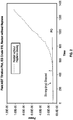
- Fig. 1 is a graph illustrating transmittance measurements of an oil-based fluid over a period of time during a turbidimetric flocculation titration.
- the first peak is merely a noisy peak; whereas the second peak is the point of asphaltene flocculation.
- the solvent dosing i.e. heptane in this set of Examples
- the stirring was subsequently stopped when the transmittance became almost constant, i.e. not increasing and not decreasing.
- the settling rate may be measured after the second peak by determining the slope of the increased transmittance line.
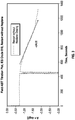
- Fig. 2 illustrates a more detailed graph of the settling rate for the same oil-based fluid depicted in Fig. 1 after the heptane dosing has been stopped.
- ⁇ ⁇ abs + ⁇ scattering where the concentration of scatterers decrease during settling of the asphaltenic aggregates due to the precipitation of the aspaltenic aggregates from the solution bulk to the cuvette bottom.
- the settling of the foulant(s) decrease scattering and the absorbance decreases as a consequence as depicted in Fig. 3 .
- the absorbance may be used to determine the settling rate where the slope is -dA/dt where dA is the change in absorbance measurements over a change in time dt.
- the present invention may suitably comprise, consist or consist essentially of the elements disclosed and may be practiced in the absence of an element not disclosed.
- the method for determining a settling rate of at least one foulant in oil-based fluids may consist of or consist essentially of implementing a change to a process associated with the oil-based fluid based on the settling rate of at least one foulant(s) in an oil-based fluid; the settling rate may be determined by obtaining at least two absorbance measurements after solvent dosing and stirring have stopped during a turbidimetric flocculation titration; the settling rate correlates to -dA/dt where dA is the change in absorbance measurements over a period of time dt.
Landscapes
- Chemical & Material Sciences (AREA)
- Health & Medical Sciences (AREA)
- Life Sciences & Earth Sciences (AREA)
- Physics & Mathematics (AREA)
- Engineering & Computer Science (AREA)
- Pathology (AREA)
- Biochemistry (AREA)
- General Health & Medical Sciences (AREA)
- General Physics & Mathematics (AREA)
- Immunology (AREA)
- Analytical Chemistry (AREA)
- Chemical Kinetics & Catalysis (AREA)
- Oil, Petroleum & Natural Gas (AREA)
- General Chemical & Material Sciences (AREA)
- Food Science & Technology (AREA)
- Medicinal Chemistry (AREA)
- Plasma & Fusion (AREA)
- Organic Chemistry (AREA)
- Dispersion Chemistry (AREA)
- Investigating Or Analysing Materials By Optical Means (AREA)
Abstract
Description
- The present invention relates to measuring the transmittance of an oil-based fluid during solvent dosing and stirring thereof and measuring the transmittance of the oil-based fluid once the solvent dosing and stirring has stopped to determine the settling rate of at least one foulant present in the oil-based fluid where the settling rate is proportional to an increase in transmittance or decrease in absorbance after the stirring has stopped.
- As world reserves of light, sweet crudes diminish and worldwide consumption of oil increases, refiners seek methods for extracting useful products such as gasoline and fuel oils from heavier crude resources. While not as desirable and easy to process, extensive reserves in the form of "heavy crudes" exist in a number of countries, including Western Canada, Venezuela, Russia, the United States, and elsewhere.
- Such heavy oils (even some not so heavy oils) are often difficult to refine because of their viscosity and propensity for being unstable and precipitating solids, such as asphaltenes, coke, coke precursors, etc. upon storage and processing, most notable asphaltenes. Asphaltenes are most commonly defined as that portion of petroleum which is soluble in xylene and toluene, but insoluble in heptane or pentane. Asphaltenes exist in crude oil as both soluble species and in the form of colloidal dispersions stabilized by other components in the crude oil. Asphaltenes have higher molecular weights and are the more polar fractions of crude oil, and can precipitate upon pressure, temperature, and compositional changes in crude oil resulting from blending or other mechanical or physicochemical processing. Asphaltene precipitation and deposition can cause problems in subterranean reservoirs, upstream production facilities, mid-stream transportation facilities, refineries, and fuel blending operations. In petroleum production facilities, asphaltene precipitation and deposition can occur in near wellbore reservoir regions, wells, flowlines, separators, and other equipment.
- When asphaltenes precipitate from crude oil, they can foul equipment and reduce the quality of the products being refined. Other issues associated with heavy crude oil include: high solids; increased amounts of entrained water; high sulfur content; high total acid number (TAN) and high metals. Asphaltene deposition is a well-known problem affecting all aspects of petroleum production and processing. Crude oils containing high or low levels of asphaltenes can be destabilized while processing causing fouling, formation of sludge, corrosion and all the equipment fixing, cleaning, and cost aggravations associated with these effects.
- Additional operational problems observed with heavy crude oil include: difficulty in blending crude streams, increased unit upsets, increased pollution, loss of through-put, difficulty with desalting, increased load on wastewater plants, increase in air emissions, and flexibility in plant operations is reduced. All of this leads to an overall increase in operating costs.
- Asphaltenes may be present and stable in a crude oil under equilibrium reservoir conditions, but may aggregate or deposit as temperatures, pressures, and/or overall fluid compositions change as the crude oil is removed from the reservoir during production and/or being further refined. Asphaltenes are typically dark brown to black-colored amorphous solids with complex structures and relatively high molecular weights.
- Asphaltene stability can even be disturbed by mixing hydrocarbon-based fluids i.e. such as mixing two types of crude oils together, two types of shale oils together, condensates, and others, of different origins at certain ratios as the chemistry of the hydrocarbon-based fluids from different sources may be incompatible and induce destabilization of the asphaltenes therein. In non-limiting examples, such as during refining or fuel blending, two or more hydrocarbon-based fluids may be mixed together. Sometimes, changes in physical conditions are sufficient to induce destabilization, or even the mixture of different hydrocarbon-based fluids that have incompatible chemistries. Said differently, even if neither oil-based fluid, alone, has destabilized foulants or the hydrocarbon-based fluid would not act as a destabilizing additive by itself, the mixing or the mixture of two or more hydrocarbon-based fluids may further destabilize the foulants present in either hydrocarbon-based fluid.
- There are several shortcomings when measuring asphaltene stability to improve foulant stability. Thus, it would be desirable to develop better methods of analyzing the stability of the asphaltenes within crude oils.
- There is provided, in one form, a method for determining a settling rate of at least one foulant in oil-based fluids by stirring an oil-based fluid during a turbidimetric flocculation titration of the oil-based fluid where the turbidimetric flocculation titration includes solvent dosing and obtaining transmittance measurements of the oil-based fluid during the turbidimetric flocculation titration. The method may further include stopping the solvent dosing at the onset of flocculation of the at least one foulant, stopping the stirring when at least two or more transmittance measurements are substantially similar, and measuring the transmittance of the oil-based fluid to determine a settling rate of the at least one foulant. The settling rate may be proportional to an increase in transmittance after the stirring has stopped.
- In an alternative non-limiting embodiment, the method may include implementing a change to a process associated with the oil-based fluid based on the settling rate of at least one foulant(s) in an oil-based fluid. The settling rate may be determined by obtaining at least two absorbance measurements after solvent dosing and stirring have stopped during a turbidimetric flocculation titration. The settling rate may correlate to -dA/dt where dA is the change in absorbance measurements over a period of time dt.
-
-
FIGs. 1-2 are graphs illustrating transmittance measurements of an oil-based fluid over a period of time during a turbidimetric flocculation titration; and -
FIG 3 is a graph illustrating absorbance measurements determined from the transmittance measurements of the oil-based fluid illustrated inFIGs 1-2 . - It has been discovered that the settling rate of at least one foulant within an oil-based fluid may be determined. The method may include stirring an oil-based fluid during a turbidimetric flocculation titration of the oil-based fluid where the turbidimetric flocculation titration method includes solvent dosing and obtaining the transmittance of the oil-based fluid during the turbidimetric flocculation titration. The method of measuring the settling rate may further include stopping the solvent dosing at the onset of flocculation of the foulant(s), and stopping the stirring shortly thereafter when at least two or more transmittance measurements are substantially similar, i.e. the transmittance becomes almost constant by not drastically increasing or decreasing. Preferably, at least 10 seconds may elapse after the transmittance becomes almost constant before stopping the stirring to ensure the transmittance does not unexpectedly increase or decrease; alternatively, at least 50 seconds may elapse, or at least 100 seconds may elapse. The method may further include resuspending the foulant(s) by stirring the oil-based fluid after the settling rate has been determined.
- The transmittance of the oil-based fluid may increase, or the absorbance of the oil-based fluid may decrease, after the solvent dosing and stirring has stopped, and this increase in transmittance or a decrease in absorbance corresponds to the settling rate. The settling rate is proportional to an increase in transmittance after the stirring has stopped. Alternatively, the settling rate is proportional to a decrease in absorbance after the stirring has stopped.
- The stirring may be a magnetic stirring. The stirring creates a vortex holding the foulant(s) in suspension. When the stirring is stopped, the foulant(s) may settle because of gravity, and the change of measured transmittance and/or absorbance may be used to measure the settling rate.
- The settling rate may be used to determine oil-based fluid stability when oil-based fluid is being transported, moved or processed. It would be desirable to avoid destabilization of the oil-based fluid after transportation and storage, and/or processing once precipitation of the foulant(s) and aggregation is formed. A settling rate need only be determined periodically, sometimes as infrequently as once per "batch" of oil-based fluid (e.g. crude oil). Of course, where large batches of oil-based fluids are being transported or stored or blended, it may be desirable to run this test more frequently. Generally speaking though, once the settling rate has been determined, these values do not tend to change absent a substantial change to the conditions and/or quality of the oil-based fluid.
- Optionally, a foulant (e.g. asphaltene) settling rate of a first oil-based fluid may be compared to a foulant (e.g. asphaltene) settling rate of a second oil-based fluid to properly ratio a blend of the first oil-based fluid and second oil-based fluid entering into a storage vessel. The ratio of the first oil-based fluid and second oil-based fluid may allow for better monitoring of homogenization of the contents of the storage vessel. In this non-limiting example, two oil-based fluids are compared; however, comparing settling rates of three or more oil-based fluids may also be performed for purposes of blending the oil-based fluids.
- The stirring may occur at a rate ranging from about 200 rpm independently to about 1200 rpm, alternatively, 400 rpm independently to about 1000 rpm, or from about 600 rpm independently to about 800 rpm.
- If an oil-based fluid has a settling rate within a pre-determined range, then the operator may elect to maintain the process within a refinery. The pre-determined range may be from about 0 independently to about 0.0005 (s)^-1. If the settling rate falls outside of the pre-determined range, then the operator may elect to change the process within a refinery.
- A change to at least one refinery process may be necessitated pending the results of the settling rate for the foulant(s). Such change(s) may be or include, but is not limited to, adding an additional feed stream to the oil-based fluid to stabilize the oil-based fluid, adding an additive to the oil-based fluid, adding a different demulsifier to the oil-based fluid than any demulsifier already present in the oil-based fluid, changing a temperature of the oil-based fluid, changing a water feed rate of a unit within the refinery process, and combinations thereof. Other non-limiting examples of changes that may occur include changing the oil-based fluids to be blended, changing the oil-based fluid mixing order, etc. For example, the operator may elect to change operating parameters including, but not limited to, changing fluid flow velocities, changing unit operating temperatures, changing unit residence times, and the like.
- The operator may additionally or alternatively elect to make changes by mixing at least two feed streams to bring the ratio of the settling rates of the combined stream into the pre-determined range. In some embodiments, the second feed stream may not be crude oil. For example, a refinery may elect to use a lighter feed stock such as gas oil, paraffinic feed, lighter cutter stocks, etc. that could be recovered and recycled.
- The mixing or blending of oil-based feed streams may be the blending of streams that are often prone to problems. One such is the blending of heavy crude oil and shale oil. Shale oil is paraffinic and is often prone to blending problems.
- In combining or blending oil-based feed streams, any method of performing this function may be employed. For example, the oil-based feed streams may be introduced into a tank and agitated. Alternatively, the oil-based feed streams may be co-injected into a line having static mixers in place. In another alternative, both methods may be employed to mix crude oil feed streams to prepare a crude oil feed stream.
- When the settling rate is not within the pre-determined range, remedial efforts may be employed to mitigate the instability of the oil-based fluid. At least one such remedial effort may include adding a stabilizing additive to the oil-based fluid and/or changing the dosage rate of a stabilizing additive present in the oil-based fluid. Any additive known to be useful to those of ordinary skill in the art may be employed with the methods of the invention. For example, in one non-limiting embodiment, the additive may be prepared from a formulation including: a first component selected from the group consisting of (alkoxylated)-(di or tri)-alkyl phenol - aldehyde (amine) resins; α-olefin - maleic anhydride co-polymers and grafted polymers including half ester/amide and full ester/amide derivatives; and combinations thereof. Such a formulation may also include a second component that may be or include, but is not limited to, polyamines, amidoamines, imidazolines, and combinations thereof.
- The additives may alter the stability of the oil-based fluid and thereby alter the settling rate of the oil-based fluid or oil-based fluid blend. Such additives may be employed at a concentration ranging from about 0.025 independently to about 10 wt% of the total oil-based fluid or blend, alternatively from about 0.1 independently to about 5 wt%, or from about 1 independently to about 4 wt%.
- Measuring the transmittance of the oil-based fluid may include the use of a laser light passed through the oil-based fluid. The laser light may have a wavelength ranging from about 800 nm independently to about 2500 nm. Alternatively, the wavelength of light may range from about 1000 nm independently to about 2000 nm, or from about 1300 nm independently to about 1800 nm.
- Turbidimetry is a process of measuring the loss of intensity of transmitted light due to the scattering effect of particles suspended therein. Light may be passed through a filter creating a light of known wavelength that is then passed through a cuvette containing a solution. The turbidimetric flocculation titration may occur with a turbidimetric method, such as but not limited to turbidimetry, nephelometry, infrared spectroscopy by attenuated total reflectance (ATR), and combinations thereof. The foulant(s) for purposes of measuring the settling rate may preferably include asphaltenes.
- Nephelometry uses a nephelometer to measure the concentration of suspended particulates in a liquid or gas colloid by employing a light source and a light detector set to one side (e.g. 90 degrees) of the light source beam. Particle density may be a function of light reflected into the detector from the particles. The reflected light may be dependent upon properties of the particles, such as shape, color, and reflectivity.
- Attenuated total reflectance is a sampling technique used in conjunction with infrared spectrometry to examine solid or liquid states of samples without further preparation. ATR uses a property of total internal reflection resulting in an evanescent wave. An infrared light beam may be passed through an ATR crystal to reflect at least once off the internal surface in contact with the sample. The reflection forms the evanescent wave that extends into the sample. The penetration depth into the sample may be determined by the wavelength of light, the angle of incidence and the indices of refraction for the ATR crystal and the medium being probed. The ATR crystal may be made of an optical material with a higher refractive index than the sample being studied.
- The turbidimetric flocculation titration method may be an optical method using a coherent light source that allows measuring the transmittance through the sample and relates especially to measuring the onset flocculation of foulant(s) (e.g. asphaltenes) within an oil-based fluid sample. Changes in the sample transmittance (such as foulant aggregation and precipitation) may be induced via temperature and/ or via adding a solvent. The transmittance changes versus temperature and/or solvent addition may be measured with high degree of sensitivity and repeatability.
- The solvent for the solvent dosing during the turbidimetric flocculation titration may be or include, but is not limited to, cetane (hexadecane), heptane, xylene, toluene, hexane, pentane, methylnaphthalene, a paraffinic solvent having a solubility range of about 6.8 to 7.2 (cal/cm3)1/2, and combinations thereof. The three dilution approach may be used where oil-based fluid samples of known amounts may be diluted at three different ratios: 1:1, 1:1.5, 1:2, and so on until foulants (e.g. asphaltenes) begin precipitating from the oil-based fluid sample. At each dilution, a refractive index measurement may be taken, and the refractive index measurement may be plotted on the x-axis, and the power value corresponding to the particular refractive index measurement may be plotted on the y-axis.
- The oil-based fluid may be heated prior to the turbidimetric flocculation titration to decrease the viscosity of the oil-based fluid. The temperature of the oil-based fluid during the heating thereof may range from about 20°C independently to about 250°C, alternatively from about 50°C independently to about 100°C.
- The oil-based fluid may be or include, but is not limited to, crude oil, distillation residua, quench oil, visbreaker H-oil, LC bottoms fluid, and combinations thereof. The oil-based fluid may also be or include a blend of at least two oil-based fluids, which may be the same oil-based fluids or different oil-based fluids. For example, the blend may be, but is not limited to, two or more crude oils blended together, or the blend may be two or more distillation residua fluids, etc. Alternatively, the oil-based fluid may include, but is not limited to, a blend of two or more oil-based fluids that are different, such as crude oil and quench oil, distillation residua, and LC bottoms fluid, etc.
- Prior to measuring the settling rate, the stability of the foulant(s) present in the oil-based fluid may be measured by taking a first refractive index (RI) measurement with a refractive index probe inserted into the oil-based stream (e.g. a crude oil sample) when the oil-based stream is not diluted with a solvent. The first RI measurement may be used to determine a first functional refractive index (FRI) value by using the formula FRI = (RI2 - 1)/(RI2+2) where RI is the first refractive index measurement in this instance. The first FRI value may determine as a first solubility parameter, also known as a solubility blending number (SBn), by using the formula δ = 52.042FRI+2.904 (2) where δ is in units of 0.5 MPa and where a linear correlation between the solubility parameter, δ, and FRI at 20°C may be established.
- This correlation was established based on the one-third rule relating to the function of the refractive index divided by the mass density as a constant equal to 1/3 for all different compounds. This rule was validated on more than 229 crude oils at 20°C as well as higher temperatures up to 80°C.
-
U.S. Patent Application publication No. 2013/0341241 (Serial No.13/924,089) filed June 22, 2012 - (SBn) based on a linear correlation. The linear correlation may be established using any method known in the art, such as, for example, that disclosed in the method published by the New Mexico Petroleum Recovery Research Center as PRRC 01-18. This document, authored by Jianxin Wang and Jill Buckley, has the title: Procedure for Measuring the Onset of Asphaltenes Flocculation.
- A second refractive index (RI) measurement may be taken with a refractive index probe inserted into the oil-based stream (e.g. a crude oil sample) during a turbidimetric flocculation titration, i.e. the oil-based fluid undergoes a series of dilutions with a solvent to induce asphaltene precipitation. At the point when oil-based fluid begins precipitating foulants, e.g. asphaltene flocculation, a second RI measurement may be taken to determine a second FRI value and thereby determine a second solubility parameter. The second RI measurement may be used to determine the second FRI value. The second solubility parameter may be an insolubility number (In). Only two RI values are obtained in this non-limiting embodiment; however, any number of RI values may be measured with the RI probe and used for determining the stability of an oil-based fluid or blend.
- Further stability determinations of a particular oil-based fluid may obtained based on the ratio of the first solubility parameter to the second solubility parameter. The settling rate and/or solubility parameters may help determine whether a particular oil-based fluid/stream may be transported, blended, stored, refined, and combinations thereof. Since settling rates and/or solubility parameters are rarely alike for two oil-based fluids, the operator of any refinery or pipeline or storage facility may use the settling rate and/or solubility parameters to determine the stability of the oil-based fluid in particular equipment and/or systems. Variables in these systems include, pipe lines and storage facilities, pipe diameter, stream temperature, stream velocity, and the availability and type of agitation or stirring present, if any. For a refining unit, variables influencing the stability of the oil-based fluid may include the ability to heat the process streams and residence time inside of reactors, reformers, cokers and other types of refinery equipment.
- The invention will be further described with respect to the following Example, which are not meant to limit the invention, but rather to further illustrate the various embodiments.
- Now turning to the Figures,
Fig. 1 is a graph illustrating transmittance measurements of an oil-based fluid over a period of time during a turbidimetric flocculation titration. The first peak is merely a noisy peak; whereas the second peak is the point of asphaltene flocculation. The solvent dosing (i.e. heptane in this set of Examples) was stopped when the asphaltenes began to precipitate, i.e. at the point the first peak appeared. The stirring was subsequently stopped when the transmittance became almost constant, i.e. not increasing and not decreasing. Here, about 100 seconds elapsed before the stirring was stopped to ensure the transmittance would not unexpectedly increase or decrease. The settling rate may be measured after the second peak by determining the slope of the increased transmittance line. -
Fig. 2 illustrates a more detailed graph of the settling rate for the same oil-based fluid depicted inFig. 1 after the heptane dosing has been stopped. - The transmittance may be determined from the graph for the oil-based fluid with the equation:


- The settling of the foulant(s) (e.g. asphaltenes) decrease scattering and the absorbance decreases as a consequence as depicted in
Fig. 3 . The rate of decrease in absorbance is proportional to the rate of decrease of scattering asphaltene aggregates such that:
- In the foregoing specification, the invention has been described with reference to specific embodiments thereof, and has been described as effective in providing methods for determining a settling rate of at least one foulant in oil-based fluids. However, it will be evident that various modifications and changes can be made thereto without departing from the broader spirit or scope of the invention as set forth in the appended claims. Accordingly, the specification is to be regarded in an illustrative rather than a restrictive sense. For example, specific oil-based fluids, solvents, additives, dispersants, asphaltene inhibitors, additives, tubridimetry methods, laser wavelengths, and the like falling within the claimed parameters, but not specifically identified or tried in a particular composition or method, are expected to be within the scope of this invention.
- The present invention may suitably comprise, consist or consist essentially of the elements disclosed and may be practiced in the absence of an element not disclosed. For instance, the method for determining a settling rate of at least one foulant in oil-based fluids may consist of or consist essentially of implementing a change to a process associated with the oil-based fluid based on the settling rate of at least one foulant(s) in an oil-based fluid; the settling rate may be determined by obtaining at least two absorbance measurements after solvent dosing and stirring have stopped during a turbidimetric flocculation titration; the settling rate correlates to -dA/dt where dA is the change in absorbance measurements over a period of time dt.
- The words "comprising" and "comprises" as used throughout the claims, are to be interpreted to mean "including but not limited to" and "includes but not limited to", respectively.
Claims (15)
- A method for determining a settling rate of at least one foulant in oil-based fluids comprising:stirring an oil-based fluid during a turbidimetric flocculation titration of the oil-based fluid; wherein the turbidimetric flocculation titration comprises solvent dosing and obtaining transmittance measurements of the oil-based fluid during the turbidimetric flocculation titration;stopping the solvent dosing at the onset of flocculation of the at least one foulant;stopping the stirring when at least two or more transmittance measurements are substantially similar; andmeasuring the transmittance of the oil-based fluid to determine a settling rate of the at least one foulant; wherein the settling rate is proportional to an increase in transmittance after the stirring has stopped.
- The method of claim 1, further comprising resuspending the at least one foulant by stirring the oil-based fluid at a rate ranging from about 200 rpm to about 1200 rpm.
- The method of claim 1 or claim 2, wherein the measuring the transmittance of the oil-based fluid comprises passing a laser light through the oil-based fluid.
- The method of claim 3, wherein the laser light has a wavelength ranging from about 800 nm to about 2500 nm.
- The method of any preceding claim, wherein the stirring is stopped when at least 10 seconds elapses after the at least two or more transmittance measurements are substantially similar.
- The method of any preceding claim, wherein the transmittance measurements are converted into absorbance measurements, and wherein the settling rate is proportional to a decrease in transmittance after the stirring has stopped.
- The method of claim 6, wherein the settling rate correlates to -dA/dt where dA is the change in absorbance measurements over a period of time dt.
- The method of any preceding claim, further comprising implementing a change to a process associated with the oil-based fluid.
- A method for determining a settling rate of at least one foulant in oil-based fluids comprising:implementing a change to a process associated with the oil-based fluid based on the settling rate of at least one foulant(s) in an oil-based fluid; wherein the settling rate is determined by obtaining at least two absorbance measurements after solvent dosing and stirring have stopped during a turbidimetric flocculation titration; and wherein the settling rate correlates to -dA/dt where dA is the change in absorbance measurements over a period of time dt.
- The method of claim 8 or claim 9, wherein implementing a change to the process is selected from the group consisting of:adding an additional feed stream to the oil-based fluid to stabilize the oil-based fluid;adding an additive to the oil-based fluid;adding a different demulsifier to the oil-based fluid than any demulsifier already present in the oil-based fluid;changing a temperature of the oil-based fluid;changing a water feed rate of a unit within the refinery process;and combinations thereof.
- The method of any preceding claim, wherein the turbidimetric flocculation titration occurs with a turbidimetric method selected from the group consisting of turbidimetry, nephelometry, infrared spectroscopy by attenuated total reflectance (ATR), and combinations thereof.
- The method of any preceding claim, wherein the solvent dosing comprises a solvent selected from the group consisting of cetane, heptane, xylene, toluene, hexane, pentane, methylnaphthalene, a paraffinic solvent having a solubility range of about 6.8 to 7.2 (cal/cm3)1/2, and combinations thereof.
- The method of any preceding claim, wherein the oil-based fluid is selected from the group consisting of crude oil, distillation residua, quench oil, visbreaker H-oil, LC bottoms fluid, and combinations thereof.
- The method of any preceding claim, wherein the oil-based fluid is a blend of at least two oil-based fluids, wherein the at least two oil-based fluids may be the same oil-based fluids or different oil-based fluids.
- The method of any preceding claim, wherein the at least one foulant is an asphaltene.
Applications Claiming Priority (1)
| Application Number | Priority Date | Filing Date | Title |
|---|---|---|---|
| US14/862,740 US10222329B2 (en) | 2015-09-23 | 2015-09-23 | Method for determining a settling rate of at least one foulant in oil-based fluids |
Publications (2)
| Publication Number | Publication Date |
|---|---|
| EP3147649A1 true EP3147649A1 (en) | 2017-03-29 |
| EP3147649B1 EP3147649B1 (en) | 2019-11-13 |
Family
ID=57136655
Family Applications (1)
| Application Number | Title | Priority Date | Filing Date |
|---|---|---|---|
| EP16190068.3A Active EP3147649B1 (en) | 2015-09-23 | 2016-09-22 | Method for determining a settling rate of at least one foulant in oil-based fluids |
Country Status (4)
| Country | Link |
|---|---|
| US (1) | US10222329B2 (en) |
| EP (1) | EP3147649B1 (en) |
| ES (1) | ES2769013T3 (en) |
| PT (1) | PT3147649T (en) |
Cited By (5)
| Publication number | Priority date | Publication date | Assignee | Title |
|---|---|---|---|---|
| CN108007879A (en) * | 2017-11-14 | 2018-05-08 | 建德市环保科技创新创业中心有限公司 | A kind of Flocculating Effect of Flocculant on-line checking evaluation method based on spectrophotometer |
| WO2018195543A1 (en) * | 2017-04-21 | 2018-10-25 | Baker Hughes, A Ge Company, Llc | Method of determining the stability reserve and solubility parameters of a process stream containing asphaltenes by joint use of turbidimetric method and refractive index |
| US10527536B2 (en) | 2016-02-05 | 2020-01-07 | Baker Hughes, A Ge Company, Llc | Method of determining the stability reserve and solubility parameters of a process stream containing asphaltenes by joint use of turbidimetric method and refractive index |
| US10591396B2 (en) | 2016-02-05 | 2020-03-17 | Baker Hughes, A Ge Company, Llc | Method of determining the stability reserve and solubility parameters of a process stream containing asphaltenes by joint use of turbidimetric method and refractive index |
| US11454623B2 (en) * | 2018-10-11 | 2022-09-27 | Baker Hughes Holdings Llc | Method for quantitatively assessing stability additive performance at field dosages |
Families Citing this family (5)
| Publication number | Priority date | Publication date | Assignee | Title |
|---|---|---|---|---|
| CN107451590B (en) * | 2017-07-19 | 2020-09-25 | 哈尔滨工程大学 | Gas detection identification and concentration representation method based on hyperspectral infrared image |
| CN107703097B (en) * | 2017-10-20 | 2020-09-04 | 华东理工大学 | A method for building a model for rapid prediction of crude oil properties by using near-infrared spectrometer |
| CN111024567A (en) * | 2019-12-31 | 2020-04-17 | 江苏师范大学 | A kind of magnetorheological fluid sedimentation rate detection device and detection method |
| CA3183002A1 (en) * | 2020-06-23 | 2021-12-30 | Totalenergies One Tech | Device and method for detecting the flocculation threshold of a colloidal medium, in particular a medium comprising asphaltenes, by the addition of aliphatic solvent |
| GB2619247B (en) * | 2021-03-26 | 2026-03-25 | Hamamatsu Photonics Kk | Attenuated total reflectance spectroscopy apparatus, and attenuated total reflectance spectroscopy method |
Citations (3)
| Publication number | Priority date | Publication date | Assignee | Title |
|---|---|---|---|---|
| US4170553A (en) * | 1977-02-01 | 1979-10-09 | Gst-Regeltechnik Gmbh | Process and apparatus for the controlled flocculating or precipitating of foreign substances from a liquid |
| US20130341241A1 (en) | 2012-06-22 | 2013-12-26 | Baker Hughes Incorporated | Process for prediciting the stability of crude oil and employing same in transporting and/or refining the crude oil |
| US20150219614A1 (en) * | 2012-06-22 | 2015-08-06 | Baker Hughes Incorporated | Methods of determining crude oil stability |
Family Cites Families (9)
| Publication number | Priority date | Publication date | Assignee | Title |
|---|---|---|---|---|
| US5863301A (en) * | 1994-06-02 | 1999-01-26 | Empresa Colombiana De Petroleos ("Ecopetrol") | Method of produce low viscosity stable crude oil emulsion |
| US5969237A (en) | 1997-10-09 | 1999-10-19 | Baker Hughes Incorporated | Measurement and control of asphaltene agglomeration in hydrocarbon Liquids |
| US6467340B1 (en) | 1999-10-21 | 2002-10-22 | Baker Hughes Incorporated | Asphaltenes monitoring and control system |
| US20050040072A1 (en) | 2003-07-21 | 2005-02-24 | Marco Respini | Stability of hydrocarbons containing asphal tenes |
| US20080099722A1 (en) | 2006-10-30 | 2008-05-01 | Baker Hughes Incorporated | Method for Reducing Fouling in Furnaces |
| US20080185316A1 (en) | 2007-02-06 | 2008-08-07 | Baker Hughes Incorporated | Method for Reducing Quench Oil Fouling in Cracking Processes |
| US20110278460A1 (en) | 2010-05-13 | 2011-11-17 | Baker Hughes Incorporated | Method and apparatus for determining the coke generation tendency of hydrocarbons |
| US9038451B2 (en) * | 2010-07-08 | 2015-05-26 | Baker Hughes Incorporated | Optical method for determining fouling of crude and heavy fuels |
| US9322779B2 (en) | 2013-10-16 | 2016-04-26 | Baker Hughes Incorporated | Methods of measuring the fouling tendency of hydrocarbon fluids |
-
2015
- 2015-09-23 US US14/862,740 patent/US10222329B2/en active Active
-
2016
- 2016-09-22 ES ES16190068T patent/ES2769013T3/en active Active
- 2016-09-22 EP EP16190068.3A patent/EP3147649B1/en active Active
- 2016-09-22 PT PT161900683T patent/PT3147649T/en unknown
Patent Citations (3)
| Publication number | Priority date | Publication date | Assignee | Title |
|---|---|---|---|---|
| US4170553A (en) * | 1977-02-01 | 1979-10-09 | Gst-Regeltechnik Gmbh | Process and apparatus for the controlled flocculating or precipitating of foreign substances from a liquid |
| US20130341241A1 (en) | 2012-06-22 | 2013-12-26 | Baker Hughes Incorporated | Process for prediciting the stability of crude oil and employing same in transporting and/or refining the crude oil |
| US20150219614A1 (en) * | 2012-06-22 | 2015-08-06 | Baker Hughes Incorporated | Methods of determining crude oil stability |
Non-Patent Citations (4)
| Title |
|---|
| ANDERSEN S I: "Flocculation onset titration of petroleum asphaltenes", ENERGY & FUELS, AMERICAN CHEMICAL SOCIETY, WASHINGTON, DC, US, vol. 13, no. 2, 1999, pages 315 - 322, XP002308505, ISSN: 0887-0624, DOI: 10.1021/EF980211D * |
| IDEM R O ET AL: "Kinetics of CO 2-induced asphaltene precipitation from various Saskatchewan crude oils during CO 2 miscible flooding", JOURNAL OF PETROLEUM SCIENCE AND ENGINEERING, 2002, pages 233 - 246, XP055344351, Retrieved from the Internet <URL:http://www.sciencedirect.com/science/article/pii/S0920410502002450> [retrieved on 20170209], DOI: 10.1016/S0920-4105(02)00245-0 * |
| MARCANO F ET AL: "Evaluation of the Chemical Additive Effect on Asphaltene Aggregation in Dead Oils: A Comparative Study between Ultraviolet-Visible and Near-Infrared-Laser Light Scattering Techniques", ENERGY & FUELS., vol. 29, no. 5, 21 May 2015 (2015-05-21), WASHINGTON, DC, US., pages 2813 - 2822, XP055345234, ISSN: 0887-0624, DOI: 10.1021/ef502071t * |
| NEISTANAK M S: "Kinetics of Asphaltene Precipitation and Flocculation from Diluted Bitumen", THESIS, 2014, UNIVERSITY OF CALGARY, XP055345900, Retrieved from the Internet <URL:http://www.ucalgary.ca/ENCH/AER/theses/2014%20MSc%20Thesis%20Mahdieh%20Shafiee.pdf> [retrieved on 20170215] * |
Cited By (5)
| Publication number | Priority date | Publication date | Assignee | Title |
|---|---|---|---|---|
| US10527536B2 (en) | 2016-02-05 | 2020-01-07 | Baker Hughes, A Ge Company, Llc | Method of determining the stability reserve and solubility parameters of a process stream containing asphaltenes by joint use of turbidimetric method and refractive index |
| US10591396B2 (en) | 2016-02-05 | 2020-03-17 | Baker Hughes, A Ge Company, Llc | Method of determining the stability reserve and solubility parameters of a process stream containing asphaltenes by joint use of turbidimetric method and refractive index |
| WO2018195543A1 (en) * | 2017-04-21 | 2018-10-25 | Baker Hughes, A Ge Company, Llc | Method of determining the stability reserve and solubility parameters of a process stream containing asphaltenes by joint use of turbidimetric method and refractive index |
| CN108007879A (en) * | 2017-11-14 | 2018-05-08 | 建德市环保科技创新创业中心有限公司 | A kind of Flocculating Effect of Flocculant on-line checking evaluation method based on spectrophotometer |
| US11454623B2 (en) * | 2018-10-11 | 2022-09-27 | Baker Hughes Holdings Llc | Method for quantitatively assessing stability additive performance at field dosages |
Also Published As
| Publication number | Publication date |
|---|---|
| ES2769013T3 (en) | 2020-06-24 |
| EP3147649B1 (en) | 2019-11-13 |
| PT3147649T (en) | 2020-02-04 |
| US10222329B2 (en) | 2019-03-05 |
| US20170082539A1 (en) | 2017-03-23 |
Similar Documents
| Publication | Publication Date | Title |
|---|---|---|
| EP3147649B1 (en) | Method for determining a settling rate of at least one foulant in oil-based fluids | |
| US9581581B2 (en) | Methods of determining crude oil stability | |
| CA2876234C (en) | Process for predicting the stability of crude oil and employing same in transporting and/or refining the crude oil | |
| Rastegari et al. | Kinetics of asphaltene flocculation | |
| Wiehe | Asphaltene solubility and fluid compatibility | |
| Andersen | Flocculation onset titration of petroleum asphaltenes | |
| US9360425B2 (en) | Method for characterizing the stability of foulants and/or efficacy of foulant inhibitors within petroleum-based fluids | |
| US20190187120A1 (en) | Solvency for asphaltene deposit remediation or inhibition | |
| D’Avila et al. | Influence of asphaltene aggregation state on the wax crystallization process and the efficiency of EVA as a wax crystal modifier: A study using model systems | |
| Malkin | Oil as an object of rheology | |
| Bambinek et al. | Compatibility of crude oil blends─ processing issues related to asphaltene precipitation, methods of instability prediction─ a review | |
| Balestrin et al. | Direct assessment of inhibitor and solvent effects on the deposition mechanism of asphaltenes in a Brazilian crude oil | |
| Gonzalez et al. | Asphaltene stability prediction based on dead oil properties: Experimental evaluation | |
| Rogel et al. | Evaluation of the compatibility of crude oil blends and its impact on fouling | |
| CA2925083C (en) | Methods of measuring the fouling tendency of hydrocarbon fluids | |
| van den Berg | History and Review of Dual Solvent Titration Methods | |
| Shu et al. | Separation of SAGD produced emulsions through a combined pre-dewatering and demulsification process | |
| CN108603875B (en) | Method for Determining Stability Reserve and Solubility Parameters of Asphaltene-Containing Process Streams by Combined Use of Nephelometry and Refractive Index | |
| Rogel et al. | The role of compatibility in determining the blending and processing of crude oils | |
| Hong et al. | Precipitation and fouling in heavy oil–diluent blends | |
| US11454623B2 (en) | Method for quantitatively assessing stability additive performance at field dosages | |
| CN110462399A (en) | Method for Determination of Stability Reserves and Solubility Parameters of Asphaltene-Containing Process Streams by Combined Use of Nephelometry and Refractive Index | |
| WO2015176007A1 (en) | Methods for reducing the precipitation propensity of asphaltenes in blended crude oils | |
| Alomair et al. | Experimental investigation of crude oil emulsion physicochemical properties and demulsifier dosage prediction | |
| Mohammed et al. | Desalting of crude oil and some products at Kurdistan region–Iraq |
Legal Events
| Date | Code | Title | Description |
|---|---|---|---|
| PUAI | Public reference made under article 153(3) epc to a published international application that has entered the european phase |
Free format text: ORIGINAL CODE: 0009012 |
|
| STAA | Information on the status of an ep patent application or granted ep patent |
Free format text: STATUS: THE APPLICATION HAS BEEN PUBLISHED |
|
| AK | Designated contracting states |
Kind code of ref document: A1 Designated state(s): AL AT BE BG CH CY CZ DE DK EE ES FI FR GB GR HR HU IE IS IT LI LT LU LV MC MK MT NL NO PL PT RO RS SE SI SK SM TR |
|
| AX | Request for extension of the european patent |
Extension state: BA ME |
|
| STAA | Information on the status of an ep patent application or granted ep patent |
Free format text: STATUS: REQUEST FOR EXAMINATION WAS MADE |
|
| 17P | Request for examination filed |
Effective date: 20170929 |
|
| RBV | Designated contracting states (corrected) |
Designated state(s): AL AT BE BG CH CY CZ DE DK EE ES FI FR GB GR HR HU IE IS IT LI LT LU LV MC MK MT NL NO PL PT RO RS SE SI SK SM TR |
|
| STAA | Information on the status of an ep patent application or granted ep patent |
Free format text: STATUS: EXAMINATION IS IN PROGRESS |
|
| 17Q | First examination report despatched |
Effective date: 20180209 |
|
| GRAP | Despatch of communication of intention to grant a patent |
Free format text: ORIGINAL CODE: EPIDOSNIGR1 |
|
| STAA | Information on the status of an ep patent application or granted ep patent |
Free format text: STATUS: GRANT OF PATENT IS INTENDED |
|
| RIC1 | Information provided on ipc code assigned before grant |
Ipc: G01N 21/83 20060101ALI20190507BHEP Ipc: C10G 75/00 20060101ALI20190507BHEP Ipc: G01N 21/552 20140101ALN20190507BHEP Ipc: G01N 21/3577 20140101ALN20190507BHEP Ipc: G01N 21/359 20140101ALN20190507BHEP Ipc: G01N 21/59 20060101AFI20190507BHEP Ipc: G01N 33/28 20060101ALI20190507BHEP Ipc: G01N 21/84 20060101ALN20190507BHEP Ipc: G01N 15/04 20060101ALI20190507BHEP |
|
| INTG | Intention to grant announced |
Effective date: 20190528 |
|
| RAP1 | Party data changed (applicant data changed or rights of an application transferred) |
Owner name: BAKER HUGHES, A GE COMPANY, LLC |
|
| GRAS | Grant fee paid |
Free format text: ORIGINAL CODE: EPIDOSNIGR3 |
|
| GRAA | (expected) grant |
Free format text: ORIGINAL CODE: 0009210 |
|
| STAA | Information on the status of an ep patent application or granted ep patent |
Free format text: STATUS: THE PATENT HAS BEEN GRANTED |
|
| AK | Designated contracting states |
Kind code of ref document: B1 Designated state(s): AL AT BE BG CH CY CZ DE DK EE ES FI FR GB GR HR HU IE IS IT LI LT LU LV MC MK MT NL NO PL PT RO RS SE SI SK SM TR |
|
| REG | Reference to a national code |
Ref country code: AT Ref legal event code: REF Ref document number: 1202183 Country of ref document: AT Kind code of ref document: T Effective date: 20191115 Ref country code: CH Ref legal event code: EP |
|
| REG | Reference to a national code |
Ref country code: DE Ref legal event code: R096 Ref document number: 602016024188 Country of ref document: DE |
|
| REG | Reference to a national code |
Ref country code: IE Ref legal event code: FG4D |
|
| REG | Reference to a national code |
Ref country code: PT Ref legal event code: SC4A Ref document number: 3147649 Country of ref document: PT Date of ref document: 20200204 Kind code of ref document: T Free format text: AVAILABILITY OF NATIONAL TRANSLATION Effective date: 20200127 |
|
| REG | Reference to a national code |
Ref country code: NL Ref legal event code: FP |
|
| REG | Reference to a national code |
Ref country code: LT Ref legal event code: MG4D |
|
| PG25 | Lapsed in a contracting state [announced via postgrant information from national office to epo] |
Ref country code: BG Free format text: LAPSE BECAUSE OF FAILURE TO SUBMIT A TRANSLATION OF THE DESCRIPTION OR TO PAY THE FEE WITHIN THE PRESCRIBED TIME-LIMIT Effective date: 20200213 Ref country code: FI Free format text: LAPSE BECAUSE OF FAILURE TO SUBMIT A TRANSLATION OF THE DESCRIPTION OR TO PAY THE FEE WITHIN THE PRESCRIBED TIME-LIMIT Effective date: 20191113 Ref country code: LT Free format text: LAPSE BECAUSE OF FAILURE TO SUBMIT A TRANSLATION OF THE DESCRIPTION OR TO PAY THE FEE WITHIN THE PRESCRIBED TIME-LIMIT Effective date: 20191113 Ref country code: NO Free format text: LAPSE BECAUSE OF FAILURE TO SUBMIT A TRANSLATION OF THE DESCRIPTION OR TO PAY THE FEE WITHIN THE PRESCRIBED TIME-LIMIT Effective date: 20200213 Ref country code: LV Free format text: LAPSE BECAUSE OF FAILURE TO SUBMIT A TRANSLATION OF THE DESCRIPTION OR TO PAY THE FEE WITHIN THE PRESCRIBED TIME-LIMIT Effective date: 20191113 Ref country code: SE Free format text: LAPSE BECAUSE OF FAILURE TO SUBMIT A TRANSLATION OF THE DESCRIPTION OR TO PAY THE FEE WITHIN THE PRESCRIBED TIME-LIMIT Effective date: 20191113 Ref country code: PL Free format text: LAPSE BECAUSE OF FAILURE TO SUBMIT A TRANSLATION OF THE DESCRIPTION OR TO PAY THE FEE WITHIN THE PRESCRIBED TIME-LIMIT Effective date: 20191113 |
|
| REG | Reference to a national code |
Ref country code: GR Ref legal event code: EP Ref document number: 20200400268 Country of ref document: GR Effective date: 20200511 |
|
| PG25 | Lapsed in a contracting state [announced via postgrant information from national office to epo] |
Ref country code: HR Free format text: LAPSE BECAUSE OF FAILURE TO SUBMIT A TRANSLATION OF THE DESCRIPTION OR TO PAY THE FEE WITHIN THE PRESCRIBED TIME-LIMIT Effective date: 20191113 Ref country code: IS Free format text: LAPSE BECAUSE OF FAILURE TO SUBMIT A TRANSLATION OF THE DESCRIPTION OR TO PAY THE FEE WITHIN THE PRESCRIBED TIME-LIMIT Effective date: 20200313 Ref country code: RS Free format text: LAPSE BECAUSE OF FAILURE TO SUBMIT A TRANSLATION OF THE DESCRIPTION OR TO PAY THE FEE WITHIN THE PRESCRIBED TIME-LIMIT Effective date: 20191113 |
|
| REG | Reference to a national code |
Ref country code: ES Ref legal event code: FG2A Ref document number: 2769013 Country of ref document: ES Kind code of ref document: T3 Effective date: 20200624 |
|
| PG25 | Lapsed in a contracting state [announced via postgrant information from national office to epo] |
Ref country code: AL Free format text: LAPSE BECAUSE OF FAILURE TO SUBMIT A TRANSLATION OF THE DESCRIPTION OR TO PAY THE FEE WITHIN THE PRESCRIBED TIME-LIMIT Effective date: 20191113 |
|
| PG25 | Lapsed in a contracting state [announced via postgrant information from national office to epo] |
Ref country code: RO Free format text: LAPSE BECAUSE OF FAILURE TO SUBMIT A TRANSLATION OF THE DESCRIPTION OR TO PAY THE FEE WITHIN THE PRESCRIBED TIME-LIMIT Effective date: 20191113 Ref country code: CZ Free format text: LAPSE BECAUSE OF FAILURE TO SUBMIT A TRANSLATION OF THE DESCRIPTION OR TO PAY THE FEE WITHIN THE PRESCRIBED TIME-LIMIT Effective date: 20191113 Ref country code: DK Free format text: LAPSE BECAUSE OF FAILURE TO SUBMIT A TRANSLATION OF THE DESCRIPTION OR TO PAY THE FEE WITHIN THE PRESCRIBED TIME-LIMIT Effective date: 20191113 Ref country code: EE Free format text: LAPSE BECAUSE OF FAILURE TO SUBMIT A TRANSLATION OF THE DESCRIPTION OR TO PAY THE FEE WITHIN THE PRESCRIBED TIME-LIMIT Effective date: 20191113 |
|
| REG | Reference to a national code |
Ref country code: DE Ref legal event code: R097 Ref document number: 602016024188 Country of ref document: DE |
|
| REG | Reference to a national code |
Ref country code: AT Ref legal event code: MK05 Ref document number: 1202183 Country of ref document: AT Kind code of ref document: T Effective date: 20191113 |
|
| PG25 | Lapsed in a contracting state [announced via postgrant information from national office to epo] |
Ref country code: SM Free format text: LAPSE BECAUSE OF FAILURE TO SUBMIT A TRANSLATION OF THE DESCRIPTION OR TO PAY THE FEE WITHIN THE PRESCRIBED TIME-LIMIT Effective date: 20191113 Ref country code: SK Free format text: LAPSE BECAUSE OF FAILURE TO SUBMIT A TRANSLATION OF THE DESCRIPTION OR TO PAY THE FEE WITHIN THE PRESCRIBED TIME-LIMIT Effective date: 20191113 |
|
| PLBE | No opposition filed within time limit |
Free format text: ORIGINAL CODE: 0009261 |
|
| STAA | Information on the status of an ep patent application or granted ep patent |
Free format text: STATUS: NO OPPOSITION FILED WITHIN TIME LIMIT |
|
| 26N | No opposition filed |
Effective date: 20200814 |
|
| PG25 | Lapsed in a contracting state [announced via postgrant information from national office to epo] |
Ref country code: AT Free format text: LAPSE BECAUSE OF FAILURE TO SUBMIT A TRANSLATION OF THE DESCRIPTION OR TO PAY THE FEE WITHIN THE PRESCRIBED TIME-LIMIT Effective date: 20191113 Ref country code: SI Free format text: LAPSE BECAUSE OF FAILURE TO SUBMIT A TRANSLATION OF THE DESCRIPTION OR TO PAY THE FEE WITHIN THE PRESCRIBED TIME-LIMIT Effective date: 20191113 |
|
| PG25 | Lapsed in a contracting state [announced via postgrant information from national office to epo] |
Ref country code: MC Free format text: LAPSE BECAUSE OF FAILURE TO SUBMIT A TRANSLATION OF THE DESCRIPTION OR TO PAY THE FEE WITHIN THE PRESCRIBED TIME-LIMIT Effective date: 20191113 |
|
| REG | Reference to a national code |
Ref country code: CH Ref legal event code: PL |
|
| REG | Reference to a national code |
Ref country code: BE Ref legal event code: MM Effective date: 20200930 |
|
| PG25 | Lapsed in a contracting state [announced via postgrant information from national office to epo] |
Ref country code: LU Free format text: LAPSE BECAUSE OF NON-PAYMENT OF DUE FEES Effective date: 20200922 |
|
| PG25 | Lapsed in a contracting state [announced via postgrant information from national office to epo] |
Ref country code: BE Free format text: LAPSE BECAUSE OF NON-PAYMENT OF DUE FEES Effective date: 20200930 Ref country code: CH Free format text: LAPSE BECAUSE OF NON-PAYMENT OF DUE FEES Effective date: 20200930 Ref country code: IE Free format text: LAPSE BECAUSE OF NON-PAYMENT OF DUE FEES Effective date: 20200922 Ref country code: LI Free format text: LAPSE BECAUSE OF NON-PAYMENT OF DUE FEES Effective date: 20200930 |
|
| PG25 | Lapsed in a contracting state [announced via postgrant information from national office to epo] |
Ref country code: TR Free format text: LAPSE BECAUSE OF FAILURE TO SUBMIT A TRANSLATION OF THE DESCRIPTION OR TO PAY THE FEE WITHIN THE PRESCRIBED TIME-LIMIT Effective date: 20191113 Ref country code: MT Free format text: LAPSE BECAUSE OF FAILURE TO SUBMIT A TRANSLATION OF THE DESCRIPTION OR TO PAY THE FEE WITHIN THE PRESCRIBED TIME-LIMIT Effective date: 20191113 Ref country code: CY Free format text: LAPSE BECAUSE OF FAILURE TO SUBMIT A TRANSLATION OF THE DESCRIPTION OR TO PAY THE FEE WITHIN THE PRESCRIBED TIME-LIMIT Effective date: 20191113 |
|
| PG25 | Lapsed in a contracting state [announced via postgrant information from national office to epo] |
Ref country code: MK Free format text: LAPSE BECAUSE OF FAILURE TO SUBMIT A TRANSLATION OF THE DESCRIPTION OR TO PAY THE FEE WITHIN THE PRESCRIBED TIME-LIMIT Effective date: 20191113 |
|
| PGFP | Annual fee paid to national office [announced via postgrant information from national office to epo] |
Ref country code: PT Payment date: 20220818 Year of fee payment: 7 |
|
| PGFP | Annual fee paid to national office [announced via postgrant information from national office to epo] |
Ref country code: GR Payment date: 20220819 Year of fee payment: 7 |
|
| P01 | Opt-out of the competence of the unified patent court (upc) registered |
Effective date: 20230526 |
|
| PG25 | Lapsed in a contracting state [announced via postgrant information from national office to epo] |
Ref country code: PT Free format text: LAPSE BECAUSE OF NON-PAYMENT OF DUE FEES Effective date: 20240322 |
|
| PG25 | Lapsed in a contracting state [announced via postgrant information from national office to epo] |
Ref country code: GR Free format text: LAPSE BECAUSE OF NON-PAYMENT OF DUE FEES Effective date: 20240408 |
|
| PG25 | Lapsed in a contracting state [announced via postgrant information from national office to epo] |
Ref country code: GR Free format text: LAPSE BECAUSE OF NON-PAYMENT OF DUE FEES Effective date: 20240408 |
|
| PGFP | Annual fee paid to national office [announced via postgrant information from national office to epo] |
Ref country code: NL Payment date: 20250820 Year of fee payment: 10 |
|
| PGFP | Annual fee paid to national office [announced via postgrant information from national office to epo] |
Ref country code: DE Payment date: 20250820 Year of fee payment: 10 |
|
| PGFP | Annual fee paid to national office [announced via postgrant information from national office to epo] |
Ref country code: IT Payment date: 20250820 Year of fee payment: 10 |
|
| PGFP | Annual fee paid to national office [announced via postgrant information from national office to epo] |
Ref country code: GB Payment date: 20250820 Year of fee payment: 10 |
|
| PGFP | Annual fee paid to national office [announced via postgrant information from national office to epo] |
Ref country code: FR Payment date: 20250821 Year of fee payment: 10 |
|
| PGFP | Annual fee paid to national office [announced via postgrant information from national office to epo] |
Ref country code: ES Payment date: 20251001 Year of fee payment: 10 |