EP3147319A1 - Rubber composition, tire, bisphenyl diamine compound and anti-aging agent - Google Patents
Rubber composition, tire, bisphenyl diamine compound and anti-aging agent Download PDFInfo
- Publication number
- EP3147319A1 EP3147319A1 EP15796606.0A EP15796606A EP3147319A1 EP 3147319 A1 EP3147319 A1 EP 3147319A1 EP 15796606 A EP15796606 A EP 15796606A EP 3147319 A1 EP3147319 A1 EP 3147319A1
- Authority
- EP
- European Patent Office
- Prior art keywords
- formula
- group
- carbon number
- rubber
- reaction
- Prior art date
- Legal status (The legal status is an assumption and is not a legal conclusion. Google has not performed a legal analysis and makes no representation as to the accuracy of the status listed.)
- Granted
Links
- 229920001971 elastomer Polymers 0.000 title claims abstract description 94
- 239000005060 rubber Substances 0.000 title claims abstract description 94
- 239000000203 mixture Substances 0.000 title claims abstract description 63
- 239000003795 chemical substances by application Substances 0.000 title claims description 36
- 230000003712 anti-aging effect Effects 0.000 title claims description 31
- -1 diamine compound Chemical class 0.000 title description 65
- 150000001875 compounds Chemical class 0.000 claims abstract description 95
- 229910052799 carbon Inorganic materials 0.000 claims abstract description 60
- OKTJSMMVPCPJKN-UHFFFAOYSA-N Carbon Chemical compound [C] OKTJSMMVPCPJKN-UHFFFAOYSA-N 0.000 claims abstract description 58
- 125000002947 alkylene group Chemical group 0.000 claims abstract description 28
- 125000004435 hydrogen atom Chemical group [H]* 0.000 claims abstract description 27
- 125000000217 alkyl group Chemical group 0.000 claims abstract description 26
- 244000043261 Hevea brasiliensis Species 0.000 claims abstract description 12
- 229920003052 natural elastomer Polymers 0.000 claims abstract description 12
- 229920001194 natural rubber Polymers 0.000 claims abstract description 12
- 150000001993 dienes Chemical class 0.000 claims abstract description 10
- 125000001997 phenyl group Chemical group [H]C1=C([H])C([H])=C(*)C([H])=C1[H] 0.000 claims abstract description 9
- 125000003710 aryl alkyl group Chemical group 0.000 claims abstract description 8
- 229920003051 synthetic elastomer Polymers 0.000 claims abstract description 8
- 239000005061 synthetic rubber Substances 0.000 claims abstract description 8
- 238000002156 mixing Methods 0.000 claims description 10
- 238000002845 discoloration Methods 0.000 abstract description 26
- 238000006243 chemical reaction Methods 0.000 description 70
- OKKJLVBELUTLKV-UHFFFAOYSA-N Methanol Chemical compound OC OKKJLVBELUTLKV-UHFFFAOYSA-N 0.000 description 57
- XEKOWRVHYACXOJ-UHFFFAOYSA-N Ethyl acetate Chemical compound CCOC(C)=O XEKOWRVHYACXOJ-UHFFFAOYSA-N 0.000 description 48
- 239000002904 solvent Substances 0.000 description 44
- 238000004519 manufacturing process Methods 0.000 description 37
- 239000007787 solid Substances 0.000 description 37
- VLKZOEOYAKHREP-UHFFFAOYSA-N n-Hexane Chemical compound CCCCCC VLKZOEOYAKHREP-UHFFFAOYSA-N 0.000 description 36
- 230000002829 reductive effect Effects 0.000 description 31
- 239000000243 solution Substances 0.000 description 31
- VYPSYNLAJGMNEJ-UHFFFAOYSA-N Silicium dioxide Chemical compound O=[Si]=O VYPSYNLAJGMNEJ-UHFFFAOYSA-N 0.000 description 26
- HEMHJVSKTPXQMS-UHFFFAOYSA-M Sodium hydroxide Chemical compound [OH-].[Na+] HEMHJVSKTPXQMS-UHFFFAOYSA-M 0.000 description 24
- 239000012295 chemical reaction liquid Substances 0.000 description 22
- QTBSBXVTEAMEQO-UHFFFAOYSA-N Acetic acid Chemical compound CC(O)=O QTBSBXVTEAMEQO-UHFFFAOYSA-N 0.000 description 21
- KFZMGEQAYNKOFK-UHFFFAOYSA-N Isopropanol Chemical compound CC(C)O KFZMGEQAYNKOFK-UHFFFAOYSA-N 0.000 description 21
- ZMXDDKWLCZADIW-UHFFFAOYSA-N N,N-Dimethylformamide Chemical compound CN(C)C=O ZMXDDKWLCZADIW-UHFFFAOYSA-N 0.000 description 21
- HEDRZPFGACZZDS-UHFFFAOYSA-N Chloroform Chemical compound ClC(Cl)Cl HEDRZPFGACZZDS-UHFFFAOYSA-N 0.000 description 20
- 239000012044 organic layer Substances 0.000 description 19
- WYURNTSHIVDZCO-UHFFFAOYSA-N Tetrahydrofuran Chemical compound C1CCOC1 WYURNTSHIVDZCO-UHFFFAOYSA-N 0.000 description 17
- XLYOFNOQVPJJNP-UHFFFAOYSA-N water Substances O XLYOFNOQVPJJNP-UHFFFAOYSA-N 0.000 description 16
- 238000005160 1H NMR spectroscopy Methods 0.000 description 15
- CSCPPACGZOOCGX-UHFFFAOYSA-N Acetone Chemical compound CC(C)=O CSCPPACGZOOCGX-UHFFFAOYSA-N 0.000 description 15
- PAYRUJLWNCNPSJ-UHFFFAOYSA-N N-phenyl amine Natural products NC1=CC=CC=C1 PAYRUJLWNCNPSJ-UHFFFAOYSA-N 0.000 description 14
- YMWUJEATGCHHMB-UHFFFAOYSA-N Dichloromethane Chemical compound ClCCl YMWUJEATGCHHMB-UHFFFAOYSA-N 0.000 description 12
- RTZKZFJDLAIYFH-UHFFFAOYSA-N Diethyl ether Chemical compound CCOCC RTZKZFJDLAIYFH-UHFFFAOYSA-N 0.000 description 12
- 238000002844 melting Methods 0.000 description 11
- 230000008018 melting Effects 0.000 description 11
- 239000000377 silicon dioxide Substances 0.000 description 11
- BYFGWHHTSIOHRH-UHFFFAOYSA-N C(C)(C)N(CCN(C1=CC=C(C=C1)NC(C)C)C(C)C)C1=CC=C(C=C1)NC(C)C Chemical compound C(C)(C)N(CCN(C1=CC=C(C=C1)NC(C)C)C(C)C)C1=CC=C(C=C1)NC(C)C BYFGWHHTSIOHRH-UHFFFAOYSA-N 0.000 description 10
- ZAFNJMIOTHYJRJ-UHFFFAOYSA-N Diisopropyl ether Chemical compound CC(C)OC(C)C ZAFNJMIOTHYJRJ-UHFFFAOYSA-N 0.000 description 10
- IAZDPXIOMUYVGZ-WFGJKAKNSA-N Dimethyl sulfoxide Chemical compound [2H]C([2H])([2H])S(=O)C([2H])([2H])[2H] IAZDPXIOMUYVGZ-WFGJKAKNSA-N 0.000 description 10
- CBENFWSGALASAD-UHFFFAOYSA-N Ozone Chemical compound [O-][O+]=O CBENFWSGALASAD-UHFFFAOYSA-N 0.000 description 10
- 239000003638 chemical reducing agent Substances 0.000 description 10
- 238000009472 formulation Methods 0.000 description 10
- 230000035484 reaction time Effects 0.000 description 10
- 238000003756 stirring Methods 0.000 description 10
- 239000000725 suspension Substances 0.000 description 10
- LFQSCWFLJHTTHZ-UHFFFAOYSA-N Ethanol Chemical compound CCO LFQSCWFLJHTTHZ-UHFFFAOYSA-N 0.000 description 9
- YXFVVABEGXRONW-UHFFFAOYSA-N Toluene Chemical compound CC1=CC=CC=C1 YXFVVABEGXRONW-UHFFFAOYSA-N 0.000 description 9
- ZMANZCXQSJIPKH-UHFFFAOYSA-N Triethylamine Chemical compound CCN(CC)CC ZMANZCXQSJIPKH-UHFFFAOYSA-N 0.000 description 9
- 239000007788 liquid Substances 0.000 description 9
- LMXYHXSXMZRKRY-UHFFFAOYSA-N C(C)(C)NC1=CC=C(C=C1)N(CCN(C)C1=CC=C(C=C1)NC(C)C)C Chemical compound C(C)(C)NC1=CC=C(C=C1)N(CCN(C)C1=CC=C(C=C1)NC(C)C)C LMXYHXSXMZRKRY-UHFFFAOYSA-N 0.000 description 8
- ZLMSITMQFSBMEE-UHFFFAOYSA-N C(C1=CC=CC=C1)N(CCN(C1=CC=C(C=C1)NC(CC)CC)CC1=CC=CC=C1)C1=CC=C(C=C1)NC(CC)CC Chemical compound C(C1=CC=CC=C1)N(CCN(C1=CC=C(C=C1)NC(CC)CC)CC1=CC=CC=C1)C1=CC=C(C=C1)NC(CC)CC ZLMSITMQFSBMEE-UHFFFAOYSA-N 0.000 description 8
- XTHFKEDIFFGKHM-UHFFFAOYSA-N Dimethoxyethane Chemical compound COCCOC XTHFKEDIFFGKHM-UHFFFAOYSA-N 0.000 description 8
- LCGLNKUTAGEVQW-UHFFFAOYSA-N Dimethyl ether Chemical compound COC LCGLNKUTAGEVQW-UHFFFAOYSA-N 0.000 description 8
- VIJQQHDAMJXJOH-UHFFFAOYSA-N N(C1=CC=CC=C1)C1=CC=C(C=C1)N(CCCCCCCCCCN(C(C)C)C1=CC=C(C=C1)NC1=CC=CC=C1)C(C)C Chemical compound N(C1=CC=CC=C1)C1=CC=C(C=C1)N(CCCCCCCCCCN(C(C)C)C1=CC=C(C=C1)NC1=CC=CC=C1)C(C)C VIJQQHDAMJXJOH-UHFFFAOYSA-N 0.000 description 8
- HEDRZPFGACZZDS-MICDWDOJSA-N Trichloro(2H)methane Chemical compound [2H]C(Cl)(Cl)Cl HEDRZPFGACZZDS-MICDWDOJSA-N 0.000 description 8
- 238000005804 alkylation reaction Methods 0.000 description 8
- 239000007864 aqueous solution Substances 0.000 description 8
- VZGDMQKNWNREIO-UHFFFAOYSA-N tetrachloromethane Chemical compound ClC(Cl)(Cl)Cl VZGDMQKNWNREIO-UHFFFAOYSA-N 0.000 description 8
- UFHFLCQGNIYNRP-UHFFFAOYSA-N Hydrogen Chemical compound [H][H] UFHFLCQGNIYNRP-UHFFFAOYSA-N 0.000 description 7
- 125000003277 amino group Chemical group 0.000 description 7
- 239000002585 base Substances 0.000 description 7
- 238000001816 cooling Methods 0.000 description 7
- 229910052739 hydrogen Inorganic materials 0.000 description 7
- 239000001257 hydrogen Substances 0.000 description 7
- HTOLGGNSOCNPBR-UHFFFAOYSA-N n,n'-bis(4-nitrophenyl)ethane-1,2-diamine Chemical compound C1=CC([N+](=O)[O-])=CC=C1NCCNC1=CC=C([N+]([O-])=O)C=C1 HTOLGGNSOCNPBR-UHFFFAOYSA-N 0.000 description 7
- 238000010898 silica gel chromatography Methods 0.000 description 7
- BEOOHQFXGBMRKU-UHFFFAOYSA-N sodium cyanoborohydride Chemical compound [Na+].[B-]C#N BEOOHQFXGBMRKU-UHFFFAOYSA-N 0.000 description 7
- 238000012360 testing method Methods 0.000 description 7
- YLQBMQCUIZJEEH-UHFFFAOYSA-N tetrahydrofuran Natural products C=1C=COC=1 YLQBMQCUIZJEEH-UHFFFAOYSA-N 0.000 description 7
- 238000004073 vulcanization Methods 0.000 description 7
- UHOVQNZJYSORNB-UHFFFAOYSA-N Benzene Chemical compound C1=CC=CC=C1 UHOVQNZJYSORNB-UHFFFAOYSA-N 0.000 description 6
- LRHPLDYGYMQRHN-UHFFFAOYSA-N N-Butanol Chemical compound CCCCO LRHPLDYGYMQRHN-UHFFFAOYSA-N 0.000 description 6
- KDLHZDBZIXYQEI-UHFFFAOYSA-N Palladium Chemical compound [Pd] KDLHZDBZIXYQEI-UHFFFAOYSA-N 0.000 description 6
- KWYUFKZDYYNOTN-UHFFFAOYSA-M Potassium hydroxide Chemical compound [OH-].[K+] KWYUFKZDYYNOTN-UHFFFAOYSA-M 0.000 description 6
- 150000001299 aldehydes Chemical class 0.000 description 6
- 239000006229 carbon black Substances 0.000 description 6
- 230000000052 comparative effect Effects 0.000 description 6
- 239000000706 filtrate Substances 0.000 description 6
- 150000002576 ketones Chemical class 0.000 description 6
- 238000000034 method Methods 0.000 description 6
- FDPIMTJIUBPUKL-UHFFFAOYSA-N pentan-3-one Chemical compound CCC(=O)CC FDPIMTJIUBPUKL-UHFFFAOYSA-N 0.000 description 6
- BWHMMNNQKKPAPP-UHFFFAOYSA-L potassium carbonate Chemical compound [K+].[K+].[O-]C([O-])=O BWHMMNNQKKPAPP-UHFFFAOYSA-L 0.000 description 6
- BDERNNFJNOPAEC-UHFFFAOYSA-N propan-1-ol Chemical compound CCCO BDERNNFJNOPAEC-UHFFFAOYSA-N 0.000 description 6
- 238000000926 separation method Methods 0.000 description 6
- RYHBNJHYFVUHQT-UHFFFAOYSA-N 1,4-Dioxane Chemical compound C1COCCO1 RYHBNJHYFVUHQT-UHFFFAOYSA-N 0.000 description 5
- JXNWCKGGQWAJGI-UHFFFAOYSA-N C(C)(C)N(C1=CC=C(C=C1)N(CCN(C(C)C)C1=CC=C(C=C1)N(C(C)C)C(C)C)C(C)C)C(C)C Chemical compound C(C)(C)N(C1=CC=C(C=C1)N(CCN(C(C)C)C1=CC=C(C=C1)N(C(C)C)C(C)C)C(C)C)C(C)C JXNWCKGGQWAJGI-UHFFFAOYSA-N 0.000 description 5
- DMWABWNBCYVIIL-UHFFFAOYSA-N C(C)(C)N(CCN(C1=CC=C(C=C1)NC(CC)CC)C(C)C)C1=CC=C(C=C1)NC(CC)CC Chemical compound C(C)(C)N(CCN(C1=CC=C(C=C1)NC(CC)CC)C(C)C)C1=CC=C(C=C1)NC(CC)CC DMWABWNBCYVIIL-UHFFFAOYSA-N 0.000 description 5
- ZNZSFTFQPBSSQY-UHFFFAOYSA-N N(C1=CC=CC=C1)C1=CC=C(C=C1)N(C(=O)C(=O)N(C(C)CC(C)C)C1=CC=C(C=C1)NC1=CC=CC=C1)C(C)CC(C)C Chemical compound N(C1=CC=CC=C1)C1=CC=C(C=C1)N(C(=O)C(=O)N(C(C)CC(C)C)C1=CC=C(C=C1)NC1=CC=CC=C1)C(C)CC(C)C ZNZSFTFQPBSSQY-UHFFFAOYSA-N 0.000 description 5
- VWMYGTDZZFOLGD-UHFFFAOYSA-N N(C1=CC=CC=C1)C1=CC=C(C=C1)N(C(CCCCC(=O)N(C(C)CC(C)C)C1=CC=C(C=C1)NC1=CC=CC=C1)=O)C(C)CC(C)C Chemical compound N(C1=CC=CC=C1)C1=CC=C(C=C1)N(C(CCCCC(=O)N(C(C)CC(C)C)C1=CC=C(C=C1)NC1=CC=CC=C1)=O)C(C)CC(C)C VWMYGTDZZFOLGD-UHFFFAOYSA-N 0.000 description 5
- 150000001412 amines Chemical class 0.000 description 5
- 238000009835 boiling Methods 0.000 description 5
- 239000004210 ether based solvent Substances 0.000 description 5
- 229910052751 metal Inorganic materials 0.000 description 5
- 239000002184 metal Substances 0.000 description 5
- 229920003048 styrene butadiene rubber Polymers 0.000 description 5
- 239000000126 substance Substances 0.000 description 5
- DQXKOHDUMJLXKH-PHEQNACWSA-N (e)-n-[2-[2-[[(e)-oct-2-enoyl]amino]ethyldisulfanyl]ethyl]oct-2-enamide Chemical compound CCCCC\C=C\C(=O)NCCSSCCNC(=O)\C=C\CCCCC DQXKOHDUMJLXKH-PHEQNACWSA-N 0.000 description 4
- ZZMVLMVFYMGSMY-UHFFFAOYSA-N 4-n-(4-methylpentan-2-yl)-1-n-phenylbenzene-1,4-diamine Chemical compound C1=CC(NC(C)CC(C)C)=CC=C1NC1=CC=CC=C1 ZZMVLMVFYMGSMY-UHFFFAOYSA-N 0.000 description 4
- BOPZDXATCGECMU-UHFFFAOYSA-N 4-n-[2-(4-aminoanilino)ethyl]benzene-1,4-diamine Chemical compound C1=CC(N)=CC=C1NCCNC1=CC=C(N)C=C1 BOPZDXATCGECMU-UHFFFAOYSA-N 0.000 description 4
- IAZDPXIOMUYVGZ-UHFFFAOYSA-N Dimethylsulphoxide Chemical compound CS(C)=O IAZDPXIOMUYVGZ-UHFFFAOYSA-N 0.000 description 4
- BZLVMXJERCGZMT-UHFFFAOYSA-N Methyl tert-butyl ether Chemical compound COC(C)(C)C BZLVMXJERCGZMT-UHFFFAOYSA-N 0.000 description 4
- JGFZNNIVVJXRND-UHFFFAOYSA-N N,N-Diisopropylethylamine (DIPEA) Chemical compound CCN(C(C)C)C(C)C JGFZNNIVVJXRND-UHFFFAOYSA-N 0.000 description 4
- JUJWROOIHBZHMG-UHFFFAOYSA-N Pyridine Chemical compound C1=CC=NC=C1 JUJWROOIHBZHMG-UHFFFAOYSA-N 0.000 description 4
- 239000006087 Silane Coupling Agent Substances 0.000 description 4
- DHXVGJBLRPWPCS-UHFFFAOYSA-N Tetrahydropyran Chemical compound C1CCOCC1 DHXVGJBLRPWPCS-UHFFFAOYSA-N 0.000 description 4
- XLOMVQKBTHCTTD-UHFFFAOYSA-N Zinc monoxide Chemical compound [Zn]=O XLOMVQKBTHCTTD-UHFFFAOYSA-N 0.000 description 4
- 239000003054 catalyst Substances 0.000 description 4
- ONCCWDRMOZMNSM-FBCQKBJTSA-N compound Z Chemical compound N1=C2C(=O)NC(N)=NC2=NC=C1C(=O)[C@H]1OP(O)(=O)OC[C@H]1O ONCCWDRMOZMNSM-FBCQKBJTSA-N 0.000 description 4
- 238000013329 compounding Methods 0.000 description 4
- 238000000605 extraction Methods 0.000 description 4
- 229910052736 halogen Inorganic materials 0.000 description 4
- 150000002367 halogens Chemical class 0.000 description 4
- 239000012280 lithium aluminium hydride Substances 0.000 description 4
- BASFCYQUMIYNBI-UHFFFAOYSA-N platinum Chemical compound [Pt] BASFCYQUMIYNBI-UHFFFAOYSA-N 0.000 description 4
- 238000006268 reductive amination reaction Methods 0.000 description 4
- FYSNRJHAOHDILO-UHFFFAOYSA-N thionyl chloride Chemical compound ClS(Cl)=O FYSNRJHAOHDILO-UHFFFAOYSA-N 0.000 description 4
- 0 *Nc(cc1)ccc1N(**IC(N(*)c(cc1)ccc1N(*)*)=O)*=C Chemical compound *Nc(cc1)ccc1N(**IC(N(*)c(cc1)ccc1N(*)*)=O)*=C 0.000 description 3
- WFQDTOYDVUWQMS-UHFFFAOYSA-N 1-fluoro-4-nitrobenzene Chemical compound [O-][N+](=O)C1=CC=C(F)C=C1 WFQDTOYDVUWQMS-UHFFFAOYSA-N 0.000 description 3
- OISVCGZHLKNMSJ-UHFFFAOYSA-N 2,6-dimethylpyridine Chemical compound CC1=CC=CC(C)=N1 OISVCGZHLKNMSJ-UHFFFAOYSA-N 0.000 description 3
- ZWEHNKRNPOVVGH-UHFFFAOYSA-N 2-Butanone Chemical compound CCC(C)=O ZWEHNKRNPOVVGH-UHFFFAOYSA-N 0.000 description 3
- QEDHNSAOECJYDI-UHFFFAOYSA-N 4-n-[2-(4-amino-n-methylanilino)ethyl]-4-n-methylbenzene-1,4-diamine Chemical compound C=1C=C(N)C=CC=1N(C)CCN(C)C1=CC=C(N)C=C1 QEDHNSAOECJYDI-UHFFFAOYSA-N 0.000 description 3
- UZCUKTZFURCUAK-UHFFFAOYSA-N C(C1=CC=CC=C1)N(CCN(C1=CC=C(C=C1)N)CC1=CC=CC=C1)C1=CC=C(C=C1)N Chemical compound C(C1=CC=CC=C1)N(CCN(C1=CC=C(C=C1)N)CC1=CC=CC=C1)C1=CC=C(C=C1)N UZCUKTZFURCUAK-UHFFFAOYSA-N 0.000 description 3
- MCXLYUDOIWQPBZ-UHFFFAOYSA-N C(C1=CC=CC=C1)N(CCN(C1=CC=C(C=C1)[N+](=O)[O-])CC1=CC=CC=C1)C1=CC=C(C=C1)[N+](=O)[O-] Chemical compound C(C1=CC=CC=C1)N(CCN(C1=CC=C(C=C1)[N+](=O)[O-])CC1=CC=CC=C1)C1=CC=C(C=C1)[N+](=O)[O-] MCXLYUDOIWQPBZ-UHFFFAOYSA-N 0.000 description 3
- QRAXDXMBWPXABX-UHFFFAOYSA-N CCC(CC)NC1=CC=C(C=C1)NCCNC1=CC=C(C=C1)NC(CC)CC Chemical compound CCC(CC)NC1=CC=C(C=C1)NCCNC1=CC=C(C=C1)NC(CC)CC QRAXDXMBWPXABX-UHFFFAOYSA-N 0.000 description 3
- UYISAPVZSYVKTG-UHFFFAOYSA-N N(C1=CC=CC=C1)C1=CC=C(C=C1)N(C(CCCCCCCCC(=O)N(C(C)C)C1=CC=C(C=C1)NC1=CC=CC=C1)=O)C(C)C Chemical compound N(C1=CC=CC=C1)C1=CC=C(C=C1)N(C(CCCCCCCCC(=O)N(C(C)C)C1=CC=C(C=C1)NC1=CC=CC=C1)=O)C(C)C UYISAPVZSYVKTG-UHFFFAOYSA-N 0.000 description 3
- 239000005062 Polybutadiene Substances 0.000 description 3
- KEAYESYHFKHZAL-UHFFFAOYSA-N Sodium Chemical compound [Na] KEAYESYHFKHZAL-UHFFFAOYSA-N 0.000 description 3
- 239000002174 Styrene-butadiene Substances 0.000 description 3
- 239000005456 alcohol based solvent Substances 0.000 description 3
- 150000001350 alkyl halides Chemical class 0.000 description 3
- 230000015572 biosynthetic process Effects 0.000 description 3
- 230000015556 catabolic process Effects 0.000 description 3
- 125000006165 cyclic alkyl group Chemical group 0.000 description 3
- 238000006731 degradation reaction Methods 0.000 description 3
- 238000011156 evaluation Methods 0.000 description 3
- AUWHSUNDMFBOIV-UHFFFAOYSA-N n,n'-dimethyl-n,n'-bis(4-nitrophenyl)ethane-1,2-diamine Chemical compound C=1C=C([N+]([O-])=O)C=CC=1N(C)CCN(C)C1=CC=C([N+]([O-])=O)C=C1 AUWHSUNDMFBOIV-UHFFFAOYSA-N 0.000 description 3
- 125000000449 nitro group Chemical group [O-][N+](*)=O 0.000 description 3
- 239000003921 oil Substances 0.000 description 3
- 235000019198 oils Nutrition 0.000 description 3
- 229920002857 polybutadiene Polymers 0.000 description 3
- 229910000027 potassium carbonate Inorganic materials 0.000 description 3
- 238000006722 reduction reaction Methods 0.000 description 3
- 239000012763 reinforcing filler Substances 0.000 description 3
- 239000012279 sodium borohydride Substances 0.000 description 3
- 229910000033 sodium borohydride Inorganic materials 0.000 description 3
- 239000012312 sodium hydride Substances 0.000 description 3
- 229910000104 sodium hydride Inorganic materials 0.000 description 3
- NAWXUBYGYWOOIX-SFHVURJKSA-N (2s)-2-[[4-[2-(2,4-diaminoquinazolin-6-yl)ethyl]benzoyl]amino]-4-methylidenepentanedioic acid Chemical compound C1=CC2=NC(N)=NC(N)=C2C=C1CCC1=CC=C(C(=O)N[C@@H](CC(=C)C(O)=O)C(O)=O)C=C1 NAWXUBYGYWOOIX-SFHVURJKSA-N 0.000 description 2
- ZNRLMGFXSPUZNR-UHFFFAOYSA-N 2,2,4-trimethyl-1h-quinoline Chemical compound C1=CC=C2C(C)=CC(C)(C)NC2=C1 ZNRLMGFXSPUZNR-UHFFFAOYSA-N 0.000 description 2
- KJVBKOFUGVPDCB-UHFFFAOYSA-N C(C)(C)N(CCCCCCN(C1=CC=C(C=C1)NC(C)C)C(C)C)C1=CC=C(C=C1)NC(C)C Chemical compound C(C)(C)N(CCCCCCN(C1=CC=C(C=C1)NC(C)C)C(C)C)C1=CC=C(C=C1)NC(C)C KJVBKOFUGVPDCB-UHFFFAOYSA-N 0.000 description 2
- VGSQUHPJAPWYTK-UHFFFAOYSA-N C(C)N(CCN(C1=CC=C(C=C1)NC(C)C)CC)C1=CC=C(C=C1)NC(C)C Chemical compound C(C)N(CCN(C1=CC=C(C=C1)NC(C)C)CC)C1=CC=C(C=C1)NC(C)C VGSQUHPJAPWYTK-UHFFFAOYSA-N 0.000 description 2
- PIICEJLVQHRZGT-UHFFFAOYSA-N Ethylenediamine Chemical compound NCCN PIICEJLVQHRZGT-UHFFFAOYSA-N 0.000 description 2
- VEXZGXHMUGYJMC-UHFFFAOYSA-N Hydrochloric acid Chemical compound Cl VEXZGXHMUGYJMC-UHFFFAOYSA-N 0.000 description 2
- AMIMRNSIRUDHCM-UHFFFAOYSA-N Isopropylaldehyde Chemical compound CC(C)C=O AMIMRNSIRUDHCM-UHFFFAOYSA-N 0.000 description 2
- CSNNHWWHGAXBCP-UHFFFAOYSA-L Magnesium sulfate Chemical compound [Mg+2].[O-][S+2]([O-])([O-])[O-] CSNNHWWHGAXBCP-UHFFFAOYSA-L 0.000 description 2
- QCIKSPGISMHERU-UHFFFAOYSA-N N(C1=CC=CC=C1)C1=CC=C(C=C1)N(CCCCCCN(C(C)C)C1=CC=C(C=C1)NC1=CC=CC=C1)C(C)C Chemical compound N(C1=CC=CC=C1)C1=CC=C(C=C1)N(CCCCCCN(C(C)C)C1=CC=C(C=C1)NC1=CC=CC=C1)C(C)C QCIKSPGISMHERU-UHFFFAOYSA-N 0.000 description 2
- FXHOOIRPVKKKFG-UHFFFAOYSA-N N,N-Dimethylacetamide Chemical compound CN(C)C(C)=O FXHOOIRPVKKKFG-UHFFFAOYSA-N 0.000 description 2
- MZRVEZGGRBJDDB-UHFFFAOYSA-N N-Butyllithium Chemical compound [Li]CCCC MZRVEZGGRBJDDB-UHFFFAOYSA-N 0.000 description 2
- CTQNGGLPUBDAKN-UHFFFAOYSA-N O-Xylene Chemical compound CC1=CC=CC=C1C CTQNGGLPUBDAKN-UHFFFAOYSA-N 0.000 description 2
- 235000019502 Orange oil Nutrition 0.000 description 2
- NBBJYMSMWIIQGU-UHFFFAOYSA-N Propionic aldehyde Chemical compound CCC=O NBBJYMSMWIIQGU-UHFFFAOYSA-N 0.000 description 2
- KYQCOXFCLRTKLS-UHFFFAOYSA-N Pyrazine Chemical compound C1=CN=CC=N1 KYQCOXFCLRTKLS-UHFFFAOYSA-N 0.000 description 2
- 235000021355 Stearic acid Nutrition 0.000 description 2
- 230000009471 action Effects 0.000 description 2
- WNLRTRBMVRJNCN-UHFFFAOYSA-N adipic acid Chemical compound OC(=O)CCCCC(O)=O WNLRTRBMVRJNCN-UHFFFAOYSA-N 0.000 description 2
- 230000029936 alkylation Effects 0.000 description 2
- VSCWAEJMTAWNJL-UHFFFAOYSA-K aluminium trichloride Chemical compound Cl[Al](Cl)Cl VSCWAEJMTAWNJL-UHFFFAOYSA-K 0.000 description 2
- 150000001408 amides Chemical class 0.000 description 2
- 239000003849 aromatic solvent Substances 0.000 description 2
- HUMNYLRZRPPJDN-UHFFFAOYSA-N benzaldehyde Chemical compound O=CC1=CC=CC=C1 HUMNYLRZRPPJDN-UHFFFAOYSA-N 0.000 description 2
- UORVGPXVDQYIDP-UHFFFAOYSA-N borane Chemical compound B UORVGPXVDQYIDP-UHFFFAOYSA-N 0.000 description 2
- 230000003197 catalytic effect Effects 0.000 description 2
- 239000003518 caustics Substances 0.000 description 2
- JHIVVAPYMSGYDF-UHFFFAOYSA-N cyclohexanone Chemical compound O=C1CCCCC1 JHIVVAPYMSGYDF-UHFFFAOYSA-N 0.000 description 2
- KSMVZQYAVGTKIV-UHFFFAOYSA-N decanal Chemical compound CCCCCCCCCC=O KSMVZQYAVGTKIV-UHFFFAOYSA-N 0.000 description 2
- AFZSMODLJJCVPP-UHFFFAOYSA-N dibenzothiazol-2-yl disulfide Chemical compound C1=CC=C2SC(SSC=3SC4=CC=CC=C4N=3)=NC2=C1 AFZSMODLJJCVPP-UHFFFAOYSA-N 0.000 description 2
- XBDQKXXYIPTUBI-UHFFFAOYSA-N dimethylselenoniopropionate Natural products CCC(O)=O XBDQKXXYIPTUBI-UHFFFAOYSA-N 0.000 description 2
- DQYBDCGIPTYXML-UHFFFAOYSA-N ethoxyethane;hydrate Chemical compound O.CCOCC DQYBDCGIPTYXML-UHFFFAOYSA-N 0.000 description 2
- GNOIPBMMFNIUFM-UHFFFAOYSA-N hexamethylphosphoric triamide Chemical compound CN(C)P(=O)(N(C)C)N(C)C GNOIPBMMFNIUFM-UHFFFAOYSA-N 0.000 description 2
- JARKCYVAAOWBJS-UHFFFAOYSA-N hexanal Chemical compound CCCCCC=O JARKCYVAAOWBJS-UHFFFAOYSA-N 0.000 description 2
- 229920003049 isoprene rubber Polymers 0.000 description 2
- ZCSHNCUQKCANBX-UHFFFAOYSA-N lithium diisopropylamide Chemical compound [Li+].CC(C)[N-]C(C)C ZCSHNCUQKCANBX-UHFFFAOYSA-N 0.000 description 2
- 229910052757 nitrogen Inorganic materials 0.000 description 2
- GYHFUZHODSMOHU-UHFFFAOYSA-N nonanal Chemical compound CCCCCCCCC=O GYHFUZHODSMOHU-UHFFFAOYSA-N 0.000 description 2
- OQCDKBAXFALNLD-UHFFFAOYSA-N octadecanoic acid Natural products CCCCCCCC(C)CCCCCCCCC(O)=O OQCDKBAXFALNLD-UHFFFAOYSA-N 0.000 description 2
- 239000012053 oil suspension Substances 0.000 description 2
- 239000010502 orange oil Substances 0.000 description 2
- CTSLXHKWHWQRSH-UHFFFAOYSA-N oxalyl chloride Chemical compound ClC(=O)C(Cl)=O CTSLXHKWHWQRSH-UHFFFAOYSA-N 0.000 description 2
- DTUQWGWMVIHBKE-UHFFFAOYSA-N phenylacetaldehyde Chemical compound O=CCC1=CC=CC=C1 DTUQWGWMVIHBKE-UHFFFAOYSA-N 0.000 description 2
- 239000000047 product Substances 0.000 description 2
- UMJSCPRVCHMLSP-UHFFFAOYSA-N pyridine Natural products COC1=CC=CN=C1 UMJSCPRVCHMLSP-UHFFFAOYSA-N 0.000 description 2
- 239000002994 raw material Substances 0.000 description 2
- 238000010992 reflux Methods 0.000 description 2
- 238000010561 standard procedure Methods 0.000 description 2
- 239000008117 stearic acid Substances 0.000 description 2
- 150000003462 sulfoxides Chemical class 0.000 description 2
- GETQZCLCWQTVFV-UHFFFAOYSA-N trimethylamine Chemical compound CN(C)C GETQZCLCWQTVFV-UHFFFAOYSA-N 0.000 description 2
- 239000001993 wax Substances 0.000 description 2
- 239000008096 xylene Substances 0.000 description 2
- 239000011787 zinc oxide Substances 0.000 description 2
- AVFZOVWCLRSYKC-UHFFFAOYSA-N 1-methylpyrrolidine Chemical compound CN1CCCC1 AVFZOVWCLRSYKC-UHFFFAOYSA-N 0.000 description 1
- XWKFPIODWVPXLX-UHFFFAOYSA-N 2-methyl-5-methylpyridine Natural products CC1=CC=C(C)N=C1 XWKFPIODWVPXLX-UHFFFAOYSA-N 0.000 description 1
- 125000000094 2-phenylethyl group Chemical group [H]C1=C([H])C([H])=C(C([H])=C1[H])C([H])([H])C([H])([H])* 0.000 description 1
- VHYFNPMBLIVWCW-UHFFFAOYSA-N 4-Dimethylaminopyridine Chemical compound CN(C)C1=CC=NC=C1 VHYFNPMBLIVWCW-UHFFFAOYSA-N 0.000 description 1
- 125000004920 4-methyl-2-pentyl group Chemical group CC(CC(C)*)C 0.000 description 1
- XVMSFILGAMDHEY-UHFFFAOYSA-N 6-(4-aminophenyl)sulfonylpyridin-3-amine Chemical compound C1=CC(N)=CC=C1S(=O)(=O)C1=CC=C(N)C=N1 XVMSFILGAMDHEY-UHFFFAOYSA-N 0.000 description 1
- KWOLFJPFCHCOCG-UHFFFAOYSA-N Acetophenone Chemical compound CC(=O)C1=CC=CC=C1 KWOLFJPFCHCOCG-UHFFFAOYSA-N 0.000 description 1
- KZMGYPLQYOPHEL-UHFFFAOYSA-N Boron trifluoride etherate Chemical compound FB(F)F.CCOCC KZMGYPLQYOPHEL-UHFFFAOYSA-N 0.000 description 1
- ZTQSAGDEMFDKMZ-UHFFFAOYSA-N Butyraldehyde Chemical compound CCCC=O ZTQSAGDEMFDKMZ-UHFFFAOYSA-N 0.000 description 1
- PCZFPAVFHFHFAS-UHFFFAOYSA-N CCCC(CCC)NC1=CC=C(C=C1)N(CCN(C(C)C)C1=CC=C(C=C1)NC(CCC)CCC)C(C)C Chemical compound CCCC(CCC)NC1=CC=C(C=C1)N(CCN(C(C)C)C1=CC=C(C=C1)NC(CCC)CCC)C(C)C PCZFPAVFHFHFAS-UHFFFAOYSA-N 0.000 description 1
- 239000004215 Carbon black (E152) Substances 0.000 description 1
- XDTMQSROBMDMFD-UHFFFAOYSA-N Cyclohexane Chemical compound C1CCCCC1 XDTMQSROBMDMFD-UHFFFAOYSA-N 0.000 description 1
- 239000002841 Lewis acid Substances 0.000 description 1
- WHXSMMKQMYFTQS-UHFFFAOYSA-N Lithium Chemical compound [Li] WHXSMMKQMYFTQS-UHFFFAOYSA-N 0.000 description 1
- 239000012448 Lithium borohydride Substances 0.000 description 1
- NTIZESTWPVYFNL-UHFFFAOYSA-N Methyl isobutyl ketone Chemical compound CC(C)CC(C)=O NTIZESTWPVYFNL-UHFFFAOYSA-N 0.000 description 1
- UIHCLUNTQKBZGK-UHFFFAOYSA-N Methyl isobutyl ketone Natural products CCC(C)C(C)=O UIHCLUNTQKBZGK-UHFFFAOYSA-N 0.000 description 1
- SNDSEYCBMLAQGS-UHFFFAOYSA-N N(C1=CC=CC=C1)C1=CC=C(C=C1)N(CCCCCN(C(C)C)C1=CC=C(C=C1)NC1=CC=CC=C1)C(C)C Chemical compound N(C1=CC=CC=C1)C1=CC=C(C=C1)N(CCCCCN(C(C)C)C1=CC=C(C=C1)NC1=CC=CC=C1)C(C)C SNDSEYCBMLAQGS-UHFFFAOYSA-N 0.000 description 1
- VPGMESOTXNNGTG-UHFFFAOYSA-N N(C1=CC=CC=C1)C1=CC=C(C=C1)N(CCCCCN(C(C)CC(C)C)C1=CC=C(C=C1)NC1=CC=CC=C1)C(C)CC(C)C Chemical compound N(C1=CC=CC=C1)C1=CC=C(C=C1)N(CCCCCN(C(C)CC(C)C)C1=CC=C(C=C1)NC1=CC=CC=C1)C(C)CC(C)C VPGMESOTXNNGTG-UHFFFAOYSA-N 0.000 description 1
- OUBMGJOQLXMSNT-UHFFFAOYSA-N N-isopropyl-N'-phenyl-p-phenylenediamine Chemical compound C1=CC(NC(C)C)=CC=C1NC1=CC=CC=C1 OUBMGJOQLXMSNT-UHFFFAOYSA-N 0.000 description 1
- AHVYPIQETPWLSZ-UHFFFAOYSA-N N-methyl-pyrrolidine Natural products CN1CC=CC1 AHVYPIQETPWLSZ-UHFFFAOYSA-N 0.000 description 1
- YIKSCQDJHCMVMK-UHFFFAOYSA-N Oxamide Chemical compound NC(=O)C(N)=O YIKSCQDJHCMVMK-UHFFFAOYSA-N 0.000 description 1
- PCNDJXKNXGMECE-UHFFFAOYSA-N Phenazine Natural products C1=CC=CC2=NC3=CC=CC=C3N=C21 PCNDJXKNXGMECE-UHFFFAOYSA-N 0.000 description 1
- 239000007868 Raney catalyst Substances 0.000 description 1
- NPXOKRUENSOPAO-UHFFFAOYSA-N Raney nickel Chemical compound [Al].[Ni] NPXOKRUENSOPAO-UHFFFAOYSA-N 0.000 description 1
- 229910000564 Raney nickel Inorganic materials 0.000 description 1
- CDBYLPFSWZWCQE-UHFFFAOYSA-L Sodium Carbonate Chemical class [Na+].[Na+].[O-]C([O-])=O CDBYLPFSWZWCQE-UHFFFAOYSA-L 0.000 description 1
- UIIMBOGNXHQVGW-UHFFFAOYSA-M Sodium bicarbonate Chemical class [Na+].OC([O-])=O UIIMBOGNXHQVGW-UHFFFAOYSA-M 0.000 description 1
- FAPWRFPIFSIZLT-UHFFFAOYSA-M Sodium chloride Chemical class [Na+].[Cl-] FAPWRFPIFSIZLT-UHFFFAOYSA-M 0.000 description 1
- NINIDFKCEFEMDL-UHFFFAOYSA-N Sulfur Chemical compound [S] NINIDFKCEFEMDL-UHFFFAOYSA-N 0.000 description 1
- 229910021627 Tin(IV) chloride Inorganic materials 0.000 description 1
- ZEEBGORNQSEQBE-UHFFFAOYSA-N [2-(3-phenylphenoxy)-6-(trifluoromethyl)pyridin-4-yl]methanamine Chemical compound C1(=CC(=CC=C1)OC1=NC(=CC(=C1)CN)C(F)(F)F)C1=CC=CC=C1 ZEEBGORNQSEQBE-UHFFFAOYSA-N 0.000 description 1
- IKHGUXGNUITLKF-XPULMUKRSA-N acetaldehyde Chemical compound [14CH]([14CH3])=O IKHGUXGNUITLKF-XPULMUKRSA-N 0.000 description 1
- 239000001361 adipic acid Substances 0.000 description 1
- 235000011037 adipic acid Nutrition 0.000 description 1
- 150000003973 alkyl amines Chemical group 0.000 description 1
- 150000004982 aromatic amines Chemical class 0.000 description 1
- AGEZXYOZHKGVCM-UHFFFAOYSA-N benzyl bromide Chemical compound BrCC1=CC=CC=C1 AGEZXYOZHKGVCM-UHFFFAOYSA-N 0.000 description 1
- 125000001797 benzyl group Chemical group [H]C1=C([H])C([H])=C(C([H])=C1[H])C([H])([H])* 0.000 description 1
- 229910000085 borane Inorganic materials 0.000 description 1
- 125000002915 carbonyl group Chemical group [*:2]C([*:1])=O 0.000 description 1
- 125000003636 chemical group Chemical group 0.000 description 1
- 229910017052 cobalt Inorganic materials 0.000 description 1
- 239000010941 cobalt Substances 0.000 description 1
- GUTLYIVDDKVIGB-UHFFFAOYSA-N cobalt atom Chemical compound [Co] GUTLYIVDDKVIGB-UHFFFAOYSA-N 0.000 description 1
- 239000008119 colloidal silica Substances 0.000 description 1
- 239000013078 crystal Substances 0.000 description 1
- 125000004122 cyclic group Chemical group 0.000 description 1
- 125000001995 cyclobutyl group Chemical group [H]C1([H])C([H])([H])C([H])(*)C1([H])[H] 0.000 description 1
- 125000000113 cyclohexyl group Chemical group [H]C1([H])C([H])([H])C([H])([H])C([H])(*)C([H])([H])C1([H])[H] 0.000 description 1
- 125000001511 cyclopentyl group Chemical group [H]C1([H])C([H])([H])C([H])([H])C([H])(*)C1([H])[H] 0.000 description 1
- WMPOZLHMGVKUEJ-UHFFFAOYSA-N decanedioyl dichloride Chemical compound ClC(=O)CCCCCCCCC(Cl)=O WMPOZLHMGVKUEJ-UHFFFAOYSA-N 0.000 description 1
- 125000002704 decyl group Chemical group [H]C([H])([H])C([H])([H])C([H])([H])C([H])([H])C([H])([H])C([H])([H])C([H])([H])C([H])([H])C([H])([H])C([H])([H])* 0.000 description 1
- 238000009792 diffusion process Methods 0.000 description 1
- 230000000694 effects Effects 0.000 description 1
- ATYBNKYOXTWSBY-UHFFFAOYSA-N ethoxy-[3-(3-ethoxysilylpropyltetrasulfanyl)propyl]silane Chemical compound CCO[SiH2]CCCSSSSCCC[SiH2]OCC ATYBNKYOXTWSBY-UHFFFAOYSA-N 0.000 description 1
- 125000001495 ethyl group Chemical group [H]C([H])([H])C([H])([H])* 0.000 description 1
- 125000000816 ethylene group Chemical group [H]C([H])([*:1])C([H])([H])[*:2] 0.000 description 1
- BLHLJVCOVBYQQS-UHFFFAOYSA-N ethyllithium Chemical compound [Li]CC BLHLJVCOVBYQQS-UHFFFAOYSA-N 0.000 description 1
- 238000001125 extrusion Methods 0.000 description 1
- 239000000446 fuel Substances 0.000 description 1
- 239000011521 glass Substances 0.000 description 1
- 125000005843 halogen group Chemical group 0.000 description 1
- 230000020169 heat generation Effects 0.000 description 1
- 238000010438 heat treatment Methods 0.000 description 1
- 125000003187 heptyl group Chemical group [H]C([*])([H])C([H])([H])C([H])([H])C([H])([H])C([H])([H])C([H])([H])C([H])([H])[H] 0.000 description 1
- 125000004836 hexamethylene group Chemical group [H]C([H])([*:2])C([H])([H])C([H])([H])C([H])([H])C([H])([H])C([H])([H])[*:1] 0.000 description 1
- 125000004051 hexyl group Chemical group [H]C([H])([H])C([H])([H])C([H])([H])C([H])([H])C([H])([H])C([H])([H])* 0.000 description 1
- 150000004678 hydrides Chemical class 0.000 description 1
- 229930195733 hydrocarbon Natural products 0.000 description 1
- 150000002430 hydrocarbons Chemical class 0.000 description 1
- 230000006872 improvement Effects 0.000 description 1
- 230000002401 inhibitory effect Effects 0.000 description 1
- 230000005764 inhibitory process Effects 0.000 description 1
- 238000011835 investigation Methods 0.000 description 1
- INQOMBQAUSQDDS-UHFFFAOYSA-N iodomethane Chemical compound IC INQOMBQAUSQDDS-UHFFFAOYSA-N 0.000 description 1
- 125000000959 isobutyl group Chemical group [H]C([H])([H])C([H])(C([H])([H])[H])C([H])([H])* 0.000 description 1
- 125000004491 isohexyl group Chemical group C(CCC(C)C)* 0.000 description 1
- 125000001972 isopentyl group Chemical group [H]C([H])([H])C([H])(C([H])([H])[H])C([H])([H])C([H])([H])* 0.000 description 1
- 125000001449 isopropyl group Chemical group [H]C([H])([H])C([H])(*)C([H])([H])[H] 0.000 description 1
- 238000004898 kneading Methods 0.000 description 1
- 150000007517 lewis acids Chemical class 0.000 description 1
- YNESATAKKCNGOF-UHFFFAOYSA-N lithium bis(trimethylsilyl)amide Chemical compound [Li+].C[Si](C)(C)[N-][Si](C)(C)C YNESATAKKCNGOF-UHFFFAOYSA-N 0.000 description 1
- 229910000103 lithium hydride Inorganic materials 0.000 description 1
- UBJFKNSINUCEAL-UHFFFAOYSA-N lithium;2-methylpropane Chemical compound [Li+].C[C-](C)C UBJFKNSINUCEAL-UHFFFAOYSA-N 0.000 description 1
- WSFSSNUMVMOOMR-NJFSPNSNSA-N methanone Chemical compound O=[14CH2] WSFSSNUMVMOOMR-NJFSPNSNSA-N 0.000 description 1
- 125000002496 methyl group Chemical group [H]C([H])([H])* 0.000 description 1
- 125000001570 methylene group Chemical group [H]C([H])([*:1])[*:2] 0.000 description 1
- DVSDBMFJEQPWNO-UHFFFAOYSA-N methyllithium Chemical compound C[Li] DVSDBMFJEQPWNO-UHFFFAOYSA-N 0.000 description 1
- 239000004200 microcrystalline wax Substances 0.000 description 1
- 235000019808 microcrystalline wax Nutrition 0.000 description 1
- 230000005012 migration Effects 0.000 description 1
- 238000013508 migration Methods 0.000 description 1
- DEQZTKGFXNUBJL-UHFFFAOYSA-N n-(1,3-benzothiazol-2-ylsulfanyl)cyclohexanamine Chemical compound C1CCCCC1NSC1=NC2=CC=CC=C2S1 DEQZTKGFXNUBJL-UHFFFAOYSA-N 0.000 description 1
- 125000004108 n-butyl group Chemical group [H]C([H])([H])C([H])([H])C([H])([H])C([H])([H])* 0.000 description 1
- 125000003136 n-heptyl group Chemical group [H]C([H])([H])C([H])([H])C([H])([H])C([H])([H])C([H])([H])C([H])([H])C([H])([H])* 0.000 description 1
- 125000001280 n-hexyl group Chemical group C(CCCCC)* 0.000 description 1
- 125000000740 n-pentyl group Chemical group [H]C([H])([H])C([H])([H])C([H])([H])C([H])([H])C([H])([H])* 0.000 description 1
- 125000004123 n-propyl group Chemical group [H]C([H])([H])C([H])([H])C([H])([H])* 0.000 description 1
- 125000001971 neopentyl group Chemical group [H]C([*])([H])C(C([H])([H])[H])(C([H])([H])[H])C([H])([H])[H] 0.000 description 1
- 125000001400 nonyl group Chemical group [H]C([*])([H])C([H])([H])C([H])([H])C([H])([H])C([H])([H])C([H])([H])C([H])([H])C([H])([H])C([H])([H])[H] 0.000 description 1
- QIQXTHQIDYTFRH-UHFFFAOYSA-N octadecanoic acid Chemical compound CCCCCCCCCCCCCCCCCC(O)=O QIQXTHQIDYTFRH-UHFFFAOYSA-N 0.000 description 1
- 125000002347 octyl group Chemical group [H]C([*])([H])C([H])([H])C([H])([H])C([H])([H])C([H])([H])C([H])([H])C([H])([H])C([H])([H])[H] 0.000 description 1
- 150000007524 organic acids Chemical class 0.000 description 1
- 235000005985 organic acids Nutrition 0.000 description 1
- MUMZUERVLWJKNR-UHFFFAOYSA-N oxoplatinum Chemical compound [Pt]=O MUMZUERVLWJKNR-UHFFFAOYSA-N 0.000 description 1
- QNGNSVIICDLXHT-UHFFFAOYSA-N para-ethylbenzaldehyde Natural products CCC1=CC=C(C=O)C=C1 QNGNSVIICDLXHT-UHFFFAOYSA-N 0.000 description 1
- 125000004817 pentamethylene group Chemical group [H]C([H])([*:2])C([H])([H])C([H])([H])C([H])([H])C([H])([H])[*:1] 0.000 description 1
- 125000001147 pentyl group Chemical group C(CCCC)* 0.000 description 1
- KRIOVPPHQSLHCZ-UHFFFAOYSA-N phenyl propionaldehyde Natural products CCC(=O)C1=CC=CC=C1 KRIOVPPHQSLHCZ-UHFFFAOYSA-N 0.000 description 1
- 229940100595 phenylacetaldehyde Drugs 0.000 description 1
- 229910003446 platinum oxide Inorganic materials 0.000 description 1
- NTTOTNSKUYCDAV-UHFFFAOYSA-N potassium hydride Chemical compound [KH] NTTOTNSKUYCDAV-UHFFFAOYSA-N 0.000 description 1
- 229910000105 potassium hydride Inorganic materials 0.000 description 1
- 235000019260 propionic acid Nutrition 0.000 description 1
- 125000004805 propylene group Chemical group [H]C([H])([H])C([H])([*:1])C([H])([H])[*:2] 0.000 description 1
- IUVKMZGDUIUOCP-BTNSXGMBSA-N quinbolone Chemical compound O([C@H]1CC[C@H]2[C@H]3[C@@H]([C@]4(C=CC(=O)C=C4CC3)C)CC[C@@]21C)C1=CCCC1 IUVKMZGDUIUOCP-BTNSXGMBSA-N 0.000 description 1
- 230000009467 reduction Effects 0.000 description 1
- 230000003014 reinforcing effect Effects 0.000 description 1
- 150000003839 salts Chemical class 0.000 description 1
- 125000002914 sec-butyl group Chemical group [H]C([H])([H])C([H])([H])C([H])(*)C([H])([H])[H] 0.000 description 1
- WRIKHQLVHPKCJU-UHFFFAOYSA-N sodium bis(trimethylsilyl)amide Chemical compound C[Si](C)(C)N([Na])[Si](C)(C)C WRIKHQLVHPKCJU-UHFFFAOYSA-N 0.000 description 1
- 238000010186 staining Methods 0.000 description 1
- 230000003068 static effect Effects 0.000 description 1
- 229910052717 sulfur Inorganic materials 0.000 description 1
- 239000011593 sulfur Substances 0.000 description 1
- 125000000999 tert-butyl group Chemical group [H]C([H])([H])C(*)(C([H])([H])[H])C([H])([H])[H] 0.000 description 1
- 125000001973 tert-pentyl group Chemical group [H]C([H])([H])C([H])([H])C(*)(C([H])([H])[H])C([H])([H])[H] 0.000 description 1
- 150000003510 tertiary aliphatic amines Chemical class 0.000 description 1
- 125000000383 tetramethylene group Chemical group [H]C([H])([*:1])C([H])([H])C([H])([H])C([H])([H])[*:2] 0.000 description 1
- HPGGPRDJHPYFRM-UHFFFAOYSA-J tin(iv) chloride Chemical compound Cl[Sn](Cl)(Cl)Cl HPGGPRDJHPYFRM-UHFFFAOYSA-J 0.000 description 1
- 125000003258 trimethylene group Chemical group [H]C([H])([*:2])C([H])([H])C([H])([H])[*:1] 0.000 description 1
- 239000004636 vulcanized rubber Substances 0.000 description 1
- 238000010792 warming Methods 0.000 description 1
Classifications
-
- C—CHEMISTRY; METALLURGY
- C08—ORGANIC MACROMOLECULAR COMPOUNDS; THEIR PREPARATION OR CHEMICAL WORKING-UP; COMPOSITIONS BASED THEREON
- C08K—Use of inorganic or non-macromolecular organic substances as compounding ingredients
- C08K5/00—Use of organic ingredients
- C08K5/16—Nitrogen-containing compounds
- C08K5/17—Amines; Quaternary ammonium compounds
- C08K5/18—Amines; Quaternary ammonium compounds with aromatically bound amino groups
-
- B—PERFORMING OPERATIONS; TRANSPORTING
- B60—VEHICLES IN GENERAL
- B60C—VEHICLE TYRES; TYRE INFLATION; TYRE CHANGING; CONNECTING VALVES TO INFLATABLE ELASTIC BODIES IN GENERAL; DEVICES OR ARRANGEMENTS RELATED TO TYRES
- B60C1/00—Tyres characterised by the chemical composition or the physical arrangement or mixture of the composition
-
- B—PERFORMING OPERATIONS; TRANSPORTING
- B60—VEHICLES IN GENERAL
- B60C—VEHICLE TYRES; TYRE INFLATION; TYRE CHANGING; CONNECTING VALVES TO INFLATABLE ELASTIC BODIES IN GENERAL; DEVICES OR ARRANGEMENTS RELATED TO TYRES
- B60C1/00—Tyres characterised by the chemical composition or the physical arrangement or mixture of the composition
- B60C1/0016—Compositions of the tread
-
- B—PERFORMING OPERATIONS; TRANSPORTING
- B60—VEHICLES IN GENERAL
- B60C—VEHICLE TYRES; TYRE INFLATION; TYRE CHANGING; CONNECTING VALVES TO INFLATABLE ELASTIC BODIES IN GENERAL; DEVICES OR ARRANGEMENTS RELATED TO TYRES
- B60C1/00—Tyres characterised by the chemical composition or the physical arrangement or mixture of the composition
- B60C1/0025—Compositions of the sidewalls
-
- C—CHEMISTRY; METALLURGY
- C07—ORGANIC CHEMISTRY
- C07C—ACYCLIC OR CARBOCYCLIC COMPOUNDS
- C07C211/00—Compounds containing amino groups bound to a carbon skeleton
- C07C211/43—Compounds containing amino groups bound to a carbon skeleton having amino groups bound to carbon atoms of six-membered aromatic rings of the carbon skeleton
- C07C211/44—Compounds containing amino groups bound to a carbon skeleton having amino groups bound to carbon atoms of six-membered aromatic rings of the carbon skeleton having amino groups bound to only one six-membered aromatic ring
- C07C211/49—Compounds containing amino groups bound to a carbon skeleton having amino groups bound to carbon atoms of six-membered aromatic rings of the carbon skeleton having amino groups bound to only one six-membered aromatic ring having at least two amino groups bound to the carbon skeleton
- C07C211/50—Compounds containing amino groups bound to a carbon skeleton having amino groups bound to carbon atoms of six-membered aromatic rings of the carbon skeleton having amino groups bound to only one six-membered aromatic ring having at least two amino groups bound to the carbon skeleton with at least two amino groups bound to carbon atoms of six-membered aromatic rings of the carbon skeleton
- C07C211/51—Phenylenediamines
-
- C—CHEMISTRY; METALLURGY
- C07—ORGANIC CHEMISTRY
- C07C—ACYCLIC OR CARBOCYCLIC COMPOUNDS
- C07C211/00—Compounds containing amino groups bound to a carbon skeleton
- C07C211/43—Compounds containing amino groups bound to a carbon skeleton having amino groups bound to carbon atoms of six-membered aromatic rings of the carbon skeleton
- C07C211/44—Compounds containing amino groups bound to a carbon skeleton having amino groups bound to carbon atoms of six-membered aromatic rings of the carbon skeleton having amino groups bound to only one six-membered aromatic ring
- C07C211/53—Compounds containing amino groups bound to a carbon skeleton having amino groups bound to carbon atoms of six-membered aromatic rings of the carbon skeleton having amino groups bound to only one six-membered aromatic ring having the nitrogen atom of at least one of the amino groups further bound to a hydrocarbon radical substituted by amino groups
-
- C—CHEMISTRY; METALLURGY
- C07—ORGANIC CHEMISTRY
- C07C—ACYCLIC OR CARBOCYCLIC COMPOUNDS
- C07C211/00—Compounds containing amino groups bound to a carbon skeleton
- C07C211/43—Compounds containing amino groups bound to a carbon skeleton having amino groups bound to carbon atoms of six-membered aromatic rings of the carbon skeleton
- C07C211/54—Compounds containing amino groups bound to a carbon skeleton having amino groups bound to carbon atoms of six-membered aromatic rings of the carbon skeleton having amino groups bound to two or three six-membered aromatic rings
- C07C211/55—Diphenylamines
-
- C—CHEMISTRY; METALLURGY
- C07—ORGANIC CHEMISTRY
- C07C—ACYCLIC OR CARBOCYCLIC COMPOUNDS
- C07C237/00—Carboxylic acid amides, the carbon skeleton of the acid part being further substituted by amino groups
- C07C237/02—Carboxylic acid amides, the carbon skeleton of the acid part being further substituted by amino groups having the carbon atoms of the carboxamide groups bound to acyclic carbon atoms of the carbon skeleton
- C07C237/04—Carboxylic acid amides, the carbon skeleton of the acid part being further substituted by amino groups having the carbon atoms of the carboxamide groups bound to acyclic carbon atoms of the carbon skeleton the carbon skeleton being acyclic and saturated
-
- C—CHEMISTRY; METALLURGY
- C08—ORGANIC MACROMOLECULAR COMPOUNDS; THEIR PREPARATION OR CHEMICAL WORKING-UP; COMPOSITIONS BASED THEREON
- C08L—COMPOSITIONS OF MACROMOLECULAR COMPOUNDS
- C08L7/00—Compositions of natural rubber
-
- C—CHEMISTRY; METALLURGY
- C08—ORGANIC MACROMOLECULAR COMPOUNDS; THEIR PREPARATION OR CHEMICAL WORKING-UP; COMPOSITIONS BASED THEREON
- C08L—COMPOSITIONS OF MACROMOLECULAR COMPOUNDS
- C08L9/00—Compositions of homopolymers or copolymers of conjugated diene hydrocarbons
-
- C—CHEMISTRY; METALLURGY
- C08—ORGANIC MACROMOLECULAR COMPOUNDS; THEIR PREPARATION OR CHEMICAL WORKING-UP; COMPOSITIONS BASED THEREON
- C08K—Use of inorganic or non-macromolecular organic substances as compounding ingredients
- C08K5/00—Use of organic ingredients
- C08K5/16—Nitrogen-containing compounds
- C08K5/20—Carboxylic acid amides
Definitions
- the present disclosure relates to a rubber composition, a tire, a bisphenyldiamine compound, and an anti-aging agent, and, in particular, relates to a rubber composition that is suitable for use in tread rubber or sidewall rubber of a tire.
- Rubber articles having natural rubber or a diene-based synthetic rubber as a raw material generally deteriorate over time and suffer from crack formation at the surface thereof when exposed to an environment in which ozone is present. Such cracks propagate as the rubber article is subjected to static stress and dynamic stress, and may eventually result in rupturing of the rubber article.
- one objective of the present disclosure is to provide a rubber composition that has better weather resistance than conventional rubber compositions and can inhibit surface discoloration of a rubber article.
- Another objective of the present disclosure is to provide a tire that has superior weather resistance and in which rubber article surface discoloration is inhibited.
- the inventors conducted diligent investigation in order to achieve the objectives described above, resulting in the discovery that a rubber composition that has superior weather resistance and that can inhibit surface discoloration of a rubber article can be obtained through blending of a compound having a specific structure with a rubber component. This discovery led to the present disclosure.
- a presently disclosed rubber composition comprises at least one rubber component selected from natural rubber and diene-based synthetic rubbers and, blended therewith, at least one bisphenyldiamine compound represented by formula (I) shown below where, in formula (I), R 1 , R 2 , R 5 , and R 6 each represent, independently of one another, a hydrogen atom, an alkyl group having a carbon number of 1-10, or a phenyl group, but R 1 and R 2 do not both simultaneously represent a hydrogen atom and R 5 and R 6 do not both simultaneously represent a hydrogen atom, R 3 and R 4 each represent, independently of one another, an alkyl group having a carbon number of 1-8 or an aralkyl group, A represents an alkylene group having a carbon number of 1-12, and l, m, and n each represent an integer of 0 or 1.
- formula (I) shown below where, in formula (I), R 1 , R 2 , R 5 , and R 6 each represent, independently of one another, a hydrogen
- one of R 1 and R 2 is a hydrogen atom
- one of R 5 and R 6 is a hydrogen atom
- R 3 and R 4 are each an alkyl group having a carbon number of 1-8
- A is an alkylene group having a carbon number of 1-8
- 1 is 1, and m and n are each 0.
- a blending amount of the bisphenyldiamine compound represented by formula (I) is preferably in a range of from 0.2 parts by mass to 10 parts by mass relative to 100 parts by mass of the rubber component.
- a presently disclosed tire comprises a tire member in which the above-described rubber composition is used.
- the aforementioned tire member is preferably either or both of a tread and a sidewall.
- the presently disclosed tire has superior weather resistance and rubber article surface discoloration is inhibited therein.
- a presently disclosed bisphenyldiamine compound is represented by formula (I) shown below where, in formula (I), R 1 , R 2 , R 5 , and R 6 each represent, independently of one another, a hydrogen atom, an alkyl group having a carbon number of 1-10, or a phenyl group, but R 1 and R 2 do not both simultaneously represent a hydrogen atom and R 5 and R 6 do not both simultaneously represent a hydrogen atom, R 3 and R 4 each represent, independently of one another, an alkyl group having a carbon number of 1-8 or an aralkyl group, A represents an alkylene group having a carbon number of 1-12, and l, m, and n each represent an integer of 0 or 1.
- a presently disclosed anti-aging agent for natural rubber and diene-based synthetic rubber-use comprises the above-described bisphenyldiamine compound.
- a presently disclosed rubber composition contains at least one rubber component selected from natural rubber and diene-based synthetic rubbers and, blended therewith, at least one bisphenyldiamine compound represented by formula (I) shown above.
- NR natural rubber
- IR isoprene rubber
- BR butadiene rubber
- SBR styrene-butadiene copolymer rubber
- One of these rubber components may be used individually, or two or more of these rubber components may be used in combination as necessary.
- the presently disclosed rubber composition contains at least one bisphenyldiamine compound represented by formula (I) shown above.
- R 1 , R 2 , R 5 , and R 6 each represent, independently of one another, a hydrogen atom, an alkyl group having a carbon number of 1-10, or a phenyl group, but R 1 and R 2 do not both simultaneously represent a hydrogen atom and R 5 and R 6 do not both simultaneously represent a hydrogen atom
- R 3 and R 4 each represent, independently of one another, an alkyl group having a carbon number of 1-8 or an aralkyl group
- A represents an alkylene group having a carbon number of 1-12
- l, m, and n each represent an integer of 0 or 1.
- the bisphenyldiamine compound represented by formula (I) that is used in the presently disclosed rubber composition has a high molecular weight compared to conventional anti-aging agents and, as shown in formula (I), includes a bridge moiety having a characteristic and comparatively long chain length section.
- the bisphenyldiamine compound represented by formula (I) includes a moiety represented by formula (II) shown below.
- the bisphenyldiamine compound represented by formula (I) has an excellent anti-aging effect with respect to rubber components such as natural rubber and diene-based synthetic rubbers, and can be used as an anti-aging agent for rubber component-use.
- alkyl groups having a carbon number of 1-4 include linear, branched, and cyclic alkyl groups having a carbon number of 1-4 such as a methyl group, an ethyl group, an n-propyl group, an isopropyl group, an n-butyl group, an isobutyl group, a sec-butyl group, a tert-butyl group, and a cyclobutyl group.
- alkyl groups having a carbon number of 1-8 include the examples of alkyl groups having a carbon number of 1-4 provided above and other linear, branched, and cyclic alkyl groups having a carbon number of 1-8 such as various pentyl groups, examples of which include an n-pentyl group, an isopentyl group, a neopentyl group, a tert-pentyl group, and a cyclopentyl group; various hexyl groups, examples of which include an n-hexyl group, an isohexyl group, a 4-methyl-2-pentyl group, and a cyclohexyl group; various heptyl groups, examples of which include an n-heptyl group and a 4-heptyl group; and various octyl groups, examples of which include an n-octyl group, an isooctyl group, and a 2-ethylhexyl group
- alkyl groups having a carbon number of 1-10 include the examples of alkyl groups having a carbon number of 1-8 provided above and other linear, branched, and cyclic alkyl groups having a carbon number of 1-10 such as various nonyl groups, examples of which include an n-nonyl group, a 3-ethylheptyl group, and a 4-methyloctyl group; and various decyl groups, examples of which include an n-decyl group and a 4-ethyloctyl group.
- aralkyl groups include a benzyl group and a phenethyl group.
- alkylene groups having a carbon number of 1 or 2 include a methylene group and an ethylene group.
- alkylene groups having a carbon number of 1-4 include the examples of alkylene groups having a carbon number of 1 or 2 provided above and other linear and branched alkylene groups having a carbon number of 1-4 such as a trimethylene group, a propylene group, a dimethylmethylene group, a 2-methyltrimethylene group, and a tetramethylene group.
- alkylene groups having a carbon number of 1-8 include the examples of alkylene groups having a carbon number 1-4 provided above and other linear and branched alkylene groups having a carbon number of 1-8 such as a pentamethylene group, a hexamethylene group, a 1,4-dimethyltetramethylene group, a heptamethylene group, and an octamethylene group.
- alkylene groups having a carbon number of 1-10 include the examples of alkylene groups having a carbon number of 1-8 provided above and other linear and branched alkylene groups having a carbon number of 1-10 such as a nonamethylene group, a decamethylene group, and a 1,8-dimethyloctamethylene group.
- alkylene groups having a carbon number of 1-12 include the examples of alkylene groups having a carbon number of 1-10 provided above and other linear and branched alkylene groups having a carbon number of 1-12 such as an undecamethylene group, a dodecamethylene group, and a 1,10-dimethyldecamethylene group.
- R 1 , R 2 , R 5 , and R 6 are each, independently of one another, a hydrogen atom, an alkyl group having a carbon number of 1-10, or a phenyl group.
- one of R 1 and R 2 is a hydrogen atom and that one of R 5 and R 6 is a hydrogen atom, and it is more preferable that one of R 1 and R 2 is a hydrogen atom and the other one of R 1 and R 2 is an alkyl group having a carbon number of 1-4, and that one of R 5 and R 6 is a hydrogen atom and the other one of R 5 and R 6 is an alkyl group having a carbon number of 1-4.
- R 3 and R 4 are each, independently of one another, an alkyl group having a carbon number of 1-8 or an aralkyl group.
- R 3 and R 4 are preferably each an alkyl group having a carbon number of 1-8, more preferably each an alkyl group having a carbon number of 1-4, and particularly preferably each an alkyl group having a carbon number of 1-3.
- A is an alkylene group having a carbon number of 1-12.
- A is preferably an alkylene group having a carbon number of 1-8, more preferably an alkylene group having a carbon number of 1-4, and particularly preferably an alkylene group having a carbon number of 1 or 2.
- the aforementioned alkylene group may be a linear, branched, or cyclic alkylene group.
- l, m, and n are each an integer of 0 or 1.
- 1 is 1 and that m and n are each 0.
- Examples of compounds such as described above include N,N'-bis[4-(isopropylamino)phenyl]-N,N'-dimethylethane-1,2-diamine, N,N'-diisopropyl-N,N'-bis[4-(isopropylamino)phenyl]ethane-1,2-diamine, N,N'-diisopropyl-N,N'-bis[4-(pentan-3-ylamino)phenyl]ethane-1,2-diamine, N,N'-dibenzyl-N,N'-bis[4-(pentan-3-ylamino)phenyl]ethane-1,2-diamine, N,N'-bis [4-(diisopropylamino)phenyl]-N,N'-diisopropylethane-1,2-diamine, N,N'-bis(4-anilinophenyl)-N,N'
- the bisphenyldiamine compound represented by formula (I) can be produced through reactions represented by reaction formulae 1-4 shown below. (In reaction formula 1, R 1 , R 2 , R 3 , R 4 , R 5 , R 6 , and A are the same as previously described.)
- a bisphenyldiamine compound represented by formula (Ia) can be produced through alkylation or aralkylation of amino groups of an aniline compound represented by formula (1).
- the bisphenyldiamine compound represented by formula (Ia) is a compound that is included within the scope of the presently disclosed bisphenyldiamine compound represented by formula (I).
- the alkylation reaction or aralkylation reaction of amino groups of the aniline compound represented by formula (1) can for example be a reductive amination reaction in which a ketone or aldehyde is caused to act on the aniline compound represented by formula (1) in the presence of a reducing agent or through a catalytic hydrogen reduction reaction in the presence of a metal catalyst.
- a reductive amination reaction in which a ketone or aldehyde is caused to act on the aniline compound represented by formula (1) in the presence of a reducing agent is carried out in a solvent that may be selected from a wide range of commonly known solvents that are inert with respect to the reaction.
- solvents examples include ether solvents such as dimethyl ether, diethyl ether, diisopropyl ether, tert-butyl methyl ether, tetrahydrofuran, dioxane, tetrahydropyran, and 1,2-dimethoxyethane; halogen-containing solvents such as dichloromethane and carbon tetrachloride; and, particularly in the case of a borohydride reducing agent, alcohol solvents such as methanol, ethanol, n-propanol, isopropyl alcohol, and n-butanol.
- ether solvents such as dimethyl ether, diethyl ether, diisopropyl ether, tert-butyl methyl ether, tetrahydrofuran, dioxane, tetrahydropyran, and 1,2-dimethoxyethane
- halogen-containing solvents such as dichloromethane and carbon tetrachlor
- the amount of such solvents that is used relative to 1 part by mass of the aniline compound represented by formula (1) is normally approximately 1 part by mass to 500 parts by mass and preferably approximately 5 parts by mass to 100 parts by mass.
- Examples of reducing agents that can be used in the reaction include lithium aluminum hydride, sodium borohydride, lithium borohydride, sodium cyanoborohydride, and lithium triethylborohydride.
- the amount of such reducing agents that is used relative to the aniline compound represented by formula (1) is normally from 0.5 equivalents to 10 equivalents, preferably from 0.5 equivalents to 2.0 equivalents, and more preferably from 0.5 equivalents to 1.0 equivalents.
- Examples of the ketone or aldehyde used in the reaction include linear, branched, and cyclic aldehyde compounds having a carbon number of 1-10 such as formaldehyde, acetaldehyde, propanal, butanal, isobutyraldehyde, hexanal, nonanal, decanal, benzaldehyde, and phenylacetaldehyde; and linear, branched, and cyclic ketone compounds having a carbon number of 1-10 such as acetone, methyl ethyl ketone, diethyl ketone, cyclohexanone, methyl isobutyl ketone, and acetophenone.
- linear, branched, and cyclic aldehyde compounds having a carbon number of 1-10 such as formaldehyde, acetaldehyde, propanal, butanal, isobutyraldehyde, hexanal, nonanal, decan
- the amount of the ketone or aldehyde that is used in the reaction is normally from 2.0 equivalents to 10.0 equivalents, preferably from 2.0 equivalents to 5.0 equivalents, and more preferably from 2.0 equivalents to 2.2 equivalents.
- the reaction can normally be carried out in a temperature range of from -78°C to the boiling temperature of the solvent that is used. However, the reaction is normally carried out at approximately -10°C to 50°C and preferably at around room temperature.
- reaction time varies depending on the reaction temperature and so forth
- the reaction is normally completed in approximately 0.5 hours to 24 hours.
- a reductive amination reaction in which a ketone or aldehyde is caused to act on the aniline compound represented by formula (1) through a catalytic hydrogen reduction reaction in the presence of a metal catalyst is preferably carried out in a solvent.
- the solvent may be selected from a wide range of commonly known solvents that are inert with respect to the reaction, examples of which include alcohol solvents such as methanol, ethanol, n-propanol, isopropyl alcohol, and n-butanol; organic acids such as acetic acid and propionic acid; hydrocarbon solvents such as cyclohexane; and ether solvents such as tetrahydrofuran.
- alcohol solvents such as methanol, ethanol, n-propanol, isopropyl alcohol, and n-butanol
- organic acids such as acetic acid and propionic acid
- hydrocarbon solvents such as cyclohexane
- ether solvents such as tetrahydro
- the amount of such solvents that is used relative to 1 part by mass of the aniline compound represented by formula (1) is normally approximately 1 part by mass to 500 parts by mass and preferably approximately 1 part by mass to 20 parts by mass.
- metal catalysts examples include palladium on carbon, platinum black (platinum on carbon), sulfided platinum on carbon, platinum oxide, Raney nickel, and Raney cobalt.
- the amount of such metal catalysts that is used relative to 1 part by mass of the aniline compound represented by formula (1) is normally from 0.0001 parts by mass to 0.5 parts by mass, preferably from 0.0001 parts by mass to 0.1 parts by mass, and more preferably from 0.0001 parts by mass to 0.01 parts by mass.
- the reaction can normally be carried out in a temperature range of from -78°C to the boiling temperature of the solvent that is used. However, the reaction is normally carried out at approximately -10°C to 50°C and preferably at around room temperature.
- the reaction is carried out under a hydrogen atmosphere at a pressure that is normally from atmospheric pressure to 10 MPa, preferably from atmospheric pressure to 1.0 MPa, and more preferably around atmospheric pressure.
- reaction time varies depending on the reaction temperature and so forth, the reaction is normally completed in approximately 0.5 hours to 24 hours.
- reaction formula 2 R 1 , R 2 , R 3 , R 4 , R 5 , R 6 , and A are the same as previously described.
- the bisphenyldiamine compound represented by formula (Ia) can be produced through alkylation or aralkylation of amino groups of an amino compound represented by formula (2).
- the alkylation reaction or aralkylation reaction of the amino groups of the amino compound represented by formula (2) can for example be carried out by a method in which an alkyl halide having a carbon number of 1-8 or an aralkyl halide is caused to act on the amino compound represented by formula (2).
- the reaction is carried out in a solvent that can be selected from a wide range of commonly known solvents that are inert with respect to the reaction.
- solvents that can be used include ether solvents such as dimethyl ether, diethyl ether, diisopropyl ether, tert-butyl methyl ether, tetrahydrofuran, dioxane, tetrahydropyran, and 1,2-dimethoxyethane; aromatic solvents such as toluene, xylene, and benzene; halogen-containing solvents such as dichloromethane and carbon tetrachloride; amide solvents such as N,N-dimethylformamide, N,N-dimethylacetamide, and hexamethylphosphoric triamide; and sulfoxide solvents such as dimethyl sulfoxide.
- solvents may be used individually, or a mixture of two or more of these solvents may be used as necessary.
- the amount of such solvents that is used relative to 1 part by mass of the amino compound represented by formula (2) is normally approximately 1 part by mass to 500 parts by mass and preferably approximately 5 parts by mass to 100 parts by mass.
- a base may be used in the reaction.
- bases include tertiary alkyl amines such as triethylamine and diisopropylethylamine; hydrides such as lithium hydride, sodium hydride, and potassium hydride; alkyllithiums such as methyllithium, ethyllithium, n-butyllithium, and tert-butyllithium; amine metal salts such as lithium diisopropylamide, lithium hexamethyldisilazide, and sodium hexamethyldisilazide; and caustic compounds such as sodium hydroxide and potassium hydroxide.
- the amount of such bases that is used relative to the amino compound represented by formula (2) is normally from 2.0 equivalents to 10.0 equivalents, preferably from 2.0 equivalents to 5.0 equivalents, and more preferably from 2.0 equivalents to 2.2 equivalents.
- the amount of the alkyl halide or aralkyl halide that is used in the reaction is normally from 2.0 equivalents to 10.0 equivalents, preferably from 2.0 equivalents to 5.0 equivalents, and more preferably from 2.0 equivalents to 2.2 equivalents.
- the reaction can normally be carried out in a temperature range of from -78°C to the boiling temperature of the solvent that is used. However, the reaction is normally carried out at approximately -10°C to 50°C and preferably at around room temperature.
- reaction time varies depending on the reaction temperature and so forth
- the reaction is normally completed in approximately 0.5 hours to 24 hours.
- reaction conditions and so forth can be in accordance with those of reaction formula 1.
- reaction formula 3 R 1 , R 2 , R 3 , R 4 , R 5 , R 6 , A, and 1 are the same as previously described, and X represents a halogen atom.
- a bisphenyldiamine compound represented by formula (Ib) can be produced by causing a carboxylic acid halide represented by formula (3) to act on a phenylamine compound represented by formula (4), and subsequently on a phenylamine compound represented by formula (5).
- the bisphenyldiamine compound represented by formula (Ib) is a compound that is included within the scope of the presently disclosed bisphenyldiamine compound represented by formula (I).
- the reaction is carried out in a solvent that can be selected from a wide range of commonly known solvents that are inert with respect to the reaction.
- solvents that can be used include ether solvents such as dimethyl ether, diethyl ether, diisopropyl ether, tert-butyl methyl ether, tetrahydrofuran, dioxane, tetrahydropyran, and 1,2-dimethoxyethane; aromatic solvents such as toluene, xylene, and benzene; halogen-containing solvents such as dichloromethane and carbon tetrachloride; amide solvents such as N,N-dimethylformamide, N,N-dimethylacetamide, and hexamethylphosphoric triamide; and sulfoxide solvents such as dimethyl sulfoxide.
- solvents may be used individually, or a mixture of two or more of these solvents may be used as necessary.
- the amount of such solvents that is used relative to 1 part by mass of the phenylamine compound represented by formula (4) or the phenylamine compound represented by formula (5) is normally approximately 1 part by mass to 500 parts by mass and preferably approximately 5 parts by mass to 100 parts by mass.
- the amount of the phenylamine compound represented by formula (4) or the phenylamine compound represented by formula (5) that is used in the reaction relative to the carboxylic acid halide represented by formula (3) is normally from 2.0 equivalents to 10.0 equivalents, preferably from 2.0 equivalents to 5.0 equivalents, and more preferably from 2.0 equivalents to 2.2 equivalents.
- the reaction is preferably carried out in the presence of a base.
- bases that can be used include aromatic amines such as pyridine, N,N-dimethyl-4-aminopyridine, pyrazine, and 2,6-lutidine; tertiary aliphatic amines such as trimethylamine, triethylamine, diisopropylethylamine, and N-methylpyrrolidine; and caustic compounds such as sodium hydroxide and potassium hydroxide.
- the amount of such bases that is used relative to the amino compound represented by formula (2) is normally from 2.0 equivalents to 10.0 equivalents, preferably from 2.0 equivalents to 5.0 equivalents, and more preferably from 2.0 equivalents to 2.2 equivalents.
- the reaction can normally be carried out in a temperature range of from -78°C to the boiling temperature of the solvent that is used. However, the reaction is normally carried out at approximately -10°C to 50°C and preferably at around room temperature.
- reaction time varies depending on the reaction temperature and so forth, the reaction is normally completed in approximately 0.5 hours to 24 hours.
- R 1 , R 2 , R 3 , R 4 , R 5 , R 6 , A, and 1 are the same as previously described, and A 2 represents an alkylene group having a carbon number of 1-10.
- a bisphenyldiamine compound represented by formula (Ic) can be produced by using a reducing agent in order to reduce carbonyl groups of the bisphenyldiamine compound represented by formula (Ib), which is produced in the previously described reaction formula 3.
- the bisphenyldiamine compound represented by formula (Ic) is a compound that is included within the scope of the presently disclosed bisphenyldiamine compound represented by formula (I).
- the reaction is carried out in a solvent that can be selected from a wide range of commonly known solvents that are inert with respect to the reaction.
- solvents that can be used include ether solvents such as dimethyl ether, diethyl ether, diisopropyl ether, tert-butyl methyl ether, tetrahydrofuran, dioxane, tetrahydropyran, and 1,2-dimethoxyethane; halogen-containing solvents such as dichloromethane and carbon tetrachloride; and, in the case of a borohydride reducing agent, alcohol solvents such as methanol, ethanol, n-propanol, isopropyl alcohol, and n-butanol.
- One of these solvents may be used individually, or a mixture of two or more of these solvents may be used as necessary.
- the amount of such solvents that is used relative to 1 part by mass of the aniline compound represented by formula (1) is normally approximately 1 part by mass to 500 parts by mass and preferably approximately 5 parts by mass to 100 parts by mass.
- Examples of reducing agents that can be used in the reaction include lithium aluminum hydride, sodium borohydride, borane, and diborane. Furthermore, lithium aluminum hydride may be used in combination with aluminum chloride, or sodium borohydride may be used in combination with a Lewis acid such as tin tetrachloride or boron trifluoride diethyl ether complex.
- the amount of such reducing agents that is used relative to the bisphenyldiamine compound represented by formula (Ib) is normally from 1.5 equivalents to 20.0 equivalents, preferably from 1.5 equivalents to 6.0 equivalents, and more preferably 1.5 equivalents.
- the reaction can normally be carried out in a temperature range of from -78°C to the boiling temperature of the solvent that is used. However, the reaction is normally carried out at approximately -10°C to 50°C and preferably at around room temperature.
- reaction time varies depending on the reaction temperature and so forth
- the reaction is normally completed in approximately 0.5 hours to 24 hours.
- the aniline compound represented by formula (1) and the amino compound represented by formula (2) that are used in previously described reaction formulae 1 and 2 can be produced by the methods shown below in reaction formulae 5 and 6.
- 4-fluoronitrobenzene represented by formula (7) is first caused to react with a diamine compound represented by formula (6) in the presence of a base such as potassium carbonate to produce a bisnitrophenyldiamine compound represented by formula (8).
- the resultant bisnitrophenyldiamine compound represented by formula (8) is subsequently subjected to an alkylation reaction or aralkylation reaction to produce a substituted amine compound represented by formula (9).
- the alkylation reaction or aralkylation reaction may be carried out in accordance with the reaction shown in the previously described reaction formula 2.
- the aniline compound represented by formula (1) can then be produced by reducing nitro groups of the resultant substituted amine compound represented by formula (9).
- reaction can be carried out under reaction conditions that are commonly known for formation of an amino group through reduction of a nitro group on a benzene ring.
- reaction formula 6 R 1 , R 2 , R 5 , R 6 , and A are the same as previously described.
- reaction formula 6 nitro groups on benzene rings of the bisnitrophenyldiamine compound represented by formula (8), which is produced in reaction formula 5, are reduced under commonly known reaction conditions to produce an aniline compound represented by formula (10). Thereafter, the amino compound represented by formula (2) can be produced by carrying out an alkylation reaction or aralkylation reaction with respect to amino groups of the aniline compound represented by formula (10). The alkylation reaction or aralkylation reaction of the amino groups may be carried out in accordance with the reaction shown in the previously described reaction formula 1.
- the blending amount of the bisphenyldiamine compound relative to 100 parts by mass of the rubber component is preferably in a range of from 0.2 parts by mass to 10 parts by mass and more preferably in a range of from 0.5 parts by mass to 7.5 parts by mass.
- the blending amount of the anti-aging agent represented by formula (I) being at least 0.2 parts by mass relative to 100 parts by mass of the rubber component, weather resistance of the rubber composition, such as ozone resistance, can be sufficiently improved and surface discoloration of a rubber article can be effectively inhibited.
- the blending amount of the bisphenyldiamine compound represented by formula (I) is no greater than 10 parts by mass relative to 100 parts by mass of the rubber component since this enables the amount of the bisphenyldiamine compound represented by formula (I) that is consumed as the anti-aging agent to be restricted while sufficiently improving weather resistance and inhibiting discoloration.
- the presently disclosed rubber composition may contain the bisphenyldiamine compound represented by formula (I) in combination with another anti-aging agent such as an amine-based anti-aging agent.
- the blending amount of the anti-aging agent other than the bisphenyldiamine compound represented by formula (I) is preferably in a range of from 0 parts by mass to 5 parts by mass relative to 100 parts by mass of the rubber component.
- the presently disclosed rubber composition may contain carbon black, silica, or the like as a reinforcing filler. No specific limitations are placed on the carbon black that is used.
- the silica can be any commercially available silica, among which, wet silica, dry silica, and colloidal silica are preferable, and wet silica is more preferable.
- the blending amount of the reinforcing filler is preferably in a range of from 5 parts by mass to 200 parts by mass relative to 100 parts by mass of the rubber component.
- a silane coupling agent is contained in an amount of approximately 1 mass% to 20 mass% relative to the silica from a viewpoint of reinforcing properties and it is more preferable that the silane coupling agent is contained in a range of from 6 mass% to 12 mass% from a viewpoint of heat-generation properties.
- the presently disclosed rubber composition may further contain compounding agents commonly used in the rubber industry that are appropriately selected so as not to impair the objectives of the present disclosure.
- compounding agents include vulcanizing agents, vulcanization accelerators, anti-scorch agents, softeners, zinc oxide, and stearic acid.
- Commercially available products may be suitably used as the compounding agents.
- the rubber composition can be produced by kneading, warming, extrusion, and the like of the rubber component, the bisphenyldiamine compound represented by formula (I), and various compounding agents that are appropriately selected as necessary.
- a presently disclosed tire includes at least one tire member in which the above-described rubber composition is used.
- a tread and a sidewall that are exposed at the outer surface are preferable examples of the aforementioned tire member.
- the presently disclosed tire benefits from superior weather resistance and inhibition of rubber article surface discoloration.
- Production Example 1 Production of N,N'-bis[4-(isopropylamino)phenyl]-N,N'-dimethylethane-1,2-diamine (compound I-1)
- Production Example 2 Production of N,N'-diisopropyl-N,N'-bis[4-(isopropylamino)phenyl]ethane-1,2-diamine (compound I-2)
- Production Example 5 Production of N,N'-bis[4-(diisopropylamino)phenyl]-N,N'-diisopropylethane-1,2-diamine (compound I-5)
- Production Example 6 Production of N,N'-bis(4-anilinophenyl)-N,N'-diisopropyldecane-1,10-diamine (compound I-6)
- a suspension of 1.4 g of lithium aluminum hydride in 70 mL of dehydrated tetrahydrofuran was prepared and 3.0 g of N,N'-bis(4-anilinophenyl)-N,N'-bis(isopropyl)sebacamide was added thereto under ice cooling.
- the suspension was returned to room temperature and stirred for 1 hour, and was subsequently heated under reflux overnight.
- the resultant reaction liquid was ice cooled and, after 30 mL of water and 5 mL of 1N sodium hydroxide aqueous solution had been added thereto, was stirred and then filtered using Celite. Chloroform was added to the filtrate and liquid separation was performed to obtain an organic layer.
- Production Example 7 Production of N,N'-bis(4-anilinophenyl)-N,N'-bis(4-methylpentan-2-yl)oxamide (compound I-7)
- Production Example 8 Production of N,N'-bis(4-anilinophenyl)-N,N'-bis(4-methylpentan-2-yl)adipamide (compound I-8)
- a suspension of 20 g of adipic acid in 40 mL of chloroform was prepared and, after 65.2 g of thionyl chloride and one drop of N,N-dimethylformamide had been added thereto, the suspension was heated under reflux for 8 hours. Chloroform and excess thionyl chloride were distilled from the resultant reaction liquid by heating under normal pressure to obtain a residue that was subsequently dissolved in 30 mL of dehydrated tetrahydrofuran.
- the resultant solution was dripped into an ice-cooled solution of 73.5 g of N-1,3-dimethylbutyl-N'-phenyl-p-phenylenediamine and 26.0 g of pyridine in 500 mL of dehydrated tetrahydrofuran and was returned to room temperature before being stirred overnight. After water and diisopropyl ether had been added to the resultant reaction liquid, the reaction liquid was filtered to obtain a solid.
- Rubber compositions were produced by a standard method according to formulations 1 and 2 shown in Table 3. However, note that the blending amounts of various bisphenyldiamine compounds and anti-aging agents were changed depending on the example (refer to Tables 4 and 5 described further below).
- Formulation 1 is a formulation for a rubber composition that it is envisaged will be used in a tire tread
- formulation 2 is a formulation for a rubber composition that it is envisaged will be used in a tire sidewall.
- Each of the produced rubber compositions was vulcanized by a standard method. Ozone resistance and discoloration of the resultant vulcanized rubber compositions were evaluated by the methods described further below.
- Formulation 1 Formulation 2 Type of component Parts by mass Parts by mass SBR *1 100 - BR - 50 Natural rubber - 50 Carbon black A *2 25 - Carbon black B *3 - 50 Silica *4 25 - Silane coupling agent *5 2 - Stearic acid 2 2 Wax *6 2 2 Zinc oxide 3 3 Vulcanization accelerator DPG *7 1.0 0.3 Vulcanization accelerator MBTS *8 1.0 0.3 Vulcanization accelerator CBS *9 1.0 0.8 Sulfur 1.5 2.0 Bisphenyldiamine compound X * 10 Variable amount (refer to Tables 4 and 5) Bisphenyldiamine compound Y * 11 Variable amount (refer to Tables 4 and 5) Bisphenyldiamine compound Z * 12 Variable amount (refer to Tables 4 and 5) Anti-aging agent 6PPD * 13 Variable amount (refer to Tables 4 and 5) Anti-aging agent TMQ * 14 Variable amount (refer to Tables 4 and 5) *1 SBR:
- test piece of each of the rubber compositions was subjected to an ozone degradation test in accordance with JIS K6301 under conditions of a temperature of 40°C, an ozone concentration of 50 pphm, and elongation of 20%. After 50 hours had passed, the state of degradation of the test piece was inspected and was evaluated using the following three-level scale based on the number of cracks that had formed.
- test piece was evaluated using the following five-level scale based on the size and depth of cracks.
Landscapes
- Chemical & Material Sciences (AREA)
- Organic Chemistry (AREA)
- Health & Medical Sciences (AREA)
- Chemical Kinetics & Catalysis (AREA)
- Medicinal Chemistry (AREA)
- Polymers & Plastics (AREA)
- Engineering & Computer Science (AREA)
- Mechanical Engineering (AREA)
- Compositions Of Macromolecular Compounds (AREA)
- Organic Low-Molecular-Weight Compounds And Preparation Thereof (AREA)
- Tires In General (AREA)
Abstract
Description
- The present disclosure relates to a rubber composition, a tire, a bisphenyldiamine compound, and an anti-aging agent, and, in particular, relates to a rubber composition that is suitable for use in tread rubber or sidewall rubber of a tire.
- Rubber articles having natural rubber or a diene-based synthetic rubber as a raw material generally deteriorate over time and suffer from crack formation at the surface thereof when exposed to an environment in which ozone is present. Such cracks propagate as the rubber article is subjected to static stress and dynamic stress, and may eventually result in rupturing of the rubber article.
- In order to prevent and inhibit the formation and propagation of cracks in a rubber article due to ozone, particularly in the case of tread rubber or sidewall rubber of a tire, it has become common practice to use a rubber composition that contains an anti-aging agent in the form of an amine-based anti-aging agent such as N-(1,3-dimethylbutyl)-N'-phenyl-p-phenylenediamine (PTL 1 and 2).
-
- PTL 1:
JP 2010-509415 A - PTL 2:
JP 2010-536952 A - However, when an amine-based anti-aging agent such as described above is used in a rubber article, the external appearance of the rubber article may deteriorate as a consequence of the anti-aging agent having a high tendency to migrate to the surface of the rubber over time, leading to discoloration and staining of the rubber surface by what is referred to as "blooming".
- In recent years, there has been demand for improvement of rubber article weather resistance, such as ozone resistance. Particularly in the case of tire production, strategies are being adopted for reducing the gauge thickness of various tire members in order to provide better fuel efficiency and conserve resources. Under these circumstances, there is demand for a rubber composition that has even better weather resistance than a conventional rubber composition containing an amine-based anti-aging agent such as described above.
- Therefore, one objective of the present disclosure is to provide a rubber composition that has better weather resistance than conventional rubber compositions and can inhibit surface discoloration of a rubber article. Another objective of the present disclosure is to provide a tire that has superior weather resistance and in which rubber article surface discoloration is inhibited.
- The inventors conducted diligent investigation in order to achieve the objectives described above, resulting in the discovery that a rubber composition that has superior weather resistance and that can inhibit surface discoloration of a rubber article can be obtained through blending of a compound having a specific structure with a rubber component. This discovery led to the present disclosure.
- Specifically, a presently disclosed rubber composition comprises at least one rubber component selected from natural rubber and diene-based synthetic rubbers and, blended therewith, at least one bisphenyldiamine compound represented by formula (I) shown below

- From a viewpoint of sufficiently improving weather resistance and preventing discoloration, it is preferable that in the bisphenyldiamine compound represented by formula (I) that is contained in the presently disclosed rubber composition as an anti-aging agent, one of R1 and R2 is a hydrogen atom, one of R5 and R6 is a hydrogen atom, R3 and R4 are each an alkyl group having a carbon number of 1-8, A is an alkylene group having a carbon number of 1-8, 1 is 1, and m and n are each 0.
- In the presently disclosed rubber composition, a blending amount of the bisphenyldiamine compound represented by formula (I) is preferably in a range of from 0.2 parts by mass to 10 parts by mass relative to 100 parts by mass of the rubber component. As a result of the blending amount of the bisphenyldiamine compound being in the range described above, it is possible to sufficiently improve weather resistance and inhibit discoloration while also restricting the amount of the bisphenyldiamine compound that is consumed.
- A presently disclosed tire comprises a tire member in which the above-described rubber composition is used. The aforementioned tire member is preferably either or both of a tread and a sidewall. The presently disclosed tire has superior weather resistance and rubber article surface discoloration is inhibited therein.
- A presently disclosed bisphenyldiamine compound is represented by formula (I) shown below

- According to the present disclosure, it is possible to provide a rubber composition that has better weather resistance than conventional rubber compositions and that can inhibit surface discoloration of a rubber article, and also to provide a tire that has superior weather resistance and in which rubber article surface discoloration is inhibited.
- The following provides a detailed description of the present disclosure. A presently disclosed rubber composition contains at least one rubber component selected from natural rubber and diene-based synthetic rubbers and, blended therewith, at least one bisphenyldiamine compound represented by formula (I) shown above.
- Examples of rubber components that can be used in the presently disclosed rubber composition include natural rubber (NR) and diene-based synthetic rubbers such as isoprene rubber (IR), butadiene rubber (BR), and styrene-butadiene copolymer rubber (SBR). One of these rubber components may be used individually, or two or more of these rubber components may be used in combination as necessary.
- The presently disclosed rubber composition contains at least one bisphenyldiamine compound represented by formula (I) shown above. In formula (I), R1, R2, R5, and R6 each represent, independently of one another, a hydrogen atom, an alkyl group having a carbon number of 1-10, or a phenyl group, but R1 and R2 do not both simultaneously represent a hydrogen atom and R5 and R6 do not both simultaneously represent a hydrogen atom, R3 and R4 each represent, independently of one another, an alkyl group having a carbon number of 1-8 or an aralkyl group, A represents an alkylene group having a carbon number of 1-12, and l, m, and n each represent an integer of 0 or 1.
- The bisphenyldiamine compound represented by formula (I) that is used in the presently disclosed rubber composition has a high molecular weight compared to conventional anti-aging agents and, as shown in formula (I), includes a bridge moiety having a characteristic and comparatively long chain length section. Specifically, the bisphenyldiamine compound represented by formula (I) includes a moiety represented by formula (II) shown below.

- It is thought that as a result of the bisphenyldiamine compound having a high molecular weight and including this characteristic bridge moiety, the rate of diffusion of the bisphenyldiamine compound within the rubber composition is reduced and, accordingly, migration of the bisphenyldiamine compound to the rubber surface is inhibited to a greater extent.
- The bisphenyldiamine compound represented by formula (I) has an excellent anti-aging effect with respect to rubber components such as natural rubber and diene-based synthetic rubbers, and can be used as an anti-aging agent for rubber component-use.
- The following provides a description of the various chemical groups referred to in the present specification.
- Examples of alkyl groups having a carbon number of 1-4 include linear, branched, and cyclic alkyl groups having a carbon number of 1-4 such as a methyl group, an ethyl group, an n-propyl group, an isopropyl group, an n-butyl group, an isobutyl group, a sec-butyl group, a tert-butyl group, and a cyclobutyl group.
- Examples of alkyl groups having a carbon number of 1-8 include the examples of alkyl groups having a carbon number of 1-4 provided above and other linear, branched, and cyclic alkyl groups having a carbon number of 1-8 such as various pentyl groups, examples of which include an n-pentyl group, an isopentyl group, a neopentyl group, a tert-pentyl group, and a cyclopentyl group; various hexyl groups, examples of which include an n-hexyl group, an isohexyl group, a 4-methyl-2-pentyl group, and a cyclohexyl group; various heptyl groups, examples of which include an n-heptyl group and a 4-heptyl group; and various octyl groups, examples of which include an n-octyl group, an isooctyl group, and a 2-ethylhexyl group.
- Examples of alkyl groups having a carbon number of 1-10 include the examples of alkyl groups having a carbon number of 1-8 provided above and other linear, branched, and cyclic alkyl groups having a carbon number of 1-10 such as various nonyl groups, examples of which include an n-nonyl group, a 3-ethylheptyl group, and a 4-methyloctyl group; and various decyl groups, examples of which include an n-decyl group and a 4-ethyloctyl group.
- Examples of aralkyl groups include a benzyl group and a phenethyl group.
- Examples of alkylene groups having a carbon number of 1 or 2 include a methylene group and an ethylene group.
- Examples of alkylene groups having a carbon number of 1-4 include the examples of alkylene groups having a carbon number of 1 or 2 provided above and other linear and branched alkylene groups having a carbon number of 1-4 such as a trimethylene group, a propylene group, a dimethylmethylene group, a 2-methyltrimethylene group, and a tetramethylene group.
- Examples of alkylene groups having a carbon number of 1-8 include the examples of alkylene groups having a carbon number 1-4 provided above and other linear and branched alkylene groups having a carbon number of 1-8 such as a pentamethylene group, a hexamethylene group, a 1,4-dimethyltetramethylene group, a heptamethylene group, and an octamethylene group.
- Examples of alkylene groups having a carbon number of 1-10 include the examples of alkylene groups having a carbon number of 1-8 provided above and other linear and branched alkylene groups having a carbon number of 1-10 such as a nonamethylene group, a decamethylene group, and a 1,8-dimethyloctamethylene group.
- Examples of alkylene groups having a carbon number of 1-12 include the examples of alkylene groups having a carbon number of 1-10 provided above and other linear and branched alkylene groups having a carbon number of 1-12 such as an undecamethylene group, a dodecamethylene group, and a 1,10-dimethyldecamethylene group.
- In the bisphenyldiamine compound represented by formula (I), R1, R2, R5, and R6 are each, independently of one another, a hydrogen atom, an alkyl group having a carbon number of 1-10, or a phenyl group. However, from a viewpoint of sufficiently improving weather resistance and preventing discoloration, it is preferable that one of R1 and R2 is a hydrogen atom and that one of R5 and R6 is a hydrogen atom, and it is more preferable that one of R1 and R2 is a hydrogen atom and the other one of R1 and R2 is an alkyl group having a carbon number of 1-4, and that one of R5 and R6 is a hydrogen atom and the other one of R5 and R6 is an alkyl group having a carbon number of 1-4.
- In the bisphenyldiamine compound represented by formula (I), R3 and R4 are each, independently of one another, an alkyl group having a carbon number of 1-8 or an aralkyl group. However, from a viewpoint of sufficiently improving weather resistance and preventing discoloration, R3 and R4 are preferably each an alkyl group having a carbon number of 1-8, more preferably each an alkyl group having a carbon number of 1-4, and particularly preferably each an alkyl group having a carbon number of 1-3.
- In the bisphenyldiamine compound represented by formula (I), A is an alkylene group having a carbon number of 1-12. However, from a viewpoint of sufficiently improving weather resistance and preventing discoloration, A is preferably an alkylene group having a carbon number of 1-8, more preferably an alkylene group having a carbon number of 1-4, and particularly preferably an alkylene group having a carbon number of 1 or 2. The aforementioned alkylene group may be a linear, branched, or cyclic alkylene group.
- In the bisphenyldiamine compound represented by formula (I), l, m, and n are each an integer of 0 or 1. However, from a viewpoint of sufficiently improving weather resistance and preventing discoloration, it is preferable that 1 is 1 and that m and n are each 0.
- Examples of compounds such as described above include N,N'-bis[4-(isopropylamino)phenyl]-N,N'-dimethylethane-1,2-diamine, N,N'-diisopropyl-N,N'-bis[4-(isopropylamino)phenyl]ethane-1,2-diamine, N,N'-diisopropyl-N,N'-bis[4-(pentan-3-ylamino)phenyl]ethane-1,2-diamine, N,N'-dibenzyl-N,N'-bis[4-(pentan-3-ylamino)phenyl]ethane-1,2-diamine, N,N'-bis [4-(diisopropylamino)phenyl]-N,N'-diisopropylethane-1,2-diamine, N,N'-bis(4-anilinophenyl)-N,N'-diisopropyldecane-1,10-diamine, N,N'-bis(4-anlinophenyl)-N,N'-bis(4-methylpentan-2-yl)oxamide, N,N'-bis(4-anilinophenyl)-N,N'-bis(4-methylpentan-2-yl)adipamide, N,N'-diethyl-N,N'-bis[4-(isopropylamino)phenyl]ethane-1,2-diamine, N,N'-diisopropyl-N,N'-bis[4-(isopropylamino)phenyl]hexane-1,6-diamine, N,N'-bis [4-(heptan-4-ylamino)phenyl]-N,N'-diisopropylethane-1,2-diamine, N,N'-bis(4-anilinophenyl)-N,N'diisopropylpentane-1,5-diamine, N,N'-bis(4-anilinophenyl)-N,N'-bis(4-methylpentan-2-yl)pentane-1,5-diamine, and N,N'-bis(4-anilinophenyl)-N,N'-diisopropylhexane-1,6-diamine. Of these compounds,
N,N'-bis [4-(isopropylamino)phenyl]-N,N'-dimethylethane-1,2-diamine, N,N'-diisopropyl-N,N'-bis[4-(isopropylamino)phenyl]ethane-1,2-diamine, N,N'-diisopropyl-N,N'-bis[4-(pentan-3-ylamino)phenyl]ethane-1,2-diamine, N,N'-bis(4-anilinophenyl)-N,N'diisopropyldecane-1,10-diamine, N,N'-diethyl-N,N'-bis[4-(isopropylamino)phenyl]ethane-1,2-diamine, N,N'-diisopropyl-N,N'-bis[4-(isopropylamino)phenyl]hexane-1,6-diamine, and N,N'-bis(4-anilinophenyl)-N,N'-diisopropylhexane-1,6-diamine are preferable. - The bisphenyldiamine compound represented by formula (I) can be produced through reactions represented by reaction formulae 1-4 shown below.

- According to reaction formula 1, a bisphenyldiamine compound represented by formula (Ia) can be produced through alkylation or aralkylation of amino groups of an aniline compound represented by formula (1). The bisphenyldiamine compound represented by formula (Ia) is a compound that is included within the scope of the presently disclosed bisphenyldiamine compound represented by formula (I).
- The alkylation reaction or aralkylation reaction of amino groups of the aniline compound represented by formula (1) can for example be a reductive amination reaction in which a ketone or aldehyde is caused to act on the aniline compound represented by formula (1) in the presence of a reducing agent or through a catalytic hydrogen reduction reaction in the presence of a metal catalyst.
- A reductive amination reaction in which a ketone or aldehyde is caused to act on the aniline compound represented by formula (1) in the presence of a reducing agent is carried out in a solvent that may be selected from a wide range of commonly known solvents that are inert with respect to the reaction. Examples of solvents that can be used include ether solvents such as dimethyl ether, diethyl ether, diisopropyl ether, tert-butyl methyl ether, tetrahydrofuran, dioxane, tetrahydropyran, and 1,2-dimethoxyethane; halogen-containing solvents such as dichloromethane and carbon tetrachloride; and, particularly in the case of a borohydride reducing agent, alcohol solvents such as methanol, ethanol, n-propanol, isopropyl alcohol, and n-butanol. One of these solvents may be used individually, or a mixture of two or more of these solvents may be used as necessary.
- The amount of such solvents that is used relative to 1 part by mass of the aniline compound represented by formula (1) is normally approximately 1 part by mass to 500 parts by mass and preferably approximately 5 parts by mass to 100 parts by mass.
- Examples of reducing agents that can be used in the reaction include lithium aluminum hydride, sodium borohydride, lithium borohydride, sodium cyanoborohydride, and lithium triethylborohydride.
- The amount of such reducing agents that is used relative to the aniline compound represented by formula (1) is normally from 0.5 equivalents to 10 equivalents, preferably from 0.5 equivalents to 2.0 equivalents, and more preferably from 0.5 equivalents to 1.0 equivalents.
- Examples of the ketone or aldehyde used in the reaction include linear, branched, and cyclic aldehyde compounds having a carbon number of 1-10 such as formaldehyde, acetaldehyde, propanal, butanal, isobutyraldehyde, hexanal, nonanal, decanal, benzaldehyde, and phenylacetaldehyde; and linear, branched, and cyclic ketone compounds having a carbon number of 1-10 such as acetone, methyl ethyl ketone, diethyl ketone, cyclohexanone, methyl isobutyl ketone, and acetophenone.
- The amount of the ketone or aldehyde that is used in the reaction is normally from 2.0 equivalents to 10.0 equivalents, preferably from 2.0 equivalents to 5.0 equivalents, and more preferably from 2.0 equivalents to 2.2 equivalents.
- The reaction can normally be carried out in a temperature range of from -78°C to the boiling temperature of the solvent that is used. However, the reaction is normally carried out at approximately -10°C to 50°C and preferably at around room temperature.
- Although it is not possible to make generalizations about the reaction time since the reaction time varies depending on the reaction temperature and so forth, the reaction is normally completed in approximately 0.5 hours to 24 hours.
- A reductive amination reaction in which a ketone or aldehyde is caused to act on the aniline compound represented by formula (1) through a catalytic hydrogen reduction reaction in the presence of a metal catalyst is preferably carried out in a solvent. The solvent may be selected from a wide range of commonly known solvents that are inert with respect to the reaction, examples of which include alcohol solvents such as methanol, ethanol, n-propanol, isopropyl alcohol, and n-butanol; organic acids such as acetic acid and propionic acid; hydrocarbon solvents such as cyclohexane; and ether solvents such as tetrahydrofuran. One of these solvents may be used individually, or a mixture of two or more of these solvents may be used as necessary.
- The amount of such solvents that is used relative to 1 part by mass of the aniline compound represented by formula (1) is normally approximately 1 part by mass to 500 parts by mass and preferably approximately 1 part by mass to 20 parts by mass.
- Examples of metal catalysts that can be used include palladium on carbon, platinum black (platinum on carbon), sulfided platinum on carbon, platinum oxide, Raney nickel, and Raney cobalt.
- The amount of such metal catalysts that is used relative to 1 part by mass of the aniline compound represented by formula (1) is normally from 0.0001 parts by mass to 0.5 parts by mass, preferably from 0.0001 parts by mass to 0.1 parts by mass, and more preferably from 0.0001 parts by mass to 0.01 parts by mass.
- The reaction can normally be carried out in a temperature range of from -78°C to the boiling temperature of the solvent that is used. However, the reaction is normally carried out at approximately -10°C to 50°C and preferably at around room temperature.
- The reaction is carried out under a hydrogen atmosphere at a pressure that is normally from atmospheric pressure to 10 MPa, preferably from atmospheric pressure to 1.0 MPa, and more preferably around atmospheric pressure.
- Although it is not possible to make generalizations about the reaction time since the reaction time varies depending on the reaction temperature and so forth, the reaction is normally completed in approximately 0.5 hours to 24 hours.

- According to reaction formula 2, the bisphenyldiamine compound represented by formula (Ia) can be produced through alkylation or aralkylation of amino groups of an amino compound represented by formula (2).
- The alkylation reaction or aralkylation reaction of the amino groups of the amino compound represented by formula (2) can for example be carried out by a method in which an alkyl halide having a carbon number of 1-8 or an aralkyl halide is caused to act on the amino compound represented by formula (2).
- The reaction is carried out in a solvent that can be selected from a wide range of commonly known solvents that are inert with respect to the reaction. Examples of solvents that can be used include ether solvents such as dimethyl ether, diethyl ether, diisopropyl ether, tert-butyl methyl ether, tetrahydrofuran, dioxane, tetrahydropyran, and 1,2-dimethoxyethane; aromatic solvents such as toluene, xylene, and benzene; halogen-containing solvents such as dichloromethane and carbon tetrachloride; amide solvents such as N,N-dimethylformamide, N,N-dimethylacetamide, and hexamethylphosphoric triamide; and sulfoxide solvents such as dimethyl sulfoxide. One of these solvents may be used individually, or a mixture of two or more of these solvents may be used as necessary.
- The amount of such solvents that is used relative to 1 part by mass of the amino compound represented by formula (2) is normally approximately 1 part by mass to 500 parts by mass and preferably approximately 5 parts by mass to 100 parts by mass.
- Furthermore, a base may be used in the reaction. Examples of bases that can be used include tertiary alkyl amines such as triethylamine and diisopropylethylamine; hydrides such as lithium hydride, sodium hydride, and potassium hydride; alkyllithiums such as methyllithium, ethyllithium, n-butyllithium, and tert-butyllithium; amine metal salts such as lithium diisopropylamide, lithium hexamethyldisilazide, and sodium hexamethyldisilazide; and caustic compounds such as sodium hydroxide and potassium hydroxide.
- The amount of such bases that is used relative to the amino compound represented by formula (2) is normally from 2.0 equivalents to 10.0 equivalents, preferably from 2.0 equivalents to 5.0 equivalents, and more preferably from 2.0 equivalents to 2.2 equivalents.
- The amount of the alkyl halide or aralkyl halide that is used in the reaction is normally from 2.0 equivalents to 10.0 equivalents, preferably from 2.0 equivalents to 5.0 equivalents, and more preferably from 2.0 equivalents to 2.2 equivalents.
- The reaction can normally be carried out in a temperature range of from -78°C to the boiling temperature of the solvent that is used. However, the reaction is normally carried out at approximately -10°C to 50°C and preferably at around room temperature.
- Although it is not possible to make generalizations about the reaction time since the reaction time varies depending on the reaction temperature and so forth, the reaction is normally completed in approximately 0.5 hours to 24 hours.
- Alternatively, instead of this method involving the action an alkyl halide or aralkyl halide, a reductive amination reaction involving the action of an aldehyde or ketone in the presence of a reducing agent may be adopted.
- In such a situation, the reaction conditions and so forth can be in accordance with those of reaction formula 1.

- According to reaction formula 3, a bisphenyldiamine compound represented by formula (Ib) can be produced by causing a carboxylic acid halide represented by formula (3) to act on a phenylamine compound represented by formula (4), and subsequently on a phenylamine compound represented by formula (5). The bisphenyldiamine compound represented by formula (Ib) is a compound that is included within the scope of the presently disclosed bisphenyldiamine compound represented by formula (I).
- The reaction is carried out in a solvent that can be selected from a wide range of commonly known solvents that are inert with respect to the reaction. Examples of solvents that can be used include ether solvents such as dimethyl ether, diethyl ether, diisopropyl ether, tert-butyl methyl ether, tetrahydrofuran, dioxane, tetrahydropyran, and 1,2-dimethoxyethane; aromatic solvents such as toluene, xylene, and benzene; halogen-containing solvents such as dichloromethane and carbon tetrachloride; amide solvents such as N,N-dimethylformamide, N,N-dimethylacetamide, and hexamethylphosphoric triamide; and sulfoxide solvents such as dimethyl sulfoxide. One of these solvents may be used individually, or a mixture of two or more of these solvents may be used as necessary.
- The amount of such solvents that is used relative to 1 part by mass of the phenylamine compound represented by formula (4) or the phenylamine compound represented by formula (5) is normally approximately 1 part by mass to 500 parts by mass and preferably approximately 5 parts by mass to 100 parts by mass.
- The amount of the phenylamine compound represented by formula (4) or the phenylamine compound represented by formula (5) that is used in the reaction relative to the carboxylic acid halide represented by formula (3) is normally from 2.0 equivalents to 10.0 equivalents, preferably from 2.0 equivalents to 5.0 equivalents, and more preferably from 2.0 equivalents to 2.2 equivalents.
- The reaction is preferably carried out in the presence of a base. Examples of bases that can be used include aromatic amines such as pyridine, N,N-dimethyl-4-aminopyridine, pyrazine, and 2,6-lutidine; tertiary aliphatic amines such as trimethylamine, triethylamine, diisopropylethylamine, and N-methylpyrrolidine; and caustic compounds such as sodium hydroxide and potassium hydroxide. The amount of such bases that is used relative to the amino compound represented by formula (2) is normally from 2.0 equivalents to 10.0 equivalents, preferably from 2.0 equivalents to 5.0 equivalents, and more preferably from 2.0 equivalents to 2.2 equivalents.
- The reaction can normally be carried out in a temperature range of from -78°C to the boiling temperature of the solvent that is used. However, the reaction is normally carried out at approximately -10°C to 50°C and preferably at around room temperature.
- Although it is not possible to make generalizations about the reaction time since the reaction time varies depending on the reaction temperature and so forth, the reaction is normally completed in approximately 0.5 hours to 24 hours.

- According to reaction formula 4, a bisphenyldiamine compound represented by formula (Ic) can be produced by using a reducing agent in order to reduce carbonyl groups of the bisphenyldiamine compound represented by formula (Ib), which is produced in the previously described reaction formula 3. The bisphenyldiamine compound represented by formula (Ic) is a compound that is included within the scope of the presently disclosed bisphenyldiamine compound represented by formula (I).
- The reaction is carried out in a solvent that can be selected from a wide range of commonly known solvents that are inert with respect to the reaction. Examples of solvents that can be used include ether solvents such as dimethyl ether, diethyl ether, diisopropyl ether, tert-butyl methyl ether, tetrahydrofuran, dioxane, tetrahydropyran, and 1,2-dimethoxyethane; halogen-containing solvents such as dichloromethane and carbon tetrachloride; and, in the case of a borohydride reducing agent, alcohol solvents such as methanol, ethanol, n-propanol, isopropyl alcohol, and n-butanol.
- One of these solvents may be used individually, or a mixture of two or more of these solvents may be used as necessary.
- The amount of such solvents that is used relative to 1 part by mass of the aniline compound represented by formula (1) is normally approximately 1 part by mass to 500 parts by mass and preferably approximately 5 parts by mass to 100 parts by mass.
- Examples of reducing agents that can be used in the reaction include lithium aluminum hydride, sodium borohydride, borane, and diborane. Furthermore, lithium aluminum hydride may be used in combination with aluminum chloride, or sodium borohydride may be used in combination with a Lewis acid such as tin tetrachloride or boron trifluoride diethyl ether complex.
- The amount of such reducing agents that is used relative to the bisphenyldiamine compound represented by formula (Ib) is normally from 1.5 equivalents to 20.0 equivalents, preferably from 1.5 equivalents to 6.0 equivalents, and more preferably 1.5 equivalents.
- The reaction can normally be carried out in a temperature range of from -78°C to the boiling temperature of the solvent that is used. However, the reaction is normally carried out at approximately -10°C to 50°C and preferably at around room temperature.
- Although it is not possible to make generalizations about the reaction time since the reaction time varies depending on the reaction temperature and so forth, the reaction is normally completed in approximately 0.5 hours to 24 hours.
- The aniline compound represented by formula (1) and the amino compound represented by formula (2) that are used in previously described reaction formulae 1 and 2 can be produced by the methods shown below in reaction formulae 5 and 6.

- (In reaction formula 5, R3, R4, and A are the same as previously described.)
- According to reaction formula 5, 4-fluoronitrobenzene represented by formula (7) is first caused to react with a diamine compound represented by formula (6) in the presence of a base such as potassium carbonate to produce a bisnitrophenyldiamine compound represented by formula (8). The resultant bisnitrophenyldiamine compound represented by formula (8) is subsequently subjected to an alkylation reaction or aralkylation reaction to produce a substituted amine compound represented by formula (9). The alkylation reaction or aralkylation reaction may be carried out in accordance with the reaction shown in the previously described reaction formula 2. The aniline compound represented by formula (1) can then be produced by reducing nitro groups of the resultant substituted amine compound represented by formula (9). The reaction can be carried out under reaction conditions that are commonly known for formation of an amino group through reduction of a nitro group on a benzene ring.

- According to reaction formula 6, nitro groups on benzene rings of the bisnitrophenyldiamine compound represented by formula (8), which is produced in reaction formula 5, are reduced under commonly known reaction conditions to produce an aniline compound represented by formula (10). Thereafter, the amino compound represented by formula (2) can be produced by carrying out an alkylation reaction or aralkylation reaction with respect to amino groups of the aniline compound represented by formula (10). The alkylation reaction or aralkylation reaction of the amino groups may be carried out in accordance with the reaction shown in the previously described reaction formula 1.
- In a situation in which the bisphenyldiamine compound represented by formula (I) is used as an anti-aging agent, the blending amount of the bisphenyldiamine compound relative to 100 parts by mass of the rubber component is preferably in a range of from 0.2 parts by mass to 10 parts by mass and more preferably in a range of from 0.5 parts by mass to 7.5 parts by mass. As a result of the blending amount of the anti-aging agent represented by formula (I) being at least 0.2 parts by mass relative to 100 parts by mass of the rubber component, weather resistance of the rubber composition, such as ozone resistance, can be sufficiently improved and surface discoloration of a rubber article can be effectively inhibited. On the other hand, it is advantageous in terms of raw material costs of the rubber composition for the blending amount of the bisphenyldiamine compound represented by formula (I) to be no greater than 10 parts by mass relative to 100 parts by mass of the rubber component since this enables the amount of the bisphenyldiamine compound represented by formula (I) that is consumed as the anti-aging agent to be restricted while sufficiently improving weather resistance and inhibiting discoloration.
- It should be noted that the presently disclosed rubber composition may contain the bisphenyldiamine compound represented by formula (I) in combination with another anti-aging agent such as an amine-based anti-aging agent. In such a situation, the blending amount of the anti-aging agent other than the bisphenyldiamine compound represented by formula (I) is preferably in a range of from 0 parts by mass to 5 parts by mass relative to 100 parts by mass of the rubber component.
- The presently disclosed rubber composition may contain carbon black, silica, or the like as a reinforcing filler. No specific limitations are placed on the carbon black that is used. Likewise, the silica can be any commercially available silica, among which, wet silica, dry silica, and colloidal silica are preferable, and wet silica is more preferable. The blending amount of the reinforcing filler is preferably in a range of from 5 parts by mass to 200 parts by mass relative to 100 parts by mass of the rubber component. In a situation in which silica is used as a reinforcing filler, it is preferable that a silane coupling agent is contained in an amount of approximately 1 mass% to 20 mass% relative to the silica from a viewpoint of reinforcing properties and it is more preferable that the silane coupling agent is contained in a range of from 6 mass% to 12 mass% from a viewpoint of heat-generation properties.
- The presently disclosed rubber composition may further contain compounding agents commonly used in the rubber industry that are appropriately selected so as not to impair the objectives of the present disclosure. Examples of such compounding agents include vulcanizing agents, vulcanization accelerators, anti-scorch agents, softeners, zinc oxide, and stearic acid. Commercially available products may be suitably used as the compounding agents. The rubber composition can be produced by kneading, warming, extrusion, and the like of the rubber component, the bisphenyldiamine compound represented by formula (I), and various compounding agents that are appropriately selected as necessary.
- A presently disclosed tire includes at least one tire member in which the above-described rubber composition is used. A tread and a sidewall that are exposed at the outer surface are preferable examples of the aforementioned tire member. Through use of the above-described rubber composition, the presently disclosed tire benefits from superior weather resistance and inhibition of rubber article surface discoloration.
- The following provides a more detailed explanation of the present disclosure through examples and production examples. However, the present disclosure is not in any way limited by the following examples.
- After 4.79 g of ethylenediamine and 73.3 g of potassium carbonate had been added to a solution of 25.0 g of 4-fluoronitrobenzene in 150 mL of N,N-dimethylformamide, the solution was stirred overnight at 100°C. The resultant reaction liquid was filtered using Celite and, after 500 mL of water and 300 mL of ethyl acetate had been added to the filtrate, liquid separation was performed to obtain an organic layer. The organic layer was concentrated under reduced pressure to obtain a solid residue that was subsequently washed with a mixed liquid of isopropyl alcohol and diisopropyl ether and dried under reduced pressure to yield 21.3 g (88% yield) of N,N'-bis(4-nitrophenyl)ethane-1,2-diamine.
- A solution of 100 g of N,N'-bis(4-nitrophenyl)ethane-1,2-diamine, produced according to the description in section (1), in 800 mL of N,N-dimethylformamide was ice cooled and, after 48g of sodium hydride (60% oil suspension) had been added thereto, was returned to room temperature and stirred for 1 hour. The resultant solution was ice cooled once again and, after 128.7 g of methyl iodide had been dripped therein, was stirred for 13 hours at room temperature. The resultant reaction liquid was added to 2,000 mL of water, was stirred for 1 hour, and was then filtered to obtain a solid. The solid was crushed and washed with water and methanol in this order, and was dried under reduced pressure to yield 109 g (99% yield) of N,N'-bis(4-nitrophenyl)-N,N'-dimethylethane-1,2-diamine.
- After 2 g of 5% palladium on carbon had been added to a methanol suspension of 109 g of N,N'-bis(4-nitrophenyl)-N,N'-dimethylethane-1,2-diamine, the methanol suspension was stirred for 3 days at 50°C under a hydrogen atmosphere. The resultant reaction liquid was filtered and the filtrate was concentrated under reduced pressure to obtain a solid residue. The solid residue was washed with ethyl acetate and dried under reduced pressure to yield 87 g (97% yield) of N,N'-bis(4-aminophenyl)-N,N'-dimethylethane-1,2-diamine.
- After 14.1 g of acetone had been added to a solution of 30.0 g of N,N'-bis(4-aminophenyl)-N,N'-dimethylethane-1,2-diamine in 250 mL of methanol, the solution was ice cooled and 15.3 g of sodium cyanoborohydride was added thereto. The solution was adjusted to a pH of 6.5-7.5 using acetic acid, and was then returned to room temperature and stirred for 3 hours. The resultant reaction liquid was concentrated under reduced pressure to obtain a residue. Thereafter, 320 mL of 1N sodium hydroxide aqueous solution was added to the residue and stirring was performed for 1 hour at room temperature. After 300 mL of ethyl acetate had been added to the reaction liquid, liquid separation was carried out to obtain an organic layer. The organic layer was washed with 100 mL of water and concentrated under reduced pressure, and the resultant residue was dissolved in chloroform and processed by silica gel column chromatography (hexane:ethyl acetate = 3:2 → 1:1). Ice-cooled hexane was added to the resultant orange oil. Thereafter, precipitated solid was filtered off and was dried under reduced pressure to yield 34.6 g (88% yield) of N,N'-bis[4-(isopropylamino)phenyl]-N,N'-dimethylethane-1,2-diamine (compound I-1) represented by the following formula.
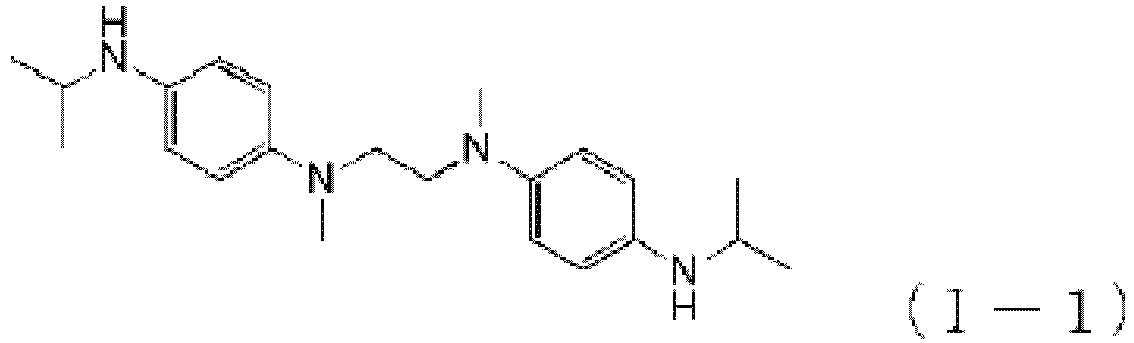
- Properties: Yellow solid
- Melting point: 71°C
- 1H-NMR (300 MHz, CDCl3, δ ppm): 1.18 (d, 12H), 2.86 (s, 6H), 3.35 (s, 4H), 3.53 (dq, 2H), 6.58 (d, 4H), 6.65 (d, 4H)
- After 4.79 g of ethylenediamine and 73.3 g of potassium carbonate had been added to a solution of 25.0 g of 4-fluoronitrobenzene in 150 mL of N,N-dimethylformamide, the solution was stirred overnight at 100°C. The resultant reaction liquid was filtered using Celite and, after 500 mL of water and 300 mL of ethyl acetate had been added to the filtrate, liquid separation was performed to obtain an organic layer. The organic layer was concentrated under reduced pressure to obtain a solid residue that was subsequently washed with a mixed liquid of isopropyl alcohol and diisopropyl ether and dried under reduced pressure to yield 21.3 g (88% yield) of N,N'-bis(4-nitrophenyl)ethane-1,2-diamine.
- After 400 mg of 5% palladium on carbon had been added to a methanol suspension of 11.9 g of N,N'-bis(4-nitrophenyl)ethane-1,2-diamine, the methanol suspension was stirred for 3 days at room temperature under a hydrogen atmosphere. The resultant reaction liquid was filtered and the filtrate was concentrated under reduced pressure to obtain a solid residue. The solid residue was washed with isopropyl alcohol and ethyl acetate, and was dried under reduced pressure to yield 7.36 g (77% yield) of N,N'-bis(4-aminophenyl)ethane-1,2-diamine as a brown solid.
- After 9.12 mL of acetone had been added to a solution of 5.00 g of N,N'-bis(4-aminophenyl)ethane-1,2-diamine in 50 mL of methanol, the solution was ice cooled and 5.71 g of sodium cyanoborohydride was added thereto. Thereafter, the solution was adjusted to a pH of 6.5-7.5 using acetic acid and was then stirred for 3 hours at room temperature. The resultant reaction liquid was concentrated under reduced pressure to obtain a residue. Thereafter, 80 mL of 1N sodium hydroxide aqueous solution was added to the residue and stirring was performed for 1 hour at room temperature. After 70 mL of ethyl acetate had been added to the reaction liquid, liquid separation was carried out to obtain an organic layer. The organic layer was washed with 10 mL of water and concentrated under reduced pressure, and the resultant residue was dissolved in chloroform and processed by silica gel column chromatography (hexane:ethyl acetate = 3:2). Ice-cooled hexane was added to the resultant orange oil. Thereafter, precipitated solid was filtered off and was dried under reduced pressure to yield 5.95 g (70% yield) of N,N'-diisopropyl-N,N'-bis[4-(isopropylamino)phenyl]ethane-1,2-diamine (compound I-2) represented by the following formula.

- Properties: Yellow solid
- Melting point: 81-82°C
- 1H-NMR (300 MHz, DMSO-D6, δ ppm): 0.94 (d, 12H), 1.08 (d, 12H), 2.89 (s, 4H), 3.49 (m, 4H), 4.72 (br-s, 2H), 6.45 (m, 4H), 6.65 (m, 4H)
- After 23.5 g of diethyl ketone had been added to a solution of 30.0 g of N,N'-bis(4-aminophenyl)ethane-1,2-diamine in 300 mL of methanol, 17.1 g of sodium cyanoborohydride was added under ice cooling, and then 12 mL of acetic acid was added in two portions. Stirring was performed for 1.5 hours under ice cooling and then overnight at room temperature. Next, 250 mL of 1N sodium hydroxide aqueous solution was added to the reaction liquid and stirring was performed for 30 minutes. Thereafter, extraction was performed with chloroform and the resultant organic layer was washed once with water. The organic layer was concentrated under reduced pressure to obtain a residue that was then dissolved in chloroform, processed by silica gel column chromatography (hexane:ethyl acetate = 3:2), and purified by once again being processed by silica gel column chromatography (hexane:ethyl acetate = 1:1) to yield 28.5 g (60% yield) of N,N'-bis[4-(pentan-3-ylamino)phenyl]ethane-1,2-diamine as a dark brown solid.
- After 17.3 g of acetone had been added to a solution of 28.5 g of N,N'-bis[4-(pentan-3-ylamino)phenyl]ethane-1,2-diamine in 300 mL of methanol, the solution was ice cooled and 10.3 g of sodium cyanoborohydride and 6.3 mL of acetic acid were added thereto. Stirring was performed for 2 hours at room temperature, after which, the reaction liquid was concentrated under reduced pressure to obtain a residue. Next, 126 mL of 1N sodium hydroxide aqueous solution was added to the residue and stirring was performed. Thereafter, extraction was performed using chloroform and the resultant organic layer was washed with water. The organic layer was concentrated under reduced pressure to obtain a residue that was then processed by silica gel column chromatography (hexane:ethyl acetate = 3:2). The resultant crude crystals were washed with ice-cooled hexane to yield 24.5 g (70% yield) of N,N'-diisopropyl-N,N'-bis[4-(pentan-3-ylamino)phenyl]ethane-1,2-diamine (compound I-3) represented by the following formula.

- Properties: Beige solid
- Melting point: 76°C
- 1H-NMR (300 MHz, DMSO-D6, δ ppm): 0.86 (t, 12H), 0.96 (d, 12H), 1.41 (m, 8H), 2.90 (s, 4H), 3.05 (m, 2H), 4.69 (br-d, 2H), 6.47 (m, 4H), 6.66 (m, 4H)
- After 7.94 g of sodium hydride (60% oil suspension) had been added to a solution of 25.0 g of N,N'-bis(4-nitrophenyl)ethane-1,2-diamine in 400 mL of N,N-dimethylformamide, the solution was stirred for 10 minutes under ice cooling. Stirring was performed for a further 2 hours at room temperature after addition of 23.6 mL of benzyl bromide. The resultant reaction liquid was ice cooled and, after methanol and water has been added thereto, was filtered to obtain a solid. The solid was washed with water, isopropyl ether, and hexane in this order and was dried under reduced pressure to yield 40.3 g (100% yield) of N,N'-dibenzyl-N,N'-bis(4-nitrophenyl)ethane-1,2-diamine as a yellow solid.
- After 2.0 g of 10% platinum on carbon had been added to a suspension of 20.0g of N,N'-dibenzyl-N,N'-bis(4-nitrophenyl)ethane-1,2-diamine in 500 mL of methanol, the suspension was stirred overnight under a hydrogen atmosphere. Further stirring under a hydrogen atmosphere was performed for 1 week after addition of 200 mL of 1,4-dioxane. The resultant reaction liquid was filtered and the filtrate was subsequently concentrated under reduced pressure. Precipitated solid was filtered off to yield 17.0 g (97% yield) of N,N'-dibenzyl-N,N'-bis(4-aminophenyl)ethane-1,2-diamine as a dark purple solid.
- After 12.9 mL of diethyl ketone had been added to a solution of 20.7 g of N,N'-dibenzyl-N,N'-bis(4-aminophenyl)ethane-1,2-diamine, produced according to the description in section (2), in 200 mL of methanol, 6.5 g of sodium cyanoborohydride was further added under ice cooling. The solution was adjusted to a pH of 6.5-7.5 using acetic acid, was stirred for 20 minutes under ice cooling, and was subsequently returned to room temperature and stirred for 4 hours. Saturated sodium carbonate aqueous solution was added to the resultant reaction liquid and extraction was performed using chloroform to obtain an organic layer. The organic layer was concentrated under reduced pressure to obtain a residue that was then dissolved in chloroform and fractionated by silica gel column chromatography (hexane:ethyl acetate = 10:1). Methanol was added to a fraction containing the target product and cooling thereof was performed to precipitate a solid. The solid was filtered off, was washed with cold methanol, and was subsequently dried under reduced pressure to yield 20.8 g (74% yield) of N,N'-dibenzyl-N,N'-bis[4-(pentan-3-ylamino)phenyl]ethane-1,2-diamine (compound I-4) represented by the following formula.

- Properties: White solid
- Melting point: 81°C
- 1H-NMR (300 MHz, CDCl3, δ ppm): 0.91 (t, 12H), 1.49 (m, 8H), 3.07 (m, 4H), 3.41 (s, 4H), 4.35 (s, 4H), 6.47 (d, 4H), 6.56 (d, 4H), 7.23 (m, 12H)
- First, 282.8 g of acetone and 14.1 g of sodium cyanoborohydride were added to a solution of 20.0 g of N,N'-diisopropyl-N,N'-bis[4-(isopropylamino)phenyl]ethane-1,2-diamine (compound 1-2), produced by the method in Production Example 2, in 300 mL of methanol at room temperature. Thereafter, the solution was stirred for 3 days at 60°C while adjusting the solution to a pH of 6.9-7.4 using acetic acid. The resultant reaction liquid was concentrated under reduced pressure to obtain a residue. After 5N sodium hydroxide aqueous solution had been added to the residue, stirring was performed for 1 hour at room temperature. Extraction of the reaction liquid was performed using ethyl acetate to obtain an organic layer that was then washed with water and concentrated under reduced pressure. The resultant residue was purified by silica gel column chromatography (hexane:ethyl acetate = 1:1) to yield 17.01 g (70.6% yield) of N,N'-bis[4-(diisopropylamino)phenyl]-N,N'-diisopropylethane-1,2-diamine (compound I-5) represented by the following formula.

- Properties: Brown solid
- Melting point: 71°C
- 1H-NMR (500 MHz, DMSO-D6, δ ppm): 0.98 (d, 24H), 1.07 (d, 12H), 3.10 (m, 4H), 3.50 (m, 4H), 3.80 (m, 2H), 6.70 (d, 4H), 6.85 (d, 4H)
- After 5.6 g of triethylamine had been added to a solution of 10.0 g of N-isopropyl-N'-phenyl-p-phenylenediamine in 110 mL of toluene, the solution was ice cooled and 4.4 g of sebacoyl chloride was further added thereto by dripping. Stirring was performed for 16 hours at 40°C and, after 200 mL of water had been added to the resultant reaction liquid, the reaction liquid was filtered to obtain a solid. The solid was crushed and washed with isopropyl alcohol and was dried under reduced pressure to yield 10.5 g (92% yield) of N,N'-bis(4-anilinophenyl)-N,N'-bis(isopropyl)sebacamide as an gray-white solid.
- A suspension of 1.4 g of lithium aluminum hydride in 70 mL of dehydrated tetrahydrofuran was prepared and 3.0 g of N,N'-bis(4-anilinophenyl)-N,N'-bis(isopropyl)sebacamide was added thereto under ice cooling. The suspension was returned to room temperature and stirred for 1 hour, and was subsequently heated under reflux overnight. The resultant reaction liquid was ice cooled and, after 30 mL of water and 5 mL of 1N sodium hydroxide aqueous solution had been added thereto, was stirred and then filtered using Celite. Chloroform was added to the filtrate and liquid separation was performed to obtain an organic layer. The organic layer was dried using anhydrous magnesium sulfate and was subsequently concentrated under reduced pressure. The resultant solid was washed with ethyl acetate and dried under reduced pressure to yield 2.8 g (97% yield) of N,N'-bis(4-anilinophenyl)-N,N'-diisopropyldecane-1,10-diamine (compound I-6) represented by the following formula.

- Properties: White solid
- Melting point: 80°C
- 1H-NMR (300 MHz, DMSO-D6, δ ppm): 1.06 (d, 12H), 1.26 (m, 12H), 1.42 (m, 4H), 3.00 (t, 4H), 3.83 (m, 2H), 6.62 (dd, 2H), 6.68 (d, 4H), 6.83 (d, 4H), 6.94 (d, 4H), 7.10 (dd, 2H), 7.59 (s, 2H)
- After 1.31 g of pyridine had been added to a solution of 4.44 g of N-1,3-dimethylbutyl-N'-phenyl-p-phenylenediamine in 40 mL of tetrahydrofuran, the solution was ice cooled and a solution of 1.0 g of oxalyl chloride in 5 mL of tetrahydrofuran was further added thereto by dripping. The solution was stirred for 2 days at room temperature and was then ice cooled again. Water and ethyl acetate were added and liquid separation was performed to obtain an organic layer. The organic layer was washed with 1N hydrochloric acid, saturated sodium hydrogen carbonate aqueous solution, and saturated saline in this order, was dried using anhydrous magnesium sulfate, and was concentrated under reduced pressure. Precipitated solid was washed with a mixed liquid of diisopropyl ether and hexane to yield 3.99 g (86% yield) of N,N'-bis(4-anilinophenyl)-N,N'-bis(4-methylpentan-2-yl)oxamide (compound I-7) represented by the following formula.

- Properties: Blue-purple solid
- Melting point: 187-188°C
- 1H-NMR (300 MHz, DMSO-D6, δ ppm): 0.85 (m, 24H), 4.48 (m, 2H), 6.88 (m, 6H), 7.11 (m, 8H), 7.27 (m, 4H), 8.39 (m, 2H)
- A suspension of 20 g of adipic acid in 40 mL of chloroform was prepared and, after 65.2 g of thionyl chloride and one drop of N,N-dimethylformamide had been added thereto, the suspension was heated under reflux for 8 hours. Chloroform and excess thionyl chloride were distilled from the resultant reaction liquid by heating under normal pressure to obtain a residue that was subsequently dissolved in 30 mL of dehydrated tetrahydrofuran. The resultant solution was dripped into an ice-cooled solution of 73.5 g of N-1,3-dimethylbutyl-N'-phenyl-p-phenylenediamine and 26.0 g of pyridine in 500 mL of dehydrated tetrahydrofuran and was returned to room temperature before being stirred overnight. After water and diisopropyl ether had been added to the resultant reaction liquid, the reaction liquid was filtered to obtain a solid. The solid was crushed and washed with water, methanol, and diisopropyl ether in this order, and was dried under reduced pressure to yield 34.5 g (39% yield) of N,N'-bis(4-anilinophenyl)-N,N'-bis(4-methylpentan-2-yl)adipamide (compound I-8) represented by the following formula.

- Properties: Pale purple solid
- Melting point: 204-206°C
- 1H-NMR (300 MHz, DMSO-D6, δ ppm): 0.96 (m, 20H), 1.20 (m, 6H), 1.55 (m, 2H), 1.75 (br-s, 4H), 4.82 (m, 2H), 6.86 (m, 6H), 7.08 (m, 8H), 7.24 (m, 4H), 8.31 (s, 2H)
- Compounds I-9 to I-14 shown below in Table 1 were each produced in accordance with a method in one of the above production examples. The Physico-chemical properties of these compounds are shown in Table 2.
Table 1 Compound number Compound I-9 
I-10 
I-11 
I-12 
I-13 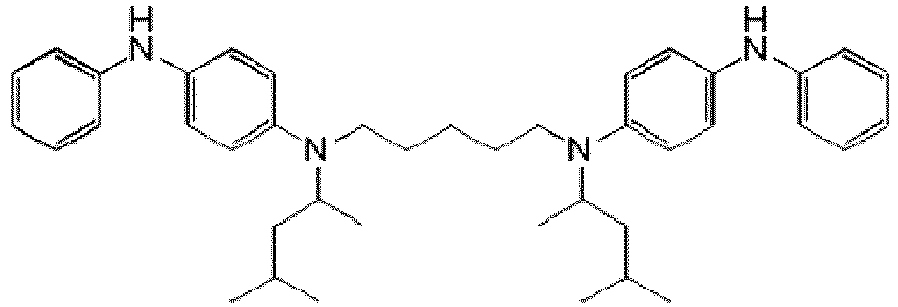
I-14 
Table 2 Number Properties 1H-NMR data I-9 Yellow solid Melting point 84°C 1H-NMR (300 MHz, CDCl3, δ ppm): 1.06 (t, 6H), 1.18 (d, 12H), 3.20 (q, 4H), 3.27 (s, 4H), 3.54 (dq, 2H), 4.75 (br-s, 2H), 6.58 (d, 4H), 6.67 (d, 4H) I-10 Black oil 1H-NMR (300 MHz, CDCl3, δ ppm): 1.06 (d, 12H), 1.16 (d, 12H), 1.27 (br-s, 4H), 1.42 (br-s, 4H), 2.96 (m, 4H), 3.53 (dq, 2H), 3.64 (dq, 2H), 6.54 (d, 4H), 6.73 (d, 4H) I-11 Dark ocher oil 1H-NMR (300 MHz, DMSO-D6, δ ppm): 0.86 (t, 12H), 0.95 (d, 12H), 1.35 (m, 16H), 2.89 (br-s, 4H), 3.17 (m, 2H), 3.50 (m, 2H), 4.67 (d, 2H), 6.46 (m, 4H), 6.64 (m, 4H) I-12 Pale ocher solid Melting point 89-90°C 1H-NMR (300 MHz, DMSO-D6, δ ppm): 1.09 (d, 12H), 1.35 (m, 2H), 1.47 (m, 4H), 3.02 (m, 4H), 3.85 (m, 2H), 6.63 (m, 2H), 6.73 (m, 4H), 6.85 (m, 4H), 6.94 (m, 4H), 7.11 (m, 4H), 7.62 (s, 2H) I-13 Black oil 1H-NMR (300 MHz, DMSO-D6, δ ppm): 0.85 (m, 12H), 1.01 (d, 6H), 1.18 (m, 4H), 1.41 (m, 4H), 1.56 (m, 2H), 2.98 (m, 4H), 3.73 (m, 2H), 6.61 (dd, 2H), 6.70 (d, 4H), 6.82 (d, 4H), 6.93 (d, 4H), 7.08 (dd, 2H), 7.59 (s, 2H) I-14 Blue-purple solid Melting point 187-188°C 1H-NMR (300 MHz, DMSO-D6, δ ppm): 1.07 (d, 12H), 1.33 (m, 4H), 1.44 (m, 4H), 3.01 (m, 4H), 3.85 (m, 2H), 6.62 (dd, 2H), 6.70 (d, 4H), 6.83 (d, 4H), 6.95 (d, 4H), 7.10 (dd, 2H), 7.59 (s, 2H) - Rubber compositions were produced by a standard method according to formulations 1 and 2 shown in Table 3. However, note that the blending amounts of various bisphenyldiamine compounds and anti-aging agents were changed depending on the example (refer to Tables 4 and 5 described further below). Formulation 1 is a formulation for a rubber composition that it is envisaged will be used in a tire tread and formulation 2 is a formulation for a rubber composition that it is envisaged will be used in a tire sidewall. Each of the produced rubber compositions was vulcanized by a standard method. Ozone resistance and discoloration of the resultant vulcanized rubber compositions were evaluated by the methods described further below.
Table 3 Formulations Formulation 1 Formulation 2 Type of component Parts by mass Parts by mass SBR *1 100 - BR - 50 Natural rubber - 50 Carbon black A *2 25 - Carbon black B *3 - 50 Silica *4 25 - Silane coupling agent *5 2 - Stearic acid 2 2 Wax *6 2 2 Zinc oxide 3 3 Vulcanization accelerator DPG *7 1.0 0.3 Vulcanization accelerator MBTS *8 1.0 0.3 Vulcanization accelerator CBS *9 1.0 0.8 Sulfur 1.5 2.0 Bisphenyldiamine compound X * 10 Variable amount (refer to Tables 4 and 5) Bisphenyldiamine compound Y * 11 Variable amount (refer to Tables 4 and 5) Bisphenyldiamine compound Z * 12 Variable amount (refer to Tables 4 and 5) Anti-aging agent 6PPD * 13 Variable amount (refer to Tables 4 and 5) Anti-aging agent TMQ * 14 Variable amount (refer to Tables 4 and 5) *1 SBR: Styrene-butadiene copolymer rubber, #1500 produced by JSR Corporation
*2 Carbon black A: SEAST 7HM produced by Tokai Carbon Co., Ltd.
*3 Carbon black B: SEAST F produced by Tokai Carbon Co., Ltd.
*4 Silica: Nipsil VN3 produced by Tosoh Silica Corporation
*5 Silane coupling agent: Bis(3-ethoxysilylpropyl)tetrasulfide
*6 Wax: Microcrystalline wax, Ozoace 0701 produced by Nippon Seiro Co., Ltd.
*7 Vulcanization accelerator DPG: NOCCELER D produced by Ouchi Shinko Chemical Industrial Co., Ltd.
*8 Vulcanization accelerator MBTS: NOCCELER DM produced by Ouchi Shinko Chemical Industrial Co., Ltd.
*9 Vulcanization accelerator CBS: SANCELER CM-G produced by Sanshin Chemical Industry Co., Ltd.
* 10 Bisphenyldiamine compound X: Compound I-2 produced in Production Example 2
* 11 Bisphenyldiamine compound Y: Compound I-4 produced in Production Example 4
* 12 Bisphenyldiamine compound Z: Compound I-7 produced in Production Example 7
* 13 Anti-aging agent 6PPD: NOCRAC 6C produced by Ouchi Shinko Chemical Industrial Co., Ltd., N-phenyl-N'-(1,3-dimethylbutyl)-p-phenylenediamine
* 14 Anti-aging agent TMQ: NONFLEX RD-S produced by Seiko-Chemical Co., Ltd., polymerized 2,2,4-trimethyl-1,2-dihydroquinoline - A test piece of each of the rubber compositions was subjected to an ozone degradation test in accordance with JIS K6301 under conditions of a temperature of 40°C, an ozone concentration of 50 pphm, and elongation of 20%. After 50 hours had passed, the state of degradation of the test piece was inspected and was evaluated using the following three-level scale based on the number of cracks that had formed.
- A:
- Small number of cracks
- B:
- Large number of cracks
- C:
- Countless number of cracks
- Moreover, the test piece was evaluated using the following five-level scale based on the size and depth of cracks.
- 1: Cracks not visible by naked eye but visible under ×10 magnifying glass
- 2: Cracks visible by naked eye
- 3: Deep and relatively large cracks (less than 1 mm)
- 4: Deep and large cracks (at least 1 mm and less than 3 mm)
- 5: Cracks of at least 3 mm or severing likely to occur
- Note that in a situation in which cracks were not observed, an evaluation of "no cracks" was given. The results of this evaluation are shown in Tables 4 and 5.
- After each of the test pieces had been subjected to the ozone degradation test described above, surface discoloration of the test piece was visually evaluated using the following four-level scale. The results of this evaluation are shown in Tables 4 and 5.
- A+:
- Black and glossy
- A:
- Black but not glossy
- A-:
- Surface discoloration confirmed
- F:
- Discoloration of entire surface
- From Tables 4 and 5, it can be seen that in the case of rubber compositions that contained the bisphenyldiamine compound represented by formula (I) blended with at least one rubber component selected from natural rubber and diene-based synthetic rubbers, and also in the case of rubber compositions according to the present disclosure that contained another anti-aging agent in combination with the bisphenyldiamine compound represented by formula (I), weather resistance was improved and surface discoloration was inhibited compared to rubber compositions that only contained conventional anti-aging agents.
| Example 1 | Example 2 | Example 3 | Example 4 | Example 5 | Example 6 | Example 7 | Example 8 | Example 9 | Example 10 | Example 11 | |
| Formulation | 1 | 2 | 2 | 2 | 2 | 2 | 2 | 2 | 2 | 2 | 2 |
| Bisphenyldiamine compound X | 1 | 0.2 | 1 | 3 | 6 | 10 | 3 | 1.5 | 1.5 | - | - |
| Bisphenyldiamine compound Y | - | - | - | - | - | - | - | - | - | 3 | - |
| Bisphenyldiamine compound Z | - | - | - | - | - | - | - | - | - | - | 3 |
| Anti-aging agent 6PPD | - | - | - | - | - | - | - | 1.5 | 1.5 | - | - |
| Anti-aging agent TMQ | 0.3 | - | - | - | - | - | 1 | - | 1 | - | - |
| Ozone resistance | A-2 | A-3 | A-2 | No cracks | No cracks | No cracks | No cracks | No cracks | No cracks | A-2 | A-2 |
| Discoloration | A+ | A+ | A+ | A | A- | A- | A+ | A | A | A | A |
| Comparative Example 1 | Comparative Example 2 | Comparative Example 3 | Comparative Example 4 | Comparative Example 5 | Comparative Example 6 | |
| Formulation | 1 | 2 | 2 | 2 | 2 | 2 |
| Bisphenyldiamine compound X | - | - | - | - | - | - |
| Bisphenyldiamine compound Y | - | - | - | - | - | - |
| Bisphenyldiamine compound Z | - | - | - | - | - | - |
| Anti-aging agent 6PPD | 1 | 1 | 3 | 6 | 10 | 3 |
| Anti-aging agent TMQ | 0.3 | - | - | - | - | 1 |
| Ozone resistance | B-3 | B-4 | A-3 | A-2 | A-1 | A-2 |
| Discoloration | A | A | A | F | F | A |
Claims (7)
- A rubber composition comprising
at least one rubber component selected from natural rubber and diene-based synthetic rubbers and, blended therewith, at least one bisphenyldiamine compound represented by formula (I) shown below
- The rubber composition of claim 1, wherein
in the bisphenyldiamine compound represented by formula (I), one of R1 and R2 is a hydrogen atom, one of R5 and R6 is a hydrogen atom, R3 and R4 are each an alkyl group having a carbon number of 1-8, A is an alkylene group having a carbon number of 1-8, 1 is 1, and m and n are each 0. - The rubber composition of claim 1 or 2, wherein
a blending amount of the bisphenyldiamine compound represented by formula (I) is in a range of from 0.2 parts by mass to 10 parts by mass relative to 100 parts by mass of the rubber component. - A tire comprising a tire member in which the rubber composition of claim 1 or 2 is used.
- The tire of claim 4, wherein
the tire member is either or both of a tread and a sidewall. - A bisphenyldiamine compound represented by formula (I) shown below

- An anti-aging agent for natural rubber and diene-based synthetic rubber-use comprising the bisphenyldiamine compound of claim 6.
Applications Claiming Priority (2)
| Application Number | Priority Date | Filing Date | Title |
|---|---|---|---|
| JP2014106393A JP6377954B2 (en) | 2014-05-22 | 2014-05-22 | Rubber composition, tire, bisphenyldiamine compound and anti-aging agent |
| PCT/JP2015/002596 WO2015178037A1 (en) | 2014-05-22 | 2015-05-22 | Rubber composition, tire, bisphenyl diamine compound and anti-aging agent |
Publications (3)
| Publication Number | Publication Date |
|---|---|
| EP3147319A1 true EP3147319A1 (en) | 2017-03-29 |
| EP3147319A4 EP3147319A4 (en) | 2017-12-20 |
| EP3147319B1 EP3147319B1 (en) | 2018-06-13 |
Family
ID=54553718
Family Applications (1)
| Application Number | Title | Priority Date | Filing Date |
|---|---|---|---|
| EP15796606.0A Not-in-force EP3147319B1 (en) | 2014-05-22 | 2015-05-22 | Rubber composition, tire, bisphenyl diamine compound and anti-aging agent |
Country Status (6)
| Country | Link |
|---|---|
| US (1) | US10011704B2 (en) |
| EP (1) | EP3147319B1 (en) |
| JP (1) | JP6377954B2 (en) |
| CN (1) | CN106459500B (en) |
| TW (1) | TWI652307B (en) |
| WO (1) | WO2015178037A1 (en) |
Cited By (1)
| Publication number | Priority date | Publication date | Assignee | Title |
|---|---|---|---|---|
| WO2018226373A1 (en) * | 2017-06-09 | 2018-12-13 | Eastman Chemical Company | Compounds and mixtures with antidegradant and antifatigue efficacy and compositions including said compounds |
Families Citing this family (10)
| Publication number | Priority date | Publication date | Assignee | Title |
|---|---|---|---|---|
| US10260017B2 (en) | 2015-12-22 | 2019-04-16 | Eastman Chemical Company | Compounds and mixtures with antidegradant and antifatigue efficacy and compositions including said compounds |
| US10287418B2 (en) * | 2015-12-22 | 2019-05-14 | Eastman Chemical Company | Compounds with antidegradant and antifatigue efficacy and compositions including said compounds |
| US10167252B2 (en) | 2015-12-22 | 2019-01-01 | Eastman Chemical Company | Compounds and mixtures with antidegradant and antifatigue efficacy and compositions including such compounds |
| US10160718B2 (en) | 2015-12-22 | 2018-12-25 | Eastman Chemical Company | Methods of making compounds having antidegradant and antifatigue efficacy |
| US10428009B2 (en) | 2015-12-22 | 2019-10-01 | Eastman Chemical Company | Methods of making compounds and mixtures having antidegradant and antifatigue efficacy |
| CN110691767A (en) * | 2017-06-09 | 2020-01-14 | 伊士曼化工公司 | Methods of preparing compounds and mixtures with antidegradant and antifatigue efficacy |
| EP3634940B1 (en) * | 2017-06-09 | 2021-07-14 | Eastman Chemical Company | Compounds and mixtures with antidegradant and antifatigue efficacy and compositions including such compounds |
| JP7240203B2 (en) * | 2019-02-28 | 2023-03-15 | Eneos株式会社 | PETROLEUM-BASED AROMATIC-CONTAINING OIL, RUBBER COMPOSITION, TIRE, AND METHOD FOR MAKING TIRE |
| CN112080036B (en) * | 2019-06-14 | 2022-03-29 | 圣奥化学科技有限公司 | Rubber composition for tire containing low-pollution anti-aging agent |
| CN114835587A (en) * | 2022-05-25 | 2022-08-02 | 合肥中聚和成电子材料有限公司 | Synthesis method of diamine compound and diamine compound prepared by synthesis method |
Family Cites Families (16)
| Publication number | Priority date | Publication date | Assignee | Title |
|---|---|---|---|---|
| US2705224A (en) * | 1953-06-19 | 1955-03-29 | Augustana Res Foundation | Anti-ozidants |
| US2939861A (en) * | 1954-10-15 | 1960-06-07 | Firestone Tire & Rubber Co | Rubber vulcanizates and process of preparing same |
| US2939867A (en) * | 1954-10-15 | 1960-06-07 | Firestone Tire & Rubber Co | Reaction products of alkylene dihalides and substituted phenylenediamines |
| GB835826A (en) * | 1957-11-19 | 1960-05-25 | Firestone Tire & Rubber Co | Improvements relating to reaction products of hydrocarbon dihalides and substituted phenylenediamines and their use in rubber |
| US3396005A (en) * | 1965-01-11 | 1968-08-06 | Pennsalt Chemicals Corp | Methods of affecting plant growth |
| US3266982A (en) * | 1965-03-19 | 1966-08-16 | Pennsalt Chemicals Corp | Process for controlling pests |
| CA2135034A1 (en) | 1994-09-09 | 1996-03-10 | Lawson Gibson Wideman | Polymeric n-aryl substituted and n-alkaryl substituted diphenyldiamines |
| KR100397859B1 (en) | 2001-05-25 | 2003-09-19 | 한국타이어 주식회사 | Sidewall rubber composition for pneumatic tire |
| JP3955250B2 (en) | 2002-09-18 | 2007-08-08 | 横浜ゴム株式会社 | Tire wheel assembly |
| JP2005232355A (en) | 2004-02-20 | 2005-09-02 | Yokohama Rubber Co Ltd:The | Rubber composition |
| FR2908416B1 (en) | 2006-11-09 | 2009-01-16 | Michelin Soc Tech | RUBBER COMPOSITION FOR PNEUMATIC INCORPORATING A NEW ANTI-OXIDANT SYSTEM |
| US7879934B2 (en) | 2007-08-16 | 2011-02-01 | Chemtura Corporation | Rubber compositions |
| US9200141B2 (en) * | 2010-08-11 | 2015-12-01 | Bridgestone Corporation | Rubber composition, method for preventing discoloration of rubber composition, and tire |
| JP2013155259A (en) | 2012-01-27 | 2013-08-15 | Bridgestone Corp | Rubber composition and tire |
| KR101392733B1 (en) | 2012-11-29 | 2014-05-12 | 한국타이어 주식회사 | Rubber composition for tire sidewall and tire manufactured by using the same |
| CN103059355A (en) | 2012-11-30 | 2013-04-24 | 西安致泰橡塑工业有限公司 | Anti-aging cushion rubber rope |
-
2014
- 2014-05-22 JP JP2014106393A patent/JP6377954B2/en active Active
-
2015
- 2015-05-21 TW TW104116278A patent/TWI652307B/en not_active IP Right Cessation
- 2015-05-22 CN CN201580026337.2A patent/CN106459500B/en not_active Expired - Fee Related
- 2015-05-22 US US15/312,768 patent/US10011704B2/en not_active Expired - Fee Related
- 2015-05-22 EP EP15796606.0A patent/EP3147319B1/en not_active Not-in-force
- 2015-05-22 WO PCT/JP2015/002596 patent/WO2015178037A1/en not_active Ceased
Cited By (1)
| Publication number | Priority date | Publication date | Assignee | Title |
|---|---|---|---|---|
| WO2018226373A1 (en) * | 2017-06-09 | 2018-12-13 | Eastman Chemical Company | Compounds and mixtures with antidegradant and antifatigue efficacy and compositions including said compounds |
Also Published As
| Publication number | Publication date |
|---|---|
| US20170137604A1 (en) | 2017-05-18 |
| CN106459500A (en) | 2017-02-22 |
| TW201544543A (en) | 2015-12-01 |
| JP2015221856A (en) | 2015-12-10 |
| TWI652307B (en) | 2019-03-01 |
| EP3147319B1 (en) | 2018-06-13 |
| JP6377954B2 (en) | 2018-08-22 |
| WO2015178037A1 (en) | 2015-11-26 |
| CN106459500B (en) | 2018-08-03 |
| US10011704B2 (en) | 2018-07-03 |
| EP3147319A4 (en) | 2017-12-20 |
Similar Documents
| Publication | Publication Date | Title |
|---|---|---|
| EP3147319B1 (en) | Rubber composition, tire, bisphenyl diamine compound and anti-aging agent | |
| EP3147321B1 (en) | Rubber composition, tire, amine compound and anti-aging agent | |
| US10066080B2 (en) | Rubber composition, tire, bisanilino compound, and anti-aging agent | |
| EP3792245B1 (en) | Compounds with antidegradant and antifatigue efficacy and compositions including said compounds | |
| JP2010037546A (en) | Rubber composition | |
| EP4382565A1 (en) | Tire rubber composition, and tire | |
| US10428009B2 (en) | Methods of making compounds and mixtures having antidegradant and antifatigue efficacy | |
| CN110691770B (en) | Compounds and mixtures having antidegradants and antifatigue efficacy and compositions comprising such compounds | |
| KR20240067865A (en) | Compounds, rubber mixtures containing the compounds, vehicle tires having at least one component comprising the rubber mixture, processes for manufacturing the compounds, and use of the compounds as aging stabilizers and/or ozonolysis inhibitors and/or colorants. | |
| EP3634939B1 (en) | Methods of making compounds having antidegradant and antifatigue efficacy | |
| CN112759557A (en) | Compound with anti-aging and anti-discoloration effects and preparation method thereof | |
| KR101496243B1 (en) | Rubber composition for tire hump strip and tire manufactured by using the same | |
| US20170275239A1 (en) | Compounds and mixtures with antidegradant and antifatigue efficacy and compositions inluding such compounds | |
| CN121057660A (en) | The compound, a rubber compound containing the compound, a vehicle tire containing the rubber compound in at least one component, a method for producing the compound, and the use of the compound as an aging stabilizer and/or antioxidant and/or dye. | |
| KR20240164923A (en) | Compounds, rubber blends containing the compound, vehicle tires containing the rubber blend as at least one component, processes for making the compounds, and uses of the compounds as anti-aging agents and/or anti-oxidants |
Legal Events
| Date | Code | Title | Description |
|---|---|---|---|
| STAA | Information on the status of an ep patent application or granted ep patent |
Free format text: STATUS: THE INTERNATIONAL PUBLICATION HAS BEEN MADE |
|
| PUAI | Public reference made under article 153(3) epc to a published international application that has entered the european phase |
Free format text: ORIGINAL CODE: 0009012 |
|
| STAA | Information on the status of an ep patent application or granted ep patent |
Free format text: STATUS: REQUEST FOR EXAMINATION WAS MADE |
|
| 17P | Request for examination filed |
Effective date: 20161121 |
|
| AK | Designated contracting states |
Kind code of ref document: A1 Designated state(s): AL AT BE BG CH CY CZ DE DK EE ES FI FR GB GR HR HU IE IS IT LI LT LU LV MC MK MT NL NO PL PT RO RS SE SI SK SM TR |
|
| AX | Request for extension of the european patent |
Extension state: BA ME |
|
| DAV | Request for validation of the european patent (deleted) | ||
| DAX | Request for extension of the european patent (deleted) | ||
| A4 | Supplementary search report drawn up and despatched |
Effective date: 20171122 |
|
| RIC1 | Information provided on ipc code assigned before grant |
Ipc: C08K 5/18 20060101ALI20171116BHEP Ipc: C08L 9/00 20060101ALI20171116BHEP Ipc: C07C 211/51 20060101ALI20171116BHEP Ipc: C08L 7/00 20060101AFI20171116BHEP Ipc: C08K 5/20 20060101ALI20171116BHEP Ipc: C07C 237/04 20060101ALI20171116BHEP Ipc: B60C 1/00 20060101ALI20171116BHEP |
|
| RIC1 | Information provided on ipc code assigned before grant |
Ipc: C07C 211/51 20060101ALI20180201BHEP Ipc: C08K 5/20 20060101ALI20180201BHEP Ipc: C08L 9/00 20060101ALI20180201BHEP Ipc: C07C 237/04 20060101ALI20180201BHEP Ipc: C08L 7/00 20060101AFI20180201BHEP Ipc: C08K 5/18 20060101ALI20180201BHEP Ipc: B60C 1/00 20060101ALI20180201BHEP |
|
| GRAP | Despatch of communication of intention to grant a patent |
Free format text: ORIGINAL CODE: EPIDOSNIGR1 |
|
| STAA | Information on the status of an ep patent application or granted ep patent |
Free format text: STATUS: GRANT OF PATENT IS INTENDED |
|
| INTG | Intention to grant announced |
Effective date: 20180315 |
|
| GRAS | Grant fee paid |
Free format text: ORIGINAL CODE: EPIDOSNIGR3 |
|
| GRAA | (expected) grant |
Free format text: ORIGINAL CODE: 0009210 |
|
| STAA | Information on the status of an ep patent application or granted ep patent |
Free format text: STATUS: THE PATENT HAS BEEN GRANTED |
|
| AK | Designated contracting states |
Kind code of ref document: B1 Designated state(s): AL AT BE BG CH CY CZ DE DK EE ES FI FR GB GR HR HU IE IS IT LI LT LU LV MC MK MT NL NO PL PT RO RS SE SI SK SM TR |
|
| REG | Reference to a national code |
Ref country code: GB Ref legal event code: FG4D |
|
| REG | Reference to a national code |
Ref country code: CH Ref legal event code: EP Ref country code: AT Ref legal event code: REF Ref document number: 1008463 Country of ref document: AT Kind code of ref document: T Effective date: 20180615 |
|
| REG | Reference to a national code |
Ref country code: DE Ref legal event code: R096 Ref document number: 602015012385 Country of ref document: DE |
|
| REG | Reference to a national code |
Ref country code: IE Ref legal event code: FG4D |
|
| REG | Reference to a national code |
Ref country code: NL Ref legal event code: MP Effective date: 20180613 |
|
| REG | Reference to a national code |
Ref country code: LT Ref legal event code: MG4D |
|
| PG25 | Lapsed in a contracting state [announced via postgrant information from national office to epo] |
Ref country code: BG Free format text: LAPSE BECAUSE OF FAILURE TO SUBMIT A TRANSLATION OF THE DESCRIPTION OR TO PAY THE FEE WITHIN THE PRESCRIBED TIME-LIMIT Effective date: 20180913 Ref country code: SE Free format text: LAPSE BECAUSE OF FAILURE TO SUBMIT A TRANSLATION OF THE DESCRIPTION OR TO PAY THE FEE WITHIN THE PRESCRIBED TIME-LIMIT Effective date: 20180613 Ref country code: FI Free format text: LAPSE BECAUSE OF FAILURE TO SUBMIT A TRANSLATION OF THE DESCRIPTION OR TO PAY THE FEE WITHIN THE PRESCRIBED TIME-LIMIT Effective date: 20180613 Ref country code: CY Free format text: LAPSE BECAUSE OF FAILURE TO SUBMIT A TRANSLATION OF THE DESCRIPTION OR TO PAY THE FEE WITHIN THE PRESCRIBED TIME-LIMIT Effective date: 20180613 Ref country code: NO Free format text: LAPSE BECAUSE OF FAILURE TO SUBMIT A TRANSLATION OF THE DESCRIPTION OR TO PAY THE FEE WITHIN THE PRESCRIBED TIME-LIMIT Effective date: 20180913 Ref country code: ES Free format text: LAPSE BECAUSE OF FAILURE TO SUBMIT A TRANSLATION OF THE DESCRIPTION OR TO PAY THE FEE WITHIN THE PRESCRIBED TIME-LIMIT Effective date: 20180613 Ref country code: LT Free format text: LAPSE BECAUSE OF FAILURE TO SUBMIT A TRANSLATION OF THE DESCRIPTION OR TO PAY THE FEE WITHIN THE PRESCRIBED TIME-LIMIT Effective date: 20180613 |
|
| PG25 | Lapsed in a contracting state [announced via postgrant information from national office to epo] |
Ref country code: HR Free format text: LAPSE BECAUSE OF FAILURE TO SUBMIT A TRANSLATION OF THE DESCRIPTION OR TO PAY THE FEE WITHIN THE PRESCRIBED TIME-LIMIT Effective date: 20180613 Ref country code: GR Free format text: LAPSE BECAUSE OF FAILURE TO SUBMIT A TRANSLATION OF THE DESCRIPTION OR TO PAY THE FEE WITHIN THE PRESCRIBED TIME-LIMIT Effective date: 20180914 Ref country code: LV Free format text: LAPSE BECAUSE OF FAILURE TO SUBMIT A TRANSLATION OF THE DESCRIPTION OR TO PAY THE FEE WITHIN THE PRESCRIBED TIME-LIMIT Effective date: 20180613 Ref country code: RS Free format text: LAPSE BECAUSE OF FAILURE TO SUBMIT A TRANSLATION OF THE DESCRIPTION OR TO PAY THE FEE WITHIN THE PRESCRIBED TIME-LIMIT Effective date: 20180613 |
|
| REG | Reference to a national code |
Ref country code: AT Ref legal event code: MK05 Ref document number: 1008463 Country of ref document: AT Kind code of ref document: T Effective date: 20180613 |
|
| PG25 | Lapsed in a contracting state [announced via postgrant information from national office to epo] |
Ref country code: NL Free format text: LAPSE BECAUSE OF FAILURE TO SUBMIT A TRANSLATION OF THE DESCRIPTION OR TO PAY THE FEE WITHIN THE PRESCRIBED TIME-LIMIT Effective date: 20180613 |
|
| PG25 | Lapsed in a contracting state [announced via postgrant information from national office to epo] |
Ref country code: SK Free format text: LAPSE BECAUSE OF FAILURE TO SUBMIT A TRANSLATION OF THE DESCRIPTION OR TO PAY THE FEE WITHIN THE PRESCRIBED TIME-LIMIT Effective date: 20180613 Ref country code: RO Free format text: LAPSE BECAUSE OF FAILURE TO SUBMIT A TRANSLATION OF THE DESCRIPTION OR TO PAY THE FEE WITHIN THE PRESCRIBED TIME-LIMIT Effective date: 20180613 Ref country code: EE Free format text: LAPSE BECAUSE OF FAILURE TO SUBMIT A TRANSLATION OF THE DESCRIPTION OR TO PAY THE FEE WITHIN THE PRESCRIBED TIME-LIMIT Effective date: 20180613 Ref country code: IS Free format text: LAPSE BECAUSE OF FAILURE TO SUBMIT A TRANSLATION OF THE DESCRIPTION OR TO PAY THE FEE WITHIN THE PRESCRIBED TIME-LIMIT Effective date: 20181013 Ref country code: CZ Free format text: LAPSE BECAUSE OF FAILURE TO SUBMIT A TRANSLATION OF THE DESCRIPTION OR TO PAY THE FEE WITHIN THE PRESCRIBED TIME-LIMIT Effective date: 20180613 Ref country code: AT Free format text: LAPSE BECAUSE OF FAILURE TO SUBMIT A TRANSLATION OF THE DESCRIPTION OR TO PAY THE FEE WITHIN THE PRESCRIBED TIME-LIMIT Effective date: 20180613 Ref country code: PL Free format text: LAPSE BECAUSE OF FAILURE TO SUBMIT A TRANSLATION OF THE DESCRIPTION OR TO PAY THE FEE WITHIN THE PRESCRIBED TIME-LIMIT Effective date: 20180613 |
|
| PG25 | Lapsed in a contracting state [announced via postgrant information from national office to epo] |
Ref country code: IT Free format text: LAPSE BECAUSE OF FAILURE TO SUBMIT A TRANSLATION OF THE DESCRIPTION OR TO PAY THE FEE WITHIN THE PRESCRIBED TIME-LIMIT Effective date: 20180613 Ref country code: SM Free format text: LAPSE BECAUSE OF FAILURE TO SUBMIT A TRANSLATION OF THE DESCRIPTION OR TO PAY THE FEE WITHIN THE PRESCRIBED TIME-LIMIT Effective date: 20180613 |
|
| REG | Reference to a national code |
Ref country code: DE Ref legal event code: R097 Ref document number: 602015012385 Country of ref document: DE |
|
| PLBE | No opposition filed within time limit |
Free format text: ORIGINAL CODE: 0009261 |
|
| STAA | Information on the status of an ep patent application or granted ep patent |
Free format text: STATUS: NO OPPOSITION FILED WITHIN TIME LIMIT |
|
| 26N | No opposition filed |
Effective date: 20190314 |
|
| PG25 | Lapsed in a contracting state [announced via postgrant information from national office to epo] |
Ref country code: DK Free format text: LAPSE BECAUSE OF FAILURE TO SUBMIT A TRANSLATION OF THE DESCRIPTION OR TO PAY THE FEE WITHIN THE PRESCRIBED TIME-LIMIT Effective date: 20180613 Ref country code: SI Free format text: LAPSE BECAUSE OF FAILURE TO SUBMIT A TRANSLATION OF THE DESCRIPTION OR TO PAY THE FEE WITHIN THE PRESCRIBED TIME-LIMIT Effective date: 20180613 |
|
| PGFP | Annual fee paid to national office [announced via postgrant information from national office to epo] |
Ref country code: DE Payment date: 20190505 Year of fee payment: 5 |
|
| PGFP | Annual fee paid to national office [announced via postgrant information from national office to epo] |
Ref country code: FR Payment date: 20190508 Year of fee payment: 5 |
|
| PG25 | Lapsed in a contracting state [announced via postgrant information from national office to epo] |
Ref country code: AL Free format text: LAPSE BECAUSE OF FAILURE TO SUBMIT A TRANSLATION OF THE DESCRIPTION OR TO PAY THE FEE WITHIN THE PRESCRIBED TIME-LIMIT Effective date: 20180613 |
|
| REG | Reference to a national code |
Ref country code: CH Ref legal event code: PL |
|
| GBPC | Gb: european patent ceased through non-payment of renewal fee |
Effective date: 20190522 |
|
| PG25 | Lapsed in a contracting state [announced via postgrant information from national office to epo] |
Ref country code: LI Free format text: LAPSE BECAUSE OF NON-PAYMENT OF DUE FEES Effective date: 20190531 Ref country code: CH Free format text: LAPSE BECAUSE OF NON-PAYMENT OF DUE FEES Effective date: 20190531 Ref country code: MC Free format text: LAPSE BECAUSE OF FAILURE TO SUBMIT A TRANSLATION OF THE DESCRIPTION OR TO PAY THE FEE WITHIN THE PRESCRIBED TIME-LIMIT Effective date: 20180613 |
|
| REG | Reference to a national code |
Ref country code: BE Ref legal event code: MM Effective date: 20190531 |
|
| PG25 | Lapsed in a contracting state [announced via postgrant information from national office to epo] |
Ref country code: LU Free format text: LAPSE BECAUSE OF NON-PAYMENT OF DUE FEES Effective date: 20190522 |
|
| PG25 | Lapsed in a contracting state [announced via postgrant information from national office to epo] |
Ref country code: TR Free format text: LAPSE BECAUSE OF FAILURE TO SUBMIT A TRANSLATION OF THE DESCRIPTION OR TO PAY THE FEE WITHIN THE PRESCRIBED TIME-LIMIT Effective date: 20180613 |
|
| PG25 | Lapsed in a contracting state [announced via postgrant information from national office to epo] |
Ref country code: GB Free format text: LAPSE BECAUSE OF NON-PAYMENT OF DUE FEES Effective date: 20190522 Ref country code: IE Free format text: LAPSE BECAUSE OF NON-PAYMENT OF DUE FEES Effective date: 20190522 |
|
| PG25 | Lapsed in a contracting state [announced via postgrant information from national office to epo] |
Ref country code: BE Free format text: LAPSE BECAUSE OF NON-PAYMENT OF DUE FEES Effective date: 20190531 |
|
| PG25 | Lapsed in a contracting state [announced via postgrant information from national office to epo] |
Ref country code: PT Free format text: LAPSE BECAUSE OF FAILURE TO SUBMIT A TRANSLATION OF THE DESCRIPTION OR TO PAY THE FEE WITHIN THE PRESCRIBED TIME-LIMIT Effective date: 20181015 |
|
| REG | Reference to a national code |
Ref country code: DE Ref legal event code: R119 Ref document number: 602015012385 Country of ref document: DE |
|
| PG25 | Lapsed in a contracting state [announced via postgrant information from national office to epo] |
Ref country code: FR Free format text: LAPSE BECAUSE OF NON-PAYMENT OF DUE FEES Effective date: 20200531 |
|
| PG25 | Lapsed in a contracting state [announced via postgrant information from national office to epo] |
Ref country code: DE Free format text: LAPSE BECAUSE OF NON-PAYMENT OF DUE FEES Effective date: 20201201 |
|
| PG25 | Lapsed in a contracting state [announced via postgrant information from national office to epo] |
Ref country code: HU Free format text: LAPSE BECAUSE OF FAILURE TO SUBMIT A TRANSLATION OF THE DESCRIPTION OR TO PAY THE FEE WITHIN THE PRESCRIBED TIME-LIMIT; INVALID AB INITIO Effective date: 20150522 Ref country code: MT Free format text: LAPSE BECAUSE OF FAILURE TO SUBMIT A TRANSLATION OF THE DESCRIPTION OR TO PAY THE FEE WITHIN THE PRESCRIBED TIME-LIMIT Effective date: 20180613 |
|
| PG25 | Lapsed in a contracting state [announced via postgrant information from national office to epo] |
Ref country code: MK Free format text: LAPSE BECAUSE OF FAILURE TO SUBMIT A TRANSLATION OF THE DESCRIPTION OR TO PAY THE FEE WITHIN THE PRESCRIBED TIME-LIMIT Effective date: 20180613 |