EP3143034B1 - Oligomerisation of ethylene - Google Patents
Oligomerisation of ethylene Download PDFInfo
- Publication number
- EP3143034B1 EP3143034B1 EP15725533.2A EP15725533A EP3143034B1 EP 3143034 B1 EP3143034 B1 EP 3143034B1 EP 15725533 A EP15725533 A EP 15725533A EP 3143034 B1 EP3143034 B1 EP 3143034B1
- Authority
- EP
- European Patent Office
- Prior art keywords
- ethylene
- permethylpentalene
- complex
- transition metal
- solid support
- Prior art date
- Legal status (The legal status is an assumption and is not a legal conclusion. Google has not performed a legal analysis and makes no representation as to the accuracy of the status listed.)
- Active
Links
Images

Classifications
-
- C—CHEMISTRY; METALLURGY
- C07—ORGANIC CHEMISTRY
- C07C—ACYCLIC OR CARBOCYCLIC COMPOUNDS
- C07C2/00—Preparation of hydrocarbons from hydrocarbons containing a smaller number of carbon atoms
- C07C2/02—Preparation of hydrocarbons from hydrocarbons containing a smaller number of carbon atoms by addition between unsaturated hydrocarbons
- C07C2/04—Preparation of hydrocarbons from hydrocarbons containing a smaller number of carbon atoms by addition between unsaturated hydrocarbons by oligomerisation of well-defined unsaturated hydrocarbons without ring formation
- C07C2/06—Preparation of hydrocarbons from hydrocarbons containing a smaller number of carbon atoms by addition between unsaturated hydrocarbons by oligomerisation of well-defined unsaturated hydrocarbons without ring formation of alkenes, i.e. acyclic hydrocarbons having only one carbon-to-carbon double bond
- C07C2/08—Catalytic processes
- C07C2/26—Catalytic processes with hydrides or organic compounds
- C07C2/32—Catalytic processes with hydrides or organic compounds as complexes, e.g. acetyl-acetonates
- C07C2/34—Metal-hydrocarbon complexes
-
- B—PERFORMING OPERATIONS; TRANSPORTING
- B01—PHYSICAL OR CHEMICAL PROCESSES OR APPARATUS IN GENERAL
- B01J—CHEMICAL OR PHYSICAL PROCESSES, e.g. CATALYSIS OR COLLOID CHEMISTRY; THEIR RELEVANT APPARATUS
- B01J31/00—Catalysts comprising hydrides, coordination complexes or organic compounds
- B01J31/02—Catalysts comprising hydrides, coordination complexes or organic compounds containing organic compounds or metal hydrides
- B01J31/12—Catalysts comprising hydrides, coordination complexes or organic compounds containing organic compounds or metal hydrides containing organo-metallic compounds or metal hydrides
- B01J31/14—Catalysts comprising hydrides, coordination complexes or organic compounds containing organic compounds or metal hydrides containing organo-metallic compounds or metal hydrides of aluminium or boron
- B01J31/143—Catalysts comprising hydrides, coordination complexes or organic compounds containing organic compounds or metal hydrides containing organo-metallic compounds or metal hydrides of aluminium or boron of aluminium
-
- B—PERFORMING OPERATIONS; TRANSPORTING
- B01—PHYSICAL OR CHEMICAL PROCESSES OR APPARATUS IN GENERAL
- B01J—CHEMICAL OR PHYSICAL PROCESSES, e.g. CATALYSIS OR COLLOID CHEMISTRY; THEIR RELEVANT APPARATUS
- B01J31/00—Catalysts comprising hydrides, coordination complexes or organic compounds
- B01J31/16—Catalysts comprising hydrides, coordination complexes or organic compounds containing coordination complexes
- B01J31/165—Polymer immobilised coordination complexes, e.g. organometallic complexes
- B01J31/1658—Polymer immobilised coordination complexes, e.g. organometallic complexes immobilised by covalent linkages, i.e. pendant complexes with optional linking groups, e.g. on Wang or Merrifield resins
-
- B—PERFORMING OPERATIONS; TRANSPORTING
- B01—PHYSICAL OR CHEMICAL PROCESSES OR APPARATUS IN GENERAL
- B01J—CHEMICAL OR PHYSICAL PROCESSES, e.g. CATALYSIS OR COLLOID CHEMISTRY; THEIR RELEVANT APPARATUS
- B01J31/00—Catalysts comprising hydrides, coordination complexes or organic compounds
- B01J31/16—Catalysts comprising hydrides, coordination complexes or organic compounds containing coordination complexes
- B01J31/22—Organic complexes
-
- B—PERFORMING OPERATIONS; TRANSPORTING
- B01—PHYSICAL OR CHEMICAL PROCESSES OR APPARATUS IN GENERAL
- B01J—CHEMICAL OR PHYSICAL PROCESSES, e.g. CATALYSIS OR COLLOID CHEMISTRY; THEIR RELEVANT APPARATUS
- B01J31/00—Catalysts comprising hydrides, coordination complexes or organic compounds
- B01J31/16—Catalysts comprising hydrides, coordination complexes or organic compounds containing coordination complexes
- B01J31/22—Organic complexes
- B01J31/2282—Unsaturated compounds used as ligands
- B01J31/2295—Cyclic compounds, e.g. cyclopentadienyls
-
- C—CHEMISTRY; METALLURGY
- C07—ORGANIC CHEMISTRY
- C07C—ACYCLIC OR CARBOCYCLIC COMPOUNDS
- C07C11/00—Aliphatic unsaturated hydrocarbons
- C07C11/02—Alkenes
-
- C—CHEMISTRY; METALLURGY
- C07—ORGANIC CHEMISTRY
- C07F—ACYCLIC, CARBOCYCLIC OR HETEROCYCLIC COMPOUNDS CONTAINING ELEMENTS OTHER THAN CARBON, HYDROGEN, HALOGEN, OXYGEN, NITROGEN, SULFUR, SELENIUM OR TELLURIUM
- C07F11/00—Compounds containing elements of Groups 6 or 16 of the Periodic Table
-
- C—CHEMISTRY; METALLURGY
- C08—ORGANIC MACROMOLECULAR COMPOUNDS; THEIR PREPARATION OR CHEMICAL WORKING-UP; COMPOSITIONS BASED THEREON
- C08F—MACROMOLECULAR COMPOUNDS OBTAINED BY REACTIONS ONLY INVOLVING CARBON-TO-CARBON UNSATURATED BONDS
- C08F210/00—Copolymers of unsaturated aliphatic hydrocarbons having only one carbon-to-carbon double bond
- C08F210/16—Copolymers of ethene with alpha-alkenes, e.g. EP rubbers
-
- C—CHEMISTRY; METALLURGY
- C08—ORGANIC MACROMOLECULAR COMPOUNDS; THEIR PREPARATION OR CHEMICAL WORKING-UP; COMPOSITIONS BASED THEREON
- C08F—MACROMOLECULAR COMPOUNDS OBTAINED BY REACTIONS ONLY INVOLVING CARBON-TO-CARBON UNSATURATED BONDS
- C08F4/00—Polymerisation catalysts
- C08F4/42—Metals; Metal hydrides; Metallo-organic compounds; Use thereof as catalyst precursors
- C08F4/44—Metals; Metal hydrides; Metallo-organic compounds; Use thereof as catalyst precursors selected from light metals, zinc, cadmium, mercury, copper, silver, gold, boron, gallium, indium, thallium, rare earths or actinides
- C08F4/60—Metals; Metal hydrides; Metallo-organic compounds; Use thereof as catalyst precursors selected from light metals, zinc, cadmium, mercury, copper, silver, gold, boron, gallium, indium, thallium, rare earths or actinides together with refractory metals, iron group metals, platinum group metals, manganese, rhenium technetium or compounds thereof
- C08F4/62—Refractory metals or compounds thereof
- C08F4/639—Component covered by group C08F4/62 containing a transition metal-carbon bond
- C08F4/6392—Component covered by group C08F4/62 containing a transition metal-carbon bond containing at least one cyclopentadienyl ring, condensed or not, e.g. an indenyl or a fluorenyl ring
-
- B—PERFORMING OPERATIONS; TRANSPORTING
- B01—PHYSICAL OR CHEMICAL PROCESSES OR APPARATUS IN GENERAL
- B01J—CHEMICAL OR PHYSICAL PROCESSES, e.g. CATALYSIS OR COLLOID CHEMISTRY; THEIR RELEVANT APPARATUS
- B01J2231/00—Catalytic reactions performed with catalysts classified in B01J31/00
- B01J2231/20—Olefin oligomerisation or telomerisation
-
- B—PERFORMING OPERATIONS; TRANSPORTING
- B01—PHYSICAL OR CHEMICAL PROCESSES OR APPARATUS IN GENERAL
- B01J—CHEMICAL OR PHYSICAL PROCESSES, e.g. CATALYSIS OR COLLOID CHEMISTRY; THEIR RELEVANT APPARATUS
- B01J2531/00—Additional information regarding catalytic systems classified in B01J31/00
- B01J2531/02—Compositional aspects of complexes used, e.g. polynuclearity
- B01J2531/0202—Polynuclearity
- B01J2531/0205—Bi- or polynuclear complexes, i.e. comprising two or more metal coordination centres, without metal-metal bonds, e.g. Cp(Lx)Zr-imidazole-Zr(Lx)Cp
-
- B—PERFORMING OPERATIONS; TRANSPORTING
- B01—PHYSICAL OR CHEMICAL PROCESSES OR APPARATUS IN GENERAL
- B01J—CHEMICAL OR PHYSICAL PROCESSES, e.g. CATALYSIS OR COLLOID CHEMISTRY; THEIR RELEVANT APPARATUS
- B01J2531/00—Additional information regarding catalytic systems classified in B01J31/00
- B01J2531/60—Complexes comprising metals of Group VI (VIA or VIB) as the central metal
- B01J2531/62—Chromium
-
- C—CHEMISTRY; METALLURGY
- C07—ORGANIC CHEMISTRY
- C07C—ACYCLIC OR CARBOCYCLIC COMPOUNDS
- C07C2531/00—Catalysts comprising hydrides, coordination complexes or organic compounds
- C07C2531/02—Catalysts comprising hydrides, coordination complexes or organic compounds containing organic compounds or metal hydrides
- C07C2531/12—Catalysts comprising hydrides, coordination complexes or organic compounds containing organic compounds or metal hydrides containing organo-metallic compounds or metal hydrides
- C07C2531/14—Catalysts comprising hydrides, coordination complexes or organic compounds containing organic compounds or metal hydrides containing organo-metallic compounds or metal hydrides of aluminium or boron
-
- C—CHEMISTRY; METALLURGY
- C07—ORGANIC CHEMISTRY
- C07C—ACYCLIC OR CARBOCYCLIC COMPOUNDS
- C07C2531/00—Catalysts comprising hydrides, coordination complexes or organic compounds
- C07C2531/16—Catalysts comprising hydrides, coordination complexes or organic compounds containing coordination complexes
- C07C2531/22—Organic complexes
-
- C—CHEMISTRY; METALLURGY
- C08—ORGANIC MACROMOLECULAR COMPOUNDS; THEIR PREPARATION OR CHEMICAL WORKING-UP; COMPOSITIONS BASED THEREON
- C08F—MACROMOLECULAR COMPOUNDS OBTAINED BY REACTIONS ONLY INVOLVING CARBON-TO-CARBON UNSATURATED BONDS
- C08F2410/00—Features related to the catalyst preparation, the catalyst use or to the deactivation of the catalyst
- C08F2410/03—Multinuclear procatalyst, i.e. containing two or more metals, being different or not
-
- C—CHEMISTRY; METALLURGY
- C08—ORGANIC MACROMOLECULAR COMPOUNDS; THEIR PREPARATION OR CHEMICAL WORKING-UP; COMPOSITIONS BASED THEREON
- C08F—MACROMOLECULAR COMPOUNDS OBTAINED BY REACTIONS ONLY INVOLVING CARBON-TO-CARBON UNSATURATED BONDS
- C08F2410/00—Features related to the catalyst preparation, the catalyst use or to the deactivation of the catalyst
- C08F2410/04—Dual catalyst, i.e. use of two different catalysts, where none of the catalysts is a metallocene
Definitions
- the present invention relates to a process for the oligomerisation of ethylene, a transition metal compound utilized therein as catalyst and a composition comprising this transition metal compound immobilized on solid support as defined in the appended claims.
- an olefinic compound in the form of an olefin or a compound including an olefinic moiety may be oligomerised by contacting the olefinic compound with at least two different catalysts, namely a tetramerisation catalyst and a further oligomerisation catalyst.
- the tetramerisation catalyst comprises a combination of a source of a transition metal; and a ligating compound of the formula (R 1 ) m X 1 (Y)X 2 (R 2 )n wherein: X 1 and X 2 are independently selected from the group consisting of N, P, As, Sb, Bi, O, S and Se; Y is a linking group between X 1 and X 2 ; m and n are independently 0, 1 or a higher integer; and R 1 and R 2 are independently hydrogen, a hydrocarbyl group, or a heterohydrocarbyl group, and R 1 being the same or different when m>1, and R 2 being the same or different when n>1, provided that
- Pentalenes and pentalene complexes are disclosed in WO 2008/110774 .
- Pentalene (formula C 8 H 6 ; often abbreviated as "Pn") may be represented as having the structure
- WO2008/110774 A2 discloses substituted pentalenes having the structure (I) wherein R 1 , R 2 , R 3 , R 4 , R 5 and R 6 are each independently a substitutent group having up to 40 carbon atoms, provided that R 1 , R 2 , R 3 , R 4 , R 5 and R 6 are not each phenyl.
- each of the R 1 , R 2 , R 3 , R 4 , R 5 and R 6 is a methyl group.
- Pn* formula C 8 Me 6
- Permethylpentalene derived ligands can be a protio form or anionic form (see examples figure below).
- the protio form such as hydro(permethylpentalene) denoted as Pn*H has the formula C 8 Me 6 H as shown below. It can exist as neutral or anionic forms.
- Pn*H can form pi-complexes with metal centre (in particular transition metal centre) in which the ligand has an overall negative charge (see an example in the figure above).
- WO-A-2008/110774 further discloses certain complexes incorporating one or more metal atoms or ions with one or more substituted pentalene ligands.
- the metal atoms or ion may be a transition metal (d block metal) or a lanthanide or actinide (f block metal). It may, instead, be an alkali or alkaline earth metal (s block metal) or a p block metal (e.g. Group 13 or 14 metal).
- the complexes disclosed in WO-A-2008/110774 may be used to catalyse organic transformations selected from hydrogenation, hydroformylation, hydrosilylation, hydroamination, C-H bond activation, C-C bond formation, cyclotrimerisation, oxidation, epoxidation, dihydroxylation, and cycloadditions.
- the prior art complexes may also be used to catalyse a polymerisation, for example, olefinic polymerisation (e.g. the production of vinyl polymers), such as ⁇ -olefin polymerisation, and polymerisation of polar monomers (e.g. the polymerisation of caprolactone).
- An object of the present invention is to provide a process for the oligomerisation of ethylene which overcomes the drawbacks of the prior art.
- a further object is to provide a process for the oligomerisation of ethylene using low ethylene pressures.
- a yet further object of the invention is to provide a novel compound which has use as a catalyst in the oligomerisation of ethylene.
- the present invention is based on the surprising discovery that transition metal permethylpentalene derived complexes are useful as catalysts in the oligomerisation of ethylene and can be used to effect oligomerisation of ethylene, especially tetramerisation, under mild conditions such as at low ethylene pressures.
- the present invention provides, in a first aspect, a process for the oligomerisation of ethylene which comprises contacting ethylene with a transition metal-hydro(permethylpentalene) complex.
- the present invention provides a compound having the formula [Pn*(H)CrCl 2 ] 2 , wherein Pn* is a permethylpentalene moiety.
- the present invention provides a composition comprising a compound having the formula [Pn*(H)CrCl 2 ] 2 immobilised on a solid support material.
- the process for the oligomerisation of ethylene comprises contacting ethylene with a transition metal-permethylpentalene complex.
- the oligomerisation reaction may be carried out in solution in a non-polar organic solvent.
- suitable non-polar organic solvents include liquid hydrocarbons, examples of which include benzene and lower alkyl-substituted benzenes.
- the transition metal-permethylpentalene derived complex may be immobilised on a suitable solid support material and the reaction may be carried out in a slurry of the immobilised complex in a non-polar organic solvent such as a hydrocarbon.
- the oligomerisation catalyst used in the process of the present invention is, as stated above, a transition metal-permethylpentalene ligand derived complex.
- the transition metal may be a d block metal.
- the transition metal is chromium.
- the chromium is typically associated with one or more anions, such as halogen anions, especially chloride ions.
- the oligomerisation catalyst used in the process of the invention has the formula [Pn*(H)CrCl 2 ] 2 , wherein Pn* represents permethylpentalene (C 8 Me 6 ) as shown below.
- the use of the transition metal-permethylpentalene complex, as oligomerisation catalyst makes it possible to obtain oligomers of ethylene using mild reaction conditions.
- the oligomerisation is a trimerisation or tetramerisation of ethylene.
- the present invention also relates to a process for the manufacture of an ethylene-olefin copolymer using a composition according to the present invention as a first catalyst in combination with an ethylene polymerisation catalyst as a second catalyst.
- only low ethylene pressures are required in order to obtain oligomers.
- an ethylene pressure of less than 1000 kPa (10 atm) is used in the reaction.
- the ethylene pressure will be about 200 kPa (approx. 2 atm).
- the temperature of reaction will be in the range of from 75° to 120°C, preferably 80°C to 110°C. Reaction times may range from 30 minutes to several hours, typically 1 to 5 hours.
- the preferred oligomerisation catalyst used in the process of the invention is, as stated above, the compound [Pn*(H)CrCl 2 ] 2 Accordingly, in a different aspect, the present invention provides a chromium-hydro(permethylpentalene) complex having the formula [Pn*(H)CrCl 2 ] 2 , wherein Pn* is a permethylpentalene moiety.
- the present invention further provides a composition for use in the oligomerisation of ethylene which comprises the compound [Pn*(H)CrCl 2 ] 2 immobilised on a solid support.
- the solid support material will be an inorganic oxide or inorganic hydroxide, for example silica, alumina or a layered double hydroxide, which may be thermally or optionally solvent treated.
- LDHs Layered double hydroxides
- a z- examples include CO 3 2- , NO 3 - and Cl - .
- a large number of LDHs with a wide variety of M I -M III cation pairs (e.g., Mg-AI, Ca-AI) as well as the M I -M III cation pair (Li-AI) with different anions in the interlayer space have been reported and studied.
- Preferred layered double hydroxides, for use as solid support material for the catalytic compounds as those having the general formula [M II (1-x) M III x (OH) 2 ] x+ (A z- ) x/z ⁇ yH 2 O ⁇ w(solvent)
- M II is Mg or Ca and M III is Al.
- the counter anion A is typically selected from CO 3 2- , OH - , F - , Cl - , Br - , I - , SO 4 2- , NO 3 - and PO 4 3- .
- the LDH used as a solid support material will be one wherein M II is Mg, M III is Al and A is CO 3 2- .
- the BET surface of the LDHs is typically greater than 100 m 2 g -1 .
- M is Mg or Ca, and M' is Al.
- the counter anion X is typically selected from CO 3 2- , OH - , F - , Cl - , Br - , I - , SO 4 2- , NO 3 - and PO 4 3- .
- the LDH used as a solid support material will be one wherein M is Mg, M' is Al and X is CO 3 2- .
- the BET surface of the LDH is typically greater than 100 m 2 g -1 .
- the solid support material may be activated with an activator compound, such as an alkylaluminoxane, for example methylaluminoxane.
- an activator compound such as an alkylaluminoxane, for example methylaluminoxane.
- the solid support material is silica treated with methylaluminoxane.
- the solid support material is a layered double hydroxide treated with methylaluminoxane.
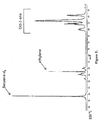
- Figure 2 shows a GC chromatogram (298 K, dichloromethane) of the oligomerisation. Figure 2 highlights the presence of 1-hexene and higher oligomers.
Landscapes
- Chemical & Material Sciences (AREA)
- Organic Chemistry (AREA)
- Chemical Kinetics & Catalysis (AREA)
- Engineering & Computer Science (AREA)
- Materials Engineering (AREA)
- Inorganic Chemistry (AREA)
- Medicinal Chemistry (AREA)
- Polymers & Plastics (AREA)
- Health & Medical Sciences (AREA)
- Crystallography & Structural Chemistry (AREA)
- Organic Low-Molecular-Weight Compounds And Preparation Thereof (AREA)
- Transition And Organic Metals Composition Catalysts For Addition Polymerization (AREA)
- Catalysts (AREA)
- Low-Molecular Organic Synthesis Reactions Using Catalysts (AREA)
Description
- The present invention relates to a process for the oligomerisation of ethylene, a transition metal compound utilized therein as catalyst and a composition comprising this transition metal compound immobilized on solid support as defined in the appended claims.
- A process for the oligomerisation of an olefinic compound is disclosed in
US 2008/0039600A . According to this, an olefinic compound in the form of an olefin or a compound including an olefinic moiety may be oligomerised by contacting the olefinic compound with at least two different catalysts, namely a tetramerisation catalyst and a further oligomerisation catalyst. The tetramerisation catalyst comprises a combination of a source of a transition metal; and a ligating compound of the formula
(R1)mX1(Y)X2(R2)n
wherein: X1 and X2 are independently selected from the group consisting of N, P, As, Sb, Bi, O, S and Se; Y is a linking group between X1 and X2; m and n are independently 0, 1 or a higher integer; and R1 and R2 are independently hydrogen, a hydrocarbyl group, or a heterohydrocarbyl group, and R1 being the same or different when m>1, and R2 being the same or different when n>1, provided that - (a) if two or more of R1 and R2 are aromatic with a ring atom of the aromatic ring structure bound to either X1 or X2, not more than two of said aromatic R1 and R2 have a substituent as a non-ring atom bound to a ring atom of the aromatic ring structure adjacent to the ring atom bound to X1 or X2; and
- (b) none of R1 and R2 are aromatic with a ring atom of the aromatic ring structure bound to either X1 or X2 and with a polar substituent as a non-ring atom bound to a ring atom of the aromatic ring structure adjacent to the ring atom bound to X1 or X2.
- The preferred pressure ranges, according to the above-identified prior art document are high to very high.
- Pentalenes and pentalene complexes are disclosed in
WO 2008/110774 . - Pentalene (formula C8H6; often abbreviated as "Pn") may be represented as having the structure

-
WO2008/110774 A2 discloses substituted pentalenes having the structure (I)
WO-A-2008/110774 , each of the R1, R2, R3, R4, R5 and R6 is a methyl group. Such a permethylpentalene is generally denoted as Pn* (formula C8Me6). Permethylpentalene derived ligands can be a protio form or anionic form (see examples figure below).
The protio form such as hydro(permethylpentalene) denoted as Pn*H has the formula C8Me6H as shown below. It can exist as neutral or anionic forms.
-
WO-A-2008/110774 further discloses certain complexes incorporating one or more metal atoms or ions with one or more substituted pentalene ligands. The metal atoms or ion may be a transition metal (d block metal) or a lanthanide or actinide (f block metal). It may, instead, be an alkali or alkaline earth metal (s block metal) or a p block metal (e.g. Group 13 or 14 metal). The complexes disclosed inWO-A-2008/110774 may be used to catalyse organic transformations selected from hydrogenation, hydroformylation, hydrosilylation, hydroamination, C-H bond activation, C-C bond formation, cyclotrimerisation, oxidation, epoxidation, dihydroxylation, and cycloadditions. The prior art complexes may also be used to catalyse a polymerisation, for example, olefinic polymerisation (e.g. the production of vinyl polymers), such as α-olefin polymerisation, and polymerisation of polar monomers (e.g. the polymerisation of caprolactone). - An object of the present invention is to provide a process for the oligomerisation of ethylene which overcomes the drawbacks of the prior art. A further object is to provide a process for the oligomerisation of ethylene using low ethylene pressures. A yet further object of the invention is to provide a novel compound which has use as a catalyst in the oligomerisation of ethylene.
- The present invention is based on the surprising discovery that transition metal permethylpentalene derived complexes are useful as catalysts in the oligomerisation of ethylene and can be used to effect oligomerisation of ethylene, especially tetramerisation, under mild conditions such as at low ethylene pressures.
- Accordingly, the present invention provides, in a first aspect, a process for the oligomerisation of ethylene which comprises contacting ethylene with a transition metal-hydro(permethylpentalene) complex.
- According to a second aspect, the present invention provides a compound having the formula [Pn*(H)CrCl2]2, wherein Pn* is a permethylpentalene moiety.
- According to a third aspect, the present invention provides a composition comprising a compound having the formula [Pn*(H)CrCl2]2 immobilised on a solid support material.
- Preferred embodiments are disclosed in the sub claims.
- The process for the oligomerisation of ethylene, according to a first aspect, comprises contacting ethylene with a transition metal-permethylpentalene complex.
- The oligomerisation reaction may be carried out in solution in a non-polar organic solvent. Examples of suitable non-polar organic solvents include liquid hydrocarbons, examples of which include benzene and lower alkyl-substituted benzenes. The transition metal-permethylpentalene derived complex may be immobilised on a suitable solid support material and the reaction may be carried out in a slurry of the immobilised complex in a non-polar organic solvent such as a hydrocarbon.
- The oligomerisation catalyst used in the process of the present invention is, as stated above, a transition metal-permethylpentalene ligand derived complex. The transition metal may be a d block metal. Preferably, the transition metal is chromium. The chromium is typically associated with one or more anions, such as halogen anions, especially chloride ions. According to a particularly preferred embodiment, the oligomerisation catalyst used in the process of the invention has the formula [Pn*(H)CrCl2]2, wherein Pn* represents permethylpentalene (C8Me6) as shown below.

In particular, only low ethylene pressures are required in order to obtain oligomers. Typically, an ethylene pressure of less than 1000 kPa (10 atm) is used in the reaction. Preferably, the ethylene pressure will be about 200 kPa (approx. 2 atm). Typically, the temperature of reaction will be in the range of from 75° to 120°C, preferably 80°C to 110°C. Reaction times may range from 30 minutes to several hours, typically 1 to 5 hours. - The preferred oligomerisation catalyst used in the process of the invention is, as stated above, the compound [Pn*(H)CrCl2]2 Accordingly, in a different aspect, the present invention provides a chromium-hydro(permethylpentalene) complex having the formula [Pn*(H)CrCl2]2, wherein Pn* is a permethylpentalene moiety.
- The present invention further provides a composition for use in the oligomerisation of ethylene which comprises the compound [Pn*(H)CrCl2]2 immobilised on a solid support. Typically, the solid support material will be an inorganic oxide or inorganic hydroxide, for example silica, alumina or a layered double hydroxide, which may be thermally or optionally solvent treated.
- Layered double hydroxides (LDHs) are a class of compounds which comprise at least two metal cations and have a layered structure. A brief review of LDHs is provided in Chemistry in Britain, September 1997, pages 59 to 62. The hydrotalcites, perhaps the most well-known examples of LDHs, have been studied for many years.
- LDHs can be represented by the general formula [MII (1-x)MIII x(OH)2] x+(Az-)x/z·yH2O·w(solvent) or [MI (1-x)MIII x(OH)2]n+(Az-)n/z·yH2O·w(solvent), where MI, MII and MIII are mono, di and trivalent metal cations respectively, that occupy octahedral positions in hydroxide layers, Az- is an interlayer charge-compensating anion, where z is an integer, n=2x-1, x is a number less than 1 and y is 0 or a number greater than 0, solvent is 100% v miscible in water and is typically acetone or methanol, w=0.1. Examples of Az- include CO3 2-, NO3 - and Cl-. A large number of LDHs with a wide variety of MI-MIII cation pairs (e.g., Mg-AI, Ca-AI) as well as the MI-MIIIcation pair (Li-AI) with different anions in the interlayer space have been reported and studied. Preferred layered double hydroxides, for use as solid support material for the catalytic compounds as those having the general formula
[MII (1-x)MIII x(OH)2]x+(Az-)x/z·yH2O·w(solvent)
- in which MII is a divalent metal cation;
- MIII is a trivalent metal cation;
- A is a counter anion; and
- x is a number less than 1, w is a number less than 1, y is 0 or a number greater than 0, z is an integer which gives compounds optionally hydrated with a stoichiometric amount or a non-stoichiometric amount of water and/or an aqueous-miscible organic solvent (AMO-solvent), such as acetone.
- Preferably, in the LDH of the above formula, MII is Mg or Ca and MIII is Al. The counter anion A is typically selected from CO3 2-, OH-, F-, Cl-, Br-, I-, SO4 2-, NO3 - and PO4 3-. According to a preferred embodiment, the LDH used as a solid support material will be one wherein MII is Mg, MIII is Al and A is CO3 2-. The BET surface of the LDHs is typically greater than 100 m2g-1.
- In an even preferred embodiment, the LDH used as support material may have the formula
[mz+ (1-x)M'y+ x(OH)2]a+(Xn-)a/n·bH2O·c (solvent),
wherein M and M' are two different charged metal cations, wherein M may be a mixture of one or more metal cations of charge z and M' may be a mixture of one or more metal cations of charge y, z = 1 or 2; y = 3 or 4; 0 < x < 0.9; b is 0 to 10; c is 0 to 10; X is an anion with n > 0, preferably 1-5; a = z (1-x)+xy-2, wherein the solvent is preferably an aqueous miscible organic solvent. Preferably, in the LDH of the above formula, M is Mg or Ca, and M' is Al. The counter anion X is typically selected from CO3 2-, OH-, F-, Cl-, Br-, I-, SO4 2-, NO3 - and PO4 3-. According to a preferred embodiment, the LDH used as a solid support material will be one wherein M is Mg, M' is Al and X is CO3 2-. The BET surface of the LDH is typically greater than 100 m2g-1. - The solid support material may be activated with an activator compound, such as an alkylaluminoxane, for example methylaluminoxane. According to one preferred embodiment, the solid support material is silica treated with methylaluminoxane. According to a different preferred embodiment, the solid support material is a layered double hydroxide treated with methylaluminoxane.
- Further advantages and features of the subject-matter of the present invention can be taken from the following detailed examples section illustrating preferred embodiments, which are not to be taken as limiting the scope of protection which is only defined by the appending claims.
The invention is illustrated by the drawings in which: -
Figure 1 : 1H NMR spectroscopy (298K, benzene-d 6) of oligomerisation of ethylene using [Pn*(H)CrCl2]2 -
Figure 2 : GC Chromatogram (298K, dichloromethane) of the oligomerisation of ethylene using [Pn*(H)CrCl2]2 - To a slurry of CrCl3 (0.0981g, 0.619 mmole) in benzene was added a solution of Pn*(H)SnMe3 (0.218 g, 0.619 mmole) in benzene. The reaction mixture was heated to 80°C for 5 days to afford a dark- green solution. The reaction mixture was filtered and the volatiles were removed in vacuo to afford a dark-green powder which was washed with pentane and dried under reduced pressure to yield [Pn*(H)CrCl2]2 as a dark-green powder. The complex is paramagnetic. The yield was 67%.
- 1H NMR spectrum (C6D6, 23°C) δ = range of -36.0 - 18.3 ppm.
-
- (1) The complex [Pn*(H)CrCl2]2 was dissolved in benzene-d 6 and the solution was maintained at a temperature of 110°C. Ethylene was supplied under a pressure of 200 kPa into the solution for one hour. The resulting solution was subjected to 1H NMR spectroscopy (298 K, benzene-d 6) to study the products of the oligomerisation reaction. The 1H NMR spectrum is shown in
Figure 1 . The 1H NMR spectrum indicates the presence of only oct-1-ene. - (2) The complex [Pn*(H)CrCl2]2 was also used in solution in toluene to catalyse the oligomersiation of ethylene at a temperature of 80°C for 2 hours at 200 kPa.
-
Figure 2 shows a GC chromatogram (298 K, dichloromethane) of the oligomerisation.Figure 2 highlights the presence of 1-hexene and higher oligomers. - The above examples for oligomerisation indicate that utilizing the transition metal-permethyl penthalene derived complex in the oligomerisation of ethylene provides an extremely selective oligomerisation, only 1-octene was produced in example 1.
- The features disclosed in the foregoing description, in the claims and in the accompanying drawings may both separately or in any combination be material for realizing the invention, which is defined by the appended claims, in diverse forms thereof.
Claims (15)
- A process for the oligomerisation of ethylene which comprises contacting ethylene with a transition metal-hydro(permethylpentalene) complex.
- The process according to claim 1, wherein the transition metal is chromium.
- The process according to claim 1 or 2, wherein the reaction is carried out in solution in a non-polar organic solvent.
- The process according to claim 1 or 2, wherein the transition metal-hydro(permethylpentalene) complex is immobilised on a solid support material and the reaction is carried out in a slurry of the immobilised complex in a non-polar organic solvent.
- The process according to claim 3 or 4, wherein the non-polar organic solvent is selected from a liquid hydrocarbon.
- The process according to any one of claims 1 to 5, wherein ethylene is supplied at a pressure less than 1000 kPa (10 atm).
- The process according to claim 6, wherein ethylene is supplied at a pressure of 200 kPa (2 atm).
- The process according to any one of claims 1 to 7, wherein the transition metal-hydro(permethylpentalene) complex is a complex of chromium and hydro(permethylpentalene) having the formula [Pn*(H)CrCl2]2, where Pn* is a permethylpentalene moiety.
- A compound having the formula [Pn*(H)CrCl2]2, wherein Pn* is a permethylpentalene moiety.
- A composition comprising the compound according to claim 9 immobilised on a solid support material.
- The composition according to claim 10, wherein the solid support material comprises silica treated with methylaluminoxane, preferably the solid support material is silica treated with methylaluminoxane.
- The composition according to claim 10, wherein the solid support material comprises a layered double hydroxide treated with methylaluminoxane, preferably the solid support material is layered double hydroxide treated with methylaluminoxane.
- A process for the manufacture of 1-octene which comprises contacting ethylene with a transition metal-hydro(permethylpentalene) complex.
- A process for the manufacture of 1-hexene which comprises contacting ethylene with a transition metal-hydro(permethylpentalene) complex.
- A process for the manufacture of an ethylene-olefin copolymer using a composition according to Claim 10 as a first catalyst in combination with an ethylene polymerisation catalyst as a second catalyst.
Applications Claiming Priority (2)
| Application Number | Priority Date | Filing Date | Title |
|---|---|---|---|
| GBGB1408615.1A GB201408615D0 (en) | 2014-05-15 | 2014-05-15 | Oligomerisation of ethylene |
| PCT/EP2015/060612 WO2015173314A1 (en) | 2014-05-15 | 2015-05-13 | Oligomerisation of ethylene |
Publications (2)
| Publication Number | Publication Date |
|---|---|
| EP3143034A1 EP3143034A1 (en) | 2017-03-22 |
| EP3143034B1 true EP3143034B1 (en) | 2019-02-27 |
Family
ID=51032808
Family Applications (1)
| Application Number | Title | Priority Date | Filing Date |
|---|---|---|---|
| EP15725533.2A Active EP3143034B1 (en) | 2014-05-15 | 2015-05-13 | Oligomerisation of ethylene |
Country Status (6)
| Country | Link |
|---|---|
| US (1) | US9884793B2 (en) |
| EP (1) | EP3143034B1 (en) |
| JP (1) | JP2017518284A (en) |
| KR (1) | KR20170008242A (en) |
| GB (1) | GB201408615D0 (en) |
| WO (1) | WO2015173314A1 (en) |
Families Citing this family (1)
| Publication number | Priority date | Publication date | Assignee | Title |
|---|---|---|---|---|
| BR112019000550A2 (en) * | 2016-07-15 | 2019-05-21 | Public Joint Stock Company "Sibur Holding" | olefin oligomerization method |
Family Cites Families (10)
| Publication number | Priority date | Publication date | Assignee | Title |
|---|---|---|---|---|
| US5811618A (en) * | 1991-10-16 | 1998-09-22 | Amoco Corporation | Ethylene trimerization |
| US6586541B2 (en) * | 2000-02-02 | 2003-07-01 | E. I. Du Pont De Nemours And Company | Process for production of polyolefins |
| MXPA05006658A (en) | 2002-12-20 | 2005-11-17 | Sasol Tech Pty Ltd | Tandem tetramerisation-polymerisation of olefins. |
| DE102004020525A1 (en) * | 2004-04-26 | 2005-11-10 | Basell Polyolefine Gmbh | Production of catalyst system for the polymerization or copolymerization of olefins, by impregnating a dry porous support component with a mixture of organic transition metal compounds, hydrolyzed organo-aluminum compound(s), and solvent |
| ES2372474T3 (en) * | 2004-06-18 | 2012-01-20 | Sasol Technology (Pty) Ltd | PRESENT OLIGOMERIZATION BOTH OF A TETRAMERIZATION CATALYST AND OF AN ADDITIONAL OLIGOMERIZATION CATALYST. |
| GB0704569D0 (en) * | 2007-03-09 | 2007-04-18 | Isis Innovation | Pentalenes |
| US20100094070A1 (en) * | 2008-10-15 | 2010-04-15 | Headwaters Technology Innovation, Llc | Ethylene trimerization using a supported chromium-tantalum catalyst |
| CN102453138B (en) * | 2010-10-19 | 2014-01-08 | 中国石油化工股份有限公司 | Olefin polymerization method |
| GB201217351D0 (en) * | 2012-09-28 | 2012-11-14 | Scg Chemicals Co Ltd | Catalyst systems |
| GB201406406D0 (en) * | 2014-04-09 | 2014-05-21 | Isis Innovation | Lactide polymerisation |
-
2014
- 2014-05-15 GB GBGB1408615.1A patent/GB201408615D0/en not_active Ceased
-
2015
- 2015-05-13 WO PCT/EP2015/060612 patent/WO2015173314A1/en not_active Ceased
- 2015-05-13 US US15/310,812 patent/US9884793B2/en active Active
- 2015-05-13 KR KR1020167033377A patent/KR20170008242A/en not_active Withdrawn
- 2015-05-13 EP EP15725533.2A patent/EP3143034B1/en active Active
- 2015-05-13 JP JP2016567749A patent/JP2017518284A/en active Pending
Non-Patent Citations (1)
| Title |
|---|
| None * |
Also Published As
| Publication number | Publication date |
|---|---|
| WO2015173314A1 (en) | 2015-11-19 |
| US9884793B2 (en) | 2018-02-06 |
| KR20170008242A (en) | 2017-01-23 |
| US20170088483A1 (en) | 2017-03-30 |
| EP3143034A1 (en) | 2017-03-22 |
| GB201408615D0 (en) | 2014-06-25 |
| JP2017518284A (en) | 2017-07-06 |
Similar Documents
| Publication | Publication Date | Title |
|---|---|---|
| Brück et al. | Pushing the s-Donor Strength in Iridium Pincer Complexes: Bis-(silylene) and Bis (germylene) Ligands Are Stronger Donors than Bis (phosphorus (III)) Ligands | |
| KR102141269B1 (en) | Phosphinyl formamidine compounds, metal complexes, catalyst systems, and their use to oligomerize or polymerize olefins | |
| Zhang et al. | A new layered metal–organic framework as a promising heterogeneous catalyst for olefin epoxidation reactions | |
| Zhou et al. | Synthesis, structural characterization, and luminescence properties of multinuclear silver complexes of pyrazole-functionalized NHC ligands containing Ag–Ag and Ag–π interactions | |
| CN107592863A (en) | Chromium complex and olefin oligomerization catalyst therefrom with the part containing phosphorus ring | |
| Priya et al. | Half-sandwich ruthenium (II) complexes of aminophosphines: synthesis, structures and catalytic applications in C–C coupling reactions between styrenes and diphenyldiazomethane | |
| Maity et al. | A family of ligand and anion dependent structurally diverse Cu (II) Schiff-base complexes and their catalytic efficacy in an O-arylation reaction in ethanolic media | |
| Chanthapally et al. | Photoreactivity of polymorphs of a ladder polymer with criss-cross and parallel orientations of C [double bond, length as m-dash] C bonds | |
| Ay et al. | Hydrothermal synthesis, structure, heterogeneous catalytic activity and photoluminescent properties of a novel homoleptic Sm (III)-organic framework | |
| Vrdoljak et al. | Dioxotungsten (VI) complexes with isoniazid-related hydrazones as (pre) catalysts for olefin epoxidation: solvent and ligand substituent effects | |
| EP3101039B1 (en) | Ligand compound, organic chrome compound, catalyst system for olefin oligomerization, and method for oligomerizing olefin using same | |
| Tyagi et al. | N‐Substituted Iminopyridine Arene–Ruthenium Complexes for the Regioselective Catalytic Hydration of Terminal Alkynes | |
| US9884793B2 (en) | Oligomerisation of ethylene | |
| Lee et al. | Preparation of zwitterion-type chromium (II) complexes for ethylene oligomerization | |
| Vela et al. | Alkyl isomerisation in three-coordinate iron (ii) complexes | |
| Aoyagi et al. | Pd (II)-and Pt (II)-Linked Tetranuclear Complexes as Assembly Units for Higher Ordered Structures. | |
| JP6814573B2 (en) | Method for producing unsaturated carboxylate | |
| Lim et al. | Trimetallic coordination cage formation for nitrate encapsulation: transformation of kinetic products into thermodynamic products | |
| Overett et al. | New iron bis (imino) pyridyl complexes containing dendritic wedges for alkene oligomerisation | |
| Blom et al. | New palladium α-diimine complexes containing dendritic wedges for ethene oligomerisation | |
| EP3565821B1 (en) | Synthesis of benzyloxyphenoxy phenol ligands | |
| Khalaf et al. | Coordination of neutral, methylene bridged bis-guanidyls at palladium | |
| EP3143052B1 (en) | Catalyst system for the polymerisation and/or oligomerisation of olefins and process utilizing the catalyst system | |
| EP3565805B1 (en) | Synthesis of benzylanilinyl phenyl phenol ligands | |
| Tresoldi et al. | Hemilabile Thioether Ligands Based on Pyrimidine and/or Pyridine Derivatives that Interconvert between N, S‐and N‐Coordination in Congested Ruthenium (ii) Complexes |
Legal Events
| Date | Code | Title | Description |
|---|---|---|---|
| STAA | Information on the status of an ep patent application or granted ep patent |
Free format text: STATUS: THE INTERNATIONAL PUBLICATION HAS BEEN MADE |
|
| PUAI | Public reference made under article 153(3) epc to a published international application that has entered the european phase |
Free format text: ORIGINAL CODE: 0009012 |
|
| STAA | Information on the status of an ep patent application or granted ep patent |
Free format text: STATUS: REQUEST FOR EXAMINATION WAS MADE |
|
| 17P | Request for examination filed |
Effective date: 20161109 |
|
| AK | Designated contracting states |
Kind code of ref document: A1 Designated state(s): AL AT BE BG CH CY CZ DE DK EE ES FI FR GB GR HR HU IE IS IT LI LT LU LV MC MK MT NL NO PL PT RO RS SE SI SK SM TR |
|
| AX | Request for extension of the european patent |
Extension state: BA ME |
|
| DAV | Request for validation of the european patent (deleted) | ||
| DAX | Request for extension of the european patent (deleted) | ||
| GRAP | Despatch of communication of intention to grant a patent |
Free format text: ORIGINAL CODE: EPIDOSNIGR1 |
|
| RIC1 | Information provided on ipc code assigned before grant |
Ipc: C07F 11/00 20060101AFI20180726BHEP Ipc: B01J 31/16 20060101ALI20180726BHEP Ipc: C07C 11/107 20060101ALI20180726BHEP Ipc: C07C 11/02 20060101ALI20180726BHEP Ipc: B01J 31/22 20060101ALI20180726BHEP Ipc: C08F 210/16 20060101ALI20180726BHEP Ipc: C07C 2/34 20060101ALI20180726BHEP Ipc: B01J 31/14 20060101ALI20180726BHEP |
|
| STAA | Information on the status of an ep patent application or granted ep patent |
Free format text: STATUS: GRANT OF PATENT IS INTENDED |
|
| INTG | Intention to grant announced |
Effective date: 20180830 |
|
| GRAJ | Information related to disapproval of communication of intention to grant by the applicant or resumption of examination proceedings by the epo deleted |
Free format text: ORIGINAL CODE: EPIDOSDIGR1 |
|
| STAA | Information on the status of an ep patent application or granted ep patent |
Free format text: STATUS: REQUEST FOR EXAMINATION WAS MADE |
|
| GRAR | Information related to intention to grant a patent recorded |
Free format text: ORIGINAL CODE: EPIDOSNIGR71 |
|
| GRAS | Grant fee paid |
Free format text: ORIGINAL CODE: EPIDOSNIGR3 |
|
| STAA | Information on the status of an ep patent application or granted ep patent |
Free format text: STATUS: GRANT OF PATENT IS INTENDED |
|
| GRAA | (expected) grant |
Free format text: ORIGINAL CODE: 0009210 |
|
| STAA | Information on the status of an ep patent application or granted ep patent |
Free format text: STATUS: THE PATENT HAS BEEN GRANTED |
|
| INTC | Intention to grant announced (deleted) | ||
| AK | Designated contracting states |
Kind code of ref document: B1 Designated state(s): AL AT BE BG CH CY CZ DE DK EE ES FI FR GB GR HR HU IE IS IT LI LT LU LV MC MK MT NL NO PL PT RO RS SE SI SK SM TR |
|
| INTG | Intention to grant announced |
Effective date: 20190118 |
|
| REG | Reference to a national code |
Ref country code: GB Ref legal event code: FG4D |
|
| REG | Reference to a national code |
Ref country code: CH Ref legal event code: EP |
|
| REG | Reference to a national code |
Ref country code: AT Ref legal event code: REF Ref document number: 1101158 Country of ref document: AT Kind code of ref document: T Effective date: 20190315 |
|
| REG | Reference to a national code |
Ref country code: IE Ref legal event code: FG4D |
|
| REG | Reference to a national code |
Ref country code: DE Ref legal event code: R096 Ref document number: 602015025355 Country of ref document: DE |
|
| REG | Reference to a national code |
Ref country code: NL Ref legal event code: MP Effective date: 20190227 |
|
| REG | Reference to a national code |
Ref country code: LT Ref legal event code: MG4D |
|
| PG25 | Lapsed in a contracting state [announced via postgrant information from national office to epo] |
Ref country code: LT Free format text: LAPSE BECAUSE OF FAILURE TO SUBMIT A TRANSLATION OF THE DESCRIPTION OR TO PAY THE FEE WITHIN THE PRESCRIBED TIME-LIMIT Effective date: 20190227 Ref country code: NO Free format text: LAPSE BECAUSE OF FAILURE TO SUBMIT A TRANSLATION OF THE DESCRIPTION OR TO PAY THE FEE WITHIN THE PRESCRIBED TIME-LIMIT Effective date: 20190527 Ref country code: FI Free format text: LAPSE BECAUSE OF FAILURE TO SUBMIT A TRANSLATION OF THE DESCRIPTION OR TO PAY THE FEE WITHIN THE PRESCRIBED TIME-LIMIT Effective date: 20190227 Ref country code: SE Free format text: LAPSE BECAUSE OF FAILURE TO SUBMIT A TRANSLATION OF THE DESCRIPTION OR TO PAY THE FEE WITHIN THE PRESCRIBED TIME-LIMIT Effective date: 20190227 Ref country code: PT Free format text: LAPSE BECAUSE OF FAILURE TO SUBMIT A TRANSLATION OF THE DESCRIPTION OR TO PAY THE FEE WITHIN THE PRESCRIBED TIME-LIMIT Effective date: 20190627 |
|
| PG25 | Lapsed in a contracting state [announced via postgrant information from national office to epo] |
Ref country code: NL Free format text: LAPSE BECAUSE OF FAILURE TO SUBMIT A TRANSLATION OF THE DESCRIPTION OR TO PAY THE FEE WITHIN THE PRESCRIBED TIME-LIMIT Effective date: 20190227 Ref country code: RS Free format text: LAPSE BECAUSE OF FAILURE TO SUBMIT A TRANSLATION OF THE DESCRIPTION OR TO PAY THE FEE WITHIN THE PRESCRIBED TIME-LIMIT Effective date: 20190227 Ref country code: GR Free format text: LAPSE BECAUSE OF FAILURE TO SUBMIT A TRANSLATION OF THE DESCRIPTION OR TO PAY THE FEE WITHIN THE PRESCRIBED TIME-LIMIT Effective date: 20190528 Ref country code: HR Free format text: LAPSE BECAUSE OF FAILURE TO SUBMIT A TRANSLATION OF THE DESCRIPTION OR TO PAY THE FEE WITHIN THE PRESCRIBED TIME-LIMIT Effective date: 20190227 Ref country code: LV Free format text: LAPSE BECAUSE OF FAILURE TO SUBMIT A TRANSLATION OF THE DESCRIPTION OR TO PAY THE FEE WITHIN THE PRESCRIBED TIME-LIMIT Effective date: 20190227 Ref country code: BG Free format text: LAPSE BECAUSE OF FAILURE TO SUBMIT A TRANSLATION OF THE DESCRIPTION OR TO PAY THE FEE WITHIN THE PRESCRIBED TIME-LIMIT Effective date: 20190527 Ref country code: IS Free format text: LAPSE BECAUSE OF FAILURE TO SUBMIT A TRANSLATION OF THE DESCRIPTION OR TO PAY THE FEE WITHIN THE PRESCRIBED TIME-LIMIT Effective date: 20190627 |
|
| REG | Reference to a national code |
Ref country code: AT Ref legal event code: MK05 Ref document number: 1101158 Country of ref document: AT Kind code of ref document: T Effective date: 20190227 |
|
| PG25 | Lapsed in a contracting state [announced via postgrant information from national office to epo] |
Ref country code: ES Free format text: LAPSE BECAUSE OF FAILURE TO SUBMIT A TRANSLATION OF THE DESCRIPTION OR TO PAY THE FEE WITHIN THE PRESCRIBED TIME-LIMIT Effective date: 20190227 Ref country code: AL Free format text: LAPSE BECAUSE OF FAILURE TO SUBMIT A TRANSLATION OF THE DESCRIPTION OR TO PAY THE FEE WITHIN THE PRESCRIBED TIME-LIMIT Effective date: 20190227 Ref country code: DK Free format text: LAPSE BECAUSE OF FAILURE TO SUBMIT A TRANSLATION OF THE DESCRIPTION OR TO PAY THE FEE WITHIN THE PRESCRIBED TIME-LIMIT Effective date: 20190227 Ref country code: EE Free format text: LAPSE BECAUSE OF FAILURE TO SUBMIT A TRANSLATION OF THE DESCRIPTION OR TO PAY THE FEE WITHIN THE PRESCRIBED TIME-LIMIT Effective date: 20190227 Ref country code: IT Free format text: LAPSE BECAUSE OF FAILURE TO SUBMIT A TRANSLATION OF THE DESCRIPTION OR TO PAY THE FEE WITHIN THE PRESCRIBED TIME-LIMIT Effective date: 20190227 Ref country code: SK Free format text: LAPSE BECAUSE OF FAILURE TO SUBMIT A TRANSLATION OF THE DESCRIPTION OR TO PAY THE FEE WITHIN THE PRESCRIBED TIME-LIMIT Effective date: 20190227 Ref country code: RO Free format text: LAPSE BECAUSE OF FAILURE TO SUBMIT A TRANSLATION OF THE DESCRIPTION OR TO PAY THE FEE WITHIN THE PRESCRIBED TIME-LIMIT Effective date: 20190227 Ref country code: CZ Free format text: LAPSE BECAUSE OF FAILURE TO SUBMIT A TRANSLATION OF THE DESCRIPTION OR TO PAY THE FEE WITHIN THE PRESCRIBED TIME-LIMIT Effective date: 20190227 |
|
| REG | Reference to a national code |
Ref country code: DE Ref legal event code: R097 Ref document number: 602015025355 Country of ref document: DE |
|
| PG25 | Lapsed in a contracting state [announced via postgrant information from national office to epo] |
Ref country code: SM Free format text: LAPSE BECAUSE OF FAILURE TO SUBMIT A TRANSLATION OF THE DESCRIPTION OR TO PAY THE FEE WITHIN THE PRESCRIBED TIME-LIMIT Effective date: 20190227 Ref country code: PL Free format text: LAPSE BECAUSE OF FAILURE TO SUBMIT A TRANSLATION OF THE DESCRIPTION OR TO PAY THE FEE WITHIN THE PRESCRIBED TIME-LIMIT Effective date: 20190227 |
|
| REG | Reference to a national code |
Ref country code: CH Ref legal event code: PL |
|
| PG25 | Lapsed in a contracting state [announced via postgrant information from national office to epo] |
Ref country code: AT Free format text: LAPSE BECAUSE OF FAILURE TO SUBMIT A TRANSLATION OF THE DESCRIPTION OR TO PAY THE FEE WITHIN THE PRESCRIBED TIME-LIMIT Effective date: 20190227 |
|
| PLBE | No opposition filed within time limit |
Free format text: ORIGINAL CODE: 0009261 |
|
| STAA | Information on the status of an ep patent application or granted ep patent |
Free format text: STATUS: NO OPPOSITION FILED WITHIN TIME LIMIT |
|
| GBPC | Gb: european patent ceased through non-payment of renewal fee |
Effective date: 20190527 |
|
| PG25 | Lapsed in a contracting state [announced via postgrant information from national office to epo] |
Ref country code: LI Free format text: LAPSE BECAUSE OF NON-PAYMENT OF DUE FEES Effective date: 20190531 Ref country code: CH Free format text: LAPSE BECAUSE OF NON-PAYMENT OF DUE FEES Effective date: 20190531 Ref country code: MC Free format text: LAPSE BECAUSE OF FAILURE TO SUBMIT A TRANSLATION OF THE DESCRIPTION OR TO PAY THE FEE WITHIN THE PRESCRIBED TIME-LIMIT Effective date: 20190227 |
|
| 26N | No opposition filed |
Effective date: 20191128 |
|
| REG | Reference to a national code |
Ref country code: BE Ref legal event code: MM Effective date: 20190531 |
|
| PG25 | Lapsed in a contracting state [announced via postgrant information from national office to epo] |
Ref country code: LU Free format text: LAPSE BECAUSE OF NON-PAYMENT OF DUE FEES Effective date: 20190513 Ref country code: SI Free format text: LAPSE BECAUSE OF FAILURE TO SUBMIT A TRANSLATION OF THE DESCRIPTION OR TO PAY THE FEE WITHIN THE PRESCRIBED TIME-LIMIT Effective date: 20190227 |
|
| PG25 | Lapsed in a contracting state [announced via postgrant information from national office to epo] |
Ref country code: TR Free format text: LAPSE BECAUSE OF FAILURE TO SUBMIT A TRANSLATION OF THE DESCRIPTION OR TO PAY THE FEE WITHIN THE PRESCRIBED TIME-LIMIT Effective date: 20190227 |
|
| PG25 | Lapsed in a contracting state [announced via postgrant information from national office to epo] |
Ref country code: IE Free format text: LAPSE BECAUSE OF NON-PAYMENT OF DUE FEES Effective date: 20190513 Ref country code: GB Free format text: LAPSE BECAUSE OF NON-PAYMENT OF DUE FEES Effective date: 20190527 |
|
| PG25 | Lapsed in a contracting state [announced via postgrant information from national office to epo] |
Ref country code: BE Free format text: LAPSE BECAUSE OF NON-PAYMENT OF DUE FEES Effective date: 20190531 |
|
| PG25 | Lapsed in a contracting state [announced via postgrant information from national office to epo] |
Ref country code: FR Free format text: LAPSE BECAUSE OF NON-PAYMENT OF DUE FEES Effective date: 20190531 |
|
| PG25 | Lapsed in a contracting state [announced via postgrant information from national office to epo] |
Ref country code: CY Free format text: LAPSE BECAUSE OF FAILURE TO SUBMIT A TRANSLATION OF THE DESCRIPTION OR TO PAY THE FEE WITHIN THE PRESCRIBED TIME-LIMIT Effective date: 20190227 |
|
| PG25 | Lapsed in a contracting state [announced via postgrant information from national office to epo] |
Ref country code: MT Free format text: LAPSE BECAUSE OF FAILURE TO SUBMIT A TRANSLATION OF THE DESCRIPTION OR TO PAY THE FEE WITHIN THE PRESCRIBED TIME-LIMIT Effective date: 20190227 Ref country code: HU Free format text: LAPSE BECAUSE OF FAILURE TO SUBMIT A TRANSLATION OF THE DESCRIPTION OR TO PAY THE FEE WITHIN THE PRESCRIBED TIME-LIMIT; INVALID AB INITIO Effective date: 20150513 |
|
| REG | Reference to a national code |
Ref country code: DE Ref legal event code: R081 Ref document number: 602015025355 Country of ref document: DE Owner name: OXFORD UNIVERSITY INNOVATION LIMITED, GB Free format text: FORMER OWNER: SCG CHEMICALS CO., LTD., BANGKOK, TH |
|
| PG25 | Lapsed in a contracting state [announced via postgrant information from national office to epo] |
Ref country code: MK Free format text: LAPSE BECAUSE OF FAILURE TO SUBMIT A TRANSLATION OF THE DESCRIPTION OR TO PAY THE FEE WITHIN THE PRESCRIBED TIME-LIMIT Effective date: 20190227 |
|
| P01 | Opt-out of the competence of the unified patent court (upc) registered |
Effective date: 20230530 |
|
| PGFP | Annual fee paid to national office [announced via postgrant information from national office to epo] |
Ref country code: DE Payment date: 20250519 Year of fee payment: 11 |