EP3142342A1 - Generating adaptive notification - Google Patents
Generating adaptive notification Download PDFInfo
- Publication number
- EP3142342A1 EP3142342A1 EP16188156.0A EP16188156A EP3142342A1 EP 3142342 A1 EP3142342 A1 EP 3142342A1 EP 16188156 A EP16188156 A EP 16188156A EP 3142342 A1 EP3142342 A1 EP 3142342A1
- Authority
- EP
- European Patent Office
- Prior art keywords
- notification
- spectrum
- user device
- context
- environmental noise
- Prior art date
- Legal status (The legal status is an assumption and is not a legal conclusion. Google has not performed a legal analysis and makes no representation as to the accuracy of the status listed.)
- Granted
Links
Images


Classifications
-
- G—PHYSICS
- G10—MUSICAL INSTRUMENTS; ACOUSTICS
- G10L—SPEECH ANALYSIS TECHNIQUES OR SPEECH SYNTHESIS; SPEECH RECOGNITION; SPEECH OR VOICE PROCESSING TECHNIQUES; SPEECH OR AUDIO CODING OR DECODING
- G10L25/00—Speech or voice analysis techniques not restricted to a single one of groups G10L15/00 - G10L21/00
- G10L25/03—Speech or voice analysis techniques not restricted to a single one of groups G10L15/00 - G10L21/00 characterised by the type of extracted parameters
- G10L25/18—Speech or voice analysis techniques not restricted to a single one of groups G10L15/00 - G10L21/00 characterised by the type of extracted parameters the extracted parameters being spectral information of each sub-band
-
- G—PHYSICS
- G08—SIGNALLING
- G08B—SIGNALLING SYSTEMS, e.g. PERSONAL CALLING SYSTEMS; ORDER TELEGRAPHS; ALARM SYSTEMS
- G08B3/00—Audible signalling systems, e.g. audible personal calling systems
- G08B3/10—Audible signalling systems, e.g. audible personal calling systems using electric transmission; using electromagnetic transmission
-
- G—PHYSICS
- G10—MUSICAL INSTRUMENTS; ACOUSTICS
- G10L—SPEECH ANALYSIS TECHNIQUES OR SPEECH SYNTHESIS; SPEECH RECOGNITION; SPEECH OR VOICE PROCESSING TECHNIQUES; SPEECH OR AUDIO CODING OR DECODING
- G10L25/00—Speech or voice analysis techniques not restricted to a single one of groups G10L15/00 - G10L21/00
- G10L25/48—Speech or voice analysis techniques not restricted to a single one of groups G10L15/00 - G10L21/00 specially adapted for particular use
-
- H—ELECTRICITY
- H03—ELECTRONIC CIRCUITRY
- H03G—CONTROL OF AMPLIFICATION
- H03G3/00—Gain control in amplifiers or frequency changers
- H03G3/20—Automatic control
- H03G3/30—Automatic control in amplifiers having semiconductor devices
- H03G3/3005—Automatic control in amplifiers having semiconductor devices in amplifiers suitable for low-frequencies, e.g. audio amplifiers
-
- H—ELECTRICITY
- H04—ELECTRIC COMMUNICATION TECHNIQUE
- H04M—TELEPHONIC COMMUNICATION
- H04M1/00—Substation equipment, e.g. for use by subscribers
- H04M1/72—Mobile telephones; Cordless telephones, i.e. devices for establishing wireless links to base stations without route selection
- H04M1/724—User interfaces specially adapted for cordless or mobile telephones
- H04M1/72448—User interfaces specially adapted for cordless or mobile telephones with means for adapting the functionality of the device according to specific conditions
- H04M1/72454—User interfaces specially adapted for cordless or mobile telephones with means for adapting the functionality of the device according to specific conditions according to context-related or environment-related conditions
-
- H—ELECTRICITY
- H04—ELECTRIC COMMUNICATION TECHNIQUE
- H04M—TELEPHONIC COMMUNICATION
- H04M19/00—Current supply arrangements for telephone systems
- H04M19/02—Current supply arrangements for telephone systems providing ringing current or supervisory tones, e.g. dialling tone or busy tone
- H04M19/04—Current supply arrangements for telephone systems providing ringing current or supervisory tones, e.g. dialling tone or busy tone the ringing-current being generated at the substations
- H04M19/042—Current supply arrangements for telephone systems providing ringing current or supervisory tones, e.g. dialling tone or busy tone the ringing-current being generated at the substations with variable loudness of the ringing tone, e.g. variable envelope or amplitude of ring signal
- H04M19/044—Current supply arrangements for telephone systems providing ringing current or supervisory tones, e.g. dialling tone or busy tone the ringing-current being generated at the substations with variable loudness of the ringing tone, e.g. variable envelope or amplitude of ring signal according to the level of ambient noise
-
- H—ELECTRICITY
- H04—ELECTRIC COMMUNICATION TECHNIQUE
- H04M—TELEPHONIC COMMUNICATION
- H04M2250/00—Details of telephonic subscriber devices
- H04M2250/12—Details of telephonic subscriber devices including a sensor for measuring a physical value, e.g. temperature or motion
Definitions
- This disclosure relates to generating notifications for communication devices and, more specifically, to generating adaptive notifications.
- a user device may provide notification functionalities.
- a notification may be an audio output.
- a user device may generate a sound when the user device receives an email or a text. The sound may notify the user that an email or a text is received.
- volume of the notification may be boosted to overcome the environmental noise.
- boosting the volumes of the notifications may not be efficient or effective.
- the dominant frequencies of the notification and the noise may coincide.
- boosting the volume of the notification increases the amplitude uniformly across the frequency region, the increased amplitude of the dominant frequency of the notification may not be able to overcome the power of the noise at the same frequency regions.
- the notification may not be recognizable by the user.
- boosting the volume of the notification may cause the notification to play at an un-necessarily high volume and create a bad user experience.
- an adaptive notification may be generated by measuring and analyzing the spectrum of the environmental noise. A portion of the spectrum that corresponds to low noise power may be identified for enhancement. An adaptive notification may be generated by enhancing the identified portion. In some cases, the enhancement may be based on a context of the notification. FIGS. 1-5 and associated descriptions provide additional details of these implementations.
- Generating the adaptive notification according to methods and systems described herein may provide one or more advantages. For example, by enhancing the portion of the spectrum corresponding to low noise power, the adaptive notification may provide a recognizable audio output over the environmental noise without significantly increasing the overall volume of the notification. This approach may create a better user experience and reduce power consumption of the user device. Furthermore, by associating the enhancement with a context of the notification, the user may recognize the context of the notification based on the audio output of the notification, without looking at the device. Other advantages will be apparent to those of ordinary skill in the art.
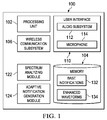
- FIG. 1 is a block diagram illustrating an example user device 100 that generates an adaptive notification according to an implementation.
- the example user device 100 includes a spectrum analyzing module 122 and an adaptive notification generation module 124.
- the example user device 100 also includes a processing unit 102, a wireless communication subsystem 106, a user interface 110, and a memory 104.
- the user interface 110 includes an audio system 112.
- the audio system 112 represents one or more hardware modules, one or more software modules, or a combination thereof that can be used to transmit the adaptive notification as an audio output.
- the audio system 112 may include a speaker.
- the user interface 110 also includes a microphone 114.
- the microphone 114 represents one or more hardware modules, one or more software modules, or a combination thereof that can be used to sense the environment and measure the environmental noise.
- the microphone 114 may measure the environmental noise by periodically collecting audio inputs of the environment.
- the microphone 114 may be a digital microphone.
- the microphone 114 may be an analog microphone.
- the microphone 114 may be configured in an "always on" mode, where the microphone 114 can continuously measure the environmental noise.
- the microphone 114 can measure the environmental noise according to a measurement cycle.
- the measurement cycle may be configured by the spectrum analyzing module 122 based on the movement of the user device. The following paragraphs provide additional details of the measurement cycle.
- the user device 100 includes the spectrum analyzing module 122.
- the spectrum analyzing module 122 represents one or more hardware modules, one or more software modules, or a combination thereof that can be configured to receive the measurement from the microphone 114 and analyze the spectrum of the environmental noise.
- the spectrum analyzing module 122 may configure a measurement cycle for the microphone 114 to measure the environmental noise. For example, the spectrum analyzing module 122 may configure the rate and resolution of the audio data collection of the environment based on the measurement cycle. In some cases, measurement cycle may be configured based on the moving pattern of the user device 100.
- the user device 100 may include a motion sensor unit used to detect the motion pattern of the user device 100. In some cases, the motion sensor unit may track the location of the user device 100 using, e.g., a Global Position System (GPS) module or an assisted-GPS module, and estimate the speed of the user device 100.
- GPS Global Position System
- assisted-GPS assisted-GPS
- the spectrum analyzing module 122 may configure the measurement cycle based on the change of the environmental noise. For example, the spectrum analyzing module 122 may store the analyzed spectrum of the environmental noise based on the previous measurement. The spectrum analyzing module 122 may compare the analyzed spectrum of the environmental noise based on the current measurement with the stored spectrum based on the previous measurement to determine how fast the environmental noise changes. If the environmental noise changes fast over time, the spectrum analyzing module 122 may reduce the delay between each measurement, increase the resolution of the measurement, or a combination thereof. If, on the other hand, the environmental noise changes slowly over time, the spectrum analyzing module 122 may increase the delay between each measurement, reduce the resolution of the measurement, or a combination thereof.
- Configuring the measurement cycle based on the movement and/or the changes of the environmental noise may provide one or more advantages. For example, when the environment changes slowly, the power consumption of the user device 100 used for measuring and processing environmental noise may be reduced without affecting the accuracy of the measurement.
- the user device 100 includes the adaptive notification generation module 124.
- the adaptive notification generation module 124 represents one or more hardware modules, one or more software modules, or a combination thereof that can be configured to generate an adaptive notification based on the spectrum analysis of the environmental noises.
- the adaptive notification generation module 124 may generate an adaptive notification that has a high power level in the frequency bands where the noise power level is low. Therefore, the adaptive notification does not collide with the noise, and a user of the user device 100 may hear the notification more easily.
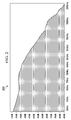
- FIG. 3 is a chart 300 illustrating an example spectrum analysis of a notification that collides with the environmental noise. As illustrated, the notification has a high power level below 1 KHz and low power level beyond 3 KHz, which is similar to the environmental noise illustrated in FIG. 2 . Therefore, the high power portion of the notification may collide with the high power level of the noise and the user may not be able to discern the notification from the background noise.
- FIG. 3 is a chart 300 illustrating an example spectrum analysis of a notification that collides with the environmental noise. As illustrated, the notification has a high power level below 1 KHz and low power level beyond 3 KHz, which is similar to the environmental noise illustrated in FIG. 2 . Therefore, the high power portion of the notification may collide with the high power level of the noise and the user may not
- FIG. 4 is a chart 400 illustrating an example spectrum analysis of a notification that does not collide with the environmental noise.
- the notification has a high power level in frequency bands around 2 KHz, 5 KHz, and 10 KHz, which is different than the environmental noise illustrated in FIG. 2 . Therefore, the high power portion of the notification does not collide with the high power level of the noise and the user may be able to detect the notification over the background noise.
- the adaptive notification generation module 124 may select a base notification and generate the adaptive notification by enhancing the frequency bands of the base notification corresponding to low noise power. For example, the adaptive notification generation module 124 may select an enhanced waveform. The adaptive notification generation module 124 may add the enhanced waveform to the base notification to generate the adaptive notification. In some cases, the adaptive notification generation module 124 may select an enhanced waveform that has a high power level in the frequency bands corresponding to the low power level of the noise. Alternatively or in combination, the adaptive notification generation module 124 may add the enhanced waveform to the frequency bands of the base notification that corresponds to the low power level of the noise.
- the context may be an urgency context.
- the urgency context may indicate the time urgency of the notification, the importance of the notification, or a combination thereof.
- the urgency context may indicate that the notification is for a meeting that would occur in 30 minutes, 15 minutes, or 5 minutes.
- the urgency context may also indicate that the notification has a high, medium, or low importance.
- Different waveforms may be associated with different urgency context.
- the adaptive notification generation module 124 may determine the urgency of the notification and select the waveform that corresponds to the urgency context of the notification. For example, a waveform with increased volume or pitch may be selected for a more urgent notification. Therefore, the audio output of the adaptive notification may indicate the urgency of the notification.
- the associations between different waveforms and the respective urgency contexts may be configurable by a user of the user device 100.
- the adaptive notification generation module 124 may use one or more sonic layers to generate the adaptive notification.
- the enhanced waveforms may be stored in a wavetable that includes a plurality of sonic layers. Each sonic layer may be associated with a respective type of context.
- the wavetable may include 3 sonic layers. The first layer is associated with the source context. The second layer is associated with the event context. The third layer is associated with the urgency context.
- the sonic layers may be orthogonal to one another. Therefore, waveforms from multiple sonic layers may be added together to indicate multiple contexts associated with the notification.
- the adaptive notification generation module 124 may use DSP (Digital Signal Processing) techniques to generate the adaptive notification.
- DSP algorithms can be used to generate optimum audio synthetic layers from an original source audio by creating artificial layers via re-sampling.
- the adaptive notification generation module 124 may use DSP algorithms to generate the adaptive notification by positioning the high power level component of the base notification in the frequency bands that correspond to low noise power of the environment.
- the adaptive notification generation module 124 may distort the waveform of the base notification based on context associated with the notification.
- the adaptive notification generation module 124 may use DSP algorithms to increase the pitch or the volume of selected frequency bands based on the source context, the event context, the urgency context, or any other contexts.
- the adaptive notification generation module 124 may increase the pitch for a notification with high urgency and decrease the pitch for a notification with low urgency.
- the association between different DSP distortion techniques and the respective contexts may be configurable by a user.
- the user device 100 includes the memory 104.
- the memory 104 represents one or more hardware modules, one or more software modules, or a combination thereof that may be configured to store computer-readable information. Examples of the memory 104 may include Random-access memory (RAM), Read-only memory (ROM), or flash memory.
- RAM Random-access memory
- ROM Read-only memory
- flash memory flash memory
- the memory 104 can store an operating system (OS) of the user device 100, and various other computer-executable instructions, logic or software programs for performing one or more of the processes, steps, or actions described above.
- OS operating system
- the memory 104 may also store the spectrum analysis of the environmental noise. As discussed previously, the spectrum analyzing module 122 may compare the spectrum analysis from different measurements to configure the measurement cycle.
- the user device 100 includes the processing unit 102.
- the processing unit 102 can include one or more processing components (alternatively referred to as “processors” or “central processing units” (CPUs)) configured to execute instructions related to one or more of the processes, steps, or actions described herein in connection with one or more of the implementations disclosed herein.
- the processing unit 102 may be configured to generate control information, such as a measurement report, or respond to received information, such as control information from a network node.
- the processing unit 102 may also be configured to make a Radio Resource Management (RRM) decision such as cell selection/reselection information or trigger a measurement report.
- RRM Radio Resource Management
- the user device 100 includes the wireless communication subsystem 106.
- the wireless communication subsystem 106 may be configured to provide wireless communication for voice, data, and/or control information provided by the processing unit 102.
- the wireless communication subsystem 106 can include, for example, one or more antennas, a receiver, a transmitter, a local oscillator, a mixer, and a digital signal processing (DSP) unit.
- DSP digital signal processing
- the subsystem 106 can support multiple-input multiple-output (MIMO) transmissions.
- the receiver in the wireless communication subsystems 106 can be an advance receiver or a baseline receiver. Two receivers can be implemented with identical, similar, or different receiver processing algorithms.
- the wireless communication subsystem 106 can be configured to transmit and receive data using Global System for Mobile communication (GSM), Interim Standard 95 (IS-95), Universal Mobile Telecommunications System (UMTS), CDMA2000 (Code Division Multiple Access), Evolved Universal Mobile Telecommunications System (E-UMTS), Long Term Evaluation (LTE), LTE-Advanced, or any other radio access technology.
- GSM Global System for Mobile communication
- IS-95 Interim Standard 95
- UMTS Universal Mobile Telecommunications System
- CDMA2000 Code Division Multiple Access
- E-UMTS Evolved Universal Mobile Telecommunications System
- LTE Long Term Evaluation
- LTE-Advanced Long Term Evolution-Advanced
- a user device may be referred to as mobile electronic device, user device, mobile station, subscriber station, portable electronic device, mobile communications device, wireless modem, or wireless terminal.
- Examples of a user device e.g., the user device 100
- the wireless communication network may include a wireless link over at least one of a licensed spectrum and an unlicensed spectrum.
- a user device may include a Mobile Equipment (ME) device and a removable memory module, such as a Universal Integrated Circuit Card (UICC) that includes a Subscriber Identity Module (SIM) application, a Universal Subscriber Identity Module (USIM) application, or a Removable User Identity Module (R-UIM) application.
- a Mobile Equipment MEC
- UICC Universal Integrated Circuit Card
- SIM Subscriber Identity Module
- USIM Universal Subscriber Identity Module
- R-UIM Removable User Identity Module
- the term “user device” can also refer to any hardware or software component that can terminate a communication session for a user.
- the terms “user equipment,” “UE,” “user equipment device,” “user agent,” “UA,” “user device,” and “mobile device” can be used synonymously herein.
- FIG. 1 While elements of FIG. 1 are shown as including various component parts, portions, or modules that implement the various features and functionalities, nevertheless these elements may instead include a number of sub-modules, third-party services, components, libraries, and such, as appropriate. Furthermore, the features and functionality of various components can be combined into fewer components as appropriate.
- FIG. 5 is a flowchart illustrating an example method 500 for generating an adaptive notification by a user device.
- the method 500 may begin at block 502, where environmental noise is measured. In some cases, the environmental noise may be measured by a microphone. At block 504, the spectrum of the measured environmental noise is analyzed. At block 506, the spectrum of the measured environmental noise is classified. In some cases, a portion of the spectrum of the measured environmental noise that have low power may be identified. In some cases, the user device may store the spectrum analysis of the environmental noise.
- the analysis of the environmental noise may be updated.
- the microphone may be turned into an "always-on" mode to measure the environmental noise continuously.
- the environmental noise may be measured according to a measurement cycle.
- the user device may detect a motion pattern of the user device and determine the measurement cycle based on the detected motion pattern.
- the user device may update the environmental noise after each measurement. For example, after a measurement, the user device may compare the spectrum analysis based on the current measurement with the analysis based on the pervious measurement. If the low power portion of the spectrum has changed, the user device may update the stored spectrum analysis.
- an adapted notification is generated.
- the adapted notification is generated based on the spectrum analysis of the environmental noise.
- the user device may select a base notification.
- the user device may select an enhanced waveform and add the selected enhanced waveform to the base notification to generate the adapted notification.
- the selected enhanced waveform may be added on the portion of the spectrum that is identified as having low environmental noise.
- the enhanced waveform may be selected from a plurality of predetermined waveforms. In some cases, the selection of the enhanced waveform is based on a context of the notification. In some cases, the plurality of the predetermined waveforms may be organized in one or more sonic layers, each sonic layer corresponding to a category of context. Examples of the category may include a source context, an urgency context, and an event context. In some cases, the user device may select a first waveform from a first sonic layer based on the source context of the notification, a second waveform from a second sonic layer based on the event context of the notification, and a third waveform from a third sonic layer based on the urgency context of the notification.
- the user device transmits the adapted notification.
Landscapes
- Engineering & Computer Science (AREA)
- Physics & Mathematics (AREA)
- Signal Processing (AREA)
- Multimedia (AREA)
- Human Computer Interaction (AREA)
- Audiology, Speech & Language Pathology (AREA)
- Health & Medical Sciences (AREA)
- Acoustics & Sound (AREA)
- Computational Linguistics (AREA)
- Electromagnetism (AREA)
- General Physics & Mathematics (AREA)
- Spectroscopy & Molecular Physics (AREA)
- Environmental & Geological Engineering (AREA)
- Computer Networks & Wireless Communication (AREA)
- Telephone Function (AREA)
- Measurement Of Mechanical Vibrations Or Ultrasonic Waves (AREA)
Abstract
Description
- This disclosure relates to generating notifications for communication devices and, more specifically, to generating adaptive notifications.
- In some cases, a user device may provide notification functionalities. A notification may be an audio output. For example, a user device may generate a sound when the user device receives an email or a text. The sound may notify the user that an email or a text is received.
-
-
FIG. 1 is a block diagram illustrating an example user device that generates an adaptive notification according to an implementation. -
FIG. 2 is a chart illustrating an example spectrum analysis of the environmental noise. -
FIG. 3 is a chart illustrating an example spectrum analysis of a notification that collides with the environmental noise. -
FIG. 4 is a chart illustrating an example spectrum analysis of a notification that does not collide with the environmental noise. -
FIG. 5 is a flowchart illustrating an example method for generating an adaptive notification by a user device. - Like reference numbers and designations in the various drawings indicate like elements.
- The present disclosure is directed to generating adaptive notifications. In some cases, a user device may be positioned in a noisy environment. The environmental noise may be spread uniformly across the audio spectrum (shapeless), or concentrated in one or more narrow frequency bands (highly shaped). In some cases, a user may have difficulty hearing a notification over the noisy environment.
- In some cases, volume of the notification may be boosted to overcome the environmental noise. However, in some cases, boosting the volumes of the notifications may not be efficient or effective. For example, the dominant frequencies of the notification and the noise may coincide. While boosting the volume of the notification increases the amplitude uniformly across the frequency region, the increased amplitude of the dominant frequency of the notification may not be able to overcome the power of the noise at the same frequency regions. Thus, the notification may not be recognizable by the user. Furthermore, if the high power portion of the noise has a narrow bandwidth, boosting the volume of the notification may cause the notification to play at an un-necessarily high volume and create a bad user experience.
- In some cases, an adaptive notification may be generated by measuring and analyzing the spectrum of the environmental noise. A portion of the spectrum that corresponds to low noise power may be identified for enhancement. An adaptive notification may be generated by enhancing the identified portion. In some cases, the enhancement may be based on a context of the notification.
FIGS. 1-5 and associated descriptions provide additional details of these implementations. - Generating the adaptive notification according to methods and systems described herein may provide one or more advantages. For example, by enhancing the portion of the spectrum corresponding to low noise power, the adaptive notification may provide a recognizable audio output over the environmental noise without significantly increasing the overall volume of the notification. This approach may create a better user experience and reduce power consumption of the user device. Furthermore, by associating the enhancement with a context of the notification, the user may recognize the context of the notification based on the audio output of the notification, without looking at the device. Other advantages will be apparent to those of ordinary skill in the art.
-
FIG. 1 is a block diagram illustrating anexample user device 100 that generates an adaptive notification according to an implementation. As illustrated, theexample user device 100 includes aspectrum analyzing module 122 and an adaptivenotification generation module 124. Theexample user device 100 also includes aprocessing unit 102, awireless communication subsystem 106, auser interface 110, and amemory 104. - The
user interface 110 represents one or more hardware modules, one or more software modules, or a combination thereof that can be configured to provide an input and output interface for theuser device 100. Theuser interface 110 can include, for example, one or more of a screen or touch screen (for example, a liquid crystal display (LCD), a light emitting display (LED), an organic light emitting display (OLED), or a micro-electromechanical system (MEMS) display), a keyboard or keypad, a trackball, or a combination thereof. - As illustrated, the
user interface 110 includes anaudio system 112. Theaudio system 112 represents one or more hardware modules, one or more software modules, or a combination thereof that can be used to transmit the adaptive notification as an audio output. For example, theaudio system 112 may include a speaker. - The
user interface 110 also includes amicrophone 114. Themicrophone 114 represents one or more hardware modules, one or more software modules, or a combination thereof that can be used to sense the environment and measure the environmental noise. In some cases, themicrophone 114 may measure the environmental noise by periodically collecting audio inputs of the environment. In some cases, themicrophone 114 may be a digital microphone. Alternatively or in combination, themicrophone 114 may be an analog microphone. In some cases, themicrophone 114 may be configured in an "always on" mode, where themicrophone 114 can continuously measure the environmental noise. Alternatively or in combination, themicrophone 114 can measure the environmental noise according to a measurement cycle. In some cases, the measurement cycle may be configured by the spectrum analyzingmodule 122 based on the movement of the user device. The following paragraphs provide additional details of the measurement cycle. - As illustrated, the
user device 100 includes thespectrum analyzing module 122. Thespectrum analyzing module 122 represents one or more hardware modules, one or more software modules, or a combination thereof that can be configured to receive the measurement from themicrophone 114 and analyze the spectrum of the environmental noise. - In some cases, the
spectrum analyzing module 122 may configure a measurement cycle for themicrophone 114 to measure the environmental noise. For example, thespectrum analyzing module 122 may configure the rate and resolution of the audio data collection of the environment based on the measurement cycle. In some cases, measurement cycle may be configured based on the moving pattern of theuser device 100. For example, theuser device 100 may include a motion sensor unit used to detect the motion pattern of theuser device 100. In some cases, the motion sensor unit may track the location of theuser device 100 using, e.g., a Global Position System (GPS) module or an assisted-GPS module, and estimate the speed of theuser device 100. Thespectrum analyzing module 122 may configure the measurement cycle based on the estimated speed. For example, if theuser device 100 is stationary or moves at a low speed, then the noise of the environment may change slowly. Therefore, the measurement cycle may include an increased delay between each measurement, a reduced resolution, or a combination thereof. If, on the other hand, theuser device 100 moves at a high speed, then the noise of the environment may change quickly. Therefore, the measurement cycle may include a reduced delay between each measurement, an increased resolution, or a combination thereof. - In some cases, the
spectrum analyzing module 122 may configure the measurement cycle based on the change of the environmental noise. For example, thespectrum analyzing module 122 may store the analyzed spectrum of the environmental noise based on the previous measurement. Thespectrum analyzing module 122 may compare the analyzed spectrum of the environmental noise based on the current measurement with the stored spectrum based on the previous measurement to determine how fast the environmental noise changes. If the environmental noise changes fast over time, thespectrum analyzing module 122 may reduce the delay between each measurement, increase the resolution of the measurement, or a combination thereof. If, on the other hand, the environmental noise changes slowly over time, thespectrum analyzing module 122 may increase the delay between each measurement, reduce the resolution of the measurement, or a combination thereof. - Configuring the measurement cycle based on the movement and/or the changes of the environmental noise may provide one or more advantages. For example, when the environment changes slowly, the power consumption of the
user device 100 used for measuring and processing environmental noise may be reduced without affecting the accuracy of the measurement. - The
spectrum analyzing module 122 may receive the measurement data from themicrophone 114 and perform a spectrum analysis of the environmental noise.FIG. 2 is achart 200 illustrating an example spectrum analysis of the environmental noise. As shown inFIG. 2 , the power distribution of the noise is uneven throughout the spectrum. In some bands, e.g., between 200 Hz and 1 KHz, the power level of the noise is high. In some bands, e.g., between 1 KHz and 10 KHz, the power level of the noise reduces as the frequency increases. In some bands, e.g., between 10 KHz and 20 KHz, the power level of the noise is low. In some cases, thespectrum analyzing module 122 may identify a portion of the spectrum that represents low power level of the noise. The identified portion may be used for adaptive notification enhancement. In some cases, the identification may be based on a predetermined power level. Thespectrum analyzing module 122 may identify the portion of the spectrum where the power level of the noise is below the predetermined power level as a candidate portion of the spectrum for enhancement. For example, the predetermined power level may be -48 dB, and the identified portion may include frequency bands above 3.2 KHz. - In some cases, the
spectrum analyzing module 122 may configure the measurement based on the power of the noise. For example, if the long term root mean square (RMS) of the noise power level is below a threshold, thespectrum analyzing module 122 may configure the measurement cycle to include an increased delay between the measurements to save power. - Referring back to
FIG. 1 , theuser device 100 includes the adaptivenotification generation module 124. The adaptivenotification generation module 124 represents one or more hardware modules, one or more software modules, or a combination thereof that can be configured to generate an adaptive notification based on the spectrum analysis of the environmental noises. - In some cases, the adaptive
notification generation module 124 may generate an adaptive notification that has a high power level in the frequency bands where the noise power level is low. Therefore, the adaptive notification does not collide with the noise, and a user of theuser device 100 may hear the notification more easily.FIG. 3 is achart 300 illustrating an example spectrum analysis of a notification that collides with the environmental noise. As illustrated, the notification has a high power level below 1 KHz and low power level beyond 3 KHz, which is similar to the environmental noise illustrated inFIG. 2 . Therefore, the high power portion of the notification may collide with the high power level of the noise and the user may not be able to discern the notification from the background noise.FIG. 4 is achart 400 illustrating an example spectrum analysis of a notification that does not collide with the environmental noise. As illustrated, the notification has a high power level in frequency bands around 2 KHz, 5 KHz, and 10 KHz, which is different than the environmental noise illustrated inFIG. 2 . Therefore, the high power portion of the notification does not collide with the high power level of the noise and the user may be able to detect the notification over the background noise. - Referring back to
FIG. 1 , in some cases, the adaptivenotification generation module 124 may select a base notification and generate the adaptive notification by enhancing the frequency bands of the base notification corresponding to low noise power. For example, the adaptivenotification generation module 124 may select an enhanced waveform. The adaptivenotification generation module 124 may add the enhanced waveform to the base notification to generate the adaptive notification. In some cases, the adaptivenotification generation module 124 may select an enhanced waveform that has a high power level in the frequency bands corresponding to the low power level of the noise. Alternatively or in combination, the adaptivenotification generation module 124 may add the enhanced waveform to the frequency bands of the base notification that corresponds to the low power level of the noise. - In some cases, the adaptive
notification generation module 124 may select the waveforms based on context of the notification. In one example, the context may be a source context. Examples of source contexts may be email, text, voicemail, application, or any other context that is associated with the source of the notification. Each source context may correspond to a different waveform. Therefore, the adaptivenotification generation module 124 may determine the source of the notification, and select the waveform that corresponds to the source context of the notification. By including the waveform that corresponds to the source context of the notification, the user may know the source of the notification, e.g., whether the notification is an email, a text, a voicemail, an application, from the audio output of the notification. In some cases, the source context may include a source address of the adaptive notification. The source address may be an email address, a phone number, or any other addresses that identifies the address associated with the notification. Therefore, the audio output of the adaptive notification may indicate the caller of the voice call or the sending of the email that triggers the notification. In some cases, the associations between different waveforms and the respective source contexts may be configurable by a user of theuser device 100. - In another example, the context may be an event context. Examples of event contexts may be a calendar event, a task, or a deadline that triggers the notification. Each event context may correspond to a different waveform. Therefore, the adaptive
notification generation module 124 may determine the event that triggers the notification and select the waveform that corresponds to the event context of the notification. In some cases, a user may configure different waveforms for different event occurrences. For example, a waveform may be associated with an external meeting with a client, and a different waveform may be associated with an internal meeting. Therefore, the audio output of the adaptive notification may indicate the event that triggers the notification. In some cases, the associations between different waveforms and the respective event contexts may be configurable by a user of theuser device 100. - In yet another example, the context may be an urgency context. The urgency context may indicate the time urgency of the notification, the importance of the notification, or a combination thereof. For example, the urgency context may indicate that the notification is for a meeting that would occur in 30 minutes, 15 minutes, or 5 minutes. The urgency context may also indicate that the notification has a high, medium, or low importance. Different waveforms may be associated with different urgency context. The adaptive
notification generation module 124 may determine the urgency of the notification and select the waveform that corresponds to the urgency context of the notification. For example, a waveform with increased volume or pitch may be selected for a more urgent notification. Therefore, the audio output of the adaptive notification may indicate the urgency of the notification. In some cases, the associations between different waveforms and the respective urgency contexts may be configurable by a user of theuser device 100. - In some cases, the adaptive
notification generation module 124 may use one or more sonic layers to generate the adaptive notification. For example, the enhanced waveforms may be stored in a wavetable that includes a plurality of sonic layers. Each sonic layer may be associated with a respective type of context. For example, the wavetable may include 3 sonic layers. The first layer is associated with the source context. The second layer is associated with the event context. The third layer is associated with the urgency context. The sonic layers may be orthogonal to one another. Therefore, waveforms from multiple sonic layers may be added together to indicate multiple contexts associated with the notification. - For example, the adaptive
notification generation module 124 may select a first waveform that corresponds with the source context of the notification from the first sonic layer, a second waveform that corresponds with the event context of the notification from the second sonic layer, and a third waveform that corresponds with the urgency context of the notification from the third sonic layer. The adaptivenotification generation module 124 may add the first, the second, and the third waveform to generate the enhanced waveform. The adaptivenotification generation module 124 may add the enhanced waveform to the base notification to generate the adaptive notification. - In some cases, the adaptive
notification generation module 124 may use DSP (Digital Signal Processing) techniques to generate the adaptive notification. In some cases, the DSP algorithms can be used to generate optimum audio synthetic layers from an original source audio by creating artificial layers via re-sampling. For example, the adaptivenotification generation module 124 may use DSP algorithms to generate the adaptive notification by positioning the high power level component of the base notification in the frequency bands that correspond to low noise power of the environment. - Alternatively or in combination, the adaptive
notification generation module 124 may distort the waveform of the base notification based on context associated with the notification. For example, the adaptivenotification generation module 124 may use DSP algorithms to increase the pitch or the volume of selected frequency bands based on the source context, the event context, the urgency context, or any other contexts. In one example, the adaptivenotification generation module 124 may increase the pitch for a notification with high urgency and decrease the pitch for a notification with low urgency. In some cases, the association between different DSP distortion techniques and the respective contexts may be configurable by a user. - As illustrated, the
user device 100 includes thememory 104. Thememory 104 represents one or more hardware modules, one or more software modules, or a combination thereof that may be configured to store computer-readable information. Examples of thememory 104 may include Random-access memory (RAM), Read-only memory (ROM), or flash memory. Thememory 104 can store an operating system (OS) of theuser device 100, and various other computer-executable instructions, logic or software programs for performing one or more of the processes, steps, or actions described above. - As illustrated, the
memory 104 can storebase notifications 132 andenhanced waveforms 134. As discussed previously, the adaptivenotification generation module 124 may select one of thebase notifications 132 and enhance the selected base notification according to the spectrum analysis of the environmental noise, the context of the notification, and a combination thereof. In some cases, the adaptivenotification generation module 124 may select one or moreenhanced waveforms 134 to generate the adaptive notification. In some cases, theenhanced waveforms 134 may be associated with one or more sonic layers. - In some cases, the
memory 104 may also store the spectrum analysis of the environmental noise. As discussed previously, thespectrum analyzing module 122 may compare the spectrum analysis from different measurements to configure the measurement cycle. - As illustrated, the
user device 100 includes theprocessing unit 102. Theprocessing unit 102 can include one or more processing components (alternatively referred to as "processors" or "central processing units" (CPUs)) configured to execute instructions related to one or more of the processes, steps, or actions described herein in connection with one or more of the implementations disclosed herein. In some implementations, theprocessing unit 102 may be configured to generate control information, such as a measurement report, or respond to received information, such as control information from a network node. Theprocessing unit 102 may also be configured to make a Radio Resource Management (RRM) decision such as cell selection/reselection information or trigger a measurement report. - As illustrated, the
user device 100 includes thewireless communication subsystem 106. Thewireless communication subsystem 106 may be configured to provide wireless communication for voice, data, and/or control information provided by theprocessing unit 102. Thewireless communication subsystem 106 can include, for example, one or more antennas, a receiver, a transmitter, a local oscillator, a mixer, and a digital signal processing (DSP) unit. In some implementations, thesubsystem 106 can support multiple-input multiple-output (MIMO) transmissions. In some implementations, the receiver in thewireless communication subsystems 106 can be an advance receiver or a baseline receiver. Two receivers can be implemented with identical, similar, or different receiver processing algorithms. In some cases, thewireless communication subsystem 106 can be configured to transmit and receive data using Global System for Mobile communication (GSM), Interim Standard 95 (IS-95), Universal Mobile Telecommunications System (UMTS), CDMA2000 (Code Division Multiple Access), Evolved Universal Mobile Telecommunications System (E-UMTS), Long Term Evaluation (LTE), LTE-Advanced, or any other radio access technology. - Turning to a general description of the elements, a user device may be referred to as mobile electronic device, user device, mobile station, subscriber station, portable electronic device, mobile communications device, wireless modem, or wireless terminal. Examples of a user device (e.g., the user device 100) may include a cellular phone, personal data assistant (PDA), smart phone, laptop, tablet personal computer (PC), pager, portable computer, portable gaming device, wearable electronic device, or other mobile communications device having components for communicating voice or data via a wireless communication network. The wireless communication network may include a wireless link over at least one of a licensed spectrum and an unlicensed spectrum.
- Other examples of a user device include mobile and fixed electronic device. A user device may include a Mobile Equipment (ME) device and a removable memory module, such as a Universal Integrated Circuit Card (UICC) that includes a Subscriber Identity Module (SIM) application, a Universal Subscriber Identity Module (USIM) application, or a Removable User Identity Module (R-UIM) application. The term "user device" can also refer to any hardware or software component that can terminate a communication session for a user. In addition, the terms "user equipment," "UE," "user equipment device," "user agent," "UA," "user device," and "mobile device" can be used synonymously herein.
- While elements of
FIG. 1 are shown as including various component parts, portions, or modules that implement the various features and functionalities, nevertheless these elements may instead include a number of sub-modules, third-party services, components, libraries, and such, as appropriate. Furthermore, the features and functionality of various components can be combined into fewer components as appropriate. -
FIG. 5 is a flowchart illustrating anexample method 500 for generating an adaptive notification by a user device. Themethod 500 may begin atblock 502, where environmental noise is measured. In some cases, the environmental noise may be measured by a microphone. Atblock 504, the spectrum of the measured environmental noise is analyzed. Atblock 506, the spectrum of the measured environmental noise is classified. In some cases, a portion of the spectrum of the measured environmental noise that have low power may be identified. In some cases, the user device may store the spectrum analysis of the environmental noise. - At
block 508, the analysis of the environmental noise may be updated. In some cases, the microphone may be turned into an "always-on" mode to measure the environmental noise continuously. In some cases, the environmental noise may be measured according to a measurement cycle. For example, the user device may detect a motion pattern of the user device and determine the measurement cycle based on the detected motion pattern. In some cases, the user device may update the environmental noise after each measurement. For example, after a measurement, the user device may compare the spectrum analysis based on the current measurement with the analysis based on the pervious measurement. If the low power portion of the spectrum has changed, the user device may update the stored spectrum analysis. - At
block 510, an adapted notification is generated. In some cases, the adapted notification is generated based on the spectrum analysis of the environmental noise. For example, the user device may select a base notification. The user device may select an enhanced waveform and add the selected enhanced waveform to the base notification to generate the adapted notification. The selected enhanced waveform may be added on the portion of the spectrum that is identified as having low environmental noise. - In some cases, the enhanced waveform may be selected from a plurality of predetermined waveforms. In some cases, the selection of the enhanced waveform is based on a context of the notification. In some cases, the plurality of the predetermined waveforms may be organized in one or more sonic layers, each sonic layer corresponding to a category of context. Examples of the category may include a source context, an urgency context, and an event context. In some cases, the user device may select a first waveform from a first sonic layer based on the source context of the notification, a second waveform from a second sonic layer based on the event context of the notification, and a third waveform from a third sonic layer based on the urgency context of the notification.
- At
block 512, the user device transmits the adapted notification. - While operations are depicted in the drawings in a particular order, this should not be understood as requiring that such operations be performed in the particular order shown or in sequential order, or that all illustrated operations be performed, to achieve desirable results. In certain circumstances, multitasking and parallel processing may be employed. Moreover, the separation of various system components in the implementation described above should not be understood as requiring such separation in all implementations, and it should be understood that the described program components and systems can generally be integrated together in a signal software product or packaged into multiple software products.
- Also, techniques, systems, subsystems, and methods described and illustrated in the various implementations as discrete or separate may be combined or integrated with other systems, modules, techniques, or methods. Other items shown or discussed as coupled or directly coupled or communicating with each other may be indirectly coupled or communicating through some interface, device, or intermediate component, whether electrically, mechanically, or otherwise. Other examples of changes, substitutions, and alterations are ascertainable by one skilled in the art and could be made.
- While the above detailed description has shown, described, and pointed out the fundamental novel features of the disclosure as applied to various implementations, it will be understood that various omissions, substitutions, and changes in the form and details of the system illustrated may be made by those skilled in the art. In addition, the order of method steps are not implied by the order they appear in the claims.
Claims (9)
- A method, comprising:analyzing, at a user device, a spectrum of environmental noise;selecting, based on analyzing the spectrum of environmental noise, a portion of the spectrum for adaptive notification enhancement;generating, at the user device, an adapted notification by enhancing the selected portion of the spectrum; andtransmitting, at the user device, the adapted notification.
- The method of claim 1, wherein generating the adapted notification comprises:selecting an enhanced waveform from a plurality of predetermined waveforms; andadding the selected enhanced waveform to a notification waveform to generate the adapted notification.
- The method of claim 2, wherein the enhanced waveform is selected based on a context of a notification.
- The method of claim 3, wherein the context is at least one of a source context or an urgency context.
- The method of claim 2, wherein each of the plurality of predetermined waveforms is associated with at least one of a plurality of sonic layers, and each of the plurality of sonic layers is associated with a context.
- The method of claim 1, wherein analyzing the spectrum of environmental noise comprises measuring a frequency distribution of environmental noise using a digital microphone.
- The method of claim 6, further comprising:detecting a motion pattern of the user device;determining a measurement cycle based on the detected motion pattern; andmeasuring the frequency distribution according to the measurement cycle.
- A tangible, non-transitory machine-readable medium encoded with machine-executable instructions, wherein execution of the machine-executable instructions causes a computing device to perform the method of any of claims 1 to 7.
- A device, comprising:a memory; andat least one hardware processor communicatively coupled with the memory and configured to perform the method of any of claims 1 to 7.
Applications Claiming Priority (1)
| Application Number | Priority Date | Filing Date | Title |
|---|---|---|---|
| US14/852,156 US9847764B2 (en) | 2015-09-11 | 2015-09-11 | Generating adaptive notification |
Publications (2)
| Publication Number | Publication Date |
|---|---|
| EP3142342A1 true EP3142342A1 (en) | 2017-03-15 |
| EP3142342B1 EP3142342B1 (en) | 2019-12-18 |
Family
ID=57103781
Family Applications (1)
| Application Number | Title | Priority Date | Filing Date |
|---|---|---|---|
| EP16188156.0A Active EP3142342B1 (en) | 2015-09-11 | 2016-09-09 | Generating adaptive notification |
Country Status (4)
| Country | Link |
|---|---|
| US (2) | US9847764B2 (en) |
| EP (1) | EP3142342B1 (en) |
| CN (1) | CN107039047B (en) |
| CA (1) | CA2941307C (en) |
Families Citing this family (3)
| Publication number | Priority date | Publication date | Assignee | Title |
|---|---|---|---|---|
| US20190164392A1 (en) * | 2016-07-28 | 2019-05-30 | Sandmanden Storsække Service V/ Flemming Petersen | Method for warning a user, a wearable warning system and use of the system |
| US11043204B2 (en) * | 2019-03-18 | 2021-06-22 | Servicenow, Inc. | Adaptable audio notifications |
| KR20240058400A (en) * | 2022-10-26 | 2024-05-07 | 휴렛-팩커드 디벨롭먼트 컴퍼니, 엘.피. | False touch response for touch screen |
Citations (5)
| Publication number | Priority date | Publication date | Assignee | Title |
|---|---|---|---|---|
| US5844983A (en) * | 1997-07-10 | 1998-12-01 | Ericsson Inc. | Method and apparatus for controlling a telephone ring signal |
| US20050008135A1 (en) * | 2003-07-09 | 2005-01-13 | Bressler Joshua R. | Selective incoming call filtering and blinded caller ID display |
| US20050113147A1 (en) * | 2003-11-26 | 2005-05-26 | Vanepps Daniel J.Jr. | Methods, electronic devices, and computer program products for generating an alert signal based on a sound metric for a noise signal |
| US20050170828A1 (en) * | 2003-05-28 | 2005-08-04 | Fujitsu Limited | Mobile radio terminal and mobile radio terminal control method |
| EP2608503A1 (en) * | 2011-12-22 | 2013-06-26 | Vodafone IP Licensing limited | State detection |
Family Cites Families (26)
| Publication number | Priority date | Publication date | Assignee | Title |
|---|---|---|---|---|
| US6954657B2 (en) * | 2000-06-30 | 2005-10-11 | Texas Instruments Incorporated | Wireless communication device having intelligent alerting system |
| KR100800725B1 (en) * | 2005-09-07 | 2008-02-01 | 삼성전자주식회사 | Automatic volume control method and device for adapting to ambient noise during audio reproduction of mobile communication terminal |
| US7742790B2 (en) * | 2006-05-23 | 2010-06-22 | Alon Konchitsky | Environmental noise reduction and cancellation for a communication device including for a wireless and cellular telephone |
| US7908134B1 (en) * | 2006-07-26 | 2011-03-15 | Starmark, Inc. | Automatic volume control to compensate for speech interference noise |
| CN101166017B (en) * | 2006-10-20 | 2011-12-07 | 松下电器产业株式会社 | Automatic murmur compensation method and device for sound generation apparatus |
| US8774433B2 (en) * | 2006-11-18 | 2014-07-08 | Personics Holdings, Llc | Method and device for personalized hearing |
| US8995683B2 (en) * | 2006-12-29 | 2015-03-31 | Google Technology Holdings LLC | Methods and devices for adaptive ringtone generation |
| WO2008083315A2 (en) * | 2006-12-31 | 2008-07-10 | Personics Holdings Inc. | Method and device configured for sound signature detection |
| US7606113B2 (en) * | 2007-05-10 | 2009-10-20 | Lockheed Martin Corporation | Modeling sound propagation for underwater test areas |
| TWI376925B (en) * | 2007-08-28 | 2012-11-11 | Micro Star Int Co Ltd | Adjusting device and method of notification sound according to the environment |
| US8018328B2 (en) * | 2007-09-12 | 2011-09-13 | Personics Holdings Inc. | Adaptive audio content generation system |
| US7982587B1 (en) * | 2008-02-21 | 2011-07-19 | Longwood Corporation | Integrated microprocessor controlled alarm |
| US20120087516A1 (en) * | 2010-10-08 | 2012-04-12 | Umesh Amin | System and methods for dynamically controlling atleast a media content with changes in ambient noise |
| US20130005280A1 (en) * | 2011-06-28 | 2013-01-03 | Hong Kong Applied Science and Technology Research Institute Company Limited | Method for constructing a wireless communication device to achieve motion sensing function |
| US8760271B2 (en) * | 2011-11-10 | 2014-06-24 | Honeywell International Inc. | Methods and systems to support auditory signal detection |
| US20130329908A1 (en) * | 2012-06-08 | 2013-12-12 | Apple Inc. | Adjusting audio beamforming settings based on system state |
| US8843987B2 (en) | 2012-08-23 | 2014-09-23 | Time Warner Cable Enterprises Llc | Methods and apparatus that support addressable interactive applications |
| CN102883121A (en) * | 2012-09-24 | 2013-01-16 | 北京多看科技有限公司 | Method and device for regulating volume, and digital terminal |
| SE536754C2 (en) * | 2012-11-22 | 2014-07-15 | Interactive Inst Ii Ab | Method and apparatus for generating an auditory notification signal |
| US9854081B2 (en) * | 2013-03-15 | 2017-12-26 | Apple Inc. | Volume control for mobile device using a wireless device |
| CN103546617B (en) * | 2013-10-21 | 2016-01-27 | 深圳市金立通信设备有限公司 | A kind of method that sound regulates and terminal |
| US9648431B1 (en) * | 2013-10-31 | 2017-05-09 | Allscripts Software, Llc | Adaptive auditory alerts |
| WO2015092943A1 (en) * | 2013-12-17 | 2015-06-25 | Sony Corporation | Electronic devices and methods for compensating for environmental noise in text-to-speech applications |
| CN103886731B (en) * | 2014-03-10 | 2017-08-22 | 北京智谷睿拓技术服务有限公司 | A kind of noise control method and equipment |
| US9406313B2 (en) * | 2014-03-21 | 2016-08-02 | Intel Corporation | Adaptive microphone sampling rate techniques |
| US9390599B2 (en) * | 2014-05-19 | 2016-07-12 | Microsoft Technology Licensing, Llc | Noise-sensitive alert presentation |
-
2015
- 2015-09-11 US US14/852,156 patent/US9847764B2/en active Active
-
2016
- 2016-09-09 EP EP16188156.0A patent/EP3142342B1/en active Active
- 2016-09-09 CA CA2941307A patent/CA2941307C/en active Active
- 2016-09-12 CN CN201610816641.3A patent/CN107039047B/en active Active
-
2017
- 2017-12-05 US US15/832,122 patent/US10305438B2/en active Active
Patent Citations (5)
| Publication number | Priority date | Publication date | Assignee | Title |
|---|---|---|---|---|
| US5844983A (en) * | 1997-07-10 | 1998-12-01 | Ericsson Inc. | Method and apparatus for controlling a telephone ring signal |
| US20050170828A1 (en) * | 2003-05-28 | 2005-08-04 | Fujitsu Limited | Mobile radio terminal and mobile radio terminal control method |
| US20050008135A1 (en) * | 2003-07-09 | 2005-01-13 | Bressler Joshua R. | Selective incoming call filtering and blinded caller ID display |
| US20050113147A1 (en) * | 2003-11-26 | 2005-05-26 | Vanepps Daniel J.Jr. | Methods, electronic devices, and computer program products for generating an alert signal based on a sound metric for a noise signal |
| EP2608503A1 (en) * | 2011-12-22 | 2013-06-26 | Vodafone IP Licensing limited | State detection |
Also Published As
| Publication number | Publication date |
|---|---|
| CN107039047B (en) | 2021-09-03 |
| US9847764B2 (en) | 2017-12-19 |
| EP3142342B1 (en) | 2019-12-18 |
| CN107039047A (en) | 2017-08-11 |
| CA2941307A1 (en) | 2017-03-11 |
| CA2941307C (en) | 2023-11-07 |
| US10305438B2 (en) | 2019-05-28 |
| US20180097494A1 (en) | 2018-04-05 |
| US20170077885A1 (en) | 2017-03-16 |
Similar Documents
| Publication | Publication Date | Title |
|---|---|---|
| RU2564247C2 (en) | System, method and device for providing adaptive user notifications | |
| CN110146747B (en) | Detecting electromagnetic energy for alarm or logging using a mobile telephone device | |
| CN107993672B (en) | Frequency band expanding method and device | |
| CN105354093A (en) | Memory management method and mobile terminal | |
| US10305438B2 (en) | Generating adaptive notification | |
| US20200120429A1 (en) | Terminal, and operation method for terminal | |
| CN110334124B (en) | Compression algorithm selection method, device and equipment | |
| EP3127310B1 (en) | Method for controlling an electronic device by human tremor detection | |
| JP2016511409A5 (en) | ||
| US9203943B2 (en) | Apparatus and method for detecting time division duplex noise of communication device | |
| CN109391992A (en) | Signal measurement method, first mobile terminal and network side equipment | |
| CN103581446A (en) | Scene mode switching method and electronic terminal | |
| CN106375031B (en) | The detection method and mobile terminal of radio-frequency channel | |
| EP2753129A1 (en) | Method and apparatus for controlling short range wireless communication | |
| CN107613535A (en) | Network access method, device, mobile terminal and computer-readable storage medium | |
| WO2019140685A1 (en) | Method, device and system for minimizing road test measurement | |
| CN100481139C (en) | Method and device for generating an alert signal based on a sound metric for a noise signal | |
| CN110912628A (en) | Interference test method, device, terminal and storage medium | |
| US10111046B2 (en) | Portable type information processing apparatus, information processing system, and information processing method | |
| US20240195918A1 (en) | Microphone selection in multiple-microphone devices | |
| US20130196642A1 (en) | Communication device, recording medium, and communication method | |
| CN110890927B (en) | Interference test method, device, terminal and storage medium | |
| CN113039524A (en) | Audio resource processing method and device, computer readable storage medium and electronic equipment | |
| US9105163B2 (en) | Methods, apparatuses, and computer program products for associating notifications with alert functions of remote devices | |
| CN118414797A (en) | Reduce interference caused by downlink aggressors |
Legal Events
| Date | Code | Title | Description |
|---|---|---|---|
| PUAI | Public reference made under article 153(3) epc to a published international application that has entered the european phase |
Free format text: ORIGINAL CODE: 0009012 |
|
| STAA | Information on the status of an ep patent application or granted ep patent |
Free format text: STATUS: THE APPLICATION HAS BEEN PUBLISHED |
|
| AK | Designated contracting states |
Kind code of ref document: A1 Designated state(s): AL AT BE BG CH CY CZ DE DK EE ES FI FR GB GR HR HU IE IS IT LI LT LU LV MC MK MT NL NO PL PT RO RS SE SI SK SM TR |
|
| AX | Request for extension of the european patent |
Extension state: BA ME |
|
| STAA | Information on the status of an ep patent application or granted ep patent |
Free format text: STATUS: REQUEST FOR EXAMINATION WAS MADE |
|
| 17P | Request for examination filed |
Effective date: 20170824 |
|
| RBV | Designated contracting states (corrected) |
Designated state(s): AL AT BE BG CH CY CZ DE DK EE ES FI FR GB GR HR HU IE IS IT LI LT LU LV MC MK MT NL NO PL PT RO RS SE SI SK SM TR |
|
| STAA | Information on the status of an ep patent application or granted ep patent |
Free format text: STATUS: EXAMINATION IS IN PROGRESS |
|
| 17Q | First examination report despatched |
Effective date: 20181221 |
|
| RIC1 | Information provided on ipc code assigned before grant |
Ipc: H04M 19/04 20060101AFI20190508BHEP Ipc: H04M 1/725 20060101ALI20190508BHEP |
|
| GRAP | Despatch of communication of intention to grant a patent |
Free format text: ORIGINAL CODE: EPIDOSNIGR1 |
|
| STAA | Information on the status of an ep patent application or granted ep patent |
Free format text: STATUS: GRANT OF PATENT IS INTENDED |
|
| INTG | Intention to grant announced |
Effective date: 20190703 |
|
| GRAS | Grant fee paid |
Free format text: ORIGINAL CODE: EPIDOSNIGR3 |
|
| GRAA | (expected) grant |
Free format text: ORIGINAL CODE: 0009210 |
|
| STAA | Information on the status of an ep patent application or granted ep patent |
Free format text: STATUS: THE PATENT HAS BEEN GRANTED |
|
| AK | Designated contracting states |
Kind code of ref document: B1 Designated state(s): AL AT BE BG CH CY CZ DE DK EE ES FI FR GB GR HR HU IE IS IT LI LT LU LV MC MK MT NL NO PL PT RO RS SE SI SK SM TR |
|
| REG | Reference to a national code |
Ref country code: CH Ref legal event code: EP |
|
| REG | Reference to a national code |
Ref country code: DE Ref legal event code: R096 Ref document number: 602016026292 Country of ref document: DE |
|
| REG | Reference to a national code |
Ref country code: IE Ref legal event code: FG4D |
|
| REG | Reference to a national code |
Ref country code: AT Ref legal event code: REF Ref document number: 1215864 Country of ref document: AT Kind code of ref document: T Effective date: 20200115 |
|
| REG | Reference to a national code |
Ref country code: NL Ref legal event code: MP Effective date: 20191218 |
|
| PG25 | Lapsed in a contracting state [announced via postgrant information from national office to epo] |
Ref country code: FI Free format text: LAPSE BECAUSE OF FAILURE TO SUBMIT A TRANSLATION OF THE DESCRIPTION OR TO PAY THE FEE WITHIN THE PRESCRIBED TIME-LIMIT Effective date: 20191218 Ref country code: BG Free format text: LAPSE BECAUSE OF FAILURE TO SUBMIT A TRANSLATION OF THE DESCRIPTION OR TO PAY THE FEE WITHIN THE PRESCRIBED TIME-LIMIT Effective date: 20200318 Ref country code: LT Free format text: LAPSE BECAUSE OF FAILURE TO SUBMIT A TRANSLATION OF THE DESCRIPTION OR TO PAY THE FEE WITHIN THE PRESCRIBED TIME-LIMIT Effective date: 20191218 Ref country code: GR Free format text: LAPSE BECAUSE OF FAILURE TO SUBMIT A TRANSLATION OF THE DESCRIPTION OR TO PAY THE FEE WITHIN THE PRESCRIBED TIME-LIMIT Effective date: 20200319 Ref country code: NO Free format text: LAPSE BECAUSE OF FAILURE TO SUBMIT A TRANSLATION OF THE DESCRIPTION OR TO PAY THE FEE WITHIN THE PRESCRIBED TIME-LIMIT Effective date: 20200318 Ref country code: LV Free format text: LAPSE BECAUSE OF FAILURE TO SUBMIT A TRANSLATION OF THE DESCRIPTION OR TO PAY THE FEE WITHIN THE PRESCRIBED TIME-LIMIT Effective date: 20191218 Ref country code: SE Free format text: LAPSE BECAUSE OF FAILURE TO SUBMIT A TRANSLATION OF THE DESCRIPTION OR TO PAY THE FEE WITHIN THE PRESCRIBED TIME-LIMIT Effective date: 20191218 |
|
| REG | Reference to a national code |
Ref country code: LT Ref legal event code: MG4D |
|
| PG25 | Lapsed in a contracting state [announced via postgrant information from national office to epo] |
Ref country code: RS Free format text: LAPSE BECAUSE OF FAILURE TO SUBMIT A TRANSLATION OF THE DESCRIPTION OR TO PAY THE FEE WITHIN THE PRESCRIBED TIME-LIMIT Effective date: 20191218 Ref country code: HR Free format text: LAPSE BECAUSE OF FAILURE TO SUBMIT A TRANSLATION OF THE DESCRIPTION OR TO PAY THE FEE WITHIN THE PRESCRIBED TIME-LIMIT Effective date: 20191218 |
|
| PG25 | Lapsed in a contracting state [announced via postgrant information from national office to epo] |
Ref country code: AL Free format text: LAPSE BECAUSE OF FAILURE TO SUBMIT A TRANSLATION OF THE DESCRIPTION OR TO PAY THE FEE WITHIN THE PRESCRIBED TIME-LIMIT Effective date: 20191218 |
|
| PG25 | Lapsed in a contracting state [announced via postgrant information from national office to epo] |
Ref country code: NL Free format text: LAPSE BECAUSE OF FAILURE TO SUBMIT A TRANSLATION OF THE DESCRIPTION OR TO PAY THE FEE WITHIN THE PRESCRIBED TIME-LIMIT Effective date: 20191218 Ref country code: EE Free format text: LAPSE BECAUSE OF FAILURE TO SUBMIT A TRANSLATION OF THE DESCRIPTION OR TO PAY THE FEE WITHIN THE PRESCRIBED TIME-LIMIT Effective date: 20191218 Ref country code: RO Free format text: LAPSE BECAUSE OF FAILURE TO SUBMIT A TRANSLATION OF THE DESCRIPTION OR TO PAY THE FEE WITHIN THE PRESCRIBED TIME-LIMIT Effective date: 20191218 Ref country code: CZ Free format text: LAPSE BECAUSE OF FAILURE TO SUBMIT A TRANSLATION OF THE DESCRIPTION OR TO PAY THE FEE WITHIN THE PRESCRIBED TIME-LIMIT Effective date: 20191218 Ref country code: PT Free format text: LAPSE BECAUSE OF FAILURE TO SUBMIT A TRANSLATION OF THE DESCRIPTION OR TO PAY THE FEE WITHIN THE PRESCRIBED TIME-LIMIT Effective date: 20200513 |
|
| PG25 | Lapsed in a contracting state [announced via postgrant information from national office to epo] |
Ref country code: SM Free format text: LAPSE BECAUSE OF FAILURE TO SUBMIT A TRANSLATION OF THE DESCRIPTION OR TO PAY THE FEE WITHIN THE PRESCRIBED TIME-LIMIT Effective date: 20191218 Ref country code: SK Free format text: LAPSE BECAUSE OF FAILURE TO SUBMIT A TRANSLATION OF THE DESCRIPTION OR TO PAY THE FEE WITHIN THE PRESCRIBED TIME-LIMIT Effective date: 20191218 Ref country code: IS Free format text: LAPSE BECAUSE OF FAILURE TO SUBMIT A TRANSLATION OF THE DESCRIPTION OR TO PAY THE FEE WITHIN THE PRESCRIBED TIME-LIMIT Effective date: 20200418 |
|
| REG | Reference to a national code |
Ref country code: DE Ref legal event code: R097 Ref document number: 602016026292 Country of ref document: DE |
|
| REG | Reference to a national code |
Ref country code: AT Ref legal event code: MK05 Ref document number: 1215864 Country of ref document: AT Kind code of ref document: T Effective date: 20191218 |
|
| PLBE | No opposition filed within time limit |
Free format text: ORIGINAL CODE: 0009261 |
|
| STAA | Information on the status of an ep patent application or granted ep patent |
Free format text: STATUS: NO OPPOSITION FILED WITHIN TIME LIMIT |
|
| PG25 | Lapsed in a contracting state [announced via postgrant information from national office to epo] |
Ref country code: DK Free format text: LAPSE BECAUSE OF FAILURE TO SUBMIT A TRANSLATION OF THE DESCRIPTION OR TO PAY THE FEE WITHIN THE PRESCRIBED TIME-LIMIT Effective date: 20191218 Ref country code: ES Free format text: LAPSE BECAUSE OF FAILURE TO SUBMIT A TRANSLATION OF THE DESCRIPTION OR TO PAY THE FEE WITHIN THE PRESCRIBED TIME-LIMIT Effective date: 20191218 |
|
| 26N | No opposition filed |
Effective date: 20200921 |
|
| PG25 | Lapsed in a contracting state [announced via postgrant information from national office to epo] |
Ref country code: AT Free format text: LAPSE BECAUSE OF FAILURE TO SUBMIT A TRANSLATION OF THE DESCRIPTION OR TO PAY THE FEE WITHIN THE PRESCRIBED TIME-LIMIT Effective date: 20191218 Ref country code: SI Free format text: LAPSE BECAUSE OF FAILURE TO SUBMIT A TRANSLATION OF THE DESCRIPTION OR TO PAY THE FEE WITHIN THE PRESCRIBED TIME-LIMIT Effective date: 20191218 |
|
| PG25 | Lapsed in a contracting state [announced via postgrant information from national office to epo] |
Ref country code: IT Free format text: LAPSE BECAUSE OF FAILURE TO SUBMIT A TRANSLATION OF THE DESCRIPTION OR TO PAY THE FEE WITHIN THE PRESCRIBED TIME-LIMIT Effective date: 20191218 |
|
| PG25 | Lapsed in a contracting state [announced via postgrant information from national office to epo] |
Ref country code: PL Free format text: LAPSE BECAUSE OF FAILURE TO SUBMIT A TRANSLATION OF THE DESCRIPTION OR TO PAY THE FEE WITHIN THE PRESCRIBED TIME-LIMIT Effective date: 20191218 |
|
| PG25 | Lapsed in a contracting state [announced via postgrant information from national office to epo] |
Ref country code: MC Free format text: LAPSE BECAUSE OF FAILURE TO SUBMIT A TRANSLATION OF THE DESCRIPTION OR TO PAY THE FEE WITHIN THE PRESCRIBED TIME-LIMIT Effective date: 20191218 |
|
| REG | Reference to a national code |
Ref country code: CH Ref legal event code: PL |
|
| REG | Reference to a national code |
Ref country code: BE Ref legal event code: MM Effective date: 20200930 |
|
| PG25 | Lapsed in a contracting state [announced via postgrant information from national office to epo] |
Ref country code: LU Free format text: LAPSE BECAUSE OF NON-PAYMENT OF DUE FEES Effective date: 20200909 |
|
| PG25 | Lapsed in a contracting state [announced via postgrant information from national office to epo] |
Ref country code: BE Free format text: LAPSE BECAUSE OF NON-PAYMENT OF DUE FEES Effective date: 20200930 Ref country code: CH Free format text: LAPSE BECAUSE OF NON-PAYMENT OF DUE FEES Effective date: 20200930 Ref country code: IE Free format text: LAPSE BECAUSE OF NON-PAYMENT OF DUE FEES Effective date: 20200909 Ref country code: LI Free format text: LAPSE BECAUSE OF NON-PAYMENT OF DUE FEES Effective date: 20200930 |
|
| PG25 | Lapsed in a contracting state [announced via postgrant information from national office to epo] |
Ref country code: TR Free format text: LAPSE BECAUSE OF FAILURE TO SUBMIT A TRANSLATION OF THE DESCRIPTION OR TO PAY THE FEE WITHIN THE PRESCRIBED TIME-LIMIT Effective date: 20191218 Ref country code: MT Free format text: LAPSE BECAUSE OF FAILURE TO SUBMIT A TRANSLATION OF THE DESCRIPTION OR TO PAY THE FEE WITHIN THE PRESCRIBED TIME-LIMIT Effective date: 20191218 Ref country code: CY Free format text: LAPSE BECAUSE OF FAILURE TO SUBMIT A TRANSLATION OF THE DESCRIPTION OR TO PAY THE FEE WITHIN THE PRESCRIBED TIME-LIMIT Effective date: 20191218 |
|
| PG25 | Lapsed in a contracting state [announced via postgrant information from national office to epo] |
Ref country code: MK Free format text: LAPSE BECAUSE OF FAILURE TO SUBMIT A TRANSLATION OF THE DESCRIPTION OR TO PAY THE FEE WITHIN THE PRESCRIBED TIME-LIMIT Effective date: 20191218 |
|
| REG | Reference to a national code |
Ref country code: DE Ref legal event code: R081 Ref document number: 602016026292 Country of ref document: DE Owner name: MALIKIE INNOVATIONS LTD., IE Free format text: FORMER OWNER: BLACKBERRY LIMITED, WATERLOO, ONTARIO, CA |
|
| REG | Reference to a national code |
Ref country code: GB Ref legal event code: 732E Free format text: REGISTERED BETWEEN 20240620 AND 20240627 |
|
| PGFP | Annual fee paid to national office [announced via postgrant information from national office to epo] |
Ref country code: DE Payment date: 20250926 Year of fee payment: 10 |
|
| PGFP | Annual fee paid to national office [announced via postgrant information from national office to epo] |
Ref country code: GB Payment date: 20250923 Year of fee payment: 10 |
|
| PGFP | Annual fee paid to national office [announced via postgrant information from national office to epo] |
Ref country code: FR Payment date: 20250925 Year of fee payment: 10 |