EP3141509A1 - System and method of initiating elevator service using a communication bridge - Google Patents
System and method of initiating elevator service using a communication bridge Download PDFInfo
- Publication number
- EP3141509A1 EP3141509A1 EP16185908.7A EP16185908A EP3141509A1 EP 3141509 A1 EP3141509 A1 EP 3141509A1 EP 16185908 A EP16185908 A EP 16185908A EP 3141509 A1 EP3141509 A1 EP 3141509A1
- Authority
- EP
- European Patent Office
- Prior art keywords
- elevator
- communication
- travel
- travel signal
- communication module
- Prior art date
- Legal status (The legal status is an assumption and is not a legal conclusion. Google has not performed a legal analysis and makes no representation as to the accuracy of the status listed.)
- Withdrawn
Links
Images

Classifications
-
- B—PERFORMING OPERATIONS; TRANSPORTING
- B66—HOISTING; LIFTING; HAULING
- B66B—ELEVATORS; ESCALATORS OR MOVING WALKWAYS
- B66B1/00—Control systems of elevators in general
- B66B1/34—Details, e.g. call counting devices, data transmission from car to control system, devices giving information to the control system
- B66B1/3415—Control system configuration and the data transmission or communication within the control system
- B66B1/3446—Data transmission or communication within the control system
- B66B1/3461—Data transmission or communication within the control system between the elevator control system and remote or mobile stations
-
- B—PERFORMING OPERATIONS; TRANSPORTING
- B66—HOISTING; LIFTING; HAULING
- B66B—ELEVATORS; ESCALATORS OR MOVING WALKWAYS
- B66B1/00—Control systems of elevators in general
- B66B1/24—Control systems with regulation, i.e. with retroactive action, for influencing travelling speed, acceleration, or deceleration
- B66B1/2408—Control systems with regulation, i.e. with retroactive action, for influencing travelling speed, acceleration, or deceleration where the allocation of a call to an elevator car is of importance, i.e. by means of a supervisory or group controller
-
- B—PERFORMING OPERATIONS; TRANSPORTING
- B66—HOISTING; LIFTING; HAULING
- B66B—ELEVATORS; ESCALATORS OR MOVING WALKWAYS
- B66B1/00—Control systems of elevators in general
- B66B1/34—Details, e.g. call counting devices, data transmission from car to control system, devices giving information to the control system
- B66B1/46—Adaptations of switches or switchgear
- B66B1/468—Call registering systems
-
- B—PERFORMING OPERATIONS; TRANSPORTING
- B66—HOISTING; LIFTING; HAULING
- B66B—ELEVATORS; ESCALATORS OR MOVING WALKWAYS
- B66B3/00—Applications of devices for indicating or signalling operating conditions of elevators
- B66B3/002—Indicators
-
- B—PERFORMING OPERATIONS; TRANSPORTING
- B66—HOISTING; LIFTING; HAULING
- B66B—ELEVATORS; ESCALATORS OR MOVING WALKWAYS
- B66B2201/00—Aspects of control systems of elevators
- B66B2201/40—Details of the change of control mode
- B66B2201/46—Switches or switchgear
- B66B2201/4607—Call registering systems
-
- B—PERFORMING OPERATIONS; TRANSPORTING
- B66—HOISTING; LIFTING; HAULING
- B66B—ELEVATORS; ESCALATORS OR MOVING WALKWAYS
- B66B2201/00—Aspects of control systems of elevators
- B66B2201/40—Details of the change of control mode
- B66B2201/46—Switches or switchgear
- B66B2201/4607—Call registering systems
- B66B2201/4653—Call registering systems wherein the call is registered using portable devices
-
- G—PHYSICS
- G08—SIGNALLING
- G08C—TRANSMISSION SYSTEMS FOR MEASURED VALUES, CONTROL OR SIMILAR SIGNALS
- G08C17/00—Arrangements for transmitting signals characterised by the use of a wireless electrical link
- G08C17/02—Arrangements for transmitting signals characterised by the use of a wireless electrical link using a radio link
Definitions
- the presently disclosed embodiments generally relate to elevator systems and more specifically, a system and method of initiating elevator service using a communication bridge.
- Modem elevator systems are essential in multi-story buildings. Ideal use of an elevator system requires efficient and convenient means of requesting and dispatching elevator service. Generally, a passenger seeking elevator service must first initiate service via an elevator fixture located in the hallway immediately near an elevator (or a bank of elevators). Once the elevator car arrives the passenger boards and then selects a destination floor from a number of buttons on a car fixture.
- an elevator system in one aspect, includes at least one elevator fixture operably coupled to an elevator control system.
- the at least one elevator fixture includes a communication bridge operably coupled to a communication switch.
- the elevator control system is configured to coordinate all aspects of elevator service such as travel, speed, and accelerating, decelerating, door opening speed and delay, leveling and hall fixture signals.
- the communication bridge is in further communication with a communication module.
- the communication module is configured to allow a passenger to wirelessly communicate to the at least one elevator fixture.
- a method of initiating elevator service includes the steps of: operating a mobile device to receive a travel request, operating the mobile device to transmit a travel signal to the communication module based on the travel request, wherein the travel signal is indicative of at least one of a direction of travel and a destination floor, operating the communication module to wirelessly receive the travel signal and wirelessly transmit the travel signal to the one elevator fixture, operating the elevator fixture to wirelessly receive the travel signal and transmit the travel signal to the elevator controller, operating the elevator fixture to receive dispatch information from the elevator control system, and wirelessly transmit the dispatch information to the mobile device.
- the method further includes the step of the displaying the dispatch information on the mobile device.
- receiving a travel request includes operating a program stored on the mobile device to select a destination floor.
- dispatch information includes at least one of confirmation of a dispatched car, car identification, and arrival time.
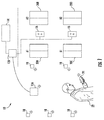
- FIG. 1 illustrates selected portions of an elevator system, generally indicated at 10.
- the elevator system 10 includes at least one elevator fixture 12A, 12B operably coupled to an elevator control system 14.
- the at least one elevator fixture 12 includes a communication bridge 12A operably coupled to a communication switch 12B.
- the communication bridge 12A may include such transceivers as a BLUETOOTH LE enabled module to name one non-limiting example.
- the communication switch 12B may include such switches as an Ethernet switch to name one non-limiting example. It will be appreciated that the communication switch 12B may be in communication with other fixtures 16, for example elevator kiosks and hall fixtures to name a couple of non-limiting examples.
- the elevator control system 14 is configured to coordinate all aspects of elevator service such as travel, speed, and accelerating, decelerating, door opening speed and delay, leveling and hall fixture signals.
- the communication bridge 12A is in further communication with a communication module 18.
- the communication module 18 includes a BLUETOOTH LE transceiver. More than one communication module 18 may be placed throughout a building or external to the building, for example at or near a bank of elevator cars 20, in a building lobby, building suite, hallways, individual offices, etc. to name a few non-limiting examples.
- the communication module 18 is configured to allow a passenger 22 to wirelessly communicate to the at least one elevator fixture 12.
- the passenger 22 when a passenger 22 typically wishes to initiate service for an elevator, the passenger 22 approaches the a hall fixture 16 and presses an up button to request travel in the up direction, or presses a down button to request travel in the down direction.
- the elevator control system 14 dispatches an elevator car 20 to the requested floor. Generally, after the arrival of the elevator car 20, the passenger 22 boards and then selects a button from the car fixture (not shown) indicative of the passenger's destination floor. The elevator car 20 then travels to the requested destination floor, where upon arrival the passenger 22 exits the elevator car 20.
- the passenger 22 operates an application program stored on a mobile device 24 to request elevator service.
- the mobile device 24 also includes a mobile device communication device (not shown) that is configured to wirelessly communicate with the at least one communication module 18.
- the mobile device 24 may be any mobile device operable to perform the functions disclosed herein, for example, a mobile telephone, tablet device, or any device capable of being carried by a person outside of a home, or other structure, to name a few non-limiting examples.
- FIG. 2 illustrates a method, generally indicated at 100, of initiating elevator service.
- the method 100 includes step 102 of operating the mobile device 24 to receive a travel request.
- receiving a travel request includes operating a program stored on the mobile device 24 to select a destination floor.
- the method 100 further includes step 104 of operating the mobile device 24 to wirelessly transmit a travel signal to the communication module 18 based on the travel request, wherein the travel signal is indicative of at least one of a direction of travel and a destination floor.
- the method 100 further includes step 106 of operating the communication module 18 to wirelessly receive the travel signal and wirelessly transmit the travel signal to the at least one elevator fixture 11. For example, once any of the communication modules 18 wirelessly receives the travel request, the communication module 18 wirelessly transmits the travel signal to the communication bridge 12A.
- the method 100 further includes step 108 of operating the elevator fixture 12 to wirelessly receive the travel signal and wirelessly transmit the travel signal to the elevator controller 14. For example, once the communication bridge 12A wirelessly receives the travel signal, the communication bridge 12A wirelessly transmits the travel signal to the communication switch 12B, which in turn transmits the travel signal to the elevator control system 14.
- the elevator control system 14 operates to determine the location, direction of current travel, speed, etc. of the elevator cars 20 in order to determine which of the elevator cars 20 could attend to the travel request based on the travel signal.
- the method 100 further includes step 110 of operating the elevator fixture 12 to receive dispatch information from the elevator control system 14, and wirelessly transmit the dispatch information to the mobile device 24.
- dispatch information includes at least one of confirmation of a dispatched car, car identification, and arrival time.
- the elevator control system 14 determines which elevator car 20A, 20B, 20C, 20D can service the travel request, the elevator control system 14 sends dispatch information to the communication switch 12B to the communication bridge 12A.
- the communication bridge 12A subsequently wirelessly transmits the dispatch information through the communication modules 18 to the mobile device 24 confirming that a car is being dispatched to the passenger's location; identifying which car 20 (e.g. "B 1") will attend to the request, and the approximate wait time for the car 20 to arrive.
- the communication bridge 12A wirelessly transmits the dispatch information to the mobile device 24.
- the method 100 further includes step 112 of the displaying the dispatch information on the mobile device 24.
- the passenger 22 may operate the mobile device 24 to view the boarding location of the selected elevator car 20 to help the passenger 22 easily navigate to the proper location.
- the dispatch information may be rendered by any means readily recognized and understood by those skilled in the arts, such as, for example, by visual and/or audible signals to alert the passenger 22 as to the proper elevator car 20 attending to the travel request.
- An example of the method 100 disclosed herein includes a scenario where the passenger 22 may enter the doors of a building. Either prior to entry or after entry the passenger 22 enters a request to travel from floor 1 to floor 11 on the application stored in the mobile device 24. As the passenger 20 navigates towards the elevator cars 20, the travel signal is transmitted from the mobile device 24 and received by one of the multiple communication modules 18 placed throughout the building. The communication module 18 receives the travel signal and transmits the travel signal to the communication bridge 12A. The communication bridge 12A receives the travel signal and transmits the travel signal to the elevator control system 14 through the communication switch 12B.
- the elevator control system 14 may best determine which elevator car 20 will answer the travel request. Alternatively, the elevator control system 14 may monitor the time of movement of the passenger 22 to best determine which elevator car 20 will answer the travel request.
- a first communication module 18 may receive and transmit the travel signal.
- the passenger 22 may pass other communication modules 18 in route.
- Each of those modules receives the travel signal and transmits the signal to the elevator control system 14 through the communication bridge 12A and communication switch 12B.
- the elevator control system 14 may monitor the time between the travel signals to best determine which elevator car 20 will answer the travel request. After the elevator control system 14 has determined which elevator car 20 will answer the travel request, the elevator control system 14 transmits the dispatch information to the mobile device 24 via the communication switch 12B, communication bridge 12A, and the communication modules 18.
- the elevator system 10 includes a communication bridge 12A in communication with communication modules 18 placed throughout a building to allow a passenger to quickly and seamlessly request elevator service without the need for manually pressing buttons on a traditional fixture.
Landscapes
- Engineering & Computer Science (AREA)
- Automation & Control Theory (AREA)
- Computer Networks & Wireless Communication (AREA)
- Indicating And Signalling Devices For Elevators (AREA)
- Elevator Control (AREA)
Abstract
Description
- The presently disclosed embodiments generally relate to elevator systems and more specifically, a system and method of initiating elevator service using a communication bridge.
- Modem elevator systems are essential in multi-story buildings. Ideal use of an elevator system requires efficient and convenient means of requesting and dispatching elevator service. Generally, a passenger seeking elevator service must first initiate service via an elevator fixture located in the hallway immediately near an elevator (or a bank of elevators). Once the elevator car arrives the passenger boards and then selects a destination floor from a number of buttons on a car fixture.
- Once the request for service is made, the passenger may have to wait up to several minutes for the car to arrive, and in certain situations, access to the car buttons may be obstructed. There is therefore a need for a more convenient and faster method of initiating an elevator call and selecting a desired destination floor.
- In one aspect, an elevator system is provided. The elevator system includes at least one elevator fixture operably coupled to an elevator control system. In one embodiment, the at least one elevator fixture includes a communication bridge operably coupled to a communication switch. The elevator control system is configured to coordinate all aspects of elevator service such as travel, speed, and accelerating, decelerating, door opening speed and delay, leveling and hall fixture signals.
- The communication bridge is in further communication with a communication module. The communication module is configured to allow a passenger to wirelessly communicate to the at least one elevator fixture.
- In one aspect, a method of initiating elevator service is provided. The method includes the steps of: operating a mobile device to receive a travel request, operating the mobile device to transmit a travel signal to the communication module based on the travel request, wherein the travel signal is indicative of at least one of a direction of travel and a destination floor, operating the communication module to wirelessly receive the travel signal and wirelessly transmit the travel signal to the one elevator fixture, operating the elevator fixture to wirelessly receive the travel signal and transmit the travel signal to the elevator controller, operating the elevator fixture to receive dispatch information from the elevator control system, and wirelessly transmit the dispatch information to the mobile device. In an embodiment, the method further includes the step of the displaying the dispatch information on the mobile device.
- In an embodiment, receiving a travel request includes operating a program stored on the mobile device to select a destination floor. In at least one embodiment, dispatch information includes at least one of confirmation of a dispatched car, car identification, and arrival time.
- Other embodiments are also disclosed, and other aspects are set forth in the claims.
-
-
FIG. 1 illustrates a schematic drawing of an elevator system; and -
FIG. 2 illustrates a schematic flow diagram of a method for initiating elevator service. - For the purposes of promoting an understanding of the principles of the present disclosure, reference will now be made to the embodiments illustrated in the drawings, and specific language will be used to describe the same. It will nevertheless be understood that no limitation of the scope of this disclosure is thereby intended.
-
FIG. 1 illustrates selected portions of an elevator system, generally indicated at 10. Theelevator system 10 includes at least oneelevator fixture elevator control system 14. In one embodiment, the at least one elevator fixture 12 includes acommunication bridge 12A operably coupled to acommunication switch 12B. - In an embodiment, the
communication bridge 12A may include such transceivers as a BLUETOOTH LE enabled module to name one non-limiting example. In an embodiment, thecommunication switch 12B may include such switches as an Ethernet switch to name one non-limiting example. It will be appreciated that thecommunication switch 12B may be in communication withother fixtures 16, for example elevator kiosks and hall fixtures to name a couple of non-limiting examples. Theelevator control system 14 is configured to coordinate all aspects of elevator service such as travel, speed, and accelerating, decelerating, door opening speed and delay, leveling and hall fixture signals. - The
communication bridge 12A is in further communication with acommunication module 18. In an embodiment, thecommunication module 18 includes a BLUETOOTH LE transceiver. More than onecommunication module 18 may be placed throughout a building or external to the building, for example at or near a bank of elevator cars 20, in a building lobby, building suite, hallways, individual offices, etc. to name a few non-limiting examples. Thecommunication module 18 is configured to allow apassenger 22 to wirelessly communicate to the at least one elevator fixture 12. - For example, when a
passenger 22 typically wishes to initiate service for an elevator, thepassenger 22 approaches the ahall fixture 16 and presses an up button to request travel in the up direction, or presses a down button to request travel in the down direction. - The
elevator control system 14 dispatches an elevator car 20 to the requested floor. Generally, after the arrival of the elevator car 20, thepassenger 22 boards and then selects a button from the car fixture (not shown) indicative of the passenger's destination floor. The elevator car 20 then travels to the requested destination floor, where upon arrival thepassenger 22 exits the elevator car 20. - In the present embodiment, the
passenger 22 operates an application program stored on amobile device 24 to request elevator service. Themobile device 24 also includes a mobile device communication device (not shown) that is configured to wirelessly communicate with the at least onecommunication module 18. It will be appreciated that themobile device 24 may be any mobile device operable to perform the functions disclosed herein, for example, a mobile telephone, tablet device, or any device capable of being carried by a person outside of a home, or other structure, to name a few non-limiting examples. -
FIG. 2 illustrates a method, generally indicated at 100, of initiating elevator service. Themethod 100 includesstep 102 of operating themobile device 24 to receive a travel request. In an embodiment, receiving a travel request includes operating a program stored on themobile device 24 to select a destination floor. - The
method 100 further includesstep 104 of operating themobile device 24 to wirelessly transmit a travel signal to thecommunication module 18 based on the travel request, wherein the travel signal is indicative of at least one of a direction of travel and a destination floor. - The
method 100 further includes step 106 of operating thecommunication module 18 to wirelessly receive the travel signal and wirelessly transmit the travel signal to the at least one elevator fixture 11. For example, once any of thecommunication modules 18 wirelessly receives the travel request, thecommunication module 18 wirelessly transmits the travel signal to thecommunication bridge 12A. - The
method 100 further includesstep 108 of operating the elevator fixture 12 to wirelessly receive the travel signal and wirelessly transmit the travel signal to theelevator controller 14. For example, once thecommunication bridge 12A wirelessly receives the travel signal, thecommunication bridge 12A wirelessly transmits the travel signal to thecommunication switch 12B, which in turn transmits the travel signal to theelevator control system 14. Theelevator control system 14 operates to determine the location, direction of current travel, speed, etc. of the elevator cars 20 in order to determine which of the elevator cars 20 could attend to the travel request based on the travel signal. - The
method 100 further includesstep 110 of operating the elevator fixture 12 to receive dispatch information from theelevator control system 14, and wirelessly transmit the dispatch information to themobile device 24. In at least one embodiment, dispatch information includes at least one of confirmation of a dispatched car, car identification, and arrival time. - For example, once the
elevator control system 14 determines whichelevator car elevator control system 14 sends dispatch information to thecommunication switch 12B to thecommunication bridge 12A. Thecommunication bridge 12A subsequently wirelessly transmits the dispatch information through thecommunication modules 18 to themobile device 24 confirming that a car is being dispatched to the passenger's location; identifying which car 20 (e.g. "B 1") will attend to the request, and the approximate wait time for the car 20 to arrive. As thepassenger 22 continues to walk through the building to the elevator cars 20, and/or as thepassenger 22 waits for the elevator car 20 to arrive, thecommunication bridge 12A wirelessly transmits the dispatch information to themobile device 24. - In an embodiment, the
method 100 further includesstep 112 of the displaying the dispatch information on themobile device 24. For example, thepassenger 22 may operate themobile device 24 to view the boarding location of the selected elevator car 20 to help thepassenger 22 easily navigate to the proper location. It will be appreciated that the dispatch information may be rendered by any means readily recognized and understood by those skilled in the arts, such as, for example, by visual and/or audible signals to alert thepassenger 22 as to the proper elevator car 20 attending to the travel request. - An example of the
method 100 disclosed herein includes a scenario where thepassenger 22 may enter the doors of a building. Either prior to entry or after entry thepassenger 22 enters a request to travel from floor 1 to floor 11 on the application stored in themobile device 24. As the passenger 20 navigates towards the elevator cars 20, the travel signal is transmitted from themobile device 24 and received by one of themultiple communication modules 18 placed throughout the building. Thecommunication module 18 receives the travel signal and transmits the travel signal to thecommunication bridge 12A. Thecommunication bridge 12A receives the travel signal and transmits the travel signal to theelevator control system 14 through thecommunication switch 12B. - Based on which
communication module 18 received and transmitted the travel signal, theelevator control system 14 may best determine which elevator car 20 will answer the travel request. Alternatively, theelevator control system 14 may monitor the time of movement of thepassenger 22 to best determine which elevator car 20 will answer the travel request. - For example, when the
passenger 22 enters the building afirst communication module 18 may receive and transmit the travel signal. As thepassenger 22 moves towards the elevator cars 20, thepassenger 22 may passother communication modules 18 in route. Each of those modules receives the travel signal and transmits the signal to theelevator control system 14 through thecommunication bridge 12A andcommunication switch 12B. Theelevator control system 14 may monitor the time between the travel signals to best determine which elevator car 20 will answer the travel request. After theelevator control system 14 has determined which elevator car 20 will answer the travel request, theelevator control system 14 transmits the dispatch information to themobile device 24 via thecommunication switch 12B,communication bridge 12A, and thecommunication modules 18. - It will be appreciated that the
elevator system 10 includes acommunication bridge 12A in communication withcommunication modules 18 placed throughout a building to allow a passenger to quickly and seamlessly request elevator service without the need for manually pressing buttons on a traditional fixture. - While the present disclosure has been illustrated and described in detail in the drawings and foregoing description, the same is to be considered as illustrative and not restrictive in character, it being understood that only certain embodiments have been shown and described and that all changes and modifications that come within the scope of the present disclosure are desired to be protected.
Claims (15)
- An elevator system (10) operable within a building, the elevator system (10) comprising:an elevator control system (14) configured to receive a travel signal, generate dispatch information based in part on the travel signal, and transmit the dispatch information;an elevator fixture (12) configured to wirelessly receive the travel signal and wirelessly transmit the dispatch information, the elevator fixture (12) operably coupled to the elevator control system and configured to transmit the travel signal to the elevator control system (14) and receive the dispatch information from the elevator control system (14); anda communication module (18) configured to wirelessly receive and transmit the travel signal and the dispatch information, the at least one communication module (18) in communication with the elevator fixture (12).
- The elevator system of claim 1, further comprising a mobile device (24) configured to wirelessly transmit the travel signal and wirelessly receive the dispatch information, the mobile device (24) in communication with the communication module (18).
- The elevator system of claim 1 or 2, wherein the communication module (18) is disposed in a location of at least one of internally and externally to the building.
- The elevator system of any preceding claim, wherein the travel signal is indicative of at least one of a direction of travel and a destination floor.
- The elevator system of any preceding claim, wherein the elevator fixture (12) comprises a communication bridge (12A) operably coupled to a communication switch (12B).
- The elevator system of claim 5, wherein the communication bridge (12A) comprises a BLUETOOTH LE transceiver.
- The elevator system of claim 5 or 6, wherein the communication switch (12B) comprises an Ethernet switch.
- The elevator system of any preceding claim, wherein the communication module (18) comprises a BLUETOOTH LE transceiver.
- The elevator system of any of claims 2 to 8, wherein the mobile device (24) comprises at least one of a mobile telephone and a tablet device.
- A method of initiating elevator service for an elevator system (10) including an elevator fixture (12) in communication with an elevator control system (14) and a communication module (18), and a mobile device (24) in communication with the communication module (18), the method comprising:(a) operating the mobile device (24) to receive a travel request;(b) operating the mobile device (24) to wirelessly transmit to the communication module (18) a travel signal based on the travel request;(c) operating the communication module (18) to wirelessly receive the travel signal and to wirelessly transmit the travel signal to the elevator fixture (12);(d) operating the elevator fixture to wirelessly receive the travel signal and to transmit the travel signal to the elevator control system (14); and(e) operating the elevator fixture to receive dispatch information from the elevator control system (14) and wirelessly transmit the dispatch information to the communication module (18).
- The method of claim10, wherein step (a) comprises operating a program stored on the mobile device (24) to select a destination floor.
- The method of claim 10 or 11, wherein the travel signal is indicative of at least one of a direction of travel and a destination floor.
- The method of claim 10, 11 or 12 wherein step (c) further comprises operating the communication module (18) to determine an approximate location of the mobile device (24) based at least in part on the location of the communication module (18) transmitting the travel signal.
- The method of any of claims 10 to 13, wherein the at least one elevator fixture (12) comprises a communication bridge (12A) operably coupled to a communication switch (12B).
- The method of any of claims 10 to 14, wherein step (e) further comprises:(i) operating the elevator fixture (12) to transmit the travel signal to the elevator control system (14);(ii) operating the elevator control system (14) to determine dispatch information.
Applications Claiming Priority (1)
| Application Number | Priority Date | Filing Date | Title |
|---|---|---|---|
| US201562211176P | 2015-08-28 | 2015-08-28 |
Publications (1)
| Publication Number | Publication Date |
|---|---|
| EP3141509A1 true EP3141509A1 (en) | 2017-03-15 |
Family
ID=56802362
Family Applications (1)
| Application Number | Title | Priority Date | Filing Date |
|---|---|---|---|
| EP16185908.7A Withdrawn EP3141509A1 (en) | 2015-08-28 | 2016-08-26 | System and method of initiating elevator service using a communication bridge |
Country Status (3)
| Country | Link |
|---|---|
| US (1) | US20170057781A1 (en) |
| EP (1) | EP3141509A1 (en) |
| CN (1) | CN106744090A (en) |
Cited By (3)
| Publication number | Priority date | Publication date | Assignee | Title |
|---|---|---|---|---|
| EP3348506A1 (en) * | 2017-01-13 | 2018-07-18 | Otis Elevator Company | Communication system and method of communication in an elevator operating environment |
| EP3544263A1 (en) * | 2018-03-20 | 2019-09-25 | Otis Elevator Company | Direct real-time travel indications for multi-segment trip |
| CN110407043A (en) * | 2018-04-26 | 2019-11-05 | 奥的斯电梯公司 | Communication for elevator service request |
Families Citing this family (11)
| Publication number | Priority date | Publication date | Assignee | Title |
|---|---|---|---|---|
| US10472207B2 (en) | 2017-03-31 | 2019-11-12 | Otis Elevator Company | Passenger-initiated dynamic elevator service request |
| US11584613B2 (en) * | 2017-06-23 | 2023-02-21 | Otis Elevator Comapny | Determination for motion of passenger over elevator landing area |
| CN109867176B (en) * | 2017-12-05 | 2023-02-21 | 奥的斯电梯公司 | Automatic acquisition of floor information |
| CN109941852A (en) | 2017-12-20 | 2019-06-28 | 奥的斯电梯公司 | Automatic call system and automatic call control method |
| CN110228735B (en) * | 2018-03-06 | 2022-08-02 | 奥的斯电梯公司 | Elevator service request and offline authentication of elevator service request |
| US11993483B2 (en) * | 2018-04-19 | 2024-05-28 | Otis Elevator Company | E-call registration for elevator |
| EP3587320B1 (en) * | 2018-06-25 | 2021-03-24 | Otis Elevator Company | Wireless connectivity in an elevator system |
| US12172865B2 (en) | 2018-09-14 | 2024-12-24 | Otis Elevator Company | System and method for assigning elevator service based on passenger priority |
| US10865069B2 (en) * | 2018-09-18 | 2020-12-15 | Otis Elevator Company | Effecting communication bridge with elevator system |
| CN110902512B (en) | 2018-09-18 | 2023-04-21 | 奥的斯电梯公司 | Notification system and notification method for elevator and elevator system |
| JP7309978B1 (en) | 2022-06-20 | 2023-07-18 | 東芝エレベータ株式会社 | elevator system |
Citations (6)
| Publication number | Priority date | Publication date | Assignee | Title |
|---|---|---|---|---|
| WO2002066358A1 (en) * | 2001-02-22 | 2002-08-29 | Kone Corporation | Control method and apparatus for passenger transportation |
| US6968153B1 (en) * | 2002-03-13 | 2005-11-22 | Nokia Corporation | Apparatus, method and system for a Bluetooth repeater |
| US20070041352A1 (en) * | 2005-08-18 | 2007-02-22 | Frankel James L | Elevator calling mechanism and method |
| US20070151809A1 (en) * | 2004-06-28 | 2007-07-05 | Kone Corporation | Elevator arrangement |
| US20080264731A1 (en) * | 2005-10-04 | 2008-10-30 | Mangini Richard J | Wireless, Self-Contained Elevator Call Request Entry System |
| US8485317B2 (en) * | 2008-01-17 | 2013-07-16 | Inventio Ag | Lift installation control system that interfaces with mobile devices |
Family Cites Families (4)
| Publication number | Priority date | Publication date | Assignee | Title |
|---|---|---|---|---|
| WO2005047158A1 (en) * | 2003-11-17 | 2005-05-26 | Inlink Technologies Pty Ltd | A system and method for forming information pertaining to a transportation device |
| US7162233B2 (en) * | 2004-04-07 | 2007-01-09 | Mitsubishi Denki Kabushiki Kaisha | Elevator call registration system |
| EP2669232B1 (en) * | 2011-01-26 | 2019-09-11 | Mitsubishi Electric Corporation | Group management control device for elevator |
| US10239728B2 (en) * | 2015-04-09 | 2019-03-26 | Carrier Corporation | Intelligent building system for providing elevator occupancy information with anonymity |
-
2016
- 2016-08-26 EP EP16185908.7A patent/EP3141509A1/en not_active Withdrawn
- 2016-08-29 US US15/250,483 patent/US20170057781A1/en not_active Abandoned
- 2016-08-29 CN CN201610754047.6A patent/CN106744090A/en active Pending
Patent Citations (6)
| Publication number | Priority date | Publication date | Assignee | Title |
|---|---|---|---|---|
| WO2002066358A1 (en) * | 2001-02-22 | 2002-08-29 | Kone Corporation | Control method and apparatus for passenger transportation |
| US6968153B1 (en) * | 2002-03-13 | 2005-11-22 | Nokia Corporation | Apparatus, method and system for a Bluetooth repeater |
| US20070151809A1 (en) * | 2004-06-28 | 2007-07-05 | Kone Corporation | Elevator arrangement |
| US20070041352A1 (en) * | 2005-08-18 | 2007-02-22 | Frankel James L | Elevator calling mechanism and method |
| US20080264731A1 (en) * | 2005-10-04 | 2008-10-30 | Mangini Richard J | Wireless, Self-Contained Elevator Call Request Entry System |
| US8485317B2 (en) * | 2008-01-17 | 2013-07-16 | Inventio Ag | Lift installation control system that interfaces with mobile devices |
Cited By (6)
| Publication number | Priority date | Publication date | Assignee | Title |
|---|---|---|---|---|
| EP3348506A1 (en) * | 2017-01-13 | 2018-07-18 | Otis Elevator Company | Communication system and method of communication in an elevator operating environment |
| EP3544263A1 (en) * | 2018-03-20 | 2019-09-25 | Otis Elevator Company | Direct real-time travel indications for multi-segment trip |
| US10988345B2 (en) | 2018-03-20 | 2021-04-27 | Otis Elevator Company | Direct real-time travel indications for multi-segment trip |
| CN110407043A (en) * | 2018-04-26 | 2019-11-05 | 奥的斯电梯公司 | Communication for elevator service request |
| EP3620417A1 (en) * | 2018-04-26 | 2020-03-11 | Otis Elevator Company | Communication for elevator service request |
| US11708237B2 (en) | 2018-04-26 | 2023-07-25 | Otis Elevator Company | Communication for elevator service request |
Also Published As
| Publication number | Publication date |
|---|---|
| CN106744090A (en) | 2017-05-31 |
| US20170057781A1 (en) | 2017-03-02 |
Similar Documents
| Publication | Publication Date | Title |
|---|---|---|
| EP3141509A1 (en) | System and method of initiating elevator service using a communication bridge | |
| AU2018203884B2 (en) | Reassignment of elevators for mobile device users | |
| US20190077630A1 (en) | System and method of initiating a hall and car call for an elevator system | |
| EP3011521B1 (en) | Mobile application based dispatching | |
| EP3505474A2 (en) | Method of dispatching optimization based on sensing | |
| US20190106290A1 (en) | System and method for dispatching an elevator | |
| JP2009502691A (en) | Method for assigning users to elevator systems | |
| JP6698853B2 (en) | Smart watches and elevators and guidance systems | |
| US20170134894A1 (en) | System and method of locating elevator systems compatible with a mobile hall call and car call system | |
| US10598496B2 (en) | Local navigation system | |
| EP3640181B1 (en) | Elevator passenger interface including special assistance features | |
| JP2008502561A (en) | Interface system for passengers in transport equipment | |
| KR100554918B1 (en) | Elevator reservation system and method | |
| CN110182660B (en) | Elevator system | |
| JP7677738B1 (en) | Elevator control system and elevator control method | |
| JP2016183044A (en) | Elevator system | |
| WO2023037035A1 (en) | Aid and rescue by elevator in a residential building | |
| KR102693684B1 (en) | Management system of autonomous driving robot for moving between floors | |
| KR102697179B1 (en) | Management system of autonomous driving robot for moving between floors | |
| EP4368552B1 (en) | Detecting a probe request in a method and in a system for controlling an elevator car | |
| EP3371087A1 (en) | Locating elevator systems |
Legal Events
| Date | Code | Title | Description |
|---|---|---|---|
| PUAI | Public reference made under article 153(3) epc to a published international application that has entered the european phase |
Free format text: ORIGINAL CODE: 0009012 |
|
| STAA | Information on the status of an ep patent application or granted ep patent |
Free format text: STATUS: THE APPLICATION HAS BEEN PUBLISHED |
|
| AK | Designated contracting states |
Kind code of ref document: A1 Designated state(s): AL AT BE BG CH CY CZ DE DK EE ES FI FR GB GR HR HU IE IS IT LI LT LU LV MC MK MT NL NO PL PT RO RS SE SI SK SM TR |
|
| AX | Request for extension of the european patent |
Extension state: BA ME |
|
| RAP1 | Party data changed (applicant data changed or rights of an application transferred) |
Owner name: OTIS ELEVATOR COMPANY |
|
| STAA | Information on the status of an ep patent application or granted ep patent |
Free format text: STATUS: REQUEST FOR EXAMINATION WAS MADE |
|
| 17P | Request for examination filed |
Effective date: 20170915 |
|
| RBV | Designated contracting states (corrected) |
Designated state(s): AL AT BE BG CH CY CZ DE DK EE ES FI FR GB GR HR HU IE IS IT LI LT LU LV MC MK MT NL NO PL PT RO RS SE SI SK SM TR |
|
| STAA | Information on the status of an ep patent application or granted ep patent |
Free format text: STATUS: EXAMINATION IS IN PROGRESS |
|
| 17Q | First examination report despatched |
Effective date: 20180530 |
|
| STAA | Information on the status of an ep patent application or granted ep patent |
Free format text: STATUS: THE APPLICATION IS DEEMED TO BE WITHDRAWN |
|
| 18D | Application deemed to be withdrawn |
Effective date: 20201120 |