EP3141263A1 - Metal-organic framework/stimulus-responsive polymer composite capable of controlling release of guest - Google Patents
Metal-organic framework/stimulus-responsive polymer composite capable of controlling release of guest Download PDFInfo
- Publication number
- EP3141263A1 EP3141263A1 EP15788881.9A EP15788881A EP3141263A1 EP 3141263 A1 EP3141263 A1 EP 3141263A1 EP 15788881 A EP15788881 A EP 15788881A EP 3141263 A1 EP3141263 A1 EP 3141263A1
- Authority
- EP
- European Patent Office
- Prior art keywords
- responsive polymer
- metal
- organic framework
- temperature
- poly
- Prior art date
- Legal status (The legal status is an assumption and is not a legal conclusion. Google has not performed a legal analysis and makes no representation as to the accuracy of the status listed.)
- Withdrawn
Links
- 0 CCC(C(NC(C)C)=O)SCCC(ON(C(CC1)=O)*1=O)=O Chemical compound CCC(C(NC(C)C)=O)SCCC(ON(C(CC1)=O)*1=O)=O 0.000 description 1
- GPNNOCMCNFXRAO-UHFFFAOYSA-N Nc(cc(cc1)C(O)=O)c1C(O)=O Chemical compound Nc(cc(cc1)C(O)=O)c1C(O)=O GPNNOCMCNFXRAO-UHFFFAOYSA-N 0.000 description 1
Images


Classifications
-
- A—HUMAN NECESSITIES
- A61—MEDICAL OR VETERINARY SCIENCE; HYGIENE
- A61K—PREPARATIONS FOR MEDICAL, DENTAL OR TOILETRY PURPOSES
- A61K47/00—Medicinal preparations characterised by the non-active ingredients used, e.g. carriers or inert additives; Targeting or modifying agents chemically bound to the active ingredient
- A61K47/30—Macromolecular organic or inorganic compounds, e.g. inorganic polyphosphates
- A61K47/32—Macromolecular compounds obtained by reactions only involving carbon-to-carbon unsaturated bonds, e.g. carbomers, poly(meth)acrylates, or polyvinyl pyrrolidone
-
- A—HUMAN NECESSITIES
- A61—MEDICAL OR VETERINARY SCIENCE; HYGIENE
- A61K—PREPARATIONS FOR MEDICAL, DENTAL OR TOILETRY PURPOSES
- A61K31/00—Medicinal preparations containing organic active ingredients
- A61K31/16—Amides, e.g. hydroxamic acids
- A61K31/165—Amides, e.g. hydroxamic acids having aromatic rings, e.g. colchicine, atenolol, progabide
- A61K31/166—Amides, e.g. hydroxamic acids having aromatic rings, e.g. colchicine, atenolol, progabide having the carbon of a carboxamide group directly attached to the aromatic ring, e.g. procainamide, procarbazine, metoclopramide, labetalol
-
- A—HUMAN NECESSITIES
- A61—MEDICAL OR VETERINARY SCIENCE; HYGIENE
- A61K—PREPARATIONS FOR MEDICAL, DENTAL OR TOILETRY PURPOSES
- A61K31/00—Medicinal preparations containing organic active ingredients
- A61K31/33—Heterocyclic compounds
- A61K31/395—Heterocyclic compounds having nitrogen as a ring hetero atom, e.g. guanethidine or rifamycins
- A61K31/495—Heterocyclic compounds having nitrogen as a ring hetero atom, e.g. guanethidine or rifamycins having six-membered rings with two or more nitrogen atoms as the only ring heteroatoms, e.g. piperazine or tetrazines
- A61K31/505—Pyrimidines; Hydrogenated pyrimidines, e.g. trimethoprim
- A61K31/519—Pyrimidines; Hydrogenated pyrimidines, e.g. trimethoprim ortho- or peri-condensed with heterocyclic rings
- A61K31/52—Purines, e.g. adenine
- A61K31/522—Purines, e.g. adenine having oxo groups directly attached to the heterocyclic ring, e.g. hypoxanthine, guanine, acyclovir
-
- A—HUMAN NECESSITIES
- A61—MEDICAL OR VETERINARY SCIENCE; HYGIENE
- A61K—PREPARATIONS FOR MEDICAL, DENTAL OR TOILETRY PURPOSES
- A61K31/00—Medicinal preparations containing organic active ingredients
- A61K31/33—Heterocyclic compounds
- A61K31/395—Heterocyclic compounds having nitrogen as a ring hetero atom, e.g. guanethidine or rifamycins
- A61K31/535—Heterocyclic compounds having nitrogen as a ring hetero atom, e.g. guanethidine or rifamycins having six-membered rings with at least one nitrogen and one oxygen as the ring hetero atoms, e.g. 1,2-oxazines
- A61K31/5375—1,4-Oxazines, e.g. morpholine
- A61K31/538—1,4-Oxazines, e.g. morpholine ortho- or peri-condensed with carbocyclic ring systems
-
- A—HUMAN NECESSITIES
- A61—MEDICAL OR VETERINARY SCIENCE; HYGIENE
- A61K—PREPARATIONS FOR MEDICAL, DENTAL OR TOILETRY PURPOSES
- A61K41/00—Medicinal preparations obtained by treating materials with wave energy or particle radiation ; Therapies using these preparations
- A61K41/0042—Photocleavage of drugs in vivo, e.g. cleavage of photolabile linkers in vivo by UV radiation for releasing the pharmacologically-active agent from the administered agent; photothrombosis or photoocclusion
-
- A—HUMAN NECESSITIES
- A61—MEDICAL OR VETERINARY SCIENCE; HYGIENE
- A61K—PREPARATIONS FOR MEDICAL, DENTAL OR TOILETRY PURPOSES
- A61K47/00—Medicinal preparations characterised by the non-active ingredients used, e.g. carriers or inert additives; Targeting or modifying agents chemically bound to the active ingredient
- A61K47/30—Macromolecular organic or inorganic compounds, e.g. inorganic polyphosphates
- A61K47/34—Macromolecular compounds obtained otherwise than by reactions only involving carbon-to-carbon unsaturated bonds, e.g. polyesters, polyamino acids, polysiloxanes, polyphosphazines, copolymers of polyalkylene glycol or poloxamers
-
- A—HUMAN NECESSITIES
- A61—MEDICAL OR VETERINARY SCIENCE; HYGIENE
- A61K—PREPARATIONS FOR MEDICAL, DENTAL OR TOILETRY PURPOSES
- A61K47/00—Medicinal preparations characterised by the non-active ingredients used, e.g. carriers or inert additives; Targeting or modifying agents chemically bound to the active ingredient
- A61K47/50—Medicinal preparations characterised by the non-active ingredients used, e.g. carriers or inert additives; Targeting or modifying agents chemically bound to the active ingredient the non-active ingredient being chemically bound to the active ingredient, e.g. polymer-drug conjugates
- A61K47/51—Medicinal preparations characterised by the non-active ingredients used, e.g. carriers or inert additives; Targeting or modifying agents chemically bound to the active ingredient the non-active ingredient being chemically bound to the active ingredient, e.g. polymer-drug conjugates the non-active ingredient being a modifying agent
- A61K47/56—Medicinal preparations characterised by the non-active ingredients used, e.g. carriers or inert additives; Targeting or modifying agents chemically bound to the active ingredient the non-active ingredient being chemically bound to the active ingredient, e.g. polymer-drug conjugates the non-active ingredient being a modifying agent the modifying agent being an organic macromolecular compound, e.g. an oligomeric, polymeric or dendrimeric molecule
- A61K47/58—Medicinal preparations characterised by the non-active ingredients used, e.g. carriers or inert additives; Targeting or modifying agents chemically bound to the active ingredient the non-active ingredient being chemically bound to the active ingredient, e.g. polymer-drug conjugates the non-active ingredient being a modifying agent the modifying agent being an organic macromolecular compound, e.g. an oligomeric, polymeric or dendrimeric molecule obtained by reactions only involving carbon-to-carbon unsaturated bonds, e.g. poly[meth]acrylate, polyacrylamide, polystyrene, polyvinylpyrrolidone, polyvinylalcohol or polystyrene sulfonic acid resin
-
- A—HUMAN NECESSITIES
- A61—MEDICAL OR VETERINARY SCIENCE; HYGIENE
- A61K—PREPARATIONS FOR MEDICAL, DENTAL OR TOILETRY PURPOSES
- A61K47/00—Medicinal preparations characterised by the non-active ingredients used, e.g. carriers or inert additives; Targeting or modifying agents chemically bound to the active ingredient
- A61K47/50—Medicinal preparations characterised by the non-active ingredients used, e.g. carriers or inert additives; Targeting or modifying agents chemically bound to the active ingredient the non-active ingredient being chemically bound to the active ingredient, e.g. polymer-drug conjugates
- A61K47/69—Medicinal preparations characterised by the non-active ingredients used, e.g. carriers or inert additives; Targeting or modifying agents chemically bound to the active ingredient the non-active ingredient being chemically bound to the active ingredient, e.g. polymer-drug conjugates the conjugate being characterised by physical or galenical forms, e.g. emulsion, particle, inclusion complex, stent or kit
- A61K47/6949—Medicinal preparations characterised by the non-active ingredients used, e.g. carriers or inert additives; Targeting or modifying agents chemically bound to the active ingredient the non-active ingredient being chemically bound to the active ingredient, e.g. polymer-drug conjugates the conjugate being characterised by physical or galenical forms, e.g. emulsion, particle, inclusion complex, stent or kit inclusion complexes, e.g. clathrates, cavitates or fullerenes
Definitions
- the present invention relates to a metal-organic framework/stimulus-responsive polymer composite capable of controlling release of guest molecules. More particularly, the present invention relates to a metal-organic framework comprised of organic ligands and metal ions linking the organic ligands, and a metal-organic framework/stimulus-responsive polymer composite in which a stimulus-responsive polymer being immobilized on at least a part of the surface of the metal-organic framework. The present invention further relates to a method for manufacturing a metal-organic framework/stimulus responsive polymer composite and to a method for manufacturing a metal-organic framework/stimulus responsive polymer composite containing a guest molecule.
- Metal-organic frameworks are known as organic porous substances having organic materials in a base structure and nano-order pores (see Nonpatent Reference 1).
- a metal-organic framework is a framework in which organic ligands are accumulated by means of coordination bonds with metal ions.
- MOFs are porous substances, they have the functions of trapping and releasing guest molecules, and their use as storage materials is anticipated. In particular, the releasing of guest molecules is an important function in use as a storage material.
- Known examples of reports relating to controlling the release of guest molecules by MOFs are: 1) those based on the addition of cations (Na + ) to MOFs (Nonpatent Reference 2); 2) those in which an MOF is coated with silica and the decomposition of the MOF in response to pH is utilized (Nonpatent Reference 3); and 3) those utilizing drug molecules in the MOF structure and utilizing decomposition of the MOF (Nonpatent Reference 4).
- Nonpatent References 1 to 4 are expressly incorporated herein by reference in its entirety.
- Nonpatent References 2 to 4 the release of guest molecules by the MOFs described in Nonpatent References 2 to 4 is achieved utilizing irreversible phenomena. MOFs affording reversible means of controlling the release are not known. In addition, a means permitting a rapid release control and a means permitting managing of the release of a variety of guest molecules are not known as well.
- the present invention has for its object to provide an MOF having a controlled guest release function that enables to achieve the reversible release control, the rapid release control and the managing of the release of variety of guest molecules.
- a further object of the present invention is to provide a guest molecule-containing MOF employing an MOF having a function controlling the release of the guest.
- the present invention is as set forth below.
- the present invention provides an MOF having a guest-molecule release control function that permits reversible release control, permits rapid release control, and can handle the release of a variety of guest molecules.
- the present invention relates to a metal-organic framework/stimulus-responsive polymer composite, comprising a metal-organic framework containing organic ligands having at least two functional groups capable of coordinating metal atoms (coordinating functional groups) and metal ions bonding with the coordinating functional groups of the organic ligands, and having a structure in which multiple organic ligands are connected such that one metal ion bonds with two or more coordinating functional groups, with a stimulus-responsive polymer being immobilized on at least a part of the surface of the metal-organic framework.
- the stimulus-responsive polymer is desirably immobilized by bonding with the organic ligands.
- the metal-organic framework is a substance that is obtained by solvothermally reacting the organic ligands and the metal ions.
- a description of the basic structure thereof is given, for example, in WO 2012/120905 .
- the description of WO 2012/120905 is hereby incorporated in its entirety by reference.
- the organic ligands have a molecular structure that is referred to as a "rigid molecule".
- the term "rigid molecule” is a molecule in which rotation and bending within the molecule are restricted. Examples are cyclic molecules, and aromatic rings or rod-shaped molecules connecting aromatic rings. Cyclodextrin is an example of a cyclic molecule. Examples of aromatic rings are phenylene, naphthalene, anthracenylene, pentacene, porphyrin, carborane, thiophene, pyridine, and fullerene (such as C60). Examples of rigid molecules are molecules containing one of these aromatic rings and molecules in which two or more aromatic rings are connected.
- the rigid molecule is desirably a molecule comprising one phenylene structure, a molecule having a diphenylene structure in which two phenylenes are connected, or a molecule having a terphenylene structure in which three phenylene groups are connected.
- the organic ligand is a compound in which two or more functional groups capable of coordinating metal ions (coordinating functional groups) are present.
- coordinating functional groups are carboxyl groups, pyridinyl groups, cyano groups, amino groups, sulfonyl groups, porphyrinyl groups, acetyl acetonate groups, hydroxyl groups, Schiff bases, and amino acid residues.
- Desirable coordinating functional groups are carboxyl groups, pyridyl groups, cyano groups, amino groups, and sulfonyl groups. Carboxyl groups are preferred. The presence of a coordinating functional group in the form of a carboxyl group permits the formation of strong coordination bonds with metal ions.
- each organic ligand can have two or more coordinating functional groups at any positions of the organic ligands.
- the coordinating functional groups can be present at the ends of the organic ligand, which is desirable from the perspective of obtaining a metal-organic framework the structure of which can be readily controlled and which affords relatively large pores.
- the organic ligand desirably has a reactive functional group reactive with the reactive functional group present on the stimulus-responsive polymer.
- a reactive functional group reactive with the reactive functional group present on the stimulus-responsive polymer One or two or more of such reactive functional groups can be incorporated into a single organic ligand.
- the type of reactive functional group can be suitably selected based on the type of reactive functional group present on the stimulus-responsive polymer. Examples are amino groups, azide groups, analogs thereof, double bonds, triple bonds, isocyanate groups, hydroxyl groups, thiol groups, and aldehyde groups.
- the reactive functional group that is present on the stimulus-responsive polymer is a succinimide group or isocyanate group
- the reactive functional group can be an amino group.
- the reactive functional group that is present on the stimulus-responsive polymer is an alkynyl group
- the reactive functional group can be an azide group.
- a mixed system of organic ligands that do not comprise reactive functional groups and organic ligands that comprises reactive functional groups can be used.
- organic ligands having different types of reactive functional groups can be employed, temperature-responsive polymers of differing types having reactive functional groups of differing types with different physical properties can coexist on a single metal-organic framework.
- the metal ions can be metal ions of actinide elements or lanthanide elements in the form of metal elements of groups 1 through 16 of the Periodical Table of the Elements.
- Specific examples of metal ions are Li + , Na + , K + , Rb + , Be 2+ , Mg 2+ , Ca 2+ , Sr 2+ , Ba 2+ , SC 3+ , Y 3+ , Ti 4+ , Zr 4+ , Hf 4+ , V 4+ , V 3+ , V 2+ , Nb 3+ , Ta 3+ , Cr 3+ , Mo 3+ , W 3+ , Mn 3+ , Mn 2+ , Re 3+ , Re 2+ , Fe 3+ , Fe 2+ , Ru 3+ , Ru 2+ , Os 3+ , Os 2+ , Co 3+ , Co 2+ , Rh 2+ , Rh + , Ir 2+ , Ir + , Ni 2+ ,
- the metal-organic framework can be manufactured by, for example, a solvothermal reaction of the organic ligands and metal ions by the usual methods (such as S. M. Cohen eta l., Chem. Commun., 2010, 46, 7700 ; V. Guillerm et al., Chem. Commun., 2010, 46, 767 ; N. Stock et al., Chem. Rev. 2012, 112, 933-969 ; and O. M. Yaghi et al., Science, 2002, 295, 469 (the entire contents of which are hereby incorporated by reference).
- the solvothermal reaction is normally conducted in the presence of an acid or a base at from room temperature to an elevated temperature (300°C).
- Solvent and starting materials are introduced under atmospheric pressure or into a pressurized vessel, the temperature is raised to above the boiling point, and the reaction is conducted under conditions where the pressure within the vessel is greater than or equal to atmospheric pressure.
- N,N-diethylformamide (DEF) or N,N-dimethylformamide (DMF) can be employed as the solvent in the solvothermal reaction since they decompose at elevated temperature, gradually producing amine bases.
- the conditions of the solvothermal reaction can be suitably set.
- the metal-organic framework desirably has crystalline properties. From the perspective of facilitating the manufacturing of a metal-organic framework having crystalline properties or being highly crystalline, an inhibitor capable of controlling the surface energy during crystal growth, such as an organic acid such as acetic acid, or benzoic acid, can be employed. However, a metal-organic framework that has crystalline properties or is highly crystalline can be manufactured without use of an inhibitor. The presence of crystalline properties can be confirmed by observing the diffraction pattern in X-ray diffraction.
- the metal-organic framework is a porous substance having nano-order pores.
- the size of the pores is controlled by means of the length of the organic ligands in the lengthwise direction (the distance between coordinating functional groups present on the organic ligands).
- the pore diameter for example, falls within a range of 0.1 to 10 nm, a range of 0.1 to 5 nm, a range of 0.1 to 3 nm, a range of 0.1 to 2 nm, or a range of 0.1 to 1 nm.
- suitable adjustment can be achieved through selection of the organic ligands.
- the metal-organic framework is a powder or particulate material.
- the diameter of the particles for example, falls within a range of from 1 nm to 5 mm, within a range of 10 nm to 4 mm, within a range of 30 nm to 3 mm, or within a range of 50 nm to 2 mm.
- the particle diameter of the metal-organic framework can be controlled over a broad range through selection of the synthesis conditions. A small size in the form of nano-order particles can be achieved, while a large size in the form of milli-order particles can be achieved.
- the metal-organic framework/stimulus-responsive polymer composite of the present invention is a metal-organic framework/stimulus-responsive polymer composite in which a stimulus-responsive polymer is immobilized on at least a part of the surface of the metal-organic framework.
- the temperature-responsive polymer is generally a polymer the solubility in water of which changes dramatically with changes in temperature.
- Such polymers come in types: the LCST type, which is soluble in water at low temperatures but becomes insoluble when the temperature is raised to a certain level (the lower critical solution temperature: LCST) and the UCST type, which is soluble in water at elevated temperatures but becomes insoluble when the temperature is increased to a certain level (the upper critical solution temperature: UCST).
- the average molecular weight of the temperature-responsive polymer is not specifically limited.
- the number average molecular weight falls within a range of 1,000 to 30,000, desirably within a range of 1,000 to 20,000, preferably within a range of 1,000 to 10,000, more preferably within a range of 1,000 to 8,000, and optimally, within a range of 1,000 to 5,000.
- the average molecular weight of the temperature-responsive polymer can be measured, for example, by GPC (chloroform).
- Examples of known LCST-type temperature-responsive polymers are poly(N-alkylacrylamide), poly(N-alkylmethacrylamide), poly(N-vinylalkylacrylamide), poly(N-vinylmethacrylamide), polyvinyl alkyl ether, and polyethylene glycol/polypropylene glycol block copolymers.
- Examples of other known LCST-type temperature-responsive polymers are methacrylic acid ester polymers and acrylic acid ester polymers having amino groups, polyethylene glycol derivatives, methacrylic acid ester polymers and acrylic acid ester polymers having oligoethylene glycol on side chains, and polyamino acids.
- Examples of known UCST-type temperature responsive polymers are polyethylene oxide, poly(vinylmethylether), poly(vinylalcohol), poly(hydroxyethyl methacrylate), poly(uracil acrylate), poly(methylacrylamide)/poly(N-acetylacrylamide) copolymer, poly(N-acryloylasparagine amide), poly(N-acryloylglutaminamide), poly(N-acryloylglucinamide), poly(N-methylacryloylasparginamide, and poly(riboadenylate).
- the temperature-responsive polymer is not specifically limited.
- it can be a poly(N-alkylacrylamide) in the form of a polyacrylamide selected from the group consisting of poly-n-isopropylacrylamide (PNIPAM), poly-n-n-dipropylmethacrylamide, and poly-n-n-diethylacrylamide.
- Poly-n-isopropylacrylamide (PNIPAM) has an LCST at 32°C, near body temperature, and is thus desirable as a DDS material.
- pH-responsive polymers are polymers the solubility of which in solution (such as an aqueous solution or pH buffer) changes dramatically with changes in pH. They come in types: a type that dissolves in solution in the high pH range but becomes insoluble when the pH drops to a certain level, and a type that dissolves in solution in the low pH range but becomes insoluble when the pH rises to a certain level.
- Figure 23 shows a schema of the mechanisms by which pH-responsive polymers exhibit responsiveness.
- the average molecular weight of the pH-responsive polymer is not specifically limited.
- the number average molecular weight falls within a range of 1,000 to 30,000, desirably within a range of 1,000 to 20,000, preferably within a range of 1,000 to 10,000, and more preferably, within a range of 1,000 to 8,000.
- limitation to within this range is not intended.
- the average molecular weight of the pH-responsive polymer can be measured, for example, by GPC (chloroform).
- the pH-responsive polymer is not specifically limited. Known examples are: poly(N-alkylacrylamide)/polymethacrylic acid copolymers, poly(N-alkylacrylamide)/polyacrylic acid copolymers, poly(2-ethoxyethylvinylether), polyisobutylvinylether, and poly[6-(vinyloxy)hexanoic acid].
- pH-responsive polymers are poly(N-alkylacrylamide) polymers in the form of poly-n-isopropylacrylamide (PNIPAM)/polyacrylic acid copolymers. Since the pH range at which a poly-n-isopropylacrylamide (PNIPAM)/polyacrylic acid copolymer dissolves can be varied by means of its copolymerization ratio, it is desirable as a DDS material.
- polyvinyl ether type pH-responsive polymers are poly[6-(2-vinyloxyethoxy)]hexanoic acid and poly[4-(2-vinyloxyethoxy)]benzoic acid.
- Light-responsive polymers are generally polymers the solubility of which, in solvent, changes dramatically when irradiated with light. They come in types: a type that dissolves in solvent when irradiated with visible light, but becomes insoluble when irradiated with ultraviolet radiation, and a type that dissolves when irradiated with ultraviolet radiation but becomes insoluble when irradiated with visible light.
- the mechanism by which light-responsive polymers exhibit responsiveness is a change in the polarity of the polymer due to a cis (soluble)- trans (aggregation) isomerization reaction of azobenzen and azopyridine.
- the average molecular weight of the light-responsive polymer is not specifically limited.
- the number average molecular weight falls within a range of 1,000 to 30,000, desirably within a range of 1,000 to 20,000, preferably within a range of 1,000 to 10,000, and more preferably, within a range of 1,000 to 8,000.
- the average molecular weight of the light-responsive polymer can be measured, for example, by GPC (chloroform).
- Examples of light-responsive polymers are poly(N-alkylacrylamide)/poly ⁇ 6-[4-(4-pyridylazo)phenoxy]hexamethacrylate copolymers, poly(N-alkylacrylamide)/poly[n-(4-phenylazophenyl)acrylamide]copolymers, and poly ⁇ 4-[2-(vinyloxy)ethoxy]azobenzene ⁇ /poly[2-(2-ethoxy)ethoxyethylvinylether]block copolymers.
- the light-responsive polymer is not specifically limited.
- An example is a poly(N-alkylacrylamide) in the form of a poly-n-isopropylacrylamide (PNIPAM)/poly ⁇ 6-[4-(-pyridylazo)phenoxy]hexamethacrylate copolymer.
- Poly-n-isopropylacrylamide (PNIPAM)/poly ⁇ 6-[4-(-pyridylazo)phenoxy]hexamethacrylate copolymer is desirable as a DDS material because it is possible to change the polar solvent in which it is soluble by means of the copolymerization ratio.
- Polymers having both pH responsiveness and temperature responsiveness based on the constituent components of the polymer are also known.
- the present invention includes metal-organic framework/stimulus-responsive polymer composites in which such dual stimulus-responsive polymers are employed as the stimulus-responsive polymer.
- the stimulus-responsive polymer is immobilized on at least a part of the surface of the metal-organic framework.
- the stimulus-responsive polymer is desirably immobilized by bonding the organic ligands constituting to the metal-organic framework to the stimulus-responsive polymer. Specifically, bonding is desirably achieved by reacting the reactive functional groups present on the organic ligand with the reactive functional groups present on the stimulus-responsive polymer.
- the bond formed by reacting the groups can be an amide bond, 1,2,3-triazole bond, disulfide bond, hydrazone bond, or thioether bond.
- Examples of the reactive functional groups present on the organic ligand and the reactive functional groups present on the stimulus-responsive polymer that form these bonds are given in the following table.
- Functional Group 1 is an example of a reactive functional group present on the organic ligand
- Functional Group 2 is an example of a reactive functional group present on the stimulus-responsive polymer. The two can also be interchanged.
- the method for manufacturing a metal-organic framework/stimulus-responsive polymer composite of the present invention comprises (1) a step of preparing the following metal-organic framework and (2) a step of obtaining a metal-organic framework/stimulus-responsive polymer composite.
- Step (1) of preparing a metal-organic framework is a step of preparing a metal-organic framework that comprises organic ligands containing two or more functional groups capable of coordinating with metal atoms (coordinating functional groups) and having reactive functional groups that react to reactive functional groups present on the stimulus-responsive polymer and metal ions bonding with the coordinating functional groups of the organic ligands, and that has a structure in which multiple organic ligands are linked by the bonding of each metal ion to two or more coordinating functional groups.
- the details regarding this step are as set forth above for the method of preparing the metal-organic framework.
- Step (2) of obtaining a metal-organic framework/stimulus-responsive polymer composite is a step of obtaining a metal-organic framework/stimulus-responsive polymer composite by subjecting the metal-organic framework and the stimulus-responsive polymer having reactive functional groups to conditions under which the reactive functional groups present on the organic ligands in the metal-organic framework react with the reactive functional groups present on the stimulus-responsive polymer, thereby immobilizing the stimulus-responsive polymer on at least a part of the surface of the metal-organic framework.
- reaction of the reactive functional groups present on the organic ligand with reactive functional groups present on other molecules can be conducted according to the method described by K. Sada et al., CrystEngComm, 2012, 14, 4137 . Suitable adjustment is possible based on the type of reactive functional groups present on the organic ligands and the type of reactive functional groups present on the stimulus-responsive polymer.
- a stimulus-responsive polymer having reactive functional groups can be mixed in an organic solvent in a molar ratio of the reactive functional groups of the stimulus-responsive polymer to the reactive functional groups of the organic ligands falling within a range of 1:0.1 to 10, desirably falling within a range of 1:0.5 to 5, and preferably falling within a range of 1:1 to 2 and then left standing for a prescribed period to obtain a metal-organic framework/stimulus-responsive polymer composite.
- the organic solvent is not specifically limited beyond that it dissolves the stimulus-responsive polymer and disperses the organic ligands.
- chloroform can be employed.
- the (reaction) temperature during standing is suitably selected from within a range of from room temperature (such as 20°C) to the boiling point of the organic solvent taking into account the type of organic ligand and stimulus-responsive polymer.
- room temperature such as 20°C
- the reaction standing time can be suitably determined, for example, within a range of from 1 minute to 100 hours taking into account the quantity (yield) of metal-organic framework/stimulus-responsive polymer composite produced.
- yield yield of metal-organic framework/stimulus-responsive polymer composite produced.
- the solid and liquid are separated from the organic solvent by centrifugation, for example, and washed as needed to obtain a metal-organic framework/stimulus-responsive polymer composite.
- the mass ratio of the metal-organic framework and the stimulus-responsive polymer that is immobilized on the metal-organic framework is not specifically limited. Although depending on the type and molecular weight of the stimulus-responsive polymer, the size of the stimulus-responsive polymer is generally greater than the size of the pores of the metal-organic framework so that the stimulus-responsive polymer does not enter the pores of the metal-organic framework but is immobilized on the surface of the metal-organic framework.
- the mass ratio of the stimulus-responsive polymer that is immobilized on the metal-organic framework is determined primarily by the type (particularly the number of reactive functional groups present on the organic ligands constituting the metal-organic framework) and surface area of the metal-organic framework, and the molecular weight of the stimulus-responsive polymer.
- the type of anticipated guest molecule and the type of stimulus-responsive polymer can be taken into account to suitably determine the mass ratio of the stimulus-responsive polymer that is immobilized on the metal-organic framework.
- the molar ratio of the stimulus-responsive polymer immobilized on the metal-organic framework and the number of reactive functional groups present on the organic ligands constituting the metal-organic framework (referred to as the "modification rate" of the stimulus-responsive polymer) is, for example, greater than 0%, and can fall within a range of less than or equal to 25%.
- the modification rate desirable falls within a range of 1 to 20%, preferably falls within a range of 2 to 15%, and more preferably, falls within a range of 3 to 15%.
- the modification rate can be calculated by obtaining the amount of organic ligands with which the stimulus-responsive polymer has actually been modified from the integral ratio of the peaks derived from the organic ligands in the metal-organic framework before and after modification based on the 1 H NMR of the metal-organic framework before modification with the stimulus-responsive polymer and the 1 H NMR spectrum of the metal-organic framework after modification with the stimulus-responsive polymer.
- the quantity of stimulus-responsive polymer needed to cover the entire outermost surface of the metal-organic framework (referred to as the outermost surface coverage modification rate) can be estimated as follows.
- the MOF is a regular octahedron
- the length of one side of the MOF is 200 nm
- the thickness of the lattice structure of the outermost surface is 14 A.
- the actual modification rate will sometimes be greater than the outermost surface coverage modification rate. That is because the metal-organic framework is porous and the reaction between the reactive functional groups present on the organic ligands present internally and the stimulus-responsive polymer readily occurs.
- the outermost surface coverage modification rate is estimated at 5.14%, while the modification rate of P1 portions determined from the 1 H NMR spectrum is about 11%.
- the present invention also covers a method for manufacturing a guest molecule-containing metal-organic framework/stimulus-responsive polymer composite.
- This method comprises incorporating guest molecules into the metal-organic framework/stimulus-responsive polymer composite of the present invention to obtain a metal-organic framework/stimulus-responsive polymer composite in which guest molecules have been trapped and sealed (clathrated).
- LCST type stimulus-responsive polymer having a lower critical solution temperature (LCST) trapping of the guest molecule is implemented by immersing the metal-organic framework/temperature-responsive polymer composite in a solvent in which the guest molecules have been dissolved or dispersed at a temperature lower than the LCST of the temperature-responsive polymer.
- the LCST of the temperature-responsive polymer is an inherent characteristic (temperature) of the temperature-responsive polymer.
- the temperatures at which the guest molecules are trapped and released can be set by selecting the type of temperature-responsive polymer in consideration of the temperature range at which the guest molecules are to be trapped and released.
- the temperature-responsive polymer dissolves in the solvent in which the guest molecules have been dissolved or dispersed. Since they are immobilized on the metal-organic framework, a state of affinity is created in the solvent. The guest molecules can move from the solvent toward the metal-organic framework between the temperature-responsive polymer chains in a free state. As a result, the guest molecules are trapped by the metal-organic framework.
- UCST critical solution temperature
- trapping of the guest molecule is implemented by immersing the metal-organic framework/temperature responsive polymer composite in solvent in which the guest molecules have been dissolved or dispersed at a temperature exceeding the UCST of the temperature-responsive polymer.
- the UCST of the temperature-responsive polymer is an inherent characteristic (temperature) of the temperature-responsive polymer.
- the temperatures at which the guest molecules are trapped and released can be set by selecting the type of temperature-responsive polymer in consideration of the temperature range at which the guest molecules are to be trapped and released. At temperatures above the UCST of the temperature-responsive polymer, the temperature-responsive polymer dissolves in the solvent in which the guest molecules have been dissolved or dispersed.
- a state of affinity means a state in which the polymer with which the surface of the metal-organic framework has been modified forms hydrogen bonds with the water molecules in the solvent, and the polymer chains extend.
- the guest molecules can move from the solvent toward the metal-organic framework between the temperature-responsive polymer chains in a free state. As a result, the guest molecules are trapped by the metal-organic framework.
- trapping of the guest molecule is implemented by immersing the metal-organic framework/temperature responsive polymer composite in solvent in which the guest molecules have been dissolved or dispersed at a pH range that dissolves the pH-responsive polymer.
- the dissolution range of the pH-responsive polymer is an inherent characteristic (pH) of a pH-responsive polymer.
- the pH ranges at which the guest molecules are trapped and released can be set by selecting the type of pH-responsive polymer in consideration of the pH ranges at which the guest molecules are to be trapped and released.
- the pH-responsive polymer assumes a state in which the pH-responsive polymer dissolves into the solvent in which the guest molecules have been dissolved or dispersed, creating a state of affinity in the solvent because the pH-responsive polymer is immobilized on the metal-organic framework.
- the guest molecules can move from the solvent toward the metal-organic framework between the pH-responsive polymer chains in a free state. As a result, the guest molecules are trapped by the metal-organic framework.
- trapping of the guest molecule is implemented by immersing the metal-organic framework/light-responsive polymer composite in a solvent in which the gest molecules have been dissolved or dispersed with the radiation of light having a wavelength that dissolves the light-responsive polymer.
- the dissolution range of the light-responsive polymer is an inherent characteristic (wavelength of irradiated light) of a light-responsive polymer.
- the wavelength of the irradiated light that traps and releases the guest molecules can be set by selecting the type of light-responsive polymer in consideration of the dissolution range at which the guest molecules are to be trapped and released.
- the light-responsive polymer assumes a state in which the light-responsive polymer dissolves into the solvent in which the guest molecules have been dissolved or dispersed, creating a state of affinity in the solvent because the light-responsive polymer has been immobilized on the metal-organic framework.
- the guest molecules can move from the solvent toward the metal-organic framework between the light-responsive polymer chains in a free state. As a result, the guest molecules are trapped by the metal-organic framework.
- the quantity of guest molecules trapped by the metal-organic framework/stimulus-responsive polymer composite and the rate at which they are trapped vary with the state of the guest molecules in the solvent (a state of dissolution or dispersion) and the concentration of the guest molecules and temperature (free state of the stimulus-responsive polymer). Thus, suitable control can be achieved by adjusting these factors.
- the solvent in which the guest molecules are dissolved or dispersed can be suitably determined based on the type of guest molecule. Examples are water, organic solvents, and mixed systems of water and organic solvents.
- methanol, ethanol, propanol, toluene, hexane, N,N-dimethylformamide (DMF), N,N-diethylformamide (DEF), chloroform, dichloromethane, diethylether, dimethylsulfoxide (DMSO), tetrahydrofuran (THF), acetonitrile, 1,4-dioxane, and the like can be employed.
- the type of guest molecule is not limited. Examples are the active ingredients of treatment drugs, preventive drugs, and test agents. More specific examples are the active ingredients of cancer or malignant tumor treatment drugs, preventive drugs, and test agents. Examples are given below. However, these are just examples and are not intended as limits.
- the guest drug is trapped for a prescribed period and the metal-organic framework/stimulus-responsive polymer composite in which the guest molecule has been trapped is exposed to a temperature exceeding the LCST of the temperature-responsive polymer, the temperature-responsive polymer is caused to aggregate, and the guest molecules that have been trapped are sealed within the metal-organic framework/temperature-responsive polymer composite.
- the guest molecules are trapped for a prescribed period, after which the solvent containing the metal-organic framework/temperature-responsive polymer composite and the guest molecules is heated to a temperature exceeding the LCST of the temperature-responsive polymer. This heating is desirably effected relatively quickly from the perspective of better ensuring that the guest molecules are sealed within the composite.
- the guest molecule is trapped for a prescribed period and the metal-organic framework/stimulus-responsive polymer composite in which the guest molecule has been trapped is exposed to a temperature below the UCST of the temperature-responsive polymer, the temperature-responsive polymer is caused to aggregate, and the guest molecules that have been trapped are sealed within the metal-organic framework/temperature-responsive polymer composite.
- the guest molecules are trapped for a prescribed period, after which the solvent containing the metal-organic framework/temperature-responsive polymer composite and the guest molecules is cooled to a temperature less than or equal to the UCST of the temperature-responsive polymer. This cooling is desirably effected relatively quickly from the perspective of better ensuring that the guest molecules are sealed within the composite.
- the guest molecule-containing metal-organic framework/temperature-responsive polymer composite that has been prepared by the above method is once again exposed in a suitable solvent to a temperature below the lower critical solution temperature of the temperature-responsive polymer, the guest molecules are released by the metal-organic framework. That is, the temperature-responsive polymer assumes a free state in the solvent and the guest molecules go from a state of being sealed in the metal-organic framework to a state in which they can be released.
- the solvent in which the guest molecules will be released is not specifically limited.
- the solvent can also be a body fluid (such as blood, lymph fluid, or saliva).
- the guest molecule is trapped for a prescribed period and the metal-organic framework/stimulus-responsive polymer composite in which the guest molecule has been trapped is exposed to a solvent in a pH range at which the temperature-responsive polymer is insoluble, the pH-responsive polymer is caused to aggregate, and the guest molecules that have been trapped are sealed within the metal-organic framework ⁇ temperature-responsive polymer composite.
- the guest molecules are trapped for a prescribed period, after which the solvent containing the metal-organic framework/pH-responsive polymer composite and the guest molecules is immersed in a solvent at a pH range at which the pH-responsive polymer is insoluble. This operation is desirably effected relatively quickly from the perspective of better ensuring that the guest molecules are reliably sealed within the composite.
- the guest molecule-containing metal-organic framework/pH-responsive polymer composite that has been prepared by the above method is once again exposed to a solvent at a pH range at which the pH-responsive polymer dissolves, a state in which the guest molecules are released by the metal-organic framework is created. That is, the pH-responsive polymer assumes a free state in the solvent and the guest molecules go from a state of being sealed in the metal-organic framework to a state in which they can be released.
- the guest molecule is trapped for a prescribed period and the metal-organic framework/stimulus-responsive polymer composite in which the guest molecule has been trapped is exposed within the visible light range at which the light-responsive polymer is insoluble, the light-responsive polymer is caused to aggregate, and the guest molecules that have been trapped are sealed within the metal-organic framework/light-responsive polymer composite.
- the guest molecules are trapped for a prescribed period, after which the solvent containing the metal-organic framework/light-responsive polymer composite and the guest molecules is irradiated with visible light that does not dissolve the light-responsive polymer. This operation is desirably effected relatively quickly from the perspective of better ensuring that the guest molecules are reliably sealed within the composite.
- the guest molecule-containing metal-organic framework/light-responsive polymer composite that has been prepared by the above method is once again exposed to irradiation with ultraviolet radiation that dissolves the light-responsive polymer, a state in which the guest molecules are released by the metal-organic framework is created. That is, the light-responsive polymer assumes a free state in the solvent and the guest molecules go from a state of being sealed in the metal-organic framework to a state in which they can be released.
- Figure 1 shows SEM and TEM photographs of UiO-NH 2 -P1 .
- the UiO-NH 2 -P1 was determined to have a roughly 200 nm regular decahedral structure. The size distribution was found to be narrow, and MOF crystals of uniform size and shape were found to have formed.
- Figure 2 shows the results of DLS measurement (measurement temperature: 25°C, measurement concentration: 5 mg/mL) of UiO-NH 2 -P1 at room temperature.
- the UiO-NH 2 -P1 was found to have a size of about 150 to 400 nm.
- Figure 3 shows an ATR-IR spectrum of UiO-NH 2 -BDC , an ATR-IR spectrum of P1, and an ATR-IR spectrum of UiO-NH 2 -P1 .
- a peak derived from P1 (amide 1) was found at 1627 cm -1 from UiO-NH 2 -P1 , and the peak at 1257 cm -1 derived from an amino group was found to remain.
- the 1 H NMR spectrum of UiO-NH 2 -P1 Based on the 1 H NMR spectrum of UiO-NH 2 -P1 , the presence of a peak derived from the ligands following P1 modification and a peak derived from unmodified ligands were found. Based on the integral ratio of the peak derived after P1 modification, the modification ratio of P1 moieties was about 11 %.
- Figure 5 shows an XRPD pattern of UiO-66, an XRPD pattern of UiO-NH 2 -BDC , and an XRPD pattern of UiO-NH 2 -P1 .
- Each of these XRPD patterns matched the UiO-66-type diffraction pattern, so the modification reaction was thought to have advanced while maintaining a crystal structure.
- a 1 mL aqueous solution of 50 mM of a guest molecule (resorufin, caffeine, procainamide) was prepared in a screw tube, UiO-NH 2 -P1 (about 10 mg) was added, and the mixture was left standing for 24 hours. Subsequently, the sample was recovered by centrifugal separation (10,000 rpm, 5 min.) and washed (centrifugal separation: 10,000 rpm, 5 min. 20 times, solvent: water) to prepare a measurement sample. Once the seven-day measurement period had passed, the MOF was decomposed using HF aq. and the absorbance of the guest molecule obtained was normalized as the total amount of enclosed guest molecule.
- a guest molecule resorufin, caffeine, procainamide
- Figure 6 shows the release behavior of resorufin at 25°C and 40°C, the release behavior of caffeine at 25°C and 40°C, and the release behavior of procainamide at 25°C and 40°C based on absorption spectra.
- the quantity of guest molecules that were released increased.
- no increase in absorbance was seen in the 40°C (closed phase) even when the measurement period was extended.
- Figure 7 shows the release behavior of a guest molecule in the process of alternating the temperature between 20°C and 40°C at about 20 minute intervals using resorufin as a guest molecule.
- the release of guest molecules at 25°C (open phase) was confirmed, and the release of guest molecules at 40°C (closed phase) was inhibited, indicating that the release of the guest molecule could be controlled in stages.
- Figure 8 tracks the release behavior of a guest molecule at 40°C in the measurement commencement stage and shows the release behavior of a guest molecule when the temperature was changed to 25°C at 60 minutes from the commencement of measurement using caffeine as guest molecule. While the release of the guest molecule was inhibited at the 40°C stage, release of the guest molecule was found to begin with a change to 25°C.
- Figure 9 shows the guest molecule release behavior of UiO-NH 2 -BDC at 40°C, the guest molecule release behavior of UiO-NH 2 -P1 at 25°C, and the guest molecule release behavior of UiO-NH 2 -P1 at 40°C using resorufin as guest molecule.
- the guest molecule release behavior of UiO-NH 2 -BDC at 40°C was compared to the guest molecule release behavior of UiO-NH 2 -P1 at 25°C, modification with P1 was found to slow down the release rate of the guest molecule.
- P1 used to modify the surface of UiO-NH 2 -P1 was thought to hinder the release of the guest molecule.
- Figure 10 shows a TEM photograph of UiO-NH 2 -P2 .
- UiO-NH 2 -P2 was found to have formed a regular octahedral structure of about 200 nm on a side. The formation of MOF crystals of narrow size distribution and uniform size and shape was found.
- Figure 11 shows the results of DLS measurement (measurement temperature: 25°C, measurement concentration: 5 mg/mL) at room temperature for UiO-NH 2 -P2 .
- UiO-NH 2 -P2 was found to have a size of about 200 to 400 nm.
- Figure 12 shows an ATR-IR spectrum of UiO-NH 2 -BDC , an ATR-IR spectrum of P2, and an ATR-IR spectrum of UiO-NH 2 -P2 .
- a peak derived from P2 (amide 1) was found at 1627 cm -1 from UiO-NH 2 -P2 , with the peak at 1257 cm -1 derived from the amino group remaining.
- the P2 modification rate (outermost surface coverage modification rate) required to cover the entire outermost surface is estimated to be 3.86%.
- Figure 14 shows an XRPD pattern of UiO-66 , an XRPD pattern of UiO-NH 2 -BDC , and an XRPD pattern of UiO-NH 2 -P2 . Since each of the XRPD patterns matched the diffraction pattern of UiO-66 , the modification reaction was thought to have proceeded while maintaining the crystal structure unaltered.
- a 1 mL aqueous solution (measured for distilled water at pH 7.12) of 50 mM of a guest molecule (procainamide) was prepared in a screw tube, UiO-NH 2 -P2 (about 10 mg) was added, and the mixture was left standing for 24 hours. Subsequently, the sample was recovered by centrifugal separation (10,000 rpm, 5 min.) and washed (centrifugal separation: 10,00 rpm, 5 min. 20 times, solvent: water) to prepare a measurement sample. Once the seven-day measurement period had passed, the MOF was decomposed using HF aq. and the absorbance of the guest molecule obtained was normalized as the total amount of enclosed guest molecule.
- a guest molecule procainamide
- Figure 15 shows the release behavior of procainamide in pH 6.86 and pH 4.01 buffer solutions based on absorption spectra.
- pH 6.86 buffer solution open phase
- the amount of guest molecule that was released increased as the measurement period was extended.
- the pH 4.01 buffer solution closed phase
- almost no increase in absorbance was seen despite lengthening of the measurement period.
- Figure 16 shows the guest molecule release behavior when the pH was alternated between greater than or equal to 7.3 and less than or equal to 4.4 at intervals of about 20 minutes using procainamide as guest molecule.
- the pH was greater than or equal to 7.3 (open phase)
- the guest molecules were found to be released.
- less than or equal to pH 4.4 closed phase
- release of the guest molecules was inhibited, indicating that release of the guest molecules could be controlled in stages.
- UiO-NH 2 -BDC 60 mg, about 0.2 mmol: -NH 2
- a 500 ⁇ L quantity of a 0.1 M P3 (920 mg, 0.2 mmol) chloroform solution was added, and the mixture was left standing for 48 hours at 60°C. Subsequently, the MOF was recovered by centrifugal separation (2,000 rpm, 3 min.) and washing was conducted with chloroform and methanol. This yielded about 50 mg of the targeted UiO-NH 2 -P3 .
- Chloroform is a solvent that can always dissolve P3, and there is no need to take into account the photoisomerization of P3 in a chloroform solution.
- Figure 17 shows a TEM photograph of UiO-NH 2 -P3 .
- UiO-NH 2 -P3 was found to have formed a regular octahedral structure measuring about 200 nm on a side. The formation of MOF crystals with a narrow size distribution and uniform size and shape was also found.
- Figure 18 shows an ATR-IR spectrum of UiO-NH 2 -BDC , an ATR-IR spectrum of P3, and an ATR-IR spectrum of UiO-NH 2 -P3 .
- a peak derived from P3 (amide 1) was found at 1681 cm -1 from UiO-NH 2 -P3 , while a peak at 1257 cm -1 derived from an amino group was found to have remained.
- the P3 moiety modification rate was about 13.2%, a value permitting ample coverage of the surface of UiO-NH 2 -BDC by P2.
- the P1 modification rate (outermost surface coverage modification rate) needed to cover the entire outermost surface was estimated to be 5.14%.
- Figure 20 shows an XRPD pattern of UiO-66, an XRPD pattern of UiO-NH 2 -BDC , and an XRPD pattern of UiO-NH 2 -P3 . All of these XRPD patterns matched the diffraction pattern of UiO-66. Thus, the modification reaction was thought to have proceeded while maintaining the crystalline structure.
- a 50 Mm guest molecule (resorufin) aqueous solution was prepared in a screw tube, UiO-NH 2 -P3 (about 10 mg) was added, and the mixture was left standing for 24 hours. Subsequently, the sample was recovered by centrifugal separation (10,000 rpm, 5 min) and washed (centrifugal separation: 10,000 rpm, 5 min, 20 times, solvent: water) to prepare a measurement sample. After the seven-day measurement period, the MOF was decomposed in HF aq. and the absorbance of the guest molecule obtained was normalized as the amount of guest molecule enclosed.
- resorufin resorufin
- Figure 21 shows the release behavior of resorufin under visible light irradiation and UV irradiation based on absorption spectra.
- UV irradiation open phase
- the quantity of guest molecule released increased as the measurement period was extended.
- visible light irradiation closed phase
- almost no increase in absorbance was observed despite lengthening of the measurement period.
- Figure 22 shows guest molecule release behavior with alternating irradiation with visible light and UV radiation at about 20 minute intervals using resorufin as the guest molecule.
- UV irradiation open phase
- releasing of the guest molecule was seen.
- visible light irradiation closed phase
- releasing of the guest molecule was inhibited. It was thus found possible to control releasing of the guest molecule in stages.
- the present invention is useful in fields relating to functional materials having guest molecule trapping and releasing functions.
Landscapes
- Health & Medical Sciences (AREA)
- Chemical & Material Sciences (AREA)
- Life Sciences & Earth Sciences (AREA)
- Public Health (AREA)
- Pharmacology & Pharmacy (AREA)
- Animal Behavior & Ethology (AREA)
- General Health & Medical Sciences (AREA)
- Medicinal Chemistry (AREA)
- Veterinary Medicine (AREA)
- Epidemiology (AREA)
- Bioinformatics & Cheminformatics (AREA)
- Engineering & Computer Science (AREA)
- Inorganic Chemistry (AREA)
- Proteomics, Peptides & Aminoacids (AREA)
- Compositions Of Macromolecular Compounds (AREA)
- Medicinal Preparation (AREA)
- Medicines That Contain Protein Lipid Enzymes And Other Medicines (AREA)
- Addition Polymer Or Copolymer, Post-Treatments, Or Chemical Modifications (AREA)
Abstract
Description
- The present invention relates to a metal-organic framework/stimulus-responsive polymer composite capable of controlling release of guest molecules. More particularly, the present invention relates to a metal-organic framework comprised of organic ligands and metal ions linking the organic ligands, and a metal-organic framework/stimulus-responsive polymer composite in which a stimulus-responsive polymer being immobilized on at least a part of the surface of the metal-organic framework. The present invention further relates to a method for manufacturing a metal-organic framework/stimulus responsive polymer composite and to a method for manufacturing a metal-organic framework/stimulus responsive polymer composite containing a guest molecule.
- This application claims benefit of priority to Japanese Patent Application No.
2014-097006 filed on May 8, 2014 - Metal-organic frameworks (MOFs) are known as organic porous substances having organic materials in a base structure and nano-order pores (see Nonpatent Reference 1). A metal-organic framework is a framework in which organic ligands are accumulated by means of coordination bonds with metal ions.
- Since MOFs are porous substances, they have the functions of trapping and releasing guest molecules, and their use as storage materials is anticipated. In particular, the releasing of guest molecules is an important function in use as a storage material. Known examples of reports relating to controlling the release of guest molecules by MOFs are: 1) those based on the addition of cations (Na+) to MOFs (Nonpatent Reference 2); 2) those in which an MOF is coated with silica and the decomposition of the MOF in response to pH is utilized (Nonpatent Reference 3); and 3) those utilizing drug molecules in the MOF structure and utilizing decomposition of the MOF (Nonpatent Reference 4).
-
- Nonpatent Reference 1: O. M. Yaghi et al. Science, 2002, 295, 469.
- Nonpatent Reference 2: J. An et al., J. Am. Chem. Soc. 2009, 131, 8376
- Nonpatent Reference 3: W. Lin et al., J. Am. Chem. Soc. 2009, 131, 14261
- Nonpatent Reference 4: S. R. Miller et al., Chem. Commun. 2010, 46, 4526
-
Nonpatent References 1 to 4 are expressly incorporated herein by reference in its entirety. - However, the release of guest molecules by the MOFs described in
Nonpatent References 2 to 4 is achieved utilizing irreversible phenomena. MOFs affording reversible means of controlling the release are not known. In addition, a means permitting a rapid release control and a means permitting managing of the release of a variety of guest molecules are not known as well. - The present invention has for its object to provide an MOF having a controlled guest release function that enables to achieve the reversible release control, the rapid release control and the managing of the release of variety of guest molecules. A further object of the present invention is to provide a guest molecule-containing MOF employing an MOF having a function controlling the release of the guest.
- The present invention is as set forth below.
- [1] A metal-organic framework/stimulus-responsive polymer composite, comprising a metal-organic framework containing organic ligands having at least two functional groups capable of coordinating metal atoms (coordinating functional groups) and metal ions bonding with the coordinating functional groups of the organic ligands, and having a structure in which multiple organic ligands are connected such that one metal ion bonds with two or more coordinating functional groups, and a stimulus-responsive polymer being immobilized on at least a part of a surface of the metal-organic framework.
- [2] The composite according to [1], wherein the stimulus-responsible polymer is immobilized on the metal-organic framework by bonding with the organic ligands.
- [3] The composite according to [1] or [2], wherein the stimulus-responsive polymer is a temperature-responsive polymer, pH-responsive polymer, or light-responsive polymer.
- [4] The composite according to [3], wherein the temperature-responsive polymer is of the lower critical solution temperature (LCST) type having an LCST or of the upper critical solution temperature (UCST) type having an UCST, the pH-responsive polymer is of a type in which a phase transition is induced by a change in pH, and the light-responsive polymer is of a type in which a phase transition is induced in response to light stimulation.
- [5] The composite according to [4], wherein the LCST-type temperature-responsive polymer is a poly(N-alkylacrylamide), poly(N-alkylmethacrylamide), poly(N-vinylalkylacrylamide), poly(N-vinylmethacrylamide), polyvinyl alkyl ether, polyethylene glycol/polypropylene glycol block copolymer, amino group-comprising acrylic acid ester copolymer or methacrylic acid ester copolymer, polyethylene glycol derivative, acrylic acid ester polymer or methacrylic acid ester polymer comprising an oligoethylene glycol in a side chain, or a polyamino acid; and wherein the UCST-type temperature-responsive polymer is a polyethylene oxide, poly(vinylmethylether), poly(vinylalcohol), poly(hydroxyethyl methacrylate), poly(uracil acrylate), poly(methylacrylamide)/poly(N-acetylacrylamide) copolymer, poly(N-acryloylasparagine amide), poly(N-acryloylglutaminamide), poly(N-acryloylglucinamide), poly(N-methylacryloylasparagine amide), or poly(riboadenylate).
- [6] The composite according to [3], wherein the pH-responsive polymer is a poly(N-vinylalkylacrylamide), poly(N-alkylacrylamide)/polymethacrylic acid copolymer, poly(N-alkylacrylamide)/polyacrylic acid copolymer, poly(2-ethoxyethylvinylether), polyisobutylvinylether, poly[6-(vinyloxy)hexanoic acid], poly[6-(2-vinyloxyethoxy)]hexanoic acid, or poly[4-(2-vinyloxyethoxy)benzoic acid.
- [7] The composite according to [3], wherein the light-responsive polymer is a poly(N-vinylalkylacrylamide), poly(N-alkylacrylamide)/poly{6-[4-(4-pyridylazo)phenoxy]hexamethacrylate copolymer, poly(N-alkylacrylamide)/poly[n-(4-phenylazophenyl)acrylamide] copolymer, or poly{4-[2-(vinyloxy)ethoxy]azobenzene}/poly[2-(2-ethoxy)ethoxyethylvinylether] block copolymer.
- [8] The composite according to any one of [5] to [7], wherein the poly(N-vinylalkylacrylamide) is poly-n-isopropylacrylamide (PNIPAM).
- [9] The composite of any one of [1] to [8], wherein the modification rate of the surface of the metal-organic framework by the stimulus-responsive polymer falls within a range of greater than 0% and less than or equal to 25%, wherein the modification rate is a molar ratio of the numbers of reactive functional groups present in the organic ligand constituting the metal-organic framework and the stimulus-responsive polymer.
- [10] The composite according to any one of [1] to [9], wherein the particle diameter of the metal-organic framework falls within a range of from 1 nm to 5 mm.
- [11] A method for manufacturing a metal-organic framework/stimulus-responsive polymer composite, comprising the steps of:
- preparing a metal-organic framework comprising organic ligands that have at least two functional groups capable of coordinating metal atoms (coordinating functional groups) and reactive functional groups being reactive with the reactive functional groups present in a temperature-responsive polymer, and metal ions that bond with the coordinating functional groups of the organic ligands, and having a structure in which multiple organic ligands are connected such that one metal ion bonds with two or more coordinating functional groups; and
- subjecting the stimulus-responsive polymer comprising reactive functional groups and the metal-organic framework to conditions permitting reaction of the reactive functional groups present in the stimulus-responsive polymer with the reactive functional groups present in the organic ligands in the metal-organic framework to obtain a metal-organic framework/stimulus-responsive polymer in which the stimulus-responsive polymer is immobilized on at least a part of a surface of the metal-organic structure.
- [12] The manufacturing method according to [11], in the form of a method for manufacturing the composite according to any one of [1] to [10].
- [13] A method for manufacturing a guest molecule-containing metal-organic framework/temperature-responsive polymer composite including the capturing and sealing in of guest molecules into the metal-organic framework/temperature-responsive polymer composite according to any one of [1] to [10] (wherein the temperature-responsive polymer is of the lower critical solution temperature (LCST) type having a LCST), comprising the steps of:
- obtaining a metal-organic framework/temperature-responsive polymer composite in which guest molecules have been captured by immersing the metal-organic framework/temperature-responsive polymer composite in a solvent in which guest molecules have been dissolved or dispersed, at a temperature that is lower than the LCST of the temperature-responsive polymer; and
- exposing the metal-organic framework/temperature-responsive polymer composite in which the guest molecules have been captured to a temperature exceeding the LCST of the temperature-responsive polymer to seal the incorporated guest molecules within the metal-organic framework/temperature-responsive polymer composite and obtain a guest molecule-containing metal-organic framework/temperature-responsive polymer composite.
- [14] A method for manufacturing a guest molecule-containing metal-organic framework/temperature-responsive polymer composite including the capturing and sealing in of guest molecules into the metal-organic framework/temperature-responsive polymer composite according to any one of [1] to [10] (wherein the temperature-responsive polymer is of the upper critical solution temperature (UCST) type having an UCST), comprising the steps of:
- obtaining a metal-organic framework/temperature-responsive polymer composite in which guest molecules have been captured by immersing the metal-organic framework/temperature-responsive polymer composite in a solvent in which guest molecules have been dissolved or dispersed, at a temperature that is higher than the UCST of the temperature-responsive polymer; and
- exposing the metal-organic framework/temperature-responsive polymer composite in which the guest molecules have been captured to a temperature less than or equal to the UCST of the temperature-responsive polymer to seal the incorporated guest molecules within the metal-organic framework/temperature-responsive polymer composite and obtain a guest molecule-containing metal-organic framework/temperature-responsive polymer composite.
- [15] A method for manufacturing a guest molecule-containing metal-organic framework/pH-responsive polymer composite including the capturing and sealing in of guest molecules into the metal-organic framework/pH-responsive polymer composite according to any one of [1] to [10], comprising the steps of:
- obtaining a metal-organic framework/pH-responsive polymer composite in which guest molecules have been captured by immersing the metal-organic framework/pH-responsive polymer composite in a solvent in which guest molecules have been dissolved or dispersed in a pH range that dissolves the pH-responsive polymer; and
- exposing the metal-organic framework/pH-responsive polymer composite in which the guest molecules have been captured to a pH range at which the pH-responsive polymer is insoluble to seal the incorporated guest molecules within the metal-organic framework/pH-responsive polymer composite and obtain a guest molecule-containing metal-organic framework/pH-responsive polymer composite.
- [16] A method for manufacturing a guest molecule-containing metal-organic framework/light-responsive polymer composite including the capturing and sealing in of guest molecules into the metal-organic framework/light-responsive polymer composite according to any one of [1] to [10], comprising the steps of:
- obtaining a metal-organic framework/light-responsive polymer composite in which guest molecules have been captured by immersing the metal-organic framework/light-responsive polymer composite in a solvent in which guest molecules have been dissolved or dispersed under ultraviolet radiation irradiation that dissolves the light-responsive polymer; and
- exposing the metal-organic framework/light-responsive polymer composite in which the guest molecules have been captured to visible light irradiation conditions under which the light-responsive polymer is insoluble to seal the incorporated guest molecules within the metal-organic framework/light-responsive polymer composite and obtain a guest molecule-containing metal-organic framework/light-responsive polymer composite.
- [17] The method according to any one of [13] to [16], wherein the guest molecules are the active ingredient of a treatment drug, preventive drug, or test agent.
- The present invention provides an MOF having a guest-molecule release control function that permits reversible release control, permits rapid release control, and can handle the release of a variety of guest molecules.
-
-
Figure 1 shows SEM and TEM photographs of UiO-NH2-P1. -
Figure 2 shows the results of DLS measurement of UiO-NH2-P1 at room temperature. -
Figure 3 shows an ATR-IR spectrum of UiO-NH2-BDC, an ATR-IR spectrum of P1, and an ATR-IR spectrum of UiO-NH2-P1. -
Figure 4 shows a 1H NMR spectrum of P1, a 1H NMR spectrum of UiO-NH2-BDC, and a 1H NMR spectrum of UiO-NH2-P1 in a mixed solution of DMSO-d 6: HF aq. = 400 µL: 20 µL. -
Figure 5 shows an XRPD pattern of UiO-66, an XRPD pattern of UiO-NH2-BDC, and an XRPD pattern of UiO-NH2-P1. -
Figure 6 shows the release behavior of resorufin at 25°C and 40°C, the release behavior of caffeine at 25°C and 40°C, and the release behavior of procainamide at 25°C and 40°C based absorption spectra. -
Figure 7 shows the release behavior of a guest molecule in the process of alternating the temperature between 20°C and 40°C at about 20 minute intervals using resorufin as a guest molecule. -
Figure 8 tracks the release behavior of a guest molecule at 40°C in the measurement commencement stage and shows the release behavior of a guest molecule when the temperature was changed to 25°C at 60 minutes from the commencement of measurement using caffeine as guest molecule. -
Figure 9 shows the guest molecule release behavior of UiO-NH2-BDC at 40°C, the guest molecule release behavior of UiO-NH2-PNIPAM at 25°C, and the guest molecule release behavior of UiO-NH2-PNIPAM at 40°C using resorufin as guest molecule. -
Figure 10 shows a TEM photograph of UiO-NH2-P2. -
Figure 11 shows the results of DLS measurement of UiO-NH2-P2 at room temperature. -
Figure 12 shows an ATR-IR spectrum of UiO-NH2-BDC, an ATR-IR spectrum of P2, and an ATR-IR spectrum of UiO-NH2-P2. -
Figure 13 shows a 1H NMR spectrum of P2, a 1H NMR spectrum of UiO-NH2-BDC, and a 1H NMR spectrum of UiO-NH2-P2 in a mixed solution of DMSO-d 6: HF aq. = 400 µL: 20 µL. -
Figure 14 shows an XRPD pattern of UiO-66, an XRPD pattern of UiO-NH2-BDC, and an XRPD pattern of UiO-NH2-P2. -
Figure 15 shows the release behavior of procainamide in pH buffer solutions (pH 6.86 or pH 4.01) in absorption spectra. -
Figure 16 shows the guest molecule release behavior when the pH was alternated between greater than or equal to 7.3 and less than or equal to 4.4 at intervals of about 20 minutes using procainamide as guest molecule. -
Figure 17 shows a TEM photograph of UiO-NH2-P3. -
Figure 18 shows an ATR-IR spectrum of UiO-NH2-BDC, an ATR-IR spectrum of P3, and an ATR-IR spectrum of UiO-NH2-P3. -
Figure 19 shows a 1H NMR spectrum of P3, a 1H NMR spectrum of UiO-NH2-BDC, and a 1H NMR spectrum of UiO-NH2-P3 in a mixed solution of DMSO-d 6: HF aq. = 400 µL: 20 µL. -
Figure 20 shows an XRPD pattern of UiO-66, an XRPD pattern of UiO-NH2-BDC, and an XRPD pattern of UiO-NH2-P3. -
Figure 21 shows the release behavior of resorufin in visible light and UV radiation based on absorption spectra. -
Figure 22 shows guest molecule release behavior with alternating irradiation with visible light and ultraviolet radiation at about 20 minute intervals using resorufin as the guest molecule. -
Figure 23 shows the mechanism by which a pH-responsive polymer exhibits responsiveness. -
Figures 24 A-C show the reaction schemas of Examples 1 to 3, respectively. - The present invention relates to a metal-organic framework/stimulus-responsive polymer composite, comprising a metal-organic framework containing organic ligands having at least two functional groups capable of coordinating metal atoms (coordinating functional groups) and metal ions bonding with the coordinating functional groups of the organic ligands, and having a structure in which multiple organic ligands are connected such that one metal ion bonds with two or more coordinating functional groups, with a stimulus-responsive polymer being immobilized on at least a part of the surface of the metal-organic framework. The stimulus-responsive polymer is desirably immobilized by bonding with the organic ligands.
- The metal-organic framework is a substance that is obtained by solvothermally reacting the organic ligands and the metal ions. A description of the basic structure thereof is given, for example, in
WO 2012/120905 . The description ofWO 2012/120905 is hereby incorporated in its entirety by reference. - The organic ligands have a molecular structure that is referred to as a "rigid molecule". The term "rigid molecule" is a molecule in which rotation and bending within the molecule are restricted. Examples are cyclic molecules, and aromatic rings or rod-shaped molecules connecting aromatic rings. Cyclodextrin is an example of a cyclic molecule. Examples of aromatic rings are phenylene, naphthalene, anthracenylene, pentacene, porphyrin, carborane, thiophene, pyridine, and fullerene (such as C60). Examples of rigid molecules are molecules containing one of these aromatic rings and molecules in which two or more aromatic rings are connected. The rigid molecule is desirably a molecule comprising one phenylene structure, a molecule having a diphenylene structure in which two phenylenes are connected, or a molecule having a terphenylene structure in which three phenylene groups are connected.
- The organic ligand is a compound in which two or more functional groups capable of coordinating metal ions (coordinating functional groups) are present. Examples of coordinating functional groups are carboxyl groups, pyridinyl groups, cyano groups, amino groups, sulfonyl groups, porphyrinyl groups, acetyl acetonate groups, hydroxyl groups, Schiff bases, and amino acid residues. Desirable coordinating functional groups are carboxyl groups, pyridyl groups, cyano groups, amino groups, and sulfonyl groups. Carboxyl groups are preferred. The presence of a coordinating functional group in the form of a carboxyl group permits the formation of strong coordination bonds with metal ions. Desirably, each organic ligand can have two or more coordinating functional groups at any positions of the organic ligands. The coordinating functional groups can be present at the ends of the organic ligand, which is desirable from the perspective of obtaining a metal-organic framework the structure of which can be readily controlled and which affords relatively large pores.
- In the present invention, in order for immobilization of the stimulus-responsive polymer, the organic ligand desirably has a reactive functional group reactive with the reactive functional group present on the stimulus-responsive polymer. One or two or more of such reactive functional groups can be incorporated into a single organic ligand. The type of reactive functional group can be suitably selected based on the type of reactive functional group present on the stimulus-responsive polymer. Examples are amino groups, azide groups, analogs thereof, double bonds, triple bonds, isocyanate groups, hydroxyl groups, thiol groups, and aldehyde groups. For example, when the reactive functional group that is present on the stimulus-responsive polymer is a succinimide group or isocyanate group, the reactive functional group can be an amino group. Alternatively, when the reactive functional group that is present on the stimulus-responsive polymer is an alkynyl group, the reactive functional group can be an azide group.
- In formation of the metal-organic framework, a mixed system of organic ligands that do not comprise reactive functional groups and organic ligands that comprises reactive functional groups can be used. Alternatively, by using organic ligands having different types of reactive functional groups can be employed, temperature-responsive polymers of differing types having reactive functional groups of differing types with different physical properties can coexist on a single metal-organic framework.
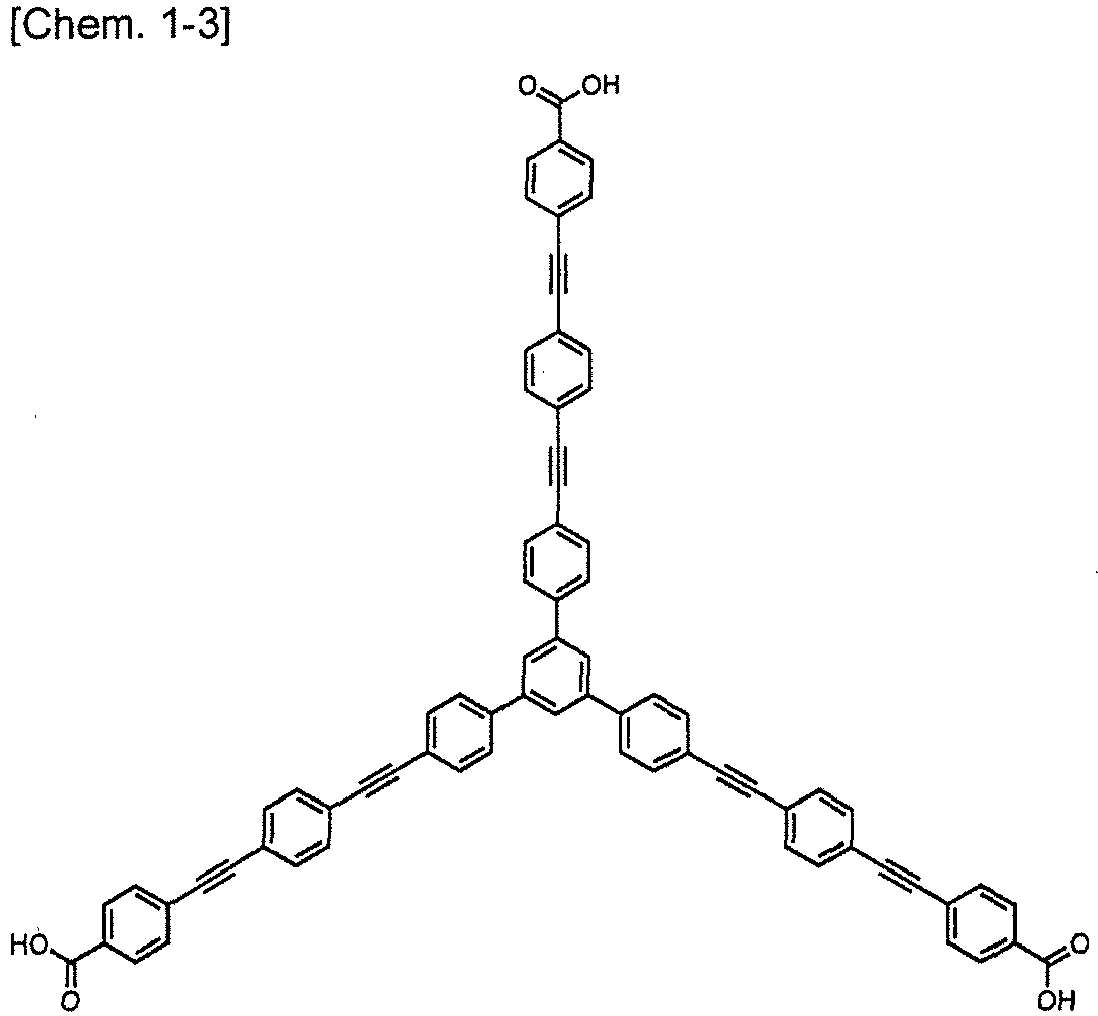
- The following compounds are included in examples of desirable organic ligands. These compounds can be obtained, for example, by referring to the description of O. M. Yaghi et al., Nature, Vol. 423, 12 June 2003, pp. 705-714 and H. Deng et al., Science, 336, 1018 (2012). The descriptions given in these documents are hereby incorporated in their entirety by reference.


- By way of example, the metal ions can be metal ions of actinide elements or lanthanide elements in the form of metal elements of
groups 1 through 16 of the Periodical Table of the Elements. Specific examples of metal ions are Li+, Na+, K+, Rb+, Be2+, Mg2+, Ca2+, Sr2+, Ba2+, SC3+, Y3+, Ti4+, Zr4+, Hf4+, V4+, V3+, V2+, Nb3+, Ta3+, Cr3+, Mo3+, W3+, Mn3+, Mn2+, Re3+, Re2+, Fe3+, Fe2+, Ru3+, Ru2+, Os3+, Os2+, Co3+, Co2+, Rh2+, Rh+, Ir2+, Ir+, Ni2+, Ni+, Pd2+, Pd+, Pt2+, Pt+, Cu2+, Cu+, Ag+, Au+, Zn2+, Cd2+, Hg2+, Al3+, Ga3+, In3+, Tl3+, Si4+, Si2+, Ge4+, Ge2+, Sn4+, Sn2+, Pb4+, Pb2+, As5+, As3+, As+, Sb5+, Sb3+, Sb+, Bi5+, Bi3+, Bi+, and combinations thereof. An example of a desirable metal ion is Zr4+. - The metal-organic framework can be manufactured by, for example, a solvothermal reaction of the organic ligands and metal ions by the usual methods (such as S. M. Cohen eta l., Chem. Commun., 2010, 46, 7700; V. Guillerm et al., Chem. Commun., 2010, 46, 767; N. Stock et al., Chem. Rev. 2012, 112, 933-969; and O. M. Yaghi et al., Science, 2002, 295, 469 (the entire contents of which are hereby incorporated by reference). The solvothermal reaction is normally conducted in the presence of an acid or a base at from room temperature to an elevated temperature (300°C). Solvent and starting materials are introduced under atmospheric pressure or into a pressurized vessel, the temperature is raised to above the boiling point, and the reaction is conducted under conditions where the pressure within the vessel is greater than or equal to atmospheric pressure. In addition to water, N,N-diethylformamide (DEF) or N,N-dimethylformamide (DMF) can be employed as the solvent in the solvothermal reaction since they decompose at elevated temperature, gradually producing amine bases. The conditions of the solvothermal reaction can be suitably set.
- The metal-organic framework desirably has crystalline properties. From the perspective of facilitating the manufacturing of a metal-organic framework having crystalline properties or being highly crystalline, an inhibitor capable of controlling the surface energy during crystal growth, such as an organic acid such as acetic acid, or benzoic acid, can be employed. However, a metal-organic framework that has crystalline properties or is highly crystalline can be manufactured without use of an inhibitor. The presence of crystalline properties can be confirmed by observing the diffraction pattern in X-ray diffraction.
- The metal-organic framework is a porous substance having nano-order pores. The size of the pores is controlled by means of the length of the organic ligands in the lengthwise direction (the distance between coordinating functional groups present on the organic ligands). Specifically, the pore diameter, for example, falls within a range of 0.1 to 10 nm, a range of 0.1 to 5 nm, a range of 0.1 to 3 nm, a range of 0.1 to 2 nm, or a range of 0.1 to 1 nm. Taking into account the size of the guest molecules trapped in the composite of the present invention, suitable adjustment can be achieved through selection of the organic ligands.
- The metal-organic framework is a powder or particulate material. The diameter of the particles, for example, falls within a range of from 1 nm to 5 mm, within a range of 10 nm to 4 mm, within a range of 30 nm to 3 mm, or within a range of 50 nm to 2 mm. The particle diameter of the metal-organic framework can be controlled over a broad range through selection of the synthesis conditions. A small size in the form of nano-order particles can be achieved, while a large size in the form of milli-order particles can be achieved.
- The metal-organic framework/stimulus-responsive polymer composite of the present invention is a metal-organic framework/stimulus-responsive polymer composite in which a stimulus-responsive polymer is immobilized on at least a part of the surface of the metal-organic framework.
- The temperature-responsive polymer is generally a polymer the solubility in water of which changes dramatically with changes in temperature. Such polymers come in types: the LCST type, which is soluble in water at low temperatures but becomes insoluble when the temperature is raised to a certain level (the lower critical solution temperature: LCST) and the UCST type, which is soluble in water at elevated temperatures but becomes insoluble when the temperature is increased to a certain level (the upper critical solution temperature: UCST). The average molecular weight of the temperature-responsive polymer is not specifically limited. By way of example, the number average molecular weight falls within a range of 1,000 to 30,000, desirably within a range of 1,000 to 20,000, preferably within a range of 1,000 to 10,000, more preferably within a range of 1,000 to 8,000, and optimally, within a range of 1,000 to 5,000. However, no restriction to within these ranges is intended. The average molecular weight of the temperature-responsive polymer can be measured, for example, by GPC (chloroform).
- Examples of known LCST-type temperature-responsive polymers are poly(N-alkylacrylamide), poly(N-alkylmethacrylamide), poly(N-vinylalkylacrylamide), poly(N-vinylmethacrylamide), polyvinyl alkyl ether, and polyethylene glycol/polypropylene glycol block copolymers. Examples of other known LCST-type temperature-responsive polymers are methacrylic acid ester polymers and acrylic acid ester polymers having amino groups, polyethylene glycol derivatives, methacrylic acid ester polymers and acrylic acid ester polymers having oligoethylene glycol on side chains, and polyamino acids.
- Examples of known UCST-type temperature responsive polymers are polyethylene oxide, poly(vinylmethylether), poly(vinylalcohol), poly(hydroxyethyl methacrylate), poly(uracil acrylate), poly(methylacrylamide)/poly(N-acetylacrylamide) copolymer, poly(N-acryloylasparagine amide), poly(N-acryloylglutaminamide), poly(N-acryloylglucinamide), poly(N-methylacryloylasparginamide, and poly(riboadenylate).
- In the present invention, the temperature-responsive polymer is not specifically limited. For example, it can be a poly(N-alkylacrylamide) in the form of a polyacrylamide selected from the group consisting of poly-n-isopropylacrylamide (PNIPAM), poly-n-n-dipropylmethacrylamide, and poly-n-n-diethylacrylamide. Poly-n-isopropylacrylamide (PNIPAM) has an LCST at 32°C, near body temperature, and is thus desirable as a DDS material.
- Reference can be made to the following documents in regard to the temperature-responsive polymer. The entire contents thereof are hereby incorporated by reference.
-
- Wang, X.; Qiu, X.; Wu, C. Macromolecules 1998, 31, 2972.
- Aoshima, S.; Oda, H.; Kobayashi, E. Journal of Polymer Science Part A: .
- Yoshimitsu, H.; Kanazawa, A.; Kanaoka, S.; Aoshima, S. Macromolecules, 2012, 45, 9427.
- The entire contents thereof are hereby incorporated by reference.
- pH-responsive polymers are polymers the solubility of which in solution (such as an aqueous solution or pH buffer) changes dramatically with changes in pH. They come in types: a type that dissolves in solution in the high pH range but becomes insoluble when the pH drops to a certain level, and a type that dissolves in solution in the low pH range but becomes insoluble when the pH rises to a certain level.
-
Figure 23 shows a schema of the mechanisms by which pH-responsive polymers exhibit responsiveness. - The average molecular weight of the pH-responsive polymer is not specifically limited. By way of example, the number average molecular weight falls within a range of 1,000 to 30,000, desirably within a range of 1,000 to 20,000, preferably within a range of 1,000 to 10,000, and more preferably, within a range of 1,000 to 8,000. However, limitation to within this range is not intended. The average molecular weight of the pH-responsive polymer can be measured, for example, by GPC (chloroform).
- The pH-responsive polymer is not specifically limited. Known examples are: poly(N-alkylacrylamide)/polymethacrylic acid copolymers, poly(N-alkylacrylamide)/polyacrylic acid copolymers, poly(2-ethoxyethylvinylether), polyisobutylvinylether, and poly[6-(vinyloxy)hexanoic acid].
- Examples of pH-responsive polymers are poly(N-alkylacrylamide) polymers in the form of poly-n-isopropylacrylamide (PNIPAM)/polyacrylic acid copolymers. Since the pH range at which a poly-n-isopropylacrylamide (PNIPAM)/polyacrylic acid copolymer dissolves can be varied by means of its copolymerization ratio, it is desirable as a DDS material. Examples of polyvinyl ether type pH-responsive polymers are poly[6-(2-vinyloxyethoxy)]hexanoic acid and poly[4-(2-vinyloxyethoxy)]benzoic acid.
- Reference can be made to the following documents regarding pH-responsive polymers. The entire contents of these documents are hereby incorporated by reference.
-
- Gu, J.; Xia, F.; Wu, Y.; Qu, X.; Yang, Z.; Jiang, L. Journal of Controlled Release 2007, 117, 396.
- Hoare, T.; Pelton, R. Macromolecules 2004, 37, 2544.
- Mohan, Y. M.; Premkumar, T.; Joseph, D. K.; Geckeler, K. E. Reactive & Functional Polymers 2007, 67, 844.
- Yoo, M. K.; Sung, Y. K.; Lee, Y. M. Cho, C. S. .
- Oda, Y.; Tsujino, T.; Kanaoka, S.; Aoshima, S. Journal of Polymer Science Part A: .
- The entire contents of these documents are hereby incorporated by reference.
- Light-responsive polymers are generally polymers the solubility of which, in solvent, changes dramatically when irradiated with light. They come in types: a type that dissolves in solvent when irradiated with visible light, but becomes insoluble when irradiated with ultraviolet radiation, and a type that dissolves when irradiated with ultraviolet radiation but becomes insoluble when irradiated with visible light. The mechanism by which light-responsive polymers exhibit responsiveness is a change in the polarity of the polymer due to a cis (soluble)-trans (aggregation) isomerization reaction of azobenzen and azopyridine.
- The average molecular weight of the light-responsive polymer is not specifically limited. By way of example, the number average molecular weight falls within a range of 1,000 to 30,000, desirably within a range of 1,000 to 20,000, preferably within a range of 1,000 to 10,000, and more preferably, within a range of 1,000 to 8,000. However, limitation to within this range is not intended. The average molecular weight of the light-responsive polymer can be measured, for example, by GPC (chloroform).
- Examples of light-responsive polymers are poly(N-alkylacrylamide)/poly{6-[4-(4-pyridylazo)phenoxy]hexamethacrylate copolymers, poly(N-alkylacrylamide)/poly[n-(4-phenylazophenyl)acrylamide]copolymers, and poly{4-[2-(vinyloxy)ethoxy]azobenzene}/poly[2-(2-ethoxy)ethoxyethylvinylether]block copolymers.
- In the present invention, the light-responsive polymer is not specifically limited. An example is a poly(N-alkylacrylamide) in the form of a poly-n-isopropylacrylamide (PNIPAM)/poly{6-[4-(-pyridylazo)phenoxy]hexamethacrylate copolymer. Poly-n-isopropylacrylamide (PNIPAM)/poly{6-[4-(-pyridylazo)phenoxy]hexamethacrylate copolymer is desirable as a DDS material because it is possible to change the polar solvent in which it is soluble by means of the copolymerization ratio.
- Reference can be made to the following documents with regard to the light-responsive polymer. The entire contents of these documents are hereby incorporated by reference.
-
- Irie, M.; Kungwatchakun, D. Proc. Japan Acad. Ser. B 1992, 68, 127.
- Han, K.; Su, W.; Zhong, M.; Yan, Q.; Luo, Y.; Zhang, Q.; Li, Y. Macromol. Rapid Commun. 2008, 29, 1866.
- Shen, G.; Xue, G.; Cai, J.; Zou, G. Li, Y.; Zhong, M.; Zhang, .
- Yoshida, T.; Kanaoka, S. Aoshima, S. Journal of Polymer Science Part A: Polymer Chemistry 2005, 43, 5337.
- Cui, L.; Zhao, Y. Chem. Mater. 2004, 16, 2076.
- The entire contents of these documents are hereby incorporated by reference.
- Polymers having both pH responsiveness and temperature responsiveness based on the constituent components of the polymer are also known. The present invention includes metal-organic framework/stimulus-responsive polymer composites in which such dual stimulus-responsive polymers are employed as the stimulus-responsive polymer.
- In the metal-organic framework/stimulus-responsive polymer composite of the present invention, the stimulus-responsive polymer is immobilized on at least a part of the surface of the metal-organic framework. The stimulus-responsive polymer is desirably immobilized by bonding the organic ligands constituting to the metal-organic framework to the stimulus-responsive polymer. Specifically, bonding is desirably achieved by reacting the reactive functional groups present on the organic ligand with the reactive functional groups present on the stimulus-responsive polymer. Although the reactive functional groups present on the organic ligand and the reactive functional groups present on the stimulus-responsive polymer are not limited, the bond formed by reacting the groups can be an amide bond, 1,2,3-triazole bond, disulfide bond, hydrazone bond, or thioether bond. Examples of the reactive functional groups present on the organic ligand and the reactive functional groups present on the stimulus-responsive polymer that form these bonds are given in the following table.
Functional Group 1 is an example of a reactive functional group present on the organic ligand andFunctional Group 2 is an example of a reactive functional group present on the stimulus-responsive polymer. The two can also be interchanged.[Table 1] Functional Group 1Functional Group 2Bond formed Amino group Succinate ester group Amide Azide group Alkynyl group 1,2,3-Triazole Thiol group Mercapto group Disulfide Aldehyde group Hydrazide group Hydrazone Thiol group Maleimide group Thioether Amino group Isocyanate group Urea - The method for manufacturing a metal-organic framework/stimulus-responsive polymer composite of the present invention comprises (1) a step of preparing the following metal-organic framework and (2) a step of obtaining a metal-organic framework/stimulus-responsive polymer composite.
- Step (1) of preparing a metal-organic framework is a step of preparing a metal-organic framework that comprises organic ligands containing two or more functional groups capable of coordinating with metal atoms (coordinating functional groups) and having reactive functional groups that react to reactive functional groups present on the stimulus-responsive polymer and metal ions bonding with the coordinating functional groups of the organic ligands, and that has a structure in which multiple organic ligands are linked by the bonding of each metal ion to two or more coordinating functional groups. The details regarding this step are as set forth above for the method of preparing the metal-organic framework.
- Step (2) of obtaining a metal-organic framework/stimulus-responsive polymer composite is a step of obtaining a metal-organic framework/stimulus-responsive polymer composite by subjecting the metal-organic framework and the stimulus-responsive polymer having reactive functional groups to conditions under which the reactive functional groups present on the organic ligands in the metal-organic framework react with the reactive functional groups present on the stimulus-responsive polymer, thereby immobilizing the stimulus-responsive polymer on at least a part of the surface of the metal-organic framework.
- The reaction of the reactive functional groups present on the organic ligand with reactive functional groups present on other molecules can be conducted according to the method described by K. Sada et al., CrystEngComm, 2012, 14, 4137. Suitable adjustment is possible based on the type of reactive functional groups present on the organic ligands and the type of reactive functional groups present on the stimulus-responsive polymer.
- For example, for organic ligands having responsive functional groups, a stimulus-responsive polymer having reactive functional groups can be mixed in an organic solvent in a molar ratio of the reactive functional groups of the stimulus-responsive polymer to the reactive functional groups of the organic ligands falling within a range of 1:0.1 to 10, desirably falling within a range of 1:0.5 to 5, and preferably falling within a range of 1:1 to 2 and then left standing for a prescribed period to obtain a metal-organic framework/stimulus-responsive polymer composite. The organic solvent is not specifically limited beyond that it dissolves the stimulus-responsive polymer and disperses the organic ligands. For example, chloroform can be employed. The (reaction) temperature during standing is suitably selected from within a range of from room temperature (such as 20°C) to the boiling point of the organic solvent taking into account the type of organic ligand and stimulus-responsive polymer. However, it is also possible to implement the reaction at a temperature exceeding the boiling point of the organic solvent by using an autoclave, for example, depending on the type of organic ligand and stimulus-responsive polymer. The (reaction) standing time can be suitably determined, for example, within a range of from 1 minute to 100 hours taking into account the quantity (yield) of metal-organic framework/stimulus-responsive polymer composite produced. However, no limitation to this range is intended.
- Once the reaction has ended, the solid and liquid are separated from the organic solvent by centrifugation, for example, and washed as needed to obtain a metal-organic framework/stimulus-responsive polymer composite.
- The mass ratio of the metal-organic framework and the stimulus-responsive polymer that is immobilized on the metal-organic framework is not specifically limited. Although depending on the type and molecular weight of the stimulus-responsive polymer, the size of the stimulus-responsive polymer is generally greater than the size of the pores of the metal-organic framework so that the stimulus-responsive polymer does not enter the pores of the metal-organic framework but is immobilized on the surface of the metal-organic framework. In that case, the mass ratio of the stimulus-responsive polymer that is immobilized on the metal-organic framework is determined primarily by the type (particularly the number of reactive functional groups present on the organic ligands constituting the metal-organic framework) and surface area of the metal-organic framework, and the molecular weight of the stimulus-responsive polymer. In terms of the performance of the composite of the present invention, from the perspectives of confining within the metal-organic framework the guest molecules that have been trapped by the metal-organic framework and effectively releasing them, the type of anticipated guest molecule and the type of stimulus-responsive polymer can be taken into account to suitably determine the mass ratio of the stimulus-responsive polymer that is immobilized on the metal-organic framework. The molar ratio of the stimulus-responsive polymer immobilized on the metal-organic framework and the number of reactive functional groups present on the organic ligands constituting the metal-organic framework (referred to as the "modification rate" of the stimulus-responsive polymer) is, for example, greater than 0%, and can fall within a range of less than or equal to 25%. The modification rate desirable falls within a range of 1 to 20%, preferably falls within a range of 2 to 15%, and more preferably, falls within a range of 3 to 15%.
- The modification rate can be calculated by obtaining the amount of organic ligands with which the stimulus-responsive polymer has actually been modified from the integral ratio of the peaks derived from the organic ligands in the metal-organic framework before and after modification based on the 1H NMR of the metal-organic framework before modification with the stimulus-responsive polymer and the 1H NMR spectrum of the metal-organic framework after modification with the stimulus-responsive polymer. The quantity of stimulus-responsive polymer needed to cover the entire outermost surface of the metal-organic framework (referred to as the outermost surface coverage modification rate) can be estimated as follows. An estimate can be obtained by assuming that the MOF is a regular octahedron, the length of one side of the MOF is 200 nm, and the thickness of the lattice structure of the outermost surface is 14 A. The actual modification rate will sometimes be greater than the outermost surface coverage modification rate. That is because the metal-organic framework is porous and the reaction between the reactive functional groups present on the organic ligands present internally and the stimulus-responsive polymer readily occurs. For example, in the case of UiO-NH2-P1 given in the examples, the outermost surface coverage modification rate is estimated at 5.14%, while the modification rate of P1 portions determined from the 1H NMR spectrum is about 11%.
- The present invention also covers a method for manufacturing a guest molecule-containing metal-organic framework/stimulus-responsive polymer composite. This method comprises incorporating guest molecules into the metal-organic framework/stimulus-responsive polymer composite of the present invention to obtain a metal-organic framework/stimulus-responsive polymer composite in which guest molecules have been trapped and sealed (clathrated).
- In the case of an LCST type stimulus-responsive polymer having a lower critical solution temperature (LCST), trapping of the guest molecule is implemented by immersing the metal-organic framework/temperature-responsive polymer composite in a solvent in which the guest molecules have been dissolved or dispersed at a temperature lower than the LCST of the temperature-responsive polymer. The LCST of the temperature-responsive polymer is an inherent characteristic (temperature) of the temperature-responsive polymer. The temperatures at which the guest molecules are trapped and released can be set by selecting the type of temperature-responsive polymer in consideration of the temperature range at which the guest molecules are to be trapped and released. At temperatures below the LCST of the temperature-responsive polymer, the temperature-responsive polymer dissolves in the solvent in which the guest molecules have been dissolved or dispersed. Since they are immobilized on the metal-organic framework, a state of affinity is created in the solvent. The guest molecules can move from the solvent toward the metal-organic framework between the temperature-responsive polymer chains in a free state. As a result, the guest molecules are trapped by the metal-organic framework.
- In the case of a UCST type stimulus-responsive polymer having an upper critical solution temperature (UCST), trapping of the guest molecule is implemented by immersing the metal-organic framework/temperature responsive polymer composite in solvent in which the guest molecules have been dissolved or dispersed at a temperature exceeding the UCST of the temperature-responsive polymer. The UCST of the temperature-responsive polymer is an inherent characteristic (temperature) of the temperature-responsive polymer. The temperatures at which the guest molecules are trapped and released can be set by selecting the type of temperature-responsive polymer in consideration of the temperature range at which the guest molecules are to be trapped and released. At temperatures above the UCST of the temperature-responsive polymer, the temperature-responsive polymer dissolves in the solvent in which the guest molecules have been dissolved or dispersed. Since they are immobilized on the metal-organic framework, a state of affinity is created in the solvent. A "state of affinity" means a state in which the polymer with which the surface of the metal-organic framework has been modified forms hydrogen bonds with the water molecules in the solvent, and the polymer chains extend. The guest molecules can move from the solvent toward the metal-organic framework between the temperature-responsive polymer chains in a free state. As a result, the guest molecules are trapped by the metal-organic framework.
- In the case of a stimulus-responsive polymer that responds to a change in pH by inducing a phase transition, trapping of the guest molecule is implemented by immersing the metal-organic framework/temperature responsive polymer composite in solvent in which the guest molecules have been dissolved or dispersed at a pH range that dissolves the pH-responsive polymer. The dissolution range of the pH-responsive polymer is an inherent characteristic (pH) of a pH-responsive polymer. The pH ranges at which the guest molecules are trapped and released can be set by selecting the type of pH-responsive polymer in consideration of the pH ranges at which the guest molecules are to be trapped and released. Within the dissolution range of the pH-responsive polymer, the pH-responsive polymer assumes a state in which the pH-responsive polymer dissolves into the solvent in which the guest molecules have been dissolved or dispersed, creating a state of affinity in the solvent because the pH-responsive polymer is immobilized on the metal-organic framework. The guest molecules can move from the solvent toward the metal-organic framework between the pH-responsive polymer chains in a free state. As a result, the guest molecules are trapped by the metal-organic framework.
- In the case of a stimulus-responsive polymer that induces a phase transition in response to light stimulus, trapping of the guest molecule is implemented by immersing the metal-organic framework/light-responsive polymer composite in a solvent in which the gest molecules have been dissolved or dispersed with the radiation of light having a wavelength that dissolves the light-responsive polymer. The dissolution range of the light-responsive polymer is an inherent characteristic (wavelength of irradiated light) of a light-responsive polymer. The wavelength of the irradiated light that traps and releases the guest molecules can be set by selecting the type of light-responsive polymer in consideration of the dissolution range at which the guest molecules are to be trapped and released. Within the dissolution range of the light-responsive polymer, the light-responsive polymer assumes a state in which the light-responsive polymer dissolves into the solvent in which the guest molecules have been dissolved or dispersed, creating a state of affinity in the solvent because the light-responsive polymer has been immobilized on the metal-organic framework. The guest molecules can move from the solvent toward the metal-organic framework between the light-responsive polymer chains in a free state. As a result, the guest molecules are trapped by the metal-organic framework.
- The quantity of guest molecules trapped by the metal-organic framework/stimulus-responsive polymer composite and the rate at which they are trapped vary with the state of the guest molecules in the solvent (a state of dissolution or dispersion) and the concentration of the guest molecules and temperature (free state of the stimulus-responsive polymer). Thus, suitable control can be achieved by adjusting these factors. The solvent in which the guest molecules are dissolved or dispersed can be suitably determined based on the type of guest molecule. Examples are water, organic solvents, and mixed systems of water and organic solvents. For example, when employing an organic solvent, methanol, ethanol, propanol, toluene, hexane, N,N-dimethylformamide (DMF), N,N-diethylformamide (DEF), chloroform, dichloromethane, diethylether, dimethylsulfoxide (DMSO), tetrahydrofuran (THF), acetonitrile, 1,4-dioxane, and the like can be employed.
- The type of guest molecule is not limited. Examples are the active ingredients of treatment drugs, preventive drugs, and test agents. More specific examples are the active ingredients of cancer or malignant tumor treatment drugs, preventive drugs, and test agents. Examples are given below. However, these are just examples and are not intended as limits.

- In case the stimulus-responsive polymer is the LCST type, the guest drug is trapped for a prescribed period and the metal-organic framework/stimulus-responsive polymer composite in which the guest molecule has been trapped is exposed to a temperature exceeding the LCST of the temperature-responsive polymer, the temperature-responsive polymer is caused to aggregate, and the guest molecules that have been trapped are sealed within the metal-organic framework/temperature-responsive polymer composite. Specifically, the guest molecules are trapped for a prescribed period, after which the solvent containing the metal-organic framework/temperature-responsive polymer composite and the guest molecules is heated to a temperature exceeding the LCST of the temperature-responsive polymer. This heating is desirably effected relatively quickly from the perspective of better ensuring that the guest molecules are sealed within the composite.
- In case the stimulus-responsive polymer is the UCST type, the guest molecule is trapped for a prescribed period and the metal-organic framework/stimulus-responsive polymer composite in which the guest molecule has been trapped is exposed to a temperature below the UCST of the temperature-responsive polymer, the temperature-responsive polymer is caused to aggregate, and the guest molecules that have been trapped are sealed within the metal-organic framework/temperature-responsive polymer composite. Specifically, the guest molecules are trapped for a prescribed period, after which the solvent containing the metal-organic framework/temperature-responsive polymer composite and the guest molecules is cooled to a temperature less than or equal to the UCST of the temperature-responsive polymer. This cooling is desirably effected relatively quickly from the perspective of better ensuring that the guest molecules are sealed within the composite.
- When the guest molecule-containing metal-organic framework/temperature-responsive polymer composite that has been prepared by the above method is once again exposed in a suitable solvent to a temperature below the lower critical solution temperature of the temperature-responsive polymer, the guest molecules are released by the metal-organic framework. That is, the temperature-responsive polymer assumes a free state in the solvent and the guest molecules go from a state of being sealed in the metal-organic framework to a state in which they can be released. The solvent in which the guest molecules will be released is not specifically limited. When employing the metal-organic framework/temperature-responsive polymer composite of the present invention in a drug dispensing system (DDS), the solvent can also be a body fluid (such as blood, lymph fluid, or saliva).
- In case the stimulus-responsive polymer is the type inducing a phase change in response to a change in pH, the guest molecule is trapped for a prescribed period and the metal-organic framework/stimulus-responsive polymer composite in which the guest molecule has been trapped is exposed to a solvent in a pH range at which the temperature-responsive polymer is insoluble, the pH-responsive polymer is caused to aggregate, and the guest molecules that have been trapped are sealed within the metal-organic framework\temperature-responsive polymer composite. Specifically, the guest molecules are trapped for a prescribed period, after which the solvent containing the metal-organic framework/pH-responsive polymer composite and the guest molecules is immersed in a solvent at a pH range at which the pH-responsive polymer is insoluble. This operation is desirably effected relatively quickly from the perspective of better ensuring that the guest molecules are reliably sealed within the composite.
- When the guest molecule-containing metal-organic framework/pH-responsive polymer composite that has been prepared by the above method is once again exposed to a solvent at a pH range at which the pH-responsive polymer dissolves, a state in which the guest molecules are released by the metal-organic framework is created. That is, the pH-responsive polymer assumes a free state in the solvent and the guest molecules go from a state of being sealed in the metal-organic framework to a state in which they can be released.
- In case the stimulus-responsive polymer is the type inducing a phase change in response to stimulus with light, the guest molecule is trapped for a prescribed period and the metal-organic framework/stimulus-responsive polymer composite in which the guest molecule has been trapped is exposed within the visible light range at which the light-responsive polymer is insoluble, the light-responsive polymer is caused to aggregate, and the guest molecules that have been trapped are sealed within the metal-organic framework/light-responsive polymer composite. Specifically, the guest molecules are trapped for a prescribed period, after which the solvent containing the metal-organic framework/light-responsive polymer composite and the guest molecules is irradiated with visible light that does not dissolve the light-responsive polymer. This operation is desirably effected relatively quickly from the perspective of better ensuring that the guest molecules are reliably sealed within the composite.
- When the guest molecule-containing metal-organic framework/light-responsive polymer composite that has been prepared by the above method is once again exposed to irradiation with ultraviolet radiation that dissolves the light-responsive polymer, a state in which the guest molecules are released by the metal-organic framework is created. That is, the light-responsive polymer assumes a free state in the solvent and the guest molecules go from a state of being sealed in the metal-organic framework to a state in which they can be released.
- The present invention will be described in greater detail based on examples. However, the examples are examples of the present invention. There is no intent to limit the present invention to the examples.
-
- Device: JSM-7400, Japan Electronics (Ltd.)
- Acceleration voltage: 1.0 kV
- Sample processing: The samples are not processed with electrically conductive substances
-
- Device: H-8000 Hitachi High Technologies (Ltd.)
- Operating voltage: 200 kV
- Sample processing: The samples are not processed with electrically conductive substances
-
- Device: Advance 500 (500 MHz), made by Bruker Bio-Spin (Ltd.)
-
- Measurement device: D8 Advance, made by Bruker Bio-Spin (Ltd.)
-
- Measurement device: FTIR-4100 SK, Japan Electronics (Ltd.)
-
- Measurement device: Beckman-Coulter Delsa Nano HC
-


-
- Number average molecular weight = 2,000 (catalog value)
- Results of GPC (chloroform) measurement:
- Number average molecular weight = 2,000
- Weight average molecular weight = 2,100
- Molecular weight distribution = 1.05
-
- Number average molecular weight = 2,000 (catalog value)
- Results of GPC (chloroform) measurement:
- Number average molecular weight = 4,100
- Weight average molecular weight = 4,200
- Molecular weight distribution = 1.02
-
- Number average molecular weight = 2,000 (catalog value)
- Results of GPC (chloroform) measurement:
- Number average molecular weight = 4,630
- Weight average molecular weight = 4,150
- Molecular weight distribution = 1.12
- To an autoclave test tube were added MonoNH2-BDC (11 mg, 51 µmol) and ZrCl4 (12 mg, 51 µmol). This was dissolved in DMF (600 mL). Subsequently, the solution was heated to 120°C and left standing for 24 hours. After standing, the solution was cooled to room temperature. The sample was recovered by centrifugal separation (2,000 rpm, 3 min) and washed with DMF and methanol to obtain regular decahedral yellow crystals (about 20 mg). The fact that the targeted UiO-NH2-BDC had been obtained was confirmed by SEM and TEM observation, ATR-IR spectral measurement, and XRPD measurement.
- UiO-NH2-BDC (60 mg, about 0.2 mmol: -NH2) was added to a screw tube, 500 µL of a 0.1 M P1 (400 mg, 0.2 mmol) chloroform solution was added, and the mixture was left standing for 48 hours at 60°C. Subsequently, the MOF was recovered by centrifugal separation (2,000 rpm, 3 min) and washing was conducted with chloroform and methanol. This yielded about 50 mg of the targeted UiO-NH2-P1. The reaction schema is given in
Figure 24A . -
Figure 1 shows SEM and TEM photographs of UiO-NH2-P1. The UiO-NH2-P1 was determined to have a roughly 200 nm regular decahedral structure. The size distribution was found to be narrow, and MOF crystals of uniform size and shape were found to have formed. -
Figure 2 shows the results of DLS measurement (measurement temperature: 25°C, measurement concentration: 5 mg/mL) of UiO-NH2-P1 at room temperature. In the same manner as when observed by SEM and TEM, the UiO-NH2-P1 was found to have a size of about 150 to 400 nm. -
Figure 3 shows an ATR-IR spectrum of UiO-NH2-BDC, an ATR-IR spectrum of P1, and an ATR-IR spectrum of UiO-NH2-P1. As shown inFigure 2 , a peak derived from P1 (amide 1) was found at 1627 cm-1 from UiO-NH2-P1, and the peak at 1257 cm-1 derived from an amino group was found to remain. - Based on the results of these ATR-IR spectra, an unreacted amino group was found to remain in UiO-NH2-P1.
-
Figure 4 shows a 1H NMR spectrum of P1, a 1H NMR spectrum of UiO-NH2-BDC, and a 1H NMR spectrum of UiO-NH2-P1 in a mixed solution of DMSO-d 6: HF aq. = 400 µL: 20 µL. Based on the 1H NMR spectrum of UiO-NH2-P1, the presence of a peak derived from the ligands following P1 modification and a peak derived from unmodified ligands were found. Based on the integral ratio of the peak derived after P1 modification, the modification ratio of P1 moieties was about 11 %. This value was one permitting adequate coverage of the UiO-NH2 -BDC surface with P1. When the MOF is assumed to be a regular octahedron, the length of one side of the MOF to be 200 nm, and the thickness of the lattice structure of the outermost surface to be 14 A, the P1 modification rate (outermost surface coverage modification rate) required to cover the entire outer surface is estimated to be 5.14%. -
Figure 5 shows an XRPD pattern of UiO-66, an XRPD pattern of UiO-NH2-BDC, and an XRPD pattern of UiO-NH2-P1. Each of these XRPD patterns matched the UiO-66-type diffraction pattern, so the modification reaction was thought to have advanced while maintaining a crystal structure. - A 1 mL aqueous solution of 50 mM of a guest molecule (resorufin, caffeine, procainamide) was prepared in a screw tube, UiO-NH2-P1 (about 10 mg) was added, and the mixture was left standing for 24 hours. Subsequently, the sample was recovered by centrifugal separation (10,000 rpm, 5 min.) and washed (centrifugal separation: 10,000 rpm, 5 min. 20 times, solvent: water) to prepare a measurement sample. Once the seven-day measurement period had passed, the MOF was decomposed using HF aq. and the absorbance of the guest molecule obtained was normalized as the total amount of enclosed guest molecule.
-
Figure 6 shows the release behavior of resorufin at 25°C and 40°C, the release behavior of caffeine at 25°C and 40°C, and the release behavior of procainamide at 25°C and 40°C based on absorption spectra. In all of these guests, as the measurement period was extended in the 25°C (open phase), the quantity of guest molecules that were released increased. However, no increase in absorbance was seen in the 40°C (closed phase) even when the measurement period was extended. - During a seven-day measurement period, as well, the ability to inhibit release of each of the guest molecules at 40°C (closed phase) was suggested. Thus, the P1 moieties were found to function as gates in response to temperature.
-
Figure 7 shows the release behavior of a guest molecule in the process of alternating the temperature between 20°C and 40°C at about 20 minute intervals using resorufin as a guest molecule. The release of guest molecules at 25°C (open phase) was confirmed, and the release of guest molecules at 40°C (closed phase) was inhibited, indicating that the release of the guest molecule could be controlled in stages. -
Figure 8 tracks the release behavior of a guest molecule at 40°C in the measurement commencement stage and shows the release behavior of a guest molecule when the temperature was changed to 25°C at 60 minutes from the commencement of measurement using caffeine as guest molecule. While the release of the guest molecule was inhibited at the 40°C stage, release of the guest molecule was found to begin with a change to 25°C. -
Figure 9 shows the guest molecule release behavior of UiO-NH2-BDC at 40°C, the guest molecule release behavior of UiO-NH2-P1 at 25°C, and the guest molecule release behavior of UiO-NH2-P1 at 40°C using resorufin as guest molecule. When the guest molecule release behavior of UiO-NH2-BDC at 40°C was compared to the guest molecule release behavior of UiO-NH2-P1 at 25°C, modification with P1 was found to slow down the release rate of the guest molecule. Thus, P1 used to modify the surface of UiO-NH2-P1 was thought to hinder the release of the guest molecule. - UiO-NH2-BDC (60 mg, about 0.2 mmol: -NH2) was added to a screw tube, 500 µL of a 0.1 M P2 (820 mg, 0.2 mmol) chloroform solution was added, and the mixture was left standing for 48 hours at 60°C. Subsequently, the MOF was recovered by centrifugal separation (2,000 rpm, 3 min) and washing was conducted with chloroform and methanol. This yielded about 50 mg of the targeted UiO-NH2-P2. The P2 did not dissolve due to protonation in a pH range of less than or equal to pH 4.01, but dissolved due to deprotonation in a pH range of greater than or equal to pH 6.86. The reaction schema is given in
Figure 24B . -
Figure 10 shows a TEM photograph of UiO-NH2-P2. UiO-NH2-P2 was found to have formed a regular octahedral structure of about 200 nm on a side. The formation of MOF crystals of narrow size distribution and uniform size and shape was found. -
Figure 11 shows the results of DLS measurement (measurement temperature: 25°C, measurement concentration: 5 mg/mL) at room temperature for UiO-NH2-P2. In the same manner as in the results of TEM observation, UiO-NH2-P2 was found to have a size of about 200 to 400 nm. -
Figure 12 shows an ATR-IR spectrum of UiO-NH2-BDC, an ATR-IR spectrum of P2, and an ATR-IR spectrum of UiO-NH2-P2. As shown inFigure 12 , a peak derived from P2 (amide 1) was found at 1627 cm-1 from UiO-NH2-P2, with the peak at 1257 cm-1 derived from the amino group remaining. - Based on these ATR-IR spectral results, unreacted amino groups were found to remain in UiO-NH2-P2.
-
Figure 13 shows a 1H NMR spectrum of P2, a 1H NMR spectrum of UiO-NH2-BDC, and a 1H NMR spectrum of UiO-NH2-P2 in a mixed solution of DMSO-d 6: HF aq. = 400 µL: 20 µL. Based on the 1H NMR spectrum of UiO-NH2-P2, the presence of a peak derived from the ligands following P2 modification and a peak derived from the unmodified ligands was found. Based on the integral ratio of the derived peak after P2 modification, the modification rate of the P2 moiety was about 5.3%, indicating a value permitting ample coverage of the UiO-NH2-BDC surface. Assuming MOF to be a regular octahedron, the length of one side of MOF to be 346 nm, and the thickness of the lattice structure of the outermost surface to be 14 A, the P2 modification rate (outermost surface coverage modification rate) required to cover the entire outermost surface is estimated to be 3.86%. -
Figure 14 shows an XRPD pattern of UiO-66, an XRPD pattern of UiO-NH2-BDC, and an XRPD pattern of UiO-NH2-P2. Since each of the XRPD patterns matched the diffraction pattern of UiO-66, the modification reaction was thought to have proceeded while maintaining the crystal structure unaltered. - A 1 mL aqueous solution (measured for distilled water at pH 7.12) of 50 mM of a guest molecule (procainamide) was prepared in a screw tube, UiO-NH2-P2 (about 10 mg) was added, and the mixture was left standing for 24 hours. Subsequently, the sample was recovered by centrifugal separation (10,000 rpm, 5 min.) and washed (centrifugal separation: 10,00 rpm, 5 min. 20 times, solvent: water) to prepare a measurement sample. Once the seven-day measurement period had passed, the MOF was decomposed using HF aq. and the absorbance of the guest molecule obtained was normalized as the total amount of enclosed guest molecule.
-
Figure 15 shows the release behavior of procainamide in pH 6.86 and pH 4.01 buffer solutions based on absorption spectra. In the pH 6.86 buffer solution (open phase), the amount of guest molecule that was released increased as the measurement period was extended. In the pH 4.01 buffer solution (closed phase), almost no increase in absorbance was seen despite lengthening of the measurement period. - The fact that it might be possible to control the release of the guest molecule in the pH 4.01 buffer solution (closed phase) was suggested during the seven-day measurement period. Thus, the P2 moiety was found to function as a pH-responsive gate.
-
Figure 16 shows the guest molecule release behavior when the pH was alternated between greater than or equal to 7.3 and less than or equal to 4.4 at intervals of about 20 minutes using procainamide as guest molecule. When the pH was greater than or equal to 7.3 (open phase), the guest molecules were found to be released. When less than or equal to pH 4.4 (closed phase), release of the guest molecules was inhibited, indicating that release of the guest molecules could be controlled in stages. - UiO-NH2-BDC (60 mg, about 0.2 mmol: -NH2) was added to a screw tube. A 500 µL quantity of a 0.1 M P3 (920 mg, 0.2 mmol) chloroform solution was added, and the mixture was left standing for 48 hours at 60°C. Subsequently, the MOF was recovered by centrifugal separation (2,000 rpm, 3 min.) and washing was conducted with chloroform and methanol. This yielded about 50 mg of the targeted UiO-NH2-P3. Chloroform is a solvent that can always dissolve P3, and there is no need to take into account the photoisomerization of P3 in a chloroform solution. When P3 was irradiated for 10 seconds with a 4W UV lamp, the azopyridine moiety in P3 isomerized, the polarity within the molecular increased, and it became soluble in a polar solvent. The reaction schema is given in
Figure 24C . -
Figure 17 shows a TEM photograph of UiO-NH2-P3. UiO-NH2-P3 was found to have formed a regular octahedral structure measuring about 200 nm on a side. The formation of MOF crystals with a narrow size distribution and uniform size and shape was also found. -
Figure 18 shows an ATR-IR spectrum of UiO-NH2-BDC, an ATR-IR spectrum of P3, and an ATR-IR spectrum of UiO-NH2-P3. As shown inFigure 12 , a peak derived from P3 (amide 1) was found at 1681 cm-1 from UiO-NH2-P3, while a peak at 1257 cm-1 derived from an amino group was found to have remained. - Based on these ATR-IR spectral results, unreacted amino groups were found to remain in UiO-NH2-P3.
-
Figure 19 shows a 1H NMR spectrum of P3, a 1H NMR spectrum of UiO-NH2-BDC, and a 1H NMR spectrum of UiO-NH2-P3 in a mixed solution of DMSO-d 6: HF aq. = 400 µL: 20 µL. Based on the 1H NMR spectrum of UiO-NH2-P3, the presence of a peak derived from the ligands after P3 modification and a peak derived from the unmodified ligands were found. Based on the integral ratio of the derived peak after P3 modification, the P3 moiety modification rate was about 13.2%, a value permitting ample coverage of the surface of UiO-NH2-BDC by P2. Assuming the MOF to be a regular octahedron, the length of one side of the MOF to be 200 nm, and the thickness of the lattice structure of the outermost surface to be 14 A, the P1 modification rate (outermost surface coverage modification rate) needed to cover the entire outermost surface was estimated to be 5.14%. -
Figure 20 shows an XRPD pattern of UiO-66, an XRPD pattern of UiO-NH2-BDC, and an XRPD pattern of UiO-NH2-P3. All of these XRPD patterns matched the diffraction pattern of UiO-66. Thus, the modification reaction was thought to have proceeded while maintaining the crystalline structure. - One mL of a 50 Mm guest molecule (resorufin) aqueous solution was prepared in a screw tube, UiO-NH2-P3 (about 10 mg) was added, and the mixture was left standing for 24 hours. Subsequently, the sample was recovered by centrifugal separation (10,000 rpm, 5 min) and washed (centrifugal separation: 10,000 rpm, 5 min, 20 times, solvent: water) to prepare a measurement sample. After the seven-day measurement period, the MOF was decomposed in HF aq. and the absorbance of the guest molecule obtained was normalized as the amount of guest molecule enclosed.
-
Figure 21 shows the release behavior of resorufin under visible light irradiation and UV irradiation based on absorption spectra. Under UV irradiation (open phase), the quantity of guest molecule released increased as the measurement period was extended. Under visible light irradiation (closed phase), almost no increase in absorbance was observed despite lengthening of the measurement period. - The possibility of inhibiting the release of the guest molecule under visible light irradiation (closed phase) in a 12-hour measurement period was suggested. Thus, the P3 moiety was found to function as a gate that responded to light.
-
Figure 22 shows guest molecule release behavior with alternating irradiation with visible light and UV radiation at about 20 minute intervals using resorufin as the guest molecule. During UV irradiation (open phase), releasing of the guest molecule was seen. During visible light irradiation (closed phase), releasing of the guest molecule was inhibited. It was thus found possible to control releasing of the guest molecule in stages. - The present invention is useful in fields relating to functional materials having guest molecule trapping and releasing functions.


| - Responsiveness and molecular weight of each polymer | |||
| Individual polymer | Number average molecular weight | Weight average molecular weight | Molecular weight distribution (Mw/Mn) |
| P1 (temperature-responsive) | 2,000 | 2,100 | 1.05 |
| P2 (pH-responsive) | 4,100 | 4,200 | 1.02 |
| P3 (light-responsive) | 4,630 | 4,150 | 1.12 |
Claims (17)
- A metal-organic framework/stimulus-responsive polymer composite, comprising a metal-organic framework containing organic ligands having at least two functional groups capable of coordinating metal atoms (coordinating functional groups) and metal ions bonding with the coordinating functional groups of the organic ligands, and having a structure in which multiple organic ligands are connected such that one metal ion bonds with two or more coordinating functional groups, and a stimulus-responsive polymer being immobilized on at least a part of a surface of the metal-organic framework.
- The composite according to Claim 1, wherein the stimulus-responsible polymer is immobilized on the metal-organic framework by bonding with the organic ligands.
- The composite according to Claim 1 or 2, wherein the stimulus-responsive polymer is a temperature-responsive polymer, pH-responsive polymer, or light-responsive polymer.
- The composite according to Claim 3, wherein the temperature-responsive polymer is of the lower critical solution temperature (LCST) type having an LCST or of the upper critical solution temperature (UCST) type having an UCST, the pH-responsive polymer is of a type in which a phase transition is induced by a change in pH, and the light-responsive polymer is of a type in which a phase transition is induced in response to light stimulation.
- The composite according to Claim 4, wherein the LCST-type temperature-responsive polymer is a poly(N-alkylacrylamide), poly(N-alkylmethacrylamide), poly(N-vinylalkylacrylamide), poly(N-vinylmethacrylamide), polyvinyl alkyl ether, polyethylene glycol/polypropylene glycol block copolymer, amino group-comprising acrylic acid ester copolymer or methacrylic acid ester copolymer, polyethylene glycol derivative, acrylic acid ester polymer or methacrylic acid ester polymer comprising an oligoethylene glycol in a side chain, or a polyamino acid; and wherein the UCST-type temperature-responsive polymer is a polyethylene oxide, poly(vinylmethylether), poly(vinylalcohol), poly(hydroxyethyl methacrylate), poly(uracil acrylate), poly(methylacrylamide)/poly(N-acetylacrylamide) copolymer, poly(N-acryloylasparagine amide), poly(N-acryloylglutaminamide), poly(N-acryloylglucinamide), poly(N-methylacryloylasparagine amide), or poly(riboadenylate).
- The composite according to Claim 3, wherein the pH-responsive polymer is a poly(N-vinylalkylacrylamide), poly(N-alkylacrylamide)/polymethacrylic acid copolymer, poly(N-alkylacrylamide)/polyacrylic acid copolymer, poly(2-ethoxyethylvinylether), polyisobutylvinylether, poly[6-(vinyloxy)hexanoic acid], poly[6-(2-vinyloxyethoxy)]hexanoic acid, or poly[4-(2-vinyloxyethoxy)benzoic acid.
- The composite according to Claim 3, wherein the light-responsive polymer is a poly(N-vinylalkylacrylamide), poly(N-alkylacrylamide)/poly{6-[4-(4-pyridylazo)phenoxy]hexamethacrylate copolymer, poly(N-alkylacrylamide)/poly[n-(4-phenylazophenyl)acrylamide] copolymer, or poly{4-[2-(vinyloxy)ethoxy]azobenzene}/poly[2-(2-ethoxy)ethoxyethylvinylether] block copolymer.
- The composite according to any one of Claims 5 to 7, wherein the poly(N-vinylalkylacrylamide) is poly-n-isopropylacrylamide (PNIPAM).
- The composite of any one of Claims 1 to 8, wherein the modification rate of the surface of the metal-organic framework by the stimulus-responsive polymer falls within a range of greater than 0% and less than or equal to 25%, wherein the modification rate is a molar ratio of the numbers of reactive functional groups present in the organic ligand constituting the metal-organic framework and the stimulus-responsive polymer.
- The composite according to any one of Claims 1 to 9, wherein the particle diameter of the metal-organic framework falls within a range of from 1 nm to 5 mm.
- A method for manufacturing a metal-organic framework/stimulus-responsive polymer composite, comprising the steps of:preparing a metal-organic framework comprising organic ligands that have at least two functional groups capable of coordinating metal atoms (coordinating functional groups) and reactive functional groups being reactive with the reactive functional groups present in a temperature-responsive polymer, and metal ions that bond with the coordinating functional groups of the organic ligands, and having a structure in which multiple organic ligands are connected such that one metal ion bonds with two or more coordinating functional groups; andsubjecting the stimulus-responsive polymer comprising reactive functional groups and the metal-organic framework to conditions permitting reaction of the reactive functional groups present in the stimulus-responsive polymer with the reactive functional groups present in the organic ligands in the metal-organic framework to obtain a metal-organic framework/stimulus-responsive polymer in which the stimulus-responsive polymer is immobilized on at least a part of a surface of the metal-organic structure.
- The manufacturing method according to Claim 11, in the form of a method for manufacturing the composite according to any one of Claims 1 to 10.
- A method for manufacturing a guest molecule-containing metal-organic framework/temperature-responsive polymer composite including the capturing and sealing in of guest molecules into the metal-organic framework/temperature-responsive polymer composite according to any one of Claims 1 to 10 (wherein the temperature-responsive polymer is of the lower critical solution temperature (LCST) type having a LCST), comprising the steps of:obtaining a metal-organic framework/temperature-responsive polymer composite in which guest molecules have been captured by immersing the metal-organic framework/temperature-responsive polymer composite in a solvent in which guest molecules have been dissolved or dispersed, at a temperature that is lower than the LCST of the temperature-responsive polymer; andexposing the metal-organic framework/temperature-responsive polymer composite in which the guest molecules have been captured to a temperature exceeding the LCST of the temperature-responsive polymer to seal the incorporated guest molecules within the metal-organic framework/temperature-responsive polymer composite and obtain a guest molecule-containing metal-organic framework/temperature-responsive polymer composite.
- A method for manufacturing a guest molecule-containing metal-organic framework/temperature-responsive polymer composite including the capturing and sealing in of guest molecules into the metal-organic framework/temperature-responsive polymer composite according to any one of Claims 1 to 10 (wherein the temperature-responsive polymer is of the upper critical solution temperature (UCST) type having an UCST), comprising the steps of:obtaining a metal-organic framework/temperature-responsive polymer composite in which guest molecules have been captured by immersing the metal-organic framework/temperature-responsive polymer composite in a solvent in which guest molecules have been dissolved or dispersed, at a temperature that is higher than the UCST of the temperature-responsive polymer; andexposing the metal-organic framework/temperature-responsive polymer composite in which the guest molecules have been captured to a temperature less than or equal to the UCST of the temperature-responsive polymer to seal the incorporated guest molecules within the metal-organic framework/temperature-responsive polymer composite and obtain a guest molecule-containing metal-organic framework/temperature-responsive polymer composite.
- A method for manufacturing a guest molecule-containing metal-organic framework/pH-responsive polymer composite including the capturing and sealing in of guest molecules into the metal-organic framework/pH-responsive polymer composite according to any one of Claims 1 to 10, comprising the steps of:obtaining a metal-organic framework/pH-responsive polymer composite in which guest molecules have been captured by immersing the metal-organic framework/pH-responsive polymer composite in a solvent in which guest molecules have been dissolved or dispersed in a pH range that dissolves the pH-responsive polymer; andexposing the metal-organic framework/pH-responsive polymer composite in which the guest molecules have been captured to a pH range at which the pH-responsive polymer is insoluble to seal the incorporated guest molecules within the metal-organic framework/pH-responsive polymer composite and obtain a guest molecule-containing metal-organic framework/pH-responsive polymer composite.
- A method for manufacturing a guest molecule-containing metal-organic framework/light-responsive polymer composite including the capturing and sealing in of guest molecules into the metal-organic framework/light-responsive polymer composite according to any one of Claims 1 to 10, comprising the steps of:obtaining a metal-organic framework/light-responsive polymer composite in which guest molecules have been captured by immersing the metal-organic framework/light-responsive polymer composite in a solvent in which guest molecules have been dissolved or dispersed under ultraviolet radiation irradiation that dissolves the light-responsive polymer; andexposing the metal-organic framework/light-responsive polymer composite in which the guest molecules have been captured to visible light irradiation conditions under which the light-responsive polymer is insoluble to seal the incorporated guest molecules within the metal-organic framework/light-responsive polymer composite and obtain a guest molecule-containing metal-organic framework/light-responsive polymer composite.
- The method according to any one of Claims 13 to 16, wherein the guest molecules are the active ingredient of a treatment drug, preventive drug, or test agent.
Applications Claiming Priority (2)
| Application Number | Priority Date | Filing Date | Title |
|---|---|---|---|
| JP2014097006 | 2014-05-08 | ||
| PCT/JP2015/056767 WO2015170506A1 (en) | 2014-05-08 | 2015-03-09 | Metal-organic framework/stimulus-responsive polymer composite capable of controlling release of guest |
Publications (2)
| Publication Number | Publication Date |
|---|---|
| EP3141263A1 true EP3141263A1 (en) | 2017-03-15 |
| EP3141263A4 EP3141263A4 (en) | 2017-12-13 |
Family
ID=54392360
Family Applications (1)
| Application Number | Title | Priority Date | Filing Date |
|---|---|---|---|
| EP15788881.9A Withdrawn EP3141263A4 (en) | 2014-05-08 | 2015-03-09 | Metal-organic framework/stimulus-responsive polymer composite capable of controlling release of guest |
Country Status (5)
| Country | Link |
|---|---|
| US (1) | US20170072070A1 (en) |
| EP (1) | EP3141263A4 (en) |
| JP (1) | JP6475700B2 (en) |
| CN (1) | CN106573068A (en) |
| WO (1) | WO2015170506A1 (en) |
Cited By (3)
| Publication number | Priority date | Publication date | Assignee | Title |
|---|---|---|---|---|
| CN110467732A (en) * | 2019-08-09 | 2019-11-19 | 盐城工学院 | A kind of chiral Recognition material and its application in chiral electrochemical sensor |
| CN110538345A (en) * | 2019-10-11 | 2019-12-06 | 上海交通大学医学院附属第九人民医院 | biological material, preparation method thereof and application thereof in bone repair |
| FI131578B1 (en) * | 2021-08-16 | 2025-07-14 | Aabo Akademi | Encapsulated biomolecules for intracellular delivery |
Families Citing this family (24)
| Publication number | Priority date | Publication date | Assignee | Title |
|---|---|---|---|---|
| WO2016143876A1 (en) * | 2015-03-10 | 2016-09-15 | 国立大学法人京都大学 | Ligand compound, and single-hole or multi-hole coordination polymer obtained using same |
| WO2017104724A1 (en) * | 2015-12-14 | 2017-06-22 | 国立大学法人京都大学 | Star polymer |
| US10406513B2 (en) * | 2016-06-03 | 2019-09-10 | Memorial University Of Newfoundland | Method for the conversion of nitrous acid to dinitrogen gas |
| CN106054528A (en) * | 2016-06-07 | 2016-10-26 | 北京大学 | Preparation and fast light control method for nano pattern based on organic polymer |
| CN107837401B (en) * | 2016-09-19 | 2022-04-08 | 中国科学院上海药物研究所 | Cyclodextrin-metal organic framework material composite microspheres and preparation method thereof |
| CN106581683B (en) * | 2016-11-03 | 2019-06-11 | 苏州大学 | A kind of metal-organic nanomaterial modified by polyethylene glycol, preparation method and application thereof |
| CN107375937B (en) * | 2017-09-08 | 2020-10-30 | 武汉大学 | Method for commanding and programmed release of drug molecules by using MOFs |
| CN107913676B (en) * | 2017-11-29 | 2020-03-24 | 广西大学 | Ultralow-temperature metal organic ligand doped amino acid composite material and preparation method thereof |
| CN108677256B (en) * | 2018-03-21 | 2020-03-31 | 浙江理工大学 | A kind of preparation method of composite membrane that controls macromolecules to pass through ultraviolet light |
| JP2020011943A (en) * | 2018-07-05 | 2020-01-23 | トヨタ自動車株式会社 | Method for producing coordinating unsaturated metal organic structure and coordinating unsaturated metal organic structure |
| CN109021246B (en) * | 2018-08-17 | 2020-11-20 | 山东师范大学 | A temperature-responsive metal-organic framework nanocrystal, preparation method and application |
| KR102188611B1 (en) * | 2019-04-15 | 2020-12-08 | 숙명여자대학교산학협력단 | Porous polymer composition comprising metal-organic unit and manufacturing method thereof |
| WO2020162723A1 (en) * | 2019-02-08 | 2020-08-13 | 숙명여자대학교산학협력단 | Porous liquid composition comprising metal-organic unit, porous polymer composition, and preparation method therefor |
| CN110152006B (en) * | 2019-05-22 | 2023-02-28 | 辽宁大学 | Liver-targeted metal-organic framework drug carrier and its preparation method and application |
| CN110376322B (en) * | 2019-07-30 | 2022-03-04 | 河北大学 | Polymer monolithic column for online enriching and purifying ursolic acid and online enriching and purifying method of ursolic acid |
| CN110639443B (en) * | 2019-10-17 | 2020-12-08 | 电子科技大学 | Satellite-structured Janus microspheres with light-sensitive properties and methods for their preparation and control |
| KR102515584B1 (en) * | 2021-05-13 | 2023-03-30 | 한양대학교 산학협력단 | Method for Forming Temperature-responsive Hydrophilic-Hydrophobic Conversion Surface, and Temperature-responsive Hydrophilic-Hydrophobic Conversion Surface and Heat Exchanger Using Same |
| WO2022246247A1 (en) * | 2021-05-21 | 2022-11-24 | ExxonMobil Technology and Engineering Company | Flocculation and rapid filtration of metal organic frameworks |
| CN115368643B (en) * | 2022-08-11 | 2024-02-06 | 桂林理工大学 | High-strength and high-toughness multifunctional sodium alginate-based nanocomposite and preparation method and application thereof |
| CN115505086B (en) * | 2022-10-18 | 2023-05-30 | 西南石油大学 | Rapid light response self-repairing polyurea material and preparation method thereof |
| CN115490878B (en) * | 2022-10-27 | 2023-07-14 | 南开大学 | Metal-organic framework material with chiral defects, construction method and application |
| CN116444814B (en) * | 2023-04-23 | 2024-06-07 | 江南大学 | A zinc coordination polymer based on photochromic functional organic ligand and its preparation method and application |
| CN119371677B (en) * | 2024-10-24 | 2025-11-18 | 江南大学 | A carrier material with photoresponsive controlled release function, its preparation method and its application in bio-based active packaging |
| CN120795212B (en) * | 2025-08-12 | 2026-05-12 | 格润化学(东营)有限公司 | Preparation method of low molecular weight polyacrylamide |
Family Cites Families (5)
| Publication number | Priority date | Publication date | Assignee | Title |
|---|---|---|---|---|
| DE102005054523A1 (en) * | 2005-11-14 | 2007-05-16 | Basf Ag | Porous organometallic framework containing another polymer |
| JP5295148B2 (en) * | 2010-02-22 | 2013-09-18 | 独立行政法人科学技術振興機構 | Porous coordination polymers with photoreactive sites |
| WO2011123795A1 (en) * | 2010-04-02 | 2011-10-06 | Battelle Memorial Institute | Methods for associating or dissociating guest materials with a metal organic framework, systems for associating or dissociating guest materials within a series of metal organic frameworks, and gas separation assemblies |
| JP2012232961A (en) * | 2011-05-09 | 2012-11-29 | Osaka Prefecture Univ | Temperature-responsive composite polymer |
| EP2877268A4 (en) * | 2012-07-26 | 2016-03-23 | Commw Scient Ind Res Org | METHODS OF GAS SEPARATION |
-
2015
- 2015-03-09 EP EP15788881.9A patent/EP3141263A4/en not_active Withdrawn
- 2015-03-09 JP JP2016517832A patent/JP6475700B2/en not_active Expired - Fee Related
- 2015-03-09 CN CN201580024019.2A patent/CN106573068A/en active Pending
- 2015-03-09 US US15/309,404 patent/US20170072070A1/en not_active Abandoned
- 2015-03-09 WO PCT/JP2015/056767 patent/WO2015170506A1/en not_active Ceased
Cited By (5)
| Publication number | Priority date | Publication date | Assignee | Title |
|---|---|---|---|---|
| CN110467732A (en) * | 2019-08-09 | 2019-11-19 | 盐城工学院 | A kind of chiral Recognition material and its application in chiral electrochemical sensor |
| CN110467732B (en) * | 2019-08-09 | 2021-08-13 | 盐城工学院 | A Chiral Recognition Material and Its Application in Chiral Electrochemical Sensors |
| CN110538345A (en) * | 2019-10-11 | 2019-12-06 | 上海交通大学医学院附属第九人民医院 | biological material, preparation method thereof and application thereof in bone repair |
| CN110538345B (en) * | 2019-10-11 | 2021-09-24 | 上海交通大学医学院附属第九人民医院 | Biological material, preparation method thereof and application thereof in bone repair |
| FI131578B1 (en) * | 2021-08-16 | 2025-07-14 | Aabo Akademi | Encapsulated biomolecules for intracellular delivery |
Also Published As
| Publication number | Publication date |
|---|---|
| JPWO2015170506A1 (en) | 2017-04-20 |
| JP6475700B2 (en) | 2019-02-27 |
| CN106573068A (en) | 2017-04-19 |
| WO2015170506A1 (en) | 2015-11-12 |
| EP3141263A4 (en) | 2017-12-13 |
| US20170072070A1 (en) | 2017-03-16 |
Similar Documents
| Publication | Publication Date | Title |
|---|---|---|
| US20170072070A1 (en) | Metal-organic framework stimulus responsive polymer composite capable of controlling release of guest | |
| Nguyen et al. | Postsynthetic diazeniumdiolate formation and NO release from MOFs | |
| Lee et al. | Mechanism of “turn-on” fluorescent sensors for mercury (II) in solution and its implications for ligand design | |
| Yousef | Structural, optical, morphology characterization and DFT studies of nano sized Cu (II) complexes containing schiff base using green synthesis | |
| Screen et al. | Two methods for amplifying the optical nonlinearity of a conjugated porphyrin polymer: transmetallation and self-assembly | |
| Xie et al. | Transparent, flexible, and paramagnetic ionogels based on PMMA and the iron-based ionic liquid 1-butyl-3-methylimidazolium tetrachloroferrate (III)[Bmim][FeCl4] | |
| Krupiński et al. | Applying Mechanochemistry for Bottom‐Up Synthesis and Host–Guest Surface Modification of Semiconducting Nanocrystals: A Case of Water‐Soluble β‐Cyclodextrin‐Coated Zinc Oxide | |
| Barkam et al. | Modulating the catalytic activity of cerium oxide nanoparticles with the anion of the precursor salt | |
| Dutta et al. | Fluorescent terpolymers using two non-emissive monomers for Cr (III) sensors, removal, and bio-imaging | |
| Archer et al. | β-Diketone Complexes of Cobalt (III). I. Synthesis and Spectroscopy of Bis (acetylacetonato) diaminecobalt (III) Salts | |
| Saeednia et al. | Phenoxo bridged dinuclear Zn (II) Schiff base complex as new precursor for preparation zinc oxide nanoparticles: Synthesis, characterization, crystal structures and photoluminescence studies | |
| Zhou et al. | Ionofluorochromic nanoparticles derived from octapyrene-modified polyhedral oligomeric silsesquioxane organic frameworks for fluoride-ion detection | |
| Hafidh et al. | Characterization and biological effectiveness of synthesized complexes of Palladium (II) from imine compounds | |
| Kurmaz et al. | Amphiphilic copolymers of N-vinylpyrrolidone with (di) methacrylates as promising carriers for the platinum (IV) complex with antitumor activity | |
| Lee et al. | Hydrotropic polymers: Synthesis and characterization of polymers containing picolylnicotinamide moieties | |
| Ghanbari et al. | Synthesis, characterization, and biological activity of a fresh class of sonochemically synthesized Cu2+ complexes | |
| Yaghobi et al. | Synthesis and characterization of d10 transition metal complexes in bulk and nano scales: DNA binding, molecular docking and anticancer activity against MCF-7 cell line | |
| Yasir et al. | Synthesis of a new DPTYEAP ligand and its complexes with their assessments on physical properties, antioxidant, and biological potential to treat breast cancer | |
| Prozorova et al. | Synthesis and sorption activity of novel cross-linked 1-vinyl-1, 2, 4-triazole–(trimethoxysilyl) methyl-2-methacrylate copolymers | |
| CN110790939A (en) | A metal-organic framework material and its preparation and application in identifying chiral polysaccharides | |
| Althagafi et al. | Spectral characterization, CT-DNA binding, DFT/B3LYP, molecular docking and antitumor studies for new nano-sized VO (II)-hydrazonoyl complexes | |
| Das et al. | Cyclic (alkyl)(amino) carbene (CAAC)-and bicyclic (alkyl)(amino) carbene (BICAAC)-derived glyoxal radical cations with excellent stability | |
| CN111747947A (en) | Meloxicam-urea co-crystal and preparation method thereof | |
| Fouad et al. | New Mononuclear Metal Complexes Based on 3‐Acetyl‐4‐Hydroxy Coumarin as Potential Antitumor Agents: Full Structural Elucidation, Theoretical Calculations, and Biological Activity Studies | |
| Gurnule et al. | Thermal degradation and antibacterial study of transition metal complexes derived from novel terpolymer ligand |
Legal Events
| Date | Code | Title | Description |
|---|---|---|---|
| STAA | Information on the status of an ep patent application or granted ep patent |
Free format text: STATUS: THE INTERNATIONAL PUBLICATION HAS BEEN MADE |
|
| PUAI | Public reference made under article 153(3) epc to a published international application that has entered the european phase |
Free format text: ORIGINAL CODE: 0009012 |
|
| STAA | Information on the status of an ep patent application or granted ep patent |
Free format text: STATUS: REQUEST FOR EXAMINATION WAS MADE |
|
| 17P | Request for examination filed |
Effective date: 20161130 |
|
| AK | Designated contracting states |
Kind code of ref document: A1 Designated state(s): AL AT BE BG CH CY CZ DE DK EE ES FI FR GB GR HR HU IE IS IT LI LT LU LV MC MK MT NL NO PL PT RO RS SE SI SK SM TR |
|
| AX | Request for extension of the european patent |
Extension state: BA ME |
|
| DAV | Request for validation of the european patent (deleted) | ||
| DAX | Request for extension of the european patent (deleted) | ||
| A4 | Supplementary search report drawn up and despatched |
Effective date: 20171114 |
|
| RIC1 | Information provided on ipc code assigned before grant |
Ipc: A61K 47/32 20060101AFI20171108BHEP Ipc: A61K 47/34 20170101ALI20171108BHEP |
|
| RAP1 | Party data changed (applicant data changed or rights of an application transferred) |
Owner name: NATIONAL UNIVERSITY CORPORATION HOKKAIDO UNIVERSIT Owner name: NISSAN CHEMICAL CORPORATION |
|
| STAA | Information on the status of an ep patent application or granted ep patent |
Free format text: STATUS: THE APPLICATION IS DEEMED TO BE WITHDRAWN |
|
| 18D | Application deemed to be withdrawn |
Effective date: 20180612 |