EP3141258A1 - Soybean allergy related epitopes - Google Patents
Soybean allergy related epitopes Download PDFInfo
- Publication number
- EP3141258A1 EP3141258A1 EP15184199.6A EP15184199A EP3141258A1 EP 3141258 A1 EP3141258 A1 EP 3141258A1 EP 15184199 A EP15184199 A EP 15184199A EP 3141258 A1 EP3141258 A1 EP 3141258A1
- Authority
- EP
- European Patent Office
- Prior art keywords
- seq
- epitope
- group
- soybean
- peptide
- Prior art date
- Legal status (The legal status is an assumption and is not a legal conclusion. Google has not performed a legal analysis and makes no representation as to the accuracy of the status listed.)
- Withdrawn
Links
Images


Classifications
-
- G—PHYSICS
- G01—MEASURING; TESTING
- G01N—INVESTIGATING OR ANALYSING MATERIALS BY DETERMINING THEIR CHEMICAL OR PHYSICAL PROPERTIES
- G01N33/00—Investigating or analysing materials by specific methods not covered by groups G01N1/00 - G01N31/00
- G01N33/48—Biological material, e.g. blood, urine; Haemocytometers
- G01N33/50—Chemical analysis of biological material, e.g. blood, urine; Testing involving biospecific ligand binding methods; Immunological testing
- G01N33/53—Immunoassay; Biospecific binding assay; Materials therefor
- G01N33/569—Immunoassay; Biospecific binding assay; Materials therefor for microorganisms, e.g. protozoa, bacteria, viruses
- G01N33/56961—Plant cells or fungi
-
- C—CHEMISTRY; METALLURGY
- C07—ORGANIC CHEMISTRY
- C07K—PEPTIDES
- C07K14/00—Peptides having more than 20 amino acids; Gastrins; Somatostatins; Melanotropins; Derivatives thereof
- C07K14/415—Peptides having more than 20 amino acids; Gastrins; Somatostatins; Melanotropins; Derivatives thereof from plants
-
- C—CHEMISTRY; METALLURGY
- C07—ORGANIC CHEMISTRY
- C07K—PEPTIDES
- C07K16/00—Immunoglobulins [IG], e.g. monoclonal or polyclonal antibodies
- C07K16/16—Immunoglobulins [IG], e.g. monoclonal or polyclonal antibodies against material from plants
-
- C—CHEMISTRY; METALLURGY
- C07—ORGANIC CHEMISTRY
- C07K—PEPTIDES
- C07K2317/00—Immunoglobulins specific features
- C07K2317/30—Immunoglobulins specific features characterized by aspects of specificity or valency
- C07K2317/34—Identification of a linear epitope shorter than 20 amino acid residues or of a conformational epitope defined by amino acid residues
-
- G—PHYSICS
- G01—MEASURING; TESTING
- G01N—INVESTIGATING OR ANALYSING MATERIALS BY DETERMINING THEIR CHEMICAL OR PHYSICAL PROPERTIES
- G01N2333/00—Assays involving biological materials from specific organisms or of a specific nature
- G01N2333/415—Assays involving biological materials from specific organisms or of a specific nature from plants
-
- G—PHYSICS
- G01—MEASURING; TESTING
- G01N—INVESTIGATING OR ANALYSING MATERIALS BY DETERMINING THEIR CHEMICAL OR PHYSICAL PROPERTIES
- G01N2800/00—Detection or diagnosis of diseases
- G01N2800/24—Immunology or allergic disorders
Definitions
- the invention relates to a compilation comprising at least five different peptides, each peptide comprising at least one sequence element corresponding to an epitope selected from the group consisting of SEQ ID NO.: 1 - 354.
- the invention further relates to an in vitro method for determining a patient's immune status to soybean allergens, to a method for detecting at least one soybean allergen in a substance and to a method for determining the allergenicity of a soybean variety.
- the invention relates to a kit comprising at least one composition containing a compound comprising at least two identical and/or different sequence elements each corresponding to an epitope selected from the group consisting of SEQ ID NO.: 1 - 354.
- the invention relates to the use of a peptide comprising a sequence element corresponding to an epitope for providing a molecule binding to a protein or peptide comprising the epitope.
- soybean seeds have become an important source of protein in many countries of the world.
- soybean is increasingly used to provide sufficient nutrition to the population, whereas in industrial countries it has become a major ingredient of processed food products.
- soybean food products are specifically promoted for having health benefits and are believed to lower incidences of high plasma cholesterol, cancer, diabetes mellitus and obesity.
- soybean products provide all essential amino acids and are rich in vitamins and minerals, making them an interesting source for protein rich nutrition.
- soybean is one of the most allergenic foods. Soybean allergies usually arise spontaneously during childhood with symptoms such as atopic dermatitis, enterocolitis and other IgE-mediated multisystem reactions (Masilamani et al., 2012).
- soybean protein 400 mg
- peanut 0.1 mg
- soybean protein soybean protein became an ubiquitous ingredient of vegetable as well as meat containing foods.
- processed or partially processed food products usually contain at least traces of at least some soybean proteins.
- food producing companies need comprehensive and reliable methods for analyzing the content of their food products.
- the invention relates to a compilation comprising at least five different peptides, each peptide comprising at least one sequence element corresponding to an epitope selected from the group consisting of SEQ ID NO.: 1 - 354.
- the invention relates to an in vitro method for determining a patient's immune status to soybean allergens, comprising the steps providing at least five different peptides, each peptide comprising at least one sequence element corresponding to an epitope selected from the group consisting of SEQ ID NO.: 1 - 354, contacting each peptide with a sample comprising antibodies derived from the patient, and detecting an interaction of each peptide with the sample.
- the invention relates to a kit comprising at least one composition containing a compound comprising at least two identical and/or different sequence elements each corresponding to an epitope selected from the group consisting of SEQ ID NO.: 1 - 354.
- the invention relates to a method for producing an immunoassay product, comprising the steps providing at least two different peptides, each peptide comprising at least one sequence element corresponding to an epitope selected from the group consisting of SEQ ID NO.: 1 - 354, raising at least one antibody against each peptide, and compiling the antibodies to provide the immunoassay product.
- the invention relates to a method for determining the allergenicity of a soybean variety by detecting the presence of at least two epitopes in a sample of the variety, wherein the epitopes are selected from the group consisting of SEQ ID NO.: 1 - 354.
- the invention relates to the use of a peptide comprising a sequence element corresponding to an epitope selected from the group consisting of SEQ ID NO.: 1 - 354 for providing a molecule binding to a protein or peptide comprising the epitope.
- the invention relates to a method for generating a variant of an allergenic soybean protein having a reduced allergenic potential, comprising the steps providing an amino acid sequence of at least one epitope selected from the group consisting of SEQ ID NO.: 1 - 354, altering the amino acid sequence of the at least one epitope as to eliminating the structure of the epitope, and generating a protein or peptide comprising the altered amino acid sequence.
- the invention relates to a compilation comprising at least five different peptides, each peptide comprising at least one sequence element corresponding to an epitope selected from the group consisting of SEQ ID NO.: 1 - 354.
- IgE immunoglobulin E
- Strong immunodominant allergic proteins such as P34 thiol protease (Gly m Bd 30K)
- other soybean proteins although no potent inducers of a primary allergic response, can nevertheless trigger effector responses due to their binding by IgE.
- affected persons show varying sensitivity to different soybean proteins. For example, only 65 % of soybean sensitive individuals carry IgE recognizing P34 thiol protease (Gly m Bd 30K), which is considered one of the strongest allergenic soybean proteins (Yang et al., 2011).
- the amino acid sequences that were bound by the patients' antibodies were identified by next generation sequencing and the results statistically analyzed.
- their reactivity with patient IgE was determined by peptide arrays.
- the inventors identified more than 300 potentially allergenic epitopes from different soybean proteins.
- the identified epitopes could be assigned to a total of 23 soybean proteins (Table 1) including P34 thiol protease (Gly m Bd 30K), ⁇ -conglycinin (Gly m Bd60 K) and Gly m Bd 28K, which are considered major soybean allergenic proteins (Yang et al., 2011).
- Table 1 Individual Epitopes Soybean allergen (ID) Epitop NO Epitop sequence SEQ ID NO. beta conglycinin alpha chain (X17698) 6.04.001 SNRFE 1 6.04.002 FKNQYG 2 6.04.003 FNSKPN 3 6.04.004 VNPDNN 4 6.04.005 LAIPV 5 6.04.006 NXPGRFES 6 6.04.007 EASYD 7 6.04.008 EQQQGE 8 6.04.009 QESVI 9 6.04.010 KSSSRK 10 6.04.011 PEKNPQ 11 6.04.012 FVIPAG 12 6.04.013 AFPGS 13 6.04.014 CLQSCNS 14 6.04.015 NSERD 15 6.04.016 ERDSYR 16 6.04.017 RNQACHA 17 6.04.018 QACHAR 18 6.04.019 KEECEEG 19 6.04.020 EIPRPR 20 6.04.021 KEECEE 21 6.04.022 RPQHPEREP 22 6.04.023 REPQQPGE 23 6.04.024
- the epitopes identified by the inventors provide the most comprehensive data on potentially allergenic proteins and peptides derived from soybean that are available so far. These data, i.e. the identified epitopes, provide the essential basis for assessing both, the immune status of an individual to soybean protein and the allergenic potential of food and other products suspected of containing soybean protein.
- the compilation of the invention provides a collection of peptides of different amino acid sequences with each peptide comprising a short element of about three to six amino acids (sequence element), which corresponds to one of the identified epitopes (table 1).
- each peptide presents a potential epitope for a soybean-allergen antibody (IgE).
- corresponding refers to the exact reproduction of the epitope sequence as well as variants thereof differing from the identified epitope in one or two amino acids.
- the variation may be due to one or two missing amino acids and/or to the exchange of one or two amino acids in comparison to the identified epitope.
- the secondary structure and the physical-chemical properties of a peptide e.g. its antibody binding properties due to size, charge and/or polarity
- single amino acids with side chains of little polarity or other reactivity may be omitted or replaced by other amino acids of similar reactivity (e.g.
- the antibodies contained in the patients' sera recognized several variants of individual epitopes, e.g. overlapping epitopes such as EDEEQQ (SEQ ID NO.: 32), EEQQRES (SEQ ID NO.: 33), RESEES (SEQ ID NO.: 34), (see table 1, and SEQ ID NO.: 385) of beta conglycinin alpha chain.
- Table 2 depicts the epitopes within the endogenous soybean protein sequence (epitopes underlined) and indicates the variability of the epitope (minimum amino acids / all amino acids of the epitope).
- Table 2 Epitopes within the natural soybean protein Soybean protein (Genebank ID) Epitope with adjacent amino acids according to protein sequence SEQ ID NO.
- VFASQV VVQTEGRVC 355 4/6 VFASQ VVVQTE GRVC 356 4/6 VFASQVVVQ TEGRVC 357 4/6 QVVVQTEG RVCESQS 358 4/7 QTEGRVCES QSHGF H 359 4/5 RVCE SQSHGFH GLCNR 360 4/7 SQSHGF HGLCNRDHN 361 4/9 GFHGLCN RDHNCALVC 362 4/9 LCNRDHNCA LVCRNE 363 4/6 RCKR SRRCF CTRICG 364 4/6 beta conglycinin alpha chain (X17698.1) PKHNK CLQSCNS ERD 365 4/7 PKHNKCLQSC NSERD 366 4/5 SCN SERDSYR NQACH 367 4/6 SCNSERDSY RNQACHA 368 4/7 ERDSYRN QACHAR CN 369 4/6 LKVE KEECEEG EIPR 370 4/7
- the compilation of the invention is for example suitable for determining the immune status of a patient to soybean proteins by analysing the patient's immunological reaction to individual epitopes. As each peptide of the compilation presents a potentially allergenic soybean epitope, interaction of the patient's antibodies (IgE) with the peptides is representative for the patient's immune status to soybean allergens.
- IgE antibodies
- a peptide comprising at least one sequence element corresponding to a soybean epitope is suitable for identifying or generating molecules specifically binding to the respective epitope and peptides or proteins comprising the same.
- the resulting molecules e.g. antibodies
- Common anti-soybean antibodies or sera are raised against whole soybean proteins or even proteomes and therefore inevitably include antibodies directed against non-allergen proteins/parts of proteins.
- utilizing peptides with sequence elements corresponding to specific allergenic soybean epitopes allows for the generation of antibodies distinctly directed against allergenic soybean proteins.
- these antibodies specifically bind to the allergenic part (i.e epitope) of a soybean protein.
- such antibodies, or other binding molecules generated by using the peptides of the invention allow the detection of allergenic remnants of soybean proteins that could be missed using antibodies binding to non-allergenic parts of a protein.
- compilation refers to a collection of at least five different peptides, which includes that each peptide may be present in several or even hundreds of identical copies.
- Each peptide comprises at least one sequence element corresponding to an epitope, but may also comprise more, e.g. two or three sequence elements corresponding to identical and/or different epitopes.
- the compilation may comprise at least five different peptides, wherein each peptide comprises the same sequence element (thus representing the same epitope) but different additional amino acids.
- the same sequence element is presented in various different molecular environments e.g. secondary structures.
- each peptide may comprise multiple sequence elements corresponding to different epitopes, such that various epitopes/soybean proteins are represented in the compilation. Therefore, it is to be understood, that the compilation may comprise both, peptides comprising sequence elements corresponding to different epitopes as well as peptides comprising identical sequence elements, thus all corresponding to the same epitope, but comprising different additional amino acids.
- the compilation may be provided by immobilizing the peptides on a carrier, e.g. a chip, slide, well plate or on beads. Likewise, the compilation may be provided as a multitude of compositions, each composition containing identical copies of a peptide or a mixture of different peptides. Alternatively, the compilation may be provided as a single composition containing different peptides comprising sequence elements corresponding to the same or different epitopes.
- the compilation comprises at least 10, preferably at least 20, more preferred at least 50 different peptides.
- the advantageous number of different peptides may vary. For example, when testing the binding specificity of an antibody to a distinct epitope, a compilation comprising five different peptides, each comprising the same sequence element corresponding to the epitope but different additional amino acids, may be used. In a simple diagnostic application, a few peptides, e.g. five to ten peptides, may be sufficient to investigate sera for the general presence of antibodies against soybean proteins.
- the sequence elements are preferably selected to correspond to epitopes of the most allergenic proteins such as Gly m Bd 28K, glycinin, hydrophobic seed protein (Gly m 1 a), kunitz trypsin inhibitor, profilin (Gly m3), ⁇ -conglycinin (Gly m Bd 60K) and defensin (Gly 2m).
- the compilation may comprise about 20 to 500 different peptides, preferably representing at least one epitope of each identified allergenic soybean protein.
- a peptide array or a bead-based multiplex assay may be provided covering sequence elements corresponding to each of the identified epitopes.
- the peptide consists of about 5 to 30 amino acids, preferably 8 to 20 amino acids, more preferred 8 to 15 amino acids.
- each peptide may comprise further amino acids on one or both sides of the sequence element.
- additional amino acids may be added for example for immobilizing the peptide on a substrate or for embedding the sequence element corresponding to the epitope into a specific molecular environment (secondary structure).
- the additional amino acids may be chosen depending on the use of the compilation.
- the sequence element corresponding to the epitope may be flanked by amino acids as found in the naturally occurring protein sequence of the soybean protein.
- corresponding peptides may be used to evaluate the influence of the adjacent amino acids to the allergenic potential of the epitope.
- functional molecules e.g. for coupling or readout may be added at the N- or C- terminus of the peptide.
- each epitope is selected from one of the groups comprising group 1 ( ⁇ -conglycinin) consisting of SEQ ID NO.: 1 - 93, group 2 (defensin) consisting of SEQ ID NO.: 94 - 103, group 3 (Gly m Bd 28K) consisting of SEQ ID NO.: 104, group 4 (glycinin) consisting of SEQ ID NO.: 105 - 250, group 5 (hydrophobic seed protein) consisting of SEQ ID NO.: 251 - 253, group 6 (kunitz trypsin inhibitor) consisting of SEQ ID NO.: 254 - 257, group 7 (P34 thiol protease) consisting of SEQ ID NO.:258 - 259, group 8 (profilin) consisting of SEQ ID NO.: 260 - 274, and group 9 (Pr-10) consisting of SEQ ID NO.: 275 - 283.
- group 1 ⁇ -conglycinin
- ⁇ -conglycinin and glycinin are storage proteins and constitute 70 to 80 % of total seed protein. Both are regarded good diagnostic markers for soybean protein sensitivity (Masilamani et al., 2012).
- ⁇ -conglycinin comprises three individual subunits ( ⁇ , ⁇ ', ⁇ ), which were all found to react with IgE.
- wild and cultivated soybean plants were found to vary distinctly in these subunits (Natarajan 2014).
- Glycinin comprises five subunits, which were also all found to be recognized by IgE from soybean protein sensitive persons.
- P34 is a soybean vacuole protein (hull protein) with high sequence similarity to thiol proteases of the papain family, which are known to potentially induce allergic reactions in human.
- several soybean allergens show distinct similarity to allergens of other organisms.
- P34 is related to DERp1 from dust mite
- profilin (Gly m3) is related to the profilin family of proteins in birch pollen
- Gly m5/6 is closely related to ARAh1/3 of peanut
- Pr10 Gly m4 is highly homolog to BETV1 and other major allergens of cross reactivity with birch pollen.
- compilations covering sequence elements corresponding to epitopes of the above mentioned groups are suitable to provide detailed information not only on soybean sensitivity but also regarding sensitivity to allergens from other organisms.
- the compilation of peptides may cover at least five, preferably all of these proteins.
- the compilation comprises at least nine different peptides and each peptide comprising at least one sequence element corresponding to an epitope selected from each of the groups comprising group 1 ( ⁇ -conglycinin) consisting of SEQ ID NO.: 1 - 93, group 2 (defensin) consisting of SEQ ID NO.: 94 - 103, group 3 (Gly m Bd 28K) consisting of SEQ ID NO.: 104, group 4 (glycinin) consisting of SEQ ID NO.: 105 - 250, group 5 (hydrophobic seed protein) consisting of SEQ ID NO.: 251 - 253, group 6 (kunitz trypsin inhibitor) consisting of SEQ ID NO.: 254 - 257, group 7 (P34 thiol protease) consisting of SEQ ID NO.:258 - 259, group 8 (profilin) consisting of SEQ ID NO.: 260 - 274, and group 9 (
- each epitope is selected from group 10 consisting of SEQ ID NO.: 18, 22, 29, 34, 37, 60, 65, 67, 79, 85, 87, 91, 99, 95, 94, 92, 103, 117, 131, 110, 126, 152, 153, 168, 173, 172, 183, 188, 200, 227, 233, 237, 250, 251, 252, 253, 254, 255, 257, 258, 262, 271, 261, 276, 281, 274, 309, 311, 319, 307, 294, 305, 298, 284, 291, 290, 328, 322, 323, 331, 332, 333, 334, 335, 336, 337, 339, 340, 345, 346 and 351..
- beta conglycinin alpha chain (X17698) QACHAR 18 RPQHPEREP 22 EEHEQ 29 EEQQRES 34 EEGQQQG 37 beta conglycinin alpha' chain (M13759.1) SEEEQDERE 60 ESQESEGSE 65 NKRSQQLQ 67 beta conglycinin beta chain (S44893) IERQVQ 79 EEINRV 85 ELSKEQ 87 EEEPLE 91 Defensin (Z13956.1) HGLCNRDHN 99 RVCESQS 95 TEGRVC 94 VFASQV 92 Gly m BD 28K QEEDEE 103 Glycinin G1 (AB113349.1) PQQPQQR 117 QQRPQE 131 SREQPQ 110 KYQQEQ 126 Glycinin G2 (D00216.1) GRSQR 152 QDRHQK 153 QQKGQS 168 Glycinin G3 (X15123.1) QQQR
- epitopes are particularly preferred for providing a general immune status test, because it can be expected that every sensitive person will respond to at least one of these epitopes.
- the epitopes RNQACHA (SEQ ID NO.: 17), EIPRP (SEQ ID NO.: 20), NSERD (SEQ ID NO.: 15) have been recognized by 15/23 patients resp. 3/23 resp 7/23. All three epitopes have been recognized just by one patient, two epitopes (SEQ ID NO.: 15, SEQ ID NO.: 17) by 5/23 patients.
- the invention relates to an analysis tool comprising at least five different peptides, each peptide comprising at least one sequence element corresponding to an epitope selected from the group consisting of SEQ ID NO.: 1 - 354.
- analysis tool refers to means and products for chemical, biochemical or medical analysis of samples, e.g. biologic samples.
- Such tools include devices (e.g. microarray, multi-well plates), as well as reagents (e.g. compositions comprising free or bead-bound peptides) suitable for single or multiplex analyses.
- the peptides When presented on the surface of a chip or beads, the peptides can interact with substances, e.g. other molecules, brought into contact with the surface.
- peptide array for example, multitudes of identical peptides are deposited in spots, each spot representing a different peptide.
- identical peptides may be conjugated to the surface of a single bead.
- the peptides can be attached to a surface using hydrophilic linker moieties to avoid sterical hindrance, which might influence the interaction between the peptide and the sample.
- the analysis tools of the invention are for example suitable for diagnostic applications such as determining a patient's immune status to soybean proteins. Serum derived from a person suspected of being sensitive to soybean protein is brought into contact with the analysis tool to allow the IgE or other antibody classes of the patient to interact with and bind to the peptides.
- the analysis tool may cover different epitopes.
- the analysis tool may contain peptides comprising sequence elements corresponding to epitopes of some or all major allergens of soybean.
- the analysis tool may contain peptides comprising sequence elements corresponding to epitopes of allergens of other organisms to provide a more comprehensive survey.
- all major soybean allergens should be represented by the analysis tool.
- the peptides preferably consist of 5 to 30, more preferred of 8 to 20, most preferred of 8 to 15 amino acids.
- the invention relates to an in vitro method for determining a patient's immune status to soybean allergens, comprising the steps providing at least five different peptides, each peptide comprising at least one sequence element corresponding to an epitope selected from the group consisting of SEQ ID NO.: 1 - 354, contacting each peptide with a sample comprising antibodies derived from the patient, and detecting an interaction of each peptide with the sample.
- immuno staus refers to the presence of antibodies in the blood of a person, in particular to the presence of antibodies directed to soybean proteins.
- the method allows revealing whether a patient produces antibodies recognizing soybean proteins and, thus, is expected to show allergic reactions when consuming soybean containing products and at least one of these antibodies is an IgE antibody. Moreover, the method is suitable to specifically identify the epitopes of soybean proteins, to which the patient reacts. This may provide further information about the strength of the allergy and may indicate whether the patient is likely to react to allergens from other organisms as well, since related allergenic epitopes are found in proteins of various organisms.
- various numbers of peptides comprising sequence elements corresponding to different epitopes may be employed. For example, to merely test whether a person in question is likely to show any allergic reaction to soybean proteins, a few peptides (e.g.
- epitopes of at least two, preferably five major allergenic proteins may be sufficient.
- epitopes of groups 1 to 9 For a more detailed analysis on the antibody status of the patient, peptides comprising sequence elements corresponding to epitopes selected from all major soybean allergens, preferably from all potentially allergenic soybean proteins, may be covered. The results of such a comprehensive analysis can help to decide about a patient's personalized treatment, e.g. form the basis for a subsequent desensitization protocol.
- the peptides can be provided as a microarray or bead-based multiplex assay.
- the method may be used in form of a lateral flow test.
- the peptides are incubated with the patient's sample such that the molecules contained in the sample, in particular the patient's antibodies, can interact and bind to the peptides. Binding of the antibodies is subsequently detected, e.g. using secondary antibodies directed against human immunoglobulins.
- the analysis can be performed using fluorescence scanners and suitable data analysis software, which allows for a fast and standardized readout providing reliable results in reasonable time.
- the sample is a body fluid sample, preferably a blood sample, more preferred a serum sample.
- a body fluid sample preferably a blood sample, more preferred a serum sample.
- antibodies derived from the patient are contacted with peptides comprising sequence elements corresponding to the identified epitopes.
- the antibodies may be derived from the patient through a blood or serum sample, which are usually used for testing on IgE. Serum samples are particularly preferred since they are devoid of several blood compounds that could interfere with peptide binding.
- blood shows high autofluorescence and is therefore disadvantageous in case a fluorescent readout is used.
- samples derived from lymphocyte transformation tests may be used (Pichler and Tilch, 2004).
- allergenic sensitivity is commonly tested using skin allergy tests such as skin prick test, skin scratch test, intrademic test or patch test. In all these tests the potential allergen is applied onto or beneath the patient's skin. In case the patient is sensitive to the allergen, i.e. produces antibodies recognizing the allergen, the patient will develop rash and/or urticaria in the proximity of the applied allergen. Since the peptides of the invention comprise sequence elements corresponding to epitopes that can be specifically recognized by IgE of soybean protein sensitive patients, they are suitable for respective allergy tests.
- the invention relates to a method for determining a patient's sensitivity to soybean allergens, comprising the steps providing a compound comprising at least two identical and/or different sequence elements corresponding to an epitope selected from the group consisting of SEQ ID NO.: 1 - 354, contacting the patient with the compound, preferably by applying the compound to and/or beneath the patient's skin, and detecting a reaction, preferably rash and/or urticaria.
- a reaction preferably rash and/or urticaria.
- the epitope is recognized by IgE antibodies localized on mast cells, inducing dimerisation of the IgE receptors and subsequent degranulation of the mast cell.
- At least two peptides comprising sequence elements corresponding to epitopes are combined into a single compound.
- This can be achieved, for example, by providing a polypeptide comprising several identical and/or different sequence elements corresponding to epitopes, e.g. a homo- or heterodimer or polymer, respectively.
- the compound may be provided by associating the peptides with a cargo molecule.
- Suitable cargo molecules include chemical compounds as well as surface molecules such as nanoparticles (e.g. iron oxide nanoparticles or albumin nanoparticles), liposomes, microparticles or microbubbles.
- the invention relates to a kit comprising at least one composition, containing a compound comprising at least two identical and/or different sequence elements corresponding to an epitope selected from the group consisting of SEQ ID NO.: 1 - 354.
- a composition of the kit may represent one single epitope by only containing compounds that comprise a sequence element corresponding to said epitope.
- the composition may represent various epitopes of a single soybean protein by containing compounds that comprise various sequence elements corresponding to different epitopes of the soybean protein of interest.
- the various sequence elements may be comprised in a single compound or allocated to different compounds.
- the composition may cover epitopes of several or even all allergenic soybean proteins.
- the kit is suitable to provide potential soybean protein allergens for various applications, in particular skin allergy tests.
- the composition may be a composition suitable for diagnostic tests such as skin prick test or patch test.
- the concentration, in which the peptides are provided and applied to the skin should be according to biological standardization, e.g histamine equivalent potency (HEP/ml) or allergy units (AU/ml) as defined by the Food and Drug Administration of the United States.
- HEP/ml histamine equivalent potency
- AU/ml allergy units
- the invention relates to a method for detecting at least one soybean allergen in a substance, comprising the steps providing at least two different peptides, each peptide comprising at least one sequence element corresponding to an epitope selected from the group consisting of SEQ ID NO.: 1 - 354, raising at least one antibody against each peptide, contacting the substance with the antibodies, and determining binding of the antibodies to the substance.
- Detection of the soybean allergen may include a qualitative detection and/or a quantitative analysis of the amount of soybean protein present in the substance.
- epitopes of interest are selected, preferably representing one or more of the major allergenic soybean proteins. Depending on the aim of the analysis, different epitopes of various soybean products may be covered.
- the method may be performed using antibodies for the most frequently recognized or each of the identified epitopes. Accordingly, depending on the number of epitopes and allergens to be covered by the method, at least 5 peptides, preferably at least 10 peptides, more preferred at least 20 peptides, most preferred at least 50 peptides are provided and antibodies raised against them.
- epitopes may be used that are recognized by most patients (group 10, table 3) giving a good first impression on the immune status of the patient.
- peptides are produced comprising at least one of the selected epitopes.
- Each peptide may consist of the epitope sequence(s) or may comprise additional amino acids on one or both sides of the epitope(s).
- the additional amino acids may for example correspond to the amino acids flanking the epitope in the natural protein or in the original peptide identified by the phage display. Alternatively, they may be individually selected e.g. to optimize antibody formation.
- flanking amino acids may be selected having small residues, such as glycine, alanine or serine.
- the size of the peptide amounts preferably to 5 to 30, more preferred to 8 to 20, most preferred to 8 to 15 amino acids.
- antibodies preferably monoclonal antibodies, methods well known in the art may be employed.
- the substance is contacted with the antibodies to allow interaction and binding, which is then determined or even quantified e.g. by use of fluorescent secondary antibodies and fluorescence scanners.
- the method allows determining the allergenic potential of the substance by detecting allergenic proteins or remnants of soybean proteins therein.
- the substance is a human or animal food product, a dietary supplement or a cosmetic product.
- Soybean protein and preparations thereof are not only processed in human and animal food products but also in dietary supplements and cosmetics, e.g. in the form of soybean extracts or soybean oil. Since allergy reactions do not only occur upon oral ingestion but also upon contact to skin, a test for potentially allergenic proteins and protein remnants is likewise needed for cosmetic products and ingredients.
- the soybean allergen is selected from the group consisting of profilin, P34 thiol protease, kunitz trypsin inhibitor, hydrophobic seed protein, glycinin, Gly m BD 28K, defensin, ⁇ -glycinin and PR10.
- profilin P34 thiol protease
- kunitz trypsin inhibitor hydrophobic seed protein
- glycinin Gly m BD 28K
- defensin ⁇ -glycinin and PR10.
- each of these proteins is represented by at least one epitope.
- all epitopes of the major allergenic soybean proteins or even of all potentially allergenic soybean proteins may be detected.
- the invention relates to a method for producing an immunoassay product, comprising the steps providing at least two different peptides, each peptide comprising at least one sequence element corresponding to an epitope selected from the group consisting of SEQ ID NO.: 1 - 354, raising at least one antibody against each peptide, and compiling the antibodies to provide the immunoassay product.
- Processed food and other industrial products contain soybean protein in various quantities and different conditions. For example, processing of soybean seeds or extracted protein leads to denaturation and modification of the soybean proteins, which can eliminate epitopes and thereby reduce the allergenic potential of the product. Therefore, methods are already used and continuously developed that aim on reducing the allergenic soybean proteins e.g.
- soybean protein tests are mainly based on antibodies raised against the complete soybean proteome. Sometimes polyclonal antibodies are even directly derived from animals or humans sensitive to soybean proteins. However, such antibodies or sera do not necessarily provide reliable results. Antibodies usually only recognize the particular protein or amino acid residues they have been raised against. Therefore, antibodies raised against native proteins may no longer recognize soybean proteins having an altered confirmation due to industrial processing techniques. Thus, the allergenic epitope, although present, may not be bound by the respective antibodies. Moreover, antibodies or sera raised against the entire proteome of a specific variety may fail to detect allergenic proteins of a different variety.
- antibodies raised against individual and defined epitopes of about four to ten amino acids have a high potential to recognize allergenic proteins or amino acid residues independently of conformational changes in the molecule (e.g. due to food processing techniques) or adjacent amino acid sequences (that may vary according to soybean variety).
- the identified epitopes and peptides comprising sequence elements corresponding to these epitopes are particularly suitable for providing an immunoassay product for detecting potentially allergenic soybean proteins.
- antibody refers to natural as well as artificial immunoglobulins and derivatives thereof, including polyclonal antibodies, monoclonal antibodies, antibody fragments, antigen-binding fragments (Fab) and single chain variable fragments (scFv).
- the peptides and antibodies may be selected and provided as described above.
- the antibodies are compiled to provide the immunoassay product, which is suitable for testing a sample for the presence of soybean proteins, e.g. by contacting the sample with the antibodies and detecting possible interactions.
- compiling the antibodies comprises immobilizing them onto a solid surface, e.g a chip, a multiwell plate or beads. Thereby, they can be easily contacted with the sample to be tested and the non-bound remnants of the sample removed by washing if necessary. This allows a fast and specific detection suitable to be implied into industrial processes.
- the immunoassay product is a microarray, a bead-based assay product, an ELISA plate or a lateral flow test.
- Microarrays and bead-based assay products are particularly preferred for detecting the presence of a multitude of different epitopes, because they allow the simultaneous use and specific readout of many antibodies directed against different epitopes.
- ELISA enzyme-linked immunosorbent assay
- ELISA enzyme-linked immunosorbent assay
- Lateral flow tests in contrast, provide a particular fast readout, however, usually cover only one or few different antibodies.
- immunoassay products may be advantageous. All of the assays are fully established standard methods allowing a sensitive and fast readout of antibody-antigen interaction. Moreover, readout systems have been developed, in particular for microarrays and ELISA that allow a fast and fully automated analysis.
- the invention relates to a method for determining the allergenicity of a soybean variety by detecting the presence of at least two epitopes in a sample of the variety, wherein the epitopes are selected from the group consisting of SEQ ID NO.: 1 - 354.
- SEQ ID NO.: 1 - 354 In addition to wild ( glycine soja ) and cultivated ( glycine max ) soybean, several varieties of glycine max are known. Additionally, plant varieties expressing reduced levels of allergenic proteins (e.g. P34, Joseph et al., 2006) or alternative amino acid sequences of the allergenic proteins (e.g. WO 2010/087888 ) were specifically developed to reduce the allergenic potential.
- the allergenicity of a particular soybean variety can be determined. This is of particular importance, since the use of soybean varieties with reduced allergenicity could contribute to a total reduction of newly developed allergies.
- the presence of the epitopes is detected by an immunoassay or mass spectrometry.
- Suitable immunoassays comprise, for example, ELISA and flow rate assays that may be provided by raising antibodies specific to the identified epitopes.
- mass spectrometry can be used to directly analyze the proteome of soybean varieties for the presence or the quantity of epitopes and the corresponding soybean proteins, respectively (e.g. Houston et al., 2011).
- the invention relates to the use of a peptide comprising a sequence element corresponding to an epitope selected from the group consisting of SEQ ID NO.: 1 - 354 for providing a molecule binding to a protein or peptide comprising the epitope, in particular an antibody.
- molecule binding to a protein or peptide comprising the epitope refers to any molecule that is able to specifically form a complex with the epitope and/or a peptide or protein containing a sequence element corresponding to the epitope due to intermolecular forces.
- Peptides consisting of, or comprising one or more sequence elements corresponding to the epitopes of a specific soybean protein may be used to identify molecules interacting and binding to the epitope and the original protein, e.g. by screening molecule libraries.
- the peptides may be used to raise antibodies specifically recognizing and binding the epitope.
- the molecules provided by using the peptides of the invention specifically detect the epitope(s) of the protein responsible for allergic reactions to soybean.
- the binding molecules are particularly suitable for detecting allergenic proteins of soybean, for example in food or cosmetic products.
- the invention relates to a method for generating a variant of an allergenic soybean protein having a reduced allergenic potential, comprising the steps providing an amino acid sequence of at least one epitope selected from the group consisting of SEQ ID NO.: 1 - 354, altering the amino acid sequence of the at least one epitope as to eliminating the structure of the epitope, and generating a protein or peptide comprising the altered amino acid sequence.
- variant of an allergenic soybean protein refers to a variant of a soybean protein, which is known to induce allergenic reactions, that comprises one or more epitopes that have a different amino acid sequence compared to the natural protein.
- a protein having reduced allergenic potential also comprises proteins having no allergenic potential at all.
- the identified soybean epitopes are suitable to generate variants of natural soybean proteins with an amino acid sequence that is altered in a way that binding of IgE antibodies of a soybean sensitive patient do not bind or bind to a reduced extent. This can be achieved by replacing or removing amino acids within one or more of the identified epitopes (table 1), which are essential for IgE binding.
- epitopes from the group consisting of SEQ ID NO.: 1 - 354 can be mapped onto existing structures of the respective soy protein, or structures of homologous variants of the protein from other, favourably closely related, species available in the protein structure databases.
- One or more selected amino acids within the epitope's sequence may be replaced by amino acids of different physiochemical properties, such as size, charge or polarity.
- the modified epitope, and more importantly, proteins comprising the modified epitope are not recognized by epitope specific antibodies.
- one or more epitopes may be eliminated. For example, to determine the patient's antibody specificity, all epitopes found to induce cross-reactivity with antibodies against proteins of other species (e.g. birch pollen) may be eliminated
- Proteins with one or more epitopes eliminated are suitable for analysing antibody - epitope interaction, as they allow determining the participation of individual amino acids in this interaction. Additionally, they provide important negative controls for analysis tools based on epitope specific antibodies. By including respective variants of soybean proteins, antibody binding and specificity can be evaluated in detail.
- the method can be employed for generating derivatives of natural soybean proteins comprising one or more modified epitopes.
- derivates are, for example, suitable for immunotherapeutic applications.
- Modified allergens i.e. derivatives of allergens suitable to provoke an IgG immunoresponse, but lacking the allergenic epitopes responsible for IgE reactivity, can be used as recombinant vaccines to reduce or even prevent allergenic reactions (Valenta and Niederberger, 2007).
- the invention relates to a peptide or protein comprising an modified variant of at least one epitope selected from the group consisting of SEQ ID NO.: 1 - 354, wherein the original structure of the epitope was eliminated.
- the tubes were washed 5 times with 1 ml 0.1% Tween/1xPBS and subsequently with 0.5% Tween/1xPBS. Then the bound phages were eluted using 1 ml of elution buffer (0.1 M Glycin.HCl pH 2.2). The tubes were incubated 5 min and vortexed several times. The eluate was immediately neutralized with 200 ⁇ l neutralization buffer (1 M Tris.HCl pH 8.2). In the first selection round 4 x 10 11 cfu of the ENTE1-library were used per tube. In the second selection round 1000 x the recovered phages were inserted.
- elution buffer 0.1 M Glycin.HCl pH 2.2
- TG1 ( ⁇ ) cells were grown in 250 ml baffled culture flasks in 10 ml dYT at 37°C until they reached an OD 600 about 0.5 - 1.0. The cells were incubated with eluted phage for 20 min at 37°C with 100 rpm agitation. After incubation, the solution was immediately poured on dYT-agar plates (25 x 25 cm) containing 200 ⁇ g/ml ampicillin and incubated overnight at 30 4°C.
- the colonies were resuspended in 25 ml dYT containing 1 x 10 10 cfu/ml M13K07.
- the cells were diluted in 25 ml dYT containing 500 ⁇ g/ml ampicillin and 1 x 10 10 cfu/ml M13K07 using a 250 ml baffled culture flasks to obtain a cell density of OD 600 0.5.
- the cells were incubated for 1 h at 37°C with 180 rpm agitation. Afterwards the culture was growing about 13 h at 30°C with 180 rpm agitation.
- the infected bacteria cells were centrifuged at 20,000 x g for 20 min at 4°C. 1 ⁇ 4 volume of cold PEG/NaCl (PEG/NaCl (20% (w/v) PEG 6000, 2.5 M NaCl) solution was added to the supernatant and incubated for at least 1 h on ice. Phages were collected by centrifugation (30 min, 4°C, 14,000 x g) and the pellet was resuspended in 1 ml 1xPBS.
- PEG/NaCl PEG/NaCl (20% (w/v) PEG 6000, 2.5 M NaCl
- the solution was centrifuged at 14,000 x g for 10 min and the supernatant recovered and incubated with 1 ⁇ 4 volume of PEG/NaCl (PEG/NaCl (20% (w/v) PEG 6000, 2.5 M NaCl) solution for at least 20 min on ice. Phages were again collected by 30 min centrifugation at 14,000 x g, 4°C and the pellet of phage particles resuspended in 1 ml PBS. The purified phage suspension was stored at 4°C for several days.
- PEG/NaCl PEG/NaCl (20% (w/v) PEG 6000, 2.5 M NaCl
- LibDB software was used for data analysis. Due to the design of the trinucleotide based library, sequences with potential errors were removed. All valid sequences were written into a database and a database of 3-5mer motifs was generated. The observed frequency as well as statistically and theoretically expected values were provided for each motif in the database.
- the peptide micro arrays were designed to represent nine predominant soybean allergens, named beta-conglycinin, glycinin, defensin, lectin, PR-10, Gly m 1, P34, Kunitz trypsin-inhibitor and profilin. Each allergen amino acid sequence was divided into 15mer fragments with 4 amino acids overlap and a chip was designed bearing duplicates of every peptide.
- the slides were purchased from the company PEPperPRINT, which synthesized the peptides in a cycle of synthesis, where amino acid micro particles are printed directly on a glass slide based on solid phase Fmoc chemistry.
- the glass slides were prepared as follows. Each slide was washed in staining buffer (PBS, 0.05% (v/v) Tween 20, 0.1% (w/v) BSA, pH 7.4) for 10 min at room temperature and afterwards blocked for 30 min in blocking buffer (PBS, 0.05% (v/v) Tween 20, 1% (w/v) BSA, pH 7.4). Incubation of the slides in patient sera diluted 1:50 in staining buffer was performed over night at 4°C.
- staining buffer PBS, 0.05% (v/v) Tween 20, 0.1% (w/v) BSA, pH 7.4
- a sequence was considered to represent a potential epitope, if the enrichment value of the 4mer motives was different in comparison with the na ⁇ ve library.
- the enrichment value of the motive in the serum was higher than the enrichment value of the motive in the na ⁇ ve library.
- All sequences with the identified motive were saved in a fastq-file, which was aligned to soybean proteins using the software MegAlign Pro 12. If the 4mer motive could be expanded to a 5mer or 6mer motive, the potential epitope was validated for inclusion into table 1.
- the motive "QHQQ” was identified in the first panning contained in >2013_S1_2.Panning_seq_10
- count 250: GIEPCSKYSQHQQHVQN (SEQ ID NO.: 706) and >2013_S1_2.Panning_seq_11
- count 122: GEIMCWREVVTQHQQHA (SEQ ID NO.: 707).
- the motive was significantly enriched with a total of 825 counts in comparison to 407 counts in the first panning (Serum 1_1.Panning round: count 407, Serum 1_2.Panning round: count 825).
- beads were blocked with 500 ⁇ l 0.1 M ethanolamine pH 8.5 for 10 minutes at room temperature with agitation. The beads were washed 3 times with 1 ml PBS and resuspended in 200 ⁇ l PBS.
Landscapes
- Health & Medical Sciences (AREA)
- Life Sciences & Earth Sciences (AREA)
- Chemical & Material Sciences (AREA)
- Organic Chemistry (AREA)
- Molecular Biology (AREA)
- Immunology (AREA)
- Botany (AREA)
- Biochemistry (AREA)
- General Health & Medical Sciences (AREA)
- Medicinal Chemistry (AREA)
- Biophysics (AREA)
- Proteomics, Peptides & Aminoacids (AREA)
- Genetics & Genomics (AREA)
- Engineering & Computer Science (AREA)
- Cell Biology (AREA)
- Biomedical Technology (AREA)
- Urology & Nephrology (AREA)
- Hematology (AREA)
- Microbiology (AREA)
- Gastroenterology & Hepatology (AREA)
- Biotechnology (AREA)
- Virology (AREA)
- Tropical Medicine & Parasitology (AREA)
- Mycology (AREA)
- Food Science & Technology (AREA)
- Physics & Mathematics (AREA)
- Analytical Chemistry (AREA)
- General Physics & Mathematics (AREA)
- Pathology (AREA)
- Peptides Or Proteins (AREA)
Abstract
Description
- The invention relates to a compilation comprising at least five different peptides, each peptide comprising at least one sequence element corresponding to an epitope selected from the group consisting of SEQ ID NO.: 1 - 354. The invention further relates to an in vitro method for determining a patient's immune status to soybean allergens, to a method for detecting at least one soybean allergen in a substance and to a method for determining the allergenicity of a soybean variety. Additionally, the invention relates to a kit comprising at least one composition containing a compound comprising at least two identical and/or different sequence elements each corresponding to an epitope selected from the group consisting of SEQ ID NO.: 1 - 354. Furthermore, the invention relates to the use of a peptide comprising a sequence element corresponding to an epitope for providing a molecule binding to a protein or peptide comprising the epitope.
- Within the last decades, soybean seeds have become an important source of protein in many countries of the world. In developing countries, soybean is increasingly used to provide sufficient nutrition to the population, whereas in industrial countries it has become a major ingredient of processed food products. Moreover, soybean food products are specifically promoted for having health benefits and are believed to lower incidences of high plasma cholesterol, cancer, diabetes mellitus and obesity. Indeed, soybean products provide all essential amino acids and are rich in vitamins and minerals, making them an interesting source for protein rich nutrition. Despite these advantages, soybean is one of the most allergenic foods. Soybean allergies usually arise spontaneously during childhood with symptoms such as atopic dermatitis, enterocolitis and other IgE-mediated multisystem reactions (Masilamani et al., 2012). Moreover, they often occur together with allergies to other food products, in particular peanut and milk protein (Masilamani et al., 2012). Thus, affected patients not only have to cope with the risk of allergic reactions for almost their entire life but need to be particularly careful about their diet in general.
- Although the reaction threshold of soybean protein (400 mg) is rather high compared to peanut (0.1 mg), most sensitive persons need to avoid soybean proteins completely to prevent allergic reaction (Masilamani et al., 2012). Unfortunately, obviating soybean protein containing food products is increasingly difficult, since soybean protein became an ubiquitous ingredient of vegetable as well as meat containing foods. In particular processed or partially processed food products usually contain at least traces of at least some soybean proteins. To increase security for persons suffering from allergies, governments, in particular within the European Union and the United States of America, implement increasing requirements regarding the identification of food ingredients. To meet these requirements, food producing companies need comprehensive and reliable methods for analyzing the content of their food products.
- Additionally, patients need to know about the primary cause and extent of their allergic reaction to be able to benefit from the increasing information provided about food product ingredients.
- Therefore, an unmet need exists for improved products and methods to determine the sensitivity of patients to soybean protein as well as to identify the presence of soybean proteins and their allergenic potential in food and other products.
- In a first aspect, the invention relates to a compilation comprising at least five different peptides, each peptide comprising at least one sequence element corresponding to an epitope selected from the group consisting of SEQ ID NO.: 1 - 354.
- In a further aspect, the invention relates to an in vitro method for determining a patient's immune status to soybean allergens, comprising the steps providing at least five different peptides, each peptide comprising at least one sequence element corresponding to an epitope selected from the group consisting of SEQ ID NO.: 1 - 354, contacting each peptide with a sample comprising antibodies derived from the patient, and detecting an interaction of each peptide with the sample.
- In a further aspect, the invention relates to a kit comprising at least one composition containing a compound comprising at least two identical and/or different sequence elements each corresponding to an epitope selected from the group consisting of SEQ ID NO.: 1 - 354.
- In a further aspect, the invention relates to a method for detecting at least one soybean allergen in a substance, comprising the steps providing at least two different peptides, each peptide comprising at least one sequence element corresponding to an epitope selected from the group consisting of SEQ ID NO.: 1 - 354, raising at least one antibody against each peptide, contacting the substance with the antibodies, and determining binding of the antibodies to the substance.
- In a further aspect, the invention relates to a method for producing an immunoassay product, comprising the steps providing at least two different peptides, each peptide comprising at least one sequence element corresponding to an epitope selected from the group consisting of SEQ ID NO.: 1 - 354, raising at least one antibody against each peptide, and compiling the antibodies to provide the immunoassay product.
- In a further aspect, the invention relates to a method for determining the allergenicity of a soybean variety by detecting the presence of at least two epitopes in a sample of the variety, wherein the epitopes are selected from the group consisting of SEQ ID NO.: 1 - 354.
- In a further aspect, the invention relates to the use of a peptide comprising a sequence element corresponding to an epitope selected from the group consisting of SEQ ID NO.: 1 - 354 for providing a molecule binding to a protein or peptide comprising the epitope.
- In a further aspect, the invention relates to a method for generating a variant of an allergenic soybean protein having a reduced allergenic potential, comprising the steps providing an amino acid sequence of at least one epitope selected from the group consisting of SEQ ID NO.: 1 - 354, altering the amino acid sequence of the at least one epitope as to eliminating the structure of the epitope, and generating a protein or peptide comprising the altered amino acid sequence.
-
-
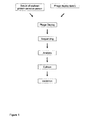
Figure 1 depicts the procedure of identifying epitopes responsible for immunologic reactions to soybean protein. -
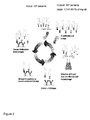
Figure 2 depicts the phage display procedure used for identifying epitopes. -
Figure 3 depicts the size of allergy relevant sequences of soybean proteins identified by various techniques in relation to the size of an entire soybean protein. Whereas the free epitope data base (www.IEDB.org) and arrays of synthetic peptides for screening protein sequences provide sequences of about 10 to 20 and even more amino acids, specific core sequences for anti-Allergen Antibody binding peptides of usually 4 to 6 amino acids were identified by phage display. -
Figure 4 shows the identification of an epitope. "Seq" refers to the original sequence tested in PEPper-PRINT Array. All sequences identified from Serum 21 (only a subset shown) share the common motive "VFASQV (SEQ ID NO.: 94). The motifs variability is shown by different sequences bound by serum 21. - In a first aspect, the invention relates to a compilation comprising at least five different peptides, each peptide comprising at least one sequence element corresponding to an epitope selected from the group consisting of SEQ ID NO.: 1 - 354.
- Several proteins of soybean seeds have been found to trigger immunoglobulin E (IgE) mediated allergic responses in sensitive persons. Strong immunodominant allergic proteins, such as P34 thiol protease (Gly m Bd 30K), are known to induce allergic reactions, whereas other soybean proteins, although no potent inducers of a primary allergic response, can nevertheless trigger effector responses due to their binding by IgE. Interestingly, affected persons show varying sensitivity to different soybean proteins. For example, only 65 % of soybean sensitive individuals carry IgE recognizing P34 thiol protease (Gly m Bd 30K), which is considered one of the strongest allergenic soybean proteins (Yang et al., 2011). Finally, as antibodies usually do not recognize an entire protein but interact with distinct structures of limited numbers of amino acids within a molecule, sensitivity between patients varies distinctly due to their genetic background and different results of antibody maturation. To identify many specific epitopes, i.e. amino acid sequences of soybean proteins, recognized by antibodies of sensitive patients, with high resolution down to the individual amino acids involved, the inventors applied a novel approach using a specific random phage library (
EP 14 166 662.8 Table 1: Individual Epitopes Soybean allergen (ID) Epitop NO Epitop sequence SEQ ID NO. beta conglycinin alpha chain (X17698) 6.04.001 SNRFE 1 6.04.002 FKNQYG 2 6.04.003 FNSKPN 3 6.04.004 VNPDNN 4 6.04.005 LAIPV 5 6.04.006 NXPGRFES 6 6.04.007 EASYD 7 6.04.008 EQQQGE 8 6.04.009 QESVI 9 6.04.010 KSSSRK 10 6.04.011 PEKNPQ 11 6.04.012 FVIPAG 12 6.04.013 AFPGS 13 6.04.014 CLQSCNS 14 6.04.015 NSERD 15 6.04.016 ERDSYR 16 6.04.017 RNQACHA 17 6.04.018 QACHAR 18 6.04.019 KEECEEG 19 6.04.020 EIPRPR 20 6.04.021 KEECEE 21 6.04.022 RPQHPEREP 22 6.04.023 REPQQPGE 23 6.04.024 HPEREP 24 6.04.025 QQPGEKE 25 6.04.026 EDEDEQPRP 26 6.04.027 IPFPRPQP 27 6.04.028 PRQEEE 28 6.04.029 EEHEQREEQ 29 6.04.030 GEKGSEE 30 6.04.031 RNEEEDE 31 6.04.032 EDEEQQ 32 6.04.033 EEQQRES 33 6.04.034 RESEES 34 6.04.035 VLFSREEG 35 6.04.036 EEGQQQG 36 6.04.037 LRSRDPIY 37 6.04.038 LSIVD 38 6.04.039 LKEQQQE 39 6.04.040 EQQQE 40 6.04.041 EEQPLE 41 6.04.042 NQRESYFV 42 6.04.043 FVDAQP 43 beta conglycinin alpha' chain (M13759.1) 7.03.001 GVVFL 44 7.03.002 RFQTL 45 7.03.003 PQLRD 46 7.03.005 QPHQK 47 7.03.007 DRDSY 48 7.03.008 LRVPA 49 7.03.009 KVEEEE 50 7.03.010 PERERQ 51 7.03.011 QQHGEK 52 7.03.012 EDEGEQP 53 7.03.013 EGEQPRPF 54 7.03.014 FPRPRQP 55 7.03.015 QPHQEE 56 7.03.016 EQKEEH 57 7.03.017 KEEHE 58 7.03.018 SEEEQDERE 59 7.03.019 HKQEKH 60 7.03.020 ESEEE 61 7.03.021 EEEDQDE 62 7.03.022 EEDQDEDEEQ 63 7.03.023 ESQESEGSE 64 7.03.024 ESQREP 65 7.03.025 NKRSQQLQ 66 7.03.026 LPHHAD 67 7.03.027 GREEGQ 68 7.03.028 VLVINE 69 7.03.029 IELVGI 70 7.03.030 QDIFVIP 71 7.03.031 DAQPQQ 72 7.03.032 LEVRKYR 73 7.03.033 ESYFVD 74 7.03.034 FVDAQP 75 beta conglycinin beta chain (S44893) 8.04.001 FLASV 76 8.04.002 LSGRAI 77 8.04.005 HQNLK 78 8.04.006 KPGRYD 79 8.04.007 ELSKEQ 80 8.04.010 IERQVQ 81 8.04.011 PQLENL 82 8.04.012 DSYNLH 83 8.04.013 PGDAQ 84 8.04.014 SHNILE 85 8.04.015 SFHSEFEE 86 8.04.016 EEINRV 87 8.04.017 RVLFGE 88 8.04.018 QRQQE 89 8.04.019 QEGVIV 90 8.04.020 ILVINE 91 08.04.2008 PHFNSK 92 08.04.2009 EEEPLE 93 Defensin (Z13956.1) 10.00.01 VFASQV 94 10.00.02 VVVQTE 95 10.00.03 TEGRVC 96 10.00.04 RVCESQS 97 10.00.05 QSHGF 98 10.00.06 SQSHGFH 99 10.00.07 HGLCNRDHN 100 10.00.08 RDHNCALVC 101 10.00.09 LVCRNE 102 10.00.10 SRRCF 103 Gly m BD 28K (AB046874.2) 11.00.01 QEEDEE 104 Glycinin G1 (AB113349.1) 12.00.01 QCAGVA 105 12.00.02 PRGSQS 106 12.00.02 VPHYNLNA 107 12.00.03 LIQVVN 108 12.00.04 AARSQ 109 12.00.05 DNFEY 110 12.00.06 SREQPQ 111 12.00.07 CCFAFS 112 12.00.08 PQQNEC 113 12.00.09 GPQEIYIQQ 114 12.00.10 RPSYTN 115 12.00.11 CPSTFEE 116 12.00.12 IYPGCPS 117 12.00.13 PQQPQQR 118 12.00.14 QRGQS 119 12.00.15 QSSRPQ 120 12.00.16 PQDRHQ 121 12.00.17 QKIYNF 122 12.00.18 REGDL 123 12.00.19 VPTGVAW 124 12.00.20 NQLDQ 125 12.00.21 QEQEF 126 12.00.22 KYQQEQ 127 12.00.23 HQSQK 128 12.00.24 KHQQEEEN 129 12.00.25 KNLQGE 130 12.00.26 TDEQQQ 131 12.00.27 QQRPQE 132 12.00.28 EKPQCK 133 12.00.29 DKHCQR 134 12.00.30 FVPHY 135 12.00.31 KFLVPPQE 136 12.00.32 PQESQK 137 Glycinin G2 (D00216.1) 13.00.01 CPSTYN 138 13.00.02 QGGSQS 139 13.00.03 SGAIV 140 13.00.03 GGLRVT 141 13.00.04 RLRQN 142 13.00.05 LKLSAQ 143 13.00.06 VAAKSQ 144 13.00.07 PSIGNL 145 13.00.08 FSFLVPP 146 13.00.09 REQAQQN 147 13.00.10 QKLNA 148 13.00.11 RIESEG 149 13.00.12 TYQEPQ 150 13.00.13 PQESQ 151 13.00.14 ESQQRG 152 13.00.15 GRSQR 153 13.00.16 QDRHQK 154 13.00.17 VHRFRE 155 13.00.18 EEENEG 156 13.00.19 QIVRNL 157 13.00.20 RKPQQE 158 13.00.21 EEEQPQ 159 13.00.22 DIYNPQ 160 13.00.23 ERVFD 161 13.00.24 ELQEG 162 Glycinin G3 (X15123.1) 14.00.01 FREQPQQN 163 14.00.02 QPQKQQ 164 14.00.03 RQIVRK 165 14.00.04 RRQQAR 166 14.00.05 ECQIQR 167 14.00.06 IQQGSGI 168 14.00.07 QQKGQS 169 14.00.08 IYHFRE 170 14.00.09 AVPTGF 171 14.00.10 NSFQN 172 14.00.11 PTEEQ 173 14.00.12 QQQRPE 174 14.00.13 PDCDEK 175 14.00.14 DKHCQS 176 14.00.15 CQSQSR 177 14.00.16 QSQSRN 178 14.00.17 HNIGQT 179 Glycinin G4 (X05652) 15.03.2001 QGKGA 180 15.03.2002 VLSGFS 181 15.03.2003 LNECQL 182 15.03.2004 PDHRVE 183 15.03.2005 RNGLHS 184 15.03.2006 YSPYPR 185 15.03.2007 VAIPGC 186 15.03.2008 ETFEEP 187 15.03.2009 QQLQDS 188 15.03.2010 IRHFNE 189 15.03.2011 DIEYPET 190 15.03.2012 KQGQHQ 191 15.03.2013 DIAEKL 192 15.03.2014 KLESPD 193 15.03.2015 SVISPK 194 15.03.2016 QQDED 195 15.03.2017 KREQD 196 15.03.2018 HPPRRP 197 15.03.2019 REQDED 198 15.03.2020 GQDEDE 199 15.03.2021 TQPRRP 200 15.03.2022 PRQEEP 201 15.03.2023 EEPRER 202 Glycinin G5 (M10962.1) 16.02.2001 NSQHPE 203 16.02.2002 HPELQC 204 16.02.2003 QCAGVT 205 16.02.2004 TVSKR 206 16.02.2005 KGAIGF 207 16.02.2006 GSRSQ 208 16.02.2007 VTVEG 209 16.02.2008 RTPSYPP 210 16.02.2009 VEENICT 211 16.02.2010 PSRADF 212 16.02.2011 NCQGN 213 16.02.2012 RRGQLL 214 16.02.2013 PAVAE 215 16.02.2014 IPSEVL 216 16.02.2015 NSYNL 217 16.02.2016 CQLNN 218 16.02.2017 RVESEG 219 16.02.2018 YLPYPQ 220 16.02.2019 SHLPSY 221 16.02.2020 IGFAFP 222 16.02.2021 FPGCPE 223 16.02.2022 VIPLGV 224 16.02.2023 DEPWA 225 16.02.2024 RVFYL 226 16.02.2025 GNPDIE 227 16.02.2026 IEHPET 228 16.02.2027 QGQHR 229 16.02.2028 HRQQE 230 16.02.2029 QQEEEG 231 16.02.1930 DTAEK 232 16.02.1931 EGGLS 233 16.02.1932 KWQEQE 234 16.02.1933 QEQEDE 235 16.02.1934 DEEYGR 236 16.02.1935 GKHEDD 237 16.02.1936 EEEDQP 238 16.02.1937 PRPDHP 239 16.02.1938 HPPQRP 240 16.02.1939 QRPSRP 241 16.02.1940 PEQQEP 242 16.02.1941 QQEPRG 243 16.02.1942 LRRGQ 244 16.02.1943 GNAVFD 245 16.02.1944 THHNAV 246 16.02.1945 SNSYNL 247 16.02.1946 LGQSQV 248 16.02.1947 PLVNP 249 16.02.1948 QGNSG 250 Hydrophobic Seed Protein (A29385) 18.00.01 LGGSL 251 18.00.02 DDCCAL 252 18.00.03 NSCGRS 253 Kunitz trypsin inhibitor (S45092.1) 19.13.01 GNERC 254 19.13.02 RAAPTG 255 19.13.03 LCVGIP 256 19.13.04 TEWSV 257 p34 thiol protease (J05560.1) 23.01.2001 VITQVK 258 23.01.2002 KYQGGC 259 Profilin (AJ223981.1) 26.00.01 KPEEI 260 26.00.02 FPQFKP 261 26.00.03 EPGSL 262 26.00.04 QGEPGAV 263 26.00.05 ERLGDY 264 26.00.06 AYVDDH 265 26.00.07 NHLTHAAI 266 26.00.08 IIGQDG 267 26.00.09 GSVWLQ 268 26.00.10 TPGQC 269 26.00.11 IYDEP 270 Profilin (AJ223982.1) 26.01.2001 CDIEGN 271 26.01.2002 GSVWAQ 272 26.01.2003 VVERP 273 26.01.2004 IDQGY 274 PR10 (X60043.1) 25.00.01 SIDEA 275 25.00.02 NLGYSY 276 25.00.03 VENVEGN 277 25.00.04 EDEINS 278 25.00.05 NSPVAP 279 25.00.06 PDTAEK 280 25.00.07 EKITF 281 25.00.08 GSAGKLT 282 25.00.09 ETKGD 283 18 kD Seed Maturation Protein (AJ574791.1) 2.00.001 IGASA 284 2.00.002 ATVQEKAER 285 2.00.003 ARDPVQ 286 2.00.004 ELATQK 287 2.00.005 QHNTA 288 2.00.006 GHGHHT 289 2.00.007 GEYGQP 290 2.00.008 HQTSA 291 2.00.009 HGTGQPTGH 292 2.00.010 HVTEGV 293 2.00.011 VGSHPIG 294 2s Albumin (AAB71140.1) 1.00.001 LFCIAHTCS 295 1.00.002 SASKWQH 296 1.00.004 QQDSCR 297 1.00.005 SCRKQL 298 1.00.006 KQLQGVN 299 1.00.007 NLTPCEK 300 1.00.009 QGRGD 301 1.00.011 EDEEEEG 302 1.00.012 QKCCT 303 1.00.013 TEMSEL 304 1.00.015 CKALQK 305 1.00.016 NQSEELEEK 306 1.00.017 MCRFGP 307 1.00.018 IQCDLS 308 2s Albumin (BT091363.1) 1.01.002 CASKWQQH 309 1.01.003 QHQQES 310 1.01.005 ESCREQL 311 1.01.007 NPCEHI 312 1.01.008 EKIQAG 313 1.01.009 DGSDEDH 314 1.01.010 EGKEE 315 1.01.011 KEEEEE 316 1.01.013 SEMSE 317 1.01.014 SPICQCK 318 1.01.016 NQSEQLEGKE 319 1.01.017 AIRCRL 320 1.01.018 IGCDL 321 Albumin 1 (AJ574791.1) 3.00.001 NGACSPFE 322 3.00.002 PPCRSRD 323 3.00.003 RDCRC 324 3.00.004 RCVPIGL 325 3.00.005 AGFCIH 326 3.00.006 GLSSVA 327 3.00.008 HPNLCQSD 328 3.00.009 QSDDEC 329 3.00.010 GNFCARYP 330 Albumin 1 (AJ223037.1) 3.01.002 PPCRSS 331 3.01.007 VDEHP 332 3.01.011 SDSEA 333 Albumin 1 (AJ223037.1) 3.03.001 EGTSSAKLT 334 3.03.002 RCVPIA 335 Lectin (K00821.1) 21.05.2001 LAPIDT 336 21.05.2002 TKPQT 337 21.05.2003 KPQTHA 338 21.05.2004 DPPNPHI 339 21.05.2005 DTFRN 340 21.05.2006 NLPHAS 341 Seed biotinylated protein (U59626.1) 27.01.2001 EIHVEK 342 27.01.2002 KHRVPK 343 27.01.2003 DHAGKA 344 27.01.2004 KESQRE 345 27.01.2005 ANWG 346 27.01.2006 VAEKGR 347 27.01.2007 GRETE 348 27.01.2008 AHVVEG 349 27.01.2009 EYTAK 350 27.01.2010 EAQRELE 351 27.01.2011 QPQEAE 352 27.01.2012 GESEG 353 27.01.2013 RAKHEEG 354 "X" indicating any amino acid - The epitopes identified by the inventors provide the most comprehensive data on potentially allergenic proteins and peptides derived from soybean that are available so far. These data, i.e. the identified epitopes, provide the essential basis for assessing both, the immune status of an individual to soybean protein and the allergenic potential of food and other products suspected of containing soybean protein. The compilation of the invention provides a collection of peptides of different amino acid sequences with each peptide comprising a short element of about three to six amino acids (sequence element), which corresponds to one of the identified epitopes (table 1). Thus, each peptide presents a potential epitope for a soybean-allergen antibody (IgE). The term "corresponding" refers to the exact reproduction of the epitope sequence as well as variants thereof differing from the identified epitope in one or two amino acids. The variation may be due to one or two missing amino acids and/or to the exchange of one or two amino acids in comparison to the identified epitope. It is well established in the art that the secondary structure and the physical-chemical properties of a peptide (e.g. its antibody binding properties due to size, charge and/or polarity) may be maintained despite of minor changes to the amino acid sequence. In particular, single amino acids with side chains of little polarity or other reactivity, may be omitted or replaced by other amino acids of similar reactivity (e.g. -lysine - arginine or leucine - isoleucine). The possibility of minor amino acid changes within the amino acid sequence corresponding to the epitope was also confirmed by the data obtained from the phage display and the peptide arrays. The antibodies contained in the patients' sera recognized several variants of individual epitopes, e.g. overlapping epitopes such as EDEEQQ (SEQ ID NO.: 32), EEQQRES (SEQ ID NO.: 33), RESEES (SEQ ID NO.: 34), (see table 1, and SEQ ID NO.: 385) of beta conglycinin alpha chain.
- Accordingly, comprehensive analysis of interactions of antibody sera derived from various patients allowed to determine variations within the epitopes sequence. Table 2 depicts the epitopes within the endogenous soybean protein sequence (epitopes underlined) and indicates the variability of the epitope (minimum amino acids / all amino acids of the epitope).
Table 2: Epitopes within the natural soybean protein Soybean protein (Genebank ID) Epitope with adjacent amino acids according to protein sequence SEQ ID NO. variation Defensin (Z13956.1) VFASQVVVQTEGRVC 355 4/6 VFASQVVVQTEGRVC 356 4/6 VFASQVVVQTEGRVC 357 4/6 QVVVQTEGRVCESQS 358 4/7 QTEGRVCESQSHGFH 359 4/5 RVCESQSHGFHGLCNR 360 4/7 SQSHGFHGLCNRDHN 361 4/9 GFHGLCNRDHNCALVC 362 4/9 LCNRDHNCALVCRNE 363 4/6 RCKRSRRCFCTRICG 364 4/6 beta conglycinin alpha chain (X17698.1) PKHNKCLQSCNSERD 365 4/7 PKHNKCLQSCNSERD 366 4/5 SCNSERDSYRNQACH 367 4/6 SCNSERDSYRNQACHA 368 4/7 ERDSYRNQACHARCN 369 4/6 LKVEKEECEEGEIPR 370 4/7 KEECEEGEIPRPRPR 371 4/6 KEECEEGEIPRPRPR 372 4/6 IPRPRPRPQHPEREPQ 373 4/9 RPRPQHPEREPQQPGE 374 4/7 QHPEREPQQPGEKEE 375 4/6 QHPEREPQQPGEKEE 376 4/7 QPGEKEEDEDEQPRP 377 4/9 EDEQPRPIPFPRPQP 378 4/6 PRPIPFPRPQPRQEEE 379 4/6 PQPRQEEEHEQREEQ 380 5/8 WPRKEEKRGEKGSEE 381 5/7 RPPHQKEERNEEEDE 382 (4/7 QKEERNEEEDEDEEQQ 383 4/6 RNEEEDEDEEQQRES 384 4/7 EDEDEEQQRESEESE 385 4/7 KFEEINKVLFSREEG 386 5/8 INKVLFSREEGQQQG 387 4/7 SEDKPFNLRSRDPIY 388 4/7 LSIVDMNEGALLLPHF 389 4/5 ELVGLKEQQQEQQQE 390 4/7 ELVGLKEQQQEQQQE 391 4/7 LKEQQQEQQQEEQPLE 392 4/6 LLKNQRESYFVDAQP 393 5/8 LLKNQRESYFVDAQP 394 4/6 PFLFGSNRFETLFKN 395 4/5 RFETLFKNQYGRIRVL 396 4/6 YRILEFNSKPNTLLLP 397 4/6 TTYYVVNPDNNENLRL 398 4/6 LRLITLAIPVNKPGR 399 4/5 IPVNKPGRFESFFLSS 400 4/6 SRNILEASYDTKFEE 401 4/5 LFSREEGQQQGEQRLQE 402 4/7 GEQRLQESVIVEISK 403 4/5 LSKRAKSSSRKTISSE 404 4/6 FFEITPEKNPQLRDLD 405 4/6 SEQDIFVIPAGYPVVV 406 4/6 QVQELAFPGSAQAVE 407 4/6 beta conglycinin alpha' chain (M13759.1) RCNLLKVEEEEECEE 408 4/6 QIPRPRPQHPERERQ 409 4/6 PRPQHPERERQQHGEK 410 4/6 ERQQHGEKEEDEGEQP 411 4/7 HGEKEEDEGEQPRPF 412 4/8 GEQPRPFPFPRPRQP 413 4/7 RPFPFPRPRQPHQEE 414 4/6 QEEEHEQKEEHEWHR 415 4/6 QEEEHEQKEEHEWHR 416 4/5 GGKGSEEEQDEREHP 417 5/9 HKQEKHQGKESEEEEE 418 4/6 HKQEKHQGKESEEEEE 419 4/5 HQGKESEEEEEDQDE 420 4/7 ESEEEEEDQDEDEEQ 421 5/9 KESQESEGSESQREP 422 4/9 KESQESEGSESQREP 423 4/6 NKRSQQLQNLRDYRI 424 4/8 KPNTLLLPHHADADY 425 4/6 FEEINKVLFGREEGQ 426 4/6 AIVVLVINEGEANIE 427 4/6 NIELVGIKEQQQRQQ 428 4/6 QDIFVIPAGYPVMVN 429 4/7 ESYFVDAQPQQKEEG 430 4/6 ESYFVDAQPQQKEEG 431 4/6 ESYFVDAQPQQKEEG 432 4/5 PLLLLGVVFLASVSV 433 4/5 HFNSKRFQTLFKNQY 434 4/5 ITQRNPQLRDLDVFL 435 4/5 HPRPHQPHQKEEEKH 436 4/5 LVNNDDRDSYNLQSG 437 4/5 QSGDALRVPAGTTFY 438 4/6 beta conglycinin beta chain (S44893) QRFNKRSPQLENLRD 439 4/6 RDSYNLHPGDAQRIP 440 4/5 RDSYNLHPGDAQRIP 441 4/6 SHNILETSFHSEFEE 442 4/8 SHNILETSFHSEFEE 443 4/6 LETSFHSEFEEINRV 444 4/6 NRVLFGEEEEQRQQE 445 4/5 NRVLFGEEEEQRQQE 446 4/6 FGEEEEQROQEGVIV 447 4/6 AIVILVINEGDANIE 448 4/5 LLGTVFLASVCVSLK 449 4/6 FLLFVLSGRAILTLVN 450 4/5 VNPHDHQNLKIIKLA 451 4/6 AIPVNKPGRYDDFFLS 452 4/6 EGVIVELSKEQIRQLS 453 4/6 GALLLPHFNSKAIVIL 454 4/6 QKQKQEEEPLEVQRYR 455 4/6 NVVRQIERQVQELAFP 456 4/5 Glycinin G1 (AB113349.1) FSGCCFAFSSREQPQ 457 4/6 FSGCCFAFSSREQPQ 458 4/5 CFAFSSREQPQQNEC 459 4/9 RPSYTNGPQEIYIQQ 460 4/6 RPSYTNGPQEIYIQQ 461 4/7 GMIYPGCPSTFEEPQ 462 4/7 GMIYPGCPSTFEEPQ 463 4/8 STFEEPQQPQQRGQS 464 4/5 STFEEPQQPQQRGQS 465 4/6 EPQQPQQRGQSSRPQ 466 4/6 PQQRGQSSRPQDRHQ 467 4/6 RPQDRHQKIYNFREG 468 4/5 REGDLIAVPTGVAWW 469 4/5 REGDLIAVPTGVAWW 470 4/5 NSLENQLDQMPRRFY 471 4/5 AGNQEQEFLKYQQEQ 472 4/6 AGNQEQEFLKYQQEQ 473 4/5 GHQSQKGKHQQEEEN 474 4/8 GHQSQKGKHQQEEEN 475 4/6 KQIAKNLQGENEGED 476 4/6 GLSVIKPPTDEQQQR 477 4/6 IKPPTDEQQQRPQEE 478 4/6 DEKPQCKGKDKHCQR 479 4/6 DEKPQCKGKDKHCQR 480 4/5 FGSLRKNAMFVPHYN 481 4/8 NNPFKFLVPPQESQK 482 4/6 NNPFKFLVPPQESQK 483 4/6 NNKPFQCAGVALSRCT 484 4/5 KHCQRPRGSQSKSRRN 485 4/8 KNAMFVPHYNLNANSIIY 486 4/6 LNGRALIQVVNCNGER 487 4/5 QNFVVAARSQSDNFE 488 4/5 ARSQSDNFEYVSFKT 489 4/7 Glycinin G2 (D00216.1) FALREQAQQNECQIQ 490 4/5 QIQKLNALKPDNRIE 491 4/6 LNALKPDNRIESEGG 492 4/6 FPGCPSTYQEPQESQ 493 4/5 FPGCPSTYQEPQESQ 494 4/6 ESQQRGRSQRPQDRH 495 4/5 ESQQRGRSQRPQDRH 496 4/6 QRPQDRHQKVHRFRE 497 4/6 QRPQDRHQKVHRFRE 498 4/6 QSQKGKQQEEENEGS 499 4/6 AFGVNMQIVRNLQGE 500 4/6 VTAPAMRKPQQEEDD 501 4/6 PQQEEDDDDEEEQPQ 502 4/6 QNIGQNSSPDIYNPQ 503 4/5 NCNGERVFDGELQEG 504 4/5 NCNGERVFDGELQEG 505 4/6 MIFPGCPSTYQEPQES 506 4/5 YQQQQQGGSQSQKGKQ 507 4/5 NEEEDSGAIVTVKGG 508 4/5 IVTVKGGLRVTAPAMR 509 4/5 TICTMRLRQNIGQNS 510 4/6 PALWLLKLSAQYGSLR 511 4/6 PQNFAVAAKSQSDNFE 512 4/6 KTNDRPSIGNLAGANS 513 4/7 KNNNPFSFLVPPQESQR 514 4/6 Glycinin G3 (X15123.1) SFREQPQQNECQIQR 515 4/6 IQQGSGIFGMIFPGC 516 4/6 STFEEPQQKGQSSRP 517 4/6 SRPQDRHQKIYHFRE 518 4/6 FREGDLIAVPTGFAY 519 4/5 TNSFQNQLDQMPRRF 520 4/5 LSVISPPTEEQQQRP 521 4/6 EEQQQRPEEEEKPDC 522 4/6 PDCDEKDKHCQSQSR 523 4/6 PDCDEKDKHCQSQSR 524 4/6 PDCDEKDKHCQSQSR 525 4/6 HCQSQSRNGIDETIC 526 4/6 HNIGQTSSPDIFNPQ 527 4/8 CFAFSFREQPQQNECQIQ 528 4/6 EFLQYQPQKQQGGTQS 529 4/6 AFVVDRQIVRKLQGENE 530 4/5 QTFNLRRQQARQVKNN 531 4/6 Glycinin G4 (X05652) QLNNLNALEPDHRVE 532 4/6 RNGLHSPSYSPYPRM 533 4/6 RNGLHSPSYSPYPRM 534 4/6 LGVAIPGCPETFEEP 535 4/6 LGVAIPGCPETFEEP 536 4/5 QQLQDSHQKIRHFNE 537 4/6 QQLQDSHQKIRHFNE 538 4/7 PDIEYPETMQQQQQQ 539 4/6 QQQKSHGGRKQGQHQ 540 4/6 NEDIAEKLESPDDER 541 4/6 NEDIAEKLESPDDER 542 4/6 LSVISPKWQEQQDED 543 4/5 LSVISPKWQEQQDED 544 4/5 SHPPRRPSHGKREQD 545 4/6 SHPPRRPSHGKREQD 546 4/6 RRPSHGKREQDEDED 547 4/6 GKRNKTGQDEDEDED 548 4/6 WRSKKTQPRRPRQEE 549 4/6 KTQPRRPRQEEPRER 550 4/6 KTQPRRPRQEEPRER 551 4/6 HNAVTSYLKDVFRAI 552 4/5 MIIIAQGKGALGVAI 553 4/6 EEGGSVLSGFSKHFLA 554 4/6 SSSKLNECQLNNLNA 555 4/5 Glycinin G5 (M10962.1) CQLNNLNALEPDHRV 556 4/6 NLNALEPDHRVESEG 557 4/5 NRNGSHLPSYLPYPQ 558 4/8 NRNGSHLPSYLPYPQ 559 4/6 AIGFAFPGCPETFEK 560 4/6 AIGFAFPGCPETFEK 561 4/6 FNEGDVLVIPLGVPY 562 4/6 TYNTGDEPVVAISPL 563 4/5 RVFYLAGNPDIEHPE 564 4/6 RVFYLAGNPDIEHPE 565 4/6 RVFYLAGNPDIEHPET 566 4/5 QQQKSHGGRKQGQHR 567 4/5 SHGGRKQGQHRQQEE 568 4/6 RKQGQHRQQEEEGGS 569 4/5 EDTAEKLRSPDDERK 570 4/5 EGGLSVISPKWQEQE 571 4/6 EGGLSVISPKWQEQE 572 4/6 SVISPKWQEQEDEDE 573 4/6 EQEDEDEDEDEEYGR 574 4/6 SHGKHEDDEDEDEEE 575 4/6 HEDDEDEDEEEDQPR 576 4/6 EDEDEEEDQPRPDHP 577 4/6 EEEDQPRPDHPPQRP 578 4/6 QPRPDHPPQRPSRPE 579 4/6 DHPPQRPSRPEQQEP 580 4/6 RPEQQEPRGRGCQTR 581 4/5 CQGNAVFDGELRRGQ 582 4/6 CQGNAVFDGELRRGQ 583 4/6 THHNAVSSYIKDVFR 584 4/6 VLSNSYNLGQSQVRQ 585 4/6 VLSNSYNLGQSQVRQ 586 4/5 KYQGNSGPLVNPGSG 587 4/5 KYQGNSGPLVNPGSG 588 4/6 LIETWNSQHPELQCAG 589 4/6 TWNSQHPELQCAGVTV 590 4/6 QHPELQCAGVTVSKRT 591 4/5 QCAGVTVSKRTLNRN 592 4/6 IVVQGKGAIGFAFPGC 593 4/5 QSSRRGSRSQQQLQD 594 4/5 ERKQIVTVEGGLSVI 595 4/7 DEEYGRTPSYPPRRPSH 596 4/7 QTRNGVEENICTMKLHE 597 4/6 ENIARPSRADFYNPKA 598 4/5 RVRVVNCQGNAVFDG 599 4/6 FDGELRRGQLLVVPQN 600 4/5 VVPQNPAVAEQGGEQ 601 4/6 DVFRVIPSEVLSNSYN 602 4/5 SEVLSNSYNLGQSQV 603 4/6 Profilin1 (AJ223981.1) AYVDDHLLCGIEGNH 604 4/8 GNHLTHAAIIGQDGS 605 4/6 GNHLTHAAIIGQDGS 606 4/6 THAAIIGQDGSVWLQ 607 4/5 LIIGIYDEPMTPGQC 608 4/5 DFPQFKPEEITAIMN 609 4/6 LQSTDFPQFKPEEITA 610 4/5 MNDFNEPGSLAPTGL 611 4/7 KYMVIQGEPGAVIRGKK 612 4/6 CNMVVERLGDYLIDQG 613 4/5 Profilin2 (AJ223982.) MVVERPGDYLIDQGY 614 4/5 MVVERPGDYLIDQGY 615 4/6 DDHLLCDIEGNHLTHA 616 4/6 IIGQDGSVWAQSTDFP 617 4/5 PR10 (X60043.1) HKIESIDEANLGYSY 618 4/6 HKIESIDEANLGYSY 619 4/7 VENVEGNGGPGTIKK 620 4/6 GVFTFEDEINSPVAPA 621 4/6 FEDEINSPVAPATLYK 622 4/6 GGAALPDTAEKITFDS 623 4/5 LPDTAEKITFDSKLV 624 4/7 AGPNGGSAGKLTVKYET 625 4/5 LTVKYETKGDAEPNQ 626 4/9 2s Albumin (AAB71140.1) LLISLLFCIAHTCSASKWQ 627 4/7 IAHTCSASKWQHQQDSC 628 4/6 SKWQHQQDSCRKQLQG 629 4/6 QHQQDSCRKQLQGVNL 630 4/7 QDSCRKQLQGVNLTPCE 631 4/7 QLQGVNLTPCEKHIMEK 632 4/5 IMEKIQGRGDDDDDD 633 4/7 NEGKDEDEEEEGHMQKC 634 4/5 EEGHMQKCCTEMSEL 635 4/6 MQKCCTEMSELRSPKC 636 4/6 SPKCQCKALQKIMENQ 637 4/9 QKIMENQSEELEEKQKKK 638 4/6 INLATMCRFGPMIQCDL 639 4/6 RFGPMIQCDLSSDD 640 4/8 2s Albumin (BT091363.1) IAHTCCASKWQQHQQES 641 4/6 CCASKWQQHQQESCREQ 642 4/7 QQHQQESCREQLKGINL 643 4/6 KGINLNPCEHIMEKIQ 644 4/6 CEHIMEKIQAGRRGED 645 4/7 GRRGEDGSDEDHILIRT 646 4/5 YIRKKEGKEEEEEGH 647 4/6 RKKEGKEEEEEGHMQK 648 4/5 MQKCCSEMSELKSPI 649 4/7 MSELKSPICQCKALQKI 650 4/10 QKIMDNQSEQLEGKEKKQ 651 4/6 ELMNLAIRCRLGPMIG 652 4/5 RLGPMIGCDLSSDD 653 4/5 18 kD Seed Maturation Protein (AJ574791.1) ETATNIGASAKAGME 654 4/10 MEKTKATVQEKAERMTAR 655 4/6 AERMTARDPVQKELAT 656 4/6 DPVQKELATQKKEAKM 657 4/5 KQAARQHNTAAKQSA 658 4/6 TAGHMGHGHHTTGTGT 659 4/6 TYSTTGEYGQPMGAHQ 660 4/5 QPMGAHQTSAMPGHG 661 4/9 SAMPGHGTGQPTGHVTE 662 4/6 GQPTGHVTEGVVGSHP 663 4/7 VTEGVVGSHPIGTNRGP 664 4/8 Albumin 1_(AJ574791.1) EAADCNGACSPFEMPPCR 665 4/7 SPFEMPPCRSRDCRCVP 666 4/5 PPCRSRDCRCVPIGL 667 4/7 RSRDCRCVPIGLVAGFC 668 4/6 PIGLVAGFCIHPTGLS 669 4/6 CIHPTGLSSVAKMIDE 670 4/8 KMIDEHPNLCQSDDECMK 671 4/6 HPNLCQSDDECMKKGS 672 4/8 MKKGSGNFCARYPNNYID 673 4/6 Albumin 1 (AJ223037.1) SPFEVPPCRSSDCRCV 674 4/5 SVAKMVDEHPNLCQS 675 4/5 GWCFDSDSEALKGFL 676 4/9 Albumin 1 (AJ223037.1_G3FGW7) MQEGTSSAKLTTHLNK 677 4/6 RSSDCRCVPIALFVGF 678 4/6 Seed biotinylated protein (U59626.1) EIHVEKHRVPKMATH 679 4/6 EIHVEKHRVPKMATH 680 4/6 KDHAGKAMGDIGGRG 681 4/6 HAAANVVGNKESQRE 682 4/5 HAAANVVGNKESQRE 683 4/6 ESGGQVVAEKGRETE 684 4/5 ESGGQVVAEKGRETE 685 4/6 AAAHVVEGAAGYAGH 686 4/5 EYTAKKKEEAQRELE 687 4/7 EYTAKKKEEAQRELE 688 4/6 QPQEAEERPSEGIGE 689 4/5 NTMGGESEGGGGKEE 690 VLETRVTGRAKHEEG 691 4/6 Lectin (K00821.1) GLAFFLAPIDTKPQT 692 4/5 GLAFFLAPIDTKPQT 693 4/6 FLAPIDTKPQTHAGY 694 4/7 FDTFRNSWDPPNPHI 695 4/5 FDTFRNSWDPPNPHI 696 4/6 ASNLPHASSNIDPLD 697 4/6 Gly m BD 28K (AB046874.2) GGYVPCRQEEDEELHHKC 698 4/6 p34 thiol protease (J05560.1) GVITQVKYQGGCGRG 699 4/5 Kunitz trypsin inhibitor (S45092.1) AFGGIRAAPTGNERC 700 4/6 AFGGIRAAPTGNERC 701 4/6 AVIMLCVGIPTEWSV 702 4/5 AVIMLCVGIPTEWSV 703 4/6 Hydrophobic Seed Protein (A29385) ILGGSLGTVDDCCAL 704 4/5 ILGGSLGTVDDCCAL 705 4/6 - The compilation of the invention is for example suitable for determining the immune status of a patient to soybean proteins by analysing the patient's immunological reaction to individual epitopes. As each peptide of the compilation presents a potentially allergenic soybean epitope, interaction of the patient's antibodies (IgE) with the peptides is representative for the patient's immune status to soybean allergens.
- Additionally, a peptide comprising at least one sequence element corresponding to a soybean epitope is suitable for identifying or generating molecules specifically binding to the respective epitope and peptides or proteins comprising the same. The resulting molecules, e.g. antibodies, provide a significant advantage for detecting soybean proteins. Common anti-soybean antibodies or sera are raised against whole soybean proteins or even proteomes and therefore inevitably include antibodies directed against non-allergen proteins/parts of proteins. In contrast, utilizing peptides with sequence elements corresponding to specific allergenic soybean epitopes allows for the generation of antibodies distinctly directed against allergenic soybean proteins. Moreover, these antibodies specifically bind to the allergenic part (i.e epitope) of a soybean protein. Finally, such antibodies, or other binding molecules generated by using the peptides of the invention, allow the detection of allergenic remnants of soybean proteins that could be missed using antibodies binding to non-allergenic parts of a protein.
- The term "compilation" refers to a collection of at least five different peptides, which includes that each peptide may be present in several or even hundreds of identical copies. Each peptide comprises at least one sequence element corresponding to an epitope, but may also comprise more, e.g. two or three sequence elements corresponding to identical and/or different epitopes. For example, the compilation may comprise at least five different peptides, wherein each peptide comprises the same sequence element (thus representing the same epitope) but different additional amino acids. In this case, the same sequence element is presented in various different molecular environments e.g. secondary structures. Likewise, each peptide may comprise multiple sequence elements corresponding to different epitopes, such that various epitopes/soybean proteins are represented in the compilation. Therefore, it is to be understood, that the compilation may comprise both, peptides comprising sequence elements corresponding to different epitopes as well as peptides comprising identical sequence elements, thus all corresponding to the same epitope, but comprising different additional amino acids.
- The compilation may be provided by immobilizing the peptides on a carrier, e.g. a chip, slide, well plate or on beads. Likewise, the compilation may be provided as a multitude of compositions, each composition containing identical copies of a peptide or a mixture of different peptides. Alternatively, the compilation may be provided as a single composition containing different peptides comprising sequence elements corresponding to the same or different epitopes.
- In a preferred embodiment, the compilation comprises at least 10, preferably at least 20, more preferred at least 50 different peptides. Depending on the application, the advantageous number of different peptides may vary. For example, when testing the binding specificity of an antibody to a distinct epitope, a compilation comprising five different peptides, each comprising the same sequence element corresponding to the epitope but different additional amino acids, may be used. In a simple diagnostic application, a few peptides, e.g. five to ten peptides, may be sufficient to investigate sera for the general presence of antibodies against soybean proteins. In such cases, the sequence elements are preferably selected to correspond to epitopes of the most allergenic proteins such as Gly m Bd 28K, glycinin, hydrophobic seed protein (Gly m 1 a), kunitz trypsin inhibitor, profilin (Gly m3), β-conglycinin (Gly m Bd 60K) and defensin (Gly 2m). For more detailed analyses, the compilation may comprise about 20 to 500 different peptides, preferably representing at least one epitope of each identified allergenic soybean protein. For example, such analysis could be used for providing a more personalized analysis of a patient's health condition. For such comprehensive analysis, a peptide array or a bead-based multiplex assay may be provided covering sequence elements corresponding to each of the identified epitopes.
- In a preferred embodiment, the peptide consists of about 5 to 30 amino acids, preferably 8 to 20 amino acids, more preferred 8 to 15 amino acids. Besides the sequence element corresponding to the epitope, usually four, five or six amino acids, each peptide may comprise further amino acids on one or both sides of the sequence element. Such additional amino acids may be added for example for immobilizing the peptide on a substrate or for embedding the sequence element corresponding to the epitope into a specific molecular environment (secondary structure). The additional amino acids may be chosen depending on the use of the compilation. For example, to present the epitope in its natural molecular environment, the sequence element corresponding to the epitope may be flanked by amino acids as found in the naturally occurring protein sequence of the soybean protein. In case the epitope is flanked by different amino acid sequences in different soybean varieties, corresponding peptides may be used to evaluate the influence of the adjacent amino acids to the allergenic potential of the epitope. Additionally, functional molecules e.g. for coupling or readout may be added at the N- or C- terminus of the peptide.
- In a preferred embodiment, each epitope is selected from one of the groups comprising group 1 (β-conglycinin) consisting of SEQ ID NO.: 1 - 93, group 2 (defensin) consisting of SEQ ID NO.: 94 - 103, group 3 (Gly m Bd 28K) consisting of SEQ ID NO.: 104, group 4 (glycinin) consisting of SEQ ID NO.: 105 - 250, group 5 (hydrophobic seed protein) consisting of SEQ ID NO.: 251 - 253, group 6 (kunitz trypsin inhibitor) consisting of SEQ ID NO.: 254 - 257, group 7 (P34 thiol protease) consisting of SEQ ID NO.:258 - 259, group 8 (profilin) consisting of SEQ ID NO.: 260 - 274, and group 9 (Pr-10) consisting of SEQ ID NO.: 275 - 283. Although the sensitivity to soybean proteins is known to vary distinctly between different patients, several proteins are considered major allergens, in particular P34 (Gly m1), β-conglycinin (Gly m5) and glycinin (Gly m6). β-conglycinin and glycinin are storage proteins and constitute 70 to 80 % of total seed protein. Both are regarded good diagnostic markers for soybean protein sensitivity (Masilamani et al., 2012). β-conglycinin comprises three individual subunits (α, α', β), which were all found to react with IgE. Interestingly, wild and cultivated soybean plants were found to vary distinctly in these subunits (Natarajan 2014). Glycinin comprises five subunits, which were also all found to be recognized by IgE from soybean protein sensitive persons. P34 is a soybean vacuole protein (hull protein) with high sequence similarity to thiol proteases of the papain family, which are known to potentially induce allergic reactions in human. In general, several soybean allergens show distinct similarity to allergens of other organisms. For example, P34 is related to DERp1 from dust mite, profilin (Gly m3) is related to the profilin family of proteins in birch pollen, Gly m5/6 is closely related to ARAh1/3 of peanut and Pr10 (Gly m4) is highly homolog to BETV1 and other major allergens of cross reactivity with birch pollen. Thus, compilations covering sequence elements corresponding to epitopes of the above mentioned groups are suitable to provide detailed information not only on soybean sensitivity but also regarding sensitivity to allergens from other organisms. In particular, when providing screening tests to identify soybean protein sensitive patients, the compilation of peptides may cover at least five, preferably all of these proteins. Accordingly, in a particularly preferred embodiment, the compilation comprises at least nine different peptides and each peptide comprising at least one sequence element corresponding to an epitope selected from each of the groups comprising group 1 (β-conglycinin) consisting of SEQ ID NO.: 1 - 93, group 2 (defensin) consisting of SEQ ID NO.: 94 - 103, group 3 (Gly m Bd 28K) consisting of SEQ ID NO.: 104, group 4 (glycinin) consisting of SEQ ID NO.: 105 - 250, group 5 (hydrophobic seed protein) consisting of SEQ ID NO.: 251 - 253, group 6 (kunitz trypsin inhibitor) consisting of SEQ ID NO.: 254 - 257, group 7 (P34 thiol protease) consisting of SEQ ID NO.:258 - 259, group 8 (profilin) consisting of SEQ ID NO.: 260 - 274, and group 9 (Pr-10) consisting of SEQ ID NO.: 275 - 283.
- In a preferred embodiment, each epitope is selected from
group 10 consisting of SEQ ID NO.: 18, 22, 29, 34, 37, 60, 65, 67, 79, 85, 87, 91, 99, 95, 94, 92, 103, 117, 131, 110, 126, 152, 153, 168, 173, 172, 183, 188, 200, 227, 233, 237, 250, 251, 252, 253, 254, 255, 257, 258, 262, 271, 261, 276, 281, 274, 309, 311, 319, 307, 294, 305, 298, 284, 291, 290, 328, 322, 323, 331, 332, 333, 334, 335, 336, 337, 339, 340, 345, 346 and 351.. Although the immune status to major allergenic soybean proteins varies distinctly between patients, statistic analyses enabled by the use of the specific phage display library, made it possible to identify certain epitopes that are recognized by the majority of patients (Table 3).Table 3: Epitopes recognized by the majority of patients: Protein Epitope SEQ ID NO. beta conglycinin alpha chain (X17698) QACHAR 18 RPQHPEREP 22 EEHEQ 29 EEQQRES 34 EEGQQQG 37 beta conglycinin alpha' chain (M13759.1) SEEEQDERE 60 ESQESEGSE 65 NKRSQQLQ 67 beta conglycinin beta chain (S44893) IERQVQ 79 EEINRV 85 ELSKEQ 87 EEEPLE 91 Defensin (Z13956.1) HGLCNRDHN 99 RVCESQS 95 TEGRVC 94 VFASQV 92 Gly m BD 28K QEEDEE 103 Glycinin G1 (AB113349.1) PQQPQQR 117 QQRPQE 131 SREQPQ 110 KYQQEQ 126 Glycinin G2 (D00216.1) GRSQR 152 QDRHQK 153 QQKGQS 168 Glycinin G3 (X15123.1) QQQRPE 173 PTEEQ 172 Glycinin G4 (X05652) RNGLHS 183 IRHFNE 188 PRQEEP 200 Glycinin G5 (M10962.1) IEHPET 227 KWQEQE 233 EEEDQP 237 Hydrophobic Seed Protein (A29385) LGGSL 250 DDCCAL 251 NSCGRS 252 Kunitz trypsin inhibitor (S45092.1) GNERC 253 RAAPTG 254 LCVGIP 255 p34 thiol protease (J05560.1) VITQVK 257 KYQGGC 258 Profilin (AJ223981.1) QGEPGAV 262 GSVWAQ 271 EPGSL 261 PR10 (X60043.1) VENVEGN 276 GSAGKLT 281 SIDEA 274 2s Albumin (BT091363.1) QHQQES 309 ESCREQL 311 NQSEQLEGKE 319 2s Albumin (BT091363.1) IQCDLS 307 LFCIAHTCS 294 NQSEELEEK 305 KQLQGVN 298 18 kD Seed Maturation Protein (AJ574791.1) ATVQEKAER 284 HGTGQPTGH 291 HQTSA 290 Albumin 1_(AJ574791.1) HPNLCQSD 328 NGACSPFE 322 PPCRSRD 323 Albumin 1 (AJ223037.1) PPCRSS 331 VDEHP 332 SDSEA 333 Albumin 1 (AJ223037.1) EGTSSAKLT 334 RCVPIA 335 Lectin (K00821.1) LAPIDT 336 TKPQT 337 DPPNPHI 339 DTFRN 340 Seed biotinylated protein (U59626.1) KESQRE 345 ANVVG 346 EAQRELE 351 - These epitopes are particularly preferred for providing a general immune status test, because it can be expected that every sensitive person will respond to at least one of these epitopes. For example the epitopes RNQACHA (SEQ ID NO.: 17), EIPRP (SEQ ID NO.: 20), NSERD (SEQ ID NO.: 15) have been recognized by 15/23 patients resp. 3/23 resp 7/23. All three epitopes have been recognized just by one patient, two epitopes (SEQ ID NO.: 15, SEQ ID NO.: 17) by 5/23 patients.
- In a further aspect, the invention relates to an analysis tool comprising at least five different peptides, each peptide comprising at least one sequence element corresponding to an epitope selected from the group consisting of SEQ ID NO.: 1 - 354. The term "analysis tool" as used herein refers to means and products for chemical, biochemical or medical analysis of samples, e.g. biologic samples. Such tools include devices (e.g. microarray, multi-well plates), as well as reagents (e.g. compositions comprising free or bead-bound peptides) suitable for single or multiplex analyses. When presented on the surface of a chip or beads, the peptides can interact with substances, e.g. other molecules, brought into contact with the surface. In a peptide array, for example, multitudes of identical peptides are deposited in spots, each spot representing a different peptide. In case of a bead based analysis tool, identical peptides may be conjugated to the surface of a single bead. The peptides can be attached to a surface using hydrophilic linker moieties to avoid sterical hindrance, which might influence the interaction between the peptide and the sample. The analysis tools of the invention are for example suitable for diagnostic applications such as determining a patient's immune status to soybean proteins. Serum derived from a person suspected of being sensitive to soybean protein is brought into contact with the analysis tool to allow the IgE or other antibody classes of the patient to interact with and bind to the peptides. The binding of the antibodies can be specifically detected and analyzed. Depending on the aim of the diagnosis, the analysis tool may cover different epitopes. For example, for a general initial screening, the analysis tool may contain peptides comprising sequence elements corresponding to epitopes of some or all major allergens of soybean. Additionally, the analysis tool may contain peptides comprising sequence elements corresponding to epitopes of allergens of other organisms to provide a more comprehensive survey. For a more detailed analysis, all major soybean allergens should be represented by the analysis tool. When used in analysis tools such as microarrays or bead based assays, the peptides preferably consist of 5 to 30, more preferred of 8 to 20, most preferred of 8 to 15 amino acids.
- In a further aspect, the invention relates to an in vitro method for determining a patient's immune status to soybean allergens, comprising the steps providing at least five different peptides, each peptide comprising at least one sequence element corresponding to an epitope selected from the group consisting of SEQ ID NO.: 1 - 354, contacting each peptide with a sample comprising antibodies derived from the patient, and detecting an interaction of each peptide with the sample. The term "immune staus" refers to the presence of antibodies in the blood of a person, in particular to the presence of antibodies directed to soybean proteins. The method allows revealing whether a patient produces antibodies recognizing soybean proteins and, thus, is expected to show allergic reactions when consuming soybean containing products and at least one of these antibodies is an IgE antibody. Moreover, the method is suitable to specifically identify the epitopes of soybean proteins, to which the patient reacts. This may provide further information about the strength of the allergy and may indicate whether the patient is likely to react to allergens from other organisms as well, since related allergenic epitopes are found in proteins of various organisms. Dependent on the distinct aim of using the method, various numbers of peptides comprising sequence elements corresponding to different epitopes may be employed. For example, to merely test whether a person in question is likely to show any allergic reaction to soybean proteins, a few peptides (e.g. five to ten) representing epitopes of at least two, preferably five major allergenic proteins (epitopes of
groups 1 to 9) may be sufficient. For a more detailed analysis on the antibody status of the patient, peptides comprising sequence elements corresponding to epitopes selected from all major soybean allergens, preferably from all potentially allergenic soybean proteins, may be covered. The results of such a comprehensive analysis can help to decide about a patient's personalized treatment, e.g. form the basis for a subsequent desensitization protocol. - For carrying out the method, the peptides can be provided as a microarray or bead-based multiplex assay. For a simpler approach, the method may be used in form of a lateral flow test. In any case, the peptides are incubated with the patient's sample such that the molecules contained in the sample, in particular the patient's antibodies, can interact and bind to the peptides. Binding of the antibodies is subsequently detected, e.g. using secondary antibodies directed against human immunoglobulins. In case the secondary antibodies are fluorescently labelled, the analysis can be performed using fluorescence scanners and suitable data analysis software, which allows for a fast and standardized readout providing reliable results in reasonable time.
- In a preferred embodiment, the sample is a body fluid sample, preferably a blood sample, more preferred a serum sample. For analyzing a patient's immune status to soybean allergens, antibodies derived from the patient are contacted with peptides comprising sequence elements corresponding to the identified epitopes. The antibodies may be derived from the patient through a blood or serum sample, which are usually used for testing on IgE. Serum samples are particularly preferred since they are devoid of several blood compounds that could interfere with peptide binding. Moreover, blood shows high autofluorescence and is therefore disadvantageous in case a fluorescent readout is used. In addition, samples derived from lymphocyte transformation tests may be used (Pichler and Tilch, 2004).
- Alternatively to determining the patient's immune status using a body fluid sample, allergenic sensitivity is commonly tested using skin allergy tests such as skin prick test, skin scratch test, intrademic test or patch test. In all these tests the potential allergen is applied onto or beneath the patient's skin. In case the patient is sensitive to the allergen, i.e. produces antibodies recognizing the allergen, the patient will develop rash and/or urticaria in the proximity of the applied allergen. Since the peptides of the invention comprise sequence elements corresponding to epitopes that can be specifically recognized by IgE of soybean protein sensitive patients, they are suitable for respective allergy tests. Accordingly, in a further aspect, the invention relates to a method for determining a patient's sensitivity to soybean allergens, comprising the steps providing a compound comprising at least two identical and/or different sequence elements corresponding to an epitope selected from the group consisting of SEQ ID NO.: 1 - 354, contacting the patient with the compound, preferably by applying the compound to and/or beneath the patient's skin, and detecting a reaction, preferably rash and/or urticaria. Upon application, e.g. beneath the patient's skin, the epitope is recognized by IgE antibodies localized on mast cells, inducing dimerisation of the IgE receptors and subsequent degranulation of the mast cell. Thus, for application in allergy tests, at least two peptides comprising sequence elements corresponding to epitopes, preferably derived from the same allergenic protein, are combined into a single compound. This can be achieved, for example, by providing a polypeptide comprising several identical and/or different sequence elements corresponding to epitopes, e.g. a homo- or heterodimer or polymer, respectively. Alternatively, the compound may be provided by associating the peptides with a cargo molecule. Suitable cargo molecules include chemical compounds as well as surface molecules such as nanoparticles (e.g. iron oxide nanoparticles or albumin nanoparticles), liposomes, microparticles or microbubbles.
- In a further aspect, the invention relates to a kit comprising at least one composition, containing a compound comprising at least two identical and/or different sequence elements corresponding to an epitope selected from the group consisting of SEQ ID NO.: 1 - 354. A composition of the kit may represent one single epitope by only containing compounds that comprise a sequence element corresponding to said epitope. Alternatively, the composition may represent various epitopes of a single soybean protein by containing compounds that comprise various sequence elements corresponding to different epitopes of the soybean protein of interest. The various sequence elements may be comprised in a single compound or allocated to different compounds. Finally, the composition may cover epitopes of several or even all allergenic soybean proteins. The kit is suitable to provide potential soybean protein allergens for various applications, in particular skin allergy tests. Accordingly, the composition may be a composition suitable for diagnostic tests such as skin prick test or patch test. The concentration, in which the peptides are provided and applied to the skin, should be according to biological standardization, e.g histamine equivalent potency (HEP/ml) or allergy units (AU/ml) as defined by the Food and Drug Administration of the United States.
- In a further aspect, the invention relates to a method for detecting at least one soybean allergen in a substance, comprising the steps providing at least two different peptides, each peptide comprising at least one sequence element corresponding to an epitope selected from the group consisting of SEQ ID NO.: 1 - 354, raising at least one antibody against each peptide, contacting the substance with the antibodies, and determining binding of the antibodies to the substance. Detection of the soybean allergen may include a qualitative detection and/or a quantitative analysis of the amount of soybean protein present in the substance. In a first step, epitopes of interest are selected, preferably representing one or more of the major allergenic soybean proteins. Depending on the aim of the analysis, different epitopes of various soybean products may be covered. To gain comprehensive information on the presence of potentially allergenic proteins in a sample, e.g. of a food product, at least one epitope of each major allergenic protein, preferably of each potentially allergenic protein should be detected. To exclude the presence of any soybean remnants e.g. for baby nutrition, the method may be performed using antibodies for the most frequently recognized or each of the identified epitopes. Accordingly, depending on the number of epitopes and allergens to be covered by the method, at least 5 peptides, preferably at least 10 peptides, more preferred at least 20 peptides, most preferred at least 50 peptides are provided and antibodies raised against them. Finally, epitopes may be used that are recognized by most patients (
group 10, table 3) giving a good first impression on the immune status of the patient. After selecting the epitopes, peptides are produced comprising at least one of the selected epitopes. Each peptide may consist of the epitope sequence(s) or may comprise additional amino acids on one or both sides of the epitope(s). The additional amino acids may for example correspond to the amino acids flanking the epitope in the natural protein or in the original peptide identified by the phage display. Alternatively, they may be individually selected e.g. to optimize antibody formation. For example, to avoid hindrance of interactions between the peptide and an antibody, flanking amino acids may be selected having small residues, such as glycine, alanine or serine. The size of the peptide amounts preferably to 5 to 30, more preferred to 8 to 20, most preferred to 8 to 15 amino acids. For raising antibodies, preferably monoclonal antibodies, methods well known in the art may be employed. To detect soybean proteins or protein remnants in a substance, the substance is contacted with the antibodies to allow interaction and binding, which is then determined or even quantified e.g. by use of fluorescent secondary antibodies and fluorescence scanners. In summary, the method allows determining the allergenic potential of the substance by detecting allergenic proteins or remnants of soybean proteins therein. - In a preferred embodiment, the substance is a human or animal food product, a dietary supplement or a cosmetic product. Soybean protein and preparations thereof are not only processed in human and animal food products but also in dietary supplements and cosmetics, e.g. in the form of soybean extracts or soybean oil. Since allergy reactions do not only occur upon oral ingestion but also upon contact to skin, a test for potentially allergenic proteins and protein remnants is likewise needed for cosmetic products and ingredients.
- In a preferred embodiment, the soybean allergen is selected from the group consisting of profilin, P34 thiol protease, kunitz trypsin inhibitor, hydrophobic seed protein, glycinin, Gly m BD 28K, defensin, β-glycinin and PR10. These major allergenic soybean proteins are known to induce strong allergic reactions and are, thus, considered most crucial. Therefore, preferably each of these proteins is represented by at least one epitope. For testing products with particularly strict safety requirements, e.g. baby nutrition, all epitopes of the major allergenic soybean proteins or even of all potentially allergenic soybean proteins (Table 1) may be detected.
- In a further aspect, the invention relates to a method for producing an immunoassay product, comprising the steps providing at least two different peptides, each peptide comprising at least one sequence element corresponding to an epitope selected from the group consisting of SEQ ID NO.: 1 - 354, raising at least one antibody against each peptide, and compiling the antibodies to provide the immunoassay product. Processed food and other industrial products contain soybean protein in various quantities and different conditions. For example, processing of soybean seeds or extracted protein leads to denaturation and modification of the soybean proteins, which can eliminate epitopes and thereby reduce the allergenic potential of the product. Therefore, methods are already used and continuously developed that aim on reducing the allergenic soybean proteins e.g. by food processing techniques (Wilson et al., 2005) or genetic modification of soybean plants (
WO 2010/087888 ). Moreover, wild (glycine soja) and cultivated (glycine max) soybean plants as well as different varieties of glycine max were found to have different variants of potentially allergenic proteins. The proteins differ at least slightly in their amino acid sequences and therefore vary in their allergenic potential. This prompted the development of specific glycine max varieties, which express reduced amounts of potentially allergenic proteins, e.g. P34 (Joseph et al., 2006). Despite these efforts, a reliable and complete destruction or removal of all allergenic proteins from soybean products has not yet been achieved. Therefore, it is necessary to asses the remaining allergenic potential of food and other products comprising soybean proteins. So far, soybean protein tests are mainly based on antibodies raised against the complete soybean proteome. Sometimes polyclonal antibodies are even directly derived from animals or humans sensitive to soybean proteins. However, such antibodies or sera do not necessarily provide reliable results. Antibodies usually only recognize the particular protein or amino acid residues they have been raised against. Therefore, antibodies raised against native proteins may no longer recognize soybean proteins having an altered confirmation due to industrial processing techniques. Thus, the allergenic epitope, although present, may not be bound by the respective antibodies. Moreover, antibodies or sera raised against the entire proteome of a specific variety may fail to detect allergenic proteins of a different variety. In contrast, antibodies raised against individual and defined epitopes of about four to ten amino acids have a high potential to recognize allergenic proteins or amino acid residues independently of conformational changes in the molecule (e.g. due to food processing techniques) or adjacent amino acid sequences (that may vary according to soybean variety). Thus, the identified epitopes and peptides comprising sequence elements corresponding to these epitopes are particularly suitable for providing an immunoassay product for detecting potentially allergenic soybean proteins. The term "antibody" as used herein refers to natural as well as artificial immunoglobulins and derivatives thereof, including polyclonal antibodies, monoclonal antibodies, antibody fragments, antigen-binding fragments (Fab) and single chain variable fragments (scFv). - For providing an immunoassay product, the peptides and antibodies may be selected and provided as described above. The antibodies are compiled to provide the immunoassay product, which is suitable for testing a sample for the presence of soybean proteins, e.g. by contacting the sample with the antibodies and detecting possible interactions.
- In a preferred embodiment compiling the antibodies comprises immobilizing them onto a solid surface, e.g a chip, a multiwell plate or beads. Thereby, they can be easily contacted with the sample to be tested and the non-bound remnants of the sample removed by washing if necessary. This allows a fast and specific detection suitable to be implied into industrial processes.
- In a preferred embodiment, the immunoassay product is a microarray, a bead-based assay product, an ELISA plate or a lateral flow test. Microarrays and bead-based assay products are particularly preferred for detecting the presence of a multitude of different epitopes, because they allow the simultaneous use and specific readout of many antibodies directed against different epitopes. ELISA (enzyme-linked immunosorbent assay) plates, usually multi-well or microtiter plates, also allow for a simultaneous testing of a substantial number of different antibodies. Lateral flow tests, in contrast, provide a particular fast readout, however, usually cover only one or few different antibodies. Depending on the number of epitopes to be detected and the time available, different immunoassay products may be advantageous. All of the assays are fully established standard methods allowing a sensitive and fast readout of antibody-antigen interaction. Moreover, readout systems have been developed, in particular for microarrays and ELISA that allow a fast and fully automated analysis.
- In a further aspect, the invention relates to a method for determining the allergenicity of a soybean variety by detecting the presence of at least two epitopes in a sample of the variety, wherein the epitopes are selected from the group consisting of SEQ ID NO.: 1 - 354. In addition to wild (glycine soja) and cultivated (glycine max) soybean, several varieties of glycine max are known. Additionally, plant varieties expressing reduced levels of allergenic proteins (e.g. P34, Joseph et al., 2006) or alternative amino acid sequences of the allergenic proteins (e.g.
WO 2010/087888 ) were specifically developed to reduce the allergenic potential. By detecting the presence and, preferably, also the quantity of the allergenic epitopes or proteins, the allergenicity of a particular soybean variety can be determined. This is of particular importance, since the use of soybean varieties with reduced allergenicity could contribute to a total reduction of newly developed allergies. - In a preferred embodiment, the presence of the epitopes is detected by an immunoassay or mass spectrometry. Suitable immunoassays comprise, for example, ELISA and flow rate assays that may be provided by raising antibodies specific to the identified epitopes. In addition, mass spectrometry can be used to directly analyze the proteome of soybean varieties for the presence or the quantity of epitopes and the corresponding soybean proteins, respectively (e.g. Houston et al., 2011).
- In a further aspect, the invention relates to the use of a peptide comprising a sequence element corresponding to an epitope selected from the group consisting of SEQ ID NO.: 1 - 354 for providing a molecule binding to a protein or peptide comprising the epitope, in particular an antibody. The term "molecule binding to a protein or peptide comprising the epitope" refers to any molecule that is able to specifically form a complex with the epitope and/or a peptide or protein containing a sequence element corresponding to the epitope due to intermolecular forces. Peptides consisting of, or comprising one or more sequence elements corresponding to the epitopes of a specific soybean protein may be used to identify molecules interacting and binding to the epitope and the original protein, e.g. by screening molecule libraries. Likewise, the peptides may be used to raise antibodies specifically recognizing and binding the epitope. Thus, in contrast to commonly used anti-soybean antibodies or sera, the molecules provided by using the peptides of the invention, specifically detect the epitope(s) of the protein responsible for allergic reactions to soybean. Accordingly, the binding molecules are particularly suitable for detecting allergenic proteins of soybean, for example in food or cosmetic products.
- In a further aspect, the invention relates to a method for generating a variant of an allergenic soybean protein having a reduced allergenic potential, comprising the steps providing an amino acid sequence of at least one epitope selected from the group consisting of SEQ ID NO.: 1 - 354, altering the amino acid sequence of the at least one epitope as to eliminating the structure of the epitope, and generating a protein or peptide comprising the altered amino acid sequence. The term "variant of an allergenic soybean protein" refers to a variant of a soybean protein, which is known to induce allergenic reactions, that comprises one or more epitopes that have a different amino acid sequence compared to the natural protein. The term "a protein having reduced allergenic potential" also comprises proteins having no allergenic potential at all. The identified soybean epitopes (Tables 1 and 2) are suitable to generate variants of natural soybean proteins with an amino acid sequence that is altered in a way that binding of IgE antibodies of a soybean sensitive patient do not bind or bind to a reduced extent. This can be achieved by replacing or removing amino acids within one or more of the identified epitopes (table 1), which are essential for IgE binding. For example, to support the selection of suitable residues, epitopes from the group consisting of SEQ ID NO.: 1 - 354 can be mapped onto existing structures of the respective soy protein, or structures of homologous variants of the protein from other, favourably closely related, species available in the protein structure databases. One or more selected amino acids within the epitope's sequence may be replaced by amino acids of different physiochemical properties, such as size, charge or polarity. As a result, the modified epitope, and more importantly, proteins comprising the modified epitope are not recognized by epitope specific antibodies. In case an allergenic soybean protein was found to comprise several epitopes, one or more epitopes may be eliminated. For example, to determine the patient's antibody specificity, all epitopes found to induce cross-reactivity with antibodies against proteins of other species (e.g. birch pollen) may be eliminated
- Proteins with one or more epitopes eliminated, are suitable for analysing antibody - epitope interaction, as they allow determining the participation of individual amino acids in this interaction. Additionally, they provide important negative controls for analysis tools based on epitope specific antibodies. By including respective variants of soybean proteins, antibody binding and specificity can be evaluated in detail.
- In addition, the method can be employed for generating derivatives of natural soybean proteins comprising one or more modified epitopes. Such derivates are, for example, suitable for immunotherapeutic applications. Modified allergens, i.e. derivatives of allergens suitable to provoke an IgG immunoresponse, but lacking the allergenic epitopes responsible for IgE reactivity, can be used as recombinant vaccines to reduce or even prevent allergenic reactions (Valenta and Niederberger, 2007).
- In a further aspect, the invention relates to a peptide or protein comprising an modified variant of at least one epitope selected from the group consisting of SEQ ID NO.: 1 - 354, wherein the original structure of the epitope was eliminated.
- 24 µg of serum protein from patients with soy allergy were diluted in 2.5 ml PBS and coated in protein binding Immuno™Tubes with maxisorp™ for 1 h at 4°C at 18 rpm (negative control: PBS). The coated tubes were washed with 2.5 ml blocking buffer (5% NFDM/1xPBS) and incubated with 4 ml blocking buffer at 4°C for at least 15 min (18 rpm). The tubes were washed three times with 4 ml wash buffer I (1xPBS). 1 ml blocking buffer containing 30 µg of non-allergic serum protein and the phage library ENTE1 was added to each tube. The tubes were incubated for 2 h at 4°C (18 rpm). After incubation, the tubes were washed 5 times with 1 ml 0.1% Tween/1xPBS and subsequently with 0.5% Tween/1xPBS. Then the bound phages were eluted using 1 ml of elution buffer (0.1 M Glycin.HCl pH 2.2). The tubes were incubated 5 min and vortexed several times. The eluate was immediately neutralized with 200 µl neutralization buffer (1 M Tris.HCl pH 8.2). In the first selection round 4 x 10¹¹ cfu of the ENTE1-library were used per tube. In the second selection round 1000 x the recovered phages were inserted.
- TG1 (λ) cells were grown in 250 ml baffled culture flasks in 10 ml dYT at 37°C until they reached an OD600 about 0.5 - 1.0. The cells were incubated with eluted phage for 20 min at 37°C with 100 rpm agitation. After incubation, the solution was immediately poured on dYT-agar plates (25 x 25 cm) containing 200µg/ml ampicillin and incubated overnight at 30 4°C.
- After overnight incubation the colonies were resuspended in 25 ml dYT containing 1 x 10¹⁰ cfu/ml M13K07. The cells were diluted in 25 ml dYT containing 500 µg/ml ampicillin and 1 x 10¹⁰ cfu/ml M13K07 using a 250 ml baffled culture flasks to obtain a cell density of OD600 0.5. The cells were incubated for 1 h at 37°C with 180 rpm agitation. Afterwards the culture was growing about 13 h at 30°C with 180 rpm agitation.
- The infected bacteria cells were centrifuged at 20,000 x g for 20 min at 4°C. ¼ volume of cold PEG/NaCl (PEG/NaCl (20% (w/v) PEG 6000, 2.5 M NaCl) solution was added to the supernatant and incubated for at least 1 h on ice. Phages were collected by centrifugation (30 min, 4°C, 14,000 x g) and the pellet was resuspended in 1 ml 1xPBS. The solution was centrifuged at 14,000 x g for 10 min and the supernatant recovered and incubated with ¼ volume of PEG/NaCl (PEG/NaCl (20% (w/v) PEG 6000, 2.5 M NaCl) solution for at least 20 min on ice. Phages were again collected by 30 min centrifugation at 14,000 x g, 4°C and the pellet of phage particles resuspended in 1 ml PBS. The purified phage suspension was stored at 4°C for several days.
- For data analysis the LibDB software was used. Due to the design of the trinucleotide based library, sequences with potential errors were removed. All valid sequences were written into a database and a database of 3-5mer motifs was generated. The observed frequency as well as statistically and theoretically expected values were provided for each motif in the database.
- The peptide micro arrays were designed to represent nine predominant soybean allergens, named beta-conglycinin, glycinin, defensin, lectin, PR-10,
Gly m 1, P34, Kunitz trypsin-inhibitor and profilin. Each allergen amino acid sequence was divided into 15mer fragments with 4 amino acids overlap and a chip was designed bearing duplicates of every peptide. The slides were purchased from the company PEPperPRINT, which synthesized the peptides in a cycle of synthesis, where amino acid micro particles are printed directly on a glass slide based on solid phase Fmoc chemistry. - To analyze the IgE reactivity of soybean allergic patients to the soybean antigen peptides displayed on the array, the glass slides were prepared as follows. Each slide was washed in staining buffer (PBS, 0.05% (v/v)
Tween 20, 0.1% (w/v) BSA, pH 7.4) for 10 min at room temperature and afterwards blocked for 30 min in blocking buffer (PBS, 0.05% (v/v)Tween Tween 20, pH 7.4) the slides were shaken at 200 rpm for 30 min in a goat-anti human IgE antibody solution (Invitrogen; 1:5000 diluted in staining buffer). Detection was performed by incubating the array after 3 additional washing steps in a solution containing the secondary donkey-anti goat antibody labelled with Cy5 (Abcam, 1:5000 diluted in staining buffer) for another 30 min at room temperature. The fluorescence signals on the array were detected in a micro array reader at 635 nm. - Data evaluation was performed using the PepSlide Analyser software from PEPperPRINT, where signal intensity was directly connected to the peptide spot. Additionally the software in a first step performed the subtraction of the local background signal for every spot, resulting in a normalization of the different background levels for the tested sera. Further for all sera an overall threshold level from 30 fluorescence signal intensity units was set, where signal intensities above this threshold were assumed as positively recognized by the patient sera. Peptides detected by a minimum of 25% of the 16 analyzed patient sera were defined as soybean related allergenic epitopes. Peptide sequences tested positive for IgE binding (as a measure of allergy relevance) in a peptide array were entered in the software and matched/aligned with the motives in the database. A sequence was considered to represent a potential epitope, if the enrichment value of the 4mer motives was different in comparison with the naïve library. The enrichment value of the motive in the serum was higher than the enrichment value of the motive in the naïve library. All sequences with the identified motive were saved in a fastq-file, which was aligned to soybean proteins using the software MegAlign Pro 12. If the 4mer motive could be expanded to a 5mer or 6mer motive, the potential epitope was validated for inclusion into table 1.
- Sequences of soybean proteins were matched with the motives in the database and the statistic listed. Then, a graph of enrichment values of the naïve library and the serum was generated in Excel. A positive difference of the values of the naïve library and the serum indicated a relevant epitope. In the second panning more than one sequence should be enriched. All sequences with the identified motive were saved in a fastq-file, which was aligned to soybean proteins using the software MegAlign Pro 12. If the 4mer motive could expand to a 5mer or 6mer motive, the potential epitope was validated.
- For example, the motive "QHQQ" was identified in the first panning contained in
>2013_S1_2.Panning_seq_10|count=250: GIEPCSKYSQHQQHVQN (SEQ ID NO.: 706) and
>2013_S1_2.Panning_seq_11|count=122: GEIMCWREVVTQHQQHA (SEQ ID NO.: 707). - In the second panning, the motive was significantly enriched with a total of 825 counts in comparison to 407 counts in the first panning (Serum 1_1.Panning round: count 407, Serum 1_2.Panning round: count 825).
- 200 µl Dynabeads® M-270 Carboxylic Acid (Invitrogen) were washed 3 times with 1 ml PBS. The beads were activated by adding of 200 µl 0.4 M 1-ethyl-3-(3-dimethylaminopropyl) carbodiimide (EDC) and 200 µl 0.1 M N-hydroxysuccinimide (NHS). After 5 minute incubation at room temperature with agitation, the beads were washed once with 1
ml 10 mM sodium acetat, pH 4.5. 100 µg streptavidin in 100µl 10 mM sodium acetat, pH 4.5 were added. After 30 min incubation at room temperature with agitation, beads were blocked with 500 µl 0.1 M ethanolamine pH 8.5 for 10 minutes at room temperature with agitation. The beads were washed 3 times with 1 ml PBS and resuspended in 200 µl PBS. - Potential epitopes were synthesized as peptides and coupled with 10 µl streptavidin coupled beads by adding of 3 µg (= 3 µl) peptide for 1 h at room temperature with agitation. Beads were blocked with 500 µl blocking buffer (15 mM Tris, 0.14 M NaCl, 1% BSA, 0.05% Tween) for 30 minutes at room temperature with agitation. After three washing steps with 1 ml PBS, the beads were incubated with 10 µl serum from a patient with soy allergy for 1 h at room temperature with agitation and afterwards washed 3 times with 1 ml 0.1 % Tween/PBS and resuspended in 10 µl SDS-loading Dye.
- Immediately a SDS-Page with a 12% gel at 180 V for 50 minutes was performed. The western blot was performed with 0.2 µm nitrocellulose membrane and 260 mA und 200 V for 2 h at 4°C. After blotting the membrane was blocked with 0.1 % Tween/PBS for 1 hour at room temperature. The antibodies (Anti-human polyvalent immunoglobulins) were diluted 1:10000 in 10 ml 0.1% Tween/PBS. After incubation for 1 h at room temperature, three washing steps with 0.1% Tween/PBS and one with PBS were performed. Antibodies were detected using DAB-solution (10 ml 0.1m Imidazole, pH 7, 50
µl 1 % Diaminobenzidine, 5 µl 30% H2O2). -
-
EP 14 166 662.8 -
WO 2010/087888 - Joseph LM, Hymowitz T, Schmidt MA, and Herman EM. Evaluation of glycine germplasm for nulls of the immunodominant allergen P34/GlymBd30k. Crop Sci. 2006 46, 1755-1763.
- Houston NL, Lee DG, Stevenson SE, Ladics GS, Bannon GA, McClain S, Privalle L, Stagg N, Herouet-Guicheney C, MacIntosh SC, Thelen JJ. Quantitation of soybean allergens using tandem mass spectrometry. J Proteome Res. 2011 .
- Masilamani M, Commins S, Shreffler W. Determinants of food allergy. Immunol Allergy Clin North Am. 2012 Feb;32(1):11-33.
- Natarajan S S. Analysis of Soybean Seed Proteins Using Proteomics. Journal of Data mining in Genomics and Proteomics. 2014, 5:1.
- Pichler WJ, Tilch J. Allergy. 2004 Aug;59(8):809-20.
- Valenta R, Niederberger V. Recombinant allergens for immunotherapy. J Allergy Clin Immunol. 2007 Apr;119(4):826-30. Epub 2007 .
- Wilson S, Blaschek K, de Mejia E. Allergenic proteins in soybean: processing and reduction of P34 allergenicity. Nutr Rev. 2005 Feb;63(2):47-58.
- Yang W W, Gonzales de Mejia E, Zheng H, and Lee Y. Soybean Allergens: Presence, Detection and Methods for Mitigation in Soybean and Health, InTech 2011, ISBN 978-953-307-535-8.


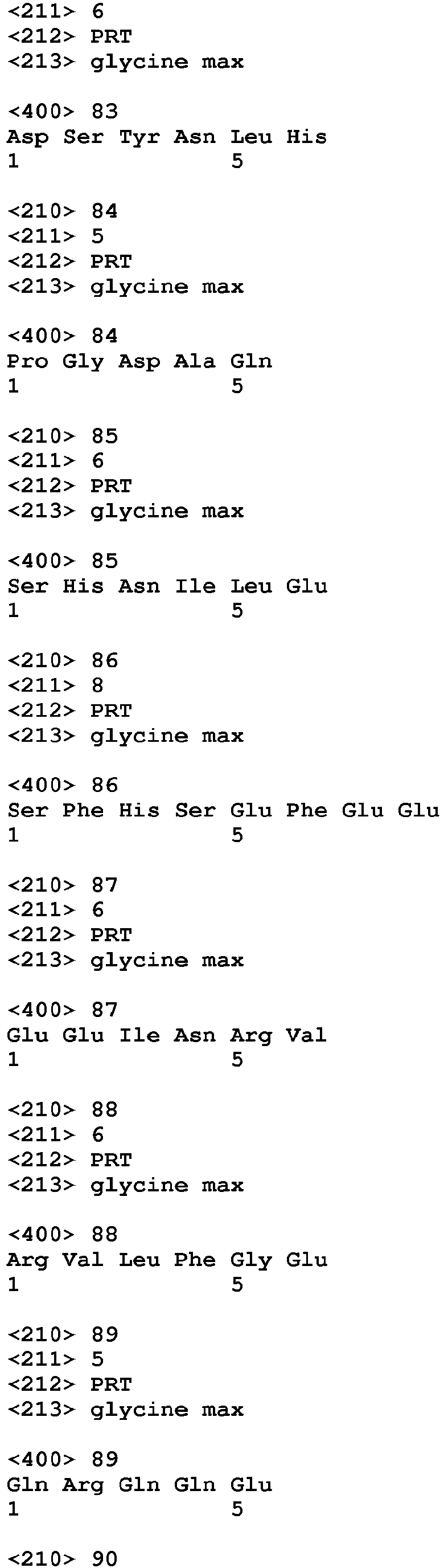


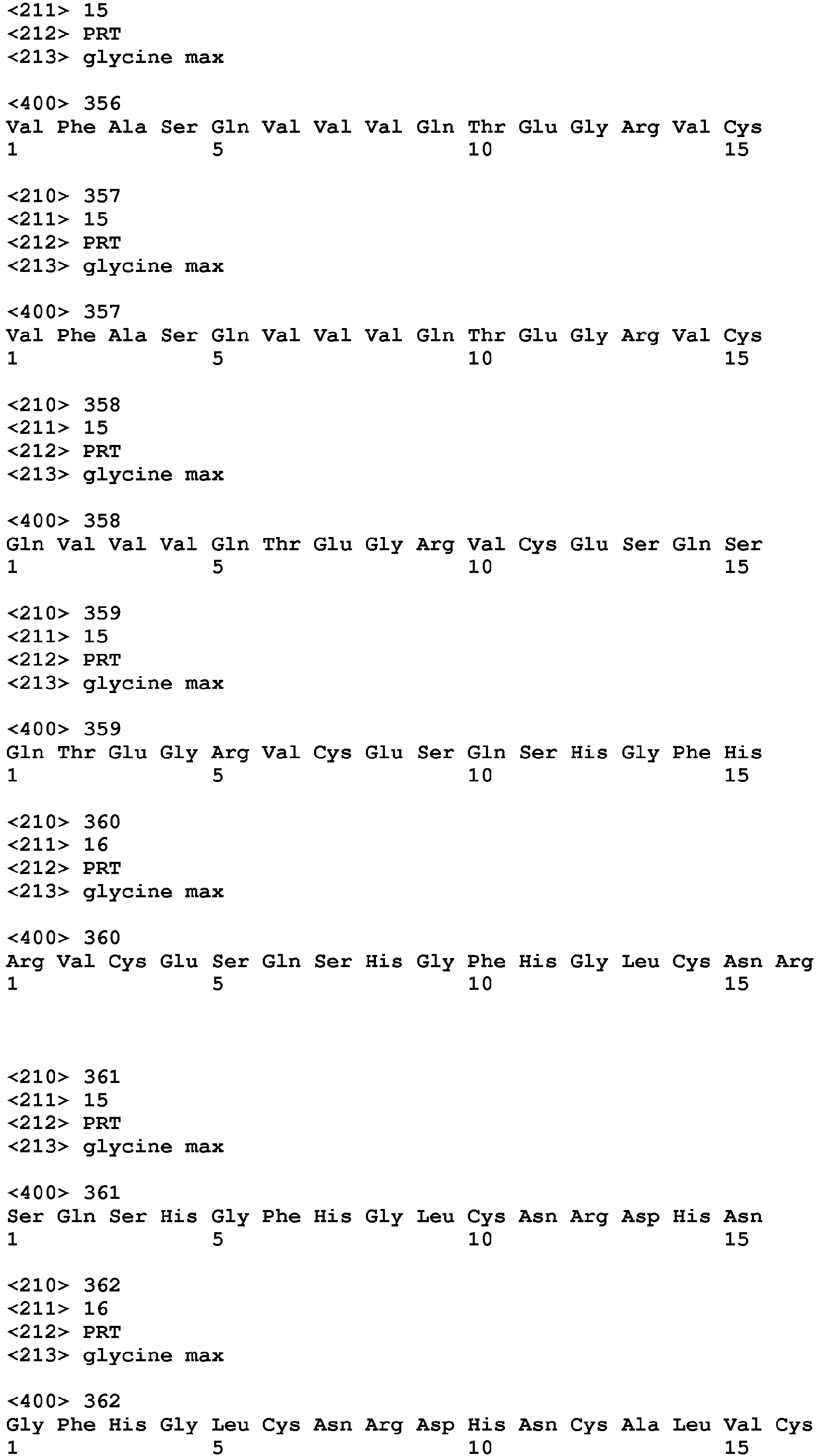


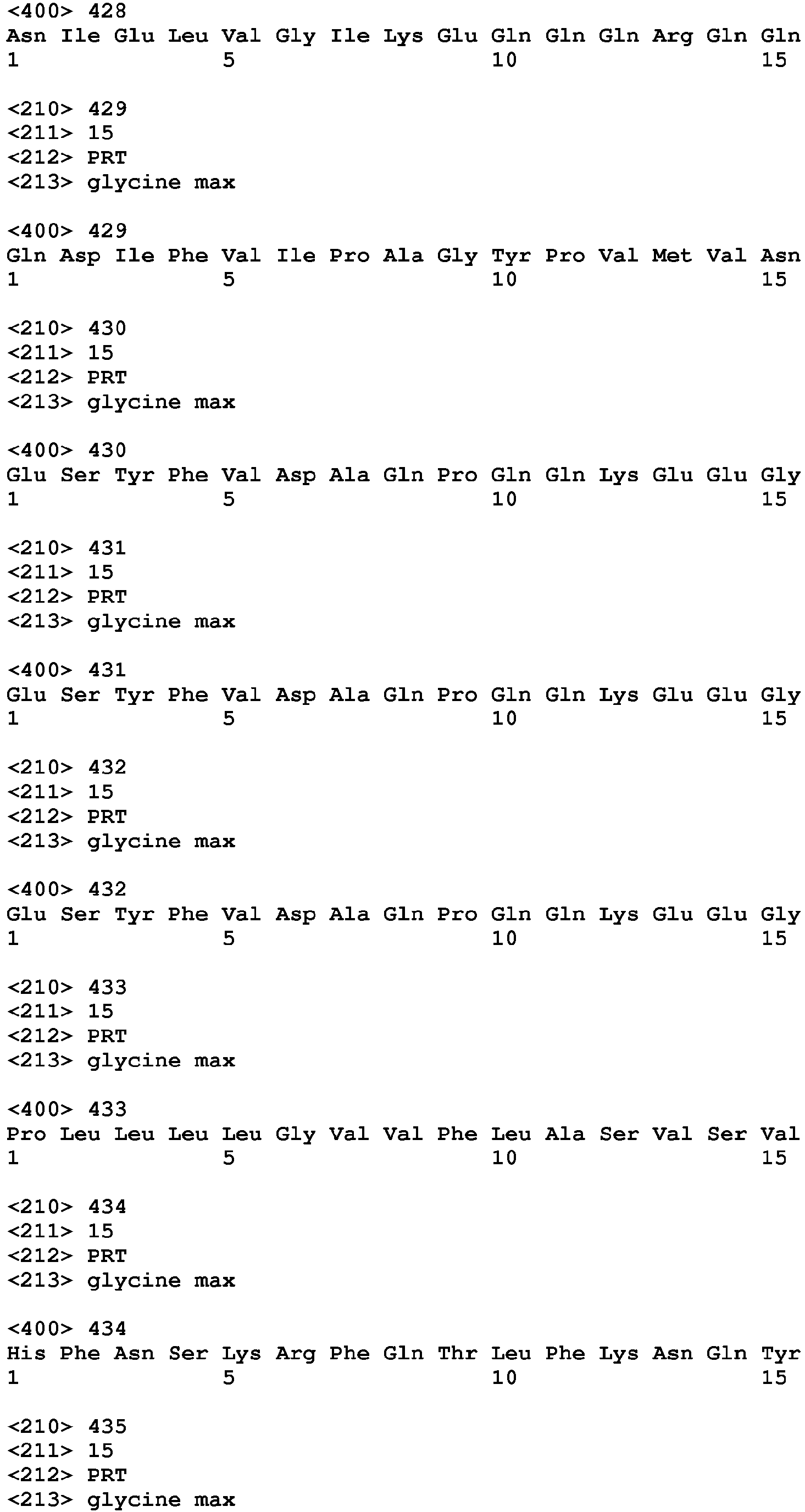

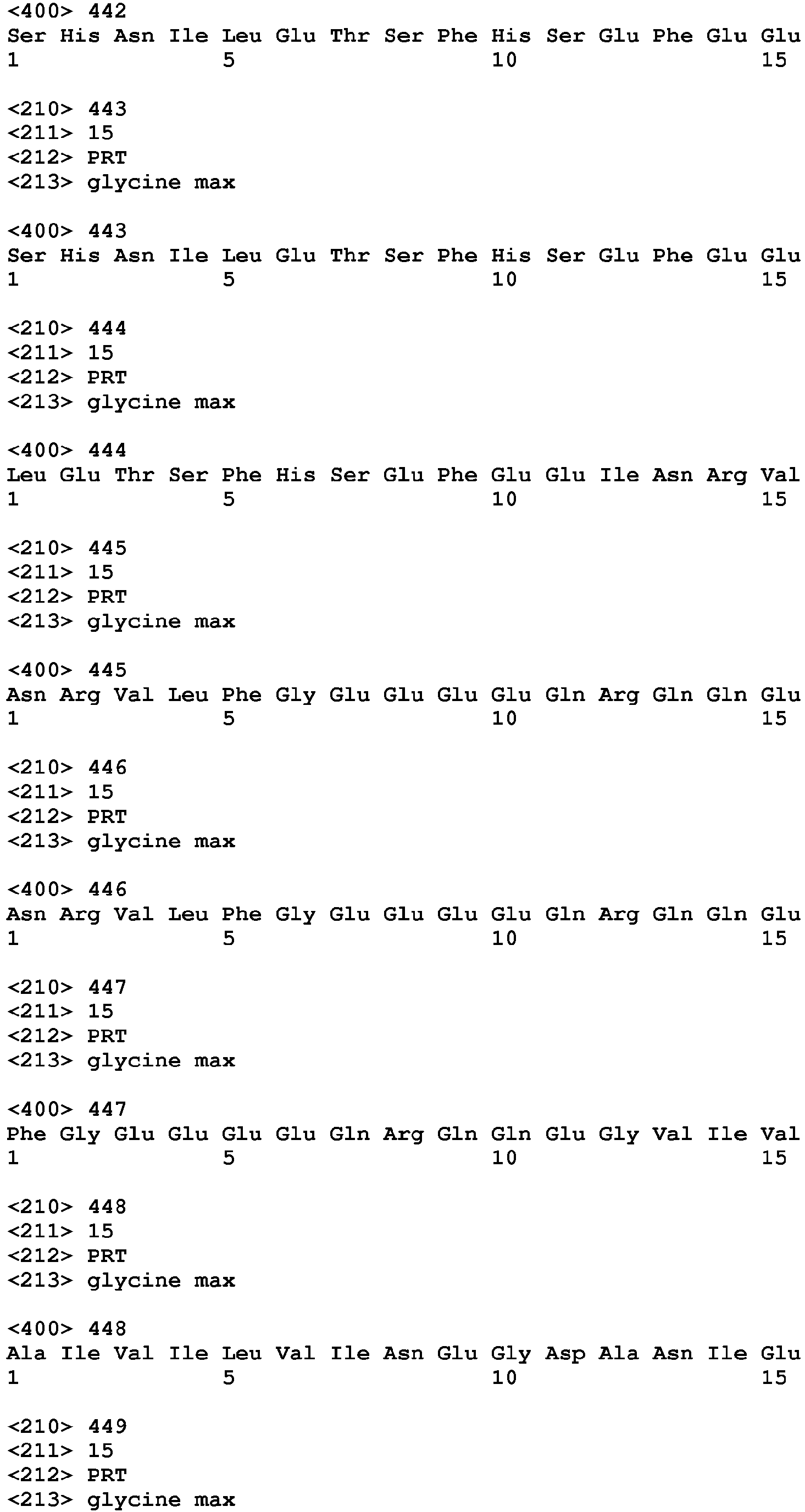


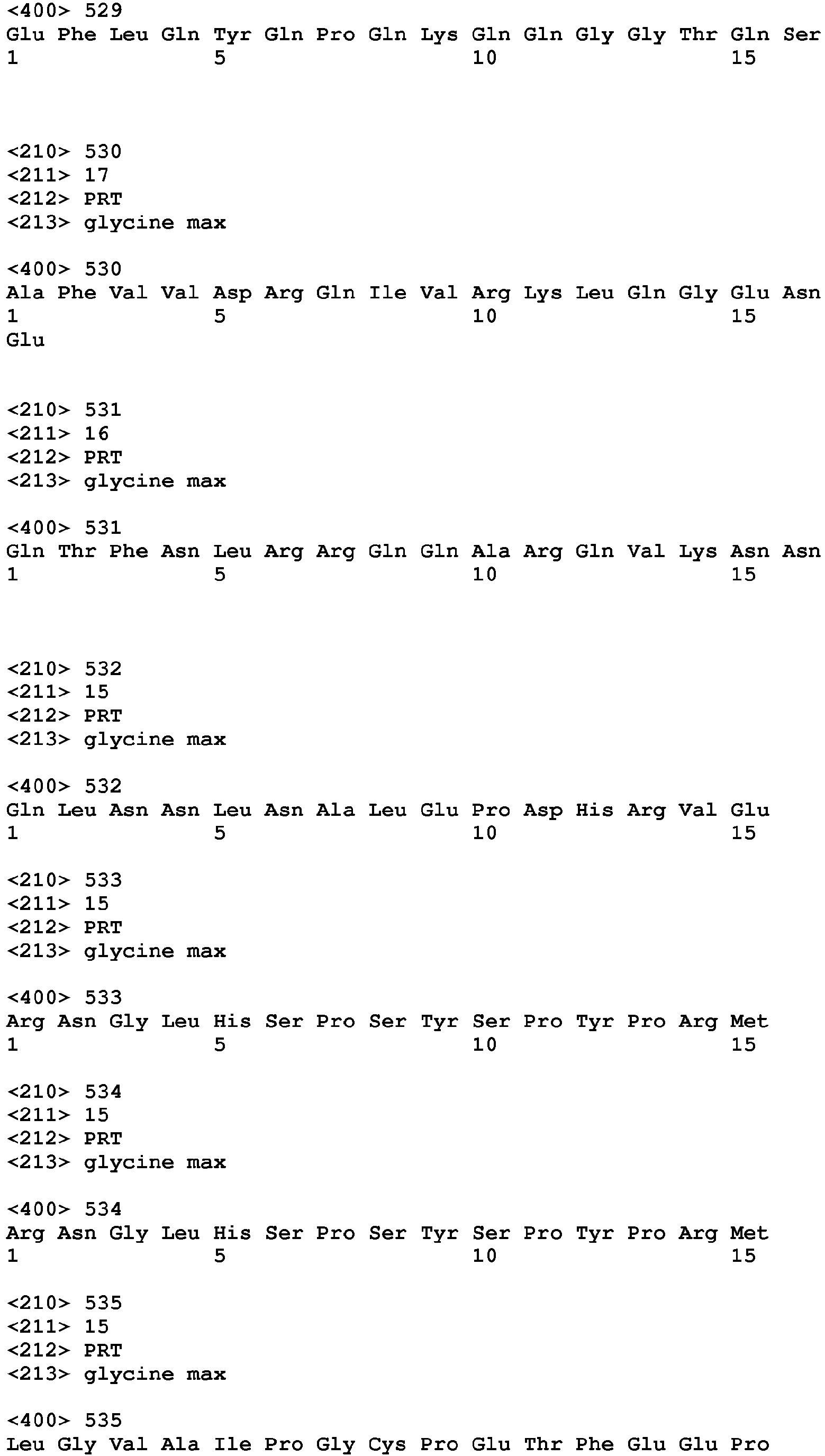
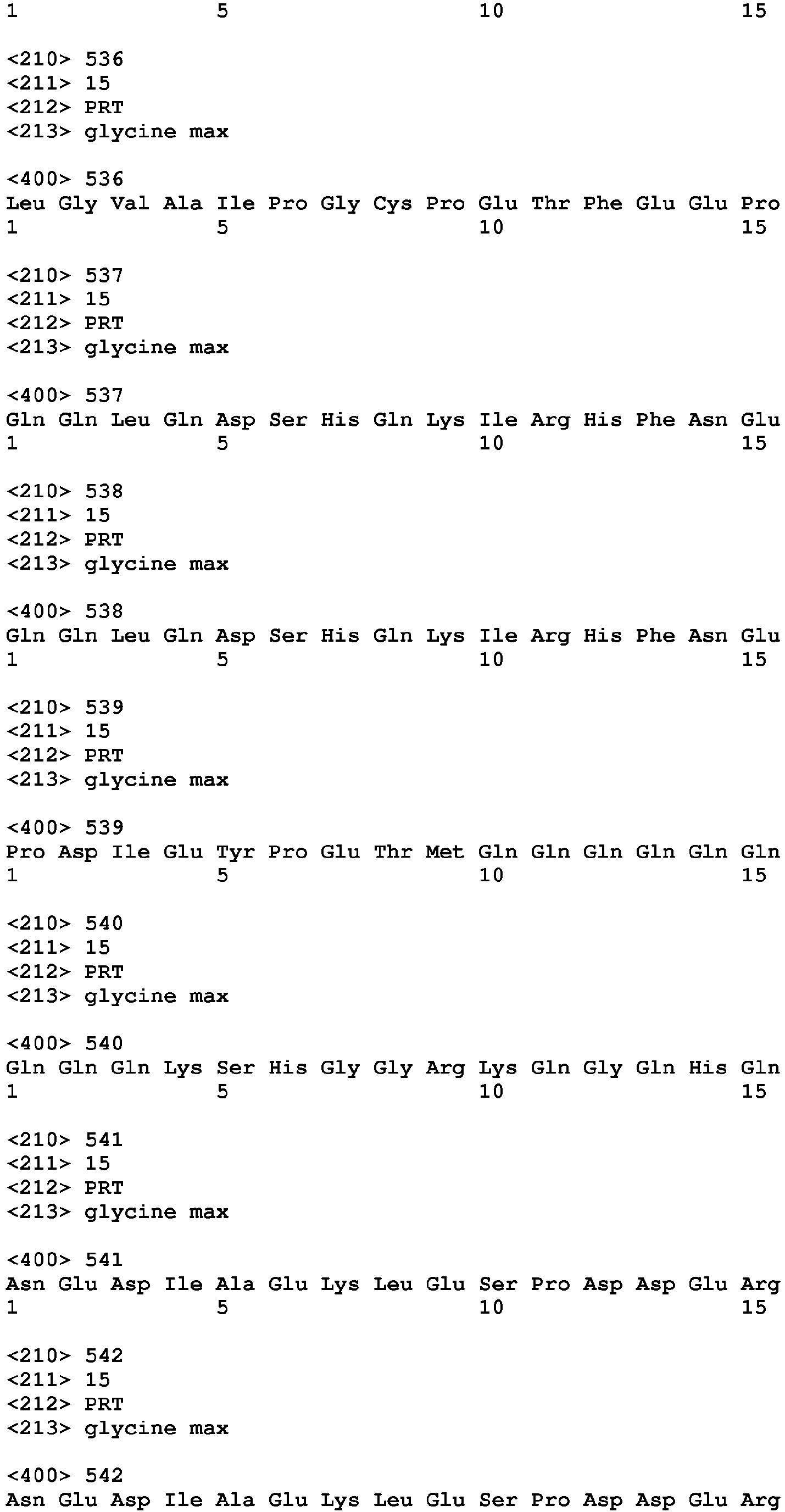


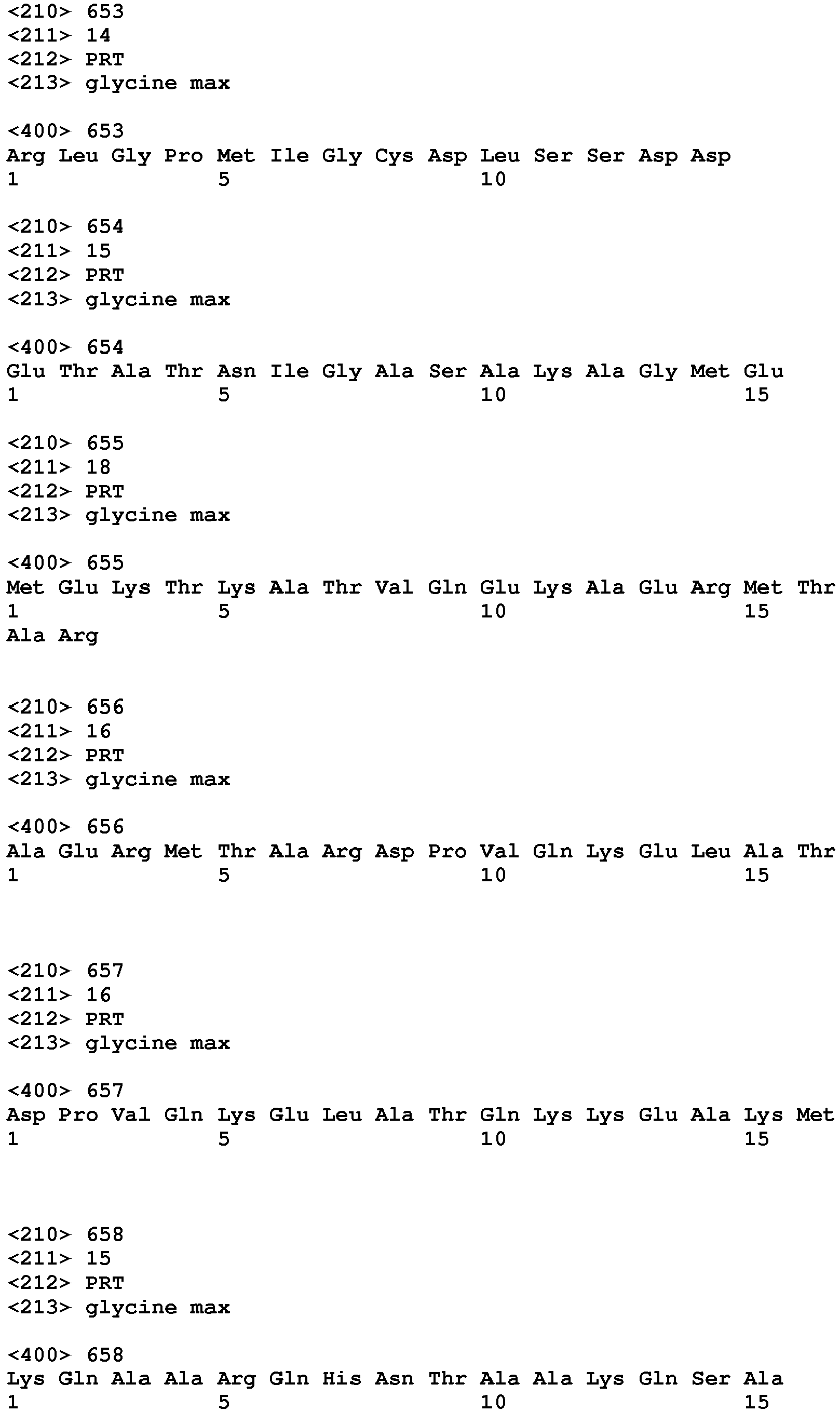


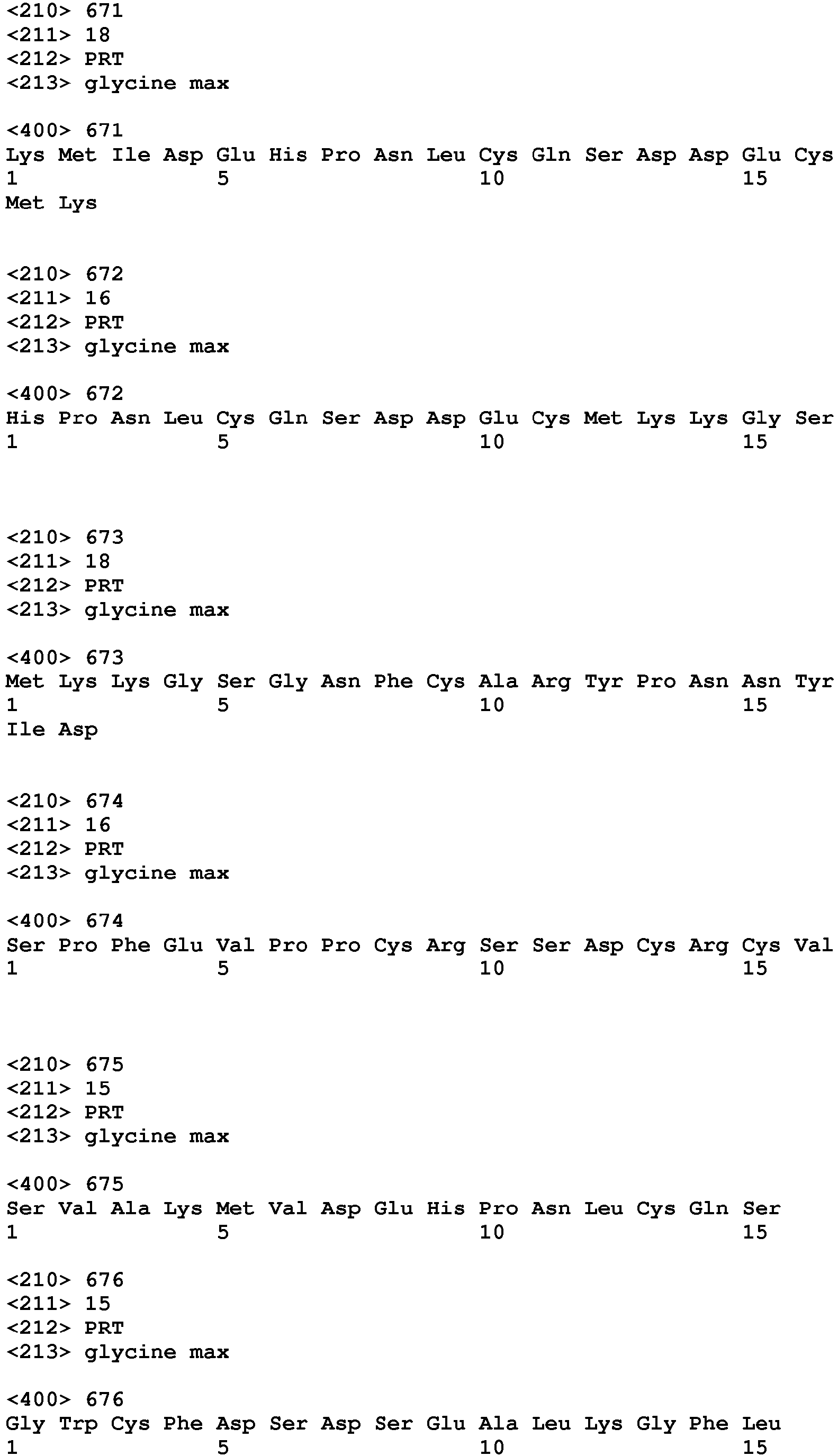

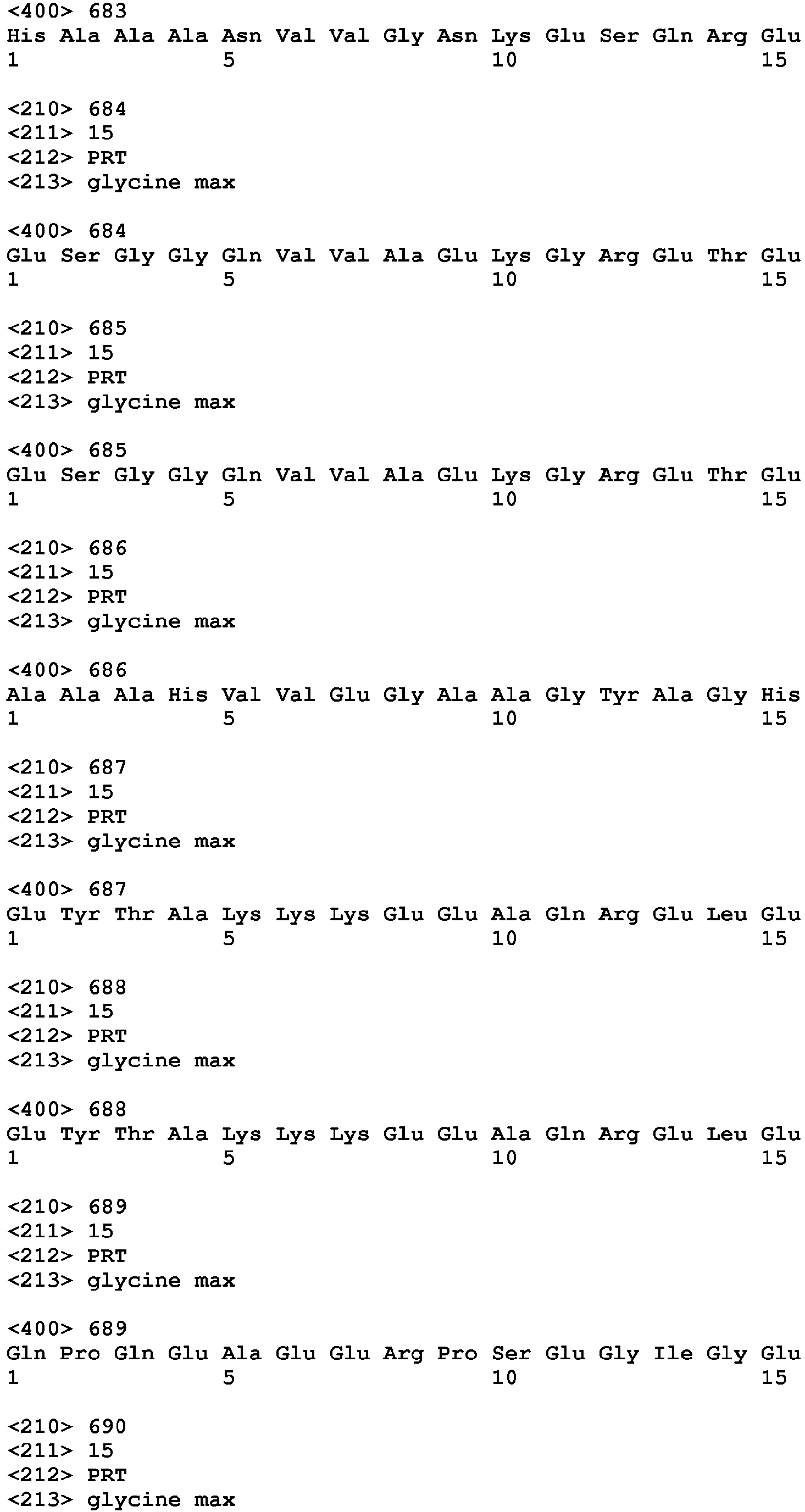


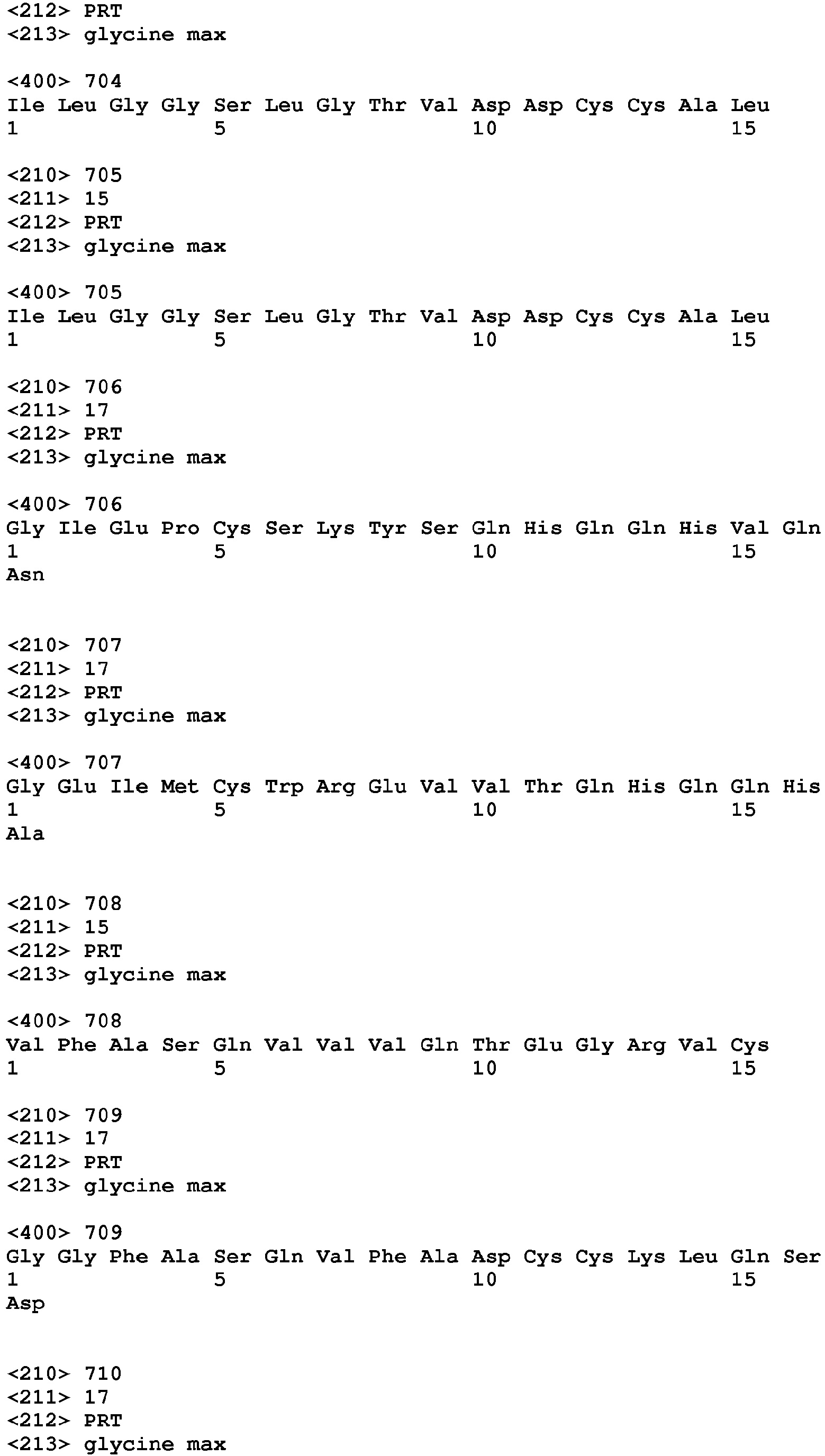
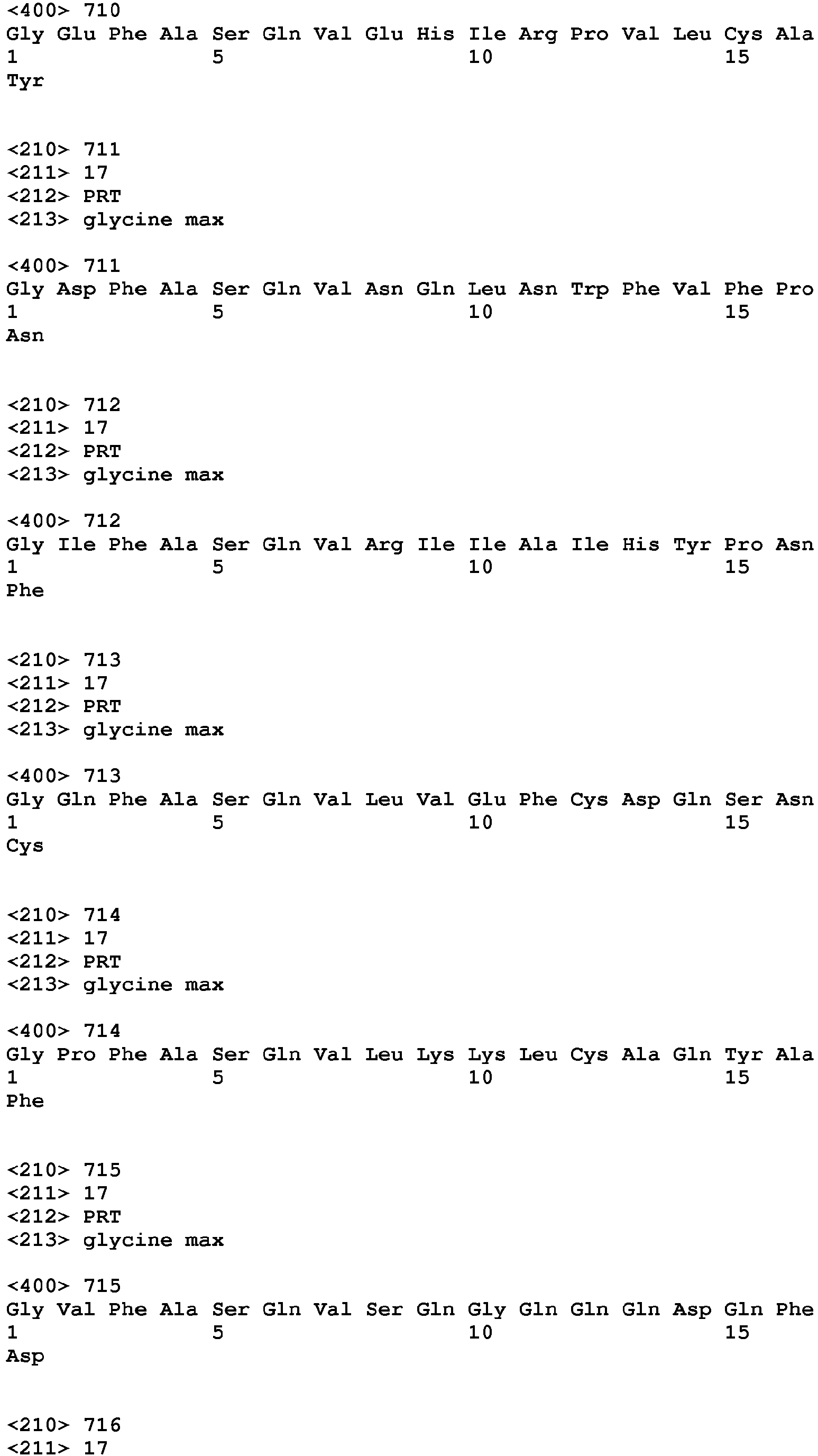


Claims (16)
- A compilation comprising at least five different peptides, each peptide comprising at least one sequence element corresponding to an epitope selected from the group consisting of SEQ ID NO.: 1 - 354.
- The compilation of claim 1, wherein each of the at least five different peptides comprises a sequence element corresponding to a different epitope.
- The compilation of claim 1 or 2, wherein the compilation comprises at least 10, preferably at least 20, more preferred at least 50 different peptides.
- The compilation of any one of claims 1 to 3, wherein each epitope is selected from one of the groups comprising- group 1 (β-conglycinin) consisting of SEQ ID NO.: 1 - 93,- group 2 (defensin) consisting of SEQ ID NO.: 94 - 103,- group 3 (Gly m Bd 28K) consisting of SEQ ID NO.: 104,- group 4 (glycinin) consisting of SEQ ID NO.: 105 - 242509,- group 5 (hydrophobic seed protein) consisting of SEQ ID NO.: 521 - 253,- group 6 (kunitz trypsin inhibitor) consisting of SEQ ID NO.: 254 - 257,- group 7 (P34 thiol protease) consisting of SEQ ID NO.:258 - 259,- group 8 (profilin) consisting of SEQ ID NO.: 260 - 274, and- group 9 (Pr-10) consisting of SEQ ID NO.: 275 - 283.
- The compilation of any one of claims 1 to 4, wherein each epitope is selected from group 10 consisting of SEQ ID NO.: 18, 22, 29, 34, 37, 60, 65, 67, 79, 85, 87, 91, 99, 95, 94, 92, 103, 117, 131, 110, 126, 152, 153, 168, 173, 172, 183, 188, 200, 227, 233, 237, 250, 251, 252, 253, 254, 255, 257, 258, 262, 271, 261, 276, 281, 274, 309, 311, 319, 307, 294, 305, 298, 284, 291, 290, 328, 322, 323, 331, 332, 333, 334, 335, 336, 337, 339, 340, 345, 346 and 351.
- An in vitro method for determining a patient's immune status to soybean allergens, comprising the steps- providing at least five different peptides, each peptide comprising at least one sequence element corresponding to an epitope selected from the group consisting of SEQ ID NO.: 1 - 354,- contacting each peptide with a sample comprising antibodies derived from the patient, and- detecting an interaction of each peptide with the sample.
- The method of claim 6, wherein the sample is a body fluid sample, preferably a blood sample, more preferred a serum sample.
- A kit comprising at least one composition containing a compound comprising at least two identical and/or different sequence elements each corresponding to an epitope selected from the group consisting of SEQ ID NO.: 1 - 354.
- A method for detecting at least one soybean allergen in a substance, comprising the steps- providing at least two different peptides, each peptide comprising at least one sequence element corresponding to an epitope selected from the group consisting of SEQ ID NO.: 1 - 354,- raising at least one antibody against each peptide,- contacting the substance with the antibodies, and- determining binding of the antibodies to the substance.
- A method for producing an immunoassay product, comprising the steps- providing at least two different peptides, each peptide comprising at least one sequence element corresponding to an epitope selected from the group consisting of SEQ ID NO.: 1 - 354,- raising at least one antibody against each peptide, and- compiling the antibodies to provide the immunoassay product.
- The method of claim 10, wherein compiling the antibodies comprises immobilising the antibodies onto a solid surface.
- The method of claim 10 or 11, wherein the immunoassay product is a microarray, a bead-based assay product, an ELISA plate or a lateral flow test.
- A method for determining the allergenicity of a soybean variety by detecting the presence of at least two epitopes in a sample of the variety, wherein the epitopes are selected from the group consisting of SEQ ID NO.: 1 - 354.
- The method of claim 13, wherein the presence of the epitopes is detected by an immunoassay or mass spectrometry.
- Use of a peptide comprising a sequence element corresponding to an epitope selected from the group consisting of SEQ ID NO.: 1 - 354 for providing a molecule binding to a protein or peptide comprising the epitope.
- A method for generating a variant of an allergenic soybean protein having a reduced allergenic potential, comprising the steps- providing an amino acid sequence of at least one epitope selected from the group consisting of SEQ ID NO.: 1 - 354,- altering the amino acid sequence of the at least one epitope as to eliminating the structure of the epitope, and- generating a protein or peptide comprising the altered amino acid sequence.
Priority Applications (6)
| Application Number | Priority Date | Filing Date | Title |
|---|---|---|---|
| EP15184199.6A EP3141258A1 (en) | 2015-09-08 | 2015-09-08 | Soybean allergy related epitopes |
| US15/757,941 US20180340933A1 (en) | 2015-09-08 | 2016-09-08 | Soybean Allergy Related Epitopes |
| CA2997534A CA2997534A1 (en) | 2015-09-08 | 2016-09-08 | Soybean allergy related epitopes |
| PCT/EP2016/071196 WO2017042282A1 (en) | 2015-09-08 | 2016-09-08 | Soybean allergy related epitopes |
| BR112018004506A BR112018004506A2 (en) | 2015-09-08 | 2016-09-08 | compilation, in vitro method of determining the immunological situation, kit, methods for detecting at least one soybean allergen, for producing immuno-test product, for determining the allergenicity of soybean varieties and for generating a soy protein variant and peptide use |
| EP16763773.5A EP3347033A1 (en) | 2015-09-08 | 2016-09-08 | Soybean allergy related epitopes |
Applications Claiming Priority (1)
| Application Number | Priority Date | Filing Date | Title |
|---|---|---|---|
| EP15184199.6A EP3141258A1 (en) | 2015-09-08 | 2015-09-08 | Soybean allergy related epitopes |
Publications (1)
| Publication Number | Publication Date |
|---|---|
| EP3141258A1 true EP3141258A1 (en) | 2017-03-15 |
Family
ID=54146959
Family Applications (2)
| Application Number | Title | Priority Date | Filing Date |
|---|---|---|---|
| EP15184199.6A Withdrawn EP3141258A1 (en) | 2015-09-08 | 2015-09-08 | Soybean allergy related epitopes |
| EP16763773.5A Withdrawn EP3347033A1 (en) | 2015-09-08 | 2016-09-08 | Soybean allergy related epitopes |
Family Applications After (1)
| Application Number | Title | Priority Date | Filing Date |
|---|---|---|---|
| EP16763773.5A Withdrawn EP3347033A1 (en) | 2015-09-08 | 2016-09-08 | Soybean allergy related epitopes |
Country Status (5)
| Country | Link |
|---|---|
| US (1) | US20180340933A1 (en) |
| EP (2) | EP3141258A1 (en) |
| BR (1) | BR112018004506A2 (en) |
| CA (1) | CA2997534A1 (en) |
| WO (1) | WO2017042282A1 (en) |
Cited By (1)
| Publication number | Priority date | Publication date | Assignee | Title |
|---|---|---|---|---|
| CN111172311A (en) * | 2020-01-08 | 2020-05-19 | 西北民族大学 | Double-fluorescence quantitative PCR detection kit for soybean and walnut allergen genes |
Families Citing this family (3)
| Publication number | Priority date | Publication date | Assignee | Title |
|---|---|---|---|---|
| UY37816A (en) | 2017-07-20 | 2019-02-28 | Spogen Biotech Inc | BIOACTIVE POLIPEPTIDES TO IMPROVE PROTECTION, GROWTH AND PRODUCTIVITY IN PLANTS |
| JP2022545265A (en) * | 2019-08-20 | 2022-10-26 | ニューリタス リミテッド | Peptides for treating muscle atrophy |
| CN114641484B (en) * | 2019-11-05 | 2024-08-09 | 国立大学法人京都大学 | Peptides, compositions and methods for treating, preventing or ameliorating mood disorders |
Citations (3)
| Publication number | Priority date | Publication date | Assignee | Title |
|---|---|---|---|---|
| WO2002074250A2 (en) * | 2001-03-16 | 2002-09-26 | Panacea Pharmaceuticals | Methods and reagents for decreasing clinical reaction to allergy |
| WO2010087888A2 (en) | 2009-01-28 | 2010-08-05 | The United States Of America, As Represented By The Secretary Of Agriculture | Development of low allergen soybean seeds using molecular markers for the p34 allele |
| CN102408482A (en) * | 2011-10-25 | 2012-04-11 | 浙江省农业科学院 | A kind of preparation method of β-conglycinin monoclonal antibody |
Family Cites Families (1)
| Publication number | Priority date | Publication date | Assignee | Title |
|---|---|---|---|---|
| JPH08151396A (en) * | 1994-11-28 | 1996-06-11 | Teijin Ltd | HLA-binding oligopeptide and immunomodulator containing the same |
-
2015
- 2015-09-08 EP EP15184199.6A patent/EP3141258A1/en not_active Withdrawn
-
2016
- 2016-09-08 BR BR112018004506A patent/BR112018004506A2/en not_active Application Discontinuation
- 2016-09-08 CA CA2997534A patent/CA2997534A1/en not_active Abandoned
- 2016-09-08 WO PCT/EP2016/071196 patent/WO2017042282A1/en not_active Ceased
- 2016-09-08 EP EP16763773.5A patent/EP3347033A1/en not_active Withdrawn
- 2016-09-08 US US15/757,941 patent/US20180340933A1/en not_active Abandoned
Patent Citations (3)
| Publication number | Priority date | Publication date | Assignee | Title |
|---|---|---|---|---|
| WO2002074250A2 (en) * | 2001-03-16 | 2002-09-26 | Panacea Pharmaceuticals | Methods and reagents for decreasing clinical reaction to allergy |
| WO2010087888A2 (en) | 2009-01-28 | 2010-08-05 | The United States Of America, As Represented By The Secretary Of Agriculture | Development of low allergen soybean seeds using molecular markers for the p34 allele |
| CN102408482A (en) * | 2011-10-25 | 2012-04-11 | 浙江省农业科学院 | A kind of preparation method of β-conglycinin monoclonal antibody |
Non-Patent Citations (11)
| Title |
|---|
| CHUNJIANG J. FU ET AL: "Identification, Characterization, Epitope Mapping, and Three-Dimensional Modeling of the [alpha]-Subunit of [beta]-Conglycinin of Soybean, a Potential Allergen for Young Pigs", JOURNAL OF AGRICULTURAL AND FOOD CHEMISTRY, vol. 55, no. 10, 1 May 2007 (2007-05-01), US, pages 4014 - 4020, XP055240777, ISSN: 0021-8561, DOI: 10.1021/jf070211o * |
| HELM RICKI M ET AL: "A soybean G2 glycinin allergen: 2. Epitope mapping and three-dimensional modeling", INTERNATIONAL ARCHIVES OF ALLERGY AND IMMUNOLOGY, KARGER AG, CH, vol. 123, no. 3, 1 November 2000 (2000-11-01), pages 213 - 219, XP009090304, ISSN: 1018-2438, DOI: 10.1159/000024446 * |
| HOUSTON NL; LEE DG; STEVENSON SE; LADICS GS; BANNON GA; MCCLAIN S; PRIVALLE L; STAGG N; HEROUET-GUICHENEY C; MACINTOSH SC: "Quantitation of soybean allergens using tandem mass spectrometry", J PROTEOME RES., vol. 10, no. 2, 4 February 2011 (2011-02-04), pages 763 - 73, XP009153905, DOI: doi:10.1021/pr100913w |
| HOUSTON NORMA L ET AL: "Quantitation of Soybean Allergens Using Tandem Mass Spectrometry", JOURNAL OF PROTEOME RESEARCH, ACS, WASHINGTON, DC, US, vol. 10, no. 2, 1 February 2011 (2011-02-01), pages 763 - 773, XP009153905, ISSN: 1535-3893, DOI: 10.1021/PR100913W * |
| JOSEPH LM; HYMOWITZ T; SCHMIDT MA; HERMAN EM: "Evaluation of glycine germplasm for nulls of the immunodominant allergen P34/GlymBd30k", CROP SCI., vol. 46, 2006, pages 1755 - 1763 |
| MASILAMANI M; COMMINS S; SHREFFLER W: "Determinants of food allergy", IMMUNOL ALLERGY CLIN NORTH AM., vol. 32, no. 1, February 2012 (2012-02-01), pages 11 - 33, XP055380606, DOI: doi:10.1016/j.iac.2011.12.003 |
| NATARAJAN S S.: "Analysis of Soybean Seed Proteins Using Proteomics", JOURNAL OF DATA MINING IN GENOMICS AND PROTEOMICS, vol. 5, 2014, pages 1 |
| PICHLER WJ; TILCH J., ALLERGY, vol. 59, no. 8, August 2004 (2004-08-01), pages 809 - 20 |
| VALENTA R; NIEDERBERGER V: "Recombinant allergens for immunotherapy", J ALLERGY CLIN LMMUNOL., vol. 119, no. 4, 1 March 2007 (2007-03-01), pages 826 - 30, XP022020519, DOI: doi:10.1016/j.jaci.2007.01.025 |
| WILSON S; BLASCHEK K; DE MEJIA E: "Allergenic proteins in soybean: processing and reduction of P34 allergenicity", NUTR REV., vol. 63, no. 2, February 2005 (2005-02-01), pages 47 - 58, XP009187956 |
| YANG W W; GONZALES DE MEJIA E; ZHENG H; LEE Y: "Soybean Allergens: Presence, Detection and Methods for Mitigation in Soybean and Health", 2011, INTECH, ISBN: 978-953-307-5 |
Cited By (2)
| Publication number | Priority date | Publication date | Assignee | Title |
|---|---|---|---|---|
| CN111172311A (en) * | 2020-01-08 | 2020-05-19 | 西北民族大学 | Double-fluorescence quantitative PCR detection kit for soybean and walnut allergen genes |
| CN111172311B (en) * | 2020-01-08 | 2023-06-30 | 西北民族大学 | Soybean Walnut Allergen Gene Duplex Fluorescent Quantitative PCR Detection Kit |
Also Published As
| Publication number | Publication date |
|---|---|
| EP3347033A1 (en) | 2018-07-18 |
| CA2997534A1 (en) | 2017-03-16 |
| WO2017042282A1 (en) | 2017-03-16 |
| BR112018004506A2 (en) | 2018-09-25 |
| US20180340933A1 (en) | 2018-11-29 |
Similar Documents
| Publication | Publication Date | Title |
|---|---|---|
| Chen et al. | Conformational IgE epitopes of peanut allergens Ara h 2 and Ara h 6 | |
| Van Regenmortel | The concept and operational definition of protein epitopes | |
| CN101407541B (en) | Modified allosteric type cyclic citrulline polypeptide, and fusion protein, antibody and reagent kit thereof | |
| Hamilton et al. | Advances in IgE testing for diagnosis of allergic disease | |
| AU2002212306B2 (en) | Allergen-microarray assay | |
| Nakamura et al. | Proteomics-based allergen analysis in plants | |
| Nesbit et al. | Epitopes with similar physicochemical properties contribute to cross reactivity between peanut and tree nuts | |
| Hazebrouck et al. | Immunodominant conformational and linear IgE epitopes lie in a single segment of Ara h 2 | |
| US20180340933A1 (en) | Soybean Allergy Related Epitopes | |
| CN107064498B (en) | For detecting antigenic stimulus object, kit and its application of mycobacterium tuberculosis infection | |
| Denery‐Papini et al. | Immunoglobulin‐E‐binding epitopes of wheat allergens in patients with food allergy to wheat and in mice experimentally sensitized to wheat proteins | |
| Jimenez-Lopez et al. | Characterization of narrow-leaf lupin (Lupinus angustifolius L.) recombinant major allergen IgE-binding proteins and the natural β-conglutin counterparts in sweet lupin seed species | |
| Jeon et al. | Allergen microarrays for in vitro diagnostics of allergies: comparison with ImmunoCAP and AdvanSure | |
| Vereda et al. | Identification of IgE sequential epitopes of lentil (Len c 1) by means of peptide microarray immunoassay | |
| Aalberse et al. | Molecular allergen-specific IgE assays as a complement to allergen extract–based sensitization assessment | |
| González-Buitrago et al. | Proteomic approaches for identifying new allergens and diagnosing allergic diseases | |
| CN112114150A (en) | Method and product for diagnosing seafood allergy | |
| Filep et al. | Simultaneous quantification of specific food allergen proteins using a fluorescent multiplex array | |
| Lin et al. | The potential allergenicity of two 2S albumins from soybean (Glycine max): a protein microarray approach | |
| San Segundo-Acosta et al. | High-throughput screening of T7 phage display and protein microarrays as a methodological approach for the identification of IgE-reactive components | |
| Bässler et al. | Evidence for novel tomato seed allergens: IgE-reactive legumin and vicilin proteins identified by multidimensional protein fractionation− mass spectrometry and in silico epitope modeling | |
| Marambe et al. | Quantification of major 2S allergen protein of yellow mustard using anti-Sin a 1 epitope antibody | |
| AU2009247267B2 (en) | Method for quantification of antigen-specific canine or human IgE | |
| CN106084018A (en) | The detection of improved nut allergies | |
| Beezhold et al. | Measurement of latex proteins and assessment of latex protein exposure |
Legal Events
| Date | Code | Title | Description |
|---|---|---|---|
| PUAI | Public reference made under article 153(3) epc to a published international application that has entered the european phase |
Free format text: ORIGINAL CODE: 0009012 |
|
| STAA | Information on the status of an ep patent application or granted ep patent |
Free format text: STATUS: THE APPLICATION HAS BEEN PUBLISHED |
|
| AK | Designated contracting states |
Kind code of ref document: A1 Designated state(s): AL AT BE BG CH CY CZ DE DK EE ES FI FR GB GR HR HU IE IS IT LI LT LU LV MC MK MT NL NO PL PT RO RS SE SI SK SM TR |
|
| AX | Request for extension of the european patent |
Extension state: BA ME |
|
| STAA | Information on the status of an ep patent application or granted ep patent |
Free format text: STATUS: REQUEST FOR EXAMINATION WAS MADE |
|
| 17P | Request for examination filed |
Effective date: 20170915 |
|
| RBV | Designated contracting states (corrected) |
Designated state(s): AL AT BE BG CH CY CZ DE DK EE ES FI FR GB GR HR HU IE IS IT LI LT LU LV MC MK MT NL NO PL PT RO RS SE SI SK SM TR |
|
| STAA | Information on the status of an ep patent application or granted ep patent |
Free format text: STATUS: EXAMINATION IS IN PROGRESS |
|
| 17Q | First examination report despatched |
Effective date: 20180307 |
|
| RIN1 | Information on inventor provided before grant (corrected) |
Inventor name: SPIEGEL, HOLGER Inventor name: HAVENITH, HEIDE Inventor name: KERN, KAROLIN Inventor name: SZARDENINGS, MICHAEL |
|
| GRAP | Despatch of communication of intention to grant a patent |
Free format text: ORIGINAL CODE: EPIDOSNIGR1 |
|
| STAA | Information on the status of an ep patent application or granted ep patent |
Free format text: STATUS: GRANT OF PATENT IS INTENDED |
|
| INTG | Intention to grant announced |
Effective date: 20200810 |
|
| STAA | Information on the status of an ep patent application or granted ep patent |
Free format text: STATUS: THE APPLICATION IS DEEMED TO BE WITHDRAWN |
|
| 18D | Application deemed to be withdrawn |
Effective date: 20201222 |