EP3139918B1 - Beta-tetrazolyl-propionic acids as metallo-beta-lactamase inhibitors - Google Patents
Beta-tetrazolyl-propionic acids as metallo-beta-lactamase inhibitors Download PDFInfo
- Publication number
- EP3139918B1 EP3139918B1 EP15789928.7A EP15789928A EP3139918B1 EP 3139918 B1 EP3139918 B1 EP 3139918B1 EP 15789928 A EP15789928 A EP 15789928A EP 3139918 B1 EP3139918 B1 EP 3139918B1
- Authority
- EP
- European Patent Office
- Prior art keywords
- tetrazol
- mmol
- ethyl
- phenyl
- substituted
- Prior art date
- Legal status (The legal status is an assumption and is not a legal conclusion. Google has not performed a legal analysis and makes no representation as to the accuracy of the status listed.)
- Active
Links
- 0 Cc1cc(*)nc(*)c1 Chemical compound Cc1cc(*)nc(*)c1 0.000 description 40
- JZOQNUXWTHZAIR-IUCAKERBSA-N CC(C)C[C@@H]([C@H](Cc1cnc(N)[s]1)c1nnn[nH]1)C(O)=O Chemical compound CC(C)C[C@@H]([C@H](Cc1cnc(N)[s]1)c1nnn[nH]1)C(O)=O JZOQNUXWTHZAIR-IUCAKERBSA-N 0.000 description 3
- SBUZCCQLBXEJST-VUDQBZPASA-N CC(C)C[C@@H]([C@H](Cc(cc1)cnc1N1CC(CCOCC(C)C[C@@H]([C@H](Cc(cc2)cnc2N(C2)CC2N2CCN(C)CC2)c2nnn[nH]2)C(O)=O)C1)c1nnn[nH]1)C(O)=O Chemical compound CC(C)C[C@@H]([C@H](Cc(cc1)cnc1N1CC(CCOCC(C)C[C@@H]([C@H](Cc(cc2)cnc2N(C2)CC2N2CCN(C)CC2)c2nnn[nH]2)C(O)=O)C1)c1nnn[nH]1)C(O)=O SBUZCCQLBXEJST-VUDQBZPASA-N 0.000 description 2
- MPVLLORUBCTHRG-BLIYAOACSA-N CC(C)C[C@@H]([C@H](Cc(cc1)cnc1Oc1cc(CC(C)C[C@@H]([C@H](Cc(cc2)cnc2Oc2cccc3c2CCCN3)c2n[nH]nn2)C(O)=O)c(CN)cc1)c1n[nH]nn1)C(O)=O Chemical compound CC(C)C[C@@H]([C@H](Cc(cc1)cnc1Oc1cc(CC(C)C[C@@H]([C@H](Cc(cc2)cnc2Oc2cccc3c2CCCN3)c2n[nH]nn2)C(O)=O)c(CN)cc1)c1n[nH]nn1)C(O)=O MPVLLORUBCTHRG-BLIYAOACSA-N 0.000 description 2
- PJNREHCTHBGFIL-ROUUACIJSA-N CCC[C@@H]([C@H](Cc1cc(-c2cc(C(N)=O)ccc2)ccc1)c1n[nH]nn1)C(O)=O Chemical compound CCC[C@@H]([C@H](Cc1cc(-c2cc(C(N)=O)ccc2)ccc1)c1n[nH]nn1)C(O)=O PJNREHCTHBGFIL-ROUUACIJSA-N 0.000 description 2
- AFVWIBUYPIWDKA-UWVGGRQHSA-N CCC[C@@H]([C@H](Cc1cc(N)ncc1)c1nnn[nH]1)C(O)=O Chemical compound CCC[C@@H]([C@H](Cc1cc(N)ncc1)c1nnn[nH]1)C(O)=O AFVWIBUYPIWDKA-UWVGGRQHSA-N 0.000 description 2
- KAHVVHGDTHYYIY-UWVGGRQHSA-N CCC[C@@H]([C@H](Cc1nc(N)ccc1)c1nnn[nH]1)C(O)=O Chemical compound CCC[C@@H]([C@H](Cc1nc(N)ccc1)c1nnn[nH]1)C(O)=O KAHVVHGDTHYYIY-UWVGGRQHSA-N 0.000 description 2
- XFSLHCPHPYQITA-OALUTQOASA-N OC([C@H]([C@H](Cc1ccc(C2CCNCC2)cc1)c1nnn[nH]1)C1CCCC1)=O Chemical compound OC([C@H]([C@H](Cc1ccc(C2CCNCC2)cc1)c1nnn[nH]1)C1CCCC1)=O XFSLHCPHPYQITA-OALUTQOASA-N 0.000 description 2
- DTQVDTLACAAQTR-UHFFFAOYSA-M [O-]C(C(F)(F)F)=O Chemical compound [O-]C(C(F)(F)F)=O DTQVDTLACAAQTR-UHFFFAOYSA-M 0.000 description 2
- CRRMIKBAPPOPNW-UHFFFAOYSA-N BrCc(cc1)cnc1Br Chemical compound BrCc(cc1)cnc1Br CRRMIKBAPPOPNW-UHFFFAOYSA-N 0.000 description 1
- GIPHHIBTKVDCFQ-OWYJLGKBSA-N CC(C)(C)C([C@H](Cc1ccc(C2CNCC2)nc1)c1nnn[nH]1)C(O)=O Chemical compound CC(C)(C)C([C@H](Cc1ccc(C2CNCC2)nc1)c1nnn[nH]1)C(O)=O GIPHHIBTKVDCFQ-OWYJLGKBSA-N 0.000 description 1
- NTIOPBCSSAPDHZ-LLVKDONJSA-N CC(C)(C)OC(C[C@@H](Cc(cc1)ccc1Br)c1nnn[nH]1)=O Chemical compound CC(C)(C)OC(C[C@@H](Cc(cc1)ccc1Br)c1nnn[nH]1)=O NTIOPBCSSAPDHZ-LLVKDONJSA-N 0.000 description 1
- TWMRLCPQQCHIBH-GFCCVEGCSA-N CC(C)(C)OC(C[C@@H](Cc1ccccc1)C(O)=O)=O Chemical compound CC(C)(C)OC(C[C@@H](Cc1ccccc1)C(O)=O)=O TWMRLCPQQCHIBH-GFCCVEGCSA-N 0.000 description 1
- PRMJMHVESVHMGG-GFCCVEGCSA-N CC(C)(C)OC(C[C@@H](Cc1ccccc1)c1nnn[nH]1)=O Chemical compound CC(C)(C)OC(C[C@@H](Cc1ccccc1)c1nnn[nH]1)=O PRMJMHVESVHMGG-GFCCVEGCSA-N 0.000 description 1
- NTIOPBCSSAPDHZ-NSHDSACASA-N CC(C)(C)OC(C[C@H](Cc(cc1)ccc1Br)c1nnn[nH]1)=O Chemical compound CC(C)(C)OC(C[C@H](Cc(cc1)ccc1Br)c1nnn[nH]1)=O NTIOPBCSSAPDHZ-NSHDSACASA-N 0.000 description 1
- ZHKRUAUFUIUXGA-ZDUSSCGKSA-N CC(C)(C)OC(C[C@H](Cc1ccccc1)C#N)=O Chemical compound CC(C)(C)OC(C[C@H](Cc1ccccc1)C#N)=O ZHKRUAUFUIUXGA-ZDUSSCGKSA-N 0.000 description 1
- YQCKHIJFOSMIRF-LBPRGKRZSA-N CC(C)(C)OC(C[C@H](Cc1ccccc1)C(N)=O)=O Chemical compound CC(C)(C)OC(C[C@H](Cc1ccccc1)C(N)=O)=O YQCKHIJFOSMIRF-LBPRGKRZSA-N 0.000 description 1
- TWMRLCPQQCHIBH-LBPRGKRZSA-N CC(C)(C)OC(C[C@H](Cc1ccccc1)C(O)=O)=O Chemical compound CC(C)(C)OC(C[C@H](Cc1ccccc1)C(O)=O)=O TWMRLCPQQCHIBH-LBPRGKRZSA-N 0.000 description 1
- PRMJMHVESVHMGG-LBPRGKRZSA-N CC(C)(C)OC(C[C@H](Cc1ccccc1)c1nnn[nH]1)=O Chemical compound CC(C)(C)OC(C[C@H](Cc1ccccc1)c1nnn[nH]1)=O PRMJMHVESVHMGG-LBPRGKRZSA-N 0.000 description 1
- BQGNWLCMOOLQBQ-UHFFFAOYSA-N CC(C)(C)P([C+](CCC1)C1=[Fe+]=C1CCCC1)C(C)(C)C Chemical compound CC(C)(C)P([C+](CCC1)C1=[Fe+]=C1CCCC1)C(C)(C)C BQGNWLCMOOLQBQ-UHFFFAOYSA-N 0.000 description 1
- IFOCVQYUXSFTKL-AAEUAGOBSA-N CC(C)(C)[C@@H]([C@H](Cc(cc1)cnc1NCCN)c1nnn[nH]1)C(O)=O Chemical compound CC(C)(C)[C@@H]([C@H](Cc(cc1)cnc1NCCN)c1nnn[nH]1)C(O)=O IFOCVQYUXSFTKL-AAEUAGOBSA-N 0.000 description 1
- ZZQMTJVPMRFKDT-AAEUAGOBSA-N CC(C)(C)[C@@H]([C@H](Cc(cc1)cnc1NCCO)c1nnn[nH]1)C(O)=O Chemical compound CC(C)(C)[C@@H]([C@H](Cc(cc1)cnc1NCCO)c1nnn[nH]1)C(O)=O ZZQMTJVPMRFKDT-AAEUAGOBSA-N 0.000 description 1
- IRJLQSGUAJCJJL-ZFWWWQNUSA-N CC(C)(C)[C@@H]([C@H](Cc1ccc(C2=CCNC2)nc1)c1nnn[nH]1)C(O)=O Chemical compound CC(C)(C)[C@@H]([C@H](Cc1ccc(C2=CCNC2)nc1)c1nnn[nH]1)C(O)=O IRJLQSGUAJCJJL-ZFWWWQNUSA-N 0.000 description 1
- HSBWHFONBNNWBU-UHFFFAOYSA-O CC(C)C(C(Cc1ccc(C2CNCC2)cn1)C1=NN[NH2+]N1)C(O)=O Chemical compound CC(C)C(C(Cc1ccc(C2CNCC2)cn1)C1=NN[NH2+]N1)C(O)=O HSBWHFONBNNWBU-UHFFFAOYSA-O 0.000 description 1
- FSXHAKOGIGWVJK-CFMCSPIPSA-N CC(C)C[C@@H](C(c1nnn[nH]1)[F]c1ccc(N2CC(CO)(CO)C2)nc1)C(O)=O Chemical compound CC(C)C[C@@H](C(c1nnn[nH]1)[F]c1ccc(N2CC(CO)(CO)C2)nc1)C(O)=O FSXHAKOGIGWVJK-CFMCSPIPSA-N 0.000 description 1
- WULANCGOHGFYQD-HWKDEXGKSA-N CC(C)C[C@@H](C/C(/N=N\C)=N/C)C(O)=O Chemical compound CC(C)C[C@@H](C/C(/N=N\C)=N/C)C(O)=O WULANCGOHGFYQD-HWKDEXGKSA-N 0.000 description 1
- FJTPRUPXDQDMMZ-STQMWFEESA-N CC(C)C[C@@H]([C@H](Cc(cc1)ccc1C(N)=O)c1nnn[nH]1)C(O)=O Chemical compound CC(C)C[C@@H]([C@H](Cc(cc1)ccc1C(N)=O)c1nnn[nH]1)C(O)=O FJTPRUPXDQDMMZ-STQMWFEESA-N 0.000 description 1
- SDBMPEPFPVDNSG-KBPBESRZSA-N CC(C)C[C@@H]([C@H](Cc(cc1)ccc1S(C)(=O)=O)c1n[nH]nn1)C(O)=O Chemical compound CC(C)C[C@@H]([C@H](Cc(cc1)ccc1S(C)(=O)=O)c1n[nH]nn1)C(O)=O SDBMPEPFPVDNSG-KBPBESRZSA-N 0.000 description 1
- ZIYJVOXTRYUURU-GJZGRUSLSA-N CC(C)C[C@@H]([C@H](Cc(cc1)cnc1N(C1)CC1(C1)CNC1=O)c1nnn[nH]1)C(O)=O Chemical compound CC(C)C[C@@H]([C@H](Cc(cc1)cnc1N(C1)CC1(C1)CNC1=O)c1nnn[nH]1)C(O)=O ZIYJVOXTRYUURU-GJZGRUSLSA-N 0.000 description 1
- AOQRHWBPLIIJEV-WPNOBGBWSA-N CC(C)C[C@@H]([C@H](Cc(cc1)cnc1N1CC(C)(CNCC(C)C[C@@H]([C@H](Cc(cc2)cnc2N(C2)CC2N2CCNCC2)c2nnn[nH]2)C(O)=O)C1)c1nnn[nH]1)C(O)=O Chemical compound CC(C)C[C@@H]([C@H](Cc(cc1)cnc1N1CC(C)(CNCC(C)C[C@@H]([C@H](Cc(cc2)cnc2N(C2)CC2N2CCNCC2)c2nnn[nH]2)C(O)=O)C1)c1nnn[nH]1)C(O)=O AOQRHWBPLIIJEV-WPNOBGBWSA-N 0.000 description 1
- MDRKKVOMQJKDIZ-ROUUACIJSA-N CC(C)C[C@@H]([C@H](Cc(cc1)cnc1N1CCC(CNS(C)(=O)=O)CC1)c1nnn[nH]1)C(O)=O Chemical compound CC(C)C[C@@H]([C@H](Cc(cc1)cnc1N1CCC(CNS(C)(=O)=O)CC1)c1nnn[nH]1)C(O)=O MDRKKVOMQJKDIZ-ROUUACIJSA-N 0.000 description 1
- VBINHTJGTAZEBH-RFHHWMCGSA-N CC(C)C[C@@H]([C@H](Cc(cc1)cnc1NCCC(C(F)(F)F)N)c1nnn[nH]1)C(O)=O Chemical compound CC(C)C[C@@H]([C@H](Cc(cc1)cnc1NCCC(C(F)(F)F)N)c1nnn[nH]1)C(O)=O VBINHTJGTAZEBH-RFHHWMCGSA-N 0.000 description 1
- AMNUKVUFEULDIK-IRXDYDNUSA-N CC(C)C[C@@H]([C@H](Cc(cc1)cnc1Oc1cccc(C(N)=O)c1)c1n[nH]nn1)C(O)=O Chemical compound CC(C)C[C@@H]([C@H](Cc(cc1)cnc1Oc1cccc(C(N)=O)c1)c1n[nH]nn1)C(O)=O AMNUKVUFEULDIK-IRXDYDNUSA-N 0.000 description 1
- NCBNIDATKMLDJQ-OALUTQOASA-N CC(C)C[C@@H]([C@H](Cc(cc1)cnc1Oc1ccccc1N1CCNCC1)c1n[nH]nn1)C(O)=O Chemical compound CC(C)C[C@@H]([C@H](Cc(cc1)cnc1Oc1ccccc1N1CCNCC1)c1n[nH]nn1)C(O)=O NCBNIDATKMLDJQ-OALUTQOASA-N 0.000 description 1
- IHWXVCSHERVJIQ-IRXDYDNUSA-N CC(C)C[C@@H]([C@H](Cc(cn1)ccc1Oc(cc1)ccc1C(N)=O)c1n[nH]nn1)C(O)=O Chemical compound CC(C)C[C@@H]([C@H](Cc(cn1)ccc1Oc(cc1)ccc1C(N)=O)c1n[nH]nn1)C(O)=O IHWXVCSHERVJIQ-IRXDYDNUSA-N 0.000 description 1
- ZTPZWVNFJVZZDN-OALUTQOASA-N CC(C)C[C@@H]([C@H](Cc(cn1)ccc1Oc1cc(N2CCNCC2)ncc1)c1n[nH]nn1)C(O)=O Chemical compound CC(C)C[C@@H]([C@H](Cc(cn1)ccc1Oc1cc(N2CCNCC2)ncc1)c1n[nH]nn1)C(O)=O ZTPZWVNFJVZZDN-OALUTQOASA-N 0.000 description 1
- PXNUGUVYIUNEOS-OALUTQOASA-N CC(C)C[C@@H]([C@H](Cc(cn1)ccc1Oc1ccc(CCN)cc1)c1n[nH]nn1)C(O)=O Chemical compound CC(C)C[C@@H]([C@H](Cc(cn1)ccc1Oc1ccc(CCN)cc1)c1n[nH]nn1)C(O)=O PXNUGUVYIUNEOS-OALUTQOASA-N 0.000 description 1
- IMZDZMFFIWBVLW-GJZGRUSLSA-N CC(C)C[C@@H]([C@H](Cc1cc2cc(N)cnc2cc1)c1nnn[nH]1)C(O)=O Chemical compound CC(C)C[C@@H]([C@H](Cc1cc2cc(N)cnc2cc1)c1nnn[nH]1)C(O)=O IMZDZMFFIWBVLW-GJZGRUSLSA-N 0.000 description 1
- KOPDDCVGTJNMQT-GJZGRUSLSA-N CC(C)C[C@@H]([C@H](Cc1ccc(-c(cc2)cnc2N)nc1)c1n[nH]nn1)C(O)=O Chemical compound CC(C)C[C@@H]([C@H](Cc1ccc(-c(cc2)cnc2N)nc1)c1n[nH]nn1)C(O)=O KOPDDCVGTJNMQT-GJZGRUSLSA-N 0.000 description 1
- SWZARJMSMZTJGV-ROUUACIJSA-N CC(C)C[C@@H]([C@H](Cc1ccc(N(C2)CC2N2CCOCC2)nc1)c1nnn[nH]1)C(O)=O Chemical compound CC(C)C[C@@H]([C@H](Cc1ccc(N(C2)CC2N2CCOCC2)nc1)c1nnn[nH]1)C(O)=O SWZARJMSMZTJGV-ROUUACIJSA-N 0.000 description 1
- ZNSYECQGOPFTTG-IUOKQZNTSA-N CC(C)C[C@@H]([C@H](Cc1ccc(N(CC2)CC2/C(/NC)=[O]/CC(C)C[C@@H]([C@H](Cc(cc2)cnc2N2CCCC2)c2nnn[nH]2)C(O)=O)nc1)c1nnn[nH]1)C(O)=O Chemical compound CC(C)C[C@@H]([C@H](Cc1ccc(N(CC2)CC2/C(/NC)=[O]/CC(C)C[C@@H]([C@H](Cc(cc2)cnc2N2CCCC2)c2nnn[nH]2)C(O)=O)nc1)c1nnn[nH]1)C(O)=O ZNSYECQGOPFTTG-IUOKQZNTSA-N 0.000 description 1
- JUPJZESWVNNMSO-DTIOYNMSSA-N CC(C)[C@@H](C(/C(/NN)=N/N=C)C#Cc1cnc(N)nc1)C(O)=O Chemical compound CC(C)[C@@H](C(/C(/NN)=N/N=C)C#Cc1cnc(N)nc1)C(O)=O JUPJZESWVNNMSO-DTIOYNMSSA-N 0.000 description 1
- AWLXNUZAEDAVQO-ONGXEEELSA-N CC(C)[C@@H]([C@H](Cc(cc1)cnc1N)c1nnn[nH]1)C(O)=O Chemical compound CC(C)[C@@H]([C@H](Cc(cc1)cnc1N)c1nnn[nH]1)C(O)=O AWLXNUZAEDAVQO-ONGXEEELSA-N 0.000 description 1
- IVWINIRHGUFXDW-GSJBWLMQSA-N CC(C)[C@@H]([C@H](Cc(cc1)cnc1N1C(CO)C(CC(C)[C@@H]([C@H](Cc2ccc(N3[C@H](CO)CCC3)nc2)C2=NN(C)NN2)C(O)=O)CC1)C1=NN(C)NN1)C(O)=O Chemical compound CC(C)[C@@H]([C@H](Cc(cc1)cnc1N1C(CO)C(CC(C)[C@@H]([C@H](Cc2ccc(N3[C@H](CO)CCC3)nc2)C2=NN(C)NN2)C(O)=O)CC1)C1=NN(C)NN1)C(O)=O IVWINIRHGUFXDW-GSJBWLMQSA-N 0.000 description 1
- BLSHBTJBSBCFGM-JQWIXIFHSA-N CC(C)[C@@H]([C@H](Cc1ccc(N)nc1)C1=NNN(C)N1)C(O)=O Chemical compound CC(C)[C@@H]([C@H](Cc1ccc(N)nc1)C1=NNN(C)N1)C(O)=O BLSHBTJBSBCFGM-JQWIXIFHSA-N 0.000 description 1
- XKTUOZJFAPFMPJ-ONGXEEELSA-N CC(C)[C@@H]([C@H](Cc1nc(Br)ccc1)c1nnn[nH]1)C(O)=O Chemical compound CC(C)[C@@H]([C@H](Cc1nc(Br)ccc1)c1nnn[nH]1)C(O)=O XKTUOZJFAPFMPJ-ONGXEEELSA-N 0.000 description 1
- HLDFZTZDFXLULL-CPINONMASA-N CC(COCC(CC1)CCN1c1ncc(C[C@@H]([C@H](CC(C)I)C(O)=O)c2nnn[nH]2)cc1)[C@@H](C1)C1([C@H](Cc(cc1)cnc1N(CC1)CC1O)c1nnn[nH]1)C(O)=O Chemical compound CC(COCC(CC1)CCN1c1ncc(C[C@@H]([C@H](CC(C)I)C(O)=O)c2nnn[nH]2)cc1)[C@@H](C1)C1([C@H](Cc(cc1)cnc1N(CC1)CC1O)c1nnn[nH]1)C(O)=O HLDFZTZDFXLULL-CPINONMASA-N 0.000 description 1
- RCSSHZGQHHEHPZ-UHFFFAOYSA-N CC(c1ccccc1)NC Chemical compound CC(c1ccccc1)NC RCSSHZGQHHEHPZ-UHFFFAOYSA-N 0.000 description 1
- YFEXIVCQPCMNGA-OSASKYKTSA-M CC/C=C(/[C@H](CC1=CC(C)N(C)C=C1)c1nnn[nH]1)\C([O-])=O Chemical compound CC/C=C(/[C@H](CC1=CC(C)N(C)C=C1)c1nnn[nH]1)\C([O-])=O YFEXIVCQPCMNGA-OSASKYKTSA-M 0.000 description 1
- MWWKPBJJXOZZEG-QNCMIEPLSA-O CC/C=C(\[C@H](Cc1cc(N)ccc1)C(N)=[NH2+])/C(O)=O Chemical compound CC/C=C(\[C@H](Cc1cc(N)ccc1)C(N)=[NH2+])/C(O)=O MWWKPBJJXOZZEG-QNCMIEPLSA-O 0.000 description 1
- DBGFVMSDDLEIJC-LVSJCFTFSA-N CC/C=C\C(\C[C@@H]([C@H](CCC1CCCC1)C(O)=O)c1nnn[nH]1)=C/C Chemical compound CC/C=C\C(\C[C@@H]([C@H](CCC1CCCC1)C(O)=O)c1nnn[nH]1)=C/C DBGFVMSDDLEIJC-LVSJCFTFSA-N 0.000 description 1
- JWEWIFFLEJLHMW-PFWSDMIYSA-N CCC(C)[C@@H]([C@H](Cc1ccc(C2CNCC2)cc1)c1nnn[nH]1)C(O)=O Chemical compound CCC(C)[C@@H]([C@H](Cc1ccc(C2CNCC2)cc1)c1nnn[nH]1)C(O)=O JWEWIFFLEJLHMW-PFWSDMIYSA-N 0.000 description 1
- XLJXBRUSKMABAN-UHFFFAOYSA-O CCCC(C(Cc(cc1)cnc1Oc1ccc(C[NH3+])cc1)c1nnn[nH]1)C(O)=O Chemical compound CCCC(C(Cc(cc1)cnc1Oc1ccc(C[NH3+])cc1)c1nnn[nH]1)C(O)=O XLJXBRUSKMABAN-UHFFFAOYSA-O 0.000 description 1
- CPPAKQCNAFNRJM-UHFFFAOYSA-O CCCC(C(Cc(cccc1)c1C(CC1)=CCC1[NH2+]C)c1n[nH]nn1)C(O)O Chemical compound CCCC(C(Cc(cccc1)c1C(CC1)=CCC1[NH2+]C)c1n[nH]nn1)C(O)O CPPAKQCNAFNRJM-UHFFFAOYSA-O 0.000 description 1
- ZHPGZYXUYPMOAW-UHFFFAOYSA-O CCCC(C(Cc1ccc(C2(C[NH2+]CC2)O)cc1)c1nnn[nH]1)C(O)=O Chemical compound CCCC(C(Cc1ccc(C2(C[NH2+]CC2)O)cc1)c1nnn[nH]1)C(O)=O ZHPGZYXUYPMOAW-UHFFFAOYSA-O 0.000 description 1
- IPBAQTTVQUPWBY-UHFFFAOYSA-O CCCC(C(Cc1ccc(NCc(cc2)ccc2O)nc1)C1=NN[NH2+]N1)C(O)=O Chemical compound CCCC(C(Cc1ccc(NCc(cc2)ccc2O)nc1)C1=NN[NH2+]N1)C(O)=O IPBAQTTVQUPWBY-UHFFFAOYSA-O 0.000 description 1
- NLECDIIQCDELQB-UHFFFAOYSA-O CCCC(C(Cc1cnc(N2CCNCC2)[s]1)C1=NN[NH2+]N1)C(O)=O Chemical compound CCCC(C(Cc1cnc(N2CCNCC2)[s]1)C1=NN[NH2+]N1)C(O)=O NLECDIIQCDELQB-UHFFFAOYSA-O 0.000 description 1
- UAZUZKTYVZRYMU-UHFFFAOYSA-O CCCC(C(Cc1nc(N)ccc1)C1=NN[NH2+]N1)C(O)=O Chemical compound CCCC(C(Cc1nc(N)ccc1)C1=NN[NH2+]N1)C(O)=O UAZUZKTYVZRYMU-UHFFFAOYSA-O 0.000 description 1
- CAFPPYBYLCQWSO-UHFFFAOYSA-N CCCC(CN1)=CC=C1OC1C=C(CO)C=CC1 Chemical compound CCCC(CN1)=CC=C1OC1C=C(CO)C=CC1 CAFPPYBYLCQWSO-UHFFFAOYSA-N 0.000 description 1
- DPHHHVXKWOYBDZ-KIYNQFGBSA-N CCCC([C@H](Cc(cc1)cnc1OCCN)c1nnn[nH]1)C(O)=O Chemical compound CCCC([C@H](Cc(cc1)cnc1OCCN)c1nnn[nH]1)C(O)=O DPHHHVXKWOYBDZ-KIYNQFGBSA-N 0.000 description 1
- SAABTWMPIGYNPA-KIYNQFGBSA-N CCCC([C@H](Cc1ccc(NCCO)nc1)c1nnn[nH]1)C(O)=O Chemical compound CCCC([C@H](Cc1ccc(NCCO)nc1)c1nnn[nH]1)C(O)=O SAABTWMPIGYNPA-KIYNQFGBSA-N 0.000 description 1
- QNTWVHFMPRDPER-KIYNQFGBSA-N CCCC([C@H](Cc1cnc(N2CCNCC2)[s]1)c1nnn[nH]1)C(O)=O Chemical compound CCCC([C@H](Cc1cnc(N2CCNCC2)[s]1)c1nnn[nH]1)C(O)=O QNTWVHFMPRDPER-KIYNQFGBSA-N 0.000 description 1
- HLPBARLULJLTFO-SIMZDOAPSA-N CCCC[C@H]([C@@H](Cc(cc1)ccc1-c1c[n](-c2ccc(CCCC[C@H]([C@@H](Cc(cc3)ccc3-c3c[nH]nc3)c3n[nH]nn3)C(O)=O)cc2)nc1)c1n[nH]nn1)C(O)=O Chemical compound CCCC[C@H]([C@@H](Cc(cc1)ccc1-c1c[n](-c2ccc(CCCC[C@H]([C@@H](Cc(cc3)ccc3-c3c[nH]nc3)c3n[nH]nn3)C(O)=O)cc2)nc1)c1n[nH]nn1)C(O)=O HLPBARLULJLTFO-SIMZDOAPSA-N 0.000 description 1
- ZUVHOWFTNZSOJG-RTBURBONSA-N CCCC[C@H]([C@@H](Cc(cc1)ccc1-c1ccccc1)c1n[nH]nn1)C(O)=O Chemical compound CCCC[C@H]([C@@H](Cc(cc1)ccc1-c1ccccc1)c1n[nH]nn1)C(O)=O ZUVHOWFTNZSOJG-RTBURBONSA-N 0.000 description 1
- XLJXBRUSKMABAN-BHWOMJMDSA-N CCC[C@@H](C(Cc(cc1)cnc1Oc1ccc(CN)cc1)c1nnn[nH]1)C(O)=O Chemical compound CCC[C@@H](C(Cc(cc1)cnc1Oc1ccc(CN)cc1)c1nnn[nH]1)C(O)=O XLJXBRUSKMABAN-BHWOMJMDSA-N 0.000 description 1
- BVUDGWHTPBIMJH-BHWOMJMDSA-N CCC[C@@H](C(Cc1ccc(NCc(cc2)ccc2O)nc1)c1nnn[nH]1)C(O)=O Chemical compound CCC[C@@H](C(Cc1ccc(NCc(cc2)ccc2O)nc1)c1nnn[nH]1)C(O)=O BVUDGWHTPBIMJH-BHWOMJMDSA-N 0.000 description 1
- IWIOBBJUHJMKLA-YFKPBYRVSA-N CCC[C@@H](Cc1n[nH]nn1)C(O)=O Chemical compound CCC[C@@H](Cc1n[nH]nn1)C(O)=O IWIOBBJUHJMKLA-YFKPBYRVSA-N 0.000 description 1
- PMZGQRAIRCLIRP-STQMWFEESA-N CCC[C@@H]([C@H](CCC1=CCCC=C1)/C(/N)=N/N)C(O)=O Chemical compound CCC[C@@H]([C@H](CCC1=CCCC=C1)/C(/N)=N/N)C(O)=O PMZGQRAIRCLIRP-STQMWFEESA-N 0.000 description 1
- LRDXOPYSEFFNPO-GJZGRUSLSA-N CCC[C@@H]([C@H](C[B-](F)(F)F)c1nnn[n]1COCC[Si](C)(C)C)C(OC(C)(C)C)=O Chemical compound CCC[C@@H]([C@H](C[B-](F)(F)F)c1nnn[n]1COCC[Si](C)(C)C)C(OC(C)(C)C)=O LRDXOPYSEFFNPO-GJZGRUSLSA-N 0.000 description 1
- JFVOPPQSNHRADR-HOTGVXAUSA-N CCC[C@@H]([C@H](Cc(cc1)ccc1-c(cc1)cnc1N)c1n[nH]nn1)C(O)=O Chemical compound CCC[C@@H]([C@H](Cc(cc1)ccc1-c(cc1)cnc1N)c1n[nH]nn1)C(O)=O JFVOPPQSNHRADR-HOTGVXAUSA-N 0.000 description 1
- BQQNZFWXZZWTHQ-GJZGRUSLSA-N CCC[C@@H]([C@H](Cc(cc1)ccc1-c(cc1N2)cnc1NC2=O)c1nnn[nH]1)C(O)=O Chemical compound CCC[C@@H]([C@H](Cc(cc1)ccc1-c(cc1N2)cnc1NC2=O)c1nnn[nH]1)C(O)=O BQQNZFWXZZWTHQ-GJZGRUSLSA-N 0.000 description 1
- WTAQJRBCFPNGMM-IRXDYDNUSA-N CCC[C@@H]([C@H](Cc(cc1)ccc1-c1c[n]2ncnc2cc1)c1nnn[nH]1)C(O)=O Chemical compound CCC[C@@H]([C@H](Cc(cc1)ccc1-c1c[n]2ncnc2cc1)c1nnn[nH]1)C(O)=O WTAQJRBCFPNGMM-IRXDYDNUSA-N 0.000 description 1
- IPMNRTWKIQYFEV-ROUUACIJSA-N CCC[C@@H]([C@H](Cc(cc1)ccc1-c1cc(C(N)=O)ccc1)c1n[nH]nn1)C(O)=O Chemical compound CCC[C@@H]([C@H](Cc(cc1)ccc1-c1cc(C(N)=O)ccc1)c1n[nH]nn1)C(O)=O IPMNRTWKIQYFEV-ROUUACIJSA-N 0.000 description 1
- IHVTWQKMGAVCIW-VXKWHMMOSA-N CCC[C@@H]([C@H](Cc(cc1)ccc1-c1cc(N2CCN(C)CC2)cnc1)c1n[nH]nn1)C(O)=O Chemical compound CCC[C@@H]([C@H](Cc(cc1)ccc1-c1cc(N2CCN(C)CC2)cnc1)c1n[nH]nn1)C(O)=O IHVTWQKMGAVCIW-VXKWHMMOSA-N 0.000 description 1
- GYSYRPDKRBIGBT-QIFDKBNDSA-N CCC[C@@H]([C@H](Cc(cc1)ccc1-c1ccc(CC(CC2)N)c2c1)c1n[nH]nn1)C(O)=O Chemical compound CCC[C@@H]([C@H](Cc(cc1)ccc1-c1ccc(CC(CC2)N)c2c1)c1n[nH]nn1)C(O)=O GYSYRPDKRBIGBT-QIFDKBNDSA-N 0.000 description 1
- CMLCILFXGXAVOP-SFTDATJTSA-N CCC[C@@H]([C@H](Cc(cc1)ccc1-c1ccc(CN(C)C)cc1)c1nnn[nH]1)C(O)=O Chemical compound CCC[C@@H]([C@H](Cc(cc1)ccc1-c1ccc(CN(C)C)cc1)c1nnn[nH]1)C(O)=O CMLCILFXGXAVOP-SFTDATJTSA-N 0.000 description 1
- SWMUYPGXUDIKPW-NMQIZQJJSA-N CCC[C@@H]([C@H](Cc(cc1)ccc1-c1ccccc1CN(CCC1)CC1OC([C@@H](CCC)[C@H](Cc(cc1)ccc1-c1cnc(N2CCCCC2)[s]1)c1n[nH]nn1)=O)c1n[nH]nn1)C(O)=O Chemical compound CCC[C@@H]([C@H](Cc(cc1)ccc1-c1ccccc1CN(CCC1)CC1OC([C@@H](CCC)[C@H](Cc(cc1)ccc1-c1cnc(N2CCCCC2)[s]1)c1n[nH]nn1)=O)c1n[nH]nn1)C(O)=O SWMUYPGXUDIKPW-NMQIZQJJSA-N 0.000 description 1
- SPCRBTTXANRLPM-RYUDHWBXSA-N CCC[C@@H]([C@H](Cc(cc1)ccc1-c1nnn[nH]1)c1n[nH]nn1)C(O)=O Chemical compound CCC[C@@H]([C@H](Cc(cc1)ccc1-c1nnn[nH]1)c1n[nH]nn1)C(O)=O SPCRBTTXANRLPM-RYUDHWBXSA-N 0.000 description 1
- LKZPSVGSHTWZTG-RYUDHWBXSA-N CCC[C@@H]([C@H](Cc(cc1)ccc1C(N)=O)c1n[nH]nn1)C(O)=O Chemical compound CCC[C@@H]([C@H](Cc(cc1)ccc1C(N)=O)c1n[nH]nn1)C(O)=O LKZPSVGSHTWZTG-RYUDHWBXSA-N 0.000 description 1
- VSOASEMKHMNJIE-ROUUACIJSA-N CCC[C@@H]([C@H](Cc(cc1)ccc1C1=CCCNC1)c1n[n](C)nn1)C(O)=O Chemical compound CCC[C@@H]([C@H](Cc(cc1)ccc1C1=CCCNC1)c1n[n](C)nn1)C(O)=O VSOASEMKHMNJIE-ROUUACIJSA-N 0.000 description 1
- IWPJOSWFSVWDGU-SFTDATJTSA-N CCC[C@@H]([C@H](Cc(cc1)ccc1N(CC1)CCN1c1ccncc1)c1n[nH]nn1)C(O)=O Chemical compound CCC[C@@H]([C@H](Cc(cc1)ccc1N(CC1)CCN1c1ccncc1)c1n[nH]nn1)C(O)=O IWPJOSWFSVWDGU-SFTDATJTSA-N 0.000 description 1
- QCSLENSLQHXIAQ-KMACTHOASA-N CCC[C@@H]([C@H](Cc(cc1)ccc1N1CCN(CCCC[C@@H]([C@H](Cc(cc2)ccc2N(CCC2)C[C@H]2N)c2n[nH]nn2)C(O)=O)CC1)c1n[nH]nn1)C(O)=O Chemical compound CCC[C@@H]([C@H](Cc(cc1)ccc1N1CCN(CCCC[C@@H]([C@H](Cc(cc2)ccc2N(CCC2)C[C@H]2N)c2n[nH]nn2)C(O)=O)CC1)c1n[nH]nn1)C(O)=O QCSLENSLQHXIAQ-KMACTHOASA-N 0.000 description 1
- MRJJMUZDQQICNA-STQMWFEESA-N CCC[C@@H]([C@H](Cc(cc1)ccc1S(C)(=O)=O)c1n[nH]nn1)C(O)=O Chemical compound CCC[C@@H]([C@H](Cc(cc1)ccc1S(C)(=O)=O)c1n[nH]nn1)C(O)=O MRJJMUZDQQICNA-STQMWFEESA-N 0.000 description 1
- RMQGKCQMORSSLM-STQMWFEESA-N CCC[C@@H]([C@H](Cc(cn1)ccc1S(C1CC1)(=O)=O)c1nnn[nH]1)C(O)=O Chemical compound CCC[C@@H]([C@H](Cc(cn1)ccc1S(C1CC1)(=O)=O)c1nnn[nH]1)C(O)=O RMQGKCQMORSSLM-STQMWFEESA-N 0.000 description 1
- GWPCLPZSYBMLQC-RYUDHWBXSA-N CCC[C@@H]([C@H](Cc(nc1)ccc1NC)c1nnn[nH]1)C(O)=O Chemical compound CCC[C@@H]([C@H](Cc(nc1)ccc1NC)c1nnn[nH]1)C(O)=O GWPCLPZSYBMLQC-RYUDHWBXSA-N 0.000 description 1
- DUQBSCRJEGMUKP-STQMWFEESA-N CCC[C@@H]([C@H](Cc(nc1)ccc1NCCS(N)(=O)=O)c1nnn[nH]1)C(O)=O Chemical compound CCC[C@@H]([C@H](Cc(nc1)ccc1NCCS(N)(=O)=O)c1nnn[nH]1)C(O)=O DUQBSCRJEGMUKP-STQMWFEESA-N 0.000 description 1
- CMRVEFMNKCYSFH-HOTGVXAUSA-N CCC[C@@H]([C@H](Cc1cc(-c(cc2)cnc2N)ccc1)c1n[nH]nn1)C(O)=O Chemical compound CCC[C@@H]([C@H](Cc1cc(-c(cc2)cnc2N)ccc1)c1n[nH]nn1)C(O)=O CMRVEFMNKCYSFH-HOTGVXAUSA-N 0.000 description 1
- JLRGOTNSIBXYOF-PMACEKPBSA-N CCC[C@@H]([C@H](Cc1cc(-c(cc2)cnc2N2CCNCC2)ccc1)c1n[nH]nn1)C(O)=O Chemical compound CCC[C@@H]([C@H](Cc1cc(-c(cc2)cnc2N2CCNCC2)ccc1)c1n[nH]nn1)C(O)=O JLRGOTNSIBXYOF-PMACEKPBSA-N 0.000 description 1
- NWVGNYOCQFVRDA-QIFDKBNDSA-N CCC[C@@H]([C@H](Cc1cc(-c2cc(CCC(C3)N)c3cc2)ccc1)c1n[nH]nn1)C(O)=O Chemical compound CCC[C@@H]([C@H](Cc1cc(-c2cc(CCC(C3)N)c3cc2)ccc1)c1n[nH]nn1)C(O)=O NWVGNYOCQFVRDA-QIFDKBNDSA-N 0.000 description 1
- MEBDLTKHYZGSEQ-PMACEKPBSA-N CCC[C@@H]([C@H](Cc1cc(-c2nc(OC3CCNCC3)ccc2)ccc1)c1n[nH]nn1)C(O)=O Chemical compound CCC[C@@H]([C@H](Cc1cc(-c2nc(OC3CCNCC3)ccc2)ccc1)c1n[nH]nn1)C(O)=O MEBDLTKHYZGSEQ-PMACEKPBSA-N 0.000 description 1
- RSBPWKGGAVWBNL-STQMWFEESA-N CCC[C@@H]([C@H](Cc1cc(C(F)(F)F)cc(C(F)(F)F)c1)/C(/NN)=N/[N-]C)C(O)=O Chemical compound CCC[C@@H]([C@H](Cc1cc(C(F)(F)F)cc(C(F)(F)F)c1)/C(/NN)=N/[N-]C)C(O)=O RSBPWKGGAVWBNL-STQMWFEESA-N 0.000 description 1
- XQXRQKUFRNGMEV-KBPBESRZSA-N CCC[C@@H]([C@H](Cc1cc(CNC2)c2cc1)c1nnn[nH]1)C(O)=O Chemical compound CCC[C@@H]([C@H](Cc1cc(CNC2)c2cc1)c1nnn[nH]1)C(O)=O XQXRQKUFRNGMEV-KBPBESRZSA-N 0.000 description 1
- FLQCNBRCBUEQFM-ROUUACIJSA-N CCC[C@@H]([C@H](Cc1cc(N(CC2)CCN2C(C)=O)ccc1)c1n[nH]nn1)C(O)=O Chemical compound CCC[C@@H]([C@H](Cc1cc(N(CC2)CCN2C(C)=O)ccc1)c1n[nH]nn1)C(O)=O FLQCNBRCBUEQFM-ROUUACIJSA-N 0.000 description 1
- XCWOMXLHJPEDBY-KBPBESRZSA-N CCC[C@@H]([C@H](Cc1cc2cc(N)cnc2cc1)c1nnn[nH]1)C(O)=O Chemical compound CCC[C@@H]([C@H](Cc1cc2cc(N)cnc2cc1)c1nnn[nH]1)C(O)=O XCWOMXLHJPEDBY-KBPBESRZSA-N 0.000 description 1
- SOHVQROEWZYHBV-STQMWFEESA-N CCC[C@@H]([C@H](Cc1cc2nc(N)ccc2cc1)c1nnn[nH]1)C(O)=O Chemical compound CCC[C@@H]([C@H](Cc1cc2nc(N)ccc2cc1)c1nnn[nH]1)C(O)=O SOHVQROEWZYHBV-STQMWFEESA-N 0.000 description 1
- JUXIMMGAZPIPDL-ROUUACIJSA-N CCC[C@@H]([C@H](Cc1ccc(C(CC2)CCN2C=N)cc1)c1nnn[nH]1)C(O)=O Chemical compound CCC[C@@H]([C@H](Cc1ccc(C(CC2)CCN2C=N)cc1)c1nnn[nH]1)C(O)=O JUXIMMGAZPIPDL-ROUUACIJSA-N 0.000 description 1
- FYUWZTHAFNJCHT-YVZMLIKISA-N CCC[C@@H]([C@H](Cc1ccc(C(CC2)CN2C(N)=N)cc1)c1nnn[nH]1)C(O)=O Chemical compound CCC[C@@H]([C@H](Cc1ccc(C(CC2)CN2C(N)=N)cc1)c1nnn[nH]1)C(O)=O FYUWZTHAFNJCHT-YVZMLIKISA-N 0.000 description 1
- OANMSXKRRDFFFX-YZUHTNEWSA-N CCC[C@@H]([C@H](Cc1ccc(C(CCNC2)C2O)cc1)c1nnn[nH]1)C(O)=O Chemical compound CCC[C@@H]([C@H](Cc1ccc(C(CCNC2)C2O)cc1)c1nnn[nH]1)C(O)=O OANMSXKRRDFFFX-YZUHTNEWSA-N 0.000 description 1
- PDNHXUQJQSRYEN-STQMWFEESA-N CCC[C@@H]([C@H](Cc1ccc(C)cc1)c1n[nH]nn1)C(O)=O Chemical compound CCC[C@@H]([C@H](Cc1ccc(C)cc1)c1n[nH]nn1)C(O)=O PDNHXUQJQSRYEN-STQMWFEESA-N 0.000 description 1
- SIZQSOYBYKWHRH-TTZKSVMKSA-N CCC[C@@H]([C@H](Cc1ccc(C2CNCC2)nc1)c1nnn[nH]1)C(O)=O Chemical compound CCC[C@@H]([C@H](Cc1ccc(C2CNCC2)nc1)c1nnn[nH]1)C(O)=O SIZQSOYBYKWHRH-TTZKSVMKSA-N 0.000 description 1
- YPCRZNAGOUDVAP-BSOSBYQFSA-M CCC[C@@H]([C@H](Cc1ccc(C2C[N](C)(C)CCC2)nc1)c1nnn[nH]1)C([O-])=O Chemical compound CCC[C@@H]([C@H](Cc1ccc(C2C[N](C)(C)CCC2)nc1)c1nnn[nH]1)C([O-])=O YPCRZNAGOUDVAP-BSOSBYQFSA-M 0.000 description 1
- VDZLIMBGOMVURL-FPOVZHCZSA-N CCC[C@@H]([C@H](Cc1ccc(CCC)cc1-c(cc1)ccc1S(N)(=O)=O)c1n[nH]nn1)C(O)=O Chemical compound CCC[C@@H]([C@H](Cc1ccc(CCC)cc1-c(cc1)ccc1S(N)(=O)=O)c1n[nH]nn1)C(O)=O VDZLIMBGOMVURL-FPOVZHCZSA-N 0.000 description 1
- OVLCWFCAMOLPSP-IRXDYDNUSA-N CCC[C@@H]([C@H](Cc1ccc(CN2CCNCC2)cc1)c1nnn[nH]1)C(O)=O Chemical compound CCC[C@@H]([C@H](Cc1ccc(CN2CCNCC2)cc1)c1nnn[nH]1)C(O)=O OVLCWFCAMOLPSP-IRXDYDNUSA-N 0.000 description 1
- COKURWSRDANPHI-HOTGVXAUSA-N CCC[C@@H]([C@H](Cc1cccc(-c2ccnc(N)c2)c1)c1n[nH]nn1)C(O)=O Chemical compound CCC[C@@H]([C@H](Cc1cccc(-c2ccnc(N)c2)c1)c1n[nH]nn1)C(O)=O COKURWSRDANPHI-HOTGVXAUSA-N 0.000 description 1
- NKVJESYCOGTBDJ-QWRGUYRKSA-N CCC[C@@H]([C@H](Cc1ccccn1)c1n[nH]nn1)C(O)=O Chemical compound CCC[C@@H]([C@H](Cc1ccccn1)c1n[nH]nn1)C(O)=O NKVJESYCOGTBDJ-QWRGUYRKSA-N 0.000 description 1
- UEUJUZNSSFZRHT-GJZGRUSLSA-N CCC[C@@H]([C@H](Cc1cnc(C2CCNCC2)cc1)c1nnn[nH]1)C(O)=O Chemical compound CCC[C@@H]([C@H](Cc1cnc(C2CCNCC2)cc1)c1nnn[nH]1)C(O)=O UEUJUZNSSFZRHT-GJZGRUSLSA-N 0.000 description 1
- QQEMOALBKNCCNZ-FGZHOGPDSA-N CCC[C@H]([C@@H](Cc1ccccc1Br)c1n[n](Cc(cc2)ccc2OC)nn1)C(OC(C)(C)C)=O Chemical compound CCC[C@H]([C@@H](Cc1ccccc1Br)c1n[n](Cc(cc2)ccc2OC)nn1)C(OC(C)(C)C)=O QQEMOALBKNCCNZ-FGZHOGPDSA-N 0.000 description 1
- ZCUQNQGBKSYULY-SJORKVTESA-N CCC[C@H]([C@H](Cc(cc1)ccc1-c(cc1)cc2c1nn[n]2C)c1nnn[nH]1)C(O)=O Chemical compound CCC[C@H]([C@H](Cc(cc1)ccc1-c(cc1)cc2c1nn[n]2C)c1nnn[nH]1)C(O)=O ZCUQNQGBKSYULY-SJORKVTESA-N 0.000 description 1
- VUYVRRQTLOSRIY-VKWYCSODSA-N CC[C@@H](C1)C1([C@H](Cc1ccc(-c2cnc(N(C)C)nc2)nc1)c1nnn[nH]1)C(O)=O Chemical compound CC[C@@H](C1)C1([C@H](Cc1ccc(-c2cnc(N(C)C)nc2)nc1)c1nnn[nH]1)C(O)=O VUYVRRQTLOSRIY-VKWYCSODSA-N 0.000 description 1
- WRMGSROTENQLFI-BWLUYJDISA-N CC[C@@H](C1)C1([C@H](Cc1ccc(C2=CCNC2)nc1)c1nnn[nH]1)C(O)=O Chemical compound CC[C@@H](C1)C1([C@H](Cc1ccc(C2=CCNC2)nc1)c1nnn[nH]1)C(O)=O WRMGSROTENQLFI-BWLUYJDISA-N 0.000 description 1
- HYYYSBNOQJWVJP-XYYPCALBSA-N CC[C@@H](C1)C1([C@H](Cc1ccccc1-c(cc1)ccc1NS(C)(=O)=O)c1n[nH]nn1)C(O)=O Chemical compound CC[C@@H](C1)C1([C@H](Cc1ccccc1-c(cc1)ccc1NS(C)(=O)=O)c1n[nH]nn1)C(O)=O HYYYSBNOQJWVJP-XYYPCALBSA-N 0.000 description 1
- YVYCAYZICYALOU-YNCRUDOASA-N CC[C@H](C1)C1([C@H](Cc(cc1)ccc1-c1cnc(CO)[s]1)c1nnn[nH]1)C(OC)=O Chemical compound CC[C@H](C1)C1([C@H](Cc(cc1)ccc1-c1cnc(CO)[s]1)c1nnn[nH]1)C(OC)=O YVYCAYZICYALOU-YNCRUDOASA-N 0.000 description 1
- OLOFMRVVRVATGX-DKYYBJCZSA-N CC[C@H](C1)[C@@]1([C@H](Cc1ccc(CCC(CO)O)cc1)C1=CNNN=N1)C(O)=O Chemical compound CC[C@H](C1)[C@@]1([C@H](Cc1ccc(CCC(CO)O)cc1)C1=CNNN=N1)C(O)=O OLOFMRVVRVATGX-DKYYBJCZSA-N 0.000 description 1
- SXFFMFAQNAFSLF-UHFFFAOYSA-N CCc(cc1)ccc1C#N Chemical compound CCc(cc1)ccc1C#N SXFFMFAQNAFSLF-UHFFFAOYSA-N 0.000 description 1
- KYRMPMCAOPMOIR-UHFFFAOYSA-N CCc1n[nH]nn1 Chemical compound CCc1n[nH]nn1 KYRMPMCAOPMOIR-UHFFFAOYSA-N 0.000 description 1
- QNNAZXJIIOMGGB-MNNMKWMVSA-N CN1NN=C([C@@H](Cc2ccc(C3CNCC3)cc2)[C@H](C2CCCC2)C(O)=O)N1 Chemical compound CN1NN=C([C@@H](Cc2ccc(C3CNCC3)cc2)[C@H](C2CCCC2)C(O)=O)N1 QNNAZXJIIOMGGB-MNNMKWMVSA-N 0.000 description 1
- RIWRFSMVIUAEBX-UHFFFAOYSA-N CNCc1ccccc1 Chemical compound CNCc1ccccc1 RIWRFSMVIUAEBX-UHFFFAOYSA-N 0.000 description 1
- AFBPFSWMIHJQDM-UHFFFAOYSA-N CNc1ccccc1 Chemical compound CNc1ccccc1 AFBPFSWMIHJQDM-UHFFFAOYSA-N 0.000 description 1
- SPQJPVLVSORRNY-STQMWFEESA-N COCCC[C@@H]([C@H](Cc1ccccc1)c1nnn[nH]1)C(O)=O Chemical compound COCCC[C@@H]([C@H](Cc1ccccc1)c1nnn[nH]1)C(O)=O SPQJPVLVSORRNY-STQMWFEESA-N 0.000 description 1
- PVBQCJLMBIYJFL-YZLXSCATSA-N C[C@@H](C/C(/N=N)=N/NC)C(O)=O Chemical compound C[C@@H](C/C(/N=N)=N/NC)C(O)=O PVBQCJLMBIYJFL-YZLXSCATSA-N 0.000 description 1
- CNRGPVGAMUVYJG-UHFFFAOYSA-N Cc(cc1)ccc1-c1ccc(CN)cc1 Chemical compound Cc(cc1)ccc1-c1ccc(CN)cc1 CNRGPVGAMUVYJG-UHFFFAOYSA-N 0.000 description 1
- CTQNGGLPUBDAKN-UHFFFAOYSA-N Cc1ccccc1C Chemical compound Cc1ccccc1C CTQNGGLPUBDAKN-UHFFFAOYSA-N 0.000 description 1
- MGNCLNQXLYJVJD-UHFFFAOYSA-N Clc1nc(Cl)nc(Cl)n1 Chemical compound Clc1nc(Cl)nc(Cl)n1 MGNCLNQXLYJVJD-UHFFFAOYSA-N 0.000 description 1
- JRIQJQLVJMPTHE-KBPBESRZSA-N N#CCCCC[C@@H]([C@H](Cc1ccccc1)c1nnn[nH]1)C(O)=O Chemical compound N#CCCCC[C@@H]([C@H](Cc1ccccc1)c1nnn[nH]1)C(O)=O JRIQJQLVJMPTHE-KBPBESRZSA-N 0.000 description 1
- WVVCGSADQWZABG-STQMWFEESA-N NC(CCCC[C@@H]([C@H](Cc1ccccc1)c1nnn[nH]1)C(O)=O)=O Chemical compound NC(CCCC[C@@H]([C@H](Cc1ccccc1)c1nnn[nH]1)C(O)=O)=O WVVCGSADQWZABG-STQMWFEESA-N 0.000 description 1
- LLVBYBGZPYLCDE-AAEUAGOBSA-N Nc1ccc(C[C@@H]([C@H](C2CCCC2)C(O)=O)c2nnn[nH]2)cn1 Chemical compound Nc1ccc(C[C@@H]([C@H](C2CCCC2)C(O)=O)c2nnn[nH]2)cn1 LLVBYBGZPYLCDE-AAEUAGOBSA-N 0.000 description 1
- XJLCCVBKKIRGMI-STQMWFEESA-N OC(CCCC[C@@H]([C@H](Cc1ccccc1)c1nnn[nH]1)C(O)=O)=O Chemical compound OC(CCCC[C@@H]([C@H](Cc1ccccc1)c1nnn[nH]1)C(O)=O)=O XJLCCVBKKIRGMI-STQMWFEESA-N 0.000 description 1
- PLBPCLQGLYHENQ-KBPBESRZSA-N OC([C@H]([C@H](Cc1ccccc1)c1nnn[nH]1)C1CCOCC1)=O Chemical compound OC([C@H]([C@H](Cc1ccccc1)c1nnn[nH]1)C1CCOCC1)=O PLBPCLQGLYHENQ-KBPBESRZSA-N 0.000 description 1
- KOSUZEMBUYKQBU-STQMWFEESA-N OCCCC[C@@H]([C@H](Cc1ccccc1)c1nnn[nH]1)C(O)=O Chemical compound OCCCC[C@@H]([C@H](Cc1ccccc1)c1nnn[nH]1)C(O)=O KOSUZEMBUYKQBU-STQMWFEESA-N 0.000 description 1
- QPPDKOIDAYZUHN-UHFFFAOYSA-N OCc(cc1)cnc1Br Chemical compound OCc(cc1)cnc1Br QPPDKOIDAYZUHN-UHFFFAOYSA-N 0.000 description 1
- JNCWLQGWWTUGMA-UHFFFAOYSA-N Oc1c(C2NC=CC2)cccc1 Chemical compound Oc1c(C2NC=CC2)cccc1 JNCWLQGWWTUGMA-UHFFFAOYSA-N 0.000 description 1
- ODGUXKPZXUHYGZ-BQJQTIKASA-N [NH-]C/C=C/C=C/Cc1ccccc1 Chemical compound [NH-]C/C=C/C=C/Cc1ccccc1 ODGUXKPZXUHYGZ-BQJQTIKASA-N 0.000 description 1
- JUJWROOIHBZHMG-UHFFFAOYSA-N c1ccncc1 Chemical compound c1ccncc1 JUJWROOIHBZHMG-UHFFFAOYSA-N 0.000 description 1
Classifications
-
- A—HUMAN NECESSITIES
- A61—MEDICAL OR VETERINARY SCIENCE; HYGIENE
- A61K—PREPARATIONS FOR MEDICAL, DENTAL OR TOILETRY PURPOSES
- A61K31/00—Medicinal preparations containing organic active ingredients
- A61K31/33—Heterocyclic compounds
- A61K31/395—Heterocyclic compounds having nitrogen as a ring hetero atom, e.g. guanethidine or rifamycins
- A61K31/54—Heterocyclic compounds having nitrogen as a ring hetero atom, e.g. guanethidine or rifamycins having six-membered rings with at least one nitrogen and one sulfur as the ring hetero atoms, e.g. sulthiame
- A61K31/542—Heterocyclic compounds having nitrogen as a ring hetero atom, e.g. guanethidine or rifamycins having six-membered rings with at least one nitrogen and one sulfur as the ring hetero atoms, e.g. sulthiame ortho- or peri-condensed with heterocyclic ring systems
- A61K31/545—Compounds containing 5-thia-1-azabicyclo [4.2.0] octane ring systems, i.e. compounds containing a ring system of the formula:, e.g. cephalosporins, cefaclor, or cephalexine
- A61K31/546—Compounds containing 5-thia-1-azabicyclo [4.2.0] octane ring systems, i.e. compounds containing a ring system of the formula:, e.g. cephalosporins, cefaclor, or cephalexine containing further heterocyclic rings, e.g. cephalothin
-
- A—HUMAN NECESSITIES
- A61—MEDICAL OR VETERINARY SCIENCE; HYGIENE
- A61K—PREPARATIONS FOR MEDICAL, DENTAL OR TOILETRY PURPOSES
- A61K31/00—Medicinal preparations containing organic active ingredients
- A61K31/33—Heterocyclic compounds
- A61K31/395—Heterocyclic compounds having nitrogen as a ring hetero atom, e.g. guanethidine or rifamycins
- A61K31/40—Heterocyclic compounds having nitrogen as a ring hetero atom, e.g. guanethidine or rifamycins having five-membered rings with one nitrogen as the only ring hetero atom, e.g. sulpiride, succinimide, tolmetin, buflomedil
- A61K31/407—Heterocyclic compounds having nitrogen as a ring hetero atom, e.g. guanethidine or rifamycins having five-membered rings with one nitrogen as the only ring hetero atom, e.g. sulpiride, succinimide, tolmetin, buflomedil condensed with other heterocyclic ring systems, e.g. ketorolac, physostigmine
-
- A—HUMAN NECESSITIES
- A61—MEDICAL OR VETERINARY SCIENCE; HYGIENE
- A61K—PREPARATIONS FOR MEDICAL, DENTAL OR TOILETRY PURPOSES
- A61K31/00—Medicinal preparations containing organic active ingredients
- A61K31/33—Heterocyclic compounds
- A61K31/395—Heterocyclic compounds having nitrogen as a ring hetero atom, e.g. guanethidine or rifamycins
- A61K31/41—Heterocyclic compounds having nitrogen as a ring hetero atom, e.g. guanethidine or rifamycins having five-membered rings with two or more ring hetero atoms, at least one of which being nitrogen, e.g. tetrazole
-
- A—HUMAN NECESSITIES
- A61—MEDICAL OR VETERINARY SCIENCE; HYGIENE
- A61K—PREPARATIONS FOR MEDICAL, DENTAL OR TOILETRY PURPOSES
- A61K31/00—Medicinal preparations containing organic active ingredients
- A61K31/33—Heterocyclic compounds
- A61K31/395—Heterocyclic compounds having nitrogen as a ring hetero atom, e.g. guanethidine or rifamycins
- A61K31/41—Heterocyclic compounds having nitrogen as a ring hetero atom, e.g. guanethidine or rifamycins having five-membered rings with two or more ring hetero atoms, at least one of which being nitrogen, e.g. tetrazole
- A61K31/425—Thiazoles
- A61K31/427—Thiazoles not condensed and containing further heterocyclic rings
-
- A—HUMAN NECESSITIES
- A61—MEDICAL OR VETERINARY SCIENCE; HYGIENE
- A61K—PREPARATIONS FOR MEDICAL, DENTAL OR TOILETRY PURPOSES
- A61K31/00—Medicinal preparations containing organic active ingredients
- A61K31/33—Heterocyclic compounds
- A61K31/395—Heterocyclic compounds having nitrogen as a ring hetero atom, e.g. guanethidine or rifamycins
- A61K31/41—Heterocyclic compounds having nitrogen as a ring hetero atom, e.g. guanethidine or rifamycins having five-membered rings with two or more ring hetero atoms, at least one of which being nitrogen, e.g. tetrazole
- A61K31/425—Thiazoles
- A61K31/429—Thiazoles condensed with heterocyclic ring systems
- A61K31/43—Compounds containing 4-thia-1-azabicyclo [3.2.0] heptane ring systems, i.e. compounds containing a ring system of the formula, e.g. penicillins, penems
-
- A—HUMAN NECESSITIES
- A61—MEDICAL OR VETERINARY SCIENCE; HYGIENE
- A61K—PREPARATIONS FOR MEDICAL, DENTAL OR TOILETRY PURPOSES
- A61K31/00—Medicinal preparations containing organic active ingredients
- A61K31/33—Heterocyclic compounds
- A61K31/395—Heterocyclic compounds having nitrogen as a ring hetero atom, e.g. guanethidine or rifamycins
- A61K31/435—Heterocyclic compounds having nitrogen as a ring hetero atom, e.g. guanethidine or rifamycins having six-membered rings with one nitrogen as the only ring hetero atom
- A61K31/44—Non condensed pyridines; Hydrogenated derivatives thereof
-
- A—HUMAN NECESSITIES
- A61—MEDICAL OR VETERINARY SCIENCE; HYGIENE
- A61K—PREPARATIONS FOR MEDICAL, DENTAL OR TOILETRY PURPOSES
- A61K31/00—Medicinal preparations containing organic active ingredients
- A61K31/33—Heterocyclic compounds
- A61K31/395—Heterocyclic compounds having nitrogen as a ring hetero atom, e.g. guanethidine or rifamycins
- A61K31/495—Heterocyclic compounds having nitrogen as a ring hetero atom, e.g. guanethidine or rifamycins having six-membered rings with two or more nitrogen atoms as the only ring heteroatoms, e.g. piperazine or tetrazines
- A61K31/496—Non-condensed piperazines containing further heterocyclic rings, e.g. rifampin, thiothixene or sparfloxacin
-
- A—HUMAN NECESSITIES
- A61—MEDICAL OR VETERINARY SCIENCE; HYGIENE
- A61K—PREPARATIONS FOR MEDICAL, DENTAL OR TOILETRY PURPOSES
- A61K45/00—Medicinal preparations containing active ingredients not provided for in groups A61K31/00 - A61K41/00
- A61K45/06—Mixtures of active ingredients without chemical characterisation, e.g. antiphlogistics and cardiaca
-
- C—CHEMISTRY; METALLURGY
- C07—ORGANIC CHEMISTRY
- C07D—HETEROCYCLIC COMPOUNDS
- C07D257/00—Heterocyclic compounds containing rings having four nitrogen atoms as the only ring hetero atoms
- C07D257/02—Heterocyclic compounds containing rings having four nitrogen atoms as the only ring hetero atoms not condensed with other rings
- C07D257/04—Five-membered rings
-
- C—CHEMISTRY; METALLURGY
- C07—ORGANIC CHEMISTRY
- C07D—HETEROCYCLIC COMPOUNDS
- C07D401/00—Heterocyclic compounds containing two or more hetero rings, having nitrogen atoms as the only ring hetero atoms, at least one ring being a six-membered ring with only one nitrogen atom
- C07D401/02—Heterocyclic compounds containing two or more hetero rings, having nitrogen atoms as the only ring hetero atoms, at least one ring being a six-membered ring with only one nitrogen atom containing two hetero rings
- C07D401/06—Heterocyclic compounds containing two or more hetero rings, having nitrogen atoms as the only ring hetero atoms, at least one ring being a six-membered ring with only one nitrogen atom containing two hetero rings linked by a carbon chain containing only aliphatic carbon atoms
-
- C—CHEMISTRY; METALLURGY
- C07—ORGANIC CHEMISTRY
- C07D—HETEROCYCLIC COMPOUNDS
- C07D401/00—Heterocyclic compounds containing two or more hetero rings, having nitrogen atoms as the only ring hetero atoms, at least one ring being a six-membered ring with only one nitrogen atom
- C07D401/02—Heterocyclic compounds containing two or more hetero rings, having nitrogen atoms as the only ring hetero atoms, at least one ring being a six-membered ring with only one nitrogen atom containing two hetero rings
- C07D401/10—Heterocyclic compounds containing two or more hetero rings, having nitrogen atoms as the only ring hetero atoms, at least one ring being a six-membered ring with only one nitrogen atom containing two hetero rings linked by a carbon chain containing aromatic rings
-
- C—CHEMISTRY; METALLURGY
- C07—ORGANIC CHEMISTRY
- C07D—HETEROCYCLIC COMPOUNDS
- C07D401/00—Heterocyclic compounds containing two or more hetero rings, having nitrogen atoms as the only ring hetero atoms, at least one ring being a six-membered ring with only one nitrogen atom
- C07D401/02—Heterocyclic compounds containing two or more hetero rings, having nitrogen atoms as the only ring hetero atoms, at least one ring being a six-membered ring with only one nitrogen atom containing two hetero rings
- C07D401/12—Heterocyclic compounds containing two or more hetero rings, having nitrogen atoms as the only ring hetero atoms, at least one ring being a six-membered ring with only one nitrogen atom containing two hetero rings linked by a chain containing hetero atoms as chain links
-
- C—CHEMISTRY; METALLURGY
- C07—ORGANIC CHEMISTRY
- C07D—HETEROCYCLIC COMPOUNDS
- C07D401/00—Heterocyclic compounds containing two or more hetero rings, having nitrogen atoms as the only ring hetero atoms, at least one ring being a six-membered ring with only one nitrogen atom
- C07D401/14—Heterocyclic compounds containing two or more hetero rings, having nitrogen atoms as the only ring hetero atoms, at least one ring being a six-membered ring with only one nitrogen atom containing three or more hetero rings
-
- C—CHEMISTRY; METALLURGY
- C07—ORGANIC CHEMISTRY
- C07D—HETEROCYCLIC COMPOUNDS
- C07D403/00—Heterocyclic compounds containing two or more hetero rings, having nitrogen atoms as the only ring hetero atoms, not provided for by group C07D401/00
- C07D403/02—Heterocyclic compounds containing two or more hetero rings, having nitrogen atoms as the only ring hetero atoms, not provided for by group C07D401/00 containing two hetero rings
- C07D403/10—Heterocyclic compounds containing two or more hetero rings, having nitrogen atoms as the only ring hetero atoms, not provided for by group C07D401/00 containing two hetero rings linked by a carbon chain containing aromatic rings
-
- C—CHEMISTRY; METALLURGY
- C07—ORGANIC CHEMISTRY
- C07D—HETEROCYCLIC COMPOUNDS
- C07D403/00—Heterocyclic compounds containing two or more hetero rings, having nitrogen atoms as the only ring hetero atoms, not provided for by group C07D401/00
- C07D403/02—Heterocyclic compounds containing two or more hetero rings, having nitrogen atoms as the only ring hetero atoms, not provided for by group C07D401/00 containing two hetero rings
- C07D403/12—Heterocyclic compounds containing two or more hetero rings, having nitrogen atoms as the only ring hetero atoms, not provided for by group C07D401/00 containing two hetero rings linked by a chain containing hetero atoms as chain links
-
- C—CHEMISTRY; METALLURGY
- C07—ORGANIC CHEMISTRY
- C07D—HETEROCYCLIC COMPOUNDS
- C07D405/00—Heterocyclic compounds containing both one or more hetero rings having oxygen atoms as the only ring hetero atoms, and one or more rings having nitrogen as the only ring hetero atom
- C07D405/02—Heterocyclic compounds containing both one or more hetero rings having oxygen atoms as the only ring hetero atoms, and one or more rings having nitrogen as the only ring hetero atom containing two hetero rings
- C07D405/10—Heterocyclic compounds containing both one or more hetero rings having oxygen atoms as the only ring hetero atoms, and one or more rings having nitrogen as the only ring hetero atom containing two hetero rings linked by a carbon chain containing aromatic rings
-
- C—CHEMISTRY; METALLURGY
- C07—ORGANIC CHEMISTRY
- C07D—HETEROCYCLIC COMPOUNDS
- C07D409/00—Heterocyclic compounds containing two or more hetero rings, at least one ring having sulfur atoms as the only ring hetero atoms
- C07D409/02—Heterocyclic compounds containing two or more hetero rings, at least one ring having sulfur atoms as the only ring hetero atoms containing two hetero rings
- C07D409/06—Heterocyclic compounds containing two or more hetero rings, at least one ring having sulfur atoms as the only ring hetero atoms containing two hetero rings linked by a carbon chain containing only aliphatic carbon atoms
-
- C—CHEMISTRY; METALLURGY
- C07—ORGANIC CHEMISTRY
- C07D—HETEROCYCLIC COMPOUNDS
- C07D413/00—Heterocyclic compounds containing two or more hetero rings, at least one ring having nitrogen and oxygen atoms as the only ring hetero atoms
- C07D413/02—Heterocyclic compounds containing two or more hetero rings, at least one ring having nitrogen and oxygen atoms as the only ring hetero atoms containing two hetero rings
- C07D413/06—Heterocyclic compounds containing two or more hetero rings, at least one ring having nitrogen and oxygen atoms as the only ring hetero atoms containing two hetero rings linked by a carbon chain containing only aliphatic carbon atoms
-
- C—CHEMISTRY; METALLURGY
- C07—ORGANIC CHEMISTRY
- C07D—HETEROCYCLIC COMPOUNDS
- C07D413/00—Heterocyclic compounds containing two or more hetero rings, at least one ring having nitrogen and oxygen atoms as the only ring hetero atoms
- C07D413/14—Heterocyclic compounds containing two or more hetero rings, at least one ring having nitrogen and oxygen atoms as the only ring hetero atoms containing three or more hetero rings
-
- C—CHEMISTRY; METALLURGY
- C07—ORGANIC CHEMISTRY
- C07D—HETEROCYCLIC COMPOUNDS
- C07D417/00—Heterocyclic compounds containing two or more hetero rings, at least one ring having nitrogen and sulfur atoms as the only ring hetero atoms, not provided for by group C07D415/00
- C07D417/02—Heterocyclic compounds containing two or more hetero rings, at least one ring having nitrogen and sulfur atoms as the only ring hetero atoms, not provided for by group C07D415/00 containing two hetero rings
- C07D417/06—Heterocyclic compounds containing two or more hetero rings, at least one ring having nitrogen and sulfur atoms as the only ring hetero atoms, not provided for by group C07D415/00 containing two hetero rings linked by a carbon chain containing only aliphatic carbon atoms
-
- C—CHEMISTRY; METALLURGY
- C07—ORGANIC CHEMISTRY
- C07D—HETEROCYCLIC COMPOUNDS
- C07D471/00—Heterocyclic compounds containing nitrogen atoms as the only ring hetero atoms in the condensed system, at least one ring being a six-membered ring with one nitrogen atom, not provided for by groups C07D451/00 - C07D463/00
- C07D471/02—Heterocyclic compounds containing nitrogen atoms as the only ring hetero atoms in the condensed system, at least one ring being a six-membered ring with one nitrogen atom, not provided for by groups C07D451/00 - C07D463/00 in which the condensed system contains two hetero rings
- C07D471/04—Ortho-condensed systems
-
- C—CHEMISTRY; METALLURGY
- C07—ORGANIC CHEMISTRY
- C07D—HETEROCYCLIC COMPOUNDS
- C07D471/00—Heterocyclic compounds containing nitrogen atoms as the only ring hetero atoms in the condensed system, at least one ring being a six-membered ring with one nitrogen atom, not provided for by groups C07D451/00 - C07D463/00
- C07D471/02—Heterocyclic compounds containing nitrogen atoms as the only ring hetero atoms in the condensed system, at least one ring being a six-membered ring with one nitrogen atom, not provided for by groups C07D451/00 - C07D463/00 in which the condensed system contains two hetero rings
- C07D471/10—Spiro-condensed systems
-
- C—CHEMISTRY; METALLURGY
- C07—ORGANIC CHEMISTRY
- C07D—HETEROCYCLIC COMPOUNDS
- C07D487/00—Heterocyclic compounds containing nitrogen atoms as the only ring hetero atoms in the condensed system, not provided for by groups C07D451/00 - C07D477/00
- C07D487/02—Heterocyclic compounds containing nitrogen atoms as the only ring hetero atoms in the condensed system, not provided for by groups C07D451/00 - C07D477/00 in which the condensed system contains two hetero rings
- C07D487/04—Ortho-condensed systems
-
- A—HUMAN NECESSITIES
- A61—MEDICAL OR VETERINARY SCIENCE; HYGIENE
- A61K—PREPARATIONS FOR MEDICAL, DENTAL OR TOILETRY PURPOSES
- A61K2121/00—Preparations for use in therapy
Definitions
- This invention relates to novel metallo- ⁇ -lactamase inhibitors and their use for reducing bacterial antibiotic resistance. More particularly, the invention relates to ⁇ -tetrazolyl-propionic acids as metallo- ⁇ -lactamase inhibitors and methods of use thereof for overcoming beta-lactam antibiotic resistance.
- ⁇ -lactamases a family of bacterial enzymes that catalyze the hydrolysis of the ⁇ -lactam ring common to numerous presently used antibiotics. See, Coulton et al., Prog. Med. Chem. 1994, 31: 297-349 .
- This family of bacterial ⁇ -lactamases is further divided into four sub-families: A, C, and D which have a serine at the active site that catalyzes the hydrolysis of ⁇ -lactam antibiotics and a B family ⁇ -lactamases which are zinc metalloenzymes.
- ⁇ -lactamases Resistance mediated by ⁇ -lactamases is a critical aspect at the core of the development of bacterial antibiotic resistance. See, Dudley, Pharmacotherapy 1995, 15: 9S-14S . Clavulanic acid, which is a metabolite of Streptomyces clavuligerus, and two semi-synthetic inhibitors, sulbactam and tazobactam, are currently available semi-synthetic or natural product ⁇ -lactamase inhibitors. Synthetic ⁇ -lactamase inhibitors have also been described. See, U.S. Patent Nos. 5,698,577 ; 5,510,343 ; 6,472,406 ; Hubhelen et al., J. Med. Chem.
- U.S. Patent Application Publication No. US 2003/0199541 A1 discloses certain azabicyclic compounds including certain 7-oxo-6-diazabicyclic[3.2.1]octane-2-carboxamides and their use as anti-bacterial agents.
- U.S. Patent Application Publication No. US 2004/0157826 A1 discloses heterobicyclic compounds including certain diazepine carboxamide and diazepine carboxylate derivatives and their use as anti-bacterials and ⁇ -lactamase inhibitors.
- International Patent Application Publication No. WO 2008/039420 A2 discloses 7-oxo-2,6-diazabicyclo[3.2.0]heptane-6-sulfooxy-2-carboxamides and their use as ⁇ -lactamase inhibitors.
- U.S. Patent Nos. 4,786,311 ; 4,746,353 ; 4,838,925 ; European Patent Application Publication Nos. EP204513A2 , EP244166A2 , and Chinese Patent Application Publication No. CN1095549A disclose substituted 2-(1 H- tetrazol-5-yl)benzenesulfonamides and their use as herbicides.
- WO 2011/082245 A2 discloses metalloenzyme inhibitor compounds comprising a substituted tetrazole.
- the present invention is directed to certain substituted 1H-tetrazol-5-yl carboxylic acid compounds which are metallo- ⁇ -lactamase inhibitors.
- the compounds and their pharmaceutically acceptable salts are useful, for example, in combination with ⁇ -lactam antibiotics for the treatment of bacterial infections, particularly antibiotic-resistant bacterial infections where the bacterial resistence is due to metallo- ⁇ -lactamase.
- the present invention includes compounds of formula (Ia) or (Ib) as defined in the appended claims.
- compounds of formula (Ia) or (Ib) inhibit one or more metallo-p-lactamases.
- compounds of Formula I can synergize the antibacterial effects of ⁇ -lactam antibiotics (e.g., imipenem, ceftazidime and piperacillin) against microorganisms normally resistant to ⁇ -lactam antibiotics as a result of the presence of the metallo-p-lactamases.
- the present invention includes combinations of a compound of formula (Ia) or (Ib) with a ⁇ -lactam antibiotic suitable for use against metallo- ⁇ -lactamase producing bacteria such as Pseudomonas spp.
- the invention also includes compositions comprising a compound of formula (Ia) or (Ib) or its pharmaceutically acceptable salt, and a pharmaceutically acceptable carrier.
- the invention further includes a compound of formula (Ia) or (Ib), or a pharmaceutically acceptable salt thereof, for use in treating a bacterial infection.
- the present invention includes compounds of formula (Ia) or (Ib), wherein the compounds are metallo- ⁇ -lactamase inhibitors suitable for use in combination with ⁇ -lactam antibiotics, optionally with class A, C, and D ⁇ -lactamase inhibitors for the treatment of bacterial infections.
- the compound is a compound of formula Ia or Ib, or a pharmaceutically acceptable salt thereof, wherein:
- the compound has the formula or a pharmaceutically acceptable salt thereof, and the groups are as provided in the general formula I above or as in the first embodiment.
- the compounds is a compound of formula Ia, Ib, Ic or Id, or a pharmaceutically acceptable salt thereof, wherein W is and the other groups are as provided in the first or second embodiment.
- the compound is a compound of formula I, or a pharmaceutically acceptable salt thereof, wherein W is wherein
- R A is Br; F; Cl; -CF 3 ; -CH 3 ; -CH 2 NH 2 ; -CH 2 CH 2 NH 2 ; -CN; -CH 2 OH; -CONH 2 ; -CONCH 3 ; -CON(CH 3 ) 2 ; -CONH-cyclopropyl; -CONHCH 2 -cyclopropyl; -CONHCH 2 CH 2 NH 2 ; -CONHCH 2 CH 2 OH; -COOH; -NH 2 ; -SO 2 CH 3 ; AryB; HetB; -CO-piperazinyl; -CH 2 -tetrahydropyranyl; or -CH 2 -piperidinyl optionally substituted with -NH 2 ; AryB is
- R B is Br; Cl; -CH 3 ; -CN; -CONH 2 ; -COOH; -NH 2 ; -NHCH 3 ; -NHCH 2 CH 2 OH; -OH; -NH-cyclopentyl-NH 2 ; -SO 2 -cyclopropyl; AryB; HetB; -NH-tetrahydroisoquinolinyl; -O-phenyl substituted with -CH 2 NH 2 ; -NH-pyrrolidinyl; -NHCH 2 -piperidinyl substituted with -OH; -O-phenyl substituted with -CONH 2 , -CH 2 OH, -CH 2 NH 2 , -CH 2 C(CH 3 ) 2 NH 2 , -CH(CH 3 )NH 2 , -CH 2 CH 2 NH 2 , piperidinyl, pyrrolidinyl, or piperazinyl
- the compound is a compound of formula Ia, Ib, Ic, or Id, or a pharmaceutically acceptable salt thereof, wherein R 1 is selected from the group consisting of:
- the compound is a compound of formula I, Ia, Ib, Ic, or Id, or a pharmaceutically acceptable salt thereof, wherein W is
- the compound of the invention is selected from the exemplary species depicted in EXAMPLES 1-456 shown below, and pharmaceutically acceptable salts thereof.
- Compounds which are not embraced by formula (Ia) or (Ib) of claim 1 are reference compounds.
- the compound of the invention is selected from the exemplary species depicted in EXAMPLES 4, 8, 55, 60, 61, 62, 63, 72, 78, 79, 80, 88, 96, 100, 101, 109, 111, 112, 113, 114, 115, 116, 121, 122, 123, 129, 130, 131, 134, 146, 148, 152, 155, 176, 177, 265, 266, 274, 296, 297, 308, 313, 314, 341, 349, 351, 395, 402, 420, 422, 427, 428, 431, shown below, and pharmaceutically acceptable salts thereof.
- the present invention also includes a compound of formula (Ia) or (Ib), or a pharmaceutically acceptable salt thereof, (i) for use in, (ii) for use as a medicament for, or (iii) for use in the preparation (or manufacture) of a medicament for, medicine or inhibiting beta-lactamase activity or treating bacterial infection.
- the compounds of the present invention can optionally be employed in combination with one or more ⁇ -lactam antibiotics and/or one or more DHP inhibitors.
- Additional embodiments of the invention include the pharmaceutical compositions, combinations and methods set forth in (a)-(t) above and the uses set forth in the preceding paragraph, wherein the compound of the present invention employed therein is a compound of one of the embodiments, sub-embodiments, classes or sub-classes described above.
- the compound may optionally be used in the form of a pharmaceutically acceptable salt in these embodiments.
- each embodiment may be combined with one or more other embodiments, to the extent that such a combination provides a stable compound or salt and is consistent with the description of the embodiments. It is further to be understood that the embodiments of compositions and methods provided as (a) through (t) above are understood to include all embodiments of the compounds and/or salts, including such embodiments as result from combinations of embodiments.
- Additional embodiments of the present invention include each of the pharmaceutical compositions, combinations, methods and uses set forth in the preceding paragraphs, wherein the compound of the present invention or its salt employed therein is substantially pure.
- a pharmaceutical composition comprising a compound of formula (Ia) or (Ib) or its salt and a pharmaceutically acceptable carrier and optionally one or more excipients
- substantially pure is in reference to a compound of formula (Ia) or (Ib) or its salt per se; i.e., the purity of the active ingredient in the composition.
- metallo-p-lactamase inhibitor refers to a compound which is capable of inhibiting metallo- ⁇ -lactamase activity.
- inhibiting metallo- ⁇ -lactamase activity means inhibiting the activity of a class B metallo- ⁇ -lactamase.
- inhibition at a 50% inhibitory concentration is preferably achieved at or below about 100 micrograms/mL, or at or below about 50 micrograms/mL, or at or below about 25 micrograms/mL.
- class A”, “class B”, “class C”, and “class D” ⁇ -lactamases are understood by those skilled in the art and are described in S. G. Waley, ⁇ -lactamase: mechanisms of action, in The Chemistry of ⁇ -Lactams, M. I. Page, Ed.; Chapman and Hall, London, (1992) 198-228 .
- metallo-p-lactamase denotes a metalloprotein capable of inactivating a ⁇ -lactam antibiotic.
- the ⁇ -lactamase can be an enzyme which catalyzes the hydrolysis of the ⁇ -lactam ring of a ⁇ -lactam antibiotic.
- the metallo- ⁇ -lactamase can be, for example, a zinc metallo- ⁇ -lactamase.
- ⁇ -Lactamases of interest include those disclosed in, e.g., S. G. Waley, ⁇ -lactamase: mechanisms of action, in The Chemistry of ⁇ -Lactams, M. I. Page, Ed.; Chapman and Hall, London, (1992) 198-228 .
- ⁇ -Lactamases of particular interest herein include a metallo- ⁇ -lactamases of Escherichia coli (such as New Delhi Metallo-b-lactamase, NDM), Serratia marcescens (such as IMP), and Klebsiella spp. (such as Verona integron-encoded metallo- ⁇ -lactamase, VIM) .). Additional metallo-p-lactamases of interest herein include SPM-, GIM-, SIM-, KHM-, AIM-, DIM-, SMB-, TMB-, and FIM-type enzymes.
- antibiotic refers to a compound or composition which decreases the viability of a microorganism, or which inhibits the growth or proliferation of a microorganism.
- the phrase "inhibits the growth or proliferation” means increasing the generation time (i.e., the time required for the bacterial cell to divide or for the population to double) by at least about 2-fold.
- Preferred antibiotics are those which can increase the generation time by at least about 10-fold or more (e.g., at least about 100-fold or even indefinitely, as in total cell death).
- an antibiotic is further intended to include an antimicrobial, bacteriostatic, or bactericidal agent. Examples of antibiotics suitable for use with respect to the present invention include penicillins, cephalosporins and carbapenems.
- ⁇ -lactam antibiotic refers to a compound with antibiotic properties that contains a ⁇ -lactam functionality.
- Non-limiting examples of ⁇ -lactam antibiotics useful with respect to the invention include penicillins, cephalosporins, penems, carbapenems, and monobactams.
- the term "about”, when modifying the quantity (e.g., kg, L, or equivalents) of a substance or composition, or the value of a physical property, or the value of a parameter characterizing a process step (e.g., the temperature at which a process step is conducted), or the like refers to variation in the numerical quantity that can occur, for example, through typical measuring, handling and sampling procedures involved in the preparation, characterization and/or use of the substance or composition; through inadvertent error in these procedures; through differences in the manufacture, source, or purity of the ingredients employed to make or use the compositions or carry out the procedures; and the like.
- "about” can mean a variation of ⁇ 0.1, 0.2, 0.3, 0.4, 0.5, 1.0, 2.0, 3.0, 4.0, or 5.0 of the appropriate unit. In certain embodiments, "about” can mean a variation of ⁇ 1%, 2%, 3%, 4%, 5%, 10%, or 20%.
- Another embodiment of the present invention is a compound of formula (Ia) or (Ib), or a pharmaceutically acceptable salt thereof, as originally defined or as defined in any of the foregoing embodiments, sub-embodiments, aspects, classes or sub-classes, wherein the compound or its salt is in a substantially pure form.
- substantially pure means suitably at least about 60 wt.%, typically at least about 70 wt.%, preferably at least about 80 wt.%, more preferably at least about 90 wt.% (e.g., from about 90 wt.% to about 99 wt.%), even more preferably at least about 95 wt.% (e.g., from about 95 wt.% to about 99 wt.%, or from about 98 wt.% to 100 wt.%), and most preferably at least about 99 wt.% (e.g., 100 wt.%) of a product containing a compound formula (Ia) or (Ib) or its salt (e.g., the product isolated from a reaction mixture affording the compound or salt) consists of the compound or salt.
- a product containing a compound formula (Ia) or (Ib) or its salt e.g., the product isolated from a reaction mixture affording the compound or salt
- the level of purity of the compounds and salts can be determined using a standard method of analysis such as thin layer chromatography, gel electrophoresis, high performance liquid chromatography, and/or mass spectrometry. If more than one method of analysis is employed and the methods provide experimentally significant differences in the level of purity determined, then the method providing the highest level of purity governs.
- a compound or salt of 100% purity is one which is free of detectable impurities as determined by a standard method of analysis.
- a substantially pure compound can be either a substantially pure mixture of the stereoisomers or a substantially pure individual diastereomer or enantiomer. All isomeric forms of these compounds, whether individually or in mixtures, are within the scope of the present invention.
- Alkyl means saturated carbon chains which may be linear or branched or combinations thereof, unless the carbon chain is defined otherwise.
- alkyl groups include methyl, ethyl, propyl, isopropyl, butyl, sec- and tert-butyl, pentyl, hexyl, heptyl, octyl, nonyl, and the like.
- alkenyl means carbon chains which contain at least one carbon-carbon double bond, and which may be linear or branched, or combinations thereof, unless otherwise defined. Examples of alkenyl include vinyl, allyl, isopropenyl, pentenyl, hexenyl, heptenyl, 1-propenyl, 2-butenyl, 2-methyl-2-butenyl, and the like.
- Alkynyl means carbon chains which contain at least one carbon-carbon triple bond, and which may be linear or branched, or combinations thereof, unless otherwise defined. Examples of alkynyl include ethynyl, propargyl, 3-methyl-1-pentynyl, 2-heptynyl and the like.
- Aromatic ring system means monocyclic, bicyclic or tricyclic aromatic ring or ring system containing 5-14 ring atoms, wherein at least one of the rings is aromatic.
- the term may be used to describe a carbocyclic ring fused to an aryl group.
- a 5-7-membered cycloalkyl can be fused through two adjacent ring atoms to a 5-6-membered heteroaryl containing 1, 2, or 3 heteroatom ring atoms selected from N, O, and S.
- a heteromonocyclic ring is fused through two ring atoms to a phenyl or 5-6-membered heteroaryl containing 1, 2, or 3 heteroatoms selected from N, O, and S.
- Aryl means a monocyclic, bicyclic or tricyclic carbocyclic aromatic ring or ring system containing 6-14 carbon atoms, wherein at least one of the rings is aromatic.
- aryl include phenyl and naphthyl. In one embodiment of the present invention, aryl is phenyl.
- Cycloalkyl means a saturated monocyclic, bicyclic or bridged carbocyclic ring, having a specified number of carbon atoms.
- Examples of cycloalkyl include cyclopropyl, cyclobutyl, cyclopentyl, cyclohexyl, cycloheptyl, indanyl, and the like.
- cycloalkyl is selected from: cyclopropane, cyclobutane, cyclopentane, and cyclohexane.
- Cycloalkenyl means a nonaromatic monocyclic or bicyclic carbocylic ring containing at least one double bond.
- Examples of cycloalkenyl include cyclopropenyl, cyclobutenyl, cyclopentenyl, cyclohexenyl, cycloheptenyl, cyclooxtenyl and the like.
- Cycloheteroalkyl means a saturated or partly unsaturated non-aromatic monocyclic, bicyclic or bridged carbocyclic ring or ring system containing at least one ring heteroatom selected from N, NH, S (including SO and SO 2 ) and O. When a cycloheteroalkyl contains two rings, the rings may be fused or spirocyclic. The cycloheteroalkyl ring may be substituted on the ring carbons and/or the ring nitrogen(s).
- cycloheteroalkyl examples include tetrahydrofuran, piperazine, piperidine, morpholine, oxetane, tetrahydropyran, indolinyl, isoindolinyl, azabicyclooctane, hexose, pentose, isosorbide and isomannide, dianhydromannitol, 1, 4:3, 6-dianhydromannitol, 1, 4:3, 6-dianhydro[D]mannitol, hexahydrofuro[3,2-b]furan, and 2,3,3a,5,6,6a-hexahydrofuro[3,2-b]furan.
- cycloheteroalkyl is selected from: oxetane, tetrahydropyran, azetidine, tetrahydrothiopyran and pyrrolidine.
- cycloheteroalkyl is selected from: piperidine, piperazine, azetidine, pyrrolidine, morpholine and spiro(indene-1,4-piperidine).
- Cycloheteroalkenyl means a nonaromatic monocyclic, bicyclic or bridged carbocyclic ring or ring system containing at least one double bond and contaiing at least one heteroatom selected from N, NH, S and O.
- Heteroaryl means monocyclic, bicyclic or tricyclic ring or ring system containing 5-14 carbon atoms and containing at least one ring heteroatom selected from N, NH, S (including SO and SO 2 ) and O, wherein at least one of the heteroatom containing rings is aromatic.
- heteroaryl examples include pyrrolyl, isoxazolyl, isothiazolyl, pyrazolyl, pyridyl, oxazolyl, oxadiazolyl, thiadiazolyl, thiazolyl, imidazolyl, triazolyl, tetrazolyl, furanyl, triazinyl, thienyl, pyrimidyl, pyridazinyl, pyrazinyl, benzisoxazolyl, benzoxazolyl, benzothiazolyl, benzimidazolyl, benzopyrazolyl, benzofuranyl, benzothiophenyl (including S-oxide and dioxide), benzotriazolyl, furo(2,3-b)pyridyl, quinolyl, indolyl, isoquinolyl, quinazolinyl, dibenzofuranyl, and the like.
- heteroaryl is selected from: pyridine, pyrimidine, thiazole, benzimidazole, benzthiazole, benzoxazole, and benzisoxazole.
- heteroaryl is pyridine.
- Halogen includes fluorine, chlorine, bromine and iodine.
- any variable e.g., R 1 , R a , etc.
- its definition on each occurrence is independent of its definition at every other occurrence.
- combinations of substituents and/or variables are permissible only if such combinations result in stable compounds.
- a squiggly line across a bond in a substituent variable represents the point of attachment.
- substituted shall be deemed to include multiple degrees of substitution by a named substitutent. Where multiple substituent moieties are disclosed or claimed, the substituted compound can be independently substituted by one or more of the disclosed or claimed substituent moieties, singly or plurally. By independently substituted, it is meant that the (two or more) substituents can be the same or different.
- substitutions can also be occur where such group is part of a larger substituent, e.g., -C 1 - 8 alkyl-C 3 - 7 cycloalkyl and -C 1 - 8 alkyl-aryl.
- the atoms may exhibit their natural isotopic abundances, or one or more of the atoms may be artificially enriched in a particular isotope having the same atomic number, but an atomic mass or mass number different from the atomic mass or mass number predominantly found in nature.
- the present invention is meant to include all suitable isotopic variations of the compounds of formula (Ia) or (Ib).
- different isotopic forms of hydrogen (H) include protium ( 1 H) and deuterium ( 2 H or D). Protium is the predominant hydrogen isotope found in nature.
- Enriching for deuterium may afford certain therapeutic advantages, such as increasing in vivo half-life or reducing dosage requirements, or may provide a compound useful as a standard for characterization of biological samples.
- Isotopically-enriched compounds within formula (Ia) or (Ib) can be prepared without undue experimentation by conventional techniques well known to those skilled in the art or by processes analogous to those described in the EXAMPLES herein using appropriate isotopically-enriched reagents and/or intermediates.
- any of the various cyclic rings and ring systems described herein may be attached to the rest of the compound at any ring atom (i.e., any carbon atom or any heteroatom) provided that a stable compound results.
- a heteroaromatic ring described as containing from “1 to 4 heteroatoms” means the ring can contain 1, 2, 3 or 4 heteroatoms. It is also to be understood that any range cited herein includes within its scope all of the sub-ranges within that range.
- a heterocyclic ring described as containing from “1 to 4 heteroatoms” is intended to include as aspects thereof, heterocyclic rings containing 2 to 4 heteroatoms, 3 or 4 heteroatoms, 1 to 3 heteroatoms, 2 or 3 heteroatoms, 1 or 2 heteroatoms, 1 heteroatom, 2 heteroatoms, 3 heteroatoms, and 4 heteroatoms.
- C 1 - 6 when used with a chain means that the chain can contain 1, 2, 3, 4, 5 or 6 carbon atoms. It also includes all ranges contained therein including C 1 - 5 , C 1 - 4 , C 1 - 3 , C 1 - 2 , C 2 - 6 , C 3 - 6 , C 4 - 6 , C 5 - 6 , and all other possible combinations.
- a “stable” compound is a compound which can be prepared and isolated and whose structure and properties remain or can be caused to remain essentially unchanged for a period of time sufficient to allow use of the compound for the purposes described herein (e.g., therapeutic administration to a subject).
- the compounds of the present invention are limited to stable compounds embraced by formula (Ia) or (Ib).
- compound refers to the free compound and, to the extent they are stable, any hydrate or solvate thereof.
- a hydrate is the compound complexed with water
- a solvate is the compound complexed with an organic solvent.
- the compounds of the present invention can be employed in the form of pharmaceutically acceptable salts.
- pharmaceutically acceptable salt refers to a salt which possesses the effectiveness of the parent compound and which is not biologically or otherwise undesirable (e.g., is neither toxic nor otherwise deleterious to the recipient thereof).
- a suitable pharmaceutically acceptable salt is a salt formed by treating the compound of the invention (e.g., a compound of formula (Ia) or (Ib)) with one molar equivalent of a mild base (e.g., sodium carbonate, sodium bicarbonate, potassium bicarbonate, or sodium acetate).
- M is a cation, such as Na + in the event of treatment with a sodium base.
- the compound of the invention can also be employed in the form of a prodrug.
- the hydrogen in -COOH in formula (Ia) or (Ib) can be replaced with any the following groups: C 1-6 alkyl, C 3-6 cycloalkyl, -C 1-6 alkyl-C 3-6 cycloalkyl, C 3-7 cycloheteroalkyl,-C 1-6 alkyl-C 3-7 cycloheteroalkyl, aryl, -C 1-10 alkyl-aryl, heteroaryl, and -C 1-10 alkyl-heteroaryl.
- the C 1-6 alkyl, C 3-6 cycloalkyl, or C 3-7 cycloheteroalkyl can be substituted.
- each aryl and heteroaryl can be substituted.
- the present invention includes pharmaceutical compositions comprising a compound of Formula I of the present invention, optionally one or more other active components (e.g., a ⁇ -lactam antibiotic), and a pharmaceutically acceptable carrier.
- active components e.g., a ⁇ -lactam antibiotic
- pharmaceutically acceptable carrier is meant that the ingredients of the pharmaceutical composition must be compatible with each other, do not interfere with the effectiveness of the active ingredient(s), and are not deleterious (e.g., toxic) to the recipient thereof.
- compositions according to the invention may, in addition to the inhibitor, contain diluents, fillers, salts, buffers, stabilizers, solubilizers, and other materials well known in the art.
- the present invention includes a method for treating a bacterial infection which comprises administering to a subject in need of such treatment a therapeutically effective amount of a compound of formula (Ia) or (Ib), or a pharmaceutically acceptable salt thereof, optionally in combination with a ⁇ -lactam antibiotic and/or a DHP inhibitor.
- a subject or, alternatively, “patient” as used herein refers to an animal, preferably a mammal, most preferably a human, who has been the object of treatment, observation or experiment.
- administration and variants thereof (e.g., “administering” a compound) in reference to a compound of Formula I mean providing the compound, or a pharmaceutically acceptable salt thereof, to the individual in need of treatment.
- a compound or a salt thereof is provided in combination with one or more other active agents (e.g., a carbapenem antibiotic or a DHP inhibitor or both)
- “administration” and its variants are each understood to include provision of the compound or its salt and the other agents at the same time or at different times.
- the agents of a combination are administered at the same time, they can be administered together in a single composition or they can be administered separately.
- a "combination" of active agents can be a single composition containing all of the active agents or multiple compositions each containing one or more of the active agents.
- a combination can be either a single composition comprising both agents or two separate compositions each comprising one of the agents; in the case of three active agents a combination can be either a single composition comprising all three agents, three separate compositions each comprising one of the agents, or two compositions one of which comprises two of the agents and the other comprises the third agent; and so forth.
- compositions and combinations of the present invention are suitably administered in effective amounts.
- effective amount as used herein with respect to ⁇ -lactamase means the amount of active compound sufficient to inhibit ⁇ -lactamase activity.
- the effective amount is a "therapeutically effective amount” meaning the amount of active compound that can overcome bacterial drug resistance and which, when used in combination with a ⁇ -lactam antibiotic, is sufficient to inhibit bacterial replication and/or result in bacterial killing.
- references to the amount of active ingredient are to the free acid or free base form of the compound.
- compositions of the present invention are suitably parenteral, oral, sublingual, transdermal, topical, intranasal, intratracheal, intraocular, or intrarectal, wherein the composition is suitably formulated for administration by the selected route using formulation methods well known in the art, including, for example, the methods for preparing and administering formulations described in chapters 39, 41, 42, 44 and 45 in Remington - The Science and Practice of Pharmacy, 21 st edition, 2006.
- compounds of the invention are administered intravenously in a hospital setting.
- administration is oral in the form of a tablet or capsule or the like.
- the dosage of the ⁇ -lactamase inhibitors and of their pharmaceutically acceptable salts may vary within wide limits and should naturally be adjusted, in each particular case, to the individual conditions and to the pathogenic agent to be controlled.
- the daily dose may be between 0.005 mg/kg to 100 mg/kg, 0.01 mg/kg to 10 mg/kg, 0.05 mg/kg to 5 mg/kg, 0.05 mg/kg to 1 mg/kg.
- the ratio of the ⁇ -lactamase inhibitor or of the pharmaceutically acceptable salt thereof to the ⁇ -lactam antibiotic may also vary within wide limits and should be adjusted, in each particular case, to the individual conditions, in general, a ratio ranging from about 1:1000 to about 100:1 is recommended. In one embodiment, the ratio is 1:1000, 1:500, 1:250, 1:100, 1:50, 1:25, 1:10, 1:5, 1:1, 5:1, 10:1, 25:1, 50:1 or 100:1.
- Intravenous administration of a compound of the invention can be conducted by reconstituting a powdered form of the compound with an acceptable solvent.
- suitable solvents include, for example, saline solutions (e.g., 0.9% Sodium Chloride Injection) and sterile water (e.g., Sterile Water for Injection, Bacteriostatic Water for Injection with methylparaben and propylparaben, or Bacteriostatic Water for Injection with 0.9% benzyl alcohol).
- the powdered form of the compound can be obtained by gamma-irradiation of the compound or by lyophilization of a solution of the compound, after which the powder can be stored (e.g., in a sealed vial) at or below room temperature until it is reconstituted.
- the concentration of the compound in the reconstituted IV solution can be, for example, in a range of from about 0.1 mg/mL to about 20 mg/mL.
- the present disclosure also includes a method for inhibiting ⁇ -lactamase activity which comprises administering to a bacterial cell culture, or to a bacterially infected cell culture, tissue, or organism, an inhibition effective amount of a compound of formula (Ia) or (Ib).
- Additional embodiments of the disclosure include the inhibiting method just described, wherein the compound of the present invention employed therein is a compound of one of the embodiments, sub-embodiments or classes described above.
- the compound may optionally be used in the form of a pharmaceutically acceptable salt in these embodiments.
- the method can involve administration of a compound of formula (Ia) or (Ib), in combination with a ⁇ -lactam antibiotic to an experimental cell culture in vitro to prevent the growth of ⁇ -lactam resistant bacteria.
- the method can alternatively involve administration of a compound of Formula I, in combination with a ⁇ -lactam antibiotic, to an animal, including a human, to prevent the growth of ⁇ -lactam resistant bacteria in vivo
- Compounds of the invention can be employed for the treatment, prophylaxis or inhibition of bacterial growth or infections due to bacteria that are resistant to ⁇ -lactam antibiotics.
- the bacteria can be metallo- ⁇ -lactamase positive strains that are highly resistant to ⁇ -lactam antibiotics.
- the terms "slightly resistant” and “highly resistant” are well-understood by those of ordinary skill in the art (see, e.g., Payne et al., Antimicrobial Agents and Chemotherapy 38:767-772 (1994 ); Hanaki et al., Antimicrobial Agents and Chemotherapy 30:11.20-11.26 (1995 )).
- bacterial strains which are highly resistant to imipenem are those against which the MIC of imipenem is > 16 ⁇ g/mL, and bacterial strains which are slightly resistant to imipenem are those against which the MIC of imipenem is >4 ⁇ g/mL.
- Compounds of the invention can be used in combination with antibiotic agents for the treatment of infections caused by Class B- ⁇ -lactamase producing strains, in addition to those infections which are subsumed within the antibacterial spectrum of the antibiotic agent.
- class B-metallo- ⁇ -lactamase producing bacteria are Pseudomonas aeruginosa, Pseudomonas putida, Enterobacter cloacae, Klebsiella pneumoniae, Klebsiella oxytoca, Escherichia coli, Serratia marcescens, Enterobacter aerogenes, Enterobacter asburiae, Citrobacter freundii, Proteus mirabilis, Morganella morganii, Providencia rettgeri, and Acinetobacter baumannii.
- a compound of formula (Ia) or (Ib) in admixture or conjunction with a carbapenem, penicillin, cephalosporin, or other ⁇ -lactam antibiotic, or a prodrug thereof. It is advantageous to use a compound of formula (Ia) or (Ib) in combination with one or more ⁇ -lactam antibiotics because of the class B ⁇ -lactamase inhibitory properties of the compounds. It is also advantageous to use a compound of formula (Ia) or (Ib) in combination with one or more Class A, C, and D ⁇ -lactamase inhibitors to further limit ⁇ -lactam susceptability. As already noted, the compound of formula (Ia) or (Ib) and the ⁇ -lactam antibiotic can be administered separately (at the same time or as different times) or in the form of a single composition containing both active ingredients.
- Carbapenems, penicillins, cephalosporins and other ⁇ -lactam antibiotics suitable for use in the present invention include both those known to show instability to or to be otherwise susceptible to class B- ⁇ -lactamases.
- a dehydropeptidase (DHP) inhibitor can also be combined.
- Many carbapenems are susceptible to attack by a renal enzyme known as DHP. This attack or degradation may reduce the efficacy of the carbapenem antibacterial agent.
- Inhibitors of DHP and their use with carbapenems are disclosed in, e.g., U.S. Pat. Nos. 4,539,208 ; 4,616,038 ; 4,880,793 ; and 5,071,843 .
- a preferred DHP inhibitor is 7-(L-2-amino-2-carboxyethylthio)-2-(2,2-dimethylcyclopropanecarboxamide)-2-heptenoic acid or a pharmaceutically acceptable salt thereof.
- Carbapenems suitable for co-administration with compounds of the present invention include imipenem, meropenem, biapenem, (4R, 5S, 6S)-3-[3S, 5S)-5-(3-carboxyphenyl-carbamoyl)pyrrolidin-3-ylthio]-6-(1R)-1-hydroxyethyl]-4-methyl-7-oxo-1-azabicyclo[3.2.0]hept-2-ene-2-carboxylic acid, (1S, 5R, 6S)-2-(4-(2-(((carbamoylmethyl)-1,4-diazoniabicyclo[2.2.2]oct-1-yl)-ethyl(1,8-naphthosultam)methyl)-6-[1(R)-hydroxyethyl]-1-methylcarbapen-2-em-3-carboxylate chloride, BMS181139 ([4R-[4 ⁇ ,5 ⁇ ,6 ⁇ (R*)
- Penicillins suitable for co-administration with compounds of the present invention include benzylpenicillin, phenoxymethylpenicillin, carbenicillin, azidocillin, propicillin, ampicillin, amoxicillin, epicillin, ticarcillin, cyclacillin, pirbenicillin, azlocillin, mezlocillin, sulbenicillin, piperacillin, and other known penicillins.
- the penicillins may be used in the form of pro-drugs thereof; for example as in vivo hydrolysable esters, for example the acetoxymethyl, pivaloyloxymethyl, ⁇ -ethoxycarbonyloxy-ethyl and phthalidyl esters of ampicillin, benzylpenicillin and amoxicillin; as aldehyde or ketone adducts of penicillins containing a 6- ⁇ -aminoacetamido side chain (for example hetacillin, metampicillin and analogous derivatives of amoxicillin); and as esters of carbenicillin and ticarcillin, for example the phenyl and indanyl ⁇ -esters.
- esters for example the phenyl and indanyl ⁇ -esters.
- Cephalosporins suitable for co-administration with compound of the present invention include cefatrizine, cephaloridine, cephalothin, cefazolin, cephalexin, cephacetrile, cephapirin, cephamandole nafate, cephradine, 4-hydroxycephalexin, cephaloglycin, cefoperazone, cefsulodin, ceftazidime, cefuroxime, cefmetazole, cefotaxime, ceftriaxone, and other known cephalosporins, all of which may be used in the form of pro-drugs thereof.
- ⁇ -Lactam antibiotics other than penicillins and cephalosporins that may be co-administered with compounds of the present invention include aztreonam, latamoxef (Moxalactam-trade mark), and other known ⁇ -lactam antibiotics such as carbapenems like imipenem, meropenem or (4R, 5S, 6S)-3-[(3S,5S)-5-(3-carboxyphenylcarbamoyl)pyrrolidin-3-ylthio]-6-(1R)-1-hydroxyethyl]-4-methyl-7-oxo-1-azabicyclo[3.2.0]hept-2-ene-2-carboxylic acid, all of which may be used in the form of pro-drugs thereof.
- aztreonam latamoxef (Moxalactam-trade mark)
- other known ⁇ -lactam antibiotics such as carbapenems like imipenem, meropen
- the antibiotic co-administered with a compound of the present invention is selected from the group consisting of imipenem, ertapenem, meropenem and (4R, 5S, 6S)-3-[(3S,5S)-5-(3-carboxyphenylcarbamoyl)pyrrolidin-3-ylthio]-6-(1R)-1-hydroxyethyl]-4-methyl-7-oxo-1-azabicyclo[3.2.0]hept-2-ene-2-carboxylic acid.
- the antibiotic co-administered with a compound of the present invention is selected from the group of penicillins consisting of ampicillin, amoxicillin, carbenicillin, piperacillin, azlocillin, mezlocillin, and ticarcillin.
- penicillins can optionally be used in the form of their pharmaceutically acceptable salts, for example their sodium salts.
- Ampicillin or amoxicillin can alternatively be employed in the form of fine particles of the zwitterionic form (generally as ampicillin trihydrate or amoxicillin trihydrate) for use in an injectable or infusable suspension.
- the penicillin co-administered with a compound of the present invention is amoxicillin, optionally in the form of its sodium salt or the trihydrate.
- the antibiotic co-administered with a compound of the present invention is selected from the group of cephalosporins consisting of cefotaxime, ceftriaxone and ceftazidime, which are optionally used in the form of their pharmaceutically acceptable salts, for example their sodium salts.
- the combination of the compound of the invention and the antibiotic can provide a synergistic effect.
- the terms "synergistic effect” and “synergy” indicate that the effect produced when two or more drugs are co-administered is greater than would be predicted based on the effect produced when the compounds are administered individually. While not wishing to be bound by theory, it is believed that the compounds of the present invention are ⁇ -lactamase inhibitors that act to prevent degradation of ⁇ -lactam antibiotics, thereby enhancing their efficacy and producing a synergistic effect.
- acac acetylacetonate
- AcOH acetic acid
- Ad2nBuP n-butyldiadamantylphosphine
- ACN acetonitrile
- AIBN 2,2-azobisisobutyronitrile
- BLI ⁇ -lactamase inhibitor
- Bn benzyl
- BOC (or Boc) t-butyloxycarbonyl
- BOC-ON 2-(tert-butoxycarbonyloxyamino)-2-phenyl acetonitrile
- BOC-OSN N-tert-butoxycarbonyloxy)succinimide
- BOP benzotriazol-1-yloxy)tris(dimethylamino)phosphonium hexafluorophosphate
- BSA bovine serum albumin
- CBZ (or Cbz) carbobenzoxy (alternatively, benzyloxycarbonyl); CH 3 CN
- the Class B enzyme activities were measured in the presence of a compound of the EXAMPLES as a test inhibitor in a fluorescence assay against a commercially available substrate consisting of a cephalosporin core linking 7-hydroxycoumarin to fluorescein (CCF2-FA; Life Technologies, Grand Island, NY).
- the enzyme (NDM-1, IMP-1 or VIM-1) and the substrate were diluted in 100 mM KH 2 PO 4 buffer (pH 7) containing 0.005% Tween-20 and 10 ⁇ M ZnSO 4 .
- the final concentration of enzyme was 1 pM, 2 pM and 30 pM for NDM-1, IMP-1 and VIM-1, respectively, and the final concentration of CCF2-FA was 1.25 ⁇ M.
- test inhibitor was dissolved in DMSO and diluted 1:50 in the assay, resulting in a final concentration range of 20 ⁇ M to 0.00063 ⁇ M.
- test inhibitor was incubated with the metallo-p-lactamase enzyme and the substrate for 2 hours at 25°C. Fluorescence at 460 nm following excitation at 405 nm was measured.
- IC 50 value was determined from semi-logarithmic plots of enzyme inhibition versus inhibitor concentration, with a curve generated using a 4-parameter fit.
- Representative compounds of the present invention exhibit inhibition of Class B ⁇ -lactamases in this assay.
- the compounds of EXAMPLES 1-456 were tested in this assay and were found to have the IC 50 values shown in Table 1.
- the concentrations of metallo- ⁇ -lactamase inhibitors required to restore the susceptibility of various strains of bacteria to inactive concentrations of antibiotics were determined in an assay that assessed bacterial growth by measuring the optical density at 600 nm (OD 600 ).
- the bacterial strains tested included the clinical strains Escherichia coli expressing NDM-1 (CLB30005, CLB30016), Serratia marcescens expressing IMP-1 (CL5741), and Klebsiella pneumoniae expressing VIM-1 (IHMA599644). Inhibitor activity was measured in the presence and absence of imipenem or ceftazidime in a 384-well microplate.
- the clinical strains CLB30016, CL5741, and IHMA599644 were grown on trypticase soy agar containing 5% sheep's blood.
- the clinical strain CLB30005 was grown on Mueller Hinton broth agar containing 8 ⁇ g/ml imipenem.
- the bacteria on agar plates were incubated overnight at 35°C with ambient humidity (achieved from an open pan of water inside the incubator).
- individual colonies from each clinical strain were picked and resuspended in 5 ml saline to attain an OD 600 of 0.14, 0.11, 0.15 and 0.13, for CLB30005, CLB30016, CL5741 and IHMA599644, respectively. These were further diluted 1:100 into 1.1X CAMHB and used to inoculate the test wells as described below.
- Imipenem in 10 mM 3-(N-morpholino)propanesulfonic acid (MOPS, pH 7) was stored in single use aliquots at -80°C.
- Test inhibitors were dissolved in DMSO and diluted 1:50 in the assay, resulting in a final concentration range of 200 ⁇ M to 0.195 ⁇ M.
- 4 ⁇ l of antibiotic was added to 45 ⁇ l of bacteria followed by 1 ⁇ l of test compound and mixed by pipetting and with an orbital shaker.
- the concentration of antibiotic used in the assay was 1 ⁇ g/ml or 4 ⁇ g/ml.
- Microplates were covered and incubated at 35°C for 22 hours to 24 hours.
- Representative compounds of the present invention display a synergistic effect.
- representative compounds of EXAMPLES 1-456 were determined to restore susceptibility to imipenem at concentrations of 200 ⁇ M or less.
- Table 1 Inhibition of metallo- ⁇ -lactamases (IMP-1, NDM-1, VIM-1) and antibiotic potentiation vs. MBL-expressing bacteria by EXAMPLES 1-456.
- IMP-1, NDM-1, VIM-1 metallo- ⁇ -lactamases
- VIM-1 antibiotic potentiation vs. MBL-expressing bacteria
- Step B (S)-tert-butyl 3-cyano-4-phenylbutanoate
- Step A (E)-4-(benzo[d][1,3]dioxol-5-yl)-3-(methoxycarbonyl)but-3-enoic acid
- Step B (E)-4-tert-butyl 1-methyl 2-(benzo[d][1,3]dioxol-5-ylmethylene)succinate
- Step C 4-tert-butyl 1-methyl 2-(benzo[d][1,3]dioxol-5-ylmethyl)succinate
- Step D 2-(benzo[d][1,3]dioxol-5-ylmethyl)-4-(tert-butoxy)-4-oxobutanoic acid
- Step A (S)-triethyl 2-phenylpropane-1,1,1-tricarboxylate
- Step C (R)-4-benzyl-3-((R)-3-phenylbutanoyl)oxazolidin-2-one
- Step D (3R,4R)-tert-butyl 3-((R)-4-benzyl-2-oxooxazolidine-3-carbonyl)-4-phenylpentanoate
- Step E (R)-4-(tert-butoxy)-4-oxo-2-((R)-1-phenylethyl)butanoic acid
- the crude product was purified by SFC to give the acid as a white solid.
- Step F (3R,4R)-tert-butyl 4-pheal-3-(1H-tetrazol-5-yl)pentanoate
- reaction mixture was evaporated to dryness and purified using 0 to 100% ethyl acetate in hexanes to provide (3R,4R)-tert-butyl 3-carbamoyl-4-phenylpentanoate.
- Step A (R)-4-benzyl-3-(2-cyclopeniylaceiyl)oxazolidin-2-one
- Step B (R)-4-((R)-4-benzyl-2-oxooxazolidin-3-yl)-3-cyclopenlyl-4-oxobutanenitrile
- reaction mixture was partially evaporated, then extracted with ethyl acetate.
- organic layer was dried, concentarted and purified using 0 to 100% ethyl acetate in hexanes to provide (R)-4-((R)-4-benzyl-2-oxooxazolidin-3-yl)-3-cyclopentyl-4-oxobutanenitrile.
- Step C (R)-4-benzyl-3-((R)-2-cyclopeplyl-3-(1H-tetrazol-5-yl)propanoyl)oxazolidin-2-one
- reaction mixture was evaporated to dryness and purified using 0 to 100% ethyl acetate in hexanes to provide (R)-4-benzyl-3-((R)-2-cyclopentyl-3-(1H-tetrazol-5-yl)propanoyl)oxazolidin-2-one.
- Step D (R)-4-benzyl-3-((R)-2-cyclopenlyl-3-(1-((2-(trimethylsilyl)ethoxy)methyl)-1H-tetrazol-5-yl)propanoyl)oxazolidin-2-one
- reaction mixture was diluted with ethyl acetate, transferred to a separatory funnel, washed with saturated NaHCO 3 , then with brine.
- the organic layer was dried with MgSO 4 , evaporated and purified using 0 to 100% ethyl acetate in hexanes to separate (R)-4-benzyl-3-((R)-2-cyclopentyl-3-(1-((2-(trimethylsilyl)ethoxy)methyl)-1H-tetrazol-5-yl)propanoyl)oxazolidin-2-one from its regio-isomer.
- Step E (R)-2-cyclopenlyl-3-(1-((2-(trimethylsilyl)ethoxy)methyl)-1H-tetrazol-5-yl)propanoic acid
- Step B (S)-3-((4R,5S)-4-methyl-2-oxo-5-phenyloxazolidine-3-carbonyl)hexanenitrile
- Step C (4R,5S)-3-((S)-2-((1H-tetrazol-5-yl)methyl)pentanoyl)-4-methyl-5-phenyloxazolidin-2-one
- Step D (4R,5S)-4-methyl-5-phenyl-3-((S)-2-((1-((2-(trimethylsilyl)ethoxy)methyl)-1H-tetrazol-5-yl)methyl)pentanoyl)oxazolidin-2-one
- Step E (S)-2-((1-((2-(trimethylsilyl)ethoxy)methyl)-1H-tetrazol-5-yl)methyl)pentanoic acid
- Step B (S)-5-methyl-3-((4R,5S)-4-methyl-2-oxo-5-phenyloxazolidine-3-carbonyl)hexanenitrile
- Step C (4R,5S)-3-((S)-2-((1H-tetrazol-5-yl)methyl)-4-methyl)pentanoyl)-4-methyl-5-phenyloxazolidin-2-one
- Step D (4R,5S)-4-methyl-3-((S)-4-methyl-2-((1-((2-(trimethylsilyl)ethoxy)methyl)-1H-tetrazol-5-yl)methyl)pentanoyl)-5-phenyloxazolidin-2-one
- Step E (S)-4-methyl-2-((1-((2-(trimethylsilyl)ethoxy)methyl)-1H-tetrazol-5-yl)methyl)pentanoic acid
- Step A (R)-4-benzyl-3-(3,3-dimethylbutanoyl)oxazolidin-2-one
- Step B (R)-3-((R)-4-benzyl-2-oxooxazolidine-3-carbonyl)-4,4-dimethylpentanenitrile
- Step C (R)-3-((R)-2-((1H-tetrazol-5-yl)methyl)-3,3-dimethylbutanoyl)-4-benzyloxazolidin-2-one
- Azidotrimethylsilane (11 ml, 85 mmol) was added to a stirred, room temperature mixture of (R)-3-((R)-4-benzyl-2-oxooxazolidine-3-carbonyl)-4,4-dimethylpentanenitrile (8.9 g, 28 mmol) and dibutylstannanone (2.1 g, 8.5 mmol) in toluene and the mixture was stirred at 110°C overnight. After cooling, the mixture was concentrated down.
- Step D (R)-4-benzyl-3-((R)-3,3-dimethyl-2-((1-((2-(trimethylsilyl)ethoxy)methyl)-1H-tetrazol-5-yl)methyl)butanoyl)oxazolidin-2-one
- Step E (R)-S-ethyl 3,3-dimethyl-2-((1-((2-(trimethylsilyl)ethoxy)methyl)-1H-tetrazol-5-yl)methyl)butanethioate
- Step F (R)-3,3-dimethyl-2-((1-((2-(trimethylsilyl)ethoxy)methyl)-1H-tetrazol-5-yl)methyl)butanoic acid
- Step A (4R, 5 S)-3-(3-(6-bromopyridin-3-yl)propanoyl)-4-methyl-5-phenyloxazolidin-2-one
- Step B (S)-tert-butyl 3-((6-bromopyridin-3-yl)methyl)-4-((4R,5S)-4-methyl-2-oxo-5-phenyloxazolidin-3-yl)-4-oxobutanoate
- Step C (S)-tert-butyl 4-amino-3-((6-bromopyridin-3-yl)methyl)-4-oxobutanoate
- Step D (S)-tert-butyl 4-(6-bromopyridin-3-yl)-3-cyanobutanoate
- Step E (S)-tert-butyl 4-(6-bromopyridin-3-yl)-3-(1H-tetrazol-5-yl)butanoate
- Step F (S)-tert-butyl 2-((S)-2-(6-bromopyridin-3-yl)-1-(1H-tetrazol-5-yl)ethyl)pentanoate
- the LDA solution was freshly prepared from DIPA and 2.5 M n-BuLi in THF.
- LDA 4.1 ml, 4.1 mmol
- the solution turned yellow and then brown at the end of the addition.
- the solution then turned orange in a few minutes.
- the mixture was kept at -78°C for 30 minutes before allyl bromide (490 mg, 0.41 mmol) was added into the reaction.
- the mixture was kept at -78°C for 4 hours.
- Step A (S)-2-((S)-2-(4,4,5,5-tetramethyl-1,3,2-dioxaborolan-2-yl)-1-(((2(trimethylsilyl)ethoxy) methyl)-1H-tetrazol-5-yl)ethyl)pentanoic acid.
- Step B (S)-tert-butyl 2-((S)-2-(4,4,5,5-tetramethyl-1,3,2-dioxaborolan-2-yl)-1-(1-((2(trimethylsilyl)ethoxy)methyl)-1H-tetrazol-5-yl)ethyl)pentanoate
- Step C Potassium ((2S,3S)-3-(tert-butoxycarbonyl)-2-(1-((2-(trimethylsilyl)ethoxy)methyl)-1H-tetrazol-5-yl)hexyl)trifluoroborate
- Step B tert -butyl 2-((S)-1-amino-1-oxo-3-phenylpropan-2-yl)-6-methylheptanoate
- Step C tert -butyl 2-((S)-1-cyano-2-phenylethyl)-6-methylheptanoate
- Step D tert -butyl 6-methyl-2-((S)-2-phenyl-1-(1H-tetrazol-5-yl)ethyl)heptanoate
- Step E (S)-6-methyl-2-((S)-2-phenyl-1-(1H-tetrazol-5-yl)ethyl)heptanoic acid & (R)-6-methyl-2-((S)-2-phenyl-1-(1H-tetrazol-5-yl)ethyl)heptanoic acid
- Step B (2S,3S)-2-benzyl-4-phenyl-3-(1H-tetrazol-5-yl)butanoic acid
- Step A (S)- tert -butyl 2-((S)-2-phenyl-1-(1H-tetrazol-5-yl)ethyl)pentanoate
- Step B (R)-2-((S)-2-phenyl-1-(1H-tetrazol-5-yl)ethyl)pentanoic acid and (S)-2-((S)-2-phenyl-1-(1H-tetrazol-5-yl)ethyl)pentanoic acid
- Step A (2S,3S,4S)-tert-butyl 2-isobutyl-4-phenyl-3-(1H-tetrazol-5-yl)pentanoate
- Step B (2S,3S,4S)-2-isobutyl-4-phenyl-3-(1H-tetrazol-5-yl)pentanoic acid
- Step A tert-butyl 2-((R)-2-(4-bromophenyl)-1-(1H-tetrazol-5-yl)ethyl)hexanoate
- Step B (R)-2-((R)-2-(4-bromophenyl)-1-(1H-tetrazol-5-yl)ethyl)hexanoic acid
- Step A (S)- tert -butyl 6-((tert-butyldimethylsilyl)oxy)-2-((S)-2-phenyl-1-(1H-tetrazol-S-yl)ethyl)hexanoate
- Step B (S)-6-hydroxy-2-((S)-2-phenyl-1-(1H-tetrazol-5-yl)ethyl)hexanoic acid
- Step B (S)- tert -butyl 6-cyano-2-((S)-2-phenyl-1-(1H-tetrazol-5-yl)ethyl)hexanoate
- Step C (S)-6-cyano-2-((S)-2-phenyl-1-(1H-tetrazol-5-yl)ethyl)hexanoic acid
- Step A tert-butyl 4-(3-iodopropyl)piperidine-1-carboxylate
- Step B tert-butyl 4-((4S,5S)-4-(tert-butoxycarbonyl)-6-phenyl-5-(1H-tetrazol-5-yl)hexyl)piperidine-1-carboxylate
- Step C (S)-2-((S)-2-phenyl-1-(1H-tetrazol-5-yl)ethyl)-5-(piperidin-4-yl)pentanoic acid
- Step A (2S,3S)-2-(benzo[d][1,3]dioxol-5-ylmethyl)-3-(tert-butoxycarbonyl)-7-phenylheptanoic acid
- Step B (S)- tert -butyl 2-((S)-1-amino-3-(benzo[d][1,3]dioxol-5-yl)-1-oxopropan-2-yl)-6-phenylhexanoate
- Step C (S)- tert -butyl 2-((S)-2-(benzo[d][1,3]dioxol-5-yl)-1-cyanoethyl)-6-phenylhexanoate
- Step D (S)- tert -buty 2-((S)-2-(benzo[d][1,3]dioxol-5-yl)-1(2H-tetrazol-5-yl)ethyl)-6-phenylhexanoate
- Step E (S)-2-((S)-2-(benzo[d][1,3]dioxol-5-yl)-1-(1H-tetrazol-5-yl)ethyl)-6--phenylhexanoic acid
- Step A (S)-tert-butyl 2-((S)-2-( 4-cyanophenyl)-1-(2-(4-methoxybenzyl)-2H-tetrazol-5-yl)ethyl)pentanoate
- Catalyst Prep X-PHOS (18 mg, 0.038 mmol) and Palladium acetate (4.2 mg, 0.019 mmol) were added to a septum-topped vial, followed by DMA (2.0 ml) and then Sulfuric acid, 98% (1.0 ⁇ l, 0.019 mmol). This was then sealed and sparged with N 2 for 5 minutes, then heated at 80°C for 30 minutes to give a homogeneous brown solution.
- Step B (S)-2-((S)-2-(4-cyanophenyl)-1-(2H-tetrazol-5-yl)ethyl)pentanoic acid
- Step A (S)-tert-butyl 2-((S)-2-(4-cyanophenyl)-1-(2-(4-methoxybenzyl)-2H-tetrazol-5-yl)ethyl)pentanoate
- Step B (S)-tert-butyl 2-((S)-2-(4-(1H-tetrazol-5-yl)phenyl)-1-(2-(4-methoxybenzyl)-2H-tetrazol-5-yl)ethyl)pentanoate
- Step C (S)-2-((S)-2-(4-(1H-tetrazol-5-yl)phenyl)-1-(2H-tetrazol-5-yl)ethyl)pentanoic acid
- Step A (S)-tert-butyl 2-((S)-2-(4-(((tert-butoxycarbonyl)amino)methyl)phenyl)-1-(1-(4-methoxybenzyl)-1H-tetrazol-5-yl)ethyl)pentanoate
- Step B (S)-2-((S)-2-(4-(aminomethyl)phenyl)-1-(1H-tetrazol-5-yl)ethyl)pentanoic acid
- Step A (2S,3S)-tert-bulyl 2-((S)-2-(4'-(1H-tetrazol-5-yl)-[1,1'-biphenyl]-4-yl)-1-(2H-tetrazol-5-yl)ethyl)-3-methylpentanoate
- Step B (2S,3S)-2-((S)-2-(4'-(1H-tetrazol-5-yl)-[1,1'-biphenyl]-4-yl)-1-(2H-tetrazol-5-yl)ethyl)-3-methylpentanoic acid
- Step A tert -butyl 3-(4-((2S,3S)-3-(tert-butoxycarbonyl)-4-methyl-2-(1H-tetrazol-5-yl)pentyl)phenyl)-2,5-dihydro-1H-pyrrole-1-carboxylate
- Step B tert -butyl 3-(4-((2S,3S)-3-(tert-butoxycarbonyl)-4-methyl-2-(1H-tetrazol-5-yl)pentyl)phenyl)pyrrolidine-1-carboxylate
- Step C (2S,3S)-2-isopropyl-4-(4-(pyrrolidin-3-yl)phenyl)-3-(1H-tetrazol-5-yl)butanoic acid
- Step A (S)-2-((S)-2-(6-chloropyridin-3-yl)-1-(1-((2-(trimethylsilyl)ethoxy)methyl)-1H-tetrazol-5-yl)ethyl)pentanoicacid
- Step B (S)-2-((S)-2-(6-chloropyridin-3-yl)-1-(1H-tetrazol-5-yl)ethyl)pentanoic acid
- Step A (S)-2-((S)-2-(6-(methoxycarbonl)pyridin-2-yl)-1-(1-((2-(trimethylsilyl)ethoxy)methyl)-1H-tetrazol-5-yl)ethyl)pentanoic acid
- Step B (S)-2-((S)-2-(6-(methoxycarbonyl)pyridin-2-yl)-1-(1-((2-(trimethylsilyl)ethoxy)methyl)-1H-tetrazol-5-yl)ethyl)pentanoic acid
- Step A tert-butyl 5-(5-((2S,3S)-3-(tert-butoxycarbonyl)-2-(1H-tetrazol-5-yl)hex-5-en-1-yl)pyridin-2-yl)isoindoline-2-carboxylate
- the tube was uncapped and 1,1'-bis(di-tert-butylphosphino)ferrocene palladium dichloride (14 mg, 0.022 mmol) was added then the tube was recapped and degassed again. The tube was microwaved at 100°C for 1/2 hr. The reaction was filtered and concentrated. The residue was purified by reverse phase HPLC with ACN and water buffered with 0.05% TFA. LC-MS [M+1]: 547.39.
- Step B tert-butyl 5-(5-((2S,3S)-3-(tert-butoxycarboal)-2-(1H-tetrazol-5-yl)hexyl)pyridin-2-yl)isoindoline-2-carboxylate
- Step C 5-(5-((2S,3S)-3-carboxy-2-(1H-tetrazol-5-yl)hexyl)pyridin-2-yl)isoindolin-2-ium 2,2,2-trifluoroacetate
- Step A (S)-2-((S)-2-(6-(4-(((tert-butoxycarbonyl)amino)methyl)phenyl)pyridin-3-yl)-1-(1-((2-(trimethylsilyl)ethoxy)methyl)-1H-tetrazol-5-yl)ethyl)pentanoic acid
- the tube was uncapped and 1,1'-bis(di-tert-butylphosphino)ferrocene palladium dichloride (14.8 mg, 0.023 mmol) was added then the tube was capped and degassed again. The reaction was microwaved at 100°C for 1.5 hr. The reaction was filtered and concentrated.
- Step B (S)-2-((S)-2-(6-(4-(aminomethyl)phenyl)pyridin-3-yl)-1-(1H-tetrazol-5-yl)ethyl)pentanoic acid
- Step A tert-butyl 5-(6-(hydroxymethyl)pyridin-3-yl)isoindoline-2-carboxylate
- Step B tert- butyl 5-(6-(((methylsulfonyl)oxy)methyl)pyridin-3-yl)isoindoline-2-carboxylate
- Step C tert-butyl 5-(6-(chloromethyl)pyridin-3-yl)isoindoline-2-carboxylate
- Step D (S)-2-((S)-2-(5-(2-(tert-butoxycarbonl)isoindolin-5-yl)pyridin-2-yl)-1-(1-((2-(trimethylsilyl)ethoxy)methyl)-1H-tetrazol-5-yl)ethyl)-4-methylpentanoic acid
- Step E (S)-2-((S)-2-(5-(isoindolin-5-yl)pyridin-2-yl)-1-(1H-tetrazol-5-yl)ethyl)-4-methylpentanoic acid
- Step A (S)-2-((S)-2-(6-(1-(tert-butoxycarbonyl)-2,5-dihydro-1H-pyrrol-3-yl)pyridin-3-yl)-1-(2-((2-(trimethylsilyl)ethoxy)methyl)-2H-tetrazol-5-yl)ethyl)-4-methylpentanoic acid
- Step B (2S)-2-((1S)-2-(6-(1-(tert-butoxycarbonyl)pyrrolidin-3-yl)pyridin-3-yl)-1-(1-((2-(trimethylsilyl)ethoxy)methyl)-1H-tetrazol-5-yl)ethyl)-4-methyloentanoic acid
- Step C (2S)-4-methyl-2-((1S)-2-(6-(pyrrolidin-3-yl)pyridin-3-yl)-1-(1H-tetrazol-5-yl)ethyl)pentanoic acid
- Step A (S)-2-((S)-2-(5-aminopyridin-2-yl)-1-(1-((2-(trimethylsilyl)ethoxy)methyl)-1H-tetrazol-5-yl)ethyl)pentanoic acid
- Step B (S)-2-((S)-2-(5-aminopyridin-2-yl)1-(1H-tetrazol-5-yl)ethyl)pentanoic acid
- Step A (2S,3S)-4-(2-aminopyrimidin-5-yl)-2-isopropyl-3 -( 1-((2-(trimethylsilyl)ethoxy)methyl)-1H-tetrazol-5-yl)butanoic acid
- Step B (2S,3S)-4-(2-aminopyrimidin-5-yl)-2-isopropyl-3-(1H-tetrazol-5-yl)butanoic acid
- Step A (S)-2-((S)-2-(6-((2-hydromethyl)amino)pyridin-3-yl)-1-(1-((2-(trimethylsilyl)ethoxyl)methyl)-1H-tetrazol-5-yl)ethyl)pentanoic acid & (S)-2-((S)-2-(6-(2-aminoethoxy)pyridin-3-yl)-1-(1-((2-(trimethylsilyl)ethoxy)methyl)-1H-tetrazol-5-yl)ethyl)pentanoic acid
- Step B (S)-2-((S)-2-(6-((2-hydroxyethyl)amino)pyridin-3-yl)-1-(1H-tetrazol-5-yl)ethyl)pentanoic acid & (S)-2-((S)-2-(6-(2-aminoethoxy)pyridin-3-yl)-1-(1H-tetrazol-5-yl)ethyl)pentanoic acid
- Step A (S)-tert-butyl 2-((S)-2-(6-((3,5-dimethoxybenzyl)amino)pyridin-3-yl)-1-(1H-tetrazol-5-yl)ethyl)pent-4-enoate
- Step B (S)-2-((S)-2-(6-((3,5-dimethoxybenzyl)amino)pyridin-3-yl)-1-(1H-tetrazol-5-yl)ethyl)pentanoic acid
- Step A tert -butyl 4-(5-((2S,3S)-3-(tert-butoxycarbonyl)-2-(1H-tetrazol-5-yl)hex-5-en-1-yl)pyrid in-2-yl)piperazine-1-carboxylate
- Step B (S)-2-((S)-2-(6-(piperazin-1-yl)pyridin-3-yl)-1-(1H-tetrazol-5-yl)ethyl)pentanoic acid
- tert -butyl 4-(5-((2S,3S)-3-(tert-butoxycarbonyl)-2-(1H-tetrazol-5-yl)hex-5-en-1-yl)pyridin-2-yl)piperazine-1-carboxylate (30 mg, 0.058 mmol) was dissolved in MeOH (5 ml) and Pd/C (12 mg, 0.11 mmol) was added. The reaction was vacuumed and flushed with H 2 (3x) from a balloon then stirred under H 2 at RT for 1.5 hrs. LC-MS showed hydrogenated product.
- Step A (2-chloroquinolin-7-yl)methanol.
- Step C (S)-2-((S)-2-(2-chloroquinolin-7-yl)-1-(1-((2-(trimethylsilyl)ethoxy)methyl)-1H-tetrazol-5-yl)ethyl)pentanoic acid
- Step D (S)-2-((S)-2-(2-aminoquinolin-7-yl)-1-(1-((2-(trimethylsilyl)ethoxy)methyl)-1H-tetrazol-5-yl)ethyl)pentanoic acid
- Step E (S)-2-((S)-2-(2-aminoquinolin-7-yl)-1-(1H-tetrazol-5-yl)ethyl)pentanoic acid
- Step A S)-2-((S)-2-(5-((2-sulfamoylethyl)amino)pyridin-2-yl)-1-(1-((2-(trimethylsilyl)ethoxy)methyl)-1H-tetrazol-5-yl)ethyl)pentanoic acid
- Step B 2-((2S,3S)-3-carboxy-2-(1H-tetrazol-5-yl)hexyl)-5-((2-sulfamoylethyl)amino)pyridin-1-ium
- Step B (S)-2-((S)-2-(2-bromothiazol-4-yl)-1-(1-((2-(trimethylsilyl)ethoxy)methyl)-1H-tetrazol-5-yl)ethyl)pentanoic acid
- Step C (S)-2-((S)-2-(2-aminothiazol-5-yl)-1-(1-((2-(trimethylsilyl)ethoxy)methyl)-1H-tetrazol-5-yl)ethyl)pentanoic acid
- Step D 4-((2S,3S)-3-carboxy-2-(1H-tetrazol-5-yl)hexyl)thiazol-2-aminium
- Step A (S)-2-((S)-2-(5-(methylamino)pyridin-2-yl)-1-(1-((2-(trimethylsilyl)ethoxy)methyl)-1H-tetrazol-5-yl)ethyl)pentanoic acid
- Step B S)-2-((S)-2-(5-(methylamino)pyridin-2-yl)-1-(1H-tetrazol-5-yl)ethyl)pentanoic acid
- Step A (S)-2-((S)-2-(4,4,5,5-tetramethyl-1,3,2-dioxaborolan-2-yl)-1-(1-((2-(trimethylsilyl)ethoxy)methyl)-1H-tetrazol-5-yl)ethyl)pentanoic acid
- Step B (S)-methyl 2-((S)-2-(4,4,5,5-tetramethyl-1,3,2-dioxaborolan-2-yl)-1-(1-((2-(trimethylsilyl)ethoxy)methyl)-1H-tetrazol-5-yl)ethyl)pentanoate
- Step C potassium trifluoro((2S,3S)-3-(methoxycarbonyl)-2-(1-((2-(trimethylsilyl)ethoxy)methyl)-1H-tetrazol-5-yl)hexyl)borate
- Step D (S)-methyl 2-((S)-2-(4-(trifluoromethyl)phenyl)-1-(1-((2-(trimethylsilyl)ethoxy)methyl)-1H-tetrazol-5-yl)ethyl)pentanoate
- Step E (S)-2-((S)-1-(1H-tetrazol-5-yl)-2-(4-(trifluoromethyl)phenyl)ethyl)pentanoic acid
- Step A (S)-tert-butyl 2-((S)-2-(2-aminobenzo[d]thiazol-4-yl)-1-(1-((2-(trimethylsilyl)ethoxy)methyl)-1H-tetrazol-5-yl)ethyl)pentanoate
- potassium ((2S,3S)-3-(tert-butoxycarbonyl)-2-(1-((2-(trimethylsilyl)ethoxy)methyl)-1H-tetrazol-5-yl)hexyl)trifluoroborate 200 mg, 0.40 mmol was dissolved in toluene (1.8 mL)/water (175 ⁇ l). Then 4-bromobenzo[d]thiazol-2-amine (70 mg, 0.31 mmol), cesium carbonate (300 mg, 0.92 mmol), and Ad2nBuP biphenyl Precatalyst (29 mg, 0.043 mmol) were added.
- Step B (S)-2-((S)-2-(2-aminobenzo[d]thiazol-4-yl)-1-(2H-tetrazol-5-yl)ethyl)pentanoic acid
- Step A (S)-2-((S)-2-(6-hydroxypyridin-3-yl)-1-(1-((2-(trimethylsilyl)ethoxy)methyl)-1H-tetrazol-5-yl)ethyl)pentanoic acid
- Step B (S)-2-((S)-2-(6-hydroxypyridin-3-yl)-1-(1H-tetrazol-5-yl)ethyl)pentanoic acid
- Step A (S)- tert -butyl 2-((S)-1-(1H-tetrazol-5-yl)-2-(6-(1,3,5-trimethyl-1H-pyrazol-4-yl)pyridin-3-yl)ethyl)pentanoate
- Step B (S)-2-((S)-1-(1H-tetrazol-5-yl)-2-(6-(1,3,5-trimethyl-1H-pyrazol-4-yl)pyridin-3-yl)ethyl)pentanoic acid
- Step A Palladium catalyzed C-C coupling of arylbromide and boronic acids.
- Step B Removal of the tert-butyl protecting group under acidic conditions
- Step A Palladium catalyzed C-C coupling of arylbromide and boronic acids.
- Step B Removal of the tert-butyl protecting group under acidic conditions
- Step A Palladium catalyzed C-N coupling of arylbromide and primary amines.
- Step B Removal of the tert-butyl and p-methoxybenzyl (PMB) protecting group under acidic conditions.
- Step A Palladium catalyzed C-N coupling of arylbromide and secondary amines
- Step B Removal of the tert-butyl and p-methoxybenzyl (PMB) protecting group under acidic conditions
- Step A (R)-4-benzyl-3-(3,3-dimethylbutanoyl)oxazolidin-2-one
- Step B (R)-tert-butyl 3-((R)-4-benzyl-2-oxooxazolidine-3-carbonyl)-4,4-dimethylpentanoate
- reaction mixture was dilulted with NH 4 Cl/water, transferred to a separatory funnel, and extracted with ethyl acetate.
- the organic layer was dried with MgSO 4 , evaporated and purified using 0 to 100% ethyl acetate in hexanes (120 gm redisep column was used) to provide the product.
- Step C (R)-3-((R)-4-benzyl-2-oxooxazolidine-3-carbonyl)-4,4-dimethylpentanoic acid
- Step D (R)-3-((R)-4-benzyl-2-oxooxazolidine-3-carbonyl)-4,4-dimethylpentanamide
- Step E (R)-3-((R)-4-benzyl-2-oxooxazolidine-3-carbonyl)-4,4-dimethylpentanenitrile
- Step F (R)-3-((R)-2-((1H-tetrazol-5-yl)methyl)-3,3-dimethylbutanoyl)-4-benzyloxazolidin-2-one
- Step G (R)-4-benzyl-3-((R)-3,3-dimethyl-2-((1-((2-(trimethylsilyl)ethoxy)methyl)-1H-tetrazol-5-yl)methyl)butanoyl)oxazolidin-2-one
- reaction mixture was diluted with ethyl acetate, transferred to a separatory funnel, washed with saturated NaHCO 3 , then with brine.
- the organic layer was dried with MgSO 4 , evaporated and two regioisomers were separated using 0 to 100% ethyl acetate in hexanes (40 gm redisep column was used) to give the product.
- Step H (R)-S-ethyl 3,3-dimethyl-2-((2-((2-(trimethylsilyl)ethoxy)methyl)-2H-tetrazol-5-yl)methyl)butanethioate
- Step I (R)-3,3-dimethyl-2-((1-((2-(trimethylsilyl)ethoxy)methyl)-1H-tetrazol-5-yl)methyl)butanoic acid
- Step J (2R,3R)-2-(tert-butyl)-4-phenyl-3-(1-((2-(trimethylsilyl)ethoxy)methyl)-1H-tetrazol-5-yl)butanoic acid and (2R,3S)-2-(tert-butyl)-4-phenyl-3-(1-((2-(trimethylsilyl)ethoxy)methyl)-1H-tetrazol-5-yl)butanoic acid
- Step K (2R,3S)-2-( tert -butyl)-4-phenyl-3-(1H-tetrazol-5-yl)butanoic acid
- Step A (S)-2-((S)-2-(2-fluorophenyl)-1-(1-((2-(trimethylsilyl)ethoxy)methyl)-1H-tetrazol-5-yl)ethyl)pentanoic acid
- reaction mixture was quenched with 3 ml of saturated NH 4 Cl, extracted with EtOAc (10 ml x 3), and then the combined organic layers were dried over MgSO 4 , filtered and evaprated to dryness to give the crude oil which was used directly in the next step.
- Step B (S)-2-((S)-2-(2-fluorophenyl)-1-(1H-tetrazol-5-yl)ethyl)pentanoic acid
- Step A tert-butyl 4-(4-((2S,3S)-3-(tert-butoxycarbonyl)-2-(1-(4-methoxybenzyl)-1H-tetrazol-5-yl)hexyl)benzoyl)piperazine-1-carboxylate
- Step B (2S)-2-[(1S)-2-[4-(piperazin-1-ylcarbonyl)phenyl]-1-(1H-tetrazol-5-yl)ethyl]pentanoic acid
- Step B (S)-2-((S)-2-(5-bromo-1,3,4-thiadiazol-2-yl)-1-(1-((2-(trimethylsilyl)ethoxy)methyl)-1H-tetrazol-5-yl)ethyl)pentanoic acid
- Step C (S)-2-((S)-2-(5-amino-1,3,4-thiadiazol-2-yl)-1-(1-((2-(trimethylsilyl)ethoxy)methyl)-1H-tetrazol-5-yl)ethyl)pentanoic acid
- Step D (S)-2-((S)-2-(5-amino-1,3,4-thiadiazol-2-yl)-1-(1H-tetrazol-5-yl)ethyl)pentanoic acid
- Step C (S)-2-((S)-2-(2-(methylthio)pyrimidin-5-yl)-1-(1-((2-(trimethylsilyl)ethoxy)methyl)-1H-tetrazol-5-yl)ethyl)pentanoic acid
- Step D (S)-2-((S)-2-(2-(methylthio)pyrimidin-5-yl)-1-(1H-tetrazol-5-yl)ethyl)pentanoic acid
- Step A (S)-2-((S)-2-(2-(methylsulfonyl)pyrimidin-5-yl)-1-(1-((2-(trimethylsilyl)ethoxy)methyl)-1H-tetrazol-5-yl)ethyl)pentanoic acid
- Step B (S)-2-((S)-2-(2-(methylsulfonyl)pyrimidin-5-yl)-1-(1H-tetrazol-5-yl)ethyl)pentanoic acid
- Step A (S)-2-((S)-2-(2-morpholinopyrimidin-5-yl)-1-(1-((2-(trimethylsilyl)ethoxy)methyl)-1H-tetrazol-5-yl)ethyl)pentanoic acid
- Step B (S)-2-((S)-2-(2-morpholinopyrimidin-5-yl)-1-(1H-tetrazol-5-yl)ethyl)pentanoic acid
- Step A (S)-2-((S)-2-(2-(4-((benzyloxy)carbonyl)piperazin-1-yl)pyrimidin-5-yl)-1-(1-((2-(trimethylsilyl)ethoxy)methyl)-1H-tetrazol-5-yl)ethyl)pentanoic acid
- Step B (S)-2-((S)-2-(2-(piperazin-1-yl)pyrimidin-5-yl)-1 -(1 -((2-(trimethylsilyl)ethoxy)methyl)-1H-tetrazol-5-yl)ethyl)pentanoic acid
- Step C (S)-2-((S)-2-(2-(piperazin-1-yl)pyrimidin-5-yl)-1-(1H-tetrazol-5-yl)ethyl)pentanoic acid
- Step A (S)-2-((S)-2-(2-((1-((benzyloxy)carbonyl)piperidin-4-yl)oxy)pyrimidin-5-yl)-1-(1-((2-(trimethylsilyl)ethoxy)methyl)-1H-tetrazol-5-yl)ethyl)pentanoic acid
- Step B (S)-2-((S)-2-(2-(piperidin-4-yloxy)pyrimidin-5-yl)-1-(1-((2-(trimethylsilyl)ethoxy)methyl)-1H-tetrazol-5-yl)ethyl)pentanoic acid
- Step C (S)-2-((S)-2-(2-(piperidin-4-yloxy)pyrimidin-5-yl)-1-(1H-tetrazol-5-yl)ethyl)pentanoic acid
- Step A (S)-2-((S)-2-(2-(dimethylamino)pyrimidin-5-yl)-1-(1-((2-(trimethylsilyl)ethoxy)methyl)-1H-tetrazol-5-yl)ethyl)pentanoic acid
- Step B (S)-2-((S)-2-(2-(dimethylamino)pyrimidin-5-yl)-1-(1H-tetrazol-5-yl)ethyl)pentanoic acid
- Step A 1,1-dimethyl-4-(4,4,5,5-tetramethyl-1,3,2-dioxaborolan-2-yl)-1,2,3,6-tetrahvdropyridin-1-ium
- Step B 5-((2S,3S)-3-carboxy-2-(1-((2-(trimethylsilyl)ethoxy)methyl)-1H-tetrazol-5-yl)hexyl)-1',1'-dimethyl-1',2',3',6'-tetrahydro-[2,4'-bipyridin]-1'-ium
- Step C 5-((2S,3S)-3-carboxy-2-(1H-tetrazol-5-yl)hexyl)-1',1'-dimethyl-1',2',3',6'-tetrahydro-[2,4'-bipyridin]-1'-ium
- Step D (S)-2-((S)-2-(6-(1,1-dimethylpiperidin-1-ium-4-yl)pyridin-3-yl)-1-(1H-tetrazol-5-yl)ethyl)pentanoate
- Step A 5-(4,4,5,5-tetramethyl-1,3,2-dioxaborolan-2-yl)-1,2,3,6-tetrahydropyridine
- Step B 1,1-dimethyl-5-(4,4,5,5-tetramethyl-1,3,2-dioxaborolan-2-yl)-1,2,3,6-tetrathydropyridin-1-ium
- Step C 5-((2S,3S)-3-carboxy-2-(1-((2-(trimethylsilyl)ethoxy)methyl)-1H-tetrazol-5-yl)hexyl)-1',1'-dimethyl-1',2',5',6'-tetrahydro-[2,3'-bipyridin]-1'-ium
- Step D 3-(5-((2S,3S)-3-carboxy-2-(1-((2-(trimethylsilyl)ethoxy)methyl)-1H-tetrazol-5-yl)hexyl)pyridin-2-yl)-1,1-dimethylpiperidin-1-ium
- Step E (2S)-2-((1S)-2-(6-(1,1-dimethylpiperidin-1-ium-3-yl)pyridin-3-yl)-1-(1H-tetrazol-5-yl)ethyl)pentanoate
- Step A (S)-2-((S)-2-(4-bromophenyl)-1-(1-((2-(trimethylsilyl)ethoxy)methyl)-1H-tetrazol-5-yl)ethyl)pentanoic acid
- Step B 4-(4-((2S.3S)-3-carboxy-2-(1-((2-(trimethylsilyl)ethoxy)methyl)-1H-tetrazol-5-yl)hexyl)phenyl)-1,1-dimethyl-1,2,3,6-tetrahydropyridin-1-ium
- Step C 4-(4-((2S,3S)-3-carboxy-2-(1-((2-(trimethylsilyl)ethoxy)methyl)-1H-tetrazol-5-yl)hexyl)phenyl)-1,1-dimethylpiperidin-1-ium
- Step D (S)-2-((S)-2-(4-(1,1-dimethylpiperidin-1-ium-4-yl)phenyl)-1-(1H-tetrazol-5-yl)ethyl)pentanoate
- Step A (S)-2-((S)-2-(4-(1-(tert-butoxycarbonyl)-1,2,3,6-tetrahydropyridin-4-yl)phenyl)-1-(1-((2-(trimethylsilyl)ethoxy)methyl)-1H-tetrazol-5-yl)ethyl)pentanoic acid
- Step B (S)-2-((S)-2-(4-(1-(tert-butoxycarbonyl)piperidin-4-yl)phenyl)-1-(1-((2-(trimethylsilyl)ethoxy)methyl)-1H-tetrazol-5-yl)ethyl)pentanoic acid
- Step C (S)-2-((S)-2-(4-(piperidin-4-yl)phenyl)-1-(1H-tetrazol-5-yl)ethyl)pentanoic acid
Landscapes
- Chemical & Material Sciences (AREA)
- Organic Chemistry (AREA)
- Health & Medical Sciences (AREA)
- Medicinal Chemistry (AREA)
- Pharmacology & Pharmacy (AREA)
- Epidemiology (AREA)
- Life Sciences & Earth Sciences (AREA)
- Animal Behavior & Ethology (AREA)
- General Health & Medical Sciences (AREA)
- Public Health (AREA)
- Veterinary Medicine (AREA)
- Pharmaceuticals Containing Other Organic And Inorganic Compounds (AREA)
Description
- This invention relates to novel metallo-β-lactamase inhibitors and their use for reducing bacterial antibiotic resistance. More particularly, the invention relates to β-tetrazolyl-propionic acids as metallo-β-lactamase inhibitors and methods of use thereof for overcoming beta-lactam antibiotic resistance.
- Bacterial antibiotic resistance has become one of the most serious threats to modern health care. Infections caused by resistant bacteria frequently result in longer hospital stays, higher mortality and increased cost of treatment. See, e.g., Cohen, Science 1992, 257:1051-1055. The spread of antibiotic resistance has been referred to as a pandemic and that a solution to the growing public health threat will require an interdisciplinary approach. See, e.g., Anderson, Nat. Med. 1999, 5: 147-149. See also Bush et al., Nat. Rev. Microbiol. 2011, 9: 894-896; Levy and Marshall, Nat. Med. 2004, 10: S122-S129; Livermore, Clin. Infect. Dis. 2003, 36: S11-S23; and Roberts et al., Clin. Infect. Dis. 2009, 49: 1175-1184.
- The present crisis has prompted various efforts to elucidate the mechanisms responsible for bacterial resistance. The widespread use of penicillins and cephalosporins has resulted in the emergence of β-lactamases, a family of bacterial enzymes that catalyze the hydrolysis of the β-lactam ring common to numerous presently used antibiotics. See, Coulton et al., Prog. Med. Chem. 1994, 31: 297-349. This family of bacterial β-lactamases is further divided into four sub-families: A, C, and D which have a serine at the active site that catalyzes the hydrolysis of β-lactam antibiotics and a B family β-lactamases which are zinc metalloenzymes. Resistance mediated by β-lactamases is a critical aspect at the core of the development of bacterial antibiotic resistance. See, Dudley, Pharmacotherapy 1995, 15: 9S-14S. Clavulanic acid, which is a metabolite of Streptomyces clavuligerus, and two semi-synthetic inhibitors, sulbactam and tazobactam, are currently available semi-synthetic or natural product β-lactamase inhibitors. Synthetic β-lactamase inhibitors have also been described. See,
U.S. Patent Nos. 5,698,577 ;5,510,343 ;6,472,406 ; Hubschwerlen et al., J. Med. Chem. 1998, 41: 3961; and Livermore et al., J. Med. Chem. 1997, 40:335-343. Poole, Cell. Mol. Life Sci. 2004, 61: 2200-2223 provides a review of the resistance of bacterial pathogens to β-lactam antibiotics and approaches for overcoming resistance. For a review of inhibitors of metallo β-lactamases, see Fast and Sutton, Biochim. Biophys. Acta - Proteins and Proteomics 2013, 1834(8):1648-1659. - U.S. Patent Application Publication No.
US 2003/0199541 A1 discloses certain azabicyclic compounds including certain 7-oxo-6-diazabicyclic[3.2.1]octane-2-carboxamides and their use as anti-bacterial agents. U.S. Patent Application Publication No.US 2004/0157826 A1 discloses heterobicyclic compounds including certain diazepine carboxamide and diazepine carboxylate derivatives and their use as anti-bacterials and β-lactamase inhibitors. International Patent Application Publication No.WO 2008/039420 A2 discloses 7-oxo-2,6-diazabicyclo[3.2.0]heptane-6-sulfooxy-2-carboxamides and their use as β-lactamase inhibitors. - Zheng et al., in PLOS One 2013, 8(5), e62955, discloses substituted 2,5-bis-tetrazolylmethyl-thiophenes and their use as β-lactamse inhibitors. Chinese Patent Application Publication No.
CN103130686 A discloses N,N'-diaryl-ureas and their use as inhibitors of metallo β-lactamases. Chinese Patent Application Publication No.CN103191091 A discloses substituted arylsulfonamides and their use as inhibitors of metallo β-lactamases. -
U.S. Patent Nos. 4,786,311 ;4,746,353 ;4,838,925 ; European Patent Application Publication Nos.EP204513A2 EP244166A2 CN1095549A disclose substituted 2-(1H-tetrazol-5-yl)benzenesulfonamides and their use as herbicides.WO 2011/082245 A2 discloses metalloenzyme inhibitor compounds comprising a substituted tetrazole. - Substituted β-tetrazolyl-propionamides and their use as agents for the treatment of Alzheimer's disease have been described. See Yang et al., Tet. Lett. 2004, 45: 111-112 and U.S. Patent Application Publication No.
US 2004/0082568 A1 . - The present invention is directed to certain substituted 1H-tetrazol-5-yl carboxylic acid compounds which are metallo-β-lactamase inhibitors. The compounds and their pharmaceutically acceptable salts, are useful, for example, in combination with β-lactam antibiotics for the treatment of bacterial infections, particularly antibiotic-resistant bacterial infections where the bacterial resistence is due to metallo-β-lactamase. More particularly, the present invention includes compounds of formula (Ia) or (Ib) as defined in the appended claims.
- As illustrated by the Examples provided below, compounds of formula (Ia) or (Ib) inhibit one or more metallo-p-lactamases. Thus, compounds of Formula I can synergize the antibacterial effects of β-lactam antibiotics (e.g., imipenem, ceftazidime and piperacillin) against microorganisms normally resistant to β-lactam antibiotics as a result of the presence of the metallo-p-lactamases. Accordingly, in certain embodiments, the present invention includes combinations of a compound of formula (Ia) or (Ib) with a β-lactam antibiotic suitable for use against metallo-β-lactamase producing bacteria such as Pseudomonas spp. and Klebsiella spp. The invention also includes compositions comprising a compound of formula (Ia) or (Ib) or its pharmaceutically acceptable salt, and a pharmaceutically acceptable carrier. The invention further includes a compound of formula (Ia) or (Ib), or a pharmaceutically acceptable salt thereof, for use in treating a bacterial infection.
- Embodiments, sub-embodiments, aspects and features of the present invention are either further described in or will be apparent from the ensuing description, examples and appended claims.
- As noted above, the present invention includes compounds of formula (Ia) or (Ib), wherein the compounds are metallo-β-lactamase inhibitors suitable for use in combination with β-lactam antibiotics, optionally with class A, C, and D β-lactamase inhibitors for the treatment of bacterial infections.
- In a first embodiment of the invention, the compound is a compound of formula Ia or Ib, or a pharmaceutically acceptable salt thereof,

- R1 is -CH2CH3, -CH2CH2CH3, -CH(CH3)2, -CH2CH2CH2CH3, -CH2CH(CH3)2, -CH(CH3)CH2CH3, -C(CH3)3, -CH2CH2CH2CH2CH3, -CH(CH3)CH2CH2CH3, -CH2CH2CH2CH(CH3)2, -CH2CH2CH2CH2CH2CH(CH3)2, -CH2CH2F, - CH2CHF2, -CH2CF3, -CH2CH2CH2CF3, -CH2-cyclopropyl, -CH2-cyclopentyl, -CH2CH2-cyclohexyl, -CH2CH2CH2CH2CN, -CH2CH2CH2CH2C(=O)NH2, - CH2CH2CH2CH2OH, -CH2CH2CH2OCH3, -CH2-phenyl, -CH2CH2CH2CH2-phenyl, CH2-CH(CH3)-phenyl, -CH2CH2CH2-piperidinyl, -CH2-oxetanyl, -CH2CH=CH2, - CH2CH2CH=C(CH3)2, cyclopentyl, tetrahydrofuranyl, or tetrahydropyranyl;
- R2 is hydrogen, C1-4alkyl, or C1-4alkoxy;
- HetY is a 4- to 6-membered saturated monocyclic ring with 1 heteroatom ring atom selected from N and O;
- W is AryA; HetA; -(CH2)1-2-AryA; -CH(CH3)-phenyl; or cyclohexyl substituted with -COOH or -NH2;
- AryA is an aromatic ring system selected from:
- a) 5- to 6-membered monocyclic aromatic ring with 0, 1, 2 or 3 heteroatom ring atoms independently selected from N and S, optionally substituted with 1 or 2 substituents R; or
- b) 9- to 11- membered bicyclic aromatic ring system with 1, 2 or 3 heteroatom ring atoms selected from N, O, and S, optionally substituted with 1 substituent R' selected from Br, C1-6alkyl, -NH2, and -NHCH2CH2OH;
- HetA is a 6-membered saturated monocyclic ring with 1 N ring atom, optionally substituted with 1 substituent selected from -C(=O)CH3;
- each R is independently
- halo;
- -CF3;
- C1-6alkyl optionally substituted with -NRxRy or 1 or 2 -OH;
- C3-6 cycloalkenyl optionally substituted with -NRxRy;
- -(CH2)0-1NHRz;
- -CN;
- -C(NH2)=NOH;
- -C(=O)NRxRy;
- -C(=O)NHRz;
- -C(=O)OH;
- -NRxRy;
- -N+(CH3)3;
- -NHCH2CH2CH(CF3)NH2;
- -NHCH2C(=O)N(CH3)2;
- -NHCH2CH2SO2NH2;
- -NHC(=NH)NH2;
- -OH;
- -ORz;
- -OCH2CH(NH2)CH2OH;
- -SCH3;
- -SO2Rw;
- AryB;
- -NH(CH2)0-2-AryB;
- -O-AryB;
- -(CH2)0-2-HetB;
- -CH2O(CH2)0-2-HetB;
- -C(=O)-HetB;
- -NH(CH2)0-2-HetB;
- -O-HetB;
- AryB is
- a) a 5- to 6-membered monocyclic aromatic ring with 0, 1, or 2 heteroatom ring atoms independently selected from N and S, optionally substituted with 1, 2 or 3 substituents independently selected from
- F;
- -CH3;
- -CH2NH2;
- -CH2N(CH3)2;
- -CH2CH2NH2;
- -CH2C(CH3)2NH2;
- -CH2OH;
- -C(CH3)2OH;
- -C(=O)NRxRy;
- -NRxRy;
- -NHC(=O)CH3;
- -NHSO2CH3;
- -N(CH3)SO2CH3;
- -OH;
- -OCH3;
- -SO2CH3;
- -SO2NH2;
- -(CH2)0-1-AryC;
- -C0-2alkyl-HetC;
- -O-HetC; or
- b) triazolyl;
- c) tetrazolyl;
- d) 1,3-dimethylpyrimidine-2,4(1H,3H)-dione; or
- e) a 9- to -10 membered bicyclic aromatic ring with 0, 1, 2 or 3 heteroatom ring atoms independently selected from N or O, optionally substituted with Br, -CH3, -CN, -NH2, or oxo;
- a) a 5- to 6-membered monocyclic aromatic ring with 0, 1, or 2 heteroatom ring atoms independently selected from N and S, optionally substituted with 1, 2 or 3 substituents independently selected from
- HetB is
- a) a 4- to 6- membered saturated or monosaturated monocyclic ring with 1 or 2 heteroatom ring atoms independently selected from N and O, optionally substituted with 1, 2, 3, or 4 substituents independently selected from halo; -CF3; C1-6alkyl, C1-6aminoalkyl; C1-6hydroxyalkyl; -CH(=NH); -C(=NH)NH2; -C(=O)CH3; -C(=O)NHCH3; -C(=O)NHSO2CH3; -NH2; -NHSO2CH3, -OH; oxo; -SO2CH3; AryC; or HetC; or
- b) a 8- to 10- membered bicyclic saturated ring system with 1, 2 or 3 ring atoms independently selected from N or O, optionally substituted with 1 or 2 substituents independently selected from -CH3 and oxo; wherein the rings in the bicyclic ring system are fused or spirocyclic;
- AryC is phenyl, pyridinyl, or tetrazolyl;
- HetC is a 4- to 6-membered saturated monocyclic ring with 1 or 2 heteroatom ring atoms independently selected from N and O, optionally substituted with 1 or 2 substituents selected from -CH3, -OH and oxo;
- each Rx and Ry is independently hydrogen or C1-6alkyl;
- each Rz is independently -(CH2)0-1-C3-6cycloalkyl optionally substituted with -NH2; C1-6aminoalkyl; or C1-6hydroxyalkyl; and
- Rw is selected from C1-10alkyl and C3-7cycloalkyl; and the other groups are as provided in the general formula I above.
- In a second embodiment of the invention, the compound has the formula

- In a third embodiment of the invention, the compounds is a compound of formula Ia, Ib, Ic or Id, or a pharmaceutically acceptable salt thereof, wherein W is





- In a third embodiment of the invention, the compound is a compound of formula I, or a pharmaceutically acceptable salt thereof, wherein W is


- RA and RB are independently Br; F; Cl; -CF3; -CH3; -CH2NH2; -CH2CH2NH2; -CN; -CH2OH; -CONH2; -CONCH3; -CON(CH3)2; -CONH-cyclopropyl; -CONHCH2-cyclopropyl; -CONHCH2CH2NH2; -CONHCH2CH2OH; -COOH; -NH2; -NHCH3; -NHCH2CH2OH; -NHC(=NH)NH2; -OH; -OCH2CH2NH2; -NH-cyclopentyl-NH2;-SO2CH3; -SO2-cyclopropyl; AryB; HetB; -CO-piperazinyl; -CH2-tetrahydropyranyl; -CH2-piperidinyl optionally substituted with -NH2; -NH-pyrrolidinyl; -NHCH2-piperidinyl substituted with -OH; -NH-tetrahydroisoquinolinyl; -O-phenyl substituted with -CONH2, -CH2OH, -CH2NH2, -CH2C(CH3)2NH2, -CH(CH3)NH2, -CH2CH2NH2, piperidinyl, pyrrolidinyl, or piperazinyl; -O-tetrahydroisoquinolinyl; -O-tetrahydroquinolinyl; or -O-pyridinyl optionally substituted with piperazinyl;
- AryB is
- 1) phenyl substituted with -CH2NH2, -CH2N(CH3)2, -CH2OH, -CONH2, -CONHCH3, -NHSO2CH3, -SO2CH3, -SO2NH2, AryC, HetC, -CH2-HetC, or tetrazolyl;
- 2) pyridinyl optionally substituted with -C(CH3)2OH, -NH2, -N(CH3)2, -NH2 or F;
- 3) piperazinyl optionally substituted with -CH3, -CH2-piperidinyl, -O-piperidinyl, or morpholinyl;
- 4) pyrimidinyl substituted with -NH2, -N(CH3)2, -NHCH2CH2OH, -NHCOCH3, -NCH3SO2CH3, or HetC;
- 5) pyrazinyl substituted with two -CH3,
- 6) pyrazolyl optionally substituted with 1 or 3 substitutents selected from -CH3, phenyl, and -CH2-pyridinyl;
- 7) dimethylpyrimidinedione;
- 8) tetrazolyl;
- 9) thiazolyl substituted with -CH2OH;
- 10) 1,2,3,4-tetrahydroquinoline;
- 11) imidazopyridinone;
- 12) indazolyl;
- 13) isoindolinone;
- 14) isoindolinyl;
- 15) isoquinolinyl optionally substituted with -CN;
- 16) methylbenzotriazolyl;
- 17) benzooxazinone;
- 18) triazolopyridinyl; or
- 19) 1,2,3,4-tetrahydronaphthalen-2-amine;
- HetB is
- 1) azetidinyl substituted with -NH2; -CH2NH2; -CH2CH2NH2; -C(CH3)2NH2; -CH2CH2OH; -SO2CH3; morpholinyl; piperazinyl; (CH2OH)2; -CH2NH2 and -CH3; or -OH and -CF3;
- 2) pyrrolidinyl optionally substituted with -CH2NH2, -CH2OH, -CONHCH3, -NH2, -OH, or AryC;
- 3) piperidinyl optionally substituted with -CH3, -CH2NH2, -C(CH3)2NH2, -CH2OH, -CONHCH3, -CH2NHSO2CH3, -NH2, -OH, -C(=NH)NH; -C(=NH2)NH2, or -CH=NH;
- 4) piperazinyl substituted with -CH3,-CH2OH, -CH2CH2OH, -COCH3, =O, or AryC,
- 5) morpholinyl;
- 6) dihydropyrrolyl;
- 7) tetrahydropyridinyl optionally substituted with -CH3; or
- 8) octahydropyrrolo[1,2-a]pyrazine;
- 9) diazaspirononanyl;
- 10) diazaspirooctanyl;
- 11) 2,6-diazaspiro[3.4]octan-7-one; or
- 12) 7-methyl-5-oxa-2,7-diazaspiro[3.4]octan-6-one;

- RC is F; Br; -CF3; -CH2NH2; pyrrolidinyl; 2,5-dihydro-1H-pyrrole; pyridinyl substituted with -NH2; or piperazinyl;
- RD is F, Br, -CH3, or -CF3;
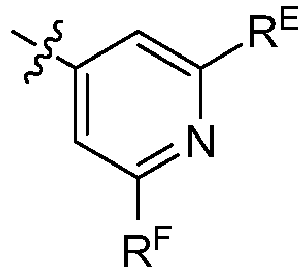
- RE is Cl, -NH2 or -NHCH2CH2OH;
- RF is Cl;
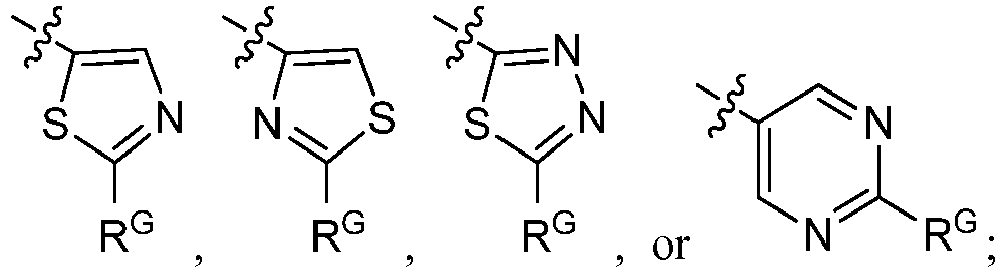
- wherein RG is -NH2, -N(CH3)2, -NHCH2CH2OH,-SCH3, -SO2CH3, morpholinyl, pyrrolidinyl, piperidinyl, piperazinyl, 2,5-dihydro-1H-pyrrole, or -O-piperidinyl; or



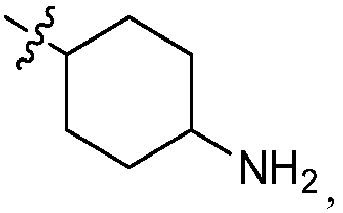
- In one aspect of this embodiment, RA is Br; F; Cl; -CF3; -CH3; -CH2NH2; -CH2CH2NH2; -CN; -CH2OH; -CONH2; -CONCH3; -CON(CH3)2; -CONH-cyclopropyl; -CONHCH2-cyclopropyl; -CONHCH2CH2NH2; -CONHCH2CH2OH; -COOH; -NH2; -SO2CH3; AryB; HetB; -CO-piperazinyl; -CH2-tetrahydropyranyl; or -CH2-piperidinyl optionally substituted with -NH2;
AryB is - 1) phenyl substituted with -CH2NH2, -CH2N(CH3)2, -CH2OH, -CONH2, -CONHCH3, -NHSO2CH3, -SO2CH3, -SO2NH2, HetC, -CH2-HetC, or tetrazolyl;
- 2) pyridinyl optionally substituted with -C(CH3)2OH, -NH2, -N(CH3)2, -NH2 or F;
- 3) piperazinyl optionally substituted with -CH3, -CH2-piperidinyl, -O-piperidinyl, or morpholinyl;
- 4) pyrimidinyl substituted with -NHCH2CH2OH, -NCH3SO2CH3, or HetC;
- 5) pyrazinyl substituted with two -CH3;
- 6) pyrazolyl optionally substituted with 1 to 3 substitutents selected from -CH3, phenyl, and -CH2-pyridinyl;
- 7) dimethylpyrimidinedione;
- 8) tetrazolyl;
- 9) thiazolyl substituted with -CH2OH;
- 10) 1,2,3,4-tetrahydroquinoline;
- 11) imidazopyridinone;
- 12) isoindolinone;
- 13) isoindolinyl;
- 14) isoquinolinyl;
- 15) methylbenzotriazolyl;
- 16) triazolopyridinyl; or
- 17) 1,2,3,4-tetrahydronaphthalen-2-amine;
- 1) pyrrolidinyl optionally substituted with -NH2;
- 2) piperidinyl optionally substituted with -CH3, -NH2, -OH, -CH=NH, or -C(=NH)NH;
- 3) piperazinyl substituted with -CH3,-CH2OH, -CH2CH2OH, -COCH3, =O, or AryC;
- 4) morpholinyl;
- 5) dihydropyrrolyl;
- 6) tetrahydropyridinyl optionally substituted with -CH3; or
- 7) octahydropyrrolo[1,2-a]pyrazine.
- In another aspect of this embodiment, RB is Br; Cl; -CH3; -CN; -CONH2; -COOH; -NH2; -NHCH3; -NHCH2CH2OH; -OH; -NH-cyclopentyl-NH2; -SO2-cyclopropyl; AryB; HetB; -NH-tetrahydroisoquinolinyl; -O-phenyl substituted with -CH2NH2; -NH-pyrrolidinyl; -NHCH2-piperidinyl substituted with -OH; -O-phenyl substituted with -CONH2, -CH2OH, -CH2NH2, -CH2C(CH3)2NH2, -CH(CH3)NH2, -CH2CH2NH2, piperidinyl, pyrrolidinyl, or piperazinyl; -O- tetrahydroisoquinolinyl; -O-tetrahydroquinolinyl; or -O-pyridinyl optionally substituted with piperazinyl;
AryB is - 1) -NHCH2CH2OH;
- 2) -OCH2CH2NH2;
- 3) phenyl substituted with -CH2OH, -CH2NH2, -SO2NH2, AryC, HetC;
- 4) pyridinyl substituted with -NH2;
- 5) pyrimidinyl substituted with -NH2, -N(CH3)2, or -NHCOCH3;
- 6) pyrazolyl substituted with three -CH3;
- 7) isoindolinyl;
- 8) indazolyl;
- 9) isoquinolinyl substituted with -CN; or
- 10) benzooxazinone;
- 1) azetidinyl substituted with -NH2; -CH2NH2; -CH2CH2NH2; -C(CH3)2NH2; -CH2CH2OH; -SO2CH3; morpholinyl; piperazinyl; (CH2OH)2; -CH2NH2 and -CH3; or -OH and -CF3;
- 2) tetrahydropyridinyl;
- 3) pyrrolidinyl optionally substituted with -CH2NH2, -CH2OH, -CONHCH3, -NH2, -OH, or AryC;
- 4) piperidinyl optionally substituted with -CH2NH2, -C(CH3)2NH2, -CH2OH, -CONHCH3, -CH2NHSO2CH3, -C(=NH2)NH2, or -CH=NH;
- 5) piperazinyl optionally substituted with -CH3;
- 6) dihydropyrrolyl;
- 7) diazaspirononanyl;
- 8) diazaspirooctanyl;
- 9) 2,6-diazaspiro[3.4]octan-7-one; or
- 10) 7-methyl-5-oxa-2,7-diazaspiro[3.4]octan-6-one.
- In a further embodiment of the invention, the compound is a compound of formula Ia, Ib, Ic, or Id, or a pharmaceutically acceptable salt thereof, wherein
R1 is selected from the group consisting of: - a) -C2-4 alkyl,
- b) ethyl substituted with 3 halo substituents, or
- c) -C3-6cycloalkyl,
- a) 5- to 6-membered monocyclic aromatic ring with 0, 1, or 2 heteroatom ring atoms independently selected from N and S, optionally substituted with 1 or 2 substituents R; or
- b) 9- to 10- membered bicyclic aromatic ring system with 1, 2 or 3 heteroatom ring atoms selected from N and S, substituted with 1 substituent selected from C1-6alkyl and -NH2;
- a) a 5- to 6- membered saturated or monosaturated monocyclic ring with 1 or 2 N ring atoms, optionally substituted with 1 substituent selected from C1-6hydroxyalkyl, -CH(=NH), -C(=NH)NH2, and -OH; or
- b) a 9-membered saturated spirocyclic ring system with 2 N ring atoms;
- In a further embodiment of the invention, the compound is a compound of formula Ia, Ib, Ic, or Id, or a pharmaceutically acceptable salt thereof, wherein
AryA is a monocyclic ring selected from thiazolyl, phenyl, and pyridinyl, wherein the monocyclic ring optionally substituted with 1 or 2 R substituents; or
a bicyclic ring selected from quinolinyl, benzo[d]thiazolyl, and 1H-benzo[d][1,2,3]triazole, wherein the bicyclic is optionally substituted with one substituent selected from C1-C6alkyl and -NH2;
AryB is a monocyclic ring selected from pyrazolyl, phenyl or pyridyl, wherein the monocyclic is optionally substituted with one substituent selected from -CH2NH2, -CH2OH, -C(=O)NRxRy, -NRxRy, -NHSO2CH3, and HetC; and
HetB is a monocyclic ring selected from pyrrolidinyl, dihydropyrrolyl, piperidinyl, or piperazinyl, wherein the monocyclic is optionally substituted with 1 substituent selected from C1-C6hydroxyalkyl, -CH(=NH), -C(=NH)NH2, and -OH; or diazaspirononanyl; and the other groups are as provided in the general formula I above, or as in any of the first through fifth embodiments. - In a further embodiment of the invention, the compound is a compound of formula I, Ia, Ib, Ic, or Id, or a pharmaceutically acceptable salt thereof, wherein W is
- 1) phenyl optionally substituted with
- a) phenyl substituted with -CONH2, -NHSO2CH3, or piperidinyl,
- b) pyridinyl substituted with -NH2,
- c) pyrrolidinyl,
- d) pyrrolidinyl and fluoro,
- e) piperidinyl substituted with -CH=NH,
- f) piperidinyl substituted with -CH(=NH)NH2,
- g) piperizinyl and fluoro,
- h) dihydropyrrolyl,
- i) pyrazolyl, or
- j) -CH2-piperazinyl;
- 2) -CH2-phenyl;
- 3) -CH(CH3)-phenyl;
- 4) pyridinyl optionally substituted with
- a) -NH2,
- b) -NHCH3,
- c) -NHCH2CH2NH2,
- d) -NHCH2CH2OH,
- e) -NHC(=NH)NH2,
- f) pyrrolidinyl optionally substituted with -OH,
- g) piperidinyl optionally substituted with -CH2OH,
- h) phenyl substituted with -CH2NH2 or -CH2OH,
- i) -O-phenyl substituted with -CH2NH2,
- j) pyridinyl substituted with -NH2, or
- k) diazaspirononanyl,
- 5) thiazolyl substituted with -NH2,
- 6) quinolinyl substituted with -NH2,
- 7) benzo[d]thiazolyl substituted with -NH2, or
- 8) 1H-benzo[d][1,2,3]triazole] substituted with-CH3;
- In another embodiment of the invention, the compound of the invention is selected from the exemplary species depicted in EXAMPLES 1-456 shown below, and pharmaceutically acceptable salts thereof. Compounds which are not embraced by formula (Ia) or (Ib) of claim 1 are reference compounds.
- In another embodiment of the invention, the compound of the invention is selected from the exemplary species depicted in EXAMPLES 4, 8, 55, 60, 61, 62, 63, 72, 78, 79, 80, 88, 96, 100, 101, 109, 111, 112, 113, 114, 115, 116, 121, 122, 123, 129, 130, 131, 134, 146, 148, 152, 155, 176, 177, 265, 266, 274, 296, 297, 308, 313, 314, 341, 349, 351, 395, 402, 420, 422, 427, 428, 431, shown below, and pharmaceutically acceptable salts thereof.
- Other aspects of the present disclosure include the following:
- (a) A pharmaceutical composition comprising an effective amount of a compound of formula (Ia) or (Ib), as defined above, or a pharmaceutically acceptable salt thereof, and a pharmaceutically acceptable carrier.
- (b) The pharmaceutical composition of (a), further comprising an effective amount of a β-lactam antibiotic.
- (c) The pharmaceutical composition of (b), wherein the β-lactam antibiotic is selected from the group consisting of imipenem, ertapenem, meropenem, doripenem, biapenem, panipenem, ticarcillin, ampicillin, amoxicillin, carbenicillin, piperacillin, azlocillin, mezlocillin, ticarcillin, cefoperazone, cefotaxime, ceftriaxone, and ceftazidime.
- (d) The pharmaceutical composition of (b), wherein the β-lactam antibiotic is imipenem.
- (e) The pharmaceutical composition of (b), wherein the β-lactam antibiotic is ceftazidime.
- (f) The pharmaceutical composition of (b), wherein the β-lactam antibiotic is piperacillin.
- (g) The pharmaceutical composition of (a), further comprising effective amounts of a β-lactam antibiotic and a renal dehydropeptidase (DHP) inhibitor.
- (h) The pharmaceutical composition of (g), wherein the β-lactam antibiotic is imipenem, and the DHP inhibitor is cilastatin or a pharmaceutically acceptable salt thereof.
- (i) A combination of effective amounts of a compound of Formula I as defined above, or a pharmaceutically acceptable salt thereof, and a β-lactam antibiotic.
- (j) The combination of (i), wherein the β-lactam antibiotic is selected from the group consisting of imipenem, ertapenem, meropenem, doripenem, biapenem, panipenem, ticarcillin, ampicillin, amoxicillin, carbenicillin, piperacillin, azlocillin, mezlocillin, ticarcillin, cefoperazone, cefotaxime, ceftriaxone, and ceftazidime.
- (k) The combination of (i), wherein the β-lactam antibiotic is imipenem.
- (l) The combination of (i), wherein the β-lactam antibiotic is ceftazidime.
- (m) The combination of (i), wherein the β-lactam antibiotic is piperacillin.
- (n) A combination of effective amounts of a compound of Formula I as defined above, or a pharmaceutically acceptable salt thereof, a β-lactam antibiotic and a DHP inhibitor.
- (o) The combination of (n), wherein the β-lactam antibiotic is imipenem, and the DHP inhibitor is cilastatin or a pharmaceutically acceptable salt thereof.
- (p) A method for inhibiting beta-lactamase and/or treating a bacterial infection which comprises administering to a subject in need of such treatment an effective amount of a compound of Formula I or a pharmaceutically acceptable salt thereof, optionally in combination with an effective amount of a β-lactam antibiotic.
- (q) A method for inhibiting beta-lactamase and/or treating a bacterial infection which comprises administering to a subject in need of such treatment an effective amount of a compound of Formula I, or a pharmaceutically acceptable salt thereof, in combination with effective amounts of a β-lactam antibiotic and a DHP inhibitor.
- (r) A method for treating a bacterial infection which comprises administering to a subject in need of such treatment a therapeutically effective amount of the composition of (a), (b), (c), (d), (e), (f), (g) and (h).
- (s) A method for treating a bacterial infection which comprises administering to a subject in need of such treatment a therapeutically effective amount of the combination (i), (j), (k), (1), (m), (n) and (o).
- (t) The method of treating a bacterial infection as set forth in (p), (q), (r), or (s), wherein the bacterial infection is due to Pseudomonas spp., Klebsiella spp., Enterobacter spp., Escherichia spp., Morganella spp., Citrobacter spp., Serratia spp. or Acintetobacter spp.
- The present invention also includes a compound of formula (Ia) or (Ib), or a pharmaceutically acceptable salt thereof, (i) for use in, (ii) for use as a medicament for, or (iii) for use in the preparation (or manufacture) of a medicament for, medicine or inhibiting beta-lactamase activity or treating bacterial infection. In these uses, the compounds of the present invention can optionally be employed in combination with one or more β-lactam antibiotics and/or one or more DHP inhibitors.
- Additional embodiments of the invention include the pharmaceutical compositions, combinations and methods set forth in (a)-(t) above and the uses set forth in the preceding paragraph, wherein the compound of the present invention employed therein is a compound of one of the embodiments, sub-embodiments, classes or sub-classes described above. The compound may optionally be used in the form of a pharmaceutically acceptable salt in these embodiments.
- In the embodiments of the compounds and salts provided above, it is to be understood that each embodiment may be combined with one or more other embodiments, to the extent that such a combination provides a stable compound or salt and is consistent with the description of the embodiments. It is further to be understood that the embodiments of compositions and methods provided as (a) through (t) above are understood to include all embodiments of the compounds and/or salts, including such embodiments as result from combinations of embodiments.
- Additional embodiments of the present invention include each of the pharmaceutical compositions, combinations, methods and uses set forth in the preceding paragraphs, wherein the compound of the present invention or its salt employed therein is substantially pure. With respect to a pharmaceutical composition comprising a compound of formula (Ia) or (Ib) or its salt and a pharmaceutically acceptable carrier and optionally one or more excipients, it is understood that the term "substantially pure" is in reference to a compound of formula (Ia) or (Ib) or its salt per se; i.e., the purity of the active ingredient in the composition.
- The term "metallo-p-lactamase inhibitor" refers to a compound which is capable of inhibiting metallo-β-lactamase activity. As used herein, inhibiting metallo-β-lactamase activity means inhibiting the activity of a class B metallo-β-lactamase. For antimicrobial applications inhibition at a 50% inhibitory concentration is preferably achieved at or below about 100 micrograms/mL, or at or below about 50 micrograms/mL, or at or below about 25 micrograms/mL. The terms "class A", "class B", "class C", and "class D" β-lactamases are understood by those skilled in the art and are described in S. G. Waley, β-lactamase: mechanisms of action, in The Chemistry of β-Lactams, M. I. Page, Ed.; Chapman and Hall, London, (1992) 198-228.
- The term "metallo-p-lactamase" denotes a metalloprotein capable of inactivating a β-lactam antibiotic. The β-lactamase can be an enzyme which catalyzes the hydrolysis of the β-lactam ring of a β-lactam antibiotic. The metallo-β-lactamase can be, for example, a zinc metallo-β-lactamase. β-Lactamases of interest include those disclosed in, e.g., S. G. Waley, β-lactamase: mechanisms of action, in The Chemistry of β-Lactams, M. I. Page, Ed.; Chapman and Hall, London, (1992) 198-228. β-Lactamases of particular interest herein include a metallo-β-lactamases of Escherichia coli (such as New Delhi Metallo-b-lactamase, NDM), Serratia marcescens (such as IMP), and Klebsiella spp. (such as Verona integron-encoded metallo-β-lactamase, VIM).). Additional metallo-p-lactamases of interest herein include SPM-, GIM-, SIM-, KHM-, AIM-, DIM-, SMB-, TMB-, and FIM-type enzymes.
- The term "antibiotic" refers to a compound or composition which decreases the viability of a microorganism, or which inhibits the growth or proliferation of a microorganism. The phrase "inhibits the growth or proliferation" means increasing the generation time (i.e., the time required for the bacterial cell to divide or for the population to double) by at least about 2-fold. Preferred antibiotics are those which can increase the generation time by at least about 10-fold or more (e.g., at least about 100-fold or even indefinitely, as in total cell death). As used in this disclosure, an antibiotic is further intended to include an antimicrobial, bacteriostatic, or bactericidal agent. Examples of antibiotics suitable for use with respect to the present invention include penicillins, cephalosporins and carbapenems.
- The term "β-lactam antibiotic" refers to a compound with antibiotic properties that contains a β-lactam functionality. Non-limiting examples of β-lactam antibiotics useful with respect to the invention include penicillins, cephalosporins, penems, carbapenems, and monobactams.
- The term "about", when modifying the quantity (e.g., kg, L, or equivalents) of a substance or composition, or the value of a physical property, or the value of a parameter characterizing a process step (e.g., the temperature at which a process step is conducted), or the like refers to variation in the numerical quantity that can occur, for example, through typical measuring, handling and sampling procedures involved in the preparation, characterization and/or use of the substance or composition; through inadvertent error in these procedures; through differences in the manufacture, source, or purity of the ingredients employed to make or use the compositions or carry out the procedures; and the like. In certain embodiments, "about" can mean a variation of ± 0.1, 0.2, 0.3, 0.4, 0.5, 1.0, 2.0, 3.0, 4.0, or 5.0 of the appropriate unit. In certain embodiments, "about" can mean a variation of ± 1%, 2%, 3%, 4%, 5%, 10%, or 20%.
- Another embodiment of the present invention is a compound of formula (Ia) or (Ib), or a pharmaceutically acceptable salt thereof, as originally defined or as defined in any of the foregoing embodiments, sub-embodiments, aspects, classes or sub-classes, wherein the compound or its salt is in a substantially pure form. As used herein "substantially pure" means suitably at least about 60 wt.%, typically at least about 70 wt.%, preferably at least about 80 wt.%, more preferably at least about 90 wt.% (e.g., from about 90 wt.% to about 99 wt.%), even more preferably at least about 95 wt.% (e.g., from about 95 wt.% to about 99 wt.%, or from about 98 wt.% to 100 wt.%), and most preferably at least about 99 wt.% (e.g., 100 wt.%) of a product containing a compound formula (Ia) or (Ib) or its salt (e.g., the product isolated from a reaction mixture affording the compound or salt) consists of the compound or salt. The level of purity of the compounds and salts can be determined using a standard method of analysis such as thin layer chromatography, gel electrophoresis, high performance liquid chromatography, and/or mass spectrometry. If more than one method of analysis is employed and the methods provide experimentally significant differences in the level of purity determined, then the method providing the highest level of purity governs. A compound or salt of 100% purity is one which is free of detectable impurities as determined by a standard method of analysis.
- Recitation or depiction of a specific compound in the claims (i.e., a species) without a specific stereoconfiguration designation, or with such a designation for less than all chiral centers, is intended to encompass the racemate, racemic mixtures, each individual enantiomer, a diastereoisomeric mixture and each individual diastereomer of the compound where such forms are possible due to the presence of one or more asymmetric centers.
- With respect to a compound of the invention which has one or more asymmetric centers and can occur as mixtures of stereoisomers, a substantially pure compound can be either a substantially pure mixture of the stereoisomers or a substantially pure individual diastereomer or enantiomer. All isomeric forms of these compounds, whether individually or in mixtures, are within the scope of the present invention.
- "Alkyl" means saturated carbon chains which may be linear or branched or combinations thereof, unless the carbon chain is defined otherwise. Other groups having the prefix "alk", such as alkoxy and alkanoyl, also may be linear or branched, or combinations thereof, unless the carbon chain is defined otherwise. Examples of alkyl groups include methyl, ethyl, propyl, isopropyl, butyl, sec- and tert-butyl, pentyl, hexyl, heptyl, octyl, nonyl, and the like.
- "Alkenyl" means carbon chains which contain at least one carbon-carbon double bond, and which may be linear or branched, or combinations thereof, unless otherwise defined. Examples of alkenyl include vinyl, allyl, isopropenyl, pentenyl, hexenyl, heptenyl, 1-propenyl, 2-butenyl, 2-methyl-2-butenyl, and the like.
- "Alkynyl" means carbon chains which contain at least one carbon-carbon triple bond, and which may be linear or branched, or combinations thereof, unless otherwise defined. Examples of alkynyl include ethynyl, propargyl, 3-methyl-1-pentynyl, 2-heptynyl and the like.
- "Aromatic ring system" means monocyclic, bicyclic or tricyclic aromatic ring or ring system containing 5-14 ring atoms, wherein at least one of the rings is aromatic. The term may be used to describe a carbocyclic ring fused to an aryl group. For example, a 5-7-membered cycloalkyl can be fused through two adjacent ring atoms to a 5-6-membered heteroaryl containing 1, 2, or 3 heteroatom ring atoms selected from N, O, and S. In another example, a heteromonocyclic ring is fused through two ring atoms to a phenyl or 5-6-membered heteroaryl containing 1, 2, or 3 heteroatoms selected from N, O, and S.
- "Aryl" means a monocyclic, bicyclic or tricyclic carbocyclic aromatic ring or ring system containing 6-14 carbon atoms, wherein at least one of the rings is aromatic. Examples of aryl include phenyl and naphthyl. In one embodiment of the present invention, aryl is phenyl.
- "Cycloalkyl" means a saturated monocyclic, bicyclic or bridged carbocyclic ring, having a specified number of carbon atoms. Examples of cycloalkyl include cyclopropyl, cyclobutyl, cyclopentyl, cyclohexyl, cycloheptyl, indanyl, and the like. In one embodiment of the present invention, cycloalkyl is selected from: cyclopropane, cyclobutane, cyclopentane, and cyclohexane.
- "Cycloalkenyl" means a nonaromatic monocyclic or bicyclic carbocylic ring containing at least one double bond. Examples of cycloalkenyl include cyclopropenyl, cyclobutenyl, cyclopentenyl, cyclohexenyl, cycloheptenyl, cyclooxtenyl and the like.
- "Cycloheteroalkyl" means a saturated or partly unsaturated non-aromatic monocyclic, bicyclic or bridged carbocyclic ring or ring system containing at least one ring heteroatom selected from N, NH, S (including SO and SO2) and O. When a cycloheteroalkyl contains two rings, the rings may be fused or spirocyclic. The cycloheteroalkyl ring may be substituted on the ring carbons and/or the ring nitrogen(s). Examples of cycloheteroalkyl include tetrahydrofuran, piperazine, piperidine, morpholine, oxetane, tetrahydropyran, indolinyl, isoindolinyl, azabicyclooctane, hexose, pentose, isosorbide and isomannide, dianhydromannitol, 1, 4:3, 6-dianhydromannitol, 1, 4:3, 6-dianhydro[D]mannitol, hexahydrofuro[3,2-b]furan, and 2,3,3a,5,6,6a-hexahydrofuro[3,2-b]furan. In one embodiment of the present invention, cycloheteroalkyl is selected from: oxetane, tetrahydropyran, azetidine, tetrahydrothiopyran and pyrrolidine. In another embodiment of the present invention cycloheteroalkyl is selected from: piperidine, piperazine, azetidine, pyrrolidine, morpholine and spiro(indene-1,4-piperidine).
- "Cycloheteroalkenyl" means a nonaromatic monocyclic, bicyclic or bridged carbocyclic ring or ring system containing at least one double bond and contaiing at least one heteroatom selected from N, NH, S and O.
- "Heteroaryl" means monocyclic, bicyclic or tricyclic ring or ring system containing 5-14 carbon atoms and containing at least one ring heteroatom selected from N, NH, S (including SO and SO2) and O, wherein at least one of the heteroatom containing rings is aromatic. Examples of heteroaryl include pyrrolyl, isoxazolyl, isothiazolyl, pyrazolyl, pyridyl, oxazolyl, oxadiazolyl, thiadiazolyl, thiazolyl, imidazolyl, triazolyl, tetrazolyl, furanyl, triazinyl, thienyl, pyrimidyl, pyridazinyl, pyrazinyl, benzisoxazolyl, benzoxazolyl, benzothiazolyl, benzimidazolyl, benzopyrazolyl, benzofuranyl, benzothiophenyl (including S-oxide and dioxide), benzotriazolyl, furo(2,3-b)pyridyl, quinolyl, indolyl, isoquinolyl, quinazolinyl, dibenzofuranyl, and the like. In one embodiment of the present invention, heteroaryl is selected from: pyridine, pyrimidine, thiazole, benzimidazole, benzthiazole, benzoxazole, and benzisoxazole. In another embodiment of the present invention, heteroaryl is pyridine.
- "Halogen" includes fluorine, chlorine, bromine and iodine.
- "Oxo" means an oxygen atom connected to another atom by a double bond and is can be represented "=O".
- When any variable (e.g., R1, Ra, etc.) occurs more than one time in any constituent or in formula I, its definition on each occurrence is independent of its definition at every other occurrence. Also, combinations of substituents and/or variables are permissible only if such combinations result in stable compounds. A squiggly line across a bond in a substituent variable represents the point of attachment.
- Under standard nomenclature used throughout this disclosure, the terminal portion of the designated side chain is described last, preceded by the adjacent functionality toward the point of attachment.
- In choosing compounds of the present invention, one of ordinary skill in the art will recognize that the various substituents, i.e. R1, R2, etc., are to be chosen in conformity with well-known principles of chemical structure connectivity and stability.
- The term "substituted" shall be deemed to include multiple degrees of substitution by a named substitutent. Where multiple substituent moieties are disclosed or claimed, the substituted compound can be independently substituted by one or more of the disclosed or claimed substituent moieties, singly or plurally. By independently substituted, it is meant that the (two or more) substituents can be the same or different.
- When a group, e.g., C1-8alkyl, is indicated as being substituted, such substitutions can also be occur where such group is part of a larger substituent, e.g., -C1-8alkyl-C3-7cycloalkyl and -C1-8alkyl-aryl.
- In the compounds of formula (Ia) or (Ib), the atoms may exhibit their natural isotopic abundances, or one or more of the atoms may be artificially enriched in a particular isotope having the same atomic number, but an atomic mass or mass number different from the atomic mass or mass number predominantly found in nature. The present invention is meant to include all suitable isotopic variations of the compounds of formula (Ia) or (Ib). For example, different isotopic forms of hydrogen (H) include protium (1H) and deuterium (2H or D). Protium is the predominant hydrogen isotope found in nature. Enriching for deuterium may afford certain therapeutic advantages, such as increasing in vivo half-life or reducing dosage requirements, or may provide a compound useful as a standard for characterization of biological samples. Isotopically-enriched compounds within formula (Ia) or (Ib) can be prepared without undue experimentation by conventional techniques well known to those skilled in the art or by processes analogous to those described in the EXAMPLES herein using appropriate isotopically-enriched reagents and/or intermediates.
- Unless expressly stated to the contrary in a particular context, any of the various cyclic rings and ring systems described herein may be attached to the rest of the compound at any ring atom (i.e., any carbon atom or any heteroatom) provided that a stable compound results.
- Unless expressly stated to the contrary, all ranges cited herein are inclusive. For example, a heteroaromatic ring described as containing from "1 to 4 heteroatoms" means the ring can contain 1, 2, 3 or 4 heteroatoms. It is also to be understood that any range cited herein includes within its scope all of the sub-ranges within that range. Thus, for example, a heterocyclic ring described as containing from "1 to 4 heteroatoms" is intended to include as aspects thereof, heterocyclic rings containing 2 to 4 heteroatoms, 3 or 4 heteroatoms, 1 to 3 heteroatoms, 2 or 3 heteroatoms, 1 or 2 heteroatoms, 1 heteroatom, 2 heteroatoms, 3 heteroatoms, and 4 heteroatoms. Similarly, C1-6 when used with a chain, for example an alkyl chain, means that the chain can contain 1, 2, 3, 4, 5 or 6 carbon atoms. It also includes all ranges contained therein including C1-5, C1-4, C1-3, C1-2, C2-6, C3-6, C4-6, C5-6, and all other possible combinations.
- A "stable" compound is a compound which can be prepared and isolated and whose structure and properties remain or can be caused to remain essentially unchanged for a period of time sufficient to allow use of the compound for the purposes described herein (e.g., therapeutic administration to a subject). The compounds of the present invention are limited to stable compounds embraced by formula (Ia) or (Ib).
- The term "compound" refers to the free compound and, to the extent they are stable, any hydrate or solvate thereof. A hydrate is the compound complexed with water, and a solvate is the compound complexed with an organic solvent.
- As indicated above, the compounds of the present invention can be employed in the form of pharmaceutically acceptable salts. The term "pharmaceutically acceptable salt" refers to a salt which possesses the effectiveness of the parent compound and which is not biologically or otherwise undesirable (e.g., is neither toxic nor otherwise deleterious to the recipient thereof). A suitable pharmaceutically acceptable salt is a salt formed by treating the compound of the invention (e.g., a compound of formula (Ia) or (Ib)) with one molar equivalent of a mild base (e.g., sodium carbonate, sodium bicarbonate, potassium bicarbonate, or sodium acetate). In this case, M is a cation, such as Na+ in the event of treatment with a sodium base.
- The compound of the invention can also be employed in the form of a prodrug. In certain aspects of this embodiment, the hydrogen in -COOH in formula (Ia) or (Ib) can be replaced with any the following groups: C1-6alkyl, C3-6cycloalkyl, -C1-6alkyl-C3-6cycloalkyl, C3-7cycloheteroalkyl,-C1-6alkyl-C3-7cycloheteroalkyl, aryl, -C1-10alkyl-aryl, heteroaryl, and -C1-10alkyl-heteroaryl. In certain aspects of this embodiment, the C1-6alkyl, C3-6cycloalkyl, or C3-7cycloheteroalkyl can be substituted. In other aspects of this embodiment, each aryl and heteroaryl can be substituted.
- As set forth above, the present invention includes pharmaceutical compositions comprising a compound of Formula I of the present invention, optionally one or more other active components (e.g., a β-lactam antibiotic), and a pharmaceutically acceptable carrier. The characteristics of the carrier will depend on the route of administration. By "pharmaceutically acceptable" is meant that the ingredients of the pharmaceutical composition must be compatible with each other, do not interfere with the effectiveness of the active ingredient(s), and are not deleterious (e.g., toxic) to the recipient thereof. Thus, compositions according to the invention may, in addition to the inhibitor, contain diluents, fillers, salts, buffers, stabilizers, solubilizers, and other materials well known in the art.
- Also as set forth above, the present invention includes a method for treating a bacterial infection which comprises administering to a subject in need of such treatment a therapeutically effective amount of a compound of formula (Ia) or (Ib), or a pharmaceutically acceptable salt thereof, optionally in combination with a β-lactam antibiotic and/or a DHP inhibitor. The term "subject" (or, alternatively, "patient") as used herein refers to an animal, preferably a mammal, most preferably a human, who has been the object of treatment, observation or experiment. The term "administration" and variants thereof (e.g., "administering" a compound) in reference to a compound of Formula I mean providing the compound, or a pharmaceutically acceptable salt thereof, to the individual in need of treatment. When a compound or a salt thereof is provided in combination with one or more other active agents (e.g., a carbapenem antibiotic or a DHP inhibitor or both), "administration" and its variants are each understood to include provision of the compound or its salt and the other agents at the same time or at different times. When the agents of a combination are administered at the same time, they can be administered together in a single composition or they can be administered separately. It is understood that a "combination" of active agents can be a single composition containing all of the active agents or multiple compositions each containing one or more of the active agents. In the case of two active agents a combination can be either a single composition comprising both agents or two separate compositions each comprising one of the agents; in the case of three active agents a combination can be either a single composition comprising all three agents, three separate compositions each comprising one of the agents, or two compositions one of which comprises two of the agents and the other comprises the third agent; and so forth.
- The compositions and combinations of the present invention are suitably administered in effective amounts. The term "effective amount" as used herein with respect to β -lactamase means the amount of active compound sufficient to inhibit β-lactamase activity. In one embodiment, the effective amount is a "therapeutically effective amount" meaning the amount of active compound that can overcome bacterial drug resistance and which, when used in combination with a β-lactam antibiotic, is sufficient to inhibit bacterial replication and/or result in bacterial killing. When the active compound (i.e., active ingredient) is administered as the salt, references to the amount of active ingredient are to the free acid or free base form of the compound.
- The administration of a composition of the present invention is suitably parenteral, oral, sublingual, transdermal, topical, intranasal, intratracheal, intraocular, or intrarectal, wherein the composition is suitably formulated for administration by the selected route using formulation methods well known in the art, including, for example, the methods for preparing and administering formulations described in chapters 39, 41, 42, 44 and 45 in Remington - The Science and Practice of Pharmacy, 21st edition, 2006. In one embodiment, compounds of the invention are administered intravenously in a hospital setting. In another embodiment, administration is oral in the form of a tablet or capsule or the like. The dosage of the β-lactamase inhibitors and of their pharmaceutically acceptable salts may vary within wide limits and should naturally be adjusted, in each particular case, to the individual conditions and to the pathogenic agent to be controlled. In general, for a use in the treatment of bacterial infections, the daily dose may be between 0.005 mg/kg to 100 mg/kg, 0.01 mg/kg to 10 mg/kg, 0.05 mg/kg to 5 mg/kg, 0.05 mg/kg to 1 mg/kg. Moreover, the ratio of the β-lactamase inhibitor or of the pharmaceutically acceptable salt thereof to the β-lactam antibiotic may also vary within wide limits and should be adjusted, in each particular case, to the individual conditions, in general, a ratio ranging from about 1:1000 to about 100:1 is recommended. In one embodiment, the ratio is 1:1000, 1:500, 1:250, 1:100, 1:50, 1:25, 1:10, 1:5, 1:1, 5:1, 10:1, 25:1, 50:1 or 100:1.
- Intravenous administration of a compound of the invention can be conducted by reconstituting a powdered form of the compound with an acceptable solvent. Suitable solvents include, for example, saline solutions (e.g., 0.9% Sodium Chloride Injection) and sterile water (e.g., Sterile Water for Injection, Bacteriostatic Water for Injection with methylparaben and propylparaben, or Bacteriostatic Water for Injection with 0.9% benzyl alcohol). The powdered form of the compound can be obtained by gamma-irradiation of the compound or by lyophilization of a solution of the compound, after which the powder can be stored (e.g., in a sealed vial) at or below room temperature until it is reconstituted. The concentration of the compound in the reconstituted IV solution can be, for example, in a range of from about 0.1 mg/mL to about 20 mg/mL.
- The present disclosure also includes a method for inhibiting β-lactamase activity which comprises administering to a bacterial cell culture, or to a bacterially infected cell culture, tissue, or organism, an inhibition effective amount of a compound of formula (Ia) or (Ib). Additional embodiments of the disclosure include the inhibiting method just described, wherein the compound of the present invention employed therein is a compound of one of the embodiments, sub-embodiments or classes described above. The compound may optionally be used in the form of a pharmaceutically acceptable salt in these embodiments. The method can involve administration of a compound of formula (Ia) or (Ib), in combination with a β-lactam antibiotic to an experimental cell culture in vitro to prevent the growth of β-lactam resistant bacteria. The method can alternatively involve administration of a compound of Formula I, in combination with a β-lactam antibiotic, to an animal, including a human, to prevent the growth of β-lactam resistant bacteria in vivo.
- Compounds of the invention can be employed for the treatment, prophylaxis or inhibition of bacterial growth or infections due to bacteria that are resistant to β-lactam antibiotics. In an embodiment, the bacteria can be metallo-β-lactamase positive strains that are highly resistant to β-lactam antibiotics. The terms "slightly resistant" and "highly resistant" are well-understood by those of ordinary skill in the art (see, e.g., Payne et al., Antimicrobial Agents and Chemotherapy 38:767-772 (1994); Hanaki et al., Antimicrobial Agents and Chemotherapy 30:11.20-11.26 (1995)). For the purposes of this invention, bacterial strains which are highly resistant to imipenem are those against which the MIC of imipenem is > 16 µg/mL, and bacterial strains which are slightly resistant to imipenem are those against which the MIC of imipenem is >4 µg/mL.
- Compounds of the invention can be used in combination with antibiotic agents for the treatment of infections caused by Class B-β-lactamase producing strains, in addition to those infections which are subsumed within the antibacterial spectrum of the antibiotic agent. Examples of class B-metallo-β-lactamase producing bacteria are Pseudomonas aeruginosa, Pseudomonas putida, Enterobacter cloacae, Klebsiella pneumoniae, Klebsiella oxytoca, Escherichia coli, Serratia marcescens, Enterobacter aerogenes, Enterobacter asburiae, Citrobacter freundii, Proteus mirabilis, Morganella morganii, Providencia rettgeri, and Acinetobacter baumannii.
- It is generally advantageous to use a compound of formula (Ia) or (Ib) in admixture or conjunction with a carbapenem, penicillin, cephalosporin, or other β-lactam antibiotic, or a prodrug thereof. It is advantageous to use a compound of formula (Ia) or (Ib) in combination with one or more β-lactam antibiotics because of the class B β-lactamase inhibitory properties of the compounds. It is also advantageous to use a compound of formula (Ia) or (Ib) in combination with one or more Class A, C, and D β-lactamase inhibitors to further limit β-lactam susceptability. As already noted, the compound of formula (Ia) or (Ib) and the β-lactam antibiotic can be administered separately (at the same time or as different times) or in the form of a single composition containing both active ingredients.
- Carbapenems, penicillins, cephalosporins and other β-lactam antibiotics suitable for use in the present invention include both those known to show instability to or to be otherwise susceptible to class B-β-lactamases.
- When the compounds of formula (Ia) or (Ib) are combined with a carbapenem antibiotic, a dehydropeptidase (DHP) inhibitor can also be combined. Many carbapenems are susceptible to attack by a renal enzyme known as DHP. This attack or degradation may reduce the efficacy of the carbapenem antibacterial agent. Inhibitors of DHP and their use with carbapenems are disclosed in, e.g.,
U.S. Pat. Nos. 4,539,208 ;4,616,038 ;4,880,793 ; and5,071,843 . A preferred DHP inhibitor is 7-(L-2-amino-2-carboxyethylthio)-2-(2,2-dimethylcyclopropanecarboxamide)-2-heptenoic acid or a pharmaceutically acceptable salt thereof. - Carbapenems suitable for co-administration with compounds of the present invention include imipenem, meropenem, biapenem, (4R, 5S, 6S)-3-[3S, 5S)-5-(3-carboxyphenyl-carbamoyl)pyrrolidin-3-ylthio]-6-(1R)-1-hydroxyethyl]-4-methyl-7-oxo-1-azabicyclo[3.2.0]hept-2-ene-2-carboxylic acid, (1S, 5R, 6S)-2-(4-(2-(((carbamoylmethyl)-1,4-diazoniabicyclo[2.2.2]oct-1-yl)-ethyl(1,8-naphthosultam)methyl)-6-[1(R)-hydroxyethyl]-1-methylcarbapen-2-em-3-carboxylate chloride, BMS181139 ([4R-[4α,5β,6β(R*)]]-4-[2-[(aminoiminomethyl)amino]ethyl]-3-[(2-cyanoethyl)thio]-6-(1-hydroxyethyl)-7-oxo-1-azabicyclo[3.2.0]hept-2-ene-2-carboxylic acid), BO2727 ([4R-3[3S*,5S*(R*)], 4α,5β,6β(R*)]]-6-(1-hydroxyethyl)-3-[[5-[1-hydroxy-3-(methylamino)propyl]-3-pyrrolidinyl]thio]-4-methyl-7-oxo-1-azabicyclo[3.2.0] hept-2-ene-2-carboxylic acid monohydrochloride), E1010 ((1R, 5S, 6S)-6-[1(R)-hydroxymethyl]-2-[2(S)-[1(R)-hydroxy-1-[pyrrolidin-3(R)-yl]methyl]pyrrolidin-4(S)-ylsulfanyl]-1-methyl-1-carba-2-penem-3-carboxylic acid hydrochloride) and S4661 ((1R,5S,6S)-2-[(3S,5S)-5-(sulfamoylaminomethyl) pyrrolidin-3-yl]thio-6-[(1R)-1-hydroxyethyl]-1-methylcarbapen-2-em-3-carboxylic acid), (1S,5R,6S)-1-methyl-2-{7-[4-(aminocarbonylmethyl)-1,4-diazoniabicyclo(2.2.2)octan-lyl]-methyl-fluoren-9-on-3-yl}-6-(1R-hydroxyethyl)-carbapen-2-em-3 carboxylate chloride.
- Penicillins suitable for co-administration with compounds of the present invention include benzylpenicillin, phenoxymethylpenicillin, carbenicillin, azidocillin, propicillin, ampicillin, amoxicillin, epicillin, ticarcillin, cyclacillin, pirbenicillin, azlocillin, mezlocillin, sulbenicillin, piperacillin, and other known penicillins. The penicillins may be used in the form of pro-drugs thereof; for example as in vivo hydrolysable esters, for example the acetoxymethyl, pivaloyloxymethyl, α-ethoxycarbonyloxy-ethyl and phthalidyl esters of ampicillin, benzylpenicillin and amoxicillin; as aldehyde or ketone adducts of penicillins containing a 6-α-aminoacetamido side chain (for example hetacillin, metampicillin and analogous derivatives of amoxicillin); and as esters of carbenicillin and ticarcillin, for example the phenyl and indanyl α-esters.
- Cephalosporins suitable for co-administration with compound of the present invention include cefatrizine, cephaloridine, cephalothin, cefazolin, cephalexin, cephacetrile, cephapirin, cephamandole nafate, cephradine, 4-hydroxycephalexin, cephaloglycin, cefoperazone, cefsulodin, ceftazidime, cefuroxime, cefmetazole, cefotaxime, ceftriaxone, and other known cephalosporins, all of which may be used in the form of pro-drugs thereof.
- β-Lactam antibiotics other than penicillins and cephalosporins that may be co-administered with compounds of the present invention include aztreonam, latamoxef (Moxalactam-trade mark), and other known β-lactam antibiotics such as carbapenems like imipenem, meropenem or (4R, 5S, 6S)-3-[(3S,5S)-5-(3-carboxyphenylcarbamoyl)pyrrolidin-3-ylthio]-6-(1R)-1-hydroxyethyl]-4-methyl-7-oxo-1-azabicyclo[3.2.0]hept-2-ene-2-carboxylic acid, all of which may be used in the form of pro-drugs thereof.
- In one embodiment, the antibiotic co-administered with a compound of the present invention is selected from the group consisting of imipenem, ertapenem, meropenem and (4R, 5S, 6S)-3-[(3S,5S)-5-(3-carboxyphenylcarbamoyl)pyrrolidin-3-ylthio]-6-(1R)-1-hydroxyethyl]-4-methyl-7-oxo-1-azabicyclo[3.2.0]hept-2-ene-2-carboxylic acid.
- In another embodiment, the antibiotic co-administered with a compound of the present invention is selected from the group of penicillins consisting of ampicillin, amoxicillin, carbenicillin, piperacillin, azlocillin, mezlocillin, and ticarcillin. Such penicillins can optionally be used in the form of their pharmaceutically acceptable salts, for example their sodium salts. Ampicillin or amoxicillin can alternatively be employed in the form of fine particles of the zwitterionic form (generally as ampicillin trihydrate or amoxicillin trihydrate) for use in an injectable or infusable suspension. In an aspect of this embodiment, the penicillin co-administered with a compound of the present invention is amoxicillin, optionally in the form of its sodium salt or the trihydrate.
- In another embodiment, the antibiotic co-administered with a compound of the present invention is selected from the group of cephalosporins consisting of cefotaxime, ceftriaxone and ceftazidime, which are optionally used in the form of their pharmaceutically acceptable salts, for example their sodium salts.
- When co-administered with a β-lactam antibiotic, the combination of the compound of the invention and the antibiotic can provide a synergistic effect. The terms "synergistic effect" and "synergy" indicate that the effect produced when two or more drugs are co-administered is greater than would be predicted based on the effect produced when the compounds are administered individually. While not wishing to be bound by theory, it is believed that the compounds of the present invention are β-lactamase inhibitors that act to prevent degradation of β-lactam antibiotics, thereby enhancing their efficacy and producing a synergistic effect.
- Abbreviations employed herein include the following: acac = acetylacetonate; AcOH = acetic acid; Ad2nBuP = n-butyldiadamantylphosphine; ACN = acetonitrile; AIBN = 2,2-azobisisobutyronitrile; BLI = β-lactamase inhibitor; Bn = benzyl; BOC (or Boc) = t-butyloxycarbonyl; BOC-ON = 2-(tert-butoxycarbonyloxyamino)-2-phenyl acetonitrile; BOC-OSN = N-tert-butoxycarbonyloxy)succinimide; BOP = benzotriazol-1-yloxy)tris(dimethylamino)phosphonium hexafluorophosphate; BSA = bovine serum albumin; CBZ (or Cbz) = carbobenzoxy (alternatively, benzyloxycarbonyl); CH3CN = acetonitrile; COD = cyclooctadieneyl; DBU = 1,8-diazabicyclo[5.4.0]undec-7-ene; DCC = dicyclohexyl carbodiimide; DCE = 1,2-dichloroethane; DCM = dichloromethane; DEAD= diethyl azodicarboxylate; DIBAL-H = diisobutylaluminium hydride; DIEA = diethylamine; DIPA = diisopropylamine; DIPEA = diisopropylethylamine (or Hunig's base); DMA = dimethylacetamide; DMAC = N,N-dimethylacetamide; DMAP = 4-dimethylaminopyridine or N,N-dimethylaminopyridine; DME = 1,2-dimethoxyethane; DMF = N,N-dimethylformamide; DMSO = dimethyl sulfoxide; EDC = 1-ethyl-3-(3-dimethylaminopropyl) carbodiimide; DSC = differential scanning calorimetry; Et = ethyl; Et3N = triethylamine; EtOAc = ethyl acetate; EtOH = ethanol; hex = hexane; HATU = 1-[Bis(dimethylamino)methylene]-1H-1,2,3-triazolo[4,5-b]pyridinium 3-oxid hexafluorophosphate; HMDS = hexamethyldisilazide; HMPA = hexamethylphosphoramide; HOBT = 1-hydroxy benzotriazole; HOPO = 2-hydroxypyridine-N-oxide; HPLC = high-performance liquid chromatography; IPA = isopropyl alcohol; IPAc = isopropyl acetate; i-Pr = isopropyl; LAH = lithium aluminum hydride; LC/MS = liquid chromatography/mass spectrometry; LDA = lithium diisopropylamide; LHMDS = lithium hexamethyldisilazide; m-CPBA = m-chloroperoxybenzoic acid; Me = methyl; MeCN = acetonitrile; MeOH = methanol; MHBII = Mueller Hinton Broth type II; MIC = minimum inhibitory concentration; MPLC = medium pressure liquid chromatography; MSA = methanesulfonic acid; MTBE = methyl tert-butyl ether; n-BuLi = n-butyllithium; NaHMDS = sodium hexamethyldisilazide; NBS = N-Bromosuccinimide; NMO = N-Methylmorpholine N-oxide; NMP = N-methyl pyrrolidinone; MS = mass spectrometry; MW = molecular weight; PdCl2(dppf) = [1,2'-bis(diphenylphosphino)ferrocene]dichloropalladium(II); PE = petroleum ether; PG = protective group; Ph = phenyl; RB = round bottom; RT = room temperature; SEM= 2-(trimethylsilyl)ethoxymethyl; SFC = supercritical fluid chromatography; SM = starting material; tBu = tert butyl; t-BuOH = tert-butanol; TEA = triethylamine; TFA = trifluoroacetic acid; TFAA = trifluoroacetic anhydride; TFE =2,2,2-trifluoroethaonol; THF = tetrahydrofuran; TLC = thin layer chromatography; TMS= trimethylsilyl; TSB = trypticase soy broth; TsOH = p-toluenesulfonic acid; UPLC = ultrapressure liquid chromatography; XRPD = X-ray powder diffraction.
- The compounds disclosed herein can be prepared according to the following reaction schemes and EXAMPLES, or modifications thereof, using readily available starting materials, reagents and conventional synthesis procedures. In these reactions, it is also possible to make use of variations which are themselves known to those of ordinary skill in this art, but are not mentioned in greater detail. Furthermore, other methods for preparing compounds disclosed herein will be readily apparent to the person of ordinary skill in the art in light of the following reaction schemes and EXAMPLES. Unless otherwise indicated, all variables are as defined above.
- The Class B enzyme activities were measured in the presence of a compound of the EXAMPLES as a test inhibitor in a fluorescence assay against a commercially available substrate consisting of a cephalosporin core linking 7-hydroxycoumarin to fluorescein (CCF2-FA; Life Technologies, Grand Island, NY). The enzyme (NDM-1, IMP-1 or VIM-1) and the substrate were diluted in 100 mM KH2PO4 buffer (pH 7) containing 0.005% Tween-20 and 10 µM ZnSO4. In the assay, the final concentration of enzyme was 1 pM, 2 pM and 30 pM for NDM-1, IMP-1 and VIM-1, respectively, and the final concentration of CCF2-FA was 1.25 µM. The test inhibitor was dissolved in DMSO and diluted 1:50 in the assay, resulting in a final concentration range of 20 µM to 0.00063 µM. In a 384-well microplate, the test inhibitor was incubated with the metallo-p-lactamase enzyme and the substrate for 2 hours at 25°C. Fluorescence at 460 nm following excitation at 405 nm was measured. The IC50 value was determined from semi-logarithmic plots of enzyme inhibition versus inhibitor concentration, with a curve generated using a 4-parameter fit.
- Representative compounds of the present invention exhibit inhibition of Class B β -lactamases in this assay. For example, the compounds of EXAMPLES 1-456 were tested in this assay and were found to have the IC50 values shown in Table 1.
- The concentrations of metallo-β-lactamase inhibitors required to restore the susceptibility of various strains of bacteria to inactive concentrations of antibiotics were determined in an assay that assessed bacterial growth by measuring the optical density at 600 nm (OD600). The bacterial strains tested included the clinical strains Escherichia coli expressing NDM-1 (CLB30005, CLB30016), Serratia marcescens expressing IMP-1 (CL5741), and Klebsiella pneumoniae expressing VIM-1 (IHMA599644). Inhibitor activity was measured in the presence and absence of imipenem or ceftazidime in a 384-well microplate.
- The clinical strains CLB30016, CL5741, and IHMA599644 were grown on trypticase soy agar containing 5% sheep's blood. The clinical strain CLB30005 was grown on Mueller Hinton broth agar containing 8 µg/ml imipenem. The bacteria on agar plates were incubated overnight at 35°C with ambient humidity (achieved from an open pan of water inside the incubator). The following day, individual colonies from each clinical strain were picked and resuspended in 5 ml saline to attain an OD600 of 0.14, 0.11, 0.15 and 0.13, for CLB30005, CLB30016, CL5741 and IHMA599644, respectively. These were further diluted 1:100 into 1.1X CAMHB and used to inoculate the test wells as described below.
- Imipenem in 10 mM 3-(N-morpholino)propanesulfonic acid (MOPS, pH 7) was stored in single use aliquots at -80°C. Test inhibitors were dissolved in DMSO and diluted 1:50 in the assay, resulting in a final concentration range of 200 µM to 0.195 µM. On the day of the assay, 4 µl of antibiotic was added to 45 µl of bacteria followed by 1 µl of test compound and mixed by pipetting and with an orbital shaker. The concentration of antibiotic used in the assay was 1µg/ml or 4 µg/ml. Microplates were covered and incubated at 35°C for 22 hours to 24 hours. At the end of the incubation, absorbance was determined using a spectrophotometer. The synergistic concentration of MBLI was determined by identifying the lowest concentration of test compound in the presence of a given concentration of antibiotic that was required to inhibit 95% of the growth of the bacteria. The results for EXAMPLES 1-456 are reported in Table 1, expressed as the concentration of compound that potentiated the action of antibiotic (imipenem) affecting 95% inhibition of bacterial growth (MITC95).
- Representative compounds of the present invention display a synergistic effect. For example, representative compounds of EXAMPLES 1-456 were determined to restore susceptibility to imipenem at concentrations of 200 µM or less.
Table 1. Inhibition of metallo-β-lactamases (IMP-1, NDM-1, VIM-1) and antibiotic potentiation vs. MBL-expressing bacteria by EXAMPLES 1-456. Ex. No. NDM1 IC50 (nM) IMP1 IC50 (nM) VIM1 IC50 (nM) NDM1 EC30005 MITC95 (µM) NDM1 EC30016 MITC95 (µM) IMP1 SM5741 MITC95 (µM) VIM1 KP599644 MITC95 (µM) 1 870 280 > 20000 75 138 > 200 2 5400 68 8200 > 200 100 > 200 3 350 550 640 200 112.5 > 200 4 49 380 14 9.4 > 200 50 5 230 1500 61 62.5 > 200 200 6 240 730 130 75 106.3 > 200 7 19 52 3.3 18.8 62.5 37.5 8 81 1800 21 9.4 125 62.5 9 97 850 63 31 25 200 10 47 48 29 50 7.0 150 11 57 230 34 25 27 > 200 12 99 1046 84.73 12.5 200 200 13 127.8 460 16 12.5 150 50 14 150 1600 37 15.6 200 100 15 380 4800 120 15.6 > 200 200 16 12 120 0.75 9.4 4.7 9.4 17 16 110 3.7 18.8 37.5 37.5 18 26 30 36 18.8 37.5 200 19 31 62 24 9.4 50 50 20 26 390 22 4.7 128 69 21 190 2700 15 75 > 200 > 200 22 280 2600 14 31 200 50 23 20 88 1.4 6.3 3.1 31 24 18 230 0.60 9.4 4.7 12.5 25 32 87 2.6 4.7 3.1 12.5 26 9.9 570 2.4 3.1 12.5 18.8 27 16 62 7.7 15.6 13 37.5 28 310 1800 190 200 > 200 > 200 29 530 2300 210 25 > 200 200 30 4700 220 240 > 200 50 > 200 31 740 410 590 > 200 > 200 > 200 32 720 5000 240 75 > 200 200 33 390 2100 110 75 50 > 200 34 200 1500 40 25 200 200 35 1400 3100 210 100 > 200 > 200 36 30 2000 21 60 108 100 37 27 120 10 200 106 > 200 38 12 49 5.5 100 31 > 200 39 86 210 11 75 > 200 100 40 160 2500 4.3 8.3 100 25 41 60 590 0.87 18.8 37.5 18.8 42 74 190 1.4 18.8 12.5 37.5 43 22 1600 3.2 4.7 50 31 44 21 640 5.5 150 18.8 200 45 93 850 3.3 4.2 37.5 25 46 70 1600 5.9 9.4 37.5 12.5 47 120 7200 73 9.4 200 37.5 48 43 130 2.2 6.2 4.7 50 49 69 720 7.6 6.2 37.5 50 50 47 100 6.6 25 6.2 50 51 180 540 25 75 25 150 52 87 680 10 18.8 18.8 25 53 37 89 5.8 18.8 4.7 75 54 1600 13000 40 18.8 75 12.5 55 120 810 19 6.2 18.8 25 56 520 1700 10 9.4 47 18.8 57 650 2800 170 200 150 > 200 58 < 0.64 1.4 5.1 18.8 12.9 200 59 9.0 55 10 12.5 56.2 150 60 56 760 1.9 3.1 9.4 4.7 61 32 150 1.9 2.3 3.9 6.2 62 6.5 66 6.9 9.4 6.2 18.8 63 4.5 25 1.1 6.2 2.0 18.8 64 300 12000 8.4 6.2 50 12.5 65 760 > 20000 72 3.1 200 12.5 66 370 6400 18 4.7 75 12.5 67 890 12000 25 12.5 50 25 68 24 1100 0.79 4.7 12.5 6.2 69 25 770 1.3 3.1 6.2 6.2 70 180 > 20000 240 12.5 > 200 50 71 570 20000 120 12.5 > 200 25 72 5.6 19 3.8 6.2 0.39 12.5 73 4.4 40 7.1 18.8 1.2 37.5 74 34 110 18 3.1 1.6 12.5 75 25 36 4.3 3.1 0.78 9.4 76 120 2600 18 9.4 37.5 18.8 77 6.1 99 5.7 6.2 4.7 50 78 23 460 4.5 3.1 6.2 6.2 79 24 190 2.3 3.1 4.7 6.2 80 17 73 2.2 6.2 1.6 9.4 81 46 65 4.4 2.3 2.3 6.2 82 240 4600 5.7 6.2 200 25 83 880 > 20000 71 8.3 > 200 100 84 1200 > 20000 47 18.8 > 200 50 85 250 6500 6.2 0.78 100 18.8 86 130 3300 11 50 125 100 87 300 6600 2.3 12.5 > 200 25 88 180 2000 5.6 0.78 37.5 6.2 89 18000 > 20000 2100 18.8 > 200 37.5 90 200 14000 310 62 > 200 200 91 32 2200 7.9 7.8 50 12.5 92 110 5500 28 9.4 100 25 93 580 > 20000 90 6.2 > 200 25 94 4500 > 20000 2900 50 > 200 200 95 160 2500 6.5 3.1 50 12.5 96 280 3100 9.0 6.2 37 18.8 97 1.2 380 5.9 100 31 200 98 120 3200 110 18.8 150 200 99 600 3900 350 31 75 100 100 280 2900 4.9 6.2 25 12.5 101 130 2000 13 1.6 18.8 18.8 102 40 72 5.3 12.5 2.3 37 103 150 960 3.4 6.2 18.8 18.8 104 180 7000 14 3.1 37 18.8 105 170 14000 20 3.1 50 12.5 106 610 > 20000 98 1.6 200 18.8 107 380 5900 30 9.4 50 12.5 108 2800 >20000 750 12.5 > 200 37 109 17 450 1.2 3.1 12.5 4.7 110 24 1400 4.4 4.7 18.8 6.2 111 230 7700 77 0.49 44 5.5 112 110 570 4.9 0.54 11 5.5 113 130 2100 79 0.78 18.8 9.4 114 180 3700 6.2 0.39 18.8 2.3 115 170 1500 6.5 0.78 25 9.4 116 140 290 4.4 3.1 9.4 18.8 117 1300 > 20000 370 1.6 > 200 18.8 118 1100 > 20000 10 2.3 200 6.2 119 12 52 1.0 9.4 3.1 25 120 1200 20000 8.5 25 > 200 37 121 120 6000 35 0.21 37 5.5 122 39 620 1.4 0.39 12.5 6.2 123 1100 > 20000 590 3.1 > 200 50 124 540 15000 59 4.7 100 50 125 170 12000 240 0.39 75 12.5 126 63 530 34 6.2 25 50 127 320 10000 280 12.5 200 200 128 150 16000 51 9.4 > 200 50 129 77 830 5.6 0.39 9.4 9.4 130 900 8400 8.3 4.7 50 18.8 131 12 200 1.9 0.78 6.2 9.4 132 160 1500 31 9.4 38 25 133 12 79 1.6 25 6.2 75 134 88 230 6.6 0.78 4.7 18.8 135 490 1600 6.1 6.2 25 25 136 340 6800 150 1.2 100 18.8 137 110 300 3.5 6.2 12.5 37 138 490 > 20000 670 3.1 > 200 75 139 56 1900 34 0.39 38 12.5 140 320 > 20000 8.7 1.6 75 12.5 141 3600 > 20000 800 12.5 > 200 150 142 340 5000 130 3.1 50 25 143 53 1700 2.6 12.5 > 200 100 144 16 370 15 7.8 62 200 145 700 12000 18 6.2 200 75 146 36 100 1.6 6.2 5.5 15.6 147 110 4500 0.85 3.1 100 6.2 148 25 400 0.94 25 12.5 25 149 170 1600 98 0.39 38 18.8 150 480 > 20000 300 1.6 > 200 25 151 300 7900 120 0.39 100 12.5 152 62 5300 29 0.39 38 6.2 153 58 510 2.1 9.4 25 25 154 430 13000 140 0.78 100 25 155 12 290 7.3 16 18.8 18.8 156 150 5400 1.5 31 > 200 25 157 730 12000 8.5 18.8 > 200 25 158 14 61 25 62 12.5 100 159 400 3700 23 12.5 75 50 160 50 1600 5.7 38 50 75 161 30 1100 3.3 18.8 18.8 50 162 22 560 3.7 75 12.5 125 163 25 600 3.8 38 16 125 164 530 13000 3.9 9.4 50 18.8 165 1500 > 20000 68 3.1 150 25 166 500 9300 170 9.4 100 38 167 200 5700 140 9.4 > 200 100 168 100 3000 53 25 200 > 200 169 88 1600 38 18.8 100 200 170 250 3600 22 1.6 50 12.5 171 47 740 56 75 62 200 172 52 800 49 12.5 38 50 173 27 500 110 25 31 > 200 174 240 2700 110 9.4 50 25 175 19 840 12 18.8 75 50 176 25 150 5.7 16 6.2 25 177 40 140 5.1 12.5 4.7 38 178 43 390 2.4 9.4 12.5 25 179 66 1300 24 12.5 38 50 180 17 130 1.7 25 3.1 50 181 1000 4400 17 38 100 75 182 1000 16000 330 150 > 200 > 200 183 660 200 700 > 200 > 200 > 200 184 900 200 300 > 200 100 > 200 185 880 11 740 > 200 100 > 200 186 750 140 60 200 12.5 > 200 187 980 180 140 > 200 103 > 200 188 640 140 180 > 200 53 > 200 189 13 29 4.3 2.3 7.8 100 190 110 610 5.4 9.4 38 75 191 260 1100 8.3 25 62 62 192 29 45 29 7.8 9.4 200 193 58 45 18 4.7 6.2 50 194 170 640 6.7 27 75 50 195 85 110 11 4.7 28 38 196 9.5 45 4.1 7.8 14 125 197 4.9 28 0.89 4.7 14 18.8 198 14 75 1.2 6.2 6.2 18.8 199 48 110 7.4 4.7 9.4 17 31 200 8.1 34 1.5 4.7 9.4 18.8 201 9.0 29 2.1 7.8 12.5 62 202 5.9 22 2.3 9.4 4.7 50 203 14 60 4.3 9.4 9.4 200 204 3.4 26 2.1 3.9 4.7 100 205 500 63 360 50 7.8 > 200 206 82 130 7.2 18.8 18.8 50 207 64 100 8.0 16 16 150 208 61 100 16 25 18.8 200 209 84 110 14 2.3 6.2 4.3 12.5 210 100 130 8.2 6.2 12.5 18.8 211 12 20 3.4 3.1 2.3 25 212 31 91 15 18.8 18.8 150 213 28 120 17 9.4 18.8 75 214 24 10 180 7.8 2.0 > 200 215 170 1100 29 12.5 18.8 50 216 140 490 110 31 18.8 150 217 500 2400 38 12.5 50 50 218 40 460 21 31 25 50 219 210 1000 93 25 25 100 220 360 1600 75 25 50 50 221 84 220 27 31 16 100 222 710 1700 9.1 18.8 25 25 223 500 1300 71 38 25 75 224 1000 1100 82 25 18.8 50 225 110 280 66 25 12.5 50 226 20 39 66 38 3.1 > 200 227 54 380 51 16 12.5 75 228 33 220 15 75 16 200 229 370 1200 25 12.5 25 25 230 300 1100 25 31 25 25 231 160 450 69 18.8 18.8 50 232 180 420 90 12.5 12.5 50 233 18 52 4.0 18.8 16 75 234 17 56 2.9 25 7.0 50 235 8.3 5.8 7.6 100 0.78 > 200 236 99 71 4.4 12.5 7.8 50 237 88 88 4.0 9.4 4.7 38 238 6.5 49 1.7 50 6.2 200 239 20 190 1.7 38 38 75 240 100 75 6.5 25 7.8 125 241 13 58 0.64 75 9.4 38 242 9.3 70 1.6 38 12.5 100 243 400 500 3.8 18.8 25 25 244 66 250 4.8 9.4 25 38 245 57 85 3.7 9.4 6.2 25 246 1.1 9.7 2.2 38 6.2 100 247 13 92 0.64 31 16 100 248 700 4700 230 100 > 200 > 200 249 8.4 46 1.9 100 > 200 100 250 9.6 82 7.5 25 200 > 200 251 330 1300 430 8.3 38 75 252 180 800 89 15 150 50 253 34 97 9.1 12.5 38 50 254 37 180 9.0 5.2 31 25 255 44 190 12 10.4 18.8 50 256 27 45 16 10.4 6.2 150 257 13 33 14 7.3 6.2 200 258 91 35 100 11 2.3 100 259 37 930 4.2 9.4 12.5 12.5 260 75 870 3.7 6.2 12.5 18.8 261 110 910 3.8 9.4 12.5 12.5 262 70 1300 3.1 6.2 18.8 12.5 263 57 430 2.4 9.4 12.5 9.4 264 370 7100 16 2.3 100 18.8 265 130 1800 24 18.8 50 75 266 190 1000 20 12.5 38 25 267 14 280 0.86 9.4 9.4 18.8 268 6.4 2700 3.2 7.8 75 12.5 269 36 1500 0.76 18.8 38 38 270 810 6800 8.2 9.4 150 9.4 271 84 650 1.1 6.2 50 12.5 272 12 600 0.35 4.7 38 9.4 273 260 2200 1.9 12.5 150 9.4 274 56 690 1.3 9.4 50 25 275 39 520 41 9.4 25 38 276 1100 5400 8.4 12.5 100 25 277 10 130 13 25 12.5 75 278 10 200 120 12.5 6.2 50 279 1000 9500 100 150 > 200 > 200 280 140 880 2.7 18.8 25 25 281 770 5300 86 100 200 200 282 98 730 19 18.8 50 50 283 50 850 17 100 38 200 284 13000 > 20000 340 25 > 200 38 285 190 14000 3.3 25 > 200 25 286 4600 > 20000 37 25 > 200 18.8 287 100 9200 5.0 25 75 50 288 520 > 20000 4.1 12.5 150 12.5 289 3100 > 20000 6.8 25 > 200 38 290 110 14000 2.1 18.8 150 38 291 650 6500 120 3.1 50 38 292 2600 16000 78 38 150 50 293 2400 16000 22 25 100 50 294 170 690 76 12.5 9.4 25 295 440 1100 1600 12.5 12.5 25 296 32 180 21 4.7 6.2 12.5 297 26 200 25 4.7 6.2 18.8 298 110 2700 10 1.6 25 12.5 299 220 4400 22 1.6 50 25 300 550 2100 140 50 25 100 301 43 68 31 12.5 2.3 100 302 980 3100 18 38 50 50 303 14 96 3.9 18.8 4.7 200 304 170 1300 7.8 4.7 38 18.8 305 120 250 12 2.3 6.2 25 306 670 2700 13 3.1 25 12.5 307 120 390 24 4.7 6.2 25 308 120 370 32 3.1 9.4 25 309 62 150 24 6.2 6.2 75 310 430 1800 4.6 4.7 25 12.5 311 87 150 26 6.2 9.4 100 312 42 250 48 9.4 31 150 313 75 360 3.8 1.6 12.5 12.5 314 49 190 16 6.2 12.5 75 315 67 61 6.0 3.1 6.2 38 316 450 1200 22 1.6 12.5 12.5 317 350 1600 14 1.6 12.5 18.8 318 370 2000 11 1.6 18.8 12.5 319 350 1000 13 12.5 18.8 25 320 83 320 15 1.6 12.5 50 321 440 1600 5.1 3.1 18.8 18.8 322 340 550 11 18.8 25 50 323 120 930 17 1.6 6.2 18.8 324 4400 12000 330 > 200 > 200 > 200 325 1100 4400 36 12.5 75 75 326 6400 > 20000 29 50 > 200 6.2 327 470 2600 17 9.4 38 38 328 260 1100 12 9.4 50 50 329 170 450 49 12.5 25 > 200 330 100 400 22 16 25 100 331 130 340 49 9.4 18.8 100 332 160 540 24 4.7 12.5 50 333 58 170 8.2 1.6 12.5 38 334 280 1100 53 6.2 25 50 335 59 56 4.9 6.2 3.1 75 336 180 1200 20 3.1 25 25 337 62 300 10 9.4 18.8 75 338 110 200 38 31 9.4 150 339 3.6 160 1.4 18.8 6.2 38 340 46 180 3.5 38 4.7 50 341 6.6 110 0.99 18.8 2.3 18.8 342 4.7 170 1.1 6.2 3.1 12.5 343 11 22 2.4 25 0.39 18.8 344 14 28 1.7 38 0.59 50 345 39 270 1.7 25 6.2 18.8 346 21 320 2.2 75 6.2 38 347 160 1600 6.5 50 25 25 348 22 540 2.2 18.8 6.2 18.8 349 11 140 1.3 9.4 3.9 12.5 350 26 380 3.0 25 6.2 25 351 0.78 24 1.6 7.8 0.59 25 352 1.7 7.8 1.7 18.8 0.39 50 353 13 160 2.3 38 6.2 100 354 13 310 1.4 9.4 4.7 9.4 355 21 550 2.8 12.5 9.4 18.8 356 6.2 170 1.5 25 4.7 18.8 357 170 2100 63 150 38 150 358 47 1000 6.2 38 12.5 62 359 60 750 2.5 9.4 12.5 6.2 360 47 510 13 25 18.8 150 361 390 8700 29 38 150 25 362 640 11000 10 25 150 18.8 363 150 810 20 100 25 100 364 110 1600 2.4 9.4 38 12.5 365 82 1500 20 38 38 50 366 870 8600 13 50 150 25 367 1400 > 20000 260 > 200 > 200 > 200 368 46 740 9.7 25 37.5 50 369 150 2300 3.2 12.5 50 12.5 370 870 9000 6.3 44 175 41 371 93 290 94 12.5 12.5 75 372 570 1600 190 38 75 > 200 373 4300 16000 2200 > 200 > 200 > 200 374 12 90 3.0 9.4 9.4 62 375 730 3200 570 > 200 200 > 200 376 77 660 4.6 25 25 50 377 22 37 24 12.5 4.7 200 378 37 80 7.8 18.8 6.2 50 379 32 370 7.1 9.4 16 100 380 12 64 2.4 4.7 4.7 50 381 24 86 4.1 9.4 4.7 75 382 140 170 34 12.5 12.5 75 383 34 150 56 25 12.5 150 384 39 130 7.8 12.5 6.2 75 385 810 4900 190 > 200 > 200 > 200 386 120 180 100 25 12.5 > 200 387 880 2400 920 > 200 > 200 > 200 388 130 340 18 25 18.8 38 389 16 58 4.4 25 6.2 100 390 35 240 5.3 1.6 12.5 25 391 44 640 52 25 25 100 392 49 270 18 6.2 25 75 393 3.2 1000 4.5 4.7 25 75 394 2.2 450 3.9 4.7 25 38 395 0.10 120 0.48 6.2 6.25 16 396 9.2 2800 18 9.4 75 50 397 13 5000 16 6.2 200 75 398 1.6 1100 10 3.1 75 25 399 1.4 430 1.6 6.2 25 25 400 340 750 42 12.5 25 50 401 3.9 1900 13 9.4 50 50 402 9.5E-02 230 1.5 3.1 12.5 25 403 2.4 550 3.3 9.4 18.8 50 404 227.8 622.3 21.89 18.75 75 75 405 2826 14770 39.64 12.5 200 12.5 406 427.7 815.4 14.93 6.25 37.5 6.25 407 34.38 922.8 2.223 18.75 75 50 408 249.5 3446 6.495 7.813 75 25 409 809.9 19810 14.04 12.5 200 25 410 417.5 6035 6.229 7.813 75 25 411 179.3 2771 2.958 4.688 50 12.5 412 71.4 275.5 4.491 9.375 9.375 12.5 413 146 1095 4.602 6.25 25 12.5 414 68.98 214.3 1.52 4.688 9.375 12.5 415 121.1 390.2 4.323 9.375 12.5 18.75 416 280.2 1137 20.76 25 25 25 417 1284 11090 45.14 4.688 200 9.375 418 404.7 1991 30.81 18.75 37.5 25 419 869 5917 5.508 6.25 50 12.5 420 72.44 51.7 19.15 0.3906 1.563 2.344 421 156.8 156 24.88 25 100 25 422 228 104.4 4.013 12.5 25 6.25 423 1.222 2.771 0.9894 12.5 25 50 424 2.677 9.294 10.76 12.5 25 200 425 104.9 281.6 3.631 12.5 25 12.5 426 141.9 27.93 49.49 12.5 2.344 150 427 119.3 342.1 17.92 1.563 3.125 9.375 428 45.35 18.82 37.16 0.7813 1.563 12.5 429 781.5 615 23.78 12.5 18.75 25 430 619.8 543.5 52.62 12.5 25 25 431 71.7 32.4 16.64 6.25 2.344 12.5 432 141.2 1009 5.584 9.375 12.5 12.5 433 86.95 2000 10.13 12.5 100 12.5 434 67.87 2000 16.6 12.5 100 25 435 431.8 7743 13.58 0.7813 50 2.344 436 1051 8291 53.96 2.344 100 25 437 533 11400 1.73 4.688 150 6.25 438 13.43 4.845 1.574 25 1.172 75 439 225 483.3 4.32 31.25 37.5 37.5 440 37.51 124.2 1.616 6.25 6.25 12.5 441 112.6 214 19.7 25 18.75 50 442 74.69 110.2 8.732 12.5 6.25 25 443 298.4 1058 4.286 12.5 37.5 25 444 82.87 215.6 76.52 9.375 12.5 25 445 281.4 693 1.984 9.375 25 12.5 446 169.6 379.5 6.936 12.5 18.75 25 447 104.1 162.8 6.348 9.375 6.25 25 448 92.47 7794 48.59 12.5 200 37.5 449 72.86 8858 87.19 9.375 200 25 450 88.93 137.9 2.178 7.813 6.25 18.75 451 30.75 27.21 10.11 9.375 3.125 25 452 93.14 222.5 0.937 9.375 9.375 12.5 453 64.53 100.8 2.252 6.25 3.125 12.5 454 29.51 24.74 3.523 4.688 1.563 25 455 23.37 23.88 3.381 4.688 3.125 18.75 456 4.349 7.093 0.6366 18.75 0.7813 37.5 -
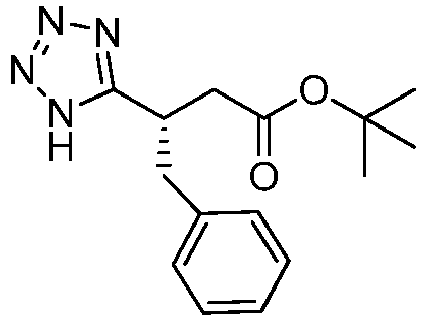
-

- (S)-2-benzyl-4-(tert-butoxy)-4-oxobutanoic acid and its bromo derivatives were prepared according to the literature methods (Liu, Jian-Chao, et al. Synthetic Communications, 2004, 34 (14), 2633-2640). A mixture of (S)-2-benzyl-4-(tert-butoxy)-4-oxobutanoic acid (520 mg, 2.0 mmol), HATU (1130 mg, 3.0 mmol), ammonium chloride (640 mg, 12 mmol), and Hunig's Base (3.5 ml, 20 mmol) in DMF (10 ml) was stirred at RT overnight. The reaction mixture was partitioned with EtOAc and sat. aq. NaHCO3, washed with brine (3x), dried over Na2SO4, and evaporated to get the crude product. The crude was used in Step B.
- The crude containing (S)-tert-butyl 4-amino-3-benzyl-4-oxobutanoate (∼440 mg, 1.7 mmol) from Step A was dissolved in DMF and cooled to 0 °C. Cyanuric chloride (2200 mg, 12 mmol) was added to the reaction mixture at 0°C. The ice bath was removed and the mixture was stirred at RT and for two days. The mixture was cooled in ice bath to which was added sat'd NaHCO3 until bubbling ceased. The mixture was extracted with EtOAc (3x). The combined EtOAc layer was washed with water (2x), brine, dried (Na2SO4), filtered, and concentrated to obtain the crude.
- A solution of the crude containing (S)-tert-butyl 3-cyano-4-phenylbutanoate (334 mg, 1.36 mmol) from Step B, azidotrimethyltin (IV) (510 mg, 2.5 mmol) in toluene (10 ml) was heated at 110 °C for two days. The reaction mixtue was concentrated under vaccum after quenching with MeOH. The crude was purified using silica gel Flash Chromatography, eluted with EtOAc-hexane, 0-50% to obtain pure product, (S)-tert-butyl 4-phenyl-3-(1H-tetrazol-5-yl)butanoate. LC-MS: m/z 289.17 (calc. 289.16)
The following INTERMEDIATES were prepared according to the methods for INTERMEDIATE 1INT. NO. Structure Name Calc'd (M+H)+ HPLC m/z (M+H)+ 1 
(S)-tert-butyl 4-phenyl-3-(1H-tetrazol-5-yl)butanoate 289.16 289.17 2 
(S)-tert-butyl 4-(4-bromophenyl)-3-(1H-tetrazol-5-yl)butanoate 367.08 367.04 3 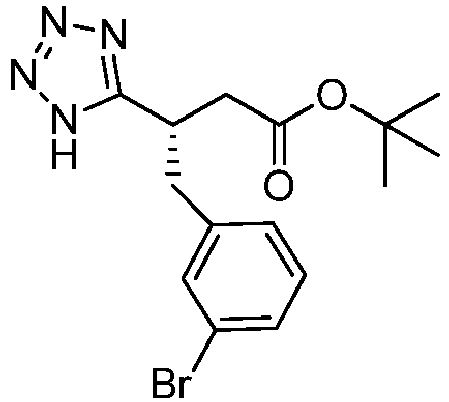
(S)-tert-butyl 4-(3-bromophenyl)-3-(1H-tetrazol-5-yl)butanoate 367.08 367.04 4 
(S)-tert-butyl 4-(2-bromophenyl)-3-(1H-tetrazol-5-yl)butanoate 367.08 369.10 5 
(S)-tert-butyl 4-(4-bromo-3-fluorophenyl)-3-(1H-tetrazol-5-yl)butanoate 385.07 385.00 6 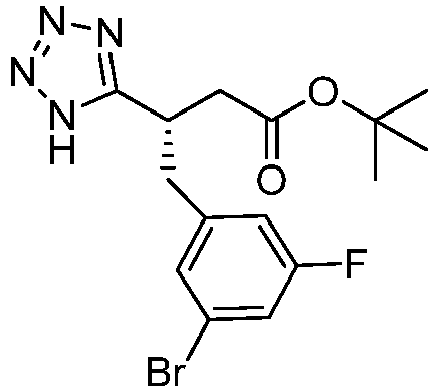
(S)-tert-butyl 4-(3-bromo-5-fluorophenyl)-3-(1H-tetrazol-5-yl)butanoate 387.07 386.98 -

- (R)-2-benzyl-4-(tert-butoxy)-4-oxobutanoic acid and its bromo derivatives were prepared according to the literature methods (Liu, Jian-Chao, et al. Synthetic Communications, 2004, 34 (14), 2633-2640), except that the opposite chiral auxilliary was used.
The following INTERMEDIATES were prepared according to the general procedure described above (INTERMEDIATE 1):INT. NO. Structure Name Calculated (M+H)+ HPLC-MS m/z (M+H)+ 7 
(R)-tert-butyl 4-phenyl-3-(1H-tetrazol-5-yl)butanoate 289.16 289.14 8 
(R)-tert-butyl 4-(4-bromophenyl)-3-(1H-tetrazol-5-yl)butanoate 367.08 367.12 -

- To a solution of (S)-tert-butyl 4-(4-bromophenyl)-3-(1H-tetrazol-5-yl)butanoate (2.1 g, 5.7 mmol) in THF (30 ml) at -78°C, lithium diisopropylamide in THF (7.2 ml, 14 mmol) was added dropwise and then stirred at -78 °C for 1 hour. 1-Iodopropane (2.0 g, 12 mmol) was added dropwise and the reaction mixture was stirred at -78 °C for 2 hrs, then slowly warmed to RT overnight. LCMS indicated all of SM was gone, quenched with 20 ml of saturated NH4Cl, extracted with EtOAc (60 ml x 4). The extracts were combined, washed with brine and dried over with MgSO4/Na2SO4. The combined extracts were filtered and evaporated to give the crude oil, which was purified by MPLC with a 120G silica gel column to furnish a light yellow solid. LC-MS: m/z (M+H)+ 411.29
The following INTERMEDIATES were prepared following the same procedure of INT-9:INT. NO. Structure Name Calculated (M+H)+ HPLC-MS m/z (M+H)+ 10 
(R)-tert-butyl 2-((R)-2-(4-bromophenyl)-1-(1H-tetrazol-5-yl)ethyl)hexanoate 423.14 423.31 11 
(S)-tert-butyl 2-((S)-2-(3-bromophenyl)-1-(1H-tetrazol-5-yl)ethyl)pentanoate 411.12 411.17 12 
(2S,3R)-tert-butyl 2-((S)-2-(4-bromophenyl)-1-(1H-tetrazol-5-yl)ethyl)-3-methy lpentanoate 425.14 425.19 13 
(2S,3S)-tert-butyl 4-(4-bromophenyl)-2-isopropyl-3-(1H-tetrazol-5-yl)butanoate 411.12 411.19 14 
(2S,3S)-tert-butyl 4-(4-bromophenyl)-2-cyclopentyl-3-(1H-tetrazol-5-yl)butanoate 437.14 437.17 -

- Potassium carbonate (1.27 g, 9.2 mmol) was added to a stirred mixture of (S)-tert-butyl 2-((S)-2-(4-bromophenyl)-1-(1H-tetrazol-5-yl)ethyl)-4-methylpentanoate (1.3 g, 3.1 mmol), tetrabutyl ammonium chloride hydrate (0.27 g, 0.92 mmol), and 1-(chloromethyl)-4-methoxybenzene (1.045 ml, 7.68 mmol) in CHCl3 (3.0 ml) and water (3.0 ml) at room temperature and the mixture was stirred at 35°C for overnight. The reaction was cooled to RT, organic layers were separated and the inorganic layer was extracted with DCM for 3 times (10 mL x 3). The combined organic layers were dried over MgSO4, concentrated down to give the crude material, which was purified by column chromatography with 40g silica gel, and eluted with EtOAc/Hexane (0∼35%) to give the product. LC-MS: m/z (M+H)+ 529.33
The following INTERMEDIATES were prepared following the same procedure of INT-15:INT. NO. Structure Name Calculated (M+H)+ HPLC-MS (M+H)+ m/z 16 
(S)-tert-butyl 2-((S)-2-(4-bromo-3-fluorophenyl)-1-(1-(4-methoxybenzyl)-1 H-tetrazol-5-yl)ethyl)-4-methylpentanoate And (S)-tert-butyl 2-((S)-2-(4-bromo-3-fluorophenyl)-1-(2-(4-methoxybenzyl)-2H-tetrazol-5-yl)ethyl)-4-methylpentanoate 563.19 563.11 17 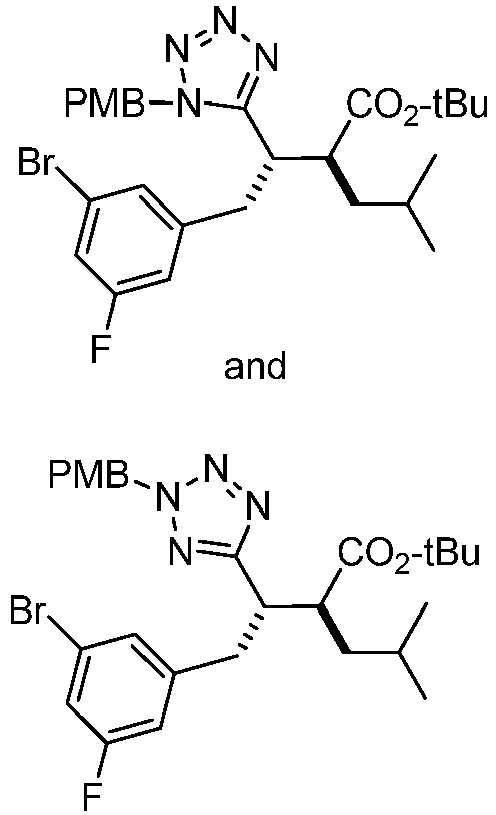
(S)-tert-butyl 2-((S)-2-(3-bromo-5-fluorophenyl)-1-(1-(4-methoxybenzyl)-1 H-tetrazol-5-yl)ethyl)-4-methylpentanoate And (S)-tert-butyl 2-((S)-2-(3-bromo-5-fluorophenyl)-1-(2-(4-methoxybenzyl)-2H-tetrazol-5-yl)ethyl)-4-methylpentanoate 563.19 563.04 -

- A solution of benzo[d][1,3]dioxole-5-carbaldehyde (1.5 g, 10 mmol), and dimethyl succinate (1.9 g, 13 mmol) in anhydrous t-BuOH (5.0 ml) was added dropwise within 15 min to a refluxing mixture of potassium tert-butoxide (280 mg, 2.5 mmol) in t-BuOH (10 ml). The reaction mixture was refluxed overnight. After cooling to RT, to the solution was added water/1N HCl (15 mL) and EtOAc for partitioning. Then, the reaction mixture was extracted three times with EtOAc(15 ml), the combined organic layers were dried over with Na2SO4/MgSO4, filtered, and evaporated to dryness to give a yellow crude solid which was purified by chromatogarphy on silica gel and eluted with Hexane- EtOAc (0 - 100%), to provide the desired product. LC-MS m/z [M+Na]+ 287.06
- (Z)-4-(benzo[d][1,3]dioxol-5-yl)-3-(methoxycarbonyl)but-3-enoic acid (6.6 g, 25 mmol) was dissolved in Toluene (100 ml) at 80°C, then N,N-dimethylformamide di-tert-butyl acetal (18 ml, 75 mmol) was added dropwise for 10 mins, and the solution was heated at 70°C for overnight. The reaction ws cooled to RT, washed with 40 ml of water, 40 ml x 2 of saturated NaHCO3, and brine; dried over with MgSO4, filtered to give the crude which was purified by chromatogarphy on silica gel and eluted with Hexane- EtOAc (0 - 30%). LC-MS m/z [M+Na]+ 343.45.
- To a solution of (Z)-4-tert-butyl 1-methyl 2-(benzo[d][1,3]dioxol-5-ylmethylene)succinate (300 mg, 0.94 mmol) in MeOH (8.0 ml) under N2, palladium hydroxide on carbon (66 mg, 0.094 mmol) was added and then the reaction mixture was stirred at RT under H2 at 1 atm. After 1 hr, LCMS showed that all of the SM was gone. The reaction mixture was filtered with HPLC filtration and dried on rotovap to give the crude. The crude was used as is in the following step
- To a stirred solution of 4-tert-butyl 1-methyl 2-(benzo[d][1,3]dioxol-5-ylmethyl)succinate (560 mg, 1.7 mmol) in MeOH (20 ml) and Water (10 ml) at RT, lithium hydroxide hydrate (210 mg, 5.0 mmol) was added and the reaction mixture was stirred at RT overnight. LCMS showed all of SM was gone and most of the solvent was evaporated. To the residue was added DCM and water, and the mixture was acidified with 2N HCl to pH<2 and extracted with DCM three times. The combined organic layers were dried over with Na2SO4, filtered and dried in vacuum to give the crude. The crude was used as is. LC-MS m/z [M+Na]+ 331.26
-

- A round bottle flask was charged with (S)-tert-butyl 2-((S)-2-(4-bromophenyl)-1-(1-(4-methoxybenzyl)-1H-tetrazol-5-yl)ethyl)pentanoate (414 mg, 0.78 mmol), bis(pinacolato)diboron (300 mg, 1.2 mmol), 1,1'-bis(diphenylphosphino)ferrocene-palladium(II)dichloride dichloromethane complex (32 mg, 0.039 mmol), potassium acetate (150 mg, 1.6 mmol) and then purged with N2. DMA (2.5 ml) was added and the reaction heated to 85°C overnight, cooled to RT and filtered through syringe filter. The filtrate was added to sat. aqueous sodium bicarbonate, diluted with EtOAc/water and extracted 3 times with EtOAc. The combined extractions were washed with brine, dried over MgSO4, filtered, and concentrated to produce a crude brown oil. The crude oil was purified via 0-30% EtOAc/Hexane ISCO, 24 g silica gel, to furnish a white sticky solid. LC-MS m/z [M+H]+ 577.43
-

- To a solution of (R)-1-phenylethanol (20 g, 0.16 mol) and HC(CO2Et)3 (76 g, 0.33 mol) in toluene (800 mL) at room temperature was added PMe3 (25 g, 0.327 mol) in one portion. The resulting solution was cooled to -53°C. DEAD (57 g, 0.327 mol) was added dropwise keeping the internal temperature at -53°C. The reaction was stirred at -53°C for 30 minutes and warmed to room temperature for 4 hours. TLC (PE/EtOAc 5:1) showed the SM was consumed completely. The solvent was removed under reduced pressure. The residue was dissolved in MTBE (500 mL), washed with aqueous NaOH (3.3 N, 200 mL x 2) and aqueous HCl (200 mL). The organic phase was washed with brine, dried over Na2SO4 and concentrated to give an oil. The crude product was purified by silica gel column chromatography (PE/EtOAc 50:1) to give (S)-triethyl 2-phenylpropane-1,1,1-tricarboxylate as a colorless oil. 1H-NMR (DMSO, 400 MHz) δ 7.35 (m, 5H), 4.12 (m, 6H), 3.74 (m, 1H), 1.39 (d, J=7.2Hz, 3H), 1.12 (t, J=7.2Hz, 9H).
- To a solution of (S)-triethyl 2-phenylpropane-1,1,1-tricarboxylate (54.3 g, 0.162 mol) in MeOH (480 mL) was added aqueous NaOH (291 mL, 0.96 mol, 3.3 N). The resulting solution was stirred at reflux for 6 hours. HPLC showed there was no starting material remaining. The reaction solution was concentrated to give crude (S)-2-phenylpropane-1,1,1-tricarboxylic acid, which was immediately used for the next step. Crude (S)-2-phenylpropane-1,1,1-tricarboxylic acid was immediately dissolved in AcOH (970 mL). The resulting solution was stirred at reflux for 16 hours. HPLC showed there was no starting material remaining. AcOH was removed in vacuo. The residue was dissolved in water (1 L), extracted with EtOAc (500 mL x 3), dried over Na2SO4, and concentrated to give (R)-3-phenylbutanoic acid as an oil. 1H-NMR (DMSO, 400 MHz) δ 7.30 (m, 5H), 3.18 (m, 1H), 2.50 (m, 2H), 1.22 (d, J=7.2 Hz, 3H).
- To a solution of (R)-3-phenylbutanoic (25.6 g, 0.156 mol) in anhydrous THF (580 mL) was added Et3N (21.7 mL) under N2. The mixture was cooled to -70°C and t-BuCOCl (19.7 g, 0.163 mol) was added dropwise. The resulting suspension was stirred at -70°C for 10 minutes and continued to be stirred at 0°C for 1 hour. Then the resulting mixture was cooled to -70°C. Meanwhile, in a different flask, to a solution of (R)-4-benzyloxazolidin-2-one (27.6 g, 0.156 mol) in THF (580 mL) was added n-BuLi (62.3 mL, 0.156 mol) dropwise below -70°C. The lithiated chiral auxiliary was transferred via a cannula into the reaction flask containing the preformed mixed anhydride at -70°C. The mixture was stirred at 0°C for 1 hour and allowed to warm to room temperature for 16 hours. TLC (CH2Cl2/MeOH 20:1) showed the starting material was consumed. The reaction was quenched with saturated aqueous solution of NH4Cl. THF was removed and extracted with CH2Cl2 (500 mL x 3). The organic phase was dried over Na2SO4 and concentrated under vacuum. The crude product was purified by recrystallization to give (R)-4-benzyl-3-((R)-3-phenylbutanoyl)oxazolidin-2-one as a white solid. 1H-NMR (DMSO, 400 MHz) δ 7.31 (m, 10H), 4.58 (m, 1H), 4.27 (m, 1H), 4.16 (m, 1H), 3.14 (1, 1H), 3.13 (m, 2H), 2.95 (m, 1H), 2.90 (m, 1H), 1.28 (d, J=6.8Hz, 3H).
- To a solution of (R)-4-benzyl-3-((R)-3-phenylbutanoyl)oxazolidin-2-one (35 g, 0.11 mol) in anhydous THF (750 mL) was added NaN(TMS)2 (119 mL, 0.119 mol) dropwise at -70°C under N2. After 1.5 hours, a solution of BrCH2CO2tBu (27.4 g, 0.141 mol) in dried THF (120 mL) was added dropwise below -70°C. The reaction mixture was maintained at -70°C for 1 hour and was then allowed to warm to -60°C during 3 hours. TLC (PE/EtOAc 5:1) showed the SM was consumed. The mixture was allowed to warm to -20°C and quenched with saturated aqueous NH4Cl. THF was removed under reduced pressure. The aqueous phase was extracted with EtOAc (500 mL x 3). The organic phase was dried over Na2SO4 and concentrated under vacuum. The crude product was purified by silica gel column chromatography (PE/EtOAc 40:1) to give (3R,4R)-tert-butyl 3-((R)-4-benzyl-2-oxooxazolidine-3-carbonyl)-4-phenylpentanoate as a colorless oil. 1H-NMR (DMSO, 400 MHz) δ 7.31 (m, 10H), 4.38 (m, 1H), 4.30 (m, 1H), 4.07 (m, 1H), 4.04 (m, 1H), 3.15 (m, 1H), 2.91 (m, 3H), 2.26 (m, 1H), 1.34 (s, 9H), 1.21 (d, J=6.8Hz, 3H).
- To a solution of 3-((R)-4-benzyl-2-oxooxazolidine-3-carbonyl)-4-phenylpentanoate (19 g, 43.4 mmol) in THF and H2O (700 mL) was added H2O2 (18.2 mL, 178 mmol) dropwise at 0°C. After the addition, 1.0 M aqueous solution of LiOH (86.8 mL, 86.8 mmol) was added dropwise at 0°C. The reaction was then stirred at room temperature for 16 hours. TLC (PE/EtOAc 5:1) showed most of the starting material was consumed. The reaction was quenched with 1.5 M aqueous solution of Na2SO3 (131 mL) and was given a pH = 8∼9 by addition of saturated aqueous solution of NaHCO3. THF was removed in vacuo. The residue was dissolved in water (200 mL) and extracted with MTBE (200 mL x 6). The aqueous phase was acidized to pH= 3∼4 by addition of 1 N HCl and extracted with EtOAc (200 mL x 3). The organic phase was washed with brine (200 mL), dried over Na2SO4 and concentrated under vacuum. The crude product was purified by SFC to give the acid as a white solid. 1H-NMR (DMSO, 400 MHz) δ 7.33 (m, 5H), 3.34 (m, 1H), 3.12 (m, 1H), 2.65 (m, 1H), 2.20 (m, 1H), 1.37 (s, 9H), 1.33 (d, J=7.2Hz, 3H).
- To a solution of (R)-4-(tert-butoxy)-4-oxo-2-((R)-1-phenylethyl)butanoic acid (2.0 g, 7.19 mmol) in Dichloromethane (20 ml) was added 2-(3H-[1,2,3]triazolo[4,5-b]pyridin-3-yl)-1,1,3,3-tetramethylisouronium hexafluorophosphate(V) (3.28 g, 8.62 mmol), ammonia hydrochloride (1.153 g, 21.56 mmol) and DIEA (1.255 ml, 7.19 mmol), and the resulting mixture were stirred at RT for 12 hr. The reaction mixture was evaporated to dryness and purified using 0 to 100% ethyl acetate in hexanes to provide (3R,4R)-tert-butyl 3-carbamoyl-4-phenylpentanoate.
- To a solution of (3R,4R)-tert-butyl 3-carbamoyl-4-phenylpentanoate (2.44 g, 8.8 mmol) in DCM (20 ml) were added Pyridine (2.135 ml, 26.4 mmol) followed by TFAA (1.864 ml, 13.20 mmol) at 0°C. The reaction mixture was slowly warmed to room temperature and stirred for 2 hrs. The reaction mixture was diluted with ethyl acetate, transferred to a separatory funnel, washed with saturated NaHCO3, then with brine. The organic layer was dried with MgSO4, evaporated and purified using 0 to 100% ethyl acetate to provide (3R,4R)-tert-butyl 3-cyano-4-phenylpentanoate.
- To a solution of (3R,4R)-tert-butyl 3-cyano-4-phenylpentanoate (2.6 g, 10.03 mmol) in Toluene (20 ml) was added azidotrimethylstannane (4.13 g, 20.05 mmol) and heated at 110°C for 48 hr. The reaction mixture was evaporated to dryness and purified using 0 to 100% ethyl acetate hexanes to provide (3R,4R)-tert-butyl 4-phenyl-3-(1H-tetrazol-5-yl)pentanoate. LC-MS [M+H]+: 303.34
-

- CBr4 (2.68 g, 8.07 mmol) in 5 mL of DCM was added to a stirred, cooled (to 0°C) mixture of (2-chloropyrimidin-5-yl)methanol (1.19 g, 8.23 mmol) and triphenylphosphine (2.116 g, 8.07 mmol) in 35 mL of DCM and the mixture was stirred at 0°C for 10 min. Then, the reaction mixture was removed from the ice bath and stirred at RT for 30 min. TLC showed the reaction was near completion. The reaction mixture was concentrated to 1/2 volume, filtered and concentrated down. The residue was purified by silica gel column chromatography, eluting with EtOAc/isohexane (0∼30%) to give the desired product. LC-MS [M+H]+: 208.93
-

- To a solution of (6-bromopyridin-3-yl)methanol (5.0 g, 27 mmol) in DCM (50 ml) was added triphenylphosphine (6.3 g, 24 mmol), at 0°C. To this reaction mixture was added a solution of carbon tetrabromide (7.1 g, 21 mmol) in 15 ml DCM. The resulting mixture was stirred for 5 minutes, then evaporated, and purified using 0 to 10% ethyl acetate in hexanes to provide 2-bromo-5-(bromomethyl)pyridine. LC-MS [M+H]+: 251.89
-

- To a solution of (5-bromopyridin-2-yl)methanol (1.5 g, 8.0 mmol) in DCM (10 ml) was added triphenylphosphine (1.9 g, 7.2 mmol), then was added a solution of carbon tetrabromide (2.1 g, 6.4 mmol) in 5 mL THF. The resulting mixture was stirred for 5 min, then evaporated to dryness, and purified using 0 to 10% ethyl acetate in hexanes. LC-MS [M+H]+: 251.74
-

- To a solution of (2-bromothiazol-5-yl)methanol (900 mg, 4.6 mmol) and triphenylphosphine (1300 mg, 5.1 mmol) in DCM (20 ml) was added a DCM solution of CBr4 (1500 mg, 4.6 mmol) at 0°C. The reaction was allowed to warm to RT after 30 minutes. LC showed good reaction after 1 hour. About 20 mL of hexanes was added to the reaction, and the white precipitate was filtered off. The filtration was adsorbed onto silica gel, and purified by MPLC with a 40G ISCO column, eluting with hexanes and EtOAc. LC-MS [M+H]+: 256.0
-

- To a solution of (2-bromothiazol-4-yl)methanol (1.9 g, 9.8 mmol) and triphenylphosphine (2.6 g, 9.8 mmol) in DCM (20 ml) was added a DCM solution of CBr4 (3.2 g, 9.8 mmol) at 0°C. The reaction was allowed to warm to RT after 30 minutes. LC showed good reaction after 1 hour. About 20 mL of hexanes was added to the reaction, and the white precipitate was filtered off. The filtration was adsorbed onto silica gel, and purified by MPLC with a 40G ISCO column, eluting with hexanes and EtOAc. LC-MS [M+H]+: 258.2
-
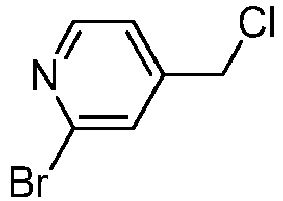
- In a 100ml RB flask, (2-bromopyridin-4-yl)methanol (4.8g, 26 mmol) was dissolved in DCM (50 ml) and cooled to 0°C then TEA (4.6 ml, 33 mmol) was added, followed by Mesyl-Cl (2.4 ml, 31 mmol). The mixture was stirred for 0.5 hour. The reaction was poured into a brine solution and the DCM was separated, dried over Na2SO4, filtered and concentrated. The residue was dissolved in Acetonitrile (50 ml) and lithium chloride (2.2 g, 51 mmol) was added. The reaction was stirred at RT over the weekend. The reaction was diluted with DCM (30 ml) and filtered. The filtrate was concentrated and the residue was purified by MPLC ISCO Combi-flash on ISCO Redi-Sep 120g column, eluting with 0-50% EtOAc/hexane to give the product. LC-MS [M+H]+: 206.0
-
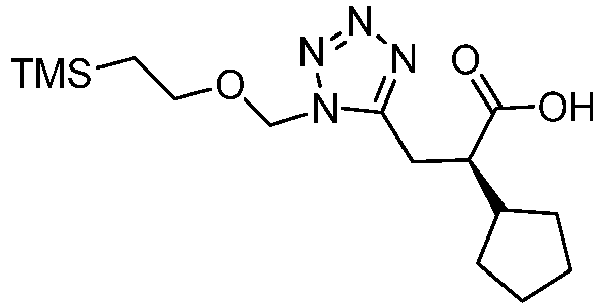
- A solution of (R)-4-benzyloxazolidin-2-one (21.6 g, 122 mmol) in THF (300 ml) was cooled to -78°C, then nBuLi was added dropwise. The mixture was stirred for 15 minutes, then the 2-cyclopentylacetyl chloride in 10 mL THF was added dropwise. The mixture was stirred for 30 minutes at -78°C, then the cold bath was removed and the mixture stirred for an additional hour while warming to RT. Then 20 mL sat. NH4Cl (aq) was added, and THF was removed in vacuo. 20 mL H2O was added, and the aqueous layer extracted with 2 x 100 mL Et2O. The combined organic extracts were washed with 50 mL 0.5 N NaOH (aq) and 50 mL brine, then dried (Na2SO4; CH2Cl2 added) and concentrated in vacuo to provided (R)-4-benzyl-3-(2-cyclopentylacetyl)oxazolidin-2-one.
- To a solution of (R)-4-benzyl-3-(2-cyclopentylacetyl)oxazolidin-2-one (10 g, 34.8 mmol) in THF (100 ml) was added sodium bis(trimethylsilyl)amide (41.8 ml, 41.8 mmol) at -78°C. The resulting solution was stirred at -78°C for 1 hr. Then, to the reaction was added a solution of 2-bromoacetonitrile (7.3 ml, 104 mmol) in 15 ml THF. The resulting solution was slowly warmed to RT. Then, to the reaction, was added a solution of saturated ammonia hydrochloride (9.3 g, 170 mmol). The reaction mixture was partially evaporated, then extracted with ethyl acetate. The organic layer was dried, concentarted and purified using 0 to 100% ethyl acetate in hexanes to provide (R)-4-((R)-4-benzyl-2-oxooxazolidin-3-yl)-3-cyclopentyl-4-oxobutanenitrile.
- To a solution of (R)-4-((R)-4-benzyl-2-oxooxazolidin-3-yl)-3-cyclopentyl-4-oxobutanenitrile (8.5 g, 26 mmol) in Toluene (50 ml) was added azidotrimethylsilane (10.4 ml, 78 mmol) and dibutyltin oxide (1.9 g, 7.8 mmol), and the resulting solution was heated at 110°C for 12 hr. The reaction mixture was evaporated to dryness and purified using 0 to 100% ethyl acetate in hexanes to provide (R)-4-benzyl-3-((R)-2-cyclopentyl-3-(1H-tetrazol-5-yl)propanoyl)oxazolidin-2-one.
- To a solution of (R)-4-benzyl-3-((R)-2-cyclopentyl-3-(1H-tetrazol-5-yl)propanoyl)oxazolidin-2-one (9.6 g, 26 mmol) in acetonitrile (50 ml) was added N-ethyl-N-isopropylpropan-2-amine (9.1 ml, 52 mmol), and the resulting mixture was stirred at 0°C for 10 min. Then, to the reaction was added (2-(chloromethoxy)ethyl)trimethylsilane (5.5 ml, 31 mmol), and the reaction mixture was slowly warmed to RT. The reaction mixture was diluted with ethyl acetate, transferred to a separatory funnel, washed with saturated NaHCO3, then with brine. The organic layer was dried with MgSO4, evaporated and purified using 0 to 100% ethyl acetate in hexanes to separate (R)-4-benzyl-3-((R)-2-cyclopentyl-3-(1-((2-(trimethylsilyl)ethoxy)methyl)-1H-tetrazol-5-yl)propanoyl)oxazolidin-2-one from its regio-isomer.
- To a solution of (R)-4-benzyl-3-((R)-2-cyclopentyl-3-(2-((2-(trimethylsilyl)ethoxy)methyl)-2H-tetrazol-5-yl)propanoyl)oxazolidin-2-one (4.0 g, 8.0 mmol) in tetrahydrofuran (40 ml) was added H2O2 (2.8 ml, 32 mmol) at 0°C. Then a solution of LiOH (0.38 g, 16 mmol) in 8 mL water was added. The resulting mixture was stirred at 0°C, and then slowly warmed to RT and stirred for 2 hr. Then, to the reaction was added a solution of sodium sulfite (8.1 g, 64 mmol) and sodium bicarbonate (5.4 g, 64 mmol) at 0°C. The resulting mixture was stirred for 10 min, then partially concentrated, and extracted with ethyl acetate. The organic layer was evaporated, then was dissolved in ether and repeatedly extracted with 1 N NaOH. The aq. layer was acidified using 7 N HCl to pH 2, then extracted with ethyl acetate. The ethyl acetate layer was dried, evaporated to provide pure product (R)-2-cyclopentyl-3-(1-((2-(trimethylsilyl)ethoxy)methyl)-1H-tetrazol-5-yl)propanoic acid. LC-MS m/z [M+H]+: 341.24
-
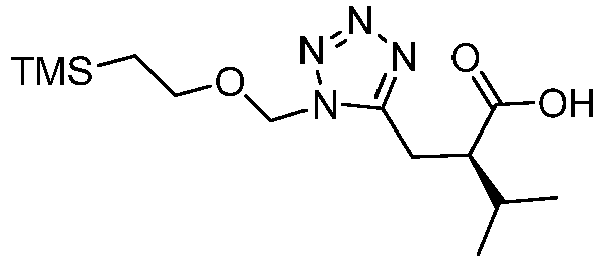
- The INTERMEDIATE was prepared following the same procedure as 1-27. LC-MS m/z [M+H]+: 315.21
-

- To a solution of (4R,5S)-4-methyl-5-phenyloxazolidin-2-one (5.0 g, 28 mmol) in THF (200 ml) was added N-butyllithium (13.5 ml, 34 mmol) at -78°C. The colorless solution turned orange toward the end of base addition. The mixture was kept at -78°C for 20 minutes before valeryl chloride (4.5 ml, 37 mmol) was dropped in. LC after 15 minutes showed a clean reaction. The reaction was allowed to warm to RT, quenched with NH4Cl, extracted with EtOAc, and separated. The solution was dried over sodium sulfate, filtered and concentrated. The residue was loaded onto a 80G silica gel column and purified by MPLC with hexane and EtOAc. LC-MS [M+H]+: 262.1.
- To a solution of (4R,5S)-4-methyl-3-pentanoyl-5-phenyloxazolidin-2-one (3.3 g, 12.6 mmol) in THF (50 ml) was added LHMDS (16.4 ml, 16.4 mmol) at -78 °C. The mixture was allowed to stir for 30 minutes before 2-bromoacetonitrile (7.6 g, 63 mmol) was added. The reaction was allowed to stir overnight, warming up naturally. LC showed good reaction. The reaction was quenched with NH4Cl, washed with brine, separated and dried over sodium sulfate. The solution was filtered, and concentrated to give a sticky oil. The oil was dissolved in DCM and loaded onto a 80G ISCO column, and purified by MPLC with hexanes and EtOAc. The product eluted at about 40% EtOAc. LC-MS [M+H]+: 301.2.
- The reaction mixture was allowed to stir at 100°C for 24 hours. LC showed a good reaction. White solids formed during the reaction. The solids were collected by filtration and washed twice with hexane and EtOAc (1 : 1). The white solids were collected as the desired product. LC-MS [M+H]+: 344.2.
- To a solution of (4R,5S)-3-((S)-2-((1H-tetrazol-5-yl)methyl)pentanoyl)-4-methyl-5-phenyloxazolidin-2-one (3.7 g, 10.8 mmol) in acetonitrile (25 ml) was added Hunig's Base (2.82 ml, 16.2 mmol) and SEM-Cl (2.1 ml, 12 mmol) at RT. The reaction was allowed to stir for 15 minutes. LC at that point showed the reaction was almost done, with two product peaks. The reaction was allowed to stand for another 10 minutes, and then diluted with EtOAc (50 mL), washed with aq. NH4Cl (10 mL) and brine, separated and dried over sodium sulfate. The solution was filtered and concentrated, and the residue was injected onto a 120G ISCO column, and separated by MPLC with hexanes and EtOAc. The product peaks eluted at about 30% EtOAc. The desired regio-isomer was the second product peak coming off the column. LC-MS [M+H]+: 374.4.
- A solution of (4R,5S)-4-methyl-5-phenyl-3-((S)-2-((1-((2-(trimethylsilyl)ethoxy)methyl)-1H-tetrazol-5-yl)methyl)pentanoyl)oxazolidin-2-one in THF (65 ml) was cooled to 0 °C. Hydrogen peroxide (10.5 ml, 120 mmol) cooled in ice bath and a solution of lithium hydroxide (0.57 g, 23.7 mmol) dissolved in 8 mL of water which was also cooled in ice bath were added to the reaction mixture and stirred for 2 hours. A solution of sodium bisulfite (3.33 g, 32.0 mmol) and sodium sulfite (6.0 g, 47 mmol) dissolved in 20 mL of water was added and stirred at room temperature for 15 minutes. The oragnic was separated and the aqueous (acidic) was extracted repeatedly with ether, 3 times. After combining all the organic layer, it was washed with brine, dried over Na2SO4, filtered and concentrated. The residue was taken up with ether (40mL) and extracted with IN NaOH (3x). The aqueous NaOH layer was acidified with IN HCl to pH ∼1 and extracted with EtOAc (4x), dried over Na2SO4, filtered and concentrated. The crude was taken on as is for next step. LC-MS [M+H]+: 329.1
-

- To a solution of (4R,5S)-4-methyl-5-phenyloxazolidin-2-one (6.6 g, 37 mmol) in THF (100 ml) under N2 at -78°C was added N-butyllithium (28 ml, 45 mmol). The solution was allowed to stir for 15 min before 4-methylvaleroyl chloride (5.1 ml, 37 mmol) was added. After 30 minutes of stirring, the crude UPLC showed a desire peak with 276 m/z. The reaction was quenched with water, and extracted with EtOAc (3x). The organic layer was washed with brine, separated, and dried over sodium sulfate. The reaction was used without further purification. LC-MS [M+H]+: 276.2.
- To a solution of (4R,5S)-4-methyl-3-(4-methylpentanoyl)-5-phenyloxazolidin-2-one (7.2 g, 26 mmol) in THF (100 ml) was added lithium bis(trimethylsilyl)amide (LHMDS) (34 ml, 34 mmol) at -78°C under N2. The reaction was allowed to stir for 30 minutes before bromoacetonitrile (5.2 ml, 78 mmol) was added in. The mixture was allowed to stir overnight. The crude UPLC indicated a desired peak with 315 m/z. The reaction was quenched with aq. NH4Cl, extracted with EtOAc (3x), washed with brine, separated and dried over Na2SO4. The crude solution was filtered and concentrated. The crude was purified by ISCO column with Solvent A: A1 hexane, Solvent B: B1 ethyl acetate. LC-MS [M+H]+: 315.3.
- A solution of (S)-5-methyl-3-((4R,5S)-4-methyl-2-oxo-5-phenyloxazolidine-3-carbonyl)hexanenitrile (7.4 g, 24 mmol), dibutyltin oxide (1.8 g, 7.1 mmol) and azidotrimethylsilane (9.4 ml, 71 mmol) in toluene (100 ml) was heated at 110°C for 16 hr. The crude UPLC indicated complete consumption of SM and the desired peak at 358 m/z. The reaction mixture was concentrated under reduced pressure and purified by ISCO chromatography, 80G silica gel, with Solvent A: A1 hexane, Solvent B: B1 ethyl acetate. LC-MS [M+H]+: 358.3.
- To a solution of (4R,5S)-3-((S)-2-((1H-tetrazol-5-yl)methyl)-4-methylpentanoyl)-4-methyl-5-phenyloxazolidin-2-one (7.2 g, 20 mmol) in Acetonitrile (100 ml) was added N,N-diisopropylethylamine (7.1 ml, 40 mmol). The mixture was stirred for 10 minutes then 2-(trimethylsilyl)ethoxymethyl chloride (4.3 ml, 24 mmol) was added. The reaction was slowly warmed to room temperature and stirred for 1 hour. The mixture was concentrated and EtOAC and brine were added. The organic was extracted with EtOAC, 3x, dried over Na2SO4, filtered and concentrated. The crude was purified by ISCO chronatography, RediSep Column: Silica 120g, Solvent A: A1 hexane, Solvent B: B1 ethyl acetate to give both regioisomer compounds. The desired regio-isomer came out as the second peak. LC-MS [M+H]+: 488.4.
- A solution of (4R,5S)-4-methyl-3-((S)-4-methyl-2-((2-((2-(trimethylsilyl)ethoxy)methyl)-2H-tetrazol-5-yl)methyl)pentanoyl)-5-phenyloxazolidin-2-one (regioisomer 2, cream white solid) (5.8 g, 11.8 mmol) in THF (65 ml) was cooled to 0°C. hydrogen peroxide (10.5 ml, 120 mmol) cooled in ice bath and a solution of lithium hydroxide (0.57 g, 24 mmol) dissolved in 8 mL of water which was also cooled in ice bath were both added to the reaction mixture and stirred for 2 hours. A solution of sodium bisulfite (3.3 g, 32 mmol) and sodium sulfite (6.0 g, 47 mmol) dissolved in 20 mL of water was added and stirred at room temperature for 15 minutes. The organic was separated and the aqueous (acidic) was extracted repeatedly with ether (3x). After combining all the organic layer, it was washed with brine, dried over Na2SO4, filtered and concentrated. The residue was taken up with ether (40 mL) and extracted with IN NaOH (3x). The aqueous NaOH layer was acidified with IN HCl to pH ∼1 and extracted with EtOAc (4x), dried over Na2SO4, filtered and concentrated. The crude was taken on as is for next step. LC-MS [M+H]+: 329.1.
-
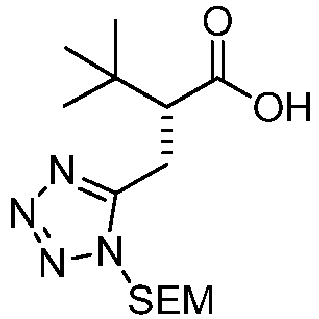
- A solution of the(R)-4-benzyloxazolidin-2-one (10 g, 56 mmol) in THF (250 ml) was cooled to -78°C, then butyllithium (21 ml, 58 mmol) was added dropwise. The mixture was stirred for 30 minutes, then 3,3-dimethylbutanoyl chloride (8.0 ml, 56 mmol) was added dropwise. The mixture was stirred for 120 minutes at -78°C, and the cold bath was removed and the mixture stirred for an additional 1 hour while warming to room temperature. The reaction was quenched by adding 100 mL sat. NH4Cl(aq) at 0°C, followed by 20 mL H2O, and extracted with EtOAc. The reaction mixture was washed with 0.5 M NaOH and brine, then dried over (MgSO4) and concentrated to dryness to give 14.97g of (R)-4-benzyl-3-(3,3-dimethylbutanoyl)oxazolidin-2-one. LC-MS [M+H]+: 276.09
- To a solution of diisopropylamine (8.5 ml, 60 mmol) in 30 mL of THF was added butyllithium (24 ml, 60 mmol) at -10 to 0°C. The mixture was stirred at 0 to 5°C for 30 minutes, and then added dropwise into (R)-4-benzyl-3-(3,3-dimethylbutanoyl)oxazolidin-2-one (15 g, 54 mmol) in 200 mL of THF at -78°C. After 40 minutes, 2-bromoacetonitrile (12 ml, 160 mmol) was added dropwise at -78°C and stirred at -78°C for 1 hour and then gradually warmed up to room temperature and stirred for 24 hrs. The reaction mixture was added to an aqueous solution NH4Cl and extracted with EtOAc. The organic layer was washed with 1N HCl and brine, dried over MgSO4, filtered and concentrated down. The residue was purified by column chromatography on silica gel, eluting with EtOAc/Hexane (0∼30%) to give (R)-3-((R)-4-benzyl-2-oxooxazolidine-3-carbonyl)-4,4-dimethylpentanenitrile. LC-MS [M+H]+: 315.19
- Azidotrimethylsilane (11 ml, 85 mmol) was added to a stirred, room temperature mixture of (R)-3-((R)-4-benzyl-2-oxooxazolidine-3-carbonyl)-4,4-dimethylpentanenitrile (8.9 g, 28 mmol) and dibutylstannanone (2.1 g, 8.5 mmol) in toluene and the mixture was stirred at 110°C overnight. After cooling, the mixture was concentrated down. The residue was purified by column chromatography on silica gel column, eluting with EtOAc/Hexane (5∼100%) to give (R)-3-((R)-2-((1H-tetrazol-5-yl)methyl)-3,3-dimethylbutanoyl)-4-benzyloxazolidin-2-one. LC-MS [M+H]+: 358.13
- To a solution of (R)-3-((R)-2-((1H-tetrazol-5-yl)methyl)-3,3-dimethylbutanoyl)-4-benzyloxazolidin-2-one (8.6 g, 24 mmol) in acetonitrile (100 mL) at 0°C was added N-ethyl-N-isopropylpropan-2-amine (8.4 ml, 48 mmol). The mixture was stirred for 10 minutes, then (2-(chloromethoxy)ethyl)trimethylsilane (5.1 ml, 29 mmol) was added. The reaction was slowly warmed to room temperature and stiired for 1 hour. The mixture was concentrated and EtOAc and water were added. The mixture was extracted with EtOAc. Organic layer was washed with brine, dried over MgSO4, filtered and concentrated. The residue was purified by column chromatography on silica gel column, eluting with EtOAc/Hexane (0∼30%) to give (R)-4-benzyl-3-((R)-3,3-dimethyl-2-((1-((2-(trimethylsilyl)ethoxy)methyl)-1H-tetrazol-5-yl)methyl)butanoyl)oxazolidin-2-one. LC-MS [M+H]+: 488.19
- To a solution of ethanethiol (4.0 ml, 53 mmol) in THF (10 mL) was added butyllithium (16 ml, 39 mmol) at -78°C. The resulting mixture was slowly warmed to 0°C, and stirred for 15 min. Then it was added to a precooled (-78°C) solution of (R)-4-benzyl-3-((R)-3,3-dimethyl-2-((1-((2-(trimethylsilyl)ethoxy)methyl)-1H-tetrazol-5-yl)methyl)butanoyl)oxazolidin-2-one (7.6g, 16 mmol) and the resulting mixture was stirred at 0°C for 18 hours. The reaction mixture was diluted with 1 N NaOH and extracted with ether. The crude product was purified using 0 to 100% ethyl acetate in hexanes to give (R)-S-ethyl 3,3-dimethyl-2-((1-((2-(trimethylsilyl)ethoxy)methyl)-1H-tetrazol-5-yl)methyl)butanethioate. LC-MS [M+H]+: 373.16
- Hydrogen peroxide (3.8 ml, 44 mmol) was added slowly in three portions in 10 min into (R)-S-ethyl 3,3-dimethyl-2-((1-((2-(trimethylsilyl)ethoxy)methyl)-1H-tetrazol-5-yl)methyl)butanethioate (4.7 g, 13 mmol) and lithium hydroxide (1.1 g, 44 mmol) in water/EtOH at 50-55°C. The mixture was stirred at 55°C for 1 hr. After cooling, the reaction mixture was acidified to pH ∼3 by 1N HCl. The reaction mixture was extracted with EtOAc, washed with sat. Na2S2O3 and brine. The organic layer was dried over MgSO4, filtered and concentrated to dryness to give crude (R)-3,3-dimethyl-2-((1-((2-(trimethylsilyl)ethoxy)methyl)-1H-tetrazol-5-yl)methyl)butanoic acid. LC-MS [M+H]+: 329.20
-
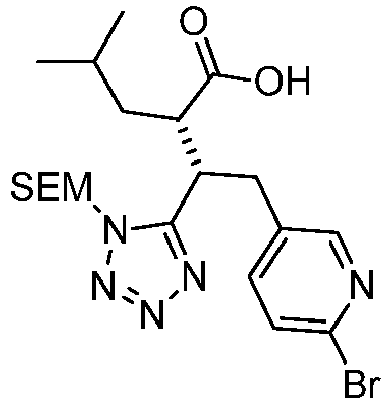
- To a solution of (S)-4-methyl-2-((1-((2-(trimethylsilyl)ethoxy)methyl)-1H-tetrazol-5-yl)methyl)pentanoic acid (2950 mg, 9.0 mmol) in THF (25 ml) was added LDA (32.1 ml, 22.5 mmol freshly prepared from DIPA and n-BuLi). The solution turned light yellow halfway through the base addition, and then bright yellow. The mixture was allowed to stir at -78°C for 30 minutes before 2-bromo-5-(chloromethyl)pyridine (2410 mg, 11.7 mmol) was added. The yellow color turned slightly red. The reaction was allowed to age for 5 hours at -78°C. LC showed most of the conversion occured when the electrophile was added. The reaction went to about 70% conversion slowly over time. The reaction was quenched with aq. NH4Cl, extracted with EtOAc, separated and dried over sodium sulfate. The solution was filtered and concentrated. The residue was dissolved in water and ACN, and loaded onto a 130G C-18 column for purification. The fraction containing the desired product was collected, and evaporated under reduced pressure to afford a light yellow solid. LC-MS [M+H]+: 500.2.
-

- To a solution of (S)-4-methyl-2-((2-((2-(trimethylsilyl)ethoxy)methyl)-2H-tetrazol-5-yl)methyl)pentanoic acid (800 mg, 2.44 mmol) in THF (30 ml) was added LDA (8.7 ml, 6.1 mmol). The solution turned bright yellow half way through the base addition. The mixture was allowed to stir at -78°C for 45 minutes before 5-bromo-2-(chloromethyl)pyridine (600 mg, 2.90 mmol) was added. The reaction turned red right away. The reaction was allowed to age for 4 hours at -78°C. LC showed most of the conversion occured when the electrophile was added. The reaction went to about 50% conversion slowly over time. The reaction was quenched with aq. NH4Cl, extracted with EtOAc, separated and dried over sodium sulfate. The solution was filtered and concentrated. The residue was dissolved in water and ACN, and loaded onto a 130G reverse phase MPLC column, and flashed with ACN and water (with 0.05% TFA). The product came out at about 70% ACN. The product peak was collected and concentrated under reduced pressure. Light yellow solids precipitated during the process. The solids were collected, and LC suggested that it was pure. LC-MS [M+H]+: 500.2.
-

- To a solution of diisopropylamine (0.50 ml, 3.5 mmol) in Tetrahydrofuran (5 ml) was added nBuLi (1.3 ml, 3.5 mmol) at -5°C. Then the resulting solution was slowly warmed to RT, then cooled to -78°C. To the solution was added a solution of (R)-2-cyclopentyl-3-(1-((2-(trimethylsilyl)ethoxy)methyl)-1H-tetrazol-5-yl)propanoic acid (500 mg, 1.5 mmol) in 1 ml THF. The resulting mixture was stirred for 1 hr, then was added a solution of 2-bromo-5-(bromomethyl)pyridine (480 mg, 1.9 mmol) in 1 mL THF. The reaction mixture was slowly warmed to RT over 12 hr. The reaction mixture was diluted with saturated ammonium chloride, and then extrcated with ethyl acetate. The crude product was purified using 0 to 100% ethyl acetate in hexanes to provide (2S,3S)-4-(6-bromopyridin-3-yl)-2-cyclopentyl-3-(1-((2-(trimethylsilyl)ethoxy)methyl)-1H-tetrazol-5-yl)butanoic acid. LC-MS m/z [M+H]+ 510.19
The following INTERMEDIATES were prepared following the same procedure of INTERMEDIATE 34:INT. NO. Structure Name Calculated (M+H)+ LC-MS m/e (M+H)+ 35 
(2S,3S)-4-(6-bromopyridin-3-yl)-2-isopropyl-3-(1-((2-(trimethylsilyl)ethoxy)me thyl)-1H-tetrazol-5-yl)butanoic acid 486.14 486.15 36 
(2S,3S)-4-(5-bromopyridin-2-yl)-2-isopropyl-3-(1-((2-(trimethylsilyl)ethoxy)me thyl)-1H-tetrazol-5-yl)butanoic acid 486.14 486.16 37 
(2S,3S)-4-(6-bromopyridin-2-yl)-2-isopropyl-3-(1-((2-(trimethylsilyl)ethoxy)me thyl)-1H-tetrazol-5-yl)butanoic acid 486.14 486.07 38 
(2S,3S)-4-(2-chloropyrimidin-5-yl)-2-isopropyl-3-(1-((2-(trimethylsilyl)ethoxy)me thyl)-1H-tetrazol-5-yl)butanoic acidOH 441.18 441.14 39 
(2S,3S)-4-(2-bromothiazol-4-yl)-2-isopropyl-3-(1-((2-(trimethylsilyl)ethoxy)me thyl)-1H-tetrazol-5-yl)butanoic acid 490.10 490.02 40 
(S)-2-((S)-2-(2-bromothiazol-4-yl)-1-(1-((2-(trimethylsilyl)ethoxy)me thyl)-1H-tetrazol-5-yl)ethyl)pentanoic acid 490.10 490.11 41 
(S)-2-((S)-2-(2-bromopyridin-4-yl)-1-(1-((2-(trimethylsilyl)ethoxy)me thyl)-1H-tetrazol-5-yl)ethyl)pentanoic acid 484.14 484.12 42 
(S)-2-((S)-2-(6-chloropyridin-2-yl)-1-(1-((2-(trimethylsilyl)ethoxy)me thyl)-1H-tetrazol-5-yl)ethyl)pentanoic acid 440.19 440.22 43 
(S)-2-((S)-2-(2-bromothiazol-5-yl)-1-(1-((2-(trimethylsilyl)ethoxy)me thyl)-1H-tetrazol-5-yl)ethyl)-4-methylpentanoic acid 506.11 506.03 44 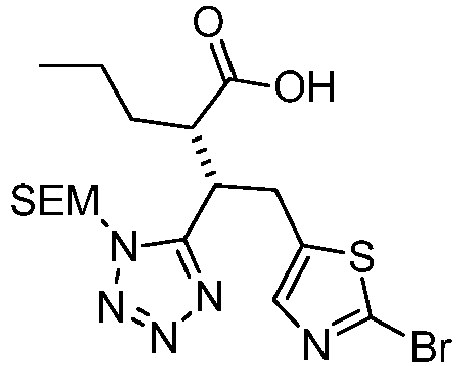
(S)-2-((S)-2-(2-bromothiazol-5-yl)-1-(1-((2-(trimethylsilyl)ethoxy)me thyl)-1H-tetrazol-5-yl)ethyl)pentanoic acid 492.09 491.99 -

- To a solution of 3-(6-bromopyridin-3-yl)propanoic acid (5000 mg, 22 mmol) in THF (100 ml) was added Hunig's Base (4.93 ml, 28.3 mmol) and pivaloyl chloride (2600 mg, 22 mmol) at -78°C. The mixture was allowed to stir overnight, warming up to RT naturally.
- In a second flask, to a solution of (4R,5S)-4-methyl-5-phenyloxazolidin-2-one (4.22 g, 23.8 mmol) in THF (100 ml) was added N-butyllithium (10.39 ml, 26.0 mmol) at -78°C. The mixture was allowed to stir for 30 minutes before (4R,5S)-3-(3-(6-bromopyridin-3-yl)propanoyl)-4-methyl-5-phenyloxazolidin-2-one (prepared as described above) was transferred into the reaction via canulation.
- The reaction was allowed to stir for 16 hours, warming up to RT naturally. LC showed excellent reaction. The reaction was quenched by adding aq. NH4Cl (50 mL), extracted with EtOAc (250 mL), and separated. The solution was dried over sodium sulfate, filtered and concentrated to about 50 mL. At that point, solids formed in the flask. The flask was heated to dissolve all the solids. The hot solution was allowed to cool down slowly, allowing for crystalization. Once the solution reached RT, about 50 mL hexane was added to force crystalization. The off-white solids were collected by filtration to provide the pure product. LC-MS [M+H]+: 391.1.
- In a 50ml RB flask equipped with a stirrer, (4R,5S)-3-(3-(6-bromopyridin-3-yl)propanoyl)-4-methyl-5-phenyloxazolidin-2-one (200 mg, 0.514 mmol) was dissolved in THF (15 ml) under N2 then cooled to -60°C and then sodium bis(trimethylsilyl)amide (0.617 ml, 0.617 mmol, 1 M) was added. The reaction mixture was stirred for 30 mins and tert-butyl 2-bromoacetate (0.091 ml, 0.617 mmol) was added and the reaction mixture continued to be stirred at - 50°- 40°C for 2 hrs. The reaction was quenched at -50°C with saturated NH4Cl solution (10 ml) and the two layers were separated. The aqueous layer was extracted with ether (2 x 15ml), then washed with brine, dried (Na2SO4), filtered and concentrated. The residue was purified by MPLC ISCO Combi-flash with 0-50% EtOAc/hexane. LC-MS [M+H]: 503.2.
1H-NMR (500 MHz, CDCl3) δ ppm: 8.23 (1 H, d, J = 2.50 Hz), 7.59 (1 H, dd, J = 8.18, 2.54 Hz), 7.45-7.36 (4 H, m), 7.30 (2H, dd, J- 8.25, 1.35Hz), 5.56 (1 H, d, J = 7.34 Hz), 4.72 (1 H, m, J = 6.85 Hz), 4.41 (1 H, dddd, J = 10.01, 8.55, 6.28, 4.53 Hz), 3.04-2.97 (1 H, m), 2.79 (1 H, dd, J = 16.82, 10.01 Hz), 2.64 (1 H, dd, J = 13.50, 8.60 Hz), 2.32 (1 H, dd, J = 16.82, 4.58 Hz), 1.38 (7 H, s),0.89 (3 H, d, J = 6.59 Hz). - In a 50 mL RB flask, (S)-2-((6-bromopyridin-3-yl)methyl)-4-(tert-butoxy)-4-oxobutanoic acid (3200 mg, 9.2 mmol) was dissolved in DCM (50 ml), cooled to 0°C and, to the reaction was added HATU (4200 mg, 11.1 mmol), DIPEA (13 ml, 74 mmol) and ammonium chloride (2500 mg, 46 mmol). The reaction mixture was stirred at 0°C for 5 hr. TLC showed mostly product. The mixture was poured into water and extracted with more DCM 1 x 10ml. DCM layer was washed with brine 1x, dried over Na2SO4, filtered and concentrated. The residue was purified by MPLC ISCO Combi-flash on ISCO Redi-Sep 40g column, eluting with 5% CH2Cl2/MeOH. LC-MS [M+H]+: 344.8.
- In a 100-ml RB flask, (S)-tert-butyl 4-amino-3-((6-bromopyridin-3-yl)methyl)-4-oxobutanoate (34000 mg, 9.8 mmol) was dissolved in DCM (100 ml), cooled to 0°C and, to the reaction was added pyridine (1.6 ml, 20 mmol) and TFAA (1.7 ml, 12 mmol). The reaction mixture was stirred at 0°C then warmed up to RT followed by stirring for 3 hrs. LC-MS showed only product peak.
- The reaction was poured into water and extracted with more DCM. The DCM layer was washed with brine, dried over Na2SO4, filtered and concentrated. The residue was purified by MPLC ISCO Combi-flash on a 120g Redi-sep column, eluting with 0-50%EtOAc/hexane to give a colorless oil. LC-MS [M+H]+: 328.2.
- In a 25 ml MW tube was added (S)-tert-butyl 4-(6-bromopyridin-3-yl)-3-cyanobutanoate (1.13 g, 3.5 mmol), azidotrimethylstannane (2.9 g, 14 mmol) and toluene (11 ml). The tube was sealed then heated to 120°C for 24 hrs. The reaction was cooled then concentrated. The residue was purified by MPLC ISCO Combi-flash on ISCO Redi-Sep 40g column, eluting with CH2Cl2/MeOH(10%) to afford a colorless solid. LC-MS [M+H]+: 368.0.
- In a 50-ml RB flask, (S)-tert-butyl 4-(6-bromopyridin-3-yl)-3-(1H-tetrazol-5-yl)butanoate (52 mg, 0.14 mmol) and HMPA (0.024 ml, 0.14 mmol) were dissolved in THF (2 ml), and added LDA at -78°C, formed by addition of BuLi in hexane (0.22 ml, 0.35 mmol) to diisopropylamine (0.050 ml, 0.35 mmol) in THF (5ml) at -70°C. The reaction was stirred at -70°C for 1 hr then 1-iodopropane (0.034 ml, 0.35 mmol) was added and the reaction warmed up to RT. The reaction was quenched with sat'd NH4Cl solution and extracted with EtOAc 2 times, dried over Na2SO4, filtered and concentrated to give the desired product. LC-MS [M+H]+: 412.2.
-

- The LDA solution was freshly prepared from DIPA and 2.5 M n-BuLi in THF. To a solution of (R)-tert-butyl 2-((2H-tetrazol-5-yl)methyl)-3-(6-bromopyridin-3-yl)propanoate (600 mg, 1.63 mmol) in THF (12 ml) was added LDA (4.1 ml, 4.1 mmol). The solution turned yellow and then brown at the end of the addition. The solution then turned orange in a few minutes. The mixture was kept at -78°C for 30 minutes before allyl bromide (490 mg, 0.41 mmol) was added into the reaction. The mixture was kept at -78°C for 4 hours. LC suggested slow progression of the reaction. The reaction was quenched with aq. NH4Cl after 4 hours. The organic layer was extracted with EtOAc, separated, dried over sodium sulfate, filtered and concentrated. The residue was adsorbed onto silica gel, and purified by MPLC with DCM and MeOH. LC-MS [M+H]+: 410.2.
-

- The reaction mixture of (S)-tert-butyl 2-((S)-2-(4-bromophenyl)-1-(1-(4-methoxybenzyl)-1H-tetrazol-5-yl)ethyl)pentanoate (1200 mg, 2.3 mmol), sodium acetate (570 mg, 7.0 mmol) and PdCl2(dppf)-CH2Cl2 adduct (190 mg, 0.23 mmol) in DMF (20 mL) and water (2.0 mL) was stirred with 100 psi of CO at 100°C overnight. The reaction was cooled to RT, filtered with celite, and evaporated to dryness. To the residue was added EtOAc, and filtered. To the EtOAc layer was added silica gel, and volatiles were removed under reduced pressure. The product mixture was isolated by MPLC. LC-MS [M+H]+:
-

- (S)-2-((1-((2-(trimethylsilyl)ethoxy)methyl)-1H-tetrazol-5-yl)methyl)pentanoic acid (1100 mg, 3.3 mmol) was dissolved in THF (15 ml) then cooled to -78°C and to the reaction mixture was added LDA (10 ml, 0.64 M, 6.4 mmol). The reaction was stirred for 45 mins, and then to the reaction mixture was added 2-(iodomethyl)-4,4,5,5-tetramethyl-1,3,2-dioxaborolane (1100 mg, 4.0 mmol). The mixture was stirred at -78°C for 5 hrs, and then quenched with saturated NH4Cl solution. The reaction was extracted with EtOAC (2x), dried (Na2SO4), and then filtered and concentrated to give (S)-2-((S)-2-(4,4,5,5-tetramethyl-1,3,2-dioxaborolan-2-yl)-1-(1-((2-(trimethylsilyl)ethoxy)methyl)-1H-tetrazol-5-yl)ethyl)pentanoic acid.
- In a 200ml RB flask, (S)-2-((S)-2-(4,4,5,5-tetramethyl-1,3,2-dioxaborolan-2-yl)-1-(1-((2-(trimethylsilyl)ethoxy)methyl)-1H-tetrazol-5-yl)ethyl)pentanoic acid (1.4 g, 3.0 mmol) was dissolved in toluene (25 ml), heated to 60°C, and then added N,N-dimethylformamide di-tert-butyl acetal (2.2 ml, 9.0 mmol) and continued heating for 16 hours. The reaction was concentrated and the residue was purified by MPLC with 0-100% EtOAc/Hexane to yield (S)-tert-butyl 2-((S)-2-(4,4,5,5-tetramethyl-1,3,2-dioxaborolan-2-yl)-1-(1-((2(trimethylsilyl)ethoxy) methyl)-1H-tetrazol-5-yl)ethyl)pentanoate. LC-MS [M+1]: 511.2
- (S)-tert-butyl 2-((S)-2-(4,4,5,5-tetramethyl-1,3,2-dioxaborolan-2-yl)-1-(1-((2-(trimethylsilyl)ethoxy)methyl)-1H-tetrazol-5-yl)ethyl)pentanoate (380 mg, 0.74 mmol) was dissolved in MeOH (2 mL), and then to the mixture was added potassium hydrogen fluoride (190 mg, 2.4 mmol) in water (0.54 mL). The mixture was stirred at RT for 1 hr. The solvent was removed in vacuo and acetone was added and stirred for 15 min at RT. The suspension was filtered, and the filtrate was evaporated to dryness to obtain potassium ((2S,3S)-3-(tert-butoxycarbonyl)-2-(1-((2-(trimethylsilyl)ethoxy)methyl)-1H-tetrazol-5-yl)hexyl)trifluoroborate. The crude was used directly without purification.
-

- Intermediate (S)-2-benzyl-4-(tert-butoxy)-4-oxobutanoic acid was prepared according to the literature methods (Synthetic communications, 2004, 2633-2640). To a stirred soultion of (S)-2-benzyl-4-(tert-butoxy)-4-oxobutanoic acid (164 mg, 0.620 mmol) in THF (1.5 ml) at -78°C, was added slowly LHMDS (1.6 ml, 1.6 mmol). The solution was stirred at -78°C for 1 hour, and then 1-iodo-4-methylpentane (250 mg, 1.2 mmol) was added slowly, stirred at -78°C for 1 hour, and then warmed to 0°C and stirred for 3 hrs, and then at RT for 3 hrs. The solution was quenched with sat. NH4Cl at 0°C, extracted with EtOAc, dried over Na2SO4, and evaporated to dryness to give the crude product. The crude was used in Step B.
- A mixture of the crude from Step A, (2S,3S)-2-benzyl-3-(tert-butoxycarbonyl)-7-methyloctanoic acid, (∼0.62 mmol), HATU (350 mg, 0.92 mmol), ammonium chloride (198 mg, 3.7 mmol), and Hunig's Base (0.86 ml, 4.94 mmol) in DMF (4 ml) was stirred at RT overnight. The reaction mixture was partitioned with EtOAc and Bicarbonate, dried over Na2SO4, and evaporated to dry to obtain the crude material. The crude was used in Step C.
- The crude (∼0.62 mmol) from Step B was dissolved in DMF and cooled to 0 °C. Cyanuric chloride (1100 mg, 6.2 mmol) was added to the mixture at 0°C, and then the mixture was stirred at RT for 5 hours. The mixture was cooled in ice bath and saturated aq. NaHCO3 was added until bubbling ceased. The mixture was extracted with EtOAc (3x), and the organic layer was washed with water (2x), brine, dried over Na2SO4, and concentrated to obtain the crude material.
- A solution of (S)-tert-butyl 2-((S)-1-cyano-2-phenylethyl)-6-methylheptanoate (88 mg, 0.27 mmol) from Step C, azidotrimethylstannane (137 mg, 0.67 mmol) in toluene (3 ml) was heated at 110°C for two days. After cooling, the solution was used directly for the next reaction.

- A solution of (S)-tert-butyl 6-methyl-2-((S)-2-phenyl-1-(1H-tetrazol-5-yl)ethyl)heptanoate (99 mg, 0.266 mmol) from Step D, TFA (9 ml, 117 mmol) in DCM (3 mL) and toluene (3 ml) was stirred at RT overnight. The mixture was evaporated to dryness to obtain the crude for HPLC purification. (Reverse phase HPLC: on a 30x100 mm, Gemini C18 column, 10µm particle size, linear gradient, 10-100% acetonitrile/H2O, buffering with 0.05% TFA at flow rate 25 mL/min over 11.0 min). Two products were obtained:
- (S)-6-methyl-2-((S)-2-phenyl-1-(1H-tetrazol-5-yl)ethyl)heptanoic acid. LC-MS: m/z 317.2 (calc. 317.19);
- (R)-6-methyl-2-((S)-2-phenyl-1-(1H-tetrazol-5-yl)ethyl)heptanoic acid. LC-MS: m/z 317.2 (calc. 317.19)
-

- To a stirred soultion of (S)-tert-butyl 4-phenyl-3-(1H-tetrazol-5-yl)butanoate (75 mg, 0.26 mmol) in THF (1 ml) at -78°C, was added slowly LDA (0.32 ml, 0.65 mmol). The solution was stirred at -78°C for 0.7 hour, then benzyl bromide (0.124 ml, 1.04 mmol) was added slowly, stirred at -78°C, and then slowly warmed to RT and stirred overnight. The solution was quenched with saturated NH4Cl at RT, extracted with EtOAc, dried over Na2SO4, filtered and evaporated to dryness. The crude was used directly in Step B.
- The crude containing (2S,3S)-tert-butyl 2-benzyl-4-phenyl-3-(1H-tetrazol-5-yl)butanoate (98 mg, 0.26 mmol) from Step A was dissolved in dichloromethane (1.7 ml), thioanisole (0.61 ml, 5.2 mmol) followed by TFA (1.3 ml, 17 mmol). The reaction was stirred at RT overnight. The mixture was washed with hexane (2x) to remove thioanisole. The residue was evaporated to dry. The residue was purified by preparative Reverse HPLC on a 19 x 100 mm, Waters Sunfire C18 column, 5µm particle size, acetonitrile/H2O buffering with 0.16% TFA with flow rate 25 mL/min, to obtain (2S,3S)-2-benzyl-4-phenyl-3-(1H-tetrazol-5-yl)butanoic acid: LC-MS m/z 323.15 (M + H+, calc. 323.14)
-

- To a stirred solution of (S)-tert-butyl 4-phenyl-3-(1H-tetrazol-5-yl)butanoate (84 mg, 0.29 mmol) in THF (1 ml) at -78°C, was added slowly LDA (0.37 ml, 0.73 mmol). The solution was stirred at -78°C for 0.5 hour, then 1-iodopropane (0.15 ml, 1.46 mmol) was added slowly, stirred at -78°C for 30 mins, and then slowly warmed to RT and stirred overnight. The solution was quenched with sat. NH4Cl at RT, extracted with EtOAc, dried over Na2SO4, filtered and evaporated to dryness. The crude was purified by silica gel column chromatography, eluted with EtOAc-hexane (0-100%) to yield the product.
- To a stirred soultion of tert-butyl 2-((S)-2-phenyl-1-(1H-tetrazol-5-yl)ethyl)pentanoate (44 mg, 0.13 mmol) in toluene (1.2 ml) was added TFA (1.8 ml, 23 mmol). The solution was stirred at RT for 5 hrs under lightly capped condition. The mixture was evaporated to dryness. The crude was purified by HPLC.
- prep HPLC: Gemini column, 30x100 mm, AcN-H2O (0.05%TFA, 10-100% in 12 min) to obtain the two products: (S)-2-((S)-2-phenyl-1-(1H-tetrazol-5-yl)ethyl)pentanoic acid; (R)-2-((S)-2-phenyl-1-(1H-tetrazol-5-yl)ethyl)pentanoic acid and (S)-2-((S)-1-(1-(tert-butyl)-1H-tetrazol-5-yl)-2-phenylethyl)pentanoic acid.
The following EXAMPLES 4 - 26 were prepared according to the general procedure mentioned above:Ex. No. Structure Name Calc'd MW (M+H+) LC/MS m/e (M+H+) 4 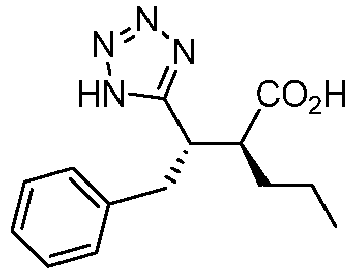
(S)-2-((S)-2-phenyl-1-(1H-tetrazol-5-yl)ethyl)pentanoic acid 275.15 275.1 5 
(R)-2-((S)-2-phenyl-1-(1H-tetrazol-5-yl)ethyl)pentanoic acid 275.15 275.1 6 
(S)-6,6,6-trifluoro-2-((S)-2-phenyl-1-(1H-tetrazol-5-yl)ethyl)hexanoic acid 342.14 342.24 7 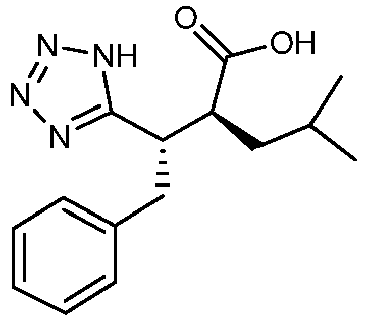
(2S)-4-methyl-2-[(1S)-2-phenyl-1-(1H-tetrazol-5-yl)ethyl]pentanoic acid 289.17 289.16 8 
(2S,3S)-2-ethyl-4-phenyl-3-(1H-tetrazol-5-yl)butanoic acid 261.14 261.16 9 
(2S)-5-methoxy-2-[(1S)-2-phenyl-1-(1H-tetrazol-5-yl)ethyl]pentanoic acid 305.16 305.16 10 
(2S,3S)-2-(cyclopentylmethyl)-4-phenyl-3-(1H-tetrazol-5-yl)butanoic acid 315.18 315.20 11 
(2S,3 S)-2-(2-cyclohexylethyl)-4-phenyl-3-(1H-tetrazol-5-yl)butanoic acid 343.21 343.26 12 
(2S,3 S)-4-phenyl-2-(tetrahydro-2H-pyran-4-yl)-3-(1H-tetrazol-5-yl)butanoic acid 317.16 317.17 13 
(2S,3S)-2-(cyclopropylmethyl)-4-phenyl-3-(1H-tetrazol-5-yl)butanoic acid 287.15 287.18 14 
(2R)-6-methyl-2-[(1S)-2-phenyl-1-(1H-tetrazol-5-yl)ethyl]hept-5-enoic acid 315.18 315.25 15 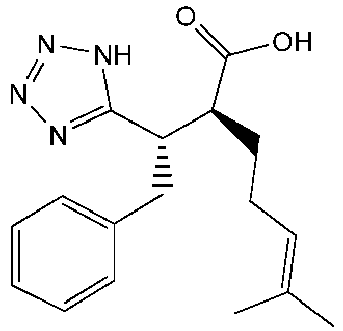
(2R)-6-methyl-2-[(1S)-2-phenyl-1-(1H-tetrazol-5-yl)ethyl]hept-5-enoic acid 315.18 315.26 16 
(S)-2-((S)-2-(3-bromophenyl)-1-(2H-tetrazol-5-yl)ethyl)pentanoic acid 353.22 353.10 17 
(2S,3S)-2-cyclopentyl-4-phenyl-3-(1H-tetrazol-5-yl)butanoic acid 301.4 301.2 18 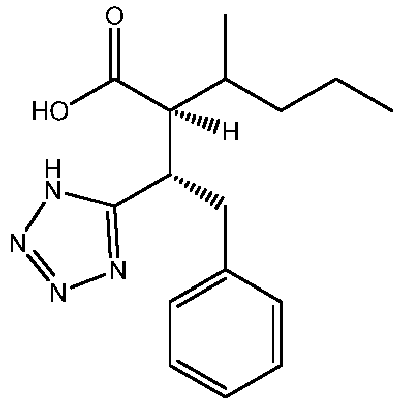
(2S)-3-methyl-2-((S)-2-phenyl-1-(1H-tetrazol-5-yl)ethyl)hexanoic acid 303.4 303.2 19 
(2S)-3-methyl-2-((S)-2-phenyl-1-(1H-tetrazol-5-yl)ethyl)pentanoic acid 289.4 289.2 20 
(2S,3S)-2-isopropyl-4-phenyl-3-(1H-tetrazol-5-yl)butanoic acid 275.3 275.2 21 
(2S,3S)-2-(2-fluoroethyl)-4-phenyl-3-(1H-tetrazol-S-yl)butanoic acid 279.3 279.2 22 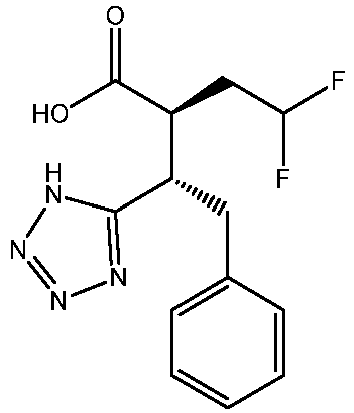
(2S,3S)-2-(2,2-difluoroethyl)-4-phenyl-3-(1H-tetrazol-5-yl)butanoic acid 297.3 297.2 23 
(2S)-2-[(1S)-2-(4-bromo-3-fluorophenyl)-1-(1H-tetrazol-5-yl)ethyl]-4-methylpentanoic acid 385.07 387.14 385.19 24 
(2S)-2-[(1S)-2-(3-bromo-5-fluorophenyl)-1-(1H-tetrazol-5-yl)ethyl]-4-methylpentanoic acid 385.07 387.15 385.17 25 
(2S)-2-[(1S)-2-(4-bromophenyl)-1-(1H-tetrazol-5-yl)ethyl]-4-methylpentanoic acid 367.08 367.04 26 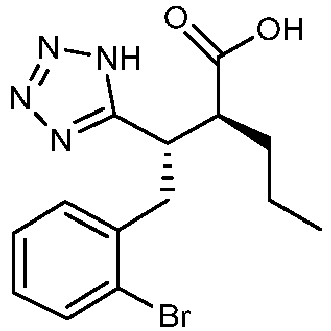
(2S)-2-[(1S)-2-(2-bromophenyl)-1-(1H-tetrazol-5-yl)ethyl]pentanoic acid 353.06 352.98 -

- To a solution of diisopropylamine (0.10 ml, 0.73 mmol) in 1.5 mL of THF was added n-BuLi (0.29 ml, 0.73 mmol) at 0°C. The mixture was stirred at 0∼5°C for 30 min. After the mixture was cooled to -78°C, (3R,4R)-tert-butyl 4-phenyl-3-(1H-tetrazol-5-yl)pentanoate (100 mg, 0.33 mmol) in 1 mL of THF was added dropwise and stirred at -78°C for 1 hour. 1-iodo-2-methylpropane (0.038 ml, 0.33 mmol) was added dropwise at -78°C and stirrded at -78°C for 1 hour and then gradually warmed up to RT and stirred for 72 hrs. The reaction mixture was added to an aqueous solution of NH4Cl and extracted with EtOAc. The organic layer was washed with brine, dried over MgSO4, filtered and concentrated down to give the crude product. LC-MS m/z (M+H)+ 359.3
- TFA (1 mL, 13 mmol) was added to a stirred, room temperature mixture of (2S,3S,4S)-tert-butyl 2-isobutyl-4-phenyl-3-(1H-tetrazol-5-yl)pentanoate (68 mg, 0.15 mmol), thioanisole (0.10 ml, 0.84 mmol) in a flask and the mixture was stirred at room temperature for 3 hours. LC-MS showed the reaction was near completion. The reaction mixture was concentrated down. The residue was treated with hexane. The residue oil was dissolved in CH3CN/water. The residue was purified by preparative HPLC [HPLC], eluting with Acetonitrile/Water + 0.1% TFA (10∼70%∼10%), to give the product. LC-MS m/z (M+H)+ 359.3
The following 2 compounds were prepared following the above procedure of EXAMPLE 27:Ex. No. Structure IUPAC Name Calc'd Mass [M+H]+ LC/MS m/e [M+H]+ 28 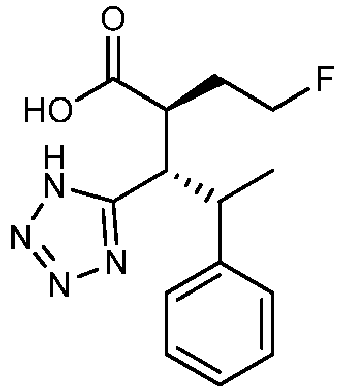
(2S,3S,4R)-2-(2-fluoroethyl)-4-phenyl-3-(1H-tetrazol-5-yl)pentanoic acid 293.3 293.2 29 
(2S,3S,4R)-2-ethyl-4-phenyl-3-(1H-tetrazol-5-yl)pentanoic acid 275.3 275.2 -

- To a stirred soultion of (R)-tert-butyl 4-(4-bromophenyl)-3-(1H-tetrazol-5-yl)butanoate (420 mg, 1.4 mmol) in THF (4 ml) at -78°C, was slowly added LDA (1.8 ml, 3.6 mmol). The solution was stirred at -78°C for 0.5 hr, then 1-iodobutane (0.82 ml, 7.2 mmol) was added slowly, stirred at -78°C for 30 mins, and then slowly warmed to RT and stirred overnight. The solution was quenched with sat. NH4Cl at RT, extracted with EtOAc, dried over Na2SO4, filtered and evaporated to dryness. The crude was used directly in the next step.
- The crude containing tert-butyl 2-((R)-2-(4-bromophenyl)-1-(1H-tetrazol-5-yl)ethyl)hexanoate (400 mg, 1.2 mmol) was dissolved in DCM (5.8 ml) and thioanisole (2.75 ml, 23 mmol), followed by addition of TFA (1 mL, 13 mmol). The reaction was stirred at RT overnight. The solvent was removed in vacuo, and the mixture was washed with hexane (2x) to remove thioanisole. The residue was evaporated to dryness. The residue was purified by preparative HPLC Reverse phase with C18 Prep Column, 100Å, 10 µm, 30 mm x100 mm (multiple injections), eluted with 5-100% acetonitrile/Water, with 0.05% TFA in 22 min to deliver (R)-2-((R)-2-(4-bromophenyl)-1-(1H-tetrazol-5-yl)ethyl)hexanoic acid. LC-MS m/z (M+H)+ 367.2
-

- Compound 31 was prepared following the same procedure as EXAMPLE 30 from (R)-tert-butyl 4-phenyl-3-(1H-tetrazol-5-yl)butanoate. LC-MS m/z (M+H)+ 343.2
-

- To a stirred soultion of (S)-tert-butyl 4-phenyl-3-(1H-tetrazol-5-yl)butanoate (30 mg, 0.104 mmol) in THF (0.3 ml) at -78°C, was added slowly LDA (0.13 ml, 0.26 mmol). The solution was stirred at -78°C for 0.5 hr, then tert-butyl(4-iodobutoxy)dimethylsilane (62 mg, 0.20 mmol) was added slowly. The mixture was stirred at -78°C for 30 mins, warmed to RT, and then stirred at RT for 3 days. The solution was quenched with sat. NH4Cl at RT, extracted with EtOAc, dried over Na2SO4, filtered and evaporated to dryness. The crude was purified by Flash Si gel CC, EtOAc-hexane (0-100%) to yield the product for Step B.
- To a stirred soultion of (S)-tert-butyl 6-((tert-butyldimethylsilyl)oxy)-2-((S)-2-phenyl-1-(1H-tetrazol-5-yl)ethyl)hexanoate (8.5 mg, 0.018 mmol) in toluene (0.4 ml) was added TFA (0.6 ml, 7.8 mmol). The solution was stirred at RT overnight under lightly capped condition. The mixture was evaporated to dryness. The crude was purified by HPLC (prep HPLC: C18 column, 30x100 mm, AcN-H2O (0.05%TFA, 10-100% in 12 min). Dried fractions containing TFA ester product were treated with MeOH-H2O (4:1) and K2CO3 (6 mg) for 1 hr, evaporated, acidified with 2N HCl, extracted with EtOAc to get the product, (S)-6-hydroxy-2-((S)-2-phenyl-1-(1H-tetrazol-5-yl)ethyl)hexanoic acid. LC-MS m/z 305.09 (calc. m/z 305.15).
-

- To a solution of 5-bromopentanenitrile (500 mg, 3.1 mmol) in acetone (15 ml), sodium iodide (920 mg, 6.2 mmol) was added and the reaction mixture was stirred at RT over the weekend. The mixture was filtered and concentrated. The residue was partitioned between brine and ether. Ether layer was dried over MgSO4, and evaporated to dry to get the product.
- To a stirred soultion of (S)-tert-butyl 4-phenyl-3-(1H-tetrazol-5-yl)butanoate (150 mg, 0.52 mmol) in THF at -78°C, was added slowly lithium diisopropylamide (0.65 ml, 1.3 mmol). The solution was stirred at -78°C for 0.7 hr, then 5-iodopentanenitrile (435 mg, 2.1 mmol) was added slowly, stirred at -78°C, and then slowly warmed to RT and stirred overnight. The solution was quenched with sat. NH4Cl at RT, extracted with EtOAc, dried over Na2SO4, filtered, and evaporated to dryness. One third of the crude was used directly in Step C.
- The crude containing (S)-tert-butyl 6-cyano-2-((S)-2-phenyl-1-(1H-tetrazol-5-yl)ethyl)hexanoate (100 mg, 0.27 mmol) was dissolved in DCM (1.4 ml) and thioanisole (0.64 ml, 5.4 mmol), followed by addition of TFA (1.4 ml, 18 mmol). The reaction was stirred at RT overnight. The mixture was evaporated in vacuo and washed with hexane (3x) to remove thioanisole. The residue was evaporated to dryness. The residue was purified using preparative Reverse HPLC on a 19 X 100 mm, Waters Sunfire C18 column, 5µm particle size, acetonitrile/H2O buffering with 0.16% TFA at flow rate 50 mL/min to obtain 20 mg product. (S)-6-cyano-2-((S)-2-phenyl-1-(1H-tetrazol-5-yl)ethyl)hexanoic acid. LC-MS m/z 314.16 (calc. m/z 314.16)
-

- (S)-6-cyano-2-((S)-2-phenyl-1-(1H-tetrazol-5-yl)ethyl)hexanoic acid (13 mg, 0.042 mmol) was dissolved in ethanol (0.5 ml), and to the mixture was added KOH (9.5 mg, 0.17 mmol) and hydrogen peroxide (0.074 ml, 0.85 mmol). The mixture was heated to 70°C for 1 day. The mixture was partitioned between ethyl acetate and NH4Cl. The aqueous solution was further acidified by 1 N HCl and extracted with EtOAc (2x). The combined organic was dried over sodium sulfate, filtered and evaporated. The crude was purified on C18 HPLC: product 1, (S)-7-amino-7-oxo-2-((S)-2-phenyl-1-(1H-tetrazol-5-yl)ethyl)heptanoic acid, LC-MS m/z 332.3 (calc. m/z 332.17); product 2, (S)-2-((S)-2-phenyl-1-(1H-tetrazol-5-yl)ethyl)heptanedioic acid, LC-MS m/z 333.3 (calc. m/z 333.16).
-

- To a mixture of imidazole (180 mg, 2.7 mmol) and triphenylphosphine (700 mg, 2.7 mmol) in acetonitrile (2.5 ml) and ether (7.5 ml) was added iodine (680 mg, 2.7 mmol) at 0°C, and then stirred at room temperature for 15 minutes. t-butyl 4-(3-hydroxypropyl)piperidine-1-carboxylate (500 mg, 2.1 mmol) in the same solvent system (2 mL) was added dropwise at 0°C. The solution was stirred at RT overnight. The mixture was evaporated, and DCM (20 mL) was added. The suspension was filtered and evaporated to get the crude. The crude was purified by column chromatography on silica gel (40 g, ISCO Flash Chromatography), eluting with 0-100% EtOAc/hexane to give a colorless oil, used in the next step.
- To a stirred soultion of (S)-tert-butyl 4-phenyl-3-(1H-tetrazol-5-yl)butanoate (100 mg, 0.35 mmol), in THF (1 ml) at -78°C, was added slowly LDA (0.40 ml, 0.80 mmol). The solution was stirred at -78°C for 0.7 hr, then tert-butyl 4-(3-iodopropyl)piperidine-1-carboxylate (340 mg, 0.96 mmol) was added slowly, stirred at -78°C, and then slowly warmed to RT and stirred overnight. The solution was quenched with sat. NH4Cl at RT, extracted with EtOAc, dried over Na2SO4, filtered and evaporated to dryness. The crude was used directly in Step C.
- The crude containing tert-butyl 4-((4S,5S)-4-(tert-butoxycarbonyl)-6-phenyl-5-(1H-tetrazol-5-yl)hexyl)piperidine-1-carboxylate (180 mg, 0.35 mmol) from Step B was dissolved in DCM (1.7 ml) and thioanisole (0.82 ml, 6.9 mmol), followed by addition of TFA (1.7 ml, 23 mmol). The reaction was stirred at RT overnight. The mixture was evaporated and then washed with hexane (2x) and hexane-ether (1:1) to remove thioanisole. The residue was evaporated to dryness. The residue was purified by preparative reverse HPLC on a 19X100 mm, Luna C18 column, 5 µm particle size, acetonitrile/H2O buffering with 0.05% TFA at flow rate 20 mL/min, to afford TFA salt of (S)-2-((S)-2-phenyl-1-(1H-tetrazol-5-yl)ethyl)-5-(piperidin-4-yl)pentanoic acid, LC-MS: m/z 358.4 (calc. m/z 358.23)
-

- To a stirred soultion of 2-(benzo[d][1,3]dioxol-5-ylmethyl)-4-(tert-butoxy)-4-oxobutanoic acid (150 mg, 0.49 mmol) in THF (2.5 ml) at -78°C, was added slowly LHMDS 1 M in toluene (1.22 ml, 1.22 mmol). The solution was stirred at -78°C for 1 hr, then (4-iodobutyl)benzene (240 mg, 0.92 mmol) was added slowly, stirred at -78°C for 60 mins, and then slowly warmed to RT overnight. The solution was quenched with sat. NH4Cl at 0°C, extracted with EtOAc. The aqueous Layer was acidified to acidic with 2N HCl, then extracted with EtOAc 2 times. The combined organic layers were dried with MgSO4, filtered and rotovap to dry to give a light yellow oil, which was purified by chromatogarphy on silica gel, eluted with Hexane - EtOAc (0 - 30%), provided the desired compound. LC-MS m/z [M+Na]+ 463.30
- A mixture of (2S,3S)-2-(benzo[d][1,3]dioxol-5-ylmethyl)-3-(tert-butoxycarbonyl)-9-methyldecanoic acid (68 mg, 0.16 mmol), HATU (123 mg, 0.32 mmol), ammonium chloride (35 mg, 0.65 mmol), and DIPEA (0.17 ml, 0.97 mmol) in DMF (3.0 ml) was stirred overnight. The reaction mixture was worked up with EtOAc/sodium bicarbonate, dried over Na2SO4 to get the crude and used directly in the next step.
- (S)-tert-butyl 2-((S)-1-amino-3-(benzo[d][1,3]dioxol-5-yl)-1-oxopropan-2-yl)-8-methylnonanoate (110 mg, 0.26 mmol) was dissolved in DMF (3.0 ml) and cooled to 0°C. To the reaction was added 2,4,6-trichloro-1,3,5-triazine (480 mg, 2.6 mmol), then removed from the cooling bath and allowed to warm to RT overnight. The reaction mixture was cooled in an ice bath and sat'd NaHCO3 was added until bubbling ceased. The reaction mixture was extracted with EtOAc (3x). The combined extracts were washed with brine (2x), dried with Na2SO4, filtered, and concentrated to a pale yellow liquid. Chromatographed, silica gel, 12g, gradient 0-50% EtOAc/Hexane, gave a colorless oil of desired compound. LC-MS m/z [M+H]+ 402.30
- The reaction mixture of (S)-tert-butyl 2-((S)-2-(benzo[d][1,3]dioxol-5-yl)-1-cyanoethyl)-8-methylnonanoate (23 mg, 0.057 mmol) and azidotrimethylstannane (15 mg, 0.072 mmol) in toluene (2.0 ml) was heated at 110°C overnight. LCMS showed that most of SM remained. Additional azidotrimethylstannane (15 mg, 0.072 mmol) was added and heated at 110°C overnight. The solvent was removed on rotovap and to the residue was added DMSO(1.5ml), and then filtered for HPLC purification to furnish the desired product as a colorless oil. LC-MS m/z [M+H]+ 445.68
- The reaction mixture of (S)-tert-butyl 2-((S)-2-(benzo[d][1,3]dioxol-5-yl)-1-(2H-tetrazol-5-yl)ethyl)-8-methylnonanoate (15 mg, 0.034 mmol), 2,2,2-trifluoroacetic acid (190 mg, 1.7 mmol) in DCM (200 µL) was stirred at RT and monitored by LCMS. After the reaction was complete, the solvent was removed and to the residue was added 1.5 ml of DMSO, then filtered for HPLC purification to afford the desired product. LC-MS m/z [M+H]+ 409.21
EX. NO. Structure Name Calc'd mass [M+H]+ MS found 37 
(2S)-2-[(1S)-2-(1,3-benzodioxol-5-yl)-1-(2H-tetrazol-5-yl)ethyl]-6-phenylhexanoic acid 409.19 409.21 38 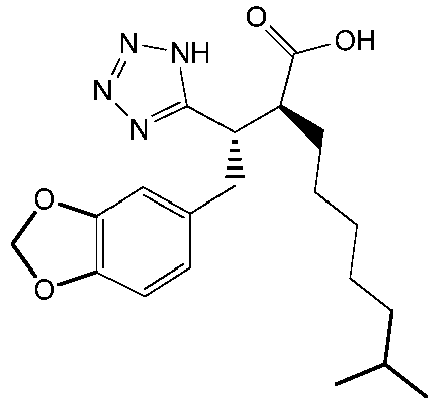
(2S)-2-[(1S)-2-(1,3-benzodioxol-5-yl)-1-(2H-tetrazol-5-yl)ethyl]-8-methylnonanoic acid 389.22 389.24 39 
(2S)-2-[(1S)-2-(1,3-benzodioxol-5-yl)-1-(1H-tetrazol-5-yl)ethyl]heptanoic acid 347.17 347.18 -

- Catalyst Prep: X-PHOS (18 mg, 0.038 mmol) and Palladium acetate (4.2 mg, 0.019 mmol) were added to a septum-topped vial, followed by DMA (2.0 ml) and then Sulfuric acid, 98% (1.0 µl, 0.019 mmol). This was then sealed and sparged with N2 for 5 minutes, then heated at 80°C for 30 minutes to give a homogeneous brown solution.
- Reaction set-up: In a second septum-topped vial, Zinc Cyanide (26.6 mg, 0.227 mmol), Zinc dust (1.235 mg, 0.019 mmol) and (S)-tert-butyl 2-((S)-2-(4-bromophenyl)-1-(2-(4-methoxybenzyl)-2H-tetrazol-5-yl)ethyl)pentanoate were added, followed by DMA (2000 µl). This was then sealed and sparged with N2 for 5 minutes, then the catalyst solution was transferred via syringe to the reaction. This was then heated at 120°C overnight.
- Work-up: The mixture was cooled, diluted with ethyl acetate (30 mL), washed with saturated NaHCO3, H2O, NH4Cl, H2O and Brine, dried (MgSO4), filtered and the solvent was evaporated under reduced pressure.
- Purification: The residue was purified by preparative ISCO eluting with EtOAc/Hexanes, to give a colorless oil. LC-MS m/z [M+H]+ 476.37
- To a solution of (S)-tert-butyl 2-((S)-2-(4-cyanophenyl)-1-(2-(4-methoxybenzyl)-2H-tetrazol-5-yl)ethyl)pentanoate (70 mg, 0.15 mmol) in thioanisole (500 µl, 4.2 mmol) at 0°C, TFA (500 µl, 6.5 mmol) was added and stirred at RT for 1 hour, then stirred at 50°C and checked by LCMS. LCMS showed all of SM was gone. The reaction mixture was rotovap concentrated and to the residue was added 10 ml of Hexane, titurated and to the residue oil was then added DMSO (3.0 ml), and then filtered for purification under HPLC conditions. LC-MS m/z [M+H]+ 300.15
The following compounds were prepared according to the procedure of EXAMPLE 40.EX. NO. Structure IUPAC Name Calc'd Mass [M+H]+ LC/MS m/e [M+H]+ 41 
(2S)-2-[(1S)-2-(3-cyanophenyl)-1-(1H-tetrazol-5-yl)ethyl]pentanoic acid 300.15 300.17 42 
(2S)-2-[(1S)-2-(4-cyanophenyl)-1-(1H-tetrazol-5-yl)ethyl]-4-methylpentanoic acid 314.16 313.98 43 
(2S)-2-[(1S)-2-(2-cyanophenyl)-1-(1H-tetrazol-5-yl)ethyl]pentanoic acid 300.15 300.02 -

- The intermediate was prepared according to the cyanation procedure described in EXAMPLE 42. LC-MS m/z [M+H]+ 476.34
- A solution of (S)-tert-butyl 2-((S)-2-(4-cyanophenyl)-1-(2-(4-methoxybenzyl)-2H-tetrazol-5-yl)ethyl)pentanoate (84 mg, 0.18 mmol), dibutyltin oxide (13 mg, 0.053 mmol) and azidotrimethylsilane (0.070 ml, 0.53 mmol) in Toluene (1.5 ml) was heated at 110°C for 16 hours. The reaction mixture was concentrated under reduced pressure and purified by ISCO chromatography, normal phase, with hexane and ethyl acetate. LC-MS m/z [M+H]+ 519.30
- To a solution of (S)-tert-butyl 2-((S)-2-(4-(1H-tetrazol-5-yl)phenyl)-1-(2-(4-methoxybenzyl)-2H-tetrazol-5-yl)ethyl)pentanoate (15 mg, 0.029 mmol) in DCM (300 µl) was added thioanisole (300 µl, 2.5 mmol), and TFA (300 µl, 2.7 mmol). The mixture was stirred at 50°C overnight. The volatiles were removed under reduced pressure, and the residue was dissolved in DMSO and purified by reverse-phase HPLC. LC-MS m/z [M+H]+ 343.24
-

- (S)-tert-butyl 2-((S)-2-(4-cyanophenyl)-1-(2-(4-methoxybenzyl)-2H-tetrazol-5-yl)ethyl)pentanoate (85 mg, 0.18 mmol) was dissolved in DMSO (3.0 ml) cooled to 0°C, and then to the reaction was added K2CO3 (25 mg, 0.18 mmol) and hydrogen peroxide (0.078 ml, 0.89 mmol). The reaction mixture was then warmed up to RT, and stirred for about 1 hour. LC-MS has product M+1 = 493. Work up: poured into water and extracted with EtOAc 2 times, washed with brine, dried over with MgSO4, filtered and evaporated to dryness, to give the crude which was used as is.
- To a solution of above intermediate in thioanisole (500 µL) at 0°C was added TFA (500 µL). The mixture was allowed to stir for 1 hour at RT, and then at 50°C for 1 hour. LC-MS indicated complete reaction. The volatiles were removed under reduced pressure, and the residue was dissolved in DMSO and the products separated by HPLC. LC-MS m/z [M+H]+ 318.19
The following compounds were prepared according to the procedure of EXAMPLE 45.Ex. No. Structure IUPAC Name Calc'd Mass [M+H]+ LC/MS m/e [M+H]+ 46 
(2S)-2-[(1S)-2-(3-carbamoylphenyl)-1-(2H-tetrazol-5-yl)ethyl]pentanoic acid 318.16 318.27 47 
(2S)-2-[(1S)-2-(2-carbamoylphenyl)-1-(1H-tetrazol-5-yl)ethyl]pentanoic acid 318.16 318.14 48 
(2S)-2-[(1S)-2-(4-carbamoylphenyl)-1-(1H-tetrazol-5-yl)ethyl]-4-methylpentanoic acid 332.17 332.19 -

- To a microwave tube was added (S)-tert-butyl 2-((S)-1-(1-(4-methoxybenzyl)-1H-tetrazol-5-yl)-2-(4-(4,4,5,5-tetramethyl-1,3,2-dioxaborolan-2-yl)phenyl)ethyl)pentanoate (84 mg, 0.15 mmol) in DMSO (1 ml). To the mixture was added Copper(II) acetate monohydrate (3.1 µl, 0.029 mmol), 1-benzylimidazole (9.2 mg, 0.058 mmol), sodium methanesulfinate (22 mg, 0.22 mmol), potassium carbonate (20 mg, 0.15 mmol) and 4 Å molecular sieves (0.5 g). The reaction mixture was stirred at 60°C overnight and then filtered on a Celite pad and eluted with EtOAc. The filtrate was diluted with EtOAc and aqueous ammonium chloride and the aqueous layer was extracted with EtOAc. The combined organic layer was washed with brine, dried over Na2SO4, filtered and concentrated to give the crude material.
- To a solution of the crude product above (77 mg, 0.15 mmol) in DCM (500 µL), TFA (0.3 ml, 3.9 mmol) was added and stirred at RT for 2 hrs. All SM was gone at that point. The reaction was evaporated to dryness, then anisole (0.064 ml, 0.58 mmol) and TFA (0.3 ml, 3.9 mmol) were added and stirred at 50°C overnight. The reaction mixture was cooled to RT, rotovap concentrated and the residue was washed with 8 ml x 3 of Hexane, triturated and then to the residue oil was added DMSO (3.0 ml), and filtered for HPLC purification. LC-MS m/z [M+H]+ 353.20
-

- The compounds were prepared following the same procedure as EXAMPLE 49. 50: LC-MS m/z [M+H]+ 367.13, 51: LC-MS m/z [M+H]+ 367.17
-

- In a 2 dram vial, (S)-tert-butyl 2-((S)-1-(1-(4-methoxybenzyl)-1H-tetrazol-5-yl)-2-(4-(4,4,5,5-tetramethyl-1,3,2-dioxaborolan-2-yl)phenyl)ethyl)pentanoate (90 mg, 0.16 mmol), potassium carbonate (250 µl, 0.50 mmol), toluene (2000 µl) and ethanol (250 µL) were stirred at RT and purged with N2 for 5 mins, then iodomethane (15 µl, 0.240 mmol) and tetrakis(triphenylphosphine) palladium(0) (80 mg, 0.069 mmol) were added and stirred at 80°C overnight. The reaction was cooled to RT, 30 ml of EtOAc was added, and the reaction washed with saturated NH4Cl, H2O and brine, dried over MgSO4, filtered and rotovap down. The crude material was purified by ISCO 24g silica gel, EtOAc-Hexanes, to give a yellow solid. The solid was next dissolved in DCM, and TFA (0.57 ml, 7.4 mmol) was added and stirred at RT for 1 hr. LC-MS showed all of SM was gone and MW = 408. The reaction was evaproated to dryness, then anisole (0.064 ml, 0.58 mmol) and TFA (0.3 ml, 3.89 mmol) were added and stirred at 50°C overnight. The reaction was cooled to RT, rotovap concentrated and the residue was washed with 8 ml x 3 of Hexane, triturated and to the residue oil was then added DMSO (1.5 ml), filtered for HPLC to afford the desired product. LC-MS m/z [M+H]+ 289.19
-

- The compound was prepared following the same procedure as EXAMPLE 52. LC-MS m/z [M+H]+ 303.16
-

- A mixture of (S)-tert-butyl 2-((S)-2-(4-bromophenyl)-1-(1-(4-methoxybenzyl)-1H-tetrazol-5-yl)ethyl)pentanoate (110 mg, 0.20 mmol), potassium N-Boc-aminomethyltrifluoroborate (48 mg, 0.20 mmol), cesium carbonate (200 mg, 0.61 mmol), and Ad2nBuP biphenyl precatalyst (14 mg, 0.020 mmol) in toluene (1.2 mL) and water (0.12 mL) was heated to 100°C for 16 hours. The mixture was cooled, diluted with EtOAc, washed with H2O, brine, dried over MgSO4, filtered and the solvent was evaporated under reduced pressure to give the crude material, which was used directly in the next step. LC-MS m/z [M+H]+ 580.42
- To a solution of (S)-tert-butyl 2-((S)-2-(4-(((tert-butoxycarbonyl)amino)methyl)phenyl)-1-(1-(4-methoxybenzyl)-1H-tetrazol-5-yl)ethyl)pentanoate (65 mg, 0.11 mmol) in DCM (1 mL) was added TFA (500 µl, 6.5 mmol). The mixture was allowed to stir at RT for 2 hours. The reaction was concentrated, and the residue was dissolved in DMSO, and purified by reverse-phase HPLC. LC-MS m/z [M+H]+ 304.23
-

- The compound was prepared following the same procedure as EXAMPLE 54. LC-MS m/z [M+H]+ 373.34
-

- The compound was prepared following the same procedure as EXAMPLE 54. LC-MS m/z [M+H]+ 336.18
-

- A solution of (S)-tert-butyl 2-((S)-2-(4-bromophenyl)-1-(1H-tetrazol-5-yl)ethyl)pentanoate (120 mg, 0.29 mmol), potassium phosphate tribasic (0.73 ml, 0.73 mmol), palladium(II) acetate/1,1'-Bis(di-t-butylphosphino)ferrocene/Potassium phosphate mixture (27 mg, 0.029 mmol) and tert-butyl 4-(5-(4,4,5,5-tetramethyl-1,3,2-dioxaborolan-2-yl)pyridin-2-yl)piperazine-1-carboxylate (114 mg, 0.29 mmol) in EtOH (2.4 ml) was flashed with N2 4 times. The mixture was heated at 75°C overnight. LC-MS showed the reaction was completed. The reaction mixture was filtered and evaporated to dryness. The residue was carried to deprotection without purification.
- The solid obtained above (170 mg, 0.287 mmol) was dissolved in DCM (1.0 ml) and thioanisole (1.0 ml, 8.4 mmol). TFA (1.0 ml, 9.09 mmol) was added and stirred at RT overnight. LC-MS showed that all of SM was gone. The solvent was removed by rotovap and the residue was triturated by Hexane (8 ml x 3), and to the residue oil was then added DMSO (9.0 ml), and filtered for HPLC purification to give the desired product. LC-MS m/z [M+H]+ 436.36
-

- To a flask charged with (2S,3R)-tert-butyl 2-((S)-2-(4-bromophenyl)-1-(1H-tetrazol-5-yl)ethyl)-3-methylpentanoate (20 mg, 0.049 mmol) was added tetrakis(triphenylphosphine) palladium(0) (4.4 mg, 3.8 µmol), 5-(4-(4,4,5,5-tetramethyl-1,3,2-dioxaborolan-2-yl)phenyl)-1H-tetrazole (15 mg, 0.057 mmol), and sodium carbonate (15 mg, 0.14 mmol), dioxane (0.4 mL), and water (0.1 mL). The mixture was stirred at 98°C for overnight. LC-MS showed product. After cooling, the mixture was diluted with EtOAc, washed with IN HCl and brine. The organic layer was concentrated down to give the crude product.
LC-MS m/z [M+H]+ 475.47 - To a flask charged with the above crude product was added thioanisol (0.2 mL, 1.7 mmol) and TFA (1 mL, 13 mmol). The mixture was allowed to sit at RT for 2 hours. LC showed complete reaction. The reaction was concentrated, and the residue was purified by HPLC with ACN and water (with 0.05% TFA). LC-MS m/z [M+H]+ 433.30
The following compounds were prepared following the same general procedure of EXAMPLE 58:Ex. No. Structure Name Calc'd Mass [M+H]+ LC/MS m/e [M+H]+ 59 
(2 S,3 S)-2-isopropyl-4-(4-(1,2,3,6-tetrahydropyridin-4-yl)phenyl)-3-(1H-tetrazol-5-yl)butanoic acid 354.4 354.2 60 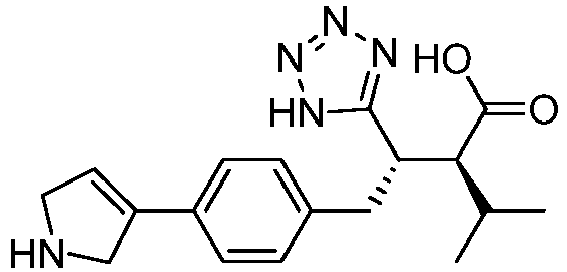
(2S,3S)-4-(4-(2,5-dihydro-1H-pyrrol-3-yl)phenyl)-2-isopropyl-3-(1H-tetrazol-5-yl)butanoic acid 342.4 342.4 61 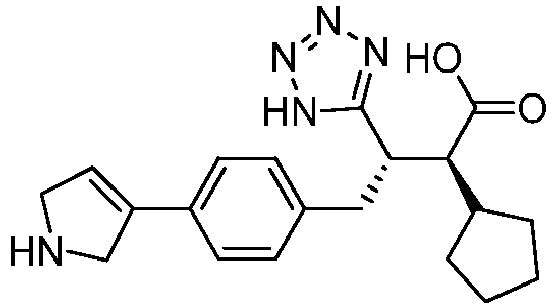
(2S,3S)-2-cyclopentyl-4-(4-(2,5-dihydro-1H-pyrrol-3-yl)phenyl)-3-(1H-tetrazol-5-yl)butanoic acid 368.5 368.4 62 
(2S,3S)-4-(4-(1H-pyrazol-4-yl)phenyl)-2-isopropyl-3-(1H-tetrazol-5-yl)butanoic acid 341.4 341.2 63 
(2S,3S)-4-(4-(1H-pyrazol-4-yl)phenyl)-2-cyclopentyl-3-(1H-tetrazol-5-yl)butanoic acid 367.4 367.2 64 
(2S,3S)-4-(6-(2,5-dihydro-1H-pyrrol-3-yl)pyridin-3-yl)-2-isopropyl-3-(1H-tetrazol-5-yl)butanoic acid 342.4 343.1 65 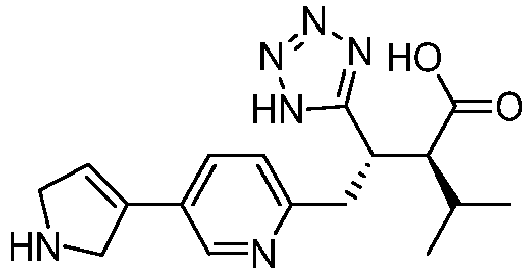
(2S,3S)-4-(5-(2,5-dihydro-1H-pyrrol-3-yl)pyridin-2-yl)-2-isopropyl-3-(1H-tetrazol-5-yl)butanoic acid 343.4 343.2 66 
(2 S,3 S)-2-cyclopentyl-4-(5-(2,5-dihydro-1H-pyrrol-3-yl)pyridin-2-yl)-3-(1H-tetrazol-5-yl)butanoic acid 369.5 369.2 67 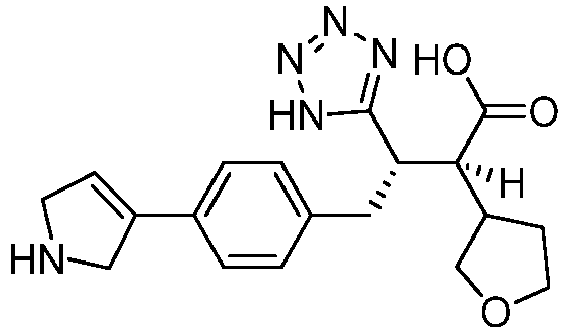
(2R,3S)-4-(4-(2,5-dihydro-1H-pyrrol-3-yl)phenyl)-2-(tetrahydrofuran-3-yl)-3-(1H-tetrazol-5-yl)butanoic acid 370.4 370.3 68 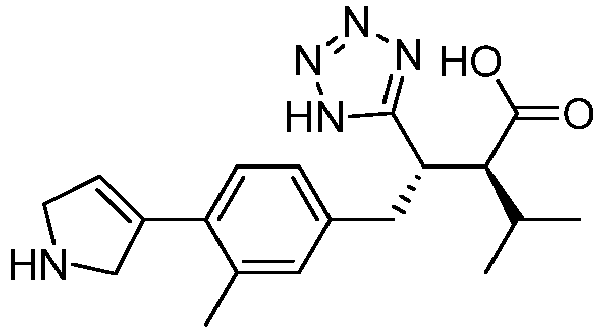
(2S,3S)-4-(4-(2,5-dihydro-1H-pyrrol-3-yl)-3-methylphenyl)-2-isopropyl-3-(1H-tetrazol-5-yl)butanoic acid 356.4 356.2 69 
(2S,3S)-4-(4-(2,5-dihydro-1H-pyrrol-3-yl)-3-fluorophenyl)-2-isopropyl-3-(1H-tetrazol-5-yl)butanoic acid 360.4 360.0 70 
(2S,3S)-4-(2-(2,5-dihydro-1H-pyrrol-3-yl)phenyl)-2-isopropyl-3-(1H-tetrazol-5-yl)butanoic acid 342.4 342.2 71 
(2S,3S)-4-(2-(2,5-dihydro-1H-pyrrol-3-yl)thiazol-4-yl)-2-isopropyl-3-(1H-tetrazol-5-yl)butanoic acid 349.4 349.1 72 
(2S,3S)-4-(4-(6-aminopyridin-3-yl)phenyl)-2-cyclopentyl-3-(1H-tetrazol-5-yl)butanoic acid 393.5 393.2 73 
(2S,3S)-4-(4-(6-aminopyridin-3-yl)phenyl)-2-isopropyl-3-(1H-tetrazol-5-yl)butanoic acid 367.4 367.3 74 
(2S,3S)-4-(4'-(aminomethyl)-[1,1'-biphenyl]-4-yl)-2-isopropyl-3-(1H-tetrazol-5-yl)butanoic acid 380.5 380.3 75 
(2S,3S)-4-(4'-(aminomethyl)-[1,1'-biphenyl]-4-yl)-2-cyclopentyl-3-(1H-tetrazol-5-yl)butanoic acid 406.5 406.4 76 
(2S,3 S)-4-(6-(isoindolin-5-yl)pyridin-3-yl)-2-isopropyl-3-(1H-tetrazol-5-yl)butanoic acid 393.5 393.2 77 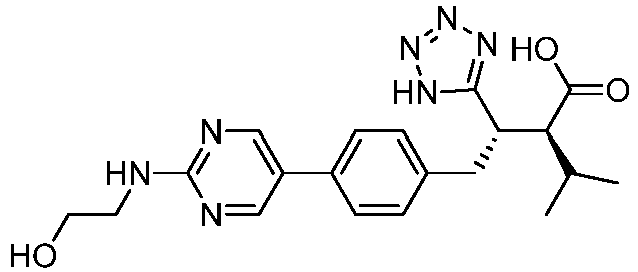
(2S,3 S)-4-(4-(2-((2-hydroxyethyl)amino)pyrimidin-5-yl)phenyl)-2-isopropyl-3-(1H-tetrazol-5-yl)butanoic acid 412.5 412.2 -
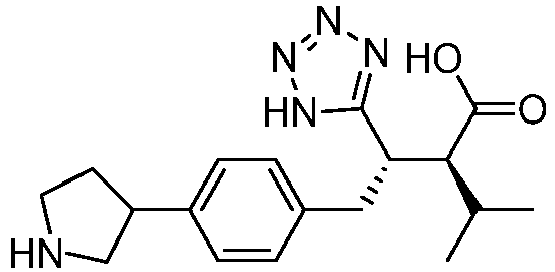
- The intermediate was prepared from (2S,3S)-tert-butyl 4-(4-bromophenyl)-2-isopropyl-3-(1H-tetrazol-5-yl)butanoate and tert-butyl 3-(4,4,5,5-tetramethyl-1,3,2-dioxaborolan-2-yl)-2,5-dihydro-1H-pyrrole-1-carboxylate following step A of EXAMPLE 45.
LC-MS m/z [M+H]+ 498.44 - The product above (95 mg, 0.19 mmol) was treated with Pd-C (20 mg, 0.19 mmol) in MeOH under an atmosphere of hydrogen for 16 hours. LC showed complete reaction. The reaction was filtered and concentrated to give the crude product. LC-MS m/z [M+H]+ 500.34
- To a flask charged with crude tert-butyl 3-(4-((2S,3S)-3-(tert-butoxycarbonyl)-4-methyl-2-(1H-tetrazol-5-yl)pentyl)phenyl)pyrrolidine-1-carboxylate (80 mg, 0.15 mmol) was added thioanisol (0.2 mL, 1.7 mmol) and TFA (2 mL, 26 mmol). The mixture was allowed to stir at RT for 3 hours. LC showed complete reaction. The reaction was concentrated, and the residue was purified by purified by HPLC with ACN and water (with 0.05% TFA). LC-MS m/z [M+H]+ 370.28
The following compounds were prepared following the same procedure as EXAMPLE 78:Ex. No. Structure Name Calc'd Mass [M+H]+ LC/MS m/e [M+H]+ 79 
3-(4-((2S,3 S)-3-carboxy-3-cyclopentyl-2-(1H-tetrazol-5-yl)propyl)phenyl)pyrrolidin-1-ium 370.5 370.3 80 
4-(4-((2S,3 S)-3-carboxy-3-cyclopentyl-2-(1H-tetrazol-5-yl)propyl)phenyl)piperidine 384.5 384.3 81 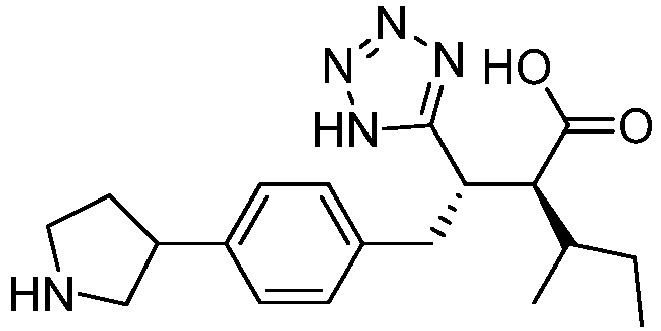
(2S,3S)-3-methyl-2-((1S)-2-(4-(pyrrolidin-3-yl)phenyl)-1-(1H-tetrazol-5-yl)ethyl)pentanoic acid 358.5 358.2 -

- In a 25 ml RB flask under N2, diisopropylamine (1.42 ml, 10 mmol), was dissolved in 10 ml THF and cooled to -78°C. n-BuLi in hexane (4.0 ml, 10 mmol) was added. The LDA solution (0.65 M) was stirred for 15 mins at -15°C before using it. In another 25 ml RB flask, (S)-2-((1-((2-(trimethylsilyl)ethoxy)methyl)-1H-tetrazol-5-yl)methyl)pentanoic acid (92 mg, 0.293 mmol) was added to THF (5 ml) then cooled to -78 °C and then to the reaction mixture was added the above LDA in THF (1.12 ml, 0.73 mmol). The reaction mixture was stirred for 45 mins at -78°C then 2-chloro-5-chloromethylpyridine (47 mg, 0.29 mmol suspended in 4 ml THF) was added. The reaction turned orange in color and was stirred at -78°C for 1 hr. The reaction mixture was quenched with saturated NH4Cl (4 ml) and extracted with EtOAc (2 x 10 ml). The organic layer was dried over Na2SO4, filtered and concentrated. The residue was purified by reverse phase HPLC with ACN and water buffered with 0.05% TFA. LC-MS [M+1]: 440.39.
- (S)-2-((S)-2-(6-chloropyridin-3-yl)-1-(1-((2-(trimethylsilyl)ethoxy)methyl)-1H-tetrazol-5-yl)ethyl)pentanoic acid (10 mg, 0.023 mmol) was heated in HCl (1 ml, 2M)/EtOH (2 ml) at 60°C for 9 hrs. The reaction was cooled and concentrated, then the residue was purified by reverse phase HPLC with ACN and water buffered with 0.05% TFA. LC-MS [M+1]: 310.19.
The following compounds were prepared following the same procedure as EXAMPLE 82.Ex. No. Structure IUPAC Name Calc'd Mass [M+H]+ LC/MS m/e [M+H]+ 83 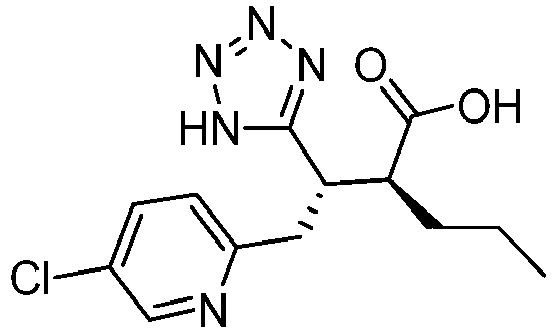
(S)-2-((S)-2-(5-chloropyridin-2-yl)-1-(1H-tetrazol-5-yl)ethyl)pentanoic acid 310.11 310.26 84 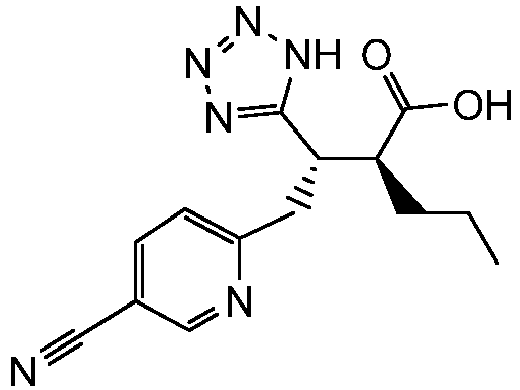
(2S)-2-[(1S)-2-(5-cyanopyridin-2-yl)-1-(1H-tetrazol-5-yl)ethyl]pentanoic acid 301.14 301.06 85 
(2S)-2-[(1S)-2-(6-methylpyridin-3-yl)-1-(1H-tetrazol-5-yl)ethyl]pentanoic acid 290.16 290.11 86 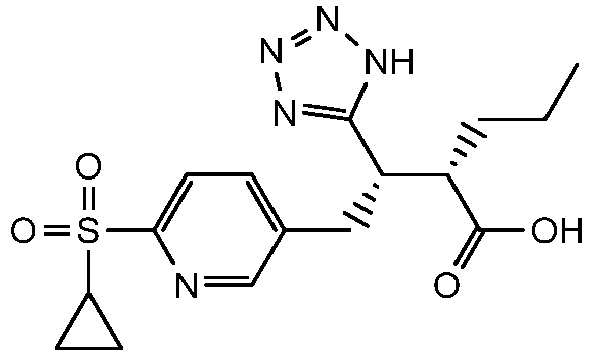
(2S)-2-[(1S)-2-[6-(cyclopropylsulfonyl) pyridin-3-yl]-1-(1H-tetrazol-5-yl)ethyl]pentanoic acid 380.14 380.16 87 
(2S)-2-[(1S)-2-(2-chloropyridin-3-yl)-1-(1H-tetrazol-5-yl)ethyl]pentanoic acid 310.11 310.03 88 
(2S)-2-[(1S)-2-pyridin-4-yl-1-(1H-tetrazol-5-yl)ethyl]pentanoic acid 276.15 276.10 89 
(2S,3S)-2-isopropyl-4-(piperidin-4-yl)-3-(1H-tetrazol-5-yl)butanoic acid 282.4 282.1 90 
(2S,3S)-4-(1-acetylpiperidin-4-yl)-2-isopropyl-3-(1H-tetrazol-5-yl)butanoic acid 324.4 324.1 91 
(2S,3S)-4-(6-bromopyridin-3-yl)-2-isopropyl-3-(1H-tetrazol-5-yl)butanoic acid 355.2 355.9 92 
(2S,3S)-4-(6-bromopyridin-2-yl)-2-isopropyl-3-(1H-tetrazol-5-yl)butanoic acid 355.2 356.0 -

- A mixture of (S)-2-((S)-2-(5-cyanopyridin-2-yl)-1-(1H-tetrazol-5-yl)ethyl)pentanoic acid (8 mg, 0.027 mmol) and sulfuric acid (400 µL, 7.5 mmol) was stirred at RT over the weekend. To the mixture was added ice, and the mixture was neutralized with aq. KOH (5 N). EtOAc was added for partitioning while pH was 4-5. The organic was dried over Na2SO4, filtered, and evaporated to dryness. The crude was purified by reverse phase with C-18 prep. HPLC to obtain product, (S)-2-((S)-2-(5-carbamoylpyridin-2-yl)-1-(1H-tetrazol-5-yl)ethyl) pentanoic acid. LC-MS m/z 319.06 (calc. m/z 319.15).
-

- To a solution of (S)-2-((1-((2-(trimethylsilyl)ethoxy)methyl)-1H-tetrazol-5-yl)methyl)pentanoic acid (93 mg, 0.30 mmol) in THF was added lithium diisopropylamide (0.37 mL, 0.74 mmol) at -78°C. The mixture was allowed to stir at -78°C for 40 minutes, and then to the mixture was added methyl 6-(bromomethyl)picolinate (81 mg, 0.35 mmol) in THF. The reaction was warmed up to RT naturally and stirred overnight. To the mixture was added sat. aq. NH4Cl and EtOAc for partitioning. The organic layer was separated, dried over Na2SO4, and evaporated to dryness. The crude material was used directly in step B.
- In a vial, half of the crude (67 mg, 0.14 mmol) was dissolved in EtOH (1.5 ml)/1.5 ml 1N HCl, and heated at 60°C overnight. The reaction was concentrated and the residue was purified by reverse phase C18 HPLC to obtain the product, 6-((2S,3S)-3-carboxy-2-(1H-tetrazol-5-yl)hexyl)picolinic acid. LC-MS m/z [M+H]+ 320.04 (calc. m/z 320.14).
-
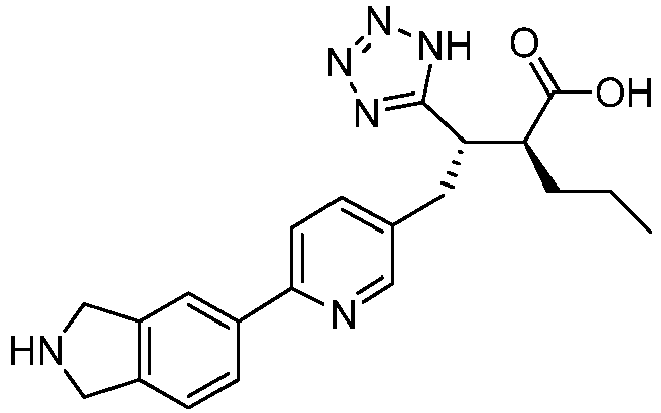
- In a 5 ml microwave tube, (S)-tert-butyl 2-((S)-2-(6-bromopyridin-3-yl)-1-(1H-tetrazol-5-yl)ethyl)pent-4-enoate (90 mg, 0.22 mmol) was dissolved in ethanol (2 ml)/water (1 ml) and to which was added tert-butyl 5-(4,4,5,5-tetramethyl-1,3,2-dioxaborolan-2-yl)isoindoline-2-carboxylate, potassium phosphate tribasic (190 mg, 0.88 mmol). The tube was capped and degassed by vacuum and purged with N2. The tube was uncapped and 1,1'-bis(di-tert-butylphosphino)ferrocene palladium dichloride (14 mg, 0.022 mmol) was added then the tube was recapped and degassed again. The tube was microwaved at 100°C for 1/2 hr. The reaction was filtered and concentrated. The residue was purified by reverse phase HPLC with ACN and water buffered with 0.05% TFA. LC-MS [M+1]: 547.39.
- In a 100 ml RB flask equipped with a three way stopcock attached to a balloon of H2, tert-butyl 5-(5-((2S,3S)-3-(tert-butoxycarbonyl)-2-(1H-tetrazol-5-yl)hex-5-en-1-yl)pyridin-2-yl)isoindoline-2-carboxylate (57 mg, 0.10 mmol) was dissolved in MeOH (5 ml) and Pd-C (20 mg, 0.19 mmol) was added. The reaction was vacuumed and flushed with H2 (3x) then stirred under H2 at RT for 1.5 hr. The reaction was filtered and concentrated to yield tert-butyl 5-(5-((2S,3S)-3-(tert-butoxycarbonyl)-2-(1H-tetrazol-5-yl)hexyl)pyridin-2-yl)isoindoline-2-carboxylate. LC-MS [M+1]: 549.55.
- In a 10 ml RB flask containing tert-butyl 5-(5-((2S,3S)-3-(tert-butoxycarbonyl)-2-(1H-tetrazol-5-yl)hexyl)pyridin-2-yl)isoindoline-2-carboxylate (57 mg, 0.10 mmol) thioanisole (1 ml, 8.4 mmol) was added followed by TFA (2 mL, 26 mmol). The reaction mixture was stirred at RT for 2 hrs. The reaction was concentrated and the residue was purified by reverse phase HPLC with ACN and water buffered with 0.05% TFA. LC-MS [M+1]: 393.35
-

- In a 5 ml microwave tube, (S)-2-((S)-2-(6-chloropyridin-3-yl)-1-(1-((2-(trimethylsilyl)ethoxy)methyl)-1H-tetrazol-5-yl)ethyl)pentanoic acid (50 mg, 0.114 mmol) was dissolved in ethanol (1.5 mL)/water (0.5 mL) and then 4-((n-BOC-amino)methyl)phenylboronic acid (43 mg, 0.17 mmol) and potassium phosphate tribasic (96 mg, 0.46 mmol) were added. The tube was capped and degassed by vaccuum and purged with N2. The tube was uncapped and 1,1'-bis(di-tert-butylphosphino)ferrocene palladium dichloride (14.8 mg, 0.023 mmol) was added then the tube was capped and degassed again. The reaction was microwaved at 100°C for 1.5 hr. The reaction was filtered and concentrated. The residue was purified by reverse phase HPLC with ACN and water buffered with 0.05% TFA to yield (S)-2-((S)-2-(6-(4-(((tert-butoxycarbonyl)amino)methyl)phenyl)pyridin-3-yl)-1-(1-((2-(trimethylsilyl)ethoxy)methyl)-1H-tetrazol-5-yl)ethyl)pentanoic acid. LC-MS [M+1]: 611.56
- To a 25 ml RB flask charged with (S)-2-((S)-2-(6-(4-(((tert butoxycarbonyl)amino)methyl)phenyl) pyridin-3-yl)-1-(1-((2-(trimethylsilyl)ethoxy)methyl)-1H-tetrazol-5-yl)ethyl)pentanoic acid (40 mg, 0.065 mmol) was added thioanisole (0.5 ml, 4.23 mmol) followed by TFA (1 mL). The reaction was stirred for 2 hrs. LCMS showed product peak. The reaction was concentrated and the residue was purified by reverse phase HPLC with ACN and water buffered with 0.05% TFA to yield (S)-2-((S)-2-(6-(4-(aminomethyl)phenyl)pyridin-3-yl)-1-(1H-tetrazol-5-yl)ethyl)pentanoic acid. LC-MS [M+1]: 381.34
-

- The compound was prepared following the same procedure as EXAMPLE 96 from a mixture of 5-(4-(4,4,5,5-tetramethyl-1,3,2-dioxaborolan-2-yl)phenyl)-2H-tetrazole, (S)-2-((S)-2-(6-chloropyridin-3-yl)-1-(1-((2-(trimethylsilyl)ethoxy)methyl)-1H-tetrazol-5-yl)ethyl)pentanoic acid, potassium phosphate tribasic and 1,1'-bis(di-tert-butylphosphino)ferrocene palladium dichloride in EtOH-water (1.5:0.5 ml). LC-MS [M+1]: 420.30
-
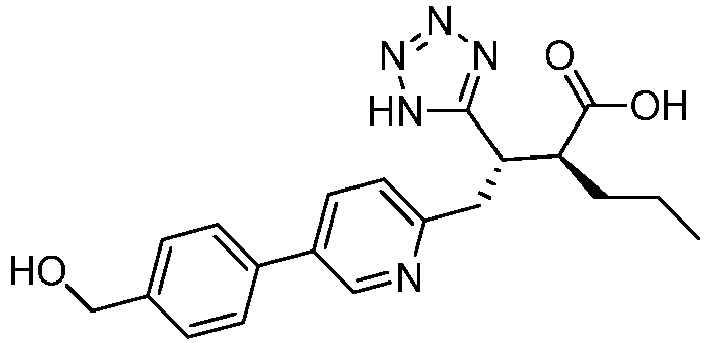
- The compound was prepared following the same procedure as EXAMPLE 96 from a mixture of (S)-2-((S)-2-(5-bromopyridin-2-yl)-1-(1-((2-(trimethylsilyl)ethoxy)methyl)-1H-tetrazol-5-yl)ethyl)pentanoic acid, (4-(4,4,5,5-tetramethyl-1,3,2-dioxaborolan-2-yl)phenyl)methanol, potassium phosphate tribasic and 1,1'-bis(di-tert-butylphosphino)ferrocene palladium dichloride in EtOH-water (2: 0.4 ml). LC-MS [M+1]: 382.33
-

- To a 25 mL microwave vial with a stir bar was added tert-butyl 5-(4,4,5,5-tetramethyl-1,3,2-dioxaborolan-2-yl)isoindoline-2-carboxylate (260 mg, 0.75 mmol), (5-bromopyridin-2-yl)methanol (212 mg, 1.13 mmol), 1,1'-bis(di-tert-butylphosphino)ferrocene palladium dichloride (49 mg, 0.075 mmol), and K3PO4 (480 mg, 2.3 mmol). The vial was sealed, and then EtOH (4 ml) and water (2 ml) were added. The mixture was flushed with nitrogen, and then heated to 100°C for 30 minutes. LC showed very good reaction. The reaction was diluted with 1 mL of water, and the organic layer was diluted with EtOAc (5 mL). The crude solution was sucked out with a syringe. The solution was evaporated on a rotavapor, and the residue was dissolved in DCM and injected onto a 24G ISCO column. The desired product was isolated by MPLC with hexane and EtOAc gradient. The product was eluted at about 100% EtOAc. It was a yellow solid. LC-MS [M+1]: 327.2
- To a solution of tert-butyl 5-(6-(hydroxymethyl)pyridin-3-yl)isoindoline-2-carboxylate (200 mg, 0.61 mmol) in DCM (15 ml) was added TEA (0.085 ml, 0.61 mmol) and methanesulfonyl chloride (0.048 ml, 0.61 mmol) at 0°C. The ice bath was removed when all reagents were added. TLC showed fairly clean reaction after 2 hours at RT. The reaction was diluted with 30 mL of DCM, washed with aq. NH4Cl, and separated. The solution was dried over sodium sulfate, filtered and concentrated to give a light yellow foam. The form turned pink in a few minutes. It was used in the next alkylation step without further purification. LC-MS [M+1]: 405.3
- To a solution of tert-butyl 5-(6-(((methylsulfonyl)oxy)methyl)pyridin-3-yl)isoindoline-2-carboxylate (400 mg, 0.99 mmol) in acetonitrile (10 ml) was added lithium chloride (126 mg, 3.0 mmol). The mixture was allowed to stir at RT for 20 hours. LC showed very clean conversion. The reaction was diluted with DCM to precipitate all the solids. The solids were filtered off, and the filtrate was concentrated. The residue was loaded onto a 24G ISCO column, and separated by MPLC with hexane and EtOAc. The product was a colorless oil. LC-MS [M+1]: 345.2
- To a solution of (S)-4-methyl-2-((2-((2-(trimethylsilyl)ethoxy)methyl)-2H-tetrazol-5-yl)methyl)pentanoic acid (110 mg, 0.34 mmol) in THF (6 ml) was added LDA (1.2 ml, 0.84 mmol). The mixture was allowed to stir at -78°C for 45 minutes before tert-butyl 5-(5-(chloromethyl)pyridin-2-yl)isoindoline-2-carboxylate (115 mg, 0.34 mmol) in 2 mL THF was added in. LC showed a small amount of the desired product. The reaction was quenched with aq. NH4Cl, extracted with EtOAc, and separated. The solution was dried over sodium sulfate, filtered, and concentrated. The residue was dissolved in MeOH, and purified by Gilson HPLC with ACN and water (with 0.05% TFA) to give a small amount of the desired product. LC-MS [M+1]: 637.4
- To a solution of (S)-2-((S)-2-(5-(2-(tert-butoxycarbonyl)isoindolin-5-yl)pyridin-2-yl)-1-(2-((2-(trimethylsilyl)ethoxy)methyl)-2H-tetrazol-5-yl)ethyl)-4-methylpentanoic acid (65 mg, 0.10 mmol) in DCM (5 ml) was added TFA (1.0 mL, 13 mmol). The mixture was stirred at room temperature under N2 for 2 hours. The mixture was concentrated under reduced pressure and purified by Gilson (Water, Sunfire Prep C18 OBD 5uL 19 x 100mm column, 0%→40% MeCN in 20 min run, 10 mL/min) to give desire compound. LC-MS [M+1]: 407.3
-
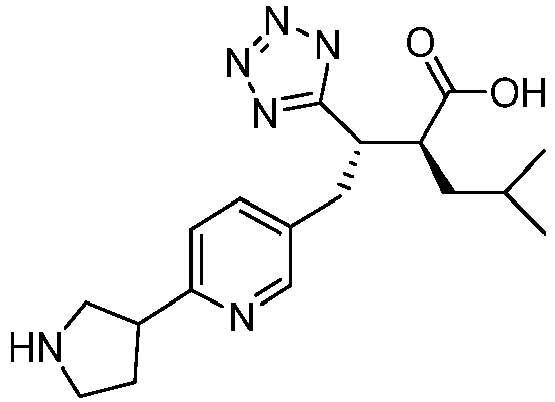
- A solution of (S)-2-((S)-2-(6-bromopyridin-3-yl)-1-(2-((2-(trimethylsilyl)ethoxy)methyl)-2H-tetrazol-5-yl)ethyl)-4-methylpentanoic acid (70 mg, 0.14 mmol), 1,1'-bis(di-tert-butylphosphino)ferrocene palladium dichloride (18 mg, 0.028 mmol), K3PO4 (0.49 mL, 0.49 mmol) and tert-butyl 3-(4,4,5,5-tetramethyl-1,3,2-dioxaborolan-2-yl)-2,5-dihydro-1H-pyrrole-1-carboxylate (104 mg, 0.35 mmol) in ethanol (2 mL) was flashed with N2 4 times. The reaction mixture was stirred at 75°C under N2 overnight. A small amount of water was added and the organic was extracted with EtOAc 3 times. The organic was concentrated under vacuum. The crude was dissolved in ACN and water and purified by Gilson, Water, Sunfire Prep C18 OBD 5 µL 19 x 100 mm column, 10%→ 100% MeCN in 12 min. LC-MS [M+1]: 587.34
- A solution of (S)-2-((S)-2-(6-(1-(tert-butoxycarbonyl)-2,5-dihydro-1H-pyrrol-3-yl)pyridin-3-yl)-1-(2-((2-(trimethylsilyl)ethoxy)methyl)-2H-tetrazol-5-yl)ethyl)-4-methylpentanoic acid (26 mg, 0.044 mmol) and Pd-C (9.4 mg, 8.9 µmol) in Ethanol (1 ml) was degassed and flashed with N2 3x then H2 4x. The mixture was stirred under H2 for 2 hours. The crude UPLC indicated the desired MS. The mixture was filtered and concentrated under vacuum. The crude was taken on as is for the next step. LC-MS [M+1]: 589.36
- A solution of (2S)-2-((1S)-2-(6-(1-(tert-butoxycarbonyl)pyrrolidin-3-yl)pyridin-3-yl)-1-(2-((2-(trimethylsilyl)ethoxy)methyl)-2H-tetrazol-5-yl)ethyl)-4-methylpentanoic acid (25 mg, 0.042 mmol) and HCl (1 mL, 1.0 mmol) in ethanol (1 ml) was heated at 60°C for 1 hr. The crude UPLC indicated a desired peak at 359 m/z. The solution was directly injected into Gilson (Water, Sunfire Prep C18 OBD 5 µL 19 x 100 mm column, 0%→50% MeCN in 12 min run) to give the desired compound. LC-MS [M+1]: 359.2
The following compounds were prepared according to the same procedure as EXAMPLE 100.EX. NO. Structure Name Calc'd mass [M+H]+ MS found 101 
(S)-4-methyl-2-((S)-2-(5-(piperidin-4-yl)pyridin-2-yl)-1-(1H-tetrazol-5-yl)ethyl)pentanoic acid 373.24 373.40 102 
(S)-4-methyl-2-((S)-2-(4-(piperidin-4-yl)phenyl)-1-(1H-tetrazol-5-yl)ethyl)pentanoic acid 372.24 372.34 103 
(S)-4-methyl-2-((S)-2-(6-(piperidin-4-yl)pyridin-3-yl)-1-(1H-tetrazol-5-yl)ethyl)pentanoic acid 373.2 373.2 104 
(2S,3S)-2-isopropyl-4-(6-(piperidin-4-yl)pyridin-3-yl)-3-(1H-tetrazol-5-yl)butanoic acid 359.4 359.2 105 
(2S,3S)-2-isopropyl-4-(6-(pyrrolidin-3-yl)pyridin-3-yl)-3-(1H-tetrazol-5-yl)butanoic acid 345.4 345.2 106 
(2S,3S)-2-isopropyl-4-(5-(pyrrolidin-3-yl)pyridin-2-yl)-3-(1H-tetrazol-5-yl)butanoic acid 343.4 343.2 107 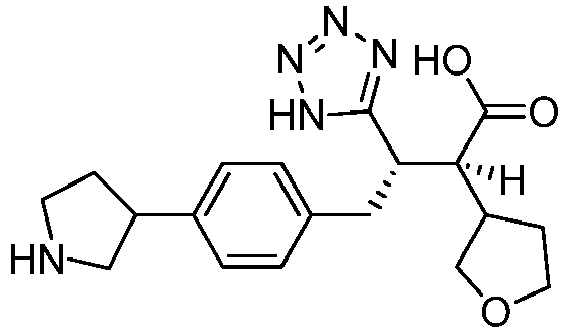
(2R,3S)-4-(4-(pyrrolidin-3-yl)phenyl)-2-(tetrahydrofuran-3-yl)-3-(1H-tetrazol-5-yl)butanoic acid 372.4 372.2 108 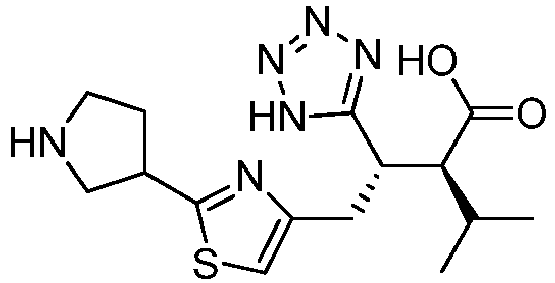
(2S,3S)-2-isopropyl-4-(2-(pyrrolidin-3-yl)thiazol-4-yl)-3-(1H-tetrazol-5-yl)butanoic acid 351.4 350.9 109 
(2S,3S)-4-(3-fluoro-4-(pyrrolidin-3-yl)phenyl)-2-isopropyl-3-(1H-tetrazol-5-yl)butanoic acid 362.4 362.2 110 
(2S,3S)-2-isopropyl-4-(3-methyl-4-(pyrrolidin-3-yl)phenyl)-3-(1H-tetrazol-5-yl)butanoic acid 358.5 358.2 -

- In a 5 ml MW tube, (S)-2-((S)-2-(5-bromopyridin-2-yl)-1-(1-((2-(trimethylsilyl)ethoxy)methyl)-1H-tetrazol-5-yl)ethyl)pentanoic acid (50 mg, 0.10 mmol) was dissolved in ethylene glycol (1 ml) and then N,N'-dimethylethylenediamine (2.2 µl, 0.021 mmol), copper(I) oxide (1.5 mg, 10 µmol), ammonium hydroxide (0.57 ml, 4.1 mmol) and K2CO3 (2.8 mg, 0.021 mmol) were added. The tube was capped and heated at 80°C overnight. LCMS showed the product peak. The reaction was filtered and concentrated. The residue was purified on Gilson Trilution instrument by preparative HPLC reverse phase (C-18) with Phenomenex Luna C18 prep column, 100 Å, 5 µm, 10 mm x 30 mm, eluted with 0-45% acetonitrile/water + 0.05% TFA in 15 ramp time, to give a brown oil. LC-MS [M+1]: 421.7
- In a 25 ml flask, (S)-2-((S)-2-(5-aminopyridin-2-yl)-1-(1-((2-(trimethylsilyl)ethoxy)methyl)-1H-tetrazol-5-yl)ethyl)pentanoic acid (15 mg, 0.036 mmol) was dissolved in DCM (2 ml) then TFA (0.5 ml, 6.5 mmol) was added. Then the reaction mixture was stirred at RT for 2 hrs. The reaction was concentrated and the residue was purified on Gilson Trilution instrument by preparative HPLC Reverse phase (C-18) with Phenomenex Luna C18 prep column, 100 Å, 5 µm, 10 mm x 30 mm, eluted with 0-40% Acetonitrile/Water (0.05% TFA), to give the desired product. LC-MS [M+1]: 291.2
- The following compounds were prepared following the same procedure as EXAMPLE 111.
Ex. No. Structure IUPAC Name Calc'd Mass [M+H]+ LC/MS m/e [M+H]+ 112 
2-amino-5-((2S,3S)-3-carboxy-5-methyl-2-(2H-tetrazol-5-yl)hexyl)pyridin-1-ium 2,2,2-trifluoroacetate 305.2 305.2 113 
5-amino-2-((2S,3S)-3-carboxy-5-methyl-2-(2H-tetrazol-5-yl)hexyl)pyridin-1-ium 2,2,2-trifluoroacetate 305.2 305.2 114 
(S)-2-((S)-2-(6-aminopyridin-3-yl)-1-(1H-tetrazol-5-yl)ethyl)pentanoic acid 291.2 291.2 115 
(2S)-2-[(1S)-2-(2-amino-1,3-thiazol-5-yl)-1-(1H-tetrazol-5-yl)ethyl]pentanoic acid 297.1 297.2 116 
(2S)-2-[(1S)-2-(2-amino-1,3-thiazol-5-yl)-1-(1H-tetrazol-5-yl)ethyl]-4-methylpentanoic acid 311.1 311.5 117 
(2S)-2-[(1S)-2-(6-aminopyridin-2-yl)-1-(1H-tetrazol-5-yl)ethyl]pentanoic acid 291.2 291.2 118 
(2S)-2-[(1S)-2-(2-aminopyridin-4-yl)-1-(1H-tetrazol-5-yl)ethyl]pentanoic acid 291.2 291.1 119 
(S)-2-((S)-2-(3-aminoquinolin-6-yl)-1-(1H-tetrazol-5-yl)ethyl)-4-methylpentanoic acid 355.2 355.2 120 
(S)-2-((S)-2-(2-(piperazin-1-yl)thiazol-5-yl)-1-(1H-tetrazol-5-yl)ethyl)pentanoic acid 366.2 366.6 121 
(2S,3S)-4-(6-aminopyridin-3-yl)-2-isopropyl-3-(1H-tetrazol-5-yl)butanoic acid 291.3 291.1 122 
(2S,3S)-4-(6-aminopyridin-3-yl)-2-cyclopentyl-3-(1H-tetrazol-5-yl)butanoic acid 317.2 317.1 123 
(2R,3S)-4-(6-aminopyridin-3-yl)-2-(tert-butyl)-3-(1H-tetrazol-5-yl)butanoic acid 305.2 305.1 124 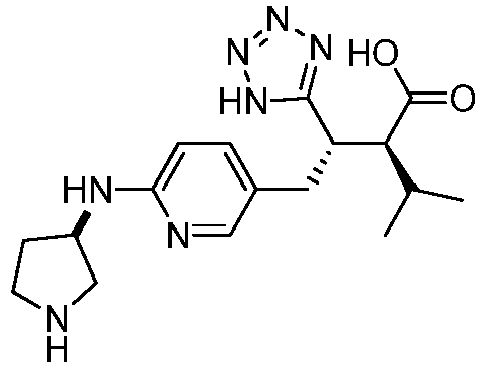
(2S,3S)-2-isopropyl-4-(6-((R)-pyrrolidin-3-ylamino)pyridin-3-yl)-3-(1H-tetrazol-5-yl)butanoic acid 360.4 360.2 125 
(2S,3S)-4-(5-aminopyridin-2-yl)-2-isopropyl-3-(1H-tetrazol-5-yl)butanoic acid 291.3 291.2 126 
(2S,3S)-4-(6-((S)-2-(hydroxymethyl)pyrrolidin-1-yl)pyridin-3-yl)-2-isopropyl-3-(1H-tetrazol-5-yl)butanoic acid 375.4 375.2 127 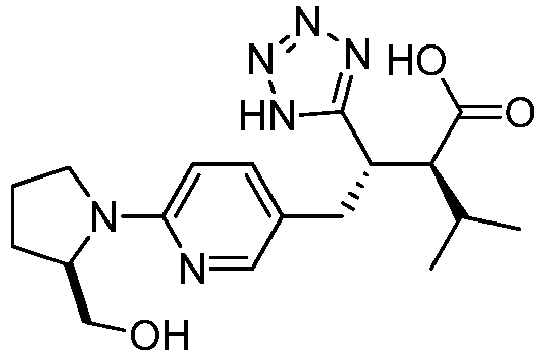
(2S,3S)-4-(6-((R)-2-(hydroxymethyl)pyrrolidin-1-yl)pyridin-3-yl)-2-isopropyl-3-(1H-tetrazol-5-yl)butanoic acid 375.4 375.2 -

- Ammonium hydroxide (0.85 ml, 6.4 mmol) was added to a stirred, room temperature mixture of (2S,3S)-4-(2-chloropyrimidin-5-yl)-2-isopropyl-3-(1-((2-(trimethylsilyl)ethoxy)methyl)-1H-tetrazol-5-yl)butanoic acid (70 mg, 0.16 mmol) and dioxane (0.2 mL) in a vial and the mixture was stirred at 65°C overnight. The reaction mixture was neutralized to pH∼7 with IN HCl, and concentrated down. The residue was purified by column chromatography on a C18 column, eluting with acetonitrile/water + 0.1% TFA (0∼95∼30%) to give the product. LC-MS m/z [M+1]+ 422.23
- To a solution of (2S,3S)-4-(2-aminopyrimidin-5-yl)-2-isopropyl-3-(1-((2-(trimethylsilyl)ethoxy)methyl)-1H-tetrazol-5-yl)butanoic acid (23 mg, 0.039 mmol) in DCM (0.5 mL) was added thioanisole (0.015 ml, 0.13 mmol) followed by TFA (1 mL). Then the reaction mixture was stirred at RT for 3 hrs. The volatiles were evaporated and the residue was purified on a Gilson Trilution instrument by preparative HPLC Reverse phase (C-18), eluted with 5-95% Acetonitrile/Water + 0.05% TFA, to give the product. LC-MS [M+1]: 292.09
-

- In a 5 ml MW tube, (S)-2-((S)-2-(6-bromopyridin-3-yl)-1-(1-((2-(trimethylsilyl)ethoxy)methyl)-1H-tetrazol-5-yl)ethyl)pentanoic acid (50 mg, 0.10 mmol), 2-aminoethanol (9.3 µl, 0.16 mmol), Cs2CO3 (67 mg, 0.21 mmol) and Buchwald preformed ketone (8.2 mg, 0.021 mmol) were suspended in DMF (1 mL), and then degassed and backfilled and sealed under N2. The reaction mixture was microwaved at 100°C for 1 hr. The reaction was filtered and concentrated. The residue was purified on Gilson Trilution instrument by preparative HPLC Reverse phase (C-18) with Phenomenex Luna C18 prep column, 100 Å, 5 µm, 10 mm x30 mm, eluted with 10-90% in 15 mins ramp time Acetonitrile/Water with 0.05% TFA. LC-MS m/z [M+1]+ 465.29
- The material obtained above was treated with TFA (1 mL) in DCM (1 mL) for 2 hours at RT. The reaction was concentrated, and the residue was purified by preparative HPLC Reverse phase (C-18) with Phenomenex Luna C18 prep column, 100 Å, 5 µm, 10 mm x30 mm, eluted with 0-40% in 15 mins ramp time acetonitrile/water with 0.05% TFA.
- The following compounds are prepared following the same procedure as EXAMPLES 129 and 130.
Ex. NO. Structure IUPAC Name Calc'd Mass [M+H]+ LC/MS m/e [M+H]+ 131 
(S)-2-((S)-2-(6-(4-(aminomethyl)phenoxy)pyridin-3-yl)-1-(1H-tetrazol-5-yl)ethyl)pentanoic acid 397.19 397.32 132 
(S)-2-((S)-2-(6-((4-hydroxybenzyl)amino)pyridin-3-yl)-1-(1H-tetrazol-5-yl)ethyl)pentanoic acid 397.19 397.32 133 
(S)-2-((S)-2-(3-((2-hydroxyethyl)amino)quinolin-7-yl)-1-(1H-tetrazol-5-yl)ethyl)-4-methylpentanoic acid 297.1 297.2 134 
(S)-2-((S)-2-(6-((2-hydroxyethyl)amino)pyridin-3-yl)-1-(1H-tetrazol-5-yl)ethyl)-4-methylpentanoic acid 349.2 349.2 135 
(S)-2-((S)-2-(6-(2-aminoethoxy)pyridin-3-yl)-1-(1H-tetrazol-5-yl)ethyl)-4-methylpentanoic acid 349.2 349.2 136 
(S)-2-((S)-2-(5-((2-hydroxyethyl)amino)pyridin-2-yl)-1-(1H-tetrazol-5-yl)ethyl)pentanoic acid 335.2 335.1 137 
(S)-2-((S)-2-(2-((2-hydroxyethyl)amino)thiazol-5-yl)-1-(1H-tetrazol-5-yl)ethyl)-4-methylpentanoic acid 355.2 355.2 138 
(2S,3S)-4-(6-((2-hydroxyethyl)amino)pyridin-2-yl)-2-isopropyl-3-(1H-tetrazol-5-yl)butanoic acid 335.4 335.1 139 
(2S,3S)-4-(5-((2-hydroxyethyl)amino)pyridin-2-yl)-2-isopropyl-3-(1H-tetrazol-5-yl)butanoic acid 335.4 335.1 140 
(2S,3S)-4-(6-((2-aminoethyl)amino)pyridin-3-yl)-2-isopropyl-3-(1H-tetrazol-5-yl)butanoic acid 334.4 334.2 141 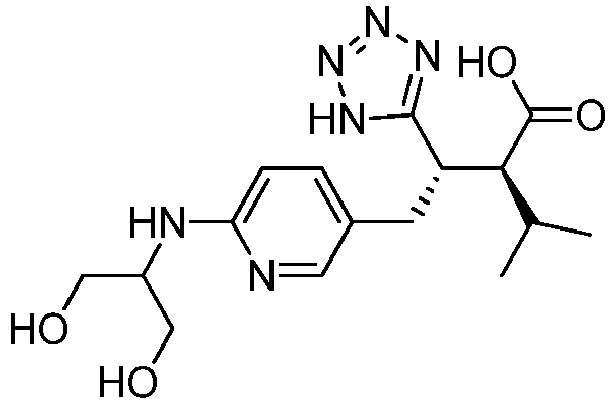
(2S,3S)-4-(6-((1,3-dihydroxypropan-2-yl)amino)pyridin-3-yl)-2-isopropyl-3-(1H-tetrazol-5-yl)butanoic acid 365.4 365.2 142 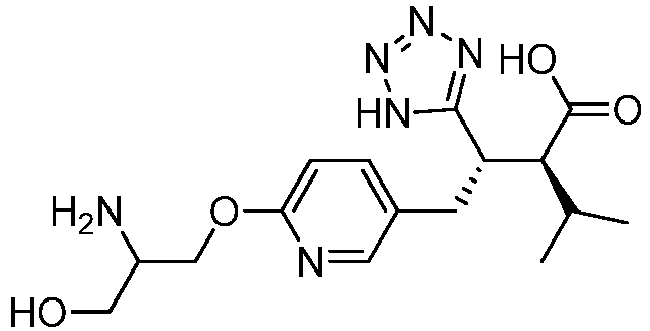
(2S,3S)-4-(6-(2-amino-3-hydroxypropoxy)pyridin-3-yl)-2-isopropyl-3-(1H-tetrazol-5-yl)butanoic acid 365.4 365.2 -

- To a flask charged with (S)-tert-butyl 2-((S)-2-(6-bromopyridin-3-yl)-1-(1H-tetrazol-5-yl)ethyl)pentanoate (86 mg, 0.21 mmol) was added thioanisole (1 mL, 8.4 mmol) and TFA (2 mL). The mixture was allowed to stir for 3 hours at RT. The reaction was concentrated and then the residue was purified on Gilson Trilution instrument by preparative HPLC Reverse phase (C-18) with Phenomenex Luna C18 prep column, 100Å, 5 µm, 10 mm x 30 mm, eluted with acetonitrile/water + 0.05% TFA. LC-MS [M+1]: 354.2
-

- In a 5 ml MW tube, (S)-tert-butyl 2-((S)-2-(6-bromopyridin-3-yl)-1-(1H-tetrazol-5-yl)ethyl)pent-4-enoate (90 mg, 0.22 mmol), (3,5-dimethoxyphenyl)methanamine (55 mg, 0.33 mmol), Buckwald CuI - 2-isobutyrylcyclohexanone precatalyst (18 mg, 0.044 mmol) and Cs2CO3 (140 mg, 0.44 mmol) were suspended in DMF (1 mL) then degassed and backfilled and sealed under N2. The reaction was microwaved at 100°C for 0.5 hr. The reaction was filtered and concentrated. The residue was purified on Gilson Trilution instrument by preparative HPLC Reverse phase (C-18) with Phenomenex Luna C18 prep column, 100Å, 5 µm, 10 mm x 30mm, eluted with 10-100% in 12 mins Acetonitrile/Water + 0.05% TFA, isolated peak to give a cream foam. LC-MS [M+1]: 495.41
- In a 25 ml RB flask, a mixture of (S)-tert-butyl 2-((S)-2-(6-((3,5-dimethoxybenzyl)amino)pyridin-3-yl)-1-(1H-tetrazol-5-yl)ethyl)pent-4-enoate (18 mg, 0.036 mmol) and Pd-C (3.9 mg, 0.036 mmol) was dissolved in MeOH, and then degassed and backfilled with H2. The reaction was stirred under a balloon of hydrogen at RT. After 3 hrs, LC-MS showed hydrogenation of double bond, but the 3,5-dimethoxybenzyl group was still attached. The reaction mixture was filtered and concentrated in vacuum. To the residue was added thioanisole (1.0 ml, 8.4 mmol) followed by TFA (2.0 ml, 26 mmol). The residue was purified on Gilson HPLC (C-18), eluted with 10-100% acetonitrile/water + 0.05% TFA, to furnish the product. LC-MS [M+1]: 441.37
-
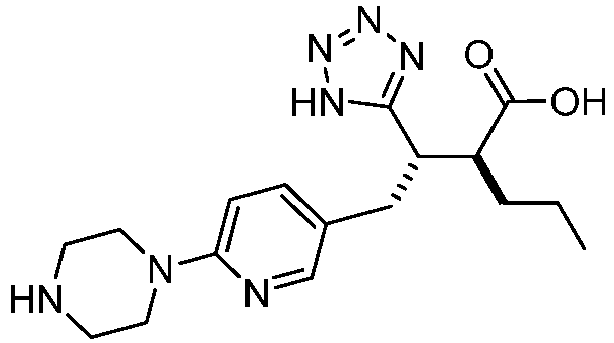
- In a 5 ml microwave tube, (S)-tert-butyl 2-((S)-2-(6-bromopyridin-3-yl)-1-(1H-tetrazol-5-yl)ethyl)pent-4-enoate (90 mg, 0.22 mmol), tert-butyl piperazine-1-carboxylate (49 mg, 0.26 mmol), sodium tert-butoxide (42 mg, 0.44 mmol) and chloro(2-dicyclohexylphosphino-2',6'-di-propoxy-1,1'-biphenyl)[2-(2-aminoethylphenyl)] palladium(II), methyl-t-butylether adduct (9.0 mg, 0.011 mmol) were suspended in THF (1 ml) then degassed and backfilled and sealed under N2. The reaction was microwaved at 100°C for 0.5 hr. LC-MS showed product peak. The residue was purified on Gilson Trilution instrument by preparative HPLC Reverse phase (C-18) with Phenomenex Luna C18 prep column, 100 Å, 5 µm, 10 mm x 30 mm, eluted with 10-100% acetonitrile/water + 0.05% TFA, to give a cream color foam. LC-MS [M+1]: 441.37
- In a 100 ml RB flask equipped with a three way stopcock attached to a balloon of H2, tert-butyl 4-(5-((2S,3S)-3-(tert-butoxycarbonyl)-2-(1H-tetrazol-5-yl)hex-5-en-1-yl)pyridin-2-yl)piperazine-1-carboxylate (30 mg, 0.058 mmol) was dissolved in MeOH (5 ml) and Pd/C (12 mg, 0.11 mmol) was added. The reaction was vacuumed and flushed with H2 (3x) from a balloon then stirred under H2 at RT for 1.5 hrs. LC-MS showed hydrogenated product. The reaction was filtered and concentrated. The resulting crude was further treated with thioanisole (1 ml, 8.4 mmol) followed by TFA (2 ml, 26 mmol). After 2 hrs at RT, LC showed the product peak. The reaction was concentrated, and the residue was purified on Gilson HPLC (C-18), eluted with 10-100% Acetonitrile/Water + 0.05% TFA, to furnish the product. LC-MS [M+1]: 360.20
-

- The compound was prepared following the same procedure as EXAMPLE 145. LC-MS m/z [M+1]: 391.25 (calc. m/z 391.23).
-

- In a 25 ml RB flask, 2-chloroquinoline-7-carboxylic acid (560 mg, 2.7 mmol) was dissolved in THF (50 ml) and cooled to -20°C then TEA (0.75 ml, 5.4 mmol) was added followed by isobutyl chloroformate (0.42 ml, 3.2 mmol). The reaction mixture was stirred for 20 min, then filtered and rinsed with THF (10 ml). The filtrate was cooled to -15°C and to this was added NaBH4 (510 mg, 13 mmol). The mixture was stirred at 0°C for 3 hrs. The reaction was quenched with sat'd aqueous ammonium chloride (10 ml) and extracted ethyl acetate (3x). The combined organic layer was washed with brine, dried over NaSO4, filtered and evaporated to dryness. The residue was purified by MPLC ISCO Combi-flash with 0-50% EtOAc/hexane to yield (2-chloroquinolin-7-yl)methanol. LC-MS [M+1]: 193.9
- In a 25 ml RB flask, (2-chloroquinolin-7-yl)methanol (250 mg, 1.3 mmol) was dissolved in DCM (10 ml) and cooled to 0°C then triphenylphosphine (340 mg, 1.3 mmol) was added, followed by carbon tetrabromide (430 mg, 1.3 mmol). The reaction was stirred for 30 mins, then warmed up to RT and stirred ovenight. When LCMS showed SM still present, more triphenylphosphine (340 mg, 1.23 mmol) and carbon tetrabromide (430 mg, 1.3 mmol) were added then stirred at RT overnight. The reaction was concentrated and the residue was purified by MPLC ISCO Combi-flash with 0-50% EtOAc/hexane to yield 7-(bromomethyl)-2-chloroquinoline. LC-MS [M+1]: 255.9
- In a 100 ml RB flask under argon, (S)-2-((1-((2-(trimethylsilyl)ethoxy)methyl)-1H-tetrazol-5-yl)methyl)pentanoic acid (280 mg, 0.88 mmol) was dissolved in THF (15 ml) then cooled to -78°C. LDA (3.4 ml, 0.64 M, 2.2 mmol) was added and the reaction mixture was stirred for 45 mins then 7-(bromomethyl)-2-chloroquinoline (230 mg, 0.88 mmol) in THF was added. The reaction mixture was stirred at -78°C for 5 hrs, and then quenched with sat'd aqueous NH4Cl (3 ml) and extracted with EtOAc 2x, dried (Na2SO4) filtered and concentrated. The residue was purified by preparative MPLC Reverse phase (C-18) with ACN and water buffered with 0.05% TFA to yield (S)-2-((S)-2-(2-chloroquinolin-7-yl)-1-(1-((2-(trimethylsilyl)ethoxy)methyl)-1H-tetrazol-5-yl)ethyl)pentanoic acid. LC-MS [M+1]: 490
- In a 5 ml MW tube, (S)-2-((S)-2-(2-chloroquinolin-7-yl)-1-(1-((2-(trimethylsilyl)ethoxy)methyl)-1H-tetrazol-5-yl)ethyl)pentanoic acid (70 mg, 0.14 mmol) was dissolved in ethylene glycol (1 ml) and added copper(I) oxide (2.0 mg, 0.014 mmol), N,N'-dimethylethylenediamine (3.1 µl, 0.029 mmol), K2CO3 (4.0 mg, 0.029 mmol) and ammonium hydroxide (0.80 ml, 5.7 mmol). The mixture was capped, degassed and purged with N2 then heated at 80°C overnight. LCMS showed the product peak. The reaction was filtered, concentrated then purified by reverse phase HPLC with ACN and water buffered with 0.05% TFA to yield (S)-2-((S)-2-(2-aminoquinolin-7-yl)-1-(1-((2-(trimethylsilyl)ethoxy)methyl)-1H-tetrazol-5-yl)ethyl)pentanoic acid. LC-MS [M+1]: 471.3
- In a 5 ml MW tube (S)-2-((S)-2-(2-aminoquinolin-7-yl)-1-(1-((2-(trimethylsilyl)ethoxy)methyl)-1H-tetrazol-5-yl)ethyl)pentanoic acid (8.4 mg, 0.018 mmol) was dissolved in EtOH (1.5 ml) and HCl (1.5 ml, 1.5 mmol) was added.. The tube was capped and was heated to 60°C overnight The reaction was concentrated then the residue was purified by reverse phase HPLC with ACN and water buffered with 0.05% TFA to yield (S)-2-((S)-2-(2-aminoquinolin-7-yl)-1-(1H-tetrazol-5-yl)ethyl)pentanoic acid. LC-MS [M+1]: 341.2
-
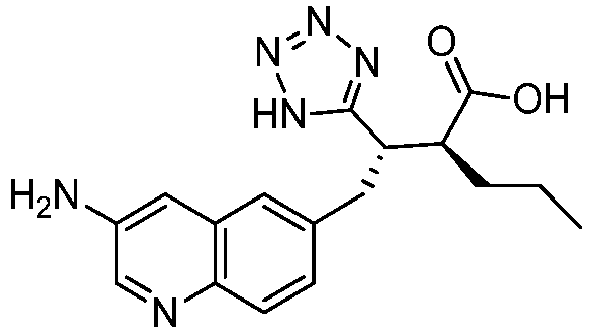
- 3-Amino-6-((2S,3S)-3-carboxy-2-(1H-tetrazol-5-yl)hexyl)quinolin-1-ium 2,2,2-trifluoroacetate was prepared as EXAMPLE 147 with 3-bromo-6-(chloromethyl)quinoline. LC-MS [M+1]: 341.2
-
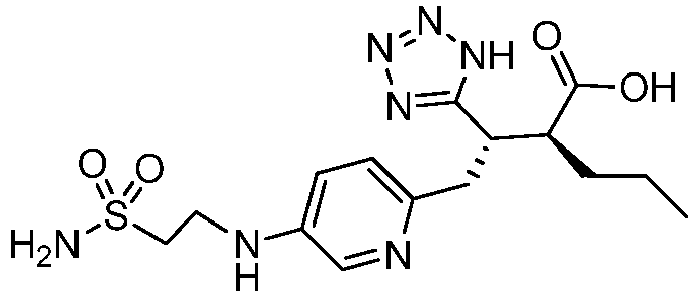
- In a 5 ml MW tube, (S)-2-((S)-2-(5-bromopyridin-2-yl)-1-(1-((2-(trimethylsilyl)ethoxy)methyl)-1H-tetrazol-5-yl)ethyl)pentanoic acid (150 mg, 0.31 mmol),
- Brettphos palladacycle (12 mg, 0.015 mmol), sodium tert-butoxide (60 mg, 0.62 mmol) and 2-aminoethanesulfonamide (95 mg, 0.76 mmol) were dissolved in THF (2 ml). The tube was then sealed, degassed and purged with nitrogen. The reaction was stirred at room temperature for 72 hrs. The reaction was filtered and concentrated then the residue was purified by reverse phase HPLC with ACN and water buffered with 0.05% TFA to yield (S)-2-((S)-2-(5-((2-sulfamoylethyl)amino)pyridin-2-yl)-1-(1-((2-(trimethylsilyl)ethoxy)methyl)-1H-tetrazol-5-yl)ethyl)pentanoic acid. LC-MS [M+1]: 528.2.
- In a sealed 5 ml MW tube, (S)-2-((S)-2-(5-((2-sulfamoylethyl)amino)pyridin-2-yl)-1-(1-((2-(trimethylsilyl)ethoxy)methyl)-1H-tetrazol-5-yl)ethyl)pentanoic acid (14 mg, 0.027 mmol) was dissolved in EtOH (2 ml) and IN HCl (2 ml, 2.0 mmol) was added. The reaction mixture was heated to 60°C for 16 hrs. The reaction was filtered and concentrated then the residue was purified by reverse phase HPLC with ACN and water buffered with 0.05% TFA to yield 2-((2S,3S)-3-carboxy-2-(1H-tetrazol-5-yl)hexyl)-5-((2-sulfamoylethyl)amino)pyridin-1-ium 2,2,2-trifluoroacetate. LC-MS [M+1]+ 398.1
-

- In a 25 ml RB flask, (2-bromothiazol-4-yl)methanol(1.9 g, 9.8 mmol) was dissolved in DCM (20 ml) then cooled to 0°C and triphenylphosphine (2.6 g, 9.8 mmol) followed by carbon tetrabromide (3.2 g, 9.8 mmol) were added. The reaction mixture was stirred for 30 mins, then warmed up to RT for 16 hrs. LCMS showed SM still present. Additional triphenylphosphine (2.6 g, 9.8 mmol) and carbon tetrabromide (3.2 g, 9.8 mmol) were added then stirred at RT for another 16 hrs. The reaction was concentrated and the residue was purified by MPLC ISCO Combi-flash on ISCO Redi-Sep 40g column with EtOAc/hexane to give 2-bromo-4-(bromomethyl)thiazole. LC-MS [M+1]+ 258.2.
- In a 25-ml RB flask under N2, diisopropylamine (1.7 ml, 11 mmol) was dissolved in THF (10 ml) then cooled to -78°C. n-BuLi in hexane (4.0 ml, 10 mmol, 2.5M) was added and the reaction mixture stirred for 15 mins. In another 100 ml RB flask under argon, (S)-2-((1-((2-(trimethylsilyl)ethoxy)methyl)-1H-tetrazol-5-yl)methyl)pentanoic acid (540 mg, 1.7 mmol) was dissolved in THF (15 ml) then cooled to -78°C. To the flask was added LDA (6.7 ml, 4.3 mmol) prepared above. The reaction mixture was stirred for 45 mins and 2-bromo-4-(bromomethyl)thiazole (530 mg, 2.1 mmol) in THF was added. The reaction mixture was stirred at -78°C for 5 hrs, and then quenched with NH4Cl solution and extracted with EtOAc 2 times, dried with Na2SO4, filtered and concentrated. The residue was purified by reverse phase HPLC with ACN and water buffered with 0.05% TFA to yield (S)-2-((S)-2-(2-bromothiazol-4-yl)-1-(1-((2-(trimethylsilyl)ethoxy)methyl)-1H-tetrazol-5-yl)ethyl)pentanoic acid. LC-MS [M+2]+ 492.6
- To a 5 ml MW tube (S)-2-((S)-2-(2-bromothiazol-5-yl)-1-(1-((2-(trimethylsilyl)ethoxy)methyl)-1H-tetrazol-5-yl)ethyl)pentanoic acid (64 mg, 0.13 mmol) was dissolved in ethylene glycol (1 ml) and then copper(i) oxide (6 mg, 0.042 mmol), N,N'-dimethylethylenediamine (2.8 µl, 0.026 mmol), K2CO3 (6 mg, 0.043 mmol) and ammonium hydroxide (0.72 ml, 5.2 mmol) were added. The tube was degassed and purged with N2 then capped and heated at 80°C for 16 hrs. The reaction was filtered and concentrated. The residue was purified by reverse phase HPLC with ACN and water buffered with 0.05% TFA to yield (S)-2-((S)-2-(2-aminothiazol-5-yl)-1-(1-((2-(trimethylsilyl)ethoxy)methyl)-1H-tetrazol-5-yl)ethyl)pentanoic acid. LC-MS m/z [M+1]+ 427
- In a 5 ml MW tube, (S)-2-((S)-2-(2-aminothiazol-5-yl)-1-(1-((2-(trimethylsilyl)ethoxy)methyl)-1H-tetrazol-5-yl)ethyl)pentanoic acid (10 mg, 0.023 mmol) was dissolved in EtOH (2 ml) and then IN HCl (2 ml, 2.0 mmol) was added. The tube was capped and heated at 60°C for 16 hrs. The residue was purified by reverse phase HPLC with ACN and water buffered with 0.05% TFA to yield 4-((2S,3S)-3-carboxy-2-(1H-tetrazol-5-yl)hexyl)thiazol-2-aminium. LC-MS m/z [M+1]+ 297.
-

- In a sealed 5 ml MW tube, (S)-2-((S)-2-(5-bromopyridin-2-yl)-1-(1-((2-(trimethylsilyl)ethoxy)methyl)-1H-tetrazol-5-yl)ethyl)pentanoic acid (55 mg, 0.11 mmol), sodium tert-butoxide (22 mg, 0.23 mmol), Brettphos palladacycle (4.5 mg, 5.7 µmol) and methylamine in THF (0.11 ml, 0.23 mmol) were degassed and purged with N2 then stirred at RT for 72 hrs. The reaction was filtered, the residue was purified by reverse phase HPLC with ACN and water buffered with 0.05% TFA to yield (S)-2-((S)-2-(5-(methylamino)pyridin-2-yl)-1-(1-((2-(trimethylsilyl)ethoxy)methyl)-1H-tetrazol-5-yl)ethyl)pentanoic acid. LC-MS m/z [M+1]+ 435.
- In a sealed 5 ml MW tube, (S)-2-((S)-2-(5-(methylamino)pyridin-2-yl)-1-(1-((2-(trimethylsilyl)ethoxy)methyl)-1H-tetrazol-5-yl)ethyl)pentanoic acid (50 mg, 0.12 mmol) was dissolved in ethanol (2 ml). Then IN HCl (2 ml, 2.0 mmol) was added and the reaction mixture was stirred at 60°C for 16 hrs. The reaction was concentrated and the residue was purified by reverse phase HPLC with ACN and water buffered with 0.05% TFA to yield S)-2-((S)-2-(5-(methylamino)pyridin-2-yl)-1-(1H-tetrazol-5-yl)ethyl)pentanoic acid. LC-MS m/z [M+1]+ 305.1
-

- The product was prepared following the same procedure as EXAMPLE 151. LC-MS m/z [M+1]+ 305.1
-

- To a solution of (S)-2-((1-((2-(trimethylsilyl)ethoxy)methyl)-1H-tetrazol-5-yl)methyl)pentanoic acid (310 mg, 1.0 mmol) in THF was added lithium diisopropylamide (1.25 ml, 2.5 mmol). The mixture was allowed to stir at -78°C for 40 minutes, and then 2-(iodomethyl)-4,4,5,5-tetramethyl-1,3,2-dioxaborolane (540 mg, 2.0 mmol) was added. The reaction was warmed up to RT naturally and stirred overnight. To the mixture was added sat. aq. NH4Cl and EtOAc for partitioning. The organic layer was separated, dried over Na2SO4, and evaporated to dryness. The crude was used directly in the next step.
- The crude of (S)-2-((S)-2-(4,4,5,5-tetramethyl-1,3,2-dioxaborolan-2-yl)-1-(1-((2-(trimethylsilyl)ethoxy)methyl)-1H-tetrazol-5-yl)ethyl)pentanoic acid (430 mg, 0.95 mmol) was dissolved in Toluene (2 ml) and MeOH (1 ml). TMS-Diazomethane (0.95 ml, 1.9 mmol) was added slowly and the reaction stirred overnight. The solvent was evaporated in high vacuum. The crude material was used directly in Step C.
- To a methanol solution of (S)-methyl 2-((S)-2-(4,4,5,5-tetramethyl-1,3,2-dioxaborolan-2-yl)-1-(1-((2-(trimethylsilyl)ethoxy)methyl)-1H-tetrazol-5-yl)ethyl)pentanoate (100 mg, 0.21 mmol) was added 4.5 M potassium bifluoride (160 µL, 0.70 mmol) slowly and the reaction stirred at RT for 1 hour. The solvent was removed in vacuo and acetone was added and the suspension stirred for 15 min at RT. The mixture was filtered, and the filtrate was evaporated to dry to obtain the crude material.
- In the reaction vessel cesium carbonate (87 mg, 0.27 mmol) and Ad2nBuP Biphenyl Precatalyst (6.0 mg, 8.9 µmol) were combined with water (0.05 ml) and potassium trifluoro((2S,3 S)-3-(methoxycarbonyl)-2-(1-((2-(trimethylsilyl)ethoxy)methyl)-1H-tetrazol-5-yl)hexyl)borate (39 mg, 0.087 mmol), and 1-bromo-4-(trifluoromethyl)benzene (20 mg, 0.089 mmol) in toluene. The mixture was degassed and then heated at 100°C overnight. The mixture was cooled, diluted with EtOAc, washed with water, brine, dried over MgSO4, and filtered. The solvent was evaporated under reduced pressure to gave 42 mg of crude material. The crude was purified on Silica gel Chromatography with EtOAc-hexane 0-100%, to obtain the product, (S)-methyl 2-((S)-2-(4-(trifluoromethyl)phenyl)-1-(1-((2-(trimethylsilyl)ethoxy)methyl)-1H-tetrazol-5-yl)ethyl)pentanoate. LC-MS m/z [M+1]+ 487.15
- A solution of (S)-methyl 2-((S)-2-(4-(trifluoromethyl)phenyl)-1-(1-((2-(trimethylsilyl)ethoxy)methyl)-1H-tetrazol-5-yl)ethyl)pentanoate (15 mg, 0.031 mmol), and Lithium hydroxide (15 mg, 0.62 mmol) in MeOH-H2O (1:1) was stirred at 55°C overnight. After being cooled, EtOAc and H2O were added and the solution was adjusted to pH < 4 by IN HCl. The organic was evaporated to dryness to obtain the crude. The crude was dissolved in EtOH (0.5 ml)/0.5 ml 1N HCl, and heated at 60°C overnight. The reaction was concentrated and the residue was purified by reverse phase C18 HPLC, ACN-H2O (0.05% TFA) gradient to obtain the product, (S)-2-((S)-1-(1H-tetrazol-5-yl)-2-(4-(trifluoromethyl)phenyl)ethyl)pentanoic acid. LC-MS: m/z [M+H]+ 343.09 (calc. m/z 343.14).
-

- The compound was prepared according to the above EXAMPLE 153 with 2-bromopyridine as coupling partener in Step D. (S)-2-((S)-2-(pyridin-2-yl)-1-(1H-tetrazol-5-yl)ethyl)pentanoic acid, LC-MS: m/z [M+H]+ 276.14 (calc. m/z 276.15).
-
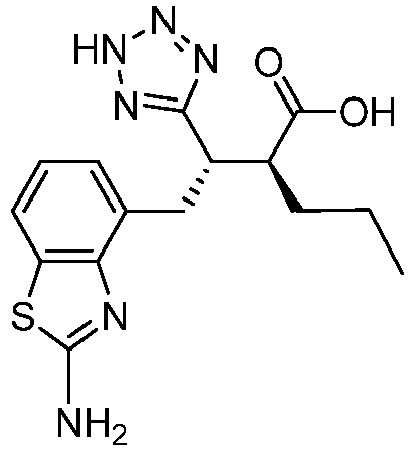
- In a 5 ml microwave tube, potassium ((2S,3S)-3-(tert-butoxycarbonyl)-2-(1-((2-(trimethylsilyl)ethoxy)methyl)-1H-tetrazol-5-yl)hexyl)trifluoroborate (200 mg, 0.40 mmol) was dissolved in toluene (1.8 mL)/water (175 µl). Then 4-bromobenzo[d]thiazol-2-amine (70 mg, 0.31 mmol), cesium carbonate (300 mg, 0.92 mmol), and Ad2nBuP biphenyl Precatalyst (29 mg, 0.043 mmol) were added. The tube was sealed, degassed and purged with N2 (3x) then heated to 100°C for 16 hrs. The reaction was cooled and poured into water then extracted with EtOAc (2x). The EtOAc layer was washed with brine, dried over Na2SO4, and then filtered and concentrated. The residue was purified by MPLC with 0-100% EtOAc/hexane to yield (S)-tert-butyl 2-((S)-2-(2-aminobenzo[d]thiazol-4-yl)-1-(1-((2-(trimethylsilyl)ethoxy)methyl)-1H-tetrazol-5-yl)ethyl)pentanoate. LC-MS [M+1]: 533.25.
- To a 25 mL RB flask charged with (S)-tert-butyl 2-((S)-2-(2-aminobenzo[d]thiazol-4-yl)-1-(1-((2-(trimethylsilyl)ethoxy)methyl)-1H-tetrazol-5-yl)ethyl)pentanoate (44 mg, 0.083 mL) was added TFA (1.8 mL) and water (0.18 mL). The mixture was allowed to stir at RT for 2 hours. The desired product was purified by preparative HPLC Reverse phase (C-18) with Phenomenex Luna C18 prep column, 100 Å, 5 µm, 10 mm x 30 mm, eluted with10-100% acetonitrile/water + 0.05% TFA. LC-MS [M+1]: 346.12
-

- The compound was prepared following the same procedure as EXAMPLE 155 with potassium ((2S,3S)-3-(tert-butoxycarbonyl)-2-(1-((2-(trimethylsilyl)ethoxy)methyl)-1H-tetrazol-5-yl)hexyl)trifluoroborate and 3-bromopyrazolo[1,5-b]pyridazine. LC-MS [M+1]: 316.1
-

- In a 5 mL MW tube, (S)-2-((S)-2-(6-bromopyridin-3-yl)-1-(1-((2-(trimethylsilyl)ethoxy)methyl)-1H-tetrazol-5-yl)ethyl)pentanoic acid (50 mg, 0.10 mmol), KOH (17 mg, 0.31 mmol), Pd2dba3 (4.0 mg, 4.3 µmol), and di-tert-butyl(2',4',6'-triisopropyl-3,4,5,6-tetramethyl-[1,1'-biphenyl]-2-yl)phosphine (10 mg, 0.021 mmol) were dissolved in dioxane (0.5 mL)/water (0.5 mL). The tube was sealed, degassed and purged with nitrogen. The mixture was heated at 100°C for 16 hrs. The reaction was cooled and diluted with water then adjusted to pH 6 with IN HCl. The reaction mixture was extracted with EtOAc (2x), dried over Na2SO4, filtered and concentrated. The residue was purified by reverse phase HPLC with ACN and water buffered with 0.05% TFA to yield (S)-2-((S)-2-(6-hydroxypyridin-3-yl)-1-(1-((2-(trimethylsilyl)ethoxy)methyl)-1H-tetrazol-5-yl)ethyl)pentanoic acid. LCMS [M+1]: 422.6.
- The isolated (S)-2-((S)-2-(6-hydroxypyridin-3-yl)-1-(1-((2-(trimethylsilyl)ethoxy)methyl)-1H-tetrazol-5-yl)ethyl)pentanoic acid was stirred in TFA (3 mL)/water (0.3 mL) for 2 hours at RT. The reaction was concentrated and the residue was purified by reverse phase HPLC with ACN and water buffered with 0.05% TFA to yield (S)-2-((S)-2-(6-hydroxypyridin-3-yl)-1-(1H-tetrazol-5-yl)ethyl)pentanoic acid. LCMS [M+1]: 292.1
-

- In a 5 ml microwave tube, (S)-tert-butyl 2-((S)-2-(6-bromopyridin-3-yl)-1-(1H-tetrazol-5-yl)ethyl)pentanoate (30 mg, 0.073 mmol), 1,3,5-trimethyl-4-(4,4,5,5-tetramethyl-1,3,2-dioxaborolan-2-yl)-1H-pyrazole (42 mg, 0.18 mmol), chloro[(di(1-adamantyl)-N-butylphosphine)-2-(2-aminobiphenyl)]palladium(II) (4.9 mg, 7.3 µmol) and K3PO4 (62 mg, 0.29 mmol) were dissolved in THF (1 mL)/Water (0.4 mL). Then the tube was degassed and sealed under N2. The mixture was heated for 16 hrs at 110°C. LC-MS showed product peak M+1=440. The reaction was poured into water and extracted with EtOAc (2x5 mL), then dried over Na2SO4, filtered and concentrated to give the crude product, which was used in the next step. LC-MS [M+1]: 440.5
- To a 25 ml RB flask under N2 containing (S)-tert-butyl 2-((S)-1-(1H-tetrazol-5-yl)-2-(6-(1,3,5-trimethyl-1H-pyrazol-4-yl)pyridin-3-yl)ethyl)pentanoate (57 mg, 0.13 mmol), was added thioanisole (0.015 ml, 0.13 mmol) followed by TFA (1 mL). Then the reaction mixture was stirred at RT for 3 hrs. The volatiles were evaporated and the residue was purified on Gilson Trilution instrument by preparative HPLC Reverse phase (C-18) with Phenomenex Luna C18 prep column, 100 Å, 5 µm, 10 mm x 30 mm, eluted with10-100% acetonitrile/water + 0.05% TFA, to give the product. LC-MS [M+1]: 384.38
The following compounds were parpared following the same procedure as EXAMPLE 158Ex. No. Structure IUPAC Name Calc'd Mass [M+H]+ LC/MS m/e [M+H]+ 159 
(2S)-2-[(1S)-2-{6-[4-(3-hydroxyazetidin-3-yl)phenyl]pyridin-3-yl}-1-(1H-tetrazol-5-yl)ethyl]pentanoic acid 423.21 423.35 160 
(2S)-2-[(1S)-2-{6-[2-(acetylamino)pyrimidin-5-yl]pyridin-3-yl}-1-(1H-tetrazol-5-yl)ethyl]pentanoic acid 411.18 411.29 161 
(2S)-2-[(1S)-2-[6-(2-aminopyrimidin-5-yl)pyridin-3-yl]-1-(1H-tetrazol-5-yl)ethyl]pentanoic acid 369.17 369.27 162 
(2S)-2-[(1S)-2-[6-(1-cyanoisoquinolin-7-yl)pyridin-3-yl]-1-(1H-tetrazol-5-yl)ethyl]pentanoic acid 428.18 428.28 163 
(2S)-2-[(1S)-2-{6-[2-(dimethylamino)pyrimidin-5-yl]pyridin-3-yl}-1-(1H-tetrazol-5-yl)ethyl]pentanoic acid 397.20 397.30 164 
(2S)-2-[(1S)-2-[6-(2,5-dihydro-1H-pyrrol-3-yl)pyridin-3-yl]-1-(1H-tetrazol-5-yl)ethyl]pentanoic acid 343.18 343.30 165 
(2S)-2-[(1S)-2-(1',2',3',6'-tetrahydro-3,4'-bipyridin-6-yl)-1-(1H-tetrazol-5-yl)ethyl]pentanoic acid 357.2 357.3 166 
(2S)-2-[(1S)-2-{5-[4-(3-hydroxyazetidin-3-yl)phenyl]pyridin-2-yl}-1-(1H-tetrazol-5-yl)ethyl]pentanoic acid 423.21 423.38 167 
(2S)-2-[(1S)-2-(6'-amino-3,3'-bipyridin-6-yl)-1-(1H-tetrazol-5-yl)ethyl]pentanoic acid 368.18 368.22 168 
(2S)-2-[(1S)-2-[5-(1H-indazol-5-yl)pyridin-2-yl]-1-(1H-tetrazol-5-yl)ethyl]pentanoic acid 392.18 392.18 169 
(2S)-2-[(1S)-2-[5-(3-oxo-3,4-dihydro-2H-1,4-benzoxazin-7-yl)pyridin-2-yl]-1-(1H-tetrazol-5-yl)ethyl]pentanoic acid 423.17 423.24 170 
(2S)-4-methyl-2-[(1S)-2-(1',2',3',6'-tetrahydro-3,4'-bipyridin-6-yl)-1-(2H-tetrazol-5-yl)ethyl]pentanoic acid 371.2 371.3 171 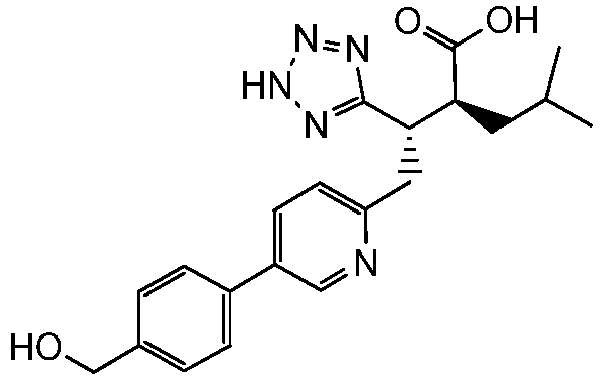
(2S)-2-[(1S)-2-{5-[4-(hydroxymethyl)phenyl ]pyridin-2-yl}-1-(2H-tetrazol-5-yl)ethyl]-4-methylpentanoic acid 396.2 396.3 172 
(2S)-2-[(1S)-2-(6'-amino-3,3'-bipyridin-6-yl)-1-(2H-tetrazol-5-yl)ethyl]-4-methylpentanoic acid 382.2 382.3 173 
(2S)-4-methyl-2-[(1S)-2-(5-{4-[(4R,5S)-4-methyl-2-oxo-1,3-oxazolidin-5-yl]phenyl}pyridin-2-yl)-1-(2H-tetrazol-5-yl)ethyl]pentanoic acid 465.2 465.3 174 
(2S)-2-[(1S)-2-{5-[4-(aminomethyl)phenyl]pyridin-2-yl}-1-(2H-tetrazol-5-yl)ethyl]-4-methylpentanoic acid 395.2 395.3 175 
(2S)-4-methyl-2-[(1S)-2-[5-(4-sulfamoylphenyl)pyridin-2-yl]-1-(2H-tetrazol-5-yl)ethyl]pentanoic acid 445.2 445.2 176 
(2S)-2-[(1S)-2-(6'-amino-2,3'-bipyridin-5-yl)-1-(2H-tetrazol-5-yl)ethyl]-4-methylpentanoic acid 382.2 382.3 177 
(2S)-2-[(1S)-2-{6-[4-(hydroxymethyl)phenyl]pyridin-3-yl}-1-(2H-tetrazol-5-yl)ethyl]-4-methylpentanoic acid 396.2 396.2 178 
(2S)-2-[(1S)-2-(2'-amino-2,4'-bipyridin-5-yl)-1-(2H-tetrazol-5-yl)ethyl]-4-methylpentanoic acid 382.2 382.2 179 
(2S)-2-[(1S)-2-(2'-amino-3,4'-bipyridin-6-yl)-1-(2H-tetrazol-5-yl)ethyl]-4-methylpentanoic acid 382.2 382.2 180 
(2S)-4-methyl-2-[(1S)-2-[6-(3-oxo-3,4-dihydro-2H-1,4-benzoxazin-7-yl)pyridin-3-yl]-1-(2H-tetrazol-5-yl)ethyl]pentanoic acid 437.2 437.2 181 
(2S)-2-[(1S)-2-[6-(2,5-dihydro-1H-pyrrol-3-yl)pyridin-3-yl]-1-(2H-tetrazol-5-yl)ethyl]-4-methylpentanoic acid 357.2 357.2 182 
(2S)-2-[(1R)-2-[5-(3-oxo-3,4-dihydro-2H-1,4-benzoxazin-7-yl)pyridin-2-yl]-1-(1H-tetrazol-5-yl)ethyl]pentanoic acid 423.2 423.3 -

- Into 2 dram vials were added substituted boronic acid or ester (0.071 mmol), palladium catalyst (3.07 mg, 4.7 µmol) and 189 µL of 1 N degassed aq. K3PO4 solution. In glove box, 1 mL of solution of (R)-tert-butyl 2-((R)-2-(4-bromophenyl)-1-(2H-tetrazol-5-yl)ethyl)pentanoate (20 mg, 0.047 mmol) in EtOH were added into each vial. The vials were capped and heated at 70°C with stirring for 20 hr (overnight). After the vials were cooled down to room temperature, the solvent was removed in GeneVac. Into each residue was added 600 µL of H2O and 2 mL of DCM. The organic layers were transferred into 2 dram vials. The organic solvent was removed in GeneVac to afford the crude intermediates.
- Into each vial was added a solution of thioanisole (0.3 mL) and DCM (0.3 mL) in TFA (0.3 mL). The vials were agitated at 25°C for 16 hr. The solvent was removed in a GeneVac. The residues were dissolved in 1.3 mL of DMSO. Each crude mixture was filtered into a 96-well tray and purified by HPLC to afford EXAMPLES 183 to 188.
Ex. No. Structure IUPAC Name Calc'd Mass [M+H]+ LC/MS m/e [M+H]+ 183 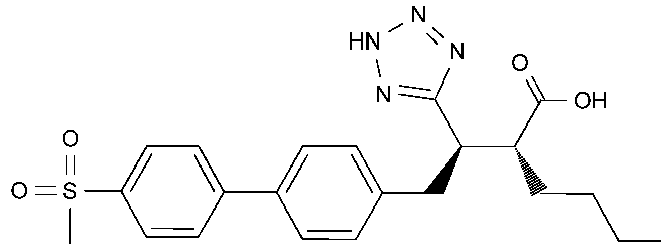
(2R)-2-[(1R)-2-[4'-(methylsulfonyl)biphenyl-4-yl]-1-(2H-tetrazol-5-yl)ethyl]hexanoic acid 443.18 443.17 184 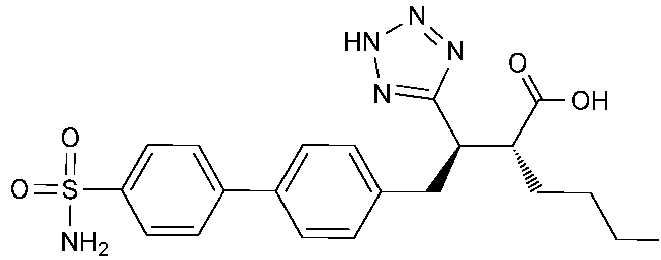
(2R)-2-[(1R)-2-(4'-sulfamoylbiphenyl-4-yl)-1-(2H-tetrazol-5-yl)ethyl]hexanoic acid 444.17 444.16 185 
(2R)-2-{(1R)-1-(2H-tetrazol-5-yl)-2-[4-(1,3,5-trimethyl-1H-pyrazol-4-yl)phenyl] ethyl}hexanoic acid 397.23 397.23 186 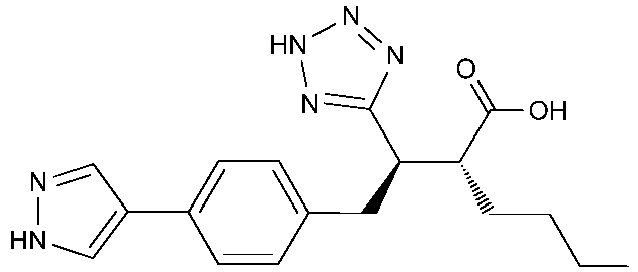
(2R)-2-[(1R)-2-[4-(1H-pyrazol-4-yl)phenyl]-1-(2H-tetrazol-5-yl)ethyl]hexanoic acid 355.19 355.18 187 
(2R)-2-[(1R)-2-[4-(1-phenyl-1H-pyrazol-4-yl)phenyl]-1-(2H-tetrazol-5-yl)ethyl]hexanoic acid 431.22 431.21 188 
(2R)-2-[(1R)-2-biphenyl-4-yl-1-(2H-tetrazol-5-yl)ethyl]hexanoic acid 365.2 365.19 -

- Into 2 dram vials was added substituted boronic acid or ester (0.071 mmol), palladium catalyst (3.07 mg, 4.7 µmol) and 189 µL of 1 N degassed aq. K3PO4 solution. In glove box, 1 mL of solution of (S)-tert-butyl 2-((S)-2-(4-bromophenyl)-1-(2H-tetrazol-5-yl)ethyl)pentanoate (20mg, 0.047 mmol) in EtOH was added into each vial. The vials were capped and heated at 70°C with stirring for 20 hr (overnight). After the vials were cooled down to room temperature, the solvent was removed in GeneVac. Into each residue was added 600 µL of H2O and 2 mL of DCM. The organic layers were transferred into 2 dram vials. The organic solvent was removed in GeneVac to afford the crude intermediates.
- Into each vial was added a solution of thioanisole (0.3 mL), DCM (0.3 mL) in TFA (0.3 mL). The vials were agitated at 25°C for 16 hr. The solvent was removed in a GeneVac. The residues were dissolved in 1.3 mL of DMSO. Each crude mixture was filtered into a 96-well tray and purified by HPLC to afford the EXAMPLES 189 to 214.
Ex. No. Structure IUPAC Name Calc'd Mass [M+H]+ LC/MS m/e [M+H]+ 189 
(2S)-2-[(1S)-2-{4-[6-(dimethylamino)pyridin-3-yl]phenyl}-1-(2H-tetrazol-5-yl)ethyl]pentanoic acid 395.21 395.21 190 
(2S)-2-[(1S)-2-{4-[5-(4-methylpiperazin-1-yl)pyridin-3-yl]phenyl}-1-(2H-tetrazol-5-yl)ethyl]pentanoic acid 450.26 450.25 191 
(2S)-2-[(1S)-2-{4-[5-(piperidin-1-ylmethyl)pyridin-3-yl]phenyl}-1-(2H-tetrazol-5-yl)ethyl]pentanoic acid 449.27 449.26 192 
(2S)-2-[(1S)-2-[4'-(1-morpholin-4-ylethyl)biphenyl-4-yl]-1-(2H-tetrazol-5-yl)ethyl]pentanoic acid 464.27 464.26 193 
(2S)-2-[(1S)-2-[4-(6-amino-5,6,7,8-tetrahydronaphthalen- 2-yl)phenyl]-1-(2H-tetrazol-5-yl)ethyl]pentanoic acid 420.24 420.23 194 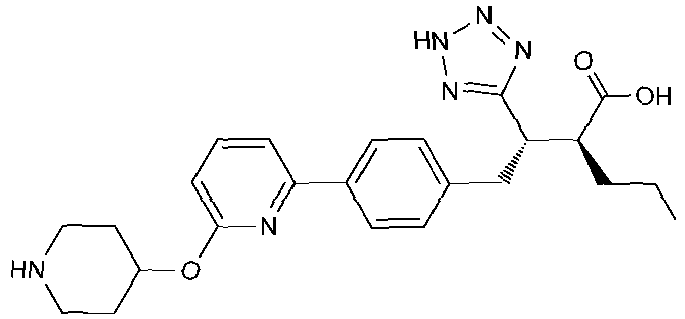
(2S)-2-[(1S)-2-{4-[6-(piperidin-4-yloxy)pyridin-2-yl]phenyl}-1-(2H-tetrazol-5-yl)ethyl]pentanoic acid 451.25 451.24 195 
(2S)-2-[(1S)-2-(3'-piperidin-3-ylbiphenyl-4-yl)-1-(2H-tetrazol-5-yl)ethyl]pentanoic acid 434.26 434.25 196 
(2S)-2-[(1S)-2-[4-(2-pyrrolidin-1-yl-1,3-thiazol-5-yl)phenyl]-1-(2H-tetrazol-5-yl)ethyl]pentanoic acid 427.19 427.18 197 
(2S)-2-[(1S)-2-(4'-sulfamoylbiphenyl-4-yl)-1-(2H-tetrazol-5-yl)ethyl]pentanoic acid 430.15 430.15 198 
(2S)-2-[(1S)-2-(4-pyridin-4-ylphenyl)-1-(2H-tetrazol-5-yl)ethyl]pentanoic acid 352.18 352.17 199 
(2S)-2-[(1S)-2-[4-(6-piperazin-1-ylpyridin-3-yl)phenyl]-1-(2H-tetrazol-5-yl)ethyl]pentanoic acid 436.25 436.24 200 
(2S)-2-[(1S)-2-[4-(6-aminopyridin-3-yl)phenyl]-1-(2H-tetrazol-5-yl)ethyl]pentanoic acid 367.19 367.18 201 
(2S)-2-[(1S)-2-(3'-carbamoylbiphenyl-4-yl)-1-(2H-tetrazol-5-yl)ethyl]pentanoic acid 394.19 394.18 202 
(2S)-2-[(1S)-2-[4'-(methylcarbamoyl)biphenyl-4-yl]-1-(2H-tetrazol-5-yl)ethyl]pentanoic acid 408.2 408.2 203 
(2S)-2-[(1S)-2-[4-(6-morpholin-4-ylpyridin-3-yl)phenyl]-1-(2H-tetrazol-5-yl)ethyl]pentanoic acid 437.23 437.22 204 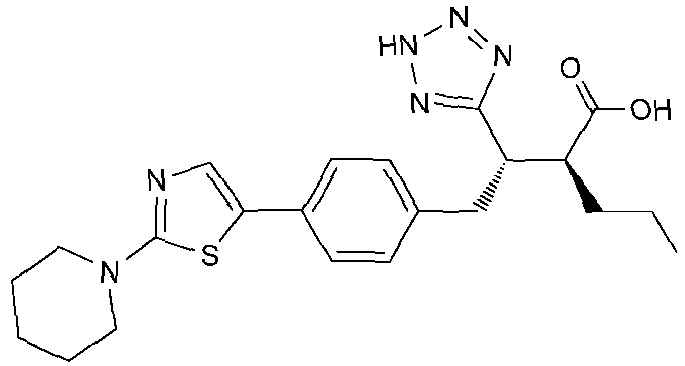
(2S)-2-[(1S)-2-[4-(2-piperidin-1-yl-1,3-thiazol-5-yl)phenyl]-1-(2H-tetrazol-5-yl)ethyl]pentanoic acid 441.21 441.2 205 
(2S)-2-[(1S)-2-[2'-(piperidin-1-ylmethyl)biphenyl-4-yl]-1-(2H-tetrazol-5-yl)ethyl]pentanoic acid 448.27 448.26 206 
(2S)-2-[(1S)-2-[3'-(piperidin-1-ylmethyl)biphenyl-4-yl]-1-(2H-tetrazol-5-yl)ethyl]pentanoic acid 448.27 448.26 207 
(2S)-2-[(1S)-2-[3'-(morpholin-4-ylmethyl)biphenyl-4-yl]-1-(2H-tetrazol-5-yl)ethyl]pentanoic acid 450.25 450.24 208 
(2S)-2-[(1S)-2-[4-(2-morpholin-4-yl-1,3-thiazol-4-yl)phenyl]-1-(2H-tetrazol-5-yl)ethyl]pentanoic acid 443.19 443.18 209 
(2S)-2-[(1S)-2-[4'-(aminomethyl)biphenyl-4-yl]-1-(2H-tetrazol-5-yl)ethyl]pentanoic acid 380.21 380.2 210 
(2S)-2-[(1S)-2-[3'-(aminomethyl)biphenyl-4-yl]-1-(2H-tetrazol-5-yl)ethyl]pentanoic acid 380.21 380.2 211 
(2S)-2-[(1S)-2-[4'-(hydroxymethyl)biphenyl-4-yl]-1-(2H-tetrazol-5-yl)ethyl]pentanoic acid 381.19 381.18 212 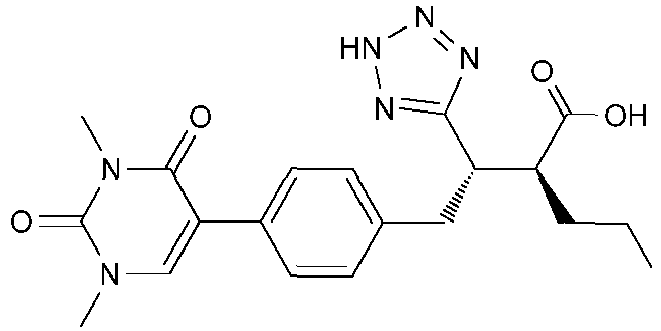
(2S)-2-[(1S)-2-[4-(1,3-dimethyl-2,4-dioxo-1,2,3,4-tetrahydropyrimidin-5-yl)phenyl]-1-(2H-tetrazol-5-yl)ethyl]pentanoic acid 413.19 413.19 213 
(2S)-2-[(1S)-2-{4-[6-(1-hydroxy-1-methylethyl)pyridin-3- yl]phenyl}-1-(2H-tetrazol-5-yl)ethyl]pentanoic acid 410.22, 410.21 214 
(2S)-2-[(1S)-2-[2'-(morpholin-4-ylmethyl)biphenyl-4-yl]-1-(2H-tetrazol-5-yl)ethyl]pentanoic acid 450.25 450.24 -

- Into 2 dram vials were added substituted primary amines (0.15 mmol), palladium catalyst (4.07 mg, 5.1 µmol) and cesium carbonate (66.5 mg, 0.2 mmol). In glove box, 1 mL of solution of (S)-tert-butyl 2-((S)-2-(4-bromophenyl)-1-(2-(4-mentylbenzyl)-2H-tetrazol-5-yl)ethyl)pentanoate (27 mg, 0.051 mmol) in 1,4-Dioxane was added into each vial. The vials were capped and heated at 90°C with stirring for 20 hr (overnight). After the vials were cooled down to room temperature, the solvent was removed in GeneVac. Into each residue was added 600 µL of H2O and 2 mL of DCM. The organic layers were transferred into 2 dram vials. The organic solvent was removed in GeneVac to afford the crude intermediates.
- Into each vial was added a solution of thioanisole (0.3 mL), and DCM (0.3 mL) in TFA (0.3 mL). The vials were agitated at 25°C for 16 hr. The solvent was removed in a GeneVac. Into each vial was added a solution of thioanisole (0.3 mL), and DCM (0.3 mL) in TFA (0.3 mL). The vials were agitated at 55°C for 16 hr. The solvent was removed in a GeneVac. The residues were dissolved in 1.3 mL of DMSO. Each crude mixture was filtered into a 96-well tray and purified by HPLC to afford the EXAMPLES 215 to 224.
Ex. No. Structure IUPAC Name Calc'd Mass [M+H]+ LC/MS m/e [M+H]+ 215 
(2S)-2-[(1S)-2-(4-{[(1-ethylpyrrolidin-2-yl)methyl]amino}phenyl)-1-(2H-tetrazol-5-yl)ethyl]pentanoic acid 401.27 401.26 216 
(2S)-2-[(1S)-2-{4-[(2-morpholin-4-ylethyl)amino]phenyl}-1-(2H-tetrazol-5-yl)ethyl]pentanoic acid 403.25 403.24 217 
(2S)-2-[(1S)-2-{4-[(2-piperidin-1-ylethyl)amino]phenyl}-1-(2H-tetrazol-5-yl)ethyl]pentanoic acid 401.27 401.26 218 
(2S)-2-[(1S)-2-(4-{[2-(dimethylamino)-2-oxoethyl]amino}phenyl)-1-(2H-tetrazol-5-yl)ethyl]pentanoic acid 375.21 375.21 219 
(2S)-2-[(1S)-2-[4-({2-[4-(1-methylethyl)piperazin-1-yl]ethyl}amino)phenyl]-1-(2H-tetrazol-5-yl)ethyl]pentanoic acid 444.31 444.3 220 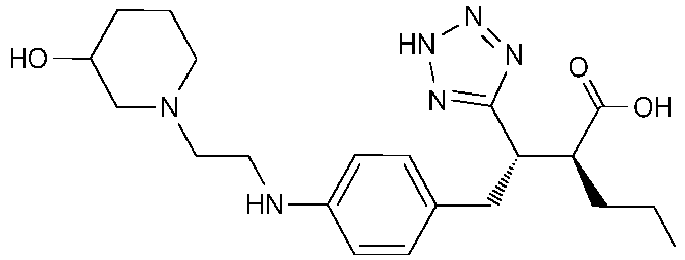
(2S)-2-[(1S)-2-(4-{[2-(3-hydroxypiperidin-1-yl)ethyl]amino}phenyl)-1-(2H-tetrazol-5-yl)ethyl]pentanoic acid 417.26 417.25 221 
(2S)-2-[(1S)-1-(2H-tetrazol-5-yl)-2-(4-{[2-(1H-1,2,3-triazol-1-yl)ethyl]amino}phenyl)ethyl]pentanoic acid 385.21 385.2 222 
(2S)-2-[(1S)-2-{4-[(2-amino-1-methylethyl)amino]phenyl}-1-(2H-tetrazol-5-yl)ethyl]pentanoic acid 347.22 347.21 223 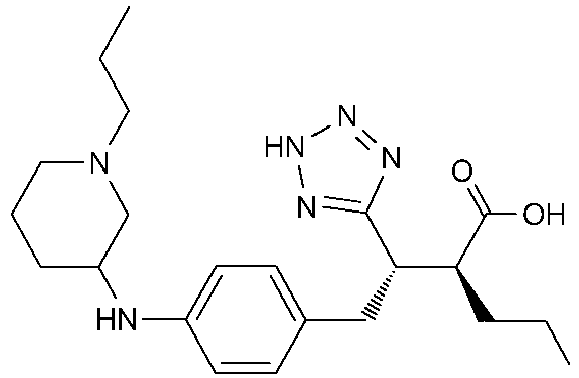
(2S)-2-[(1S)-2-{4-[(1-propylpiperidin-3-yl)amino]phenyl}-1-(2H-tetrazol-5-yl)ethyl]pentanoic acid 415.28 415.27 224 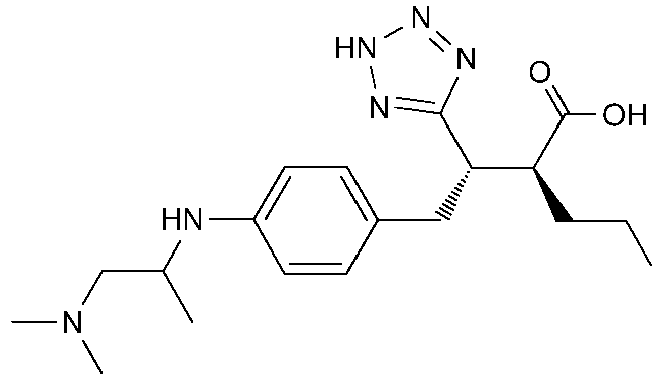
(2S)-2-[(1S)-2-(4-{[2-(dimethylamino)-1-methylethyl] amino}phenyl)-1-(2H-tetrazol-5-yl)ethyl]pentanoic acid 375.25 375.24 -

- Into 2 dram vials were added substituted primary amines (0.15 mmol), palladium catalyst (4.07 mg, 5.1 µmol) and cesium carbonate (66.5 mg, 0.2 mmol). In glove box, 1 mL of solution of (S)-tert-butyl 2-((S)-2-(4-bromophenyl)-1-(2-(4-mentylbenzyl)-2H-tetrazol-5-yl)ethyl)pentanoate (27 mg, 0.051 mmol) in 1,4-Dioxane were added into each vial. The vials were capped and heated at 90°C with stirring for 20 hr (overnight). After the vials were cooled down to room temperature, the solvent was removed in GeneVac. Into each residue was added 600 µL of H2O and 2 mL of DCM. The organic layers were transferred into 2 dram vials. The organic solvent was removed in GeneVac to afford the crude intermediates.
- Into each vial was added a solution of thioanisole (0.3 mL), and DCM (0.3 mL) in TFA (0.3 mL). The vials were agitated at 25°C for 16 hr. The solvent was removed in a GeneVac. Into each vial was added a solution of thioanisole (0.3 mL), and DCM (0.3 mL) in TFA (0.3 mL). The vials were agitated at 55°C for 16 hr. The solvent was removed in a GeneVac. The residues were dissolved in 1.3 mL of DMSO. Each crude mixture was filtered into a 96-well tray and purified by HPLC to afford the EXAMPLES 225 to 232.
Ex. No. Structure IUPAC Name Calc'd Mass [M+H]+ LC/MS m/e [M+H]+ 225 
(2S)-2-[(1S)-2-{4-[4-(2-hydroxyethyl)piperazin -1-yl]phenyl}-1-(2H-tetrazol-5-yl)ethyl]pentanoic acid 403.25 403.24 226 
(2S)-2-[(1S)-2-[4-(4-phenylpiperazin-1-yl)phenyl]-1-(2H-tetrazol-5-yl)ethyl]pentanoic acid 435.25 435.24 227 
(2S)-2-[(1S)-2-[4-(4-pyridin-4-ylpiperazin-1-yl)phenyl]-1-(2H-tetrazol-5-yl)ethyl]pentanoic acid 436.25 436.24 228 
(2S)-2-[(1S)-2-[4-(4-acetylpiperazin-1-yl)phenyl]-1-(2H-tetrazol-5-yl)ethyl]pentanoic acid 401.23 401.22 229 
(2S)-2-[(1S)-2-{4-[(3R)-3-aminopiperidin-1-yl]phenyl}-1-(2H-tetrazol-5-yl)ethyl]pentanoic acid 373.23 373.23 230 
(2S)-2-[(1S)-2-{4-[(3S)-3-aminopiperidin-1-yl]phenyl}-1-(2H-tetrazol-5-yl)ethyl]pentanoic acid 373.23 373.23 231 
(2S)-2-[(1S)-2-[4-(4-methylpiperazin-1-yl)phenyl]-1-(2H-tetrazol-5-yl)ethyl]pentanoic acid 373.23 373.23 232 
(2S)-2-[(1S)-2-[4-(hexahydropyrrolo[1,2-a]pyrazin-2(1H)-yl)phenyl]-1-(2H-tetrazol-5-yl)ethyl]pentanoic acid 399.25 399.24 -

Ex. No. Structure IUPAC Name Calc'd Mass [M+H]+ LC/MS m/e [M+H]+ 233 
(2S)-2-[(1S)-2-[4-(1-methyl-1H-pyrazol-4-yl)phenyl]-1-(1H-tetrazol-5-yl)ethyl]pentanoic acid 355.19 355.18 234 
(2S)-2-[(1S)-2-[4-(1-oxo-2,3-dihydro-1H-isoindol-5-yl)phenyl]-1-(1H-tetrazol-5-yl)ethyl]pentanoic acid 406.19 406.18 235 
(2S)-2-{(1S)-1-(1H-tetrazol-5-yl)-2-[4-(1,3,5-trimethyl-1H-pyrazol-4-yl)phenyl]ethyl}pentanoic acid 383.22 383.21 236 
(2S)-2-[(1S)-2-[4-(1,2,3,4-tetrahydroisoquinolin-7-yl)phenyl]-1-(1H-tetrazol-5-yl)ethyl]pentanoic acid 406.22 406.22 237 
(2S)-2-[(1S)-2-[4-(1,2,3,4-tetrahydroisoquinolin-6-yl)phenyl]-1-(1H-tetrazol-5-yl)ethyl]pentanoic acid 406.22 406.22 238 
(2S)-2-[(1S)-2-[4-(1-oxo-2,3-dihydro-1H-isoindol-4-yl)phenyl]-1-(1H-tetrazol-5-yl)ethyl]pentanoic acid 406.19 406.18 239 
(2S)-2-[(1S)-1-(1H-tetrazol-5-yl)-2-(4-[1,2,4]triazolo[4,3-a]pyridin-6-ylphenyl)ethyl]pentanoic acid 392.18 392.3 240 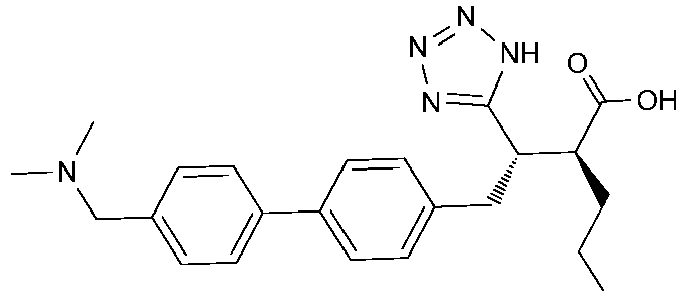
(2S)-2-[(1S)-2-{4'-[(dimethylamino)methy l]biphenyl-4-yl}-1-(1H-tetrazol-5-yl)ethyl]pentanoic acid 408.24 408.23 241 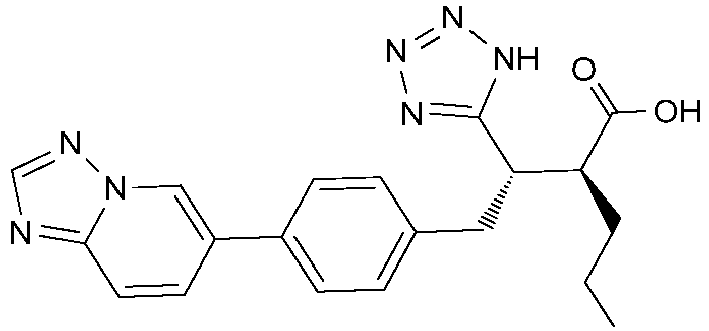
(2S)-2-[(1S)-1-(1H-tetrazol-5-yl)-2-(4-[1,2,4]triazolo[1,5-a]pyridin-6-ylphenyl)ethyl]pentanoic acid 392.18 392.18 242 
(2S)-2-[(1S)-2-(4-{2-[methyl(methylsulfonyl )amino]pyrimidin-5-yl}phenyl)-1-(1H-tetrazol-5-yl)ethyl]pentanoic acid 460.18 460.17 243 
(2S)-2-[(1S)-2-[4-(1-methyl-1,2,5,6-tetrahydropyridin-3-yl)phenyl]-1-(1H-tetrazol-5-yl)ethyl]pentanoic acid 370.22 370.22 244 
(2S)-2-[(1S)-2-[4-(5,6-dimethylpyrazin-2-yl)phenyl]-1-(1H-tetrazol-5-yl)ethyl]pentanoic acid 381.2 381.2 245 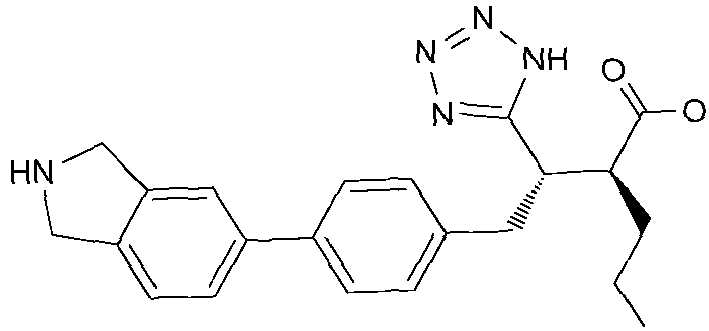
(2S)-2-[(1S)-2-[4-(2,3-dihydro-1H-isoindol-5-yl)phenyl]-1-(1H-tetrazol-5-yl)ethyl]pentanoic acid 392.21 392.2 246 
(2S)-2-{(1S)-1-(1H-tetrazol-5-yl)-2-[4'-(1H-tetrazol-5-yl)biphenyl-4-yl]ethyl}pentanoic acid 419.19 419.19 247 
(2S)-2-[(1S)-2-[4-(2-oxo-2,3-dihydro-1H-imidazo[4,5-b]pyridin-6-yl)phenyl]-1-(1H-tetrazol-5-yl)ethyl]pentanoic acid 408.18 408.17 248 
(2R)-2-[(1S)-2-[4-(1-methyl-1H-benzotriazol-6-yl)phenyl]-1-(1H-tetrazol-5-yl)ethyl]pentanoic acid 406.2 406.19 249 
(2S)-2-[(1S)-2-{4-[2-(hydroxymethyl)-1,3-thiazol-5-yl]phenyl}-1-(1H-tetrazol-5-yl)ethyl]pentanoic acid 388.14 388.14 250 
(2S)-2-[(1S)-2-{4-[1-(pyridin-4-ylmethyl)-1H-pyrazol-4-yl]phenyl}-1-(1H-tetrazol-5-yl)ethyl]pentanoic acid 432.21 432.21 -

- In vials (S)-tert-butyl 2-((S)-2-(4-bromophenyl)-1-(2-(4-methoxybenzyl)-2H-tetrazol-5-yl)ethyl)pentanoate (30 mg, 0.057 mmol), potassium R-trifuoroborate (0.085 mmol) and RuPhos Indoline Preformed Catalyst (4.13 mg, 5.67 µmol) were combined. This mixture was then evacuated and backfilled with N2 (3 times). Then in glovbox, cesium carbonate (83 mg, 0.255 mmol) was added into vials, followed by degassed Toluene (900 µl) and Water (100 µl). This mixture was then heated at 85°C for 24 hr. UPLC showed the product formation. The solvent was evaporated in GeneVac. 700 µL of water and 2.4 mL of EtOAc were added into the vials. The organic layers were transferred into 2 dram vials and concentrated to dryness under vacuum.
- A solution of anisole (30.6 mg, 0.283 mmol), 0.4 mL of TFA and 0.4 mL of DCM was added into the residues. The solution was shaken at room temperature over a weekend. The vials were heated at 50°C for 48 hr. The mixtures were concentrated in GeneVac. 1.4 mL of DMSO was added into each vial. The crude solution was filtered through a filter plate and purified by HPLC.
Ex. No. Structure IUPAC Name Calc'd Mass [M+H]+ LC/MS m/e [M+H]+ 251 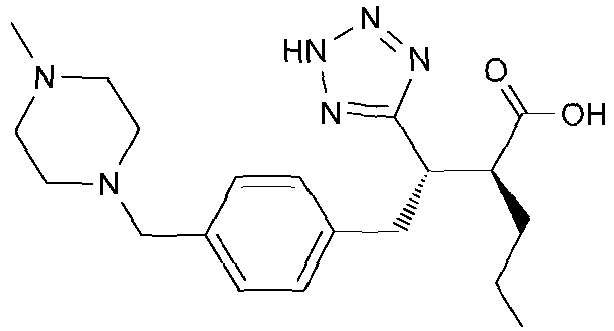
(2S)-2-[(1S)-2-{4-[(4-methylpiperazin-1-yl)methyl]phenyl}-1-(2H-tetrazol-5-yl)ethyl]pentanoic acid 387.25 387.24 252 
(2S)-2-[(1S)-2-{4-[(2-morpholin-4-ylethoxy)methyl]phenyl}-1-(2H-tetrazol-5-yl)ethyl]pentanoic acid 418.25, 418.24 253 
(2S)-2-[(1S)-2-{4-[2-(2-oxopyrrolidin-1-yl)ethyl]phenyl}-1-(2H-tetrazol-5-yl)ethyl]pentanoic acid 386.22 386.21 254 
(2S)-2-[(1S)-2-[4-(3-hydroxypropyl)phenyl]-1-(2H-tetrazol-5-yl)ethyl]pentanoic acid 333.19 333.18 255 
(2S)-2-[(1S)-2-[4-(3,4-dihydroxybutyl)phenyl]-1-(2H-tetrazol-5-yl)ethyl]pentanoic acid 363.2 363.2 256 
(2S)-2-[(1S)-2-{4-[2-(2-oxopiperidin-1-yl)ethyl]phenyl}-1-(2H-tetrazol-5-yl)ethyl]pentanoic acid 400.23 400.23 257 
(2S)-2-[(1S)-2-{4-[(3S)-tetrahydro-2H-pyran-3-ylmethyl]phenyl}-1-(2H-tetrazol-5-yl)ethyl]pentanoic acid 373.22 373.22 -

- A solution of the(R)-4-benzyloxazolidin-2-one (6.6 g, 37 mmol) in THF (50 mL) was cooled to -78°C, then n-BuLi was added dropwise. The mixture was stirred for 15 minutes, then the 3,3-dimethylbutanoyl chloride in 10 mL THF was added dropwise. The mixture was stirred for 30 minutes at -78°C, then the cold bath was removed and the mixture stirred for an additional hour while warming to RT. The reaction was quenched with 20 mL sat. NH4Cl (aq), and then THF was removed in vacuo. Water (20 mL) was added to the residue, and the aqueous layer extracted with 2 x 100 mL Et2O. The combined organic extracts were washed with 50 mL 0.5 N NaOH (aq) and 50 mL brine, then dried with Na2SO4, and concentrated in vacuo to provided (R)-4-benzyl-3-(3,3-dimethylbutanoyl)oxazolidin-2-one.
- To a solution of (R)-4-benzyl-3-(3,3-dimethylbutanoyl)oxazolidin-2-one (12 g, 43.6 mmol) in THF (100 ml) was added NaHMDS (47.9 ml, 47.9 mmol) at -78°C and the resulting solution was stirred at -78°C for 1 hr. Then a solution of tert-butyl 2-bromoacetate (19 ml, 130 mmol) in 5 mL THF was added slowly, and the resulting solution was stirred for 1 hr, then slowly warmed to RT. Then, the reaction mixture was dilulted with NH4Cl/water, transferred to a separatory funnel, and extracted with ethyl acetate. The organic layer was dried with MgSO4, evaporated and purified using 0 to 100% ethyl acetate in hexanes (120 gm redisep column was used) to provide the product.
- To a solution of (R)-tert-butyl 3-((R)-4-benzyl-2-oxooxazolidine-3-carbonyl)-4,4-dimethylpentanoate (3.3 g, 8.5 mmol) in DCM (4 ml) was added TFA (4 ml, 52 mmol) at 0°C. Then, the ice bath was removed, and the reaction mixture was stirred at RT for 15 min. The reaction mixture was diluted with ethyl acetate, transferred to a separatory funnel, washed with saturated NaHCO3, then with brine. The organic layer was dried with MgSO4, and crude was taken directly to the next step without further purification.
- To a solution of (R)-3-((R)-4-benzyl-2-oxooxazolidine-3-carbonyl)-4,4-dimethylpentanoic acid (2.8 g, 8.5 mmol) in THF (20 ml) was added DIEA (1.8 ml, 10 mmol), HATU (3.9 g, 10.2 mmol) and ammonium chloride (0.91 g, 17 mmol) at 0°C. The ice bath was removed and the resulting mixture was stirred at RT for 2 hrs. The reaction mixture was diluted with ethyl acetate, transferred to a separatory funnel, washed with saturated NaHCO3, then with brine. The organic layer was dried with MgSO4, evaporated and purified using 0 to 100% ethyl acetate in hexanres (40 gm redisep column was used) to provide the product.
- To a solution of (R)-3-((R)-4-benzyl-2-oxooxazolidine-3-carbonyl)-4,4-dimethylpentanamide (3.0 g, 9.0 mmol) in DCM (24 ml) was added pyridine (2.2 ml, 27 mmol) followed by TFAA (1.9 ml, 14 mmol) at 0°C. Then the ice bath was removed and the resulting mixture was stirred at RT for 1 hr. The reaction mixture was diluted with ethyl acetate, transferred to a separatory funnel, washed with saturated NaHCO3, then with brine. The organic layer was dried with MgSO4, evaporated and purified using 0 to 100% ethyl acetate in hexanres (40 gm redisep column was used) to provide the product.
- To a solution of (R)-3-((R)-4-benzyl-2-oxooxazolidine-3-carbonyl)-4,4-dimethylpentanenitrile (1.8 g, 5.7 mmol) in toluene (20 ml) was added dibutylstannanone (0.43 g, 1.7 mmol) and azidotrimethylsilane (2.3 ml, 17 mmol), and the resulting mixture was heated at 110°C for 12 hr. The reaction was evaporated to dryness and purified using 0 to 100% ethyl acetate in hexanes to provide the product.
- To a solution of (R)-3-((R)-2-((1H-tetrazol-5-yl)methyl)-3,3-dimethylbutanoyl)-4-benzyloxazolidin-2-one (1.9 g, 5.4 mmol) in acetonitrile was added DIEA (1.9 ml, 11 mmol) at 0°C, and the resulting solution was stirred for 10 min. (2-(chloromethoxy)ethyl)trimethylsilane (1.2 ml, 6.5 mmol) was added and the resulting solution was slowly warmed to RT. The reaction mixture was diluted with ethyl acetate, transferred to a separatory funnel, washed with saturated NaHCO3, then with brine. The organic layer was dried with MgSO4, evaporated and two regioisomers were separated using 0 to 100% ethyl acetate in hexanes (40 gm redisep column was used) to give the product.
- To a solution of ethanethiol (0.83 ml, 11.2 mmol) in THF (16 ml) was added n-BuLi (3.73 ml, 8.2 mmol) at -78°C. The resulting mixture was slowly warmed to 0°C, and stirred for 15 min. Then a precooled (-78°C) solution of (R)-4-benzyl-3-((R)-3,3-dimethyl-2-((1-((2-(trimethylsilyl)ethoxy)methyl)-1H-tetrazol-5-yl)methyl)butanoyl)oxazolidin-2-one (1.6 g, 3.28 mmol) was added and the resulting mixture was stirred at 0°C for 12 hr. Then, the reaction mixture was diluted with 1 N NaOH, and extracted with ether. The crude product was purified using 0 to 100% ethyl acetate in hexanes to provide the product.
- (R)-S-ethyl 3,3-dimethyl-2-((2-((2-(trimethylsilyl)ethoxy)methyl)-2H-tetrazol-5-yl)methyl)butanethioate (800 mg, 2.1 mmol) in water/EtOH was added to a stirred room temperature mixture of lithium hydroxide (260 mg, 11 mmol), H2O2 (0.38 ml, 4.3 mmol) and the mixture was stirred at 75°C over the weekend. LC-MS showed the reaction was completed. After cooling, the reaction mixture was acidified to pH∼3 by IN HCl, extraxted with EtOAc, washed with saturated Na2S2O3 and brine. The organic layer was dried over MgSO4, filtered and concentrated to dryness to give the product.
- To a solution of diisopropylamine (0.50 ml, 3.5 mmol) in tetrahydrofuran (5 ml) was added n-BuLi (1.3 ml, 3.5 mmol) at -5°C. Then the resulting solution was slowly warmed to RT, then cooled to -78°C and a solution of (R)-2-cyclopentyl-3-(1-((2-(trimethylsilyl)ethoxy)methyl)-1H-tetrazol-5-yl)propanoic acid (500 mg, 1.47 mmol) in 1 ml THF was added. The resulting mixture was stirred for 1 hr, then a solution of benzyl bromide (480 mg, 1.9 mmol) in 1 mL THF was added. The reaction mixture was slowly warmed to RT over 12 hrs. The reaction mixture was diluted with saturated ammonium chloride, and then was extracted with ethyl acetate. The crude product was purified using 0 to 100% ethyl acetate in hexanes to provide a mixture of 2 products.
- To a solution of above products (50 mg, 0.119 mmol) in ethanol (1 ml) was added HCl (1 ml, 2.0 mmol), and the resulting solution was heated at 70°C for 1 hr. The reaction mixture was evaporated to dryness and separated by reverse phase HPLC to afford the product. LC-MS m/z [M+1]+: 289.06.
-

- To a solution of (S)-2-((1-((2-(trimethylsilyl)ethoxy)methyl)-1H-tetrazol-5-yl)methyl)pentanoic acid (200 mg, 0.64 mmol) in THF (2.0 ml) at -78°C, was added dropwise lithium diisopropylamide (0.80 ml, 1.6 mmol) and then the reaction mixture was stirred at -78°C for 0.5 hr. 1-(chloromethyl)-2-fluorobenzene (0.151 ml, 1.272 mmol) was added and the reaction mixture was stirred at -78°C for 2 hours, then RT overnight. The reaction mixture was quenched with 3 ml of saturated NH4Cl, extracted with EtOAc (10 ml x 3), and then the combined organic layers were dried over MgSO4, filtered and evaprated to dryness to give the crude oil which was used directly in the next step.
- In a 25 mL sealed microwave tube (S)-2-((S)-2-(2-fluorophenyl)-1-(1-((2-(trimethylsilyl)ethoxy)methyl)-1H-tetrazol-5-yl)ethyl)pentanoic acid (270 mg, 0.64 mmol) was dissolved in ethanol (3.0 ml)/hydrogen chloride IN (3.0 ml, 3.0 mmol) and heated at 60°C overnight. The reaction was concentrated and to the residue was added DMSO (7.5ml). The reaction mixture was purified by C18 reverse phase preparatory HPLC to afford the TFA salt of desired compound. LC-MS m/z [M+1]+ 293.07
The following compounds were prepared according to the general procedure of EXAMPLE 259.Ex. No Structure IUPAC Name Calc'd Mass [M+H]+ LC/MS m/e [M+H]+ 260 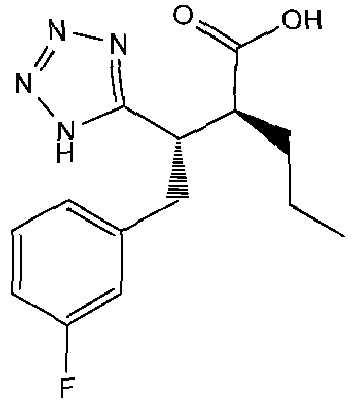
(2S)-2-[(1S)-2-(3-fluorophenyl)-1-(1H-tetrazol-5-yl)ethyl]pentanoic acid 293.14 293.10 261 
(2S)-2-[(1S)-2-(4-fluorophenyl)-1-(1H-tetrazol-5-yl)ethyl]pentanoic acid 293.14 293.08 262 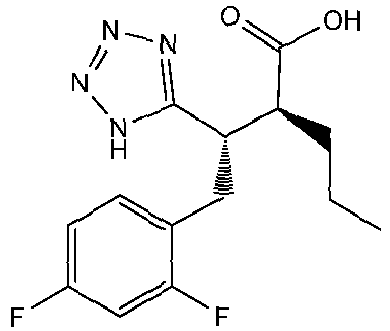
(2S)-2-[(1S)-2-(2,4-difluorophenyl)-1-(1H-tetrazol-5-yl)ethyl]pentanoic acid 311.13 311.04 263 
(2S)-2-[(1S)-2-(4-chlorophenyl)-1-(1H-tetrazol-5-yl)ethyl]pentanoic acid 309.11 309.05 264 
(S)-2-((S)-2-(pyridin-3-yl)-1-(1H-tetrazol-5-yl)ethyl)pentanoic acid 276.15 276.14 265 
(2S,3S,5R)-5-phenyl-2-propyl-3-(1H-tetrazol-5-yl)hexanoic acid 303.18 303.13 266 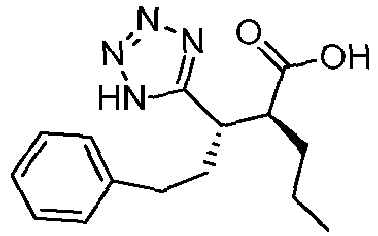
(2S,3S)-5-phenyl-2-propyl-3-(1H-tetrazol-5-yl)pentanoic acid 289.17 289.12 267 
(2S)-2-{(1S)-1-(1H-tetrazol-5-yl)-2-[3-(trifluoromethyl)phenyl ]ethyl}pentanoic acid 343.14 343.11 268 
(2S)-2-{(1S)-1-(1H-tetrazol-5-yl)-2-[2-(trifluoromethyl)phenyl ]ethyl}pentanoic acid 343.14 343.06 269 
(2S)-2-[(1S)-2-[3,5-bis(trifluoromethyl)phenyl]-1-(1H-tetrazol-5-yl)ethyl]pentanoic acid 411.13 411.12 270 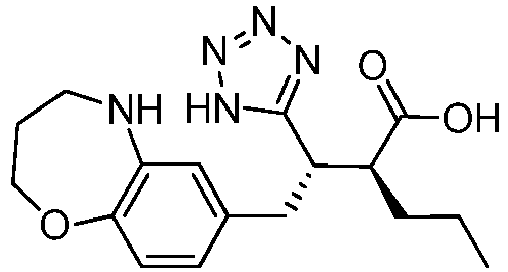
(2S)-2-[(1S)-2-(2,3,4,5-tetrahydro-1,4-benzoxazepin-7-yl)-1-(1H-tetrazol-5-yl)ethyl]pentanoic acid 346.19 346.18 271 
(2S)-2-[(1S)-2-(2,1,3-benzothiadiazol-5-yl)-1-(1H-tetrazol-5-yl)ethyl]pentanoic acid 333.11 333.11 272 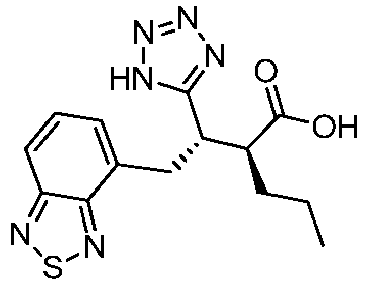
(2S)-2-[(1S)-2-(2,1,3-benzothiadiazol-4-yl)-1-(1H-tetrazol-5-yl)ethyl]pentanoic acid 333.11 332.98 273 
(2S)-2-[(1S)-2-(2,1,3-benzoxadiazol-5-yl)-1-(1H-tetrazol-5-yl)ethyl]pentanoic acid 317.14 317.15 274 
(2S)-2-[(1S)-2-(1-methyl-1H-benzotriazol-5-yl)-1-(1H-tetrazol-5-yl)ethyl]pentanoic acid 330.17 330.15 -

- A mixture of 4-((2S,3S)-3-(tert-butoxycarbonyl)-2-(1-(4-methoxybenzyl)-1H-tetrazol-5-yl)hexyl)benzoic acid (60 mg, 0.12 mmol), HATU (69 mg, 0.18 mmol), tert-butyl piperidin-4-ylcarbamate (73 mg, 0.36 mmol), and Hunig's Base (0.11 ml, 0.61 mmol) in DMF (1.0 ml) was stirred overnight. LCMS showed that the reaction was complete. The reaction mixture was worked up with EtOAc (3 x 10ml)/Bicarbonate, washed with brine (3 x 10 ml), dried over MgSO4, and evaporated to get the crude product which was used as directed for next step.
- A reaction mixture of tert-butyl 4-(4-((2S,3S)-3-(tert-butoxycarbonyl)-2-(1-(4-methoxybenzyl)-1H-tetrazol-5-yl)hexyl)benzoyl)piperazine-1-carboxylate (190 mg, 0.29 mmol), 2,2,2-trifluoroacetic acid (600 µL, 7.8 mmol), and methyl(phenyl)sulfane (600 µL, 7.7 mmol) was stirred at 50°C overnight. The reaction was cooled to RT, and rotavapored to dryness. The residue was dissolved in DMSO and purified by reverse phase HPLC to afford the desired product. LC-MS m/z [M+1]+ 387.24
The following compounds were prepared according to the general procedure of EXAMPLE 275.Ex. No Structure IUPAC Name Calc'd Mass [M+H]+ LC/MS m/e [M+H]+ 276 
(2S)-2-[(1S)-2-{4-[(2-aminoethyl)carbamoyl] phenyl}-1-(1H-tetrazol-5-yl)ethyl]pentanoic acid 361.2 361.23 277 
(2S)-2-[(1S)-2-[4-(dimethylcarbamoyl)phenyl]-1-(1H-tetrazol-5-yl)ethyl]pentanoic acid 346.19 346.19 278 
(2S)-2-[(1S)-2-{4-[(4-aminopiperidin-1-yl)carbonyl]phenyl}-1-(1H-tetrazol-5-yl)ethyl]pentanoic acid 401.23 401.27 279 
(2S)-2-[(1S)-2-[4-(methylcarbamoyl)phenyl]-1-(1H-tetrazol-5-yl)ethyl]pentanoic acid 332.17 332.17 280 
(2S)-2-[(1S)-2-{4-[(2-hydroxyethyl)carbamoyl]phenyl}-1-(1H-tetrazol-5-yl)ethyl]pentanoic acid 362.18 362.18 281 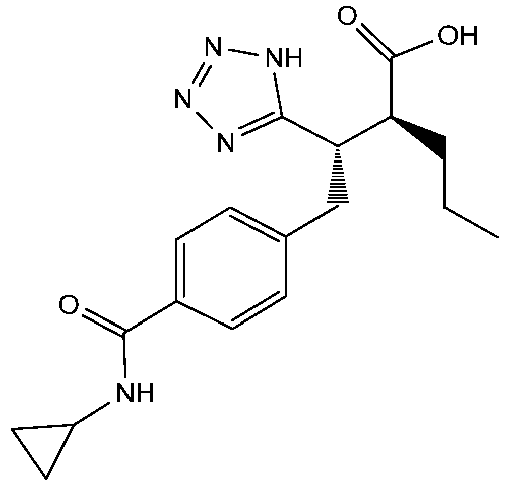
(2S)-2-[(1S)-2-[4-(cyclopropylcarbamoyl)ph enyl]-1-(1H-tetrazol-5-yl)ethyl]pentanoic acid 358.19 358.23 282 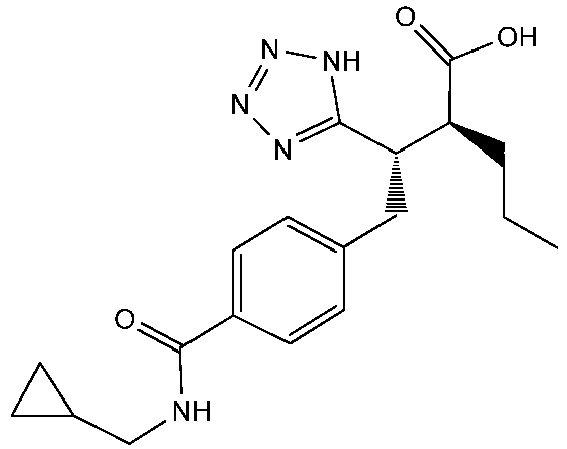
(2S)-2-[(1S)-2-{4-[(cyclopropylmethyl)carba moyl]phenyl}-1-(1H-tetrazol-5-yl)ethyl]pentanoic acid 372.2 372.23 -

- To a solution of 4-((2S,3S)-3-(tert-butoxycarbonyl)-2-(1-(4-methoxybenzyl)-1H-tetrazol-5-yl)hexyl)benzoic acid compound with 4-((2S,3S)-3-(tert-butoxycarbonyl)-2-(2-(4-methoxybenzyl)-2H-tetrazol-5-yl)hexyl)benzoic acid (20 mg total, 0.040 mmol) in DCM (0.50 mL) wsa added TFA (0.50 mL) and thioanisole (0.50 mL, 4.2 mmol). The mixture was allowed to stir for 1 hour at 50°C. The solvent was removed, and the residue was dissolved In DMSO, and the desired product was purified by reverse-phase HPLC. LC-MS m/z [M+1]+ 319.11
-

- To the mixture of 2-bromo-5-methyl-1,3,4-thiadiazole (3.6 g, 20 mmol) in CCl4 (320 ml) was added 1-bromopyrrolidine-2,5-dione (3600 mg, 20 mmol) and (E)-2,2'-(diazene-1,2-diyl)bis(2-methylpropanenitrile) (190 mg, 1.2 mmol). The resulting mixture was heated at reflux for 4.5 hrs. After filtration through celite and washing of the pad with DCM, the combined filtrate was concentrated and the residue was purified on silica gel column using EtOAc/hexane as eluting solvents to give 2-bromo-5-(bromomethyl)-1,3,4-thiadiazole. LC/MS: (M+1)+: 256.83, 258.84, 260.88.
- To a solution of diisopropylamine (1.3 ml, 8.9 mmol) in THF (8 mL) at -78°C was added n-butyllithium (3.26 ml, 8.16 mmol), and the resulting solution was stirred at -78°C for 15 min before being warmed to 0°C for 5 min. To a solution of (S)-2-((1-((2-(trimethylsilyl)ethoxy)methyl)-1H-tetrazol-5-yl)methyl)pentanoic acid (0.57 g, 1.8 mmol) in THF (10 mL) at -78°C was added the above prepared LDA (5.9 ml, 3.8 mmol) dropwise. The resulting solution was stirred at -78°C for 45 min before addition of 2-bromo-5-(bromomethyl)-1,3,4-thiadiazole (0.47 g, 1.8 mmol) in THF (3 mL) dropwise. The resulting mixture was then stirred at -78°C for 3 hrs. The reaction was quenched by addition of saturated NH4Cl solution (50 mL), then the mixture was extracted with EtOAc twice, and the combined organic phase was dried over Na2SO4, concentrated and the residue was purified on Gilson using 20-100% acetonitrile (0.05%TFA) over 10 mins to give (S)-2-((S)-2-(5-bromo-1,3,4-thiadiazol-2-yl)-1-(1-((2-(trimethylsilyl)ethoxy)methyl)-1H-tetrazol-5-yl)ethyl)pentanoic acid. LC/MS: (M+1)+: 491.14; 493.11.
- To a solution of (S)-2-((S)-2-(5-bromo-1,3,4-thiadiazol-2-yl)-1-(1-((2-(trimethylsilyl)ethoxy)methyl)-1H-tetrazol-5-yl)ethyl)pentanoic acid (90 mg, 0.18 mmol) (50 mg, 0.103 mmol) in ethylene glycol (1 ml) and was added copper(I) oxide (2.6 mg, 0.018 mmol), n,n'-dimethylethylenediamine (3.9 µl, 0.037 mmol), K2CO3 (5.1 mg, 0.037 mmol) and ammonium hydroxide (1.0 ml, 7.3 mmol). The mixture was degassed and purged with N2 before being heated at 80°C overnight. After filtration through celite, the filtrate was concentrated and the residue was purified on Gilson using 10-100%acetonitrile (0.05%TFA) to give (S)-2-((S)-2-(5-amino-1,3,4-thiadiazol-2-yl)-1-(1-((2-(trimethylsilyl)ethoxy)methyl)-1H-tetrazol-5-yl)ethyl)pentanoic acid. LC/MS: (M+1)+: 428.20.
- (S)-2-((S)-2-(5-amino-1,3,4-thiadiazol-2-yl)-1-(1-((2-(trimethylsilyl)ethoxy)methyl)-1H-tetrazol-5-yl)ethyl)pentanoic acid (17 mg, 0.040 mmol) was treated with TFA (2 ml) and the resulting solution was stirred at RT for 1 hour. After removing the volatiles, the residue was purified on Gilson using 5-35%acetonitrile (0.05% TFA) as gradient to give (S)-2-((S)-2-(5-amino-1,3,4-thiadiazol-2-yl)-1-(1H-tetrazol-5-yl)ethyl)pentanoic acid. LC/MS: (M+1)+: 298.07.
-

- To the solution of methyl 2-(methylthio)pyrimidine-5-carboxylate (3.1 g, 17 mmol) in toluene (100 ml) at -78°C was added DIBAL-H (42 ml, 42 mmol) dropwise. The resulting solution was stirred at -78°C for 30 min then warmed to 0°C for 30 min. The reaction was quenched by addition of MeOH (2 mL), sat. Na2SO4 (50 ml), and IN NaOH (20 mL). The mixture was stirred at RT overnight. After filtration, the filtrate was extracted with EtOAc and DCM. The combined organic phase was dried over Na2SO4, concentrated and the residue was purified on silica gel column using EtOAc/hexane as eluting solvents to give (2-(methylthio)pyrimidin-5-yl)methanol. LC/MS: (M+1)+: 156.96.
- To the solution of (2-(methylthio)pyrimidin-5-yl)methanol (0.88 g, 5.6 mmol) in DCM (20 ml) at 0°C was added triphenylphosphine (2.1 g, 7.9 mmol) and carbon tetrabromide (2.6 g, 7.9 mmol). The resulting solution was stirred at 0°C for 1 hour. The reaction mixture was purified on silica gel column using EtOAc/hexane as eluting solvents to give 5-(bromomethyl)-2-(methylthio)pyrimidine. LC/MS: (M+1)+: 218.90; 220.90.
- To a solution of diisopropylamine (2.7 ml, 19 mmol) in THF (6 mL) at -78°C was added n-butyllithium (11 ml, 18 mmol), and the resulting solution was stirred at -78°C for 15 min before warmed to 0°C for 5 min. To a solution of (S)-2-((1-((2-(trimethylsilyl)ethoxy)methyl)-1H-tetrazol-5-yl)methyl)pentanoic acid (1.7 g, 5.4 mmol) in THF (25 ml) at -78°C was added the above prepared LDA (13 ml, 11 mmol) dropwise. The resulting solution was stirred at -78°C for 45 min before addition of 5-(bromomethyl)-2-(methylthio)pyrimidine (1.2 g, 5.4 mmol) in THF (20 mL). The resulting mixture was then stirred at -78°C overnight. The reaction was quenched by addition of sat. NH4Cl solution (100 mL), them the mixture was extracted with EtOAc twice, the combined organic phase was dried over Na2SO4, concentrated and the residue was purified on reverse phase MPLC (C18, 130 g) using 10-100% acetonitrile (0.05%TFA) as gradient to give (S)-2-((S)-2-(2-(methylthio)pyrimidin-5-yl)-1-(1-((2-(trimethylsilyl)ethoxy)methyl)-1H-tetrazol-5-yl)ethyl)pentanoic acid. LC/MS: (M+1)+: 453.15.
- To a solution of (S)-2-((S)-2-(2-(methylthio)pyrimidin-5-yl)-1-(1-((2-(trimethylsilyl)ethoxy)methyl)-1H-tetrazol-5-yl)ethyl)pentanoic acid (30 mg, 0.066 mmol) in CH2Cl2 (1 ml) was added TFA (2 mL, 26 mmol), then the resulting solution was stirred at RT for 2 hours. After concentration the residue was purified on Gilson using 3-50%acetonitrile (0.05% TFA) as gradient to give (S)-2-((S)-2-(2-(methylthio)pyrimidin-5-yl)-1-(1H-tetrazol-5-yl)ethyl)pentanoic acid. LC/MS: (M+1)+: 323.04.
-

- To a solution of (S)-2-((S)-2-(2-(methylthio)pyrimidin-5-yl)-1-(1-((2-(trimethylsilyl)ethoxy)methyl)-1H-tetrazol-5-yl)ethyl)pentanoic acid (1.6 g, 3.6 mmol) in CH2Cl2 (30 ml) at 0°C was added m-CPBA (2.2 g, 9.1 mmol), then the resulting solution was stirred at RT overnight. A solution of thiosulphate (2.0 g) in water (5 mL) was added and the mixture was stirred at RT for 1 hour. The mixture was partitioned between sat. NH4Cl and DCM, the aqueous phase was extracted with DCM four times, the combined organic phase was dried over Na2SO4, concentrated and the residue was purified on reverse phase MPLC (C18, 130g) using 10-50% acetonitrile (0.05% TFA) as gradient to give (S)-2-((S)-2-(2-(methylsulfonyl)pyrimidin-5-yl)-1-(1-((2-(trimethylsilyl)ethoxy)methyl)-1H-tetrazol-5-yl)ethyl)pentanoic acid. LC/MS: (M+1)+: 485.12.
- To a solution of (S)-2-((S)-2-(2-(methylsulfonyl)pyrimidin-5-yl)-1-(1-((2-(trimethylsilyl)ethoxy)methyl)-1H-tetrazol-5-yl)ethyl)pentanoic acid (100 mg, 0.21 mmol) in TFA (2 ml) was added water (0.2 ml), and the resulting solution was stirred at RT for 1 hour. After removing the volatile, the residue was purified on reverse phase HPLC using 5-50% acetonitrile (0.05% TFA)/water (0.05% TFA) as mobile phase to give (S)-2-((S)-2-(2-(methylsulfonyl)pyrimidin-5-yl)-1-(1H-tetrazol-5-yl)ethyl)pentanoic acid. LC/MS: (M+1)+: 355.07.
-
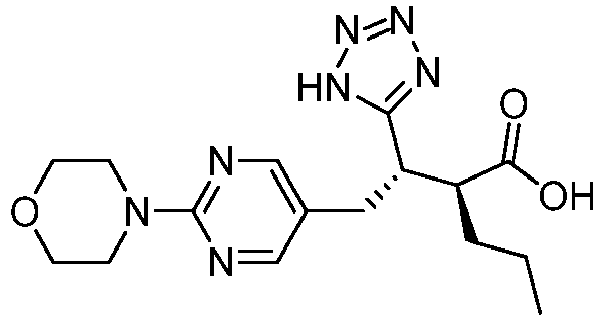
- To the solution of (S)-2-((S)-2-(2-(methylsulfonyl)pyrimidin-5-yl)-1-(1-((2-(trimethylsilyl)ethoxy)methyl)-1H-tetrazol-5-yl)ethyl)pentanoic acid (51 mg, 0.10 mmol) and morpholine (0.037 ml, 0.42 mmol) in DMF (1 ml) was added K2CO3 (29 mg, 0.21 mmol) and the resulting mixture was heated at 100°C for 23 hrs. The mixture was purified on Gilson using 10-90% acetonitrile (0.05%TFA) to give (S)-2-((S)-2-(2-morpholinopyrimidin-5-yl)-1-(1-((2-(trimethylsilyl)ethoxy)methyl)-1H-tetrazol-5-yl)ethyl)pentanoic acid. LC/MS: (M+1)+: 492.19.
- To the solution of (S)-2-((S)-2-(2-morpholinopyrimidin-5-yl)-1-(1-((2-(trimethylsilyl)ethoxy)methyl)-1H-tetrazol-5-yl)ethyl)pentanoic acid (37 mg, 0.075 mmol) in TFA (2 ml) was added water (0.2 mL), and the resulting solution was stirred at RT for 2 hrs. After removing the volatile, the residue was purified on Gilson using 5-50% acetonitrile (0.05% TFA) to give (S)-2-((S)-2-(2-morpholinopyrimidin-5-yl)-1-(1H-tetrazol-5-yl)ethyl)pentanoic acid. LC/MS: (M+1)+: 362.14.
-

- To a solution of (S)-2-((S)-2-(2-(methylsulfonyl)pyrimidin-5-yl)-1-(1-((2-(trimethylsilyl)ethoxy)methyl)-1H-tetrazol-5-yl)ethyl)pentanoic acid (58 mg, 0.12 mmol) and benzyl piperazine-1-carboxylate (160 mg, 0.72 mmol) in DMF (1 ml) was added K2CO3 (33 mg, 0.24 mmol), and the resulting mixture was heated at 100°C for 23 hours. The mixture was purified on Gilson using 10-90% acetonitrile (0.05% TFA) to give (S)-2-((S)-2-(2-(4-((benzyloxy)carbonyl)piperazin-1-yl)pyrimidin-5-yl)-1-(1-((2-(trimethylsilyl)ethoxy)methyl)-1H-tetrazol-5-yl)ethyl)pentanoic acid. LC/MS: (M+1)+: 625.19.
- To the solution of (S)-2-((S)-2-(2-(4-((benzyloxy)carbonyl)piperazin-1-yl)pyrimidin-5-yl)-1-(1-((2-(trimethylsilyl)ethoxy)methyl)-1H-tetrazol-5-yl)ethyl)pentanoic acid (15 mg, 0.024 mmol) in MeOH (10 ml) was added 10% Pd/C (26 mg, 0.024 mmol), and the resulting mixture was hydrogenated at RT via H2 balloon for 2 hrs. The mixture was filtered through celite under N2 and the filtrate was concentrated to give (S)-2-((S)-2-(2-(piperazin-1-yl)pyrimidin-5-yl)-1-(1-((2-(trimethylsilyl)ethoxy)methyl)-1H-tetrazol-5-yl)ethyl)pentanoic acid. LC/MS: (M+1)+: 491.27.
- To a solution of (S)-2-((S)-2-(2-(piperazin-1-yl)pyrimidin-5-yl)-1-(1-((2-(trimethylsilyl)ethoxy)methyl)-1H-tetrazol-5-yl)ethyl)pentanoic acid (15 mg, 0.031 mmol) in TFA (2 ml) was added water (0.2 mL). The resulting solution was stirred at RT for 2 hrs. After removing the volatile, the residue was purified on Gilson using 5-50% acetonitrile (0.05% TFA) to give (S)-2-((S)-2-(2-(piperazin-1-yl)pyrimidin-5-yl)-1-(1H-tetrazol-5-yl)ethyl)pentanoic acid. LC/MS: (M+1)+: 361.25.
-

- To a solution of benzyl 4-hydroxypiperidine-1-carboxylate (36 mg, 0.15 mmol) in DMF (3 ml) was added NaH (24 mg, 0.61 mmol) at 0°C. The resulting mixture was stirred at 0°C for 30 min before addition of (S)-2-((S)-2-(2-(methylsulfonyl)pyrimidin-5-yl)-1-(1-((2-(trimethylsilyl)ethoxy)methyl)-1H-tetrazol-5-yl)ethyl)pentanoic acid (74 mg, 0.15 mmol). The mixture was then stirred at 0°C for 3 hrs. After quenching with water, the solution was purified on Gilson using 30-100% acetonitrile (0.05%TFA) to give (S)-2-((S)-2-(2-((1-((benzyloxy)carbonyl)piperidin-4-yl)oxy)pyrimidin-5-yl)-1-(1-((2-(trimethylsilyl)ethoxy)methyl)-1H-tetrazol-5-yl)ethyl)pentanoic acid. LC/MS: (M+1)+: 640.25.
- To a solution of (S)-2-((S)-2-(2-((1-((benzyloxy)carbonyl)piperidin-4-yl)oxy)pyrimidin-5-yl)-1-(1-((2-(trimethylsilyl)ethoxy)methyl)-1H-tetrazol-5-yl)ethyl)pentanoic acid (64 mg, 0.10 mmol) in MeOH (10 ml) was added 10% Pd/C (11 mg, 10 µmol). The resulting mixture was hydrogenated at RT via H2 balloon for 2 hrs. The mixture was filtered through celite under N2 and the filtrate was concentrated to give (S)-2-((S)-2-(2-(piperidin-4-yloxy)pyrimidin-5-yl)-1-(1-((2-(trimethylsilyl)ethoxy)methyl)-1H-tetrazol-5-yl)ethyl)pentanoic acid. LC/MS: (M+1)+: 506.18.
- The solution of (S)-2-((S)-2-(2-(piperidin-4-yloxy)pyrimidin-5-yl)-1-(1-((2-(trimethylsilyl)ethoxy)methyl)-1H-tetrazol-5-yl)ethyl)pentanoic acid (51 mg, 0.10 mmol) in TFA (2 mL, 26 mmol) and water (0.2 ml) was stirred at RT for 2 hrs. The solution was concentrated and the residue was purified on Gilson using 5-50% acetonitrile (0.05% TFA) to give (S)-2-((S)-2-(2-(piperidin-4-yloxy)pyrimidin-5-yl)-1-(1H-tetrazol-5-yl)ethyl)pentanoic acid. LC/MS: (M+1)+: 376.22.
-

- To a solution of (S)-2-((S)-2-(2-(methylsulfonyl)pyrimidin-5-yl)-1-(1-((2-(trimethylsilyl)ethoxy)methyl)-1H-tetrazol-5-yl)ethyl)pentanoic acid (74 mg, 0.15 mmol) and benzyl 4-aminopiperidine-1-carboxylate (14 mg, 0.61 mmol) in DMF (1 ml) was added K2CO3 (42 mg, 0.30 mmol), and the resulting mixture was heated at 100°C for 23 hrs. The mixture was purified on Gilson using 10-90% acetonitrile (0.05% TFA) to give (S)-2-((S)-2-(2-(dimethylamino)pyrimidin-5-yl)-1-(1-((2-(trimethylsilyl)ethoxy)methyl)-1H-tetrazol-5-yl)ethyl)pentanoic acid. LC/MS: (M+1)+: 450. 26.
- To a solution of (S)-2-((S)-2-(2-(dimethylamino)pyrimidin-5-yl)-1-(1-((2-(trimethylsilyl)ethoxy)methyl)-1H-tetrazol-5-yl)ethyl)pentanoic acid (20 mg, 0.044 mmol) in TFA (2 ml) was added water (0.2 mL), then the resulting solution was stirred at RT for 2 hrs. After removing the volatile, the residue was purified on Gilson using 5-50% acetonitrile(0.05% TFA) to give (S)-2-((S)-2-(2-(dimethylamino)pyrimidin-5-yl)-1-(1H-tetrazol-5-yl)ethyl)pentanoic acid. LC/MS: (M+1)+: 320.10.
-

- To a solution of 1-methyl-4-(4,4,5,5-tetramethyl-1,3,2-dioxaborolan-2-yl)-1,2,3,6-tetrahydropyridine (0.86 g, 3.8 mmol) in acetone (20 ml) was added MeI (0.26 ml, 4.2 mmol). The resulting solution was stirred at RT for 1 hour. The mixture was concentrated to give 1,1-dimethyl-4-(4,4,5,5-tetramethyl-1,3,2-dioxaborolan-2-yl)-1,2,3,6-tetrahydropyridin-1-ium. LC-MS M+: 238.15.
- To a solution of 1,1-dimethyl-4-(4,4,5,5-tetramethyl-1,3,2-dioxaborolan-2-yl)-1,2,3,6-tetrahydropyridin-1-ium (200 mg, 0.54 mmol) and (S)-2-((S)-2-(6-bromopyridin-3-yl)-1-(1-((2-(trimethylsilyl)ethoxy)methyl)-1H-tetrazol-5-yl)ethyl)pentanoic acid (200 mg, 0.41 mmol) in dioxane (3 ml) was added Na2CO3 solution (0.62 ml, 1.2 mmol). The mixture was degassed by N2 via vacuum/N2 three times, PdCl2(dppf) (30 mg, 0.041 mmol) was added and the resulting mixture was degassed again before heated at 100°C overnight. After filtration the filtrate was concentrated and the residue was purified on reverse phase HPLC using acetonitrile/water (0.1% TFA) as mobile phase to give 5-((2S,3S)-3-carboxy-2-(1-((2-(trimethylsilyl)ethoxy)methyl)-1H-tetrazol-5-yl)hexyl)-1',1'-dimethyl-1',2',3',6'-tetrahydro-[2,4'-bipyridin]-1'-ium. LC-MS M+: 515.33.
- To the 5-((2S,3S)-3-carboxy-2-(1-((2-(trimethylsilyl)ethoxy)methyl)-1H-tetrazol-5-yl)hexyl)-1',1'-dimethyl-1',2',3',6'-tetrahydro-[2,4'-bipyridin]-1'-ium (160 mg, 0.31 mmol) was added TFA (2 ml) and the resulting solution was stirred at RT for 1 hour. After concentration the residue was purified on reverse phasse HPLC using acetonitrile/water (0.05% TFA) as mobile phase to give 5-((2S,3S)-3-carboxy-2-(1H-tetrazol-5-yl)hexyl)-1',1'-dimethyl-1',2',3',6'-tetrahydro-[2,4'-bipyridin]-1'-ium. LC-MS M+: 385.13.
- To a solution of 5-((2S,3S)-3-carboxy-2-(1H-tetrazol-5-yl)hexyl)-1',1'-dimethyl-1',2',3',6'-tetrahydro-[2,4'-bipyridin]-1'-ium (77 mg, 0.20 mmol) in MeOH (10 ml) was added 10% Pd/C (21 mg, 0.020 mmol). The resulting mixture was subjected to hydrogenation via H2 balloon at RT for 1 hour. After filtration through celite under N2, the filtrate was concentrated and the residue was purified on reverse phase HPLC using acetonitrile/water (0.05%TFA) as mobile phase to give (S)-2-((S)-2-(6-(1,1-dimethylpiperidin-1-ium-4-yl)pyridin-3-yl)-1-(1H-tetrazol-5-yl)ethyl)pentanoate. LC-MS M+: 387.19
-

- To a solution of tert-butyl 3-(4,4,5,5-tetramethyl-1,3,2-dioxaborolan-2-yl)-5,6-dihydropyridine-1(2H)-carboxylate (102 mg, 0.33 mmol) in CH2Cl2 (2 ml) was added TFA (2 ml, 26.0 mmol) at RT and the resulting solution was stirred at RT for 1 hour. After concentration the residue was lyophilized from acetonitrile/water to give 5-(4,4,5,5-tetramethyl-1,3,2-dioxaborolan-2-yl)-1,2,3,6-tetrahydropyridine 2,2,2-trifluoroacetate. LCMS (M+1)+: 210.13
- To a solution of 5-(4,4,5,5-tetramethyl-1,3,2-dioxaborolan-2-yl)-1,2,3,6-tetrahydropyridine 2,2,2-trifluoroacetate (0.11 g, 0.33 mmol) in THF (10 ml) was added Na2CO3 (0.14 g, 1.3 mmol) and MeI (0.083 ml, 1.3 mmol). The resulting mixture was stirred at RT for 4 hours. The mixture was concentrated to give 1,1-dimethyl-5-(4,4,5,5-tetramethyl-1,3,2-dioxaborolan-2-yl)-1,2,3,6-tetrahydropyridin-1-ium. LCMS M+: 238.11
- To a solution of 1,1-dimethyl-5-(4,4,5,5-tetramethyl-1,3,2-dioxaborolan-2-yl)-1,2,3,6-tetrahydropyridin-1-ium (77 mg, 0.32 mmol) and (S)-2-((S)-2-(6-bromopyridin-3-yl)-1-(1-((2-(trimethylsilyl)ethoxy)methyl)-1H-tetrazol-5-yl)ethyl)pentanoic acid (120 mg, 0.25 mmol) in dioxane (6 ml) was added Na2CO3 solution (0.37 ml, 0.74 mmol). The mixture was degassed by N2 via vacuum/N2 three times, then PdCl2(dppf) (18 mg, 0.025 mmol) was added and the resulting mixture was degassed again before being heated at 100°C overnight. After filtration the filtrate was concentrated and the residue was purified on reverse phase MPLC using acetonitrile/water (0.05%TFA) as mobile phase to give 5-((2S,3S)-3-carboxy-2-(1-((2-(trimethylsilyl)ethoxy)methyl)-1H-tetrazol-5-yl)hexyl)-1',1'-dimethyl-1',2',5',6'-tetrahydro-[2,3'-bipyridin]-1'-ium. LCMS M+: 515.32.
- To a solution of 5-((2S,3S)-3-carboxy-2-(1-((2-(trimethylsilyl)ethoxy)methyl)-1H-tetrazol-5-yl)hexyl)-1',1'-dimethyl-1',2',5',6'-tetrahydro-[2,3'-bipyridin]-1'-ium (52 mg, 0.10 mmol) in MeOH (15 ml) was added 10% Pd/C (11 mg, 10 µmol). The resulting mixture was subjected to hydrogenation with H2 balloon at RT for 2 hrs. After filtration through celite under N2, the filtrate was concentrated and the residue was purified on reverse phase HPLC using acetonitrile/water (0.05% TFA) as mobile phase to give 3-(5-((2S,3S)-3-carboxy-2-(1-((2-(trimethylsilyl)ethoxy)methyl)-1H-tetrazol-5-yl)hexyl)pyridin-2-yl)-1,1-dimethylpiperidin-1-ium. LC-MS M+: 517.33.
- To a solution of 3-(5-((2S,3S)-3-carboxy-2-(1-((2-(trimethylsilyl)ethoxy)methyl)-1H-tetrazol-5-yl)hexyl)pyridin-2-yl)-1,1-dimethylpiperidin-1-ium (24 mg, 0.046 mmol) in TFA (2 mL, 26 mmol) was added water (0.2 mL). The resulting solution was stirred at RT for 2 hrs. After concentration the residue was purified on reverse phase HPLC using acetonitrile/water (0.05% TFA) to give (2S)-2-((1S)-2-(6-(1,1-dimethylpiperidin-1-ium-3-yl)pyridin-3-yl)-1-(1H-tetrazol-5-yl)ethyl)pentanoate. LCMS M+: 387.22.
-
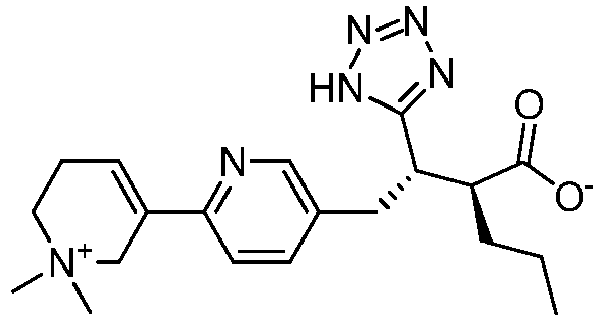
- To a solution of 5-((2S,3S)-3-carboxy-2-(1-((2-(trimethylsilyl)ethoxy)methyl)-1H-tetrazol-5-yl)hexyl)-1',1'-dimethyl-1',2',5',6'-tetrahydro-[2,3'-bipyridin]-1'-ium (EXAMPLE 292, step D) (13 mg, 0.025 mmol) in TFA (2 mL, 26.0 mmol) was added water (0.2 mL). The resulting solution was stirred at RT for 2 hrs. The reaction solution was concentrated and the residue was purified on reverse phase HPLC using acetonitrile/water (0.05%TFA) to give (S)-2-((S)-2-(1',1'-dimethyl-1',2',5',6'-tetrahydro-[2,3'-bipyridin]-1'-ium-5-yl)-1-(1H-tetrazol-5-yl)ethyl)pentanoate. LC-MS M+: 385.19.
-

- To a solution of diisopropylamine (6.3 ml, 44 mmol) in THF (12 mL) at -78°C was added n-butyllithium (25 ml, 40 mmol), and the resulting solution was stirred at -78°C for 15 min before warmed to 0°C. To a solution of (S)-2-((1-((2-(trimethylsilyl)ethoxy)methyl)-1H-tetrazol-5-yl)methyl)pentanoic acid (2.8 g, 8.9 mmol) in THF (30 mL) at -78°C was added above prepared LDA (20 ml, 19 mmol) dropwise. The resulting solution was stirred at -78°C for 45 min before addition of 1-bromo-4-(bromomethyl)benzene (2.2 g, 8.9 mmol) in THF (20 mL). The resulting mixture was then stirred at -78°C overnight. The reaction was quenched by addition of sat. NH4Cl solution (100 mL), then the mixture was extracted with EtOAc twice, the combined organic phase was dried over Na2SO4, concentrated and the residue was purified on silica gel column using MeOH/DCM as eluting solvents to give (S)-2-((S)-2-(4-bromophenyl)-1-(1-((2-(trimethylsilyl)ethoxy)methyl)-1H-tetrazol-5-yl)ethyl)pentanoic acid. LCMS (M+1)+: 483.07.
- To a solution of 1,1-dimethyl-4-(4,4,5,5-tetramethyl-1,3,2-dioxaborolan-2-yl)-1,2,3,6-tetrahydropyridin-1-ium (200 mg, 0.54 mmol) and (S)-2-((S)-2-(4-bromophenyl)-1-(1-((2-(trimethylsilyl)ethoxy)methyl)-1H-tetrazol-5-yl)ethyl)pentanoic acid (200 mg, 0.41 mmol) in dioxane (3 ml) was added Na2CO3 solution (0.621 ml, 1.241 mmol). The mixture was degassed by N2 via vacuum/N2 three times, and PdCl2(dppf) (30 mg, 0.041 mmol) was added and the resulting mixture was degassed again before being heated at 100°C overnight. After filtration the filtrate was concentrated and the residue was purified on reverse phase HPLC using acetonitrile/water (0.05% TFA) to give 4-(4-((2S,3S)-3-carboxy-2-(1-((2-(trimethylsilyl)ethoxy)methyl)-1H-tetrazol-5-yl)hexyl)phenyl)-1,1-dimethyl-1,2,3,6-tetrahydropyridin-1-ium. LCMS M+: 514.21.
- To a solution of 4-(4-((2S,3S)-3-carboxy-2-(1-((2-(trimethylsilyl)ethoxy)methyl)-1H-tetrazol-5-yl)hexyl)phenyl)-1,1-dimethyl-1,2,3,6-tetrahydropyridin-1-ium (70 mg, 0.14 mmol) in MeOH (10 ml) was added 10% Pd/C (14.5 mg, 0.014 mmol). The resulting mixture was hydrogenated with H2 Balloon at RT overnight. After filtration the filtrate was concentrated to give 4-(4-((2S,3S)-3-carboxy-2-(1-((2-(trimethylsilyl)ethoxy)methyl)-1H-tetrazol-5-yl)hexyl)phenyl)-1,1-dimethylpiperidin-1-ium. LCMS M+: 516.22.
- To a solution of 4-(4-((2S,3S)-3-carboxy-2-(1-((2-(trimethylsilyl)ethoxy)methyl)-1H-tetrazol-5-yl)hexyl)phenyl)-1,1-dimethylpiperidin-1-ium (70 mg, 0.14 mmol) in TFA (2 ml) was added water (0.2 mL), and the resulting solution was stirred at RT for 1 hour. After removing the volatile, the residue was purified on reverse phase HPLC using acetonitrile/water (0.05% TFA) as mobile phase to give (S)-2-((S)-2-(4-(1,1-dimethylpiperidin-1-ium-4-yl)phenyl)-1-(1H-tetrazol-5-yl)ethyl)pentanoate. LCMS M+: 386.23.
-

- To a solution of 4-(4-((2S,3S)-3-carboxy-2-(1-((2-(trimethylsilyl)ethoxy)methyl)-1H-tetrazol-5-yl)hexyl)phenyl)-1,1-dimethyl-1,2,3,6-tetrahydropyridin-1-ium (16 mg, 0.031 mmol) in TFA (2 ml) was added water (0.2 mL) and the resulting solution was stirred at RT for 1 hour. After removing the volatile, the residue was purified on reverse phase using acetonitrile/water (0.05% TFA) as mobile phase to give (S)-2-((S)-2-(4-(1,1-dimethyl-1,2,3,6-tetrahydropyridin-1-ium-4-yl)phenyl)-1-(1H-tetrazol-5-yl)ethyl)pentanoate. LCMS M+: 384.23.
-
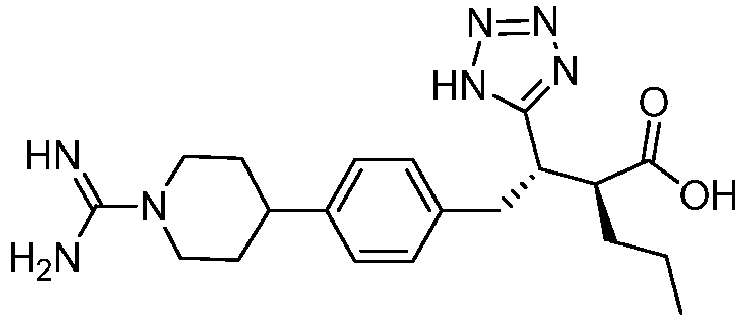
- A mixture of tert-butyl 4-(4,4,5,5-tetramethyl-1,3,2-dioxaborolan-2-yl)-5,6-dihydropyridine-1(2H)-carboxylate (320 mg, 1.02 mmol) and (S)-2-((S)-2-(4-bromophenyl)-1-(1-((2-(trimethylsilyl)ethoxy)methyl)-1H-tetrazol-5-yl)ethyl)pentanoic acid (410 mg, 0.85 mmol) and Na2CO3 (1.3 ml, 2.6 mmol) in dioxane (6 ml) was degassed by bubbling N2 for 20 min before addition of PdCl2(dppf) (62 mg, 0.085 mmol). The resulting mixture was heated at 100°C overnight. After filtration the filtrate was concentrated and the residue was purified on reverse phase MPLC using acetonitrile/water (0.05% TFA) as mobile phase to give (S)-2-((S)-2-(4-(1-(tert-butoxycarbonyl)-1,2,3,6-tetrahydropyridin-4-yl)phenyl)-1-(1-((2-(trimethylsilyl)ethoxy)methyl)-1H-tetrazol-5-yl)ethyl)pentanoic acid. LCMS (M+1)+: 586.26.
- To a solution of (S)-2-((S)-2-(4-(1-(tert-butoxycarbonyl)-1,2,3,6-tetrahydropyridin-4-yl)phenyl)-1-(1-((2-(trimethylsilyl)ethoxy)methyl)-1H-tetrazol-5-yl)ethyl)pentanoic acid (500 mg, 0.85 mmol) in MeOH (20 ml) was added 10% Pd/C (90 mg, 0.085 mmol). The resulting mixture was subjected to hydrogenation via a H2 balloon at RT overnight. After filtration through celite under N2 the filtrate was concentrated and the residue was purified on silica gel column using MeOH/DCM as eluting solvents to give (S)-2-((S)-2-(4-(1-(tert-butoxycarbonyl)piperidin-4-yl)phenyl)-1-(1-((2-(trimethylsilyl)ethoxy)methyl)-1H-tetrazol-5-yl)ethyl)pentanoic acid. LCMS (M+1)+: 588.29.
- To a solution of (S)-2-((S)-2-(4-(1-(tert-butoxycarbonyl)piperidin-4-yl)phenyl)-1-(1-((2-(trimethylsilyl)ethoxy)methyl)-1H-tetrazol-5-yl)ethyl)pentanoic acid (0.46 g, 0.78 mmol) in TFA (3 ml) was added water (0.3 ml). The resulting solution was stirred at RT for 0.5 hour. The reaction solution was purified on reverse phase HPLC using acetonitrile/water (0.05% TFA) as mobile phase to give (S)-2-((S)-2-(4-(piperidin-4-yl)phenyl)-1-(1H-tetrazol-5-yl)ethyl)pentanoic acid. LCMS (M+1)+: 358.16.
- To a solution of (S)-2-((S)-2-(4-(piperidin-4-yl)phenyl)-1-(1H-tetrazol-5-yl)ethyl)pentanoic acid (100 mg, 0.29 mmol) in DMF (2 ml) was added 1H-pyrazole-1-carboxamidine hydrochloride (63 mg, 0.43 mmol) and DIEA (0.20 ml, 1.2 mmol). The resulting solution was stirred at RT overnight. The mixture was purified on reverse phase using acetonitrile/water (0.1% formic acid) as mobile phase to give (S)-2-((S)-2-(4-(1-carbamimidoylpiperidin-4-yl)phenyl)-1-(1H-tetrazol-5-yl)ethyl)pentanoic acid. LCMS (M+1)+: 400.12.
-

- To a solution of (S)-2-((S)-2-(4-(piperidin-4-yl)phenyl)-1-(1H-tetrazol-5-yl)ethyl)pentanoic acid (130 mg, 0.35 mmol) in DMF (1 ml) was added ethyl formimidate hydrochloride (58 mg, 0.53 mmol) and DIEA (0.25 ml, 1.4 mmol). The resulting solution was stirred at RT overnight. The mixture was purified on reverse phase HPLC using acetonitrile/water (0.1% formic acid) as mobile phase to give (S)-2-((S)-2-(4-(1-(iminomethyl)piperidin-4-yl)phenyl)-1-(1H-tetrazol-5-yl)ethyl)pentanoic acid. LCMS (M+1)+: 385.26.
-

- A solution of tert-butyl 4-(4,4,5,5-tetramethyl-1,3,2-dioxaborolan-2-yl)-5,6-dihydropyridine-1(2H)-carboxylate (470 mg, 1.5 mmol), (S)-2-((S)-2-(6-bromopyridin-3-yl)-1-(1-((2-(trimethylsilyl)ethoxy)methyl)-1H-tetrazol-5-yl)ethyl)pentanoic acid (570 mg, 1.2 mmol) and Na2CO3 (2.3 ml, 4.7 mmol) in 1,4-dioxane (15 ml) was bubbled with N2 for 15 min before addition of PdCl2(dppf) (86 mg, 0.12 mmol). The resulting mixture was heated at 100°C overnight. After filtration through celite, the filtrate was concentrated and the residue was purified on reverse phase MPLC using acetonitrile/water (0.05% TFA) as mobile phase to give (S)-2-((S)-2-(1'-(tert-butoxycarbonyl)-1',2',3',6'-tetrahydro-[2,4'-bipyridin]-5-yl)-1-(1-((2-(trimethylsilyl)ethoxy)methyl)-1H-tetrazol-5-yl)ethyl)pentanoic acid. LCMS (M+1)+: 587.39.
- To a solution of (S)-2-((S)-2-(1'-(tert-butoxycarbonyl)-1',2',3',6'-tetrahydro-[2,4'-bipyridin]-5-yl)-1-(1-((2-(trimethylsilyl)ethoxy)methyl)-1H-tetrazol-5-yl)ethyl)pentanoic acid (0.58 g, 1.0 mmol) in MeOH (30 ml) was added 10% Pd/C (0.10 g, 0.099 mmol). The resulting mixture was subjected to hydrogenation at RT via H2 balloon for 5 hrs. The mixture was filtered through celite under N2, and the filtrate was concentrated to give (S)-2-((S)-2-(6-(1-(tert-butoxycarbonyl)piperidin-4-yl)pyridin-3-yl)-1-(1-((2-(trimethylsilyl)ethoxy)methyl)-1H-tetrazol-5-yl)ethyl)pentanoic acid. LCMS (M+1)+: 589.25.
- To a solution of (S)-2-((S)-2-(6-(1-(tert-butoxycarbonyl)piperidin-4-yl)pyridin-3-yl)-1-(1-((2-(trimethylsilyl)ethoxy)methyl)-1H-tetrazol-5-yl)ethyl)pentanoic acid (0.37 g, 0.63 mmol) in TFA (2 ml) was added water (0.2 ml). The resulting solution was stirred at RT for 1 hour, then the solution was concentrated and the residue was purified on reverse phase HPLC using acetonitrile/water (0.05% TFA) as mobile phase to give (S)-2-((S)-2-(6-(piperidin-4-yl)pyridin-3-yl)-1-(1H-tetrazol-5-yl)ethyl)pentanoic acid. LCMS (M+1)+: 359.15.
- To a solution of (S)-2-((S)-2-(6-(piperidin-4-yl)pyridin-3-yl)-1-(1H-tetrazol-5-yl)ethyl)pentanoic acid (120 mg, 0.33 mmol) in DMF (2 ml) was added 1H-pyrazole-1-carboxamidine hydrochloride (73 mg, 0.50 mmol) and DIEA (0.46 ml, 2.7 mmol). The resulting solution was stirred at RT overnight. The mixture was purified on reverse phase HPLC using acetonitrile/water (0.05% TFA) as mobile phase to give (S)-2-((S)-2-(6-(1-carbamimidoylpiperidin-4-yl)pyridin-3-yl)-1-(1H-tetrazol-5-yl)ethyl)pentanoic acid. LCMS (M+1)+: 401.15.
-
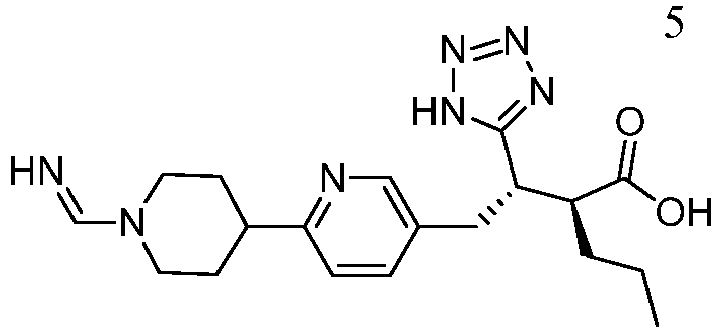
- To a solution of (S)-2-((S)-2-(6-(piperidin-4-yl)pyridin-3-yl)-1-(1H-tetrazol-5-yl)ethyl)pentanoic acid (35 mg, 0.098 mmol) in DMF (1 ml) was added ethyl formimidate hydrochloride (16 mg, 0.15 mmol) and DIEA (0.14 ml, 0.78 mmol). The resulting solution was stirred at RT overnight. The mixture was purified on reverse phase HPLC using acetonitrile/water (0.05% TFA) as mobile phase to give (S)-2-((S)-2-(6-(1-(iminomethyl)piperidin-4-yl)pyridin-3-yl)-1-(1H-tetrazol-5-yl)ethyl)pentanoic acid. LCMS (M+1)+: 386.22.
-

- In glovebox, a mixture of (S)-2-((S)-2-(6-bromopyridin-3-yl)-1-(1-((2-(trimethylsilyl)ethoxy)methyl)-1H-tetrazol-5-yl)ethyl)-4-methylpentanoic acid (25 mg, 0.050 mmol), Amine 2 (0.100 mmol), Reactant 3 (3.99 mg, 10.03 µmol), cesium carbonate (49.0 mg, 0.150 mmol) and 600 µL of DMF into 2 dram vials was heated at 100°C for 16 hr. The vials were cooled down to room temperature and 3 mL of EtOAc was added into each vial. The mixtures were filtered and the solution was concentrated in GeneVac.
- Into the residues were added 2 mL of TFA/DCM. The mixtures were shaken at room temperature for 5 hr and concentrated to dryness.
- 1 mL of EtOH and 1 mL of IN aq. HCl were added into the vials. The mixtures were heated at 60°C for 16 hr and concentrated in GeneVac. The residues were dissolved in 1.4 mL of DMSO. The crude solution was filtered through a filter plate and purified by HPLC.
- The following compounds were made following the above general procedure:
Ex. No Structure IUPAC Name Calc'd Mass [M+H]+ LC/MS m/e [M+H]+ 300 
(2S)-2-[(1S)-2-[4-(1-methylpiperidin-4-yl)phenyl]-1-(2H-tetrazol-5-yl)ethyl]pentanoic acid 372.24 372.23 301 
(2S)-2-[(1S)-2-[4'-(piperidin-4-ylmethyl)biphenyl-4-yl]-1-(2H-tetrazol-5-yl)ethyl]pentanoic acid 448.27 448.26 302 
(2S)-2-[(1S)-2-[4-(1,2,5,6-tetrahydropyridin-3-yl)phenyl]-1-(2H-tetrazol-5-yl)ethyl]pentanoic acid 356.21 356.20 303 
(2S)-4-methyl-2-[(1S)-2-[6-(2-phenylpyrrolidin-1-yl)pyridin-3-yl]-1-(1H-tetrazol-5-yl)ethyl]pentanoic acid 435.25 435.24 304 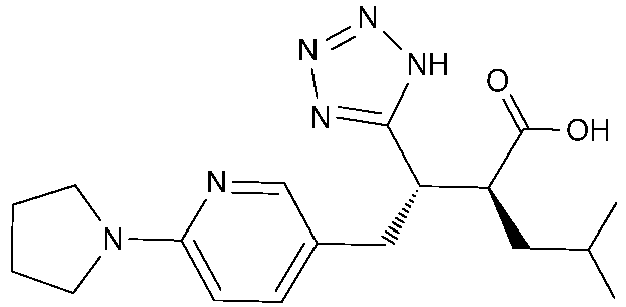
(2S)-4-methyl-2-[(1S)-2-(6-pyrrolidin-1-ylpyridin-3-yl)-1-(1H-tetrazol-5-yl)ethyl]pentanoic acid 359.22 359.21 305 
(2S)-4-methyl-2-[(1S)-2-{6-[3-(methylcarbamoyl)pyrrolidin-1-yl]pyridin-3-yl}-1-(1H-tetrazol-5-yl)ethyl]pentanoic acid 416.24 416.23 306 
(2S)-2-[(1S)-2-{6-[3-(aminomethyl)pyrrolidin-1-yl]pyridin-3-yl}-1-(1H-tetrazol-5-yl)ethyl]-4-methylpentanoic acid 388.25 388.24 307 
(2S)-2-[(1S)-2-{6-[4-(aminomethyl)piperidin -1-yl]pyridin-3-yl}-1-(1H-tetrazol-5-yl)ethyl]-4-methylpentanoic acid 402.26 402.25 308 
(2S)-2-[(1S)-2-[6-(2,7-diazaspiro[3.5]non-7-yl)pyridin-3-yl]-1-(1H-tetrazol-5-yl)ethyl]-4-methylpentanoic acid 414.26 414.25 309 
(2S)-2-[(1S)-2-{6-[3-(hydroxymethyl)piperidin-1-yl]pyridin-3-yl}-1-(1H-tetrazol-5-yl)ethyl]-4-methylpentanoic acid 403.25 403.24 310 
(2S)-2-[(1S)-2-[6-(3-aminopyrrolidin-1-yl)pyridin-3-yl]-1-(1H-tetrazol-5-yl)ethyl]-4-methylpentanoic acid 374.23 374.22 311 
(2S)-4-methyl-2-[(1S)-2-{6-[3-(methylcarbamoyl)piperidin-1-yl]pyridin-3-yl}-1-(1H-tetrazol-5-yl)ethyl]pentanoic acid 430.26 430.25 312 
(2S)-4-methyl-2-[(1S)-2-[6-(4-{[(methylsulfonyl)amino]methyl}piperidin-1-yl)pyridin-3-yl]-1-(1H-tetrazol-5-yl)ethyl]pentanoic acid 480.24 480.23 313 
(2S)-2-[(1S)-2-[6-(3-hydroxypyrrolidin-1-yl)pyridin-3-yl]-1-(1H-tetrazol-5-yl)ethyl]-4-methylpentanoic acid 375.21 375.21 314 
(2S)-2-[(1S)-2-{6-[4-(hydroxymethyl)piperidin-1-yl]pyridin-3-yl}-1-(1H-tetrazol-5-yl)ethyl]-4-methylpentanoic acid 403.25 403.24 315 
(2S)-2-[(1S)-2-{6-[2-(hydroxymethyl)pyrrolidin-1-yl]pyridin-3-yl}-1-(1H-tetrazol-5-yl)ethyl]-4-methylpentanoic acid 389.23 389.22 316 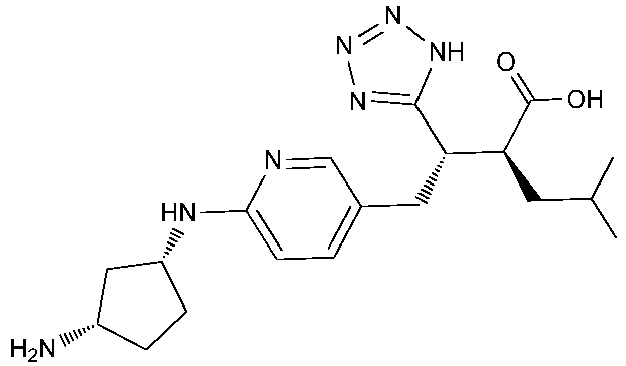
(2S)-2-[(1S)-2-(6-{[(1R,3S)-3-aminocyclopentyl]amino}pyridin-3-yl)-1-(1H-tetrazol-5-yl)ethyl]-4-methylpentanoic acid 388.25 388.24 317 
(2S)-2-[(1S)-2-(6-{[(1S,3S)-3-aminocyclopentyl]amino}pyridin-3-yl)-1-(1H-tetrazol-5-yl)ethyl]-4-methylpentanoic acid 388.25 388.24 318 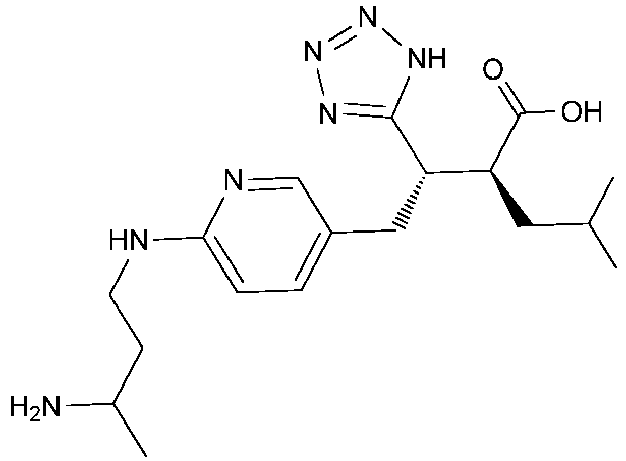
(2S)-2-[(1S)-2-{6-[(3-aminobutyl)amino]pyridin-3-yl}-1-(1H-tetrazol-5-yl)ethyl]-4-methylpentanoic acid 376.25 376.24 319 
(2S)-4-methyl-2-[(1S)-2-[6-(1,2,3,4-tetrahydroisoquinolin-4-ylamino)pyridin-3-yl]-1-(1H-tetrazol-5-yl)ethyl]pentanoic acid 436.25 436.24 320 
(2S)-2-[(1S)-2-{6-[(3-amino-4,4,4-trifluorobutyl)amino]pyridin-3-yl}-1-(1H-tetrazol-5-yl)ethyl]-4-methylpentanoic acid 430.22 430.21 321 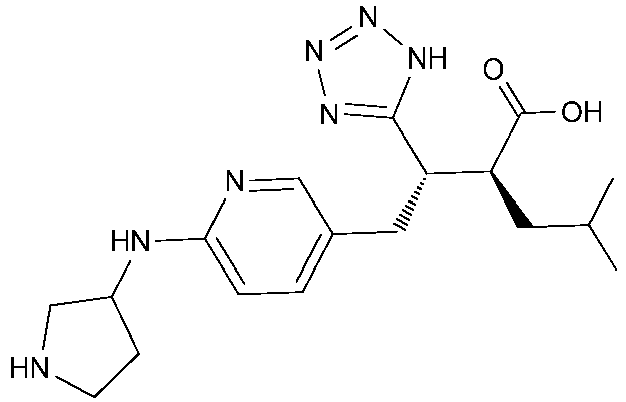
(2S)-4-methyl-2-[(1S)-2-[6-(pyrrolidin-3-ylamino)pyridin-3-yl]-1-(1H-tetrazol-5-yl)ethyl]pentanoic acid 374.23 374.22 322 
(2S)-2-[(1S)-2-{6-[3-(1-amino-1-methylethyl)piperidin-1-yl]pyridin-3-yl}-1-(1H-tetrazol-5-yl)ethyl]-4-methylpentanoic acid 430.29 430.29 323 
(2S)-2-[(1S)-2-(6-{[(4-hydroxypiperidin-3-yl)methyl]amino}pyridin-3-yl)-1-(1H-tetrazol-5-yl)ethyl]-4-methylpentanoic acid 418.26 418.25 324 
(2S)-4-methyl-2-[(1S)-2-[6-(3-piperazin-1-ylazetidin-1-yl)pyridin-3-yl]-1-(1H-tetrazol-5-yl)ethyl]pentanoic acid 429.27 429.27 325 
(2S)-2-[(1S)-2-{6-[3-(aminomethyl)-3-methylazetidin-1-yl]pyridin-3-yl}-1-(1H-tetrazol-5-yl)ethyl]-4-methylpentanoic acid 388.25 388.24 326 
(2S)-2-[(1S)-2-{6-[3-(2-aminoethyl)azetidin-1-yl]pyridin-3-yl}-1-(1H-tetrazol-5-yl)ethyl]-4-methylpentanoic acid 388.25 388.24 327 
(2S)-2-[(1S)-2-[6-(3-aminoazetidin-1-yl)pyridin-3-yl]-1-(1H-tetrazol-5-yl)ethyl]-4-methylpentanoic acid 360.21 360.21 328 
(2S)-4-methyl-2-[(1S)-2-[6-(7-oxo-2,6-diazaspiro[3.4]oct-2-yl)pyridin-3-yl]-1-(1H-tetrazol-5-yl)ethyl]pentanoic acid 414.23 414.22 329 
(2S)-4-methyl-2-[(1S)-2-[6-(3-morpholin-4-ylazetidin-1-yl)pyridin-3-yl]-1-(1H-tetrazol-5-yl)ethyl]pentanoic acid 430.26 430.25 330 
(2S)-2-[(1S)-2-6-[3,3-bis(hydroxymethyl)azetidin-1-yl]pyridin-3-yl}-1-(1H-tetrazol-5-yl)ethyl]-4-methylpentanoic acid 405.22 405.22 331 
(2S)-2-[(1S)-2-{6-[3-(1-hydroxy-1-methylethyl)azetidin-1-yl]pyridin-3-yl}-1-(1H-tetrazol-5-yl)ethyl]-4-methylpentanoic acid 403.25 403.24 332 
(2S)-4-methyl-2-[(1S)-2-{6-[3-(4-methylpiperazin-1-yl)azetidin-1-yl]pyridin-3-yl}-1-(1H-tetrazol-5-yl)ethyl]pentanoic acid 443.29 443.28 333 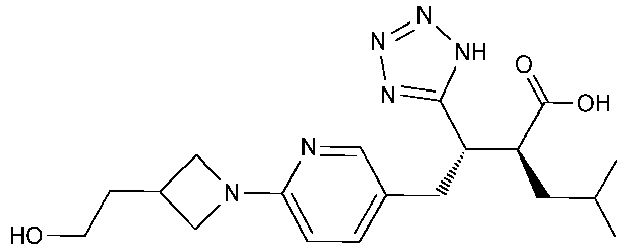
(2S)-2-[(1S)-2-{6-[3-(2-hydroxyethyl)azetidin-1-yl]pyridin-3-yl}-1-(1H-tetrazol-5-yl)ethyl]-4-methylpentanoic acid 389.23 389.22 334 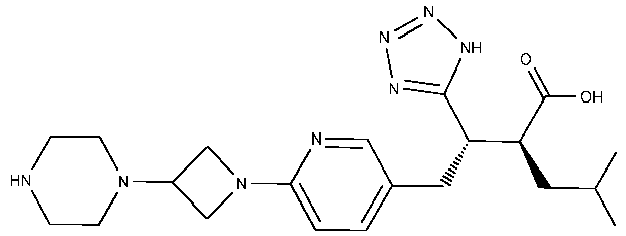
(2S)-4-methyl-2-[(1S)-2-[6-(3-piperazin-1-ylazetidin-1-yl)pyridin-3-yl]-1-(1H-tetrazol-5-yl)ethyl]pentanoic acid 429.27 429.27 335 
(2S)-4-methyl-2-[(1S)-2-{6-[3-(methylsulfonyl)azetidin-1-yl]pyridin-3-yl}-1-(1H-tetrazol-5-yl)ethyl]pentanoic acid 423.18 423.17 336 
(2S)-2-[(1S)-2-[6-(2,6-diazaspiro[3.4]oct-2-yl)pyridin-3-yl]-1-(1H-tetrazol-5-yl)ethyl]-4-methylpentanoic acid 400.25 400.24 337 
(2S)-4-methyl-2-[(1S)-2-[6-(7-methyl-6-oxo-5-oxa-2,7-diazaspiro[3.4]oct-2-yl)pyridin-3-yl]-1-(1H-tetrazol-5-yl)ethyl]pentanoic acid 430.22 430.21 338 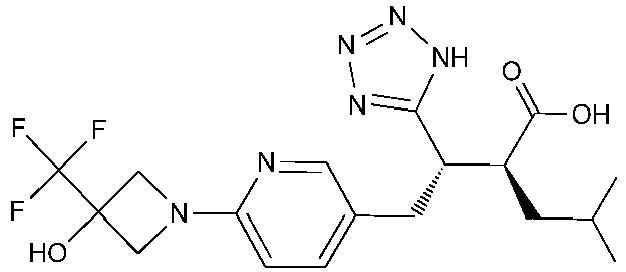
(2S)-2-[(1S)-2-{6-[3-hydroxy-3-(trifluoromethyl)azetidin-1-yl]pyridin-3-yl}-1-(1H-tetrazol-5-yl)ethyl]-4-methylpentanoic acid 429.19 429.18 -

- Into 2 dram vials were added substituted boronic acid or ester (0.071 mmol), palladium catalyst (3.1 mg, 4.7 µmol) and 189 µL of 1 N degassed aq. K3PO4 solution. In glove box, 1 mL of a solution of (S)-tert-butyl 2-((S)-2-(3-bromophenyl)-1-(2-(4-mentylbenzyl)-2H-tetrazol-5-yl)ethyl)pentanoate (27 mg, 0.051 mmol) in EtOH were added into each vial. The vials were capped and heated at 75°C with stirring for 20 hr (overnight). After the vials were cooled down to room temperature, the solvent was removed in GeneVac. Into each residue was added 600 µL of H2O and 2 mL of DCM. The organic layers were transferred into 2 dram vials. The organic solvent was removed in GeneVac to afford the crude intermediates.
- Into each vial was added a solution of thioanisole (0.3 mL), and DCM (0.3 mL) in TFA (0.3 mL). The vials were agitated at 25°C for 16 hr. The solvent was removed in a GeneVac. Into each vial was added a solution of thioanisole (0.3 mL), and DCM (0.3 mL) in TFA (0.3 mL). The vials were agitated at 55°C for 16 hr. The solvent was removed in a GeneVac. The residues were dissolved in 1.3 mL of DMSO. Each crude mixture was filtered into a 96-well tray and purified by HPLC to afford the following EXAMPLES.
Ex. No Structure IUPAC Name Calc'd Mass [M+H]+ LC/MS m/e [M+H]+ 339 
(2S)-2-[(1S)-2-(3-pyridin-3-ylphenyl)-1-(2H-tetrazol-5-yl)ethyl]pentanoic acid 352.18 352.17 340 
(2S)-2-[(1S)-2-[3-(2-piperazin-1-ylpyridin-4-yl)phenyl]-1-(2H-tetrazol-5-yl)ethyl]pentanoic acid 436.25 436.24 341 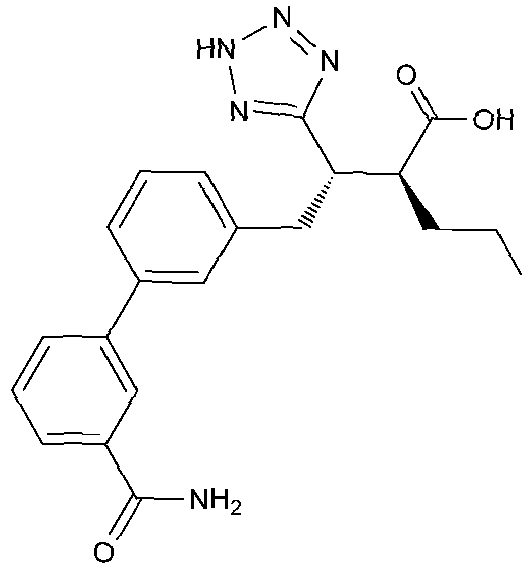
(2S)-2-[(1S)-2-(3'-carbamoylbiphenyl-3-yl)-1-(2H-tetrazol-5-yl)ethyl]pentanoic acid 394.19 394.17 342 
(2S)-2-[(1S)-2-[3-(6-aminopyridin-3-yl)phenyl]-1-(2H-tetrazol-5-yl)ethyl]pentanoic acid 367.19 367.18 343 
(2S)-2-[(1S)-2-{4'-[(methylsulfonyl)amino]biphenyl-3-yl}-1-(2H-tetrazol-5-yl)ethyl]pentanoic acid 444.17 444.17 344 
(2S)-2-[(1S)-2-[4'-(methylcarbamoyl)biphenyl-3-yl]-1-(2H-tetrazol-5-yl)ethyl]pentanoic acid 408.2 408.19 345 
(2S)-2-[(1S)-2-(3'-piperidin-3-ylbiphenyl-3-yl)-1-(2H-tetrazol-5-yl)ethyl]pentanoic acid 434.26 434.25 346 
(2S)-2-[(1S)-2-[3-(6-morpholin-4-ylpyridin-3-yl)phenyl]-1-(2H-tetrazol-5-yl)ethyl]pentanoic acid 437.23 437.22 347 
(2S)-2-[(1S)-2-{3-[5-(piperidin-1-ylmethyl)pyridin-3-yl]phenyl}-1-(2H-tetrazol-5-yl)ethyl]pentanoic acid 449.27 449.26 348 
(2S)-2-[(1S)-2-{3-[6-(piperidin-4-yloxy)pyridin-2-yl]phenyl}-1-(2H-tetrazol-5-yl)ethyl]pentanoic acid 451.25 451.24 349 
(2S)-2-[(1S)-2-[3-(2-aminopyridin-4-yl)phenyl]-1-(2H-tetrazol-5-yl)ethyl]pentanoic acid 367.19 367.19 350 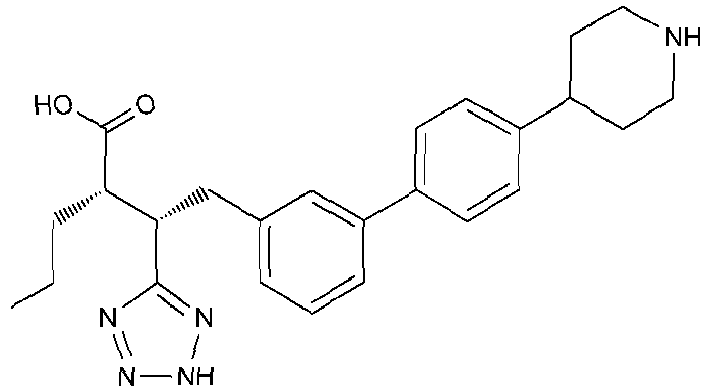
(2S)-2-[(1S)-2-(4'-piperidin-4-ylbiphenyl-3-yl)-1-(2H-tetrazol-5-yl)ethyl]pentanoic acid 434.26 434.25 351 
(2S)-2-[(1S)-2-(4'-carbamoylbiphenyl-3-yl)-1-(2H-tetrazol-5-yl)ethyl]pentanoic acid 394.19 394.19 352 
(2S)-2-[(1S)-2-(3-isoquinolin-4-ylphenyl)-1-(2H-tetrazol-5-yl)ethyl]pentanoic acid 402.19 402.18 353 
(2S)-2-[(1S)-2-(3-pyridin-4-ylphenyl)-1-(2H-tetrazol-5-yl)ethyl]pentanoic acid 352.18 352.17 354 
(2S)-2-[(1S)-2-[3-(6-amino-5,6,7,8-tetrahy dronaphthalen-2-yl)phenyl]-1-(2H-tetrazol-5-yl)ethyl]pentanoic acid 420.24 420.23 355 
(2S)-2-[(1S)-2-[3-(6-piperazin-1-ylpyridin-3-yl)phenyl]-1-(2H-tetrazol-5-yl)ethyl]pentanoic acid 436.25 436.24 356 
(2S)-2-[(1S)-2-[3-(6-amino-5-fluoropyridin-3-yl)phenyl]-1-(2H-tetrazol-5-yl)ethyl]pentanoic acid 385.18 385.19 -

- Into 2 dram vials were added substituted trifluoro boronate (0.071 mmol), palladium catalyst (3.1 mg, 4.7 µmol) and 189 µL of 1 N degassed aq. K3PO4 solution. In a glove box, 1 mL of a solution of (S)-tert-butyl 2-((S)-2-(3-bromophenyl)-1-(2-(4-mentylbenzyl)-2H-tetrazol-5-yl)ethyl)pentanoate (27 mg, 0.051 mmol) in EtOH was added into each vial. The vials were capped and heated at 75°C with stirring for 20 hr (overnight). After the vials were cooled down to room temperature, the solvent was removed in GeneVac. Into each residue was added 600 µL of H2O and 2 mL of DCM. The organic layers were transferred into 2 dram vials. The organic solvent was removed in GeneVac to afford the crude intermediates.
- Into each vial was added a solution of thioanisole (0.3 mL), DCM (0.3 mL) in TFA (0.3 mL). The vials were agitated at 25°C for 16 hr. The solvent was removed in a GeneVac. Into each vial was added a solution of thioanisole (0.3 mL), DCM (0.3 mL) in TFA (0.3 mL). The vials were agitated at 55°C for 16 hr. The solvent was removed in a GeneVac. The residues were dissolved in 1.3 mL of DMSO. Each crude mixture was filtered into a 96-well tray and purified by HPLC to afford the following EXAMPLES.
Ex. No Structure IUPAC Name Calc'd Mass [M+H]+ LC/MS m/e [M+H]+ 357 
(2S)-2-[(1S)-2-[2'-(piperidin-1-ylmethyl)biphenyl-3-yl]-1-(2H-tetrazol-5-yl)ethyl]pentanoic acid 448.27 448.25 358 
(2S)-2-[(1S)-2-[3'-(piperidin-1-ylmethyl)biphenyl-3-yl]-1-(2H-tetrazol-5-yl)ethyl]pentanoic acid 448.27 448.25 359 
(2S)-2-[(1S)-2-[3'-(aminomethyl)biphenyl-3-yl]-1-(2H-tetrazol-5-yl)ethyl]pentanoic acid 380.21 380.2 -

- Into 2 dram vials were added substituted secondary amines (0.15 mmol), palladium catalyst (4.07 mg, 5.1 µmol) and cesium carbonate (66.5 mg, 0.2 mmol). In a glove box, 1 mL of a solution of (S)-tert-butyl 2-((S)-2-(3-bromophenyl)-1-(2-(4-mentylbenzyl)-2H-tetrazol-5-yl)ethyl)pentanoate (27 mg, 0.051 mmol) in 1,4-Dioxane was added into each vial. The vials were capped and heated at 90°C with stirring for 20 hr (overnight). After the vials were cooled down to room temperature, the solvent was removed in GeneVac. Into each residue was added 600 µL of H2O and 2 mL of DCM. The organic layers were transferred into 2 dram vials. The organic solvent was removed in GeneVac to afford the crude intermediates.
- Into each vial was added a solution of thioanisole (0.3 mL), and DCM (0.3 mL) in TFA (0.3 mL). The vials were agitated at 25°C for 16 hr. The solvent was removed in a GeneVac. Into each vial was added a solution of thioanisole (0.3 mL), and DCM (0.3 mL) in TFA (0.3 mL). The vials were agitated at 55°C for 16 hr. The solvent was removed in a GeneVac. The residues were dissolved in 1.3 mL of DMSO. Each crude mixture was filtered into a 96-well tray and purified by HPLC to afford the following EXAMPLES.
Ex. No Structure IUPAC Name Calc'd Mass [M+H]+ LC/MS m/e [M+H]+ 360 
(2S)-2-[(1S)-2-[3-(3-hydroxypiperidin-1-yl)phenyl]-1-(2H-tetrazol-5-yl)ethyl]pentanoic acid 374.22 374.21 361 
(2S)-2-[(1S)-2-(3-{[2-(dimethylamino)ethyl] (methyl)amino}phenyl )-1-(2H-tetrazol-5-yl)ethyl]pentanoic acid 375.25 375.24 362 
(2S)-2-[(1S)-2-[3-(4-methylpiperazin-1-yl)phenyl]-1-(2H-tetrazol-5-yl)ethyl]pentanoic acid 373.23 373.22 363 
(2S)-2-[(1S)-2-[3-(4-acetylpiperazin-1-yl)phenyl]-1-(2H-tetrazol-5-yl)ethyl]pentanoic acid 401.23 401.22 364 
(2S)-2-[(1S)-2-{3-[(3R)-3-aminopyrrolidin-1-yl]phenyl}-1-(2H-tetrazol-5-yl)ethyl]pentanoic acid 359.22 359.21 365 
(2S)-2-[(1S)-2-(3-morpholin-4-ylphenyl)-1-(2H-tetrazol-5-yl)ethyl]pentanoic acid 360.2 360.19 366 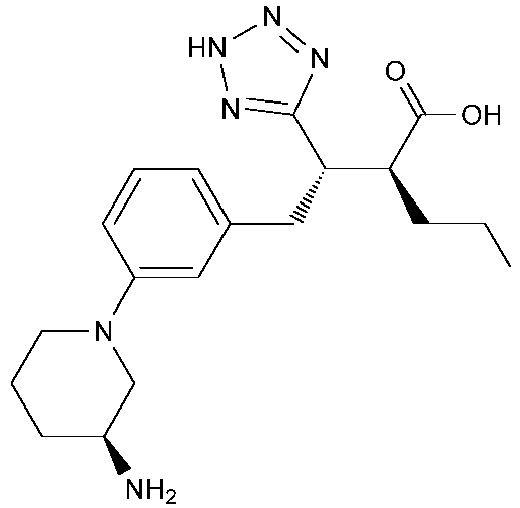
(2S)-2-[(1S)-2-{3-[(3S)-3-aminopiperidin-1-yl]phenyl}-1-(2H-tetrazol-5-yl)ethyl]pentanoic acid 373.23 373.23 367 
(2S)-2-[(1S)-2-[3-(3-oxopiperazin-1-yl)phenyl]-1-(2H-tetrazol-5-yl)ethyl]pentanoic acid 373.2 373.19 368 
(2S)-2-[(1S)-2-(3-piperidin-1-ylphenyl)-1-(2H-tetrazol-5-yl)ethyl]pentanoic acid 358.22 358.21 369 
(2S)-2-[(1S)-2-{3-[(3S)-3-aminopyrrolidin-1-yl]phenyl}-1-(2H-tetrazol-5-yl)ethyl]pentanoic acid 359.22 359.22 370 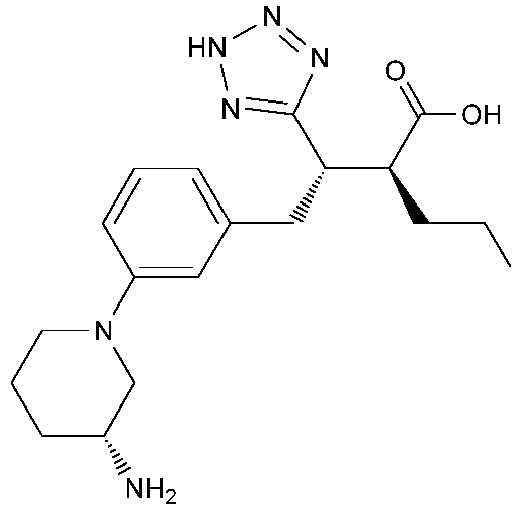
(2S)-2-[(1S)-2-{3-[(3R)-3-aminopiperidin-1-yl]phenyl}-1-(2H-tetrazol-5-yl)ethyl]pentanoic acid 373.23 373.22 -

- Into 2 dram vials were added substituted phenols (0.15 mmol), copper catalyst (4.07 mg, 5.1 µmol) and cesium carbonate (66.5 mg, 0.2 mmol). In a glove box, 1 mL of a solution of (S)-2-((S)-2-(6-bromopyridin-3-yl)-1-(1-((2-(trimethylsilyl)ethoxy)methyl)-1H-tetrazol-5-yl)ethyl)-4-methylpentanoic acid (25 mg, 0.05 mmol) in DMF was added into each vial. The vials were capped and heated at 100°C with stirring for 20 hr (overnight). After the vials were cooled down to room temperature, the solvent was removed in GeneVac. Into each residue was added 600 µL of H2O and 2 mL of DCM. The organic layers were transferred into 2 dram vials. The organic solvent was removed in GeneVac to afford the crude intermediates.
- Into each vial was added a solution of DCM (0.3 mL) in TFA (0.3 mL). The vials were agitated at 25°C for 8 hr. The solvent was removed in a GeneVac. The residues were dissolved in 1.3 mL of DMSO. Each crude mixture was filtered into a 96-well tray and purified by HPLC to afford the following EXAMPLES.
Ex. No Structure IUPAC Name Calc'd Mass [M+H]+ LC/MS m/e [M+H]+ 371 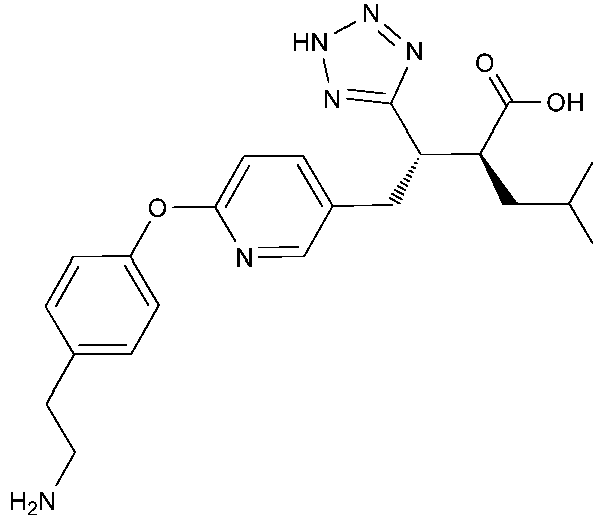
(2S)-2-[(1S)-2-{6-[4-(2-aminoethyl)phenoxy]pyridin-3-yl}-1-(2H-tetrazol-5-yl)ethyl]-4-methylpentanoic acid 425.23 425.22 372 
(2S)-4-methyl-2-[(1S)-2-[6-(2-piperazin-1-ylphenoxy)pyridin-3-yl]-1-(2H-tetrazol-5-yl)ethyl]pentanoic acid 466.26 466.25 373 
(2S)-2-[(1S)-2-{6-[3-(hydroxymethyl)phenoxy]pyridin-3-yl}-1-(2H-tetrazol-5-yl)ethyl]-4-methylpentanoic acid 412.2 412.19 374 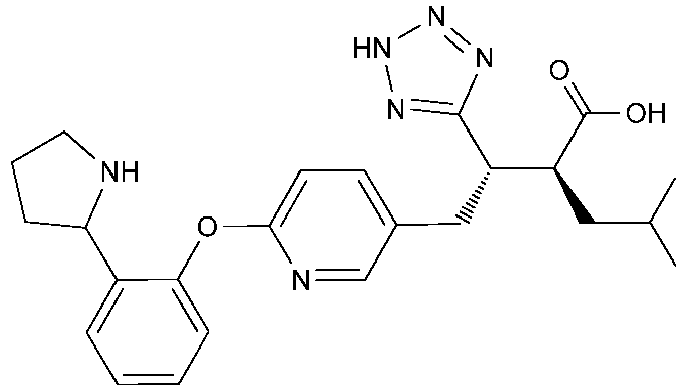
(2S)-4-methyl-2-[(1S)-2-[6-(2-pyrrolidin-2-ylphenoxy)pyridin-3-yl]-1-(2H-tetrazol-5-yl)ethyl]pentanoic acid 451.25 451.24 375 
(2S)-2-[(1S)-2-[6-(4-carbamoylphenoxy)pyridin-3-yl]-1-(2H-tetrazol-5-yl)ethyl]-4-methylpentanoic acid 425.19 425.18 376 
(2S)-4-methyl-2-[(1S)-2-[6-(2-pyrrolidin-2-ylphenoxy)pyridin-3-yl]-1-(2H-tetrazol-5-yl)ethyl]pentanoic acid 451.25 451.24 377 
(2S)-2-[(1S)-2-[6-(4-carbamoylphenoxy)pyridin-3-yl]-1-(2H-tetrazol-5-yl)ethyl]-4-methylpentanoic acid 425.19 425.18 378 
(2S)-2-[(1S)-2-[6-(3-carbamoylphenoxy)pyridin-3-yl]-1-(2H-tetrazol-5-yl)ethyl]-4-methylpentanoic acid 425.19 425.18 379 
(2S)-4-methyl-2-[(1S)-2-{6-[(2-piperazin-1-ylpyridin-4-yl)oxy]pyridin-3-yl}-1-(2H-tetrazol-5-yl)ethyl]pentanoic acid 467.25 467.24 380 
(2S)-2-[(1S)-2-(6-{[6-(1-aminoethyl)pyridin-3-yl]oxy}pyridin-3-yl)-1-(2H-tetrazol-5-yl)ethyl]-4-methylpentanoic acid 426.23 426.22 381 
(2S)-4-methyl-2-[(1S)-2-(6-phenoxypyridin-3-yl)-1-(2H-tetrazol-5-yl)ethyl]pentanoic acid 382.19 382.18 382 
(2S)-4-methyl-2-[(1S)-2-[6-(3-piperidin-3-ylphenoxy)pyridin-3-yl]-1-(2H-tetrazol-5-yl)ethyl]pentanoic acid 465.26 465.25 383 
(2S)-2-[(1S)-2-{6-[4-(hydroxymethyl)phenoxy]pyridin-3-yl}-1-(2H-tetrazol-5-yl)ethyl]-4-methylpentanoic acid 412.2 412.19 384 
(2S)-2-[(1S)-2-{6-[3-(hydroxymethyl)phenoxy]pyridin-3-yl}-1-(2H-tetrazol-5-yl)ethyl]-4-methylpentanoic acid 412.2 412.19 385 
(2S)-2-[(1S)-2-[6-(3-carbamoylphenoxy)pyridin-3-yl]-1-(2H-tetrazol-5-yl)ethyl]-4-methylpentanoic acid 425.19 425.18 386 
(2S)-2-[(1S)-2-{6-[4-(2-amino-2-methylpropyl)phenoxy]pyridin-3-yl}-1-(2H-tetrazol-5-yl)ethyl]-4-methylpentanoic acid 453.26 453.25 387 
(2S)-4-methyl-2-[(1S)-2-[6-(2-piperazin-1-ylphenoxy)pyridin-3-yl]-1-(2H-tetrazol-5-yl)ethyl]pentanoic acid 466.26 466.25 388 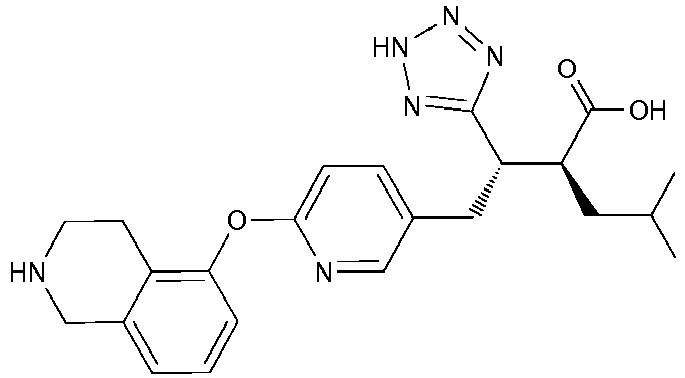
(2S)-4-methyl-2-[(1S)-2-[6-(1,2,3,4-tetrahydroisoquinolin-5-yloxy)pyridin-3 -yl]-1-(2H-tetrazol-5-yl)ethyl]pentanoic acid 437.23 437.22 389 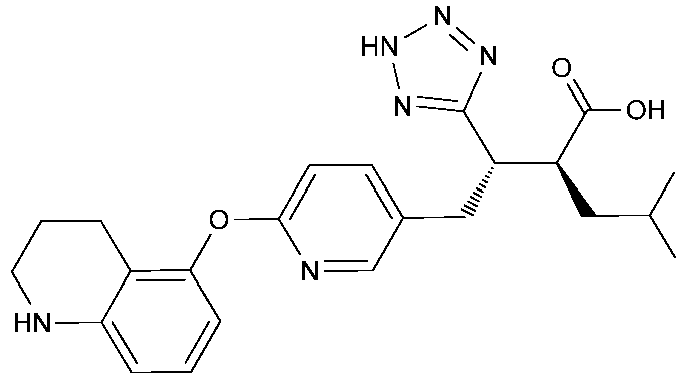
(2S)-4-methyl-2-[(1S)-2-[6-(1,2,3,4-tetrahydroquinolin-5-yloxy)pyridin-3-yl]-1-(2H-tetrazol-5-yl)ethyl]pentanoic acid 437.23 437.22 390 
(2S)-2-[(1S)-2-{6-[4-(aminomethyl)phenoxy]pyridin-3-yl}-1-(2H-tetrazol-5-yl)ethyl]-4-methylpentanoic acid 411.21 411.2 391 
(2S)-4-methyl-2-[(1S)-2-[6-(pyridin-2-yloxy)pyridin-3-yl]-1-(2H-tetrazol-5-yl)ethyl]pentanoic acid 383.18 383.17 392 
(2S)-2-[(1S)-2-{6-[4-(2-aminoethyl)phenoxy]pyridin-3-yl}-1-(2H-tetrazol-5-yl)ethyl]-4-methylpentanoic acid 425.23 425.22 -

- Into 2 dram vials were added substituted boronic acid or ester (0.071 mmol), palladium catalyst (3.07 mg, 4.7 µmol) and 189 µL of 1 N degassed aq. K3PO4 solution. In a glove box, 1 mL of a solution of (S)-tert-butyl 2-((S)-2-(2-bromophenyl)-1-(2-(4-mentylbenzyl)-2H-tetrazol-5-yl)ethyl)pentanoate (27 mg, 0.051 mmol) in EtOH was added into each vial. The vials were capped and heated at 75°C with stirring for 20 hr (overnight). After the vials were cooled down to room temperature, the solvent was removed in GeneVac. Into each residue was added 600 µL of H2O and 2 mL of DCM. The organic layers were transferred into 2 dram vials. The organic solvent was removed in GeneVac to afford the crude intermediates.
- Into each vial was added a solution of thioanisole (0.3 mL), and DCM (0.3 mL) in TFA (0.3 mL). The vials were agitated at 25°C for 16 hr. The solvent was removed in a GeneVac. Into each vial was added a solution of thioanisole (0.3 mL), and DCM (0.3 mL) in TFA (0.3 mL). The vials were agitated at 55°C for 16 hr. The solvent was removed in a GeneVac. The residues were dissolved in 1.3 mL of DMSO. Each crude mixture was filtered into a 96-well tray and purified by HPLC to afford the following EXAMPLES.
Ex. No Structure IUPAC Name Calc'd Mass [M+H]+ LC/MS m/e [M+H]+ 393 
(2S)-2-[(1S)-2-biphenyl-2-yl-1-(2H-tetrazol-5-yl)ethyl]pentanoic acid 351.18 351.17 394 
(2S)-2-[(1S)-2-(4'-carbamoylbiphenyl-2-yl)-1-(2H-tetrazol-5-yl)ethyl]pentanoic acid 394.19 394.18 395 
(2S)-2-[(1S)-2-(4'-piperidin-4-ylbiphenyl-2-yl)-1-(2H-tetrazol-5-yl)ethyl]pentanoic acid 434.26 434.25 396 
(2S)-2-[(1S)-2-(2-pyridin-3-ylphenyl)-1-(2H-tetrazol-5-yl)ethyl]pentanoic acid 352.18 352.17 397 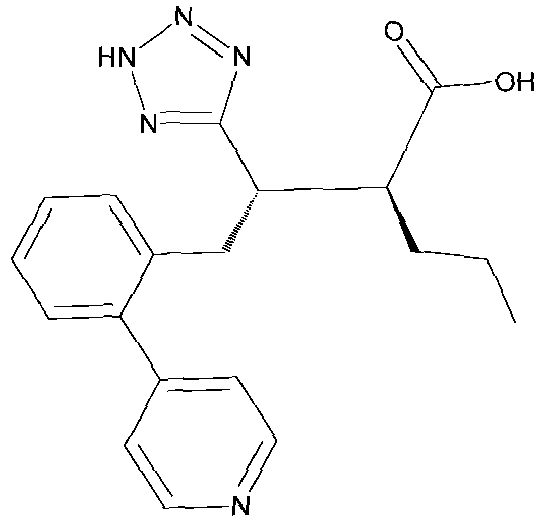
(2S)-2-[(1S)-2-(2-pyridin-4-ylphenyl)-1-(2H-tetrazol-5-yl)ethyl]pentanoic acid 352.18 352.17 398 
(2S)-2-[(1S)-2-[2-(6-aminopyridin-3-yl)phenyl]-1-(2H-tetrazol-5-yl)ethyl]pentanoic acid 367.19 367.18 399 
(2S)-2-[(1S)-2-(3'-carbamoylbiphenyl-2-yl)-1-(2H-tetrazol-5-yl)ethyl]pentanoic acid 394.19 394.19 400 
(2S)-2-[(1S)-2-{6-[3-(aminomethyl)phenoxy]pyridin-3-yl}-1-(2H-tetrazol-5-yl)ethyl]-4-methylpentanoic acid 411.21 411.2 401 
(2S)-2-[(1S)-2-(4'-sulfamoylbiphenyl-2-yl)-1-(2H-tetrazol-5-yl)ethyl]pentanoic acid 430.15 430.14 402 
(2S)-2-[(1S)-2-{4'-[(methylsulfonyl)amino]biphenyl-2-yl}-1-(2H-tetrazol-5-yl)ethyl]pentanoic acid 444.17 444.16 403 
(2S)-2-[(1S)-2-[4'-(hydroxymethyl)biphenyl-2-yl]-1-(2H-tetrazol-5-yl)ethyl]pentanoic acid 381.19 381.18 -
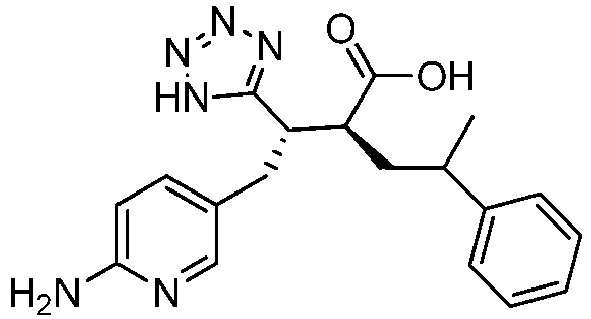
- 2- Phenylpropanal (2.1 g, 15.7 mmol), malonic acid (1.792 g, 17.22 mmol) and TEA (2.94 mL, 21.1 mmol) in toluene (25 mL) were refluxed at 100°C under N2 for 16 hrs. The reaction was diluted with ether and washed with 1M HCl (1x). The ether layer was extracted with 5% aqueous NaOH (3x). The aqueous layer was acidified with 1N HCl to pH 1 then reextracted with ether (3 times). The ether layer was dried over Na2SO4, filtered and concentrated to yield (E)-4-phenylpent-3-enoic acid. LC/MS [M+H]+: 177.3.
- (E)-4-phenylpent-3-enoic acid (2.15 g, 12.20 mmol) was dissolved in MeOH (30 ml) and 10% Pd-C (0.130 g, 1.22 mmol) was added and then stirred under a balloon of H2 for 14 hrs. The catalyst was filtered off and the reaction mixture concentrated to yield 4-phenylpentanoic acid. LC/MS [M+H]+: 179.1
- 4-phenylpentanoic acid (2.057g, 11.54 mmol) was dissolved in THF (50 ml) and cooled to-78°C. Hunig's base (2.298 ml, 13.16 mmol) was then added followed by pivaloyl chloride (1.420 ml, 11.54 mmol). The reaction was allowed to warm up to RT for 16 hrs to yield a white suspension. An aliquot was taken and quenched with NH3 in methanol. LC/MS [M+H]+: 178 showed an amide peak indicating the anhydride was formed. The suspension was used as is in the next step.
- (4R,5S)-4-methyl-5-phenyloxazolidin-2-one (2.045 g, 11.54 mmol) was dissolved in THF (60 ml) and cooled to-78°C. nBuLi in hexane (5.08 ml, 2.5M, 12.69 mmol) was then added and the reaction mixture was stirred for 0.5 hr. 4-Phenylpentanoic pivalic anhydride (3.03 g, 11.54 mmol) in 50 ml THF was then cannulated to the reaction. After stirring at -78°C, the reaction was allowed to warm up to RT and then stirred for 72 hrs. The reaction was quenched with saturated NH4Cl solution (20 ml) then extracted with EtOAc (2x). The organic layer was then washed with saturated brine then dried over Na2SO4, filtered and concentrated. The residue was purified by MPLC with 0-50% EtOAc: hexane to give (4R,5S)-4-methyl-5-phenyl-3-(4-phenylpentanoyl)oxazolidin-2-one. LC/MS [M+H]+: 338.1
- (4R,5S)-4-methyl-5-phenyl-3-(4-phenylpentanoyl)oxazolidin-2-one (1.9 g, 5.63 mmol) was dissolved in THF (45 ml) and cooled to -78°C. LiHMDS in THF (7.32 ml, 1M, 7.32 mmol) was then added and the reaction mixture was stirred for 0.5 hr. Bromoacetonitrile (1.177 ml, 16.89 mmol) was added. The reaction was stirred for 30 mins at -78°C then allowed to warm up to RT for16 hrs. The reaction was quenched with saturated NH4Cl solution (15 ml) and extracted with EtOAc(2x), dried over Na2SO4, filtered and concentrated. The residue was purified by MPLC with 0-25% EtOAc: hexane to give (3S)-3-((4R,5S)-4-methyl-2-oxo-5-phenyloxazolidine-3-carbonyl)-5-phenylhexanenitrile. LC/MS [M+H]+: 377.5
- (3S)-3-((4R,5S)-4-methyl-2-oxo-5-phenyloxazolidine-3-carbonyl)-5-phenylhexanenitrile (1.461 g, 3.88 mmol) was dissolved in toluene (20 ml) and then dibutyltin oxide (0.097 g, 0.388 mmol) and azidotrimethylsilane (1.030 ml,7.76 mmol) were added. The reaction was heated to 100°C for 16 hrs. The reaction was quenched with saturated NH4Cl solution and extracted with EtOAc (2x), dried over Na2SO4, filtered and concentrated. The residue was purified by MPLC with 0-50% ETOAC/hexane to yield (4R,5S)-3-((2S)-2-((1H-tetrazol-5-yl)methyl)-4-phenylpentanoyl)-4-methyl-5-phenyloxazolidin-2-one. LC/MS [M+H]+: 420.2
- (4R,5S)-3-((2S)-2-((1H-tetrazol-5-yl)methyl)-4-phenylpentanoyl)-4-methyl-5-phenyloxazolidin-2-one (960 mg, 2.289 mmol) in acetonitrile (60 ml) was cooled to 0°C and then Hunig's base (0.799 ml, 4.58 mmol) followed by 2-(trimethylsilyl)ethoxymethyl chloride (0.405 ml, 2.289 mmol) were added. The reaction mixture was stirred at RT and followed followed by LCMS.
- The reaction was poured into water and extracted with EtOAc (2x). The combined EtOAc layers were washed with brine (1x), dried (Na2SO4), filtered and concentrated. The residue was purified by MPLC with 0-50% ETOAC/hexane to yield both regioisomers (4R,5S)-4-methyl-5-phenyl-3-((2S)-4-phenyl-2-((2-((2-(trimethylsilyl)ethoxy)methyl)-2H-tetrazol-5-yl)methyl)pentanoyl)oxazolidin-2-one and (4R,5S)-4-methyl-5-phenyl-3-((2S)-4-phenyl-2-((1-((2-(trimethylsilyl)ethoxy)methyl)-1H-tetrazol-5-yl)methyl)pentanoyl)oxazolidin-2-one. LC/MS [M+H]+: 550.8
- (4R,5S)-4-methyl-5-phenyl-3-((2S)-4-phenyl-2-((1-((2-(trimethylsilyl)ethoxy) methyl)-1H-tetrazol-5-yl)methyl)pentanoyl)oxazolidin-2-one (680.5 mg, 1.238 mmol) was dissolved in THF (10 ml) and cooled to 0°C. To this was added a 0°C pre-cooled mixture of LiOH-H2O (104 mg, 2.476 mmol) in water (2.5ml) and H2O2 (1.084 ml, 36%, 12.38 mmol). The reaction mixture was stirred at 0°C for 1.5 hrs. A solution of sodium bisulfite (234 mg, 2.253 mmol) and sodium sulfite (429 mg, 3.40 mmol) in 10 ml water was added to the reaction at 0°C then strirred at RT for another 5 mins. The reaction mixture was washed with ether (3x). The aqueous layer was acidified with IN HCl and extracted with EtOAc (2x), dried over Na2SO4, filtered and concentrated to yield (2S)-4-phenyl-2-((1-((2-(trimethylsilyl)ethoxy)methyl)-1H-tetrazol-5-yl)methyl)pentanoic acid. LC/MS [M+H]+: 391
- (2S)-4-phenyl-2-((1-((2-(trimethylsilyl)ethoxy)methyl)-1H-tetrazol-5-yl)methyl) pentanoic acid (130 mg, 0.333 mmol) was dissolved in THF (10ml) and cooled to -78°C. Then LDA (1.300 ml,0.64M, 0.832 mmol) was added. The reaction was stirred for 45 mins then 2-bromo-5-(bromomethyl) pyridine (100 mg, 0.399 mmol) in THF (2 ml) was added. The reaction mixture was stirred at -70°C for 5 hrs then quenched with saturated aq. NH4Cl solution, extracted with EtOAc (2x), washed with brine (1x), dried (Na2SO4) and concentrated. The residue was purified by reverse phase HPLC with ACN and water buffered with 0.05% TFA to yield (2S)-2-((S)-2-(6-bromopyridin-3-yl)-1-(1-((2-(trimethylsilyl)ethoxy)methyl)-1H-tetrazol-5-yl)ethyl)-4-phenylpentanoic acid. LC/MS [M+H]+: 562.1.
- (2S)-2-((S)-2-(6-bromopyridin-3-yl)-1-(1-((2-(trimethylsilyl) ethoxy) methyl)-1H-tetrazol-5-yl)ethyl)-4-phenylpentanoic acid (67.3 mg, 0.120 mmol), N,N'-dimethylethylenediamine (3.10 µl, 0.029 mmol), copper(I) oxide (1.718 mg, 0.012 mmol), K2CO3 (3.32 mg, 0.024 mmol) and ammonium hydroxide (1500 µl, 10.79 mmol) were added to a 5-ml microwave tube containing ethylene glycol (2 ml). The tube was sealed and heated at 80°C for 16 hrs. LCMS showed product but a lot of remaining SM. More copper(I) oxide (1.718 mg, 0.012 mmol), NH4OH (0.5 ml), and ethylene glycol (1 ml) were added. The tube was re-capped and heated to 80°C for another 16 hrs. The reaction was filtered, concentrated and acidified with IN HCl to pH 5 then extracted with ETOAc:THF mixture. Aqueous layer was readjusted to pH 7 and extraction with ETOAc:THF was repeated. Combined organic layers were concentrated. The residue was purified by reverse phase HPLC with ACN and water buffered with 0.05% TFA (2S)-2-((S)-2-(6-aminopyridin-3-yl)-1-(1-((2-(trimethylsilyl)ethoxy) methyl)-1H-tetrazol-5-yl)ethyl)-4-phenylpentanoic acid was isolated. LC/MS [M+H]+: 497.3.
- (2S)-2-((S)-2-(6-aminopyridin-3-yl)-1-(1-((2-(trimethylsilyl)ethoxy)methyl)-1H-tetrazol-5-yl)ethyl)-4-phenylpentanoic acid (24 mg, 0.048 mmol) was stirred in TFA(2 ml) with water (0.2 ml) for 2 hrs. The reaction was concentrated and the residue was purified by reverse phase HPLC with ACN and water buffered with 0.05% TFA to yield (2S)-2-((S)-2-(6-aminopyridin-3-yl)-1-(1H-tetrazol-5-yl)ethyl)-4-phenylpentanoic acid. LC/MS [M+H]+: 367.1
-
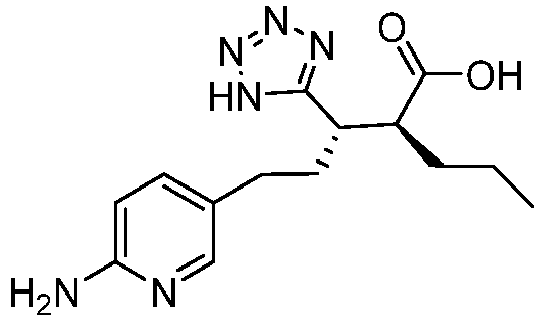
- 2-(2-bromopyridin-4-yl)acetic acid (0.9685 g, 4.48 mmol) was dissolved in a mixture of toluene (20 ml)/MeOH (2.50 ml) then cooled to 0°C. Trimethyl- silyldiazomethane (5.60 ml, 11.21 mmol) was added. The reaction was stirred at 0°C for 1 hr then concentrated to yield methyl 2-(2-bromopyridin-4-yl)acetate. LC/MS [M+H]+: 231.4
- Methyl 2-(2-bromopyridin-4-yl)acetate (1.5 g, 6.52 mmol) was dissolved in THF (20 ml) then cooled to 0°C and then LiAlH4 (3.26 ml, 6.52 mmol) was added. The reaction mixture was stirred at 0°C for 3 hrs. LCMS showed remaining SM. Additional LiAlH4 (3.26 ml, 6.52 mmol) was added and the reaction mixture stirred for another hour. The reaction was quenched with water (0.5 ml), 15% NaOH (0.5 ml), and more water (1.5 ml). The reaction was diluted with EtOAc and MgSO4 was added. The reaction was stirred then filtered and concentrated to yield 2-(2-bromopyridin-4-yl)ethanol. LC/MS [M+H]+: 202.
- In a 25 ml RB flask, 2-(2-bromopyridin-4-yl)ethanol (1.133 g, 5.61 mmol) was dissolved in DCM (20 ml) and cooled to 0°C then triphenylphosphine (1.471 g, 5.61 mmol) and CBr4 (1.860 g, 5.61 mmol) were added. The reaction was stirred for 30 mins at 0°C then warmed up to RT for 16 hr. The reaction was concentrated and the residue was purified by MPLC with 0-50% EtOAc/hexane to yield 2-bromo-4-(2-bromoethyl)pyridine. LC/MS [M+H]+: 265.8.
- To 2-bromo-4-(2-bromoethyl)pyridine (424 mg, 1.60 mmol) in acetone (4 ml) was added sodium iodide (1199 mg, 8.00 mmol) followed by heating at 60°C for 3 hrs. The reaction was cooled and filtered. The filtrate was concentrated then extracted with EtOAc and washed with brine, dried over NaSO4, filtered and concentrated to yield 2-bromo-4-(2-iodoethyl)pyridine. LC/MS [M+H]+: 313.5
- (S)-2-((1-((2-(trimethylsilyl)ethoxy)methyl)-1H-tetrazol-5-yl)methyl) pentanoic acid (500 mg, 1.590 mmol) was dissolved in THF (10 ml) and cooled to -78°C then LDA solution (6.21 ml, 3.98 mmol, 0.64M) was added. The reaction was stirred for 45 mins then 2-bromo-5-(2-iodoethyl)pyridine (498 mg, 1.596 mmol) in THF (1 ml) was added. The reaction mixture was stirred for 5 hrs then allowed to warm up to RT. The reaction was stirred for 16 hrs before quenching with saturated NH4Cl and adjusted to pH = 5. The reaction was extracted with ETOAc, dried over Na2SO4, filtered and concentrated. The residue was purified by reverse phase HPLC with ACN and water buffered with 0.05% TFA to yield (2S,3S)-5-(6-bromopyridin-3-yl)-2-propyl-3-(1-((2-(trimethylsilyl) ethoxy)methyl)-1H tetrazol-5-yl)pentanoic acid. LC/MS [M+H]+: 500.1
- (2S,3S)-5-(6-bromopyridin-3-yl)-2-propyl-3-(1-((2-(trimethylsilyl)ethoxy)methyl) -1H-tetrazol-5-yl)pentanoic acid (37 mg, 0.074 mmol), N,N'-dimethylethylene diamine (1.917 µl, 0.018 mmol), copper(I) oxide (1.062 mg, 7.42 µmol), and K2CO3 (2.052 mg, 0.015 mmol) were suspended in ethylene glycol (0.1 ml) then ammonium hydroxide (0.413 ml, 2.97 mmol) was added. The reaction was purged with N2, capped and heated at 80°C overnight. LC/MS showed remaining SM. Additional copper(I) oxide (1.062 mg, 7.42 µmol), K2CO3 (2.052 mg, 0.015 mmol) and ammonium hydroxide (0.413 ml, 2.97 mmol) were added and the reaction mixture was heated at 80°C for another 16 hrs. The reaction was concentrated, adjusted to pH 4, extracted with EtOAc (2x), dried and concentrated. The residue was purified by reverse phase HPLC with ACN and water buffered with 0.05% TFA to yield (2S,3S)-5-(6-aminopyridin-3-yl)-2-propyl-3-(1-((2(trimethylsilyl)ethoxy)methyl)-1H-tetrazol-5-yl)pentanoic acid. LC/MS [M+H]+: 435.3
- To(2S,3S)-5-(6-aminopyridin-3-yl)-2-propyl-3-(1-((2-(trimethylsilyl)ethoxy) methyl)-1H-tetrazol-5-yl)pentanoic acid (10 mg, 0.023 mmol) was added TFA (2 ml) and water (0.2 ml). The reaction was stirred at RT for 2 hrs then concentrated. The residue was purified by reverse phase HPLC with ACN and water buffered with 0.05% TFA to yield 2S,3S)-5-(6-aminopyridin-3-yl)-2-propyl-3-(1H-tetrazol-5-yl)pentanoic acid. LC/MS [M+H]+: 305.2
-

- Tert-butyl 3-(2-bromopyridin-4-yl)propanoate (0.950g, 3.32 mmol) was suspended in THF (20 ml) and cooled to 0°C then LAH (1.660 ml, 3.32 mmol) was added. The reaction mixture was stirred at 0°C for 1 hr. LCMS showed some SM. Additional LAH (1.660 ml, 3.32 mmol) was added and the reaction mixture stirred for another hour. When TLC showed no SM, the reaction was quenched with water (0.25 ml), 15% NaOH (0.25 ml), and more water (0.75 ml). The reaction mixture was diluted with EtOAc and MgSO4 was added. The mixture was filtered and concentrated to yield 3-(2-bromopyridin-4-yl)propan-1-ol. 1H-NMR (500 MHz, CDCl3) δ ppm: 1.92-1.86 (2 H, m), 2.71 (2 H, t, J = 7.83 Hz), 3.68-3.67 (2H, m), 7.11-7.06 (1 H, d, J = 5.15 Hz), 7.35 (1 H, dd, J = 1.49, 0.74 Hz), 8.25 (1 H, d, J = 5.07 Hz).
- 3-(2-bromopyridin-4-yl)propan-1-ol (636.3 mg, 2.94 mmol) was dissolved in DCM (10 ml) and cooled to 0°C then triphenylphosphine (772 mg, 2.94 mmol) and CBr4 (977 mg, 2.94 mmol) were added. After stirring for 30 mins at 0°C, the reaction was stirred at RT for 16 hr. The reaction was concentrated and the residue was purified by MPLC with 0-30% EtOAc/hexane to yield 2-bromo-4-(3-bromopropyl)pyridine. LC/MS [M+H]+: 279.9
- To 2-bromo-4-(3-bromopropyl)pyridine (714 mg, 2.56 mmol) in acetone (4 ml) was added sodium iodide (1980 mg, 13.21 mmol) then the reaction mixture was heated to 60°C for 3hrs. The reaction was cooled and filtered then concentrated. The residue was taken up with EtOAc and washed with brine, dried over NaSO4, filtered and concentrated to yield 2-bromo-4-(3-iodopropyl)pyridine. LC/MS [M+H]+: 326.3
- (S)-2-((1-((2-(trimethylsilyl)ethoxy)methyl)-1H-tetrazol-5-yl)methyl)pentanoic acid (402.5 mg, 1.280 mmol) was dissolved in THF (10ml) at -78°C then LDA (5.00 ml, 0.64M, 3.20 mmol) was added. The reaction mixture was stirred for 45 mins then 2-bromo-5-(3-iodopropyl) pyridine (512 mg, 1.571 mmol) in THF (1 ml) was added. The reaction was stirred at -70°C for 5 hrs before quenching with aq. saturated NH4Cl. The reaction was acidified to pH 5, extracted with EtOAc (2x), dried over Na2SO4, filtered and concentrated. The residue was purified by reverse phase HPLC with ACN and water buffered with 0.05% TFA to yield (2S,3S)-6-(6-bromopyridin-3-yl)-2-propyl-3-(1-((2(trimethylsilyl)ethoxy)methyl)-1H-tetrazol-5-yl)hexanoic acid. LC/MS [M+H]+ : 514.2
- In a 25 ml microwave tube, (2S,3S)-6-(6-bromopyridin-3-yl)-2-propyl-3-(1-((2-(trimethylsilyl) ethoxy)methyl)-1H-tetrazol-5-yl)hexanoic acid (305 mg, 0.595 mmol), N,N'-dimethylethylenediamine (15 µl, 0.139 mmol), copper(I) oxide (8.52 mg, 0.060 mmol), and K2CO3 (16.45 mg, 0.119 mmol) were suspended in ethylene glycol (3 ml). Ammonium hydroxide (3322 µl, 23.89 mmol) was added. The tube was sealed and heated at 80°C for 16 hrs. The reaction was cooled and concentrated. The involatile was diluted with water and acidified to pH 5. The mixture was extracted with EtOAc (2x), washed with brine, dried over Na2SO4, filtered and concentrated. The residue was purified by reverse phase HPLC with ACN and water buffered with 0.05% TFA to yield (2S,3S)-6-(6-aminopyridin-3-yl)-2-propyl-3-(1-((2-(trimethylsilyl)ethoxy)methyl)-1H-tetrazol-5-yl)hexanoic acid. LC/MS [M+H]+: 449.3
- In a sealed tube, (2S,3S)-6-(6-aminopyridin-3-yl)-2-propyl-3-(1-((2-(trimethyl silyl)ethoxy)methyl)-1H-tetrazol-5-yl)hexanoic acid (130 mg, 0.290 mmol) was dissolved in EtOH (3 ml) then 1N HCl (11.60 ml, 11.60 mmol) was added and the reaction mixture heated at 60°C for 16 hrs. The reaction was concentrated and the residue was purified by reverse phase HPLC with ACN and water buffered with 0.05% TFA to yield (2S,3S)-6-(6-aminopyridin-3-yl)-2-propyl-3-(1H-tetrazol-5-yl)hexanoic acid. LC/MS [M+H]+: 319.1
-

- (S)-4-methyl-2-((1-((2-(trimethylsilyl)ethoxy) methyl)-1H-tetrazol-5-yl)methyl) pentanoic acid (INTERMEDIATE 30, 483 mg, 1.47 mmol) was dissolved in THF (15 ml) and cooled to -78°C then LDA (4.38 ml, 3.68 mmol. 0.84 M) was added. The reaction was stirred for 45 mins then 4-(bromomethyl)-2,6-dichloropyridine (425 mg, 1.764 mmol) in THF was added. The reaction mixture was stirred at -78°C for 5 hrs, then quenched with saturated NH4Cl solution, extracted with EtOAc (2x) then dried (Na2SO4), filtered and concentrated. The residue was purified by reverse phase MPLC with ACN and water buffered with 0.05% TFA to yield (S)-2-((S)-2-(2,6-dichloropyridin-4-yl)-1-(1-((2-(trimethylsilyl)ethoxy)methyl)-1H-tetrazol-5-yl)ethyl)-4-methylpentanoic acid. LC/MS [M+H]+: 488.
- In a sealed 5 ml MW tube, (S)-2-((S)-2-(2,6-dichloropyridin-4-yl)-1-(1-((2-(trimethylsilyl)ethoxy)methyl)-1H-tetrazol-5-yl)ethyl)-4-methylpentanoic acid (50 mg, 0.102 mmol) was dissolved in DMF (2 ml) then 2-aminoethanol (0.025 ml, 0.409 mmol), Cs2CO3 (133 mg, 0.409 mmol) and Buchwald's bis((2-isobutyrylcyclohex-1-en-1-yl)oxy)copper catalyst (40.7 mg, 0.102 mmol) were added. The mixture was degassed and purged with N2 then heated at 100°C for 16 hrs. The reaction was filtered and concentrated then stirred in TFA (1 ml):water(0.1 ml) for 2 hr. The volatiles were evaporated and the residue was purified by reverse phase HPLC with ACN and water buffered with 0.05% TFA to yield (S)-2-((S)-2-(2,6-dichloropyridin-4-yl)-1-(1-((2-(trimethylsilyl)ethoxy)methyl)-1H-tetrazol-5-yl)ethyl)-4-methylpentanoic acid. LC/MS [M+H]+ : 383.2
-

- To a solution of diisopropylamine (7.04 ml, 49.4 mmol) in THF (8 mL) at -78°C was added N-butyllithium (18.03 ml, 45.1 mmol). The resulting solution was stirred at -78°C for 15 min before warming to 0°C. To the solution of (S)-2-((1-((2-(trimethylsilyl)ethoxy)methyl)-1H-tetrazol-5-yl)methyl)pentanoic acid (3.15 g, 10.02 mmol) in THF (50 mL) at -78 °C was added LDA (21.04 ml, 21.04 mmol) dropwise. The resulting solution was stirred at -78°C for 45 min before addition of 2-bromo-5-(bromomethyl)pyridine (2.51 g, 10.02 mmol) in THF (20 mL). The resulting mixture was then stirred at -78°C for 3 hr. The reaction was quenched by addition of saturated NH4Cl solution (50 mL), then the mixture was extracted with EtOAc twice, the combined organic phase was dried over Na2SO4, concentrated and the residue was purified on silica gel column using EtOAc (0.2% AcOH)/hexane as eluting solvents to give (S)-2-((S)-2-(6-bromopyridin-3-yl)-1-(1-((2-(trimethylsilyl)ethoxy)methyl)-1H-tetrazol-5-yl)ethyl)pentanoic acid. LC/MS: (M+1)+:484.1 and 486.2.
- The solution of tert-butyl 4-(4,4,5,5-tetramethyl-1,3,2-dioxaborolan-2-yl)-5,6-dihydropyridine-1(2H)-carboxylate (472 mg, 1.53 mmol), (S)-2-((S)-2-(6-bromopyridin-3-yl)-1-(1-((2-(trimethylsilyl)ethoxy)methyl)-1H-tetrazol-5-yl)ethyl)pentanoic acid (569 mg, 1.17 mmol) and Na2CO3 (2.35 ml, 4.70 mmol) in 1,4-Dioxane (15 ml) was bubbled with N2 for 15 min before addition of PdCl2(dppf) (86 mg, 0.117 mmol). The resultingu mixture was heated at 100°C overnight. After filtration through celite, the filtrate was concentrated and the residue was purified on reverse phase MPLC using acetonitrile (0.05% TFA)/water (0.05% TFA) as eluting solvents to give (S)-2-((S)-2-(1'-(tert-butoxycarbonyl)-1',2',3',6'-tetrahydro-[2,4'-bipyridin]-5-yl)-1-(1-((2-(trimethylsilyl)ethoxy)methyl)-1H-tetrazol-5-yl)ethyl)pentanoic acid. LC/MS: (M+1)+: 587.39.
- To the solution of (S)-2-((S)-2-(1'-(tert-butoxycarbonyl)-1',2',3',6'-tetrahydro-[2,4'-bipyridin]-5-yl)-1-(1-((2-(trimethylsilyl)ethoxy)methyl)-1H-tetrazol-5-yl)ethyl)pentanoic acid (0.58 g, 0.988 mmol) in MeOH (30 ml) was added 10% Pd/C (0.105 g, 0.099 mmol). The resulting mixture was subjected to hydrogenation at rt via H2 balloon for 5 hr. The mixture was filtered through celite under N2, the filtrate was concentrated to give (S)-2-((S)-2-(6-(1-(tert-butoxycarbonyl)piperidin-4-yl)pyridin-3-yl)-1-(1-((2-(trimethylsilyl)ethoxy)methyl)-1H-tetrazol-5-yl)ethyl)pentanoic acid as a crude. LC/MS: (M+1)+:589.25.
- To the solution of (S)-2-((S)-2-(6-(1-(tert-butoxycarbonyl)piperidin-4-yl)pyridin-3-yl)-1-(1-((2-(trimethylsilyl)ethoxy)methyl)-1H-tetrazol-5-yl)ethyl)pentanoic acid (0.37 g, 0.628 mmol) in TFA (2 ml) was added water (0.2 ml), the resulting solution was stirred at rt for 1h, the solution was concentrated and the residue was purified on Gilson using acetonitrile(0.05%TFA)/water(0.05%TFA) as eluting solvents to give (S)-2-((S)-2-(6-(piperidin-4-yl)pyridin-3-yl)-1-(1H-tetrazol-5-yl)ethyl)pentanoic acid. LC/MS: (M+1)+: 359.15.
-

- To a solution of (S)-2-((S)-2-(6-bromopyridin-3-yl)-1-(1-((2-(trimethylsilyl)ethoxy)methyl)-1H-tetrazol-5-yl)ethyl)pentanoic acid (0.5 g, 1.032 mmol) in MeOH (30 ml) was added TMS-Diazomethane (5.16 ml, 10.32 mmol) dropwise. The resulting solution was stirred at rt for 20 min before being quenched by addition of acetic acid (1 mL) dropwise. The solution was concentrated to give (S)-methyl 2-((S)-2-(6-bromopyridin-3-yl)-1-(1-((2-(trimethylsilyl)ethoxy)methyl)-1H-tetrazol-5-yl)ethyl)pentanoate. LC/MS: (M+1)+:498.07; 500.07.
- To the solution of (S)-methyl 2-((S)-2-(6-bromopyridin-3-yl)-1-(1-((2-(trimethylsilyl)ethoxy)methyl)-1H-tetrazol-5-yl)ethyl)pentanoate (514 mg, 1.031 mmol) in TFA (8 ml) was added water (0.8 mL), and the resulting solution was stirred at rt for 1 hr. The solution was concentrated to give (S)-methyl 2-((S)-2-(6-bromopyridin-3-yl)-1-(1H-tetrazol-5-yl)ethyl)pentanoate. LC/MS: (M+1)+:368.16; 370.16.
- To the solution of (S)-methyl 2-((S)-2-(6-bromopyridin-3-yl)-1-(1H-tetrazol-5-yl)ethyl)pentanoate (380 mg, 1.032 mmol) in CHCl3 (4 ml) and water (3 ml) was added K2CO3 (570 mg, 4.13 mmol), 4-methoxybenzyl chloride (0.169 ml, 1.238 mmol) and tetrabutylammonium chloride, hydrate (61.1 mg, 0.206 mmol). The resulting solution was heated at 40°C overnight. The mixture was extracted with DCM, and the combined DCM phase was dried over Na2SO4, concentrated and the residue was purified on silica gel column using EtOAc/hexane as eluting solvents to give (S)-methyl 2-((S)-2-(6-bromopyridin-3-yl)-1-(1-(4-methoxybenzyl)-1H-tetrazol-5-yl)ethyl)pentanoate. LC/MS: (M+1)+: 488.2; 490.2.
- A mixture of tert-butyl 3-(4,4,5,5-tetramethyl-1,3,2-dioxaborolan-2-yl)-2,5-dihydro-1H-pyrrole-1-carboxylate (246 mg, 0.833 mmol), (S)-methyl 2-((S)-2-(6-bromopyridin-3-yl)-1-(1-(4-methoxybenzyl)-1H-tetrazol-5-yl)ethyl)pentanoate (339 mg, 0.694 mmol) and Na2CO3 (1.041 ml, 2.082 mmol) in Dioxane (12 ml) was degassed with N2 for 30 min before addition of PdCl2(dppf) (50.8 mg, 0.069 mmol). The resulting mixture was heated at 100°C overnight. After filtration the residue was concentrated and the residue was purified on silica gel column using EtOAc/hexane as eluting solvents to give tert-butyl 3-(5-((2S,3S)-2-(1-(4-methoxybenzyl)-1H-tetrazol-5-yl)-3-(methoxycarbonyl)hexyl)pyridin-2-yl)-2,5-dihydro-1H-pyrrole-1-carboxylate. LC/MS: (M+1)+: 577.44.
- To the solution of tert-butyl 3-(5-((2S,3S)-2-(1-(4-methoxybenzyl)-1H-tetrazol-5-yl)-3-(methoxycarbonyl)hexyl)pyridin-2-yl)-2,5-dihydro-1H-pyrrole-1-carboxylate (395 mg, 0.685 mmol) in MeOH (20 ml) was added 10% Pd/C (72.9 mg, 0.068 mmol). The resulting mixture was hydrogenated at rt via H2 balloon for 3 hr. After filtration through celite under N2, the filtrate was concentrated to give tert-butyl 3-(5-((2S,3S)-2-(1-(4-methoxybenzyl)-1H-tetrazol-5-yl)-3-(methoxycarbonyl)hexyl)pyridin-2-yl)pyrrolidine-1-carboxylate. LC/MS: (M+1)+:579.50.
- To the solution of tert-butyl 3-(5-((2S,3S)-2-(1-(4-methoxybenzyl)-1H-tetrazol-5-yl)-3-(methoxycarbonyl)hexyl)pyridin-2-yl)pyrrolidine-1-carboxylate (396 mg, 0.684 mmol) in CH2Cl2 (2 ml) was added TFA (4 mL, 51.9 mmol). The resulting solution was stirred at rt for 1 hr. The solution was concetnrated to give (2S)-methyl 2-((1S)-1-(1-(4-methoxybenzyl)-1H-tetrazol-5-yl)-2-(6-(pyrrolidin-3-yl)pyridin-3-yl)ethyl)pentanoate. LC/MS: (M+1)+: 479.38.
- To the solution of (2S)-methyl 2-((1S)-1-(1-(4-methoxybenzyl)-1H-tetrazol-5-yl)-2-(6-(pyrrolidin-3-yl)pyridin-3-yl)ethyl)pentanoate (50 mg, 0.084 mmol) in acetic acid (1 ml) was added HCl (1 mL, 12.18 mmol). The resulting solution was heated at 80°C for 6 hr. After concentration the residue was purified on reverse phase HPLC using acetonitrile (0.1% formic acid)/water (0.1% formic acid) as eluting solvents to give (2S)-2-((1S)-2-(6-(pyrrolidin-3-yl)pyridin-3-yl)-1-(1H-tetrazol-5-yl)ethyl)pentanoic acid. LC/MS: (M+1)+: 345.21.
-

- To the solution of (2S)-2-((1S)-2-(6-(pyrrolidin-3-yl)pyridin-3-yl)-1-(1H-tetrazol-5-yl)ethyl)pentanoic acid (50 mg, 0.145 mmol) in DMF (1 ml) was added ethyl formimidate hydrochloride (23.86 mg, 0.218 mmol) and DIEA (0.101 ml, 0.581 mmol). The resulting solution was stirred at rt overnight. The mixture was purified on reverse phase HPLC using acetonitrile (0.05% TFA)/water(0.05% TFA) as eluting solvetns to give (2S)-2-((1S)-2-(6-(1-(iminomethyl)pyrrolidin-3-yl)pyridin-3-yl)-1-(1H-tetrazol-5-yl)ethyl)pentanoic acid. LC/MS: (M+1)+: 372.16.
-
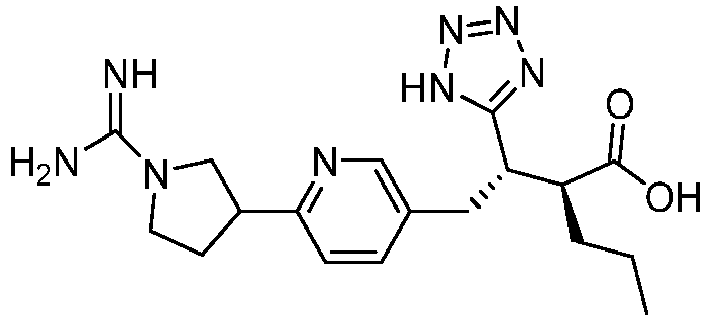
- To the solution of (2S)-2-((1S)-2-(6-(pyrrolidin-3-yl)pyridin-3-yl)-1-(1H-tetrazol-5-yl)ethyl)pentanoic acid (50 mg, 0.146 mmol) in DMF (1 ml) was added 1H-pyrazole-1-carboxamidine hydrochloride (32.0 mg, 0.218 mmol) and DIEA (0.102 ml, 0.582 mmol). The resulting solution was stirred at rt overnight. The mixture was purified on reverse phase HPLC using acetonitrile(0.05% TFA)/water(0.05% TFA) as eluting solvents to give (2S)-2-((1S)-2-(6-(1-carbamimidoylpyrrolidin-3-yl)pyridin-3-yl)-1-(1H-tetrazol-5-yl)ethyl)pentanoic acid. LC/MS: (M+1)+: 387.20.
-

- A mixture of tert-butyl 4-(4,4,5,5-tetramethyl-1,3,2-dioxaborolan-2-yl)-5,6-dihydropyridine-1(2H)-carboxylate (316 mg, 1.023 mmol) and (S)-2-((S)-2-(4-bromophenyl)-1-(1-((2-(trimethylsilyl)ethoxy)methyl)-1H-tetrazol-5-yl)ethyl)pentanoic acid (INTERMEDIATE 9, 412 mg, 0.852 mmol) and Na2CO3 (1.28 ml, 2.56 mmol) in dioxane (6 ml) was degassed by bubbling N2 for 20 min before addition of PdCl2(dppf) (62.4 mg, 0.085 mmol). The resulting mixture was heated at 100°C overnight. After filtration the filtrate was concentrated and the residue was purified on reverse phase MPLC using acetonitrile (0.05% TFA) /water (0.05% TFA) as eluting solvents to give (S)-2-((S)-2-(4-(1-(tert-butoxycarbonyl)-1,2,3,6-tetrahydropyridin-4-yl)phenyl)-1-(1-((2-(trimethylsilyl)ethoxy)methyl)-1H-tetrazol-5-yl)ethyl)pentanoic acid. LC/MS: (M+1)+: 586.26.
- To the solution of (S)-2-((S)-2-(4-(1-(tert-butoxycarbonyl)-1,2,3,6-tetrahydropyridin-4-yl)phenyl)-1-(1-((2-(trimethylsilyl)ethoxy)methyl)-1H-tetrazol-5-yl)ethyl)pentanoic acid (497 mg, 0.848 mmol) in MeOH (20 ml) was added 10% Pd/C (90 mg, 0.085 mmol). The resulting mixture was subjected to hydrogenation via H2 balloon at rt overnight. After filtration through celite under N2 the filtrate was concentrated and the residue was purified on silica gel column using MeOH/DCM as eluting solvents to give (S)-2-((S)-2-(4-(1-(tert-butoxycarbonyl)piperidin-4-yl)phenyl)-1-(1-((2-(trimethylsilyl)ethoxy)methyl)-1H-tetrazol-5-yl)ethyl)pentanoic acid. LC/MS: (M+1)+:388.29.
- To the solution of (S)-2-((S)-2-(4-(1-(tert-butoxycarbonyl)piperidin-4-yl)phenyl)-1-(1-((2-(trimethylsilyl)ethoxy)methyl)-1H-tetrazol-5-yl)ethyl)pentanoic acid (0.46 g, 0.783 mmol) in TFA (3 ml) was added Water (0.3 ml), the resulting solution was stirred at rt for 0.5h. After concentration the residue was purified on reverse phase HPLC using acetonitrile (0.05%TFA)/water(0.05%TFA) to give (S)-2-((S)-2-(4-(piperidin-4-yl)phenyl)-1-(1H-tetrazol-5-yl)ethyl)pentanoic acid. LC/MS: (M+1)+: 358.16.
-

- A mixture of tert-butyl 3-(4,4,5,5-tetramethyl-1,3,2-dioxaborolan-2-yl)-2,5-dihydro-1H-pyrrole-1-carboxylate (147 mg, 0.496 mmol) and (S)-2-((S)-2-(4-bromophenyl)-1-(1-((2-(trimethylsilyl)ethoxy)methyl)-1H-tetrazol-5-yl)ethyl)pentanoic acid (200 mg, 0.414 mmol) and Na2CO3 (0.827 ml, 1.66 mmol) in Dioxane (6 ml) was degassed by bubbling N2 for 20 min before addition of PdCl2(dppf) (30.3 mg, 0.041 mmol). The resulting mixture was heated at 100°C overnight. After filtration the filtrate was concentrated and the residue was purified on reverse phase MPLC using acetonitrile (0.05% TFA)/water(0.05% TFA) as eluting solvents to give (S)-2-((S)-2-(4-(1-(tert-butoxycarbonyl)-2,5-dihydro-1H-pyrrol-3-yl)phenyl)-1-(1-((2-(trimethylsilyl)ethoxy)methyl)-1H-tetrazol-5-yl)ethyl)pentanoic acid. LC/MS: (M+1)+: 572.24.
- To the solution of (S)-2-((S)-2-(4-(1-(tert-butoxycarbonyl)-2,5-dihydro-1H-pyrrol-3-yl)phenyl)-1-(1-((2-(trimethylsilyl)ethoxy)methyl)-1H-tetrazol-5-yl)ethyl)pentanoic acid (229 mg, 0.401 mmol) in MeOH (10 ml) was added 10% Pd/C (42.6 mg, 0.040 mmol). The resulting mixture was hydrogenated at rt via H2 balloon overnight. After filtration through celite under N2, the filtrate was concentrated to give (2S)-2-((1S)-2-(4-(1-(tert-butoxycarbonyl)pyrrolidin-3-yl)phenyl)-1-(1-((2-(trimethylsilyl)ethoxy)methyl)-1H-tetrazol-5-yl)ethyl)pentanoic acid. LC/MS: (M+1)+: 574.31.
- To the solution of (2S)-2-((1S)-2-(4-(1-(tert-butoxycarbonyl)pyrrolidin-3-yl)phenyl)-1-(1-((2-(trimethylsilyl)ethoxy)methyl)-1H-tetrazol-5-yl)ethyl)pentanoic acid (230 mg, 0.401 mmol) in TFA (3 ml) was added Water (0.3 mL), and the resulting solution was stirred at rt for 1 hr. The mixture was concentrated and the residue was purified on reverse HPLC using acetonitrile(0.05%TFA)/water(0.05%TFA) as eluting solvents to give (2S)-2-((1S)-2-(4-(pyrrolidin-3-yl)phenyl)-1-(1H-tetrazol-5-yl)ethyl)pentanoic acid. LC/MS: (M+1)+: 344.17.
-

- To the solution of (2S)-2-((1S)-2-(4-(pyrrolidin-3-yl)phenyl)-1-(1H-tetrazol-5-yl)ethyl)pentanoic acid (50 mg, 0.146 mmol) in DMF (2 ml) was added 1H-pyrazole-1-carboxamidine hydrochloride (32.1 mg, 0.219 mmol) and DIEA (0.102 ml, 0.584 mmol), and the resulting solution was stirred at rt overnight. The mixture was purified on reverse phae HPLC using acetonitrile (0.05% TFA)/water(0.05% TFA) as eluting solvents to give (2S)-2-((1S)-2-(4-(1-carbamimidoylpyrrolidin-3-yl)phenyl)-1-(1H-tetrazol-5-yl)ethyl)pentanoic acid. LC/MS: (M+1)+: 385.86.
-

- To a solution of (2S)-2-((1S)-2-(4-(pyrrolidin-3-yl)phenyl)-1-(1H-tetrazol-5-yl)ethyl)pentanoic acid (50 mg, 0.146 mmol) in DMF (1 ml) was added ethyl formimidate hydrochloride (23.93 mg, 0.218 mmol) and DIEA (0.102 ml, 0.582 mmol), and the resulting solution was stirred at rt overnight. The mixture was purified on reverse phase HPLC using acetonitrile(0.05% TFA)/water(0.05% TFA) as eluting solvents to give (2S)-2-((1S)-2-(4-(1-(iminomethyl)pyrrolidin-3-yl)phenyl)-1-(1H-tetrazol-5-yl)ethyl)pentanoic acid. LC/MS: (M+1)+: 371.20.
-

- To a solution of (S)-2-((S)-2-(4-(1-(tert-butoxycarbonyl)-1,2,3,6-tetrahydropyridin-4-yl)phenyl)-1-(1-((2-(trimethylsilyl)ethoxy)methyl)-1H-tetrazol-5-yl)ethyl)pentanoic acid (330 mg, 0.563 mmol) in acetonitrile (10 ml) and water (5 ml) was added NMO (79 mg, 0.676 mmol) and potassium osmate dihydrate (20.76 mg, 0.056 mmol), and the resulting solution was stirred at rt overnight. Thiosulphate (200 mg) was added and the resulting mixture was stirred at rt for 1 hr. After removing the volatile, the residue was partitioned between saturated NH4Cl (100 mL) and DCM. The mixture was extracted with DCM (3x100mL), the combined organic phase was dried over Na2SO4, concentrated and the residue was purified on reverse phase MPLC using acetonitrile (0.05% TFA) using acetonitrile (0.05% TFA)/water (0.05% TFA) as eluting solvents to give (S)-2-((S)-2-(4-((3S,4S)-1-(tert-butoxycarbonyl)-3,4-dihydroxypiperidin-4-yl)phenyl)-1-(1-((2-(trimethylsilyl)ethoxy)methyl)-1H-tetrazol-5-yl)ethyl) pentanoic acid (CIS mixture). LC/MS: (M+1)+: 620.29.
- To the solution of (S)-2-((S)-2-(4-((3S,4S)-1-(tert-butoxycarbonyl)-3,4-dihydroxypiperidin-4-yl)phenyl)-1-(1-((2-(trimethylsilyl)ethoxy)methyl)-1H-tetrazol-5-yl)ethyl)pentanoic acid (130 mg, 0.210 mmol) in TFA (3 ml) was added water (0.3 ml), and the resulting solution was stirred at rt for 1 hr. After removing the volatile the residue was purified on reverse phase using acetonitrile (0.05% TFA)/water (0.05% TFA) as eluting solvents to give (S)-2-((S)-2-(4-((3S,4S)-3,4-dihydroxypiperidin-4-yl)phenyl)-1-(1H-tetrazol-5-yl)ethyl)pentanoic acid (CIS mixture). LC/MS: (M+1)+: 390.24.
- To the solution of (S)-2-((S)-2-(4-((3S,4S)-3,4-dihydroxypiperidin-4-yl)phenyl)-1-(1H-tetrazol-5-yl)ethyl)pentanoic acid (49 mg, 0.126 mmol) in TFA (1 ml) was added triethylsilane (146 mg, 1.258 mmol), and the resulting solution was heated at 80°C overnight. The volatile was concentrated and the residue was purified on reverse phase HPLC using acetonitrile (0.05% TFA)/water (0.05% TFA) as eluting solvents to give (2S)-2-((1S)-2-(4-(3-hydroxy-1,2,3,6-tetrahydropyridin-4-yl)phenyl)-1-(1H-tetrazol-5-yl)ethyl)pentanoic acid. LC/MS: (M+1)+: 372.33.
- To the solution of (2S)-2-((1S)-2-(4-(3-hydroxy-1,2,3,6-tetrahydropyridin-4-yl)phenyl)-1-(1H-tetrazol-5-yl)ethyl)pentanoic acid (11 mg, 0.030 mmol) in MeOH (10 ml) was added 10% Pd/C (3.15 mg, 2.96 µmol), and the resulting mixture was hydrogenated at rt via H2 balloon for 3 hr. After filtration through celite the filtrate was concentrated and the residue was purified on reverse HPLC using acetonitrile (0.05% TFA)/water (0.05% TFA) as eluting solvents to give (2S)-2-((1S)-2-(4-(3-hydroxypiperidin-4-yl)phenyl)-1-(1H-tetrazol-5-yl)ethyl)pentanoic acid(racemate). LC/MS: (M+1)+: 374.13.
-
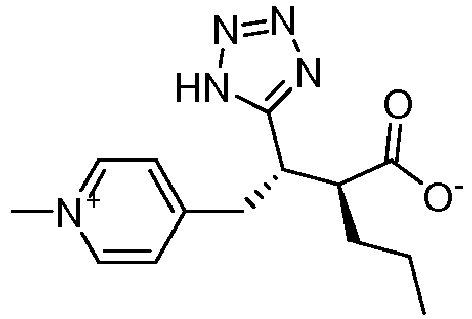
- To a solution of diisopropylamine (0.938 ml, 6.58 mmol) in THF (3 mL) at -78°C was added N-butyllithium (3.76 ml, 6.01 mmol), and the resulting solution was stirred at -78°C for 15 min before being warmed to 0°C. To the solution of (S)-2-((1-((2-(trimethylsilyl)ethoxy)methyl)-1H-tetrazol-5-yl)methyl)pentanoic acid (0.42 g, 1.336 mmol) in THF (20mL) at -78°C was added LDA (3.77 ml, 2.94 mmol) dropwise. The resulting solution was stirred at -78°C for 45 min before addition of 4-(bromomethyl)pyridine hydrobromide (0.169 g, 0.668 mmol) in one portion. The resulting mixture was then stirred from -78°C to rt overnight. The reaction was quenched by addition of saturated NH4Cl solution (50 mL), then the mixture was extracted with EtOAc twice, the combined organic phase was dried over Na2SO4, concentrated and the residue was purified on silica gel column using MeOH/DCM as eluting solvents to give (S)-2-((S)-2-(pyridin-4-yl)-1-(1-((2-(trimethylsilyl)ethoxy)methyl)-1H-tetrazol-5-yl)ethyl)pentanoic acid. LC/MS: (M+1)+: 406.23.
- To the solution of (S)-2-((S)-2-(pyridin-4-yl)-1-(1-((2-(trimethylsilyl)ethoxy)methyl)-1H-tetrazol-5-yl)ethyl)pentanoic acid (46 mg, 0.113 mmol) in acetone (5 ml) was added K2CO3 (31.4 mg, 0.227 mmol) and MeI (0.021 ml, 0.340 mmol), then the resulting mixture was stirred at rt overnight. The mixture was concentrated and the residue was purified on reverse phase HPLC using acetonitrile (0.05% TFA)/water (0.05% TFA) as eluting solvents to give 4-((2S,3S)-3-(methoxycarbonyl)-2-(1-((2-(trimethylsilyl)ethoxy)methyl)-1H-tetrazol-5-yl)hexyl)-1-methylpyridin-1-ium. LC/MS: M+: 434.24.
- To the solution of 4-((2S,3S)-3-(methoxycarbonyl)-2-(1-((2-(trimethylsilyl)ethoxy)methyl)-1H-tetrazol-5-yl)hexyl)-1-methylpyridin-1-ium (34 mg, 0.078 mmol) in acetic acid (3 ml) was added HCl (6.42 µl, 0.078 mmol), then the resulting solution was heated at 80°C for 12 hr. After concentration the residue was purified on reverse phase HPLC using acetonitrile (0.05% TFA)/water (0.05% TFA) as eluting solvents to give (S)-2-((S)-2-(1-methylpyridin-1-ium-4-yl)-1-(1H-tetrazol-5-yl)ethyl)pentanoate. LC/MS: (M+1)+: 290.20.
-

- A mixture of tert-butyl 3-(4,4,5,5-tetramethyl-1,3,2-dioxaborolan-2-yl)-2,5-dihydro-1H-pyrrole-1-carboxylate (214 mg, 0.725 mmol) and (S)-tert-butyl 2-((S)-2-(4-bromophenyl)-1-(1-(4-methoxybenzyl)-1H-tetrazol-5-yl)ethyl)pentanoate (320 mg, 0.604 mmol) and Na2CO3 (1.209 ml, 2.418 mmol) in dioxane (6 ml) was degassed by bubbling N2 for 20 min before addition of PdCl2(dppf) (44.2 mg, 0.060 mmol). The resulting mixture was heated at 100°C overnight. After filtration the filtrate was concentrated and the residue was purified on silica gel column using EtOAc/hexane as eluting solvents to give tert-butyl 3-(4-((2S,3S)-3-(tert-butoxycarbonyl)-2-(1-(4-methoxybenzyl)-1H-tetrazol-5-yl)hexyl)phenyl)-2,5-dihydro-1H-pyrrole-1-carboxylate. LC/MS: (M+1)+: 618.32.
- To the solution of tert-butyl 3-(4-((2S,3S)-3-(tert-butoxycarbonyl)-2-(1-(4-methoxybenzyl)-1H-tetrazol-5-yl)hexyl)phenyl)-2,5-dihydro-1H-pyrrole-1-carboxylate (0.35 g, 0.567 mmol) in MeOH (50 ml) and DCM (10 ml) was added 10% Pd/C (0.060 g, 0.057 mmol), then the resulting mixture was hydrogenated at rt via H2 balloon for 0.5 hr. After filtration through celite under N2, the filtrate was concentrated to give tert-butyl 3-(4-((2S,3S)-3-(tert-butoxycarbonyl)-2-(1-(4-methoxybenzyl)-1H-tetrazol-5-yl)hexyl)phenyl)pyrrolidine-1-carboxylate. LC/MS: (M+1)+:620.37.
- To the solution of tert-butyl 3-(4-((2S,3S)-3-(tert-butoxycarbonyl)-2-(1-(4-methoxybenzyl)-1H-tetrazol-5-yl)hexyl)phenyl)pyrrolidine-1-carboxylate (0.35 g, 0.565 mmol) in CH2Cl2 (1 ml) was added TFA (4 ml, 51.9 mmol), and the resulting solution was stirred at rt for 1 hr. The solution was concentrated to give (2S)-2-((1S)-1-(1-(4-methoxybenzyl)-1H-tetrazol-5-yl)-2-(4-(pyrrolidin-3-yl)phenyl)ethyl)pentanoic acid. LC/MS: (M+1)+: 464.22.
- To the solution of (2S)-2-((1S)-1-(1-(4-methoxybenzyl)-1H-tetrazol-5-yl)-2-(4-(pyrrolidin-3-yl)phenyl)ethyl)pentanoic acid (262 mg, 0.565 mmol) in acetone (6 ml) was added K2CO3 (312 mg, 2.261 mmol) and MeI (0.141 ml, 2.261 mmol), then the resulting mixture was stirred at rt for 5 hr. After concentration, the residue was purified on reverse phase MPLC using acetonitrile (0.05% TFA)/water (0.05% TFA) as eluting solvents to give 3-(4-((2S,3S)-2-(1-(4-methoxybenzyl)-1H-tetrazol-5-yl)-3-(methoxycarbonyl)hexyl)phenyl)-1,1-dimethylpyrrolidin-1-ium. LC/MS: M+: 506.25.
- To the solution of 3-(4-((2S,3S)-2-(1-(4-methoxybenzyl)-1H-tetrazol-5-yl)-3-(methoxycarbonyl)hexyl)phenyl)-1,1-dimethylpyrrolidin-1-ium (268 mg, 0.529 mmol) in acetic acid (5 ml) was addded HCl (3 mL, 36.5 mmol), then the resulting solution was heated at 80°C for 2 hr. After concentration the residue was purified on reverse phase HPLC using acetonitrile (0.05% TFA)/water (0.05% TFA) as eluting solvents to give (2R)-2-((1S)-2-(4-(1,1-dimethylpyrrolidin-1-ium-3-yl)phenyl)-1-(1H-tetrazol-5-yl)ethyl)pentanoate (more polar) and (2S)-2-((1S)-2-(4-(1,1-dimethylpyrrolidin-1-ium-3-yl)phenyl)-1-(1H-tetrazol-5-yl)ethyl)pentanoate (less polar). LC/MS: (M+1)+: 372.25.
-

- To a solution of diisopropylamine (1.207 ml, 8.47 mmol) in THF (2.85 mL) at -78°C was added N-butyllithium (4.83 ml, 7.73 mmol), then the resulting solution was stirred at -78°C for 15 min before being warmed to 0°C. To the solution of (S)-2-((1-((2-(trimethylsilyl)ethoxy)methyl)-1H-tetrazol-5-yl)methyl)pentanoic acid (0.54 g, 1.717 mmol) in THF (8 ml) at -78°C was added LDA (4.34 ml, 3.78 mmol) dropwise. The resulting solution was stirred at -78°C for 45 min before addition of 4-(bromomethyl)benzonitrile (0.370 g, 1.889 mmol) in THF (20 mL). The resulting mixture was then stirred at -78°C overnight. The reaction was quenched by addition of saturated NH4Cl solution (100 mL), then the mixture was extracted with EtOAc twice, the combined organic phase was dried over Na2SO4, concentrated and the residue was purified on silica gel column using MeOH/DCM as eluting solvents to give (S)-2-((S)-2-(4-cyanophenyl)-1-(1-((2-(trimethylsilyl)ethoxy)methyl)-1H-tetrazol-5-yl)ethyl)pentanoic acid. LC/MS: (M+1)+: 430.19.
- To the solution of (S)-2-((S)-2-(4-cyanophenyl)-1-(1-((2-(trimethylsilyl)ethoxy)methyl)-1H-tetrazol-5-yl)ethyl)pentanoic acid (0.36 g, 0.838 mmol) in MeOH (20 ml) was added raney nickel (0.072 g, 0.838 mmol) and TEA (0.350 ml, 2.51 mmol), then the resulting mixture was hydrogenated at 42 psi over the weekend. After filtration through celite under N2, the filtrate was concentrated and the residue waspurified on reverse phase MPLC using acetonitrile (0.05% TFA)/water (0.05% TFA) as eluting solvents give (S)-2-((S)-2-(4-(aminomethyl)phenyl)-1-(1-((2-(trimethylsilyl)ethoxy)methyl)-1H-tetrazol-5-yl)ethyl)pentanoic acid. LC/MS: (M+1)+: 434.20.
- To the solution of (S)-2-((S)-2-(4-(aminomethyl)phenyl)-1-(1-((2-(trimethylsilyl)ethoxy)methyl)-1H-tetrazol-5-yl)ethyl)pentanoic acid (35 mg, 0.081 mmol) in acetone (2 ml) was added K2CO3 (66.9 mg, 0.484 mmol) and MeI (0.030 ml, 0.484 mmol), then the resulting mixture was stirred at rt overnight. After concentration the residue was purified on reverse phase HPLC using acetonitrile (0.05% TFA)/water (0.05% TFA) as eluting solvents to give 1-(4-((2S,3S)-3-(methoxycarbonyl)-2-(1-((2-(trimethylsilyl)ethoxy)methyl)-1H-tetrazol-5-yl)hexyl)phenyl)-N,N,N-trimethylmethanaminium. M+; 490.26.
- To the solution of 1-(4-((2S,3S)-3-(methoxycarbonyl)-2-(1-((2-(trimethylsilyl)ethoxy)methyl)-1H-tetrazol-5-yl)hexyl)phenyl)-N,N,N-trimethylmethanaminium (22 mg, 0.045 mmol) in acetic acid (4 ml) was added HCl (2 ml, 24.35 mmol), then the resulting solution was heated at 80°C for 8 hr. After concentration the residue was purified on reverse phase HPLC using acetonitrile (0.05% TFA)/water (0.05% TFA) as eluting solvents to give (S)-2-((S)-1-(1H-tetrazol-5-yl)-2-(4-((trimethylammonio)methyl)phenyl)ethyl)pentanoate. LC/MS: (M+1)+: 346.17.
-

- n-Butyllithium (21.3 mL of a 2.5M solution in hexanes; 67.5 mmol) was added to a stirred solution of (R)-4-benzyloxazolidinone (11.9 g; 66.9 mmol) in anhydrous THF (250 mL) at -78°C, under an atmosphere of nitrogen. The mixture was maintained at this temperature for 30 min, then 3,3-dimethylbutanoyl chloride (7.96 ml; 56.4 mmol) was added. After stirring at -78°C for a further 2 hr, the ice bath was removed and stirring continued for a further 1 hr. The reaction was quenched by the addition of saturated aq. ammonium chloride and the organics extracted into ethyl acetate. The organic phase was separated, washed with 1M NaOH, brine, dried (MgSO4) and the volatiles removed under reduced pressure. The residue was purified by silica gel column chromatography using a 330g column and MTBE : Heptane 1:4 to 100% DCM as eluent to give the titled compound. LC/MS [M+H]+: 276.41.
- Sodium hexamethyldisilazide (4.36 mL of a 1.0M solution in toluene) was added to a solution of the acyl oxazolidinone (1.30 g; 4.36 mmol) in anhydrous THF (5mL) at -78°C, under an atmosphere of nitrogen. When the addition was complete, stirring was maintained at this temperature for 1.5 hr., before the addition of bromoacetonitrile (0.871ml, 13.07mmol). The resulting reaction mixture was stirred at -78°C for 3 hr, before quenching with saturated aq. ammonium chloride followed by the addition of EtOAc. The organic phase was separated, washed with brine, dried (MgSO4) and the volatiles removed under reduced pressure. The residue was purified by silica gel column chromatography using a mixture of hexanes and EtOAc as eluent to give the titled compound.
- Dibutyltin oxide (1.19 g, 4.77 mmol) was added to a mixture of the nitrile (5.00 g, 15.9 mmol) and azidotrimethylsilane (6.33 ml, 47.7 mmol) in anhydrous toluene (50 ml) and the resulting reaction mixture was heated to 110°C under an atmosphere of nitrogen overnight. After cooling, the reaction was concentrated under reduced pressure and the residue purified by silica gel column chromatography (110g column) using a gradient of 0 to 100% EtOAc in hexanes as eluent to give the desired tetrazole. LC/MS [M+H]+: 358.76.
- SEM-Cl (3.33 mL, 18.8 mmol) was added dropwise to a stirred solution of the tetrazole (5.60 g, 15.7 mmol) and Hunigs base (5.47 mL, 31.3 mmol) in anhydrous acetonitrile (50 ml) while cooled in an ice bath under an atmosphere of nitrogen. The resulting reaction mixture was allowed to warm to room temperature overnight. The reaction mixture was partitioned between EtOAc and saturated aq. sodium bicarbonate. The organic phase was separated, washed with brine, dried (MgSO4) and the volatiles removed under reduced pressure. The residue was purified by silica gel column chromatography using a 110g column and a gradient of EtOAc in hexanes as eluent gave 2-N protected intermediate (LC/MS [M+H]+: 488.60) followed by the desired 1-N protected intermediate (LC/MS [M+H]+: 488.62).
- n-Butyllithium (8.53 ml of a 2.5 M solution in hexanes, 21.3 mmol) was added dropwise to a stirred solution of ethanethiol (1.80 g, 29.0 mmol) in anhydrous THF (25ml) at -78°C, under an atmosphere of nitrogen. When the addition was complete the solution was allowed to warm to ice bath temperature then a solution of the oxazolidinone (4.16g, 8.53mmol) in anhydrous THF (5ml) was added. The resulting reaction mixture was allowed to warm to room temperature overnight. The reaction was quenched by the addition of 1.0M NaOH and the organics extracted into diethyl ether. The organic phase was separated, washed with brine, dried (MgSO4) and the volatiles removed under reduced pressure. The residue was purified by silica gel column chromatography (110g column) using a gradient of EtOAc in hexanes as eluent to provide the desired thioester.
- Hydrogen peroxide (2.14 ml of a 35% solution, 24.4 mmol) was added, in three portions, over the course of 10 mins, to a stirred mixture of the thioester (2.60 g, 6.98 mmol) and lithium hydroxide (0.59 g, 24 mmol) in a ethanol (20mL) and water (10mL) at 55°C (oil bath temperature) under an atmosphere of nitrogen. When the addition was complete, the reaction mixture was maintained at this temperature for 1 hr. After cooling, the reaction was acidified to pH=3-5 with IN HCl and the organics extracted into EtOAc. The organic phase was separated, washed with 10% aq. sodium thiosulfate (X2), brine, dried (MgSO4) and the volatiles removed under reduced pressure.to provide the desired acid.
- n-Butyllithium (1.29 ml of a 2.5M solution in hexanes, 3.2 mmol) was added dropwise to a stirred solution of the tetrazole-acid (0.48 g, 1.5 mmol) in anhydrous THF (7 mL) at -78°C under an atmosphere of nitrogen. The solution was maintained at this temperature for 1 hr., then 1-bromo-4-(bromomethyl)pyridine in anhydrous THF (1 mL) was added. The resulting reaction mixture was maintained at -78°C overnight. The reaction was quenched by the addition of saturated aq. ammonium chloride and the organics extracted into EtOAc. The organic phase was separated, washed with brine, dried (MgSO4) and the volatiles removed under reduced pressure. The residue was purified by silica gel column chromatography (80g column) to give the desired mixture of diastereomers. LC/MS [M+H]+: 500.59 and 500.61.
- Ammonium hydroxide (10.8 ml of a 29% aqueous solution, 80 mmol) was added to the diastereoisomeic mixture of tetrazoles (1.00 g, 2.00 mmol), N1, N2-dimethylethane-1,2-diamine 0.022 ml, 0.20 mmol), copper(I) oxide (0.057 g, 0.40 mmol) and potassium carbonate (0.333 g, 2.4 mmol) in ethylene glycol (5 ml) and stirred at 85°C over a weekend. After cooling, the reaction mixture was concentrated under reduced pressure and the residue purified by C18 column chromatography eluting with a gradient of acetonitrile (containing 0.1% TFA) in water (containing 0.1% TFA) as eluent to give the amino pyridine (LC/MS [M+H]+: 435.67) followed by the hydroxy pyridine (LC/MS [M+H]+: 436.66).
- TFA (1 ml containing 10% water) was added to the protected tetrazole (0.115 g, 0.265 mmol) while cooled in an ice bath. The flask was removed from the ice bath and stirred for 5 min. The volatiles were removed under reduced pressure and the residue purified by reverse phase HPLC using a gradient of acetonitrile (containing 0.1% TFA) in water (containing 0.1% TFA) as eluent to give the TFA salt of the desired product. LC/MS [M+H]+: 305.47
- TFA (1 mL containing 10% water) was added to the protected tetrazole (0.03 g, 0.069 mmol) while cooled in an ice bath. The flask was removed from the ice bath and stirred for 5 min. The volatiles were removed under reduced pressure and the residue purified by reverse phase HPLC using a gradient of acetonitrile (containing 0.1% TFA) in water (containing 0.1% TFA) as eluent to give the TFA salt of the desired product. LC/MS [M+H]+: 306.48
-

- Mercuric chloride (0.007 g, 0.03 mmol) was added to a mixture of 1,3-bis(tert-butoxycarbonyl)-2-methyl-2-thiopseudourea (0.008 g, 0.0 3 mmol), the TFA salt of the aminopyridine (0.010 g, 0.02 mmol) and triethylamine (0.008 g, 0.08 mmol) in anhydrous dichloromethane (1 ml) while cooled in an ice bath. The resulting reaction mixture was kept in an ice bath for 30 min, then at room temperature overnight. Additional dichloromethane was added to the white suspension and filtered through a pad of celite. The filtrate was washed with brine, dried (MgSO4) and concentrated under reduced pressure to give the desired product which was used without purification in the nest step (Step B). LC/MS [M+H]+: 547.86
- TFA (1 mL containing 10% water) was added to the crude product from the previous step while cooled in an ice bath and the resulting solution was stirred for 15 min. The volatiles were removed under reduced pressure and the residue purified by reverse phase HPLC using a gradient of acetonitrile (containing 0.1% TFA) in water (containing 0.1% TFA) to give the TFA salt of the desired guanidine. LC/MS [M+H]+: 347.56
-

- n-Butyllithium (0.134 ml of a 2.5M solution in hexanes, 0.335 mmol) was added dropwise to a stirred solution of (R)-3,3-dimethyl-2-((1-((2-(trimethylsilyl)ethoxy)methyl)-1H-tetrazol-5-yl)methyl)butanoic acid (0.050 g, 0.15 mmol) in anhydrous THF (1ml) at -78°C under an atmosphere of nitrogen. The mixture was maintained at this temperature for 1 hr, then 2-bromo-4-(bromomethyl)benzo[d]thiazole (0.074g, 0,15mmol) in anhydrous THF (2 ml) was added and the resulting reaction mixture was stirred at -78°C overnight. The reaction was quenched by the addition of saturated aq. ammonium chloride and the organics extracted into EtOAc. The organic phase was separated, washed with brine, dried (MgSO4) and the volatiles removed under reduced pressure. The residue was purified by reverse phase HPLC using a gradient of acetonitrile (containing 0.1% TFA) in water (containing 0.1% TFA) to give the (2R, 3R)-isomer (LC/MS [M+H]+: 556.49) followed by the (2R, 3S)-isomer (LC/MS [M+H]+: 556.50).
- TFA (3mL) was added to the protected tetrazole (0.006 g) and the resulting reaction mixture was stirred at room temperature for 30 min. The volatiles were removed under reduced pressure and the residue purified by reverse phase HPLC using a gradient of acetonitrile (containing 0.1% TFA) in water (containing 0.1% TFA) to give the desired product. LC/MS [M+H]+: 426.46.
-

- DMAP (0.074g, 0.61mmol) was added to a mixture of the amine (1.00 g, 6.09 mmol) and di-tert-butyl dicarbonate (2.66 g, 12.18 mmol) in anhydrous dichloromethane (50 ml) and the resulting reaction mixture stirred at room temperature for 1 hr. The reaction mixture was then washed with an aqueous solution of potassium hydrogen sulfate, brine, then dried (MgSO4) and the volatiles removed under reduced pressure to give a crude product which was used in the next step below, without purification.
- A mixture of NBS (1.074 g, 6.04 mmol), benzoyl peroxide (0.195 g, 0.604 mmol) and 2- Bis-(tert-butoxycarbonyl)amino-4-methylbenzo[d]thiazole (2.20 g, 6.04 mmol) in carbon tetrachloride (20 mL) was heated to 80°C for a period of 1 hr. The solvent was removed under reduced pressure, redissolved in EtOAc, washed with water, brine, dried (MgSO4) and the volatiles removed under reduced pressure. Purification of the crude reaction product using silica gel column chromatography gave the desired bromide. LC/MS [M+H]+: 445.50
- n-Butyllithium (0.268 ml of a 2.5M solution in hexanes, 0.67 mmol) was added dropwise to a stirred solution of (R)-3,3-dimethyl-2-((1-((2-(trimethylsilyl)ethoxy)methyl)-1H-tetrazol-5-yl)methyl)butanoic acid (0.100 g, 0.304 mmol) in anhydrous THF (0.5 ml) at -78°C, under an atmosphere of nitrogen. The resulting mixture was maintained at this temperature for 1 hr, before the addition of 2- Bis-(tert-butoxycarbonyl)amino-4-bromomethylbenzo[d]thiazole (0.243 g, 0.548 mmol) in anhydrous THF (2 mL). The reaction was stirred at -78°C overnight, quenched with saturated aq. ammonium chloride and the organics extracted into EtOAc. The organic phase was separated, washed with brine, dried (MgSO4) and the volatiles removed under reduced pressure. The residue was purified by reverse phase HPLC using a gradient of acetonitrile (containing 0.1% TFA) in water (containing 0.1% TFA) to give the (2R, 3R)-isomer (LC/MS [M+H]+: 692.01) followed by the (2R, 3S)-isomer (LC/MS [M+H]+: 692.01).
- TFA (1 mL) was added to a mixture of (2R,3S)-4-(2-(Bis-(tert-butoxycarbonyl)amino)benzo[d]thiazol-4-yl)-2-(tert-butyl)-3-(1-((2-(trimethylsilyl)ethoxy)methyl)-1H-tetrazol-5-yl)butanoic acid (0.010g) and anisole (2 drops from a pipette) in dichloromethane (1 mL). The resulting reaction mixture was stirred at room temperature for 1 hr, then the volatiles removed under reduced pressure. The residue was purified by reverse phase HPLC using a gradient of acetonitrile (containing 0.1% TFA) in water (containing 0.1% TFA) to give the TFA salt of the desired product. LC/MS [M+H]+: 361.41
-

- To a solution of diisopropylamine (0.10 mL, 0.70 mmol)) in 2 mL of THF was added butyllithium (0.28 mL, 0.70 mmol)) at -10 to 0°C. The mixture was stirred at 0 to 5°C for 30 minutes. After the mixture was cooled to -78°C, (S)-2-((1-((2-(trimethylsilyl)ethoxy)methyl)-1H-tetrazol-5-yl)methyl)pentanoic acid (100 mg, 0.32 mmol) in 0.2 mL of THF was added dropwise and stirred at -78°C for one hour. 2-bromo-5-(bromomethyl)thiophene (122 mg, 0.477 mmol) in 0.2 mL of THF was added dropwise at -78°C and stirred at -78°C for one hour and then gradually warmed up to room temperature and stirred for twenty four hours. The reaction mixture was added to an aqueous solution of NH4Cl and extracted with EtOAc. The organic layer was washed with IN HCl and brine, dried over MgSO4, filtered and concentrated. The residue was purified by column chromatography on silica gel column, eluting with MeOH/DCM. LC/MS [M+H]+: 491.0.
- TFA (0.5 mL, 0.087 mmol) was added to a stirred room temperature solution of (S)-2-((S)-2-(5-bromothiophen-2-yl)-1-(1-((2-(trimethylsilyl)ethoxy)methyl)-1H-tetrazol-5-yl)ethyl)pentanoic acid (15 mg, 0.031 mmol) in DCM (0.5 mL) and the mixture was stirred at room temperature for three hours. LC-MS showed the reaction was completed. The reaction mixture was concentrated, dissolved in DMSO and purified by HPLC with acetonitrile and water with 0.05% TFA. LC/MS [M+H]+: 361.0
-

- The title compound was prepared in an analogous fashion as that described for (S)-2-((S)-2-(5-bromothiophen-2-yl)-1-(1H-tetrazol-5-yl)ethyl)pentanoic acid (EXAMPLE 425) starting from 3,3-dimethyl-2-((1-((2-(trimethylsilyl)ethoxy)methyl)-1H-tetrazol-5-yl)methyl)butanoic acid. LC/MS [M+H]+: 375.2
-

- In a 5 ml reaction tube, cesium carbonate (98 mg, 0.301 mmol), ethane-1,2-diamine (36.2 mg, 0.602 mmol), Buchwald preformed ketone (11.98 mg, 0.030 mmol) and (2R,3S)-4-(6-bromopyridin-3-yl)-2-(tert-butyl)-3-(1-((2-(trimethylsilyl)ethoxy)methyl)-1H-tetrazol-5-yl)butanoic acid (See EXAMPLES 420 and 421, steps A-G, 50 mg, 0.100 mmol) were suspended in DMF (1.0 mL) then degassed and backfilled and sealed under N2. The reaction was stirred at 100°C overnight. LC-MS indicated that the reaction completed. The reaction mixture was filtered and concentrated after cooling. The residue was purified by reverse phase C18 column eluting with acetonitrile and water with 0.05% TFA. LC/MS [M+H]+: 478.3
- TFA (0.5 mL, 0.087 mmol) was added to a stirred, room temperature (2R,3S)-4-(6-((2-aminoethyl)amino)pyridin-3-yl)-2-(tert-butyl)-3-(1-((2-(trimethylsilyl)ethoxy)methyl)-1H-tetrazol-5-yl)butanoic acid (26 mg, 0.054 mmol) in DCM (0.5mL) and the mixture was stirred at room temperature for three hours. LC-MS showed the reaction completed. Concentrated down. Dissolved it in DMSO and purified by HPLC with acetonitrile and water with (0.05% TFA). LC/MS [M+H]+: 348.2
-

- The title compound was prepared in an analogous fashion as that described for 2-((5-((2S,3R)-3-carboxy-4,4-dimethyl-2-(1H-tetrazol-5-yl)pentyl)pyridin-2-yl)amino)ethan-1-aminium 2,2,2-trifluoroacetate (EXAMPLE 427) starting from (2R,3S)-4-(6-bromopyridin-3-yl)-2-(tert-butyl)-3-(1-((2-(trimethylsilyl)ethoxy)methyl)-1H-tetrazol-5-yl)butanoic acid (See EXAMPLES 420 and 421, steps A-G). LC/MS [M+H]+: 349.3
-

- Tetrakis palladium (11.13 mg, 9.63 µmol) was added to a stirred, room temperature mixture of tert-butyl 3-(4,4,5,5-tetramethyl-1,3,2-dioxaborolan-2-yl)-2,5-dihydro-1H-pyrrole-1-carboxylate (37 mg, 0.125 mmol), (2R,3S)-4-(6-bromopyridin-3-yl)-2-(tert-butyl)-3-(1-((2-(trimethylsilyl)ethoxy)methyl)-1H-tetrazol-5-yl)butanoic acid (See EXAMPLES 420 and 421, steps A-G) (48 mg, 0.096 mmol) and sodium carbonate (22.45 mg, 0.212 mmol) in dioxane/water under N2 and the mixture was stirred at 105°C overnight. LC-MS showed the reaction was completed. After cooling, the mixture was diluted with EtOAc, washed with IN HCl and brine. The organic layer was dried over MgSO4, filtered and concentrated. The residue was purified by column chromatography on silica gel column, eluting with CH2Cl2/MeOH. LC/MS [M+H]+: 587.3
- TFA (0.5 mL, 0.087 mmol) was added to a stirred, room temperature mixture of (2R,3S)-4-(6-(1-(tert-butoxycarbonyl)-2,5-dihydro-1H-pyrrol-3-yl)pyridin-3-yl)-2-(tert-butyl)-3-(1-((2-(trimethylsilyl)ethoxy)methyl)-1H-tetrazol-5-yl)butanoic acid (13 mg, 0.022 mmol) and thioanisole (2.62 µL, 0.022 mmol) in a flask and the mixture was stirred at room temperature for three hours. LC-MS showed the reaction completed. The reaction mixture was concentrated, dissolved in DMSO and purified by HPLC with acetonitrile and water with 0.05% TFA. LC/MS [M+H]+: 357.3
-

- Pd-C (8 mg, 7.52 µmol) was added to a room temperature mixture of (2R,3S)-4-(6-(1-(tert-butoxycarbonyl)-2,5-dihydro-1H-pyrrol-3-yl)pyridin-3-yl)-2-(tert-butyl)-3-(1-((2-(trimethylsilyl)ethoxy)methyl)-1H-tetrazol-5-yl)butanoic acid (41 mg, 0.070 mmol) in MeOH and the mixture was stirred at room temperature under H2 overnight. LC-MS showed the reaction was completed. The reaction mixture was filtered and concentrated to dryness. LC/MS [M+H]+: 589.4
- TFA (0.5 mL, 0.087 mmol) was added to a stirred, room temperature mixture of (2R,3S)-4-(6-(1-(tert-butoxycarbonyl)pyrrolidin-3-yl)pyridin-3-yl)-2-(tert-butyl)-3-(1-((2-(trimethylsilyl)ethoxy)methyl)-1H-tetrazol-5-yl)butanoic acid (42 mg, 0.071 mmol) and thioanisole (0.1 mL, 0.845 mmol) in a flask and the mixture was stirred at room temperature for two hours. LC-MS showed the reaction was completed. The reaction mixture was concentrated, dissolved in DMSO and purified by HPLC with acetonitrile and water with 0.05% TFA. LC/MS [M+H]+: 358.3
-

- The title compound was prepared in an analogous fashion as that described for 3-(5-((2S)-3-carboxy-4,4-dimethyl-2-(1H-tetrazol-5-yl)pentyl)pyridin-2-yl)pyrrolidin-1-ium 2,2,2-trifluoroacetate (EXAMPLE 430) starting from (2R,3S)-4-(4-bromophenyl)-2-(tert-butyl)-3-(1H-tetrazol-5-yl)butanoic acid (prepared in an analogous fashion as described in EXAMPLES 420 and 421, steps A-G, except 4-bromobenzyl bromide is used in place of 2-bromo-5-(bromomethyl)pyridine). LC/MS [M+H]+: 358.3
-

- In a reaction vessel cesium carbonate (131 mg, 0.401 mmol), and Ad2nBuP Biphenyl Precatalyst (8.95 mg, 0.013 mmol) were combined, followed by potassium trifluoro((2S,3S)-3-(methoxycarbonyl)-2-(1-((2-(trimethylsilyl)ethoxy)methyl)-1H-tetrazol-5-yl)hexyl)borate (60 mg, 0.134 mmol)), and tert-butyl 3-(4-chlorophenyl)-3-hydroxypyrrolidine-1-carboxylate (39.8 mg, 0.134 mmol) in toluene (0.5 mL), and then N2 flushed. This mixture was then evacuated and backfilled with N2 (3 times), then dry, degassed water (0.05 ml) was added to this flask. This mixture was then heated at 100°C overnight. The mixture was cooled, diluted with EtOAc, washed with H2O and brine, dried over MgSO4, filtered and the solvent was evaporated under reduced pressure. The residue was purified by column chromatography on silica gel column, eluting with EtOAc/isohexane. LC/MS [M+H]+: 604.5
- LiOH (0.952 mg, 0.040 mmol) was added to a stirred, cooled 0°C mixture of tert-butyl 3-hydroxy-3-(4-((2S,3S)-3-(methoxycarbonyl)-2-(1-((2-(trimethylsilyl)ethoxy)methyl)-1H-tetrazol-5-yl)hexyl)phenyl)pyrrolidine-1-carboxylate (20 mg, 0.033 mmol) in 0.5 mL dioxane and 0.5mL of water and the mixture was stirred at room temperature overnight. LC-MS indicated that the reaction was completed. The reaction mixture was acidified it to pH = 3 with aq. IN HCl, then extracted with EtOAc. The organic layer was dried over MgSO4, filtered and concentrated to dryness. LC/MS [M+H]+: 590.3
- TFA (0.5 mL, 0.087 mmol) was added to a stirred, room temperature (2S)-2-((1S)-2-(4-(1-(tert-butoxycarbonyl)-3-hydroxypyrrolidin-3-yl)phenyl)-1-(1-((2-(trimethylsilyl)ethoxy)methyl)-1H-tetrazol-5-yl)ethyl)pentanoic acid (17 mg, 0.029 mmol) in 0.5 mL of DCM and the mixture was stirred at room temperature for three hours. LC-MS indicated that the reaction was completed. The reaction mixture was concentrated, dissolved in DMSO and purified by HPLC with acetonitrile and water with 0.05% TFA. LC/MS [M+H]+: 360.3
-
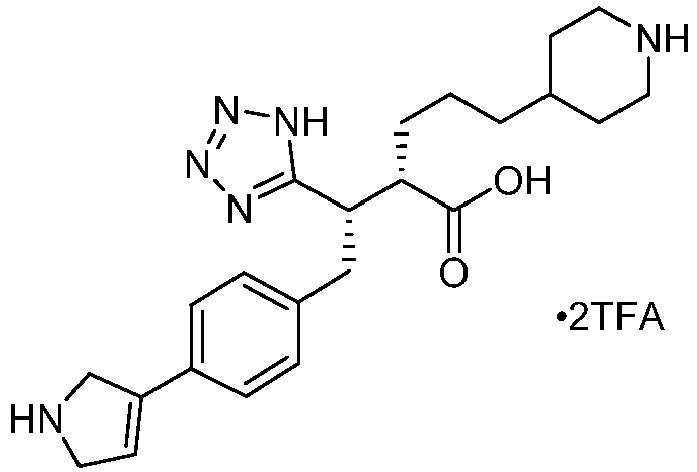
- To a solution of (S)-tert-butyl 4-(4-bromophenyl)-3-(1H-tetrazol-5-yl)butanoate (200 mg, 0.545 mmol) in 5.0 mL of THF was added lithium diisopropylamide in THF (1.362 ml, 1.362 mmol) dropwise at -78°C under N2. The reaction mixture was stirred for 1.5 hr at -78°C. A solution of tert-butyl 4-(3-iodopropyl)piperidine-1-carboxylate (385 mg, 1.089 mmol) in 0.2 mL of THF was added to the reaction mixture and stirred at -78°C for 2 hr, then raised to rt for overnight. LC-MS shown no starting material left. The reaction mixture was cooled to 0°C, diluted with 5 mL of THF, followed by 1 mL of saturated aq. NH4Cl. The aqueous phase was extracted with 5 mL of ether. The combined organic phases were dried (MgSO4), concentrated, and chromatographed via silica gel (12g ISCO cartridge, 0-100% EtOAc in Hexanes) to give the desired product tert-butyl 4-((4S,5S)-6-(4-bromophenyl)-4-(tert-butoxycarbonyl)-5-(1H-tetrazol-5-yl)hexyl)-piperidine-1-carboxylate. LC/MS [M+H]+: 592.63 and 594.63.
- To a stirred mixture of tert-butyl 4-((4S,5S)-6-(4-bromophenyl)-4-(tert-butoxycarbonyl)-5-(1H-tetrazol-5-yl)hexyl)piperidine-1-carboxylate (0.145 g, 0.245 mmol) and sodium carbonate (0.104 g, 0.979 mmol) in dioxane (4 ml)/water (1 mL) was added tetrakis(triphenylphosphine)Pd(0) (0.028 g, 0.024 mmol) under nitrogen. The reaction mixture was heated in a microwave at 115°C for 60 min with stirring. LC-MS shown the reaction was completed. After cooling down to rt, the reaction mixture was diluted with 20 mL of EtOAc, then washed with 10 mL of IN HCl and 20 mL of brine. The organic layer was dried over MgSO4, filtered and concentrated. The residue was purified by column chromatography (ISCO, 80g column, EtOAc : Hexanes = 0-100%) to give product tert-butyl 4-((4S,5S)-4-(tert-butoxycarbonyl)-6-(4-(1-(tert-butoxycarbonyl)-2,5-dihydro-1H-pyrrol-3-yl)phenyl)-5-(1H-tetrazol-5-yl)hexyl)piperidine-1-carboxylate. LC/MS [M+H]: 681.88.
- To a solution of tert-butyl 4-((4S,5S)-4-(tert-butoxycarbonyl)-6-(4-(1-(tert-butoxycarbonyl)-2,5-dihydro-1H-pyrrol-3-yl)phenyl)-5-(1H-tetrazol-5-yl)hexyl)piperidine-1-carboxylate (35 mg, 0.051 mmol) in DCM (2.0 ml) was added thioanisole (0.5 ml, 4.23 mmol) and TFA (0.5 ml, 6.49 mmol). After 3 hr, LCMS showed that most of SM was gone. The reaction mixture was concentrated with rotavapor, then the residue was dissolved in 2 mL of DMSO, and purified via Gilson (3-60% acetonitrile in H2O) to give the product (S)-2-((S)-2-(4-(2,5-dihydro-1H-pyrrol-3-yl)phenyl)-1-(1H-tetrazol-5-yl)ethyl)-5-(piperidin-4-yl)pentanoic acid. LC/MS [M+2H]2+: 213.36.
-

- To a suspension of Pd-C (13.05 mg, 0.012 mmol) in 10 mL of methanol was added (S)-2-((S)-2-(4-(2,5-dihydro-1H-pyrrol-3-yl)phenyl)-1-(1H-tetrazol-5-yl)ethyl)-5-(piperidin-4-yl)pentanoic acid compound with 2,2,2-trifluoroacetic acid (1:2) (8 mg, 0.012 mmol) and the reaction mixture was stirred at room temperature under H2 overnight. LC-MS showed the reaction was completed. The black suspension was filtered through a celite pad, and the filtrate was concentrated and purified by Gilson (3-60% acetonitrile in H2O) to give the product (2S)-5-(piperidin-4-yl)-2-((1S)-2-(4-(pyrrolidin-3-yl)phenyl)-1-(1H-tetrazol-5-yl)ethyl)pentanoic acid compound with 2,2,2-trifluoroacetic acid (1:2). LC-MS [M+2H]2+: 214.38.
-

- 4,4,4-trifluorobutanoic acid (3 g, 21.12 mmol) was dissolved in THF (60 ml) and cooled to-78°C. Then Hunig'sBase (4.19 ml, 24 mmol) was added, followed by pivaloyl chloride (2.338 ml, 19 mmol). The reaction was allowed to warm up to room temperature overnight. The 4,4,4-trifluorobutanoic pivalic anhydride solution was used as is without purification.
- (4R,5S)-4-methyl-5-phenyloxazolidin-2-one (3.40 g, 19.2 mmol) was dissolved in THF (60 ml) and cooled to-78°C. Then n-BuLi in hexane (9.22 ml, 2.5M, 23.04 mmol) was added and the reaction mixture was stirred for 0.5 hr. The 4,4,4-trifluorobutanoic pivalic anhydride (4.34 g, 19.2 mmol) in 60 ml THF was then cannulated to the reaction. The reaction was stirred for 4 hr at -78°C before quenching with saturated NH4Cl solution (20 ml). The reaction was extracted with EtOAc (2x). The organic layers were washed with saturated brine then dried over Na2SO4, filtered and concentrated. The residue was purified by MPLC with 0-25% EtOAc:hexane to give (4R,5S)-4-methyl-5-phenyl-3-(4,4,4-trifluorobutanoyl)oxazolidin-2-one. LC-MS [M+1]: 302.5
- (4R,5S)-4-methyl-5-phenyl-3-(4,4,4-trifluorobutanoyl)oxazolidin-2-one (3 g, 9.96 mmol) was dissolved in THF (45 ml) and cooled to-78°C. Then LiHMDS in THF (12.95 ml, 1M, 12.95 mmol) was added and the reaction mixture stirred for 0.5 hr. Bromoacetonitrile (2.081 ml, 29.9 mmol) was added and the reaction mixture stirred for another 0.5 hr then allowed to warm up to RT for 16 hrs. The reaction was quenched with saturated with NH4Cl solution (15 ml) and extracted with EtOAc (2x), dried over Na2SO4, filtered and concentrated. The residue was purified by MPLC with 0-25% EtOAc:hexane to give (R)-5,5,5-trifluoro-3-((4R,5S)-4-methyl-2-oxo-5-phenyloxazolidine-3-carbonyl)pentanenitrile. LC-MS [M+1]: 341.2
- (R)-5,5,5-trifluoro-3-((4R,5S)-4-methyl-2-oxo-5-phenyloxazolidine-3-carbonyl)pentanenitrile (1.66 g, 4.88 mmol) was dissolved in toluene (20 ml) and dibutyltin oxide (0.121 g, 0.488 mmol) and azidotrimethylsilane (1.295 ml, 9.76 mmol) were added. The reaction was heated to 100°C for 16 hrs, then quenched with saturated NH4Cl solution and extracted with EtOAc (2x), dried over Na2SO4, filtered and concentrated. The residue was purified by reverse phase HPLC with ACN and water buffered with 0.05% TFA to yield (4R,5S)-3-((R)-2-((1H-tetrazol-5-yl)methyl)-4,4,4-trifluorobutanoyl)-4-methyl-5-phenyloxazolidin-2-one. LC-MS [M+1]: 384.6
- (4R,5S)-3-((R)-2-((2H-tetrazol-5-yl)methyl)-4,4,4-trifluorobutanoyl)-4-methyl-5-phenyl oxazolidine-2-one (1.64 g, 4.28 mmol) in acetonitrile (75 ml) was cooled to 0°C and then Hunig's base (1.494 ml, 8.56 mmol) was added followed by 2-(trimethylsilyl)ethoxymethyl chloride (0.757 ml, 4.28 mmol). The reaction was stirred at room temperature. When the LC-MS showed only product, the reaction was poured into water and extracted with EtOAc (2 x 50 ml). The organic layer was washed with brine (1x), dried (Na2SO4), filtered and concentrated. The residue was purified by MPLC with 0-50% EtOAc:hexane to give both regioisomers (4R,5S)-4-methyl-5-phenyl-3-((R)-4,4,4-trifluoro-2-((2-((2-(trimethylsilyl) ethoxy)methyl)-2H-tetrazol-5-yl)methyl) butanoyl) oxazolidin-2-one and (4R,5S)-4-methyl-5-phenyl-3-((R)-4,4,4-trifluoro-2-((1-((2-(trimethylsilyl)ethoxy)methyl)-1H-tetrazol-5-yl)methyl)butanoyl)oxazolidin-2-one. LC-MS [M+1]: 514.7
- (4R,5S)-4-methyl-5-phenyl-3-((R)-4,4,4-trifluoro-2-((1-((2-(trimethylsilyl)ethoxy)methyl)-1H-tetrazol-5-yl)methyl)butanoyl)oxazolidin-2-one (1.084g, 2.111 mmol) was dissolved in THF (15 ml) and cooled to 0°C. To this was added 0°C precooled mixture of lithium hydroxide monohydrate (0.177 g, 4.22 mmol) in water (4 ml) and H2O2 (1.848 ml, 30%, 21.11 mmol). The mixture was stirred at 0°C for 1.5 hr. When LC-MS showed product peak, a solution of sodium sulfite (1.064 g, 8.44 mmol) and sodium bisulfite (0.593 g, 5.70 mmol) in 5 ml water was added to the reaction at 0°C then strirred at RT for another 5 mins. The organic layer was separated and the acidic aqueous layer was extracted with ether (2x). The combined organic layers were washed with brine, dried and concentrated. The residue was taken up with ether (20 ml) and extracted with IN NaOH (2x). The aqueous NaOH layer was acidified with IN HCl and re-extracted with EtOAc (2x), dried over Na2SO4, filtered and concentrated to yield (R)-4,4,4-trifluoro-2-((1-((2-(trimethylsilyl)ethoxy)methyl)-1H-tetrazol-5-yl)methyl)butanoic acid. 1H-NMR (500 MHz, CDCl3) δ ppm: -.014(6H, m), 0.91( 2H, m), 2.70( 1H, m), 2.87(1H, m), 3.28(1H, dd, J=16.18, 5.73 Hz), 3.39 (1H, dd, J=16.19, 7.63Hz), 3.52 (1H, t, J=6.61Hz), 3.56 (2H, dd, 9.37, 7.52Hz), 5.72 (2H, m).
- (R)-4,4,4-trifluoro-2-((1-((2-(trimethylsilyl)ethoxy)methyl)-1H-tetrazol-5-yl)methyl)butanoic acid (490 mg, 1.383 mmol) was dissolved in THF (15 ml) then cooled to -78°C and then LDA (4.32 ml,0.64 M, 2.77 mmol) was added. The reaction mixture was stirred for 45 mins then 2-bromo-5-(bromomethyl)pyridine (416 mg, 1.659 mmol) in THF was added. The reaction was stirred at -78°C for 5 hrs, then quenched with saturated NH4Cl solution, extracted with EtOAc (2x), dried (Na2SO4) then filtered and concentrated. The residue was purified by reverse phase HPLC with ACN and water buffered with 0.05% TFA to yield (S)-2-((S)-2-(6-bromopyridin-3-yl)-1-(1-((2-(trimethylsilyl)ethoxy)methyl)-1H-tetrazol-5-yl)ethyl)-4,4,4-trifluorobutanoic acid. LC-MS [M+2]: 525.6
- In a microwave tube, (S)-2-((S)-2-(6-bromopyridin-3-yl)-1-(1-((2-(trimethylsilyl)ethoxy) methyl)-1H-tetrazol-5-yl) ethyl)-4,4,4-trifluorobutanoic acid (100 mg, 0.191 mmol) was dissolved in ethylene glycol (1 ml) and then copper(I) oxide (2.73 mg, 0.019 mmol), N,N'-dimethylethylenediamine (4.72 µl, 0.044 mmol), K2CO3 (5.27 mg, 0.038 mmol) and ammonium hydroxide (1.220 ml, 8.77 mmol) were added. The tube was capped, degassed and purged with N2 then heated at 80°C for 16 hr. The reaction was filtered and concentrated then purified by reverse phase HPLC with ACN and water buffered with 0.05% TFA to yield (S)-2-((S)-2-(6-aminopyridin-3-yl)-1-(1-((2-(trimethylsilyl)ethoxy)methyl)-1H-tetrazol-5-yl)ethyl)-4,4,4-trifluorobutanoic acid. LC-MS [M+1]: 461.2
- (S)-2-((S)-2-(6-aminopyridin-3 -yl)-1-(1-((2-(trimethylsilyl)ethoxy)methyl)-1H-tetrazol-5-yl)ethyl)-4,4,4-trifluorobutanoic acid was dissolved in TFA (3 ml)/H2O (0.3 ml) and stirred at RT for 16hr. The residue was purified by reverse phase HPLC with ACN and water buffered with 0.05% TFA to yield (S)-2-((S)-2-(6-aminopyridin-3-yl)-1-(1H-tetrazol-5-yl)ethyl)-4,4,4-trifluorobutanoic acid. LC-MS [M+1]: 331.2
-

- In a 5 ml microwave tube, (S)-2-((S)-2-(6-bromopyridin-3-yl)-1-(1-((2-(trimethylsilyl)ethoxy)methyl)-1H-tetrazol-5-yl)ethyl)-4,4,4-trifluorobutanoic acid (EXAMPLE 435, step G, 60 mg, 0.114 mmol), 2-aminoethanol (10.36 µl, 0.172 mmol), Cs2CO3 (74.6 mg, 0.229 mmol) and Buchwald's bis((2-isobutyrylcyclohex-1-en-1-yl)oxy)copper catalyst (9.11 mg, 0.023 mmol) were suspended in DMF (1 ml) then degassed, backfilled and sealed under nitrogen. The reaction mixture was heated at 100°C for 24 hr. The reaction was filtered and concentrated. Then the residue was purified by reverse phase HPLC with ACN and water buffered with 0.05% TFA to yield 1:1 mixture of (S)-2-((S)-2-(6-(2-aminoethoxy)pyridin-3-yl)-1-(1-((2-(trimethylsilyl)ethoxy)methyl)-1H-tetrazol-5-yl)ethyl)-4,4,4-trifluorobutanoic acid and (S)-4,4,4-trifluoro-2-((S)-2-(6-((2-hydroxyethyl)amino)pyridin-3-yl)-1-(1-((2-(trimethylsilyl)ethoxy)methyl)-1H-tetrazol-5-yl)ethyl)butanoic acid. LC/MS [M+H]+: 505.2. The above mixture was stirred in TFA (3 ml) with water (0.3 ml) for 2 hr. The reaction was concentrated and purified by reverse phase HPLC with ACN and water buffered with 0.05% TFA and (S)-4,4,4-trifluoro-2-((S)-2-(6-((2-hydroxyethyl)amino)pyridin-3-yl)-1-(1H-tetrazol-5-yl)ethyl)butanoic acid was isolated. LC/MS [M+H]+: 375.1.
-
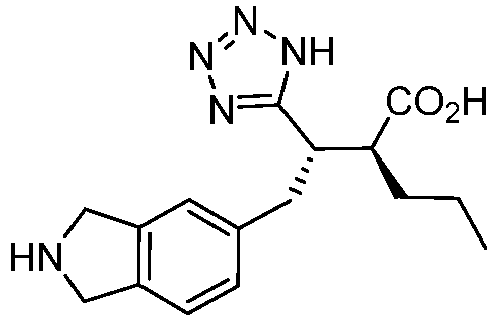
- To a solution of (S)-2-((1-((2-(trimethylsilyl)ethoxy)methyl)-1H-tetrazol-5-yl)methyl)pentanoic acid (112 mg, 0.356 mmol) in THF was added lithium diisopropylamide (0.445 ml, 0.890 mmol) at -78°C. The mixture was allowed to stir at -78°C for 40 minutes, and then tert-butyl 5-(bromomethyl)isoindoline-2-carboxylate (122 mg, 0.392 mmol) was added. The reaction was warmed up to rt naturally and stirred overnight. To the mixture was added saturated aq. NH4Cl and EtOAc for partitioning. The organic layer was separated, dried over Na2SO4, and evaporated to dryness. The crude was used directly.
- In a vial, the crude material of (S)-2-((S)-2-(2-(tert-butoxycarbonyl)isoindolin-5-yl)-1-(1-((2-(trimethylsilyl)ethoxy)methyl)-1H-tetrazol-5-yl)ethyl)pentanoic acid (∼194 mg, 0.355 mmol) was dissolved in EtOH (6 ml)/6 ml 1N HCl, capped and heated at 60°C overnight.
- The reaction mixture was concentrated and the residue was purified by prep. HPLC to obtain the TFA salt of the desired product. LC-MS m/z [M+1]+ 316.17
-

- Into 2 dram vials were added substituted trifluro borates potassium salts (0.4 mmol) and palladium catalyst (8.2 mg, 10 µmol) and cesium carbonate (66.5 mg, 0.2 mmol). In a glove box, 1 mL of solution of (S)-tert-butyl 2-((S)-2-(4-bromo-3-flurophenyl)-1-(2-(4-methoxybenzyl)-2H-tetrazol-5-yl)ethyl)-4-methylpentanoate (40 mg, 0.071 mmol) in toluene was added into each vial. The vials were capped and heated at 100°C with stirring for 20 hr (overnight). After the vials were cooled down to room temperature, the solvent was removed in a Genevac evaporator (Stone Ridge, NY). Into each residue was added 600 µL of H2O and 2 mL of DCM. The organic layers were transferred into 2 dram vials. The organic solvent was removed in the evaporator to afford the crude intermediates.
- Into each vial was added a solution of thioanisole (0.3 mL), DCM (0.3 mL) in TFA (0.3 mL). The vials were agitated at 25°C for 16 hr. The solvent was removed in a GeneVac evaporator. Into each vial was added a solution of thioanisole (0.3 mL), DCM (0.3 mL) in TFA (0.3 mL). The vials were agitated at 55°C for 6 hr. The solvent was removed in a Genevac evaporator. The residues were dissolved in 1.3 mL of DMSO. Each crude mixture was filtered into a 96-well tray and purified by HPLC to afford the examples 438 to 447.
Ex. No. RBF2.KF Structure Name Calc'd Mass [M+H]+ LC/MS m/e [M+H]+ 438 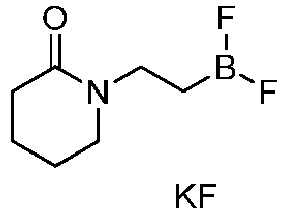

(S)-2-((S)-2-(3-fluoro-4-(2-(2-oxopiperidin-1-yl)ethyl)phenyl)-1-(2H-tetrazol-5-yl)ethyl)-4-methylpentanoic acid 432.23 432.23 439 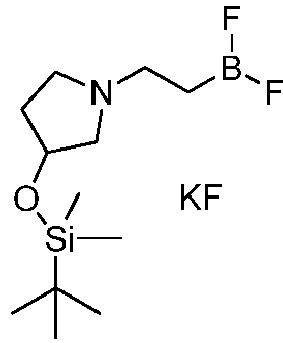

5-((2S,3S)-3-carboxy-1-(3-fluoro-4-((3-hydroxypyrrolidin-1-yl)methyl)phenyl)-5-methylhexan-2-yl)-2H-tetrazol-3-ium 2,2,2-trifluoroacetate 406.23 406.22 440 

5-((2S,3S)-1-(4-(3-aminopropyl)-3-fluorophenyl)-3-carboxy-5-methylhexan-2-yl)-2H-tetrazol-3-ium 2,2,2-trifluoroacetate 364.21 364.21 441 

5-((2S,3S)-3-carboxy-1-(3-fluoro-4-((2-(piperazin-1-yl)ethoxy)methyl)phenyl)-5-methylhexan-2-yl)-4422H-tetrazol-3-ium 2,2,2-trifluoroacetate 449.26 449.26 442 

5-((2S,3S)-3-carboxy-1-(3-fluoro-4-((piperidin-4-ylmethoxy)methyl)phenyl)-5-methylhexan-2-yl)-2H-tetrazol-3-ium 2,2,2-trifluoroacetate 434.25 434.25 443 

1-(4-((2S,3S)-3-carboxy-5-methyl-2-(2H-tetrazol-5-yl)hexyl)-2-fluorophenyl)-N,N-dimethylmethanaminium 2,2,2-trifluoroacetate 364.21 364.21 444 

1-(4-((2S,3S)-3-carboxy-5-methyl-2-(2H-tetrazol-5-yl)hexyl)-2-fluorobenzyl)piperidin-4-aminium 2,2,2-trifluoroacetate 419.25 419.25 445 

2-(4-((2S,3S)-3-carboxy-5-methyl-2-(2H-tetrazol-5-yl)hexyl)-2-fluorophenyl)ethanaminium 2,2,2-trifluoroacetate 350.19 350.19 446 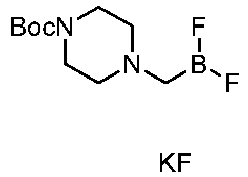
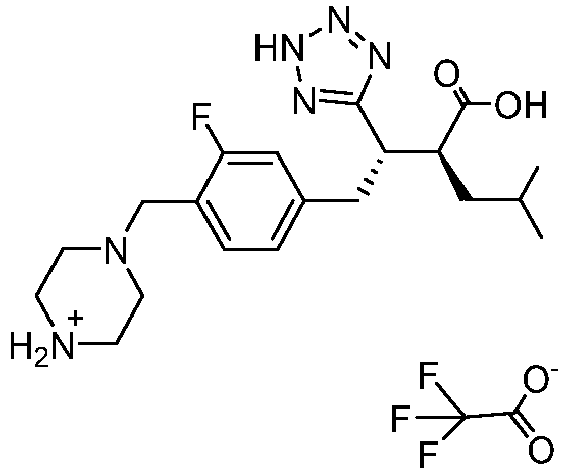
4-(4-((2S,3S)-3-carboxy-5-methyl-2-(2H-tetrazol-5-yl)hexyl)-2-fluorobenzyl)piperazin-1-ium 2,2,2-trifluoroacetate 406.23 406.23 447 

4-((4-((2S,3S)-3-carboxy-5-methyl-2-(2H-tetrazol-5-yl)hexyl)-2-fluorobenzyl)oxy)piperidin-1-ium 2,2,2-trifluoroacetate 420.23 420.22 -

- Into 2 dram vials were added substituted boronic acid or ester (0.1 mmol) and palladium catalyst (5 mg, 7.6 µmol) and 230 µL of 1 N degassed aq. K3PO4 solution. In a glove box, 1 mL of a solution of (R)-tert-butyl 2-((R)-2-(2-bromophenyl)-1-(2-(4-methoxybenzyl)-2H-tetrazol-5-yl)ethyl)pentanoate (40 mg, 0.076 mmol) in EtOH was added into each vial. The vials were capped and heated at 75°C with stirring for 20 hr (overnight). After the vials were cooled down to room temperature, the solvent was removed in a Genevac evaporator. Into each residue was added 600 µL of H2O and 2 mL of DCM. The organic layers were transferred into 2 dram vials. The organic solvent was removed in the evaporator to afford the crude intermediates.
- Into each vial was added a solution of thioanisole (0.3 mL), DCM (0.3 mL) in TFA (0.3 mL). The vials were agitated at 25°C for 16 hr. The solvent was removed in a Genevac evaporator. Into each vial was added a solution of thioanisole (0.3 mL), DCM (0.3 mL) in TFA (0.3 mL). The vials were agitated at 55°C for 6 hr. The solvent was removed in a Genevac evaporator. The residues were dissolved in 1.3 mL of DMSO. Each crude mixture was filtered into a 96-well tray and purified by HPLC to afford the examples 448 to 449.
Ex. No. RB(OH)2 Structure Name Calc'd Mass [M+H]+ LC/MS m/e [M+H]+ 448 

2'-((2S,3S)-3-carboxy-2-(2H-tetrazol-5-yl)hexyl)-N-methyl-2,3,4,5-tetrahydro-[1,1'-biphenyl]-4-aminium 2,2,2-trifluoroacetate 384.23 384.23 449 

2'-((2S,3S)-3-carboxy-2-(2H-tetrazol-5-yl)hexyl)-2,3,4,5-tetrahydro-[1,1'-biphenyl]-4-aminium 2,2,2-trifluoroacetate 370.22 370.22 -

- Into 2 dram vials were added substituted boronic acid or ester (0.1 mmol) and palladium catalyst (5 mg, 7.6 µmol) and 230 µL of 1 N degassed aq. K3PO4 solution. In a glove box, 1 mL of solution of (R)-tert-butyl 2-((R)-2-(4-bromo-3-fluorophenyl)-1-(2-(4-methoxybenzyl)-2H-tetrazol-5-yl)ethyl)-4-methylpentanoate (40 mg, 0.076 mmol) in EtOH was added into each vial. The vials were capped and heated at 75°C with stirring for 20 hr (overnight). After the vials were cooled down to room temperature, the solvent was removed in Genevac evaporator. Into each residue was added 600 µL of H2O and 2 mL of DCM. The organic layers were transferred into 2 dram vials. The organic solvent was removed in Genevac evaporator to afford the crude intermediates.
- Into each vial was added a solution of thioanisole (0.3 mL), DCM (0.3 mL) in TFA (0.3 mL). The vials were agitated at 25°C for 16 hr. The solvent was removed in a Genevac evaporator. Into each vial was added a solution of thioanisole (0.3 mL), DCM (0.3 mL) in TFA (0.3 mL). The vials were agitated at 55°C for 6 hr. The solvent was removed in a Genevac evaporator. The residues were dissolved in 1.3 mL of DMSO. Each crude mixture was filtered into a 96-well tray and purified by HPLC to afford the examples 450 to 456.
Ex. No. RB(OH)2 Structure Name Calc'd Mass [M+H]+ LC/MS m/e [M+H]+ 450 

5-(4-((2S,3S)-3-carboxy-5-methyl-2-(2H-tetrazol-5-yl)hexyl)-2-fluorophenyl)-1,2,3,6-tetrahydropyridin-1-ium 2,2,2-trifluoroacetate 388.21 388.21 451 

4'-((2S,3S)-3-carboxy-5-methyl-2-(2H-tetrazol-5-yl)hexyl)-2'-fluoro-N-methyl-2,3,4,5-tetrahydro-[1,1'-biphenyl]-4-aminium 2,2,2-trifluoroacetate 416.24 416.24 452 
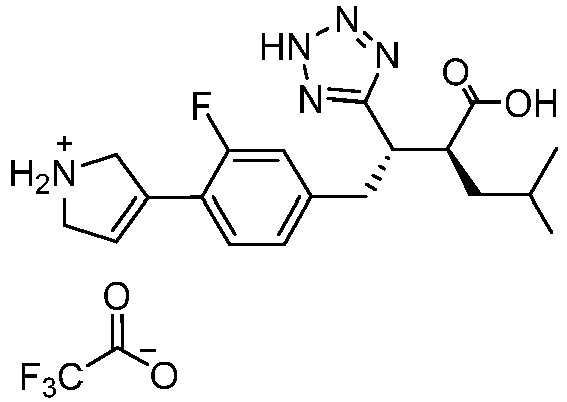
3-(4-((2S,3S)-3-carboxy-5-methyl-2-(2H-tetrazol-5-yl)hexyl)-2-fluorophenyl)-2,5-dihydro-1H--pyrrol-1-ium 2,2,2-trifluoroacetate 374.20 374.19 453 
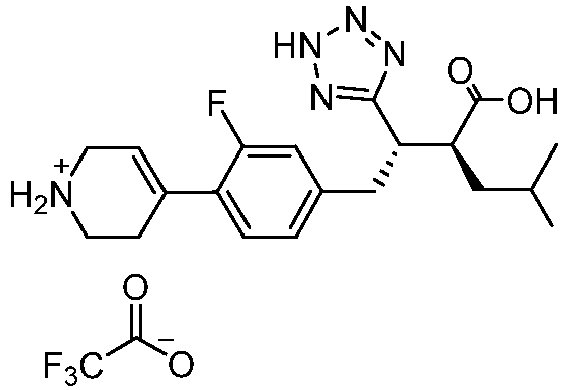
4-(4-((2S,3S)-3-carboxy-5-methyl-2-(2H-tetrazol-5-yl)hexyl)-2-fluorophenyl)-1,2,3,6-tetrahydropyridin-1-ium 2,2,2-trifluoroacetate 402.22 402.22 454 

(4'-((2S,3S)-3-carboxy-5-methyl-2-(2H-tetrazol-5-yl)hexyl)-2'-fluoro-[1,1'-biphenyl]-4-yl)methanaminium 2,2,2-trifluoroacetate 412.22 412.21 455 

4'-((2S,3S)-3-carboxy-5-methyl-2-(2H-tetrazol-5-yl)hexyl)-2'-fluoro-2,3,4,5-tetrahydro-[1,1'-biphenyl]-4-aminium 2,2,2-trifluoroacetate 402.22 402.22 456 

(S)-2-((S)-2-(4'-carbamoyl-2-fluoro-[1,1'-biphenyl]-4-yl)-1-(2H-tetrazol-5-yl)ethyl)-4-methylpentanoic acid 426.20 426.19
W is AryA; -CH2-phenyl; or -CH(CH3)-phenyl;
AryA is an aromatic ring system selected from:
AryB is a 5- to 6-membered monocyclic aromatic ring with 0, 1, or 2 N ring atoms, optionally substituted with 1 substituent selected from -CH2NH2, -CH2OH, -C(=O)NRxRy, -NRxRy, -NHSO2CH3, and HetC;
HetB is
each Rx and Ry is independently hydrogen or methyl; and
each Rz is independently C1-6aminoalkyl or C1-6hydroxyalkyl; and the other groups are as provided in any of the first through fourth embodiments.
Claims (15)
- A compound of claim 1, which has the formula Ia or Ib

wherein:R1 is -CH2CH3, -CH2CH2CH3, -CH(CH3)2, -CH2CH2CH2CH3, -CH2CH(CH3)2,-CH(CH3)CH2CH3, -C(CH3)3, -CH2CH2CH2CH2CH3, -CH(CH3)CH2CH2CH3,-CH2CH2CH2CH(CH3)2, -CH2CH2CH2CH2CH2CH(CH3)2, -CH2CH2F, -CH2CHF2, -CH2CF3, -CH2CH2CH2CF3, -CH2-cyclopropyl, -CH2-cyclopentyl, -CH2CH2-cyclohexyl, -CH2CH2CH2CH2CN, -CH2CH2CH2CH2C(=O)NH2, -CH2CH2CH2CH2OH, -CH2CH2CH2OCH3, -CH2-phenyl, -CH2CH2CH2CH2-phenyl, CH2-CH(CH3)-phenyl, -CH2CH2CH2-piperidinyl, -CH2-oxetanyl, -CH2CH=CH2, -CH2CH2CH=C(CH3)2, cyclopentyl, tetrahydrofuranyl, or tetrahydropyranyl;R2 is hydrogen, C1-4alkyl, or C1-4alkoxy;W is AryA; HetA; -(CH2)1-2-AryA; -CH(CH3)-phenyl; or cyclohexyl substituted with -COOH or -NH2;AryA is an aromatic ring system selected from:a) 5- to 6-membered monocyclic aromatic ring with 0, 1, 2 or 3 heteroatom ring atoms independently selected from N and S, optionally substituted with 1 or 2 substituents R; orb) 9- to 11- membered bicyclic aromatic ring system with 1, 2 or 3 heteroatom ring atoms selected from N, O, and S, optionally substituted with 1 substituent R' selected from Br, C1-6alkyl, -NH2, and -NHCH2CH2OH;HetA is a piperidinyl ring optionally substituted with 1 substituent selected from -C(=O)CH3;each R is independentlyhalo;-CF3;C1-6 alkyl optionally substituted with -NRxRy or 1 or 2 -OH;C3-6 cycloalkenyl optionally substituted with -NRxRy;-(CH2)0-1NHRz;-CN;-C(NH2)=NOH;-C(=O)NRxRy;-C(=O)NHRz;-C(=O)OH;-NRxRy;-N+(CH3)3;-NHCH2CH2CH(CF3)NH2;-NHCH2C(=O)N(CH3)2;-NHCH2CH2SO2NH2;-NHC(=NH)NH2;-OH;-ORz;-OCH2CH(NH2)CH2OH;-SCH3;-SO2Rw;AryB;-NH(CH2)0-2-AryB;-O-AryB;-(CH2)0-2-HetB;-CH2O(CH2)0-2-HetB;-C(=O)-HetB;-NH(CH2)0-2-HetB; or-O-HetB;AryB isa) a 5- to 6-membered monocyclic aromatic ring with 0, 1, or 2 heteroatom ring atoms independently selected from N and S, optionally substituted with 1, 2 or 3 substituents independently selected fromF;-CH3;-CH2NH2;-CH2N(CH3)2;-CH2CH2NH2,-CH2C(CH3)2NH2;-CH2OH;-C(CH3)2OH;-C(=O)NRxRy;-NRxRy;-NHC(=O)CH3;-NHSO2CH3;-N(CH3)SO2CH3;-OH;-OCH3;-SO2CH3;-SO2NH2;-(CH2)0-1-AryC;-C0-C2alkyl-HetC; and-O-HetC;b) triazolyl;c) tetrazolyl;d) 1,3-dimethylpyrimidine-2,4(1H,3H)-dione; ore) a 9- to -10 membered bicyclic aromatic ring with 0, 1, 2 or 3 heteroatom ring atoms independently selected from N or O, optionally substituted with Br, -CH3,- CN, -NH2, or oxo;HetB isa) a 4- to 6- membered saturated or monosaturated monocyclic ring with 1 or 2 heteroatom ring atoms independently selected from N and O, optionally substituted with 1, 2, 3, or 4 substituents independently selected from halo; -CF3; C1-6 alkyl, C1-6aminoalkyl; C1-6hydroxyalkyl; -CH(=NH); -C(=NH)NH2; -C(=O)CH3; -C(=O)NHCH3; -C(=O)NHSO2CH3; -NH2; -NHSO2CH3, -OH; oxo; -SO2CH3; AryC; or HetC; orb) a 8- to 10- membered bicyclic saturated ring system with 1, 2 or 3 ring atoms independently selected from N or O, optionally substituted with 1 or 2 substituents independently selected from -CH3 and oxo; wherein the rings in the bicyclic ring system are fused or spirocyclic;AryC is phenyl, pyridinyl, or tetrazolyl;HetC is a 4- to 6-membered saturated monocyclic ring with 1 or 2 heteroatom ring atoms independently selected from N and O, optionally substituted with 1 or 2 substituents selected from -CH3, -OH and oxo;each Rx and Ry is independently hydrogen or C1-6 alkyl;each Rz is independently -(CH2)0-1-C3-6cycloalkyl optionally substituted with -NH2; C1-6aminoalkyl; or C1-6hydroxyalkyl; andRw is selected from C1-8alkyl and C3-6cycloalkyl. - The compound of claim 1, which has the formula Ic or Id

- The compound of any one of claims 1 or claim 2, or a pharmaceutically acceptable salt thereof, wherein W is







- The compound of any one of claims 1 or claim 2, or a pharmaceutically acceptable salt thereof, wherein W is

 RA and RB are independently Br; F; Cl; -CF3; -CH3; -CH2NH2; -CH2CH2NH2; -CN; -CH2OH; -CONH2; -CONCH3; -CON(CH3)2; -CONH-cyclopropyl; -CONHCH2-cyclopropyl; -CONHCH2CH2NH2; -CONHCH2CH2OH; -COOH; -NH2; -NHCH3; -NHCH2CH2OH; -NHC(=NH)NH2; -OH; -OCH2CH2NH2; -NH-cyclopentyl-NH2;-SO2CH3; -SO2-cyclopropyl;AryB; HetB; -CO-piperazinyl; -CH2-tetrahydropyranyl;-CH2-piperidinyl optionally substituted with -NH2; -NH-pyrrolidinyl; -NHCH2-piperidinyl substituted with -OH; -NH-tetrahydroisoquinolinyl; -O-phenyl substituted with -CONH2, -CH2OH, -CH2NH2, -CH2C(CH3)2NH2, -CH(CH3)NH2, -CH2CH2NH2, piperidinyl, pyrrolidinyl, or piperazinyl; -O- tetrahydroisoquinolinyl; -O-tetrahydroquinolinyl; or -O-pyridinyl optionally substituted with piperazinyl;AryB is1) phenyl substituted with -CH2NH2, -CH2N(CH3)2, -CH2OH, -CONH2, -CONHCH3, -NHSO2CH3, -SO2CH3, -SO2NH2, AryC, HetC, -CH2-HetC, or tetrazolyl;2) pyridinyl optionally substituted with -C(CH3)2OH, -NH2, -N(CH3)2, -NH2 or F;3) piperazinyl optionally substituted with -CH3, -CH2-piperidinyl, -O-piperidinyl, or morpholinyl;4) pyrimidinyl substituted with -NH2, -N(CH3)2, -NHCH2CH2OH, -NHCOCH3, -NCH3SO2CH3, or HetC;5) pyrazinyl substituted with two -CH3;6) pyrazolyl optionally substituted with 1 to 3 substitutents selected from -CH3, phenyl, and -CH2-pyridinyl;7) dimethylpyrimidinedione;8) tetrazolyl;9) thiazolyl substituted with -CH2OH;10) 1,2,3,4-tetrahydroquinoline;11) imidazopyridinone;12) indazolyl;13) isoindolinone;14) isoindolinyl;15) isoquinolinyl optionally substituted with -CN;16) methylbenzotriazolyl;17) benzooxazinone;18) triazolopyridinyl; or19) 1,2,3,4-tetrahydronaphthalen-2-amine;HetB is1) azetidinyl substituted with -NH2; -CH2NH2; -CH2CH2NH2; -C(CH3)2NH2; -CH2CH2OH; -SO2CH3; morpholinyl; piperazinyl; (CH2OH)2; -CH2NH2 and -CH3; or -OH and -CF3;2) pyrrolidinyl optionally substituted with -CH2NH2, -CH2OH, -CONHCH3, -NH2, -OH, or AryC;3) piperidinyl optionally substituted with -CH3, -CH2NH2, -C(CH3)2NH2, -CH2OH, -CONHCH3, -CH2NHSO2CH3, -NH2, -OH, -C(=NH)NH;-C(=NH2)NH2, or -CH=NH;4) piperazinyl substituted with -CH3,-CH2OH, -CH2CH2OH, -COCH3, =O, or AryC;5) morpholinyl;6) dihydropyrrolyl;7) tetrahydropyridinyl optionally substituted with -CH3;8) octahydropyrrolo[1,2-a]pyrazine;9) diazaspirononanyl;10) diazaspirooctanyl;11) 2,6-diazaspiro[3.4]octan-7-one; or12) 7-methyl-5-oxa-2,7-diazaspiro[3.4]octan-6-one;wherein
 RC is F; Br; -CF3; -CH2NH2; pyrrolidinyl; 2,5-dihydro-1H-pyrrole; pyridinyl substituted with -NH2; or piperazinyl;RD is F, Br, -CH3, or -CF3;
 RE is Cl, -NH2 or -NHCH2CH2OH;RF is Cl;
 wherein RG is -NH2, -N(CH3)2, -NHCH2CH2OH,-SCH3, -SO2CH3, morpholinyl, pyrrolidinyl, piperidinyl, piperazinyl, 2,5-dihydro-1H-pyrrole, or -O-piperidinyl; or



- The compound of any one of claims 1 to 4, or a pharmaceutically acceptable salt thereof, wherein:R1 is selected from the group consisting of:a) -C2-4 alkyl,b) ethyl substituted with three halo substituents, orc) -C3-6cycloalkyl,R2 is hydrogen;W is AryA; -CH2-phenyl; or -CH(CH3)-phenyl;AryA is an aromatic ring system selected from:a) 5- to 6-membered monocyclic aromatic ring with 0, 1, or 2 heteroatom ring atoms independently selected from N and S, optionally substituted with 1 or 2 substituents R; orb) 9- to 10- membered bicyclic aromatic ring system with 1, 2 or 3 heteroatom ring atoms selected from N and S, substituted with 1 substituent selected from C1-6alkyl and -NH2;each R is independently fluoro, NHRz, -NRxRy, -NHC(=NH)NH2; -ORz, AryB, -O-AryB, or -(CH2)0-1-HetB;AryB is a 5- to 6-membered monocyclic aromatic ring with 0, 1, or 2 N ring atoms, optionally substituted with 1 substituent selected from -CH2NH2, -CH2OH, -C(=O)NRxRy, -NRxRy, -NHSO2CH3, and HetC;HetB isa) a 5- to 6- membered saturated or monosaturated monocyclic ring with 1 or 2 N ring atoms, optionally substituted with 1 substituent selected from C1-6hydroxyalkyl, -CH(=NH), -C(=NH)NH2, and -OH; orb) a 9-membered saturated spirocyclic ring system with 2 N ring atoms;HetC is a 6-membered saturated monocyclic ring with 1 N ring atom;each Rx and Ry is independently hydrogen or methyl; andeach Rz is independently C1-6aminoalkyl or C1-6hydroxyalkyl.
- The compound of claim 5, or a pharmaceutically acceptable salt thereof, wherein
AryA is a monocyclic ring selected from thiazolyl, phenyl, and pyridinyl, wherein the monocyclic ring optionally substituted with 1 or 2 R substituents; or
a bicyclic ring selected from quinolinyl, benzo[d]thiazolyl, and 1H-benzo[d][1,2,3]triazole, wherein the bicyclic is optionally substituted with 1 substituent selected from C1-6alkyl and -NH2;
AryB is a monocyclic ring selected from pyrazolyl, phenyl or pyridyl, wherein the monocyclic is optionally substituted with 1 substituent selected from -CH2NH2, -CH2OH, -C(=O)NRxRy, -NRxRy, -NHSO2CH3, and HetC; and
HetB is a monocyclic ring selected from pyrrolidinyl, dihydropyrrolyl, piperidinyl, or piperazinyl, wherein the monocyclic is optionally substituted with 1 substituent selected from C1-6hydroxyalkyl, -CH(=NH), -C(=NH)NH2, and -OH; or diazaspirononanyl. - The compound of claim 5 or 6, or a pharmaceutically acceptable salt thereof, wherein W is1) phenyl optionally substituted witha) phenyl substituted with -CONH2, -NHSO2CH3, or piperidinyl,b) pyridinyl substituted with -NH2,c) pyrrolidinyl,d) pyrrolidinyl and fluoro,e) piperidinyl substituted with -CH=NH,f) piperidinyl substituted with -CH(=NH)NH2,g) piperizinyl and fluoro,h) dihydropyrrolyl,i) pyrazolyl, orj) CH2-piperazinyl;2) -CH2-phenyl;3) -CH(CH3)-phenyl;4) pyridinyl optionally substituted witha) -NH2,b) -NHCH3,c) -NHCH2CH2NH2,d) -NHCH2CH2OH,e) -NHC(=NH)NH2,f) pyrrolidinyl optionally substituted with -OH,g) piperidinyl optionally substituted with -CH2OH,h) phenyl substituted with -CH2NH2 or -CH2OH,i) -O-phenyl substituted with -CH2NH2,j) pyridinyl substituted with -NH2, ork) diazaspirononanyl,5) thiazolyl substituted with -NH2,6) quinolinyl substituted with -NH2,7) benzo[d]thiazolyl substituted with -NH2, or8) 1H-benzo[d][1,2,3]triazole] substituted with -CH3.
- The compound of claim 1 which is


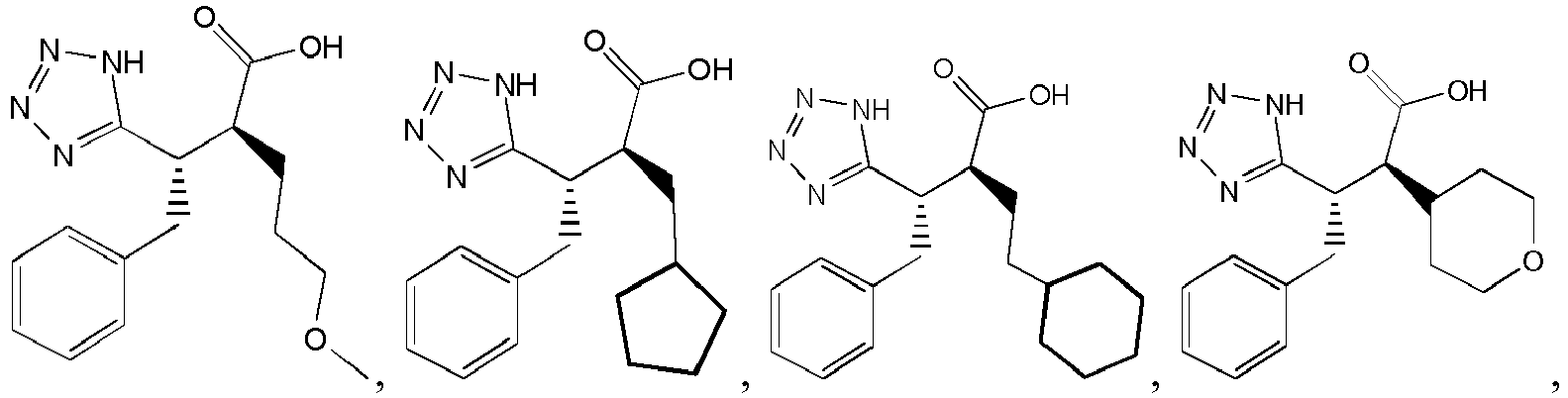
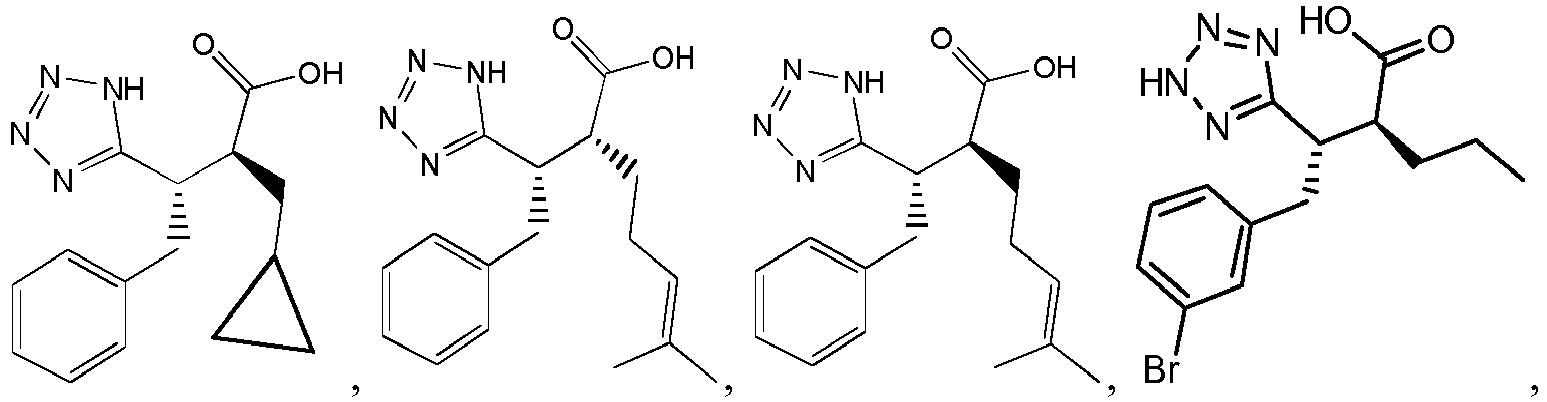


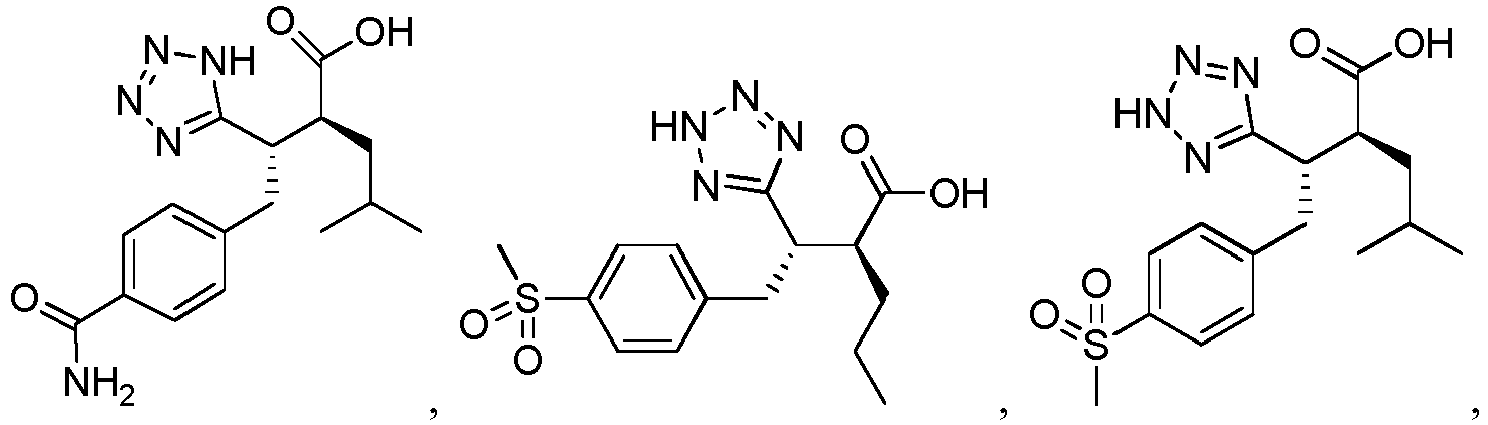







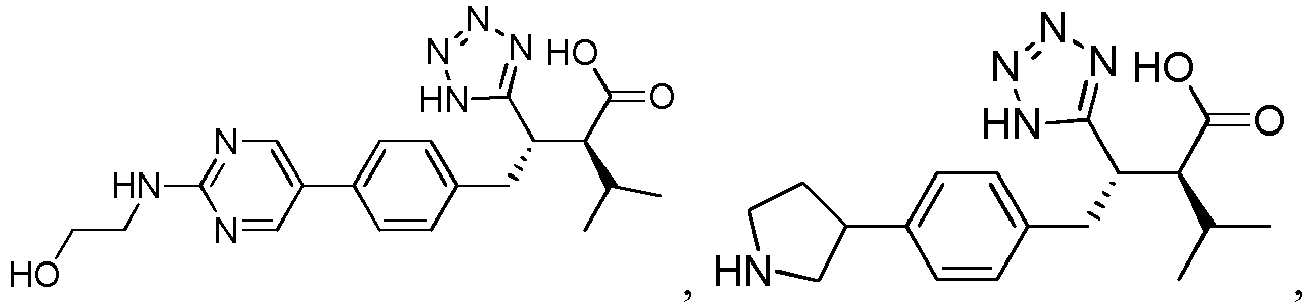



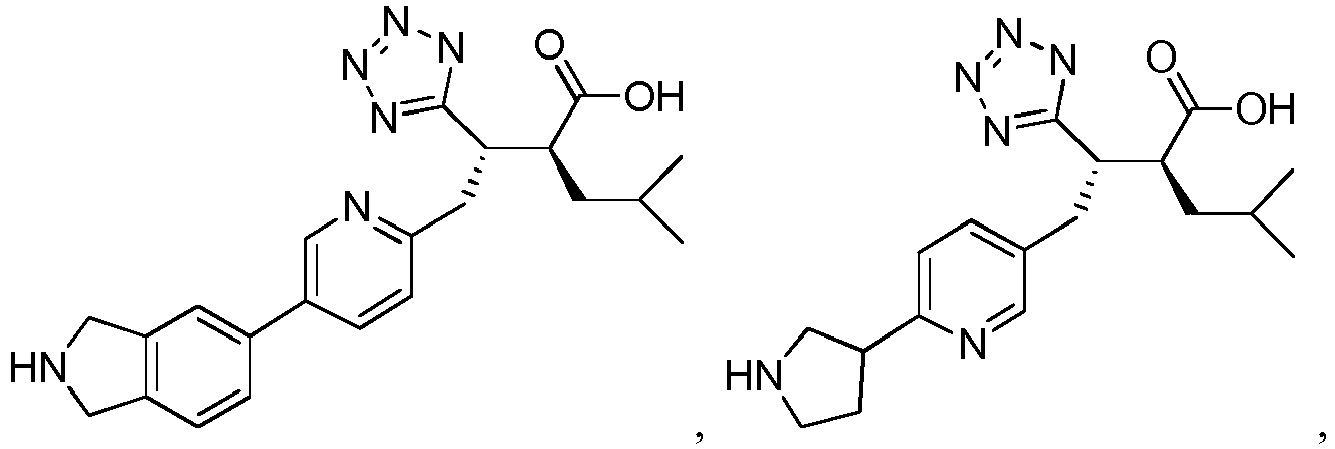





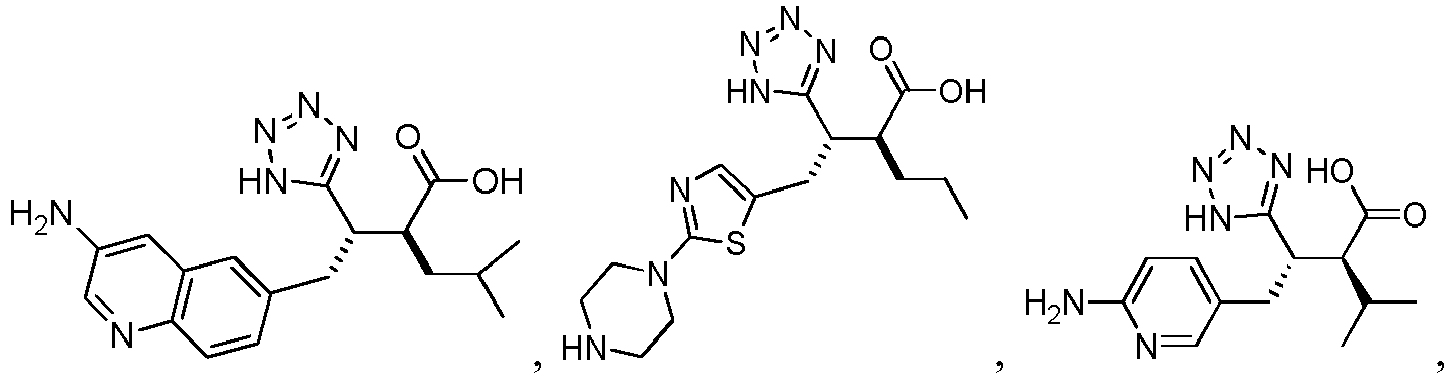





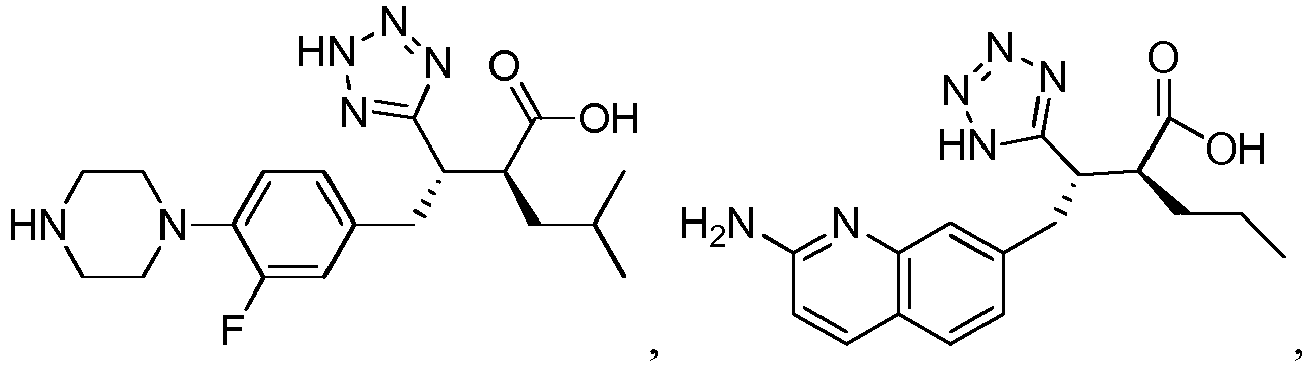


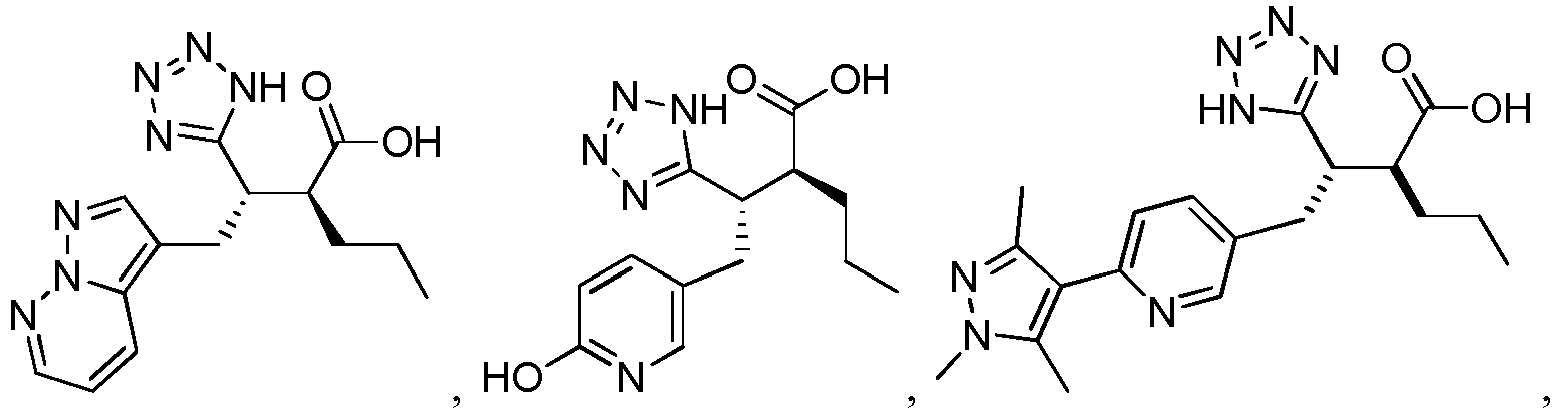
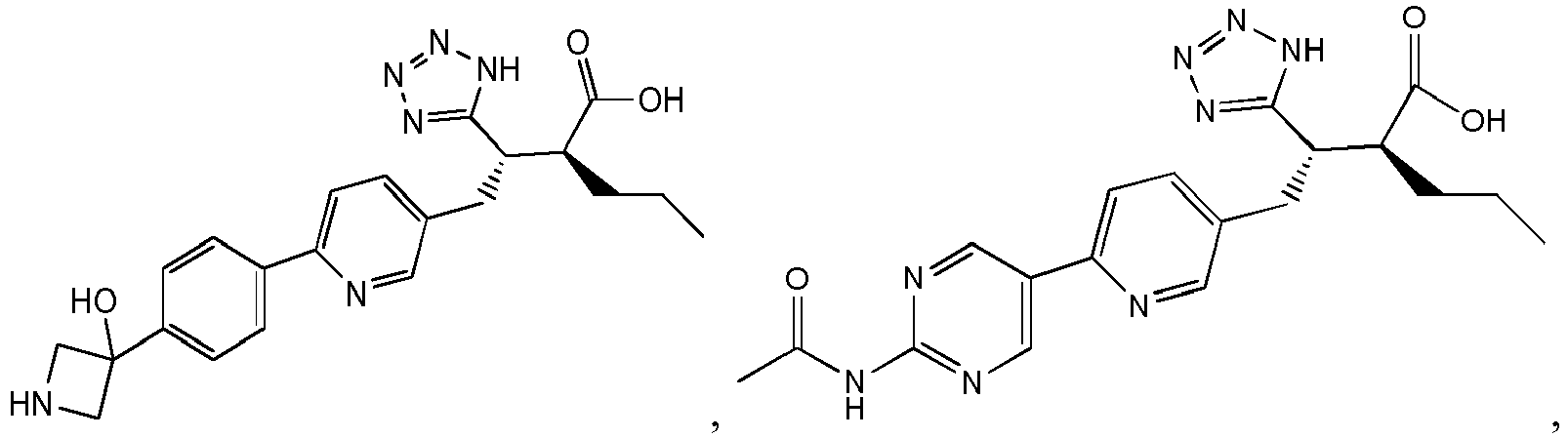
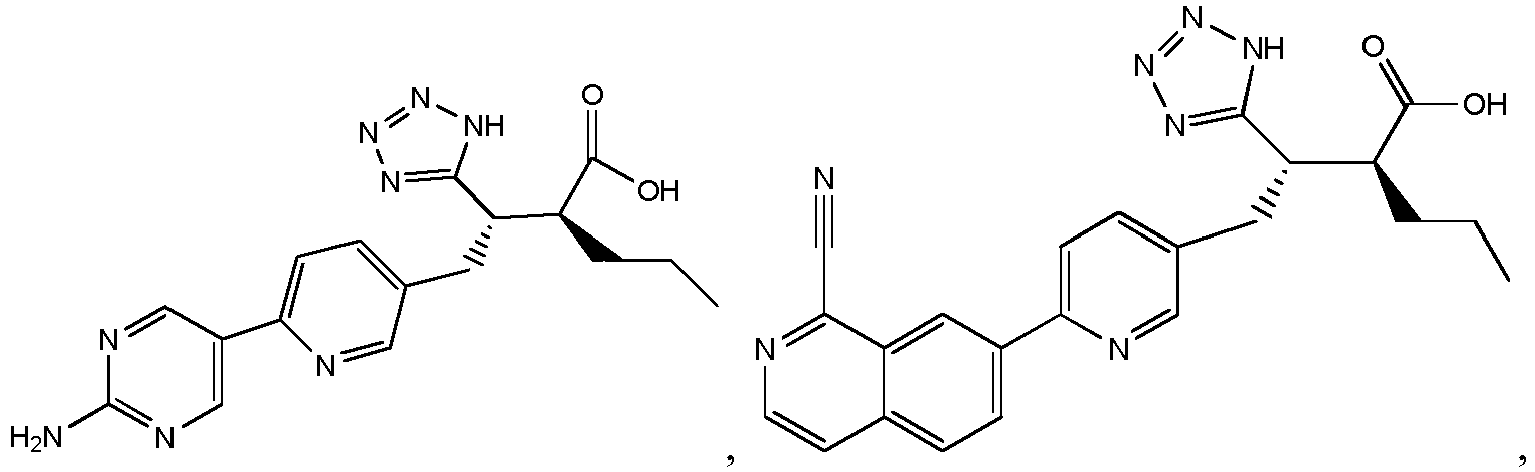
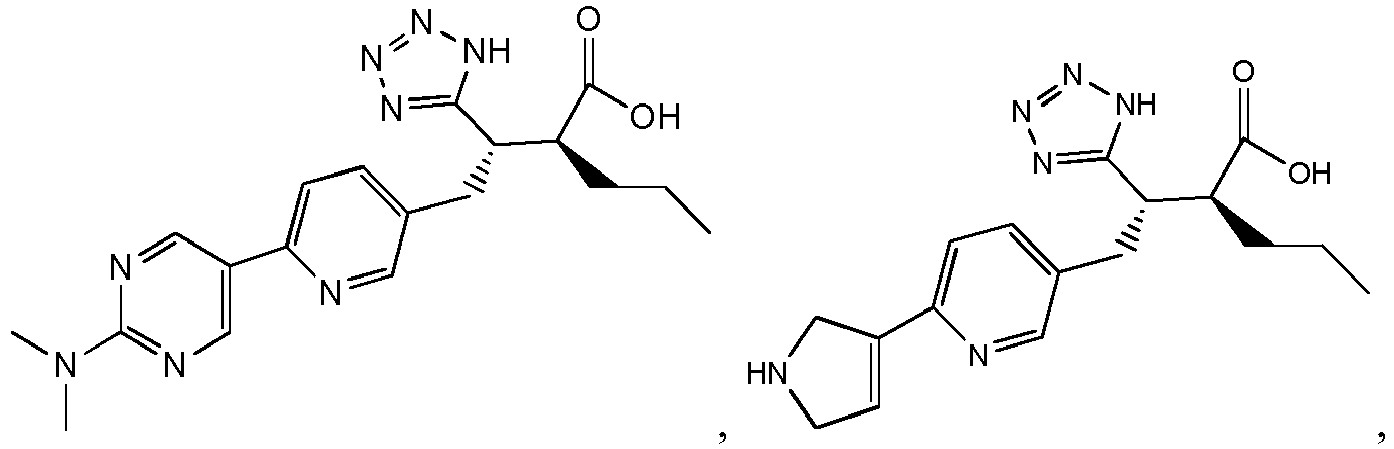


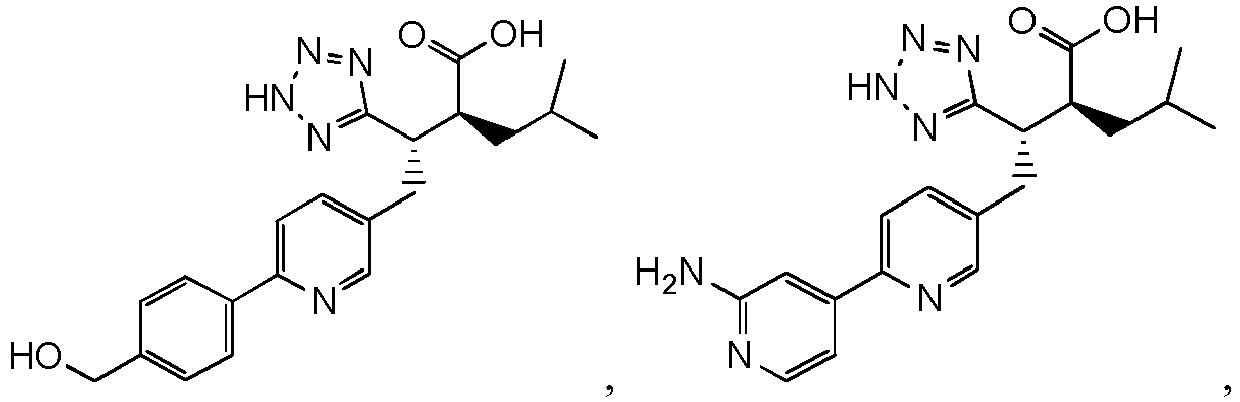

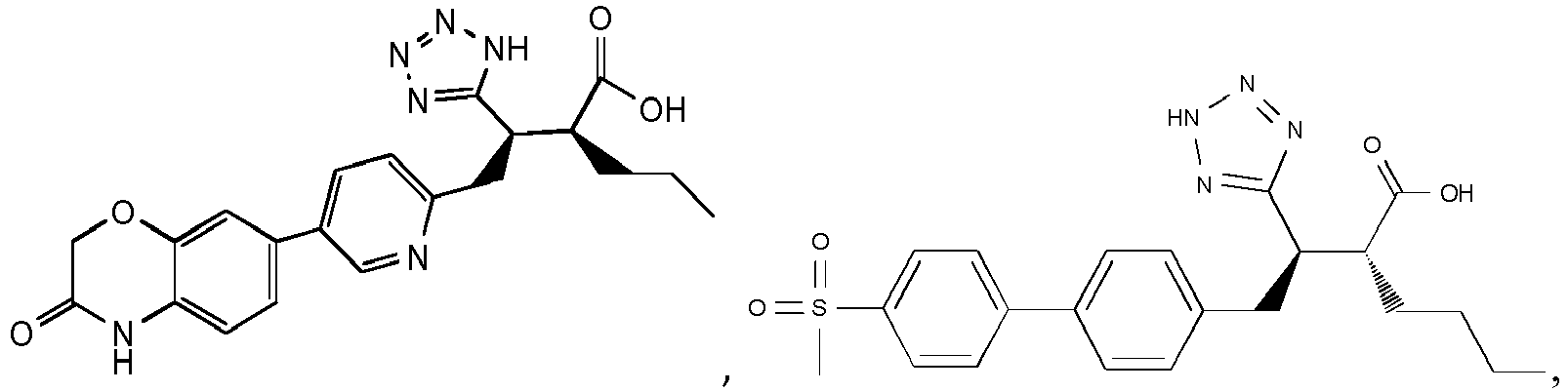

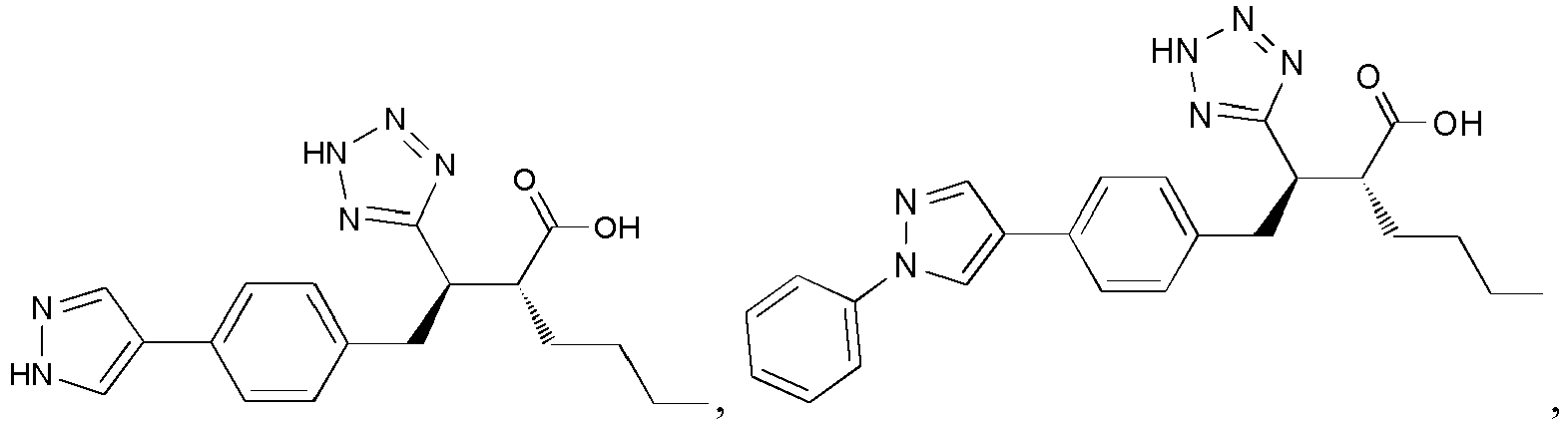
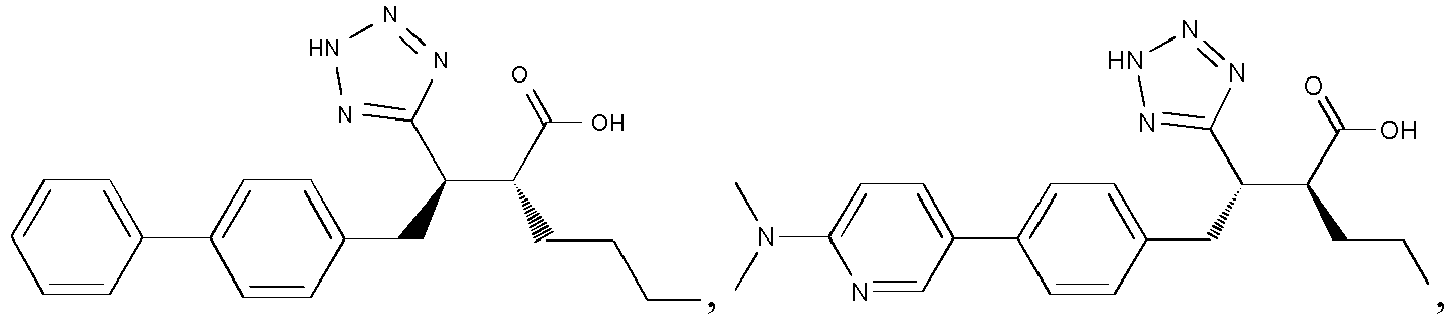


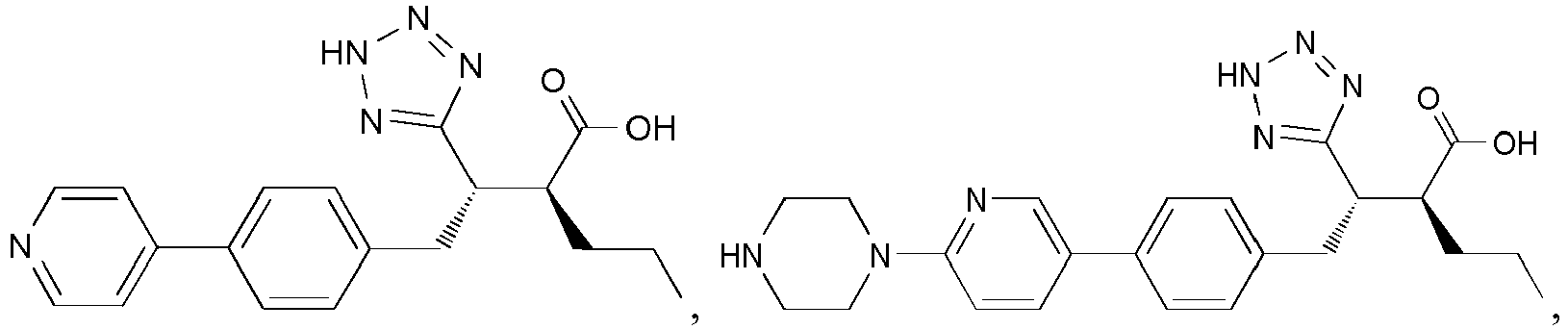
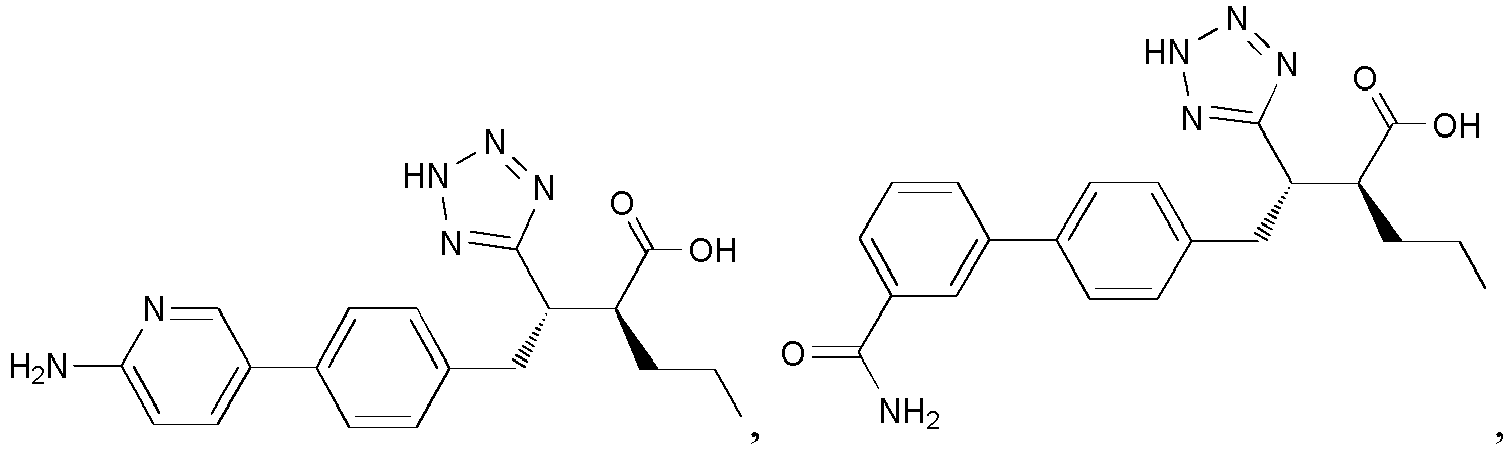


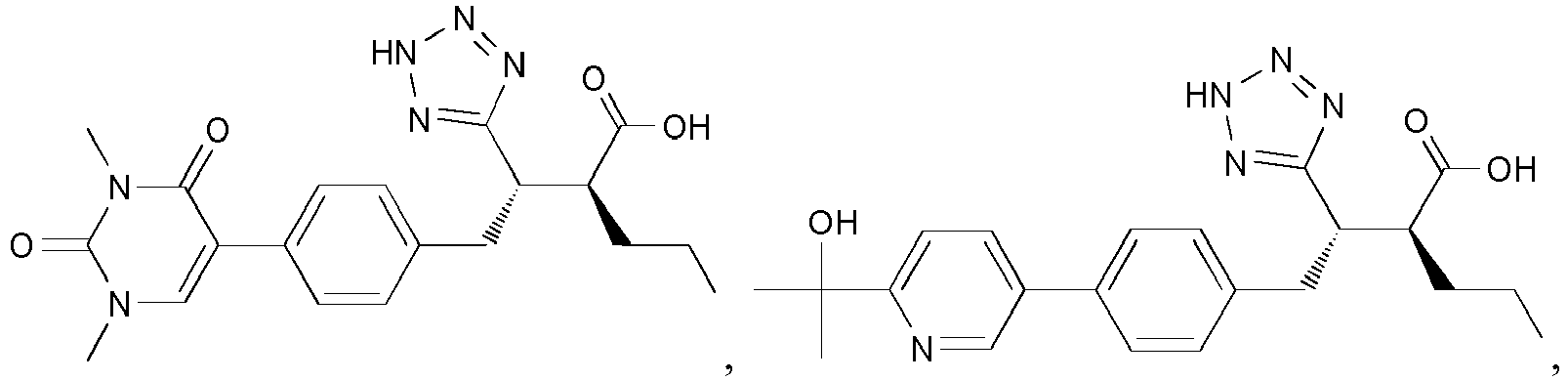


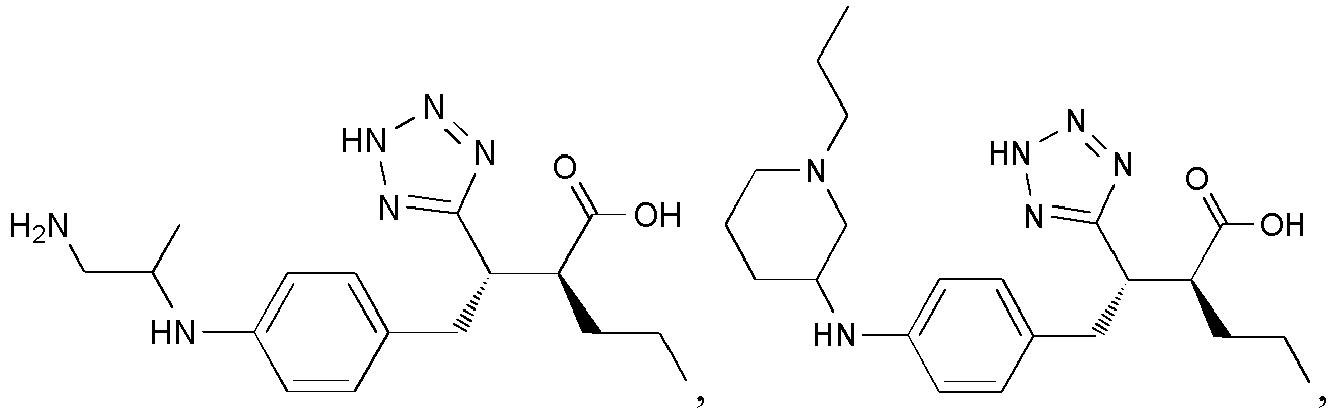


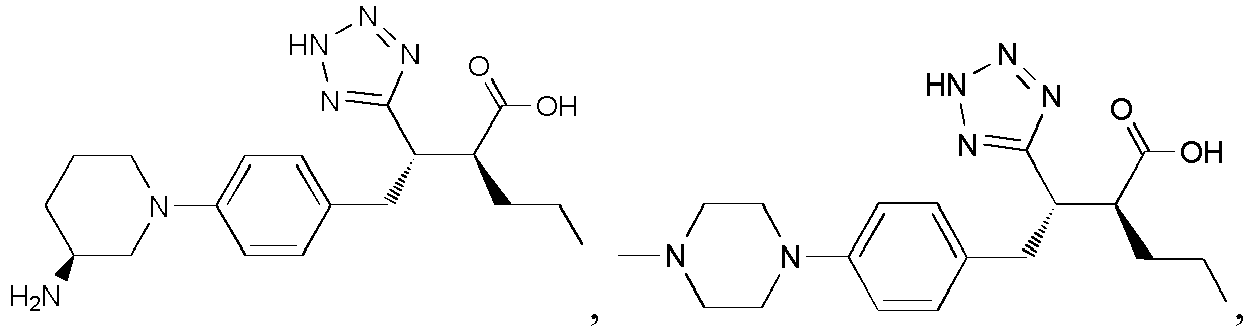


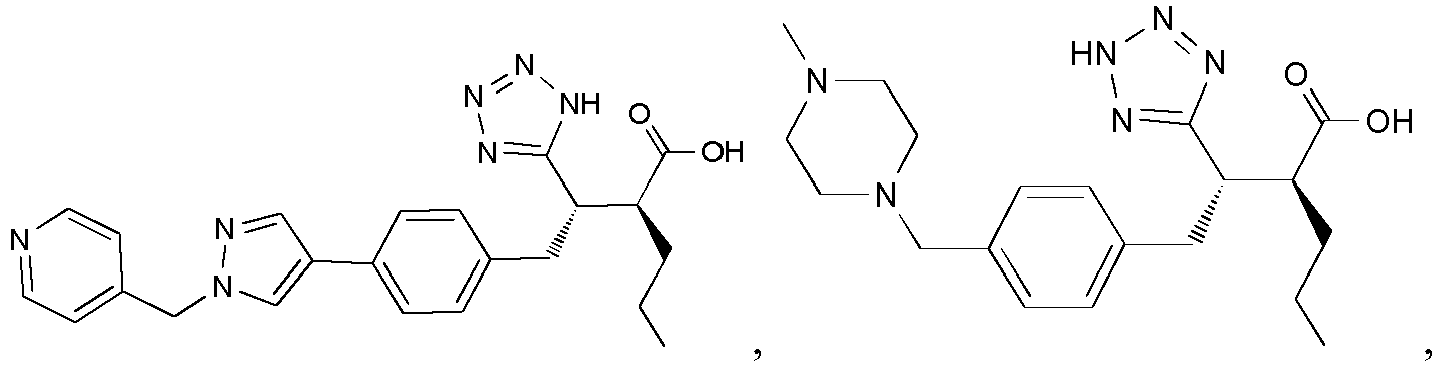


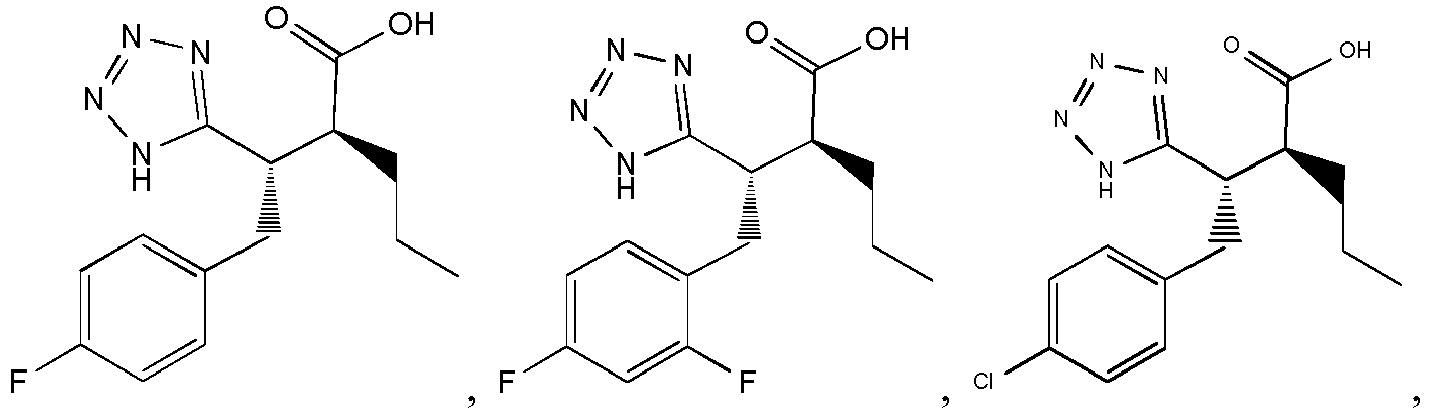


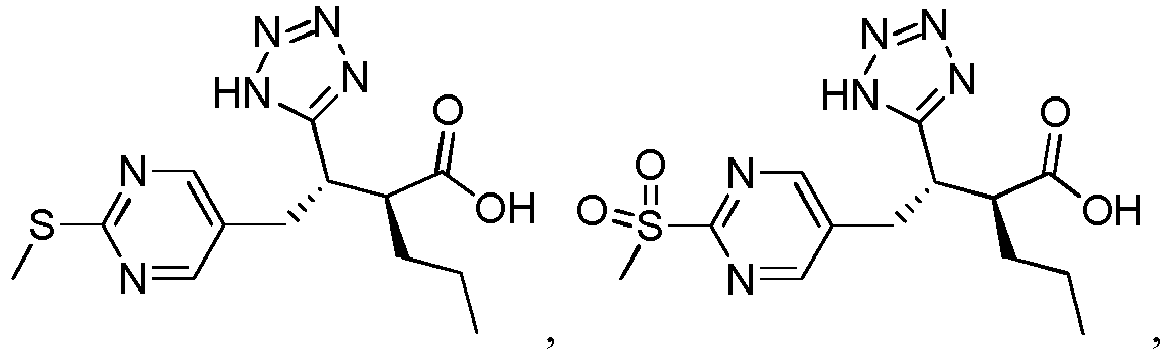


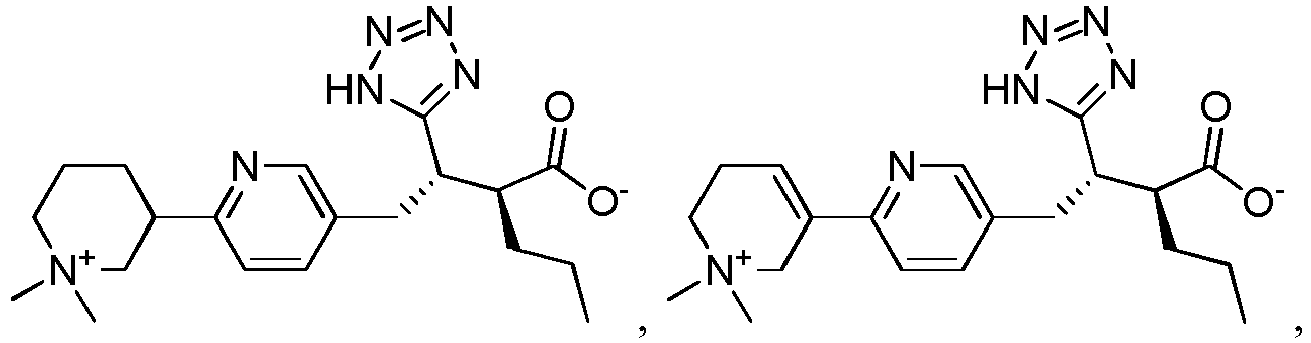
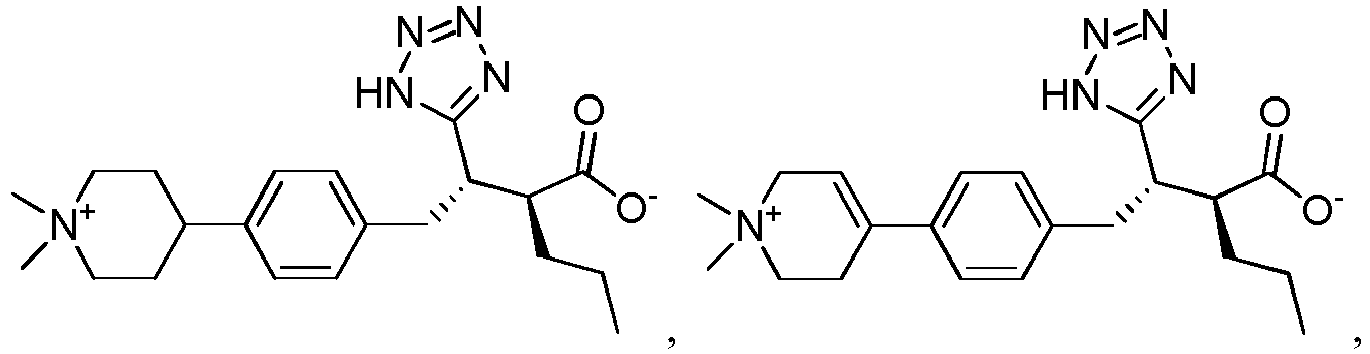


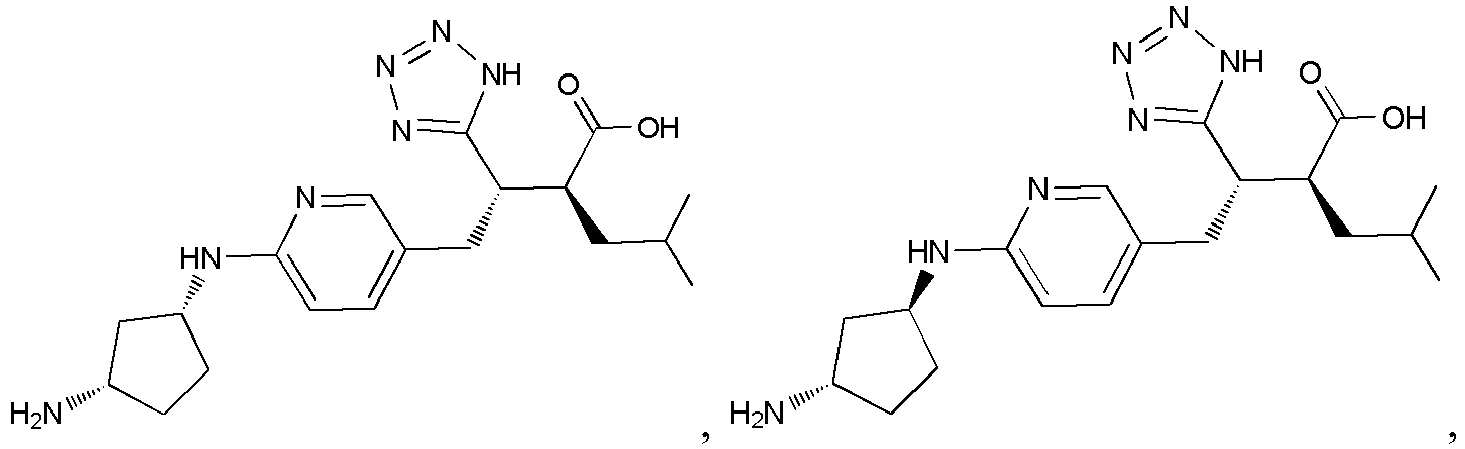


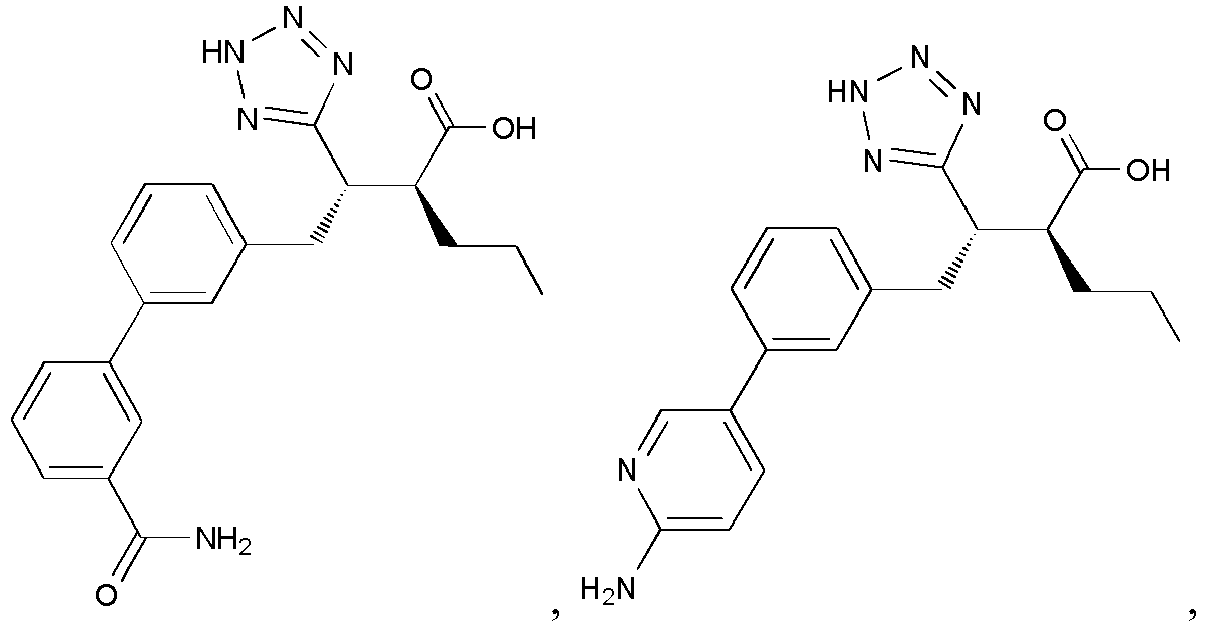


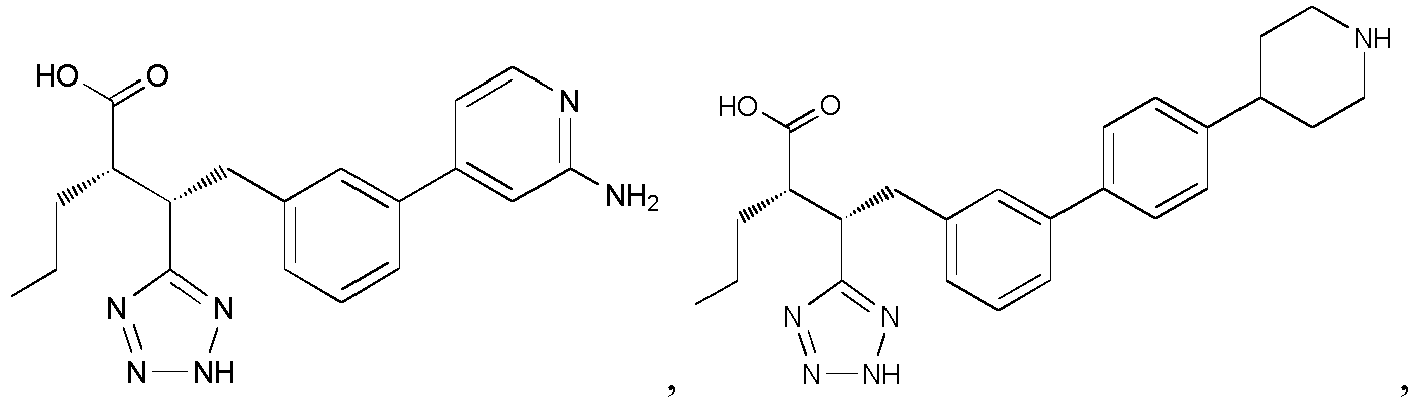


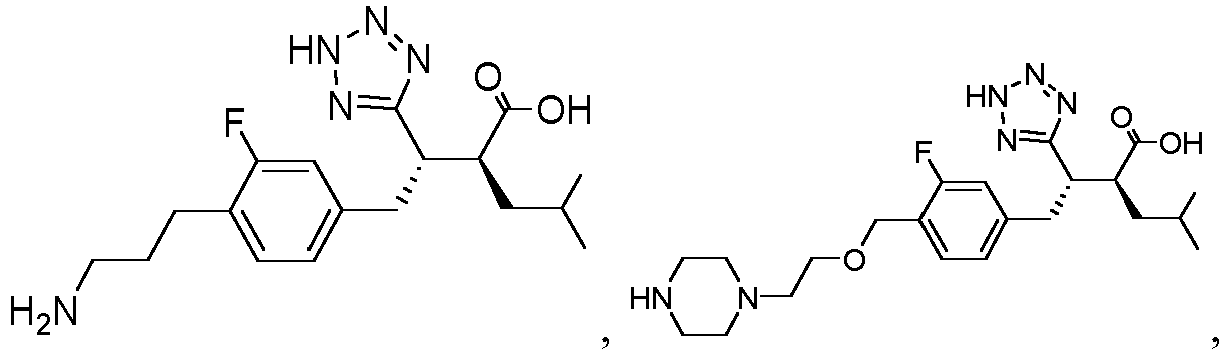
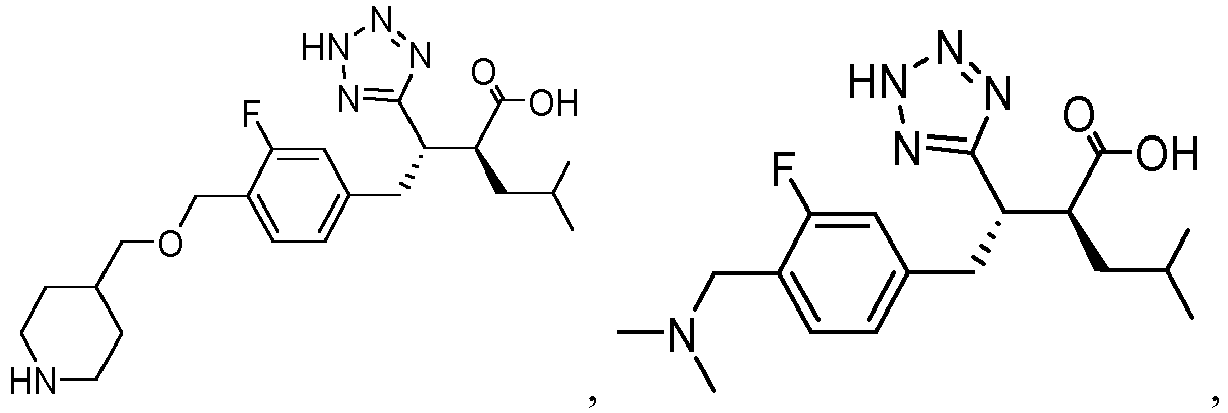


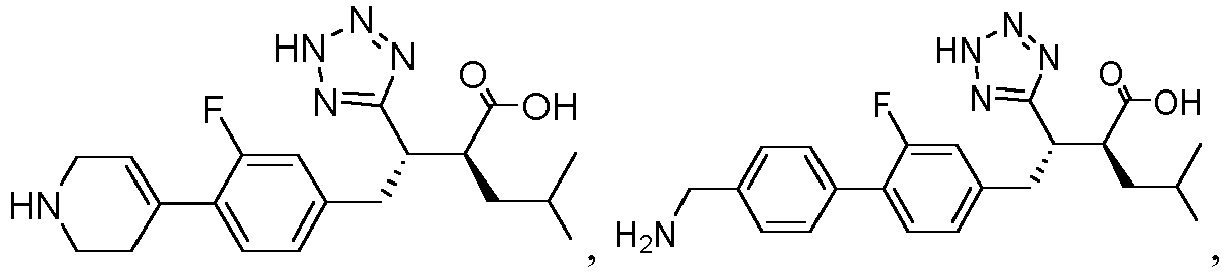

- The compound of claim 5 which is







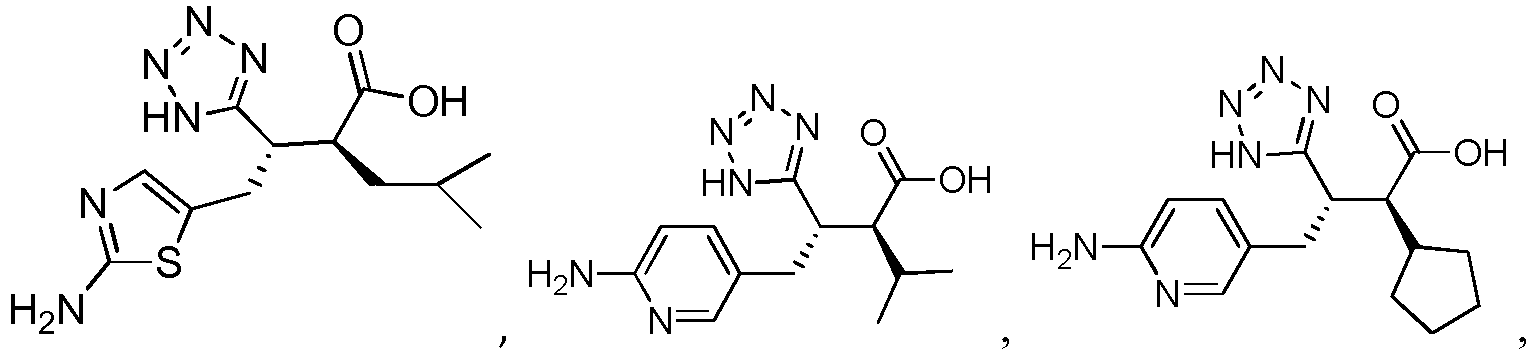



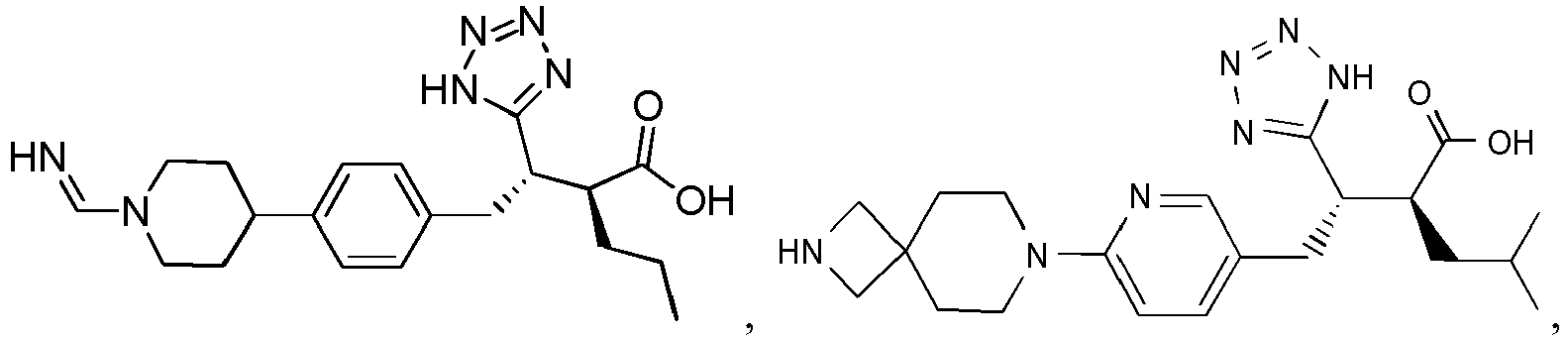
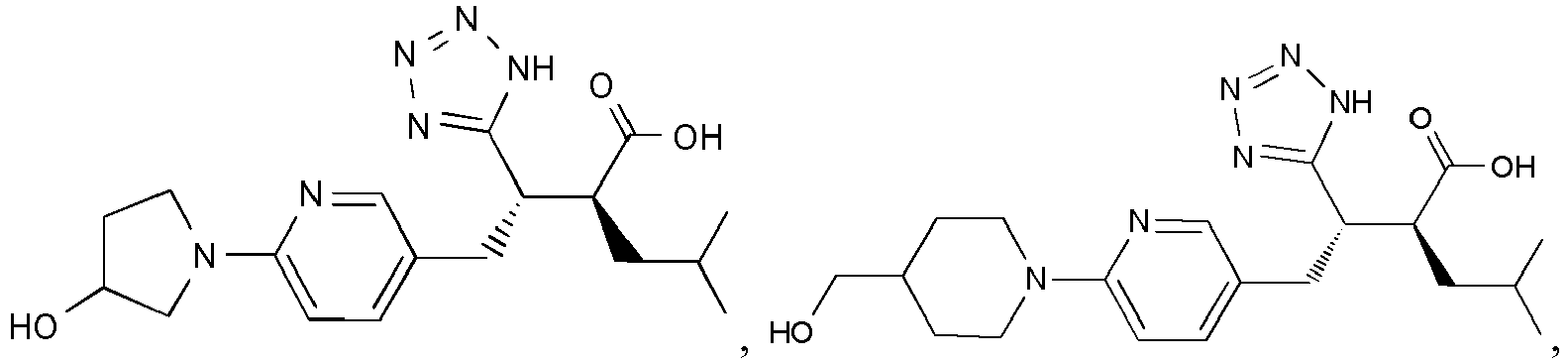


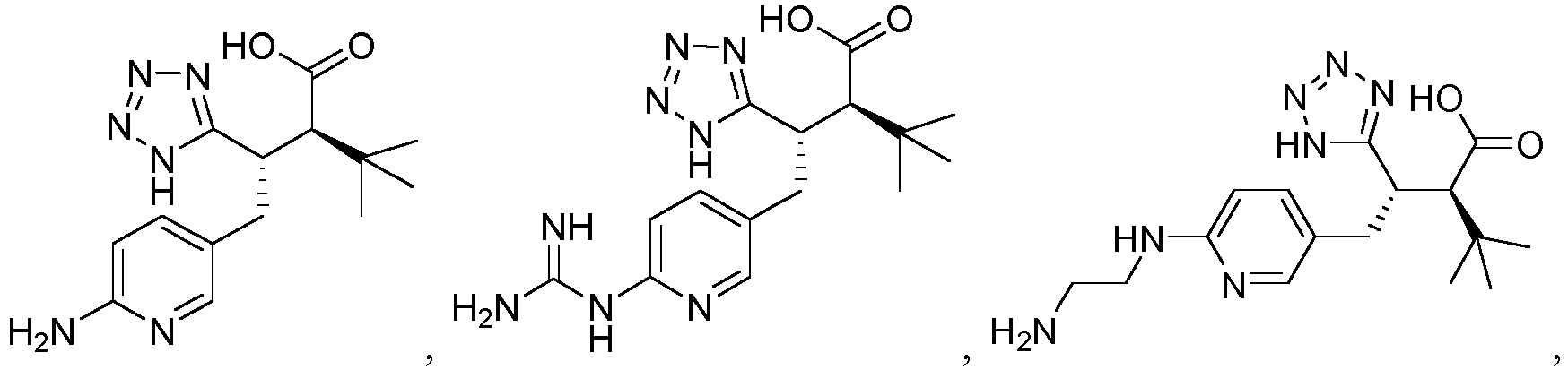

- A pharmaceutical composition which comprises a compound acccording to any one of claims 1 to 9, or a pharmaceutically acceptable salt thereof, and a pharmaceutically acceptable carrier, and optionally further comprises an effective amount of a beta-lactam antibiotic.
- The pharmaceutical composition according to claim 10, wherein the beta-lactam antibiotic is selected from the group consisting of imipenem, ertapenem, meropenem, doripenem, biapenem, panipenem, ticarcillin, ampicillin, amoxicillin, carbenicillin, piperacillin, azlocillin, mezlocillin, ticarcillin, cefoperazone, cefotaxime, ceftriaxone, and ceftazidime.
- The pharmaceutical composition according to claim 11, wherein the beta-lactam antibiotic is imipenem.
- The pharmaceutical composition according to claim 10 which comprises a beta-lactam antibiotic further comprising cilastatin or a pharmaceutically acceptable salt thereof.
- A compound according to any one of claims 1 to 9, or a pharmaceutically acceptable salt thereof, optionally in combination with a beta-lactam antibiotic, or a pharmaceutical composition according to any one of claims 12 to 15, for use in treating a bacterial infection.
- The compound or composition for use according to claim 14, wherein the bacterial infection is due to Pseudomonas spp., Klebsiella spp., Enterobacter spp., Escherichia spp., Morganella spp., Citrobacter spp., Serratia spp. or Acintetobacter spp.
Applications Claiming Priority (2)
| Application Number | Priority Date | Filing Date | Title |
|---|---|---|---|
| US201461991167P | 2014-05-09 | 2014-05-09 | |
| PCT/US2015/028989 WO2015171474A1 (en) | 2014-05-09 | 2015-05-04 | Beta-tetrazolyl-propionic acids as metallo-beta-lactamase inhibitors |
Publications (3)
| Publication Number | Publication Date |
|---|---|
| EP3139918A1 EP3139918A1 (en) | 2017-03-15 |
| EP3139918A4 EP3139918A4 (en) | 2018-05-09 |
| EP3139918B1 true EP3139918B1 (en) | 2019-12-25 |
Family
ID=54392874
Family Applications (1)
| Application Number | Title | Priority Date | Filing Date |
|---|---|---|---|
| EP15789928.7A Active EP3139918B1 (en) | 2014-05-09 | 2015-05-04 | Beta-tetrazolyl-propionic acids as metallo-beta-lactamase inhibitors |
Country Status (3)
| Country | Link |
|---|---|
| US (1) | US9839642B2 (en) |
| EP (1) | EP3139918B1 (en) |
| WO (1) | WO2015171474A1 (en) |
Families Citing this family (8)
| Publication number | Priority date | Publication date | Assignee | Title |
|---|---|---|---|---|
| WO2016206101A1 (en) | 2015-06-26 | 2016-12-29 | Merck Sharp & Dohme Corp. | Metallo-beta-lactamase inhibitors |
| US11207312B2 (en) | 2017-07-17 | 2021-12-28 | Merck Sharp & Dohme Corp. | Metallo-beta-lactamase inhibitors and methods of use thereof |
| CN113735701B (en) * | 2020-05-27 | 2023-09-08 | 新发药业有限公司 | Preparation method of 8-hydroxy-2,2,14,14-tetramethyl pentadecane diacid |
| CN112047901B (en) * | 2020-09-21 | 2023-01-24 | 自然资源部第三海洋研究所 | Benzothiazole heteroterpenoids and their derivatives as well as preparation methods and applications |
| BR112023020274A2 (en) * | 2021-03-30 | 2023-11-14 | Jiangxi Jemincare Group Co Ltd | METHOD FOR PREPARING A BICYCLIC COMPOUND AND APPLICATION AS AN ANTIFUNGAL AGENT |
| CN113527081B (en) * | 2021-08-30 | 2022-11-08 | 上海日异生物科技有限公司 | Preparation method of 3-oxocyclobutanecarboxylic acid |
| CN114436991A (en) * | 2021-12-25 | 2022-05-06 | 上海泰坦科技股份有限公司 | A kind of synthetic method of 2-aminothiazole compounds |
| CN116396191A (en) * | 2023-04-07 | 2023-07-07 | 阜阳欣奕华制药科技有限公司 | Preparation method of N-tert-butoxycarbonyl-L-glutamic acid dimethyl ester derivative |
Family Cites Families (15)
| Publication number | Priority date | Publication date | Assignee | Title |
|---|---|---|---|---|
| CA1231336A (en) | 1985-05-30 | 1988-01-12 | George Levitt | Herbicidal sulfonamides |
| US4786311A (en) | 1985-05-30 | 1988-11-22 | E. I. Du Pont De Nemours And Company | Herbicidal sulfonamides |
| JPS62242679A (en) | 1986-04-11 | 1987-10-23 | イ−・アイ・デユポン・デ・ニモアス・アンド・カンパニ− | Herbicidal sulfonamides |
| US4838925A (en) | 1986-04-25 | 1989-06-13 | E. I. Du Pont De Nemours And Company | Heterocyclic acyl sulfonamides |
| CA1273336A (en) | 1986-04-25 | 1990-08-28 | Chi-Ping Tseng | Herbicidal heterocyclic carbonyl sulfonamides |
| CN1095549A (en) | 1986-11-24 | 1994-11-30 | 纳幕尔杜邦公司 | Herbicidal sulfonamide compositions and method for making thereof and application |
| DK0508234T3 (en) | 1991-04-11 | 1996-10-28 | Hoffmann La Roche | Beta-lactams |
| MXPA02000246A (en) | 1999-07-06 | 2003-08-20 | Methylgene Inc | SULFONAMIDOMETHYL PHOSPHONATE INHIBITORS OF beta-LACTAMASE. |
| FR2812635B1 (en) | 2000-08-01 | 2002-10-11 | Aventis Pharma Sa | NOVEL HETEROCYCLIC COMPOUNDS, PREPARATION AND USE AS MEDICAMENTS IN PARTICULAR AS ANTI-BACTERIALS |
| US7001901B2 (en) * | 2002-08-27 | 2006-02-21 | Bristol-Myers Squibb Company | Tetrazolylpropionamides as inhibitors of Aβ protein production |
| US7439253B2 (en) | 2002-12-06 | 2008-10-21 | Novexel | Heterocyclic compounds, their preparation and their use as medicaments, in particular as antibacterials and beta-lactamase inhibitors |
| AU2007300531A1 (en) | 2006-09-27 | 2008-04-03 | Merck Sharp & Dohme Corp. | Novel inhibitors of beta-lactamase |
| US8987315B2 (en) * | 2009-12-31 | 2015-03-24 | Innocrin Pharmaceuticals, Inc. | Metalloenzyme inhibitor compounds |
| CN103130686B (en) | 2011-12-02 | 2016-09-14 | 天津市国际生物医药联合研究院 | N, N '-asymmetric diaryl substitute urea compound and its production and use |
| CN103191091B (en) | 2012-01-04 | 2016-12-14 | 天津市国际生物医药联合研究院 | Sulfamide compound application in suppression NDM-1 activity |
-
2015
- 2015-05-04 US US15/309,533 patent/US9839642B2/en active Active
- 2015-05-04 WO PCT/US2015/028989 patent/WO2015171474A1/en not_active Ceased
- 2015-05-04 EP EP15789928.7A patent/EP3139918B1/en active Active
Non-Patent Citations (1)
| Title |
|---|
| None * |
Also Published As
| Publication number | Publication date |
|---|---|
| US9839642B2 (en) | 2017-12-12 |
| US20170173035A1 (en) | 2017-06-22 |
| EP3139918A1 (en) | 2017-03-15 |
| WO2015171474A1 (en) | 2015-11-12 |
| EP3139918A4 (en) | 2018-05-09 |
Similar Documents
| Publication | Publication Date | Title |
|---|---|---|
| EP3139918B1 (en) | Beta-tetrazolyl-propionic acids as metallo-beta-lactamase inhibitors | |
| US11529356B2 (en) | 2-(morpholin-4-yl)-1,7-naphthyridines | |
| EP3096754B1 (en) | Metallo-beta-lactamase inhibitors | |
| US10428044B2 (en) | 3-amino-1,5,6,7-tetrahydro-4H-indol-4-ones | |
| EP3426248B1 (en) | Bicyclic aryl monobactam compounds and methods of use thereof for the treatment of bacterial infections | |
| EP3978472B1 (en) | Biaryl monabactam compounds and methods of use thereof for the treatment of bacterial infections | |
| EP3313832B1 (en) | 3-tetrazolyl-benzene-1,2-disulfonamide derivatives as metallo-beta-lactamase inhibitors | |
| US11433055B2 (en) | Chromane monobactam compounds for the treatment of bacterial infections | |
| KR20180063138A (en) | Ascenote Burter Baumann's Peptide Giant Ring against Nee | |
| US20230002396A1 (en) | Therapeutic compounds | |
| WO2019151274A1 (en) | Nitrogenated heterocyclic amide compound, and use thereof for medical purposes | |
| EP0671401A1 (en) | Beta lactames | |
| US20230064983A1 (en) | 3-(anilino)-2-[3-(3-alkoxy-pyridin-4-yl]-1,5,6,7-tetrahydro-4h-pyrrolo[3,2-c]pyridin-4-one derivatives as egfr inhibitors for the treatment of cancer | |
| US20240158370A1 (en) | CK1 alpha AND DUAL CK1 alpha / GSPT1 DEGRADING COMPOUNDS | |
| EP4169575B1 (en) | Condensed ring compounds that inhibit h-pgds | |
| US12565494B2 (en) | Inhibitors of human respiratory syncytial virus and metapneumovirus | |
| US20230365531A1 (en) | Inhibitors of human respiratory syncytial virus and metapneumo virus | |
| US20260035365A1 (en) | 1h-pyrrolo[3,2-b]pyridine derivatives as irreversible inhibitors of mutant egfr for the treatment of cancer | |
| HK40087512B (en) | Condensed ring compounds that inhibit h-pgds | |
| HK40087512A (en) | Condensed ring compounds that inhibit h-pgds | |
| HK40041663A (en) | Nitrogenated heterocyclic amide compound, and use thereof for medical purposes | |
| HK1029590A1 (en) | New carbapenem derivatives | |
| HK1246289B (en) | 3-tetrazolyl-benzene-1,2-disulfonamide derivatives as metallo-beta-lactamase inhibitors | |
| HK1029590B (en) | New carbapenem derivatives |
Legal Events
| Date | Code | Title | Description |
|---|---|---|---|
| STAA | Information on the status of an ep patent application or granted ep patent |
Free format text: STATUS: THE INTERNATIONAL PUBLICATION HAS BEEN MADE |
|
| PUAI | Public reference made under article 153(3) epc to a published international application that has entered the european phase |
Free format text: ORIGINAL CODE: 0009012 |
|
| STAA | Information on the status of an ep patent application or granted ep patent |
Free format text: STATUS: REQUEST FOR EXAMINATION WAS MADE |
|
| 17P | Request for examination filed |
Effective date: 20161209 |
|
| AK | Designated contracting states |
Kind code of ref document: A1 Designated state(s): AL AT BE BG CH CY CZ DE DK EE ES FI FR GB GR HR HU IE IS IT LI LT LU LV MC MK MT NL NO PL PT RO RS SE SI SK SM TR |
|
| AX | Request for extension of the european patent |
Extension state: BA ME |
|
| DAV | Request for validation of the european patent (deleted) | ||
| DAX | Request for extension of the european patent (deleted) | ||
| A4 | Supplementary search report drawn up and despatched |
Effective date: 20180411 |
|
| RIC1 | Information provided on ipc code assigned before grant |
Ipc: C07D 405/10 20060101ALI20180405BHEP Ipc: C07D 401/12 20060101ALI20180405BHEP Ipc: C07D 413/06 20060101ALI20180405BHEP Ipc: C07D 471/04 20060101ALI20180405BHEP Ipc: C07D 409/06 20060101ALI20180405BHEP Ipc: A61K 31/192 20060101ALI20180405BHEP Ipc: C07D 471/10 20060101ALI20180405BHEP Ipc: C07D 401/06 20060101ALI20180405BHEP Ipc: C07D 401/14 20060101ALI20180405BHEP Ipc: C07D 413/14 20060101ALI20180405BHEP Ipc: C07D 401/10 20060101ALI20180405BHEP Ipc: C07D 417/06 20060101ALI20180405BHEP Ipc: C07D 487/04 20060101ALI20180405BHEP Ipc: C07D 403/10 20060101ALI20180405BHEP Ipc: C07D 257/04 20060101ALI20180405BHEP Ipc: C07D 403/12 20060101ALI20180405BHEP Ipc: A61K 31/41 20060101AFI20180405BHEP |
|
| RIC1 | Information provided on ipc code assigned before grant |
Ipc: A61K 31/41 20060101AFI20190415BHEP Ipc: C07D 487/04 20060101ALI20190415BHEP Ipc: C07D 403/12 20060101ALI20190415BHEP Ipc: C07D 471/10 20060101ALI20190415BHEP Ipc: C07D 413/06 20060101ALI20190415BHEP Ipc: C07D 405/10 20060101ALI20190415BHEP Ipc: C07D 471/04 20060101ALI20190415BHEP Ipc: C07D 413/14 20060101ALI20190415BHEP Ipc: C07D 401/12 20060101ALI20190415BHEP Ipc: C07D 257/04 20060101ALI20190415BHEP Ipc: C07D 401/10 20060101ALI20190415BHEP Ipc: C07D 401/14 20060101ALI20190415BHEP Ipc: A61K 31/192 20060101ALI20190415BHEP Ipc: C07D 417/06 20060101ALI20190415BHEP Ipc: C07D 403/10 20060101ALI20190415BHEP Ipc: C07D 409/06 20060101ALI20190415BHEP Ipc: C07D 401/06 20060101ALI20190415BHEP |
|
| GRAJ | Information related to disapproval of communication of intention to grant by the applicant or resumption of examination proceedings by the epo deleted |
Free format text: ORIGINAL CODE: EPIDOSDIGR1 |
|
| GRAP | Despatch of communication of intention to grant a patent |
Free format text: ORIGINAL CODE: EPIDOSNIGR1 |
|
| GRAP | Despatch of communication of intention to grant a patent |
Free format text: ORIGINAL CODE: EPIDOSNIGR1 |
|
| STAA | Information on the status of an ep patent application or granted ep patent |
Free format text: STATUS: GRANT OF PATENT IS INTENDED |
|
| GRAJ | Information related to disapproval of communication of intention to grant by the applicant or resumption of examination proceedings by the epo deleted |
Free format text: ORIGINAL CODE: EPIDOSDIGR1 |
|
| INTG | Intention to grant announced |
Effective date: 20190603 |
|
| GRAP | Despatch of communication of intention to grant a patent |
Free format text: ORIGINAL CODE: EPIDOSNIGR1 |
|
| INTC | Intention to grant announced (deleted) | ||
| GRAJ | Information related to disapproval of communication of intention to grant by the applicant or resumption of examination proceedings by the epo deleted |
Free format text: ORIGINAL CODE: EPIDOSDIGR1 |
|
| INTG | Intention to grant announced |
Effective date: 20190611 |
|
| GRAP | Despatch of communication of intention to grant a patent |
Free format text: ORIGINAL CODE: EPIDOSNIGR1 |
|
| INTG | Intention to grant announced |
Effective date: 20190702 |
|
| INTG | Intention to grant announced |
Effective date: 20190712 |
|
| GRAS | Grant fee paid |
Free format text: ORIGINAL CODE: EPIDOSNIGR3 |
|
| GRAA | (expected) grant |
Free format text: ORIGINAL CODE: 0009210 |
|
| STAA | Information on the status of an ep patent application or granted ep patent |
Free format text: STATUS: THE PATENT HAS BEEN GRANTED |
|
| AK | Designated contracting states |
Kind code of ref document: B1 Designated state(s): AL AT BE BG CH CY CZ DE DK EE ES FI FR GB GR HR HU IE IS IT LI LT LU LV MC MK MT NL NO PL PT RO RS SE SI SK SM TR |
|
| REG | Reference to a national code |
Ref country code: GB Ref legal event code: FG4D |
|
| REG | Reference to a national code |
Ref country code: CH Ref legal event code: EP |
|
| REG | Reference to a national code |
Ref country code: DE Ref legal event code: R096 Ref document number: 602015044352 Country of ref document: DE |
|
| REG | Reference to a national code |
Ref country code: AT Ref legal event code: REF Ref document number: 1216382 Country of ref document: AT Kind code of ref document: T Effective date: 20200115 |
|
| REG | Reference to a national code |
Ref country code: IE Ref legal event code: FG4D |
|
| REG | Reference to a national code |
Ref country code: NL Ref legal event code: MP Effective date: 20191225 |
|
| PG25 | Lapsed in a contracting state [announced via postgrant information from national office to epo] |
Ref country code: NO Free format text: LAPSE BECAUSE OF FAILURE TO SUBMIT A TRANSLATION OF THE DESCRIPTION OR TO PAY THE FEE WITHIN THE PRESCRIBED TIME-LIMIT Effective date: 20200325 Ref country code: BG Free format text: LAPSE BECAUSE OF FAILURE TO SUBMIT A TRANSLATION OF THE DESCRIPTION OR TO PAY THE FEE WITHIN THE PRESCRIBED TIME-LIMIT Effective date: 20200325 Ref country code: FI Free format text: LAPSE BECAUSE OF FAILURE TO SUBMIT A TRANSLATION OF THE DESCRIPTION OR TO PAY THE FEE WITHIN THE PRESCRIBED TIME-LIMIT Effective date: 20191225 Ref country code: LV Free format text: LAPSE BECAUSE OF FAILURE TO SUBMIT A TRANSLATION OF THE DESCRIPTION OR TO PAY THE FEE WITHIN THE PRESCRIBED TIME-LIMIT Effective date: 20191225 Ref country code: SE Free format text: LAPSE BECAUSE OF FAILURE TO SUBMIT A TRANSLATION OF THE DESCRIPTION OR TO PAY THE FEE WITHIN THE PRESCRIBED TIME-LIMIT Effective date: 20191225 Ref country code: LT Free format text: LAPSE BECAUSE OF FAILURE TO SUBMIT A TRANSLATION OF THE DESCRIPTION OR TO PAY THE FEE WITHIN THE PRESCRIBED TIME-LIMIT Effective date: 20191225 Ref country code: GR Free format text: LAPSE BECAUSE OF FAILURE TO SUBMIT A TRANSLATION OF THE DESCRIPTION OR TO PAY THE FEE WITHIN THE PRESCRIBED TIME-LIMIT Effective date: 20200326 |
|
| REG | Reference to a national code |
Ref country code: LT Ref legal event code: MG4D |
|
| PG25 | Lapsed in a contracting state [announced via postgrant information from national office to epo] |
Ref country code: RS Free format text: LAPSE BECAUSE OF FAILURE TO SUBMIT A TRANSLATION OF THE DESCRIPTION OR TO PAY THE FEE WITHIN THE PRESCRIBED TIME-LIMIT Effective date: 20191225 Ref country code: HR Free format text: LAPSE BECAUSE OF FAILURE TO SUBMIT A TRANSLATION OF THE DESCRIPTION OR TO PAY THE FEE WITHIN THE PRESCRIBED TIME-LIMIT Effective date: 20191225 |
|
| PG25 | Lapsed in a contracting state [announced via postgrant information from national office to epo] |
Ref country code: AL Free format text: LAPSE BECAUSE OF FAILURE TO SUBMIT A TRANSLATION OF THE DESCRIPTION OR TO PAY THE FEE WITHIN THE PRESCRIBED TIME-LIMIT Effective date: 20191225 |
|
| PG25 | Lapsed in a contracting state [announced via postgrant information from national office to epo] |
Ref country code: RO Free format text: LAPSE BECAUSE OF FAILURE TO SUBMIT A TRANSLATION OF THE DESCRIPTION OR TO PAY THE FEE WITHIN THE PRESCRIBED TIME-LIMIT Effective date: 20191225 Ref country code: NL Free format text: LAPSE BECAUSE OF FAILURE TO SUBMIT A TRANSLATION OF THE DESCRIPTION OR TO PAY THE FEE WITHIN THE PRESCRIBED TIME-LIMIT Effective date: 20191225 Ref country code: PT Free format text: LAPSE BECAUSE OF FAILURE TO SUBMIT A TRANSLATION OF THE DESCRIPTION OR TO PAY THE FEE WITHIN THE PRESCRIBED TIME-LIMIT Effective date: 20200520 Ref country code: EE Free format text: LAPSE BECAUSE OF FAILURE TO SUBMIT A TRANSLATION OF THE DESCRIPTION OR TO PAY THE FEE WITHIN THE PRESCRIBED TIME-LIMIT Effective date: 20191225 Ref country code: CZ Free format text: LAPSE BECAUSE OF FAILURE TO SUBMIT A TRANSLATION OF THE DESCRIPTION OR TO PAY THE FEE WITHIN THE PRESCRIBED TIME-LIMIT Effective date: 20191225 |
|
| PG25 | Lapsed in a contracting state [announced via postgrant information from national office to epo] |
Ref country code: IS Free format text: LAPSE BECAUSE OF FAILURE TO SUBMIT A TRANSLATION OF THE DESCRIPTION OR TO PAY THE FEE WITHIN THE PRESCRIBED TIME-LIMIT Effective date: 20200425 Ref country code: SM Free format text: LAPSE BECAUSE OF FAILURE TO SUBMIT A TRANSLATION OF THE DESCRIPTION OR TO PAY THE FEE WITHIN THE PRESCRIBED TIME-LIMIT Effective date: 20191225 Ref country code: SK Free format text: LAPSE BECAUSE OF FAILURE TO SUBMIT A TRANSLATION OF THE DESCRIPTION OR TO PAY THE FEE WITHIN THE PRESCRIBED TIME-LIMIT Effective date: 20191225 |
|
| REG | Reference to a national code |
Ref country code: DE Ref legal event code: R097 Ref document number: 602015044352 Country of ref document: DE |
|
| PG25 | Lapsed in a contracting state [announced via postgrant information from national office to epo] |
Ref country code: ES Free format text: LAPSE BECAUSE OF FAILURE TO SUBMIT A TRANSLATION OF THE DESCRIPTION OR TO PAY THE FEE WITHIN THE PRESCRIBED TIME-LIMIT Effective date: 20191225 Ref country code: DK Free format text: LAPSE BECAUSE OF FAILURE TO SUBMIT A TRANSLATION OF THE DESCRIPTION OR TO PAY THE FEE WITHIN THE PRESCRIBED TIME-LIMIT Effective date: 20191225 |
|
| PLBE | No opposition filed within time limit |
Free format text: ORIGINAL CODE: 0009261 |
|
| STAA | Information on the status of an ep patent application or granted ep patent |
Free format text: STATUS: NO OPPOSITION FILED WITHIN TIME LIMIT |
|
| REG | Reference to a national code |
Ref country code: AT Ref legal event code: MK05 Ref document number: 1216382 Country of ref document: AT Kind code of ref document: T Effective date: 20191225 |
|
| PG25 | Lapsed in a contracting state [announced via postgrant information from national office to epo] |
Ref country code: SI Free format text: LAPSE BECAUSE OF FAILURE TO SUBMIT A TRANSLATION OF THE DESCRIPTION OR TO PAY THE FEE WITHIN THE PRESCRIBED TIME-LIMIT Effective date: 20191225 |
|
| 26N | No opposition filed |
Effective date: 20200928 |
|
| PG25 | Lapsed in a contracting state [announced via postgrant information from national office to epo] |
Ref country code: LI Free format text: LAPSE BECAUSE OF NON-PAYMENT OF DUE FEES Effective date: 20200531 Ref country code: CH Free format text: LAPSE BECAUSE OF NON-PAYMENT OF DUE FEES Effective date: 20200531 Ref country code: MC Free format text: LAPSE BECAUSE OF FAILURE TO SUBMIT A TRANSLATION OF THE DESCRIPTION OR TO PAY THE FEE WITHIN THE PRESCRIBED TIME-LIMIT Effective date: 20191225 Ref country code: IT Free format text: LAPSE BECAUSE OF FAILURE TO SUBMIT A TRANSLATION OF THE DESCRIPTION OR TO PAY THE FEE WITHIN THE PRESCRIBED TIME-LIMIT Effective date: 20191225 Ref country code: AT Free format text: LAPSE BECAUSE OF FAILURE TO SUBMIT A TRANSLATION OF THE DESCRIPTION OR TO PAY THE FEE WITHIN THE PRESCRIBED TIME-LIMIT Effective date: 20191225 |
|
| PG25 | Lapsed in a contracting state [announced via postgrant information from national office to epo] |
Ref country code: PL Free format text: LAPSE BECAUSE OF FAILURE TO SUBMIT A TRANSLATION OF THE DESCRIPTION OR TO PAY THE FEE WITHIN THE PRESCRIBED TIME-LIMIT Effective date: 20191225 |
|
| REG | Reference to a national code |
Ref country code: BE Ref legal event code: MM Effective date: 20200531 |
|
| PG25 | Lapsed in a contracting state [announced via postgrant information from national office to epo] |
Ref country code: LU Free format text: LAPSE BECAUSE OF NON-PAYMENT OF DUE FEES Effective date: 20200504 |
|
| PG25 | Lapsed in a contracting state [announced via postgrant information from national office to epo] |
Ref country code: IE Free format text: LAPSE BECAUSE OF NON-PAYMENT OF DUE FEES Effective date: 20200504 |
|
| PG25 | Lapsed in a contracting state [announced via postgrant information from national office to epo] |
Ref country code: BE Free format text: LAPSE BECAUSE OF NON-PAYMENT OF DUE FEES Effective date: 20200531 |
|
| PG25 | Lapsed in a contracting state [announced via postgrant information from national office to epo] |
Ref country code: TR Free format text: LAPSE BECAUSE OF FAILURE TO SUBMIT A TRANSLATION OF THE DESCRIPTION OR TO PAY THE FEE WITHIN THE PRESCRIBED TIME-LIMIT Effective date: 20191225 Ref country code: MT Free format text: LAPSE BECAUSE OF FAILURE TO SUBMIT A TRANSLATION OF THE DESCRIPTION OR TO PAY THE FEE WITHIN THE PRESCRIBED TIME-LIMIT Effective date: 20191225 Ref country code: CY Free format text: LAPSE BECAUSE OF FAILURE TO SUBMIT A TRANSLATION OF THE DESCRIPTION OR TO PAY THE FEE WITHIN THE PRESCRIBED TIME-LIMIT Effective date: 20191225 |
|
| PG25 | Lapsed in a contracting state [announced via postgrant information from national office to epo] |
Ref country code: MK Free format text: LAPSE BECAUSE OF FAILURE TO SUBMIT A TRANSLATION OF THE DESCRIPTION OR TO PAY THE FEE WITHIN THE PRESCRIBED TIME-LIMIT Effective date: 20191225 |
|
| REG | Reference to a national code |
Ref country code: DE Ref legal event code: R081 Ref document number: 602015044352 Country of ref document: DE Owner name: MERCK SHARP & DOHME LLC, RAHWAY, US Free format text: FORMER OWNER: MERCK SHARP & DOHME CORP., RAHWAY, N.J., US |
|
| REG | Reference to a national code |
Ref country code: GB Ref legal event code: 732E Free format text: REGISTERED BETWEEN 20221013 AND 20221019 |
|
| REG | Reference to a national code |
Ref country code: FR Ref legal event code: PLFP Year of fee payment: 9 |
|
| PGFP | Annual fee paid to national office [announced via postgrant information from national office to epo] |
Ref country code: DE Payment date: 20250409 Year of fee payment: 11 |
|
| PGFP | Annual fee paid to national office [announced via postgrant information from national office to epo] |
Ref country code: FR Payment date: 20250409 Year of fee payment: 11 |
|
| PGFP | Annual fee paid to national office [announced via postgrant information from national office to epo] |
Ref country code: GB Payment date: 20260320 Year of fee payment: 12 |