EP3139548A1 - High assurance segregated gateway interconnecting different domains - Google Patents
High assurance segregated gateway interconnecting different domains Download PDFInfo
- Publication number
- EP3139548A1 EP3139548A1 EP15306360.7A EP15306360A EP3139548A1 EP 3139548 A1 EP3139548 A1 EP 3139548A1 EP 15306360 A EP15306360 A EP 15306360A EP 3139548 A1 EP3139548 A1 EP 3139548A1
- Authority
- EP
- European Patent Office
- Prior art keywords
- gateway
- elementary
- components
- protocol
- data
- Prior art date
- Legal status (The legal status is an assumption and is not a legal conclusion. Google has not performed a legal analysis and makes no representation as to the accuracy of the status listed.)
- Granted
Links
Images


Classifications
-
- H—ELECTRICITY
- H04—ELECTRIC COMMUNICATION TECHNIQUE
- H04L—TRANSMISSION OF DIGITAL INFORMATION, e.g. TELEGRAPHIC COMMUNICATION
- H04L12/00—Data switching networks
- H04L12/28—Data switching networks characterised by path configuration, e.g. LAN [Local Area Networks] or WAN [Wide Area Networks]
- H04L12/46—Interconnection of networks
- H04L12/4604—LAN interconnection over a backbone network, e.g. Internet, Frame Relay
- H04L12/462—LAN interconnection over a bridge based backbone
- H04L12/4625—Single bridge functionality, e.g. connection of two networks over a single bridge
-
- H—ELECTRICITY
- H04—ELECTRIC COMMUNICATION TECHNIQUE
- H04L—TRANSMISSION OF DIGITAL INFORMATION, e.g. TELEGRAPHIC COMMUNICATION
- H04L12/00—Data switching networks
- H04L12/28—Data switching networks characterised by path configuration, e.g. LAN [Local Area Networks] or WAN [Wide Area Networks]
- H04L12/40—Bus networks
- H04L12/40006—Architecture of a communication node
- H04L12/40032—Details regarding a bus interface enhancer
-
- H—ELECTRICITY
- H04—ELECTRIC COMMUNICATION TECHNIQUE
- H04L—TRANSMISSION OF DIGITAL INFORMATION, e.g. TELEGRAPHIC COMMUNICATION
- H04L12/00—Data switching networks
- H04L12/66—Arrangements for connecting between networks having differing types of switching systems, e.g. gateways
-
- H—ELECTRICITY
- H04—ELECTRIC COMMUNICATION TECHNIQUE
- H04L—TRANSMISSION OF DIGITAL INFORMATION, e.g. TELEGRAPHIC COMMUNICATION
- H04L63/00—Network architectures or network communication protocols for network security
- H04L63/02—Network architectures or network communication protocols for network security for separating internal from external traffic, e.g. firewalls
-
- H—ELECTRICITY
- H04—ELECTRIC COMMUNICATION TECHNIQUE
- H04L—TRANSMISSION OF DIGITAL INFORMATION, e.g. TELEGRAPHIC COMMUNICATION
- H04L63/00—Network architectures or network communication protocols for network security
- H04L63/10—Network architectures or network communication protocols for network security for controlling access to devices or network resources
-
- H—ELECTRICITY
- H04—ELECTRIC COMMUNICATION TECHNIQUE
- H04L—TRANSMISSION OF DIGITAL INFORMATION, e.g. TELEGRAPHIC COMMUNICATION
- H04L63/00—Network architectures or network communication protocols for network security
- H04L63/10—Network architectures or network communication protocols for network security for controlling access to devices or network resources
- H04L63/107—Network architectures or network communication protocols for network security for controlling access to devices or network resources wherein the security policies are location-dependent, e.g. entities privileges depend on current location or allowing specific operations only from locally connected terminals
-
- H—ELECTRICITY
- H04—ELECTRIC COMMUNICATION TECHNIQUE
- H04L—TRANSMISSION OF DIGITAL INFORMATION, e.g. TELEGRAPHIC COMMUNICATION
- H04L63/00—Network architectures or network communication protocols for network security
- H04L63/14—Network architectures or network communication protocols for network security for detecting or protecting against malicious traffic
- H04L63/1408—Network architectures or network communication protocols for network security for detecting or protecting against malicious traffic by monitoring network traffic
-
- H—ELECTRICITY
- H04—ELECTRIC COMMUNICATION TECHNIQUE
- H04L—TRANSMISSION OF DIGITAL INFORMATION, e.g. TELEGRAPHIC COMMUNICATION
- H04L69/00—Network arrangements, protocols or services independent of the application payload and not provided for in the other groups of this subclass
- H04L69/08—Protocols for interworking; Protocol conversion
-
- G—PHYSICS
- G06—COMPUTING OR CALCULATING; COUNTING
- G06F—ELECTRIC DIGITAL DATA PROCESSING
- G06F2221/00—Indexing scheme relating to security arrangements for protecting computers, components thereof, programs or data against unauthorised activity
- G06F2221/21—Indexing scheme relating to G06F21/00 and subgroups addressing additional information or applications relating to security arrangements for protecting computers, components thereof, programs or data against unauthorised activity
- G06F2221/2101—Auditing as a secondary aspect
-
- H—ELECTRICITY
- H04—ELECTRIC COMMUNICATION TECHNIQUE
- H04L—TRANSMISSION OF DIGITAL INFORMATION, e.g. TELEGRAPHIC COMMUNICATION
- H04L12/00—Data switching networks
- H04L12/28—Data switching networks characterised by path configuration, e.g. LAN [Local Area Networks] or WAN [Wide Area Networks]
- H04L12/40—Bus networks
- H04L2012/40267—Bus for use in transportation systems
-
- H—ELECTRICITY
- H04—ELECTRIC COMMUNICATION TECHNIQUE
- H04L—TRANSMISSION OF DIGITAL INFORMATION, e.g. TELEGRAPHIC COMMUNICATION
- H04L47/00—Traffic control in data switching networks
- H04L47/10—Flow control; Congestion control
- H04L47/19—Flow control; Congestion control at layers above the network layer
- H04L47/196—Integration of transport layer protocols, e.g. TCP and UDP
-
- H—ELECTRICITY
- H04—ELECTRIC COMMUNICATION TECHNIQUE
- H04L—TRANSMISSION OF DIGITAL INFORMATION, e.g. TELEGRAPHIC COMMUNICATION
- H04L67/00—Network arrangements or protocols for supporting network services or applications
- H04L67/01—Protocols
- H04L67/02—Protocols based on web technology, e.g. hypertext transfer protocol [HTTP]
-
- H—ELECTRICITY
- H04—ELECTRIC COMMUNICATION TECHNIQUE
- H04L—TRANSMISSION OF DIGITAL INFORMATION, e.g. TELEGRAPHIC COMMUNICATION
- H04L67/00—Network arrangements or protocols for supporting network services or applications
- H04L67/01—Protocols
- H04L67/133—Protocols for remote procedure calls [RPC]
Definitions
- the present invention generally concerns high assurance security gateway interconnecting different domains and particularly in embedded infrastructures.
- Each application may be considered as a set of functions and each function is a piece of software contributing to execute a part of the task to be accomplished by the application.
- many different types of equipment in a vehicle or an aircraft need to exchange data with each other through a communication system in order to accomplish the manoeuvring of the vehicle or the aircraft.
- Each type of equipment may have a specific set of functions or applications with different levels of criticality depending on their importance.
- a specific level of security is associated to each application in function of the criticality of that application. Therefore, it is important and practically useful to establish a mechanism that allows an efficient exchange of information between applications in domains having different security levels without compromising their security.
- One solution would consist of physically separating the different applications by hosting each one on a different physical system and connecting them via a network channel.
- the data exchange via this network channel needs to be controlled by a control means for securing information exchange.
- the trend is exactly the opposite and consists of putting several applications or functions on the same physical system in order to use the full computing power and memory storage capabilities offered by that system.
- This enables to avoid wasting unused resources and thus reduces the production costs as well as the overall weight of the system which is very important for an aircraft, a satellite or a vehicle.
- This architecture has however the disadvantage of facilitating the propagation of errors. Indeed, any design or implementation error on one part of the system may lead to failures impacting on other parts of the system.
- MILS Multiple Independent Levels of Security
- Bell-La Padula model which addresses confidentiality aspects.
- This model is based on a "no write down, no read up" strategy.
- a first domain with a high security level is not allowed to write or communicate any data to a second domain with a low security level but is allowed to read data from the latter.
- the second domain with a low security level is not allowed to read data from the first domain with a high security level but is authorised to write data into it.
- Biba integrity model defining a set of access rules designed to ensure data integrity. This model is based on a "no read down, no write up" strategy. In other words, a first domain with a high security level is not allowed to read or use any data from a second domain with a low security level. On the other hand, the second domain is not allowed to write or communicate any data to the first domain with a higher security level.
- EAL 7 Evaluation Assurance Levels
- EAL 7 provides the highest level of assurance but also requires formal modelling of the system under evaluation.
- Security evaluations presenting a level higher than EAL 4 are internationally not recognized.
- a system claiming high EAL levels requires multiple certifications from the different countries where the system is to be used.
- the purpose of the present invention is therefore to propose a gateway having an architecture which authorises a bidirectional communication between applications located in different domains (that might have different security levels), presents a strong segregation properties and a high assurance level of protection, efficiently uses hardware resources, is adapted to be used in an embedded environment, and allows an easier security certification by external authorities without having the aforementioned shortcomings.
- the present invention is defined by a gateway adapted to interconnect a first domain to a second domain, said gateway comprising:
- the gateway according to the invention enables a bidirectional and highly secure communication along two different unidirectional routes between applications located into two different domains and potentially having different security levels.
- the physical segregation between the first protocol adapter, the second protocol adapter and the security component ensures non-interference activities throughout any type of failure such as, exhaustion of hardware resources or buffer overflow due to implementation bugs that might occur during a normal activity. It also protects against malicious actions that could be generated by an attacker who might have succeeded in getting the components of the less secured domain under control and who would have tried to attack the highly secured domain. In particular, if an attacker gets the less secured domain under control, he cannot reach the highly secured one without crossing the security module. In contrast, if all the components were on the same platform or on the same operating system, one may suspect that an attacker might succeed in bypassing the security module by using some features of the operating system or the common platform.
- the present invention concerns also an embedded infrastructure (for example, a computer) comprising said gateway according to the above characteristics.
- an embedded infrastructure for example, a computer
- the invention concerns an aircraft communication system comprising said gateway according to the above characteristics.
- the concept of the invention consists of proposing a gateway composed of physically segregated modules comprising first and second modules for managing application-related exchanges and a security module communicating with the first and second modules via an internal communication protocol wherein, the security module is decomposed into sufficiently small components that can be easily evaluated and that allow bidirectional flow of data along two different unidirectional paths.
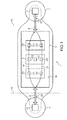
- Fig. 1 schematically illustrates a gateway adapted to interconnect two domains with different security levels according to the present invention.
- the gateway 1 is adapted to interconnect different domains 5, 7 with potentially different security levels.
- the example of Fig. 1 shows a first domain 5 adapted to be communicating with a second domain 7 but of course, the first domain 5 can also communicate with a third domain (not shown) and the second domain 7 can equally communicate with a fourth domain (not shown), etc.
- the gateway 1 comprises a gateway internal protocol 8, first and second protocol adapters 10, 12, and a security module 14.
- the first protocol adapter 10, the second protocol adapter 12 and the security module 14 are physically segregated 16 from each other. This ensures a non-interference property between the first protocol adapter 10, the second protocol adapter 12 and the security module 14.
- the gateway internal protocol 8 is a very simplified protocol that specifies the communication protocol between the security module 14 on one hand and each one of the first and second protocol adapters 10, 12 on the other hand.
- the first and second protocol adapters 10, 12 are hosted respectively within the first and second domains 5, 7 in order to manage the application-related exchanges. In particular, they are configured to make a conversion between an application data formatted according to an applicative protocol relative to the first and second domains 5, 7 and a gateway data formatted according to the gateway internal protocol 8.
- the security module 14 is hosted on a separate hosting platform 18 and is intended to communicate with the first and second protocol adapters 10, 12 via respectively first and second data links 20, 22 according to the gateway internal protocol 8.
- the security module 14 comprises a set of functional blocs 9, 24, 26 configured to authorise secure bidirectional flow of gateway data along two different and separate first and second unidirectional paths 19, 21 between the first protocol adapter 10 and the second protocol adapter 12.
- the hosting platform 18 is a virtualisation platform of a MILS type.
- the security module thus takes advantage of strong segregation properties and specified communication channels of such a platform in order to host several functions simultaneously.
- a virtualisation platform developed for high assurance needs, is based essentially on strict segregation and non-interference properties between the different functions.
- a virtualisation platform offers the possibility to create isolated runtime environments (generally called partitions) for each function. It also offers strong temporal and spatial segregation between the partitions (i.e. non-interference properties between hardware and software resources shared by the different functions).
- partitions isolated runtime environments
- secure communication means between different partitions hosted by the platform as well as secure communication means (for example, network interfaces) between one or more partitions of the platform and the outside domains.
- a virtualisation platform can be built by using software and/or hardware virtualisation techniques such as a MILS Separation Kernel or any other virtualisation Operating System fulfilling the above properties.
- the hardware part of the platform comprises as usual communicating buses (not shown) interconnecting one or more processing units (not shown), storage devices (not shown), and one or more (possibly virtualized) network interfaces (not shown) as well as a specific hardware module (not shown) for managing direct memory access such as an IOMMU (Input Output Management Memory Unit).
- IOMMU Input Output Management Memory Unit
- the hosting platform 18 may just be made up of a bare-metal platform offering the possibility to create isolated partitions.
- the set of functional blocs 9, 24, 26 of the security module 14 is decomposed into a plurality of elementarily evaluable components c1-c7.
- an elementarily evaluable component hereafter called elementary component
- elementary component a sufficiently small component to be analysable or evaluable.
- code complexity is so simple that the analysis of that component is easy to conduct by associating a model (for example an analytical model or a formal method) to a given implementation and prove its correctness with regard to the component specification.
- formal methods are appropriate for characterising elementary components at a high assurance level.
- a component having less than approximately 8000 lines of code (LOC) of a high level language is considered as sufficiently small to be evaluable by formal methods. It is to be noted that the smaller the component is, the simpler and thus, the easier it is to prove the correct implementation of its function.
- EAL level of assurance
- each elementary component has a well specified or defined function (i.e. , it knows exactly what to do in any situation).
- the elementary component is also adapted to communicate with other predefined elementary components. In other words, it has well defined interfaces for communicating with other well identified components to which it is authorised to do so.
- the basic security-enhancing property is that these elementary components can only interact among each other via well-defined internal communication paths, while all other unintended interference of those components among each other is forbidden.
- a first subset of elementary components is intended to be used along the first directional path and a different second subset of elementary components is intended to be used along the second directional path.
- the set of functional blocs 9, 24, 26 is configured to authorise secure bidirectional flow of data along two different and opposite unidirectional paths 19, 21 between the first protocol adapter 10 and the second protocol adapter 12.
- the gateway 1 is well adapted for environments requiring high levels of security certification. It offers very strict separation with strict controlled communication between first and second domains and can deliver an assurance level EAL higher than 5. Moreover, the physical separation of the modules processing applicative protocols (i.e. protocol adapters 10, 12) from those managing security issues (i.e. security module 14) and the use of a simple gateway internal protocol 8 for communication between them decreases the complexity of the security module 14 and drastically reduces its attack surface.
- protocol adapters 10, 12 those managing security issues
- a simple gateway internal protocol 8 for communication between them decreases the complexity of the security module 14 and drastically reduces its attack surface.
- Fig. 2 is a flow chart illustrating a method for constructing a gateway according to the embodiment of Fig. 1 .
- Step E1 concerns the definition of a simplified gateway internal protocol 8 that minimise the surface of any potential attack.
- the gateway internal protocol 8 is configured to have a minimum communication protocol.
- a minimum communication protocol is meant a protocol based on a query and a response exchange mechanism without any complex protocol exchanges between the components and wherein each frame of an exchanged gateway data is decomposed into predefined fields of a fixed length.
- the protocol needs no frame interpretation, the frame is just split into predefined fields and the protocol payload contains data in predefined fields of fixed length without any dynamic field spans.
- the gateway internal protocol is defined to be as simple as possible, involving a better determinism with respect to the security requirements. This simplicity allows easy updating of the gateway internal protocol and security filtering rules to integrate new applicative-related protocols.
- the gateway internal protocol bidirectional interactions are limited at the transport level to an exchange of a query and a response.
- connectionless transmission model with minimum protocol mechanisms.
- avoiding the overhead of such processing at the network level decreases the code complexity.
- a connectionless protocol such as the UDP (User Datagram Protocol) is used instead of the connection-oriented protocol TCP (Transmission Control Protocol).
- UDP provides checksums for data integrity and port numbers for addressing different functions at the source and destination of a message.
- the exchanged messages can use a widely known format for Physical, Data link, Network and Transport OSI layers.
- it can use well defined encoding rules according to which all fields of the frame have a predefined size (i.e., a fixed length).
- each field may have a given value among a set of known values except the application-linked data part of a file transfer (i.e., the content of a data block of the file).
- native byte ordering (native endianness) of the hosting platform 18 of the security module 14 is used as the byte ordering for the gateway internal protocol 8. This implies the non-encoding of data in a generic format before sending them to the security module 14. Thus, the security module 14 does not have to do any decoding of data and the needed conversion is implemented by the protocol adapters 10, 12.
- each message contains several fields. However, based on a single field value, the rest of the applicative fields can be interpreted due to the known structure, the significance of the fields, and the predefined values (predefined template or cookie cutter).
- the gateway internal protocol 8 can be of the type RPC (Remote Procedure Call).
- RPC Remote Procedure Call
- the transport layer can be UDP which is very simple compared to TCP.
- ONC-RPC Open Network Computing RPC
- UDP which is one of the simplest implementation of RPC is a good candidate because it is neither language dependent nor Operating System dependent. It is efficient, widely used and well understood and can be used to send a request with simple parameters and can be easily filtered.
- the gateway internal protocol is configured to allow also unidirectional transmission or broadcast (i.e transmission with no reply).
- Step E2 of the flow chart concerns the definition and analysis of the security module 14.
- a set of functional blocs 9, 24, 26 are defined and analysed in order to authorise secure bidirectional flow of data along two different unidirectional paths 19, 21.
- These functional blocs 9, 24, 26 are configured to run on a hosting platform 18 (for example a virtualisation platform of MILS type or any other platform that ensures strong segregation properties) and comprise driving blocs 24, 26 adapted to receive and send gateway data along the two different unidirectional paths 19, 21, and an analysing bloc 9 adapted for analysing application-level protocol data flow security.
- Steps (E3-E5) concern an iterative decomposition of the set of functional blocs 9, 24, 26 into a plurality of elementarily evaluable components c1-c7.
- step E3 each functional bloc 9, 24, 26 is decomposed into smaller functional components c1-c7 having well defined functions.
- the functional components are adapted and allowed to communicate with each other according to well specified authorisation rules.
- a set of security rules to be implemented by a functional bloc is subdivided into several distinct subsets each one corresponding to a distinct functional component having only very few elements ( i.e ., one or two rules).
- step E4 the complexity of each functional component is determined. For example, the number of branches and/or the number of lines of code (LOC) are estimated for each component in order to determine whether the component is small enough to be analysable according to the assurance level chosen for that component.
- LOC lines of code
- Step E5 is a stop criteria testing whether all functional components c1-c7 are elemental (i.e. small enough to be analysable at the desired level of assurance noting that different components may be evaluated at different levels of assurance). If the output of the test is no, then steps E3-E5 are repeated whereas, if it is yes, then the final architecture of the security module 14 is determined in step E6. The resulting security module 14 is thus an efficient combination of simple elementary components c1-c7 easy to evaluate and hosted on a hosting platform 18.
- the elementary components c1-c7 can be developed and certified independently of each other and thus, the security module 14 can be updated at any time by introducing new elementary components.
- An update of one or more components of the security module 14 may be triggered by events such as the detection of a potential vulnerability of an elementary component, the modification of the function of an existing component (e.g. modification of security rules to be applied by a given component), or the addition of new components enhancing the overall function of the security module 14.
- Step E7 concerns the definition of the first and second protocol adapters 10, 12 based on the applicative flows of data that are allowed to cross the security module 14. It defines the respective proxies and protocol translation into the gateway internal protocol 8.
- first and second protocol adapters 10, 12 play similar roles and are defined to manage authorized applicative protocols from the application point of view.
- Each protocol adapter 10, 12 defines the session management (i.e., open, close, acknowledge, notify errors, etc.) with the application inside the associated domain 5, 7.
- an application message is adapted from an applicative protocol format into the gateway internal protocol format.
- the application message is split into fields as per the applicative protocol.
- useful fields as per the applicative protocol format rules
- the gateway internal protocol format if they are good formatted, they are used for the gateway internal protocol format.
- the adapted message i.e. gateway data
- the security module 14 by using the gateway internal protocol 8. Implicitly, some of the actions performed during these steps can be categorised as security-related functions due to the fact that mal formatted messages are directly discarded without sending them to the security module 14.
- security mechanisms against DoS can be implemented at the protocol adapter within the domain of low security level knowing that the higher security domain cannot contain an attacker.
- DoS Denssion of Service
- a potential attacker uses a low security domain in order to attack a domain presenting a higher security level.
- first and second protocol adapters 10, 12 are configured to rebuild the applicative protocol with data from the internal gateway protocol 8.
- Fig. 3 schematically illustrates an example of a gateway adapted to interconnect first and second domains with different security levels according to an embodiment of the invention.
- the first domain 5 is characterised by a security level higher than that of the second domain 7. From a security point of view, this means that the assets of the first domain 5 are considered as much more important and more valuable than those of the second domain 7.
- the assets of a given domain are the applications, functions or data hosted by that domain.
- the comparison between the security levels of the two domains 5, 7 is simple when both of them belong to the same infrastructure (an aircraft, a satellite, a boat or a vehicle) which is normally the case.
- the first and second protocol adapters 10, 12 are hosted within the first and second domains 5, 7 respectively and comprise first and second elementary management components 102, 122 respectively, first and second elementary constructing components 104, 124 respectively, and first and second elementary reconstructing components 106, 126 respectively.
- Each one of the first and second elementary management components 102, 122 is configured to manage authorized applicative protocols relative to applications belonging to its corresponding domain (i.e. applications belonging to the first domain 5 for the first elementary management component 102 and applications belonging to the second domain 7 for the second elementary management component 122).
- each one of the first and second elementary constructing components 104, 124 is configured to construct a gateway data out of a corresponding application data by adapting the application data from an applicative protocol format into said gateway internal protocol format before sending the gateway data to the security module 14 via the first data link 20 or the second data link 22.
- each one of the first and second elementary reconstructing components 106, 126 is configured to reconstruct an application data according to the applicative protocol format out of a corresponding gateway data formatted according to the internal gateway protocol 8.
- the security module 14 is hosted on a hosting platform 18 (for example, a virtualisation platform of MILS type) and is configured to authorise secure bidirectional flow of data along two different and independent unidirectional paths 19, 21 between the first and second protocol adapters 10, 12.
- a hosting platform 18 for example, a virtualisation platform of MILS type
- the security module 14 has to ensure that during the communication between the first and second protocol adapters 10, 12, the security of the first domain 5 hosting the first protocol adapter 10 is not damaged by potential threats that might be initiated by the second domain 7 which is characterised by a lower security level.
- the integrity and availability of assets located in the first domain 5 has to be protected by the gateway 1 and only in a second place, is considered the availability of the communication between the two domains 5, 7.
- the security module 14 comprises a first driving bloc 24 of elementary components, a second driving bloc 26 of elementary components, an analysing bloc 9 of elementary components, and first and second network interface cards NIC (or components) 25, 27.
- All elements i.e. , elementary components and network interface components
- the API can be a subset of an ARINC 653, POSIX or MILS API standards.
- Each elementary component can be implemented in one or several partitions provided by the platform 18 hosting all partitions simultaneously.
- Each one of the first and second driving blocs 24, 26 is configured to receive and send gateway data from and to the corresponding protocol adapter 10, 12 (i.e. first or second protocol adapter) along the first and second unidirectional paths 19, 21.
- the first driving bloc 24 is actually made up of two separate blocs composed of a first receiving bloc 11 of elementary components 111, 113, 115 and a first transmitting bloc 17 of elementary components 171, 173.
- the first receiving bloc 11 is configured to receive gateway data from the first protocol adapter 10 along the first unidirectional path 19.
- the first transmitting bloc 17 is configured to send gateway data to the first protocol adapter 10 along the second unidirectional path 21.
- the second driving bloc 26 is made up of two separate blocs composed of a second receiving bloc 13 of elementary components 131, 133, 135 and a second transmitting bloc 15 of elementary components 151, 153.
- the second receiving bloc 13 is configured to receive gateway data from the second protocol adapter 12 along the second unidirectional path 21.
- the second transmitting bloc 15 is configured to send gateway data to the second protocol adapter 12 along the first unidirectional path 19.
- the analysing bloc 9 is made up of a first set 91 of elementary components 911a-911c, a second set 93 of elementary components 933a-933c, and a third set of elementary components 951-955, configured to analyse and implement a series of security rules at the gateway internal protocol level on gateway data flowing along at least one unidirectional path to ensure that no malicious or unauthorised data is flowing along that at least one unidirectional path.
- the entry ends of the security module 14 are the first and second network interface components 25, 27 configured to communicate with the first and second protocol adapters 10, 12 within the first and second domains 5, 7 respectively.
- the first network interface component 25 is connected to the first receiving bloc 11 and to the first transmitting bloc 17.
- the second network interface component 27 is connected to the second receiving bloc 13 and to the second transmitting bloc 15.
- the first receiving bloc 11 comprises a first elementary stack receiver component 111, a first elementary flow security receiver component 113, and a first elementary flow dispatch receiver components 115.
- the first elementary stack receiver component 111 is configured to process an incoming flow of gateway data frames from the first protocol adapter 10 by copying the received gateway data frames into an internal memory to avoid data modification by the hardware during processing and by interpreting the format of each gateway data frame into separate gateway data fields before sending them to the first elementary flow security receiver component 113.
- the elementary stack receiver component 111 is a piece of software which is able to receive data formatted as per OSI (Open Systems Interconnection Standard) model without implementing the generic stack for data treatment at each OSI abstraction layer as it is usually done in computers.
- the elementary stack role is only to interpret the format of each gateway data frame into predefined gateway data fields without any interpretation of the content and to send the gateway data fields to the first elementary flow security receiver component 113 for further processing.
- the first elementary flow security receiver component 113 is configured to receive the gateway data fields from the first elementary stack receiver component 111, to copy useful gateway data fields necessary for addressing the communication partners into an internal structure (not shown), and to apply network security rules onto these useful gateway data fields.
- the network security rules comprise rules for checking that the destination and/or source of the gateway data fields is authorised. They may also comprise rules for checking that there are no malformed gateway fields at the network level. The received gateway data fields are discarded if they do not fulfil the network security rules.
- the first elementary flow dispatch receiver component 115 is configured to receive the useful gateway data fields and to dispatch them to the appropriate elementary components of the analysing bloc 9.
- the second receiving bloc 13 comprises a second elementary stack receiver component 131, a second elementary flow security receiver component 133, and a second elementary flow dispatch receiver component 135. All these components have equivalent functions to those in the first receiving bloc 11 but with respect to the second interface component 27.
- the analysing bloc 9 comprises first and second sets of elementary controlling components 91, 93 and a third set of associated elementary stateful context components 95 (951, 953, 955).
- Three elementary components of each set are illustrated just as an example and of course the number of components is not limited and depends on the overall gateway function.
- the first set of elementary controlling components 91 comprises a first set of elementary observing components 911 (911a-911c) configured to gather information on data flowing along the first directional path 19 ( i.e. , from the first protocol adapter 10 to the second protocol adapter 12) and to transmit it to the associated set of stateful context components 951-955 which is configured to store the information.
- Each elementary observing component (911a-911c) corresponds to a predetermined application-level protocol.
- an elementary observing component 911a-911c can be further decomposed into a set of elementary observing subcomponents (not shown).
- the second set of elementary controlling components 93 comprises a second set of associated elementary filtering components 933 (933a-933c) configured to implement a series of strong application security rules before allowing or disallowing the flow of gateway data from the second protocol adapter 12 towards the first protocol adapter 10 along the second unidirectional path 21.
- Each elementary filtering component (933a-933c) corresponds to a predetermined application-level protocol.
- the series of application security rules comprises first consulting rules intended to consult the information stored in the associated set of stateful context components 951-955.
- one or more elementary filtering components 933a-933c can be composed of a set of elementary filtering subcomponents (not shown) connected to each other in series, each elementary filtering subcomponent implementing a subset of the application security rules.
- each elementary filtering subcomponent is adapted to take a decision on a given level of the application protocol and is adapted to interact with the corresponding stateful context component 951-955.
- a gateway data flow is allowed to cross the security module 14, only if it is authorised by all the elementary filtering subcomponents part of the associated elementary filtering component 933a-933c.
- a diversification methodology can be used for increasing the level of confidence in an elementary filtering component 933a-933c.
- FIGs. 4A and 4B schematically illustrate different configurations of elementary filtering components, according to different embodiments of the invention.
- an elementary filtering component can be implemented into two or more elementary filtering components connected in series or in parallel.
- Fig. 4A shows first and second elementary filtering components 933d, 933e defining two different implementations of the same function connected in series. It is clear that the second elementary filtering component 933e starts analysing the gateway data flow only if it has already been authorised by the first elementary filtering component 933d.
- the set of associated elementary filtering components may comprise a plurality of subsets of elementary filtering components, each subset being composed of two or more elementary filtering components connected to each other in series.
- Fig. 4B shows two elementary filtering components 933g, 933h defining two different implementations of the same function connected in parallel.
- an elementary voter component 915 is needed to compare the outputs of the two elementary filtering components 933g and 933h.
- the elementary voter component 915 forwards the data flow only if it has been authorised by both elementary filtering components 933g, 933h.
- the set of associated elementary filtering components 933 may comprise a plurality of subsets of elementary filtering components, each subset being composed of two or more elementary filtering components connected to each other in parallel and the outputs of said parallel elementary filtering components being connected to an elementary voter component.
- the elementary voter component 915 comprises a reference model defining authorised requests.
- the output of each elementary filtering component 933g, 933h is thus compared to the reference model and the gateway data flow is forwarded to the transmitting bloc 17 only if a perfect match has been found.
- This embodiment increases the integrity protection and level of trust in case a flow of gateway data has been fraudulently authorised by two corrupted elementary filtering components that should have normally prohibited the flow of that data.
- the elementary voter component 915 is configured to directly forward the flow of gateway data when at least one of the two elementary filtering components 933g, 933h has answered. This enables to increase the overall availability of the gateway 1 by temporarily masking latency problems or failures of some components.
- Fig. 4B provides more efficient CPU utilisation due to the fact that the security module 14 architecture is based on a hosting platform 18 using static scheduling of partitions in the preferred embodiment. In other embodiments, dynamic scheduling may be used.
- the second transmitting bloc 15 comprises a second elementary flow transmitter component 151 and a second elementary stack transmitter component 153.
- the first transmitting bloc 17 comprises a first elementary flow transmitter component 171 and a first elementary stack transmitter component 173.
- the second elementary flow transmitter component 151 is configured to gather gateway data fields from the corresponding elementary controlling components 91 and to assemble the different gateway data fields into gateway data frames.
- the second elementary stack transmitter component 153 is configured to receive the gateway data frames from the second elementary flow transmitter component 151 and to send them to the second protocol adapter 12 via the second network interface component 27 and the second data link 22.
- first elementary flow transmitter component 171 and the elementary stack transmitter component 173 are equivalent to those in the second transmitting bloc 15 but with respect to the first network interface component 25.
- the other security levels are defined according to the number of missing characteristics with respect to the "high security level”. Nevertheless, for all these levels it has to be certified that the implementation of each elementary component presents no malicious code. However, the code correctness and invulnerability are more or less guaranteed in function of the security level.
- the "high security level” is attributed to the elementary components of the analysing bloc 9 knowing that the first domain's integrity relies primarily on them.
- the elementary observing components 911a-911c, the elementary stateful context components 951-955 and the elementary filtering components 933a-933c are configured to implement the main security rules at an application-protocol level on the gateway data exchanged between the first and second protocol adapters.
- These elementary components (911a-911c, 951-955, 933a-933c) are thus correctly and effectively implemented with respect to a high standard specification and are exempt of malicious code and known vulnerabilities.
- the network interface components 25, 27, the elementary flow security receiver components 113,133 and the elementary flow dispatch receiver components 115, 135 can be categorised in the "low security level" as they have a less important role in the gateway data flow analysis than the analysis bloc 9.
- the elementary stack receiver components 111, 131, the elementary flow transmitter components 151, 171 and the elementary stack transmitter components 153, 173 can be categorised as "not necessarily trusted”. Indeed the elementary stack receiver components 111, 131 are almost the first entry points of the security module 14 and thus, it can be considered that an external malicious data may succeed in attacking them but, thanks to the high security level components, the attack would not be able to propagate through the security module 14 into the other end.
- the flow transmitter components 151, 171 and the elementary stack transmitter components 153, 173 do not apply any security rules on the gateway data flow and their roles are restricted to preparing and sending the gateway data flow via the network interface components 25, 27. Indeed, if a highly improbable malicious data flow succeeds in arriving into these transmitter components, it would already be too late to stop the attack.
- the security component further comprises an audit component 31, a monitoring component 33 and a self-testing component 35.
- audit component 31 a monitoring component 33
- monitoring component 33 a monitoring component 33
- self-testing component 35 a self-testing component 35
- the audit component 31 is configured to gather audit logs from all other elementary components for forensic analysis.
- the monitoring component 33 is configured to health monitor all sets of elementary components and to take decisions in case anomalies, failures or unusual behaviours are detected.
- the self-testing component 35 is configured to test elementary components by injecting test data. Its role is to test the correct performance of the elementary components during a security check.
- the self-testing component 35 works in collaboration with the monitoring component 33 for self-testing the elementary components of the security component when of course there is no gateway data flow initiated by anyone of the first and second protocol adapters 10, 12 within the first and second domains 5, 7.
- the audit, monitoring and self-testing components 31-35 can be hosted by the hosting platform 18 preventing thus any interference between these components in an embedded environment.
- the audit component 31 can be categorised in the "low security level” as its role of gathering logs from all other components is considered to be passive.
- a "medium security level” can be attributed to the monitoring and self-testing components 33, 35 which have more active roles but of course less than the analysing bloc 9.
- any misbehaviour of these components will be detected by the analysing bloc 9 who will directly reject any malformed or malicious data initiated by them.
- a malicious data may only come from the self-testing component 35 knowing that the interaction of the monitoring component 33 with any other component cannot be considered as malicious.
- superfluous self-testing activities may potentially be wrongly initiated by a command from the monitoring component 33.
- the analysing bloc 9 of high security level components behaves always as expected no matter whether the malicious data comes from the second protocol adapter 12 within the second domain 7 or from the self-testing component 35.
- the components forming the security module 14 can be structured into different domains or groups. The belonging of a component to a group depends on whether the gateway data crossing that component undergoes or not any security checks on an application-level.
- the components of the first network interface 25 along with the first receiving bloc 11 and the first transmitting bloc 17 are part of the same security group as the first domain 5 to which they have direct communication and thus form a high security group.
- the components of the second network interface 27, the second receiving bloc 13 and the second transmitting bloc 15 are part of a low security group like the second domain 7 to which they have direct communication.
- the elementary components responsible for analysing the gateway data flow i.e. , the elementary components of the analysing bloc 9) belong to a security critical group. These elementary components are configured to implement strong security rules during exchange of data. They are used as validation objects for the gateway data flow and, by their function, are changing the security level of the gateway data from one end of the security module 14 to the other.
- this repartition of components into different groups enables to clearly define the boundaries with respect to the security critical group containing a small set of well identified elementary components that are the only ones allowed to downgrade or upgrade the security level of the gateway data flow.
- the first objective of the gateway 1 is to protect the domain of high security level (i.e. first domain 5) against any data corruption attempt or any attack on the system's integrity. Once the integrity is guaranteed, the second objective is to protect the availability of that domain. Finally, once the first two objectives are achieved, the third objective is to fulfil the gateway's ordinary function consisting of allowing communication between the two domains 5, 7. The order of these objectives illustrates their respective importance and thus a communication between two domains is easily laid down in order to preserve the integrity of the high security domain 5.
- a first application in the first domain 5 sends a request message to a second application located in the second domain 7 asking for a given file and that the latter responds to that request after receiving the message.
- the request from the first domain 5 is adapted by the first protocol adapter 10 from an applicative protocol format into a gateway internal protocol format.
- the flow of gateway data corresponding to that adapted request is transmitted by the latter to the first elementary stack receiver component 111.
- the incoming flow of gateway data is processed by the first elementary stack receiver component 111 according to the gateway internal protocol 8.
- the first elementary stack receiver component 111 interprets the format of each gateway data frame into separate gateway data fields which are then sent to the first elementary flow security receiver component 113.
- the gateway data fields are gathered by the first elementary flow security receiver component 113. In particular, this component builds the gateway data internally based on the received packets by copying the important fields of gateway data.
- each rule may be implemented by an elementary subcomponent (not shown) of the first elementary flow security receiver component.
- These network security rules enable for example to eliminate unauthorised destinations and/or sources as well as malformed fields at the network level according to an Open System Interconnection (OSI) model.
- OSI Open System Interconnection
- other network security checks may also be conducted.
- the useful flow of gateway data fields is authorised at the network level, it is sent to the first elementary flow dispatch receiver component 115 which on the basis of one field (for example the destination UDP port or any other field allowing to determine the application-level protocol) decides if such application protocol is authorized or not. If the application protocol is authorised, then the gateway data flow is sent to one of the elementary observing components 911a-911c (for example, 911a) in function of the associated application-level protocol.
- the activity of the elementary observing component 911a is checked by the monitoring component 33. Indeed, if the elementary observing component 911a has been detected to be non-active, then it is disabled and does not receive any data.
- the gateway 1 of this first embodiment is intended to protect the integrity of the first domain 5 which is not malicious and is guaranteed to be a trusted source, then the gateway data flow from the first protocol adapter 10 into the second protocol adapter 12 within the second domain 7 does not need to be strongly analyzed from the security point of view.
- the flow of gateway data fields can be transmitted without further analysis to the second elementary flow transmitter component 151.
- the role of each elementary observing component (911a-911c) consists on gathering communication details and sending them to an associated stateful context component (951-955) so that the latter can be consulted by a corresponding elementary filtering component (933a-933c) in the opposite direction via the second path 21 of communication.
- the elementary observing component 911a notes in the corresponding stateful context component 951 details about the request made by the first domain 5 concerning a given file.
- the second elementary flow transmitter component 151 gathers gateway data fields from all the elementary observing components 911a-911c. It assembles the different gateway data fields into gateway data frames before sending them to the second elementary stack transmitter component 153 which in its turn send them to the second protocol adapter 12 via the second network interface component 27 and the second data link 22.
- the second protocol adapter 12 within the second domain 7 reconstruct the message according to the applicative protocol format out of the corresponding gateway data.
- the second protocol adapter 12, the second receiving bloc 13 and the first transmitting bloc 17 perform steps similar to those of the first protocol adapter 10, the first receiving bloc 11 and the second transmitting bloc 15.
- the flow of gateway data corresponding to that adapted response is transmitted to one of the second set of associated elementary filtering components 933a-933c (for example, 933a) in function of the associated application-level protocol via the second receiving bloc 13.
- the adapted response message undergoes operations conducted by the elementary components of the second receiving bloc 13 equivalent to those of the corresponding components of the first receiving bloc 11.
- the validity of each elementary filtering component (933a-933c) is also checked before it is allowed to receive the response data.
- the second domain 7 is considered to be less trustful than the first domain 5 and potentially it might generate malicious data flows. Therefore, in order to protect the integrity of the first domain 5 the gateway data flow coming from the second protocol adapter 12 within the second domain 7 is strongly analyzed by the second set of elementary filtering components 933a-933c. Indeed, for each application-level protocol the current gateway data fields are checked by a series of rules, each rule would be applied to one or more fields. If only one of these rules is not respected, then the current flow of gateway data fields is rejected or dropped.
- At least one of the rules consists in consulting the corresponding stateful context component 951-955 so as to be sure that only authorised requests containing correct data are permitted. For example, if the answering message coming from the second domain 7 contains a given file, in that case the elementary filtering component 933a consults the corresponding stateful context component 951 to check whether that file was previously requested by the first domain 5 and if it was not requested, then the answering message would be simply rejected or dropped. It should be noted that in addition to consulting the stateful context components 951-955, the elementary filtering components 933a-933c implement strong security rules at application protocol level as it is the key point to protect the high security of the first domain 5 from wrong or malicious data received from the low security second domain 7.
- the adapted answering message is authorised by the corresponding application-level component of the second set of elementary filtering components 933a-933c, it is sent to the components of the first transmitting bloc 17 which process the gateway data in the same manner as those of the second transmitting bloc 15 before sending it to the first protocol adapter 10 via the first network interface component 25 and the first data link 20.
- the first protocol adapter 10 within the first domain 5 reconstruct the answering message according to the applicative protocol format out of the corresponding gateway data.
- the above example concerned a method authorising bidirectional communication between a first domain 5 of high security level and a second domain 7 of low security level. It is evident that this method can be extended to the case where the first domain 5 also communicates with a third domain (not shown) having a lower security level.
- the elementary components as those depicted in Fig. 3 can be used to implement the bidirectional communication with the third domain. Indeed, the same elementary components can be used or duplicated to enable a bidirectional communication between high security level domains and low security level domains.
- Fig. 5 schematically illustrates a variant of the gateway depicted in Fig. 3 .
- the first driving bloc 24 is made up of a single bloc comprising a first input buffer 242 and a first output buffer 244 separated from each other. The separation between the input and output buffers 242, 244 is guaranteed by a hardware component IOMMU (Input Output Memory Management Unit).
- the first network interface component 25 is connected to the first driving bloc 24 and the second network interface component 27 is connected to the second driving bloc 26.
- the first and second network interface components 25, 27 are configured to communicate with the first and second protocol adapters 10, 12 respectively.
- the first input buffer 242 is configured to receive gateway data from the first protocol adapter 10 via the first data link 20 and the first network interface component 25 and the first output buffer 244 is configured to send gateway data to the first protocol adapter 10 via the first network interface component 25 and the first data link 20.
- the second driving bloc 26 is made up of a single bloc comprising a second input buffer 262 configured to receive gateway data from the second protocol adapter 12 via the second network interface component 27 and a second output buffer 264 configured to send gateway data to the second protocol adapter 12 also via the second network interface component 27.
- the second input and output buffers 262, 264 are also separated from each other thanks to the IOMMU.
- Fig. 6 schematically illustrates a gateway 1 adapted to interconnect first and second domains 5, 7 according to a third embodiment of the invention.
- the two domains 5, 7 may have the same or different security levels.
- the gateway 1 is the same as that of Fig. 3 except that the analysing bloc 9 comprises equivalent elementary components along the two different paths.
- the analysing bloc 9 comprises first and second sets of elementary controlling components 91, 93 and a set of associated elementary stateful context components 95.
- the first set of elementary controlling components 91 comprises a first set of elementary observing components 911a-911c and a first set of elementary filtering components 913a-913c.
- the second set of elementary controlling components 93 comprises a second set of elementary observing components 931a-931c and a second set of elementary filtering components 933a-933c.
- the second set of elementary observing components 931a-931c are configured to gather information on gateway data flowing along the second path 21 (i.e. , from the second protocol adapter 12 to the first protocol adapter 10) and to transmit it to the associated set of stateful context components 951-955.
- the first set of elementary filtering components 913a-913c are configured to implement a series of application-level security rules comprising second consulting rules intended to consult the information stored in said associated set of stateful context components.
- the gateway architecture allows most of its components and elementary components to be developed independently of each other.
- the only constraint being the respect of the gateway internal protocol format between the first protocol adapter 10 and the security module 14 as well as between the security module 14 and the second protocol adapter 12.
- Each elementary component has a well defined role and specified interfaces with the other elementary components.
- Each elementary component is designed to have a very small number of functions such that its implementation is easily done and easily verified.
- the first and second protocol adapters 10, 12 can be easily updated to allow any applicative-level protocol as long as that protocol can be transformed into the gateway internal protocol without losing data.
- the security module 14 can be considered as made up of a set of elementary components and new components can be added at any time.
- elementary components of the analysing bloc 9 are completely independent from the other elementary components of the gateway.
- any new application-level function can be implemented into a partition or several partitions corresponding to a new elementary component that can be easily introduced in the in the security module 14 of the gateway. It is only needed to define the associated protocol of the application-level filtering function in the configuration of the elementary flow dispatch components so as to be recognised, to provide inter-partition communication with the one or ones implementing the new application-level filtering function, and to update the first and second protocol adapters 10, 12 to manage the new application-level protocol and transform it into the gateway internal protocol and vice versa.
- the elementary application-level filtering components are also independent from each other.
- a filtering of one protocol does not interfere in any way with a filtering of another protocol.
- development of an application-level filtering can be done at any moment and independently of any other component's development.
- Its integration into the gateway is very simple and its certification can also be done independently.
- the gateway can be updated and its functions enhanced throughout its lifetime. Indeed, by using incremental and independent certification methodologies, the modification of an existing component or the integration of new components certified independently allow the gateway to be easily updated without starting from scratch.
- the gateway architecture has been described by focussing on the integrity aspects concerning the protection of a domain's assets. However, the same gateway architecture can be equally used to protect availability, and/or confidentiality and/or non-repudiation.
- the gateway according to the present invention is advantageously used in an embedded infrastructure.
- it is adapted to be used in an aircraft communication system.
Landscapes
- Engineering & Computer Science (AREA)
- Computer Networks & Wireless Communication (AREA)
- Signal Processing (AREA)
- Computer Security & Cryptography (AREA)
- Computer Hardware Design (AREA)
- Computing Systems (AREA)
- General Engineering & Computer Science (AREA)
- Data Exchanges In Wide-Area Networks (AREA)
- Computer And Data Communications (AREA)
Abstract
- a gateway internal protocol (8),
- first and second protocol adapters (10, 12) intended to be hosted respectively within the first and second domains (5, 7) and configured to make a conversion between an application data formatted according to an applicative protocol relative to said first and second domains and a gateway data formatted according to said gateway internal protocol, and
- a security module (14) hosted on a separate hosting platform (18) and intended to communicate with the first and second protocol adapters (10, 12) via respectively first and second data links (20, 22) according to the gateway internal protocol,
wherein said first protocol adapter (10), second protocol adapter (12) and security module (14) are physically segregated from each other and wherein said security module comprises a set of functional blocs (9, 24, 26) configured to authorise secure bidirectional flow of gateway data along two different and separate first and second unidirectional paths (19, 21) between the first protocol adapter (10) and the second protocol adapter (12).
Description
- The present invention generally concerns high assurance security gateway interconnecting different domains and particularly in embedded infrastructures.
- In most industrial fields, it is frequent to have different systems with different applications communicating with each other in order to achieve an assignment. Each application may be considered as a set of functions and each function is a piece of software contributing to execute a part of the task to be accomplished by the application. For example, many different types of equipment in a vehicle or an aircraft need to exchange data with each other through a communication system in order to accomplish the manoeuvring of the vehicle or the aircraft. Each type of equipment may have a specific set of functions or applications with different levels of criticality depending on their importance. A specific level of security is associated to each application in function of the criticality of that application. Therefore, it is important and practically useful to establish a mechanism that allows an efficient exchange of information between applications in domains having different security levels without compromising their security.
- One solution would consist of physically separating the different applications by hosting each one on a different physical system and connecting them via a network channel. The data exchange via this network channel needs to be controlled by a control means for securing information exchange.
- A computing resource of an embedded environment used to be hardly enough to host one function. However nowadays, due to the current growing efficiency of computing resources, the trend is exactly the opposite and consists of putting several applications or functions on the same physical system in order to use the full computing power and memory storage capabilities offered by that system. This enables to avoid wasting unused resources and thus reduces the production costs as well as the overall weight of the system which is very important for an aircraft, a satellite or a vehicle. This architecture has however the disadvantage of facilitating the propagation of errors. Indeed, any design or implementation error on one part of the system may lead to failures impacting on other parts of the system. This difficulty is solved for example in the aircraft environment by existing IMA (Integrated Modular Avionics) architectures addressing design or implementation error propagation from one part of the system to another in regard to the safety perspective. Moreover, in recent years, virtualisation techniques have been developed in order to take into account security aspects relative to malicious attempts. Thus, nowadays the trend is to host several applications on the same physical system by providing a good level of assurance for the strict runtime environment segregation between the different applications. One such security architecture is MILS (Multiple Independent Levels of Security) built upon strict segregation properties for the execution environments and strict communication paths. Indeed, MILS architecture enables a system to host several applications or functions with different or same levels of security without any interference between these applications.
- However, the problem remains on how to protect the security of several applications characterized by different security levels while authorizing the bidirectional information exchange between them. For example, if for one reason or another, a part of the system becomes malicious, it is needed to prevent the latter from trying to deliberately damage the other parts of the system.
- There exist some security techniques that partly solve the problem of communication with different levels of security.
- One such a technique is the Bell-La Padula model which addresses confidentiality aspects. This model is based on a "no write down, no read up" strategy. In other words, a first domain with a high security level is not allowed to write or communicate any data to a second domain with a low security level but is allowed to read data from the latter. On the other hand, the second domain with a low security level is not allowed to read data from the first domain with a high security level but is authorised to write data into it.
- Another known method is the Biba integrity model defining a set of access rules designed to ensure data integrity. This model is based on a "no read down, no write up" strategy. In other words, a first domain with a high security level is not allowed to read or use any data from a second domain with a low security level. On the other hand, the second domain is not allowed to write or communicate any data to the first domain with a higher security level.
- It is clear that the above two models cannot be implemented simultaneously. Thus, in orderto authorize a bidirectional communication between two domains respecting both models at the same time, complex application level proxies should be implemented. However, complex proxies are very difficult to analyse at high assurance levels.
- Indeed, the difficulty in certifying complex proxies is reasoned by their software architecture, since they consolidate several functionalities and are implemented by a significant amount of software code (i.e., several hundreds of thousands lines of code). The Common Criteria standard provides a framework and guidance for the security certification of computer systems. This standard defines seven EALs (Evaluation Assurance Levels). EAL 7 provides the highest level of assurance but also requires formal modelling of the system under evaluation. Security evaluations presenting a level higher than EAL 4 are internationally not recognized. Thus, a system claiming high EAL levels requires multiple certifications from the different countries where the system is to be used.
- The purpose of the present invention is therefore to propose a gateway having an architecture which authorises a bidirectional communication between applications located in different domains (that might have different security levels), presents a strong segregation properties and a high assurance level of protection, efficiently uses hardware resources, is adapted to be used in an embedded environment, and allows an easier security certification by external authorities without having the aforementioned shortcomings.
- The present invention is defined by a gateway adapted to interconnect a first domain to a second domain, said gateway comprising:
- a gateway internal protocol,
- first and second protocol adapters intended to be hosted respectively within the first and second domains and configured to make a conversion between an application data formatted according to an applicative protocol relative to said first and second domains and a gateway data formatted according to said gateway internal protocol, and
- a security module hosted on a separate hosting platform and intended to communicate with the first and second protocol adapters via respectively first and second data links according to the gateway internal protocol,
- Thus, the gateway according to the invention enables a bidirectional and highly secure communication along two different unidirectional routes between applications located into two different domains and potentially having different security levels. In particular, the physical segregation between the first protocol adapter, the second protocol adapter and the security component ensures non-interference activities throughout any type of failure such as, exhaustion of hardware resources or buffer overflow due to implementation bugs that might occur during a normal activity. It also protects against malicious actions that could be generated by an attacker who might have succeeded in getting the components of the less secured domain under control and who would have tried to attack the highly secured domain. In particular, if an attacker gets the less secured domain under control, he cannot reach the highly secured one without crossing the security module. In contrast, if all the components were on the same platform or on the same operating system, one may suspect that an attacker might succeed in bypassing the security module by using some features of the operating system or the common platform.
- The present invention concerns also an embedded infrastructure (for example, a computer) comprising said gateway according to the above characteristics.
- In addition, the invention concerns an aircraft communication system comprising said gateway according to the above characteristics.
- Other characteristics and advantages of the invention will become apparent on reading preferred embodiments of the invention given with reference to the appended figures amongst which:
-
Fig. 1 schematically illustrates a gateway adapted to interconnect two domains potentially with different security levels according to the invention; -
Fig. 2 is a flow chart illustrating a method for constructing a gateway according to the embodiment ofFig. 1 ; -
Fig. 3 schematically illustrates a gateway adapted to interconnect first and second domains with different security levels according to a first embodiment of the invention; -
Figs. 4A and 4B schematically illustrate different configurations of elementary filtering components, according to different embodiments of the invention; -
Fig. 5 schematically illustrates a gateway adapted to interconnect first and second domains with different security levels according to a second embodiment of the invention; and -
Fig. 6 schematically illustrates a gateway adapted to interconnect first and second domains according to a third embodiment of the invention. - The concept of the invention consists of proposing a gateway composed of physically segregated modules comprising first and second modules for managing application-related exchanges and a security module communicating with the first and second modules via an internal communication protocol wherein, the security module is decomposed into sufficiently small components that can be easily evaluated and that allow bidirectional flow of data along two different unidirectional paths.
-
Fig. 1 schematically illustrates a gateway adapted to interconnect two domains with different security levels according to the present invention. - The
gateway 1 is adapted to interconnectdifferent domains Fig. 1 shows afirst domain 5 adapted to be communicating with asecond domain 7 but of course, thefirst domain 5 can also communicate with a third domain (not shown) and thesecond domain 7 can equally communicate with a fourth domain (not shown), etc. - According to the invention, the
gateway 1 comprises a gatewayinternal protocol 8, first andsecond protocol adapters security module 14. Thefirst protocol adapter 10, thesecond protocol adapter 12 and thesecurity module 14 are physically segregated 16 from each other. This ensures a non-interference property between thefirst protocol adapter 10, thesecond protocol adapter 12 and thesecurity module 14. - The gateway
internal protocol 8 is a very simplified protocol that specifies the communication protocol between thesecurity module 14 on one hand and each one of the first andsecond protocol adapters - The first and
second protocol adapters second domains second domains internal protocol 8. - Finally, the
security module 14 is hosted on aseparate hosting platform 18 and is intended to communicate with the first andsecond protocol adapters second data links internal protocol 8. Thesecurity module 14 comprises a set offunctional blocs unidirectional paths first protocol adapter 10 and thesecond protocol adapter 12. - According to a preferred embodiment, the hosting
platform 18 is a virtualisation platform of a MILS type. The security module thus takes advantage of strong segregation properties and specified communication channels of such a platform in order to host several functions simultaneously. - It is recalled that a virtualisation platform, developed for high assurance needs, is based essentially on strict segregation and non-interference properties between the different functions. Indeed, a virtualisation platform offers the possibility to create isolated runtime environments (generally called partitions) for each function. It also offers strong temporal and spatial segregation between the partitions (i.e. non-interference properties between hardware and software resources shared by the different functions). Moreover, it provides secure communication means between different partitions hosted by the platform as well as secure communication means (for example, network interfaces) between one or more partitions of the platform and the outside domains. A virtualisation platform can be built by using software and/or hardware virtualisation techniques such as a MILS Separation Kernel or any other virtualisation Operating System fulfilling the above properties. The hardware part of the platform comprises as usual communicating buses (not shown) interconnecting one or more processing units (not shown), storage devices (not shown), and one or more (possibly virtualized) network interfaces (not shown) as well as a specific hardware module (not shown) for managing direct memory access such as an IOMMU (Input Output Management Memory Unit).
- According to another embodiment, the hosting
platform 18 may just be made up of a bare-metal platform offering the possibility to create isolated partitions. - Advantageously, the set of
functional blocs security module 14 is decomposed into a plurality of elementarily evaluable components c1-c7. By an elementarily evaluable component (hereafter called elementary component) is meant a sufficiently small component to be analysable or evaluable. In other words, it means that its code complexity is so simple that the analysis of that component is easy to conduct by associating a model (for example an analytical model or a formal method) to a given implementation and prove its correctness with regard to the component specification. In particular, formal methods are appropriate for characterising elementary components at a high assurance level. As an example, a component having less than approximately 8000 lines of code (LOC) of a high level language is considered as sufficiently small to be evaluable by formal methods. It is to be noted that the smaller the component is, the simpler and thus, the easier it is to prove the correct implementation of its function. - The size and thus the complexity of an elementary component is limited in order to reach the required level of assurance (EAL). A higher assurance level (i.e., providing a higher assurance that a given function is implemented correctly) needs higher certification efforts and, thus, a smaller component would be more advantageous for handling affordable certification costs.
- Moreover, each elementary component has a well specified or defined function (i.e., it knows exactly what to do in any situation). The elementary component is also adapted to communicate with other predefined elementary components. In other words, it has well defined interfaces for communicating with other well identified components to which it is authorised to do so. Thus, the basic security-enhancing property is that these elementary components can only interact among each other via well-defined internal communication paths, while all other unintended interference of those components among each other is forbidden. In particular, a first subset of elementary components is intended to be used along the first directional path and a different second subset of elementary components is intended to be used along the second directional path.
- Thus, the set of
functional blocs unidirectional paths first protocol adapter 10 and thesecond protocol adapter 12. - Thus, the
gateway 1 is well adapted for environments requiring high levels of security certification. It offers very strict separation with strict controlled communication between first and second domains and can deliver an assurance level EAL higher than 5. Moreover, the physical separation of the modules processing applicative protocols (i.e.protocol adapters 10, 12) from those managing security issues (i.e. security module 14) and the use of a simple gatewayinternal protocol 8 for communication between them decreases the complexity of thesecurity module 14 and drastically reduces its attack surface. - In comparison, prior art virtualization platforms cannot provide proofs needed for an EAL higher than 5. Moreover, managing complex applicative protocols and security components on the same platform would increase the security module complexity and thus would increase the risk of security flaws that can be exploited by a potential attacker.
-
Fig. 2 is a flow chart illustrating a method for constructing a gateway according to the embodiment ofFig. 1 . - Step E1 concerns the definition of a simplified gateway
internal protocol 8 that minimise the surface of any potential attack. In particular, the gatewayinternal protocol 8 is configured to have a minimum communication protocol. By a minimum communication protocol is meant a protocol based on a query and a response exchange mechanism without any complex protocol exchanges between the components and wherein each frame of an exchanged gateway data is decomposed into predefined fields of a fixed length. To be more specific, the protocol needs no frame interpretation, the frame is just split into predefined fields and the protocol payload contains data in predefined fields of fixed length without any dynamic field spans. - Thus, the gateway internal protocol is defined to be as simple as possible, involving a better determinism with respect to the security requirements. This simplicity allows easy updating of the gateway internal protocol and security filtering rules to integrate new applicative-related protocols.
- According to one embodiment, the gateway internal protocol bidirectional interactions are limited at the transport level to an exchange of a query and a response.
- Indeed, at the transport level, it uses a connectionless transmission model with minimum protocol mechanisms. In other words, there are no prior communications to set up special transmission channels or data paths and the transmission is stateless (i.e. without any guarantee of delivery or error checking). Indeed, avoiding the overhead of such processing at the network level decreases the code complexity. For example, in order to avoid transmission flow and error management, a connectionless protocol such as the UDP (User Datagram Protocol) is used instead of the connection-oriented protocol TCP (Transmission Control Protocol). UDP provides checksums for data integrity and port numbers for addressing different functions at the source and destination of a message.
- At the application layer, messages exchanged between two entities are independent from each other. There is no state to manage at the applicative layer and it's up to the sender/receiver to deal with missing frames or wrongly received ones.
- Moreover, at the applicative level, the exchanged messages can use a widely known format for Physical, Data link, Network and Transport OSI layers. For the remaining part of the frame, it can use well defined encoding rules according to which all fields of the frame have a predefined size (i.e., a fixed length). In addition, each field may have a given value among a set of known values except the application-linked data part of a file transfer (i.e., the content of a data block of the file).
- Additionally, native byte ordering (native endianness) of the hosting
platform 18 of thesecurity module 14 is used as the byte ordering for the gatewayinternal protocol 8. This implies the non-encoding of data in a generic format before sending them to thesecurity module 14. Thus, thesecurity module 14 does not have to do any decoding of data and the needed conversion is implemented by theprotocol adapters - On the other hand, each message contains several fields. However, based on a single field value, the rest of the applicative fields can be interpreted due to the known structure, the significance of the fields, and the predefined values (predefined template or cookie cutter).
- For example, the gateway
internal protocol 8 can be of the type RPC (Remote Procedure Call). Indeed, the RPC is only concerned with the specification and interpretation of messages. It is independent of transport protocols because it needs no information on how a message is passed. The transport layer can be UDP which is very simple compared to TCP. In particular, the ONC-RPC (Open Network Computing RPC) using UDP which is one of the simplest implementation of RPC is a good candidate because it is neither language dependent nor Operating System dependent. It is efficient, widely used and well understood and can be used to send a request with simple parameters and can be easily filtered. - On the other hand, the gateway internal protocol is configured to allow also unidirectional transmission or broadcast (i.e transmission with no reply).
- Step E2 of the flow chart concerns the definition and analysis of the
security module 14. For example a set offunctional blocs unidirectional paths functional blocs blocs unidirectional paths bloc 9 adapted for analysing application-level protocol data flow security. - Steps (E3-E5) concern an iterative decomposition of the set of
functional blocs - In particular, in step E3 each
functional bloc - For example, for a given protocol, a set of security rules to be implemented by a functional bloc is subdivided into several distinct subsets each one corresponding to a distinct functional component having only very few elements (i.e., one or two rules).
- In step E4, the complexity of each functional component is determined. For example, the number of branches and/or the number of lines of code (LOC) are estimated for each component in order to determine whether the component is small enough to be analysable according to the assurance level chosen for that component.
- Step E5 is a stop criteria testing whether all functional components c1-c7 are elemental (i.e. small enough to be analysable at the desired level of assurance noting that different components may be evaluated at different levels of assurance). If the output of the test is no, then steps E3-E5 are repeated whereas, if it is yes, then the final architecture of the
security module 14 is determined in step E6. The resultingsecurity module 14 is thus an efficient combination of simple elementary components c1-c7 easy to evaluate and hosted on a hostingplatform 18. - It is to be noted that the elementary components c1-c7 can be developed and certified independently of each other and thus, the
security module 14 can be updated at any time by introducing new elementary components. An update of one or more components of thesecurity module 14 may be triggered by events such as the detection of a potential vulnerability of an elementary component, the modification of the function of an existing component (e.g. modification of security rules to be applied by a given component), or the addition of new components enhancing the overall function of thesecurity module 14. - Step E7 concerns the definition of the first and
second protocol adapters security module 14. It defines the respective proxies and protocol translation into the gatewayinternal protocol 8. - In particular, the first and
second protocol adapters protocol adapter domain - Moreover, for each accepted applicative protocol, an application message is adapted from an applicative protocol format into the gateway internal protocol format. At a first step, the application message is split into fields as per the applicative protocol. Then, at a second step, useful fields (as per the applicative protocol format rules) are identified along with the associated security rules to be applied on each field. During the fields processing, if they are good formatted, they are used for the gateway internal protocol format. The adapted message (i.e. gateway data) will be sent to the
security module 14 by using the gatewayinternal protocol 8. Implicitly, some of the actions performed during these steps can be categorised as security-related functions due to the fact that mal formatted messages are directly discarded without sending them to thesecurity module 14. Moreover, security mechanisms against DoS (Deny of Service) can be implemented at the protocol adapter within the domain of low security level knowing that the higher security domain cannot contain an attacker. Typically, a potential attacker uses a low security domain in order to attack a domain presenting a higher security level. - On the other hand, the first and
second protocol adapters internal gateway protocol 8. -
Fig. 3 schematically illustrates an example of a gateway adapted to interconnect first and second domains with different security levels according to an embodiment of the invention. - According to this embodiment, the
first domain 5 is characterised by a security level higher than that of thesecond domain 7. From a security point of view, this means that the assets of thefirst domain 5 are considered as much more important and more valuable than those of thesecond domain 7. The assets of a given domain are the applications, functions or data hosted by that domain. Obviously, the comparison between the security levels of the twodomains - The first and
second protocol adapters second domains elementary management components components components - Each one of the first and second
elementary management components first domain 5 for the firstelementary management component 102 and applications belonging to thesecond domain 7 for the second elementary management component 122). - Moreover, each one of the first and second elementary constructing
components security module 14 via thefirst data link 20 or thesecond data link 22. - On the other hand, each one of the first and second elementary reconstructing
components internal gateway protocol 8. - The
security module 14 is hosted on a hosting platform 18 (for example, a virtualisation platform of MILS type) and is configured to authorise secure bidirectional flow of data along two different and independentunidirectional paths second protocol adapters security module 14 has to ensure that during the communication between the first andsecond protocol adapters first domain 5 hosting thefirst protocol adapter 10 is not damaged by potential threats that might be initiated by thesecond domain 7 which is characterised by a lower security level. Thus, in a first place, the integrity and availability of assets located in thefirst domain 5 has to be protected by thegateway 1 and only in a second place, is considered the availability of the communication between the twodomains - The example of
Fig. 3 shows that thesecurity module 14 comprises afirst driving bloc 24 of elementary components, asecond driving bloc 26 of elementary components, an analysingbloc 9 of elementary components, and first and second network interface cards NIC (or components) 25, 27. All elements (i.e., elementary components and network interface components) are well defined and communicate with each other or with the underlying hostingplatform 18 according to a well-defined Application Programming Interface (API) that clearly specifies the interaction between these elements. For example, in an avionic environment, the API can be a subset of an ARINC 653, POSIX or MILS API standards. - Each elementary component can be implemented in one or several partitions provided by the
platform 18 hosting all partitions simultaneously. - Each one of the first and
second driving blocs corresponding protocol adapter 10, 12 (i.e. first or second protocol adapter) along the first and secondunidirectional paths - Advantageously, the
first driving bloc 24 is actually made up of two separate blocs composed of a first receivingbloc 11 ofelementary components bloc 17 ofelementary components first receiving bloc 11 is configured to receive gateway data from thefirst protocol adapter 10 along the firstunidirectional path 19. Thefirst transmitting bloc 17 is configured to send gateway data to thefirst protocol adapter 10 along the secondunidirectional path 21. - Similarly, the
second driving bloc 26 is made up of two separate blocs composed of asecond receiving bloc 13 ofelementary components second transmitting bloc 15 ofelementary components second receiving bloc 13 is configured to receive gateway data from thesecond protocol adapter 12 along the secondunidirectional path 21. Thesecond transmitting bloc 15 is configured to send gateway data to thesecond protocol adapter 12 along the firstunidirectional path 19. - The analysing
bloc 9 is made up of afirst set 91 ofelementary components 911a-911c, asecond set 93 ofelementary components 933a-933c, and a third set of elementary components 951-955, configured to analyse and implement a series of security rules at the gateway internal protocol level on gateway data flowing along at least one unidirectional path to ensure that no malicious or unauthorised data is flowing along that at least one unidirectional path. - The entry ends of the
security module 14 are the first and secondnetwork interface components second protocol adapters second domains network interface component 25 is connected to the first receivingbloc 11 and to the first transmittingbloc 17. The secondnetwork interface component 27 is connected to the second receivingbloc 13 and to the second transmittingbloc 15. - The
first receiving bloc 11 comprises a first elementarystack receiver component 111, a first elementary flowsecurity receiver component 113, and a first elementary flowdispatch receiver components 115. - The first elementary
stack receiver component 111 is configured to process an incoming flow of gateway data frames from thefirst protocol adapter 10 by copying the received gateway data frames into an internal memory to avoid data modification by the hardware during processing and by interpreting the format of each gateway data frame into separate gateway data fields before sending them to the first elementary flowsecurity receiver component 113. - It is to be noted that the elementary
stack receiver component 111 is a piece of software which is able to receive data formatted as per OSI (Open Systems Interconnection Standard) model without implementing the generic stack for data treatment at each OSI abstraction layer as it is usually done in computers. The elementary stack role is only to interpret the format of each gateway data frame into predefined gateway data fields without any interpretation of the content and to send the gateway data fields to the first elementary flowsecurity receiver component 113 for further processing. - Indeed, the first elementary flow
security receiver component 113 is configured to receive the gateway data fields from the first elementarystack receiver component 111, to copy useful gateway data fields necessary for addressing the communication partners into an internal structure (not shown), and to apply network security rules onto these useful gateway data fields. The network security rules comprise rules for checking that the destination and/or source of the gateway data fields is authorised. They may also comprise rules for checking that there are no malformed gateway fields at the network level. The received gateway data fields are discarded if they do not fulfil the network security rules. - The first elementary flow
dispatch receiver component 115 is configured to receive the useful gateway data fields and to dispatch them to the appropriate elementary components of the analysingbloc 9. - Similarly, the second receiving
bloc 13 comprises a second elementarystack receiver component 131, a second elementary flowsecurity receiver component 133, and a second elementary flowdispatch receiver component 135. All these components have equivalent functions to those in the first receivingbloc 11 but with respect to thesecond interface component 27. - The analysing
bloc 9 comprises first and second sets of elementarycontrolling components - The first set of elementary
controlling components 91 comprises a first set of elementary observing components 911 (911a-911c) configured to gather information on data flowing along the first directional path 19 (i.e., from thefirst protocol adapter 10 to the second protocol adapter 12) and to transmit it to the associated set of stateful context components 951-955 which is configured to store the information. Each elementary observing component (911a-911c) corresponds to a predetermined application-level protocol. Advantageously, an elementary observingcomponent 911a-911c can be further decomposed into a set of elementary observing subcomponents (not shown). - The second set of elementary
controlling components 93 comprises a second set of associated elementary filtering components 933 (933a-933c) configured to implement a series of strong application security rules before allowing or disallowing the flow of gateway data from thesecond protocol adapter 12 towards thefirst protocol adapter 10 along the secondunidirectional path 21. Each elementary filtering component (933a-933c) corresponds to a predetermined application-level protocol. The series of application security rules comprises first consulting rules intended to consult the information stored in the associated set of stateful context components 951-955. Advantageously, one or moreelementary filtering components 933a-933c can be composed of a set of elementary filtering subcomponents (not shown) connected to each other in series, each elementary filtering subcomponent implementing a subset of the application security rules. For example, each elementary filtering subcomponent is adapted to take a decision on a given level of the application protocol and is adapted to interact with the corresponding stateful context component 951-955. Thus, a gateway data flow is allowed to cross thesecurity module 14, only if it is authorised by all the elementary filtering subcomponents part of the associatedelementary filtering component 933a-933c. - Advantageously, a diversification methodology can be used for increasing the level of confidence in an
elementary filtering component 933a-933c. - Indeed,
Figs. 4A and 4B schematically illustrate different configurations of elementary filtering components, according to different embodiments of the invention. - For example, for a given application protocol, the function of an elementary filtering component can be implemented into two or more elementary filtering components connected in series or in parallel.
- The example of
Fig. 4A shows first and secondelementary filtering components elementary filtering component 933e starts analysing the gateway data flow only if it has already been authorised by the firstelementary filtering component 933d. - More generally, the set of associated elementary filtering components may comprise a plurality of subsets of elementary filtering components, each subset being composed of two or more elementary filtering components connected to each other in series.
- The example of
Fig. 4B shows twoelementary filtering components elementary voter component 915 is needed to compare the outputs of the twoelementary filtering components destination domain 5, theelementary voter component 915 forwards the data flow only if it has been authorised by bothelementary filtering components - More generally, the set of associated
elementary filtering components 933 may comprise a plurality of subsets of elementary filtering components, each subset being composed of two or more elementary filtering components connected to each other in parallel and the outputs of said parallel elementary filtering components being connected to an elementary voter component. - As a variant, the
elementary voter component 915 comprises a reference model defining authorised requests. The output of eachelementary filtering component bloc 17 only if a perfect match has been found. This embodiment increases the integrity protection and level of trust in case a flow of gateway data has been fraudulently authorised by two corrupted elementary filtering components that should have normally prohibited the flow of that data. - Also in another embodiment, the
elementary voter component 915 is configured to directly forward the flow of gateway data when at least one of the twoelementary filtering components gateway 1 by temporarily masking latency problems or failures of some components. - It is to be noted that the parallel configuration of
Fig. 4B provides more efficient CPU utilisation due to the fact that thesecurity module 14 architecture is based on a hostingplatform 18 using static scheduling of partitions in the preferred embodiment. In other embodiments, dynamic scheduling may be used. - In other respects, the second transmitting
bloc 15 comprises a second elementaryflow transmitter component 151 and a second elementarystack transmitter component 153. Similarly, the first transmittingbloc 17 comprises a first elementaryflow transmitter component 171 and a first elementarystack transmitter component 173. - The second elementary
flow transmitter component 151 is configured to gather gateway data fields from the corresponding elementarycontrolling components 91 and to assemble the different gateway data fields into gateway data frames. - Furthermore, the second elementary
stack transmitter component 153 is configured to receive the gateway data frames from the second elementaryflow transmitter component 151 and to send them to thesecond protocol adapter 12 via the secondnetwork interface component 27 and thesecond data link 22. - Similarly, the first elementary
flow transmitter component 171 and the elementarystack transmitter component 173 are equivalent to those in the second transmittingbloc 15 but with respect to the firstnetwork interface component 25. - Advantageously, the decomposition of the
security module 14 into elementary components (each having a precise and simple function enforcing its correct and secured implementation locally), allows identifying their level of security. In other words, the level of security needed for each of these elementary components is easily determined with respect to its locally implemented function. These code security levels can be classified into four categories consisting of a "high security level", a "medium security level", a "low security level" and finally a "not necessarily trusted". A component presenting a "high security level" means that its implementation is correct and effective (with respect to a good specification), exempt of malicious code and, ideally exempt of vulnerabilities. As zero vulnerability goals for a piece of software is almost impossible to achieve, the implementation has to prove that known vulnerabilities are impossible to be exploited. - The other security levels ("medium security level", "low security level" and "not necessarily trusted") are defined according to the number of missing characteristics with respect to the "high security level". Nevertheless, for all these levels it has to be certified that the implementation of each elementary component presents no malicious code. However, the code correctness and invulnerability are more or less guaranteed in function of the security level.
- Certainly, the "high security level" is attributed to the elementary components of the analysing
bloc 9 knowing that the first domain's integrity relies primarily on them. Indeed, the elementary observingcomponents 911a-911c, the elementary stateful context components 951-955 and theelementary filtering components 933a-933c are configured to implement the main security rules at an application-protocol level on the gateway data exchanged between the first and second protocol adapters. These elementary components (911a-911c, 951-955, 933a-933c) are thus correctly and effectively implemented with respect to a high standard specification and are exempt of malicious code and known vulnerabilities. - However, the
network interface components dispatch receiver components analysis bloc 9. - Finally, the elementary
stack receiver components flow transmitter components stack transmitter components stack receiver components security module 14 and thus, it can be considered that an external malicious data may succeed in attacking them but, thanks to the high security level components, the attack would not be able to propagate through thesecurity module 14 into the other end. Theflow transmitter components stack transmitter components network interface components - Advantageously, the security component further comprises an
audit component 31, amonitoring component 33 and a self-testingcomponent 35. These components are not involved in processing the gateway data flow between the first andsecond protocol adapters security module 14 itself during its lifespan. - In particular, the
audit component 31 is configured to gather audit logs from all other elementary components for forensic analysis. Themonitoring component 33 is configured to health monitor all sets of elementary components and to take decisions in case anomalies, failures or unusual behaviours are detected. Finally, the self-testingcomponent 35 is configured to test elementary components by injecting test data. Its role is to test the correct performance of the elementary components during a security check. The self-testingcomponent 35 works in collaboration with themonitoring component 33 for self-testing the elementary components of the security component when of course there is no gateway data flow initiated by anyone of the first andsecond protocol adapters second domains - Advantageously, the audit, monitoring and self-testing components 31-35 can be hosted by the hosting
platform 18 preventing thus any interference between these components in an embedded environment. - The
audit component 31 can be categorised in the "low security level" as its role of gathering logs from all other components is considered to be passive. In contrast, a "medium security level" can be attributed to the monitoring and self-testingcomponents bloc 9. In fact, any misbehaviour of these components will be detected by the analysingbloc 9 who will directly reject any malformed or malicious data initiated by them. In particular, a malicious data may only come from the self-testingcomponent 35 knowing that the interaction of themonitoring component 33 with any other component cannot be considered as malicious. However, superfluous self-testing activities may potentially be wrongly initiated by a command from themonitoring component 33. Nevertheless, the analysingbloc 9 of high security level components behaves always as expected no matter whether the malicious data comes from thesecond protocol adapter 12 within thesecond domain 7 or from the self-testingcomponent 35. - It should be noted that the components forming the
security module 14 can be structured into different domains or groups. The belonging of a component to a group depends on whether the gateway data crossing that component undergoes or not any security checks on an application-level. The components of thefirst network interface 25 along with the first receivingbloc 11 and the first transmittingbloc 17 are part of the same security group as thefirst domain 5 to which they have direct communication and thus form a high security group. In contrast, the components of thesecond network interface 27, the second receivingbloc 13 and the second transmittingbloc 15 are part of a low security group like thesecond domain 7 to which they have direct communication. The elementary components responsible for analysing the gateway data flow (i.e., the elementary components of the analysing bloc 9) belong to a security critical group. These elementary components are configured to implement strong security rules during exchange of data. They are used as validation objects for the gateway data flow and, by their function, are changing the security level of the gateway data from one end of thesecurity module 14 to the other. - Finally, the
audit 31, monitoring 33 and self-testing 35 components make part of a third group responsible for the internal well-functioning of thesecurity module 14. - Advantageously, this repartition of components into different groups enables to clearly define the boundaries with respect to the security critical group containing a small set of well identified elementary components that are the only ones allowed to downgrade or upgrade the security level of the gateway data flow.
- In other respects, it is to be noted that the first objective of the
gateway 1 is to protect the domain of high security level (i.e. first domain 5) against any data corruption attempt or any attack on the system's integrity. Once the integrity is guaranteed, the second objective is to protect the availability of that domain. Finally, once the first two objectives are achieved, the third objective is to fulfil the gateway's ordinary function consisting of allowing communication between the twodomains high security domain 5. - Hereafter is given an example to illustrate the steps of data exchange between the first and
second domains Fig. 3 . - It is supposed that a first application in the
first domain 5 sends a request message to a second application located in thesecond domain 7 asking for a given file and that the latter responds to that request after receiving the message. - The request from the
first domain 5 is adapted by thefirst protocol adapter 10 from an applicative protocol format into a gateway internal protocol format. When the adapted request is received at the firstnetwork interface component 25, the flow of gateway data corresponding to that adapted request is transmitted by the latter to the first elementarystack receiver component 111. The incoming flow of gateway data is processed by the first elementarystack receiver component 111 according to the gatewayinternal protocol 8. The first elementarystack receiver component 111 interprets the format of each gateway data frame into separate gateway data fields which are then sent to the first elementary flowsecurity receiver component 113. The gateway data fields are gathered by the first elementary flowsecurity receiver component 113. In particular, this component builds the gateway data internally based on the received packets by copying the important fields of gateway data. Moreover, network security rules are applied on the copied useful fields. Advantageously, each rule may be implemented by an elementary subcomponent (not shown) of the first elementary flow security receiver component. These network security rules enable for example to eliminate unauthorised destinations and/or sources as well as malformed fields at the network level according to an Open System Interconnection (OSI) model. Of course, other network security checks may also be conducted. - Once the useful flow of gateway data fields is authorised at the network level, it is sent to the first elementary flow
dispatch receiver component 115 which on the basis of one field (for example the destination UDP port or any other field allowing to determine the application-level protocol) decides if such application protocol is authorized or not. If the application protocol is authorised, then the gateway data flow is sent to one of the elementary observingcomponents 911a-911c (for example, 911a) in function of the associated application-level protocol. Advantageously, before sending the gateway data flow, the activity of the elementary observingcomponent 911a is checked by themonitoring component 33. Indeed, if the elementary observingcomponent 911a has been detected to be non-active, then it is disabled and does not receive any data. - Given that the
gateway 1 of this first embodiment is intended to protect the integrity of thefirst domain 5 which is not malicious and is guaranteed to be a trusted source, then the gateway data flow from thefirst protocol adapter 10 into thesecond protocol adapter 12 within thesecond domain 7 does not need to be strongly analyzed from the security point of view. Thus, the flow of gateway data fields can be transmitted without further analysis to the second elementaryflow transmitter component 151. However, the role of each elementary observing component (911a-911c) consists on gathering communication details and sending them to an associated stateful context component (951-955) so that the latter can be consulted by a corresponding elementary filtering component (933a-933c) in the opposite direction via thesecond path 21 of communication. For example, the elementary observingcomponent 911a notes in the correspondingstateful context component 951 details about the request made by thefirst domain 5 concerning a given file. - Then, the second elementary
flow transmitter component 151 gathers gateway data fields from all the elementary observingcomponents 911a-911c. It assembles the different gateway data fields into gateway data frames before sending them to the second elementarystack transmitter component 153 which in its turn send them to thesecond protocol adapter 12 via the secondnetwork interface component 27 and thesecond data link 22. Thesecond protocol adapter 12 within thesecond domain 7 reconstruct the message according to the applicative protocol format out of the corresponding gateway data. - In the opposite direction (i.e., for the flow of data from the
second protocol adapter 12 within thesecond domain 7 to thefirst protocol adapter 10 within thefirst domain 5 along the second path 21), thesecond protocol adapter 12, the second receivingbloc 13 and the first transmittingbloc 17 perform steps similar to those of thefirst protocol adapter 10, the first receivingbloc 11 and the second transmittingbloc 15. - Indeed, when the adapted response message sent by the
second protocol adapter 12 is received at thesecond network interface 27, the flow of gateway data corresponding to that adapted response is transmitted to one of the second set of associatedelementary filtering components 933a-933c (for example, 933a) in function of the associated application-level protocol via the second receivingbloc 13. The adapted response message undergoes operations conducted by the elementary components of the second receivingbloc 13 equivalent to those of the corresponding components of the first receivingbloc 11. Advantageously, the validity of each elementary filtering component (933a-933c) is also checked before it is allowed to receive the response data. - The
second domain 7 is considered to be less trustful than thefirst domain 5 and potentially it might generate malicious data flows. Therefore, in order to protect the integrity of thefirst domain 5 the gateway data flow coming from thesecond protocol adapter 12 within thesecond domain 7 is strongly analyzed by the second set ofelementary filtering components 933a-933c. Indeed, for each application-level protocol the current gateway data fields are checked by a series of rules, each rule would be applied to one or more fields. If only one of these rules is not respected, then the current flow of gateway data fields is rejected or dropped. - At least one of the rules consists in consulting the corresponding stateful context component 951-955 so as to be sure that only authorised requests containing correct data are permitted. For example, if the answering message coming from the
second domain 7 contains a given file, in that case theelementary filtering component 933a consults the correspondingstateful context component 951 to check whether that file was previously requested by thefirst domain 5 and if it was not requested, then the answering message would be simply rejected or dropped. It should be noted that in addition to consulting the stateful context components 951-955, theelementary filtering components 933a-933c implement strong security rules at application protocol level as it is the key point to protect the high security of thefirst domain 5 from wrong or malicious data received from the low securitysecond domain 7. - Once the adapted answering message is authorised by the corresponding application-level component of the second set of
elementary filtering components 933a-933c, it is sent to the components of the first transmittingbloc 17 which process the gateway data in the same manner as those of the second transmittingbloc 15 before sending it to thefirst protocol adapter 10 via the firstnetwork interface component 25 and thefirst data link 20. Thefirst protocol adapter 10 within thefirst domain 5 reconstruct the answering message according to the applicative protocol format out of the corresponding gateway data. - The above example concerned a method authorising bidirectional communication between a
first domain 5 of high security level and asecond domain 7 of low security level. It is evident that this method can be extended to the case where thefirst domain 5 also communicates with a third domain (not shown) having a lower security level. The elementary components as those depicted inFig. 3 can be used to implement the bidirectional communication with the third domain. Indeed, the same elementary components can be used or duplicated to enable a bidirectional communication between high security level domains and low security level domains. - Moreover, by providing elementary observing and filtering components in both opposite directions, a bidirectional communication between two domains having the same security levels can be achieved. Indeed, two domains may both have high security levels without necessarily trusting each other for different reasons. For example, the communication between them may cross non trusted domains.
-
Fig. 5 schematically illustrates a variant of the gateway depicted inFig. 3 . According to this variant, thefirst driving bloc 24 is made up of a single bloc comprising afirst input buffer 242 and afirst output buffer 244 separated from each other. The separation between the input andoutput buffers network interface component 25 is connected to thefirst driving bloc 24 and the secondnetwork interface component 27 is connected to thesecond driving bloc 26. The first and secondnetwork interface components second protocol adapters first input buffer 242 is configured to receive gateway data from thefirst protocol adapter 10 via thefirst data link 20 and the firstnetwork interface component 25 and thefirst output buffer 244 is configured to send gateway data to thefirst protocol adapter 10 via the firstnetwork interface component 25 and thefirst data link 20. - Similarly, the
second driving bloc 26 is made up of a single bloc comprising asecond input buffer 262 configured to receive gateway data from thesecond protocol adapter 12 via the secondnetwork interface component 27 and asecond output buffer 264 configured to send gateway data to thesecond protocol adapter 12 also via the secondnetwork interface component 27. The second input andoutput buffers -
Fig. 6 schematically illustrates agateway 1 adapted to interconnect first andsecond domains domains - The
gateway 1 according to this embodiment is the same as that ofFig. 3 except that the analysingbloc 9 comprises equivalent elementary components along the two different paths. - Indeed, the analysing
bloc 9 comprises first and second sets of elementarycontrolling components stateful context components 95. The first set of elementarycontrolling components 91 comprises a first set of elementary observingcomponents 911a-911c and a first set ofelementary filtering components 913a-913c. The second set of elementarycontrolling components 93 comprises a second set of elementary observingcomponents 931a-931c and a second set ofelementary filtering components 933a-933c. - In particular, the second set of elementary observing
components 931a-931c are configured to gather information on gateway data flowing along the second path 21 (i.e., from thesecond protocol adapter 12 to the first protocol adapter 10) and to transmit it to the associated set of stateful context components 951-955. The first set ofelementary filtering components 913a-913c are configured to implement a series of application-level security rules comprising second consulting rules intended to consult the information stored in said associated set of stateful context components. - The gateway architecture according to the present invention allows most of its components and elementary components to be developed independently of each other. The only constraint being the respect of the gateway internal protocol format between the
first protocol adapter 10 and thesecurity module 14 as well as between thesecurity module 14 and thesecond protocol adapter 12. Each elementary component has a well defined role and specified interfaces with the other elementary components. Each elementary component is designed to have a very small number of functions such that its implementation is easily done and easily verified. The first andsecond protocol adapters security module 14 can be considered as made up of a set of elementary components and new components can be added at any time. - In particular, elementary components of the analysing
bloc 9 are completely independent from the other elementary components of the gateway. Thus, any new application-level function can be implemented into a partition or several partitions corresponding to a new elementary component that can be easily introduced in the in thesecurity module 14 of the gateway. It is only needed to define the associated protocol of the application-level filtering function in the configuration of the elementary flow dispatch components so as to be recognised, to provide inter-partition communication with the one or ones implementing the new application-level filtering function, and to update the first andsecond protocol adapters - The gateway architecture has been described by focussing on the integrity aspects concerning the protection of a domain's assets. However, the same gateway architecture can be equally used to protect availability, and/or confidentiality and/or non-repudiation.
- The gateway according to the present invention is advantageously used in an embedded infrastructure. In particular, it is adapted to be used in an aircraft communication system.
Claims (15)
- A gateway adapted to interconnect a first domain to a second domain, characterised in that said gateway (1) comprises:- a gateway internal protocol (8),- first and second protocol adapters (10, 12) intended to be hosted respectively within the first and second domains (5, 7) and configured to make a conversion between an application data formatted according to an applicative protocol relative to said first and second domains and a gateway data formatted according to said gateway internal protocol, and- a security module (14) hosted on a separate hosting platform (18) and intended to communicate with the first and second protocol adapters (10, 12) via respectively first and second data links (20, 22) according to the gateway internal protocol,wherein said first protocol adapter (10), second protocol adapter (12) and security module (14) are physically segregated from each other and wherein said security module comprises a set of functional blocs (9, 24, 26) configured to authorise secure bidirectional flow of gateway data along two different and separate first and second unidirectional paths (19, 21) between the first protocol adapter (10) and the second protocol adapter (12).
- The gateway according to claim 1, characterised in that the set of functional blocs of the security module (14) are decomposed into a plurality of elementarily evaluable components, hereafter called elementary components, each one of which being analysable at a desired level of assurance, wherein each elementary component has a specified function and is adapted to communicate with other predefined elementary components, and wherein a first subset of elementary components is intended to be used along the first unidirectional path (19) and a different second subset of elementary components is intended to be used along the second unidirectional path (21).
- The gateway according to claim 1 or 2, characterised in that said gateway internal protocol (8) is configured to have a minimum communication protocol based on a query and a response exchange mechanism and wherein each frame of an exchanged gateway data is decomposed into predefined fields of a fixed length.
- The gateway according to anyone of claims 1 to 3, characterised in that said first and second protocol adapters comprise:- first and second elementary management components (102, 122) respectively, configured to manage authorized applicative protocols relative to applications belonging to the first and second domains (5, 7) respectively,- first and second elementary constructing components (104, 124) respectively, configured to construct a gateway data out of a corresponding application data by adapting the application data from an applicative protocol format into said gateway internal protocol format before sending said gateway data to the security module (14) via the first and second data links (20, 22),- first and second elementary reconstructing components (106, 126) respectively, configured to reconstruct an application data according to the applicative protocol format out of a corresponding gateway data formatted according to the internal gateway protocol.
- The gateway according to anyone of claims 1 to 4, characterised in that said set of functional blocs comprises:- first and second driving blocs (24, 26) configured to receive and send gateway data from and to said first and second protocol adapters (10,12) along said first and second unidirectional paths (19, 21), and- an analysing bloc (9) of elementary components (911a-911c, 951-955, 933a-933c) configured to analyse and implement a series of security rules at the gateway internal protocol level on gateway data flowing along at least one unidirectional path to ensure that no malicious or unauthorised gateway data is flowing along that at least one unidirectional path.
- The gateway according to claim 5, characterised in that said analysing bloc (9) comprises first and second sets of elementary controlling components (91, 93) and a set of associated elementary stateful context components (951-955), said first set of elementary controlling components comprising a first set of elementary observing components (911a-911c) configured to gather information on gateway data flowing along said first directional path and to transmit it to the associated set of stateful context components (951-955) which is configured to store said information, and said second set of elementary controlling components comprising a second set of associated elementary filtering components (933a-933c) configured to implement a first series of application-level security rules before allowing or disallowing the flow of gateway data from the second protocol adapter towards the first protocol adapter along the second directional path, said first series of application-level security rules comprising first consulting rules intended to consult the information stored in said associated set of stateful context components.
- The gateway according to claim 6, characterised in that said second set of elementary controlling components further comprises a second set of elementary observing components (931a-933c) configured to gather information on gateway data flowing along said second directional path and to transmit it to the associated set of stateful context components, and in that said first set of elementary controlling components further comprises a first set of elementary filtering components (913a-913c) configured to implement a second series of application-level security rules comprising second consulting rules intended to consult the information stored in said associated set of stateful context components.
- The gateway according to anyone of claim 5 to 7, characterised in that the first driving bloc (24) is made up of a single bloc comprising a first input buffer (242) configured to receive gateway data from the first protocol adapter (10) and a first output buffer (244) configured to send gateway data to the first protocol adapter, said first input and output buffers being separated from each other, and
the second driving bloc (26) is made up of a single bloc comprising a second input buffer (262) configured to receive gateway data from the second protocol adapter and a second output buffer (264) configured to send gateway data to the second protocol adapter, said second input and output buffers being separated from each other. - The gateway according to anyone of claim 5 to 7, characterised in that the first driving bloc (24) is made up of two separate blocs composed of a first receiving bloc (11) of elementary components (111-113) and a first transmitting bloc (17) of elementary components (171, 173), said first receiving bloc being configured to receive gateway data from said first protocol adapter along the first directional path and said first transmitting bloc being configured to send gateway data to said first protocol adapter (10) along the second unidirectional path, and
the second driving bloc (26) is made up of two separate blocs composed of a second receiving bloc (13) of elementary components (131-135) and a second transmitting bloc (15) of elementary components (151,153), said second receiving bloc being configured to receive gateway data from said second protocol adapter (12) along the second unidirectional path and said second transmitting bloc being configured to send gateway data to said second protocol adapter (125) along the first unidirectional path. - The gateway according to claim 9, characterised in that said first and second receiving blocs comprise:- first and second elementary stack receiver components respectively (111, 131), configured to process an incoming flow of gateway data frames from first and second protocol adapters respectively by interpreting the format of each gateway data frame into separate gateway data fields,- first and second elementary flow security receiver components (113, 133) respectively, configured to receive said gateway data fields and to copy useful gateway data fields into an internal structure before applying network security rules onto said useful gateway data fields, and- first and second elementary flow dispatch receiver components (115, 135) respectively configured to receive said useful gateway data fields and to dispatch them to the appropriate elementary components of the analysing bloc (9).
- The gateway according to claim 9, characterised in that said first and second transmitting blocs comprise:- first and second elementary flow transmitter components (171, 151) respectively, configured to gather gateway data fields from the corresponding elementary controlling components and to assemble the different gateway data fields into gateway data frames,- first and second elementary stack transmitter components (173, 153) respectively, configured to receive the gateway data frames from the first and second transmitting blocs respectively and to send them to the second and first protocol adapters (12, 10) respectively.
- The gateway according to anyone of claims 5 to 11, characterised in that it comprises:- a first network interface component (25) connected to the first driving bloc (24), said first network interface being configured to communicate with the first protocol adapter, and- a second network interface component (27) connected to the second driving bloc (26), said second network interface being configured to communicate with the second protocol adapter.
- The gateway according to anyone of the preceding claims, characterised in that the security module further comprises:- an audit component (31) configured to gather audit logs from all sets of elementary components for forensic analysis,- a monitoring component (33) configured to health monitor all sets of elementary components and to take decisions in case anomalies or unusual behaviours are detected, and- a self-testing component (35) configured to test elementary components by injecting test data.
- Embedded infrastructure comprising said gateway according to anyone of the preceding claims.
- Aircraft communication system comprising said gateway according to anyone of claims 1 to 13.
Priority Applications (2)
| Application Number | Priority Date | Filing Date | Title |
|---|---|---|---|
| EP15306360.7A EP3139548B1 (en) | 2015-09-04 | 2015-09-04 | High assurance segregated gateway interconnecting different domains |
| US15/254,279 US10609029B2 (en) | 2015-09-04 | 2016-09-01 | High assurance segregated gateway interconnecting different domains |
Applications Claiming Priority (1)
| Application Number | Priority Date | Filing Date | Title |
|---|---|---|---|
| EP15306360.7A EP3139548B1 (en) | 2015-09-04 | 2015-09-04 | High assurance segregated gateway interconnecting different domains |
Publications (2)
| Publication Number | Publication Date |
|---|---|
| EP3139548A1 true EP3139548A1 (en) | 2017-03-08 |
| EP3139548B1 EP3139548B1 (en) | 2018-04-11 |
Family
ID=54936955
Family Applications (1)
| Application Number | Title | Priority Date | Filing Date |
|---|---|---|---|
| EP15306360.7A Active EP3139548B1 (en) | 2015-09-04 | 2015-09-04 | High assurance segregated gateway interconnecting different domains |
Country Status (2)
| Country | Link |
|---|---|
| US (1) | US10609029B2 (en) |
| EP (1) | EP3139548B1 (en) |
Cited By (3)
| Publication number | Priority date | Publication date | Assignee | Title |
|---|---|---|---|---|
| DE102019211290A1 (en) * | 2019-07-30 | 2021-02-04 | Siemens Mobility GmbH | Transmission device for transmitting data |
| WO2021121948A1 (en) * | 2019-12-19 | 2021-06-24 | Siemens Mobility GmbH | Transmission device for transmitting data |
| WO2021122293A1 (en) * | 2019-12-19 | 2021-06-24 | Siemens Mobility GmbH | Transmission device for transmitting data |
Families Citing this family (21)
| Publication number | Priority date | Publication date | Assignee | Title |
|---|---|---|---|---|
| DE102015016616A1 (en) * | 2015-12-22 | 2017-06-22 | Giesecke & Devrient Gmbh | Device and method for connecting a production device to a network |
| US10250491B2 (en) | 2016-05-09 | 2019-04-02 | Qualcomm Incorporated | In-flow packet prioritization and data-dependent flexible QoS policy |
| CN106899442B (en) * | 2017-03-16 | 2020-01-17 | 大连大学 | A Criteria Network Survivability Measurement Method Based on Combat Link Efficiency |
| KR102370356B1 (en) | 2017-08-01 | 2022-03-07 | 삼성디스플레이 주식회사 | Display apparatus |
| CN107566424B (en) * | 2017-10-30 | 2021-01-26 | 中电科航空电子有限公司 | Data link system based on IMA framework |
| US10798104B2 (en) * | 2018-01-15 | 2020-10-06 | Ford Global Technologies, Llc | Networked communications control for vehicles |
| US20190289085A1 (en) * | 2018-03-13 | 2019-09-19 | Indigenous Software, Inc. | System and method for tracking online user behavior across browsers or devices |
| US11212257B2 (en) * | 2018-06-22 | 2021-12-28 | Aeronix, Inc. | Multi-level secure ethernet switch |
| RU2724796C1 (en) | 2019-02-07 | 2020-06-25 | Акционерное общество "Лаборатория Касперского" | System and method of protecting automated systems using gateway |
| RU2746105C2 (en) | 2019-02-07 | 2021-04-07 | Акционерное общество "Лаборатория Касперского" | System and method of gateway configuration for automated systems protection |
| US11178113B2 (en) * | 2019-07-30 | 2021-11-16 | Ppip, Llc | Protocol isolation for security |
| CN110719169A (en) * | 2019-11-07 | 2020-01-21 | 北京小米移动软件有限公司 | Method and device for transmitting router safety information |
| US11349872B2 (en) * | 2019-11-26 | 2022-05-31 | General Electric Company | Provably secure application-specific cross-domain solutions |
| US11533292B2 (en) * | 2020-01-07 | 2022-12-20 | Palantir Technologies Inc. | Automated syncing of data between security domains |
| DE102020204148A1 (en) | 2020-03-31 | 2021-09-30 | Airbus Operations Gmbh | Information processing architecture for implementation in a vehicle |
| CN112600795B (en) * | 2020-11-25 | 2022-06-10 | 中国人民解放军国防科技大学 | A method and system for disintegrating combat network under incomplete information |
| DE102020133567A1 (en) | 2020-12-15 | 2022-06-15 | cbb-software GmbH | GATEWAY, DEDICATED TO OT NETWORKS |
| CN113595991A (en) * | 2021-07-07 | 2021-11-02 | 河北远东通信系统工程有限公司 | HTTP interface gateway, communication system and communication method |
| US11917040B1 (en) * | 2022-03-30 | 2024-02-27 | Amazon Technologies, Inc. | Converting communication protocols for messages to enable internet access for vehicle applications |
| FR3157598A1 (en) * | 2023-12-22 | 2025-06-27 | Gilles LORIDON | Process for ensuring high availability and security of data exchanges between two networks of different criticality |
| US12580888B2 (en) | 2024-03-29 | 2026-03-17 | Amazon Technologies, Inc. | Secure unidirectional network access using consumer-configured limited-access endpoints |
Citations (3)
| Publication number | Priority date | Publication date | Assignee | Title |
|---|---|---|---|---|
| US20100299742A1 (en) * | 2007-10-23 | 2010-11-25 | Benjamin Declety | Bidirectional gateway with enhanced security level |
| EP2428910A2 (en) * | 2010-09-10 | 2012-03-14 | Raytheon Company | Multi-level security data processing architecture |
| EP2677425A1 (en) * | 2012-06-12 | 2013-12-25 | EADS Deutschland GmbH | Accelerator system with support for virtual machines |
Family Cites Families (30)
| Publication number | Priority date | Publication date | Assignee | Title |
|---|---|---|---|---|
| US5659544A (en) * | 1994-10-17 | 1997-08-19 | Lucent Technologies Inc. | Method and system for distributed control in wireless cellular and personal communication systems |
| US6081503A (en) * | 1997-10-01 | 2000-06-27 | Lucent Technologies Inc. | Control architecture using an embedded signal status protocol |
| US6137790A (en) * | 1997-10-01 | 2000-10-24 | Lucent Technologies Inc. | Control architecture for a homogeneous routing structure |
| US7055173B1 (en) * | 1997-12-19 | 2006-05-30 | Avaya Technology Corp. | Firewall pooling in a network flowswitch |
| US6701432B1 (en) * | 1999-04-01 | 2004-03-02 | Netscreen Technologies, Inc. | Firewall including local bus |
| US7181768B1 (en) * | 1999-10-28 | 2007-02-20 | Cigital | Computer intrusion detection system and method based on application monitoring |
| US6601126B1 (en) * | 2000-01-20 | 2003-07-29 | Palmchip Corporation | Chip-core framework for systems-on-a-chip |
| JP3777302B2 (en) * | 2000-12-21 | 2006-05-24 | 富士通株式会社 | Communication distribution control device and storage medium storing communication distribution program |
| US20020083331A1 (en) * | 2000-12-21 | 2002-06-27 | 802 Systems, Inc. | Methods and systems using PLD-based network communication protocols |
| US20020114316A1 (en) * | 2001-02-22 | 2002-08-22 | Buchanan Stanley P. | Method and system for alignment of streaming data between circuit and packet domains of a communication system |
| US20020161907A1 (en) * | 2001-04-25 | 2002-10-31 | Avery Moon | Adaptive multi-protocol communications system |
| US7023861B2 (en) * | 2001-07-26 | 2006-04-04 | Mcafee, Inc. | Malware scanning using a network bridge |
| FI20012339A0 (en) * | 2001-11-29 | 2001-11-29 | Stonesoft Corp | Treatment of connections moving between firewalls |
| US7328217B2 (en) * | 2003-11-26 | 2008-02-05 | Symantec Operating Corporation | System and method for detecting and storing file identity change information within a file system |
| US7975306B2 (en) * | 2004-06-04 | 2011-07-05 | Hewlett-Packard Development Company, L.P. | Apparatus and method for monitoring secure software |
| EP1811397A4 (en) * | 2004-10-12 | 2011-08-17 | Fujitsu Ltd | OPERATIONS MANAGEMENT PROGRAM, OPERATIONS MANAGEMENT METHOD, AND OPERATIONS MANAGEMENT DEVICE |
| US7685633B2 (en) * | 2005-02-25 | 2010-03-23 | Microsoft Corporation | Providing consistent application aware firewall traversal |
| US8769127B2 (en) * | 2006-02-10 | 2014-07-01 | Northrop Grumman Systems Corporation | Cross-domain solution (CDS) collaborate-access-browse (CAB) and assured file transfer (AFT) |
| US7890612B2 (en) * | 2006-05-08 | 2011-02-15 | Electro Guard Corp. | Method and apparatus for regulating data flow between a communications device and a network |
| US7593400B2 (en) * | 2006-05-19 | 2009-09-22 | Corrigent Systems Ltd. | MAC address learning in a distributed bridge |
| CN100459584C (en) * | 2006-07-19 | 2009-02-04 | 华为技术有限公司 | Multi-service bearer method and network equipment based on XDSL multi-delay path |
| US20080104586A1 (en) * | 2006-10-27 | 2008-05-01 | Microsoft Corporation | Allowing Virtual Machine to Discover Virtual Status Thereof |
| WO2008077628A2 (en) * | 2006-12-22 | 2008-07-03 | Virtuallogix Sa | System for enabling multiple execution environments to share a device |
| US8504690B2 (en) * | 2009-08-07 | 2013-08-06 | Broadcom Corporation | Method and system for managing network power policy and configuration of data center bridging |
| US8750127B2 (en) * | 2010-03-31 | 2014-06-10 | Fujitsu Limited | Systems and methods for multi-domain routing |
| US8713378B2 (en) * | 2011-07-07 | 2014-04-29 | Microsoft Corporation | Health monitoring of applications in a guest partition |
| DE102012023395A1 (en) * | 2012-11-29 | 2014-06-05 | Eads Deutschland Gmbh | Interface device and method for exchanging user data |
| CN103023774B (en) * | 2012-11-30 | 2015-07-22 | 中兴通讯股份有限公司 | Multi-domain routing computation method and apparatus, path computation unit and routing network |
| CN103944865B (en) * | 2013-01-22 | 2018-11-27 | 横河电机株式会社 | Insulation blocking system and its method for executing bi-directional data packet filtering inspection |
| EP2916511B1 (en) * | 2014-03-07 | 2020-02-12 | Airbus Opérations SAS | High assurance security gateway interconnecting different domains |
-
2015
- 2015-09-04 EP EP15306360.7A patent/EP3139548B1/en active Active
-
2016
- 2016-09-01 US US15/254,279 patent/US10609029B2/en active Active
Patent Citations (3)
| Publication number | Priority date | Publication date | Assignee | Title |
|---|---|---|---|---|
| US20100299742A1 (en) * | 2007-10-23 | 2010-11-25 | Benjamin Declety | Bidirectional gateway with enhanced security level |
| EP2428910A2 (en) * | 2010-09-10 | 2012-03-14 | Raytheon Company | Multi-level security data processing architecture |
| EP2677425A1 (en) * | 2012-06-12 | 2013-12-25 | EADS Deutschland GmbH | Accelerator system with support for virtual machines |
Cited By (6)
| Publication number | Priority date | Publication date | Assignee | Title |
|---|---|---|---|---|
| DE102019211290A1 (en) * | 2019-07-30 | 2021-02-04 | Siemens Mobility GmbH | Transmission device for transmitting data |
| WO2021121948A1 (en) * | 2019-12-19 | 2021-06-24 | Siemens Mobility GmbH | Transmission device for transmitting data |
| WO2021122293A1 (en) * | 2019-12-19 | 2021-06-24 | Siemens Mobility GmbH | Transmission device for transmitting data |
| US20230030504A1 (en) * | 2019-12-19 | 2023-02-02 | Siemens Mobility GmbH | Transmission device for transmitting data |
| US12375320B2 (en) * | 2019-12-19 | 2025-07-29 | Siemens Mobility GmbH | Transmission device for transmitting data and detecting anomalies |
| US12407694B2 (en) | 2019-12-19 | 2025-09-02 | Siemens Mobility GmbH | Transmission device for transmitting data |
Also Published As
| Publication number | Publication date |
|---|---|
| US20170070507A1 (en) | 2017-03-09 |
| US10609029B2 (en) | 2020-03-31 |
| EP3139548B1 (en) | 2018-04-11 |
Similar Documents
| Publication | Publication Date | Title |
|---|---|---|
| EP3139548B1 (en) | High assurance segregated gateway interconnecting different domains | |
| EP2916511B1 (en) | High assurance security gateway interconnecting different domains | |
| US12212491B2 (en) | Methods, systems, kits and apparatuses for providing end-to-end, secured and dedicated fifth generation telecommunication | |
| Tabrizchi et al. | A survey on security challenges in cloud computing: issues, threats, and solutions | |
| US8443190B2 (en) | Method for securing a two-way communications channel and device for implementing said method | |
| US10158655B2 (en) | System and method for protecting service-level entities | |
| US8161529B1 (en) | High-assurance architecture for routing of information between networks of differing security level | |
| Sundaravarathan et al. | Cross-domain solutions (CDS): A comprehensive survey | |
| Häckel et al. | A Multilayered Security Infrastructure for Connected Vehicles--First Lessons from the Field | |
| JP6475910B2 (en) | Time-locked networks and nodes for the exchange of sensitive data packets | |
| AU2018208696B2 (en) | Microkernel gateway server | |
| US20240214423A1 (en) | System and method for securing cloud based services | |
| US9590964B1 (en) | GPS-enabled cross-domain guard | |
| Hamad et al. | Cybersecurity challenges of autonomous systems | |
| Lindberg | Security analysis of vehicle diagnostics using DoIP | |
| US8881260B1 (en) | High assurance guard for security applications utilizing authentication and authorization services for sources of network data | |
| Park et al. | Distribution of DDS-cerberus authenticated facial recognition streams: AT Park et al. | |
| Almadani et al. | Attack Simulation on Data Distribution Service-based Infrastructure System. | |
| Grümer | Attack Model Implementation for a Secure Onboard Communication from an Automotive ECU | |
| Idrees et al. | Effective and efficient security policy engines for automotive on-board networks | |
| Benito Martín | Design and implementation of an authentication solution based on Apache Kafka for distributed software agents | |
| Lindblad et al. | Enhancing the Security of Android-Based Infotainment Systems | |
| Schrei | Secure internet interfaces for an integrated time-triggered architecture | |
| Law-Wednesday | Cyber Engineering Knowledge Base | |
| Westphall et al. | POLICAP-PROPOSAL, DEVELOPMENT AND |
Legal Events
| Date | Code | Title | Description |
|---|---|---|---|
| PUAI | Public reference made under article 153(3) epc to a published international application that has entered the european phase |
Free format text: ORIGINAL CODE: 0009012 |
|
| AK | Designated contracting states |
Kind code of ref document: A1 Designated state(s): AL AT BE BG CH CY CZ DE DK EE ES FI FR GB GR HR HU IE IS IT LI LT LU LV MC MK MT NL NO PL PT RO RS SE SI SK SM TR |
|
| AX | Request for extension of the european patent |
Extension state: BA ME |
|
| 17P | Request for examination filed |
Effective date: 20170825 |
|
| RBV | Designated contracting states (corrected) |
Designated state(s): AL AT BE BG CH CY CZ DE DK EE ES FI FR GB GR HR HU IE IS IT LI LT LU LV MC MK MT NL NO PL PT RO RS SE SI SK SM TR |
|
| GRAP | Despatch of communication of intention to grant a patent |
Free format text: ORIGINAL CODE: EPIDOSNIGR1 |
|
| RIC1 | Information provided on ipc code assigned before grant |
Ipc: H04L 12/46 20060101AFI20171010BHEP Ipc: H04L 12/40 20060101ALN20171010BHEP Ipc: H04L 29/06 20060101ALI20171010BHEP |
|
| INTG | Intention to grant announced |
Effective date: 20171027 |
|
| GRAS | Grant fee paid |
Free format text: ORIGINAL CODE: EPIDOSNIGR3 |
|
| GRAA | (expected) grant |
Free format text: ORIGINAL CODE: 0009210 |
|
| AK | Designated contracting states |
Kind code of ref document: B1 Designated state(s): AL AT BE BG CH CY CZ DE DK EE ES FI FR GB GR HR HU IE IS IT LI LT LU LV MC MK MT NL NO PL PT RO RS SE SI SK SM TR |
|
| REG | Reference to a national code |
Ref country code: GB Ref legal event code: FG4D |
|
| REG | Reference to a national code |
Ref country code: CH Ref legal event code: EP |
|
| REG | Reference to a national code |
Ref country code: AT Ref legal event code: REF Ref document number: 989132 Country of ref document: AT Kind code of ref document: T Effective date: 20180415 |
|
| REG | Reference to a national code |
Ref country code: IE Ref legal event code: FG4D |
|
| REG | Reference to a national code |
Ref country code: DE Ref legal event code: R096 Ref document number: 602015009809 Country of ref document: DE |
|
| REG | Reference to a national code |
Ref country code: NL Ref legal event code: MP Effective date: 20180411 |
|
| REG | Reference to a national code |
Ref country code: LT Ref legal event code: MG4D |
|
| REG | Reference to a national code |
Ref country code: FR Ref legal event code: PLFP Year of fee payment: 4 |
|
| PG25 | Lapsed in a contracting state [announced via postgrant information from national office to epo] |
Ref country code: NL Free format text: LAPSE BECAUSE OF FAILURE TO SUBMIT A TRANSLATION OF THE DESCRIPTION OR TO PAY THE FEE WITHIN THE PRESCRIBED TIME-LIMIT Effective date: 20180411 |
|
| PG25 | Lapsed in a contracting state [announced via postgrant information from national office to epo] |
Ref country code: BG Free format text: LAPSE BECAUSE OF FAILURE TO SUBMIT A TRANSLATION OF THE DESCRIPTION OR TO PAY THE FEE WITHIN THE PRESCRIBED TIME-LIMIT Effective date: 20180711 Ref country code: FI Free format text: LAPSE BECAUSE OF FAILURE TO SUBMIT A TRANSLATION OF THE DESCRIPTION OR TO PAY THE FEE WITHIN THE PRESCRIBED TIME-LIMIT Effective date: 20180411 Ref country code: LT Free format text: LAPSE BECAUSE OF FAILURE TO SUBMIT A TRANSLATION OF THE DESCRIPTION OR TO PAY THE FEE WITHIN THE PRESCRIBED TIME-LIMIT Effective date: 20180411 Ref country code: ES Free format text: LAPSE BECAUSE OF FAILURE TO SUBMIT A TRANSLATION OF THE DESCRIPTION OR TO PAY THE FEE WITHIN THE PRESCRIBED TIME-LIMIT Effective date: 20180411 Ref country code: PL Free format text: LAPSE BECAUSE OF FAILURE TO SUBMIT A TRANSLATION OF THE DESCRIPTION OR TO PAY THE FEE WITHIN THE PRESCRIBED TIME-LIMIT Effective date: 20180411 Ref country code: AL Free format text: LAPSE BECAUSE OF FAILURE TO SUBMIT A TRANSLATION OF THE DESCRIPTION OR TO PAY THE FEE WITHIN THE PRESCRIBED TIME-LIMIT Effective date: 20180411 Ref country code: SE Free format text: LAPSE BECAUSE OF FAILURE TO SUBMIT A TRANSLATION OF THE DESCRIPTION OR TO PAY THE FEE WITHIN THE PRESCRIBED TIME-LIMIT Effective date: 20180411 Ref country code: NO Free format text: LAPSE BECAUSE OF FAILURE TO SUBMIT A TRANSLATION OF THE DESCRIPTION OR TO PAY THE FEE WITHIN THE PRESCRIBED TIME-LIMIT Effective date: 20180711 |
|
| PG25 | Lapsed in a contracting state [announced via postgrant information from national office to epo] |
Ref country code: RS Free format text: LAPSE BECAUSE OF FAILURE TO SUBMIT A TRANSLATION OF THE DESCRIPTION OR TO PAY THE FEE WITHIN THE PRESCRIBED TIME-LIMIT Effective date: 20180411 Ref country code: HR Free format text: LAPSE BECAUSE OF FAILURE TO SUBMIT A TRANSLATION OF THE DESCRIPTION OR TO PAY THE FEE WITHIN THE PRESCRIBED TIME-LIMIT Effective date: 20180411 Ref country code: GR Free format text: LAPSE BECAUSE OF FAILURE TO SUBMIT A TRANSLATION OF THE DESCRIPTION OR TO PAY THE FEE WITHIN THE PRESCRIBED TIME-LIMIT Effective date: 20180712 Ref country code: LV Free format text: LAPSE BECAUSE OF FAILURE TO SUBMIT A TRANSLATION OF THE DESCRIPTION OR TO PAY THE FEE WITHIN THE PRESCRIBED TIME-LIMIT Effective date: 20180411 |
|
| REG | Reference to a national code |
Ref country code: AT Ref legal event code: MK05 Ref document number: 989132 Country of ref document: AT Kind code of ref document: T Effective date: 20180411 |
|
| PG25 | Lapsed in a contracting state [announced via postgrant information from national office to epo] |
Ref country code: PT Free format text: LAPSE BECAUSE OF FAILURE TO SUBMIT A TRANSLATION OF THE DESCRIPTION OR TO PAY THE FEE WITHIN THE PRESCRIBED TIME-LIMIT Effective date: 20180813 |
|
| REG | Reference to a national code |
Ref country code: DE Ref legal event code: R097 Ref document number: 602015009809 Country of ref document: DE |
|
| PG25 | Lapsed in a contracting state [announced via postgrant information from national office to epo] |
Ref country code: EE Free format text: LAPSE BECAUSE OF FAILURE TO SUBMIT A TRANSLATION OF THE DESCRIPTION OR TO PAY THE FEE WITHIN THE PRESCRIBED TIME-LIMIT Effective date: 20180411 Ref country code: SK Free format text: LAPSE BECAUSE OF FAILURE TO SUBMIT A TRANSLATION OF THE DESCRIPTION OR TO PAY THE FEE WITHIN THE PRESCRIBED TIME-LIMIT Effective date: 20180411 Ref country code: CZ Free format text: LAPSE BECAUSE OF FAILURE TO SUBMIT A TRANSLATION OF THE DESCRIPTION OR TO PAY THE FEE WITHIN THE PRESCRIBED TIME-LIMIT Effective date: 20180411 Ref country code: RO Free format text: LAPSE BECAUSE OF FAILURE TO SUBMIT A TRANSLATION OF THE DESCRIPTION OR TO PAY THE FEE WITHIN THE PRESCRIBED TIME-LIMIT Effective date: 20180411 Ref country code: DK Free format text: LAPSE BECAUSE OF FAILURE TO SUBMIT A TRANSLATION OF THE DESCRIPTION OR TO PAY THE FEE WITHIN THE PRESCRIBED TIME-LIMIT Effective date: 20180411 Ref country code: AT Free format text: LAPSE BECAUSE OF FAILURE TO SUBMIT A TRANSLATION OF THE DESCRIPTION OR TO PAY THE FEE WITHIN THE PRESCRIBED TIME-LIMIT Effective date: 20180411 |
|
| PLBE | No opposition filed within time limit |
Free format text: ORIGINAL CODE: 0009261 |
|
| STAA | Information on the status of an ep patent application or granted ep patent |
Free format text: STATUS: NO OPPOSITION FILED WITHIN TIME LIMIT |
|
| PG25 | Lapsed in a contracting state [announced via postgrant information from national office to epo] |
Ref country code: SM Free format text: LAPSE BECAUSE OF FAILURE TO SUBMIT A TRANSLATION OF THE DESCRIPTION OR TO PAY THE FEE WITHIN THE PRESCRIBED TIME-LIMIT Effective date: 20180411 Ref country code: IT Free format text: LAPSE BECAUSE OF FAILURE TO SUBMIT A TRANSLATION OF THE DESCRIPTION OR TO PAY THE FEE WITHIN THE PRESCRIBED TIME-LIMIT Effective date: 20180411 |
|
| 26N | No opposition filed |
Effective date: 20190114 |
|
| PG25 | Lapsed in a contracting state [announced via postgrant information from national office to epo] |
Ref country code: MC Free format text: LAPSE BECAUSE OF FAILURE TO SUBMIT A TRANSLATION OF THE DESCRIPTION OR TO PAY THE FEE WITHIN THE PRESCRIBED TIME-LIMIT Effective date: 20180411 |
|
| REG | Reference to a national code |
Ref country code: CH Ref legal event code: PL |
|
| PG25 | Lapsed in a contracting state [announced via postgrant information from national office to epo] |
Ref country code: SI Free format text: LAPSE BECAUSE OF FAILURE TO SUBMIT A TRANSLATION OF THE DESCRIPTION OR TO PAY THE FEE WITHIN THE PRESCRIBED TIME-LIMIT Effective date: 20180411 |
|
| REG | Reference to a national code |
Ref country code: BE Ref legal event code: MM Effective date: 20180930 |
|
| REG | Reference to a national code |
Ref country code: IE Ref legal event code: MM4A |
|
| PG25 | Lapsed in a contracting state [announced via postgrant information from national office to epo] |
Ref country code: LU Free format text: LAPSE BECAUSE OF NON-PAYMENT OF DUE FEES Effective date: 20180904 |
|
| PG25 | Lapsed in a contracting state [announced via postgrant information from national office to epo] |
Ref country code: IE Free format text: LAPSE BECAUSE OF NON-PAYMENT OF DUE FEES Effective date: 20180904 |
|
| PG25 | Lapsed in a contracting state [announced via postgrant information from national office to epo] |
Ref country code: LI Free format text: LAPSE BECAUSE OF NON-PAYMENT OF DUE FEES Effective date: 20180930 Ref country code: BE Free format text: LAPSE BECAUSE OF NON-PAYMENT OF DUE FEES Effective date: 20180930 Ref country code: CH Free format text: LAPSE BECAUSE OF NON-PAYMENT OF DUE FEES Effective date: 20180930 |
|
| PG25 | Lapsed in a contracting state [announced via postgrant information from national office to epo] |
Ref country code: MT Free format text: LAPSE BECAUSE OF NON-PAYMENT OF DUE FEES Effective date: 20180904 |
|
| PG25 | Lapsed in a contracting state [announced via postgrant information from national office to epo] |
Ref country code: TR Free format text: LAPSE BECAUSE OF FAILURE TO SUBMIT A TRANSLATION OF THE DESCRIPTION OR TO PAY THE FEE WITHIN THE PRESCRIBED TIME-LIMIT Effective date: 20180411 |
|
| PG25 | Lapsed in a contracting state [announced via postgrant information from national office to epo] |
Ref country code: MK Free format text: LAPSE BECAUSE OF NON-PAYMENT OF DUE FEES Effective date: 20180411 Ref country code: HU Free format text: LAPSE BECAUSE OF FAILURE TO SUBMIT A TRANSLATION OF THE DESCRIPTION OR TO PAY THE FEE WITHIN THE PRESCRIBED TIME-LIMIT; INVALID AB INITIO Effective date: 20150904 Ref country code: CY Free format text: LAPSE BECAUSE OF FAILURE TO SUBMIT A TRANSLATION OF THE DESCRIPTION OR TO PAY THE FEE WITHIN THE PRESCRIBED TIME-LIMIT Effective date: 20180411 |
|
| PG25 | Lapsed in a contracting state [announced via postgrant information from national office to epo] |
Ref country code: IS Free format text: LAPSE BECAUSE OF FAILURE TO SUBMIT A TRANSLATION OF THE DESCRIPTION OR TO PAY THE FEE WITHIN THE PRESCRIBED TIME-LIMIT Effective date: 20180811 |
|
| PGFP | Annual fee paid to national office [announced via postgrant information from national office to epo] |
Ref country code: DE Payment date: 20250919 Year of fee payment: 11 |
|
| PGFP | Annual fee paid to national office [announced via postgrant information from national office to epo] |
Ref country code: GB Payment date: 20250919 Year of fee payment: 11 |
|
| PGFP | Annual fee paid to national office [announced via postgrant information from national office to epo] |
Ref country code: FR Payment date: 20250922 Year of fee payment: 11 |