EP3139532A1 - He-sig-b common field formats and allocation - Google Patents
He-sig-b common field formats and allocation Download PDFInfo
- Publication number
- EP3139532A1 EP3139532A1 EP16187569.5A EP16187569A EP3139532A1 EP 3139532 A1 EP3139532 A1 EP 3139532A1 EP 16187569 A EP16187569 A EP 16187569A EP 3139532 A1 EP3139532 A1 EP 3139532A1
- Authority
- EP
- European Patent Office
- Prior art keywords
- sig
- channel
- tone
- common field
- operation bandwidth
- Prior art date
- Legal status (The legal status is an assumption and is not a legal conclusion. Google has not performed a legal analysis and makes no representation as to the accuracy of the status listed.)
- Granted
Links
Images




Classifications
-
- H—ELECTRICITY
- H04—ELECTRIC COMMUNICATION TECHNIQUE
- H04L—TRANSMISSION OF DIGITAL INFORMATION, e.g. TELEGRAPHIC COMMUNICATION
- H04L5/00—Arrangements affording multiple use of the transmission path
- H04L5/0001—Arrangements for dividing the transmission path
- H04L5/0014—Three-dimensional division
- H04L5/0023—Time-frequency-space
-
- H—ELECTRICITY
- H04—ELECTRIC COMMUNICATION TECHNIQUE
- H04L—TRANSMISSION OF DIGITAL INFORMATION, e.g. TELEGRAPHIC COMMUNICATION
- H04L5/00—Arrangements affording multiple use of the transmission path
- H04L5/0001—Arrangements for dividing the transmission path
- H04L5/0003—Two-dimensional division
- H04L5/0005—Time-frequency
- H04L5/0007—Time-frequency the frequencies being orthogonal, e.g. OFDM(A) or DMT
-
- H—ELECTRICITY
- H04—ELECTRIC COMMUNICATION TECHNIQUE
- H04L—TRANSMISSION OF DIGITAL INFORMATION, e.g. TELEGRAPHIC COMMUNICATION
- H04L5/00—Arrangements affording multiple use of the transmission path
- H04L5/003—Arrangements for allocating sub-channels of the transmission path
- H04L5/0053—Allocation of signalling, i.e. of overhead other than pilot signals
-
- H—ELECTRICITY
- H04—ELECTRIC COMMUNICATION TECHNIQUE
- H04L—TRANSMISSION OF DIGITAL INFORMATION, e.g. TELEGRAPHIC COMMUNICATION
- H04L5/00—Arrangements affording multiple use of the transmission path
- H04L5/0091—Signalling for the administration of the divided path, e.g. signalling of configuration information
- H04L5/0094—Indication of how sub-channels of the path are allocated
-
- H—ELECTRICITY
- H04—ELECTRIC COMMUNICATION TECHNIQUE
- H04W—WIRELESS COMMUNICATION NETWORKS
- H04W72/00—Local resource management
- H04W72/04—Wireless resource allocation
- H04W72/044—Wireless resource allocation based on the type of the allocated resource
- H04W72/0453—Resources in frequency domain, e.g. a carrier in FDMA
-
- H—ELECTRICITY
- H04—ELECTRIC COMMUNICATION TECHNIQUE
- H04B—TRANSMISSION
- H04B7/00—Radio transmission systems, i.e. using radiation field
- H04B7/02—Diversity systems; Multi-antenna system, i.e. transmission or reception using multiple antennas
- H04B7/04—Diversity systems; Multi-antenna system, i.e. transmission or reception using multiple antennas using two or more spaced independent antennas
- H04B7/0413—MIMO systems
- H04B7/0452—Multi-user MIMO systems
Definitions
- the disclosed embodiments relate generally to wireless network communications, and, HE-SIG-B common field formats and indication according to the pre-characterizing clauses of claims 1 and 14.
- OFDMA Orthogonal Frequency Division Multiple Access
- MU-MIMO multi-user multiple-input and multiple-output
- the operation bandwidth is partitioned according to a predefined standard.
- resource allocation (RA) needs to be indicated to support OFDMA and/or MU-MIMO.
- the resource allocation will be signaled in the common part of the HE-SIG-B field.
- the structure of the HE-SIG-B is defined. However, how to use the HE-SIG-B field for efficient resource allocation is desired.
- HE-SIG-B common field formats and indications a fixed format is used for HE-SIG-B common field indicating resource allocations (RA).
- the UE obtains resource allocation (RA) information in an OFDMA wireless network, wherein the RA information is indicated in a HE-SIG-B common field, and wherein the HE-SIG-B common field for RA is with a fixed format.
- the UE determines an operation bandwidth, wherein the operation bandwidth is partitioned into predefined resource units, and wherein different operation bandwidth is partitioned into one or more HE-SIG-B channels, and wherein each HE-SIG-B channel represents a 20 MHz resource block.
- the UE determines a resource allocation using a RA look-up table (LUT) based on the RA information.
- look-up tables (LUTs) are configured for the resource allocation and indicated in the HE-SIG-B common field.
- the HE-SIG-B common field is defined with the fixed format of one RA LUT for 20 MHz operation bandwidth, one RA LUTs on each HE-SIB-B channels for 40 MHz operation bandwidth with two HE-SIG-B channels, two RA LUTs on each HE-SIG-B common field for 80 MHz operation bandwidth with four HE-SIG-B channels, and four RA LUTs on each HE-SIG-B common field for 160 MHz operation bandwidth with eight HE-SIG-B channels, and wherein in each HE-SIG-B common field, the RA LUTs are placed in an order of channel indexes signaled in each corresponding RA LUT.
- the operation bandwidth is greater than 20 MHz, and wherein each odd-numbered HE-SIB-B channel common field is a duplicate of each other containing a first set RU LUTs and each even-numbered HE-SIB-B channel common field is a duplicate of each other containing a second set RU LUTs.
- one or more RA LUTs are used based on the operation bandwidth. The RA LUTs are placed in an order of channel indexes from lower channel to upper channel signaled in each corresponding RA LUT.
- MU-MIMO is used and a compression indicator is set in the HE-SIG-A field indicating a saving of all RA LUTS in the HE-SIG-B common field. Upon detecting the set of the indicator, the HE-SIG-B common field is compressed.
- a one-bit middle-tone indicator is included in the HE-SIG-B common field indicating whether the one or more middle 26 tone is used.
- the operation bandwidth is 80MHz and the middle-tone indicator is included at a fixed HE-SIG-B channel.
- the operation bandwidth is 80MHz and the middle-tone indicator is included at an allocated HE-SIG-B channel based on a load balance decision for the HE-SIG-B channels.
- the operation bandwidth is 160MHz, and wherein the middle-tone indicator for RUs of lower 80MHz is placed at an end of HE-SIG-B channel-1 and the middle-tone indicator for RUs of upper 80MHz is placed at an end of HE-SIG-B channel-2.
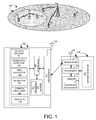
- FIG. 1 illustrates an exemplary wireless communication network 100 with user equipment (UE) supports 802.11ax in accordance with embodiments of the current invention.
- UE can be a mobile station or a wireless communications device.
- Wireless communications system 100 includes one or more wireless networks, and each of the wireless communication network has fixed base infrastructure units, such as wireless communications stations 105 and 106.
- the base unit may also be referred to as an access point, an access terminal, a base station, or by other terminology used in the art.
- Each of the wireless communications stations 105 and 106 serves a geographic area. The geographic area served by wireless communications stations 105 and 106 overlaps.
- Wireless mobile station or user equipment (UE) 101 and 102 in the wireless network 100 are served by base station 105.
- UE 101, 102 and base station 105 supports 802.11ax.
- Other wireless communications device, such as wireless communication device 103, 107 and 108, are served by a different base station 106.
- Base station 106 may support different wireless standard such as LTE, or may also support 802.11ax.
- UE 101 and 102 send uplink data to base stations 105 and 106 via uplink channels in the time and/or frequency domain.
- UE 101 and 102 receive downlink data from base stations 105 and 106 via downlink channels.
- the communication system utilizes Orthogonal Frequency Division Multiplexing Access (OFDMA).
- Wireless network 100 also supports MU-MIMO.
- the radio resources are portioned into resource blocks for multiple users.
- FIG. 1 further shows simplified block diagrams of wireless stations, such as UE 101 and base station 105 in accordance with the current invention.
- Base station 105 has an antenna 126, which transmits and receives radio signals.
- a RF transceiver module 123 coupled with the antenna, receives RF signals from antenna 126, converts them to baseband signals and sends them to processor 122.
- the antenna here can refer to one single antenna or a set of multiple antennas.
- RF transceiver 123 also converts received baseband signals from processor 122, converts them to RF signals, and sends out to antenna 126.
- Processor 122 processes the received baseband signals and invokes different functional modules to perform features in base station 105.
- Memory 121 stores program instructions and data 124 to control the operations of base station 105.
- Base station 102 also includes a set of control modules, such as HE-SIG-B handler 125, which carries out functional tasks for HE-SIG-B functions and communicates with the UE 101 for resource allocation related tasks.
- UE 101 has an antenna 135, which transmits and receives radio signals. Please note the antenna here can refer to one single antenna or a set of multiple antennas.
- a RF transceiver module 134 coupled with the antenna, receives RF signals from antenna 135, converts them to baseband signals and sends them to processor 132.
- RF transceiver 134 also converts received baseband signals from processor 132, converts them to RF signals, and sends out to antenna 135.
- Processor 132 processes the received baseband signals and invokes different functional modules to perform features in mobile station 101.
- Memory 131 stores program instructions and data 136 to control the operations of mobile station 101.
- a HE-SIG-B decoding circuit 191 such as a decoder, obtains resource allocation (RA) information in an OFDMA wireless network, wherein the RA information is indicated in a HE-SIG-B common field, and wherein the HE-SIG-B common field for RA is with a fixed format.
- a bandwidth detection circuit 192 determines an operation bandwidth, wherein the operation bandwidth is partitioned into predefined resource units, and wherein different operation bandwidth is partitioned into one or more HE-SIG-B channels, and wherein each HE-SIG-B channel represents a 20 MHz resource block.
- a resource allocation circuit 193 determines a resource allocation using a RA look-up table (LUT) based on the RA information.
- a RU detection circuit 194 determines a resource unit (RU) size scheduled for the UE such that the resource allocation circuit determines the resource allocation further based on the size of the RU.
- a common field compressing circuit 195 compresses the HE SIG B common field for full bandwidth MU-MIMO packets.
- a middle RU handling circuit 196 determines the existence of user specific field for middle 26 tone RU of a 80Mhz channel.
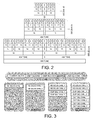
- FIG. 2 shows an exemplary diagram of resource unit partition in the IEEE 802.11ax system in accordance with embodiments of the current invention.
- the resource allocation is based on the operation bandwidth as configured / defined as shown.
- a 20MHz partition block diagram 201 shows the resource unit allocation for the 20MHz bandwidth.
- the 20 MHz can be partitioned in nine 26-tone resource units, five 52-tone resource units, two 106-tone resource unit and a 52-tone mid-tone unit, and one 242-tone unit.
- the resource units are partitions in two 20-Mhz partitions, with a channel-1 and channel-2.
- a 40-Mhz partition block diagram 202 shows the resource unit allocation for the 40MHz bandwidth.
- the 40 MHz can be partitioned in two sets of nine 26-tone resource units, two sets of five 52-tone resource units, two sets of 106-tone resource unit with two sets of 26-tone mid-tone units, two 242-tone units, and one 484-tone resource unit.
- the resource units are partitions in two 40Mhz partitions, with a channel-1 and channel-2.
- An 80Mhz partition block diagram 203 shows the resource unit allocation for the 80MHz bandwidth.
- the 80 MHz can be partitioned in four sets of nine 26-tone resource units with two 26-tone mid-tone RUs, four sets of five 52-tone resource units with two 26-tone mid-tone RUs, four sets of 106-tone resource units, two sets of 26-tone mid-tone unit, two sets of two 242-tone units with two 26-tone mid-tone RUs, two 484-tone resource unit with two 26-tone mid-tone RUs, and a 996-tone resource unit.
- FIG. 3 shows exemplary diagrams of HE-SIG-B structure and HE-SIG-B channel partitions for different bandwidth in accordance with embodiments of the current invention.
- a HE-SIG-B structural diagram 301 shows an exemplary HE-SIG-B structure.
- HE-SIG-B structural diagram 301 includes a common block, multiple user blocks including user-block [0], user-block[1], other user blocks and user-block[N].
- RA information is carried in the common block of HE-SIG-B 301.
- Different bandwidth configuration results in different number of HE-SIG-B channels.
- 20-MHz resource blocks 311 use one HE-SIG-B channel-1.
- 40-MHz resource block 312 uses two HE-SIG-B channels, HE-SIG-B Channel-1 and HE-SIG-B Channel-2.
- 80-MHz resource block 313 uses four HE-SIG-B channels, HE-SIG-B Channel-1, HE-SIG-B Channel-2 and one set of duplicated Channel-1 and Channel-2.
- 160-MHz resource block 313 uses eight HE-SIG-B channels, HE-SIG-B Channel-1, HE-SIG-B Channel-2 and three sets of duplicated Channel-1 and Channel-2.
- the RU indexes in the HE-SIG-B common field are used for a look-up table (LUT) to obtain the resource allocation information.
- LUT look-up table
- the RU indexing can be extended.
- the corresponding LUT reflects MU-MIMO configuration.
- a fixed format common field in the HE-SIG-B is defined for each operation bandwidth. Therefore, the length and the format of the common field are predefined. In this approach, there is no indication needed in the HE-SIG-A.
- FIG. 4A shows exemplary block diagrams of HE-SIG-B common field with fixed format for resource allocation of 20MHz operation bandwidth in accordance with embodiments of the current invention.
- a Ch-1 211 includes fields for other information and RA for Ch-1.
- the other information in common field may include GI length for payload, LTF symbol length, and other field. These information bits have fixed length and format for all cases.
- the other information field is skipped for other operation bandwidth.
- the 20MHz includes one channel. It means the RA LUT is signaling RU size smaller than or equals to 242-tone.
- FIG. 4B shows exemplary block diagrams of HE-SIG-B common field with fixed format for resource allocation of 40MHz operation bandwidth in accordance with embodiments of the current invention.
- For 40MHz operation bandwidth there is one RA LUT on each HE-SIG-B common field.
- For Ch-1 221 it can have RA for Ch-1, or RA for CH-1 & Ch-2.
- For Ch-2 222 it can have RA for Ch-2, or RA for CH-1 & Ch-2.
- the 484-tone RA LUT needs to be duplicated on two common fields of HE-SIG-B ch-1 and ch-2.
- the RA for two channels as shown here means the RA LUT signals the 484-tone RU.
- RA for four channels means the RA LUT signals 996-tone RU.
- FIG. 4C shows exemplary block diagrams of HE-SIG-B common field with fixed format for resource allocation of 80MHz operation bandwidth in accordance with embodiments of the current invention.
- Figure 4C shows four sets of formats.
- Ch-1 has RA for channel-1 and RA for channel-3.
- Ch2 has RA for channel-2 and RA for channel-4.
- Ch-3 is a duplicate as Ch-1
- Ch-4 is a duplicate of Ch-2.
- Ch-1 has RA for Ch-1&2, RA for Ch-3.
- Ch-2 has RA-for Ch-1&2 and RA for Ch-3.
- Ch-3 and Ch-4 are duplicates of Ch-1 and Ch-2, respectively.
- Ch-1 has RA for Ch-1, and RA for Ch-3&4.
- Ch-2 has Ch-2, and RA for Ch-3&4.
- Ch-3 and Ch-4 are duplicates of Ch-1 and Ch-2, respectively.
- Ch-1 has RA for Ch-1&2, and RA for Ch-3.
- Ch-2 has Ch-1&2, and RA for Ch-4.
- Ch-3 and Ch-4 are duplicates of Ch-1 and Ch-2, respectively.
- Ch-1 through Ch-4 has Ch-1 through Ch-4.
- the configuration of 439 it is the MU-MIMO only case.
- an alternative signaling method is used.
- a one-bit compression indicator is set in the HE-SIG-A indicating the compress of the HE-SIG-B field.
- the entire RU LUTs in HE-SIG-B common field is saved.
- FIG. 4D shows exemplary block diagrams of HE-SIG-B common field with fixed format for resource allocation of 160MHz operation bandwidth in accordance with embodiments of the current invention.
- 160MHz there are four RA LUTs on each HE-SIG-B common field.
- Ch-1 has RA for Ch-1, RA for Ch-3, RA for Ch-5, and RA for Ch-7.
- Ch-2 has for Ch-2, RA for Ch-4, RA for Ch-6, and RA for Ch-8.
- Ch-3 and Ch-4 are duplicates of Ch-1 and Ch-2, respectively. So are Ch-5 and Ch-6 are duplicates of Ch-1 and Ch-2, respectively.
- Ch-7 and Ch-8 are duplicates of Ch-1 and Ch-2, respectively.
- Other combinations of RA are available to 160MHz as shown in FIG. 4D .
- the RA LUT shall be found on the 20MHz channel that contains the scheduled RU for data.
- the RA LUT shall be duplicated on common fields.
- the RA LUT shall be duplicated twice on all common fields.
- RA LUTs need to be placed in order. For example in the order of channel index signaled in the RA LUT, from lower channel to upper channel.
- the middle 26-tone RU for 80MHz and 160MHz can be signaled by the common field.
- FIG. 5 and FIG. 6 illustrate the indication of the middle 26-tone RU.
- FIG. 5 shows an exemplary diagrams of indication of middle 26-tone RU for 80MHz bandwidth in accordance with embodiments of the current invention.
- An 80MHz HE-SIG-B channel 501 includes a HE-SIG-B Ch-1, a HE-SIG-B Ch-2, a HE-SIG-B Duplicated Ch-1, and a HE-SIG-B Duplicated Ch-2.
- a one-bit in the common field of HE-SIG-B is used to indicate whether the middle 26-tone RU is used. If the bit is set, it indicates the RU is used.
- one-bit in ch-1 of the HE-SIG-B common field is defined to be the middle 26-tone indicator.
- one-bit in ch-2 of the HE-SIG-B common field is defined to be the middle 26-tone indicator.
- duplicated bits are set in both ch-1 and ch-2.
- the bit used as the middle 26-tone indicator is fixed.
- a load balance method is used.
- it is decided to set the middle 26-tone indicator.
- it determines whether ch-1 is a shorter HE-SIG-B. If yes, it moves to step 523 and use one-bit of ch-1 as the middle 26-tone indicator. If no, it moves step 524, and use one-bit of ch-2 as the middle 26-tone indicator.
- one user specific field is defined for the middle 26-tone RU.
- a bit structure 530 illustrates the middle 26-tone RU in fixed position of the user specific field. If no STA assigned on the middle RU, define the user specific field for a virtual STA (use a special AID or unallocated AID).
- FIG. 6 shows an exemplary diagrams of indication of middle 26-tone RU for 160MHz bandwidth in accordance with embodiments of the current invention.
- 1 160MHz HE-SIG-B channel 601 includes a HE-SIG-B Ch-1, a HE-SIG-B Ch-2, and three sets of a HE-SIG-B Duplicated Ch-1, and a HE-SIG-B Duplicated Ch-2.
- a one-bit in the common field of HE-SIG-B is used to indicate whether the middle 26-tone RU is used. If the bit is set, it indicates the RU is used.
- one-bit in ch-1 of the HE-SIG-B common field is defined to be the middle 26-tone indicator for the middle 26-tone RU of the lower 80MHz.
- One-bit in ch-2 of the HE-SIG-B common field is defined to be the middle 26-tone indicator for the middle 26-tone RU of the upper 80MHz.
- two unused indices in the RA LUT are used to indicate whether the middle 26 tone RU for 80Mhz is assigned.
- HE-SIG-A To save some overhead in HE-SIG-B common field, we can use a few bits in HE-SIG-A to indicate the format of common field. Different format (or mode) of common field means different length and definition of common field.
- the number of RA LUTs can be reduced with format indication. For 80 MHz operation bandwidth, without RA LUT duplication, two common fields (on HE-SIG-B channel-1 and channel-2) each may contain one or two RA LUTs. Need two bits to indicate all the combinations. For 160MHz operation bandwidth, without RA LUT duplication, two common fields each may contain one, two, three, or four RA LUTs. It needs four bits to indicate all the combinations.
- a smaller number of bits can be used to indicate a subset of the combinations.
- a smaller number of bits can be used to indicate a subset of the combinations.
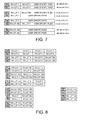
- FIG. 7 shows an exemplary diagram of using two bits format indication for 80MHz operation bandwidth in accordance with embodiments of the current invention.
- the 2 bits format indication can be defined as:
- RA 1 duplicated UT for 484 tone RU will not be on two HE-SIG-B channels. It can be flexibly placed on either channel. With two RA LUTs for 484-tone RU, an order need to be defined. For example, RA LUT signaling lower 484 tone RU shall be placed on HE-SIG-B channel 1.
- FIG. 8 illustrates an exemplary block diagram of using two bits format indication for 160MHz operation bandwidth in accordance with embodiments of the current invention.
- the two bits format indication can be defined as 00: (4, 4); 01: (3, 3) ; 10: (2, 2) ; 11: (1, 1) .
- 7-RA LUTs case There is 1 RA LUT for 484-tone RU. Duplicate the LUT for 484-tone RU to fit the (4, 4) structure.
- 6-RA LUTs case There are two RA LUTs for 484 tone RU.
- the LUT for lower 484 RU shall be placed on common field 1.
- 5-LUTs case There will be 1) three LUTs for 484-tone RU or 2) one LUT for 996-tone RU.
- the LUT for lowest 484-RU shall be placed on common field-1
- LUT for middle 484-tone RU shall be placed on common field-2
- LUT for upper most 484-tone RU shall be duplicated.
- duplicate the LUT for 996 tone RU to fit the (3, 3) structure.
- 4-LUT case There will be: 1) four LUTs for 484-tone RU or 2) 1 LUT for 996 tone RU and one LUT for 484-tone RU.
- the LUTs shall be placed in order on common field 1 and 2. From lower RU to upper RU placed on common field 1-> 2->1->2.
- the LUT for 996-tone RU and LUT for 484-tone RU shall be placed on different common field.
- 3-LUTs case There are two LUTs for 484-tone RU and one LUT for 996 tone RU.
- the LUT for 996-tone RU shall be duplicate on two common fields.
- the LUTs for 484-tone RU shall be placed on two common fields in order. For example, lower 484-tone RU on common field-1.
- 2-LUTs case There are two LUTs for 996-tone RU. The LUTs shall be placed on two common fields in order.
- 1-LUT case There are one LUT for 2x996-tone RU.
- the LUT shall be duplicated on two common fields. This is MU-MIMO only case.
- FIG. 9 illustrates an exemplary block diagram of using one-bit format indication for 80 MHz operation bandwidth in accordance with embodiments of the current invention.
- the exemplary of one-bit format indication includes: 0: Each common field include 2 RA LUTs (2, 2); 1: Each common field include 1 RA LUT (1, 1); For (2,1) or (1,2) case, duplicate the RA LUT for 484 tone RU.
- FIG. 10 illustrates an exemplary block diagram of using one-bit format indication for 160 MHz operation bandwidth in accordance with embodiments of the current invention.
- the exemplary of one-bit format indication includes: 0 indicate Each common field include 4 RA LUTs (4, 4); 1 indicate (1, 1). In another example, 0 indicate (4,4); 1 indicate (2, 2). For the cases with 5-8 RA LUTs, signal the LUTs follow the rules on slide 12. For the cases with 3-4 LUTs, follow the rules on slide 17. For 2-LUT case and 1-LUT case, duplicate to fit the (2, 2) structure.
- 3-bit format is used for format indication.
- For 80MHz bandwidth reserve 1 bit and use 2 bits indication.
- For 160MHz bandwidth three bits can indicate eight RA LUT combinations on two common fields. 000 ⁇ 111 indicates LUT combination (4, 4), (4,3), (3, 4), (2, 2), (2,1), (1, 2), (1, 1), (0,0). (0,0) means pure MU-MIMO case and no RA LUTs in the common fields
- 4-bit format is used for format indication. For 80MHz bandwidth, reserve 2 bits and use 2 bits indication same as slide 15. For 160MHz bandwidth, 4 bits can indicate all RA LUT combinations on 2 common fields
- the number of STAs scheduled by one RA LUT varies a lot -- ranging from one to seventeen if no limitation on number of STA per 20Mhz. Range from one to nine if number of STA for each 20Mhz limited to nine. The number of user specific field on 2 common fields can be quite different, while the length of HE-SIG-B is the same for all channels.
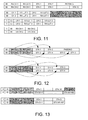
- FIG. 11 illustrates an exemplary block diagram for flexible resource allocation (FRA) by adding a few bits for each RA LUT in accordance with embodiments of the current invention.
- FRA adds a few bits for each RA LUT indicating which channel the corresponding LUT is scheduling for.
- the format of HE-SIG-B common field is different when FRA is enabled. Additional NxM bits are needed in common fields to support FRA. N is the number of RA LUTs in the common field and M is the number of bits for signaling the channel index. In some scenarios, FRA is not needed and common field can save the additional bits.
- one bit is added in HE-SIG-A to enable/disable the FRA feature.
- FIG. 12 illustrates an exemplary block diagram for flexible resource allocation (FRA) by allowing placing the user specific field of a STA on different channel from the RA LUT signaling it in accordance with embodiments of the current invention.
- FRA flexible resource allocation
- to enable FRA signaling is to allow placing the user specific field of a STA on different channel from the RA LUT signaling it. It needs to define some rules for placing the user specific field to balance the load.
- STAs scheduled by one RA LUT need to be placed in order.
- Sets of STAs scheduled by ordered RA LUTs are also need to be placed in same order as LUTs.
- FIG. 13 illustrates an exemplary block diagram of using one-bit FRA indication in HE-SIG-A to enable/disable the flexible resource-allocation signaling feature in accordance with embodiments of the current invention.
- FRA-enable bit and common-field format indication bits the length of HE-SIG-B can be calculated after HE-SIG-B common field is decoded. Length of HE-SIG-B field bits in HE-SIG-A may not be needed. Therefore indication FRA and common field format in HE-SIG-A may not bring any additional overhead
- FIG. 14 shows an exemplary flow chart of obtaining resource units information with HE-SIG-B common field with fixed format and indication in accordance with embodiments of the current invention.
- the UE obtains resource allocation (RA) information in an OFDMA wireless network, wherein the RA information is indicated in a HE-SIG-B common field, and wherein the HE-SIG-B common field for RA is with a fixed format.
- the UE determines an operation bandwidth, wherein the operation bandwidth is partitioned into predefined resource units, and wherein different operation bandwidth is partitioned into one or more HE-SIG-B channels, and wherein each HE-SIG-B channel represents a 20 MHz resource block.
- the UE determines a resource allocation using a RA look-up table (LUT) based on the RA information.
- the UE determines a resource allocation using a RU look-up table (LUT) based on the RA information.
- the UE compresses the HE SIG B common field for full bandwidth MU-MIMO packets.
- the UE determines the existence of user specific field for middle 26 tone RU of an 80Mhz channel.
- the present invention has been described in connection with certain specific embodiments for instructional purposes, the present invention is not limited thereto.
- LTE-advanced mobile communication system is exemplified to describe the present invention
- the present invention can be similarly applied to other mobile communication systems, such as Time Division Synchronous Code Division Multiple Access (TD-SCDMA) systems.
- TD-SCDMA Time Division Synchronous Code Division Multiple Access
Landscapes
- Engineering & Computer Science (AREA)
- Signal Processing (AREA)
- Computer Networks & Wireless Communication (AREA)
- Mobile Radio Communication Systems (AREA)
Abstract
Description
- The disclosed embodiments relate generally to wireless network communications, and, HE-SIG-B common field formats and indication according to the pre-characterizing clauses of
claims - As the demand for wireless communication continues to increase, the world has benefited from the evolution of the IEEE 802.11 wireless networking standard to accommodating more and more users with their ever-increasing data usage. The latest 802.11ax will enable high efficiency (HE) network. It is designed to handle higher data rate and higher user load. The system uses Orthogonal Frequency Division Multiple Access (OFDMA) as well as multi-user multiple-input and multiple-output (MU-MIMO).
- Further different operation bandwidth can be supported and configured. The operation bandwidth is partitioned according to a predefined standard. In 11ax, resource allocation (RA) needs to be indicated to support OFDMA and/or MU-MIMO. The resource allocation will be signaled in the common part of the HE-SIG-B field. The structure of the HE-SIG-B is defined. However, how to use the HE-SIG-B field for efficient resource allocation is desired.
- Methods and apparatus are provided for HE-SIG-B common field formats and indications. In one novel aspect, a fixed format is used for HE-SIG-B common field indicating resource allocations (RA). The UE obtains resource allocation (RA) information in an OFDMA wireless network, wherein the RA information is indicated in a HE-SIG-B common field, and wherein the HE-SIG-B common field for RA is with a fixed format. The UE determines an operation bandwidth, wherein the operation bandwidth is partitioned into predefined resource units, and wherein different operation bandwidth is partitioned into one or more HE-SIG-B channels, and wherein each HE-SIG-B channel represents a 20 MHz resource block. The UE determines a resource allocation using a RA look-up table (LUT) based on the RA information. In one embodiment, look-up tables (LUTs) are configured for the resource allocation and indicated in the HE-SIG-B common field. In another embodiment, the HE-SIG-B common field is defined with the fixed format of one RA LUT for 20 MHz operation bandwidth, one RA LUTs on each HE-SIB-B channels for 40 MHz operation bandwidth with two HE-SIG-B channels, two RA LUTs on each HE-SIG-B common field for 80 MHz operation bandwidth with four HE-SIG-B channels, and four RA LUTs on each HE-SIG-B common field for 160 MHz operation bandwidth with eight HE-SIG-B channels, and wherein in each HE-SIG-B common field, the RA LUTs are placed in an order of channel indexes signaled in each corresponding RA LUT. In yet another embodiment, the operation bandwidth is greater than 20 MHz, and wherein each odd-numbered HE-SIB-B channel common field is a duplicate of each other containing a first set RU LUTs and each even-numbered HE-SIB-B channel common field is a duplicate of each other containing a second set RU LUTs. In one embodiment, one or more RA LUTs are used based on the operation bandwidth. The RA LUTs are placed in an order of channel indexes from lower channel to upper channel signaled in each corresponding RA LUT.
- In another novel aspect, MU-MIMO is used and a compression indicator is set in the HE-SIG-A field indicating a saving of all RA LUTS in the HE-SIG-B common field. Upon detecting the set of the indicator, the HE-SIG-B common field is compressed.
- In yet another novel aspect, a one-bit middle-tone indicator is included in the HE-SIG-B common field indicating whether the one or more middle 26 tone is used. In one embodiment, the operation bandwidth is 80MHz and the middle-tone indicator is included at a fixed HE-SIG-B channel. In another embodiment, the operation bandwidth is 80MHz and the middle-tone indicator is included at an allocated HE-SIG-B channel based on a load balance decision for the HE-SIG-B channels. In yet another embodiment, the operation bandwidth is 160MHz, and wherein the middle-tone indicator for RUs of lower 80MHz is placed at an end of HE-SIG-B channel-1 and the middle-tone indicator for RUs of upper 80MHz is placed at an end of HE-SIG-B channel-2.
- Other embodiments and advantages are described in the detailed description below. This summary does not purport to define the invention. The invention is defined by the claims.
- The accompanying drawings, where like numerals indicate like components, illustrate embodiments of the invention.
-
FIG. 1 illustrates an exemplarywireless communication network 100 with user equipment (UE) supports 802.11ax in accordance with embodiments of the current invention. -
FIG. 2 shows an exemplary diagram of resource unit partition in the 802.11ax system in accordance with embodiments of the current invention. -
FIG. 3 shows exemplary diagrams of SIB-B structure and SIG-B channel partitions for different bandwidth in accordance with embodiments of the current invention. -
FIG. 4A shows exemplary block diagrams of HE-SIG-B common field with fixed format for resource allocation of 20MHz operation bandwidth in accordance with embodiments of the current invention. -
FIG. 4B shows exemplary block diagrams of HE-SIG-B common field with fixed format for resource allocation of 40MHz operation bandwidth in accordance with embodiments of the current invention. -
FIG. 4C shows exemplary block diagrams of HE-SIG-B common field with fixed format for resource allocation of 80MHz operation bandwidth in accordance with embodiments of the current invention. -
FIG. 4D shows exemplary block diagrams of HE-SIG-B common field with fixed format for resource allocation of 160MHz operation bandwidth in accordance with embodiments of the current invention. -
FIG. 5 shows an exemplary diagrams of indication of middle 26-tone RU for 80MHz bandwidth in accordance with embodiments of the current invention. -
FIG. 6 shows an exemplary diagrams of indication of middle 26-tone RU for 160MHz bandwidth in accordance with embodiments of the current invention. -
FIG. 7 shows an exemplary diagram of using two bits format indication for 80MHz operation bandwidth in accordance with embodiments of the current invention. -
FIG. 8 illustrates an exemplary block diagram of using two bits format indication for 160MHz operation bandwidth in accordance with embodiments of the current invention. -
FIG. 9 illustrates an exemplary block diagram of using one-bit format indication for 80 MHz operation bandwidth in accordance with embodiments of the current invention. -
FIG. 10 illustrates an exemplary block diagram of using one-bit format indication for 160 MHz operation bandwidth in accordance with embodiments of the current invention. -
FIG. 11 illustrates an exemplary block diagram for flexible resource allocation (FRA) by adding a few bits for each RA LUT in accordance with embodiments of the current invention. -
FIG. 12 illustrates an exemplary block diagram for flexible resource allocation (FRA) by allowing placing the user specific field of a STA on different channel from the RA LUT signaling it in accordance with embodiments of the current invention. -
FIG. 13 illustrates an exemplary block diagram of using one-bit FRA indication in HE SIG A to enable/disable the flexible resource-allocation signaling feature in accordance with embodiments of the current invention. -
FIG. 14 shows an exemplary flow chart of obtaining resource units information with HE-SIG-B common field with fixed format and indication in accordance with embodiments of the current invention. - Reference will now be made in detail to some embodiments of the invention, examples of which are illustrated in the accompanying drawings.
-
FIG. 1 illustrates an exemplarywireless communication network 100 with user equipment (UE) supports 802.11ax in accordance with embodiments of the current invention. UE can be a mobile station or a wireless communications device.Wireless communications system 100 includes one or more wireless networks, and each of the wireless communication network has fixed base infrastructure units, such aswireless communications stations wireless communications stations wireless communications stations - Wireless mobile station or user equipment (UE) 101 and 102 in the
wireless network 100 are served bybase station 105. UE 101, 102 andbase station 105 supports 802.11ax. Other wireless communications device, such aswireless communication device different base station 106.Base station 106 may support different wireless standard such as LTE, or may also support 802.11ax.UE base stations UE base stations - In one embodiment, the communication system utilizes Orthogonal Frequency Division Multiplexing Access (OFDMA).
Wireless network 100 also supports MU-MIMO. The radio resources are portioned into resource blocks for multiple users. -
FIG. 1 further shows simplified block diagrams of wireless stations, such asUE 101 andbase station 105 in accordance with the current invention. -
Base station 105 has anantenna 126, which transmits and receives radio signals. ARF transceiver module 123, coupled with the antenna, receives RF signals fromantenna 126, converts them to baseband signals and sends them toprocessor 122. Please note the antenna here can refer to one single antenna or a set of multiple antennas.RF transceiver 123 also converts received baseband signals fromprocessor 122, converts them to RF signals, and sends out toantenna 126.Processor 122 processes the received baseband signals and invokes different functional modules to perform features inbase station 105.Memory 121 stores program instructions and data 124 to control the operations ofbase station 105.Base station 102 also includes a set of control modules, such as HE-SIG-B handler 125, which carries out functional tasks for HE-SIG-B functions and communicates with theUE 101 for resource allocation related tasks. -
UE 101 has anantenna 135, which transmits and receives radio signals. Please note the antenna here can refer to one single antenna or a set of multiple antennas. ARF transceiver module 134, coupled with the antenna, receives RF signals fromantenna 135, converts them to baseband signals and sends them toprocessor 132.RF transceiver 134 also converts received baseband signals fromprocessor 132, converts them to RF signals, and sends out toantenna 135.Processor 132 processes the received baseband signals and invokes different functional modules to perform features inmobile station 101.Memory 131 stores program instructions anddata 136 to control the operations ofmobile station 101. -
UE 101 also includes a set of control modules that carry out functional tasks. A HE-SIG-B decoding circuit 191, such as a decoder, obtains resource allocation (RA) information in an OFDMA wireless network, wherein the RA information is indicated in a HE-SIG-B common field, and wherein the HE-SIG-B common field for RA is with a fixed format. Abandwidth detection circuit 192 determines an operation bandwidth, wherein the operation bandwidth is partitioned into predefined resource units, and wherein different operation bandwidth is partitioned into one or more HE-SIG-B channels, and wherein each HE-SIG-B channel represents a 20 MHz resource block. Aresource allocation circuit 193 determines a resource allocation using a RA look-up table (LUT) based on the RA information. ARU detection circuit 194 determines a resource unit (RU) size scheduled for the UE such that the resource allocation circuit determines the resource allocation further based on the size of the RU. A common field compressing circuit 195 compresses the HE SIG B common field for full bandwidth MU-MIMO packets. A middleRU handling circuit 196 determines the existence of user specific field for middle 26 tone RU of a 80Mhz channel. -
FIG. 2 shows an exemplary diagram of resource unit partition in the IEEE 802.11ax system in accordance with embodiments of the current invention. In one embodiment, the resource allocation is based on the operation bandwidth as configured / defined as shown. A 20MHz partition block diagram 201 shows the resource unit allocation for the 20MHz bandwidth. The 20 MHz can be partitioned in nine 26-tone resource units, five 52-tone resource units, two 106-tone resource unit and a 52-tone mid-tone unit, and one 242-tone unit. For a 40-Mhz bandwidth resource block, the resource units are partitions in two 20-Mhz partitions, with a channel-1 and channel-2. A 40-Mhz partition block diagram 202 shows the resource unit allocation for the 40MHz bandwidth. The 40 MHz can be partitioned in two sets of nine 26-tone resource units, two sets of five 52-tone resource units, two sets of 106-tone resource unit with two sets of 26-tone mid-tone units, two 242-tone units, and one 484-tone resource unit. For an 80Mhz bandwidth resource block, the resource units are partitions in two 40Mhz partitions, with a channel-1 and channel-2. An 80Mhz partition block diagram 203 shows the resource unit allocation for the 80MHz bandwidth. The 80 MHz can be partitioned in four sets of nine 26-tone resource units with two 26-tone mid-tone RUs, four sets of five 52-tone resource units with two 26-tone mid-tone RUs, four sets of 106-tone resource units, two sets of 26-tone mid-tone unit, two sets of two 242-tone units with two 26-tone mid-tone RUs, two 484-tone resource unit with two 26-tone mid-tone RUs, and a 996-tone resource unit. -
FIG. 3 shows exemplary diagrams of HE-SIG-B structure and HE-SIG-B channel partitions for different bandwidth in accordance with embodiments of the current invention. A HE-SIG-B structural diagram 301 shows an exemplary HE-SIG-B structure. HE-SIG-B structural diagram 301 includes a common block, multiple user blocks including user-block [0], user-block[1], other user blocks and user-block[N]. In one novel aspect, RA information is carried in the common block of HE-SIG-B 301. Different bandwidth configuration results in different number of HE-SIG-B channels. 20-MHz resource blocks 311 use one HE-SIG-B channel-1. 40-MHz resource block 312 uses two HE-SIG-B channels, HE-SIG-B Channel-1 and HE-SIG-B Channel-2. 80-MHz resource block 313 uses four HE-SIG-B channels, HE-SIG-B Channel-1, HE-SIG-B Channel-2 and one set of duplicated Channel-1 and Channel-2. 160-MHz resource block 313 uses eight HE-SIG-B channels, HE-SIG-B Channel-1, HE-SIG-B Channel-2 and three sets of duplicated Channel-1 and Channel-2. The RU indexes in the HE-SIG-B common field are used for a look-up table (LUT) to obtain the resource allocation information. To better support of MU-MIMO on OFDMA, the RU indexing can be extended. The corresponding LUT reflects MU-MIMO configuration. In one novel aspect, a fixed format common field in the HE-SIG-B is defined for each operation bandwidth. Therefore, the length and the format of the common field are predefined. In this approach, there is no indication needed in the HE-SIG-A. -
FIG. 4A shows exemplary block diagrams of HE-SIG-B common field with fixed format for resource allocation of 20MHz operation bandwidth in accordance with embodiments of the current invention. For 20MHz operation bandwidth there is one RA LUT on the HE-SIG-B common field. A Ch-1 211 includes fields for other information and RA for Ch-1. The other information in common field may include GI length for payload, LTF symbol length, and other field. These information bits have fixed length and format for all cases. The other information field is skipped for other operation bandwidth. The 20MHz includes one channel. It means the RA LUT is signaling RU size smaller than or equals to 242-tone. -
FIG. 4B shows exemplary block diagrams of HE-SIG-B common field with fixed format for resource allocation of 40MHz operation bandwidth in accordance with embodiments of the current invention. For 40MHz operation bandwidth there is one RA LUT on each HE-SIG-B common field. There are two different partitions for 40MHz common field. For Ch-1 221 it can have RA for Ch-1, or RA for CH-1 & Ch-2. For Ch-2 222 it can have RA for Ch-2, or RA for CH-1 & Ch-2. To keep the HE-SIG-B common field with fixed format and length, the 484-tone RA LUT needs to be duplicated on two common fields of HE-SIG-B ch-1 and ch-2. The RA for two channels as shown here means the RA LUT signals the 484-tone RU. Similarly, RA for four channels means the RA LUT signals 996-tone RU. Format for user specific fields (USF): The RA LUT and the USFs for the STAs scheduled in the RA LUT are placed on the same HE-SIG-B channel. The USFs need to be placed in the order of their position in the RA LUT. The USF sets for STAs scheduled in different RA LUTs need to be placed in the same order of the RA LUTs. -
FIG. 4C shows exemplary block diagrams of HE-SIG-B common field with fixed format for resource allocation of 80MHz operation bandwidth in accordance with embodiments of the current invention. For 80Mhz operation bandwidth, there are two RA LUTs on each of the HE-SIG-B common field and incudes four HE-SIG-B channels, Ch-1 431, CH-2 432, Ch-3 433 and Ch-4 434.Figure 4C shows four sets of formats. In 436, Ch-1 has RA for channel-1 and RA for channel-3. Ch2 has RA for channel-2 and RA for channel-4. Ch-3 is a duplicate as Ch-1, while Ch-4 is a duplicate of Ch-2. In 437, Ch-1 has RA for Ch-1&2, RA for Ch-3. Ch-2 has RA-for Ch-1&2 and RA for Ch-3. Ch-3 and Ch-4 are duplicates of Ch-1 and Ch-2, respectively. In 437 partition, Ch-1 has RA for Ch-1, and RA for Ch-3&4. Ch-2 has Ch-2, and RA for Ch-3&4. Ch-3 and Ch-4 are duplicates of Ch-1 and Ch-2, respectively. In 438, Ch-1 has RA for Ch-1&2, and RA for Ch-3. Ch-2 has Ch-1&2, and RA for Ch-4. Ch-3 and Ch-4 are duplicates of Ch-1 and Ch-2, respectively. In 439, Ch-1 through Ch-4 has Ch-1 through Ch-4. - In one novel aspect, in the configuration of 439, it is the MU-MIMO only case. For this case, an alternative signaling method is used. A one-bit compression indicator is set in the HE-SIG-A indicating the compress of the HE-SIG-B field. The entire RU LUTs in HE-SIG-B common field is saved.
-
FIG. 4D shows exemplary block diagrams of HE-SIG-B common field with fixed format for resource allocation of 160MHz operation bandwidth in accordance with embodiments of the current invention. Similarly, to other operation bandwidth, 160MHz there are four RA LUTs on each HE-SIG-B common field. As an example, in one configuration, Ch-1 has RA for Ch-1, RA for Ch-3, RA for Ch-5, and RA for Ch-7. Ch-2 has for Ch-2, RA for Ch-4, RA for Ch-6, and RA for Ch-8. Ch-3 and Ch-4 are duplicates of Ch-1 and Ch-2, respectively. So are Ch-5 and Ch-6 are duplicates of Ch-1 and Ch-2, respectively. And Ch-7 and Ch-8 are duplicates of Ch-1 and Ch-2, respectively. Other combinations of RA are available to 160MHz as shown inFIG. 4D . - Several rules are defined for the HE-SIG-B common field formatting. First, for STAs scheduled on RU size smaller than or equals to 242-tone, the RA LUT shall be found on the 20MHz channel that contains the scheduled RU for data. Second, for STAs scheduled on 484 tone RU, the RA LUT shall be duplicated on common fields. Third, for STAs scheduled on 996 tone RU, the RA LUT shall be duplicated twice on all common fields. Fourth, on each common field, RA LUTs need to be placed in order. For example in the order of channel index signaled in the RA LUT, from lower channel to upper channel.
- In another novel aspect, the middle 26-tone RU for 80MHz and 160MHz can be signaled by the common field. A one-bit indication in the HE-SIG-B common filed. If operation bandwidth is 80MHz, define 1-bit in the common field to indicate whether the middle 26-tone RU is used. This bit duplicates on common field-1 and field-2. If operation bandwidth is 160Mhz, define 1-bit in the SIG-B channel-1 common field to indicate lower RU, and 1-bit in the SIG-B channel-2 common field to indicate the upper 26-tone RU.
FIG. 5 and FIG. 6 illustrate the indication of the middle 26-tone RU. -
FIG. 5 shows an exemplary diagrams of indication of middle 26-tone RU for 80MHz bandwidth in accordance with embodiments of the current invention. An 80MHz HE-SIG-B channel 501 includes a HE-SIG-B Ch-1, a HE-SIG-B Ch-2, a HE-SIG-B Duplicated Ch-1, and a HE-SIG-B Duplicated Ch-2. A one-bit in the common field of HE-SIG-B is used to indicate whether the middle 26-tone RU is used. If the bit is set, it indicates the RU is used. In one embodiment as shown in 511, one-bit in ch-1 of the HE-SIG-B common field is defined to be the middle 26-tone indicator. In a second embodiment as shown in 512, one-bit in ch-2 of the HE-SIG-B common field is defined to be the middle 26-tone indicator. In a third embodiment as shown in 513, duplicated bits are set in both ch-1 and ch-2. In the above three embodiments, the bit used as the middle 26-tone indicator is fixed. In a fourth embodiment as shown in 520, a load balance method is used. Atstep 521, it is decided to set the middle 26-tone indicator. Atstep 522, it determines whether ch-1 is a shorter HE-SIG-B. If yes, it moves to step 523 and use one-bit of ch-1 as the middle 26-tone indicator. If no, it movesstep 524, and use one-bit of ch-2 as the middle 26-tone indicator. - In another embodiment, one user specific field is defined for the middle 26-tone RU. A
bit structure 530 illustrates the middle 26-tone RU in fixed position of the user specific field. If no STA assigned on the middle RU, define the user specific field for a virtual STA (use a special AID or unallocated AID). -
FIG. 6 shows an exemplary diagrams of indication of middle 26-tone RU for 160MHz bandwidth in accordance with embodiments of the current invention. 1 160MHz HE-SIG-B channel 601 includes a HE-SIG-B Ch-1, a HE-SIG-B Ch-2, and three sets of a HE-SIG-B Duplicated Ch-1, and a HE-SIG-B Duplicated Ch-2. A one-bit in the common field of HE-SIG-B is used to indicate whether the middle 26-tone RU is used. If the bit is set, it indicates the RU is used. In one embodiment, one-bit in ch-1 of the HE-SIG-B common field is defined to be the middle 26-tone indicator for the middle 26-tone RU of the lower 80MHz. One-bit in ch-2 of the HE-SIG-B common field is defined to be the middle 26-tone indicator for the middle 26-tone RU of the upper 80MHz. - In another embodiment, two user specific fields for middle RU of lower and upper 80MHz when operation bandwidth is 160MHz as shown in 620. In yet another embodiment, as shown in 630, two unused indices in the RA LUT are used to indicate whether the middle 26 tone RU for 80Mhz is assigned.
- To save some overhead in HE-SIG-B common field, we can use a few bits in HE-SIG-A to indicate the format of common field. Different format (or mode) of common field means different length and definition of common field. The number of RA LUTs can be reduced with format indication. For 80 MHz operation bandwidth, without RA LUT duplication, two common fields (on HE-SIG-B channel-1 and channel-2) each may contain one or two RA LUTs. Need two bits to indicate all the combinations. For 160MHz operation bandwidth, without RA LUT duplication, two common fields each may contain one, two, three, or four RA LUTs. It needs four bits to indicate all the combinations. To reduce the indication bits in HE-SIG-A, a smaller number of bits can be used to indicate a subset of the combinations. To reduce the indication bits in HE-SIG-A, a smaller number of bits can be used to indicate a subset of the combinations. With some additional indication in HE SIG A, the flexible signaling of resource allocation can also be supported.
-
FIG. 7 shows an exemplary diagram of using two bits format indication for 80MHz operation bandwidth in accordance with embodiments of the current invention. The 2 bits format indication can be defined as: - 00: 2 RA LUTs on HE-SIG-
B channel - 01: 2 RA LUTs on HE-SIG-
B channel - 10: 1 RA LUT on HE-SIG-
B channel - 11: 1 RA LUT on HE
SIG B channel -
RA 1 duplicated UT for 484 tone RU will not be on two HE-SIG-B channels. It can be flexibly placed on either channel. With two RA LUTs for 484-tone RU, an order need to be defined. For example, RA LUT signaling lower 484 tone RU shall be placed on HE-SIG-B channel 1. -
FIG. 8 illustrates an exemplary block diagram of using two bits format indication for 160MHz operation bandwidth in accordance with embodiments of the current invention. The two bits format indication can be defined as 00: (4, 4); 01: (3, 3) ; 10: (2, 2) ; 11: (1, 1) . - 7-RA LUTs case: There is 1 RA LUT for 484-tone RU. Duplicate the LUT for 484-tone RU to fit the (4, 4) structure.
- 6-RA LUTs case: There are two RA LUTs for 484 tone RU. The LUT for lower 484 RU shall be placed on
common field 1. - 5-LUTs case: There will be 1) three LUTs for 484-tone RU or 2) one LUT for 996-tone RU. For 1), The LUT for lowest 484-RU shall be placed on common field-1, LUT for middle 484-tone RU shall be placed on common field-2, LUT for upper most 484-tone RU shall be duplicated. For 2), duplicate the LUT for 996 tone RU to fit the (3, 3) structure.
- 4-LUT case: There will be: 1) four LUTs for 484-tone RU or 2) 1 LUT for 996 tone RU and one LUT for 484-tone RU. For 1), the LUTs shall be placed in order on
common field - 3-LUTs case: There are two LUTs for 484-tone RU and one LUT for 996 tone RU. The LUT for 996-tone RU shall be duplicate on two common fields. The LUTs for 484-tone RU shall be placed on two common fields in order. For example, lower 484-tone RU on common field-1.
- 2-LUTs case: There are two LUTs for 996-tone RU. The LUTs shall be placed on two common fields in order.
- 1-LUT case: There are one LUT for 2x996-tone RU. The LUT shall be duplicated on two common fields. This is MU-MIMO only case.
- For STAs scheduled on RU size <= 242 tone, their RA LUTs shall be found on the same 20MHz channel as data. RA LUTs for same number of 20MHz channels shall be placed on
common field -
FIG. 9 illustrates an exemplary block diagram of using one-bit format indication for 80 MHz operation bandwidth in accordance with embodiments of the current invention. The exemplary of one-bit format indication includes: 0: Each common field include 2 RA LUTs (2, 2); 1: Each common field include 1 RA LUT (1, 1); For (2,1) or (1,2) case, duplicate the RA LUT for 484 tone RU. -
FIG. 10 illustrates an exemplary block diagram of using one-bit format indication for 160 MHz operation bandwidth in accordance with embodiments of the current invention. The exemplary of one-bit format indication includes: 0 indicate Each common field include 4 RA LUTs (4, 4); 1 indicate (1, 1). In another example, 0 indicate (4,4); 1 indicate (2, 2). For the cases with 5-8 RA LUTs, signal the LUTs follow the rules onslide 12. For the cases with 3-4 LUTs, follow the rules on slide 17. For 2-LUT case and 1-LUT case, duplicate to fit the (2, 2) structure. - In another embodiment, 3-bit format is used for format indication. For 80MHz bandwidth,
reserve 1 bit anduse 2 bits indication. For 160MHz bandwidth, three bits can indicate eight RA LUT combinations on two common fields. 000~111 indicates LUT combination (4, 4), (4,3), (3, 4), (2, 2), (2,1), (1, 2), (1, 1), (0,0). (0,0) means pure MU-MIMO case and no RA LUTs in the common fields - In yet another embodiment, 4-bit format is used for format indication. For 80MHz bandwidth,
reserve 2 bits anduse 2 bits indication same asslide 15. For 160MHz bandwidth, 4 bits can indicate all RA LUT combinations on 2 common fields - The number of STAs scheduled by one RA LUT varies a lot -- ranging from one to seventeen if no limitation on number of STA per 20Mhz. Range from one to nine if number of STA for each 20Mhz limited to nine. The number of user specific field on 2 common fields can be quite different, while the length of HE-SIG-B is the same for all channels.
-
FIG. 11 illustrates an exemplary block diagram for flexible resource allocation (FRA) by adding a few bits for each RA LUT in accordance with embodiments of the current invention. In one embodiment, FRA adds a few bits for each RA LUT indicating which channel the corresponding LUT is scheduling for. The format of HE-SIG-B common field is different when FRA is enabled. Additional NxM bits are needed in common fields to support FRA. N is the number of RA LUTs in the common field and M is the number of bits for signaling the channel index. In some scenarios, FRA is not needed and common field can save the additional bits. In one novel aspect, one bit is added in HE-SIG-A to enable/disable the FRA feature. -
FIG. 12 illustrates an exemplary block diagram for flexible resource allocation (FRA) by allowing placing the user specific field of a STA on different channel from the RA LUT signaling it in accordance with embodiments of the current invention. In one embodiment, to enable FRA signaling is to allow placing the user specific field of a STA on different channel from the RA LUT signaling it. It needs to define some rules for placing the user specific field to balance the load. STAs scheduled by one RA LUT need to be placed in order. Sets of STAs scheduled by ordered RA LUTs are also need to be placed in same order as LUTs. -
FIG. 13 illustrates an exemplary block diagram of using one-bit FRA indication in HE-SIG-A to enable/disable the flexible resource-allocation signaling feature in accordance with embodiments of the current invention. With FRA-enable bit and common-field format indication bits, the length of HE-SIG-B can be calculated after HE-SIG-B common field is decoded. Length of HE-SIG-B field bits in HE-SIG-A may not be needed. Therefore indication FRA and common field format in HE-SIG-A may not bring any additional overhead -
FIG. 14 shows an exemplary flow chart of obtaining resource units information with HE-SIG-B common field with fixed format and indication in accordance with embodiments of the current invention. At step 1401, the UE obtains resource allocation (RA) information in an OFDMA wireless network, wherein the RA information is indicated in a HE-SIG-B common field, and wherein the HE-SIG-B common field for RA is with a fixed format. Atstep 1402, the UE determines an operation bandwidth, wherein the operation bandwidth is partitioned into predefined resource units, and wherein different operation bandwidth is partitioned into one or more HE-SIG-B channels, and wherein each HE-SIG-B channel represents a 20 MHz resource block. Atstep 1403, the UE determines a resource allocation using a RA look-up table (LUT) based on the RA information. Atstep 1403, the UE determines a resource allocation using a RU look-up table (LUT) based on the RA information. Atstep 1404, the UE compresses the HE SIG B common field for full bandwidth MU-MIMO packets. Atstep 1405, the UE determines the existence of user specific field for middle 26 tone RU of an 80Mhz channel. - Although the present invention has been described in connection with certain specific embodiments for instructional purposes, the present invention is not limited thereto. For example, although an LTE-advanced mobile communication system is exemplified to describe the present invention, the present invention can be similarly applied to other mobile communication systems, such as Time Division Synchronous Code Division Multiple Access (TD-SCDMA) systems. Accordingly, various modifications, adaptations, and combinations of various features of the described embodiments can be practiced without departing from the scope of the invention as set forth in the claims.
Claims (14)
- A method, characterized by:(a) obtaining resource allocation, hereinafter RA, information by a user equipment, hereinafter UE, in an OFDMA wireless network, wherein the RA information is indicated in a HE-SIG-B common field and user specific field, and wherein the HE-SIG-B common field for RA is with a fixed format;(b) determining an operation bandwidth, wherein the operation bandwidth is partitioned into predefined resource units, and wherein different operation bandwidth is partitioned into one or more HE-SIG-B channels, and wherein each HE-SIG-B channel represents a 20 MHz resource block;(c) determining a resource allocation using a RU look-up table , hereinafter LUT, based on the RA information.d) compressing the HE-SIG-B common field for full bandwidth MU-MIMO packets; ande) determining the existence of user specific field for middle 26 tone RU of a 80Mhz channel.
- The method of Claim 1, characterized in that the method further comprises:determining a resource unit, hereinafter RU, size scheduled for the UE, and the determining of the resource allocation in (c) is further based on the RU size.
- The method of Claim 1, characterized in that the HE-SIG-B common field is defined with the fixed format of one RU LUT for 20 MHz operation bandwidth, one RU LUT on each HE-SIB-B channels for 40 MHz operation bandwidth with two HE-SIG-B channels, two RU LUTs on each HE-SIG-B common field for 80 MHz operation bandwidth with two HE-SIG-B channels, and four RU LUTs on each HE-SIG-B common field for 160 MHz operation bandwidth with two HE-SIG-B channels, and wherein in each HE-SIG-B common field, the RU LUTs are placed in an order of channel indices signaled in each corresponding RU LUT.
- The method of Claim 3, characterized in that RA LUTs are placed in an order of corresponding channel index from lower channel to upper channel.
- The method of Claim 3, characterized in that the operation bandwidth is greater than 20 MHz, and wherein HE-SIB-B channel 1 is duplicated on all odd numbered 20Mhz channels and HE-SIB-B channel 2 is duplicated on all even number 20mhz channels.
- The method of Claim 3, characterized in that one or more RA LUTs on HE SIG B channel 1 contain RA information for all RUs whose subcarrier indices overlap the odd number 20mhz channels and RU LUTs on HE SIG B channel 2 contain RA information for ALL RUs whose subcarrier indices overlap the even number 20Mhz channels.
- The method of Claim 1, characterized in that a full bandwidth MU-MIMO is configured for the whole operation bandwidth, and wherein a one-bit compression indicator is set in a HE-SIG-A field indicating a saving of the HE-SIG-B common field.
- The method of Claim 1, characterized in that a one-bit middle RU indicator is included in the HE-SIG-B common field indicating whether the middle 26 tone RU of the 80Mhz is allocated.
- The method of Claim 8, characterized in that the operation bandwidth is 80MHz and the one-bit middle RU indicator is duplicated on common field of both HE-SIG-B channels.
- The method of Claim 8, characterized in that the operation bandwidth is 80MHz and the middle RU indicator is set to 1, the user specific field for the middle 26 tone RU of 80Mhz channel is placed on a fixed HE SIG B channel.
- The method of Claim 8, characterized in that the operation bandwidth is 80MHz and the middle RU indicator is set to 1, the user specific field for the middle 26 tone RU of 80Mhz channel is placed on HE-SIG-B channel with smaller number of signaling bits.
- The method of Claim 8, characterized in that the operation bandwidth is 160 MHz, and wherein the middle RU indicator for middle 26 tone RU of lower 80 MHz is included in common field of HE SIG B channel 1 and the middle RU indicator for middle 26 tone RU of upper 80MHz is included in common field of HE SIG B channel 2.
- The method of Claim 8, characterized in that the operation bandwidth is 160 MHz, and wherein the user specific field for middle 26 tone RU of lower 80Mhz is placed at an end of HE-SIG-B channel 1 and the user specific field of middle 26 tone RU of upper 80 MHz is placed at an end of HE-SIG-B channel 2.
- A user equipment, hereinafter UE, characterized in that the UE is arranged to perform the method according to claims 1-13.
Applications Claiming Priority (1)
| Application Number | Priority Date | Filing Date | Title |
|---|---|---|---|
| US201562215054P | 2015-09-07 | 2015-09-07 |
Publications (2)
| Publication Number | Publication Date |
|---|---|
| EP3139532A1 true EP3139532A1 (en) | 2017-03-08 |
| EP3139532B1 EP3139532B1 (en) | 2018-12-12 |
Family
ID=56985439
Family Applications (1)
| Application Number | Title | Priority Date | Filing Date |
|---|---|---|---|
| EP16187569.5A Active EP3139532B1 (en) | 2015-09-07 | 2016-09-07 | He-sig-b common field formats and allocation |
Country Status (4)
| Country | Link |
|---|---|
| US (1) | US10264580B2 (en) |
| EP (1) | EP3139532B1 (en) |
| CN (1) | CN107800527B (en) |
| TW (1) | TWI645696B (en) |
Cited By (3)
| Publication number | Priority date | Publication date | Assignee | Title |
|---|---|---|---|---|
| US10057924B2 (en) * | 2015-05-27 | 2018-08-21 | Intel IP Corporation | High efficiency signal field in high efficiency wireless local area network |
| US20200204223A1 (en) * | 2017-01-09 | 2020-06-25 | Wilus Institute Of Standards And Technology Inc. | Wireless communication method and wireless communication terminal for signaling multi-user packet |
| US12167415B2 (en) | 2015-12-24 | 2024-12-10 | Wilus Institute Of Standards And Technology Inc. | Wireless communication method and wireless communication terminal, which use discontinuous channel |
Families Citing this family (23)
| Publication number | Priority date | Publication date | Assignee | Title |
|---|---|---|---|---|
| US10371783B2 (en) | 2014-08-18 | 2019-08-06 | Mediatek Inc. | Direction finding antenna format |
| CN107251472B (en) * | 2015-02-17 | 2020-07-17 | 韦勒斯标准与技术协会公司 | Signaling method for multi-user transmission and wireless communication terminal and wireless communication method using the same |
| US10164745B2 (en) * | 2015-09-10 | 2018-12-25 | Marvell World Trade Ltd. | Systems and methods for cross-channel scheduling of high efficiency (HE) multi-user (MU) frame transmission |
| EP3148276B1 (en) | 2015-09-28 | 2018-09-05 | MediaTek Inc. | Structured resource allocation signaling |
| US10187124B2 (en) | 2015-10-01 | 2019-01-22 | Mediatek Inc | Beam-change indication for channel estimation enhancement |
| US10211948B2 (en) | 2015-10-12 | 2019-02-19 | Mediatek Inc. | LDPC tone mapping schemes for dual-sub-carrier modulation in WLAN |
| WO2017077682A1 (en) | 2015-11-04 | 2017-05-11 | Panasonic Intellectual Property Management Co., Ltd. | Transmission apparatus and transmission method of control signaling in a wireless communications system |
| US10686641B2 (en) | 2015-11-05 | 2020-06-16 | Mediatek Inc. | Signaling and feedback schemes of time-vary channels in high-efficiency WLAN |
| US11019559B2 (en) | 2015-12-09 | 2021-05-25 | Mediatek Inc. | VHT operation information subfield design in WLAN |
| EP3182628B1 (en) | 2015-12-17 | 2022-05-11 | Mediatek, Inc. | Interleaver design for dual sub-carrier modulation in wlan |
| CN108432173B (en) | 2015-12-21 | 2021-05-28 | 高通股份有限公司 | Method and apparatus for wireless communication |
| US10225122B2 (en) | 2016-02-04 | 2019-03-05 | Mediatek Inc. | Low PAPR dual sub-carrier modulation scheme for BPSK in WLAN |
| US10356784B2 (en) * | 2016-06-14 | 2019-07-16 | Lg Electronics Inc. | Method and apparatus for constructing control field including information regarding resource unit in wireless local area network system |
| US20180062805A1 (en) * | 2016-08-25 | 2018-03-01 | Po-Kai Huang | Setting of spatial reuse field for he trigger-based ppdu |
| CN116388943B (en) * | 2018-07-25 | 2024-03-15 | 华为技术有限公司 | Resource unit indication method, device and storage medium |
| US11165544B2 (en) * | 2018-10-04 | 2021-11-02 | Qualcomm Incorporated | Multi-user preamble format for a wireless local area network |
| US12587328B2 (en) * | 2019-11-29 | 2026-03-24 | Lg Electronics Inc. | Method and device for receiving PPDU through multiple RUs in wireless LAN system |
| US11212777B2 (en) * | 2019-12-27 | 2021-12-28 | Intel Corporation | Dynamic resource unit allocation for wireless local-area networks (WLANs) |
| US11677498B2 (en) | 2020-02-22 | 2023-06-13 | Nxp Usa, Inc. | Method and apparatus for communications |
| US12335075B2 (en) | 2020-02-22 | 2025-06-17 | Nxp Usa, Inc. | Method and apparatus for communications |
| US11696270B2 (en) * | 2020-06-16 | 2023-07-04 | Mediatek Singapore Pte. Ltd. | Efficient resource unit allocation signaling in extreme-high-throughput wireless communications |
| KR102834594B1 (en) * | 2021-04-09 | 2025-07-16 | 베이징 시아오미 모바일 소프트웨어 컴퍼니 리미티드 | Communication method and communication device |
| WO2023123360A1 (en) * | 2021-12-31 | 2023-07-06 | Zte Corporation | Methods and systems for determining reserved tones for transmission |
Citations (1)
| Publication number | Priority date | Publication date | Assignee | Title |
|---|---|---|---|---|
| WO2016178534A1 (en) * | 2015-05-05 | 2016-11-10 | 삼성전자주식회사 | Device and method for signaling information in wireless local area network system |
Family Cites Families (89)
| Publication number | Priority date | Publication date | Assignee | Title |
|---|---|---|---|---|
| KR100318952B1 (en) | 1999-12-29 | 2002-01-04 | 윤종용 | Channel estimation apparatus in wireless telecommunication system and method thereof |
| US8929550B2 (en) | 2013-02-01 | 2015-01-06 | Department 13, LLC | LPI/LPD communication systems |
| US6839025B1 (en) | 2002-06-03 | 2005-01-04 | Ken Reigle | Precision direction finding sensing systems and methods |
| CA2506779A1 (en) | 2002-11-22 | 2004-06-10 | Ben Gurion University | Smart antenna system with improved localization of polarized sources |
| US7440392B2 (en) | 2003-02-19 | 2008-10-21 | Advanced Micro Devices, Inc. | Wireless receiver deinterleaver having partitioned memory |
| AU2003247662A1 (en) | 2003-03-27 | 2004-11-23 | Bae Systems Information And Electronic Systems Integration Inc | Direction-finding for multiple cochannel sources |
| US20080191941A1 (en) | 2007-02-12 | 2008-08-14 | Mobileaccess Networks Ltd. | Indoor location determination |
| US20080232485A1 (en) | 2007-03-21 | 2008-09-25 | Samsung Electronics Co., Ltd. | Method and system for improved power loading by steering and power loading the preamble in beamforming wireless communication systems |
| KR101407136B1 (en) | 2007-08-06 | 2014-06-13 | 엘지전자 주식회사 | Data transmission method in TDD wireless communication system |
| US20090122890A1 (en) | 2007-11-08 | 2009-05-14 | Faraday Technology Corp. | Ofdm dcm demodulation method |
| US8975752B2 (en) | 2008-01-09 | 2015-03-10 | Oracle America, Inc. | Multiple access over proximity communication |
| CN102007747B (en) | 2008-04-18 | 2014-12-03 | 皇家飞利浦电子股份有限公司 | Improved dual-carrier modulation precoding |
| WO2010022785A1 (en) | 2008-08-28 | 2010-03-04 | Telefonaktiebolaget Lm Ericsson (Publ) | Positioning of a user terminal |
| US8619920B2 (en) | 2008-11-05 | 2013-12-31 | Ntt Docomo, Inc. | Two-dimensional code spreading for interleaved FDMA system |
| US8213527B2 (en) | 2009-03-25 | 2012-07-03 | Cisco Technology, Inc. | Channel variation detection of wireless channel for adaptive transmission schemes |
| CN101867398A (en) | 2009-04-20 | 2010-10-20 | 中兴通讯股份有限公司 | A single-user beamforming method and device suitable for frequency division multiplexing system |
| RU2680752C2 (en) | 2010-01-18 | 2019-02-26 | Телефонактиеболагет Лм Эрикссон (Пабл) | Radio base station and user equipment and methods therein |
| US8441393B2 (en) | 2010-02-10 | 2013-05-14 | Tialinx, Inc. | Orthogonal frequency division multiplexing (OFDM) radio as radar |
| US8824386B2 (en) | 2010-05-05 | 2014-09-02 | Mediatek Inc. | Method and system of operating a multi-user system |
| CN102149192B (en) | 2011-01-25 | 2013-12-25 | 南京信息工程大学 | Cellular network wireless positioning method based on cooperation of mobile stations |
| US8965284B2 (en) | 2011-04-07 | 2015-02-24 | Nokia Corporation | Facilitating positioning through Bluetooth low energy wireless messaging |
| US20120256726A1 (en) | 2011-04-07 | 2012-10-11 | Nokia Corporation | Method, apparatus, and computer program product for special dedicated inquiry and inquiry response process for dedicated device search |
| US9281928B2 (en) | 2011-04-18 | 2016-03-08 | Broadcom Corporation | Range extension within single user, multiple user, multiple access, and/or MIMO wireless communications |
| US20150023449A1 (en) | 2013-01-11 | 2015-01-22 | Broadcom Corporation | Distributed signal fields (SIGs) for use in wireless communications |
| US8934413B2 (en) | 2011-05-13 | 2015-01-13 | Qualcomm Incorporated | Systems and methods for wireless communication of packets having a plurality of formats |
| WO2012156570A1 (en) | 2011-05-16 | 2012-11-22 | Nokia Corporation | Method and apparatus for facilitating direction finding |
| WO2013022294A2 (en) | 2011-08-11 | 2013-02-14 | Lg Electronics Inc. | Method and apparatus for dynamic frequency selection in wireless local area network system |
| US10021599B2 (en) | 2011-09-20 | 2018-07-10 | Qualcomm Incorporated | Channel and bandwidth switch procedures for wireless networks |
| US8958398B2 (en) | 2011-09-26 | 2015-02-17 | Broadcom Corporation | Time division multiple access (TDMA) media access control (MAC) adapted for single user, multiple user, multiple access, and/or MIMO wireless communications |
| KR101942026B1 (en) | 2011-10-06 | 2019-01-25 | 삼성전자 주식회사 | Method for demodulating mdcm signals by hard decision and method for demodulating mdcm signals by soft decision |
| US9215747B2 (en) | 2011-10-13 | 2015-12-15 | Electronics And Telecommunications Research Institute | Method and apparatus of peer link setting, and method and apparatus of channel switching, in wireless mesh network |
| US8929192B2 (en) | 2012-01-25 | 2015-01-06 | Nokia Corporation | Method, apparatus, and computer program product for short-range communication based direction finding |
| US8879993B2 (en) | 2012-03-30 | 2014-11-04 | Nokia Corporation | Method, apparatus, and computer program product for wireless short-range communication establishment |
| US9100984B2 (en) | 2012-04-04 | 2015-08-04 | Qualcomm Incorporated | Wireless channelization |
| EP2661033B1 (en) | 2012-05-03 | 2018-07-11 | MediaTek Singapore Pte Ltd. | Beam-change indication for channel estimation improvement in wireless networks |
| US9702963B2 (en) | 2012-05-30 | 2017-07-11 | Nokia Technologies Oy | Method, apparatus, and computer program product for high accuracy location determination |
| WO2014010786A1 (en) | 2012-07-09 | 2014-01-16 | 엘지전자 주식회사 | Method and apparatus for transreceiving operating channel information in wireless communication system |
| US9231809B2 (en) | 2012-08-17 | 2016-01-05 | Intel Corporation | Methods and arrangements for phase tracking in wireless networks |
| WO2014087198A1 (en) | 2012-12-07 | 2014-06-12 | Nokia Corporation | Handling positioning messages |
| EP2944031A4 (en) | 2013-01-10 | 2016-10-19 | Nokia Technologies Oy | SIGNAL MANAGEMENT |
| US9331883B1 (en) | 2013-03-05 | 2016-05-03 | Quantenna Communications, Inc. | Wireless home network supporting concurrent links to legacy devices |
| US9112737B2 (en) | 2013-03-06 | 2015-08-18 | Qualcomm Incorporated | Systems and methods for determining a channel variation metric |
| US9088962B2 (en) | 2013-03-28 | 2015-07-21 | Quantenna Communications Inc. | WAP supporting complementary subnets in a WLAN |
| EP2992621A1 (en) | 2013-05-03 | 2016-03-09 | Marvell World Trade Ltd. | Beam change and smoothing recommendation in mixed mode wlan systems |
| US9780919B2 (en) | 2013-07-05 | 2017-10-03 | Quallcomm, Incorporated | High efficiency WLAN preamble structure |
| WO2015069811A1 (en) | 2013-11-06 | 2015-05-14 | Mediatek Singapore Pte. Ltd. | Reception failure feedback scheme in wireless local area networks |
| US9655119B2 (en) | 2013-11-07 | 2017-05-16 | Qualcomm Incorporated | Primary channel determination in wireless networks |
| US9325463B2 (en) | 2013-11-19 | 2016-04-26 | Intel IP Corporation | High-efficiency WLAN (HEW) master station and methods to increase information bits for HEW communication |
| US10070378B2 (en) | 2014-02-07 | 2018-09-04 | Fortinet, Inc. | Steering inherently autonomous wireless devices to access points based on MIMO (multiple input/ multiple output) capabilities of network components |
| WO2015130712A1 (en) | 2014-02-25 | 2015-09-03 | Mediatek Inc. | Direction finding and ftm positioning in wireless local area networks |
| US9739878B2 (en) | 2014-03-25 | 2017-08-22 | Raytheon Company | Methods and apparatus for determining angle of arrival (AOA) in a radar warning receiver |
| KR102087665B1 (en) | 2014-04-10 | 2020-03-11 | 삼성전자주식회사 | Method and apparatus for using a channel of unlicenced band in a celluler wireless communication system |
| US9654264B2 (en) | 2014-05-08 | 2017-05-16 | Telefonaktiebolaget Lm Ericsson (Publ) | Beam forming using a dual polarized antenna arrangement |
| US9780926B2 (en) | 2014-07-08 | 2017-10-03 | Mediatek Inc. | Burst OFDMA supporting MU-MIMO |
| US9647816B2 (en) | 2014-07-16 | 2017-05-09 | Newracom, Inc. | Wireless local area network communications with varying subcarrier spacings |
| US10158466B2 (en) | 2014-07-21 | 2018-12-18 | Lg Electronics Inc. | Method and apparatus for transmitting reference signal for channel change measurement in wireless communication system |
| WO2016022613A1 (en) | 2014-08-04 | 2016-02-11 | Mediatek Inc. | Main lobe and grating lobe identification for direction finding |
| US10371783B2 (en) | 2014-08-18 | 2019-08-06 | Mediatek Inc. | Direction finding antenna format |
| US20160065467A1 (en) | 2014-08-29 | 2016-03-03 | Mediatek Inc. | Configurable Signaling Field and its Indication |
| WO2016049216A2 (en) | 2014-09-23 | 2016-03-31 | Marvell Semiconductor, Inc. | Short training field for wifi |
| US10165470B2 (en) | 2014-11-05 | 2018-12-25 | Intel IP Corporation | High-efficiency (HE) station and method for configuring HE packets with long and short preamble formats |
| US9924510B2 (en) | 2014-12-03 | 2018-03-20 | Intel IP Corporation | Wireless device, method, and computer readable media for orthogonal frequency division multiple access (OFDMA) allocations based on a basic tone resource unit or entire sub-channel |
| US10327226B2 (en) * | 2014-12-12 | 2019-06-18 | Newracom, Inc. | Method and apparatus for resource allocation for multiple user transmission in a High Efficiency wireless LAN |
| WO2016112324A2 (en) | 2015-01-08 | 2016-07-14 | Marvell World Trade Ltd. | Downlink signaling in a high efficiency wireless local are network (wlan) |
| US11057253B2 (en) | 2015-02-02 | 2021-07-06 | Lg Electronics Inc. | Methods and apparatus for transmitting/receiving HE-SIG B |
| US9736640B2 (en) | 2015-02-23 | 2017-08-15 | Qualcomm Incorporated | Methods and systems for a ranging protocol |
| US10218555B2 (en) | 2015-03-06 | 2019-02-26 | Intel IP Corporation | Usage of early bits in wireless communications |
| EP3275113B1 (en) | 2015-03-23 | 2022-05-04 | Atlas Global Technologies LLC | Apparatus and method for downlink and uplink multi-user transmissions |
| US20160323060A1 (en) | 2015-04-28 | 2016-11-03 | Intel IP Corporation | Apparatus, computer readable medium, and method for higher qam in a high efficiency wireless local-area network |
| US20160330055A1 (en) | 2015-05-07 | 2016-11-10 | Samsung Electronics Co., Ltd. | Apparatus for and method of an interleaver and a tone mapper |
| US10616017B2 (en) | 2015-05-26 | 2020-04-07 | Mediatek Inc. | Reliable dual sub-carrier modulation schemes in high efficiency WLAN |
| ES2856945T3 (en) | 2015-06-18 | 2021-09-28 | Lg Electronics Inc | Method and apparatus for performing UM uplink transmission in a wireless LAN system |
| US20160370450A1 (en) | 2015-06-22 | 2016-12-22 | Sony Mobile Communications Inc. | Methods, devices, and computer program products for determining relative direction of remote rf signal source |
| KR102294848B1 (en) * | 2015-06-30 | 2021-08-31 | 삼성전자주식회사 | Storage device including nonvolatile memory device and controller |
| US10123330B2 (en) * | 2015-07-01 | 2018-11-06 | Samsung Electronics Co., Ltd. | Methods to enable efficient wideband operations in local area networks using OFDMA |
| US10475234B2 (en) * | 2015-07-15 | 2019-11-12 | George Mason University | Multi-stage method of generating 3D civil site surveys |
| CN113037448B (en) * | 2015-08-07 | 2023-11-21 | 纽瑞科姆有限公司 | Control information for multi-user transmission in WLAN systems |
| US10050751B2 (en) * | 2015-08-11 | 2018-08-14 | Lg Electronics Inc. | Method and apparatus for configuring a signal field including allocation information for a resource unit in wireless local area network system |
| US20170064718A1 (en) | 2015-08-25 | 2017-03-02 | Qualcomm Incorporated | Resource allocation signaling in a wireless local area network preamble |
| EP3148276B1 (en) | 2015-09-28 | 2018-09-05 | MediaTek Inc. | Structured resource allocation signaling |
| US10187124B2 (en) | 2015-10-01 | 2019-01-22 | Mediatek Inc | Beam-change indication for channel estimation enhancement |
| US10211948B2 (en) | 2015-10-12 | 2019-02-19 | Mediatek Inc. | LDPC tone mapping schemes for dual-sub-carrier modulation in WLAN |
| US10686641B2 (en) | 2015-11-05 | 2020-06-16 | Mediatek Inc. | Signaling and feedback schemes of time-vary channels in high-efficiency WLAN |
| US11019559B2 (en) | 2015-12-09 | 2021-05-25 | Mediatek Inc. | VHT operation information subfield design in WLAN |
| WO2017100741A1 (en) | 2015-12-11 | 2017-06-15 | Marvell World Trade Ltd. | Signal field encoding in a high efficiency wireless local area network (wlan) data unit |
| EP3182628B1 (en) | 2015-12-17 | 2022-05-11 | Mediatek, Inc. | Interleaver design for dual sub-carrier modulation in wlan |
| CN108432173B (en) * | 2015-12-21 | 2021-05-28 | 高通股份有限公司 | Method and apparatus for wireless communication |
| US10362447B2 (en) | 2016-01-21 | 2019-07-23 | Intel IP Corporation | Apparatus, system and method of angle of departure (AoD) estimation |
| US10225122B2 (en) | 2016-02-04 | 2019-03-05 | Mediatek Inc. | Low PAPR dual sub-carrier modulation scheme for BPSK in WLAN |
-
2016
- 2016-09-07 EP EP16187569.5A patent/EP3139532B1/en active Active
- 2016-09-07 US US15/259,008 patent/US10264580B2/en active Active
-
2017
- 2017-09-07 CN CN201710799443.5A patent/CN107800527B/en active Active
- 2017-09-07 TW TW106130601A patent/TWI645696B/en active
Patent Citations (1)
| Publication number | Priority date | Publication date | Assignee | Title |
|---|---|---|---|---|
| WO2016178534A1 (en) * | 2015-05-05 | 2016-11-10 | 삼성전자주식회사 | Device and method for signaling information in wireless local area network system |
Non-Patent Citations (4)
| Title |
|---|
| JOONSUK KIM (APPLE): "HE SIG-B Structure ; 11-15-0821-02-00ax-he-sig-b-structure", IEEE DRAFT; 11-15-0821-02-00AX-HE-SIG-B-STRUCTURE, IEEE-SA MENTOR, PISCATAWAY, NJ USA, vol. 802.11ax, no. 2, 15 July 2015 (2015-07-15), pages 1 - 19, XP068098036 * |
| KATSUO YUNOKI (KDDI R&D LABORATORIES): "Considerations on HE-SIG-A and B ; 11-15-0827-02-00ax-considerations-on-he-sig-a-and-b", IEEE DRAFT; 11-15-0827-02-00AX-CONSIDERATIONS-ON-HE-SIG-A-AND-B, IEEE-SA MENTOR, PISCATAWAY, NJ USA, vol. 802.11ax, no. 2, 15 July 2015 (2015-07-15), pages 1 - 14, XP068098044 * |
| ROBERT STACEY (INTEL): "Spec Framework ; 11-15-0132-07-00ax-spec-framework", IEEE DRAFT; 11-15-0132-07-00AX-SPEC-FRAMEWORK, IEEE-SA MENTOR, PISCATAWAY, NJ USA, vol. 802.11ax, no. 7, 20 July 2015 (2015-07-20), pages 1 - 13, XP068097993 * |
| YOUNG HOON KWON (NEWRACOM): "SIG field design principle for 11ax ; 11-15-0344-02-00ax-sig-field-design-principle-for-11ax", IEEE DRAFT; 11-15-0344-02-00AX-SIG-FIELD-DESIGN-PRINCIPLE-FOR-11AX, IEEE-SA MENTOR, PISCATAWAY, NJ USA, vol. 802.11ax, no. 2, 12 March 2015 (2015-03-12), pages 1 - 18, XP068082986 * |
Cited By (7)
| Publication number | Priority date | Publication date | Assignee | Title |
|---|---|---|---|---|
| US10057924B2 (en) * | 2015-05-27 | 2018-08-21 | Intel IP Corporation | High efficiency signal field in high efficiency wireless local area network |
| US12167415B2 (en) | 2015-12-24 | 2024-12-10 | Wilus Institute Of Standards And Technology Inc. | Wireless communication method and wireless communication terminal, which use discontinuous channel |
| US20200204223A1 (en) * | 2017-01-09 | 2020-06-25 | Wilus Institute Of Standards And Technology Inc. | Wireless communication method and wireless communication terminal for signaling multi-user packet |
| US11159210B2 (en) * | 2017-01-09 | 2021-10-26 | Wilus Institute Of Standards And Technology Inc. | Wireless communication method and wireless communication terminal for signaling multi-user packet |
| US11171695B2 (en) | 2017-01-09 | 2021-11-09 | Wilus Institute Of Standards And Technology Inc. | Wireless communication method and wireless communication terminal for signaling multi-user packet |
| US11784684B2 (en) | 2017-01-09 | 2023-10-10 | Wilus Institute Of Standards And Technology Inc. | Wireless communication method and wireless communication terminal for signaling multi-user packet |
| US12176975B2 (en) | 2017-01-09 | 2024-12-24 | Wilus Institute Of Standards And Technology Inc. | Wireless communication method and wireless communication terminal for signaling multi-user packet |
Also Published As
| Publication number | Publication date |
|---|---|
| CN107800527B (en) | 2020-12-18 |
| US10264580B2 (en) | 2019-04-16 |
| TWI645696B (en) | 2018-12-21 |
| EP3139532B1 (en) | 2018-12-12 |
| US20170070998A1 (en) | 2017-03-09 |
| CN107800527A (en) | 2018-03-13 |
| TW201813356A (en) | 2018-04-01 |
Similar Documents
| Publication | Publication Date | Title |
|---|---|---|
| US10264580B2 (en) | HE SIG B common field formats and indication | |
| JP7237893B2 (en) | Resource scheduling method, apparatus and device | |
| US11082181B2 (en) | System and method for orthogonal frequency division multiple access communications | |
| US10219274B2 (en) | Channel bonding operations in wireless communications | |
| KR101904462B1 (en) | Method and apparatus for allocating resource units based on containers in a wireless LAN | |
| EP3148276B1 (en) | Structured resource allocation signaling | |
| ES2785559T3 (en) | Transmission apparatus and transmission method | |
| WO2017035235A1 (en) | Resource allocation signaling in a wireless local area network preamble | |
| CN119834943A (en) | Apparatus and method for communication based on extended bandwidth and multiple resource units | |
| KR101928447B1 (en) | Method and device for allocating resource units in wireless lan | |
| KR20170140364A (en) | WLAN system resource indication method and apparatus | |
| KR20190098990A (en) | Information transmission method, network device and terminal device | |
| CN113014369B (en) | Method for determining resource unit, method for transmitting related information of resource unit and corresponding device | |
| CN101558614B (en) | Addressing available resources is accessed for HSDPA | |
| CN121037984A (en) | Information transmission methods, communication devices, computer-readable storage media and chips | |
| EP3285426A1 (en) | Method and apparatus for allocating resources for multiple users in wireless lan system |
Legal Events
| Date | Code | Title | Description |
|---|---|---|---|
| PUAI | Public reference made under article 153(3) epc to a published international application that has entered the european phase |
Free format text: ORIGINAL CODE: 0009012 |
|
| STAA | Information on the status of an ep patent application or granted ep patent |
Free format text: STATUS: THE APPLICATION HAS BEEN PUBLISHED |
|
| AK | Designated contracting states |
Kind code of ref document: A1 Designated state(s): AL AT BE BG CH CY CZ DE DK EE ES FI FR GB GR HR HU IE IS IT LI LT LU LV MC MK MT NL NO PL PT RO RS SE SI SK SM TR |
|
| AX | Request for extension of the european patent |
Extension state: BA ME |
|
| STAA | Information on the status of an ep patent application or granted ep patent |
Free format text: STATUS: REQUEST FOR EXAMINATION WAS MADE |
|
| 17P | Request for examination filed |
Effective date: 20170908 |
|
| RBV | Designated contracting states (corrected) |
Designated state(s): AL AT BE BG CH CY CZ DE DK EE ES FI FR GB GR HR HU IE IS IT LI LT LU LV MC MK MT NL NO PL PT RO RS SE SI SK SM TR |
|
| STAA | Information on the status of an ep patent application or granted ep patent |
Free format text: STATUS: EXAMINATION IS IN PROGRESS |
|
| 17Q | First examination report despatched |
Effective date: 20171109 |
|
| REG | Reference to a national code |
Ref country code: DE Ref legal event code: R079 Ref document number: 602016008059 Country of ref document: DE Free format text: PREVIOUS MAIN CLASS: H04L0005000000 Ipc: H04W0072040000 |
|
| GRAP | Despatch of communication of intention to grant a patent |
Free format text: ORIGINAL CODE: EPIDOSNIGR1 |
|
| STAA | Information on the status of an ep patent application or granted ep patent |
Free format text: STATUS: GRANT OF PATENT IS INTENDED |
|
| RIC1 | Information provided on ipc code assigned before grant |
Ipc: H04L 5/00 20060101ALI20180531BHEP Ipc: H04W 72/04 20090101AFI20180531BHEP Ipc: H04B 7/0452 20170101ALI20180531BHEP |
|
| INTG | Intention to grant announced |
Effective date: 20180620 |
|
| GRAS | Grant fee paid |
Free format text: ORIGINAL CODE: EPIDOSNIGR3 |
|
| GRAA | (expected) grant |
Free format text: ORIGINAL CODE: 0009210 |
|
| STAA | Information on the status of an ep patent application or granted ep patent |
Free format text: STATUS: THE PATENT HAS BEEN GRANTED |
|
| AK | Designated contracting states |
Kind code of ref document: B1 Designated state(s): AL AT BE BG CH CY CZ DE DK EE ES FI FR GB GR HR HU IE IS IT LI LT LU LV MC MK MT NL NO PL PT RO RS SE SI SK SM TR |
|
| REG | Reference to a national code |
Ref country code: GB Ref legal event code: FG4D |
|
| REG | Reference to a national code |
Ref country code: CH Ref legal event code: EP |
|
| REG | Reference to a national code |
Ref country code: AT Ref legal event code: REF Ref document number: 1077639 Country of ref document: AT Kind code of ref document: T Effective date: 20181215 |
|
| REG | Reference to a national code |
Ref country code: DE Ref legal event code: R096 Ref document number: 602016008059 Country of ref document: DE |
|
| REG | Reference to a national code |
Ref country code: IE Ref legal event code: FG4D |
|
| REG | Reference to a national code |
Ref country code: NL Ref legal event code: MP Effective date: 20181212 |
|
| REG | Reference to a national code |
Ref country code: LT Ref legal event code: MG4D |
|
| PG25 | Lapsed in a contracting state [announced via postgrant information from national office to epo] |
Ref country code: HR Free format text: LAPSE BECAUSE OF FAILURE TO SUBMIT A TRANSLATION OF THE DESCRIPTION OR TO PAY THE FEE WITHIN THE PRESCRIBED TIME-LIMIT Effective date: 20181212 Ref country code: LT Free format text: LAPSE BECAUSE OF FAILURE TO SUBMIT A TRANSLATION OF THE DESCRIPTION OR TO PAY THE FEE WITHIN THE PRESCRIBED TIME-LIMIT Effective date: 20181212 Ref country code: NO Free format text: LAPSE BECAUSE OF FAILURE TO SUBMIT A TRANSLATION OF THE DESCRIPTION OR TO PAY THE FEE WITHIN THE PRESCRIBED TIME-LIMIT Effective date: 20190312 Ref country code: LV Free format text: LAPSE BECAUSE OF FAILURE TO SUBMIT A TRANSLATION OF THE DESCRIPTION OR TO PAY THE FEE WITHIN THE PRESCRIBED TIME-LIMIT Effective date: 20181212 Ref country code: ES Free format text: LAPSE BECAUSE OF FAILURE TO SUBMIT A TRANSLATION OF THE DESCRIPTION OR TO PAY THE FEE WITHIN THE PRESCRIBED TIME-LIMIT Effective date: 20181212 Ref country code: BG Free format text: LAPSE BECAUSE OF FAILURE TO SUBMIT A TRANSLATION OF THE DESCRIPTION OR TO PAY THE FEE WITHIN THE PRESCRIBED TIME-LIMIT Effective date: 20190312 Ref country code: FI Free format text: LAPSE BECAUSE OF FAILURE TO SUBMIT A TRANSLATION OF THE DESCRIPTION OR TO PAY THE FEE WITHIN THE PRESCRIBED TIME-LIMIT Effective date: 20181212 |
|
| REG | Reference to a national code |
Ref country code: AT Ref legal event code: MK05 Ref document number: 1077639 Country of ref document: AT Kind code of ref document: T Effective date: 20181212 |
|
| PG25 | Lapsed in a contracting state [announced via postgrant information from national office to epo] |
Ref country code: GR Free format text: LAPSE BECAUSE OF FAILURE TO SUBMIT A TRANSLATION OF THE DESCRIPTION OR TO PAY THE FEE WITHIN THE PRESCRIBED TIME-LIMIT Effective date: 20190313 Ref country code: RS Free format text: LAPSE BECAUSE OF FAILURE TO SUBMIT A TRANSLATION OF THE DESCRIPTION OR TO PAY THE FEE WITHIN THE PRESCRIBED TIME-LIMIT Effective date: 20181212 Ref country code: SE Free format text: LAPSE BECAUSE OF FAILURE TO SUBMIT A TRANSLATION OF THE DESCRIPTION OR TO PAY THE FEE WITHIN THE PRESCRIBED TIME-LIMIT Effective date: 20181212 Ref country code: AL Free format text: LAPSE BECAUSE OF FAILURE TO SUBMIT A TRANSLATION OF THE DESCRIPTION OR TO PAY THE FEE WITHIN THE PRESCRIBED TIME-LIMIT Effective date: 20181212 |
|
| PG25 | Lapsed in a contracting state [announced via postgrant information from national office to epo] |
Ref country code: NL Free format text: LAPSE BECAUSE OF FAILURE TO SUBMIT A TRANSLATION OF THE DESCRIPTION OR TO PAY THE FEE WITHIN THE PRESCRIBED TIME-LIMIT Effective date: 20181212 |
|
| PG25 | Lapsed in a contracting state [announced via postgrant information from national office to epo] |
Ref country code: IT Free format text: LAPSE BECAUSE OF FAILURE TO SUBMIT A TRANSLATION OF THE DESCRIPTION OR TO PAY THE FEE WITHIN THE PRESCRIBED TIME-LIMIT Effective date: 20181212 Ref country code: PT Free format text: LAPSE BECAUSE OF FAILURE TO SUBMIT A TRANSLATION OF THE DESCRIPTION OR TO PAY THE FEE WITHIN THE PRESCRIBED TIME-LIMIT Effective date: 20190412 Ref country code: CZ Free format text: LAPSE BECAUSE OF FAILURE TO SUBMIT A TRANSLATION OF THE DESCRIPTION OR TO PAY THE FEE WITHIN THE PRESCRIBED TIME-LIMIT Effective date: 20181212 Ref country code: PL Free format text: LAPSE BECAUSE OF FAILURE TO SUBMIT A TRANSLATION OF THE DESCRIPTION OR TO PAY THE FEE WITHIN THE PRESCRIBED TIME-LIMIT Effective date: 20181212 |
|
| PG25 | Lapsed in a contracting state [announced via postgrant information from national office to epo] |
Ref country code: SK Free format text: LAPSE BECAUSE OF FAILURE TO SUBMIT A TRANSLATION OF THE DESCRIPTION OR TO PAY THE FEE WITHIN THE PRESCRIBED TIME-LIMIT Effective date: 20181212 Ref country code: EE Free format text: LAPSE BECAUSE OF FAILURE TO SUBMIT A TRANSLATION OF THE DESCRIPTION OR TO PAY THE FEE WITHIN THE PRESCRIBED TIME-LIMIT Effective date: 20181212 Ref country code: IS Free format text: LAPSE BECAUSE OF FAILURE TO SUBMIT A TRANSLATION OF THE DESCRIPTION OR TO PAY THE FEE WITHIN THE PRESCRIBED TIME-LIMIT Effective date: 20190412 Ref country code: RO Free format text: LAPSE BECAUSE OF FAILURE TO SUBMIT A TRANSLATION OF THE DESCRIPTION OR TO PAY THE FEE WITHIN THE PRESCRIBED TIME-LIMIT Effective date: 20181212 Ref country code: SM Free format text: LAPSE BECAUSE OF FAILURE TO SUBMIT A TRANSLATION OF THE DESCRIPTION OR TO PAY THE FEE WITHIN THE PRESCRIBED TIME-LIMIT Effective date: 20181212 |
|
| REG | Reference to a national code |
Ref country code: DE Ref legal event code: R097 Ref document number: 602016008059 Country of ref document: DE |
|
| PLBE | No opposition filed within time limit |
Free format text: ORIGINAL CODE: 0009261 |
|
| STAA | Information on the status of an ep patent application or granted ep patent |
Free format text: STATUS: NO OPPOSITION FILED WITHIN TIME LIMIT |
|
| PG25 | Lapsed in a contracting state [announced via postgrant information from national office to epo] |
Ref country code: AT Free format text: LAPSE BECAUSE OF FAILURE TO SUBMIT A TRANSLATION OF THE DESCRIPTION OR TO PAY THE FEE WITHIN THE PRESCRIBED TIME-LIMIT Effective date: 20181212 Ref country code: SI Free format text: LAPSE BECAUSE OF FAILURE TO SUBMIT A TRANSLATION OF THE DESCRIPTION OR TO PAY THE FEE WITHIN THE PRESCRIBED TIME-LIMIT Effective date: 20181212 Ref country code: DK Free format text: LAPSE BECAUSE OF FAILURE TO SUBMIT A TRANSLATION OF THE DESCRIPTION OR TO PAY THE FEE WITHIN THE PRESCRIBED TIME-LIMIT Effective date: 20181212 |
|
| 26N | No opposition filed |
Effective date: 20190913 |
|
| PG25 | Lapsed in a contracting state [announced via postgrant information from national office to epo] |
Ref country code: TR Free format text: LAPSE BECAUSE OF FAILURE TO SUBMIT A TRANSLATION OF THE DESCRIPTION OR TO PAY THE FEE WITHIN THE PRESCRIBED TIME-LIMIT Effective date: 20181212 |
|
| PG25 | Lapsed in a contracting state [announced via postgrant information from national office to epo] |
Ref country code: MC Free format text: LAPSE BECAUSE OF FAILURE TO SUBMIT A TRANSLATION OF THE DESCRIPTION OR TO PAY THE FEE WITHIN THE PRESCRIBED TIME-LIMIT Effective date: 20181212 |
|
| REG | Reference to a national code |
Ref country code: CH Ref legal event code: PL |
|
| PG25 | Lapsed in a contracting state [announced via postgrant information from national office to epo] |
Ref country code: LI Free format text: LAPSE BECAUSE OF NON-PAYMENT OF DUE FEES Effective date: 20190930 Ref country code: LU Free format text: LAPSE BECAUSE OF NON-PAYMENT OF DUE FEES Effective date: 20190907 Ref country code: IE Free format text: LAPSE BECAUSE OF NON-PAYMENT OF DUE FEES Effective date: 20190907 Ref country code: CH Free format text: LAPSE BECAUSE OF NON-PAYMENT OF DUE FEES Effective date: 20190930 |
|
| REG | Reference to a national code |
Ref country code: BE Ref legal event code: MM Effective date: 20190930 |
|
| PG25 | Lapsed in a contracting state [announced via postgrant information from national office to epo] |
Ref country code: BE Free format text: LAPSE BECAUSE OF NON-PAYMENT OF DUE FEES Effective date: 20190930 |
|
| PG25 | Lapsed in a contracting state [announced via postgrant information from national office to epo] |
Ref country code: CY Free format text: LAPSE BECAUSE OF FAILURE TO SUBMIT A TRANSLATION OF THE DESCRIPTION OR TO PAY THE FEE WITHIN THE PRESCRIBED TIME-LIMIT Effective date: 20181212 |
|
| PG25 | Lapsed in a contracting state [announced via postgrant information from national office to epo] |
Ref country code: HU Free format text: LAPSE BECAUSE OF FAILURE TO SUBMIT A TRANSLATION OF THE DESCRIPTION OR TO PAY THE FEE WITHIN THE PRESCRIBED TIME-LIMIT; INVALID AB INITIO Effective date: 20160907 Ref country code: MT Free format text: LAPSE BECAUSE OF FAILURE TO SUBMIT A TRANSLATION OF THE DESCRIPTION OR TO PAY THE FEE WITHIN THE PRESCRIBED TIME-LIMIT Effective date: 20181212 |
|
| PG25 | Lapsed in a contracting state [announced via postgrant information from national office to epo] |
Ref country code: MK Free format text: LAPSE BECAUSE OF FAILURE TO SUBMIT A TRANSLATION OF THE DESCRIPTION OR TO PAY THE FEE WITHIN THE PRESCRIBED TIME-LIMIT Effective date: 20181212 |
|
| P01 | Opt-out of the competence of the unified patent court (upc) registered |
Effective date: 20230607 |
|
| PGFP | Annual fee paid to national office [announced via postgrant information from national office to epo] |
Ref country code: DE Payment date: 20250702 Year of fee payment: 10 |
|
| PGFP | Annual fee paid to national office [announced via postgrant information from national office to epo] |
Ref country code: GB Payment date: 20250703 Year of fee payment: 10 |
|
| PGFP | Annual fee paid to national office [announced via postgrant information from national office to epo] |
Ref country code: FR Payment date: 20250703 Year of fee payment: 10 |