EP3139333A1 - Location-based data analysis and map creation - Google Patents
Location-based data analysis and map creation Download PDFInfo
- Publication number
- EP3139333A1 EP3139333A1 EP16186622.3A EP16186622A EP3139333A1 EP 3139333 A1 EP3139333 A1 EP 3139333A1 EP 16186622 A EP16186622 A EP 16186622A EP 3139333 A1 EP3139333 A1 EP 3139333A1
- Authority
- EP
- European Patent Office
- Prior art keywords
- provisioning
- entity
- data
- entities
- consuming
- Prior art date
- Legal status (The legal status is an assumption and is not a legal conclusion. Google has not performed a legal analysis and makes no representation as to the accuracy of the status listed.)
- Ceased
Links
Images




Classifications
-
- G—PHYSICS
- G06—COMPUTING OR CALCULATING; COUNTING
- G06Q—INFORMATION AND COMMUNICATION TECHNOLOGY [ICT] SPECIALLY ADAPTED FOR ADMINISTRATIVE, COMMERCIAL, FINANCIAL, MANAGERIAL OR SUPERVISORY PURPOSES; SYSTEMS OR METHODS SPECIALLY ADAPTED FOR ADMINISTRATIVE, COMMERCIAL, FINANCIAL, MANAGERIAL OR SUPERVISORY PURPOSES, NOT OTHERWISE PROVIDED FOR
- G06Q30/00—Commerce
- G06Q30/02—Marketing; Price estimation or determination; Fundraising
- G06Q30/0201—Market modelling; Market analysis; Collecting market data
- G06Q30/0204—Market segmentation
- G06Q30/0205—Market segmentation based on location or geographical consideration
-
- G—PHYSICS
- G09—EDUCATION; CRYPTOGRAPHY; DISPLAY; ADVERTISING; SEALS
- G09B—EDUCATIONAL OR DEMONSTRATION APPLIANCES; APPLIANCES FOR TEACHING, OR COMMUNICATING WITH, THE BLIND, DEAF OR MUTE; MODELS; PLANETARIA; GLOBES; MAPS; DIAGRAMS
- G09B29/00—Maps; Plans; Charts; Diagrams, e.g. route diagram
- G09B29/003—Maps
- G09B29/006—Representation of non-cartographic information on maps, e.g. population distribution, wind direction, radiation levels, air and sea routes
- G09B29/007—Representation of non-cartographic information on maps, e.g. population distribution, wind direction, radiation levels, air and sea routes using computer methods
Definitions
- data stores For example, one common type of data store is a so-called "flat" file such as a spreadsheet, plain-text document, or XML document.
- Another common type of data store is a relational database comprising one or more tables.
- Other examples of data stores that comprise structured data include, without limitation, files systems, object collections, record collections, arrays, hierarchical trees, linked lists, stacks, and combinations thereof.
- FIG. 1 illustrates, in block diagram form, an exemplary data fusion system 100 for providing interactive data analysis, consistent with embodiments of the present disclosure.
- data fusion system 100 facilitates transformation of geographic data systems 230 and one or more other data sources, such as data sources 130 (e.g., financial services systems 220, provisioning entity management systems 240 and/or consuming entity data systems 250, as shown in FIG. 2 ) into an object model 160 whose semantics are defined by an ontology 150.
- the transformation can be performed for a variety of reasons.
- a database administrator can import data from data sources 130 into a database 170 for persistently storing object model 160.
- a data presentation component (not depicted) can transform input data from data sources 130 "on the fly" into object model 160.
- the object model 160 can then be utilized, in conjunction with ontology 150, for analysis through graphs and/or other data visualization techniques.
- Data fusion system 100 comprises a definition component 110 and a translation component 120, both implemented by one or more processors of one or more computing devices or systems executing hardware and/or software-based logic for providing various functionality and features of the present disclosure, as described herein.
- data fusion system 100 can comprise fewer or additional components that provide the various functionalities and features described herein.
- the number and arrangement of the components of data fusion system 100 responsible for providing the various functionalities and features described herein can further vary from embodiment to embodiment.
- Definition component 110 generates and/or modifies ontology 150 and a schema map 140.
- an ontology such as ontology 150
- a dynamic ontology may be used to create a database.
- object types may be defined, where each object type includes one or more properties.
- the attributes of object types or property types of the ontology can be edited or modified at any time.
- at least one parser definition may be created. The attributes of a parser definition can be edited or modified at any time.
- each property type is declared to be representative of one or more object types.
- a property type is representative of an object type when the property type is intuitively associated with the object type.
- each property type has one or more components and a base type.
- a property type can comprise a string, a date, a number, or a composite type consisting of two or more string, date, or number elements.
- property types are extensible and can represent complex data structures. Further, a parser definition can reference a component of a complex property type as a unit or token.
- An example of a property having multiple components is an Address property having a City component and a State component.
- An example of raw input data is "Los Angeles, CA.”
- An example parser definition specifies an association of imported input data to object property components as follows: ⁇ CITY ⁇ , ⁇ STATE ⁇ Address:State, Address:City.
- the association ⁇ CITY ⁇ , ⁇ STATE ⁇ is defined in a parser definition using regular expression symbology.
- the association ⁇ CITY ⁇ , ⁇ STATE ⁇ indicates that a city string followed by a state string, and separated by a comma, comprises valid input data for a property of type Address.
- schema map 140 can define how various elements of schemas 135 for data sources 130 map to various elements of ontology 150.
- Definition component 110 receives, calculates, extracts, or otherwise identifies schemas 135 for data sources 130.
- Schemas 135 define the structure of data sources 130; for example, the names and other characteristics of tables, files, columns, fields, properties, and so forth.
- Definition component 110 furthermore optionally identifies sample data 136 from data sources 130.
- Definition component 110 can further identify object type, relationship, and property definitions from ontology 150, if any already exist.
- Definition component 110 can further identify pre-existing mappings from schema map 140, if such mappings exist.
- definition component 110 can generate a graphical user interface 115, including a map.
- Graphical user interface 115 can be presented to users of a computing device via any suitable output mechanism (e.g., a display screen, an image projection, etc.), and can further accept input from users of the computing device via any suitable input mechanism (e.g., a keyboard, a mouse, a touch screen interface, etc.).
- Graphical user interface 115 features a visual workspace that visually depicts representations of the elements of ontology 150 for which mappings are defined in schema map 140.
- transformation component 120 can be invoked after schema map 140 and ontology 150 have been defined or redefined. Transformation component 120 identifies schema map 140 and ontology 150. Transformation component 120 further reads data sources 130 and identifies schemas 135 for data sources 130. For each element of ontology 150 described in schema map 140, transformation component 120 iterates through some or all of the data items of data sources 130, generating elements of object model 160 in the manner specified by schema map 140. In some embodiments, transformation component 120 can store a representation of each generated element of object model 160 in a database 170. In some embodiments, transformation component 120 is further configured to synchronize changes in object model 160 back to data sources 130.
- Data sources 130 can be one or more sources of data, including, without limitation, spreadsheet files, databases, email folders, document collections, media collections, contact directories, and so forth. Data sources 130 can include data structures stored persistently in non-volatile memory. Data sources 130 can also or alternatively include temporary data structures generated from underlying data sources via data extraction components, such as a result set returned from a database server executing a database query.
- Schema map 140, ontology 150, and schemas 135 can be stored in any suitable structures, such as XML files, database tables, and so forth. In some embodiments, ontology 150 is maintained persistently. Schema map 140 can or cannot be maintained persistently, depending on whether the transformation process is perpetual or a one-time event. Schemas 135 need not be maintained in persistent memory, but can be cached for optimization.
- Object model 160 comprises collections of elements such as typed objects, properties, and relationships.
- the collections can be structured in any suitable manner.
- a database 170 stores the elements of object model 160, or representations thereof.
- the elements of object model 160 are stored within database 170 in a different underlying format, such as in a series of object, property, and relationship tables in a relational database.
- the functionalities, techniques, and components described herein are implemented by one or more special-purpose computing devices.
- the special-purpose computing devices can be hard-wired to perform the techniques, or can include digital electronic devices such as one or more application-specific integrated circuits ("ASICs") or field programmable gate arrays ("FPGAs") that are persistently programmed to perform the techniques, or can include one or more hardware processors programmed to perform the techniques pursuant to program instructions in firmware, memory, other storage, or a combination.
- ASICs application-specific integrated circuits
- FPGAs field programmable gate arrays
- Such special-purpose computing devices can also combine custom hard-wired logic, ASICs, or FPGAs with custom programming to accomplish the techniques.
- the special-purpose computing devices can be desktop computer systems, portable computer systems, handheld devices, networking devices, or any other device that incorporates hard-wired and/or program logic to implement the techniques.
- a provisioning entity can include, for example, an advertiser, a person committing a crime, a merchant, an Internet Service Provider, a telecommunications company, a retail provisioning entity or the like
- a consuming entity can include, for example, a victim of a crime, a viewer of a website, a user sending messages, a consumer user buying products or services from a provisioning entity, etc.
- a consuming entity can represent either individual persons or can represent a group of persons (e.g., a group of persons living under one roof as part of a family).
- a consuming entity can be a credit card number of an individual or a credit card number for an entire family sharing one credit card.
- a provisioning entity can represent either the entity itself or individual persons involved with the entity.
- data fusion system 100 can provide a provisioning entity, such as a telecommunications company or retail provisioning entity, to analyze information to identify behaviors to allow that provisioning entity to make more informed decisions.
- a provisioning entity such as a telecommunications company or retail provisioning entity
- Such information can allow entities, such as a retail provisioning entity, to determine a preferred location of a provisioning entity (e.g., where to place their retail locations).
- a telecommunications company may know where to place advertisements.
- a police department may know where to station additional police units.
- Provisioning entities having more than one location typically evaluate the performance of their locations and may adjust their operations, business models, or work flows when the locations either under-perform or are under-utilized.
- provisioning entities evaluate the performance of their locations based on period-to-period metrics. For example, a provisioning entity can evaluate a website's performance by comparing a current month's user views to the user views of a previous month. Similarly, a provisioning entity can evaluate a location's performance by comparing the current month's sales to the previous month's sales.
- provisioning entitles can evaluate each of its locations' performance using comparative analysis.
- a provisioning entity e.g., a city's police department
- a provisioning entity e.g., a restaurant
- a provisioning entity might compare the sales at an area location with the sales at a second location.
- provisioning entities generally measure the performance of its locations based on their own interaction data (e.g., the entity's sales across some or all of its locations), some methods of measuring performance do not consider sales made by competitors or demographic features of the areas of the provisioning entity's locations.
- measured performance may not represent the true performance of a provisioning entity.
- a provisioning entity in a particular demographic location for example a location in a low consumer spend capacity area
- a provisioning entity location in a high consumer spend capacity area it may be performing better than what could be expected for that area in light of, for example, the low number of consumers residing in the area or the low income of the area.
- a crime rate or type of crime might be higher or lower in a particular area.
- website views can be higher or lower in a given area for a variety of reasons.
- a performance of a provisioning entity at an area location can be adversely impacted by the close proximity of a second location of the provisioning entity, but the provisioning entity at the area location can be performing better than expected given the competition from the provisioning entity's second location.
- a provisioning entity location in a dense, high-income area might have the highest sales of all provisioning entity locations, it can still be under-performing because, for instance, consumer spend capacity is high and the provisioning entity location could generate more sales.
- the performance of provisioning entities can be analyzed based on how the provisioning entity is expected to perform given the location of the provisioning entity.
- the disclosed embodiments may be implemented to consider, for example, consumer demographic features of the provisioning entity location's area and/or the proximity of competitors to the provisioning entity location (including the proximity of the provisioning entity's other close-by locations).
- the provisioning entity can be a merchant.
- exemplary embodiments for analyzing entity performance may be described herein with reference to "merchants.”
- embodiments of the invention relate to determining information associated with interactions.
- the information determined based on various interactions can be used to generate additional information that can be displayed with user interfaces that can include maps and/or information overlaying maps.
- Types of interactions from which information overlaying a map can be derived include, e.g., telephone calls made or received, messages sent or received, viewing an advertisement, viewing a video, accessing a website, making a purchase at a brick-and-mortar store, making a purchase online, shipping or receiving an object, the occurrence of a crime, the arrival of a vehicle, the starting of an engine, etc.
- Large sets of interaction data may be filtered according to selectable criteria to provide, for example, information associated with interactions including a particular entity (e.g., a provisioning entity such an advertiser or merchant, or a consuming entity such as a customer).
- a provisioning entity such an advertiser or merchant
- a consuming entity such as a customer
- Such selectable criteria can include an amount times that calls messages were sent, addresses of entities that messages were sent to, time spent on a website, a type of crime committed, demographic information about an area where a crime was committed, amounts spent at a particular location, times of purchases, time spent between purchases, types of merchants associated with purchase, demographics associated with a purchaser, purchaser identity, a type of vehicle involved in an interaction, demographics associated with a location of a merchant, types of devices located at or near the location where an interaction occurred, Merchant Category Codes ("MCCs”), types of products purchased, etc.
- interaction data or selectable criteria based on interaction data, may be expressed on a map.
- interaction data is acquired from one or more sources such as a government agency, a news source, financial institution, a provisioning entity, a third-party processer, a card network, a review website, etc.
- sources such as a government agency, a news source, financial institution, a provisioning entity, a third-party processer, a card network, a review website, etc.
- Each interaction can include a consuming entity and a provisioning entity.
- a consuming entity associated with the interaction data can be determined.
- a set of provisioning entities can be determined that were included in interactions with the consuming entity.
- the set of provisioning entities may include all of the provisioning entities that the consuming entity made a phone call to or a purchase at during the last sixty days.
- interaction data can be displayed on a map that indicates the location of at least some of the provisioning entities in the set of provisioning entities.
- interaction data associated with more than one consuming entity can be determined (e.g., interactions made by a set of consuming entities over the past 60 days can be determined).
- interaction data expressed on a map can include the locations of the set of provisioning entities within a particular distance from a particular location.
- the interaction data expressed on a map can include the locations of stores or crimes within a particular city.
- interaction data expressed on a map can include the set of provisioning entities where interactions occurred within the last week, over the last weekend, on the previous five Friday nights, etc.
- interaction data expressed on a map can include a set of provisioning entities associated with a particular ratio (e.g., crimes to police units, amounts spent to amounts received, number of consuming entities to amounts spent, number of consuming entities to number of websites viewed, etc.).
- Selectable criteria as discussed above, can also be used to express interaction data on a map. For instance, criteria associated with interaction data such as the location of a crime, a consuming entity's home, or a consuming entity's place of employment can be expressed on a map.
- Interaction data expressed on a map can indicate the locations of provisioning entities, consuming entities, and other information in a variety of ways.
- interaction data expressed on a map can indicate locations (or other information associated with the interaction data) using geometric shapes that can overlay a map.
- a geometric shape such as a hexagon or circle can be used to indicate the location of a provisioning entity, an amount of provisioning entities within a particular area, an aggregate number of crimes, types of crimes, an amount of webpages accessed by a particular type of phone and/or a particular telecommunications company, an aggregate amount of sales (e.g., an amount of money spent) within a particular area, a number of advertisements in a particular area, a number of employees at a particular location, an average amount of income paid by stores at a particular location, an amount of consuming entities within a particular area, the demographics (e.g., an average amount of household income or spending capacity) associated with consuming entities in a particular area, etc.
- Such shapes can be placed at a location on a map based on a geo-hash.
- interaction data expressed on a map can be used to indicate the preferred location of a new police station, a new cellular phone tower, marketing material or the preferred location of a provisioning entity.
- an indication for a preferred location of a new police station can be displayed on a map based on interaction data that includes crimes.
- an indication of a preferred location of marketing material e.g., an estimated most effective place to display marketing material
- an indication of a preferred location of a provisioning entity e.g., a location (estimated or otherwise) where a new provisioning entity such as communications equipment should be placed
- a map based on interaction data e.g., a location (estimated or otherwise) where a new provisioning entity such as communications equipment should be placed
- a preferred location of marketing material, a preferred location of a provisioning entity, etc. can be determined based on interaction data used to create geometric shapes. For example, data that causes circles to appear on a map and overlap can also be used to determine a preferred location of a provisioning entity (e.g., the area where the circles overlap).
- Embodiments described herein reduce processing power, and network throughput by efficiently processing data in various manners such as by associating shapes with data. Further, they allow a user to view additional information on a user interface, thereby saving display real estate, without needing to switch between a plurality of programs, for example.
- FIG. 2 is a block diagram of an exemplary system 200 for performing one or more operations for analyzing performance of a provisioning entity and/or a consuming entity, consistent with disclosed embodiments.
- the provisioning entity is a merchant and system 200 can include provisioning entity analysis system 210, one or more financial services systems 220, one or more geographic data systems 230, one or more provisioning entity management systems 240, and one or more consuming entity data systems 250.
- the components and arrangement of the components included in system 200 can vary depending on the embodiment. For example, a component used by police or other government agencies may be included. Further, for example, the functionality described below with respect to financial services systems 220 can be embodied in consuming entity data systems 250, or vice-versa.
- system 200 can include fewer or additional components that perform or assist in the performance of one or more processes to analyze provisioning entity's, consistent with the disclosed embodiments.
- One or more components of system 200 can be computing systems configured to analyze provisioning entity performance.
- components of system 200 can include one or more computing devices (e.g., computer(s), server(s), etc.), memory storing data and/or software instructions (e.g., database(s), memory devices, etc.), and other appropriate computing components.
- the one or more computing devices are configured to execute software or a set of programmable instructions stored on one or more memory devices to perform one or more operations, consistent with the disclosed embodiments.
- Components of system 200 can be configured to communicate with one or more other components of system 200, including provisioning entity analysis system 210, one or more financial services systems 220, one or more geographic data systems 230, one or more provisioning entity management systems 240, and one or more consumer data systems 250.
- users can operate one or more components of system 200.
- the one or more users can be employees of, or associated with, the entity corresponding to the respective component(s) (e.g., someone authorized to use the underlying computing systems or otherwise act on behalf of the entity).
- Provisioning entity analysis system 210 can be a computing system configured to analyze provisioning entity performance.
- provisioning entity analysis system 210 can be a computer system configured to execute software or a set of programmable instructions that collect or receive interaction data (which can include financial interaction data, consumer data, and provisioning entity data) and process it to determine the actual interaction amount of each interaction associated with the provisioning entity.
- Provisioning entity analysis system 210 can be configured, in some embodiments, to utilize, include, or be a data fusion system 100 (see, e.g., FIG. 1 ) to transform data from various data sources (such as, financial services systems 220, geographic data systems 230, provisioning entity management systems 240, and consuming entity data systems 250) for processing.
- provisioning entity analysis system 210 can be implemented using a computer system 300, as shown in FIG. 3 and described below.
- Provisioning entity analysis system 210 can include one or more computing devices (e.g., server(s)), memory storing data and/or software instructions (e.g., database(s), memory devices, etc.) and other known computing components.
- provisioning entity analysis system 210 can include one or more networked computers that execute processing in parallel or use a distributed computing architecture.
- Provisioning entity analysis system 210 can be configured to communicate with one or more components of system 200, and it can be configured to provide analysis of provisioning entities via an interface(s) accessible by users over a network (e.g., the Internet).
- provisioning entity analysis system 210 can include a web server that hosts a web page accessible through network 260 by provisioning entity management systems 240.
- provisioning entity analysis system 210 can include an application server configured to provide data to one or more client applications executing on computing systems connected to provisioning entity analysis system 210 via network 260. Such client applications can be used to generate and/or display a map.
- provisioning entity analysis system 210 can be configured to determine the a number of crimes or the sales associated with a provisioning entity or specific provisioning entity location by processing and analyzing data collected from one or more components of system 200. For example, provisioning entity analysis system 210 can determine that the Big Box Merchant store located at 123 Main St, in Burbank, CA is actually generating $60,000 of sales per month. Provisioning entity analysis system 210 can provide an analysis of a provisioning entity or provisioning entity location's performance based on a target for sales and the actual sales for the provisioning entity or provisioning entity location. For example, for the Big Box Merchant store located at 123 Main St., Burbank, CA, the provisioning entity analysis system 210 can provide an analysis that the store is performing above expectations.
- Provisioning entity analysis system 210 can, in some embodiments, generate a user interface communicating data related to one or more provisioning entities or provisioning entity locations.
- provisioning entity analysis system 210 includes a web server that generates HTML code, or scripts capable of generating HTML code, that can be displayed in a web browser executing on computing device.
- Provisioning entity analysis system 210 can also execute an application server that provides user interface objects to a client application executing on a computing device, or it can provide data that is capable of being displayed in a user interface in a client application executing on a computing device.
- provisioning entity analysis system 210 can generate user interfaces that can be displayed within another user interface.
- provisioning entity analysis system 210 can generate a user interface for display within a parent user interface that is part of an application that displays maps, a word processing application, a presentation development application, a web browser, or an illustration application, among others.
- generating a user interface can include generating the code that when executed displays information (e.g., HTML) on the user interface.
- generating a user interface can include providing commands and/or data to a set of instructions that when executed render a user interface capable of being shown on a display connected to a computing device.
- the user interface can include a map, indications of the provisioning entity locations on a map, and indications of the sales or interactions associated with the provisioning entity locations.
- financial services system 220 can be a computing system associated with a financial service provider, such as a bank, credit card issuer, credit bureau, credit agency, or other entity that generates, provides, manages, and/or maintains financial service accounts for one or more users. It should be appreciated that these entities can also include data sources that provide interaction data. Financial services system 220 can generate, maintain, store, provide, and/or process financial data associated with one or more financial service accounts. Financial data can include, for example, financial service account data, such as financial service account identification data, account balance, available credit, existing fees, reward points, user profile information, and financial service account interaction data, such as interaction dates, interaction amounts, interaction types, and locations of interactions.
- financial service account data such as financial service account identification data, account balance, available credit, existing fees, reward points, user profile information
- financial service account interaction data such as interaction dates, interaction amounts, interaction types, and locations of interactions.
- each interaction including financial data can include several categories of information associated with an interaction.
- each interaction can include categories such as number category; consuming entity identification category; consuming entity location category; provisioning entity identification category; provisioning entity location category; type of provisioning entity category; interaction amount category; and time of interaction category, as described in FIG. 4 .
- financial data can comprise either additional or fewer categories than the exemplary categories listed above.
- Financial services system 220 can include infrastructure and components that are configured to generate and/or provide financial service accounts such as credit card accounts, checking accounts, savings account, debit card accounts, loyalty or reward programs, lines of credit, and the like.
- Geographic data systems 230 can include one or more computing devices configured to provide geographic data to other computing systems in system 200 such as provisioning entity analysis system 210.
- geographic data systems 230 can provide geodetic coordinates when provided with a street address of vice-versa.
- geographic data systems 230 exposes an application programming interface ("API") including one or more methods or functions that can be called remotely over a network, such as network 260.
- API application programming interface
- geographic data systems 230 can provide information concerning routes between two geographic points.
- provisioning entity analysis system 210 can provide two addresses and geographic data systems 230 can provide, in response, the aerial distance between the two addresses, the distance between the two addresses using roads, and/or a suggested route between the two addresses and the route's distance.
- geographic data systems 230 can also provide map data to provisioning entity analysis system 210 and/or other components of system 200 (such as user interface 500 of FIG. 5 , user interface 600 of FIG. 6 , user interface 700 of Fig. 7 , or user interface 800 of Fig. 8 ).
- the map data can include, for example, satellite or overhead images of a geographic region or a graphic representing a geographic region.
- the map data can also include points of interest, such as landmarks, malls, shopping centers, schools, or popular restaurants or retailers, for example.
- Provisioning entity management systems 240 can be one or more computing devices configured to perform one or more operations consistent with disclosed embodiments.
- provisioning entity management systems 240 can be a desktop computer, a laptop, a server, a mobile device (e.g., tablet, smart phone, etc.), or any other type of computing device configured to request provisioning entity analysis from provisioning entity analysis system 210.
- provisioning entity management systems 240 can comprise a network-enabled computing device operably connected to one or more other presentation devices, which can themselves constitute a computing system.
- provisioning entity management systems 240 can be connected to a mobile device, telephone, laptop, tablet, or other computing device.
- Provisioning entity management systems 240 can include one or more processors configured to execute software instructions stored in memory. Provisioning entity management systems 240 can include software or a set of programmable instructions that when executed by a processor performs known Internet-related communication and content presentation processes. For example, provisioning entity management systems 240 can execute software or a set of instructions that generates and displays interfaces and/or content on a presentation device included in, or connected to, provisioning entity management systems 240. In some embodiments, provisioning entity management systems 240 can be a mobile device that executes mobile device applications and/or mobile device communication software that allows provisioning entity management systems 240 to communicate with components of system 200 over network 260. The disclosed embodiments are not limited to any particular configuration of provisioning entity management systems 240.
- Provisioning entity management systems 240 can be one or more computing systems associated with a provisioning entity that provides services (e.g., a law firm, a police station, a banker, a school, utility company, insurance company, financial service provider, automobile repair services, movie theater, etc.).
- provisioning entity management systems 240 can be one or more computing systems associated with a provisioning entity that provides products (e.g., goods and/or services), such as a restaurant (e.g., Outback Steakhouse®, Burger King®, etc.), retailer (e.g., Amazon.com®, Target®, etc.), grocery store, mall, or a shopping center.
- a provisioning entity can be one or more computing systems associated with a non-profit organization (ACLUTM, AARP®, etc.) or any other type of entity that provides goods, services, and/or information that consuming entities (i.e., end-users or other business entities) can purchase, consume, use, etc.
- ACLUTM non-profit organization
- AARP® AARP®
- the exemplary embodiments presented herein relate to interactions (e.g., purchases) involving goods from retail provisioning entity systems.
- Provisioning entity management systems 240 is not limited to systems associated with retail provisioning entities that conduct business in any particular industry or field.
- Provisioning entity management systems 240 can be associated with computer systems installed and used at a brick and mortar provisioning entity locations where a consumer can physically visit and purchase goods and services. Such locations can include computing devices that perform financial service interactions with consumers (e.g., Point of Sale ("POS") terminal(s), kiosks, tablet computers, mobile phones, etc.). Provisioning entity management systems 240 can also include back- and/or front-end computing components that store data and execute software or a set of instructions to perform operations consistent with disclosed embodiments, such as computers that are operated by employees of the provisioning entity (e.g., back office systems, etc.). Provisioning entity management systems 240 can also be associated with a provisioning entity that provides goods and/or service via known online or e-commerce types of solutions.
- POS Point of Sale
- Provisioning entity management systems 240 can also be associated with a provisioning entity that provides goods and/or service via known online or e-commerce types of solutions.
- Provisioning entity management systems 240 can include one or more servers that are configured to execute stored software or a set of instructions to perform operations associated with a provisioning entity, including one or more processes associated with processing purchase interactions, generating interaction data, generating product data (e.g., SKU data) relating to interactions, for example.
- Consuming entity data systems 250 can include one or more computing devices configured to provide demographic data regarding consumers. For example, consuming entity data systems 250 can provide information regarding the name, address, gender, income level, age, email address, or other information about consumers. Consuming entity data (as well as any interaction data) may be converted using a hash.
- Consuming entity data systems 250 can include public computing systems such as computing systems affiliated with the U.S. Bureau of the Census, the U.S. Bureau of Labor Statistics, or FedStats, or it can include private computing systems such as computing systems affiliated with financial institutions, credit bureaus, social media sites, marketing services, or some other organization that collects and/or provides demographic data.
- Network 260 can be any type of network or combination of networks configured to provide electronic communications between components of system 200.
- network 260 can be any type of network (including infrastructure) that provides communications, exchanges information, and/or facilitates the exchange of information, such as the Internet, a Local Area Network, or other suitable connection(s) that enables the sending and receiving of information between the components of system 200.
- Network 260 may also comprise any combination of wired and wireless networks.
- one or more components of system 200 can communicate directly through a dedicated communication link(s), such as links between provisioning entity analysis system 210, financial services system 220, geographic data systems 230, provisioning entity management systems 240, and consuming entity data systems 250.
- provisioning entity analysis system 210 can include a data fusion system (e.g., data fusion system 100) for organizing data received from one or more of the components of system 200.
- a data fusion system e.g., data fusion system 100
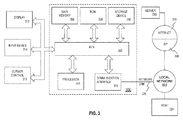
- FIG. 3 is a block diagram of an exemplary computer system 300, consistent with embodiments of the present disclosure.
- the components of system 200 such as provisioning entity analysis system 210, financial service systems 220, geographic data systems 230, provisioning entity management systems 240, and consuming entity data systems 250 may include the architecture based on or similar to that of computer system 300.
- computer system 300 includes a bus 302 or other communication mechanism for communicating information, and one or more hardware processors 304 (denoted as processor 304 for purposes of simplicity) coupled with bus 302 for processing information.
- Hardware processor 304 can be, for example, one or more microprocessors or it can be a reduced instruction set of one or more microprocessors.
- Computer system 300 also includes a main memory 306, such as a random access memory (“RAM”) or other dynamic storage device, coupled to bus 302 for storing information and instructions to be executed by processor 304.
- Main memory 306 also can be used for storing temporary variables or other intermediate information during execution of instructions to be executed by processor 304.
- Such instructions after being stored in non-transitory storage media accessible to processor 304, render computer system 300 into a special-purpose machine that is customized to perform the operations specified in the instructions.
- Computer system 300 further includes a read only memory (“ROM”) 308 or other static storage device coupled to bus 302 for storing static information and instructions for processor 304.
- ROM read only memory
- a storage device 310 such as a magnetic disk, optical disk, or USB thumb drive (Flash drive), etc. is provided and coupled to bus 302 for storing information and instructions.
- Computer system 300 can be coupled via bus 302 to a display 312, such as a cathode ray tube ("CRT"), liquid crystal display, or touch screen, for displaying information to a computer user.
- a display 312 such as a cathode ray tube ("CRT"), liquid crystal display, or touch screen
- cursor control 316 is Another type of user input device, cursor control 316, such as a mouse, a trackball, or cursor direction keys for communicating direction information and command selections to processor 304 and for controlling cursor movement on display 312.
- the input device typically has two degrees of freedom in two axes, a first axis (for example, x) and a second axis (for example, y), that allows the device to specify positions in a plane.
- the same direction information and command selections as cursor control can be implemented via receiving touches on a touch screen without
- Computing system 300 can include a user interface module to implement a graphical user interface that can be stored in a mass storage device as executable software codes that are executed by the one or more computing devices.
- This and other modules can include, by way of example, components, such as software components, object-oriented software components, class components and task components, processes, functions, attributes, procedures, subroutines, segments of program code, drivers, firmware, microcode, circuitry, data, databases, data structures, tables, arrays, and variables.
- module refers to logic embodied in hardware or firmware, or to a collection of software instructions, possibly having entry and exit points, written in a programming language, such as, for example, Java, Lua, C or C++.
- a software module can be compiled and linked into an executable program, installed in a dynamic link library, or written in an interpreted programming language such as, for example, BASIC, Perl, or Python. It will be appreciated that software modules can be callable from other modules or from themselves, and/or can be invoked in response to detected events or interrupts.
- Software modules configured for execution on computing devices can be provided on a computer readable medium, such as a compact disc, digital video disc, flash drive, magnetic disc, or any other tangible medium, or as a digital download (and can be originally stored in a compressed or installable format that requires installation, decompression, or decryption prior to execution).
- a computer readable medium such as a compact disc, digital video disc, flash drive, magnetic disc, or any other tangible medium, or as a digital download (and can be originally stored in a compressed or installable format that requires installation, decompression, or decryption prior to execution).
- Such software code can be stored, partially or fully, on a memory device of the executing computing device, for execution by the computing device.
- Software instructions can be embedded in firmware, such as an EPROM.
- hardware modules can be comprised of connected logic units, such as gates and flip-flops, and/or can be comprised of programmable units, such as programmable gate arrays or processors.
- the modules or computing device functionality described herein are
- Computer system 300 can implement the techniques described herein using customized hard-wired logic, one or more ASICs or FPGAs, firmware and/or program logic which in combination with the computer system causes or programs computer system 300 to be a special-purpose machine. According to some embodiments, the operations, functionalities, and techniques and other features described herein are performed by computer system 300 in response to processor 304 executing one or more sequences of one or more instructions contained in main memory 306. Such instructions can be read into main memory 306 from another storage medium, such as storage device 310. Execution of the sequences of instructions contained in main memory 306 causes processor 304 to perform the process steps described herein. In alternative embodiments, hard-wired circuitry can be used in place of or in combination with software instructions.
- non-transitory media refers to any non-transitory media storing data and/or instructions that cause a machine to operate in a specific fashion.
- Such non-transitory media can comprise non-volatile media and/or volatile media.
- Non-volatile media can include, for example, optical or magnetic disks, such as storage device 310.
- Volatile media can include dynamic memory, such as main memory 306.
- non-transitory media can include, for example, a floppy disk, a flexible disk, hard disk, solid state drive, magnetic tape, or any other magnetic data storage medium, a CD-ROM, any other optical data storage medium, any physical medium with patterns of holes, a RAM, a PROM, and EPROM, a FLASH-EPROM or other forms of flash memory, NVRAM, a register memory, a processor cache, any other memory chip or cartridge, and networked versions of the same.
- Non-transitory media is distinct from, but can be used in conjunction with, transmission media.
- Transmission media can participate in transferring information between storage media.
- transmission media can include coaxial cables, copper wire and fiber optics, including the wires that comprise bus 302.
- transmission media can also take the form of acoustic or light waves, such as those generated during radio-wave and infra-red data communications.
- Various forms of media can be involved in carrying one or more sequences of one or more instructions to processor 304 for execution.
- the instructions can initially be carried on a magnetic disk or solid state drive of a remote computer.
- the remote computer can load the instructions into its dynamic memory and send the instructions over a telephone line using a modem.
- a modem local to computer system 300 can receive the data on the telephone line and use an infra-red transmitter to convert the data to an infra-red signal.
- An infra-red detector can receive the data carried in the infra-red signal and appropriate circuitry can place the data on bus 302.
- Bus 302 carries the data to main memory 306, from which processor 304 retrieves and executes the instructions.
- the instructions received by main memory 306 can optionally be stored on storage device 310 either before or after execution by processor 304.
- Computer system 300 can also include a communication interface 318 coupled to bus 302.
- Communication interface 318 can provide a two-way data communication coupling to a network link 320 that can be connected to a local network 322.
- communication interface 318 can be an integrated services digital network ("ISDN") card, cable modem, satellite modem, or a modem to provide a data communication connection to a corresponding type of telephone line.
- ISDN integrated services digital network
- communication interface 318 can be a local area network (“LAN”) card to provide a data communication connection to a compatible LAN.
- LAN local area network
- Wireless links can also be implemented.
- communication interface 318 can send and receives electrical, electromagnetic or optical signals that carry digital data streams representing various types of information.
- Network link 320 can typically provide data communication through one or more networks to other data devices.
- network link 320 can provide a connection through local network 322 to a host computer 324 or to data equipment operated by an Internet Service Provider ("ISP") 326.
- ISP 326 in turn can provide data communication services through the world wide packet data communication network now commonly referred to as the "Internet" 328.
- Internet 328 can both use electrical, electromagnetic or optical signals that carry digital data streams.
- the signals through the various networks and the signals on network link 320 and through communication interface 318, which carry the digital data to and from computer system 300, can be example forms of transmission media.
- Computer system 300 can send messages and receive data, including program code, through the network(s), network link 320 and communication interface 318.
- a server 330 can transmit a requested code for an application program through Internet 328, ISP 326, local network 322 and communication interface 318.
- the received code can be executed by processor 304 as it is received, and/or stored in storage device 310, or other non-volatile storage for later execution.
- server 330 can provide information for being displayed on a display.
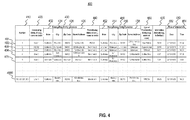
- FIG. 4 is a block diagram of an exemplary data structure 400, consistent with embodiments of the present disclosure.
- Data structure 400 can store data records associated with interactions (also referred to as transactions) involving multiple entities.
- Data structure 400 can be, for example, a database (e.g., database 170) that can store elements of an object model (e.g., object model 160).
- object model e.g., object model 160
- data structure 400 can be a Relational Database Management System (“RDBMS") that stores interaction data as sections of rows of data in relational tables.
- RDBMS can be designed to efficiently return data for an entire row, or record, in as few operations as possible.
- An RDBMS can store data by serializing each row of data of data structure 400. For example, in an RDBMS, data associated with interaction 1 of FIG. 4 can be stored serially such that data associated with all categories of interaction 1 can be accessed in one operation.
- data structure 400 can be a column-oriented database management system that stores data as sections of columns of data rather than rows of data.
- This column-oriented DBMS can have advantages, for example, for data warehouses, customer relationship management systems, and library card catalogs, and other ad hoc inquiry systems where aggregates are computed over large numbers of similar data items.
- a column-oriented DBMS can be more efficient than an RDBMS when an aggregate needs to be computed over many rows but only for a notably smaller subset of all columns of data, because reading that smaller subset of data can be faster than reading all data.
- a column-oriented DBMS can be designed to efficiently return data for an entire column, in as few operations as possible.
- a column-oriented DBMS can store data by serializing each column of data of data structure 400. For example, in a column-oriented DBMS, data associated with a category (e.g., consuming entity identification category 420) can be stored serially such that data associated with that category for all interactions of data structure 400 can be accessed in one
- data structure 400 can comprise data associated with a very large number of interactions associated with multiple entities.
- data structure 400 can include 50 billion or more interactions.
- interactions associated with multiple entities can be referred to as interactions between multiple entities.
- interactions and transactions are intended to convey the same meaning and can be used interchangeably throughout this disclosure. While each interaction of data structure 400 is depicted as a separate row in FIG. 4 , it will be understood that each such interactions can be represented by a column or any other known technique in the art.
- Interaction data can include several categories of information. For example, the several categories can include, number category 410; consuming entity identification category 420; consuming entity location category 430; provisioning entity identification category 440; provisioning entity location category 450; type of provisioning entity category 460; interaction amount category 470; and time of interaction category 480. It will be understood that FIG. 4 is merely exemplary and that data structure 400 can include even more categories of information associated with an interaction.
- Number category 410 can uniquely identify each interaction of data structure 400.
- data structure 400 depicts 50 billion interactions as illustrated by number category 410 of the last row of data structure 400 as 50,000,000,000.
- each row depicting a interactions can be identified by an element number.
- interaction number 1 can be identified by element 401; interaction number 2 can be identified by element 402; and so on such that interaction 50,000,000,000 can be identified by 499B.
- this disclosure is not limited to any number of interactions and further that this disclosure can extend to a data structure with more or fewer than 50 billion interactions. It is also appreciated that number category 410 need not exist in data structure 400.
- Consuming entity identification category 420 can identify a consuming entity.
- consuming entity identification category 420 can represent a name (e.g., User 1 for interaction 401; User N for interaction 499B) of the consuming entity.
- consuming entity identification category 420 can represent a code uniquely identifying the consuming entity (e.g., CE002 for interaction 402).
- the identifiers under the consuming entity identification category 420 can be a credit card number that can identify a person or a family, a social security number that can identify a person, a phone number or a MAC address associated with a cell phone of a user or family, or any other identifier.
- Consuming entity location category 430 can represent location information of the consuming entity.
- consuming entity location category 430 can represent the location information by providing at least one of: a state of residence (e.g., state sub-category 432; California for interaction 401; unknown for interaction 405) of the consuming entity; a city of residence (e.g., city sub-category 434; Palo Alto for interaction 401; unknown for interaction 405) of the consuming entity; a zip code of residence (e.g., zip code sub-category 436; 94304 for interaction 401; unknown for interaction 405) of the consuming entity; and a street address of residence (e.g., street address sub-category 438; 123 Main St. for interaction 401; unknown for interaction 405) of the consuming entity.
- a state of residence e.g., state sub-category 432; California for interaction 401; unknown for interaction 405
- a city of residence e.g., city sub-category 434
- Provisioning entity identification category 440 can identify a provisioning entity (e.g., a merchant or a coffee shop). In some embodiments, provisioning entity identification category 440 can represent a name of the provisioning entity (e.g., Merchant 2 for interaction 402). Alternatively, provisioning entity identification category 440 can represent a code uniquely identifying the provisioning entity (e.g., PE001 for interaction 401). Provisioning entity location category 450 can represent location information of the provisioning entity.
- a provisioning entity e.g., a merchant or a coffee shop.
- provisioning entity identification category 440 can represent a name of the provisioning entity (e.g., Merchant 2 for interaction 402).
- provisioning entity identification category 440 can represent a code uniquely identifying the provisioning entity (e.g., PE001 for interaction 401).
- Provisioning entity location category 450 can represent location information of the provisioning entity.
- provisioning entity location category 450 can represent the location information by providing at least one of: a state where the provisioning entity is located (e.g., state sub-category 452; California for interaction 401; unknown for interaction 402); a city where the provisioning entity is located (e.g., city sub-category 454; Palo Alto for interaction 401; unknown for interaction 402); a zip code where the provisioning entity is located (e.g., zip code sub-category 456; 94304 for interaction 401; unknown for interaction 402); and a street address where the provisioning entity is located (e.g., street address sub-category 458; 234 University Ave. for interaction 401; unknown for interaction 402).
- a state where the provisioning entity is located e.g., state sub-category 452; California for interaction 401; unknown for interaction 402
- a city where the provisioning entity is located e.g., city sub-category 454; Palo Alto for interaction 401;
- Type of provisioning entity category 460 can identify a type of the provisioning entity involved in each interaction.
- type of provisioning entity category 460 of the provisioning entity can be identified by a category name customarily used in the industry (e.g., Gas Station for interaction 401) or by an identification code that can identify a type of the provisioning entity (e.g., TPE123 for interaction 403).
- type of the provisioning entity category 460 can include a merchant category code ("MCC") used by credit card companies to identify any business that accepts one of their credit cards as a form of payment.
- MCC merchant category code
- an MCC can be a four-digit number assigned to a business by credit card companies (e.g., American ExpressTM, MasterCardTM, VISATM) when the business first starts accepting one of their credit cards as a form of payment.
- type of provisioning entity category 460 can further include a sub-category (not shown in FIG. 4 ), for example, type of provisioning entity sub-category 461 that can further identify a particular sub-category of provisioning entity.
- an interaction can comprise a type of provisioning entity category 460 as a hotel and type of provisioning entity sub-category 461 as either a bed and breakfast hotel or a transit hotel. It will be understood that the above-described examples for type of provisioning entity category 460 and type of provisioning entity sub-category 461 are non-limiting and that data structure 400 can include other kinds of such categories and sub-categories associated with an interaction.
- Interaction amount category 470 can represent an amount (e.g., $74.56 for interaction 401) involved in each interaction.
- Time of interaction category 480 can represent a time at which the interaction was executed.
- time of interaction category 480 can be represented by a date (e.g., date sub-category 482; November 23, 2013, for interaction 401) and time of the day (e.g., time sub-category 484; 10:32 AM local time for interaction 401).
- Time sub-category 484 can be represented in either military time or some other format.
- time sub-category 484 can be represented with a local time zone of either provisioning entity location category 450 or consuming entity location category 430.
- interactions data can include categories of information including (not shown in FIG. 4 ), for example, consuming entity loyalty membership category, consuming entity credit card type category, consuming entity age category, consuming entity gender category, consuming entity income category, consuming entity with children category, product information category, and service information category.
- categories of information including (not shown in FIG. 4 ), for example, consuming entity loyalty membership category, consuming entity credit card type category, consuming entity age category, consuming entity gender category, consuming entity income category, consuming entity with children category, product information category, and service information category.
- Consuming entity loyalty membership category can represent whether the consuming entity is part of a loyalty membership program associated with a provisioning entity. For example, consuming entity loyalty membership category can represent that the consuming entity is a member of one of CostcoTM membership programs including Goldstar MemberTM, Executive MemberTM, and Business MemberTM.
- Consuming entity credit card type category can represent the type of credit card used by the consuming entity for a particular interaction. For example, consuming entity credit card type category can indicate that the credit card used by the consuming entity for that particular interaction can be an American ExpressTM, MasterCardTM, VISATM, or DiscoverTM card. In some embodiments, consuming entity credit card type category can represent a kind of MasterCardTM (e.g., Gold MasterCardTM or Platinum MasterCardTM) used for a particular interaction.
- MasterCardTM e.g., Gold MasterCardTM or Platinum MasterCardTM
- consuming entity demographic information can be stored in each interaction.
- consuming entity demographic information can include at least one of: consuming entity age category, consuming entity gender category, consuming entity income category, and consuming entity with children category.
- consuming entity age category can represent age information associated with the consuming entity;
- consuming entity gender category can represent gender information (e.g., Male or Female) associated with the consuming entity;
- consuming entity income category can represent income information (e.g., greater than $100,000 per year) associated with the consuming entity; and consuming entity with children category can represent whether the consuming entity has any children under 18 or not.
- consuming entity with children category can store information representing a number of children associated with the consuming entity.
- Product information category can represent information associated with a product that is involved in an interaction.
- product information category can represent that the product involved in the interaction is a particular type of product based on a stock keeping unit ("SKU") of the product.
- SKU stock keeping unit
- the product's SKU can be unique to a particular provisioning entity involved in that particular interaction.
- product information category can represent the product involved in the interaction with a at least one of a Universal Product Code, International Article Number, Global Trade Item Number, and Australian Product Number.
- Service information category can represent information associated with a service that is involved in an interaction.
- service information category can represent that the service involved in the interaction is a particular type of service based on an SKU of the service. It will be appreciated that an SKU can uniquely represent either a product or a service.
- Some examples of services can be warranties, delivery fees, installation fees, and licenses.
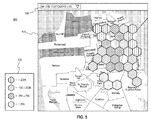
- FIG. 5 is a diagram of an exemplary user interface 500 displaying a map 510 that indicates where consuming entities live, consistent with the embodiments of the present disclosure.
- user interface 500 also comprises a widget 520 and a legend 530.
- interaction data can be used to extract information used to generate user interface 500, which can include map 510 and data-some of which can be located on map 510.
- data can be displayed as one or more geometric shapes, as will be described in more detail below.
- widget 520 allows a user to select an option that causes the user interface 500 to indicate where consuming entities live.
- widgets can be present in user interface 500 to cause user interface 500 to display information associated with interaction data. For instance, widgets such as scroll bars, buttons, plus and minus signs, drop down menus, widgets to zoom in or out, and others can be used to cause user interface 500 (and/or legend 530) to display particular information.
- Some widgets can be used to determine the granularity with which systems described herein are able to show. For example, a user can select criteria that indicates demographics associated with consuming entities.
- legend 530 indicates that hexagons of different shading encompass areas where consuming entities that earn a particular average amount live.
- map 510 appears similar to a heat map (e.g., a map that indicates data by having various shapes of various sizes and colors overlay the map). For instance, average consuming entities within dotted hexagons earn less than $25,000 per year; average consuming entities within criss-crossed hexagons earn between $25,ooo and $75,000 per year; average consuming entities within hexagons with diagonal lines earn between $75,000 and $200,000 per year; and average consuming entities within hexagons with vertical lines earn over $200,000 per year.
- a heat map e.g., a map that indicates data by having various shapes of various sizes and colors overlay the map.
- the average earnings for consuming entities is only one example of the type of information displayed in user interface 500.
- Other examples can include, but are not limited to: an average number of people per household in a particular area; an average amount of income earned in a particular area; an average gender of people in a particular area; an average amount of time spent shopping online in a particular area; an average number of consuming entities with automobiles in a particular area; an average amount that consuming entities in a particular area spend on an average day, week, month, or other period of time; an average amount of growth in population of a particular area; an average number of children in a particular area; an average home price in a particular area; etc.
- widgets 520 can exist that allow a user to modify the information shown in user interface 500. For instance, widgets 520 can allow a user to cause user interface 500 to show on map 510 areas with average consuming entities that make under $100,000 per year and have more than two children. Similarly, user interface 500 can display areas where average consuming entities make over $75,000 per year and spend over $50 on coffee in a given month. As another example, user interface 500 can display areas where average consuming entities spend less than $200 per month on groceries and over $100 on movie tickets on Friday nights in the past year. Multiple filters can be applied to data shown in a map to allow users to view information with a desired amount of granularity.
- Interaction data can be used to derive the information discussed above and create a map 510 with the embodiments of the information discussed above overlaying map 510.
- interaction data can include the amount a consuming entity spends on groceries or gas.
- Such interaction data can be used to estimate, or identify, home and/or work locations of a consuming entity.
- shapes can be used to indicate information associated with interaction data.
- shapes overlay all or portions of map 510 to display information.
- Shapes on a user interface can be transparent, opaque, or semi-transparent. While user interface 500 includes hexagons that contain different types of shading to indicate consuming entity income, any geometric shape can be used to indicate various types of information. For example, squares, circles, triangles, octagons, lines, dots, arrows, curved shapes, polygons, etc., can be used to indicate various types of information. In some embodiments, a different type of shape can be used to indicate a different type of information.
- an area surrounded by a circle can indicate an average income level of consuming entities in the circled area
- an area surrounded by a square can indicate an average amount spent per month by consuming entities in the squared area.
- areas surrounded by triangles can indicate an average number of children in consuming entities' households
- areas surrounded by non-rectangular polygons can indicate an average amount of money spent at grocery stores by consuming entities.
- the shading or color associated with a shape can be indicative of various types of information-which again, can be derived from interaction data.
- dotted hexagons indicate areas with consuming entities that make less than $25,000 per year; criss-crossed hexagons indicate areas with consuming entities that make between $25,000 and $75,000 per year; hexagons with diagonal lines indicate areas with consuming entities that make between $75,000 per year and $200,000 per year; and hexagons with vertical lines indicate areas with consuming entities that make over $200,000 per year.
- shapes with different colors, gradients, patterns, or the like can indicate different information.
- shapes encompassing areas where consuming entities spend over $100 on an average (mean, median, or mode) Friday night can be shaded red
- shapes encompassing areas where consuming entities spend less than $50 on an average Friday night can be shaded orange
- shapes encompassing areas where consuming entities spend less than $20 on an average Friday night can be shaded yellow.
- Similar shapes can be representative of holiday seasons, tourist seasons, weekdays, weekends, or other periods of time.
- embodiments described herein have the ability to remove outlying interactions. For example, a car that was bought on a Friday night may not be included in an average amount of money spent by a particular consuming entity on Friday nights. Similarly, a consuming entity that is a business and makes over $200,000 per year may be calculated different from consuming entities that are not businesses, or not at all, when determining the income of consuming entities in a particular area.
- interaction data and user interfaces can be updated at various intervals.
- interaction data and user interface 500 can be updated every night or week.
- interaction data and maps can be updated in real- or near-real-time.
- interaction data can be stored in a real-time distributed computation environment that supports stream-oriented processing.
- the data can be stored in a data structure using Hadoop's Distributed File System, VerticaTM, or AmazonTM S3.
- the data structure storing the interaction data can be incrementally updated at particular intervals by a data computation system, such as Apache's SparkTM, providing a user with real-time or near real-time information about interaction and/or updates to user interface 500.
- embodiments described herein greatly reduce the time required to compute sets of provisioning and/or consuming entities, user interfaces, and locations where marketing material or new provisioning entities should be placed (e.g., where a new franchise should be placed).
- FIG. 6 is a diagram of an exemplary user interface 600 displaying a map 610.
- user interface 600 indicates where consuming entities spend money.
- User interface 600 includes a widget 620 that can allow a user to select various options, and a legend 630 that can display information.
- Various shapes are shown in user interface 600 that indicate locations and amounts where consuming entities spent money (e.g., where an aggregated amount of sales occurred).
- user interface 600 includes one or more widgets 620 that cause user interface 600 to display particular information.
- some or all information to be displayed on user interface 600 is predetermined, while in others some or all of the information to be displayed is adjustable by a user.
- a user can use different types of widgets to zoom in on map 610, zoom out, show the number of interactions that occurred in a particular area (e.g., an aggregate amount of sales), the amount of money spent in a particular area (e.g., an aggregate amount of money made from sales), the number of provisioning entities in a particular area, the types of provisioning entities in a particular area, the types of credit cards used at stores in a particular area, the time of day, week, month, or year that interactions occur in a particular area, etc.
- a particular area e.g., an aggregate amount of sales
- the amount of money spent in a particular area e.g., an aggregate amount of money made from sales
- the number of provisioning entities in a particular area e.g., the types of provisioning entities in a particular area
- the types of credit cards used at stores in a particular area e.g., the time of day, week, month, or year that interactions occur in a particular area, etc.
- dotted hexagons indicate areas where provisioning entities make less than $20,000 in revenue (or net sales, profits, etc.); criss-crossed hexagons indicate areas where provisioning entities make between $20,000 and $50,000 in revenue; hexagons with diagonal lines indicate areas where provisioning entities make between $50,000 and $100,000 in revenue; and hexagons with vertical lines indicate areas where provisioning entities make over $100,000 in revenue.
- the amounts could vary by day or week, and more or less hexagons could be included in various portions of user interface 600.
- shapes can be used to signify different information. For instance, squares could be used to indicate the number of interactions in a particular region, while circles could be used to indicate the amount spent in the interactions in a particular region.
- various shapes could signify that a particular area contains a particular amount of a particular type of provisioning entity. For instance, octagons can indicate that a particular amount of clothing stores are located in an area where the amount spent at the clothing stores is above a particular threshold. Or, for instance, rectangles can indicate city blocks where particular amount of grocery stores are located compared to the number of consuming entities within that area.
- these are merely examples and many combinations and permutations are possible.
- provisioning entities may be shown, or used to determine a preferred location of a provisioning entity (e.g., a location where a provisioning entity should open a new store).
- FIG. 7 is a diagram of an exemplary user interface 700 displaying a map 710.
- user interface 700 indicates the preferred location of a provisioning entity 740.
- user interface 700 also includes a widget 720 and a legend 730.
- example user interface 700 includes a preferred location of a provisioning entity 740.
- a preferred location of a provisioning entity can include a variety of locations, including, but not limited to: a location where a new store should be opened; a location where a building/store should be renovated; a location where a warehouse should be placed; a location where a kiosk should be placed; a location where a particular type of good should be sold; a location where a store should be closed; a location where a food truck should be parked; a location where an automated teller machine should be placed; a location where a government agency building should be placed; a location where a particular type of provisioning entity should not be placed; etc.
- the preferred location of a provisioning entity 740 is indicated by a star in user interface 700.
- the location of the preferred provisioning entity 740 can be determined by a variety of factors, including factors associated with user interface 700 such as the intersection or overlap of various shapes. For instance, in user interface 700 the preferred location of provisioning entity 740 is at the intersection of three hexagons which indicate that provisioning entities within those areas on average make over $100,000 as indicated by legend 730.
- interaction data can be used to determine the location of various high density housing locations and a preferred location of a provisioning entity 740 may be placed there.
- historical data or data known about the future of a neighborhood can be analyzed to determine a preferred location of a provisioning entity 740.
- the same interaction data used to generate user interface 700 can be used to determine the preferred location of a provisioning entity 740.
- supplemental information can be gathered to user interface 700 and/or the preferred location of a provisioning entity 740.
- interaction data can be used to generate shapes in user interface 700
- interaction data combined with data derived from mobile electronic devices can be used to generate the preferred location of a provisioning entity 740.
- interaction data derived from one or more sources can be used to determine an area of a particular size for a preferred location of provisioning entity 740
- data acquired from mobile phones can indicate a particular street that consuming entities tend to travel on. As such, approaches described herein may indicate that a user should open a restaurant on that particular street within that particular shape on user interface 700.
- FIG. 8 is a diagram of an exemplary user interface 800 displaying a map 810.
- user interface 800 indicates the preferred location of marketing material 840A, 840B, 840C, and 840D (collectively 840), consistent with the embodiments of the present disclosure. Similar to user interface 700, user interface 800 illustrates an example map 810 and shows the location of where consuming entities live as well as a preferred location of marketing material 840.
- Preferred marketing material can encompass a variety of material, including, but not limited to: billboards; signs; television advertisements; radio advertisements; mobile signs; etc.
- supplemental data can be used to determine the preferred location of marketing materials 840.
- mobile device data can be gathered to determine where consuming entities often are.
- approaches herein can determine the preferred location of marketing material 840. For instance, by determining that consuming entities living in an area surrounded by a hexagon with vertical lines often visit a particular store or park based on supplemental data, the overlaid data on map 810 can indicate that a preferred location of marketing material 840 is in the particular store or park.
- supplemental data can include information about a city or traffic.
- supplemental data can indicate that much of a city's traffic enters via a bridge 850.
- the overlaid data on map 810 can indicate a preferred location of marketing material (e.g., 840A).
- FIG. 9 is a flowchart 900 representing an exemplary process for generating a user interface that includes a map, consistent with embodiments of the present disclosure. While the flowchart discloses the following steps in a particular order, it will be appreciated that at least some of the steps can be moved, modified, or deleted where appropriate, consistent with the teachings of the present disclosure.
- the analyzing of the entity performance can be performed in full or in part by a provisioning entity analysis system (e.g., provisioning entity analysis system 210).
- Flowchart 900 starts at step 910 and at step 920 acquires a set of interactions. In some embodiments, the acquired set of interactions can be based on a selection of a particular provisioning entity (e.g., provisioning entity PE001 of FIG. 4 ).
- the interactions can include information associated with a purchase made at a store using a debit or credit card.
- Information associated with interactions also referred to as interaction data or transaction data, can include information such as a consuming entity associated with an interaction, a provisioning entity associated with an interaction, an amount spent, a time of one or more interactions, information associated with previous interactions associated with either a provisioning entity or a consuming entity, the home location of a consuming entity, the work location of a consuming entity, at least one location of a provisioning entity, a Merchant Category Code ("MCC”), etc.
- MCC Merchant Category Code
- supplemental or canonical data can be gathered to gain further insight into spending habits and/or location information associated with consuming and provisioning entities.
- a set of consuming entities is determined from the set of interactions. Since, in various embodiments, each interaction is associated with at least one consuming entity and at least one provisioning entity, a set of interactions is typically associated with more than one consuming entity.
- consuming entities can include, but are not limited to: a person; a household; a business; or any other entity capable of purchasing a good or service.
- the set of consuming entities are entities that were included in interactions from the set of interactions (e.g., a consuming entity included in the set of consuming entities entered into an interaction with at least one provisioning entity associated with the set of interactions).
- a subset of consuming entities can be determined from the interactions.
- the subset may include randomly selected consuming entities.
- the acquired set of interactions is based on a selection of a particular provisioning entity (e.g., provisioning entity PE001 of FIG. 4 )
- the set of consuming entities are those consuming entities interacting with that particular provisioning entity.
- a set of provisioning entities that were included in interactions with the set of consuming entities are determined. Moreover, provisioning entities that entered into interactions with a determined consuming entity in the last 60 days can be determined. As a more general example, after a set of consuming entities is derived based on a set of interactions, the provisioning entities that the consuming entities entered into interactions with are included in the set of provisioning entities. Note that these provisioning entities need not be included in the set of interactions referenced in step 920, but instead these provisioning entities are typically entities that were included in interactions with the set of consuming entities. For example, in the scenario where the consuming entities have been identified based on their interactions with the particular provisioning entity, it can be determined which other provisioning entities that those consuming entities interacted with. For example, in the scenario from FIG. 4 , User 1 (besides interacting with PE001) has also interacted with Merchant 2. Accordingly, Merchant 2 would be part of the determined set of provisioning entities.
- the determined set of provisioning entities can be based a particular period of time.
- the set of provisioning entities can include any provisioning entity included in an interaction with one of the consuming entities of the set of consuming entities in the previous 60 days.
- the set of provisioning entities can be the provisioning entities included in interactions with the set of consuming entities over the last twenty weekends.
- some interactions between provisioning and consuming entities can be filtered based on other parameters. For instance, an interaction may not be included when determining a set of provisioning entities if it occurred further than a particular distance from a particular point (e.g., 100 kilometers away from an area displayed on a map). Similarly, interactions that occur at airports or on cruise ships may similarly be removed from the set of interactions used to determine the set of consuming entities or the set of provisioning entities.
- a user interface is displayed that includes a map and indicates information pertaining to the location of at least one of the determined provisioning entities. For example, from the determined set of provisioning entities, a user interface can display the entire set, or only a portion thereof. In various embodiments, a user interface can display the set of provisioning entities as one or more geometric shapes. Such shapes can indicate various attributes associated with the provisioning entities located within those shapes. For example, the shapes can be shaded or colored to indicate the amount of money a provisioning entity makes; the amount of interactions that occur at the average provisioning entity within the shape; etc. In some embodiments, based on this information, systems and methods described herein can determine the preferred location of a provisioning entity or marketing material (e.g., a location where a new store should be opened or a location where an advertisement should be placed).
- a provisioning entity or marketing material e.g., a location where a new store should be opened or a location where an advertisement should be placed.
Landscapes
- Business, Economics & Management (AREA)
- Engineering & Computer Science (AREA)
- Entrepreneurship & Innovation (AREA)
- Accounting & Taxation (AREA)
- Development Economics (AREA)
- Finance (AREA)
- Strategic Management (AREA)
- Theoretical Computer Science (AREA)
- Physics & Mathematics (AREA)
- General Physics & Mathematics (AREA)
- Marketing (AREA)
- Economics (AREA)
- General Business, Economics & Management (AREA)
- Game Theory and Decision Science (AREA)
- Data Mining & Analysis (AREA)
- Computer Hardware Design (AREA)
- General Engineering & Computer Science (AREA)
- Life Sciences & Earth Sciences (AREA)
- Ecology (AREA)
- Mathematical Physics (AREA)
- Educational Administration (AREA)
- Educational Technology (AREA)
- Management, Administration, Business Operations System, And Electronic Commerce (AREA)
Abstract
Description
- The amount of information being processed and stored is rapidly increasing as technology advances present an ever-increasing ability to generate and store data. This data is commonly stored in computer-based systems in structured data stores. For example, one common type of data store is a so-called "flat" file such as a spreadsheet, plain-text document, or XML document. Another common type of data store is a relational database comprising one or more tables. Other examples of data stores that comprise structured data include, without limitation, files systems, object collections, record collections, arrays, hierarchical trees, linked lists, stacks, and combinations thereof.
- Important information and decisions can be drawn if massive data sets can be analyzed to determine useful information. Collecting, classifying, and processing large sets of data can allow informed decision-making. The manner in which information is collected and classified, however, has become antiquated over time and does not take advantage of the higher processing speeds associated with the "Big Data" era. With advances in multi-tenant environments (e.g., the "cloud"), new techniques previously unthought-of are being designed to efficiently sift through billions of data points to draw new and useful information.
- Reference will now be made to the accompanying drawings, which illustrate exemplary embodiments of the present disclosure and in which:
-
FIG. 1 illustrates, in block diagram form, an exemplary data fusion system for providing interactive location-based data analysis, consistent with embodiments of the present disclosure. -
FIG. 2 is a block diagram of an exemplary system for analyzing performance of an entity, consistent with embodiments of the present disclosure. -
FIG. 3 is a block diagram of an exemplary computer system, consistent with embodiments of the present disclosure. -
FIG. 4 is a block diagram of an exemplary data structure accessed in the process of analyzing entity performance, consistent with the embodiments of the present disclosure. -
FIG. 5 is a diagram of an exemplary user interface displaying a map that indicates where consuming entities live, consistent with the embodiments of the present disclosure. -
FIG. 6 is a diagram of an exemplary user interface displaying a map that indicates where consuming entities spend, consistent with the embodiments of the present disclosure. -
FIG. 7 is a diagram of an exemplary user interface displaying a map indicating a preferred location of a provisioning entity, consistent with the embodiments of the present disclosure. -
FIG. 8 is a diagram of an exemplary user interface displaying a map indicating a preferred location of marketing material, consistent with the embodiments of the present disclosure. -
FIG. 9 is a flowchart representing an exemplary process for generating a user interface that includes a map, consistent with embodiments of the present disclosure. - Reference will now be made in detail to exemplary embodiments, the examples of which are illustrated in the accompanying drawings. Whenever possible, the same reference numbers will be used throughout the drawings to refer to the same or like parts.
-
FIG. 1 illustrates, in block diagram form, an exemplarydata fusion system 100 for providing interactive data analysis, consistent with embodiments of the present disclosure. Among other things,data fusion system 100 facilitates transformation ofgeographic data systems 230 and one or more other data sources, such as data sources 130 (e.g.,financial services systems 220, provisioningentity management systems 240 and/or consumingentity data systems 250, as shown inFIG. 2 ) into anobject model 160 whose semantics are defined by anontology 150. The transformation can be performed for a variety of reasons. For example, a database administrator can import data fromdata sources 130 into adatabase 170 for persistently storingobject model 160. As another example, a data presentation component (not depicted) can transform input data fromdata sources 130 "on the fly" intoobject model 160. Theobject model 160 can then be utilized, in conjunction withontology 150, for analysis through graphs and/or other data visualization techniques. -
Data fusion system 100 comprises adefinition component 110 and atranslation component 120, both implemented by one or more processors of one or more computing devices or systems executing hardware and/or software-based logic for providing various functionality and features of the present disclosure, as described herein. As will be appreciated from the present disclosure,data fusion system 100 can comprise fewer or additional components that provide the various functionalities and features described herein. Moreover, the number and arrangement of the components ofdata fusion system 100 responsible for providing the various functionalities and features described herein can further vary from embodiment to embodiment. -
Definition component 110 generates and/or modifiesontology 150 and aschema map 140. Exemplary embodiments for defining an ontology (such as ontology 150) are described inU.S. Patent No. 7,962,495 (the '495 patent), issued on June 14, 2011. Consistent with certain embodiments disclosed in the '495 patent, a dynamic ontology may be used to create a database. To create a database ontology, one or more object types may be defined, where each object type includes one or more properties. The attributes of object types or property types of the ontology can be edited or modified at any time. And, for each property type, at least one parser definition may be created. The attributes of a parser definition can be edited or modified at any time. - In some embodiments, each property type is declared to be representative of one or more object types. A property type is representative of an object type when the property type is intuitively associated with the object type. Alternatively, each property type has one or more components and a base type. In some embodiments, a property type can comprise a string, a date, a number, or a composite type consisting of two or more string, date, or number elements. Thus, property types are extensible and can represent complex data structures. Further, a parser definition can reference a component of a complex property type as a unit or token.
- An example of a property having multiple components is an Address property having a City component and a State component. An example of raw input data is "Los Angeles, CA." An example parser definition specifies an association of imported input data to object property components as follows: {CITY}, {STATE}→Address:State, Address:City. In some embodiments, the association {CITY}, {STATE} is defined in a parser definition using regular expression symbology. The association {CITY}, {STATE} indicates that a city string followed by a state string, and separated by a comma, comprises valid input data for a property of type Address. In contrast, input data of "Los Angeles CA" would not be valid for the specified parser definition, but a user could create a second parser definition that does match input data of "Los Angeles CA." The definition Address:City, Address:State specifies that matching input data values map to components named "City" and "State" of the Address property. As a result, parsing the input data using the parser definition results in assigning the value "Los Angeles" to the Address: City component of the Address property, and the value "CA" to the Address:State component of the Address property.
- According to some embodiments,
schema map 140 can define how various elements ofschemas 135 fordata sources 130 map to various elements ofontology 150.Definition component 110 receives, calculates, extracts, or otherwise identifiesschemas 135 fordata sources 130.Schemas 135 define the structure ofdata sources 130; for example, the names and other characteristics of tables, files, columns, fields, properties, and so forth.Definition component 110 furthermore optionally identifiessample data 136 fromdata sources 130.Definition component 110 can further identify object type, relationship, and property definitions fromontology 150, if any already exist.Definition component 110 can further identify pre-existing mappings fromschema map 140, if such mappings exist. - Based on the identified information,
definition component 110 can generate a graphical user interface 115, including a map. Graphical user interface 115 can be presented to users of a computing device via any suitable output mechanism (e.g., a display screen, an image projection, etc.), and can further accept input from users of the computing device via any suitable input mechanism (e.g., a keyboard, a mouse, a touch screen interface, etc.). Graphical user interface 115 features a visual workspace that visually depicts representations of the elements ofontology 150 for which mappings are defined inschema map 140. - In some embodiments,
transformation component 120 can be invoked afterschema map 140 andontology 150 have been defined or redefined.Transformation component 120 identifiesschema map 140 andontology 150.Transformation component 120 furtherreads data sources 130 and identifiesschemas 135 fordata sources 130. For each element ofontology 150 described inschema map 140,transformation component 120 iterates through some or all of the data items ofdata sources 130, generating elements ofobject model 160 in the manner specified byschema map 140. In some embodiments,transformation component 120 can store a representation of each generated element ofobject model 160 in adatabase 170. In some embodiments,transformation component 120 is further configured to synchronize changes inobject model 160 back todata sources 130. -
Data sources 130 can be one or more sources of data, including, without limitation, spreadsheet files, databases, email folders, document collections, media collections, contact directories, and so forth.Data sources 130 can include data structures stored persistently in non-volatile memory.Data sources 130 can also or alternatively include temporary data structures generated from underlying data sources via data extraction components, such as a result set returned from a database server executing a database query. -
Schema map 140,ontology 150, andschemas 135 can be stored in any suitable structures, such as XML files, database tables, and so forth. In some embodiments,ontology 150 is maintained persistently.Schema map 140 can or cannot be maintained persistently, depending on whether the transformation process is perpetual or a one-time event.Schemas 135 need not be maintained in persistent memory, but can be cached for optimization. -
Object model 160 comprises collections of elements such as typed objects, properties, and relationships. The collections can be structured in any suitable manner. In some embodiments, adatabase 170 stores the elements ofobject model 160, or representations thereof. Alternatively, the elements ofobject model 160 are stored withindatabase 170 in a different underlying format, such as in a series of object, property, and relationship tables in a relational database. - According to some embodiments, the functionalities, techniques, and components described herein are implemented by one or more special-purpose computing devices. The special-purpose computing devices can be hard-wired to perform the techniques, or can include digital electronic devices such as one or more application-specific integrated circuits ("ASICs") or field programmable gate arrays ("FPGAs") that are persistently programmed to perform the techniques, or can include one or more hardware processors programmed to perform the techniques pursuant to program instructions in firmware, memory, other storage, or a combination. Such special-purpose computing devices can also combine custom hard-wired logic, ASICs, or FPGAs with custom programming to accomplish the techniques. The special-purpose computing devices can be desktop computer systems, portable computer systems, handheld devices, networking devices, or any other device that incorporates hard-wired and/or program logic to implement the techniques.
- Throughout this disclosure, reference will be made to an entity such as, for example, a provisioning entity and a consuming entity. It will be understood that a provisioning entity can include, for example, an advertiser, a person committing a crime, a merchant, an Internet Service Provider, a telecommunications company, a retail provisioning entity or the like, and a consuming entity can include, for example, a victim of a crime, a viewer of a website, a user sending messages, a consumer user buying products or services from a provisioning entity, etc. It will be understood that a consuming entity can represent either individual persons or can represent a group of persons (e.g., a group of persons living under one roof as part of a family). In some embodiments, a consuming entity can be a credit card number of an individual or a credit card number for an entire family sharing one credit card. It will also be understood that a provisioning entity can represent either the entity itself or individual persons involved with the entity.
- In embodiments described herein,
data fusion system 100 can provide a provisioning entity, such as a telecommunications company or retail provisioning entity, to analyze information to identify behaviors to allow that provisioning entity to make more informed decisions. Such information can allow entities, such as a retail provisioning entity, to determine a preferred location of a provisioning entity (e.g., where to place their retail locations). Similarly, a telecommunications company may know where to place advertisements. As another example, a police department may know where to station additional police units. Provisioning entities having more than one location (e.g., police stations, or a merchant with a chain store or a franchise model) typically evaluate the performance of their locations and may adjust their operations, business models, or work flows when the locations either under-perform or are under-utilized. Typically, provisioning entities evaluate the performance of their locations based on period-to-period metrics. For example, a provisioning entity can evaluate a website's performance by comparing a current month's user views to the user views of a previous month. Similarly, a provisioning entity can evaluate a location's performance by comparing the current month's sales to the previous month's sales. In addition, provisioning entitles can evaluate each of its locations' performance using comparative analysis. For example, a provisioning entity (e.g., a city's police department) might compare the amount and type of crimes occurring in a first location with an amount and type of crimes occurring in a second location. As another example, a provisioning entity (e.g., a restaurant) might compare the sales at an area location with the sales at a second location. As provisioning entities generally measure the performance of its locations based on their own interaction data (e.g., the entity's sales across some or all of its locations), some methods of measuring performance do not consider sales made by competitors or demographic features of the areas of the provisioning entity's locations. - In some embodiments, since some performance evaluation methods do not consider the sales of competitors or the demographic features of the region of the provisioning entity location, measured performance may not represent the true performance of a provisioning entity. For instance, although a provisioning entity in a particular demographic location, for example a location in a low consumer spend capacity area, might have less sales than a provisioning entity location in a high consumer spend capacity area, it may be performing better than what could be expected for that area in light of, for example, the low number of consumers residing in the area or the low income of the area. Similarly, a crime rate or type of crime might be higher or lower in a particular area. Moreover, website views can be higher or lower in a given area for a variety of reasons. In some embodiments, a performance of a provisioning entity at an area location can be adversely impacted by the close proximity of a second location of the provisioning entity, but the provisioning entity at the area location can be performing better than expected given the competition from the provisioning entity's second location. Conversely, while a provisioning entity location in a dense, high-income area might have the highest sales of all provisioning entity locations, it can still be under-performing because, for instance, consumer spend capacity is high and the provisioning entity location could generate more sales.
- Consistent with embodiments of the present disclosure, the performance of provisioning entities can be analyzed based on how the provisioning entity is expected to perform given the location of the provisioning entity. For a given provisioning entity location, the disclosed embodiments may be implemented to consider, for example, consumer demographic features of the provisioning entity location's area and/or the proximity of competitors to the provisioning entity location (including the proximity of the provisioning entity's other close-by locations). In some embodiments, the provisioning entity can be a merchant. For purposes of illustration, exemplary embodiments for analyzing entity performance may be described herein with reference to "merchants." The exemplary embodiments and techniques described herein, however, may be applied to other types of entities (e.g., service providers, governmental agencies, etc.) within the spirit and scope of this disclosure.
- Generally, embodiments of the invention relate to determining information associated with interactions. In some embodiments, the information determined based on various interactions can be used to generate additional information that can be displayed with user interfaces that can include maps and/or information overlaying maps. Types of interactions from which information overlaying a map can be derived include, e.g., telephone calls made or received, messages sent or received, viewing an advertisement, viewing a video, accessing a website, making a purchase at a brick-and-mortar store, making a purchase online, shipping or receiving an object, the occurrence of a crime, the arrival of a vehicle, the starting of an engine, etc. Large sets of interaction data (e.g., data associated with interactions) may be filtered according to selectable criteria to provide, for example, information associated with interactions including a particular entity (e.g., a provisioning entity such an advertiser or merchant, or a consuming entity such as a customer). Such selectable criteria can include an amount times that calls messages were sent, addresses of entities that messages were sent to, time spent on a website, a type of crime committed, demographic information about an area where a crime was committed, amounts spent at a particular location, times of purchases, time spent between purchases, types of merchants associated with purchase, demographics associated with a purchaser, purchaser identity, a type of vehicle involved in an interaction, demographics associated with a location of a merchant, types of devices located at or near the location where an interaction occurred, Merchant Category Codes ("MCCs"), types of products purchased, etc. In addition, interaction data, or selectable criteria based on interaction data, may be expressed on a map.
- In some embodiments, interaction data is acquired from one or more sources such as a government agency, a news source, financial institution, a provisioning entity, a third-party processer, a card network, a review website, etc. Each interaction can include a consuming entity and a provisioning entity. After interaction data is acquired, a consuming entity associated with the interaction data can be determined. After a consuming entity is determined, a set of provisioning entities can be determined that were included in interactions with the consuming entity. For example, the set of provisioning entities may include all of the provisioning entities that the consuming entity made a phone call to or a purchase at during the last sixty days. After a set of provisioning entities is determined, interaction data can be displayed on a map that indicates the location of at least some of the provisioning entities in the set of provisioning entities. In some examples, interaction data associated with more than one consuming entity can be determined (e.g., interactions made by a set of consuming entities over the past 60 days can be determined).
- In some examples, interaction data expressed on a map can include the locations of the set of provisioning entities within a particular distance from a particular location. For example, the interaction data expressed on a map can include the locations of stores or crimes within a particular city. In some examples, interaction data expressed on a map can include the set of provisioning entities where interactions occurred within the last week, over the last weekend, on the previous five Friday nights, etc. In some embodiments, interaction data expressed on a map can include a set of provisioning entities associated with a particular ratio (e.g., crimes to police units, amounts spent to amounts received, number of consuming entities to amounts spent, number of consuming entities to number of websites viewed, etc.). Selectable criteria, as discussed above, can also be used to express interaction data on a map. For instance, criteria associated with interaction data such as the location of a crime, a consuming entity's home, or a consuming entity's place of employment can be expressed on a map.
- Interaction data expressed on a map can indicate the locations of provisioning entities, consuming entities, and other information in a variety of ways. For example, interaction data expressed on a map can indicate locations (or other information associated with the interaction data) using geometric shapes that can overlay a map. A geometric shape such as a hexagon or circle can be used to indicate the location of a provisioning entity, an amount of provisioning entities within a particular area, an aggregate number of crimes, types of crimes, an amount of webpages accessed by a particular type of phone and/or a particular telecommunications company, an aggregate amount of sales (e.g., an amount of money spent) within a particular area, a number of advertisements in a particular area, a number of employees at a particular location, an average amount of income paid by stores at a particular location, an amount of consuming entities within a particular area, the demographics (e.g., an average amount of household income or spending capacity) associated with consuming entities in a particular area, etc. Such shapes can be placed at a location on a map based on a geo-hash.
- In addition, interaction data expressed on a map can be used to indicate the preferred location of a new police station, a new cellular phone tower, marketing material or the preferred location of a provisioning entity. For example, an indication for a preferred location of a new police station can be displayed on a map based on interaction data that includes crimes. Similarly, an indication of a preferred location of marketing material (e.g., an estimated most effective place to display marketing material) can be displayed on a map based on interaction data that includes where consuming entities live and conduct interactions. Similarly, an indication of a preferred location of a provisioning entity (e.g., a location (estimated or otherwise) where a new provisioning entity such as communications equipment should be placed) can be displayed on a map based on interaction data.
- In various embodiments described herein, a preferred location of marketing material, a preferred location of a provisioning entity, etc., can be determined based on interaction data used to create geometric shapes. For example, data that causes circles to appear on a map and overlap can also be used to determine a preferred location of a provisioning entity (e.g., the area where the circles overlap). Embodiments described herein reduce processing power, and network throughput by efficiently processing data in various manners such as by associating shapes with data. Further, they allow a user to view additional information on a user interface, thereby saving display real estate, without needing to switch between a plurality of programs, for example.
-
FIG. 2 is a block diagram of anexemplary system 200 for performing one or more operations for analyzing performance of a provisioning entity and/or a consuming entity, consistent with disclosed embodiments. In some embodiments, the provisioning entity is a merchant andsystem 200 can include provisioningentity analysis system 210, one or morefinancial services systems 220, one or moregeographic data systems 230, one or more provisioningentity management systems 240, and one or more consumingentity data systems 250. The components and arrangement of the components included insystem 200 can vary depending on the embodiment. For example, a component used by police or other government agencies may be included. Further, for example, the functionality described below with respect tofinancial services systems 220 can be embodied in consumingentity data systems 250, or vice-versa. Thus,system 200 can include fewer or additional components that perform or assist in the performance of one or more processes to analyze provisioning entity's, consistent with the disclosed embodiments. - One or more components of
system 200 can be computing systems configured to analyze provisioning entity performance. As further described herein, components ofsystem 200 can include one or more computing devices (e.g., computer(s), server(s), etc.), memory storing data and/or software instructions (e.g., database(s), memory devices, etc.), and other appropriate computing components. In some embodiments, the one or more computing devices are configured to execute software or a set of programmable instructions stored on one or more memory devices to perform one or more operations, consistent with the disclosed embodiments. Components ofsystem 200 can be configured to communicate with one or more other components ofsystem 200, including provisioningentity analysis system 210, one or morefinancial services systems 220, one or moregeographic data systems 230, one or more provisioningentity management systems 240, and one or moreconsumer data systems 250. In certain aspects, users can operate one or more components ofsystem 200. The one or more users can be employees of, or associated with, the entity corresponding to the respective component(s) (e.g., someone authorized to use the underlying computing systems or otherwise act on behalf of the entity). - Provisioning
entity analysis system 210 can be a computing system configured to analyze provisioning entity performance. For example, provisioningentity analysis system 210 can be a computer system configured to execute software or a set of programmable instructions that collect or receive interaction data (which can include financial interaction data, consumer data, and provisioning entity data) and process it to determine the actual interaction amount of each interaction associated with the provisioning entity. Provisioningentity analysis system 210 can be configured, in some embodiments, to utilize, include, or be a data fusion system 100 (see, e.g.,FIG. 1 ) to transform data from various data sources (such as,financial services systems 220,geographic data systems 230, provisioningentity management systems 240, and consuming entity data systems 250) for processing. In some embodiments, provisioningentity analysis system 210 can be implemented using acomputer system 300, as shown inFIG. 3 and described below. - Provisioning
entity analysis system 210 can include one or more computing devices (e.g., server(s)), memory storing data and/or software instructions (e.g., database(s), memory devices, etc.) and other known computing components. According to some embodiments, provisioningentity analysis system 210 can include one or more networked computers that execute processing in parallel or use a distributed computing architecture. Provisioningentity analysis system 210 can be configured to communicate with one or more components ofsystem 200, and it can be configured to provide analysis of provisioning entities via an interface(s) accessible by users over a network (e.g., the Internet). For example, provisioningentity analysis system 210 can include a web server that hosts a web page accessible throughnetwork 260 by provisioningentity management systems 240. In some embodiments, provisioningentity analysis system 210 can include an application server configured to provide data to one or more client applications executing on computing systems connected to provisioningentity analysis system 210 vianetwork 260. Such client applications can be used to generate and/or display a map. - In some embodiments, provisioning
entity analysis system 210 can be configured to determine the a number of crimes or the sales associated with a provisioning entity or specific provisioning entity location by processing and analyzing data collected from one or more components ofsystem 200. For example, provisioningentity analysis system 210 can determine that the Big Box Merchant store located at 123 Main St, in Burbank, CA is actually generating $60,000 of sales per month. Provisioningentity analysis system 210 can provide an analysis of a provisioning entity or provisioning entity location's performance based on a target for sales and the actual sales for the provisioning entity or provisioning entity location. For example, for the Big Box Merchant store located at 123 Main St., Burbank, CA, the provisioningentity analysis system 210 can provide an analysis that the store is performing above expectations. - Provisioning
entity analysis system 210 can, in some embodiments, generate a user interface communicating data related to one or more provisioning entities or provisioning entity locations. For example, in some embodiments, provisioningentity analysis system 210 includes a web server that generates HTML code, or scripts capable of generating HTML code, that can be displayed in a web browser executing on computing device. Provisioningentity analysis system 210 can also execute an application server that provides user interface objects to a client application executing on a computing device, or it can provide data that is capable of being displayed in a user interface in a client application executing on a computing device. In some embodiments, provisioningentity analysis system 210 can generate user interfaces that can be displayed within another user interface. For example, provisioningentity analysis system 210 can generate a user interface for display within a parent user interface that is part of an application that displays maps, a word processing application, a presentation development application, a web browser, or an illustration application, among others. In some embodiments, generating a user interface can include generating the code that when executed displays information (e.g., HTML) on the user interface. Alternatively, generating a user interface can include providing commands and/or data to a set of instructions that when executed render a user interface capable of being shown on a display connected to a computing device. In some embodiments, the user interface can include a map, indications of the provisioning entity locations on a map, and indications of the sales or interactions associated with the provisioning entity locations. - Referring again to
FIG. 2 ,financial services system 220 can be a computing system associated with a financial service provider, such as a bank, credit card issuer, credit bureau, credit agency, or other entity that generates, provides, manages, and/or maintains financial service accounts for one or more users. It should be appreciated that these entities can also include data sources that provide interaction data.Financial services system 220 can generate, maintain, store, provide, and/or process financial data associated with one or more financial service accounts. Financial data can include, for example, financial service account data, such as financial service account identification data, account balance, available credit, existing fees, reward points, user profile information, and financial service account interaction data, such as interaction dates, interaction amounts, interaction types, and locations of interactions. Note that the term interaction may be used interchangeably with the term transaction herein. In some embodiments, each interaction including financial data can include several categories of information associated with an interaction. For example, each interaction can include categories such as number category; consuming entity identification category; consuming entity location category; provisioning entity identification category; provisioning entity location category; type of provisioning entity category; interaction amount category; and time of interaction category, as described inFIG. 4 . It will be appreciated that financial data can comprise either additional or fewer categories than the exemplary categories listed above.Financial services system 220 can include infrastructure and components that are configured to generate and/or provide financial service accounts such as credit card accounts, checking accounts, savings account, debit card accounts, loyalty or reward programs, lines of credit, and the like. -
Geographic data systems 230 can include one or more computing devices configured to provide geographic data to other computing systems insystem 200 such as provisioningentity analysis system 210. For example,geographic data systems 230 can provide geodetic coordinates when provided with a street address of vice-versa. In some embodiments,geographic data systems 230 exposes an application programming interface ("API") including one or more methods or functions that can be called remotely over a network, such asnetwork 260. According to some embodiments,geographic data systems 230 can provide information concerning routes between two geographic points. For example, provisioningentity analysis system 210 can provide two addresses andgeographic data systems 230 can provide, in response, the aerial distance between the two addresses, the distance between the two addresses using roads, and/or a suggested route between the two addresses and the route's distance. - According to some embodiments,
geographic data systems 230 can also provide map data to provisioningentity analysis system 210 and/or other components of system 200 (such asuser interface 500 ofFIG. 5 ,user interface 600 ofFIG. 6 ,user interface 700 ofFig. 7 , oruser interface 800 ofFig. 8 ). The map data can include, for example, satellite or overhead images of a geographic region or a graphic representing a geographic region. The map data can also include points of interest, such as landmarks, malls, shopping centers, schools, or popular restaurants or retailers, for example. - Provisioning
entity management systems 240 can be one or more computing devices configured to perform one or more operations consistent with disclosed embodiments. For example, provisioningentity management systems 240 can be a desktop computer, a laptop, a server, a mobile device (e.g., tablet, smart phone, etc.), or any other type of computing device configured to request provisioning entity analysis from provisioningentity analysis system 210. According to some embodiments, provisioningentity management systems 240 can comprise a network-enabled computing device operably connected to one or more other presentation devices, which can themselves constitute a computing system. For example, provisioningentity management systems 240 can be connected to a mobile device, telephone, laptop, tablet, or other computing device. - Provisioning
entity management systems 240 can include one or more processors configured to execute software instructions stored in memory. Provisioningentity management systems 240 can include software or a set of programmable instructions that when executed by a processor performs known Internet-related communication and content presentation processes. For example, provisioningentity management systems 240 can execute software or a set of instructions that generates and displays interfaces and/or content on a presentation device included in, or connected to, provisioningentity management systems 240. In some embodiments, provisioningentity management systems 240 can be a mobile device that executes mobile device applications and/or mobile device communication software that allows provisioningentity management systems 240 to communicate with components ofsystem 200 overnetwork 260. The disclosed embodiments are not limited to any particular configuration of provisioningentity management systems 240. - Provisioning
entity management systems 240 can be one or more computing systems associated with a provisioning entity that provides services (e.g., a law firm, a police station, a banker, a school, utility company, insurance company, financial service provider, automobile repair services, movie theater, etc.). In some embodiments, provisioningentity management systems 240 can be one or more computing systems associated with a provisioning entity that provides products (e.g., goods and/or services), such as a restaurant (e.g., Outback Steakhouse®, Burger King®, etc.), retailer (e.g., Amazon.com®, Target®, etc.), grocery store, mall, or a shopping center. Further, in some embodiments a provisioning entity can be one or more computing systems associated with a non-profit organization (ACLU™, AARP®, etc.) or any other type of entity that provides goods, services, and/or information that consuming entities (i.e., end-users or other business entities) can purchase, consume, use, etc. For ease of discussion, the exemplary embodiments presented herein relate to interactions (e.g., purchases) involving goods from retail provisioning entity systems. Provisioningentity management systems 240, however, is not limited to systems associated with retail provisioning entities that conduct business in any particular industry or field. - Provisioning
entity management systems 240 can be associated with computer systems installed and used at a brick and mortar provisioning entity locations where a consumer can physically visit and purchase goods and services. Such locations can include computing devices that perform financial service interactions with consumers (e.g., Point of Sale ("POS") terminal(s), kiosks, tablet computers, mobile phones, etc.). Provisioningentity management systems 240 can also include back- and/or front-end computing components that store data and execute software or a set of instructions to perform operations consistent with disclosed embodiments, such as computers that are operated by employees of the provisioning entity (e.g., back office systems, etc.). Provisioningentity management systems 240 can also be associated with a provisioning entity that provides goods and/or service via known online or e-commerce types of solutions. For example, such a provisioning entity can sell products via a website using known online or e-commerce systems and solutions to market, sell, and process online interactions. Provisioningentity management systems 240 can include one or more servers that are configured to execute stored software or a set of instructions to perform operations associated with a provisioning entity, including one or more processes associated with processing purchase interactions, generating interaction data, generating product data (e.g., SKU data) relating to interactions, for example. - Consuming
entity data systems 250 can include one or more computing devices configured to provide demographic data regarding consumers. For example, consumingentity data systems 250 can provide information regarding the name, address, gender, income level, age, email address, or other information about consumers. Consuming entity data (as well as any interaction data) may be converted using a hash. Consumingentity data systems 250 can include public computing systems such as computing systems affiliated with the U.S. Bureau of the Census, the U.S. Bureau of Labor Statistics, or FedStats, or it can include private computing systems such as computing systems affiliated with financial institutions, credit bureaus, social media sites, marketing services, or some other organization that collects and/or provides demographic data. -
Network 260 can be any type of network or combination of networks configured to provide electronic communications between components ofsystem 200. For example,network 260 can be any type of network (including infrastructure) that provides communications, exchanges information, and/or facilitates the exchange of information, such as the Internet, a Local Area Network, or other suitable connection(s) that enables the sending and receiving of information between the components ofsystem 200.Network 260 may also comprise any combination of wired and wireless networks. In other embodiments, one or more components ofsystem 200 can communicate directly through a dedicated communication link(s), such as links between provisioningentity analysis system 210,financial services system 220,geographic data systems 230, provisioningentity management systems 240, and consumingentity data systems 250. - As noted above, provisioning
entity analysis system 210 can include a data fusion system (e.g., data fusion system 100) for organizing data received from one or more of the components ofsystem 200. -
FIG. 3 is a block diagram of anexemplary computer system 300, consistent with embodiments of the present disclosure. The components ofsystem 200 such as provisioningentity analysis system 210,financial service systems 220,geographic data systems 230, provisioningentity management systems 240, and consumingentity data systems 250 may include the architecture based on or similar to that ofcomputer system 300. - As illustrated in
FIG. 3 ,computer system 300 includes abus 302 or other communication mechanism for communicating information, and one or more hardware processors 304 (denoted asprocessor 304 for purposes of simplicity) coupled withbus 302 for processing information.Hardware processor 304 can be, for example, one or more microprocessors or it can be a reduced instruction set of one or more microprocessors. -
Computer system 300 also includes amain memory 306, such as a random access memory ("RAM") or other dynamic storage device, coupled tobus 302 for storing information and instructions to be executed byprocessor 304.Main memory 306 also can be used for storing temporary variables or other intermediate information during execution of instructions to be executed byprocessor 304. Such instructions, after being stored in non-transitory storage media accessible toprocessor 304, rendercomputer system 300 into a special-purpose machine that is customized to perform the operations specified in the instructions. -
Computer system 300 further includes a read only memory ("ROM") 308 or other static storage device coupled tobus 302 for storing static information and instructions forprocessor 304. Astorage device 310, such as a magnetic disk, optical disk, or USB thumb drive (Flash drive), etc. is provided and coupled tobus 302 for storing information and instructions. -
Computer system 300 can be coupled viabus 302 to adisplay 312, such as a cathode ray tube ("CRT"), liquid crystal display, or touch screen, for displaying information to a computer user. Aninput device 314, including alphanumeric and other keys, is coupled tobus 302 for communicating information and command selections toprocessor 304. Another type of user input device iscursor control 316, such as a mouse, a trackball, or cursor direction keys for communicating direction information and command selections toprocessor 304 and for controlling cursor movement ondisplay 312. The input device typically has two degrees of freedom in two axes, a first axis (for example, x) and a second axis (for example, y), that allows the device to specify positions in a plane. In some embodiments, the same direction information and command selections as cursor control can be implemented via receiving touches on a touch screen without a cursor. -
Computing system 300 can include a user interface module to implement a graphical user interface that can be stored in a mass storage device as executable software codes that are executed by the one or more computing devices. This and other modules can include, by way of example, components, such as software components, object-oriented software components, class components and task components, processes, functions, attributes, procedures, subroutines, segments of program code, drivers, firmware, microcode, circuitry, data, databases, data structures, tables, arrays, and variables. - In general, the word "module," as used herein, refers to logic embodied in hardware or firmware, or to a collection of software instructions, possibly having entry and exit points, written in a programming language, such as, for example, Java, Lua, C or C++. A software module can be compiled and linked into an executable program, installed in a dynamic link library, or written in an interpreted programming language such as, for example, BASIC, Perl, or Python. It will be appreciated that software modules can be callable from other modules or from themselves, and/or can be invoked in response to detected events or interrupts. Software modules configured for execution on computing devices can be provided on a computer readable medium, such as a compact disc, digital video disc, flash drive, magnetic disc, or any other tangible medium, or as a digital download (and can be originally stored in a compressed or installable format that requires installation, decompression, or decryption prior to execution). Such software code can be stored, partially or fully, on a memory device of the executing computing device, for execution by the computing device. Software instructions can be embedded in firmware, such as an EPROM. It will be further appreciated that hardware modules can be comprised of connected logic units, such as gates and flip-flops, and/or can be comprised of programmable units, such as programmable gate arrays or processors. The modules or computing device functionality described herein are preferably implemented as software modules, but can be represented in hardware or firmware. Generally, the modules described herein refer to logical modules that can be combined with other modules or divided into sub-modules despite their physical organization or storage.
-
Computer system 300 can implement the techniques described herein using customized hard-wired logic, one or more ASICs or FPGAs, firmware and/or program logic which in combination with the computer system causes orprograms computer system 300 to be a special-purpose machine. According to some embodiments, the operations, functionalities, and techniques and other features described herein are performed bycomputer system 300 in response toprocessor 304 executing one or more sequences of one or more instructions contained inmain memory 306. Such instructions can be read intomain memory 306 from another storage medium, such asstorage device 310. Execution of the sequences of instructions contained inmain memory 306 causesprocessor 304 to perform the process steps described herein. In alternative embodiments, hard-wired circuitry can be used in place of or in combination with software instructions. - The term "non-transitory media" as used herein refers to any non-transitory media storing data and/or instructions that cause a machine to operate in a specific fashion. Such non-transitory media can comprise non-volatile media and/or volatile media. Non-volatile media can include, for example, optical or magnetic disks, such as
storage device 310. Volatile media can include dynamic memory, such asmain memory 306. Common forms of non-transitory media can include, for example, a floppy disk, a flexible disk, hard disk, solid state drive, magnetic tape, or any other magnetic data storage medium, a CD-ROM, any other optical data storage medium, any physical medium with patterns of holes, a RAM, a PROM, and EPROM, a FLASH-EPROM or other forms of flash memory, NVRAM, a register memory, a processor cache, any other memory chip or cartridge, and networked versions of the same. - Non-transitory media is distinct from, but can be used in conjunction with, transmission media. Transmission media can participate in transferring information between storage media. For example, transmission media can include coaxial cables, copper wire and fiber optics, including the wires that comprise
bus 302. Transmission media can also take the form of acoustic or light waves, such as those generated during radio-wave and infra-red data communications. - Various forms of media can be involved in carrying one or more sequences of one or more instructions to
processor 304 for execution. For example, the instructions can initially be carried on a magnetic disk or solid state drive of a remote computer. The remote computer can load the instructions into its dynamic memory and send the instructions over a telephone line using a modem. A modem local tocomputer system 300 can receive the data on the telephone line and use an infra-red transmitter to convert the data to an infra-red signal. An infra-red detector can receive the data carried in the infra-red signal and appropriate circuitry can place the data onbus 302.Bus 302 carries the data tomain memory 306, from whichprocessor 304 retrieves and executes the instructions. The instructions received bymain memory 306 can optionally be stored onstorage device 310 either before or after execution byprocessor 304. -
Computer system 300 can also include acommunication interface 318 coupled tobus 302.Communication interface 318 can provide a two-way data communication coupling to anetwork link 320 that can be connected to alocal network 322. For example,communication interface 318 can be an integrated services digital network ("ISDN") card, cable modem, satellite modem, or a modem to provide a data communication connection to a corresponding type of telephone line. As another example,communication interface 318 can be a local area network ("LAN") card to provide a data communication connection to a compatible LAN. Wireless links can also be implemented. In any such implementation,communication interface 318 can send and receives electrical, electromagnetic or optical signals that carry digital data streams representing various types of information. - Network link 320 can typically provide data communication through one or more networks to other data devices. For example, network link 320 can provide a connection through
local network 322 to ahost computer 324 or to data equipment operated by an Internet Service Provider ("ISP") 326.ISP 326 in turn can provide data communication services through the world wide packet data communication network now commonly referred to as the "Internet" 328.Local network 322 andInternet 328 can both use electrical, electromagnetic or optical signals that carry digital data streams. The signals through the various networks and the signals onnetwork link 320 and throughcommunication interface 318, which carry the digital data to and fromcomputer system 300, can be example forms of transmission media. -
Computer system 300 can send messages and receive data, including program code, through the network(s),network link 320 andcommunication interface 318. In the Internet example, aserver 330 can transmit a requested code for an application program throughInternet 328,ISP 326,local network 322 andcommunication interface 318. The received code can be executed byprocessor 304 as it is received, and/or stored instorage device 310, or other non-volatile storage for later execution. In some embodiments,server 330 can provide information for being displayed on a display. -
FIG. 4 is a block diagram of anexemplary data structure 400, consistent with embodiments of the present disclosure.Data structure 400 can store data records associated with interactions (also referred to as transactions) involving multiple entities.Data structure 400 can be, for example, a database (e.g., database 170) that can store elements of an object model (e.g., object model 160). In some embodiments,data structure 400 can be a Relational Database Management System ("RDBMS") that stores interaction data as sections of rows of data in relational tables. An RDBMS can be designed to efficiently return data for an entire row, or record, in as few operations as possible. An RDBMS can store data by serializing each row of data ofdata structure 400. For example, in an RDBMS, data associated withinteraction 1 ofFIG. 4 can be stored serially such that data associated with all categories ofinteraction 1 can be accessed in one operation. - Alternatively,
data structure 400 can be a column-oriented database management system that stores data as sections of columns of data rather than rows of data. This column-oriented DBMS can have advantages, for example, for data warehouses, customer relationship management systems, and library card catalogs, and other ad hoc inquiry systems where aggregates are computed over large numbers of similar data items. A column-oriented DBMS can be more efficient than an RDBMS when an aggregate needs to be computed over many rows but only for a notably smaller subset of all columns of data, because reading that smaller subset of data can be faster than reading all data. A column-oriented DBMS can be designed to efficiently return data for an entire column, in as few operations as possible. A column-oriented DBMS can store data by serializing each column of data ofdata structure 400. For example, in a column-oriented DBMS, data associated with a category (e.g., consuming entity identification category 420) can be stored serially such that data associated with that category for all interactions ofdata structure 400 can be accessed in one operation. - As shown in
FIG. 4 ,data structure 400 can comprise data associated with a very large number of interactions associated with multiple entities. For example,data structure 400 can include 50 billion or more interactions. Prior to technological advances associated with network speeds, processing power, and memory, prior art systems did not envision the ability to perform processes associated with such a high volume of interactions. Solutions described herein are much more efficient. Solutions herein can determine meaningful information in a much more streamlined manner than prior art solutions. - In some embodiments, interactions associated with multiple entities can be referred to as interactions between multiple entities. Where appropriate, the terms interactions and transactions are intended to convey the same meaning and can be used interchangeably throughout this disclosure. While each interaction of
data structure 400 is depicted as a separate row inFIG. 4 , it will be understood that each such interactions can be represented by a column or any other known technique in the art. Interaction data can include several categories of information. For example, the several categories can include,number category 410; consumingentity identification category 420; consumingentity location category 430; provisioningentity identification category 440; provisioningentity location category 450; type ofprovisioning entity category 460;interaction amount category 470; and time ofinteraction category 480. It will be understood thatFIG. 4 is merely exemplary and thatdata structure 400 can include even more categories of information associated with an interaction. -
Number category 410 can uniquely identify each interaction ofdata structure 400. For example,data structure 400 depicts 50 billion interactions as illustrated bynumber category 410 of the last row ofdata structure 400 as 50,000,000,000. InFIG. 4 , each row depicting a interactions can be identified by an element number. For example,interaction number 1 can be identified byelement 401;interaction number 2 can be identified byelement 402; and so on such that interaction 50,000,000,000 can be identified by 499B. It will be understood that this disclosure is not limited to any number of interactions and further that this disclosure can extend to a data structure with more or fewer than 50 billion interactions. It is also appreciated thatnumber category 410 need not exist indata structure 400. - Consuming
entity identification category 420 can identify a consuming entity. In some embodiments, consumingentity identification category 420 can represent a name (e.g.,User 1 forinteraction 401; User N forinteraction 499B) of the consuming entity. Alternatively, consumingentity identification category 420 can represent a code uniquely identifying the consuming entity (e.g., CE002 for interaction 402). For example, the identifiers under the consumingentity identification category 420 can be a credit card number that can identify a person or a family, a social security number that can identify a person, a phone number or a MAC address associated with a cell phone of a user or family, or any other identifier. - Consuming
entity location category 430 can represent location information of the consuming entity. In some embodiments, consumingentity location category 430 can represent the location information by providing at least one of: a state of residence (e.g.,state sub-category 432; California forinteraction 401; unknown for interaction 405) of the consuming entity; a city of residence (e.g.,city sub-category 434; Palo Alto forinteraction 401; unknown for interaction 405) of the consuming entity; a zip code of residence (e.g.,zip code sub-category 436; 94304 forinteraction 401; unknown for interaction 405) of the consuming entity; and a street address of residence (e.g.,street address sub-category 438; 123 Main St. forinteraction 401; unknown for interaction 405) of the consuming entity. - Provisioning
entity identification category 440 can identify a provisioning entity (e.g., a merchant or a coffee shop). In some embodiments, provisioningentity identification category 440 can represent a name of the provisioning entity (e.g.,Merchant 2 for interaction 402). Alternatively, provisioningentity identification category 440 can represent a code uniquely identifying the provisioning entity (e.g., PE001 for interaction 401). Provisioningentity location category 450 can represent location information of the provisioning entity. In some embodiments, provisioningentity location category 450 can represent the location information by providing at least one of: a state where the provisioning entity is located (e.g.,state sub-category 452; California forinteraction 401; unknown for interaction 402); a city where the provisioning entity is located (e.g.,city sub-category 454; Palo Alto forinteraction 401; unknown for interaction 402); a zip code where the provisioning entity is located (e.g.,zip code sub-category 456; 94304 forinteraction 401; unknown for interaction 402); and a street address where the provisioning entity is located (e.g.,street address sub-category 458; 234 University Ave. forinteraction 401; unknown for interaction 402). - Type of
provisioning entity category 460 can identify a type of the provisioning entity involved in each interaction. In some embodiments, type ofprovisioning entity category 460 of the provisioning entity can be identified by a category name customarily used in the industry (e.g., Gas Station for interaction 401) or by an identification code that can identify a type of the provisioning entity (e.g., TPE123 for interaction 403). Alternatively, type of theprovisioning entity category 460 can include a merchant category code ("MCC") used by credit card companies to identify any business that accepts one of their credit cards as a form of payment. For example, an MCC can be a four-digit number assigned to a business by credit card companies (e.g., American Express™, MasterCard™, VISA™) when the business first starts accepting one of their credit cards as a form of payment. - In some embodiments, type of
provisioning entity category 460 can further include a sub-category (not shown inFIG. 4 ), for example, type of provisioning entity sub-category 461 that can further identify a particular sub-category of provisioning entity. For example, an interaction can comprise a type ofprovisioning entity category 460 as a hotel and type of provisioning entity sub-category 461 as either a bed and breakfast hotel or a transit hotel. It will be understood that the above-described examples for type ofprovisioning entity category 460 and type of provisioning entity sub-category 461 are non-limiting and thatdata structure 400 can include other kinds of such categories and sub-categories associated with an interaction. -
Interaction amount category 470 can represent an amount (e.g., $74.56 for interaction 401) involved in each interaction. Time ofinteraction category 480 can represent a time at which the interaction was executed. In some embodiments, time ofinteraction category 480 can be represented by a date (e.g.,date sub-category 482; November 23, 2013, for interaction 401) and time of the day (e.g.,time sub-category 484; 10:32 AM local time for interaction 401).Time sub-category 484 can be represented in either military time or some other format. Alternatively,time sub-category 484 can be represented with a local time zone of either provisioningentity location category 450 or consumingentity location category 430. - In some embodiments, interactions data can include categories of information including (not shown in
FIG. 4 ), for example, consuming entity loyalty membership category, consuming entity credit card type category, consuming entity age category, consuming entity gender category, consuming entity income category, consuming entity with children category, product information category, and service information category. - Consuming entity loyalty membership category can represent whether the consuming entity is part of a loyalty membership program associated with a provisioning entity. For example, consuming entity loyalty membership category can represent that the consuming entity is a member of one of Costco™ membership programs including Goldstar Member™, Executive Member™, and Business Member™. Consuming entity credit card type category can represent the type of credit card used by the consuming entity for a particular interaction. For example, consuming entity credit card type category can indicate that the credit card used by the consuming entity for that particular interaction can be an American Express™, MasterCard™, VISA™, or Discover™ card. In some embodiments, consuming entity credit card type category can represent a kind of MasterCard™ (e.g., Gold MasterCard™ or Platinum MasterCard™) used for a particular interaction.
- In some embodiments, consuming entity demographic information can be stored in each interaction. For example, consuming entity demographic information can include at least one of: consuming entity age category, consuming entity gender category, consuming entity income category, and consuming entity with children category. In some embodiments, consuming entity age category can represent age information associated with the consuming entity; consuming entity gender category can represent gender information (e.g., Male or Female) associated with the consuming entity; consuming entity income category can represent income information (e.g., greater than $100,000 per year) associated with the consuming entity; and consuming entity with children category can represent whether the consuming entity has any children under 18 or not. For example, if the consuming entity has children under 18, a positive indication can be stored and if the consuming entity does not have children under 18, a negative indication can be stored. In some embodiments, consuming entity with children category can store information representing a number of children associated with the consuming entity.
- Product information category can represent information associated with a product that is involved in an interaction. For example, product information category can represent that the product involved in the interaction is a particular type of product based on a stock keeping unit ("SKU") of the product. In some embodiments, the product's SKU can be unique to a particular provisioning entity involved in that particular interaction. Alternatively, product information category can represent the product involved in the interaction with a at least one of a Universal Product Code, International Article Number, Global Trade Item Number, and Australian Product Number. Service information category can represent information associated with a service that is involved in an interaction. For example, service information category can represent that the service involved in the interaction is a particular type of service based on an SKU of the service. It will be appreciated that an SKU can uniquely represent either a product or a service. Some examples of services can be warranties, delivery fees, installation fees, and licenses.
-
FIG. 5 is a diagram of anexemplary user interface 500 displaying amap 510 that indicates where consuming entities live, consistent with the embodiments of the present disclosure. In this example,user interface 500 also comprises awidget 520 and alegend 530. As described herein, interaction data can be used to extract information used to generateuser interface 500, which can include map 510 and data-some of which can be located onmap 510. In various embodiments described herein, such data can be displayed as one or more geometric shapes, as will be described in more detail below. - In
user interface 500,widget 520 allows a user to select an option that causes theuser interface 500 to indicate where consuming entities live. Although not shown, a variety of other widgets can be present inuser interface 500 to causeuser interface 500 to display information associated with interaction data. For instance, widgets such as scroll bars, buttons, plus and minus signs, drop down menus, widgets to zoom in or out, and others can be used to cause user interface 500 (and/or legend 530) to display particular information. Some widgets can be used to determine the granularity with which systems described herein are able to show. For example, a user can select criteria that indicates demographics associated with consuming entities. In this example,legend 530 indicates that hexagons of different shading encompass areas where consuming entities that earn a particular average amount live. In this manner,map 510 appears similar to a heat map (e.g., a map that indicates data by having various shapes of various sizes and colors overlay the map). For instance, average consuming entities within dotted hexagons earn less than $25,000 per year; average consuming entities within criss-crossed hexagons earn between $25,ooo and $75,000 per year; average consuming entities within hexagons with diagonal lines earn between $75,000 and $200,000 per year; and average consuming entities within hexagons with vertical lines earn over $200,000 per year. - It should be appreciated that the average earnings for consuming entities is only one example of the type of information displayed in
user interface 500. Other examples can include, but are not limited to: an average number of people per household in a particular area; an average amount of income earned in a particular area; an average gender of people in a particular area; an average amount of time spent shopping online in a particular area; an average number of consuming entities with automobiles in a particular area; an average amount that consuming entities in a particular area spend on an average day, week, month, or other period of time; an average amount of growth in population of a particular area; an average number of children in a particular area; an average home price in a particular area; etc. - In some embodiments,
numerous widgets 520 can exist that allow a user to modify the information shown inuser interface 500. For instance,widgets 520 can allow a user to causeuser interface 500 to show onmap 510 areas with average consuming entities that make under $100,000 per year and have more than two children. Similarly,user interface 500 can display areas where average consuming entities make over $75,000 per year and spend over $50 on coffee in a given month. As another example,user interface 500 can display areas where average consuming entities spend less than $200 per month on groceries and over $100 on movie tickets on Friday nights in the past year. Multiple filters can be applied to data shown in a map to allow users to view information with a desired amount of granularity. - Interaction data can be used to derive the information discussed above and create a
map 510 with the embodiments of the information discussed above overlayingmap 510. For instance, interaction data can include the amount a consuming entity spends on groceries or gas. Such interaction data can be used to estimate, or identify, home and/or work locations of a consuming entity. - As briefly described above, various geometric shapes can be used to indicate information associated with interaction data. In some embodiments, shapes overlay all or portions of
map 510 to display information. Shapes on a user interface can be transparent, opaque, or semi-transparent. Whileuser interface 500 includes hexagons that contain different types of shading to indicate consuming entity income, any geometric shape can be used to indicate various types of information. For example, squares, circles, triangles, octagons, lines, dots, arrows, curved shapes, polygons, etc., can be used to indicate various types of information. In some embodiments, a different type of shape can be used to indicate a different type of information. For example, an area surrounded by a circle can indicate an average income level of consuming entities in the circled area, while an area surrounded by a square can indicate an average amount spent per month by consuming entities in the squared area. Similarly, areas surrounded by triangles can indicate an average number of children in consuming entities' households, while areas surrounded by non-rectangular polygons can indicate an average amount of money spent at grocery stores by consuming entities. - Similarly, the shading or color associated with a shape can be indicative of various types of information-which again, can be derived from interaction data. In the example shown in
FIG. 5 , dotted hexagons indicate areas with consuming entities that make less than $25,000 per year; criss-crossed hexagons indicate areas with consuming entities that make between $25,000 and $75,000 per year; hexagons with diagonal lines indicate areas with consuming entities that make between $75,000 per year and $200,000 per year; and hexagons with vertical lines indicate areas with consuming entities that make over $200,000 per year. Similarly, shapes with different colors, gradients, patterns, or the like can indicate different information. For example, shapes encompassing areas where consuming entities spend over $100 on an average (mean, median, or mode) Friday night can be shaded red, shapes encompassing areas where consuming entities spend less than $50 on an average Friday night can be shaded orange, and shapes encompassing areas where consuming entities spend less than $20 on an average Friday night can be shaded yellow. Similar shapes can be representative of holiday seasons, tourist seasons, weekdays, weekends, or other periods of time. - It should be appreciated that when determining averages and other information associated with consuming or provisioning entities, embodiments described herein have the ability to remove outlying interactions. For example, a car that was bought on a Friday night may not be included in an average amount of money spent by a particular consuming entity on Friday nights. Similarly, a consuming entity that is a business and makes over $200,000 per year may be calculated different from consuming entities that are not businesses, or not at all, when determining the income of consuming entities in a particular area.
- In addition, in some embodiments interaction data and user interfaces can be updated at various intervals. In some embodiments interaction data and
user interface 500 can be updated every night or week. In some embodiments, interaction data and maps can be updated in real- or near-real-time. For example, interaction data can be stored in a real-time distributed computation environment that supports stream-oriented processing. For example, the data can be stored in a data structure using Hadoop's Distributed File System, Vertica™, or Amazon™ S3. In some embodiments, the data structure storing the interaction data can be incrementally updated at particular intervals by a data computation system, such as Apache's Spark™, providing a user with real-time or near real-time information about interaction and/or updates touser interface 500. Regardless of when or how often interaction data anduser interface 500 are updated, embodiments described herein greatly reduce the time required to compute sets of provisioning and/or consuming entities, user interfaces, and locations where marketing material or new provisioning entities should be placed (e.g., where a new franchise should be placed). -
FIG. 6 is a diagram of anexemplary user interface 600 displaying amap 610. In this example embodiment,user interface 600 indicates where consuming entities spend money.User interface 600 includes awidget 620 that can allow a user to select various options, and alegend 630 that can display information. Various shapes are shown inuser interface 600 that indicate locations and amounts where consuming entities spent money (e.g., where an aggregated amount of sales occurred). - As with
user interface 500 ofFIG. 5 ,user interface 600 includes one ormore widgets 620 that causeuser interface 600 to display particular information. In some embodiments, some or all information to be displayed onuser interface 600 is predetermined, while in others some or all of the information to be displayed is adjustable by a user. For example, a user can use different types of widgets to zoom in onmap 610, zoom out, show the number of interactions that occurred in a particular area (e.g., an aggregate amount of sales), the amount of money spent in a particular area (e.g., an aggregate amount of money made from sales), the number of provisioning entities in a particular area, the types of provisioning entities in a particular area, the types of credit cards used at stores in a particular area, the time of day, week, month, or year that interactions occur in a particular area, etc. - For example, as indicated by
legend 630, dotted hexagons indicate areas where provisioning entities make less than $20,000 in revenue (or net sales, profits, etc.); criss-crossed hexagons indicate areas where provisioning entities make between $20,000 and $50,000 in revenue; hexagons with diagonal lines indicate areas where provisioning entities make between $50,000 and $100,000 in revenue; and hexagons with vertical lines indicate areas where provisioning entities make over $100,000 in revenue. In this example, the amounts could vary by day or week, and more or less hexagons could be included in various portions ofuser interface 600. - As mentioned with reference to
user interface 500, different shapes can be used to signify different information. For instance, squares could be used to indicate the number of interactions in a particular region, while circles could be used to indicate the amount spent in the interactions in a particular region. Similarly, various shapes could signify that a particular area contains a particular amount of a particular type of provisioning entity. For instance, octagons can indicate that a particular amount of clothing stores are located in an area where the amount spent at the clothing stores is above a particular threshold. Or, for instance, rectangles can indicate city blocks where particular amount of grocery stores are located compared to the number of consuming entities within that area. Of course, these are merely examples and many combinations and permutations are possible. Different shapes of different colors and sizes could be used to represent various ratios associated with consuming and/or provisioning entities. In some embodiments, only particular types of provisioning entities may be shown, or used to determine a preferred location of a provisioning entity (e.g., a location where a provisioning entity should open a new store). -
FIG. 7 is a diagram of anexemplary user interface 700 displaying amap 710. In this example embodiment,user interface 700 indicates the preferred location of aprovisioning entity 740. Similar touser interfaces user interface 700 also includes awidget 720 and alegend 730. Unlikeexample user interfaces example user interface 700 includes a preferred location of aprovisioning entity 740. A preferred location of a provisioning entity can include a variety of locations, including, but not limited to: a location where a new store should be opened; a location where a building/store should be renovated; a location where a warehouse should be placed; a location where a kiosk should be placed; a location where a particular type of good should be sold; a location where a store should be closed; a location where a food truck should be parked; a location where an automated teller machine should be placed; a location where a government agency building should be placed; a location where a particular type of provisioning entity should not be placed; etc. - For example, the preferred location of a
provisioning entity 740 is indicated by a star inuser interface 700. The location of thepreferred provisioning entity 740 can be determined by a variety of factors, including factors associated withuser interface 700 such as the intersection or overlap of various shapes. For instance, inuser interface 700 the preferred location of provisioningentity 740 is at the intersection of three hexagons which indicate that provisioning entities within those areas on average make over $100,000 as indicated bylegend 730. In some embodiments, interaction data can be used to determine the location of various high density housing locations and a preferred location of aprovisioning entity 740 may be placed there. Additionally, historical data or data known about the future of a neighborhood (interaction data, population data, or other) can be analyzed to determine a preferred location of aprovisioning entity 740. - In some embodiments, the same interaction data used to generate
user interface 700 can be used to determine the preferred location of aprovisioning entity 740. In some embodiments, supplemental information can be gathered touser interface 700 and/or the preferred location of aprovisioning entity 740. For instance, while interaction data can be used to generate shapes inuser interface 700, interaction data combined with data derived from mobile electronic devices can be used to generate the preferred location of aprovisioning entity 740. In such an example, while interaction data derived from one or more sources can be used to determine an area of a particular size for a preferred location of provisioningentity 740, data acquired from mobile phones can indicate a particular street that consuming entities tend to travel on. As such, approaches described herein may indicate that a user should open a restaurant on that particular street within that particular shape onuser interface 700. -
FIG. 8 is a diagram of anexemplary user interface 800 displaying amap 810. In this example embodiment,user interface 800 indicates the preferred location of marketingmaterial user interface 700,user interface 800 illustrates anexample map 810 and shows the location of where consuming entities live as well as a preferred location of marketing material 840. Preferred marketing material can encompass a variety of material, including, but not limited to: billboards; signs; television advertisements; radio advertisements; mobile signs; etc. - In some embodiments supplemental data can be used to determine the preferred location of marketing materials 840. For instance, mobile device data can be gathered to determine where consuming entities often are. By combining information from interaction data indicating stores that have a high revenue, with supplemental data that indicates where consuming entities are likely to be, approaches herein can determine the preferred location of marketing material 840. For instance, by determining that consuming entities living in an area surrounded by a hexagon with vertical lines often visit a particular store or park based on supplemental data, the overlaid data on
map 810 can indicate that a preferred location of marketing material 840 is in the particular store or park. As another example, supplemental data can include information about a city or traffic. For example, supplemental data can indicate that much of a city's traffic enters via abridge 850. By using interaction data, mobile device data, and/or data aboutbridge 850, the overlaid data onmap 810 can indicate a preferred location of marketing material (e.g., 840A). -
FIG. 9 is aflowchart 900 representing an exemplary process for generating a user interface that includes a map, consistent with embodiments of the present disclosure. While the flowchart discloses the following steps in a particular order, it will be appreciated that at least some of the steps can be moved, modified, or deleted where appropriate, consistent with the teachings of the present disclosure. The analyzing of the entity performance can be performed in full or in part by a provisioning entity analysis system (e.g., provisioning entity analysis system 210).Flowchart 900 starts atstep 910 and atstep 920 acquires a set of interactions. In some embodiments, the acquired set of interactions can be based on a selection of a particular provisioning entity (e.g., provisioning entity PE001 ofFIG. 4 ). For example, the interactions can include information associated with a purchase made at a store using a debit or credit card. Information associated with interactions, also referred to as interaction data or transaction data, can include information such as a consuming entity associated with an interaction, a provisioning entity associated with an interaction, an amount spent, a time of one or more interactions, information associated with previous interactions associated with either a provisioning entity or a consuming entity, the home location of a consuming entity, the work location of a consuming entity, at least one location of a provisioning entity, a Merchant Category Code ("MCC"), etc. In some embodiments, supplemental or canonical data can be gathered to gain further insight into spending habits and/or location information associated with consuming and provisioning entities. - At
step 930, a set of consuming entities is determined from the set of interactions. Since, in various embodiments, each interaction is associated with at least one consuming entity and at least one provisioning entity, a set of interactions is typically associated with more than one consuming entity. As discussed above, consuming entities can include, but are not limited to: a person; a household; a business; or any other entity capable of purchasing a good or service. In this example, the set of consuming entities are entities that were included in interactions from the set of interactions (e.g., a consuming entity included in the set of consuming entities entered into an interaction with at least one provisioning entity associated with the set of interactions). In some embodiments, a subset of consuming entities can be determined from the interactions. For example the subset may include randomly selected consuming entities. In the scenario where the acquired set of interactions is based on a selection of a particular provisioning entity (e.g., provisioning entity PE001 ofFIG. 4 ), the set of consuming entities are those consuming entities interacting with that particular provisioning entity. - At step 940 a set of provisioning entities that were included in interactions with the set of consuming entities are determined. Moreover, provisioning entities that entered into interactions with a determined consuming entity in the last 60 days can be determined. As a more general example, after a set of consuming entities is derived based on a set of interactions, the provisioning entities that the consuming entities entered into interactions with are included in the set of provisioning entities. Note that these provisioning entities need not be included in the set of interactions referenced in
step 920, but instead these provisioning entities are typically entities that were included in interactions with the set of consuming entities. For example, in the scenario where the consuming entities have been identified based on their interactions with the particular provisioning entity, it can be determined which other provisioning entities that those consuming entities interacted with. For example, in the scenario fromFIG. 4 , User 1 (besides interacting with PE001) has also interacted withMerchant 2. Accordingly,Merchant 2 would be part of the determined set of provisioning entities. - Moreover, the determined set of provisioning entities can be based a particular period of time. For instance, the set of provisioning entities can include any provisioning entity included in an interaction with one of the consuming entities of the set of consuming entities in the previous 60 days. Similarly, the set of provisioning entities can be the provisioning entities included in interactions with the set of consuming entities over the last twenty weekends. As discussed above, some interactions between provisioning and consuming entities can be filtered based on other parameters. For instance, an interaction may not be included when determining a set of provisioning entities if it occurred further than a particular distance from a particular point (e.g., 100 kilometers away from an area displayed on a map). Similarly, interactions that occur at airports or on cruise ships may similarly be removed from the set of interactions used to determine the set of consuming entities or the set of provisioning entities.
- At step 950 a user interface is displayed that includes a map and indicates information pertaining to the location of at least one of the determined provisioning entities. For example, from the determined set of provisioning entities, a user interface can display the entire set, or only a portion thereof. In various embodiments, a user interface can display the set of provisioning entities as one or more geometric shapes. Such shapes can indicate various attributes associated with the provisioning entities located within those shapes. For example, the shapes can be shaded or colored to indicate the amount of money a provisioning entity makes; the amount of interactions that occur at the average provisioning entity within the shape; etc. In some embodiments, based on this information, systems and methods described herein can determine the preferred location of a provisioning entity or marketing material (e.g., a location where a new store should be opened or a location where an advertisement should be placed).
- Embodiments of the present disclosure have been described herein with reference to numerous specific details that can vary from implementation to implementation. Certain adaptations and modifications of the described embodiments can be made. Other embodiments can be apparent to those skilled in the art from consideration of the specification and practice of the embodiments disclosed herein. It is intended that the specification and examples be considered as exemplary only, with a true scope and spirit of the present disclosure being indicated by the following claims. It is also intended that the sequence of steps shown in figures are only for illustrative purposes and are not intended to be limited to any particular sequence of steps. As such, it is appreciated that these steps can be performed in a different order while implementing the exemplary methods or processes disclosed herein.
Claims (15)
- A system for displaying a map, the system comprising:a memory device configured to store a set of instructions; andone or more processors configured to execute the set of instructions that cause the one or more processors to:acquire a set of interactions based on a selected provisioning entity, wherein each interaction included in the set of interactions includes a time, a location, at least one provisioning entity, and at least one consuming entity;determine a set of consuming entities from the set of interactions; determine a set of provisioning entities that were included in interactions with the set of consuming entities;display, on a user interface, a map showing information corresponding to a location of at least one of the provisioning entities in the set of provisioning entities.
- The system of claim 1, wherein the set of provisioning entities are within a particular distance from a particular location.
- The system of claim 1 or claim 2, wherein the set of provisioning entities are included in interactions with the set of consuming entities during a particular time.
- The system of any preceding claim, wherein the showed information corresponding to the location of at least one of the provisioning entities includes a geometric shape.
- The system of claim 4, wherein the geometric shape is a particular size based on an aggregate of sales associated with the interactions that occurred within a particular time within an area of the map surrounded by the geometric shape.
- The system of claim 4 or claim 5, wherein the geometric shape is a particular shape based on an aggregate of sales associated with the interactions that occurred within a particular time within an area of the map surrounded by the geometric shape.
- The system of any preceding claim, wherein the set of instructions further cause the one or more processors to:determine a preferred location of marketing material, and wherein the map further indicates the preferred location of marketing material.
- The system of any preceding claim, wherein the set of instructions further cause the one or more processors to:determine a preferred location of a provisioning entity, and wherein the map further indicates the preferred location of a provisioning entity.
- A method for displaying a map, the method comprising:acquiring a set of interactions based on a selected provisioning entity, wherein each interaction included in the set of interactions includes a time, a location, at least one provisioning entity, and at least one consuming entity;determining a set of consuming entities from the set of interactions;determining a set of provisioning entities that were included in interactions with the set of consuming entities;displaying, on a user interface, a map and showing information corresponding to a location of at least one of the provisioning entities in the set of provisioning entities.
- The method of claim 9, wherein the set of provisioning entities are within a particular distance from a particular location.
- The method of claim 9 or claim 10, wherein the set of provisioning entities are included in interactions with the set of consuming entities during a particular time.
- The method of any of claims 9 to 11, wherein the showed information corresponding to the location of at least one of the provisioning entities includes a geometric shape.
- The method of claim 12, wherein the geometric shape is a particular size and/or shape based on an aggregate of sales associated with the interactions that occurred within a particular time within an area of the map surrounded by the geometric shape.
- The method of any of claims 9 to 13, wherein the method further comprises:determining a preferred location of a provisioning entity, and wherein the map further indicates the preferred location of a provisioning entity.
- A computer program comprising machine readable instructions that when executed by computing apparatus causes it to perform the method of any of claims 9 to 14.
Applications Claiming Priority (1)
| Application Number | Priority Date | Filing Date | Title |
|---|---|---|---|
| US14/842,734 US10706434B1 (en) | 2015-09-01 | 2015-09-01 | Methods and systems for determining location information |
Publications (1)
| Publication Number | Publication Date |
|---|---|
| EP3139333A1 true EP3139333A1 (en) | 2017-03-08 |
Family
ID=56893731
Family Applications (1)
| Application Number | Title | Priority Date | Filing Date |
|---|---|---|---|
| EP16186622.3A Ceased EP3139333A1 (en) | 2015-09-01 | 2016-08-31 | Location-based data analysis and map creation |
Country Status (2)
| Country | Link |
|---|---|
| US (1) | US10706434B1 (en) |
| EP (1) | EP3139333A1 (en) |
Cited By (4)
| Publication number | Priority date | Publication date | Assignee | Title |
|---|---|---|---|---|
| US9891808B2 (en) | 2015-03-16 | 2018-02-13 | Palantir Technologies Inc. | Interactive user interfaces for location-based data analysis |
| US9953445B2 (en) | 2013-05-07 | 2018-04-24 | Palantir Technologies Inc. | Interactive data object map |
| US10444940B2 (en) | 2015-08-17 | 2019-10-15 | Palantir Technologies Inc. | Interactive geospatial map |
| US10706434B1 (en) | 2015-09-01 | 2020-07-07 | Palantir Technologies Inc. | Methods and systems for determining location information |
Families Citing this family (5)
| Publication number | Priority date | Publication date | Assignee | Title |
|---|---|---|---|---|
| US10902445B2 (en) * | 2017-11-13 | 2021-01-26 | International Business Machines Corporation | Location evaluation |
| US11416514B2 (en) * | 2020-11-20 | 2022-08-16 | Palantir Technologies Inc. | Interactive dynamic geo-spatial application with enriched map tiles |
| US20240303694A1 (en) * | 2021-04-01 | 2024-09-12 | Catalina Marketing Corporation | Audience location scoring |
| US12436998B2 (en) * | 2023-02-28 | 2025-10-07 | Infosys Limited | In-situ ontology mapping in overlay systems |
| US20250259191A1 (en) * | 2024-02-12 | 2025-08-14 | Mastercard International Incorporated | Methods and systems for determining optimal store locations for aggregate merchants |
Citations (2)
| Publication number | Priority date | Publication date | Assignee | Title |
|---|---|---|---|---|
| US7962495B2 (en) | 2006-11-20 | 2011-06-14 | Palantir Technologies, Inc. | Creating data in a data store using a dynamic ontology |
| US20150170077A1 (en) * | 2013-12-16 | 2015-06-18 | Palantir Technologies Inc. | Methods and systems for analyzing entity performance |
Family Cites Families (844)
| Publication number | Priority date | Publication date | Assignee | Title |
|---|---|---|---|---|
| US4958305A (en) | 1987-11-04 | 1990-09-18 | General Electric Company | Polygon edge clipping |
| US4899161A (en) | 1988-07-21 | 1990-02-06 | International Business Machines Corporation | High accuracy coordinate conversion method for air traffic control applications |
| CA2017969C (en) | 1989-08-07 | 1999-04-20 | Richard Alan Becker | Dynamic graphics arrangement for displaying spatial-time-series data |
| US5109399A (en) | 1989-08-18 | 1992-04-28 | Alamo City Technologies, Inc. | Emergency call locating system |
| US5241625A (en) | 1990-11-27 | 1993-08-31 | Farallon Computing, Inc. | Screen image sharing among heterogeneous computers |
| FR2684214B1 (en) | 1991-11-22 | 1997-04-04 | Sepro Robotique | INDEXING CARD FOR GEOGRAPHIC INFORMATION SYSTEM AND SYSTEM INCLUDING APPLICATION. |
| US5632009A (en) | 1993-09-17 | 1997-05-20 | Xerox Corporation | Method and system for producing a table image showing indirect data representations |
| US5670987A (en) | 1993-09-21 | 1997-09-23 | Kabushiki Kaisha Toshiba | Virtual manipulating apparatus and method |
| US6877137B1 (en) | 1998-04-09 | 2005-04-05 | Rose Blush Software Llc | System, method and computer program product for mediating notes and note sub-notes linked or otherwise associated with stored or networked web pages |
| IL113805A0 (en) | 1994-05-23 | 1995-08-31 | Coulter Corp | Detection of reticulocytes |
| JP3252623B2 (en) | 1994-11-09 | 2002-02-04 | 松下電器産業株式会社 | Shape model generator |
| US5777549A (en) | 1995-03-29 | 1998-07-07 | Cabletron Systems, Inc. | Method and apparatus for policy-based alarm notification in a distributed network management environment |
| US5999911A (en) | 1995-06-02 | 1999-12-07 | Mentor Graphics Corporation | Method and system for managing workflow |
| US6366933B1 (en) | 1995-10-27 | 2002-04-02 | At&T Corp. | Method and apparatus for tracking and viewing changes on the web |
| US5781195A (en) | 1996-04-16 | 1998-07-14 | Microsoft Corporation | Method and system for rendering two-dimensional views of a three-dimensional surface |
| EP1426910A3 (en) | 1996-04-16 | 2006-11-02 | Xanavi Informatics Corporation | Map display device, navigation device and map display method |
| US5845300A (en) | 1996-06-05 | 1998-12-01 | Microsoft Corporation | Method and apparatus for suggesting completions for a partially entered data item based on previously-entered, associated data items |
| US5798769A (en) | 1996-08-15 | 1998-08-25 | Xerox Corporation | Method and apparatus for maintaining links between graphic objects in a free-form graphics display system |
| US6584498B2 (en) | 1996-09-13 | 2003-06-24 | Planet Web, Inc. | Dynamic preloading of web pages |
| US6178432B1 (en) | 1996-09-30 | 2001-01-23 | Informative Graphics Corp. | Method and apparatus for creating interactive web page objects |
| US5781704C1 (en) | 1996-10-11 | 2002-07-16 | Environmental Criminology Res | Expert system method of performing crime site analysis |
| US5870559A (en) | 1996-10-15 | 1999-02-09 | Mercury Interactive | Software system and associated methods for facilitating the analysis and management of web sites |
| US5974572A (en) | 1996-10-15 | 1999-10-26 | Mercury Interactive Corporation | Software system and methods for generating a load test using a server access log |
| US6275233B1 (en) | 1996-11-01 | 2001-08-14 | International Business Machines Corporation | Surface simplification preserving a solid volume |
| CA2190043C (en) | 1996-11-12 | 2001-10-16 | Don E. Hameluck | Buffered screen capturing software tool usability testing of computer applications |
| US6430305B1 (en) | 1996-12-20 | 2002-08-06 | Synaptics, Incorporated | Identity verification methods |
| US6065026A (en) | 1997-01-09 | 2000-05-16 | Document.Com, Inc. | Multi-user electronic document authoring system with prompted updating of shared language |
| US6026233A (en) | 1997-05-27 | 2000-02-15 | Microsoft Corporation | Method and apparatus for presenting and selecting options to modify a programming language statement |
| US6091956A (en) | 1997-06-12 | 2000-07-18 | Hollenberg; Dennis D. | Situation information system |
| US6157747A (en) | 1997-08-01 | 2000-12-05 | Microsoft Corporation | 3-dimensional image rotation method and apparatus for producing image mosaics |
| US7596755B2 (en) | 1997-12-22 | 2009-09-29 | Ricoh Company, Ltd. | Multimedia visualization and integration environment |
| US6055569A (en) | 1998-01-27 | 2000-04-25 | Go Ahead Software Inc. | Accelerating web access by predicting user action |
| JP3636272B2 (en) | 1998-02-09 | 2005-04-06 | 富士通株式会社 | Icon display method, apparatus thereof, and recording medium |
| US6247019B1 (en) | 1998-03-17 | 2001-06-12 | Prc Public Sector, Inc. | Object-based geographic information system (GIS) |
| US6173067B1 (en) | 1998-04-07 | 2001-01-09 | Hughes Electronics Corporation | System and method for rapid determination of visibility-based terrain properties over broad regions |
| US6389289B1 (en) | 1998-05-07 | 2002-05-14 | Hughes Electronics Corporation | Earth tiling system for providing regional based service in a mobile satellite communication network |
| US7168039B2 (en) | 1998-06-02 | 2007-01-23 | International Business Machines Corporation | Method and system for reducing the horizontal space required for displaying a column containing text data |
| US6742003B2 (en) | 2001-04-30 | 2004-05-25 | Microsoft Corporation | Apparatus and accompanying methods for visualizing clusters of data and hierarchical cluster classifications |
| US6243706B1 (en) | 1998-07-24 | 2001-06-05 | Avid Technology, Inc. | System and method for managing the creation and production of computer generated works |
| US6577304B1 (en) | 1998-08-14 | 2003-06-10 | I2 Technologies Us, Inc. | System and method for visually representing a supply chain |
| US6161098A (en) | 1998-09-14 | 2000-12-12 | Folio (Fn), Inc. | Method and apparatus for enabling small investors with a portfolio of securities to manage taxable events within the portfolio |
| US6232971B1 (en) | 1998-09-23 | 2001-05-15 | International Business Machines Corporation | Variable modality child windows |
| US6338066B1 (en) | 1998-09-25 | 2002-01-08 | International Business Machines Corporation | Surfaid predictor: web-based system for predicting surfer behavior |
| US7213030B1 (en) | 1998-10-16 | 2007-05-01 | Jenkins Steven R | Web-enabled transaction and collaborative management system |
| US6279018B1 (en) | 1998-12-21 | 2001-08-21 | Kudrollis Software Inventions Pvt. Ltd. | Abbreviating and compacting text to cope with display space constraint in computer software |
| US6529900B1 (en) | 1999-01-14 | 2003-03-04 | International Business Machines Corporation | Method and apparatus for data visualization |
| US6631496B1 (en) | 1999-03-22 | 2003-10-07 | Nec Corporation | System for personalizing, organizing and managing web information |
| US6662103B1 (en) | 1999-03-22 | 2003-12-09 | Arc Second Inc. | Method and system for creating a user-selectable arbitrary coordinate frame |
| US6483509B1 (en) | 1999-04-09 | 2002-11-19 | International Business Machines Corp. | Curve contour smoothing |
| US6369835B1 (en) | 1999-05-18 | 2002-04-09 | Microsoft Corporation | Method and system for generating a movie file from a slide show presentation |
| US6714936B1 (en) | 1999-05-25 | 2004-03-30 | Nevin, Iii Rocky Harry W. | Method and apparatus for displaying data stored in linked nodes |
| US6307573B1 (en) | 1999-07-22 | 2001-10-23 | Barbara L. Barros | Graphic-information flow method and system for visually analyzing patterns and relationships |
| US7039863B1 (en) | 1999-07-23 | 2006-05-02 | Adobe Systems Incorporated | Computer generation of documents using layout elements and content elements |
| US7373592B2 (en) | 1999-07-30 | 2008-05-13 | Microsoft Corporation | Modeless child windows for application programs |
| US6560620B1 (en) | 1999-08-03 | 2003-05-06 | Aplix Research, Inc. | Hierarchical document comparison system and method |
| US20050028191A1 (en) | 1999-08-17 | 2005-02-03 | Sullivan Gary E. | Content control system |
| US6684240B1 (en) | 1999-12-15 | 2004-01-27 | Gateway, Inc. | Method of setting parental lock levels based on example content |
| US6976210B1 (en) | 1999-08-31 | 2005-12-13 | Lucent Technologies Inc. | Method and apparatus for web-site-independent personalization from multiple sites having user-determined extraction functionality |
| GB2371901B (en) | 1999-09-21 | 2004-06-23 | Andrew E Borthwick | A probabilistic record linkage model derived from training data |
| US6523019B1 (en) | 1999-09-21 | 2003-02-18 | Choicemaker Technologies, Inc. | Probabilistic record linkage model derived from training data |
| US20020174201A1 (en) | 1999-09-30 | 2002-11-21 | Ramer Jon E. | Dynamic configuration of context-sensitive personal sites and membership channels |
| US6990238B1 (en) | 1999-09-30 | 2006-01-24 | Battelle Memorial Institute | Data processing, analysis, and visualization system for use with disparate data types |
| AU7729300A (en) | 1999-10-01 | 2001-05-10 | Global Graphics Software Limited | Method and system for arranging a workflow using graphical user interface |
| US6674434B1 (en) | 1999-10-25 | 2004-01-06 | Navigation Technologies Corp. | Method and system for automatic generation of shape and curvature data for a geographic database |
| US7216115B1 (en) | 1999-11-10 | 2007-05-08 | Fastcase.Com, Inc. | Apparatus and method for displaying records responsive to a database query |
| US6370538B1 (en) | 1999-11-22 | 2002-04-09 | Xerox Corporation | Direct manipulation interface for document properties |
| US7716077B1 (en) | 1999-11-22 | 2010-05-11 | Accenture Global Services Gmbh | Scheduling and planning maintenance and service in a network-based supply chain environment |
| FR2806183B1 (en) | 1999-12-01 | 2006-09-01 | Cartesis S A | DEVICE AND METHOD FOR INSTANT CONSOLIDATION, ENRICHMENT AND "REPORTING" OR BACKGROUND OF INFORMATION IN A MULTIDIMENSIONAL DATABASE |
| US7194680B1 (en) | 1999-12-07 | 2007-03-20 | Adobe Systems Incorporated | Formatting content by example |
| US6944821B1 (en) | 1999-12-07 | 2005-09-13 | International Business Machines Corporation | Copy/paste mechanism and paste buffer that includes source information for copied data |
| US6958753B2 (en) | 1999-12-27 | 2005-10-25 | Minolta Co., Ltd. | Method and apparatus for reducing three-dimensional shape data |
| US20020032677A1 (en) | 2000-03-01 | 2002-03-14 | Jeff Morgenthaler | Methods for creating, editing, and updating searchable graphical database and databases of graphical images and information and displaying graphical images from a searchable graphical database or databases in a sequential or slide show format |
| US6859909B1 (en) | 2000-03-07 | 2005-02-22 | Microsoft Corporation | System and method for annotating web-based documents |
| US7148898B1 (en) | 2000-03-29 | 2006-12-12 | Sourceprose Corporation | System and method for synchronizing raster and vector map images |
| US6456997B1 (en) | 2000-04-12 | 2002-09-24 | International Business Machines Corporation | System and method for dynamically generating an invisible hierarchy in a planning system |
| JP4325075B2 (en) | 2000-04-21 | 2009-09-02 | ソニー株式会社 | Data object management device |
| US7269786B1 (en) | 2000-05-04 | 2007-09-11 | International Business Machines Corporation | Navigating an index to access a subject multi-dimensional database |
| US6642945B1 (en) | 2000-05-04 | 2003-11-04 | Microsoft Corporation | Method and system for optimizing a visual display for handheld computer systems |
| US6915289B1 (en) | 2000-05-04 | 2005-07-05 | International Business Machines Corporation | Using an index to access a subject multi-dimensional database |
| EP1290575B1 (en) | 2000-05-16 | 2005-06-08 | O'Carroll, Garrett | A document processing system and method |
| US8386945B1 (en) | 2000-05-17 | 2013-02-26 | Eastman Kodak Company | System and method for implementing compound documents in a production printing workflow |
| US6594672B1 (en) | 2000-06-01 | 2003-07-15 | Hyperion Solutions Corporation | Generating multidimensional output using meta-models and meta-outlines |
| US6742033B1 (en) | 2000-06-12 | 2004-05-25 | Gateway, Inc. | System, method and computer program product that pre-caches content to provide timely information to a user |
| AU2001213635A1 (en) | 2000-06-20 | 2002-01-02 | Globexplorer, Inc. | Method, system and computer program product for delivering spatially referenced information in a global computer network |
| US6839745B1 (en) | 2000-07-19 | 2005-01-04 | Verizon Corporate Services Group Inc. | System and method for generating reports in a telecommunication system |
| US6983203B1 (en) | 2000-07-28 | 2006-01-03 | Alpine Electronics, Inc. | POI icon display method and navigation system |
| US6967589B1 (en) | 2000-08-11 | 2005-11-22 | Oleumtech Corporation | Gas/oil well monitoring system |
| US6484101B1 (en) | 2000-08-16 | 2002-11-19 | Imagelinks, Inc. | 3-dimensional interactive image modeling system |
| US7278105B1 (en) | 2000-08-21 | 2007-10-02 | Vignette Corporation | Visualization and analysis of user clickpaths |
| US6795868B1 (en) | 2000-08-31 | 2004-09-21 | Data Junction Corp. | System and method for event-driven data transformation |
| US20020065708A1 (en) | 2000-09-22 | 2002-05-30 | Hikmet Senay | Method and system for interactive visual analyses of organizational interactions |
| AUPR033800A0 (en) | 2000-09-25 | 2000-10-19 | Telstra R & D Management Pty Ltd | A document categorisation system |
| US6757445B1 (en) | 2000-10-04 | 2004-06-29 | Pixxures, Inc. | Method and apparatus for producing digital orthophotos using sparse stereo configurations and external models |
| US6829621B2 (en) | 2000-10-06 | 2004-12-07 | International Business Machines Corporation | Automatic determination of OLAP cube dimensions |
| US8117281B2 (en) | 2006-11-02 | 2012-02-14 | Addnclick, Inc. | Using internet content as a means to establish live social networks by linking internet users to each other who are simultaneously engaged in the same and/or similar content |
| US8707185B2 (en) | 2000-10-10 | 2014-04-22 | Addnclick, Inc. | Dynamic information management system and method for content delivery and sharing in content-, metadata- and viewer-based, live social networking among users concurrently engaged in the same and/or similar content |
| JP2002123530A (en) | 2000-10-12 | 2002-04-26 | Hitachi Ltd | Method and apparatus for visualizing multidimensional data |
| US6754640B2 (en) | 2000-10-30 | 2004-06-22 | William O. Bozeman | Universal positive pay match, authentication, authorization, settlement and clearing system |
| US6738770B2 (en) | 2000-11-04 | 2004-05-18 | Deep Sky Software, Inc. | System and method for filtering and sorting data |
| US6978419B1 (en) | 2000-11-15 | 2005-12-20 | Justsystem Corporation | Method and apparatus for efficient identification of duplicate and near-duplicate documents and text spans using high-discriminability text fragments |
| US20020103705A1 (en) | 2000-12-06 | 2002-08-01 | Forecourt Communication Group | Method and apparatus for using prior purchases to select activities to present to a customer |
| US7529698B2 (en) | 2001-01-16 | 2009-05-05 | Raymond Anthony Joao | Apparatus and method for providing transaction history information, account history information, and/or charge-back information |
| US6850317B2 (en) | 2001-01-23 | 2005-02-01 | Schlumberger Technology Corporation | Apparatus and methods for determining velocity of oil in a flow stream |
| US9053222B2 (en) | 2002-05-17 | 2015-06-09 | Lawrence A. Lynn | Patient safety processor |
| AUPR313301A0 (en) | 2001-02-15 | 2001-03-08 | Topshop Holdings Pty Ltd | Method & system for avoiding channel conflict in electronic commerce |
| US6516268B2 (en) | 2001-02-16 | 2003-02-04 | Wizeguides.Com Inc. | Bundled map guide |
| US7921123B2 (en) | 2001-02-20 | 2011-04-05 | Hartford Fire Insurance Company | Method and system for processing physician claims over a network |
| US20100057622A1 (en) | 2001-02-27 | 2010-03-04 | Faith Patrick L | Distributed Quantum Encrypted Pattern Generation And Scoring |
| US6985950B1 (en) | 2001-03-06 | 2006-01-10 | Microsoft Corporation | System for creating a space-efficient document categorizer for training and testing of automatic categorization engines |
| TW493142B (en) | 2001-03-14 | 2002-07-01 | Ind Tech Res Inst | Method for building progressive mesh |
| US7043702B2 (en) | 2001-03-15 | 2006-05-09 | Xerox Corporation | Method for visualizing user path through a web site and a path's associated information scent |
| US7076741B2 (en) | 2001-03-16 | 2006-07-11 | Alpine Electronics, Inc. | Point-of-interest icon and point-of-interest mark display method |
| US9256356B2 (en) | 2001-03-29 | 2016-02-09 | International Business Machines Corporation | Method and system for providing feedback for docking a content pane in a host window |
| US6775675B1 (en) | 2001-04-04 | 2004-08-10 | Sagemetrics Corporation | Methods for abstracting data from various data structures and managing the presentation of the data |
| KR20040004619A (en) | 2001-05-11 | 2004-01-13 | 컴퓨터 어소시에이츠 싱크, 인코포레이티드 | Method and system for transforming legacy software applications into modern object-oriented systems |
| US6980984B1 (en) | 2001-05-16 | 2005-12-27 | Kanisa, Inc. | Content provider systems and methods using structured data |
| US7877421B2 (en) | 2001-05-25 | 2011-01-25 | International Business Machines Corporation | Method and system for mapping enterprise data assets to a semantic information model |
| US7865427B2 (en) | 2001-05-30 | 2011-01-04 | Cybersource Corporation | Method and apparatus for evaluating fraud risk in an electronic commerce transaction |
| US6828920B2 (en) | 2001-06-04 | 2004-12-07 | Lockheed Martin Orincon Corporation | System and method for classifying vehicles |
| US6665683B1 (en) | 2001-06-22 | 2003-12-16 | E. Intelligence, Inc. | System and method for adjusting a value within a multidimensional aggregation tree |
| US20020196229A1 (en) | 2001-06-26 | 2002-12-26 | Frank Chen | Graphics-based calculator capable of directly editing data points on graph |
| US8001465B2 (en) | 2001-06-26 | 2011-08-16 | Kudrollis Software Inventions Pvt. Ltd. | Compacting an information array display to cope with two dimensional display space constraint |
| US7003566B2 (en) | 2001-06-29 | 2006-02-21 | International Business Machines Corporation | Method and system for predictive directional data caching |
| US20040205492A1 (en) | 2001-07-26 | 2004-10-14 | Newsome Mark R. | Content clipping service |
| US20030039948A1 (en) | 2001-08-09 | 2003-02-27 | Donahue Steven J. | Voice enabled tutorial system and method |
| US7082365B2 (en) | 2001-08-16 | 2006-07-25 | Networks In Motion, Inc. | Point of interest spatial rating search method and system |
| US20030036927A1 (en) | 2001-08-20 | 2003-02-20 | Bowen Susan W. | Healthcare information search system and user interface |
| US7149366B1 (en) | 2001-09-12 | 2006-12-12 | Flight Landata, Inc. | High-definition hyperspectral imaging system |
| US8660869B2 (en) | 2001-10-11 | 2014-02-25 | Adobe Systems Incorporated | System, method, and computer program product for processing and visualization of information |
| US6971004B1 (en) | 2001-11-19 | 2005-11-29 | Cypress Semiconductor Corp. | System and method of dynamically reconfiguring a programmable integrated circuit |
| US6744434B2 (en) | 2001-11-30 | 2004-06-01 | Caterpillar Inc | Cuts removal system for triangulated CAD Models |
| CN1299817C (en) | 2001-12-06 | 2007-02-14 | 三菱化学株式会社 | Oxidation reactor and method for producing (meth)acrylic acid |
| US7611602B2 (en) | 2001-12-13 | 2009-11-03 | Urban Mapping, Llc | Method of producing maps and other objects configured for presentation of spatially-related layers of data |
| US7970240B1 (en) | 2001-12-17 | 2011-06-28 | Google Inc. | Method and apparatus for archiving and visualizing digital images |
| US20070203771A1 (en) | 2001-12-17 | 2007-08-30 | Caballero Richard J | System and method for processing complex orders |
| US7174377B2 (en) | 2002-01-16 | 2007-02-06 | Xerox Corporation | Method and apparatus for collaborative document versioning of networked documents |
| US7454466B2 (en) | 2002-01-16 | 2008-11-18 | Xerox Corporation | Method and system for flexible workflow management |
| US7139800B2 (en) | 2002-01-16 | 2006-11-21 | Xerox Corporation | User interface for a message-based system having embedded information management capabilities |
| US7640173B2 (en) | 2002-01-17 | 2009-12-29 | Applied Medical Software, Inc. | Method and system for evaluating a physician's economic performance and gainsharing of physician services |
| US7546245B2 (en) | 2002-01-17 | 2009-06-09 | Amsapplied Medical Software, Inc. | Method and system for gainsharing of physician services |
| US7305444B2 (en) | 2002-01-23 | 2007-12-04 | International Business Machines Corporation | Method and system for controlling delivery of information in a forum |
| US7813937B1 (en) | 2002-02-15 | 2010-10-12 | Fair Isaac Corporation | Consistency modeling of healthcare claims to detect fraud and abuse |
| JP2006513462A (en) | 2002-03-20 | 2006-04-20 | カタリナ マーケティング インターナショナル,インク. | Target incentives based on predicted behavior |
| US7533026B2 (en) | 2002-04-12 | 2009-05-12 | International Business Machines Corporation | Facilitating management of service elements usable in providing information technology service offerings |
| US7162475B2 (en) | 2002-04-17 | 2007-01-09 | Ackerman David M | Method for user verification and authentication and multimedia processing for interactive database management and method for viewing the multimedia |
| US7171427B2 (en) | 2002-04-26 | 2007-01-30 | Oracle International Corporation | Methods of navigating a cube that is implemented as a relational object |
| US20040126840A1 (en) | 2002-12-23 | 2004-07-01 | Affymetrix, Inc. | Method, system and computer software for providing genomic ontological data |
| US20040012633A1 (en) | 2002-04-26 | 2004-01-22 | Affymetrix, Inc., A Corporation Organized Under The Laws Of Delaware | System, method, and computer program product for dynamic display, and analysis of biological sequence data |
| US7703021B1 (en) | 2002-05-24 | 2010-04-20 | Sparta Systems, Inc. | Defining user access in highly-configurable systems |
| JP2003345810A (en) | 2002-05-28 | 2003-12-05 | Hitachi Ltd | Document search method, document search system, and document search result indicating system |
| US20030229848A1 (en) | 2002-06-05 | 2003-12-11 | Udo Arend | Table filtering in a computer user interface |
| US20040044648A1 (en) | 2002-06-24 | 2004-03-04 | Xmyphonic System As | Method for data-centric collaboration |
| US7103854B2 (en) | 2002-06-27 | 2006-09-05 | Tele Atlas North America, Inc. | System and method for associating text and graphical views of map information |
| US7872647B2 (en) | 2002-07-19 | 2011-01-18 | Rockwell Collins Simulation And Training Solutions Llc | System and method for modeling a spheroid world database |
| US6847888B2 (en) | 2002-08-07 | 2005-01-25 | Hrl Laboratories, Llc | Method and apparatus for geographic shape preservation for identification |
| WO2004016066A2 (en) | 2002-08-13 | 2004-02-26 | Highdeal | Editor and method for editing formulae for calculating the price of a service and system for automatic costing of a service |
| CA2398103A1 (en) | 2002-08-14 | 2004-02-14 | March Networks Corporation | Multi-dimensional table filtering system |
| US6728608B2 (en) | 2002-08-23 | 2004-04-27 | Applied Perception, Inc. | System and method for the creation of a terrain density model |
| US7127352B2 (en) | 2002-09-30 | 2006-10-24 | Lucent Technologies Inc. | System and method for providing accurate local maps for a central service |
| WO2004036461A2 (en) | 2002-10-14 | 2004-04-29 | Battelle Memorial Institute | Information reservoir |
| US20040143602A1 (en) | 2002-10-18 | 2004-07-22 | Antonio Ruiz | Apparatus, system and method for automated and adaptive digital image/video surveillance for events and configurations using a rich multimedia relational database |
| US8799023B2 (en) | 2002-10-18 | 2014-08-05 | Medimpact Healthcare Systems, Inc. | Mass customization for management of healthcare |
| GB0224589D0 (en) | 2002-10-22 | 2002-12-04 | British Telecomm | Method and system for processing or searching user records |
| US20040085318A1 (en) | 2002-10-31 | 2004-05-06 | Philipp Hassler | Graphics generation and integration |
| US20040111480A1 (en) | 2002-12-09 | 2004-06-10 | Yue Jonathan Zhanjun | Message screening system and method |
| IL153535A (en) | 2002-12-19 | 2007-12-03 | Rafael Advanced Defense Sys | Method and system for processing and analyzing digital terrain data |
| US8589273B2 (en) | 2002-12-23 | 2013-11-19 | Ge Corporate Financial Services, Inc. | Methods and systems for managing risk management information |
| US7752117B2 (en) | 2003-01-31 | 2010-07-06 | Trading Technologies International, Inc. | System and method for money management in electronic trading environment |
| US20040153418A1 (en) | 2003-02-05 | 2004-08-05 | Hanweck Gerald Alfred | System and method for providing access to data from proprietary tools |
| US7133054B2 (en) | 2004-03-17 | 2006-11-07 | Seadragon Software, Inc. | Methods and apparatus for navigating an image |
| US7103852B2 (en) | 2003-03-10 | 2006-09-05 | International Business Machines Corporation | Dynamic resizing of clickable areas of touch screen applications |
| US7627552B2 (en) | 2003-03-27 | 2009-12-01 | Microsoft Corporation | System and method for filtering and organizing items based on common elements |
| US7086028B1 (en) | 2003-04-09 | 2006-08-01 | Autodesk, Inc. | Simplified generation of design change information on a drawing in a computer aided design (CAD) environment |
| US7280038B2 (en) | 2003-04-09 | 2007-10-09 | John Robinson | Emergency response data transmission system |
| KR100996029B1 (en) | 2003-04-29 | 2010-11-22 | 삼성전자주식회사 | Apparatus and method for encoding low density parity check code |
| US6906643B2 (en) | 2003-04-30 | 2005-06-14 | Hewlett-Packard Development Company, L.P. | Systems and methods of viewing, modifying, and interacting with “path-enhanced” multimedia |
| US8386377B1 (en) | 2003-05-12 | 2013-02-26 | Id Analytics, Inc. | System and method for credit scoring using an identity network connectivity |
| US20050027705A1 (en) | 2003-05-20 | 2005-02-03 | Pasha Sadri | Mapping method and system |
| US9607092B2 (en) | 2003-05-20 | 2017-03-28 | Excalibur Ip, Llc | Mapping method and system |
| US20040236711A1 (en) | 2003-05-21 | 2004-11-25 | Bentley Systems, Inc. | System and method for automating the extraction of information contained within an engineering document |
| US7562289B2 (en) | 2003-06-18 | 2009-07-14 | Layton Geo-Science, Inc. | Methods and systems for encoding geographic coordinates and features in a portable document format file |
| US7620648B2 (en) | 2003-06-20 | 2009-11-17 | International Business Machines Corporation | Universal annotation configuration and deployment |
| US7441219B2 (en) | 2003-06-24 | 2008-10-21 | National Semiconductor Corporation | Method for creating, modifying, and simulating electrical circuits over the internet |
| US20040267746A1 (en) | 2003-06-26 | 2004-12-30 | Cezary Marcjan | User interface for controlling access to computer objects |
| US8412566B2 (en) | 2003-07-08 | 2013-04-02 | Yt Acquisition Corporation | High-precision customer-based targeting by individual usage statistics |
| US7747450B2 (en) * | 2003-07-24 | 2010-06-29 | Terradex, Inc. | Method and apparatus for monitoring and responding to land use activities |
| US7055110B2 (en) | 2003-07-28 | 2006-05-30 | Sig G Kupka | Common on-screen zone for menu activation and stroke input |
| AU2003903994A0 (en) | 2003-07-31 | 2003-08-14 | Canon Kabushiki Kaisha | Collaborative editing with automatic layout |
| CA2436312C (en) | 2003-08-01 | 2011-04-05 | Perry Peterson | Close-packed, uniformly adjacent, multiresolutional, overlapping spatial data ordering |
| US7363581B2 (en) | 2003-08-12 | 2008-04-22 | Accenture Global Services Gmbh | Presentation generator |
| US20060143075A1 (en) | 2003-09-22 | 2006-06-29 | Ryan Carr | Assumed demographics, predicted behaviour, and targeted incentives |
| US7516086B2 (en) | 2003-09-24 | 2009-04-07 | Idearc Media Corp. | Business rating placement heuristic |
| US7949960B2 (en) | 2003-09-30 | 2011-05-24 | Sap Ag | Predictive rendering of user interfaces |
| US7334195B2 (en) | 2003-10-14 | 2008-02-19 | Microsoft Corporation | System and process for presenting search results in a histogram/cluster format |
| US7584172B2 (en) | 2003-10-16 | 2009-09-01 | Sap Ag | Control for selecting data query and visual configuration |
| US7441182B2 (en) | 2003-10-23 | 2008-10-21 | Microsoft Corporation | Digital negatives |
| US20050091186A1 (en) | 2003-10-24 | 2005-04-28 | Alon Elish | Integrated method and apparatus for capture, storage, and retrieval of information |
| US20050125715A1 (en) | 2003-12-04 | 2005-06-09 | Fabrizio Di Franco | Method of saving data in a graphical user interface |
| US7818658B2 (en) | 2003-12-09 | 2010-10-19 | Yi-Chih Chen | Multimedia presentation system |
| US7917376B2 (en) | 2003-12-29 | 2011-03-29 | Montefiore Medical Center | System and method for monitoring patient care |
| US20050154628A1 (en) | 2004-01-13 | 2005-07-14 | Illumen, Inc. | Automated management of business performance information |
| US20050154769A1 (en) | 2004-01-13 | 2005-07-14 | Llumen, Inc. | Systems and methods for benchmarking business performance data against aggregated business performance data |
| US20050166144A1 (en) | 2004-01-22 | 2005-07-28 | Mathcom Inventions Ltd. | Method and system for assigning a background to a document and document having a background made according to the method and system |
| US7872669B2 (en) | 2004-01-22 | 2011-01-18 | Massachusetts Institute Of Technology | Photo-based mobile deixis system and related techniques |
| US7343552B2 (en) | 2004-02-12 | 2008-03-11 | Fuji Xerox Co., Ltd. | Systems and methods for freeform annotations |
| US7343272B2 (en) | 2004-02-12 | 2008-03-11 | International Business Machines Corporation | System and method for detecting generalized space-time clusters |
| US20060053097A1 (en) | 2004-04-01 | 2006-03-09 | King Martin T | Searching and accessing documents on private networks for use with captures from rendered documents |
| US20050180330A1 (en) | 2004-02-17 | 2005-08-18 | Touchgraph Llc | Method of animating transitions and stabilizing node motion during dynamic graph navigation |
| US20050182793A1 (en) | 2004-02-18 | 2005-08-18 | Keenan Viktor M. | Map structure and method for producing |
| US7596285B2 (en) | 2004-02-26 | 2009-09-29 | International Business Machines Corporation | Providing a portion of an electronic mail message at a reduced resolution |
| US20050210409A1 (en) | 2004-03-19 | 2005-09-22 | Kenny Jou | Systems and methods for class designation in a computerized social network application |
| EP1741064A4 (en) | 2004-03-23 | 2010-10-06 | Google Inc | A digital mapping system |
| US7599790B2 (en) | 2004-03-23 | 2009-10-06 | Google Inc. | Generating and serving tiles in a digital mapping system |
| US7865301B2 (en) | 2004-03-23 | 2011-01-04 | Google Inc. | Secondary map in digital mapping system |
| US20060026120A1 (en) | 2004-03-24 | 2006-02-02 | Update Publications Lp | Method and system for collecting, processing, and distributing residential property data |
| US7269801B2 (en) | 2004-03-30 | 2007-09-11 | Autodesk, Inc. | System for managing the navigational usability of an interactive map |
| US7539666B2 (en) | 2004-04-06 | 2009-05-26 | International Business Machines Corporation | Method, system and program for managing geographic data stored in a database |
| US20060031779A1 (en) | 2004-04-15 | 2006-02-09 | Citrix Systems, Inc. | Selectively sharing screen data |
| SG136964A1 (en) | 2004-04-26 | 2007-11-29 | Right90 Inc | Forecasting data with real-time updates |
| US20050246327A1 (en) | 2004-04-30 | 2005-11-03 | Yeung Simon D | User interfaces and methods of using the same |
| US8041701B2 (en) | 2004-05-04 | 2011-10-18 | DG FastChannel, Inc | Enhanced graphical interfaces for displaying visual data |
| US7689601B2 (en) | 2004-05-06 | 2010-03-30 | Oracle International Corporation | Achieving web documents using unique document locators |
| US20050251786A1 (en) | 2004-05-07 | 2005-11-10 | International Business Machines Corporation | System and method for dynamic software installation instructions |
| JP4829223B2 (en) | 2004-05-25 | 2011-12-07 | グーグル インコーポレイテッド | Electronic message source reputation information system |
| US7280897B2 (en) | 2004-05-28 | 2007-10-09 | Lockheed Martin Corporation | Intervisibility determination |
| GB2415317B (en) | 2004-06-15 | 2007-08-15 | Orange Personal Comm Serv Ltd | Provision of group services in a telecommunications network |
| US7558822B2 (en) | 2004-06-30 | 2009-07-07 | Google Inc. | Accelerating user interfaces by predicting user actions |
| FR2872653B1 (en) | 2004-06-30 | 2006-12-29 | Skyrecon Systems Sa | SYSTEM AND METHODS FOR SECURING COMPUTER STATIONS AND / OR COMMUNICATIONS NETWORKS |
| US8289390B2 (en) | 2004-07-28 | 2012-10-16 | Sri International | Method and apparatus for total situational awareness and monitoring |
| US7870487B2 (en) | 2004-07-29 | 2011-01-11 | International Business Machines Corporation | Inserting into a document a screen image of a computer software application |
| US7529195B2 (en) | 2004-07-30 | 2009-05-05 | Fortiusone, Inc. | System and method of mapping and analyzing vulnerabilities in networks |
| US7653883B2 (en) | 2004-07-30 | 2010-01-26 | Apple Inc. | Proximity detector in handheld device |
| US20070016435A1 (en) | 2004-08-05 | 2007-01-18 | William Bevington | Visualization tool |
| US7290698B2 (en) | 2004-08-25 | 2007-11-06 | Sony Corporation | Progress bar with multiple portions |
| US7617232B2 (en) | 2004-09-02 | 2009-11-10 | Microsoft Corporation | Centralized terminology and glossary development |
| US7493333B2 (en) | 2004-09-03 | 2009-02-17 | Biowisdom Limited | System and method for parsing and/or exporting data from one or more multi-relational ontologies |
| US20060059423A1 (en) | 2004-09-13 | 2006-03-16 | Stefan Lehmann | Apparatus, system, and method for creating customized workflow documentation |
| US7933862B2 (en) | 2004-09-27 | 2011-04-26 | Microsoft Corporation | One click conditional formatting method and system for software programs |
| US7712049B2 (en) | 2004-09-30 | 2010-05-04 | Microsoft Corporation | Two-dimensional radial user interface for computer software applications |
| US7788589B2 (en) | 2004-09-30 | 2010-08-31 | Microsoft Corporation | Method and system for improved electronic task flagging and management |
| US20060074881A1 (en) | 2004-10-02 | 2006-04-06 | Adventnet, Inc. | Structure independent searching in disparate databases |
| US7284198B2 (en) | 2004-10-07 | 2007-10-16 | International Business Machines Corporation | Method and system for document draft reminder based on inactivity |
| US20060080139A1 (en) | 2004-10-08 | 2006-04-13 | Woodhaven Health Services | Preadmission health care cost and reimbursement estimation tool |
| US8892571B2 (en) | 2004-10-12 | 2014-11-18 | International Business Machines Corporation | Systems for associating records in healthcare database with individuals |
| JP4463661B2 (en) | 2004-11-01 | 2010-05-19 | 株式会社日立製作所 | Computer system, computer, database access method and database system |
| US7574409B2 (en) | 2004-11-04 | 2009-08-11 | Vericept Corporation | Method, apparatus, and system for clustering and classification |
| US7529734B2 (en) | 2004-11-12 | 2009-05-05 | Oracle International Corporation | Method and apparatus for facilitating a database query using a query criteria template |
| US7797197B2 (en) | 2004-11-12 | 2010-09-14 | Amazon Technologies, Inc. | Method and system for analyzing the performance of affiliate sites |
| US8938434B2 (en) | 2004-11-22 | 2015-01-20 | Intelius, Inc. | Household grouping based on public records |
| US7899796B1 (en) | 2004-11-23 | 2011-03-01 | Andrew Borthwick | Batch automated blocking and record matching |
| US7620628B2 (en) | 2004-12-06 | 2009-11-17 | Yahoo! Inc. | Search processing with automatic categorization of queries |
| US20060129746A1 (en) | 2004-12-14 | 2006-06-15 | Ithink, Inc. | Method and graphic interface for storing, moving, sending or printing electronic data to two or more locations, in two or more formats with a single save function |
| US7849395B2 (en) | 2004-12-15 | 2010-12-07 | Microsoft Corporation | Filter and sort by color |
| US7467349B1 (en) | 2004-12-15 | 2008-12-16 | Amazon Technologies, Inc. | Method and system for displaying a hyperlink at multiple levels of prominence based on user interaction |
| US7451397B2 (en) | 2004-12-15 | 2008-11-11 | Microsoft Corporation | System and method for automatically completing spreadsheet formulas |
| US7630762B2 (en) | 2004-12-15 | 2009-12-08 | Medtronic Emergency Response Systems, Inc. | Medical device with resuscitation prompts depending on elapsed time |
| US9020887B2 (en) | 2004-12-21 | 2015-04-28 | Proofpoint, Inc. | Managing the status of documents in a distributed storage system |
| US8700414B2 (en) | 2004-12-29 | 2014-04-15 | Sap Ag | System supported optimization of event resolution |
| US20060143079A1 (en) | 2004-12-29 | 2006-06-29 | Jayanta Basak | Cross-channel customer matching |
| US7660823B2 (en) | 2004-12-30 | 2010-02-09 | Sas Institute Inc. | Computer-implemented system and method for visualizing OLAP and multidimensional data in a calendar format |
| JP2006190049A (en) | 2005-01-05 | 2006-07-20 | Fujitsu Ltd | Vertex reduction drawing method and apparatus |
| US9436945B2 (en) | 2005-02-01 | 2016-09-06 | Redfin Corporation | Interactive map-based search and advertising |
| US7614006B2 (en) | 2005-02-11 | 2009-11-03 | International Business Machines Corporation | Methods and apparatus for implementing inline controls for transposing rows and columns of computer-based tables |
| US20060190295A1 (en) | 2005-02-22 | 2006-08-24 | Richard Merkin | Systems and methods for assessing and optimizing healthcare administration |
| US20060200384A1 (en) | 2005-03-03 | 2006-09-07 | Arutunian Ethan B | Enhanced map imagery, such as for location-based advertising and location-based reporting |
| US8646080B2 (en) | 2005-09-16 | 2014-02-04 | Avg Technologies Cy Limited | Method and apparatus for removing harmful software |
| US8091784B1 (en) | 2005-03-09 | 2012-01-10 | Diebold, Incorporated | Banking system controlled responsive to data bearing records |
| US20060242630A1 (en) | 2005-03-09 | 2006-10-26 | Maxis Co., Ltd. | Process for preparing design procedure document and apparatus for the same |
| US8504548B2 (en) | 2008-10-03 | 2013-08-06 | Adaptive Computing Enterprises, Inc. | System and method for dynamically managing data centric searches |
| US7676845B2 (en) | 2005-03-24 | 2010-03-09 | Microsoft Corporation | System and method of selectively scanning a file on a computing device for malware |
| US7596528B1 (en) | 2005-03-31 | 2009-09-29 | Trading Technologies International, Inc. | System and method for dynamically regulating order entry in an electronic trading environment |
| US7746340B2 (en) | 2005-04-13 | 2010-06-29 | Siemens Medical Solutions Usa, Inc. | Method and apparatus for generating a 2D image having pixels corresponding to voxels of a 3D image |
| US20100262901A1 (en) | 2005-04-14 | 2010-10-14 | Disalvo Dean F | Engineering process for a real-time user-defined data collection, analysis, and optimization tool (dot) |
| US7426654B2 (en) | 2005-04-14 | 2008-09-16 | Verizon Business Global Llc | Method and system for providing customer controlled notifications in a managed network services system |
| US7525422B2 (en) | 2005-04-14 | 2009-04-28 | Verizon Business Global Llc | Method and system for providing alarm reporting in a managed network services environment |
| US20060242040A1 (en) | 2005-04-20 | 2006-10-26 | Aim Holdings Llc | Method and system for conducting sentiment analysis for securities research |
| US8639757B1 (en) | 2011-08-12 | 2014-01-28 | Sprint Communications Company L.P. | User localization using friend location information |
| US8082172B2 (en) | 2005-04-26 | 2011-12-20 | The Advisory Board Company | System and method for peer-profiling individual performance |
| US7958120B2 (en) | 2005-05-10 | 2011-06-07 | Netseer, Inc. | Method and apparatus for distributed community finding |
| US7672968B2 (en) | 2005-05-12 | 2010-03-02 | Apple Inc. | Displaying a tooltip associated with a concurrently displayed database object |
| US20060259527A1 (en) | 2005-05-13 | 2006-11-16 | Devarakonda Murthy V | Changed files list with time buckets for efficient storage management |
| US7617314B1 (en) | 2005-05-20 | 2009-11-10 | Network General Technology | HyperLock technique for high-speed network data monitoring |
| US8024778B2 (en) | 2005-05-24 | 2011-09-20 | CRIF Corporation | System and method for defining attributes, decision rules, or both, for remote execution, claim set I |
| US8825370B2 (en) | 2005-05-27 | 2014-09-02 | Yahoo! Inc. | Interactive map-based travel guide |
| US20060277460A1 (en) | 2005-06-03 | 2006-12-07 | Scott Forstall | Webview applications |
| US8161122B2 (en) | 2005-06-03 | 2012-04-17 | Messagemind, Inc. | System and method of dynamically prioritized electronic mail graphical user interface, and measuring email productivity and collaboration trends |
| EP1732034A1 (en) | 2005-06-06 | 2006-12-13 | First Data Corporation | System and method for authorizing electronic payment transactions |
| US8341259B2 (en) | 2005-06-06 | 2012-12-25 | Adobe Systems Incorporated | ASP for web analytics including a real-time segmentation workbench |
| US20060294223A1 (en) | 2005-06-24 | 2006-12-28 | Microsoft Corporation | Pre-fetching and DNS resolution of hyperlinked content |
| AU2006263703A1 (en) | 2005-06-28 | 2007-01-04 | Nokia Corporation | User interface for geographic search |
| US8560413B1 (en) | 2005-07-14 | 2013-10-15 | John S. Quarterman | Method and system for detecting distributed internet crime |
| US20070016363A1 (en) | 2005-07-15 | 2007-01-18 | Oracle International Corporation | Interactive map-based user interface for transportation planning |
| CA2615659A1 (en) | 2005-07-22 | 2007-05-10 | Yogesh Chunilal Rathod | Universal knowledge management and desktop search system |
| US7586489B2 (en) | 2005-08-01 | 2009-09-08 | Nvidia Corporation | Method of generating surface defined by boundary of three-dimensional point cloud |
| WO2007015548A1 (en) | 2005-08-04 | 2007-02-08 | Matsushita Electric Industrial Co., Ltd. | Search object estimation device and method, and server for search object estimation device |
| US7421429B2 (en) | 2005-08-04 | 2008-09-02 | Microsoft Corporation | Generate blog context ranking using track-back weight, context weight and, cumulative comment weight |
| US7529726B2 (en) | 2005-08-22 | 2009-05-05 | International Business Machines Corporation | XML sub-document versioning method in XML databases using record storages |
| CA2620870C (en) | 2005-08-23 | 2016-04-26 | R.A. Smith & Associates, Inc. | High accuracy survey-grade gis system |
| US7917841B2 (en) | 2005-08-29 | 2011-03-29 | Edgar Online, Inc. | System and method for rendering data |
| US8095866B2 (en) | 2005-09-09 | 2012-01-10 | Microsoft Corporation | Filtering user interface for a data summary table |
| JP2007079641A (en) | 2005-09-09 | 2007-03-29 | Canon Inc | Information processing apparatus, information processing method, program, and storage medium |
| US7958147B1 (en) | 2005-09-13 | 2011-06-07 | James Luke Turner | Method for providing customized and automated security assistance, a document marking regime, and central tracking and control for sensitive or classified documents in electronic format |
| US7941336B1 (en) | 2005-09-14 | 2011-05-10 | D2C Solutions, LLC | Segregation-of-duties analysis apparatus and method |
| US8468441B2 (en) | 2005-09-15 | 2013-06-18 | Microsoft Corporation | Cross-application support of charts |
| US7716226B2 (en) | 2005-09-27 | 2010-05-11 | Patentratings, Llc | Method and system for probabilistically quantifying and visualizing relevance between two or more citationally or contextually related data objects |
| US8306986B2 (en) | 2005-09-30 | 2012-11-06 | American Express Travel Related Services Company, Inc. | Method, system, and computer program product for linking customer information |
| US20070078832A1 (en) | 2005-09-30 | 2007-04-05 | Yahoo! Inc. | Method and system for using smart tags and a recommendation engine using smart tags |
| US7870493B2 (en) | 2005-10-03 | 2011-01-11 | Microsoft Corporation | Distributed clipboard |
| US7574428B2 (en) | 2005-10-11 | 2009-08-11 | Telmap Ltd | Geometry-based search engine for navigation systems |
| US7487139B2 (en) | 2005-10-12 | 2009-02-03 | International Business Machines Corporation | Method and system for filtering a table |
| US7933897B2 (en) | 2005-10-12 | 2011-04-26 | Google Inc. | Entity display priority in a distributed geographic information system |
| US20070094389A1 (en) | 2005-10-23 | 2007-04-26 | Bill Nussey | Provision of rss feeds based on classification of content |
| US7627812B2 (en) | 2005-10-27 | 2009-12-01 | Microsoft Corporation | Variable formatting of cells |
| US20090168163A1 (en) | 2005-11-01 | 2009-07-02 | Global Bionic Optics Pty Ltd. | Optical lens systems |
| US20100198858A1 (en) | 2005-11-21 | 2010-08-05 | Anti-Gang Enforcement Networking Technology, Inc. | System and Methods for Linking Multiple Events Involving Firearms and Gang Related Activities |
| US7663671B2 (en) | 2005-11-22 | 2010-02-16 | Eastman Kodak Company | Location based image classification with map segmentation |
| US20070136095A1 (en) | 2005-12-09 | 2007-06-14 | Arizona Board Of Regents On Behalf Of The University Of Arizona | Icon Queues for Workflow Management |
| US7725530B2 (en) | 2005-12-12 | 2010-05-25 | Google Inc. | Proxy server collection of data for module incorporation into a container document |
| US7730082B2 (en) | 2005-12-12 | 2010-06-01 | Google Inc. | Remote module incorporation into a container document |
| US8185819B2 (en) | 2005-12-12 | 2012-05-22 | Google Inc. | Module specification for a module to be incorporated into a container document |
| US7730109B2 (en) | 2005-12-12 | 2010-06-01 | Google, Inc. | Message catalogs for remote modules |
| US8726144B2 (en) | 2005-12-23 | 2014-05-13 | Xerox Corporation | Interactive learning-based document annotation |
| US20070150369A1 (en) | 2005-12-28 | 2007-06-28 | Zivin Michael A | Method and system for determining the optimal travel route by which customers can purchase local goods at the lowest total cost |
| US7788296B2 (en) | 2005-12-29 | 2010-08-31 | Guidewire Software, Inc. | Method and apparatus for managing a computer-based address book for incident-related work |
| US8712828B2 (en) | 2005-12-30 | 2014-04-29 | Accenture Global Services Limited | Churn prediction and management system |
| CN100481077C (en) | 2006-01-12 | 2009-04-22 | 国际商业机器公司 | Visual method and device for strengthening search result guide |
| US7634717B2 (en) | 2006-01-23 | 2009-12-15 | Microsoft Corporation | Multiple conditional formatting |
| US7694239B2 (en) | 2006-01-23 | 2010-04-06 | International Business Machines Corporation | Selection and deselection of objects at multiple levels of a hierarchy |
| US7818291B2 (en) | 2006-02-03 | 2010-10-19 | The General Electric Company | Data object access system and method using dedicated task object |
| US20070185867A1 (en) | 2006-02-03 | 2007-08-09 | Matteo Maga | Statistical modeling methods for determining customer distribution by churn probability within a customer population |
| US7791616B2 (en) | 2006-02-10 | 2010-09-07 | The United States Of America As Represented By The Secretary Of The Navy | Method for efficiently transforming a raster image from one map projection to another map projection |
| US7770100B2 (en) | 2006-02-27 | 2010-08-03 | Microsoft Corporation | Dynamic thresholds for conditional formats |
| US7579965B2 (en) | 2006-03-03 | 2009-08-25 | Andrew Bucholz | Vehicle data collection and processing system |
| US7899611B2 (en) | 2006-03-03 | 2011-03-01 | Inrix, Inc. | Detecting anomalous road traffic conditions |
| US20070208498A1 (en) | 2006-03-03 | 2007-09-06 | Inrix, Inc. | Displaying road traffic condition information and user controls |
| US20080052142A1 (en) | 2006-03-13 | 2008-02-28 | Bailey Maurice G T | System and method for real-time display of emergencies, resources and personnel |
| US7519470B2 (en) | 2006-03-15 | 2009-04-14 | Microsoft Corporation | Location-based caching for mobile devices |
| US7512578B2 (en) | 2006-03-30 | 2009-03-31 | Emc Corporation | Smart containers |
| US7743056B2 (en) | 2006-03-31 | 2010-06-22 | Aol Inc. | Identifying a result responsive to a current location of a client device |
| US8397171B2 (en) | 2006-03-31 | 2013-03-12 | Reaearch In Motion Limited | User interface methods and apparatus for controlling the visual display of maps having selectable map elements in mobile communication devices |
| WO2007117518A2 (en) | 2006-04-03 | 2007-10-18 | Secure64 Software Corporation | Method and system for data-structure management |
| US20070240062A1 (en) | 2006-04-07 | 2007-10-11 | Christena Jennifer Y | Method and System for Restricting User Operations in a Graphical User Inerface Window |
| US7490298B2 (en) | 2006-04-12 | 2009-02-10 | International Business Machines Corporation | Creating documentation screenshots on demand |
| US8712192B2 (en) | 2006-04-20 | 2014-04-29 | Microsoft Corporation | Geo-coding images |
| US20090115786A1 (en) | 2006-04-24 | 2009-05-07 | Takamasa Shimasaki | Drawing device, and drawing method |
| US20080040275A1 (en) | 2006-04-25 | 2008-02-14 | Uc Group Limited | Systems and methods for identifying potentially fraudulent financial transactions and compulsive spending behavior |
| US8739278B2 (en) | 2006-04-28 | 2014-05-27 | Oracle International Corporation | Techniques for fraud monitoring and detection using application fingerprinting |
| US7747749B1 (en) | 2006-05-05 | 2010-06-29 | Google Inc. | Systems and methods of efficiently preloading documents to client devices |
| WO2007133206A1 (en) | 2006-05-12 | 2007-11-22 | Drawing Management Incorporated | Spatial graphical user interface and method for using the same |
| US7945852B1 (en) | 2006-05-19 | 2011-05-17 | Washington State University Research Foundation | Strategies for annotating digital maps |
| US7756843B1 (en) | 2006-05-25 | 2010-07-13 | Juniper Networks, Inc. | Identifying and processing confidential information on network endpoints |
| US9195985B2 (en) | 2006-06-08 | 2015-11-24 | Iii Holdings 1, Llc | Method, system, and computer program product for customer-level data verification |
| US8015183B2 (en) | 2006-06-12 | 2011-09-06 | Nokia Corporation | System and methods for providing statstically interesting geographical information based on queries to a geographic search engine |
| US7468662B2 (en) | 2006-06-16 | 2008-12-23 | International Business Machines Corporation | Method for spatio-temporal event detection using composite definitions for camera systems |
| US7657626B1 (en) | 2006-09-19 | 2010-02-02 | Enquisite, Inc. | Click fraud detection |
| JP4218700B2 (en) | 2006-06-19 | 2009-02-04 | コニカミノルタビジネステクノロジーズ株式会社 | Image forming apparatus |
| US7933955B2 (en) | 2006-07-11 | 2011-04-26 | Igor Khalatian | One-click universal screen sharing |
| US8290943B2 (en) | 2006-07-14 | 2012-10-16 | Raytheon Company | Geographical information display system and method |
| CA2660785A1 (en) | 2006-08-10 | 2008-02-21 | Loma Linda University Medical Center | Advanced emergency geographical information system |
| US20130150004A1 (en) | 2006-08-11 | 2013-06-13 | Michael Rosen | Method and apparatus for reducing mobile phone usage while driving |
| US20080040684A1 (en) | 2006-08-14 | 2008-02-14 | Richard Crump | Intelligent Pop-Up Window Method and Apparatus |
| US20080077597A1 (en) | 2006-08-24 | 2008-03-27 | Lance Butler | Systems and methods for photograph mapping |
| US20080051989A1 (en) | 2006-08-25 | 2008-02-28 | Microsoft Corporation | Filtering of data layered on mapping applications |
| JP4778865B2 (en) | 2006-08-30 | 2011-09-21 | 株式会社ソニー・コンピュータエンタテインメント | Image viewer, image display method and program |
| US8230332B2 (en) | 2006-08-30 | 2012-07-24 | Compsci Resources, Llc | Interactive user interface for converting unstructured documents |
| US7725547B2 (en) | 2006-09-06 | 2010-05-25 | International Business Machines Corporation | Informing a user of gestures made by others out of the user's line of sight |
| US8589869B2 (en) | 2006-09-07 | 2013-11-19 | Wolfram Alpha Llc | Methods and systems for determining a formula |
| US8271429B2 (en) | 2006-09-11 | 2012-09-18 | Wiredset Llc | System and method for collecting and processing data |
| US8054756B2 (en) | 2006-09-18 | 2011-11-08 | Yahoo! Inc. | Path discovery and analytics for network data |
| US20080082486A1 (en) | 2006-09-29 | 2008-04-03 | Yahoo! Inc. | Platform for user discovery experience |
| US20080082578A1 (en) | 2006-09-29 | 2008-04-03 | Andrew Hogue | Displaying search results on a one or two dimensional graph |
| US9183321B2 (en) | 2006-10-16 | 2015-11-10 | Oracle International Corporation | Managing compound XML documents in a repository |
| US8060556B2 (en) | 2006-10-20 | 2011-11-15 | Sap Ag | Service enabled tagged user interfaces |
| US7698336B2 (en) | 2006-10-26 | 2010-04-13 | Microsoft Corporation | Associating geographic-related information with objects |
| US7792353B2 (en) | 2006-10-31 | 2010-09-07 | Hewlett-Packard Development Company, L.P. | Retraining a machine-learning classifier using re-labeled training samples |
| US20080148398A1 (en) | 2006-10-31 | 2008-06-19 | Derek John Mezack | System and Method for Definition and Automated Analysis of Computer Security Threat Models |
| US8065080B2 (en) | 2006-10-31 | 2011-11-22 | At&T Intellectual Property I, Lp | Location stamping and logging of electronic events and habitat generation |
| US8229902B2 (en) | 2006-11-01 | 2012-07-24 | Ab Initio Technology Llc | Managing storage of individually accessible data units |
| US7663621B1 (en) | 2006-11-03 | 2010-02-16 | Nvidia Corporation | Cylindrical wrapping using shader hardware |
| US20080109714A1 (en) | 2006-11-03 | 2008-05-08 | Sap Ag | Capturing screen information |
| US7792868B2 (en) | 2006-11-10 | 2010-09-07 | Microsoft Corporation | Data object linking and browsing tool |
| AU2007323838A1 (en) | 2006-11-13 | 2008-05-29 | Tele Atlas North America, Inc. | System and method for providing multiple participants with a central access portal to geographic point of interest |
| KR100861652B1 (en) | 2006-11-17 | 2008-10-02 | 엔에이치엔(주) | Map service system and method |
| US7680939B2 (en) | 2006-12-20 | 2010-03-16 | Yahoo! Inc. | Graphical user interface to manipulate syndication data feeds |
| US7809703B2 (en) | 2006-12-22 | 2010-10-05 | International Business Machines Corporation | Usage of development context in search operations |
| US8290838B1 (en) | 2006-12-29 | 2012-10-16 | Amazon Technologies, Inc. | Indicating irregularities in online financial transactions |
| US20080162616A1 (en) | 2006-12-29 | 2008-07-03 | Sap Ag | Skip relation pattern for graph structures |
| US20080177782A1 (en) | 2007-01-10 | 2008-07-24 | Pado Metaware Ab | Method and system for facilitating the production of documents |
| US7900142B2 (en) | 2007-01-15 | 2011-03-01 | Microsoft Corporation | Selective undo of editing operations performed on data objects |
| US8171418B2 (en) | 2007-01-31 | 2012-05-01 | Salesforce.Com, Inc. | Method and system for presenting a visual representation of the portion of the sets of data that a query is expected to return |
| US8249932B1 (en) | 2007-02-02 | 2012-08-21 | Resource Consortium Limited | Targeted advertising in a situational network |
| US8368695B2 (en) | 2007-02-08 | 2013-02-05 | Microsoft Corporation | Transforming offline maps into interactive online maps |
| WO2008100938A2 (en) | 2007-02-13 | 2008-08-21 | Fortiusone, Inc. | A method and system for integrating a social network and data repository to enable map creation |
| US20080195474A1 (en) | 2007-02-14 | 2008-08-14 | Perception Digital Limited | Method of providing media content for a portable media player |
| US7920963B2 (en) | 2007-02-22 | 2011-04-05 | Iac Search & Media, Inc. | Map interface with a movable marker |
| US20080208735A1 (en) | 2007-02-22 | 2008-08-28 | American Expresstravel Related Services Company, Inc., A New York Corporation | Method, System, and Computer Program Product for Managing Business Customer Contacts |
| US8352881B2 (en) | 2007-03-08 | 2013-01-08 | International Business Machines Corporation | Method, apparatus and program storage device for providing customizable, immediate and radiating menus for accessing applications and actions |
| JP4833890B2 (en) | 2007-03-12 | 2011-12-07 | 東京エレクトロン株式会社 | Plasma processing apparatus and plasma distribution correction method |
| US8266116B2 (en) | 2007-03-12 | 2012-09-11 | Broadcom Corporation | Method and apparatus for dual-hashing tables |
| US7720936B2 (en) | 2007-03-12 | 2010-05-18 | Citrix Systems, Inc. | Systems and methods of freshening and prefreshening a DNS cache |
| US8084712B2 (en) | 2007-03-16 | 2011-12-27 | TEN Medias LLC | Method and apparatus for laser marking objects |
| US8180717B2 (en) | 2007-03-20 | 2012-05-15 | President And Fellows Of Harvard College | System for estimating a distribution of message content categories in source data |
| US8036971B2 (en) | 2007-03-30 | 2011-10-11 | Palantir Technologies, Inc. | Generating dynamic date sets that represent market conditions |
| JP5268274B2 (en) | 2007-03-30 | 2013-08-21 | キヤノン株式会社 | Search device, method, and program |
| US8229458B2 (en) | 2007-04-08 | 2012-07-24 | Enhanced Geographic Llc | Systems and methods to determine the name of a location visited by a user of a wireless device |
| US20080255973A1 (en) | 2007-04-10 | 2008-10-16 | Robert El Wade | Sales transaction analysis tool and associated method of use |
| US8959448B2 (en) | 2007-04-17 | 2015-02-17 | Emd Millipore Corporation | Graphical user interface for analysis and comparison of location-specific multiparameter data sets |
| US8312546B2 (en) | 2007-04-23 | 2012-11-13 | Mcafee, Inc. | Systems, apparatus, and methods for detecting malware |
| US8078641B2 (en) | 2007-04-25 | 2011-12-13 | Mitac International Corporation | Adjusting spatial operations based on map density |
| US20090013245A1 (en) | 2007-04-27 | 2009-01-08 | Bea Systems, Inc. | Enterprise web application constructor xml editor framework |
| US20080267107A1 (en) | 2007-04-27 | 2008-10-30 | Outland Research, Llc | Attraction wait-time inquiry apparatus, system and method |
| US7880921B2 (en) | 2007-05-01 | 2011-02-01 | Michael Joseph Dattilo | Method and apparatus to digitally whiteout mistakes on a printed form |
| DE102008010419A1 (en) | 2007-05-03 | 2008-11-13 | Navigon Ag | Apparatus and method for creating a text object |
| US8090603B2 (en) | 2007-05-11 | 2012-01-03 | Fansnap, Inc. | System and method for selecting event tickets |
| US8010507B2 (en) | 2007-05-24 | 2011-08-30 | Pado Metaware Ab | Method and system for harmonization of variants of a sequential file |
| WO2009038822A2 (en) | 2007-05-25 | 2009-03-26 | The Research Foundation Of State University Of New York | Spectral clustering for multi-type relational data |
| US8515207B2 (en) | 2007-05-25 | 2013-08-20 | Google Inc. | Annotations in panoramic images, and applications thereof |
| US8739123B2 (en) | 2007-05-28 | 2014-05-27 | Google Inc. | Incorporating gadget functionality on webpages |
| US7809785B2 (en) | 2007-05-28 | 2010-10-05 | Google Inc. | System using router in a web browser for inter-domain communication |
| US7930547B2 (en) | 2007-06-15 | 2011-04-19 | Alcatel-Lucent Usa Inc. | High accuracy bloom filter using partitioned hashing |
| US8799004B2 (en) * | 2007-07-05 | 2014-08-05 | Map Ip One, Llc | System and method for real estate spatial data analysis |
| WO2009009623A1 (en) | 2007-07-09 | 2009-01-15 | Tailwalker Technologies, Inc. | Integrating a methodology management system with project tasks in a project management system |
| US7966199B1 (en) | 2007-07-19 | 2011-06-21 | Intuit Inc. | Method and system for identification of geographic condition zones using aggregated claim data |
| US20090027418A1 (en) | 2007-07-24 | 2009-01-29 | Maru Nimit H | Map-based interfaces for storing and locating information about geographical areas |
| US8234298B2 (en) | 2007-07-25 | 2012-07-31 | International Business Machines Corporation | System and method for determining driving factor in a data cube |
| ITBO20070546A1 (en) | 2007-08-02 | 2009-02-03 | Acma Spa | SOCKET EQUIPMENT FOR CAPPERS GROUPS IN MACHINES FOR PACKAGING CONTAINERS. |
| US10762080B2 (en) | 2007-08-14 | 2020-09-01 | John Nicholas and Kristin Gross Trust | Temporal document sorter and method |
| US20090055251A1 (en) | 2007-08-20 | 2009-02-26 | Weblistic, Inc., A California Corporation | Directed online advertising system and method |
| US20130066673A1 (en) | 2007-09-06 | 2013-03-14 | Digg, Inc. | Adapting thresholds |
| WO2009039391A1 (en) | 2007-09-21 | 2009-03-26 | The Methodist Hospital System | Systems, methods and apparatuses for generating and using representations of individual or aggregate human medical data |
| EP2051173A3 (en) | 2007-09-27 | 2009-08-12 | Magix Ag | System and method for dynamic content insertion from the internet into a multimedia work |
| US8191005B2 (en) | 2007-09-27 | 2012-05-29 | Rockwell Automation Technologies, Inc. | Dynamically generating visualizations in industrial automation environment as a function of context and state information |
| US20090088964A1 (en) | 2007-09-28 | 2009-04-02 | Dave Schaaf | Map scrolling method and apparatus for navigation system for selectively displaying icons |
| US8849728B2 (en) | 2007-10-01 | 2014-09-30 | Purdue Research Foundation | Visual analytics law enforcement tools |
| US8484115B2 (en) | 2007-10-03 | 2013-07-09 | Palantir Technologies, Inc. | Object-oriented time series generator |
| US8965888B2 (en) | 2007-10-08 | 2015-02-24 | Sony Computer Entertainment America Llc | Evaluating appropriateness of content |
| US20090094270A1 (en) | 2007-10-08 | 2009-04-09 | Alirez Baldomero J | Method of building a validation database |
| US20090100018A1 (en) | 2007-10-12 | 2009-04-16 | Jonathan Roberts | System and method for capturing, integrating, discovering, and using geo-temporal data |
| US8214308B2 (en) | 2007-10-23 | 2012-07-03 | Sas Institute Inc. | Computer-implemented systems and methods for updating predictive models |
| US20090112678A1 (en) | 2007-10-26 | 2009-04-30 | Ingram Micro Inc. | System and method for knowledge management |
| US20090125369A1 (en) | 2007-10-26 | 2009-05-14 | Crowe Horwath Llp | System and method for analyzing and dispositioning money laundering suspicious activity alerts |
| US7650310B2 (en) | 2007-10-30 | 2010-01-19 | Intuit Inc. | Technique for reducing phishing |
| US8510743B2 (en) | 2007-10-31 | 2013-08-13 | Google Inc. | Terminating computer applications |
| US8200618B2 (en) | 2007-11-02 | 2012-06-12 | International Business Machines Corporation | System and method for analyzing data in a report |
| US8019709B2 (en) | 2007-11-09 | 2011-09-13 | Vantrix Corporation | Method and system for rule-based content filtering |
| WO2009061501A1 (en) | 2007-11-09 | 2009-05-14 | Telecommunication Systems, Inc. | Points-of-interest panning on a displayed map with a persistent search on a wireless phone |
| WO2011085360A1 (en) | 2010-01-11 | 2011-07-14 | Panjiva, Inc. | Evaluating public records of supply transactions for financial investment decisions |
| US9898767B2 (en) | 2007-11-14 | 2018-02-20 | Panjiva, Inc. | Transaction facilitating marketplace platform |
| US8626618B2 (en) | 2007-11-14 | 2014-01-07 | Panjiva, Inc. | Using non-public shipper records to facilitate rating an entity based on public records of supply transactions |
| KR20090050577A (en) | 2007-11-16 | 2009-05-20 | 삼성전자주식회사 | User interface for displaying and playing multimedia contents, apparatus and control method thereof |
| US20090132953A1 (en) | 2007-11-16 | 2009-05-21 | Iac Search & Media, Inc. | User interface and method in local search system with vertical search results and an interactive map |
| US8145703B2 (en) | 2007-11-16 | 2012-03-27 | Iac Search & Media, Inc. | User interface and method in a local search system with related search results |
| US20090143052A1 (en) | 2007-11-29 | 2009-06-04 | Michael Bates | Systems and methods for personal information management and contact picture synchronization and distribution |
| US8682696B1 (en) | 2007-11-30 | 2014-03-25 | Intuit Inc. | Healthcare claims navigator |
| US20090144262A1 (en) | 2007-12-04 | 2009-06-04 | Microsoft Corporation | Search query transformation using direct manipulation |
| US8325178B1 (en) | 2007-12-05 | 2012-12-04 | The United States Of America, As Represented By The Secretary Of The Navy | Lines-of-sight and viewsheds determination system |
| US8400448B1 (en) | 2007-12-05 | 2013-03-19 | The United States Of America, As Represented By The Secretary Of The Navy | Real-time lines-of-sight and viewsheds determination system |
| US20090150868A1 (en) | 2007-12-10 | 2009-06-11 | Al Chakra | Method and System for Capturing Movie Shots at the Time of an Automated Graphical User Interface Test Failure |
| US8774374B2 (en) | 2007-12-13 | 2014-07-08 | Verizon Patent And Licensing Inc. | Managing visual voicemail from multiple devices |
| US8095434B1 (en) | 2007-12-17 | 2012-01-10 | Zillow, Inc. | Automatically performing varying levels of summarization of geographic data points in response to a user's selection of zoom level |
| US20090158185A1 (en) | 2007-12-17 | 2009-06-18 | Socialexplorer, Inc. | Adaptive map layer visibility control |
| US8599203B2 (en) | 2007-12-20 | 2013-12-03 | Yahoo! Inc. | Systems and methods for presenting visualizations of media access patterns |
| US8001482B2 (en) | 2007-12-21 | 2011-08-16 | International Business Machines Corporation | Method of displaying tab titles |
| US8230333B2 (en) | 2007-12-26 | 2012-07-24 | Vistracks, Inc. | Analysis of time-based geospatial mashups using AD HOC visual queries |
| US7865308B2 (en) | 2007-12-28 | 2011-01-04 | Yahoo! Inc. | User-generated activity maps |
| US8010886B2 (en) | 2008-01-04 | 2011-08-30 | Microsoft Corporation | Intelligently representing files in a view |
| CN101482864B (en) | 2008-01-08 | 2012-07-25 | 国际商业机器公司 | Method and apparatus used for checking correctness of GIS data |
| US8055633B2 (en) | 2008-01-21 | 2011-11-08 | International Business Machines Corporation | Method, system and computer program product for duplicate detection |
| US8239245B2 (en) | 2008-01-22 | 2012-08-07 | International Business Machines Corporation | Method and apparatus for end-to-end retail store site optimization |
| KR100915295B1 (en) | 2008-01-22 | 2009-09-03 | 성균관대학교산학협력단 | System and method for search service having a function of automatic classification of search results |
| US20090199106A1 (en) | 2008-02-05 | 2009-08-06 | Sony Ericsson Mobile Communications Ab | Communication terminal including graphical bookmark manager |
| US7805457B1 (en) | 2008-02-14 | 2010-09-28 | Securus Technologies, Inc. | System and method for identifying members of a gang or security threat group |
| WO2009115921A2 (en) | 2008-02-22 | 2009-09-24 | Ipath Technologies Private Limited | Techniques for enterprise resource mobilization |
| US8606807B2 (en) | 2008-02-28 | 2013-12-10 | Red Hat, Inc. | Integration of triple tags into a tagging tool and text browsing |
| US20090222760A1 (en) | 2008-02-29 | 2009-09-03 | Halverson Steven G | Method, System and Computer Program Product for Automating the Selection and Ordering of Column Data in a Table for a User |
| US7765489B1 (en) | 2008-03-03 | 2010-07-27 | Shah Shalin N | Presenting notifications related to a medical study on a toolbar |
| WO2009111581A1 (en) | 2008-03-04 | 2009-09-11 | Nextbio | Categorization and filtering of scientific data |
| US20090234720A1 (en) | 2008-03-15 | 2009-09-17 | Gridbyte | Method and System for Tracking and Coaching Service Professionals |
| US9830366B2 (en) | 2008-03-22 | 2017-11-28 | Thomson Reuters Global Resources | Online analytic processing cube with time stamping |
| CN102084386A (en) | 2008-03-24 | 2011-06-01 | 姜旻秀 | Keyword-advertisement method using meta-information related to digital contents and system thereof |
| US8069124B2 (en) | 2008-03-26 | 2011-11-29 | Intel Corporation | Combining speculative physics modeling with goal-based artificial intelligence |
| US8370111B2 (en) | 2008-03-31 | 2013-02-05 | The Boeing Company | System and method for forming optimized perimeter surveillance |
| US8856088B2 (en) | 2008-04-01 | 2014-10-07 | Microsoft Corporation | Application-managed file versioning |
| US20090249178A1 (en) | 2008-04-01 | 2009-10-01 | Ambrosino Timothy J | Document linking |
| US20090254970A1 (en) | 2008-04-04 | 2009-10-08 | Avaya Inc. | Multi-tier security event correlation and mitigation |
| US20090292626A1 (en) | 2008-04-22 | 2009-11-26 | Oxford J Craig | System and method for interactive map, database, and social networking engine |
| US8121962B2 (en) | 2008-04-25 | 2012-02-21 | Fair Isaac Corporation | Automated entity identification for efficient profiling in an event probability prediction system |
| US20090276290A1 (en) * | 2008-05-01 | 2009-11-05 | Sill Paul M | System and method of optimizing commercial real estate transactions |
| US20090282068A1 (en) | 2008-05-12 | 2009-11-12 | Shockro John J | Semantic packager |
| US8620641B2 (en) | 2008-05-16 | 2013-12-31 | Blackberry Limited | Intelligent elision |
| US9646025B2 (en) | 2008-05-27 | 2017-05-09 | Qualcomm Incorporated | Method and apparatus for aggregating and presenting data associated with geographic locations |
| WO2009149063A1 (en) | 2008-06-02 | 2009-12-10 | Azuki Systems, Inc. | Media mashup system |
| US8924469B2 (en) | 2008-12-18 | 2014-12-30 | Headwater Partners I Llc | Enterprise access control and accounting allocation for access networks |
| US20090307049A1 (en) | 2008-06-05 | 2009-12-10 | Fair Isaac Corporation | Soft Co-Clustering of Data |
| US8412707B1 (en) | 2008-06-13 | 2013-04-02 | Ustringer LLC | Method and apparatus for distributing content |
| US8860754B2 (en) * | 2008-06-22 | 2014-10-14 | Tableau Software, Inc. | Methods and systems of automatically generating marks in a graphical view |
| US8301904B1 (en) | 2008-06-24 | 2012-10-30 | Mcafee, Inc. | System, method, and computer program product for automatically identifying potentially unwanted data as unwanted |
| WO2010000014A1 (en) | 2008-07-02 | 2010-01-07 | Pacific Knowledge Systems Pty. Ltd. | Method and system for generating text |
| WO2010006334A1 (en) | 2008-07-11 | 2010-01-14 | Videosurf, Inc. | Apparatus and software system for and method of performing a visual-relevance-rank subsequent search |
| AU2009201514A1 (en) | 2008-07-11 | 2010-01-28 | Icyte Pty Ltd | Annotation system and method |
| US8301464B1 (en) | 2008-07-18 | 2012-10-30 | Cave Consulting Group, Inc. | Method and system for producing statistical analysis of medical care information |
| KR101383573B1 (en) | 2008-08-01 | 2014-04-09 | 삼성전자주식회사 | Electronic apparatus and web-information providing method thereof |
| EP2329357A4 (en) | 2008-08-04 | 2013-09-25 | Quid Inc | PERFORMANCE ANALYZING MACHINES FOR UNITS |
| US8677018B2 (en) | 2008-08-25 | 2014-03-18 | Google Inc. | Parallel, side-effect based DNS pre-caching |
| US8010545B2 (en) | 2008-08-28 | 2011-08-30 | Palo Alto Research Center Incorporated | System and method for providing a topic-directed search |
| WO2010028169A2 (en) | 2008-09-05 | 2010-03-11 | Fotonauts, Inc. | Reverse tagging of images in system for managing and sharing digital images |
| US20110078055A1 (en) | 2008-09-05 | 2011-03-31 | Claude Faribault | Methods and systems for facilitating selecting and/or purchasing of items |
| US10747952B2 (en) | 2008-09-15 | 2020-08-18 | Palantir Technologies, Inc. | Automatic creation and server push of multiple distinct drafts |
| US8041714B2 (en) | 2008-09-15 | 2011-10-18 | Palantir Technologies, Inc. | Filter chains with associated views for exploring large data sets |
| US20100070845A1 (en) | 2008-09-17 | 2010-03-18 | International Business Machines Corporation | Shared web 2.0 annotations linked to content segments of web documents |
| US8214361B1 (en) | 2008-09-30 | 2012-07-03 | Google Inc. | Organizing search results in a topic hierarchy |
| US8554579B2 (en) | 2008-10-13 | 2013-10-08 | Fht, Inc. | Management, reporting and benchmarking of medication preparation |
| US20100114887A1 (en) | 2008-10-17 | 2010-05-06 | Google Inc. | Textual Disambiguation Using Social Connections |
| US8391584B2 (en) | 2008-10-20 | 2013-03-05 | Jpmorgan Chase Bank, N.A. | Method and system for duplicate check detection |
| US8108933B2 (en) | 2008-10-21 | 2012-01-31 | Lookout, Inc. | System and method for attack and malware prevention |
| US8411046B2 (en) | 2008-10-23 | 2013-04-02 | Microsoft Corporation | Column organization of content |
| US8422825B1 (en) | 2008-11-05 | 2013-04-16 | Hover Inc. | Method and system for geometry extraction, 3D visualization and analysis using arbitrary oblique imagery |
| US7782610B2 (en) | 2008-11-17 | 2010-08-24 | Incase Designs Corp. | Portable electronic device case with battery |
| US20100131502A1 (en) | 2008-11-25 | 2010-05-27 | Fordham Bradley S | Cohort group generation and automatic updating |
| US20100131457A1 (en) | 2008-11-26 | 2010-05-27 | Microsoft Corporation | Flattening multi-dimensional data sets into de-normalized form |
| US8762869B2 (en) | 2008-12-23 | 2014-06-24 | Intel Corporation | Reduced complexity user interface |
| US8719350B2 (en) | 2008-12-23 | 2014-05-06 | International Business Machines Corporation | Email addressee verification |
| US8055687B2 (en) | 2009-01-20 | 2011-11-08 | Hewlett-Packard Development Company, L.P. | System and method for determining intervals of a space filling curve in a query box |
| US20100262688A1 (en) | 2009-01-21 | 2010-10-14 | Daniar Hussain | Systems, methods, and devices for detecting security vulnerabilities in ip networks |
| US20100191563A1 (en) | 2009-01-23 | 2010-07-29 | Doctors' Administrative Solutions, Llc | Physician Practice Optimization Tracking |
| WO2010085773A1 (en) | 2009-01-24 | 2010-07-29 | Kontera Technologies, Inc. | Hybrid contextual advertising and related content analysis and display techniques |
| US8601401B2 (en) | 2009-01-30 | 2013-12-03 | Navico Holding As | Method, apparatus and computer program product for synchronizing cursor events |
| US20100198917A1 (en) | 2009-02-02 | 2010-08-05 | Kota Enterprises, Llc | Crowd formation for mobile device users |
| US8073857B2 (en) | 2009-02-17 | 2011-12-06 | International Business Machines Corporation | Semantics-based data transformation over a wire in mashups |
| US9177264B2 (en) | 2009-03-06 | 2015-11-03 | Chiaramail, Corp. | Managing message categories in a network |
| US8473454B2 (en) | 2009-03-10 | 2013-06-25 | Xerox Corporation | System and method of on-demand document processing |
| US20100235915A1 (en) | 2009-03-12 | 2010-09-16 | Nasir Memon | Using host symptoms, host roles, and/or host reputation for detection of host infection |
| US8754889B2 (en) | 2009-03-18 | 2014-06-17 | National Instruments Corporation | Cursor synchronization in a plurality of graphs |
| US8447722B1 (en) | 2009-03-25 | 2013-05-21 | Mcafee, Inc. | System and method for data mining and security policy management |
| IL197961A0 (en) | 2009-04-05 | 2009-12-24 | Guy Shaked | Methods for effective processing of time series |
| US9767427B2 (en) | 2009-04-30 | 2017-09-19 | Hewlett Packard Enterprise Development Lp | Modeling multi-dimensional sequence data over streams |
| US8392957B2 (en) | 2009-05-01 | 2013-03-05 | T-Mobile Usa, Inc. | Automatic content tagging, such as tagging digital images via a wireless cellular network using metadata and facial recognition |
| US8719249B2 (en) | 2009-05-12 | 2014-05-06 | Microsoft Corporation | Query classification |
| US8856691B2 (en) | 2009-05-29 | 2014-10-07 | Microsoft Corporation | Gesture tool |
| US8966414B2 (en) | 2009-05-29 | 2015-02-24 | Cypress Semiconductor Corporation | Implementing a circuit using an integrated circuit including parametric analog elements |
| US8140646B2 (en) | 2009-06-04 | 2012-03-20 | Microsoft Corporation | Network application performance enhancement using speculative execution |
| US8495151B2 (en) | 2009-06-05 | 2013-07-23 | Chandra Bodapati | Methods and systems for determining email addresses |
| US9268761B2 (en) | 2009-06-05 | 2016-02-23 | Microsoft Technology Licensing, Llc | In-line dynamic text with variable formatting |
| US20100313239A1 (en) | 2009-06-09 | 2010-12-09 | International Business Machines Corporation | Automated access control for rendered output |
| US20100321399A1 (en) | 2009-06-18 | 2010-12-23 | Patrik Ellren | Maps from Sparse Geospatial Data Tiles |
| CN101930295B (en) | 2009-06-24 | 2012-11-07 | 宏达国际电子股份有限公司 | Method for dynamically adjusting long press delay time and electronic device thereof |
| US20100332324A1 (en) | 2009-06-25 | 2010-12-30 | Microsoft Corporation | Portal services based on interactions with points of interest discovered via directional device information |
| KR101076887B1 (en) | 2009-06-26 | 2011-10-25 | 주식회사 하이닉스반도체 | Method of fabricating landing plug in semiconductor device |
| US20110004498A1 (en) | 2009-07-01 | 2011-01-06 | International Business Machines Corporation | Method and System for Identification By A Cardholder of Credit Card Fraud |
| US20110022312A1 (en) | 2009-07-23 | 2011-01-27 | Fmr Llc | Generating and Tracking Activity Patterns for Mobile Devices |
| US9104695B1 (en) | 2009-07-27 | 2015-08-11 | Palantir Technologies, Inc. | Geotagging structured data |
| US8515957B2 (en) | 2009-07-28 | 2013-08-20 | Fti Consulting, Inc. | System and method for displaying relationships between electronically stored information to provide classification suggestions via injection |
| US20110029899A1 (en) | 2009-08-03 | 2011-02-03 | FasterWeb, Ltd. | Systems and Methods for Acceleration and Optimization of Web Pages Access by Changing the Order of Resource Loading |
| CA2770183C (en) | 2009-08-14 | 2016-10-11 | Telogis, Inc. | Real time map rendering with data clustering and expansion and overlay |
| US8560548B2 (en) | 2009-08-19 | 2013-10-15 | International Business Machines Corporation | System, method, and apparatus for multidimensional exploration of content items in a content store |
| US20110047540A1 (en) | 2009-08-24 | 2011-02-24 | Embarcadero Technologies Inc. | System and Methodology for Automating Delivery, Licensing, and Availability of Software Products |
| JP5431235B2 (en) | 2009-08-28 | 2014-03-05 | 株式会社日立製作所 | Equipment condition monitoring method and apparatus |
| US8334773B2 (en) | 2009-08-28 | 2012-12-18 | Deal Magic, Inc. | Asset monitoring and tracking system |
| US20110066933A1 (en) | 2009-09-02 | 2011-03-17 | Ludwig Lester F | Value-driven visualization primitives for spreadsheets, tabular data, and advanced spreadsheet visualization |
| US9280777B2 (en) | 2009-09-08 | 2016-03-08 | Target Brands, Inc. | Operations dashboard |
| US8214490B1 (en) | 2009-09-15 | 2012-07-03 | Symantec Corporation | Compact input compensating reputation data tracking mechanism |
| US8756489B2 (en) | 2009-09-17 | 2014-06-17 | Adobe Systems Incorporated | Method and system for dynamic assembly of form fragments |
| US20110074811A1 (en) | 2009-09-25 | 2011-03-31 | Apple Inc. | Map Layout for Print Production |
| US9009177B2 (en) | 2009-09-25 | 2015-04-14 | Microsoft Corporation | Recommending points of interests in a region |
| US20110078173A1 (en) | 2009-09-30 | 2011-03-31 | Avaya Inc. | Social Network User Interface |
| US8917272B2 (en) | 2009-09-30 | 2014-12-23 | Mckesson Financial Holdings | Methods, apparatuses, and computer program products for facilitating visualization and analysis of medical data |
| US8390462B2 (en) | 2009-10-15 | 2013-03-05 | At&T Intellectual Property I, L.P. | System and method to monitor a person in a residence with use of a set-top box device |
| US8595058B2 (en) | 2009-10-15 | 2013-11-26 | Visa U.S.A. | Systems and methods to match identifiers |
| US8085268B2 (en) | 2009-10-20 | 2011-12-27 | Palantir Technologies, Inc. | Techniques for drawing geodetic polygons |
| US8554699B2 (en) | 2009-10-20 | 2013-10-08 | Google Inc. | Method and system for detecting anomalies in time series data |
| WO2011050248A2 (en) * | 2009-10-23 | 2011-04-28 | Cadio, Inc. | Analyzing consumer behavior using electronically-captured consumer location data |
| CN102054015B (en) | 2009-10-28 | 2014-05-07 | 财团法人工业技术研究院 | System and method for organizing community intelligence information using an organic object data model |
| US20110099133A1 (en) | 2009-10-28 | 2011-04-28 | Industrial Technology Research Institute | Systems and methods for capturing and managing collective social intelligence information |
| US8312367B2 (en) | 2009-10-30 | 2012-11-13 | Synopsys, Inc. | Technique for dynamically sizing columns in a table |
| IL202062A0 (en) | 2009-11-11 | 2010-11-30 | Dror Nadam | Apparatus, system and method for self orientation |
| CN102714524B (en) | 2009-11-13 | 2016-08-03 | Zoll医疗公司 | Community-based response system and method |
| JP4873068B2 (en) | 2009-11-20 | 2012-02-08 | 株式会社デンソー | Collision damage reduction device |
| US11122009B2 (en) | 2009-12-01 | 2021-09-14 | Apple Inc. | Systems and methods for identifying geographic locations of social media content collected over social networks |
| US8645478B2 (en) | 2009-12-10 | 2014-02-04 | Mcafee, Inc. | System and method for monitoring social engineering in a computer network environment |
| US20110153384A1 (en) | 2009-12-17 | 2011-06-23 | Matthew Donald Horne | Visual comps builder |
| US20110153368A1 (en) | 2009-12-17 | 2011-06-23 | XtremeGIS, Inc. | User Interactive Reinsurance Risk Analysis Application |
| US8676597B2 (en) | 2009-12-28 | 2014-03-18 | General Electric Company | Methods and systems for mapping healthcare services analytics for volume and trends |
| US8564596B2 (en) | 2010-01-12 | 2013-10-22 | Palantir Technologies, Inc. | Techniques for density mapping |
| US8271461B2 (en) | 2010-01-18 | 2012-09-18 | Battelle Memorial Institute | Storing and managing information artifacts collected by information analysts using a computing device |
| US9026552B2 (en) | 2010-01-18 | 2015-05-05 | Salesforce.Com, Inc. | System and method for linking contact records to company locations |
| US8290926B2 (en) | 2010-01-21 | 2012-10-16 | Microsoft Corporation | Scalable topical aggregation of data feeds |
| US8683363B2 (en) | 2010-01-26 | 2014-03-25 | Apple Inc. | Device, method, and graphical user interface for managing user interface content and user interface elements |
| US20110208565A1 (en) | 2010-02-23 | 2011-08-25 | Michael Ross | complex process management |
| US20110218934A1 (en) | 2010-03-03 | 2011-09-08 | Jeremy Elser | System and methods for comparing real properties for purchase and for generating heat maps to aid in identifying price anomalies of such real properties |
| US8863279B2 (en) | 2010-03-08 | 2014-10-14 | Raytheon Company | System and method for malware detection |
| US8478709B2 (en) | 2010-03-08 | 2013-07-02 | Hewlett-Packard Development Company, L.P. | Evaluation of client status for likelihood of churn |
| US20110225482A1 (en) | 2010-03-15 | 2011-09-15 | Wizpatent Pte Ltd | Managing and generating citations in scholarly work |
| US20110231296A1 (en) | 2010-03-16 | 2011-09-22 | UberMedia, Inc. | Systems and methods for interacting with messages, authors, and followers |
| US8577911B1 (en) | 2010-03-23 | 2013-11-05 | Google Inc. | Presenting search term refinements |
| US20110238553A1 (en) | 2010-03-26 | 2011-09-29 | Ashwin Raj | Electronic account-to-account funds transfer |
| US8725706B2 (en) | 2010-03-26 | 2014-05-13 | Nokia Corporation | Method and apparatus for multi-item searching |
| EP2559006A4 (en) | 2010-04-12 | 2015-10-28 | Fortem Solutions Inc | CAMERA MAPPING NETWORKS |
| US8306846B2 (en) * | 2010-04-12 | 2012-11-06 | First Data Corporation | Transaction location analytics systems and methods |
| US20110251951A1 (en) | 2010-04-13 | 2011-10-13 | Dan Kolkowitz | Anti-fraud event correlation |
| US8572023B2 (en) | 2010-04-14 | 2013-10-29 | Bank Of America Corporation | Data services framework workflow processing |
| US8255399B2 (en) | 2010-04-28 | 2012-08-28 | Microsoft Corporation | Data classifier |
| US8874432B2 (en) | 2010-04-28 | 2014-10-28 | Nec Laboratories America, Inc. | Systems and methods for semi-supervised relationship extraction |
| US8799812B2 (en) | 2010-04-29 | 2014-08-05 | Cheryl Parker | System and method for geographic based data visualization and extraction |
| US8489331B2 (en) | 2010-04-29 | 2013-07-16 | Microsoft Corporation | Destination maps user interface |
| US20110289407A1 (en) | 2010-05-18 | 2011-11-24 | Naik Devang K | Font recommendation engine |
| US20110289397A1 (en) | 2010-05-19 | 2011-11-24 | Mauricio Eastmond | Displaying Table Data in a Limited Display Area |
| JP5161267B2 (en) | 2010-05-19 | 2013-03-13 | 株式会社日立製作所 | Screen customization support system, screen customization support method, and screen customization support program |
| US8723679B2 (en) | 2010-05-25 | 2014-05-13 | Public Engines, Inc. | Systems and methods for transmitting alert messages relating to events that occur within a pre-defined area |
| US20110295649A1 (en) | 2010-05-31 | 2011-12-01 | International Business Machines Corporation | Automatic churn prediction |
| US8756224B2 (en) | 2010-06-16 | 2014-06-17 | Rallyverse, Inc. | Methods, systems, and media for content ranking using real-time data |
| US20110310005A1 (en) | 2010-06-17 | 2011-12-22 | Qualcomm Incorporated | Methods and apparatus for contactless gesture recognition |
| US8380719B2 (en) | 2010-06-18 | 2013-02-19 | Microsoft Corporation | Semantic content searching |
| US8352883B2 (en) | 2010-07-08 | 2013-01-08 | Alexey Kashik | Analysis of complex data objects and multiple parameter systems |
| US8489641B1 (en) | 2010-07-08 | 2013-07-16 | Google Inc. | Displaying layers of search results on a map |
| US8407341B2 (en) | 2010-07-09 | 2013-03-26 | Bank Of America Corporation | Monitoring communications |
| WO2012004933A1 (en) | 2010-07-09 | 2012-01-12 | パナソニック株式会社 | Object mapping device, method of mapping object, program and recording medium |
| US20120019559A1 (en) | 2010-07-20 | 2012-01-26 | Siler Lucas C | Methods and Apparatus for Interactive Display of Images and Measurements |
| US8554653B2 (en) | 2010-07-22 | 2013-10-08 | Visa International Service Association | Systems and methods to identify payment accounts having business spending activities |
| DE102010036906A1 (en) | 2010-08-06 | 2012-02-09 | Tavendo Gmbh | Configurable pie menu |
| US20120036013A1 (en) | 2010-08-09 | 2012-02-09 | Brent Lee Neuhaus | System and method for determining a consumer's location code from payment transaction data |
| CN103069849B (en) | 2010-08-13 | 2016-06-22 | 诺基亚技术有限公司 | Method and apparatus for securely shared personal map layers |
| US8775530B2 (en) | 2010-08-25 | 2014-07-08 | International Business Machines Corporation | Communication management method and system |
| US20120050293A1 (en) | 2010-08-25 | 2012-03-01 | Apple, Inc. | Dynamically smoothing a curve |
| US20120066166A1 (en) | 2010-09-10 | 2012-03-15 | International Business Machines Corporation | Predictive Analytics for Semi-Structured Case Oriented Processes |
| US8661335B2 (en) | 2010-09-20 | 2014-02-25 | Blackberry Limited | Methods and systems for identifying content elements |
| US9747270B2 (en) | 2011-01-07 | 2017-08-29 | Microsoft Technology Licensing, Llc | Natural input for spreadsheet actions |
| US8549004B2 (en) | 2010-09-30 | 2013-10-01 | Hewlett-Packard Development Company, L.P. | Estimation of unique database values |
| US8463036B1 (en) | 2010-09-30 | 2013-06-11 | A9.Com, Inc. | Shape-based search of a collection of content |
| US20120084118A1 (en) | 2010-09-30 | 2012-04-05 | International Business Machines Corporation | Sales predication for a new store based on on-site market survey data and high resolution geographical information |
| EP2444134A1 (en) | 2010-10-19 | 2012-04-25 | Travian Games GmbH | Methods, server system and browser clients for providing a game map of a browser-based online multi-player game |
| US8396740B1 (en) | 2010-10-29 | 2013-03-12 | NOI Engineering PLLC | Method for monitoring and displaying of utility consumption |
| US8781169B2 (en) | 2010-11-03 | 2014-07-15 | Endeavoring, Llc | Vehicle tracking and locating system |
| US8316030B2 (en) | 2010-11-05 | 2012-11-20 | Nextgen Datacom, Inc. | Method and system for document classification or search using discrete words |
| CN102467596B (en) | 2010-11-15 | 2016-09-21 | 商业对象软件有限公司 | Instrument board evaluator |
| JP5706137B2 (en) | 2010-11-22 | 2015-04-22 | インターナショナル・ビジネス・マシーンズ・コーポレーションInternational Business Machines Corporation | Method and computer program for displaying a plurality of posts (groups of data) on a computer screen in real time along a plurality of axes |
| EP2643759B1 (en) | 2010-11-24 | 2019-10-16 | Logrhythm, Inc. | Advanced intelligence engine |
| SG190383A1 (en) | 2010-11-26 | 2013-06-28 | Agency Science Tech & Res | Method for creating a report from radiological images using electronic report templates |
| US8407180B1 (en) | 2010-11-29 | 2013-03-26 | Teradata Us, Inc. | Eliminating inner joins based on a temporal relationship constraint |
| US20120137235A1 (en) | 2010-11-29 | 2012-05-31 | Sabarish T S | Dynamic user interface generation |
| US9032314B2 (en) | 2010-12-01 | 2015-05-12 | Microsoft Technology Licensing, Llc | Proposing visual display components for processing data |
| US8839133B2 (en) | 2010-12-02 | 2014-09-16 | Microsoft Corporation | Data visualizations including interactive time line representations |
| CN102546446A (en) | 2010-12-13 | 2012-07-04 | 太仓市浏河镇亿网行网络技术服务部 | Email device |
| US9141405B2 (en) | 2010-12-15 | 2015-09-22 | International Business Machines Corporation | User interface construction |
| US20120159363A1 (en) | 2010-12-16 | 2012-06-21 | Microsoft Corporation | Z-order bands |
| US20120159399A1 (en) | 2010-12-17 | 2012-06-21 | International Business Machines Corporation | System for organizing and navigating data within a table |
| US9378294B2 (en) | 2010-12-17 | 2016-06-28 | Microsoft Technology Licensing, Llc | Presenting source regions of rendered source web pages in target regions of target web pages |
| US20120158527A1 (en) | 2010-12-21 | 2012-06-21 | Class6Ix, Llc | Systems, Methods and/or Computer Readable Storage Media Facilitating Aggregation and/or Personalized Sequencing of News Video Content |
| US9881257B2 (en) | 2010-12-29 | 2018-01-30 | Tickr, Inc. | Multi-dimensional visualization of temporal information |
| US20120173381A1 (en) | 2011-01-03 | 2012-07-05 | Stanley Benjamin Smith | Process and system for pricing and processing weighted data in a federated or subscription based data source |
| US8510154B2 (en) | 2011-01-27 | 2013-08-13 | Leroy Robinson | Method and system for searching for, and monitoring assessment of, original content creators and the original content thereof |
| US8437731B2 (en) | 2011-01-28 | 2013-05-07 | Don Reich | Emergency call analysis system |
| US8447263B2 (en) | 2011-01-28 | 2013-05-21 | Don Reich | Emergency call analysis system |
| US20120197657A1 (en) | 2011-01-31 | 2012-08-02 | Ez Derm, Llc | Systems and methods to facilitate medical services |
| US20120197660A1 (en) | 2011-01-31 | 2012-08-02 | Ez Derm, Llc | Systems and methods to faciliate medical services |
| IL211163A0 (en) | 2011-02-10 | 2011-04-28 | Univ Ben Gurion | A method for generating a randomized data structure for representing sets, based on bloom filters |
| US20120206469A1 (en) | 2011-02-15 | 2012-08-16 | Tudor Hulubei | Efficient pre-computing of simplified vector data for rendering at multiple zoom levels |
| JP6002159B2 (en) | 2011-02-24 | 2016-10-05 | レクシスネクシス ア ディヴィジョン オブ リード エルザヴィア インコーポレイテッド | Electronic document search method and electronic document search graphical display method |
| US8682764B2 (en) | 2011-03-01 | 2014-03-25 | Early Warning Services, Llc | System and method for suspect entity detection and mitigation |
| US20120246148A1 (en) | 2011-03-22 | 2012-09-27 | Intergraph Technologies Company | Contextual Display and Scrolling of Search Results in Graphical Environment |
| US9449010B2 (en) | 2011-04-02 | 2016-09-20 | Open Invention Network, Llc | System and method for managing sensitive data using intelligent mobile agents on a network |
| US10185932B2 (en) | 2011-05-06 | 2019-01-22 | Microsoft Technology Licensing, Llc | Setting permissions for links forwarded in electronic messages |
| JP6018186B2 (en) | 2011-06-03 | 2016-11-02 | ユーシー・グループ・リミテッド | System and method for user registration, validation and monitoring across multiple websites |
| US9104765B2 (en) | 2011-06-17 | 2015-08-11 | Robert Osann, Jr. | Automatic webpage characterization and search results annotation |
| US8640246B2 (en) | 2011-06-27 | 2014-01-28 | Raytheon Company | Distributed malware detection |
| US8725307B2 (en) | 2011-06-28 | 2014-05-13 | Schneider Electric It Corporation | System and method for measurement aided prediction of temperature and airflow values in a data center |
| US20130006725A1 (en) | 2011-06-30 | 2013-01-03 | Accenture Global Services Limited | Tolling integration technology |
| CN103827906B (en) | 2011-07-01 | 2018-01-05 | 真车股份有限公司 | Method and system for selecting, filtering or presenting available sales channels |
| US9026944B2 (en) | 2011-07-14 | 2015-05-05 | Microsoft Technology Licensing, Llc | Managing content through actions on context based menus |
| US8751399B2 (en) | 2011-07-15 | 2014-06-10 | Wal-Mart Stores, Inc. | Multi-channel data driven, real-time anti-money laundering system for electronic payment cards |
| US8726379B1 (en) | 2011-07-15 | 2014-05-13 | Norse Corporation | Systems and methods for dynamic protection from electronic attacks |
| US8982130B2 (en) * | 2011-07-15 | 2015-03-17 | Green Charge Networks | Cluster mapping to highlight areas of electrical congestion |
| US20130024268A1 (en) | 2011-07-22 | 2013-01-24 | Ebay Inc. | Incentivizing the linking of internet content to products for sale |
| US8666919B2 (en) | 2011-07-29 | 2014-03-04 | Accenture Global Services Limited | Data quality management for profiling, linking, cleansing and migrating data |
| EP2560134A1 (en) | 2011-08-19 | 2013-02-20 | Agor Services BVBA | A platform and method enabling collaboration between value chain partners |
| US20130046635A1 (en) | 2011-08-19 | 2013-02-21 | Bank Of America Corporation | Triggering offers based on detected location of a mobile point of sale device |
| US8732574B2 (en) | 2011-08-25 | 2014-05-20 | Palantir Technologies, Inc. | System and method for parameterizing documents for automatic workflow generation |
| US8630892B2 (en) | 2011-08-31 | 2014-01-14 | Accenture Global Services Limited | Churn analysis system |
| US8533204B2 (en) | 2011-09-02 | 2013-09-10 | Xerox Corporation | Text-based searching of image data |
| US10031646B2 (en) | 2011-09-07 | 2018-07-24 | Mcafee, Llc | Computer system security dashboard |
| US8949164B1 (en) | 2011-09-08 | 2015-02-03 | George O. Mohler | Event forecasting system |
| US10140620B2 (en) | 2011-09-15 | 2018-11-27 | Stephan HEATH | Mobile device system and method providing combined delivery system using 3D geo-target location-based mobile commerce searching/purchases, discounts/coupons products, goods, and services, or service providers-geomapping-company/local and socially-conscious information/social networking (“PS-GM-C/LandSC/I-SN”) |
| WO2013044141A2 (en) | 2011-09-22 | 2013-03-28 | Capgemini U.S. Llc | Process transformation and transitioning apparatuses, methods and systems |
| US8903355B2 (en) | 2011-09-26 | 2014-12-02 | Solacom Technologies Inc. | Answering or releasing emergency calls from a map display for an emergency services platform |
| US8508533B2 (en) | 2011-09-28 | 2013-08-13 | Palantir Technologies, Inc. | Simplifying a polygon |
| US8807948B2 (en) | 2011-09-29 | 2014-08-19 | Cadence Design Systems, Inc. | System and method for automated real-time design checking |
| US20130086482A1 (en) | 2011-09-30 | 2013-04-04 | Cbs Interactive, Inc. | Displaying plurality of content items in window |
| US20130096988A1 (en) | 2011-10-05 | 2013-04-18 | Mastercard International, Inc. | Nomination engine |
| US20130097482A1 (en) | 2011-10-13 | 2013-04-18 | Microsoft Corporation | Search result entry truncation using pixel-based approximation |
| US20130101159A1 (en) | 2011-10-21 | 2013-04-25 | Qualcomm Incorporated | Image and video based pedestrian traffic estimation |
| JP2015505382A (en) | 2011-10-26 | 2015-02-19 | グーグル・インコーポレーテッド | Display location status |
| US9411797B2 (en) | 2011-10-31 | 2016-08-09 | Microsoft Technology Licensing, Llc | Slicer elements for filtering tabular data |
| US8918424B2 (en) | 2011-10-31 | 2014-12-23 | Advanced Community Services | Managing homeowner association messages |
| US8843421B2 (en) | 2011-11-01 | 2014-09-23 | Accenture Global Services Limited | Identification of entities likely to engage in a behavior |
| US9053083B2 (en) | 2011-11-04 | 2015-06-09 | Microsoft Technology Licensing, Llc | Interaction between web gadgets and spreadsheets |
| US8498984B1 (en) | 2011-11-21 | 2013-07-30 | Google Inc. | Categorization of search results |
| US8738595B2 (en) | 2011-11-22 | 2014-05-27 | Navteq B.V. | Location based full text search |
| US9159024B2 (en) | 2011-12-07 | 2015-10-13 | Wal-Mart Stores, Inc. | Real-time predictive intelligence platform |
| US8412234B1 (en) | 2011-12-07 | 2013-04-02 | Sprint Communications Company L.P. | Clustering location and time for location prediction |
| CN103167093A (en) | 2011-12-08 | 2013-06-19 | 青岛海信移动通信技术股份有限公司 | Filling method of mobile phone email address |
| US20130151305A1 (en) | 2011-12-09 | 2013-06-13 | Sap Ag | Method and Apparatus for Business Drivers and Outcomes to Enable Scenario Planning and Simulation |
| US20130151388A1 (en) | 2011-12-12 | 2013-06-13 | Visa International Service Association | Systems and methods to identify affluence levels of accounts |
| US9026364B2 (en) | 2011-12-12 | 2015-05-05 | Toyota Jidosha Kabushiki Kaisha | Place affinity estimation |
| US20130157234A1 (en) | 2011-12-14 | 2013-06-20 | Microsoft Corporation | Storyline visualization |
| US9026480B2 (en) | 2011-12-21 | 2015-05-05 | Telenav, Inc. | Navigation system with point of interest classification mechanism and method of operation thereof |
| US20130166550A1 (en) | 2011-12-21 | 2013-06-27 | Sap Ag | Integration of Tags and Object Data |
| US8880420B2 (en) * | 2011-12-27 | 2014-11-04 | Grubhub, Inc. | Utility for creating heatmaps for the study of competitive advantage in the restaurant marketplace |
| WO2013102892A1 (en) | 2012-01-06 | 2013-07-11 | Technologies Of Voice Interface Ltd | A system and method for generating personalized sensor-based activation of software |
| US9189556B2 (en) | 2012-01-06 | 2015-11-17 | Google Inc. | System and method for displaying information local to a selected area |
| AU2013207540B2 (en) | 2012-01-06 | 2015-04-09 | Attenti Electronic Monitoring Ltd | Released offender geospatial location information trend analysis |
| US9116994B2 (en) | 2012-01-09 | 2015-08-25 | Brightedge Technologies, Inc. | Search engine optimization for category specific search results |
| US8843431B2 (en) | 2012-01-16 | 2014-09-23 | International Business Machines Corporation | Social network analysis for churn prediction |
| US8909648B2 (en) | 2012-01-18 | 2014-12-09 | Technion Research & Development Foundation Limited | Methods and systems of supervised learning of semantic relatedness |
| US8965422B2 (en) | 2012-02-23 | 2015-02-24 | Blackberry Limited | Tagging instant message content for retrieval using mobile communication devices |
| WO2013126887A2 (en) | 2012-02-24 | 2013-08-29 | Jerry Wolfe | System and method for providing flavor advisement and enhancement |
| US9158860B2 (en) | 2012-02-29 | 2015-10-13 | Google Inc. | Interactive query completion templates |
| US20130232045A1 (en) | 2012-03-04 | 2013-09-05 | Oracle International Corporation | Automatic Detection Of Fraud And Error Using A Vector-Cluster Model |
| JP2013191187A (en) | 2012-03-15 | 2013-09-26 | Fujitsu Ltd | Processing device, program and processing system |
| US8787939B2 (en) | 2012-03-27 | 2014-07-22 | Facebook, Inc. | Dynamic geographic beacons for geographic-positioning-capable devices |
| US20130263019A1 (en) | 2012-03-30 | 2013-10-03 | Maria G. Castellanos | Analyzing social media |
| US8738665B2 (en) | 2012-04-02 | 2014-05-27 | Apple Inc. | Smart progress indicator |
| US8983936B2 (en) | 2012-04-04 | 2015-03-17 | Microsoft Corporation | Incremental visualization for structured data in an enterprise-level data store |
| US9071653B2 (en) | 2012-04-05 | 2015-06-30 | Verizon Patent And Licensing Inc. | Reducing cellular network traffic |
| US8792677B2 (en) | 2012-04-19 | 2014-07-29 | Intelligence Based Integrated Security Systems, Inc. | Large venue security method |
| US9298856B2 (en) | 2012-04-23 | 2016-03-29 | Sap Se | Interactive data exploration and visualization tool |
| US9043710B2 (en) | 2012-04-26 | 2015-05-26 | Sap Se | Switch control in report generation |
| US8742934B1 (en) | 2012-04-29 | 2014-06-03 | Intel-Based Solutions, LLC | System and method for facilitating the execution of law enforcement duties and enhancing anti-terrorism and counter-terrorism capabilities |
| US10304036B2 (en) | 2012-05-07 | 2019-05-28 | Nasdaq, Inc. | Social media profiling for one or more authors using one or more social media platforms |
| EP2662782A1 (en) | 2012-05-10 | 2013-11-13 | Siemens Aktiengesellschaft | Method and system for storing data in a database |
| WO2013184528A2 (en) | 2012-06-05 | 2013-12-12 | Apple Inc. | Interactive map |
| US8983778B2 (en) | 2012-06-05 | 2015-03-17 | Apple Inc. | Generation of intersection information by a mapping service |
| US9146125B2 (en) | 2012-06-05 | 2015-09-29 | Apple Inc. | Navigation application with adaptive display of graphical directional indicators |
| US20140032506A1 (en) | 2012-06-12 | 2014-01-30 | Quality Attributes Software, Inc. | System and methods for real-time detection, correction, and transformation of time series data |
| US8966441B2 (en) | 2012-07-12 | 2015-02-24 | Oracle International Corporation | Dynamic scripts to extend static applications |
| US20140033120A1 (en) | 2012-07-26 | 2014-01-30 | David BENTAL | System and methods for presenting market analyses using intuitive information presentation |
| US8830322B2 (en) | 2012-08-06 | 2014-09-09 | Cloudparc, Inc. | Controlling use of a single multi-vehicle parking space and a restricted location within the single multi-vehicle parking space using multiple cameras |
| US20140047319A1 (en) | 2012-08-13 | 2014-02-13 | Sap Ag | Context injection and extraction in xml documents based on common sparse templates |
| US8554875B1 (en) | 2012-08-13 | 2013-10-08 | Ribbon Labs, Inc. | Communicating future locations in a social network |
| US10311062B2 (en) | 2012-08-21 | 2019-06-04 | Microsoft Technology Licensing, Llc | Filtering structured data using inexact, culture-dependent terms |
| US8676857B1 (en) | 2012-08-23 | 2014-03-18 | International Business Machines Corporation | Context-based search for a data store related to a graph node |
| US10163158B2 (en) | 2012-08-27 | 2018-12-25 | Yuh-Shen Song | Transactional monitoring system |
| JP5904909B2 (en) | 2012-08-31 | 2016-04-20 | 株式会社日立製作所 | Supplier search device and supplier search program |
| US20140068487A1 (en) | 2012-09-05 | 2014-03-06 | Roche Diagnostics Operations, Inc. | Computer Implemented Methods For Visualizing Correlations Between Blood Glucose Data And Events And Apparatuses Thereof |
| US20140074855A1 (en) | 2012-09-13 | 2014-03-13 | Verance Corporation | Multimedia content tags |
| US20140095273A1 (en) | 2012-09-28 | 2014-04-03 | Catalina Marketing Corporation | Basket aggregator and locator |
| US20140095509A1 (en) | 2012-10-02 | 2014-04-03 | Banjo, Inc. | Method of tagging content lacking geotags with a location |
| JP6423348B2 (en) | 2012-10-08 | 2018-11-14 | フィッシャー−ローズマウント システムズ,インコーポレイテッド | Dynamically reusable class |
| US9104786B2 (en) | 2012-10-12 | 2015-08-11 | International Business Machines Corporation | Iterative refinement of cohorts using visual exploration and data analytics |
| US8688573B1 (en) | 2012-10-16 | 2014-04-01 | Intuit Inc. | Method and system for identifying a merchant payee associated with a cash transaction |
| US20140108068A1 (en) | 2012-10-17 | 2014-04-17 | Jonathan A. Williams | System and Method for Scheduling Tee Time |
| US8914886B2 (en) | 2012-10-29 | 2014-12-16 | Mcafee, Inc. | Dynamic quarantining for malware detection |
| US9501761B2 (en) | 2012-11-05 | 2016-11-22 | Palantir Technologies, Inc. | System and method for sharing investigation results |
| US9501799B2 (en) | 2012-11-08 | 2016-11-22 | Hartford Fire Insurance Company | System and method for determination of insurance classification of entities |
| US8924910B2 (en) | 2012-11-09 | 2014-12-30 | Analog Devices, Inc. | Filter design tool |
| US9378030B2 (en) | 2013-10-01 | 2016-06-28 | Aetherpal, Inc. | Method and apparatus for interactive mobile device guidance |
| US10504127B2 (en) | 2012-11-15 | 2019-12-10 | Home Depot Product Authority, Llc | System and method for classifying relevant competitors |
| US20140143009A1 (en) | 2012-11-16 | 2014-05-22 | International Business Machines Corporation | Risk reward estimation for company-country pairs |
| US9146969B2 (en) | 2012-11-26 | 2015-09-29 | The Boeing Company | System and method of reduction of irrelevant information during search |
| US20140156527A1 (en) | 2012-11-30 | 2014-06-05 | Bank Of America Corporation | Pre-payment authorization categorization |
| US20140157172A1 (en) | 2012-11-30 | 2014-06-05 | Drillmap | Geographic layout of petroleum drilling data and methods for processing data |
| US10672008B2 (en) * | 2012-12-06 | 2020-06-02 | Jpmorgan Chase Bank, N.A. | System and method for data analytics |
| US9497289B2 (en) | 2012-12-07 | 2016-11-15 | Genesys Telecommunications Laboratories, Inc. | System and method for social message classification based on influence |
| US9104293B1 (en) | 2012-12-19 | 2015-08-11 | Amazon Technologies, Inc. | User interface points of interest approaches for mapping applications |
| US20140176606A1 (en) | 2012-12-20 | 2014-06-26 | Analytical Graphics Inc. | Recording and visualizing images using augmented image data |
| US9294576B2 (en) | 2013-01-02 | 2016-03-22 | Microsoft Technology Licensing, Llc | Social media impact assessment |
| US20140195515A1 (en) | 2013-01-10 | 2014-07-10 | I3 Analytics | Methods and systems for querying and displaying data using interactive three-dimensional representations |
| US8819604B2 (en) | 2013-01-20 | 2014-08-26 | International Business Machines Corporation | Real-time display of electronic device design changes between schematic and/or physical representation and simplified physical representation of design |
| US9805407B2 (en) | 2013-01-25 | 2017-10-31 | Illumina, Inc. | Methods and systems for using a cloud computing environment to configure and sell a biological sample preparation cartridge and share related data |
| US20140218400A1 (en) | 2013-02-05 | 2014-08-07 | PropertyRadar, Inc. | Method for Providing Real Estate Data on an Interactive Map |
| US20140222793A1 (en) | 2013-02-07 | 2014-08-07 | Parlance Corporation | System and Method for Automatically Importing, Refreshing, Maintaining, and Merging Contact Sets |
| US20140222521A1 (en) | 2013-02-07 | 2014-08-07 | Ibms, Llc | Intelligent management and compliance verification in distributed work flow environments |
| US8983494B1 (en) | 2013-02-08 | 2015-03-17 | Urban Airship, Inc. | Processing location information |
| US9264393B2 (en) | 2013-02-13 | 2016-02-16 | International Business Machines Corporation | Mail server-based dynamic workflow management |
| US8744890B1 (en) | 2013-02-14 | 2014-06-03 | Aktana, Inc. | System and method for managing system-level workflow strategy and individual workflow activity |
| US20140244284A1 (en) | 2013-02-25 | 2014-08-28 | Complete Consent, Llc | Communication of medical claims |
| US20140244388A1 (en) | 2013-02-28 | 2014-08-28 | MetroStar Systems, Inc. | Social Content Synchronization |
| US9218675B2 (en) | 2013-03-07 | 2015-12-22 | Google Inc. | Presenting multiple map results with on-map labels |
| US9286618B2 (en) | 2013-03-08 | 2016-03-15 | Mastercard International Incorporated | Recognizing and combining redundant merchant designations in a transaction database |
| US10140664B2 (en) | 2013-03-14 | 2018-11-27 | Palantir Technologies Inc. | Resolving similar entities from a transaction database |
| US8818892B1 (en) | 2013-03-15 | 2014-08-26 | Palantir Technologies, Inc. | Prioritizing data clusters with customizable scoring strategies |
| US8868486B2 (en) | 2013-03-15 | 2014-10-21 | Palantir Technologies Inc. | Time-sensitive cube |
| US8917274B2 (en) | 2013-03-15 | 2014-12-23 | Palantir Technologies Inc. | Event matrix based on integrated data |
| GB2513720A (en) | 2013-03-15 | 2014-11-05 | Palantir Technologies Inc | Computer-implemented systems and methods for comparing and associating objects |
| GB2513721A (en) | 2013-03-15 | 2014-11-05 | Palantir Technologies Inc | Computer-implemented systems and methods for comparing and associating objects |
| US9501202B2 (en) | 2013-03-15 | 2016-11-22 | Palantir Technologies, Inc. | Computer graphical user interface with genomic workflow |
| US8937619B2 (en) | 2013-03-15 | 2015-01-20 | Palantir Technologies Inc. | Generating an object time series from data objects |
| US8924388B2 (en) | 2013-03-15 | 2014-12-30 | Palantir Technologies Inc. | Computer-implemented systems and methods for comparing and associating objects |
| US9740369B2 (en) | 2013-03-15 | 2017-08-22 | Palantir Technologies Inc. | Systems and methods for providing a tagging interface for external content |
| US9372929B2 (en) | 2013-03-20 | 2016-06-21 | Securboration, Inc. | Methods and systems for node and link identification |
| US20140310266A1 (en) | 2013-04-10 | 2014-10-16 | Google Inc. | Systems and Methods for Suggesting Places for Persons to Meet |
| US8799799B1 (en) | 2013-05-07 | 2014-08-05 | Palantir Technologies Inc. | Interactive geospatial map |
| GB2542517B (en) | 2013-05-07 | 2018-01-24 | Palantir Technologies Inc | Interactive Geospatial map |
| US20140351006A1 (en) | 2013-05-22 | 2014-11-27 | Cube, Co. | System and method for generating and utilizing global information from transaction records |
| US9576248B2 (en) | 2013-06-01 | 2017-02-21 | Adam M. Hurwitz | Record linkage sharing using labeled comparison vectors and a machine learning domain classification trainer |
| US9536325B2 (en) | 2013-06-09 | 2017-01-03 | Apple Inc. | Night mode |
| US20150019394A1 (en) | 2013-07-11 | 2015-01-15 | Mastercard International Incorporated | Merchant information correction through transaction history or detail |
| US8620790B2 (en) | 2013-07-11 | 2013-12-31 | Scvngr | Systems and methods for dynamic transaction-payment routing |
| US9389761B2 (en) | 2013-07-19 | 2016-07-12 | General Electric Company | Systems and methods for dynamically controlling content displayed on a condition monitoring system |
| US9041708B2 (en) | 2013-07-23 | 2015-05-26 | Palantir Technologies, Inc. | Multiple viewshed analysis |
| US9280618B1 (en) | 2013-07-26 | 2016-03-08 | Applied Predictive Technologies, Inc. | Systems and methods for control strategy criteria selection |
| US9477372B2 (en) | 2013-08-08 | 2016-10-25 | Palantir Technologies Inc. | Cable reader snippets and postboard |
| US9223773B2 (en) | 2013-08-08 | 2015-12-29 | Palatir Technologies Inc. | Template system for custom document generation |
| US9565152B2 (en) | 2013-08-08 | 2017-02-07 | Palantir Technologies Inc. | Cable reader labeling |
| GB2518745A (en) | 2013-08-08 | 2015-04-01 | Palantir Technologies Inc | Template system for custom document generation |
| US9335897B2 (en) | 2013-08-08 | 2016-05-10 | Palantir Technologies Inc. | Long click display of a context menu |
| US8713467B1 (en) | 2013-08-09 | 2014-04-29 | Palantir Technologies, Inc. | Context-sensitive views |
| US9787760B2 (en) | 2013-09-24 | 2017-10-10 | Chad Folkening | Platform for building virtual entities using equity systems |
| US8689108B1 (en) | 2013-09-24 | 2014-04-01 | Palantir Technologies, Inc. | Presentation and analysis of user interaction data |
| US9785317B2 (en) | 2013-09-24 | 2017-10-10 | Palantir Technologies Inc. | Presentation and analysis of user interaction data |
| US8938686B1 (en) | 2013-10-03 | 2015-01-20 | Palantir Technologies Inc. | Systems and methods for analyzing performance of an entity |
| US8812960B1 (en) | 2013-10-07 | 2014-08-19 | Palantir Technologies Inc. | Cohort-based presentation of user interaction data |
| US20150106170A1 (en) | 2013-10-11 | 2015-04-16 | Adam BONICA | Interface and methods for tracking and analyzing political ideology and interests |
| US9116975B2 (en) | 2013-10-18 | 2015-08-25 | Palantir Technologies Inc. | Systems and user interfaces for dynamic and interactive simultaneous querying of multiple data stores |
| US8924872B1 (en) | 2013-10-18 | 2014-12-30 | Palantir Technologies Inc. | Overview user interface of emergency call data of a law enforcement agency |
| US8832594B1 (en) | 2013-11-04 | 2014-09-09 | Palantir Technologies Inc. | Space-optimized display of multi-column tables with selective text truncation based on a combined text width |
| US9021384B1 (en) | 2013-11-04 | 2015-04-28 | Palantir Technologies Inc. | Interactive vehicle information map |
| US8868537B1 (en) | 2013-11-11 | 2014-10-21 | Palantir Technologies, Inc. | Simple web search |
| US9235638B2 (en) | 2013-11-12 | 2016-01-12 | International Business Machines Corporation | Document retrieval using internal dictionary-hierarchies to adjust per-subject match results |
| US9356937B2 (en) | 2013-11-13 | 2016-05-31 | International Business Machines Corporation | Disambiguating conflicting content filter rules |
| US9165100B2 (en) | 2013-12-05 | 2015-10-20 | Honeywell International Inc. | Methods and apparatus to map schematic elements into a database |
| EP2884441A1 (en) | 2013-12-16 | 2015-06-17 | Palantir Technologies, Inc. | Methods and systems for analyzing entity performance |
| US20150178825A1 (en) | 2013-12-23 | 2015-06-25 | Citibank, N.A. | Methods and Apparatus for Quantitative Assessment of Behavior in Financial Entities and Transactions |
| US10356032B2 (en) | 2013-12-26 | 2019-07-16 | Palantir Technologies Inc. | System and method for detecting confidential information emails |
| US10545986B2 (en) | 2013-12-27 | 2020-01-28 | General Electric Company | Systems and methods for dynamically grouping data analysis content |
| US20150186821A1 (en) | 2014-01-02 | 2015-07-02 | Palantir Technologies Inc. | Computer-implemented methods and systems for analyzing healthcare data |
| US8832832B1 (en) | 2014-01-03 | 2014-09-09 | Palantir Technologies Inc. | IP reputation |
| US9043696B1 (en) | 2014-01-03 | 2015-05-26 | Palantir Technologies Inc. | Systems and methods for visual definition of data associations |
| US9836502B2 (en) | 2014-01-30 | 2017-12-05 | Splunk Inc. | Panel templates for visualization of data within an interactive dashboard |
| US9009827B1 (en) | 2014-02-20 | 2015-04-14 | Palantir Technologies Inc. | Security sharing system |
| US9483162B2 (en) | 2014-02-20 | 2016-11-01 | Palantir Technologies Inc. | Relationship visualizations |
| US9313265B2 (en) | 2014-04-25 | 2016-04-12 | Google Inc. | System and method for providing individualized portable asset applications |
| US9857958B2 (en) | 2014-04-28 | 2018-01-02 | Palantir Technologies Inc. | Systems and user interfaces for dynamic and interactive access of, investigation of, and analysis of data objects stored in one or more databases |
| US9009171B1 (en) | 2014-05-02 | 2015-04-14 | Palantir Technologies Inc. | Systems and methods for active column filtering |
| US20150324868A1 (en) | 2014-05-12 | 2015-11-12 | Quixey, Inc. | Query Categorizer |
| US9129219B1 (en) | 2014-06-30 | 2015-09-08 | Palantir Technologies, Inc. | Crime risk forecasting |
| US9256664B2 (en) | 2014-07-03 | 2016-02-09 | Palantir Technologies Inc. | System and method for news events detection and visualization |
| US9021260B1 (en) | 2014-07-03 | 2015-04-28 | Palantir Technologies Inc. | Malware data item analysis |
| US20160026923A1 (en) | 2014-07-22 | 2016-01-28 | Palantir Technologies Inc. | System and method for determining a propensity of entity to take a specified action |
| US20160055501A1 (en) | 2014-08-19 | 2016-02-25 | Palantir Technologies Inc. | System and method for determining a cohort |
| US9454281B2 (en) | 2014-09-03 | 2016-09-27 | Palantir Technologies Inc. | System for providing dynamic linked panels in user interface |
| US9043894B1 (en) | 2014-11-06 | 2015-05-26 | Palantir Technologies Inc. | Malicious software detection in a computing system |
| EP3611632A1 (en) | 2015-03-16 | 2020-02-19 | Palantir Technologies Inc. | Displaying attribute and event data along paths |
| US9600146B2 (en) | 2015-08-17 | 2017-03-21 | Palantir Technologies Inc. | Interactive geospatial map |
| EP3133510A1 (en) | 2015-08-17 | 2017-02-22 | Palantir Technologies, Inc. | Interactive geospatial map |
| US10706434B1 (en) | 2015-09-01 | 2020-07-07 | Palantir Technologies Inc. | Methods and systems for determining location information |
-
2015
- 2015-09-01 US US14/842,734 patent/US10706434B1/en active Active
-
2016
- 2016-08-31 EP EP16186622.3A patent/EP3139333A1/en not_active Ceased
Patent Citations (2)
| Publication number | Priority date | Publication date | Assignee | Title |
|---|---|---|---|---|
| US7962495B2 (en) | 2006-11-20 | 2011-06-14 | Palantir Technologies, Inc. | Creating data in a data store using a dynamic ontology |
| US20150170077A1 (en) * | 2013-12-16 | 2015-06-18 | Palantir Technologies Inc. | Methods and systems for analyzing entity performance |
Cited By (9)
| Publication number | Priority date | Publication date | Assignee | Title |
|---|---|---|---|---|
| US9953445B2 (en) | 2013-05-07 | 2018-04-24 | Palantir Technologies Inc. | Interactive data object map |
| US10360705B2 (en) | 2013-05-07 | 2019-07-23 | Palantir Technologies Inc. | Interactive data object map |
| US12374011B2 (en) | 2013-05-07 | 2025-07-29 | Palantir Technologies Inc. | Interactive data object map |
| US9891808B2 (en) | 2015-03-16 | 2018-02-13 | Palantir Technologies Inc. | Interactive user interfaces for location-based data analysis |
| US10459619B2 (en) | 2015-03-16 | 2019-10-29 | Palantir Technologies Inc. | Interactive user interfaces for location-based data analysis |
| US12147657B2 (en) | 2015-03-16 | 2024-11-19 | Palantir Technologies Inc. | Interactive user interfaces for location-based data analysis |
| US10444940B2 (en) | 2015-08-17 | 2019-10-15 | Palantir Technologies Inc. | Interactive geospatial map |
| US10444941B2 (en) | 2015-08-17 | 2019-10-15 | Palantir Technologies Inc. | Interactive geospatial map |
| US10706434B1 (en) | 2015-09-01 | 2020-07-07 | Palantir Technologies Inc. | Methods and systems for determining location information |
Also Published As
| Publication number | Publication date |
|---|---|
| US10706434B1 (en) | 2020-07-07 |
Similar Documents
| Publication | Publication Date | Title |
|---|---|---|
| US10025834B2 (en) | Methods and systems for analyzing entity performance | |
| US10706434B1 (en) | Methods and systems for determining location information | |
| US10103953B1 (en) | Methods and systems for analyzing entity performance | |
| EP2884439A1 (en) | Methods and systems for analyzing entity performance | |
| US9996229B2 (en) | Systems and methods for analyzing performance of an entity | |
| EP2988258A1 (en) | System and method for determining a cohort | |
| US11087343B2 (en) | Systems and methods for controlling access to location based data | |
| US10579647B1 (en) | Methods and systems for analyzing entity performance | |
| US11782936B2 (en) | Entity data attribution using disparate data sets | |
| US12488384B2 (en) | Build and update a virtual store based on a physical store | |
| KR102137230B1 (en) | Server for providing artificial intelligence based real estate auction information service using analysis of real estate title and deeds | |
| US20180108000A1 (en) | Systems and methods for generating aggregated merchant analytics for a geographic sector using tip data | |
| US11348124B2 (en) | Generating aggregated merchant analytics using origination location of online transactions | |
| US20180075468A1 (en) | Systems and methods for merchant business intelligence tools | |
| US20150170161A1 (en) | Systems and methods for assessing market saturation | |
| Kruarattikan | Consumer behavior towards E-ticketing and traditional method. |
Legal Events
| Date | Code | Title | Description |
|---|---|---|---|
| PUAI | Public reference made under article 153(3) epc to a published international application that has entered the european phase |
Free format text: ORIGINAL CODE: 0009012 |
|
| STAA | Information on the status of an ep patent application or granted ep patent |
Free format text: STATUS: THE APPLICATION HAS BEEN PUBLISHED |
|
| AK | Designated contracting states |
Kind code of ref document: A1 Designated state(s): AL AT BE BG CH CY CZ DE DK EE ES FI FR GB GR HR HU IE IS IT LI LT LU LV MC MK MT NL NO PL PT RO RS SE SI SK SM TR |
|
| AX | Request for extension of the european patent |
Extension state: BA ME |
|
| STAA | Information on the status of an ep patent application or granted ep patent |
Free format text: STATUS: REQUEST FOR EXAMINATION WAS MADE |
|
| 17P | Request for examination filed |
Effective date: 20170905 |
|
| RBV | Designated contracting states (corrected) |
Designated state(s): AL AT BE BG CH CY CZ DE DK EE ES FI FR GB GR HR HU IE IS IT LI LT LU LV MC MK MT NL NO PL PT RO RS SE SI SK SM TR |
|
| STAA | Information on the status of an ep patent application or granted ep patent |
Free format text: STATUS: EXAMINATION IS IN PROGRESS |
|
| 17Q | First examination report despatched |
Effective date: 20180404 |
|
| STAA | Information on the status of an ep patent application or granted ep patent |
Free format text: STATUS: THE APPLICATION HAS BEEN REFUSED |
|
| 18R | Application refused |
Effective date: 20190519 |