EP3138430A1 - Helmet for communications - Google Patents
Helmet for communications Download PDFInfo
- Publication number
- EP3138430A1 EP3138430A1 EP15275195.4A EP15275195A EP3138430A1 EP 3138430 A1 EP3138430 A1 EP 3138430A1 EP 15275195 A EP15275195 A EP 15275195A EP 3138430 A1 EP3138430 A1 EP 3138430A1
- Authority
- EP
- European Patent Office
- Prior art keywords
- user
- helmet
- transducer unit
- lower jaw
- strap
- Prior art date
- Legal status (The legal status is an assumption and is not a legal conclusion. Google has not performed a legal analysis and makes no representation as to the accuracy of the status listed.)
- Ceased
Links
Images


Classifications
-
- A—HUMAN NECESSITIES
- A42—HEADWEAR
- A42B—HATS; HEAD COVERINGS
- A42B3/00—Helmets; Helmet covers ; Other protective head coverings
- A42B3/04—Parts, details or accessories of helmets
- A42B3/30—Mounting radio sets or communication systems
Definitions
- the following invention relates to a helmet for communications.
- a helmet for communications comprising: a helmet member for at least partially covering the user's head; a strap for extending around the user's lower jaw and thereby securing the helmet member to the user; wherein the strap comprises a transducer unit for contacting the user's lower jaw and thereby transmitting vibrations to the user.
- the helmet permits covert reception of communications or enables reception of communications where ambient noise may interfere with reception. Surprisingly this is possible when signals applied through the lower jaw rather than other bones of the skull. Indeed, transmission through the lower jaw allows the user to move their jaw to alter contact with the transducer at will.
- the transducer unit for contacting the user's jaw may be operable to in response to an input electrical signal generate sound waves in the human hearing range.
- the transducer unit for contacting the user's jaw may be operable to in response to an input electrical signal generate sound waves across a sufficient band of the human hearing range such that voice messages may be transmitted and understood.
- the helmet may further comprise a communication module operably connected to the transducer unit and being adapted to receive or generate an electrical signal for conversion into a sound wave in the human hearing range.
- the communication module may be adapted to communicate wirelessly with the user's personal radio.
- the helmet may tend to be more lightweight.
- the strap may further comprises a chin guard, wherein the transducer unit is housed at the chin guard.
- Such a provision can further facilitate retrofitting of the device into existent helmets. Further, the provision of the device in the chin guard conveniently tends to position the transducer unit proximate to the users jaw bone.
- the transducer unit may comprise a contact member arranged to protrude from a surface of the chin guard or strap and thereby contact the user.
- the helmet may further comprise an auditory canal isolation device.
- the helmet offers protection from ambient noise, which may be distracting or damagingly loud.
- the transducer unit is for generating sound waves in the human hearing range
- the helmet comprise a communication module operably connected to the transducer unit and being adapted to receive or generate an electrical signal for conversion into a sound wave in the human hearing range
- the helmet further comprises at least one microphone, the microphone being operably connected to the communication module such that ambient sounds picked-up by the microphone may be converted to electrical signals and fed to the transducer unit.
- the unit may comprise a thresholding module for attenuating ambient sounds above a certain level.
- the transducer unit may comprise a haptic unit for generating vibrations which may tend to be below the human hearing frequency range.
- a particular haptic feedback signal e.g. a low frequency prodding of the jaw
- a particular haptic feedback signal could alert the user to proximity to a certain location.
- the transducer unit may comprise at least two individually operable transducers.
- Such a provision allows more complex instructions to be fed to the user. For instance if two audio transducer units were provided, stereo sounds could be provided to the user. For instance if two haptic units were provided to the left and right of the jaw, the activation of the left unit may instruct the user to turn left.
- the transducer unit may comprise an array of individually operable transducers.
- Such a provision allows more complex instructions to be fed to the user. For instance if an array of haptic transducer units was provided, then the range of instructions fed to the user would increase. For instance, an array could fire in a 'Mexican wave' fashion from left to right to instruct the user to turn right. For instance an array of audio transducer units could provide a three-dimensional sound effect to the user.
- a headset system comprising: a strap for extending around a user's jaw and thereby securing a helmet member; a transducer arranged at the strap for contacting the user's jaw and transmitting vibrations into the user's jaw; a communications module operably connected to the transducer; and a portable communication device arranged to transmit signals to the communications module.
- the communications module may comprise an antenna and a receiver, and the portable communication device comprises an antenna and signal transmitter, such that the portable communication device is arranged to transmit signals to the communications module wirelessly.
- the portable communications module may be arranged to receive signals from a remote base station.
- a helmet comprising a helmet member 10, a strap 12, and a bone conduction audio unit 14.
- the helmet member 10 is configured such that when worn it can partially cover the user's head, and in particular tends to cover the user's neurocranium whilst leaving the facial bones, including the mandible (lower jaw), uncovered.
- the strap 12 has a first end which connects to a first (for instance left) side of the helmet member 10 and a second end which connects to a second (for instance left) side of the helmet member 10. Each end is bifurcated so as to attach at two points of the side of helmet.
- Interconnecting the first and second ends of the strap 12 is a central strap portion which hangs below the helmet member 10 such that it may contact the chin and/or the underside of the lower jaw of the user.
- the chin and jaw area of the user i.e. the lower jaw
- Figure 2 The chin and jaw area
- the reader would understand that the chin and jaw area would be the parts of the face proximate to the mandible bone.
- the bone conduction audio unit 14 is at substantially the middle point of the central strap portion such that it may contact the chin and/or underside of the jaw of the user (as such the bone conduction audio unit is provided with a suitable housing 2 so as to function as a chin guard).
- the bone conduction audio unit 14 may be engaged with the strap 12 such that it may slide freely along the strap 12 but is constrained to stay on the strap.
- Radio 200 comprises a first transceiver 201 for longer range wireless communications with remote base stations (e.g. according to any one or combination of GSM standard, UMTS standards, LTE standard protocols) and a second transceiver 202 for nearby wireless communications (e.g. according to any one or combination of the IEEE 802.11 or 'WiFiTM' standard, IEEE 802.1ad or 'WiGigTM' standard, and IEEE 802.15.1 'BluetoothTM' protocols).
- the personal radio 200 further comprises a speaker 203 and a user interface 206.
- the speaker 203, the first transceiver 201 and the second transceiver 202 may be selectively activated by the user interface 206.
- the bone conduction audio unit 14 is shown as comprising a housing 2, a bone conduction transducer unit 4, a communication module 6 and a power supply 8.
- the power supply is a battery.
- the bone conduction transducer unit 4, communication module 6 and power supply 8 are substantially or entirely contained by the housing 2.
- An upper surface 3 of the housing defines a recess into which the chin or jaw of the user may fit.
- the lower surface of the housing protects the unit 14 and the user's chin. As such the housing 2 provides a chin guard for the helmet 10.
- the bone conduction transducer unit 4 comprises a contact member 5 which protrudes through the upper surface 3 of the housing 2 such that it is biased to press at skin and flesh and onto the lower jaw of the user.
- the contact member 5 is resiliently mounted to ensure that it can exert sufficient pressure on the user to transmit sound waves, without being so stiff as to cause significant discomfort.
- the transducer unit 4 further comprises a base plate 46 fixed to the housing 2, an actuator 42 (shown as a pair of actuators in Figure 3a ) fixed at its first end to the base plate, and a top plate 42 attached to the other end of the actuator 42.
- the actuator 42 may be a magnetostrictive actuator arrangement.
- the contact member 5 is mounted on the top plate 44.
- the communications module 6 comprises an antenna 62, a receiver 64 and a signal processor 66.
- the antenna 62 is configured to receive nearby wireless signals and relay these as electrical signals to the signal processor 66 via the receiver 64. Accordingly the antenna 62 is operably connected to the receiver 64 and the receiver 64 is connected to the signal processor 66.
- the signal processor 66 is configured to convert audio bearing electrical signals from the receiver 64 into electrical audio signals which can be fed directly to the bone conduction transducer unit 4. Accordingly, the processor 66 is connected to the bone conduction transducer unit 4.
- the communications module 6 is operably connected to the power supply 8.
- a user may wear the helmet 100 with the helmet member 10 covering their neurocranium and the chin guard 2 on the strap 12 contacting their chin.
- the strap is slung around the user's lower jaw such that contact member 5 presses at skin and flesh onto the user's lower jaw (mandible).
- the communications module 6 is interfaced with the personal radio 200 such that the communications module 6 is able to receive signals from the radio 200. (Optionally, it may be possible to transmit data from the antenna 62 to the personal radio 200.)
- the user may then use the interface 206 to place the personal radio 200 in a 'covert relay operation' condition where the speaker 203 is inactive but both the first and second transceivers 201, 202 are active.
- any signals e.g. such as may bear audio messages
- sent to the personal radio 200 can be received at the first receiver 201 and retransmitted by the second transceiver 202.
- message signal bearing an audio message is retransmitted by the second transceiver 202 in such a way, it will be received by the communications module 6 of the bone conduction audio unit 14, transmuted into an electrical audio signal and fed into the bone conduction audio actuator unit 4 which further transmutes the electrical audio signal into a sound wave which is of small amplitude but which, by virtue of being in intimate contact with the user's jawbone may be clearly perceived by conduction of the sound waves through the skull.
- voice messages can be clearly understood when delivered through the bone conduction audio device 14 in the above manner.
- FIG. 3 An alternative helmet is shown generally at 300 in Figure 4a .
- the helmet 300 is generally equivalent to helmet 100 but is additionally provided with auditory canal isolation devices 30 (ACID).
- An ACID 30 is provided on each side of the helmet 300, one for each ear.
- the ACID 30 is in the form of an earmuff which is attached to the helmet member 10 such that it covers the user's ear and shields the user's auditory canal from the ambient air such that ambient sound waves are significantly attenuated by the time they propagate into the auditory canal.
- the helmet 300 is further provided with a microphone 40, on an exterior surface of the helmet 300, for transducing ambient sound waves into electrical audio signals. As shown in Figure 4a , the microphone 40 is mounted on the ACID 30.
- the microphone 40 is operably connected to the processor 66 in the communication module 6 of the bone conduction audio device 14.
- a user may operate helmet 300 in a noise reduction mode as follows.
- each ACID 30 covers an ear and the strap 12 is slung under the jaw such that the bone conduction transducer 4 (or specifically the contact member 5) is in contact with the user's jaw.
- the microphone 40 is activated so as to relay electrical audio signals relating to ambient sound to the processor 66 in the communication module 6.
- the helmet 300 may still mix in with the ambient sounds the audio messages received from the personal radio 200.
- the helmet may further comprise, instead of or in addition to the bone conduction transducer unit 4, another form of transducer unit.
- another form of transducer unit for example one other form of force feedback unit contemplated would be a haptic transducer for relaying signals to the user by tactile feedback.
- the transducer unit 4 may be configured to, in addition or in place of high quality audio message transmission capable of relaying voice messages to the user, produce haptic signals to the user.
- haptic signals could be a 'buzz' or 'prodding' sensation as the transducer oscillates at a frequency below that of the human hearing range.
- haptic signals could be predetermined to inform the user of certain events or circumstances. For instance a haptic signal could alert the user to the battery charge level dropping below a 'low battery' threshold (where the power supply 8 is a battery).
- a stereo for example if two bone conduction audio transducers were provided
- 3-Dimensional sound effect could be provided to the user.
- the unit 14 could be drive so as to create a ripple sensation (by triggering a 'mexican wave' - or sequential firing of transducers from one end to the other - across a plurality of contact points) to provide an instruction to the user.
- the helmet member may be fabricated from one or more of any known helmet member material such as metals, expanded polystyrene, polycarbonate, glass-reinforced polymer, Kevlar and leather.
- the helmet member may entirely cover the neurocranium or a portion thereof, or alternatively the helmet member may be provided with vents, holes or other discontinuities.
- the strap may be fabricated from interwoven nylon strands, though other plastics materials and natural polymers (e.g. cotton) could be used.
- the helmet may tend not to comprise a rigid chin guard and instead the transducer unit 4 could be integrated into the strap itself as a low-profile pad.
Landscapes
- Helmets And Other Head Coverings (AREA)
Abstract
A helmet (100) for communications comprising: a helmet member (10) for at least partially covering the user's head; a strap (12) for extending around the user's lower jaw and thereby securing the helmet member (10) to the user; wherein the strap (12) comprises a transducer unit (14) for contacting the user's lower jaw and thereby transmitting vibrations to the user.
Description
- The following invention relates to a helmet for communications.
- It is known to provide a helmet which has integrated into it an audio listening device which transmits sound waves to the user by agitating the air in the user's auditory canal (which may alternatively be referred to as the ear canal). Such devices tend to occlude or otherwise cover the auditory canal.
- According to the present invention there is provided a helmet for communications comprising: a helmet member for at least partially covering the user's head; a strap for extending around the user's lower jaw and thereby securing the helmet member to the user; wherein the strap comprises a transducer unit for contacting the user's lower jaw and thereby transmitting vibrations to the user.
- As such the helmet permits covert reception of communications or enables reception of communications where ambient noise may interfere with reception. Surprisingly this is possible when signals applied through the lower jaw rather than other bones of the skull. Indeed, transmission through the lower jaw allows the user to move their jaw to alter contact with the transducer at will.
- The transducer unit for contacting the user's jaw may be operable to in response to an input electrical signal generate sound waves in the human hearing range.
- The transducer unit for contacting the user's jaw may be operable to in response to an input electrical signal generate sound waves across a sufficient band of the human hearing range such that voice messages may be transmitted and understood.
- The helmet may further comprise a communication module operably connected to the transducer unit and being adapted to receive or generate an electrical signal for conversion into a sound wave in the human hearing range.
- The communication module may be adapted to communicate wirelessly with the user's personal radio.
- As such the helmet may tend to be more lightweight.
- The strap may further comprises a chin guard, wherein the transducer unit is housed at the chin guard.
- Such a provision can further facilitate retrofitting of the device into existent helmets. Further, the provision of the device in the chin guard conveniently tends to position the transducer unit proximate to the users jaw bone.
- The transducer unit may comprise a contact member arranged to protrude from a surface of the chin guard or strap and thereby contact the user.
- The helmet may further comprise an auditory canal isolation device.
- As such the helmet offers protection from ambient noise, which may be distracting or damagingly loud.
- Optionally, not only is the transducer unit is for generating sound waves in the human hearing range, and not only does the helmet comprise a communication module operably connected to the transducer unit and being adapted to receive or generate an electrical signal for conversion into a sound wave in the human hearing range, but also the helmet further comprises at least one microphone, the microphone being operably connected to the communication module such that ambient sounds picked-up by the microphone may be converted to electrical signals and fed to the transducer unit.
- Such a provision enables an attenuated version of the ambient sound to be fed to the user without exceeding dangerous sound levels which could damage hearing. The unit may comprise a thresholding module for attenuating ambient sounds above a certain level.
- The transducer unit may comprise a haptic unit for generating vibrations which may tend to be below the human hearing frequency range.
- Such a provision enables simple instructions to be fed to the user. For instance if the unit was in communication with a geo-positioning module, a particular haptic feedback signal (e.g. a low frequency prodding of the jaw) could alert the user to proximity to a certain location.
- The transducer unit may comprise at least two individually operable transducers.
- Such a provision allows more complex instructions to be fed to the user. For instance if two audio transducer units were provided, stereo sounds could be provided to the user. For instance if two haptic units were provided to the left and right of the jaw, the activation of the left unit may instruct the user to turn left.
- The transducer unit may comprise an array of individually operable transducers.
- Such a provision allows more complex instructions to be fed to the user. For instance if an array of haptic transducer units was provided, then the range of instructions fed to the user would increase. For instance, an array could fire in a 'Mexican wave' fashion from left to right to instruct the user to turn right. For instance an array of audio transducer units could provide a three-dimensional sound effect to the user.
- According to a second aspect of the invention there is provided a headset system comprising: a strap for extending around a user's jaw and thereby securing a helmet member; a transducer arranged at the strap for contacting the user's jaw and transmitting vibrations into the user's jaw; a communications module operably connected to the transducer; and a portable communication device arranged to transmit signals to the communications module.
- The communications module may comprise an antenna and a receiver, and the portable communication device comprises an antenna and signal transmitter, such that the portable communication device is arranged to transmit signals to the communications module wirelessly.
- The portable communications module may be arranged to receive signals from a remote base station.
- So that the invention may be understood at least one embodiment of the invention is described as follows and with reference to the Figures of which:
-
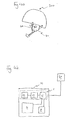
Figure 1 shows a three dimensional representation of a helmet according to an embodiment of the invention comprising a bone conduction audio unit, and also shows an associated mobile communications device; -
Figure 2 shows a side-on view of a helmet according to an embodiment of the invention as it may be worn by a user; -
Figure 3a shows a close-up three-dimensional representation of an aspect of the helmet comprising the bone conduction audio unit; -
Figure 3b shows a schematic diagram of the bone conduction audio unit; -
Figure 4a shows a side-on view of a helmet according to a second embodiment of the invention; and -
Figure 4b shows a schematic diagram of the bone conduction audio unit associated with the second embodiment of the invention. - The following description is based on embodiments of the invention and should not be taken as limiting the invention with regard to alternative embodiments that are not explicitly described herein.
- The detailed description provided below in connection with the appended drawings is intended as a description of the present examples and is not intended to represent the only forms in which the present example may be constructed or utilized. The description sets forth the functions of the example and the sequence of steps for constructing and operating the example. However, the same or equivalent functions and sequences may be accomplished by different examples.
- It will be appreciated that relative terms such as top and bottom, upper and lower, and so on, are used merely for ease of reference to the Figures, and these terms are not limiting as such, and any two differing directions or positions and so on may be implemented.
- With reference to
Figures 1 and 2 , there is shown generally at 100 a helmet comprising ahelmet member 10, astrap 12, and a boneconduction audio unit 14. - The
helmet member 10 is configured such that when worn it can partially cover the user's head, and in particular tends to cover the user's neurocranium whilst leaving the facial bones, including the mandible (lower jaw), uncovered. - The
strap 12 has a first end which connects to a first (for instance left) side of thehelmet member 10 and a second end which connects to a second (for instance left) side of thehelmet member 10. Each end is bifurcated so as to attach at two points of the side of helmet. - Interconnecting the first and second ends of the
strap 12 is a central strap portion which hangs below thehelmet member 10 such that it may contact the chin and/or the underside of the lower jaw of the user. - The chin and jaw area of the user (i.e. the lower jaw) is shown approximately in
Figure 2 with thecross-hatched area 16. The reader would understand that the chin and jaw area would be the parts of the face proximate to the mandible bone. - The bone
conduction audio unit 14 is at substantially the middle point of the central strap portion such that it may contact the chin and/or underside of the jaw of the user (as such the bone conduction audio unit is provided with asuitable housing 2 so as to function as a chin guard). The boneconduction audio unit 14 may be engaged with thestrap 12 such that it may slide freely along thestrap 12 but is constrained to stay on the strap. - Also shown in
Figure 1 isportable communication device 200, which may alternatively be referred to as apersonal radio 200.Radio 200 comprises afirst transceiver 201 for longer range wireless communications with remote base stations (e.g. according to any one or combination of GSM standard, UMTS standards, LTE standard protocols) and asecond transceiver 202 for nearby wireless communications (e.g. according to any one or combination of the IEEE 802.11 or 'WiFi™' standard, IEEE 802.1ad or 'WiGig™' standard, and IEEE 802.15.1 'Bluetooth™' protocols). Thepersonal radio 200 further comprises aspeaker 203 and a user interface 206. Thespeaker 203, thefirst transceiver 201 and thesecond transceiver 202 may be selectively activated by the user interface 206. - Referring to
Figure 3a and 3b , the boneconduction audio unit 14 is shown as comprising ahousing 2, a boneconduction transducer unit 4, acommunication module 6 and apower supply 8. In particular, the power supply is a battery. - The bone
conduction transducer unit 4,communication module 6 andpower supply 8 are substantially or entirely contained by thehousing 2. Anupper surface 3 of the housing defines a recess into which the chin or jaw of the user may fit. The lower surface of the housing protects theunit 14 and the user's chin. As such thehousing 2 provides a chin guard for thehelmet 10. - The bone
conduction transducer unit 4 comprises acontact member 5 which protrudes through theupper surface 3 of thehousing 2 such that it is biased to press at skin and flesh and onto the lower jaw of the user. Thecontact member 5 is resiliently mounted to ensure that it can exert sufficient pressure on the user to transmit sound waves, without being so stiff as to cause significant discomfort. - The
transducer unit 4 further comprises abase plate 46 fixed to thehousing 2, an actuator 42 (shown as a pair of actuators inFigure 3a ) fixed at its first end to the base plate, and atop plate 42 attached to the other end of theactuator 42. Theactuator 42 may be a magnetostrictive actuator arrangement. - The
contact member 5 is mounted on thetop plate 44. - The
communications module 6 comprises anantenna 62, areceiver 64 and asignal processor 66. - The
antenna 62 is configured to receive nearby wireless signals and relay these as electrical signals to thesignal processor 66 via thereceiver 64. Accordingly theantenna 62 is operably connected to thereceiver 64 and thereceiver 64 is connected to thesignal processor 66. - The
signal processor 66 is configured to convert audio bearing electrical signals from thereceiver 64 into electrical audio signals which can be fed directly to the boneconduction transducer unit 4. Accordingly, theprocessor 66 is connected to the boneconduction transducer unit 4. - The
communications module 6 is operably connected to thepower supply 8. - In operation a user may wear the
helmet 100 with thehelmet member 10 covering their neurocranium and thechin guard 2 on thestrap 12 contacting their chin. In particular, the strap is slung around the user's lower jaw such thatcontact member 5 presses at skin and flesh onto the user's lower jaw (mandible). - As discussed above, the
communications module 6 is interfaced with thepersonal radio 200 such that thecommunications module 6 is able to receive signals from theradio 200. (Optionally, it may be possible to transmit data from theantenna 62 to thepersonal radio 200.) - With the
helmet 100 arranged thus, the user may then use the interface 206 to place thepersonal radio 200 in a 'covert relay operation' condition where thespeaker 203 is inactive but both the first andsecond transceivers personal radio 200 can be received at thefirst receiver 201 and retransmitted by thesecond transceiver 202. - Where message signal bearing an audio message is retransmitted by the
second transceiver 202 in such a way, it will be received by thecommunications module 6 of the boneconduction audio unit 14, transmuted into an electrical audio signal and fed into the bone conductionaudio actuator unit 4 which further transmutes the electrical audio signal into a sound wave which is of small amplitude but which, by virtue of being in intimate contact with the user's jawbone may be clearly perceived by conduction of the sound waves through the skull. Indeed the applicant has found that, surprisingly, voice messages can be clearly understood when delivered through the boneconduction audio device 14 in the above manner. - An alternative helmet is shown generally at 300 in
Figure 4a . Thehelmet 300 is generally equivalent tohelmet 100 but is additionally provided with auditory canal isolation devices 30 (ACID). AnACID 30 is provided on each side of thehelmet 300, one for each ear. - The
ACID 30 is in the form of an earmuff which is attached to thehelmet member 10 such that it covers the user's ear and shields the user's auditory canal from the ambient air such that ambient sound waves are significantly attenuated by the time they propagate into the auditory canal. - The
helmet 300 is further provided with amicrophone 40, on an exterior surface of thehelmet 300, for transducing ambient sound waves into electrical audio signals. As shown inFigure 4a , themicrophone 40 is mounted on theACID 30. - With additional reference to
Figure 4b , themicrophone 40 is operably connected to theprocessor 66 in thecommunication module 6 of the boneconduction audio device 14. - A user may operate
helmet 300 in a noise reduction mode as follows. - Firstly the user wears the
helmet 300 such that eachACID 30 covers an ear and thestrap 12 is slung under the jaw such that the bone conduction transducer 4 (or specifically the contact member 5) is in contact with the user's jaw. - Secondly, the
microphone 40 is activated so as to relay electrical audio signals relating to ambient sound to theprocessor 66 in thecommunication module 6. - In noise reduction mode, such signals relating to the ambient sound are relayed to the bone
conduction transducer unit 4 to be reconstructed as sound waves for user interpretation. - In noise reduction mode, the
helmet 300 may still mix in with the ambient sounds the audio messages received from thepersonal radio 200. - In alternative embodiments the helmet may further comprise, instead of or in addition to the bone
conduction transducer unit 4, another form of transducer unit. For example one other form of force feedback unit contemplated would be a haptic transducer for relaying signals to the user by tactile feedback. - Thus it is contemplated that in variants of the above embodiments, the
transducer unit 4 may be configured to, in addition or in place of high quality audio message transmission capable of relaying voice messages to the user, produce haptic signals to the user. Such haptic signals could be a 'buzz' or 'prodding' sensation as the transducer oscillates at a frequency below that of the human hearing range. - In operation such haptic signals could be predetermined to inform the user of certain events or circumstances. For instance a haptic signal could alert the user to the battery charge level dropping below a 'low battery' threshold (where the
power supply 8 is a battery). - It is also contemplated that variants of the above embodiments could provide an array of independently operable transducer units, each equivalent to
transducer unit 4, each comprising a contact member. - Where two or more bone conduction audio transducers were provided a stereo (for example if two bone conduction audio transducers were provided) or 3-Dimensional sound effect could be provided to the user.
- Where an array of haptic transducers were provided, the
unit 14 could be drive so as to create a ripple sensation (by triggering a 'mexican wave' - or sequential firing of transducers from one end to the other - across a plurality of contact points) to provide an instruction to the user. - The helmet member may be fabricated from one or more of any known helmet member material such as metals, expanded polystyrene, polycarbonate, glass-reinforced polymer, Kevlar and leather. The helmet member may entirely cover the neurocranium or a portion thereof, or alternatively the helmet member may be provided with vents, holes or other discontinuities.
- The strap may be fabricated from interwoven nylon strands, though other plastics materials and natural polymers (e.g. cotton) could be used.
- In variants on the above described helmet, the helmet may tend not to comprise a rigid chin guard and instead the
transducer unit 4 could be integrated into the strap itself as a low-profile pad. - It will be understood that the benefits and advantages described above may relate to one embodiment or may relate to several embodiments. The embodiments are not limited to those that solve any or all of the stated problems or those that have any or all of the stated benefits and advantages. It will further be understood that reference to 'an' item refers to one or more of those items.
- The description of example embodiments of a helmet and its applications provided above is intended to demonstrate a number of principles for the design and operation of such a helmet, both explicit and implied. The specific examples of functionality and features described may be applied in any reasonably foreseeable selection or combination consistent with those design principles and the scope of the present invention as claimed below is intended to include all such selections and combinations.
- The steps of the methods described herein may be carried out in any suitable order, or simultaneously where appropriate. Additionally, individual blocks may be deleted from any of the methods without departing from the spirit and scope of the subject matter described herein. Aspects of any of the examples described above may be combined with aspects of any of the other examples described to form further examples without losing the effect sought.
- It will be understood that the above description of a preferred embodiment is given by way of example only and that various modifications may be made by those skilled in the art. The above specification, examples and data provide a complete description of the structure and use of exemplary embodiments of the invention. Although various embodiments of the invention have been described above with a certain degree of particularity, or with reference to one or more individual embodiments, those skilled in the art could make numerous alterations to the disclosed embodiments without departing from the spirit or scope of this invention.
Claims (15)
- A helmet for communications comprising:A helmet member for at least partially covering the user's head;A strap for extending around the user's lower jaw and thereby securing the helmet member to the user;Wherein the strap comprises a transducer unit for contacting the user's lower jaw and thereby transmitting vibrations to the user.
- A helmet according to claim 1 wherein the transducer unit for contacting the user's lower jaw is operable to in response to an input electrical signal generate sound waves in the human hearing range.
- A helmet according to claim 1 wherein the transducer unit for contacting the user's lower jaw is operable to in response to an input electrical signal generate sound waves across a sufficient band of the human hearing range such that voice messages may be transmitted and understood.
- A helmet according to claim 1, 2 or 3 wherein the helmet further comprises a communication module operably connected to the transducer unit and being adapted to receive or generate an electrical signal for conversion into a sound wave in the human hearing range.
- A helmet according to claim 4 wherein the communication module is adapted to communicate wirelessly with the user's personal radio.
- A helmet according to any one of the preceding claims wherein the strap further comprises a chin guard, and wherein the transducer unit is housed at the chin guard.
- A helmet according to claim 6 wherein the transducer unit comprises a contact member arranged to protrude from a surface of the chin guard and thereby contact the user.
- A helmet according to any one of the preceding claims further comprising an auditory canal isolation device.
- A helmet according to claim 8 the transducer unit being for generating sound waves in the human hearing range, the helmet comprising a communication module operably connected to the transducer unit and being adapted to receive or generate an electrical signal for conversion into a sound wave in the human hearing range,
wherein the helmet further comprises at least one microphone, the microphone being operably connected to the communication module such that ambient sounds picked-up by the microphone may be converted to electrical signals and fed to the transducer unit. - A helmet according to any one of the preceding claims wherein the transducer unit comprises a haptic unit for generating vibrations below the human hearing frequency range.
- A helmet according to any one of the preceding claims wherein the transducer unit comprises at least two individually operable transducers.
- A helmet according to any of the preceding claims wherein the transducer unit comprises an array of individually operable transducers.
- A headset system comprising:A strap for extending around a user's lower jaw and thereby securing a helmet member;A transducer arranged at the strap for contacting the user's lower jaw and transmitting vibrations into the user's lower jaw;A communications module operably connected to the transducer; andA portable communication device arranged to transmit signals to the communications module.
- A headset system according to claim 13 wherein the communications module comprises an antenna and a receiver, and the portable communication device comprises an antenna and signal transmitter, such that the portable communication device is arranged to transmit signals to the communications module wirelessly.
- A headset system according to claim 13 or claim 14 wherein the portable communications module is arranged to receive signals from a remote base station.
Priority Applications (4)
| Application Number | Priority Date | Filing Date | Title |
|---|---|---|---|
| EP15275195.4A EP3138430A1 (en) | 2015-09-01 | 2015-09-01 | Helmet for communications |
| PCT/GB2016/052694 WO2017037451A1 (en) | 2015-09-01 | 2016-08-31 | Helmet for communications |
| EP16762842.9A EP3344084B1 (en) | 2015-09-01 | 2016-08-31 | Helmet for communications |
| US15/753,737 US10441018B2 (en) | 2015-09-01 | 2016-08-31 | Helmet for communications |
Applications Claiming Priority (1)
| Application Number | Priority Date | Filing Date | Title |
|---|---|---|---|
| EP15275195.4A EP3138430A1 (en) | 2015-09-01 | 2015-09-01 | Helmet for communications |
Publications (1)
| Publication Number | Publication Date |
|---|---|
| EP3138430A1 true EP3138430A1 (en) | 2017-03-08 |
Family
ID=54064248
Family Applications (1)
| Application Number | Title | Priority Date | Filing Date |
|---|---|---|---|
| EP15275195.4A Ceased EP3138430A1 (en) | 2015-09-01 | 2015-09-01 | Helmet for communications |
Country Status (1)
| Country | Link |
|---|---|
| EP (1) | EP3138430A1 (en) |
Cited By (1)
| Publication number | Priority date | Publication date | Assignee | Title |
|---|---|---|---|---|
| EP3854247A4 (en) * | 2018-09-19 | 2022-06-22 | KMX Co., Ltd. | SAFETY HELMET LIGHTING DEVICE |
Citations (5)
| Publication number | Priority date | Publication date | Assignee | Title |
|---|---|---|---|---|
| US3787641A (en) * | 1972-06-05 | 1974-01-22 | Setcom Corp | Bone conduction microphone assembly |
| DE9003237U1 (en) * | 1990-03-16 | 1990-05-23 | Holmberg GmbH & Co KG, 1000 Berlin | Hearing-speaking device |
| US5136657A (en) * | 1988-02-28 | 1992-08-04 | Honda Giken Kogyo Kabushiki Kaisha | Sound device mounted in a helmet |
| US20060277664A1 (en) * | 2004-07-26 | 2006-12-14 | Saman Rahila Akhtar | Multifunctional helmet |
| JP2014150891A (en) * | 2013-02-06 | 2014-08-25 | Softard Kogyo Kk | Airline mask and speaking system |
-
2015
- 2015-09-01 EP EP15275195.4A patent/EP3138430A1/en not_active Ceased
Patent Citations (5)
| Publication number | Priority date | Publication date | Assignee | Title |
|---|---|---|---|---|
| US3787641A (en) * | 1972-06-05 | 1974-01-22 | Setcom Corp | Bone conduction microphone assembly |
| US5136657A (en) * | 1988-02-28 | 1992-08-04 | Honda Giken Kogyo Kabushiki Kaisha | Sound device mounted in a helmet |
| DE9003237U1 (en) * | 1990-03-16 | 1990-05-23 | Holmberg GmbH & Co KG, 1000 Berlin | Hearing-speaking device |
| US20060277664A1 (en) * | 2004-07-26 | 2006-12-14 | Saman Rahila Akhtar | Multifunctional helmet |
| JP2014150891A (en) * | 2013-02-06 | 2014-08-25 | Softard Kogyo Kk | Airline mask and speaking system |
Cited By (1)
| Publication number | Priority date | Publication date | Assignee | Title |
|---|---|---|---|---|
| EP3854247A4 (en) * | 2018-09-19 | 2022-06-22 | KMX Co., Ltd. | SAFETY HELMET LIGHTING DEVICE |
Similar Documents
| Publication | Publication Date | Title |
|---|---|---|
| CN109479169B (en) | A method of modifying a hearing protector and hearing protector | |
| US10743094B2 (en) | Helmet having dual mode headphone and method therefor | |
| US9838787B1 (en) | Acoustic device | |
| JP5269618B2 (en) | Bone conduction microphone built-in headset | |
| EP3200480B1 (en) | Hearing aid device with integrated antenna | |
| JP3200747U (en) | Disaster prevention helmet | |
| KR101790528B1 (en) | Wireless sound equipment | |
| EP3086565B1 (en) | Earbud set, and hearing aid and earphone using same | |
| US10441018B2 (en) | Helmet for communications | |
| WO2012100061A1 (en) | Mounting panel with elongated tongue | |
| JP2007051395A (en) | Communication system for helmet | |
| WO2016094582A1 (en) | Safe, wireless, integrated audio device for helmets | |
| AU2014337964A1 (en) | Headphones having vibration function | |
| GB2541892A (en) | Helmet for communications | |
| CN209994537U (en) | Earphone compatible with 2.4G wireless receiving mode | |
| WO2018051453A1 (en) | Ear plug and ear set | |
| US20230082580A1 (en) | Body-worn wireless two-way communication system and method of use | |
| EP3573451A1 (en) | Noise attenuation earphone device for animals | |
| KR101847070B1 (en) | Smart Call Device for Using Body | |
| US20170195765A1 (en) | Wearable device for conversation during high motion activity | |
| CN206547171U (en) | A kind of combined type hearing aid earphone | |
| JP2009239551A (en) | Wireless communication system, and controller of wireless communication system |
Legal Events
| Date | Code | Title | Description |
|---|---|---|---|
| PUAI | Public reference made under article 153(3) epc to a published international application that has entered the european phase |
Free format text: ORIGINAL CODE: 0009012 |
|
| AK | Designated contracting states |
Kind code of ref document: A1 Designated state(s): AL AT BE BG CH CY CZ DE DK EE ES FI FR GB GR HR HU IE IS IT LI LT LU LV MC MK MT NL NO PL PT RO RS SE SI SK SM TR |
|
| AX | Request for extension of the european patent |
Extension state: BA ME |
|
| 18R | Application refused |
Effective date: 20170403 |