EP3136545A1 - Wireless power transfer to a plurality of receivers - Google Patents
Wireless power transfer to a plurality of receivers Download PDFInfo
- Publication number
- EP3136545A1 EP3136545A1 EP16185672.9A EP16185672A EP3136545A1 EP 3136545 A1 EP3136545 A1 EP 3136545A1 EP 16185672 A EP16185672 A EP 16185672A EP 3136545 A1 EP3136545 A1 EP 3136545A1
- Authority
- EP
- European Patent Office
- Prior art keywords
- power
- power supply
- receiving apparatus
- power receiving
- supply apparatus
- Prior art date
- Legal status (The legal status is an assumption and is not a legal conclusion. Google has not performed a legal analysis and makes no representation as to the accuracy of the status listed.)
- Granted
Links
Images



Classifications
-
- H—ELECTRICITY
- H02—GENERATION; CONVERSION OR DISTRIBUTION OF ELECTRIC POWER
- H02J—ELECTRIC POWER NETWORKS; CIRCUIT ARRANGEMENTS OR SYSTEMS FOR SUPPLYING OR DISTRIBUTING ELECTRIC POWER; SYSTEMS FOR STORING ELECTRIC ENERGY
- H02J50/00—Circuit arrangements or systems for wireless supply or distribution of electric power
- H02J50/10—Circuit arrangements or systems for wireless supply or distribution of electric power using inductive coupling
- H02J50/12—Circuit arrangements or systems for wireless supply or distribution of electric power using inductive coupling of the resonant type
-
- H—ELECTRICITY
- H02—GENERATION; CONVERSION OR DISTRIBUTION OF ELECTRIC POWER
- H02J—ELECTRIC POWER NETWORKS; CIRCUIT ARRANGEMENTS OR SYSTEMS FOR SUPPLYING OR DISTRIBUTING ELECTRIC POWER; SYSTEMS FOR STORING ELECTRIC ENERGY
- H02J50/00—Circuit arrangements or systems for wireless supply or distribution of electric power
- H02J50/40—Circuit arrangements or systems for wireless supply or distribution of electric power using two or more transmitting or receiving devices
-
- H—ELECTRICITY
- H02—GENERATION; CONVERSION OR DISTRIBUTION OF ELECTRIC POWER
- H02J—ELECTRIC POWER NETWORKS; CIRCUIT ARRANGEMENTS OR SYSTEMS FOR SUPPLYING OR DISTRIBUTING ELECTRIC POWER; SYSTEMS FOR STORING ELECTRIC ENERGY
- H02J50/00—Circuit arrangements or systems for wireless supply or distribution of electric power
- H02J50/80—Circuit arrangements or systems for wireless supply or distribution of electric power involving the exchange of data, concerning supply or distribution of electric power, between transmitting devices and receiving devices
-
- H—ELECTRICITY
- H02—GENERATION; CONVERSION OR DISTRIBUTION OF ELECTRIC POWER
- H02J—ELECTRIC POWER NETWORKS; CIRCUIT ARRANGEMENTS OR SYSTEMS FOR SUPPLYING OR DISTRIBUTING ELECTRIC POWER; SYSTEMS FOR STORING ELECTRIC ENERGY
- H02J50/00—Circuit arrangements or systems for wireless supply or distribution of electric power
- H02J50/90—Circuit arrangements or systems for wireless supply or distribution of electric power involving detection or optimisation of position, e.g. alignment
-
- H—ELECTRICITY
- H02—GENERATION; CONVERSION OR DISTRIBUTION OF ELECTRIC POWER
- H02J—ELECTRIC POWER NETWORKS; CIRCUIT ARRANGEMENTS OR SYSTEMS FOR SUPPLYING OR DISTRIBUTING ELECTRIC POWER; SYSTEMS FOR STORING ELECTRIC ENERGY
- H02J7/00—Circuit arrangements for charging or discharging batteries or for supplying loads from batteries
- H02J7/40—Circuit arrangements for charging or discharging batteries or for supplying loads from batteries characterised by the exchange of charge or discharge related data
- H02J7/42—Circuit arrangements for charging or discharging batteries or for supplying loads from batteries characterised by the exchange of charge or discharge related data with electronic devices having internal batteries, e.g. mobile phones
Definitions
- the present invention generally relates to a power supply apparatus and particularly relates to a power supply apparatus comprising a communication unit.
- Conventional power supply apparatuses comprise a communication unit (for example, see patent literature 1).
- Patent literature 1 discloses a wireless power transmission system comprising a communication unit.
- This wireless power transmission system includes a power sending apparatus and a power receiving apparatus.
- the communication unit is provided respectively to the power sending apparatus and the power receiving apparatus and performs wireless communication according to a predetermined standard.
- the power receiving apparatus decreases a load to decrease a size of received power when authentication by the power sending apparatus is performed.
- the power receiving apparatus increases the load to increase the size of the received power in a situation where authentication succeeds.
- Another conventional power supply apparatus comprise a communication unit.
- This power supply apparatus comprising a communication unit has a class set according to power that the power supply apparatus can supply according to a predetermined standard (for example, the A4WP (Alliance for Wireless Power) standard).
- a power receiving apparatus that receives the power from this power supply apparatus also has a category set according to power that the power receiving apparatus consumes according to a predetermined standard (for example, the A4WP standard).
- the power supply apparatus acquires information on the category from the power receiving apparatus via the communication unit and determine whether to feed the power receiving apparatus based on the acquired category and the class of the power supply apparatus.
- Patent Literature 1 Japanese Patent Application Publication No. 2015-8619
- the power receiving apparatus is fed only in the situation where authentication by the power sending apparatus succeeds.
- the power sending apparatus acquires the information on the category from the power receiving apparatus via the communication unit when performing authentication of the power receiving apparatus and determine whether to cause authentication to succeed (whether to feed) based on the acquired information on the category and information on the class. Because of this, it is thought that the power sending apparatus of patent literature 1 above intentionally fails the authentication of the power receiving apparatus (in other words, the power sending apparatus does not feed power) based on the category even in a situation where there is excess power that can be supplied in a situation where feeding is actually performed.
- a power supply apparatus and a power supply method according to one or more embodiments of the present invention can feed more power receiving apparatuses.
- a power supply apparatus may comprise: a power source; a power supply antenna that supplies power from the power source to a power receiving apparatus; a power acquisition unit that acquires a power value of the power; a communication unit that communicates with the power receiving apparatus; and a controller that sends a load disconnect signal via the communication unit to the power receiving apparatus supplied with power, acquires a power value after sending the load disconnect signal, and determines whether to feed a new power receiving apparatus based on the acquired power value.
- the controller sends the load disconnect signal via the communication unit to the power receiving apparatus supplied with power, acquire the power value after sending the load disconnect signal, and determine whether to feed the new power receiving apparatus based on the acquired power value.
- the actual power fed to the new power receiving apparatus is acquired and it can be determined whether to feed the new power receiving apparatus based on the actual power.
- this is based on the actual power, unlike a situation of determining whether to feed the new power receiving apparatus using simply a category of the new power receiving apparatus, being determined to not feed the new power receiving apparatus can be suppressed even in a situation where there is an excess in the power that can be fed.
- the power supply antenna supplies power to a plurality of power receiving apparatuses
- the controller acquires power category information from the new power receiving apparatus, send the load disconnect signal to at least one power receiving apparatus among the plurality of power receiving apparatuses, and stop supply of power at or above a power amount corresponding to the power category information.
- the controller sends the load disconnect signal to all the plurality of power receiving apparatuses supplied with power and acquire the power value of the power by supplying power to the new power receiving apparatus.
- control processing can be simplified compared to a situation of selecting a portion of the plurality of power receiving apparatuses supplied with power and sending the load disconnect signal, and entering the state where fed power becomes insufficient when the power value is acquired by supplying power to the new power receiving apparatus can be further suppressed.
- the controller sends a maximum load command signal, which commands operating by a maximum load, to the new power receiving apparatus and at least one of the power receiving apparatuses supplied with power and determine whether to feed the new power receiving apparatus based on the acquired power value.
- the power fed to the power receiving apparatus to which the maximum load command signal is sent corresponds to a maximum value of the power actually fed to the power supply apparatus; therefore, it can be determined whether to feed the power receiving apparatus based on the maximum value of the power actually fed to the power receiving apparatus without using the category of the power receiving apparatus.
- entering the state where the fed power becomes insufficient can be suppressed even in a situation where the load of the power receiving apparatus is maximized.
- the power supply antenna is able to supply power to the plurality of power receiving apparatuses
- the controller respectively sends the maximum load command signal to the new power receiving apparatus and the plurality of power receiving apparatuses supplied with power, respectively acquire a power value of the power fed to the power receiving apparatuses to which the maximum load command signal is sent, and determine whether to feed the new power receiving apparatus based on the acquired power value.
- the controller respectively acquires a power value of the power fed to the power receiving apparatuses to which the maximum load command signal is sent and perform a control of feeding the new power receiving apparatus and the power receiving apparatuses supplied with power in a situation where a total value of the acquired power value is at or below a maximum feeding power, which is a maximum value of power that can be supplied from the power source.
- a maximum feeding power which is a maximum value of power that can be supplied from the power source.
- the controller respectively and sequentially sends the maximum load command signal to the new power receiving apparatus and the plurality of power receiving apparatuses supplied with power and respectively and sequentially acquire the value of the power corresponding to the new power receiving apparatus and the plurality of power receiving apparatuses supplied with power.
- the controller acquires identification information from the new power receiving apparatus via the communication unit and perform a control of feeding the new power receiving apparatus without sending the maximum load command signal to the new power receiving apparatus in a situation where the identification information acquired from the new power receiving apparatus is identical to identification information acquired in advance.
- feeding can be restarted without performing the determination whether to feed by determining based on the identification information in a situation where the same power receiving apparatus is again disposed on the power supply apparatus. That is, feeding the power receiving apparatus can be restarted speedily to an extent that the determination whether to feed does not need to be performed.
- an impedance measurement unit that measures an impedance of the power supply antenna; wherein the controller sends the maximum load command signal to the new power receiving apparatus in a situation where the identification information acquired from the new power receiving apparatus is identical to the identification information acquired in advance and a situation where an amount of change in a measurement value of the impedance corresponding to the identification information acquired from the new power receiving apparatus relative to a measurement value of the impedance corresponding to the identification information acquired in advance is greater than a first threshold.
- the power supply apparatus above comprising the impedance measurement unit further comprises: a notification unit that notifies information to a user; wherein the controller controls the notification unit to notify a request to the user to correct the placement of the new power receiving apparatus in the situation where the identification information acquired from the new power receiving apparatus is identical to the identification information acquired in advance and a situation where an increase amount of the measurement value of the impedance corresponding to the identification information acquired from the new power receiving apparatus relative to the measurement value of the impedance corresponding to the identification information acquired in advance is at or above a second threshold.
- the user can be notified by the notification unit to correct the placement even in a situation where the placement or the like changes and the coupling coefficient (feeding efficiency) changes in the situation where after the power receiving apparatus is temporarily removed from the power supply apparatus and feeding is temporarily stopped the power receiving apparatus is again disposed on the power supply apparatus.
- feeding can be performed with high efficiency.
- the controller sends the maximum load command signal to the new power receiving apparatus in the situation where the identification information acquired from the new power receiving apparatus is identical to the identification information acquired in advance and a situation where an amount of change in the power supplied from the power source to the power supply antenna corresponding to the identification information acquired from the new power receiving apparatus relative to the power supplied from the power source to the power supply antenna corresponding to the identification information acquired in advance is greater than a third threshold.
- a power supply method supplies power from a power source from a power supply apparatus to a power receiving apparatus; sends a load disconnect signal to the power receiving apparatus supplied with power from the power supply apparatus; measures and acquires a power value of the power after sending the load disconnect signal; and determines whether to feed a new power receiving apparatus based on the acquired power value.
- the power supply method by sending the load disconnect signal from the power supply apparatus to the power receiving apparatus supplied with power, measuring and acquiring the power value of the power after sending the load disconnect signal, and determining whether to feed the new power receiving apparatus based on the acquired power value, more power receiving apparatuses can be fed in the power supply method.
- a power supply method may comprise: supplying power from a power source to a power receiving apparatus; acquiring a power value of power from the power source upon detecting another power receiving apparatus; and determining whether to supply the power from the power source to the another power receiving apparatus based on the power value.
- a power supply apparatus may comprise a power supply unit that supplies power from a power source to a power receiving apparatus, a power acquisition unit that acquires a power value of power from the power source upon detecting another power receiving apparatus, and a controller that determines whether to supply the power from the power source to the another power receiving apparatus based on the power value.
- a power supply apparatus may comprise a power supply unit that supplies power from a power source to at least one of a plurality of power receiving apparatuses, a controller that causes a first power receiving apparatus to stop receiving power from the power supply unit, and causes the power supply unit to supply power from the power source to a second power receiving apparatus that is not receiving power from the power supply unit, and a power acquisition unit that acquires a power value of the power from the power source to the second power receiving apparatus.
- the controller may determine whether to continue supplying the power from the power source to the second power receiving apparatus based on the acquired power value.
- more power receiving apparatuses can be fed.
- An amplifier circuit in one or more embodiments of the present invention has a predetermined inductance where a resonant frequency of the amplifier circuit is greater than a predetermined drive frequency and no more than 3.7 times the predetermined drive frequency. That is, a power supply apparatus according to one or more embodiments of the present invention comprises the amplifier circuit, which has the predetermined inductance and is switched at the predetermined drive frequency, and a power supply antenna connected to the amplifier circuit, wherein the amplifier circuit has the predetermined inductance where the resonant frequency of the amplifier circuit is greater than the predetermined drive frequency and no more than 3.7 times the predetermined drive frequency.
- the amplifier circuit in one or more embodiments of the present invention has the predetermined inductance where the resonant frequency of the amplifier circuit is greater than the predetermined drive frequency and no more than 3.7 times the predetermined drive frequency.
- the amplifier circuit has a predetermined inductance where the resonant frequency is no less than 1.4 times and no more than 2.2 times the predetermined drive frequency.
- the present inventors found that power can be supplied the most efficiently from the amplifier circuit to the resonant circuit in a situation where the amplifier circuit has a predetermined inductance where the resonant frequency is 1.5 times the predetermined drive frequency. Therefore, configuring the amplifier circuit so the resonant frequency is 1.5 times the predetermined drive frequency is considered; however, it is generally thought that individual variation arises in the inductance of the amplifier circuit or capacitances.
- the present inventors further found that a comparatively high power efficiency can be obtained in a situation where the amplifier circuit has the predetermined inductance where the resonant frequency is no less than 1.4 times and no more than 2.2 times the predetermined drive frequency. That is, it is found that by configuring the amplifier circuit so the resonant frequency becomes a value on a comparatively-higher-multiplication-factor side than 1.5 times the drive frequency (1.8 times), a comparatively high power efficiency can be obtained even in a situation where individual variation arises in the inductance of the amplifier circuit or the capacitances.
- the amplifier circuit has the predetermined inductance where the resonant frequency becomes 1.8 ⁇ 0.4 times (no less than 1.4 times and no more than 2.2 times) the predetermined drive frequency; therefore, power can be supplied from the amplifier circuit to the resonant circuit in a state of a comparatively high power efficiency even in the situation where individual variation arises in the inductance of the amplifier circuit or the capacitances. Moreover, this is also confirmed by a simulation by the present inventors described below.
- the amplifier circuit includes the switching element, a voltage value applied to the switching element when the switching element is switched becomes substantially zero, and the amplifier circuit has a predetermined inductance where the resonant frequency is no less than 1.5 and no more than 3.7 times the predetermined drive frequency.
- the impedance of the resonant circuit seen from the amplifier circuit ideally becomes infinite.
- a current flowing in the parasitic capacitance of the switching element from the amplifier circuit can be made to be substantially zero; therefore, it is found that the parasitic capacitance of the switching element can be ignored.
- the amplifier circuit by configuring the amplifier circuit so the voltage value applied to the switching element becomes substantially zero when the switching element is switched and to have the predetermined inductance where the resonant frequency is no less than 1.5 and no more than 3.7 times the predetermined drive frequency, zero-voltage switching can be performed. As a result, power loss when the switching element is switched can be suppressed; therefore, power can be further efficiently supplied from the amplifier circuit to the resonant circuit.
- the amplifier circuit has the predetermined inductance where the resonant frequency is 1.5 times the predetermined drive frequency.
- the present inventors found that in the situation where the resonant frequency becomes 1.5 times the predetermined drive frequency, a waveform of a voltage applied to the amplifier circuit (switching element) becomes nearest to an ideal voltage waveform for zero-voltage switching. In this situation, power can be supplied the most efficiently from the amplifier circuit to the resonant circuit.
- the amplifier circuit by configuring the amplifier circuit to have the predetermined inductance where the resonant frequency becomes 1.5 times the predetermined drive frequency, the waveform of the voltage applied to the amplifier circuit (switching element) becomes nearest to the ideal voltage waveform for zero-voltage switching; therefore, power can be supplied the most efficiently from the amplifier circuit to the resonant circuit.
- the amplifier circuit includes a compensation circuit having a plurality of inductors and a switch that switches a connection state of the plurality of inductors.
- the connection state of the plurality of inductors can be switched by the switch; therefore, the inductance of the amplifier circuit can be changed.
- the predetermined inductance can be set appropriately by being able to change the inductance of the compensation circuit even in a situation where variation arises in inductances of the inductors provided in the amplifier circuit (compensation circuit).
- the power supply apparatus further includes a controller that acquires a power efficiency of output power that is power supplied from the amplifier circuit to the resonant circuit relative to input power that is power supplied from an external DC power source to the amplifier circuit and increases the power efficiency by controlling an operation of the switch based on the power efficiency.
- the inductance of the amplifier circuit can be appropriately changed automatically by the controller so the power efficiency increases even in the situation where variation is arisen in the inductances of the inductors.
- a plurality of amplifier circuits is respectively provided, and the plurality of amplifier circuits is configured as a differential amplifier circuit.
- a circuit formed by the plurality of amplifier circuits and a plurality of compensation circuits and the resonant circuit becomes a balancing circuit; therefore, unwanted electric field radiation arising from power supply coils of the resonant circuit can be suppressed.
- FIG. 1 A configuration of a power supply apparatus 100 according to one or more embodiments of a first example of the present invention is described with reference to FIGS.1 to 3 .
- the power supply apparatus 100 according to one or more embodiments of the first example of the present invention supplies power (as a wireless power supply apparatus, a non-contact power supply apparatus, or a non-contact-point power supply apparatus) to a plurality of power receiving apparatuses 200 disposed near the power supply apparatus 100 using a magnetic resonance method without providing wiring, a contact point, or the like between the power supply apparatus 100 and a power receiving apparatus 200.
- a power supply system wireless power supply system
- the plurality of power receiving apparatuses 200 is formed by the power supply apparatus 100 and the plurality of power receiving apparatuses 200.
- the plurality of (for example, three) power receiving apparatuses 200 is mounted on an upper surface 1 of the power supply apparatus 100.
- the power supply apparatus 100 includes a power supply antenna 2.
- the power supply antenna 2 supplies power to (feed), for example, a power receiving antenna 201a of a PC (personal computer) 200a, a power receiving antenna 201b of a smartphone 200b, and a power receiving antenna 201c of a multifunctional watch 200c.
- the power receiving apparatus 200 may be the PC 200a, the smartphone 200b, and the multifunctional watch 200c.
- the power supply apparatus 100 comprises a power source 3, a controller 4, a communication unit 5, a storage 6, and a power measurement unit (power acquisitiont unit) 7.
- the controller 4 sends a load disconnect signal via the communication unit 5 to the power receiving apparatus 200 supplied with power, acquire power value P after sending the load disconnect signal, and determine whether to feed a new power receiving apparatus 200 based on the acquired power value P.
- the controller 4 sends a maximum load command signal, which commands operating by a maximum load, to the power receiving apparatus 200 via the communication unit 5; acquire the power value P fed to the power receiving apparatus 200 to which the maximum load command signal is sent; and perform a feeding propriety determination control (see FIG. 4 ) of determining whether to feed the power receiving apparatus 200 to which the maximum load command signal is sent based on the acquired power value P.
- the power supply antenna 2 includes a power supply coil 21 and a matching circuit 22.
- the power supply coil 21 generates a powered magnetic field by AC power supplied from the power source 3.
- the matching circuit 22 includes, for example, a resonant capacitor and the like and matches an impedance of the power supply coil 21 and an impedance of the power source 3.
- the power supply antenna 2 supplies power by the powered magnetic field to the plurality of power receiving apparatuses 200.
- the power source 3 acquires power from an external commercial power source (not illustrated) or a battery unit (not illustrated). Moreover, the power source 3 includes, for example, a so-called E-class amplifier circuit where zero-voltage switching is possible. Moreover, the power source 3 converts the acquired power value into AC power having a voltage value based on a command by the controller 4 and having a frequency based on a predetermined standard (the A4WP [Alliance for Wireless Power] standard; for example, 6.78 MHz). Moreover, the power source 3 supplies AC power to the power supply antenna 2.
- a predetermined standard the A4WP [Alliance for Wireless Power] standard
- the controller 4 controls an operation of each unit of the power supply apparatus 100. Moreover, the controller 4 performs feeding propriety determination control processing. Details of the feeding propriety determination control processing are described below using the flowchart in FIG. 4 .
- the communication unit 5 performs wireless communication based on a predetermined standard (for example, the Bluetooth (registered trademark) standard) with the power receiving apparatus 200.
- a predetermined standard for example, the Bluetooth (registered trademark) standard
- the communication unit 5 may be executed by a communication circuit.
- the storage 6 stores a measurement result of the power measurement unit 7 (power value P) based on a command of the controller 4.
- the power measurement unit 7 is disposed between the power source 3 and the power supply antenna 2 and measures a size of the power value P supplied from the power source 3 to the power supply antenna 2. Specifically, the power measurement unit 7 measures the power value P by acquiring a voltage value applied to the power supply antenna 2 or a current value flowing from the power source 3 to the power supply antenna 2.
- the controller 4 respectively sends the maximum load command signal to the plurality of power receiving apparatuses 200, respectively acquire the power value P fed to the plurality of power receiving apparatuses 200 to which the maximum load command signal is sent, and perform a feeding propriety determination control based on the acquired power value P.
- the controller 4 respectively acquires the power value P fed to the plurality of power receiving apparatuses 200 to which the maximum load command signal is sent and perform a control of feeding all power receiving apparatuses 200 to which the maximum load command signal is sent in a situation where a total value PS of the acquired power value P is at or below a maximum feeding power value PM, which is a maximum value of power that can be supplied from the power source 3.
- the controller 4 respectively and sequentially sends the maximum load command signal to the plurality of power receiving apparatuses 200 and respectively and sequentially acquire the power value P corresponding to the plurality of power receiving apparatuses 200 to which the maximum load command signal is sent.
- the controller 4 acquires information on a category from the new power receiving apparatus 200. Moreover, the controller 4 sends the load disconnect signal to at least one power receiving apparatus 200 among the plurality of power receiving apparatuses 200 and stop supply of power at or above a power amount corresponding to the information on the category. Moreover, in one or more embodiments of the first example of the present invention, the controller 4 sends the load disconnect signal to all the plurality of power receiving apparatuses 200 supplied with power when acquiring the power value P corresponding to the new power receiving apparatus 200.
- the controller 4 determines that the new power receiving apparatus 200 is mounted on the upper surface 1 in a situation where an advertisement signal to establish communication sent from the power receiving apparatus 200 is acquired. For example, in a situation where the smartphone 200b is newly mounted on the upper surface 1 in a state where the PC 200a is mounted on the upper surface 1, the advertisement signal and the information on the category (power category information) are sent from the smartphone 200b and the controller 4 acquires the advertisement signal and the information on the category.
- the controller 4 performs a control of respectively and sequentially sending the maximum load command signal to the PC 200a and the smartphone 200b.
- the controller 4 sends the maximum load command signal to the PC 200a and sends substantially simultaneously the load disconnect signal to the smartphone 200b.
- the power measurement unit 7 becomes able to measure only the power value P supplied to the PC 200a operating at the maximum load (this power is defined as P1).
- the controller 4 sends the maximum load command signal to the smartphone 200b and sends substantially simultaneously the load disconnect signal to the PC 200a.
- the power measurement unit 7 becomes able to measure only the power value P supplied to the smartphone 200b operating at the maximum load (this power is defined as P2).
- the controller 4 feeds all power receiving apparatuses 200 corresponding to the total value PS1 (the PC 200a and the smartphone 200b) in a situation where the total value PS1 is at or below the maximum feeding power value PM. That is, the controller 4 performs a control of continuing to feed the PC 200a and starting to feed the smartphone 200b.
- the controller 4 is feeds the power receiving apparatus 200 (PC 200a) other than the new power receiving apparatus 200 (smartphone 200b) among the power receiving apparatuses 200 corresponding to the total value PS1 (the PC 200a and the smartphone 200b) in a situation where the total value PS 1 exceeds the maximum feeding power value PM.
- the controller 4 performs processing similar to the above in a situation where it is determined that another new power receiving apparatus 200 (the multifunctional watch 200c) is mounted on the upper surface 1 in a state where the PC 200a and the smartphone 200b are being fed. Specifically, the controller 4 performs a control of acquiring a total value PS2 of the power value P of the PC 200a, the smartphone 200b, and the multifunctional watch 200c.
- controller 4 continues to feed all power receiving apparatuses 200 corresponding to the total value PS2 (the PC 200a, the smartphone 200b, and the multifunctional watch 200c) in a situation where the total value PS2 is at or below the maximum feeding power value PM.
- the controller 4 feeds the power receiving apparatus 200 (the PC 200a and the smartphone 200b) other than the new power receiving apparatus 200 (multifunctional watch 200c) among the power receiving apparatuses 200 corresponding to the total value PS2 (the PC 200a, the smartphone 200b, and the multifunctional watch 200c) in a situation where the total value PS2 exceeds the maximum feeding power value PM.
- the maximum feeding power value PM of the power supply apparatus 100 is 10 W, and this maximum feeding power value PM is a value smaller than a total value of 13 W (6.5 W + 6.5 W) of consumed power of the PC 200a and the smartphone 200b set to category 3.
- the power supply apparatus 100 respectively sends the maximum load command signal to the power receiving apparatuses 200, respectively acquire the power value P power supplied to the plurality of power receiving apparatuses 200 to which the maximum load command signal is sent, and perform the feeding propriety determination control based on the acquired power value P.
- the power value P1 supplied to the PC 200a in a state of operating at the maximum load is 4 W
- the power value P2 supplied to the smartphone 200b in a state of operating at the maximum load is 3 W
- the total value PS1 becomes 7 W.
- the total value PS1 is at or below 10 W, which is the maximum feeding power value PM.
- the power supply apparatus 100 simultaneously feeds both the PC 200a and the smartphone 200b regardless of category or class.
- the PC 200a, the smartphone 200b, and the multifunctional watch 200c are configured as the power receiving apparatus 200.
- components labeled with identical reference signs are deemed to be similarly configured, and description is omitted.
- the PC 200a comprises the power receiving antenna 201a, a load circuit 202a, a power-receiving-side controller 203, a rectifying circuit 204, a load power source circuit 205, a control power source circuit 206, and a power-receiving-side communication unit 207.
- the smartphone 200b comprises the power receiving antenna 201b and a load circuit 202b. Moreover, a configuration of the smartphone 200b other than the power receiving antenna 201b and the load circuit 202b is configured similarly to the PC 200a.
- the multifunctional watch 200c comprises the power receiving antenna 201c and a load circuit 202. Moreover, a configuration of the multifunctional watch 200c other than the power receiving antenna 201c and the load circuit 202c is configured similarly to the PC 200a.
- the power receiving antenna 201a includes a power receiving coil 211a and a matching circuit 212a.
- the power receiving coil 211a magnetically couples with the power supply coil 21 and receives power.
- the matching circuit 212a includes a capacitor and the like and matches an impedance on a rectifying-circuit 204 side and an impedance of the power receiving coil 211a.
- the matching circuit 212a is configured so the power receiving antenna 201a becomes a resonant circuit having a resonant frequency substantially identical to a resonant frequency of the power supply antenna 2.
- the power receiving antenna 201b comprises a power receiving coil having a different size (diameter, size of a side) than the power receiving coil 211 a of the power receiving antenna 201a.
- the power receiving antenna 201c comprises a power receiving coil having a different size (diameter, size of a side) than the power receiving coil 211a of the power receiving antenna 201a and the power receiving coil of the power receiving antenna 201b.
- the load circuits 202a to 202c are configured, for example, as circuits that consume power to exhibit various types of functions of the power receiving apparatus 200 (for example, in a situation of the load 202b, a function as a smartphone). Moreover, in one or more embodiments of the first example of the present invention, the load circuits 202a to 202c maximize the size of the load (maximize a size of the consumed power) in a situation where a command is acquired from the power-receiving-side controller 203 to maximize the load.
- the rectifying circuit 204 includes a plurality of diodes and the like and converts an AC current received by the power receiving antenna 201a (the power receiving antenna 201b or 201c) into a DC current.
- Both the load power source circuit 205 and the control power source circuit 206 include a DC/DC converter, a smoothing circuit, and the like. Moreover, the load power source circuit 205 converts a voltage of power from the rectifying circuit 204 into a predetermined voltage suited to driving the load circuit 202a. Moreover, the load power source circuit 205 supplies the converted power to the load circuit 202a. Moreover, the control power source circuit 206 converts the voltage of the power from the rectifying circuit 204 into a predetermined voltage suited to the power-receiving-side controller 203. Moreover, the control power source circuit 206 supplies the converted power to the power-receiving-side controller 203.
- the power-receiving-side controller 203 performs overall control of the power receiving apparatus 200. Moreover, the power-receiving-side controller 203 transmits a command of maximizing the load to the load circuit 202a (load circuit 202b or 202c) in a situation where the maximum load command signal is acquired from the power supply apparatus 100 via the power-receiving-side communication unit 207.
- the power-receiving-side controller 203 sends an advertisement signal requesting establishment of communication (connection establishment request) to the power supply apparatus 100 via the power-receiving-side communication unit 207 in a situation where the power receiving antenna 201 a (power receiving antenna 201b or 201 c) starts receiving power from the power supply apparatus 100. Moreover, the power-receiving-side controller 203 sends identification information (ID (identification)) and the information on the category together with the advertisement signal to the power supply apparatus 100 via the power-receiving-side communication unit 207.
- ID identification information
- the identification information is set as, for example, information using a device name or the like.
- the power-receiving-side controller 203 sends a signal indicating that power receiving is stopped to the power supply apparatus 100 via the power-receiving-side communication unit 207 in a situation where power receiving from the power supply apparatus 100 stops.
- the signal indicating that power receiving is stopped may be set as a signal indicating that a power receiving voltage value is become become substantially 0 by configuring the power-receiving-side controller 203 to continuously send power receiving information such as the power receiving voltage value to the power supply apparatus 100.
- the power-receiving-side controller 203 stops power receiving by disconnecting a connection between the power receiving antenna 201a (power receiving antenna 201b or 201c) and the load circuit 202a (load circuit 202b or 202c) in a situation where the load disconnect signal is acquired from the power supply apparatus 100.
- the power-receiving-side controller 203 connects the disconnected circuits above in a situation where a load connect signal (or the maximum load command signal) is acquired from the power supply apparatus 100 in a state where the load disconnect signal is acquired and power receiving is stopped.
- the power-receiving-side controller 203 causes the load circuit 202a (load circuit 202b or 202c) to consume the received power by a load of a normal size (at or below the maximum) in a situation where the load connect signal is acquired.
- the power-receiving-side communication unit 207 performs wireless communication based on a predetermined standard (for example, the Bluetooth [registered trademark] standard) with the power supply apparatus 100.
- a predetermined standard for example, the Bluetooth [registered trademark] standard
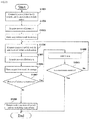
- step S1 is made to be a feeding state (state where the powered magnetic field is arising from the power supply antenna 2).
- the power supply apparatus 100 sends the load disconnect signal via the communication unit 5 to the power receiving apparatus 200 supplied with power, acquire the power value P after sending the load disconnect signal, and determine whether to feed the new power receiving apparatus 200 based on the acquired power value P.
- the actual power value P fed to the new power receiving apparatus 200 is acquired and it can be determined whether to feed the new power receiving apparatus 200 based on the actual power value P.
- the power supply antenna 2 supplies power to the plurality of power receiving apparatuses 200 and the controller 4 acquires the information on the category from the new power receiving apparatus 200, send the load disconnect signal to at least one power receiving apparatus 200 among the plurality of power receiving apparatuses 200, and stop supply of power at or above the power amount corresponding to the information on the category.
- the controller 4 sends the load disconnect signal to all the plurality of power receiving apparatuses 200 supplied with power and acquire the power value P by supplying power to the new power receiving apparatus 200.
- the control processing can be simplified compared to a situation of selecting a portion of the plurality of power receiving apparatuses 200 supplied with power and sending the load disconnect signal, and entering the state where fed power becomes insufficient when the power value P is acquired by supplying power to the new power receiving apparatus 200 can be further suppressed.
- the controller 4 sends the maximum load command signal, which commands operating by the maximum load, to the power receiving apparatus 200 via the communication unit 5; acquire the power value P fed to the power receiving apparatus 200 to which the maximum load command signal is sent; and perform the feeding propriety determination control (see FIG. 4 ) of determining whether to feed the power receiving apparatus 200 to which the maximum load command signal is sent based on the acquired power value P.
- the power value P fed to the power receiving apparatus 200 to which the maximum load command signal is sent corresponds to the maximum value of the power actually fed to the power supply apparatus 200; therefore, it can be determined whether to feed the power receiving apparatus 200 based on the maximum feeding power value PM and the maximum value (power value P) of the power actually fed to the power receiving apparatus 200 without using the category of the power receiving apparatus 200. That is, the power supply apparatus 100 can feed the maximum feeding power value PM to more power receiving apparatuses 200 to an extent where and because determining to not feed the power receiving apparatus 200 can be suppressed in a situation where the power value P actually fed to the power receiving apparatus 200 falls short (in the situation where there is an excess in the power that can be fed). Moreover, entering the state where the fed power becomes insufficient can be suppressed even in a situation where the load of the power receiving apparatus 200 is maximized.
- the power supply antenna 2 is able to supply power to the plurality of power receiving apparatuses 200.
- the controller 4 respectively sends the maximum load command signal to the plurality of power receiving apparatuses 200, respectively acquire the power value P fed to the plurality of power receiving apparatuses 200 to which the maximum load command signal is sent, and the perform feeding propriety determination control (see FIG. 4 ) based on the acquired power value P.
- the controller 4 respectively acquires the power value P fed to the plurality of power receiving apparatuses 200 to which the maximum load command signal is sent and perform the control of feeding all power receiving apparatuses 200 to which the maximum load command signal is sent in the situation where the total value PS of the acquired power value P is at or below the maximum feeding power value PM, which is the maximum value of power that can be supplied from the power source 3.
- the feeding propriety determination control can be performed easily even in a situation of feeding the plurality of power receiving apparatuses 200 by comparing the total value PS of the acquired power value P and the maximum feeding power value PM.
- the controller 4 respectively and sequentially sends the maximum load command signal to the plurality of power receiving apparatuses 200 and respectively and sequentially acquire the power value P corresponding to the plurality of power receiving apparatuses 200 to which the maximum load command signal is sent.
- the controller 4 respectively and sequentially sends the maximum load command signal to the plurality of power receiving apparatuses 200 and respectively and sequentially acquire the power value P corresponding to the plurality of power receiving apparatuses 200 to which the maximum load command signal is sent.
- the power supply apparatus 300 acquires the identification information (ID [identification]) from the power receiving apparatus 200 via the communication unit 5 and acquire an impedance Z of the power supply antenna 2.
- ID identification information
- the power supply apparatus 300 includes a controller 304, a storage 306, and an impedance measurement unit (impedance measurement circuit) 308.
- the controller 304 acquires the identification information from the power receiving apparatus 200 via the communication unit 5 and perform a control of feeding the power receiving apparatus 200 corresponding to the newly-acquired identification information without sending the maximum load command signal to the power receiving apparatus 200 corresponding to the newly-acquired identification information in a situation where the newly-acquired identification information is identical to identification information acquired in advance (identification information included in a management table 306a stored in the storage 306). Moreover, the controller 304 performs the feeding propriety determination control (see FIG. 4 ) in a situation where the newly-acquired identification information is not identical to the identification information acquired in advance.
- the impedance measurement unit 308 measures the impedance Z of the power supply antenna 2.
- the controller 304 performs the feeding propriety determination control (see FIG. 4 ) in a situation where the newly-acquired identification information is identical to the identification information acquired in advance and a situation where an amount of change V in a measurement value of the impedance Z corresponding to the newly-acquired identification information relative to the impedance Z corresponding to the identification information acquired in advance is greater than a threshold Vt1 (for example, 5 ⁇ ).
- a threshold Vt1 for example, 5 ⁇ .
- the power receiving apparatus 200 sends the advertisement signal and the identification information to the power supply apparatus 300 via the power-receiving-side communication unit 207 in response to power receiving starting.
- the identification information is set as, for example, information using the device name.
- the controller 304 acquires the advertisement signal and the identification information from the power receiving apparatus 200.
- the controller 304 measures the impedance Z of the power supply antenna 2 by the impedance measurement unit 308 after acquiring the identification information from the power receiving apparatus 200. Moreover, as illustrated in FIG. 6 , the controller 304 associates and stores as the management table 306a in the storage 306 the identification information acquired from the power receiving apparatus 200 and the measured impedance Z. Note that the controller 304 measures the impedance Z at predetermined time intervals (for example, 1 second) by the impedance measurement unit 308 while feeding the power receiving apparatus 200.
- the management table 306a stored in the storage 306 (table of a correspondence relationship between the identification information and the impedance Z) is described with reference to FIG. 6 .
- the identification information of the PC 200a is defined as ID1
- the identification information of the smartphone 200b is defined as ID2
- the identification information of the multifunctional watch 200c is defined as ID3.
- the controller 304 acquires the identification information ID1 and ID2 and an impedance Z1 during feeding of the PC 200a and the smartphone 200b in a situation where the PC 200a and the smartphone 200b are being fed (situation where the PC 200a and the smartphone 200b are mounted on the upper surface 1). Then, the controller 304 associates and stores in the storage 306 the identification information ID1 and ID2 and the impedance Z1.
- the PC 200a sends the signal indicating that power receiving is stopped to the power supply apparatus 300 via the power-receiving-side communication unit 207.
- the advertisement signal and the identification information ID1 are sent from the PC 200a to the power supply apparatus 300 in a situation where the PC 200a is again returned from without to within the powered magnetic field of the power supply apparatus 300 (mounted on the upper surface 1).
- the controller 304 references the identification information stored as the management table 306a in the storage 306 in a situation where the advertisement signal and the identification information ID1 are newly acquired. In this situation, the controller 304 performs a control of determining that the newly-acquired identification information ID1 is identical to the identification information ID1 acquired in advance (identification information included in the management table 306a stored in the storage 306) because the management table 306a is stored in the storage 306 in a state where the identification information ID1 and ID2 and the impedance Z1 are associated. In this situation, as illustrated in FIG. 6 , the controller 304 may store the identification information ID1 acquired the second time as, for example, ID1 (second time) to be able to be distinguished from the identification information ID1 acquired the first time.
- ID1 second time
- the controller 304 acquires an impedance Z2 during feeding of the PC 200a and the smartphone 200b. Then, the controller 304 associates and stores in the storage 306 the identification information ID1 (second time) and ID2 and the impedance Z2.
- ) in the newly-acquired impedance Z2 relative to the impedance Z1 is greater than the threshold Vt1. Moreover, the controller 304 performs a control of continuing to feed the PC 200a and the smartphone 200b without performing the feeding propriety determination control (see FIG. 4 ) in a situation where the amount of change V (
- the controller 304 performs a control of detecting a change in a placement (disposal position, disposal direction, and the like) due to the PC 200a being temporarily removed from the power supply apparatus 300 and being remounted by measuring the amount of change V in the impedance Z.
- a coupling coefficient changes and the impedance Z changes in a situation where the placement of the power receiving apparatus 200 on the power supply apparatus 300 changes.
- the size of the power value P of power fed to the power receiving apparatus 200 in the state of operating at the maximum load changes. Therefore, the controller 304 can appropriately determine whether the feeding propriety determination control needs to be performed by measuring the amount of change V in the impedance Z.
- the controller 304 acquires the identification information ID3 similarly to the above even in a situation where the multifunctional watch 200c is newly mounted on the upper surface 1 and acquires and stores in the storage 306 impedances Z3 (situation where the smartphone 200b is not mounted) and Z4 (situation where the smartphone 200b is mounted).
- step S101 is made to be the feeding state (state where the powered magnetic field is arising from the power supply antenna 2).
- the feeding propriety determination control (see FIG. 4 ) is performed at step S111 to which the processing proceeds in the situation where at step S107 the newly-acquired identification information is not identical to the identification information acquired in advance or the situation where at step S109 the amount of change V is greater than the threshold Vt1. That is, the feeding propriety determination control (see FIG. 4 ) is performed in the situation where the power receiving apparatus 200 is temporarily removed from the power supply apparatus 300, the situation where the newly-acquired identification information is not identical to the identification information acquired in advance, and the situation where the amount of change V is greater than the threshold Vt1.
- the controller 304 acquires the identification information from the power receiving apparatus 200 via the communication unit 5 and perform the control of feeding the power receiving apparatus 200 corresponding to the newly-acquired identification information without sending the maximum load command signal to the power receiving apparatus 200 corresponding to the newly-acquired identification information in the situation where the newly-acquired identification information is identical to the identification information acquired in advance (identification information included in the management table 306a stored in the storage 306).
- identification information included in the management table 306a stored in the storage 306 stored in the storage 306.
- the power supply apparatus 300 comprises the impedance measurement unit 308 that measures the impedance Z of the power supply antenna 2.
- the controller 304 performs the feeding propriety determination control (see FIG. 4 ) in the situation where the newly-acquired identification information is identical to the identification information acquired in advance (identification information included in the management table 306a stored in the storage 306) and the situation where the amount of change V in the impedance Z corresponding to the newly-acquired identification information relative to the impedance Z corresponding to the identification information acquired in advance is greater than the threshold Vt1.
- a change in the placement or the like (change in the coupling coefficient [feeding efficiency]) can be detected by acquiring the amount of change V in the impedance Z even in a situation where the placement or the like changes and the coupling coefficient (feeding efficiency) changes in the situation where after the power receiving apparatus 200 is temporarily removed from the power supply apparatus 300 and feeding is temporarily stopped the same power receiving apparatus 200 is again disposed on the power supply apparatus 300.
- the coupling coefficient [feeding efficiency] changes
- the power supply apparatus 400 controls a display 401 to notify a request to the user to correct the placement of the power receiving apparatus 200.
- Configurations identical to one or more embodiments of the first or second example above are labeled with the same reference signs, and description thereof is omitted.
- the power supply apparatus 400 includes the storage 306, the impedance measurement unit 308, the display 401, and a controller 404.
- the display 401 is one example of "notification unit" in the claims.
- the display 401 notifies information to the user by displaying the information.
- the controller 404 controls the display 401 to notify the user by displaying the request to correct the placement of the power receiving apparatus 200 in the situation where the newly-acquired identification information is identical to the identification information acquired in advance and a situation where an increase amount of the impedance Z corresponding to the newly-acquired identification information relative to the impedance Z corresponding to the identification information acquired in advance is at or above a threshold Vt2 (for example, 5 ⁇ ).
- a threshold Vt2 for example, 5 ⁇ .
- the display 401 is configured by a liquid crystal panel and the like and displays characters, shapes, and the like based on a command from the controller 404.
- the controller 404 determines whether the newly-acquired identification information (for example, ID1) is identical to the identification information acquired in advance (identification information of the management table 306a stored in the storage 306) in the situation where the power receiving apparatus 200 is removed and again mounted. Moreover, the controller 404 acquires the impedance Z corresponding to the newly-acquired identification information (defined as, for example, the impedance Z4).
- ID1 the newly-acquired identification information
- the impedance Z corresponding to the newly-acquired identification information
- the controller 404 determines whether an increase amount (Z4-Z1) of the impedance Z4 corresponding to the newly-acquired identification information relative to the impedance Z corresponding to the identification information (ID1) acquired in advance (defined as, for example, the impedance Z1) is at or above the threshold Vt2 in the situation where the newly-acquired identification information (for example, ID1) is identical to the identification information acquired in advance (for example, ID1).
- the controller 404 controls the display 401 to display, for example, the characters, "please correct the placement or position of the power receiving apparatus", which requests correction of the placement, in the situation where Z4-Z1 ⁇ Vt2.
- FIG. 9 a notification control processing flow of placement correction by the power supply apparatus 400 according to one or more embodiments of the third example of the present invention is described with reference to FIG. 9 .
- the following control process is executed by the controller 404. Note that processing similar to the execution determination processing of the feeding propriety determination control by the power supply apparatus 300 according to one or more embodiments of the second example of the present invention (see FIG. 7 ) is labeled with the same reference signs (step numbers), and description is omitted.
- step S111 processing similar to the execution determination processing of the feeding propriety determination control by the power supply apparatus 300 according to one or more embodiments of the second example of the present invention (see FIG. 7 ) is performed.
- step S107 the processing proceeds to step S201 in the situation where the newly-acquired identification information (for example, ID1) is identical to the identification information acquired in advance (identification information of the management table 306a stored in the storage 306).
- the power supply apparatus 404 comprises the display 401 that notifies the information to the user. Moreover, the controller 404 controls the display 401 to notify the user the request to correct the placement of the power receiving apparatus 200 in the situation where the newly-acquired identification information is identical to the identification information acquired in advance and the situation where the increase amount (Z4-Z1) of the impedance Z corresponding to the newly-acquired identification information (impedance Z4) relative to the impedance Z corresponding to the identification information acquired in advance (impedance Z1) is at or above the threshold Vt2 (Z4-Z1 ⁇ Vt2).
- the user can be notified by the display 401 to correct the placement even in a situation where the placement or the like changes and the coupling coefficient (feeding efficiency) changes in a situation where after the power receiving apparatus 200 is temporarily removed from the power supply apparatus 400 and feeding is temporarily stopped the power receiving apparatus 200 is again disposed on the power supply apparatus 400.
- feeding can be performed with high efficiency.
- the power receiving apparatus 500 according to one or more embodiments of the fourth example of the present invention comprises a maximum load operation unit 501 and a switch 502 separate from the load circuit 202a.
- the power receiving apparatus 500 according to one or more embodiments of the fourth example of the present invention can also be configured as a power supply system that operates in correspondence with the power supply apparatus 100 according to one or more embodiments of the first example of the present invention. Configurations identical to one or more embodiments of the first to third examples of the present invention are labeled with the same reference signs, and description thereof is omitted.
- the power receiving apparatus 500 comprises the maximum load operation unit 501, the switch 502, and a power-receiving-side controller 503.
- the maximum load operation unit 501 and the switch 502 are provided separate from the load circuit 202a.
- the maximum load operation unit 501 consists of, for example, a resistance load.
- the maximum load operation unit 501 shares a common node with the load power source circuit 205 and control power source circuit 206.
- Each of the maximum load operation unit 501, the load power source circuit 205 and control power source circuit 206 is connected to the rectifying circuit 204 via the common node.
- the load circuit 202a consists of a battery.
- the switch 502 has one end connected to the maximum load operation unit 501 and another end grounded. Moreover, the switch 502 switches between a state of connecting the one end and the other end and grounding the maximum load operation unit 501 and a state of disconnecting the one end and the other end and not grounding the maximum load operation unit 501 based on a command of the power-receiving-side controller 503.
- the maximum load operation unit 501 is configured so in the grounded state a current flows in the maximum load operation unit 501 and the power receiving apparatus 500 is made to enter a state where power is consumed by the maximum load. Moreover, the maximum load operation unit 501 is configured so in the ungrounded state substantially no current flows in the maximum load operation unit 501; in this situation, in the power receiving apparatus 500, power is consumed to an extent that the load circuit 202a operates (is charged).
- the power-receiving-side controller 503 connects the switch 502 and causing, by the maximum load operation unit 501, the power receiving apparatus 500 to enter the state where power is consumed by the maximum load in the situation where the maximum load command signal is acquired from the power supply apparatus 100 (see FIG. 2 ).
- the power supply apparatus 100 performs the feeding propriety determination control (see FIG. 4 ) based on the power value P fed to the power receiving apparatus 500.
- the power receiving apparatus 500 comprises the maximum load operation unit 501 and the switch 502 separate from the load circuit 202a. Moreover, the power-receiving-side controller 503 connects the switch 502 and causing, by the maximum load operation unit 501, the power receiving apparatus 500 to enter the state where power is consumed by the maximum load in the situation where the maximum load command signal is acquired from the power supply apparatus 100 (see FIG. 2 ).
- the power receiving apparatus 500 comprising the maximum load operation unit 501 and the switch 502 separate from the load circuit 202a, the power receiving apparatus 500 can be entered into the state of the maximum load even in the situation where the power receiving apparatus 500 comprises the load circuit 202a, which is difficult to cause to enter the state of the maximum load.
- the power supply apparatus 100 can perform the feeding propriety determination control (see FIG.
- the power receiving apparatus 500 by sending the maximum load command signal to the power receiving apparatus 500 as well, which comprises the load circuit 202a (battery) that is difficult to cause to enter the state of the maximum load, in addition to the power receiving apparatus 200; therefore, a versatility of the power supply apparatus 100 can be improved.
- Embodiments disclosed herein are examples on all counts and should not be considered limiting.
- the scope of the present invention is indicated not by the description of the embodiments given above but by the scope of patent claims and further includes meanings equivalent to the scope of patent claims and all modifications (modified examples) within the scope.
- an example is illustrated of using a PC, a smartphone, and a multifunctional watch as a power receiving apparatus, but the present invention is not limited thereto.
- transport equipment such as an electric automobile may be used as the power receiving apparatus.
- the power supply apparatus may be configured as a power supply station for transport equipment.
- the power supply apparatus may comprise a plurality of power supply antennas, and the power supply apparatus may be feeds the power receiving apparatus from respective power supply antennas.
- the power supply apparatus 600 may comprise a plurality of (four) power supply antennas 602 and the power supply apparatus 600 may be feeds the power receiving apparatus 200 from respective power supply antennas 602.
- the power supply apparatus 600 according to one or more embodiments of the first modification of the present invention comprises a power supply apparatus main body 601 and the four power supply antennas 602. Moreover, the power supply apparatus main body 601 and the four power supply antennas 602 are connected by four cables 603. Moreover, the power supply apparatus 600 is feeds the power receiving apparatus 200 disposed near the power supply antenna 602.
- the power supply apparatus 600 comprises a power distribution unit 605 between the power source 3 and the power supply antenna 602.
- the power distribution unit 605 is configured by, for example, a transformer whose primary side is connected in series. Moreover, the power distribution unit 605 distributes and supplies power from the power source 3 to the power supply antenna 602.
- the power supply apparatus 600 comprises four power measurement units 607.
- the four power measurement units 607 are respectively disposed between the power distribution unit 605 and the four power supply antennas 602. By this, the power supply apparatus 600 is able to acquire the power value P of the four power supply antennas 602, respectively.
- the power supply apparatus 600 comprises a controller 604, and the controller 604 acquires the power value P fed to the power receiving apparatus 200 to which the maximum load command signal is sent and perform the feeding propriety determination control (see FIG. 4 ) based on the acquired power value P.
- FIG. 7 an example is illustrated ( FIG. 7 ) where the power supply apparatus comprises an impedance measurement unit and a controller performs a feeding propriety determination control in a situation where newly-acquired identification information is identical to identification information acquired in advance and the situation where the amount of change V in the measurement value of the impedance Z corresponding to the newly-acquired identification information relative to the impedance Z corresponding to the identification information acquired in advance is greater than the threshold Vt1, but the present invention is not limited thereto.
- a power supply apparatus 700 according to one or more embodiments of a second modification of the present invention illustrated in FIG. 13 and FIG.
- a controller 704 may perform the feeding propriety determination control (see FIG. 4 ) in the situation where the newly-acquired identification information is identical to the identification information acquired in advance and a situation where an amount of change PV in the power value P supplied from the power source 3 to power supply antenna 2 corresponding to the newly-acquired identification information relative to the power value P supplied from the power source 3 to the power supply antenna 2 corresponding to the identification information acquired in advance is greater than a threshold Pt.
- the threshold Pt is one example of "third threshold" in the claims.
- the power supply apparatus 700 can determine whether to perform the feeding propriety determination control (see FIG. 4 ) using the power measurement unit 7 provided in advance in the power supply apparatus 700; therefore, unlike a situation of determining whether to perform the feeding propriety determination control by measuring the impedance Z (see FIG. 5 ), there is no need to comprise an impedance measurement unit.
- the configuration of the power supply apparatus 700 becoming complex can be suppressed to an extent that no impedance measurement unit needs to be provided in the power supply apparatus 700.
- a voice output unit may be used as the notification unit.
- a request is notified to a user to correct a placement of the power receiving apparatus by a voice being output from the voice output unit.
- a processing operation of the controller may be performed by processing of an event-driven type where processing is executed by event. In this situation, the processing may be completely event-driven or a combination of event driving and flow driving.
- an example is illustrated of configuring the controller to respectively and sequentially send a maximum load command signal to all a plurality of power receiving apparatuses, but the present invention is not limited thereto. That is, it is sufficient for the controller to send a load disconnect signal to at least one power receiving apparatus among the plurality of power receiving apparatuses and stop supply of power at or above a power amount corresponding to information on a category.
- FIG. 15 and FIG. 16 A configuration of a power supply apparatus 1000 according to one or more embodiments of a fifth example of the present invention is described with reference to FIG. 15 to FIG. 19 .
- the power supply apparatus 1000 according to one or more embodiments of the fifth example of the present invention is configured as a power source apparatus including a so-called E-class amplifier circuit that can perform zero-voltage switching.
- the power supply apparatus 1000 supplies power to a power receiving apparatus 2000 disposed near the power supply apparatus 1000 using a magnetic resonance method without providing wiring, a contact point, or the like between the power supply apparatus 1000 and a power receiving apparatus 2000 (as a wireless power supply apparatus or a non-contact-point power supply apparatus).
- the power receiving apparatus 2000 is an example of "external power receiving apparatus" of one or more embodiments of the present invention.
- the power supply apparatus 1000 comprises a power supply apparatus main body 1a and an antenna 2a.
- the power supply apparatus main body 1a and the antenna 2a are connected via a cable 3a.
- the power supply apparatus 1000 supplies power from the power supply apparatus main body 1a to the antenna 2a via the cable 3a.
- the antenna 2a is an example of "power supply antenna” and “resonant circuit” of one or more embodiments of the present invention.
- the power supply apparatus main body 1a comprises an amplifier circuit 4a, and the amplifier circuit 4a includes a compensation circuit 5a. Moreover, the power supply apparatus main body 1a comprises a DC power source 6a and a controller 7a. As illustrated in FIG. 16 , the amplifier circuit 4a is switched at a predetermined drive frequency fd and includes a switching element 41 having a parasitic capacitance C1. The compensation circuit 5a is connected in parallel to the switching element 41 and includes an inductor 51 having a predetermined inductance L1. Moreover, the power supply apparatus 1000 supplies power from the DC power source 6a to the antenna 2a via the amplifier circuit 4a and the compensation circuit 5a. Moreover, the power supply apparatus 1000 is configured as a single-end power source apparatus including one amplifier circuit 4a.
- the antenna 2a comprises a power supply coil 21a, which is connected to the amplifier circuit 4a via the cable 3a, and a resonant capacitor 22a.
- the power supply coil 21a generates an AC powered magnetic field having the drive frequency fd by power supplied from an amplifier-circuit 4a side and supply power to the power receiving apparatus 2000.
- the power supply coil 21a has an inductance L2.
- the resonant capacitor 22a forms a resonant circuit together with the power supply coil 21a and is set with a capacitance C2 to match an impedance of the resonant circuit and an impedance of the cable 3a.
- an internal resistance of the power supply coil 21a and the resonant capacitor 22a is illustrated as an internal resistance 23a.
- the power supply coil 21a is an example of "power supply antenna" in one or more embodiments of the present invention.
- the power receiving apparatus 2000 includes a power receiving antenna and the like and consists of, for example, a smartphone. Moreover, the power receiving antenna of the power receiving apparatus 2000 receives power from the power supply apparatus 1000 by coupling with the powered magnetic field of the power supply coil 21a.
- the compensation circuit 5a has the inductance L1 set so a resonant frequency fr of a drive circuit 8 formed by the switching element 41 and the compensation circuit 5a is greater than the drive frequency fd and no more than 3.7 times the drive frequency. More specifically, the compensation circuit 5a has the inductance L1 set so the resonant frequency fr of the drive circuit 8 is 1.5 times the drive frequency fd.
- the DC power source 6a acquires power from an external commercial power source (not illustrated) or a battery unit (not illustrated). Moreover, as illustrated in FIG. 16 , the DC power source 6a includes a power conversion unit 61 and a choke coil 62.
- the power conversion unit 61 converts the acquired power value into power having a DC voltage value V1 based on a command of the controller 7a.
- the choke coil 62 has an inductance L3 and makes a current value of power acquired from the power conversion unit 61 substantially constant at a current value I1.
- the controller 7a comprises a gate drive circuit 71 that includes a gate resistor 71a having a resistance value R1 and a pulse generator 71b that has the drive frequency fd and generates a pulse having a voltage value V2.
- the amplifier circuit 4a includes the switching element 41 and a shunt capacitor 42.
- the switching element 41 is configured as, for example, an FET (field-effect transistor) having the parasitic capacitance C1.
- a gate (G) of the switching element 41 is connected to the gate drive circuit 71 and turns on an off a connection between a drain (D) and a source (S) of the switching element 41 by acquiring a gate drive signal from the gate drive circuit 71 (controller 7a).
- the drain of the switching element 41 is connected to the DC power source 6a.
- the source of the switching element 41 is grounded. Note that while in FIG. 16 the FET and the parasitic capacitance C1 are illustrated separately for the sake of description, the parasitic capacitance C1 is included in the FET.
- the shunt capacitor 42 has a capacitance C3. Moreover, the shunt capacitor 42 is connected in parallel to the switching element 41.
- the power supply coil 21a of the antenna 2a is connected to a drain terminal of the switching element 41 of the amplifier circuit 4a. Moreover, the amplifier circuit 4a supplies AC power having the drive frequency fd to the antenna 2a via the compensation circuit 5a by the switching element 41 being turned on and off by the drive frequency fd. Moreover, the internal resistance 23a of the antenna 2a includes an internal resistance in the power supply coil 21a and the resonant capacitor 22a. The internal resistance 23a has a resistance value R2, and a size of the resistance value R2 is changed by the power supply coil 21a magnetically coupling with the power receiving apparatus 2000.
- the compensation circuit 5a is connected in parallel to the switching element 41. Moreover, the compensation circuit 5a includes an inductor 51 and a DC cutting capacitor 52 connected in series to the inductor 51.
- the DC cutting capacitor 52 has a capacitance C4 greater than the capacitance C3 of the shunt capacitor 42 and suppresses a DC current from flowing in the compensation circuit 5a.
- the switching element 41 and the compensation circuit 5a form the drive circuit 8.
- the inductance L1 of the inductor 51 of the compensation circuit 5a is set so the resonant frequency fr of the drive circuit 8 is greater than the drive frequency fd and no more than 3.7 times the drive frequency fd.
- a power efficiency ⁇ becomes greater than a situation of configuring the inductance L1 so the resonant frequency fr of the drive circuit 8 and the drive frequency fd become identical (equal).
- a specific value ofthe inductance L1 where the resonant frequency fr is greater than the drive frequency fd and no more than 3.7 times the drive frequency fd is, for example, a value 0.201 ⁇ H or more and less than 2.76 ⁇ H in a situation where the drive frequency fd is made to be 6.78 MHz and the parasitic capacitance C1 of the switching element 41 is made to be 200 pF.
- the inductance L1 is set so the resonant frequency fr of the drive circuit 8 is no less than 1.4 times and no more than 2.2 times the drive frequency fd. In this situation, by the simulation results described below, it is determined that the power efficiency ⁇ becomes 90% or more.
- a specific value ofthe inductance L1 where the resonant frequency fr is no less than 1.4 times and no more than 2.2 times the drive frequency fd is, for example, a value 0.569 ⁇ H or more and 1.41 ⁇ H or less in the situation where the drive frequency fd is made to be 6.78 MHz and the parasitic capacitance C1 of the switching element 41 is made to be 200 pF.
- the inductance L1 is set to have the resonant frequency fr no less than 1.5 and no more than 3.7 times the drive frequency fd so a voltage value V3 between the drain and the source applied to the switching element 41 becomes substantially zero when the switching element 41 is switched (see reference signs A1 to A3 in FIG. 17 ).
- the inductance L1 indicates a waveform of a situation where the resonant frequency fr of the drive circuit 8 iscome 1.5 times the drive frequency fd.
- a specific value ofthe inductance L1 where the resonant frequency fr becomes no less than 1.5 and no more than 3.7 times the drive frequency fd is a value 0.201 ⁇ H or more and 1.22 ⁇ H or less in the situation where the drive frequency fd is made to be 6.78 MHz and the parasitic capacitance C1 of the switching element 41 is made to be 200 pF.
- a specific value of the inductance L1 where the resonant frequency fr becomes 1.5 times the drive frequency fd is 1.22 ⁇ H.
- FIG. 18A illustrates a waveform of the gate drive signal input to the switching element 41.
- the ideal voltage waveform for zero-voltage switching the switching element 41 is a waveform such as is illustrated in FIG. 18D where the voltage value V3 is 0 and a slope of the voltage value V3 (dV3/dt) is 0 when the switching element 41 is switched (reference sign A4). In a situation of this waveform, the power efficiency ⁇ becomes maximal.
- the resonant frequency fr of the drive circuit 8 is 1.5 times the drive frequency fd
- a waveform of the voltage value V3 such as is illustrated in FIG. 18B
- the switching element 41 a waveform arises such as is illustrated in FIG. 18C of a ramp wave shape arising due to being charged at the parasitic capacitance C1
- the voltage waveform of FIG. 18B and the voltage waveform of FIG. 18C are synthesized.
- the voltage waveform of FIG. FIG. 18D is generated.
- results of a simulation performed to compare the situation where the inductance L1 is set so the resonant frequency fr of the drive circuit 8 in the power supply apparatus 1000 according to one or more embodiments of the fifth example of the present invention is greater than the drive frequency fd and no more than 3.7 times the drive frequency fd (fifth example) and a situation where the resonant frequency fr is equal to (1.0 times) the drive frequency fd (comparative example) are described with reference to FIG. 16 , FIG. 17 , FIG. 19 , and FIG. 20 .
- the configuration of the power supply apparatus 1000 according to one or more embodiments of the fifth example of the present invention and a configuration of a power supply apparatus according to the comparative example are similarly configured other than a size of the inductance L1.
- the simulation is performed with the drive frequency fd as 6.78 MHz, the parasitic capacitance C1 of the switching element 41 as 200 pF, the voltage value V1 of the DC power source 6a as 30 V, the inductance L2 of the power supply coil 21a as 6.7 ⁇ H, the capacitance C2 of the resonant capacitor 22a as 105 pF, the inductance L3 of the choke coil 62 as 100 ⁇ H, the capacitance C3 of the shunt capacitor 42 as 74 pF, the capacitance C4 of the DC cutting capacitor 52 as 1 ⁇ F, and the load value R2 of the internal resistance 23a as 57 ⁇ .
- the power efficiency ⁇ is calculated by changing the inductance L1 of the compensation circuit 5a at increments of 0.1 times so the resonant frequency fr has frequencies 0.5 times to 4.0 times the drive frequency fd.
- the power efficiency ⁇ became a value less than 72.2%. Specifically, it became 53.58%, 56.31%, 59.35%, 63.89%, and 67.66% when the resonant frequency fr is 0.5 times, 0.6 times, 0.7 times, 0.8 times, and 0.9 times the drive frequency fd, respectively.
- the power efficiency ⁇ became greater than 72.2%. That is, in the situation where the resonant frequency fr is greater than the drive frequency fd and no more than 3.7 times the drive frequency fd, the power efficiency ⁇ became greater than 72.2%. Moreover, in the situation where the resonant frequency fr is no less than 1.4 times and no more than 2.2 times the drive frequency fd, the power efficiency ⁇ became greater than 90%. Moreover, in the situation where the resonant frequency fr is 1.5 times the drive frequency fd, the power efficiency ⁇ became 95.61%, which is the greatest value among these simulation results.
- the power efficiency ⁇ increases compared to the power supply apparatus according to the comparative example, where the resonant frequency fr and the drive frequency fd are equal, in the situation where the resonant frequency fr is greater than the drive frequency fd and no more than 3.7 times the drive frequency fd.
- the power efficiency ⁇ becomes greater than 90% in the situation where the resonant frequency fr is no less than 1.4 times and no more than 2.2 times the drive frequency fd.
- the power efficiency ⁇ becomes the greatest value in the situation where the resonant frequency fr is 1.5 times the drive frequency fd.
- FIG. 20 illustrates as the voltage waveform and the current waveform of the power supply apparatus according to the comparative example a voltage waveform and a current waveform in the situation where the resonant frequency fr is made to be 1.0 times (equal to) the drive frequency fd.
- the gate drive signal is input to the switching element and the switching element is switched in a state where the voltage value applied to the switching element has 52 V (see reference signs B1 to B3 in FIG. 20 ). That is, in the power supply apparatus according to the comparative example, zero-voltage switching was not performed.
- FIG. 17 illustrates as the voltage waveform and the current waveform of the power supply apparatus 1000 according to one or more embodiments of the fifth example of the present invention a voltage waveform and a current waveform in the situation where the resonant frequency fr is made to be 1.5 times the drive frequency fd.
- the gate drive signal is input to the switching element 41 and the switching element 41 is switched when the voltage value V3 applied to the switching element 41 is substantially zero (see reference signs a1 to a3 in FIG. 17 ). Moreover, the gate drive signal is input to the switching element 41 and the switching element 41 is switched immediately after the voltage value V3 applied to the switching element 41 becomes substantially zero. Moreover, when the switching element 41 is switched, the slope of the voltage value V3 (dV3/dt) became substantially 0.
- the switching element 41 in the situation where the resonant frequency fr is made to be no less than 1.5 times the drive frequency fd the switching element 41 can be zero-voltage switched. That is, it is determined in the power supply apparatus 1000 according to one or more embodiments of the fifth example of the present invention that an impedance of the drive circuit 8 formed by the compensation circuit 5a and the parasitic capacitance C of the switching element 41 as seen from the amplifier circuit 4a becomes infinite, a current flowing in the parasitic capacitance C of the switching element 41 from the amplifier circuit 4a becomes substantially zero as a result, and the parasitic capacitance C of the switching element 41 can be ignored. Meanwhile, it is determined in the power supply apparatus according to the comparative example that the voltage value becomes 52 V when the switching element is switched and zero-voltage switching is difficult.
- the power supply apparatus 1000 comprises the amplifier circuit 4a that has the predetermined inductance and is switched at the predetermined drive frequency fd and the antenna 2a connected to the amplifier circuit 4a, wherein the amplifier circuit 4a has a predetermined inductance where the resonant frequency fr of the amplifier circuit 4a (drive circuit 8) is greater than the predetermined drive frequency fd and no more than 3.7 times the predetermined drive frequency.
- the compensation circuit 5a by configuring the compensation circuit 5a to be set with the inductance L1 so the resonant frequency fr of the drive circuit 8 (amplifier circuit 4a) formed by the switching element 41 and the compensation circuit 5a is greater than the drive frequency fd and no more than 3.7 times the drive frequency fd, power can be efficiently supplied from the amplifier circuit 4a to the antenna 2a even in a situation of using the switching element 41 having the parasitic capacitance C1. This is confirmed by the simulation results above.
- the compensation circuit 5a (amplifier circuit 4a) has the inductance L1 where the resonant frequency fr becomes no less than 1.4 times and no more than 2.2 times the drive frequency fd. That power can be supplied the most efficiently from the amplifier circuit 4a to the antenna 2a in the situation where the compensation circuit 5a (amplifier circuit 4a) has the inductance L1 where the resonant frequency fr becomes 1.5 times the drive frequency fd is confirmed by the simulation results above; however, it is generally thought that individual variation arises in the inductance L1 of the amplifier circuit 4a and the capacitances C1 to C4.
- a comparatively high power efficiency ⁇ (90% or more) is obtained in the situation where the amplifier circuit 4a has the inductance L1 where the resonant frequency fr is no less than 1.4 times and no more than 2.2 times the drive frequency fd. That is, it is determined that by configuring the amplifier circuit 4a so the resonant frequency fr becomes a value on a comparatively-higher-multiplication-factor side than 1.5 times the drive frequency fd (1.8 times), a high power efficiency of 90% or more can be obtained even in a situation where individual variation arises in the inductance L1 of the amplifier circuit 4a or the capacitances C1 to C4.
- the compensation circuit 5a (amplifier circuit 4a) has the inductance L1 where the resonant frequency fr becomes 1.8 ⁇ 0.4 times (no less than 1.4 times and no more than 2.2 times) the drive frequency fd; therefore, power can be supplied from the amplifier circuit 4a to the antenna 2a in a state where the power efficiency ⁇ is comparatively high at 90% or more even in the situation where individual variation arises in the inductance L1 of the amplifier circuit 4a or the capacitances C1 to C4.
- the compensation circuit 5a is configured so the voltage value V3 applied to the switching element 41 becomes substantially zero when the switching element 41 is switched (see FIG. 17 ) and to have the inductance L1 where the resonant frequency fr becomes no less than 1.5 and no more than 3.7 times the drive frequency fd. Because zero-switching can thereby be performed, power loss when the switching element 41 is switched can be suppressed; therefore, power can be further efficiently supplied from the amplifier circuit 4a to the antenna 2a.
- the compensation circuit 5a (amplifier circuit 4a) has the inductance L1 where the resonant frequency fr becomes 1.5 times the drive frequency fd.
- the voltage waveform of the voltage value V3 applied to the switching element 41 becomes nearest to the ideal voltage waveform for zero-voltage switching (see FIG. 18 ); therefore, power can be supplied the most efficiently from the amplifier circuit 4a to the antenna 2a. This is also confirmed by the simulation results above.
- the power supply apparatus 3000 comprises a compensation circuit 305a including a plurality of inductors 351a and 351b.
- Configurations identical to one or more embodiments of the fifth example of the present invention are labeled with the same reference signs, and description thereof is omitted.
- the power supply apparatus 3000 includes a power measurement unit 301, a storage 302, an amplifier circuit 304a including the compensation circuit 305a, and a controller 307. Moreover, a drive circuit 308a having the resonant frequency fr is formed by the compensation circuit 305a and the switching element 41 of the amplifier circuit 304a.
- the compensation circuit 305a includes the plurality of inductors (a first inductor 351a and a second inductor 351b), a switch 351c that switches a connection state of the first inductor 351a, and a switch 351d that switches a connection state of the second inductor 351b.
- the power measurement unit 301 acquires the input power value P1 that is the power supplied from the DC power source 6a to the amplifier circuit 304a and the output power value P2 that is the power supplied from the amplifier circuit 304a to the antenna 2a.
- the controller 307 acquires the power efficiency ⁇ of the output power value P2 relative to the input power value P1 and, based on the power efficiency ⁇ , control an operation of the switch 351c and the switch 351d so the power efficiency ⁇ increases.
- the storage 302 stores the acquired power value efficiency ⁇ . Specific control processing of the controller 307 is described below using the flowchart in FIG. 23 .
- the first inductor 351a and the second inductor 351b of the compensation circuit 305a are respectively connected in series to the DC cut capacitor 52 and connected in parallel to each other.
- the switch 351c is connected in series to the first inductor 351a.
- the switch 351d is connected in series to the second inductor 351b.
- the switch 351c and the switch 351d switch between a connected state and a disconnected state based on a control signal from the controller 307.
- both the first inductor 351a and the second inductor 351b of the compensation circuit 305a have inductances L11 and L12 set so the resonant frequency fr of the drive circuit 308a formed by the switching element 41 and the compensation circuit 305a becomes greater than the drive frequency fd and no more than 3.7 times the drive frequency fd, similarly to the inductor 51 of the power supply apparatus 1000 according to one or more embodiments of the fifth example of the present invention.
- the inductance L11 of the first inductor 351a is set to 1.5 ⁇ H
- the inductance L12 of the second inductor 351b is set to 1.22 ⁇ H.
- FIG. 23 a change control processing flow of communication connection by the power supply apparatus 3000 according to one or more embodiments of the sixth example of the present invention is described with reference to FIG. 23 .
- the following control processing is executed by the controller 307. Note that in the flowchart illustrated in FIG. 23 , the switch 351c and the switch 351d are respectively described as the first switch and the second switch. Moreover, n is described as an integer variable.
- the amplifier circuit 304a comprises the compensation circuit 305a that includes the first inductor 351a and the second inductor 351b and the switches 351c and 351d that switch the connection states of the first inductor 351a and the second inductor 351b.
- the connection states of the first inductor 351a and the second inductor 351b can be switched by the switches 351c and 351d; therefore, the inductance of the compensation circuit 305a (amplifier circuit 304a) can be changed to the inductance L11 or L12.
- the inductance can be set appropriately by changing the inductance of the compensation circuit 305a even in a situation where variation arises in the respective inductances L11 and L12 of the first inductor 351a and the second inductor 351b of the compensation circuit 305a.
- the controller 307 acquires the power efficiency ⁇ of the output power value P2 that is the power supplied from the amplifier circuit 304a to the antenna 2a relative to the input power value P1 that is the power supplied from the DC power source 6a to the amplifier circuit 304a and increase the power efficiency ⁇ by controlling the operation of the switches 351c and 351d based on the power efficiency ⁇ .
- the inductance of the compensation circuit 305a can be appropriately changed automatically by the controller 307 so the power efficiency ⁇ increases even in the situation where variation is arisen in the inductances L11 and L12 of the first inductance 351a and the second inductance 351b.
- the power supply apparatus 4000 includes a differential amplifier circuit having a first amplifier circuit 404a and a second amplifier circuit 404b and a first compensation circuit 405a and a second compensation circuit 405b.
- Configurations identical to one or more embodiments of the fifth or sixth example of the present invention are labeled with the same reference signs, and description thereof is omitted.
- the power supply apparatus 4000 comprises an antenna 402, the first amplifier circuit 404a, the second amplifier circuit 404b, the first compensation circuit 405a, the second compensation circuit 405b, a DC power source 406, and a controller 407.
- the first amplifier circuit 404a and the second amplifier circuit 404b and the first compensation circuit 405a and the second compensation circuit 405b are configured as a differential amplifier circuit.
- the first amplifier circuit 404a and the second amplifier circuit 404b are respectively configured similarly to the amplifier circuit 4a of the power supply apparatus 1000 according to one or more embodiments of the fifth example of the present invention.
- the first compensation circuit 405a and the second compensation circuit 405b are respectively configured similarly to the compensation circuit 5a of the power supply apparatus 1000 according to one or more embodiments of the fifth example of the present invention.
- a first drive circuit 408a is formed by the switching element 41 of the first amplifier circuit 404a and the first compensation circuit 405a.
- a second drive circuit 408b is formed by the switching element 41 of the second amplifier circuit 404b and the second compensation circuit 405b.
- the antenna 402 includes power supply coils 421 to 423, resonant capacitors 424 and 425, and an internal resistance 426.
- the power supply coils 421 to 423 are illustrated individually separated in FIG. 24 but are disposed near each other.
- the internal resistance 426 includes internal resistances of the power supply coils 421 to 423 and the resonant capacitors 424 and 425.
- the DC power source 406 includes power conversion units 461a and 461b and choke coils 462a and 462b. Moreover, the DC power source 406 supplies DC power to the first amplifier circuit 404a and the second amplifier circuit 404b.
- the controller 407 includes a gate drive circuit 471.
- the gate drive circuit 471 includes a transformer 471a and transmits a gate drive signal from a pulse generator to the first amplifier circuit 404a and the second amplifier circuit 404b via the transformer 471a.
- the first amplifier circuit 404a, the antenna 402, and the second amplifier circuit 404b form a balancing circuit. That is, as illustrated in FIG. 24 , a current value I3 and current value I4 flowing in the antenna 402 become substantially equal values. As a result, the power supply apparatus 4000 suppresses unwanted radiation of an electric field arising by an electric field arising due to a current of the current value I3 flowing in the antenna 402 and an electric field arising due to a current of the current value I4 flowing in the antenna 402 canceling each other out.
- the first drive circuit 408a and the second drive circuit 408b respectively have the inductance L1 set so the resonant frequency fr is greater than the drive frequency fd and no more than 3.7 times the drive frequency fd.
- the power supply apparatus 4000 comprises the first amplifier circuit 404a and the second amplifier circuit 404b and the first compensation circuit 405a and the second compensation circuit 405b.
- the first amplifier circuit 404a and the second amplifier circuit 404b and the first compensation circuit 405a and the second compensation circuit 405b are configured as a differential amplifier circuit.
- a circuit formed by the first amplifier circuit 404a and the second amplifier circuit 404b, the first compensation circuit 405a and the second compensation circuit 405b, and the antenna 402 becomes a balancing circuit; therefore, unwanted electric field radiation arising from the power supply coils 421 to 423 can be suppressed.
- Embodiments disclosed herein are examples on all counts and should not be considered limiting.
- the scope of the present invention is indicated not by the description of the embodiments given above but by the scope of patent claims and further includes meanings equivalent to the scope of patent claims and all modifications (modified examples) within the scope.
- an example is illustrated of using an FET as a switching element having a parasitic capacitance, but the present invention is not limited thereto. That is, a switching element other than an FET may be used as long as it is a switching element having a parasitic capacitance.
- drive frequencies, resonant frequencies, and inductances of compensation circuits are described with numerical value examples, but the present invention is not limited to these numerical value examples. That is, the drive frequencies, the resonant frequencies, and the inductances of the compensation circuits may be set using numerical values other than the numerical value examples given above as long as the inductances are set so the resonant frequencies are greater than the drive frequencies and no more than 3.7 times the drive frequencies.
- a compensation circuit may comprise three or more inductors and three or more switches.
- a processing operation of a controller may be performed by processing of an event-driven type where processing is executed by event. In this situation, the processing may be completely event-driven or a combination of event driving and flow driving.
Landscapes
- Engineering & Computer Science (AREA)
- Power Engineering (AREA)
- Computer Networks & Wireless Communication (AREA)
- Charge And Discharge Circuits For Batteries Or The Like (AREA)
Abstract
Description
- The present invention generally relates to a power supply apparatus and particularly relates to a power supply apparatus comprising a communication unit.
- Conventional power supply apparatuses comprise a communication unit (for example, see patent literature 1).
-
Patent literature 1 discloses a wireless power transmission system comprising a communication unit. This wireless power transmission system includes a power sending apparatus and a power receiving apparatus. The communication unit is provided respectively to the power sending apparatus and the power receiving apparatus and performs wireless communication according to a predetermined standard. Moreover, the power receiving apparatus decreases a load to decrease a size of received power when authentication by the power sending apparatus is performed. Moreover, the power receiving apparatus increases the load to increase the size of the received power in a situation where authentication succeeds. - Furthermore, another conventional power supply apparatus comprise a communication unit.
- This power supply apparatus comprising a communication unit has a class set according to power that the power supply apparatus can supply according to a predetermined standard (for example, the A4WP (Alliance for Wireless Power) standard). Moreover, similarly to the power supply apparatus, a power receiving apparatus that receives the power from this power supply apparatus also has a category set according to power that the power receiving apparatus consumes according to a predetermined standard (for example, the A4WP standard). Moreover, the power supply apparatus acquires information on the category from the power receiving apparatus via the communication unit and determine whether to feed the power receiving apparatus based on the acquired category and the class of the power supply apparatus.
- [Patent Literature 1]
Japanese Patent Application Publication No. 2015-8619 - However, with the wireless power transmission system of
patent literature 1 above, the power receiving apparatus is fed only in the situation where authentication by the power sending apparatus succeeds. Here, it is thought that the power sending apparatus acquires the information on the category from the power receiving apparatus via the communication unit when performing authentication of the power receiving apparatus and determine whether to cause authentication to succeed (whether to feed) based on the acquired information on the category and information on the class. Because of this, it is thought that the power sending apparatus ofpatent literature 1 above intentionally fails the authentication of the power receiving apparatus (in other words, the power sending apparatus does not feed power) based on the category even in a situation where there is excess power that can be supplied in a situation where feeding is actually performed. Therefore, with the wireless power transmission system ofpatent literature 1 above, it is thought that there is a situation where the power receiving apparatus cannot be fed even in a situation where there is an excess in the power that the power sending apparatus (power supply apparatus) can feed. As a result, in the wireless power transmission system ofpatent literature 1 above, it may be difficult to feed more power receiving apparatuses. - A power supply apparatus and a power supply method according to one or more embodiments of the present invention can feed more power receiving apparatuses.
- A power supply apparatus according to one or more embodiments of the present invention may comprise: a power source; a power supply antenna that supplies power from the power source to a power receiving apparatus; a power acquisition unit that acquires a power value of the power; a communication unit that communicates with the power receiving apparatus; and a controller that sends a load disconnect signal via the communication unit to the power receiving apparatus supplied with power, acquires a power value after sending the load disconnect signal, and determines whether to feed a new power receiving apparatus based on the acquired power value.
- In the power supply apparatus according to one or more embodiments of the present invention, as above, the controller sends the load disconnect signal via the communication unit to the power receiving apparatus supplied with power, acquire the power value after sending the load disconnect signal, and determine whether to feed the new power receiving apparatus based on the acquired power value. By this, the actual power fed to the new power receiving apparatus is acquired and it can be determined whether to feed the new power receiving apparatus based on the actual power. As a result, because this is based on the actual power, unlike a situation of determining whether to feed the new power receiving apparatus using simply a category of the new power receiving apparatus, being determined to not feed the new power receiving apparatus can be suppressed even in a situation where there is an excess in the power that can be fed. Moreover, by sending the load disconnect signal to the power receiving apparatus supplied with power, entering a state where fed power becomes insufficient can be suppressed when the power is acquired by supplying power to the new power receiving apparatus. As a result, an opportunity to feed the new power receiving apparatus can be ensured more reliably. As a result, more power receiving apparatuses can be fed.
- In the power supply apparatus according to one or more embodiments of the present invention, the power supply antenna supplies power to a plurality of power receiving apparatuses, and the controller acquires power category information from the new power receiving apparatus, send the load disconnect signal to at least one power receiving apparatus among the plurality of power receiving apparatuses, and stop supply of power at or above a power amount corresponding to the power category information. As a result, entering the state where fed power becomes insufficient can be suppressed more reliably because supply of power at or above the power amount corresponding to the power category information stops when the power is acquired by supplying power to the new power receiving apparatus.
- In the power supply apparatus according to one or more embodiments of the present invention, the controller sends the load disconnect signal to all the plurality of power receiving apparatuses supplied with power and acquire the power value of the power by supplying power to the new power receiving apparatus. As a result, control processing can be simplified compared to a situation of selecting a portion of the plurality of power receiving apparatuses supplied with power and sending the load disconnect signal, and entering the state where fed power becomes insufficient when the power value is acquired by supplying power to the new power receiving apparatus can be further suppressed.
- In the power supply apparatus according to one or more embodiments of the present invention, the controller sends a maximum load command signal, which commands operating by a maximum load, to the new power receiving apparatus and at least one of the power receiving apparatuses supplied with power and determine whether to feed the new power receiving apparatus based on the acquired power value. As a result, the power fed to the power receiving apparatus to which the maximum load command signal is sent corresponds to a maximum value of the power actually fed to the power supply apparatus; therefore, it can be determined whether to feed the power receiving apparatus based on the maximum value of the power actually fed to the power receiving apparatus without using the category of the power receiving apparatus. As a result, entering the state where the fed power becomes insufficient can be suppressed even in a situation where the load of the power receiving apparatus is maximized.
- In this situation, the power supply antenna is able to supply power to the plurality of power receiving apparatuses, and the controller respectively sends the maximum load command signal to the new power receiving apparatus and the plurality of power receiving apparatuses supplied with power, respectively acquire a power value of the power fed to the power receiving apparatuses to which the maximum load command signal is sent, and determine whether to feed the new power receiving apparatus based on the acquired power value. As a result, entering the state where fed power becomes insufficient can be suppressed even in a situation where the load of any power receiving apparatus is maximized because the determination whether to feed is respectively performed for the plurality of power receiving apparatuses.
- In the power supply apparatus above that sends the maximum load command signal to the respective power receiving apparatuses, the controller respectively acquires a power value of the power fed to the power receiving apparatuses to which the maximum load command signal is sent and perform a control of feeding the new power receiving apparatus and the power receiving apparatuses supplied with power in a situation where a total value of the acquired power value is at or below a maximum feeding power, which is a maximum value of power that can be supplied from the power source. As a result, the determination whether to feed can be performed easily even in a situation of feeding the plurality of power receiving apparatuses by comparing the total value of the acquired power value and the maximum feeding power value.
- In the power supply apparatus above that sends the maximum load command signal to the respective power receiving apparatuses, the controller respectively and sequentially sends the maximum load command signal to the new power receiving apparatus and the plurality of power receiving apparatuses supplied with power and respectively and sequentially acquire the value of the power corresponding to the new power receiving apparatus and the plurality of power receiving apparatuses supplied with power. As a result, unlike a situation of simultaneously acquiring all the power value of the power corresponding to the plurality of power receiving apparatuses, the total value of the acquired power value can be acquired easily even in a situation where the total value of the acquired power value exceeds the maximum feeding power.
- In the power supply apparatus above that sends the maximum load command signal to the power receiving apparatus, the controller acquires identification information from the new power receiving apparatus via the communication unit and perform a control of feeding the new power receiving apparatus without sending the maximum load command signal to the new power receiving apparatus in a situation where the identification information acquired from the new power receiving apparatus is identical to identification information acquired in advance. As a result, after the power receiving apparatus is temporarily removed from the power supply apparatus and feeding is temporarily stopped, feeding can be restarted without performing the determination whether to feed by determining based on the identification information in a situation where the same power receiving apparatus is again disposed on the power supply apparatus. That is, feeding the power receiving apparatus can be restarted speedily to an extent that the determination whether to feed does not need to be performed.
- In this situation, further provided is: an impedance measurement unit that measures an impedance of the power supply antenna; wherein the controller sends the maximum load command signal to the new power receiving apparatus in a situation where the identification information acquired from the new power receiving apparatus is identical to the identification information acquired in advance and a situation where an amount of change in a measurement value of the impedance corresponding to the identification information acquired from the new power receiving apparatus relative to a measurement value of the impedance corresponding to the identification information acquired in advance is greater than a first threshold. As a result, after the power receiving apparatus is temporarily removed from the power supply apparatus and feeding is temporarily stopped, it can be determined appropriately whether feeding is possible even in a situation where a placement or the like changes and a coupling coefficient (feeding efficiency) changes in a situation where the same power receiving apparatus is again disposed on the power supply apparatus.
- The power supply apparatus above comprising the impedance measurement unit, further comprises: a notification unit that notifies information to a user; wherein the controller controls the notification unit to notify a request to the user to correct the placement of the new power receiving apparatus in the situation where the identification information acquired from the new power receiving apparatus is identical to the identification information acquired in advance and a situation where an increase amount of the measurement value of the impedance corresponding to the identification information acquired from the new power receiving apparatus relative to the measurement value of the impedance corresponding to the identification information acquired in advance is at or above a second threshold. As a result, the user can be notified by the notification unit to correct the placement even in a situation where the placement or the like changes and the coupling coefficient (feeding efficiency) changes in the situation where after the power receiving apparatus is temporarily removed from the power supply apparatus and feeding is temporarily stopped the power receiving apparatus is again disposed on the power supply apparatus. By this, feeding can be performed with high efficiency.
- In the power supply apparatus above that acquires the identification information from the power receiving apparatus, the controller sends the maximum load command signal to the new power receiving apparatus in the situation where the identification information acquired from the new power receiving apparatus is identical to the identification information acquired in advance and a situation where an amount of change in the power supplied from the power source to the power supply antenna corresponding to the identification information acquired from the new power receiving apparatus relative to the power supplied from the power source to the power supply antenna corresponding to the identification information acquired in advance is greater than a third threshold. As a result, it can be determined whether to perform the determination whether to feed using the power acquisition unit provided in advance in the power supply apparatus; therefore, unlike a situation of determining whether to perform the determination whether to feed by measuring the impedance, there is no need to comprise an impedance measurement unit. As a result, the configuration of the power supply apparatus becoming complex can be suppressed to an extent that no impedance measurement unit needs to be provided.
- A power supply method according to one or more embodiments of the present invention supplies power from a power source from a power supply apparatus to a power receiving apparatus; sends a load disconnect signal to the power receiving apparatus supplied with power from the power supply apparatus; measures and acquires a power value of the power after sending the load disconnect signal; and determines whether to feed a new power receiving apparatus based on the acquired power value.
- In the power supply method according to one or more embodiments of the present invention, as above, by sending the load disconnect signal from the power supply apparatus to the power receiving apparatus supplied with power, measuring and acquiring the power value of the power after sending the load disconnect signal, and determining whether to feed the new power receiving apparatus based on the acquired power value, more power receiving apparatuses can be fed in the power supply method.
- According to one or more embodiments of the present invention, a power supply method may comprise: supplying power from a power source to a power receiving apparatus; acquiring a power value of power from the power source upon detecting another power receiving apparatus; and determining whether to supply the power from the power source to the another power receiving apparatus based on the power value.
- According to one or more embodiments of the present invention, a power supply apparatus may comprise a power supply unit that supplies power from a power source to a power receiving apparatus, a power acquisition unit that acquires a power value of power from the power source upon detecting another power receiving apparatus, and a controller that determines whether to supply the power from the power source to the another power receiving apparatus based on the power value.
- According to one or more embodiments of the present invention, a power supply apparatus may comprise a power supply unit that supplies power from a power source to at least one of a plurality of power receiving apparatuses, a controller that causes a first power receiving apparatus to stop receiving power from the power supply unit, and causes the power supply unit to supply power from the power source to a second power receiving apparatus that is not receiving power from the power supply unit, and a power acquisition unit that acquires a power value of the power from the power source to the second power receiving apparatus. The controller may determine whether to continue supplying the power from the power source to the second power receiving apparatus based on the acquired power value.
- According to one or more embodiments of the present invention, as above, more power receiving apparatuses can be fed.
- An amplifier circuit in one or more embodiments of the present invention has a predetermined inductance where a resonant frequency of the amplifier circuit is greater than a predetermined drive frequency and no more than 3.7 times the predetermined drive frequency. That is, a power supply apparatus according to one or more embodiments of the present invention comprises the amplifier circuit, which has the predetermined inductance and is switched at the predetermined drive frequency, and a power supply antenna connected to the amplifier circuit, wherein the amplifier circuit has the predetermined inductance where the resonant frequency of the amplifier circuit is greater than the predetermined drive frequency and no more than 3.7 times the predetermined drive frequency.
- The amplifier circuit in one or more embodiments of the present invention has the predetermined inductance where the resonant frequency of the amplifier circuit is greater than the predetermined drive frequency and no more than 3.7 times the predetermined drive frequency. By this configuration, power can be efficiently supplied from the amplifier circuit to the resonant circuit even in a situation where a switching element having a parasitic capacitance is provided in the amplifier circuit.
- In the power supply apparatus according to one or more embodiments of the present invention, the amplifier circuit has a predetermined inductance where the resonant frequency is no less than 1.4 times and no more than 2.2 times the predetermined drive frequency. The present inventors found that power can be supplied the most efficiently from the amplifier circuit to the resonant circuit in a situation where the amplifier circuit has a predetermined inductance where the resonant frequency is 1.5 times the predetermined drive frequency. Therefore, configuring the amplifier circuit so the resonant frequency is 1.5 times the predetermined drive frequency is considered; however, it is generally thought that individual variation arises in the inductance of the amplifier circuit or capacitances. The present inventors further found that a comparatively high power efficiency can be obtained in a situation where the amplifier circuit has the predetermined inductance where the resonant frequency is no less than 1.4 times and no more than 2.2 times the predetermined drive frequency. That is, it is found that by configuring the amplifier circuit so the resonant frequency becomes a value on a comparatively-higher-multiplication-factor side than 1.5 times the drive frequency (1.8 times), a comparatively high power efficiency can be obtained even in a situation where individual variation arises in the inductance of the amplifier circuit or the capacitances. In consideration of this, in one or more embodiments of the present invention, the amplifier circuit has the predetermined inductance where the resonant frequency becomes 1.8±0.4 times (no less than 1.4 times and no more than 2.2 times) the predetermined drive frequency; therefore, power can be supplied from the amplifier circuit to the resonant circuit in a state of a comparatively high power efficiency even in the situation where individual variation arises in the inductance of the amplifier circuit or the capacitances. Moreover, this is also confirmed by a simulation by the present inventors described below.
- In the power supply apparatus according to one or more embodiments of the present invention, the amplifier circuit includes the switching element, a voltage value applied to the switching element when the switching element is switched becomes substantially zero, and the the amplifier circuit has a predetermined inductance where the resonant frequency is no less than 1.5 and no more than 3.7 times the predetermined drive frequency. The present inventors found that in the situation where the resonant frequency becomes no less than 1.5 times the predetermined drive frequency, the impedance of the resonant circuit seen from the amplifier circuit ideally becomes infinite. As a result, a current flowing in the parasitic capacitance of the switching element from the amplifier circuit can be made to be substantially zero; therefore, it is found that the parasitic capacitance of the switching element can be ignored. Therefore, in one or more embodiments of the present invention, by configuring the amplifier circuit so the voltage value applied to the switching element becomes substantially zero when the switching element is switched and to have the predetermined inductance where the resonant frequency is no less than 1.5 and no more than 3.7 times the predetermined drive frequency, zero-voltage switching can be performed. As a result, power loss when the switching element is switched can be suppressed; therefore, power can be further efficiently supplied from the amplifier circuit to the resonant circuit.
- In the power supply apparatus above where the resonant frequency is set to no more than 1.4 times and no less than 2.2 times or no less than 1.5 and no more than 3.7 times the predetermined drive frequency, the amplifier circuit has the predetermined inductance where the resonant frequency is 1.5 times the predetermined drive frequency. The present inventors found that in the situation where the resonant frequency becomes 1.5 times the predetermined drive frequency, a waveform of a voltage applied to the amplifier circuit (switching element) becomes nearest to an ideal voltage waveform for zero-voltage switching. In this situation, power can be supplied the most efficiently from the amplifier circuit to the resonant circuit. Therefore, in one or more embodiments of the present invention, by configuring the amplifier circuit to have the predetermined inductance where the resonant frequency becomes 1.5 times the predetermined drive frequency, the waveform of the voltage applied to the amplifier circuit (switching element) becomes nearest to the ideal voltage waveform for zero-voltage switching; therefore, power can be supplied the most efficiently from the amplifier circuit to the resonant circuit.
- In the power supply apparatus according to one or more embodiments of the present invention, the amplifier circuit includes a compensation circuit having a plurality of inductors and a switch that switches a connection state of the plurality of inductors. As a result, the connection state of the plurality of inductors can be switched by the switch; therefore, the inductance of the amplifier circuit can be changed. As a result, the predetermined inductance can be set appropriately by being able to change the inductance of the compensation circuit even in a situation where variation arises in inductances of the inductors provided in the amplifier circuit (compensation circuit).
- In this situation, the power supply apparatus further includes a controller that acquires a power efficiency of output power that is power supplied from the amplifier circuit to the resonant circuit relative to input power that is power supplied from an external DC power source to the amplifier circuit and increases the power efficiency by controlling an operation of the switch based on the power efficiency. As a result, the inductance of the amplifier circuit can be appropriately changed automatically by the controller so the power efficiency increases even in the situation where variation is arisen in the inductances of the inductors.
- In the power supply apparatus according to one or more embodiments of the present invention, a plurality of amplifier circuits is respectively provided, and the plurality of amplifier circuits is configured as a differential amplifier circuit. As a result, a circuit formed by the plurality of amplifier circuits and a plurality of compensation circuits and the resonant circuit becomes a balancing circuit; therefore, unwanted electric field radiation arising from power supply coils of the resonant circuit can be suppressed.
-
-
FIG. 1 is a perspective view illustrating an overall configuration of a power supply apparatus and a power receiving apparatus according to one or more embodiments of a first example of the present invention. -
FIG. 2 is a block diagram illustrating a configuration of the power supply apparatus and the power receiving apparatus according to one or more embodiments of the first example of the present invention. -
FIG. 3 is a block diagram illustrating a configuration of the power receiving apparatus according to one or more embodiments of the first example of the present invention. -
FIG. 4 is a flowchart for describing control processing of feeding propriety determination of the power supply apparatus according to one or more embodiments of the first example of the present invention. -
FIG. 5 is a block diagram illustrating a configuration of a power supply apparatus according to one or more embodiments of a second example of the present invention. -
FIG. 6 is a diagram for describing a management table of the power supply apparatus according to one or more embodiments of the second example of the present invention. -
FIG. 7 is a flowchart for describing control processing of execution determination of a feeding propriety determination control of the power supply apparatus according to one or more embodiments of the second example of the present invention. -
FIG. 8 is a block diagram illustrating a configuration of a power supply apparatus according to one or more embodiments of a third example of the present invention. -
FIG. 9 is a flowchart for describing notification control processing of placement correction of the power supply apparatus according to one or more embodiments of the third example of the present invention. -
FIG. 10 is a block diagram illustrating a configuration of a power receiving apparatus according to one or more embodiments of a fourth example of the present invention. -
FIG. 11 is a perspective view illustrating a configuration of a power supply apparatus according to one or more embodiments of a first modification of the first to fourth examples of the present invention. -
FIG. 12 is a block diagram illustrating a configuration of the power supply apparatus according to one or more embodiments of the first modification of the first to fourth examples of the present invention. -
FIG. 13 is a block diagram illustrating a configuration of a power supply apparatus according to one or more embodiments of a second modification of the first to fourth examples of the present invention. -
FIG. 14 is a diagram for describing a management table of the power supply apparatus according to one or more embodiments of the second modification of the first to fourth examples of the present invention. -
FIG. 15 is a block diagram illustrating an overall configuration of a power supply apparatus according to one or more embodiments of a fifth example of the present invention. -
FIG. 16 is a circuit diagram illustrating a configuration of the power supply apparatus according to one or more embodiments of the fifth example of the present invention. -
FIG. 17 is a diagram illustrating a waveform of power of the power supply apparatus according to one or more embodiments of the fifth example of the present invention. -
FIG. 18 is a diagram for describing the waveform of the power of the power supply apparatus according to one or more embodiments of the fifth example of the present invention. -
FIG. 19 is a diagram for describing simulation results of the power supply apparatus according to one or more embodiments of the fifth example of the present invention. -
FIG. 20 is a diagram illustrating a waveform of power of a power supply apparatus according to a comparative example. -
FIG. 21 is a block diagram illustrating an overall configuration of a power supply apparatus according to one or more embodiments of a sixth example of the present invention. -
FIG. 22 is a circuit diagram illustrating a configuration of the power supply apparatus according to one or more embodiments of the sixth example of the present invention. -
FIG. 23 is a flowchart for describing control processing of connection switching of an inductor of the power supply apparatus according to one or more embodiments of the sixth example of the present invention. -
FIG. 24 is a circuit diagram illustrating a configuration of a power supply apparatus according to one or more embodiments of a seventh example of the present invention. - Embodiments of the present invention will be described below based on the drawings.
- A configuration of a
power supply apparatus 100 according to one or more embodiments of a first example of the present invention is described with reference toFIGS.1 to 3 . As illustrated inFIG. 1 , thepower supply apparatus 100 according to one or more embodiments of the first example of the present invention supplies power (as a wireless power supply apparatus, a non-contact power supply apparatus, or a non-contact-point power supply apparatus) to a plurality ofpower receiving apparatuses 200 disposed near thepower supply apparatus 100 using a magnetic resonance method without providing wiring, a contact point, or the like between thepower supply apparatus 100 and apower receiving apparatus 200. Moreover, a power supply system (wireless power supply system) is formed by thepower supply apparatus 100 and the plurality ofpower receiving apparatuses 200. - As illustrated in
FIG. 1 , the plurality of (for example, three)power receiving apparatuses 200 is mounted on anupper surface 1 of thepower supply apparatus 100. Thepower supply apparatus 100 includes apower supply antenna 2. Moreover, thepower supply antenna 2 supplies power to (feed), for example, apower receiving antenna 201a of a PC (personal computer) 200a, apower receiving antenna 201b of asmartphone 200b, and apower receiving antenna 201c of amultifunctional watch 200c. Thepower receiving apparatus 200 may be thePC 200a, thesmartphone 200b, and themultifunctional watch 200c. - As illustrated in
FIG. 2 , thepower supply apparatus 100 comprises apower source 3, acontroller 4, acommunication unit 5, astorage 6, and a power measurement unit (power acquisitiont unit) 7. - In one or more embodiments of the first example of the present invention, the
controller 4 sends a load disconnect signal via thecommunication unit 5 to thepower receiving apparatus 200 supplied with power, acquire power value P after sending the load disconnect signal, and determine whether to feed a newpower receiving apparatus 200 based on the acquired power value P. - Specifically, in one or more embodiments of the first example of the present invention, the
controller 4 sends a maximum load command signal, which commands operating by a maximum load, to thepower receiving apparatus 200 via thecommunication unit 5; acquire the power value P fed to thepower receiving apparatus 200 to which the maximum load command signal is sent; and perform a feeding propriety determination control (seeFIG. 4 ) of determining whether to feed thepower receiving apparatus 200 to which the maximum load command signal is sent based on the acquired power value P. - As illustrated in
FIG. 2 , thepower supply antenna 2 includes apower supply coil 21 and amatching circuit 22. Thepower supply coil 21 generates a powered magnetic field by AC power supplied from thepower source 3. Moreover, the matchingcircuit 22 includes, for example, a resonant capacitor and the like and matches an impedance of thepower supply coil 21 and an impedance of thepower source 3. Moreover, thepower supply antenna 2 supplies power by the powered magnetic field to the plurality ofpower receiving apparatuses 200. - The
power source 3 acquires power from an external commercial power source (not illustrated) or a battery unit (not illustrated). Moreover, thepower source 3 includes, for example, a so-called E-class amplifier circuit where zero-voltage switching is possible. Moreover, thepower source 3 converts the acquired power value into AC power having a voltage value based on a command by thecontroller 4 and having a frequency based on a predetermined standard (the A4WP [Alliance for Wireless Power] standard; for example, 6.78 MHz). Moreover, thepower source 3 supplies AC power to thepower supply antenna 2. - The
controller 4 controls an operation of each unit of thepower supply apparatus 100. Moreover, thecontroller 4 performs feeding propriety determination control processing. Details of the feeding propriety determination control processing are described below using the flowchart inFIG. 4 . - The
communication unit 5 performs wireless communication based on a predetermined standard (for example, the Bluetooth (registered trademark) standard) with thepower receiving apparatus 200. For example, thecommunication unit 5 may be executed by a communication circuit. - The
storage 6 stores a measurement result of the power measurement unit 7 (power value P) based on a command of thecontroller 4. - The
power measurement unit 7 is disposed between thepower source 3 and thepower supply antenna 2 and measures a size of the power value P supplied from thepower source 3 to thepower supply antenna 2. Specifically, thepower measurement unit 7 measures the power value P by acquiring a voltage value applied to thepower supply antenna 2 or a current value flowing from thepower source 3 to thepower supply antenna 2. - According to one or more embodiments of the first example of the present invention, the
controller 4 respectively sends the maximum load command signal to the plurality ofpower receiving apparatuses 200, respectively acquire the power value P fed to the plurality ofpower receiving apparatuses 200 to which the maximum load command signal is sent, and perform a feeding propriety determination control based on the acquired power value P. - Furthermore, in one or more embodiments of the first example of the present invention, the
controller 4 respectively acquires the power value P fed to the plurality ofpower receiving apparatuses 200 to which the maximum load command signal is sent and perform a control of feeding allpower receiving apparatuses 200 to which the maximum load command signal is sent in a situation where a total value PS of the acquired power value P is at or below a maximum feeding power value PM, which is a maximum value of power that can be supplied from thepower source 3. - Specifically, in one or more embodiments of the first example of the present invention, the
controller 4 respectively and sequentially sends the maximum load command signal to the plurality ofpower receiving apparatuses 200 and respectively and sequentially acquire the power value P corresponding to the plurality ofpower receiving apparatuses 200 to which the maximum load command signal is sent. - Furthermore, in one or more embodiments of the first example of the present invention, the
controller 4 acquires information on a category from the newpower receiving apparatus 200. Moreover, thecontroller 4 sends the load disconnect signal to at least onepower receiving apparatus 200 among the plurality ofpower receiving apparatuses 200 and stop supply of power at or above a power amount corresponding to the information on the category. Moreover, in one or more embodiments of the first example of the present invention, thecontroller 4 sends the load disconnect signal to all the plurality ofpower receiving apparatuses 200 supplied with power when acquiring the power value P corresponding to the newpower receiving apparatus 200. - Specifically, the
controller 4 determines that the newpower receiving apparatus 200 is mounted on theupper surface 1 in a situation where an advertisement signal to establish communication sent from thepower receiving apparatus 200 is acquired. For example, in a situation where thesmartphone 200b is newly mounted on theupper surface 1 in a state where thePC 200a is mounted on theupper surface 1, the advertisement signal and the information on the category (power category information) are sent from thesmartphone 200b and thecontroller 4 acquires the advertisement signal and the information on the category. - Then, after acquiring the advertisement signal, the
controller 4 performs a control of respectively and sequentially sending the maximum load command signal to thePC 200a and thesmartphone 200b. Thecontroller 4 sends the maximum load command signal to thePC 200a and sends substantially simultaneously the load disconnect signal to thesmartphone 200b. By this, thepower measurement unit 7 becomes able to measure only the power value P supplied to thePC 200a operating at the maximum load (this power is defined as P1). - Furthermore, the
controller 4 sends the maximum load command signal to thesmartphone 200b and sends substantially simultaneously the load disconnect signal to thePC 200a. By this, thepower measurement unit 7 becomes able to measure only the power value P supplied to thesmartphone 200b operating at the maximum load (this power is defined as P2). - Furthermore, the
controller 4 acquires (calculates) the total value PS of the acquired power value P (P1 and P2; defined such that PS1 = P1+P2). Moreover, thecontroller 4 compares between the maximum feeding power value PM, which is the maximum supplied power that can be supplied from thepower source 3 to thepower supply antenna 2 of thepower supply apparatus 100, and the total value PS (PS1). - Furthermore, the
controller 4 feeds allpower receiving apparatuses 200 corresponding to the total value PS1 (thePC 200a and thesmartphone 200b) in a situation where the total value PS1 is at or below the maximum feeding power value PM. That is, thecontroller 4 performs a control of continuing to feed thePC 200a and starting to feed thesmartphone 200b. - Furthermore, the
controller 4 is feeds the power receiving apparatus 200 (PC 200a) other than the new power receiving apparatus 200 (smartphone 200b) among thepower receiving apparatuses 200 corresponding to the total value PS1 (thePC 200a and thesmartphone 200b) in a situation where thetotal value PS 1 exceeds the maximum feeding power value PM. - Furthermore, the
controller 4 performs processing similar to the above in a situation where it is determined that another new power receiving apparatus 200 (themultifunctional watch 200c) is mounted on theupper surface 1 in a state where thePC 200a and thesmartphone 200b are being fed. Specifically, thecontroller 4 performs a control of acquiring a total value PS2 of the power value P of thePC 200a, thesmartphone 200b, and themultifunctional watch 200c. - Furthermore, the
controller 4 continues to feed allpower receiving apparatuses 200 corresponding to the total value PS2 (thePC 200a, thesmartphone 200b, and themultifunctional watch 200c) in a situation where the total value PS2 is at or below the maximum feeding power value PM. - Furthermore, the
controller 4 feeds the power receiving apparatus 200 (thePC 200a and thesmartphone 200b) other than the new power receiving apparatus 200 (multifunctional watch 200c) among thepower receiving apparatuses 200 corresponding to the total value PS2 (thePC 200a, thesmartphone 200b, and themultifunctional watch 200c) in a situation where the total value PS2 exceeds the maximum feeding power value PM. - Here, an example is described of a situation of configuring the
power supply apparatus 100 asclass 2 as established by the A4WP standard (the maximum feeding power value PM being 10 W) and configuring thePC 200a and thesmartphone 200b as category 3 (consumed power being 6.5 W). Note that "category 3" is one example of "power category information" in the claims. - In this situation, the maximum feeding power value PM of the
power supply apparatus 100 is 10 W, and this maximum feeding power value PM is a value smaller than a total value of 13 W (6.5 W + 6.5 W) of consumed power of thePC 200a and thesmartphone 200b set tocategory 3. - In one or more embodiments of the first example of the present invention, the
power supply apparatus 100 respectively sends the maximum load command signal to thepower receiving apparatuses 200, respectively acquire the power value P power supplied to the plurality ofpower receiving apparatuses 200 to which the maximum load command signal is sent, and perform the feeding propriety determination control based on the acquired power value P. - That is, with the
power supply apparatus 100, the power value P1 supplied to thePC 200a in a state of operating at the maximum load is 4 W, and in a situation where the power value P2 supplied to thesmartphone 200b in a state of operating at the maximum load is 3 W, the total value PS1 becomes 7 W. Moreover, the total value PS1 is at or below 10 W, which is the maximum feeding power value PM. In this situation, thepower supply apparatus 100 simultaneously feeds both thePC 200a and thesmartphone 200b regardless of category or class. - Next, a configuration of the
power receiving apparatus 200 is described with reference toFIG. 1 andFIG. 3 . Note that thePC 200a, thesmartphone 200b, and themultifunctional watch 200c are configured as thepower receiving apparatus 200. Moreover, in thePC 200a, thesmartphone 200b, and themultifunctional watch 200c, components labeled with identical reference signs are deemed to be similarly configured, and description is omitted. - As illustrated in
FIG. 3 , thePC 200a comprises thepower receiving antenna 201a, aload circuit 202a, a power-receiving-side controller 203, arectifying circuit 204, a loadpower source circuit 205, a controlpower source circuit 206, and a power-receiving-side communication unit 207. - As illustrated in
FIG. 1 andFIG. 2 , thesmartphone 200b comprises thepower receiving antenna 201b and aload circuit 202b. Moreover, a configuration of thesmartphone 200b other than thepower receiving antenna 201b and theload circuit 202b is configured similarly to thePC 200a. - As illustrated in
FIG. 1 andFIG. 2 , themultifunctional watch 200c comprises thepower receiving antenna 201c and aload circuit 202. Moreover, a configuration of themultifunctional watch 200c other than thepower receiving antenna 201c and theload circuit 202c is configured similarly to thePC 200a. - The
power receiving antenna 201a includes apower receiving coil 211a and amatching circuit 212a. Thepower receiving coil 211a magnetically couples with thepower supply coil 21 and receives power. Thematching circuit 212a includes a capacitor and the like and matches an impedance on a rectifying-circuit 204 side and an impedance of thepower receiving coil 211a. Moreover, thematching circuit 212a is configured so thepower receiving antenna 201a becomes a resonant circuit having a resonant frequency substantially identical to a resonant frequency of thepower supply antenna 2. - Furthermore, as illustrated in
FIG. 1 , thepower receiving antenna 201b comprises a power receiving coil having a different size (diameter, size of a side) than thepower receiving coil 211 a of thepower receiving antenna 201a. Moreover, thepower receiving antenna 201c comprises a power receiving coil having a different size (diameter, size of a side) than thepower receiving coil 211a of thepower receiving antenna 201a and the power receiving coil of thepower receiving antenna 201b. - The
load circuits 202a to 202c are configured, for example, as circuits that consume power to exhibit various types of functions of the power receiving apparatus 200 (for example, in a situation of theload 202b, a function as a smartphone). Moreover, in one or more embodiments of the first example of the present invention, theload circuits 202a to 202c maximize the size of the load (maximize a size of the consumed power) in a situation where a command is acquired from the power-receiving-side controller 203 to maximize the load. - The rectifying
circuit 204 includes a plurality of diodes and the like and converts an AC current received by thepower receiving antenna 201a (thepower receiving antenna - Both the load
power source circuit 205 and the controlpower source circuit 206 include a DC/DC converter, a smoothing circuit, and the like. Moreover, the loadpower source circuit 205 converts a voltage of power from the rectifyingcircuit 204 into a predetermined voltage suited to driving theload circuit 202a. Moreover, the loadpower source circuit 205 supplies the converted power to theload circuit 202a. Moreover, the controlpower source circuit 206 converts the voltage of the power from the rectifyingcircuit 204 into a predetermined voltage suited to the power-receiving-side controller 203. Moreover, the controlpower source circuit 206 supplies the converted power to the power-receiving-side controller 203. - The power-receiving-
side controller 203 performs overall control of thepower receiving apparatus 200. Moreover, the power-receiving-side controller 203 transmits a command of maximizing the load to theload circuit 202a (load circuit power supply apparatus 100 via the power-receiving-side communication unit 207. - Furthermore, the power-receiving-
side controller 203 sends an advertisement signal requesting establishment of communication (connection establishment request) to thepower supply apparatus 100 via the power-receiving-side communication unit 207 in a situation where thepower receiving antenna 201 a (power receiving antenna power supply apparatus 100. Moreover, the power-receiving-side controller 203 sends identification information (ID (identification)) and the information on the category together with the advertisement signal to thepower supply apparatus 100 via the power-receiving-side communication unit 207. The identification information is set as, for example, information using a device name or the like. - Furthermore, the power-receiving-
side controller 203 sends a signal indicating that power receiving is stopped to thepower supply apparatus 100 via the power-receiving-side communication unit 207 in a situation where power receiving from thepower supply apparatus 100 stops. Note that the signal indicating that power receiving is stopped may be set as a signal indicating that a power receiving voltage value is become become substantially 0 by configuring the power-receiving-side controller 203 to continuously send power receiving information such as the power receiving voltage value to thepower supply apparatus 100. - Furthermore, the power-receiving-
side controller 203 stops power receiving by disconnecting a connection between thepower receiving antenna 201a (power receiving antenna load circuit 202a (load circuit power supply apparatus 100. - Furthermore, the power-receiving-
side controller 203 connects the disconnected circuits above in a situation where a load connect signal (or the maximum load command signal) is acquired from thepower supply apparatus 100 in a state where the load disconnect signal is acquired and power receiving is stopped. Note that the power-receiving-side controller 203 causes theload circuit 202a (load circuit - The power-receiving-
side communication unit 207 performs wireless communication based on a predetermined standard (for example, the Bluetooth [registered trademark] standard) with thepower supply apparatus 100. - Next, a control processing flow of feeding propriety determination by the
power supply apparatus 100 according to one or more embodiments of the first example of the present invention is described with reference toFIG. 4 . The following control processing is executed by thecontroller 4. Note that i is an integer variable. Moreover, at and before step S1 is made to be a feeding state (state where the powered magnetic field is arising from the power supply antenna 2). - First, at step S1, it is determined whether the new power receiving apparatus 200 (second power receiving apparatus) is mounted. Specifically, it is determined whether the advertisement signal is acquired from the
power receiving apparatus 200. Thus, thepower supply apparatus 100 detects the power receiving apparatus 200 (second power receiving apparatus) that is not receiving power from thepower supply apparatus 100. Note that at this step S1, acquisition of the information on the category (power category information) from the newpower receiving apparatus 200 is performed. Then, this determination is repeated until the advertisement signal is acquired from thepower receiving apparatus 200, and in a situation where the advertisement signal is acquired form thepower receiving apparatus 200 the processing proceeds to step S2. - At step S2, the variable i is set to 1 (initialization of the variable i). Afterward, the processing proceeds to step S3.
- At step S3, the load disconnect signal is sent to the
power receiving apparatuses 200 other than the ithpower receiving apparatus 200. At this time, the load disconnect signal may be sent to all power receiving apparatuses 200 (first power receiving apparatus) other than the ithpower receiving apparatus 200 or the load disconnect signal may be sent to only a minimum number of power receiving apparatuses 200 (plurality of power receiving apparatuses 200) necessary to stop power of the power amount corresponding to the category of the newpower receiving apparatus 200. Afterward, the processing proceeds to step S4. The first power receiving apparatus is anypower receiving apparatus 200 that receives power before thepower supply apparatus 100 detects the new power receiving apparatus 200 (second power receiving apparatus). - At step S4, the maximum load command signal is sent to the ith
power receiving apparatus 200. Afterward, the processing proceeds to step S5. - At step S5, acquisition of power value Pi (for example, power fed to the
PC 200a in the state where the load is maximal is P1) is performed. Afterward, the processing proceeds to step S6. - At step S6, it is determined whether the power value Pi corresponding to all
power receiving apparatuses 200 is acquired. Specifically, in a situation where threepower receiving apparatuses 200 are mounted on theupper surface 1, a maximum value of i is 3. In this situation, it is determined whether i is 3. In a situation where the power value Pi corresponding to allpower receiving apparatuses 200 is acquired, the processing proceeds to step S8, and in a situation where the power value Pi corresponding to allpower receiving apparatuses 200 is not acquired, the processing proceeds to step S7. - At step S7, 1 is added to i. Afterward, the processing returns to step S3. That is, steps S3 to S7 are repeated until the power value Pi corresponding to all
power receiving apparatuses 200 mounted on theupper surface 1 is acquired. - At step S8, it is determined whether the total value PS of the power value Pi is at or below the maximum feeding power value PM. In a situation where the total value PS of the power value Pi is at or below the maximum feeding power value PM, the processing proceeds to step S9, and in a situation where the total value PS of the power value Pi is greater than the maximum feeding power value PM, the processing proceeds to step S11.
- At step S9, the load connect signal is sent to all
power receiving apparatuses 200 mounted on theupper surface 1. - At step S10, feeding is performed. Afterward, the control processing of feeding propriety determination by the
power supply apparatus 100 according to one or more embodiments of the first example of the present invention ends. - At step S11, to which the processing proceeds in the situation where the total value PS of the power value Pi is greater than the maximum feeding power value PM at step S8, the load disconnect signal is sent to the newly-mounted
power receiving apparatus 200. Afterward, the processing proceeds to step S12. - At step S12, the load connect signal is sent to the
power receiving apparatus 200 other than the newly-mountedpower receiving apparatus 200. Note that in a situation where there is nopower receiving apparatus 200 other than the newly-mountedpower receiving apparatus 200, the load connect signal is not sent and the processing proceeds to step S10. That is, the newly-mountedpower receiving apparatus 200 is not fed, and only thepower receiving apparatus 200 mounted before the newly-mountedpower receiving apparatus 200 is mounted is fed. - Effects such as below can be obtained in one or more embodiments of the first example of the present invention.
- In one or more embodiments of the first example of the present invention, as above, the
power supply apparatus 100 sends the load disconnect signal via thecommunication unit 5 to thepower receiving apparatus 200 supplied with power, acquire the power value P after sending the load disconnect signal, and determine whether to feed the newpower receiving apparatus 200 based on the acquired power value P. By this, the actual power value P fed to the newpower receiving apparatus 200 is acquired and it can be determined whether to feed the newpower receiving apparatus 200 based on the actual power value P. As a result, because this is based on the actual power value P, unlike a situation of determining whether to feed the newpower receiving apparatus 200 using simply the category of the newpower receiving apparatus 200, being determined to not feed the newpower receiving apparatus 200 can be suppressed even in a situation where there is an excess in the power value P that can be fed. Moreover, by sending the load disconnect signal to thepower receiving apparatus 200 supplied with power, entering a state where fed power becomes insufficient can be suppressed when the power value P is acquired by supplying power to the newpower receiving apparatus 200. As a result, an opportunity to feed the newpower receiving apparatus 200 can be ensured more reliably. As a result, morepower receiving apparatuses 200 can be fed. - Furthermore, in one or more embodiments of the first example of the present invention, as above, the
power supply antenna 2 supplies power to the plurality ofpower receiving apparatuses 200 and thecontroller 4 acquires the information on the category from the newpower receiving apparatus 200, send the load disconnect signal to at least onepower receiving apparatus 200 among the plurality ofpower receiving apparatuses 200, and stop supply of power at or above the power amount corresponding to the information on the category. By this, entering the state where fed power becomes insufficient can be suppressed more reliably because supply of power at or above the power amount corresponding to the information on the category stops when the power value P is acquired by supplying power to the newpower receiving apparatus 200. - Furthermore, in one or more embodiments of the first example of the present invention, as above, the
controller 4 sends the load disconnect signal to all the plurality ofpower receiving apparatuses 200 supplied with power and acquire the power value P by supplying power to the newpower receiving apparatus 200. By this, the control processing can be simplified compared to a situation of selecting a portion of the plurality ofpower receiving apparatuses 200 supplied with power and sending the load disconnect signal, and entering the state where fed power becomes insufficient when the power value P is acquired by supplying power to the newpower receiving apparatus 200 can be further suppressed. - Furthermore, in one or more embodiments of the first example of the present invention, as above, the
controller 4 sends the maximum load command signal, which commands operating by the maximum load, to thepower receiving apparatus 200 via thecommunication unit 5; acquire the power value P fed to thepower receiving apparatus 200 to which the maximum load command signal is sent; and perform the feeding propriety determination control (seeFIG. 4 ) of determining whether to feed thepower receiving apparatus 200 to which the maximum load command signal is sent based on the acquired power value P. By this, the power value P fed to thepower receiving apparatus 200 to which the maximum load command signal is sent corresponds to the maximum value of the power actually fed to thepower supply apparatus 200; therefore, it can be determined whether to feed thepower receiving apparatus 200 based on the maximum feeding power value PM and the maximum value (power value P) of the power actually fed to thepower receiving apparatus 200 without using the category of thepower receiving apparatus 200. That is, thepower supply apparatus 100 can feed the maximum feeding power value PM to morepower receiving apparatuses 200 to an extent where and because determining to not feed thepower receiving apparatus 200 can be suppressed in a situation where the power value P actually fed to thepower receiving apparatus 200 falls short (in the situation where there is an excess in the power that can be fed). Moreover, entering the state where the fed power becomes insufficient can be suppressed even in a situation where the load of thepower receiving apparatus 200 is maximized. - Furthermore, in one or more embodiments of the first example of the present invention, as above, the
power supply antenna 2 is able to supply power to the plurality ofpower receiving apparatuses 200. Moreover, thecontroller 4 respectively sends the maximum load command signal to the plurality ofpower receiving apparatuses 200, respectively acquire the power value P fed to the plurality ofpower receiving apparatuses 200 to which the maximum load command signal is sent, and the perform feeding propriety determination control (seeFIG. 4 ) based on the acquired power value P. By this, entering the state where fed power becomes insufficient can be suppressed even in a situation where the load of anypower receiving apparatus 200 is maximized because the feeding propriety determination control is respectively performed for the plurality ofpower receiving apparatuses 200. - Furthermore, in one or more embodiments of the first example of the present invention, as above, the
controller 4 respectively acquires the power value P fed to the plurality ofpower receiving apparatuses 200 to which the maximum load command signal is sent and perform the control of feeding allpower receiving apparatuses 200 to which the maximum load command signal is sent in the situation where the total value PS of the acquired power value P is at or below the maximum feeding power value PM, which is the maximum value of power that can be supplied from thepower source 3. By this, the feeding propriety determination control can be performed easily even in a situation of feeding the plurality ofpower receiving apparatuses 200 by comparing the total value PS of the acquired power value P and the maximum feeding power value PM. - Furthermore, in one or more embodiments of the first example of the present invention, as above, the
controller 4 respectively and sequentially sends the maximum load command signal to the plurality ofpower receiving apparatuses 200 and respectively and sequentially acquire the power value P corresponding to the plurality ofpower receiving apparatuses 200 to which the maximum load command signal is sent. By this, unlike a situation of simultaneously acquiring all the power value P corresponding to the plurality ofpower receiving apparatuses 200, the total value PS of the acquired power value P can be acquired easily even in a situation where the total value PS of the acquired power value P exceeds the maximum feeding power value PM. - Next, a configuration of a
power supply apparatus 300 according to one or more embodiments of a second example of the present invention will be described with reference toFIG. 5 andFIG. 6 . Thepower supply apparatus 300 according to one or more embodiments of the second example of the present invention acquires the identification information (ID [identification]) from thepower receiving apparatus 200 via thecommunication unit 5 and acquire an impedance Z of thepower supply antenna 2. Note that configurations identical to one or more embodiments of the first example of the present invention above are labeled with the same reference signs, and description thereof is omitted. - As illustrated in
FIG. 5 , thepower supply apparatus 300 according to one or more embodiments of the second example of the present invention includes acontroller 304, astorage 306, and an impedance measurement unit (impedance measurement circuit) 308. - In one or more embodiments of the second example of the present invention, the
controller 304 acquires the identification information from thepower receiving apparatus 200 via thecommunication unit 5 and perform a control of feeding thepower receiving apparatus 200 corresponding to the newly-acquired identification information without sending the maximum load command signal to thepower receiving apparatus 200 corresponding to the newly-acquired identification information in a situation where the newly-acquired identification information is identical to identification information acquired in advance (identification information included in a management table 306a stored in the storage 306). Moreover, thecontroller 304 performs the feeding propriety determination control (seeFIG. 4 ) in a situation where the newly-acquired identification information is not identical to the identification information acquired in advance. - Furthermore, in one or more embodiments of the second example of the present invention, the
impedance measurement unit 308 measures the impedance Z of thepower supply antenna 2. Moreover, thecontroller 304 performs the feeding propriety determination control (seeFIG. 4 ) in a situation where the newly-acquired identification information is identical to the identification information acquired in advance and a situation where an amount of change V in a measurement value of the impedance Z corresponding to the newly-acquired identification information relative to the impedance Z corresponding to the identification information acquired in advance is greater than a threshold Vt1 (for example, 5 Ω). Note that the threshold Vt1 is one example of "first threshold" in the claims. - Specifically, the
power receiving apparatus 200 sends the advertisement signal and the identification information to thepower supply apparatus 300 via the power-receiving-side communication unit 207 in response to power receiving starting. Note that the identification information is set as, for example, information using the device name. Moreover, thecontroller 304 acquires the advertisement signal and the identification information from thepower receiving apparatus 200. - The
controller 304 measures the impedance Z of thepower supply antenna 2 by theimpedance measurement unit 308 after acquiring the identification information from thepower receiving apparatus 200. Moreover, as illustrated inFIG. 6 , thecontroller 304 associates and stores as the management table 306a in thestorage 306 the identification information acquired from thepower receiving apparatus 200 and the measured impedance Z. Note that thecontroller 304 measures the impedance Z at predetermined time intervals (for example, 1 second) by theimpedance measurement unit 308 while feeding thepower receiving apparatus 200. - The management table 306a stored in the storage 306 (table of a correspondence relationship between the identification information and the impedance Z) is described with reference to
FIG. 6 . For example, the identification information of thePC 200a is defined as ID1, the identification information of thesmartphone 200b is defined as ID2, and the identification information of themultifunctional watch 200c is defined as ID3. - The
controller 304 acquires the identification information ID1 and ID2 and an impedance Z1 during feeding of thePC 200a and thesmartphone 200b in a situation where thePC 200a and thesmartphone 200b are being fed (situation where thePC 200a and thesmartphone 200b are mounted on the upper surface 1). Then, thecontroller 304 associates and stores in thestorage 306 the identification information ID1 and ID2 and the impedance Z1. - Then, feeding from the
power supply apparatus 300 to thePC 200a stops in a situation where thePC 200a is removed from within to without a range of the powered magnetic field of the power supply apparatus 300 (from the upper surface 1) by a user. At this time, thePC 200a sends the signal indicating that power receiving is stopped to thepower supply apparatus 300 via the power-receiving-side communication unit 207. Afterward, the advertisement signal and the identification information ID1 are sent from thePC 200a to thepower supply apparatus 300 in a situation where thePC 200a is again returned from without to within the powered magnetic field of the power supply apparatus 300 (mounted on the upper surface 1). - Furthermore, the
controller 304 references the identification information stored as the management table 306a in thestorage 306 in a situation where the advertisement signal and the identification information ID1 are newly acquired. In this situation, thecontroller 304 performs a control of determining that the newly-acquired identification information ID1 is identical to the identification information ID1 acquired in advance (identification information included in the management table 306a stored in the storage 306) because the management table 306a is stored in thestorage 306 in a state where the identification information ID1 and ID2 and the impedance Z1 are associated. In this situation, as illustrated inFIG. 6 , thecontroller 304 may store the identification information ID1 acquired the second time as, for example, ID1 (second time) to be able to be distinguished from the identification information ID1 acquired the first time. - Furthermore, the
controller 304 acquires an impedance Z2 during feeding of thePC 200a and thesmartphone 200b. Then, thecontroller 304 associates and stores in thestorage 306 the identification information ID1 (second time) and ID2 and the impedance Z2. - Furthermore, the
controller 304 performs the feeding propriety determination control (seeFIG. 4 ) in a situation where the amount of change V (= |Z2-Z1|) in the newly-acquired impedance Z2 relative to the impedance Z1 is greater than the threshold Vt1. Moreover, thecontroller 304 performs a control of continuing to feed thePC 200a and thesmartphone 200b without performing the feeding propriety determination control (seeFIG. 4 ) in a situation where the amount of change V (= |Z2-Z1|) in the newly-acquired impedance Z2 relative to the impedance Z1 is at or below the threshold Vt1. - That is, the
controller 304 performs a control of detecting a change in a placement (disposal position, disposal direction, and the like) due to thePC 200a being temporarily removed from thepower supply apparatus 300 and being remounted by measuring the amount of change V in the impedance Z. - Here, a coupling coefficient changes and the impedance Z changes in a situation where the placement of the
power receiving apparatus 200 on thepower supply apparatus 300 changes. In this situation, the size of the power value P of power fed to thepower receiving apparatus 200 in the state of operating at the maximum load changes. Therefore, thecontroller 304 can appropriately determine whether the feeding propriety determination control needs to be performed by measuring the amount of change V in the impedance Z. - Note that as illustrated in
FIG. 6 , thecontroller 304 acquires the identification information ID3 similarly to the above even in a situation where themultifunctional watch 200c is newly mounted on theupper surface 1 and acquires and stores in thestorage 306 impedances Z3 (situation where thesmartphone 200b is not mounted) and Z4 (situation where thesmartphone 200b is mounted). - Furthermore, other configurations of the
power supply apparatus 300 according to one or more embodiments of the second example of the present invention are similar to thepower supply apparatus 100 according to one or more embodiments of the first example of the present invention. - Next, an execution determination control process flow of the feeding propriety determination control by the
power supply apparatus 300 according to one or more embodiments of the second example of the present invention will be described with reference toFIG. 7 . The following control processing is executed by thecontroller 304. At and before step S101 is made to be the feeding state (state where the powered magnetic field is arising from the power supply antenna 2). - First, at step S101, measurement of the impedance Z is performed. For example, as illustrated in
FIG. 7 , acquisition of the impedance Z1 is performed in the situation where thePC 200a and thesmartphone 200b are being fed from thepower supply apparatus 300. Afterward, the processing proceeds to step S102. - At step S102, it is determined whether the
power receiving apparatus 200 is removed. That is, it is determined whether the signal indicating that power receiving is stopped is acquired from any of the plurality ofpower receiving apparatuses 200. In a situation where thepower receiving apparatus 200 is removed, the processing proceeds to step S104, and in a situation where thepower receiving apparatus 200 is not removed, the processing proceeds to step S103. - At step S103, the impedance Z is overwritten and stored. That is, the measured impedance Z is stored in the
storage 306 as, for example, the impedance Z1 in the situation where thepower receiving apparatus 200 is not removed. Afterward, the processing returns to step S101. - At step S104, the impedance Z is stored. For example, the measured impedance Z is stored as the impedance Z1 in the
storage 306. Afterward, the processing proceeds to step S105. - At step S105, it is determined whether the
power receiving apparatus 200 is newly mounted. That is, it is determined whether the advertisement signal is newly acquired. This determination is repeated until thepower receiving apparatus 200 is newly mounted, and in a situation where thepower receiving apparatus 200 is newly mounted, the processing proceeds to step S106. Note that at step S105, the impedance Z may be repeatedly measured, overwritten, and stored in thestorage 306 at predetermined time intervals until thepower receiving apparatus 200 is newly mounted. - At step S106, acquisition of the identification information from the newly-mounted
power receiving apparatus 200 is performed. Afterward, the processing proceeds to step S107. - At step S107, it is determined whether the newly-acquired identification information is identical to the identification information included in the management table 306a stored in the storage 306 (identification information acquired in advance). In a situation where the newly-acquired identification information is identical to the identification information acquired in advance, the processing proceeds to step S108, and in a situation where the newly-acquired identification information is not identical to the identification information acquired in advance, the processing proceeds to step S111.
- At step S108, the impedance Z is measured. For example, as illustrated in
FIG. 6 , in a situation where thePC 200a (identification information ID1) is temporarily removed and again mounted on thepower supply apparatus 300, the impedance Z2 is measured. Afterward, the processing proceeds to step S109. - At step S109, it is determined whether the amount of change V (=|Z2-Z1|) in the impedance Z is greater than the threshold Vt1. In a situation where the amount of change V is greater than the threshold Vt1, the processing proceeds to step S111, and in a situation where the amount of change V is at or below the threshold Vt1, the processing proceeds to step S110.
- At step S110, feeding is continued. That is, feeding continues without the feeding propriety determination control (see
FIG. 4 ) being performed. Afterward, the processing returns to step S101. - The feeding propriety determination control (see
FIG. 4 ) is performed at step S111 to which the processing proceeds in the situation where at step S107 the newly-acquired identification information is not identical to the identification information acquired in advance or the situation where at step S109 the amount of change V is greater than the threshold Vt1. That is, the feeding propriety determination control (seeFIG. 4 ) is performed in the situation where thepower receiving apparatus 200 is temporarily removed from thepower supply apparatus 300, the situation where the newly-acquired identification information is not identical to the identification information acquired in advance, and the situation where the amount of change V is greater than the threshold Vt1. - Effects such as below can be obtained in one or more embodiments of the second example of the present invention.
- In one or more embodiments of the second example of the present invention, as above, the
controller 304 acquires the identification information from thepower receiving apparatus 200 via thecommunication unit 5 and perform the control of feeding thepower receiving apparatus 200 corresponding to the newly-acquired identification information without sending the maximum load command signal to thepower receiving apparatus 200 corresponding to the newly-acquired identification information in the situation where the newly-acquired identification information is identical to the identification information acquired in advance (identification information included in the management table 306a stored in the storage 306). By this, after thepower receiving apparatus 200 is temporarily removed from thepower supply apparatus 300 and feeding is temporarily stopped, feeding can be restarted without performing the feeding propriety determination control (seeFIG. 4 ) by determining based on the identification information in the situation where the samepower receiving apparatus 200 is again disposed on thepower supply apparatus 300. That is, feeding thepower receiving apparatus 200 can be restarted speedily to an extent that the feeding propriety determination control does not need to be performed. - Furthermore, in one or more embodiments of the second example of the present invention, as above, the
power supply apparatus 300 comprises theimpedance measurement unit 308 that measures the impedance Z of thepower supply antenna 2. Moreover, thecontroller 304 performs the feeding propriety determination control (seeFIG. 4 ) in the situation where the newly-acquired identification information is identical to the identification information acquired in advance (identification information included in the management table 306a stored in the storage 306) and the situation where the amount of change V in the impedance Z corresponding to the newly-acquired identification information relative to the impedance Z corresponding to the identification information acquired in advance is greater than the threshold Vt1. By this, a change in the placement or the like (change in the coupling coefficient [feeding efficiency]) can be detected by acquiring the amount of change V in the impedance Z even in a situation where the placement or the like changes and the coupling coefficient (feeding efficiency) changes in the situation where after thepower receiving apparatus 200 is temporarily removed from thepower supply apparatus 300 and feeding is temporarily stopped the samepower receiving apparatus 200 is again disposed on thepower supply apparatus 300. As a result, in the situation where the placement or the like of thepower receiving apparatus 200 changes (coupling coefficient [feeding efficiency] changes), it can be determined appropriately whether feeding is possible by performing the feeding propriety determination control. - Furthermore, other effects of the
power supply apparatus 300 according to one or more embodiments of the second example of the present invention are similar to thepower supply apparatus 100 according to one or more embodiments of the first example of the present invention. - Next, a configuration of a
power supply apparatus 400 according to one or more embodiments of a third example of the present invention will be described with reference toFIG. 8 . Thepower supply apparatus 400 according to one or more embodiments of the third example of the present invention controls adisplay 401 to notify a request to the user to correct the placement of thepower receiving apparatus 200. Configurations identical to one or more embodiments of the first or second example above are labeled with the same reference signs, and description thereof is omitted. - As illustrated in
FIG. 8 , thepower supply apparatus 400 according to one or more embodiments of the third example of the present invention includes thestorage 306, theimpedance measurement unit 308, thedisplay 401, and acontroller 404. Note that thedisplay 401 is one example of "notification unit" in the claims. - In one or more embodiments of the third example of the present invention, the
display 401 notifies information to the user by displaying the information. Moreover, thecontroller 404 controls thedisplay 401 to notify the user by displaying the request to correct the placement of thepower receiving apparatus 200 in the situation where the newly-acquired identification information is identical to the identification information acquired in advance and a situation where an increase amount of the impedance Z corresponding to the newly-acquired identification information relative to the impedance Z corresponding to the identification information acquired in advance is at or above a threshold Vt2 (for example, 5 Ω). Note that the threshold Vt2 is one example of "second threshold" in the claims. - Specifically, the
display 401 is configured by a liquid crystal panel and the like and displays characters, shapes, and the like based on a command from thecontroller 404. - Similarly to the
controller 304 of thepower supply apparatus 300 according to one or more embodiments of the second example of the present invention, thecontroller 404 determines whether the newly-acquired identification information (for example, ID1) is identical to the identification information acquired in advance (identification information of the management table 306a stored in the storage 306) in the situation where thepower receiving apparatus 200 is removed and again mounted. Moreover, thecontroller 404 acquires the impedance Z corresponding to the newly-acquired identification information (defined as, for example, the impedance Z4). - Furthermore, the
controller 404 determines whether an increase amount (Z4-Z1) of the impedance Z4 corresponding to the newly-acquired identification information relative to the impedance Z corresponding to the identification information (ID1) acquired in advance (defined as, for example, the impedance Z1) is at or above the threshold Vt2 in the situation where the newly-acquired identification information (for example, ID1) is identical to the identification information acquired in advance (for example, ID1). Moreover, thecontroller 404 controls thedisplay 401 to display, for example, the characters, "please correct the placement or position of the power receiving apparatus", which requests correction of the placement, in the situation where Z4-Z1 ≥ Vt2. - Furthermore, other configurations of the
power supply apparatus 400 according to one or more embodiments of the third example of the present invention are similar to thepower supply apparatus 100 in one or more embodiments of the first example of the present invention. - Next, a notification control processing flow of placement correction by the
power supply apparatus 400 according to one or more embodiments of the third example of the present invention is described with reference toFIG. 9 . The following control process is executed by thecontroller 404. Note that processing similar to the execution determination processing of the feeding propriety determination control by thepower supply apparatus 300 according to one or more embodiments of the second example of the present invention (seeFIG. 7 ) is labeled with the same reference signs (step numbers), and description is omitted. - First, at steps S101 to S107 and step S111, processing similar to the execution determination processing of the feeding propriety determination control by the
power supply apparatus 300 according to one or more embodiments of the second example of the present invention (seeFIG. 7 ) is performed. Then, in one or more embodiments of the third example of the present invention, at step S107, the processing proceeds to step S201 in the situation where the newly-acquired identification information (for example, ID1) is identical to the identification information acquired in advance (identification information of the management table 306a stored in the storage 306). - At step S201, the impedance Z (for example, the impedance Z4) is measured. Afterward, the processing proceeds to step S202.
- At step S202, it is determined whether the increase amount of the impedance Z (Z4-Z1) is become the threshold Vt2 or more. That is, it is determined whether Z4-Z1 ≥ Vt2. In a situation where the increase amount of the impedance Z (Z4-Z1) becomes the threshold Vt2 or more, the processing proceeds to step S203, and in a situation where the increase amount of the impedance Z (Z4-Z1) is less than the threshold Vt2 (Z4-Z1 < Vt2), the processing proceeds to step S204.
- At step S203, the display requesting the user to correct the placement of the
power receiving apparatus 200 is performed by thedisplay 401. Afterward, the processing returns to step S201. That is, steps S201 to S203 are repeated until the increase amount of the impedance Z (Z4-Z1) enters a state of being less than the threshold Vt2. - At step S204, feeding is continued. Afterward, the processing returns to step S101.
- Effects such as below can be obtained in one or more embodiments of the third example of the present invention.
- In one or more embodiments of the third example of the present invention, as above, the
power supply apparatus 404 comprises thedisplay 401 that notifies the information to the user. Moreover, thecontroller 404 controls thedisplay 401 to notify the user the request to correct the placement of thepower receiving apparatus 200 in the situation where the newly-acquired identification information is identical to the identification information acquired in advance and the situation where the increase amount (Z4-Z1) of the impedance Z corresponding to the newly-acquired identification information (impedance Z4) relative to the impedance Z corresponding to the identification information acquired in advance (impedance Z1) is at or above the threshold Vt2 (Z4-Z1 ≥ Vt2). By this, the user can be notified by thedisplay 401 to correct the placement even in a situation where the placement or the like changes and the coupling coefficient (feeding efficiency) changes in a situation where after thepower receiving apparatus 200 is temporarily removed from thepower supply apparatus 400 and feeding is temporarily stopped thepower receiving apparatus 200 is again disposed on thepower supply apparatus 400. By this, feeding can be performed with high efficiency. - Furthermore, other effects of the
power supply apparatus 400 according to one or more embodiments of the third example of the present invention are similar to thepower supply apparatus 100 in one or more embodiments of the first example of the present invention. - Next, a configuration of a
power receiving apparatus 500 according to one or more embodiments of a fourth example of the present invention will be described with reference toFIG. 10 . Thepower receiving apparatus 500 according to one or more embodiments of the fourth example of the present invention comprises a maximumload operation unit 501 and aswitch 502 separate from theload circuit 202a. Moreover, thepower receiving apparatus 500 according to one or more embodiments of the fourth example of the present invention can also be configured as a power supply system that operates in correspondence with thepower supply apparatus 100 according to one or more embodiments of the first example of the present invention. Configurations identical to one or more embodiments of the first to third examples of the present invention are labeled with the same reference signs, and description thereof is omitted. - As illustrated in
FIG. 10 , thepower receiving apparatus 500 according to one or more embodiments of the fourth example of the present invention comprises the maximumload operation unit 501, theswitch 502, and a power-receiving-side controller 503. - In one or more embodiments of the fourth example of the present invention, the maximum
load operation unit 501 and theswitch 502 are provided separate from theload circuit 202a. The maximumload operation unit 501 consists of, for example, a resistance load. The maximumload operation unit 501 shares a common node with the loadpower source circuit 205 and controlpower source circuit 206. Each of the maximumload operation unit 501, the loadpower source circuit 205 and controlpower source circuit 206 is connected to therectifying circuit 204 via the common node. Moreover, theload circuit 202a consists of a battery. - The
switch 502 has one end connected to the maximumload operation unit 501 and another end grounded. Moreover, theswitch 502 switches between a state of connecting the one end and the other end and grounding the maximumload operation unit 501 and a state of disconnecting the one end and the other end and not grounding the maximumload operation unit 501 based on a command of the power-receiving-side controller 503. - The maximum
load operation unit 501 is configured so in the grounded state a current flows in the maximumload operation unit 501 and thepower receiving apparatus 500 is made to enter a state where power is consumed by the maximum load. Moreover, the maximumload operation unit 501 is configured so in the ungrounded state substantially no current flows in the maximumload operation unit 501; in this situation, in thepower receiving apparatus 500, power is consumed to an extent that theload circuit 202a operates (is charged). - Furthermore, in one or more embodiments of the fourth example of the present invention, the power-receiving-
side controller 503 connects theswitch 502 and causing, by the maximumload operation unit 501, thepower receiving apparatus 500 to enter the state where power is consumed by the maximum load in the situation where the maximum load command signal is acquired from the power supply apparatus 100 (seeFIG. 2 ). - Furthermore, the
power supply apparatus 100 performs the feeding propriety determination control (seeFIG. 4 ) based on the power value P fed to thepower receiving apparatus 500. - Furthermore, other configurations of the
power receiving apparatus 500 according to one or more embodiments of the fourth example of the present invention are similar to thepower receiving apparatus 200 in one or more embodiments of the first example of the present invention. - Effects such as below can be obtained in one or more embodiments of the fourth example of the present invention.
- In one or more embodiments of the fourth example of the present invention, as above, the
power receiving apparatus 500 comprises the maximumload operation unit 501 and theswitch 502 separate from theload circuit 202a. Moreover, the power-receiving-side controller 503 connects theswitch 502 and causing, by the maximumload operation unit 501, thepower receiving apparatus 500 to enter the state where power is consumed by the maximum load in the situation where the maximum load command signal is acquired from the power supply apparatus 100 (seeFIG. 2 ). In the situation where theload circuit 202a consists of the battery, a size of the load changes depending on a remaining capacity of the battery, and it may be difficult to cause theload circuit 202a to enter the state of the maximum load by the command of the power-receiving-side controller 503 depending on the remaining capacity of the battery. Therefore, by thepower receiving apparatus 500 comprising the maximumload operation unit 501 and theswitch 502 separate from theload circuit 202a, thepower receiving apparatus 500 can be entered into the state of the maximum load even in the situation where thepower receiving apparatus 500 comprises theload circuit 202a, which is difficult to cause to enter the state of the maximum load. As a result, thepower supply apparatus 100 can perform the feeding propriety determination control (seeFIG. 4 ) by sending the maximum load command signal to thepower receiving apparatus 500 as well, which comprises theload circuit 202a (battery) that is difficult to cause to enter the state of the maximum load, in addition to thepower receiving apparatus 200; therefore, a versatility of thepower supply apparatus 100 can be improved. - Furthermore, other effects of the
power receiving apparatus 500 according to one or more embodiments of the fourth example of the present invention are similar to thepower supply apparatus 100 in one or more embodiments of the first example of the present invention. - Embodiments disclosed herein are examples on all counts and should not be considered limiting. The scope of the present invention is indicated not by the description of the embodiments given above but by the scope of patent claims and further includes meanings equivalent to the scope of patent claims and all modifications (modified examples) within the scope.
- For example, in one or more embodiments of the first to fourth examples of the present invention, an example is illustrated of using a PC, a smartphone, and a multifunctional watch as a power receiving apparatus, but the present invention is not limited thereto. For example, transport equipment such as an electric automobile may be used as the power receiving apparatus. In this situation, the power supply apparatus may be configured as a power supply station for transport equipment.
- Furthermore, in one or more embodiments of the first to fourth examples of the present invention, an example is illustrated of providing one power supply antenna to the power supply apparatus, but the present invention is not limited thereto. That is, the power supply apparatus may comprise a plurality of power supply antennas, and the power supply apparatus may be feeds the power receiving apparatus from respective power supply antennas. For example, as in a
power supply apparatus 600 of a first modification illustrated inFIG. 11 andFIG. 12 , thepower supply apparatus 600 may comprise a plurality of (four)power supply antennas 602 and thepower supply apparatus 600 may be feeds thepower receiving apparatus 200 from respectivepower supply antennas 602. - As illustrated in
FIG. 11 , thepower supply apparatus 600 according to one or more embodiments of the first modification of the present invention comprises a power supply apparatusmain body 601 and the fourpower supply antennas 602. Moreover, the power supply apparatusmain body 601 and the fourpower supply antennas 602 are connected by fourcables 603. Moreover, thepower supply apparatus 600 is feeds thepower receiving apparatus 200 disposed near thepower supply antenna 602. - Furthermore, as illustrated in
FIG. 12 , thepower supply apparatus 600 comprises apower distribution unit 605 between thepower source 3 and thepower supply antenna 602. Thepower distribution unit 605 is configured by, for example, a transformer whose primary side is connected in series. Moreover, thepower distribution unit 605 distributes and supplies power from thepower source 3 to thepower supply antenna 602. - Furthermore, the
power supply apparatus 600 comprises fourpower measurement units 607. The fourpower measurement units 607 are respectively disposed between thepower distribution unit 605 and the fourpower supply antennas 602. By this, thepower supply apparatus 600 is able to acquire the power value P of the fourpower supply antennas 602, respectively. - Furthermore, the
power supply apparatus 600 comprises acontroller 604, and thecontroller 604 acquires the power value P fed to thepower receiving apparatus 200 to which the maximum load command signal is sent and perform the feeding propriety determination control (seeFIG. 4 ) based on the acquired power value P. - Furthermore, in one or more embodiments of the second and third examples of the present invention, an example is illustrated (
FIG. 7 ) where the power supply apparatus comprises an impedance measurement unit and a controller performs a feeding propriety determination control in a situation where newly-acquired identification information is identical to identification information acquired in advance and the situation where the amount of change V in the measurement value of the impedance Z corresponding to the newly-acquired identification information relative to the impedance Z corresponding to the identification information acquired in advance is greater than the threshold Vt1, but the present invention is not limited thereto. For example, as in apower supply apparatus 700 according to one or more embodiments of a second modification of the present invention illustrated inFIG. 13 andFIG. 14 , acontroller 704 may perform the feeding propriety determination control (seeFIG. 4 ) in the situation where the newly-acquired identification information is identical to the identification information acquired in advance and a situation where an amount of change PV in the power value P supplied from thepower source 3 topower supply antenna 2 corresponding to the newly-acquired identification information relative to the power value P supplied from thepower source 3 to thepower supply antenna 2 corresponding to the identification information acquired in advance is greater than a threshold Pt. Note that the threshold Pt is one example of "third threshold" in the claims. - As illustrated in
FIG. 13 andFIG. 14 , thepower supply apparatus 700 according to one or more embodiments of the second modification of the present invention includes thecontroller 704 and astorage 706. Moreover, thecontroller 704 performs the feeding propriety determination control (seeFIG. 4 ) in the situation where the newly-acquired identification information (defined as ID1) is identical to the identification information acquired in advance (identification information included in a management table 706a stored in the storage 706) and the situation where the amount of change PV (= |P12-P11|) in the power value P (defined as P12) supplied from thepower source 3 to thepower supply antenna 2 corresponding to the newly-acquired identification information relative to the power value P (defined as P11) supplied from thepower source 3 to thepower supply antenna 2 corresponding to the identifycation information acquired in advance is greater than the threshold Pt (|P12-P11| > Pt). - As a result, the
power supply apparatus 700 can determine whether to perform the feeding propriety determination control (seeFIG. 4 ) using thepower measurement unit 7 provided in advance in thepower supply apparatus 700; therefore, unlike a situation of determining whether to perform the feeding propriety determination control by measuring the impedance Z (seeFIG. 5 ), there is no need to comprise an impedance measurement unit. As a result, the configuration of thepower supply apparatus 700 becoming complex can be suppressed to an extent that no impedance measurement unit needs to be provided in thepower supply apparatus 700. - Furthermore, in one or more embodiments of the third example of the present invention, an example is illustrated of using a display as the notification unit of the claims, but the present invention is not limited thereto. For example, a voice output unit may be used as the notification unit. In this situation, a request is notified to a user to correct a placement of the power receiving apparatus by a voice being output from the voice output unit.
- Furthermore, in one or more embodiments of the first to fourth examples of the present invention, for the sake of convenience, the processing of the controller according to one or more embodiments of the present invention is described using a flowchart of a flow-driven type where the processing is performed in order along a processing flow, but the present invention is not limited thereto. In one or more embodiments of the present invention, a processing operation of the controller may be performed by processing of an event-driven type where processing is executed by event. In this situation, the processing may be completely event-driven or a combination of event driving and flow driving.
- Furthermore, in one or more embodiments of the first example of the present invention, an example is illustrated of configuring the controller to respectively and sequentially send a maximum load command signal to all a plurality of power receiving apparatuses, but the present invention is not limited thereto. That is, it is sufficient for the controller to send a load disconnect signal to at least one power receiving apparatus among the plurality of power receiving apparatuses and stop supply of power at or above a power amount corresponding to information on a category.
- A configuration of a
power supply apparatus 1000 according to one or more embodiments of a fifth example of the present invention is described with reference toFIG. 15 to FIG. 19 . As illustrated inFIG. 15 andFIG. 16 , thepower supply apparatus 1000 according to one or more embodiments of the fifth example of the present invention is configured as a power source apparatus including a so-called E-class amplifier circuit that can perform zero-voltage switching. Moreover, thepower supply apparatus 1000 supplies power to apower receiving apparatus 2000 disposed near thepower supply apparatus 1000 using a magnetic resonance method without providing wiring, a contact point, or the like between thepower supply apparatus 1000 and a power receiving apparatus 2000 (as a wireless power supply apparatus or a non-contact-point power supply apparatus). Note that thepower receiving apparatus 2000 is an example of "external power receiving apparatus" of one or more embodiments of the present invention. - As illustrated in
FIG. 15 , thepower supply apparatus 1000 comprises a power supply apparatus main body 1a and anantenna 2a. The power supply apparatus main body 1a and theantenna 2a are connected via a cable 3a. Moreover, thepower supply apparatus 1000 supplies power from the power supply apparatus main body 1a to theantenna 2a via the cable 3a. Note that theantenna 2a is an example of "power supply antenna" and "resonant circuit" of one or more embodiments of the present invention. - As illustrated in
FIG. 15 , the power supply apparatus main body 1a comprises anamplifier circuit 4a, and theamplifier circuit 4a includes acompensation circuit 5a. Moreover, the power supply apparatus main body 1a comprises aDC power source 6a and acontroller 7a. As illustrated inFIG. 16 , theamplifier circuit 4a is switched at a predetermined drive frequency fd and includes a switchingelement 41 having a parasitic capacitance C1. Thecompensation circuit 5a is connected in parallel to the switchingelement 41 and includes aninductor 51 having a predetermined inductance L1. Moreover, thepower supply apparatus 1000 supplies power from theDC power source 6a to theantenna 2a via theamplifier circuit 4a and thecompensation circuit 5a. Moreover, thepower supply apparatus 1000 is configured as a single-end power source apparatus including oneamplifier circuit 4a. - The
antenna 2a comprises apower supply coil 21a, which is connected to theamplifier circuit 4a via the cable 3a, and aresonant capacitor 22a. Thepower supply coil 21a generates an AC powered magnetic field having the drive frequency fd by power supplied from an amplifier-circuit 4a side and supply power to thepower receiving apparatus 2000. Moreover, thepower supply coil 21a has an inductance L2. Theresonant capacitor 22a forms a resonant circuit together with thepower supply coil 21a and is set with a capacitance C2 to match an impedance of the resonant circuit and an impedance of the cable 3a. Moreover, inFIG. 16 , an internal resistance of thepower supply coil 21a and theresonant capacitor 22a is illustrated as aninternal resistance 23a. Note that thepower supply coil 21a is an example of "power supply antenna" in one or more embodiments of the present invention. - The
power receiving apparatus 2000 includes a power receiving antenna and the like and consists of, for example, a smartphone. Moreover, the power receiving antenna of thepower receiving apparatus 2000 receives power from thepower supply apparatus 1000 by coupling with the powered magnetic field of thepower supply coil 21a. - In one or more embodiments of the fifth example of the present invention, the
compensation circuit 5a has the inductance L1 set so a resonant frequency fr of adrive circuit 8 formed by the switchingelement 41 and thecompensation circuit 5a is greater than the drive frequency fd and no more than 3.7 times the drive frequency. More specifically, thecompensation circuit 5a has the inductance L1 set so the resonant frequency fr of thedrive circuit 8 is 1.5 times the drive frequency fd. - The
DC power source 6a acquires power from an external commercial power source (not illustrated) or a battery unit (not illustrated). Moreover, as illustrated inFIG. 16 , theDC power source 6a includes apower conversion unit 61 and achoke coil 62. Thepower conversion unit 61 converts the acquired power value into power having a DC voltage value V1 based on a command of thecontroller 7a. Thechoke coil 62 has an inductance L3 and makes a current value of power acquired from thepower conversion unit 61 substantially constant at a current value I1. - The
controller 7a comprises agate drive circuit 71 that includes agate resistor 71a having a resistance value R1 and apulse generator 71b that has the drive frequency fd and generates a pulse having a voltage value V2. - The
amplifier circuit 4a includes the switchingelement 41 and ashunt capacitor 42. The switchingelement 41 is configured as, for example, an FET (field-effect transistor) having the parasitic capacitance C1. A gate (G) of the switchingelement 41 is connected to thegate drive circuit 71 and turns on an off a connection between a drain (D) and a source (S) of the switchingelement 41 by acquiring a gate drive signal from the gate drive circuit 71 (controller 7a). The drain of the switchingelement 41 is connected to theDC power source 6a. The source of the switchingelement 41 is grounded. Note that while inFIG. 16 the FET and the parasitic capacitance C1 are illustrated separately for the sake of description, the parasitic capacitance C1 is included in the FET. - The
shunt capacitor 42 has a capacitance C3. Moreover, theshunt capacitor 42 is connected in parallel to the switchingelement 41. - The
power supply coil 21a of theantenna 2a is connected to a drain terminal of the switchingelement 41 of theamplifier circuit 4a. Moreover, theamplifier circuit 4a supplies AC power having the drive frequency fd to theantenna 2a via thecompensation circuit 5a by the switchingelement 41 being turned on and off by the drive frequency fd. Moreover, theinternal resistance 23a of theantenna 2a includes an internal resistance in thepower supply coil 21a and theresonant capacitor 22a. Theinternal resistance 23a has a resistance value R2, and a size of the resistance value R2 is changed by thepower supply coil 21a magnetically coupling with thepower receiving apparatus 2000. - The
compensation circuit 5a is connected in parallel to the switchingelement 41. Moreover, thecompensation circuit 5a includes aninductor 51 and aDC cutting capacitor 52 connected in series to theinductor 51. TheDC cutting capacitor 52 has a capacitance C4 greater than the capacitance C3 of theshunt capacitor 42 and suppresses a DC current from flowing in thecompensation circuit 5a. - In one or more embodiments of the fifth example of the present invention, the switching
element 41 and thecompensation circuit 5a form thedrive circuit 8. Moreover, the inductance L1 of theinductor 51 of thecompensation circuit 5a is set so the resonant frequency fr of thedrive circuit 8 is greater than the drive frequency fd and no more than 3.7 times the drive frequency fd. In this situation, by simulation results described below, it is determined that a power efficiency η becomes greater than a situation of configuring the inductance L1 so the resonant frequency fr of thedrive circuit 8 and the drive frequency fd become identical (equal). - Furthermore, a specific value ofthe inductance L1 where the resonant frequency fr is greater than the drive frequency fd and no more than 3.7 times the drive frequency fd is, for example, a value 0.201 µH or more and less than 2.76 µH in a situation where the drive frequency fd is made to be 6.78 MHz and the parasitic capacitance C1 of the switching
element 41 is made to be 200 pF. - Furthermore, in one or more embodiments of the fifth example of the present invention, the inductance L1 is set so the resonant frequency fr of the
drive circuit 8 is no less than 1.4 times and no more than 2.2 times the drive frequency fd. In this situation, by the simulation results described below, it is determined that the power efficiency η becomes 90% or more. - Furthermore, a specific value ofthe inductance L1 where the resonant frequency fr is no less than 1.4 times and no more than 2.2 times the drive frequency fd is, for example, a value 0.569 µH or more and 1.41 µH or less in the situation where the drive frequency fd is made to be 6.78 MHz and the parasitic capacitance C1 of the switching
element 41 is made to be 200 pF. - Furthermore, in one or more embodiments of the fifth example of the present invention, as illustrated in
FIG. 17 , the inductance L1 is set to have the resonant frequency fr no less than 1.5 and no more than 3.7 times the drive frequency fd so a voltage value V3 between the drain and the source applied to the switchingelement 41 becomes substantially zero when the switchingelement 41 is switched (see reference signs A1 to A3 inFIG. 17 ). InFIG. 17 , the inductance L1 indicates a waveform of a situation where the resonant frequency fr of thedrive circuit 8 iscome 1.5 times the drive frequency fd. Note that by the simulation results described below, it is determined that in the situation where the resonant frequency fr of thedrive circuit 8 is 1.5 times the drive frequency fd, when the switchingelement 41 is switched and when the voltage value V3 between the drain and the source becomes substantially zero substantially match and it is possible to generate an ideal voltage waveform for zero-voltage switching the switchingelement 41. - Furthermore, a specific value ofthe inductance L1 where the resonant frequency fr becomes no less than 1.5 and no more than 3.7 times the drive frequency fd is a value 0.201 µH or more and 1.22 µH or less in the situation where the drive frequency fd is made to be 6.78 MHz and the parasitic capacitance C1 of the switching
element 41 is made to be 200 pF. Moreover, a specific value of the inductance L1 where the resonant frequency fr becomes 1.5 times the drive frequency fd is 1.22 µH. - Next, it is described with reference to
FIG. 18 how in thepower supply apparatus 1000 in a situation where the resonant frequency fr of thedrive circuit 8 becomes 1.5 times the drive frequency fd it is possible to generate the ideal voltage waveform for zero-voltage switching the switchingelement 41. -
FIG. 18A illustrates a waveform of the gate drive signal input to the switchingelement 41. The ideal voltage waveform for zero-voltage switching the switchingelement 41 is a waveform such as is illustrated inFIG. 18D where the voltage value V3 is 0 and a slope of the voltage value V3 (dV3/dt) is 0 when the switchingelement 41 is switched (reference sign A4). In a situation of this waveform, the power efficiency η becomes maximal. - Furthermore, in the
power supply apparatus 1000 according to one or more embodiments of the fifth example of the present invention, because the resonant frequency fr of thedrive circuit 8 is 1.5 times the drive frequency fd, a waveform of the voltage value V3 such as is illustrated inFIG. 18B is generated. Meanwhile, because with the switching element 41 a waveform arises such as is illustrated inFIG. 18C of a ramp wave shape arising due to being charged at the parasitic capacitance C1, in thepower supply apparatus 1000 according to one or more embodiments of the fifth example of the present invention, the voltage waveform ofFIG. 18B and the voltage waveform ofFIG. 18C are synthesized. As a result, in thepower supply apparatus 1000 according to one or more embodiments of the fifth example of the present invention, in the situation where the resonant frequency fr is 1.5 times the drive frequency fd, the voltage waveform of FIG.FIG. 18D is generated. - Next, results of a simulation performed to compare the situation where the inductance L1 is set so the resonant frequency fr of the
drive circuit 8 in thepower supply apparatus 1000 according to one or more embodiments of the fifth example of the present invention is greater than the drive frequency fd and no more than 3.7 times the drive frequency fd (fifth example) and a situation where the resonant frequency fr is equal to (1.0 times) the drive frequency fd (comparative example) are described with reference toFIG. 16 ,FIG. 17 ,FIG. 19 , andFIG. 20 . Note that the configuration of thepower supply apparatus 1000 according to one or more embodiments of the fifth example of the present invention and a configuration of a power supply apparatus according to the comparative example are similarly configured other than a size of the inductance L1. - In this simulation, as illustrated in
FIG. 16 , the simulation is performed with the drive frequency fd as 6.78 MHz, the parasitic capacitance C1 of the switchingelement 41 as 200 pF, the voltage value V1 of theDC power source 6a as 30 V, the inductance L2 of thepower supply coil 21a as 6.7 µH, the capacitance C2 of theresonant capacitor 22a as 105 pF, the inductance L3 of thechoke coil 62 as 100 µH, the capacitance C3 of theshunt capacitor 42 as 74 pF, the capacitance C4 of theDC cutting capacitor 52 as 1 µF, and the load value R2 of theinternal resistance 23a as 57 Ω. - Comparison results of the power efficiency η between the
power supply apparatus 1000 according to one or more embodiments of the fifth example of the present invention and the power supply apparatus according to the comparative example are described. As illustrated inFIG. 16 , the power efficiency η is calculated as a ratio of output power value P2 represented as the product of a voltage value V4 at theantenna 2a supplied from theamplifier circuit 4a and a current value I2 relative to input power value P1 supplied from theDC power source 6a to theamplifier circuit 4a represented by the product of the voltage value V1 and the current value I1 (P2/P1 =(V4×I2)/(V1×I1)). - Then, as illustrated in
FIG. 19 , the power efficiency η is calculated by changing the inductance L1 of thecompensation circuit 5a at increments of 0.1 times so the resonant frequency fr has frequencies 0.5 times to 4.0 times the drive frequency fd. - As a result of the simulation (calculation), in the power supply apparatus according to the comparative example where the resonant frequency fr and the drive frequency fd are equal (identical), the power efficiency η became 72.2%.
- Furthermore, in a situation where the resonant frequency fr is less than the drive frequency fd, the power efficiency η became a value less than 72.2%. Specifically, it became 53.58%, 56.31%, 59.35%, 63.89%, and 67.66% when the resonant frequency fr is 0.5 times, 0.6 times, 0.7 times, 0.8 times, and 0.9 times the drive frequency fd, respectively.
- Meanwhile, in the
power supply apparatus 1000 according to one or more embodiments of the fifth example of the present invention, the power efficiency η became greater than 72.2%. That is, in the situation where the resonant frequency fr is greater than the drive frequency fd and no more than 3.7 times the drive frequency fd, the power efficiency η became greater than 72.2%. Moreover, in the situation where the resonant frequency fr is no less than 1.4 times and no more than 2.2 times the drive frequency fd, the power efficiency η became greater than 90%. Moreover, in the situation where the resonant frequency fr is 1.5 times the drive frequency fd, the power efficiency η became 95.61%, which is the greatest value among these simulation results. - Specifically, it became 78.92%, 85.55%, 88.98%, 94.30%, 95.61%, 94.95%, 94.43%, 93.43%, 93.51%, 92.74%, 91.56%, 90.30%, 89.98%, 88.70%, 89.06%, 87.57%, 89.06%, 87.57%, 86.39%, 83.12%, 81.22%, 80.46%, 78.22%, 76.44%, 74.90%, 74.19%, and 72.36% when the resonant frequency fr is 1.1 times, 1.2 times, 1.3 times, 1.4 times, 1.5 times, 1.6 times, 1.7 times, 1.8 times, 1.9 times, 2.0 times, 2.1 times, 2.2 times, 2.3 times, 2.4 times, 2.5 times, 2.6 times, 2.7 times, 2.8 times, 2.9 times, 3.0 times, 3.1 times, 3.2 times, 3.3 times, 3.4 times, 3.5 times, 3.6 times, and 3.7 times the drive frequency fd, respectively.
- Furthermore, it became 69.57%, 67.61%, and 66.78% when the resonant frequency fr is 3.8 times, 3.9 times, and 4.0 times-values greater than 3.7 times-the drive frequency fd, respectively. Note that it is thought that the feeding efficiency η becomes comparatively small when the resonant frequency fr is a value greater than 3.7 times the drive frequency fd because a period arises between the voltage value V3 becoming substantially zero and the switching
element 41 switching and power loss arises in this period. - From the results above, it is determined that in the
power supply apparatus 1000 according to one or more embodiments of the fifth example of the present invention, the power efficiency η increases compared to the power supply apparatus according to the comparative example, where the resonant frequency fr and the drive frequency fd are equal, in the situation where the resonant frequency fr is greater than the drive frequency fd and no more than 3.7 times the drive frequency fd. Moreover, it is determined that in thepower supply apparatus 1000 according to one or more embodiments of the fifth example of the present invention the power efficiency η becomes greater than 90% in the situation where the resonant frequency fr is no less than 1.4 times and no more than 2.2 times the drive frequency fd. Moreover, it is determined in thepower supply apparatus 1000 according to one or more embodiments of the fifth example of the present invention that the power efficiency η becomes the greatest value in the situation where the resonant frequency fr is 1.5 times the drive frequency fd. - Comparison results of the voltage waveform and a current waveform of the
power supply apparatus 1000 according to one or more embodiments of the fifth example of the present invention (seeFIG. 17 ) and a voltage waveform and a current waveform of the power supply apparatus according to the comparative example (seeFIG. 20 ) are described. -
FIG. 20 illustrates as the voltage waveform and the current waveform of the power supply apparatus according to the comparative example a voltage waveform and a current waveform in the situation where the resonant frequency fr is made to be 1.0 times (equal to) the drive frequency fd. - As a result of the simulation, the gate drive signal is input to the switching element and the switching element is switched in a state where the voltage value applied to the switching element has 52 V (see reference signs B1 to B3 in
FIG. 20 ). That is, in the power supply apparatus according to the comparative example, zero-voltage switching was not performed. -
FIG. 17 illustrates as the voltage waveform and the current waveform of thepower supply apparatus 1000 according to one or more embodiments of the fifth example of the present invention a voltage waveform and a current waveform in the situation where the resonant frequency fr is made to be 1.5 times the drive frequency fd. - As a result of the simulation, the gate drive signal is input to the switching
element 41 and the switchingelement 41 is switched when the voltage value V3 applied to the switchingelement 41 is substantially zero (see reference signs a1 to a3 inFIG. 17 ). Moreover, the gate drive signal is input to the switchingelement 41 and the switchingelement 41 is switched immediately after the voltage value V3 applied to the switchingelement 41 becomes substantially zero. Moreover, when the switchingelement 41 is switched, the slope of the voltage value V3 (dV3/dt) became substantially 0. - Furthermore, as a result of the simulation, as above, it is determined that zero-voltage switching occurs in the situation where the resonant frequency fr is made to be 1.5 times the drive frequency fd; therefore, it can be said that in the situation where the resonant frequency fr is made more than 1.5 times the drive frequency fd, the voltage V3 becomes substantially zero faster than the situation where the resonant frequency fr is 1.5 times the drive frequency fd and zero-voltage switching is possible similarly to the situation where the resonant frequency fr is 1.5 times the drive frequency fd.
- From the above results, it is determined in the
power supply apparatus 1000 according to one or more embodiments of the fifth example of the present invention that in the situation where the resonant frequency fr is made to be no less than 1.5 times the drive frequency fd the switchingelement 41 can be zero-voltage switched. That is, it is determined in thepower supply apparatus 1000 according to one or more embodiments of the fifth example of the present invention that an impedance of thedrive circuit 8 formed by thecompensation circuit 5a and the parasitic capacitance C of the switchingelement 41 as seen from theamplifier circuit 4a becomes infinite, a current flowing in the parasitic capacitance C of the switchingelement 41 from theamplifier circuit 4a becomes substantially zero as a result, and the parasitic capacitance C of the switchingelement 41 can be ignored. Meanwhile, it is determined in the power supply apparatus according to the comparative example that the voltage value becomes 52 V when the switching element is switched and zero-voltage switching is difficult. - Effects such as below can be obtained in one or more embodiments of the fifth example of the present invention.
- In one or more embodiments of the fifth example of the present invention, as above, the
power supply apparatus 1000 comprises theamplifier circuit 4a that has the predetermined inductance and is switched at the predetermined drive frequency fd and theantenna 2a connected to theamplifier circuit 4a, wherein theamplifier circuit 4a has a predetermined inductance where the resonant frequency fr of theamplifier circuit 4a (drive circuit 8) is greater than the predetermined drive frequency fd and no more than 3.7 times the predetermined drive frequency. By this, by configuring thecompensation circuit 5a to be set with the inductance L1 so the resonant frequency fr of the drive circuit 8 (amplifier circuit 4a) formed by the switchingelement 41 and thecompensation circuit 5a is greater than the drive frequency fd and no more than 3.7 times the drive frequency fd, power can be efficiently supplied from theamplifier circuit 4a to theantenna 2a even in a situation of using the switchingelement 41 having the parasitic capacitance C1. This is confirmed by the simulation results above. - Furthermore, in one or more embodiments of the fifth example of the present invention, as above, the
compensation circuit 5a (amplifier circuit 4a) has the inductance L1 where the resonant frequency fr becomes no less than 1.4 times and no more than 2.2 times the drive frequency fd. That power can be supplied the most efficiently from theamplifier circuit 4a to theantenna 2a in the situation where thecompensation circuit 5a (amplifier circuit 4a) has the inductance L1 where the resonant frequency fr becomes 1.5 times the drive frequency fd is confirmed by the simulation results above; however, it is generally thought that individual variation arises in the inductance L1 of theamplifier circuit 4a and the capacitances C1 to C4. Here, it is further determined from the simulation results above that a comparatively high power efficiency η (90% or more) is obtained in the situation where theamplifier circuit 4a has the inductance L1 where the resonant frequency fr is no less than 1.4 times and no more than 2.2 times the drive frequency fd. That is, it is determined that by configuring theamplifier circuit 4a so the resonant frequency fr becomes a value on a comparatively-higher-multiplication-factor side than 1.5 times the drive frequency fd (1.8 times), a high power efficiency of 90% or more can be obtained even in a situation where individual variation arises in the inductance L1 of theamplifier circuit 4a or the capacitances C1 to C4. In consideration of this, in one or more embodiments of the fifth example of the present invention, thecompensation circuit 5a (amplifier circuit 4a) has the inductance L1 where the resonant frequency fr becomes 1.8±0.4 times (no less than 1.4 times and no more than 2.2 times) the drive frequency fd; therefore, power can be supplied from theamplifier circuit 4a to theantenna 2a in a state where the power efficiency η is comparatively high at 90% or more even in the situation where individual variation arises in the inductance L1 of theamplifier circuit 4a or the capacitances C1 to C4. - Furthermore, in one or more embodiments of the fifth example of the present invention, as above, the
compensation circuit 5a is configured so the voltage value V3 applied to the switchingelement 41 becomes substantially zero when the switchingelement 41 is switched (seeFIG. 17 ) and to have the inductance L1 where the resonant frequency fr becomes no less than 1.5 and no more than 3.7 times the drive frequency fd. Because zero-switching can thereby be performed, power loss when the switchingelement 41 is switched can be suppressed; therefore, power can be further efficiently supplied from theamplifier circuit 4a to theantenna 2a. - Furthermore, in one or more embodiments of the fifth example of the present invention, as above, the
compensation circuit 5a (amplifier circuit 4a) has the inductance L1 where the resonant frequency fr becomes 1.5 times the drive frequency fd. By this, the voltage waveform of the voltage value V3 applied to the switchingelement 41 becomes nearest to the ideal voltage waveform for zero-voltage switching (seeFIG. 18 ); therefore, power can be supplied the most efficiently from theamplifier circuit 4a to theantenna 2a. This is also confirmed by the simulation results above. - Next, a configuration of a
power supply apparatus 3000 according to one or more embodiments of a sixth example of the present invention is described with reference toFIG. 21 andFIG. 22 . Unlike thepower supply apparatus 1000 according to one or more embodiments of the fifth example of the present invention comprising thecompensation circuit 5a including oneinductor 51, thepower supply apparatus 3000 according to one or more embodiments of the sixth example of the present invention comprises acompensation circuit 305a including a plurality ofinductors - As illustrated in
FIG. 21 , thepower supply apparatus 3000 according to one or more embodiments of the sixth example of the present invention includes apower measurement unit 301, astorage 302, anamplifier circuit 304a including thecompensation circuit 305a, and acontroller 307. Moreover, adrive circuit 308a having the resonant frequency fr is formed by thecompensation circuit 305a and the switchingelement 41 of theamplifier circuit 304a. - Here, in one or more embodiments of the sixth example of the present invention, the
compensation circuit 305a includes the plurality of inductors (afirst inductor 351a and asecond inductor 351b), aswitch 351c that switches a connection state of thefirst inductor 351a, and aswitch 351d that switches a connection state of thesecond inductor 351b. - Furthermore, in one or more embodiments of the sixth example of the present invention, the
power measurement unit 301 acquires the input power value P1 that is the power supplied from theDC power source 6a to theamplifier circuit 304a and the output power value P2 that is the power supplied from theamplifier circuit 304a to theantenna 2a. Moreover, thecontroller 307 acquires the power efficiency η of the output power value P2 relative to the input power value P1 and, based on the power efficiency η, control an operation of theswitch 351c and theswitch 351d so the power efficiency η increases. Thestorage 302 stores the acquired power value efficiency η. Specific control processing of thecontroller 307 is described below using the flowchart inFIG. 23 . - The
first inductor 351a and thesecond inductor 351b of thecompensation circuit 305a are respectively connected in series to the DC cutcapacitor 52 and connected in parallel to each other. Theswitch 351c is connected in series to thefirst inductor 351a. Moreover, theswitch 351d is connected in series to thesecond inductor 351b. Moreover, theswitch 351c and theswitch 351d switch between a connected state and a disconnected state based on a control signal from thecontroller 307. - Note that both the
first inductor 351a and thesecond inductor 351b of thecompensation circuit 305a have inductances L11 and L12 set so the resonant frequency fr of thedrive circuit 308a formed by the switchingelement 41 and thecompensation circuit 305a becomes greater than the drive frequency fd and no more than 3.7 times the drive frequency fd, similarly to theinductor 51 of thepower supply apparatus 1000 according to one or more embodiments of the fifth example of the present invention. For example, the inductance L11 of thefirst inductor 351a is set to 1.5 µH, and the inductance L12 of thesecond inductor 351b is set to 1.22 µH. - Furthermore, other configurations of the
power supply apparatus 3000 according to one or more embodiments of the sixth example of the present invention are similar to thepower supply apparatus 1000 in one or more embodiments of the fifth example of the present invention. - Next, a change control processing flow of communication connection by the
power supply apparatus 3000 according to one or more embodiments of the sixth example of the present invention is described with reference toFIG. 23 . The following control processing is executed by thecontroller 307. Note that in the flowchart illustrated inFIG. 23 , theswitch 351c and theswitch 351d are respectively described as the first switch and the second switch. Moreover, n is described as an integer variable. - First, at step S1001, the first (n=1) switch is connected (turned on), and other switches are disconnected (turned off). In the situation of the above example, the
switch 351c is turned on, and theswitch 351d is turned off. Afterward, the processing proceeds to step S1002. - At step S1002, the power efficiency η is acquired. Afterward, the processing proceeds to step S1003.
- At step S1003, the result of the acquired power efficiency η is stored in the
storage 302. Afterward, the processing proceeds to step S1004. - At step S1004, an n+1th switch is connected (turned on), and the other switches are disconnected (turned off). In the situation of the above example, the
switch 351d is turned on, and theswitch 351c is turned off. Afterward, the processing proceeds to step S1005. - At step S1005, the power efficiency η is acquired. Afterward, the processing proceeds to step S1006.
- At step S1006, the result of the acquired power efficiency η is stored in the
storage 302. Afterward, the processing proceeds to step S1007. - At step S1007, it is determined whether the power efficiency η is improved. That is, the value of the power efficiency η acquired at
step 5 and the value of the power efficiency η acquired the previous time are read from thestorage 302 and compared. In a situation where the power efficiency η is improved, the processing proceeds to step S1009, and in a situation where the power efficiency η is not improved, the processing proceeds to step S1008. - At step S1008, a switching state of the switches is returned to a switching state one before. For example, in a situation where the power efficiency η of the situation where the second switch is turned on (current switching state) is not improved compared to the power efficiency η of the situation where the first switch is turned on (switching state one before), it is returned to the state where the first switch is turned on that is the switching state one before. Afterward, the change control processing of communication connection by the
power supply apparatus 3000 according to one or more embodiments of the sixth example of the present invention ends. - At step S1009 to which the processing proceeds in the situation where the power efficiency η is improved at step S1007, 1 is added to n. Afterward, the processing proceeds to step S1010.
- At step S1010, it is determined whether n is a maximum number. In a situation where n is the maximum number, the change control processing of communication connection by the
power supply apparatus 3000 according to one or more embodiments of the sixth example of the present invention ends. In a situation where n is not the maximum number, the processing returns to step S1004. In the situation of the above example, because the maximum number is 2 (the number of switches is two), it is determined whether n is 2. In a situation where n is 2, the change control processing of communication connection by thepower supply apparatus 3000 according to one or more embodiments of the sixth example of the present invention ends in a state where theswitch 351d is turned on and theswitch 351c is turned off. - Effects such as below can be obtained in one or more embodiments of the sixth example of the present invention.
- In one or more embodiments of the sixth example of the present invention, as above, the
amplifier circuit 304a comprises thecompensation circuit 305a that includes thefirst inductor 351a and thesecond inductor 351b and theswitches first inductor 351a and thesecond inductor 351b. By this, the connection states of thefirst inductor 351a and thesecond inductor 351b can be switched by theswitches compensation circuit 305a (amplifier circuit 304a) can be changed to the inductance L11 or L12. As a result, the inductance can be set appropriately by changing the inductance of thecompensation circuit 305a even in a situation where variation arises in the respective inductances L11 and L12 of thefirst inductor 351a and thesecond inductor 351b of thecompensation circuit 305a. - Furthermore, in one or more embodiments of the sixth example of the present invention, as above, the
controller 307 acquires the power efficiency η of the output power value P2 that is the power supplied from theamplifier circuit 304a to theantenna 2a relative to the input power value P1 that is the power supplied from theDC power source 6a to theamplifier circuit 304a and increase the power efficiency η by controlling the operation of theswitches compensation circuit 305a can be appropriately changed automatically by thecontroller 307 so the power efficiency η increases even in the situation where variation is arisen in the inductances L11 and L12 of thefirst inductance 351a and thesecond inductance 351b. - Furthermore, other effects of the
power supply apparatus 3000 according to one or more embodiments of the sixth example of the present invention are similar to thepower supply apparatus 1000 in one or more embodiments of the fifth example of the present invention. - Next, a configuration of a
power supply apparatus 4000 according to one or more embodiments of a seventh example of the present invention is described with reference toFIG. 24 . Unlike thepower supply apparatus 1000 according to one or more embodiments of the fifth example of the present invention that includes oneamplifier circuit 4a and onecompensation circuit 5a and is configured as a single-end amplifier circuit, thepower supply apparatus 4000 according to one or more embodiments of the seventh example of the present invention includes a differential amplifier circuit having afirst amplifier circuit 404a and asecond amplifier circuit 404b and afirst compensation circuit 405a and asecond compensation circuit 405b. Configurations identical to one or more embodiments of the fifth or sixth example of the present invention are labeled with the same reference signs, and description thereof is omitted. - As illustrated in
FIG. 24 , thepower supply apparatus 4000 according to one or more embodiments of the seventh example of the present invention comprises anantenna 402, thefirst amplifier circuit 404a, thesecond amplifier circuit 404b, thefirst compensation circuit 405a, thesecond compensation circuit 405b, aDC power source 406, and acontroller 407. - In one or more embodiments of the seventh example of the present invention, the
first amplifier circuit 404a and thesecond amplifier circuit 404b and thefirst compensation circuit 405a and thesecond compensation circuit 405b are configured as a differential amplifier circuit. - The
first amplifier circuit 404a and thesecond amplifier circuit 404b are respectively configured similarly to theamplifier circuit 4a of thepower supply apparatus 1000 according to one or more embodiments of the fifth example of the present invention. Moreover, thefirst compensation circuit 405a and thesecond compensation circuit 405b are respectively configured similarly to thecompensation circuit 5a of thepower supply apparatus 1000 according to one or more embodiments of the fifth example of the present invention. - Furthermore, a
first drive circuit 408a is formed by the switchingelement 41 of thefirst amplifier circuit 404a and thefirst compensation circuit 405a. Moreover, asecond drive circuit 408b is formed by the switchingelement 41 of thesecond amplifier circuit 404b and thesecond compensation circuit 405b. - The
antenna 402 includes power supply coils 421 to 423,resonant capacitors internal resistance 426. The power supply coils 421 to 423 are illustrated individually separated inFIG. 24 but are disposed near each other. Theinternal resistance 426 includes internal resistances of the power supply coils 421 to 423 and theresonant capacitors - The
DC power source 406 includespower conversion units coils DC power source 406 supplies DC power to thefirst amplifier circuit 404a and thesecond amplifier circuit 404b. - The
controller 407 includes agate drive circuit 471. Thegate drive circuit 471 includes atransformer 471a and transmits a gate drive signal from a pulse generator to thefirst amplifier circuit 404a and thesecond amplifier circuit 404b via thetransformer 471a. - The
first amplifier circuit 404a, theantenna 402, and thesecond amplifier circuit 404b form a balancing circuit. That is, as illustrated inFIG. 24 , a current value I3 and current value I4 flowing in theantenna 402 become substantially equal values. As a result, thepower supply apparatus 4000 suppresses unwanted radiation of an electric field arising by an electric field arising due to a current of the current value I3 flowing in theantenna 402 and an electric field arising due to a current of the current value I4 flowing in theantenna 402 canceling each other out. - Furthermore, similarly to the
drive circuit 8 according to one or more embodiments of the fifth example of the present invention, thefirst drive circuit 408a and thesecond drive circuit 408b respectively have the inductance L1 set so the resonant frequency fr is greater than the drive frequency fd and no more than 3.7 times the drive frequency fd. - Furthermore, other configurations of the
power supply apparatus 4000 according to one or more embodiments of the seventh example of the present invention are similar to thepower supply apparatus 1000 in one or more embodiments of the fifth example of the present invention. - Effects such as below can be obtained in one or more embodiments of the seventh example of the present invention.
- In one or more embodiments of the seventh example of the present invention, as above, the
power supply apparatus 4000 comprises thefirst amplifier circuit 404a and thesecond amplifier circuit 404b and thefirst compensation circuit 405a and thesecond compensation circuit 405b. Moreover, thefirst amplifier circuit 404a and thesecond amplifier circuit 404b and thefirst compensation circuit 405a and thesecond compensation circuit 405b are configured as a differential amplifier circuit. By this, a circuit formed by thefirst amplifier circuit 404a and thesecond amplifier circuit 404b, thefirst compensation circuit 405a and thesecond compensation circuit 405b, and theantenna 402 becomes a balancing circuit; therefore, unwanted electric field radiation arising from the power supply coils 421 to 423 can be suppressed. - Furthermore, other effects of the
power supply apparatus 4000 according to one or more embodiments of the seventh example of the present invention are similar to thepower supply apparatus 1000 in one or more embodiments of the fifth example of the present invention. - Embodiments disclosed herein are examples on all counts and should not be considered limiting. The scope of the present invention is indicated not by the description of the embodiments given above but by the scope of patent claims and further includes meanings equivalent to the scope of patent claims and all modifications (modified examples) within the scope.
- For example, in one or more embodiments of the fifth to seventh examples of the present invention, an example is illustrated of using an FET as a switching element having a parasitic capacitance, but the present invention is not limited thereto. That is, a switching element other than an FET may be used as long as it is a switching element having a parasitic capacitance.
- Furthermore, in one or more embodiments of the fifth to seventh examples of the present invention, drive frequencies, resonant frequencies, and inductances of compensation circuits are described with numerical value examples, but the present invention is not limited to these numerical value examples. That is, the drive frequencies, the resonant frequencies, and the inductances of the compensation circuits may be set using numerical values other than the numerical value examples given above as long as the inductances are set so the resonant frequencies are greater than the drive frequencies and no more than 3.7 times the drive frequencies.
- Furthermore, in one or more embodiments of the sixth example of the present invention, an example is illustrated of a configuration of two inductors and two switches to a compensation circuit, but the present invention is not limited thereto. That is, a compensation circuit may comprise three or more inductors and three or more switches.
- Furthermore, in one or more embodiments of the sixth example of the present invention, for the sake of convenience, the processing of the controller according to one or more embodiments of the present invention is described using a flowchart of a flow-driven type where the processing is performed in order along a processing flow, but the present invention is not limited thereto. In one or more embodiments of the present invention, a processing operation of a controller may be performed by processing of an event-driven type where processing is executed by event. In this situation, the processing may be completely event-driven or a combination of event driving and flow driving.
- Although the disclosure has been described with respect to only a limited number of embodiments, those skilled in the art, having benefit of this disclosure, will appreciate that various other embodiments may be devised without departing from the scope of the present invention. Accordingly, the scope of the invention should be limited only by the attached claims
-
- 2, 602 Power supply antenna (power supply unit)
- 3 Power source
- 4, 304, 404, 604 Controller
- 5 Communication unit
- 6, 306, 706 Storage
- 7, 607 Power measurement unit (power acquisition unit)
- 100, 300, 400, 600, 700 Power supply apparatus
- 200, 500 Power receiving apparatus
- 200a PC (power receiving apparatus)
- 200b Smartphone (power receiving apparatus)
- 200c Multifunctional watch (power receiving apparatus)
- 308 Impedance measurement unit (impedance measurement unit)
- 401 Display (notification unit)
- 2a, 402 Antenna (power supply antenna, resonant circuit)
- 4a, 304a Amplifier circuit
- 5a, 305a Compensation circuit
- 6a, 406 DC power source (external DC power source)
- 7a, 307, 407 Controller
- 21a, 421 to 423 Power supply coil (power supply antenna)
- 41 Switching element
- 51,451 Inductor
- 100, 300, 4000 Power supply apparatus
- 2000 Power receiving apparatus
- 351a First inductor (inductor)
- 351b Second inductor (inductor)
- 351c, 351d Switch
- 404a First amplifier circuit (amplifier circuit)
- 404b Second amplifier circuit (amplifier circuit)
- 405a First compensation circuit (compensation circuit)
- 405b Second compensation circuit (compensation circuit)
Claims (15)
- A power supply method comprising:supplying power from a power source (3) to a power receiving apparatus (200, 500);acquiring a power value of power from the power source (3) upon detecting another power receiving apparatus (200, 500); anddetermining whether to supply the power from the power source (3) to the another power receiving apparatus based on the power value.
- A power supply apparatus comprising:a power supply unit (2, 602) that supplies power from a power source (3) to at least one of a plurality of power receiving apparatuses (200, 500);a controller (4, 304, 404, 604) thatcauses a first power receiving apparatus (200, 500) to stop receiving power from the power supply unit (2, 602), andcauses the power supply unit (2, 602) to supply power from the power source (3) to a second power receiving apparatus (200, 500) that is not receiving power from the power supply unit; and a power acquisition unit (7, 607) that acquires a power value of the power from the power source (3) to the second power receiving apparatus (200, 500), whereinthe controller (4, 304, 404, 604) determines whether to continue supplying the power from the power source (3) to the second power receiving apparatus (200, 500) based on the acquired power value.
- The power supply apparatus according to claim 2, wherein the controller (4, 304, 404, 604) causes the first power receiving apparatus to stop receiving the power from the power supply unit (2, 602) upon detecting the second power receiving apparatus.
- The power supply apparatus according to claim 2 or 3, wherein
the power supply apparatus (100, 300, 400, 600, 700) further comprises a communication unit (5) that sends a load disconnect signal, generated by the controller (4, 304, 404, 604), to the first power receiving apparatus (200, 500), and
the load disconnect signal causes the first power receiving apparatus (200, 500) to stop receiving power from the power supply unit (100, 300, 400, 600, 700). - The power supply apparatus according to claim 4, wherein the power acquisition unit (7, 607) acquires the power value of the power from the power source (3) to the second power receiving apparatus (200, 500) after the communication unit (5) sends the load disconnect signal.
- The power supply apparatus according to claim 4 or 5, wherein the communication unit (5) sends the load disconnect signal upon receiving a connection establishment request from the second power receiving apparatus (200, 500).
- The power supply apparatus according to any of claims 1 to 6, wherein the controller (4, 304, 404, 604) determines to continue supplying the power from the power source (3) to the second power receiving apparatus (200, 500) based on the acquired power value being equal to or less than maximum power that can be supplied from the power supply appparatus (100, 300, 400, 600, 700).
- The power supply apparatus according to claim 3, wherein
the controller (4, 304, 404, 604) causes the power supply unit (2) to supply power from the power source (3) to the first power receiving apparatus (200, 500) when the second power receiving apparatus (200, 500) does not receive power from the power source (3) after the detection of the second power receiving apparatus (200, 500), and
the power acquisition unit (7, 607) acquires the power from the power source (3) to the first power receiving apparatus (200, 500). - The power supply apparatus according to claim 8, wherein the controller (4, 304, 404, 604) determines to continue supplying the power from the power source (3) to the second power receiving apparatus (200, 500) based on a total value of the acquired power values of the power to the first power receiving apparatus (200, 500) and the second power receiving apparatus (200, 500) being equal to or less than maximum power that can be supplied from the power supply appparatus (100, 300, 400, 600, 700).
- The power supply apparatus according any of claims 3 to 5, wherein
the communication unit (5) receives power category information from the second power receiving apparatus (200, 500), and
the power category information indicates power consumption corresponding to a category of each of the plurality of power receiving apparatuses (200, 500). - The power supply apparatus according to claim 10, wherein the plurality of power receiving apparatuses (200, 500) further comprises at least one more first power receiving apparatus (200, 500).
- The power supply apparatus according to claim 11, wherein
the communication unit (5) sends the load disconnect signal to the at least one more first power receiving apparatus (200, 500), and
when a total of the power supplied to the at least one more first power receiving apparatus (200, 500) is equal to or greater than the power consumption corresponding to the category of the second power receiving apparatus (200, 500), the power acquisition unit (7, 607) acquires the power value of the power from the power source (3) to the second power receiving apparatus (200, 500). - The power supply apparatus (100, 300, 400, 600, 700) according to claim 11, wherein
the communication unit (5) sends the load disconnect signal to each of the first power receiving apparatuses (200, 500), and
the power acquisition unit (7, 607) acquires the power value of the power from the power source (3) to the second power receiving apparatus (200, 500) after the communication unit (5) sends the load disconnect signal. - The power supply apparatus (100, 300, 400, 600, 700) according to any of claims 4 to 13, wherein
the controller (4, 304, 404, 604) causes each of the plurality of power receiving apparatuses (200, 500) to operate by a maximum load. - The power supply apparatus (100, 300, 400, 600, 700) according to claim 14, wherein
the communication unit (5) sends a maximum load command signal, generated by the controller (4, 304, 404, 604), to each of the plurality of power receiving apparatuses (200, 500), and
the maximum load command signal causes the respective power receiving apparatus (200, 500) to operate by a maximum load.
Applications Claiming Priority (2)
| Application Number | Priority Date | Filing Date | Title |
|---|---|---|---|
| JP2015165959A JP6565485B2 (en) | 2015-08-25 | 2015-08-25 | Power supply device |
| JP2015223650A JP6648497B2 (en) | 2015-11-16 | 2015-11-16 | Power supply device and power supply method |
Publications (2)
| Publication Number | Publication Date |
|---|---|
| EP3136545A1 true EP3136545A1 (en) | 2017-03-01 |
| EP3136545B1 EP3136545B1 (en) | 2019-04-03 |
Family
ID=56801431
Family Applications (1)
| Application Number | Title | Priority Date | Filing Date |
|---|---|---|---|
| EP16185672.9A Active EP3136545B1 (en) | 2015-08-25 | 2016-08-25 | Wireless power transfer to a plurality of receivers |
Country Status (3)
| Country | Link |
|---|---|
| US (1) | US10367375B2 (en) |
| EP (1) | EP3136545B1 (en) |
| CN (1) | CN106487106B (en) |
Cited By (1)
| Publication number | Priority date | Publication date | Assignee | Title |
|---|---|---|---|---|
| EP3451492A1 (en) * | 2017-08-29 | 2019-03-06 | Beijing Xiaomi Mobile Software Co., Ltd. | Method, transmitter, receiver and power management apparatus for wireless charging |
Families Citing this family (3)
| Publication number | Priority date | Publication date | Assignee | Title |
|---|---|---|---|---|
| CA3112046A1 (en) * | 2018-09-26 | 2020-04-02 | Yank Technologies, Inc. | Parallel tuned amplifiers |
| US12395017B2 (en) * | 2021-03-30 | 2025-08-19 | Apple Inc. | Wireless power systems with shared inductive-loss scaling factors |
| KR20240127538A (en) * | 2023-02-15 | 2024-08-23 | 현대자동차주식회사 | Apparatus, method and computer readable storage medium for transmitting and receiving power wirelessly for personal mobility having replacable module |
Citations (5)
| Publication number | Priority date | Publication date | Assignee | Title |
|---|---|---|---|---|
| US20100171461A1 (en) * | 2009-01-06 | 2010-07-08 | Access Business Group International Llc | Wireless charging system with device power compliance |
| EP2800240A1 (en) * | 2011-12-27 | 2014-11-05 | The Chugoku Electric Power Co., Inc. | Contactless power supply device and method for controlling contactless power supply device |
| US20140340033A1 (en) * | 2013-05-16 | 2014-11-20 | Samsung Electronics Co., Ltd. | Wireless power transmission apparatus and method |
| JP2015008619A (en) | 2013-06-26 | 2015-01-15 | キヤノン株式会社 | Wireless power transmission receiving device |
| WO2015019560A1 (en) * | 2013-08-09 | 2015-02-12 | Canon Kabushiki Kaisha | Power receiving apparatus |
Family Cites Families (1)
| Publication number | Priority date | Publication date | Assignee | Title |
|---|---|---|---|---|
| US9467008B2 (en) * | 2012-07-28 | 2016-10-11 | WIPQTUS Inc. | Input power appraisal based wireless power system |
-
2016
- 2016-08-25 EP EP16185672.9A patent/EP3136545B1/en active Active
- 2016-08-25 CN CN201610726012.1A patent/CN106487106B/en active Active
- 2016-08-25 US US15/246,612 patent/US10367375B2/en active Active
Patent Citations (5)
| Publication number | Priority date | Publication date | Assignee | Title |
|---|---|---|---|---|
| US20100171461A1 (en) * | 2009-01-06 | 2010-07-08 | Access Business Group International Llc | Wireless charging system with device power compliance |
| EP2800240A1 (en) * | 2011-12-27 | 2014-11-05 | The Chugoku Electric Power Co., Inc. | Contactless power supply device and method for controlling contactless power supply device |
| US20140340033A1 (en) * | 2013-05-16 | 2014-11-20 | Samsung Electronics Co., Ltd. | Wireless power transmission apparatus and method |
| JP2015008619A (en) | 2013-06-26 | 2015-01-15 | キヤノン株式会社 | Wireless power transmission receiving device |
| WO2015019560A1 (en) * | 2013-08-09 | 2015-02-12 | Canon Kabushiki Kaisha | Power receiving apparatus |
Cited By (2)
| Publication number | Priority date | Publication date | Assignee | Title |
|---|---|---|---|---|
| EP3451492A1 (en) * | 2017-08-29 | 2019-03-06 | Beijing Xiaomi Mobile Software Co., Ltd. | Method, transmitter, receiver and power management apparatus for wireless charging |
| US10992189B2 (en) | 2017-08-29 | 2021-04-27 | Beijing Xiaomi Mobile Software Co., Ltd. | Method for wireless charging, transmitter, receiver and power management apparatus |
Also Published As
| Publication number | Publication date |
|---|---|
| CN106487106B (en) | 2020-05-08 |
| EP3136545B1 (en) | 2019-04-03 |
| CN106487106A (en) | 2017-03-08 |
| US20170063162A1 (en) | 2017-03-02 |
| US10367375B2 (en) | 2019-07-30 |
Similar Documents
| Publication | Publication Date | Title |
|---|---|---|
| EP2615718B1 (en) | Over-voltage protection device for resonant wireless power reception device and method for controlling the over-voltage protection device | |
| US10700544B2 (en) | Wireless power transmission device and system using impedance matching | |
| EP3136545B1 (en) | Wireless power transfer to a plurality of receivers | |
| CN104396119B (en) | Method of controlling power transfer to prevent overvoltage at a power receiver and power transmitter | |
| CN107834710B (en) | Wireless charging method and device and wireless charging system | |
| CN104283324B (en) | Power receiving device and contactless power supply system | |
| US10044204B2 (en) | Power source adaptor for charging directly | |
| JP5930328B2 (en) | System for wireless power transmission | |
| US20110234012A1 (en) | Power receiving apparatus and wireless power transceiving system | |
| US10790691B2 (en) | In system reconfigurable rectifier/power converters for wired and wireless charging | |
| KR101837121B1 (en) | Dual band Wireless Power Receiving Unit | |
| US20140300196A1 (en) | Feed unit and feed system | |
| KR20110108598A (en) | Power receiver and wireless power transmission system | |
| US11495962B2 (en) | Electronic device wirelessly receiving power and method of operating same | |
| US20160308393A1 (en) | Contactless power receiver and method for operating same | |
| US10298064B2 (en) | Power receiving unit, power feeding control method, and feed system | |
| US20140300189A1 (en) | Electronic unit and power feeding system | |
| US20220416582A1 (en) | Bidirectional power transfer system, method of operating the same, and wireless power system | |
| US9685794B2 (en) | Power transmission system | |
| JP6648497B2 (en) | Power supply device and power supply method | |
| US11770157B2 (en) | Wireless power transmitter implementing multiplexing for monitoring circuitry in a semiconductor device | |
| JP2015062339A (en) | Controller, wireless power transmission device and method of estimating power transmission efficiency |
Legal Events
| Date | Code | Title | Description |
|---|---|---|---|
| PUAI | Public reference made under article 153(3) epc to a published international application that has entered the european phase |
Free format text: ORIGINAL CODE: 0009012 |
|
| STAA | Information on the status of an ep patent application or granted ep patent |
Free format text: STATUS: THE APPLICATION HAS BEEN PUBLISHED |
|
| AK | Designated contracting states |
Kind code of ref document: A1 Designated state(s): AL AT BE BG CH CY CZ DE DK EE ES FI FR GB GR HR HU IE IS IT LI LT LU LV MC MK MT NL NO PL PT RO RS SE SI SK SM TR |
|
| AX | Request for extension of the european patent |
Extension state: BA ME |
|
| STAA | Information on the status of an ep patent application or granted ep patent |
Free format text: STATUS: REQUEST FOR EXAMINATION WAS MADE |
|
| 17P | Request for examination filed |
Effective date: 20170831 |
|
| RBV | Designated contracting states (corrected) |
Designated state(s): AL AT BE BG CH CY CZ DE DK EE ES FI FR GB GR HR HU IE IS IT LI LT LU LV MC MK MT NL NO PL PT RO RS SE SI SK SM TR |
|
| GRAP | Despatch of communication of intention to grant a patent |
Free format text: ORIGINAL CODE: EPIDOSNIGR1 |
|
| STAA | Information on the status of an ep patent application or granted ep patent |
Free format text: STATUS: GRANT OF PATENT IS INTENDED |
|
| RIC1 | Information provided on ipc code assigned before grant |
Ipc: H02J 50/80 20160101ALI20180917BHEP Ipc: H02J 50/40 20160101AFI20180917BHEP Ipc: H02J 50/12 20160101ALI20180917BHEP Ipc: H02J 7/02 20160101ALI20180917BHEP |
|
| INTG | Intention to grant announced |
Effective date: 20181015 |
|
| GRAS | Grant fee paid |
Free format text: ORIGINAL CODE: EPIDOSNIGR3 |
|
| GRAA | (expected) grant |
Free format text: ORIGINAL CODE: 0009210 |
|
| STAA | Information on the status of an ep patent application or granted ep patent |
Free format text: STATUS: THE PATENT HAS BEEN GRANTED |
|
| AK | Designated contracting states |
Kind code of ref document: B1 Designated state(s): AL AT BE BG CH CY CZ DE DK EE ES FI FR GB GR HR HU IE IS IT LI LT LU LV MC MK MT NL NO PL PT RO RS SE SI SK SM TR |
|
| REG | Reference to a national code |
Ref country code: GB Ref legal event code: FG4D |
|
| REG | Reference to a national code |
Ref country code: CH Ref legal event code: EP Ref country code: AT Ref legal event code: REF Ref document number: 1116951 Country of ref document: AT Kind code of ref document: T Effective date: 20190415 |
|
| REG | Reference to a national code |
Ref country code: DE Ref legal event code: R096 Ref document number: 602016011790 Country of ref document: DE |
|
| REG | Reference to a national code |
Ref country code: IE Ref legal event code: FG4D |
|
| REG | Reference to a national code |
Ref country code: NL Ref legal event code: MP Effective date: 20190403 |
|
| REG | Reference to a national code |
Ref country code: LT Ref legal event code: MG4D |
|
| REG | Reference to a national code |
Ref country code: AT Ref legal event code: MK05 Ref document number: 1116951 Country of ref document: AT Kind code of ref document: T Effective date: 20190403 |
|
| PG25 | Lapsed in a contracting state [announced via postgrant information from national office to epo] |
Ref country code: NL Free format text: LAPSE BECAUSE OF FAILURE TO SUBMIT A TRANSLATION OF THE DESCRIPTION OR TO PAY THE FEE WITHIN THE PRESCRIBED TIME-LIMIT Effective date: 20190403 |
|
| PG25 | Lapsed in a contracting state [announced via postgrant information from national office to epo] |
Ref country code: CZ Free format text: LAPSE BECAUSE OF FAILURE TO SUBMIT A TRANSLATION OF THE DESCRIPTION OR TO PAY THE FEE WITHIN THE PRESCRIBED TIME-LIMIT Effective date: 20190403 Ref country code: FI Free format text: LAPSE BECAUSE OF FAILURE TO SUBMIT A TRANSLATION OF THE DESCRIPTION OR TO PAY THE FEE WITHIN THE PRESCRIBED TIME-LIMIT Effective date: 20190403 Ref country code: AL Free format text: LAPSE BECAUSE OF FAILURE TO SUBMIT A TRANSLATION OF THE DESCRIPTION OR TO PAY THE FEE WITHIN THE PRESCRIBED TIME-LIMIT Effective date: 20190403 Ref country code: PT Free format text: LAPSE BECAUSE OF FAILURE TO SUBMIT A TRANSLATION OF THE DESCRIPTION OR TO PAY THE FEE WITHIN THE PRESCRIBED TIME-LIMIT Effective date: 20190803 Ref country code: NO Free format text: LAPSE BECAUSE OF FAILURE TO SUBMIT A TRANSLATION OF THE DESCRIPTION OR TO PAY THE FEE WITHIN THE PRESCRIBED TIME-LIMIT Effective date: 20190703 Ref country code: SE Free format text: LAPSE BECAUSE OF FAILURE TO SUBMIT A TRANSLATION OF THE DESCRIPTION OR TO PAY THE FEE WITHIN THE PRESCRIBED TIME-LIMIT Effective date: 20190403 Ref country code: HR Free format text: LAPSE BECAUSE OF FAILURE TO SUBMIT A TRANSLATION OF THE DESCRIPTION OR TO PAY THE FEE WITHIN THE PRESCRIBED TIME-LIMIT Effective date: 20190403 Ref country code: LT Free format text: LAPSE BECAUSE OF FAILURE TO SUBMIT A TRANSLATION OF THE DESCRIPTION OR TO PAY THE FEE WITHIN THE PRESCRIBED TIME-LIMIT Effective date: 20190403 Ref country code: ES Free format text: LAPSE BECAUSE OF FAILURE TO SUBMIT A TRANSLATION OF THE DESCRIPTION OR TO PAY THE FEE WITHIN THE PRESCRIBED TIME-LIMIT Effective date: 20190403 |
|
| PG25 | Lapsed in a contracting state [announced via postgrant information from national office to epo] |
Ref country code: LV Free format text: LAPSE BECAUSE OF FAILURE TO SUBMIT A TRANSLATION OF THE DESCRIPTION OR TO PAY THE FEE WITHIN THE PRESCRIBED TIME-LIMIT Effective date: 20190403 Ref country code: RS Free format text: LAPSE BECAUSE OF FAILURE TO SUBMIT A TRANSLATION OF THE DESCRIPTION OR TO PAY THE FEE WITHIN THE PRESCRIBED TIME-LIMIT Effective date: 20190403 Ref country code: BG Free format text: LAPSE BECAUSE OF FAILURE TO SUBMIT A TRANSLATION OF THE DESCRIPTION OR TO PAY THE FEE WITHIN THE PRESCRIBED TIME-LIMIT Effective date: 20190703 Ref country code: GR Free format text: LAPSE BECAUSE OF FAILURE TO SUBMIT A TRANSLATION OF THE DESCRIPTION OR TO PAY THE FEE WITHIN THE PRESCRIBED TIME-LIMIT Effective date: 20190704 Ref country code: PL Free format text: LAPSE BECAUSE OF FAILURE TO SUBMIT A TRANSLATION OF THE DESCRIPTION OR TO PAY THE FEE WITHIN THE PRESCRIBED TIME-LIMIT Effective date: 20190403 |
|
| PG25 | Lapsed in a contracting state [announced via postgrant information from national office to epo] |
Ref country code: IS Free format text: LAPSE BECAUSE OF FAILURE TO SUBMIT A TRANSLATION OF THE DESCRIPTION OR TO PAY THE FEE WITHIN THE PRESCRIBED TIME-LIMIT Effective date: 20190803 Ref country code: AT Free format text: LAPSE BECAUSE OF FAILURE TO SUBMIT A TRANSLATION OF THE DESCRIPTION OR TO PAY THE FEE WITHIN THE PRESCRIBED TIME-LIMIT Effective date: 20190403 |
|
| REG | Reference to a national code |
Ref country code: DE Ref legal event code: R097 Ref document number: 602016011790 Country of ref document: DE |
|
| PG25 | Lapsed in a contracting state [announced via postgrant information from national office to epo] |
Ref country code: RO Free format text: LAPSE BECAUSE OF FAILURE TO SUBMIT A TRANSLATION OF THE DESCRIPTION OR TO PAY THE FEE WITHIN THE PRESCRIBED TIME-LIMIT Effective date: 20190403 Ref country code: SK Free format text: LAPSE BECAUSE OF FAILURE TO SUBMIT A TRANSLATION OF THE DESCRIPTION OR TO PAY THE FEE WITHIN THE PRESCRIBED TIME-LIMIT Effective date: 20190403 Ref country code: DK Free format text: LAPSE BECAUSE OF FAILURE TO SUBMIT A TRANSLATION OF THE DESCRIPTION OR TO PAY THE FEE WITHIN THE PRESCRIBED TIME-LIMIT Effective date: 20190403 Ref country code: EE Free format text: LAPSE BECAUSE OF FAILURE TO SUBMIT A TRANSLATION OF THE DESCRIPTION OR TO PAY THE FEE WITHIN THE PRESCRIBED TIME-LIMIT Effective date: 20190403 |
|
| PLBE | No opposition filed within time limit |
Free format text: ORIGINAL CODE: 0009261 |
|
| STAA | Information on the status of an ep patent application or granted ep patent |
Free format text: STATUS: NO OPPOSITION FILED WITHIN TIME LIMIT |
|
| PG25 | Lapsed in a contracting state [announced via postgrant information from national office to epo] |
Ref country code: IT Free format text: LAPSE BECAUSE OF FAILURE TO SUBMIT A TRANSLATION OF THE DESCRIPTION OR TO PAY THE FEE WITHIN THE PRESCRIBED TIME-LIMIT Effective date: 20190403 Ref country code: SM Free format text: LAPSE BECAUSE OF FAILURE TO SUBMIT A TRANSLATION OF THE DESCRIPTION OR TO PAY THE FEE WITHIN THE PRESCRIBED TIME-LIMIT Effective date: 20190403 |
|
| 26N | No opposition filed |
Effective date: 20200106 |
|
| PG25 | Lapsed in a contracting state [announced via postgrant information from national office to epo] |
Ref country code: TR Free format text: LAPSE BECAUSE OF FAILURE TO SUBMIT A TRANSLATION OF THE DESCRIPTION OR TO PAY THE FEE WITHIN THE PRESCRIBED TIME-LIMIT Effective date: 20190403 |
|
| PG25 | Lapsed in a contracting state [announced via postgrant information from national office to epo] |
Ref country code: SI Free format text: LAPSE BECAUSE OF FAILURE TO SUBMIT A TRANSLATION OF THE DESCRIPTION OR TO PAY THE FEE WITHIN THE PRESCRIBED TIME-LIMIT Effective date: 20190403 Ref country code: CH Free format text: LAPSE BECAUSE OF NON-PAYMENT OF DUE FEES Effective date: 20190831 Ref country code: LU Free format text: LAPSE BECAUSE OF NON-PAYMENT OF DUE FEES Effective date: 20190825 Ref country code: LI Free format text: LAPSE BECAUSE OF NON-PAYMENT OF DUE FEES Effective date: 20190831 Ref country code: MC Free format text: LAPSE BECAUSE OF FAILURE TO SUBMIT A TRANSLATION OF THE DESCRIPTION OR TO PAY THE FEE WITHIN THE PRESCRIBED TIME-LIMIT Effective date: 20190403 |
|
| REG | Reference to a national code |
Ref country code: BE Ref legal event code: MM Effective date: 20190831 |
|
| PG25 | Lapsed in a contracting state [announced via postgrant information from national office to epo] |
Ref country code: FR Free format text: LAPSE BECAUSE OF NON-PAYMENT OF DUE FEES Effective date: 20190831 Ref country code: IE Free format text: LAPSE BECAUSE OF NON-PAYMENT OF DUE FEES Effective date: 20190825 |
|
| PG25 | Lapsed in a contracting state [announced via postgrant information from national office to epo] |
Ref country code: BE Free format text: LAPSE BECAUSE OF NON-PAYMENT OF DUE FEES Effective date: 20190831 |
|
| GBPC | Gb: european patent ceased through non-payment of renewal fee |
Effective date: 20200825 |
|
| PG25 | Lapsed in a contracting state [announced via postgrant information from national office to epo] |
Ref country code: CY Free format text: LAPSE BECAUSE OF FAILURE TO SUBMIT A TRANSLATION OF THE DESCRIPTION OR TO PAY THE FEE WITHIN THE PRESCRIBED TIME-LIMIT Effective date: 20190403 |
|
| PG25 | Lapsed in a contracting state [announced via postgrant information from national office to epo] |
Ref country code: HU Free format text: LAPSE BECAUSE OF FAILURE TO SUBMIT A TRANSLATION OF THE DESCRIPTION OR TO PAY THE FEE WITHIN THE PRESCRIBED TIME-LIMIT; INVALID AB INITIO Effective date: 20160825 Ref country code: MT Free format text: LAPSE BECAUSE OF FAILURE TO SUBMIT A TRANSLATION OF THE DESCRIPTION OR TO PAY THE FEE WITHIN THE PRESCRIBED TIME-LIMIT Effective date: 20190403 |
|
| PG25 | Lapsed in a contracting state [announced via postgrant information from national office to epo] |
Ref country code: GB Free format text: LAPSE BECAUSE OF NON-PAYMENT OF DUE FEES Effective date: 20200825 |
|
| PG25 | Lapsed in a contracting state [announced via postgrant information from national office to epo] |
Ref country code: MK Free format text: LAPSE BECAUSE OF FAILURE TO SUBMIT A TRANSLATION OF THE DESCRIPTION OR TO PAY THE FEE WITHIN THE PRESCRIBED TIME-LIMIT Effective date: 20190403 |
|
| REG | Reference to a national code |
Ref country code: DE Ref legal event code: R081 Ref document number: 602016011790 Country of ref document: DE Owner name: MAXELL, LTD., OYAMAZAKI, JP Free format text: FORMER OWNER: FUNAI ELECTRIC CO., LTD., DAITO, OSAKA, JP |
|
| REG | Reference to a national code |
Ref country code: DE Ref legal event code: R081 Ref document number: 602016011790 Country of ref document: DE Owner name: MAXELL, LTD., OYAMAZAKI, JP Free format text: FORMER OWNER: FUNAI ELECTRIC CO., LTD., DAITO, OSAKA, JP |
|
| REG | Reference to a national code |
Ref country code: DE Ref legal event code: R082 Ref document number: 602016011790 Country of ref document: DE Representative=s name: DENNEMEYER & ASSOCIATES RECHTSANWALTSGESELLSCH, DE Ref country code: DE Ref legal event code: R082 Ref document number: 602016011790 Country of ref document: DE Representative=s name: DENNEMEYER & ASSOCIATES S.A., DE |
|
| REG | Reference to a national code |
Ref country code: DE Ref legal event code: R082 Ref document number: 602016011790 Country of ref document: DE Representative=s name: DENNEMEYER & ASSOCIATES RECHTSANWALTSGESELLSCH, DE |
|
| PGFP | Annual fee paid to national office [announced via postgrant information from national office to epo] |
Ref country code: DE Payment date: 20250820 Year of fee payment: 10 |