EP3136412A1 - Rotary switch device - Google Patents
Rotary switch device Download PDFInfo
- Publication number
- EP3136412A1 EP3136412A1 EP15783381.5A EP15783381A EP3136412A1 EP 3136412 A1 EP3136412 A1 EP 3136412A1 EP 15783381 A EP15783381 A EP 15783381A EP 3136412 A1 EP3136412 A1 EP 3136412A1
- Authority
- EP
- European Patent Office
- Prior art keywords
- contact
- contact points
- points
- fixed contact
- movable contact
- Prior art date
- Legal status (The legal status is an assumption and is not a legal conclusion. Google has not performed a legal analysis and makes no representation as to the accuracy of the status listed.)
- Granted
Links
Images

Classifications
-
- H—ELECTRICITY
- H01—ELECTRIC ELEMENTS
- H01H—ELECTRIC SWITCHES; RELAYS; SELECTORS; EMERGENCY PROTECTIVE DEVICES
- H01H19/00—Switches operated by an operating part which is rotatable about a longitudinal axis thereof and which is acted upon directly by a solid body external to the switch, e.g. by a hand
- H01H19/02—Details
-
- H—ELECTRICITY
- H01—ELECTRIC ELEMENTS
- H01H—ELECTRIC SWITCHES; RELAYS; SELECTORS; EMERGENCY PROTECTIVE DEVICES
- H01H1/00—Contacts
- H01H1/06—Contacts characterised by the shape or structure of the contact-making surface, e.g. grooved
-
- B—PERFORMING OPERATIONS; TRANSPORTING
- B60—VEHICLES IN GENERAL
- B60R—VEHICLES, VEHICLE FITTINGS, OR VEHICLE PARTS, NOT OTHERWISE PROVIDED FOR
- B60R16/00—Electric or fluid circuits specially adapted for vehicles and not otherwise provided for; Arrangement of elements of electric or fluid circuits specially adapted for vehicles and not otherwise provided for
- B60R16/005—Electro-mechanical devices, e.g. switched
-
- B—PERFORMING OPERATIONS; TRANSPORTING
- B60—VEHICLES IN GENERAL
- B60R—VEHICLES, VEHICLE FITTINGS, OR VEHICLE PARTS, NOT OTHERWISE PROVIDED FOR
- B60R16/00—Electric or fluid circuits specially adapted for vehicles and not otherwise provided for; Arrangement of elements of electric or fluid circuits specially adapted for vehicles and not otherwise provided for
- B60R16/02—Electric or fluid circuits specially adapted for vehicles and not otherwise provided for; Arrangement of elements of electric or fluid circuits specially adapted for vehicles and not otherwise provided for electric constitutive elements
-
- B—PERFORMING OPERATIONS; TRANSPORTING
- B60—VEHICLES IN GENERAL
- B60R—VEHICLES, VEHICLE FITTINGS, OR VEHICLE PARTS, NOT OTHERWISE PROVIDED FOR
- B60R25/00—Fittings or systems for preventing or indicating unauthorised use or theft of vehicles
- B60R25/01—Fittings or systems for preventing or indicating unauthorised use or theft of vehicles operating on vehicle systems or fittings, e.g. on doors, seats or windscreens
- B60R25/02—Fittings or systems for preventing or indicating unauthorised use or theft of vehicles operating on vehicle systems or fittings, e.g. on doors, seats or windscreens operating on the steering mechanism
- B60R25/021—Fittings or systems for preventing or indicating unauthorised use or theft of vehicles operating on vehicle systems or fittings, e.g. on doors, seats or windscreens operating on the steering mechanism restraining movement of the steering column or steering wheel hub, e.g. restraining means controlled by ignition switch
-
- H—ELECTRICITY
- H01—ELECTRIC ELEMENTS
- H01H—ELECTRIC SWITCHES; RELAYS; SELECTORS; EMERGENCY PROTECTIVE DEVICES
- H01H1/00—Contacts
- H01H1/12—Contacts characterised by the manner in which co-operating contacts engage
- H01H1/36—Contacts characterised by the manner in which co-operating contacts engage by sliding
-
- H—ELECTRICITY
- H01—ELECTRIC ELEMENTS
- H01H—ELECTRIC SWITCHES; RELAYS; SELECTORS; EMERGENCY PROTECTIVE DEVICES
- H01H1/00—Contacts
- H01H1/12—Contacts characterised by the manner in which co-operating contacts engage
- H01H1/36—Contacts characterised by the manner in which co-operating contacts engage by sliding
- H01H1/44—Contacts characterised by the manner in which co-operating contacts engage by sliding with resilient mounting
-
- H—ELECTRICITY
- H01—ELECTRIC ELEMENTS
- H01H—ELECTRIC SWITCHES; RELAYS; SELECTORS; EMERGENCY PROTECTIVE DEVICES
- H01H1/00—Contacts
- H01H1/12—Contacts characterised by the manner in which co-operating contacts engage
- H01H1/36—Contacts characterised by the manner in which co-operating contacts engage by sliding
- H01H1/46—Contacts characterised by the manner in which co-operating contacts engage by sliding self-aligning contacts
-
- H—ELECTRICITY
- H01—ELECTRIC ELEMENTS
- H01H—ELECTRIC SWITCHES; RELAYS; SELECTORS; EMERGENCY PROTECTIVE DEVICES
- H01H19/00—Switches operated by an operating part which is rotatable about a longitudinal axis thereof and which is acted upon directly by a solid body external to the switch, e.g. by a hand
- H01H19/54—Switches operated by an operating part which is rotatable about a longitudinal axis thereof and which is acted upon directly by a solid body external to the switch, e.g. by a hand the operating part having at least five or an unspecified number of operative positions
- H01H19/56—Angularly-movable actuating part carrying contacts, e.g. drum switch
- H01H19/58—Angularly-movable actuating part carrying contacts, e.g. drum switch having only axial contact pressure, e.g. disc switch, wafer switch
-
- H—ELECTRICITY
- H01—ELECTRIC ELEMENTS
- H01H—ELECTRIC SWITCHES; RELAYS; SELECTORS; EMERGENCY PROTECTIVE DEVICES
- H01H1/00—Contacts
- H01H1/12—Contacts characterised by the manner in which co-operating contacts engage
- H01H1/36—Contacts characterised by the manner in which co-operating contacts engage by sliding
- H01H1/365—Bridging contacts
Definitions
- the present disclosure relates to a rotary switch device.
- Patent Literature 1 discloses a rotary switch device in which a movable contact point is short-circuited to a fixed contact point by being rotationally operated and connection and disconnection of the switch are performed.
- the rotary switch device is configured as a high current specification and both contact points are formed of a conductive metal such as plating-free copper alloy considering arc discharge during contact start. Oxide films generated on contact surfaces are peeled by causing the contact surfaces to slidingly come in contact with each other with high contact pressure and thereby the contact points are held to be clean and contact failure can be prevented.
- contact points of a low current specification reduce the contact resistance with low contact pressure and cannot expect a cleaning operation of the contact surfaces due to high contact pressure, corrosion-resistant conductive plating is applied on the surface.
- the contact points of the low current specification are used for the high current, damage of a plating film occurs due to arc discharging. Therefore, the contact points of the low current specification cannot be used for the high current.
- This present disclosure relates to a rotary switch device that is able to be used in both a high current and a low current.
- a rotary switch configured as an ignition switch for use in a steering lock device is illustrated in Fig. 1 or below.
- the steering lock device of the example has a cylinder lock 13 housed within a housing 12 and a cam member 14 connected to an end of a plug 13a of the cylinder lock 13, and is fixed to a steering column (not illustrated).
- the lock piece 15 is biased by a compression spring 15a in a direction of the lock position. If the plug 13a is operated to rotate from a lock rotational position, the lock piece 15 is moved from the lock position to the unlock position and is able to be operated to a steering shaft.
- An ignition switch (A) which conducts electricity between predetermined contact points and changes a power supply state to an electrical system of a vehicle by the rotation of the plug 13a, is connected to an end of the cam member 14.
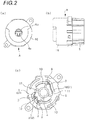
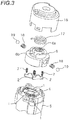
- the ignition switch (A) has, as illustrated in Figs. 2(a) to 3 , a switch case 5, a contact point holder 6 that is rotatable around a rotational center with respect to the switch case 5, and a switch cover 16 that is connected to the switch case 5 and covers the contact point holder 6.
- a circular power supply terminal 4 and fixed contact points 1 are disposed in the switch case 5 that is formed in a columnar shape by an insulating material in a state of being exposed to rotary interface with the contact point holder 6.
- the contact point holder 6 includes a plug connecting portion 6b having a connecting hole 6a to the cam member 14 in one end portion.
- the contact point holder 6 is biased in an initial rotational position by a torsion spring 17.
- the contact point holder 6 is moderately rotated at an appropriate connection operation angle by pressing click balls 19, which are biased by click springs 18, against an inner wall of the switch case 5.
- planar movable contact points 2 having a predetermined thickness are housed in the contact point holder 6 in a manner in which plate thickness surfaces face the switch case 5.
- the movable contact point 2 is movable in the rotational axis direction and is biased on a surface side of the switch case 5 by compression springs 7 housed in the contact point holder 6.
- the power supply terminal 4 is connected to a power supply (not illustrated) and is disposed in a center portion of the switch case 5, that is, in a rotational center position of the contact point holder 6.
- silver plating is applied to the fixed contact point 1 for preventing corrosion on the surface, is formed in an elongated band shape, and is disposed so as to surround a periphery of the power supply terminal 4.
- Silver plating is applied to a surface of the movable contact point 2 held in the contact point holder 6 and the movable contact point 2 is disposed to bridge the power supply terminal 4 and the fixed contact point 1.
- the movable contact point 2 is connected to the power supply terminal 4 by always being pressed against the power supply terminal 4 at any rotational position by being biased by the compression springs 7, and, furthermore, in order to prevent occurrence of abrasion of the fixed contact point 1 when the movable contact point 2 moves on the fixed contact point 1, a contact surface of the movable contact point 2 with the fixed contact point 1 is formed as a curvature surface (see Fig. 5(d) ).
- a raised protrusion 10 extending from a connection start point of each fixed contact point 1 in the counterclockwise direction is provided in the switch case 5.
- the fixed contact point 1 is formed by providing the transient contact region 3 in front of a contact position of the movable contact point 2 in the connection-operation angle described above.
- the transient contact region 3 is configured so as to be disposed in an inclined shape gradually toward the rotational center of the contact point holder 6 while going from the contact start point with the movable contact point 2 to the contact position in the connection-operation angle.
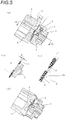
- the fixed contact point 1 is disposed in a position (height difference ⁇ ) higher than a surface on which the power supply electrode is provided so that the movable contact point 2 comes into contact with the ridge line of the chamfered portion 8.
- a round chamfered portion 2a is formed in a corner portion of the movable contact point 2 on the power supply electrode side (see Fig. 5(c) ).
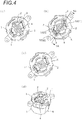
- Fig. 4(c) illustrates the contact state of the contact point when the movable contact point is operated to be rotated to the connection-operation angle of the IG1 terminal and the ST terminal.
- one end of the movable contact point 2 is supported on the power supply terminal 4 and the movable contact point 2 comes into contact with the chamfered portion 8 of the fixed contact point 1. Therefore, in a case where the contact point is worn, the contact point is sequentially moved in the direction of the power supply terminal 4 and a clean contact state is always ensured.
- a rotary switch device that rotates movable contact points 2 on fixed contact points 1 so as to connect and disconnect the fixed contact points 1 and the movable contact points 2.
- the fixed contact points 1 and the movable contact points 2 have contact surfaces which are band shapes and to which corrosion-resistant conductive processing is applied.
- Corrosion of the contact surfaces of the fixed contact points 1 and the movable contact points 2 of the rotary switch device is prevented.
- the contact surfaces are held clean without depending on a cleaning operation by sliding at high contact pressure. Therefore, even if the contact point is used for the low current, corrosion does not occur on the contact surfaces and the occurrence of contact failure due to the occurrence of the insulating film can be prevented.
- both contact points are formed in the elongated band shape and both contact points are moved from one end portion to the other end portion together with the rotation of the movable contact point 2. Therefore, even if damage of the film of the contact position occurs due to arc discharging, a clean surface state is maintained in both contact surfaces in the connection-operation angle. Therefore, the contact failure does not occur.
- a conductive processing surface for corrosion protection can be obtained by applying silver plating or applying clad processing and disc processing on the surface of the conductive member such as copper.
- the same structure may also be used for the high current.
- the transient contact region 3 of the fixed contact points 1 may be formed in a shape in which a moving speed on the movable contact points 2 is a low speed in a vicinity of a contact start point.
- the formation of the transient contact region 3 is able to be realized by moving the strip-like movable contact point 2 on the strip-like fixed contact point 1 that is disposed to be inclined so that the distance of the movable contact point 2 to the rotational center is changed. If the inclination in the vicinity of the contact start point between the fixed contact point 1 and the movable contact point 2 is moderated, the moving speed of the contact point of the movable contact point 2 with the fixed contact point 1 is lowered when the movable contact point 2 is operated to be rotated at a predetermined angular speed.
- the transient contact region 3 of the fixed contact points 1 may be formed in a shape in which a distance between the transient contact region and a rotational center of the movable contact points 2 is the maximum in a vicinity of a contact start position.
- a peripheral speed of the movable contact point 2 on the fixed contact point 1 becomes the maximum in the contact start point in which the distance from the rotational center becomes the maximum. Therefore, a transit time becomes the minimum. As a result, a distance of the fixed electrode influenced by arc discharging becomes the minimum and it is possible to effectively prevent degradation of the electrode.
- the rotary switch device may further include a switch case 5 that exposes the fixed contact points 1 and a power supply terminal 4 toward a line in a predetermined contact direction and holds the fixed contact points 1 and the power supply terminal 4, and a contact point holder 6 that holds the movable contact points rotatably around an axis along the line in the contact direction and reciprocatably toward the line in the contact direction.
- the movable contact points are formed in plate shapes having a predetermined thickness.
- the movable contact points 2 are always in contact with the power supply terminal 4 and are respectively in contact with the fixed contact points 1 during conduction with predetermined contact pressure by compression springs 7.
- the movable contact point 2 has a floating structure in which a biasing force is applied in a contact point pressure applying direction. Therefore, followability is increased with respect to the fixed contact point 1, connection reliability is improved, and then the structure is simplified.
- Chamfered portions 8 may be formed in side edges of the fixed contact points 1.
- the power supply terminal 4 and the fixed contact points 1 may be disposed at different heights in the direction of the line in the contact direction so as to hold the movable contact points 2 in an inclined posture and the movable contact points 2 may be in contact with ridge lines of the chamfered portions 8 of the fixed contact points 1 to be conductive.
- the chamfered portions are formed in the side edges of the fixed contact points 1 and the movable contact points 2 of the floating state come into line contact with the ridge lines of the chamfered portions 8. Therefore, homogeneous contact quality is ensured in each moving point.
- Raised protrusions 10 of the movable contact point 2, of which the contact start points of the fixed contact points 1 are defined as end points, and of which the end points are formed by inclined surfaces 9, may be provided in the switch case 5.
- the movable contact point 2 rides the raised protrusion 10 in a non-contact rotation position and the contact start is performed by causing the entire surface of the contact surface of the movable contact point 2 to gradually come into contact with the fixed contact point 1 while coming down the inclined surface 9 formed in the end point of the raised protrusion 10.
- an end edge of the fixed contact point 1 is the connection start point, discharge concentration occurs due to an edge effect, and damage of the contact point is increased.
- the contact start is performed in a state where the movable contact point 2 lands on the fixed contact point 1. Therefore, it is possible to reduce the damage of the contact point due to the edge effect.
- the buffering recessed portions 11 separating the fixed contact points 1 and the power supply terminal 4 may be provided in the switch case 5.
- the buffering recessed portions 11 provided between the fixed contact points 1 and the power supply terminal 4 are a storage space of particles and the like due to arc discharging and then become buffering bands which prevents deposition of conductive particles between the fixed contact points 1 and the power supply terminal 4 in a continuous shape. Therefore, a continuous conductive particle layer is formed between the fixed contact points 1 and the power supply terminal 4, and short-circuit is prevented between the fixed terminal and the power supply terminal 4.
Landscapes
- Engineering & Computer Science (AREA)
- Mechanical Engineering (AREA)
- Rotary Switch, Piano Key Switch, And Lever Switch (AREA)
Abstract
Description
- The present disclosure relates to a rotary switch device.
- In the related art,
Patent Literature 1 discloses a rotary switch device in which a movable contact point is short-circuited to a fixed contact point by being rotationally operated and connection and disconnection of the switch are performed. The rotary switch device is configured as a high current specification and both contact points are formed of a conductive metal such as plating-free copper alloy considering arc discharge during contact start. Oxide films generated on contact surfaces are peeled by causing the contact surfaces to slidingly come in contact with each other with high contact pressure and thereby the contact points are held to be clean and contact failure can be prevented. - On the other hand, in such a high current contact point, predetermined mechanical properties are required to reduce wear due to the sliding contact with high contact pressure. Therefore, there is a tendency that the contact resistance is increased and the high current contact point is not suitable for low current as it is.
- Since contact points of a low current specification reduce the contact resistance with low contact pressure and cannot expect a cleaning operation of the contact surfaces due to high contact pressure, corrosion-resistant conductive plating is applied on the surface. In a case where the contact points of the low current specification are used for the high current, damage of a plating film occurs due to arc discharging. Therefore, the contact points of the low current specification cannot be used for the high current.
- [Patent Literature 1]
JP-A-11-238434 - This present disclosure relates to a rotary switch device that is able to be used in both a high current and a low current.
-
-
Fig. 1 is a sectional view illustrating a steering lock device. -
Fig. 2 (a) is a plan view of a rotary switch device.Fig. 2(b) is a side view of the rotary switch device.Fig. 2(c) is a view illustrating one surface of a fixed contact point of a switch case. -
Fig. 3 is an exploded perspective view of the rotary switch device. -
Fig. 4 (a) is a view illustrating a non-conductive state of the rotary switch device.Fig. 4(b) is a view illustrating a state immediately after an IGN1 fixed contact point and an IGN2 fixed contact point are connected to a power supply terminal.Fig. 4(c) is a view illustrating a state where the IGN1 fixed contact point and an ST fixed contact point are connected to the power supply terminal.Fig. 4(d) is a perspective view ofFig. 4(b) . -
Fig. 5 (a) is a sectional view that is taken alongline 5A-5A ofFig. 4(b) .Fig. 5(b) is an enlarged view of a main portion ofFig. 5(a). Fig. 5(c) is a view further enlarging a main portion ofFig. 5(b). Fig. 5(d) is a sectional view that is taken alongline 5D-5D ofFig. 5(a) . - Hereinafter, embodiments will be described with reference to the drawings. Accompanying drawings and the following disclosure are illustrative of the invention and are not intended to limit the subject described in the claims.
- A rotary switch configured as an ignition switch for use in a steering lock device is illustrated in
Fig. 1 or below. The steering lock device of the example has acylinder lock 13 housed within ahousing 12 and acam member 14 connected to an end of aplug 13a of thecylinder lock 13, and is fixed to a steering column (not illustrated). - A
lock piece 15, which is moved between a lock position in which thelock piece 15 protrudes into the steering column by being moved forward and backward in a direction orthogonal to a rotational axis direction of thecam member 14 and an unlock position in which thelock piece 15 is housed within the housing, is mounted on thehousing 12. Thelock piece 15 is biased by acompression spring 15a in a direction of the lock position. If theplug 13a is operated to rotate from a lock rotational position, thelock piece 15 is moved from the lock position to the unlock position and is able to be operated to a steering shaft. - An ignition switch (A), which conducts electricity between predetermined contact points and changes a power supply state to an electrical system of a vehicle by the rotation of the
plug 13a, is connected to an end of thecam member 14. - The ignition switch (A) has, as illustrated in
Figs. 2(a) to 3 , aswitch case 5, acontact point holder 6 that is rotatable around a rotational center with respect to theswitch case 5, and aswitch cover 16 that is connected to theswitch case 5 and covers thecontact point holder 6. A circularpower supply terminal 4 andfixed contact points 1 are disposed in theswitch case 5 that is formed in a columnar shape by an insulating material in a state of being exposed to rotary interface with thecontact point holder 6. - As illustrated in
Fig. 3 , thecontact point holder 6 includes aplug connecting portion 6b having a connectinghole 6a to thecam member 14 in one end portion. Thecontact point holder 6 is biased in an initial rotational position by atorsion spring 17. In addition, thecontact point holder 6 is moderately rotated at an appropriate connection operation angle by pressingclick balls 19, which are biased by clicksprings 18, against an inner wall of theswitch case 5. - Furthermore, planar
movable contact points 2 having a predetermined thickness are housed in thecontact point holder 6 in a manner in which plate thickness surfaces face theswitch case 5. As described below, themovable contact point 2 is movable in the rotational axis direction and is biased on a surface side of theswitch case 5 bycompression springs 7 housed in thecontact point holder 6. - As illustrated in
Fig. 2(c) , thepower supply terminal 4 is connected to a power supply (not illustrated) and is disposed in a center portion of theswitch case 5, that is, in a rotational center position of thecontact point holder 6. In addition, silver plating is applied to thefixed contact point 1 for preventing corrosion on the surface, is formed in an elongated band shape, and is disposed so as to surround a periphery of thepower supply terminal 4. Silver plating is applied to a surface of themovable contact point 2 held in thecontact point holder 6 and themovable contact point 2 is disposed to bridge thepower supply terminal 4 and thefixed contact point 1. As illustrated inFigs. 4(a) to 4(d) , themovable contact point 2 is connected to thepower supply terminal 4 by always being pressed against thepower supply terminal 4 at any rotational position by being biased by thecompression springs 7, and, furthermore, in order to prevent occurrence of abrasion of thefixed contact point 1 when themovable contact point 2 moves on thefixed contact point 1, a contact surface of themovable contact point 2 with thefixed contact point 1 is formed as a curvature surface (seeFig. 5(d) ). - In the example in which the
movable contact point 2 is shifted by being rotated from "OFF state" to "ON state" in the clockwise direction, as illustrated inFig. 2(c) , a raisedprotrusion 10 extending from a connection start point of eachfixed contact point 1 in the counterclockwise direction is provided in theswitch case 5. Aninclined surface 9, which is a profile gradually decreases toward a distal end, is provided in an end region of the raisedprotrusion 10. - In addition, the
fixed contact point 1 is formed by providing thetransient contact region 3 in front of a contact position of themovable contact point 2 in the connection-operation angle described above. Thetransient contact region 3 is configured so as to be disposed in an inclined shape gradually toward the rotational center of thecontact point holder 6 while going from the contact start point with themovable contact point 2 to the contact position in the connection-operation angle. - Furthermore, as illustrated in
Fig. 5(c) , side edges on the rotational center of thefixed contact point 1 are chamfered and themovable contact point 2 of which one end is pressed against a power supply electrode is conductive by being in contact with a ridge line of the chamferedportion 8. - As illustrated in
Fig. 5(b) , thefixed contact point 1 is disposed in a position (height difference δ) higher than a surface on which the power supply electrode is provided so that themovable contact point 2 comes into contact with the ridge line of thechamfered portion 8. In order to prevent sharp contact with the power supply electrode by the inclination due to the height difference, a round chamferedportion 2a is formed in a corner portion of themovable contact point 2 on the power supply electrode side (seeFig. 5(c) ). - Therefore, in the example, if the
contact point holder 6 is rotated from the non-conductive state illustrated inFig. 4 (a) in the clockwise direction, themovable contact point 2 is moved on the raisedprotrusion 10 formed in theswitch case 5 and, as illustrated inFig. 4(b) , lands on the contact start point of thefixed contact point 1 via theinclined surface 9. Power feeding is started to the corresponding fixed contact points 1 (IG1 terminal, and IG2 terminal in the example) by causing themovable contact points 2 to come into contact with thefixed contact points 1. - Thereafter, furthermore, if the
movable contact point 2 is operated to be rotated to the connection-operation angle described above, the contact point of themovable contact point 2 with thefixed contact point 1 is sequentially moved and the contact point of thefixed contact point 1 with themovable contact point 2 is also sequentially moved on the contact point side of thepower supply terminal 4. As a result, particularly, even if the contact point is used for the high current and arc discharging occurs, a clean contact state is always obtained in the connection-operation angle illustrated inFig. 4(c) . -
Fig. 4(c) illustrates the contact state of the contact point when the movable contact point is operated to be rotated to the connection-operation angle of the IG1 terminal and the ST terminal. - In addition, as illustrated in
Fig. 2(c) , in an initial stage of thetransient contact region 3, that is, the vicinity of the contact start point of thefixed contact point 1, the inclined angle is smaller than that of the subsequent region. Therefore, a relative moving speed of thefixed contact point 1 on themovable contact point 2 is reduced, an arc discharging region on thefixed contact point 1 is limited, and a clean contact state is ensured in the connection-operation angle. - Furthermore, as described above, one end of the
movable contact point 2 is supported on thepower supply terminal 4 and themovable contact point 2 comes into contact with the chamferedportion 8 of thefixed contact point 1. Therefore, in a case where the contact point is worn, the contact point is sequentially moved in the direction of thepower supply terminal 4 and a clean contact state is always ensured. - According to the embodiment, a rotary switch device that rotates movable contact points 2 on fixed
contact points 1 so as to connect and disconnect the fixedcontact points 1 and the movable contact points 2. The fixedcontact points 1 and themovable contact points 2 have contact surfaces which are band shapes and to which corrosion-resistant conductive processing is applied. Atransient contact region 3, in which a contact point is moved from one end portion to the other end portion in a predetermined connection-operation angle from contact start with respect to the other of the fixed contact points and the movable contact points, is provided on each of the contact surfaces. - Corrosion of the contact surfaces of the fixed
contact points 1 and themovable contact points 2 of the rotary switch device is prevented. The contact surfaces are held clean without depending on a cleaning operation by sliding at high contact pressure. Therefore, even if the contact point is used for the low current, corrosion does not occur on the contact surfaces and the occurrence of contact failure due to the occurrence of the insulating film can be prevented. - In addition, both contact points are formed in the elongated band shape and both contact points are moved from one end portion to the other end portion together with the rotation of the
movable contact point 2. Therefore, even if damage of the film of the contact position occurs due to arc discharging, a clean surface state is maintained in both contact surfaces in the connection-operation angle. Therefore, the contact failure does not occur. - A conductive processing surface for corrosion protection can be obtained by applying silver plating or applying clad processing and disc processing on the surface of the conductive member such as copper.
- Therefore, the same structure may also be used for the high current. Thus, there is no need to set a plurality of types of the rotary switch devices for each regulated current.
- The
transient contact region 3 of the fixedcontact points 1 may be formed in a shape in which a moving speed on the movable contact points 2 is a low speed in a vicinity of a contact start point. - The formation of the
transient contact region 3 is able to be realized by moving the strip-likemovable contact point 2 on the strip-likefixed contact point 1 that is disposed to be inclined so that the distance of themovable contact point 2 to the rotational center is changed. If the inclination in the vicinity of the contact start point between the fixedcontact point 1 and themovable contact point 2 is moderated, the moving speed of the contact point of themovable contact point 2 with the fixedcontact point 1 is lowered when themovable contact point 2 is operated to be rotated at a predetermined angular speed. - As described above, if a low speed moving region is provided in the initial stage of the contact of both electrodes, it is possible to limit a damage region of the contact portion on the
movable contact point 2 due to arc discharging to be a narrow region. - The
transient contact region 3 of the fixedcontact points 1 may be formed in a shape in which a distance between the transient contact region and a rotational center of the movable contact points 2 is the maximum in a vicinity of a contact start position. - In a case where the
movable contact point 2 is operated to be rotated at a predetermined angular speed, a peripheral speed of themovable contact point 2 on the fixedcontact point 1 becomes the maximum in the contact start point in which the distance from the rotational center becomes the maximum. Therefore, a transit time becomes the minimum. As a result, a distance of the fixed electrode influenced by arc discharging becomes the minimum and it is possible to effectively prevent degradation of the electrode. - The rotary switch device may further include a
switch case 5 that exposes the fixedcontact points 1 and apower supply terminal 4 toward a line in a predetermined contact direction and holds the fixedcontact points 1 and thepower supply terminal 4, and acontact point holder 6 that holds the movable contact points rotatably around an axis along the line in the contact direction and reciprocatably toward the line in the contact direction. The movable contact points are formed in plate shapes having a predetermined thickness. Themovable contact points 2 are always in contact with thepower supply terminal 4 and are respectively in contact with the fixedcontact points 1 during conduction with predetermined contact pressure by compression springs 7. - The
movable contact point 2 has a floating structure in which a biasing force is applied in a contact point pressure applying direction. Therefore, followability is increased with respect to the fixedcontact point 1, connection reliability is improved, and then the structure is simplified. -
Chamfered portions 8 may be formed in side edges of the fixed contact points 1. Thepower supply terminal 4 and the fixedcontact points 1 may be disposed at different heights in the direction of the line in the contact direction so as to hold themovable contact points 2 in an inclined posture and the movable contact points 2 may be in contact with ridge lines of the chamferedportions 8 of the fixedcontact points 1 to be conductive. - The chamfered portions are formed in the side edges of the fixed
contact points 1 and themovable contact points 2 of the floating state come into line contact with the ridge lines of the chamferedportions 8. Therefore, homogeneous contact quality is ensured in each moving point. - In addition, if the chamfered portion is formed in the fixed
contact point 1 and themovable contact point 2 comes into contact with the ridge line, in a case where the fixedcontact point 1 is worn, since the contact point is moved corresponding to a wear amount, it is possible to always provide a clean contact point with respect to themovable contact point 2. - Raised
protrusions 10 of themovable contact point 2, of which the contact start points of the fixedcontact points 1 are defined as end points, and of which the end points are formed byinclined surfaces 9, may be provided in theswitch case 5. - The
movable contact point 2 rides the raisedprotrusion 10 in a non-contact rotation position and the contact start is performed by causing the entire surface of the contact surface of themovable contact point 2 to gradually come into contact with the fixedcontact point 1 while coming down theinclined surface 9 formed in the end point of the raisedprotrusion 10. In a case where themovable contact point 2 starts the contact on the same plane, an end edge of the fixedcontact point 1 is the connection start point, discharge concentration occurs due to an edge effect, and damage of the contact point is increased. However, in a case where the raisedprotrusion 10 is present, the contact start is performed in a state where themovable contact point 2 lands on the fixedcontact point 1. Therefore, it is possible to reduce the damage of the contact point due to the edge effect. - The buffering recessed
portions 11 separating the fixedcontact points 1 and thepower supply terminal 4 may be provided in theswitch case 5. - The buffering recessed
portions 11 provided between thefixed contact points 1 and thepower supply terminal 4 are a storage space of particles and the like due to arc discharging and then become buffering bands which prevents deposition of conductive particles between thefixed contact points 1 and thepower supply terminal 4 in a continuous shape. Therefore, a continuous conductive particle layer is formed between thefixed contact points 1 and thepower supply terminal 4, and short-circuit is prevented between the fixed terminal and thepower supply terminal 4. - According to the disclosure, it is possible to obtain the rotary switch device which is able to be used for both the high current and the low current.
- This application is based on Japanese patent application filed on April 25, 2014 (Japanese Patent Application No.
2014-091444 -
- 1
- fixed contact point
- 2
- movable contact point
- 3
- transient contact region
- 4
- power supply terminal
- 5
- switch case
- 6
- contact point holder
- 7
- compression spring
- 8
- chamfered portion
- 9
- inclined surface
- 10
- raised protrusion
- 11
- buffering recessed portion
Claims (7)
- A rotary switch device that rotates movable contact points on fixed contact points so as to connect and disconnect the fixed contact points and the movable contact points,
wherein the fixed contact points and the movable contact points have contact surfaces which are band shapes and to which corrosion-resistant conductive processing is applied, and
wherein a transient contact region, in which a contact point is moved from one end portion to the other end portion in a predetermined connection-operation angle from contact start with respect to the other of the fixed contact points and the movable contact points, is provided on each of the contact surfaces. - The rotary switch device according to claim 1,
wherein the transient contact region of the fixed contact points are formed in shapes in which a moving speed on the movable contact points is a low speed in a vicinity of a contact start point. - The rotary switch device according to claim 1 or 2,
wherein the transient contact region of the fixed contact points are formed in shapes in which a distance between the transient contact region and a rotational center of the movable contact points is the maximum in a vicinity of a contact start position. - The rotary switch device according to claim 1, 2 or 3, further comprising:a switch case that exposes the fixed contact points and a power supply terminal toward a line in a predetermined contact direction and holds the fixed contact points and the power supply terminal; anda contact point holder that holds the movable contact points rotatably around an axis along the line in the contact direction and reciprocatably toward the line in the contact direction,wherein the movable contact points are formed in plate shapes having a predetermined thickness, and
wherein the movable contact points are always in contact with the power supply terminal and are respectively in contact with the fixed contact points during conduction with predetermined contact pressure by compression springs. - The rotary switch device according to claim 4,
wherein chamfered portions are formed in side edges of the fixed contact points, and
wherein the power supply terminal and the fixed contact points are disposed at different heights in the direction of the line in the contact direction so as to hold the movable contact points in an inclined posture and the movable contact points are in contact with ridge lines of the chamfered portions of the fixed contact points to be conductive. - The rotary switch device according to claim 4 or 5,
wherein raised protrusions of the movable contact points, of which the contact start points of the fixed contact points are defined as end points, and of which the end points are formed by inclined surfaces, are provided in the switch case. - The rotary switch device according to claim 4, 5, or 6,
wherein buffering recessed portions separating the fixed contact points and the power supply terminal are provided in the switch case.
Applications Claiming Priority (2)
| Application Number | Priority Date | Filing Date | Title |
|---|---|---|---|
| JP2014091444A JP6322470B2 (en) | 2014-04-25 | 2014-04-25 | Rotary switch device |
| PCT/JP2015/062451 WO2015163430A1 (en) | 2014-04-25 | 2015-04-23 | Rotary switch device |
Publications (3)
| Publication Number | Publication Date |
|---|---|
| EP3136412A1 true EP3136412A1 (en) | 2017-03-01 |
| EP3136412A4 EP3136412A4 (en) | 2018-01-03 |
| EP3136412B1 EP3136412B1 (en) | 2019-06-26 |
Family
ID=54332592
Family Applications (1)
| Application Number | Title | Priority Date | Filing Date |
|---|---|---|---|
| EP15783381.5A Active EP3136412B1 (en) | 2014-04-25 | 2015-04-23 | Rotary switch device |
Country Status (8)
| Country | Link |
|---|---|
| US (1) | US9972452B2 (en) |
| EP (1) | EP3136412B1 (en) |
| JP (1) | JP6322470B2 (en) |
| KR (1) | KR20160147757A (en) |
| CN (1) | CN106256010B (en) |
| AU (1) | AU2015251033A1 (en) |
| RU (1) | RU2016146112A (en) |
| WO (1) | WO2015163430A1 (en) |
Families Citing this family (6)
| Publication number | Priority date | Publication date | Assignee | Title |
|---|---|---|---|---|
| DE102015111832A1 (en) * | 2015-07-21 | 2017-01-26 | Huf Hülsbeck & Fürst Gmbh & Co. Kg | Motor vehicle steering lock |
| JP6655470B2 (en) * | 2016-05-17 | 2020-02-26 | 株式会社アルファ | Rotary switch device |
| JP6774219B2 (en) * | 2016-05-17 | 2020-10-21 | 株式会社アルファ | Rotary switch device |
| KR101760332B1 (en) * | 2016-10-14 | 2017-07-21 | 주식회사 대륙 | Rotary type switch structure |
| EP3653824B1 (en) * | 2018-11-15 | 2024-09-04 | Inalfa Roof Systems Group B.V. | Device for detecting an impact force and a method of manufacturing thereof |
| KR102845125B1 (en) | 2019-12-03 | 2025-08-13 | 현대자동차주식회사 | Switch |
Family Cites Families (10)
| Publication number | Priority date | Publication date | Assignee | Title |
|---|---|---|---|---|
| US2195307A (en) * | 1939-03-09 | 1940-03-26 | Mallory & Co Inc P R | Contact |
| JPS6489222A (en) * | 1987-09-30 | 1989-04-03 | Matsushita Electric Industrial Co Ltd | Switch |
| JPH07245040A (en) * | 1994-03-01 | 1995-09-19 | Kansei Corp | Rotary switch |
| JPH09147673A (en) * | 1995-11-17 | 1997-06-06 | Tokai Rika Co Ltd | Slide switch |
| JPH10125178A (en) * | 1996-10-18 | 1998-05-15 | Aisin Aw Co Ltd | Position detecting switch |
| JPH11176271A (en) * | 1997-12-15 | 1999-07-02 | Yuhshin Co Ltd | Switch contact |
| JP3561404B2 (en) * | 1998-02-24 | 2004-09-02 | 株式会社ホンダロック | Rotary switch device |
| US6114638A (en) | 1998-02-24 | 2000-09-05 | Kabushiki Kaisha Honda Lock | Rotary switch device |
| JPH11260193A (en) * | 1998-03-11 | 1999-09-24 | Yuhshin Co Ltd | Changeover switch |
| JP2003242858A (en) * | 2002-02-14 | 2003-08-29 | Asahi Matsushita Electric Works Ltd | Rotary switch |
-
2014
- 2014-04-25 JP JP2014091444A patent/JP6322470B2/en active Active
-
2015
- 2015-04-23 CN CN201580022091.1A patent/CN106256010B/en active Active
- 2015-04-23 AU AU2015251033A patent/AU2015251033A1/en not_active Abandoned
- 2015-04-23 WO PCT/JP2015/062451 patent/WO2015163430A1/en not_active Ceased
- 2015-04-23 EP EP15783381.5A patent/EP3136412B1/en active Active
- 2015-04-23 KR KR1020167029542A patent/KR20160147757A/en not_active Withdrawn
- 2015-04-23 RU RU2016146112A patent/RU2016146112A/en not_active Application Discontinuation
-
2016
- 2016-10-24 US US15/332,002 patent/US9972452B2/en active Active
Also Published As
| Publication number | Publication date |
|---|---|
| RU2016146112A (en) | 2018-05-28 |
| JP2015210933A (en) | 2015-11-24 |
| EP3136412A4 (en) | 2018-01-03 |
| JP6322470B2 (en) | 2018-05-09 |
| CN106256010B (en) | 2019-11-08 |
| AU2015251033A1 (en) | 2016-11-10 |
| CN106256010A (en) | 2016-12-21 |
| US9972452B2 (en) | 2018-05-15 |
| WO2015163430A1 (en) | 2015-10-29 |
| KR20160147757A (en) | 2016-12-23 |
| US20170040125A1 (en) | 2017-02-09 |
| EP3136412B1 (en) | 2019-06-26 |
Similar Documents
| Publication | Publication Date | Title |
|---|---|---|
| US9972452B2 (en) | Rotary switch device | |
| US8075328B2 (en) | Connector with an actuator pushed by a base-plate | |
| US4336974A (en) | Coaxial rotary joint | |
| WO2017199964A1 (en) | Rotary switch device | |
| US20140099803A1 (en) | Electrical contact assembly | |
| CN109088198A (en) | Coaxial connector | |
| US10650990B2 (en) | Rotary switch | |
| EP3460819B1 (en) | Rotary switch device | |
| CN202585217U (en) | Rotatory electronic component | |
| JP6655470B2 (en) | Rotary switch device | |
| JP6157313B2 (en) | Connection device | |
| JP2008262793A (en) | Spring pin, and battery connector device | |
| JP2019179666A (en) | Terminal pair | |
| JP2025096852A (en) | peeler | |
| US20160071668A1 (en) | Pivoting electrical switch | |
| JP4946577B2 (en) | Equipment with rotating plug | |
| CN102299460A (en) | Power interface of notebook computer |
Legal Events
| Date | Code | Title | Description |
|---|---|---|---|
| STAA | Information on the status of an ep patent application or granted ep patent |
Free format text: STATUS: THE INTERNATIONAL PUBLICATION HAS BEEN MADE |
|
| PUAI | Public reference made under article 153(3) epc to a published international application that has entered the european phase |
Free format text: ORIGINAL CODE: 0009012 |
|
| STAA | Information on the status of an ep patent application or granted ep patent |
Free format text: STATUS: REQUEST FOR EXAMINATION WAS MADE |
|
| 17P | Request for examination filed |
Effective date: 20161025 |
|
| AK | Designated contracting states |
Kind code of ref document: A1 Designated state(s): AL AT BE BG CH CY CZ DE DK EE ES FI FR GB GR HR HU IE IS IT LI LT LU LV MC MK MT NL NO PL PT RO RS SE SI SK SM TR |
|
| AX | Request for extension of the european patent |
Extension state: BA ME |
|
| DAV | Request for validation of the european patent (deleted) | ||
| DAX | Request for extension of the european patent (deleted) | ||
| A4 | Supplementary search report drawn up and despatched |
Effective date: 20171201 |
|
| RIC1 | Information provided on ipc code assigned before grant |
Ipc: H01H 19/02 20060101AFI20171128BHEP Ipc: H01H 19/58 20060101ALI20171128BHEP Ipc: B60R 16/02 20060101ALI20171128BHEP Ipc: H01H 1/06 20060101ALI20171128BHEP Ipc: B60R 25/021 20130101ALI20171128BHEP Ipc: H01H 1/36 20060101ALI20171128BHEP Ipc: H01H 19/08 20060101ALI20171128BHEP |
|
| GRAP | Despatch of communication of intention to grant a patent |
Free format text: ORIGINAL CODE: EPIDOSNIGR1 |
|
| STAA | Information on the status of an ep patent application or granted ep patent |
Free format text: STATUS: GRANT OF PATENT IS INTENDED |
|
| INTG | Intention to grant announced |
Effective date: 20190215 |
|
| GRAS | Grant fee paid |
Free format text: ORIGINAL CODE: EPIDOSNIGR3 |
|
| GRAA | (expected) grant |
Free format text: ORIGINAL CODE: 0009210 |
|
| STAA | Information on the status of an ep patent application or granted ep patent |
Free format text: STATUS: THE PATENT HAS BEEN GRANTED |
|
| AK | Designated contracting states |
Kind code of ref document: B1 Designated state(s): AL AT BE BG CH CY CZ DE DK EE ES FI FR GB GR HR HU IE IS IT LI LT LU LV MC MK MT NL NO PL PT RO RS SE SI SK SM TR |
|
| REG | Reference to a national code |
Ref country code: GB Ref legal event code: FG4D |
|
| REG | Reference to a national code |
Ref country code: CH Ref legal event code: EP |
|
| REG | Reference to a national code |
Ref country code: DE Ref legal event code: R096 Ref document number: 602015032784 Country of ref document: DE |
|
| REG | Reference to a national code |
Ref country code: AT Ref legal event code: REF Ref document number: 1149267 Country of ref document: AT Kind code of ref document: T Effective date: 20190715 |
|
| REG | Reference to a national code |
Ref country code: IE Ref legal event code: FG4D |
|
| REG | Reference to a national code |
Ref country code: NL Ref legal event code: MP Effective date: 20190626 |
|
| PG25 | Lapsed in a contracting state [announced via postgrant information from national office to epo] |
Ref country code: FI Free format text: LAPSE BECAUSE OF FAILURE TO SUBMIT A TRANSLATION OF THE DESCRIPTION OR TO PAY THE FEE WITHIN THE PRESCRIBED TIME-LIMIT Effective date: 20190626 Ref country code: NO Free format text: LAPSE BECAUSE OF FAILURE TO SUBMIT A TRANSLATION OF THE DESCRIPTION OR TO PAY THE FEE WITHIN THE PRESCRIBED TIME-LIMIT Effective date: 20190926 Ref country code: LT Free format text: LAPSE BECAUSE OF FAILURE TO SUBMIT A TRANSLATION OF THE DESCRIPTION OR TO PAY THE FEE WITHIN THE PRESCRIBED TIME-LIMIT Effective date: 20190626 Ref country code: AL Free format text: LAPSE BECAUSE OF FAILURE TO SUBMIT A TRANSLATION OF THE DESCRIPTION OR TO PAY THE FEE WITHIN THE PRESCRIBED TIME-LIMIT Effective date: 20190626 Ref country code: HR Free format text: LAPSE BECAUSE OF FAILURE TO SUBMIT A TRANSLATION OF THE DESCRIPTION OR TO PAY THE FEE WITHIN THE PRESCRIBED TIME-LIMIT Effective date: 20190626 Ref country code: SE Free format text: LAPSE BECAUSE OF FAILURE TO SUBMIT A TRANSLATION OF THE DESCRIPTION OR TO PAY THE FEE WITHIN THE PRESCRIBED TIME-LIMIT Effective date: 20190626 |
|
| REG | Reference to a national code |
Ref country code: LT Ref legal event code: MG4D |
|
| PG25 | Lapsed in a contracting state [announced via postgrant information from national office to epo] |
Ref country code: GR Free format text: LAPSE BECAUSE OF FAILURE TO SUBMIT A TRANSLATION OF THE DESCRIPTION OR TO PAY THE FEE WITHIN THE PRESCRIBED TIME-LIMIT Effective date: 20190927 Ref country code: LV Free format text: LAPSE BECAUSE OF FAILURE TO SUBMIT A TRANSLATION OF THE DESCRIPTION OR TO PAY THE FEE WITHIN THE PRESCRIBED TIME-LIMIT Effective date: 20190626 Ref country code: BG Free format text: LAPSE BECAUSE OF FAILURE TO SUBMIT A TRANSLATION OF THE DESCRIPTION OR TO PAY THE FEE WITHIN THE PRESCRIBED TIME-LIMIT Effective date: 20190926 Ref country code: RS Free format text: LAPSE BECAUSE OF FAILURE TO SUBMIT A TRANSLATION OF THE DESCRIPTION OR TO PAY THE FEE WITHIN THE PRESCRIBED TIME-LIMIT Effective date: 20190626 |
|
| REG | Reference to a national code |
Ref country code: AT Ref legal event code: MK05 Ref document number: 1149267 Country of ref document: AT Kind code of ref document: T Effective date: 20190626 |
|
| PG25 | Lapsed in a contracting state [announced via postgrant information from national office to epo] |
Ref country code: RO Free format text: LAPSE BECAUSE OF FAILURE TO SUBMIT A TRANSLATION OF THE DESCRIPTION OR TO PAY THE FEE WITHIN THE PRESCRIBED TIME-LIMIT Effective date: 20190626 Ref country code: SK Free format text: LAPSE BECAUSE OF FAILURE TO SUBMIT A TRANSLATION OF THE DESCRIPTION OR TO PAY THE FEE WITHIN THE PRESCRIBED TIME-LIMIT Effective date: 20190626 Ref country code: NL Free format text: LAPSE BECAUSE OF FAILURE TO SUBMIT A TRANSLATION OF THE DESCRIPTION OR TO PAY THE FEE WITHIN THE PRESCRIBED TIME-LIMIT Effective date: 20190626 Ref country code: CZ Free format text: LAPSE BECAUSE OF FAILURE TO SUBMIT A TRANSLATION OF THE DESCRIPTION OR TO PAY THE FEE WITHIN THE PRESCRIBED TIME-LIMIT Effective date: 20190626 Ref country code: PT Free format text: LAPSE BECAUSE OF FAILURE TO SUBMIT A TRANSLATION OF THE DESCRIPTION OR TO PAY THE FEE WITHIN THE PRESCRIBED TIME-LIMIT Effective date: 20191028 Ref country code: AT Free format text: LAPSE BECAUSE OF FAILURE TO SUBMIT A TRANSLATION OF THE DESCRIPTION OR TO PAY THE FEE WITHIN THE PRESCRIBED TIME-LIMIT Effective date: 20190626 Ref country code: EE Free format text: LAPSE BECAUSE OF FAILURE TO SUBMIT A TRANSLATION OF THE DESCRIPTION OR TO PAY THE FEE WITHIN THE PRESCRIBED TIME-LIMIT Effective date: 20190626 |
|
| PG25 | Lapsed in a contracting state [announced via postgrant information from national office to epo] |
Ref country code: IT Free format text: LAPSE BECAUSE OF FAILURE TO SUBMIT A TRANSLATION OF THE DESCRIPTION OR TO PAY THE FEE WITHIN THE PRESCRIBED TIME-LIMIT Effective date: 20190626 Ref country code: SM Free format text: LAPSE BECAUSE OF FAILURE TO SUBMIT A TRANSLATION OF THE DESCRIPTION OR TO PAY THE FEE WITHIN THE PRESCRIBED TIME-LIMIT Effective date: 20190626 Ref country code: IS Free format text: LAPSE BECAUSE OF FAILURE TO SUBMIT A TRANSLATION OF THE DESCRIPTION OR TO PAY THE FEE WITHIN THE PRESCRIBED TIME-LIMIT Effective date: 20191026 Ref country code: ES Free format text: LAPSE BECAUSE OF FAILURE TO SUBMIT A TRANSLATION OF THE DESCRIPTION OR TO PAY THE FEE WITHIN THE PRESCRIBED TIME-LIMIT Effective date: 20190626 |
|
| PG25 | Lapsed in a contracting state [announced via postgrant information from national office to epo] |
Ref country code: TR Free format text: LAPSE BECAUSE OF FAILURE TO SUBMIT A TRANSLATION OF THE DESCRIPTION OR TO PAY THE FEE WITHIN THE PRESCRIBED TIME-LIMIT Effective date: 20190626 |
|
| PG25 | Lapsed in a contracting state [announced via postgrant information from national office to epo] |
Ref country code: PL Free format text: LAPSE BECAUSE OF FAILURE TO SUBMIT A TRANSLATION OF THE DESCRIPTION OR TO PAY THE FEE WITHIN THE PRESCRIBED TIME-LIMIT Effective date: 20190626 Ref country code: DK Free format text: LAPSE BECAUSE OF FAILURE TO SUBMIT A TRANSLATION OF THE DESCRIPTION OR TO PAY THE FEE WITHIN THE PRESCRIBED TIME-LIMIT Effective date: 20190626 |
|
| PG25 | Lapsed in a contracting state [announced via postgrant information from national office to epo] |
Ref country code: IS Free format text: LAPSE BECAUSE OF FAILURE TO SUBMIT A TRANSLATION OF THE DESCRIPTION OR TO PAY THE FEE WITHIN THE PRESCRIBED TIME-LIMIT Effective date: 20200224 |
|
| REG | Reference to a national code |
Ref country code: DE Ref legal event code: R097 Ref document number: 602015032784 Country of ref document: DE |
|
| PLBE | No opposition filed within time limit |
Free format text: ORIGINAL CODE: 0009261 |
|
| STAA | Information on the status of an ep patent application or granted ep patent |
Free format text: STATUS: NO OPPOSITION FILED WITHIN TIME LIMIT |
|
| PG2D | Information on lapse in contracting state deleted |
Ref country code: IS |
|
| 26N | No opposition filed |
Effective date: 20200603 |
|
| PG25 | Lapsed in a contracting state [announced via postgrant information from national office to epo] |
Ref country code: SI Free format text: LAPSE BECAUSE OF FAILURE TO SUBMIT A TRANSLATION OF THE DESCRIPTION OR TO PAY THE FEE WITHIN THE PRESCRIBED TIME-LIMIT Effective date: 20190626 |
|
| PG25 | Lapsed in a contracting state [announced via postgrant information from national office to epo] |
Ref country code: MC Free format text: LAPSE BECAUSE OF FAILURE TO SUBMIT A TRANSLATION OF THE DESCRIPTION OR TO PAY THE FEE WITHIN THE PRESCRIBED TIME-LIMIT Effective date: 20190626 |
|
| REG | Reference to a national code |
Ref country code: CH Ref legal event code: PL |
|
| PG25 | Lapsed in a contracting state [announced via postgrant information from national office to epo] |
Ref country code: LU Free format text: LAPSE BECAUSE OF NON-PAYMENT OF DUE FEES Effective date: 20200423 Ref country code: LI Free format text: LAPSE BECAUSE OF NON-PAYMENT OF DUE FEES Effective date: 20200430 Ref country code: CH Free format text: LAPSE BECAUSE OF NON-PAYMENT OF DUE FEES Effective date: 20200430 |
|
| REG | Reference to a national code |
Ref country code: BE Ref legal event code: MM Effective date: 20200430 |
|
| PG25 | Lapsed in a contracting state [announced via postgrant information from national office to epo] |
Ref country code: BE Free format text: LAPSE BECAUSE OF NON-PAYMENT OF DUE FEES Effective date: 20200430 |
|
| PG25 | Lapsed in a contracting state [announced via postgrant information from national office to epo] |
Ref country code: IE Free format text: LAPSE BECAUSE OF NON-PAYMENT OF DUE FEES Effective date: 20200423 |
|
| PGFP | Annual fee paid to national office [announced via postgrant information from national office to epo] |
Ref country code: FR Payment date: 20210309 Year of fee payment: 7 |
|
| PGFP | Annual fee paid to national office [announced via postgrant information from national office to epo] |
Ref country code: GB Payment date: 20210331 Year of fee payment: 7 |
|
| PG25 | Lapsed in a contracting state [announced via postgrant information from national office to epo] |
Ref country code: MT Free format text: LAPSE BECAUSE OF FAILURE TO SUBMIT A TRANSLATION OF THE DESCRIPTION OR TO PAY THE FEE WITHIN THE PRESCRIBED TIME-LIMIT Effective date: 20190626 Ref country code: CY Free format text: LAPSE BECAUSE OF FAILURE TO SUBMIT A TRANSLATION OF THE DESCRIPTION OR TO PAY THE FEE WITHIN THE PRESCRIBED TIME-LIMIT Effective date: 20190626 |
|
| PG25 | Lapsed in a contracting state [announced via postgrant information from national office to epo] |
Ref country code: MK Free format text: LAPSE BECAUSE OF FAILURE TO SUBMIT A TRANSLATION OF THE DESCRIPTION OR TO PAY THE FEE WITHIN THE PRESCRIBED TIME-LIMIT Effective date: 20190626 |
|
| GBPC | Gb: european patent ceased through non-payment of renewal fee |
Effective date: 20220423 |
|
| PG25 | Lapsed in a contracting state [announced via postgrant information from national office to epo] |
Ref country code: GB Free format text: LAPSE BECAUSE OF NON-PAYMENT OF DUE FEES Effective date: 20220423 Ref country code: FR Free format text: LAPSE BECAUSE OF NON-PAYMENT OF DUE FEES Effective date: 20220430 |
|
| PGFP | Annual fee paid to national office [announced via postgrant information from national office to epo] |
Ref country code: DE Payment date: 20250305 Year of fee payment: 11 |