EP3135721A2 - Polyester-based plasticizer for resin - Google Patents
Polyester-based plasticizer for resin Download PDFInfo
- Publication number
- EP3135721A2 EP3135721A2 EP15783628.9A EP15783628A EP3135721A2 EP 3135721 A2 EP3135721 A2 EP 3135721A2 EP 15783628 A EP15783628 A EP 15783628A EP 3135721 A2 EP3135721 A2 EP 3135721A2
- Authority
- EP
- European Patent Office
- Prior art keywords
- polyester
- resin
- plasticizer
- based plasticizer
- formula
- Prior art date
- Legal status (The legal status is an assumption and is not a legal conclusion. Google has not performed a legal analysis and makes no representation as to the accuracy of the status listed.)
- Withdrawn
Links
Classifications
-
- C—CHEMISTRY; METALLURGY
- C08—ORGANIC MACROMOLECULAR COMPOUNDS; THEIR PREPARATION OR CHEMICAL WORKING-UP; COMPOSITIONS BASED THEREON
- C08K—Use of inorganic or non-macromolecular organic substances as compounding ingredients
- C08K5/00—Use of organic ingredients
- C08K5/0008—Organic ingredients according to more than one of the "one dot" groups of C08K5/01 - C08K5/59
- C08K5/0016—Plasticisers
-
- C—CHEMISTRY; METALLURGY
- C08—ORGANIC MACROMOLECULAR COMPOUNDS; THEIR PREPARATION OR CHEMICAL WORKING-UP; COMPOSITIONS BASED THEREON
- C08K—Use of inorganic or non-macromolecular organic substances as compounding ingredients
- C08K5/00—Use of organic ingredients
- C08K5/04—Oxygen-containing compounds
- C08K5/10—Esters; Ether-esters
- C08K5/11—Esters; Ether-esters of acyclic polycarboxylic acids
-
- C—CHEMISTRY; METALLURGY
- C07—ORGANIC CHEMISTRY
- C07C—ACYCLIC OR CARBOCYCLIC COMPOUNDS
- C07C69/00—Esters of carboxylic acids; Esters of carbonic or haloformic acids
- C07C69/66—Esters of carboxylic acids having esterified carboxylic groups bound to acyclic carbon atoms and having any of the groups OH, O—metal, —CHO, keto, ether, acyloxy, groups, groups, or in the acid moiety
- C07C69/67—Esters of carboxylic acids having esterified carboxylic groups bound to acyclic carbon atoms and having any of the groups OH, O—metal, —CHO, keto, ether, acyloxy, groups, groups, or in the acid moiety of saturated acids
- C07C69/716—Esters of keto-carboxylic acids or aldehydo-carboxylic acids
-
- C—CHEMISTRY; METALLURGY
- C08—ORGANIC MACROMOLECULAR COMPOUNDS; THEIR PREPARATION OR CHEMICAL WORKING-UP; COMPOSITIONS BASED THEREON
- C08G—MACROMOLECULAR COMPOUNDS OBTAINED OTHERWISE THAN BY REACTIONS ONLY INVOLVING UNSATURATED CARBON-TO-CARBON BONDS
- C08G63/00—Macromolecular compounds obtained by reactions forming a carboxylic ester link in the main chain of the macromolecule
- C08G63/02—Polyesters derived from hydroxycarboxylic acids or from polycarboxylic acids and polyhydroxy compounds
- C08G63/12—Polyesters derived from hydroxycarboxylic acids or from polycarboxylic acids and polyhydroxy compounds derived from polycarboxylic acids and polyhydroxy compounds
- C08G63/16—Dicarboxylic acids and dihydroxy compounds
-
- C—CHEMISTRY; METALLURGY
- C08—ORGANIC MACROMOLECULAR COMPOUNDS; THEIR PREPARATION OR CHEMICAL WORKING-UP; COMPOSITIONS BASED THEREON
- C08L—COMPOSITIONS OF MACROMOLECULAR COMPOUNDS
- C08L101/00—Compositions of unspecified macromolecular compounds
-
- C—CHEMISTRY; METALLURGY
- C08—ORGANIC MACROMOLECULAR COMPOUNDS; THEIR PREPARATION OR CHEMICAL WORKING-UP; COMPOSITIONS BASED THEREON
- C08L—COMPOSITIONS OF MACROMOLECULAR COMPOUNDS
- C08L67/00—Compositions of polyesters obtained by reactions forming a carboxylic ester link in the main chain; Compositions of derivatives of such polymers
-
- C—CHEMISTRY; METALLURGY
- C08—ORGANIC MACROMOLECULAR COMPOUNDS; THEIR PREPARATION OR CHEMICAL WORKING-UP; COMPOSITIONS BASED THEREON
- C08L—COMPOSITIONS OF MACROMOLECULAR COMPOUNDS
- C08L69/00—Compositions of polycarbonates; Compositions of derivatives of polycarbonates
-
- C—CHEMISTRY; METALLURGY
- C08—ORGANIC MACROMOLECULAR COMPOUNDS; THEIR PREPARATION OR CHEMICAL WORKING-UP; COMPOSITIONS BASED THEREON
- C08K—Use of inorganic or non-macromolecular organic substances as compounding ingredients
- C08K2201/00—Specific properties of additives
- C08K2201/018—Additives for biodegradable polymeric composition
-
- C—CHEMISTRY; METALLURGY
- C08—ORGANIC MACROMOLECULAR COMPOUNDS; THEIR PREPARATION OR CHEMICAL WORKING-UP; COMPOSITIONS BASED THEREON
- C08L—COMPOSITIONS OF MACROMOLECULAR COMPOUNDS
- C08L2201/00—Properties
Definitions
- the present disclosure relates to a plasticizer for resin, and more particularly, to a polyester-based plasticizer for resin.
- Polymer resins and plasticizers for polymer resins that are in common use in the plastic material field are mostly derived from petroleum origins and are widely used as packing materials such as various films.
- phthalate-based plasticizers including dibutyl phthalate (DBP) or dioctyl phthalate (DOP) are used in general-purpose resin such as polyvinyl chloride (PVC).
- DBP dibutyl phthalate
- DOP dioctyl phthalate
- PVC polyvinyl chloride
- phthalate-based plasticizers use sources obtained from petroleum, raising concern of harmful effects as toxic, endocrine-disrupting chemicals. For this reason, some countries are taking legal action to prevent use of phthalate-based plasticizers.
- biodegradable polymer resin As typical biodegradable polymer resin developed, polylactic acid is produced by polymerization of lactic acid derived from a biological organism. There also have been attempts to use polylactic acid as an alternative to conventional general-purpose polymer resin in various application fields, through development of biodegradable polymer resin, for example, by forming a copolymer of polylactic acid with other aliphatic hydrocarboxylic acids or by forming polyester through esterification of polylactic acid with aliphatic polyvalent alcohol.
- polylactic acid that is stiff and inductile due to high crystallinity and rigid molecular structure is vulnerable to thermal decomposition during a process, and thus is not suitable for use alone in the packing field where flexibility of material is required.
- adding a plasticizer to polylactic acid may be considered, though further research and development are required to soften the physical properties of polylactic acid with a plasticizer.
- adipic acid ester As a plasticizer for such polylactic acid, adipic acid ester may be used.
- adipic acid as a main source of ester polymer is also derived from petroleum origin raw material, and not environmentally friendly, and has a limited processability when used with polyester resin having poor mechanical properties in terms of tensile strength and impact resistance.
- ⁇ -ketoglutaric acid is known as a product of deamination reaction of glutamate in biological organisms and an intermediate product of the Krebs cycle. In other words, ⁇ -ketoglutaric acid is attainable from biological organisms, not by a petrochemical method, according to the prior art information.
- the present disclosure provides an environmentally friendly plasticizer that is derived from biological organisms, having good processability to improve mechanical properties such as durability, tensile strength, and impact resistance of a resin composition.
- polyester-based plasticizer for resin represented by Formula 1: wherein, in Formula 1,
- a polyester-based plasticizer comprising a plasticizer represented by Formula 1 a or 1 b, or any combinations thereof: wherein, in Formulae 1 a and 1 b, m is defined the same as defined in Formula 1.
- a polyester-based plasticizer prepared using ⁇ -ketoglutaric acid monomers that are derived from biological organisms may be environmentally friendly and may improve mechanical properties such as low tensile strength and impact resistance of a polyester resin when applied to the polyester resin. Therefore, a polyester-based plasticizer according to any of the embodiments may be used as an environmentally friendly alternative to conventional phthalate-based plasticizers raising concern of endocrine-disrupting chemicals.
- the present inventors obtained a polyester polymer using ⁇ -ketoglutaric acid monomers derived from a biological organism and identified that mechanical properties of resin in terms of durability, tensile strength, and impact resistance may be improved with the polyester polymer.
- a polyester-based plasticizer for resin represented by Formula 1: In Formula 1,
- the compound represented by Formula 1 may include a polyester-based plasticizer of Formula 1 a or 1 b, or any combinations thereof.
- embodiments are not limited thereto.
- a polyester-based plasticizer including a plasticizer represented by Formula 1a or Formula 1 b, or any combinations thereof:
- m may be defined the same as defined above in connection with Formula 1.
- a polyester-based plasticizer according to any of the embodiments may be used for any resin, for example, as a plasticizer for biodegradable resin or general-purpose resin.
- the biodegradable resin may be at least one selected from the group consisting of poly-L-lactic acid (PLLA), poly-D-lactic acid (PDLA), stereocomplex-PLA (sc-PLA), polycaprolactone, polyglycolic acid, polycarbonate, and polybutylene succinate.
- PLLA poly-L-lactic acid
- PDLA poly-D-lactic acid
- sc-PLA stereocomplex-PLA
- polycaprolactone polyglycolic acid
- polycarbonate polybutylene succinate.
- polybutylene succinate polybutylene succinate.
- the general-purpose resin may be at least one selected from the group consisting of polyvinyl chloride, polyethylene, polypropylene, acrylonitrile-butadiene-styrene (ABS) resin, and polystyrene.
- ABS acrylonitrile-butadiene-styrene
- embodiments are not limited thereto.
- Polylactic acid (PLA) as an environmentally friendly material derived from biological organism may be prepared by direct condensation polymerization ( WO 2013/184014A1 ) or ring opening polymerization of lactide after synthesis of L-, D-, and meso-lactide from L-lactic acid and D-lactic acid ( US 5,770,682 A ).
- L-, D-, and meso-lactide may have different thermal and physical characteristics depending on isomers.
- L-lactide and D-lactide with relatively high optical purity may have good thermal and physical characteristics, compared to meso-lactide.
- PLLA and PDLA are prepared from L- and D-lactide with high optical purity, respectively.
- Stereocomplex-PLA which may be prepared by melt-blending PLLA and PDLA that are in the form of polymer resin through polymerization, may have good thermal and physical characteristics, compared to original PLLA and PDLA.
- PLA as an environmentally friendly material derived from biological organisms is currently applicable to various materials, but may be thermally decomposed at a process temperature, with poor impact resistance due to poor flexibility after processing.
- PVC as a general-purpose resin may have strong cohesion due to strong intermolecular strength, be thermally decomposed at a fluid temperature or greater, and have poor impact resistance due to strong intermolecular chain strength and poor flexibility.
- a variety of resins including biodegradable resins and general-purpose resins as described above, have mechanical characteristics unsuitable for processing.
- plasticizers may be used.
- the polyester-based plasticizer of Formula 1 may improve the mechanical characteristics of a variety of resins as described above.
- a polar portion of the molecular chain of the resin may be solvated with a polar portion of the plasticizer. This may sterically prevent the molecular chains of the resin from being closer to one another and at the same time enable the micro-Brownian movement at low temperature of molecules in the molecular chains of the resin, consequentially improving flexibility and elasticity at room temperature of the resin.
- a plasticizer includinga-ketoglutaric acid monomers one more ketone group per unit molecule may be present in a main chain of the polyester-based plasticizer, compared with other common polyester-based plasticizers, so that the polyester-based plasticizer may have increased polarity, and consequentially may be stably adsorbed within a main chain of a polymer resin that is mixed with the polyester-based plasticizer, with alkylene groups as a non-polar portion providing mobility, so that poor mechanical characteristics of the polymer resin in terms of flexibility and impact resistance may be improved by the polyester-based plasticizer applied to the polymer resin.
- polyester-based plasticizer may be prepared using ⁇ -ketoglutaric acid monomers derived from a biological organism, and thus be environmentally friendly as an alternative to phthalate-based plasticizers raising concern of endocrine-disrupting chemicals.
- the polyester-based plasticizer for resin represented by Formula 1, according to any of the embodiments, may be prepared using a method that involves polyesterification of ⁇ -ketoglutaric acid with R(OH) 2 , as illustrated in Reaction Scheme 1:
- R and m may be defined the same as those defined in connection with Formula 1.
- composition of a mixture alcohol in Reaction Scheme 1 may be appropriately chosen based on the known knowledge in the organic chemistry field by one of ordinary skill in the art.
- the polyesterification may be performed by stirring reactants and a mixture alcohol put into a reactor with a gradual temperature rise to about 170-210°C under reflux at the same temperature.
- the polyesterification may be terminated when a target acid value is reached, followed by cooling, thereby preparing a polyester-based plasticizer of Formula 1.
- Specific conditions for the polyesterification are not limited to the above, and may be appropriately chosen based on the known knowledge in the organic chemistry field by one of ordinary skill in the art.
- ⁇ -ketoglutaric acid 55.9 wt%), 1,3-propanediol (36.1 wt%), and a mixture alcohol (7.3 wt%) were put into a flask equipped with a condenser, and then stirred with a gradual temperature rise to about 170-210°C and maintained the temperature while stirring under reflux for polyesterification.
- the polyesterification reaction was terminated when a target acid value was reached, followed by cooling to room temperature.
- the number average molecular weight (Mn) of a resulting polyester compound was measured by gel permeation chromatography (GPC).
- composition of the mixture alcohol used was as follows: 1-2% of C6 (hexyl), 40-42% of C8 (caprylic), 54-57% of C10 (decyl), a maximum of 1.0% of C12 (lauryl), a maximum of 1.0% of hydrocarbon, as analyzed by gas chromatography.
- the resulting polyester plasticizer had a molecular weight (Mn) of 1893 (by GPC) and an acid value of 16.5 mg (KOH).
- a sample was prepared by blending about 10 parts to 20 parts by weight of the resulting polyester plasticizer with 100 parts by weight of a commercially available polylactic acid resin (INGEO 2003D, available from NatureWorks LLC).
- INGEO 2003D commercially available polylactic acid resin
- ⁇ -ketoglutaric acid (55.1 wt%), 1,2-propanediol (37.5 wt%), and a mixture alcohol (7.5 wt%) were put into a flask equipped with a condenser, and then stirred with a gradual temperature rise to about 170-210°C and maintained the temperature while stirring under reflux for esterification.
- the esterification reaction was terminated when a target acid value was reached, followed by cooling to room temperature.
- the number average molecular weight (Mn) of a resulting polyester plasticizer was measured by GPC.
- composition of the mixture alcohol used was as follows: 1-2% of C6 (hexyl), 40-42% of C8 (caprylic), 54-57% of C10 (decyl), a maximum of 1.0% of C12 (lauryl), a maximum of 1.0% of hydrocarbon, as analyzed by gas chromatography.
- the resulting polyester plasticizer had a molecular weight (Mn) of 1812 (by GPC) and an acid value of 15.2 mg (KOH).
- a sample was prepared by blending about 10 parts to 20 parts by weight of the resulting polyester plasticizer with 100 parts by weight of a commercially available polylactic acid resin (INGEO 2003D, available from NatureWorks LLC).
- INGEO 2003D commercially available polylactic acid resin
- ⁇ -ketoglutaric acid (56.2 wt%), 1,2-propanediol (35.7 wt%), and a mixture alcohol (7.2 wt%) were put into a flask equipped with a condenser, and then stirred with a gradual temperature rise to about 170-210°C and maintained the temperature while stirring under reflux for esterification.
- the esterification reaction was terminated when a target acid value was reached, followed by cooling to room temperature.
- the number average molecular weight (Mn) of a resulting polyester plasticizer was measured by GPC.
- composition of the mixture alcohol used was as follows: 1-2% of C6 (hexyl), 40-42% of C8 (caprylic), 54-57% of C10 (decyl), a maximum of 1.0% of C12 (lauryl), a maximum of 1.0% of hydrocarbon, as analyzed by gas chromatography.
- the resulting polyester plasticizer had a molecular weight (Mn) of 1872 (by GPC) and an acid value of 16.1 mg (KOH).
- a sample was prepared by blending about 10 parts by weight of the resulting polyester plasticizer with 100 parts by weight of a commercially available polyvinyl chloride (PVC) resin (TH-1000, available from Taiyo Vinyl Corporation).
- PVC polyvinyl chloride
- a polyester plasticizer including adipic acid monomers were prepared as follows. Adipic acid (57.5 wt%), 1,3-propanediol (34.2 wt%), and a mixture alcohol (7.1 wt%) were put into a flask equipped with a condenser, and then stirred with a gradual temperature rise to about 170-210°C and maintained the temperature while stirring under reflux for polyesterification.
- the esterification reaction was terminated when a target acid value was reached, followed by cooling to room temperature.
- the number average molecular weight (Mn) of a resulting polyester plasticizer was measured by GPC.
- composition of the mixture alcohol used was as follows: 1-2% of C6 (hexyl), 40-42% of C8 (caprylic), 54-57% of C10 (decyl), a maximum of 1.0% of C12 (lauryl), a maximum of 1.0% of hydrocarbon, as analyzed by gas chromatography.
- the resulting polyester plasticizer had a molecular weight (Mn) of 1721 (by GPC) and an acid value of 13.4 mg (KOH).
- a sample was prepared by blending about 10 parts to 20 parts by weight of the resulting polyester plasticizer with 100 parts by weight of a commercially available polylactic acid resin (INGEO 2003D, available from NatureWorks LLC).
- INGEO 2003D commercially available polylactic acid resin
- a commercially available polylactic acid (INGEO 2003D, available from NatureWorks LLC) as a biodegradable resin was used without a plasticizer.
- a polyester plasticizer including adipic acid monomers that are in common use were prepared as follows. Adipic acid (57.1 wt%), 1,3-propanediol (34.3 wt%), and a mixture alcohol (7.2 wt%) were put into a flask equipped with a condenser, and then stirred with a gradual temperature rise to about 170-210°C and maintained the temperature while stirring under reflux for esterification.
- the esterification reaction was terminated when a target acid value was reached, followed by cooling to room temperature.
- the number average molecular weight (Mn) of a resulting polyester plasticizer was measured by GPC.
- composition of the mixture alcohol used was as follows: 1-2% of C6 (hexyl), 40-42% of C8 (caprylic), 54-57% of C10 (decyl), a maximum of 1.0% of C12 (lauryl), a maximum of 1.0% of hydrocarbon, as analyzed by gas chromatography.
- the resulting polyester plasticizer had a molecular weight (Mn) of 1695 (by GPC) and an acid value of 13.1 mg (KOH).
- a sample was prepared by blending about 10 parts by weight of the resulting polyester plasticizer with 100 parts by weight of a commercially available PVC resin (TH-1000, available from Taiyo Vinyl Corporation).
- Thermal characteristics such as a glass transition temperature (Tg) and a melting point (Tm) of the samples prepared in Examples 1 to 3 and Comparative Examples 1 to 4 were analyzed by differential scanning calorimetry (DSC) at about 10°C/min according to ASTM D3418.
- the resins when mixed with a plasticizer according to an embodiment, the resins had a reduced glass transition temperature (Tg) that may ensure improved flexibility with reduced stiffness, and a reduced melting point (Tm) that may ensure a practically applicable process temperature and improved processability. Therefore, a polyester-based plasticizer according to any of the embodiments was found to be appropriate for packaging purpose.
- Tg glass transition temperature
- Tm reduced melting point
- a polyester-based plasticizer When applied to a resin, a polyester-based plasticizer according to any of the embodiments is found to improve physical properties of the resin as good as those of resin when used together with a phthalate-based plasticizer raising concern of endocrine-disrupting chemicals.
Landscapes
- Chemical & Material Sciences (AREA)
- Organic Chemistry (AREA)
- Health & Medical Sciences (AREA)
- Chemical Kinetics & Catalysis (AREA)
- Medicinal Chemistry (AREA)
- Polymers & Plastics (AREA)
- Compositions Of Macromolecular Compounds (AREA)
- Organic Low-Molecular-Weight Compounds And Preparation Thereof (AREA)
- Biological Depolymerization Polymers (AREA)
- Polyesters Or Polycarbonates (AREA)
Abstract
Description
- The present disclosure relates to a plasticizer for resin, and more particularly, to a polyester-based plasticizer for resin.
- Polymer resins and plasticizers for polymer resins that are in common use in the plastic material field are mostly derived from petroleum origins and are widely used as packing materials such as various films.
- In general, phthalate-based plasticizers including dibutyl phthalate (DBP) or dioctyl phthalate (DOP) are used in general-purpose resin such as polyvinyl chloride (PVC). However, phthalate-based plasticizers use sources obtained from petroleum, raising concern of harmful effects as toxic, endocrine-disrupting chemicals. For this reason, some countries are taking legal action to prevent use of phthalate-based plasticizers.
- Research has been performed to develop environmentally friendly biodegradable polymer resin. As typical biodegradable polymer resin developed, polylactic acid is produced by polymerization of lactic acid derived from a biological organism. There also have been attempts to use polylactic acid as an alternative to conventional general-purpose polymer resin in various application fields, through development of biodegradable polymer resin, for example, by forming a copolymer of polylactic acid with other aliphatic hydrocarboxylic acids or by forming polyester through esterification of polylactic acid with aliphatic polyvalent alcohol.
- However, polylactic acid that is stiff and inductile due to high crystallinity and rigid molecular structure is vulnerable to thermal decomposition during a process, and thus is not suitable for use alone in the packing field where flexibility of material is required. For a variety of applications of polylactic acid, also in the packaging material field, through softening of polylactic acid, adding a plasticizer to polylactic acid may be considered, though further research and development are required to soften the physical properties of polylactic acid with a plasticizer.
- As a plasticizer for such polylactic acid, adipic acid ester may be used. However, adipic acid as a main source of ester polymer is also derived from petroleum origin raw material, and not environmentally friendly, and has a limited processability when used with polyester resin having poor mechanical properties in terms of tensile strength and impact resistance.
α-ketoglutaric acid is known as a product of deamination reaction of glutamate in biological organisms and an intermediate product of the Krebs cycle. In other words,α -ketoglutaric acid is attainable from biological organisms, not by a petrochemical method, according to the prior art information. - The present disclosure provides an environmentally friendly plasticizer that is derived from biological organisms, having good processability to improve mechanical properties such as durability, tensile strength, and impact resistance of a resin composition.
- According to an aspect of the present disclosure, there is provided a polyester-based plasticizer for resin, represented by Formula 1:

- R is a linear or branched C2-C20 alkylene with 0 or more oxygen atom of ether group in the middle of the carbon chain thereof; and m is an integer from 1 to 20.
- According to an aspect of the present disclosure, there is provided a polyester-based plasticizer comprising a plasticizer represented by Formula 1 a or 1 b, or any combinations thereof:


- As described above, according to the one or more embodiments, a polyester-based plasticizer prepared using α-ketoglutaric acid monomers that are derived from biological organisms may be environmentally friendly and may improve mechanical properties such as low tensile strength and impact resistance of a polyester resin when applied to the polyester resin. Therefore, a polyester-based plasticizer according to any of the embodiments may be used as an environmentally friendly alternative to conventional phthalate-based plasticizers raising concern of endocrine-disrupting chemicals.
- Hereinafter, embodiments of the present disclosure will be described in greater detail. Unless otherwise defined, all terms (including technical and scientific terms) used herein have the same meaning as commonly understood by one of ordinary skill in the art to which this disclosure belongs. Although exemplary methods or materials are listed herein, other similar or equivalent ones are also within the scope of the present disclosure. All publications disclosed as references herein are incorporated in their entirety by reference.
- As a result of research into the development of an environmentally friendly plasticizer that may be derived from biological organisms, not petrochemically, and that has as good processability as conventional plasticizers to improve mechanical properties such as tensile strength and impact resistance of polymer resin, the present inventors obtained a polyester polymer using α-ketoglutaric acid monomers derived from a biological organism and identified that mechanical properties of resin in terms of durability, tensile strength, and impact resistance may be improved with the polyester polymer.
- According to an aspect of the present disclosure, there is provided a polyester-based plasticizer for resin, represented by Formula 1:
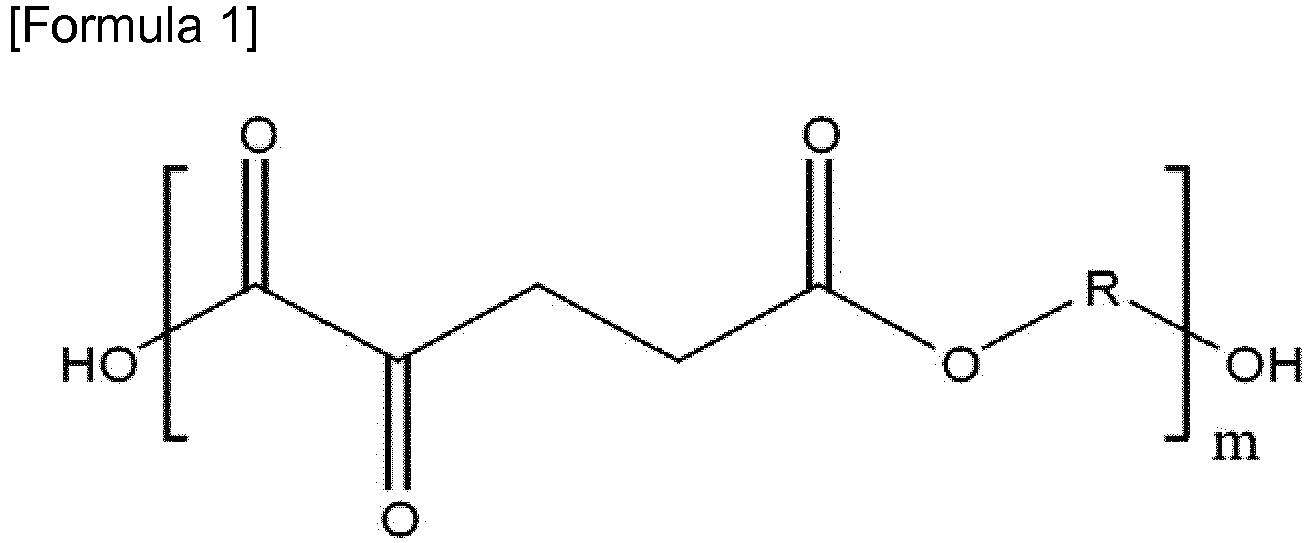
- R may be a linear or branched C2-C20 alkylene with 0 or more oxygen atom of ether group in the middle of the carbon chain thereof; and
- m may be an integer from 1 to 20.
- For example, the compound represented by Formula 1 may include a polyester-based plasticizer of Formula 1 a or 1 b, or any combinations thereof. However, embodiments are not limited thereto.
- According to an aspect of the present disclosure, there is provided a polyester-based plasticizer including a plasticizer represented by Formula 1a or Formula 1 b, or any combinations thereof:


- In Formulae 1a and 1b, m may be defined the same as defined above in connection with Formula 1.
- In some embodiments, a polyester-based plasticizer according to any of the embodiments may be used for any resin, for example, as a plasticizer for biodegradable resin or general-purpose resin.
- For example, the biodegradable resin may be at least one selected from the group consisting of poly-L-lactic acid (PLLA), poly-D-lactic acid (PDLA), stereocomplex-PLA (sc-PLA), polycaprolactone, polyglycolic acid, polycarbonate, and polybutylene succinate. However, embodiments are not limited thereto.
- For example, the general-purpose resin may be at least one selected from the group consisting of polyvinyl chloride, polyethylene, polypropylene, acrylonitrile-butadiene-styrene (ABS) resin, and polystyrene. However, embodiments are not limited thereto.
- Polylactic acid (PLA) as an environmentally friendly material derived from biological organism may be prepared by direct condensation polymerization (
WO 2013/184014A1 ) or ring opening polymerization of lactide after synthesis of L-, D-, and meso-lactide from L-lactic acid and D-lactic acid (US 5,770,682 A ). L-, D-, and meso-lactide may have different thermal and physical characteristics depending on isomers. L-lactide and D-lactide with relatively high optical purity may have good thermal and physical characteristics, compared to meso-lactide. Normally, PLLA and PDLA are prepared from L- and D-lactide with high optical purity, respectively. - Stereocomplex-PLA (sc-PLA), which may be prepared by melt-blending PLLA and PDLA that are in the form of polymer resin through polymerization, may have good thermal and physical characteristics, compared to original PLLA and PDLA.
- PLA as an environmentally friendly material derived from biological organisms is currently applicable to various materials, but may be thermally decomposed at a process temperature, with poor impact resistance due to poor flexibility after processing. PVC as a general-purpose resin may have strong cohesion due to strong intermolecular strength, be thermally decomposed at a fluid temperature or greater, and have poor impact resistance due to strong intermolecular chain strength and poor flexibility. As such, a variety of resins, including biodegradable resins and general-purpose resins as described above, have mechanical characteristics unsuitable for processing. To address these drawbacks of resins, plasticizers may be used. The polyester-based plasticizer of Formula 1 may improve the mechanical characteristics of a variety of resins as described above.
- In particular, when a polyester-based plasticizer according to an embodiment of the present disclosure is added to a resin, a polar portion of the molecular chain of the resin may be solvated with a polar portion of the plasticizer. This may sterically prevent the molecular chains of the resin from being closer to one another and at the same time enable the micro-Brownian movement at low temperature of molecules in the molecular chains of the resin, consequentially improving flexibility and elasticity at room temperature of the resin.
- In a polyester-based plasticizer according to any of the above-described embodiments, as a plasticizer includinga-ketoglutaric acid monomers, one more ketone group per unit molecule may be present in a main chain of the polyester-based plasticizer, compared with other common polyester-based plasticizers, so that the polyester-based plasticizer may have increased polarity, and consequentially may be stably adsorbed within a main chain of a polymer resin that is mixed with the polyester-based plasticizer, with alkylene groups as a non-polar portion providing mobility, so that poor mechanical characteristics of the polymer resin in terms of flexibility and impact resistance may be improved by the polyester-based plasticizer applied to the polymer resin. The polyester-based plasticizer according to any of the above-described embodiments may be prepared using α-ketoglutaric acid monomers derived from a biological organism, and thus be environmentally friendly as an alternative to phthalate-based plasticizers raising concern of endocrine-disrupting chemicals.
- The polyester-based plasticizer for resin, represented by Formula 1, according to any of the embodiments, may be prepared using a method that involves polyesterification of α-ketoglutaric acid with R(OH)2, as illustrated in Reaction Scheme 1:

- In Reaction Scheme 1, R and m may be defined the same as those defined in connection with Formula 1.
- The composition of a mixture alcohol in Reaction Scheme 1 may be appropriately chosen based on the known knowledge in the organic chemistry field by one of ordinary skill in the art.
- The polyesterification may be performed by stirring reactants and a mixture alcohol put into a reactor with a gradual temperature rise to about 170-210°C under reflux at the same temperature. The polyesterification may be terminated when a target acid value is reached, followed by cooling, thereby preparing a polyester-based plasticizer of Formula 1. Specific conditions for the polyesterification are not limited to the above, and may be appropriately chosen based on the known knowledge in the organic chemistry field by one of ordinary skill in the art.
- One or more embodiments of the present disclosure will now be described in detail with reference to the following examples. However, these examples are only for illustrative purposes and are not intended to limit the scope of the one or more embodiments of the present disclosure.
- α-ketoglutaric acid (55.9 wt%), 1,3-propanediol (36.1 wt%), and a mixture alcohol (7.3 wt%) were put into a flask equipped with a condenser, and then stirred with a gradual temperature rise to about 170-210°C and maintained the temperature while stirring under reflux for polyesterification.
- The polyesterification reaction was terminated when a target acid value was reached, followed by cooling to room temperature. The number average molecular weight (Mn) of a resulting polyester compound was measured by gel permeation chromatography (GPC).
- The composition of the mixture alcohol used was as follows: 1-2% of C6 (hexyl), 40-42% of C8 (caprylic), 54-57% of C10 (decyl), a maximum of 1.0% of C12 (lauryl), a maximum of 1.0% of hydrocarbon, as analyzed by gas chromatography.
- The resulting polyester plasticizer had a molecular weight (Mn) of 1893 (by GPC) and an acid value of 16.5 mg (KOH).
- Next, a sample was prepared by blending about 10 parts to 20 parts by weight of the resulting polyester plasticizer with 100 parts by weight of a commercially available polylactic acid resin (INGEO 2003D, available from NatureWorks LLC).
- α-ketoglutaric acid (55.1 wt%), 1,2-propanediol (37.5 wt%), and a mixture alcohol (7.5 wt%) were put into a flask equipped with a condenser, and then stirred with a gradual temperature rise to about 170-210°C and maintained the temperature while stirring under reflux for esterification.
- The esterification reaction was terminated when a target acid value was reached, followed by cooling to room temperature. The number average molecular weight (Mn) of a resulting polyester plasticizer was measured by GPC.
- The composition of the mixture alcohol used was as follows: 1-2% of C6 (hexyl), 40-42% of C8 (caprylic), 54-57% of C10 (decyl), a maximum of 1.0% of C12 (lauryl), a maximum of 1.0% of hydrocarbon, as analyzed by gas chromatography.
- The resulting polyester plasticizer had a molecular weight (Mn) of 1812 (by GPC) and an acid value of 15.2 mg (KOH).
- Next, a sample was prepared by blending about 10 parts to 20 parts by weight of the resulting polyester plasticizer with 100 parts by weight of a commercially available polylactic acid resin (INGEO 2003D, available from NatureWorks LLC).
- α-ketoglutaric acid (56.2 wt%), 1,2-propanediol (35.7 wt%), and a mixture alcohol (7.2 wt%) were put into a flask equipped with a condenser, and then stirred with a gradual temperature rise to about 170-210°C and maintained the temperature while stirring under reflux for esterification.
- The esterification reaction was terminated when a target acid value was reached, followed by cooling to room temperature. The number average molecular weight (Mn) of a resulting polyester plasticizer was measured by GPC.
- The composition of the mixture alcohol used was as follows: 1-2% of C6 (hexyl), 40-42% of C8 (caprylic), 54-57% of C10 (decyl), a maximum of 1.0% of C12 (lauryl), a maximum of 1.0% of hydrocarbon, as analyzed by gas chromatography.
- The resulting polyester plasticizer had a molecular weight (Mn) of 1872 (by GPC) and an acid value of 16.1 mg (KOH).
- Next, a sample was prepared by blending about 10 parts by weight of the resulting polyester plasticizer with 100 parts by weight of a commercially available polyvinyl chloride (PVC) resin (TH-1000, available from Taiyo Vinyl Corporation).
- A polyester plasticizer including adipic acid monomers were prepared as follows. Adipic acid (57.5 wt%), 1,3-propanediol (34.2 wt%), and a mixture alcohol (7.1 wt%) were put into a flask equipped with a condenser, and then stirred with a gradual temperature rise to about 170-210°C and maintained the temperature while stirring under reflux for polyesterification.
- The esterification reaction was terminated when a target acid value was reached, followed by cooling to room temperature. The number average molecular weight (Mn) of a resulting polyester plasticizer was measured by GPC.
- The composition of the mixture alcohol used was as follows: 1-2% of C6 (hexyl), 40-42% of C8 (caprylic), 54-57% of C10 (decyl), a maximum of 1.0% of C12 (lauryl), a maximum of 1.0% of hydrocarbon, as analyzed by gas chromatography.
- The resulting polyester plasticizer had a molecular weight (Mn) of 1721 (by GPC) and an acid value of 13.4 mg (KOH).
- Next, a sample was prepared by blending about 10 parts to 20 parts by weight of the resulting polyester plasticizer with 100 parts by weight of a commercially available polylactic acid resin (INGEO 2003D, available from NatureWorks LLC).
- A commercially available polylactic acid (INGEO 2003D, available from NatureWorks LLC) as a biodegradable resin was used without a plasticizer.
- A polyester plasticizer including adipic acid monomers that are in common use were prepared as follows. Adipic acid (57.1 wt%), 1,3-propanediol (34.3 wt%), and a mixture alcohol (7.2 wt%) were put into a flask equipped with a condenser, and then stirred with a gradual temperature rise to about 170-210°C and maintained the temperature while stirring under reflux for esterification.
- The esterification reaction was terminated when a target acid value was reached, followed by cooling to room temperature. The number average molecular weight (Mn) of a resulting polyester plasticizer was measured by GPC.
- The composition of the mixture alcohol used was as follows: 1-2% of C6 (hexyl), 40-42% of C8 (caprylic), 54-57% of C10 (decyl), a maximum of 1.0% of C12 (lauryl), a maximum of 1.0% of hydrocarbon, as analyzed by gas chromatography.
- The resulting polyester plasticizer had a molecular weight (Mn) of 1695 (by GPC) and an acid value of 13.1 mg (KOH).
- Next, a sample was prepared by blending about 10 parts by weight of the resulting polyester plasticizer with 100 parts by weight of a commercially available PVC resin (TH-1000, available from Taiyo Vinyl Corporation).
- A commercially available PVC (TH-1000, available from Taiyo Vinyl Corporation) as a general-purpose resin was used without a plasticizer.
- Thermal characteristics such as a glass transition temperature (Tg) and a melting point (Tm) of the samples prepared in Examples 1 to 3 and Comparative Examples 1 to 4 were analyzed by differential scanning calorimetry (DSC) at about 10°C/min according to ASTM D3418.
- Mechanical characteristics of the samples, including a tensile strength and an elongation, were measured according to ASTM D882 (Test samples prepared had a thickness of about 50 µm and a size of about 15 mm x 75 mm).
[Table 1] Results of physical properties analysis Example 1 Example 2 Example 3 Comparative Example 1 Comparative Example 2 Comparative Example 3 Comparative Example 4 Plasticizer content (wt%) 10 20 10 20 10 10 20 - 10 - Tensile strength (MPa) 32.1 35.2 39.7 43.1 55.2 28.3 28 47.8 54.3 56.5 Elongation (%) - 181 10 205 309 13 210 3 321 83 Tm (°C) 121.2 95.6 105.6 97.8 202.1 116.1 95 149 198.5 221 Tg (°C) 43.4 37.2 43.1 35.6 73.5 43.5 34.4 6.1 76.6 80 - Referring to Table 1, when mixed with a plasticizer according to an embodiment, the resins had a reduced glass transition temperature (Tg) that may ensure improved flexibility with reduced stiffness, and a reduced melting point (Tm) that may ensure a practically applicable process temperature and improved processability. Therefore, a polyester-based plasticizer according to any of the embodiments was found to be appropriate for packaging purpose.
- When applied to a resin, a polyester-based plasticizer according to any of the embodiments is found to improve physical properties of the resin as good as those of resin when used together with a phthalate-based plasticizer raising concern of endocrine-disrupting chemicals.
- While this disclosure has been particularly shown and described with reference to preferred embodiments thereof, it will be understood by those skilled in the art that various changes in form and details may be made therein without departing from the spirit and scope of the disclosure as defined by the appended claims. It is also to be appreciated that all changes and equivalents that do not depart from the spirit and technical scope of the present disclosure are encompassed in the present disclosure.
Claims (4)
- A polyester-based plasticizer for resin, represented by Formula 1:
 R is a linear or branched C2-C20 alkylene with 0 or more oxygen atom of ether group in the middle of the carbon chain thereof; andm is an integer from 1 to 20.
 - A polyester-based plasticizer comprising a plasticizer represented by Formula 1 a or 1 b, or any combinations thereof:


- The polyester-based plasticizer according to claim 1 or 2, wherein the polyester-based plasticizer is applicable to at least one biodegradable resin selected from the group consisting of poly-L-lactic acid (PLLA), poly-D-lactic acid (PDLA), stereocomplex-PLA (sc-PLA), polycaprolactone, polyglycolic acid, polycarbonate, and polybutylene succinate.
- The polyester-based plasticizer according to claim 1 or 2, wherein the polyester-based plasticizer is applicable to at least one general-purpose resin selected from the group consisting of polyvinyl chloride, polyethylene, polypropylene, acrylonitrile-butadiene-styrene (ABS) resin, and polystyrene.
Applications Claiming Priority (2)
| Application Number | Priority Date | Filing Date | Title |
|---|---|---|---|
| KR20140049555 | 2014-04-24 | ||
| PCT/KR2015/002599 WO2015163582A2 (en) | 2014-04-24 | 2015-03-18 | Polyester-based plasticizer for resin |
Publications (2)
| Publication Number | Publication Date |
|---|---|
| EP3135721A2 true EP3135721A2 (en) | 2017-03-01 |
| EP3135721A4 EP3135721A4 (en) | 2018-07-11 |
Family
ID=54333386
Family Applications (1)
| Application Number | Title | Priority Date | Filing Date |
|---|---|---|---|
| EP15783628.9A Withdrawn EP3135721A4 (en) | 2014-04-24 | 2015-03-18 | Polyester-based plasticizer for resin |
Country Status (6)
| Country | Link |
|---|---|
| US (1) | US9725574B2 (en) |
| EP (1) | EP3135721A4 (en) |
| JP (1) | JP6486963B2 (en) |
| KR (1) | KR101741697B1 (en) |
| CN (1) | CN107108959B (en) |
| WO (1) | WO2015163582A2 (en) |
Families Citing this family (7)
| Publication number | Priority date | Publication date | Assignee | Title |
|---|---|---|---|---|
| US11427688B2 (en) * | 2017-04-17 | 2022-08-30 | Eastman Chemical Company | Copolyesters plasticized with polymeric plasticizer |
| WO2020232357A1 (en) * | 2019-05-16 | 2020-11-19 | Arizona Board Of Regents On Behalf Of Arizona State University | Metabolite delivery for modulating metabolic pathways of cells |
| WO2021142254A1 (en) * | 2020-01-08 | 2021-07-15 | Abhinav Acharya | Metabolite-based polymers, microparticles, and nanoparticles for immunotherapy and methods of treating a disease or disorder |
| EP3992227A1 (en) | 2020-07-20 | 2022-05-04 | Bio Bond ApS | Bio-based plasticiser for resins and blends containing said plasticiser |
| DE102020124314A1 (en) * | 2020-09-17 | 2022-03-17 | Heinrich-Heine-Universität Düsseldorf | Biodegradable adhesive composition |
| CN116262815A (en) * | 2021-12-15 | 2023-06-16 | 中国科学院大连化学物理研究所 | A kind of polyester resin, bone tissue engineering scaffold and preparation method thereof |
| CN115785595B (en) * | 2022-11-28 | 2024-07-19 | 河源市普立隆新材料科技有限公司 | Polyvinyl alcohol melt blown film based on anhydrous plasticization and preparation method thereof |
Family Cites Families (13)
| Publication number | Priority date | Publication date | Assignee | Title |
|---|---|---|---|---|
| EP0051934B1 (en) * | 1980-11-07 | 1988-12-14 | Imperial Chemical Industries Plc | Anisotropic melt-forming polymers containing fumaric acid or substituted fumaric acid |
| JPH01104264A (en) * | 1987-10-19 | 1989-04-21 | Terumo Corp | Medical soft resin composition and medical utensil |
| US5247012A (en) * | 1989-12-08 | 1993-09-21 | The Geon Company | Glutaric acid based polyester internally plasticized PVC |
| JP2928892B2 (en) * | 1990-11-27 | 1999-08-03 | 三洋化成工業株式会社 | Surgical adhesive |
| US5770682A (en) | 1995-07-25 | 1998-06-23 | Shimadzu Corporation | Method for producing polylactic acid |
| DE69841061D1 (en) | 1997-10-31 | 2009-09-24 | Metabolix Inc | Use of organic phosphonic or phosphinic acids, or of metal oxides or hydroxides, or of carboxylic acid salts of a metal as heat stabilizers for polyhydroxyalkanoates |
| JP2003038634A (en) * | 2001-07-27 | 2003-02-12 | Sanyo Chem Ind Ltd | Surgical adhesive |
| JP3421769B1 (en) | 2002-04-02 | 2003-06-30 | 大八化学工業株式会社 | Ester compound, plasticizer for biodegradable aliphatic polyester resin, and biodegradable resin composition |
| JP4071683B2 (en) * | 2003-07-14 | 2008-04-02 | 第一工業製薬株式会社 | Plasticizer emulsion, method for producing the same, and biodegradable resin composition using the same |
| JP4463634B2 (en) * | 2004-07-09 | 2010-05-19 | 花王株式会社 | Plasticizer for biodegradable resin |
| FR2927629B1 (en) * | 2008-02-14 | 2011-07-29 | Bostik Sa | BIODEGRADABLE THERMOFUSIBLE ADHESIVE COMPOSITION. |
| AU2009295999B2 (en) * | 2008-09-29 | 2013-12-19 | Basf Se | Biodegradable polymer mixture |
| WO2013184014A1 (en) | 2012-06-06 | 2013-12-12 | Universidade De Coimbra | Process for preparing high molecular weight poly(lactic acid) by melt polycondensation |
-
2015
- 2015-03-18 WO PCT/KR2015/002599 patent/WO2015163582A2/en not_active Ceased
- 2015-03-18 JP JP2016564263A patent/JP6486963B2/en active Active
- 2015-03-18 EP EP15783628.9A patent/EP3135721A4/en not_active Withdrawn
- 2015-03-18 US US15/305,862 patent/US9725574B2/en active Active
- 2015-03-18 CN CN201580021992.9A patent/CN107108959B/en active Active
- 2015-03-19 KR KR1020150038316A patent/KR101741697B1/en active Active
Also Published As
| Publication number | Publication date |
|---|---|
| CN107108959A (en) | 2017-08-29 |
| JP2017518401A (en) | 2017-07-06 |
| US9725574B2 (en) | 2017-08-08 |
| JP6486963B2 (en) | 2019-03-20 |
| CN107108959B (en) | 2019-10-25 |
| KR20150123153A (en) | 2015-11-03 |
| WO2015163582A2 (en) | 2015-10-29 |
| WO2015163582A3 (en) | 2017-06-22 |
| KR101741697B1 (en) | 2017-05-31 |
| EP3135721A4 (en) | 2018-07-11 |
| US20170066901A1 (en) | 2017-03-09 |
Similar Documents
| Publication | Publication Date | Title |
|---|---|---|
| US9725574B2 (en) | Polyester-based plasticizer for resin | |
| Halloran et al. | Highly flexible polylactide food packaging plasticized with nontoxic, biosourced glycerol plasticizers | |
| US9464187B2 (en) | Biobased modifiers for polyvinylchloride blends | |
| US10030135B2 (en) | Biobased rubber modifiers for polymer blends | |
| US9505927B2 (en) | Biobased modifiers for polyvinylchloride blends | |
| US10669417B2 (en) | Recyclate blends | |
| US8268918B2 (en) | Crystalline polylactic acid resin composition and product molded/formed therefrom | |
| JP5014908B2 (en) | Crystalline polylactic acid resin composition and molded article comprising the same | |
| WO2008004490A1 (en) | Aliphatic polyester composition and method for producing the same | |
| EP2700678B1 (en) | Biodegradable polymer composite material | |
| WO2014028943A1 (en) | Biobased rubber modifiers for polymer blends | |
| Holt et al. | Blends of Poly (butylene glutarate) and Poly (lactic acid) with Enhanced Ductility and Composting Performance | |
| CN106574103B (en) | Composition including the polymer based on polylactide | |
| CN105829428A (en) | Succinic acid ester used as plasticizer and biodegradable resin containing the succinic acid ester | |
| JP6775681B2 (en) | Polyalkylene carbonate resin composition and polyalkylene carbonate resin molded article | |
| EP3000847A1 (en) | Resin composition containing polyalkylene carbonate | |
| KR101362689B1 (en) | Nitrile based plasticizers for biodegradable resin composition | |
| JP2006249384A (en) | Method for producing cross-linked material made of polylactic acid and the cross-linked material made of polylactic acid | |
| US10494505B2 (en) | Method for stabilizing polyester-resin-based bioplastics | |
| Satdive et al. | Synthesis of a Novel Ester-Amide Plasticizer from Lauric Acid and Diethanolamine for Enhanced Processability and Performance of Poly (3-hydroxybutyrate) | |
| KR101401258B1 (en) | Diester containing plasticizers for biodegradable resin composition | |
| KR101401262B1 (en) | Ether-ester based plasticizers for biodegradable resin composition | |
| JP2008163220A (en) | Modifier for polylactic acid resin | |
| JP2012126871A (en) | Polylactic acid resin composition and molded article using the same | |
| TW202115184A (en) | Resin composition, molded body, and method for producing said molded body |
Legal Events
| Date | Code | Title | Description |
|---|---|---|---|
| STAA | Information on the status of an ep patent application or granted ep patent |
Free format text: STATUS: THE INTERNATIONAL PUBLICATION HAS BEEN MADE |
|
| PUAI | Public reference made under article 153(3) epc to a published international application that has entered the european phase |
Free format text: ORIGINAL CODE: 0009012 |
|
| STAA | Information on the status of an ep patent application or granted ep patent |
Free format text: STATUS: REQUEST FOR EXAMINATION WAS MADE |
|
| 17P | Request for examination filed |
Effective date: 20161117 |
|
| AK | Designated contracting states |
Kind code of ref document: A2 Designated state(s): AL AT BE BG CH CY CZ DE DK EE ES FI FR GB GR HR HU IE IS IT LI LT LU LV MC MK MT NL NO PL PT RO RS SE SI SK SM TR |
|
| AX | Request for extension of the european patent |
Extension state: BA ME |
|
| R17D | Deferred search report published (corrected) |
Effective date: 20170622 |
|
| DAV | Request for validation of the european patent (deleted) | ||
| DAX | Request for extension of the european patent (deleted) | ||
| A4 | Supplementary search report drawn up and despatched |
Effective date: 20180613 |
|
| RIC1 | Information provided on ipc code assigned before grant |
Ipc: C08L 67/00 20060101ALI20180607BHEP Ipc: C08L 101/00 20060101ALI20180607BHEP Ipc: C08G 63/16 20060101ALI20180607BHEP Ipc: C08L 69/00 20060101ALI20180607BHEP Ipc: C08K 5/11 20060101AFI20180607BHEP |
|
| STAA | Information on the status of an ep patent application or granted ep patent |
Free format text: STATUS: EXAMINATION IS IN PROGRESS |
|
| 17Q | First examination report despatched |
Effective date: 20190207 |
|
| GRAP | Despatch of communication of intention to grant a patent |
Free format text: ORIGINAL CODE: EPIDOSNIGR1 |
|
| STAA | Information on the status of an ep patent application or granted ep patent |
Free format text: STATUS: GRANT OF PATENT IS INTENDED |
|
| INTG | Intention to grant announced |
Effective date: 20201127 |
|
| STAA | Information on the status of an ep patent application or granted ep patent |
Free format text: STATUS: THE APPLICATION IS DEEMED TO BE WITHDRAWN |
|
| 18D | Application deemed to be withdrawn |
Effective date: 20210408 |