EP3134379B1 - Liquid arylbenzoyl benzoic acid ester derivatives for energy curable compositions - Google Patents
Liquid arylbenzoyl benzoic acid ester derivatives for energy curable compositions Download PDFInfo
- Publication number
- EP3134379B1 EP3134379B1 EP15783928.3A EP15783928A EP3134379B1 EP 3134379 B1 EP3134379 B1 EP 3134379B1 EP 15783928 A EP15783928 A EP 15783928A EP 3134379 B1 EP3134379 B1 EP 3134379B1
- Authority
- EP
- European Patent Office
- Prior art keywords
- alkyl
- ester
- benzoic acid
- compound
- composition
- Prior art date
- Legal status (The legal status is an assumption and is not a legal conclusion. Google has not performed a legal analysis and makes no representation as to the accuracy of the status listed.)
- Active
Links
Classifications
-
- C—CHEMISTRY; METALLURGY
- C07—ORGANIC CHEMISTRY
- C07C—ACYCLIC OR CARBOCYCLIC COMPOUNDS
- C07C69/00—Esters of carboxylic acids; Esters of carbonic or haloformic acids
- C07C69/76—Esters of carboxylic acids having a carboxyl group bound to a carbon atom of a six-membered aromatic ring
-
- C—CHEMISTRY; METALLURGY
- C07—ORGANIC CHEMISTRY
- C07C—ACYCLIC OR CARBOCYCLIC COMPOUNDS
- C07C51/00—Preparation of carboxylic acids or their salts, halides or anhydrides
- C07C51/083—Preparation of carboxylic acids or their salts, halides or anhydrides from carboxylic acid anhydrides
-
- C—CHEMISTRY; METALLURGY
- C07—ORGANIC CHEMISTRY
- C07C—ACYCLIC OR CARBOCYCLIC COMPOUNDS
- C07C63/00—Compounds having carboxyl groups bound to a carbon atoms of six-membered aromatic rings
- C07C63/04—Monocyclic monocarboxylic acids
- C07C63/06—Benzoic acid
-
- C—CHEMISTRY; METALLURGY
- C09—DYES; PAINTS; POLISHES; NATURAL RESINS; ADHESIVES; COMPOSITIONS NOT OTHERWISE PROVIDED FOR; APPLICATIONS OF MATERIALS NOT OTHERWISE PROVIDED FOR
- C09D—COATING COMPOSITIONS, e.g. PAINTS, VARNISHES OR LACQUERS; FILLING PASTES; CHEMICAL PAINT OR INK REMOVERS; INKS; CORRECTING FLUIDS; WOODSTAINS; PASTES OR SOLIDS FOR COLOURING OR PRINTING; USE OF MATERIALS THEREFOR
- C09D11/00—Inks
- C09D11/02—Printing inks
- C09D11/03—Printing inks characterised by features other than the chemical nature of the binder
-
- C—CHEMISTRY; METALLURGY
- C09—DYES; PAINTS; POLISHES; NATURAL RESINS; ADHESIVES; COMPOSITIONS NOT OTHERWISE PROVIDED FOR; APPLICATIONS OF MATERIALS NOT OTHERWISE PROVIDED FOR
- C09D—COATING COMPOSITIONS, e.g. PAINTS, VARNISHES OR LACQUERS; FILLING PASTES; CHEMICAL PAINT OR INK REMOVERS; INKS; CORRECTING FLUIDS; WOODSTAINS; PASTES OR SOLIDS FOR COLOURING OR PRINTING; USE OF MATERIALS THEREFOR
- C09D11/00—Inks
- C09D11/02—Printing inks
- C09D11/10—Printing inks based on artificial resins
- C09D11/101—Inks specially adapted for printing processes involving curing by wave energy or particle radiation, e.g. with UV-curing following the printing
Definitions
- the present invention is directed to 4-arylbenzoyl benzoic acid ester derivatives that are liquid at room temperature, and that are suitable as components for radical photoinitiator systems for UV-curable compositions.
- the photoinitiators of the present invention exhibit excellent solubility in (meth)acrylic monomers.
- Benzophenone is widely used as a component of photoinitiator systems in UV-curable inks and coatings, especially in combination with aliphatic amines, such as dimethylaminoethanol or aromatic amines, such as dimethylaminobenzoates.
- aliphatic amines such as dimethylaminoethanol or aromatic amines, such as dimethylaminobenzoates.
- the UV absorption of benzophenone is at a wavelength too short to give a good match with the emission of typical UV-bulbs, especially when doped UV bulbs are used, which emit at longer wavelengths. Therefore, phenylbenzophenone, which has an extended p-electron system, is often used to increase the absorption wavelength of photoinitiator systems, and to get a better match with UV-bulb emissions.
- phenylbenzophenone is a crystalline solid which exhibits limited solubility in acrylates, and which furthermore has a high melting point, and tends to crystallize from inks, coatings and photoinitiator-blends. This is especially problematic in low viscosity coatings and inks, such as UV-overprint varnishes, UV-flexographic inks and UV-digital inks, in which small molecules crystallize more easily, and product stability is a challenge.
- EP 2508574 describes radiation curable compositions comprising an ethylencially unsaturated compound (e.g. (meth)acrylate), and inert hydroxyl-terminated polyesters.
- the inert polyesters may be modified to include moieties possessing photoinitiator activity.
- the examples describe inert polyesters modified with benzoic acid derivatives.
- WO 2015/010729 discloses 4-phenylbenzoyl benzoic acid esters substituted with a residue of a hydroxyl compound having one to six hydroxyl groups. These compounds are useful as photoinitiators in radiation curable compositions.
- 4-phenylbenzoyl benzoic acid esters have been described in the literature as sun blockers in lotions or protective films (see, for e.g. WO 2010/075946 and DE 3831920 ). These are generally highly viscous, or solid compositions.
- CN103059168 A describes a benzophenone-type light initiator.
- US6485713 B1 describes a method of preparing a sunscreen including a solvent system and a filter system, the method including the step of controlling the polarity of the solvent system to control the rate of photodecay of the filter system, as well as sunscreen compositions and compounds for producing sunscreen compositions.
- US4584190 A describes a chalcone derivative effective in protecting the skin when made into ultraviolet absorbing agents including an anti-sunburn oil.
- WO2013/107587 A1 and WO2013/107588 A1 describe photo-reactive binders and more in particular UV curable binders permitting the preparation of photo-reactive compositions showing good surface and deep curing while simultaneously having a very low migration level.
- US2014/002534 A1 describes an actinic ray curable inkjet ink which, in an inkjet printing method, is capable of having both high pinning characteristics and high ejection characteristics.
- US2014005332 A1 describes radiation curable compositions comprising at least one (meth)acrylated compound and at least one inert polyester that is prepared from a(i) polyol component comprising at least one cyclic ether polyol and (ii) from a polyacid component, and their preparation and uses.
- US 5,274,104 discloses a method of preparing tert-butoxide of 2-[4-(para-tolyl)benzoyl]benzoic acid.
- the present invention provides 4-arylbenzoyl benzoic acid esters, such as ethylhexyl esters and amyl esters of 4-arylbenzoyl benzoic acid, which are liquid at room temperature and show excellent solubility in acrylic and methacrylic monomers. These materials are unexpectedly liquid, which is unique because the other known monomeric ester derivatives of arylbenzoyl benzoic acid are solids. They are suitable as components for radical photoinitiator systems for UV-curable compositions.
- the present invention provides a compound of Formula 1: wherein:
- A is phenyl
- the compound of Formula 1 is a C 9 -C 22 alkyl ester.
- the present invention provides the use of one or more compounds of Formula 1 as a component for radical photoinitiator systems for UV-curable inks and coatings.
- the radical photoinitiator system comprises a C 5 -C 8 alkyl ester of a compound of Formula 1.
- the present invention provides a composition comprising at least one compound of Formula 1 and at least one hydrogen radical donor; wherein the composition is liquid at 25°C.
- the composition comprises at least one C 5 -C 8 alkyl ester of a compound of Formula 1.
- the composition contains greater than 10 weight% of a C 5 -C 8 alkyl ester of a compound of Formula 1.
- the composition comprises a C 5 -C 8 alkyl ester of a compound of Formula 1 which is an amyl ester or an ethylhexyl ester.
- the hydrogen donor is a tertiary amine or a thioether.
- the composition comprises at least two compounds of Formula 1, none of which are liquid at 25°C in its pure form.
- the composition further comprises one or more C 1 -C 4 alkyl esters of 4-arylbenzoylbenzoic acid.
- the present invention provides a coating or printing ink, curable with actinic light, comprising one or more acrylates or methacrylates, a tertiary amine, and at least one compound of Formula 1.
- the present invention provides a coating or printing ink, curable with actinic light, comprising:
- the coating or printing ink comprises a C 5 -C 8 alkyl ester of a compound of Formula 1.
- the coating or printing ink comprises an ethylhexyl ester or an amyl ester of a compound of Formula 1.
- the coating or printing ink contains the acrylates or methacrylates at a concentration of 20-98 weight%.
- the present invention provides a composition comprising 4-phenylbenzoyl benzoic acid amyl ester and at least one hydrogen radical donor, wherein the composition is liquid at 25°C.
- the present invention provides a composition comprising 4-phenylbenzoyl benzoic acid ethylhexyl ester and at least one hydrogen radical donor, wherein the composition is liquid at 25°C.
- the terms “comprises” and/or “comprising” specify the presence of the stated features, integers, steps, operations, elements, and/or components, but do not preclude the presence or addition of one or more other features, integers, steps, operations, elements, components, and/or groups thereof. Furthermore, to the extent that the terms “includes,” “having,” “has,” “with,” “composed,” “comprised” or variants thereof are used in either the detailed description or the claims, such terms are intended to be inclusive in a manner similar to the term “comprising.”
- ranges and amounts can be expressed as “about” a particular value or range. “About” is intended to also include the exact amount. Hence “about 5 percent” means “about 5 percent” and also “5 percent.” “About” means within typical experimental error for the application or purpose intended.
- (meth)acrylate or “(meth)acrylic acid” include both acrylate and methacrylate compounds.
- alkyl refers to straight chain and branched saturated non-cyclic hydrocarbons, having from 1 to 22 carbon atoms.
- Representative straight chain alkyl groups include methyl, -ethyl, -n-propyl, -n-butyl, -n- pentyl, -n-hexyl, n-heptyl, n-octyl, n-nonyl, n-decyl, and n-amyl.
- Representative branched alkyl groups include isopropyl, sec-butyl, isobutyl, tert-butyl, isopentyl, neopentyl, 1 -methylbutyl, 2-methylbutyl, 3-methylbutyl, 1 , 1 -dimethylpropyl, 1 ,2- dimethylpropyl, 1-methylpentyl, 2-methylpentyl, 3-methylpentyl, 4-methylpentyl, 1 - ethylbutyl, 2-ethylbutyl, 3-ethylbutyl, 1 , 1 -dimethylbutyl, 1 ,2-dimethylbutyl, 1 ,3- dimethylbutyl, 2,2-dimethylbutyl, 2,3-dimethylbutyl, 3,3-dimethylbutyl, 5-methylhexyl, 6-methylheptyl, 2-ethylhexyl, and the like.
- alkoxy means a straight chain or branched non-cyclic hydrocarbon having one or more ether groups and from 1 to 22 carbon atoms.
- Representative straight chain and branched alkoxys include -methoxy, -ethoxy, - propoxy, -butyloxy, - pentyloxy, -hexyloxy, -methoxymethyl, -2-methoxyethyl, -5- methoxypentyl, -3-ethoxybutyl and the like.
- amino refers to -NH 2 .
- aminoalkyl refers to an alkyl group substituted by an amino group.
- aryl means an aromatic carbocyclic ring containing 6 to 22 carbon atoms, including both mono-, bi-, and tricyclic ring systems.
- Representative aryl groups include -indenyl, -phenyl, - naphthyl, anthracenyl and the like.
- heteroaryl means an aromatic heterocycle ring of 6 to 22 members, including both mono- and bicyclic ring systems, where at least one carbon atom (of one or both of the rings) is replaced with a heteroatom independently selected from nitrogen, oxygen, and sulfur, or at least two carbon atoms of one or both of the rings are replaced with a heteroatom independently selected from nitrogen, oxygen, and sulfur.
- heteroaryls include pyridyl, furyl, benzofuranyl, thiophenyl, benzothiophenyl, quinolinyl, isoquinolinyl, pyrrolyl, indolyl, oxazolyl, benzoxazolyl, imidazolyl, benzimidazolyl, thiazolyl, benzothiazolyl, isoxazolyl, oxadiazolinyl, pyrazolyl, isothiazolyl, pyridazinyl, pyrimidyl, pyrimidinyl, pyrazinyl, thiadiazolyl, triazinyl, thienyl, thiadiazolyl, cinnolinyl, phthalazinyl, quinazolinyl, and the like.
- heterocycle or “heterocycle ring” refers to a 3- to 22-membered monocyclic heterocyclic ring which is either unsaturated or partially saturated.
- a 3-membered heterocycle can contain up to 1 heteroatom; a 4-membered heterocycle can contain up to 2 heteroatoms; a 5-membered heterocycle can contain up to 4 heteroatoms; a 6-membered heterocycle can contain up to 4 heteroatoms; and a 7-membered heterocycle can contain up to 5 heteroatoms.
- Each heteroatom is independently selected from nitrogen (which can be quaternized), oxygen, and sulfur (including sulfoxide and sulfone).
- the heterocycle can be attached via a nitrogen or carbon atom.
- heterocycles include thiazolidinyl, morpholinyl, pyrrolidinonyl, pyrrolidinyl, piperidinyl, piperazinyl, 2,3-dihydrofuranyl, dihydropyranyl, hydantoinyl, valerolactamyl, oxiranyl, oxetanyl, tetrahydrofuranyl, tetrahydropyranyl, dihydropyridinyl, tetrahydropyridinyl, tetrahydropyrimidinyl, tetrahydrothiopyranyl, and the like.
- cycloalkyl refers to a cyclic saturated hydrocarbon having from 3 to 22 carbon atoms.
- Representative cycloalkyls include cyclopropyl, cyclobutyl, cyclopentyl, cyclohexyl, cycloheptyl, cyclooctyl, and cyclononyl, cyclodecyl, cycloundecyl, cyclododecyl, and the like.
- alkaryl refers to an aryl radical substituted with one, two or three alkyl groups.
- aralkyl refers to an alkyl radical substituted with one, two or three optionally substituted aryl groups.
- Non-limiting examples of aralkyl groups include benzyl and phenethyl.
- the present invention provides a compound of Formula 1: wherein:
- R 1 may be attached to A at the ortho, meta, or para positions.
- the liquid 4-arylbenzoyl benzoic acid esters of the present invention are suitable as photoinitiator components in formulations with low viscosity.
- Formulations comprising the 4-arylbenzoyl benzoic acid esters of the present invention have good product stability.
- the compounds of the invention have improved solubility in monomers that are critical for the formulation of flexographic and low migration inks and coatings, such as (meth)acrylates (e.g. propoxylated pentaerythritol tetraacrylate and di-pentaerythritol hexaacrylate).
- the compounds of the invention are liquid, a higher amount of photoinitiator can be used in the formulation of inks and coatings, without seeding and precipitation of the photoinitiator. This allows for faster processing speeds, and higher productivity.
- 4-arylbenzyl benzoic acid ester is 4-phenylbenzoyl benzoic acid ethylhexyl ester. This has previously only been described as a sun blocker in protective films, and in sun-creams and lotions. Its use as a photoinitiator in radiation curable compositions has hitherto been unknown.
- the inventors have now found that the 4-arylbenzyl benzoic acid esters of the invention can also be used in combination with a hydrogen donor, to make radical photoinitiator solutions for coating and ink compositions.
- the coatings and inks exhibit a low viscosity and good stability.
- 4-Arylbenzoyl benzoic acids in general can be made by reacting an aromatic compound such as biphenyl or substituted biphenyls in an, for this reaction, inert solvent, such as for example methylene dichloride or dichloroethane, in the presence of a Lewis acid, suitable as a Friedl-Crafts acylation reagent, usually aluminum trichloride.
- inert solvent such as for example methylene dichloride or dichloroethane
- 4-Arylbenzoyl benzoic acids esters can be made by esterifying 4-arylbenzoyl benzoic acids with an alcohol such as methanol, ethanol, propanol, isopropanol, butanol, isobutanol, amyl alcohols, hexanol, heptanol, ethylhexanol or higher alcohols.
- an alcohol such as methanol, ethanol, propanol, isopropanol, butanol, isobutanol, amyl alcohols, hexanol, heptanol, ethylhexanol or higher alcohols.
- a strong acid can be used in 0.5-5.0 weight %, such as toluene sulfonic acid, methane sulfonic acid, or sulfuric acid.
- an entrainer such as cyclohexane, toluene, or xylene, can be used to
- esters of 4-phenylbenzoyl benzoic acid the ethylhexyl ester as well the amyl ester are somewhat special in that they are liquid at about room temperature.
- Lower esters such as for example 4-phenylbenzoyl benzoic acid methyl ester (melting point 225°C), as well as the higher known esters such as 4-phenylbenzoyl benzoic acid benzyl ester, are crystalline solids and tend to precipitate out of solution.
- 4-Phenylbenzoyl benzoic acid ethylhexyl ester and 4-phenylbenzoyl benzoic acid amyl ester can be made from biphenyl and phthalic anhydride by Friedel-Crafts acylation, followed by esterification with ethylhexanol or amylalcohol.
- the general reaction scheme is:
- the inventors also developed a procedure in which the intermediate 4-phenylbenzoyl benzoic acid directly precipitates in excellent purity when poured into water and can be separated by filtration. Thus, a purification via a carboxylic acid salt in an aqueous medium, usually described in the prior art, is no longer required.
- the Friedel-Crafts acylation is done in an inert solvent, such as methylene chloride, chloroform, tetrachloro methane, nitrobenzene, dichlorobenzene, or the like.
- a suitable amount of solvent is > 20% and the molar ratio of biphenyl and phthalic anhydride is 0.95:1 to 1.05:1.
- Preferred is a slight excess of biphenyl to complete the consumption of anhydride.
- aluminum trichloride is used in molar excess to provide excellent yield.
- the aluminum trichloride is preferably added in portions under water cooling, so that the temperature does not exceed room temperature, and preferably stirred at room temperature for at least 6 hours.
- the blue-brown reaction mixture is poured into acidified water, where the product immediately precipitates. Then the product is separated by filtration, washed and dried, and obtained as a colorless solid, preferably having a purity of > 96%, measured with gas chromatography and liquid chromatography, in an almost quantitative yield.
- the esterification usually an acid catalyst, such as methane sulfonic acid or sulfuric acid, or a metal catalyst, such as titanium tetrabutylate or butyl tin hydroxyl-oxide, is suitable at a preferred level of 0.1 to 5.0 weight%.
- an acid catalyst such as methane sulfonic acid or sulfuric acid
- a metal catalyst such as titanium tetrabutylate or butyl tin hydroxyl-oxide
- the formed water can be removed physically by the help of an entrainer such as xylene, a nitrogen gas stream or vacuum.
- esterification can be done by making an acid chloride with for example thionyl chloride and esterify under milder conditions.
- Another preferred embodiment of the compound of Formula 1 contains a terphenyl group in the photoinitiator wherein R 1 is phenyl.
- both absorption maximum wavelength and molar extinction coefficient increase.
- the increased absorption wavelength is important to give a better fit with the emission spectra of new types of low energy ozone-free UV-bulbs which have emerged during the last years. In low energy, usually iron doped UV-bulbs, the emission spectrum is shifted to longer wavelengths.
- the terphenyl photoinitiators are very important in highly pigmented systems, so that the pigment light absorption does not completely cover the absorption of the photo initiator, which would lead to poor cure.
- the inventive photoinitiators of this invention containing a terphenyl group having a high extinction coefficient are especially advantageous for curing highly pigmented printing inks, especially when cured with low energy UV-bulbs.
- 4-Phenylbenzoyl benzoic acid ethylhexyl ester and 4-phenylbenzoyl benzoic acid amyl ester are especially useful for formulating highly reactive UV-curable compositions, for example UV-flexographic inks and coatings, UV-digital inks and coatings, and UV-inks and coatings curable with low energy UV-bulbs, because the active photoinitiator species can be used in high levels without the risk of separation, seeding or the like.
- 4-phenylbenzoyl benzoic acid ethylhexyl ester and 4-phenylbenzoyl benzoic acid amyl ester show excellent solubility in (meth)acrylic monomers and oligomers which are critical to formulate UV-flexographic inks and UV low migration inks and coatings.
- acrylic monomers are propoxylated pentaerythritol tetraacrylate (PPTTA) or di-pentaerythritol hexaacrylate (DPHA) (see Tables 1 and 2).
- the molecular weight of 4-phenylbenzoyl benzoic acid ethylhexyl ester is increased by more than one third over phenylbenzophenone, so that the ability to migrate is lowered, because the tendency of a molecule to migrate is a function of molecular weight (( L.L. Katan in "Migration of additive food contact", Black Academical & Professional, first edition, London 1996, page 97, table 5.3 ).
- the increased molecular weight of 4-phenylbenzoyl benzoic acid ethylhexyl ester vs. phenylbenzophenone, there was no significant decrease in reactivity in the curable compositions (see Tables 3 and 4).
- the UV-curable compositions of the present invention preferably contain at least one acrylate or methacrylate, one hydrogen radical donor such as an amine or thioether, and a photoinitiator compound of Formula 1: wherein:
- a most preferred embodiment of this invention contains at least one acrylate or methacrylate, one hydrogen radical donor such as an amine or thioether, and a C 5 -C 8 alkyl ester of 4-phenylbenzoylbenzoic acid.
- acrylates suitable in the radiation curable compositions of the present invention include ethylene glycol diacrylate, 1,4-butandiol diacrylate, 1,6-hexandiol diacrylate, dipropylene glycol diacrylate, neopentylglycol diacrylate, ethoxylated neopentylglycol diacrylates, propoxylated neopentylglycol diacrylates, tripropylene glycol diacrylate, bisphenol-A diacrylate, ethoxylated bisphenol-A-diacrylates, bisphenol-A-diglycidylether diacrylate, ethoxylated bisphenol-A-diacrylates, poly(ethylene)glycol diacrylates, trimethylolpropane triacrylate, trimethylolpropane trimethacrylate, ethoxylated trimethylolpropane triacrylates, propoxylated trimethylolpropane triacrylates, propoxylated trimethylolpropane
- suitable methacrylates are ethylene glycol dimethacrylate, 1,4-butandiol dimethacrylate, 1,6-hexandiol dimethacrylate, dipropylene glycol dimethacrylate, neopentylglycol dimethacrylate, ethoxylated neopentylglycol dimethacrylates, propoxylated neopentylglycol dimethacrylates, tripropylene glycol dimethacrylate, bisphenol-A dimethacrylate, ethoxylated bisphenol-A-dimethacrylates, bisphenol-A-diglycidylether dimethacrylate, ethoxylated bisphenol-A-dimethacrylates, poly(ethylene)glycol dimethacrylates, trimethylolpropane trimethacrylate, ethoxylated trimethylolpropane trimethacrylates, propoxylated trimethylolpropane trimethacrylates,
- Suitable amines are, for example, dimethylethanolamine, diethanolmethylamine, N,N-dimethylaminobenzoic acid ethyl ester, N,N-dimethylaminobenzoic acid amyl ester, N,N-dimethylaminobenzoic acid ethylhexyl ester, 4,4'-bis(diethylamino) benzophenone, N-methylcarbazol, oligomeric amines such as Genopol AB (product of Rahn group) and acrylated amines such as adducts of multifunctional acrylates with secondary amines, or Laromer PO94 (Product of BASF).
- oligomeric amines such as Genopol AB (product of Rahn group) and acrylated amines such as adducts of multifunctional acrylates with secondary amines, or Laromer PO94 (Product of BASF).
- the radiation curable compositions of the present invention can be cured by an actinic light source, such as UV-light, provided by a high-voltage mercury bulb, a medium-voltage mercury bulb, a xenon bulb, a carbon arc lamp, a metal halide bulb, and especially with an UV-LED lamp or sunlight.
- an actinic light source such as UV-light
- the wavelength of applied irradiation is preferably within a range of 250 to 400 nm, more preferably 280-370 nm.
- the radiation curable composition of the present invention may optionally contain small amounts of additional type-1 and type-2 photoinitiators, such as, for example, benzophenones, benzilketales, dialkoxy acetophenones, hydroxyalkylacetophenones, acylphosphinoxides and thioxanthones.
- additional type-1 and type-2 photoinitiators such as, for example, benzophenones, benzilketales, dialkoxy acetophenones, hydroxyalkylacetophenones, acylphosphinoxides and thioxanthones.
- Example include benzophenone, methylbenzophenone, 2,2-dimethoxy-2-phenylacetophenone, dimethoxyacetophenone, diethoxyacetophenone, 2-hydroxy-2-methyl-1-phenylpropan-1-one, 2-benzyl-2-dimethylamino-1-(4-morpholinophenyl)-butan-1-one, 2-methyl-1-[4(methoxythio)-phenyl]-2-morpholinopropan-2-one, diphenylacylphenyl phosphinoxide, diphenyl(2,4,6-trimethylbenzoyl) phosphinoxide, 2,4,6-trimethylbenzoylethoxyphenyl phosphinoxide, 2-isopropylthioxanthone, 4-isopropylthioxanthone, 2,4-dimethylthioxanthone and their oligomeric counterparts.
- esters of 4-arylbenzoyl benzoic acid especially the C 5 -C 8 alkyl esters, as liquids, dissolve a variety of other photoinitiators, co-initiators and synergists, and are therefore also suitable to render photoinitiator blends liquid and stable.
- This is shown in Table 5.
- combinations of esters of 4-arylbenzoylbenzoic acids for example mixtures of the various butyl esters of 4-phenylbenzoylbenzoic acid, can together yield a mixture of photoinitiators that has a melting point below 25°C even though the individually pure materials have melting points above 25°C.
- such a combination of photoinitiators can also function as a liquid to dissolve a variety of other photoinitiators, co-initiators, and synergists.
- 4-Phenylbenzoyl benzoic acid ethylhexyl ester and 4-phenylbenzoyl benzoic acid amyl ester are useful as components in radical photoinitiator systems, for UV-curable compositions as well as a component for liquid photoinitiator blends. They exhibit excellent solubility in a variety of acrylic monomers and oligomers suitable to make UV-curable coatings and inks.
- photoinitiators of the present application are exemplified using non-pigmented coatings, one of skill in the art would recognize that they could easily be used in colored inks and coatings as well.
- Suitable colorants include, but are not limited to organic or inorganic pigments and dyes.
- the dyes include but are not limited to azo dyes, anthraquinone dyes, xanthene dyes, azine dyes, combinations thereof and the like.
- Organic pigments may be one pigment or a combination of pigments, such as for instance Pigment Yellow Numbers 12, 13, 14, 17, 74, 83, 114, 126, 127, 174, 188; Pigment Red Numbers 2, 22, 23, 48:1, 48:2, 52, 52:1, 53, 57:1, 112, 122, 166, 170, 184, 202, 266, 269; Pigment Orange Numbers 5, 16, 34, 36; Pigment Blue Numbers 15, 15:3, 15:4; Pigment Violet Numbers 3, 23, 27; and/or Pigment Green Number 7.
- Inorganic pigments may be one of the following non-limiting pigments: iron oxides, titanium dioxides, chromium oxides, ferric ammonium ferrocyanides, ferric oxide blacks, Pigment Black Number 7 and/or Pigment White Numbers 6 and 7.
- Other organic and inorganic pigments and dyes can also be employed, as well as combinations that achieve the colors desired.
- additives including but not limited to, waxes, ammonia, defoamers, dispersants, stabilizers, silicones, rheological modifiers, plasticizers and the like.
- Spectra were acquired using a Unicam UV-2 UV/VIS spectrophotometer. All absorption spectra were obtained using 1 cm cuvettes, scanning within the 200-800 nm range. Solutions were prepared in a 100 cm 3 volumetric flask, and if required, subsequently diluted so that a maximum absorbance of less than 2 was obtained. From the absorption the molar extinction coefficient e was calculated in liter * mol -1 * cm -1 .
- FTIR Fourier transform infrared
- Example 1 Solubility of 4-arylbenzoyl benzoic acid esters in propoxylated pentaerythritol tetraacrylate
- Example 2 Solubility of 4-arylbenzoyl benzoic acid esters in acrylate di-pentaerythritol hexaacrylate
- 4-phenylbenzophenone, 4-phenylbenzoyl benzoic acid ethylhexyl ester, and 4-phenylbenzoyl benzoic acid amyl ester were each added separately to the multifunctional acrylate di-pentaerythritol hexaacrylate (DPHA, Miwon Company) in amounts of 2, 4, 6, and 8 weight%, and stirred for 30 minutes at room temperature.
- DPHA multifunctional acrylate di-pentaerythritol hexaacrylate
- 4-Phenylbenzoyl benzoic acid ethylhexyl ester and 4-phenylbenzoyl benzoic acid amyl ester showed better solubility than 4-phenyl benzophenone in DPHA.
- the viscosity value at a shear rate of D 50 1/s was recorded.
- the coating mixtures were applied on a coated "Byk” cardboard test chart (black and white areas) with a wire applicator (10 ⁇ m wet) and cured with a medium pressure mercury bulb (Fusion H-bulb (187 W /cm)) and at a conveyor speed of 16-64 meter / minute. Cure was assessed by the solvent resistance test (over black and white), and the thumb twist test. The results are shown in Tables 3a, 3b, and 4.
- a 1:1 mixture in weight of 4-phenylbenzoyl benzoic acid ethylhexyl ester and dimethylaminobenzoic acid ethylhexyl ester was transformed into a solution by stirring at room temperature. The solution also stayed liquid at 5°C.
- a 1:1 mixture of 4-phenylbenzophenone and dimethylaminobenzoic acid ethylhexyl ester was turned into a solution at elevated temperature of 50°C. Upon cooling to room temperature, the phenylbenzophenone precipitated. A similar instability and precipitation as with 4-phenyl benzophenone was also observed with 4-phenylbenzoyl benzoic acid methyl ester.
- Table 5 shows the unique character of 4-phenylbenzoyl benzoic acid ethylhexyl ester and 4-phenylbenzoyl benzoic acid amyl ester, which are useful to solubilize photoinitiator blends containing solid photoinitiators.
- at least 10 weight% of 4-phenylbenzoyl benzoic acid ethylhexyl ester or 4-phenylbenzoyl benzoic acid amyl ester preferably 20-50 weight%, are suitable to turn a solid photoinitiator blend into a solution.
- Example 13 Printing performance of inks comprising 4-arylbenzoyl benzoic acid compounds
- Lithographic UV-inks were tested on a Didde web offset press equipped with two UV-dryers.
- Two cyan lithographic energy curable packaging inks were made on a three roll mill with 3 passes at 1MPa (25°C), having the following composition and properties: Table 6: Composition (wt.%) of two inks tested on the Didde web offset press Material Inventive Ink Comparative Ink Varnish of ketone-aldehyde resin in TMPTA (48%) 44.00 44.00 Multifunctional acrylate monomer blend (Sun) 1800 1800 Flow agent (Tego) 0.50 0.50 Stabilizer (BASF) 1.00 1.00 Photoinitiator blend, based on aminobenzoates & benzophenone-derivatives (no 4-PBz) & aminoketones (Sun) 10.00 10.00 10.00 Material Inventive Ink Comparative Ink 4-phenyl-benzophenone (4-PBz) - 2.50 4-Phenyl benzoyl benzoic acid
- the water window gives a range of the fountain solution settings for which a targeted print density can be achieved.
- the larger the water window the more robust lithography is anticipated.
- the water window test was stopped when optical density dropped by >0.1 than starting density.
- the achieved optical density of the cured prints under the given ink duct settings and fountain settings was measured in-line with a mounted Techkon's Spectro Edge Model ES500 densitometer.
- UV-cure was assessed by a thumb twist test and a solvent resistance test with isopropanol (IPA). Such a test is well known in the art and is, for example, described on page 74 of Test Methods for UV and EB Curable Systems, C. Lowe & P.K.T Oldring, SITA Technology, 1994, ISBN 0 947798 07 2 .
- Test passed can be defined as the degree of cure in which no ink is transferred to the thumb and the ink has a solvent resistance of at least 10 IPA double-rubs.
- the press operator notes the lamp settings at which thumb twist test and solvent resistance test are passed. Only one of two dryers were used:
- Misting is assessed at different places on the press, usually near an ink duct and a printing plate.
- a white piece of paper is placed at a defined distance from the ink rollers, and the press is run for a defined period of time, and defined speed and temperature. Then, the ink mist which is transferred to the paper is assessed by visual comparison to a master example or by measurement with a densitometer. Very little ink on the paper means that the ink has very low misting and low tendency to contaminate the printing press and press room with ink mist.
- Visual assessment of misting can be described as follows:
- Table 7 Press performance of inventive and comparative ink Printing Press results 800 ft./min Inventive ink Comparative ink Ink duct setting in units 1.50 2.00 Printing speed (feet per minute) 800 800 Water window in % 14-50, 35 units 20-50, 30 units Optical density in Water window in % 1.57/1.57/1.56/1.57/1.57 /1.53/1.49/1.51 1.55/1.55/1.57/1.53/1.54 /1.52/1.45 Printed optical density in units 1.57 1.55 UV-cure results 1 lamp high Fully cured; all tests passed Fully cured; all tests passed UV-cure results 1 lamp medium Fully cured; all tests passed Fully cured, but IPA double rubs only 8 to 9 Misting properties No misting observed No misting observed No misting observed
- Table 7 shows that the inventive ink exhibits a slightly wider water window and comparable achieved optical density vs. the comparative ink.
- the inventive ink performs similarly to the comparative ink. But the inherently liquid 4-phenyl benzoyl benzoic acid ethylhexyl ester will not precipitate from the ink, in contrast to the solid 4-phenylbenzophenone, which often does precipitate. The precipitation of 4-phenylbenzophenone is sometimes an issue, affecting ink quality.
- the high melting point and the hard crystals of 4-phenylbenzophenone makes it more difficult to grind an UV-ink on a three-roll mill or a bead mill.
- inks with high levels of 4-phenylbenzophenone need additional paths on the three roll mill, before the desired fineness of the ink is achieved, which results in higher production cost.
- the issue can be completely avoided by using the composition of this invention containing inherently liquid photoinitiators, such as 4-phenylbenzoyl benzoic acid ethyl hexyl ester.
Landscapes
- Chemical & Material Sciences (AREA)
- Organic Chemistry (AREA)
- Engineering & Computer Science (AREA)
- Life Sciences & Earth Sciences (AREA)
- Materials Engineering (AREA)
- Wood Science & Technology (AREA)
- Oil, Petroleum & Natural Gas (AREA)
- Chemical Kinetics & Catalysis (AREA)
- General Chemical & Material Sciences (AREA)
- Inks, Pencil-Leads, Or Crayons (AREA)
- Organic Low-Molecular-Weight Compounds And Preparation Thereof (AREA)
Description
- The present invention is directed to 4-arylbenzoyl benzoic acid ester derivatives that are liquid at room temperature, and that are suitable as components for radical photoinitiator systems for UV-curable compositions. The photoinitiators of the present invention exhibit excellent solubility in (meth)acrylic monomers.
- Benzophenone is widely used as a component of photoinitiator systems in UV-curable inks and coatings, especially in combination with aliphatic amines, such as dimethylaminoethanol or aromatic amines, such as dimethylaminobenzoates. However, the UV absorption of benzophenone is at a wavelength too short to give a good match with the emission of typical UV-bulbs, especially when doped UV bulbs are used, which emit at longer wavelengths. Therefore, phenylbenzophenone, which has an extended p-electron system, is often used to increase the absorption wavelength of photoinitiator systems, and to get a better match with UV-bulb emissions.
- However, phenylbenzophenone (PBz) is a crystalline solid which exhibits limited solubility in acrylates, and which furthermore has a high melting point, and tends to crystallize from inks, coatings and photoinitiator-blends. This is especially problematic in low viscosity coatings and inks, such as UV-overprint varnishes, UV-flexographic inks and UV-digital inks, in which small molecules crystallize more easily, and product stability is a challenge.
- Moreover, it is also a challenge to use phenylbenzophenone at a higher level to provide outstanding UV-cure, because there is then an increased danger of seeding and precipitation, especially in acrylates, which have lower solubility power. Acrylates, such as, for example, propoxylated pentaerythritol tetraacrylate and di-pentaerythritol hexaacrylate, are often key components used to formulate UV-curable flexographic and low migration inks.
-
EP 2508574 describes radiation curable compositions comprising an ethylencially unsaturated compound (e.g. (meth)acrylate), and inert hydroxyl-terminated polyesters. The inert polyesters may be modified to include moieties possessing photoinitiator activity. The examples describe inert polyesters modified with benzoic acid derivatives. -
WO 2015/010729 discloses 4-phenylbenzoyl benzoic acid esters substituted with a residue of a hydroxyl compound having one to six hydroxyl groups. These compounds are useful as photoinitiators in radiation curable compositions. - 4-phenylbenzoyl benzoic acid esters have been described in the literature as sun blockers in lotions or protective films (see, for e.g.
WO 2010/075946 andDE 3831920 ). These are generally highly viscous, or solid compositions.
CN103059168 A describes a benzophenone-type light initiator.
US6485713 B1 describes a method of preparing a sunscreen including a solvent system and a filter system, the method including the step of controlling the polarity of the solvent system to control the rate of photodecay of the filter system, as well as sunscreen compositions and compounds for producing sunscreen compositions.
US4584190 A describes a chalcone derivative effective in protecting the skin when made into ultraviolet absorbing agents including an anti-sunburn oil.
WO2013/107587 A1 andWO2013/107588 A1 describe photo-reactive binders and more in particular UV curable binders permitting the preparation of photo-reactive compositions showing good surface and deep curing while simultaneously having a very low migration level.
US2014/002534 A1 describes an actinic ray curable inkjet ink which, in an inkjet printing method, is capable of having both high pinning characteristics and high ejection characteristics.
US2014005332 A1 describes radiation curable compositions comprising at least one (meth)acrylated compound and at least one inert polyester that is prepared from a(i) polyol component comprising at least one cyclic ether polyol and (ii) from a polyacid component, and their preparation and uses.
US 5,274,104 discloses a method of preparing tert-butoxide of 2-[4-(para-tolyl)benzoyl]benzoic acid. - There remains a need to find photoinitiators that can be used in high levels in low viscosity inks and coatings, to promote faster cure speed and an increase in productivity.
- The present invention provides 4-arylbenzoyl benzoic acid esters, such as ethylhexyl esters and amyl esters of 4-arylbenzoyl benzoic acid, which are liquid at room temperature and show excellent solubility in acrylic and methacrylic monomers. These materials are unexpectedly liquid, which is unique because the other known monomeric ester derivatives of arylbenzoyl benzoic acid are solids. They are suitable as components for radical photoinitiator systems for UV-curable compositions.
- In a certain aspect, the present invention provides a compound of Formula 1:

- A is C6-C22 aryl or a (6- to 22-membered) heteroaryl;
- R1 is selected from the group consisting of H, C1-C8 alkyl, C1-C8 alkoxy, C3-C22 cycloalkyl, a (3- to 22-membered) unsaturated or partially unsaturated heterocycle, C6-C22 aryl, a (6- to 22-membered) heteroaryl, and NR3R4;
- R3 and R4 are each independently selected from H or C1-C8 alkyl; or R3 and R4, together with the nitrogen atom to which they are attached, form a five or six membered ring;
- R2 is C4-C22 alkyl;
- provided that when A is phenyl and R2 is ethylhexyl or methylheptyl, then R1 is not H; and
- provided that when A is phenyl and R2 is t-butyl, then R1 is not methyl.
- In a certain embodiment, A is phenyl.
- In one embodiment, the compound of Formula 1 is a C9-C22 alkyl ester.
- In a certain aspect, the present invention provides the use of one or more compounds of Formula 1 as a component for radical photoinitiator systems for UV-curable inks and coatings.
- In one embodiment, the radical photoinitiator system comprises a C5-C8 alkyl ester of a compound of Formula 1.
- In a particular aspect, the present invention provides a composition comprising at least one compound of Formula 1 and at least one hydrogen radical donor; wherein the composition is liquid at 25°C.
- In one embodiment, the composition comprises at least one C5-C8 alkyl ester of a compound of Formula 1.
- In one embodiment, the composition contains greater than 10 weight% of a C5-C8 alkyl ester of a compound of Formula 1.
- In another embodiment, the composition comprises a C5-C8 alkyl ester of a compound of Formula 1 which is an amyl ester or an ethylhexyl ester.
- In one embodiment, the hydrogen donor is a tertiary amine or a thioether.
- In one embodiment, the composition comprises at least two compounds of Formula 1, none of which are liquid at 25°C in its pure form.
- In one embodiment, the composition further comprises one or more C1-C4 alkyl esters of 4-arylbenzoylbenzoic acid.
- In a certain aspect, the present invention provides a coating or printing ink, curable with actinic light, comprising one or more acrylates or methacrylates, a tertiary amine, and at least one compound of Formula 1.
- In a certain aspect, the present invention provides a coating or printing ink, curable with actinic light, comprising:
- a) one or more acrylates or methacrylates;
- b) a tertiary amine;
- c) a composition comprising at least one compound of Formula 1 and at least one hydrogen radical donor;
- d) and optionally further comprising one or more C1-C4 alkyl esters of 4-arylbenzoylbenzoic acid.
- In one embodiment, the coating or printing ink comprises a C5-C8 alkyl ester of a compound of Formula 1.
- In another embodiment, the coating or printing ink comprises an ethylhexyl ester or an amyl ester of a compound of Formula 1.
- In one embodiment, the coating or printing ink contains the acrylates or methacrylates at a concentration of 20-98 weight%.
- Also described is a process for preparation of 4-phenylbenzoyl benzoic acid comprising the steps of:
- a) dispersing or dissolving biphenyl and phthalic anhydride in a molar ratio of 0.95 : 1 to 1.05 : 1 in an inert solvent;
- b) feeding aluminum trichloride in molar excess to phthalic anhydride, so that the temperature does not exceed 20°C;
- c) stirring at 25°C or above for at least 6 hours;
- d) pouring the reaction mixture in acidified water having a pH < 1; and
- e) filtering off the solid precipitate, washing with water, and drying.
- In a certain aspect, the present invention provides a composition comprising 4-phenylbenzoyl benzoic acid amyl ester and at least one hydrogen radical donor, wherein the composition is liquid at 25°C.
- In another embodiment, the present invention provides a composition comprising 4-phenylbenzoyl benzoic acid ethylhexyl ester and at least one hydrogen radical donor, wherein the composition is liquid at 25°C.
- The invention is defined by the appended claims. The description that follows is subject to this limitation.
- It is to be understood that the foregoing general description and the following detailed description are exemplary and explanatory only, and are not restrictive of any subject matter claimed.
- Unless otherwise defined, all technical and scientific terms used herein have the same meaning as is commonly understood by one of skill in the art to which the inventions belong.
- In this application, the use of the singular includes the plural unless specifically stated otherwise. As used herein, the singular forms "a," "an" and "the" are intended to include the plural forms as well, unless the context clearly indicates otherwise.
- In this application, the use of "or" means "and/or" unless stated otherwise.
- As used herein, the terms "comprises" and/or "comprising" specify the presence of the stated features, integers, steps, operations, elements, and/or components, but do not preclude the presence or addition of one or more other features, integers, steps, operations, elements, components, and/or groups thereof. Furthermore, to the extent that the terms "includes," "having," "has," "with," "composed," "comprised" or variants thereof are used in either the detailed description or the claims, such terms are intended to be inclusive in a manner similar to the term "comprising."
- As used herein, ranges and amounts can be expressed as "about" a particular value or range. "About" is intended to also include the exact amount. Hence "about 5 percent" means "about 5 percent" and also "5 percent." "About" means within typical experimental error for the application or purpose intended.
- As used herein, the terms "(meth)acrylate" or "(meth)acrylic acid" include both acrylate and methacrylate compounds.
- Throughout this disclosure, all parts and percentages are by weight (wt% or mass% based on the total weight) and all temperatures are in °C unless otherwise indicated.
- As used herein, the term "alkyl" refers to straight chain and branched saturated non-cyclic hydrocarbons, having from 1 to 22 carbon atoms. Representative straight chain alkyl groups include methyl, -ethyl, -n-propyl, -n-butyl, -n- pentyl, -n-hexyl, n-heptyl, n-octyl, n-nonyl, n-decyl, and n-amyl. Representative branched alkyl groups include isopropyl, sec-butyl, isobutyl, tert-butyl, isopentyl, neopentyl, 1 -methylbutyl, 2-methylbutyl, 3-methylbutyl, 1 , 1 -dimethylpropyl, 1 ,2- dimethylpropyl, 1-methylpentyl, 2-methylpentyl, 3-methylpentyl, 4-methylpentyl, 1 - ethylbutyl, 2-ethylbutyl, 3-ethylbutyl, 1 , 1 -dimethylbutyl, 1 ,2-dimethylbutyl, 1 ,3- dimethylbutyl, 2,2-dimethylbutyl, 2,3-dimethylbutyl, 3,3-dimethylbutyl, 5-methylhexyl, 6-methylheptyl, 2-ethylhexyl, and the like.
- As used herein, the term "alkoxy" means a straight chain or branched non-cyclic hydrocarbon having one or more ether groups and from 1 to 22 carbon atoms. Representative straight chain and branched alkoxys include -methoxy, -ethoxy, - propoxy, -butyloxy, - pentyloxy, -hexyloxy, -methoxymethyl, -2-methoxyethyl, -5- methoxypentyl, -3-ethoxybutyl and the like.
- As used herein, the term "amino" refers to -NH2.
- As used herein, the term "aminoalkyl" refers to an alkyl group substituted by an amino group.
- As used herein, the term "aryl" means an aromatic carbocyclic ring containing 6 to 22 carbon atoms, including both mono-, bi-, and tricyclic ring systems. Representative aryl groups include -indenyl, -phenyl, - naphthyl, anthracenyl and the like.
- As used herein, the term "heteroaryl" means an aromatic heterocycle ring of 6 to 22 members, including both mono- and bicyclic ring systems, where at least one carbon atom (of one or both of the rings) is replaced with a heteroatom independently selected from nitrogen, oxygen, and sulfur, or at least two carbon atoms of one or both of the rings are replaced with a heteroatom independently selected from nitrogen, oxygen, and sulfur. Representative heteroaryls include pyridyl, furyl, benzofuranyl, thiophenyl, benzothiophenyl, quinolinyl, isoquinolinyl, pyrrolyl, indolyl, oxazolyl, benzoxazolyl, imidazolyl, benzimidazolyl, thiazolyl, benzothiazolyl, isoxazolyl, oxadiazolinyl, pyrazolyl, isothiazolyl, pyridazinyl, pyrimidyl, pyrimidinyl, pyrazinyl, thiadiazolyl, triazinyl, thienyl, thiadiazolyl, cinnolinyl, phthalazinyl, quinazolinyl, and the like.
- As used herein, "heterocycle" or "heterocycle ring" refers to a 3- to 22-membered monocyclic heterocyclic ring which is either unsaturated or partially saturated. A 3-membered heterocycle can contain up to 1 heteroatom; a 4-membered heterocycle can contain up to 2 heteroatoms; a 5-membered heterocycle can contain up to 4 heteroatoms; a 6-membered heterocycle can contain up to 4 heteroatoms; and a 7-membered heterocycle can contain up to 5 heteroatoms. Each heteroatom is independently selected from nitrogen (which can be quaternized), oxygen, and sulfur (including sulfoxide and sulfone). The heterocycle can be attached via a nitrogen or carbon atom. Representative heterocycles include thiazolidinyl, morpholinyl, pyrrolidinonyl, pyrrolidinyl, piperidinyl, piperazinyl, 2,3-dihydrofuranyl, dihydropyranyl, hydantoinyl, valerolactamyl, oxiranyl, oxetanyl, tetrahydrofuranyl, tetrahydropyranyl, dihydropyridinyl, tetrahydropyridinyl, tetrahydropyrimidinyl, tetrahydrothiopyranyl, and the like.
- As used herein, the term "cycloalkyl" refers to a cyclic saturated hydrocarbon having from 3 to 22 carbon atoms. Representative cycloalkyls include cyclopropyl, cyclobutyl, cyclopentyl, cyclohexyl, cycloheptyl, cyclooctyl, and cyclononyl, cyclodecyl, cycloundecyl, cyclododecyl, and the like.
- As used herein, the term "alkaryl" refers to an aryl radical substituted with one, two or three alkyl groups.
- As used herein, the term "aralkyl" refers to an alkyl radical substituted with one, two or three optionally substituted aryl groups. Non-limiting examples of aralkyl groups include benzyl and phenethyl.
- As used herein, "optionally substituted" refers to a group that is either unsubstituted or substituted.
- In a certain aspect, the present invention provides a compound of Formula 1:

- A is C6-C22 aryl or a (6- to 22-membered) heteroaryl;
- R1 is selected from the group consisting of H, C1-C8 alkyl, C1-C8 alkoxy, C3-C22 cycloalkyl, a (3- to 22-membered) unsaturated or partially unsaturated heterocycle, C6-C22 aryl, a (6- to 22-membered) heteroaryl, and NR3R4;
- R3 and R4 are each independently selected from H or C1-C8 alkyl; or R3 and R4, together with the nitrogen atom to which they are attached, form a five or six membered ring;
- R2 is C4-C22 alkyl;
- provided that when A is phenyl and R2 is ethylhexyl or methylheptyl then R1 is not H; and
- provided that when A is phenyl and R2 is t-butyl, then R1 is not methyl.
- In non-limiting examples, R1 may be attached to A at the ortho, meta, or para positions.
- The liquid 4-arylbenzoyl benzoic acid esters of the present invention are suitable as photoinitiator components in formulations with low viscosity. Formulations comprising the 4-arylbenzoyl benzoic acid esters of the present invention have good product stability. Moreover, the compounds of the invention have improved solubility in monomers that are critical for the formulation of flexographic and low migration inks and coatings, such as (meth)acrylates (e.g. propoxylated pentaerythritol tetraacrylate and di-pentaerythritol hexaacrylate).
- Because the compounds of the invention are liquid, a higher amount of photoinitiator can be used in the formulation of inks and coatings, without seeding and precipitation of the photoinitiator. This allows for faster processing speeds, and higher productivity.
- It has now been found that one suitable 4-arylbenzyl benzoic acid ester is 4-phenylbenzoyl benzoic acid ethylhexyl ester. This has previously only been described as a sun blocker in protective films, and in sun-creams and lotions. Its use as a photoinitiator in radiation curable compositions has hitherto been unknown.
- The inventors have now found that the 4-arylbenzyl benzoic acid esters of the invention can also be used in combination with a hydrogen donor, to make radical photoinitiator solutions for coating and ink compositions. The coatings and inks exhibit a low viscosity and good stability.
- 4-Arylbenzoyl benzoic acids in general can be made by reacting an aromatic compound such as biphenyl or substituted biphenyls in an, for this reaction, inert solvent, such as for example methylene dichloride or dichloroethane, in the presence of a Lewis acid, suitable as a Friedl-Crafts acylation reagent, usually aluminum trichloride.

- 4-Arylbenzoyl benzoic acids esters can be made by esterifying 4-arylbenzoyl benzoic acids with an alcohol such as methanol, ethanol, propanol, isopropanol, butanol, isobutanol, amyl alcohols, hexanol, heptanol, ethylhexanol or higher alcohols. In order to obtain a fast establishment of the equilibrium in the esterification reaction, a strong acid can be used in 0.5-5.0 weight %, such as toluene sulfonic acid, methane sulfonic acid, or sulfuric acid. Additionally, an entrainer, such as cyclohexane, toluene, or xylene, can be used to remove water from the reaction mixture, and drive the reaction to completion. Alternatively, an excess of alcohol can be used.

- Surprisingly, among the known esters of 4-phenylbenzoyl benzoic acid, the ethylhexyl ester as well the amyl ester are somewhat special in that they are liquid at about room temperature. Lower esters, such as for example 4-phenylbenzoyl benzoic acid methyl ester (melting point 225°C), as well as the higher known esters such as 4-phenylbenzoyl benzoic acid benzyl ester, are crystalline solids and tend to precipitate out of solution.
- 4-Phenylbenzoyl benzoic acid ethylhexyl ester and 4-phenylbenzoyl benzoic acid amyl ester can be made from biphenyl and phthalic anhydride by Friedel-Crafts acylation, followed by esterification with ethylhexanol or amylalcohol. The general reaction scheme is:

- The inventors also developed a procedure in which the intermediate 4-phenylbenzoyl benzoic acid directly precipitates in excellent purity when poured into water and can be separated by filtration. Thus, a purification via a carboxylic acid salt in an aqueous medium, usually described in the prior art, is no longer required.
- Usually, the Friedel-Crafts acylation is done in an inert solvent, such as methylene chloride, chloroform, tetrachloro methane, nitrobenzene, dichlorobenzene, or the like. A suitable amount of solvent is > 20% and the molar ratio of biphenyl and phthalic anhydride is 0.95:1 to 1.05:1. Preferred is a slight excess of biphenyl to complete the consumption of anhydride. In the process described herein, aluminum trichloride is used in molar excess to provide excellent yield. The aluminum trichloride is preferably added in portions under water cooling, so that the temperature does not exceed room temperature, and preferably stirred at room temperature for at least 6 hours. Then, the blue-brown reaction mixture is poured into acidified water, where the product immediately precipitates. Then the product is separated by filtration, washed and dried, and obtained as a colorless solid, preferably having a purity of > 96%, measured with gas chromatography and liquid chromatography, in an almost quantitative yield.
- For the second step, the esterification, usually an acid catalyst, such as methane sulfonic acid or sulfuric acid, or a metal catalyst, such as titanium tetrabutylate or butyl tin hydroxyl-oxide, is suitable at a preferred level of 0.1 to 5.0 weight%. The formed water can be removed physically by the help of an entrainer such as xylene, a nitrogen gas stream or vacuum.
- Alternatively, the esterification can be done by making an acid chloride with for example thionyl chloride and esterify under milder conditions.
- Another preferred embodiment of the compound of Formula 1 contains a terphenyl group in the photoinitiator wherein R1 is phenyl.

- By enhancing the conjugated π-electron system from a biphenyl to a terphenyl photoinitiator, both absorption maximum wavelength and molar extinction coefficient increase. The increased absorption wavelength is important to give a better fit with the emission spectra of new types of low energy ozone-free UV-bulbs which have emerged during the last years. In low energy, usually iron doped UV-bulbs, the emission spectrum is shifted to longer wavelengths.
- However, the most important feature of the terphenyl photoinitiators is the increased molar extinction coefficient. It is very important in highly pigmented systems, so that the pigment light absorption does not completely cover the absorption of the photo initiator, which would lead to poor cure.
- Moreover, it is known in the art that a low extinction coefficient in photoinitiators results in inefficient light absorption, and therefore weaker formation of radicals, giving poorer cure. ("Photoinitiator for free radical, cationic & anionic photopolymerization", K. Dietlieker et al., Wiley & Sons, 1998, ISBN 0471 978922, page 97).
- Therefore, the inventive photoinitiators of this invention containing a terphenyl group having a high extinction coefficient are especially advantageous for curing highly pigmented printing inks, especially when cured with low energy UV-bulbs.
Material Absorption maximum [nm] Molar extinction coefficient [liter.mol-1.cm-1] 
287 (ethyl acetate) 20100 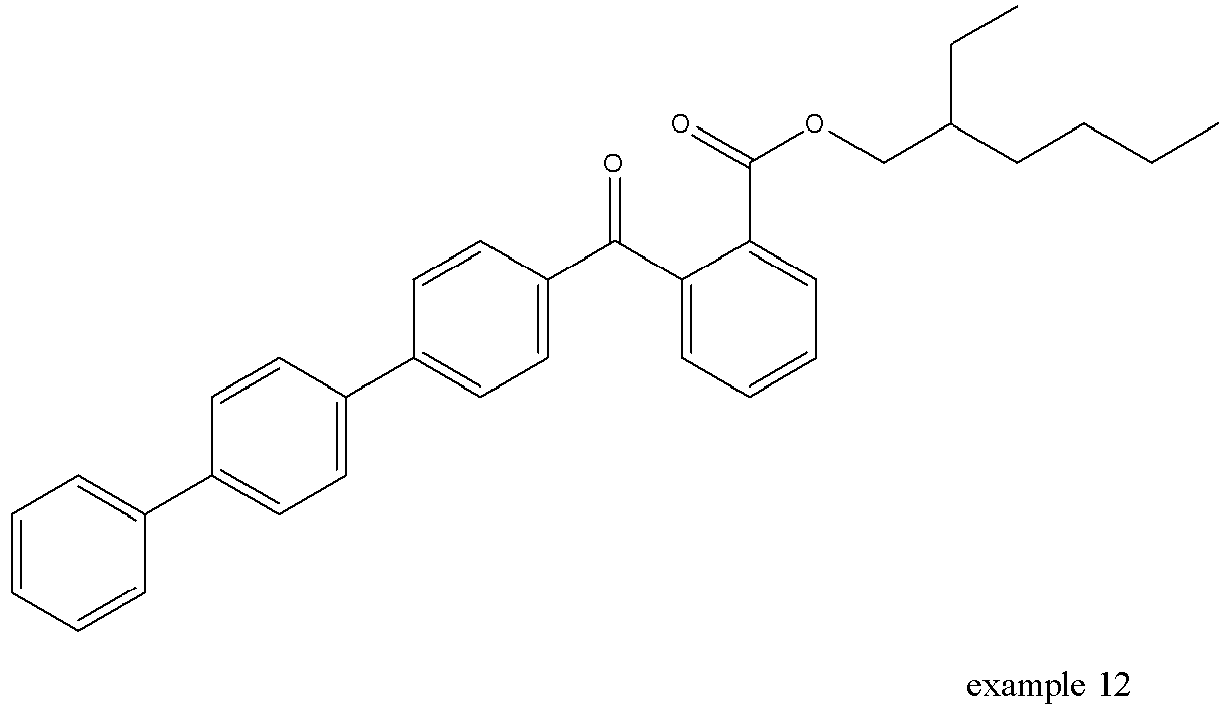
309 (ethyl acetate) 24900 - 4-Phenylbenzoyl benzoic acid ethylhexyl ester and 4-phenylbenzoyl benzoic acid amyl ester are especially useful for formulating highly reactive UV-curable compositions, for example UV-flexographic inks and coatings, UV-digital inks and coatings, and UV-inks and coatings curable with low energy UV-bulbs, because the active photoinitiator species can be used in high levels without the risk of separation, seeding or the like.
- In contrast to 4-phenylbenzophenone, 4-phenylbenzoyl benzoic acid ethylhexyl ester and 4-phenylbenzoyl benzoic acid amyl ester show excellent solubility in (meth)acrylic monomers and oligomers which are critical to formulate UV-flexographic inks and UV low migration inks and coatings. Examples of these acrylic monomers are propoxylated pentaerythritol tetraacrylate (PPTTA) or di-pentaerythritol hexaacrylate (DPHA) (see Tables 1 and 2).
- Moreover, the molecular weight of 4-phenylbenzoyl benzoic acid ethylhexyl ester is increased by more than one third over phenylbenzophenone, so that the ability to migrate is lowered, because the tendency of a molecule to migrate is a function of molecular weight ((L.L. Katan in "Migration of additive food contact", Black Academical & Professional, first edition, London 1996, page 97, table 5.3). Surprisingly, despite the increased molecular weight of 4-phenylbenzoyl benzoic acid ethylhexyl ester vs. phenylbenzophenone, there was no significant decrease in reactivity in the curable compositions (see Tables 3 and 4).
- The UV-curable compositions of the present invention preferably contain at least one acrylate or methacrylate, one hydrogen radical donor such as an amine or thioether, and a photoinitiator compound of Formula 1:

- A is C6-C22 aryl or a (6- to 22-membered) heteroaryl;
- R1 is selected from the group consisting of H, C1-C8 alkyl, C1-C8 alkoxy, C3-C22 cycloalkyl, a (3- to 22-membered) unsaturated or partially unsaturated heterocycle, C6-C22 aryl, a (6- to 22-membered) heteroaryl, and NR3R4;
- R3 and R4 are each independently selected from H or C1-C8 alkyl; or R3 and R4, together with the nitrogen atom to which they are attached, form a five or six membered ring;
- R2 is C4-C22 alkyl;
- provided that when A is phenyl and R2 ethylhexyl, methylheptyl, benzyl, t-butylbenzyl, or methylnaphthyl, then R1 is not H; and
- provided that when A is phenyl and R2 is t-butyl, then R1 is not methyl.
- A most preferred embodiment of this invention contains at least one acrylate or methacrylate, one hydrogen radical donor such as an amine or thioether, and a C5-C8 alkyl ester of 4-phenylbenzoylbenzoic acid.
- A non-limiting list of examples of acrylates suitable in the radiation curable compositions of the present invention include ethylene glycol diacrylate, 1,4-butandiol diacrylate, 1,6-hexandiol diacrylate, dipropylene glycol diacrylate, neopentylglycol diacrylate, ethoxylated neopentylglycol diacrylates, propoxylated neopentylglycol diacrylates, tripropylene glycol diacrylate, bisphenol-A diacrylate, ethoxylated bisphenol-A-diacrylates, bisphenol-A-diglycidylether diacrylate, ethoxylated bisphenol-A-diacrylates, poly(ethylene)glycol diacrylates, trimethylolpropane triacrylate, trimethylolpropane trimethacrylate, ethoxylated trimethylolpropane triacrylates, propoxylated trimethylolpropane triacrylates, propoxylated glycerol triacrylates, pentaerythritol triacrylate, ethoxylated pentaerythritol triacrylates, propoxylated pentaerythritol tetraacrylates, ethoxylated pentaerythritol tetraacrylates, ditrimethylolpropane tetraacrylate, dipentaerythritol pentaacrylate, dipentaerythritol hexaacrylate or mixtures thereof, preferred are ethoxylated trimethylolpropane triacrylates, ethoxylated pentaerythritol triacrylates and propoxylated pentaerythritol tetraacrylates, oligomeric and polymeric acrylates applied in the art, such as for example epoxy acrylates, polyester acrylates, acrylated polyurethanes, acrylated polyacrylates, acrylated polyethers, acrylated epoxidized oils based on linseed oil and soybean oil, mixtures thereof, and the like.
- A non-limiting list of examples of suitable methacrylates are ethylene glycol dimethacrylate, 1,4-butandiol dimethacrylate, 1,6-hexandiol dimethacrylate, dipropylene glycol dimethacrylate, neopentylglycol dimethacrylate, ethoxylated neopentylglycol dimethacrylates, propoxylated neopentylglycol dimethacrylates, tripropylene glycol dimethacrylate, bisphenol-A dimethacrylate, ethoxylated bisphenol-A-dimethacrylates, bisphenol-A-diglycidylether dimethacrylate, ethoxylated bisphenol-A-dimethacrylates, poly(ethylene)glycol dimethacrylates, trimethylolpropane trimethacrylate, ethoxylated trimethylolpropane trimethacrylates, propoxylated trimethylolpropane trimethacrylates, propoxylated glycerol trimethacrylates, pentaerythritol trimethacrylate, ethoxylated pentaerythritol trimethacrylates, propoxylated pentaerythritol tetramethacrylates, ethoxylated pentaerythritol tetramethacrylates, ditrimethylolpropane tetramethacrylate, dipentaerythritol pentamethacrylate, dipentaerythritol hexamethacrylate or mixtures thereof, preferably ethoxylated trimethylolpropane trimethacrylates, ethoxylated pentaerythritol trimethacrylates and propoxylated pentaerythritol tetramethacrylates, mixtures thereof, and the like.
- Suitable amines are, for example, dimethylethanolamine, diethanolmethylamine, N,N-dimethylaminobenzoic acid ethyl ester, N,N-dimethylaminobenzoic acid amyl ester, N,N-dimethylaminobenzoic acid ethylhexyl ester, 4,4'-bis(diethylamino) benzophenone, N-methylcarbazol, oligomeric amines such as Genopol AB (product of Rahn group) and acrylated amines such as adducts of multifunctional acrylates with secondary amines, or Laromer PO94 (Product of BASF).
- The radiation curable compositions of the present invention can be cured by an actinic light source, such as UV-light, provided by a high-voltage mercury bulb, a medium-voltage mercury bulb, a xenon bulb, a carbon arc lamp, a metal halide bulb, and especially with an UV-LED lamp or sunlight. The wavelength of applied irradiation is preferably within a range of 250 to 400 nm, more preferably 280-370 nm.
- In order to fine-tune properties, the radiation curable composition of the present invention may optionally contain small amounts of additional type-1 and type-2 photoinitiators, such as, for example, benzophenones, benzilketales, dialkoxy acetophenones, hydroxyalkylacetophenones, acylphosphinoxides and thioxanthones. Example include benzophenone, methylbenzophenone, 2,2-dimethoxy-2-phenylacetophenone, dimethoxyacetophenone, diethoxyacetophenone, 2-hydroxy-2-methyl-1-phenylpropan-1-one, 2-benzyl-2-dimethylamino-1-(4-morpholinophenyl)-butan-1-one, 2-methyl-1-[4(methoxythio)-phenyl]-2-morpholinopropan-2-one, diphenylacylphenyl phosphinoxide, diphenyl(2,4,6-trimethylbenzoyl) phosphinoxide, 2,4,6-trimethylbenzoylethoxyphenyl phosphinoxide, 2-isopropylthioxanthone, 4-isopropylthioxanthone, 2,4-dimethylthioxanthone and their oligomeric counterparts.
- Besides the use as a component of radical photoinitiator systems for UV curable compositions, esters of 4-arylbenzoyl benzoic acid, especially the C5-C8 alkyl esters, as liquids, dissolve a variety of other photoinitiators, co-initiators and synergists, and are therefore also suitable to render photoinitiator blends liquid and stable. This is shown in Table 5. It should also be noted that combinations of esters of 4-arylbenzoylbenzoic acids, for example mixtures of the various butyl esters of 4-phenylbenzoylbenzoic acid, can together yield a mixture of photoinitiators that has a melting point below 25°C even though the individually pure materials have melting points above 25°C. Thus, such a combination of photoinitiators can also function as a liquid to dissolve a variety of other photoinitiators, co-initiators, and synergists.
- 4-Phenylbenzoyl benzoic acid ethylhexyl ester and 4-phenylbenzoyl benzoic acid amyl ester are useful as components in radical photoinitiator systems, for UV-curable compositions as well as a component for liquid photoinitiator blends. They exhibit excellent solubility in a variety of acrylic monomers and oligomers suitable to make UV-curable coatings and inks.
- Although the photoinitiators of the present application are exemplified using non-pigmented coatings, one of skill in the art would recognize that they could easily be used in colored inks and coatings as well.
- Suitable colorants include, but are not limited to organic or inorganic pigments and dyes. The dyes include but are not limited to azo dyes, anthraquinone dyes, xanthene dyes, azine dyes, combinations thereof and the like. Organic pigments may be one pigment or a combination of pigments, such as for instance Pigment Yellow Numbers 12, 13, 14, 17, 74, 83, 114, 126, 127, 174, 188; Pigment Red Numbers 2, 22, 23, 48:1, 48:2, 52, 52:1, 53, 57:1, 112, 122, 166, 170, 184, 202, 266, 269; Pigment Orange Numbers 5, 16, 34, 36; Pigment Blue Numbers 15, 15:3, 15:4; Pigment Violet Numbers 3, 23, 27; and/or Pigment Green Number 7. Inorganic pigments may be one of the following non-limiting pigments: iron oxides, titanium dioxides, chromium oxides, ferric ammonium ferrocyanides, ferric oxide blacks, Pigment Black Number 7 and/or Pigment White Numbers 6 and 7. Other organic and inorganic pigments and dyes can also be employed, as well as combinations that achieve the colors desired.
- As with most printing inks, other additives, alone or in combination, may be employed, including but not limited to, waxes, ammonia, defoamers, dispersants, stabilizers, silicones, rheological modifiers, plasticizers and the like.
- The following examples illustrate specific aspects of the present invention as defined by the appended claims and are not intended to limit the scope thereof in any respect and should not be so construed. Any example and disclosure lying outside the scope of said claims is only intended for illustrative as well as comparative purposes. Unless otherwise indicated, the test methods were as described below.
- Spectra were acquired using a Unicam UV-2 UV/VIS spectrophotometer. All absorption spectra were obtained using 1 cm cuvettes, scanning within the 200-800 nm range. Solutions were prepared in a 100 cm3 volumetric flask, and if required, subsequently diluted so that a maximum absorbance of less than 2 was obtained. From the absorption the molar extinction coefficient e was calculated in liter * mol-1 * cm-1.
- Melting points were determined by a calibrated Büchi melting point apparatus.
- The Fourier transform infrared (FTIR) spectra were recorded on a Bio-Rad Excalibur FTS 3000 spectrophotometer using a surface reflectance method (solid samples, Golden Gate single reflection diamond attenuated total reflectance accessory).
-
- a) Film hardness: The thumb is pressed on the surface of the cured coating and rotated for 90°. If no marks are left on the surface, the cure is regarded as "OK".
- b) Solvent resistance: Higher crosslinked materials pose a better resistance to solvents. A cotton-tipped plastic stick is soaked with acetone or alcohol and rubbed over the cured coating or ink. The more rubs the cured coating or ink withstands without being destroyed, the better rated the cure is. Acetone is typically more aggressive than alcohol.
- 4-phenylbenzophenone, 4-phenylbenzoyl benzoic acid ethylhexyl ester, and 4-phenylbenzoyl benzoic acid amyl ester were each separately added to the multifunctional acrylate propoxylated pentaerythritol tetraacrylate (SR 494 LM, Sartomer company) (PPTTA) in amounts of 2, 4, 6, and 8 weight % and stirred for 30 minutes at room temperature. The results are shown in Table 1.
Table 1: Solubility in propoxylated pentaerythritol tetraacrylate SR 494 LM (PPTTA) Mixture Benzophenone Derivative Concentration [weight%] in PPTTA 2% 4% 6% 8% Example 1 (comparative-4-phenyl benzophenone) 
solution hazy Solid residuals Solid residuals Example 9 (inventive-4-phenylbenzoyl benzoic acid ethylhexyl ester) 
solution solution solution solution Example 10 (inventive-4-phenylbenzoyl benzoic acid amyl ester) 
solution solution solution solution - 4-Phenylbenzoyl benzoic acid ethylhexyl ester and 4-phenylbenzoyl benzoic acid amyl ester both showed better solubility than 4-phenyl benzophenone in propoxylated pentaerythritol tetraacrylate (PPTTA).
- 4-phenylbenzophenone, 4-phenylbenzoyl benzoic acid ethylhexyl ester, and 4-phenylbenzoyl benzoic acid amyl ester were each added separately to the multifunctional acrylate di-pentaerythritol hexaacrylate (DPHA, Miwon Company) in amounts of 2, 4, 6, and 8 weight%, and stirred for 30 minutes at room temperature.
Table 2: Solubility in di-pentaerythritol hexaacrylate (DPHA) Mixture Benzophenone Derivative Concentration [weight%] in DPHA 2% 4% 6% 8% Example 1 (comparative) 
solution solution Hazy-opaque Solid residuals Example 9 (inventive) 
solution solution solution solution Example 10 (inventive-4-phenylbenzoyl benzoic acid amyl ester) 
solution solution solution solution - 4-Phenylbenzoyl benzoic acid ethylhexyl ester and 4-phenylbenzoyl benzoic acid amyl ester showed better solubility than 4-phenyl benzophenone in DPHA.
- Mixtures of each of 4-phenylbenzoyl benzoic acid ethylhexyl ester (Example 3a), 4-phenylbenzoyl benzoic acid amyl ester (Example 3b) and phenylbenzophenone (Example 4) were mixed with dimethylaminobenzoic acid ethylhexyl ester and trimethylol propane triacrylate (Sartomer SR 351). The resulting coating mixtures were low viscosity, exhibiting a viscosity of 100-120 mPas. Viscosity was determined with a Physika 300 cone and plate rheometer from Anton Parr GmbH at a shear rate of D = 2 to 100 s-1. The viscosity value at a shear rate of D = 50 1/s was recorded. The coating mixtures were applied on a coated "Byk" cardboard test chart (black and white areas) with a wire applicator (10 µm wet) and cured with a medium pressure mercury bulb (Fusion H-bulb (187 W /cm)) and at a conveyor speed of 16-64 meter / minute. Cure was assessed by the solvent resistance test (over black and white), and the thumb twist test. The results are shown in Tables 3a, 3b, and 4.
-
- 4.0 g 4-phenylbenzoyl benzoic acid ethylhexyl ester
- 4.0 g of dimethylaminobenzoic acid ethylhexyl ester
- 100 g of trimethylol propane triacrylate


-
- 4.0 g 4-phenylbenzoyl benzoic acid amyl ester
- 4.0 g dimethylaminobenzoic acid ethylhexyl ester
- 100 g trimethylol propane triacrylate

-
- 4.0g 4-phenylbenzophenone
- 4.0 g of dimethylaminobenzoic acid ethylhexy lester
- 100 g of trimethylol propane triacrylate


- As indicated aforementioned, the experiments show that surprisingly, despite the increased molecular weight of 4-phenylbenzoyl benzoic acid ethylhexyl ester and 4-phenylbenzoyl benzoic acid amyl ester compared to 4-phenylbenzophenone, the curing result of the curable compositions containing 4-phenylbenzoyl benzoic acid ethylhexyl ester and 4-phenylbenzoyl benzoic acid amyl ester were almost identical to the compositions containing 4-phenylbenzophenone.
- A 1:1 mixture in weight of 4-phenylbenzoyl benzoic acid ethylhexyl ester and dimethylaminobenzoic acid ethylhexyl ester was transformed into a solution by stirring at room temperature. The solution also stayed liquid at 5°C. As a comparison experiment, a 1:1 mixture of 4-phenylbenzophenone and dimethylaminobenzoic acid ethylhexyl ester was turned into a solution at elevated temperature of 50°C. Upon cooling to room temperature, the phenylbenzophenone precipitated. A similar instability and precipitation as with 4-phenyl benzophenone was also observed with 4-phenylbenzoyl benzoic acid methyl ester.
Table 5: Solubility stability of photoinitiator blends Blend Benzophenone derivative Aminobenzoate Stability at 25°C Stability at 5°C Example 5 (comparative) 

Precipitation of crystals Precipitation of crystals Example 6* (comparative) 

Precipitation of crystals Precipitation of crystals Example 7 (inventive) 

Stable solution (no precipitation) Stable solution (no precipitation) Example 10 

Stable solution (no precipitation) Stable solution (no precipitation) *prepared using the same procedure as described in Example 9 - Table 5 shows the unique character of 4-phenylbenzoyl benzoic acid ethylhexyl ester and 4-phenylbenzoyl benzoic acid amyl ester, which are useful to solubilize photoinitiator blends containing solid photoinitiators. Preferably, at least 10 weight% of 4-phenylbenzoyl benzoic acid ethylhexyl ester or 4-phenylbenzoyl benzoic acid amyl ester, preferably 20-50 weight%, are suitable to turn a solid photoinitiator blend into a solution.
- 154.0 g (1.0 mole) of biphenyl and 148.0 g (1.0 mole) phthalic anhydride were dispersed in 800 ml of methylene dichloride. Then 226.0 g (2 moles) of aluminum trichloride was added in portions, under water cooling, so that the temperature did not exceed 20°C. Then the mixture was allowed to stir overnight at room temperature and became a greenish-bluish color. Then the reaction mixture was poured slowly, under stirring, into a mixture of 3.0 liters of water, 500 g of crushed ice, and 400 g of sulfuric acid. During the addition, the bluish color disappeared and a white precipitate was formed, which was separated by filtration, washed with 4 x 300 ml of water, and dried.
- Yield: 291.0g (96% of theory)

- Characterization:
- GC-purity: 98%
- Melting point: 232-233°C
- GC-purity: 99%
- Mass Spectroscopy (m/z): 374 (M(+) -1 + 73(trimethylsilane) 359 (100%), 285,228, 181, 152, 73
- UV-spectroscopy: λ max = 286 nm (ethanol)
- 30.2 g (0.1 mole) of 4-phenylbenzoyl benzoic acid from Example 8 was mixed with 26.0 g (0.2 moles) of ethylhexanol, 50 ml of toluene, and 2.0 g of toluene sulfonic acid. The mixture was heated to reflux and, within 3 hours, 3 ml of water was separated, and the acid value dropped below 5 mg KOH/g. The mixture was allowed to cool down to room temperature, diluted with 50 ml of methylene dichloride, and extracted three times with 100 ml of saturated sodium bicarbonate solution. Then the solvents were removed by rotary evaporator at 80°C (50 hPa). Then the excess of ethylhexanol was removed under reduced pressure of 0.1 hPa at a temperature of 120°C. A light brown clear liquid remained.
- Yield : 38.1 g (91% of theory)

- Characterization:
- GC-purity: 99%
- Mass Spectroscopy (m/z): 415 (M(+) +1 285 (100%), 257, 228, 181, 152
- UV-spectroscopy: λ max = 287 nm (ethyl acetate)
- Acid value: < 2 mg KOH/g
- Viscosity: 12 Pa.s at 25°C
- 30.2 g (0.1 mole) of 4-phenylbenzoyl benzoic acid from Example 8 was mixed with 17.6 g (0.2 moles) of amyl alcohol, 50 ml of toluene, and 2.0 g of toluene sulfonic acid. The mixture was heated to reflux and, within 3 hours, 3 ml of water was separated, and the acid value dropped below 5 mg KOH/g. The mixture was allowed to cool down to room temperature, diluted with 50 ml of methylene dichloride, and extracted three times with 100 ml of saturated sodium bicarbonate solution. Then, the solvents were removed by rotary evaporator at 80°C (50 hPa). Then, the excess of amyl alcohol was removed under reduced pressure of 0.1 hPa at a temperature of 90°C. A light brown clear liquid remained.
- Yield : 38.1 g (91% of theory)

- Characterization:
- GC-purity: 99%
- UV-spectroscopy: λ max = 286 nm (ethyl acetate)
- Acid value: < 2 mg KOH/g
- Viscosity: 13 Pa.s at 25°C
- 22.1 g (0.1 mole) of terphenyl and 14.8 g (0.1 mole) of phthalic anhydride were dispersed in 90 ml of methylene dichloride. Then 22.0 g (0.2 mole) of aluminum trichloride was added in portions under water cooling over 15 minutes, so that the temperature did not exceed 20°C. Then the mixture was allowed to stir overnight at room temperature and got a brown color. Then, the reaction mixture was diluted with 100 ml of methylene dichloride and poured slowly under stirring into a mixture of 300 ml of water and 100 g of sulfuric acid. A white solid is formed, which is separated by filtration, washed with 4 x 300 ml of water and dried.
- Yield: 35.5g (94.8 % of theory)
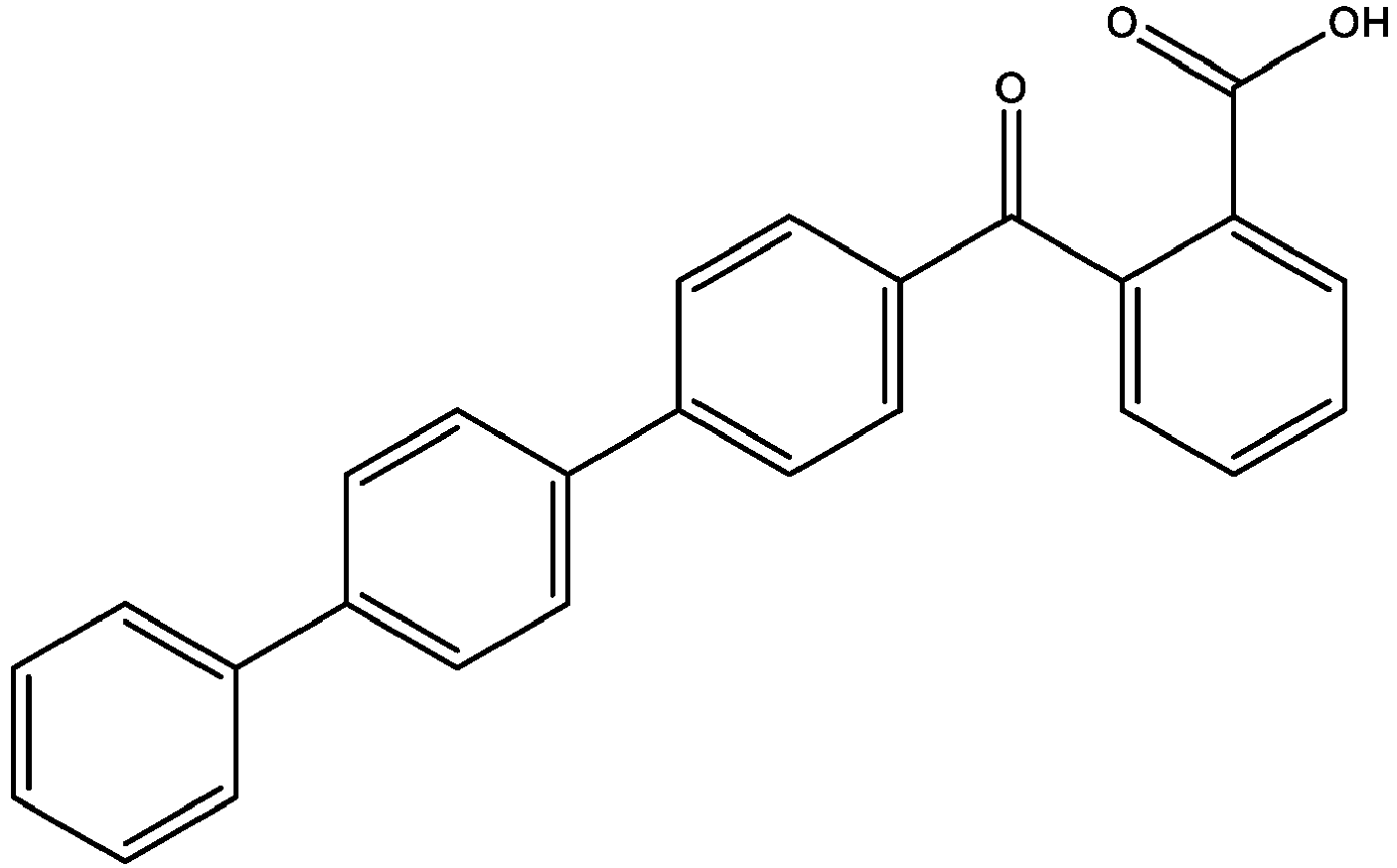
- Characterization:
- GC-purity: 94 area% (6 area % terphenyl)
- 450 (M(+) -1 + 73(trimethylsilane) 100% , 435 (100%), 361 ,257, 181
- Melting point: 235-240°C
- 18.9 g (0.05 mole) of 4-terphenoyl benzoic acid from previous example was mixed with 26.0 g (0.2 mole) of 2-ethylhexanol, 30 ml of xylene and 0.5 g of toluene sulfonic acid. The mixture was heated to reflux, and within 3 hours the dispersion disappeared and a clear solution was obtained, approximately 1.5 ml of water was separated and the acid value dropped below 4 mg KOH/g. The mixture was allowed to cool down to room temperature, diluted with 50 ml of methylene dichloride and extracted three times with 100 ml of saturated sodium bicarbonate solution. Then the solvents were removed by rotary evaporator at 25 to 100°C (300-30 hPa). Then, the excess of 2-ethylhexanol was removed under reduced pressure of 0.1 hPa at a temperature of 120°C. A yellow, clear high viscosity liquid remained.
- Yield : 20.1 g (78.1% of theory)

- Characterization:
- UV-spectroscopy: λ max = 309 nm (ethyl acetate)
- GC purity: 90% (4 area% terphenyl, 5 area % 2-ethylhexanol)
- Mass Spectroscopy (m/z): 491 (M(+) +1, 379, 362 (100%)
- Acid value: 3 mg KOH/g.
- Lithographic UV-inks were tested on a Didde web offset press equipped with two UV-dryers. Two cyan lithographic energy curable packaging inks (inventive and comparative) were made on a three roll mill with 3 passes at 1MPa (25°C), having the following composition and properties:
Table 6: Composition (wt.%) of two inks tested on the Didde web offset press Material Inventive Ink Comparative Ink Varnish of ketone-aldehyde resin in TMPTA (48%) 44.00 44.00 Multifunctional acrylate monomer blend (Sun) 1800 1800 Flow agent (Tego) 0.50 0.50 Stabilizer (BASF) 1.00 1.00 Photoinitiator blend, based on aminobenzoates & benzophenone-derivatives (no 4-PBz) & aminoketones (Sun) 10.00 10.00 Material Inventive Ink Comparative Ink 4-phenyl-benzophenone (4-PBz) - 2.50 4-Phenyl benzoyl benzoic acid ethyl hexyl ester (Example 9) 250 - Blue pigment 15:3 (Sun) 21.00 21.00 Inorganic filler (Emerys) 3.00 300 Total 100.00 100.00 Viscosity @ 50s-1 [Pas] 30.30 31.25 - To assess print performance, both inks were tested on a Didde web offset press equipped with two UV-dryers at 800 ft/min, printed on C1S paper (coated on one side). Rycoline 4600 fountain solution was used (Sun Chemical).
- It determines the size of the opening through which the ink enters the ink train
- The velocity of the moving web (substrate) in feet per minute
- The water window gives a range of the fountain solution settings for which a targeted print density can be achieved. The larger the water window, the more robust lithography is anticipated. The water window test was stopped when optical density dropped by >0.1 than starting density.
- The achieved optical density of the cured prints under the given ink duct settings and fountain settings was measured in-line with a mounted Techkon's Spectro Edge Model ES500 densitometer.
- The extent of UV-cure was assessed by a thumb twist test and a solvent resistance test with isopropanol (IPA). Such a test is well known in the art and is, for example, described on page 74 of Test Methods for UV and EB Curable Systems, C. Lowe & P.K.T Oldring, SITA Technology, 1994, ISBN 0 947798 07 2.
- Good cure (test passed) can be defined as the degree of cure in which no ink is transferred to the thumb and the ink has a solvent resistance of at least 10 IPA double-rubs. The press operator notes the lamp settings at which thumb twist test and solvent resistance test are passed. Only one of two dryers were used:
- 1 lamp low (not tested in our experiment)
- 1 lamp medium (good cure if all tests are passed)
- 1 lamp high (fair cure if all tests are passed)
- Misting is assessed at different places on the press, usually near an ink duct and a printing plate. A white piece of paper is placed at a defined distance from the ink rollers, and the press is run for a defined period of time, and defined speed and temperature. Then, the ink mist which is transferred to the paper is assessed by visual comparison to a master example or by measurement with a densitometer. Very little ink on the paper means that the ink has very low misting and low tendency to contaminate the printing press and press room with ink mist.
Visual assessment of misting can be described as follows: - Very good (ink mist is undetectable or minimal)
- Good (small amount of ink mist is deposited on the paper)
- Bad (large amount of ink mist is deposited on the paper)
- The print performance results are shown in Table 7.
Table 7: Press performance of inventive and comparative ink Printing Press results 800 ft./min Inventive ink Comparative ink Ink duct setting in units 1.50 2.00 Printing speed (feet per minute) 800 800 Water window in % 14-50, 35 units 20-50, 30 units Optical density in Water window in % 1.57/1.57/1.56/1.57/1.57 /1.53/1.49/1.51 1.55/1.55/1.57/1.53/1.54 /1.52/1.45 Printed optical density in units 1.57 1.55 UV-cure results 1 lamp high Fully cured; all tests passed Fully cured; all tests passed UV-cure results 1 lamp medium Fully cured; all tests passed Fully cured, but IPA double rubs only 8 to 9 Misting properties No misting observed No misting observed - Table 7 shows that the inventive ink exhibits a slightly wider water window and comparable achieved optical density vs. the comparative ink.
- Overall, the inventive ink performs similarly to the comparative ink. But the inherently liquid 4-phenyl benzoyl benzoic acid ethylhexyl ester will not precipitate from the ink, in contrast to the solid 4-phenylbenzophenone, which often does precipitate. The precipitation of 4-phenylbenzophenone is sometimes an issue, affecting ink quality.
- Moreover, the high melting point and the hard crystals of 4-phenylbenzophenone makes it more difficult to grind an UV-ink on a three-roll mill or a bead mill. Often, inks with high levels of 4-phenylbenzophenone need additional paths on the three roll mill, before the desired fineness of the ink is achieved, which results in higher production cost. The issue can be completely avoided by using the composition of this invention containing inherently liquid photoinitiators, such as 4-phenylbenzoyl benzoic acid ethyl hexyl ester.
Claims (13)
- A compound of Formula 1:
 A is C6-C22 aryl or a (6- to 22-membered) heteroaryl;R1 is selected from the group consisting of H, Ci-Cs alkyl, Ci-Cs alkoxy, C3-C22 cycloalkyl,a (3- to 22-membered) unsaturated or partially unsaturated heterocycle, C6-C22 aryl, a (6-to 22-membered) heteroaryl, and NR3R4;R3 and R4 are each independently selected from H or Ci-Cs alkyl; or R3 and R4, together with the nitrogen atom to which they are attached, form a five or six membered ring;R2 is C4-C22 alkyl;provided that when A is phenyl and R2 is ethylhexyl or methylheptyl, then R1 is not H; andprovided that when A is phenyl and R2 is t-butyl, then R1 is not methyl.
 - The compound of claim 1, wherein A is phenyl.
- The compound of claim 1, which is a C9-C22 alkyl ester (wherein R2 is C9-C22 alkyl).
- Use of a compound of any one of claims 1-3 as a component for radical photoinitiator systems for UV-curable inks and coatings; preferably wherein the radical photoinitiator system comprises a C5-C8 alkyl ester of a compound of claim 1 (wherein R2 is C5-C8 alkyl).
- A composition comprising at least one compound of any one of claims 1-3 and at least one hydrogen radical donor; wherein the composition is liquid at 25°C, preferably wherein said composition comprises at least one C5-C8 alkyl ester of a compound of claim 1(wherein R2 is C5-C8 alkyl).
- The composition of claim 5, wherein the concentration of the C5-C8 alkyl ester of a compound of claim 1 (wherein R2 is C5-C8 alkyl) is greater than 10 weight %.
- The composition of claim 5, wherein the C5-C8 alkyl ester of a compound of claim 1 (wherein R2 is C5-C8 alkyl) is an amyl ester or an ethylhexyl ester.
- The composition of claim 7, comprising 4-phenylbenzoylbenzoic acid amyl ester.
- The composition of any one of claims 5-7, wherein the hydrogen radical donor is a tertiary amine or a thioether.
- The composition of any one of claims 5-7 or 9, comprising at least two compounds of claim 1, none of which are liquid at 25°C in its pure form.
- The composition of any one of claims 5-10, further comprising one or more C1-C4 alkyl esters of 4-arylbenzoylbenzoic acid.
- A coating or printing ink, curable with actinic light, comprising one or more acrylates or methacrylates, a tertiary amine and either at least one compound of claim 1 or the composition of any one of claims 5-11, preferably wherein the acrylates or methacrylates are present at a concentration of 20-98 weight%.
- Use of 4-phenylbenzoylbenzoic acid ethylhexyl ester as a component in radical photoinitiator systems for UV-curable inks and coatings.
Applications Claiming Priority (2)
| Application Number | Priority Date | Filing Date | Title |
|---|---|---|---|
| US201461983069P | 2014-04-23 | 2014-04-23 | |
| PCT/US2015/026410 WO2015164205A1 (en) | 2014-04-23 | 2015-04-17 | Liquid arylbenzoyl benzoic acid ester derivatives for energy curable compositions |
Publications (3)
| Publication Number | Publication Date |
|---|---|
| EP3134379A1 EP3134379A1 (en) | 2017-03-01 |
| EP3134379A4 EP3134379A4 (en) | 2018-05-16 |
| EP3134379B1 true EP3134379B1 (en) | 2024-08-28 |
Family
ID=54333030
Family Applications (1)
| Application Number | Title | Priority Date | Filing Date |
|---|---|---|---|
| EP15783928.3A Active EP3134379B1 (en) | 2014-04-23 | 2015-04-17 | Liquid arylbenzoyl benzoic acid ester derivatives for energy curable compositions |
Country Status (3)
| Country | Link |
|---|---|
| US (1) | US9938231B2 (en) |
| EP (1) | EP3134379B1 (en) |
| WO (1) | WO2015164205A1 (en) |
Families Citing this family (13)
| Publication number | Priority date | Publication date | Assignee | Title |
|---|---|---|---|---|
| EP3593262A4 (en) * | 2017-03-10 | 2020-12-09 | Eduworks Corporation | Automated tool for question generation |
| IT202100014885A1 (en) | 2021-06-08 | 2022-12-08 | Igm Resins Italia Srl | BIFUNCTIONAL SILICON-BASED PHOTOINITIATORS |
| IT202100025868A1 (en) | 2021-10-08 | 2023-04-08 | Igm Resins Italia Srl | NEW PHOTO STARTERS |
| EP4482881A1 (en) | 2022-02-24 | 2025-01-01 | IGM Resins Italia S.r.l. | Photoinitiators |
| EP4273200B1 (en) | 2022-05-06 | 2026-03-25 | IGM Group B.V. | Photoinitiator package comprising specialised bisacylphosphine oxide photoinitiators and optical brightener sensitizers |
| CN120187765A (en) * | 2022-10-05 | 2025-06-20 | 意大利艾坚蒙树脂有限公司 | Polymer (meth)acrylate photoinitiator |
| CN115925541B (en) * | 2022-12-06 | 2025-05-02 | 内蒙古久日新材料有限公司 | A kind of preparation method of methyl o-benzoylbenzoate |
| IT202300004737A1 (en) | 2023-03-14 | 2024-09-14 | Igm Resins Italia Srl | USE OF SPECIFIC PHOTOINITIATORS IN A PHOTOPOLYMERIZATION PROCESS USING COMBINED WAVELENGTHS OF LED LIGHT |
| WO2025027517A1 (en) | 2023-08-03 | 2025-02-06 | Igm Resins Italia S.R.L. | 10,11 -dihydro-5h-dibenzo[b,f]azepine derivatives as photoinitiatiors in photopolymerisation for use in photocurable compositions |
| EP4534614B1 (en) | 2023-10-02 | 2026-04-15 | IGM Group B.V. | Photoinitiator package comprising specialised bisacylphosphine oxide photoinitiators, further acylphosphine oxide photoinitiators and optical brightener sensitizers |
| IT202300028218A1 (en) | 2023-12-28 | 2025-06-28 | Igm Resins Italia Srl | NEW SOLID FORM OF BIS(2,4,6-TRIMETHYLBENZOYL)-N-OCTYLPHOSPHINE OXIDE |
| EP4579344A1 (en) | 2023-12-29 | 2025-07-02 | IGM Group B.V. | Thioalkylcoumarin photosensitizers for photopolymerization |
| EP4578918A1 (en) | 2023-12-29 | 2025-07-02 | IGM Group B.V. | Photosensitizers for photopolymerization |
Citations (2)
| Publication number | Priority date | Publication date | Assignee | Title |
|---|---|---|---|---|
| US5274104A (en) * | 1991-06-21 | 1993-12-28 | Elf Sanofi, A French Corp. | N-substituted heterocyclic derivatives useful in the treatment of cardiovascular disorders |
| CN103059168A (en) * | 2013-01-17 | 2013-04-24 | 长沙新宇高分子科技有限公司 | Benzophenone-type light initiator and preparation method thereof |
Family Cites Families (12)
| Publication number | Priority date | Publication date | Assignee | Title |
|---|---|---|---|---|
| US1814145A (en) * | 1929-08-08 | 1931-07-14 | Philip H Groggins | Process of preparing para-phenyl-ortho-benzoyl-benzoic acid |
| JPS60109544A (en) | 1983-11-17 | 1985-06-15 | Kao Corp | Novel chalcone derivative and ultraviolet light absorber containing it |
| LU86997A1 (en) * | 1987-09-21 | 1989-04-06 | Oreal | PHOTOSTABLE FILTERING COSMETIC COMPOSITION CONTAINING BIXIN ASSOCIATED WITH A LIPOSOLUBLE UV FILTER AND ITS USE FOR THE PROTECTION OF THE HUMAN SKIN AGAINST ULTRAVIOLET RADIATION |
| US6770270B2 (en) * | 2002-03-05 | 2004-08-03 | The C.P. Hall Company | Methods of making and selling a sunscreen composition |
| US6485713B1 (en) | 2002-03-05 | 2002-11-26 | The C. P. Hall Company | Sunscreen compositions and methods and materials for producing the same |
| DE102009041841A1 (en) * | 2008-12-17 | 2010-07-08 | Huhtamaki Forchheim Zweigniederlassung Der Huhtamaki Deutschland Gmbh & Co. Kg | UV and light protection film |
| US9340693B2 (en) | 2011-03-28 | 2016-05-17 | Konica Minolta, Inc. | Actinic ray curable inkjet ink and image recording method using same |
| EP2508574A1 (en) | 2011-04-05 | 2012-10-10 | Cytec Surface Specialties, S.A. | Radiation curable compositions |
| US9309438B2 (en) | 2011-04-05 | 2016-04-12 | ALLNEX Belgium SA | Radiation curable compositions |
| EP2617705A1 (en) | 2012-01-20 | 2013-07-24 | Cytec Surface Specialties, S.A. | Amino Photo-Reactive Binder |
| EP2617783A1 (en) | 2012-01-20 | 2013-07-24 | Cytec Surface Specialties, S.A. | Photo-reactive Binder |
| EP3024858B1 (en) | 2013-07-23 | 2017-10-18 | Allnex Belgium S.A. | Polymeric photoinitiators |
-
2015
- 2015-04-17 EP EP15783928.3A patent/EP3134379B1/en active Active
- 2015-04-17 US US15/302,683 patent/US9938231B2/en active Active
- 2015-04-17 WO PCT/US2015/026410 patent/WO2015164205A1/en not_active Ceased
Patent Citations (2)
| Publication number | Priority date | Publication date | Assignee | Title |
|---|---|---|---|---|
| US5274104A (en) * | 1991-06-21 | 1993-12-28 | Elf Sanofi, A French Corp. | N-substituted heterocyclic derivatives useful in the treatment of cardiovascular disorders |
| CN103059168A (en) * | 2013-01-17 | 2013-04-24 | 长沙新宇高分子科技有限公司 | Benzophenone-type light initiator and preparation method thereof |
Also Published As
| Publication number | Publication date |
|---|---|
| WO2015164205A1 (en) | 2015-10-29 |
| EP3134379A4 (en) | 2018-05-16 |
| EP3134379A1 (en) | 2017-03-01 |
| US9938231B2 (en) | 2018-04-10 |
| US20170029360A1 (en) | 2017-02-02 |
Similar Documents
| Publication | Publication Date | Title |
|---|---|---|
| US9938231B2 (en) | Liquid arylbenzoyl benzoic acid ester derivatives for energy curable compositions | |
| BR112016005810B1 (en) | RADIATION CURABLE COMPOSITIONS FOR FOOD PACKAGING | |
| EP2121771B2 (en) | Novel radiation curable compositions | |
| US9938232B2 (en) | LED photoinitiators | |
| EP3911709B1 (en) | Ink compositions | |
| EP3421505B1 (en) | Water-based curable composition and water-soluble photopolymerization initiator | |
| US10563073B2 (en) | Oligomeric aminoketones and their use as photoinitiators | |
| WO2017216699A1 (en) | Novel 3-ketocoumarins, a process for their preparation and their use as photoinitiators in photopolymerization reactions | |
| EP2130818A1 (en) | Multifunctional Type II photoinitiators and curable compositions | |
| EP4234251A1 (en) | Ink composition for photocurable inkjet printing | |
| JP5631664B2 (en) | Ink composition for ink jet recording, ink jet recording method, and ink jet printed matter | |
| JP2010229283A (en) | Ink composition for inkjet recording | |
| JP6009652B2 (en) | Ink composition, ink set, and image forming method | |
| CN116137840B (en) | Active energy ray-curable inkjet printing ink composition | |
| JP7682794B2 (en) | Curable ink composition | |
| US11608445B2 (en) | Oligomeric aminoketones and their use as photoinitiators | |
| WO2014157130A1 (en) | Inkjet recording method, printing substance, and ink set | |
| JP5683910B2 (en) | Ink composition, ink set, and image forming method | |
| ES2385616T3 (en) | Novel radiation curable compositions | |
| JP2003221532A (en) | Ink and method for ink jet recording | |
| EP3309227B1 (en) | Inkjet ink and image forming method | |
| CN110760217A (en) | Active energy photo-curing ink composition and application thereof |
Legal Events
| Date | Code | Title | Description |
|---|---|---|---|
| STAA | Information on the status of an ep patent application or granted ep patent |
Free format text: STATUS: THE INTERNATIONAL PUBLICATION HAS BEEN MADE |
|
| PUAI | Public reference made under article 153(3) epc to a published international application that has entered the european phase |
Free format text: ORIGINAL CODE: 0009012 |
|
| STAA | Information on the status of an ep patent application or granted ep patent |
Free format text: STATUS: REQUEST FOR EXAMINATION WAS MADE |
|
| 17P | Request for examination filed |
Effective date: 20161012 |
|
| AK | Designated contracting states |
Kind code of ref document: A1 Designated state(s): AL AT BE BG CH CY CZ DE DK EE ES FI FR GB GR HR HU IE IS IT LI LT LU LV MC MK MT NL NO PL PT RO RS SE SI SK SM TR |
|
| AX | Request for extension of the european patent |
Extension state: BA ME |
|
| DAV | Request for validation of the european patent (deleted) | ||
| DAX | Request for extension of the european patent (deleted) | ||
| RIC1 | Information provided on ipc code assigned before grant |
Ipc: C07C 69/76 20060101ALI20171219BHEP Ipc: C07C 65/34 20060101ALI20171219BHEP Ipc: C09D 11/03 20140101ALI20171219BHEP Ipc: C07C 51/083 20060101AFI20171219BHEP Ipc: C09D 11/101 20140101ALI20171219BHEP |
|
| A4 | Supplementary search report drawn up and despatched |
Effective date: 20180418 |
|
| RIC1 | Information provided on ipc code assigned before grant |
Ipc: C07C 69/76 20060101ALI20180412BHEP Ipc: C09D 11/101 20140101ALI20180412BHEP Ipc: C07C 65/34 20060101ALI20180412BHEP Ipc: C07C 51/083 20060101AFI20180412BHEP Ipc: C09D 11/03 20140101ALI20180412BHEP |
|
| STAA | Information on the status of an ep patent application or granted ep patent |
Free format text: STATUS: EXAMINATION IS IN PROGRESS |
|
| 17Q | First examination report despatched |
Effective date: 20200625 |
|
| P01 | Opt-out of the competence of the unified patent court (upc) registered |
Effective date: 20230521 |
|
| GRAP | Despatch of communication of intention to grant a patent |
Free format text: ORIGINAL CODE: EPIDOSNIGR1 |
|
| STAA | Information on the status of an ep patent application or granted ep patent |
Free format text: STATUS: GRANT OF PATENT IS INTENDED |
|
| INTG | Intention to grant announced |
Effective date: 20240325 |
|
| RAP1 | Party data changed (applicant data changed or rights of an application transferred) |
Owner name: SUN CHEMICAL B.V. |
|
| GRAS | Grant fee paid |
Free format text: ORIGINAL CODE: EPIDOSNIGR3 |
|
| GRAA | (expected) grant |
Free format text: ORIGINAL CODE: 0009210 |
|
| STAA | Information on the status of an ep patent application or granted ep patent |
Free format text: STATUS: THE PATENT HAS BEEN GRANTED |
|
| AK | Designated contracting states |
Kind code of ref document: B1 Designated state(s): AL AT BE BG CH CY CZ DE DK EE ES FI FR GB GR HR HU IE IS IT LI LT LU LV MC MK MT NL NO PL PT RO RS SE SI SK SM TR |
|
| REG | Reference to a national code |
Ref country code: GB Ref legal event code: FG4D |
|
| REG | Reference to a national code |
Ref country code: CH Ref legal event code: EP |
|
| REG | Reference to a national code |
Ref country code: DE Ref legal event code: R096 Ref document number: 602015089689 Country of ref document: DE |
|
| REG | Reference to a national code |
Ref country code: IE Ref legal event code: FG4D |
|
| REG | Reference to a national code |
Ref country code: LT Ref legal event code: MG9D |
|
| PG25 | Lapsed in a contracting state [announced via postgrant information from national office to epo] |
Ref country code: NO Free format text: LAPSE BECAUSE OF FAILURE TO SUBMIT A TRANSLATION OF THE DESCRIPTION OR TO PAY THE FEE WITHIN THE PRESCRIBED TIME-LIMIT Effective date: 20241128 |
|
| REG | Reference to a national code |
Ref country code: AT Ref legal event code: MK05 Ref document number: 1717836 Country of ref document: AT Kind code of ref document: T Effective date: 20240828 |
|
| PG25 | Lapsed in a contracting state [announced via postgrant information from national office to epo] |
Ref country code: NL Free format text: LAPSE BECAUSE OF FAILURE TO SUBMIT A TRANSLATION OF THE DESCRIPTION OR TO PAY THE FEE WITHIN THE PRESCRIBED TIME-LIMIT Effective date: 20240828 Ref country code: PL Free format text: LAPSE BECAUSE OF FAILURE TO SUBMIT A TRANSLATION OF THE DESCRIPTION OR TO PAY THE FEE WITHIN THE PRESCRIBED TIME-LIMIT Effective date: 20240828 Ref country code: GR Free format text: LAPSE BECAUSE OF FAILURE TO SUBMIT A TRANSLATION OF THE DESCRIPTION OR TO PAY THE FEE WITHIN THE PRESCRIBED TIME-LIMIT Effective date: 20241129 Ref country code: PT Free format text: LAPSE BECAUSE OF FAILURE TO SUBMIT A TRANSLATION OF THE DESCRIPTION OR TO PAY THE FEE WITHIN THE PRESCRIBED TIME-LIMIT Effective date: 20241230 Ref country code: FI Free format text: LAPSE BECAUSE OF FAILURE TO SUBMIT A TRANSLATION OF THE DESCRIPTION OR TO PAY THE FEE WITHIN THE PRESCRIBED TIME-LIMIT Effective date: 20240828 |
|
| PG25 | Lapsed in a contracting state [announced via postgrant information from national office to epo] |
Ref country code: BG Free format text: LAPSE BECAUSE OF FAILURE TO SUBMIT A TRANSLATION OF THE DESCRIPTION OR TO PAY THE FEE WITHIN THE PRESCRIBED TIME-LIMIT Effective date: 20240828 |
|
| PG25 | Lapsed in a contracting state [announced via postgrant information from national office to epo] |
Ref country code: LV Free format text: LAPSE BECAUSE OF FAILURE TO SUBMIT A TRANSLATION OF THE DESCRIPTION OR TO PAY THE FEE WITHIN THE PRESCRIBED TIME-LIMIT Effective date: 20240828 |
|
| REG | Reference to a national code |
Ref country code: NL Ref legal event code: MP Effective date: 20240828 |
|
| PG25 | Lapsed in a contracting state [announced via postgrant information from national office to epo] |
Ref country code: IS Free format text: LAPSE BECAUSE OF FAILURE TO SUBMIT A TRANSLATION OF THE DESCRIPTION OR TO PAY THE FEE WITHIN THE PRESCRIBED TIME-LIMIT Effective date: 20241228 Ref country code: AT Free format text: LAPSE BECAUSE OF FAILURE TO SUBMIT A TRANSLATION OF THE DESCRIPTION OR TO PAY THE FEE WITHIN THE PRESCRIBED TIME-LIMIT Effective date: 20240828 |
|
| PG25 | Lapsed in a contracting state [announced via postgrant information from national office to epo] |
Ref country code: HR Free format text: LAPSE BECAUSE OF FAILURE TO SUBMIT A TRANSLATION OF THE DESCRIPTION OR TO PAY THE FEE WITHIN THE PRESCRIBED TIME-LIMIT Effective date: 20240828 |
|
| PG25 | Lapsed in a contracting state [announced via postgrant information from national office to epo] |
Ref country code: ES Free format text: LAPSE BECAUSE OF FAILURE TO SUBMIT A TRANSLATION OF THE DESCRIPTION OR TO PAY THE FEE WITHIN THE PRESCRIBED TIME-LIMIT Effective date: 20240828 Ref country code: RS Free format text: LAPSE BECAUSE OF FAILURE TO SUBMIT A TRANSLATION OF THE DESCRIPTION OR TO PAY THE FEE WITHIN THE PRESCRIBED TIME-LIMIT Effective date: 20241128 |
|
| PG25 | Lapsed in a contracting state [announced via postgrant information from national office to epo] |
Ref country code: RS Free format text: LAPSE BECAUSE OF FAILURE TO SUBMIT A TRANSLATION OF THE DESCRIPTION OR TO PAY THE FEE WITHIN THE PRESCRIBED TIME-LIMIT Effective date: 20241128 Ref country code: PT Free format text: LAPSE BECAUSE OF FAILURE TO SUBMIT A TRANSLATION OF THE DESCRIPTION OR TO PAY THE FEE WITHIN THE PRESCRIBED TIME-LIMIT Effective date: 20241230 Ref country code: PL Free format text: LAPSE BECAUSE OF FAILURE TO SUBMIT A TRANSLATION OF THE DESCRIPTION OR TO PAY THE FEE WITHIN THE PRESCRIBED TIME-LIMIT Effective date: 20240828 Ref country code: NO Free format text: LAPSE BECAUSE OF FAILURE TO SUBMIT A TRANSLATION OF THE DESCRIPTION OR TO PAY THE FEE WITHIN THE PRESCRIBED TIME-LIMIT Effective date: 20241128 Ref country code: NL Free format text: LAPSE BECAUSE OF FAILURE TO SUBMIT A TRANSLATION OF THE DESCRIPTION OR TO PAY THE FEE WITHIN THE PRESCRIBED TIME-LIMIT Effective date: 20240828 Ref country code: LV Free format text: LAPSE BECAUSE OF FAILURE TO SUBMIT A TRANSLATION OF THE DESCRIPTION OR TO PAY THE FEE WITHIN THE PRESCRIBED TIME-LIMIT Effective date: 20240828 Ref country code: IS Free format text: LAPSE BECAUSE OF FAILURE TO SUBMIT A TRANSLATION OF THE DESCRIPTION OR TO PAY THE FEE WITHIN THE PRESCRIBED TIME-LIMIT Effective date: 20241228 Ref country code: HR Free format text: LAPSE BECAUSE OF FAILURE TO SUBMIT A TRANSLATION OF THE DESCRIPTION OR TO PAY THE FEE WITHIN THE PRESCRIBED TIME-LIMIT Effective date: 20240828 Ref country code: GR Free format text: LAPSE BECAUSE OF FAILURE TO SUBMIT A TRANSLATION OF THE DESCRIPTION OR TO PAY THE FEE WITHIN THE PRESCRIBED TIME-LIMIT Effective date: 20241129 Ref country code: FI Free format text: LAPSE BECAUSE OF FAILURE TO SUBMIT A TRANSLATION OF THE DESCRIPTION OR TO PAY THE FEE WITHIN THE PRESCRIBED TIME-LIMIT Effective date: 20240828 Ref country code: ES Free format text: LAPSE BECAUSE OF FAILURE TO SUBMIT A TRANSLATION OF THE DESCRIPTION OR TO PAY THE FEE WITHIN THE PRESCRIBED TIME-LIMIT Effective date: 20240828 Ref country code: BG Free format text: LAPSE BECAUSE OF FAILURE TO SUBMIT A TRANSLATION OF THE DESCRIPTION OR TO PAY THE FEE WITHIN THE PRESCRIBED TIME-LIMIT Effective date: 20240828 Ref country code: AT Free format text: LAPSE BECAUSE OF FAILURE TO SUBMIT A TRANSLATION OF THE DESCRIPTION OR TO PAY THE FEE WITHIN THE PRESCRIBED TIME-LIMIT Effective date: 20240828 |
|
| PG25 | Lapsed in a contracting state [announced via postgrant information from national office to epo] |
Ref country code: RO Free format text: LAPSE BECAUSE OF FAILURE TO SUBMIT A TRANSLATION OF THE DESCRIPTION OR TO PAY THE FEE WITHIN THE PRESCRIBED TIME-LIMIT Effective date: 20240828 Ref country code: SM Free format text: LAPSE BECAUSE OF FAILURE TO SUBMIT A TRANSLATION OF THE DESCRIPTION OR TO PAY THE FEE WITHIN THE PRESCRIBED TIME-LIMIT Effective date: 20240828 Ref country code: DK Free format text: LAPSE BECAUSE OF FAILURE TO SUBMIT A TRANSLATION OF THE DESCRIPTION OR TO PAY THE FEE WITHIN THE PRESCRIBED TIME-LIMIT Effective date: 20240828 |
|
| PG25 | Lapsed in a contracting state [announced via postgrant information from national office to epo] |
Ref country code: EE Free format text: LAPSE BECAUSE OF FAILURE TO SUBMIT A TRANSLATION OF THE DESCRIPTION OR TO PAY THE FEE WITHIN THE PRESCRIBED TIME-LIMIT Effective date: 20240828 |
|
| PG25 | Lapsed in a contracting state [announced via postgrant information from national office to epo] |
Ref country code: CZ Free format text: LAPSE BECAUSE OF FAILURE TO SUBMIT A TRANSLATION OF THE DESCRIPTION OR TO PAY THE FEE WITHIN THE PRESCRIBED TIME-LIMIT Effective date: 20240828 |
|
| PG25 | Lapsed in a contracting state [announced via postgrant information from national office to epo] |
Ref country code: SK Free format text: LAPSE BECAUSE OF FAILURE TO SUBMIT A TRANSLATION OF THE DESCRIPTION OR TO PAY THE FEE WITHIN THE PRESCRIBED TIME-LIMIT Effective date: 20240828 Ref country code: IT Free format text: LAPSE BECAUSE OF FAILURE TO SUBMIT A TRANSLATION OF THE DESCRIPTION OR TO PAY THE FEE WITHIN THE PRESCRIBED TIME-LIMIT Effective date: 20240828 |
|
| REG | Reference to a national code |
Ref country code: DE Ref legal event code: R097 Ref document number: 602015089689 Country of ref document: DE |
|
| PLBE | No opposition filed within time limit |
Free format text: ORIGINAL CODE: 0009261 |
|
| STAA | Information on the status of an ep patent application or granted ep patent |
Free format text: STATUS: NO OPPOSITION FILED WITHIN TIME LIMIT |
|
| PGFP | Annual fee paid to national office [announced via postgrant information from national office to epo] |
Ref country code: DE Payment date: 20250319 Year of fee payment: 11 |
|
| 26N | No opposition filed |
Effective date: 20250530 |
|
| PG25 | Lapsed in a contracting state [announced via postgrant information from national office to epo] |
Ref country code: SE Free format text: LAPSE BECAUSE OF FAILURE TO SUBMIT A TRANSLATION OF THE DESCRIPTION OR TO PAY THE FEE WITHIN THE PRESCRIBED TIME-LIMIT Effective date: 20240828 |
|
| REG | Reference to a national code |
Ref country code: CH Ref legal event code: H13 Free format text: ST27 STATUS EVENT CODE: U-0-0-H10-H13 (AS PROVIDED BY THE NATIONAL OFFICE) Effective date: 20251125 |
|
| PG25 | Lapsed in a contracting state [announced via postgrant information from national office to epo] |
Ref country code: LU Free format text: LAPSE BECAUSE OF NON-PAYMENT OF DUE FEES Effective date: 20250417 |
|
| PG25 | Lapsed in a contracting state [announced via postgrant information from national office to epo] |
Ref country code: MC Free format text: LAPSE BECAUSE OF FAILURE TO SUBMIT A TRANSLATION OF THE DESCRIPTION OR TO PAY THE FEE WITHIN THE PRESCRIBED TIME-LIMIT Effective date: 20240828 |
|
| REG | Reference to a national code |
Ref country code: BE Ref legal event code: MM Effective date: 20250430 |
|
| PG25 | Lapsed in a contracting state [announced via postgrant information from national office to epo] |
Ref country code: BE Free format text: LAPSE BECAUSE OF NON-PAYMENT OF DUE FEES Effective date: 20250430 |
|
| PG25 | Lapsed in a contracting state [announced via postgrant information from national office to epo] |
Ref country code: CH Free format text: LAPSE BECAUSE OF NON-PAYMENT OF DUE FEES Effective date: 20250430 |
|
| PGFP | Annual fee paid to national office [announced via postgrant information from national office to epo] |
Ref country code: GB Payment date: 20260319 Year of fee payment: 12 |
|
| PG25 | Lapsed in a contracting state [announced via postgrant information from national office to epo] |
Ref country code: IE Free format text: LAPSE BECAUSE OF NON-PAYMENT OF DUE FEES Effective date: 20250417 |
|
| PGFP | Annual fee paid to national office [announced via postgrant information from national office to epo] |
Ref country code: FR Payment date: 20260320 Year of fee payment: 12 |