EP3133068A1 - Amide derivatives and pharmaceutically acceptable salts thereof, preparation method therefor and medicinal application thereof - Google Patents
Amide derivatives and pharmaceutically acceptable salts thereof, preparation method therefor and medicinal application thereof Download PDFInfo
- Publication number
- EP3133068A1 EP3133068A1 EP15779882.8A EP15779882A EP3133068A1 EP 3133068 A1 EP3133068 A1 EP 3133068A1 EP 15779882 A EP15779882 A EP 15779882A EP 3133068 A1 EP3133068 A1 EP 3133068A1
- Authority
- EP
- European Patent Office
- Prior art keywords
- methyl
- mmol
- heterocyclyl
- amino
- alkyl
- Prior art date
- Legal status (The legal status is an assumption and is not a legal conclusion. Google has not performed a legal analysis and makes no representation as to the accuracy of the status listed.)
- Granted
Links
- 0 C1CC*CC1 Chemical compound C1CC*CC1 0.000 description 14
- WDRKPGCKEBHSIG-UHFFFAOYSA-N CC(C)(C)C(NCc(cc1)cc(C(Nc2ccc3[o]c(-c4ccc(C(F)(F)F)cc4)nc3c2)=O)c1Cl)=O Chemical compound CC(C)(C)C(NCc(cc1)cc(C(Nc2ccc3[o]c(-c4ccc(C(F)(F)F)cc4)nc3c2)=O)c1Cl)=O WDRKPGCKEBHSIG-UHFFFAOYSA-N 0.000 description 1
- RCVHVQRKEPNVLT-UHFFFAOYSA-N CC(C)(C)C(NCc(cc1C(Nc2cc(CN(C3)c4ccc(C(F)(F)F)cc4)c3cc2)=O)ccc1Cl)=O Chemical compound CC(C)(C)C(NCc(cc1C(Nc2cc(CN(C3)c4ccc(C(F)(F)F)cc4)c3cc2)=O)ccc1Cl)=O RCVHVQRKEPNVLT-UHFFFAOYSA-N 0.000 description 1
- GLLQZBCAPYNOQJ-UHFFFAOYSA-N CC1(CC1)C(NCc(cc1)cc(C(Cl)=O)c1Cl)=O Chemical compound CC1(CC1)C(NCc(cc1)cc(C(Cl)=O)c1Cl)=O GLLQZBCAPYNOQJ-UHFFFAOYSA-N 0.000 description 1
- SLOYHTJZKLVQJU-UHFFFAOYSA-N CC1(CC1)C(NCc1cc(C(O)=O)c(C(F)F)nc1)=O Chemical compound CC1(CC1)C(NCc1cc(C(O)=O)c(C(F)F)nc1)=O SLOYHTJZKLVQJU-UHFFFAOYSA-N 0.000 description 1
- MVHWRBZXLYFOMW-UHFFFAOYSA-N CC1=Cc(cccc2)c2NC1 Chemical compound CC1=Cc(cccc2)c2NC1 MVHWRBZXLYFOMW-UHFFFAOYSA-N 0.000 description 1
- RNYLFTFTYJAQNT-UHFFFAOYSA-N CC1=Cc2ncccc2NC1 Chemical compound CC1=Cc2ncccc2NC1 RNYLFTFTYJAQNT-UHFFFAOYSA-N 0.000 description 1
- XEOQFGZVIQXFLO-UHFFFAOYSA-N CC[n](c(-c1cc(Cl)ccc1)c1)c(cc2)c1nc2N Chemical compound CC[n](c(-c1cc(Cl)ccc1)c1)c(cc2)c1nc2N XEOQFGZVIQXFLO-UHFFFAOYSA-N 0.000 description 1
- DKCQASVPKYKAKK-UHFFFAOYSA-N C[n](c(-c1cc(Cl)ccc1)c1)c(cc2)c1nc2N Chemical compound C[n](c(-c1cc(Cl)ccc1)c1)c(cc2)c1nc2N DKCQASVPKYKAKK-UHFFFAOYSA-N 0.000 description 1
- MPFSNOTZPKXVQY-UHFFFAOYSA-N C[n](c(-c1cccc(Cl)c1)c1)c2c1cc(N)nc2 Chemical compound C[n](c(-c1cccc(Cl)c1)c1)c2c1cc(N)nc2 MPFSNOTZPKXVQY-UHFFFAOYSA-N 0.000 description 1
- FLUVCYLGGOSDAP-UHFFFAOYSA-N Nc(cc1)cc2c1[n](C1COCC1)c(-c(cc1)ccc1Cl)c2 Chemical compound Nc(cc1)cc2c1[n](C1COCC1)c(-c(cc1)ccc1Cl)c2 FLUVCYLGGOSDAP-UHFFFAOYSA-N 0.000 description 1
- FLUVCYLGGOSDAP-INIZCTEOSA-N Nc(cc1)cc2c1[n]([C@@H]1COCC1)c(-c(cc1)ccc1Cl)c2 Chemical compound Nc(cc1)cc2c1[n]([C@@H]1COCC1)c(-c(cc1)ccc1Cl)c2 FLUVCYLGGOSDAP-INIZCTEOSA-N 0.000 description 1
- FCHYHRDKPJRQKO-UHFFFAOYSA-N Nc(cc1)cc2c1[o]c(-c1cccc(C(F)(F)F)c1)c2 Chemical compound Nc(cc1)cc2c1[o]c(-c1cccc(C(F)(F)F)c1)c2 FCHYHRDKPJRQKO-UHFFFAOYSA-N 0.000 description 1
- QNKSZEUWRKVUPD-UHFFFAOYSA-N Nc1ccc(CN(C2=O)c3cccc(C(F)(F)F)c3)c2c1 Chemical compound Nc1ccc(CN(C2=O)c3cccc(C(F)(F)F)c3)c2c1 QNKSZEUWRKVUPD-UHFFFAOYSA-N 0.000 description 1
Classifications
-
- C—CHEMISTRY; METALLURGY
- C07—ORGANIC CHEMISTRY
- C07D—HETEROCYCLIC COMPOUNDS
- C07D471/00—Heterocyclic compounds containing nitrogen atoms as the only ring hetero atoms in the condensed system, at least one ring being a six-membered ring with one nitrogen atom, not provided for by groups C07D451/00 - C07D463/00
- C07D471/02—Heterocyclic compounds containing nitrogen atoms as the only ring hetero atoms in the condensed system, at least one ring being a six-membered ring with one nitrogen atom, not provided for by groups C07D451/00 - C07D463/00 in which the condensed system contains two hetero rings
- C07D471/04—Ortho-condensed systems
-
- A—HUMAN NECESSITIES
- A61—MEDICAL OR VETERINARY SCIENCE; HYGIENE
- A61K—PREPARATIONS FOR MEDICAL, DENTAL OR TOILETRY PURPOSES
- A61K31/00—Medicinal preparations containing organic active ingredients
- A61K31/33—Heterocyclic compounds
- A61K31/395—Heterocyclic compounds having nitrogen as a ring hetero atom, e.g. guanethidine or rifamycins
- A61K31/40—Heterocyclic compounds having nitrogen as a ring hetero atom, e.g. guanethidine or rifamycins having five-membered rings with one nitrogen as the only ring hetero atom, e.g. sulpiride, succinimide, tolmetin, buflomedil
- A61K31/403—Heterocyclic compounds having nitrogen as a ring hetero atom, e.g. guanethidine or rifamycins having five-membered rings with one nitrogen as the only ring hetero atom, e.g. sulpiride, succinimide, tolmetin, buflomedil condensed with carbocyclic rings, e.g. carbazole
- A61K31/404—Indoles, e.g. pindolol
-
- A—HUMAN NECESSITIES
- A61—MEDICAL OR VETERINARY SCIENCE; HYGIENE
- A61K—PREPARATIONS FOR MEDICAL, DENTAL OR TOILETRY PURPOSES
- A61K31/00—Medicinal preparations containing organic active ingredients
- A61K31/33—Heterocyclic compounds
- A61K31/395—Heterocyclic compounds having nitrogen as a ring hetero atom, e.g. guanethidine or rifamycins
- A61K31/435—Heterocyclic compounds having nitrogen as a ring hetero atom, e.g. guanethidine or rifamycins having six-membered rings with one nitrogen as the only ring hetero atom
- A61K31/4353—Heterocyclic compounds having nitrogen as a ring hetero atom, e.g. guanethidine or rifamycins having six-membered rings with one nitrogen as the only ring hetero atom ortho- or peri-condensed with heterocyclic ring systems
- A61K31/437—Heterocyclic compounds having nitrogen as a ring hetero atom, e.g. guanethidine or rifamycins having six-membered rings with one nitrogen as the only ring hetero atom ortho- or peri-condensed with heterocyclic ring systems the heterocyclic ring system containing a five-membered ring having nitrogen as a ring hetero atom, e.g. indolizine, beta-carboline
-
- A—HUMAN NECESSITIES
- A61—MEDICAL OR VETERINARY SCIENCE; HYGIENE
- A61K—PREPARATIONS FOR MEDICAL, DENTAL OR TOILETRY PURPOSES
- A61K31/00—Medicinal preparations containing organic active ingredients
- A61K31/33—Heterocyclic compounds
- A61K31/395—Heterocyclic compounds having nitrogen as a ring hetero atom, e.g. guanethidine or rifamycins
- A61K31/435—Heterocyclic compounds having nitrogen as a ring hetero atom, e.g. guanethidine or rifamycins having six-membered rings with one nitrogen as the only ring hetero atom
- A61K31/44—Non condensed pyridines; Hydrogenated derivatives thereof
- A61K31/4427—Non condensed pyridines; Hydrogenated derivatives thereof containing further heterocyclic ring systems
- A61K31/4439—Non condensed pyridines; Hydrogenated derivatives thereof containing further heterocyclic ring systems containing a five-membered ring with nitrogen as a ring hetero atom, e.g. omeprazole
-
- A—HUMAN NECESSITIES
- A61—MEDICAL OR VETERINARY SCIENCE; HYGIENE
- A61P—SPECIFIC THERAPEUTIC ACTIVITY OF CHEMICAL COMPOUNDS OR MEDICINAL PREPARATIONS
- A61P1/00—Drugs for disorders of the alimentary tract or the digestive system
-
- A—HUMAN NECESSITIES
- A61—MEDICAL OR VETERINARY SCIENCE; HYGIENE
- A61P—SPECIFIC THERAPEUTIC ACTIVITY OF CHEMICAL COMPOUNDS OR MEDICINAL PREPARATIONS
- A61P1/00—Drugs for disorders of the alimentary tract or the digestive system
- A61P1/02—Stomatological preparations, e.g. drugs for caries, aphtae, periodontitis
-
- A—HUMAN NECESSITIES
- A61—MEDICAL OR VETERINARY SCIENCE; HYGIENE
- A61P—SPECIFIC THERAPEUTIC ACTIVITY OF CHEMICAL COMPOUNDS OR MEDICINAL PREPARATIONS
- A61P1/00—Drugs for disorders of the alimentary tract or the digestive system
- A61P1/18—Drugs for disorders of the alimentary tract or the digestive system for pancreatic disorders, e.g. pancreatic enzymes
-
- A—HUMAN NECESSITIES
- A61—MEDICAL OR VETERINARY SCIENCE; HYGIENE
- A61P—SPECIFIC THERAPEUTIC ACTIVITY OF CHEMICAL COMPOUNDS OR MEDICINAL PREPARATIONS
- A61P11/00—Drugs for disorders of the respiratory system
-
- A—HUMAN NECESSITIES
- A61—MEDICAL OR VETERINARY SCIENCE; HYGIENE
- A61P—SPECIFIC THERAPEUTIC ACTIVITY OF CHEMICAL COMPOUNDS OR MEDICINAL PREPARATIONS
- A61P11/00—Drugs for disorders of the respiratory system
- A61P11/02—Nasal agents, e.g. decongestants
-
- A—HUMAN NECESSITIES
- A61—MEDICAL OR VETERINARY SCIENCE; HYGIENE
- A61P—SPECIFIC THERAPEUTIC ACTIVITY OF CHEMICAL COMPOUNDS OR MEDICINAL PREPARATIONS
- A61P11/00—Drugs for disorders of the respiratory system
- A61P11/04—Drugs for disorders of the respiratory system for throat disorders
-
- A—HUMAN NECESSITIES
- A61—MEDICAL OR VETERINARY SCIENCE; HYGIENE
- A61P—SPECIFIC THERAPEUTIC ACTIVITY OF CHEMICAL COMPOUNDS OR MEDICINAL PREPARATIONS
- A61P11/00—Drugs for disorders of the respiratory system
- A61P11/06—Antiasthmatics
-
- A—HUMAN NECESSITIES
- A61—MEDICAL OR VETERINARY SCIENCE; HYGIENE
- A61P—SPECIFIC THERAPEUTIC ACTIVITY OF CHEMICAL COMPOUNDS OR MEDICINAL PREPARATIONS
- A61P13/00—Drugs for disorders of the urinary system
- A61P13/08—Drugs for disorders of the urinary system of the prostate
-
- A—HUMAN NECESSITIES
- A61—MEDICAL OR VETERINARY SCIENCE; HYGIENE
- A61P—SPECIFIC THERAPEUTIC ACTIVITY OF CHEMICAL COMPOUNDS OR MEDICINAL PREPARATIONS
- A61P13/00—Drugs for disorders of the urinary system
- A61P13/12—Drugs for disorders of the urinary system of the kidneys
-
- A—HUMAN NECESSITIES
- A61—MEDICAL OR VETERINARY SCIENCE; HYGIENE
- A61P—SPECIFIC THERAPEUTIC ACTIVITY OF CHEMICAL COMPOUNDS OR MEDICINAL PREPARATIONS
- A61P17/00—Drugs for dermatological disorders
- A61P17/06—Antipsoriatics
-
- A—HUMAN NECESSITIES
- A61—MEDICAL OR VETERINARY SCIENCE; HYGIENE
- A61P—SPECIFIC THERAPEUTIC ACTIVITY OF CHEMICAL COMPOUNDS OR MEDICINAL PREPARATIONS
- A61P19/00—Drugs for skeletal disorders
- A61P19/02—Drugs for skeletal disorders for joint disorders, e.g. arthritis, arthrosis
-
- A—HUMAN NECESSITIES
- A61—MEDICAL OR VETERINARY SCIENCE; HYGIENE
- A61P—SPECIFIC THERAPEUTIC ACTIVITY OF CHEMICAL COMPOUNDS OR MEDICINAL PREPARATIONS
- A61P25/00—Drugs for disorders of the nervous system
- A61P25/02—Drugs for disorders of the nervous system for peripheral neuropathies
-
- A—HUMAN NECESSITIES
- A61—MEDICAL OR VETERINARY SCIENCE; HYGIENE
- A61P—SPECIFIC THERAPEUTIC ACTIVITY OF CHEMICAL COMPOUNDS OR MEDICINAL PREPARATIONS
- A61P25/00—Drugs for disorders of the nervous system
- A61P25/06—Antimigraine agents
-
- A—HUMAN NECESSITIES
- A61—MEDICAL OR VETERINARY SCIENCE; HYGIENE
- A61P—SPECIFIC THERAPEUTIC ACTIVITY OF CHEMICAL COMPOUNDS OR MEDICINAL PREPARATIONS
- A61P25/00—Drugs for disorders of the nervous system
- A61P25/18—Antipsychotics, i.e. neuroleptics; Drugs for mania or schizophrenia
-
- A—HUMAN NECESSITIES
- A61—MEDICAL OR VETERINARY SCIENCE; HYGIENE
- A61P—SPECIFIC THERAPEUTIC ACTIVITY OF CHEMICAL COMPOUNDS OR MEDICINAL PREPARATIONS
- A61P25/00—Drugs for disorders of the nervous system
- A61P25/28—Drugs for disorders of the nervous system for treating neurodegenerative disorders of the central nervous system, e.g. nootropic agents, cognition enhancers, drugs for treating Alzheimer's disease or other forms of dementia
-
- A—HUMAN NECESSITIES
- A61—MEDICAL OR VETERINARY SCIENCE; HYGIENE
- A61P—SPECIFIC THERAPEUTIC ACTIVITY OF CHEMICAL COMPOUNDS OR MEDICINAL PREPARATIONS
- A61P29/00—Non-central analgesic, antipyretic or antiinflammatory agents, e.g. antirheumatic agents; Non-steroidal antiinflammatory drugs [NSAID]
-
- A—HUMAN NECESSITIES
- A61—MEDICAL OR VETERINARY SCIENCE; HYGIENE
- A61P—SPECIFIC THERAPEUTIC ACTIVITY OF CHEMICAL COMPOUNDS OR MEDICINAL PREPARATIONS
- A61P3/00—Drugs for disorders of the metabolism
- A61P3/08—Drugs for disorders of the metabolism for glucose homeostasis
- A61P3/10—Drugs for disorders of the metabolism for glucose homeostasis for hyperglycaemia, e.g. antidiabetics
-
- A—HUMAN NECESSITIES
- A61—MEDICAL OR VETERINARY SCIENCE; HYGIENE
- A61P—SPECIFIC THERAPEUTIC ACTIVITY OF CHEMICAL COMPOUNDS OR MEDICINAL PREPARATIONS
- A61P31/00—Antiinfectives, i.e. antibiotics, antiseptics, chemotherapeutics
- A61P31/12—Antivirals
- A61P31/14—Antivirals for RNA viruses
- A61P31/16—Antivirals for RNA viruses for influenza or rhinoviruses
-
- A—HUMAN NECESSITIES
- A61—MEDICAL OR VETERINARY SCIENCE; HYGIENE
- A61P—SPECIFIC THERAPEUTIC ACTIVITY OF CHEMICAL COMPOUNDS OR MEDICINAL PREPARATIONS
- A61P35/00—Antineoplastic agents
-
- A—HUMAN NECESSITIES
- A61—MEDICAL OR VETERINARY SCIENCE; HYGIENE
- A61P—SPECIFIC THERAPEUTIC ACTIVITY OF CHEMICAL COMPOUNDS OR MEDICINAL PREPARATIONS
- A61P35/00—Antineoplastic agents
- A61P35/02—Antineoplastic agents specific for leukemia
-
- A—HUMAN NECESSITIES
- A61—MEDICAL OR VETERINARY SCIENCE; HYGIENE
- A61P—SPECIFIC THERAPEUTIC ACTIVITY OF CHEMICAL COMPOUNDS OR MEDICINAL PREPARATIONS
- A61P43/00—Drugs for specific purposes, not provided for in groups A61P1/00-A61P41/00
-
- A—HUMAN NECESSITIES
- A61—MEDICAL OR VETERINARY SCIENCE; HYGIENE
- A61P—SPECIFIC THERAPEUTIC ACTIVITY OF CHEMICAL COMPOUNDS OR MEDICINAL PREPARATIONS
- A61P9/00—Drugs for disorders of the cardiovascular system
-
- A—HUMAN NECESSITIES
- A61—MEDICAL OR VETERINARY SCIENCE; HYGIENE
- A61P—SPECIFIC THERAPEUTIC ACTIVITY OF CHEMICAL COMPOUNDS OR MEDICINAL PREPARATIONS
- A61P9/00—Drugs for disorders of the cardiovascular system
- A61P9/10—Drugs for disorders of the cardiovascular system for treating ischaemic or atherosclerotic diseases, e.g. antianginal drugs, coronary vasodilators, drugs for myocardial infarction, retinopathy, cerebrovascula insufficiency, renal arteriosclerosis
-
- C—CHEMISTRY; METALLURGY
- C07—ORGANIC CHEMISTRY
- C07C—ACYCLIC OR CARBOCYCLIC COMPOUNDS
- C07C209/00—Preparation of compounds containing amino groups bound to a carbon skeleton
- C07C209/44—Preparation of compounds containing amino groups bound to a carbon skeleton by reduction of carboxylic acids or esters thereof in presence of ammonia or amines, or by reduction of nitriles, carboxylic acid amides, imines or imino-ethers
-
- C—CHEMISTRY; METALLURGY
- C07—ORGANIC CHEMISTRY
- C07C—ACYCLIC OR CARBOCYCLIC COMPOUNDS
- C07C233/00—Carboxylic acid amides
- C07C233/01—Carboxylic acid amides having carbon atoms of carboxamide groups bound to hydrogen atoms or to acyclic carbon atoms
- C07C233/45—Carboxylic acid amides having carbon atoms of carboxamide groups bound to hydrogen atoms or to acyclic carbon atoms having the nitrogen atom of at least one of the carboxamide groups bound to a carbon atom of a hydrocarbon radical substituted by carboxyl groups
- C07C233/46—Carboxylic acid amides having carbon atoms of carboxamide groups bound to hydrogen atoms or to acyclic carbon atoms having the nitrogen atom of at least one of the carboxamide groups bound to a carbon atom of a hydrocarbon radical substituted by carboxyl groups with the substituted hydrocarbon radical bound to the nitrogen atom of the carboxamide group by an acyclic carbon atom
- C07C233/47—Carboxylic acid amides having carbon atoms of carboxamide groups bound to hydrogen atoms or to acyclic carbon atoms having the nitrogen atom of at least one of the carboxamide groups bound to a carbon atom of a hydrocarbon radical substituted by carboxyl groups with the substituted hydrocarbon radical bound to the nitrogen atom of the carboxamide group by an acyclic carbon atom having the carbon atom of the carboxamide group bound to a hydrogen atom or to a carbon atom of an acyclic saturated carbon skeleton
-
- C—CHEMISTRY; METALLURGY
- C07—ORGANIC CHEMISTRY
- C07C—ACYCLIC OR CARBOCYCLIC COMPOUNDS
- C07C233/00—Carboxylic acid amides
- C07C233/57—Carboxylic acid amides having carbon atoms of carboxamide groups bound to carbon atoms of rings other than six-membered aromatic rings
- C07C233/63—Carboxylic acid amides having carbon atoms of carboxamide groups bound to carbon atoms of rings other than six-membered aromatic rings having the nitrogen atom of at least one of the carboxamide groups bound to a carbon atom of a hydrocarbon radical substituted by carboxyl groups
-
- C—CHEMISTRY; METALLURGY
- C07—ORGANIC CHEMISTRY
- C07D—HETEROCYCLIC COMPOUNDS
- C07D209/00—Heterocyclic compounds containing five-membered rings, condensed with other rings, with one nitrogen atom as the only ring hetero atom
- C07D209/02—Heterocyclic compounds containing five-membered rings, condensed with other rings, with one nitrogen atom as the only ring hetero atom condensed with one carbocyclic ring
- C07D209/04—Indoles; Hydrogenated indoles
- C07D209/10—Indoles; Hydrogenated indoles with substituted hydrocarbon radicals attached to carbon atoms of the hetero ring
-
- C—CHEMISTRY; METALLURGY
- C07—ORGANIC CHEMISTRY
- C07D—HETEROCYCLIC COMPOUNDS
- C07D209/00—Heterocyclic compounds containing five-membered rings, condensed with other rings, with one nitrogen atom as the only ring hetero atom
- C07D209/02—Heterocyclic compounds containing five-membered rings, condensed with other rings, with one nitrogen atom as the only ring hetero atom condensed with one carbocyclic ring
- C07D209/44—Iso-indoles; Hydrogenated iso-indoles
-
- C—CHEMISTRY; METALLURGY
- C07—ORGANIC CHEMISTRY
- C07D—HETEROCYCLIC COMPOUNDS
- C07D231/00—Heterocyclic compounds containing 1,2-diazole or hydrogenated 1,2-diazole rings
- C07D231/54—Heterocyclic compounds containing 1,2-diazole or hydrogenated 1,2-diazole rings condensed with carbocyclic rings or ring systems
- C07D231/56—Benzopyrazoles; Hydrogenated benzopyrazoles
-
- C—CHEMISTRY; METALLURGY
- C07—ORGANIC CHEMISTRY
- C07D—HETEROCYCLIC COMPOUNDS
- C07D235/00—Heterocyclic compounds containing 1,3-diazole or hydrogenated 1,3-diazole rings, condensed with other rings
- C07D235/02—Heterocyclic compounds containing 1,3-diazole or hydrogenated 1,3-diazole rings, condensed with other rings condensed with carbocyclic rings or ring systems
- C07D235/04—Benzimidazoles; Hydrogenated benzimidazoles
- C07D235/18—Benzimidazoles; Hydrogenated benzimidazoles with aryl radicals directly attached in position 2
-
- C—CHEMISTRY; METALLURGY
- C07—ORGANIC CHEMISTRY
- C07D—HETEROCYCLIC COMPOUNDS
- C07D263/00—Heterocyclic compounds containing 1,3-oxazole or hydrogenated 1,3-oxazole rings
- C07D263/52—Heterocyclic compounds containing 1,3-oxazole or hydrogenated 1,3-oxazole rings condensed with carbocyclic rings or ring systems
- C07D263/54—Benzoxazoles; Hydrogenated benzoxazoles
- C07D263/56—Benzoxazoles; Hydrogenated benzoxazoles with only hydrogen atoms, hydrocarbon or substituted hydrocarbon radicals, directly attached in position 2
- C07D263/57—Aryl or substituted aryl radicals
-
- C—CHEMISTRY; METALLURGY
- C07—ORGANIC CHEMISTRY
- C07D—HETEROCYCLIC COMPOUNDS
- C07D401/00—Heterocyclic compounds containing two or more hetero rings, having nitrogen atoms as the only ring hetero atoms, at least one ring being a six-membered ring with only one nitrogen atom
- C07D401/02—Heterocyclic compounds containing two or more hetero rings, having nitrogen atoms as the only ring hetero atoms, at least one ring being a six-membered ring with only one nitrogen atom containing two hetero rings
- C07D401/04—Heterocyclic compounds containing two or more hetero rings, having nitrogen atoms as the only ring hetero atoms, at least one ring being a six-membered ring with only one nitrogen atom containing two hetero rings directly linked by a ring-member-to-ring-member bond
-
- C—CHEMISTRY; METALLURGY
- C07—ORGANIC CHEMISTRY
- C07D—HETEROCYCLIC COMPOUNDS
- C07D401/00—Heterocyclic compounds containing two or more hetero rings, having nitrogen atoms as the only ring hetero atoms, at least one ring being a six-membered ring with only one nitrogen atom
- C07D401/02—Heterocyclic compounds containing two or more hetero rings, having nitrogen atoms as the only ring hetero atoms, at least one ring being a six-membered ring with only one nitrogen atom containing two hetero rings
- C07D401/12—Heterocyclic compounds containing two or more hetero rings, having nitrogen atoms as the only ring hetero atoms, at least one ring being a six-membered ring with only one nitrogen atom containing two hetero rings linked by a chain containing hetero atoms as chain links
-
- C—CHEMISTRY; METALLURGY
- C07—ORGANIC CHEMISTRY
- C07D—HETEROCYCLIC COMPOUNDS
- C07D405/00—Heterocyclic compounds containing both one or more hetero rings having oxygen atoms as the only ring hetero atoms, and one or more rings having nitrogen as the only ring hetero atom
- C07D405/02—Heterocyclic compounds containing both one or more hetero rings having oxygen atoms as the only ring hetero atoms, and one or more rings having nitrogen as the only ring hetero atom containing two hetero rings
- C07D405/12—Heterocyclic compounds containing both one or more hetero rings having oxygen atoms as the only ring hetero atoms, and one or more rings having nitrogen as the only ring hetero atom containing two hetero rings linked by a chain containing hetero atoms as chain links
-
- C—CHEMISTRY; METALLURGY
- C07—ORGANIC CHEMISTRY
- C07D—HETEROCYCLIC COMPOUNDS
- C07D405/00—Heterocyclic compounds containing both one or more hetero rings having oxygen atoms as the only ring hetero atoms, and one or more rings having nitrogen as the only ring hetero atom
- C07D405/14—Heterocyclic compounds containing both one or more hetero rings having oxygen atoms as the only ring hetero atoms, and one or more rings having nitrogen as the only ring hetero atom containing three or more hetero rings
-
- C—CHEMISTRY; METALLURGY
- C07—ORGANIC CHEMISTRY
- C07D—HETEROCYCLIC COMPOUNDS
- C07D413/00—Heterocyclic compounds containing two or more hetero rings, at least one ring having nitrogen and oxygen atoms as the only ring hetero atoms
- C07D413/02—Heterocyclic compounds containing two or more hetero rings, at least one ring having nitrogen and oxygen atoms as the only ring hetero atoms containing two hetero rings
- C07D413/12—Heterocyclic compounds containing two or more hetero rings, at least one ring having nitrogen and oxygen atoms as the only ring hetero atoms containing two hetero rings linked by a chain containing hetero atoms as chain links
-
- C—CHEMISTRY; METALLURGY
- C07—ORGANIC CHEMISTRY
- C07D—HETEROCYCLIC COMPOUNDS
- C07D417/00—Heterocyclic compounds containing two or more hetero rings, at least one ring having nitrogen and sulfur atoms as the only ring hetero atoms, not provided for by group C07D415/00
- C07D417/02—Heterocyclic compounds containing two or more hetero rings, at least one ring having nitrogen and sulfur atoms as the only ring hetero atoms, not provided for by group C07D415/00 containing two hetero rings
- C07D417/12—Heterocyclic compounds containing two or more hetero rings, at least one ring having nitrogen and sulfur atoms as the only ring hetero atoms, not provided for by group C07D415/00 containing two hetero rings linked by a chain containing hetero atoms as chain links
-
- C—CHEMISTRY; METALLURGY
- C07—ORGANIC CHEMISTRY
- C07C—ACYCLIC OR CARBOCYCLIC COMPOUNDS
- C07C2601/00—Systems containing only non-condensed rings
- C07C2601/02—Systems containing only non-condensed rings with a three-membered ring
Definitions
- the present invention relates to novel amide derivatives, preparation method thereof and pharmaceutical compositions containing the same, as well as use thereof as therapeutic agent, especially as inhibitor of microsomal prostaglandin E synthase-1(mPGES-1), and use thereof in preparation of a medicament for the treatment and/or prevention of diseases or disorders such as inflammation and/or pain etc.
- inflammatory diseases and/or disorders are essentially inflammatory.
- a main existing problem associated with the treatment of inflammatory diseases is the lack of efficacy and/or the presence of common side effects.
- the inflammatory diseases involved in human include asthma, inflammatory bowel disease, rheumatoid arthritis, osteoarthritis, rhinitis, conjunctivitis, dermatitis and the like.
- Inflammation is a common cause of pain, which can be caused by a variety of reasons, such as infection, surgery, or other injuries.
- some diseases, including malignant tumor and cardiovascular disease also have the symptoms of inflammation.
- Prostaglandin E2 is one of the most common prostaglandin (PG), which belongs to strong proinflammatory mediator and can induce fever and pain, participate in a variety of physiological and pathological processes of the body. Its chemical synthesis is consisting of three consecutive enzymatic reaction: (1) arachidonic acid (AA) is released from glycerol phospholipid on the membranes by the catalysis of the phospholipase A2 (PLA2); (2) AA generates PGG2 and PGH2 by the action of cyclooxygenase (COX); (3) PGH2 generates PGE2, PGF2, PGD2, prostacylin and thromboxane A2 by the catalysis of PGE2 synthase (PGES).
- AA arachidonic acid
- PAG2 phospholipase A2
- COX cyclooxygenase
- PGH2 generates PGE2, PGF2, PGD2, prostacylin and thromboxane A2 by the catalysis of PGE
- COX cyclooxygenase
- COX-1 and/or COX-2 inhibitors to control inflammation through reducing the final formation of PGE2, such as "NSAID” (non-steroid anti-inflammatory drug) and "coxib” (selective cox-2 inhibitor).
- NSAID non-steroid anti-inflammatory drug
- coxib selective cox-2 inhibitor
- inhibiting target COX will reduce the generation of all the metabolites from arachidonic acid (AA), including some metabolites that are beneficial to human body. Therefore the COX inhibitors may cause adverse biological effects to human body. Therefore, developing more safe and effective new drug for inflammatory disease is of great clinical significance and market value.
- the PGES targeting PGE2 synthesis is a terminal rate-limiting enzyme during the process of synthesis of PGE2.
- PGES cytoplasmic PGES
- mPGES-1 membrane-bound PGES-1
- mPGES-2 membrane-bound PGES-2
- the cPGES is GSH dependent constitutive enzyme, which belongs to enzyme widely expressed by housekeeping genes in multiple tissues and cells and is not affected by inflammation stimulating factor.
- the mPGES-2 is GSH independent constitutively enzyme, which is mainly expressed in the tissues with relatively low expression of mPGES-1, such as brain, heart, kidney, intestine, and is not induced by tissue inflammation and damage.
- the mPGES-1 belongs to the GSH dependent inducible expression enzyme, which can be expressed a lot due to inducing by inflammatory factor and plays an important role in a variety of diseases, such as arthritis, inflammation-associated fever and pain, atherosclerosis, and pathological and physiological process of cancer.
- mPGES-1 gene is on the chromosome 9q34.3, and contains three exons and two introns, with the length of approximately 14.8 Kb. Its cDNA encodes a polypeptide containing 152 amino acids.
- the mPGES-1 primary protein structure from different species has more than 80% of homology.
- the research shows that the expression of COX-2 and mPGES-1 are significantly increased in a variety of cultured cells with the stimulation of the inflammatory factor (LPS, IL - 1, etc.), which is accompanied by the increase of the synthesis of PGE2.
- the immunohistochemical experiments also shows that COX-2 and mPGES-1 are all located in microsome membrane, which indicates that mPGES-1 is mainly coupled with COX-2, and mediates the increase of synthesis of PGE2 in the delayed reaction caused by inflammation factors.
- enzymatic dynamics research shows that the inductions of COX-2 and mPGES-1are not completely consistent, and in certain cases, COX-2 can be coupled with mPGES-2, and mPGES-1 can also be coupled with COX-1 at the same time.
- PGH2 generated by the catalysis of COX-2 either can be synthesized into PGE2 or other types of prostaglandin by the action of mPGES-1.
- the regulatory mechanisms of the expression of COX-2 and mPGES-1 are both overlapping and different.
- AAD-2004 of Korean GNT (Neurotech) pharmaceutical company
- LY-3023703 of Eli Lilly Company
- AAD-2004 indications are not aimed at pain, but a potent spin trapping molecule and microsomal prostaglandin E synthase-1 inhibitor which can be used in the treatment of Alzheimer's disease, Parkinson's disease and motor neurone disease.
- LY -3023703 is used in the treatment of osteoarthritis pain, which entered clinical stage on June 2016.
- WO2012087771 and WO2012161965 about mPGES-1 disclosed by Eli Lilly Company.
- microsomal prostaglandin E synthetase-1 (mPGES-1) inhibitors have been disclosed by now, new compounds with better efficacy still need to be developed.
- the present invention obtained a series of compounds of general formula (I) upon continuous efforts, and found that these compounds have excellent effect and function.
- the present invention is directed to a compound of formula (I), or a tautomer, mesomer, racemate, enantiomer, diastereomer, or mixtures thereof, or pharmaceutically acceptable salts thereof, wherein:
- a compound of formula (I), or a tautomer, mesomer, racemate, enantiomer, diastereomer, or mixtures thereof, or pharmaceutically acceptable salts thereof is a compound of formula(II), or a tautomer, mesomer, racemate, enantiomer, diastereomer, or mixtures thereof, or pharmaceutically acceptable salts thereof: wherein:
- a compound of formula (I), or a tautomer, mesomer, racemate, enantiomer, diastereomer, or mixtures thereof, or pharmaceutically acceptable salts thereof is a compound of formula(III), formula(IV), or formula(V), or a tautomer, mesomer, racemate, enantiomer, diastereomer, or mixtures thereof, or pharmaceutically acceptable salts thereof: wherein:
- a compound of formula (I), or a tautomer, mesomer, racemate, enantiomer, diastereomer, or mixtures thereof, or pharmaceutically acceptable salts thereof is a compound of formula(VI), or a tautomer, mesomer, racemate, enantiomer, diastereomer, or mixtures thereof, or pharmaceutically acceptable salts thereof: wherein:
- a compound of formula (I), or a tautomer, mesomer, racemate, enantiomer, diastereomer, or mixtures thereof, or pharmaceutically acceptable salts thereof is a compound of formula(VII), or a tautomer, mesomer, racemate, enantiomer, diastereomer, or mixtures thereof, or pharmaceutically acceptable salts thereof: wherein:
- a compound of formula (VII), or a tautomer, mesomer, racemate, enantiomer, diastereomer, or mixtures thereof, or pharmaceutically acceptable salts thereof is a compound of formula(VII-A) or formula(VII-B), or a tautomer, mesomer, racemate, enantiomer, diastereomer, or mixtures thereof, or pharmaceutically acceptable salts thereof:
- A, B, X, Y, R 1 ⁇ R 2 , R 8 and R b are as defined in formula (VII).
- Typical compounds of the present invention include, but are not limited to: Example No. Structure and name 1 2-(difluoromethyl)- N -(1-ethyl-2(4-(trifluoromethyl)phenyl)-1 H -ind ol-5-yl)-5-((2-methylpropanoylamino)methyl)nicotinamide 2 2-chloro- N -(1-ethyl-2-(4-(trifluoromethyl)phenyl)-1 H -indol-5-yl)-5-((2,2-dimethylpropanoylamino)methyl)benzamide 3 2-chloro- N -(2-(4-fluorophenyl)-1 H -pyrrolo[2,3-b]pyridin-5-yl)-5-(( 2,2-dimethylpropanoylamino)methyl)benzamide 4 2-chloro- N -(1-ethyl-2-(4-fluorophenyl)-1 H -pyr
- the present invention provides a process for preparing the compound of formula (I), or a tautomer, mesomer, racemate, enantiomer, diastereomer, or mixtures thereof, or pharmaceutically acceptable salts thereof, comprising a step of: a compound of general formula (IA) or salts thereof is subject to condensation reaction with a compound of general formula (IB) under an alkaline condition to give a compound of formula (I); wherein:
- the alkaline reagents include organic base and inorganic base, wherein said organic base includes, but is not limited to, triethylamine, N,N -diisopropylethylamine, pyridine, sodium bis(trimethylsilyl)amide, n -butyllithium, potassium tert-butanolate, or tetrabutylammonium bromide, wherein said inorganic base includes, but is not limited to, lithium hydroxide, sodium hydroxide, potassium hydroxide, sodium hydride, sodium carbonate, sodium bicarbonate, potassium carbonate, potassium bicarbonate, or cesium carbonate, preferably triethylamine.
- organic base includes, but is not limited to, triethylamine, N,N -diisopropylethylamine, pyridine, sodium bis(trimethylsilyl)amide, n -butyllithium, potassium tert-butanolate, or tetrabutylammonium
- the catalysts include, but are not limited to, Pd/C, Raney nickel.
- the condensating agents include, but are not limited to, 1-(3-dimethylaminopropyl)-3-ethylcarbodiimide hydrochloride, N,N' -dicyclohexylcarbodiimide, N,N' -diisopropylcarbondiimide, O -(benzotriazole-1-yl)- N,N,N',N' -tetramethyluronium tetrafluoroborate, 1-hydroxybenzotriazole, 1-hydroxy-7-azobenzotriazole, O -(benzotriazole-1-yl)- N,N,N',N' -tetramethyluronium hexafluorophosphate, 2-(7-azo-benzotriazol-1-yl)- N,N,N',N' -tertramethyluronium hexafluorophophate, benzotriazo 1-1-yl-oxy-tris(dimethylamino)-pho
- the present invention provides a compound of formula (IA), or a tautomer, mesomer, racemate, enantiomer, diastereomer, or mixtures thereof, or pharmaceutically acceptable salts thereof, comprising the following groups: wherein:
- the compounds of general formula (IA) include, but are not limited to: Example No. Structure and name 1k 1-ethyl-5-amino-2-(4-(trifluoromethyl)phenyl)-1 H -indole 1k 3e 2-(4-fluorophenyl)-5-amino-1 H -pyrrolo(2,3- b )pyridine 3e 4b 1-ethyl-2-(4-tluorophenyl)-5-amino-1 H -pyrrolo(2,3- b )pyridine 4b 6c 1-ethyl-3-(4-fluorophenyl)-5-amino-1 H -indole 6c 9c 1-methyl-5-amino-2-(4-(trifluoromethyl)phenyl)-1 H -indole 9c 10c 1-ethyl-2-(4-chlorophenyl)-5-amino-1 H -indole 10c 11b 2-(4-fluor
- the present invention provides a compound of formula (IB), or a tautomer, mesomer, racemate, enantiomer, diastereomer, or mixtures thereof, or pharmaceutically acceptable salts thereof: wherein,
- the compounds of general formula (IB) include, but are not limited to: Example No. Structure and name 1f 2-(difluoromethyl)-5-((2-methylpropanoylamino)methyl)nicoti nic acid 1f 1g 2-(difluoromethyl)-5-((2-methylpropanoylamino)methyl)nicoti noyl chloride 1g 2a 2-chloro-5-((2,2-dimethylpropanoylamino)methyl)benzoic acid 2a 2b 2-chloro-5-((2,2-dimethylpropanoylamino)methyl)benzoyl chloride 2b 6b 2-bromo-5-((2,2-dimethylpropanoylamino)methyl)benzoyl chloride 6b 14b 2-(difluoromethyl)-5-(((2-fluoro-2-methyl-propanoyl)amino)m ethyl)nicotinic acid 14b 21c 2-(difluoromethyl)
- Another aspect of this invention is directed to a pharmaceutical composition
- a pharmaceutical composition comprising a therapeutically effective amount of the compound of formula (I), or a tautomer, mesomer, racemate, enantiomer, diastereomer, or mixtures thereof, or pharmaceutically acceptable salts thereof, or a pharmaceutically acceptable salts thereof and pharmaceutically acceptable carriers, diluents or excipients.
- Another aspect of this invention is directed to use of the compound of formula (I), or a tautomer, mesomer, racemate, enantiomer, diastereomer, or mixtures thereof, or pharmaceutically acceptable salts thereof, or the pharmaceutical composition comprising the same, in the preparation of a medicament for the treatment of microsomal prostaglandin E synthase-1 (mPGES-1) mediated diseases.
- mPGES-1 microsomal prostaglandin E synthase-1
- Another aspect of this invention is directed to use of the compound of formula (I), or a tautomer, mesomer, racemate, enantiomer, diastereomer, or mixtures thereof, or pharmaceutically acceptable salts thereof, or the pharmaceutical composition comprising the same, in the preparation of a medicament for the inhibition of microsomal prostaglandin E synthase-1(mPGES-1).
- Another aspect of this invention is directed to use of the compound of formula (I), or a tautomer, mesomer, racemate, enantiomer, diastereomer, or mixtures thereof, or pharmaceutically acceptable salts thereof, or the pharmaceutical composition comprising the same, in the preparation of a medicament for the treatment or prevention of diseases or disorders, wherein said diseases or disorders are selected from the group consisting of inflammation, pain, cancer, diabetes and diabetic complications or neurodegenerative disorders and the like, wherein said inflammation includes inflammation associated autoimmune disease, skin disease, lung disease, visceral disease, ear, nose, mouth and throat disease or cardiovascular disease and the like; wherein autoimmune disease includes arthritis, osteoarthritis, juvenile arthritis, rheumatoid arthritis, ankylosing spondylitis, gout, rheumatic fever, bursitis, systemic lupus erythematosus (SLE) or multiple sclerosis and the like; said skin disease includes dermatitis, eczema, psoria
- Another aspect of this invention is directed to a method for the treatment of microsomal prostaglandin E synthase-1 (mPGES-1) mediated diseases, wherein the method comprises administrating to the subject in need of it a therapeutically effective dose of the compound of formula (I), or a tautomer, mesomer, racemate, enantiomer, diastereomer, or mixtures thereof, or pharmaceutically acceptable salts thereof, or the pharmaceutical composition comprising the same.
- mPGES-1 microsomal prostaglandin E synthase-1
- Another aspect of this invention is directed to a method for the inhibition of microsomal prostaglandin E synthase-1(mPGES-1), wherein the method comprises administrating to the subject in need of it a therapeutically effective dose of the compound of formula (I), or a tautomer, mesomer, racemate, enantiomer, diastereomer, or mixtures thereof, or pharmaceutically acceptable salts thereof, or the pharmaceutical composition comprising the same.
- mPGES-1 microsomal prostaglandin E synthase-1
- Another aspect of this invention is directed to a method for the treatment or prevention of diseases or disorders, wherein the method comprises administrating to the subject in need of it a therapeutically effective dose of the compound of formula (I), or a tautomer, mesomer, racemate, enantiomer, diastereomer, or mixtures thereof, or pharmaceutically acceptable salts thereof, or the pharmaceutical composition comprising the same; wherein said diseases or disorders are selected from the group consisting of inflammation, pain, cancer, diabetes and diabetic complications or neurodegenerative disorders and the like, wherein said inflammation includes inflammation associated autoimmune disease, skin disease, lung disease, visceral disease, ear, nose, mouth and throat disease or cardiovascular disease and the like; wherein autoimmune disease includes arthritis, osteoarthritis, juvenile arthritis, rheumatoid arthritis, ankylosing spondylitis, gout, rheumatic fever, bursitis, systemic lupus erythematosus (SLE) or multiple sclerosis and the like; said skin disease includes derma
- Another aspect of this invention is directed to a compound of formula (I), or a tautomer, mesomer, racemate, enantiomer, diastereomer, or mixtures thereof, or pharmaceutically acceptable salts thereof, or a pharmaceutical composition comprising the same, for use as a drug for the treatment of microsomal prostaglandin E synthase-1 (mPGES-1) mediated diseases.
- mPGES-1 microsomal prostaglandin E synthase-1
- Another aspect of this invention is directed to a compound of formula (I), or a tautomer, mesomer, racemate, enantiomer, diastereomer, or mixtures thereof, or pharmaceutically acceptable salts thereof, or a pharmaceutical composition comprising the same, for use as a drug for the inhibition of microsomal prostaglandin E synthase-1 (mPGES-1).
- mPGES-1 microsomal prostaglandin E synthase-1
- Another aspect of this invention is directed to a compound of formula (I), or a tautomer, mesomer, racemate, enantiomer, diastereomer, or mixtures thereof, or pharmaceutically acceptable salts thereof, or a pharmaceutical composition comprising the same, for use as a drug for the treatment or prevention of diseases or disorders, wherein said diseases or disorders are selected from the group consisting of inflammation, pain, cancer, diabetes and diabetic complications or neurodegenerative disorders and the like, wherein said inflammation includes inflammation associated autoimmune disease, skin disease, lung disease, visceral disease, ear, nose, mouth and throat disease or cardiovascular disease and the like; wherein autoimmune disease includes arthritis, osteoarthritis, juvenile arthritis, rheumatoid arthritis, ankylosing spondylitis, gout, rheumatic fever, bursitis, systemic lupus erythematosus (SLE) or multiple sclerosis and the like; said skin disease includes dermatitis, eczema, psorias
- Alkyl refers to a linear or branched saturated aliphatic hydrocarbon group including 1 to 20 carbon atoms, preferably C 1 ⁇ C 10 alkyl, more preferably C 1 ⁇ C 6 alkyl.
- Unlimited examples include methyl, ethyl, n-propyl, isopropyl, n-butyl, isobutyl, tert-butyl, sec-butyl, n-pentyl, 1,1-dimethyl propyl, 1,2-dimethylpropyl, 2,2-dimethylpropyl, 1-ethylpropyl, 2-methylbutyl, 3-methylbutyl, n-hexyl, 1-ethyl-2-methylpropyl, 1,1,2-trimethylpropyl, 1,1-dimethylbutyl, 1,2-dimethylbutyl, 2,2-dimethylbutyl, 1,3-dimethylbutyl, 2-ethylbutyl, 2-methylpentyl, 3-methylpenty
- an alkyl group is a lower alkyl having 1 to 6 carbon atoms, and the unlimited examples include methyl, ethyl, n-propyl, isopropyl, n-butyl, isobutyl, tert-butyl, sec-butyl, n-pentyl, 1,1-dimethylpropyl, 1,2-dimethylpropyl, 2,2-dimethylpropyl, 1-ethylpropyl, 2-methylbutyl, 3-methylbutyl, n-hexyl, 1-ethyl-2-methylpropyl, 1,1,2-trimethylpropyl, 1,1-dimethylbutyl, 1,2-dimethylbutyl, 2,2-dimethylbutyl, 1,3-dimethylbutyl, 2-ethylbutyl, 2-methylpentyl, 3-methylpentyl, 4-methylpentyl, 2,3-dimethylbutyl, and the like.
- the alkyl group can be substituted or unsubstituted. When substituted, the substituent group(s) can be substituted at any available connection point.
- the substituent group(s) is preferably one or more groups independently selected from the group consisting of alkyl, alkenyl, alkynyl, alkoxy, alkylthio, alkylamino, halogen, thiol, hydroxy, nitro, cyano, cycloalkyl, heterocyclyl, aryl, heteroaryl, cycloalkoxy, heterocylic alkoxy, cycloalkylthio, heterocyclylthio, oxo, amino, haloalkyl, hydroxyalkyl, carboxyl, carboxylic ester, -C(O)OR 5 , -OC(O)OR 5 , -NHS(O) m R 5 , -C(O)R 5 , -NHC(O)R 5 , -NHC(O)
- Alkenyl refers to an alkyl defined as above that has at least two carbon atoms and at least one carbon-carbon double bond, for example, ethenyl, 1- propenyl, 2- propenyl, 1-, 2- or 3-butenyl and the like, preferably C 2-10 alkenyl, more preferably C 2-6 alkenyl, most preferably C 2-4 alkenyl.
- the alkenyl group may be substituted or unsubstituted.
- the substituent group(s) is preferably one or more groups independently selected from the group consisting of alkyl, alkenyl, alkynyl, alkoxyl, alkylthio, alkylamino, halogen, thiol, hydroxyl, nitro, cyano, cycloalkyl, heterocyclyl, aryl, heteroaryl, cycloalkoxyl, heterocylic alkoxyl, cycloalkylthio, heterocyclylthio, oxo, amino, haloalkyl, hydroxyalkyl, carboxyl, carboxylic ester, -C(O)OR 5 , -OC(O)OR 5 , -NHS(O)mR 5 , -C(O)R 5 , -NHC(O)R 5 , -NHC(O)OR 5 , -NR 6 R 7 , -OC(O)NR 6 R 7 or -C(O)NR 6 R 7
- Alkynyl refers to an alkyl defined as above that has at least two carbon atoms and at least one carbon-carbon triple bond, for example, ethynyl, 1- propynyl, 2- propynyl, 1-, 2- or 3-butynyl and the like, preferably C 2-10 alkynyl, more preferably C 2-6 alkynyl, most preferably C 2-4 alkynyl.
- the alkynyl group may be substituted or unsubstituted.
- the substituent group(s) is preferably one or more groups independently selected from the group consisting of alkyl, alkenyl, alkynyl, alkoxyl, alkylthio, alkylamino, halogen, thiol, hydroxyl, nitro, cyano, cycloalkyl, heterocyclyl, aryl, heteroaryl, cycloalkoxyl, heterocylic alkoxyl, cycloalkylthio, heterocyclylthio, oxo, amino, haloalkyl, hydroxyalkyl, carboxyl, carboxylic ester, -C(O)OR 5 , -OC(O)OR 5 , -NHS(O)mR 5 , -C(O)R 5 , -NHC(O)R 5 , -NHC(O)OR 5 , -NR 6 R 7 , -OC(O)NR 6 R 7 or -C(O)NR 6 R 7
- Cycloalkyl refers to a saturated and/or partially unsaturated monocyclic or polycyclic hydrocarbon group having 3 to 20 carbon atoms, preferably 3 to 12 carbon atoms, more preferably 3 to 10 carbon atoms, and most preferably 3 to 6 carbon atoms.
- Unlimited examples of monocyclic cycloalkyl include cyclopropyl, cyclobutyl, cyclopentyl, cyclopentenyl, cyclohexyl, cyclohexenyl, cyclohexadienyl, cycloheptyl, cycloheptatrienyl, cyclooctyl, and the like, preferably cyclopropyl and cyclohexenyl.
- Polycyclic cycloalkyl includes a cycloalkyl having a spiro ring, fused ring or bridged ring.
- Spiro cycloalkyl refers to a 5 to 20 membered polycyclic group with rings connected through one common carbon atom (called a spiro atom), wherein one or more rings may contain one or more double bonds, but none of the rings has a completely conjugated pi-electron system, preferably 6 to 14 membered spiro cycloalkyl, and more preferably 7 to 10 membered spiro cycloalkyl.
- spiro cycloalkyl may be divided into mono-spiro cycloalkyl, di-spiro cycloalkyl, or poly-spiro cycloalkyl, and preferably a mono-spiro cycloalkyl or di-spiro cycloalkyl, more preferably 4-membered/4-membered, 4-membered/5-membered, 4-membered/6-membered, 5-membered/5-membered, or 5-membered/6-membered mono-spiro cycloalkyl.
- Unlimited examples of spiro cycloalkyls include , but are not limited to:
- “Fused cycloalkyl” refers to a 5 to 20 membered full-carbon polycyclic group, wherein each ring in the system shares an adjacent pair of carbon atoms with another ring, wherein one or more rings may contain one or more double bonds, but none of the rings has a completely conjugated pi-electron system, preferably 6 to 14 membered fused cycloalkyl, more preferably 7 to 10 membered fused cycloalkyl.
- fused cycloalkyl may be divided into bicyclic, tricyclic, tetracyclic or polycyclic fused cycloalkyl, preferably bicyclic or tricyclic fused cycloalkyl, and more preferably 5-membered/5-membered, or 5-membered/6-membered bicyclic fused cycloalkyl.
- Unlimited examples of fused cycloalkyl include, but are not limited to:
- “Bridged cycloalkyl” refers to a 5 to 20 membered full-carbon polycyclic group, wherein every two rings in the system share two disconnected atoms, wherein the rings may have one or more double bonds, but none of the rings has a completely conjugated pi-electron system, preferably 6 to 14 membered bridged cycloalkyl, and more preferably 7 to 10 membered bridged cycloalkyl.
- bridged cycloalkyl may be divided into bicyclic, tricyclic, tetracyclic or polycyclic bridged cycloalkyl, and preferably bicyclic, tricyclic or tetracyclic bridged cycloalkyl, and more preferably bicyclic or tricyclic bridged cycloalkyl.
- Unlimited examples of bridged cycloalkyls include , but are not limited to:
- Said cycloalkyl can be fused to aryl, heteroaryl or heterocyclyl, wherein the ring bound to the parent structure is cycloalkyl.
- Unlimited examples include indanyl, tetrahydronaphthyl, benzocycloheptyl and the like.
- the cycloalkyl may be optionally substituted or unsubstituted.
- the substituent group(s) is preferably one or more group(s) independently selected from the group consisting of alkyl, alkenyl, alkynyl, alkoxy, alkylthio, alkylamino, halogen, thiol, hydroxy, nitro, cyano, cycloalkyl, heterocyclyl, aryl, heteroaryl, cycloalkoxy, heterocylic alkoxy, cycloalkylthio, heterocyclylthio, oxo, amino, haloalkyl, hydroxyalkyl, carboxyl, carboxylic ester, -C(O)OR 5 , -OC(O)OR 5 , -NHS(O)mR 5 , -C(O)R 5 , -NHC(O)R 5 , -NHC(O)OR 5 , -NR 6 R 7 , -OC(O)NR 6 R 7 or -C(O)NR 6 R 7 .
- Heterocyclyl refers to a 3 to 20 membered saturated and/or partially unsaturated monocyclic or polycyclic hydrocarbon group having one or more heteroatoms selected from the group consisting of N, O, and S(O) m (wherein m is an integer selected from 0 to 2) as ring atoms, but excluding -O-O -O-S- or -S-S- in the ring, and the remaining ring atoms being carbon atoms.
- heterocyclyl has 3 to 12 atoms with 1 to 4 heteroatoms, more preferably 3 to 10 atoms, and most preferably 5 to 6 atoms.
- monocyclic heterocyclyl examples include, but are not limited to, pyrrolidinyl, piperidyl, piperazinyl, morpholinyl, thiomorpholinyl, homopiperazinyl, pyranyl, tetrahydrofuranyl, and the like.
- Polycyclic heterocyclyl includes a heterocyclyl having a spiro ring, fused ring or bridged ring.
- “Spiro heterocyclyl” refers to a 5 to 20 membered polycyclic heterocyclyl with rings connected through one common carbon atom (called a spiro atom), wherein said rings have one or more heteroatoms selected from the group consisting of N, O, and S(O) m (wherein m is an integer selected from 0 to 2) as ring atoms and the remaining ring atoms being carbon atoms, wherein one or more rings may contain one or more double bonds, but none of the rings has a completely conjugated pi-electron system; preferably 6 to 14 membered spiro heterocyclyl, and more preferably 7 to 10 membered spiro heterocyclyl.
- spiro heterocyclyl may be divided into mono-spiro heterocyclyl, di-spiro heterocyclyl, or poly-spiro heterocyclyl, preferably mono-spiro heterocyclyl or di-spiro heterocyclyl, and more preferably 4-membered/4-membered, 4-membered/5-membered, 4-membered/6-membered, 5-membered/5-membered, or 5-membered/6-membered mono-spiro heterocyclyl.
- Unlimited examples of spiro heterocyclyls include, but are not limited to:
- “Fused heterocyclyl” refers to a 5 to 20 membered polycyclic heterocyclyl group, wherein each ring in the system shares an adjacent pair of carbon atoms with another ring, wherein one or more rings may contain one or more double bonds, but none of the rings has a completely conjugated pi-electron system, and wherein said rings have one or more heteroatoms selected from the group consisting of N, O, and S(O) m (wherein m is an integer selected from 0 to 2) as ring atoms, and the remaining ring atoms being carbon atoms; preferably 6 to 14 membered fused heterocyclyl, and more preferably 7 to 10 membered fused heterocyclyl.
- fused heterocyclyl may be divided into bicyclic, tricyclic, tetracyclic or polycyclic fused heterocyclyl, preferably bicyclic or tricyclic fused heterocyclyl, and more preferably 5-membered/5-membered, or 5-membered/6-membered bicyclic fused heterocyclyl.
- Unlimited examples of fused heterocyclyl include, but are not limited to:
- “Bridged heterocyclyl” refers to a 5 to 14 membered polycyclic heterocyclyl group, wherein every two rings in the system share two disconnected atoms, wherein the rings may have one or more double bonds, but none of the rings has a completely conjugated pi-electron system, and the rings have one or more heteroatoms selected from the group consisting of N, O, and S (O) m (wherein m is an integer selected from 0 to 2) as ring atoms, and the remaining ring atoms being carbon atoms; preferably 6 to 14 membered bridged heterocyclyl, and more preferably 7 to 10 membered bridged heterocyclyl.
- bridged heterocyclyl may be divided into bicyclic, tricyclic, tetracyclic or polycyclic bridged heterocyclyl, and preferably bicyclic, tricyclic or tetracyclic bridged heterocyclyl, and more preferably bicyclic or tricyclic bridged heterocyclyl.
- Unlimited examples of bridged heterocyclyls include, but are not limited to:
- Said heterocyclyl can be fused to aryl, heteroaryl or cycloalkyl, wherein the ring bound to the parent structure is heterocyclyl.
- Unlimited examples include, but are not limited to: etc.
- the heterocyclyl may be optionally substituted or unsubstituted.
- the substituent group(s) is preferably one or more group(s) independently selected from the group consisting of alkyl, alkenyl, alkynyl, alkoxy, alkylthio, alkylamino, halogen, thiol, hydroxy, nitro, cyano, cycloalkyl, heterocyclyl, aryl, heteroaryl, cycloalkoxy, heterocylic alkoxy, cycloalkylthio, heterocylylthio, oxo, amino, haloalkyl, hydroxyalkyl, carboxyl, carboxylic ester, -C(O)OR 5 , -OC(O)OR 5 , -NHS(O)mR 5 , -C(O)R 5 , -NHC(O)R 5 , -NHC(O)OR 5 , -NR 6 R 7 , -OC
- Aryl refers to a 6 to 14 membered full-carbon monocyclic ring or polycyclic fused ring (i.e. each ring in the system shares an adjacent pair of carbon atoms with another ring in the system) group having a completely conjugated pi-electron system; preferably 6 to 10 membered aryl, more preferably phenyl and naphthyl, and most preferably phenyl.
- the aryl can be fused to heteroaryl, heterocyclyl or cycloalkyl, wherein the ring bound to parent structure is aryl.
- Unlimited examples include, but are not limited to:
- the aryl may be optionally substituted or unsubstituted.
- the substituent group(s) is preferably one or more groups independently selected from the group consisting of alkyl, alkenyl, alkynyl, alkoxy, alkylthio, alkylamino, halogen, thiol, hydroxy, nitro, cyano, cycloalkyl, heterocyclyl, aryl, heteroaryl, cycloalkoxy, heterocylic alkoxy, cycloalkylthio, heterocyclylthio, amino, haloalkyl, hydroxyalkyl, carboxyl, carboxylic ester, -C(O)OR 5 , -OC(O)OR 5 , -NHS(O)mR 5 , -C(O)R 5 , -NHC(O)R 5 , -NHC(O)OR 5 , -NR 6 R 7 , -OC(O)NR 6 R 7 or -
- Heteroaryl refers to 5 to 14 membered aryl having 1 to 4 heteroatoms selected from the group consisting of O, S and N as ring atoms and remaining ring atoms being carbon atoms; preferably 5 to 10 membered heteroaryl, more preferably 5- or 6- membered heteroaryl such as furyl, thienyl, pyridyl, pyrrolyl, N-alkyl pyrrolyl, pyrimidinyl, pyrazinyl, imidazolyl, tetrazolyl,oxazolyl, thiazolyl, pyrazolyl and the like.
- the heteroaryl can be fused to aryl, heterocyclyl or cycloalkyl, wherein the ring bound to parent structure is heteroaryl. Unlimited examples include, but are not limited to:
- the heteroaryl may be optionally substituted or unsubstituted.
- the substituent group(s) is preferably one or more groups independently selected from the group consisting of alkyl, alkenyl, alkynyl, alkoxy, alkylthio, alkylamino, halogen, thiol, hydroxy, nitro, cyano, cycloalkyl, heterocyclyl, aryl, heteroaryl, cycloalkoxy, heterocylic alkoxy, cycloalkylthio, heterocyclylthio, amino, haloalkyl, hydroxyalkyl, carboxyl, carboxylic ester, -C(O)OR 5 , -OC(O)OR 5 , -NHS(O)mR 5 , -C(O)R 5 , -NHC(O)R 5 , -NHC(O)OR 5 , -NR 6 R 7 , -OC(O)NR 6 R 7 or -
- Alkoxy refers to an -O-(alkyl) or an -O-(unsubstituted cycloalkyl) group, wherein the alkyl is as defined above.
- Unlimited examples include, but are not limited to, methoxy, ethoxy, propoxy, butoxy, cyclopropyloxy, cyclobutyloxy, cyclopentyloxy, cyclohexyloxy, and the like.
- the alkoxy may be optionally substituted or unsubstituted.
- the substituent is preferably one or more groups independently selected from the group consisting of alkyl, alkenyl, alkynyl, alkoxy, alkylthio, alkylamino, halogen, thiol, hydroxy, nitro, cyano, cycloalkyl, heterocyclyl, aryl, heteroaryl, cycloalkoxy, heterocylic alkoxy, cycloalkylthio, heterocyclylthio, amino, haloalkyl, hydroxyalkyl, carboxyl, carboxylic ester, -C(O)OR 5 , -OC(O)OR 5 , -NHS(O)mR 5 , -C(O)R 5 , -NHC(O)R 5 , -NHC(O)OR 5 , -NR 6 R 7 , -OC(O)NR 6 R 7 or -C(O)NR 6 R 7 .
- Haloalkyl refers to an alkyl substituted with one or more halogen, wherein alkyl is as defined above.
- Hydrogen refers to fluorine, chlorine, bromine or iodine.
- Amino refers to a -NH 2 group.
- Cyano refers to a -CN group.
- Niro refers to a -NO 2 group.
- Benzyl refers to -CH 2 -phenyl group.
- Carboxyl refers to a -C(O)OH group.
- Carboxylic ester refers to a -C(O)O(alkyl) or (cycloalkyl) group, wherein the alkyl and cycloalkyl are as defined above.
- Amino protecting group refers to a group preventing amino from reaction when other parts of the molecular are subject to a reaction which can be easily removed. Unlimited examples include, but are not limited to formyl, alkyl carbonyl, alkoxy carbonyl, benzoyl, aralkyl carbonyl, aralkoxy carbonyl, trityl, phthalyl group, N, N - dimethylaminomethylenyl, substituted silicyl, and the like. These groups may be optionally substituted with one to three groups independently selected from the group consisting of halogen, alkoxy or nitro. Amino protecting group is preferably t-butyloxycarbonyl.
- the heterocyclic group optionally substituted with an alkyl means that an alkyl group can be, but need not be, present, and such description includes the situation of the heterocyclic group being substituted with an alkyl and the heterocyclic group being not substituted with an alkyl.
- Substituted refers to one or more hydrogen atoms in a group, preferably up to 5, more preferably 1 to 3 hydrogen atoms, independently substituted with a corresponding number of substituents. It goes without saying that the substituents only exist in their possible chemical position. The person skilled in the art is able to determine if the substitution is possible or impossible by experiments or theory without paying excessive efforts. For example, the combination of amino or hydroxy having free hydrogen with carbon atoms having unsaturated bonds (such as olefinic) may be unstable.
- a “pharmaceutical composition” refers to a mixture of one or more of the compounds according to the present invention or physiologically/pharmaceutically acceptable salts or prodrugs thereof and other chemical components such as physiologically/pharmaceutically acceptable carriers and excipients.
- the purpose of a pharmaceutical composition is to facilitate administration of a compound to an organism, which is conducive to the absorption of the active ingredient and thus displaying biological activity.
- m and R 5 to R 7 are as defined in the compound of formula (I).
- a compound of formula (Ia) is subject to reduction reaction in the presence of catalyst to give a compound of formula (IA) or salts thereof; a compound of formula (IA) or salts thereof is subject to condensation reaction with a compound of formula (IB) under alkaline condition to give a compound of formula (I); wherein:
- a process for preparing a compound of formula (IV) and formula (V) is the same or similar as that of the compound of formula (III).
- a compound of formula (VIa) is subject to coupling reaction with a compound of formula (IIIb) in the presence of catalyst to give a compound of formula (VIb);
- a compound of formula (VIb) is subject to reduction reaction in the presence of catalyst to give a compound of formula (VIA) or salts thereof;
- a compound of formula (VIA) or salts thereof is subject to condensation reaction with a compound of formula (VIB) under alkaline condition to give a compound of formula (VI);
- R c is selected from hydroxy and halogen;
- R d is selected from halogen, preferably bromine and iodine;
- A, B, X, Y, t, R 1 , R 2 and R 4 are as defined in formula (I);
- R b is as defined in formula (IV).
- a compound of formula (VIa) is subject to coupling reaction with a compound of formula (VIb) in the presence of catalyst to give a compound of formula (Vb); a compound of formula (Vb) is subject to reduction reaction in the presence of catalyst to give a compound of formula (VA) or salts thereof; a compound of formula (VA) or salts thereof is subject to condensation reaction with a compound of formula (VB) under alkaline condition to give a compound of formula (VII); R c is selected from hydroxy and halogen; R d is selected from halogen, preferably bromine and iodine; A, B, X, Y, R 1 and R 2 are as defined in formula (I); R b is as defined in formula (IV); R 8 is as defined in formula (VII).
- Alkaline reagents include organic base and inorganic base, wherein said organic base includes, but is not limited to, triethylamine, N,N -disopropylethylamine, pyridine, sodium bis(trimethylsilyl)amide, n -butyllithium, potassium tert-butanolate, or tetrabutylammonium bromide, wherein said inorganic base includes, but is not limited to, lithium hydroxide, sodium hydroxide, potassium hydroxide, sodium hydride, sodium carbonate, sodium bicarbonate, potassium carbonate, potassium bicarbonate, or cesium carbonate, preferably triethylamine.
- organic base includes, but is not limited to, triethylamine, N,N -disopropylethylamine, pyridine, sodium bis(trimethylsilyl)amide, n -butyllithium, potassium tert-butanolate, or tetrabutylammonium bromide
- Catalysts include, but are not limited to, Pd/C, raney nickel,Tetrakis(triphenylphosphine)palladium, palladium chloride, palladium diacetate, (1,1'-Bis(dibenzylphosphino)ferrocene)dichloropalladium(II), Tris(dibenzylideneacetone)dipalladium.
- Condensating agents include, but are not limited to, 1-(3-dimethylaminopropyl)-3-ethylcarbodiimide hydrochloride, N, N' -dicyclohexylcarbodiimide, N, N' -diisopropylcarbondiimide, O -benzotriazol-1-yl)- N, N, N',N' -tetramethyluronium tetrafluoroborate, 1-hydroxybenzotriazole, 1-hydroxy-7-azobenzotriazole, O -benzotriazole- N, N, N' , N' -tetramethyluronium hexafluorophosphate, 2-(7-azobenzotriazol-1-yl)- N, N, N,N' -tertramethyluronium hexafluorophophate, benzotriazo 1-1-yl-oxy-tris(dimethylamino)-phophonium hexafluro
- Conditions that are not specified in the examples will be the common conditions in the art or the recommended conditions of the raw materials by the product manufacturer.
- the reagents which are not indicated the origin will be the commercially available, conventional reagents.
- NMR nuclear magnetic resonsance
- MS mass spectrometry
- MS is determined by a FINNIGAN LCQAd (ESI) mass spectrometer (manufacturer: Thermo, type: Finnigan LCQ advantage MAX).
- HPLC High performance liquid chromatography
- the average inhibition rate of kinase and IC 50 values are determined by a NovoStar ELISA (BMG Co., Germany).
- Yantai Huanghai HSGF254 or Qingdao GF254 silica gel plate is used for thin-layer silica gel chromatography (TLC).
- TLC thin-layer silica gel chromatography
- the dimension of the silica gel plate used in TLC is 0.15 mm to 0.2 mm, and the dimension of the silica gel plate used in product purification is 0.4 mm to 0.5 mm.
- Yantai Huanghai 200 to 300 mesh silica gel is used as carrier for column chromatography.
- the known raw materials of the present invention can be prepared by the conventional synthesis methods in the art, or can be purchased from ABCR GmbH & Co. KG, Acros Organnics, Aldrich Chemical Company, Accela ChemBio Inc., or Dari chemical Company, etc.
- the reactions are carried out under nitrogen atmosphere or argon atmosphere.
- nitrogen atmosphere or "argon atmosphere” means that a reaction flask is equipped with a 1 L nitrogen or argon balloon.
- hydrogen atmosphere means that a reaction flask is equipped with a 1 L hydrogen balloon.
- Pressured hydrogenation reactions are performed with a Parr 3916EKX hydrogenation instrument and a QL-500 hydrogen generator or HC2-SS hydrogenation instrument.
- reaction system In hydrogenation reactions, the reaction system is generally vacuumed and filled with hydrogen, with the above operation repeated three times.
- CEM Discover-S 908860 type microwave reactor is used in microwave reaction.
- the solution used in the reactions refers to an aqueous solution.
- reaction temperature in the reactions refers to room temperature, and the range of the temperature is 20°C to 30°C.
- the reaction process is monitored by thin layer chromatography (TLC), the elution system includes: A: dichloromethane and methanol, B: n -hexane and ethyl acetate, C: petroleum ether and ethyl acetate, D: acetone.
- TLC thin layer chromatography
- the ratio of the volume of the solvent may be adjusted according to the polarity of the compounds.
- the elution system for purification of the compounds by column chromatography and thin layer chromatography includes: A: dichloromethane and methanol, B: n -hexane and ethyl acetate, C: n -hexane and acetone, D: n -hexane, E: ethyl acetate.
- the ratio of the volume of the solvent may be adjusted according to the polarity of the compounds, and sometimes a little alkaline reagent such as triethylamine or acidic reagent may be added.
- 3-Dimethylaminoacrylonitrile 1a (865 mg, 9.0 mmol, prepared according to the method disclosed in " Pharma Chemica, 2010, 2(3), 178-186 ") was dissolved in 20 mL of N,N -dimethylformamide, and heated to 65°C. 5mL of a solution of ethyl 2-(ethoxymethylene)-4,4-difluoro-3-oxo-butanoate 1b (2.0 g, 9.0 mmol, prepared according to the method disclosed in patent application " WO2012025469 ”) in N,N -dimethylformamide was added dropwise into the solution and stirred for 1 hour.
- reaction solution was added with ammonium acetate (1.1g 14.0 mmol) and stirred for another 16 hours.
- the reaction solution was concentrated under reduced pressure, and the residues was added with 100 mL of water and extracted with ethyl acetate (100 mL ⁇ 3). The organic phases were combined, dried over anhydrous sodium sulfate, and filtered. The filtrate was concentrated under reduced pressure.
- the residues were purified via thin layer chromatography (TLC) with elution system C to obtain the title compound ethyl 5-cyano-2-(difluoromethyl)nicotinate 1c (606 mg, 30%) as light yellow oil.
- Ethyl 5-cyano-2-(difluoromethyl) nicotinate 1c (606 mg, 2.7 mmol) was dissolved in 15 mL of ethanol, and added with concentrated hydrochloric acid (1.0 mL, 37%) and Pd/C(180 mg, 10%). The reaction mixture was stirred for 2 hours under a hydrogen atmosphere. The reaction solution was filtered via celatom, and the filtrate was concentrated under reduced pressure to obtain the title compound ethyl 5-(aminomethyl)-2-(difluoromethyl) nicotinate hydrochloride 1d (709 mg, 99%) as yellow solid. MS m/z (ESI): 231.1 [M+1]
- Ethyl 5-(aminomethyl)-2-(difluoromethyl)nicotinate hydrochloride 1d (709 mg, 2.7 mmol) was dissolved in 50 mL of dichloromethane, and added with N,N -diisopropylethylamine (1.9 mL, 10.6 mmol). Upon the completion of the addition, the reaction mixture was added dropwise with a solution of isobutyryl chloride in dichloromethane (0.7 M, 5 mL) and then stirred for 2 hours. The reaction mixture was washed with water (50 mL) and saturated sodium bicarbonate solution (50 mL) successively.
- Ethyl 2-(difluoromethyl)-5-((2-methylpropanoylamino)methyl)nicotinate 1e (790 mg, 2.6 mmol) was dissolved in 10 mL of 1,4-dioxane, and added with 5 mL water and lithium hydroxide hydrate (291 mg, 6.9 mmol). The reaction mixture was stirred for 16 hours. The reaction mixture was concentrated under reduced pressure. The residues were added with 5 mL of water, and adjusted to pH2 by 5M hydrochloric acid. A lot of solid were precipitated and filtered out. The filtrate was extracted with ethyl acetate (50 mL ⁇ 3). The organic phases were combined and concentrated under reduced pressure.
- 1-Ethyl-5-nitro-1 H -indole 1h (500 mg, 2.63 mmol, prepared according to the method disclosed in " Bioorganic & Medicinal Chemistry, 2005, 13(10), 3531-3541 " ) was dissolved in 5 mL of N,N -dimethylacetamide, and added with 4-iodotrifluorotoluene 1i (790 mg, 2.92 mmol), triphenylphosphine (140 mg, 0.53 mmol), palladium acetate (30 mg, 0.13 mmol) and cesium acetate (1.6 g, 5.21 mmol) successively.
- 2-Amino-3-bromo-5-nitro-pyridine 3b (1.0 g, 4.6 mmol), 1-ethynyl-4-fluoro-benzene 3a (1.24g, 10.3 mmol) , Bis(triphenylphosphine)palladium (II) chloride (0.25 g, 0.35 mmol), copper iodine (7 mg, 0.35 mmol) and triethylamine (0.7 mL, 4.6 mmol) were added into 20 mL N,N -dimethylformamide. The reaction mixture was stirred for 16 hours under an argon atomsaphere. The reaction mixture was filtered with celatom, and the filtrate was concentrated under reduced pressure.
- reaction mixture was heated to 75 °C and then stirred for 16 hours.
- the reaction mixture was concentrated under reduced pressure.
- the residues were purified by thin layer chromatography (TLC) with elution system A to obtain the title compound 2-(difluoromethyl)- N -(1-methyl-2-(4-(trifluoromethyl)phenyl)-1 H indol-5-yl)5-((2-methylpropanoylamino) methyl)-nicotinamidenicotinamide 9 (10 mg, 2.0%) as brown solid.
- reaction mixture was heated to 40 °C, and then stirred for 5 hours.
- the reaction mixture was concentrated under reduced pressure, and the residues were purified by thin layer chromatography (TLC) with elution system A to obtain the title compound 2-(difluoromethyl)- N -(1-ethyl-2 -(4-chlorophcnyl)-1 H -indol-5-yl)-5-((2-methylpropanoylamino)methyl)nicotinamidenic otinamide 10 (20 mg, 27.8%) as yellow solid.
- TLC thin layer chromatography
- reaction mixture was heated to 75 °C and then stirred for 16 hours.
- the reaction mixture was concentrated under reduced pressure, and the residues were purified by thin layer chromatography (TLC) with elution system A to obtain the title compound 2-(difluoromethyl)- N -(1-ethyl-1 H -indol-5-yl)-5-((2-methylpropanoylamino)methyl)nico tinamide 12 (20 mg, 18.9%) as brown solid.
- TLC thin layer chromatography
- reaction solution was cooled to room temperature and then added with 50 mL water, extracted with ethyl acetate (50 mL). The organic phase was washed with saturated sodium chloride solution (50 mL), dried over anhydrous sodium sulfate, and filtered. The filtrate was concentrated under reduced pressure, and the residues were purified by silica gel column chromatography with elution system C to obtain the title compound 2-(4-chlorophenyl)-1-methyl-5-nitro-1 H -indole 13a (270 mg, 5.0%) as yellow solid.
- reaction mixture was concentrated under reduced pressure, and the residues were purified by thin layer chromatography (TLC) with elution system A to obtain a solid.
- TLC thin layer chromatography
- the solid was added with 20 mL dichloromethane, and stirred for 20 mins to obtain the title compound N-(2-(4-chlorophenyl)-1-methyl-1 H -indol-5-yl)-2-(difluoromethyl)-5-((2-methylpropan oylamino)methyl)nicotinamide 13 (20 mg, 14.0%) as yellow solid.
- Ethyl 5-(aminomethyl)-2-(difluoromethyl)nicotinate hydrochloride 1d (2.18 g, 8.20 mmol) was dissolved in 20 mL of N,N -dimethylformamide, and then added with 2-fluoroisobutyric acid (1.04 g, 9.83 mmol), 1-(3-dimethylaminopropyl)-3-ethylcarbodiimide hydrochloride (2.36 g, 12.30 mmol), 1-hydroxybenzotriazole (1.66 g, 12.30 mmol) and triethylamine (7 mL, 49.2 mmol) successively.
- Ethyl 2-(difluoromethyl)-5-(((2-fluoro-2-methyl-propanoyl)amino)methyl)nicotinate 14a (1.6 g, 5.03 mmol) was dissolved in 50 mL 1,4-dioxane, and then added with 25 mL water and lithium hydroxide hydrate (529 mg, 12.6 mmol). The reaction mixture was stirred for 16 hours. The reaction mixture was concentrated under reduced pressure. The residues were added with 5 mL water, and then adjusted to pH 3 by 5M hydrochloric acid. A lot of solid was precipitated from the reaction solution and then filtered out. The filtrate was extracted with ethyl acetate (50 mL ⁇ 3).
- reaction mixture was heated to 70 °C, and then stirred for 2 hours.
- the reaction mixture was concentrated under reduced pressure.
- the residues were purified by thin layer chromatography (TLC) with elution system A to obtain the title compound 2-(difluoromethyl)-5-(((2-fluoro-2-methyl-propanoyl)amino)methyl)- N -(1-methyl-2-(4-(trifluoromethyl)phenyl)-1 H -indol-5-yl)nicotinamide 15 (4 mg, 4.2%) as light yellow solid.
- 2-(2-Chlorophenyl)-1-ethyl-1 H -indol-5-amine 19c 80 mg, 0.30 mmol
- 2-(difluoromethyl)-5-(((2-fluoro-2-methyl-propanoyl)amino)methyl)nicotinic acid 14b 86 mg, 0.30 mmol
- 1-ethyl-(3-dimethylaminopropyl)carbodiimide hydrochloride 115 mg, 0.60 mmol
- 1-hydroxybenzotriazole 40 mg, 0.30 mmol
- triethylamine 118 mg, 1.17 mmol
- reaction mixture was heated to 40 °C and stirred for 4 hours.
- the reaction mixture was concentrated under reduced pressure, and the residues were purified by thin layer chromatography (TLC) with elution system C to obtain the title compound N -(2-(2-chlorophenyl)-1-ethyl-1 H -indol-5-yl)-2-(difluoromethyl)-5-(((2-fluoro-2-methy l-propanoyl)amino)methyl)nicotinamide 19 (10 mg, 14.3%) as yellow solid.
- TLC thin layer chromatography
- 2-(3-Chlorophenyl)-1-ethyl-1 H -indol-5-amine 20c (45 mg, 0.17 mmol), 2-(difluoromethyl)-5-(((2-fluoro-2-methyl-propanoyl)amino)methyl)nicotinic acid 14b (49 mg, 0.17 mmol), 1-ethyl-(3-dimethylaminopropyl)carbodiimide hydrochloride (48 mg, 0.25 mmol), 1-hydroxybenzotriazole (23 mg, 0.17 mmol) and triethylamine (68 mg, 0.66 mmol) were dissolved in 5 mL N, N -dimethylformamide successively,.
- Ethyl 5-(aminomethyl)-2-(difluoromethyl)nicotinate hydrochloride 1d (4.0g, 13.2 mmol) was dissolved in 50 mL N,N -dimethylformamide, and then added with 1-(trifluoromethyl)cyclopropane-1-carboxylic acid 21a (2.03 g, 13.2 mmol), 1-ethyl-(3-dimethylaminopropyl)carbodiimide hydrochloride (5.07 g, 26.4 mmol), 1-hydroxybenzotriazole (178 mg, 1.32 mmol) and triethylamine (5.3 g, 52.8 mmol) successively.
- N -(2-nitrobenzyl)-4-(trifluoromethyl)aniline 4-Aminobenzotrifluoride 24a (2.35 g, 14.56 mmol) was dissolved in 50 mL 1,2-dichloroethane, and then added with 2-nitrobenzaldehyde 24b (2.0 g, 13.23 mmol). The resulting mixture was stirred for 0.5 hour, and then added with sodium triacetoxyborohydride (5.6 g, 26.46 mmol) and stirred for another 16 hours. The reaction mixture was added with 100 mL dichloromethane and 100 mL water.
- Zinc powder (1.73 g, 27.04 mmol) was added in 50 mL tetrahydrofuran, and then added with titanium tetrachloride (2.57 g, 13.55 mmol). The reaction mixture was heated to 70 °C, and stirred for 2 hours. The reaction solution was cooled to room temperature and adjusted to the pH 8 by triethylamine. N -(2-nitrobenzyl)-4-(trifluoromethyl)aniline 24c (1.0 g, 3.38 mmol) was dissolved in 20 mL of tetrahydrofuran and then added into the resulting mixture above. The reaction mixture was continually stirred for another 30 mins and then adjusted to the pH 3 by 6 M hydrochloric acid.
- reaction mixture was concentrated under reduced pressure, and the residues were purified by thin layer chromatography (TLC) with elution system A to obtain a solid.
- TLC thin layer chromatography
- the solid was added with 20 mL of dichloromethane and stirred for 20 mins.
- the mixture was filtered and the filter cake was washed with dicloromethane (5 mL ⁇ 3) and dried to obtain the title compound 2-(difluoromethyl)-5-((2-methylpropanoylamino)methyl)- N -(2-(4-(trifluoromethyl)phen yl)-2 H -indazol-5-yl)nicotinamide 24 (27 mg, 50.9%) as white solid.
- 6-Amino-2-(4-(trifluoromethyl)phenyl)isoindolin-1-one 25c (64 mg, 0,22 mmol) was dissolved into 10 mL tetrahydrofuran, and then added with lithium aluminium hydride (51 mg, 1.32 mmol). The reaction mixture was heated to 65 °C, and stirred for 16 hours. The reaction mixture was added with 0.1 mL sodium hydroxide solution (15%) and 0.4 mL water followed by magnesium sulfate, and stirred for another 5min. The mixture was filtered, and extracted with ethyl acetate.
- 2-(4-(Trifluoromethyl)phenyl)isoindolin-5-amine 25d (63 mg, 0.23 mmol) was dissolved in 5 mL of N,N -dimethylformamide, and added with 2-(difluoromethyl)-5-(((2-fluoro-2-methyl-propanoyl)amino)methyl)nicotinic acid 14b (66 mg, 0.23 mmol), 1-ethyl-(3-dimethylaminopropyl)carbodiimide hydrochloride (67 mg, 0.35 mmol), 1-hydroxybenzotriazole (27 mg, 0.23 mmol) and triethylamine (93 mg, 0.92 mmol) successively.
- reaction mixture was heated to 75 °C and stirred for 2 hours.
- the reaction mixture was concentrated under reduced pressure, and the residues were purified by thin layer chromatography (TLC) with elution system A to obtain the title compound 2-(difluoromethyl)-5-(((2-fluoro-2-methyl-propanoyl)amino)methyl) -N(1-(2-methoxyethyl)-2-(4-(trifluoromethyl)phenyl)-1 H -indol-5-yl)nicotinamide 27 (60 mg, 22.4%) as yellow solid.
- TLC thin layer chromatography
- 1-Ethyl-5-nitro-1 H -indole 1h (500 mg, 2.63 mmol) was dissolved in 5 mL N, N -dimethylacetamide, and then added with 1-iodo-3-(trifluoromethyl)benzene 28a (860 mg, 3.16 mmol), triphenylphosphine (140 mg, 0.53 mmol), palladium acetate (119 mg, 0.13 mmol), and cesium acetate (2.0 g, 11 mmol) successively.
- the reaction mixture was heated to 140 °Cand stirred for 16 hours under an argon atmosphere.
- the reaction solution was added with 40 mL of water, and extracted with ethyl acetate (40 mL ⁇ 2).
- reaction mixture was concentrated under reduced pressure, and the residues were purified by thin layer chromatography (TLC) with elution system A to obtain the title compound 2-(difluoromethyl)- N -(1-ethyl-2-(3-(trifluoromethyl)phenyl)-1 H -indol-5-yl)-5-(((2-fluor o-2-methyl-propanoyl)amino)methyl)nicotinamide 28 (20 mg, 21.1%) as yellow solid.
- TLC thin layer chromatography
- reaction mixture was heated to 100 °C, and stirred for 16 hours under an argon atmosphere.
- the reaction solution was added with 50 mL of dichloromethane, and filtered with celatom.
- the filtrate was concentrated under reduced pressure, and the residues were purified by thin layer chromatography(TLC) with elution system C to obtain the title compound 5-nitro-2-(4-(trifluoromethyl)phenyl)benzofuran 29c (80 mg) as light yellow solid which was used in the next step without further purification.
- reaction mixture was concentrated under reduced pressure, and the residues were purified by thin layer chromatography (TLC) with elution system A to obtain the title compound 2-(difluoromethyl)-5-(((2-fluoro-2-methyl-propanoyl)amino)methyl)- N -(2-(4-(trifluoro methyl)phenyl)benzofuran-5-yl)nicotinamide 29 (20 mg, 30.3%) as white solid.
- TLC thin layer chromatography
- 5-Nitroindole 30a (810 mg, 5.0 mmol) was dissolved in 10 mLof N, N-dimethylacetamide under ice bath, and then added with sodium hydride(300 mg, 7.5 mmol). The reaction solution was warmed up to room temperature and then stirred for 10 mins. Tetrahydrofuran-3-yl methanesulfonate 30b (1.66 g, 10.0 mmol, prepared according to method disclosed in " Journal of Organic Chemistry, 2008, 73(14), 5397-5409 ”) was added and the mixture was heated to 50 °C, and stirred for 16 hours.
- 5-Nitroindole 30a (9.0 g, 55.3 mmol) and caesium carbonate (36.0 g, 110.6 mmol) were dissolved in 100 mLof N,N -dimethylacetamide, and then added with ( R ) tetrahydrofuran-3-yl methanesulfonate 31a (18.4 g, 110.6 mmol, prepared according to method discloed in " Nature Chemical Biology, 2008, 4(11), 691-699 "). The reaction mixture was heated to 70 °C, and stirred for 16 hours. The reaction solution was poured into 400 mL of ice-water. A lot of solid was precipitated and then filtered our.
- 2-(3-Chlorophenyl)-1-methyl-1 H -indol-5-amine 33b (269 mg, 1.05 mmol), 2-(difluoromethyl)-5-(((2-fluoro-2-methyl-propanoyl)amino)methyl)nicotinic acid 14b (305 mg, 1.05 mmol), 1-ethyl -(3-dimethylaminopropyl) carbodiimide hydrochloride (302 mg, 1.58 mmol), 1-hydroxybenzotriazole (14 mg, 0.10 mmol) and N , N -diisopropylethylamine (271 mg, 2.1 mmol) were added in 10 mL of N,N -dimethylacetamide successively.
- reaction mixture was concentrated under reduced pressure, and the residues were purified by thin layer chromatography (TLC) with elution system A to obtain the title compound 2-chloro- N -(2-(4-fluorophenyl)-1-methyl-1 H -indol-5-yl)-5-(((1-(trifluoromethyl)cyclop ropanecarbonyl)amino)methyl)benzamide 34 (20 mg, 10.5%) as light yellow solid.
- TLC thin layer chromatography
- 6-Chloropyridine-3-amine 35a (1 g, 7.78 mmol) was dissolved in 20 mL N,N -dimethylformamide, and then added with N -iodosuccinimide (2.27 g, 10.11 mmol). The reaction solution was stirred for 16 hours at room temperature. The reaction mixture was concentrated under reduced pressure. The residues were purified by thin layer chromatography (TLC) with elution system C to obtain the title compound 6-chloro-2-iodo-pyridin-3-amine 35b (1.37 g, 69.2%) as brown solid.
- TLC thin layer chromatography
- 6-Chloro-2-iodo-pyridin-3-amine 35b (1.37 g, 5.38 mmol), 3-chlorophenylacetylene (882 mg, 6.46 mmol), Bis(triphenylphosephine)palladium(II) chloride (378 mg, 0.54 mmol), cuprous iodide (205 mg, 1.08 mmol) and N,N -diisopropylethylamine (1.39 g, 10.76 mmol) were added into 10 mL of N , N -dimethylformamide. The reaction mixture was stirred for 16 hours at 100 °C under an argon atmosphere. The reaction mixture was concentrated under reduced pressure.
- 6-Chloro-2-((3-chlorophenyl)ethynyl)pyridin-3-amine 35c (871 mg, 3.32 mmol)and potassium tert-butanolate (746 mg, 6.64 mmol) was dissolved in 20 mL of N , N -dimethylformamide. The resulting mixture was stirred for 16 hours at 70 °C. The reaction mixture was concentrated under reduced pressure. The residues were added with 10 mL of ethyl acetate, and filtered.
- reaction mixture was stirred for 16 hours at room temperature.
- the reaction mixture was concentrated under reduced pressure, and the residues were purified by thin layer chromatography (TLC) with elution system A to obtain the title compound N -(2-(3-chlorophenyl)-1-methyl-1 H -pyrrolo[3,2- b ]pyridin-5-yl)-2-(difluoromethyl)-5-(( (2-fluoro-2-methyl-propanoyl)amino)methyl)nicotinamide 35 (3 mg, 4.8%) as whiteoff solid.
- TLC thin layer chromatography
- reaction mixture was stirred for 2 hours at 70 °C.
- the reaction mixture was concentrated under reduced pressure, and the residues were purified by thin layer chromatography (TLC) with elution system A to obtain the title compound N -(2-(3-chlorophenyl)-1-methyl-1 H -pyrrolo[2,3- c ]pyridin-5-yl)-2-(difluoro methyl)-5-(((2-fluoro-2-methyl-propanoyl)amino)methyl)nicotinamide 36 (20 mg, 23.5%) as light yellow solid.
- TLC thin layer chromatography
- reaction mixture was concentrated under reduced pressure, and the residues were purified by thin layer chromatography (TLC) with elution system A to obtain the title compound 2-(difluoromethyl)-5-((2-methylpropanoylamino)methyl)- N -(2-(4-(trifluoromethyl)phen yl)benzofuran-5-yl)nicotinamide 39 (70 mg, 52.2%) as whiteoff solid.
- TLC thin layer chromatography
- reaction mixture was concentrated under reduced pressure, and the residues were purified by thin layer chromatography (TLC) with elution system A to obtain the title compound 2-(difluoromethyl)-5-((2-methylpropanoylamino)methyl)- N -(2-(4-(trifluoromethyl)phen yl)isoindolin-5-yl)nicotinamide 40 (10 mg, 52.6%) as white solid.
- TLC thin layer chromatography
- Ethyl 2-(difluoromethyl)-5-(((1-methylcyclopropanecarbonyl)amino)methyl)nicotinate Ethyl 5-(aminomethyl)-2-(difluoromethyl)nicotinate hydrochloride 1d (1.8 g, 5.94 mmol) was dissolved in 25 mL of N,N -dimethylformamide, and then added with 1-methylcyclopropane-1-carboxylic acid 42a (594 mg, 5.94 mmol), 1-(3-dimethylaminopropyl)-3-ethylcarbodiimide hydrochloride (2.28 g, 11.9 mmol), 1-hydroxybenzotriazole (80 mg, 0.59 mmol) and triethylamine (3.3 mL, 23.8 mmol) successively..
- reaction mixture was heated to 70 °C and stirred for 2 hours.
- the reaction mixture was cooled to room temperature and then concentrated under reduced pressure.
- the residues were purified by thin layer chromatography(TLC) with elution system A to obtain the title compound N -(2-(4-chlorophenyl)-1-ethyl-1 H -indol-5-yl)-2-(difluoromethyl)-5-(((1-methylcyclopro panecarbonyl)amino)methyl)nicotinamide 42 (40 mg, 40.4% ) as yellow solid.
- reaction mixture was heated to 70 °C,and stirred for 2 hours.
- the reaction mixture was cooled to room temperature and then concentrated under reduced pressure.
- the residues were purified by thin layer chromatography(TLC) with elution system A to obtain the title compound 2-(difluoromethyl)-5-(((1-methylcyclopropanecarbonyl)amino)methyl)- N -(2-(4-(trifluor omethyl)phenyl)benzo[ d ]oxazol-5-yl)nicotinamide 43 (20 mg, 20.4% ) as yellow solid.
- 2-Amino-3-iodo-5-nitro-pyridine 44b 300 mg, 1.13 mmol
- 4- chlorophenylacetylene 44a 325 mg, 2.38 mmol
- bis(triphenylphosephine)palladium(II) chloride 40 mg, 56.5 ⁇ mol
- cuprous iodide 11 mg, 56.5 ⁇ mol
- triethylamine 1.6 mL, 11.3 mmol
- 2,4-Diaminophenol 800 mg, 6.45 mmol
- 4-chlorobenzoic acid 1.1 g, 7.1 mmol
- the reaction mixture was heated to 95 °C and stirred for 16 hours.
- the reaction mixture was cooled to room temperature and poured into 50 mL ice-water and adjusted to pH 7 with addtion of sodium hydroxide solution dropwise.
- the mixture was extracted with ethyl acetate (30 mL ⁇ 3). The organic phases were combined, dried over anhydrous sodium sulfate, and filtered.
- reaction mixture was heated to 70 °Cand stirred for 3 hours.
- the reaction mixture was cooled to room temperature, and then concentrated under reduced pressure.
- the residues were purified by thin layer chromatography (TLC) with elution system A to obtain the title compound N -(2-(4-chlorophenyl) benzo[ d ]oxazol -5-yl)-2-(difluoromethyl)-5-((2-methylpropanoylamino)methyl)nicotinamide 45 (6 mg, 4.1% ) as brown solid.
- reaction mixture was heated to 100 °C and stirred for 16 hours under an argon atmosphere.
- the reaction mixture was cooled to room temperature.
- the reaction mixture was filtered and the filtrate was concentrated under reduced pressure.
- the residues were purified by thin layer chromatography(TLC) with elution system C to obtain the title compound 5-nitro-2-(3-(trifluoromethyl)phenyl)benzofuran 48c (64 mg, 64.0 %) as yellow solid.
- reaction mixture was concentrated under reduced pressure, and the residues were purified by thin layer chromatography (TLC) with elution system A to obtain the title compound 2-(difluoromethyl)-5-(((2-fluoro-2-methyl-propanoyl)amino)methyl)- N -(2-(3-(trifluoro methyl)phenyl)benzofuran-5-yl)nicotinamide 48 (10 mg, 21.7%) as light yellow solid.
- TLC thin layer chromatography
- Lithium aluminium hydride (70 mg, 1.86 mmol) was added into 10 mL tetrahydrofuran, and then cooled under ice bath. The solution was slowly added with a 10 mL solution of 6-amino-2-(3-(trifluoromethyl)phenyl)isoindolin-1-one 49c (271 mg, 0,93 mmol) in tetrahydrofuran dropwise. The ice bath was removed and the reaction mixture was heated to 65 °C and then stirred for 1 hour. The reaction mixture was added with 2 mL of 1 M sodium hydroxide solution and filtered. The filter cake was washed with 20 mL of ethyl acetate.
- reaction mixture was stirred for 2 hours.
- the reaction mixture was concentrated under reduced pressure, and the residues were purified by thin layer chromatography (TLC) with elution system A to obtain the title compound 2-(difluoromethyl)-5-(((2-fluoro-2-methyl-propanoyl)amino)methyl)- N -(2-(3-(trifluoro methyl)phenyl)isoindolin-5-yl)nicotinamide 49 (25 mg, 4.9% for three steps) as yellow solid.
- TLC thin layer chromatography
- 2-(3-(Trifluoromethyl)phenyl)-2 H -indazol-5-amine 50c 25 mg, 0.090 mmol
- 2-(difluoromethyl)-5-(((2-fluoro-2-methyl-propanoyl)amino)methyl)nicotinic acid 14b 26 mg, 0.090 mmol
- 1-ethyl -(3-dimethylaminopropyl) carbodiimide hydrochloride 35 mg, 0.18 mmol
- 1-hydroxybenzotriazole 1.2 mg, 9.02 ⁇ mol
- triethylamime 50 ⁇ L, 0.36 mmol
- reaction mixture was stirred for 2 hours.
- the reaction mixture was concentrated under reduced pressure, and the residues were purified by thin layer chromatography (TLC) with elution system A to obtain the title compound 2-(difluoromethyl)-5-(((2-fluoro-2-methyl-propanoyl)amino)methyl)- N -(2-(3-(trifluoro methyl)phenyl)indazol-5-yl)nicotinamide 50 (14 mg, 28.6%) as yellow solid.
- TLC thin layer chromatography
- reaction mixture was concentrated under reduced pressure, and the residues were purified by thin layer chromatography (TLC) with elution system A to obtain the title compound N -(2-(4-chlorophenyl)-1-ethyl-1 H -benzo[ d ]imidazol-5-yl)-2-(difluoromethyl)-5-((2-met hylpropanoylamino)methyl)-nicotinamide 51 (40 mg, 40%) as light yellow solid.
- TLC thin layer chromatography
- reaction mixture wasconcentrated under reduced pressure, and the residues were purified by thin layer chromatography (TLC) with elution system A to obtain the title compound 2-(difluoromethyl)-5-((2-methylpropanoylamino)methyl)- N -(2-(4-(trifluoromethyl)phen yl) benzo[ d ]thiazol-6-yl)nicotinamide 54 (20 mg, 20%) as yellow solid.
- TLC thin layer chromatography
- reaction mixture was stirred for 2 hours.
- the reaction mixture was concentrated under reduced pressure, and the residues were purified by thin layer chromatography (TLC) with elution system A to obtain the title compound 2-(difluoromethyl)-5-(((2-fluoro-2-methyl-propanoyl)amino)methyl)- N -(2-(3-(trifluoro methyl)phenyl) benzo[ d ]oxazol-5-yl)nicotinamide 56 (190 mg, 56%) as light yellow solid.
- TLC thin layer chromatography
- 6-Amino-2-(4-chlorophenyl)isoindolin-1-one 57b 80 mg, 0.31 mmol
- triethylamine 0.2 mL, 1.49 mmol
- 2-chloro-5-((2,2-dimethylpropanoylamino)methyl)benzoyl chloride 2b 74 mg, 0,26 mmol
- 6-Amino-2-(4-(trifluoromethyl)phenyl)isoindolin-1-one 25c (82 mg, 0.28 mmol) and triethylamine (0.2 mL, 1.49 mmol) were dissolved in 10 mL of dichloromethane, and then added with a 10 mL solution of 2-chloro-5-((2,2-dimethylpropanoylamino)methyl)benzoyl chloride 2b (80 mg, 0,28 mmol) in dichloromethane under ice bath. The reaction mixture was stirred for 1 hour.
- reaction mixture was concentrated under reduced pressure, and the residues were purified by thin layer chromatography (TLC) with elution system A to obtain the title compound 2-chloro- N -(3-oxo-2-(4-(trifluoromethyl)phenyl)isoindolin-5-yl)-5-((2,2-dimethyl- propanoyl)amino)methyl)-benzamide 58 (4 mg, 2.6%) as light yellow solid.
- TLC thin layer chromatography
- 6-Amino-2-(4-(trifluoromethyl)phenyl)isoindolin-1-one 25c (100 mg, 0.34 mmol), 2-(difluoromethyl)-5-(((2-fluoro-2-methyl-propanoyl)amino)methyl)nicotinic acid 14b (100 mg, 0.34 mmol), 1-ethyl -(3-dimethylaminopropyl)-carbodiimide hydrochloride (130 mg, 0.69 mmol), 1-hydroxybenzotriazole (5.0 mg, 37 ⁇ mol) and triethylamime (140 ⁇ L, 1.03 mmol) were added in 5 mL of N,N -dimethylacetamide.
- reaction mixture was stirred for 16 hours.
- the reaction mixture was concentrated under reduced pressure, and the residues were purified by thin layer chromatography (TLC) with elution system A to obtain the title compound 2-(difluoromethyl)-5-(((2-fluoro-2-methyl-propanoyl)amino)methyl)- N -(3-oxo-2-(3-(trif luoromethyl)phenyl)isoindolin-5-yl)nicotinamide 59 (80 mg, 41.5%) as light yellow solid.
- TLC thin layer chromatography
- Test Example 1 The inhibition activity of the present compounds for human mPGES1 The method described here is used for determining the inhibition activity of the present compounds for human mPGES1.
- the cell density of HEK-293 F was made to 6 ⁇ 10 5 per milliliter and was transferred with the plasmid containing human mPGES1 gene by transfection reagent PEI the next day.
- the cells were continuously cultured for 72 hours at 37 °C with shaking. After centrifuging at 1100 g for 5 mins, the cells were harvested. After ultrasonication under ice bath and centrifugation at 5000 g for 10 mins, the supernatant was obtained. The supernatant was centrifuged at 100000 g for 1 hour to obtain a precipitation. The precipitation was resuspended with storage buffer containing 10 % glycerinum, subpackaged and frozen rapidly under liquid nitrogen, and storage at -80 °C.
- mPGES1 was diluted with assay buffer and added into plate as 49 ⁇ L/well supplemented with 1 ⁇ L of compound (the final concentration of each compound at seven gradient concentrations of 10000 nM, 1000 nM, 100 nM, 10 nM, 1 nM, 0.1 nM and 0.01 nM ). Each well was added with 3.8 ⁇ L of 20 ⁇ g/mL PGH precooled on ice after shaking for 30 secs and incubated for 7 mins on ice. Then each well was added with 53.8 ⁇ L of 6 mg/mL SnCl 2 to quench the reaction. The sample was diluted with dilute buffer at 1:400.
- the inhibition activity of the present compounds on mPGES1 is tested by the assay described above.
- the IC 50 values are shown in table 1 below.
- Test Example 2 The inhibition activity of the present compoundson guinea pig mPGES1
- the method described here is used for determing the inhibition activity of the present compounds for guinea pig mPGES1.
- the cell density of HEK-293 F was made to 6 ⁇ 10 5 per milliliter and was transferred with the plasmid containing human mPGES1 gene by transfection reagent PEI the next day.
- the cells were continuously cultured for 72 hours at 37 °C with shaking. After centrifuging at 1100 g for 5 mins, the cells were harvested. After ultrasonication under ice bath and centrifugation at 5000 g for 10 mins, the supernatant was obtained. The supernatant was centrifuged at 100000 g for 1 hour to obtain a precipitation. The precipitation was resuspended with storage buffer containing 10 % glycerinum, subpackaged and frozen rapidly under liquid nitrogen, and storage at -80 °C.
- mPGES1 was diluted with assay buffer and added into plate as 49 ⁇ L/well supplemented with 1 ⁇ L of compound (the final concentration of each compound at seven gradient concentrations of 10000 nM, 1000 nM, 100 nM, 10 nM, 1 nM, 0.1 nM and 0.01 nM ). Each well was added with 3.8 ⁇ L of 20 ⁇ g/mL PGH precooled on ice after shaking for 30 secs and incubated for 7 mins on ice. Then each well was added with 53.8 ⁇ L of 6 mg/mL SnCl 2 to quench the reaction. The sample was diluted with dilute buffer at 1:400.
- the present compounds have significant activity on guinea pig mPGES1 protein.
- Test Example 3 The inhibition activity of the present compounds on the secretion of PGE2 by A549 cell under stimulation of IL-1 ⁇
- the method described here is used for determing the inhibition activity of the present compounds on the secretion of PGE2 by A549 cell under stimulation of IL-1 ⁇ .
- A549 cell was inoculated into a 96-well plate at 40000/well.
- the culture medium in the 96-well plate was removed and then added with 90 ⁇ L of compounds diluted with culture medium (the concentration of each compound at seven gradient concentrations of 11111 nM, 11111 nM, 111 nM, 11.11 nM, 1.11 nM, 0.11 nM and 0.011 nM).
- the cells were incubated for 30 mins at 37 °C in incubator, and then added with IL-1 ⁇ to the final concentration of 0.2 ng/mL.Then the cells were incubated for another 24 hours at 37 °C.
- the inhibition activity of the present compounds on the secretion of PGE2 by A549 cell under stimulation of IL-1 ⁇ is determined by the assay described above.
- the IC 50 values are shown in table 3 below. Table 3 The IC 50 of the inhibition activity of the present compounds on the secretion of PGE2 by A549 cell under stimulation of IL-1 ⁇ Example No.
- the present compounds have significantly inhibition activity on the secretion of PGE2 by A549 cell under stimulation of IL-1 ⁇ .
- Test Example 4 The pharmacokinetics assay of the present compounds
- Rats were used as test animals.
- the drug concentration in plasma at different time points was determined by LC/MS/MS after administration of the compounds of Example 8, Example 11, Example 14, Example 17, Example 20, Example 27, Example 33, Example 35, Example 36, Example 37 and Example 48 to rats.
- the pharmacokinetic behavior of the present compounds was studied and evaluated in rats.
- Example 8 Compounds of Example 8, Example 11, Example 14, Example 17, Example 20, Example 27, Example 33, Example 35, Example 36, Example 37 and Example 48.
- SD rats 44 healthy adult Sprague-Dawley (SD) rats, male and female half in half, which were purchased from SINO-BRITSH SIPPRBK LAB. ANIMAL LTD., CO, with Certificate No.: SCXK (Shanghai) 2008-0016, were divided into 11 groups, with 4 rats for each group.
- test compounds The appropriate amount of test compounds was weighed, and mixed with 25 ⁇ L Tween 80 and Labrasol to prepare a 0.6 mg/mL suspension by ultrasonication.
- Blood (0.1 mL) were sampled from orbital sinus before administration and 0.5 h, 1.0 h, 2.0 h, 4.0 h, 6.0 h, 8.0 h, 11.0 h, and 24.0 h after administration.
- the samples were stored in EDTA anticoagulation tubes, and centrifuged for 5 minutes at 3,500 rpm to separate the blood plasma.
- the plasma samples were stored at -20 °C.
- the rats were fed 2 hours after administration.
- the plasma concentration of the test compounds in rat after intragastrically administration was determined by LC-MS/MS.
- the linearity of the method is 5.00-2000 ng/mL and 1.00-2000 ng/ml, and the minimum of quantification is 5.00 ng/mL and 1.00 ng/mL.
- Plasma samples were analyzed after pretreatment by protein precipitation.
- the present compounds have good pharmacokinetic data and significant pharmacokinetic absorption effect.
Landscapes
- Chemical & Material Sciences (AREA)
- Organic Chemistry (AREA)
- Health & Medical Sciences (AREA)
- Life Sciences & Earth Sciences (AREA)
- Medicinal Chemistry (AREA)
- General Health & Medical Sciences (AREA)
- Animal Behavior & Ethology (AREA)
- Pharmacology & Pharmacy (AREA)
- Veterinary Medicine (AREA)
- Public Health (AREA)
- Nuclear Medicine, Radiotherapy & Molecular Imaging (AREA)
- General Chemical & Material Sciences (AREA)
- Chemical Kinetics & Catalysis (AREA)
- Engineering & Computer Science (AREA)
- Bioinformatics & Cheminformatics (AREA)
- Pulmonology (AREA)
- Neurosurgery (AREA)
- Neurology (AREA)
- Biomedical Technology (AREA)
- Epidemiology (AREA)
- Diabetes (AREA)
- Urology & Nephrology (AREA)
- Virology (AREA)
- Psychiatry (AREA)
- Hematology (AREA)
- Oncology (AREA)
- Rheumatology (AREA)
- Pain & Pain Management (AREA)
- Cardiology (AREA)
- Heart & Thoracic Surgery (AREA)
- Otolaryngology (AREA)
- Hospice & Palliative Care (AREA)
- Physical Education & Sports Medicine (AREA)
- Emergency Medicine (AREA)
- Endocrinology (AREA)
- Obesity (AREA)
- Vascular Medicine (AREA)
- Immunology (AREA)
- Orthopedic Medicine & Surgery (AREA)
- Dermatology (AREA)
Abstract
Description
- The present invention relates to novel amide derivatives, preparation method thereof and pharmaceutical compositions containing the same, as well as use thereof as therapeutic agent, especially as inhibitor of microsomal prostaglandin E synthase-1(mPGES-1), and use thereof in preparation of a medicament for the treatment and/or prevention of diseases or disorders such as inflammation and/or pain etc.
- Many diseases and/or disorders are essentially inflammatory. A main existing problem associated with the treatment of inflammatory diseases is the lack of efficacy and/or the presence of common side effects. The inflammatory diseases involved in human include asthma, inflammatory bowel disease, rheumatoid arthritis, osteoarthritis, rhinitis, conjunctivitis, dermatitis and the like. Inflammation is a common cause of pain, which can be caused by a variety of reasons, such as infection, surgery, or other injuries. Meanwhile, some diseases, including malignant tumor and cardiovascular disease, also have the symptoms of inflammation.
- Prostaglandin E2 (prostaglandin E2, PGE2) is one of the most common prostaglandin (PG), which belongs to strong proinflammatory mediator and can induce fever and pain, participate in a variety of physiological and pathological processes of the body. Its chemical synthesis is consisting of three consecutive enzymatic reaction: (1) arachidonic acid (AA) is released from glycerol phospholipid on the membranes by the catalysis of the phospholipase A2 (PLA2); (2) AA generates PGG2 and PGH2 by the action of cyclooxygenase (COX); (3) PGH2 generates PGE2, PGF2, PGD2, prostacylin and thromboxane A2 by the catalysis of PGE2 synthase (PGES).
- There are two forms of cyclooxygenase (COX). One is constitutively expressed as COX-1 in many of the cells and tissues, and the other is COX-2 induced by proinflammatory stimulate such as cytokines during an inflammatory reaction. Currently, there are kinds of COX-1 and/or COX-2 inhibitors to control inflammation through reducing the final formation of PGE2, such as "NSAID" (non-steroid anti-inflammatory drug) and "coxib" (selective cox-2 inhibitor). However, inhibiting target COX will reduce the generation of all the metabolites from arachidonic acid (AA), including some metabolites that are beneficial to human body. Therefore the COX inhibitors may cause adverse biological effects to human body. Therefore, developing more safe and effective new drug for inflammatory disease is of great clinical significance and market value.
- The PGES targeting PGE2 synthesis is a terminal rate-limiting enzyme during the process of synthesis of PGE2. As we all know, there are at least three kinds of PGES, named cytoplasmic PGES (cPGES) (or called PGE-3), membrane-bound PGES-1 (mPGES-1) and membrane-bound PGES-2 (mPGES-2). The cPGES is GSH dependent constitutive enzyme, which belongs to enzyme widely expressed by housekeeping genes in multiple tissues and cells and is not affected by inflammation stimulating factor. The mPGES-2 is GSH independent constitutively enzyme, which is mainly expressed in the tissues with relatively low expression of mPGES-1, such as brain, heart, kidney, intestine, and is not induced by tissue inflammation and damage. The mPGES-1 belongs to the GSH dependent inducible expression enzyme, which can be expressed a lot due to inducing by inflammatory factor and plays an important role in a variety of diseases, such as arthritis, inflammation-associated fever and pain, atherosclerosis, and pathological and physiological process of cancer. mPGES-1 gene is on the chromosome 9q34.3, and contains three exons and two introns, with the length of approximately 14.8 Kb. Its cDNA encodes a polypeptide containing 152 amino acids. The mPGES-1 primary protein structure from different species has more than 80% of homology. The research shows that the expression of COX-2 and mPGES-1 are significantly increased in a variety of cultured cells with the stimulation of the inflammatory factor (LPS, IL - 1, etc.), which is accompanied by the increase of the synthesis of PGE2. The immunohistochemical experiments also shows that COX-2 and mPGES-1 are all located in microsome membrane, which indicates that mPGES-1 is mainly coupled with COX-2, and mediates the increase of synthesis of PGE2 in the delayed reaction caused by inflammation factors. However, enzymatic dynamics research shows that the inductions of COX-2 and mPGES-1are not completely consistent, and in certain cases, COX-2 can be coupled with mPGES-2, and mPGES-1 can also be coupled with COX-1 at the same time. Moreover, PGH2 generated by the catalysis of COX-2 either can be synthesized into PGE2 or other types of prostaglandin by the action of mPGES-1. Thus, the regulatory mechanisms of the expression of COX-2 and mPGES-1 are both overlapping and different.
- Currently, there are two kinds of mPGES-1 inhibitors, AAD-2004 of Korean GNT (Neurotech) pharmaceutical company and LY-3023703 of Eli Lilly Company. AAD-2004 indications are not aimed at pain, but a potent spin trapping molecule and microsomal prostaglandin E synthase-1 inhibitor which can be used in the treatment of Alzheimer's disease, Parkinson's disease and motor neurone disease. LY -3023703 is used in the treatment of osteoarthritis pain, which entered clinical stage on June 2016. At present, there are only two patent applications
WO2012087771 andWO2012161965 about mPGES-1 disclosed by Eli Lilly Company. - Although a series of microsomal prostaglandin E synthetase-1 (mPGES-1) inhibitors have been disclosed by now, new compounds with better efficacy still need to be developed. The present invention obtained a series of compounds of general formula (I) upon continuous efforts, and found that these compounds have excellent effect and function.
- The present invention is directed to a compound of formula (I), or a tautomer, mesomer, racemate, enantiomer, diastereomer, or mixtures thereof, or pharmaceutically acceptable salts thereof,

- ring P is selected from five-membered heteroaryl and five-membered heterocyclyl;
- ring Q is selected from aryl and heteroaryl, preferably phenyl, pyridyl or pyrimidinyl;
- A, B or Y is selected from -CH and N;
- R1 is selected from alkyl and cycloalkyl, wherein said alkyl or cycloalkyl is optionally further substituted by one or more groups selected from the group consisting of alkyl, halogen and haloalkyl;
- R2 is selected from halogen and haloalkyl;
- R3 are identical or unidentical, and each independently selected from hydrogen, halogen, alkoxy, cyano, nitro, alkyl, cycloalkyl, heterocyclyl, oxo, -C(O)OR5, -OC(O)R5, -NHS(O)mR5, -C(O)R5, -NHC(O)R5, -NHC(O)OR5, -NR6R7, -OC(O)NR6R7 or -C(O)NR6R7, wherein said alkyl, cycloalkyl and heterocyclyl are each optionally further substituted by one or more groups selected from the group consisting of halogen, hydroxyl, alkoxy, cyano, nitro, alkyl, haloalkyl, hydroxyalkyl, cycloalkyl, heterocyclyl, aryl, heteroaryl, -C(O)OR5, -OC(O)R5, -NHS(O)mR5, -C(O)R5, -NHC(O)R5, -NHC(O)OR5, -NR6R7, -OC(O)NR6R7 and -C(O)NR6R7;
- R4 is selected from aryl and heteroaryl, preferred phenyl, wherein said aryl and heteroaryl are each optionally further substituted by one or more groups selected from the group consisting of halogen, alkoxy, hydroxyl, cyano, nitro, alkyl, haloalkyl, hydroxyalkyl, cycloalkyl, heterocyclyl, aryl, heteroaryl, -C(O)OR5, -OC(O)R5, -NHS(O)mR5, -C(O)R5, -NHC(O)R5, -NHC(O)OR5, -NR6R7, -OC(O)NR6R7 and-C(O)NR6R7, wherein said haloalkyl is preferably trifluoromethyl;
- R5 is selected from alkyl, alkenyl, alkynyl, cycloalkyl, heterocyclyl, aryl and heteroaryl, wherein said alkyl, cycloalkyl, aryl and heteroaryl are each optionally further substituted by one or more groups selected from the group consisting of alkyl, halogen, hydroxyl, hydroxyalkyl, alkoxy, cycloalkyl, heterocyclyl, aryl, heteroaryl, carboxylic acid and carboxylate group;
- R6 and R7 are each independently selected from hydrogen, alkyl, alkoxy, cycloalkyl, heterocyclyl, aryl and heteroaryl, wherein said alkyl, alkoxy, cycloalkyl, heterocyclyl, aryl and heteroaryl are each optionally substituted by one or more groups selected from the group consisting of alkyl, halogen, hydroxyl, hydroxyalkyl, alkoxy, cycloalkyl, heterocyclyl, aryl, heteroaryl, carboxylic acid and carboxylate group; or
- R6 and R7 may be taken together with the nitrogen atom to which they are attached to form heterocyclyl, wherein said heterocyclyl may contain one or more heteroatoms selected from the group consisting of N, O and S(O)m, and wherein said heterocyclyl is optionally further substituted by one or more groups selected from the group consisting of alkyl, halogen, hydroxyl, alkoxy, hydroxyalkyl, cycloalkyl, heterocyclyl, aryl, heteroaryl, carboxylic acid and carboxylate group;
- m is 0, 1 or 2;
- s is integer between 0 to 3;
- t is 0 or 1.
- In a preferred embodiment of the present invention, a compound of formula (I), or a tautomer, mesomer, racemate, enantiomer, diastereomer, or mixtures thereof, or pharmaceutically acceptable salts thereof, wherein when said R2 is halogen, t is 1.
- In another preferred embodiment of the present invention, a compound of formula (I), or a tautomer, mesomer, racemate, enantiomer, diastereomer, or mixtures thereof, or pharmaceutically acceptable salts thereof, is a compound of formula(II), or a tautomer, mesomer, racemate, enantiomer, diastereomer, or mixtures thereof, or pharmaceutically acceptable salts thereof:

- X is selected from -CH- and N;
- ring P, A, B, Y, s, t and R1∼R4 are as defined in general formula (I).
- In another preferred embodiment of the present invention, a compound of formula (I), or a tautomer, mesomer, racemate, enantiomer, diastereomer, or mixtures thereof, or pharmaceutically acceptable salts thereof, is a compound of formula(III), formula(IV), or formula(V), or a tautomer, mesomer, racemate, enantiomer, diastereomer, or mixtures thereof, or pharmaceutically acceptable salts thereof:


- X is selected from-CH- and N;
- E, G and W are each independently selected from CRa, NRb, N, O and S;
- Ra and Rb are each independently selected from hydrogen, halogen, alkoxy, cyano, nitro, alkyl, cycloalkyl, heterocyclyl, -C(O)OR5, -OC(O)R5, -NHS(O)mR5, -C(O)R5, -NHC(O)R5, -NHC(O)OR5, -NR6R7, -OC(O)NR6R7 or -C(O)NR6R7, wherein said alkyl, cycloalkyl and heterocyclyl are each optionally further substituted by one or more groups selected from the group consisting of halogen, hydroxy, alkoxy, cyano, nitro, alkyl, haloalkyl, hydroxyalkyl, cycloalkyl, heterocyclyl, aryl, heteroaryl, -C(O)OR5, -OC(O)R5, -NHS(O)mR5, -C(O)R5, -NHC(O)R5, -NHC(O)OR5, -NR6R7, -OC(O)NR6R7 and -C(O)NR6R7; and
- A, B, Y, t, R1∼R2 and R4∼R7 are as defined in general formula (I).
- In another preferred embodiment of the present invention, a compound of formula (I), or a tautomer, mesomer, racemate, enantiomer, diastereomer, or mixtures thereof, or pharmaceutically acceptable salts thereof, is a compound of formula(VI), or a tautomer, mesomer, racemate, enantiomer, diastereomer, or mixtures thereof, or pharmaceutically acceptable salts thereof:

- X is selected from -CH- and N;
- Rb is selected from hydrogen, halogen, alkoxy, cyano, nitro, alkyl, cycloalkyl, heterocyclyl, -C(O)OR5, -OC(O)R5, -NHS(O)mR5, -C(O)R5, -NHC(O)R5, -NHC(O)OR5, -NR6R7, -OC(O)NR6R7 and -C(O)NR6R7, wherein said alkyl, cycloalkyl and heterocyclyl are each optionally further substituted by one or more groups selected from the group consisting of halogen, hydroxy, alkoxy, cyano, nitro, alkyl, haloalkyl, hydroxyalkyl, cycloalkyl, heterocyclyl, aryl, heteroaryl, -C(O)OR5, -OC(O)R5, -NHS(O)mR5, -C(O)R5, -NHC(O)R5, -NHC(O)OR5, -NR6R7, -OC(O)NR6R7 and -C(O)NR6R7; preferably C1∼C4 alkyl, C1∼C4 alkoxy or tetrahydrofuryl;
- A, B, Y, t, R1∼R2 and R4∼R7 are as defined in general formula (I).
- In another preferred embodiment of the present invention, a compound of formula (I), or a tautomer, mesomer, racemate, enantiomer, diastereomer, or mixtures thereof, or pharmaceutically acceptable salts thereof, is a compound of formula(VII), or a tautomer, mesomer, racemate, enantiomer, diastereomer, or mixtures thereof, or pharmaceutically acceptable salts thereof:

- X is selected from -CH- and N;
- Rb is selected from hydrogen, halogen, alkoxy, cyano, nitro, alkyl, cycloalkyl, heterocyclyl, -C(O)OR5, -OC(O)R5, -NHS(O)mR5, -C(O)R5, -NHC(O)R5, -NHC(O)OR5, -NR6R7, -OC(O)NR6R7 and -C(O)NR6R7, wherein said alkyl, cycloalkyl and heterocyclyl are each optionally further substituted by one or more groups selected from the group consisting of halogen, hydroxy, alkoxy, cyano, nitro, alkyl, haloalkyl, hydroxyalkyl, cycloalkyl, heterocyclyl, aryl, heteroaryl, -C(O)OR5, -OC(O)R5, -NHS(O)mR5, -C(O)R5, -NHC(O)R5, -NHC(O)OR5, -NR6R7, -OC(O)NR6R7 or -C(O)NR6R7;
- R8 is selected from halogen, alkoxy, hydroxyl, cyano, nitro, alkyl, haloalkyl, hydroxyalkyl, cycloalkyl, heterocyclyl, aryl, heteroaryl, -C(O)OR5, -OC(O)R5, -NHS(O)mR5, -C(O)R5, -NHC(O)R5, -NHC(O)OR5, -NR6R7, -OC(O)NR6R7 or -C(O)NR6R7, wherein said haloalkyl is preferably trifluoromethyl; and
- A, B, Y, R1∼R2 and R5∼R7 are as defined in general formula (I).
- In another preferred embodiment of the present invention, a compound of formula (VII), or a tautomer, mesomer, racemate, enantiomer, diastereomer, or mixtures thereof, or pharmaceutically acceptable salts thereof, is a compound of formula(VII-A) or formula(VII-B), or a tautomer, mesomer, racemate, enantiomer, diastereomer, or mixtures thereof, or pharmaceutically acceptable salts thereof:

- In another preferred embodiment of the present invention, a compound of formula (I), or a tautomer, mesomer, racemate, enantiomer, diastereomer, or mixtures thereof, or pharmaceutically acceptable salts thereof, wherein said A, B and Y are selected from CH.
- In another preferred embodiment of the present invention, a compound of formula (I), or a tautomer, mesomer, racemate, enantiomer, diastereomer, or mixtures thereof, or pharmaceutically acceptable salts thereof, wherein one of A, B and Y is selected from N, the other two are selected from -CH-.
- In another embodiment of the present invention, a compound of formula (I), or a tautomer, mesomer, racemate, enantiomer, diastereomer, or mixtures thereof, or pharmaceutically acceptable salts thereof, wherein said groups


- In another preferred embodiment of the present invention, a compound of formula (I), or a tautomer, mesomer, racemate, enantiomer, diastereomer, or mixtures thereof, or pharmaceutically acceptable salts thereof, wherein said R1 is selected from alkyl and haloalkyl, preferably tertiary butyl, isopropyl,


- In another preferred embodiment of the present invention, a compound of formula (I), or a tautomer, mesomer, racemate, enantiomer, diastereomer, or mixtures thereof, or pharmaceutically acceptable salts thereof, wherein said R1 is selected from cycloalkyl, wherein said cycloalkyl is further substituted by haloalkyl, R1 is preferably

- In another preferred embodiment of the present invention, a compound of formula (I), or a tautomer, mesomer, racemate, enantiomer, diastereomer, or mixtures thereof, or pharmaceutically acceptable salts thereof, wherein said R2 is selected from haloalkyl, preferably -CHF2.
- In another preferred embodiment of the present invention, a compound of formula (I), or a tautomer, mesomer, racemate, enantiomer, diastereomer, or mixtures thereof, or pharmaceutically acceptable salts thereof, wherein said R2 is selected from haloalkyl and t is 0 .
- In another preferred embodiment of the present invention, a compound of formula (I), or a tautomer, mesomer, racemate, enantiomer, diastereomer, or mixtures thereof, or pharmaceutically acceptable salts thereof, wherein said R2 is selected from halogen, preferably chlorine.
- In another preferred embodiment of the present invention, a compound of formula (III), or a tautomer, mesomer, racemate, enantiomer, diastereomer, or mixtures thereof, or pharmaceutically acceptable salts thereof, wherein said t is 1 .
- Typical compounds of the present invention include, but are not limited to:
Example No. Structure and name 1 
2-(difluoromethyl)-N-(1-ethyl-2(4-(trifluoromethyl)phenyl)-1H-ind ol-5-yl)-5-((2-methylpropanoylamino)methyl)nicotinamide 2 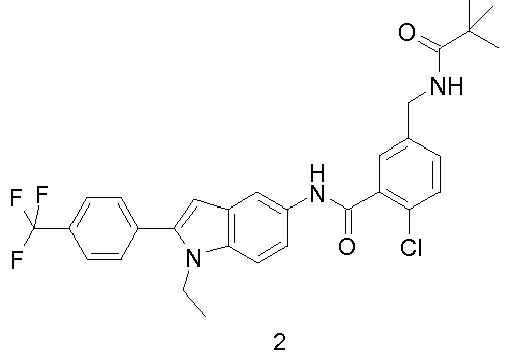
2-chloro-N-(1-ethyl-2-(4-(trifluoromethyl)phenyl)-1H-indol-5-yl)-5-((2,2-dimethylpropanoylamino)methyl)benzamide 3 
2-chloro-N-(2-(4-fluorophenyl)-1H-pyrrolo[2,3-b]pyridin-5-yl)-5-(( 2,2-dimethylpropanoylamino)methyl)benzamide 4 
2-chloro-N-(1-ethyl-2-(4-fluorophenyl)-1H-pyrrolo[2,3-b]pyridin-5-yl)-5-((2,2-dimethylpropanoylamino)methyl)benzamide 5 
2-(difluoromethyl)-N-(1-ethyl-2-(4-fluorophenyl)-1H-indol-5-yl)-5-((2-methylpropanoylamino)methyl)nicotinamide 6 
2-bromo-N-[[1-ethyl-3-(4-fluorophenyl)-1H-indol-5-yl)-5-((2,2-dime thylpropanoylamino)methyl)benzamide 7 
2-bromo-N-(1-ethyl-2-(4-fluorophenyl)-1H-indol-5-yl)-5-((2,2-dime thylpropanoylamino)methyl)benzamide 8 
2-chloro-N-(1-ethyl-2-(4-fluorophenyl)-1H-indol-5-yl)-5-((2,2-dime thylpropanoylamino)methyl)benzamide 9 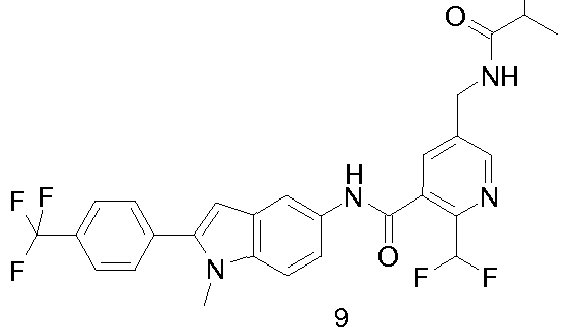
2-(difluoromethyl)-N-(1-methyl-2-(4-(trifluoromethyl)phenyl)-1H-i ndol-5-yl)-5-((2-methylpropanoylamino)methyl)nicotinamide 10 
2-(difluoromethyl)-N-(1-ethyl-2-(4-chlorophenyl)-1H-indol-5-yl)-5-((2-methylpropanoylamino)methyl)nicotinamide 11 
2-chloro-N-(2-(4-fluorophenyl)-1-methyl-1H-indol-5-yl)-5-((2,2-di methylpropanoylamino)methyl)benzamide 12 
2-(difluoromethyl)-N-(1-ethyl-1H-indol-5-yl)-5-((2-methylpropanoy lamino)methyl)nicotinamide 13 
N-(2-(4-chlorophenyl)-1-methyl-1H-indol-5-yl)-2-(difluoromethyl)-5-((2-methylpropanoylamino)methyl)nicotinamide 14 
N-(2-(4-chlorophenyl)-1-methyl-1H-indol-5-yl)-2-(difluoromethyl)-5-(((2-fluoro-2-methyl-propanoyl)amino)methyl)nicotinamide 15 
2-(difluoromethyl)-5-(((2-fluoro-2-methyl-propanoyl)amino)methyl )-N-(1-methyl-2-(4-(trifluoromethyl)phenyl)-1H-indol-5-yl)nicotina mide 16 
2-chloro-N-(2-(4-chlorophenyl)-2H-indazol-5-yl)-5-((2,2-dimethylp ropanoylamino)methyl)benzamide 17 
2-(difluoromethyl)-N-(1-ethyl-2-(4-(trifluoromethyl)phenyl)-1H-ind ol-5-yl)-5-(((2-fluoro-2-methyl-propanoyl)amino)methyl)nicotinami de 18 
N-(2-(4-chlorophenyl)-1-methyl-1H-indol-5-yl)-2-(difluoromethyl)-5-(((2-fluoro-2-methyl-propanoyl)amino)methyl)nicotinamide 19 
N-(2-(2-chlorophenyl)-1-ethyl-1H-indol-5-yl)-2-(difluoromethyl)-5-(((2-fluoro-2-methyl-propanoyl)amino)methyl)nicotinamide 20 
N-(2-(3-chlorophenyl)-1-ethyl-1H-indol-5-yl)-2-(difluoromethyl)-5-(((2-fluoro-2-methyl-propanoyl)amino)methyl)nicotinamide 21 
N-(2-(4-chlorophenyl)-1-methyl-1H-indol-5-yl)-2-(difluoromethyl)-5-(((1-(trifluoromethyl)cyclopropanecarbonyl)amino)methyl)nicotin amide 22 
2-chloro-5-((2,2-dimethylpropanoylamino)methyl)-N-(2-(4-(trifluor omethyl)phenyl)-1,3-benzoxazol-5-yl)benzamide 23 
2-(difluoromethyl)-5-(((2-fluoro-2-methyl-propanoyl)amino)methyl )-N-(2-(4-(trifluoromethyl)phenyl)-1,3-benzoxazol-5-yl)nicotinamid e 24 
2-(difluoromethyl)-5-((2-methylpropanoylamino)methyl)-N-(2-(4-(t rifluoromethyl)phenyl)-2H-indol-5-yl)nicotinamide 25 
2-chloro-5-((2,2-dimethylpropanoylamino)methyl)-N-(2-(4-(trifluor omethyl)phenyl)isoindolin-5-yl)benzamide 26 
2-(difluoromethyl)-5-(((2-fluoro-2-methyl-propanoyl)amino)methyl )-N-(2-(4-(trifluoromethyl)phenyl)isoindolin-5-yl)nicotinamide 27 
2-(difluoromethyl)-5-(((2-fluoro-2-methyl-propanoyl)amino)methyl )-N-(1-(2-methoxyethyl)-2-(4-(trifluoromethyl)phenyl)-1H-indol-5-yl)nicotinamide 28 
2-(difluoromethyl)-N-(1-ethyl-2-(3-(trifluoromethyl)phenyl)-1H-ind ol-5-yl)-5-(((2-fluoro-2-methyl-propanoyl)amino)methyl)nicotinami de 29 
2-(difluoromethyl)-5-(((2-fluoro-2-methyl-propanoyl)amino)methyl )-N-(2-(4-(trifluoromethyl)phenyl)benzofuran-5-yl)nicotinamide 30 
2-(difluoromethyl)-5-(((2-fluoro-2-methyl-propanoyl)amino)methyl )-N-(1-(tetrahydrofuran-3-yl)-2-(4-(trifluoromethyl)phenyl)-1H-indol-5-yl)nicotinamide 31 
(S)-2-(difluoromethyl)-5-(((2-fluoro-2-methyl-propanoyl)amino)met hyl)-N-(1-(tetrahydrofuran-3-yl)-2-(4-(trifluoromethyl)phenyl)-1H-i ndol-5-yl)nicotinamide 32 
(R)-2-(difluoromethyl)-5-(((2-fluoro-2-methyl-propanoyl)amino)me thyl)-N-(1-(tetrahydrofuran-3-yl)-2-(4-(trifluoromethyl)phenyl)-1H-indol-5-yl)nicotinamide 33 
N-(2-(3-chlorophenyl)-1-methyl-1H-indol-5-yl)-2-(difluoromethyl)-5-(((2-fluoro-2-methyl-propanoyl)amino)methyl)nicotinamide 34 
2-chloro-N-(2-(4-fluorophenyl)-1-methyl-1H-indol-5-yl)-5-(((1-(trif luoromethyl)cyclopropanecarbonyl)amino)methyl)benzamide 35 
N-(2-(3-chlorophenyl)-1-methyl-1H-pyrrolo[3,2-b]pyridin-5-yl)-2-( difluoromethyl)-5-(((2-fluoro-2-methyl-propanoyl)amino)methyl)ni cotinamide 36 
N-(2-(3-chlorophenyl)-1-methyl-1H-pyrrolo[2,3-c]pyridin-5-yl)-2-( difluoromethyl)-5-(((2-fluoro-2-methyl-propanoyl)amino)methyl)ni cotinamide 37 
N-(2-(3-chlorophenyl)-1-ethyl-1H-pyrrolo[3,2-b]pyridin-5-yl)-2-(di fluoromethyl)-5-(((2-fluoro-2-methyl-propanoyl)amino)methyl)nico tinamide 38 
2-(difluoromethyl)-5-((2-methylpropanoylamino)methyl)-N-(2-(4-(t rifluoromethyl)phenyl)-1,3-benzoxazol-5-yl)nicotinamide 39 
2-(difluoromethyl)-5-((2-methylpropanoylamino)methyl)-N-(2-(4-(t rifluoromethyl)phenyl)benzofuran-5-yl)nicotinamide 40 
2-(difluoromethyl)-5-((2-methylpropanoylamino)methyl)-N-(2-(4-(t rifluoromethyl)phenyl)isoindolin-5-yl)nicotinamide 41 
2-chloro-5-(((1-methylcyclopropanecarbonyl)amino)methyl)-N-(2-( 4-(trifluoromethyl)phenyl)-1,3-benzoxazol-5-yl)benzamide 42 
N-(2-(4-chlorophenyl)-1-ethyl-1H-indol-5-yl)-2-(difluoromethyl)-5-(((1-methylcyclopropanecarbonyl)amino)methyl)nicotinamide 43 
2-(difluoromethyl)-5 -(((1-methylcyclopropanecarbonyl)amino)meth yl)-N-(2-(4-(trifluoromethyl)phenyl)-1,3-benzoxazol-5-yl)nicotinam ide 44 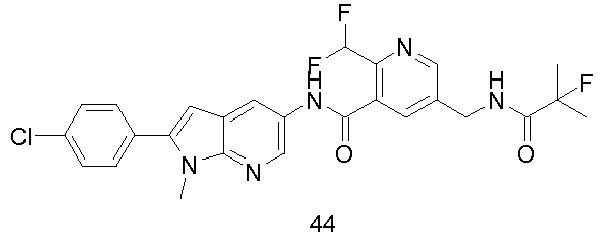
N-(2-(4-chlorophenyl)-1-methyl-1H-pyrrolo(2,3-b)pyridin-5-yl)-2-( difluoromethyl)-5-(((2-fluoro-2-methyl-propanoyl)amino)methyl)ni cotinamide 45 
N-(2-(4-chlorophenyl)-1,3-benzoxazol-5-yl)-2-(difluoromethyl)-5-(( 2-methylpropanoylamino)methyl)nicotinamide 46 
(S)-N-(2-(4-chlorophenyl)-1-(tetrahydrofuran-3-yl)-1H-indol-5-yl)-2-(difluoromethyl)-5-(((2-fluoro-2-methyl-propanoyl)amino)methyl )nicotinamide 47 
(R)-N-(2-(4-chlorophenyl)-1-(tetrahydrofuran-3-yl)-1H-indol-5-yl)-2-(difluoromethyl)-5-(((2-fluoro-2-methyl-propanoyl)amino)methyl )nicotinamide 48 
2-(difluoromethyl)-5-(((2-fluoro-2-methyl-propanoyl)amino)methyl )-N-(2-(3-(trifluoromethyl)phenyl)benzofuran-5-yl)nicotinamide 49 
2-(difluoromethyl)-5-(((2-fluoro-2-methyl-propanoyl)amino)methyl )-N-(2-(3-(trifluoromethyl)phenyl)isoindolin-5-yl)nicotinamide 50 
2-(difluoromethyl)-5-(((2-fluoro-2-methyl-propanoyl)amino)methyl )-N-(2-(3-(trifluoromethyl)phenyl)-2H-indazo1-5-yl)nicotinamide 51 
N-(2-(4-chlorophenyl)-1-ethyl-1H-benzo[d]imidazol-5-yl)-2-(difluo romethyl)-5-((2-methylpropanoylamino)methyl)nicotinamide 52 
2-chloro-N-(2-(4-chlorophenyl)-1-ethyl-1H-benzo[d]imidazol-5-yl)-5-((2,2-dimethylpropanoylamino)methyl)benzamide 53 
2-chloro-N-(2-(5-chloropyridin-2-yl)-1H-benzo[d]imidazol-5-yl)-5-((2,2-dimethylpropanoylamino)methyl)benzamide 54 
2-(difluoromethyl)-5-((2-methylpropanoylamino)methyl)-N-(2-(4-(t rifluoromethyl)phenyl)-1benzo[d]thiazol-6-yl)nicotinamide 55 
2-chloro-N-(2-(4-chlorophenyl)-1-methyl-1H-benzo[d]imidazol-5-y 1)-5-((2,2-dimethylpropanoylamino)methyl)benzamide 56 
2-(difluoromethyl)-5-(((2-fluoro-2-methyl-propanoyl)amino)methyl )-N-(2-(3-(trifluoromethyl)phenyl)-benzo[d]oxazol-5-yl)nicotinamid e 57 
2-chloro-N-(2-(4-chlorophenyl)-3-oxo-isoindolin-5-yl)-5-((2,2-dime thylpropanoylamino)methyl)benzamide 58 
2-chloro-N-(3-oxo-2-(4-(trifluoromethyl)phenyl)isoindolin-5-yl)-5-( (2,2-dimethylpropanoylamino)methyl)-benzamide 59 
2-(difluoromethyl)-5-(((2-fluoro-2-methyl-propanoyl)amino)methyl )-N-(3-oxo-2-(3-(trifluoromethyl)phenyl)isoindolin-5-yl)nicotinami de - In another aspect, the present invention provides a process for preparing the compound of formula (I), or a tautomer, mesomer, racemate, enantiomer, diastereomer, or mixtures thereof, or pharmaceutically acceptable salts thereof, comprising a step of:

wherein: - Rc is selected from hydroxy and halogen;
- ring P, ring Q, A, B, Y, s, t and R1∼R4 are as defined in general formula (I).
- The alkaline reagents include organic base and inorganic base, wherein said organic base includes, but is not limited to, triethylamine, N,N-diisopropylethylamine, pyridine, sodium bis(trimethylsilyl)amide, n-butyllithium, potassium tert-butanolate, or tetrabutylammonium bromide, wherein said inorganic base includes, but is not limited to, lithium hydroxide, sodium hydroxide, potassium hydroxide, sodium hydride, sodium carbonate, sodium bicarbonate, potassium carbonate, potassium bicarbonate, or cesium carbonate, preferably triethylamine.
- The catalysts include, but are not limited to, Pd/C, Raney nickel.
- The condensating agents include, but are not limited to, 1-(3-dimethylaminopropyl)-3-ethylcarbodiimide hydrochloride, N,N'-dicyclohexylcarbodiimide, N,N'-diisopropylcarbondiimide, O-(benzotriazole-1-yl)-N,N,N',N'-tetramethyluronium tetrafluoroborate, 1-hydroxybenzotriazole, 1-hydroxy-7-azobenzotriazole, O-(benzotriazole-1-yl)- N,N,N',N'-tetramethyluronium hexafluorophosphate, 2-(7-azo-benzotriazol-1-yl)- N,N,N',N'-tertramethyluronium hexafluorophophate, benzotriazo 1-1-yl-oxy-tris(dimethylamino)-phophonium hexaflurophosphate, or benzotriazol-1-yl-oxy-tripyrrolidinyl-phosphonium hexafluorophosphate.
- In another aspect, the present invention provides a compound of formula (IA), or a tautomer, mesomer, racemate, enantiomer, diastereomer, or mixtures thereof, or pharmaceutically acceptable salts thereof,


- R3 is selected from hydrogen, alkyl, and heterocyclyl, wherein said alkyl is optionally further substituted by one or more groups selected from the group consisting of alkoxy and heterocyclyl, preferably C1∼C4 alkyl, C1∼C4 alkoxy or tetrahydrofuranyl;
- R4 is selected from aryl and heteroaryl, wherein said aryl or heteroaryl is optionally further substituted by one or more groups selected from the group consisting of halogen and haloalkyl, wherein said haloalkyl is preferably trifluoromethyl; R4 is preferably phenyl, wherein said phenyl is further substituted by one halogen or one haloalkyl.
- t is 1;
- when general formula (IA) is the following groups:


- R3 is selected from hydrogen and alkyl, wherein said alkyl is optionally further substituted by one or more groups selected from the group consisting of alkoxy and heterocyclyl;
- R4 is phenyl, wherein said phenyl is further substituted by one haloalkyl, wherein said haloalkyl is preferably trifluoromethyl; or
- R3 is heterocyclyl;
- R4 is phenyl, wherein said phenyl is further substituted by one halogen or one haloalkyl.
- The compounds of general formula (IA) include, but are not limited to:
Example No. Structure and name 1k 
1-ethyl-5-amino-2-(4-(trifluoromethyl)phenyl)-1H-indole 1k 3e 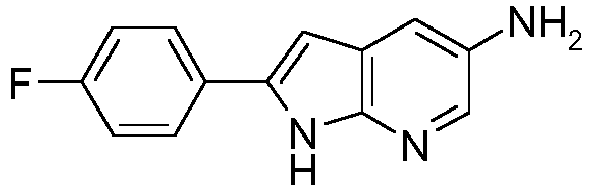
2-(4-fluorophenyl)-5-amino-1H-pyrrolo(2,3-b)pyridine 3e 4b 
1-ethyl-2-(4-tluorophenyl)-5-amino-1H-pyrrolo(2,3-b)pyridine 4b 6c 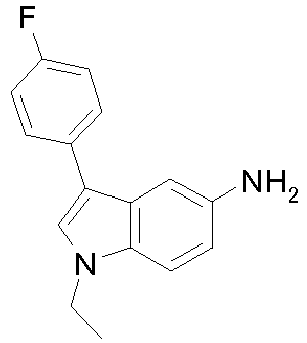
1-ethyl-3-(4-fluorophenyl)-5-amino-1H-indole 6c 9c 
1-methyl-5-amino-2-(4-(trifluoromethyl)phenyl)-1H-indole 9c 10c 
1-ethyl-2-(4-chlorophenyl)-5-amino-1H-indole 10c 11b 
2-(4-fluorophenyl)-1-methyl-5-amino-1H-indole 11b 13b 
2-(4-chlorophenyl)-1-methyl-5-amino-1H-indole 13b 16c 
2-(4-chlorophenyl) -5-amine-indazole 16c 19c 
2-(2-chlorophenyl)-1-ethyl-1H-indol-5-amine19c 20c 
2-(3-chlorophenyl)-1-ethyl-1H-indol-5-amine 20c 22c 
2-(4-(trifluoromethyl)phenyl)-benzo[d]oxazol-5-amine 22c 24f 
2-(4-(trifluoromethyl)phenyl)-2H-indazol-5-amine 24f 25c 
6-amino-2-(4-(trifluoromethyl)phenyl)isoindolin-1-one 25c 25d 
2-(4-(trifluoromethyl)phenyl)isoindolin-5-amine 25d 27c 
1-(2-methoxyethyl-5-amino-2-(4-(trifluoromethyl)phenyl)-1H-indol e 27c 28c 
1-ethyl-5-amino-2-(3-(trifluoromethyl)phenyl)-1H-indole 28c 29d 
5-amino-2-(4-(trifluoromethyl)phenyl)benzo furan-29d 30e 
5-amino-1-(tetrahydrofuran-3-yl)-2-(4-(trifluoromethyl)phenyl)-1H-indole 30e 31d 
(S)-5-ammo-1-(tetrahydrofuran-3-yl)-2-(4-(trifluoromethyl)phenyl)-1H-indole 31d 32d 
(R)-5-amino-1-(tetrahydrofuran-3-yl)-2-(4-(trifluoromethyl)phenyl)-1H-indole 32d 33b 
2-(3-chlorophenyl)-1-methyl-1H-indol-5-amine 33b 35j 
2-(3-chlorophenyl)-1-methyl-1H-pyrrolo[3,2-b]pyridinyl-5-amine 35j 36d 
2-(3-chlorophenyl)-1-methyl-1H-pyrrolo[2,3-c]pyridinyl-5-amine 36d 37d 
2-(3-chlorophenyl)-1-ethyl-1H-pyrrolo[3,2-b]pyridinyl-5-amine 37d 44f 
2-(4-chlorophenyl)-1-methyl-1H-pyrrolo(2,3-b)pyridinyl-5-amine 44f 45a 
2-(4-chlorophenyl)-benzo[d]oxazol-5-amine 45a 46c 
(S)-2-(4-chlorophenyl)-1-(tetrahydrofuran-3-yl)-1H-indol-5-amine 46c 47b 
(R)-2-(4-chlorophenyl)-1-(tetrahydrofuran-3-yl)-1H-indol-5-amine 47b 48d 
2-(3-(trifluoromethyl)phenyl)benzofuran-5-amine 48d 49c 
6-amino-2-(3-(trifluoromethyl)phenyl)isoindolin-1-one 49b 50c 
2-(3-(trifluoromethyl)phenyl)-2H-indazolyl-5-amine 50c 51g 
2-(4-chlorophenyl)-1-ethyl-1Hbenzo[d]imidazol-5-amine 51g 53d 
2-(5-chloropyridin-2-yl)-1H-benzo[d]imidazol-5-amine 53d 54c 
2-(4-(trifluoromethyl)phenyl)benzo [d]thiazol-6-amine 54c 55b 
2-(4-chlorophenyl)-1-methyl-benzo [d]imidazo1-5-amine 55b 56d 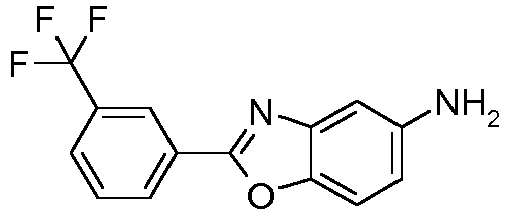
2-(3-(trifluoromethyl)phenyl)-benzo[d]oxazol-5-amine 56d 57b 
6-amino-2-(4-chlorophenyl)isoindolin-1-one 57b - In another aspect, the present invention provides a compound of formula (IB), or a tautomer, mesomer, racemate, enantiomer, diastereomer, or mixtures thereof, or pharmaceutically acceptable salts thereof:

- Rc is selected from hydroxy and halogen; and
- ring Q, R1 and R2 are as defined in general formula (I).
- The compounds of general formula (IB) include, but are not limited to:
Example No. Structure and name 1f 
2-(difluoromethyl)-5-((2-methylpropanoylamino)methyl)nicoti nic acid 1f 1g 
2-(difluoromethyl)-5-((2-methylpropanoylamino)methyl)nicoti noyl chloride 1g 2a 
2-chloro-5-((2,2-dimethylpropanoylamino)methyl)benzoic acid 2a 2b 
2-chloro-5-((2,2-dimethylpropanoylamino)methyl)benzoyl chloride 2b 6b 
2-bromo-5-((2,2-dimethylpropanoylamino)methyl)benzoyl chloride 6b 14b 
2-(difluoromethyl)-5-(((2-fluoro-2-methyl-propanoyl)amino)m ethyl)nicotinic acid 14b 21c 
2-(difluoromethyl)-5-(((1-(trifluoromethyl)cyclopropanecarbon yl)amino)methyl)nicotinic acid 21c 34d 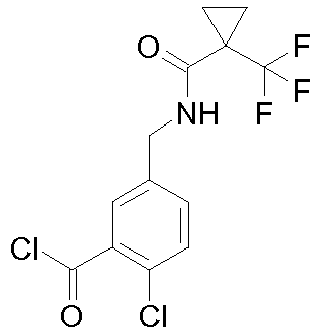
2-chloro-5-(((1-(trifluoromethyl)cyclopropanecarbonyl)amino) methyl)benzoyl chloride 34d 37a 
2-(difluoromethyl)-5-(((2-fluoro-2-methyl-propanoyl)amino)m ethyl)nicotinoyl chloride 37a 41b 
2-chloro-5-(((1-methylcyclopropanecarbonyl)amino)methyl)be nzoic acid 41b 41c 
2-chloro-5-(((1-methylcyclopropanecarbonyl)amino)methyl)be nzoyl chloride 41c 42c 
2-(difluoromethyl)-5-(((1-methylcyclopropanecarbonyl)amino) methyl)nicotinic acid 42c - Another aspect of this invention is directed to a pharmaceutical composition comprising a therapeutically effective amount of the compound of formula (I), or a tautomer, mesomer, racemate, enantiomer, diastereomer, or mixtures thereof, or pharmaceutically acceptable salts thereof, or a pharmaceutically acceptable salts thereof and pharmaceutically acceptable carriers, diluents or excipients.
- Another aspect of this invention is directed to use of the compound of formula (I), or a tautomer, mesomer, racemate, enantiomer, diastereomer, or mixtures thereof, or pharmaceutically acceptable salts thereof, or the pharmaceutical composition comprising the same, in the preparation of a medicament for the treatment of microsomal prostaglandin E synthase-1 (mPGES-1) mediated diseases.
- Another aspect of this invention is directed to use of the compound of formula (I), or a tautomer, mesomer, racemate, enantiomer, diastereomer, or mixtures thereof, or pharmaceutically acceptable salts thereof, or the pharmaceutical composition comprising the same, in the preparation of a medicament for the inhibition of microsomal prostaglandin E synthase-1(mPGES-1).
- Another aspect of this invention is directed to use of the compound of formula (I), or a tautomer, mesomer, racemate, enantiomer, diastereomer, or mixtures thereof, or pharmaceutically acceptable salts thereof, or the pharmaceutical composition comprising the same, in the preparation of a medicament for the treatment or prevention of diseases or disorders, wherein said diseases or disorders are selected from the group consisting of inflammation, pain, cancer, diabetes and diabetic complications or neurodegenerative disorders and the like, wherein said inflammation includes inflammation associated autoimmune disease, skin disease, lung disease, visceral disease, ear, nose, mouth and throat disease or cardiovascular disease and the like; wherein autoimmune disease includes arthritis, osteoarthritis, juvenile arthritis, rheumatoid arthritis, ankylosing spondylitis, gout, rheumatic fever, bursitis, systemic lupus erythematosus (SLE) or multiple sclerosis and the like; said skin disease includes dermatitis, eczema, psoriasis, bums or tissue trauma, and the like; said lung disease includes asthma, chronic obstructive pulmonary disease (COPD), or pulmonary fibrosis, and the like; said visceral disease includes inflammatory bowel disease, Crohn's disease, ulcerative colitis, irritable bowel disease (IBS), peptic ulcers, cystitis, prostatitis, pancreatitis or nephritis, and the like; said ear, nose, mouth and throat disease includes influenza, virus infection, bacterial infection, fever, rhinitis, pharyngitis, tonsillitis, conjunctivitis, iritis, scleritis or uveitis, and the like; said cardiovascular disease includes atherosclerosis, thrombosis, stroke or coronary heart disease, and the like; said pain includes neuropathic pain, inflammatory pain, visceral pain, cancer pain, chemotherapy pain, trauma pain, surgery pain, postoperative pain, delivery pain, childbirth ache, chronic pain, persistent pain, peripheral mediated pain, central mediated pain, chronic headache, migraine, sinus headaches, tension headaches, phantom limb pain, peripheral nerve injury or combination thereof, and the like; said cancer includes prostate cancer, kidney cancer, liver cancer, pancreatic cancer, gastric cancer, breast cancer, lung cancer, head and neck cancer, thyroid cancer, glioblastoma, melanoma, lymphoma, leukemia, skin T-cell lymphoma or skin B-cell lymphoma, and the like; said diabetes and diabetes complications include diabetic vasculopathy , diabetic neuropathy or diabetic retinopathy, and the like; said neurodegenerative disorder includes Alzheimer's disease or Parkinson's disease; wherein said diseases or disorders are preferably selected from inflammation and pain, more preferably selected from osteoarthritis, rheumatoid arthritis, bursitis, ankylosing spondylitis, or the pain associated with any one of the diseases or disorders listed above.
- Another aspect of this invention is directed to a method for the treatment of microsomal prostaglandin E synthase-1 (mPGES-1) mediated diseases, wherein the method comprises administrating to the subject in need of it a therapeutically effective dose of the compound of formula (I), or a tautomer, mesomer, racemate, enantiomer, diastereomer, or mixtures thereof, or pharmaceutically acceptable salts thereof, or the pharmaceutical composition comprising the same.
- Another aspect of this invention is directed to a method for the inhibition of microsomal prostaglandin E synthase-1(mPGES-1), wherein the method comprises administrating to the subject in need of it a therapeutically effective dose of the compound of formula (I), or a tautomer, mesomer, racemate, enantiomer, diastereomer, or mixtures thereof, or pharmaceutically acceptable salts thereof, or the pharmaceutical composition comprising the same.
- Another aspect of this invention is directed to a method for the treatment or prevention of diseases or disorders, wherein the method comprises administrating to the subject in need of it a therapeutically effective dose of the compound of formula (I), or a tautomer, mesomer, racemate, enantiomer, diastereomer, or mixtures thereof, or pharmaceutically acceptable salts thereof, or the pharmaceutical composition comprising the same; wherein said diseases or disorders are selected from the group consisting of inflammation, pain, cancer, diabetes and diabetic complications or neurodegenerative disorders and the like, wherein said inflammation includes inflammation associated autoimmune disease, skin disease, lung disease, visceral disease, ear, nose, mouth and throat disease or cardiovascular disease and the like; wherein autoimmune disease includes arthritis, osteoarthritis, juvenile arthritis, rheumatoid arthritis, ankylosing spondylitis, gout, rheumatic fever, bursitis, systemic lupus erythematosus (SLE) or multiple sclerosis and the like; said skin disease includes dermatitis, eczema, psoriasis, bums or tissue trauma, and the like; said lung disease includes asthma, chronic obstructive pulmonary disease (COPD), or pulmonary fibrosis, and the like; said visceral disease includes inflammatory bowel disease, Crohn's disease, ulcerative colitis, irritable bowel disease (IBS), peptic ulcers, cystitis, prostatitis, pancreatitis or nephritis, and the like; said ear, nose, mouth and throat disease includes influenza, virus infection, bacterial infection, fever, rhinitis, pharyngitis, tonsillitis, conjunctivitis, iritis, scleritis or uveitis, and the like; said cardiovascular disease includes atherosclerosis, thrombosis, stroke or coronary heart disease, and the like; said pain includes neuropathic pain, inflammatory pain, visceral pain, cancer pain, chemotherapy pain, trauma pain, surgery pain, postoperative pain, delivery pain, childbirth ache, chronic pain, persistent pain, peripheral mediated pain, central mediated pain, chronic headache, migraine, sinus headaches, tension headaches, phantom limb pain, peripheral nerve injury or combination thereof, and the like; said cancer includes prostate cancer, kidney cancer, liver cancer, pancreatic cancer, gastric cancer, breast cancer, lung cancer, head and neck cancer, thyroid cancer, glioblastoma, melanoma, lymphoma, leukemia, skin T-cell lymphoma or skin B-cell lymphoma, and the like; said diabetes and diabetes complications include diabetic vasculopathy , diabetic neuropathy or diabetic retinopathy, and the like; said neurodegenerative disorder includes Alzheimer's disease or Parkinson's disease; wherein said diseases or disorders are preferably selected from inflammation and pain, more preferably selected from osteoarthritis, rheumatoid arthritis, bursitis, ankylosing spondylitis, or the pain associated with any one of the diseases or disorders listed above.
- Another aspect of this invention is directed to a compound of formula (I), or a tautomer, mesomer, racemate, enantiomer, diastereomer, or mixtures thereof, or pharmaceutically acceptable salts thereof, or a pharmaceutical composition comprising the same, for use as a drug for the treatment of microsomal prostaglandin E synthase-1 (mPGES-1) mediated diseases.
- Another aspect of this invention is directed to a compound of formula (I), or a tautomer, mesomer, racemate, enantiomer, diastereomer, or mixtures thereof, or pharmaceutically acceptable salts thereof, or a pharmaceutical composition comprising the same, for use as a drug for the inhibition of microsomal prostaglandin E synthase-1 (mPGES-1).
- Another aspect of this invention is directed to a compound of formula (I), or a tautomer, mesomer, racemate, enantiomer, diastereomer, or mixtures thereof, or pharmaceutically acceptable salts thereof, or a pharmaceutical composition comprising the same, for use as a drug for the treatment or prevention of diseases or disorders, wherein said diseases or disorders are selected from the group consisting of inflammation, pain, cancer, diabetes and diabetic complications or neurodegenerative disorders and the like, wherein said inflammation includes inflammation associated autoimmune disease, skin disease, lung disease, visceral disease, ear, nose, mouth and throat disease or cardiovascular disease and the like; wherein autoimmune disease includes arthritis, osteoarthritis, juvenile arthritis, rheumatoid arthritis, ankylosing spondylitis, gout, rheumatic fever, bursitis, systemic lupus erythematosus (SLE) or multiple sclerosis and the like; said skin disease includes dermatitis, eczema, psoriasis, bums or tissue trauma, and the like; said lung disease includes asthma, chronic obstructive pulmonary disease (COPD), or pulmonary fibrosis, and the like; said visceral disease includes inflammatory bowel disease, Crohn's disease, ulcerative colitis, irritable bowel disease (IBS), peptic ulcers, cystitis, prostatitis, pancreatitis or nephritis, and the like; said ear, nose, mouth and throat disease includes influenza, virus infection, bacterial infection, fever, rhinitis, pharyngitis, tonsillitis, conjunctivitis, iritis, scleritis or uveitis, and the like; said cardiovascular disease includes atherosclerosis, thrombosis, stroke or coronary heart disease, and the like; said pain includes neuropathic pain, inflammatory pain, visceral pain, cancer pain, chemotherapy pain, trauma pain, surgery pain, postoperative pain, delivery pain, childbirth ache, chronic pain, persistent pain, peripheral mediated pain, central mediated pain, chronic headache, migraine, sinus headaches, tension headaches, phantom limb pain, peripheral nerve injury or combination thereof, and the like; said cancer includes prostate cancer, kidney cancer, liver cancer, pancreatic cancer, gastric cancer, breast cancer, lung cancer, head and neck cancer, thyroid cancer, glioblastoma, melanoma, lymphoma, leukemia, skin T-cell lymphoma or skin B-cell lymphoma, and the like; said diabetes and diabetes complications include diabetic vasculopathy , diabetic neuropathy or diabetic retinopathy, and the like; said neurodegenerative disorder includes Alzheimer's disease or Parkinson's disease; wherein said diseases or disorders are preferably selected from inflammation and pain, more preferably selected from osteoarthritis, rheumatoid arthritis, bursitis, ankylosing spondylitis, or the pain associated with any one of the diseases or disorders listed above.
- Unless otherwise stated, the terms used herein have the following meanings.
- "Alkyl" refers to a linear or branched saturated aliphatic hydrocarbon group including 1 to 20 carbon atoms, preferably C1∼C10 alkyl, more preferably C1∼C6 alkyl. Unlimited examples include methyl, ethyl, n-propyl, isopropyl, n-butyl, isobutyl, tert-butyl, sec-butyl, n-pentyl, 1,1-dimethyl propyl, 1,2-dimethylpropyl, 2,2-dimethylpropyl, 1-ethylpropyl, 2-methylbutyl, 3-methylbutyl, n-hexyl, 1-ethyl-2-methylpropyl, 1,1,2-trimethylpropyl, 1,1-dimethylbutyl, 1,2-dimethylbutyl, 2,2-dimethylbutyl, 1,3-dimethylbutyl, 2-ethylbutyl, 2-methylpentyl, 3-methylpentyl, 4-methylpentyl, 2,3-dimethylbutyl, n-heptyl, 2-methylhexyl, 3-methylhexyl, 4-methylhexyl, 5-methylhexyl, 2,3-dimethylpentyl, 2,4-dimethylpentyl, 2,2-dimethylpentyl, 3,3-dimethylpentyl, 2-ethylpentyl, 3-ethylpentyl, n-octyl, 2,3-dimethylhexyl, 2,4-dimethylhexyl, 2,5-dimethylhexyl, 2,2-dimethylhexyl, 3,3-dimethylhexyl, 4,4-dimethylhexyl, 2-ethylhexyl, 3-ethylhexyl, 4-ethylhexyl, 2-methyl-2-ethylpentyl, 2-methyl-3-ethylpentyl, n-nonyl, 2-methyl-2-ethylhexyl, 2-methyl-3-ethylhexyl, 2,2-diethylpentyl, n-decyl, 3,3-diethylhexyl, 2,2-diethylhexyl, and the branched isomers thereof. More preferably an alkyl group is a lower alkyl having 1 to 6 carbon atoms, and the unlimited examples include methyl, ethyl, n-propyl, isopropyl, n-butyl, isobutyl, tert-butyl, sec-butyl, n-pentyl, 1,1-dimethylpropyl, 1,2-dimethylpropyl, 2,2-dimethylpropyl, 1-ethylpropyl, 2-methylbutyl, 3-methylbutyl, n-hexyl, 1-ethyl-2-methylpropyl, 1,1,2-trimethylpropyl, 1,1-dimethylbutyl, 1,2-dimethylbutyl, 2,2-dimethylbutyl, 1,3-dimethylbutyl, 2-ethylbutyl, 2-methylpentyl, 3-methylpentyl, 4-methylpentyl, 2,3-dimethylbutyl, and the like. The alkyl group can be substituted or unsubstituted. When substituted, the substituent group(s) can be substituted at any available connection point. The substituent group(s) is preferably one or more groups independently selected from the group consisting of alkyl, alkenyl, alkynyl, alkoxy, alkylthio, alkylamino, halogen, thiol, hydroxy, nitro, cyano, cycloalkyl, heterocyclyl, aryl, heteroaryl, cycloalkoxy, heterocylic alkoxy, cycloalkylthio, heterocyclylthio, oxo, amino, haloalkyl, hydroxyalkyl, carboxyl, carboxylic ester, -C(O)OR5, -OC(O)OR5, -NHS(O)mR5, -C(O)R5, -NHC(O)R5, -NHC(O)OR5, -NR6R7, -OC(O)NR6R7 or -C(O)NR6R7.
- "Alkenyl" refers to an alkyl defined as above that has at least two carbon atoms and at least one carbon-carbon double bond, for example, ethenyl, 1- propenyl, 2- propenyl, 1-, 2- or 3-butenyl and the like, preferably C2-10 alkenyl, more preferably C2-6 alkenyl, most preferably C2-4 alkenyl. The alkenyl group may be substituted or unsubstituted. When substituted, the substituent group(s) is preferably one or more groups independently selected from the group consisting of alkyl, alkenyl, alkynyl, alkoxyl, alkylthio, alkylamino, halogen, thiol, hydroxyl, nitro, cyano, cycloalkyl, heterocyclyl, aryl, heteroaryl, cycloalkoxyl, heterocylic alkoxyl, cycloalkylthio, heterocyclylthio, oxo, amino, haloalkyl, hydroxyalkyl, carboxyl, carboxylic ester, -C(O)OR5, -OC(O)OR5, -NHS(O)mR5, -C(O)R5, -NHC(O)R5, -NHC(O)OR5, -NR6R7, -OC(O)NR6R7 or -C(O)NR6R7.
- "Alkynyl" refers to an alkyl defined as above that has at least two carbon atoms and at least one carbon-carbon triple bond, for example, ethynyl, 1- propynyl, 2- propynyl, 1-, 2- or 3-butynyl and the like, preferably C2-10 alkynyl, more preferably C2-6 alkynyl, most preferably C2-4 alkynyl. The alkynyl group may be substituted or unsubstituted. When substituted, the substituent group(s) is preferably one or more groups independently selected from the group consisting of alkyl, alkenyl, alkynyl, alkoxyl, alkylthio, alkylamino, halogen, thiol, hydroxyl, nitro, cyano, cycloalkyl, heterocyclyl, aryl, heteroaryl, cycloalkoxyl, heterocylic alkoxyl, cycloalkylthio, heterocyclylthio, oxo, amino, haloalkyl, hydroxyalkyl, carboxyl, carboxylic ester, -C(O)OR5, -OC(O)OR5, -NHS(O)mR5, -C(O)R5, -NHC(O)R5, -NHC(O)OR5, -NR6R7, -OC(O)NR6R7 or -C(O)NR6R7.
- "Cycloalkyl" refers to a saturated and/or partially unsaturated monocyclic or polycyclic hydrocarbon group having 3 to 20 carbon atoms, preferably 3 to 12 carbon atoms, more preferably 3 to 10 carbon atoms, and most preferably 3 to 6 carbon atoms. Unlimited examples of monocyclic cycloalkyl include cyclopropyl, cyclobutyl, cyclopentyl, cyclopentenyl, cyclohexyl, cyclohexenyl, cyclohexadienyl, cycloheptyl, cycloheptatrienyl, cyclooctyl, and the like, preferably cyclopropyl and cyclohexenyl. Polycyclic cycloalkyl includes a cycloalkyl having a spiro ring, fused ring or bridged ring.
- "Spiro cycloalkyl" refers to a 5 to 20 membered polycyclic group with rings connected through one common carbon atom (called a spiro atom), wherein one or more rings may contain one or more double bonds, but none of the rings has a completely conjugated pi-electron system, preferably 6 to 14 membered spiro cycloalkyl, and more preferably 7 to 10 membered spiro cycloalkyl. According to the number of the common spiro atoms, spiro cycloalkyl may be divided into mono-spiro cycloalkyl, di-spiro cycloalkyl, or poly-spiro cycloalkyl, and preferably a mono-spiro cycloalkyl or di-spiro cycloalkyl, more preferably 4-membered/4-membered, 4-membered/5-membered, 4-membered/6-membered, 5-membered/5-membered, or 5-membered/6-membered mono-spiro cycloalkyl. Unlimited examples of spiro cycloalkyls include , but are not limited to:

- "Fused cycloalkyl" refers to a 5 to 20 membered full-carbon polycyclic group, wherein each ring in the system shares an adjacent pair of carbon atoms with another ring, wherein one or more rings may contain one or more double bonds, but none of the rings has a completely conjugated pi-electron system, preferably 6 to 14 membered fused cycloalkyl, more preferably 7 to 10 membered fused cycloalkyl. According to the number of membered rings, fused cycloalkyl may be divided into bicyclic, tricyclic, tetracyclic or polycyclic fused cycloalkyl, preferably bicyclic or tricyclic fused cycloalkyl, and more preferably 5-membered/5-membered, or 5-membered/6-membered bicyclic fused cycloalkyl. Unlimited examples of fused cycloalkyl include, but are not limited to:

- "Bridged cycloalkyl" refers to a 5 to 20 membered full-carbon polycyclic group, wherein every two rings in the system share two disconnected atoms, wherein the rings may have one or more double bonds, but none of the rings has a completely conjugated pi-electron system, preferably 6 to 14 membered bridged cycloalkyl, and more preferably 7 to 10 membered bridged cycloalkyl. According to the number of membered rings, bridged cycloalkyl may be divided into bicyclic, tricyclic, tetracyclic or polycyclic bridged cycloalkyl, and preferably bicyclic, tricyclic or tetracyclic bridged cycloalkyl, and more preferably bicyclic or tricyclic bridged cycloalkyl. Unlimited examples of bridged cycloalkyls include , but are not limited to:
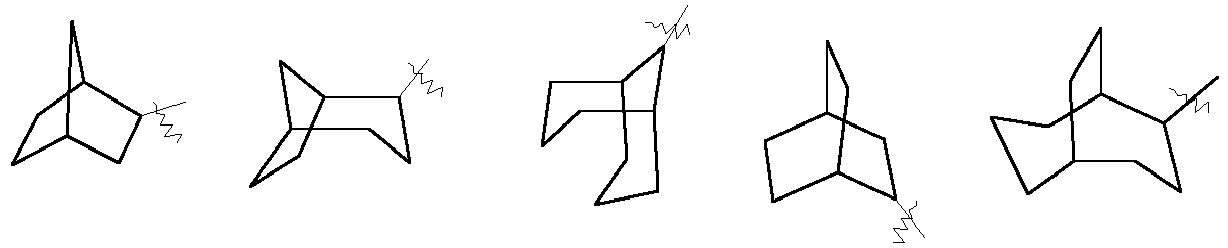

- Said cycloalkyl can be fused to aryl, heteroaryl or heterocyclyl, wherein the ring bound to the parent structure is cycloalkyl. Unlimited examples include indanyl, tetrahydronaphthyl, benzocycloheptyl and the like. The cycloalkyl may be optionally substituted or unsubstituted. When substituted, the substituent group(s) is preferably one or more group(s) independently selected from the group consisting of alkyl, alkenyl, alkynyl, alkoxy, alkylthio, alkylamino, halogen, thiol, hydroxy, nitro, cyano, cycloalkyl, heterocyclyl, aryl, heteroaryl, cycloalkoxy, heterocylic alkoxy, cycloalkylthio, heterocyclylthio, oxo, amino, haloalkyl, hydroxyalkyl, carboxyl, carboxylic ester, -C(O)OR5, -OC(O)OR5, -NHS(O)mR5, -C(O)R5, -NHC(O)R5, -NHC(O)OR5, -NR6R7, -OC(O)NR6R7 or -C(O)NR6R7.
- "Heterocyclyl" refers to a 3 to 20 membered saturated and/or partially unsaturated monocyclic or polycyclic hydrocarbon group having one or more heteroatoms selected from the group consisting of N, O, and S(O)m (wherein m is an integer selected from 0 to 2) as ring atoms, but excluding -O-O -O-S- or -S-S- in the ring, and the remaining ring atoms being carbon atoms. Preferably, heterocyclyl has 3 to 12 atoms with 1 to 4 heteroatoms, more preferably 3 to 10 atoms, and most preferably 5 to 6 atoms. Unlimited examples of monocyclic heterocyclyl include, but are not limited to, pyrrolidinyl, piperidyl, piperazinyl, morpholinyl, thiomorpholinyl, homopiperazinyl, pyranyl, tetrahydrofuranyl, and the like. Polycyclic heterocyclyl includes a heterocyclyl having a spiro ring, fused ring or bridged ring.
- "Spiro heterocyclyl" refers to a 5 to 20 membered polycyclic heterocyclyl with rings connected through one common carbon atom (called a spiro atom), wherein said rings have one or more heteroatoms selected from the group consisting of N, O, and S(O)m (wherein m is an integer selected from 0 to 2) as ring atoms and the remaining ring atoms being carbon atoms, wherein one or more rings may contain one or more double bonds, but none of the rings has a completely conjugated pi-electron system; preferably 6 to 14 membered spiro heterocyclyl, and more preferably 7 to 10 membered spiro heterocyclyl. According to the number of common spiro atoms, spiro heterocyclyl may be divided into mono-spiro heterocyclyl, di-spiro heterocyclyl, or poly-spiro heterocyclyl, preferably mono-spiro heterocyclyl or di-spiro heterocyclyl, and more preferably 4-membered/4-membered, 4-membered/5-membered, 4-membered/6-membered, 5-membered/5-membered, or 5-membered/6-membered mono-spiro heterocyclyl. Unlimited examples of spiro heterocyclyls include, but are not limited to:

- "Fused heterocyclyl" refers to a 5 to 20 membered polycyclic heterocyclyl group, wherein each ring in the system shares an adjacent pair of carbon atoms with another ring, wherein one or more rings may contain one or more double bonds, but none of the rings has a completely conjugated pi-electron system, and wherein said rings have one or more heteroatoms selected from the group consisting of N, O, and S(O)m (wherein m is an integer selected from 0 to 2) as ring atoms, and the remaining ring atoms being carbon atoms; preferably 6 to 14 membered fused heterocyclyl, and more preferably 7 to 10 membered fused heterocyclyl. According to the number of membered rings, fused heterocyclyl may be divided into bicyclic, tricyclic, tetracyclic or polycyclic fused heterocyclyl, preferably bicyclic or tricyclic fused heterocyclyl, and more preferably 5-membered/5-membered, or 5-membered/6-membered bicyclic fused heterocyclyl. Unlimited examples of fused heterocyclyl include, but are not limited to:


- "Bridged heterocyclyl" refers to a 5 to 14 membered polycyclic heterocyclyl group, wherein every two rings in the system share two disconnected atoms, wherein the rings may have one or more double bonds, but none of the rings has a completely conjugated pi-electron system, and the rings have one or more heteroatoms selected from the group consisting of N, O, and S (O)m (wherein m is an integer selected from 0 to 2) as ring atoms, and the remaining ring atoms being carbon atoms; preferably 6 to 14 membered bridged heterocyclyl, and more preferably 7 to 10 membered bridged heterocyclyl. According to the number of membered rings, bridged heterocyclyl may be divided into bicyclic, tricyclic, tetracyclic or polycyclic bridged heterocyclyl, and preferably bicyclic, tricyclic or tetracyclic bridged heterocyclyl, and more preferably bicyclic or tricyclic bridged heterocyclyl. Unlimited examples of bridged heterocyclyls include, but are not limited to:

- Said heterocyclyl can be fused to aryl, heteroaryl or cycloalkyl, wherein the ring bound to the parent structure is heterocyclyl. Unlimited examples include, but are not limited to:

- The heterocyclyl may be optionally substituted or unsubstituted. When substituted, the substituent group(s) is preferably one or more group(s) independently selected from the group consisting of alkyl, alkenyl, alkynyl, alkoxy, alkylthio, alkylamino, halogen, thiol, hydroxy, nitro, cyano, cycloalkyl, heterocyclyl, aryl, heteroaryl, cycloalkoxy, heterocylic alkoxy, cycloalkylthio, heterocylylthio, oxo, amino, haloalkyl, hydroxyalkyl, carboxyl, carboxylic ester, -C(O)OR5, -OC(O)OR5, -NHS(O)mR5, -C(O)R5, -NHC(O)R5, -NHC(O)OR5, -NR6R7, -OC(O)NR6R7 or -C(O)NR6R7.
- "Aryl" refers to a 6 to 14 membered full-carbon monocyclic ring or polycyclic fused ring (i.e. each ring in the system shares an adjacent pair of carbon atoms with another ring in the system) group having a completely conjugated pi-electron system; preferably 6 to 10 membered aryl, more preferably phenyl and naphthyl, and most preferably phenyl. The aryl can be fused to heteroaryl, heterocyclyl or cycloalkyl, wherein the ring bound to parent structure is aryl. Unlimited examples include, but are not limited to:


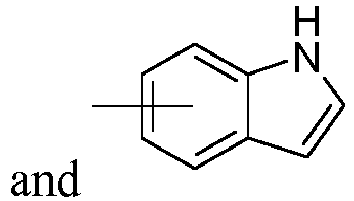
- The aryl may be optionally substituted or unsubstituted. When substituted, the substituent group(s) is preferably one or more groups independently selected from the group consisting of alkyl, alkenyl, alkynyl, alkoxy, alkylthio, alkylamino, halogen, thiol, hydroxy, nitro, cyano, cycloalkyl, heterocyclyl, aryl, heteroaryl, cycloalkoxy, heterocylic alkoxy, cycloalkylthio, heterocyclylthio, amino, haloalkyl, hydroxyalkyl, carboxyl, carboxylic ester, -C(O)OR5, -OC(O)OR5, -NHS(O)mR5, -C(O)R5, -NHC(O)R5, -NHC(O)OR5, -NR6R7, -OC(O)NR6R7 or -C(O)NR6R7.
- "Heteroaryl" refers to 5 to 14 membered aryl having 1 to 4 heteroatoms selected from the group consisting of O, S and N as ring atoms and remaining ring atoms being carbon atoms; preferably 5 to 10 membered heteroaryl, more preferably 5- or 6- membered heteroaryl such as furyl, thienyl, pyridyl, pyrrolyl, N-alkyl pyrrolyl, pyrimidinyl, pyrazinyl, imidazolyl, tetrazolyl,oxazolyl, thiazolyl, pyrazolyl and the like. The heteroaryl can be fused to aryl, heterocyclyl or cycloalkyl, wherein the ring bound to parent structure is heteroaryl. Unlimited examples include, but are not limited to:


- The heteroaryl may be optionally substituted or unsubstituted. When substituted, the substituent group(s) is preferably one or more groups independently selected from the group consisting of alkyl, alkenyl, alkynyl, alkoxy, alkylthio, alkylamino, halogen, thiol, hydroxy, nitro, cyano, cycloalkyl, heterocyclyl, aryl, heteroaryl, cycloalkoxy, heterocylic alkoxy, cycloalkylthio, heterocyclylthio, amino, haloalkyl, hydroxyalkyl, carboxyl, carboxylic ester, -C(O)OR5, -OC(O)OR5, -NHS(O)mR5, -C(O)R5, -NHC(O)R5, -NHC(O)OR5, -NR6R7, -OC(O)NR6R7 or -C(O)NR6R7.
- "Alkoxy" refers to an -O-(alkyl) or an -O-(unsubstituted cycloalkyl) group, wherein the alkyl is as defined above. Unlimited examples include, but are not limited to, methoxy, ethoxy, propoxy, butoxy, cyclopropyloxy, cyclobutyloxy, cyclopentyloxy, cyclohexyloxy, and the like. The alkoxy may be optionally substituted or unsubstituted. When substituted, the substituent is preferably one or more groups independently selected from the group consisting of alkyl, alkenyl, alkynyl, alkoxy, alkylthio, alkylamino, halogen, thiol, hydroxy, nitro, cyano, cycloalkyl, heterocyclyl, aryl, heteroaryl, cycloalkoxy, heterocylic alkoxy, cycloalkylthio, heterocyclylthio, amino, haloalkyl, hydroxyalkyl, carboxyl, carboxylic ester, -C(O)OR5, -OC(O)OR5, -NHS(O)mR5, -C(O)R5, -NHC(O)R5, -NHC(O)OR5, -NR6R7, -OC(O)NR6R7 or -C(O)NR6R7.
- "Haloalkyl" refers to an alkyl substituted with one or more halogen, wherein alkyl is as defined above.
"Hydroxy" refers to an -OH group.
"Hydroxyalkyl" refers to an alkyl substituted with hydroxy, wherein alkyl is as defined above.
"Halogen" refers to fluorine, chlorine, bromine or iodine.
"Amino" refers to a -NH2 group.
"Cyano" refers to a -CN group.
"Nitro" refers to a -NO2 group.
"Benzyl" refers to -CH2-phenyl group.
"Oxo" refers to a =O group.
"Carboxyl" refers to a -C(O)OH group.
"Carboxylic ester" refers to a -C(O)O(alkyl) or (cycloalkyl) group, wherein the alkyl and cycloalkyl are as defined above. - "Amino protecting group" refers to a group preventing amino from reaction when other parts of the molecular are subject to a reaction which can be easily removed. Unlimited examples include, but are not limited to formyl, alkyl carbonyl, alkoxy carbonyl, benzoyl, aralkyl carbonyl, aralkoxy carbonyl, trityl, phthalyl group, N, N - dimethylaminomethylenyl, substituted silicyl, and the like. These groups may be optionally substituted with one to three groups independently selected from the group consisting of halogen, alkoxy or nitro. Amino protecting group is preferably t-butyloxycarbonyl.
- "Optional" or "optionally" means that the event or circumstance described subsequently can, but need not, occur, and such description includes the situation in which the event or circumstance may or may not occur. For example, "the heterocyclic group optionally substituted with an alkyl" means that an alkyl group can be, but need not be, present, and such description includes the situation of the heterocyclic group being substituted with an alkyl and the heterocyclic group being not substituted with an alkyl.
- "Substituted" refers to one or more hydrogen atoms in a group, preferably up to 5, more preferably 1 to 3 hydrogen atoms, independently substituted with a corresponding number of substituents. It goes without saying that the substituents only exist in their possible chemical position. The person skilled in the art is able to determine if the substitution is possible or impossible by experiments or theory without paying excessive efforts. For example, the combination of amino or hydroxy having free hydrogen with carbon atoms having unsaturated bonds (such as olefinic) may be unstable.
- A "pharmaceutical composition" refers to a mixture of one or more of the compounds according to the present invention or physiologically/pharmaceutically acceptable salts or prodrugs thereof and other chemical components such as physiologically/pharmaceutically acceptable carriers and excipients. The purpose of a pharmaceutical composition is to facilitate administration of a compound to an organism, which is conducive to the absorption of the active ingredient and thus displaying biological activity.
m and R5 to R7 are as defined in the compound of formula (I). - In order to obtain the object of the present invention, the present invention applies the following synthesis technical solutions.

wherein: - Rc is selected from hydroxy and halogen;
- ring P, ring Q, A, B, Y, s, t and R1 to R4 are as defined in general formula (I).

- Rc is selected from hydroxy and halogen;
- Rd is selected from halogen, preferably bromine and iodine;
- E, G and W are each independently selected from CRa, NRb, N, O and S;
- A, B, X, Y, t, R1, R2 and R4are as defined in formula (I).
- A process for preparing a compound of formula (IV) and formula (V) is the same or similar as that of the compound of formula (III).

Rc is selected from hydroxy and halogen;
Rd is selected from halogen, preferably bromine and iodine;
A, B, X, Y, t, R1, R2 and R4 are as defined in formula (I);
Rb is as defined in formula (IV).
Rc is selected from hydroxy and halogen;
Rd is selected from halogen, preferably bromine and iodine;
A, B, X, Y, R1 and R2 are as defined in formula (I);
Rb is as defined in formula (IV);
R8 is as defined in formula (VII). - Alkaline reagents include organic base and inorganic base, wherein said organic base includes, but is not limited to, triethylamine, N,N-disopropylethylamine, pyridine, sodium bis(trimethylsilyl)amide, n-butyllithium, potassium tert-butanolate, or tetrabutylammonium bromide, wherein said inorganic base includes, but is not limited to, lithium hydroxide, sodium hydroxide, potassium hydroxide, sodium hydride, sodium carbonate, sodium bicarbonate, potassium carbonate, potassium bicarbonate, or cesium carbonate, preferably triethylamine.
- Catalysts include, but are not limited to, Pd/C, raney nickel,Tetrakis(triphenylphosphine)palladium, palladium chloride, palladium diacetate, (1,1'-Bis(dibenzylphosphino)ferrocene)dichloropalladium(II), Tris(dibenzylideneacetone)dipalladium.
- Condensating agents include, but are not limited to, 1-(3-dimethylaminopropyl)-3-ethylcarbodiimide hydrochloride, N, N'-dicyclohexylcarbodiimide, N, N'-diisopropylcarbondiimide, O-benzotriazol-1-yl)- N, N, N',N'-tetramethyluronium tetrafluoroborate, 1-hydroxybenzotriazole, 1-hydroxy-7-azobenzotriazole, O-benzotriazole- N, N, N',N'-tetramethyluronium hexafluorophosphate, 2-(7-azobenzotriazol-1-yl)- N, N, N,N'-tertramethyluronium hexafluorophophate, benzotriazo 1-1-yl-oxy-tris(dimethylamino)-phophonium hexaflurophosphate, benzotriazol-1-yl-oxy-tripyrrolidinophosphonium hexafluorophosphate.
- The present invention will be further described with the following examples, but the examples should not be considered as limiting the scope of the invention.
- Conditions that are not specified in the examples will be the common conditions in the art or the recommended conditions of the raw materials by the product manufacturer. The reagents which are not indicated the origin will be the commercially available, conventional reagents.
- Compound structures are identified by nuclear magnetic resonsance (NMR) and/or mass spectrometry (MS). NMR is determined by Bruker AVANCE-400. The solvents are deuterated-dimethyl sulfoxide (DMSO-d6 ), deuterated-chloroform (CDCl3) and deuterated-methanol (CD3OD) with tetramethylsilane (TMS) as an internal standard. NMR chemical shifts (δ) are given in 10-6 (ppm).
- MS is determined by a FINNIGAN LCQAd (ESI) mass spectrometer (manufacturer: Thermo, type: Finnigan LCQ advantage MAX).
- High performance liquid chromatography (HPLC) is determined on an Agilent 1200DAD high pressure liquid chromatography spectrometer (Sunfire C18 150×4.6 mm chromatographic column) and a Waters 2695-2996 high pressure liquid chromatography spectrometer (Gimini C18 150×4.6 mm chromatographic column).
- The average inhibition rate of kinase and IC50 values are determined by a NovoStar ELISA (BMG Co., Germany).
- Yantai Huanghai HSGF254 or Qingdao GF254 silica gel plate is used for thin-layer silica gel chromatography (TLC). The dimension of the silica gel plate used in TLC is 0.15 mm to 0.2 mm, and the dimension of the silica gel plate used in product purification is 0.4 mm to 0.5 mm.
- Yantai Huanghai 200 to 300 mesh silica gel is used as carrier for column chromatography.
- The known raw materials of the present invention can be prepared by the conventional synthesis methods in the art, or can be purchased from ABCR GmbH & Co. KG, Acros Organnics, Aldrich Chemical Company, Accela ChemBio Inc., or Dari chemical Company, etc.
- Unless otherwise stated, the reactions are carried out under nitrogen atmosphere or argon atmosphere.
- The term "nitrogen atmosphere" or "argon atmosphere" means that a reaction flask is equipped with a 1 L nitrogen or argon balloon.
- The term "hydrogen atmosphere" means that a reaction flask is equipped with a 1 L hydrogen balloon.
- Pressured hydrogenation reactions are performed with a Parr 3916EKX hydrogenation instrument and a QL-500 hydrogen generator or HC2-SS hydrogenation instrument.
- In hydrogenation reactions, the reaction system is generally vacuumed and filled with hydrogen, with the above operation repeated three times.
- CEM Discover-S 908860 type microwave reactor is used in microwave reaction.
- Unless otherwise stated, the solution used in the reactions refers to an aqueous solution.
- Unless otherwise stated, the reaction temperature in the reactions refers to room temperature, and the range of the temperature is 20°C to 30°C.
- The reaction process is monitored by thin layer chromatography (TLC), the elution system includes: A: dichloromethane and methanol, B: n-hexane and ethyl acetate, C: petroleum ether and ethyl acetate, D: acetone. The ratio of the volume of the solvent may be adjusted according to the polarity of the compounds.
- The elution system for purification of the compounds by column chromatography and thin layer chromatography includes: A: dichloromethane and methanol, B: n-hexane and ethyl acetate, C: n-hexane and acetone, D: n-hexane, E: ethyl acetate. The ratio of the volume of the solvent may be adjusted according to the polarity of the compounds, and sometimes a little alkaline reagent such as triethylamine or acidic reagent may be added.
-

- 3-Dimethylaminoacrylonitrile 1a (865 mg, 9.0 mmol, prepared according to the method disclosed in " Pharma Chemica, 2010, 2(3), 178-186") was dissolved in 20 mL of N,N-dimethylformamide, and heated to 65°C. 5mL of a solution of ethyl 2-(ethoxymethylene)-4,4-difluoro-3-oxo-butanoate 1b (2.0 g, 9.0 mmol, prepared according to the method disclosed in patent application "
WO2012025469 ") in N,N-dimethylformamide was added dropwise into the solution and stirred for 1 hour. Then the reaction solution was added with ammonium acetate (1.1g 14.0 mmol) and stirred for another 16 hours. The reaction solution was concentrated under reduced pressure, and the residues was added with 100 mL of water and extracted with ethyl acetate (100 mL×3). The organic phases were combined, dried over anhydrous sodium sulfate, and filtered. The filtrate was concentrated under reduced pressure. The residues were purified via thin layer chromatography (TLC) with elution system C to obtain the title compound ethyl 5-cyano-2-(difluoromethyl)nicotinate 1c (606 mg, 30%) as light yellow oil.
MS m/z (ESI): 227.1 [M+1] - Ethyl 5-cyano-2-(difluoromethyl) nicotinate 1c (606 mg, 2.7 mmol) was dissolved in 15 mL of ethanol, and added with concentrated hydrochloric acid (1.0 mL, 37%) and Pd/C(180 mg, 10%). The reaction mixture was stirred for 2 hours under a hydrogen atmosphere. The reaction solution was filtered via celatom, and the filtrate was concentrated under reduced pressure to obtain the title compound ethyl 5-(aminomethyl)-2-(difluoromethyl) nicotinate hydrochloride 1d (709 mg, 99%) as yellow solid.
MS m/z (ESI): 231.1 [M+1] - Ethyl 5-(aminomethyl)-2-(difluoromethyl)nicotinate hydrochloride 1d (709 mg, 2.7 mmol) was dissolved in 50 mL of dichloromethane, and added with N,N-diisopropylethylamine (1.9 mL, 10.6 mmol). Upon the completion of the addition, the reaction mixture was added dropwise with a solution of isobutyryl chloride in dichloromethane (0.7 M, 5 mL) and then stirred for 2 hours. The reaction mixture was washed with water (50 mL) and saturated sodium bicarbonate solution (50 mL) successively. The organic phase was concentrated under reduced pressure to obtain the title compound ethyl 2-(difluoromethyl)-5-((2-methylpropanoylamino)methyl)nicotinate 1e (790 mg, 99%) as light yellow solid.
MS m/z (ESI): 301.1 [M+1] - Ethyl 2-(difluoromethyl)-5-((2-methylpropanoylamino)methyl)nicotinate 1e (790 mg, 2.6 mmol) was dissolved in 10 mL of 1,4-dioxane, and added with 5 mL water and lithium hydroxide hydrate (291 mg, 6.9 mmol). The reaction mixture was stirred for 16 hours. The reaction mixture was concentrated under reduced pressure. The residues were added with 5 mL of water, and adjusted to pH2 by 5M hydrochloric acid. A lot of solid were precipitated and filtered out. The filtrate was extracted with ethyl acetate (50 mL×3). The organic phases were combined and concentrated under reduced pressure. The residues were combined with filter cake above, washed with water, and dried to obtain the title compound 2-(difluoromethyl)-5-((2-methylpropanoylamino)methyl)nicotinic acid 1f (420 mg, 56%) as light yellow solid.
MS m/z (ESI): 273.1 [M+1] - 2-(Difluoromethyl)-5-((2-methylpropanoylamino)methyl)nicotinic acid 1f (150 mg, 0.55 mmol) was dissolved in 5 mL of dichloromethane, and added with one drop of N,N-Dimethylformamide and thionyl chloride (197 mg, 1.65 mmol). Upon the completion of the addition, the reaction mixture was stirred for 2 hours. The reaction mixture was concentrated under reduced pressure to obtain the title compound 2-(difluoromethyl)-5-((2-methylpropanoylamino)methyl)nicotinoyl chloride 1g (160 mg) as light yellow oil, which was used in the next step without further purification.
- 1-Ethyl-5-nitro-1H-indole1h (500 mg, 2.63 mmol, prepared according to the method disclosed in " Bioorganic & Medicinal Chemistry, 2005, 13(10), 3531-3541" ) was dissolved in 5 mL of N,N-dimethylacetamide, and added with 4-iodotrifluorotoluene1i (790 mg, 2.92 mmol), triphenylphosphine (140 mg, 0.53 mmol), palladium acetate (30 mg, 0.13 mmol) and cesium acetate (1.6 g, 5.21 mmol) successively. Upon the completion of the addition, the resulting mixture was heated to 140 °C and stirred for 18 hours under an argon atmosphere. The reaction mixture was concentrated under reduced pressure. The residues were added with 50 mL of ethyl acetate, washed with water (20 mL×2), dried over anhydrous sodium sulfate, and filtered. The filtrate was concentrated under reduced pressure, the residues were purified by thin layer chromatography (TLC) with elution system C to obtain the title compound 1-ethyl-5-nitro-2-(4-(trifluoromethyl)phenyl)-1H-indole 1j (130 mg, 14.8 %) as yellow solid.
MS m/z (ESI): 335.1 [M+1] - 1-Ethyl-5-nitro-2-(4-(trifluoromethyl)phenyl)- 1H-indole 1j (130 mg, 0.39 mmol ) was dissolved in 10 mL mixture of tetrahydrofuran and methanol (V:V=1:1), and added with Raney nickel(30 mg). The reaction mixture was stirred for 2 hours under a hydrogen atmosphere. The reaction mixture was filtered with celatom, and the filtrate was concentrated under reduced pressure to obtain the crude title compound 1-ethyl-5-amino-2-(4-(trifluoromethyl)phenyl)- 1H-indole 1k (120 mg) as light yellow solid which was used in the next step without further purification.
MS m/z (ESI): 305.1 [M+1] - 1-Ethyl--5-amino-2-(4-(trifluoromethyl)phenyl)-1H-indole 1k (120 mg, 0.39 mmol) was dissolved in 10 mL of tetrahydrofuran, and added with triethylamine ( 0.10 mL, 0.78 mmol), and 5ml solution of 2-(difluoromethyl)-5-((2-methylpropanoylamino)methyl)nicotinoyl chloride 1g (160 mg, 0.55 mmol) in tetrahydrofuran dropwise. The reaction mixture was stirred for 1 hour. The reaction mixture was filtered, and the filtrate was concentrated under reduced pressure. The residues were purified via thin layer chromatography (TLC) with elution system A to obtain the title compound 2-(difluoromethyl)-N-(1-ethyl-2-(4-(trifluoromethyl)phenyl)-1H-indol-5-yl)-5-((2-meth ylpropanoylamino)methyl)nicotinamide 1 (25 mg, 11.5% ) as yellow solid.
MS m/z (ESI): 559.3 [M+1]
1H NMR (400 MHz, DMSO-d6 ): δ 10.61 (s, 1H), 8.68 (s, 1H), 8.46 (t, 1H), 8.07 (s, 1H), 8.01 (s, 1H), 7.93-7.86 (d, 2H), 7.85-7.78 (d, 2H), 7.61-7.55 (d, 1H), 7.47-7.42 (d, 1H), 7.19 (t, 1H), 6.70 (s, 1H), 4.47-4.39 (d, 2H), 4.31-4.20 (m, 2H), 2.49-2.41 (m, 1H), 1.21 (t, 3H), 1.09-1.03 (d, 6H). -

- 2-Chloro-5-((2,2-dimethylpropanoylamino)methyl)benzoyl chloride 2-Chloro-5-((2,2-dimethylpropanoylamino)methyl)benzoic acid 2a (500 mg, 1.86 mmol, prepared according to the method disclosed in patent application "
WO2012025469 ") was dissolved in 10 mL dichloromethane, and added dropwise with thionyl chloride (0.4 mL, 5.58 mmol) and one drop of N,N-dimethylformamide .Upon the completion of the addition, the reaction mixture was stirred for 2 hours. The reaction mixture was concentrated under reduced pressure to obtain the title compound 2-chloro-5-((2,2-dimethylpropanoylamino)-methyl)benzoyl chloride 2b (550 mg) as yellow oil which was used in the next step without further purification. - 1-Ethyl-5-amino-2-(4-(trifluoromethyl)phenyl)-1H-indol- 1k (90 mg, 0.27 mmol) was dissolved in 5 mL tetrahydrofuran, and added with triethylamine ( 75 µL, 0.54 mmol), and 2mL solution of 2-chloro-5-((2,2-dimethylpropanoylamino)methyl)benzoyl chloride 2b (77 mg, 0.27 mmol) in tetrahydrofuran dropwise. Upon the completion of the addition, the reaction mixture was stirred for 1 hour. The reaction mixture was filtered. The filtrate was concentrated under reduced pressure. The residues were purified by thin layer chromatography (TLC) with elution system A to obtain the title compound 2-chloro-N-(1-ethyl-2-(4-(trifluoromethyl)phenyl)-1H-indol-5-yl)5-((2,2-dimethylpropanoylamino)methyl)-benzamide 2 (45 mg, 30%) as light yellow solid.
MS m/z (ESI): 557.1 [M+1]
1H NMR (400 MHz, DMSO-d6 ): δ 10.40 (s, 1H), 8.18 (t, 1H), 8.10 (s, 1H), 7.92-7.87 (d, 2H), 7.84-7.79 (d, 2H), 7.58-7.53 (d, 1H), 7.52-7.48 (d, 1H), 7.47-7.41 (m, 2H), 7.36-7.30 (d, 1H), 6.69 (s, 1H), 4.34-4.29 (d, 2H), 4.29-4.21 (m, 2H), 1.21 (t, 3H), 1.13 (s, 9H). -
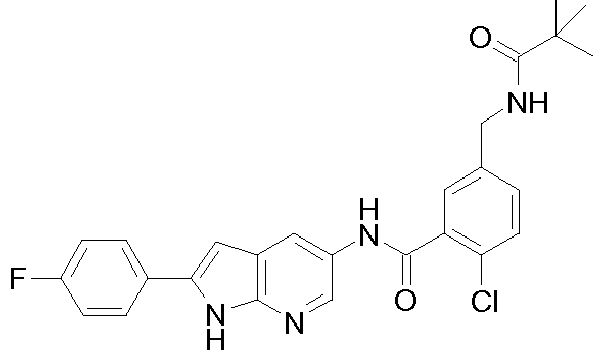

- 2-Amino-3-bromo-5-nitro-pyridine 3b (1.0 g, 4.6 mmol), 1-ethynyl-4-fluoro-benzene 3a (1.24g, 10.3 mmol) , Bis(triphenylphosphine)palladium (II) chloride (0.25 g, 0.35 mmol), copper iodine (7 mg, 0.35 mmol) and triethylamine (0.7 mL, 4.6 mmol) were added into 20 mL N,N-dimethylformamide. The reaction mixture was stirred for 16 hours under an argon atomsaphere. The reaction mixture was filtered with celatom, and the filtrate was concentrated under reduced pressure. The residues were purified by silica gel column chromatography with elution system C to obtain the crude title compound 3- ((4-fluorophenyl)ethynyl)-5-nitro-pyridin-2-amine 3c (1.7 g) as brown solid, which was used in the next step without further purification.
MS m/z (ESI): 256.0 [M-1] - 3-((4-Fluorophenyl)ethynyl)-5-nitro-pyridin-2-amine 3c (1.7 g, 4.6 mmol ) and potassium tert-butoxide (1.0 g, 9.2 mmol) were dissolved in 20 mL N, N-dimethylformamide. The reaction mixture was heated to 70°C and stirred for 16 hours. The reaction solution was concentrated under reduced pressure. The residues were added with 200 mL water, and then filtered with celatom. The filter cake was purified by silica gel column chromatography with elution system C, and then added with 20 mL dichloromethane and then filtered. The residues were dried to obtain the crude title compound 2-(4-fluorophenyl)-5-nitro-1H-pyrrolo[2,3-b]pyridine 3 d (564 mg) as yellow solid which was used in the next step without further purification.
- 2-(4-Fluorophenyl)-5-nitro-1H-pyrrolo[2,3-b]pyridine 3d (64 mg, 0.25 mmol ) was dissolved in 10 mL mixture of tetrahydrofuran and methanol (V:V=1:1), and then added with Raney nickel(30 mg). The reaction mixture was stirred for 1 hour under a hydrogen atmosphere and then filtered with celatom. The filtrate was concentrated under reduced pressure to obtain the crude title compound 2-(4-fluorophenyl)-5-amino-1H-pyrrolo[2,3-b]pyridine 3e (60 mg) as brown oil which was used in the next step without further purification.
MS m/z (ESI): 226.1 [M-1] - 2-(4-Fluorophenyl)-5-amino-1H-pyrrolo[2,3-b]pyridine 3e (60 mg, 0.25 mmol) was dissolved in 8 mL tetrahydrofuran, and added with triethylamine (0.43 mL, 0.31 mmol) and 5mL solution of 2-chloro-5-((2,2-dimethylpropanoylamino)methyl)benzoyl chloride 2b (220 mg, 0.76 mmol) in tetrahydrofuran dropwise. The reaction mixture was stirred for 1 hour and then filtered. The filtrate was concentrated under reduced pressure. The residues were purified by thin layer chromatography (TLC) with elution system A to obtain the title compound 2-chloro-N-(2-(4-fluorophenyl)-1H-pyrrolo[2,3-b]pyridin-5-yl)5-((2,2-dimethylpropano ylamino)methyl)-benzamide 3 (5mg, 4.2% for two steps) as light yellow solid.
MS m/z (ESI):479.4 [M+1]
1H NMR (400 MHz, DMSO-d 6): δ 9.16 (s, 1H), 8.06 (s, 1H), 7.94 (s, 1H), 7.65-7.56 (m, 1H), 7.55-7.46 (m, 2H), 7.48-7.36 (m, 2H), 7.27-7.16 (m, 3H), 6.41 (s, 1H), 5.15 (m, 1H), 4.26-4.21 (m, 2H), 1.13 (s, 9H). -

- 2-(4-Fluorophenyl)-5-nitro-1H-pyrrolo[2,3-b]pyridine 3d (60 mg, 0.23 mmol), iodoethane (40 µL, 0.47 mmol) and cesium carbonate (150 mg, 0.47 mmol) were added into 5 mL N,N-dimethylformamide. The reaction mixture was stirred for 16 hours, and then added with 20 mL water, extracted with ethyl acetate(20 mL×4). The organic phases were combined, washed with saturated sodium chloride solution(30 mL×2), dried over anhydrous sodium sulfate, filtered, and the filtrate was concentrated under reduced pressure. The residues were purified by silica gel column chromatography with elution system C to obtain the crude title compound 1-ethyl-2-(4-fluorophenyl)-5-nitro-1H-pyrrolo[2,3-b]pyridine 4a (70 mg) as yellow solid which was used in the next step without further purification.
MS m/z (ESI): 286.1 [M+1] - 1-Ethyl-2-(4-fluorophenyl)-5-nitro-1H-pyrrolo[2,3-b]pyridine 4a (70 mg , 0.23 mmol) was dissolved in 10 mL mixture of tetrahydrofuran and methanol (V:V=1:1), and then added with Raney nickel(20 mg). The reaction mixture was stirred for 2 hours under a hydrogen atmosphere and then filtered with celatom. The filtrate was concentrated under reduced pressure to obtain the crude title compound 1-ethyl-2-(4-fluorophenyl)-5-amino-1H-pyrrolo[2,3-b]pyridine 4b (60 mg) as light yellow solid which was used in the next step without further purification.
MS m/z (ESI): 256.2 [M+1] - 1-Ethyl-2-(4-fluorophenyl)-5-amino-1H-pyrrolo[2,3-b]pyridine 4b (60 mg, 0.23 mmol) was dissolved in 5 mL tetrahydrofuran, and added with triethylamine (65µL, 0.47 mmol) and 5mL solution of 2-chloro-5-((2,2-dimethylpropanoylamino)methyl)benzoyl chloride 2b (220 mg, 0.76 mmol) in tetrahydrofuran dropwise. The reaction mixture was stirred for 1 hour and then filtered. The filtrate was concentrated under reduced pressure. The residues were purified by thin layer chromatography (TLC) with elution system A to obtain the title compound 2-chloro-N-(1-ethyl-2-(4-fluorophenyl)-1H-pyrrolo[2,3-b]pyridin-5-yl)-5-((2,2-dimethy lpropanoylamino)methyl)-benzamide 4 (5 mg, 4.2% for three steps) as yellow solid.
MS m/z (ESI):507.3 [M+1]
1H NMR (400 MHz, DMSO-d 6): δ 9.15 (s, 1H), 8.05 (s, 1H), 7.93 (s, 1H), 7.66-7.56 (m, 1H), 7.55-7.48 (m, 2H), 7.48-7.38 (m, 2H), 7.27-7.17 (m, 3H), 6.56 (s, 1H), 4.34-4.28 (d, 2H), 4.29-4.20 (m, 2H), 1.23 (t, 3H), 1.12 (s, 9H). -

- 1-Ethyl-5-nitro-1H-indole 1h (1.64 g, 6.17 mmol) was dissolved in 20 mL N,N-dimethylacetamide, and then added with 1-fluoro-4-iodo-benzene 5a (4.65 g, 21.0 mmol), triphenylphosphine (360 mg, 1.36 mmol), palladium acetate (70 mg, 0.31 mmol), and cesium acetate (4.0 g, 12.3 mmol) successively. The reaction mixture was heated to 140 °C and stirred for 18 hours under an argon atmosphere. The reaction mixture was concentrated under reduced pressure. The residues were purified by thin layer chromatography (TLC) with elution system C to obtain the title compound 1-ethyl-2-(4-fluorophenyl)-5-nitro-1H-indole 5b (0.51 g, 29.1%) as yellow solid and 1-ethyl-3-(4-fluorophenyl)-5-nitro-1H-indole 5c (125 mg, 7.1%) as yellow solid.
5b: MS m/z (ESI): 285.0 [M+1]
5c: MS m/z (ESI): 285.1 [M+1] - 1-Ethyl-2-(4-fluorophenyl)-5-nitro-1H-indole 5b (35mg, 0.12 mmol) was dissolved in 10 mL mixture of tetrahydrofuran and methanol (V:V=1:1), and then added with Raney nickel(10 mg). The reaction mixture was stirred for 2 hours under a hydrogen atmosphere and then filtered with celatom. The filtrate was concentrated under reduced pressure to obtain the crude title compound 1-ethyl-2-(4-fluorophenyl)-5-amino-1H-indole 5d (31 mg) as yellow solid which was used in the next step without further purification.
MS m/z (ESI): 255.2 [M+1] - 1-Ethyl-2-(4-fluorophenyl)-5-amino-1H-indole 5d (31 mg, 0.12 mmol) was dissolved in 5 mL acetonitrile, and then added with triethylamine (31µL, 0.22 mmol) and 5mL solution of 2-(difluoromethyl)-5-((2-methylpropanoylamino)methyl)nicotinoyl chloride 1g (32 mg, 0.11 mmol) in acetonitrile dropwise. The reaction mixture was stirred for 1 hour and then filtered. The filtrate was concentrated under reduced pressure. The residues were purified by thin layer chromatography (TLC) with elution system A to obtain the title compound 2-(difluoromethyl)-N-(1-ethyl-2-(4-fluorophenyl)-1H-indol-5-yl)-5-((2-methylpropanoylamino)methyl)nicotinamidenicotinamide 5 (35 mg, 62.5%) as yellow solid.
MS m/z (ESI):509.3 [M+1]
1H NMR (400 MHz, DMSO-d 6): δ 8.70 (s, 1H), 8.07 (s, 1H), 7.94 (s, 1H), 7.63-7.54 (m, 2H), 7.46-7.51 (d, 2H), 7.44-7.39 (d, 2H), 7.32-7.25 (m, 2H), 7.12 (t, 1H), 6.51 (s, 1H), 5.36 (t, 1H), 4.53 (s, 2H), 4.30-4.21 (m, 2H), 1.27 (t, 3H), 1.20-1.14 (d, 6H). -


- 2-Bromo-5-((2,2-dimethylpropanoylamino)methyl)benzoic acid 6a (500 mg, 1.59 mmol, prepared according to the method disclosed in patent application "
US20120157506 " ) was dissolved in 10 mL dichloromethane, and then added with thionyl chloride (0.4 mL, 4.78 mmol) and one drop of N,N-dimethylformamide. The reaction mixture was stirred for 2 hours. and then concentrated under reduced pressure to obtain the crude title compound 2-bromo-5-((2,2-dimethylpropanoylamino)-methyl)benzoyl chloride 6b (530 mg) as light yellow solid which was used in the next step without further purification.
MS m/z (ESI): 331.1 [M-1] - 1-Ethyl-3-(4-fluorophenyl)-5-nitro-1H-indole 5c (110 mg, 0.39 mmol) was dissolved in 10 mL mixture of tetrahydrofuran and methanol (V:V=1:1), and added with Raney nickel(20 mg). The reaction mixture was stirred for 2 hours under a hydrogen atmosphere and then filtered with celatom. The filtrate was concentrated under reduced pressure to obtain the crude title compound 1-ethyl-3-(4-fluorophenyl)-5-amino-1H-indole 6c (100 mg) as gray solid which was used in the next step without further purification.
MS m/z (ESI): 255.2 [M+1] - 1-Ethyl-3-(4-fluorophenyl)-5-amino-1H-indole 6c (100 mg, 0.39 mmol) was dissolved in 5 mL tetrahydrofuran, and added with triethylamine (63µL, 0.45 mmol) and 5mL solution of 2-bromo-5-((2,2-dimethylpropanoylamino)methyl)benzoyl chloride 6b (50 mg, 0.15 mmol) in tetrahydrofuran dropwise. The reaction was stirred for 16 hours and then filtered. The filtrate was concentrated under reduced pressure. The residues were purified by thin layer chromatography (TLC) with elution system A to obtain the title compound 2-bromo-N-(1-ethyl-3-(4-fluorophenyl)-1H-indol-5-yl)-5-((2,2-dimethylpropanoylamin o)methyl)-benzamide 6 (15 mg, 18.2%) as yellow solid.
MS m/z (ESI):551.3 [M+1]
1H NMR (400 MHz, DMSO-d 6): δ 8.17 (s, 1H), 7.99 (s, 1H), 7.66-7.56 (m, 4H), 7.55-7.50 (m, 3H), 7.43-7.37 (m, 1H), 7.25-7.19 (m, 1H), 7.15 (t, 1H), 6.28 (s, 1H), 4.46-4.36 (d, 2H), 4.30-4.20 (m, 2H), 1.55 (t, 3H), 1.25 (s, 9H). -

- 1-Ethyl-2-(4-fluorophenyl)-5-amino-1H-indole 5d (30 mg, 0.12 mmol) was dissolved in 5 mL tetrahydrofuran,and then added with triethylamine (63µL, 0.45 mmol) and 5mL solution of 2-bromo-5-((2,2-dimethylpropanoylamino)methyl)benzoyl chloride 6b (50 mg, 0.15 mmol) in tetrahydrofuran dropwise. The reaction mixture was stirred for 16 hours and then filtered. The filtrate was concentrated under reduced pressure. The residues were purified by thin layer chromatography (TLC) with elution system A to obtain the title compound 2-bromo-N-(1-ethyl-2-(4-fluorophenyl)-1H-indol-5-yl) 5-((2,2-dimethylpropanoylamino)methyl)-benzamide 7 (5 mg, 10.4%) as yellow solid.
MS m/z (ESI):551.3 [M+1]
1H NMR (400 MHz, DMSO-d 6): δ 8.00 (s, 1H), 7.90 (s, 1H), 7.65-7.56 (m, 2H), 7.54-7.48 (m, 2H), 7.47-7.38 (m, 2H), 7.28-7.17 (m, 3H), 6.52 (s, 1H), 6.22 (s, 1H), 4.50-4.40 (d, 2H), 4.25-4.16 (m, 2H), 1.33 (t, 3H), 1.27 (s, 9H). -

- 1-Ethyl-2-(4-fluorophenyl)-5-amino-1H-indole 5d (38 mg, 0.15 mmol), 2-chloro-5-((2,2-dimethylpropanoylamino)methyl)benzoic acid 2a (40 mg, 0.15 mmol), 1-ethyl-(3-dimethylaminopropyl)-carbodiimide hydrochloride (57 mg, 0.3 mmol), 1-hydroxybenzotriazole (2 mg, 0.015 mmol) and N,N-diisopropylethylamine (38 mg,0.3 mmol) were dissolved in 5 mL N,N-dimethylformamide. The reaction mixture was stirred for 16 hours and then filtered. The filtrate was concentrated under reduced pressure. The residues were purified by thin layer chromatography (TLC) with elution system A to obtain the title compound 2-chloro-N-(1-ethyl-2-(4-fluorophenyl)-1H-indol-5-yl) 5-((2,2-dimethylpropanoylamino)methyl)-benzamide 8 (5 mg, 6.7%) as yellow solid.
MS m/z (ESI):506.0 [M+1]
1H NMR (400 MHz, DMSO-d 6): δ 10.64 (s, 1H), 8.12 (s, 1H), 8.09 (s, 1H), 7.95-7.90 (d, 2H), 7.82-7.77 (d, 2H), 7.57-7.47 (d, 2H), 7.48-7.45 (m, 2H), 7.30-7.22 (m, 1H), 6.72 (s, 1H), 4.40-4.36 (d, 2H), 4.33-4.29 (m, 2H), 1.21 (t, 3H), 1.12 (s, 9H) -


- 1-Methyl-5-nitro-1H-indole 9a (1.0 g, 5.7 mmol) was dissolved in 40 mL N, N-dimethylacetamide, and added with 4-iodotrifluorobenzene 1i (1.7 g, 6.2 mmol), triphenylphosphine (300 mg, 1.4 mmol), palladium acetate (130 mg, 0.57 mmol), and cesium acetate (2.2 g, 1.4 mmol) successively. The reaction mixture was heated to 140 °C,and stirred for 18 hours under an argon atmosphere. The reaction mixture was concentrated under reduced pressure. The residues were added with 50 mL ethyl acetate, washed with water (20 mL×2), dried over anhydrous sodium sulfate, and then filtered. The filtrate was concentrated under reduced pressure. The residues were purified by silica gel column chromatography with elution system B to obtain the title compound 1-methyl-5-nitro-2-(4-(trifluoromethyl)phenyl)-1H-indole 9b (350 mg, 19.4%) as yellow solid.
MS m/z (ESI): 321.1 [M+1] - 1-Methyl-5-nitro-2-(4-(trifluoromethyl)phenyl)-1H-indole 9b (350mg, 1.1 mmol) was dissolved in 10 mL tetrahydrofuran, and then added with Raney nickel(35 mg). The reaction mixture was stirred for 2 hours under a hydrogen atmosphere. The reaction mixture was filtered with celatom, and the filtrate was concentrated under reduced pressure to obtain the crude title compound 1-methyl-5-amino-2-(4-(trifluoromethyl)phenyl)-1H-indole 9c (300 mg) as brown oil which was use in the next step without further purification.
MS m/z (ESI): 291.2 [M+1] - 1-Methyl-5-amino-2-(4-(trifluoromethyl)phenyl)-1H-indole 9c (150 mg, 0.52 mmol), 2-(difluoromethyl)-5-((2-methylpropanoylamino)methyl)nicotinic acid 1f (141 mg, 0.52 mmol), O-benzotriazol-1-yl)-N,N,N',N'-tetramethyluronium (250 mg, 0.78 mmol) and N,N-diisopropylethylamine (100 mg, 0.78 mmol) were dissolved in 5 mL N, N-dimethylformamide. The reaction mixture was heated to 75 °C and then stirred for 16 hours. The reaction mixture was concentrated under reduced pressure. The residues were purified by thin layer chromatography (TLC) with elution system A to obtain the title compound 2-(difluoromethyl)-N-(1-methyl-2-(4-(trifluoromethyl)phenyl)-1Hindol-5-yl)5-((2-methylpropanoylamino) methyl)-nicotinamidenicotinamide 9 (10 mg, 2.0%) as brown solid.
MS m/z (ESI): 545.2 [M+1]
1H NMR (400 MHz, DMSO-d 6): δ 10.64 (s, 1H), 8.68 (s, 1H), 8.50-8.47 (m, 1H), 8.09 (s, 1H), 8.03 (s, 1H), 7.90-7.85 (m, 4H), 7.56-7.54 (m, 1H), 7.48-7.45 (m, 1H), 7.28-7.20 (m, 1H), 6.75 (s, 1H), 4.44-4.42 (d, 2H), 3.80 (s, 3H), 2.47-2.46 (m, 1H), 1.07-1.05 (d, 6H) -

- 1-Ethyl-5-nitro-1H-indole 1h (439 mg, 2.3 mmol) was dissolved in 5 mL N,N-dimethylacetamide, and added with 1-chloro-4-iodo-benzene 10a (500 mg, 2.1 mmol), triphenylphosphine (110 mg, 0.42 mmol), palladium acetate (24 mg, 0.11 mmol), and cesium acetate (806 mg, 4.2 mmol) successively. The reaction mixture was heated to 140 °C and then stirred for 18 hours under an argon atmosphere. The reaction mixture was filtered. The filtrate was added with 150 mL ethyl acetate, and then washed with water (20 mL×1). The organic phase was dried over anhydrous sodium sulfate, filtered, and the filtrate was concentrated under reduced pressure. The residues were purified by silica gel column chromatography with elution system C to obtain the title compound 1-ethyl-2-(4-chlorophenyl)-5-nitro-1H-indole 10b (80 mg, 12.7%) as yellow solid.
- 1-Ethyl-2-(4-chlorophenyl)-5-nitro-1H-indole 10b (80 mg, 0.27 mmol) was dissolved in 20 mL mixture of tetrahydrofuran and methanol (V:V=1:1), and then added with Raney nickel(10 mg). The reaction mixture was stirred for 2 hours under a hydrogen atmospherewas and then filtered with celatom. The filtrate was concentrated under reduced pressure to obtain the crude title compound 1-ethyl- 2-(4-chlorophenyl)-5-amino-1H-indole 10c (72 mg) as gray solid which was used in the next step without further purification.
MS m/z (ESI): 271.1 [M+1] - -(4-chlorophenyl)-1H-indol-5-yl)-5-((2-methylpropanoylamino)methyl)nicotinamide 1-Ethyl-2-(4-chlorophenyl)-5-amino-1H-indole 10e (50 mg, 0.18 mmol), 2-(difluoromethyl)-5-((2-methylpropanoylamino)methyl)nicotinic acid If (55 mg, 0.18 mmol), 1-ethyl-(3-dimethylaminopropyl) carbodiimide hydrochloride (70 mg, 0.37 mmol) and 1-hydroxyben-zotriazole (25 mg, 0.18 mmol) was dissolved in 3 mL N, N-dimethylformamide successively. The reaction mixture was heated to 40 °C, and then stirred for 5 hours. The reaction mixture was concentrated under reduced pressure, and the residues were purified by thin layer chromatography (TLC) with elution system A to obtain the title compound 2-(difluoromethyl)-N-(1-ethyl-2 -(4-chlorophcnyl)-1H-indol-5-yl)-5-((2-methylpropanoylamino)methyl)nicotinamidenic otinamide 10 (20 mg, 27.8%) as yellow solid.
MS m/z (ESI): 525.2 [M+1]
1H NMR (400 MHz, DMSO-d 6): δ 10.57 (s, 1H), 8.65 (s, 1H), 8.44 (t, 1H), 8.02 (s, 1H), 7.89 (s, 1H), 7.59 (s, 2H), 7.52 (d, 1H), 7.41 (d, 1H), 7.39 (s, 1H), 6.57 (s, 1H), 4.42 (d, 2H), 4.21 (d, 2H), 3.89 (s, 1H), 1.25 (d, 3H), 1.22 (t, 2H), 1.03 (d, 6H). -

- 1-Methyl-5-nitro-1H-indole 9a (0.8 g, 4.5 mmol) was dissolved in 10 mL N,N-dimethylacetamide, and then added with 1-fluoro-4-iodo-benzene 5a (1.12 g, 5.0 mmol), triphenylphosphine (238 mg, 0.9 mmol), palladium acetate (51 mg, 0.23 mmol), and cesium acetate (1.7 g, 0.91 mmol) successivelyaddition. The reaction mixture was heated to 140 °C, and then stirred for 18 hours under an argon atmosphere. The reaction solution was cooled to room temperature and then added with 50 mL water, extracted with ethyl acetate(50 mL). The organic phase was dried over anhydrous sodium sulfate, filtered, and the filtrate was concentrated under reduced pressure. The residues were purified by silica gel column chromatography with elution system C to obtain the title compound 2-(4-fluorophenyl)-1-methyl-5-nitro-1H-indole 11a (130 mg, 10.7%) as yellow solid.
MS m/z (ESI): 271.1 [M+1] - 2-(4-Fluorophenyl)-1-methyl-5-nitro-1H-indole 11a (130 mg, 0.48 mmol) was dissolved in 16 mL mixture of tetrahydrofuran and methanol (V:V=1:1), and then added with Raney nickel(15 mg). The reaction mixture was stirred for 2 hours under a hydrogen atmosphere and then filtered with celatom. The filtrate was concentrated under reduced pressure to obtain the crude title compound 2-(4-fluorophenyl)-1-methyl-5-amino-1H-indole 11b (130 mg) as yellow solid which was used in the next step without further purification.
- 2-(4-Fluorophenyl)-1-methyl-5-amino-1H-indole 11b (70 mg 0.29 mmol) was dissolved in 20 mL tetrahydrofuran, and then added with triethylamine (85µL, 0.60 mmol) and 5mL solution of 2-chloro-5-((2,2-dimethylpropanoylamino)methyl)benzoyl chloride 2b (83 mg, 0.29 mmol) in tetrahydrofuran dropwise. The reaction mixture was stirred for 2 hours and then filtered. The filtrate was concentrated under reduced pressure, and the residues were purified by thin layer chromatography (TLC) with elution system A to obtain the title compound 2-chloro-N-(2-(4-fluorophcnyl)-1-methyl-1H-indol-5-yl)-5-((2,2-dimethylpropanoylami no)methyl)benzamide 11 (40 mg, 28.0%) as yellow solid.
MS m/z (ESI): 492.2 [M+1]
1H NMR (400 MHz, DMSO-d 6): δ 8.01 (s, 1H), 7.91 (s, 1H), 7.65-7.56 (m, 2H), 7.54-7.49 (m, 2H), 7.48-7.38 (m, 2H), 7.28-7.17 (m, 3H), 6.52 (s, 1H), 6.22 (s, 1H), 4.25-4.16 (m, 2H), 3.83 (t, 3H), 1.27 (s, 9H). -

- 1-Ethyl-1H-indol-5-amine 12a (50 mg, 0.31 mmol, prepared according to" Bioorganic & Medicinal Chemistry, 2005, 13(10), 3531-3541"), 2-(difluoromethyl)-5-((2-methylpropanoylamino)methyl)nicotinic acid If (70 mg, 0.26 mmol), O-benzotriazol-1-yl)-N,N,N',N'-tetramethyluronium tetrafluoroborate (124 mg, 0.39 mmol), and N,N-diisopropylethylamine (100 mg, 0.78 mmol) were dissolved in 5 mL N, N-dimethylformamide successively. The reaction mixture was heated to 75 °C and then stirred for 16 hours. The reaction mixture was concentrated under reduced pressure, and the residues were purified by thin layer chromatography (TLC) with elution system A to obtain the title compound 2-(difluoromethyl)-N-(1-ethyl-1H-indol-5-yl)-5-((2-methylpropanoylamino)methyl)nico tinamide 12 (20 mg, 18.9%) as brown solid.
MS m/z (ESI):415.1[(M+1])
1H NMR (400 MHz, DMSO-d 6): δ 10.53 (s, 1H), 8.67 (s, 1H), 8.46 (t, 1H), 7.99 (s, 2H), 7.50-7.44 (d, 1H), 7.42-7.34 (m, 2H), 7.18 (t, 1H), 6.46-6.40 (d, 1H), 4.47-4.39 (d, 2H), 4.25-4.15 (m, 2H), 2.49-2.41 (m, 1H), 1.36 (t, 3H), 1.10-1.01 (d, 6H). -

- 1-Methyl-5-nitro-1H-indole 9a (3.30 g, 18.7 mmol) was dissolved in 20 mL N, N-dimethylacetamide, and then added with 1-chloro-4-iodo-benzene 10a (4.96 g, 20.8 mmol), triphenylphosphine (982 mg, 3.75 mmol), palladium acetate (210 mg, 0.94 mmol), and cesium acetate (7.20 g, 3.75 mmol) successively. The reaction mixture was heated to 140 °C, and then stirred for 18 hours under an argon atmosphere. The reaction solution was cooled to room temperature and then added with 50 mL water, extracted with ethyl acetate (50 mL). The organic phase was washed with saturated sodium chloride solution (50 mL), dried over anhydrous sodium sulfate, and filtered. The filtrate was concentrated under reduced pressure, and the residues were purified by silica gel column chromatography with elution system C to obtain the title compound 2-(4-chlorophenyl)-1-methyl-5-nitro-1H-indole 13a (270 mg, 5.0%) as yellow solid.
- 2-(4-Chlorophenyl)-1-methyl-5-nitro-1H-indole 13a (80 mg, 0.28 mmol) was dissolved in 20 mL mixture of tetrahydrofuran and methanol (V:V=1:1), and then added with Raney nickel(8 mg). The reaction mixture was stirred for 1 hour under a hydrogen atmosphere. The reaction mixture was filtered with celatom, and the filtrate was concentrated under reduced pressure to obtain the crude title compound 2-(4-chlorophenyl)-1-methyl-5-amino-1H-indole 13b (72 mg) as whiteoff solid which was used in the next step without further purification.
- 2-(4-Chlorophenyl)-1-methyl-5-amino-1H-indole 13b (72 mg, 0.28 mmol), 2-(difluoromethyl)-5-((2-methylpropanoylamino)methyl)nicotinic acid If (77 mg, 0.28 mmol), 1-ethyl-(3-dimethylaminopropyl)-3-ethylcarbodiimide hydrochloride (81 mg, 0.42 mmol) and 1-hydroxybenzotriazole (38 mg, 0.28 mmol) was dissolved in 5 mL N, N-dimethylformamide successively. The reaction mixture was heated to 40 °C and then stirred for 2 hours. The reaction mixture was concentrated under reduced pressure, and the residues were purified by thin layer chromatography (TLC) with elution system A to obtain a solid. The solid was added with 20 mL dichloromethane, and stirred for 20 mins to obtain the title compound N-(2-(4-chlorophenyl)-1-methyl-1H-indol-5-yl)-2-(difluoromethyl)-5-((2-methylpropan oylamino)methyl)nicotinamide 13 (20 mg, 14.0%) as yellow solid.
MS m/z (ESI):511.2 [M+1]
1H NMR (400 MHz, DMSO-d 6): δ 10.59 (s, 1H), 8.68 (s, 1H), 8.45 (s, 1H), 8.04 (d, 2H), 7.62 (dd, 4H), 7.47 (dd, 2H), 7.20 (t, 1H), 6.64 (s, 1H), 4.43(d, 2H), 3.76 (s, 3H), 2.46 (m, 1H), 1.06 (d, 6H). -


- Ethyl 5-(aminomethyl)-2-(difluoromethyl)nicotinate hydrochloride 1d (2.18 g, 8.20 mmol) was dissolved in 20 mL of N,N-dimethylformamide, and then added with 2-fluoroisobutyric acid (1.04 g, 9.83 mmol), 1-(3-dimethylaminopropyl)-3-ethylcarbodiimide hydrochloride (2.36 g, 12.30 mmol), 1-hydroxybenzotriazole (1.66 g, 12.30 mmol) and triethylamine (7 mL, 49.2 mmol) successively. The reaction mixture was stirred for 16 hours and then added with 100 mL ethyl acetate and 50 mL water. The organic phase was concentrated under reduced pressure. The residues were purified via TLC with elution system A to obtain the title compound ethyl 2-(difluoromethyl)-5-(((2-fluoro-2-methyl-propanoyl)amino)methyl)nicotinate 14a (1.6 g, 61.3%) as yellow solid.
MS m/z (ESI): 319.1[M+1] - Ethyl 2-(difluoromethyl)-5-(((2-fluoro-2-methyl-propanoyl)amino)methyl)nicotinate 14a (1.6 g, 5.03 mmol) was dissolved in 50 mL 1,4-dioxane, and then added with 25 mL water and lithium hydroxide hydrate (529 mg, 12.6 mmol). The reaction mixture was stirred for 16 hours. The reaction mixture was concentrated under reduced pressure. The residues were added with 5 mL water, and then adjusted to pH 3 by 5M hydrochloric acid. A lot of solid was precipitated from the reaction solution and then filtered out. The filtrate was extracted with ethyl acetate (50 mL×3). The organic phases were combined and concentrated under reduced pressure. The residues were combined with the filter cake above, and then washed with water to obtain the title compound 2-(difluoromethyl)-5-(((2-fluoro-2-methyl-propanoyl)amino)methyl)nicotinic acid 14b (500 mg, 34.2%) as white solid.
MS m/z (ESI): 291.1 [M+1] - 1-Ethyl-2-(4-chlorophenyl)-5-amino-1H-indole 10c (100 mg, 0.37 mmol), 2-(difluoromethyl)-5-(((2-fluoro-2-methyl-propanoyl)amino)methyl)nicotinic acid 14b (107 mg, 0.37 mmol), 1-ethyl -(3-dimethylaminopropyl) carbodiimide hydrochloride (142 mg, 0.74 mmol) and 1-hydroxybenzotriazole (191 mg, 1.48 mmol) was dissolved in 5 mL N,N-dimethylformamide successively. The reaction mixture was heated to 70 °C and then stirred for 2 hours. The reaction mixture was concentrated under reduced pressure. The residues were purified by thin layer chromatography (TLC) with elution system A to obtain the title compound N-(2-(4-chlorophenyl)-1-methyl-1H-indol-5-yl)-2-(difluoromethyl)-5-(((2-fluoro-2-met hyl-propanoyl)amino)methyl)nicotinamide 14 (40 mg, 19.9%) as white solid.
MS m/z (ESI):543.3 [M+1]
1H NMR (400 MHz, DMSO-d 6): δ 10.60 (s, 1H), 8.87 (s, 1H), 8.69 (m, 1H), 8.04-8.02 (m, 2H), 7.60-7.58 (m, 4H), 7.54-7.53 (m, 1H), 7.43-7.42 (m, 1H), 7.19 (t, 1H), 6.59 (s, 1H), 4.48-4.46 (m, 2H), 4.24-4.19 (m, 2H), 1.54-1.48 (d, 6H), 1.26-1.15 (m, 3H). -
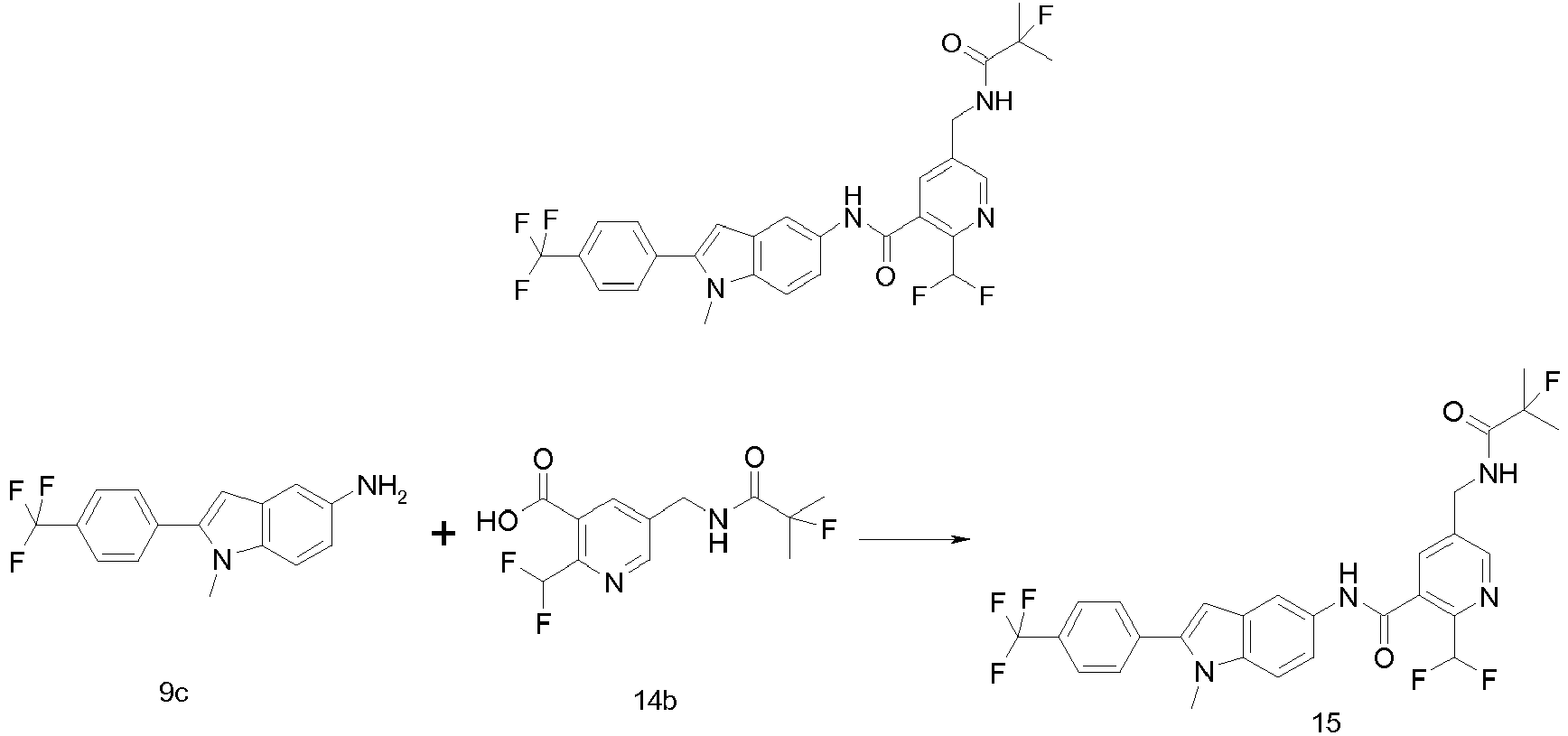
- 1-Methyl-5-amino-2-(4-(trifluoromethyl)phenyl)-1H-indole 9c (50 mg, 0.17 mmol), 2-(difluoromethyl)-5-(((2-fluoro-2-methyl-propanoyl)amino)methyl)nicotinic acid 14b (50 mg, 0.17 mmol), 1-ethyl -(3-dimethylaminopropyl)-3carbodiimide hydrochloride (55 mg, 0.29 mmol), 1-hydroxybenzotriazole (2.3 mg, 0.017 mmol) and N,N-diisopropylethylamine (44 mg, 0.34 mmol) was dissolved in 5 mL N,N-dimethylformamide successively. The reaction mixture was heated to 70 °C, and then stirred for 2 hours. The reaction mixture was concentrated under reduced pressure. The residues were purified by thin layer chromatography (TLC) with elution system A to obtain the title compound 2-(difluoromethyl)-5-(((2-fluoro-2-methyl-propanoyl)amino)methyl)-N-(1-methyl-2-(4-(trifluoromethyl)phenyl)-1H-indol-5-yl)nicotinamide 15 (4 mg, 4.2%) as light yellow solid.
MS m/z (ESI):563.1 [M+1]
1H NMR (400 MHz, DMSO-d 6): δ 10.62 (s, 1H), 8.87 (s, 1H), 8.69 (s, 1H), 8.03 (s, 1H), 7.90-7.85 (m, 4H), 7.56-7.54 (m, 1H), 7.47-7.44 (m, 1H), 7.20 (s, 1H), 6.75 (s, 1H), 4.48-4.46 (m, 2H), 3.80 (s, 3H), 1.54-1.48 (d, 6H). -

- Sodium nitrate (1.6 g, 19.2 mmol) was added into 10 mL sulfuric acid in an ice-water bath. Then 2-(4-chlorophenyl)-2H-indazole 16a (2.2 g, 9.6 mmol) was added portion-wise. The reaction mixture was then heated to 70 °C, and stirred for 1 hour. The reaction mixture was poured into 30 mL ice-water, and adjusted to pH>7 by saturated sodium bicarbonate solution. The mixture was extracted with ethyl acetate (40 mL×3). The organic phase was combined, dried over anhydrous sodium sulfate, and then filtered. The filtrate was concentrated under reduced pressure, the residues were purified by silica gel column chromatography with elution system B to obtain the title compound 2-(4-chlorophenyl)-5-nitro-2H-indazole 16b (500 mg, 19.2 %) as yellow solid.
MS m/z (ESI): 274.0 [M+1] - 2-(4-Chlorophenyl)-5-nitro-indazole 16b (500 mg, 1.8 mmol) was dissolved in 20 mL of tetrahydrofuran, and then added with Raney nickel (50 mg). The reaction mixture was stirred for 2 hours under a hydrogen atmosphere. The reaction mixture was filtered with celatom, and the filter cake was washed with ethyl acetate (5 mL×3). The filtrate was concentrated under reduced pressure to obtain the crude title compound 2-(4-chlorophenyl) -5-amino-indazole 16c (200 mg, 45%) as brown solid.
MS m/z (ESI): 244.1 [M+1] - 2-(4-Chlorophenyl)-5-amino-indazole 16c (200 mg, 0.37 mmol), 2-chloro-5-((2,2-dimethylpropanoylamino)methyl)benzoyl chloride 2b (300 mg, 1.04 mmol) and N,N-diisopropylethylamine (300 mg, 2.32 mmol) were dissolved in 10 mL dichloromethane successively. The resulting mixture was stirred for 1 hour and then concentrated under reduced pressure. The residues were purified by thin layer chromatography (TLC) with elution system A to obtain the title compound 2-chloro-N-(2-(4-chlorophenyl)-2H-indazol-5-yl)-5-((2,2-dimethylpropanoylamino)met hyl)benzamide 16 (5 mg, 1.3%) as light yellow solid.
MS m/z (ESI):495.1 [M+1]
1H NMR (400 MHz, DMSO-d 6):δ 10.56 (s, 1H), 9.12 (s, 1H), 8.38 (s, 1H), 8.19-8.11 (m, 3H), 7.73-7.66 (m, 3H), 7.51 (m, 1H), 7.45-7.44 (m, 2H), 7.36-7.34 (m, 1H), 4.31-4.30 (m, 2H), 1.14 (s, 9H) -
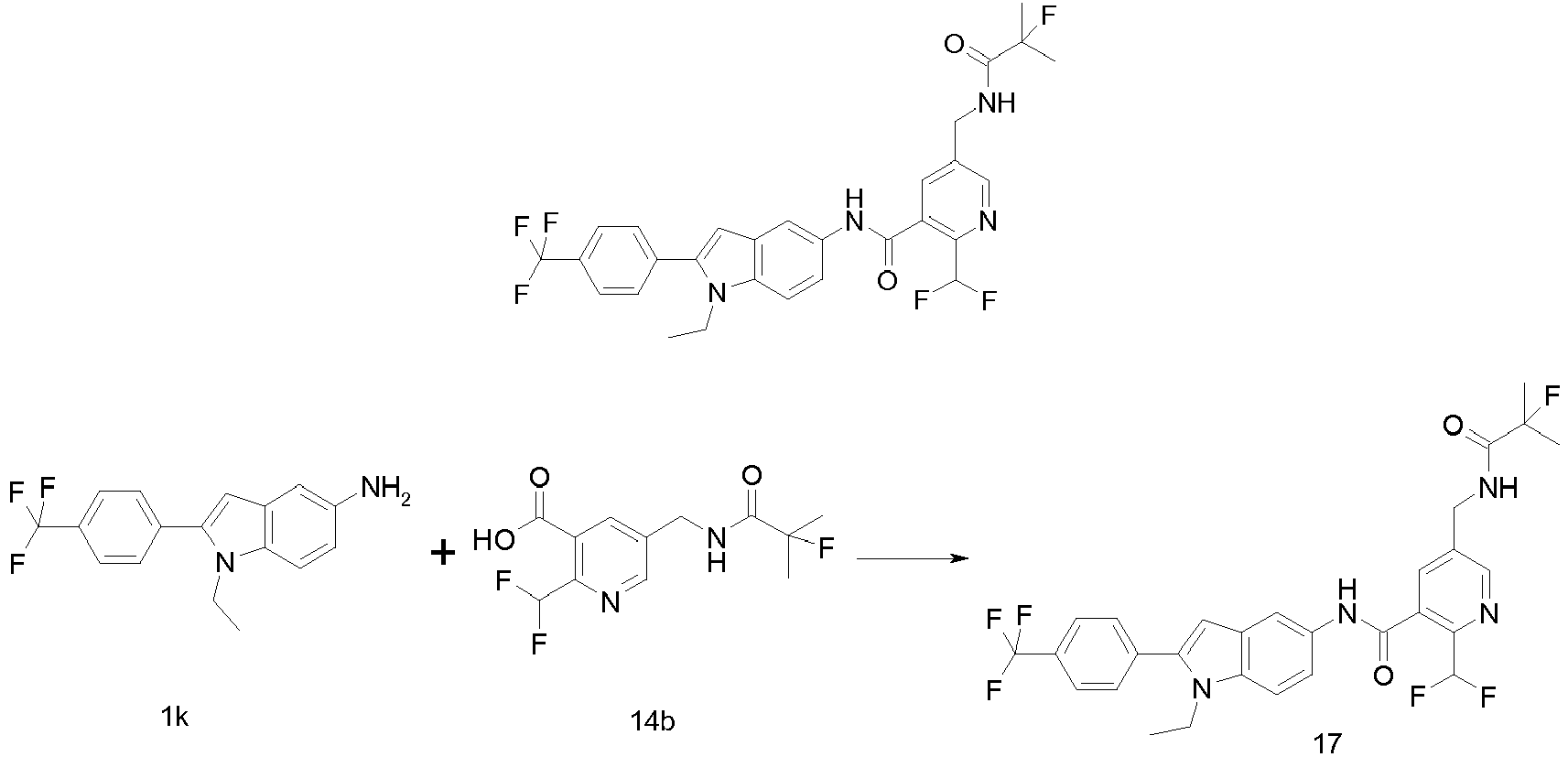
- 1-Ethyl-5-amino-2-(4-(trifluoromethyl)phenyl)-1H-indole 1k (105 mg, 0.34 mmol), 2-(difluoromethyl)-5-(((2-fluoro-2-methyl-propanoyl)amino)methyl)nicotinic acid 14b (100 mg, 0.34 mmol), 1-ethyl- (3-dimethylaminopropyl)carbodiimide hydrochloride (97 mg, 0.51 mmol), 1-hydroxybenzotriazole (4.6 mg, 0.034 mmol) and N,N-diisopropylethylamine (88 mg, 0.68 mmol) was dissolved in 5 mL N,N-dimethylformamide successively. The resulting mixture was stirred for 2 hours and then concentrated under reduced pressure. The residues were purified by thin layer chromatography (TLC) with elution system A to obtain the title compound 2-(difluoromethyl)-N-(1-ethyl-2-(4-(trifluoromethyl)phenyl)-1H-indol-5-yl)-5-(((2-fluor o-2-methyl-propanoyl)amino)methyl)nicotinamide 17 (20 mg, 25.5%) as yellow solid.
MS m/z (ESI):577.3 [M+1]
1H NMR (400 MHz, DMSO-d 6): δ 10.60 (s, 1H), 8.86 (s, 1H), 8.68 (s, 1H), 8.06 (s, 1H), 8.01 (s, 1H), 7.90-7.88 (m, 2H),7.82-7.80 (m, 2H), 7.58-7.56 (m, 1H), 7.45-7.43 (m, 1H), 7.32 (t, 1H), 6.69 (s, 1H), 4.47-4.46 (m, 2H), 4.28-4.26 (m, 2H), 1.53-1.48 (d, 6H), 1.22-1.09 (m, 3H). -

- 2-(4-Chlorophenyl)-1-methyl-5-amino-1H-indole 13b (45 mg, 0.18 mmol), 2-(difluoromethyl)-5-(((2-fluoro-2-methyl-propanoyl)amino)methyl)nicotinic acid 14b (51 mg, 0.18 mmol), 1-ethyl- (3-dimethylaminopropyl)carbodiimide hydrochloride (51 mg, 0.26 mmol), 1-hydroxybenzotriazole (24 mg, 0.18 mmol) and triethylamine (71 mg, 0.70 mmol) was dissolved in 5 mL N,N-dimethylformamide successively. The resulting mixture was stirred for 3 hours and then concentrated under reduced pressure. The residues were purified by thin layer chromatography (TLC) with elution system A to obtain the title compound N-(2-(4-chlorophenyl)-1-methyl-1H-indol-5-yl)-2-(difluoromethyl)-5-(((2-fluoro-2-met hyl-propanoyl)amino)methyl)nicotinamide 18 (43 mg, 46.2%) as light yellow solid. MS m/z (ESI): 529.1 [M+1]
1H NMR (400 MHz, DMSO-d 6): δ 10.60 (s, 1H), 8.87 (s, 1H), 8.68 (s, 1H), 8.04 (d, 2H), 7.62 (dd, 4H), 7.47 (dd, 2H), 7.20 (t, 1H), 6.64 (s, 1H), 4.47 (d, 2H), 3.76 (s, 3H), 1.54 (s, 3H), 1.48 (s, 3H). -

- 1-Ethyl-5-nitro-1H-indole 1h (1.0 g, 5.3 mmol) was dissolved in 10 mL N,N-dimethylacetamide, and then added with 1-chloro-2-iodo-benzene 19a (1.25 g, 5.3 mmol), triphenylphosphine (300 mg, 1.1 mmol), palladium acetate (120 mg, 0.53 mmol), and cesium acetate (2.1 g, 11 mmol) successively. The reaction mixture was heated to 140 °C, and then stirred for 18 hours under an argon atmosphere. The reaction mixture was concentrated under reduced pressure, and the residues were purified by thin layer chromatography (TLC) with elution system B to obtain the title compound 2-(2-chlorophcnyl)-1-ethyl-5-nitro-1H-indole 19b (300 mg, 18.9%) as yellow solid.
MS m/z (ESI): 301.3 [M+1] - 2-(2-Chlorophenyl)-1-ethyl-5-nitro-1H-indole 19b (300 mg, 1.0 mmol) was dissolved in 10 mL mixture of tetrahydrofuran and methanol (V:V=1:1), and then added with Raney nickel(50 mg). The reaction mixture was stirred for 2 hours under a hydrogen atmosphere. The reaction mixture was filtered with celatom. The filtrate was concentrated under reduced pressure to obtain the crude title compound 2-(2-chlorophenyl)-1-ethyl-1H-indol-5-amine 19c (270 mg) as yellow solid which was used in the next step without further purification.
MS m/z (ESI): 271.1 [M+1] - 2-(2-Chlorophenyl)-1-ethyl-1H-indol-5-amine 19c (80 mg, 0.30 mmol), 2-(difluoromethyl)-5-(((2-fluoro-2-methyl-propanoyl)amino)methyl)nicotinic acid 14b (86 mg, 0.30 mmol), 1-ethyl-(3-dimethylaminopropyl)carbodiimide hydrochloride (115 mg, 0.60 mmol), 1-hydroxybenzotriazole (40 mg, 0.30 mmol) and triethylamine (118 mg, 1.17 mmol) was dissolved in 5 mL N,N-dimethylformamide successively. The reaction mixture was heated to 40 °C and stirred for 4 hours. The reaction mixture was concentrated under reduced pressure, and the residues were purified by thin layer chromatography (TLC) with elution system C to obtain the title compound N-(2-(2-chlorophenyl)-1-ethyl-1H-indol-5-yl)-2-(difluoromethyl)-5-(((2-fluoro-2-methy l-propanoyl)amino)methyl)nicotinamide 19 (10 mg, 14.3%) as yellow solid.
MS m/z (ESI): 543.9 [M+1]
1H NMR (400 MHz, DMSO-d 6): δ 10.59 (s, 1H), 8.87 (s, 1H), 8.68 (s, 1H), 8.02 (d, 2H), 7.65 (d, 1H), 7.52-7.49 (m, 3H), 7.42 (d, 1H), 6.48 (s, 1H), 4.46 (d, 2H), 3.99-3.97 (m, 2H), 2.88 (s, 1H), 2.73 (s, 1H), 1.53 (s, 3H), 1.46 (s, 3H), 1.09 (t, 3H) -

- 1-Ethyl-5-nitro-1H-indole 1h (1.0 g, 5.3 mmol) was dissolved in 10 mL N,N-dimethylacetamide, and then added with 1-chloro-3-iodo-benzene 20a (1.4 g, 5.8 mmol), triphenylphosphine (276 mg, 1.1 mmol), palladium acetate (119 mg, 0.53 mmol), and cesium acetate (2.0 g, 11 mmol) successivelyaddition. The reaction mixture was heated to 140 °C, and stirred for 18 hours under an argon atmosphere. The reaction mixture was concentrated under reduced pressure, and the residues were purified by silica gel column chromatography with elution system C to obtain the title compound 2-(3-chlorophenyl)-1-ethyl-5-nitro-1H-indole 20b (120 mg, 7.6%) as yellow solid.
MS m/z (ESI): 301.1 [M+1] - 2-(3-Chlorophenyl)-1-ethyl-5-nitro-1H-indole 20b (50 mg, 0.17 mmol) was dissolved in 10 mL mixture of tetrahydrofuran and methanol (V:V=1:1), and then added with Raney nickel(5 mg). The reaction mixture was stirred for 2 hours under a hydrogen atmosphere. The reaction mixture was filtered with celatom. The filtrate was concentrated under reduced pressure to obtain the crude title compound 2-(3-chlorophenyl)-1-ethyl-1H-indol-5-amine 20c (45 mg) as red oil which was used in the next step without further purification.
MS m/z (ESI): 271.1 [M+1] - 2-(3-Chlorophenyl)-1-ethyl-1H-indol-5-amine 20c (45 mg, 0.17 mmol), 2-(difluoromethyl)-5-(((2-fluoro-2-methyl-propanoyl)amino)methyl)nicotinic acid 14b (49 mg, 0.17 mmol), 1-ethyl-(3-dimethylaminopropyl)carbodiimide hydrochloride (48 mg, 0.25 mmol), 1-hydroxybenzotriazole (23 mg, 0.17 mmol) and triethylamine (68 mg, 0.66 mmol) were dissolved in 5 mL N, N-dimethylformamide successively,. The resulting mixture was stirred for 16 hours and then concentrated under reduced pressure. The residues were purified by thin layer chromatography (TLC) with elution system A to obtain the title compound N-(2-(3-chlorophenyl)-1-ethyl-1H-indol-5-yl)-2-(difluoromethyl)-5-(((2-fluoro-2-methy l-propanoyl)amino)methyl)nicotinamide 20 (45 mg, 50% for two steps) as whiteoff solid.
MS m/z (ESI): 543.1 [M+1]
1H NMR (400 MHz, DMSO-d 6): δ 10.62 (s, 1H), 8.88 (s, 1H), 8.69 (s, 1H), 8.03 (d, 2H), 7.57-7.55 (m, 6H), 7.43 (t, 1H), 7.19 (s, 1H), 6.64 (d, 2H), 4.49-4.47 (m, 2H), 1.54 (s, 3H), 1.49 (s, 3H), 1.19 (t, 3H). -

- Ethyl 5-(aminomethyl)-2-(difluoromethyl)nicotinate hydrochloride 1d (4.0g, 13.2 mmol) was dissolved in 50 mL N,N-dimethylformamide, and then added with 1-(trifluoromethyl)cyclopropane-1-carboxylic acid 21a (2.03 g, 13.2 mmol), 1-ethyl-(3-dimethylaminopropyl)carbodiimide hydrochloride (5.07 g, 26.4 mmol), 1-hydroxybenzotriazole (178 mg, 1.32 mmol) and triethylamine (5.3 g, 52.8 mmol) successively. The resulting mixture was stirred for 16 hours and then concentrated under reduced pressure. The residues were washed with ethyl acetate (50 mL) and water (50 mL), dried to obtain the title compound ethyl 2-(difluoromethyl)-5-(((1-(trifluoromethyl)cyclopropanecarbonyl)amino)methyl)nicotin ate 21b crude(4.83 g) as brown oil which was used in the next step without further purification.
MS m/z (ESI): 367.1 [M+1] - Ethyl 2-(difluoromethyl)-5-(((1-(trifluoromethyl)cyclopropanecarbonyl)amino)methyl) nicotinate 21b (4.83 g, 13.2 mmol) was dissolved in 150 mL mixture of 1,4-dioxane and water (V:V=2:1), and then added with lithium hydroxide hydrate (1.38 g, 33.0 mmol). The reaction mixture was stirred for 1 hour. The ethanol was removed under reduced pressure, and the residues were adjust to the pH 4∼5 by 6M hydrochloric acid. A lot of solid were precipitated and added with 100 mL ethyl acetate. The solid was filtered out and dired to obtain the title compound 2-(difluoromethyl)-5-(((1-(trifluoromethyl)cyclopropanecarbonyl)amino)-methyl)nicoti nic acid 21c (2.0 g, 44.8% for two steps) as white solid.
MS m/z (ESI): 339.1 [M+1] - 2-(4-Chlorophenyl)-1-methyl-5-amino-1H-indole 13b (45 mg, 0.17 mmol), 2-(difluoromethyl)-5-(((1-(trifluoromethyl)cyclopropanecarbonyl)amino)methyl)nicotin ic acid 21c (59 mg, 0.17 mmol), 1-ethyl- (3-dimethylaminopropyl) carbodiimide hydrochloride (51 mg, 0.26 mmol), 1-hydroxybenzotriazole (24 mg, 0.17 mmol) and triethylamine (71 mg, 0.70 mmol) was dissolved in 5 mL N,N-dimethylformamide successively. The resulting mixture was stirred for 16 hours and then concentrated under reduced pressure. The residues were purified by thin layer chromatography (TLC) with elution system A to obtain the title compound N-(2-(4-chlorophenyl)-1-methyl-1H-indol-5-yl)-2-(difluoromethyl)-5-(((1-(trifluoromet hyl)cyclopropanecarbonyl)amino)methyl)nicotinamide 21 (20 mg, 20%) as light yellow solid.
MS m/z (ESI): 577.1 [M+1]
1H NMR (400 MHz, DMSO-d 6): δ 10.61 (s, 1H), 8.67 (s, 1H), 8.59-8.57 (m, 1H), 8.03 (d, 2H), 7.62 (dd, 4H), 7.47 (dd, 2H), 7.19 (t, 1H), 6.64 (s, 1H), 4.46 (d, 2H), 3.76 (s, 3H), 1.28-1.26 (m, 4H). -


- 4-(Trifluoromethyl)benzoic acid 22a (2.0 g, 10.5 mmol) was dissolved in 14 mL polyphosphoric acid, and then added with 2-amino-4-nitrophenol(1.62 g, 10.5 mmol). The reaction mixture was heated to 120 °C and stirred for 16 hours. The reaction mixture was cooled to room temperature, and then poured into 500 mL water. The solution was adjusted to pH 7 by addition of sodium hydroxyportionwise, and then extracted with ethyl acetate (500 mL×3). The organic phase was combined, dried over anhydrous sodium sulfate, and filtered. The filtrate was concentrated under reduced pressure to obtain the title compound 5-nitro-2-(4-(trifluoromethyl)phenyl) benzo[d]oxazole 22b (1.5 g) as brown solid which was used in the next step without further purification.
- 5-Nitro-2-(4-(trifluoromethyl)phenyl)benzo[d]oxazole 22b (170 mg, 0.55 mmol) was dissolved in 10 mL mixture of tetrahydrofuran and methanol (V:V=1:1), and then added with Raney nickel (20 mg). The reaction mixture was stirred for 2 hours under a hydrogen atmosphere. The reaction mixture was filtered with celatom. The filtrate was concentrated under reduced pressure to obtain the crude title compound 2-(4-(trifluoromethyl)phenyl) benzo[d]oxazole-5-amine 22c(150 mg) as brown solid which was used in the next step without further purification.
MS m/z (ESI): 279.1 [M+1] - 2-(4-(Trifluoromethyl)phenyl) benzo[d]oxazole-5-amine 22c (50 mg, 0.18 mmol) was dissolved 10 mL tetrahydrofuran, and then added with trifluoroacetic acid (54 µL, 0.39 mmol) and 2mL solution of 2-chloro-5-((2,2-dimethylpropanoylamino)methyl)benzoyl chloride 2b (52 mg, 0.18 mmol) in tetrahydrofuran dropwise. The resulting mixture was stirred for 1 hour. The reaction mixture was filtered. The filtrate was concentrated under reduced pressure, and the residues were purified by thin layer chromatography (TLC) with elution system A to obtain a solid which was added with 10 mL ethyl acetate and filtered. The filter cake was dried to obtain the title compound 2-chloro-5-((2,2-dimethylpropanoylamino)methyl)-N-(2-(4-(trifluoromethyl)phenyl)ben zo[d]oxazol-5-yl)benzamide 22 (15 mg, 15.3% for two steps) as light yellow solid.
MS m/z (ESI): 530.3 [M+1]
1H NMR (400 MHz, DMSO-d 6): δ 10.41 (s, 1H), 8.19 (t, 1H), 8.11 (s, 1H), 7.91-7.87 (d, 2H), 7.83-7.79 (d, 2H), 7.59-7.53 (d, 2H), 7.53-7.48 (d, 2H), 7.48-7.41 (m, 1H), 4.29-4.22 (m, 2H), 1.13 (s, 9H). -

- 2-(4-(Trifluoromethyl)phenyl)benzo[d]oxazole-5-amine 22c (50 mg, 0.18 mmol) was dissolved in 10 mL of N,N-dimethylformamide, and then added with 2-(difluoromethyl)-5-(((2-fluoro-2-methyl-propanoyl)amino)methyl)nicotinic acid 14b (52 mg, 0.18 mmol), 1-ethyl- (3-dimethylaminopropyl) carbodiimide hydrochloride (75 mg, 0.39 mmol), 1-hydroxybenzotriazole (2.4 mg, 0.02 mmol) and triethylamine (73 mg, 0.72 mmol) successively. The resulting mixture was heated to 70 °C and stirred for 2 hours. The reaction mixture was cooled to room temperature. The reaction mixture was concentrated under reduced pressure, and the residues were purified by thin layer chromatography (TLC) with elution system A to obtain a solid. The solid was added with 10 mL diethyl ether, and filtered. The filter cake was dried to obtain the title compound 2-(difluoromethyl)-5-(((2-fluoro-2-methyl-propanoyl)amino)methyl)-N-(2-(4-(trifluoromethyl)phenyl) benzo[d]oxazole -5-yl)nicotinamide 23 (10 mg, 10.1%) as light yellow solid.
MS m/z (ESI): 551.3 [M+1]
1H NMR (400 MHz, DMSO-d 6): δ 10.60 (s, 1H), 8.69 (s, 1H), 8.45 (t, 1H), 8.08 (s, 1H), 8.01 (s, 1H), 7.92-7.86 (d, 2H), 7.85-7.79 (d, 2H), 7.61-7.56 (d, 1H), 7.46-7.42 (d, 1H), 7.20 (t, 1H), 4.31-4.21 (m, 2H), 2.49-2.40 (m, 1H), 1.09-1.02 (d, 6H). -

- N-(2-nitrobenzyl)-4-(trifluoromethyl)aniline 4-Aminobenzotrifluoride 24a (2.35 g, 14.56 mmol) was dissolved in 50 mL 1,2-dichloroethane, and then added with 2-nitrobenzaldehyde 24b (2.0 g, 13.23 mmol). The resulting mixture was stirred for 0.5 hour, and then added with sodium triacetoxyborohydride (5.6 g, 26.46 mmol) and stirred for another 16 hours. The reaction mixture was added with 100 mL dichloromethane and 100 mL water. The organic phase was concentrated under reduced pressure, and the residues were purified by thin layer chromatography (TLC) with elution system C to obtain the title compound N-(2-nitrobenzyl)-4-(trifluoromethyl)aniline 24c (3.5 g , 89.4%) as yellow oil.
MS m/z (ESI): 297.1 [M+1] - Zinc powder (1.73 g, 27.04 mmol) was added in 50 mL tetrahydrofuran, and then added with titanium tetrachloride (2.57 g, 13.55 mmol). The reaction mixture was heated to 70 °C, and stirred for 2 hours. The reaction solution was cooled to room temperature and adjusted to the pH 8 by triethylamine. N-(2-nitrobenzyl)-4-(trifluoromethyl)aniline 24c (1.0 g, 3.38 mmol) was dissolved in 20 mL of tetrahydrofuran and then added into the resulting mixture above. The reaction mixture was continually stirred for another 30 mins and then adjusted to the pH 3 by 6 M hydrochloric acid. The solution was extracted with dichloromethane(100 mL×3). The organic phase was combined, dried over anhydrous sodium sulfate, and filtered. The filtrate was concentrated under reduced pressure, and the residues were purified by thin layer chromatography (TLC) with elution system C to obtain the title compound 2-(4-(trifluoromethyl)phenyl)-2H-indazole 24d (100 mg, 11.3%) as white solid.
MS m/z (ESI): 263.1 [M+1] - Sodium nitrate (29 mg, 0,67 mmol) was added into 1 mL sulfuric acid under ice bath, and then added with 2-(4-(trifluoromethyl)phenyl) -2H-indazole 24d (50 mg, 0.19 mmol) portionwise. The reaction mixture was heated to 70 °C, and stirred for 1 hour. The reaction mixture was poured to 30 mL of ice-water, and adjusted to pH > 7. The soluditon was extracted with ethyl acetate(40 mL×3). The organic phase was combined, dried over anhydrous sodium sulfate, and filtered. The filtrate was concentrated under reduced pressure, and the residues were purified by thin layer chromatography (TLC) with elution system C to obtain the title compound 5-nitro-2-(4-(trifluoromethyl)phenyl)-2H-indazole 24e (30 mg, 25.6%) as yellow solid.
MS m/z (ESI): 308.1 [M+1] - 5-Nitro-2-(4-(trifluoromethyl)phenyl)-2H-indazole 24e (30 mg, 0.098 mmol) was dissolved in 10 mL mixture of tetrahydrofuran and methanol (V:V=1:1), and then added with Raney nickel (3 mg). The reaction mixture was stirred for 1 hour under a hydrogen atmosphere. The reaction mixture was filtered with celatom. The filtrate was concentrated under reduced pressure to obtain the crude title compound 2-(4-(trifluoromethyl)phenyl)-2H-indazol-5-amine 24f (27 mg) as light yellow solid which was used in the next step without further purification.
MS m/z (ESI): 278.1 [M+1] - 2-(4-(Trifluoromethyl)phenyl)-2H-indazol-5-amine 24f (27 mg, 0.098 mmol), 2-(difluoromethyl)-5-((2-methylpropanoylamino)methyl)nicotinic acid If (27 mg, 0.10 mmol), 1-ethyl-(3-dimethylaminopropyl)carbodiimide hydrochloride (29 mg, 0.15 mmol) and 1-hydroxybenzotriazole (14 mg, 0.10 mmol) were added in 5 mL of N,N-dimethylformamide successively. The resulting mixture was heated to 40 °C and stirred for 1 hour. The reaction mixture was concentrated under reduced pressure, and the residues were purified by thin layer chromatography (TLC) with elution system A to obtain a solid. The solid was added with 20 mL of dichloromethane and stirred for 20 mins. The mixture was filtered and the filter cake was washed with dicloromethane (5 mL×3) and dried to obtain the title compound 2-(difluoromethyl)-5-((2-methylpropanoylamino)methyl)-N-(2-(4-(trifluoromethyl)phen yl)-2H-indazol-5-yl)nicotinamide 24 (27 mg, 50.9%) as white solid.
MS m/z (ESI):532.1 [M+1]
1H NMR (400 MHz, DMSO-d 6): δ 10.78 (s, 1H), 9.25 (s, 1H), 8.70 (s, 1H), 8.47 (t, 1H), 8.38-8.33 (m, 3H), 8.08-7.97 (m, 3H), 7.76 (d, 1H), 7.49 (d, 1H), 7.19 (t, 1H), 4.44 (d, 2H), 2.49-2.41 (m, 1H), 1.06 (d, 6H). -

- 4-Aminobenzotrifluoride 24a (193 mg, 1.2 mmol) was dissolved in 3 mL ethanol, and then added with methyl 2-(bromomethyl)-5-nitro-benzoate 25a (274 mg, 1.0 mmol) and N,N-diisopropylethylamine (258 mg, 2.0 mmol). The reaction mixture was heated to 110 °C and stirred for 16 hours. The reaction solution was cooled to room temperature, and filtered. The filter cake were dried to obtain the title compound 6-nitro-2-(4-(trifluoromethyl)phenyl)isoindolin-1-one 25b (70 mg , 21.7%) as yellow solid.
MS m/z (ESI): 321.0 [M-1] - 6-Nitro-2-(4-(trifluoromethyl)phenyl)isoindolin-1-one 25b (70 mg , 0.098 mmol) was dissolved in 10 mL mixture of tetrahydrofuran and methanol (V:V=1:1), and then added with Raney nickel (7 mg). The reaction mixture was stirred for 1 hour under a hydrogen atmosphere. The reaction mixture was filtered with celatom. The filtrate was concentrated under reduced pressure to obtain the crude title compound 6-amino-2-(4-(trifluoromethyl)phenyl)isoindolin-1-one 25c (64 mg) as white solid which was used in the next step without further purification.
MS m/z (ESI): 293.1 (M+1) - 6-Amino-2-(4-(trifluoromethyl)phenyl)isoindolin-1-one 25c (64 mg, 0,22 mmol) was dissolved into 10 mL tetrahydrofuran, and then added with lithium aluminium hydride (51 mg, 1.32 mmol). The reaction mixture was heated to 65 °C, and stirred for 16 hours. The reaction mixture was added with 0.1 mL sodium hydroxide solution (15%) and 0.4 mL water followed by magnesium sulfate, and stirred for another 5min. The mixture was filtered, and extracted with ethyl acetate. The organic phase was concentrated under reduced pressure, and the residues were purified by thin layer chromatography (TLC) with elution system A to obtain the title compound 2-(4-(trifluoromethyl)phenyl)isoindolin-5-amine 25d (11 mg, 18.0%) as gray solid.
MS m/z (ESI): 279.1 [M+1] - 2-(4-(Trifluoromethyl)phenyl)isoindolin-5-amine 25d (11 mg, 0.04 mmol), 2-chloro-5-((2,2-dimethylpropanoylamino)methyl)benzoic acid 2a (11 mg, 0.04 mmol), 1-ethyl-(3-dimethylaminopropyl) carbodiimide hydrochloride (12 mg, 0.06 mmol), 1-hydroxybenzotriazole (6 mg, 0.04 mmol) and triethylamine (17 mg, 0.16 mmol) were added in 5 mL of N,N-dimethylformamide successively. The reaction mixture was stirred for 16 hours and then concentrated under reduced pressure. The residues were purified by thin layer chromatography (TLC) with elution system A to obtain the title compound 2-chloro-5-((2,2-dimethylpropanoylamino)methyl)-N-(2-(4-(trifluoromethyl)phenyl)isoindolin-5-yl)benzamide 25 (6 mg, 28.6%) as white solid.
MS m/z (ESI):530.1 [M+1]
1H NMR (400 MHz, DMSO-d 6): δ 10.61 (s, 1H), 8.18 (t, 1H), 7.89 (s, 1H), 7.60-7.50 (m, 4H), 7.42-7.34 (m, 3H), 6.80 (d, 2H), 4.68 (d, 4H), 4.30 (d, 2H), 1.14 (s, 9H). -

- 2-(4-(Trifluoromethyl)phenyl)isoindolin-5-amine 25d (63 mg, 0.23 mmol) was dissolved in 5 mL of N,N-dimethylformamide, and added with 2-(difluoromethyl)-5-(((2-fluoro-2-methyl-propanoyl)amino)methyl)nicotinic acid 14b (66 mg, 0.23 mmol), 1-ethyl-(3-dimethylaminopropyl)carbodiimide hydrochloride (67 mg, 0.35 mmol), 1-hydroxybenzotriazole (27 mg, 0.23 mmol) and triethylamine (93 mg, 0.92 mmol) successively. The reaction mixture was stirred for 16 hours and then concentrated under reduced pressure. The residues were purified by thin layer chromatography (TLC) with elution system A to obtain the title compound 2-(difluoromethyl)-5-(((2-fluoro-2-methyl-propanoyl)amino)methyl)-N-(2-(4-(trifluoro methyl)phenyl)isoindolin-5-yl)nicotinamide 26 (50 mg, 39.7%) as white solid.
MS m/z (ESI): 551.1 [M+1]
1H NMR (400 MHz, DMSO-d 6): δ 10.79 (s, 1H), 8.87 (s, 1H), 8.70 (s, 1H), 8.00 (s, 1H), 7.87 (s, 1H), 7.57 (d, 3H), 7.42 (d, 1H), 7.16 (t, 1H), 6.80 (d, 2H), 4.69 (d, 4H), 4.66 (d, 2H), 1.53 (s, 3H), 1.48 (s, 3H). -

- 1-(2-Methoxyethyl)-5-nitro-1H-indole 27a (2.2 g, 10 mmol, prepared according to the method disclosed in patent application "
US20090076275 ") was dissolved in 10 mL N,N-dimethylacetamide, and then added with 1-iodo-4-(trifluoromethyl)benzene 1i (2.7 g, 10 mmol), triphenylphosphine (564 mg, 2.0 mmol), palladium acetate (225 mg, 1.0 mmol), and cesium acetate (3.8 g, 20 mmol) successively. The reaction mixture was heated to 140 °C, and stirred for 18 hours under an argon atmosphere. The reaction mixture was concentrated under reduced pressure, and the residues were washed with ethyl acetate (5 mL×3). The filtrate was concentrated under reduced pressure, the residues were purified by silica gel column chromatography with elution system C to obtain the title compound 1-(2-methoxyethyl-5-nitro-2-(4-(trifluoromethyl)phenyl)-1H-indole 27b (300 mg, 8.2%) as yellow solid.
MS m/z (ESI): 365.1 (M+1) - 1-(2-Methoxyethyl-5-nitro-2-(4-(trifluoromethyl)phenyl)-1H-indole 27b (100 mg, 0.27 mmol) was dissolved in a 20 mL mixture of tetrahydrofuran and methanol (V:V=1:1), and then added with Raney nickel(10 mg). The reaction mixture was stirred for 2 hours under a hydrogen atmosphere. The reaction mixture was filtered with celatom, and the filter cake was washed with ethyl acetate (30 mL). The filtrate was concentrated under reduced pressure to obtain the crude title compound 1-(2-methoxyethyl-5-amino-2-(4-(trifluoromethyl)phenyl)-1H-indole 27c (90 mg) as yellow oil which was used in the next step without further purification.
MS m/z (ESI): 335.1 [M+1] - 1-(2-Methoxyethyl-5-amino-2-(4-(trifluoromethyl)phenyl)-1H-indole 27c (150 mg, 0.44 mmol), 2-(difluoromethyl)-5-(((2-fluoro-2-methyl-propanoyl)amino)methyl)nicotinic acid 14b (128 mg, 0.44 mmol), 1-ethyl-(3-dimethylaminopropyl)carbodiimide hydrochloride (169 mg, 0.88 mmol), 1-hydroxybenzotriazole (6 mg, 0.04 mmol) and triethylamine (178 mg, 1.76 mmol) were dissolved in 10 mL N,N-dimethylacetamide successively. The reaction mixture was heated to 75 °C and stirred for 2 hours. The reaction mixture was concentrated under reduced pressure, and the residues were purified by thin layer chromatography (TLC) with elution system A to obtain the title compound 2-(difluoromethyl)-5-(((2-fluoro-2-methyl-propanoyl)amino)methyl) -N(1-(2-methoxyethyl)-2-(4-(trifluoromethyl)phenyl)-1H-indol-5-yl)nicotinamide 27 (60 mg, 22.4%) as yellow solid.
MS m/z(ESI):607.3[M+1]
1H NMR (400 MHz, DMSO-d 6): δ10.624 (s, 1H), 8.879 (s, 1H), 8.692 (s, 1H), 8.021-8.062 (m, 2H), 7.871-7.921 (m, 4H), 7.592-7.614 (m, 1H), 7.421-7.438 (m, 1H), 7.192-7.416 (m, 1H), 6.689 (s, 1H), 4.376-4.815 (m, 4H), 3.548-3.575 (m, 2H), 3.058-3.575 (s, 3H), 1.443-1.541 (d, 6H) -

- 1-Ethyl-5-nitro-1H-indole 1h (500 mg, 2.63 mmol) was dissolved in 5 mL N, N-dimethylacetamide, and then added with 1-iodo-3-(trifluoromethyl)benzene 28a (860 mg, 3.16 mmol), triphenylphosphine (140 mg, 0.53 mmol), palladium acetate (119 mg, 0.13 mmol), and cesium acetate (2.0 g, 11 mmol) successively. The reaction mixture was heated to 140 °Cand stirred for 16 hours under an argon atmosphere. The reaction solution was added with 40 mL of water, and extracted with ethyl acetate (40 mL×2). The organic phase was combined and dried over unhydrous sodium sulfate, and filtered. The filtrate was concentrated under reduced pressure, and the residues were purified by silica gel column chromatography with elution system C to obtain the title compound 1-ethyl-5-nitro-2-(3-(trifluoromethyl)phenyl)-1H-indole 28b (100 mg, 11.4%) as yellow solid.
MS m/z (ESI): 335.1 [M+1] - 1-Ethyl-5-nitro-2-(3-(trifluoromethyl)phenyl)-1H-indole 28b (110 mg, 0.33 mmol) was dissolved in a mixture of 8 mL of tetrahydrofuran and methanol (V:V=1:1), and then added with Raney nickel(30 mg). The reaction mixture was stirred for 2 hours under a hydrogen atmosphere. The reaction mixture was filtered with celatom, and the filtrate was concentrated under reduced pressure to obtain the crude title compound 1-ethyl-5-amino-2-(3-(trifluoromethyl)phenyl)-1H-indole- 28c (100 mg) as light yellow solid which was used in the next step without further purification.
MS m/z (ESI): 305.1 [M+1] - 1-Ethyl-5-amino-2-(3-(trifluoromethyl)phenyl)-1H-indole 28c (50 mg, 0.16 mmol), 2-(difluoromethyl)-5-(((2-fluoro-2-methyl-propanoyl)amino)methyl)nicotinic acid 14b (50 mg, 0.16 mmol), 1- ethyl- (3-dimethylaminopropyl) carbodiimide hydrochloride (70 mg, 0.33 mmol)and 1-hydroxybenzotriazole (25 mg, 0.16 mmol) were added into 3 mL N,N-dimethylacetamide successively. The reaction mixture was heated to 40 °C and stirred for 4 hours. The reaction mixture was concentrated under reduced pressure, and the residues were purified by thin layer chromatography (TLC) with elution system A to obtain the title compound 2-(difluoromethyl)-N-(1-ethyl-2-(3-(trifluoromethyl)phenyl)-1H-indol-5-yl)-5-(((2-fluor o-2-methyl-propanoyl)amino)methyl)nicotinamide 28 (20 mg, 21.1%) as yellow solid.
MS m/z (ESI): 575.5 [M-1]
1H NMR (400 MHz, DMSO-d 6): δ 10.59 (s, 1H), 8.85 (s, 1H), 8.67 (s, 1H), 8.03 (d, 2H), 7.85-7.83 (m, 1H), 7.81-7.79 (m, 2H), 7.56 (d, 1H), 7.44 (d, 1H), 6.68 (s, 1H), 4.46 (d, 2H), 4.22-4.18 (m, 2H), 2.87 (s, 1H), 2.72 (s, 1H), 1.52 (s, 3H), 1.46 (s, 3H), 1.22 (t, 3H) -

- 4-(Trifluoromethyl)(pinacolboryl)benzene 29a (170 mg, 0.62 mmol) was dissolved a mixture of 6 mL of 1,4-dioxane and water (V:V=5:1), and then added with 2-bromo-5-nitro-benzofuran 29b (100 mg, 0.43 mmol, prepared according to the method disclosed in " European Journal of Organic Chemistry, 2013, 2013(9), 1644-1648"), [1,1'-Bis(diphenylphosphino)ferrocene]dichloropalladium(II) (30 mg, 0.04 mmol) and sodium carbonate (88 mg, 0.83 mmol). The reaction mixture was heated to 100 °C, and stirred for 16 hours under an argon atmosphere. The reaction solution was added with 50 mL of dichloromethane, and filtered with celatom. The filtrate was concentrated under reduced pressure, and the residues were purified by thin layer chromatography(TLC) with elution system C to obtain the title compound 5-nitro-2-(4-(trifluoromethyl)phenyl)benzofuran 29c (80 mg) as light yellow solid which was used in the next step without further purification.
- 5-Nitro-2-(4-(trifluoromethyl)phenyl)benzofuran 29c (40 mg, 0.13 mmol) was dissolved in a mixture of 10 mL of tetrahydrofuran and water (V:V=1:1), and then added with Raney nickel(40 mg). The reaction mixture was stirred for 2 hours under a hydrogen atmosphere. The reaction mixture was filtered with celatom, and the filtrate was concentrated under reduced pressure to obtain the title compound 5-amino-2-(4-(trifluoromethyl)phenyl)benzofuran 29d(36 mg) as light yellow solid which was used in the next step without further purification.
MS m/z (ESI): 278.2 [M+1] - 5-Amino-2-(4-(trifluoromethyl)phenyl)benzofuran 29d (33 mg, 0.12 mmol), 2-(difluoromethyl)-5-(((2-fluoro-2-methyl-propanoyl)amino)methyl)nicotinic acid 14b (35 mg, 0.12 mmol), 1-ethyl- (3-dimethylaminopropyl)carbodiimide hydrochloride (45 mg, 0.24 mmol) and 1-hydroxybenzotriazole (16 mg, 0.12 mmol) were added into 3 mL N,N-dimethylacetamide successively. The reaction mixture was heated to 40 °C and stirred for 2 hours. The reaction mixture was concentrated under reduced pressure, and the residues were purified by thin layer chromatography (TLC) with elution system A to obtain the title compound 2-(difluoromethyl)-5-(((2-fluoro-2-methyl-propanoyl)amino)methyl)-N-(2-(4-(trifluoro methyl)phenyl)benzofuran-5-yl)nicotinamide 29 (20 mg, 30.3%) as white solid.
MS m/z (ESI): 550.3 [M+1]
1H NMR (400 MHz, DMSO-d 6): δ 10.7 (s, 1H), 8.71 (s, 1H), 8.49 (t, 1H), 8.12 (s, 1H), 8.03 (s, 1H), 7.93-7.88 (m, 2H), 7.86-7.80 (m, 2H), 7.61-7.56 (m, 1H), 7.46-7.42 (m, 1H), 7.31-7.01 (m, 1H), 7.15 (s,1H), 4.44-4.38 (m, 2H), 1.55-1.49 (m, 6H). -


- 5-Nitroindole 30a (810 mg, 5.0 mmol) was dissolved in 10 mLof N, N-dimethylacetamide under ice bath, and then added with sodium hydride(300 mg, 7.5 mmol). The reaction solution was warmed up to room temperature and then stirred for 10 mins. Tetrahydrofuran-3-yl methanesulfonate 30b (1.66 g, 10.0 mmol, prepared according to method disclosed in "Journal of Organic Chemistry, 2008, 73(14), 5397-5409") was added and the mixture was heated to 50 °C, and stirred for 16 hours. The reaction mixture was added with 100 mL of water, and mixed well, then extracted with ethyl acetate (100 mL×3). The organic phases were combined and washed with saturated sodium chloride solution (50 mL), dried over anhydrous sodium sulfate, and filtered. The filtrate was concentrated under reduced pressure to obtain the title compound 5-nitro-1-tetrahydrofuran-3-yl-1H-indole 30c (1.16 g) as white solid which was used in the next step without further purified.
MS m/z (ESI): 233.1 [M+1] - 5-Nitro-1-(tetrahydrofuran-3-yl)-1H-indole 30c (1.16 g, 5.0 mmol) was dissolved in 10 mL N,N-dimethylacetamide, and then added with 1-iodo-4-(trifluoromethyl)benzene 1i (1.36 g, 5.0 mmol), triphenylphosphine (282 mg, 1.0 mmol), palladium acetate (113 mg, 0.5 mmol) and cesium acetate (1.9 g, 10 mmol) successively. The reaction mixture was heated to 140 °C, and stirred for 18 hours under an argon atmosphere. The reaction mixture was concentrated under reduced pressure, and the residues were purified by silica gel column chromatography with elution system C to obtain the title compound 5-nitro-1-(tetrahydrofuran-3-yl)-2-(4-(trifluoromethyl)phenyl)-1H-indole 30d (200 mg, 10.6%) as yellow solid.
MS m/z (ESI): 377.1 [M+1] - 5-Nitro-1-(tetrahydrofuran-3-yl)-2-(4-(trifluoromethyl)phenyl)-1H-indole 30d (100 mg, 0.27 mmol) was dissolved in 10 mL of tetrahydrofuran, and then added with Raney nickel(10 mg). The reaction mixture was stirred for 2 hours under a hydrogen atmosphere. The reaction mixture was filtered with celatom, and the filter cake was washed with ethyl acetate (30 mL). The filtrate was concentrated under reduced pressure to obtain the title compound 5-amino-1-(tetrahydrofuran-3-yl)-2-(4-(trifluoromethyl)phenyl)-1H-indole 30e (85 mg, 92.4%) as yellow solid.
MS m/z (ESI): 347.1 [M+1] - 5-Amino-1-(tetrahydrofuran-3-yl)-2-(4-(trifluoromethyl)phenyl)-1H-indole 30e (70 mg, 0.20 mmol), 2-(difluoromethyl)-5-(((2-fluoro-2-methyl-propanoyl)amino)methyl)nicotinic acid 14b (58 mg, 0.20 mmol), 1-ethyl-(3-dimethylaminopropyl) carbodiimide hydrochloride (58 mg, 0.30 mmol), 1-hydroxybenzotriazole (3 mg, 0.02 mmol) and N,N-diisopropylethylamine (52 mg, 0.40 mmol) were added in 10 mL of N,N-dimethylacetamide successively. The reaction mixture was stirred for 2 hours. The reaction mixture was concentrated under reduced pressure, and the residues were purified by thin layer chromatography (TLC) with elution system A to obtain the title compound 2-(difluoromethyl)-5-(((2-fluoro-2-methyl-propanoyl)amino)methyl)-N-(1-(tetrahydrofuran-3-yl)-2-(4-(trifluoromethyl)phenyl)-1H-indol-5-yl)nicotinamide 30 (20 mg, 16.1 %) as light yellow solid.
MS m/z (ESI):619.2[M+1]
1H NMR (400 MHz, DMSO-d 6): δ 10.64 (s, 1H), 8.87 (s, 1H), 8.69 (t, 1H), 8.13 (s, 1H), 8.01 (s, 1H), 8.01-7.91 (m, 2H), 7.78-7.76 (m, 2H), 7.72-7.69 (m, 1H), 7.40-7.39 (m, 1H), 7.18 (t, 1H), 6.65 (s, 1H), 5.13 (m, 1H), 4.68-4.67 (m, 2H), 4.48-4.46 (m, 1H), 4.32-4.17 (m, 1H), 3.96-3.91 (m, 1H), 3.67-3.65 (m, 1H), 2.40-2.33 (m, 2H), 1.54-1.42 (d, 6H). -

- 5-Nitroindole 30a (9.0 g, 55.3 mmol) and caesium carbonate (36.0 g, 110.6 mmol) were dissolved in 100 mLof N,N-dimethylacetamide, and then added with (R) tetrahydrofuran-3-yl methanesulfonate 31a (18.4 g, 110.6 mmol, prepared according to method discloed in " Nature Chemical Biology, 2008, 4(11), 691-699"). The reaction mixture was heated to 70 °C, and stirred for 16 hours. The reaction solution was poured into 400 mL of ice-water. A lot of solid was precipitated and then filtered our. The filter cake was dissolved in ethyl acetate and filtered. The filtrate was dried over anhydrous sodium sulfate, and then filtered. The filtrate was concentrated under reduced pressure to obtain the title compound (S)-5-nitro-1-(tetrahydrofuran-3-yl)-1H-indole 31b (12 g, 93.8%) as yellow solid.
MS m/z (ESI): 233.0 [M+1] - (S)-5-Nitro-1-(tetrahydrofuran-3-yl)-1H-indole 31b (2.0 g, 8.6 mmol) was dissolved in 15 mL of N,N-dimethylacetamide, and then added with 1-iodo-4-(trifluoromethyl)benzene 1i (2.58 g, 9.5 mmol), triphenylphosphine (450 mg, 1.7 mmol), palladium acetate (97 mg, 0.4 mmol) and cesium acetate (5.0 g, 25.9 mmol) successively. The reaction mixture was heated to 140 °C, and stirred for 18 hours under an argon atmosphere. The reaction solution was added with 200 mL of water, and extracted with ethyl acetate (200 mL×2). The organic phases were combined and dried over unhydrous sodium sulfate, and filtered. The filtrate was concentrated under reduced pressure, and the residues were purified by silica gel column chromatography with elution system C to obtain the title compound (S)-5-nitro-1-(tetrahydrofuran-3-yl)-2-(4-(trifluoromethyl)phenyl)-1H-indole 31c (200 mg, 5.3%) as yellow solid.
MS m/z (ESI): 377.1 [M+1] - (S)-5-Nitro-1-(tetrahydrofuran-3-yl)-2-(4-(trifluoromethyl)phenyl)-1H-indole 31c (200 mg,0.53 mmol) was dissolved in a mixture of 10 mL of tetrahydrofuran and methanol (V:V=1:1), and then added with Raney nickel(20 mg). The reaction mixture was stirred for 2 hours under a hydrogen atmosphere. The reaction mixture was filtered with celatom, and the filtrate was concentrated under reduced pressure to obtain the title compound (S)-5-amino-1-(-tetrahydrofuran-3-yl)-2-(4-(trifluoromethyl)phenyl)-1H-indo le 31d (130 mg, 70.7%) as light yellow solid.
MS m/z (ESI): 347.2 [M+1] - (S)-5-Amino-1-(tetrahydrofuran-3-yl)-2-(4-(trifluoromethyl)phenyl)-1H-indole 31d (130 mg, 0.38 mmol), 2-(difluoromethyl)-5-(((2-fluoro-2-methyl-propanoyl)amino)methyl)nicotinic acid 14b (58 mg, 0.20 mmol), 1-ethyl-(3-dimethylaminopropyl) carbodiimide hydrochloride (58 mg, 0.30 mmol), 1-hydroxybenzotriazole (4 mg, 0.03 mmol) and triethylamine (139 mg, 1.38 mmol) were added into 5 mL of N,N-dimethylacetamide successively. The reaction mixture was stirred for 16 hours. The reaction mixture was concentrated under reduced pressure, and the residues were purified by silica gel column chromatography with elution system A to obtain the title compound (S)-2-(difluoromethyl)-5-(((2-fluoro-2-methyl-propanoyl)amino)methyl)-N-(1-(tetrahyd rofuran-3-yl)-2-(4-(trifluoromethyl)phenyl)-1H-indol-5-yl)nicotinamide 31 (100 mg, 46.9%) as white solid.
MS m/z (ESI): 619.3[M+1]
1H NMR (400 MHz, DMSO-d 6): δ 10.63 (s, 1H), 8.86 (s, 1H), 8.68 (s, 1H), 8.12 (s, 1H), 8.01-8.12 (d, 1H), 7.89-7.91 (d, 2H), 7.75-7.77 (d, 2H), 7.69-7.71 (d, 1H), 7.39-7.40 (d, 1H), 7.31 (t, 1H), 6.64 (s, 1H), 4.46-4.48 (d, 2H), 4.32-4.35 (m, 1H), 4.13-4.17 (m, 1H), 3.91-3.95 (m, 1H), 3.65-3.67 (m, 1H), 2.42-2.45 (m, 1H), 2.32-2.36 (m, 1H), 1.98-2.04 (m, 1H), 1.54 (s, 3H), 1.48 (s, 3H). -

- 5-Nitroindole 30a (5.0 g, 30.8 mmol) and caesium carbonate (20.0 g, 61.3 mmol) were dissolved in 70 mLof N,N-dimethylacetamide, and then added with (S)-tetrahydrofuran-3-yl methanesulfonate 32a (10.0 g, 60.2 mmol, prepared according to the method disclosed in " Nature Chemical Biology, 2008, 4(11), 691-699"). The reaction mixture was heated to 70 °C, and stirred for 16 hours. The reaction solution was poured into 400 mL of ice-water. A lot of solid was precipitated and filtered out. The filter cake was washed with water (50 mL×3), and dried to obtain the title compound (R)-5-nitro-1-(tetrahydrofuran-3-yl)-1H-indole 32b (7.0 g) as yellow solid which was used in the next step without further purification.
MS m/z (ESI): 233.0 [M+1] - (R)-5-Nitro-1-(tetrahydrofuran-3-yl)-1H-indole 32b (2.0 g, 8.6 mmol) was dissolved in 80 mL N, N-dimethylacetamide, and then added with 1-iodo-4-(trifluoromethyl)benzene 1i (2.34 g, 8.6 mmol), triphenylphosphine (485 mg, 1.7 mmol), palladium acetate (200 mg, 0.86 mmol) and cesium acetate (2.5 g, 12.9 mmol) successively. The reaction mixture was heated to 140 °C, and stirred for 18 hours under an argon atmosphere. The reaction mixture was concentrated under reduced pressure, and the residues were purified by TLC with elution system C to obtain the title compound (R)-5-nitro-1-(tetrahydrofuran-3-yl)-2-(4-(trifluoromethyl)phenyl)-1H-indole 32c (300 mg, 9.4%) as yellow solid.
MS m/z (ESI): 377.3 [M+1] - (R)-5-Nitro-1-(tetrahydrofuran-3-yl)-2-(4-(trifluoromethyl)phenyl)-1H-indole 32c (200 mg, 0.53 mmol) was dissolved in a mixture of 10 mL of tetrahydrofuran and methanol (V:V=1:1), and then added with Raney nickel(20 mg). The reaction mixture was stirred for 2 hours under a hydrogen atmosphere. The reaction mixture was filtered with celatom, and the filtrate was concentrated under reduced pressure to obtain the title compound (R)-5-amino-1-(tetrahydrofuran-3-yl)-2-(4-(trifluoromethyl)phenyl)-1H -indole 32d (184 mg) as yellow solid which was used in the next step without further purified.
MS m/z (ESI): 347.0 [M+1] - (R)-5-Amino-1-(tetrahydrofuran-3-yl)-2-(4-(trifluoromethyl)phenyl)-1H-indole 32d (160 mg , 0.55 mmol), 2-(difluoromethyl)-5-(((2-fluoro-2-methyl-propanoyl)amino)methyl)nicotinic acid 14b (190 mg, 0.55 mmol), 1-ethyl -(3-dimethylaminopropyl) carbodiimide hydrochloride (158 mg, 0.83 mmol), 1-hydroxybenzotriazole (7 mg, 0.05 mmol) and N,N-diisopropylethylamine (142 mg, 1.1 mmol) were added in 10 mL of N,N-dimethylacetamide successively. The reaction mixture was stirred for 2 hours. The reaction mixture was concentrated under reduced pressure, and the residues were purified by silica gel column chromatography with elution system A to obtain the title compound (R)-2-(difluoromethyl)-5-(((2-fluoro-2-methyl-propanoyl)amino)methyl) -N-(1-(tetrahydrofuran-3-yl)-2-(4-(trifluoromethyl)phenyl)-1H-indol-5 -yl)nicotinamide 32 (100 mg, 29.4%) as white solid.
MS m/z (ESI): 619.2[M+1]
1H NMR (400 MHz, DMSO-d 6): δ 10.64 (s, 1H), 8.88 (s, 1H), 8.69 (t, 1H), 8.13 (s, 1H), 8.01 (s, 1H), 7.91-7.89 (m, 2H), 7.78-7.76 (m, 2H), 7.71-7.69 (m, 1H), 7.40-7.39 (m, 1H), 7.31 (t, 1H), 6.65 (s, 1H), 5.13 (m, 1H), 4.48-4.46 (m, 2H), 4.34-4.30 (m, 1H), 4.17-4.14 (m, 1H), 3.95-3.93 (m, 1H), 3.67-3.65 (m, 1H), 2.45-2.33 (m, 2H), 1.53-1.48 (d, 6H). -
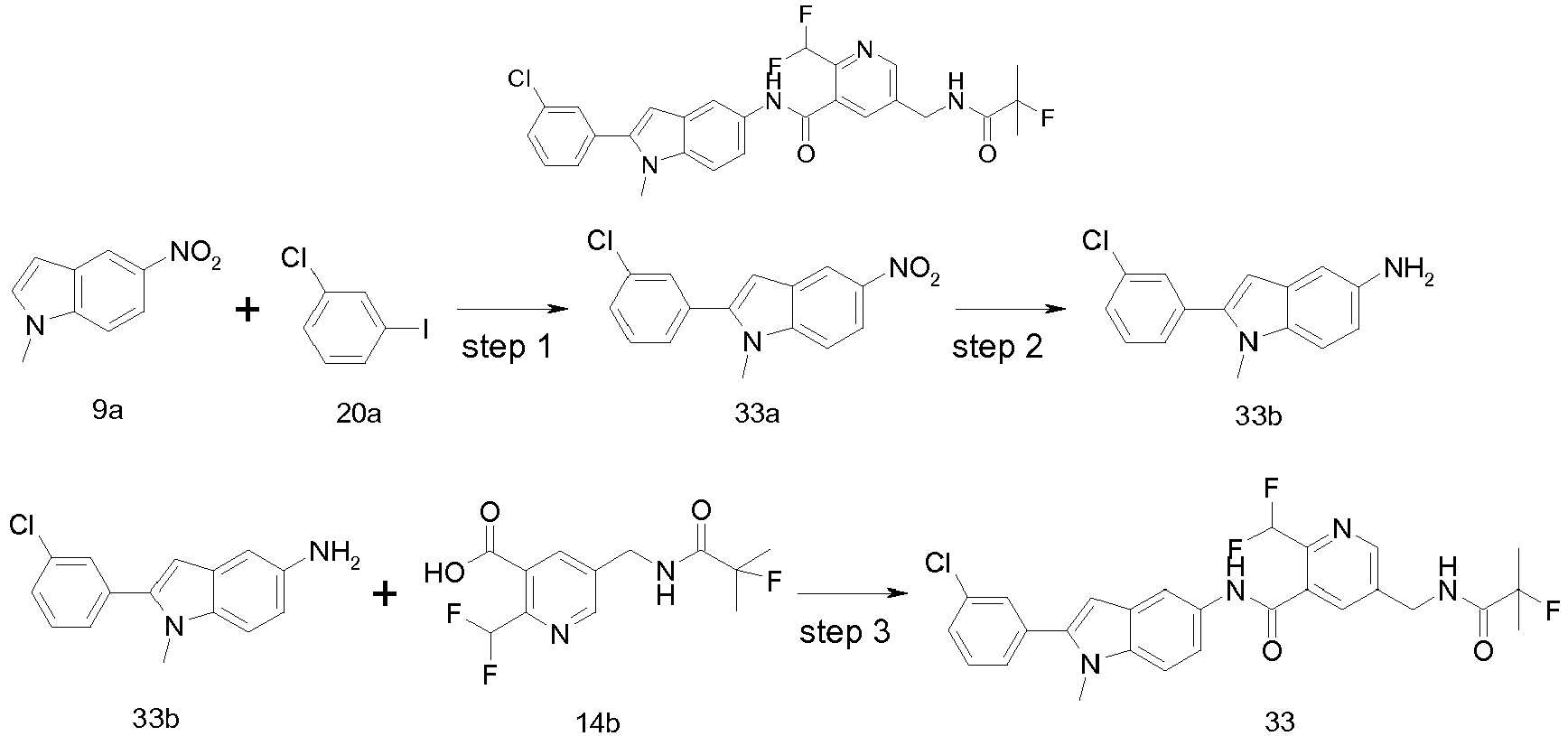
- 1-Methyl-5-nitro-1H-indole 9a (2.0 g, 11.4 mmol) was dissolved in 20 mL N,N-dimethylacetamide, and then added with 1-chloro-3-iodo-benzene 20a (2.7 g, 11.3 mmol), triphenylphosphine (620 mg, 2.2 mmol), palladium acetate (250 mg, 1.1 mmol), and cesium acetate (4.2 g, 22.0 mmol) successively. The reaction mixture was heated to 140 °C, and stirred for 18 hours under an argon atmosphere. The reaction mixture was concentrated under reduced pressure, and the residues were purified by TLC with elution system B to obtain the title compound 2-(3-chlorophenyl)-1-methyl-5-nitro-1H-indole 33a (300 mg, 9.5%) as light yellow solid.
MS m/z (ESI): 287.1 [M+1] - 2-(3-Chlorophenyl)-1-methyl-5-nitro-1H-indole 33a (300 mg, 1.05 mmol) was dissolved in a mixture of 20 mL of tetrahydrofuran and methanol (V:V=1:1), and then added with Raney nickel(30 mg). The reaction mixture was stirred for 2 hours under a hydrogen atmosphere. The reaction mixture was filtered with celatom. The filtrate was concentrated under reduced pressure to obtain the crude title compound 2-(3-chlorophenyl)-1-methyl-1H-indol-5-amine 33b (269 mg) as yellow solid which was used in the next step without further purification.
MS m/z (ESI): 257.1 [M+1] - 2-(3-Chlorophenyl)-1-methyl-1H-indol-5-amine 33b (269 mg, 1.05 mmol), 2-(difluoromethyl)-5-(((2-fluoro-2-methyl-propanoyl)amino)methyl)nicotinic acid 14b (305 mg, 1.05 mmol), 1-ethyl -(3-dimethylaminopropyl) carbodiimide hydrochloride (302 mg, 1.58 mmol), 1-hydroxybenzotriazole (14 mg, 0.10 mmol) and N,N-diisopropylethylamine (271 mg, 2.1 mmol) were added in 10 mL of N,N-dimethylacetamide successively. The reaction mixture was stirred for 16 hours. The reaction mixture was concentrated under reduced pressure, and the residues were purified by silica gel column chromatography with elution system A to obtain the title compound N-(2-(3-chlorophenyl)-1-methyl-1H-indol-5-yl)-2-(difluoromethyl)-5-(((2-fluoro-2-methyl-propanoyl)amino)methyl)nicotinamide 33 (30 mg, 5.4% for two steps) as white solid.
MS m/z (ESI): 529.1 [M+1]
1H NMR (400 MHz, DMSO-d 6): δ 10.60 (s, 1H), 8.87 (s, 1H), 8.69 (s, 1H), 8.06 (d, 2H), 7.69 (s,1H), 7.56-7.51 (m, 4H), 7.45-7.44 (m, 1H), 7.20 (s, 1H), 6.69 (s, 1H), 4.48-4.46 (m, 2H), 3.77 (s, 3H), 1.54 (s, 3H), 1.48 (s, 3H) -

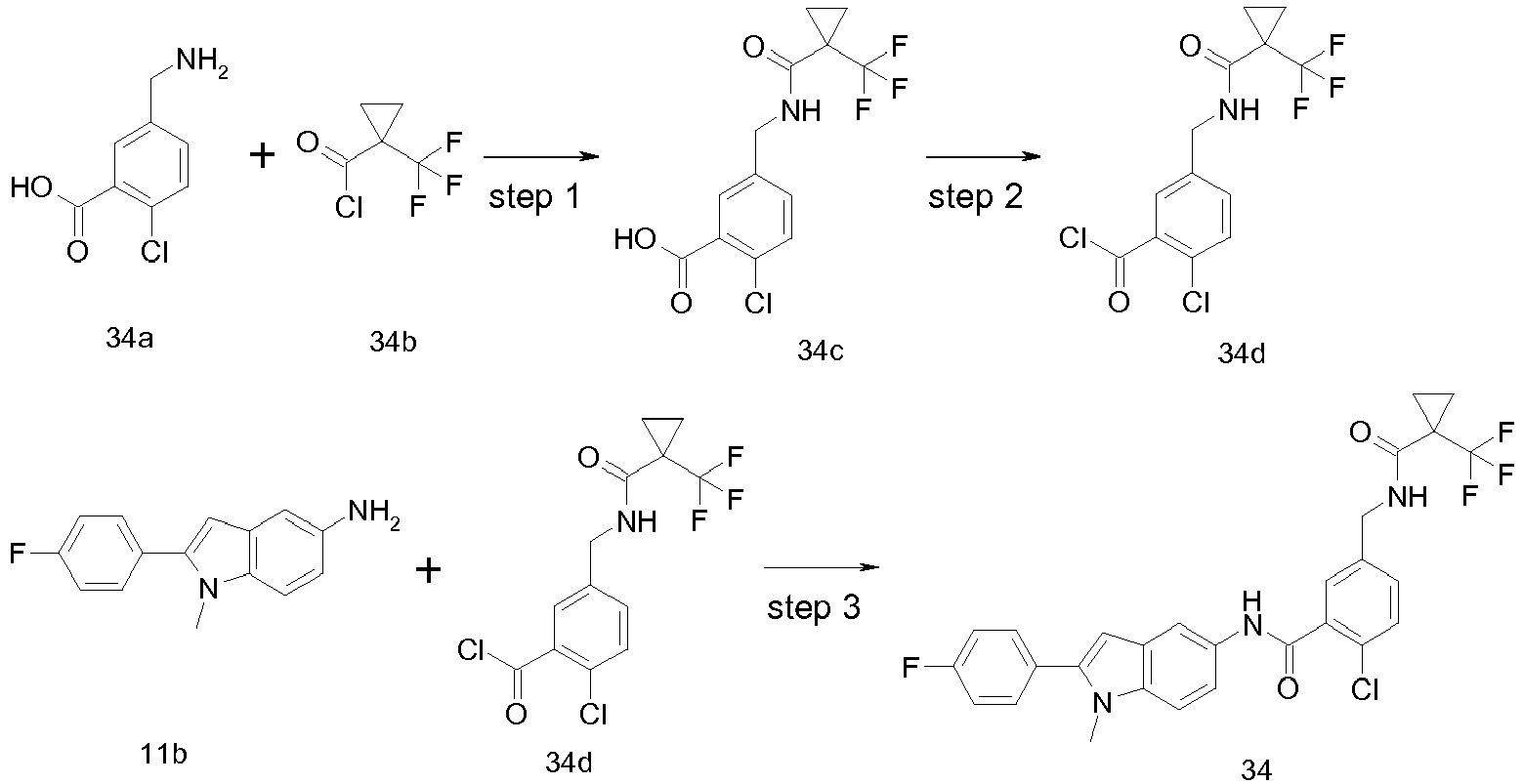
- 2-Chloro-5-(((1-(trifluoromethyl)cyclopropanecarbonyl)amino)methyl)benzoic acid 5-(aminomethyl)-2-chloro-benzoic acid 34a (1.5 g, 6.8 mmol, prepared according to the method disclosed in the patent application "
WO2011048004 ") and N,N-diisopropylethylamine (2.63 g, 20.3 mmol) were dissolved in 4 mL dicloromethane, and cooled 0 °C under ice bath. 1-(trifluoromethyl)cyclopropanecarbonyl chloride 34b (1.28 g, 7.5 mmol, prepared according to the method disclosed in the patent application "WO2005023773 ") was added and the reaction mixture was warmed up to room temperature and stirred for 5 hours.The reaction mixture was concentrated under reduced pressure to obtain the crude title compound 2-chloro-5-(((1-(trifluoromethyl)cyclopropanecarbonyl)amino)methyl)benzoic acid 34c (2.4 g) as light yellow oil which was used in the next step without further purification. MS m/z (ESI): 320.1 [M-1] - 2-Chloro-5-(((1-(trifluoromethyl)cyclopropanecarbonyl)amino)methyl)benzoyl chloride 2-chloro-5-(((1-(trifluoromethyl)cyclopropanecarbonyl)amino)methyl)benzoic acid 34c (200 mg, 0.62 mmol) and thionyl chloride (222 mg, 1.86 mmol) were dissolved in 20 mL of dicloromethane, and then added with one drop of N,N-dimethylformamide. The reaction mixture was stirred for 3 hours. The reaction mixture was concentrated under reduced pressure to obtain the crude title compound2-chloro-5-(((1-(trifluoromethyl)cyclopropanecarbonyl)amino)methyl)benzoy 1 chloride 34d (210 mg) as light yellow oil which was used in the next step without further purification.
- 2-(4-Fluorophenyl)-1-methyl-5-amino-1H-indole 11b (85 mg, 0.35 mmol) was dissolved in 10 mL of dicloromethane, and then added with 2-chloro-5-(((1-(trifluoromethyl)cyclopropanecarbonyl)amino)methyl)benzoyl chloride 34d (120 mg, 0.35 mmol) and N,N-diisopropylethylamine (90 mg, 0.70 mmol). The reaction mixture was stirred for 2 hours. The reaction mixture was concentrated under reduced pressure, and the residues were purified by thin layer chromatography (TLC) with elution system A to obtain the title compound 2-chloro-N-(2-(4-fluorophenyl)-1-methyl-1H-indol-5-yl)-5-(((1-(trifluoromethyl)cyclop ropanecarbonyl)amino)methyl)benzamide 34 (20 mg, 10.5%) as light yellow solid.
MS m/z (ESI):544.3 [M+1]
1H NMR (400 MHz, DMSO-d 6): δ 10.37 (s, 1H), 8.47 (s, 1H), 8.06 (s, 1H), 7.66-7.64 (m, 2H), 7.53-7.35 (m, 7H), 6.58 (s, 1H), 4.34-4.32 (m, 2H), 3.73 (s, 3H), 1.34-1.24 (m, 4H). -

- 6-Chloropyridine-3-amine 35a (1 g, 7.78 mmol) was dissolved in 20 mL N,N-dimethylformamide, and then added with N-iodosuccinimide (2.27 g, 10.11 mmol). The reaction solution was stirred for 16 hours at room temperature. The reaction mixture was concentrated under reduced pressure. The residues were purified by thin layer chromatography (TLC) with elution system C to obtain the title compound 6-chloro-2-iodo-pyridin-3-amine 35b (1.37 g, 69.2%) as brown solid.
- 6-Chloro-2-iodo-pyridin-3-amine 35b (1.37 g, 5.38 mmol), 3-chlorophenylacetylene (882 mg, 6.46 mmol), Bis(triphenylphosephine)palladium(II) chloride (378 mg, 0.54 mmol), cuprous iodide (205 mg, 1.08 mmol) and N,N-diisopropylethylamine (1.39 g, 10.76 mmol) were added into 10 mL of N,N-dimethylformamide. The reaction mixture was stirred for 16 hours at 100 °C under an argon atmosphere. The reaction mixture was concentrated under reduced pressure. The residues were purified by thin layer chromatography (TLC) with elution system C to obtain the title compound 6-chloro-2-( (3-chlorophenyl)ethynyl)pyridin-3-amine 35c (871 mg, 61.6%) as brown solid.
- 6-Chloro-2-((3-chlorophenyl)ethynyl)pyridin-3-amine 35c (871 mg, 3.32 mmol)and potassium tert-butanolate (746 mg, 6.64 mmol) was dissolved in 20 mL of N,N-dimethylformamide. The resulting mixture was stirred for 16 hours at 70 °C. The reaction mixture was concentrated under reduced pressure. The residues were added with 10 mL of ethyl acetate, and filtered. The filtrate was concentrated under reduced pressure to obtain the crude title compound 5-chloro-2-(3-chlorophenyl)-1H-pyrrolo[3,2-b]pyridine 35d (1.17 g) as yellow solid which was used in the next step without further purification.
- 5-Chloro-2-(3-chlorophenyl)-1H-pyrrolo[3,2-b]pyridine 35d (1.17 g, 4.46 mmol) was dissolved in 15 mL N,N-dimethylformamide, and then added with 60% sodium hydride (268 mg, 6.69 mmol). The reaction mixture was stirred for 30 mins at room temperature. Iodomethane (761 mg, 5.36 mmol) was added and continually stirred for 2 hours at room temperature. The reaction mixture was concentrated under reduced pressure. The residues were purified by thin layer chromatography (TLC) with elution system C to obtain the title compound 5-chloro-2-(3-chlorophenyl)-1-methyl-1H-pyrrolo[3,2-b]pyridine 35e (650 mg, 52.8%) as yellow solid.
- 5-Chloro-2-(3-chlorophenyl)-1-methyl-1H-pyrrolo[3,2-b]pyridine 35e (276 mg, 1.0 mmol), 4-methoxybenzylamine (172 mg, 1.25 mmol), Tris(dibenzylideneacetone)dipalladium (92 mg, 0.1 mmol), (±)-2,2'-Bis(diphenylphosphino)-1,1'-binaphthyl (125 mg, 0.2 mmol), potassium phosphate (425 mg, 2 mmol) were dissloved in 15 mL of 1,4-dioxane. The reaction mixture was stirred for 16 hours at 100 °C under an argon atmosphere. The reaction mixture was concentrated under reduced pressure. The residues were purified by thin layer chromatography (TLC) with elution system A to obtain the title compound 2-(3-chlorophenyl)-N-(4-methoxybenzyl)-1-methyl-1H-pyrrolo[3,2-b]pyridin -5-amine 35f (221 mg, 58.5%) as yellow solid.
- 2-(3-Chlorophenyl)-N-(4-methoxybenzyl)-1-methyl-1H-pyrrolo[3,2-b]pyridin-5-amine 35f (221 mg,0.58 mmol) was dissolved in 5 mL of trifluoroacetic acid. The resulting mixture was stirred for 16 hours at 60 °C. The reaction mixture was concentrated under reduced pressure to obtain the crude title compound N-(2-(3-chlorophenyl)-1-methyl-1H-pyrrolo[3,2-b]pyridin-5-yl)-2,2,2-trifluoroacetamid e 35h (207 mg) as brown oil which was used in the next step without further purification.
- N-(2-(3-Chlorophenyl)-1-methyl-1H-pyrrolo[3,2-b]pyridin-5-yl)-2,2,2-trifluoroacetami de 35h (207 mg, 0.58 mmol) and potassium carbonate (162 mg, 1.17 mmol) were dissolved in 10 mL ethanol. The reaction mixture was stirred for 1 hour at 80 °C. The reaction mixture was concentrated under reduced pressure, The residues were purified by thin layer chromatography (TLC) with elution system A to obtain the title compound 2-(3-chlorophenyl)-1-methyl-1H-pyrrolo[3,2-b]pyridine-5-amine 35j (30 mg, 20%) as light yellow solid.
- 2-(Difluoromethyl)-5-(((2-fluoro-2-methyl-propanoyl)amino)methyl)nicotinic acid 14b (34 mg, 0.12 mmol) and 2-(3-chlorophenyl)-1-methyl-1H-pyrrolo[3,2-b]pyridine-5-amine 35j (30 mg, 0.12 mmol) were dissolved in 15 mL of N,N-Dimethyformamide, and then added with triethylamine (47 mg, 0.46 mmol), 1-hydroxybenzotriazole (16 mg, 0.12 mmol) and 1-ethyl -(3-dimethylaminopropyl) carbodiimide hydrochloride (34 mg, 0.17 mmol). The reaction mixture was stirred for 16 hours at room temperature. The reaction mixture was concentrated under reduced pressure, and the residues were purified by thin layer chromatography (TLC) with elution system A to obtain the title compound N-(2-(3-chlorophenyl)-1-methyl-1H-pyrrolo[3,2-b]pyridin-5-yl)-2-(difluoromethyl)-5-(( (2-fluoro-2-methyl-propanoyl)amino)methyl)nicotinamide 35 (3 mg, 4.8%) as whiteoff solid.
MS m/z (ESI):530.1 [M+1]
1H NMR (400MHz, CDCl3): δ 8.63 (s, 1H), 8.34 (s, 1H), 7.96 (s, 1H), 7.82 (s, 1H), 7.54-7.43 (m, 4H), 7.31 (s, 1H), 6.93 (s, 1H), 6.42 (s, 1H), 4.43 (s, 2H), 3.83 (s, 3H), 1.64 (s, 3H), 1.59 (s, 3H). -
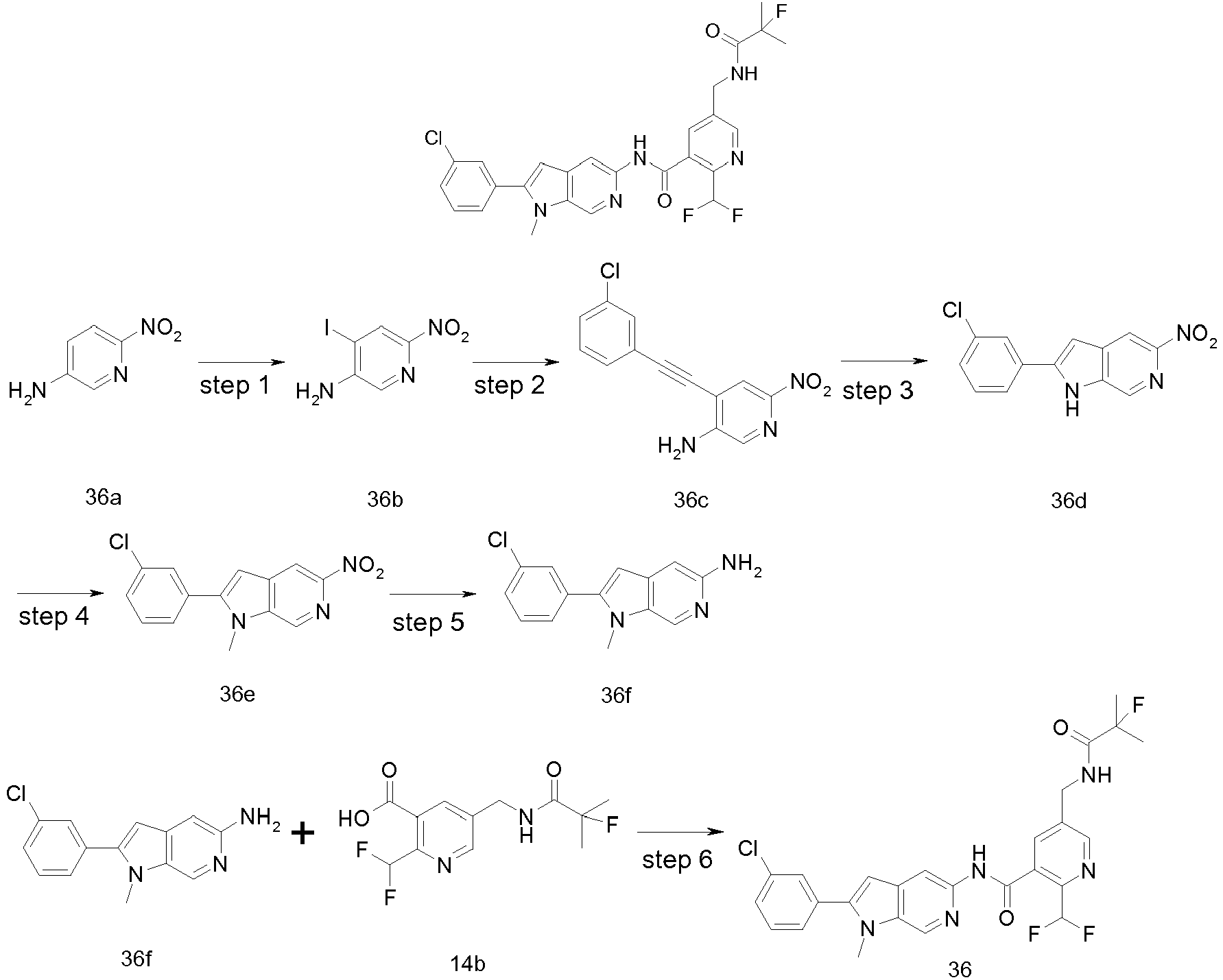
- 5-Amino-2-nitropyridine 36a (1 g, 7.2 mmol), potassium iodate (770 mg, 3.6 mmol) and potassium iodide (1.2 g, 7.2 mmol) was added in 30 mL of sulfuric acid (2N) successively. The reaction solution was stirred for 16 hours at 80 °C and then cooled to room temperature. The reaction mixture was adjusted to pH 10 with 2N sodium hydroxide aqueous solution. Amount of solid was precipitated and filtered out. The filter cake was washed with water, and dried to obtain the title compound 4-iodo-6-nitro-pyridin-3-amine 36b (1.5 g, 79%) as yellow solid.
- 4-Iodo-6-nitro-pyridine-3-amine 36b (1.5 g, 5.7 mmol), 3-chlorophenylacetylene (850 mg, 6.2 mmol), cuprous iodide (1.1 1 g, 5.7 mmol), (1,1'-Bis(diphenylphosphino)ferrocene) dichloropalladium(II) (834 mg, 1.14 mmol) and triethylamine (1.6 mL, 11.4 mmol) were added into 20 mL of N,N-dimethylformamide successively. The reaction mixture was stirred for 16 hours under an argon atmosphere. The reaction mixture was concentrated under reduced pressure. The residues were purified by silic gel column chromatography with elution system A to obtain the title compound 4-((3-chlorophenyl)ethynyl)-6-nitro-pyridine-3-amine 36c (1.5 g, 97%) as yellow solid.
- 4-((3-Chlorophenyl)ethynyl)-6-nitro-pyridine-3-amine 36c (200 mg, 0.73 mmol), potassium tertbutanolate (123 mg, 1.1 mmol) and 10 mL of N,N-dimethylformamide were added in 50 mL of flask. The resulting mixture was stirred for 16 hours at 60 °C. The reaction mixture was concentrated under reduced pressure to obtain the crude title compound 2-(3-chlorophenyl)-5-nitro-1H-pyrrolo[2,3-c]pyridine 36d (300 mg) as brown oil which was used in the next step without further purification.
- 2-(3-Chlorophenyl)-5-nitro-1H-pyrrolo[2,3-c]pyridine 36d (300 mg, 1.1 mmol), iodomethane (233 mg, 1.64 mmol), cesium carbonate (717 mg, 2.2 mmol) and 10 mL of N,N-dimethylformamide were added in 100 mL of flask. The reaction mixture was stirred for 16 hours at room temperature. The reaction mixture was concentrated under reduced pressure. The residues were purified by thin layer chromatography (TLC) with elution system A to obtain the title compound 2-(3-chlorophenyl)-1-methyl-5-nitro-1H-pyrrolo(2,3-c)pyridine 36e (50 mg, 15.8%) as yellow solid.
- 2-(3-Chlorophenyl)-1-methyl-5-nitro-1H-pyrrolo[2,3-c]pyridine 36e (50 mg, 0.17 mmol), Raney nickel(5 mg) and 10 mL of tetrahydrofuran were added in 50 mL of flask. The reaction mixture was stirred for 2 hours at room temperature under a hydrogen atmosphere. The reaction mixture was filtered. The filtrate was concentrated under reduced pressure to obtain the title compound 2-(3-chlorophenyl)-1-methyl-1H-pyrrolo[2,3-c]pyridine-5-amine 36f (40 mg, 88.9%) as light yellow solid.
- ((2-fluoro-2-methyl-propanoyl)amino)methyl)nicotinamide 2-(Difluoromethyl)-5-(((2-fluoro-2-methyl-propanoyl)amino)methyl)nicotinic acid 14b (45 mg, 0.16 mmol), 2-(3-chlorophenyl)-l-methyl-1H-pyrrolo[2,3-c]pyridin-5-amine 36f (40 mg, 0.16 mmol), 1-hydroxybenzotriazole (2.2 mg, 0.016 mmol), 1-ethyl-3-(3-dimethylaminopropyl)carbodiimide hydrochloride (46 mg, 0.24 mmol) and N,N-diisopropylethylamine (31 mg, 0.24 mmol) were dissolved in N,N-dimethyformamide. The reaction mixture was stirred for 2 hours at 70 °C. The reaction mixture was concentrated under reduced pressure, and the residues were purified by thin layer chromatography (TLC) with elution system A to obtain the title compound N-(2-(3-chlorophenyl)-1-methyl-1H-pyrrolo[2,3-c]pyridin-5-yl)-2-(difluoro methyl)-5-(((2-fluoro-2-methyl-propanoyl)amino)methyl)nicotinamide 36 (20 mg, 23.5%) as light yellow solid.
MS m/z (ESI):530.1 [(M+1])
1H NMR (400MHz, DMSO-d 6): δ 11.15 (s, 1H), 8.82-8.80 (m, 1H), 8.67 (s, 1H), 8.07-8.05 (m, 3H), 7.75 (s, 1H), 7.66-7.65 (m, 1H), 7.57-7.55 (m, 2H), 7.21 (s, 1H), 6.72 (s, 1H), 4.46-4.44 (d, 2H), 3.83 (s, 3H), 1.53 (s, 3H), 1.48 (s, 3H). -

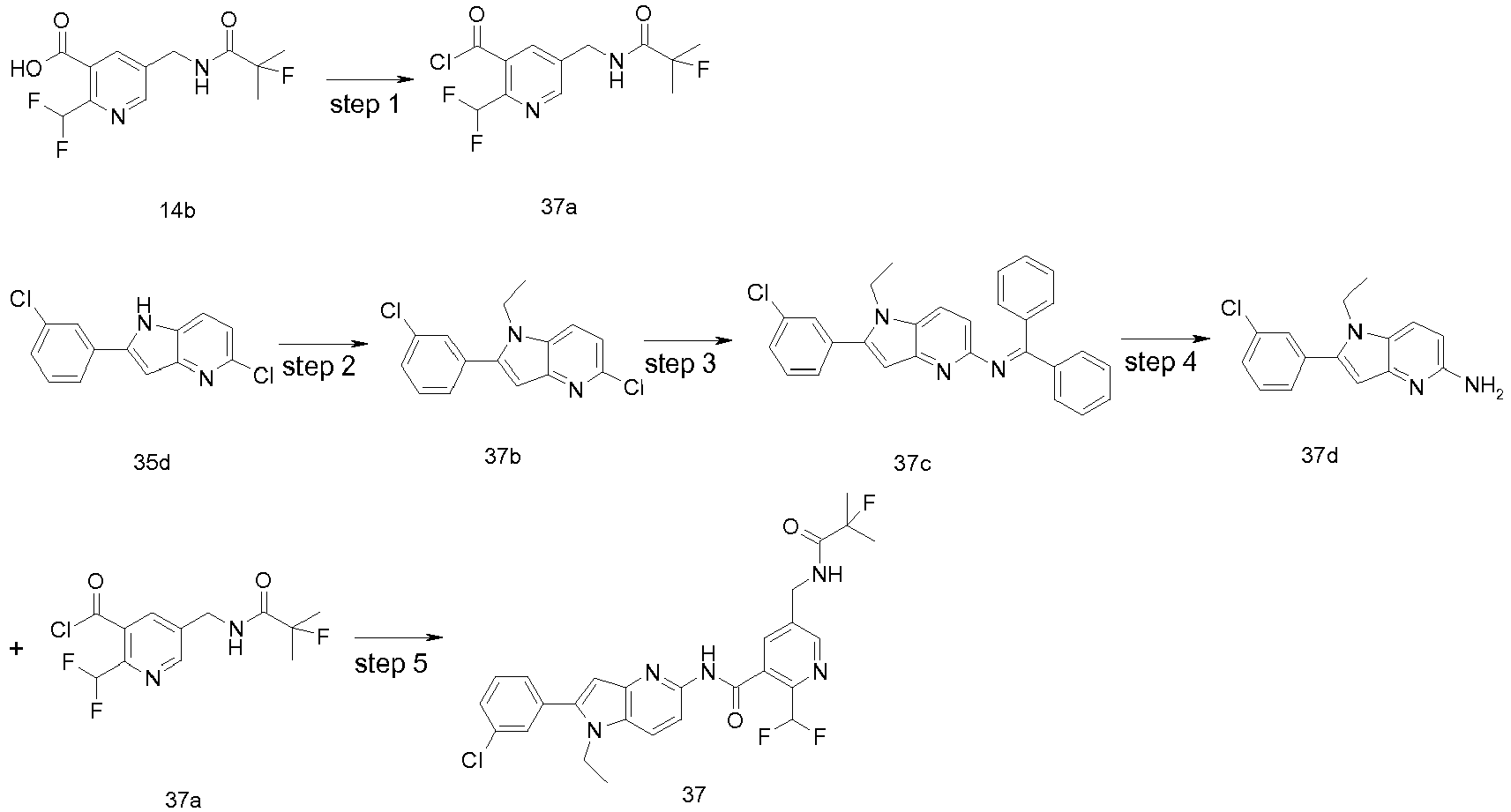
- 2-(Difluoromethyl)-5-(((2-fluoro-2-methyl-propanoyl)amino)methyl)nicotinoyl chloride 2-(Difluoromethyl)-5-(((2-fluoro-2-methyl-propanoyl)amino)methyl)nicotinic acid 14b (1.5 g, 5.17 mmol) was dissolved in 10 mL of dichloromethane, and then added with thionyl chloride (1.2 mL, 15.5 mmol) and 2 drops of N,N-dimethylformamide. The reaction solution was stirred for 1 hour at room temperature. The reaction mixture was concentrated under reduced pressure to obtain the crude title compound 2-(difluoromethyl)-5-(((2-fluoro-2-methyl-propanoyl)amino)methyl)nicotinoyl chloride 37a (1.6 g) as white solid which was used in the next step without further purification.
- 5-Chloro-2-(3-chlorophenyl)-1H-pyrrolo[3,2-b]pyridine 35d (0.87 g, 3.32 mmol) was dissolved in 20 mL of N,N-dimethylformamide, and then added with 60% sodium hydride (0.2 g, 4.98 mmol). The reaction mixture was stirred for 30 mins at room temperature, and then added with iodoethane (0.62 g, 3.98 mmol) and continually stirred for another 2 hours at room temperature. The reaction mixture was added with 10 mL of water, and concentrated under reduced pressure. The residues were purified by thin layer chromatography (TLC) with elution system A to obtain the title compound 5-chloro-2-(3-chlorophenyl)-1-ethyl-1H-pyrrolo[3,2-b]pyridine 37b (0.35 g, 36.3%) as yellow oil.
- 5-Chloro-2-(3-chlorophenyl)-1-ethyl-1H-pyrrolo[3,2-b]pyridine 37b (30 mg, 0.1 mmol), benzophenone imine (22 mg, 0.12 mmol), tris(dibenzylideneacetone)dipalladium (9.5 mg, 0.01 mmol), 4,5-bis(diphenylphosphino)-9.9-dimethyxanthene (12 mg, 0.021 mmol) and potassium phosphate (44 mg, 0.21 mmol) were dissolved in 2 mL of 1,4-dioxane. The resulting mixture was stirred for 16 hours at 100 °C under an argon atmosphere. The reaction mixture was concentrated under reduced pressure. The residues were added with a little tetrahydrofuran, and filtered. The filtrate was concentrated under reduced pressure to obtain the crude title compound (2-(3-chlorophenyl)-N-(diphenylmethylenyl)-1-ethyl-1H-pyrrolo[3,2-b]pyridin-5-amine 37c (50 mg) as gray solid which was used in the next step without further purification.
- (2-(3-Chlorophenyl)-N-(diphenylmethylenyl)-1-ethyl-1H-pyrrolo[3,2-b]pyridin-5-amin e 37c (50 mg, 0.12 mmol) was dissolved in 10 mL of tetrahydrofuran, and then added with 4 mL of 2 M hydrochloric acid solution. The reaction mixture was stirred for 2 hours at room temperature. The reaction mixture was concentrated under reduced pressure, and then adjusted to pH>7 with saturated sodium bicarbonate solution. The mixture was concentrated under reduced pressure, and the residues were purified by thin layer chromatography (TLC) with elution system A to obtain the crude title compound 2-(3-chlorophenyl)-1-ethyl-1H-pyrrolo[3,2-b]pyridine-5-amine 37d (62 mg) as yellow solid which was used in the next step without further purification.
- 2-(Difluoromethyl)-5-(((2-fluoro-2-methyl-propanoyl)amino)methyl)nicotinoyl chloride 37a (13.5 mg, 0.044 mmol) was dissolved in 10 mL of dichloromethane, and then added with triethylamine (94 mg, 0.088 mmol) and 2-(3-chlorophenyl)-1-ethyl-1H-pyrrolo[3,2-b]pyridine-5-amine 37d (11.9 mg, 0.044 mmol). The reaction mixture was stirred for 3 hours at room temperature. The reaction mixture was concentrated under reduced pressure, and the residues were purified by thin layer chromatography (TLC) with elution system C to obtain the title compound N-(2-(3-chlorophenyl)-1-ethyl-1H-pyrrolo[3,2-b]pyridin-5-yl)-2-(difluoromethyl)-5-(((2 -fluoro-2-methyl-propanoyl)amino)methyl)nicotinamide 37 (5 mg, 20.8% ) as white solid.
MS m/z (ESI):544.1 [M+1]
1H NMR (400MHz, CDCl3): δ 13.16 (s, 1H), 8.84-8.82 (d, 2H), 8.72-8.70 (d, 1H), 8.26-8.24 (d, 1H), 7.57-7.52 (m, 3H), 7.43-7.42 (d, 1H), 7.36-7.31 (m, 2H), 6.81 (s, 1H), 4.71-4.69 (d, 2H), 4.39-4.33 (m, 2H), 1.64 (s, 3H), 1.59 (s, 3H), 1.44-1.42 (m, 3H). -

- 2-(4-(Trifluoromethyl)phenyl)benzo[d]oxazol-5-amine 22c (120 mg, 0.44 mmol) was dissolved in 5 mL of N,N-dimethylformamide, and then added with 2-(difluoromethyl)-5-((2-methylpropanoylamino)methyl)nicotinic acid If (100 mg, 0.37 mmol), 1-(3-dimethylaminopropyl)-3-ethylcarbodiimide hydrochloride (140 mg, 0.74 mmol), 1-hydroxybenzotriazole (5 mg, 0.037 mmol) and triethylamime (200 µL, 1.47µmol). The resulting mixture was heated to 70 °C, was and stirred for 3 hours. The reaction solution was cooled to room temperature. The reaction mixture was concentrated under reduced pressure, and the residues were purified by silica gel column chromatography with elution system A to obtain the title compound 2-(difluoromethyl)-5-((2-methylpropanoylamino)methyl)-N-(2-(4-(trifluoromethyl)phen yl)benzo[d]oxazol-5-yl)nicotinamide 38 (60 mg, 30.6%) as white solid.
MS m/z (ESI): 533.2[M+1]
1H NMR (400 MHz, DMSO-d6 ): δ 11.00 (s, 1H), 8.81 (s, 1H), 8.61 (t, 1H), 8.21-8.27 (m, 3H), 8.10 (s, 1H), 7.83 (d, 1H), 7.72 (d, 3H), 7.22 (t, 1H), 4.44 (d, 2H), 2.49 (d, 1H), 1.06 (d, 6H). -
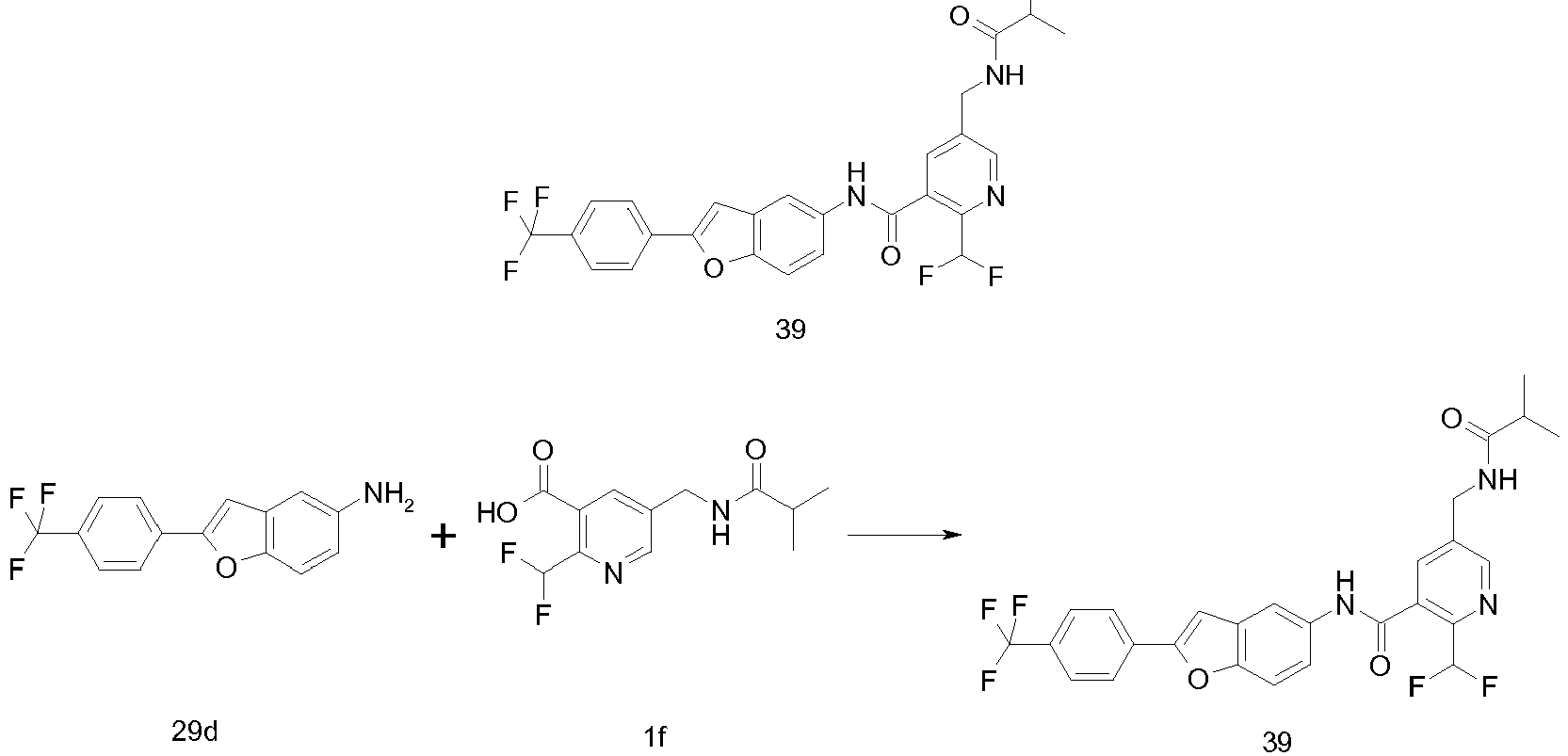
- 5-Amino-2-(4-(trifluoromethyl)phenyl)benzofuran 29d (70 mg, 0.25 mmol), 2-(difluoromethyl)-5-((2-methylpropanoylamino)methyl)nicotinic acid If (69 mg, 0.25 mmol), 1-(3-dimethylaminopropyl)-3-ethylcarbodiimide hydrochloride (97 mg, 0.51 mmol), 1-hydroxybenzotriazole (3 mg, 0.025 mmol) and triethylamime (140 µL, 0.80µmol) were added in 5 mL of N,N-dimethylformamide successively. The resulting mixture was heated to 70 °C and stirred for 2 hours. The reaction mixture was concentrated under reduced pressure, and the residues were purified by thin layer chromatography (TLC) with elution system A to obtain the title compound 2-(difluoromethyl)-5-((2-methylpropanoylamino)methyl)-N-(2-(4-(trifluoromethyl)phen yl)benzofuran-5-yl)nicotinamide 39 (70 mg, 52.2%) as whiteoff solid.
MS m/z (ESI): 532.2 [M+1]
1H NMR (400 MHz, DMSO-d6 ): δ 10.81 (s, 1H), 8.70 (s, 1H), 8.48 (s, 1H), 8.20 (s, 1H), 8.15 (d, 2H), 8.04 (s, 1H), 7.89 (d, 2H), 7.73 (s, 1H), 7.69 (s, 1H), 7.59 (s, 1H), 7.19 (s, 1H), 4.44 (d, 2H), 2.47 (d, 1H), 1.06 (d, 6H). -

- 2-(4-(Trifluoromethyl)phenyl)isoindoline-5-amine 25d (10 mg, 0.036 mmol) and 2-(difluoromethyl)-5-((2-methylpropanoylamino)methyl)nicotinic acid If (10 mg, 0.036 mmol) were dissolved in 5 mL of N,N-dimethylformamide, and then added with 1-(3-dimethylaminopropyl)-3-ethylcarbodiimide hydrochloride (11 mg, 0.054 mmol) and 1-hydroxybenzotriazole (5 mg, 0.036 mmol). The resulting mixture was stirred for 1 hour. The reaction mixture was concentrated under reduced pressure, and the residues were purified by thin layer chromatography (TLC) with elution system A to obtain the title compound 2-(difluoromethyl)-5-((2-methylpropanoylamino)methyl)-N-(2-(4-(trifluoromethyl)phen yl)isoindolin-5-yl)nicotinamide 40 (10 mg, 52.6%) as white solid.
MS m/z (ESI): 533.1 [M+1]
1H NMR (400 MHz, DMSO-d6 ): δ 10.62 (s, 1H), 8.66 (s, 1H), 8.44 (d, 1H), 8.07 (s, 1H), 8.00 (s, 1H), 7.88-7.85 (m, 4H), 7.54 (d, 1H), 7.47 (d, 1H), 7.42 (t, 1H), 4.60 (s, 4H), 4.41 (d, 2H), 3.18-3.17 (m, 1H), 1.05 (s, 6H) -

- 5-(Aminomethyl)-2-chloro-benzoic acid 34a (1.5 g, 6.8 mmol, prepared according to the method disclosed in patent application "
WO2011048004 ") and triethylamine (3.2 mL, 23.2 mmol) were dissolved in 15 mL of tetrahydrofuran, and then cooled to 0 °C under ice bath. A solution of 1-methylcyclopropanecarbonyl chloride 41a (890 mg, 7.47 mmol, prepared according to the method disclosed in "journal of Medicinal Chemistry, 2014, 57(22), 9323-9342") in 5 mL of tetrahydrofuran was added to the mixture above dropwise. The reaction mixture was warmed up to room temperature, and then stirred for 1 hour. The reaction mixture was concentrated under reduced pressure to obtain the crude title compound 2-chloro-5-(((1-methylcyclopropanecarbonyl)amino)methyl)benzoic acid 41b (4.78 g,) as white solid which was used in the next step without further purification.
MS m/z (ESI): 266.1 [M-1] - 2-Chloro-5-(((1-methylcyclopropanecarbonyl)amino)methyl)benzoic acid 41b (200 mg, 0.75 mmol) was dissolved in 10 mL of dichloromethane, and then added with thionyl chloride (0.2 mL, 2.75 mmol). The reaction solution was stirred for 15 mins at room temperature. The reaction mixture was concentrated under reduced pressure to obtain the title compound 2-chloro-5-(((1-methylcyclopropanecarbonyl)amino)methyl)benzoyl chloride 41c crude(220 mg) as yellow oil which was used in the next step without further purification.
- 2-(4-(Ttrifluoromethyl)phenyl)benzo[d]oxazol-6-amine 22c (90 mg, 0.33 mmol) and triethylamine (90µL, 0.65 µmol) were dissolved in 5 mL of tetrahydrofuran, and then added with a solution of 2-chloro-5-(((1-methylcyclopropanecarbonyl)amino)methyl)benzoyl chloride 41c (220 mg, 0.72 mmol) in 5 mL of tetrahydrofuran dropwise. The reaction mixture was stirred for 30 mins. The reaction mixture was filtered and concentrated under reduced pressure. The residues were purified by thin layer chromatography (TLC) with elution system A to obtain the title compound 2-chloro-5-(((1-methylcyclopropanecarbonyl)amino)methyl)-N-(2-(4-(trifluoromethyl)p henyl) benzo[d]oxazol-5-yl)benzamide 41 (30 mg, 17.4% for two steps) as yellow solid. MS m/z (ESI): 528.3 [M+1]
1H NMR (400 MHz, DMSO-d6 ): δ 10.78 (s, 1H), 8.42 (d, 2H), 8.33 (s, 1H), 8.23 (t, 1H), 8.01 (d, 2H), 7.84 (d, 1H), 7.72 (d, 1H), 7.54 (d, 1H), 7.49 (s, 1H), 7.39 (d, 1H), 4.31 (d, 2H), 1.30 (s, 3H), 0.97 (d, 2H), 0.54 (d, 2H). -

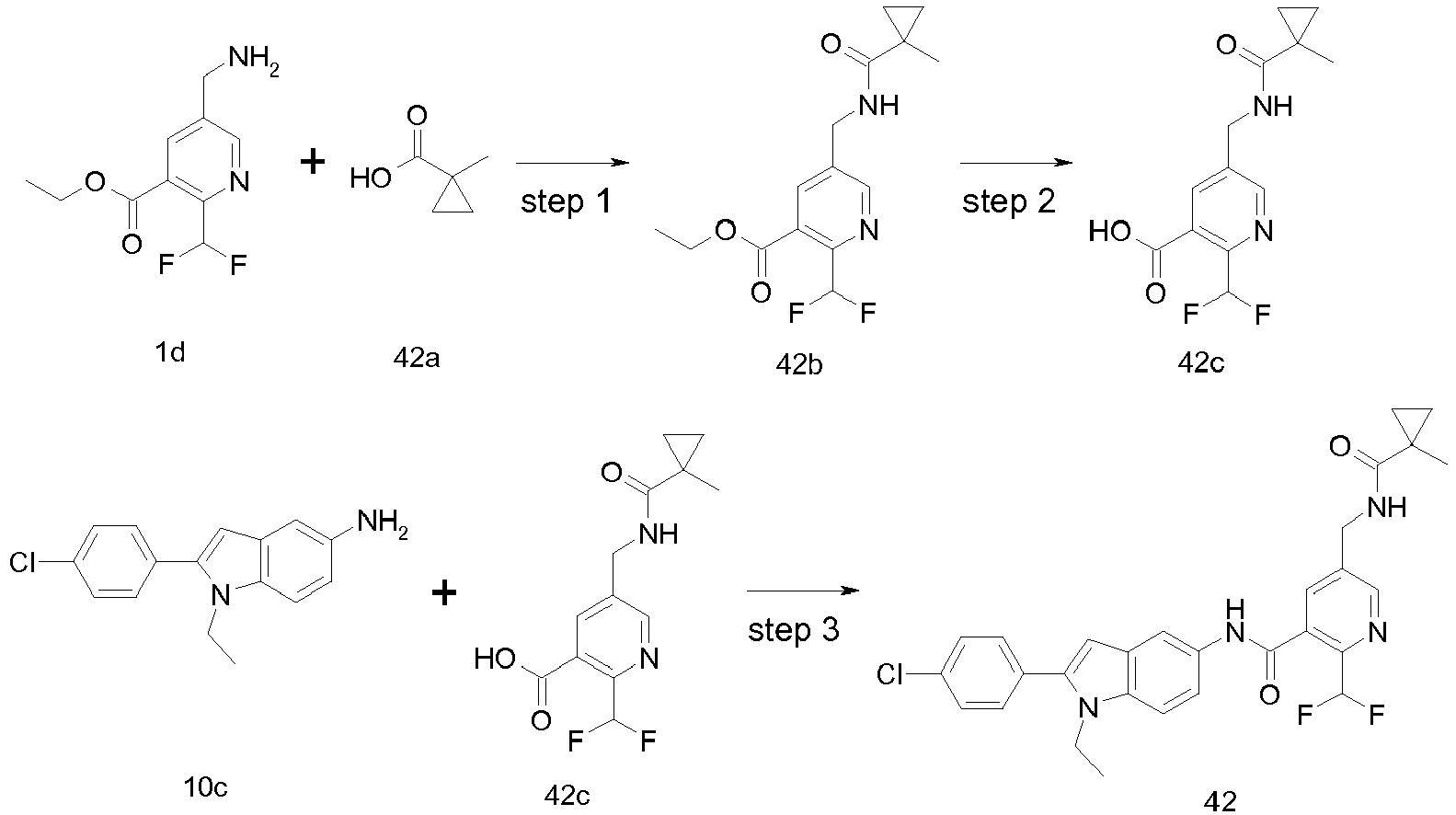
- Ethyl 2-(difluoromethyl)-5-(((1-methylcyclopropanecarbonyl)amino)methyl)nicotinate Ethyl 5-(aminomethyl)-2-(difluoromethyl)nicotinate hydrochloride 1d (1.8 g, 5.94 mmol) was dissolved in 25 mL of N,N-dimethylformamide, and then added with 1-methylcyclopropane-1-carboxylic acid 42a (594 mg, 5.94 mmol), 1-(3-dimethylaminopropyl)-3-ethylcarbodiimide hydrochloride (2.28 g, 11.9 mmol), 1-hydroxybenzotriazole (80 mg, 0.59 mmol) and triethylamine (3.3 mL, 23.8 mmol) successively.. The resulting mixture was stirred for 16 hours. The reaction mixture was concentrated under reduced pressure. The residues were added with 50 mL of water and extracted with ethyl acetate (25 mL×3). The organic phases were combined, dried over anhydrous magnesium sulfate, and filered. The filtrate was concentrated under reduced pressure, and the residues were purified by silica gel column chromatography with elution system C to obtain the title compound ethyl 2-(difluoromethyl)-5-(((1-methylcyclopropanecarbonyl) -amino)methyl)nicotinate 42b (1.2 g, 64.9%) as light yellow oil.
MS m/z (ESI): 313.2(M+1) - 2-(Difluoromethyl)-5-(((1-methylcyclopropanecarbonyl)amino)methyl)nicotinic acid Ethyl 2-(difluoromethyl)-5-(((1-methylcyclopropanecarbonyl)amino)methyl)nicotinate 42b (1.2 g, 3.85mmol) was dissolved in 30 mL the mixture of 1,4-dioxane and water (V:V=2:1), and then added with lithium hydroxide hydrate (400 mg, 9.62 mmol). The reaction mixture was stirred for 16 hours. The 1,4-dioxane was removed under reduced pressure, and the residues were adjusted to pH 4∼5 by 6M hydrochloric acid. Amount of solid was precipitated and added with 30 mL ethyl acetate and filtered. The filter cake was collected, and the filtrate was layered. The organic phase was dried over anhydrous magnesium sulfate, and filtered. The filtrate was concentrated under reduced pressure and the residues were combined with the filter cake above to obtain the title compound 2-(difluoromethyl)-5-(((1-methylcyclopropanecarbonyl)amino)methyl)pyridine-3-carbo xylic acid 42c (1.0 g, 91.7%) as white solid.
MS m/z (ESI): 285.1 [M+1]. - 2-(Difluoromethyl)-5-(((1-methylcyclopropanecarbonyl)amino)methyl)nicotinic acid 42c (52 mg, 0.19 mmol), 1-ethyl-2-(4-chlorophenyl)-5-amino--1H-indole 10c (50 mg, 0.19 mmol), 1-(3-dimethylaminopropyl)-3-ethylcarbodiimide hydrochloride (71 mg, 0.37 mmol), 1-hydroxybenzotriazole (2.5 mg, 18.5µmol) and triethylamine (100 µL, 0.74 mmol) were dissolved in 5 mL of N,N-dimethylformamide. The reaction mixture was heated to 70 °C and stirred for 2 hours. The reaction mixture was cooled to room temperature and then concentrated under reduced pressure. The residues were purified by thin layer chromatography(TLC) with elution system A to obtain the title compound N-(2-(4-chlorophenyl)-1-ethyl-1H-indol-5-yl)-2-(difluoromethyl)-5-(((1-methylcyclopro panecarbonyl)amino)methyl)nicotinamide 42 (40 mg, 40.4% ) as yellow solid.
MS m/z (ESI): 538.2 [M+1]
1H NMR (400 MHz, DMSO-d6 ): δ 10.62 (s, 1H), 8.69 (s, 1H), 8.31 (s, 1H), 8.04 (d, 2H), 7.55-7.69 (m, 3H), 7.44 (d, 2H), 7.19 (t, 1H), 6.60 (s, 1H), 4.43 (d, 2H), 4.22 (d, 2H), 1.32 (s, 3H), 1.20 (t, 3H), 1.00 (s, 3H), 0.56 (s, 2H). -

- 2-(4-(Trifluoromethyl)phenyl)benzo[d]oxazol-5-amine 22c (50 mg, 0.18 mmol) was dissolved in 5 mL of N,N-dimethylformamide, and then added with 2-(difluoromethyl)-5-(((1-methylcyclopropanecarbonyl)amino)methyl)nicotinic acid 42c (51 mg, 0.18 mmol), 1-(3-dimethylaminopropyl)-3-ethylcarbodiimide hydrochloride (75 mg, 0.39 mmol), 1-hydroxybenzotriazole (2.4 mg, 0.018 mmol) and triethylamine (0.1 mL, 720 µmol). The reaction mixture was heated to 70 °C,and stirred for 2 hours. The reaction mixture was cooled to room temperature and then concentrated under reduced pressure. The residues were purified by thin layer chromatography(TLC) with elution system A to obtain the title compound 2-(difluoromethyl)-5-(((1-methylcyclopropanecarbonyl)amino)methyl)-N-(2-(4-(trifluor omethyl)phenyl)benzo[d]oxazol-5-yl)nicotinamide 43 (20 mg, 20.4% ) as yellow solid. MS m/z (ESI): 545.3 [M+1]
1H NMR (400 MHz, DMSO-d6 ): δ 10.95 (s, 1H), 8.70 (d, 1H), 8.43 (d, 2H), 8.30 (t, 2H), 8.03 (d, 3H), 7.87 (d, 1H), 7.72 (d, 1H), 7.19 (t, 1H), 4.43 (d, 2H), 1.31 (s, 3H), 0.99 (d, 2H), 0.56 (d, 2H). -

- 2-Amino-3-iodo-5-nitro-pyridine 44b (300 mg, 1.13 mmol), 4- chlorophenylacetylene 44a (325 mg, 2.38 mmol), bis(triphenylphosephine)palladium(II) chloride (40 mg, 56.5µmol), cuprous iodide (11 mg, 56.5 µmol) and triethylamine (1.6 mL, 11.3 mmol) were added into 20 mL of N,N-dimethylformamide successively. The reaction mixture was stirred for 16 hours under an argon atmosphere. The reaction mixture was added with 100 mL of ethyl acetate, and washed with water (50 mL×2). The organic phases were dried over anhydrous sodium sulfate, and filtered. The filtrate was concentrated under reduced pressure. The residues were purified by thin layer chromatography (TLC) with elution system A to obtain the title compound 3-( (4-chlorophenyl)ethynyl)-5-nitro-pyridine-2-amine 44c (250 mg, 80.9%) as yellow solid.
MS m/z (ESI): 272.0 [M-1] - 3-(4-Chlorophenyl)ethynyl)-5-nitro-pyridine-2-amine 44c (160 mg, 0.58 mmol) and potassium tertbutanolate (746 mg, 6.64 mmol) were dissolved in 10 mL of N,N-dimethylformamide. The reaction mixture was heated to 70 °C and stirred for 3 hours. The reaction mixture was concentrated under reduced pressure. The residues were mixed with 50 mL of ethyl acetate, and filtered. The filtrate was concentrated under reduced pressure to obtain the crude title compound 2-(4-chlorophenyl)-5-nitro-1H-pyrrolo(2,3-b)pyridine 44d(160 mg) as yellow solid which was used in the next step without further purification.
MS m/z (ESI): 273.0 [M-1] - 2-(4-Chlorophenyl)-5-nitro-1H-pyrrolo[2,3-b]pyridine 44d (160 mg, 0.58 mmol) was dissolved in 5 mL N,N-dimethylformamide, and then added with cesium carbonate (380 mg, 1.17 mmol) and iodomethane (73 µL, 1.17 mmol. The reaction mixture was stirred for 3 hours. The reaction mixture was concentrated under reduced pressure. The residues were purified by thin layer chromatography (TLC) with elution system C to obtain the title compound 2-(4-chlorophenyl)-1-methyl-5-nitro-1H-pyrrolo[2,3-b]pyridine 44e (30 mg, 17.9% for two steps) as yellow solid
MS m/z (ESI): 290.0 [M+1] - 2-(4-Chlorophenyl)-1-methyl-5-nitro-1H-pyrrolo[2,3-b]pyridine 44e (50 mg, 0.17 mmol) was dissolved in a mixture of 10 mL of tetrahydrofuran and methanol (V:V=1:1), and then added with Raney nickel(30 mg). The reaction mixture was stirred for 1 hour under a hydrogen atmosphere. The reaction mixture was filtered with celatom, and the filtrate was concentrated under reduced pressure to obtain the crude title compound 2-(4-chlorophenyl)-1-methyl-1H-pyrrolo[2,3-b]pyridin-5-amine 44f (45 mg) as light yellow solid which was used in the next step without further purification.
MS m/z (ESI): 259.1 [M+1] - 2-(4-Chlorophenyl)-1-methyl-1H-pyrrolo[2,3-b]pyridin-5-amine 44f (50mg, 0.17mmol), 2-(difluoromethyl)-5-(((2-fluoro-2-methyl-propanoyl)amino)methyl)nicotinic acid 14b (50 mg, 0.17 mmol), 1-ethyl- (3-dimethylaminopropyl)-3carbodiimide hydrochloride (67 mg, 0.35 mmol) and 1-hydroxybenzotriazole (2.3 mg, 17.4µmol) were added in 5 mL of N,N-dimethylformamide successively. The reaction mixture was stirred for 2 hours. The reaction mixture was concentrated under reduced pressure, and the residues were purified by thin layer chromatography (TLC) with elution system A to obtain the title compound N-(2-(4-chlorophenyl)-1-methyl-1H-pyrrolo[2,3-b]pyridin-5-yl)-2-(difluoromethyl)-5-(( (2-fluoro-2-methyl-propanoyl)amino)methyl)nicotinamide 44 (3 mg, 3.3% ) as yellow solid.
MS m/z (ESI): 531.1 [M+1]
1H NMR (400 MHz, DMSO-d6 ): δ 10.86 (s, 1H), 8.71 (s, 1H), 8.51 (t, 1H), 8.20-8.27 (m, 2H), 8.05 (s, 2H), 7.82 (d, 1H), 7.71 (d, 2H), 7.19 (t, 1H), 6.55 (s, 1H), 4.47 (d, 2H), 3.83 (s, 3H), 1.54 (s, 3H), 1.48 (s, 3H). -

- 2,4-Diaminophenol (800 mg, 6.45 mmol) and 4-chlorobenzoic acid (1.1 g, 7.1 mmol) were dissolved in 10 ml of polyphosphoric acid. The reaction mixture was heated to 95 °C and stirred for 16 hours. The reaction mixture was cooled to room temperature and poured into 50 mL ice-water and adjusted to pH 7 with addtion of sodium hydroxide solution dropwise. The mixture was extracted with ethyl acetate (30 mL×3). The organic phases were combined, dried over anhydrous sodium sulfate, and filtered. The filtrate was concentrated under reduced pressure, and the residues were purified by thin layer chromatography (TLC) with elution system A to obtain the title compound 2-(4-chlorophenyl)benzo[d]oxazol-5-amine 45a (90 mg, 5.7 %) as gray solid.
MS m/z (ESI): 259.1 [M+1] - 2-(4-Chlorophenyl)benzo[d]oxazol-5-amine 45a (80 mg, 0.33 mmol) and 2-(difluoromethyl)-5-((2-methylpropanoylamino)methyl)nicotinic acid 1f (81 mg, 0.30 mmol) were dissolved in 5 mL of N,N-dimethylformamide, and then added with 1-(3-dimethylaminopropyl)-3-ethyl-carbodiimide hydrochloride (67 mg, 0.35 mmol), 1-hydroxybenzotriazole 4 mg, 0.030mmol) and triethylamine (0.16 mL, 1.19 µmol). The reaction mixture was heated to 70 °Cand stirred for 3 hours. The reaction mixture was cooled to room temperature, and then concentrated under reduced pressure. The residues were purified by thin layer chromatography (TLC) with elution system A to obtain the title compound N-(2-(4-chlorophenyl) benzo[d]oxazol -5-yl)-2-(difluoromethyl)-5-((2-methylpropanoylamino)methyl)nicotinamide 45 (6 mg, 4.1% ) as brown solid.
MS m/z (ESI): 499.2 [M+1]
1H NMR (400 MHz, DMSO-d6 ): δ 10.96 (s, 1H), 8.70 (s, 1H), 8.51 (t, 1H), 8.20-8.27 (m, 3H), 8.05 (s, 1H), 7.82 (d, 1H), 7.71 (d, 3H), 7.20 (t, 1H), 4.44 (d, 2H), 2.49 (d, 1H), 1.06 (d, 6H). -

- (S)-5-Nitro-1-(tetrahydrofuran-3-yl)-1H-indole 31b (2.0 g, 8.6 mmol) was dissolved in 15 mL N, N-dimethylacetamide, and then added with 4-chloro-iodo-benzene 46a (2.3 g, 9.5 mmol), triphenylphosphine (450 mg, 1.7 mmol), palladium acetate (97 mg, 0.4 mmol), and cesium acetate (4.1 g, 21.6 mmol) successively. The reaction mixture was heated to 140 °C and stirred for 18 hours under an argon atmosphere. The reaction solution was cooledto room temperature and added with 200 mL water, then extracted with ethyl acetate (200 mL×1). The organic phase were dried over anhydrous sodium sulfate, and filtered. The filtrate was concentrated under reduced pressure to obtain the title compound (S)-2-(4-chlorophenyl)-5-nitro-1-(tetrahydrofuran-3-yl)-1H-indole 46b (100 mg, 3.4%) as yellow solid.
MS m/z (ESI): 343.1 [M+1] - (S)-2-(4-Chlorophenyl)-5-nitro-1-(tetrahydrofuran-3-yl)-1H-indole 46b (70 mg, 0.20 mmol ) was dissolved in10 mL mixture of tetrahydrofuran and methanol (V:V=1:1), and then added with Raney nickel(20 mg). The reaction mixture was stirred for 3 hours under a hydrogen atmosphere. The reaction mixture was filtered with celatom. The filtrate was concentrated under reduced pressure to obtain the crude title compound (S)-2-(4-chlorophenyl)-1-(tetrahydrofuran-3-yl)-1H-indol-5-amine 46c (64 mg) as yellow solid which was used in the next step without further purification.
MS m/z (ESI): 313.1 [M+1] - (S)-2-(4-Chlorophenyl)-1-(tetrahydrofuran-3-yl)-1H-indol-5-amine 46c (64 mg, 0.21 mmol), 2-(difluoromethyl)-5-(((2-fluoro-2-methyl-propanoyl)amino)methyl)nicotinic acid 14b (100 mg, 0.35 mmol), 1-ethyl-(3-dimethylaminopropyl)carbodiimide hydrochloride (63 mg, 0.69 mmol), 1-hydroxybenzotriazole (4.7 mg, 0.03 mmol) and triethylamine (0.2 mL, 1.38 mmol) were added in 5 mL of N,N-dimethylformamide successively. The reaction mixture was stirred for 16 hours. The reaction mixture was concentrated under reduced pressure, and the residues were purified by thin layer chromatography (TLC) with elution system A to obtain the title compound (S)-N-(2-(4-chlorophenyl)-1-(tetrahydrofuran-3-yl)-1H-indol-5-yl)-2-(difluoromethyl)-5 -(((2-fluoro-2-methyl-propanoyl)amino)methyl)nicotinamide 46 (30 mg, 14.9%) as yellow solid.
MS m/z (ESI): 586.2 [M+1]
1H NMR (400 MHz, DMSO-d6 ): δ 10.61 (s, 1H), 8.86 (br, 1H), 8.69 (d, 1H), 8.09 (d, 1H), 8.01 (s, 1H), 7.67 (d, 2H), 7.61 (d, 2H), 7.55 (d, 1H), 7.36 (d, 1H), 7.18 (t, 1H), 6.55 (s, 1H), 5.11 (br, 1H), 4.47 (d, 2H), 4.32 (t, 1H), 4.13 (dd, 1H), 3.91 (t, 1H), 3.66 (d, 1H), 2.36-2.45 (m, 1H), 2.26-2.32 (m, 1H), 1.54 (s, 3H), 1.48 (s, 3H). -

- (R)-5-Nitro-1-(tetrahydrofuran-3-yl)-1H-indole 32b (2.0 g, 8.6 mmol) was dissolved in 30 mL N, N-dimethylacetamide, and then added with 4- chloro-iodo-benzene 46a (2.1 g, 8.6 mmol), triphenylphosphine (508 mg, 1.8 mmol), palladium acetate (200 mg, 0.86 mmol), and cesium acetate (3.5 g, 18 mmol) successively. The reaction mixture was heated to 140 °C and stirred for 18 hours under an argon atmosphere. The reaction mixture was concentrated under reduced pressure, and the residues were purified by thin layer chromatography (TLC) with elution system B to obtain the title compound (R)-2-(4-chlorophenyl)-5-nitro-1-(tetrahydrofuran-3-yl)-1H-indole 47a (280 mg, 9.0%) as yellow solid.
MS m/z (ESI): 343.9 [M+1] - (R)-2-(4-Chlorophenyl)-5-nitro-1-(tetrahydrofuran-3-yl)-1H-indole 47a (280 mg, 0.82 mmol ) was dissolved in20 mL, and then added with Raney nickel(28 mg). The reaction mixture was stirred for 3 hours under a hydrogen atmosphere. The reaction mixture was filtered with celatom. The filtrate was concentrated under reduced pressure to obtain the title compound (R)-2-(4-chlorophenyl)-1-(tetrahydrofuran-3-yl)-1Hindol-5-amine 47b crude (230 mg) as yellow solid which was used in the next step without further purification.
MS m/z (ESI): 313.1 [M+1] - (R)-2-(4-Chlorophenyl)-1-(tetrahydrofuran-3-yl)-1H-indol-5-amine 46c (230 mg, 0.74 mmol), 2-(difluoromethyl)-5-(((2-fluoro-2-methyl-propanoyl)amino)methyl)nicotinic acid 14b (213 mg, 0.74 mmol), 1-ethyl -(3-dimethylaminopropyl) carbodiimide hydrochloride (211 mg, 1.1 mmol), 1-hydroxybenzotriazole (10 mg, 0.074 mmol) and N,N-diisopropylethylamine (200 mg, 1.47 mmol) were added in 5 mL of N,N-dimethylformamide successively. The reaction mixture was stirred for 16 hours. The reaction mixture was concentrated under reduced pressure, and the residues were purified by thin layer chromatography (TLC) with elution system A to obtain the title compound (R)-N-(2-(4-chlorophenyl)-1-(tetrahydrofuran-3-yl)-1H-indol-5-yl)-2-(difluoromethyl)-5-(((2-fluoro-2-methyl-propanoyl)amino)methyl)nicotinamide 47 (100 mg, 23.3%) as white solid.
MS m/z (ESI): 586.3 [M+1]
1H NMR (400 MHz, DMSO-d6 ): δ 10.61 (s, 1H), 8.86 (t, 1H), 8.68 (s, 1H), 8.09 (s, 1H), 8.01 (s, 1H), 7.76 (d, 1H), 7.61 (d, 2H), 7.55 (d, 2H), 7.38 (d, 1H), 7.18 (t, 1H), 6.55 (s, 1H), 5.10 (br, 1H), 4.47 (d, 2H), 4.31 (t, 1H), 4.13 (d, 1H), 3.92 (t, 1H), 3.65 (dd, 1H), 2.40 (d, 1H), 2.32 (d, 1H), 1.54 (s, 3H), 1.48 (s, 3H). -

- 3-(Trifluoromethyl)(pinacolboryl)benzene 48a (143 mg, 0.53 mmol) and 2-bromo-5-nitro-benzofuran 48b (85 mg, 0.35 mmol, prepared according to the method disclosed in "Organic & Bimolecular Chemistry, 2013, 11(24), 4095-4101") were dissolved a mixture of 6 mL of 1,4-dioxane and water (V:V=5:1), and then added with (1,1'-Bis(diphenylphosphino)ferrocene)-dichloropalladium(II) (26 mg, 0.036 mmol)and sodium carbonate(75 mg, 0.71 mmol). The reaction mixture was heated to 100 °C and stirred for 16 hours under an argon atmosphere. The reaction mixture was cooled to room temperature. The reaction mixture was filtered and the filtrate was concentrated under reduced pressure. The residues were purified by thin layer chromatography(TLC) with elution system C to obtain the title compound 5-nitro-2-(3-(trifluoromethyl)phenyl)benzofuran 48c (64 mg, 64.0 %) as yellow solid.
- 5-Nitro-2-(3-(trifluoromethyl)phenyl)benzofuran 48c (64 mg, 0.21 mmol) was dissolved in a mixture of 10 mL of tetrahydrofuran and methanol (V:V=1:1), and then added with Raney nickel(20 mg). The reaction mixture was stirred for 2 hours under a hydrogen atmosphere. The reaction mixture was filtered with celatom. The filtrate was concentrated under reduced pressure to obtain the title compound 2-(3-(trifluoromethyl)phenyl)benzofuran-5-amine 48d (45 mg, 77.6%) as yellow oil.
- 2-(3-(Trifluoromethyl)phenyl)benzofuran-5-amine 48d (23 mg, 0.083 mmol), 2-(difluoromethyl)-5-(((2-fluoro-2-methyl-propanoyl)amino)methyl)nicotinic acid 14b (24 mg, 0.083 mmol), 1-ethyl -(3-dimethylaminopropyl)-carbodiimide hydrochloride (32 mg, 0.17 mmol) and 1-hydroxybenzotriazole (11.2 mg, 0.083 mmol) were added in 3 mL N,N-dimethylacetamide successively. The reaction mixture was heated to 40 °C. The reaction mixture was stirred for 3 hours. The reaction mixture was concentrated under reduced pressure, and the residues were purified by thin layer chromatography (TLC) with elution system A to obtain the title compound 2-(difluoromethyl)-5-(((2-fluoro-2-methyl-propanoyl)amino)methyl)-N-(2-(3-(trifluoro methyl)phenyl)benzofuran-5-yl)nicotinamide 48 (10 mg, 21.7%) as light yellow solid.
MS m/z (ESI): 550.1 [M+1]
1H NMR (400 MHz, DMSO-d6 ): δ 8.68 (s, 1H), 8.15-8.11 (d, 2H), 8.04-8.00 (d, 3H), 7.61-7.52 (m, 3H), 7.39-7.38 (d, 1H), 7.15-6.85 (m, 3H), 4.58-4.57 (d, 2H), 1.64 (s, 3H), 1.58 (s, 3H). -

- 3-(Trifluoromethyl)aniline 49a (773 mg, 4.8 mmol) was dissolved in 15 mL acetic acid, and then added with methyl 2-(bromomethyl)-5-nitro-benzoate 25a (1.1 g, 4.0 mmol). The reaction mixture was heated to 110 °C and stirred for 16 hours. The reaction mixture was cooled to room temperature. Amount of solid was precipitated and filtered out. The filter cake was dried to obtain the title compound 6-nitro-2-(3-(trifluoromethyl)phenyl)isoindolin-1-one 49b (300 mg , 23.2%) as white solid.
MS m/z (ESI): 323.0 [M+1] - 6-Nitro-2-(3-(trifluoromethyl)phenyl)isoindolin-1-one 49b (300 mg , 0.93 mmol) was dissolved in a mixture of 40 mL of tetrahydrofuran and methanol (V:V=1:1), and then added with Raney nickel (30 mg). The reaction mixture was stirred for 16 hours under a hydrogen atmosphere. The reaction mixture was filtered with celatom, and the filter cake was washed with 30 mL of ethyl acetate. The filtrate was combined and concentrated under reduced pressure to obtain the crude title compound 6-amino-2-(3-(trifluoromethyl)-phenyl)isoindolin-1-one 49c (272 mg ) as black solid which was used in the next step without further purification.
MS m/z (ESI): 293.2 [M+1] - Lithium aluminium hydride (70 mg, 1.86 mmol) was added into 10 mL tetrahydrofuran, and then cooled under ice bath. The solution was slowly added with a 10 mL solution of 6-amino-2-(3-(trifluoromethyl)phenyl)isoindolin-1-one 49c (271 mg, 0,93 mmol) in tetrahydrofuran dropwise. The ice bath was removed and the reaction mixture was heated to 65 °C and then stirred for 1 hour. The reaction mixture was added with 2 mL of 1 M sodium hydroxide solution and filtered. The filter cake was washed with 20 mL of ethyl acetate. The filtrate was combined and concentrated under reduced pressure to obtain the crude title compound 2-(3-(trifluoromethyl)phenyl)isoindolin-5-amine 49d (258 mg) as black solid which was used in the next step without further purification.
MS m/z (ESI): 279.1 [M+1] - 2-(3-(Trifluoromethyl)phenyl)isoindolin-5-amine 49d (258 mg, 0.93 mmol), 2-(difluoromethyl)-5-(((2-fluoro-2-methyl-propanoyl)amino)methyl)nicotinic acid14b (270 mg, 0.93 mmol), 1-ethyl -(3-dimethylaminopropyl) -carbodiimide hydrochloride (357 mg, 01.86 mmol), 1-hydroxybenzotriazole (13 mg, 0.093 mmol) and triethylamime (375 mg, 3.72 mmol) were added in 5 mL of N,N-dimethylacetamide successively. The reaction mixture was stirred for 2 hours. The reaction mixture was concentrated under reduced pressure, and the residues were purified by thin layer chromatography (TLC) with elution system A to obtain the title compound 2-(difluoromethyl)-5-(((2-fluoro-2-methyl-propanoyl)amino)methyl)-N-(2-(3-(trifluoro methyl)phenyl)isoindolin-5-yl)nicotinamide 49 (25 mg, 4.9% for three steps) as yellow solid.
MS m/z (ESI): 551.2 [M+1]
1H NMR (400 MHz, DMSO-d6 ): δ 10.79 (s, 1H), 8.87 (br, 1H), 8.69 (s, 1H), 8.00 (s, 1H), 7.84 (s, 1H), 7.58 (d, 1H), 7.47 (t, 1H), 7.41 (d, 1H), 7.16 (s, 1H), 6.97 (t, 2H), 6.89 (s, 1H), 4.68 (d, 3H), 4.47 (d, 2H), 4.39-4.44 (m, 1H), 1.54 (s, 3H), 1.48 (s, 3H). -


- 2-(3-(Trifluoromethyl)phenyl)indazole 50a (28 mg, 0.11 mmol) and sodium nitrate (14.5 mg, 0.17 mmol) was added in 1 mL of concentrated sulfuric acid. The reaction mixture was heated to 70 °C and stirred for 0.5 hour. The reaction mixture was cooled to room temperature and then poured into 20 mL of saturated sodium carbonate solution,then extracted with ethyl acetate (30 mL×3). The organic phase was combined, dried over anhydrous sodium sulfate, and filtered. The filtrate was concentrated under reduced pressure to obtain the title compound 5-nitro-2-(3-(trifluoromethyl)-phenyl)-2H-indazole 50b (30 mg, 91.5%) as yellow solid. MS m/z (ESI): 308.1 [M+1]
- 5-Nitro-2-(3-(trifluoromethyl)phenyl)-2H-indazole 50b (30 mg , 0.098 mmol) was dissolved in a mixture of 10 mL of tetrahydrofuran and methanol (V:V=1:1), and then added with Raney nickel (10 mg). The reaction mixture was stirred for 1 hour under a hydrogen atmosphere. The reaction mixture was filtered with celatom. The filtrate was concentrated under reduced pressure to obtain the crude title compound 2-(3-(trifluoromethyl)phenyl)-2H-indazol-5-amine 50c (25 mg, 92.6% ) as yellow solid. MS m/z (ESI): 278.1 [M+1]
- 2-(3-(Trifluoromethyl)phenyl)-2H-indazol-5-amine 50c (25 mg, 0.090 mmol), 2-(difluoromethyl)-5-(((2-fluoro-2-methyl-propanoyl)amino)methyl)nicotinic acid 14b (26 mg, 0.090 mmol), 1-ethyl -(3-dimethylaminopropyl) carbodiimide hydrochloride (35 mg, 0.18 mmol), 1-hydroxybenzotriazole (1.2 mg, 9.02 µmol) and triethylamime (50 µL, 0.36 mmol) were added in 5 mL of N,N-dimethylacetamide successively. The reaction mixture was stirred for 2 hours. The reaction mixture was concentrated under reduced pressure, and the residues were purified by thin layer chromatography (TLC) with elution system A to obtain the title compound 2-(difluoromethyl)-5-(((2-fluoro-2-methyl-propanoyl)amino)methyl)-N-(2-(3-(trifluoro methyl)phenyl)indazol-5-yl)nicotinamide 50 (14 mg, 28.6%) as yellow solid.
MS m/z (ESI): 550.2 [M+1]
1H NMR (400 MHz, DMSO-d6 ): δ 10.80 (s, 1H), 9.30 (s, 1H), 8.89 (br, 1H), 8.70 (s, 1H), 8.44 (d, 2H), 8.37 (s, 1H), 7.85 (s, 1H), 7.76-7.81 (m, 2H), 7.77 (d, 1H), 7.48 (d, 1H), 7.20 (t, 1H), 4.47 (d, 2H), 1.54 (s, 3H), 1.48 (s, 3H). -

- 2-(4-Chlorophenyl)-5-nitro-1H- benzo[d]imidazol 51e (600 mg, 2.29 mmol, prepared according to the method disclosed in " Monatshefte fuer Chemie, 2009, 140(5), 547-552") was dissolved in 40 mL of N,N-dimethylformamide, and then added with sodium hydride (87 mg, 2.29 mmol), The reaction mixture was stirred for 0.5 hour, and then added with iodoethane (512 mg, 3.28 mmol) and continually stirred for another 3 hours. After the reaction was completed, the reaction mixture was quenched with 30 mL of water, and extracted with ethyl acetate (30 mL×3), washed with saturated sodium chloride solution (30 mL×2), dried over anhydrous sodium sulphate, and filtered. The filtrate was concentrated under reduced pressure, and the residues were purified by thin layer chromatography (TLC) with elution system A to obtain the title compound 2-(4-chlorophenyl)-1-ethyl-5-nitro-benzo[d]imidazol 51f (540 mg , 82.0%) as yellow dope.
MS m/z (ESI):302.1 [M+1] - 2-(4-Chlorophenyl)-1-ethyl-5-nitro-1-1H-benzo[d]imidazol 51f (150 mg, 0.49 mmol) was dissolved in 10 mL methanol, and then added with Raney nickel (15 mg). The reaction mixture was stirred for 14 hours at room temperature under a hydrogen atmosphere. The reaction mixture was filtered.The filtrate was concentrated under reduced pressure to obtain the crude title 2-(4-chlorophenyl)-1-ethyl-1H-benzo[d]imidazol-5-amine 51g (100 mg) as brownness dope which was used in the next step without further purification.
MS m/z (ESI):272.2 [M+1] - 2-(4-Chlorophenyl)-1-ethyl-benzo[d]imidazol-5-amine 51g (50 mg, 0.87 mmol), 2-(difluoromethyl)-5-((2-methylpropanoylamino)methyl)nicotinic acid 1f (80 mg, 0.87 mmol), 1-hydroxybenzotriazole (25 mg, 0.87 µmol), and 1-ethyl-3-(3-dimethylaminopropyl)-carbodiimide hydrochloride (70 mg, 0.367 mmol) were added in 3 mL of N,N-dimethylacetamide successivel. The reaction mixture was stirred for 3.5 hours at 40 °C. The reaction mixture was concentrated under reduced pressure, and the residues were purified by thin layer chromatography (TLC) with elution system A to obtain the title compound N-(2-(4-chlorophenyl)-1-ethyl-1H-benzo[d]imidazol-5-yl)-2-(difluoromethyl)-5-((2-met hylpropanoylamino)methyl)-nicotinamide 51 (40 mg, 40%) as light yellow solid.
MS m/z (ESI): 526.7 [M+1]
1H NMR (400 MHz, DMSO-d6 ): δ 10.50 (br, 1H), 8.89 (s, 1H), 8.77 (s, 1H), 8.55 (s, 1H), 8.13 (d, 2H), 8.10 (s, 1H), 7.66 (d, 1H), 7.58 (d, 1H), 7.56 (s, 2H), 6.47 (s, 1H), 4.51 (s, 2H), 4.15 (m, 2H), 2.71 (m, 1H), 1.30 (m, 3H), 1.15 (m,6H). -


MS m/z (ESI): 523.2 [M+1]
1H NMR (400 MHz, DMSO-d6 ): δ 10.39 (br, 1H), 8.18 (d, 2H), 8.10 (s, 1H), 7.70 (s, 1H), 7.66 (d, 1H), 7.58 (m, 2H), 7.56-7.53 (m, 3H), 4.26 (s, 2H), 4.16 (m, 2H), 1.30 (m, 4H), 1.21 (s, 9H). -

- 4-Nitrobenzene-1,2-diamine 53a (400 mg, 2.6 mmol, 5-chloropyridine-2-carbaldehyde 53b (92 mg, 0.65 mmol) and 10 mL of 6 N hydrochloric acid were mixed well. The resulting mixture was stirred for 12 hours at 65 °C. The reaction mixture was filtered, and the filter cake was washed with water (20 mL) and dried to obtain the crude title compound 2-(5-chloropyridin-2-yl)-5-nitro-1H-benzo[d]imidazole 53c (350 mg ) as yellow solid which was used in the next step without further purification. MSm/z(ESI):275.1 [M+1]
- 2-(5-Chloro-2-pyridyl)-5-nitro-1H-benzo[d]imidazol 53c(120 mg, 0.44 mmol) was dissolved in 20 mL of tetrahydrofuran and 20 mL of methanol, and then added with Raney nickel (100 mg). The reaction mixture was stirred for 12 hours under a hydrogen atmosphere. The reaction mixture was filtered. The filtrate was concentrated under reduced pressure to obtain the crude title 2-(5-chloropyridin-2-yl)-1H-benzo[d]imidazol-5-amine 53d (110 mg) as blackyellow oil which was used in the next step without further purification.
MS m/z (ESI):245.1 [M+1] - 2-Chloro-5-((2,2-dimethylpropanoylamino)methyl)benzoyl chloride 2b (58 mg, 0.20 mmol) was dissolved in 10 mL of tetrahydrofuran, and then added with N,N-diisopropylethylamine (53 mg, 0.41 mmol) and 2-(5-chloropyridin-2-yl)-1H-benzo[d]imidazol-5-amine 53d (50 mg, 0.20 mmol). The resulting mixture was stirred for 12 hours. The reaction mixture was concentrated under reduced pressure, and the residues were purified by thin layer chromatography (TLC) with elution system A to obtain the title compound 2-chloro-N-(2-(5-chloropyridin-2-yl)-1H-benzo[d]imidazol-5-yl)-5-((2,2-dimethylpropa noylamino)methyl)benzamide 53 (20 mg, 20%) as light yellow solid.
MS m/z (ESI): 496.1 [M+1]
1H NMR (400 MHz, DMSO-d6 ): δ 10.82 (s, 1H), 8.71 (s, 1H), 8.35 (d, 1H), 8.18 (s, 1H), 8.13 (s, 1H), 7.95 (d, 1H), 7.57-7.52 (m, 5H), 5.5 (s, 1H), 4.30 (d, 2H), 1.13 (s, 9H). -


- Sodium nitrate (27 mg, 0.32 mmol) and 1 mL of concentrated sulfuric acid was mixed, and then added with 2-(4-(trifluoromethyl)phenyl) benzo[d]thiazole 54a (50 mg, 0.18 mmol, prepared according to the method disclosed in "Journal of Molecular Structure, 2012, 1011, 81-93") slowly with the temperature maintained below 75 °C. Upon the completion of the addition, the reaction mixture was stirred for 1 hour at 70 °C. The reaction mixture was adjusted to pH9 with sodium hydroxide solution (50%), and then added with 50 mL of ethyl acetate and 20 mL of water. The organic phase was concentrated under reduced pressure to obtain the crude title compound 6-nitro-2-(4-(trifluoromethyl)phenyl benzo[d]thiazole 54b(58 mg) as yellow solid which was used in the next step without further purification.
MS m/z (ESI):325.1 [M+1] - 6-Nitro-2-(4-(trifluoromethyl)phenyl) benzo[d]thiazole 54b (58 mg, 0.179 mmol) was dissolved in 5 mL of tetrahydrofuran and 5 mL of methanol, and then added with Raney nickel (5 mg). The reaction mixture was stirred for 20 mins under a hydrogen atmosphere. The reaction mixture was filtered. The filtrate was concentrated under reduced pressure to obtain the crude title compound 2-(4-(trifluoromethyl)phenyl)benzo[d]thiazole -6-amine 54c (53 mg) as light yellow solid which was used in the next step without further purification.
MS m/z (ESI):295.1 [M+1] - 2-(4-(Trifluoromethyl)phenyl) benzo[d]thiazole -6-amine 54c (53 mg, 0.18 mmol), 2-(difluoromethyl)-5-((2-methylpropanoylamino)methyl)nicotinic acid 1f (49 mg, 0.18 mmol), 1-hydroxybenzotriazole (25 mg, 0.18 mmol) and 1-ethyl-3-(3-dimethylaminopropyl) carbodiimide hydrochloride (52 mg, 0.27 mmol) were added in 5 mL of N,N-dimethylacetamide. The reaction mixture was stirred for 1 hour at 40 °C. The reaction mixture wasconcentrated under reduced pressure, and the residues were purified by thin layer chromatography (TLC) with elution system A to obtain the title compound 2-(difluoromethyl)-5-((2-methylpropanoylamino)methyl)-N-(2-(4-(trifluoromethyl)phen yl) benzo[d]thiazol-6-yl)nicotinamide 54 (20 mg, 20%) as yellow solid.
MS m/z (ESI): 529.2 [M+1]
1H NMR (400 MHz, DMSO-d6 ): δ 10.60 (s, 1H), 8.67 (s, 1H), 8.45 (d, 1H), 8.08 (s, 1H), 8.00 (s, 1H), 7.89-7.87 (m, 4H), 7.54 (d, 1H), 7.46 (d, 1H), 7.43 (t, 1H), 4.42 (d, 2H), 3.17-3.16 (m, 1H), 1.05 (s, 6H). -

- 2-(4-Chlorophenyl)-5-nitro-1H-benzo[d]imidazole 51e (600 mg, 2.2 mmol), iodomethane (0.47 mg, 3.3 mmol) and cesium carbonate (2.15 g, 6.6 mmol) were mixed. The reaction mixture was stirred for 12 hours. After the reaction was completed, the reaction mixture was poured into 50 mL of water, and filtered. The filtrate cake was washed with water (20 mL), and dried to obtain the crude title compound 2-(4-chlorophenyl)-1-methyl-5-nitro-1H-benzo[d]imidazole 55a (0.35 g ) as yellow solid which was used in the next step without further purification.
MS m/z (ESI):288.2 [M+1] - 2-(4-Chlorophenyl)-1-methyl-5-nitro-1H-benzo[d]imidazole 55a (320 mg, 1.11 mmol) was dissolved in 1 mL of tetrahydrofuran and 1 mL of methanol, and then added with Raney nickel (50 mg). The reaction mixture was stirred for 12 hours under a hydrogen atmosphere. The reaction mixture was filtered. The filtrate was concentrated under reduced pressure to obtain the crude title compound 2-(4-chlorophenyl)-1-methyl-1H-benzo[d]imidazol-5-amine 55b (112 mg) as yellow oil which was used in the next step without further purification.
MS m/z (ESI):258.1 [M+1] - 2-(4-Chlorophenyl)-1-methyl-1H-benzo[d]imidazol-5-amine 55b (50 mg, 0.19 mmol) was dissolved in 10 mL of tetrahydrofuran, and then added with 2-chloro-5-((2,2-dimethylpropanoylamino)methyl)benzoyl chloride 2b (56 mg, 0.19 mmol), N,N-diisopropylethylamine (52 mg, 0.39 mmol). The resulting mixture was stirred for 2 hours at 65 °C. Ater the reaction was completed, the reaction mixture was concentrated under reduced pressure, and the residues were purified by thin layer chromatography (TLC) with elution system A and then by HPLC to obtain the title compound 2-chloro-N-(2-(4-chlorophenyl)-1-methyl-1H-benzo[d]imidazol-5-yl)-5-((2,2-dimethylpropanoylamino)methyl)benzamide 55 (10 mg, 10.1%) as light yellow solid.
MS m/z (ESI): 509.1 [M+1]
1H NMR (400 MHz, DMSO-d6 ): δ 10.37 (br, 1H), 8.16 (d, 2H), 8.12 (s, 1H), 8.00 (s, 1H), 7.72 (s, 1H), 7.68 (d, 1H), 7.59 (m, 2H), 7.58-7.55 (m, 3H), 4.28 (d, 2H), 3.98 (s, 3H), 1.23 (s, 9H). -


- To a flask, 10 mL of polyphosphoric acid was added and heated to 120 °C. 3-(trifluoromethyl)benzoic acid 56a (1.48 g, 7.79 mmol) and 2-amino-4-nitro-phenol 56b (1.0 g, 6.49 mmol) were added portionwise. The resulting mixture was stirred for 12 hours at 120 °C. The reaction mixture was cooled to room temperature, and poured into 50 mL of 1N sodium hydroxide solution. The solution was adjusted to pH 8∼9 with 1N sodium hydroxide solution under ice bath, and then extracted with ethyl acetate (50 mL×3), dried over anhydrous sodium sulfate, and filtered. The filtrate was concentrated under reduced pressure, and the residues were purified by thin layer chromatography (TLC) with elution system B to obtain the title compound 5-nitro-2-(3-(trifluoromethyl)phenyl) benzo[d]oxazole 56c (0.26 g, 10%) as white solid. MS m/z (ESI):308.9 [M+1]
- 5-Nitro-2-(3-(trifluoromethyl)phenyl) benzo[d]oxazole 56c (100 mg, 0.3 mmol) was dissolved in 5 mL of tetrahydrofuran and 5 mL of methanol, and then added with Raney nickel (30 mg). The reaction mixture was stirred for 1 hour under a hydrogen atmosphere. The reaction mixture was filtered with celatom. The filtrate was concentrated under reduced pressure to obtain the crude title compound 2-(3-(trifluoromethyl)phenyl) benzo[d]oxazole-5-amine 56d (100 mg) as yellow oil which was used in the next step without further purification.
MS m/z (ESI):279.1 [M+1] - 2-(3-(Trifluoromethyl)phenyl) benzo[d]oxazole-5-amine 56d (100 mg, 0.325 mmol), 2-(difluoromethyl)-5-(((2-fluoro-2-methyl-propanoyl)amino)methyl)nicotinic acid 14b (94 mg, 0.325 mmol), 1-hydroxybenzotriazole (4.0 mg, 0.03 µmol), 1-ethyl -(3-dimethylaminopropyl)-carbodiimide hydrochloride (125 mg, 0.65 mmol) and triethylamime (0.18 mL, 1.3 mmol) were added in 10 mL of N,N-dimethylacetamide. The reaction mixture was stirred for 2 hours. The reaction mixture was concentrated under reduced pressure, and the residues were purified by thin layer chromatography (TLC) with elution system A to obtain the title compound 2-(difluoromethyl)-5-(((2-fluoro-2-methyl-propanoyl)amino)methyl)-N-(2-(3-(trifluoro methyl)phenyl) benzo[d]oxazol-5-yl)nicotinamide 56 (190 mg, 56%) as light yellow solid.
MS m/z (ESI): 551.3 [M+1]
1H NMR (400 MHz, DMSO-d6 ): δ 10.94 (s, 1H), 8.88 (br, 1H), 8.71 (d, 1H), 8.51 (d, 1H), 8.46 (s, 1H), 8.27 (d, 1H), 8.05 (d, 2H), 7.89-7.97 (m, 1H), 7.84-7.88 (m, 1H), 7.72 (dd, 1H), 7.20 (t, 1H), 4.48 (d, 2H), 1.54 (s, 3H), 1.49 (s, 3H). -

- Methyl 2-(bromomethyl)-5-nitro-benzoate 25a (200 mg, 0.73 mmol), 4-chloroaniline (112 mg, 0.88 mmol) and N,N-diisopropylethylamine (113 mg, 0.88 mmol) were added in 5 mL of ethanol. The reaction mixture was heated to 110 °C and stirred for 16 hours. The reaction mixture was cooled to room temperature and filtered. The filter cake was washed with ethanol (0.5 mL×2) and dried to obtain the title compound 2-(4-chlorophenyl)-6-nitro-isoindolin-1-one 57a (160 mg , 76.2%) as yellow solid.
MS m/z (ESI): 289.0 [M+1] - 2-(4-Chlorophenyl)-6-nitro-isoindolin-1-one 57a (160 mg, 0.55 mmol) was dissolved in a mixture of 20 mL of tetrahydrofuran and methanol (V:V=1:1), and then added with Raney nickel (50 mg). The reaction mixture was stirred for 4 hours under a hydrogen atmosphere. The reaction mixture was filtered with celatom, and the filtrate was concentrated under reduced pressure to obtain the crude title compound 6-amino-2-(4-chlorophenyl)isoindolin-1-one 57b (160 mg) as white solid which was used in the next step without further purification.
MS m/z (ESI): 259.1 [M+1] - 6-Amino-2-(4-chlorophenyl)isoindolin-1-one 57b (80 mg, 0.31 mmol) and triethylamine (0.2 mL, 1.49 mmol) were dissolved in 10 mL of acetonitrile, and then added with a 2 mL solution of 2-chloro-5-((2,2-dimethylpropanoylamino)methyl)benzoyl chloride 2b (74 mg, 0,26 mmol) in of dichloromethane under ice bath. The reaction mixture was stirred for 1 hour. The reaction mixture was concentrated under reduced pressure, and the residues were purified by thin layer chromatography (TLC) with elution system A to obtain the title compound 2-chloro-N-(2-(4-chlorophenyl)-3-oxo-isoindolin-5-yl)-5-((2,2-dimethyl propanoylamino)methyl)benzamide 57 (15 mg, 15.9% for two steps) as light yellow solid.
MS m/z (ESI): 511.2[M+1]
1H NMR (400 MHz, DMSO-d6 ): δ 10.82 (s, 1H), 8.27 (s, 1H), 8.19 (t, 1H), 7.97 (d, 2H), 7.65 (d, 1H), 7.54 (d, 1H), 7.50-7.53 (m, 3H), 7.46 (s, 1H), 7.37 (d, 1H), 5.01 (s, 2H), 4.30 (s, 2H), 1.13 (s, 9H). -

- 6-Amino-2-(4-(trifluoromethyl)phenyl)isoindolin-1-one 25c (82 mg, 0.28 mmol) and triethylamine (0.2 mL, 1.49 mmol) were dissolved in 10 mL of dichloromethane, and then added with a 10 mL solution of 2-chloro-5-((2,2-dimethylpropanoylamino)methyl)benzoyl chloride 2b (80 mg, 0,28 mmol) in dichloromethane under ice bath. The reaction mixture was stirred for 1 hour. The reaction mixture was concentrated under reduced pressure, and the residues were purified by thin layer chromatography (TLC) with elution system A to obtain the title compound 2-chloro-N-(3-oxo-2-(4-(trifluoromethyl)phenyl)isoindolin-5-yl)-5-((2,2-dimethyl- propanoyl)amino)methyl)-benzamide 58 (4 mg, 2.6%) as light yellow solid.
MS m/z (ESI): 544.1[M+1]
1H NMR (400 MHz, DMSO-d6 ): δ 10.84 (s, 1H), 8.30 (d, 1H), 8.17 (d, 3H), 7.87 (d, 1H), 7.82 (s, 2H), 7.70 (d, 1H), 7.55 (d, 1H), 7.47 (s, 1H), 7.38 (d, 1H), 5.08 (s, 2H), 4.30 (d, 2H), 1.13 (s, 9H) -

- 6-Amino-2-(4-(trifluoromethyl)phenyl)isoindolin-1-one 25c (100 mg, 0.34 mmol), 2-(difluoromethyl)-5-(((2-fluoro-2-methyl-propanoyl)amino)methyl)nicotinic acid 14b (100 mg, 0.34 mmol), 1-ethyl -(3-dimethylaminopropyl)-carbodiimide hydrochloride (130 mg, 0.69 mmol), 1-hydroxybenzotriazole (5.0 mg, 37 µmol) and triethylamime (140 µL, 1.03 mmol) were added in 5 mL of N,N-dimethylacetamide. The reaction mixture was stirred for 16 hours. The reaction mixture was concentrated under reduced pressure, and the residues were purified by thin layer chromatography (TLC) with elution system A to obtain the title compound 2-(difluoromethyl)-5-(((2-fluoro-2-methyl-propanoyl)amino)methyl)-N-(3-oxo-2-(3-(trif luoromethyl)phenyl)isoindolin-5-yl)nicotinamide 59 (80 mg, 41.5%) as light yellow solid.
MS m/z (ESI): 565.1 [M+1]
1H NMR (400 MHz, DMSO-d6 ): δ 11.02 (s, 1H), 8.89 (br, 1H), 8.71 (d, 1H), 8.45 (s, 1H), 8.27 (d, 1H), 8.13 (d, 1H), 8.06 (s, 1H), 7.91 (d, 1H), 7.70 (d, 2H), 7.55 (d, 1H), 7.20 (t, 1H), 5.11 (s, 2H), 4.48 (d, 2H), 1.54 (s, 3H), 1.48 (s, 3H). - Test Example 1 The inhibition activity of the present compounds for human mPGES1
The method described here is used for determining the inhibition activity of the present compounds for human mPGES1. -
- 1. PGE2 Assay kit (Cisbio, #62P2APEB)
- 2. Prostaglandin H2 (sigma, #P7867-1MG)
- 3. FlexStation3 microplate reader.
- The cell density of HEK-293 F was made to 6 × 10⁵ per milliliter and was transferred with the plasmid containing human mPGES1 gene by transfection reagent PEI the next day. The cells were continuously cultured for 72 hours at 37 °C with shaking. After centrifuging at 1100 g for 5 mins, the cells were harvested. After ultrasonication under ice bath and centrifugation at 5000 g for 10 mins, the supernatant was obtained. The supernatant was centrifuged at 100000 g for 1 hour to obtain a precipitation. The precipitation was resuspended with storage buffer containing 10 % glycerinum, subpackaged and frozen rapidly under liquid nitrogen, and storage at -80 °C.
- mPGES1 was diluted with assay buffer and added into plate as 49 µL/well supplemented with 1µL of compound (the final concentration of each compound at seven gradient concentrations of 10000 nM, 1000 nM, 100 nM, 10 nM, 1 nM, 0.1 nM and 0.01 nM ). Each well was added with 3.8µL of 20 µg/mL PGH precooled on ice after shaking for 30 secs and incubated for 7 mins on ice. Then each well was added with 53.8 µL of 6 mg/mL SnCl2 to quench the reaction. The sample was diluted with dilute buffer at 1:400. 10µl of diluted sample, 5 µL PGE2-d2 and 5 µL anti-PGE2 Cryptate were added to a black 384-well plate, and incubated at 4 °C overnight. HTRF was determined using flexstation, and the IC50 of the compounds was obtained by data processing software.
- The inhibition activity of the present compounds on mPGES1 is tested by the assay described above. The IC50 values are shown in table 1 below.
- Table 1 The inhibition IC50 of the present compounds on human mPGES1
Example No. IC50(nM) 1 8.26 5 21.97 7 6.02 8 3.88 9 15.64 10 11.15 11 5.14 13 7.43 14 4.59 15 23.44 16 9.31 17 2.68 18 5.15 19 8.12 20 3.54 21 8.24 22 6.69 23 4.73 24 17.22 25 11.86 26 3.38 27 4.77 30 2.99 31 2.95 30 1.73 31 4.12 32 2.24 33 5.33 34 7.75 35 4.07 36 4.19 37 6.46 38 5.43 39 3.68 40 22.44 41 25.65 42 7.21 43 15.96 45 49.39 46 2.71 47 5.72 48 3.58 49 8.29 54 47.09 55 29.78 56 7.74 57 6.75 58 8.51 59 1.18 - Test Example 2 The inhibition activity of the present compoundson guinea pig mPGES1
- The method described here is used for determing the inhibition activity of the present compounds for guinea pig mPGES1.
-
- 1. PGE2 Assay kit (Cisbio, #62P2APEB)
- 2. Prostaglandin H2 (sigma, #P7867-1MG)
- 3. FlexStation3 microplate reader.
- The cell density of HEK-293 F was made to 6 × 10⁵ per milliliter and was transferred with the plasmid containing human mPGES1 gene by transfection reagent PEI the next day. The cells were continuously cultured for 72 hours at 37 °C with shaking. After centrifuging at 1100 g for 5 mins, the cells were harvested. After ultrasonication under ice bath and centrifugation at 5000 g for 10 mins, the supernatant was obtained. The supernatant was centrifuged at 100000 g for 1 hour to obtain a precipitation. The precipitation was resuspended with storage buffer containing 10 % glycerinum, subpackaged and frozen rapidly under liquid nitrogen, and storage at -80 °C.
- mPGES1 was diluted with assay buffer and added into plate as 49 µL/well supplemented with 1µL of compound (the final concentration of each compound at seven gradient concentrations of 10000 nM, 1000 nM, 100 nM, 10 nM, 1 nM, 0.1 nM and 0.01 nM ). Each well was added with 3.8 µL of 20 µg/mL PGH precooled on ice after shaking for 30 secs and incubated for 7 mins on ice. Then each well was added with 53.8 µL of 6 mg/mL SnCl2 to quench the reaction. The sample was diluted with dilute buffer at 1:400.
- 10µl of diluted sample, 5 µL PGE2-d2 and 5 µL anti-PGE2 Cryptate were added to a black 384-well plate, and incubated at 4 °C overnight. HTRF was determined using flexstation, and the IC50 of the compounds was obtained by data processing software.The inhibition activity of the present compounds on mPGES1 is tested by the assay described above. The IC50 values are shown in table 2 below.
Table 2 The inhibition IC50 of the present compounds on guinea pig mPGES1 Example No. IC50(nM) 11 210.60 14 91.18 18 152.50 20 74.73 32 16.86 33 107.60 35 39.88 36 137.30 37 141.10 - Conclusion: The present compounds have significant activity on guinea pig mPGES1 protein.
- Test Example 3. The inhibition activity of the present compounds on the secretion of PGE2 by A549 cell under stimulation of IL-1β
- The method described here is used for determing the inhibition activity of the present compounds on the secretion of PGE2 by A549 cell under stimulation of IL-1β.
-
- 1. PGE2 Assay kit (Cisbio, #62P2APEB)
- 2. IL-1β (Peprotech, # AF-200-01B)
- 3. Cell line :A549 (ATCC: CCL-185)
- 4. FlexStation3 microplate reader.
- On the first day, A549 cell was inoculated into a 96-well plate at 40000/well. On the second day, the culture medium in the 96-well plate was removed and then added with 90 µL of compounds diluted with culture medium (the concentration of each compound at seven gradient concentrations of 11111 nM, 11111 nM, 111 nM, 11.11 nM, 1.11 nM, 0.11 nM and 0.011 nM). The cells were incubated for 30 mins at 37 °C in incubator, and then added with IL-1β to the final concentration of 0.2 ng/mL.Then the cells were incubated for another 24 hours at 37 °C. On the third day, 10µl of supernatant, 5 µL of PGE2-d2 and 5 µL of anti-PGE2 Cryptate were added into a black 384-well plate, and then incubated at 4°C overnight. HTRF was determined using flexstation, and the IC50 of the compounds was obtained by data processing software.
- The inhibition activity of the present compounds on the secretion of PGE2 by A549 cell under stimulation of IL-1β is determined by the assay described above. The IC50 values are shown in table 3 below.
Table 3 The IC50 of the inhibition activity of the present compounds on the secretion of PGE2 by A549 cell under stimulation of IL-1β Example No. IC50(nM) 1 3.55 4 26.87 5 12.40 6 68.10 7 10.44 8 19.15 9 11.85 10 12.31 11 16.30 13 16.67 14 20.46 15 33.31 16 26.18 17 12.14 18 17.19 19 42.60 20 12.57 21 57.42 22 38.80 23 49.02 24 45.65 25 47.63 26 46.05 27 13.44 30 19.17 31 32.39 30 7.18 31 17.00 32 18.83 33 12.78 34 12.21 35 31.56 36 13.22 37 22.45 38 42.85 39 30.53 40 16.87 43 58.18 45 25.91 46 24.70 47 18.93 48 14.13 49 23.97 52 55.20 54 58.53 56 27.49 57 6.22 58 2.18 59 20.52 - Conclusion: The present compounds have significantly inhibition activity on the secretion of PGE2 by A549 cell under stimulation of IL-1β.
- Rats were used as test animals. The drug concentration in plasma at different time points was determined by LC/MS/MS after administration of the compounds of Example 8, Example 11, Example 14, Example 17, Example 20, Example 27, Example 33, Example 35, Example 36, Example 37 and Example 48 to rats. The pharmacokinetic behavior of the present compounds was studied and evaluated in rats.
- Compounds of Example 8, Example 11, Example 14, Example 17, Example 20, Example 27, Example 33, Example 35, Example 36, Example 37 and Example 48.
- 44 healthy adult Sprague-Dawley (SD) rats, male and female half in half, which were purchased from SINO-BRITSH SIPPRBK LAB. ANIMAL LTD., CO, with Certificate No.: SCXK (Shanghai) 2008-0016, were divided into 11 groups, with 4 rats for each group.
- The appropriate amount of test compounds was weighed, and mixed with 25 µL Tween 80 and Labrasol to prepare a 0.6 mg/mL suspension by ultrasonication.
- After an overnight fast, 44 SD rats, male and female half in half, were divided into 11 groups, and administered intragastrically at a dose of 5.0 mg / kg and an administration volume of 10 mL/kg.
- Blood (0.1 mL) were sampled from orbital sinus before administration and 0.5 h, 1.0 h, 2.0 h, 4.0 h, 6.0 h, 8.0 h, 11.0 h, and 24.0 h after administration. The samples were stored in EDTA anticoagulation tubes, and centrifuged for 5 minutes at 3,500 rpm to separate the blood plasma. The plasma samples were stored at -20 °C. The rats were fed 2 hours after administration.
- The plasma concentration of the test compounds in rat after intragastrically administration was determined by LC-MS/MS. The linearity of the method is 5.00-2000 ng/mL and 1.00-2000 ng/ml, and the minimum of quantification is 5.00 ng/mL and 1.00 ng/mL. Plasma samples were analyzed after pretreatment by protein precipitation.
- Pharmacokinetic parameters of the present compounds are shown as follows.
Example No Pharmacokinetics Assay (5 mg/kg) Plasma Conc. Area Under Curve Half-Life Mean Residence Time Clearance Apparent Distribution Volume Cmax (ng /mL) AUC (ng /mL*h) T1/2 (h) MRT (h) CLz/F (ml/min/kg) Vz/F (ml/kg) 8 346±155 2899±1342 4.69±3.74 8.21±4.88 32.7±13.1 10470±4664 11 572±167 7231±5319 5.27±3.25 10.4±5.1 19.2±14.1 5829±1144 14 150±56 1787±984 4.15±1.59 9.25±2.24 56.7±25.4 17936±3118 17 155±26 2002±650 5.44±1.23 10.4±1.9 45.3±15.3 20169±2601 20 681±195 8242±2285 5.94±2.00 11.1±3.0 10.7±2.7 5412±1815 27 193±23 1176±247 2.46±0.59 5.32±1.03 73.3±15.3 15091±1533 33 557±80 5721±1210 3.72±0.38 7.60±1.09 15 2±3 8 4823±961 35 1513±517 37418±36701 11.3±14.5 18.8±20.6 4.69±3.72 1853±576 36 459±157 3537±1968 3.69±2.40 6.56±3.01 30.4±17.0 7218±1340 37 2349±676 23174±14236 4.49±2.93 7.34±3.76 5.44±4.31 1388±170 48 263±66 2259±767 2.30±0.76 6.30±1.62 41.0±16.7 7528±1689 - Conclusion: The present compounds have good pharmacokinetic data and significant pharmacokinetic absorption effect.
Wherein:
Claims (18)
- A compound of general formula (I), or a tautomer, mesomer, racemate, enantiomer, diastereomer, or mixtures thereof, or pharmaceutically acceptable salts thereof:
 ring P is selected from five-membered heteroaryl and five-membered heterocyclyl;ring Q is selected from aryl and heteroaryl;A, B or Y is selected from -CH- and N;R1 is selected from alkyl and cycloalkyl, wherein said alkyl or cycloalkyl is optionally further substituted by one or more groups selected from the group consisting of alkyl, halogen and haloalkyl;R2 is selected from halogen and haloalkyl;R3 are identical or unidentical and each independently selected from hydrogen, halogen, alkoxy, cyano, nitro, alkyl, cycloalkyl, heterocyclyl, oxo, -C(O)OR5, -OC(O)R5, -NHS(O)mR5, -C(O)R5, -NHC(O)R5, -NHC(O)OR', -NR6R7, -OC(O)NR6R7 and -C(O)NR6R7, wherein said alkyl, cycloalkyl and heterocyclyl are each optionally further substituted by one or more groups selected from the group consisting of halogen, hydroxyl, alkoxy, cyano, nitro, alkyl, haloalkyl, hydroxyalkyl, cycloalkyl, heterocyclyl, aryl, heteroaryl, -C(O)OR5, -OC(O)R5, -NHS(O)mR5, -C(O)R5, -NHC(O)R5, -NHC(O)OR5, -NR6R7, -OC(O)NR6R7 and -C(O)NR6R7;R4 is selected from aryl and heteroaryl, wherein said aryl and heteroaryl are each optionally further substituted by one or more groups selected from the group consisting of halogen, alkoxy, hydroxyl, cyano, nitro, alkyl, haloalkyl, hydroxyalkyl, cycloalkyl, heterocyclyl, aryl, heteroaryl, -C(O)OR5, -OC(O)R5, -NHS(O)mR5, -C(O)R5, -NHC(O)R5, -NHC(O)OR5, -NR6R7, -OC(O)NR6R7 and -C(O)NR6R7, wherein said haloalkyl is preferably trifluoromethyl;R5 is selected from alkyl, alkenyl, alkynyl, cycloalkyl, heterocyclyl, aryl and heteroaryl, wherein said alkyl, cycloalkyl, aryl and heteroaryl are each optionally further substituted by one or more groups selected from the group consisting of alkyl, halogen, hydroxyl, hydroxyalkyl, alkoxy, cycloalkyl, heterocyclyl, aryl, heteroaryl, carboxylic acid and carboxylate group;R6 and R7 are each independently selected from hydrogen, alkyl, alkoxy, cycloalkyl, heterocyclyl, aryl and heteroaryl, wherein said alkyl, alkoxy, cycloalkyl, heterocyclyl, aryl and heteroaryl are each independently optionally further substituted by one or more groups selected from the group consisting of alkyl, halogen, hydroxyl, hydroxyalkyl, alkoxy, cycloalkyl, heterocyclyl, aryl, heteroaryl, carboxylic acid and carboxylate group; orR6 and R7 may be taken together with the nitrogen atom to which they are attached to form heterocyclyl, wherein said heterocyclyl may contain one or more heteroatoms selected from the group consisting of N, O and S (O) m, and wherein said heterocyclyl is optionally further substituted by one or more groups selected from the group consisting of alkyl, halogen, hydroxyl, alkoxy, hydroxyalkyl, cycloalkyl, heterocyclyl, aryl, heteroaryl, carboxylic acid and carboxylate group;m is 0, 1 or 2;s is integer between 0 to 3;t is 0 or 1.
 - The compound of formula (I), or a tautomer, mesomer, racemate, enantiomer, diastereomer, or mixtures thereof, or pharmaceutically acceptable salts thereof according to claim 1, is a compound of formula(II), or a tautomer, mesomer, racemate, enantiomer, diastereomer, or mixtures thereof, or pharmaceutically acceptable salts thereof:
 X is selected from -CH- and N;ring P, A, B, Y, s, t and R1∼R4 are as defined in claim 1.
 - The compound of formula (I), or a tautomer, mesomer, racemate, enantiomer, diastereomer, or mixtures thereof, or pharmaceutically acceptable salts thereof according to claim 1, is a compound of formula(III), formula(IV), or formula(V), or a tautomer, mesomer, racemate, enantiomer, diastereomer, or mixtures thereof, or pharmaceutically acceptable salts thereof:
 X is selected from -CH- and N;E, G and W are each independently selected from CRa, NRb, N, O and S;Ra and Rb are each independently selected from hydrogen, halogen, alkoxy, cyano, nitro, alkyl, cycloalkyl, heterocyclyl, -C(O)OR5, -OC(O)R5, -NHS(O)mR5, -C(O)R5, -NHC(O)R5, -NHC(O)OR5, -NR6R7, -OC(O)NR6R7 and -C(O)NR6R7, wherein said alkyl, cycloalkyl and heterocyclyl are each optionally further substituted by one or more groups selected from the group consisting of halogen, hydroxy, alkoxy, cyano, nitro, alkyl, haloalkyl, hydroxyalkyl, cycloalkyl, heterocyclyl, aryl, heteroaryl, -C(O)OR5, -OC(O)R5, -NHS(O)mR5, -C(O)R5, -NHC(O)R5, -NHC(O)OR5, -NR6R7, -OC(O)NR6R7 and -C(O)NR6R7; andA, B, Y, t, R1∼R2 and R4∼R7 are as defined in claim 1.
 - A compound of formula (I), or a tautomer, mesomer, racemate, enantiomer, diastereomer, or mixtures thereof, or pharmaceutically acceptable salts thereof according to claim 1, is a compound of formula(VI), or a tautomer, mesomer, racemate, enantiomer, diastereomer, or mixtures thereof, or pharmaceutically acceptable salts thereof:
 X is selected from -CN and N;Rb is selected from hydrogen, halogen, alkoxy, cyano, nitro, alkyl, cycloalkyl, heterocyclyl, -C(O)OR5, -OC(O)R5, -NHS(O)mR5, -C(O)R5, -NHC(O)R5, -NHC(O)OR5, -NR6R7, -OC(O)NR6R7 and -C(O)NR6R7, wherein said alkyl, cycloalkyl and heterocyclyl are each optionally further substituted by one or more groups selected from the group consisting of halogen, hydroxy, alkoxy, cyano, nitro, alkyl, haloalkyl, hydroxyalkyl, cycloalkyl, heterocyclyl, aryl, heteroaryl, -C(O)OR5, -OC(O)R5, -NHS(O)mR5, -C(O)R5, -NHC(O)R5, -NHC(O)OR', -NR6R7, -OC(O)NR6R7 and -C(O)NR6R7; andA, B, Y, t, R1∼R2 and R4∼R7 are as defined in claim 1.
 - The compound of formula (I), or a tautomer, mesomer, racemate, enantiomer, diastereomer, or mixtures thereof, or pharmaceutically acceptable salts thereof according to claim 1, is a compound of formula(VII), or a tautomer, mesomer, racemate, enantiomer, diastereomer, or mixtures thereof, or pharmaceutically acceptable salts thereof:
 X is selected from -CN and N;Rb is selected from hydrogen, halogen, alkoxy, cyano, nitro, alkyl, cycloalkyl, heterocyclyl, -C(O)OR5, -OC(O)R5, -NHS(O)mR5, -C(O)R5, -NHC(O)R5, -NHC(O)OR5, -NR6R7, -OC(O)NR6R7 and -C(O)NR6R7, wherein said alkyl, cycloalkyl and heterocyclyl are each optionally further substituted by one or more groups selected from the group consisting of halogen, hydroxy, alkoxy, cyano, nitro, alkyl, haloalkyl, hydroxyalkyl, cycloalkyl, heterocyclyl, aryl, heteroaryl, -C(O)OR5, -OC(O)R5, -NHS(O)mR5, -C(O)R5, -NHC(O)R5, -NHC(O)OR', -NR6R7, -OC(O)NR6R7 and -C(O)NR6R7;R8 is selected from halogen, alkoxy, hydroxyl, cyano, nitro, alkyl, haloalkyl, hydroxyalkyl, cycloalkyl, heterocyclyl, aryl, heteroaryl, -C(O)OR5, -OC(O)R5, -NHS(O)mR5, -C(O)R5, -NHC(O)R5, -NHC(O)OR', -NR6R7, -OC(O)NR6R7 and -C(O)NR6R7, wherein said haloalkyl is preferably trifluoromethyl; andA, B, Y, R1∼R2 and R5∼R7 is as defined in claim 1.
 - The compound of formula (I), or a tautomer, mesomer, racemate, enantiomer, diastereomer, or mixtures thereof, or pharmaceutically acceptable salts thereof according to any one of claims 1 to 5, wherein A, B and Y are -CH-.
- The compound of formula (I), or a tautomer, mesomer, racemate, enantiomer, diastereomer, or mixtures thereof, or pharmaceutically acceptable salts thereof according to any one of claims 1 to 5, wherein one of A, B and Y is N, the other two are -CH-.
- The compound of formula (I), or a tautomer, mesomer, racemate, enantiomer, diastereomer, or mixtures thereof, or pharmaceutically acceptable salts thereof according to claims 1 or 2, wherein said groups


- The compound of formula (I), or a tautomer, mesomer, racemate, enantiomer, diastereomer, or mixtures thereof, or pharmaceutically acceptable salts thereof according to claim 1, wherein said R1 is selected from alkyl and haloalkyl, preferably tertiary butyl, isopropyl,


- The compound of formula (I), or a tautomer, mesomer, racemate, enantiomer, diastereomer, or mixtures thereof, or pharmaceutically acceptable salts thereof according to any one of claims 1 to 9, wherein said compounds are selected from:


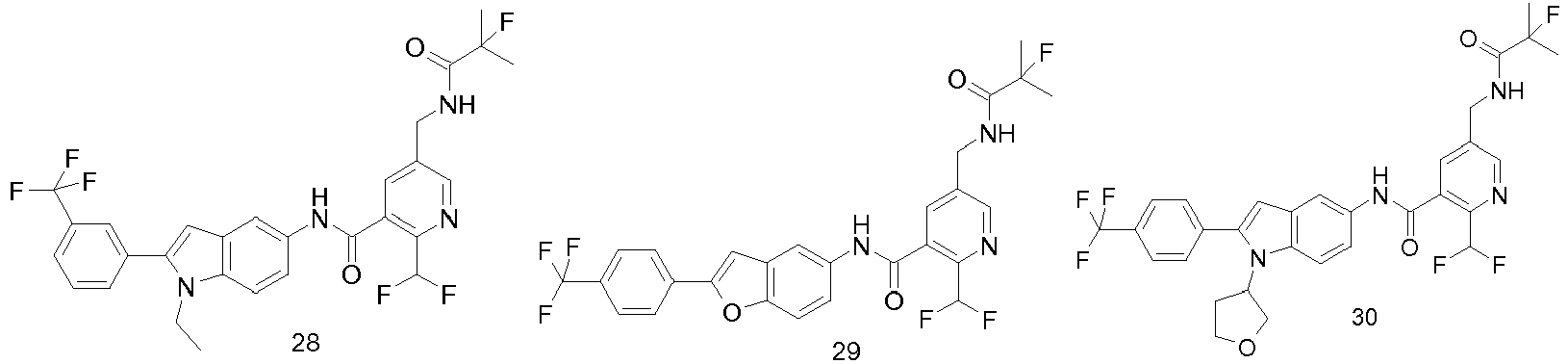


- A process for preparing the compound of formula (I), or a tautomer, mesomer, racemate, enantiomer, diastereomer, or mixtures thereof, or pharmaceutically acceptable salts thereof according to claim 1, comprising a step of:

wherein:Rc is selected from hydroxy and halogen;ring P, ring Q, A, B, Y, s, t and R1∼R4 are as defined in claim 1. - A compound of formula (IA), or a tautomer, mesomer, racemate, enantiomer, diastereomer, or mixtures thereof, or pharmaceutically acceptable salts thereof,


 R3 is selected from hydrogen, alkyl, and heterocyclyl, wherein said alkyl is optionally further substituted by one or more groups selected from the group consisting of alkoxy and heterocyclyl;R4 is selected from aryl and heteroaryl, wherein said aryl or heteroaryl is optionally further substituted by one or more groups selected from the group consisting of halogen and haloalkyl, wherein said haloalkyl is preferably trifluoromethyl; R4 is preferably phenyl, wherein said phenyl is further substituted by one halogen or haloalkyl;t is 1;provided that:when general formula (IA) is the following groups:
 R3 is selected from hydrogen and alkyl, wherein said alkyl is optionally further substituted by one or more groups selected from alkoxy and heterocyclyl;R4 is selected from phenyl, wherein said phenyl is further substituted by one haloalkyl, wherein said haloalkyl is preferably trifluoromethyl; orR3 is heterocyclyl;R4 is phenyl, wherein said phenyl is further substituted by one halogen or haloalkyl.
 - The compound of formula (IA), or a tautomer, mesomer, racemate, enantiomer, diastereomer, or mixtures thereof, or pharmaceutically acceptable salts thereof according to claim 12, wherein said compounds are selected from:






- A compound of formula (IB), or a tautomer, mesomer, racemate, enantiomer, diastereomer, or mixtures thereof, or pharmaceutically acceptable salts thereof,
 Rc is selected from hydroxy and halogen; andring Q, R1 and R2 are as defined in claim 1;wherein said compounds are selected from:


- A pharmaceutical composition comprising therapeutically effective amount of the compound of formula (I), or a tautomer, mesomer, racemate, enantiomer, diastereomer, or mixtures thereof, or pharmaceutically acceptable salts thereof according to claim 1, and pharmaceutically acceptable carrier, diluents or excipient.
- Use of the compound of formula (I), or a tautomer, mesomer, racemate, enantiomer, diastereomer, or mixtures thereof, or pharmaceutically acceptable salts thereof according to any one of claims 1 to 10, or the pharmaceutical composition according to claim 15, in the preparation of a medicament for the treatment of microsomal prostaglandin E synthase-1 mediated diseases.
- Use of the compound of formula (I), or a tautomer, mesomer, racemate, enantiomer, diastereomer, or mixtures thereof, or pharmaceutically acceptable salts thereof according to any one of claims 1 to 10, or the pharmaceutical composition according to claim 15, in the preparation of a medicament for the inhibition of microsomal prostaglandin E synthase-1.
- Use of the compound of formula (I), or a tautomer, mesomer, racemate, enantiomer, diastereomer, or mixtures thereof, or pharmaceutically acceptable salts thereof according to any one of claims 1 to 10, or the pharmaceutical composition according to claim 15, in the preparation of a medicament for the treatment and/or prevention of diseases or disorders, wherein said diseases or disorders are selected from the group consisting of inflammation, pain, cancer, diabetes and diabetic complications or neurodegenerative disorders, preferably inflammation or pain, more preferably osteoarthritis, rheumatoid arthritis, bursitis, ankylosing spondylitis, or pain associated with any one of these diseases or disorders.
Applications Claiming Priority (2)
| Application Number | Priority Date | Filing Date | Title |
|---|---|---|---|
| CN201410148152 | 2014-04-14 | ||
| PCT/CN2015/075531 WO2015158204A1 (en) | 2014-04-14 | 2015-03-31 | Amide derivatives and pharmaceutically acceptable salts thereof, preparation method therefor and medicinal application thereof |
Publications (3)
| Publication Number | Publication Date |
|---|---|
| EP3133068A1 true EP3133068A1 (en) | 2017-02-22 |
| EP3133068A4 EP3133068A4 (en) | 2018-02-21 |
| EP3133068B1 EP3133068B1 (en) | 2020-11-25 |
Family
ID=54323472
Family Applications (1)
| Application Number | Title | Priority Date | Filing Date |
|---|---|---|---|
| EP15779882.8A Not-in-force EP3133068B1 (en) | 2014-04-14 | 2015-03-31 | Amide derivatives and pharmaceutically acceptable salts thereof, preparation method therefor and medicinal application thereof |
Country Status (16)
| Country | Link |
|---|---|
| US (1) | US10081629B2 (en) |
| EP (1) | EP3133068B1 (en) |
| JP (1) | JP6688445B2 (en) |
| KR (1) | KR20160134865A (en) |
| CN (1) | CN105636951B (en) |
| AU (1) | AU2015246577B2 (en) |
| BR (1) | BR112016023679A2 (en) |
| CA (1) | CA2944357A1 (en) |
| DK (1) | DK3133068T3 (en) |
| ES (1) | ES2838625T3 (en) |
| HU (1) | HUE052925T2 (en) |
| MX (1) | MX368504B (en) |
| PT (1) | PT3133068T (en) |
| RU (1) | RU2681537C2 (en) |
| TW (1) | TWI714527B (en) |
| WO (1) | WO2015158204A1 (en) |
Families Citing this family (45)
| Publication number | Priority date | Publication date | Assignee | Title |
|---|---|---|---|---|
| GB201603311D0 (en) * | 2016-02-25 | 2016-04-13 | Jakobsson Per Johan | New uses and methods |
| CA3079483A1 (en) | 2017-11-22 | 2019-05-31 | Khondrion Ip B.V. | Compounds as mpges-1 inhibitors |
| CN114245807B (en) | 2019-06-25 | 2025-05-02 | 吉利德科学公司 | FLT3L-FC fusion proteins and methods of use |
| CN114302874B (en) * | 2019-08-26 | 2025-02-25 | 国际药品株式会社 | Indolecarboxamide derivatives and pharmaceutical compositions containing the same |
| PH12022550835A1 (en) | 2019-10-18 | 2023-07-03 | Forty Seven Inc | Combination therapies for treating myelodysplastic syndromes and acute myeloid leukemia |
| NZ786589A (en) | 2019-10-31 | 2025-03-28 | Forty Seven Llc | Anti-cd47 and anti-cd20 based treatment of blood cancer |
| TWI778443B (en) | 2019-11-12 | 2022-09-21 | 美商基利科學股份有限公司 | Mcl1 inhibitors |
| CN115362003B (en) | 2019-12-24 | 2024-03-22 | 卡尔那生物科学株式会社 | diacylglycerol kinase modulating compounds |
| TWI890283B (en) | 2020-02-14 | 2025-07-11 | 美商基利科學股份有限公司 | Antibodies and fusion proteins that bind to ccr8 and uses thereof |
| JP7564888B2 (en) | 2020-05-01 | 2024-10-09 | ギリアード サイエンシーズ, インコーポレイテッド | CD73-inhibitory 2,4-dioxopyrimidine compounds |
| TW202302145A (en) | 2021-04-14 | 2023-01-16 | 美商基利科學股份有限公司 | Co-inhibition of cd47/sirpα binding and nedd8-activating enzyme e1 regulatory subunit for the treatment of cancer |
| WO2022245671A1 (en) | 2021-05-18 | 2022-11-24 | Gilead Sciences, Inc. | Methods of using flt3l-fc fusion proteins |
| MX2023014762A (en) | 2021-06-23 | 2024-01-15 | Gilead Sciences Inc | DIACYL GLYCEROL KINASE MODULATING COMPOUNDS. |
| EP4359413A1 (en) | 2021-06-23 | 2024-05-01 | Gilead Sciences, Inc. | Diacylglyercol kinase modulating compounds |
| CN117355531A (en) | 2021-06-23 | 2024-01-05 | 吉利德科学公司 | diacylglycerol kinase modulating compounds |
| JP7651018B2 (en) | 2021-06-23 | 2025-03-25 | ギリアード サイエンシーズ, インコーポレイテッド | Diacylglycerol kinase modulating compounds |
| EP4423078A1 (en) | 2021-10-28 | 2024-09-04 | Gilead Sciences, Inc. | Pyridizin-3(2h)-one derivatives |
| PE20241186A1 (en) | 2021-10-29 | 2024-06-03 | Gilead Sciences Inc | CD73 COMPOUNDS |
| CN118488948A (en) | 2021-12-22 | 2024-08-13 | 吉利德科学公司 | IKAROS zinc finger family degraders and their uses |
| US20240124412A1 (en) | 2021-12-22 | 2024-04-18 | Gilead Sciences, Inc. | Ikaros zinc finger family degraders and uses thereof |
| CN118748993A (en) * | 2021-12-28 | 2024-10-08 | 日本新药株式会社 | Indazole compounds and drugs |
| CN114249680B (en) * | 2022-01-10 | 2022-12-27 | 深圳市乐土生物医药有限公司 | Indole derivatives, and synthesis method and application thereof |
| WO2023146844A1 (en) * | 2022-01-25 | 2023-08-03 | University Of Houston System | Non-steroidal anti-inflammatory compounds |
| CA3248911A1 (en) | 2022-01-28 | 2023-08-03 | Gilead Sciences, Inc. | Parp7 inhibitors |
| PL4245756T3 (en) | 2022-03-17 | 2025-02-17 | Gilead Sciences, Inc. | Ikaros zinc finger family degraders and uses thereof |
| AU2023240346A1 (en) | 2022-03-24 | 2024-09-19 | Gilead Sciences, Inc. | Combination therapy for treating trop-2 expressing cancers |
| TWI876305B (en) | 2022-04-05 | 2025-03-11 | 美商基利科學股份有限公司 | Combination therapy for treating colorectal cancer |
| EP4511127A1 (en) | 2022-04-21 | 2025-02-26 | Gilead Sciences, Inc. | Kras g12d modulating compounds |
| WO2024006929A1 (en) | 2022-07-01 | 2024-01-04 | Gilead Sciences, Inc. | Cd73 compounds |
| US20240091351A1 (en) | 2022-09-21 | 2024-03-21 | Gilead Sciences, Inc. | FOCAL IONIZING RADIATION AND CD47/SIRPa DISRUPTION ANTICANCER COMBINATION THERAPY |
| EP4638436A1 (en) | 2022-12-22 | 2025-10-29 | Gilead Sciences, Inc. | Prmt5 inhibitors and uses thereof |
| CN116199623B (en) * | 2023-02-13 | 2025-08-26 | 浙江科聚生物医药有限公司 | A preparation method for a key intermediate of Sotolacib |
| WO2024215754A1 (en) | 2023-04-11 | 2024-10-17 | Gilead Sciences, Inc. | Kras modulating compounds |
| PE20260121A1 (en) | 2023-04-21 | 2026-01-16 | Gilead Sciences Inc | PRMT5 INHIBITORS AND THEIR USES |
| JP2026522894A (en) | 2023-06-30 | 2026-07-09 | ギリアード サイエンシーズ, インコーポレイテッド | KRAS modulating compounds |
| AU2024297978A1 (en) | 2023-07-26 | 2026-02-05 | Gilead Sciences, Inc. | Parp7 inhibitors |
| CN121568935A (en) | 2023-07-26 | 2026-02-24 | 吉利德科学公司 | PARP7 inhibitors |
| EP4774280A1 (en) | 2023-09-08 | 2026-07-15 | Gilead Sciences, Inc. | Kras g12d modulating compounds |
| US20250109147A1 (en) | 2023-09-08 | 2025-04-03 | Gilead Sciences, Inc. | Kras g12d modulating compounds |
| WO2025096589A1 (en) | 2023-11-03 | 2025-05-08 | Gilead Sciences, Inc. | Prmt5 inhibitors and uses thereof |
| US20250230168A1 (en) | 2023-12-22 | 2025-07-17 | Gilead Sciences, Inc. | Azaspiro wrn inhibitors |
| WO2025245003A1 (en) | 2024-05-21 | 2025-11-27 | Gilead Sciences, Inc. | Prmt5 inhibitors and uses thereof |
| US20260098049A1 (en) | 2024-08-12 | 2026-04-09 | Gilead Sciences, Inc. | Kras modulating compounds |
| US20260130893A1 (en) | 2024-10-21 | 2026-05-14 | Gilead Sciences, Inc. | Prmt5 inhibitors and uses thereof |
| WO2026136515A1 (en) | 2024-12-19 | 2026-06-25 | Gilead Sciences, Inc. | Parp7 inhibitors |
Family Cites Families (22)
| Publication number | Priority date | Publication date | Assignee | Title |
|---|---|---|---|---|
| BE720261A (en) * | 1967-09-01 | 1969-02-28 | ||
| JP2000143635A (en) * | 1998-06-10 | 2000-05-26 | Takeda Chem Ind Ltd | Arterialization inhibitor |
| UA64842C2 (en) * | 1999-06-10 | 2004-03-15 | Ворнер-Ламберт Компані | Translated By Plaj IZOINDOLINE DERIVATIVES, PHARMACEUTICAL COMPOSITION BASED ON THEM, METHOD FOR TREATMENT OF ALZHEIMER'S DISEASE, METHOD FOR INHIBITING AMYLOID PROTEIN AGGREGATION AND METHOD FOR DETECTING AMYLOIDES |
| ITTO20040125A1 (en) * | 2004-03-01 | 2004-06-01 | Rotta Research Lab | NEW HETEROCYCLIC AMIDINS INHIBITIVE THE PRODUCTION OF NITROGEN OXIDE (NO) FOR ANTI-INFLAMMATORY AND ANALGESIC ACTIVITY |
| US8138360B2 (en) * | 2005-10-11 | 2012-03-20 | University of Pittsburgh—of the Commonwealth System of Higher Education | Isotopically-labeled benzofuran compounds as imaging agents for amyloidogenic proteins |
| BRPI0707719A2 (en) * | 2006-02-10 | 2011-05-10 | Summit Corp Plc | use of a compound or a pharmaceutically acceptable salt thereof |
| ITMI20061368A1 (en) * | 2006-07-14 | 2008-01-15 | Acraf | 2-ARILINDOLIC COMPOUND REPLACED IN POSITION 5, PHARMACEUTICAL COMPOSITION THAT INCLUDES IT AS WELL AS COMPOUNDS AND INTERMEDIATE PROCEDURES TO PREPARE IT |
| AU2008285289A1 (en) * | 2007-08-03 | 2009-02-12 | Biomarin Iga Limited | Drug combinations for the treatment of Duchenne muscular dystrophy |
| EP2078711A1 (en) * | 2007-12-28 | 2009-07-15 | AZIENDE CHIMICHE RIUNITE ANGELINI FRANCESCO A.C.R.A.F. S.p.A. | (Aza)indole derivative substituted in position 5, pharmaceutical composition comprising it, intermediate compounds and preparation process therefor |
| JP5579862B2 (en) * | 2009-10-23 | 2014-08-27 | ベーリンガー インゲルハイム インターナショナル ゲゼルシャフト ミット ベシュレンクテル ハフツング | Inhibitors of microsomal prostaglandin E2 synthase-1 |
| JP2011168515A (en) * | 2010-02-17 | 2011-09-01 | Kowa Co | 2-arylbenzoxazole compound having erythropoietin production-promoting action |
| AR084174A1 (en) * | 2010-12-21 | 2013-04-24 | Lilly Co Eli | IMIDAZOL-2-BENZAMIDA COMPOUNDS USEFUL FOR THE TREATMENT OF OSTEOARTRITIS AND A PHARMACEUTICAL COMPOSITION |
| AR086254A1 (en) | 2011-05-26 | 2013-11-27 | Lilly Co Eli | USEFUL IMIDAZOL DERIVATIVES FOR THE TREATMENT OF ARTHRITIS |
| JP5482745B2 (en) * | 2011-08-10 | 2014-05-07 | 株式会社デンソー | Silicon carbide semiconductor device and manufacturing method thereof |
| WO2013038308A1 (en) * | 2011-09-15 | 2013-03-21 | Glenmark Pharmaceuticals S.A. | SUBSTITUTED BICYCLIC HETEROARYL COMPOUNDS AS mPGES-1 INHIBITORS |
| WO2013072825A1 (en) | 2011-11-16 | 2013-05-23 | Glenmark Pharmaceuticals S.A. | Phtalazinone derivatives as mpegs -1 inhibitors |
| US9006257B2 (en) * | 2012-02-09 | 2015-04-14 | Glenmark Pharmaceuticals S.A. | Bicyclic compounds as mPGES-1 inhibitors |
| TWI638814B (en) * | 2012-10-31 | 2018-10-21 | 富山化學工業股份有限公司 | Novel amine derivative or salt thereof |
| FR3000493A1 (en) * | 2012-12-28 | 2014-07-04 | Oribase Pharma | NEW INHIBITORS OF PROTEIN KINASES |
| FR3000494B1 (en) * | 2012-12-28 | 2015-08-21 | Oribase Pharma | NOVEL AZAINDOLE DERIVATIVES AS INHIBITORS OF PROTEIN KINASES |
| WO2014167444A1 (en) * | 2013-04-08 | 2014-10-16 | Glenmark Pharmaceuticals S.A. | SUBSTITUTED BICYCLIC COMPOUNDS AS mPGES-1 INHIBITORS |
| WO2016090079A1 (en) * | 2014-12-05 | 2016-06-09 | Celgene Avilomics Research, Inc. | Heteroaryl compounds and uses thereof |
-
2015
- 2015-03-31 KR KR1020167031674A patent/KR20160134865A/en not_active Ceased
- 2015-03-31 CA CA2944357A patent/CA2944357A1/en not_active Abandoned
- 2015-03-31 WO PCT/CN2015/075531 patent/WO2015158204A1/en not_active Ceased
- 2015-03-31 AU AU2015246577A patent/AU2015246577B2/en not_active Ceased
- 2015-03-31 JP JP2016561312A patent/JP6688445B2/en not_active Expired - Fee Related
- 2015-03-31 ES ES15779882T patent/ES2838625T3/en active Active
- 2015-03-31 PT PT157798828T patent/PT3133068T/en unknown
- 2015-03-31 US US15/303,704 patent/US10081629B2/en not_active Expired - Fee Related
- 2015-03-31 DK DK15779882.8T patent/DK3133068T3/en active
- 2015-03-31 RU RU2016143333A patent/RU2681537C2/en active
- 2015-03-31 HU HUE15779882A patent/HUE052925T2/en unknown
- 2015-03-31 EP EP15779882.8A patent/EP3133068B1/en not_active Not-in-force
- 2015-03-31 MX MX2016013529A patent/MX368504B/en active IP Right Grant
- 2015-03-31 CN CN201580002234.2A patent/CN105636951B/en active Active
- 2015-03-31 BR BR112016023679A patent/BR112016023679A2/en not_active IP Right Cessation
- 2015-04-13 TW TW104111766A patent/TWI714527B/en not_active IP Right Cessation
Also Published As
| Publication number | Publication date |
|---|---|
| CN105636951B (en) | 2018-05-15 |
| RU2016143333A (en) | 2018-05-17 |
| TW201612158A (en) | 2016-04-01 |
| DK3133068T3 (en) | 2021-01-11 |
| MX368504B (en) | 2019-10-04 |
| CN105636951A (en) | 2016-06-01 |
| JP6688445B2 (en) | 2020-04-28 |
| RU2016143333A3 (en) | 2018-10-26 |
| WO2015158204A1 (en) | 2015-10-22 |
| AU2015246577B2 (en) | 2019-10-03 |
| TWI714527B (en) | 2021-01-01 |
| US20170037044A1 (en) | 2017-02-09 |
| AU2015246577A1 (en) | 2016-11-10 |
| JP2017513828A (en) | 2017-06-01 |
| US10081629B2 (en) | 2018-09-25 |
| MX2016013529A (en) | 2017-05-09 |
| PT3133068T (en) | 2021-01-06 |
| EP3133068B1 (en) | 2020-11-25 |
| RU2681537C2 (en) | 2019-03-07 |
| CA2944357A1 (en) | 2015-10-22 |
| HUE052925T2 (en) | 2021-05-28 |
| KR20160134865A (en) | 2016-11-23 |
| BR112016023679A2 (en) | 2017-08-15 |
| EP3133068A4 (en) | 2018-02-21 |
| ES2838625T3 (en) | 2021-07-02 |
Similar Documents
| Publication | Publication Date | Title |
|---|---|---|
| EP3133068B1 (en) | Amide derivatives and pharmaceutically acceptable salts thereof, preparation method therefor and medicinal application thereof | |
| CN101098872B (en) | Pyrrolopyrazines and pyrazolopyrazines useful as protein kinase inhibitors | |
| EP3495358B1 (en) | Amide-substituted heterocyclic compounds useful as modulators of il-12, il-23 and/or ifn alpha responses | |
| KR102233252B1 (en) | ALKYL-AMIDE-SUBSTITUTED PYRIDYL COMPOUNDS USEFUL AS MODULATORS OF IL-12, IL-23 AND/OR IFNα RESPONSES | |
| JP6050241B2 (en) | Novel compounds for the treatment of neurodegenerative diseases | |
| SG182187A1 (en) | 5-heteroaryl substituted indazoles as kinase inhibitors | |
| EP3814331B1 (en) | Novel lxr modulators with bicyclic core moiety | |
| EP2452940A1 (en) | Azabicyclo compound and salt thereof | |
| EP2253618A1 (en) | Compound having 6-membered aromatic ring | |
| WO2005035501A1 (en) | Novel olefin derivative | |
| KR101905295B1 (en) | Naphthyridinedione derivatives | |
| JP7442652B2 (en) | Azabicyclo-substituted oxaspirocyclic derivatives, their preparation methods and medical uses | |
| CN107163044A (en) | A class of naphthalene diketone compounds and their derivatives with protease modification activity | |
| US20090093476A1 (en) | Pyrrolo[1,2-a]quinoxaline derivatives as adenosine a3 receptor modulators and uses thereof | |
| CN108349956A (en) | Pyridone derivatives and their use as kinase inhibitors | |
| JP7862306B2 (en) | Alkinyl-(heteroaryl)-carboxamide HCN1 inhibitor | |
| TW202606684A (en) | ALOX inhibitor and use thereof | |
| WO2024249488A2 (en) | Inhibitors of dyrk1a | |
| HK40052052A (en) | Novel lxr modulators with bicyclic core moiety | |
| HK40052052B (en) | Novel lxr modulators with bicyclic core moiety | |
| HK40010074B (en) | Amide-substituted heterocyclic compounds useful as modulators of il-12, il-23 and/or ifn alpha responses | |
| CN101589036A (en) | Aminopyrimidines useful as inhibitors of protein kinases | |
| HK1164869B (en) | Azabicyclo compound and salt thereof |
Legal Events
| Date | Code | Title | Description |
|---|---|---|---|
| STAA | Information on the status of an ep patent application or granted ep patent |
Free format text: STATUS: THE INTERNATIONAL PUBLICATION HAS BEEN MADE |
|
| PUAI | Public reference made under article 153(3) epc to a published international application that has entered the european phase |
Free format text: ORIGINAL CODE: 0009012 |
|
| STAA | Information on the status of an ep patent application or granted ep patent |
Free format text: STATUS: REQUEST FOR EXAMINATION WAS MADE |
|
| 17P | Request for examination filed |
Effective date: 20161111 |
|
| AK | Designated contracting states |
Kind code of ref document: A1 Designated state(s): AL AT BE BG CH CY CZ DE DK EE ES FI FR GB GR HR HU IE IS IT LI LT LU LV MC MK MT NL NO PL PT RO RS SE SI SK SM TR |
|
| AX | Request for extension of the european patent |
Extension state: BA ME |
|
| DAV | Request for validation of the european patent (deleted) | ||
| DAX | Request for extension of the european patent (deleted) | ||
| A4 | Supplementary search report drawn up and despatched |
Effective date: 20180124 |
|
| STAA | Information on the status of an ep patent application or granted ep patent |
Free format text: STATUS: EXAMINATION IS IN PROGRESS |
|
| 17Q | First examination report despatched |
Effective date: 20190102 |
|
| RIC1 | Information provided on ipc code assigned before grant |
Ipc: C07C 233/47 20060101ALI20200506BHEP Ipc: C07D 405/04 20060101ALI20200506BHEP Ipc: C07D 235/18 20060101ALI20200506BHEP Ipc: C07D 401/12 20060101AFI20200506BHEP Ipc: A61K 31/4439 20060101ALI20200506BHEP Ipc: C07D 213/80 20060101ALI20200506BHEP Ipc: C07D 405/14 20060101ALI20200506BHEP Ipc: C07D 213/78 20060101ALI20200506BHEP Ipc: C07D 413/12 20060101ALI20200506BHEP Ipc: C07C 233/63 20060101ALI20200506BHEP Ipc: C07D 209/08 20060101ALI20200506BHEP Ipc: C07D 209/44 20060101ALI20200506BHEP Ipc: C07D 263/57 20060101ALI20200506BHEP Ipc: C07D 401/04 20060101ALI20200506BHEP Ipc: A61K 31/404 20060101ALI20200506BHEP Ipc: C07D 231/56 20060101ALI20200506BHEP Ipc: C07D 405/12 20060101ALI20200506BHEP Ipc: C07D 417/12 20060101ALI20200506BHEP Ipc: A61K 31/437 20060101ALI20200506BHEP Ipc: C07D 209/10 20060101ALI20200506BHEP Ipc: C07D 471/04 20060101ALI20200506BHEP |
|
| GRAP | Despatch of communication of intention to grant a patent |
Free format text: ORIGINAL CODE: EPIDOSNIGR1 |
|
| STAA | Information on the status of an ep patent application or granted ep patent |
Free format text: STATUS: GRANT OF PATENT IS INTENDED |
|
| INTG | Intention to grant announced |
Effective date: 20200629 |
|
| GRAS | Grant fee paid |
Free format text: ORIGINAL CODE: EPIDOSNIGR3 |
|
| GRAA | (expected) grant |
Free format text: ORIGINAL CODE: 0009210 |
|
| STAA | Information on the status of an ep patent application or granted ep patent |
Free format text: STATUS: THE PATENT HAS BEEN GRANTED |
|
| AK | Designated contracting states |
Kind code of ref document: B1 Designated state(s): AL AT BE BG CH CY CZ DE DK EE ES FI FR GB GR HR HU IE IS IT LI LT LU LV MC MK MT NL NO PL PT RO RS SE SI SK SM TR |
|
| REG | Reference to a national code |
Ref country code: GB Ref legal event code: FG4D |
|
| REG | Reference to a national code |
Ref country code: CH Ref legal event code: EP |
|
| REG | Reference to a national code |
Ref country code: CH Ref legal event code: NV Representative=s name: NOVAGRAAF INTERNATIONAL SA, CH Ref country code: AT Ref legal event code: REF Ref document number: 1338145 Country of ref document: AT Kind code of ref document: T Effective date: 20201215 |
|
| REG | Reference to a national code |
Ref country code: DE Ref legal event code: R096 Ref document number: 602015062574 Country of ref document: DE |
|
| REG | Reference to a national code |
Ref country code: IE Ref legal event code: FG4D |
|
| REG | Reference to a national code |
Ref country code: PT Ref legal event code: SC4A Ref document number: 3133068 Country of ref document: PT Date of ref document: 20210106 Kind code of ref document: T Free format text: AVAILABILITY OF NATIONAL TRANSLATION Effective date: 20201229 |
|
| REG | Reference to a national code |
Ref country code: DK Ref legal event code: T3 Effective date: 20210107 |
|
| REG | Reference to a national code |
Ref country code: FI Ref legal event code: FGE |
|
| REG | Reference to a national code |
Ref country code: NL Ref legal event code: FP |
|
| REG | Reference to a national code |
Ref country code: SE Ref legal event code: TRGR |
|
| REG | Reference to a national code |
Ref country code: GR Ref legal event code: EP Ref document number: 20200403621 Country of ref document: GR Effective date: 20210215 |
|
| REG | Reference to a national code |
Ref country code: AT Ref legal event code: MK05 Ref document number: 1338145 Country of ref document: AT Kind code of ref document: T Effective date: 20201125 |
|
| PG25 | Lapsed in a contracting state [announced via postgrant information from national office to epo] |
Ref country code: NO Free format text: LAPSE BECAUSE OF FAILURE TO SUBMIT A TRANSLATION OF THE DESCRIPTION OR TO PAY THE FEE WITHIN THE PRESCRIBED TIME-LIMIT Effective date: 20210225 Ref country code: RS Free format text: LAPSE BECAUSE OF FAILURE TO SUBMIT A TRANSLATION OF THE DESCRIPTION OR TO PAY THE FEE WITHIN THE PRESCRIBED TIME-LIMIT Effective date: 20201125 |
|
| PGFP | Annual fee paid to national office [announced via postgrant information from national office to epo] |
Ref country code: PT Payment date: 20210316 Year of fee payment: 7 Ref country code: NL Payment date: 20210312 Year of fee payment: 7 Ref country code: IT Payment date: 20210211 Year of fee payment: 7 Ref country code: GR Payment date: 20210211 Year of fee payment: 7 Ref country code: FR Payment date: 20210210 Year of fee payment: 7 Ref country code: CH Payment date: 20210317 Year of fee payment: 7 Ref country code: FI Payment date: 20210309 Year of fee payment: 7 |
|
| REG | Reference to a national code |
Ref country code: HU Ref legal event code: AG4A Ref document number: E052925 Country of ref document: HU |
|
| PG25 | Lapsed in a contracting state [announced via postgrant information from national office to epo] |
Ref country code: BG Free format text: LAPSE BECAUSE OF FAILURE TO SUBMIT A TRANSLATION OF THE DESCRIPTION OR TO PAY THE FEE WITHIN THE PRESCRIBED TIME-LIMIT Effective date: 20210225 Ref country code: AT Free format text: LAPSE BECAUSE OF FAILURE TO SUBMIT A TRANSLATION OF THE DESCRIPTION OR TO PAY THE FEE WITHIN THE PRESCRIBED TIME-LIMIT Effective date: 20201125 Ref country code: IS Free format text: LAPSE BECAUSE OF FAILURE TO SUBMIT A TRANSLATION OF THE DESCRIPTION OR TO PAY THE FEE WITHIN THE PRESCRIBED TIME-LIMIT Effective date: 20210325 Ref country code: LV Free format text: LAPSE BECAUSE OF FAILURE TO SUBMIT A TRANSLATION OF THE DESCRIPTION OR TO PAY THE FEE WITHIN THE PRESCRIBED TIME-LIMIT Effective date: 20201125 Ref country code: PL Free format text: LAPSE BECAUSE OF FAILURE TO SUBMIT A TRANSLATION OF THE DESCRIPTION OR TO PAY THE FEE WITHIN THE PRESCRIBED TIME-LIMIT Effective date: 20201125 |
|
| PGFP | Annual fee paid to national office [announced via postgrant information from national office to epo] |
Ref country code: BE Payment date: 20210217 Year of fee payment: 7 Ref country code: DK Payment date: 20210310 Year of fee payment: 7 Ref country code: GB Payment date: 20210317 Year of fee payment: 7 Ref country code: HU Payment date: 20210213 Year of fee payment: 7 Ref country code: DE Payment date: 20210316 Year of fee payment: 7 Ref country code: SE Payment date: 20210311 Year of fee payment: 7 |
|
| REG | Reference to a national code |
Ref country code: LT Ref legal event code: MG9D |
|
| PG25 | Lapsed in a contracting state [announced via postgrant information from national office to epo] |
Ref country code: HR Free format text: LAPSE BECAUSE OF FAILURE TO SUBMIT A TRANSLATION OF THE DESCRIPTION OR TO PAY THE FEE WITHIN THE PRESCRIBED TIME-LIMIT Effective date: 20201125 |
|
| REG | Reference to a national code |
Ref country code: ES Ref legal event code: FG2A Ref document number: 2838625 Country of ref document: ES Kind code of ref document: T3 Effective date: 20210702 |
|
| PG25 | Lapsed in a contracting state [announced via postgrant information from national office to epo] |
Ref country code: SM Free format text: LAPSE BECAUSE OF FAILURE TO SUBMIT A TRANSLATION OF THE DESCRIPTION OR TO PAY THE FEE WITHIN THE PRESCRIBED TIME-LIMIT Effective date: 20201125 Ref country code: EE Free format text: LAPSE BECAUSE OF FAILURE TO SUBMIT A TRANSLATION OF THE DESCRIPTION OR TO PAY THE FEE WITHIN THE PRESCRIBED TIME-LIMIT Effective date: 20201125 Ref country code: CZ Free format text: LAPSE BECAUSE OF FAILURE TO SUBMIT A TRANSLATION OF THE DESCRIPTION OR TO PAY THE FEE WITHIN THE PRESCRIBED TIME-LIMIT Effective date: 20201125 Ref country code: LT Free format text: LAPSE BECAUSE OF FAILURE TO SUBMIT A TRANSLATION OF THE DESCRIPTION OR TO PAY THE FEE WITHIN THE PRESCRIBED TIME-LIMIT Effective date: 20201125 Ref country code: RO Free format text: LAPSE BECAUSE OF FAILURE TO SUBMIT A TRANSLATION OF THE DESCRIPTION OR TO PAY THE FEE WITHIN THE PRESCRIBED TIME-LIMIT Effective date: 20201125 Ref country code: SK Free format text: LAPSE BECAUSE OF FAILURE TO SUBMIT A TRANSLATION OF THE DESCRIPTION OR TO PAY THE FEE WITHIN THE PRESCRIBED TIME-LIMIT Effective date: 20201125 |
|
| REG | Reference to a national code |
Ref country code: DE Ref legal event code: R097 Ref document number: 602015062574 Country of ref document: DE |
|
| PGFP | Annual fee paid to national office [announced via postgrant information from national office to epo] |
Ref country code: ES Payment date: 20210407 Year of fee payment: 7 |
|
| PLBE | No opposition filed within time limit |
Free format text: ORIGINAL CODE: 0009261 |
|
| STAA | Information on the status of an ep patent application or granted ep patent |
Free format text: STATUS: NO OPPOSITION FILED WITHIN TIME LIMIT |
|
| PG25 | Lapsed in a contracting state [announced via postgrant information from national office to epo] |
Ref country code: MC Free format text: LAPSE BECAUSE OF FAILURE TO SUBMIT A TRANSLATION OF THE DESCRIPTION OR TO PAY THE FEE WITHIN THE PRESCRIBED TIME-LIMIT Effective date: 20201125 Ref country code: AL Free format text: LAPSE BECAUSE OF FAILURE TO SUBMIT A TRANSLATION OF THE DESCRIPTION OR TO PAY THE FEE WITHIN THE PRESCRIBED TIME-LIMIT Effective date: 20201125 |
|
| 26N | No opposition filed |
Effective date: 20210826 |
|
| PG25 | Lapsed in a contracting state [announced via postgrant information from national office to epo] |
Ref country code: SI Free format text: LAPSE BECAUSE OF FAILURE TO SUBMIT A TRANSLATION OF THE DESCRIPTION OR TO PAY THE FEE WITHIN THE PRESCRIBED TIME-LIMIT Effective date: 20201125 |
|
| PG25 | Lapsed in a contracting state [announced via postgrant information from national office to epo] |
Ref country code: LU Free format text: LAPSE BECAUSE OF NON-PAYMENT OF DUE FEES Effective date: 20210331 Ref country code: IE Free format text: LAPSE BECAUSE OF NON-PAYMENT OF DUE FEES Effective date: 20210331 |
|
| PG25 | Lapsed in a contracting state [announced via postgrant information from national office to epo] |
Ref country code: IS Free format text: LAPSE BECAUSE OF FAILURE TO SUBMIT A TRANSLATION OF THE DESCRIPTION OR TO PAY THE FEE WITHIN THE PRESCRIBED TIME-LIMIT Effective date: 20210325 |
|
| REG | Reference to a national code |
Ref country code: DE Ref legal event code: R119 Ref document number: 602015062574 Country of ref document: DE |
|
| REG | Reference to a national code |
Ref country code: FI Ref legal event code: MAE |
|
| REG | Reference to a national code |
Ref country code: DK Ref legal event code: EBP Effective date: 20220331 |
|
| PG25 | Lapsed in a contracting state [announced via postgrant information from national office to epo] |
Ref country code: PT Free format text: LAPSE BECAUSE OF NON-PAYMENT OF DUE FEES Effective date: 20220930 Ref country code: FI Free format text: LAPSE BECAUSE OF NON-PAYMENT OF DUE FEES Effective date: 20220331 |
|
| REG | Reference to a national code |
Ref country code: CH Ref legal event code: PL |
|
| REG | Reference to a national code |
Ref country code: NL Ref legal event code: MM Effective date: 20220401 |
|
| GBPC | Gb: european patent ceased through non-payment of renewal fee |
Effective date: 20220331 |
|
| REG | Reference to a national code |
Ref country code: SE Ref legal event code: EUG |
|
| REG | Reference to a national code |
Ref country code: BE Ref legal event code: MM Effective date: 20220331 |
|
| PG25 | Lapsed in a contracting state [announced via postgrant information from national office to epo] |
Ref country code: SE Free format text: LAPSE BECAUSE OF NON-PAYMENT OF DUE FEES Effective date: 20220401 Ref country code: NL Free format text: LAPSE BECAUSE OF NON-PAYMENT OF DUE FEES Effective date: 20220401 Ref country code: LI Free format text: LAPSE BECAUSE OF NON-PAYMENT OF DUE FEES Effective date: 20220331 Ref country code: HU Free format text: LAPSE BECAUSE OF NON-PAYMENT OF DUE FEES Effective date: 20220401 Ref country code: GB Free format text: LAPSE BECAUSE OF NON-PAYMENT OF DUE FEES Effective date: 20220331 Ref country code: FR Free format text: LAPSE BECAUSE OF NON-PAYMENT OF DUE FEES Effective date: 20220331 Ref country code: DE Free format text: LAPSE BECAUSE OF NON-PAYMENT OF DUE FEES Effective date: 20221001 Ref country code: CH Free format text: LAPSE BECAUSE OF NON-PAYMENT OF DUE FEES Effective date: 20220331 |
|
| PG25 | Lapsed in a contracting state [announced via postgrant information from national office to epo] |
Ref country code: GR Free format text: LAPSE BECAUSE OF NON-PAYMENT OF DUE FEES Effective date: 20221006 Ref country code: BE Free format text: LAPSE BECAUSE OF NON-PAYMENT OF DUE FEES Effective date: 20220331 |
|
| PG25 | Lapsed in a contracting state [announced via postgrant information from national office to epo] |
Ref country code: DK Free format text: LAPSE BECAUSE OF NON-PAYMENT OF DUE FEES Effective date: 20220331 |
|
| REG | Reference to a national code |
Ref country code: ES Ref legal event code: FD2A Effective date: 20230526 |
|
| PG25 | Lapsed in a contracting state [announced via postgrant information from national office to epo] |
Ref country code: IT Free format text: LAPSE BECAUSE OF NON-PAYMENT OF DUE FEES Effective date: 20220331 |
|
| PG25 | Lapsed in a contracting state [announced via postgrant information from national office to epo] |
Ref country code: CY Free format text: LAPSE BECAUSE OF FAILURE TO SUBMIT A TRANSLATION OF THE DESCRIPTION OR TO PAY THE FEE WITHIN THE PRESCRIBED TIME-LIMIT Effective date: 20201125 |
|
| PG25 | Lapsed in a contracting state [announced via postgrant information from national office to epo] |
Ref country code: ES Free format text: LAPSE BECAUSE OF NON-PAYMENT OF DUE FEES Effective date: 20220401 |
|
| PG25 | Lapsed in a contracting state [announced via postgrant information from national office to epo] |
Ref country code: MK Free format text: LAPSE BECAUSE OF FAILURE TO SUBMIT A TRANSLATION OF THE DESCRIPTION OR TO PAY THE FEE WITHIN THE PRESCRIBED TIME-LIMIT Effective date: 20201125 |
|
| PG25 | Lapsed in a contracting state [announced via postgrant information from national office to epo] |
Ref country code: MT Free format text: LAPSE BECAUSE OF FAILURE TO SUBMIT A TRANSLATION OF THE DESCRIPTION OR TO PAY THE FEE WITHIN THE PRESCRIBED TIME-LIMIT Effective date: 20201125 |
|
| PG25 | Lapsed in a contracting state [announced via postgrant information from national office to epo] |
Ref country code: TR Free format text: LAPSE BECAUSE OF FAILURE TO SUBMIT A TRANSLATION OF THE DESCRIPTION OR TO PAY THE FEE WITHIN THE PRESCRIBED TIME-LIMIT Effective date: 20201125 |