EP3131974B1 - Fluorescent reactive dyes, process for the production thereof and their use - Google Patents
Fluorescent reactive dyes, process for the production thereof and their use Download PDFInfo
- Publication number
- EP3131974B1 EP3131974B1 EP15715232.3A EP15715232A EP3131974B1 EP 3131974 B1 EP3131974 B1 EP 3131974B1 EP 15715232 A EP15715232 A EP 15715232A EP 3131974 B1 EP3131974 B1 EP 3131974B1
- Authority
- EP
- European Patent Office
- Prior art keywords
- fibres
- alkyl
- hydrogen
- group
- aromatic
- Prior art date
- Legal status (The legal status is an assumption and is not a legal conclusion. Google has not performed a legal analysis and makes no representation as to the accuracy of the status listed.)
- Active
Links
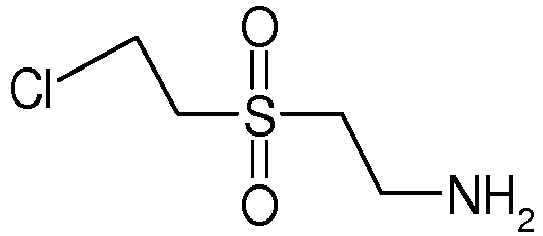
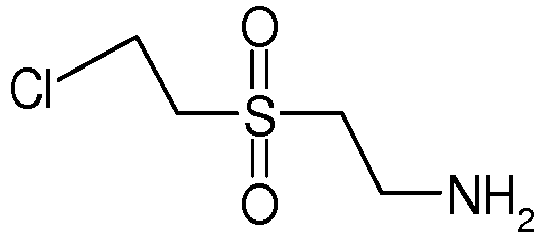
- HPKMXOWNGSBOME-UHFFFAOYSA-N NCCS(CCCl)(=O)=O Chemical compound NCCS(CCCl)(=O)=O HPKMXOWNGSBOME-UHFFFAOYSA-N 0.000 description 5
- PDROMXDNKYMTMG-UHFFFAOYSA-N OCCS(CCNc1ccccc1)(=O)=O Chemical compound OCCS(CCNc1ccccc1)(=O)=O PDROMXDNKYMTMG-UHFFFAOYSA-N 0.000 description 3
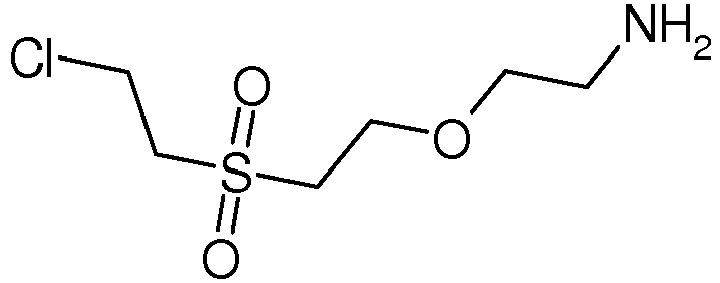
- LQCJAHQKDXSNOA-UHFFFAOYSA-N NCCOCCS(CCCl)(=O)=O Chemical compound NCCOCCS(CCCl)(=O)=O LQCJAHQKDXSNOA-UHFFFAOYSA-N 0.000 description 2
- CSCNRHJJGXZFGX-UHFFFAOYSA-N Nc(cc1)ccc1S(CCO)(=O)=O Chemical compound Nc(cc1)ccc1S(CCO)(=O)=O CSCNRHJJGXZFGX-UHFFFAOYSA-N 0.000 description 2
- 0 *CCS(c(cc1*)c(*)cc1N)(=O)=O Chemical compound *CCS(c(cc1*)c(*)cc1N)(=O)=O 0.000 description 1
- KRNJGMBSLSISNM-UHFFFAOYSA-N CCNc1cccc(S(CCO)(=O)=O)c1 Chemical compound CCNc1cccc(S(CCO)(=O)=O)c1 KRNJGMBSLSISNM-UHFFFAOYSA-N 0.000 description 1
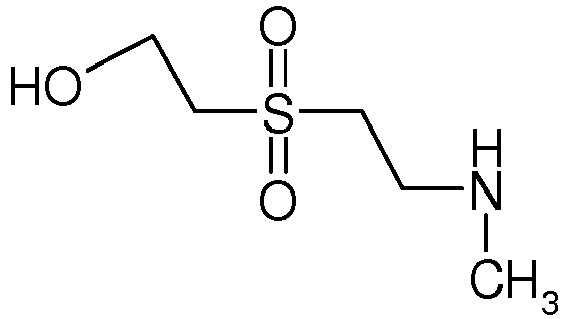
- JBWDJFXHPCIAGI-UHFFFAOYSA-N CNCCS(CCO)(=O)=O Chemical compound CNCCS(CCO)(=O)=O JBWDJFXHPCIAGI-UHFFFAOYSA-N 0.000 description 1
- BMDXUOISXOQCJR-UHFFFAOYSA-N Cc(c(S(CCO)(=O)=O)c1)cc(N)c1OC Chemical compound Cc(c(S(CCO)(=O)=O)c1)cc(N)c1OC BMDXUOISXOQCJR-UHFFFAOYSA-N 0.000 description 1
- OPFUDYUTYZCCKW-UHFFFAOYSA-N Nc(ccc(S(CCO)(=O)=O)c1)c1S(O)(=O)=O Chemical compound Nc(ccc(S(CCO)(=O)=O)c1)c1S(O)(=O)=O OPFUDYUTYZCCKW-UHFFFAOYSA-N 0.000 description 1
Classifications
-
- C—CHEMISTRY; METALLURGY
- C09—DYES; PAINTS; POLISHES; NATURAL RESINS; ADHESIVES; COMPOSITIONS NOT OTHERWISE PROVIDED FOR; APPLICATIONS OF MATERIALS NOT OTHERWISE PROVIDED FOR
- C09B—ORGANIC DYES OR CLOSELY-RELATED COMPOUNDS FOR PRODUCING DYES, e.g. PIGMENTS; MORDANTS; LAKES
- C09B11/00—Diaryl- or thriarylmethane dyes
- C09B11/04—Diaryl- or thriarylmethane dyes derived from triarylmethanes, i.e. central C-atom is substituted by amino, cyano, alkyl
- C09B11/10—Amino derivatives of triarylmethanes
- C09B11/24—Phthaleins containing amino groups ; Phthalanes; Fluoranes; Phthalides; Rhodamine dyes; Phthaleins having heterocyclic aryl rings; Lactone or lactame forms of triarylmethane dyes
-
- C—CHEMISTRY; METALLURGY
- C09—DYES; PAINTS; POLISHES; NATURAL RESINS; ADHESIVES; COMPOSITIONS NOT OTHERWISE PROVIDED FOR; APPLICATIONS OF MATERIALS NOT OTHERWISE PROVIDED FOR
- C09B—ORGANIC DYES OR CLOSELY-RELATED COMPOUNDS FOR PRODUCING DYES, e.g. PIGMENTS; MORDANTS; LAKES
- C09B62/00—Reactive dyes, i.e. dyes which form covalent bonds with the substrates or which polymerise with themselves
- C09B62/02—Reactive dyes, i.e. dyes which form covalent bonds with the substrates or which polymerise with themselves with the reactive group directly attached to a heterocyclic ring
- C09B62/021—Specific dyes not provided for in groups C09B62/024 - C09B62/038
-
- C—CHEMISTRY; METALLURGY
- C09—DYES; PAINTS; POLISHES; NATURAL RESINS; ADHESIVES; COMPOSITIONS NOT OTHERWISE PROVIDED FOR; APPLICATIONS OF MATERIALS NOT OTHERWISE PROVIDED FOR
- C09B—ORGANIC DYES OR CLOSELY-RELATED COMPOUNDS FOR PRODUCING DYES, e.g. PIGMENTS; MORDANTS; LAKES
- C09B62/00—Reactive dyes, i.e. dyes which form covalent bonds with the substrates or which polymerise with themselves
- C09B62/02—Reactive dyes, i.e. dyes which form covalent bonds with the substrates or which polymerise with themselves with the reactive group directly attached to a heterocyclic ring
- C09B62/04—Reactive dyes, i.e. dyes which form covalent bonds with the substrates or which polymerise with themselves with the reactive group directly attached to a heterocyclic ring to a triazine ring
-
- C—CHEMISTRY; METALLURGY
- C09—DYES; PAINTS; POLISHES; NATURAL RESINS; ADHESIVES; COMPOSITIONS NOT OTHERWISE PROVIDED FOR; APPLICATIONS OF MATERIALS NOT OTHERWISE PROVIDED FOR
- C09B—ORGANIC DYES OR CLOSELY-RELATED COMPOUNDS FOR PRODUCING DYES, e.g. PIGMENTS; MORDANTS; LAKES
- C09B62/00—Reactive dyes, i.e. dyes which form covalent bonds with the substrates or which polymerise with themselves
- C09B62/44—Reactive dyes, i.e. dyes which form covalent bonds with the substrates or which polymerise with themselves with the reactive group not directly attached to a heterocyclic ring
- C09B62/4401—Reactive dyes, i.e. dyes which form covalent bonds with the substrates or which polymerise with themselves with the reactive group not directly attached to a heterocyclic ring with two or more reactive groups at least one of them being directly attached to a heterocyclic system and at least one of them being directly attached to a non-heterocyclic system
- C09B62/4403—Reactive dyes, i.e. dyes which form covalent bonds with the substrates or which polymerise with themselves with the reactive group not directly attached to a heterocyclic ring with two or more reactive groups at least one of them being directly attached to a heterocyclic system and at least one of them being directly attached to a non-heterocyclic system the heterocyclic system being a triazine ring
-
- C—CHEMISTRY; METALLURGY
- C09—DYES; PAINTS; POLISHES; NATURAL RESINS; ADHESIVES; COMPOSITIONS NOT OTHERWISE PROVIDED FOR; APPLICATIONS OF MATERIALS NOT OTHERWISE PROVIDED FOR
- C09B—ORGANIC DYES OR CLOSELY-RELATED COMPOUNDS FOR PRODUCING DYES, e.g. PIGMENTS; MORDANTS; LAKES
- C09B62/00—Reactive dyes, i.e. dyes which form covalent bonds with the substrates or which polymerise with themselves
- C09B62/44—Reactive dyes, i.e. dyes which form covalent bonds with the substrates or which polymerise with themselves with the reactive group not directly attached to a heterocyclic ring
- C09B62/4401—Reactive dyes, i.e. dyes which form covalent bonds with the substrates or which polymerise with themselves with the reactive group not directly attached to a heterocyclic ring with two or more reactive groups at least one of them being directly attached to a heterocyclic system and at least one of them being directly attached to a non-heterocyclic system
- C09B62/4422—Reactive dyes, i.e. dyes which form covalent bonds with the substrates or which polymerise with themselves with the reactive group not directly attached to a heterocyclic ring with two or more reactive groups at least one of them being directly attached to a heterocyclic system and at least one of them being directly attached to a non-heterocyclic system the heterocyclic system being a pyrimidine ring
-
- C—CHEMISTRY; METALLURGY
- C09—DYES; PAINTS; POLISHES; NATURAL RESINS; ADHESIVES; COMPOSITIONS NOT OTHERWISE PROVIDED FOR; APPLICATIONS OF MATERIALS NOT OTHERWISE PROVIDED FOR
- C09B—ORGANIC DYES OR CLOSELY-RELATED COMPOUNDS FOR PRODUCING DYES, e.g. PIGMENTS; MORDANTS; LAKES
- C09B62/00—Reactive dyes, i.e. dyes which form covalent bonds with the substrates or which polymerise with themselves
- C09B62/44—Reactive dyes, i.e. dyes which form covalent bonds with the substrates or which polymerise with themselves with the reactive group not directly attached to a heterocyclic ring
- C09B62/503—Reactive dyes, i.e. dyes which form covalent bonds with the substrates or which polymerise with themselves with the reactive group not directly attached to a heterocyclic ring the reactive group being an esterified or non-esterified hydroxyalkyl sulfonyl or mercaptoalkyl sulfonyl group, a quaternised or non-quaternised aminoalkyl sulfonyl group, a heterylmercapto alkyl sulfonyl group, a vinyl sulfonyl or a substituted vinyl sulfonyl group, or a thiophene-dioxide group
-
- C—CHEMISTRY; METALLURGY
- C09—DYES; PAINTS; POLISHES; NATURAL RESINS; ADHESIVES; COMPOSITIONS NOT OTHERWISE PROVIDED FOR; APPLICATIONS OF MATERIALS NOT OTHERWISE PROVIDED FOR
- C09D—COATING COMPOSITIONS, e.g. PAINTS, VARNISHES OR LACQUERS; FILLING PASTES; CHEMICAL PAINT OR INK REMOVERS; INKS; CORRECTING FLUIDS; WOODSTAINS; PASTES OR SOLIDS FOR COLOURING OR PRINTING; USE OF MATERIALS THEREFOR
- C09D11/00—Inks
- C09D11/02—Printing inks
- C09D11/03—Printing inks characterised by features other than the chemical nature of the binder
- C09D11/037—Printing inks characterised by features other than the chemical nature of the binder characterised by the pigment
-
- D—TEXTILES; PAPER
- D06—TREATMENT OF TEXTILES OR THE LIKE; LAUNDERING; FLEXIBLE MATERIALS NOT OTHERWISE PROVIDED FOR
- D06P—DYEING OR PRINTING TEXTILES; DYEING LEATHER, FURS OR SOLID MACROMOLECULAR SUBSTANCES IN ANY FORM
- D06P1/00—General processes of dyeing or printing textiles, or general processes of dyeing leather, furs, or solid macromolecular substances in any form, classified according to the dyes, pigments, or auxiliary substances employed
- D06P1/38—General processes of dyeing or printing textiles, or general processes of dyeing leather, furs, or solid macromolecular substances in any form, classified according to the dyes, pigments, or auxiliary substances employed using reactive dyes
- D06P1/382—General processes of dyeing or printing textiles, or general processes of dyeing leather, furs, or solid macromolecular substances in any form, classified according to the dyes, pigments, or auxiliary substances employed using reactive dyes reactive group directly attached to heterocyclic group
-
- D—TEXTILES; PAPER
- D06—TREATMENT OF TEXTILES OR THE LIKE; LAUNDERING; FLEXIBLE MATERIALS NOT OTHERWISE PROVIDED FOR
- D06P—DYEING OR PRINTING TEXTILES; DYEING LEATHER, FURS OR SOLID MACROMOLECULAR SUBSTANCES IN ANY FORM
- D06P3/00—Special processes of dyeing or printing textiles, or dyeing leather, furs, or solid macromolecular substances in any form, classified according to the material treated
- D06P3/58—Material containing hydroxyl groups
- D06P3/60—Natural or regenerated cellulose
Definitions
- the present invention relates to the technical field of reactive dyestuffs for dyeing and printing of hydroxyl-, amino- and/or carboxamido-containing material.
- Fluorescent reactive dyes are known from prior art and can be used as colorants in different applications, see for example DE 2337488 , EP 153480 , DE 2442839 and DE 1955849 .
- the chromophore in this invention is a group having the following structure:
- a group removable under alkaline conditions is a group which will leave the molecule under alkaline conditions to yield a vinyl sulfone.
- Non-limiting examples of such groups are OSO 3 M, SSO 3 M, OCOCH 3 , OPO 3 M and halogen.
- the anion is defined by the production and/or purification process.
- Non-limiting examples of anions are halogen, sulfates, benzolsulfonates, toluolsulfonates, tetraborofluorates or acetates.
- Preferred are chloride, bromide and sulfates.
- a spacer is a group that can react on one side with the chromophore / chromophore precursor and with a second reaction center of the molecule with a reactive anchor.
- a spacer can be aliphatic-, aromatic- or mixed aliphatic/aromatic.
- Non-limiting examples are substituted- or unsubstituted-alkylen-diamines for aliphatic-spacers, substituted- or unsubstituted-aniline-/naphthaline-diamines for aromatic-spacers and aminoalkyl substituted anilines-/naphthalines-for mixed aliphatic/aromatic-spacers.
- a reactive anchor is a group that is directly fixed with a covalent bond to the chromophor or via a spacer that can form a covalent bond to hydroxyl-, amino- and/or carboxamido-containing fibre. This can be achieved with groups having activated leaving groups, such as halogen or OSO 3 H, which can be replaced in a nucleophilic substitution reaction by the hydroxyl-, amino-and/or carboxamido-containing fibre.
- Non-limiting examples are: ⁇ -chloroethylsulfonyl-groups, 2,3-dibromo-propionic acid derivatives (CO-CHBr-CH 2 Br) and ⁇ -sulfatoethylsulfonyl groups and 2,3-dichloro-quinoxaline.
- a second reaction type to form a covalent bond to hydroxyl-, amino- and/or carboxamido-containing material is the nucleophilic addition to an activated carbon-carbon double bond by the hydroxyl-, amino- groups of the fibre.
- the invention is directed to a dye of formula (I) wherein in each case independent from each other
- Alkyl groups in this invention may be straight-chain or branched and are (C 1 -C 12 )-alkyl groups, preferably (C 1 -C 8 )-alkyl groups, for example n-butyl, isobutyl, n-pentyl, isopentyl, n-hexyl, 2-ethylhexyl, sec-butyl, tert -butyl and methylbutyl.
- alkoxy groups which accordingly are preferably (C 1 -C 8 )-alkoxy, for example methoxy and ethoxy
- thioalkoxy groups which are preferably (C 1 -C 8 )-thioalkoxy, for example -SCH 3 and -SC 2 H 5 .
- Cycloalkyl groups are preferably (C 3 -C 8 )-cycloalkyl. Particularly preferred are cyclopentyl and cyclohexyl.
- the term cyloalkyl comprises for the purpose of the present invention substituted cycloalklyl groups and unsatured cycloalkyl groups as well. A preferred group of this type is cyclopentenyl.
- Preferred substituents are alkyl, hydroxyalkyl, halogen, hydroxyl, alkoxy, acyl, cyano, nitro, amino, monoalkylamino, dialkylamino, mono(hydroxyalkyl)amino, bis-(hydroxyalkyl)amino, monoalkyl-mono(hydroxyalkyl)amino, carbamoyl, sulfamoyl, acylamino, ureido, aminosulfonylamino, alkoxycarbonyl and acyloxy.
- Aryl groups appearing in this invention are preferably phenyl or naphthyl.
- the terms phenyl and naphthyl comprise unsubstituted as well as substituted phenyl and naphthyl.
- Preferred substituents are alkyl, cycloalkyl, heterocycloalkyl, hydroxyalkyl, halogen, hydroxyl, alkoxy, alkylthio, acyl, nitro, cyano, amino, monoalkylamino, dialkylamino, mono(hydroxyalkyl)amino, bis-(hydroxyalkyl)amino, monoalkyl-mono-(hydroxyalkyl)amino, carbamoyl, sulfamoyl, acylamino, ureido, aminosulfonylamino, alkoxycarbonyl and acyloxy.
- Preferred substituents are alkyl, hydroxyalkyl, halogen, hydroxyl, alkoxy, alkylthio, acyl, nitro, cyano, amino, monoalkylamino, dialkylamino, mono(hydroxyalkyl)amino, bis- (hydroxyalkyl)amino, monoalkyl-mono(hydroxyalkyl)amino, carbamoyl, sulfamoyl, acylamino, ureido, aminosulfonylamino, alkoxycarbonyl and acyloxy.
- Heterocycloalkyl groups are preferably pyrrolidine, piperidine, morpholine, tetrahydrofuran or piperazine.
- the term heterocycloalkyl comprises the above groups in unsubstituted as well as in substituted form.
- Preferred substituents are alkyl, hydroxyalkyl, halogen, hydroxyl, alkoxy, alkylthio, acyl, nitro, cyano, amino, monoalkylamino, dialkylamino, mono(hydroxyalkyl)amino, bis-(hydroxylalkyl)amino, monoalkyl-mono(hydroxyalkyl)amino, carbamoyl, sulfamoyl, acylamino, aminocarbonylamino, aminosulfonylamino, alkoxycarbonyl and acyloxy.
- Halogen is preferably chlorine, bromine or fluorine.
- M is preferably hydrogen, lithium, sodium or potassium.
- the dyes of the present invention can be produced in different ways.
- the invention is also directed to two processes for the production of the inventive dyes.
- a process for the production of dyes as described above comprising the steps of:
- the end product, which contains ⁇ -sulfatoethylsulfonyl-groups can optionally also be subjected to a vinylization reaction.
- a vinylizable reaction group such as ⁇ -sulfatoethylsulfonyl is converted into its vinyl form.
- Such reactions are known to a person skilled in the art. They are generally performed in a neutral to alkaline medium at a temperature, for example, from 20 to 80 °C, at a pH of, for example, from 7 to 10.
- the dyes of formula (I) are fiber-reactive, i.e. are containing fiber-reactive functional rests.
- Fiber-reactive functional rests refer to rests capable of reacting with the hydroxyl groups of cellulosic materials, the amino, carboxyl, hydroxyl and thiol groups in the case of wool and silk, or with the amino and possibly carboxyl groups of synthetic polyamides to form covalent chemical bonds.
- the dyes of the present invention are suitable for dyeing and printing of natural, manufactured,regenerated, mechanically or chemically modified, recycled or synthetic hydroxyl-, amino-, and/or carboxamido-containing fiber materials and their blends by the application methods numerously described in the art for reactive dyes.
- natural fibre materials are vegetable fibres such as seed fibres i.e. cotton, organic cotton, kapok, coir from coconut husk; bast fibers i.e. flax, hemp, jute, kenaf, ramie, rattan; leaf fibres i.e. sisal, henequen, banana; stalk fibres i.e. bamboo; and fibres from animals such as wool, organic wool, silk, cashmere wool, alpaca fiber, mohair, Angora fibre as well as fur and leather materials.
- seed fibres i.e. cotton, organic cotton, kapok, coir from coconut husk
- bast fibers i.e. flax, hemp, jute, kenaf, ramie, rattan
- leaf fibres i.e. sisal, henequen, banana
- stalk fibres i.e. bamboo
- fibres from animals such as wool, organic wool, silk, cashmere wool, alpaca
- manufactured and regenerated fibres are cellulosic fibres such as paper and cellulosic regenerated fibres such as viscose rayon fibres, acetate and triacetate fibers and Lyocell fibers.
- Examples of synthetic fiber materials as described above are nylon materials, like nylon-6, nylon-6.6 and aramid fibres.
- the above-mentioned substrates to be dyed can be present in various forms such as but not limited to yarn, woven fabric, loop-formingly knitted fabric or carpet.
- Fiber and blends containing such fiber selected from the group consisting of: synthetic fiber materials, nylon materials, nylon-6, nylon-6.6 and aramid fibres, vegetable fibres, seed fibres, cotton, organic cotton, kapok, coir from coconut husk; bast fibers, flax, hemp, jute, kenaf, ramie, rattan; leaf fibres, sisal, henequen, banana; stalk fibres, bamboo; fibres from animals, wool, organic wool, silk, cashmere wool, alpaca fiber, mohair, Angora fibre as well as fur and leather materials; manufactured, regenerated and recycled fibres, cellulosic fibres; paper fibres, cellulosic regenerated fibres, viscose rayon fibres, acetate and triacetate fibers, and Lyocell fibers comprising one or more dye(s) as described above either in chemically and/or physically bound form thus forms another aspect of the present invention.
- the dyes of the present invention and their salts or mixtures can be used as a single dyeing product in dyeing or printing processes or it can be part of a di/tri or multi-component combination product in dyeing or in printing compositions.
- Dyes of this invention and their salts or mixtures are highly compatible with other known and/or commercially available dyes and they can be used together with such dyes to obtain specific hues of similarly good technical performance.
- Technical performance includes build-up, fastness properties and levelness.
- a chemical composition comprising one or more dye(s) of the present invention forms yet another aspect of the present invention.
- the water solubility of the dyes according to the invention is very good, they can also be used with advantage in customary continuous dyeing processes.
- the dyes of the present invention can also be used in digital printing processes, in particular in digital textile printing.
- An aqueous solution for dying comprising one or more chemical compounds as described above forms still another aspect of the present invention.
- an ink for digital textile printing comprising a dye of the present invention.
- the inks of the present invention comprise the dye of the present invention in amounts which preferably range from 0.1 % by weight to 50 % by weight, more preferably from 1 % by weight to 30 % by weight and most preferably from 1 % by weight to 15 % by weight, based on the total weight of the ink.
- the inks, as well as the dyes of the present invention may, if desired, contain further dyes used in digital printing.
- Suitable organic solvents are for example alcohols, for example methanol, ethanol, 1-propanol, isopropanol, 1-butanol, tert-butanol, pentyl alcohol, polyhydric alcohols for example: 1,2-ethanediol, 1,2,3-propanetriol, butanediol, 1,3-butanediol, 1,4-butanediol, 1,2-propanediol, 2,3-propanediol, pentanediol, 1,4-pentanediol, 1,5-pentanediol, hexanediol, D,L-1,2-hexanediol, 1,6-hexanediol, 1,2,6-hexanetriol, 1,2-octanediol, polyalkylene glycols, for example: polyethylene glycol, polypropylene glycol, alkylene glycols having 1
- the inks of the invention may further include customary additives, for example viscosity moderators to set viscosities in the range from 1.5 to 40.0 mPas in a temperature range from 20 to 50 °C.
- Preferred inks have a viscosity of 1.5 to 20 mPas and particularly preferred inks have a viscosity of 1.5 to 15 mPas.
- Useful viscosity moderators include rheological additives, for example: polyvinylcaprolactam, polyvinylpyrrolidone and their copolymers polyetherpolyol, associative thickeners, polyurea, polyurethane, sodium alginates, modified galactomannans, polyetherurea, polyurethane, nonionic cellulose ethers.
- rheological additives for example: polyvinylcaprolactam, polyvinylpyrrolidone and their copolymers polyetherpolyol, associative thickeners, polyurea, polyurethane, sodium alginates, modified galactomannans, polyetherurea, polyurethane, nonionic cellulose ethers.
- the inks of the invention may include surface-active substances to set surface tensions of 20 to 65 mN/m, which are adapted if necessary as a function of the process used (thermal or piezo technology).
- Useful surface-active substances include for example all surfactants, preferably nonionic surfactants, butyldiglycol and 1,2-hexanediol.
- the inks of the present invention may further include customary additives, for example substances to inhibit fungal and bacterial growth in amounts from 0.01 to 1 % by weight based on the total weight of the ink.
- the inks may be prepared in a conventional manner by mixing the components in water.
- the inks of the present invention are particularly useful in inkjet printing processes for printing a wide variety of materials, in particular of wool and polyamide fibers.
- reaction mix was cooled to room temperature and the water was evaporated under reduced pressure delivering 20.5 parts of Intermediate 1 after drying under vacuum conditions.
- reaction mix was cooled to room temperature and the water was evaporated under reduced pressure delivering 20.5 parts of Intermediate 1 after drying under vacuum conditions.
- the following amines can be used for 1. Condensation (Amine 1) and for 2. Condensation (Amine 2). After sulfonation and isolation according to example 1 or 2 dyes having the given colours are obtained when using amines 1 and 2 as indicated.
- reaction mix was cooled to room temperature and the water was evaporated under reduced pressure delivering 19.3 parts of Intermediate 1 after drying under vacuum conditions.
- the following amines can be used for 1. Condensation (Amine 1) and for 2. Condensation (Amine 2), after sulfonation and isolation according to example 1 or 2 dyes having the given colours are obtained when using amines 1 and 2 as indicated. Amine 1 Amine 2 Expl. Shade on cotton 41 Bluish red 42 Bluish red 43 Bluish red
- reaction mix was cooled to room temperature and the water was evaporated under reduced pressure delivering 19.8 parts of Intermediate 1 after drying under vacuum conditions.
- the following amines can be used for the first condensation (Amine 1) and for the second condensation (Amine 2).
- dyes having the given colours are obtained when using amines 1 and 2 as indicated.
- Amine 1 Amine 2 Expl. Shade on cotton 45 Red 46 Red 47 Red 48 Red 49 Red 50 Red 51 Bluish red 52 Bluish red 53 Bluish red 54 Bluish red 55 Bluish red 56 Bluish red 57 Bluish red 58 Bluish red 59 Red 60 Red 61 Red 62 Red 63 Violet 64 Violet 65 Violet 66 Bluish red 67 Bluish red 68 Bluish red
- the very brilliant fluorescent bluish red dyeing obtained has good overall fastness properties.
Landscapes
- Chemical & Material Sciences (AREA)
- Organic Chemistry (AREA)
- Engineering & Computer Science (AREA)
- Materials Engineering (AREA)
- Life Sciences & Earth Sciences (AREA)
- General Chemical & Material Sciences (AREA)
- Chemical Kinetics & Catalysis (AREA)
- Wood Science & Technology (AREA)
- Textile Engineering (AREA)
- Coloring (AREA)
- Luminescent Compositions (AREA)
- Inks, Pencil-Leads, Or Crayons (AREA)
- Ink Jet Recording Methods And Recording Media Thereof (AREA)
- Detergent Compositions (AREA)
Description
- The present invention relates to the technical field of reactive dyestuffs for dyeing and printing of hydroxyl-, amino- and/or carboxamido-containing material.
- Fluorescent reactive dyes are known from prior art and can be used as colorants in different applications, see for example
DE 2337488 ,EP 153480 DE 2442839 andDE 1955849 . - However, in the context of the dyeing and printing of hydroxyl-, amino- and/or carboxamido-containing material the known dyes with fluorescence properties have a number of technical disadvantages such as unsatisfactory light fastness and especially limitations in built up and other dyeing properties especially in exhaust processes.
- Surprisingly, it has now been found that the dyes of formula (I) as described below show highly advantageous properties over the known dyes. These dyes with two or more reactive anchors show good fluorescent properties also in combination / in mixtures with other fluorescent dyes and good overall fastness properties on the materials mentioned above and on blends containing them.
- Some dye(s) of general formula (I)

- W is O, S o rNH,
- R1 and R2 is hydrogen, alkyl, alkyl substituted by one or more substituents selected from the group consisting of methoxy, hydroxy, sulfato, sulfo and chloro, aryl, aryl substituted by one or more substituents selected from the group consisting of chloro, acetylamino, sulfo, hydroxy, carboxy, (C1-C4)-alkanoyl, (C1-C4)-alkoxy and (C1-C4)-alkyl or benzyl,
- R3 and R4 is hydrogen, alkyl, hydroxy, aryl, cycloalkyl, alkoxy, thioalkoxy, N-acylamino, N-cinnamoylamino, halogen, cyano, SO3M, COOM, nitro, acyl, thioacyl, alkylsulfonyl, aryloyl, trifluoromethyl, heteroaryl, heterocycloalkyl, alkoxycarbonyl, alkoxythiocarbonyl, acyloxy, aryloyloxy or SO2-X,
- wherein X is vinyl or CH2CH2-Y,
wherein Y is a group removable under alkaline conditions,
- wherein X is vinyl or CH2CH2-Y,
- Z- is an anion,
- A1 and A2 is a spacer and
- T1 and T2 is a reactive anchor
- have such advantageous technical properties.
- The chromophore in this invention is a group having the following structure:

- Attached to it are the spacers A1 and A2.
- A group removable under alkaline conditions, is a group which will leave the molecule under alkaline conditions to yield a vinyl sulfone. Non-limiting examples of such groups are OSO3M, SSO3M, OCOCH3, OPO3M and halogen.
- The anion is defined by the production and/or purification process. Non-limiting examples of anions are halogen, sulfates, benzolsulfonates, toluolsulfonates, tetraborofluorates or acetates. Preferred are chloride, bromide and sulfates.
- A spacer is a group that can react on one side with the chromophore / chromophore precursor and with a second reaction center of the molecule with a reactive anchor. A spacer can be aliphatic-, aromatic- or mixed aliphatic/aromatic. Non-limiting examples are substituted- or unsubstituted-alkylen-diamines for aliphatic-spacers, substituted- or unsubstituted-aniline-/naphthaline-diamines for aromatic-spacers and aminoalkyl substituted anilines-/naphthalines-for mixed aliphatic/aromatic-spacers.
- A reactive anchor is a group that is directly fixed with a covalent bond to the chromophor or via a spacer that can form a covalent bond to hydroxyl-, amino- and/or carboxamido-containing fibre. This can be achieved with groups having activated leaving groups, such as halogen or OSO3H, which can be replaced in a nucleophilic substitution reaction by the hydroxyl-, amino-and/or carboxamido-containing fibre. Non-limiting examples are: β-chloroethylsulfonyl-groups, 2,3-dibromo-propionic acid derivatives (CO-CHBr-CH2Br) and β-sulfatoethylsulfonyl groups and 2,3-dichloro-quinoxaline.
- A second reaction type to form a covalent bond to hydroxyl-, amino- and/or carboxamido-containing material is the nucleophilic addition to an activated carbon-carbon double bond by the hydroxyl-, amino- groups of the fibre.
Non-limiting examples are: bromo-acrylic (CO-CBr=CH2)-acid derivatives and vinylsulfones (SO2-CH=CH2). - The invention is directed to a dye of formula (I)

- W is O, S or NH,
- R1 and R2 is hydrogen, alkyl, alkyl substituted by one or more substituents selected from the group consisting of methoxy, hydroxy, sulfato, sulfo and chloro, aryl, aryl substituted by one or more substituents selected from the group consisting of chloro, acetylamino, sulfo, hydroxy, carboxy, (C1-C4)-alkanoyl, (C1-C4)-alkoxy and (C1-C4)-alkyl or benzyl, R3 and R4 is hydrogen, alkyl, hydroxy, aryl, cycloalkyl, alkoxy, thioalkoxy, N-acylamino, N-cinnamoylamino, halogen, cyano, SO3M, COOM, nitro, acyl, thioacyl, alkylsulfonyl, aryloyl, trifluoromethyl, heteroaryl, heterocycloalkyl, alkoxycarbonyl, alkoxythiocarbonyl, acyloxy, aryloyloxy or SO2-X,
wherein X is vinyl or CH2CH2-Y,
wherein Y is a group removable under alkaline conditions, - Z- is selected from the group consisting of halogen, sulfate, alkylsulfonate, benzol-sulfonate, toluolsulfonate, tetraborofluorate and acetate,
- A1 and A2 is a spacer of formula (2c) or (2d)

- d is an integer from 1 to 4,
- e is an integer from 0 to 3,
- f is an integer from 0 to 3,
- g is an integer from 0 to 3,
- Q is O, NH or S,
- R6 is hydrogen, halogen, alkyl, N-acylamino, alkoxy, thioalkoxy, hydroxy, alkoxycarbonyl, acyl, arylol, acyloxy, aryloyloxy, cycloalkyl, aryl, SO3M or COOM,
- R8 and R9 is hydrogen, alkyl, alkoxy, aryl, hydroxyl, NH-CH2-CH2-OSO3H, SO3M or COOM,
- T1 and T2 is a reactive anchor of formula (3d), (3e) or SO2-X

- X is vinyl or CH2CH2-Y,
wherein Y is a group removable under alkaline conditions,
- X is vinyl or CH2CH2-Y,
- M is hydrogen, lithium, sodium, potassium, ammonium, mono-, di-, tri- or tetra-(C1-C4)-alkylammonium, one equivalent of an alkali earth metal or a monovalent organic cation. This invention refers to all kinds of tautomeric and geometric isomers of the dyes of the formula (I).

- Alkyl groups in this invention may be straight-chain or branched and are (C1-C12)-alkyl groups, preferably (C1-C8)-alkyl groups, for example n-butyl, isobutyl, n-pentyl, isopentyl, n-hexyl, 2-ethylhexyl, sec-butyl, tert-butyl and methylbutyl.
- The same applies for alkoxy groups, which accordingly are preferably (C1-C8)-alkoxy, for example methoxy and ethoxy, to thioalkoxy groups, which are preferably (C1-C8)-thioalkoxy, for example -SCH3 and -SC2H5.
- Cycloalkyl groups are preferably (C3-C8)-cycloalkyl. Particularly preferred are cyclopentyl and cyclohexyl. The term cyloalkyl comprises for the purpose of the present invention substituted cycloalklyl groups and unsatured cycloalkyl groups as well. A preferred group of this type is cyclopentenyl. Preferred substituents are alkyl, hydroxyalkyl, halogen, hydroxyl, alkoxy, acyl, cyano, nitro, amino, monoalkylamino, dialkylamino, mono(hydroxyalkyl)amino, bis-(hydroxyalkyl)amino, monoalkyl-mono(hydroxyalkyl)amino, carbamoyl, sulfamoyl, acylamino, ureido, aminosulfonylamino, alkoxycarbonyl and acyloxy.
- Aryl groups appearing in this invention are preferably phenyl or naphthyl. The terms phenyl and naphthyl comprise unsubstituted as well as substituted phenyl and naphthyl. Preferred substituents are alkyl, cycloalkyl, heterocycloalkyl, hydroxyalkyl, halogen, hydroxyl, alkoxy, alkylthio, acyl, nitro, cyano, amino, monoalkylamino, dialkylamino, mono(hydroxyalkyl)amino, bis-(hydroxyalkyl)amino, monoalkyl-mono-(hydroxyalkyl)amino, carbamoyl, sulfamoyl, acylamino, ureido, aminosulfonylamino, alkoxycarbonyl and acyloxy.
- Heteroaryl groups appearing in this invention are preferably pyridine, pyrimidine, pyridazine, pyrazine, pyrrole, imidazole, pyrazole, 1,2,4-thiadiazole, 1,2,4-triazole, tetrazole, thiophene, thiazole, isothiazole, benzothiazole, benzoisothiazole, 1,3,4-thiadiazole, furane, oxazole, benzoxazole or isoxazole. The term heteroaryl comprises the above groups in unsubstituted as well as in substituted form. Preferred substituents are alkyl, hydroxyalkyl, halogen, hydroxyl, alkoxy, alkylthio, acyl, nitro, cyano, amino, monoalkylamino, dialkylamino, mono(hydroxyalkyl)amino, bis- (hydroxyalkyl)amino, monoalkyl-mono(hydroxyalkyl)amino, carbamoyl, sulfamoyl, acylamino, ureido, aminosulfonylamino, alkoxycarbonyl and acyloxy.
- Heterocycloalkyl groups are preferably pyrrolidine, piperidine, morpholine, tetrahydrofuran or piperazine. The term heterocycloalkyl comprises the above groups in unsubstituted as well as in substituted form. Preferred substituents are alkyl, hydroxyalkyl, halogen, hydroxyl, alkoxy, alkylthio, acyl, nitro, cyano, amino, monoalkylamino, dialkylamino, mono(hydroxyalkyl)amino, bis-(hydroxylalkyl)amino, monoalkyl-mono(hydroxyalkyl)amino, carbamoyl, sulfamoyl, acylamino, aminocarbonylamino, aminosulfonylamino, alkoxycarbonyl and acyloxy.
- Halogen is preferably chlorine, bromine or fluorine.
- M is preferably hydrogen, lithium, sodium or potassium.
- There exist preferred embodiments of the invention. The first preferred embodiment is characterized by the fact that both reactive anchors T1 and T2 are vinylsulfone- (SO2-CH=CH2) and/or β-sulfatoethylsulfonyl- groups (SO2-CH2-CH2-OSO3H).
- More preferred is a dye as described above, wherein in each case independent from each other
- W is O or S,
- R1 and R2 is hydrogen, alkyl, alkyl substituted by one or more substituents selected from the group consisting of methoxy, hydroxy, sulfato, sulfo and chloro, aryl, aryl substituted by one or more substituents selected from the group consisting of chloro, acetylamino, sulfo, hydroxy, carboxy, (C1-C2)-alkanoyl, (C1-C2)-alkoxy and (C1-C2)-alkyl or benzyl,
- R3 and R4 is hydrogen, (C1-C4)-alkyl, hydroxy, aryl, (C1-C4)-alkoxy, N-acylamino, halogen, SO3M, COOM, acyl, (C1-C4)-alkylsulfonyl, (C1-C4)-alkoxycarbonyl or SO2-X,
- wherein X is vinyl or CH2CH2-Y,
wherein Y is a group removable under alkaline conditions,
- wherein X is vinyl or CH2CH2-Y,
- Z- is selected from the group consisting of halogen, sulfate, alkylsulfonate, benzolsulfonate, toluolsulfonate, tetraborofluorate and acetate,
- A1 and A2 is a spacer of formula (2c) or (2d)

- d is 1 or 2,
- e is 0 or 1,
- f is 0
- g is 0 or 1,
- Q is O or S,
- R6 is hydrogen, (C1-C4)-alkyl, N-acylamino, (C1-C4)-alkoxy, acyl, benzyl, SO3M or COOM
- R8 and R9 is hydrogen, (C1-C4)-alkyl, (C1-C4)-alkoxy, SO3M or COOM,
- T1 and T2 is SO2-X,
- wherein X is vinyl or CH2CH2-Y,
wherein Y is a group removable under alkaline conditions
- wherein X is vinyl or CH2CH2-Y,
- M is hydrogen, lithium, sodium, potassium, one equivalent of an alkali earth metal or a monovalent organic cation.
- And most preferred is a dye as described above, wherein in each case independent from each other
- W is oxygen,
- R1 and R2 is hydrogen, (C1-C4)-alkyl, aryl or benzyl,
- R3 and R4 is hydrogen, (C1-C2)-alkyl, halogen, SO3M, COOM or SO2-X,
- wherein X is vinyl or CH2CH2-Y,
wherein Y is a group removable under alkaline conditions,
- wherein X is vinyl or CH2CH2-Y,
- Z- is selected from the group consisting of halogen, sulfate, alkylsulfonate, benzolsulfonate, toluolsulfonate, tetraborofluorate and acetate,
- A1 and A2 is a spacer of formula (2c-1) or (2d-1)

- d is 1 or 2,
- e is 0 or 1,
- g is 0 or 1,
- Q is oxygen,
- R6 is hydrogen or (C1-C2)-alkyl,
- R8 and R9 is hydrogen, (C1-C2)-alkyl, (C1-C2)-alkoxy or SO3M,
- T1 and T2 is SO2-X,
- wherein X is vinyl or CH2CH2-Y,
wherein Y is a group removable under alkaline conditions
- wherein X is vinyl or CH2CH2-Y,
- M is hydrogen, lithium, sodium, potassium, one equivalent of an alkali earth metal or a monovalent organic cation.
- The dyes of the present invention can be produced in different ways. Thus the invention is also directed to two processes for the production of the inventive dyes.
- A process for the production of dyes as described above comprising the steps of:
- a) Reacting one 3,6,9 substituted 9H-Xanthene, wherein the 3- and 6-substituents react as a leaving group, with two precursor-amines H-NR1-A1-T1 and H-NR2-A2-T2 of identical or different spacer-reactive-anchor-units on 3- and 6-position,
- b) Sulfonating the OH-groups with concentrated sulfuric acid
- And a process for the production of dyes as described above comprising the steps of:
- reacting
- one 3,6,9 substituted 9H-Xanthene, wherein the 3- and 6-substituents react as a leaving group, with
- a) two identical aliphatic-, aromatic- or mixed aliphatic/aromatic-amines symmetrically on both 3- and 6-position,
or - b) one aliphatic-, aromatic- or mixed aliphatic/aromatic-amine for the 3-position in a first step
and
one aliphatic-, aromatic- or mixed aliphatic/aromatic-amine, which is different to the first one, for the 6-position in a second step
or - c) one aliphatic-, aromatic- or mixed aliphatic/aromatic-amine for the 6-position in a first step
and
one aliphatic-, aromatic- or mixed aliphatic/aromatic-amine, which is different to the first one, for the 3-position in a second step
- a) two identical aliphatic-, aromatic- or mixed aliphatic/aromatic-amines symmetrically on both 3- and 6-position,
- and further reacting the products resulting from a), b) or c) respectively with reactive anchor groups
- The compounds, which lead to the sections of the dye-molecule having formula (2c), (2c-1), (2d), (2d-1), (3d) and (3e) are known and commercially available or can be synthesised by means of common chemical reactions known to a person skilled in the art (see e.g. Ullmanns Encyclopedia of Industrial Chemistry; Houben-Weil, Methods of Organic Chemistry).
- The end product, which contains β-sulfatoethylsulfonyl-groups can optionally also be subjected to a vinylization reaction. For example, a vinylizable reaction group such as β-sulfatoethylsulfonyl is converted into its vinyl form. Such reactions are known to a person skilled in the art. They are generally performed in a neutral to alkaline medium at a temperature, for example, from 20 to 80 °C, at a pH of, for example, from 7 to 10.
- The dyes of formula (I) are fiber-reactive, i.e. are containing fiber-reactive functional rests. Fiber-reactive functional rests refer to rests capable of reacting with the hydroxyl groups of cellulosic materials, the amino, carboxyl, hydroxyl and thiol groups in the case of wool and silk, or with the amino and possibly carboxyl groups of synthetic polyamides to form covalent chemical bonds.
- The dyes of the present invention are suitable for dyeing and printing of natural, manufactured,regenerated, mechanically or chemically modified, recycled or synthetic hydroxyl-, amino-, and/or carboxamido-containing fiber materials and their blends by the application methods numerously described in the art for reactive dyes.
- Thus a process for dyeing or printing carboxamido- and/or hydroxyl-containing material, comprising contacting the carboxamido- and/or hydroxyl-containing material with a dye as described above forms another aspect of the present invention.
- Examples of natural fibre materials as described above are vegetable fibres such as seed fibres i.e. cotton, organic cotton, kapok, coir from coconut husk; bast fibers i.e. flax, hemp, jute, kenaf, ramie, rattan; leaf fibres i.e. sisal, henequen, banana; stalk fibres i.e. bamboo; and fibres from animals such as wool, organic wool, silk, cashmere wool, alpaca fiber, mohair, Angora fibre as well as fur and leather materials.
- Examples of manufactured and regenerated fibres are cellulosic fibres such as paper and cellulosic regenerated fibres such as viscose rayon fibres, acetate and triacetate fibers and Lyocell fibers.
- Examples of synthetic fiber materials as described above are nylon materials, like nylon-6, nylon-6.6 and aramid fibres.
The above-mentioned substrates to be dyed can be present in various forms such as but not limited to yarn, woven fabric, loop-formingly knitted fabric or carpet. - Fiber and blends containing such fiber selected from the group consisting of: synthetic fiber materials, nylon materials, nylon-6, nylon-6.6 and aramid fibres, vegetable fibres, seed fibres, cotton, organic cotton, kapok, coir from coconut husk; bast fibers, flax, hemp, jute, kenaf, ramie, rattan; leaf fibres, sisal, henequen, banana; stalk fibres, bamboo; fibres from animals, wool, organic wool, silk, cashmere wool, alpaca fiber, mohair, Angora fibre as well as fur and leather materials; manufactured, regenerated and recycled fibres, cellulosic fibres; paper fibres, cellulosic regenerated fibres, viscose rayon fibres, acetate and triacetate fibers, and Lyocell fibers comprising one or more dye(s) as described above either in chemically and/or physically bound form thus forms another aspect of the present invention.
- The dyes of the present invention and their salts or mixtures can be used as a single dyeing product in dyeing or printing processes or it can be part of a di/tri or multi-component combination product in dyeing or in printing compositions.
- The use of a dye as described above, a chemical composition or of an aqueous solution as described below for dying fibers, as well as blends of such fibres selected from the group consisting of: synthetic fiber materials, nylon materials, nylon-6, nylon-6.6 and aramid fibres, vegetable fibres, seed fibres, cotton, organic cotton, kapok, coir from coconut husk; bast fibers, flax, hemp, jute, kenaf, ramie, rattan; leaf fibres, sisal, henequen, banana; stalk fibres, bamboo; fibres from animals, wool, organic wool, silk, cashmere wool, alpaca fiber, mohair, Angora fibre as well as fur and leather materials; manufactured, regenerated and recycled fibres, cellulosic fibres; paper fibres, cellulosic regenerated fibres, viscose rayon fibres, acetate and triacetate fibers and Lyocell fibers is another aspect of the present invention.
- Dyes of this invention and their salts or mixtures are highly compatible with other known and/or commercially available dyes and they can be used together with such dyes to obtain specific hues of similarly good technical performance. Technical performance includes build-up, fastness properties and levelness.
- A chemical composition comprising one or more dye(s) of the present invention forms yet another aspect of the present invention.
- Since the water solubility of the dyes according to the invention is very good, they can also be used with advantage in customary continuous dyeing processes.
- The dyes of the present invention can also be used in digital printing processes, in particular in digital textile printing. An aqueous solution for dying comprising one or more chemical compounds as described above forms still another aspect of the present invention.
- As does an ink for digital textile printing, comprising a dye of the present invention.
- The inks of the present invention comprise the dye of the present invention in amounts which preferably range from 0.1 % by weight to 50 % by weight, more preferably from 1 % by weight to 30 % by weight and most preferably from 1 % by weight to 15 % by weight, based on the total weight of the ink.
- The inks, as well as the dyes of the present invention may, if desired, contain further dyes used in digital printing.
- For the inks of the present invention to be used in the continuous flow process, a conductivity of 0.5 to 25 mS/m can be set by adding an electrolyte. Useful electrolytes include for example lithium nitrate and potassium nitrate. The inks of the present invention may include organic solvents at a total level of 1-50% and preferably 5-30% by weight. Suitable organic solvents are for example alcohols, for example methanol, ethanol, 1-propanol, isopropanol, 1-butanol, tert-butanol, pentyl alcohol, polyhydric alcohols for example: 1,2-ethanediol, 1,2,3-propanetriol, butanediol, 1,3-butanediol, 1,4-butanediol, 1,2-propanediol, 2,3-propanediol, pentanediol, 1,4-pentanediol, 1,5-pentanediol, hexanediol, D,L-1,2-hexanediol, 1,6-hexanediol, 1,2,6-hexanetriol, 1,2-octanediol, polyalkylene glycols, for example: polyethylene glycol, polypropylene glycol, alkylene glycols having 1 to 8 alkylene groups, for example: monoethylene glycol, diethylene glycol, triethylene glycol, tetraethylene glycol, thioglycol, thiodiglycol, butyltriglycol, hexylene glycol, propylene glycol, dipropylene glycol, tripropylene glycol, low alkyl ethers of polyhydric alcohols, for example: ethylene glycol monomethyl ether, ethylene glycol monoethyl ether, ethylene glycol monobutyl ether, diethylene glycol monomethyl ether, diethylene glycol monoethyl ether, diethylene glycol monobutyl ether, diethylene glycol monohexyl ether, triethylene glycol monomethyl ether, triethylene glycol monobutyl ether, tripropylene glycol monomethyl ether, tetraethylene glycol monomethyl ether, tetraethylene glycol monobutyl ether, tetraethylene glycol dimethyl ether, propylene glycol monomethyl ether, propylene glycol monoethyl ether, propylene glycol monobutyl ether, tripropylene glycol isopropyl ether, polyalkylene glycol ethers, such as for example: polyethylene glycol monomethyl ether, polypropylene glycol glycerol ether, polyethylene glycol tridecyl ether, polyethylene glycol nonylphenyl ether, amines, such as for example: methylamine, ethylamine, triethylamine, diethylamine, dimethylamine, trimethylamine, dibutylamine, diethanolamine, triethanolamine, N-acetylethanolamine, N-formylethanolamine, ethylenediamine, urea derivatives, such as for example: urea, thiourea, N-methylurea, N,N'-epsilon dimethylurea, ethyleneurea, 1,1,3,3-tetramethylurea, amides, such as for example: dimethylformamide, dimethylacetamide, acetamide, ketones or keto alcohols, such as for example: acetone, diacetone alcohol, cyclic ethers, such as for example: tetrahydrofuran, trimethylolethane, trimethylolpropane, 2-butoxyethanol, benzyl alcohol, 2-butoxyethanol, gamma butyrolactone, epsilon-caprolactam, further sulfolane, dimethylsulfolane, methylsulfolane, 2,4-dimethylsulfolane, dimethyl sulfone, butadiene sulfone, dimethyl sulfoxide, dibutyl sulfoxide, N-cyclohexylpyrrolidone, N-methyl-2-pyrrolidone, N-ethylpyrrolidone, 2-pyrrolidone, 1-(2-hydroxyethyl)-2-pyrrolidone, 1-(3-hydroxypropyl)-2-pyrrolidone, 1,3-dimethyl-2-imidazolidinone, 1,3-dimethyl-2-imidazolinone, 1,3-bismethoxymethylimidazolidine, 2-(2-methoxyethoxy)ethanol, 2-(2-ethoxyethoxy)ethanol, 2-(2-butoxyethoxy)ethanol, 2-(2-propoxyethoxy)ethanol, pyridine, piperidine, butyrolactone, trimethylpropane, 1,2-dimethoxypropane, dioxane ethyl acetate, ethylenediaminetetraacetate ethyl pentyl ether, 1,2-dimethoxypropane and trimethylpropane.
- The inks of the invention may further include customary additives, for example viscosity moderators to set viscosities in the range from 1.5 to 40.0 mPas in a temperature range from 20 to 50 °C. Preferred inks have a viscosity of 1.5 to 20 mPas and particularly preferred inks have a viscosity of 1.5 to 15 mPas.
- Useful viscosity moderators include rheological additives, for example: polyvinylcaprolactam, polyvinylpyrrolidone and their copolymers polyetherpolyol, associative thickeners, polyurea, polyurethane, sodium alginates, modified galactomannans, polyetherurea, polyurethane, nonionic cellulose ethers.
- As further additives the inks of the invention may include surface-active substances to set surface tensions of 20 to 65 mN/m, which are adapted if necessary as a function of the process used (thermal or piezo technology). Useful surface-active substances include for example all surfactants, preferably nonionic surfactants, butyldiglycol and 1,2-hexanediol.
- The inks of the present invention may further include customary additives, for example substances to inhibit fungal and bacterial growth in amounts from 0.01 to 1 % by weight based on the total weight of the ink.
- The inks may be prepared in a conventional manner by mixing the components in water.
- The inks of the present invention are particularly useful in inkjet printing processes for printing a wide variety of materials, in particular of wool and polyamide fibers.
- The examples below serve to illustrate the invention. Parts and percentages are by weight unless noted otherwise. The relationship between parts by weight and parts by volume is that of the kilogram to the liter.
- 50 parts of 2-sulfobenzoic acid anhydride were added to 246 parts of POCl3 under stirring. After 30 minutes 58 parts of resorcinol (3-hydroxy-phenol) were added and the mixture was heated to 95 °C and stirred for 2 hours. The reaction mixture was cooled down to 5 °C and added to 3000 parts of a 5 °C cold 20 %ic aqueous NaCl solution. The suspension was stirred for 30 minutes at 0 to 5 °C and filtrated. The isolated wet press paste was suspended in 200 parts of acetone and stirred for 20 minutes at 5 °C. After filtration and drying 27 parts of dichloro-sulfophenyl-xanthen were isolated.

- 1. Condensation: 10.13 parts of dichloro-sulfophenyl-xanthen were mixed together with 5.73 parts of n-ethyl-3 (β-hydroxyethy)sulfonyl anilin / (2-(3-ethylamino-benzenesulfonyl)-ethanol) as amine 1 in 100 ml of water and the pH was adjusted to 5.0. The reaction mixture was heated to 60 °C and stirred and the pH was kept at 5.0 with a 15 %ic Na2CO3 solution.
- 2. Condensation: After 1 hour 4.9 parts of 2-(2-methylamino-ethanesulfonyl)-ethanol as amine 2 were added and the pH was adjusted to 9.0 and the reaction mixture was heated to 90 °C and stirred for 3 hours.
- The reaction mix was cooled to room temperature and the water was evaporated under reduced pressure delivering 20.5 parts of Intermediate 1 after drying under vacuum conditions.

- Sulfonation: 17.52 parts of Intermediate 1 were added in portions to 110 parts sulfuric acid (98 to 100 %) at 20 to 60 °C. The reaction mixture was stirred for 3 h at 60 °C and then cooled to 0 to 5 °C. This mixture was added to 300 parts of ice at 0 °C, the pH was adjusted with CaCO3 to 5.3. The CaSO4 was filtered and the product in the filtrated solution was isolated by vacuum rotary evaporation and dried under vacuum conditions resulting in 16 parts of example 1 that dyes cotton in brilliant fluorescent red shades.

-
- 1. Condensation: 10.13 parts of Dichloro-sulfophenyl-xanthen were mixed together with 5.73 parts of n-ethyl-3 (β-hydroxyethy)sulfonyl anilin / 2-(3-ethylamino-benzenesulfonyl)-ethanol as amine 1 in 100 ml of water and the pH was adjusted to 5.0. The reaction mixture was heated to 60 °C and stirred and the pH was kept at 5.0 with a 15 %ic Na2CO3 solution.
- 2. Condensation: After 1 hour 4.9 parts 2-(2-chloro-ethanesulfonyl)-ethylamine as amine 2 were added and the pH was adjusted to 9.0 and the reaction mixture was heated to 90 °C and stirred for 3 hours.
- The reaction mix was cooled to room temperature and the water was evaporated under reduced pressure delivering 20.5 parts of Intermediate 1 after drying under vacuum conditions.
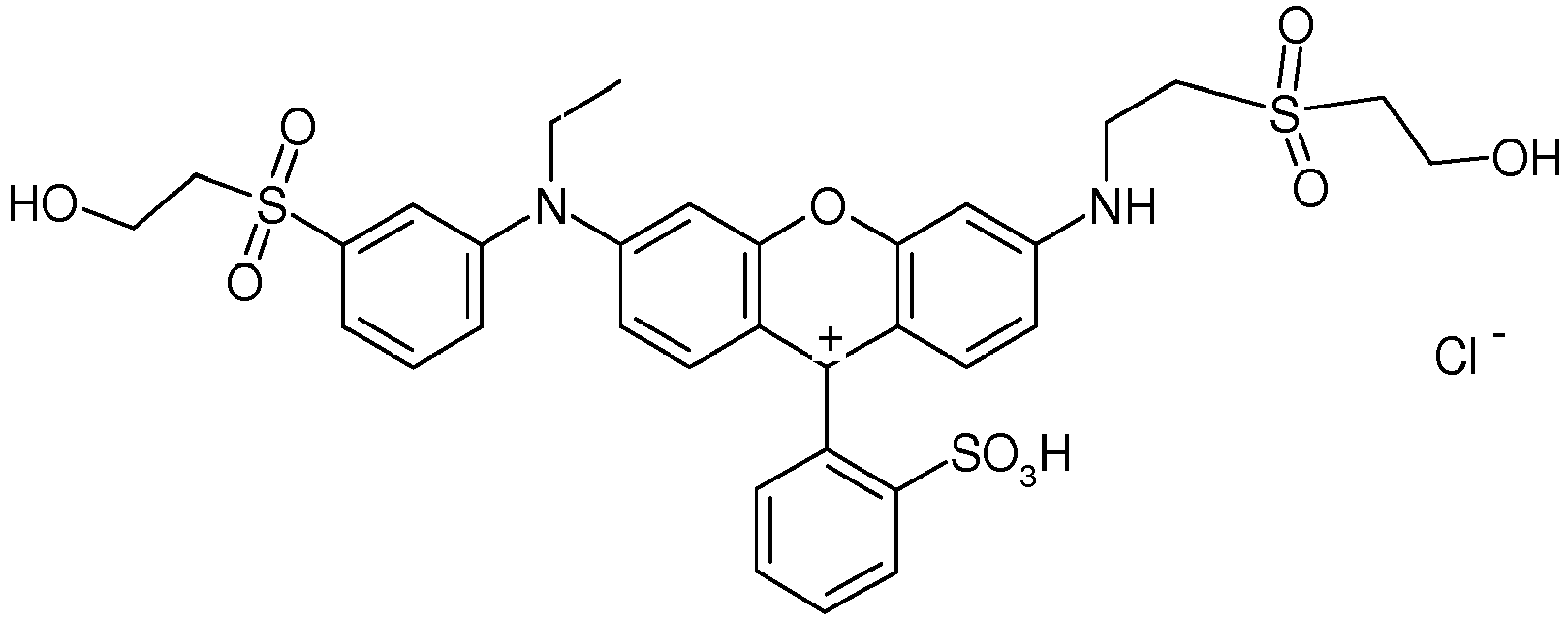
- Sulfonation: 17.52 parts of Intermediate 1 were added in portions to 110 parts sulfuric acid (98 to 100 %) at 20 to 60 °C. The reaction mixture was stirred for 3 h at 60 °C and then cooled to 0 to 5 °C. This mixture was added to 300 parts of ice at 0 °C, the pH was adjusted with CaCO3 to 5.3. The CaSO4 was filtered and the product in the filtrated solution was isolated by vacuum rotary evaporation and dried under vacuum conditions resulting in 16 parts of example 1 that dyes cotton in brilliant fluorescent red shades.

- According to example 1 or 2 the following amines can be used for 1. Condensation (Amine 1) and for 2. Condensation (Amine 2). After sulfonation and isolation according to example 1 or 2 dyes having the given colours are obtained when using amines 1 and 2 as indicated.
Amine 1 Amine 2 Example Shade on cotton 

3 Red 

4 Red 

5 Red 

6 Red 

7 Red 
8 Red 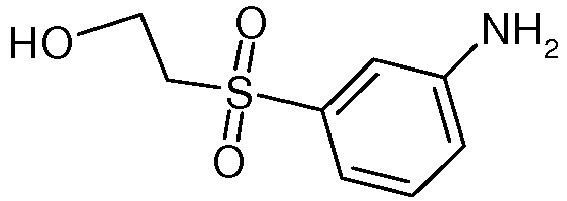

9 Red 

10 Red 

11 Bluish red 

12 Bluish red 

13 Bluish red 

14 Bluish red 

15 Bluish red 

16 Bluish red 

17 Bluish red 

18 Bluish red 

19 Bluish red 

20 Bluish red 

21 Bluish red 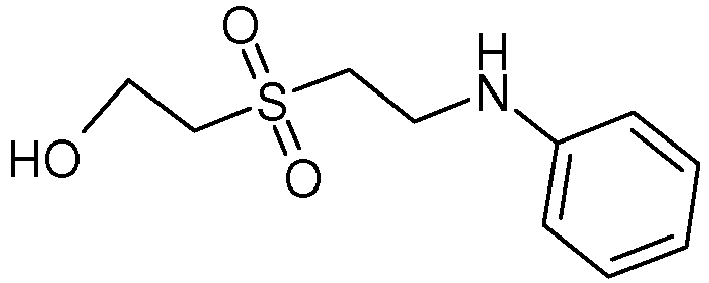

22 Bluish red 

23 Bluish red 

24 Red 

25 Red 

26 Red 

27 Red 

28 Violet 

29 Violet 

30 Violet 

31 Violet 

32 Violet 

33 Violet 

34 Violet 

35 Violet 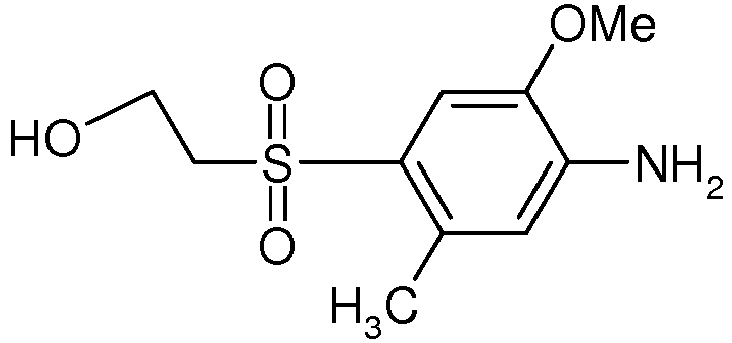

36 Violet 

37 Violet 
38 Violet 

39 Violet -
- 1. Condensation: 10.13 parts of dichloro-sulfophenyl-xanthen were mixed together with 4.22 parts of 2-(2-chloro-ethanesulfonyl)-ethylamine as amine 1 in 100 ml of water and the pH was adjusted to 5.0. The reaction mixture was heated to 60 °C and stirred and the pH was kept at 5.0 with a 15 %ic Na2CO3 solution.
- 2. Condensation: After 1 hour 4.9 parts 2-(2-methylamino-ethanesulfonyl)-ethanol as amine 2 were added and the pH was adjusted to 9.0 and the reaction mixture was heated to 90 °C and stirred for 3 hours.
- The reaction mix was cooled to room temperature and the water was evaporated under reduced pressure delivering 19.3 parts of Intermediate 1 after drying under vacuum conditions.

- Sulfonation: 17.52 parts of Intermediate 1 were added in portions to 110 parts sulfuric acid (98 to 100 %) at 20 to 60 °C the reaction mixture was stirred for 3 h at 60 °C and then cooled to 0 to 5 °C. This mixture was added to 300 parts of ice at 0 °C, the pH was adjusted with CaCO3 to 5.3. The CaSO4 was filtered and the product in the filtrated solution was isolated by vacuum rotary evaporation and dried under vacuum conditions resulting in 16 parts of example 1 that dyes cotton in brilliant fluorescent red shades.

- According to example 40 and example 2 the following amines can be used for 1. Condensation (Amine 1) and for 2. Condensation (Amine 2), after sulfonation and isolation according to example 1 or 2 dyes having the given colours are obtained when using amines 1 and 2 as indicated.
Amine 1 Amine 2 Expl. Shade on cotton 

41 Bluish red 

42 Bluish red 

43 Bluish red - 32.2 parts of phthalic anhydid were added to 246 parts of POCl3 under stirring. After 30 minutes 58 parts of Resorcinol (3-Hydroxy-phenol) were added and the mixture was heated to 95 °C and stirred for 2 hours. The reaction mixture was cooled down to 5 °C and added to 3000 parts of a 5 °C cold 20 %ic aqueous NaCl solution. The suspension was stirred for 30 minutes at 0 to 5 °C and filtrated. The isolated wet press paste was suspended in 200 parts of acetone and stirred for 20 minutes at 5 °C. After filtration and drying 24.6 parts of dichloro-carboxyphenyl-xanthen were isolated.

- 1. Condensation: 9.5 parts of dichloro-carboxyphenyl-xanthen were mixed together with 5.73 parts of n-ethyl-3 (β-hydroyethy)sulfonyl anilin / (2-(3-ethylamino-benzenesulfonyl)-ethanol) in 100 ml of water and the pH was adjusted to 5.0. The reaction mixture was heated to 60 °C and stirred and the pH was kept at 5.0 with a 15 %ic Na2CO3 solution.
- 2. Condensation: After 1 hour 4.9 parts of 2-(2-methylamino-ethanesulfonyl)-ethan were added and the pH was adjusted to 9.0 and the reaction mixture was heated to 90 °C and stirred for 3 hours.
- The reaction mix was cooled to room temperature and the water was evaporated under reduced pressure delivering 19.8 parts of Intermediate 1 after drying under vacuum conditions.

- Sulfonation: 16.1 parts of Intermediate 1 were added in portions to 90 parts sulfuric acid (98 to 100 %) at 20 to 60 °C. The reaction mixture was stirred for 3 h at 60 °C and then cooled to 0 to 5 °C. This mixture was added to 250 parts of ice at 0 °C, the pH was adjusted with CaCO3 to 5.3. The CaSO4 was filtered and the product in the filtrated solution was isolated by vacuum rotary evaporation and dried under vacuum conditions resulting in 14.9 parts of example 1 that dyes cotton in brilliant fluorescent red shades.

- According to example 44 the following amines can be used for the first condensation (Amine 1) and for the second condensation (Amine 2). After sulfonation and isolation according to example 44 dyes having the given colours are obtained when using amines 1 and 2 as indicated.
Amine 1 Amine 2 Expl. Shade on cotton 

45 Red 

46 Red 

47 Red 

48 Red 

49 Red 

50 Red 

51 Bluish red 

52 Bluish red 

53 Bluish red 

54 Bluish red 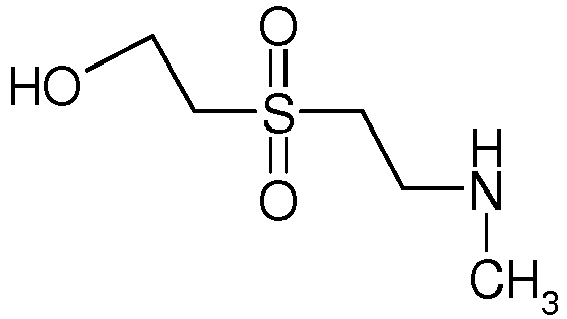

55 Bluish red 

56 Bluish red 

57 Bluish red 

58 Bluish red 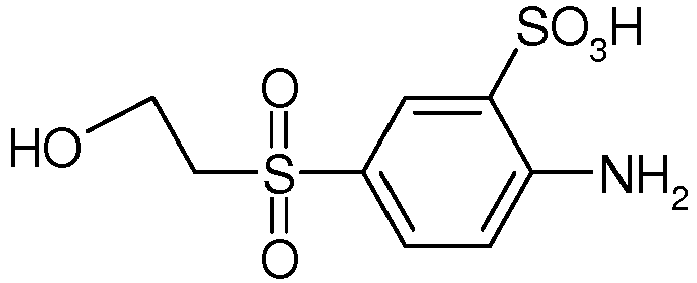

59 Red 

60 Red 

61 Red 

62 Red 

63 Violet 

64 Violet 
65 Violet 

66 Bluish red 
67 Bluish red 

68 Bluish red - 3 parts of the dye from example 1 of this invention and 60 parts of sodium chloride were dissolved in 1000 parts of water and 12 parts of sodium carbonate and 0.5 parts of a wetting agent were added. This dyebath was entered with 100 parts of bleached cotton knitted fabric. The temperature of the dye bath was raised to 30 °C at a gradient of 0.5 °C/minute and held at this temperature for 30 minutes and then increased over 30 minutes to 60 °C, this temperature being maintained for a further 60 minutes. Thereafter the dyed goods were initially rinsed with tapwater for 5 minutes. The dyed goods were neutralized at 50 °C using 60 % strength acetic acid for 30 to 40 minutes. The goods were rinsed with boiling tapwater for 30 to 40 minutes followed by a final rinse at 40 to 50 °C for 20 minutes and dried.
- The very brilliant fluorescent bluish red dyeing obtained has good overall fastness properties.
Claims (11)
- Dye of formula (I)
 W is O, S or NH,R1 and R2 is hydrogen, alkyl, alkyl substituted by one or more substituents selected from the group consisting of methoxy, hydroxy, sulfato, sulfo and chloro, aryl, aryl substituted by one or more substituents selected from the group consisting of chloro, acetylamino, sulfo, hydroxy, carboxy, (C1-C4)-alkanoyl, (C1-C4)-alkoxy and (C1-C4)-alkyl or benzyl,R3 and R4 is hydrogen, alkyl, hydroxy, aryl, cycloalkyl, alkoxy, thioalkoxy, N-acylamino, N-cinnamoylamino, halogen, cyano, SO3M, COOM, nitro, acyl, thioacyl, alkylsulfonyl, aryloyl, trifluoromethyl, heteroaryl, heterocycloalkyl, alkoxycarbonyl, alkoxythiocarbonyl, acyloxy, aryloyloxy or SO2-X,wherein X is vinyl or CH2CH2-Y,
wherein Y is a group removable under alkaline conditions,Z- is selected from the group consisting of halogen, sulfate, alkylsulfonate, benzolsulfonate, toluolsulfonate, tetraborofluorate and acetate,A1 and A2 is a spacer of formula (2c) or (2d) d is an integer from 1 to 4,e is an integer from 0 to 3,f is an integer from 0 to 3,g is an integer from 0 to 3,Q is O, NH or S,R6 is hydrogen, halogen, alkyl, N-acylamino, alkoxy, thioalkoxy, hydroxy, alkoxycarbonyl, acyl, arylol, acyloxy, aryloyloxy, cycloalkyl, aryl, SO3M or COOM,R8 and R9 is hydrogen, alkyl, alkoxy, aryl, hydroxyl, NH-CH2-CH2-OSO3H, SO3M or COOM,T1 and T2 is a reactive anchor of formula (3d), (3e) or SO2-X
 X is vinyl or CH2CH2-Y,and
wherein Y is a group removable under alkaline conditions,M is hydrogen, lithium, sodium, potassium, ammonium, mono-, di-, tri- or tetra-(C1-C4)-alkylammonium, one equivalent of an alkali earth metal or a monovalent organic cation. - Dye according to claim 1, wherein in each case independent from each other
W is O or S,
R1 and R2 is hydrogen, alkyl, alkyl substituted by one or more substituents selected from the group consisting of methoxy, hydroxy, sulfato, sulfo and chloro, aryl, aryl substituted by one or more substituents selected from the group consisting of chloro, acetylamino, sulfo, hydroxy, carboxy, (C1-C2)-alkanoyl, (C1-C2)-alkoxy and (C1-C2)-alkyl or benzyl, R3 and R4 is hydrogen, (C1-C4)-alkyl, hydroxy, aryl, (C1-C4)-alkoxy, N-acylamino, halogen, SO3M, COOM, acyl, (C1-C4)-alkylsulfonyl, (C1-C4)-alkoxycarbonyl or SO2-X,wherein X is vinyl or CH2CH2-Y,Z- is selected from the group consisting of halogen, sulfate, alkylsulfonate, benzolsulfonate, toluolsulfonate, tetraborofluorate and acetate,
wherein Y is a group removable under alkaline conditions,
A1 and A2 is a spacer of formula (2c) or (2d) d is 1 or 2,e is 0 or 1,f is 0,g is 0 or 1,Q is O or S,R6 is hydrogen, (C1-C4)-alkyl, N-acylamino, (C1-C4)-alkoxy, acyl, benzyl, SO3M or COOM,R8 and R9 is hydrogen, (C1-C4)-alkyl, (C1-C4)-alkoxy, SO3M or COOM,T1 and T2 is SO2-X,wherein X is vinyl or CH2CH2-Y,and
wherein Y is a group removable under alkaline conditions
M is hydrogen, lithium, sodium, potassium, one equivalent of an alkali earth metal or a monovalent organic cation. - Dye according to any one of claims 1 or 2, wherein in each case independent from each other
W is oxygen,
R1 and R2 is hydrogen, (C1-C4)-alkyl, aryl, or benzyl,
R3 and R4 is hydrogen, (C1-C2)-alkyl, halogen, SO3M, COOM or SO2-X,wherein X is vinyl or CH2CH2-Y,Z- is selected from the group consisting of halogen, sulfate, alkylsulfonate, benzolsulfonate, toluolsulfonate, tetraborofluorate and acetate,
wherein Y is a group removable under alkaline conditions,
A1 and A2 is a spacer of formula (2c-1) or (2d-1) d is 1 or 2,e is 0 or 1,g is 0 or 1,Q is oxygen,R6 is hydrogen or (C1-C2)-alkyl,R8 and R9 is hydrogen, (C1-C2)-alkyl, (C1-C2)-alkoxy or SO3M,T1 and T2 is SO2-X,wherein X is vinyl or CH2CH2-Y,and
wherein Y is a group removable under alkaline conditions
M is hydrogen, lithium, sodium, potassium, one equivalent of an alkali earth metal or a monovalent organic cation. - Process for the production of dyes according to any one of claims 1 to 3, comprising the steps of:a) Reacting one 3,6,9 substituted 9H-Xanthene, wherein the 3- and 6-substituents react as a leaving group, with two precursor-amines H-NR1-A1-T1 and H-NR2-A2-T2 of identical or different spacer-reactive-anchor-units on 3- and 6-position,b) Sulfonating the OH-groups with concentrated sulfuric acid.
- Process for the production of dyes according to any one of claims 1 to 3, comprising the steps of:reactingone 3,6,9 substituted 9H-Xanthene, wherein the 3- and 6-substituents react as a leaving group, witha) two identical aliphatic-, aromatic- or mixed aliphatic/aromatic-amines symmetrically on both 3- and 6-position,
orb) one aliphatic-, aromatic- or mixed aliphatic/aromatic-amine for the 3-position in a first step
and
one aliphatic-, aromatic- or mixed aliphatic/aromatic-amine, which is different to the first one, for the 6-position in a second step
orc) one aliphatic-, aromatic- or mixed aliphatic/aromatic-amine for the 6-position in a first step
and
one aliphatic-, aromatic- or mixed aliphatic/aromatic-amine, which is different to the first one, for the 3-position in a second stepand further reacting the products resulting from a), b) and c) respectively with reactive anchor groups. - Chemical composition comprising one or more dye(s) according to any one of claims 1 to 3.
- Aqueous solution for dying comprising one or more chemical compounds according to any one of claims 1 to 3.
- Process for dyeing or printing carboxamido- and/or hydroxyl-containing material, comprising contacting the carboxamido- and/or hydroxyl-containing material with a dye according to any one of claims 1 to 3.
- Ink for digital textile printing, comprising a dye according to any one of claims 1 to 3.
- Use of a dye according to any one of claims 1 to 3, a chemical composition according to claim 6 or of an aqueous solution according to claim 7 for dying fibers, as well as blends of such fibres selected from the group consisting of: synthetic fiber materials, nylon materials, nylon-6, nylon-6.6 and aramid fibres, vegetable fibres, seed fibres, cotton, organic cotton, kapok, coir from coconut husk; bast fibers, flax, hemp, jute, kenaf, ramie, rattan; leaf fibres, sisal, henequen, banana; stalk fibres, bamboo; fibres from animals, wool, organic wool, silk, cashmere wool, alpaca fiber, mohair, Angora fibre as well as fur and leather materials; manufactured, regenerated and recycled fibres, cellulosic fibres; paperfibres, cellulosic regenerated fibres, viscose rayon fibres, acetate and triacetate fibers and Lyocell fibers.
- Fiber and blends containing such fiber selected from the group consisting of: synthetic fiber materials, nylon materials, nylon-6, nylon-6.6 and aramid fibres, vegetable fibres, seed fibres, cotton, organic cotton, kapok, coir from coconut husk; bast fibers, flax, hemp, jute, kenaf, ramie, rattan; leaf fibres, sisal, henequen, banana; stalk fibres, bamboo; fibres from animals, wool, organic wool, silk, cashmere wool, alpaca fiber, mohair, Angora fibre as well as fur and leather materials; manufactured, regenerated and recycled fibres, cellulosic fibres; paper fibres, cellulosic regenerated fibres, viscose rayon fibres, acetate and triacetate fibers, and Lyocell fibers comprising one or more dye(s) according to any one of claims 1 to 3 either in chemically and/or physically bound form.
Applications Claiming Priority (2)
| Application Number | Priority Date | Filing Date | Title |
|---|---|---|---|
| EP14165125.7A EP2933296A1 (en) | 2014-04-17 | 2014-04-17 | Fluorescent reactive dyes, process for the production thereof and their use |
| PCT/EP2015/057542 WO2015158574A1 (en) | 2014-04-17 | 2015-04-08 | Fluorescent reactive dyes, process for the production thereof and their use |
Publications (2)
| Publication Number | Publication Date |
|---|---|
| EP3131974A1 EP3131974A1 (en) | 2017-02-22 |
| EP3131974B1 true EP3131974B1 (en) | 2018-01-03 |
Family
ID=50486832
Family Applications (2)
| Application Number | Title | Priority Date | Filing Date |
|---|---|---|---|
| EP14165125.7A Withdrawn EP2933296A1 (en) | 2014-04-17 | 2014-04-17 | Fluorescent reactive dyes, process for the production thereof and their use |
| EP15715232.3A Active EP3131974B1 (en) | 2014-04-17 | 2015-04-08 | Fluorescent reactive dyes, process for the production thereof and their use |
Family Applications Before (1)
| Application Number | Title | Priority Date | Filing Date |
|---|---|---|---|
| EP14165125.7A Withdrawn EP2933296A1 (en) | 2014-04-17 | 2014-04-17 | Fluorescent reactive dyes, process for the production thereof and their use |
Country Status (11)
| Country | Link |
|---|---|
| US (1) | US10227491B2 (en) |
| EP (2) | EP2933296A1 (en) |
| JP (1) | JP6483726B2 (en) |
| CN (1) | CN106459603B (en) |
| ES (1) | ES2663845T3 (en) |
| MA (1) | MA39387B1 (en) |
| MX (1) | MX376335B (en) |
| PT (1) | PT3131974T (en) |
| SV (1) | SV2016005302A (en) |
| TW (1) | TWI597327B (en) |
| WO (1) | WO2015158574A1 (en) |
Families Citing this family (5)
| Publication number | Priority date | Publication date | Assignee | Title |
|---|---|---|---|---|
| WO2007135368A2 (en) | 2006-05-18 | 2007-11-29 | Solexa Limited | Dye compounds and the use of their labelled conjugates |
| WO2017006940A1 (en) * | 2015-07-09 | 2017-01-12 | 富士フイルム株式会社 | Compound, coloring composition, ink for inkjet recording, inkjet recording method, inkjet printer cartridge, and inkjet recorded article |
| KR102162610B1 (en) * | 2016-08-19 | 2020-10-07 | 주식회사 엘지화학 | Compound, colorant composition comprising the same and resin composition comprising the same |
| KR102186097B1 (en) * | 2017-12-26 | 2020-12-03 | 주식회사 엘지화학 | Xanthene-based compound and photosensitive resin composition comprising the same |
| JP7590144B2 (en) * | 2019-11-18 | 2024-11-26 | 保土谷化学工業株式会社 | Xanthene dye, coloring composition containing the dye, colorant for color filter, and color filter |
Family Cites Families (10)
| Publication number | Priority date | Publication date | Assignee | Title |
|---|---|---|---|---|
| BE758461A (en) | 1969-11-06 | 1971-05-04 | Hoechst Ag | WATER-SOLUBLE XANTHENE-DERIVED REACTIVE DYES AND THEIR PREPARATION |
| DE2337488C2 (en) | 1973-07-24 | 1975-09-11 | Hoechst Ag, 6000 Frankfurt | Process for the preparation of reactive xanthene dyes |
| GB1435776A (en) | 1973-09-06 | 1976-05-12 | Ici Ltd | Reactive xanthenium dyestuffs |
| DE2460491A1 (en) * | 1974-12-20 | 1976-07-01 | Hoechst Ag | PROCESS FOR THE MANUFACTURING OF XANTHENE DYES |
| DE3347246A1 (en) | 1983-12-28 | 1985-07-11 | Bayer Ag, 5090 Leverkusen | DIARYLAMINOXANTHENE RANGE REACTIVE DYES, THEIR PRODUCTION AND USE |
| AU3008289A (en) * | 1988-02-22 | 1989-08-24 | Eastman Kodak Company | Novel thiorhodamines and a novel method of preparation |
| JPH0443536A (en) * | 1990-06-08 | 1992-02-13 | Mitsubishi Kasei Corp | laminate |
| EP0542420A1 (en) * | 1991-11-15 | 1993-05-19 | Zeneca Limited | Anionic xanthene derivatives and their use in inks |
| US6843838B2 (en) * | 2002-12-31 | 2005-01-18 | Lexmark International, Inc. | Inkjet ink, dye set, ink set, and method of use thereof |
| US7732625B2 (en) * | 2004-07-23 | 2010-06-08 | Xerox Corporation | Colorant compounds |
-
2014
- 2014-04-17 EP EP14165125.7A patent/EP2933296A1/en not_active Withdrawn
-
2015
- 2015-04-07 TW TW104111103A patent/TWI597327B/en not_active IP Right Cessation
- 2015-04-08 JP JP2016562583A patent/JP6483726B2/en not_active Expired - Fee Related
- 2015-04-08 ES ES15715232.3T patent/ES2663845T3/en active Active
- 2015-04-08 CN CN201580019747.4A patent/CN106459603B/en not_active Expired - Fee Related
- 2015-04-08 MX MX2016013586A patent/MX376335B/en active IP Right Grant
- 2015-04-08 PT PT157152323T patent/PT3131974T/en unknown
- 2015-04-08 MA MA39387A patent/MA39387B1/en unknown
- 2015-04-08 EP EP15715232.3A patent/EP3131974B1/en active Active
- 2015-04-08 US US15/106,999 patent/US10227491B2/en not_active Expired - Fee Related
- 2015-04-08 WO PCT/EP2015/057542 patent/WO2015158574A1/en not_active Ceased
-
2016
- 2016-10-14 SV SV2016005302A patent/SV2016005302A/en unknown
Also Published As
| Publication number | Publication date |
|---|---|
| MX376335B (en) | 2025-03-07 |
| MA39387B1 (en) | 2017-10-31 |
| CN106459603B (en) | 2019-08-23 |
| MX2016013586A (en) | 2017-02-28 |
| SV2016005302A (en) | 2017-01-23 |
| EP3131974A1 (en) | 2017-02-22 |
| JP6483726B2 (en) | 2019-03-13 |
| PT3131974T (en) | 2018-03-28 |
| TWI597327B (en) | 2017-09-01 |
| ES2663845T3 (en) | 2018-04-17 |
| CN106459603A (en) | 2017-02-22 |
| US10227491B2 (en) | 2019-03-12 |
| EP2933296A1 (en) | 2015-10-21 |
| US20180194943A1 (en) | 2018-07-12 |
| JP2017515938A (en) | 2017-06-15 |
| TW201544550A (en) | 2015-12-01 |
| WO2015158574A1 (en) | 2015-10-22 |
| MA39387A1 (en) | 2016-12-30 |
Similar Documents
| Publication | Publication Date | Title |
|---|---|---|
| US10227491B2 (en) | Fluorescent reactive dyes, process for the production thereof and their use | |
| JP6356300B2 (en) | Reactive dyes containing no metal atoms, methods for producing them and their use | |
| WO2013189814A1 (en) | Metal-free reactive dyes, process for the production thereof and their use | |
| EP3063230B1 (en) | Acid dyes, process for the production thereof and their use | |
| US9650516B2 (en) | Acid dyes, process for the production thereof and their use | |
| DE102009000423A1 (en) | Fiber-reactive copper complex disazo dyes | |
| EP2861670B1 (en) | Metal free reactive dyes, process for the production thereof and their use | |
| EP3063229B1 (en) | Acid dyes, process for their production and their use | |
| EP2868713A1 (en) | Metal free acid dyes, process for the production thereof and their use | |
| EP2868707A1 (en) | Metal free acid dyes, process for their production and use of said dyes | |
| EP2868708A1 (en) | Metal-free acid dyes, process for the production thereof and their use | |
| WO2013189816A1 (en) | Reactive dyes and their metal complexes, process for the production thereof and their use | |
| EP2868712A1 (en) | Metal free acid dyes, process for the production thereof and their use | |
| EP2868711A1 (en) | Metal free acid dyes, process for the production thereof and their use | |
| EP2868704A1 (en) | Metal free acid dyes, process for the production thereof and their use | |
| EP2868706A1 (en) | Metal free acid dyes, methods for the production thereof and their use |
Legal Events
| Date | Code | Title | Description |
|---|---|---|---|
| PUAI | Public reference made under article 153(3) epc to a published international application that has entered the european phase |
Free format text: ORIGINAL CODE: 0009012 |
|
| 17P | Request for examination filed |
Effective date: 20160616 |
|
| AK | Designated contracting states |
Kind code of ref document: A1 Designated state(s): AL AT BE BG CH CY CZ DE DK EE ES FI FR GB GR HR HU IE IS IT LI LT LU LV MC MK MT NL NO PL PT RO RS SE SI SK SM TR |
|
| AX | Request for extension of the european patent |
Extension state: BA ME |
|
| DAV | Request for validation of the european patent (deleted) | ||
| DAX | Request for extension of the european patent (deleted) | ||
| GRAP | Despatch of communication of intention to grant a patent |
Free format text: ORIGINAL CODE: EPIDOSNIGR1 |
|
| INTG | Intention to grant announced |
Effective date: 20170905 |
|
| GRAS | Grant fee paid |
Free format text: ORIGINAL CODE: EPIDOSNIGR3 |
|
| GRAA | (expected) grant |
Free format text: ORIGINAL CODE: 0009210 |
|
| AK | Designated contracting states |
Kind code of ref document: B1 Designated state(s): AL AT BE BG CH CY CZ DE DK EE ES FI FR GB GR HR HU IE IS IT LI LT LU LV MC MK MT NL NO PL PT RO RS SE SI SK SM TR |
|
| REG | Reference to a national code |
Ref country code: GB Ref legal event code: FG4D |
|
| REG | Reference to a national code |
Ref country code: CH Ref legal event code: EP Ref country code: AT Ref legal event code: REF Ref document number: 960234 Country of ref document: AT Kind code of ref document: T Effective date: 20180115 |
|
| REG | Reference to a national code |
Ref country code: IE Ref legal event code: FG4D |
|
| REG | Reference to a national code |
Ref country code: DE Ref legal event code: R096 Ref document number: 602015007219 Country of ref document: DE |
|
| REG | Reference to a national code |
Ref country code: PT Ref legal event code: SC4A Ref document number: 3131974 Country of ref document: PT Date of ref document: 20180328 Kind code of ref document: T Free format text: AVAILABILITY OF NATIONAL TRANSLATION Effective date: 20180322 |
|
| REG | Reference to a national code |
Ref country code: ES Ref legal event code: FG2A Ref document number: 2663845 Country of ref document: ES Kind code of ref document: T3 Effective date: 20180417 |
|
| REG | Reference to a national code |
Ref country code: FR Ref legal event code: PLFP Year of fee payment: 4 |
|
| REG | Reference to a national code |
Ref country code: NL Ref legal event code: MP Effective date: 20180103 |
|
| REG | Reference to a national code |
Ref country code: LT Ref legal event code: MG4D |
|
| REG | Reference to a national code |
Ref country code: AT Ref legal event code: MK05 Ref document number: 960234 Country of ref document: AT Kind code of ref document: T Effective date: 20180103 |
|
| PG25 | Lapsed in a contracting state [announced via postgrant information from national office to epo] |
Ref country code: NL Free format text: LAPSE BECAUSE OF FAILURE TO SUBMIT A TRANSLATION OF THE DESCRIPTION OR TO PAY THE FEE WITHIN THE PRESCRIBED TIME-LIMIT Effective date: 20180103 |
|
| PG25 | Lapsed in a contracting state [announced via postgrant information from national office to epo] |
Ref country code: NO Free format text: LAPSE BECAUSE OF FAILURE TO SUBMIT A TRANSLATION OF THE DESCRIPTION OR TO PAY THE FEE WITHIN THE PRESCRIBED TIME-LIMIT Effective date: 20180403 Ref country code: FI Free format text: LAPSE BECAUSE OF FAILURE TO SUBMIT A TRANSLATION OF THE DESCRIPTION OR TO PAY THE FEE WITHIN THE PRESCRIBED TIME-LIMIT Effective date: 20180103 Ref country code: LT Free format text: LAPSE BECAUSE OF FAILURE TO SUBMIT A TRANSLATION OF THE DESCRIPTION OR TO PAY THE FEE WITHIN THE PRESCRIBED TIME-LIMIT Effective date: 20180103 Ref country code: HR Free format text: LAPSE BECAUSE OF FAILURE TO SUBMIT A TRANSLATION OF THE DESCRIPTION OR TO PAY THE FEE WITHIN THE PRESCRIBED TIME-LIMIT Effective date: 20180103 Ref country code: CY Free format text: LAPSE BECAUSE OF FAILURE TO SUBMIT A TRANSLATION OF THE DESCRIPTION OR TO PAY THE FEE WITHIN THE PRESCRIBED TIME-LIMIT Effective date: 20180103 |
|
| PG25 | Lapsed in a contracting state [announced via postgrant information from national office to epo] |
Ref country code: GR Free format text: LAPSE BECAUSE OF FAILURE TO SUBMIT A TRANSLATION OF THE DESCRIPTION OR TO PAY THE FEE WITHIN THE PRESCRIBED TIME-LIMIT Effective date: 20180404 Ref country code: SE Free format text: LAPSE BECAUSE OF FAILURE TO SUBMIT A TRANSLATION OF THE DESCRIPTION OR TO PAY THE FEE WITHIN THE PRESCRIBED TIME-LIMIT Effective date: 20180103 Ref country code: LV Free format text: LAPSE BECAUSE OF FAILURE TO SUBMIT A TRANSLATION OF THE DESCRIPTION OR TO PAY THE FEE WITHIN THE PRESCRIBED TIME-LIMIT Effective date: 20180103 Ref country code: PL Free format text: LAPSE BECAUSE OF FAILURE TO SUBMIT A TRANSLATION OF THE DESCRIPTION OR TO PAY THE FEE WITHIN THE PRESCRIBED TIME-LIMIT Effective date: 20180103 Ref country code: IS Free format text: LAPSE BECAUSE OF FAILURE TO SUBMIT A TRANSLATION OF THE DESCRIPTION OR TO PAY THE FEE WITHIN THE PRESCRIBED TIME-LIMIT Effective date: 20180503 Ref country code: AT Free format text: LAPSE BECAUSE OF FAILURE TO SUBMIT A TRANSLATION OF THE DESCRIPTION OR TO PAY THE FEE WITHIN THE PRESCRIBED TIME-LIMIT Effective date: 20180103 Ref country code: RS Free format text: LAPSE BECAUSE OF FAILURE TO SUBMIT A TRANSLATION OF THE DESCRIPTION OR TO PAY THE FEE WITHIN THE PRESCRIBED TIME-LIMIT Effective date: 20180103 Ref country code: BG Free format text: LAPSE BECAUSE OF FAILURE TO SUBMIT A TRANSLATION OF THE DESCRIPTION OR TO PAY THE FEE WITHIN THE PRESCRIBED TIME-LIMIT Effective date: 20180403 |
|
| REG | Reference to a national code |
Ref country code: DE Ref legal event code: R097 Ref document number: 602015007219 Country of ref document: DE |
|
| PG25 | Lapsed in a contracting state [announced via postgrant information from national office to epo] |
Ref country code: AL Free format text: LAPSE BECAUSE OF FAILURE TO SUBMIT A TRANSLATION OF THE DESCRIPTION OR TO PAY THE FEE WITHIN THE PRESCRIBED TIME-LIMIT Effective date: 20180103 Ref country code: EE Free format text: LAPSE BECAUSE OF FAILURE TO SUBMIT A TRANSLATION OF THE DESCRIPTION OR TO PAY THE FEE WITHIN THE PRESCRIBED TIME-LIMIT Effective date: 20180103 Ref country code: RO Free format text: LAPSE BECAUSE OF FAILURE TO SUBMIT A TRANSLATION OF THE DESCRIPTION OR TO PAY THE FEE WITHIN THE PRESCRIBED TIME-LIMIT Effective date: 20180103 |
|
| PLBE | No opposition filed within time limit |
Free format text: ORIGINAL CODE: 0009261 |
|
| STAA | Information on the status of an ep patent application or granted ep patent |
Free format text: STATUS: NO OPPOSITION FILED WITHIN TIME LIMIT |
|
| PG25 | Lapsed in a contracting state [announced via postgrant information from national office to epo] |
Ref country code: CZ Free format text: LAPSE BECAUSE OF FAILURE TO SUBMIT A TRANSLATION OF THE DESCRIPTION OR TO PAY THE FEE WITHIN THE PRESCRIBED TIME-LIMIT Effective date: 20180103 Ref country code: DK Free format text: LAPSE BECAUSE OF FAILURE TO SUBMIT A TRANSLATION OF THE DESCRIPTION OR TO PAY THE FEE WITHIN THE PRESCRIBED TIME-LIMIT Effective date: 20180103 Ref country code: SM Free format text: LAPSE BECAUSE OF FAILURE TO SUBMIT A TRANSLATION OF THE DESCRIPTION OR TO PAY THE FEE WITHIN THE PRESCRIBED TIME-LIMIT Effective date: 20180103 Ref country code: MC Free format text: LAPSE BECAUSE OF FAILURE TO SUBMIT A TRANSLATION OF THE DESCRIPTION OR TO PAY THE FEE WITHIN THE PRESCRIBED TIME-LIMIT Effective date: 20180103 Ref country code: SK Free format text: LAPSE BECAUSE OF FAILURE TO SUBMIT A TRANSLATION OF THE DESCRIPTION OR TO PAY THE FEE WITHIN THE PRESCRIBED TIME-LIMIT Effective date: 20180103 |
|
| REG | Reference to a national code |
Ref country code: CH Ref legal event code: PL |
|
| 26N | No opposition filed |
Effective date: 20181005 |
|
| REG | Reference to a national code |
Ref country code: BE Ref legal event code: MM Effective date: 20180430 |
|
| REG | Reference to a national code |
Ref country code: IE Ref legal event code: MM4A |
|
| PG25 | Lapsed in a contracting state [announced via postgrant information from national office to epo] |
Ref country code: LU Free format text: LAPSE BECAUSE OF NON-PAYMENT OF DUE FEES Effective date: 20180408 |
|
| PG25 | Lapsed in a contracting state [announced via postgrant information from national office to epo] |
Ref country code: BE Free format text: LAPSE BECAUSE OF NON-PAYMENT OF DUE FEES Effective date: 20180430 Ref country code: CH Free format text: LAPSE BECAUSE OF NON-PAYMENT OF DUE FEES Effective date: 20180430 Ref country code: LI Free format text: LAPSE BECAUSE OF NON-PAYMENT OF DUE FEES Effective date: 20180430 Ref country code: SI Free format text: LAPSE BECAUSE OF FAILURE TO SUBMIT A TRANSLATION OF THE DESCRIPTION OR TO PAY THE FEE WITHIN THE PRESCRIBED TIME-LIMIT Effective date: 20180103 |
|
| PG25 | Lapsed in a contracting state [announced via postgrant information from national office to epo] |
Ref country code: IE Free format text: LAPSE BECAUSE OF NON-PAYMENT OF DUE FEES Effective date: 20180408 |
|
| PG25 | Lapsed in a contracting state [announced via postgrant information from national office to epo] |
Ref country code: MT Free format text: LAPSE BECAUSE OF NON-PAYMENT OF DUE FEES Effective date: 20180408 |
|
| PG25 | Lapsed in a contracting state [announced via postgrant information from national office to epo] |
Ref country code: MK Free format text: LAPSE BECAUSE OF NON-PAYMENT OF DUE FEES Effective date: 20180103 Ref country code: HU Free format text: LAPSE BECAUSE OF FAILURE TO SUBMIT A TRANSLATION OF THE DESCRIPTION OR TO PAY THE FEE WITHIN THE PRESCRIBED TIME-LIMIT; INVALID AB INITIO Effective date: 20150408 |
|
| PGFP | Annual fee paid to national office [announced via postgrant information from national office to epo] |
Ref country code: ES Payment date: 20200511 Year of fee payment: 6 Ref country code: FR Payment date: 20200429 Year of fee payment: 6 |
|
| PGFP | Annual fee paid to national office [announced via postgrant information from national office to epo] |
Ref country code: IT Payment date: 20200424 Year of fee payment: 6 Ref country code: GB Payment date: 20200429 Year of fee payment: 6 |
|
| PGFP | Annual fee paid to national office [announced via postgrant information from national office to epo] |
Ref country code: PT Payment date: 20210325 Year of fee payment: 7 |
|
| GBPC | Gb: european patent ceased through non-payment of renewal fee |
Effective date: 20210408 |
|
| PG25 | Lapsed in a contracting state [announced via postgrant information from national office to epo] |
Ref country code: GB Free format text: LAPSE BECAUSE OF NON-PAYMENT OF DUE FEES Effective date: 20210408 Ref country code: FR Free format text: LAPSE BECAUSE OF NON-PAYMENT OF DUE FEES Effective date: 20210430 |
|
| PGFP | Annual fee paid to national office [announced via postgrant information from national office to epo] |
Ref country code: TR Payment date: 20220325 Year of fee payment: 8 |
|
| REG | Reference to a national code |
Ref country code: ES Ref legal event code: FD2A Effective date: 20220630 |
|
| PG25 | Lapsed in a contracting state [announced via postgrant information from national office to epo] |
Ref country code: ES Free format text: LAPSE BECAUSE OF NON-PAYMENT OF DUE FEES Effective date: 20210409 |
|
| PGFP | Annual fee paid to national office [announced via postgrant information from national office to epo] |
Ref country code: DE Payment date: 20220430 Year of fee payment: 8 |
|
| PG25 | Lapsed in a contracting state [announced via postgrant information from national office to epo] |
Ref country code: PT Free format text: LAPSE BECAUSE OF NON-PAYMENT OF DUE FEES Effective date: 20221010 |
|
| PG25 | Lapsed in a contracting state [announced via postgrant information from national office to epo] |
Ref country code: IT Free format text: LAPSE BECAUSE OF NON-PAYMENT OF DUE FEES Effective date: 20200408 |
|
| REG | Reference to a national code |
Ref country code: DE Ref legal event code: R119 Ref document number: 602015007219 Country of ref document: DE |
|
| PG25 | Lapsed in a contracting state [announced via postgrant information from national office to epo] |
Ref country code: DE Free format text: LAPSE BECAUSE OF NON-PAYMENT OF DUE FEES Effective date: 20231103 |
|
| PG25 | Lapsed in a contracting state [announced via postgrant information from national office to epo] |
Ref country code: IT Free format text: LAPSE BECAUSE OF NON-PAYMENT OF DUE FEES Effective date: 20210408 |