EP3130594A1 - Phosphonates of acetylenic betulin derivatives with anticancer activity, method for their production and their application - Google Patents
Phosphonates of acetylenic betulin derivatives with anticancer activity, method for their production and their application Download PDFInfo
- Publication number
- EP3130594A1 EP3130594A1 EP16183580.6A EP16183580A EP3130594A1 EP 3130594 A1 EP3130594 A1 EP 3130594A1 EP 16183580 A EP16183580 A EP 16183580A EP 3130594 A1 EP3130594 A1 EP 3130594A1
- Authority
- EP
- European Patent Office
- Prior art keywords
- formula
- alkyl
- allyl
- group
- betulin
- Prior art date
- Legal status (The legal status is an assumption and is not a legal conclusion. Google has not performed a legal analysis and makes no representation as to the accuracy of the status listed.)
- Granted
Links
Classifications
-
- C—CHEMISTRY; METALLURGY
- C07—ORGANIC CHEMISTRY
- C07F—ACYCLIC, CARBOCYCLIC OR HETEROCYCLIC COMPOUNDS CONTAINING ELEMENTS OTHER THAN CARBON, HYDROGEN, HALOGEN, OXYGEN, NITROGEN, SULFUR, SELENIUM OR TELLURIUM
- C07F9/00—Compounds containing elements of Groups 5 or 15 of the Periodic Table
- C07F9/02—Phosphorus compounds
- C07F9/28—Phosphorus compounds with one or more P—C bonds
- C07F9/38—Phosphonic acids [RP(=O)(OH)2]; Thiophosphonic acids ; [RP(=X1)(X2H)2(X1, X2 are each independently O, S or Se)]
- C07F9/40—Esters thereof
- C07F9/4003—Esters thereof the acid moiety containing a substituent or a structure which is considered as characteristic
- C07F9/4018—Esters of cycloaliphatic acids
-
- A—HUMAN NECESSITIES
- A61—MEDICAL OR VETERINARY SCIENCE; HYGIENE
- A61K—PREPARATIONS FOR MEDICAL, DENTAL OR TOILETRY PURPOSES
- A61K31/00—Medicinal preparations containing organic active ingredients
- A61K31/56—Compounds containing cyclopenta[a]hydrophenanthrene ring systems; Derivatives thereof, e.g. steroids
-
- A—HUMAN NECESSITIES
- A61—MEDICAL OR VETERINARY SCIENCE; HYGIENE
- A61K—PREPARATIONS FOR MEDICAL, DENTAL OR TOILETRY PURPOSES
- A61K31/00—Medicinal preparations containing organic active ingredients
- A61K31/66—Phosphorus compounds
- A61K31/662—Phosphorus acids or esters thereof having P—C bonds, e.g. foscarnet, trichlorfon
-
- A—HUMAN NECESSITIES
- A61—MEDICAL OR VETERINARY SCIENCE; HYGIENE
- A61P—SPECIFIC THERAPEUTIC ACTIVITY OF CHEMICAL COMPOUNDS OR MEDICINAL PREPARATIONS
- A61P35/00—Antineoplastic agents
-
- C—CHEMISTRY; METALLURGY
- C07—ORGANIC CHEMISTRY
- C07J—STEROIDS
- C07J63/00—Steroids in which the cyclopenta(a)hydrophenanthrene skeleton has been modified by expansion of only one ring by one or two atoms
- C07J63/008—Expansion of ring D by one atom, e.g. D homo steroids
Definitions
- the invention relates to phosphonates of acetylenic betulin derivatives with anticancer activity, method for their production and application.
- Betulin [lup-20(29)-ene-3 ⁇ ,28-diol] is a pentacyclic triterpenoid of lupane type, commonly occurring naturally. Large amounts of betulin are found in the external layer of bark of white birch species (25-30% content), therefore the bark is a readily available raw material (being a paper factory by-product) for preparation of betulin by an extraction process, not requiring high capital expenditures, even on an industrial scale ( US Pat 6392070B1 ).
- Betulin and its easily obtainable derivatives exhibit a broad range of biological activity, such as: anticancer, antibacterial, antiviral, anti-inflammatory, hepatoprotective, antilithic, and others, occurring at very low concentrations without toxicity both in vitro, and in vivo ( T.G. Tolstikova, I.V. Sorokina, G.A. Tolstikov, O.B. Flekhter, Russ. J. Bioorg. Chem., 2006, 32, 37-49 ; T.G. Tolstikova, I.V. Sorokina, G.A. Tolstikov, O.B. Flekhter, Russ. J. Bioorg.
- betulin (formula 1), known for more than 200 years, containing two hydroxy groups at C-3 and C-28, and an isopropenyl group at C-19, is a very good starting material for preparation of new derivatives with better pharmacological properties, and such works are being undertaken in numerous scientific centres globally, which is proved by the number of published papers.
- the mechanism of betulinic acid action consists in inducing apoptosis only in diseased cells. Thanks to this fact, a part of unfavourable side effects connected with anticancer chemotherapy may be excluded ( R. Mukherjee, V. Kumar, S. K.Srivastava, S.K. Agarwal, A.C. Burman, Anti-Cancer Agents Med. Chem., 2006, 6, 271-279 , EP1266658A2 , US6048847A ).
- betulin, betulinic acid and betulonic acid include obtaining of such derivatives as: monophthalate, diphthalate, succinate, diacetate, dipropionate, dibutyrate, mono- and dinicotinate, acetylsalicylate, cinnamate, as well as amide, carbohydrate, amine acid, carbamate and N-acylheterocyclic derivatives, described, among others, in the following publications: O.B. Flekhter, L.T. Karachurina, L.R. Nigmatullina, T.A. Sapozhnikova, L.A. Baltina, F.S. Zarudii, F.Z. Galin, L.V.
- Carbon-carbon triple bond is considered one of the most important functional groups in organic chemistry and medical chemistry. It results from the fact that a pharmacophore of such a type easily undergoes to numerous transformations; it occurs in natural compounds; as well as significantly modifies the biological properties of a compound.
- Mono- or disubstituted derivatives obtained in reactions of betulin, with propiolic acid or propargyl chloroformate with a high cytotoxic activity against CCRF/CEM cells of human leukemia and P388 cells of murine leukemia, while compared to cisplatin, deserve a particular attention (S. Boryczka, E. B benek, J. Wietrzyk, K. Kempi ⁇ ska, M.
- R. Csuk et al. described synthesis of 3-propargylamine derivatives of betulinic acid, exhibiting a higher cytotoxic activity against the lung cancer A549 cell line that the starting betulinic acid ( R. Csuk, C. Nitsche, R. Sczepek, S. Schwarz, and B. Siewert, Arch. Pharm. Chem. Life Sci,. 2013, 346, 232-246 ).
- Acetylenic derivatives of betulin were transformed into new triazolic derivatives, which also exhibit a cytotoxic activity ( R. Csuk, A. Barthel, R. Kluge, D. Ströhlet, Bioorg. Med. Chem., 2010, 18, 7252-7259 , R. Csuk, A. Barthel, R. Sczepek, B. Siewert, S. Schwarz, Arch. Pharm. Chem. Life Sci. 2011, 1, 37-49 ).
- a U.S. patent description US2003/0181429A1 discloses derivatives of 3-alkynylaminobetulinic acid and 3-(alkynyloxyimino)-betulinic acid as components of mixtures with activities close to that of betulinic acid, which may find application in prevention and inhibition of growth of cancer cells.
- Patent descriptions WO2006/105356A2 , US6407270B1 , US6867314B2 , and US 2003/0073858A1 pertain to synthesis of mono- and diesters of betulinic acid, and betulinic aldehyde containing also alkynyl groups (C 2 -C 10 ).
- acylating agents difficult to obtain chlorides, anhydrides and acetylenic acids are used. The reactions are carried out in elevated temperatures, which may affect the stability of the acetylenic substituents in the final products unfavourably.
- Phosphonates are compound occurring commonly in living organisms, performing various functions; among others, they are a group of compounds with an antibiotic effect.
- Phosphomycin isolated from various Streptomyces strains is an important antibiotic with a vast application range. It exerts a strong effect against Gram-negative bacteria and Gram-positive bacteria ( N. Roussos, D.E Karageorgopoulos, G. Samonis, M.F. Falagas, Int. J. Antimicrob. Agents, 2009, 34, 506-515 ).
- Fosmidomycin is an antibiotic exhibiting antimalarial activity ( B. Lell, R. Ruangweerayut, J. Wiesner, M. Anoumou Missinou, A. Schindler, T. Baranek, M. Hintz, D. Hutchinson, H. Jomaa, and P.G. Kremsner, Antimicrob. Agents Chemother., 2003, 47, 735-738 ).
- Cidofovir exhibits an activity against a broad range of DNA viruses, it is active against HSV-1, HSV-2, Epstein-Barr virus, strongly inhibits growth of human herpes viruses (HHV-6, HHV-7, HHV-8), TK-HSV, TK-Varicella-Zoster.
- a U.S. patent description ( US2013/0225532A1 ) discloses phosphonic compounds active against wild strains of human influenza virus and oseltamivir-resistant avian influenza virus H1N1, H5N1, and H3N2.
- the goal of the present invention is to prepare new compounds with anticancer activity, having structure based on the structure of betulin molecule and their derivatives with phosphonic groups as well as, additionally, with acetylenic pharmacophoric moieties.
- the goal and advantage of the method according to the invention consists in using commercially available chemicals, realisation of the process under mild conditions with high yields, and most of all, using betulin as the main substrate, which may be readily obtained for instance from birch bark, being a waste material from paper production.
- the compounds according to the invention have a chemical structure described by Formula 2: wherein a phosphonic group (rest) is bounded with C29 or C30 carbon atom of the isopropenyl group, wherein the dashed lines between C20, and C29 and C30 indicate that the bond between them may be a double or single bond, and the individual substituents are as follows:
- the compound with Formula 3 obtained from betulin isolated from birch bark is used as a substrate for the synthesis of phosphonic betulin derivatives.
- a method for preparation of acetylenic betulin derivatives with Formula 2 according to the invention utilises easily available substrates, gives good reaction yields i.e. 61-90% (in relation to monoesters) and 7-20% (in relation to diesters), moreover the isolation method is simple. Structures of the compounds were confirmed based on 1 H NMR, 13 C NMR, 31 P NMR, and IR spectroscopies.
- the compounds according to the invention exhibit cytotoxic activity against cells from various cancer lines: brain glioma (SNB19), breast carcinoma (T47D), and melanoma (C32).
- these compounds preferably may be used separately as compounds inhibiting proliferation of cancer cells, as well as in the form of mixture with betulin or betulinic acid or in the form of mixture with other antineoplastic drugs.
- the compounds included in the invention may be precursors in preparation of further effective cytostatics via functionalisation of acetylenic substituents, being their additional advantage.
- Phosphonates of acetylenic betulin derivatives obtained according to the invention may be used preferably for inhibition of cancer cells proliferation, separately or in a mixture with betulin or betulinic acid, or other known anticancer compounds, particularly against some chemotherapy-resistant tumours, such as melanomas and gliomas.
Landscapes
- Health & Medical Sciences (AREA)
- Chemical & Material Sciences (AREA)
- Organic Chemistry (AREA)
- General Health & Medical Sciences (AREA)
- Life Sciences & Earth Sciences (AREA)
- Medicinal Chemistry (AREA)
- Pharmacology & Pharmacy (AREA)
- Animal Behavior & Ethology (AREA)
- Public Health (AREA)
- Veterinary Medicine (AREA)
- Epidemiology (AREA)
- Nuclear Medicine, Radiotherapy & Molecular Imaging (AREA)
- General Chemical & Material Sciences (AREA)
- Chemical Kinetics & Catalysis (AREA)
- Biochemistry (AREA)
- Molecular Biology (AREA)
- Pharmaceuticals Containing Other Organic And Inorganic Compounds (AREA)
Abstract
with Formula 2
Description
- The invention relates to phosphonates of acetylenic betulin derivatives with anticancer activity, method for their production and application.
- Betulin [lup-20(29)-ene-3β,28-diol] is a pentacyclic triterpenoid of lupane type, commonly occurring naturally. Large amounts of betulin are found in the external layer of bark of white birch species (25-30% content), therefore the bark is a readily available raw material (being a paper factory by-product) for preparation of betulin by an extraction process, not requiring high capital expenditures, even on an industrial scale (
US Pat 6392070B1 ). Betulin and its easily obtainable derivatives exhibit a broad range of biological activity, such as: anticancer, antibacterial, antiviral, anti-inflammatory, hepatoprotective, antilithic, and others, occurring at very low concentrations without toxicity both in vitro, and in vivo (T.G. Tolstikova, I.V. Sorokina, G.A. Tolstikov, O.B. Flekhter, Russ. J. Bioorg. Chem., 2006, 32, 37-49; T.G. Tolstikova, I.V. Sorokina, G.A. Tolstikov, O.B. Flekhter, Russ. J. Bioorg. Chem., 2006, 32, 261-276; S. Alakurtti, T. Mäkelä, S. Koskimies, J. Yli-Kauhaluoma, Eur. J. Pharm. Sci., 2006, 29, 1-13). Due to these features, betulin (formula 1), known for more than 200 years, containing two hydroxy groups at C-3 and C-28, and an isopropenyl group at C-19, is a very good starting material for preparation of new derivatives with better pharmacological properties, and such works are being undertaken in numerous scientific centres globally, which is proved by the number of published papers.
- Betulin may be oxidised easily to betulonic acid, from which, after a selective reduction of the ketone group at C-3 atom, betulinic acid ((3β)-3-hydroxy-lup-20(29)-en-28-oic acid) is obtained, having a high anticancer activity (ED50 = 0.5-4.0 µg/ml), particularly towards some neoplasms resistant to chemotherapy, such as melanomas and gliomas. The mechanism of betulinic acid action consists in inducing apoptosis only in diseased cells. Thanks to this fact, a part of unfavourable side effects connected with anticancer chemotherapy may be excluded (R. Mukherjee, V. Kumar, S. K.Srivastava, S.K. Agarwal, A.C. Burman, Anti-Cancer Agents Med. Chem., 2006, 6, 271-279,
EP1266658A2 ,US6048847A ). - Known synthetic modifications of betulin, betulinic acid and betulonic acid include obtaining of such derivatives as: monophthalate, diphthalate, succinate, diacetate, dipropionate, dibutyrate, mono- and dinicotinate, acetylsalicylate, cinnamate, as well as amide, carbohydrate, amine acid, carbamate and N-acylheterocyclic derivatives, described, among others, in the following publications: O.B. Flekhter, L.T. Karachurina, L.R. Nigmatullina, T.A. Sapozhnikova, L.A. Baltina, F.S. Zarudii, F.Z. Galin, L.V. Spirikhin, G.A.Tolstikov, O.A.Plyasunova, A.G.Pokrovskii, Russ. J. Bioorg. Chem., 2002, 28, 494-500; O.B. Flekhter, N.I. Medvedeva, L.T. Karachurina, L.A. Baltina, F.Z. Galin, F.S. Zarudii, G.A. Tolstikov, Pharm. Chem. J., 2005, 39, 401-404; S. Alakurtti, T. Mäkelä, S. Koskimies, J. Yli-Kauhaluoma, Eur. J. Pharm.Sci., 2006, 29, 1-13; D.S.H.L. Kim, J.M. Pezzuto, E. Pisha, Bioorg. Med. Chem. Lett., 1998, 8, 1707-1712; F. Soler, C. Poujade, M. Evers, J-C. Carry, Y. Henin, A. Bousseau, T. Huet, R. Pauwels, E. De Clercq, J-F. Mayaux, J-B. Le Pecq, N. Dereu, J. Med. Chem., 1996, 39, 1-69-1083; Y. Kashiwada, J. Chiyo, Y. Ikeshiro, T. Nagao, H. Okabe, L.M. Cosentino, K. Fowke, K.H. Lee, Bioorg. Med. Chem. Lett., 2001, 11, 183-185; Y. Kashiwada, M. Sekiya, Y. Ikeshiro, T. Fujioka, N.R. Kilgore, C.T. Wild, G.P. Allaway, K-H. Lee, Bioorg. Med. Chem. Lett., 2004, 14, 5851-585; M. Kvasnica, J. Sarek, E. Klinotova, P. Dzubak, M. Hajduch, Bioorg. Med. Chem. Lett., 2005, 13, 3447-3454: R.H. Cichewicz, S.A. Kouzi, Med. Chem. Rev., 2003, 24, 90-114; I. Baglin, A-C. Mitaine-Offer, M. Nour, K. Tan, C. Cave, M-A. Lacaille-Dubois, Mini Rev. Med. Chem., 2003, 3, 525-539; G.A. Tolstikov, O.B. Flekhter, E.E. Shultz, L.A. Baltina, A.G. Tolstikov, Chem. Sustain. Develop., 2005, 13, 1-29, H. Kommera, G.N. Kaluderović, S. Dittrich, J. Kalbitz, B. Dräger, T. Mueller, R. Paschke, Bioorg. Med. Chem. Lett., 2010, 20, 3409-3412, R.C. Santos, J.A.R. Salvador, S. Marín, M. Cascante, J.N. Moreira, T.C.P. Dinis, Bioorg. Med. Chem., 2010, 18, 4385-4396, as well as disclosed in the following patent descriptions:
US5679828 ,US5468888 , Jap.01143 832 US6172110 ,WO 2004/028455A2 ,US6048841 ,WO2006/105356A2 ,US6407270B1 ,WO 2006/133314A2 ,WO2007/141392A2 ,WO2008/070347A2 ,US2003/0181429A1 ,US6403816B1 ,US6228850B1 ,WO2006/085334A2 . - In spite of the fact that betulin and its synthetically modified derivatives have interesting pharmacological properties, development of effective anticancer drugs from this group of compounds and their introduction onto the pharmaceutic market have not succeeded hitherto. The most promising cytostatics include betulinic acid, currently being in the phase of advanced clinical tests (G.A. Tolstikov, O.B. Flekhter, E.E. Shultz, L.A. Baltina, A.G. Tolstikov, Chem. Sustain. Develop., 2005, 13, 1-29).
- Carbon-carbon triple bond is considered one of the most important functional groups in organic chemistry and medical chemistry. It results from the fact that a pharmacophore of such a type easily undergoes to numerous transformations; it occurs in natural compounds; as well as significantly modifies the biological properties of a compound. Mono- or disubstituted derivatives obtained in reactions of betulin, with propiolic acid or propargyl chloroformate with a high cytotoxic activity against CCRF/CEM cells of human leukemia and P388 cells of murine leukemia, while compared to cisplatin, deserve a particular attention (S. Boryczka, E. Bbenek, J. Wietrzyk, K. Kempińska, M. Jastrz
 bska, J. Kusz, and M. Nowak, Molecules, 2013, 18, 4526-4543). In the paper by Y. Bi, J. Xu, X. Wu, W. Ye, S. Yuan, L. Zhang (Bioorg. Med. Chem. Lett., 2007, 17, 1475-1478) propargyl and 2-butynyl esters of 23-hydroxybetulinic acid with a cytotoxic activity close to that of 23-hydroxybetulinic acid were described.
- R. Csuk et al. described synthesis of 3-propargylamine derivatives of betulinic acid, exhibiting a higher cytotoxic activity against the lung cancer A549 cell line that the starting betulinic acid (R. Csuk, C. Nitsche, R. Sczepek, S. Schwarz, and B. Siewert, Arch. Pharm. Chem. Life Sci,. 2013, 346, 232-246). Acetylenic derivatives of betulin were transformed into new triazolic derivatives, which also exhibit a cytotoxic activity (R. Csuk, A. Barthel, R. Kluge, D. Ströhlet, Bioorg. Med. Chem., 2010, 18, 7252-7259, R. Csuk, A. Barthel, R. Sczepek, B. Siewert, S. Schwarz, Arch. Pharm. Chem. Life Sci. 2011, 1, 37-49).
- Another known literature description: S.F. Vasilevsky, A.I. Govdi, E.E. Shults, M.M. Shakirov, i.V. Sorokina, T.G. Tolstikova, D.S. Baev, G.A. Tolstikov, I.V. Alabugin, Bioorg. Med. Chem., 2009, 17, 5164-5169; S.F. Vasilevsky, A.I. Govdi, E.E. Shults, M.M. Shakirov, I.V. Alabugin, G.A. Tolstikov, Doklady Chem., 2009, 424, 39-42 pertain to synthesis of arylalkynyl amides of betulonic acid with hepatoprotective and anti-inflammatory properties.
- An antiviral activity comparable with that of AZT was described for bevirimat propargyl ester (I.D. Bori, H-Y. Hung, K. Qian, C-H. Chen, S. L. Morris-Natschke, K-H. Lee, Tetrahedron Lett., 2012, 53, 1987-1989).
- A U.S. patent description
US2003/0181429A1 discloses derivatives of 3-alkynylaminobetulinic acid and 3-(alkynyloxyimino)-betulinic acid as components of mixtures with activities close to that of betulinic acid, which may find application in prevention and inhibition of growth of cancer cells. - Patent descriptions
WO2006/105356A2 ,US6407270B1 ,US6867314B2 , andUS 2003/0073858A1 pertain to synthesis of mono- and diesters of betulinic acid, and betulinic aldehyde containing also alkynyl groups (C2-C10). As acylating agents, difficult to obtain chlorides, anhydrides and acetylenic acids are used. The reactions are carried out in elevated temperatures, which may affect the stability of the acetylenic substituents in the final products unfavourably. - Phosphonates are compound occurring commonly in living organisms, performing various functions; among others, they are a group of compounds with an antibiotic effect. Phosphomycin isolated from various Streptomyces strains is an important antibiotic with a vast application range. It exerts a strong effect against Gram-negative bacteria and Gram-positive bacteria (N. Roussos, D.E Karageorgopoulos, G. Samonis, M.F. Falagas, Int. J. Antimicrob. Agents, 2009, 34, 506-515). Fosmidomycin is an antibiotic exhibiting antimalarial activity (B. Lell, R. Ruangweerayut, J. Wiesner, M. Anoumou Missinou, A. Schindler, T. Baranek, M. Hintz, D. Hutchinson, H. Jomaa, and P.G. Kremsner, Antimicrob. Agents Chemother., 2003, 47, 735-738).
- In the result of the search for new substances exhibiting an antibacterial action, phosphonic chromene derivatives were obtained and described (M. Rajasekhar, K.U.M. Rao, C.S. Sundar, N.B Reddy, S.K Nayak, C.S Reddy, Chem. Pharm. Bull. 2012; 60, 854-858), as well as diphenyl esters of α-hydroxy alkyl-and arylphosphonates (A.M.F. Phillips, M.T. Barros, M. Pacheco, R. Dias, Bioorg. Med. Chem. Lett., 2014, 24, 49-53).
- Phosphonates with antiviral action, such as: cidofovir, foscarnet, tenofovir or adefovir were introduced to therapeutics (K.K. Biron, Antiviral. Research 2006, 71, 154-163; M. Dracinsky, M. Krecmerova, A. Holy, Bioorg. Med. Chem., 2008, 16, 6778-6782). Cidofovir exhibits an activity against a broad range of DNA viruses, it is active against HSV-1, HSV-2, Epstein-Barr virus, strongly inhibits growth of human herpes viruses (HHV-6, HHV-7, HHV-8), TK-HSV, TK-Varicella-Zoster. It is also active against adenoviruses, papillomaviruses, poxviruses, and parapoxviruses (P. Broganelli, A. Chiaretta, B. Fragnelli, M.G. Bernengo, Dermatol. Ther., 2012, 25, 468-471.)
- A U.S. patent description (
US2013/0225532A1 ) discloses phosphonic compounds active against wild strains of human influenza virus and oseltamivir-resistant avian influenza virus H1N1, H5N1, and H3N2. - For many years, bisphosphonate derivatives such as: alendronate, etindronate, ibandronate, clodronate, pamidronate, risedronate, tiludronate and zoledronate have been used in osteoporosis therapy (H. Fleisch., Endocr. Rev., 19 1998 80-100
- An important group of phosphonic derivatives is constituted by hydroxyphosphonates, among which human renin inhibitors exhibiting the effect of reduction of arterial blood pressure have been described (J.F. Dellaria, Jr., R.G. Maki, H.H. Stein, J. Cohen, D. Whittern, K. Marsh, D.J. Hoffman, J.J. Plattner, T.J. Perun, J. Med. Chem., 1990, 33, 534-542; D.V. Patel, K. Rielly-Gauvin, D.E. Ryono, C.A. Free, W.L. Rogers, S.A. Smith, J.M. DeForrest, E.W. Oehl, E.W. Petrillo Jr., J. Med. Chem., 1995, 38, 4557-4569).
- Over recent years, studies on the anticancer activity of α-aminophosphonic derivatives, as well as phosphonates already being used as drugs, e.g. foscarnet and bisphosphonates, were carried out too (K.A. Mungara, Y-K. Park, K.D. Lee. Chem. Pharm. Bull., 2012; 60, 1531-1537; C.B. Reddy, K.S. Kumar, M A Kumar, M.V.N. Reddy, B.S. Krishna, M. Naveen, M.K. Arunasree, C.N. Reddy, C.N. Raju, C.D. Reddy, Eur J. Med. Chem. 2012; 47, 553-559; K. Rose, Biomed. Pharmacother. 2013, 67:53-57, E.D. Carlo, P. Bocca, L. Emionite, M. Cilli, G. Cipollone, F. Morandi, L. Raffaghello, V. Pistoia, I. Prigione, Am. Soc. Gen. Cell Ther. 2013; 21:1034-1043).
- Up to now, in spite of these valuable properties of phosphonates, little attention was paid to chemical modifications of betulin and its derivatives using phosphonic pharmacophoric groups. As yet, no betulin derivatives containing phosphonic moieties in their structure were described in the chemical literature. Introduction of a phosphonic group, as a group bioisosteric to phosphate group, allows for avoiding the first phosphorylation step and simultaneously ensure stability of phosphonates under conditions of enzymatic hydrolysis. Free phosphonic acids, because of the high negative charge of the phosphoryl moiety, penetrate biological membranes more poorly in comparison to the corresponding phosphonic esters. Thus, the synthesis of esters of phosphonic acids becomes more and more important in designing new phosphonates.
- The goal of the present invention is to prepare new compounds with anticancer activity, having structure based on the structure of betulin molecule and their derivatives with phosphonic groups as well as, additionally, with acetylenic pharmacophoric moieties. The goal and advantage of the method according to the invention consists in using commercially available chemicals, realisation of the process under mild conditions with high yields, and most of all, using betulin as the main substrate, which may be readily obtained for instance from birch bark, being a waste material from paper production.
- In the result of the studies carried out, it turned out unexpectedly that the introduction of a phosphonic group at position 29 or 30 of betulin, followed by the introduction of one or two the same or different acetylenic substituents at positions 3 and/or 28 of betulin and its derivatives, allows for obtaining compound with a high cytotoxic activity in vitro against human cells of cancer lines, while compared to the betulin compounds described hitherto.
- The compounds according to the invention have a chemical structure described by Formula 2:

- R is hydrogen atom, alkyl group (C1-C4), allyl group,
- R1 is hydrogen atom, alkyl group (C1-C4), allyl group,
- R2 is hydroxy, oxo, alkanoyloxy, alkenoyloxy, propynoyloxy, cyclopropylpropynoiloxy, 2-butynoyloxy, 3-butynoyloxy, phenylpropynoyloxy, 3-carboxypropynoyloxy, propyloxycarbonyloxy, propenoxycarbonyloxy, propargyloxycarbonyloxy, 2-butynyloxycarbonyloxy, 3-butynyloxycarbonyloxy, propargyloxy, 2-butynyloxy, 3-butynyloxy, alkynyloxy (C1-C10) group, containing one or several triple bonds, triple and double bonds in the enediyne or eneyne system, a terminal hydroxy, amino, chloro, or bromo substituent. Optionally, favourably for the activity, R2 may be a 4-substituted-2-butynyloxy group containing a terminal substituent: hydroxy, chloro, tiocyanate, selenocyanate, propargylamino, propargyloxy.
- R3 is hydroxymethyl, carboxyl, aldehyde, alkanoyloxymethyl, alkenoiloxymethyl, propynoyloxymethyl, cyclopropylpropynoyloxymethyl, 2-butynoyloxymethyl, 3-butynoyloxymethyl, phenylpropynoyloxymethyl, 3-carboxypropynoyloxymethyl, propyloxycarbonyloxymethyl, 2-propenoxycarbonyloxymethyl, propargyloxycarbonyloxymethyl, 2-butynoxycarbonyloxymethyl, 3-butynoxycarbonyloxymethyl, propargyloxymethyl, 2-butynyloxymethyl, 3-butynyloxymethyl group, as well as alkynyloxymethyl (C1-C10) groups containing one or several triple bonds, triple and double bonds in the enediyne or eneyne system, a terminal hydroxy, amino, chloro, or bromo substituent. Also, R3 may be a 4-substituted-2-butynyloxymethyl group containing a terminal substituent: hydroxy, chloro, tiocyanate, selenocyanate, propargyloxy, propargylamino.
- In a method for preparation of the compounds with Formula 2 according to the invention, the compound with Formula 3 obtained from betulin isolated from birch bark is used as a substrate for the synthesis of phosphonic betulin derivatives.

- The method for preparation of phosphonates of acetylenic betulin derivatives with Formula 2 according to the invention consists in that the compound with Formula 3 is reacted with a trialkyl or triallyl phosphite at a temperature of 100°C-165°C, yielding a product with Formula 4 (R = R1 = alkyl, allyl).

- The obtained compound is subjected to hydrolysis in alkaline medium in the presence of KOH in ethanolic solution, at boiling temperature, giving a mixture of allyl-vinyl rearrangement products with Formula 2B (trans) and 2C (cis), wherein R = R1 = alkyl, allyl, or in the presence of NaOH in CH3OH/THF/H2O solution at room temperature, giving a not-rearranged compound with Formula 2A, wherein R = R1 = alkyl, allyl.

- The compounds with Formula 2, wherein R = R1 = alkyl, allyl, R2 = OH and R3 = CH2OH, reacted with an alkynoic, alkenoic or alkanoic acid in an organic solvent in the presence of DCC (N,N'-dicyclohexylcarbodiimide) and DMAP (4-dimethylaminopyridine) at a temperature of -10°C to 20°C yield a mixture of monoesters with Formula 5A, wherein R = R1 = alkyl, allyl, R3 = alkanoyloxymethyl, alkenoyloxymethyl, propynoyloxymethyl, cyclopropylpropynoyloxymethyl, 2-butynoyloxymethyl, 3-butynoyloxymethyl, phenylpropynoyloxymethyl, and diesters of betulin phosphonate with Formula 5B, wherein R = R1 = alkyl, allyl, R2 = alkanoyloxy, alkenoyloxy, propynoyloxy, cyclopropylpropynoyloxy, butynoyloxy, phenylpropynoyloxy, R3 = alkanoyloxymethyl, alkenoyloxymethyl, propynoyloxymethyl, cyclopropylpropynoyloxymethyl, 2-butynoyloxymethyl, 3-butynoyloxymethyl, phenylpropynoyloxymethyl. As the organic solvent methylene chloride, chloroform, toluene or diethyl ether is used.
- The compounds with Formula 2, wherein R = R1 = alkyl, allyl, R2 = OH and R3 = CH2OH reacted with chloroformate (alkynyl, alkenyl, or alkyl chloroformate) in an organic solvent in the presence of an amine, most preferably: triethylamine, pyridine, cyclohexylamine at a temperature of 5°C to 20°C yield a mixture of monoesters with Formula 5A, wherein R = R1 = alkyl, allyl, R3 = propyloxycarbonyloxymethyl, propenoxycarbonyloxymethyl, propargyloxycarbonyloxy, 2-butynyloxycarbonyloxy, 3-butynyloxycarbonyloxy, and diesters of betulin phosphonate with Formula 5B, wherein R = R1 = alkyl, allyl, R2 = propyloxycarbonyloxy, propenoxycarbonyloxy, propargyloxycarbonyloxy, 2-butynyloxycarbonyloxy, 3-butynyloxycarbonyloxy, R3 = propyloxycarbonyloxymethyl, propenoxycarbonyloxymethyl, propargyloxycarbonyloxymethyl, 2-butynyloxycarbonyloxymethyl, 3-butynyloxycarbonyloxymethyl. As the organic solvent, benzene or toluene is used.

- The compounds with Formula 2, wherein R = R1 = alkyl, allyl, R2 = AcO, R3 = CH2OAc reacted with bromotrimethylsilane at room temperature give betulinylphosphonic acid with Formula 6, wherein R2 = AcO, R3 = CH2OAc. As the solvent, methylene chloride, chloroform, or acetonitrile is used.

- The compounds with Formula 2, wherein R = R1 = alkyl, allyl, R2 = AcO, R3 = CH2OAc reacted with lithium bromide in an organic solvent, at boiling temperature of the reaction mixture, give a monoester of betulinylphosphonic acid with Formula 7, wherein R1 = alkyl, allyl, R2 = AcO, R3 = CH2OAc. As the solvent, acetone, butanone, 2-pentanone, or acetonitrile is used.

- In another aspect of the invention, the compounds with Formula 2, wherein R = R1 = alkyl, allyl, R2 = HO, R3 = CH2OH subjected to oxidation with pyridinium chlorochromate in methylene chloride at room temperature, give compounds with Formula 8, respectively, wherein R = R1 = alkyl, allyl.

- The compounds with Formula 2, wherein R = R1 = alkyl, allyl, R2 = HO, R3 = CH2OH undergo an oxidation in a reaction with Jones reagent in acidic medium, in acetone, at a temperature of 0°C to 20°C, yielding compounds with Formula 9, respectively, wherein R = R1 = alkyl, alkyl. In turn, reduction of the compounds having Formula 9 with sodium borohydride in an organic solvent at room temperature, gives compounds with Formula 10, wherein R = R1 = alkyl, allyl. As the organic solvent, tetrahydrofuran, diethyl ether, isopropanol, ethanol, or methanol is used.

- A method for preparation of acetylenic betulin derivatives with Formula 2 according to the invention, utilises easily available substrates, gives good reaction yields i.e. 61-90% (in relation to monoesters) and 7-20% (in relation to diesters), moreover the isolation method is simple. Structures of the compounds were confirmed based on 1H NMR, 13C NMR, 31P NMR, and IR spectroscopies.
- The compounds according to the invention exhibit cytotoxic activity against cells from various cancer lines: brain glioma (SNB19), breast carcinoma (T47D), and melanoma (C32). For the sake of the obtained activity, these compounds preferably may be used separately as compounds inhibiting proliferation of cancer cells, as well as in the form of mixture with betulin or betulinic acid or in the form of mixture with other antineoplastic drugs.
- Moreover, the compounds included in the invention may be precursors in preparation of further effective cytostatics via functionalisation of acetylenic substituents, being their additional advantage.
- The method according to the invention is described in more detail in the embodiments which do not limit the scope of the invention in any way.
- 30-Bromo-3,28-diacetylbetulin 3 (0.606 g, 1 mmol) and 20 mmol of trimethyl phosphite or triethyl phosphite is placed in a round-bottomed flask protected from humidity, under argon atmosphere. The reaction is carried out at boiling temperature of the mixture for 6 hours. Then, the excess of the phosphite is distilled off, and the remainder is concentrated till dry on a vacuum evaporator. The obtained product is washed with hexane, then purified by column chromatography (SiO2, chloroform/acetone, 7:3 v/v). Product 4 is obtained (R = R1 = Me, Et).
- Yield: 70%. Mp. 90-94°C.
TLC (chloroform/ethyl acetate, 7:3, v/v); Rf = 0.19. - Spectroscopic data of the obtained product are as follows:
- 1H-NMR (CDCl3) δ (ppm): 0.80 (m, 1H, H-5), 0.85 (s, 3H, CH3), 0.86 (s, 6H, 2xCH3), 0.98 (s, 3H, CH3), 1.05 (s, 3H, CH3), 0.81-2.10 (m, 23H, CH, CH2), 2.07 (s, 3H, COCH3), 2.09 (s, 3H, COCH3), 2.44 (m, 1H, H-19), 2.62 (m, 2H, H-30), 3.76 (s, 3H, POCH3), 3.78 (s, 3H, POCH3), 3.82 (d, J = 10.8 Hz, 1H, H-28), 4.28 (d, J = 10.8 Hz, 1 H, H-28), 4.49 (m, 1 H, H-3), 5.03 (br. s., 1 H, H-29), 5.07 (br. s., 1H, H-29).
- 13C-NMR (CDCl3) δ (ppm): 14.2, 14.7; 16.0; 16.2; 16.5; 18.2; 20.9; 21.0; 21.1, 21.3; 23.7; 26.4, 27.0; 27.9; 29.8; 34.1; 34.3; 37.0; 37.4; 37.8; 38.4; 40.9; 42.7; 46.3; 50.0; 50.2; 52.6, 52.7, 55.4; 60.4; 62.7; 80.9; 113.2; 144.4; 171.1; 171.6. 31P-NMR (CDCl3) δ (ppm): 30.26.
- IR (KBr, cm-1) v: 1734 (C=O), 1246 (P=O), 1031 (P-O-R), 800 (P-C).
- Yield: 76%. Mp. 152-155°C.
TLC (chloroform/ethyl acetate, 7:3, v/v); Rf = 0.38. - Spectroscopic data of the obtained product are as follows:
- 1H-NMR (CDCl3) δ (ppm): 0.80 (m, 1H, H-5), 0.85 (s, 3H, CH3), 0.86 (s, 6H, 2xCH3), 0.99 (s, 3H, CH3), 1.05 (s, 3H, CH3), 1.34 (m, 6H, 2x OCH2CH 3), 0.81-2.10 (m, 23H, CH, CH2), 2.06 (s, 3H, COCH3), 2.09 (s, 3H, COCH3), 2.46 (m, 1 H, H-19), 2.60 (m, 2H, H-30), 3.83 (d, J = 10.8 Hz, 1H, H-28), 4.13 (m, 4H, 2x OCH 2CH3), 4.28 (d, J = 10.8 Hz, 1 H, H-28), 4.49 (m, 1 H, H-3), 5.01 (br. s, 1 H, H-29), 5.07 (br. s, 1H, H-29).
- 13C-NMR (CDCl3) δ (ppm): 14.1; 14.8; 16.0; 16.1; 16.4; 16.5; 18.2; 20.9; 21.0; 21.3; 23.7; 26.4; 27.0; 27.9; 29.8; 31.6; 34.1; 34.2; 37.0; 37.4; 37.8; 38.4; 40.9; 42.7; 46.3; 49.9; 50.2; 55.4; 61.8; 61.9; 62.7; 80.9; 112.8; 144.6; 171.0; 171.5. 31P-NMR (CDCl3) δ (ppm): 27.73.
- IR (KBr, cm-1) v: 1741 (C=O), 1248 (P=O), 961 (P-O-R), 784 (P-C).
- Compound 4 (R = R1 = Et) (0.663 g, 1 mmol), 10 ml of ethanol and 0.308 g of potassium hydroxide are placed in a flask and the whole mixture is heated at boiling temperature for 2 hours. Then, the post-reaction mixture is concentrated till dry on a vacuum evaporator. The raw product is purified by column chromatography (SiO2, methylene chloride/ethanol, 15:1 v/v) giving pure isomers trans-2B and cis-2C (R = R1 = Et).
- Yield: 64%. Mp. 120-123°C.
TLC (methylene chloride/ethanol, 15:1, v/v); Rf = 0.31. - Spectroscopic data of the obtained product are as follows:
- 1H-NMR (CDCl3) δ (ppm): 0.70 (m, 1 H, H-5), 0.78 (s, 3H, CH3), 0.84 (s, 3H, CH3), 0.99 (s, 3H, CH3), 0.994 (s, 3H, CH3), 1.07 (s, 3H, CH3), 1.33 (m, 6H, 2x OCH2CH 3), 0.88-2.08 (m, 25H, CH, CH2), 2.07 (d, J = 3Hz, 3H, H-30), 2.45 (m, 1H, H-19), 3.21 (m, 1 H, H-3), 3.32 (d, J = 10.8 Hz, 1H, H-28), 3.81 (d, J = 10.8 Hz, 1 H, H-28), 4.05 (m, 4H, 2xOCH 2CH3) 5.42 (d, 1H, 2 J PH = 18.6 Hz, H-29).
- 13C-NMR (CDCl3) δ (ppm): 14.7; 15.4; 15.9; 16.1; 16.4; 16.9; 18.3; 20.8; 25.8; 26.9; 27.3; 28.0; 29.2; 29.9; 34.1; 34.2; 37.1; 38.6; 38.9; 40.9; 42.7; 47.9; 49.7; 50.3; 51.5; 55.3; 60.4; 61.1; 61.2; 78.9; 111.0; 167.6.
- 31P-NMR (CDCl3) δ (ppm): 18.54.
- IR (KBr, cm-1) v: 3416 (OH), 1230 (P=O), 962 (P-O-R), 750 (P-C).
- Yield: 13%. Mp. 126-128°C.
TLC (methylene chloride/ethanol, 15:1, v/v); Rf = 0.28. - Spectroscopic data of the obtained product are as follows:
- 1H-NMR (CDCl3) δ (ppm): 0.70 (m, 1 H, H-5), 0.78 (s, 3H, CH3), 0.84 (s, 3H, CH3), 0.987 (s, 3H, CH3), 0.99 (s, 3H, CH3), 1.07 (s, 3H, CH3), 1.33 (m, 6H, 2x OCH2CH 3), 0.85-2.10 (m, 25H, CH, CH2), 1.87 (br.s, 3H, H-30), 3.50 (m, 1 H, H-19), 3.20 (m, 1 H, H-3), 3.43 (d, J = 10.8 Hz, 1 H, H-28), 3.81 (d, J = 10.8 Hz, 1 H, H-28), 4.06 (m, 4H, 2x OCH 2CH3) 5.28 (d, 1H, 2 J PH = 19.2 Hz, H-29).
- 13C-NMR (CDCl3) δ (ppm): 14.7; 15.4; 15.9; 16.1; 16.4; 16.5; 18.3; 20.8; 21.4; 24.9; 27.0; 27.4; 28.0; 29.2; 29,3; 34.2; 34.3; 37.1; 37.2; 38.7; 38.9; 40.9; 42.7; 43.8; 47.9; 49.8; 50.5; 55.3; 60.5; 61.1; 61.2; 78.9; 111.9; 167.5.
- 31P-NMR (CDCl3) δ (ppm): 17.91.
- IR (KBr, cm-1) v: 3416 (OH), 1227 (P=O), 963 (P-O-R), 747 (P-C).
- Sodium hydroxide solution (0.47 M, 8 ml) in the water/tetrahydrofuran/methanol system (in the ratio of 1:2:1 v/v) and 0.133 g (0.2 mmol) of compound 4 (R = R1 = Et) are placed in a round-bottomed flask, the whole mixture is stirred at room temperature for 5 hours. Then, the volatile components are evaporated on a vacuum evaporator. Methylene chloride (15 ml) is added to the residue and washed with 10% HCl and water. The organic layer is dried with anhydrous sodium sulfate (VI), then concentrated till dry. The product is purified by column chromatography (SiO2, methylene chloride/ethanol, 15:1 v/v) yielding compound 2A (R = R1 = Et).
- Yield: 68%. Mp. 160-162 °C.
TLC (chloroform/ethanol, 15:1, v/v); Rf = 0.38. - Spectroscopic data of the obtained product are as follows:
- 1H-NMR (CDCl3) δ (ppm): 0.70 (m, 1 H, H-5), 0.78 (s, 3H, CH3), 0.84 (s, 3H, CH3), 0.99 (s, 3H, CH3), 1.00 (s, 3H, CH3), 1.04 (s, 3H, CH3), 1.35 (m, 6H, 2x OCH2CH 3), 0.80-2.20 (m, 25H, CH, CH2), 2.42 (m, 1 H, H-19), 2.60 (m, 2H, H-30), 3.21 (m, 1 H, H-3), 3.34 (d, J = 10.8 Hz, 1 H, H-28), 3.81 (d, J = 10.8 Hz, 1 H, H-28), 4.13 (m, 4H, 2x OCH 2CH3), 5.01 (br s., 1 H, H-29), 5.05 (br s., 1 H, H-29).
- 13C-NMR (CDCl3) δ (ppm): 14.8; 15.4; 16.0; 16.1; 16.4; 16.5; 18.3; 20.8; 20.9; 26.5; 26.9; 27.0; 27.4; 28.0; 29.5; 30.7; 33.6; 34.2; 37.1; 38.7; 38.9; 40.9; 42.7; 47.8; 50.0; 50.3; 55.3; 61.5; 61.8; 61.9; 79.0; 112.7; 145.0.
- 31P-NMR (CDCl3) δ (ppm): 27.81.
- IR (KBr, cm-1) v: 3450 (OH), 1234 (P=O), 966 (P-O-R).
- Compound 2B (R = R1 = Et) in the amount of 0.29 g (0.5 mmol) is dissolved in 6 ml of methylene chloride and 0.65 g (3 mmol) of pyridinium chlorochromate (PCC) is added. The reaction is carried out at room temperature for 2 hours. After completion of the reaction, 24 ml of diethyl ether is added to the mixture and filtered through silica gel. The filtrate is concentrated till dry on a vacuum evaporator. The raw product is purified by column chromatography (SiO2, chloroform/ethanol, 15:1v/v), yielding compound 8 (R = R1 = Et).
- Yield: 60%. Mp. 179-184°C.
TLC (chloroform/ethanol, 15:1, v/v); Rf = 0.69. - Spectroscopic data of the obtained product are as follows:
- 1H-NMR (CDCl3) δ (ppm): 0.94 (s, 3H, CH3), 0.97 (s, 3H, CH3), 1.00 (s, 3H, CH3), 1.04 (s, 3H, CH3), 1.10 (s, 3H, CH3), 1.33 (m, 6H, 2x OCH2CH 3), 0.87-2.15 (m, 22H, CH, CH2), 2.08 (d, J = 3Hz, 3H, H-30), 2.44 (m, 1H, H-2), 2.50 (m, 1 H, H-2), 2.97 (m, 1H, H-19), 4.06 (m, 4H, 2x OCH 2CH3), 5.49 (d, 1H, 2 J PH = 18 Hz, H-29), 9.61 (d, J = 2.4 Hz, 1 H, CHO).
- 13C-NMR (CDCl3) δ (ppm): 14.2; 15.7; 16.0; 16.4; 19.6; 21.0; 21.2; 26.1; 26.7; 28.8; 29.0; 29.9; 32.8; 33.6; 34.1; 36.9; 38.2; 39.5; 40.8; 42.5; 47.29; 48.6; 49.7; 50.9; 51.0; 54.9; 59.3; 61.2; 111.6; 166.6; 205.6; 217.9.
- 31P-NMR (CDCl3) δ (ppm): 18.31.
- IR (KBr, cm-1) v: 1726 (CH=O), 1707 (C=O), 1248 (P=O), 962 (P-O-R), 795 (P-C).
- A solution of 0.29 g (0.5 mmol) of compound 2B (R = R1 = Et) in 16 ml of acetone and cooled for 15 minutes in an ice-water bath, then 2 ml of Jones reagent is added dropwise gradually so as to maintain the temperature not exceeding 0°C. Stirring is continued for 1.5 hours at room temperature. Then, the flask is placed in a water bath with a temperature of 10°C, 6 ml of ethanol is added gradually and mixed for another 30 minutes. After this time, the mixture is poured into 15 ml of water with crushed ice, obtaining a pale-green precipitate. The precipitate is filtered, washed with water and dried in air. The raw product is purified by column chromatography (SiO2, methylene chloride/ethanol, 15:1 v/v), yielding compound 9 (R = R1 = Et).
- Yield: 31%. Mp. 282-285°C.
- TLC (chloroform/ethanol, 15:1, v/v); Rf = 0.56.
- Spectroscopic data of the obtained product are as follows:
- 1H-NMR (CDCl3) δ (ppm): 0.94 (s, 3H, CH3), 0.99 (s, 3H, CH3), 1.00 (s, 3H, CH3), 1.04 (s, 3H, CH3), 1.10 (s, 3H, CH3), 1.33 (m, 6H, 2x OCH2CH 3), 0.93-2.36 (m, 22H, CH, CH2), 2.08 (d, J = 3Hz, 3H, H-30), 2.44 (m, 1 H, H-2), 2.50 (m, 1 H, H-2), 3.13 (m, 1H, H-19), 4.06 (m, 4H, 2x OCH 2CH3), 5.50 (d, 1H, 2 J PH = 18.6, Hz, H-29).
- 13C-NMR (CDCl3) δ (ppm): 14.6; 15.8; 16.0; 16.4; 19.6; 21.0; 21.3; 25.9; 26.7; 29.6; 30.5; 32.0; 33.6; 34.1; 36.9; 37.0; 38.2; 39.5; 40.6; 42.5; 47.3; 49.7; 50.0; 50.5; 50.7; 54.9; 56.2; 61.2; 61.3; 111.2; 167.5; 179.8; 218.0.
- 31P-NMR (CDCl3) δ (ppm): 18.75.
- IR (KBr, cm-1) v: 1717 (C=O), 1701 (C=O), 1236 (P=O), 972 (P-O-R), 799 (P-C).
- Compound 2B (R = R1 = Et) in the amount of 0.29 g (0.5 mmol) is dissolved in 2.5 ml of methylene chloride. The obtained solution is cooled in an ice-water bath do -10°C, then 0.585 mmol of a corresponding acetylenecarboxylic acid (propiolic, 2-butynoic, cyclopropylpropiolic acid) is added, and next a solution of 0.123 g (0.595 mmol) of DCC (N,N'-dicyclohexylcarbodiimide) and 0.005g (0.04 mmol) of DMAP (4-dimethylaminopyridine) in 0.5 ml of methylene chloride is added dropwise. The reaction is carried out under argon atmosphere for 5 hours in a cooling bath, and then at room temperature. After 24 hours, the reaction mixture is filtered, the filtrate is concentrated till dry on a vacuum evaporator. The raw product is purified by column chromatography (SiO2, methylene chloride/ethanol, 15:1, v/v), yielding diester 5B (R = R1 = Et, R2 = HC≡CC(O)O, CH3C≡CC(O)O, cyclo-PrC≡CC(O)O, R3 = CH2OC(O)C≡CH, CH2OC(O)C≡CCH3, CH2OC(O)C≡C-Pr-cyclo) and monoester 5A (R = R1 = Et, R3 = CH2OC(O)C≡CH, CH2OC(O)C≡CCH3, CH2OC(O)C≡C-Pr-cyclo).
- Yield: 74%. Mp. 190-191°C.
TLC (methylene chloride/ethanol, 15:1, v/v); Rf = 0.52. - Spectroscopic data of the obtained product are as follows:
- 1H-NMR (CDCl3) δ (ppm): 0.81 (m, 1H, H-5), 0.78 (s, 3H, CH3), 0.84 (s, 3H, CH3), 0.99 (s, 3H, CH3), 1.04 (s, 3H, CH3), 1.20 (s, 3H, CH3), 1.33 (m, 6H, 2x OCH2CH 3), 1.06-2.01 (m, 24H, CH, CH2), 2.07 (d, J = 3Hz, 3H, H-30), 2.47 (m, 1 H, H-19),
- 2.93 (s, 1 H, C=CH), 3.20 (m, 1 H, H-3), 3.97 (d, J = 10.8 Hz, 1 H, H-28), 4.05 (m, 4H, 2x OCH 2CH3) 4.39 (d, J = 10.8 Hz, 1H, H-28), 5.43 (d, 1H, 2 J PH = 18 Hz, H-29).
- 13C-NMR (CDCl3) δ (ppm): 14.7; 15.4; 16.0; 16.1; 16.4; 18.2; 20.7; 25.4; 25.8; 26.9; 27.3; 28.0; 29.6; 34.1; 34.6; 37.1; 37.5; 38.6; 38.9; 40.8; 42.7; 46.6; 49.7; 50.2; 51.4; 55.3; 61.1; 61.2; 64.6; 74.6; 74.9; 78.9; 111.9; 153.2; 166.8.
- 31P-NMR (CDCl3) δ (ppm): 18.25
- IR (KBr, cm-1) v: 3360 (O-H), 2107 (C=C), 1713 (C=O), 1230 (P=O), 961 (P-O-R), 753 (P-C).
- Yield: 10%. Mp. 129-133°C.
TLC (methylene chloride/ethanol, 15:1, v/v) Rf = 0.74. - Spectroscopic data of the obtained product are as follows:
- 1H-NMR (CDCl3) δ (ppm): 0.81 (m, 1 H, H-5), 0.87 (s, 3H, CH3), 0.90 (s, 3H, CH3), 0.91 (s, 3H, CH3), 0.99 (s, 3H, CH3), 1.04 (s, 3H, CH3), 1.33 (m, 6H, 2x OCH2CH 3), 0.95-2.01 (m, 22H, CH, CH2), 2.08 (d, J = 3Hz, 3H, H-30), 2.47 (m, 1H, H-19), 2.88 (br. s, 1 H, C=CH), 2.93 (br. s, 1H, C=CH), 3.97 (d, J = 10.8 Hz, 1 H, H-28), 4.05 (m, 4H, 2x OCH 2CH3) 4.39 (d, J = 10.8 Hz, 1 H, H-28), 4.62 (m, 1 H, H-3), 5.43 (d, 1H, 2 J PH = 18.6 Hz, H-29).
- 13C-NMR (CDCl3) δ (ppm): 14.7; 16.0; 16.1; 16.4; 18.1; 20.7; 23.5; 24.8; 25.5; 26.9; 27.9; 29.6; 33.7; 34.0; 34.6; 37.0; 37.4; 37.9; 38.3; 40.9; 42.7; 46.6; 49.4; 49.7; 50.1; 51.3; 55.3; 61.1; 61.2; 64.6; 74.1; 74.6; 74.9; 75.1; 83.6; 111.5; 152.8; 153.2; 166.7.
- 31P-NMR (CDCl3) δ (ppm): 18.20.
- IR (KBr, cm-1) v: 3326 (C≡C-H), 2115 (C≡C), 1715 (C=O), 1232 (P=O), 963 (P-O-R), 754 (P-C).
- Yield: 84%. Mp. 150-153°C.
TLC (methylene chloride/ethanol, 15:1, v/v) Rf = 0.46. - Spectroscopic data of the obtained product are as follows:
- 1H-NMR (CDCl3) δ (ppm): 0.69 (m, 1 H, H-5), 0.77 (s, 3H, CH3), 0.83 (s, 3H, CH3), 0.98 (s, 6H, 2xCH3), 1.03 (s, 3H, CH3), 1.32 (m, 6H, 2x OCH2CH 3), 0.8-2.10 (m, 24H, CH, CH2), 2.01 (s, 3H, C≡CCH3), 2.06 (d, J = 3Hz, 3H, H-30), 2.47 (m, 1 H, H-19), 3.20 (m, 1H, H-3), 3.94 (d, J = 10.8 Hz, 1H, H-28), 4.04 (m, 4H, 2x OCH 2CH3), 4.33 (d, J = 10.8 Hz, 1H, H-28), 5.42 (d, 1H, 2 J PH = 18 Hz, H-29).
- 13C-NMR (CDCl3) δ (ppm): 3.9; 11.4; 14.7; 15.4; 16.0; 16.1; 16.4; 18.3; 20.7; 25.3; 25.8; 26.9; 27.3; 28.0; 29.1; 29.6; 34.1; 34.6; 37.1; 37.4; 38.6; 38.9; 40.9; 42.7; 46.5; 49.7; 50.2; 55.3; 61.1; 61.2; 64.0; 72.4; 78.9; 85.8; 111.0; 154.3; 167.0. 31P-NMR (CDCl3) δ (ppm): 18.33.
- IR (KBr, cm-1) v: 3414 (O-H), 2243 (C=C), 1707 (C=O), 1247 (P=O), 1026 (P-O-C), 750 (P-C).
- Yield: 7%. Mp. 229-304°C.
TLC (methylene chloride/ethanol, 15:1, v/v) Rf = 0.71. - Spectroscopic data of the obtained product are as follows:
- 1H-NMR (CDCl3) δ (ppm): 0.79 (m, 1H, H-5), 0.86 (s, 3H, CH3), 0.89 (s, 6H, 2x CH3), 0.97 (s, 3H, CH3), 1.03 (s, 3H, CH3), 1.32 (m, 6H, 2x OCH2CH 3), 0.8-2.10 (m, 23H, CH, CH2), 1.997 (s, 3H, C≡CCH3), 2.01 (s, 3H, C≡CCH3), 2.07 (d, J = 3Hz, 3H, H-30), 2.47 (m, 1H, H-19), 3.93 (d, J = 11.1 Hz, 1H, H-28), 4.04 (m, 4H, 2x OCH 2CH3), 4.33 (d, J = 11.1 Hz, 1 H, H-28), 4.59 (m, 1 H, H-3), 5.42 (d, 1 H, 2 J PH = 18 Hz, H-29).
- 13C-NMR (CDCl3) δ (ppm): 3.9; 14.1; 14.7; 16.0; 16.1; 16.4; 16.5; 18.1; 20.7; 23.5; 25.5; 25.7; 26.9; 27.9; 29.6; 34.0; 34.6; 37.0; 37.4; 37.9; 38.3; 40.9; 42.7; 46.5; 49.7; 50.1; 50.2; 55.4; 61.1; 61.2; 64.0; 72.4; 72.8; 82.7; 85.0; 85.8; 111.4; 153.9; 154.3, 167.3.
- 31P-NMR (CDCl3) δ (ppm): 18.30.
- IR (KBr, cm-1) v: 2241 (C≡C), 1710 (C=O), 1242 (P≡O), 1059 (P-O-C), 748 (P-C).
- Yield: 87%. Mp. 150-153°C.
TLC (methylene chloride/ethanol, 15:1, v/v) Rf = 0.50. - Spectroscopic data of the obtained product are as follows:
- 1H-NMR (CDCl3) δ (ppm): 0.69 (m, 1H, H-5), 0.70 (s, 3H, CH3), 0.77 (s, 3H, CH3), 0.98 (s, 6H, 2xCH3), 1.02 (s, 3H, CH3), 1.32 (m, 6H, 2x OCH2CH 3), 0.8-2.10 (m, 29H, CH, CH2), 2.06 (d, J = 2.7 Hz, 3H, H-30), 2.47 (m, 1 H, H-19), 3.20 (m, 1H, H-3), 3.92 (d, J = 10.8 Hz, 1H, H-28), 4.04 (m, 4H, 2x OCH 2CH3), 4.31 (d, J = 10.8 Hz, 1H, H-28), 5.42 (d, 1 H, 2 J PH = 18 Hz, H-29).
- 13C-NMR (CDCl3) δ (ppm): -0.1; 1.6; 9.8; 14.7; 15.3; 15.9; 16.5; 16.6; 16.9; 16.9 18.8; 21.3; 23.2; 26.3; 27.5; 27.9; 28.5; 30.2; 32.1; 34.7; 35.2; 37.7; 38.0; 39.2; 39.4; 41.4; 43.2; 47.1; 50.3; 50.8; 55.8; 61.7; 61.7; 64.4, 69.0; 79.5; 94.2; 112.5; 154.9; 167.9.
- 31P-NMR (CDCl3) δ (ppm): 18.35.
- IR (KBr, cm-1) v: 2243 (C=C), 1707 (C=O), 1278 (P=O), 1038 (P-O-R), 750 (P-C).
- Yield: 13%. Mp. 144-147°C.
TLC (methylene chloride/ethanol, 15:1, v/v) Rf = 0.76. - Spectroscopic data of the obtained product are as follows:
- 1H-NMR (CDCl3) δ (ppm): 0.79 (m, 1H, H-5), 0.85 (s, 3H, CH3), 0.88 (s, 6H, 2x CH3), 0.97 (s, 3H, CH3), 1.02 (s, 3H, CH3), 1.32 (m, 6H, 2x OCH2CH 3), 0.8-2.10 (m, 33H, CH, CH2), 2.06 (d, J = 3Hz, 3H, H-30), 2.46 (m, 1H, H-19), 3.91 (d, J = 11.1 Hz, 1 H, H-28), 4.07 (m, 4H, 2x OCH 2CH3), 4.31 (d, J = 10.8 Hz, 1 H, H-28), 4.57 (m, 1 H, H-3), 5.41 (d, 1H, 2 J PH = 18.6 Hz, H-29).
- 13C-NMR (CDCl3) δ (ppm): -1.6; -0.1; 8.1; 8.2; 8.5; 13.7; 15.0; 15.1; 15.3; 15.4; 15.5; 17.1; 19.7; 22.5; 24.7; 25.8; 25.9; 26.9; 28.6; 29.5; 30.6; 33.0; 33.6; 36.0; 36.4; 36.9; 37.3; 39.8; 41.6; 45.5; 48.7; 49.1; 54.4; 60.1; 60.1; 62.8; 67.4; 67.9; 81.6; 91.7; 92.6; 111.9; 152.9; 153.4; 166.0.
- 31P-NMR (CDCl3) δ (ppm): 18.33.
- IR (KBr, cm-1) v: 2223 (C=C), 1710 (C=O), 1265 (P=O), 1014 (P-O-R), 799 (P-C).
- Compound 2B (R = R1 = Et) (0.29 g, 0.5 mmol) is dissolved in 3 ml of benzene, 1.5 ml pyridine is added and cooled in an ice-salt bath to the temperature of about -5°C. Then, a solution of 1 mmol of the corresponding chloroformate (propargyl or propyl chloroformate) w 2.5 ml of benzene is added dropwise and stirred for 18 hours at room temperature. After evaporation of volatile components, the residue is dissolved in 3 ml of chloroform and washed with 10% sulfuric(VI) acid and water. The extracts are dried with anhydrous sodium sulfate(VI) and concentrated under reduced pressure. The raw product is purified by column chromatography (SiO2, chloroform/ethanol 15:1, v/v), yielding diesters 5B (R = R1 = Et, R2 = C3H7OC(O)O, HC≡CCH2OC(O)O, R3 = CH2OC(O)OC3H7, CH2OC(O)OCH2C≡CH) and monoesters 5A (R = R1 = Et, R3 = CH2OC(O)OC3H7, CH2OC(O)OCH2C≡CH).
- Yield: 63%. Mp. 140-142°C.
TLC (methylene chloride/ethanol, 15:1, v/v) Rf = 0.49. - Spectroscopic data of the obtained product are as follows:
- 1H-NMR (CDCl3) δ (ppm): 0.70 (m, 1H, H-5), 0.78 (s, 3H, CH3), 0.84 (s, 3H, CH3), 0.99 (s, 6H, 2x CH3), 1.05 (s, 3H, CH3), 1.33 (m, 6H, 2x OCH2CH 3), 0.86-2.10 (m, 24H, CH, CH2), 2.08 (br. s, 3H, H-30), 2.47 (m, 1 H, H-19), 2.56 (t, J = 2.4 Hz, 1 H, C≡CH), 3.21 (m, 1 H, H-3), 3.95 (d, J = 10.8 Hz, 1 H, H-28), 4.05 (m, 4H, 2x OCH 2CH3) 4.38 (d, J = 10.8 Hz, 1H, H-28), 4.76 (m, 2H, OCH2-C≡C), 5.43 (d, 1H, 2 J PH = 18 Hz, H-29).
- 13C-NMR (CDCl3) δ (ppm): 13.7; 14.3; 14.9; 15.0; 15.1; 15.4; 17.2; 19.7; 24.8; 25.9; 26.3; 27.0; 28.5; 28.6; 33.1; 33.5; 36.0; 36.1; 36.4; 37.6; 37.8; 39.8; 41.7; 45.7; 48.7; 49.2; 50.4; 54.2; 54.3; 60.1; 60;1; 66.0; 74.7; 77.9; 110.9; 154.0. 31P-NMR (CDCl3) δ (ppm): 18.30.
- IR (KBr, cm-1) v: 3437 (O-H), 2128 (C=C), 1750 (C=O), 1250 (P=O), 969 (P-O-R), 789 (P-C).
- Yield: 7%. Mp. 150-153°C.
TLC (methylene chloride/ethanol, 15:1, v/v) Rf = 0.70. - Spectroscopic data of the obtained product are as follows:
- 1H-NMR (CDCl3) δ (ppm): 0.80 (m, 1 H, H-5), 0.87 (s, 3H, CH3), 0.88 (s, 3H, CH3), 0.94 (s, 3H, CH3), 0.99 (s, 3H, CH3), 1.05 (s, 3H, CH3), 1.33 (m, 6H, 2x OCH2CH 3), 0.82-2.10 (m, 23H, CH, CH2), 2.08 (br. s, 3H, H-30), 2.48 (m, 1H, H-19), 2.54 (br. s, 1 H, C≡CH), 2.56 (br. s, 1 H, C≡CH), 3.95 (d, J = 10.8 Hz, 1 H, H-28), 4.06 (m, 4H, 2x OCH 2CH3), 4.38 (m, 2H, H-3, H-28), 4.74 (m, 2H, OCH2-C≡C), 4.76 (m, 2H, OCH2-C≡C), 5.43 (d, 1H, 2 J PH = 18 Hz, H-29).
- 13C-NMR (CDCl3) δ (ppm): 13.7; 14.9; 15.1; 15.3; 15.4; 17.0; 19.7; 22.5; 24.7; 25.9; 26.8; 28.5; 28.7; 33.0; 33.5; 36.0; 35.4; 37.0; 37.3; 39.8; 41.7; 45.7; 48.7; 49.1; 54.0; 54.3; 60.1; 66.0; 74.4; 74.7; 76.4; 79.2; 85.1; 110.9; 153.5; 154.0. 31P-NMR (CDCl3) δ (ppm): 18.27.
- IR (KBr, cm-1) v: 2131 (C≡C), 1757 (C=O), 1263 (P=O), 1026 (P-O-R), 800 (P-C).
- Yield: 65%. Mp. 84-86°C.
TLC (methylene chloride/ethanol, 15:1, v/v) Rf = 0.49. - Spectroscopic data of the obtained product are as follows:
- 1H-NMR (CDCl3) δ (ppm): 0.70 (m, 1 H, H-5), 0.78 (s, 3H, CH3), 0.84 (s, 3H, CH3), 0.98 (m, 3H, CH2CH 3), 0.99 (s, 6H, 2x CH3), 1.06 (s, 3H, CH3), 1.33 (m, 6H, 2x POCH2CH 3), 0.85-2.10 (m, 26H, CH, CH2), 2.08 (d, J = 2.4 Hz, 3H, H-30), 2.48 (m, 1 H, H-19), 3.21 (m, 1 H, H-3), 3.90 (d, J = 10.8 Hz, 1 H, H-28), 4.04 (m, 4H, 2x POCH 2CH3), 4.12 (m, 2H, OCH 2CH3), 4.35 (d, J = 10.8 Hz, 1 H, H-28), 5.43 (d, 1 H, 2 J PH = 18 Hz, H-29).
- 13C-NMR (CDCl3) δ (ppm): 9.2; 13.7; 14.3; 14.9; 15.0; 15.4; 17.2; 19.7; 21.0; 24.8; 25.9; 26.3; 27.0; 28.5; 33.1; 33.5; 36.1; 36.4; 37.6; 37.8; 39.8; 41.7; 45.7; 48.7; 49.2; 50.3; 54.2; 60.1; 65.1; 68.6; 77.9; 109.7; 110.9; 154.9; 166.1.
- 31P-NMR (CDCl3) δ (ppm): 18.36.
- IR (KBr, cm-1) v: 3406 (O-H), 1741 (C=O), 1249 (P=O), 962 (P-O-R), 790 (P-C).
- Yield: 20%. Mp. 199-201°C.
TLC (methylene chloride/ethanol, 15:1, v/v) Rf = 0.70. - Spectroscopic data of the obtained product are as follows:
- 1H-NMR (CDCl3) δ (ppm): 0.80 (m, 1H, H-5), 0.86 (s, 3H, CH3), 0.87 (s, 3H, CH3), 0.93 (s, 3H, CH3), 0.98 (s, 3H, CH3), 0.98 (m, 6H, 2x OCH2CH 3), 0.99 (s, 6H, 2 x CH3), 1.05 (s, 3H, CH3), 1.33 (m, 6H, 2x POCH2CH 3), 0.85-2.10 (m, 21 H, CH, CH2), 2.08 (d, J = 2.4 Hz, 3H, H-30), 2.48 (m, 1 H, H-19), 3.89 (d, J = 10.8 Hz, 1H, H-28), 4.06 (m, 4H, 2x POCH 2CH3), 4.12 (m, 4H, 2x OCH 2CH3), 4.33 (m, 1 H, H-3), 4.34 (m, 1 H, H-28), 5.43 (d, 1 H, 2 J PH = 18 Hz, H-29).
- 13C-NMR (CDCl3) δ (ppm): 10.2; 14.7; 16.0; 16.1; 16.4; 18.1; 20.7; 22.0; 22.1; 23.7; 25.8; 26.9; 27.9; 29.6; 29.7; 34.0; 34.5; 37.0; 37.4; 38.1; 38.3; 40.9; 42.7; 46.7; 49.7; 50.1; 51.3; 55.4; 61.1; 61.2; 66.1; 69.3; 69.6; 69.7; 85.0; 85.1; 111.9; 155.4; 155 7; 155.9.
- 31P-NMR (CDCl3) δ (ppm): 18.34.
- IR (KBr, cm-1) v: 1741 (C=O), 1268 (P=O), 1030 (P-O-C), 794 (P-C).
- To a solution of 0.33 g (ca. 0.5 mmol) of compound 4 (R = R1 = Et) in 5 ml of methylene chloride, cooled to 0°C, 0.26 ml (2 mmol) of bromotrimethylsilane (TMSBr) is added and mixed under argon atmosphere for 24 hours at room temperature. After evaporation of the solvent, 6 ml of ethanol is added and mixed for another 2 hours. The solvent is evaporated again, the residue is triturated with water and the precipitate is filtered, yielding compound 6 (R2 = AcO, R3 = CH2OAc).
- Yield: 90%. Mp. 167-172°C.
TLC (ethanol/chloroform, 3:1, v/v) Rf = 0.24. - Spectroscopic data of the obtained product are as follows:
- 1H-NMR (CDCl3) δ (ppm): 0.81 (m, 1H, H-5), 0.86 (s, 3H, CH3), 0.87 (s, 6H, 2xCH3), 0.98 (s, 3H, CH3), 1.07 (s, 3H, CH3), 0.80-2.10 (m, 24H, CH, CH2), 2.02 (m, 2H, H-30), 2.06 (s, 3H, COCH3), 2.10 (s, 3H, COCH3), 2.48 (m, 1H, H-19), 3.82 (d, J = 10.8 Hz, 1 H, H-28), 4.27 (d, J = 10.8 Hz, 1 H, H-28), 4.50 (m, 1 H, H-3), 5.49 (br. s., 1H, H-29), 5.52 (br. s., 1 H, H-29).
- 13C-NMR (CDCl3) δ (ppm): 14.7; 16.0; 16.1; 16.5; 18.2; 20.9; 21.0; 21.3; 23.7; 25.5; 27.0; 28.0; 34.1; 34.1; 34.7; 37.1; 37.4; 37.8; 38.4; 40.9; 42.7; 46.5; 49.8; 50.3; 55.3; 55.4; 62.6; 80.9; 100.2; 144.2; 171.0; 171.5.
- 31P-NMR (CDCl3) δ (ppm): 23.39.
- IR (KBr, cm-1) v: 1734 (C=O), 1245 (P=O), 1030 (P-OH), 800 (P-O-C).
- To a solution of 0.33 g (0.5 mmol) of 4 (R = R1 = Me, Et,) in 6 ml of butanone, a solution of 0.132 g (1.5 mmol) of lithium bromide w 4 ml of butanone is added and heated for 15 hours at boiling temperature of the mixture. Then, the solvent is evaporated, and the residue is washed with diethyl ether until the non-reacted substrate is completely removed. The remaining precipitation is suspended in 4 ml of water, acidified with 10% with hydrochloric acid up to a pH of ca. 1, then the precipitate is filtered, washed with water and dried, yielding compound 7 (R1 = Me, Et, R2 = AcO, R3 = CH2OAc).
- Yield: 90%. Mp. 186-188°C.
TLC (ethanol/chloroform, 3:1, v/v) Rf = 0.30. - Spectroscopic data of the obtained product are as follows:
- 1H-NMR (CDCl3) δ (ppm): 0.80 (m, 1 H, H-5), 0.85 (s, 3H, CH3), 0.86 (s, 6H, 2xCH3), 0.98 (s, 3H, CH3), 1.05 (s, 3H, CH3), 1.34 (m, 3H, OCH2CH 3), 0.97-2.10 (m, 24H, CH, CH2), 2.06 (s, 3H, COCH3), 2.09 (s, 3H, COCH3), 2.44 (m, 1 H, H-19), 2.56 (m, 2H, H-30), 3.81 (d, J = 10.8 Hz, 1 H, H-28), 4.12 (m, 2H, OCH 2CH3), 4.29 (d, J = 10.8 Hz, 1H, H-28), 4.49 (m, 1 H, H-3), 5.03 (br. s, 1 H, H-29), 5.10 (br. s, 1 H, H-29).
- 13C-NMR (CDCl3) δ (ppm): 14.8; 16.0; 16.1; 16.4; 16.5; 18.2; 20.9; 21.0; 21.3; 23.7; 26.2; 27.0; 27.9; 29.8; 34.1; 34.3; 37.1; 37.4; 37.8; 38.4; 40.9; 42.7; 46.3; 50.2; 55.3; 61.3; 62.8; 80.9; 113.3; 144.3; 171.0; 171.6.
- 31P-NMR (CDCl3) δ (ppm): 31.08.
- IR (KBr, cm-1) v: 3441 (PO-H), 1740 (C=O), 1244 (P=O), 1028 (P-OH), 977 (P-O-C), 771 (P-C).
- Yield: 61%. Mp. 144-147°C.
TLC (ethanol/chloroform, 3:1, v/v) Rf = 0.27. - Spectroscopic data of the obtained product are as follows:
- 1H-NMR (DMSO) δ (ppm): 0.80 (s, 6H, 2xCH3), 0.81 (s, 3H, CH3), 0.96 (s, 3H, CH3), 0.99 (s, 3H, CH3), 0.8-1.8 (m, 25H, CH, CH2), 2.00 (s, 3H, COCH3), 2.03 (s, 3H, COCH3), 2.35-2.45 (m, 3H, 2xH-30, H-19), 3.55 (d, J = 10.8 Hz, 3H, POCH3), 3.71 (d, J = 11.4 Hz, 1 H, H-28), 4.24 (d, J = 11.4 Hz, 1 H, H-28), 4.37 (m, 1 H, H-3), 4.91 (br. s, 1 H, H-29), 4.96 (br s, 1 H, H-29).
- 13C-NMR (DMSO) δ (ppm): 14.4; 15.0; 16.1; 16.3; 19.9; 18.2; 20.9; 21.2; 21.5; 22.5; 23.8; 27.1; 28.1; 29.6; 31.4; 34.1; 37.0; 37.4; 37.8; 38.2; 40.5; 42.73; 46.4; 49.4; 49.9; 51.7; 55.0; 62.1; 80.4; 112.3; 170.6; 171.2.
- 31P-NMR (DMSO) δ (ppm): 25.41.
- IR (KBr, cm-1) v: 3453 (PO-H), 1734 (C=O), 1246 (P=O), 1031 (P-OH), 977 (P-O-C).
- To a suspension of 0.12 g (ca. 0.2 mmol) of acid 9 (R = R1 = Et) in 8 ml of tetrahydrofuran, 0.028 g (0.72 mmol) of sodium tetrahydroborate (NaBH4) is added and mixed at room temperature for 2 hours. The post-reaction mixture is diluted with 15 ml of water and extracted with methylene chloride. The extracts are dried with anhydrous sodium sulfate(VI) and concentrated till dry. The raw product is purified by column chromatography (SiO2, methylene chloride/ethanol, 15:1v/v), yielding compound 10 (R = R1 = Et).
- Yield: 50%. Mp. 271-273°C.
TLC (chloroform/ethanol, 15:1, v/v) Rf = 0.31. - Spectroscopic data of the obtained product are as follows:
- 1H-NMR (CDCl3) δ (ppm): 0.71 (m, 1H, H-5), 0.78 (s, 3H, CH3), 0.84 (s, 3H, CH3), 0.95 (s, 3H, CH3), 0.99 (s, 6H, 2 x CH3), 1.34 (m, 6H, 2x OCH2CN 3), 0.90-2.10 (m, 24H, CH, CH2), 2.08 (d, J = 3Hz, 3H, H-30), 3.12 (m, 1H, H-19), 3.22 (m, 1H, H-3), 4.06 (m, 4H, 2x OCH 2CH3), 5.49 (d, 1 H, 2JPH = 18.6, Hz, H-29).
- 13C-NMR (CDCl3) δ (ppm): 14.7; 15.4; 16.0; 16.1; 16.4; 17.1; 18.3; 20.8; 26.0; 27.3; 28.0; 29.6; 30.5; 32.0; 34.3; 37.0; 37.2; 38.1; 38.1; 38.7; 38.9; 40.7; 42.4; 50.0; 50.4; 50.7; 55.3; 56.2; 61.2; 111.2; 167.7; 179.7.
- 31P-NMR (CDCl3) δ (ppm): 18.80.
- IR (KBr, cm-1) v: 3417 (O-H), 1707 (C=O), 1227 (P=O), 1027 (P-O-C), 751 (P-C).
- The evaluation of cytotoxic activity of the compounds described with Formula 2 was carried out against human cancer cells [brain glioma SNB-19, breast cancer T47D, melanoma C32] using WST1 tests (Table 1.).
Table 1. Compound symbol Cytotoxic activity in vitro as IC50 [µg/ml] T47D SNB-19 C32 Betulin 77.9±4.7 23.5±2.0 - R = R1 = Et, R2 = AcO, R3 = CH2OAc 58.0±3.4 51.9±0.8 - trans R = R1 = Et, R2 = OH, R3 = CH2OH 6.2±0.5 5.9±0.4 - cis R = R1 = Et, R2 = OH, R3 = CH2OH 0.9±0.1 4.8±0.1 - R = R1 = Et, R2 = HC=CC(O)O, R3 = CH2C(O)C≡CH 2.8±0.6 0.6±0.1 - R=R1=Et, R2=HO, R3 = CH2C(O)C≡CH 0.4±0.1 0.3±0.1 - R = R1 = Et, R2 = CH3C≡CC(O)O, R3 = CH2OC(O)C≡CCH3 13.9±3.4 7.6±1.0 4.9±0.3 R = R1 = Et, R2 = HO, R3 = CH2OC(O)C≡CCH3 9.6±0.6 7.5±0.3 4.9±0.1 R = R1 = Et, R2 = HC≡CCH2OC(O)O, R3 = CH2OC(O)OCH2C≡CH Neg 0.5±0.1 51.7±4.8 R=R1 =Et, R2=HO, R3 = CH2OC(O)OCH2C≡CH 49.4±6.1 24.5±12.6 5.9±0.3 R = R1 = Et, R2 = cyclo-PrC≡CC(O)O, R3 = CH2OC(O)C≡C-cycloPr 79.5±1.9 40.4±6.8 9.4±0.2 R=R1=Et, R2=HO, R3 = CH2OC(O)C≡C-cycloPr 8.2±0.6 2.2±0.8 4.7±0.7 R = R1 = Et, R2 = O = ,R3 = CHO 7.1±0.9 36.9±7.9 - R = R1 = Et, R2 = O = , R3 = COOH Neg Neg - R = H, R1 = Et, R2 = AcO, R3 = CH2OAc 52.7±2.8 43.7±3.9 - cisplatin 55.9±4.5 5.3±0.1 4.3±0.6 Neg - no activity in the applied concentration range - no assay - Phosphonates of acetylenic betulin derivatives obtained according to the invention may be used preferably for inhibition of cancer cells proliferation, separately or in a mixture with betulin or betulinic acid, or other known anticancer compounds, particularly against some chemotherapy-resistant tumours, such as melanomas and gliomas.
Claims (13)
- Phosphonates of acetylenic betulin derivatives with Formula 2,
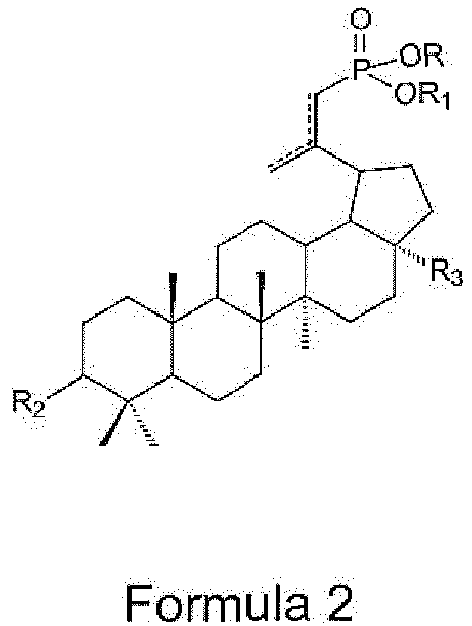 R is hydrogen atom, alkyl group (C1-C4), allyl group,R1 is hydrogen atom, alkyl group (C1-C4), allyl group,R2 is hydroxy, oxo, alkanoyloxy, alkenoyloxy, propynoyloxy, cyclopropylpropynoyloxy, 2-butynoyloxy, 3-butynoyloxy, phenylpropynoyloxy, 3-carboxypropynoyloxy, propyloxycarbonyloxy, propenoxycarbonyloxy, propargyloxycarbonyloxy, 2-butynyloxycarbonyloxy, 3-butynyloxycarbonyloxy, propargyloxy, 2-butynyloxy, 3-butynyloxy, as well as alkynyloxy (C1-C10) group containing one or several triple bonds, triple and double bonds in the enediyne or eneyne system, and also a terminal hydroxy, amino, chloro, or bromo substituent,R3 is hydroxymethyl, carboxyl, aldehyde, alkanoyloxymethyl, alkenoyloxymethyl, propynoyloxymethyl, cyclopropylpropynoyloxymethyl, 2-butynoyloxymethyl, 3-butynoyloxymethyl, phenylpropynoyloxymethyl, 3-carboxypropynoyloxymethyl, propyloxycarbonyloxymethyl, 2-propenoxycarbonyloxymethyl, propargyloxycarbonyloxymethyl, 2-butynyloxycarbonyloxymethyl, 3-butynyloxycarbonyloxymethyl, propargyloxymethyl, 2-butynyloxymethyl, 3-butynyloxymethyl group, as well as an alkynyloxymethyl (C1-C10) group containing one or several triple bonds, triple and double bonds in the enediyne or eneyne system, and also a terminal hydroxy, amino, chloro, or bromo substituent.
 - Phosphonates according to claim 1, characterised in that R2 and R3 in Formula 2 denote 4-substituted-2-butynyloxymethyl groups containing a terminal substituent: hydroxy, chloro, tiocyanate, selenocyanate, propargyloxy, propargylamino.
- A method for preparation of phosphonates of acetylenic betulin derivatives with Formula 2, wherein a phosphonic group is bounded with C29 or C30 carbon atoms of the isopropenyl group, wherein the dashed lines between C20, and C29 and C30 indicate that the bond between them may be a double or single bond, and the individual substituents are as follows:R is hydrogen atom, alkyl group (C1-C4), allyl group,R1 is hydrogen atom, alkyl group (C1-C4), allyl group,R2 is hydroxy group, oxo, alkanoyloxy, alkenoyloxy, propynoyloxy, cyclopropylpropynoyloxy, 2-butynoyloxy, 3-butynoyloxy, phenylpropynoyloxy, 3-carboxypropynoyloxy, propyloxycarbonyloxy, propenoxycarbonyloxy, propargyloxycarbonyloxy, 2-butynyloxycarbonyloxy, 3-butynyloxycarbonyloxy, propargyloxy, 2-butynyloxy, 3-butynyloxy, as well as alkynyloxy (C1-C10) group containing one or several triple bonds, triple and double bonds in the enediyne or eneyne system, and also a terminal hydroxy, amino, chloro, or bromo substituent,R3 is hydroxymethyl, carboxyl, aldehyde, alkanoyloxymethyl, alkenoyloxymethyl, propynoyloxymethyl, cyclopropylpropynoyloxymethyl, 2-butynoyloxymethyl, 3-butynoyloxymethyl, phenylpropynoyloxymethyl, 3-carboxypropynoyloxymethyl, propyloxycarbonyloxymethyl, 2-propenoxycarbonyloxymethyl, propargyloxycarbonyloxymethyl, 2-butynyloxycarbonyloxymethyl, 3-butynyloxycarbonyloxymethyl, propargyloxymethyl, 2-butynyloxymethyl, 3-butynyloxymethyl group, as well as alkynyloxymethyl (C1-C10) group containing one or several triple bonds, triple and double bonds in the enediyne or eneyne system, and also a terminal hydroxy, amino, chloro, or bromo substituent, characterised in that the compound with Formula 3 is reacted with trialkyl or triallyl phosphite at a temperature of 100°C-165°C.
- The method according to claim 3, characterised in that in case of preparation of the compounds with Formula 2A, wherein R = R1 = alkyl, allyl, a derivative of a betulin phosphonate with Formula 4, wherein R = R1 = alkyl, allyl, is subjected to hydrolysis using sodium hydroxide, the reaction being carried out in a CH3OH/THF/H2O solution at room temperature.
- The method according to claim 3, characterised in that in case of preparation of a mixture of the compounds with Formula 2B (trans) and 2C (cis), wherein R = R1 = alkyl, allyl, a derivative of a betulin phosphonate with Formula 4, wherein R = R1 = alkyl, allyl, is subjected to hydrolysis using potassium hydroxide, the reaction being carried out in ethanolic solution at boiling temperature.
- The method according to claim 3, characterised in that in case of preparation of a mixture of monoesters with Formula 5A, wherein R = R1 = alkyl, allyl, R3 = alkanoyloxymethyl, alkenoyloxymethyl, propynoyloxymethyl, cyclopropylpropynoyloxymethyl, 2-butynoyloxymethyl, 3-butynoyloxymethyl, phenylpropynoyloxymethyl, and diesters with Formula 5B, wherein R = R1 = alkyl, allyl, R2 = alkanoyloxy, alkenoyloxy, propynoyloxy, cyclopropylpropynoyloxy, butynoyloxy, phenylpropynoyloxy, R3 = alkanoyloxymethyl, alkenoyloxymethyl, propynoyloxymethyl, cyclopropylpropynoyloxymethyl, 2-butynoyloxymethyl, 3-butynoyloxymethyl, phenylpropynoyloxymethyl, a derivative of a betulin phosphonate with Formula 2, wherein R = R1 = alkyl, allyl, R2 = OH, R3 = CH2OH, is subjected to esterification using an alkynoic, alkenoic or alkanoic acid in an organic solvent selected from the group including methylene chloride, chloroform, toluene or diethyl ether, the reaction being carried out in the presence of N,N'-dicyclohexylcarbodiimide and 4-dimethylaminopyridine, at a temperature of -10 to +20°C.
- The method according to claim 3, characterised in that in case of preparation of a mixture of monoesters with Formula 5A, wherein R = R1 = alkyl, allyl, R3 = propyloxycarbonyloxymethyl, propenoxycarbonyloxymethyl, propargyloxycarbonyloxy, 2-butynyloxycarbonyloxy, 3-butynyloxycarbonyloxy, and diesters with Formula 5B, wherein R = R1 = alkyl, allyl, R2 = propyloxycarbonyloxy, propenoxycarbonyloxy, propargyloxycarbonyloxy, 2-butynyloxycarbonyloxy, 3-butynyloxycarbonyloxy, R3 = propyloxycarbonyloxymethyl, propenoxycarbonyloxymethyl, propargyloxycarbonyloxymethyl, 2-butynyloxycarbonyloxymethyl, 3-butynyloxycarbonyloxymethyl, a derivative of a betulin phosphonate with Formula 2, wherein R = R1 = alkyl, allyl, R2 = OH, R3 = CH2OH, is subjected to a reaction with alkynyl, alkenyl or alkyl chloroformate in an organic solvent selected from a group including benzene and toluene, the reaction being carried out in the presence of an amine selected from the group including triethylamine, pyridine, cyclohexylamine, at a temperature of 5°C to 20°C.
- The method according to claim 3, characterised in that in case of preparation of betulinylphosphonic acid with Formula 6, wherein R2 = AcO, R3 = CH2OAc, a derivative of a betulin phosphonate with Formula 2, wherein R = R1 = alkyl, allyl, R2 = AcO, R3 = CH2OAc, is subjected to a reaction with bromotrimethylsilane in an organic solvent selected from the group including methylene chloride, chloroform, acetonitrile, at room temperature.
- The method according to claim 3, characterised in that in case of preparation of a betulinylphosphonic acid monoester with Formula 7, wherein R1 = alkyl, allyl, R2 = AcO, R3 = CH2OAc, a derivative of a betulin phosphonate with Formula 2, wherein R = R1 = alkyl, allyl, R2 = AcO, R3 = CH2OAc, is subjected to a reaction with lithium bromide in an organic solvent selected from the group including acetone, butanone, 2-pentanone, acetonitrile, at boiling temperature of the mixture.
- The method according to claim 3, characterised in that in case of preparation of the compounds with Formula 8, wherein R = R1 = alkyl, allyl, a derivative of a betulin phosphonate with Formula 2, wherein R = R1 = alkyl, allyl, R2 = OH, R3 = CH2OH, is subjected to a reaction with pyridinium chlorochromate at room temperature.
- The method according to claim 3, characterised in that in case of preparation of the compounds with Formula 9, wherein R = R1 = alkyl, allyl, a derivative of a betulin phosphonate with Formula 2, wherein R = R1 = alkyl, allyl, R2 = OH, R3 = CH2OH, is subjected to a reaction with Jones reagent in acidic medium, in acetone.
- The method according to claim 3, characterised in that in case of preparation of the compounds with Formula 10, wherein R = R1 = alkyl, allyl, a derivative of a betulin phosphonate with Formula 9, wherein R = R1 = alkyl, allyl, is subjected to reduction with sodium borohydride in an organic solvent selected from the group including tetrahydrofuran, diethyl ether, isopropanol, ethanol, methanol, at room temperature.
- Application of phosphonates of acetylenic betulin derivatives according to claim 1 or 2, or 3 for inhibition of cancer cells proliferation, separately or in a mixture with betulin, betulinic acid or other known anticancer compounds.
Applications Claiming Priority (1)
| Application Number | Priority Date | Filing Date | Title |
|---|---|---|---|
| PL413516A PL227790B1 (en) | 2015-08-13 | 2015-08-13 | Phosphonates of acetylene derivatives of betulin with antitumour effects, method for producing them and applications |
Publications (2)
| Publication Number | Publication Date |
|---|---|
| EP3130594A1 true EP3130594A1 (en) | 2017-02-15 |
| EP3130594B1 EP3130594B1 (en) | 2020-11-11 |
Family
ID=57044859
Family Applications (1)
| Application Number | Title | Priority Date | Filing Date |
|---|---|---|---|
| EP16183580.6A Not-in-force EP3130594B1 (en) | 2015-08-13 | 2016-08-10 | Phosphonates of acetylenic betulin derivatives with anticancer activity, method for their production and their application |
Country Status (2)
| Country | Link |
|---|---|
| EP (1) | EP3130594B1 (en) |
| PL (1) | PL227790B1 (en) |
Cited By (2)
| Publication number | Priority date | Publication date | Assignee | Title |
|---|---|---|---|---|
| EP3575310A1 (en) * | 2018-05-28 | 2019-12-04 | Uniwersystet Slaski w Katowicach | Phosphonate derivates of betulin compounds with antiviral activity, method for their preparation and their application |
| CN116813684A (en) * | 2023-06-29 | 2023-09-29 | 南宁师范大学 | Selenium cyano pregnenolone amide compound and application thereof |
Citations (19)
| Publication number | Priority date | Publication date | Assignee | Title |
|---|---|---|---|---|
| US5468888A (en) | 1991-11-13 | 1995-11-21 | Rhone-Poulenc Rorer S.A. | Lupane derivatives, their preparation and the pharmaceutical compositions which contain them |
| US5679828A (en) | 1995-06-05 | 1997-10-21 | Biotech Research Labs, Inc. | Betulinic acid and dihydrobetulinic acid derivatives and uses therefor |
| US6048847A (en) | 1997-09-30 | 2000-04-11 | Dabur Research Foundation | Use of betulinic acid and its derivatives for inhibiting cancer growth and a method of monitoring this |
| US6048841A (en) | 1995-11-22 | 2000-04-11 | Darwin Discovery, Ltd. | Peptidyl compounds |
| US6172110B1 (en) | 1998-03-02 | 2001-01-09 | The University Of North Carolina At Chapel Hill | Acylated betulin and dihydrobetulin derivatives, preparation thereof and use thereof |
| US6228850B1 (en) | 1997-09-30 | 2001-05-08 | Dabur Research Foundation | Antiangiogenic activity of betulinic acid and its derivatives |
| US6392070B1 (en) | 1999-08-10 | 2002-05-21 | Regents Of The University Of Minnesota | Birch bark processing and the isolation of natural products from birch bark |
| US6403816B1 (en) | 1997-09-30 | 2002-06-11 | Dabur Research Foundation | Betulinic acid derivatives having antiangiogenic activity, processes for producing such derivatives and their use for treating tumor associated angiogenesis |
| US6407270B1 (en) | 2000-01-11 | 2002-06-18 | Regents Of The University Of Minnesota | Methods for manufacturing betulinic acid |
| EP1266658A2 (en) | 1997-05-16 | 2002-12-18 | The Board Of Trustees Of The University Of Illinois | Use of betulinic acid derivatives for the treatment and prevention of melanoma |
| US20030073858A1 (en) | 2001-01-11 | 2003-04-17 | Krasutsky Pavel A. | Methods for manufacturing betulinic acid |
| WO2004028455A2 (en) | 2002-09-26 | 2004-04-08 | Panacos Pharmaceuticals, Inc. | Monoacylated betulin and dihydrobetulin derivatives, preparation thereof and use thereof |
| WO2006085334A2 (en) | 2005-02-09 | 2006-08-17 | Dabur Pharma Limited | Novel betulinic acid derivatives a-ring-condensed to a heterocyclic group |
| WO2006105356A2 (en) | 2005-03-29 | 2006-10-05 | Regents Of The University Of Minnesota | Methods of manufacturing bioactive 3-esters of betulinic aldehyde and betulinic acid |
| WO2006133314A2 (en) | 2005-06-08 | 2006-12-14 | Regents Of The University Of Minnesota | Synthesis of betulonic and betulinic aldehydes |
| WO2007141392A2 (en) | 2006-06-07 | 2007-12-13 | Valtion Teknillinen Tutkimuskeskus | Compositions comprising betulonic acid |
| WO2008070347A2 (en) | 2006-10-27 | 2008-06-12 | Regents Of The University Of Minnesota | Betulin-peptide conjugates |
| JP2011225538A (en) * | 2010-03-31 | 2011-11-10 | Toyama Prefecture | Weaning agent for cancer immunosuppression, composition for cancer immuno-therapy and cancer immuno-therapy |
| US20130225532A1 (en) | 2010-05-10 | 2013-08-29 | Academia Sinica | Zanamivir phosphonate congeners with anti-influenza activity and determining oseltamivir susceptibility of influenza viruses |
-
2015
- 2015-08-13 PL PL413516A patent/PL227790B1/en unknown
-
2016
- 2016-08-10 EP EP16183580.6A patent/EP3130594B1/en not_active Not-in-force
Patent Citations (21)
| Publication number | Priority date | Publication date | Assignee | Title |
|---|---|---|---|---|
| US5468888A (en) | 1991-11-13 | 1995-11-21 | Rhone-Poulenc Rorer S.A. | Lupane derivatives, their preparation and the pharmaceutical compositions which contain them |
| US20030181429A1 (en) | 1995-03-21 | 2003-09-25 | The Board Of Trustees Of The University Of Illinois | Method and composition for selectively inhibiting melanoma |
| US5679828A (en) | 1995-06-05 | 1997-10-21 | Biotech Research Labs, Inc. | Betulinic acid and dihydrobetulinic acid derivatives and uses therefor |
| US6048841A (en) | 1995-11-22 | 2000-04-11 | Darwin Discovery, Ltd. | Peptidyl compounds |
| EP1266658A2 (en) | 1997-05-16 | 2002-12-18 | The Board Of Trustees Of The University Of Illinois | Use of betulinic acid derivatives for the treatment and prevention of melanoma |
| US6048847A (en) | 1997-09-30 | 2000-04-11 | Dabur Research Foundation | Use of betulinic acid and its derivatives for inhibiting cancer growth and a method of monitoring this |
| US6228850B1 (en) | 1997-09-30 | 2001-05-08 | Dabur Research Foundation | Antiangiogenic activity of betulinic acid and its derivatives |
| US6403816B1 (en) | 1997-09-30 | 2002-06-11 | Dabur Research Foundation | Betulinic acid derivatives having antiangiogenic activity, processes for producing such derivatives and their use for treating tumor associated angiogenesis |
| US6172110B1 (en) | 1998-03-02 | 2001-01-09 | The University Of North Carolina At Chapel Hill | Acylated betulin and dihydrobetulin derivatives, preparation thereof and use thereof |
| US6392070B1 (en) | 1999-08-10 | 2002-05-21 | Regents Of The University Of Minnesota | Birch bark processing and the isolation of natural products from birch bark |
| US6867314B2 (en) | 2000-01-11 | 2005-03-15 | Regents Of The University Of Minnesota | Methods for manufacturing betulinic acid |
| US6407270B1 (en) | 2000-01-11 | 2002-06-18 | Regents Of The University Of Minnesota | Methods for manufacturing betulinic acid |
| US20030073858A1 (en) | 2001-01-11 | 2003-04-17 | Krasutsky Pavel A. | Methods for manufacturing betulinic acid |
| WO2004028455A2 (en) | 2002-09-26 | 2004-04-08 | Panacos Pharmaceuticals, Inc. | Monoacylated betulin and dihydrobetulin derivatives, preparation thereof and use thereof |
| WO2006085334A2 (en) | 2005-02-09 | 2006-08-17 | Dabur Pharma Limited | Novel betulinic acid derivatives a-ring-condensed to a heterocyclic group |
| WO2006105356A2 (en) | 2005-03-29 | 2006-10-05 | Regents Of The University Of Minnesota | Methods of manufacturing bioactive 3-esters of betulinic aldehyde and betulinic acid |
| WO2006133314A2 (en) | 2005-06-08 | 2006-12-14 | Regents Of The University Of Minnesota | Synthesis of betulonic and betulinic aldehydes |
| WO2007141392A2 (en) | 2006-06-07 | 2007-12-13 | Valtion Teknillinen Tutkimuskeskus | Compositions comprising betulonic acid |
| WO2008070347A2 (en) | 2006-10-27 | 2008-06-12 | Regents Of The University Of Minnesota | Betulin-peptide conjugates |
| JP2011225538A (en) * | 2010-03-31 | 2011-11-10 | Toyama Prefecture | Weaning agent for cancer immunosuppression, composition for cancer immuno-therapy and cancer immuno-therapy |
| US20130225532A1 (en) | 2010-05-10 | 2013-08-29 | Academia Sinica | Zanamivir phosphonate congeners with anti-influenza activity and determining oseltamivir susceptibility of influenza viruses |
Non-Patent Citations (42)
| Title |
|---|
| A.M.F. PHILLIPS; M.T. BARROS; M. PACHECO; R. DIAS, BIOORG. MED. CHEM. LETT., vol. 24, 2014, pages 49 - 53 |
| ALOIS VYSTRCIL ET AL: "Isomeric oximes of 30-norlupan-20-one and its derivatives", COLLECTION SYMPOSIUM SERIES (XIIITH SYMPOSIUM ON CHEMISTRY OF NUCLEIC ACID COMPONENTS SPINDLERUV MLYN, CZECH REPUBLIC; SEPTEMBER 03 -09, 2005), vol. 51, no. 3, 1986, XX, pages 581 - 592, XP055330336, ISSN: 0010-0765, ISBN: 978-80-86241-25-8, DOI: 10.1135/cccc19860581 * |
| B. LEIL; R. RUANGWEERAYUT; J. WIESNER; M. ANOUMOU MISSINOU; A. SCHINDLER; T. BARANEK; M. HINTZ; D. HUTCHINSON; H. JOMAA; P.G. KREM, ANTIMICROB. AGENTS CHEMOTHER, vol. 47, 2003, pages 735 - 738 |
| C.B. REDDY; K.S. KUMAR; M A KUMAR; M.V.N. REDDY; B.S. KRISHNA; M. NAVEEN; M.K. ARUNASREE; C.N. REDDY; C.N. RAJU; C.D. REDDY, EUR J. MED. CHEM., vol. 47, 2012, pages 553 - 559 |
| D.S.H.L. KIM; J.M. PEZZUTO; E. PISHA, BIOORG. MED. CHEM. LETT., vol. 8, 1998, pages 1707 - 1712 |
| D.V. PATEL; K. RIELLY-GAUVIN; D.E. RYONO; C.A. FREE; W.L. ROGERS; S.A. SMITH; J.M. DEFORREST; E.W. OEHL; E.W. PETRILLO JR., J. MED. CHEM., vol. 38, 1995, pages 4557 - 4569 |
| DATABASE REAXYS [online] Elsevier; 1986, VYSTRCIL, ALOIS, XP002765367, Database accession no. 5203916 * |
| E.D. CARLO; P. BOCCA; L. EMIONITE; M. CILLI; G. CIPOLLONE; F. MORANDI; L. RAFFAGHELLO; V. PISTOIA; I. PRIGIONE, AM. SOC. GEN. CELL THER., vol. 21, 2013, pages 1034 - 1043 |
| F. SOLER; C. POUJADE; M. EVERS; J-C. CARRY; Y. HENIN; A. BOUSSEAU; T. HUET; R. PAUWELS; E. DE CLERCQ; J-F. MAYAUX, J. MED. CHEM., vol. 39, 1996, pages 1 - 69,1083 |
| G.A. TOLSTIKOV; O.B. FLEKHTER; E.E. SHULTZ; L.A. BALTINA; A.G. TOLSTIKOV, CHEM. SUSTAIN. DEVELOP, vol. 13, 2005, pages 1 - 29 |
| G.A. TOLSTIKOV; O.B. FLEKHTER; E.E. SHULTZ; L.A. BALTINA; A.G. TOLSTIKOV, CHEM. SUSTAIN. DEVELOP., vol. 13, 2005, pages 1 - 29 |
| H. FLEISCH., ENDOCR. REV., vol. 19, 1998, pages 80 - 100 |
| H. KOMMERA; G.N. KALUDEROVIC; S. DITTRICH; J. KALBITZ; B. DRAGER; T. MUELLER; R. PASCHKE, BIOORG. MED. CHEM. LETT., vol. 20, 2010, pages 3409 - 3412 |
| I. BAGLIN; A-C. MITAINE-OFFER; M. NOUR; K. TAN; C. CAVE; M-A. LACAILLE-DUBOIS, MINI REV. MED. CHEM., vol. 3, 2003, pages 525 - 539 |
| I.D. BORI; H-Y. HUNG; K. QIAN; C-H. CHEN; S. L. MORRIS-NATSCHKE; K-H. LEE, TETRAHEDRON LETT.,, vol. 53, 2012, pages 1987 - 1989 |
| J.F. DELLARIA, JR.; R.G. MAKI; H.H. STEIN; J. COHEN; D. WHITTERN; K. MARSH; D.J. HOFFMAN; J.J. PLATTNER; T.J. PERUN, J. MED. CHEM., vol. 33, 1990, pages 534 - 542 |
| K. ROSE, BIOMED. PHARMACOTHER, vol. 67, 2013, pages 53 - 57 |
| K.A. MUNGARA; Y-K. PARK; K.D. LEE, CHEM. PHARM. BULL., vol. 60, 2012, pages 1531 - 1537 |
| K.K. BIRON, ANTIVIRAL. RESEARCH, vol. 71, 2006, pages 154 - 163 |
| M. DRACINSKY; M. KRECMEROVA; A. HOLY, BIOORG. MED. CHEM.,, vol. 16, 2008, pages 6778 - 6782 |
| M. KVASNICA; J. SAREK; E. KLINOTOVA; P. DZUBAK; M. HAJDUCH, BIOORG. MED. CHEM. LETT., vol. 13, 2005, pages 3447 - 3454 |
| M. RAJASEKHAR; K.U.M. RAO; C.S. SUNDAR; N.B REDDY; S.K NAYAK; C.S REDDY, CHEM. PHARM. BULL., vol. 60, 2012, pages 854 - 858 |
| N. ROUSSOS; D.E KARAGEORGOPOULOS; G. SAMONIS; M.F. FALAGAS, INT. J. ANTIMICROB. AGENTS, vol. 34, 2009, pages 506 - 515 |
| O.B. FIEKHTER; N.I. MEDVEDEVA; L.T. KARACHURINA; L.A. BALTINA; F.Z. GALIN; F.S. ZARUDII; G.A. TOLSTIKOV, PHARM. CHEM. J., vol. 39, 2005, pages 401 - 404 |
| O.B. FLEKHTER; L.T. KARACHURINA; L.R. NIGMATULLINA; T.A. SAPOZHNIKOVA; L.A. BALTINA; F.S. ZARUDII; F.Z. GALIN; L.V. SPIRIKHIN; G.A, RUSS. J. BIOORG. CHEM., vol. 28, 2002, pages 494 - 500 |
| P. BROGANELLI; A. CHIARETTA; B. FRAGNELLI; M.G. BERNENGO, DERMATOL. THER.,, vol. 25, 2012, pages 468 - 471 |
| R. CSUK; A. BARTHEL; R. KLUGE; D. STROHLET, BIOORG. MED. CHEM., vol. 18, 2010, pages 7252 - 7259 |
| R. CSUK; A. BARTHEL; R. SCZEPEK; B. SIEWERT; S. SCHWARZ, ARCH. PHARM. CHEM. LIFE SCI, vol. 1, 2011, pages 37 - 49 |
| R. CSUK; C. NITSCHE; R. SCZEPEK; S. SCHWARZ; B. SIEWERT, ARCH. PHARM. CHEM. LIFE SCI,, vol. 346, 2013, pages 232 - 246 |
| R. MUKHERJEE; V. KUMAR; S. K.SRIVASTAVA; S.K. AGARWAL; A.C. BURMAN, ANTI-CANCER AGENTS MED. CHEM., vol. 6, 2006, pages 271 - 279 |
| R.C. SANTOS; J.A.R. SALVADOR; S. MARIN; M. CASCANTE; J.N. MOREIRA; T.C.P. DINIS, BIOORG. MED. CHEM., vol. 18, 2010, pages 4385 - 4396 |
| R.H. CICHEWICZ; S.A. KOUZI, MED. CHEM. REV., vol. 24, 2003, pages 90 - 114 |
| S. ALAKURTTI; T. MAKELA; S. KOSKIMIES; J. YLI-KAUHALUOMA, EUR. J. PHARM. SCI., vol. 29, 2006, pages 1 - 13 |
| S. ALAKURTTI; T. MAKELA; S. KOSKIMIES; J. YLI-KAUHALUOMA, EUR. J. PHARM.SCI., vol. 29, 2006, pages 1 - 13 |
| S. BORYCZKA; E. BEBENEK; J. WIETRZYK; K. KEMPINSKA; M. JASTRZ BSKA; J. KUSZ; M. NOWAK, MOLECULES, vol. 18, 2013, pages 4526 - 4543 |
| S.F. VASILEVSKY; A.I. GOVDI; E.E. SHULTS; M.M. SHAKIROV; I.V. ALABUGIN; G.A. TOLSTIKOV, DOKLADY CHEM.,, vol. 424, 2009, pages 39 - 42 |
| S.F. VASILEVSKY; A.I. GOVDI; E.E. SHULTS; M.M. SHAKIROV; I.V. SOROKINA; T.G. TOLSTIKOVA; D.S. BAEV; G.A. TOLSTIKOV; I.V. ALABUGIN, BIOORG. MED. CHEM., vol. 17, 2009, pages 5164 - 5169 |
| T.G. TOLSTIKOVA; I.V. SOROKINA; G.A. TOLSTIKOV; O.B. FLEKHTER, RUSS. J. BIOORG. CHEM, vol. 32, 2006, pages 37 - 49 |
| T.G. TOLSTIKOVA; I.V. SOROKINA; G.A. TOLSTIKOV; O.B. FLEKHTER, RUSS. J. BIOORG. CHEM., vol. 32, 2006, pages 261 - 276 |
| Y. BI; J. XU; X. WU; W. YE; S. YUAN; L. ZHANG, BIOORG. MED. CHEM. LETT., vol. 17, 2007, pages 1475 - 1478 |
| Y. KASHIWADA; J. CHIYO; Y. IKESHIRO; T. NAGAO; H. OKABE; L.M. COSENTINO; K. FOWKE; K.H. LEE, BIOORG. MED. CHEM. LETT., vol. 11, 2001, pages 183 - 185 |
| Y. KASHIWADA; M. SEKIYA; Y. IKESHIRO; T. FUJIOKA; N.R. KILGORE; C.T. WILD; G.P. ALLAWAY; K-H. LEE, BIOORG. MED. CHEM. LETT., vol. 14, 2004, pages 5851 - 585 |
Cited By (2)
| Publication number | Priority date | Publication date | Assignee | Title |
|---|---|---|---|---|
| EP3575310A1 (en) * | 2018-05-28 | 2019-12-04 | Uniwersystet Slaski w Katowicach | Phosphonate derivates of betulin compounds with antiviral activity, method for their preparation and their application |
| CN116813684A (en) * | 2023-06-29 | 2023-09-29 | 南宁师范大学 | Selenium cyano pregnenolone amide compound and application thereof |
Also Published As
| Publication number | Publication date |
|---|---|
| PL413516A1 (en) | 2017-02-27 |
| PL227790B1 (en) | 2018-01-31 |
| EP3130594B1 (en) | 2020-11-11 |
Similar Documents
| Publication | Publication Date | Title |
|---|---|---|
| Lefebvre et al. | Mononucleoside phosphotriester derivatives with S-acyl-2-thioethyl bioreversible phosphate-protecting groups: intracellular delivery of 3'-azido-2', 3'-dideoxythymidine 5'-monophosphate | |
| Prishchenko et al. | Silicon-assisted synthesis of new aminomethylenebisphosphonic acids with quinolines moieties | |
| Monteil et al. | Bisphosphonate prodrugs: Synthesis and biological evaluation in HuH7 hepatocarcinoma cells | |
| EP0601573A1 (en) | Alpha-phosphonocarboxylate squalene synthetase inhibitors and method | |
| Magnin et al. | 1, 1-Bisphosphonate squalene synthase inhibitors: interplay between the isoprenoid subunit and the diphosphate surrogate | |
| WO2013071418A1 (en) | Methods for the synthesis of plasmalogens and plasmalogen derivatives, and therapeutic uses thereof | |
| Morris-Natschke et al. | Synthesis of phosphocholine and quaternary amine ether lipids and evaluation of in vitro antineoplastic activity | |
| EP3130594B1 (en) | Phosphonates of acetylenic betulin derivatives with anticancer activity, method for their production and their application | |
| CA2690762C (en) | .alpha.-chloro and .alpha.-bromo phosphonate analogs of lysophosphatidic acid and methods of making and using thereof | |
| Chen et al. | Synthesis and in vitro anticancer activity evaluation of novel bioreversible phosphate inositol derivatives | |
| North et al. | Autotaxin structure–activity relationships revealed through lysophosphatidylcholine analogs | |
| Vetro et al. | Anionic glycolipids related to glucuronosyldiacylglycerol inhibit protein kinase Akt | |
| JP4162927B2 (en) | Carbacyclic phosphatidic acid derivatives | |
| Tsepaeva et al. | Synthesis of C (28)-linker derivatives of betulinic acid bearing phosphonate group | |
| US20040147487A1 (en) | Inositol derivatives for increasing chloride secretion and inhibiting inflammation | |
| Ewies et al. | Synthesis of novel 1, 2-diphenylpyrrole derivatives using organophosphorus reagents and their antitumour activities | |
| Ni et al. | Synthesis and evaluation of immunostimulant plasmalogen lysophosphatidylethanolamine and analogues for natural killer T cells | |
| Nikolova et al. | A new and efficient method for conjugate addition of trialkylphosphites to 3-acylsubstituted coumarins | |
| Tsepaeva et al. | Reaction of Methyl (2-Methylidene)-3-oxolup-20 (29)-en-28-oate with Dimethyl Trimethylsilyl Phosphite | |
| Song et al. | Synthesis and antitumor activity of inositol phosphotriester analogues | |
| de Almeida et al. | Stereoselective synthesis of inositol mono, bis and trisphosphate analogues from 6-deoxy-d-inositol precursors | |
| Sevrain et al. | Glyco-Phospho-Glycero Ether Lipids (GPGEL): synthesis and evaluation as small conductance Ca 2+-activated K+ channel (SK3) inhibitors | |
| Frank et al. | New steroid-fused P-heterocycles: Part I. Synthesis and conformational study of dioxaphosphorino [16, 17-d] estrone derivatives | |
| WO2006056182A1 (en) | Novel active substances for treating, diagnosing and preventing macular degeneration | |
| WO1999055903A1 (en) | Membrane-permeant phosphoinositides |
Legal Events
| Date | Code | Title | Description |
|---|---|---|---|
| PUAI | Public reference made under article 153(3) epc to a published international application that has entered the european phase |
Free format text: ORIGINAL CODE: 0009012 |
|
| STAA | Information on the status of an ep patent application or granted ep patent |
Free format text: STATUS: THE APPLICATION HAS BEEN PUBLISHED |
|
| AK | Designated contracting states |
Kind code of ref document: A1 Designated state(s): AL AT BE BG CH CY CZ DE DK EE ES FI FR GB GR HR HU IE IS IT LI LT LU LV MC MK MT NL NO PL PT RO RS SE SI SK SM TR |
|
| AX | Request for extension of the european patent |
Extension state: BA ME |
|
| STAA | Information on the status of an ep patent application or granted ep patent |
Free format text: STATUS: REQUEST FOR EXAMINATION WAS MADE |
|
| 17P | Request for examination filed |
Effective date: 20170522 |
|
| RBV | Designated contracting states (corrected) |
Designated state(s): AL AT BE BG CH CY CZ DE DK EE ES FI FR GB GR HR HU IE IS IT LI LT LU LV MC MK MT NL NO PL PT RO RS SE SI SK SM TR |
|
| STAA | Information on the status of an ep patent application or granted ep patent |
Free format text: STATUS: EXAMINATION IS IN PROGRESS |
|
| 17Q | First examination report despatched |
Effective date: 20171221 |
|
| GRAP | Despatch of communication of intention to grant a patent |
Free format text: ORIGINAL CODE: EPIDOSNIGR1 |
|
| STAA | Information on the status of an ep patent application or granted ep patent |
Free format text: STATUS: GRANT OF PATENT IS INTENDED |
|
| RIC1 | Information provided on ipc code assigned before grant |
Ipc: C07J 63/00 20060101ALI20200518BHEP Ipc: A61K 31/56 20060101ALI20200518BHEP Ipc: A61K 31/662 20060101ALI20200518BHEP Ipc: A61P 35/00 20060101ALI20200518BHEP Ipc: C07F 9/40 20060101AFI20200518BHEP |
|
| INTG | Intention to grant announced |
Effective date: 20200618 |
|
| GRAS | Grant fee paid |
Free format text: ORIGINAL CODE: EPIDOSNIGR3 |
|
| GRAA | (expected) grant |
Free format text: ORIGINAL CODE: 0009210 |
|
| STAA | Information on the status of an ep patent application or granted ep patent |
Free format text: STATUS: THE PATENT HAS BEEN GRANTED |
|
| AK | Designated contracting states |
Kind code of ref document: B1 Designated state(s): AL AT BE BG CH CY CZ DE DK EE ES FI FR GB GR HR HU IE IS IT LI LT LU LV MC MK MT NL NO PL PT RO RS SE SI SK SM TR |
|
| REG | Reference to a national code |
Ref country code: GB Ref legal event code: FG4D |
|
| REG | Reference to a national code |
Ref country code: CH Ref legal event code: EP |
|
| REG | Reference to a national code |
Ref country code: AT Ref legal event code: REF Ref document number: 1333371 Country of ref document: AT Kind code of ref document: T Effective date: 20201115 |
|
| REG | Reference to a national code |
Ref country code: DE Ref legal event code: R096 Ref document number: 602016047549 Country of ref document: DE |
|
| REG | Reference to a national code |
Ref country code: IE Ref legal event code: FG4D |
|
| REG | Reference to a national code |
Ref country code: NL Ref legal event code: MP Effective date: 20201111 |
|
| REG | Reference to a national code |
Ref country code: AT Ref legal event code: MK05 Ref document number: 1333371 Country of ref document: AT Kind code of ref document: T Effective date: 20201111 |
|
| PG25 | Lapsed in a contracting state [announced via postgrant information from national office to epo] |
Ref country code: GR Free format text: LAPSE BECAUSE OF FAILURE TO SUBMIT A TRANSLATION OF THE DESCRIPTION OR TO PAY THE FEE WITHIN THE PRESCRIBED TIME-LIMIT Effective date: 20210212 Ref country code: FI Free format text: LAPSE BECAUSE OF FAILURE TO SUBMIT A TRANSLATION OF THE DESCRIPTION OR TO PAY THE FEE WITHIN THE PRESCRIBED TIME-LIMIT Effective date: 20201111 Ref country code: NO Free format text: LAPSE BECAUSE OF FAILURE TO SUBMIT A TRANSLATION OF THE DESCRIPTION OR TO PAY THE FEE WITHIN THE PRESCRIBED TIME-LIMIT Effective date: 20210211 Ref country code: RS Free format text: LAPSE BECAUSE OF FAILURE TO SUBMIT A TRANSLATION OF THE DESCRIPTION OR TO PAY THE FEE WITHIN THE PRESCRIBED TIME-LIMIT Effective date: 20201111 Ref country code: PT Free format text: LAPSE BECAUSE OF FAILURE TO SUBMIT A TRANSLATION OF THE DESCRIPTION OR TO PAY THE FEE WITHIN THE PRESCRIBED TIME-LIMIT Effective date: 20210311 |
|
| PG25 | Lapsed in a contracting state [announced via postgrant information from national office to epo] |
Ref country code: BG Free format text: LAPSE BECAUSE OF FAILURE TO SUBMIT A TRANSLATION OF THE DESCRIPTION OR TO PAY THE FEE WITHIN THE PRESCRIBED TIME-LIMIT Effective date: 20210211 Ref country code: PL Free format text: LAPSE BECAUSE OF FAILURE TO SUBMIT A TRANSLATION OF THE DESCRIPTION OR TO PAY THE FEE WITHIN THE PRESCRIBED TIME-LIMIT Effective date: 20201111 Ref country code: SE Free format text: LAPSE BECAUSE OF FAILURE TO SUBMIT A TRANSLATION OF THE DESCRIPTION OR TO PAY THE FEE WITHIN THE PRESCRIBED TIME-LIMIT Effective date: 20201111 Ref country code: IS Free format text: LAPSE BECAUSE OF FAILURE TO SUBMIT A TRANSLATION OF THE DESCRIPTION OR TO PAY THE FEE WITHIN THE PRESCRIBED TIME-LIMIT Effective date: 20210311 Ref country code: LV Free format text: LAPSE BECAUSE OF FAILURE TO SUBMIT A TRANSLATION OF THE DESCRIPTION OR TO PAY THE FEE WITHIN THE PRESCRIBED TIME-LIMIT Effective date: 20201111 Ref country code: AT Free format text: LAPSE BECAUSE OF FAILURE TO SUBMIT A TRANSLATION OF THE DESCRIPTION OR TO PAY THE FEE WITHIN THE PRESCRIBED TIME-LIMIT Effective date: 20201111 |
|
| REG | Reference to a national code |
Ref country code: LT Ref legal event code: MG9D |
|
| PG25 | Lapsed in a contracting state [announced via postgrant information from national office to epo] |
Ref country code: HR Free format text: LAPSE BECAUSE OF FAILURE TO SUBMIT A TRANSLATION OF THE DESCRIPTION OR TO PAY THE FEE WITHIN THE PRESCRIBED TIME-LIMIT Effective date: 20201111 |
|
| PG25 | Lapsed in a contracting state [announced via postgrant information from national office to epo] |
Ref country code: RO Free format text: LAPSE BECAUSE OF FAILURE TO SUBMIT A TRANSLATION OF THE DESCRIPTION OR TO PAY THE FEE WITHIN THE PRESCRIBED TIME-LIMIT Effective date: 20201111 Ref country code: SK Free format text: LAPSE BECAUSE OF FAILURE TO SUBMIT A TRANSLATION OF THE DESCRIPTION OR TO PAY THE FEE WITHIN THE PRESCRIBED TIME-LIMIT Effective date: 20201111 Ref country code: EE Free format text: LAPSE BECAUSE OF FAILURE TO SUBMIT A TRANSLATION OF THE DESCRIPTION OR TO PAY THE FEE WITHIN THE PRESCRIBED TIME-LIMIT Effective date: 20201111 Ref country code: CZ Free format text: LAPSE BECAUSE OF FAILURE TO SUBMIT A TRANSLATION OF THE DESCRIPTION OR TO PAY THE FEE WITHIN THE PRESCRIBED TIME-LIMIT Effective date: 20201111 Ref country code: SM Free format text: LAPSE BECAUSE OF FAILURE TO SUBMIT A TRANSLATION OF THE DESCRIPTION OR TO PAY THE FEE WITHIN THE PRESCRIBED TIME-LIMIT Effective date: 20201111 Ref country code: LT Free format text: LAPSE BECAUSE OF FAILURE TO SUBMIT A TRANSLATION OF THE DESCRIPTION OR TO PAY THE FEE WITHIN THE PRESCRIBED TIME-LIMIT Effective date: 20201111 |
|
| REG | Reference to a national code |
Ref country code: DE Ref legal event code: R097 Ref document number: 602016047549 Country of ref document: DE |
|
| PG25 | Lapsed in a contracting state [announced via postgrant information from national office to epo] |
Ref country code: DK Free format text: LAPSE BECAUSE OF FAILURE TO SUBMIT A TRANSLATION OF THE DESCRIPTION OR TO PAY THE FEE WITHIN THE PRESCRIBED TIME-LIMIT Effective date: 20201111 |
|
| PLBE | No opposition filed within time limit |
Free format text: ORIGINAL CODE: 0009261 |
|
| STAA | Information on the status of an ep patent application or granted ep patent |
Free format text: STATUS: NO OPPOSITION FILED WITHIN TIME LIMIT |
|
| 26N | No opposition filed |
Effective date: 20210812 |
|
| PG25 | Lapsed in a contracting state [announced via postgrant information from national office to epo] |
Ref country code: AL Free format text: LAPSE BECAUSE OF FAILURE TO SUBMIT A TRANSLATION OF THE DESCRIPTION OR TO PAY THE FEE WITHIN THE PRESCRIBED TIME-LIMIT Effective date: 20201111 Ref country code: IT Free format text: LAPSE BECAUSE OF FAILURE TO SUBMIT A TRANSLATION OF THE DESCRIPTION OR TO PAY THE FEE WITHIN THE PRESCRIBED TIME-LIMIT Effective date: 20201111 Ref country code: NL Free format text: LAPSE BECAUSE OF FAILURE TO SUBMIT A TRANSLATION OF THE DESCRIPTION OR TO PAY THE FEE WITHIN THE PRESCRIBED TIME-LIMIT Effective date: 20201111 |
|
| PGFP | Annual fee paid to national office [announced via postgrant information from national office to epo] |
Ref country code: FR Payment date: 20210805 Year of fee payment: 6 |
|
| PG25 | Lapsed in a contracting state [announced via postgrant information from national office to epo] |
Ref country code: ES Free format text: LAPSE BECAUSE OF FAILURE TO SUBMIT A TRANSLATION OF THE DESCRIPTION OR TO PAY THE FEE WITHIN THE PRESCRIBED TIME-LIMIT Effective date: 20201111 Ref country code: SI Free format text: LAPSE BECAUSE OF FAILURE TO SUBMIT A TRANSLATION OF THE DESCRIPTION OR TO PAY THE FEE WITHIN THE PRESCRIBED TIME-LIMIT Effective date: 20201111 |
|
| PGFP | Annual fee paid to national office [announced via postgrant information from national office to epo] |
Ref country code: DE Payment date: 20210806 Year of fee payment: 6 Ref country code: GB Payment date: 20210805 Year of fee payment: 6 |
|
| REG | Reference to a national code |
Ref country code: CH Ref legal event code: PL |
|
| PG25 | Lapsed in a contracting state [announced via postgrant information from national office to epo] |
Ref country code: MC Free format text: LAPSE BECAUSE OF FAILURE TO SUBMIT A TRANSLATION OF THE DESCRIPTION OR TO PAY THE FEE WITHIN THE PRESCRIBED TIME-LIMIT Effective date: 20201111 |
|
| REG | Reference to a national code |
Ref country code: BE Ref legal event code: MM Effective date: 20210831 |
|
| PG25 | Lapsed in a contracting state [announced via postgrant information from national office to epo] |
Ref country code: LI Free format text: LAPSE BECAUSE OF NON-PAYMENT OF DUE FEES Effective date: 20210831 Ref country code: CH Free format text: LAPSE BECAUSE OF NON-PAYMENT OF DUE FEES Effective date: 20210831 |
|
| PG25 | Lapsed in a contracting state [announced via postgrant information from national office to epo] |
Ref country code: IS Free format text: LAPSE BECAUSE OF FAILURE TO SUBMIT A TRANSLATION OF THE DESCRIPTION OR TO PAY THE FEE WITHIN THE PRESCRIBED TIME-LIMIT Effective date: 20210311 Ref country code: LU Free format text: LAPSE BECAUSE OF NON-PAYMENT OF DUE FEES Effective date: 20210810 |
|
| PG25 | Lapsed in a contracting state [announced via postgrant information from national office to epo] |
Ref country code: IE Free format text: LAPSE BECAUSE OF NON-PAYMENT OF DUE FEES Effective date: 20210810 Ref country code: BE Free format text: LAPSE BECAUSE OF NON-PAYMENT OF DUE FEES Effective date: 20210831 |
|
| REG | Reference to a national code |
Ref country code: DE Ref legal event code: R119 Ref document number: 602016047549 Country of ref document: DE |
|
| GBPC | Gb: european patent ceased through non-payment of renewal fee |
Effective date: 20220810 |
|
| PG25 | Lapsed in a contracting state [announced via postgrant information from national office to epo] |
Ref country code: HU Free format text: LAPSE BECAUSE OF FAILURE TO SUBMIT A TRANSLATION OF THE DESCRIPTION OR TO PAY THE FEE WITHIN THE PRESCRIBED TIME-LIMIT; INVALID AB INITIO Effective date: 20160810 |
|
| PG25 | Lapsed in a contracting state [announced via postgrant information from national office to epo] |
Ref country code: CY Free format text: LAPSE BECAUSE OF FAILURE TO SUBMIT A TRANSLATION OF THE DESCRIPTION OR TO PAY THE FEE WITHIN THE PRESCRIBED TIME-LIMIT Effective date: 20201111 |
|
| PG25 | Lapsed in a contracting state [announced via postgrant information from national office to epo] |
Ref country code: FR Free format text: LAPSE BECAUSE OF NON-PAYMENT OF DUE FEES Effective date: 20220831 Ref country code: DE Free format text: LAPSE BECAUSE OF NON-PAYMENT OF DUE FEES Effective date: 20230301 |
|
| PG25 | Lapsed in a contracting state [announced via postgrant information from national office to epo] |
Ref country code: GB Free format text: LAPSE BECAUSE OF NON-PAYMENT OF DUE FEES Effective date: 20220810 |
|
| PG25 | Lapsed in a contracting state [announced via postgrant information from national office to epo] |
Ref country code: MK Free format text: LAPSE BECAUSE OF FAILURE TO SUBMIT A TRANSLATION OF THE DESCRIPTION OR TO PAY THE FEE WITHIN THE PRESCRIBED TIME-LIMIT Effective date: 20201111 |
|
| PG25 | Lapsed in a contracting state [announced via postgrant information from national office to epo] |
Ref country code: MT Free format text: LAPSE BECAUSE OF FAILURE TO SUBMIT A TRANSLATION OF THE DESCRIPTION OR TO PAY THE FEE WITHIN THE PRESCRIBED TIME-LIMIT Effective date: 20201111 |
|
| PG25 | Lapsed in a contracting state [announced via postgrant information from national office to epo] |
Ref country code: TR Free format text: LAPSE BECAUSE OF FAILURE TO SUBMIT A TRANSLATION OF THE DESCRIPTION OR TO PAY THE FEE WITHIN THE PRESCRIBED TIME-LIMIT Effective date: 20201111 |