EP3130590A1 - Aromatic aza compounds as vr1/trpv1 ligands - Google Patents
Aromatic aza compounds as vr1/trpv1 ligands Download PDFInfo
- Publication number
- EP3130590A1 EP3130590A1 EP15002411.5A EP15002411A EP3130590A1 EP 3130590 A1 EP3130590 A1 EP 3130590A1 EP 15002411 A EP15002411 A EP 15002411A EP 3130590 A1 EP3130590 A1 EP 3130590A1
- Authority
- EP
- European Patent Office
- Prior art keywords
- alkyl
- group
- residue
- unsubstituted
- polysubstituted
- Prior art date
- Legal status (The legal status is an assumption and is not a legal conclusion. Google has not performed a legal analysis and makes no representation as to the accuracy of the status listed.)
- Withdrawn
Links
- 239000003446 ligand Substances 0.000 title abstract description 3
- 150000001875 compounds Chemical class 0.000 claims abstract description 67
- 208000002193 Pain Diseases 0.000 claims abstract description 39
- 208000037265 diseases, disorders, signs and symptoms Diseases 0.000 claims abstract description 32
- 230000036407 pain Effects 0.000 claims abstract description 25
- 238000011282 treatment Methods 0.000 claims abstract description 25
- 208000035475 disorder Diseases 0.000 claims abstract description 20
- 239000008194 pharmaceutical composition Substances 0.000 claims abstract description 19
- 238000011321 prophylaxis Methods 0.000 claims abstract description 13
- 201000010099 disease Diseases 0.000 claims abstract description 12
- 125000004178 (C1-C4) alkyl group Chemical group 0.000 claims description 106
- 125000002496 methyl group Chemical group [H]C([H])([H])* 0.000 claims description 74
- 125000001931 aliphatic group Chemical group 0.000 claims description 68
- -1 O-C2-4-alkyl Chemical group 0.000 claims description 52
- 239000003814 drug Substances 0.000 claims description 38
- 229940079593 drug Drugs 0.000 claims description 37
- 125000003118 aryl group Chemical group 0.000 claims description 28
- 125000005842 heteroatom Chemical group 0.000 claims description 26
- 125000001424 substituent group Chemical group 0.000 claims description 23
- YKPUWZUDDOIDPM-SOFGYWHQSA-N capsaicin Chemical compound COC1=CC(CNC(=O)CCCC\C=C\C(C)C)=CC=C1O YKPUWZUDDOIDPM-SOFGYWHQSA-N 0.000 claims description 22
- 125000001072 heteroaryl group Chemical group 0.000 claims description 22
- 125000001495 ethyl group Chemical group [H]C([H])([H])C([H])([H])* 0.000 claims description 20
- 108010025083 TRPV1 receptor Proteins 0.000 claims description 19
- 125000000956 methoxy group Chemical group [H]C([H])([H])O* 0.000 claims description 17
- 125000004432 carbon atom Chemical group C* 0.000 claims description 16
- 125000000876 trifluoromethoxy group Chemical group FC(F)(F)O* 0.000 claims description 16
- LFQSCWFLJHTTHZ-UHFFFAOYSA-N Ethanol Chemical compound CCO LFQSCWFLJHTTHZ-UHFFFAOYSA-N 0.000 claims description 15
- 208000007271 Substance Withdrawal Syndrome Diseases 0.000 claims description 15
- 150000003839 salts Chemical class 0.000 claims description 15
- 238000006467 substitution reaction Methods 0.000 claims description 14
- 229910052717 sulfur Inorganic materials 0.000 claims description 14
- 208000027418 Wounds and injury Diseases 0.000 claims description 12
- 229910052799 carbon Inorganic materials 0.000 claims description 12
- 206010061218 Inflammation Diseases 0.000 claims description 11
- 235000017663 capsaicin Nutrition 0.000 claims description 11
- 229960002504 capsaicin Drugs 0.000 claims description 11
- 125000004435 hydrogen atom Chemical group [H]* 0.000 claims description 11
- 230000004054 inflammatory process Effects 0.000 claims description 11
- 239000000203 mixture Substances 0.000 claims description 11
- 206010020853 Hypertonic bladder Diseases 0.000 claims description 10
- 208000009722 Overactive Urinary Bladder Diseases 0.000 claims description 10
- 125000001511 cyclopentyl group Chemical group [H]C1([H])C([H])([H])C([H])([H])C([H])(*)C1([H])[H] 0.000 claims description 10
- 208000020629 overactive bladder Diseases 0.000 claims description 10
- 229920006395 saturated elastomer Polymers 0.000 claims description 10
- 125000000113 cyclohexyl group Chemical group [H]C1([H])C([H])([H])C([H])([H])C([H])(*)C([H])([H])C1([H])[H] 0.000 claims description 9
- 230000000694 effects Effects 0.000 claims description 9
- 208000004454 Hyperalgesia Diseases 0.000 claims description 8
- 102100029613 Transient receptor potential cation channel subfamily V member 1 Human genes 0.000 claims description 8
- 125000001559 cyclopropyl group Chemical group [H]C1([H])C([H])([H])C1([H])* 0.000 claims description 8
- 230000006378 damage Effects 0.000 claims description 8
- 208000014674 injury Diseases 0.000 claims description 8
- 208000004296 neuralgia Diseases 0.000 claims description 8
- 208000021722 neuropathic pain Diseases 0.000 claims description 8
- 229910052757 nitrogen Inorganic materials 0.000 claims description 8
- 125000001997 phenyl group Chemical group [H]C1=C([H])C([H])=C(*)C([H])=C1[H] 0.000 claims description 8
- 208000017520 skin disease Diseases 0.000 claims description 8
- 208000000094 Chronic Pain Diseases 0.000 claims description 7
- 108050004388 Transient receptor potential cation channel subfamily V member 1 Proteins 0.000 claims description 7
- 208000005298 acute pain Diseases 0.000 claims description 7
- 229910052739 hydrogen Inorganic materials 0.000 claims description 7
- 125000001449 isopropyl group Chemical group [H]C([H])([H])C([H])(*)C([H])([H])[H] 0.000 claims description 7
- 238000000034 method Methods 0.000 claims description 7
- 125000002023 trifluoromethyl group Chemical group FC(F)(F)* 0.000 claims description 7
- 208000009935 visceral pain Diseases 0.000 claims description 7
- 208000019695 Migraine disease Diseases 0.000 claims description 6
- 206010046543 Urinary incontinence Diseases 0.000 claims description 6
- 208000010877 cognitive disease Diseases 0.000 claims description 6
- 238000011161 development Methods 0.000 claims description 6
- 206010027599 migraine Diseases 0.000 claims description 6
- 210000004400 mucous membrane Anatomy 0.000 claims description 6
- 230000004770 neurodegeneration Effects 0.000 claims description 6
- 208000015122 neurodegenerative disease Diseases 0.000 claims description 6
- 208000024827 Alzheimer disease Diseases 0.000 claims description 5
- 208000006820 Arthralgia Diseases 0.000 claims description 5
- 206010011224 Cough Diseases 0.000 claims description 5
- 206010012735 Diarrhoea Diseases 0.000 claims description 5
- 208000030814 Eating disease Diseases 0.000 claims description 5
- 208000019454 Feeding and Eating disease Diseases 0.000 claims description 5
- 208000023105 Huntington disease Diseases 0.000 claims description 5
- 208000026139 Memory disease Diseases 0.000 claims description 5
- 208000018737 Parkinson disease Diseases 0.000 claims description 5
- 208000003251 Pruritus Diseases 0.000 claims description 5
- 239000000556 agonist Substances 0.000 claims description 5
- 210000000748 cardiovascular system Anatomy 0.000 claims description 5
- 230000001149 cognitive effect Effects 0.000 claims description 5
- 125000001995 cyclobutyl group Chemical group [H]C1([H])C([H])([H])C([H])(*)C1([H])[H] 0.000 claims description 5
- 230000007812 deficiency Effects 0.000 claims description 5
- 235000014632 disordered eating Nutrition 0.000 claims description 5
- 206010015037 epilepsy Diseases 0.000 claims description 5
- 230000002401 inhibitory effect Effects 0.000 claims description 5
- 210000000936 intestine Anatomy 0.000 claims description 5
- 201000006417 multiple sclerosis Diseases 0.000 claims description 5
- 229940005483 opioid analgesics Drugs 0.000 claims description 5
- 229910052760 oxygen Inorganic materials 0.000 claims description 5
- 125000002914 sec-butyl group Chemical group [H]C([H])([H])C([H])([H])C([H])(*)C([H])([H])[H] 0.000 claims description 5
- 125000000999 tert-butyl group Chemical group [H]C([H])([H])C(*)(C([H])([H])[H])C([H])([H])[H] 0.000 claims description 5
- RLWGDRLXZSLGHV-UHFFFAOYSA-N 1-[[4-(2-aminoethoxy)-3-methoxyphenyl]methyl]-3-[(4-tert-butylphenyl)methyl]urea Chemical compound C1=C(OCCN)C(OC)=CC(CNC(=O)NCC=2C=CC(=CC=2)C(C)(C)C)=C1 RLWGDRLXZSLGHV-UHFFFAOYSA-N 0.000 claims description 4
- OUEKLNJUMVZULZ-UHFFFAOYSA-N 2-[4-(2-aminoethoxy)-3-methoxyphenyl]-n-[3-(3,4-dimethylphenyl)propyl]acetamide;hydron;chloride Chemical compound Cl.C1=C(OCCN)C(OC)=CC(CC(=O)NCCCC=2C=C(C)C(C)=CC=2)=C1 OUEKLNJUMVZULZ-UHFFFAOYSA-N 0.000 claims description 4
- 206010002091 Anaesthesia Diseases 0.000 claims description 4
- 206010006482 Bronchospasm Diseases 0.000 claims description 4
- 208000032841 Bulimia Diseases 0.000 claims description 4
- 206010006550 Bulimia nervosa Diseases 0.000 claims description 4
- 206010006895 Cachexia Diseases 0.000 claims description 4
- 208000001387 Causalgia Diseases 0.000 claims description 4
- 208000023890 Complex Regional Pain Syndromes Diseases 0.000 claims description 4
- IKYCZSUNGFRBJS-UHFFFAOYSA-N Euphorbia factor RL9 = U(1) = Resiniferatoxin Natural products COC1=CC(O)=CC(CC(=O)OCC=2CC3(O)C(=O)C(C)=CC3C34C(C)CC5(OC(O4)(CC=4C=CC=CC=4)OC5C3C=2)C(C)=C)=C1 IKYCZSUNGFRBJS-UHFFFAOYSA-N 0.000 claims description 4
- 206010015946 Eye irritation Diseases 0.000 claims description 4
- 208000009889 Herpes Simplex Diseases 0.000 claims description 4
- 208000035154 Hyperesthesia Diseases 0.000 claims description 4
- 206010020772 Hypertension Diseases 0.000 claims description 4
- 206010020843 Hyperthermia Diseases 0.000 claims description 4
- 241000124008 Mammalia Species 0.000 claims description 4
- OPZKBPQVWDSATI-KHPPLWFESA-N N-Vanillyloleamide Chemical compound CCCCCCCC\C=C/CCCCCCCC(=O)NCC1=CC=C(O)C(OC)=C1 OPZKBPQVWDSATI-KHPPLWFESA-N 0.000 claims description 4
- QVLMCRFQGHWOPM-ZKWNWVNESA-N N-arachidonoyl vanillylamine Chemical compound CCCCC\C=C/C\C=C/C\C=C/C\C=C/CCCC(=O)NCC1=CC=C(O)C(OC)=C1 QVLMCRFQGHWOPM-ZKWNWVNESA-N 0.000 claims description 4
- 208000008589 Obesity Diseases 0.000 claims description 4
- 208000001132 Osteoporosis Diseases 0.000 claims description 4
- 206010035664 Pneumonia Diseases 0.000 claims description 4
- 208000004880 Polyuria Diseases 0.000 claims description 4
- 201000004681 Psoriasis Diseases 0.000 claims description 4
- 208000025747 Rheumatic disease Diseases 0.000 claims description 4
- 206010040880 Skin irritation Diseases 0.000 claims description 4
- 208000007107 Stomach Ulcer Diseases 0.000 claims description 4
- 206010047642 Vitiligo Diseases 0.000 claims description 4
- 206010052428 Wound Diseases 0.000 claims description 4
- 230000000172 allergic effect Effects 0.000 claims description 4
- 206010053552 allodynia Diseases 0.000 claims description 4
- 230000037005 anaesthesia Effects 0.000 claims description 4
- 238000001949 anaesthesia Methods 0.000 claims description 4
- 208000022531 anorexia Diseases 0.000 claims description 4
- 206010003246 arthritis Diseases 0.000 claims description 4
- 208000006673 asthma Diseases 0.000 claims description 4
- 208000010668 atopic eczema Diseases 0.000 claims description 4
- 230000003376 axonal effect Effects 0.000 claims description 4
- 206010006451 bronchitis Diseases 0.000 claims description 4
- 230000007885 bronchoconstriction Effects 0.000 claims description 4
- 208000014439 complex regional pain syndrome type 2 Diseases 0.000 claims description 4
- 206010061428 decreased appetite Diseases 0.000 claims description 4
- 230000035619 diuresis Effects 0.000 claims description 4
- 208000000718 duodenal ulcer Diseases 0.000 claims description 4
- 231100000013 eye irritation Toxicity 0.000 claims description 4
- 210000001035 gastrointestinal tract Anatomy 0.000 claims description 4
- 230000036031 hyperthermia Effects 0.000 claims description 4
- 208000002551 irritable bowel syndrome Diseases 0.000 claims description 4
- 210000005036 nerve Anatomy 0.000 claims description 4
- 235000020824 obesity Nutrition 0.000 claims description 4
- OPZKBPQVWDSATI-UHFFFAOYSA-N oleoyl vanillylamide Natural products CCCCCCCCC=CCCCCCCCC(=O)NCC1=CC=C(O)C(OC)=C1 OPZKBPQVWDSATI-UHFFFAOYSA-N 0.000 claims description 4
- 229950010717 olvanil Drugs 0.000 claims description 4
- 201000008482 osteoarthritis Diseases 0.000 claims description 4
- DSDNAKHZNJAGHN-UHFFFAOYSA-N resinferatoxin Natural products C1=C(O)C(OC)=CC(CC(=O)OCC=2CC3(O)C(=O)C(C)=CC3C34C(C)CC5(OC(O4)(CC=4C=CC=CC=4)OC5C3C=2)C(C)=C)=C1 DSDNAKHZNJAGHN-UHFFFAOYSA-N 0.000 claims description 4
- DSDNAKHZNJAGHN-MXTYGGKSSA-N resiniferatoxin Chemical compound C1=C(O)C(OC)=CC(CC(=O)OCC=2C[C@]3(O)C(=O)C(C)=C[C@H]3[C@@]34[C@H](C)C[C@@]5(O[C@@](O4)(CC=4C=CC=CC=4)O[C@@H]5[C@@H]3C=2)C(C)=C)=C1 DSDNAKHZNJAGHN-MXTYGGKSSA-N 0.000 claims description 4
- 229940073454 resiniferatoxin Drugs 0.000 claims description 4
- 208000023504 respiratory system disease Diseases 0.000 claims description 4
- 230000036556 skin irritation Effects 0.000 claims description 4
- 231100000475 skin irritation Toxicity 0.000 claims description 4
- 230000001960 triggered effect Effects 0.000 claims description 4
- 125000006570 (C5-C6) heteroaryl group Chemical group 0.000 claims description 3
- WDPWIHFYRDZFDA-UHFFFAOYSA-N 1-(2,3-dihydro-1H-inden-1-yl)-3-[[2-(4-methylpiperidin-1-yl)-6-(trifluoromethyl)pyridin-3-yl]methyl]urea Chemical compound C1(CCC2=CC=CC=C12)NC(=O)NCC=1C(=NC(=CC=1)C(F)(F)F)N1CCC(CC1)C WDPWIHFYRDZFDA-UHFFFAOYSA-N 0.000 claims description 3
- SDFTYIVQPJQGON-UHFFFAOYSA-N 1-(2,3-dihydro-1H-inden-2-yl)-3-[[2-(4-methylpiperidin-1-yl)-6-(trifluoromethyl)pyridin-3-yl]methyl]urea Chemical compound C1C(CC2=CC=CC=C12)NC(=O)NCC=1C(=NC(=CC=1)C(F)(F)F)N1CCC(CC1)C SDFTYIVQPJQGON-UHFFFAOYSA-N 0.000 claims description 3
- OPJRIDGAAFVSHW-UHFFFAOYSA-N 1-(7-hydroxy-1,2,3,4-tetrahydronaphthalen-1-yl)-3-[[2-(4-methylpiperidin-1-yl)-6-(trifluoromethyl)pyridin-3-yl]methyl]urea Chemical compound OC1=CC=C2CCCC(C2=C1)NC(=O)NCC=1C(=NC(=CC=1)C(F)(F)F)N1CCC(CC1)C OPJRIDGAAFVSHW-UHFFFAOYSA-N 0.000 claims description 3
- PCPMHQCEOUFAIF-UHFFFAOYSA-N 1-[[2-(4-methylpiperidin-1-yl)-6-(trifluoromethyl)pyridin-3-yl]methyl]-3-(1,2,3,4-tetrahydronaphthalen-1-yl)urea Chemical compound CC1CCN(CC1)C1=NC(=CC=C1CNC(=O)NC1CCCC2=CC=CC=C12)C(F)(F)F PCPMHQCEOUFAIF-UHFFFAOYSA-N 0.000 claims description 3
- VPGUXZJJLKZSQW-UHFFFAOYSA-N 1-[[2-(4-methylpiperidin-1-yl)-6-(trifluoromethyl)pyridin-3-yl]methyl]-3-(1-methyl-4,5,6,7-tetrahydroindazol-4-yl)urea Chemical compound CN1N=CC=2C(CCCC1=2)NC(=O)NCC=1C(=NC(=CC=1)C(F)(F)F)N1CCC(CC1)C VPGUXZJJLKZSQW-UHFFFAOYSA-N 0.000 claims description 3
- YWVQLNBRDPYUFP-UHFFFAOYSA-N 2-(7-hydroxy-1,2,3,4-tetrahydronaphthalen-1-yl)-N-[[2-(4-methylpiperidin-1-yl)-6-(trifluoromethyl)pyridin-3-yl]methyl]propanamide Chemical compound OC1=CC=C2CCCC(C2=C1)C(C(=O)NCC=1C(=NC(=CC=1)C(F)(F)F)N1CCC(CC1)C)C YWVQLNBRDPYUFP-UHFFFAOYSA-N 0.000 claims description 3
- JCXJVPUVTGWSNB-UHFFFAOYSA-N Nitrogen dioxide Chemical compound O=[N]=O JCXJVPUVTGWSNB-UHFFFAOYSA-N 0.000 claims description 3
- 108010062740 TRPV Cation Channels Proteins 0.000 abstract description 23
- 102000011040 TRPV Cation Channels Human genes 0.000 abstract description 22
- 101000633069 Homo sapiens Transient receptor potential cation channel subfamily V member 1 Proteins 0.000 description 16
- 102000003566 TRPV1 Human genes 0.000 description 15
- 101150016206 Trpv1 gene Proteins 0.000 description 15
- VLKZOEOYAKHREP-UHFFFAOYSA-N n-Hexane Chemical compound CCCCCC VLKZOEOYAKHREP-UHFFFAOYSA-N 0.000 description 15
- 239000000243 solution Substances 0.000 description 12
- QTBSBXVTEAMEQO-UHFFFAOYSA-N Acetic acid Chemical compound CC(O)=O QTBSBXVTEAMEQO-UHFFFAOYSA-N 0.000 description 11
- CSNNHWWHGAXBCP-UHFFFAOYSA-L Magnesium sulfate Chemical compound [Mg+2].[O-][S+2]([O-])([O-])[O-] CSNNHWWHGAXBCP-UHFFFAOYSA-L 0.000 description 10
- 230000015572 biosynthetic process Effects 0.000 description 10
- OKKJLVBELUTLKV-UHFFFAOYSA-N Methanol Chemical compound OC OKKJLVBELUTLKV-UHFFFAOYSA-N 0.000 description 9
- 238000003786 synthesis reaction Methods 0.000 description 9
- XLYOFNOQVPJJNP-UHFFFAOYSA-N water Chemical compound O XLYOFNOQVPJJNP-UHFFFAOYSA-N 0.000 description 9
- WYURNTSHIVDZCO-UHFFFAOYSA-N Tetrahydrofuran Chemical compound C1CCOC1 WYURNTSHIVDZCO-UHFFFAOYSA-N 0.000 description 8
- 239000002253 acid Substances 0.000 description 8
- 238000003556 assay Methods 0.000 description 7
- 230000005764 inhibitory process Effects 0.000 description 7
- 241000282414 Homo sapiens Species 0.000 description 6
- 239000000872 buffer Substances 0.000 description 6
- 239000002609 medium Substances 0.000 description 6
- 238000002360 preparation method Methods 0.000 description 6
- 239000000126 substance Substances 0.000 description 6
- 238000004809 thin layer chromatography Methods 0.000 description 6
- HBAQYPYDRFILMT-UHFFFAOYSA-N 8-[3-(1-cyclopropylpyrazol-4-yl)-1H-pyrazolo[4,3-d]pyrimidin-5-yl]-3-methyl-3,8-diazabicyclo[3.2.1]octan-2-one Chemical class C1(CC1)N1N=CC(=C1)C1=NNC2=C1N=C(N=C2)N1C2C(N(CC1CC2)C)=O HBAQYPYDRFILMT-UHFFFAOYSA-N 0.000 description 5
- 239000012981 Hank's balanced salt solution Substances 0.000 description 5
- 238000004113 cell culture Methods 0.000 description 5
- 229910052943 magnesium sulfate Inorganic materials 0.000 description 5
- 230000001404 mediated effect Effects 0.000 description 5
- 210000003594 spinal ganglia Anatomy 0.000 description 5
- VEXZGXHMUGYJMC-UHFFFAOYSA-N Hydrochloric acid Chemical compound Cl VEXZGXHMUGYJMC-UHFFFAOYSA-N 0.000 description 4
- FAPWRFPIFSIZLT-UHFFFAOYSA-M Sodium chloride Chemical class [Na+].[Cl-] FAPWRFPIFSIZLT-UHFFFAOYSA-M 0.000 description 4
- 238000007792 addition Methods 0.000 description 4
- 230000033228 biological regulation Effects 0.000 description 4
- 239000012267 brine Substances 0.000 description 4
- 230000009460 calcium influx Effects 0.000 description 4
- 238000011534 incubation Methods 0.000 description 4
- 239000012044 organic layer Substances 0.000 description 4
- 239000011541 reaction mixture Substances 0.000 description 4
- HPALAKNZSZLMCH-UHFFFAOYSA-M sodium;chloride;hydrate Chemical compound O.[Na+].[Cl-] HPALAKNZSZLMCH-UHFFFAOYSA-M 0.000 description 4
- 239000007858 starting material Substances 0.000 description 4
- 230000000638 stimulation Effects 0.000 description 4
- 239000000725 suspension Substances 0.000 description 4
- 238000012360 testing method Methods 0.000 description 4
- 125000004853 tetrahydropyridinyl group Chemical group N1(CCCC=C1)* 0.000 description 4
- 125000001544 thienyl group Chemical group 0.000 description 4
- ABCHVJKPIZZQND-UHFFFAOYSA-N 2-(7-hydroxy-1,2,3,4-tetrahydronaphthalen-1-yl)propanoic acid Chemical compound C1=C(O)C=C2C(C(C)C(O)=O)CCCC2=C1 ABCHVJKPIZZQND-UHFFFAOYSA-N 0.000 description 3
- XEKOWRVHYACXOJ-UHFFFAOYSA-N Ethyl acetate Chemical compound CCOC(C)=O XEKOWRVHYACXOJ-UHFFFAOYSA-N 0.000 description 3
- OUVXYXNWSVIOSJ-UHFFFAOYSA-N Fluo-4 Chemical compound CC1=CC=C(N(CC(O)=O)CC(O)=O)C(OCCOC=2C(=CC=C(C=2)C2=C3C=C(F)C(=O)C=C3OC3=CC(O)=C(F)C=C32)N(CC(O)=O)CC(O)=O)=C1 OUVXYXNWSVIOSJ-UHFFFAOYSA-N 0.000 description 3
- 241000700159 Rattus Species 0.000 description 3
- KWJHSJAKVYMIRO-UHFFFAOYSA-N [2-(4-methylpiperidin-1-yl)-6-(trifluoromethyl)pyridin-3-yl]methanamine Chemical compound C1CC(C)CCN1C1=NC(C(F)(F)F)=CC=C1CN KWJHSJAKVYMIRO-UHFFFAOYSA-N 0.000 description 3
- 239000002775 capsule Substances 0.000 description 3
- 238000006243 chemical reaction Methods 0.000 description 3
- 239000012043 crude product Substances 0.000 description 3
- 238000006073 displacement reaction Methods 0.000 description 3
- 239000000975 dye Substances 0.000 description 3
- 239000003480 eluent Substances 0.000 description 3
- ZCKBJCWKXKXNOZ-UHFFFAOYSA-N ethyl 2-(7-methoxy-1,2,3,4-tetrahydronaphthalen-1-yl)propanoate Chemical compound COC1=CC=C2CCCC(C2=C1)C(C(=O)OCC)C ZCKBJCWKXKXNOZ-UHFFFAOYSA-N 0.000 description 3
- IPBAYDURPMXJQT-UHFFFAOYSA-N ethyl 2-(7-methoxy-3,4-dihydronaphthalen-1-yl)propanoate Chemical compound C1=C(OC)C=C2C(C(C)C(=O)OCC)=CCCC2=C1 IPBAYDURPMXJQT-UHFFFAOYSA-N 0.000 description 3
- 125000002541 furyl group Chemical group 0.000 description 3
- 125000001041 indolyl group Chemical group 0.000 description 3
- 238000002156 mixing Methods 0.000 description 3
- 239000003068 molecular probe Substances 0.000 description 3
- 125000002757 morpholinyl group Chemical group 0.000 description 3
- 125000004123 n-propyl group Chemical group [H]C([H])([H])C([H])([H])C([H])([H])* 0.000 description 3
- 239000008188 pellet Substances 0.000 description 3
- 125000001791 phenazinyl group Chemical group C1(=CC=CC2=NC3=CC=CC=C3N=C12)* 0.000 description 3
- 125000004193 piperazinyl group Chemical group 0.000 description 3
- 125000000561 purinyl group Chemical group N1=C(N=C2N=CNC2=C1)* 0.000 description 3
- 125000002943 quinolinyl group Chemical group N1=C(C=CC2=CC=CC=C12)* 0.000 description 3
- 239000012453 solvate Substances 0.000 description 3
- 239000003826 tablet Substances 0.000 description 3
- 125000004209 (C1-C8) alkyl group Chemical group 0.000 description 2
- 125000004214 1-pyrrolidinyl group Chemical group [H]C1([H])N(*)C([H])([H])C([H])([H])C1([H])[H] 0.000 description 2
- 125000004105 2-pyridyl group Chemical group N1=C([*])C([H])=C([H])C([H])=C1[H] 0.000 description 2
- 125000003349 3-pyridyl group Chemical group N1=C([H])C([*])=C([H])C([H])=C1[H] 0.000 description 2
- PCGISRHGYLRXSR-UHFFFAOYSA-N 4-hydroxy-7-[(5-hydroxy-7-sulfonaphthalen-2-yl)carbamoylamino]naphthalene-2-sulfonic acid Chemical compound OC1=CC(S(O)(=O)=O)=CC2=CC(NC(=O)NC=3C=C4C=C(C=C(C4=CC=3)O)S(O)(=O)=O)=CC=C21 PCGISRHGYLRXSR-UHFFFAOYSA-N 0.000 description 2
- 125000000339 4-pyridyl group Chemical group N1=C([H])C([H])=C([*])C([H])=C1[H] 0.000 description 2
- 102000029816 Collagenase Human genes 0.000 description 2
- 108060005980 Collagenase Proteins 0.000 description 2
- WSFSSNUMVMOOMR-UHFFFAOYSA-N Formaldehyde Chemical compound O=C WSFSSNUMVMOOMR-UHFFFAOYSA-N 0.000 description 2
- 239000007756 Ham's F12 Nutrient Mixture Substances 0.000 description 2
- CPELXLSAUQHCOX-UHFFFAOYSA-N Hydrogen bromide Chemical compound Br CPELXLSAUQHCOX-UHFFFAOYSA-N 0.000 description 2
- KDLHZDBZIXYQEI-UHFFFAOYSA-N Palladium Chemical compound [Pd] KDLHZDBZIXYQEI-UHFFFAOYSA-N 0.000 description 2
- VYPSYNLAJGMNEJ-UHFFFAOYSA-N Silicium dioxide Chemical compound O=[Si]=O VYPSYNLAJGMNEJ-UHFFFAOYSA-N 0.000 description 2
- 102000004142 Trypsin Human genes 0.000 description 2
- 108090000631 Trypsin Proteins 0.000 description 2
- 150000007513 acids Chemical class 0.000 description 2
- 239000004480 active ingredient Substances 0.000 description 2
- 230000001270 agonistic effect Effects 0.000 description 2
- 125000000217 alkyl group Chemical group 0.000 description 2
- 150000001412 amines Chemical class 0.000 description 2
- 230000003042 antagnostic effect Effects 0.000 description 2
- 150000004982 aromatic amines Chemical class 0.000 description 2
- 125000004429 atom Chemical group 0.000 description 2
- 125000002393 azetidinyl group Chemical group 0.000 description 2
- 125000004069 aziridinyl group Chemical group 0.000 description 2
- 230000009286 beneficial effect Effects 0.000 description 2
- 125000000499 benzofuranyl group Chemical group O1C(=CC2=C1C=CC=C2)* 0.000 description 2
- 125000005872 benzooxazolyl group Chemical group 0.000 description 2
- 125000005874 benzothiadiazolyl group Chemical group 0.000 description 2
- 125000001164 benzothiazolyl group Chemical group S1C(=NC2=C1C=CC=C2)* 0.000 description 2
- 125000004196 benzothienyl group Chemical group S1C(=CC2=C1C=CC=C2)* 0.000 description 2
- 125000003354 benzotriazolyl group Chemical group N1N=NC2=C1C=CC=C2* 0.000 description 2
- 125000000609 carbazolyl group Chemical group C1(=CC=CC=2C3=CC=CC=C3NC12)* 0.000 description 2
- 239000003795 chemical substances by application Substances 0.000 description 2
- 230000001684 chronic effect Effects 0.000 description 2
- 229960002424 collagenase Drugs 0.000 description 2
- 230000008878 coupling Effects 0.000 description 2
- 238000010168 coupling process Methods 0.000 description 2
- 238000005859 coupling reaction Methods 0.000 description 2
- 125000000596 cyclohexenyl group Chemical group C1(=CCCCC1)* 0.000 description 2
- 125000002433 cyclopentenyl group Chemical group C1(=CCCC1)* 0.000 description 2
- 230000001419 dependent effect Effects 0.000 description 2
- 125000004988 dibenzothienyl group Chemical group C1(=CC=CC=2SC3=C(C21)C=CC=C3)* 0.000 description 2
- 125000004852 dihydrofuranyl group Chemical group O1C(CC=C1)* 0.000 description 2
- 125000005045 dihydroisoquinolinyl group Chemical group C1(NC=CC2=CC=CC=C12)* 0.000 description 2
- 125000004655 dihydropyridinyl group Chemical group N1(CC=CC=C1)* 0.000 description 2
- 125000005054 dihydropyrrolyl group Chemical group [H]C1=C([H])C([H])([H])C([H])([H])N1* 0.000 description 2
- 125000005044 dihydroquinolinyl group Chemical group N1(CC=CC2=CC=CC=C12)* 0.000 description 2
- 125000000532 dioxanyl group Chemical group 0.000 description 2
- 125000005879 dioxolanyl group Chemical group 0.000 description 2
- 125000005411 dithiolanyl group Chemical group S1SC(CC1)* 0.000 description 2
- SEACYXSIPDVVMV-UHFFFAOYSA-L eosin Y Chemical compound [Na+].[Na+].[O-]C(=O)C1=CC=CC=C1C1=C2C=C(Br)C(=O)C(Br)=C2OC2=C(Br)C([O-])=C(Br)C=C21 SEACYXSIPDVVMV-UHFFFAOYSA-L 0.000 description 2
- CGGDSZMCTHKZHM-UHFFFAOYSA-N ethyl 2-(1-hydroxy-7-methoxy-3,4-dihydro-2h-naphthalen-1-yl)propanoate Chemical compound C1=C(OC)C=C2C(C(C)C(=O)OCC)(O)CCCC2=C1 CGGDSZMCTHKZHM-UHFFFAOYSA-N 0.000 description 2
- 238000002474 experimental method Methods 0.000 description 2
- 238000012632 fluorescent imaging Methods 0.000 description 2
- 235000011389 fruit/vegetable juice Nutrition 0.000 description 2
- 239000008187 granular material Substances 0.000 description 2
- 125000002632 imidazolidinyl group Chemical group 0.000 description 2
- 125000002883 imidazolyl group Chemical group 0.000 description 2
- 125000003453 indazolyl group Chemical group N1N=C(C2=C1C=CC=C2)* 0.000 description 2
- 125000003406 indolizinyl group Chemical group C=1(C=CN2C=CC=CC12)* 0.000 description 2
- 125000002183 isoquinolinyl group Chemical group C1(=NC=CC2=CC=CC=C12)* 0.000 description 2
- 125000001786 isothiazolyl group Chemical group 0.000 description 2
- 125000003965 isoxazolidinyl group Chemical group 0.000 description 2
- 239000007788 liquid Substances 0.000 description 2
- 125000000040 m-tolyl group Chemical group [H]C1=C([H])C(*)=C([H])C(=C1[H])C([H])([H])[H] 0.000 description 2
- HQUZGPRCOSFHKF-UHFFFAOYSA-N methanamine;pyridine Chemical compound NC.C1=CC=NC=C1 HQUZGPRCOSFHKF-UHFFFAOYSA-N 0.000 description 2
- 125000004593 naphthyridinyl group Chemical group N1=C(C=CC2=CC=CN=C12)* 0.000 description 2
- 125000001715 oxadiazolyl group Chemical group 0.000 description 2
- 125000002971 oxazolyl group Chemical group 0.000 description 2
- 125000000466 oxiranyl group Chemical group 0.000 description 2
- 230000000144 pharmacologic effect Effects 0.000 description 2
- 125000001484 phenothiazinyl group Chemical group C1(=CC=CC=2SC3=CC=CC=C3NC12)* 0.000 description 2
- 125000004592 phthalazinyl group Chemical group C1(=NN=CC2=CC=CC=C12)* 0.000 description 2
- 125000000587 piperidin-1-yl group Chemical group [H]C1([H])N(*)C([H])([H])C([H])([H])C([H])([H])C1([H])[H] 0.000 description 2
- 125000003386 piperidinyl group Chemical group 0.000 description 2
- 125000004309 pyranyl group Chemical group O1C(C=CC=C1)* 0.000 description 2
- 125000003373 pyrazinyl group Chemical group 0.000 description 2
- 125000003072 pyrazolidinyl group Chemical group 0.000 description 2
- 125000003226 pyrazolyl group Chemical group 0.000 description 2
- 125000002098 pyridazinyl group Chemical group 0.000 description 2
- 125000004076 pyridyl group Chemical group 0.000 description 2
- 125000000714 pyrimidinyl group Chemical group 0.000 description 2
- 125000000719 pyrrolidinyl group Chemical group 0.000 description 2
- 125000000168 pyrrolyl group Chemical group 0.000 description 2
- 125000002294 quinazolinyl group Chemical group N1=C(N=CC2=CC=CC=C12)* 0.000 description 2
- 125000001567 quinoxalinyl group Chemical group N1=C(C=NC2=CC=CC=C12)* 0.000 description 2
- 102000005962 receptors Human genes 0.000 description 2
- 108020003175 receptors Proteins 0.000 description 2
- 210000001032 spinal nerve Anatomy 0.000 description 2
- 239000007921 spray Substances 0.000 description 2
- 235000020357 syrup Nutrition 0.000 description 2
- 239000006188 syrup Substances 0.000 description 2
- 125000003718 tetrahydrofuranyl group Chemical group 0.000 description 2
- 125000003039 tetrahydroisoquinolinyl group Chemical group C1(NCCC2=CC=CC=C12)* 0.000 description 2
- 125000001412 tetrahydropyranyl group Chemical group 0.000 description 2
- 125000003554 tetrahydropyrrolyl group Chemical group 0.000 description 2
- 125000000147 tetrahydroquinolinyl group Chemical group N1(CCCC2=CC=CC=C12)* 0.000 description 2
- 125000003507 tetrahydrothiofenyl group Chemical group 0.000 description 2
- 125000003831 tetrazolyl group Chemical group 0.000 description 2
- 238000002560 therapeutic procedure Methods 0.000 description 2
- 125000001113 thiadiazolyl group Chemical group 0.000 description 2
- 125000001984 thiazolidinyl group Chemical group 0.000 description 2
- 125000000335 thiazolyl group Chemical group 0.000 description 2
- 125000004568 thiomorpholinyl group Chemical group 0.000 description 2
- 125000004306 triazinyl group Chemical group 0.000 description 2
- 125000001425 triazolyl group Chemical group 0.000 description 2
- 239000012588 trypsin Substances 0.000 description 2
- JRZGPXSSNPTNMA-UHFFFAOYSA-N 1,2,3,4-tetrahydronaphthalen-1-amine Chemical compound C1=CC=C2C(N)CCCC2=C1 JRZGPXSSNPTNMA-UHFFFAOYSA-N 0.000 description 1
- ASOKPJOREAFHNY-UHFFFAOYSA-N 1-Hydroxybenzotriazole Chemical compound C1=CC=C2N(O)N=NC2=C1 ASOKPJOREAFHNY-UHFFFAOYSA-N 0.000 description 1
- QDECMLXPLVRYBO-UHFFFAOYSA-N 1-methyl-4,5,6,7-tetrahydroindazol-4-amine Chemical compound NC1CCCC2=C1C=NN2C QDECMLXPLVRYBO-UHFFFAOYSA-N 0.000 description 1
- 125000001637 1-naphthyl group Chemical group [H]C1=C([H])C([H])=C2C(*)=C([H])C([H])=C([H])C2=C1[H] 0.000 description 1
- 125000004206 2,2,2-trifluoroethyl group Chemical group [H]C([H])(*)C(F)(F)F 0.000 description 1
- XJEVHMGJSYVQBQ-UHFFFAOYSA-N 2,3-dihydro-1h-inden-1-amine Chemical compound C1=CC=C2C(N)CCC2=C1 XJEVHMGJSYVQBQ-UHFFFAOYSA-N 0.000 description 1
- GRCVRQJXZPAOTO-UHFFFAOYSA-N 2-(1-hydroxy-7-methoxy-3,4-dihydro-2H-naphthalen-1-yl)propanoic acid Chemical compound C1CCC(O)(C(C)C(O)=O)C2=CC(OC)=CC=C21 GRCVRQJXZPAOTO-UHFFFAOYSA-N 0.000 description 1
- LMHHFZAXSANGGM-UHFFFAOYSA-N 2-aminoindane Chemical compound C1=CC=C2CC(N)CC2=C1 LMHHFZAXSANGGM-UHFFFAOYSA-N 0.000 description 1
- 125000001622 2-naphthyl group Chemical group [H]C1=C([H])C([H])=C2C([H])=C(*)C([H])=C([H])C2=C1[H] 0.000 description 1
- BMYNFMYTOJXKLE-UHFFFAOYSA-N 3-azaniumyl-2-hydroxypropanoate Chemical compound NCC(O)C(O)=O BMYNFMYTOJXKLE-UHFFFAOYSA-N 0.000 description 1
- GABLTKRIYDNDIN-UHFFFAOYSA-N 7-methoxy-3,4-dihydro-2h-naphthalen-1-one Chemical compound C1CCC(=O)C2=CC(OC)=CC=C21 GABLTKRIYDNDIN-UHFFFAOYSA-N 0.000 description 1
- SXQYMLTXGOSXPE-UHFFFAOYSA-N 8-amino-5,6,7,8-tetrahydronaphthalen-2-ol Chemical compound C1=C(O)C=C2C(N)CCCC2=C1 SXQYMLTXGOSXPE-UHFFFAOYSA-N 0.000 description 1
- 208000019901 Anxiety disease Diseases 0.000 description 1
- 108091006146 Channels Proteins 0.000 description 1
- KDXKERNSBIXSRK-RXMQYKEDSA-N D-lysine Chemical compound NCCCC[C@@H](N)C(O)=O KDXKERNSBIXSRK-RXMQYKEDSA-N 0.000 description 1
- 241000854350 Enicospilus group Species 0.000 description 1
- 108090000790 Enzymes Proteins 0.000 description 1
- 102000004190 Enzymes Human genes 0.000 description 1
- 230000005526 G1 to G0 transition Effects 0.000 description 1
- ZDXPYRJPNDTMRX-VKHMYHEASA-N L-glutamine Chemical compound OC(=O)[C@@H](N)CCC(N)=O ZDXPYRJPNDTMRX-VKHMYHEASA-N 0.000 description 1
- 229930182816 L-glutamine Natural products 0.000 description 1
- 244000025272 Persea americana Species 0.000 description 1
- 235000008673 Persea americana Nutrition 0.000 description 1
- QAOWNCQODCNURD-UHFFFAOYSA-N Sulfuric acid Chemical compound OS(O)(=O)=O QAOWNCQODCNURD-UHFFFAOYSA-N 0.000 description 1
- YPWFISCTZQNZAU-UHFFFAOYSA-N Thiane Chemical compound C1CCSCC1 YPWFISCTZQNZAU-UHFFFAOYSA-N 0.000 description 1
- HCHKCACWOHOZIP-UHFFFAOYSA-N Zinc Chemical compound [Zn] HCHKCACWOHOZIP-UHFFFAOYSA-N 0.000 description 1
- CLZISMQKJZCZDN-UHFFFAOYSA-N [benzotriazol-1-yloxy(dimethylamino)methylidene]-dimethylazanium Chemical compound C1=CC=C2N(OC(N(C)C)=[N+](C)C)N=NC2=C1 CLZISMQKJZCZDN-UHFFFAOYSA-N 0.000 description 1
- 230000009471 action Effects 0.000 description 1
- 230000004913 activation Effects 0.000 description 1
- 239000013543 active substance Substances 0.000 description 1
- 125000002015 acyclic group Chemical group 0.000 description 1
- 125000005073 adamantyl group Chemical group C12(CC3CC(CC(C1)C3)C2)* 0.000 description 1
- 239000000654 additive Substances 0.000 description 1
- 239000000443 aerosol Substances 0.000 description 1
- 150000001338 aliphatic hydrocarbons Chemical group 0.000 description 1
- 125000003342 alkenyl group Chemical group 0.000 description 1
- 125000002947 alkylene group Chemical group 0.000 description 1
- IYABWNGZIDDRAK-UHFFFAOYSA-N allene Chemical group C=C=C IYABWNGZIDDRAK-UHFFFAOYSA-N 0.000 description 1
- 229940035676 analgesics Drugs 0.000 description 1
- 238000004458 analytical method Methods 0.000 description 1
- 150000001450 anions Chemical class 0.000 description 1
- 239000005557 antagonist Substances 0.000 description 1
- 239000000730 antalgic agent Substances 0.000 description 1
- 125000002178 anthracenyl group Chemical group C1(=CC=CC2=CC3=CC=CC=C3C=C12)* 0.000 description 1
- 230000036506 anxiety Effects 0.000 description 1
- 239000012736 aqueous medium Substances 0.000 description 1
- 235000019568 aromas Nutrition 0.000 description 1
- 150000004945 aromatic hydrocarbons Chemical class 0.000 description 1
- 125000003725 azepanyl group Chemical group 0.000 description 1
- 125000002619 bicyclic group Chemical group 0.000 description 1
- 239000011230 binding agent Substances 0.000 description 1
- 230000003115 biocidal effect Effects 0.000 description 1
- 238000005422 blasting Methods 0.000 description 1
- 239000008280 blood Substances 0.000 description 1
- 210000004369 blood Anatomy 0.000 description 1
- 230000037396 body weight Effects 0.000 description 1
- 239000007975 buffered saline Substances 0.000 description 1
- 244000309466 calf Species 0.000 description 1
- DRCMAZOSEIMCHM-UHFFFAOYSA-N capsazepine Chemical compound C1C=2C=C(O)C(O)=CC=2CCCN1C(=S)NCCC1=CC=C(Cl)C=C1 DRCMAZOSEIMCHM-UHFFFAOYSA-N 0.000 description 1
- 235000013877 carbamide Nutrition 0.000 description 1
- 150000001735 carboxylic acids Chemical class 0.000 description 1
- 150000001767 cationic compounds Chemical class 0.000 description 1
- 150000001768 cations Chemical class 0.000 description 1
- PBAYDYUZOSNJGU-UHFFFAOYSA-N chelidonic acid Natural products OC(=O)C1=CC(=O)C=C(C(O)=O)O1 PBAYDYUZOSNJGU-UHFFFAOYSA-N 0.000 description 1
- 238000004440 column chromatography Methods 0.000 description 1
- 238000007796 conventional method Methods 0.000 description 1
- 239000006071 cream Substances 0.000 description 1
- 125000004122 cyclic group Chemical group 0.000 description 1
- 125000001162 cycloheptenyl group Chemical group C1(=CCCCCC1)* 0.000 description 1
- 125000000582 cycloheptyl group Chemical group [H]C1([H])C([H])([H])C([H])([H])C([H])([H])C([H])(*)C([H])([H])C1([H])[H] 0.000 description 1
- 125000006547 cyclononyl group Chemical group [H]C1([H])C([H])([H])C([H])([H])C([H])([H])C([H])([H])C([H])(*)C([H])([H])C([H])([H])C1([H])[H] 0.000 description 1
- 125000000522 cyclooctenyl group Chemical group C1(=CCCCCCC1)* 0.000 description 1
- 125000000640 cyclooctyl group Chemical group [H]C1([H])C([H])([H])C([H])([H])C([H])([H])C([H])(*)C([H])([H])C([H])([H])C1([H])[H] 0.000 description 1
- 230000003111 delayed effect Effects 0.000 description 1
- 230000005595 deprotonation Effects 0.000 description 1
- 238000010537 deprotonation reaction Methods 0.000 description 1
- 125000005959 diazepanyl group Chemical group 0.000 description 1
- 125000004639 dihydroindenyl group Chemical group C1(CCC2=CC=CC=C12)* 0.000 description 1
- 125000004611 dihydroisoindolyl group Chemical group C1(NCC2=CC=CC=C12)* 0.000 description 1
- IJKVHSBPTUYDLN-UHFFFAOYSA-N dihydroxy(oxo)silane Chemical compound O[Si](O)=O IJKVHSBPTUYDLN-UHFFFAOYSA-N 0.000 description 1
- 239000003085 diluting agent Substances 0.000 description 1
- 239000008298 dragée Substances 0.000 description 1
- 239000006196 drop Substances 0.000 description 1
- 239000000839 emulsion Substances 0.000 description 1
- 229940088598 enzyme Drugs 0.000 description 1
- 239000000945 filler Substances 0.000 description 1
- 239000000706 filtrate Substances 0.000 description 1
- 125000000524 functional group Chemical group 0.000 description 1
- 239000000499 gel Substances 0.000 description 1
- 229930195733 hydrocarbon Natural products 0.000 description 1
- 150000002430 hydrocarbons Chemical class 0.000 description 1
- 208000015181 infectious disease Diseases 0.000 description 1
- 230000004941 influx Effects 0.000 description 1
- 238000002347 injection Methods 0.000 description 1
- 239000007924 injection Substances 0.000 description 1
- 229910001411 inorganic cation Inorganic materials 0.000 description 1
- 125000000959 isobutyl group Chemical group [H]C([H])([H])C([H])(C([H])([H])[H])C([H])([H])* 0.000 description 1
- 125000001972 isopentyl group Chemical group [H]C([H])([H])C([H])(C([H])([H])[H])C([H])([H])C([H])([H])* 0.000 description 1
- 239000010410 layer Substances 0.000 description 1
- 239000006210 lotion Substances 0.000 description 1
- 239000000314 lubricant Substances 0.000 description 1
- 235000019341 magnesium sulphate Nutrition 0.000 description 1
- 238000005259 measurement Methods 0.000 description 1
- 230000002503 metabolic effect Effects 0.000 description 1
- 150000007522 mineralic acids Chemical class 0.000 description 1
- 201000005518 mononeuropathy Diseases 0.000 description 1
- 125000004108 n-butyl group Chemical group [H]C([H])([H])C([H])([H])C([H])([H])C([H])([H])* 0.000 description 1
- 125000003136 n-heptyl group Chemical group [H]C([H])([H])C([H])([H])C([H])([H])C([H])([H])C([H])([H])C([H])([H])C([H])([H])* 0.000 description 1
- 125000001280 n-hexyl group Chemical group C(CCCCC)* 0.000 description 1
- 125000000740 n-pentyl group Chemical group [H]C([H])([H])C([H])([H])C([H])([H])C([H])([H])C([H])([H])* 0.000 description 1
- 125000001624 naphthyl group Chemical group 0.000 description 1
- 125000001971 neopentyl group Chemical group [H]C([*])([H])C(C([H])([H])[H])(C([H])([H])[H])C([H])([H])[H] 0.000 description 1
- 125000004433 nitrogen atom Chemical group N* 0.000 description 1
- 239000002674 ointment Substances 0.000 description 1
- 150000007524 organic acids Chemical class 0.000 description 1
- 235000005985 organic acids Nutrition 0.000 description 1
- 125000005961 oxazepanyl group Chemical group 0.000 description 1
- 125000003566 oxetanyl group Chemical group 0.000 description 1
- 230000008058 pain sensation Effects 0.000 description 1
- 229910052763 palladium Inorganic materials 0.000 description 1
- 230000035778 pathophysiological process Effects 0.000 description 1
- 230000035515 penetration Effects 0.000 description 1
- 230000002093 peripheral effect Effects 0.000 description 1
- 208000033808 peripheral neuropathy Diseases 0.000 description 1
- 230000035699 permeability Effects 0.000 description 1
- 239000000546 pharmaceutical excipient Substances 0.000 description 1
- 230000003285 pharmacodynamic effect Effects 0.000 description 1
- 239000002831 pharmacologic agent Substances 0.000 description 1
- PWXJULSLLONQHY-UHFFFAOYSA-N phenylcarbamic acid Chemical class OC(=O)NC1=CC=CC=C1 PWXJULSLLONQHY-UHFFFAOYSA-N 0.000 description 1
- 230000035790 physiological processes and functions Effects 0.000 description 1
- 239000011505 plaster Substances 0.000 description 1
- 229920001992 poloxamer 407 Polymers 0.000 description 1
- 125000003367 polycyclic group Chemical group 0.000 description 1
- 239000003755 preservative agent Substances 0.000 description 1
- 230000008569 process Effects 0.000 description 1
- 230000001737 promoting effect Effects 0.000 description 1
- FKRCODPIKNYEAC-UHFFFAOYSA-N propionic acid ethyl ester Natural products CCOC(=O)CC FKRCODPIKNYEAC-UHFFFAOYSA-N 0.000 description 1
- QQONPFPTGQHPMA-UHFFFAOYSA-N propylene Natural products CC=C QQONPFPTGQHPMA-UHFFFAOYSA-N 0.000 description 1
- 125000004805 propylene group Chemical group [H]C([H])([H])C([H])([*:1])C([H])([H])[*:2] 0.000 description 1
- 238000011002 quantification Methods 0.000 description 1
- 150000003254 radicals Chemical class 0.000 description 1
- 238000011160 research Methods 0.000 description 1
- 230000020341 sensory perception of pain Effects 0.000 description 1
- 210000002966 serum Anatomy 0.000 description 1
- 239000000741 silica gel Substances 0.000 description 1
- 229910002027 silica gel Inorganic materials 0.000 description 1
- 238000010898 silica gel chromatography Methods 0.000 description 1
- 239000011780 sodium chloride Substances 0.000 description 1
- 239000008279 sol Substances 0.000 description 1
- 239000007787 solid Substances 0.000 description 1
- 239000002904 solvent Substances 0.000 description 1
- 239000000829 suppository Substances 0.000 description 1
- 230000001629 suppression Effects 0.000 description 1
- YLQBMQCUIZJEEH-UHFFFAOYSA-N tetrahydrofuran Natural products C=1C=COC=1 YLQBMQCUIZJEEH-UHFFFAOYSA-N 0.000 description 1
- 125000001712 tetrahydronaphthyl group Chemical group C1(CCCC2=CC=CC=C12)* 0.000 description 1
- 230000000699 topical effect Effects 0.000 description 1
- 150000003672 ureas Chemical class 0.000 description 1
Classifications
-
- C—CHEMISTRY; METALLURGY
- C07—ORGANIC CHEMISTRY
- C07D—HETEROCYCLIC COMPOUNDS
- C07D401/00—Heterocyclic compounds containing two or more hetero rings, having nitrogen atoms as the only ring hetero atoms, at least one ring being a six-membered ring with only one nitrogen atom
- C07D401/14—Heterocyclic compounds containing two or more hetero rings, having nitrogen atoms as the only ring hetero atoms, at least one ring being a six-membered ring with only one nitrogen atom containing three or more hetero rings
-
- A—HUMAN NECESSITIES
- A61—MEDICAL OR VETERINARY SCIENCE; HYGIENE
- A61P—SPECIFIC THERAPEUTIC ACTIVITY OF CHEMICAL COMPOUNDS OR MEDICINAL PREPARATIONS
- A61P25/00—Drugs for disorders of the nervous system
-
- A—HUMAN NECESSITIES
- A61—MEDICAL OR VETERINARY SCIENCE; HYGIENE
- A61P—SPECIFIC THERAPEUTIC ACTIVITY OF CHEMICAL COMPOUNDS OR MEDICINAL PREPARATIONS
- A61P29/00—Non-central analgesic, antipyretic or antiinflammatory agents, e.g. antirheumatic agents; Non-steroidal antiinflammatory drugs [NSAID]
-
- C—CHEMISTRY; METALLURGY
- C07—ORGANIC CHEMISTRY
- C07D—HETEROCYCLIC COMPOUNDS
- C07D213/00—Heterocyclic compounds containing six-membered rings, not condensed with other rings, with one nitrogen atom as the only ring hetero atom and three or more double bonds between ring members or between ring members and non-ring members
- C07D213/02—Heterocyclic compounds containing six-membered rings, not condensed with other rings, with one nitrogen atom as the only ring hetero atom and three or more double bonds between ring members or between ring members and non-ring members having three double bonds between ring members or between ring members and non-ring members
- C07D213/04—Heterocyclic compounds containing six-membered rings, not condensed with other rings, with one nitrogen atom as the only ring hetero atom and three or more double bonds between ring members or between ring members and non-ring members having three double bonds between ring members or between ring members and non-ring members having no bond between the ring nitrogen atom and a non-ring member or having only hydrogen or carbon atoms directly attached to the ring nitrogen atom
- C07D213/24—Heterocyclic compounds containing six-membered rings, not condensed with other rings, with one nitrogen atom as the only ring hetero atom and three or more double bonds between ring members or between ring members and non-ring members having three double bonds between ring members or between ring members and non-ring members having no bond between the ring nitrogen atom and a non-ring member or having only hydrogen or carbon atoms directly attached to the ring nitrogen atom with substituted hydrocarbon radicals attached to ring carbon atoms
- C07D213/36—Radicals substituted by singly-bound nitrogen atoms
- C07D213/40—Acylated substituent nitrogen atom
Definitions
- the invention relates to aromatic aza compounds as vanilloid receptor ligands, to pharmaceutical compositions containing these compounds and also to these compounds for use in the treatment and/or prophylaxis of pain and further diseases and/or disorders.
- the subtype 1 vanilloid receptor (VR1/TRPV1), which is often also referred to as the capsaicin receptor, is a suitable starting point for the treatment of pain, in particular of pain selected from the group consisting of acute pain, chronic pain, neuropathic pain and visceral pain.
- This receptor is stimulated inter alia by vanilloids such as capsaicin, heat and protons and plays a central role in the formation of pain.
- the compounds should be suitable in particular as pharmacologically active ingredients in pharmaceutical compositions, preferably in pharmaceutical compositions for the treatment and/or prophylaxis of disorders or diseases which are at least partially mediated by vanilloid receptors 1 (VR1/TRPV1 receptors).
- VR1/TRPV1 receptors vanilloid receptors 1
- the present invention relates to a compound of formula (I) wherein
- single stereoisomer comprises in the sense of this invention an individual enantiomer or diastereomer.
- mixture of stereoisomers comprises in the sense of this invention the racemate and mixtures of enantiomers and/or diastereomers in any mixing ratio.
- physiologically acceptable salt comprises in the sense of this invention a salt of at least one compound according to the present invention and at least one physiologically acceptable acid or base.
- C 1-10 aliphatic residue comprises in the sense of this invention acyclic saturated or unsaturated aliphatic hydrocarbon residues, which can be branched or unbranched and also unsubstituted or mono- or polysubstituted, which contain 1 to 10, or 1 to 8, or 1 to 4 carbon atoms.
- aliphatic residues are selected from the group consisting of alkanyl (alkyl) and alkenyl residues, more preferred are alkanyl (alkyl) residues.
- alkanyl residues are selected from the group consisting of methyl, ethyl, n-propyl, 2-propyl, n-butyl, isobutyl, sec.-butyl, tert.-butyl, n-pentyl, isopentyl, neopentyl, n-hexyl, n-heptyl, n-octyl, n-nonyl and n-decyl.
- C 3-6 cycloaliphatic residue and “C 3-10 cycloaliphatic residue” mean for the purposes of this invention cyclic aliphatic hydrocarbons containing 3, 4, 5 or 6 carbon atoms and 3, 4, 5, 6, 7, 8, 9 or 10 carbon atoms, respectively, wherein the hydrocarbons in each case can be saturated or unsaturated (but not aromatic), unsubstituted or mono- or polysubstituted.
- the cycloaliphatic residues can be bound to the respective superordinate general structure via any desired and possible ring member of the cycloaliphatic residue.
- Preferred cycloaliphatic residues are selected from the group consisting of cyclopropyl, cyclobutyl, cyclopentyl, cyclohexyl, cycloheptyl, cyclooctyl, cyclononyl, cyclodecyl, adamantyl, cyclopentenyl, cyclohexenyl, cycloheptenyl and cyclooctenyl.
- Particularly preferred cycloaliphatic residues are C 5-6 cycloaliphatic residues such as cyclopentyl, cyclohexyl, cyclopentenyl and cyclohexenyl.
- 3-6-membered heterocycloaliphatic residue and "3-10-membered heterocycloaliphatic residue” mean for the purposes of this invention heterocycloaliphatic saturated or unsaturated (but not aromatic) residues having 3-6, i.e. 3, 4, 5 or 6 ring members, and 3-10, i.e.
- the heterocycloaliphatic residue can be bound to the superordinate general structure via any desired and possible ring member of the heterocycloaliphatic residue if not indicated otherwise.
- Preferred heterocycloaliphatic residues are selected from the group consisting of azetidinyl, aziridinyl, azepanyl, azocanyl, diazepanyl, dithiolanyl, dihydroquinolinyl, dihydropyrrolyl, dioxanyl, dioxolanyl, dioxepanyl, dihydroindenyl, dihydropyridinyl, dihydrofuranyl, dihydroisoquinolinyl, dihydroindolinyl, dihydroisoindolyl, imidazolidinyl, isoxazolidinyl, morpholinyl, oxiranyl, oxetanyl, oxazepanyl, pyrrolidinyl, piperazinyl, 4-methylpiperazinyl, piperidinyl, pyrazolidinyl, pyranyl, tetrahydropyrrolyl, t
- aryl means for the purpose of this invention aromatic hydrocarbons having 6 to 14, i.e. 6, 7, 8, 9, 10, 11, 12, 13 or 14 ring members, preferably having 6 to 10, i.e. 6, 7, 8, 9 or 10 ring members, including phenyls and naphthyls.
- Each aryl residue can be unsubstituted or mono- or polysubstituted, wherein the aryl substituents can be the same or different and in any desired and possible position of the aryl.
- the aryl can be bound to the superordinate general structure via any desired and possible ring member of the aryl residue.
- aryl is selected from the group consisting of phenyl, 1-naphthyl, 2-naphthyl and anthracenyl, each of which can be respectively unsubstituted or mono- or polysubstituted.
- a particularly preferred aryl is phenyl, unsubstituted or mono- or polysubstituted.
- heteroaryl for the purpose of this invention represents a 5 or 6-membered cyclic aromatic residue containing at least 1, if appropriate also 2, 3, 4 or 5 heteroatoms, wherein the heteroatoms are each selected independently of one another from the group S, N and 0 and the heteroaryl residue can be unsubstituted or mono- or polysubstituted.
- the substituents can be the same or different and be in any desired and possible position of the heteroaryl.
- the binding to the superordinate general structure can be carried out via any desired and possible ring member of the heteroaryl residue if not indicated otherwise.
- the heteroaryl can also be part of a bi- or polycyclic system having up to 14 ring members, wherein the ring system can be formed with saturated, (partially) unsaturated, (hetero)cycloaliphatic or aromatic or heteroaromatic rings, i.e. with a cycloaliphatic, heterocycloaliphatic, aryl or heteroaryl residue, which can in turn be unsubstituted or mono- or polysubstituted.
- heteroaryl residue is selected from the group consisting of benzofuranyl, benzoimidazolyl, benzothienyl, benzothiadiazolyl, benzothiazolyl, benzotriazolyl, benzooxazolyl, benzooxadiazolyl, quinazolinyl, quinoxalinyl, carbazolyl, quinolinyl, dibenzofuranyl, dibenzothienyl, furyl (furanyl), imidazolyl, imidazothiazolyl, indazolyl, indolizinyl, indolyl, isoquinolinyl, isoxazoyl, isothiazolyl, indolyl, naphthyridinyl, oxazolyl, oxadiazolyl, phenazinyl, phenothiazinyl, phthalazinyl, pyrazolyl, pyridyl (2-pyridyl,
- Preferred C 1-8 alkylene groups are selected from the group consisting of -CH 2 -, -CH 2 -CH 2 -, -CH(CH 3 )-, -CH 2 -CH 2 -CH 2 -, -CH(CH 3 )-CH 2 -, -CH(CH 2 CH 3 )-, -CH 2 -(CH 2 ) 2 -CH 2 -, -CH(CH 3 )-CH 2 -CH 2 -, -CH 2 -CH(CH 3 )-CH 2 -, -CH(CH 3 )-CH(CH 3 )-, -CH(CH 2 CH 3 )-CH 2 -, -C(CH 3 ) 2 -CH 2 -, -CH(CH 2 CH 2 CH 3 )-, -C(CH 3 )(CH 2 CH 3 )-, -CH(CH 2 CH 3 )-, -CH(CH 2 CH 3 )-, -CH(CH 3 )-
- aliphatic residue refers in the sense of this invention, with respect to the corresponding residues or groups, to the single substitution or multiple substitution, e.g.
- aryl and “heteroaryl”
- the term “mono- or polysubstituted” refers in the sense of this invention, with respect to the corresponding residues or groups, to the single substitution or multiple substitution, e.g.
- the compounds according to the present invention are defined by substituents, for example by R 1 , R 2 and R 3 (1 st generation substituents) which if appropriate are substituted themselves (2 nd generation substituents). However, preferably, the 2 nd generation substituents may not be substituted.
- the symbol used in the formulae denotes a link of a corresponding residue to the respective superordinate general structure.
- R 1 and R 2 denote a 3 to 6 membered heterocycloaliphatic residue
- the 3 to 6 membered heterocycloaliphatic residue can e.g. represent morpholinyl for R 1 and can represent piperazinyl for R 2 .
- salt formed with a physiologically compatible acid or “salt of physiologically acceptable acids” refers in the sense of this invention to salts of the respective active ingredient with inorganic or organic acids which are physiologically compatible - in particular when used in human beings and/or other mammals.
- salt formed with a physiologically compatible base or “salt of physiologically acceptable bases” refers in the sense of this invention to salts of the respective compound according to the invention - as an anion, e.g. upon deprotonation of a suitable functional group - with at least one cation or base - preferably with at least one inorganic cation - which are physiologically acceptable - in particular when used in human beings and/or other mammals.
- n 1, 2, 3 or 4; preferably 1, 2 or 3 and more preferably 1 or 2. In a particularly preferred embodiment, n represents 1.
- Y represents 0, S or N-CN. Most preferably, Y represents O.
- R 3 is selected from the group consisting of H, CH 3 and CH 2 CH 3 . More preferably, R 3 represents H.
- Z represents N or CR 4b .
- Z represents CR 4b .
- R 4b preferably stands for H, CH 3 or CH 2 CH 3 , more preferably, R 4b stands for H.
- Z represents N.
- R 4a preferably represents H.
- R 4a represents H, CH 3 , CH 2 CH 3 cyclopropyl, cyclobutyl, cyclopentyl, cyclohexyl, or phenyl, wherein phenyl is unsubstituted or substituted with 1, 2, 3, 4 or 5 substituents independently selected from the group consisting of F, Cl, Br, I, NO 2 , CN, CF 3 , CF 2 H, CFH 2 , CF 2 Cl, CFCl 2 , OH, NH 2 , NH(C 1-4 alkyl) and N(C 1-4 alkyl)(C 1-4 alkyl), C 1-4 alkyl, and O-C 1-4 -alkyl; and R 4b represents H, CH 3 or CH 2 CH 3 .
- R 4a represents H, CH 3 or CH 2 CH 3 ; more preferably H or CH 3 .
- X represents N or CH.
- X represents N.
- n 1
- Y 1
- R 1 is selected from the group consisting of CF 3 , CH 3 , CH 2 CH 3 , (CH 2 ) 2 CH 3 , CH(CH 3 ) 2 , (CH 2 ) 3 CH 3 , CH(CH 3 )CH 2 CH 3 , and C(CH 3 ) 3 , or is selected from the group consisting of cyclopropyl, cyclobutyl, cyclopentyl, and cyclohexyl.
- R 1 is selected from the group consisting of CF 3 , CH 3 or cyclopropyl, more preferably R 1 represents CF 3 .
- R 2 represents substructure (T) in which
- L represents a 3 to 6-membered heterocycloaliphatic residue or a heteroaryl
- binding to K occurs via the heteroatom.
- L represents a 3 to 6-membered heterocycloaliphatic residue or a heteroaryl
- binding to K occurs via the carbon atom.
- K represents 0 or an unsubstituted C 1-3 aliphatic group, more preferably 0, methylene, ethylene or propylene.
- o 0, i.e. group K is not present and R 2 is defined by L.
- L is selected from cyclopropyl, cylcobutyl, cyclopentyl and cyclohexyl; pyrrolidinyl (tetrahydropyrrolyl), piperidinyl, tetrahydropyranyl, morpholinyl, tetrahydrofuranyl, tetrahydrothiophenyl, tetrahydrothiopyran, imidazolidinyl, piperazinyl, 4-methylpiperazinyl, tetrahydro-2H-pyran-4-yl, tetrahydroquinolinyl, tetrahydroisoquinolinyl, dihydroquinolinyl, dihydropyrrolyl, dihydropyridinyl, dihydroisoquinolinyl, tetrahydropyridinyl and thiomorpholinyl, azetidinyl, aziridinyl, dithiolanyl,
- R 2 represents substructure (T) in which
- L is selected from cyclopentyl, cyclohexyl, pyrrolidin-1-yl, piperidin-1-yl, 4-methylpiperidin-1-yl, tetrahydro-2H-pyran-4-yl, N-morpholinyl, 3-methyl-phenyl, unsubstituted NH-C 1-6 aliphatic residue and (O-(CH 2 ) 1-3 ) 0-3 -O-(CH 2 ) 0-3 -CH 3 .
- R 2 represents cyclopentyl, (cyclohexyl)methyl, pyrrolidin-1-yl, piperidin-1-yl, 4-methylpiperidin-1-yl, tetrahydro-2H-pyran-4-yl, O-tetrahydro-2H-pyran-4-yl, N-morpholinyl, 3-methyl-phenyl, N(H)(CH 2 CH 3 ), N(H)((CH 2 ) 3 CH 3 ), (CH 2 ) 3 -O-CH 3 , CH 3 -O-(CH 2 ) 2 -O-CH 3 .
- R 2 represents 4-methylpiperidin-1-yl.
- Z is bound to one of A 1 to A 4 .
- Z is bound to A 1 or A 4 .
- Z is bound to A 2 or A 3 .
- p represents 1. In another preferred embodiment, p represents 0, i.e. A 1 does not exist. According to this embodiment, Z is bound to one of A 2 , A 3 or A 4 .
- a 1 to A 4 each independently from one another represent C(H)(R 5 ), wherein R 5 preferably represents bond, H, CH 3 or C 2-4 -alkyl. Most preferably, R 5 represents bond or H.
- variables A 5 , A 6 , A 7 and A 8 represent CR 7 . In another preferred embodiment, at least one of variables A 5 , A 6 , A 7 and A 8 does not represent CR 7 . According to this embodiment, preferably at least one of variables A 5 , A 6 , A 7 and A 8 represents a nitrogen atom, i.e. N respectively NR 6 .
- q represents 0.
- a 5 to A 8 preferably represent CR 7 .
- q represents 1.
- one and only one of A 5 to A 7 represents 0, S or NR 6 ; preferably one and only one of A 5 to A 7 represents NR 6 while the remaining two variables, i.e. A 5 and A 6 or A 6 and A 7 or A 7 and A 5 , each represent CR 7 or one represents CR 7 and the other represents N.
- p represents 0 or 1 and q represents 1. In another preferred embodiment, q represents 0 or 1 and p represents 1.
- R 6 represents H; CH 3 ; CH 2 CH 3 ; (CH 2 ) 2 CH 3 ; CH(CH 3 ) 2 ; (CH 2 ) 3 CH 3 ; cyclopentyl or cyclohexyl, in each case unsubstituted.
- R 6 preferably represents H, CH 3 or CH 2 CH 3 and most preferably H or CH 3 .
- R 7 represents H, F, Cl, Br, I, CN, CH 3 , CF 3 , OH, OCH 3 , O-C 2-4 -alkyl, OCF 3 , or NO 2 . Most preferably, R 7 represents H, OH, OCH 3 , NO 2 or Cl. According to the invention, if there are more than one R 7 contained in the partial structure (E), then all R 7 are selected independently from one another and therefore may represent different residues or the same residues.
- all the R 7 present represent H. In another preferred embodiment, at least one of the R 7 present does not represent H.
- partial structure (E) represents a bicyclic residue comprising a saturated 5- to 6-membered cycloaliphatic residue which is condensed with a 5- to 6-membered aryl or heteroaryl residue.
- Z is bound to one of the atoms forming the saturated 5- to 6-membered cycloaliphatic residue contained in partial structure (E).
- the compound according to the present invention is characterized in that the partial structure (E) represents a moiety selected from the group consisting of: wherein
- partial structure (E) represents 2,3-dihydro-1H-inden-1-yl, 2,3-dihydro-1H-inden-2-yl, 1,2,3,4-tetrahydronaphthalen-1-yl, 7-hydroxy-1,2,3,4-tetrahydro-naphthalen-1-yl or 1-methyl-4,5,6,7-tetrahydro-1H-indazol-4-yl.
- partial structure (E) represents 7-hydroxy-1,2,3,4-tetrahydro-naphthalen-1-yl.
- the compound according to the present invention is characterized in that
- the compound according to the present invention is selected from the group consisting of 1 1-(2,3-dihydro-1H-inden-1-yl)-3-((2-(4-methylpiperidin-1-yl)-6-(trifluoromethyl)pyridin-3-yl)methyl)urea 2 1-((2-(4-methylpiperidin-1-yl)-6-(trifluoromethyl)pyridin-3-yl)methyl)-3-(1,2,3,4-tetrahydronaphthalen-1-yl)urea 3 1-(2,3-dihydro-1H-inden-2-yl)-3-((2-(4-methylpiperidin-1-yl)-6-(trifluoromethyl)pyridin-3-yl)methyl)urea 4 1-(7-hydroxy-1,2,3,4-tetrahydronaphthalen-1-yl)-3-((2-(4-methylpiperidin-1-yl)-6-(trifluoromethyl)pyridin-3-yl)methyl)urea 4
- the compound according to the present invention is selected from the group consisting of compounds 2 to 5. Most preferred compounds are 4 and 6.
- a 50 per cent displacement of capsaicin which is present at a concentration of 100 nM, in a FLIPR assay with CHO K1 cells which were transfected with the human VR1 gene at a concentration of less than 6,000 nM, preferably less than 5,000 nM, more preferably less that 3,000 nM or less than 1,000 nM and particularly preferably less than 300 nM, most particularly preferably less than 100 nM, even more preferably less than 75 nM, additionally preferably less than 50 nM, most preferably less than 10 nM.
- the Ca 2+ influx is quantified in the FLIPR assay with the aid of a Ca 2+ -sensitive dye (type Fluo-4, Molecular Probes Europe BV, Leiden, the Netherlands) in a fluorescent imaging plate reader (FLIPR, Molecular Devices, Sunnyvale, USA), as described hereinafter.
- a Ca 2+ -sensitive dye type Fluo-4, Molecular Probes Europe BV, Leiden, the Netherlands
- FLIPR fluorescent imaging plate reader
- the compounds according to the present invention and the corresponding stereoisomers and also the respective corresponding acids, bases, salts and solvates are toxicologically safe and are therefore suitable as pharmaceutical active ingredients in pharmaceutical compositions.
- the present invention therefore further relates to a pharmaceutical composition comprising at least one compound according to the present invention.
- the pharmaceutical composition can contain the compound according to the present invention, if appropriate, in the form of one of its pure stereoisomers, in particular enantiomers or diastereomers, its racemates or in the form of a mixture of stereoisomers, in particular the enantiomers and/or diastereomers, in any desired mixing ratio, or respectively in the form of a corresponding salt, or respectively in the form of a corresponding solvate, and also if appropriate one or more pharmaceutically compatible auxiliaries.
- compositions according to the invention are suitable in particular for vanilloid receptor 1-(VR1/TRPV1) regulation, preferably for vanilloid receptor 1-(VR1/TRPV1) inhibition and/or for vanilloid receptor 1-(VR1/TRPV1) stimulation, i.e. they exert an agonistic or antagonistic effect.
- compositions according to the invention are preferably suitable for the prophylaxis and/or treatment of disorders or diseases which are mediated, at least in part, by vanilloid receptors 1.
- the pharmaceutical composition according to the invention is suitable for administration to adults and children, including toddlers and babies.
- the pharmaceutical composition according to the invention may be found as a liquid, semisolid or solid pharmaceutical form, for example in the form of injection solutions, drops, juices, syrups, sprays, suspensions, tablets, patches, capsules, plasters, suppositories, ointments, creams, lotions, gels, emulsions, aerosols or in multiparticulate form, for example in the form of pellets or granules, if appropriate pressed into tablets, decanted in capsules or suspended in a liquid, and also be administered as much.
- the pharmaceutical composition according to the invention conventionally contains further physiologically compatible pharmaceutical auxiliaries which can for example be selected from the group consisting of excipients, fillers, solvents, diluents, surface-active substances, dyes, preservatives, blasting agents, slip additives, lubricants, aromas and binders.
- physiologically compatible auxiliaries and also the amounts thereof to be used depend on whether the pharmaceutical composition is to be applied orally, subcutaneously, parenterally, intravenously, intraperitoneally, intradermally, intramuscularly, intranasally, buccally, rectally or locally, for example to infections of the skin, the mucous membranes and of the eyes.
- Preparations in the form of tablets, dragées, capsules, granules, pellets, drops, juices and syrups are preferably suitable for oral application; solutions, suspensions, easily reconstitutable dry preparations and also sprays are preferably suitable for parenteral, topical and inhalative application.
- the compounds according to the present invention used in the pharmaceutical composition according to the present invention in a repository in dissolved form or in a plaster, agents promoting skin penetration being added if appropriate, are suitable percutaneous application preparations. Orally or percutaneously applicable preparation forms can release the respective compound according to the present invention also in a delayed manner.
- compositions according to the present invention are prepared with the aid of conventional means, devices, methods and process known in the art, such as are described for example in " Remington's Pharmaceutical Sciences", A.R. Gennaro (Editor), 17th edition, Mack Publishing Company, Easton, Pa, 1985, in particular in Part 8, Chapters 76 to 93 .
- the corresponding description is introduced herewith by way of reference and forms part of the disclosure.
- the amount to be administered to the patient of the respective compounds according to the invention of the above-indicated general formula I may vary and is for example dependent on the patient's weight or age and also on the type of application, the indication and the severity of the disorder. Conventionally 0.001 to 100 mg/kg, preferably 0.05 to 75 mg/kg, particularly preferably 0.05 to 50 mg of at least one such compound according to the invention are applied per kg of the patient's body weight.
- Another aspect of the present inventions relates to a compound according to the present invention for use in the treatment and/or prophylaxis of one or more diseases and/or disorders selected from the group consisting of pain, preferably of pain selected from the group consisting of acute pain, chronic pain, neuropathic pain, visceral pain and joint pain; hyperalgesia; allodynia; causalgia; migraine; depression; nervous affection; axonal injuries; neurodegenerative diseases, preferably selected from the group consisting of multiple sclerosis, Alzheimer's disease, Parkinson's disease and Huntington's disease; cognitive dysfunctions, preferably cognitive deficiency states, particularly preferably memory disorders; epilepsy; respiratory diseases, preferably selected from the group consisting of asthma, bronchitis and pulmonary inflammation; coughs; urinary incontinence; overactive bladder (OAB); disorders and/or injuries of the gastrointestinal tract; duodenal ulcers; gastric ulcers; irritable bowel syndrome; strokes; eye irritations; skin irritations; neurotic skin diseases
- the compound according to the present invention can optionally be combined with one or more pharmaceutically acceptable auxiliaries.
- the pharmaceutical composition according to the invention is suitable for use in the treatment and/or prophylaxis of one or more disorders and/or diseases selected from the group consisting of pain, preferably of pain selected from the group consisting of acute pain, chronic pain, neuropathic pain, visceral pain and joint pain; migraine; depression; neurodegenerative diseases, preferably selected from the group consisting of multiple sclerosis, Alzheimer's disease, Parkinson's disease and Huntington's disease; cognitive dysfunctions, preferably cognitive deficiency states, particularly preferably memory disorders; inflammations, preferably inflammations of the intestine, the eyes, the bladder, the skin or the nasal mucous membrane; urinary incontinence; overactive bladder (OAB); medication dependency; misuse of medication; withdrawal symptoms in medication dependency; development of tolerance to medication, preferably development of tolerance to natural or synthetic opioids; drug dependency; misuse of drugs; withdrawal symptoms in drug dependency; alcohol dependency; misuse of alcohol and withdrawal symptoms in alcohol dependency.
- pain preferably of pain selected from the group consisting of acute pain, chronic pain, neuropathic pain
- the pharmaceutical composition according to the invention is suitable for use in the treatment and/or prophylaxis of pain, preferably of pain selected from the group consisting of acute pain, chronic pain, neuropathic pain and visceral pain.
- the present invention further relates to a compound according to formula (I) and also, if appropriate, to a compound according to formula (I) and one or more pharmaceutically acceptable auxiliaries for use in vanilloid receptor 1-(VR1/TRPV1) regulation, preferably for use in vanilloid receptor 1-(VR1/TRPV1) inhibition and/or vanilloid receptor 1-(VR1/TRPV1) stimulation.
- the present invention therefore further relates to a compound according to formula (I) and also if appropriate to a compound according to formula (I) and one or more pharmaceutically acceptable auxiliaries for use in the prophylaxis and/or treatment of disorders and/or diseases which are mediated, at least in part, by vanilloid receptors 1.
- the present invention further relates to the use of at least one compound according to formula (I) and also, if appropriate, of one or more pharmaceutically acceptable auxiliaries for the preparation of a pharmaceutical composition for vanilloid receptor 1-(VR1/TRPV1) regulation, preferably for vanilloid receptor 1-(VR1/TRPV1) inhibition and/or for vanilloid receptor 1-(VR1/TRPV1) stimulation, and, further for the prophylaxis and/or treatment of disorders and/or diseases which are mediated, at least in part, by vanilloid receptors 1.
- Another aspect of the present invention is a method for vanilloid receptor 1-(VR1/TRPV1) regulation, preferably for vanilloid receptor 1-(VR1/TRPV1) inhibition and/or for vanilloid receptor 1-(VR1/TRPV1) stimulation.
- Still another aspect of the present invention relates to a method of treatment and/or prophylaxis of disorders and/or diseases selected from the group consisting of pain, preferably of pain selected from the group consisting of acute pain, chronic pain, neuropathic pain, visceral pain and joint pain; hyperalgesia; allodynia; causalgia; migraine; depression; nervous affection; axonal injuries; neurodegenerative diseases, preferably selected from the group consisting of multiple sclerosis, Alzheimer's disease, Parkinson's disease and Huntington's disease; cognitive dysfunctions, preferably cognitive deficiency states, particularly preferably memory disorders; epilepsy; respiratory diseases, preferably selected from the group consisting of asthma, bronchitis and pulmonary inflammation; coughs; urinary incontinence; overactive bladder (OAB); disorders and/or injuries of the gastrointestinal tract; duodenal ulcers; gastric ulcers; irritable bowel syndrome; strokes; eye irritations; skin irritations; neurotic skin diseases; allergic skin diseases; psorias
- the effectiveness against pain can be shown, for example, in the Bennett or Chung model ( Bennett, G.J. and Xie, Y.K., A peripheral mononeuropathy in rat that produces disorders of pain sensation like those seen in man, Pain 1988, 33(1), 87-107 ; Kim, S.H. and Chung, J.M., An experimental model for peripheral neuropathy produced by segmental spinal nerve ligation in the rat, Pain 1992, 50(3), 355-363 ), by tail flick experiments (e.g. according to D'Amour und Smith (J. Pharm. Exp. Ther. 72, 74 79 (1941 )) or by the formalin test (e.g. according to D. Dubuisson et al., Pain 1977, 4, 161-174 ).
- Bennett or Chung model Bennett, G.J. and Xie, Y.K., A peripheral mononeuropathy in rat that produces disorders of pain sensation like those seen in man, Pain 1988, 33(1), 87-107 ; Kim, S.
- the stationary phase used for the column chromatography was silica gel (100-200 mesh) from E. Merck, Darmstadt.
- the thin-layer chromatographic tests were carried out using HPTLC precoated plates, silica gel 60 F 254, from E. Merck, Darmstadt.
- Table 1 The amines disclosed in Table 1 herein below are commercially available.
- Table 1 2,3-dihydro-1H-inden-1-amine AMI-1 1,2,3,4-tetrahydronaphthalen-1-amine AMI-2 2,3-dihydro-1H-inden-2-amine AMI-3 8-amino-5,6,7,8-tetrahydronaphthalen-2-ol
- AMI-4 1-methyl-4,5,6,7-tetrahydro-1H-indazol-4-amine AMI-5
- Ethyl-2-(7-methoxy-1,2,3,4-tetrahydronaphthalen-1-yl)propanoate (7 g, 26.7 mmol) was dissolved in a mixture of AcOH and 48% HBr (35 mL+ 70 mL) and refluxed for 4 h. TLC showed complete consumption of starting material.
- the reaction mixture was diluted with H 2 O and extracted with EE (3 x 200 mL). The combined organic layer was washed with cold H 2 O and brine (200 mL). The washed organic layer was dried over anhydrous MgSO 4 and concentrated under reduced pressure to get the crude product.
- amine 1 1-(2,3-dihydro-1H-inden-1-yl)-3-((2-(4-methylpiperidin-1-yl)-6-(trifluoromethyl)pyridin-3-yl)methyl)urea
- AMI-1 2 1-((2-(4-methylpiperidin-1-yl)-6-(trifluoromethyl)pyridin-3-yl)methyl)-3-(1,2,3,4-tetrahydronaphthalen-1-yl)urea
- AMI-2 3 1-(2,3-dihydro-1H-inden-2-yl)-3-((2-(4-methylpiperidin-1-yl)-6-(trifluoromethyl)pyridin-3-yl)methyl)urea
- AMI-3 4 1-(7-hydroxy-1,2,3,4-tetrahydronaphthalen-1-yl)-3-((2-(4-methylpiperidin-1-yl)-6-(trifluoromethyl)pyridin-3-yl)methyl)ure
- the agonistic or antagonistic effect of the substances to be tested on the rat-species vanilloid receptor 1 can be determined using the following assay.
- the influx of Ca 2+ through the receptor channel is quantified with the aid of a Ca 2+ -sensitive dye (type Fluo-4, Molecular Probes Europe BV, Leiden, the Netherlands) in a fluorescent imaging plate reader (FLIPR, Molecular Devices, Sunnyvale, USA).
- a Ca 2+ -sensitive dye type Fluo-4, Molecular Probes Europe BV, Leiden, the Netherlands
- FLIPR fluorescent imaging plate reader
- AA solution antibiotic/antimyotic solution
- type 2 collagenase and trypsin were obtained from PAA, Pasching, Austria.
- HAMS F12 nutrient mixture, FCS (foetal calf serum), NGF medium (2.5 S), laminin, PBS (Ca-Mg-free PBS) and HBSS buffer (Hank's buffered saline solution) were obtained from Gibco Invitrogen GmbH, Düsseldorf, Germany.
- Complete medium 50 mL HAMS F12 nutrient mixture with 10 vol.-% of FCS (heat-inactivated); 2 mM L-glutamine (Sigma, Kunststoff, Germany); 1 wt.-% of AA solution and 25 ng/mL NGF medium (2.5 S).
- Cell culture plate Poly-D-lysine-coated, black 96-well plates having a clear base (96-well black/clear plate, BD Biosciences, Heidelberg, Germany) are additionally coated with laminin, the laminin being diluted with PBS (Ca-Mg-free PBS) to a concentration of 100 ⁇ g/mL. Aliquots having a laminin concentration of 100 ⁇ g/mL are removed and stored at -20 °C.
- the aliquots are diluted with PBS in a ratio of 1:10 to 10 ⁇ g/mL of laminin and respectively 50 ⁇ L of the solution are pipetted into a recess in the cell culture plate.
- the cell culture plates are incubated for at least two hours at 37°C, the excess solution is removed by suction and the recesses are each washed twice with PBS.
- the coated cell culture plates are stored with excess PBS which is not removed until just before the feeding of the cells.
- the vertebral column is removed from decapitated rats and placed immediately into cold HBSS buffer, i.e. buffer located in an ice bath, mixed with 1 vol.-% of an AA solution.
- the vertebral column is cut longitudinally and removed together with fasciae from the vertebral canal.
- the dorsal root ganglia (DRG) are removed and again stored in cold HBSS buffer mixed with 1 vol.-% of an AA solution.
- the DRG from which all blood remnants and spinal nerves have been removed, are transferred in each case to 500 ⁇ L of cold type 2 collagenase and incubated for 35 minutes at 37°C. After the addition of 2.5 vol.-% of trypsin, incubation is continued for 10 minutes at 37°C.
- the enzyme solution is carefully pipetted off and 500 ⁇ L of complete medium are added to each of the remaining DRG.
- the DRG are respectively suspended several times, drawn through cannulae No. 1, No. 12 and No. 16 using a syringe and transferred to a 50 mL Falcon tube which is filled up to 15 mL with complete medium.
- the contents of each Falcon tube are respectively filtered through a 70 ⁇ m Falcon filter element and centrifuged for 10 min at 1,200 rpm and RT. The resulting pellet is respectively taken up in 250 ⁇ L of complete medium and the cell count is determined.
- the number of cells in the suspension is set to 3 x 10 5 per mL and 150 ⁇ L of this suspension are in each case introduced into a recess in the cell culture plates coated as described hereinbefore.
- the plates are left for two to three days at 37°C, 5 vol.-% of CO 2 and 95 % relative humidity. Subsequently, the cells are loaded with 2 ⁇ M of Fluo-4 and 0.01 vol.-% of Pluronic F127 (Molecular Probes Europe BV, Leiden, the Netherlands) in HBSS buffer for 30 min at 37°C, washed 3 times with HBSS buffer and after further incubation for 15 min at RT used for Ca 2+ measurement in a FLIPR assay.
- the FLIPR protocol consists of 2 substance additions. First the compounds to be tested (10 ⁇ M) are pipetted onto the cells and the Ca 2+ influx is compared with the control (capsaicin 10 ⁇ M). This provides the result in % activation based on the Ca 2+ signal after the addition of 10 ⁇ M of capsaicin (CP). After 5 min incubation, 100 nM of capsaicin are applied and the Ca 2+ influx is also determined. Desensitising agonists and antagonists lead to suppression of the Ca 2+ influx. The % inhibition is calculated compared to the maximum achievable inhibition with 10 ⁇ M of capsazepine.
- K i values for the test substances were obtained by conversion by means of the Cheng-Prusoff equation ( Cheng, Prusoff; Biochem. Pharmacol. 22, 3099-3108, 1973 ).
- the compounds according to the invention display affinity to the VR1/TRPV1 receptor as shown in Table 3 given below.
- the value after the "@"symbol indicates the concentration at which the indicated inhibition (in %) was respectively determined.
Landscapes
- Chemical & Material Sciences (AREA)
- Organic Chemistry (AREA)
- Health & Medical Sciences (AREA)
- Life Sciences & Earth Sciences (AREA)
- Public Health (AREA)
- General Chemical & Material Sciences (AREA)
- Medicinal Chemistry (AREA)
- Nuclear Medicine, Radiotherapy & Molecular Imaging (AREA)
- Chemical Kinetics & Catalysis (AREA)
- Pharmacology & Pharmacy (AREA)
- Veterinary Medicine (AREA)
- Animal Behavior & Ethology (AREA)
- General Health & Medical Sciences (AREA)
- Rheumatology (AREA)
- Pain & Pain Management (AREA)
- Engineering & Computer Science (AREA)
- Bioinformatics & Cheminformatics (AREA)
- Biomedical Technology (AREA)
- Neurology (AREA)
- Neurosurgery (AREA)
- Pharmaceuticals Containing Other Organic And Inorganic Compounds (AREA)
Abstract
The invention relates to aromatic aza compounds of formula (I) as vanilloid receptor ligands, to pharmaceutical compositions containing these compounds and also to these compounds for use in the treatment and/or prophylaxis of pain and further diseases and/or disorders.
Description
- The invention relates to aromatic aza compounds as vanilloid receptor ligands, to pharmaceutical compositions containing these compounds and also to these compounds for use in the treatment and/or prophylaxis of pain and further diseases and/or disorders.
- The treatment of pain, in particular of neuropathic pain, is very important in medicine. There is a worldwide demand for effective pain therapies. The urgent need for action for a patient-focused and target-oriented treatment of chronic and non-chronic states of pain, this being understood to mean the successful and satisfactory treatment of pain for the patient, is also documented in the large number of scientific studies which have recently appeared in the field of applied analgesics or basic research on nociception.
- The subtype 1 vanilloid receptor (VR1/TRPV1), which is often also referred to as the capsaicin receptor, is a suitable starting point for the treatment of pain, in particular of pain selected from the group consisting of acute pain, chronic pain, neuropathic pain and visceral pain. This receptor is stimulated inter alia by vanilloids such as capsaicin, heat and protons and plays a central role in the formation of pain. In addition, it is important for a large number of further physiological and patho-physiological processes and is a suitable target for the therapy of a large number of further disorders such as, for example, migraine, depression, neurodegenerative diseases, cognitive disorders, states of anxiety, epilepsy, coughs, diarrhoea, pruritus, inflammations, disorders of the cardiovascular system, eating disorders, medication dependency, misuse of medication and urinary incontinence.
- There is a demand for further compounds having comparable or better properties, not only with regard to affinity to vanilloid receptors 1 (VR1/TRPV1 receptors) per se (potency, efficacy).
- Thus, it may be advantageous to improve the metabolic stability, the solubility in aqueous media or the permeability of the compounds. These factors can have a beneficial effect on oral bioavailability or can alter the PK/PD (pharmacokinetic/pharmacodynamic) profile; this can lead to a more beneficial period of effectiveness, for example.
- It was therefore an object of the invention to provide novel compounds, preferably having advantages over the prior-art compounds. The compounds should be suitable in particular as pharmacologically active ingredients in pharmaceutical compositions, preferably in pharmaceutical compositions for the treatment and/or prophylaxis of disorders or diseases which are at least partially mediated by vanilloid receptors 1 (VR1/TRPV1 receptors).
- This object is achieved by the subject matter of the claims and the subject-matter as described herein.
- It has surprisingly been found that the compounds of general formula (I), as given below, display outstanding affinity to the subtype 1 vanilloid receptor (VR1/TRPV1 receptor) and are therefore particularly suitable for the prophylaxis and/or treatment of disorders or diseases which are at least partially mediated by vanilloid receptors 1 (VR1/TRPV1).
- The present invention relates to a compound of formula (I)
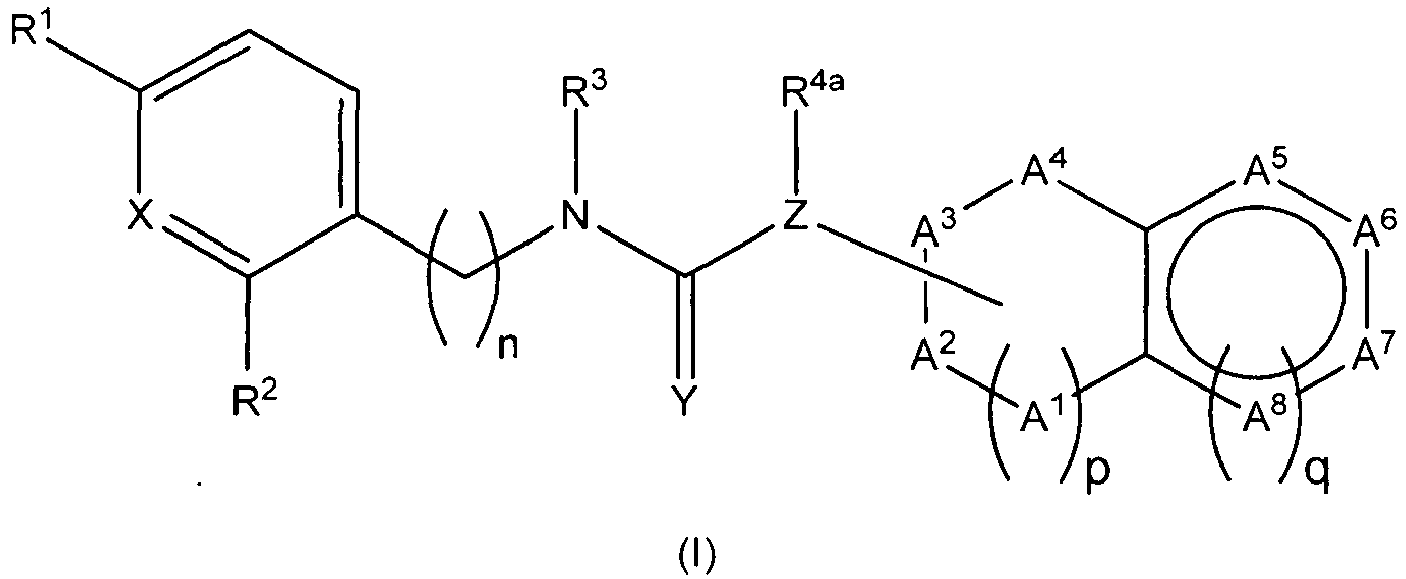
- n
- represents 1, 2, 3 or 4;
- p
- represents 0 or 1
- q
- represents 0 or 1
- X
- represents N or CH;
- Y
- represents 0, S, or N-CN;
- Z
- represents N or CR4b; and is bound to one of A1 to A4;
- A1 to A4
- each independently of one another represent C(H)(R5); with the proviso that R5 represents bond if the respective A1, A2, A3 or A4 is bound to Z;
- A5 to A7
- each independently of one another represent 0, S, N, NR6 or CR7;
- A8
- represents CR7 or N;
- R1
- represents a C1-4 aliphatic residue, a C3-6 cycloaliphatic residue or a 3 to 6 membered heterocycloaliphatic residue, in each case unsubstituted or mono- or polysubstituted;
- R2
- represents an unsubstituted or mono- or polysubstituted C1-10 aliphatic residue, a C3-10-cycloaliphatic residue, a 3 to 10-membered heterocycloaliphatic residue, an aryl or a heteroaryl, in each case unsubstituted or mono- or polysubstituted and in each case optionally bridged via an unsubstituted or mono- or polysubstituted C1-8 aliphatic group; O-C1-10 aliphatic residue, O-C3-10 cycloaliphatic residue, 0-(3 to 10-membered heterocycloaliphatic residue), O-aryl or O-heteroaryl, in each case unsubstituted or mono- or polysubstituted;
(O-(CH2)1-3)0-3-O-(CH2)0-3-CH3, optionally bridged via an unsubstituted or mono- or polysubstituted C1-8 aliphatic group;
S-C1-10 aliphatic residue, S-C3-10 cycloaliphatic residue, S-(3 to 10-membered heterocycloaliphatic residue), S-aryl or S-heteroaryl, in each case unsubstituted or mono- or polysubstituted;
NH2;
N(H)-C1-10 aliphatic residue, N(H)-C3-10 cycloaliphatic residue, N(H)-(3 to 10-membered heterocycloaliphatic residue), N(H)-aryl or N(H)-heteroaryl, in each case unsubstituted or mono-or polysubstituted;
N(C1-4 aliphatic residue)-C1-10 aliphatic residue, N(C1-4 aliphatic residue)-C3-10 cycloaliphatic residue, N(C1-4 aliphatic residue)-(3 to 10-membered heterocycloaliphatic residue), N(C1-4 aliphatic residue)-aryl or N(C1-4 aliphatic residue)-heteroaryl, in each case unsubstituted or mono- or polysubstituted; - R3
- represents H or an unsubstituted or mono- or polysubstituted C1-4 aliphatic residue;
- R4a
- represents H; a C1-4 aliphatic residue, a C3-6 cycloaliphatic residue or aryl, in each case unsubstituted or mono- or polysubstituted;
- R4b
- represents H; or an unsubstituted, mono- or polysubstituted C1-4 aliphatic residue;
- R5
- represents bond, H, F; Cl; Br; I; CN; CH3; C2-4-alkyl; CF3; CF2H; CFH2; CF2Cl; CFCl2; C(=O)-H; C(=O)-(C1-4-alkyl); C(=O)-OH;C(=O)-O-(C1-4-alkyl); C(=O)-NH2; C(=O)-N(H)(C1-4-alkyl); C(=O)-N(C1-4-alkyl)2; OH; OCH3; O-C2-4-alkyl; OCF3; OCF2H; OCFH2; OCF2Cl; OCFCl2; O-S(=O)2-OH; O-S(=O)2-O-C1-4-alkyl; O-S(=O)2-NH2; O-S(=O)2-N(H)(C1-4-alkyl); O-S(=O)2-N(C1-4-alkyl)2: NH2; NO2; N(H)(C1-4-alkyl); N(C1-4-alkyl)2; NH-C(=O)-NH2; NH-C(=O)-N(H)(C1-4-alkyl); NH-C(=O)-N(C1-4-alkyl)2; NH-S(=O)2-OH; NH-S(=O)2-O-C1-4-alkyl; NH-S(=O)2-NH2; NH-S(=O)2-N(H)(C1-4-alkyl); NH-S(=O)2-N(C1-4-alkyl)2; SH; SCH3; S-C2-4-alkyl; SCF3; SCF2H; SCFH2; SCF2Cl; SCFCl2; S(=O)2-OH; S(=O)2-O-C1-4-alkyl; S(=O)2-NH2; S(=O)2-N(H)(C1-4-alkyl); or S(=O)2-N(C1-4-alkyl)2;
- R6
- represents H; a C1-4 aliphatic residue, a C3-6-cycloaliphatic residue or a 3 to 6-membered heterocycloaliphatic residue, in each case unsubstituted or mono- or polysubstituted;
- R7
- represents H; F; Cl; Br; I; CN; CH3; C2-4-alkyl; CF3; CF2H; CFH2; CF2Cl; CFCl2; C(=O)-H; C(=O)-(C1-4-alkyl); C(=O)-OH;C(=O)-O-(C1-4-alkyl); C(=O)-NH2; C(=O)-N(H)(C1-4-alkyl); C(=O)-N(C1-4-alkyl)2; OH; OCH3; O-C2-4-alkyl; OCF3; OCF2H; OCFH2; OCF2Cl; OCFCl2; O-S(=O)2-OH; 0-S(=O)2-O-C1-4-alkyl; O-S(=O)2-NH2; O-S(=O)2-N(H)(C1-4-alkyl); O-S(=O)2-N(C1-4-alkyl)2; NH2; NO2; N(H)(C1-4-alkyl); N(C1-4-alkyl)2; NH-C(=O)-NH2; NH-C(=O)-N(H)(C1-4-alkyl); NH-C(=O)-N(C1-4-alkyl)2; NH-S(=O)2-OH; NH-S(=O)2-O-C1-4-alkyl; NH-S(=O)2-NH2; NH-S(=O)2-N(H)(C1-4-alkyl); NH-S(=O)2-N(C1-4-alkyl)2; SH; SCH3; S-C2-4-alkyl; SCF3; SCF2H; SCFH2; SCF2Cl; SCFCl2; S(=O)2-OH; S(=O)2-O-C1-4-alkyl; S(=O)2-NH2; S(=O)2-N(H)(C1-4-alkyl); or S(=O)2-N(C1-4-alkyl)2;
- The term "single stereoisomer" comprises in the sense of this invention an individual enantiomer or diastereomer. The term "mixture of stereoisomers" comprises in the sense of this invention the racemate and mixtures of enantiomers and/or diastereomers in any mixing ratio.
- The term "physiologically acceptable salt" comprises in the sense of this invention a salt of at least one compound according to the present invention and at least one physiologically acceptable acid or base. The terms "C1-10 aliphatic residue", "C1-8 aliphatic residue", and "C1-4 aliphatic residue" comprise in the sense of this invention acyclic saturated or unsaturated aliphatic hydrocarbon residues, which can be branched or unbranched and also unsubstituted or mono- or polysubstituted, which contain 1 to 10, or 1 to 8, or 1 to 4 carbon atoms. Preferably, aliphatic residues are selected from the group consisting of alkanyl (alkyl) and alkenyl residues, more preferred are alkanyl (alkyl) residues. Preferred alkanyl residues are selected from the group consisting of methyl, ethyl, n-propyl, 2-propyl, n-butyl, isobutyl, sec.-butyl, tert.-butyl, n-pentyl, isopentyl, neopentyl, n-hexyl, n-heptyl, n-octyl, n-nonyl and n-decyl.
- The terms "C3-6 cycloaliphatic residue" and "C3-10 cycloaliphatic residue" mean for the purposes of this invention cyclic aliphatic hydrocarbons containing 3, 4, 5 or 6 carbon atoms and 3, 4, 5, 6, 7, 8, 9 or 10 carbon atoms, respectively, wherein the hydrocarbons in each case can be saturated or unsaturated (but not aromatic), unsubstituted or mono- or polysubstituted. The cycloaliphatic residues can be bound to the respective superordinate general structure via any desired and possible ring member of the cycloaliphatic residue. Preferred cycloaliphatic residues are selected from the group consisting of cyclopropyl, cyclobutyl, cyclopentyl, cyclohexyl, cycloheptyl, cyclooctyl, cyclononyl, cyclodecyl, adamantyl,

- The terms "3-6-membered heterocycloaliphatic residue", and "3-10-membered heterocycloaliphatic residue" mean for the purposes of this invention heterocycloaliphatic saturated or unsaturated (but not aromatic) residues having 3-6, i.e. 3, 4, 5 or 6 ring members, and 3-10, i.e. 3, 4, 5, 6, 7, 8, 9 or 10 ring members, respectively, in which in each case at least one, if appropriate also two or three carbon atoms are replaced by a heteroatom or a heteroatom group each selected independently of one another from the group consisting of 0, S, S(=O)2, N, NH and N(C1-8 alkyl) such as N(CH3); more preferably 0, S, N, NH and N(C1-8 alkyl) such as N(CH3), wherein the ring members can be unsubstituted or mono- or polysubstituted. The heterocycloaliphatic residue can be bound to the superordinate general structure via any desired and possible ring member of the heterocycloaliphatic residue if not indicated otherwise. Preferred heterocycloaliphatic residues are selected from the group consisting of azetidinyl, aziridinyl, azepanyl, azocanyl, diazepanyl, dithiolanyl, dihydroquinolinyl, dihydropyrrolyl, dioxanyl, dioxolanyl, dioxepanyl, dihydroindenyl, dihydropyridinyl, dihydrofuranyl, dihydroisoquinolinyl, dihydroindolinyl, dihydroisoindolyl, imidazolidinyl, isoxazolidinyl, morpholinyl, oxiranyl, oxetanyl, oxazepanyl, pyrrolidinyl, piperazinyl, 4-methylpiperazinyl, piperidinyl, pyrazolidinyl, pyranyl, tetrahydropyrrolyl, tetrahydropyranyl, tetrahydro-2H-pyran-4-yl, tetrahydroquinolinyl, tetrahydroisoquinolinyl, tetrahydroindolinyl, tetrahydrofuranyl, tetrahydropyridinyl, tetrahydrothiophenyl, tetrahydropyridoindolyl, tetrahydronaphthyl, tetrahydrocarbolinyl, tetrahydroisoxazololyl, tetrahydropyridinyl, thiazolidinyl and thiomorpholinyl.
- The term "aryl" means for the purpose of this invention aromatic hydrocarbons having 6 to 14, i.e. 6, 7, 8, 9, 10, 11, 12, 13 or 14 ring members, preferably having 6 to 10, i.e. 6, 7, 8, 9 or 10 ring members, including phenyls and naphthyls. Each aryl residue can be unsubstituted or mono- or polysubstituted, wherein the aryl substituents can be the same or different and in any desired and possible position of the aryl. The aryl can be bound to the superordinate general structure via any desired and possible ring member of the aryl residue. Preferably, aryl is selected from the group consisting of phenyl, 1-naphthyl, 2-naphthyl and anthracenyl, each of which can be respectively unsubstituted or mono- or polysubstituted. A particularly preferred aryl is phenyl, unsubstituted or mono- or polysubstituted.
- The term "heteroaryl" for the purpose of this invention represents a 5 or 6-membered cyclic aromatic residue containing at least 1, if appropriate also 2, 3, 4 or 5 heteroatoms, wherein the heteroatoms are each selected independently of one another from the group S, N and 0 and the heteroaryl residue can be unsubstituted or mono- or polysubstituted. In the case of substitution on the heteroaryl, the substituents can be the same or different and be in any desired and possible position of the heteroaryl. The binding to the superordinate general structure can be carried out via any desired and possible ring member of the heteroaryl residue if not indicated otherwise. The heteroaryl can also be part of a bi- or polycyclic system having up to 14 ring members, wherein the ring system can be formed with saturated, (partially) unsaturated, (hetero)cycloaliphatic or aromatic or heteroaromatic rings, i.e. with a cycloaliphatic, heterocycloaliphatic, aryl or heteroaryl residue, which can in turn be unsubstituted or mono- or polysubstituted. It is preferable for the heteroaryl residue to be selected from the group consisting of benzofuranyl, benzoimidazolyl, benzothienyl, benzothiadiazolyl, benzothiazolyl, benzotriazolyl, benzooxazolyl, benzooxadiazolyl, quinazolinyl, quinoxalinyl, carbazolyl, quinolinyl, dibenzofuranyl, dibenzothienyl, furyl (furanyl), imidazolyl, imidazothiazolyl, indazolyl, indolizinyl, indolyl, isoquinolinyl, isoxazoyl, isothiazolyl, indolyl, naphthyridinyl, oxazolyl, oxadiazolyl, phenazinyl, phenothiazinyl, phthalazinyl, pyrazolyl, pyridyl (2-pyridyl, 3-pyridyl, 4-pyridyl), pyrrolyl, pyridazinyl, pyrimidinyl, pyrazinyl, purinyl, phenazinyl, thienyl (thiophenyl), triazolyl, tetrazolyl, thiazolyl, thiadiazolyl and triazinyl.
- The term "bridged via a C1-8 aliphatic group" with respect to residues such as aryl, heteroaryl, a heterocycloaliphatic residue, a cycloaliphatic residue or (O-(CH2)1-3)0-3-O-(CH2)0-3-CH3 mean for the purpose of the invention that each of these residues is bound to the respective superordinate general structure via a C1-8 aliphatic group which can be branched or unbranched, unsubstituted or mono- or polysubstituted. Preferred C1-8 alkylene groups are selected from the group consisting of -CH2-, -CH2-CH2-, -CH(CH3)-, -CH2-CH2-CH2-, -CH(CH3)-CH2-, -CH(CH2CH3)-, -CH2-(CH2)2-CH2-, -CH(CH3)-CH2-CH2-, -CH2-CH(CH3)-CH2-, -CH(CH3)-CH(CH3)-, -CH(CH2CH3)-CH2-, -C(CH3)2-CH2-, -CH(CH2CH2CH3)-, -C(CH3)(CH2CH3)-, -CH2-(CH2)3-CH2-, -CH(CH3)-CH2-CH2-CH2-, -CH2-CH(CH3)-CH2-CH2-, -CH(CH3)-CH2-CH(CH3)-, -CH(CH3)-CH(CH3)-CH2-, -C(CH3)2-CH2-CH2-, -CH2-C(CH3)2-CH2-, -CH(CH2CH3)-CH2-CH2-, -CH2-CH(CH2CH3)-CH2-, -C(CH3)2-CH(CH3)-, -CH(CH2CH3)-CH(CH3)-, -C(CH3)(CH2CH3)-CH2-, -CH(CH2CH2CH3)-CH2-, -C(CH2CH2CH3)-CH2-, -CH(CH2CH2CH2CH3)-, -C(CH3)(CH2CH2CH3)-, -C(CH2CH3)2- and -CH2-(CH2)4-CH2-. Particularly preferred C1-8 aliphatic groups are -CH2-, -CH2-CH2- and -CH2-CH2-CH2-.
- In relation to the terms "aliphatic residue", "aliphatic group", "cycloaliphatic residue" and "heterocycloaliphatic residue", the term "mono- or polysubstituted" refers in the sense of this invention, with respect to the corresponding residues or groups, to the single substitution or multiple substitution, e.g. disubstitution, trisubstitution, tetrasubstitution, or pentasubstitution, of one or more hydrogen atoms each independently of one another by at least one substituent selected from the group consisting of F; Cl; Br; I; CN; CH3; C2-4-alkyl; CF3; CF2H; CFH2; CF2Cl; CFCl2; C(=O)-H; C(=O)-(C1-4-alkyl); C(=O)-OH;C(=O)-O-(C1-4-alkyl); C(=O)-NH2; C(=O)-N(H)(C1-4-alkyl); C(=O)-N(C1-4-alkyl)2; OH; OCH3; O-C2-4-alkyl; OCF3; OCF2H; OCFH2; OCF2Cl; OCFCl2; O-S(=O)2-OH; O-S(=O)2-O-C1-4-alkyl; 0-S(=O)2-NH2; O-S(=O)2-N(H)(C1-4-alkyl); O-S(=O)2-N(C1-4-alkyl)2; NH2; NO2; N(H)(C1-4-alkyl); N(C1-4-alkyl)2; NH-C(=O)-NH2; NH-C(=O)-N(H)(C1-4-alkyl); NH-C(=O)-N(C1-4-alkyl)2; NH-S(=O)2-OH; NH-S(=O)2-O-C1-4-alkyl; NH-S(=O)2-NH2; NH-S(=O)2-N(H)(C1-4-alkyl); NH-S(=O)2-N(C1-4-alkyl)2; SH; SCH3; S-C2-4-alkyl; SCF3; SCF2H; SCFH2; SCF2Cl; SCFCl2; S(=O)2-OH; S(=O)2-O-C1-4-alkyl; S(=O)2-NH2; S(=O)2-N(H)(C1-4-alkyl); or S(=O)2-N(C1-4-alkyl)2. The term "polysubstituted" with respect to polysubstituted residues and groups includes the polysubstitution of these residues and groups either on different or on the same atoms, for example trisubstituted on the same carbon atom, as in the case of CF3, CH2CF3 or 1,1-difluorocyclohexyl, or at various points, as in the case of CH(OH)-CH=CH-CHCl2 or 1-chloro-3-fluorocyclohexyl.
- In relation to the terms "aryl" and "heteroaryl", the term "mono- or polysubstituted" refers in the sense of this invention, with respect to the corresponding residues or groups, to the single substitution or multiple substitution, e.g. disubstitution, trisubstitution, tetrasubstitution, or pentasubstitution, of one or more hydrogen atoms each independently of one another by at least one substituent selected from the group consisting of F; Cl; Br; I; CN; CH3; C2-4-alkyl; CF3; CF2H; CFH2; CF2Cl; CFCl2; C(=O)-H; C(=O)-(C1-4-alkyl); C(=O)-OH;C(=O)-O-(C1-4-alkyl); C(=O)-NH2; C(=O)-N(H)(C1-4-alkyl); C(=O)-N(C1-4-alkyl)2; OH; OCH3; O-C2-4-alkyl; OCF3; OCF2H; OCFH2; OCF2Cl; OCFCl2; O-S(=O)2-OH; O-S(=O)2-O-C1-4-alkyl; O-S(=O)2-NH2; O-S(=O)2-N(H)(C1-4-alkyl); O-S(=O)2-N(C1-4-alkyl)2; NH2; NO2; N(H)(C1-4-alkyl); N(C1-4-alkyl)2; NH-C(=O)-NH2; NH-C(=O)-N(H)(C1-4-alkyl); NH-C(=O)-N(C1-4-alkyl)2; NH-S(=O)2-OH; NH-S(=O)2-O-C1-4-alkyl; NH-S(=O)2-NH2; NH-S(=O)2-N(H)(C1-4-alkyl); NH-S(=O)2-N(C1-4-alkyl)2; SH; SCH3; S-C2-4-alkyl; SCF3; SCF2H; SCFH2; SCF2Cl; SCFCl2; S(=O)2-OH; S(=O)2-O-C1-4-alkyl; S(=O)2-NH2; S(=O)2-N(H)(C1-4-alkyl); or S(=O)2-N(C1-4-alkyl)2.
- The compounds according to the present invention are defined by substituents, for example by R1, R2 and R3 (1st generation substituents) which if appropriate are substituted themselves (2nd generation substituents). However, preferably, the 2nd generation substituents may not be substituted.
- Within the scope of the present invention, the symbol

- If a residue occurs multiply within a molecule, then this residue can have respectively different meanings for various substituents: if, for example, both R1 and R2 denote a 3 to 6 membered heterocycloaliphatic residue, then the 3 to 6 membered heterocycloaliphatic residue can e.g. represent morpholinyl for R1 and can represent piperazinyl for R2.
- If a residue occurs multiply within a molecule or substituent, such as e.g. the residue C1-4-alkyl, then this residue can have respectively different meanings within the scope of its definition.
- The terms "salt formed with a physiologically compatible acid" or "salt of physiologically acceptable acids" refers in the sense of this invention to salts of the respective active ingredient with inorganic or organic acids which are physiologically compatible - in particular when used in human beings and/or other mammals.
- The terms "salt formed with a physiologically compatible base" or "salt of physiologically acceptable bases" refers in the sense of this invention to salts of the respective compound according to the invention - as an anion, e.g. upon deprotonation of a suitable functional group - with at least one cation or base - preferably with at least one inorganic cation - which are physiologically acceptable - in particular when used in human beings and/or other mammals.
- According to the present invention, n represents 1, 2, 3 or 4; preferably 1, 2 or 3 and more preferably 1 or 2. In a particularly preferred embodiment, n represents 1.
- According to the present invention, Y represents 0, S or N-CN. Most preferably, Y represents O.
- In a preferred embodiment, R3 is selected from the group consisting of H, CH3 and CH2CH3. More preferably, R3 represents H.
- According to the present invention, Z represents N or CR4b. In a preferred embodiment, Z represents CR4b. According to this embodiment, R4b preferably stands for H, CH3 or CH2CH3, more preferably, R4b stands for H. In another preferred embodiment, Z represents N. According to this embodiment, R4a preferably represents H.
- In a preferred embodiment, R4a represents H, CH3, CH2CH3 cyclopropyl, cyclobutyl, cyclopentyl, cyclohexyl, or phenyl, wherein phenyl is unsubstituted or substituted with 1, 2, 3, 4 or 5 substituents independently selected from the group consisting of F, Cl, Br, I, NO2, CN, CF3, CF2H, CFH2, CF2Cl, CFCl2, OH, NH2, NH(C1-4 alkyl) and N(C1-4 alkyl)(C1-4 alkyl), C1-4 alkyl, and O-C1-4-alkyl; and R4b represents H, CH3 or CH2CH3.
- More preferably, R4a represents H, CH3 or CH2CH3; more preferably H or CH3.
- According to the present invention, X represents N or CH. Preferably, X represents N.
- In a particularly preferred embodiment, n represents 1, Y represents 0, R3 represents H and X represents N.
- In a preferred embodiment, R1 is selected from the group consisting of CF3, CH3, CH2CH3, (CH2)2CH3, CH(CH3)2, (CH2)3CH3, CH(CH3)CH2CH3, and C(CH3)3, or is selected from the group consisting of cyclopropyl, cyclobutyl, cyclopentyl, and cyclohexyl.
- More preferably, R1 is selected from the group consisting of CF3, CH3 or cyclopropyl, more preferably R1 represents CF3.
- In a preferred embodiment, R2 represents substructure (T) in which

- K
- represents 0, an unsubstituted C1-6 aliphatic group or NR8,
wherein R8 represents H or a C1-4 aliphatic residue, unsubstituted or mono- or polysubstituted with one or more substituents each selected independently of one another from the group consisting of F, Cl, Br, I and C1-4 alkyl; - o
- represents 0 or 1;
- L
- represents an unsubstituted or mono- or polysubstituted C3-6-cycloaliphatic residue,
an unsubstituted or mono- or polysubstituted 3 to 6-membered heterocycloaliphatic residue containing 1 to 3 heteroatoms, wherein binding to K occurs via a heteroatom or a carbon atom,
an unsubstituted or mono- or polysubstituted aryl,
an unsubstituted or mono- or polysubstituted heteroaryl containing 1 to 3 heteroatoms, wherein binding to K occurs via a heteroatom or a carbon atom,
(O-(CH2)1-3)0-3-O-(CH2)0-3-CH3,
NH-C1-6 aliphatic residue, unsubstituted or mono- or polysubstituted,
in which "mono- or polysubstituted" with respect to the aforementioned aliphatic residue, cycloaliphatic residue, heterocycloaliphatic residue, aryl and heteroaryl relates in each case independently of one another, with respect to the corresponding residues, to the substitution of one or more hydrogen atoms each independently of one another by at least one substituent selected from the group consisting of F; Cl; Br; I; CN; CH3; C2-4-alkyl; CF3; OH; OCH3; O-C2-4-alkyl; OCF3; OCF2H; OCFH2; NO2; N(H)(C1-4-alkyl); N(C1-4-alkyl)2. - In a preferred embodiment, when L represents a 3 to 6-membered heterocycloaliphatic residue or a heteroaryl, binding to K occurs via the heteroatom. In another preferred embodiment, when L represents a 3 to 6-membered heterocycloaliphatic residue or a heteroaryl, binding to K occurs via the carbon atom.
- In a preferred embodiment, K represents 0 or an unsubstituted C1-3 aliphatic group, more preferably 0, methylene, ethylene or propylene.
- In another preferred embodiment, o represents 0, i.e. group K is not present and R2 is defined by L.
- Preferably, L is selected from
cyclopropyl, cylcobutyl, cyclopentyl and cyclohexyl;
pyrrolidinyl (tetrahydropyrrolyl), piperidinyl, tetrahydropyranyl, morpholinyl, tetrahydrofuranyl, tetrahydrothiophenyl, tetrahydrothiopyran, imidazolidinyl, piperazinyl, 4-methylpiperazinyl, tetrahydro-2H-pyran-4-yl, tetrahydroquinolinyl, tetrahydroisoquinolinyl, dihydroquinolinyl, dihydropyrrolyl, dihydropyridinyl, dihydroisoquinolinyl, tetrahydropyridinyl and thiomorpholinyl, azetidinyl, aziridinyl, dithiolanyl, dioxanyl, dioxolanyl, dihydrofuranyl, isoxazolidinyl, oxiranyl, pyrazolidinyl, pyranyl, tetrahydropyridinyl, tetrahydroisoxazololyl, thiazolidinyl;
phenyl;
pyridyl (1-pyridyl, 2-pyridyl, 3-pyridyl, 4-pyridyl), pyrrolyl, thienyl (thiophenyl), furanyl, pyrazolyl, imidazolyl, indolyl, quinolinyl, isoquinolinyl, purinyl, pyrimidinyl, oxazolyl, thiazolyl, benzofuranyl, benzoimidazolyl, benzothienyl, benzothiadiazolyl, benzothiazolyl, benzotriazolyl, benzooxazolyl, benzooxadiazolyl, quinazolinyl, quinoxalinyl, carbazolyl, quinolinyl, dibenzofuranyl, dibenzothienyl, imidazothiazolyl, indazolyl, indolizinyl, isoxazoyl, isothiazolyl, naphthyridinyl, oxadiazolyl, phenazinyl, phenothiazinyl, phthalazinyl, pyridazinyl, pyrazinyl, purinyl, triazolyl, tetrazolyl, thiadiazolyl and triazinyl;
NH-C1-6 aliphatic residue; and
(O-(CH2)1-3)0-3-O-(CH2)0-3-CH3;
in each case, where appropriate, unsubstituted or mono- or polysubstituted with one or more substituents each selected independently of one another from the group consisting of F, Cl, Br, I, CH3, C2-4-alkyl, CF3, OH, OCH3, O-C2-4-alkyl, OCF3, N(H)(C1-4 alkyl), N(C1-4 alkyl)2. - In another preferred embodiment, R2 represents substructure (T) in which

- K
- represents 0 or an unsubstituted C1-3 aliphatic group;
- o
- represents 0 or 1;
- L
- represents an unsubstituted or monosubstituted C5-6-cycloaliphatic residue,
an unsubstituted or monosubstituted 5 to 6-membered heterocycloaliphatic residue containing 1 or 2 heteroatoms, wherein binding to K occurs via a heteroatom or a carbon atom,
an unsubstituted or monosubstituted 5 to 6-membered aryl,
an unsubstituted or monosubstituted 5 to 6-membered heteroaryl containing 1 to 3 heteroatoms, wherein binding to K occurs via a heteroatom or a carbon atom,
(O-(CH2)1-3)0-3-O-(CH2)0-3-CH3,
NH-C1-6 unsubstituted aliphatic residue,
in which "monosubstituted" with respect to the aforementioned residues relates in each case independently of one another, with respect to the corresponding residues, to the substitution of one hydrogen atom by one substituent selected from the group consisting of CH3, CH2CH3, (CH2)2CH3, CH(CH3)2, (CH2)3CH3, CH(CH3)CH2CH3, and C(CH3)3 and CF3. - Most preferably, L is selected from cyclopentyl, cyclohexyl, pyrrolidin-1-yl, piperidin-1-yl, 4-methylpiperidin-1-yl, tetrahydro-2H-pyran-4-yl, N-morpholinyl, 3-methyl-phenyl, unsubstituted NH-C1-6 aliphatic residue and (O-(CH2)1-3)0-3-O-(CH2)0-3-CH3.
- In a preferred embodiment, R2 represents cyclopentyl, (cyclohexyl)methyl, pyrrolidin-1-yl, piperidin-1-yl, 4-methylpiperidin-1-yl, tetrahydro-2H-pyran-4-yl, O-tetrahydro-2H-pyran-4-yl, N-morpholinyl, 3-methyl-phenyl, N(H)(CH2CH3), N(H)((CH2)3CH3), (CH2)3-O-CH3, CH3-O-(CH2)2-O-CH3. Particularly preferably, R2 represents 4-methylpiperidin-1-yl.
- According to the present invention, Z is bound to one of A1 to A4. In a preferred embodiment, Z is bound to A1 or A4. In another preferred embodiment, Z is bound to A2 or A3.
- In a preferred embodiment, p represents 1. In another preferred embodiment, p represents 0, i.e. A1 does not exist. According to this embodiment, Z is bound to one of A2, A3 or A4.
- A1 to A4 each independently from one another represent C(H)(R5), wherein R5 preferably represents bond, H, CH3 or C2-4-alkyl. Most preferably, R5 represents bond or H.
- In a preferred embodiment, all of variables A5, A6, A7 and A8 represent CR7. In another preferred embodiment, at least one of variables A5, A6, A7 and A8 does not represent CR7. According to this embodiment, preferably at least one of variables A5, A6, A7 and A8 represents a nitrogen atom, i.e. N respectively NR6.
- In a preferred embodiment, q represents 0. According to this embodiment, A5 to A8 preferably represent CR7. In another preferred embodiment, q represents 1. According to this embodiment, one and only one of A5 to A7 represents 0, S or NR6; preferably one and only one of A5 to A7 represents NR6 while the remaining two variables, i.e. A5 and A6 or A6 and A7 or A7 and A5, each represent CR7 or one represents CR7 and the other represents N.
- In a preferred embodiment, p represents 0 or 1 and q represents 1. In another preferred embodiment, q represents 0 or 1 and p represents 1.
- In a preferred embodiment, R6 represents H; CH3; CH2CH3; (CH2)2CH3; CH(CH3)2; (CH2)3CH3; cyclopentyl or cyclohexyl, in each case unsubstituted. According to this embodiment, R6 preferably represents H, CH3 or CH2CH3and most preferably H or CH3.
- In a preferred embodiment, R7 represents H, F, Cl, Br, I, CN, CH3, CF3, OH, OCH3, O-C2-4-alkyl, OCF3, or NO2. Most preferably, R7 represents H, OH, OCH3, NO2 or Cl. According to the invention, if there are more than one R7 contained in the partial structure (E), then all R7 are selected independently from one another and therefore may represent different residues or the same residues.
- In a preferred embodiment, all the R7 present represent H. In another preferred embodiment, at least one of the R7 present does not represent H.
- According to the present invention, partial structure (E)

- In a preferred embodiment, the compound according to the present invention is characterized in that the partial structure (E) represents a moiety selected from the group consisting of:


- G
- represents NR6, S or O.
- In another preferred embodiment,
- R5
- represents bond, H, CH3 or C2-4-alkyl; and/or
- R6
- represents H, CH3 or C2-4-alkyl; and/or
- R7
- represents H, F, Cl, Br, I, CN, CH3, CF3, OH, OCH3, O-C2-4-alkyl, OCF3, or NO2.
- Preferably, partial structure (E) represents 2,3-dihydro-1H-inden-1-yl, 2,3-dihydro-1H-inden-2-yl, 1,2,3,4-tetrahydronaphthalen-1-yl, 7-hydroxy-1,2,3,4-tetrahydro-naphthalen-1-yl or 1-methyl-4,5,6,7-tetrahydro-1H-indazol-4-yl. Particularly preferably, partial structure (E) represents 7-hydroxy-1,2,3,4-tetrahydro-naphthalen-1-yl.
- Preferably, the compound according to the present invention is characterized in that
- n
- represents 1;
- Y
- represents O;
- R1
- represents CF3, CH3 or cyclopropyl;
- X
- represents N;
- R3
- represents H;
- Z
- represents N or CR4b, wherein R4b represents H or CH3;
- R4a
- represents H or CH3;
- R2
- represents substructure (T) in which

o represents 0 or 1;
L represents an unsubstituted or monosubstituted C5-6-cycloaliphatic residue,
an unsubstituted or monosubstituted 5 to 6-membered heterocycloaliphatic residue containing 1 or 2 heteroatoms, wherein binding to K occurs via a heteroatom or a carbon atom,
an unsubstituted or monosubstituted 5 to 6-membered aryl,
an unsubstituted or monosubstituted 5 to 6-membered heteroaryl containing 1 to 3 heteroatoms, wherein binding to K occurs via a heteroatom or a carbon atom,
(O-(CH2)1-3)0-3-O-(CH2)0-3-CH3,
NH-C1-6 unsubstituted aliphatic residue,
in which "monosubstituted" with respect to the aforementioned residues relates in each case independently of one another, with respect to the corresponding residues, to the substitution of one hydrogen atom by one substituent selected from the group consisting of CH3, CH2CH3, (CH2)2CH3, CH(CH3)2, (CH2)3CH3, CH(CH3)CH2CH3, C(CH3)3 and CF3; partial structure (E) is selected from the group consisting of
- p
- represents 0 or 1
- A1 to A4
- each independently of one another represent C(H)(R5) with R5 representing bond or H;
- R7
- represents H or OH
- G
- represents NR6 with R6 representing H or CH3.
- Further embodiments of the compounds according to the present invention are those which are represented by the general formulae A1 and A2 shown in the following:


- In a preferred embodiment, the compound according to the present invention is selected from the group consisting of
1 1-(2,3-dihydro-1H-inden-1-yl)-3-((2-(4-methylpiperidin-1-yl)-6-(trifluoromethyl)pyridin-3-yl)methyl)urea 2 1-((2-(4-methylpiperidin-1-yl)-6-(trifluoromethyl)pyridin-3-yl)methyl)-3-(1,2,3,4-tetrahydronaphthalen-1-yl)urea 3 1-(2,3-dihydro-1H-inden-2-yl)-3-((2-(4-methylpiperidin-1-yl)-6-(trifluoromethyl)pyridin-3-yl)methyl)urea 4 1-(7-hydroxy-1,2,3,4-tetrahydronaphthalen-1-yl)-3-((2-(4-methylpiperidin-1-yl)-6-(trifluoromethyl)pyridin-3-yl)methyl)urea 5 1-(1-methyl-4,5,6,7-tetrahydro-1H-indazol-4-yl)-3-((2-(4-methylpiperidin-1-yl)-6-(trifluoromethyl)pyridin-3-yl)methyl)urea 6 2-(7-hydroxy-1,2,3,4-tetrahydronaphthalen-1-yl)-N-((2-(4-methylpiperidin-1-yl)-6-(trifluoromethyl)pyridin-3-yl)methyl)propanamide - According to this embodiment, more preferably the compound according to the present invention is selected from the group consisting of compounds 2 to 5. Most preferred compounds are 4 and 6.
- Furthermore, preference may be given to compounds according to the invention that cause a 50 per cent displacement of capsaicin, which is present at a concentration of 100 nM, in a FLIPR assay with CHO K1 cells which were transfected with the human VR1 gene at a concentration of less than 6,000 nM, preferably less than 5,000 nM, more preferably less that 3,000 nM or less than 1,000 nM and particularly preferably less than 300 nM, most particularly preferably less than 100 nM, even more preferably less than 75 nM, additionally preferably less than 50 nM, most preferably less than 10 nM.
- In the process, the Ca2+ influx is quantified in the FLIPR assay with the aid of a Ca2+-sensitive dye (type Fluo-4, Molecular Probes Europe BV, Leiden, the Netherlands) in a fluorescent imaging plate reader (FLIPR, Molecular Devices, Sunnyvale, USA), as described hereinafter.
- The compounds according to the present invention and the corresponding stereoisomers and also the respective corresponding acids, bases, salts and solvates are toxicologically safe and are therefore suitable as pharmaceutical active ingredients in pharmaceutical compositions.
- The present invention therefore further relates to a pharmaceutical composition comprising at least one compound according to the present invention.
- The pharmaceutical composition can contain the compound according to the present invention, if appropriate, in the form of one of its pure stereoisomers, in particular enantiomers or diastereomers, its racemates or in the form of a mixture of stereoisomers, in particular the enantiomers and/or diastereomers, in any desired mixing ratio, or respectively in the form of a corresponding salt, or respectively in the form of a corresponding solvate, and also if appropriate one or more pharmaceutically compatible auxiliaries.
- These pharmaceutical compositions according to the invention are suitable in particular for vanilloid receptor 1-(VR1/TRPV1) regulation, preferably for vanilloid receptor 1-(VR1/TRPV1) inhibition and/or for vanilloid receptor 1-(VR1/TRPV1) stimulation, i.e. they exert an agonistic or antagonistic effect.
- Likewise, the pharmaceutical compositions according to the invention are preferably suitable for the prophylaxis and/or treatment of disorders or diseases which are mediated, at least in part, by vanilloid receptors 1.
- The pharmaceutical composition according to the invention is suitable for administration to adults and children, including toddlers and babies.
- The pharmaceutical composition according to the invention may be found as a liquid, semisolid or solid pharmaceutical form, for example in the form of injection solutions, drops, juices, syrups, sprays, suspensions, tablets, patches, capsules, plasters, suppositories, ointments, creams, lotions, gels, emulsions, aerosols or in multiparticulate form, for example in the form of pellets or granules, if appropriate pressed into tablets, decanted in capsules or suspended in a liquid, and also be administered as much.
- In addition to at least one compound of formula (I), if appropriate in the form of one of its pure stereoisomers, in particular enantiomers or diastereomers, its racemate or in the form of mixtures of the stereoisomers, in particular the enantiomers or diastereomers, in any desired mixing ratio, or if appropriate in the form of a corresponding salt or respectively in the form of a corresponding solvate, the pharmaceutical composition according to the invention conventionally contains further physiologically compatible pharmaceutical auxiliaries which can for example be selected from the group consisting of excipients, fillers, solvents, diluents, surface-active substances, dyes, preservatives, blasting agents, slip additives, lubricants, aromas and binders.
- The selection of the physiologically compatible auxiliaries and also the amounts thereof to be used depend on whether the pharmaceutical composition is to be applied orally, subcutaneously, parenterally, intravenously, intraperitoneally, intradermally, intramuscularly, intranasally, buccally, rectally or locally, for example to infections of the skin, the mucous membranes and of the eyes. Preparations in the form of tablets, dragées, capsules, granules, pellets, drops, juices and syrups are preferably suitable for oral application; solutions, suspensions, easily reconstitutable dry preparations and also sprays are preferably suitable for parenteral, topical and inhalative application. The compounds according to the present invention used in the pharmaceutical composition according to the present invention in a repository in dissolved form or in a plaster, agents promoting skin penetration being added if appropriate, are suitable percutaneous application preparations. Orally or percutaneously applicable preparation forms can release the respective compound according to the present invention also in a delayed manner.
- The pharmaceutical compositions according to the present invention are prepared with the aid of conventional means, devices, methods and process known in the art, such as are described for example in "Remington's Pharmaceutical Sciences", A.R. Gennaro (Editor), 17th edition, Mack Publishing Company, Easton, Pa, 1985, in particular in Part 8, Chapters 76 to 93. The corresponding description is introduced herewith by way of reference and forms part of the disclosure. The amount to be administered to the patient of the respective compounds according to the invention of the above-indicated general formula I may vary and is for example dependent on the patient's weight or age and also on the type of application, the indication and the severity of the disorder. Conventionally 0.001 to 100 mg/kg, preferably 0.05 to 75 mg/kg, particularly preferably 0.05 to 50 mg of at least one such compound according to the invention are applied per kg of the patient's body weight.
- Another aspect of the present inventions relates to a compound according to the present invention for use in the treatment and/or prophylaxis of one or more diseases and/or disorders selected from the group consisting of pain, preferably of pain selected from the group consisting of acute pain, chronic pain, neuropathic pain, visceral pain and joint pain; hyperalgesia; allodynia; causalgia; migraine; depression; nervous affection; axonal injuries; neurodegenerative diseases, preferably selected from the group consisting of multiple sclerosis, Alzheimer's disease, Parkinson's disease and Huntington's disease; cognitive dysfunctions, preferably cognitive deficiency states, particularly preferably memory disorders; epilepsy; respiratory diseases, preferably selected from the group consisting of asthma, bronchitis and pulmonary inflammation; coughs; urinary incontinence; overactive bladder (OAB); disorders and/or injuries of the gastrointestinal tract; duodenal ulcers; gastric ulcers; irritable bowel syndrome; strokes; eye irritations; skin irritations; neurotic skin diseases; allergic skin diseases; psoriasis; vitiligo; herpes simplex; inflammations, preferably inflammations of the intestine, the eyes, the bladder, the skin or the nasal mucous membrane; diarrhoea; pruritus; osteoporosis; arthritis; osteoarthritis; rheumatic diseases; eating disorders, preferably selected from the group consisting of bulimia, cachexia, anorexia and obesity; medication dependency; misuse of medication; withdrawal symptoms in medication dependency; development of tolerance to medication, preferably to natural or synthetic opioids; drug dependency; misuse of drugs; withdrawal symptoms in drug dependency; alcohol dependency; misuse of alcohol and withdrawal symptoms in alcohol dependency; for diuresis; for antinatriuresis; for influencing the cardiovascular system; for increasing vigilance; for the treatment of wounds and/or burns; for the treatment of severed nerves; for increasing libido; for modulating movement activity; for anxiolysis; for local anaesthesia and/or for inhibiting undesirable side effects, preferably selected from the group consisting of hyperthermia, hypertension and bronchoconstriction, triggered by the administration of vanilloid receptor 1 (VR1/TRPV1 receptor) agonists, preferably selected from the group consisting of capsaicin, resiniferatoxin, olvanil, arvanil, SDZ-249665, SDZ-249482, nuvanil and capsavanil.
- According to this embodiment, the compound according to the present invention can optionally be combined with one or more pharmaceutically acceptable auxiliaries.
- Particularly preferably, the pharmaceutical composition according to the invention is suitable for use in the treatment and/or prophylaxis of one or more disorders and/or diseases selected from the group consisting of pain, preferably of pain selected from the group consisting of acute pain, chronic pain, neuropathic pain, visceral pain and joint pain; migraine; depression; neurodegenerative diseases, preferably selected from the group consisting of multiple sclerosis, Alzheimer's disease, Parkinson's disease and Huntington's disease; cognitive dysfunctions, preferably cognitive deficiency states, particularly preferably memory disorders; inflammations, preferably inflammations of the intestine, the eyes, the bladder, the skin or the nasal mucous membrane; urinary incontinence; overactive bladder (OAB); medication dependency; misuse of medication; withdrawal symptoms in medication dependency; development of tolerance to medication, preferably development of tolerance to natural or synthetic opioids; drug dependency; misuse of drugs; withdrawal symptoms in drug dependency; alcohol dependency; misuse of alcohol and withdrawal symptoms in alcohol dependency.
- Most particularly preferably, the pharmaceutical composition according to the invention is suitable for use in the treatment and/or prophylaxis of pain, preferably of pain selected from the group consisting of acute pain, chronic pain, neuropathic pain and visceral pain.
- The present invention further relates to a compound according to formula (I) and also, if appropriate, to a compound according to formula (I) and one or more pharmaceutically acceptable auxiliaries for use in vanilloid receptor 1-(VR1/TRPV1) regulation, preferably for use in vanilloid receptor 1-(VR1/TRPV1) inhibition and/or vanilloid receptor 1-(VR1/TRPV1) stimulation.
- The present invention therefore further relates to a compound according to formula (I) and also if appropriate to a compound according to formula (I) and one or more pharmaceutically acceptable auxiliaries for use in the prophylaxis and/or treatment of disorders and/or diseases which are mediated, at least in part, by vanilloid receptors 1.
- The present invention further relates to the use of at least one compound according to formula (I) and also, if appropriate, of one or more pharmaceutically acceptable auxiliaries for the preparation of a pharmaceutical composition for vanilloid receptor 1-(VR1/TRPV1) regulation, preferably for vanilloid receptor 1-(VR1/TRPV1) inhibition and/or for vanilloid receptor 1-(VR1/TRPV1) stimulation, and, further for the prophylaxis and/or treatment of disorders and/or diseases which are mediated, at least in part, by vanilloid receptors 1.
- Another aspect of the present invention is a method for vanilloid receptor 1-(VR1/TRPV1) regulation, preferably for vanilloid receptor 1-(VR1/TRPV1) inhibition and/or for vanilloid receptor 1-(VR1/TRPV1) stimulation.
- Still another aspect of the present invention relates to a method of treatment and/or prophylaxis of disorders and/or diseases selected from the group consisting of pain, preferably of pain selected from the group consisting of acute pain, chronic pain, neuropathic pain, visceral pain and joint pain; hyperalgesia; allodynia; causalgia; migraine; depression; nervous affection; axonal injuries; neurodegenerative diseases, preferably selected from the group consisting of multiple sclerosis, Alzheimer's disease, Parkinson's disease and Huntington's disease; cognitive dysfunctions, preferably cognitive deficiency states, particularly preferably memory disorders; epilepsy; respiratory diseases, preferably selected from the group consisting of asthma, bronchitis and pulmonary inflammation; coughs; urinary incontinence; overactive bladder (OAB); disorders and/or injuries of the gastrointestinal tract; duodenal ulcers; gastric ulcers; irritable bowel syndrome; strokes; eye irritations; skin irritations; neurotic skin diseases; allergic skin diseases; psoriasis; vitiligo; herpes simplex; inflammations, preferably inflammations of the intestine, the eyes, the bladder, the skin or the nasal mucous membrane; diarrhoea; pruritus; osteoporosis; arthritis; osteoarthritis; rheumatic diseases; eating disorders, preferably selected from the group consisting of bulimia, cachexia, anorexia and obesity; medication dependency; misuse of medication; withdrawal symptoms in medication dependency; development of tolerance to medication, preferably to natural or synthetic opioids; drug dependency; misuse of drugs; withdrawal symptoms in drug dependency; alcohol dependency; misuse of alcohol and withdrawal symptoms in alcohol dependency; for diuresis; for antinatriuresis; for influencing the cardiovascular system; for increasing vigilance; for the treatment of wounds and/or burns; for the treatment of severed nerves; for increasing libido; for modulating movement activity; for anxiolysis; for local anaesthesia and/or for inhibiting undesirable side effects, preferably selected from the group consisting of hyperthermia, hypertension and bronchoconstriction, triggered by the administration of vanilloid receptor 1 (VR1/TRPV1 receptor) agonists, preferably selected from the group consisting of capsaicin, resiniferatoxin, olvanil, arvanil, SDZ-249665, SDZ-249482, nuvanil and capsavanil, which comprises administering an effective amount of at least one compound of the present invention to the mammal.
- The effectiveness against pain can be shown, for example, in the Bennett or Chung model (Bennett, G.J. and Xie, Y.K., A peripheral mononeuropathy in rat that produces disorders of pain sensation like those seen in man, Pain 1988, 33(1), 87-107; Kim, S.H. and Chung, J.M., An experimental model for peripheral neuropathy produced by segmental spinal nerve ligation in the rat, Pain 1992, 50(3), 355-363), by tail flick experiments (e.g. according to D'Amour und Smith (J. Pharm. Exp. Ther. 72, 74 79 (1941)) or by the formalin test (e.g. according to D. Dubuisson et al., Pain 1977, 4, 161-174).
- AcOH: acetic acid; aq.: aqueous; brine: saturated sodium chloride solution (NaCl sol.); comp. no.: example compound number; EE: ethyl acetate; h: hour(s); HBr: hydrobromic acid; HCl: hydrochloric acid; H2O: water; M: mol/L; MeOH: methanol; MgSO4: magnesium sulfate; min: minutes; SC: silica gel column chromatography; THF: tetrahydrofuran; TLC: thin layer chromatography.
- The stationary phase used for the column chromatography was silica gel (100-200 mesh) from E. Merck, Darmstadt. The thin-layer chromatographic tests were carried out using HPTLC precoated plates, silica gel 60 F 254, from E. Merck, Darmstadt.
- The yields of the compounds prepared were not optimized and all temperatures are uncorrected.
- All starting materials which are not explicitly described were either commercially available (the details of suppliers such as for example Acros, Avocado, Aldrich, Bachem, Fluka, Lancaster, Maybridge, Merck, Sigma, TCI, Oakwood, etc. can be found in the Symyx® Available Chemicals Database of MDL, San Ramon, US, for example) or the synthesis thereof has already been described precisely in the specialist literature (experimental guidelines can be looked up in the Reaxys® Database of Elsevier, Amsterdam, NL, for example) or can be prepared using the conventional methods known to the person skilled in the art.
- The amines disclosed in Table 1 herein below are commercially available.
Table 1: 2,3-dihydro-1H-inden-1-amine AMI-1 1,2,3,4-tetrahydronaphthalen-1-amine AMI-2 2,3-dihydro-1H-inden-2-amine AMI-3 8-amino-5,6,7,8-tetrahydronaphthalen-2-ol AMI-4 1-methyl-4,5,6,7-tetrahydro-1H-indazol-4-amine AMI-5 - 7-Methoxy-3,4-dihydronaphthalen-1(2H)-one (5 g, 28.37 mmol) was taken in dry THF (25 mL) under Ar. Zinc dust (3.7 g, 56.74 mmol) and 2-bromo ethylpropionate (5.53 mL, 42.55 mmol) were added to the mixture. This mixture was stirred at 50°C for 10 h. TLC showed complete consumption of the starting material (20% EE in hexane; Rf = 0.5). The reaction mixture was then quenched with 10% H2SO4 (10 mL) and ice cold H2O (20 mL) at 0°C. The aq. phase was extracted with EE (2 x 150 mL). The combined organic part was washed with ice-cold H2O (200 mL) and brine (100 mL). The organic layer was dried over anhydrous MgSO4 and concentrated under reduced pressure to afford the crude product, which was purified by SC (eluent: 15 % EE in hexane) to afford ethyl 2-(1-hydroxy-7-methoxy-1,2,3,4-tetrahydronaphthalen-1-yl)propanoate. Yield: 4.8 g (61.5%).
- Ethyl-2-(1-hydroxy-7-methoxy-1,2,3,4-tetrahydronaphthalen-1-yl)propanoate (3 g, 10.86 mmol) was dissolved in THF (12.5 mL) and HCl (6N, 12.5 mL) was added to the solution. The reaction mixture was stirred for 3 h at 25°C. The completion of the reaction was confirmed by TLC (10% EE in hexane, Rf = 0.5). The reaction mixture was extracted with EE (3 x 50 mL). The combined organic layer was washed with cold H2O (2 x 30 mL) and brine (100 mL) and dried over anhydrous MgSO4. The organic part was concentrated and purified through SC (eluent: 5 % EE in hexane) to afford the ethyl 2-(7-methoxy-3,4-dihydronaphthalen-1-yl)propanoate. Yield: 2 g (71%).
- Ethyl-2-(7-methoxy-3,4-dihydronaphthalen-1-yl)propanoate (4.5 g, 1.73 mmol) was taken in MeOH (45 mL), Palladium on charcoal (450 mg, 10% Pd) was added to it and it was hydrogenated in a Parr apparatus at 50 psi for 6 h. After checking the TLC (starting material was consumed totally) it was filtered through celite bed and the filtrate was concentrated under reduced pressure to afford the crude ethyl 2-(7-methoxy-1,2,3,4-tetrahydronaphthalen-1-yl)propanoate. Yield: 3.7 g.
- Ethyl-2-(7-methoxy-1,2,3,4-tetrahydronaphthalen-1-yl)propanoate (7 g, 26.7 mmol) was dissolved in a mixture of AcOH and 48% HBr (35 mL+ 70 mL) and refluxed for 4 h. TLC showed complete consumption of starting material. The reaction mixture was diluted with H2O and extracted with EE (3 x 200 mL). The combined organic layer was washed with cold H2O and brine (200 mL). The washed organic layer was dried over anhydrous MgSO4 and concentrated under reduced pressure to get the crude product. The crude product was purified through SC (eluent: 30 % EE in hexane) to afford the 2-(7-hydroxy-1,2,3,4-tetrahydronaphthalen-1-yl)propanoic acid (ACI-1). Yield: 4 g.
- The synthesis of (2-(4-methylpiperidin-1-yl)-6-(trifluoromethyl)pyridin-3-yl)methanamine has been described in literature (
WO2008125296 , p. 56). The conversion of arylamines to the corresponding phenylcarbamates and the subsequent coupling with pyridine methylamine to yield ureas has been described inWO2013013817 , p. 94/95. Accordingly, the example compounds disclosed in Table 2 hereinbelow have been prepared from (2-(4-methylpiperidin-1-yl)-6-(trifluoromethyl)pyridin-3-yl)methanamine and the arylamines described above.Table 2: comp. no. chemical name amine 1 1-(2,3-dihydro-1H-inden-1-yl)-3-((2-(4-methylpiperidin-1-yl)-6-(trifluoromethyl)pyridin-3-yl)methyl)urea AMI-1 2 1-((2-(4-methylpiperidin-1-yl)-6-(trifluoromethyl)pyridin-3-yl)methyl)-3-(1,2,3,4-tetrahydronaphthalen-1-yl)urea AMI-2 3 1-(2,3-dihydro-1H-inden-2-yl)-3-((2-(4-methylpiperidin-1-yl)-6-(trifluoromethyl)pyridin-3-yl)methyl)urea AMI-3 4 1-(7-hydroxy-1,2,3,4-tetrahydronaphthalen-1-yl)-3-((2-(4-methylpiperidin-1-yl)-6-(trifluoromethyl)pyridin-3-yl)methyl)urea AMI-4 5 1-(1-methyl-4,5,6,7-tetrahydro-1H-indazol-4-yl)-3-((2-(4-methylpiperidin-1-yl)-6-(trifluoromethyl)pyridin-3-yl)methyl)urea AMI-5 - The coupling of pyridine methylamines with carboxylic acids using 1-hydroxybenzotriazole and O(1H-benzotriazol-1-yl)-N,N,N',N'-tetramethyluronium tetrafluoroborate has been described in
WO2013013817 , p. 91. Accordingly, 2-(7-hydroxy-1,2,3,4-tetrahydronaphthalen-1-yl)-N-((2-(4-methylpiperidin-1-yl)-6-(trifluoromethyl)pyridin-3-yl)methyl)propanamide (comp. no. 6) was prepared from (2-(4-methylpiperidin-1-yl)-6-(trifluoromethyl)pyridin-3-yl)methanamine and ACI-1. - The agonistic or antagonistic effect of the substances to be tested on the rat-species vanilloid receptor 1 (VR1/TRPV1) can be determined using the following assay. In this assay, the influx of Ca2+ through the receptor channel is quantified with the aid of a Ca2+-sensitive dye (type Fluo-4, Molecular Probes Europe BV, Leiden, the Netherlands) in a fluorescent imaging plate reader (FLIPR, Molecular Devices, Sunnyvale, USA).
- AA solution (antibiotic/antimyotic solution), type 2 collagenase and trypsin were obtained from PAA, Pasching, Austria.
- HAMS F12 nutrient mixture, FCS (foetal calf serum), NGF medium (2.5 S), laminin, PBS (Ca-Mg-free PBS) and HBSS buffer (Hank's buffered saline solution) were obtained from Gibco Invitrogen GmbH, Karlsruhe, Germany.
- Complete medium: 50 mL HAMS F12 nutrient mixture with 10 vol.-% of FCS (heat-inactivated); 2 mM L-glutamine (Sigma, Munich, Germany); 1 wt.-% of AA solution and 25 ng/mL NGF medium (2.5 S). Cell culture plate: Poly-D-lysine-coated, black 96-well plates having a clear base (96-well black/clear plate, BD Biosciences, Heidelberg, Germany) are additionally coated with laminin, the laminin being diluted with PBS (Ca-Mg-free PBS) to a concentration of 100µg/mL. Aliquots having a laminin concentration of 100 µg/mL are removed and stored at -20 °C. The aliquots are diluted with PBS in a ratio of 1:10 to 10 µg/mL of laminin and respectively 50 µL of the solution are pipetted into a recess in the cell culture plate. The cell culture plates are incubated for at least two hours at 37°C, the excess solution is removed by suction and the recesses are each washed twice with PBS. The coated cell culture plates are stored with excess PBS which is not removed until just before the feeding of the cells.
- The vertebral column is removed from decapitated rats and placed immediately into cold HBSS buffer, i.e. buffer located in an ice bath, mixed with 1 vol.-% of an AA solution. The vertebral column is cut longitudinally and removed together with fasciae from the vertebral canal. Subsequently, the dorsal root ganglia (DRG) are removed and again stored in cold HBSS buffer mixed with 1 vol.-% of an AA solution. The DRG, from which all blood remnants and spinal nerves have been removed, are transferred in each case to 500 µL of cold type 2 collagenase and incubated for 35 minutes at 37°C. After the addition of 2.5 vol.-% of trypsin, incubation is continued for 10 minutes at 37°C. After complete incubation, the enzyme solution is carefully pipetted off and 500 µL of complete medium are added to each of the remaining DRG. The DRG are respectively suspended several times, drawn through cannulae No. 1, No. 12 and No. 16 using a syringe and transferred to a 50 mL Falcon tube which is filled up to 15 mL with complete medium. The contents of each Falcon tube are respectively filtered through a 70 µm Falcon filter element and centrifuged for 10 min at 1,200 rpm and RT. The resulting pellet is respectively taken up in 250 µL of complete medium and the cell count is determined.
- The number of cells in the suspension is set to 3 x 10⁵ per mL and 150 µL of this suspension are in each case introduced into a recess in the cell culture plates coated as described hereinbefore. In the incubator the plates are left for two to three days at 37°C, 5 vol.-% of CO2 and 95 % relative humidity. Subsequently, the cells are loaded with 2 µM of Fluo-4 and 0.01 vol.-% of Pluronic F127 (Molecular Probes Europe BV, Leiden, the Netherlands) in HBSS buffer for 30 min at 37°C, washed 3 times with HBSS buffer and after further incubation for 15 min at RT used for Ca2+ measurement in a FLIPR assay. The Ca2+-dependent fluorescence is in this case measured before and after the addition of substances (λex = 488 nm, λem = 540 nm). Quantification is carried out by measuring the highest fluorescence intensity (FC, fluorescence counts) over time.
- The FLIPR protocol consists of 2 substance additions. First the compounds to be tested (10 µM) are pipetted onto the cells and the Ca2+ influx is compared with the control (capsaicin 10 µM). This provides the result in % activation based on the Ca2+ signal after the addition of 10 µM of capsaicin (CP). After 5 min incubation, 100 nM of capsaicin are applied and the Ca2+ influx is also determined. Desensitising agonists and antagonists lead to suppression of the Ca2+ influx. The % inhibition is calculated compared to the maximum achievable inhibition with 10 µM of capsazepine.
- Triple analyses (n=3) are carried out and repeated in at least 3 independent experiments (N=4). Starting from the percentage displacement caused by different concentrations of the compounds to be tested of general formula I, IC50 inhibitory concentrations which cause a 50% displacement of capsaicin were calculated.
- Ki values for the test substances were obtained by conversion by means of the Cheng-Prusoff equation (Cheng, Prusoff; Biochem. Pharmacol. 22, 3099-3108, 1973).
- The affinity of selected compounds according to the invention for the vanilloid receptor 1 (VR1/TRPV1 receptor) was determined as described hereinbefore.
- The compounds according to the invention display affinity to the VR1/TRPV1 receptor as shown in Table 3 given below.
- The value after the "@"symbol indicates the concentration at which the indicated inhibition (in %) was respectively determined.
- The term "ne" denotes that the respective example compound did not show any effect in this assay.
Table 3: example comp. no. (f) Ki human [nM] CAP example comp. no. (f) Ki human [nM] CAP 1 ne 4 6.1 2 36% @ 5 µM; 0% @ 1 µM 5 27% @ 5 µM; 0% @ 1 µM 3 89% @ 5 µM; 0% @ 1 µM 6 28.6
if q represents 0, one and only one of A5 to A7 represents O, S or NR6; and
if q represents 1, none of A5 to A7 represents O, S or NR6;
in which a "cycloaliphatic residue" and a "heterocycloaliphatic residue" can in each case, independently of one another, be saturated or unsaturated;
in which "mono- or polysubstituted" with respect to an "aliphatic group", an "aliphatic residue", a "cycloaliphatic residue" and a "heterocycloaliphatic residue" relates in each case independently of one another, with respect to the corresponding residues or groups, to the substitution of one or more hydrogen atoms each independently of one another by at least one substituent selected from the group consisting of F; Cl; Br; I; CN; CH3; C2-4-alkyl; CF3; CF2H; CFH2; CF2Cl; CFCl2; C(=O)-H; C(=O)-(C1-4-alkyl); C(=O)-OH;C(=O)-O-(C1-4-alkyl); C(=O)-NH2; C(=O)-N(H)(C1-4-alkyl); C(=O)-N(C1-4-alkyl)2; OH; OCH3; O-C2-4-alkyl; OCF3; OCF2H; OCFH2; OCF2Cl; OCFCl2; O-S(=O)2-OH; O-S(=O)2-O-C1-4-alkyl; O-S(=O)2-NH2; O-S(=O)2-N(H)(C1-4-alkyl); O-S(=O)2-N(C1-4-alkyl)2; NH2; NO2; N(H)(C1-4-alkyl); N(C1-4-alkyl)2; NH-C(=O)-NH2; NH-C(=O)-N(H)(C1-4-alkyl); NH-C(=O)-N(C1-4-alkyl)2; NH-S(=O)2-OH; NH-S(=O)2-O-C1-4-alkyl; NH-S(=O)2-NH2; NH-S(=O)2-N(H)(C1-4-alkyl); NH-S(=O)2-N(C1-4-alkyl)2; SH; SCH3; S-C2-4-alkyl; SCF3; SCF2H; SCFH2; SCF2Cl; SCFCl2; S(=O)2-OH; S(=O)2-O-C1-4-alkyl; S(=O)2-NH2; S(=O)2-N(H)(C1-4-alkyl); or S(=O)2-N(C1-4-alkyl)2;
in which "mono- or polysubstituted" with respect to "aryl" and a "heteroaryl" relates, with respect to the corresponding residues, in each case independently of one another, to the substitution of one or more hydrogen atoms each independently of one another by at least one substituent selected from the group consisting of F; Cl; Br; I; CN; CH3; C2-4-alkyl; CF3; CF2H; CFH2; CF2Cl; CFCl2; C(=O)-H; C(=O)-(C1-4-alkyl); C(=O)-OH;C(=O)-O-(C1-4-alkyl); C(=O)-NH2; C(=O)-N(H)(C1-4-alkyl); C(=O)-N(C1-4-alkyl)2; OH; OCH3; O-C2-4-alkyl; OCF3; OCF2H; OCFH2; OCF2Cl; OCFCl2; O-S(=O)2-OH; O-S(=O)2-O-C1-4-alkyl; O-S(=O)2-NH2; O-S(=O)2-N(H)(C1-4-alkyl); O-S(=O)2-N(C1-4-alkyl)2; NH2; NO2; N(H)(C1-4-alkyl); N(C1-4-alkyl)2; NH-C(=O)-NH2; NH-C(=O)-N(H)(C1-4-alkyl); NH-C(=O)-N(C1-4-alkyl)2; NH-S(=O)2-OH; NH-S(=O)2-O-C1-4-alkyl; NH-S(=O)2-NH2; NH-S(=O)2-N(H)(C1-4-alkyl); NH-S(=O)2-N(C1-4-alkyl)2; SH; SCH3; S-C2-4-alkyl; SCF3; SCF2H; SCFH2; SCF2Cl; SCFCl2; S(=O)2-OH; S(=O)2-O-C1-4-alkyl; S(=O)2-NH2; S(=O)2-N(H)(C1-4-alkyl); or S(=O)2-N(C1-4-alkyl)2;
optionally in the form of a single stereoisomer or a mixture of stereoisomers, in the form of the free compound and/or a physiologically acceptable salt thereof.
Claims (14)
- A compound of formula (I)
 n represents 1, 2, 3 or 4;p represents 0 or 1q represents 0 or 1X represents N or CH;Y represents 0, S, or N-CN;Z represents N or CR4b; and
is bound to one of A1 to A4;A1 to A4 each independently of one another represent C(H)(R5): with the proviso that R5 represents bond if the respective A1, A2, A3 or A4 is bound to Z;A5 to A7 each independently of one another represent 0, S, N, NR6 or CR7;A8 represents CR7 or N;with the provisos that
if q represents 0, one and only one of A5 to A7 represents O, S or NR6; and if q represents 1, none of A5 to A7 represents 0, S or NR6;R1 represents a C1-4 aliphatic residue, a C3-6 cycloaliphatic residue or a 3 to 6 membered heterocycloaliphatic residue, in each case unsubstituted or mono- or polysubstituted;R2 represents an unsubstituted or mono- or polysubstituted C1-10 aliphatic residue,
a C3-10-cycloaliphatic residue, a 3 to 10-membered heterocycloaliphatic residue, an aryl or a heteroaryl, in each case unsubstituted or mono- or polysubstituted and in each case optionally bridged via an unsubstituted or mono- or polysubstituted C1-8 aliphatic group;
O-C1-10 aliphatic residue, O-C3-10 cycloaliphatic residue, 0-(3 to 10-membered heterocycloaliphatic residue), O-aryl or O-heteroaryl, in each case unsubstituted or mono-or polysubstituted;
(O-(CH2)1-3)0-3-O-(CH2)0-3-CH3, optionally bridged via an unsubstituted or mono- or polysubstituted C1-8 aliphatic group;
S-C1-10 aliphatic residue, S-C3-10 cycloaliphatic residue, S-(3 to 10-membered heterocycloaliphatic residue), S-aryl or S-heteroaryl, in each case unsubstituted or mono-or polysubstituted;
NH2;
N(H)-C1-10 aliphatic residue, N(H)-C3-10 cycloaliphatic residue, N(H)-(3 to 10-membered heterocycloaliphatic residue), N(H)-aryl or N(H)-heteroaryl, in each case unsubstituted or mono- or polysubstituted;
N(C1-4 aliphatic residue)-C1-10 aliphatic residue, N(C1-4 aliphatic residue)-C3-10 cycloaliphatic residue, N(C1-4 aliphatic residue)-(3 to 10-membered heterocycloaliphatic residue), N(C1-4 aliphatic residue)-aryl or N(C1-4 aliphatic residue)-heteroaryl, in each case unsubstituted or mono- or polysubstituted;R3 represents H or an unsubstituted or mono- or polysubstituted C1-4 aliphatic residue;R4a represents H; a C1-4 aliphatic residue, a C3-6 cycloaliphatic residue or aryl, in each case unsubstituted or mono- or polysubstituted;R4b represents H; or an unsubstituted, mono- or polysubstituted C1-4 aliphatic residue;R5 represents bond, H, F; Cl; Br; I; CN; CH3; C2-4-alkyl; CF3; CF2H; CFH2; CF2Cl; CFCl2; C(=O)-H; C(=O)-(C1-4-alkyl); C(=O)-OH;C(=O)-O-(C1-4-alkyl); C(=O)-NH2; C(=O)-N(H)(C1-4-alkyl); C(=O)-N(C1-4-alkyl)2; OH; OCH3; O-C2-4-alkyl; OCF3; OCF2H; OCFH2; OCF2Cl; OCFCl2; O-S(=O)2-OH; O-S(=O)2-O-C1-4-alkyl; O-S(=O)2-NH2-, O-S(=O)2-N(H)(C1-4-alkyl); O-S(=O)2-N(C1-4-alkyl)2; NH2; NO2; N(H)(C1-4-alkyl); N(C1-4-alkyl)2; NH-C(=O)-NH2; NH-C(=O)-N(H)(C1-4-alkyl); NH-C(=O)-N(C1-4-alkyl)2; NH-S(=O)2-OH; NH-S(=O)2-O-C1-4-alkyl; NH-S(=O)2-NH2; NH-S(=O)2-N(H)(C1-4-alkyl); NH-S(=O)2-N(C1-4-alkyl)2; SH; SCH3; S-C2-4-alkyl; SCF3; SCF2H; SCFH2; SCF2Cl; SCFCl2; S(=O)2-OH; S(=O)2-O-C1-4-alkyl; S(=O)2-NH2; S(=O)2-N(H)(C1-4-alkyl); or S(=O)2-N(C1-4-alkyl)2;R6 represents H; a C1-4 aliphatic residue, a C3-6-cycloaliphatic residue or a 3 to 6-membered heterocycloaliphatic residue, in each case unsubstituted or mono- or polysubstituted;R7 represents H; F; Cl; Br; I; CN; CH3; C2-4-alkyl; CF3; CF2H; CFH2; CF2Cl; CFCl2; C(=O)-H; C(=O)-(C1-4-alkyl); C(=O)-OH;C(=O)-O-(C1-4-alkyl); C(=O)-NH2; C(=O)-N(H)(C1-4-alkyl); C(=O)-N(C1-4-alkyl)2; OH; OCH3; O-C2-4-alkyl; OCF3; OCF2H; OCFH2; OCF2Cl; OCFCl2; 0-S(=O)2-OH; O-S(=O)2-O-C1-4-alkyl; O-S(=O)2-NH2; O-S(=O)2-N(H)(C1-4-alkyl); O-S(=O)2-N(C1-4-alkyl)2; NH2; NO2; N(H)(C1-4-alkyl); N(C1-4-alkyl)2; NH-C(=O)-NH2; NH-C(=O)-N(H)(C1-4-alkyl); NH-C(=O)-N(C1-4-alkyl)2; NH-S(=O)2-OH; NH-S(=O)2-O-C1-4-alkyl; NH-S(=O)2-NH2; NH-S(=O)2-N(H)(C1-4-alkyl); NH-S(=O)2-N(C1-4-alkyl)2; SH; SCH3; S-C2-4-alkyl; SCF3; SCF2H; SCFH2; SCF2Cl; SCFCl2; S(=O)2-OH; S(=O)2-O-C1-4-alkyl; S(=O)2-NH2; S(=O)2-N(H)(C1-4-alkyl); or S(=O)2-N(C1-4-alkyl)2;in which an "aliphatic group" and an "aliphatic residue" can in each case, independently of one another, be branched or unbranched, saturated or unsaturated;
in which a "cycloaliphatic residue" and a "heterocycloaliphatic residue" can in each case, independently of one another, be saturated or unsaturated;
in which "mono- or polysubstituted" with respect to an "aliphatic group", an "aliphatic residue", a "cycloaliphatic residue" and a "heterocycloaliphatic residue" relates in each case independently of one another, with respect to the corresponding residues or groups, to the substitution of one or more hydrogen atoms each independently of one another by at least one substituent selected from the group consisting of F; Cl; Br; I; CN; CH3; C2-4-alkyl; CF3; CF2H; CFH2; CF2Cl; CFCl2; C(=O)-H; C(=O)-(C1-4-alkyl); C(=O)-OH;C(=O)-O-(C1-4-alkyl); C(=O)-NH2; C(=O)-N(H)(C1-4-alkyl); C(=O)-N(C1-4-alkyl)2; OH; OCH3; O-C2-4-alkyl; OCF3; OCF2H; OCFH2; OCF2Cl; OCFCl2; 0-S(=O)2-OH; O-S(=O)2-O-C1-4-alkyl; O-S(=O)2-NH2; O-S(=O)2-N(H)(C1-4-alkyl); O-S(=O)2-N(C1-4-alkyl)2; NH2; NO2; N(H)(C1-4-alkyl); N(C1-4-alkyl)2; NH-C(=O)-NH2; NH-C(=O)-N(H)(C1-4-alkyl); NH-C(=O)-N(C1-4-alkyl)2; NH-S(=O)2-OH; NH-S(=O)2-O-C1-4-alkyl; NH-S(=O)2-NH2; NH-S(=O)2-N(H)(C1-4-alkyl); NH-S(=O)2-N(C1-4-alkyl)2; SH; SCH3; S-C2-4-alkyl; SCF3; SCF2H; SCFH2; SCF2Cl; SCFCl2; S(=O)2-OH; S(=O)2-O-C1-4-alkyl; S(=O)2-NH2; S(=O)2-N(H)(C1-4-alkyl); or S(=O)2-N(C1-4-alkyl)2;
in which "mono- or polysubstituted" with respect to "aryl" and a "heteroaryl" relates, with respect to the corresponding residues, in each case independently of one another, to the substitution of one or more hydrogen atoms each independently of one another by at least one substituent selected from the group consisting of F; Cl; Br; I; CN; CH3; C2-4-alkyl; CF3; CF2H; CFH2; CF2Cl; CFCl2; C(=O)-H; C(=O)-(C1-4-alkyl); C(=O)-OH;C(=O)-O-(C1-4-alkyl); C(=O)-NH2; C(=O)-N(H)(C1-4-alkyl); C(=O)-N(C1-4-alkyl)2; OH; OCH3; O-C2-4-alkyl; OCF3; OCF2H; OCFH2; OCF2Cl; OCFCl2; O-S(=O)2-OH; O-S(=O)2-O-C1-4-alkyl; O-S(=O)2-NH2; O-S(=O)2-N(H)(C1-4-alkyl); O-S(=O)2-N(C1-4-alkyl)2; NH2; NO2; N(H)(C1-4-alkyl); N(C1-4-alkyl)2; NH-C(=O)-NH2; NH-C(=O)-N(H)(C1-4-alkyl); NH-C(=O)-N(C1-4-alkyl)2; NH-S(=O)2-OH; NH-S(=O)2-O-C1-4-alkyl; NH-S(=O)2-NH2; NH-S(=O)2-N(H)(C1-4-alkyl); NH-S(=O)2-N(C1-4-alkyl)2; SH; SCH3; S-C2-4-alkyl; SCF3; SCF2H; SCFH2; SCF2Cl; SCFCl2; S(=O)2-OH; S(=O)2-O-C1-4-alkyl; S(=O)2-NH2; S(=O)2-N(H)(C1-4-alkyl); or S(=O)2-N(C1-4-alkyl)2;
optionally in the form of a single stereoisomer or a mixture of stereoisomers, in the form of the free compound and/or a physiologically acceptable salt thereof. - The compound according to claim 1, characterized in that n represents 1.
- The compound according to claim 1 or 2, characterized in that Y represents O.
- The compound according to any of the preceding claims, characterized in thatR1 is selected from the group consisting of CF3, CH3, CH2CH3, (CH2)2CH3, CH(CH3)2, (CH2)3CH3, CH(CH3)CH2CH3, and C(CH3)3; or
is selected from the group consisting of cyclopropyl, cyclobutyl, cyclopentyl, and cyclohexyl. - The compound according to any of the preceding claims, characterized in thatR2 represents substructure (T) in which
 K represents 0, an unsubstituted C1-6 aliphatic group or NR8,
wherein R8 represents H or a C1-4 aliphatic residue, unsubstituted or mono- or polysubstituted with one or more substituents each selected independently of one another from the group consisting of F, Cl, Br, I and C1-4 alkyl;o represents 0 or 1;L represents an unsubstituted or mono- or polysubstituted C3-6-cycloaliphatic residue,
an unsubstituted or mono- or polysubstituted 3 to 6-membered heterocycloaliphatic residue containing 1 to 3 heteroatoms, wherein binding to K occurs via a heteroatom or a carbon atom,
an unsubstituted or mono- or polysubstituted aryl,
an unsubstituted or mono- or polysubstituted heteroaryl containing 1 to 3 heteroatoms, wherein binding to K occurs via a heteroatom or a carbon atom,
(O-(CH2)1-3)0-3-O-(CH2)0-3-CH3,
NH-C1-6 aliphatic residue, unsubstituted or mono- or polysubstituted,
in which "mono- or polysubstituted" with respect to the aforementioned aliphatic residue, cycloaliphatic residue, heterocycloaliphatic residue, aryl and heteroaryl relates in each case independently of one another, with respect to the corresponding residues, to the substitution of one or more hydrogen atoms each independently of one another by at least one substituent selected from the group consisting of F; Cl; Br; I; CN; CH3; C2-4-alkyl; CF3; OH; OCH3; O-C2-4-alkyl; OCF3; OCF2H; OCFH2; NO2; N(H)(C1-4-alkyl); N(C1-4-alkyl)2. - The compound according to any of the preceding claims, characterized in thatR3 is selected from the group consisting of H, CH3 and CH2CH3.
- The compound according to any of the preceding claims, characterized in thatR4a represents H, CH3, CH2CH3, cyclopropyl, cyclobutyl, cyclopentyl, cyclohexyl, or phenyl, wherein phenyl is unsubstituted or substituted with 1, 2, 3, 4 or 5 substituents independently selected from the group consisting of F, Cl, Br, I, NO2, CN, CF3, CF2H, CFH2, CF2Cl, CFCl2, OH, NH2, NH(C1-4 alkyl) and N(C1-4 alkyl)(C1-4 alkyl), C1-4 alkyl, and 0-C1-4-alkyl; andR4b represents H, CH3 or CH2CH3.
- The compound according to any of the preceding claims, characterized in that the partial structure (E)


 G represents NR6, S or O.
 - The compound according to any of the preceding claims, characterized in thatR5 represents bond, H, CH3 or C2-4-alkyl; and/orR6 represents H, CH3 or C2-4-alkyl; and/orR7 represents H, F, Cl, Br, I, CN, CH3, CF3, OH, OCH3, O-C2-4-alkyl, OCF3, or NO2.
- The compound according to any of the preceding claims, characterized in thatn represents 1;Y represents 0;R1 represents CF3, CH3 or cyclopropyl;X represents N;R3 represents H;Z represents N or CR4b, wherein R4b represents H or CH3;R4a represents H or CH3;R2 represents substructure (T) in whichpartial structure (E) is selected from the group consisting of
 K represents 0 or an unsubstituted C1-3 aliphatic group;o represents 0 or 1;L represents an unsubstituted or monosubstituted C5-6-cycloaliphatic residue,
an unsubstituted or monosubstituted 5 to 6-membered heterocycloaliphatic residue containing 1 or 2 heteroatoms, wherein binding to K occurs via a heteroatom or a carbon atom,
an unsubstituted or monosubstituted 5 to 6-membered aryl,
an unsubstituted or monosubstituted 5 to 6-membered heteroaryl containing 1 to 3 heteroatoms, wherein binding to K occurs via a heteroatom or a carbon atom,
(O-(CH2)1-3)0-3-O-(CH2)0-3-CH3,
NH-C1-6 unsubstituted aliphatic residue,
in which "monosubstituted" with respect to the aforementioned residues relates in each case independently of one another, with respect to the corresponding residues, to the substitution of one hydrogen atom by one substituent selected from the group consisting of CH3, CH2CH3, (CH2)2CH3, CH(CH3)2, (CH2)3CH3, CH(CH3)CH2CH3, and C(CH3)3 and CF3; p represents 0 or 1A1 to A4 each independently of one another represent C(H)(R5) with R5 representing bond or H;R7 represents H or OHG represents NR6 with R6 representing H or CH3.
 - The compound according to any of the preceding claims, selected from the group consisting of
1 1-(2,3-dihydro-1H-inden-1-yl)-3-((2-(4-methylpiperidin-1-yl)-6-(trifluoromethyl)pyridin-3-yl)methyl)urea 2 1-((2-(4-methylpiperidin-1-yl)-6-(trifluoromethyl)pyridin-3-yl)methyl)-3-(1,2,3,4-tetrahydronaphthalen-1-yl)urea 3 1-(2,3-dihydro-1H-inden-2-yl)-3-((2-(4-methylpiperidin-1-yl)-6-(trifluoromethyl)pyridin-3-yl)methyl)urea 4 1-(7-hydroxy-1,2,3,4-tetrahydronaphthalen-1-yl)-3-((2-(4-methylpiperidin-1-yl)-6-(trifluoromethyl)pyridin-3-yl)methyl)urea 5 1-(1-methyl-4,5,6,7-tetrahydro-1H-indazol-4-yl)-3-((2-(4-methylpiperidin-1-yl)-6-(trifluoromethyl)pyridin-3-yl)methyl)urea 6 2-(7-hydroxy-1,2,3,4-tetrahydronaphthalen-1-yl)-N-((2-(4-methylpiperidin-1-yl)-6-(trifluoromethyl)pyridin-3-yl)methyl)propanamid - A pharmaceutical composition comprising at least one compound according to any of claims 1 to 11.
- A compound according to any of claims 1 to 11 for use in the treatment and/or prophylaxis of one or more diseases and/or disorders selected from the group consisting of pain, preferably of pain selected from the group consisting of acute pain, chronic pain, neuropathic pain, visceral pain and joint pain; hyperalgesia; allodynia; causalgia; migraine; depression; nervous affection; axonal injuries; neurodegenerative diseases, preferably selected from the group consisting of multiple sclerosis, Alzheimer's disease, Parkinson's disease and Huntington's disease; cognitive dysfunctions, preferably cognitive deficiency states, particularly preferably memory disorders; epilepsy; respiratory diseases, preferably selected from the group consisting of asthma, bronchitis and pulmonary inflammation; coughs; urinary incontinence; overactive bladder (OAB); disorders and/or injuries of the gastrointestinal tract; duodenal ulcers; gastric ulcers; irritable bowel syndrome; strokes; eye irritations; skin irritations; neurotic skin diseases; allergic skin diseases; psoriasis; vitiligo; herpes simplex; inflammations, preferably inflammations of the intestine, the eyes, the bladder, the skin or the nasal mucous membrane; diarrhoea; pruritus; osteoporosis; arthritis; osteoarthritis; rheumatic diseases; eating disorders, preferably selected from the group consisting of bulimia, cachexia, anorexia and obesity; medication dependency; misuse of medication; withdrawal symptoms in medication dependency; development of tolerance to medication, preferably to natural or synthetic opioids; drug dependency; misuse of drugs; withdrawal symptoms in drug dependency; alcohol dependency; misuse of alcohol and withdrawal symptoms in alcohol dependency; for diuresis; for antinatriuresis; for influencing the cardiovascular system; for increasing vigilance; for the treatment of wounds and/or burns; for the treatment of severed nerves; for increasing libido; for modulating movement activity; for anxiolysis; for local anaesthesia and/or for inhibiting undesirable side effects, preferably selected from the group consisting of hyperthermia, hypertension and bronchoconstriction, triggered by the administration of vanilloid receptor 1 (VR1/TRPV1 receptor) agonists, preferably selected from the group consisting of capsaicin, resiniferatoxin, olvanil, arvanil, SDZ-249665, SDZ-249482, nuvanil and capsavanil.
- A method of treatment and/or prophylaxis of disorders and/or diseases selected from the group consisting of pain, preferably of pain selected from the group consisting of acute pain, chronic pain, neuropathic pain, visceral pain and joint pain; hyperalgesia; allodynia; causalgia; migraine; depression; nervous affection; axonal injuries; neurodegenerative diseases, preferably selected from the group consisting of multiple sclerosis, Alzheimer's disease, Parkinson's disease and Huntington's disease; cognitive dysfunctions, preferably cognitive deficiency states, particularly preferably memory disorders; epilepsy; respiratory diseases, preferably selected from the group consisting of asthma, bronchitis and pulmonary inflammation; coughs; urinary incontinence; overactive bladder (OAB); disorders and/or injuries of the gastrointestinal tract; duodenal ulcers; gastric ulcers; irritable bowel syndrome; strokes; eye irritations; skin irritations; neurotic skin diseases; allergic skin diseases; psoriasis; vitiligo; herpes simplex; inflammations, preferably inflammations of the intestine, the eyes, the bladder, the skin or the nasal mucous membrane; diarrhoea; pruritus; osteoporosis; arthritis; osteoarthritis; rheumatic diseases; eating disorders, preferably selected from the group consisting of bulimia, cachexia, anorexia and obesity; medication dependency; misuse of medication; withdrawal symptoms in medication dependency; development of tolerance to medication, preferably to natural or synthetic opioids; drug dependency; misuse of drugs; withdrawal symptoms in drug dependency; alcohol dependency; misuse of alcohol and withdrawal symptoms in alcohol dependency; for diuresis; for antinatriuresis; for influencing the cardiovascular system; for increasing vigilance; for the treatment of wounds and/or burns; for the treatment of severed nerves; for increasing libido; for modulating movement activity; for anxiolysis; for local anaesthesia and/or for inhibiting undesirable side effects, preferably selected from the group consisting of hyperthermia, hypertension and bronchoconstriction, triggered by the administration of vanilloid receptor 1 (VR1/TRPV1 receptor) agonists, preferably selected from the group consisting of capsaicin, resiniferatoxin, olvanil, arvanil, SDZ-249665, SDZ-249482, nuvanil and capsavanil, which comprises administering an effective amount of at least one compound according to any of claims 1 to 11 to the mammal.
Priority Applications (1)
| Application Number | Priority Date | Filing Date | Title |
|---|---|---|---|
| EP15002411.5A EP3130590A1 (en) | 2015-08-13 | 2015-08-13 | Aromatic aza compounds as vr1/trpv1 ligands |
Applications Claiming Priority (1)
| Application Number | Priority Date | Filing Date | Title |
|---|---|---|---|
| EP15002411.5A EP3130590A1 (en) | 2015-08-13 | 2015-08-13 | Aromatic aza compounds as vr1/trpv1 ligands |
Publications (1)
| Publication Number | Publication Date |
|---|---|
| EP3130590A1 true EP3130590A1 (en) | 2017-02-15 |
Family
ID=53835863
Family Applications (1)
| Application Number | Title | Priority Date | Filing Date |
|---|---|---|---|
| EP15002411.5A Withdrawn EP3130590A1 (en) | 2015-08-13 | 2015-08-13 | Aromatic aza compounds as vr1/trpv1 ligands |
Country Status (1)
| Country | Link |
|---|---|
| EP (1) | EP3130590A1 (en) |
Citations (5)
| Publication number | Priority date | Publication date | Assignee | Title |
|---|---|---|---|---|
| WO2008125296A1 (en) | 2007-04-13 | 2008-10-23 | Grünenthal GmbH | Vanilloid receptor ligands and the use thereof for the production of pharmaceuticals |
| WO2010127855A1 (en) * | 2009-05-07 | 2010-11-11 | Grünenthal GmbH | Substituted aromatic carboxamide and urea derivatives as vanilloid receptor ligands |
| WO2012062462A1 (en) * | 2010-11-10 | 2012-05-18 | Grünenthal GmbH | Substituted heteroaromatic carboxamide and urea derivatives as vanilloid receptor ligands |
| WO2013013817A1 (en) | 2011-07-26 | 2013-01-31 | Grünenthal GmbH | Substituted heterocyclic aza derivatives |
| WO2013013816A1 (en) * | 2011-07-26 | 2013-01-31 | Grünenthal GmbH | Substituted bicyclic aromatic carboxamide and urea derivatives as vanilloid receptor ligands |
-
2015
- 2015-08-13 EP EP15002411.5A patent/EP3130590A1/en not_active Withdrawn
Patent Citations (5)
| Publication number | Priority date | Publication date | Assignee | Title |
|---|---|---|---|---|
| WO2008125296A1 (en) | 2007-04-13 | 2008-10-23 | Grünenthal GmbH | Vanilloid receptor ligands and the use thereof for the production of pharmaceuticals |
| WO2010127855A1 (en) * | 2009-05-07 | 2010-11-11 | Grünenthal GmbH | Substituted aromatic carboxamide and urea derivatives as vanilloid receptor ligands |
| WO2012062462A1 (en) * | 2010-11-10 | 2012-05-18 | Grünenthal GmbH | Substituted heteroaromatic carboxamide and urea derivatives as vanilloid receptor ligands |
| WO2013013817A1 (en) | 2011-07-26 | 2013-01-31 | Grünenthal GmbH | Substituted heterocyclic aza derivatives |
| WO2013013816A1 (en) * | 2011-07-26 | 2013-01-31 | Grünenthal GmbH | Substituted bicyclic aromatic carboxamide and urea derivatives as vanilloid receptor ligands |
Non-Patent Citations (5)
| Title |
|---|
| BENNETT, G.J.; XLE, Y.K.: "A peripheral mononeuropathy in rat that produces disorders of pain sensation like those seen in man", PAIN, vol. 33, no. 1, 1988, pages 87 - 107, XP024378950, DOI: doi:10.1016/0304-3959(88)90209-6 |
| CHENG, PRUSOFF, BIOCHEM. PHARMACOL., vol. 22, 1973, pages 3099 - 3108 |
| D. DUBUISSON, PAIN, vol. 4, 1977, pages 161 - 174 |
| D'AMOUR; SMITH, J. PHARM. EXP. THER., 1941, pages 72,74 79 |
| KIM, S.H; CHUNG, J.M.: "An experimental model for peripheral neuropathy produced by segmental spinal nerve ligation in the rat", PAIN, vol. 50, no. 3, 1992, pages 355 - 363, XP024378108, DOI: doi:10.1016/0304-3959(92)90041-9 |
Similar Documents
| Publication | Publication Date | Title |
|---|---|---|
| TWI491595B (en) | Substituted phenylureas and phenylamides as vanilloid receptor ligands | |
| US8263607B2 (en) | 1-substituted tetrahydroisoquinoline compound | |
| EP3224252B1 (en) | Substituted oxazole- and thiazole-based carboxamide and urea derivatives as vanilloid receptor ligands ii | |
| IL202162A (en) | Capsule and method for preparing a food liquid by centrifugation | |
| US20130029961A1 (en) | Substituted Heterocyclic Aza Compounds | |
| US9029378B2 (en) | Substituted bicyclic aromatic carboxamide and urea compounds as vanilloid receptor ligands | |
| JP2014532746A (en) | Carboxamide and urea derivatives based on substituted pyrazolyls bearing phenyl moieties substituted with CO-containing groups as vanilloid receptor ligands | |
| EP3130589A1 (en) | Heterocyclic aza compounds | |
| US20130079373A1 (en) | Substituted Methanesulfonamide Derivatives as Vanilloid Receptor Ligands | |
| AU2012314587A1 (en) | Aryl or N-heteroaryl substituted methanesulfonamide derivatives as vanilloid receptor ligands | |
| CA2849350A1 (en) | Amine substituted methanesulfonamide derivatives as vanilloid receptor ligands | |
| EP3130590A1 (en) | Aromatic aza compounds as vr1/trpv1 ligands | |
| CN119730843A (en) | Substituted pyrrolidinyl and piperidinyl compounds and related methods of treatment | |
| CA2603030C (en) | Benzyloxypropylamine derivative | |
| TW317565B (en) | ||
| CN120289418A (en) | A compound and its application and pharmaceutical composition | |
| JP2013542231A (en) | Substituted bicyclic aromatic carboxamide derivatives and urea derivatives as vanilloid receptor ligands |
Legal Events
| Date | Code | Title | Description |
|---|---|---|---|
| PUAI | Public reference made under article 153(3) epc to a published international application that has entered the european phase |
Free format text: ORIGINAL CODE: 0009012 |
|
| AK | Designated contracting states |
Kind code of ref document: A1 Designated state(s): AL AT BE BG CH CY CZ DE DK EE ES FI FR GB GR HR HU IE IS IT LI LT LU LV MC MK MT NL NO PL PT RO RS SE SI SK SM TR |
|
| AX | Request for extension of the european patent |
Extension state: BA ME |
|
| STAA | Information on the status of an ep patent application or granted ep patent |
Free format text: STATUS: THE APPLICATION HAS BEEN WITHDRAWN |
|
| 18W | Application withdrawn |
Effective date: 20170223 |