EP3130454A1 - Pneumatic tire with post cure sealant layer - Google Patents
Pneumatic tire with post cure sealant layer Download PDFInfo
- Publication number
- EP3130454A1 EP3130454A1 EP16184014.5A EP16184014A EP3130454A1 EP 3130454 A1 EP3130454 A1 EP 3130454A1 EP 16184014 A EP16184014 A EP 16184014A EP 3130454 A1 EP3130454 A1 EP 3130454A1
- Authority
- EP
- European Patent Office
- Prior art keywords
- rubber
- pneumatic tire
- phr
- tire
- oils
- Prior art date
- Legal status (The legal status is an assumption and is not a legal conclusion. Google has not performed a legal analysis and makes no representation as to the accuracy of the status listed.)
- Granted
Links
Images




Classifications
-
- B—PERFORMING OPERATIONS; TRANSPORTING
- B60—VEHICLES IN GENERAL
- B60C—VEHICLE TYRES; TYRE INFLATION; TYRE CHANGING; CONNECTING VALVES TO INFLATABLE ELASTIC BODIES IN GENERAL; DEVICES OR ARRANGEMENTS RELATED TO TYRES
- B60C19/00—Tyre parts or constructions not otherwise provided for
- B60C19/12—Puncture preventing arrangements
- B60C19/122—Puncture preventing arrangements disposed inside of the inner liner
-
- B—PERFORMING OPERATIONS; TRANSPORTING
- B29—WORKING OF PLASTICS; WORKING OF SUBSTANCES IN A PLASTIC STATE IN GENERAL
- B29C—SHAPING OR JOINING OF PLASTICS; SHAPING OF MATERIAL IN A PLASTIC STATE, NOT OTHERWISE PROVIDED FOR; AFTER-TREATMENT OF THE SHAPED PRODUCTS, e.g. REPAIRING
- B29C73/00—Repairing of articles made from plastics or substances in a plastic state, e.g. of articles shaped or produced by using techniques covered by this subclass or subclass B29D
- B29C73/16—Auto-repairing or self-sealing arrangements or agents
- B29C73/163—Sealing compositions or agents, e.g. combined with propellant agents
-
- B—PERFORMING OPERATIONS; TRANSPORTING
- B29—WORKING OF PLASTICS; WORKING OF SUBSTANCES IN A PLASTIC STATE IN GENERAL
- B29C—SHAPING OR JOINING OF PLASTICS; SHAPING OF MATERIAL IN A PLASTIC STATE, NOT OTHERWISE PROVIDED FOR; AFTER-TREATMENT OF THE SHAPED PRODUCTS, e.g. REPAIRING
- B29C73/00—Repairing of articles made from plastics or substances in a plastic state, e.g. of articles shaped or produced by using techniques covered by this subclass or subclass B29D
- B29C73/16—Auto-repairing or self-sealing arrangements or agents
- B29C73/18—Auto-repairing or self-sealing arrangements or agents the article material itself being self-sealing, e.g. by compression
- B29C73/20—Auto-repairing or self-sealing arrangements or agents the article material itself being self-sealing, e.g. by compression the article material only consisting in part of a deformable sealing material
-
- B—PERFORMING OPERATIONS; TRANSPORTING
- B29—WORKING OF PLASTICS; WORKING OF SUBSTANCES IN A PLASTIC STATE IN GENERAL
- B29D—PRODUCING PARTICULAR ARTICLES FROM PLASTICS OR FROM SUBSTANCES IN A PLASTIC STATE
- B29D30/00—Producing pneumatic or solid tyres or parts thereof
- B29D30/06—Pneumatic tyres or parts thereof (e.g. produced by casting, moulding, compression moulding, injection moulding, centrifugal casting)
- B29D30/0681—Parts of pneumatic tyres; accessories, auxiliary operations
- B29D30/0685—Incorporating auto-repairing or self-sealing arrangements or agents on or into tyres
-
- B—PERFORMING OPERATIONS; TRANSPORTING
- B60—VEHICLES IN GENERAL
- B60C—VEHICLE TYRES; TYRE INFLATION; TYRE CHANGING; CONNECTING VALVES TO INFLATABLE ELASTIC BODIES IN GENERAL; DEVICES OR ARRANGEMENTS RELATED TO TYRES
- B60C5/00—Inflatable pneumatic tyres or inner tubes
- B60C5/12—Inflatable pneumatic tyres or inner tubes without separate inflatable inserts, e.g. tubeless tyres with transverse section open to the rim
- B60C5/14—Inflatable pneumatic tyres or inner tubes without separate inflatable inserts, e.g. tubeless tyres with transverse section open to the rim with impervious liner or coating on the inner wall of the tyre
-
- B—PERFORMING OPERATIONS; TRANSPORTING
- B29—WORKING OF PLASTICS; WORKING OF SUBSTANCES IN A PLASTIC STATE IN GENERAL
- B29D—PRODUCING PARTICULAR ARTICLES FROM PLASTICS OR FROM SUBSTANCES IN A PLASTIC STATE
- B29D30/00—Producing pneumatic or solid tyres or parts thereof
- B29D30/06—Pneumatic tyres or parts thereof (e.g. produced by casting, moulding, compression moulding, injection moulding, centrifugal casting)
- B29D30/0681—Parts of pneumatic tyres; accessories, auxiliary operations
- B29D30/0685—Incorporating auto-repairing or self-sealing arrangements or agents on or into tyres
- B29D2030/0686—Incorporating sealants on or into tyres not otherwise provided for; auxiliary operations therefore, e.g. preparation of the tyre
- B29D2030/0695—Incorporating sealants on or into tyres not otherwise provided for; auxiliary operations therefore, e.g. preparation of the tyre the sealant being in the form of one wide strip, e.g. a patch
Definitions
- Puncture sealing tires also have been further proposed wherein a sealant layer of degradable butyl based rubber, for example, is assembled between unvulcanized tire layers to provide a built-in sealant.
- a sealant layer of degradable butyl based rubber for example, is assembled between unvulcanized tire layers to provide a built-in sealant.
- the compounds that typically are used in the built-in sealant can generate gases at higher temperature, such as during the tire cure or during tire use, which can result in aesthetically unappealing inner liner blister formation. Aside from being unappealing, such blister formation may allow the sealant to unfavorably migrate away from its intended location.
- the inner liner for example, can be provided at an increased thickness but this can add to the cost of building a tire.
- sealant layers to tires after the cure process, or post cure.
- sealant layers generally are adhesively secured to the exposed surface of the innermost inner liner, and may be tacky and gel-like.
- post cure sealants as known in the art may not provide adequate long term seal against puncturing objects such as nails and the like.
- the present invention is directed to a pneumatic tire in accordance with claim 1.
- a pneumatic tire comprising a radially outer circumferential rubber tread disposed on a supporting carcass, an inner liner rubber layer radially inwardly disposed on the supporting carcass, and a sealant layer adhered to and disposed inwardly of the rubber inner liner layer as a radially inner surface of the tire, wherein the sealant layer comprises 100 parts by weight of elastomer comprising 5 to 10 parts by weight, per 100 parts by weight of elastomer (phr) of butyl rubber, 10 to 25 phr of bromobutyl rubber, and 65 to 90 phr of polybutene; and from 0.1 to 0.5 phr of a polymeric amine.
- a cross-section of a cured pneumatic tire 10 comprising a tread 14 which includes a tread base rubber layer 11, sidewalls 12, spaced apart beads 18 and carcass underlying the tread 14 (including the tread base layer 11), comprising cord reinforced (e.g. wire cord reinforced) rubber belt plies 16, cord reinforced (e.g. synthetic nylon or polyester cord reinforced) rubber carcass ply 17 and an optional rubber barrier layer 13 with inner liner rubber layer 22 being positioned radially inward of the carcass and optional barrier layer 13 and carcass ply 17 together with a sealant layer 20 forming the radially innermost surface of the tire.
- cord reinforced e.g. wire cord reinforced
- rubber belt plies 16
- cord reinforced (e.g. synthetic nylon or polyester cord reinforced) rubber carcass ply 17 and an optional rubber barrier layer 13 with inner liner rubber layer 22 being positioned radially inward of the carcass and optional barrier layer 13 and carcass ply 17 together with a sealant layer 20 forming the radially innermost surface of the tire.
- the sealant layer includes a butyl rubber.
- butyl rubber is defined to mean a polymer predominately comprising repeat units of isobutylene but including a few repeat units of a conjugated diene. Preferably from 85% to 99.5% by weight of the butyl rubber are repeat units derived from the polymerization of isobutylene, while from 0.1 % to 15% by weight of the repeat units are derived from a conjugated diene having from 4 to 8 carbon atoms such as butadiene, isoprene, hexadiene, etc., with isoprene being preferred.
- the sealant layer includes from 5 to 10 parts by weight of butyl rubber, per 100 parts by weight of total elastomer (phr).
- the sealant layer also includes a bromobutyl rubber.
- Bromobutyl rubber is defined to mean butyl rubber that contains at least 0.05% by weight bromine.
- Preferred bromobutyl rubbers are those that contain from 0.1% to 10% by weight bromine, more preferably from 0.5% to about to 5.0% by weight bromine based on the total weight of the brominated polymer.
- halogenated butyl rubber containing various amounts of chemically bound halogen see for example, US-A-2,631,984 ; US-A-2,732,354 ; US-A-3,099,644 ; US-A-2,732,354 ; US-A-2,944,578 ; US-A-3,943,664 ; US-A-2,964,489 ; and US-A-4,130,534 .
- the sealant layer includes from 10 to 25 phr of bromobutyl rubber.
- the sealant layer also includes a polybutene.
- polybutene it is meant a polymer of one or more butene isomers including 1-butene, 2-butene, and 2-methylpropene (isobutylene).
- polybutene may be commercially referred to as polyisobutylene.
- Such polybutenes preferably have a number average molecular weight exceeding 600 to minimize the possibility of migration from the sealant layer into adjacent tire components. It is preferably prepared by polymerizing an isobutylene rich stream with a metal halide catalyst and preferably has a polymer backbone structure resembling polyisobutylene. Very suitable polybutenes are available under the trademark Indopol In one embodiment,the number average molecular weights (Mn) of the polybutene from 600 to 2500, as determined by vapor pressure osmometry.
- the sealant layer includes from 65 to 90 phr of polybutene.
- the rubber composition further includes a polymeric amine.
- the polymeric amine has a primary amine functionality.
- Suitable polymeric amines include but are not limited to polyethyleneimine, polypropyleneimine, and polyoxyalkylene amines.
- the polymeric amine is a polyethyleneimine.
- the polyethyleneimine has a number average molecular weight of 150 to 10000, preferably 150 to 5000, more preferably 200 to 2000. Suitable polyethyleneimine is available commercially as Lupasol from BASF.
- the polymeric amine is a polyoxyalkylene amine.
- the polyoxyalkylene amine can include a polyoxyalkylene monoamine, diamine, triamine, or combinations thereof. These compounds are defined by an amino group attached to a terminus of a polyether backbone and, thus, are considered polyether amines.
- the amino group is a primary amino group.
- each compound can contain, respectively, one, two, or three amino groups, e.g. primary amino groups, with each group being attached to the terminus of a polyether backbone. Accordingly, one or more polyether backbones may be necessary to accommodate the number of terminal amino groups.
- polyoxyalkylene amines include polyoxyalkylene mono-, di-, and triamines commercially available from Huntsman Chemical of The Woodlands, Tex. and sold under the tradename JEFFAMINE®.
- Polymeric amine may be used in an amount ranging from 0.05 to 2 phr. In one embodiment, the polymeric amine is used in an amount ranging from 0.1 to 1.5 phr. In one embodiment, the polymeric amine is used in an amount ranging from 0.2 to 1 phr.
- Oils may be included in the sealant as a viscosity modifier.
- Suitable oils include oils such as mineral oils including but not limited to aromatic oils, naphthenic oils, paraffinic oils, MES oils, TDAE oils, RAE oils, and SRAE oils, and vegetable oils including but not limited to sunflower oil, soybean oil, corn oil, castor oil, and canola oil. Oil may be present in an amount ranging from 5 to 15 phr.
- Resins may also be included in the sealant as a tackifier.
- Suitable resin include hydrocarbon resins, phenol/acetylene resins, rosin derived resins and mixtures thereof.
- Representative hydrocarbon resins include coumarone-indene-resins, petroleum resins, terpene polymers and mixtures thereof.
- Phenol/acetylene resins may be derived by the addition of acetylene to butyl phenol in the presence of zinc naphthlate. Additional examples are derived from alkylphenol and acetylene. Resin may be present in an amount ranging from 5 to 15 phr.
- compositions including but not limited to filler such as carbon black and silica, antidegradants, colorants, processing aids, and the like.
- sealant composition may be accomplished for example by combining the elastomers and other components in a rubber mixer such as a Brabender internal mixer, extruder, or the like. Following mixing and cure, the sealant composition is applied to the innerliner of a cured tire.
- a suitable process for mixing the sealant and applying to a tire innerliner is as disclosed in US-B-8,821,982 .
- FIG. 2 depicts a partial cross-section of the sulfur cured pneumatic tire 10, labeled as 10a in FIG. 2 , comprising the tire tread 14 with its tread base rubber layer 11, wire cord reinforced rubber belt plies 16, carcass with synthetic cord reinforced rubber carcass ply 17 (e.g. synthetic fiber based cord such as, for example, nylon or polyester cord), optional rubber barrier layer 13, rubber inner liner 22 and sealant layer 20.
- the sealant layer 20 is applied to the inner liner 22 of the already cured tire (and is therefore a post tire cure applied sealant layer) to provide a tire with a sealant layer with puncture sealing properties against various puncturing objects.
- the thickness of the circumferential sealant layer 20 can vary depending somewhat upon the degree of sealing ability desired as well as the tire itself, including the tire size and intended tire use.
- the thickness of the sealant layer may range from 0.13 cm (0.05 inches) to 1.9 cm (0.75 inches) depending somewhat upon the tire itself and its intended use.
- the sealant layer 20 might, for example, have a thickness in a range of 0.33 cm (0.125 inches) or from 2 to 6 mm, whereas for truck tires, the sealant layer 20 might, for example, have a thickness in a range of 0.76 cm (0.3 inches) or from 5 to 10 mm.
- the post cured tire applied sealant layer 20 is generally situated in the crown region of the tire 10, and, if desired, may include colorant so that it is of a non-black color that may contrast with the black colored inner liner, tread, or sidewall so that a tire puncture can be noticed.
- the tire inner liner rubber layer 22 may comprise a conventional sulfur curable rubber inner liner for use in pneumatic tires.
- the rubber innerliner 22 can be a sulfur curative-containing halobutyl rubber composition of a halobutyl rubber such as for example chlorobutyl rubber or bromobutyl rubber.
- halobutyl rubber based inner liner layer may also contain one or more sulfur curable diene-based elastomers such as, for example, cis-1,4-polyisoprene natural rubber, cis-1,4-polybutadiene rubber and styrene/butadiene rubber, or mixtures thereof.
- the inner liner 22 is normally prepared by conventional calendering or milling techniques to form a strip of uncured compounded rubber of appropriate width. When the tire 10 is cured, the inner liner 22 becomes co-cured and thereby integral with, the tire 10. Tire inner liner rubber layers and their methods of preparation are well known to those having skill in such art.
- FIG - 3 shows the torque versus time for Samples 1 and 2.
- Sample 1 with 100% bromobutyl rubber shows rapid increase in torque to a high maximum value indicating cure of the bromobutyl rubber with the amine.
- Sample 2 with 20% bromobutyl rubber and 80% butyl rubber shows a much slower increase in torque to a low maximum, indicating cure of the bromobutyl rubber but little to no cure of the butyl rubber.
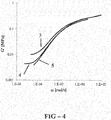
- the mixed compounds were tested for viscoelastic properties (G', elastic modulus) using an ARES G2. Samples were cured at 160 °C for 16 minutes, then tested using a frequency sweep at constant strain of 0.5%. The results of the measurement of G' over the tested frequency range is shown in FIG - 4. As seen in FIG -4, as the amount of polyethyleneimine is lowered, the observed equilibrium modulus (modulus plateau value at low frequency) decreases, extending the power law behavior of the modulus to lower frequency values. Thus it is seen that Sample 4 shows a lower rubbery plateau and equilibrium modulus than Sample 3. Likewise, the power law region for Sample 5 is extended to lower frequency than is observed for Samples 4 and 5. Such behavior with lower equilibrium modulus and extended power law region for G' is advantageous in a gel system as desired for a tire sealant.
- the mixed compounds were tested for viscoelastic properties (G', elastic modulus) using an ARES G2. Samples were cured at 160 °C for 16 minutes, then tested using a frequency sweep at constant strain of 0.5%. The results of the measurement of G' over the tested frequency range is shown in FIG - 5.
- G' viscoelastic properties
- ARES G2 ARES G2
- Samples were cured at 160 °C for 16 minutes, then tested using a frequency sweep at constant strain of 0.5%.
- the results of the measurement of G' over the tested frequency range is shown in FIG - 5.
- a sample of a tire sealant from a commercially available tire was also analyzed. The comparison sealant was taken from a Contiseal summer tire, with the sealant analyzed as including butyl rubber, mineral oil, and a p-dioximequinone/peroxide curative.
- the commercial sealant included no bromobutyl rubber.
- the mixed compounds were tested for viscoelastic properties (G', elastic modulus) using an RPA ARES G2. Samples were cured at 160 °C for 16 minutes, then tested using a frequency sweep at constant strain of 0.5%. The results of the measurement of G' over the tested frequency range is shown in FIG - 6.
- G' viscoelastic properties
- the comparison sealant was taken from a Contiseal summer tire, with the sealant analyzed as including butyl rubber, mineral oil, and a p-dioximequinone/peroxide curative.
- the commercial sealant included no bromobutyl rubber.
- a sealant composition was mixed in a 20 liter conical twin mixer (Colmec CTM-95) with amounts given in Table 5 in phr based on the total elastomer amount of bromobutyl rubber, butyl rubber, and polyisobutylene. Table 5 Sample No.
- a series of holes of various diameter were drilled into a cured rubber mat consisting of sequential layers of tread compound, reinforcement material, and innerliner compound, each layer being 2 mm thick.
- the rubber mat was cooled with liquid nitrogen before holes with diameters of 1 mm, 2 mm and 3 mm were drilled.
- Cured sealant compound was dispensed on silicon coated paper which was then cut to the required sample size and transferred to the rubber mat, followed by removal of the paper. Nails with diameter 5 mm were inserted in the pre-drilled holes. The sample was then pressurized to 2.5 bars, followed by removal of the nails. The holes were then visually inspected immediately after nail removal and 15 minutes after nail removal, with results as given in Tables 6-8.
- Samples were cured in a hot air oven for the specified time and at the specified temperature.
- Nail removal was done at room temperature. Table 6.
- Sealant cured for 15 minutes @ 140 °C Status immediately after nail removal Status 15 minutes after nail removal Hole # 1 Hole # 2 Hole # 3 Hole # 1 Hole # 2 Hole # 3 Hole 1 mm Sealed Sealed Sealed Hole 1 mm Sealed Sealed Nail 5mm Nail 5mm Hole 2mm Sealed Sealed Hole 2mm Sealed Sealed Sealed Nail 5mm Nail 5mm Hole 3mm Sealed Sealed Sealed Hole 3mm Sealed Sealed Sealed Nail 5mm Nail 5mm Table 7.
Landscapes
- Engineering & Computer Science (AREA)
- Mechanical Engineering (AREA)
- Compositions Of Macromolecular Compounds (AREA)
- Tires In General (AREA)
Abstract
Description
- Various methods, sealants and tire constructions have been suggested for pneumatic tires relating to the use of liquid sealant coatings in which the sealant flows into a puncture hole. However, such liquid sealants can flow excessively at elevated temperatures and cause the tire to become out of balance. Also, the liquid sealant may not be entirely operable or effective over a wide temperature range extending from summer to winter conditions. More complicated tire structures which encase a liquid sealant in a vulcanized rubber material can be expensive to manufacture and can also create balance and suspension problems due to the additional weight required in the tire.
- Puncture sealing tires also have been further proposed wherein a sealant layer of degradable butyl based rubber, for example, is assembled between unvulcanized tire layers to provide a built-in sealant. By laminating the sealant layer between two or more non-degraded rubber layers, e.g., the tire inner liner and a tire carcass, the sealant layer retains its structural integrity during the vulcanization operation where high pressures are applied to the tire, which would otherwise displace the degraded rubber layer from its desired location. However, the compounds that typically are used in the built-in sealant, e.g., organic peroxide depolymerized butyl based rubber, can generate gases at higher temperature, such as during the tire cure or during tire use, which can result in aesthetically unappealing inner liner blister formation. Aside from being unappealing, such blister formation may allow the sealant to unfavorably migrate away from its intended location. To combat blister formation, the inner liner, for example, can be provided at an increased thickness but this can add to the cost of building a tire.
- It is also known to directly apply sealant layers to tires after the cure process, or post cure. Such sealant layers generally are adhesively secured to the exposed surface of the innermost inner liner, and may be tacky and gel-like. Such post cure sealants as known in the art may not provide adequate long term seal against puncturing objects such as nails and the like.
- Accordingly, there is a need for an improved post cure sealant layer for tires.
- The present invention is directed to a pneumatic tire in accordance with
claim 1. - Dependent claims refer to preferred embodiments of the invention.
-
-
Figure 1 shows a cross-sectional view of a pneumatic tire which contains a circumferential sealant layer which contains a post tire cure applied sealant layer adhered to the innerliner. -
Figure 2 shows a partial cross-sectional view of a portion of the tire with a post-tire cure applied sealant layer. -
Figure 3 shows cure data for two rubber compositions. -
Figure 4 shows viscoelastic data for two rubber compositions. -
Figure 5 shows viscoelastic data for several rubber compositions. -
Figure 6 shows viscoelastic data for several rubber compositions. - There is disclosed a pneumatic tire comprising a radially outer circumferential rubber tread disposed on a supporting carcass, an inner liner rubber layer radially inwardly disposed on the supporting carcass, and a sealant layer adhered to and disposed inwardly of the rubber inner liner layer as a radially inner surface of the tire, wherein the sealant layer comprises 100 parts by weight of elastomer comprising 5 to 10 parts by weight, per 100 parts by weight of elastomer (phr) of butyl rubber, 10 to 25 phr of bromobutyl rubber, and 65 to 90 phr of polybutene; and from 0.1 to 0.5 phr of a polymeric amine.
- In
FIG. 1 , a cross-section of a curedpneumatic tire 10 is presented comprising atread 14 which includes a treadbase rubber layer 11,sidewalls 12, spaced apartbeads 18 and carcass underlying the tread 14 (including the tread base layer 11), comprising cord reinforced (e.g. wire cord reinforced)rubber belt plies 16, cord reinforced (e.g. synthetic nylon or polyester cord reinforced)rubber carcass ply 17 and an optionalrubber barrier layer 13 with innerliner rubber layer 22 being positioned radially inward of the carcass andoptional barrier layer 13 andcarcass ply 17 together with asealant layer 20 forming the radially innermost surface of the tire. - The sealant layer includes a butyl rubber. As used herein the term "butyl rubber" is defined to mean a polymer predominately comprising repeat units of isobutylene but including a few repeat units of a conjugated diene. Preferably from 85% to 99.5% by weight of the butyl rubber are repeat units derived from the polymerization of isobutylene, while from 0.1 % to 15% by weight of the repeat units are derived from a conjugated diene having from 4 to 8 carbon atoms such as butadiene, isoprene, hexadiene, etc., with isoprene being preferred.
- In one embodiment, the sealant layer includes from 5 to 10 parts by weight of butyl rubber, per 100 parts by weight of total elastomer (phr).
- The sealant layer also includes a bromobutyl rubber. Bromobutyl rubber is defined to mean butyl rubber that contains at least 0.05% by weight bromine. Preferred bromobutyl rubbers are those that contain from 0.1% to 10% by weight bromine, more preferably from 0.5% to about to 5.0% by weight bromine based on the total weight of the brominated polymer.
- Numerous patents disclose halogenated butyl rubber containing various amounts of chemically bound halogen, see for example,
US-A-2,631,984 ;US-A-2,732,354 ;US-A-3,099,644 ;US-A-2,732,354 ;US-A-2,944,578 ;US-A-3,943,664 ;US-A-2,964,489 ; andUS-A-4,130,534 . - In one embodiment, the sealant layer includes from 10 to 25 phr of bromobutyl rubber.
- The sealant layer also includes a polybutene. By polybutene, it is meant a polymer of one or more butene isomers including 1-butene, 2-butene, and 2-methylpropene (isobutylene). Such polybutene may be commercially referred to as polyisobutylene.
- Such polybutenes preferably have a number average molecular weight exceeding 600 to minimize the possibility of migration from the sealant layer into adjacent tire components. It is preferably prepared by polymerizing an isobutylene rich stream with a metal halide catalyst and preferably has a polymer backbone structure resembling polyisobutylene. Very suitable polybutenes are available under the trademark Indopol In one embodiment,the number average molecular weights (Mn) of the polybutene from 600 to 2500, as determined by vapor pressure osmometry.
- In one embodiment, the sealant layer includes from 65 to 90 phr of polybutene.
- The rubber composition further includes a polymeric amine. In embodiment, the polymeric amine has a primary amine functionality. Suitable polymeric amines include but are not limited to polyethyleneimine, polypropyleneimine, and polyoxyalkylene amines.
- In one embodiment, the polymeric amine is a polyethyleneimine. In one embodiment, the polyethyleneimine has a number average molecular weight of 150 to 10000, preferably 150 to 5000, more preferably 200 to 2000. Suitable polyethyleneimine is available commercially as Lupasol from BASF.
- In one embodiment, the polymeric amine is a polyoxyalkylene amine. The polyoxyalkylene amine can include a polyoxyalkylene monoamine, diamine, triamine, or combinations thereof. These compounds are defined by an amino group attached to a terminus of a polyether backbone and, thus, are considered polyether amines. The amino group is a primary amino group. Depending upon whether the polyoxyalkylene amine is a mono-, di-, or triamine, each compound can contain, respectively, one, two, or three amino groups, e.g. primary amino groups, with each group being attached to the terminus of a polyether backbone. Accordingly, one or more polyether backbones may be necessary to accommodate the number of terminal amino groups. Further description of polyoxyalkylene amines and their use is as disclosed in
US-B-7,714,051 . Suitable polyoxyalkylene amines include polyoxyalkylene mono-, di-, and triamines commercially available from Huntsman Chemical of The Woodlands, Tex. and sold under the tradename JEFFAMINE®. - Polymeric amine may be used in an amount ranging from 0.05 to 2 phr. In one embodiment, the polymeric amine is used in an amount ranging from 0.1 to 1.5 phr. In one embodiment, the polymeric amine is used in an amount ranging from 0.2 to 1 phr.
- Oils may be included in the sealant as a viscosity modifier. Suitable oils include oils such as mineral oils including but not limited to aromatic oils, naphthenic oils, paraffinic oils, MES oils, TDAE oils, RAE oils, and SRAE oils, and vegetable oils including but not limited to sunflower oil, soybean oil, corn oil, castor oil, and canola oil. Oil may be present in an amount ranging from 5 to 15 phr.
- Resins may also be included in the sealant as a tackifier. Suitable resin include hydrocarbon resins, phenol/acetylene resins, rosin derived resins and mixtures thereof. Representative hydrocarbon resins include coumarone-indene-resins, petroleum resins, terpene polymers and mixtures thereof. Phenol/acetylene resins may be derived by the addition of acetylene to butyl phenol in the presence of zinc naphthlate. Additional examples are derived from alkylphenol and acetylene. Resin may be present in an amount ranging from 5 to 15 phr.
- Other conventional compounding ingredients may be included in the mixing process, including but not limited to filler such as carbon black and silica, antidegradants, colorants, processing aids, and the like.
- Mixing of the sealant composition may be accomplished for example by combining the elastomers and other components in a rubber mixer such as a Brabender internal mixer, extruder, or the like. Following mixing and cure, the sealant composition is applied to the innerliner of a cured tire. A suitable process for mixing the sealant and applying to a tire innerliner is as disclosed in
US-B-8,821,982 . -
FIG. 2 depicts a partial cross-section of the sulfur curedpneumatic tire 10, labeled as 10a inFIG. 2 , comprising thetire tread 14 with its treadbase rubber layer 11, wire cord reinforced rubber belt plies 16, carcass with synthetic cord reinforced rubber carcass ply 17 (e.g. synthetic fiber based cord such as, for example, nylon or polyester cord), optionalrubber barrier layer 13, rubberinner liner 22 andsealant layer 20. Thesealant layer 20 is applied to theinner liner 22 of the already cured tire (and is therefore a post tire cure applied sealant layer) to provide a tire with a sealant layer with puncture sealing properties against various puncturing objects. - The thickness of the
circumferential sealant layer 20 can vary depending somewhat upon the degree of sealing ability desired as well as the tire itself, including the tire size and intended tire use. For example, the thickness of the sealant layer may range from 0.13 cm (0.05 inches) to 1.9 cm (0.75 inches) depending somewhat upon the tire itself and its intended use. For example, in passenger tires, thesealant layer 20 might, for example, have a thickness in a range of 0.33 cm (0.125 inches) or from 2 to 6 mm, whereas for truck tires, thesealant layer 20 might, for example, have a thickness in a range of 0.76 cm (0.3 inches) or from 5 to 10 mm. The post cured tire appliedsealant layer 20 is generally situated in the crown region of thetire 10, and, if desired, may include colorant so that it is of a non-black color that may contrast with the black colored inner liner, tread, or sidewall so that a tire puncture can be noticed. - The tire inner
liner rubber layer 22 may comprise a conventional sulfur curable rubber inner liner for use in pneumatic tires. In one example, therubber innerliner 22 can be a sulfur curative-containing halobutyl rubber composition of a halobutyl rubber such as for example chlorobutyl rubber or bromobutyl rubber. Such halobutyl rubber based inner liner layer may also contain one or more sulfur curable diene-based elastomers such as, for example, cis-1,4-polyisoprene natural rubber, cis-1,4-polybutadiene rubber and styrene/butadiene rubber, or mixtures thereof. Theinner liner 22 is normally prepared by conventional calendering or milling techniques to form a strip of uncured compounded rubber of appropriate width. When thetire 10 is cured, theinner liner 22 becomes co-cured and thereby integral with, thetire 10. Tire inner liner rubber layers and their methods of preparation are well known to those having skill in such art. - In this example, the selective cure of bromobutyl rubber by a polymeric amine in a blend of bromobutyl rubber and butyl rubber is illustrated.
- Two rubber compounds were prepared by blending components in a laboratory mixer, with amounts as shown in Table 1 (all amounts in phr)
-
- Sample No. 1 2
-
Butyl Rubber 0 80 -
Bromobutyl Rubber 100 20 - Polyethyleneimine1 0.75 0.70
-
Magnesium oxide 3 3 - 1 Lupasol FG, from BASF
- The mixed compounds were tested for cure properties at 160 °C using an ARES G@. FIG - 3 shows the torque versus time for
Samples Sample 1 with 100% bromobutyl rubber shows rapid increase in torque to a high maximum value indicating cure of the bromobutyl rubber with the amine. By contrast,Sample 2 with 20% bromobutyl rubber and 80% butyl rubber shows a much slower increase in torque to a low maximum, indicating cure of the bromobutyl rubber but little to no cure of the butyl rubber. - In this example, the effect of varying the amount of polymeric amine on the viscoelastic properties of a blend of bromobutyl rubber and butyl rubber is illustrated.
- Three rubber compounds were prepared by blending components in a laboratory mixer, with amounts as shown in Table 2 in phr based on the total elastomer amount of bromobutyl rubber and butyl rubber.
Table 2 Sample No. 3 4 5 Butyl Rubber 85 85 90 Bromobutyl Rubber 15 15 10 Polyethyleneimine 1 1.05 0.26 0.18 Magnesium oxide 3 3 3 1 Lupasol FG, from BASF - The mixed compounds were tested for viscoelastic properties (G', elastic modulus) using an ARES G2. Samples were cured at 160 °C for 16 minutes, then tested using a frequency sweep at constant strain of 0.5%. The results of the measurement of G' over the tested frequency range is shown in FIG - 4. As seen in FIG -4, as the amount of polyethyleneimine is lowered, the observed equilibrium modulus (modulus plateau value at low frequency) decreases, extending the power law behavior of the modulus to lower frequency values. Thus it is seen that
Sample 4 shows a lower rubbery plateau and equilibrium modulus thanSample 3. Likewise, the power law region forSample 5 is extended to lower frequency than is observed forSamples - In this example, the effect of varying the amount of polymeric amine on the viscoelastic properties of a blend of bromobutyl rubber and butyl rubber in the presence of a low molecular weight polymer diluent (polybutene) is illustrated.
- Three rubber compounds were prepared by solution blending of components, with amount as shown in Table 3 in phr based on the total elastomer amount of bromobutyl rubber, butyl rubber, and polybutene. Compound mixing was facilitated using cyclohexane as a solvent, followed by removal of the cyclohexane.
Table 3 Sample No. 6 7 8 Butyl Rubber 10 10 10 Bromobutyl Rubber 15 15 15 Polybutene1 75 75 75 Polyethyleneimine2 0.53 0.21 0.10 1 Molecular weight (number average) = 920 g/mol, from Aldrich.
2 Lupasol FG, from BASF; phr based on amount of butyl, bromobutyl, and polybutene - The mixed compounds were tested for viscoelastic properties (G', elastic modulus) using an ARES G2. Samples were cured at 160 °C for 16 minutes, then tested using a frequency sweep at constant strain of 0.5%. The results of the measurement of G' over the tested frequency range is shown in FIG - 5. For comparison, a sample of a tire sealant from a commercially available tire was also analyzed. The comparison sealant was taken from a Contiseal summer tire, with the sealant analyzed as including butyl rubber, mineral oil, and a p-dioximequinone/peroxide curative. The commercial sealant included no bromobutyl rubber.
- As seen in FIG -5, decreased curative level progressively for Samples 6-8 leads to a reduced G' and increased slope of G' vs frequency. Significantly, the medium curative level (Sample 7) most closely tracks the desired behavior of the commercial sealant.
- In this example, the effect of varying the amount of low molecular weight polymer diluent on the viscoelastic properties of a blend of bromobutyl rubber and butyl rubber cured with an approximately constant cure level is illustrated.
- Three rubber compounds were prepared by solution blending of components, with amounts as shown in Table 4 in phr based on the total elastomer amount of bromobutyl rubber, butyl rubber, and polybutene. Compound mixing was facilitated using cyclohexane as a solvent, followed by removal of the cyclohexane.
Table 4 Sample No. 9 10 11 Butyl Rubber 5 5 5 Bromobutyl Rubber 20 15 10 Polybutene1 75 80 85 Polyethyleneimine2 0.22 0.21 0.18 1 Molecular weight (number average) = 920 g/mol, from Aldrich.
2 Lupasol FG, from BASF; phr based on amount of butyl, bromobutyl and polybutene - The mixed compounds were tested for viscoelastic properties (G', elastic modulus) using an RPA ARES G2. Samples were cured at 160 °C for 16 minutes, then tested using a frequency sweep at constant strain of 0.5%. The results of the measurement of G' over the tested frequency range is shown in FIG - 6. For comparison, a sample of a tire sealant from a commercially available tire was also analyzed. The comparison sealant was taken from a Contiseal summer tire, with the sealant analyzed as including butyl rubber, mineral oil, and a p-dioximequinone/peroxide curative. The commercial sealant included no bromobutyl rubber.
- As seen in FIG -6, decreased bromobutyl level progressively for Samples 9-11 leads to a reduced G' and increased slope of G' vs frequency. Significantly,
Sample 10 most closely tracks the desired behavior of the commercial sealant. - In this example, the effect of a sealant composition on the ability to seal a puncture in a rubber sample is illustrated. A sealant composition was mixed in a 20 liter conical twin mixer (Colmec CTM-95) with amounts given in Table 5 in phr based on the total elastomer amount of bromobutyl rubber, butyl rubber, and polyisobutylene.
Table 5 Sample No. 12 Bromobutyl Rubber 15 Butyl Rubber 5 Polyisobutylene5 80 Magnesium oxide 11 ASTM N326 carbon black 10 oil 28 Resin A3 6 Resin B 44 PEI6 0.35 1 Magnesium oxide paste with 20% emulsion softener
2 Low poly-cyclic oil of low viscosity
3 A non-staining mixture of straight chained petroleum hydrocarbon resins with a non-staining antioxidant and containing considerable cyclic but no aromatic structures.Softening point 100 +/- 3 C.
4 A mixture of alkylated naphthenic and aromatic resins with a maximum of 2% dusting agent (talc) added to prevent sticking.Softening point 101 +/- 5 C.
5 Indopol H-300 from Ineos. Mn = 1300 g/mol.
6 Lupasol FG: Low molecular weight (800) highly charged, cationic ethylenimine copolymer. Common Chemical Name: Polyethylenimine (PEI) - A series of holes of various diameter were drilled into a cured rubber mat consisting of sequential layers of tread compound, reinforcement material, and innerliner compound, each layer being 2 mm thick. The rubber mat was cooled with liquid nitrogen before holes with diameters of 1 mm, 2 mm and 3 mm were drilled. Cured sealant compound was dispensed on silicon coated paper which was then cut to the required sample size and transferred to the rubber mat, followed by removal of the paper. Nails with
diameter 5 mm were inserted in the pre-drilled holes. The sample was then pressurized to 2.5 bars, followed by removal of the nails. The holes were then visually inspected immediately after nail removal and 15 minutes after nail removal, with results as given in Tables 6-8. - Samples were cured in a hot air oven for the specified time and at the specified temperature.
- Nail removal was done at room temperature.
Table 6. Sealant cured for 15 minutes @ 140 °C Status immediately after nail removal Status 15 minutes after nail removal Hole # 1 Hole # 2Hole # 3Hole # 1Hole # 2Hole # 3Hole 1 mmSealed Sealed Sealed Hole 1 mmSealed Sealed Sealed Nail 5mm Nail 5mm Hole 2mm Sealed Sealed Sealed Hole 2mm Sealed Sealed Sealed Nail 5mm Nail 5mm Hole 3mm Sealed Sealed Sealed Hole 3mm Sealed Sealed Sealed Nail 5mm Nail 5mm Table 7. Sealant cured for 10 minutes @ 150 °C Status immediately after nail removal Status 15 minutes after nail removal Hole # 1 Hole # 2Hole # 3Hole # 1Hole # 2Hole # 3Hole 1 mmSealed Sealed Sealed Hole 1 mmSealed Sealed Sealed Nail 5mm Nail 5mm Hole 2mm Sealed Sealed Sealed Hole 2mm Sealed Sealed Sealed Nail 5mm Nail 5mm Hole 3mm Sealed Sealed Sealed Hole 3mm Sealed Sealed Sealed Nail 5mm Nail 5mm Table 8 Sealant cured for 52 minutes @160 °C Status immediately after nail removal Status 15 minutes after nail removal Hole # 1 Hole # 2Hole # 3Hole # 1Hole # 2Hole # 3Hole 1 mmSealed Sealed N/a Hole 1 mmSealed Sealed N/a Nail 5mm Nail 5mm Hole 2mm Sealed Sealed Sealed Hole 2mm Sealed Sealed Sealed Nail 5mm Nail 5mm Hole 3mm Sealed Sealed Sealed Hole 3mm Sealed Sealed Sealed Nail 5mm Nail 5mm - The procedure of Example 5 was repeated, with the sealant as given in Table 9. Nail removal was done at room temperature and at -25 °C, with results given in Tables 10-11.
Table 9. Bromobutyl 15 Butyl 5 Polyisobutylene5 80 Magnesium oxide 11 Calcium Carbonate 10 Polyisobutylene 28 Resin A3 6 Resin B 44 PEI6 0.35 1 Magnesium oxide paste with 20% emulsion softener
2 Indopol H-25 from Ineos. Mn = 635 g/mol
3 A non-staining mixture of straight chained petroleum hydrocarbon resins with a non-staining antioxidant and containing considerable cyclic but no aromatic structures.Softening point 100 +/- 3 C.
4 A mixture of alkylated naphthenic and aromatic resins with a maximum of 2% dusting agent (talc) added to prevent sticking.Softening point 101 +/- 5 C.
5 Indopol H300 from Ineos. Mn = 1300 g/mol.
6 Lupasol FG: Low molecular weight (800) highly charged, cationic ethylenimine copolymer. Common Chemical Name: Polyethylenimine (PEI)Table 10 Sealant cured for 10 minutes @ 150 °C Status immediately after nail removal Removal at -25 ° C Status 15 minutes after nail removal Removal at -25 ° C Hole # 1 Hole # 2Hole # 3Hole # 1Hole # 2Hole # 3Hole 1 mmsealed sealed sealed Hole 1 mmsealed sealed sealed Nail 5mm Nail 5mm Hole 2mm sealed sealed sealed Hole 2mm sealed sealed sealed Nail 5mm Nail 5mm Hole 3mm sealed sealed sealed Hole 3mm sealed sealed sealed Nail 5mm Nail 5mm Table 11 Sealant cured for 10 minutes @ 150 °C Status immediately after nail removal Removal at room temperature Status 15 minutes after nail removal Removal at room temperature Hole # 1 Hole # 2Hole # 3Hole # 1Hole # 2Hole # 3Hole 1 mmsealed sealed sealed Hole 1 mmsealed sealed sealed Nail 5mm Nail 5mm Hole 2mm sealed sealed sealed Hole 2mm sealed sealed sealed Nail 5mm Nail 5mm Hole 3mm sealed sealed sealed Hole 3mm sealed sealed sealed Nail 5mm Nail 5mm
Claims (10)
- A pneumatic tire comprising a radially outer circumferential rubber tread (14) disposed on a supporting carcass, an inner liner rubber layer (22) radially inwardly disposed on the supporting carcass, and a sealant layer (20) adhered to and disposed inwardly of the rubber inner liner layer (22) as a radially inner surface of the tire (10, 10a), wherein the sealant layer (22) comprises 100 parts by weight of elastomer comprising 5 to 10 parts by weight, per 100 parts by weight of elastomer (phr) of butyl rubber, 10 to 25 phr of bromobutyl rubber, and 65 to 90 phr of polybutene; and from 0.05 to 2 phr of a polymeric amine.
- The pneumatic tire of claim 1, wherein the sealant layer (20) further comprises from 5 to 15 phr of a resin.
- The pneumatic tire of claim 1 or 2, wherein the sealant layer (20) further comprises from 5 to 15 phr of an oil.
- The pneumatic tire of at least one of the previous claims, wherein the polymeric amine is selected from the group consisting of polyethyleneimine, polypropyleneimine, and polyoxyalkylene amines.
- The pneumatic tire of at least one of the previous claims, wherein the polymeric amine is a polyethyleneimine having a number average molecular weight in a range of from 100 to 10000.
- The pneumatic tire of at least one of the previous claims, wherein the polymeric amine is a polyethyleneimine having a number average molecular weight in a range of from 200 to 2000.
- The pneumatic tire of at least one of the previous claims, wherein the polybutene has a number average molecular weight in a range of from 600 to 2500.
- The pneumatic tire of at least one of the previous claims, wherein the resin is selected from the group consisting of hydrocarbon resins, phenol/acetylene resins, rosin derived resins and mixtures thereof.
- The pneumatic tire of at least one of the previous claims, wherein the oil is selected from the group consisting of aromatic oils, naphthenic oils, paraffinic oils, MES oils, TDAE oils, RAE oils, and SRAE oils, sunflower oil, soybean oil, corn oil, castor oil, and canola oil.
- The pneumatic tire of at least one of the previous claims, wherein in the polymeric amine comprises a primary amine functionality.
Applications Claiming Priority (1)
| Application Number | Priority Date | Filing Date | Title |
|---|---|---|---|
| US14/825,385 US10035383B2 (en) | 2015-08-13 | 2015-08-13 | Pneumatic tire with post cure sealant layer |
Publications (2)
| Publication Number | Publication Date |
|---|---|
| EP3130454A1 true EP3130454A1 (en) | 2017-02-15 |
| EP3130454B1 EP3130454B1 (en) | 2020-03-11 |
Family
ID=56936243
Family Applications (1)
| Application Number | Title | Priority Date | Filing Date |
|---|---|---|---|
| EP16184014.5A Active EP3130454B1 (en) | 2015-08-13 | 2016-08-12 | Pneumatic tire with post cure sealant layer |
Country Status (2)
| Country | Link |
|---|---|
| US (1) | US10035383B2 (en) |
| EP (1) | EP3130454B1 (en) |
Families Citing this family (2)
| Publication number | Priority date | Publication date | Assignee | Title |
|---|---|---|---|---|
| US12018155B1 (en) | 2019-12-27 | 2024-06-25 | Poet Research, Inc. | Process oil for rubber compounding |
| US20250289949A1 (en) * | 2024-03-15 | 2025-09-18 | The Goodyear Tire & Rubber Company | Rubber compositions and articles thereof |
Citations (16)
| Publication number | Priority date | Publication date | Assignee | Title |
|---|---|---|---|---|
| US2631984A (en) | 1950-04-18 | 1953-03-17 | Goodrich Co B F | Isoolefin polyolefin interpolymer derivatives and compositions comprising the same |
| US2732354A (en) | 1952-12-05 | 1956-01-24 | Chlorine derivatives of isoolefem-poly- | |
| US2944578A (en) | 1955-05-31 | 1960-07-12 | Exxon Research Engineering Co | Pneumatic tire |
| US2964489A (en) | 1956-07-16 | 1960-12-13 | Exxon Research Engineering Co | Process of chlorinating butyl rubber and vulcanizing the chlorinated product |
| US3099644A (en) | 1959-10-06 | 1963-07-30 | Exxon Research Engineering Co | Continuous chlorination and bromination of butyl rubber |
| US3943664A (en) | 1971-07-19 | 1976-03-16 | Pinkhus Ruvimovich Broide | Profile-grinding machine |
| US4130534A (en) | 1976-12-27 | 1978-12-19 | Monsanto Company | Elastoplastic compositions of butyl rubber and polyolefin resin |
| US4539344A (en) * | 1981-08-31 | 1985-09-03 | Rockcor, Inc. | Thermally stable sealant composition |
| AT380893B (en) * | 1980-09-17 | 1986-07-25 | Rockcor Inc | METHOD FOR PRODUCING A SEALANT, IN PARTICULAR FOR VEHICLE TIRES, AND ITS USE |
| US4665963A (en) * | 1983-06-01 | 1987-05-19 | Polysar Limited | Pneumatic tire inner liner having puncture sealing characteristics |
| EP1418199A1 (en) * | 2002-10-08 | 2004-05-12 | Sumitomo Rubber Industries, Ltd. | Tubeless tire |
| US20040112506A1 (en) * | 2001-10-12 | 2004-06-17 | Mitsuru Naito | Method of treating pneumatic tire |
| WO2007070053A1 (en) * | 2005-12-16 | 2007-06-21 | Exxonmobil Chemical Patents, Inc. | Processing aids for elastomeric compositions |
| DE102007023994A1 (en) * | 2007-05-23 | 2008-11-27 | Continental Aktiengesellschaft | Process for the preparation of a solvent-free tire sealant on a polymeric basis |
| US7714051B2 (en) | 2006-08-07 | 2010-05-11 | The Goodyear Tire & Rubber Company | Rubber compounds containing polyoxyalkylene amines |
| WO2015115486A1 (en) * | 2014-01-30 | 2015-08-06 | 住友ゴム工業株式会社 | Sealant tire |
Family Cites Families (27)
| Publication number | Priority date | Publication date | Assignee | Title |
|---|---|---|---|---|
| US4161202A (en) * | 1973-06-18 | 1979-07-17 | The B. F. Goodrich Company | Puncture sealing tire |
| CA1030699A (en) | 1973-11-08 | 1978-05-02 | Polysar Limited | Halobutyl of improved green strength |
| US3935893A (en) * | 1974-07-15 | 1976-02-03 | General Motors Corporation | Self-sealing vehicle tire and sealant composition |
| US4171237A (en) * | 1975-09-22 | 1979-10-16 | The Firestone Tire & Rubber Company | Sealant laminates |
| JPS5284606A (en) * | 1975-12-29 | 1977-07-14 | Bridgestone Corp | Puncture prevent pneumatic tire and method to manufacture the tire |
| US4140167A (en) * | 1976-08-20 | 1979-02-20 | The Firestone Tire & Rubber Company | Sealant laminates |
| US4228839A (en) * | 1978-08-03 | 1980-10-21 | The Firestone Tire & Rubber Company | Self-sealing pneumatic tire |
| US4359078A (en) | 1979-03-14 | 1982-11-16 | The Goodyear Tire & Rubber Company | Pneumatic tire having puncture sealing feature and method of making same |
| US4895610A (en) * | 1983-08-15 | 1990-01-23 | The Goodyear Tire & Rubber Company | Self-sealing pneumatic tire and method of manufacturing the same |
| US4919183A (en) | 1983-09-28 | 1990-04-24 | The Goodyear Tire & Rubber Company | Self sealing pneumatic tire |
| US4810752A (en) | 1987-09-24 | 1989-03-07 | The West Company | Halobutyl thermoplastic elastomer |
| US5295525A (en) * | 1992-06-22 | 1994-03-22 | Michelin Recherche Et Technique S.A. | Puncture sealant formulation |
| US6527022B2 (en) * | 2000-03-10 | 2003-03-04 | The Goodyear Tire & Rubber Company | Pneumatic tire having a tread containing a metal oxide aerogel |
| US6552108B1 (en) | 2000-10-11 | 2003-04-22 | Exxonmobil Chemical Patents Inc. | Rubber blends having improved stability and green strength |
| JP4409814B2 (en) * | 2001-09-26 | 2010-02-03 | 横浜ゴム株式会社 | Pneumatic tire having an adhesive sealant layer and method for producing the same |
| US7322393B2 (en) * | 2001-09-27 | 2008-01-29 | Pirelli Pneumatici S.P.A. | Sealing material, tire for a vehicle wheel including the sealing material, and process for producing the tire |
| US20040030036A1 (en) * | 2001-10-16 | 2004-02-12 | Waddell Walter H. | Elastomeric composition |
| JP4874650B2 (en) * | 2003-08-25 | 2012-02-15 | 株式会社カネカ | Curable composition with improved heat resistance |
| DE602005027612D1 (en) * | 2004-12-21 | 2011-06-01 | Dow Global Technologies Llc | Vulcanizable Halalized Elastomer Compositions |
| US20090084482A1 (en) * | 2007-09-28 | 2009-04-02 | Ramendra Nath Majumdar | Pneumatic tire having built-In sealant layer and preparation thereof |
| KR101430052B1 (en) * | 2013-04-26 | 2014-08-14 | 금호타이어 주식회사 | Color Sealant Composition having Self-sealing for Tire |
| EP3044261B1 (en) * | 2013-09-09 | 2019-08-14 | ARLANXEO Singapore Pte. Ltd. | Filled butyl rubber ionomer compounds |
| DE102013110977A1 (en) * | 2013-10-02 | 2015-04-02 | Continental Reifen Deutschland Gmbh | Self-sealing tire sealant and pneumatic vehicle tire |
| JP6291301B2 (en) * | 2014-03-25 | 2018-03-14 | 住友ゴム工業株式会社 | Pneumatic tire |
| KR101535029B1 (en) * | 2014-07-04 | 2015-07-07 | 현대자동차주식회사 | Low noise tire |
| US20160068031A1 (en) * | 2014-09-05 | 2016-03-10 | The Goodyear Tire & Rubber Company | Pneumatic tire with post cure sealant layer |
| US20170029606A1 (en) * | 2015-07-30 | 2017-02-02 | The Goodyear Tire & Rubber Company | Method of making a tire sealant |
-
2015
- 2015-08-13 US US14/825,385 patent/US10035383B2/en active Active
-
2016
- 2016-08-12 EP EP16184014.5A patent/EP3130454B1/en active Active
Patent Citations (17)
| Publication number | Priority date | Publication date | Assignee | Title |
|---|---|---|---|---|
| US2631984A (en) | 1950-04-18 | 1953-03-17 | Goodrich Co B F | Isoolefin polyolefin interpolymer derivatives and compositions comprising the same |
| US2732354A (en) | 1952-12-05 | 1956-01-24 | Chlorine derivatives of isoolefem-poly- | |
| US2944578A (en) | 1955-05-31 | 1960-07-12 | Exxon Research Engineering Co | Pneumatic tire |
| US2964489A (en) | 1956-07-16 | 1960-12-13 | Exxon Research Engineering Co | Process of chlorinating butyl rubber and vulcanizing the chlorinated product |
| US3099644A (en) | 1959-10-06 | 1963-07-30 | Exxon Research Engineering Co | Continuous chlorination and bromination of butyl rubber |
| US3943664A (en) | 1971-07-19 | 1976-03-16 | Pinkhus Ruvimovich Broide | Profile-grinding machine |
| US4130534A (en) | 1976-12-27 | 1978-12-19 | Monsanto Company | Elastoplastic compositions of butyl rubber and polyolefin resin |
| AT380893B (en) * | 1980-09-17 | 1986-07-25 | Rockcor Inc | METHOD FOR PRODUCING A SEALANT, IN PARTICULAR FOR VEHICLE TIRES, AND ITS USE |
| US4539344A (en) * | 1981-08-31 | 1985-09-03 | Rockcor, Inc. | Thermally stable sealant composition |
| US4665963A (en) * | 1983-06-01 | 1987-05-19 | Polysar Limited | Pneumatic tire inner liner having puncture sealing characteristics |
| US20040112506A1 (en) * | 2001-10-12 | 2004-06-17 | Mitsuru Naito | Method of treating pneumatic tire |
| EP1418199A1 (en) * | 2002-10-08 | 2004-05-12 | Sumitomo Rubber Industries, Ltd. | Tubeless tire |
| WO2007070053A1 (en) * | 2005-12-16 | 2007-06-21 | Exxonmobil Chemical Patents, Inc. | Processing aids for elastomeric compositions |
| US7714051B2 (en) | 2006-08-07 | 2010-05-11 | The Goodyear Tire & Rubber Company | Rubber compounds containing polyoxyalkylene amines |
| DE102007023994A1 (en) * | 2007-05-23 | 2008-11-27 | Continental Aktiengesellschaft | Process for the preparation of a solvent-free tire sealant on a polymeric basis |
| US8821982B2 (en) | 2007-05-23 | 2014-09-02 | Continental Reifen Deutschland Gmbh | Method of making a solvent-free polymer-based tire sealant |
| WO2015115486A1 (en) * | 2014-01-30 | 2015-08-06 | 住友ゴム工業株式会社 | Sealant tire |
Also Published As
| Publication number | Publication date |
|---|---|
| US20170043629A1 (en) | 2017-02-16 |
| EP3130454B1 (en) | 2020-03-11 |
| US10035383B2 (en) | 2018-07-31 |
Similar Documents
| Publication | Publication Date | Title |
|---|---|---|
| EP2993061B1 (en) | Pneumatic tire with post cure sealant layer | |
| US4359078A (en) | Pneumatic tire having puncture sealing feature and method of making same | |
| US6837287B2 (en) | Self-sealing pneumatic tire and preparation thereof | |
| US8360122B2 (en) | Sealant material composition, self-sealing pneumatic tire, and preparation thereof | |
| CN102239046B (en) | Inflatable article with self-sealing airtight layer comprising thermoplastic elastomer and extender oil | |
| EP2042296A1 (en) | Pneumatic tire having built-in sealant layer and preparation thereof | |
| EP2045103B1 (en) | Pneumatic tire having built-in sealant layer and preparation thereof | |
| EP2039500A1 (en) | Pneumatic tire having built-in sealant layer and preparation thereof | |
| WO2016095542A1 (en) | Pneumatic tire having multiple built-in sealant layers and preparation thereof | |
| KR20090091355A (en) | Self-sealing Compositions for Pneumatic Products | |
| GB2045793A (en) | Pneumatic tire having inner puncture sealing strip | |
| CN102239048A (en) | Airtight multilayer laminate for a pneumatic object | |
| WO2009143895A1 (en) | Tyre comprising a sealing material comprising a partially cross-linked styrene-butadiene rubber | |
| JP7289722B2 (en) | Pneumatic tire with post-cured sealant layer | |
| EP0135463A1 (en) | Self-sealing pneumatic tire and method of manufacturing same | |
| US9421824B2 (en) | Pneumatic tire with sealant layer | |
| KR20150013484A (en) | Pneumatic object provided with a gastight layer based on a thermoplastic elastomer and on a lamellar filler | |
| EP3130454B1 (en) | Pneumatic tire with post cure sealant layer | |
| AU2008243137B2 (en) | Tyre with zoned built-in sealant layer | |
| US20170326913A1 (en) | Rolling Assembly | |
| US20170029606A1 (en) | Method of making a tire sealant | |
| EP0160614A2 (en) | Pneumatic tire with puncture sealing feature | |
| US10919242B2 (en) | Pneumatic tire with in-situ generated sealant composition by chain cessation of ionic butyl | |
| EP0119151A2 (en) | Pneumatic tire having puncture sealing feature | |
| JP5248520B6 (en) | Tire with self-sealing ply |
Legal Events
| Date | Code | Title | Description |
|---|---|---|---|
| PUAI | Public reference made under article 153(3) epc to a published international application that has entered the european phase |
Free format text: ORIGINAL CODE: 0009012 |
|
| STAA | Information on the status of an ep patent application or granted ep patent |
Free format text: STATUS: THE APPLICATION HAS BEEN PUBLISHED |
|
| AK | Designated contracting states |
Kind code of ref document: A1 Designated state(s): AL AT BE BG CH CY CZ DE DK EE ES FI FR GB GR HR HU IE IS IT LI LT LU LV MC MK MT NL NO PL PT RO RS SE SI SK SM TR |
|
| AX | Request for extension of the european patent |
Extension state: BA ME |
|
| STAA | Information on the status of an ep patent application or granted ep patent |
Free format text: STATUS: REQUEST FOR EXAMINATION WAS MADE |
|
| 17P | Request for examination filed |
Effective date: 20170816 |
|
| RBV | Designated contracting states (corrected) |
Designated state(s): AL AT BE BG CH CY CZ DE DK EE ES FI FR GB GR HR HU IE IS IT LI LT LU LV MC MK MT NL NO PL PT RO RS SE SI SK SM TR |
|
| RIC1 | Information provided on ipc code assigned before grant |
Ipc: B29C 73/16 20060101ALI20190807BHEP Ipc: B60C 19/12 20060101ALI20190807BHEP Ipc: B29D 30/06 20060101AFI20190807BHEP Ipc: B60C 5/14 20060101ALI20190807BHEP Ipc: B29C 73/20 20060101ALI20190807BHEP |
|
| GRAP | Despatch of communication of intention to grant a patent |
Free format text: ORIGINAL CODE: EPIDOSNIGR1 |
|
| STAA | Information on the status of an ep patent application or granted ep patent |
Free format text: STATUS: GRANT OF PATENT IS INTENDED |
|
| INTG | Intention to grant announced |
Effective date: 20191004 |
|
| GRAS | Grant fee paid |
Free format text: ORIGINAL CODE: EPIDOSNIGR3 |
|
| GRAA | (expected) grant |
Free format text: ORIGINAL CODE: 0009210 |
|
| STAA | Information on the status of an ep patent application or granted ep patent |
Free format text: STATUS: THE PATENT HAS BEEN GRANTED |
|
| AK | Designated contracting states |
Kind code of ref document: B1 Designated state(s): AL AT BE BG CH CY CZ DE DK EE ES FI FR GB GR HR HU IE IS IT LI LT LU LV MC MK MT NL NO PL PT RO RS SE SI SK SM TR |
|
| REG | Reference to a national code |
Ref country code: GB Ref legal event code: FG4D |
|
| REG | Reference to a national code |
Ref country code: CH Ref legal event code: EP |
|
| REG | Reference to a national code |
Ref country code: AT Ref legal event code: REF Ref document number: 1242612 Country of ref document: AT Kind code of ref document: T Effective date: 20200315 |
|
| REG | Reference to a national code |
Ref country code: IE Ref legal event code: FG4D |
|
| REG | Reference to a national code |
Ref country code: DE Ref legal event code: R096 Ref document number: 602016031386 Country of ref document: DE |
|
| PG25 | Lapsed in a contracting state [announced via postgrant information from national office to epo] |
Ref country code: RS Free format text: LAPSE BECAUSE OF FAILURE TO SUBMIT A TRANSLATION OF THE DESCRIPTION OR TO PAY THE FEE WITHIN THE PRESCRIBED TIME-LIMIT Effective date: 20200311 Ref country code: NO Free format text: LAPSE BECAUSE OF FAILURE TO SUBMIT A TRANSLATION OF THE DESCRIPTION OR TO PAY THE FEE WITHIN THE PRESCRIBED TIME-LIMIT Effective date: 20200611 Ref country code: FI Free format text: LAPSE BECAUSE OF FAILURE TO SUBMIT A TRANSLATION OF THE DESCRIPTION OR TO PAY THE FEE WITHIN THE PRESCRIBED TIME-LIMIT Effective date: 20200311 |
|
| REG | Reference to a national code |
Ref country code: NL Ref legal event code: MP Effective date: 20200311 |
|
| PG25 | Lapsed in a contracting state [announced via postgrant information from national office to epo] |
Ref country code: HR Free format text: LAPSE BECAUSE OF FAILURE TO SUBMIT A TRANSLATION OF THE DESCRIPTION OR TO PAY THE FEE WITHIN THE PRESCRIBED TIME-LIMIT Effective date: 20200311 Ref country code: BG Free format text: LAPSE BECAUSE OF FAILURE TO SUBMIT A TRANSLATION OF THE DESCRIPTION OR TO PAY THE FEE WITHIN THE PRESCRIBED TIME-LIMIT Effective date: 20200611 Ref country code: GR Free format text: LAPSE BECAUSE OF FAILURE TO SUBMIT A TRANSLATION OF THE DESCRIPTION OR TO PAY THE FEE WITHIN THE PRESCRIBED TIME-LIMIT Effective date: 20200612 Ref country code: SE Free format text: LAPSE BECAUSE OF FAILURE TO SUBMIT A TRANSLATION OF THE DESCRIPTION OR TO PAY THE FEE WITHIN THE PRESCRIBED TIME-LIMIT Effective date: 20200311 Ref country code: LV Free format text: LAPSE BECAUSE OF FAILURE TO SUBMIT A TRANSLATION OF THE DESCRIPTION OR TO PAY THE FEE WITHIN THE PRESCRIBED TIME-LIMIT Effective date: 20200311 |
|
| REG | Reference to a national code |
Ref country code: LT Ref legal event code: MG4D |
|
| PG25 | Lapsed in a contracting state [announced via postgrant information from national office to epo] |
Ref country code: NL Free format text: LAPSE BECAUSE OF FAILURE TO SUBMIT A TRANSLATION OF THE DESCRIPTION OR TO PAY THE FEE WITHIN THE PRESCRIBED TIME-LIMIT Effective date: 20200311 |
|
| PG25 | Lapsed in a contracting state [announced via postgrant information from national office to epo] |
Ref country code: CZ Free format text: LAPSE BECAUSE OF FAILURE TO SUBMIT A TRANSLATION OF THE DESCRIPTION OR TO PAY THE FEE WITHIN THE PRESCRIBED TIME-LIMIT Effective date: 20200311 Ref country code: IS Free format text: LAPSE BECAUSE OF FAILURE TO SUBMIT A TRANSLATION OF THE DESCRIPTION OR TO PAY THE FEE WITHIN THE PRESCRIBED TIME-LIMIT Effective date: 20200711 Ref country code: SK Free format text: LAPSE BECAUSE OF FAILURE TO SUBMIT A TRANSLATION OF THE DESCRIPTION OR TO PAY THE FEE WITHIN THE PRESCRIBED TIME-LIMIT Effective date: 20200311 Ref country code: RO Free format text: LAPSE BECAUSE OF FAILURE TO SUBMIT A TRANSLATION OF THE DESCRIPTION OR TO PAY THE FEE WITHIN THE PRESCRIBED TIME-LIMIT Effective date: 20200311 Ref country code: EE Free format text: LAPSE BECAUSE OF FAILURE TO SUBMIT A TRANSLATION OF THE DESCRIPTION OR TO PAY THE FEE WITHIN THE PRESCRIBED TIME-LIMIT Effective date: 20200311 Ref country code: SM Free format text: LAPSE BECAUSE OF FAILURE TO SUBMIT A TRANSLATION OF THE DESCRIPTION OR TO PAY THE FEE WITHIN THE PRESCRIBED TIME-LIMIT Effective date: 20200311 Ref country code: LT Free format text: LAPSE BECAUSE OF FAILURE TO SUBMIT A TRANSLATION OF THE DESCRIPTION OR TO PAY THE FEE WITHIN THE PRESCRIBED TIME-LIMIT Effective date: 20200311 Ref country code: PT Free format text: LAPSE BECAUSE OF FAILURE TO SUBMIT A TRANSLATION OF THE DESCRIPTION OR TO PAY THE FEE WITHIN THE PRESCRIBED TIME-LIMIT Effective date: 20200805 |
|
| REG | Reference to a national code |
Ref country code: AT Ref legal event code: MK05 Ref document number: 1242612 Country of ref document: AT Kind code of ref document: T Effective date: 20200311 |
|
| REG | Reference to a national code |
Ref country code: DE Ref legal event code: R097 Ref document number: 602016031386 Country of ref document: DE |
|
| PLBE | No opposition filed within time limit |
Free format text: ORIGINAL CODE: 0009261 |
|
| STAA | Information on the status of an ep patent application or granted ep patent |
Free format text: STATUS: NO OPPOSITION FILED WITHIN TIME LIMIT |
|
| PG25 | Lapsed in a contracting state [announced via postgrant information from national office to epo] |
Ref country code: DK Free format text: LAPSE BECAUSE OF FAILURE TO SUBMIT A TRANSLATION OF THE DESCRIPTION OR TO PAY THE FEE WITHIN THE PRESCRIBED TIME-LIMIT Effective date: 20200311 Ref country code: AT Free format text: LAPSE BECAUSE OF FAILURE TO SUBMIT A TRANSLATION OF THE DESCRIPTION OR TO PAY THE FEE WITHIN THE PRESCRIBED TIME-LIMIT Effective date: 20200311 Ref country code: ES Free format text: LAPSE BECAUSE OF FAILURE TO SUBMIT A TRANSLATION OF THE DESCRIPTION OR TO PAY THE FEE WITHIN THE PRESCRIBED TIME-LIMIT Effective date: 20200311 Ref country code: IT Free format text: LAPSE BECAUSE OF FAILURE TO SUBMIT A TRANSLATION OF THE DESCRIPTION OR TO PAY THE FEE WITHIN THE PRESCRIBED TIME-LIMIT Effective date: 20200311 |
|
| 26N | No opposition filed |
Effective date: 20201214 |
|
| PG25 | Lapsed in a contracting state [announced via postgrant information from national office to epo] |
Ref country code: PL Free format text: LAPSE BECAUSE OF FAILURE TO SUBMIT A TRANSLATION OF THE DESCRIPTION OR TO PAY THE FEE WITHIN THE PRESCRIBED TIME-LIMIT Effective date: 20200311 Ref country code: SI Free format text: LAPSE BECAUSE OF FAILURE TO SUBMIT A TRANSLATION OF THE DESCRIPTION OR TO PAY THE FEE WITHIN THE PRESCRIBED TIME-LIMIT Effective date: 20200311 |
|
| PG25 | Lapsed in a contracting state [announced via postgrant information from national office to epo] |
Ref country code: MC Free format text: LAPSE BECAUSE OF FAILURE TO SUBMIT A TRANSLATION OF THE DESCRIPTION OR TO PAY THE FEE WITHIN THE PRESCRIBED TIME-LIMIT Effective date: 20200311 |
|
| REG | Reference to a national code |
Ref country code: CH Ref legal event code: PL |
|
| PG25 | Lapsed in a contracting state [announced via postgrant information from national office to epo] |
Ref country code: CH Free format text: LAPSE BECAUSE OF NON-PAYMENT OF DUE FEES Effective date: 20200831 Ref country code: LI Free format text: LAPSE BECAUSE OF NON-PAYMENT OF DUE FEES Effective date: 20200831 Ref country code: LU Free format text: LAPSE BECAUSE OF NON-PAYMENT OF DUE FEES Effective date: 20200812 |
|
| REG | Reference to a national code |
Ref country code: BE Ref legal event code: MM Effective date: 20200831 |
|
| PG25 | Lapsed in a contracting state [announced via postgrant information from national office to epo] |
Ref country code: IE Free format text: LAPSE BECAUSE OF NON-PAYMENT OF DUE FEES Effective date: 20200812 Ref country code: BE Free format text: LAPSE BECAUSE OF NON-PAYMENT OF DUE FEES Effective date: 20200831 |
|
| PG25 | Lapsed in a contracting state [announced via postgrant information from national office to epo] |
Ref country code: TR Free format text: LAPSE BECAUSE OF FAILURE TO SUBMIT A TRANSLATION OF THE DESCRIPTION OR TO PAY THE FEE WITHIN THE PRESCRIBED TIME-LIMIT Effective date: 20200311 Ref country code: MT Free format text: LAPSE BECAUSE OF FAILURE TO SUBMIT A TRANSLATION OF THE DESCRIPTION OR TO PAY THE FEE WITHIN THE PRESCRIBED TIME-LIMIT Effective date: 20200311 Ref country code: CY Free format text: LAPSE BECAUSE OF FAILURE TO SUBMIT A TRANSLATION OF THE DESCRIPTION OR TO PAY THE FEE WITHIN THE PRESCRIBED TIME-LIMIT Effective date: 20200311 |
|
| PG25 | Lapsed in a contracting state [announced via postgrant information from national office to epo] |
Ref country code: MK Free format text: LAPSE BECAUSE OF FAILURE TO SUBMIT A TRANSLATION OF THE DESCRIPTION OR TO PAY THE FEE WITHIN THE PRESCRIBED TIME-LIMIT Effective date: 20200311 Ref country code: AL Free format text: LAPSE BECAUSE OF FAILURE TO SUBMIT A TRANSLATION OF THE DESCRIPTION OR TO PAY THE FEE WITHIN THE PRESCRIBED TIME-LIMIT Effective date: 20200311 |
|
| PGFP | Annual fee paid to national office [announced via postgrant information from national office to epo] |
Ref country code: GB Payment date: 20220623 Year of fee payment: 7 |
|
| GBPC | Gb: european patent ceased through non-payment of renewal fee |
Effective date: 20230812 |
|
| PG25 | Lapsed in a contracting state [announced via postgrant information from national office to epo] |
Ref country code: GB Free format text: LAPSE BECAUSE OF NON-PAYMENT OF DUE FEES Effective date: 20230812 |
|
| PG25 | Lapsed in a contracting state [announced via postgrant information from national office to epo] |
Ref country code: GB Free format text: LAPSE BECAUSE OF NON-PAYMENT OF DUE FEES Effective date: 20230812 |
|
| PGFP | Annual fee paid to national office [announced via postgrant information from national office to epo] |
Ref country code: DE Payment date: 20250724 Year of fee payment: 10 |
|
| PGFP | Annual fee paid to national office [announced via postgrant information from national office to epo] |
Ref country code: FR Payment date: 20250725 Year of fee payment: 10 |