EP3128432A1 - Client device, data communication system, data communication method, and program - Google Patents
Client device, data communication system, data communication method, and program Download PDFInfo
- Publication number
- EP3128432A1 EP3128432A1 EP14888392.9A EP14888392A EP3128432A1 EP 3128432 A1 EP3128432 A1 EP 3128432A1 EP 14888392 A EP14888392 A EP 14888392A EP 3128432 A1 EP3128432 A1 EP 3128432A1
- Authority
- EP
- European Patent Office
- Prior art keywords
- data
- compression
- uploaded
- necessity
- client device
- Prior art date
- Legal status (The legal status is an assumption and is not a legal conclusion. Google has not performed a legal analysis and makes no representation as to the accuracy of the status listed.)
- Granted
Links
Images






Classifications
-
- H—ELECTRICITY
- H04—ELECTRIC COMMUNICATION TECHNIQUE
- H04N—PICTORIAL COMMUNICATION, e.g. TELEVISION
- H04N21/00—Selective content distribution, e.g. interactive television or video on demand [VOD]
- H04N21/40—Client devices specifically adapted for the reception of or interaction with content, e.g. set-top-box [STB]; Operations thereof
- H04N21/43—Processing of content or additional data, e.g. demultiplexing additional data from a digital video stream; Elementary client operations, e.g. monitoring of home network or synchronising decoder's clock; Client middleware
- H04N21/436—Interfacing a local distribution network, e.g. communicating with another STB or one or more peripheral devices inside the home
- H04N21/43615—Interfacing a Home Network, e.g. for connecting the client to a plurality of peripherals
-
- H—ELECTRICITY
- H04—ELECTRIC COMMUNICATION TECHNIQUE
- H04L—TRANSMISSION OF DIGITAL INFORMATION, e.g. TELEGRAPHIC COMMUNICATION
- H04L67/00—Network arrangements or protocols for supporting network services or applications
- H04L67/01—Protocols
- H04L67/04—Protocols specially adapted for terminals or networks with limited capabilities; specially adapted for terminal portability
-
- H—ELECTRICITY
- H04—ELECTRIC COMMUNICATION TECHNIQUE
- H04L—TRANSMISSION OF DIGITAL INFORMATION, e.g. TELEGRAPHIC COMMUNICATION
- H04L67/00—Network arrangements or protocols for supporting network services or applications
- H04L67/01—Protocols
- H04L67/06—Protocols specially adapted for file transfer, e.g. file transfer protocol [FTP]
-
- H—ELECTRICITY
- H04—ELECTRIC COMMUNICATION TECHNIQUE
- H04L—TRANSMISSION OF DIGITAL INFORMATION, e.g. TELEGRAPHIC COMMUNICATION
- H04L67/00—Network arrangements or protocols for supporting network services or applications
- H04L67/50—Network services
- H04L67/56—Provisioning of proxy services
- H04L67/561—Adding application-functional data or data for application control, e.g. adding metadata
-
- H—ELECTRICITY
- H04—ELECTRIC COMMUNICATION TECHNIQUE
- H04L—TRANSMISSION OF DIGITAL INFORMATION, e.g. TELEGRAPHIC COMMUNICATION
- H04L67/00—Network arrangements or protocols for supporting network services or applications
- H04L67/50—Network services
- H04L67/56—Provisioning of proxy services
- H04L67/565—Conversion or adaptation of application format or content
- H04L67/5651—Reducing the amount or size of exchanged application data
-
- H—ELECTRICITY
- H04—ELECTRIC COMMUNICATION TECHNIQUE
- H04L—TRANSMISSION OF DIGITAL INFORMATION, e.g. TELEGRAPHIC COMMUNICATION
- H04L69/00—Network arrangements, protocols or services independent of the application payload and not provided for in the other groups of this subclass
- H04L69/04—Protocols for data compression, e.g. ROHC
-
- H—ELECTRICITY
- H04—ELECTRIC COMMUNICATION TECHNIQUE
- H04L—TRANSMISSION OF DIGITAL INFORMATION, e.g. TELEGRAPHIC COMMUNICATION
- H04L69/00—Network arrangements, protocols or services independent of the application payload and not provided for in the other groups of this subclass
- H04L69/22—Parsing or analysis of headers
-
- H—ELECTRICITY
- H04—ELECTRIC COMMUNICATION TECHNIQUE
- H04N—PICTORIAL COMMUNICATION, e.g. TELEVISION
- H04N21/00—Selective content distribution, e.g. interactive television or video on demand [VOD]
- H04N21/40—Client devices specifically adapted for the reception of or interaction with content, e.g. set-top-box [STB]; Operations thereof
- H04N21/43—Processing of content or additional data, e.g. demultiplexing additional data from a digital video stream; Elementary client operations, e.g. monitoring of home network or synchronising decoder's clock; Client middleware
- H04N21/436—Interfacing a local distribution network, e.g. communicating with another STB or one or more peripheral devices inside the home
- H04N21/4363—Adapting the video stream to a specific local network, e.g. a Bluetooth® network
-
- H—ELECTRICITY
- H04—ELECTRIC COMMUNICATION TECHNIQUE
- H04N—PICTORIAL COMMUNICATION, e.g. TELEVISION
- H04N21/00—Selective content distribution, e.g. interactive television or video on demand [VOD]
- H04N21/40—Client devices specifically adapted for the reception of or interaction with content, e.g. set-top-box [STB]; Operations thereof
- H04N21/43—Processing of content or additional data, e.g. demultiplexing additional data from a digital video stream; Elementary client operations, e.g. monitoring of home network or synchronising decoder's clock; Client middleware
- H04N21/44—Processing of video elementary streams, e.g. splicing a video clip retrieved from local storage with an incoming video stream or rendering scenes according to encoded video stream scene graphs
-
- H—ELECTRICITY
- H04—ELECTRIC COMMUNICATION TECHNIQUE
- H04N—PICTORIAL COMMUNICATION, e.g. TELEVISION
- H04N21/00—Selective content distribution, e.g. interactive television or video on demand [VOD]
- H04N21/40—Client devices specifically adapted for the reception of or interaction with content, e.g. set-top-box [STB]; Operations thereof
- H04N21/43—Processing of content or additional data, e.g. demultiplexing additional data from a digital video stream; Elementary client operations, e.g. monitoring of home network or synchronising decoder's clock; Client middleware
- H04N21/442—Monitoring of processes or resources, e.g. detecting the failure of a recording device, monitoring the downstream bandwidth, the number of times a movie has been viewed, the storage space available from the internal hard disk
- H04N21/44227—Monitoring of local network, e.g. connection or bandwidth variations; Detecting new devices in the local network
Definitions
- the present disclosure relates to a client device, a data communication system, a data communication method, and a program.
- Providing services in the configuration of a referred to as cloud is becoming popular.
- a service configuration in which a client device that manages a power usage status, and the like, in a general household is communicably connected to a server of a service provider via the Internet, and an exchange of a large amount of data as needed is enabled is well known.
- a Central Processing Unit (CPU) with not so high performance is equipped in many cases.
- CPU Central Processing Unit
- the processing load on the CPU increases, possibly causing the client device to have a delay in main processing that should be executed.
- a scheme of exchanging compressed data between the client device and the server is typically adopted.
- Patent Literature 1 discloses a compressed image data transmitting device that determines the compression ratio of image data to be transmitted on the basis of the line speed of the communication line and the compression processing speed (computing power).
- Patent Literature 1 Unexamined Japanese Patent Application Kokai Publication No. 2003-244698
- the present disclosure has been made to solve the above technical problems, and an objective of the present disclosure is to provide a client device, and the like, which is capable of suppressing a delay in main processing at the time of data communication.
- a client device includes:
- a determination on the necessity of compression of the to-be-uploaded data is made, and when determination that the compression is necessary is made, the to-be-uploaded data is compressed and transmitted to the server.
- a delay in main processing is preventable at the time of data communication.
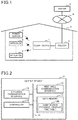
- FIG. 1 is a diagram illustrating an overall configuration of a data communication system according to Embodiment 1 of the present disclosure.
- This data communication system includes a client device 1 placed in a house H, and a server 2 connected to a wide area network N like the Internet.
- the client device 1 is an energy management controller included in a system referred to as a Home Energy Management System (HEMS) that manages power utilized in a general household.
- the client device 1 is communicably connected to a power sensor 4 that measures the amount of power consumed in the household (consumer's site), and a plurality of appliances 5 via a wireless network (unillustrated) constructed in the house H.
- the respective appliances 5 are electric equipment installed in the house H, such as a lighting apparatus, an air conditioner, a refrigerator, an induction heating cooker, a rice cooker, a microwave oven, and a floor heating system.
- the client device 1 is connected to the wide area network N via a router 3 adaptable to broadband, and exchanges data with the server 2 as needed.
- a Transmission Control Protocol/Internet Protocol (TCP/IP) is applied as the communication protocol between the client device 1 and the server 2
- HTTP HyperText Transfer Protocol
- the client device 1 has an HTTP client function
- the server 2 has an HTTP server function.
- the client device 1 includes a wide-area communication interface 10 for a communication with the server 2, an appliance communication interface 11 for a communication with the power sensor 4 and each appliance 5, a data memory 12 for storing programs and data, and a controller 13 that controls those components.
- the respective components are connected to one another via a bus 14.
- the wide-area communication interface 10 is connected to the router 3, and is communicated and connected with the server 2 via the wide area network N.
- the wide-area communication interface 10 transmits, to the server 2, data supplied from the controller 13.
- the wide-area communication interface 10 supplies, to the controller 13, data received from the server 2.
- the appliance communication interface 11 is connected to the above wireless network constructed in the house H, and performs wireless data communication with the power sensor 4 and each appliance 5 under the control of the controller 13.
- the data memory 12 is, for example, a readable and writable non-volatile semiconductor memory like a flash memory.
- the data memory 12 stores a compression presence-absence time table 120.
- the data memory 12 stores a program for a data communication with the server 2, and data to be utilized when this program is executed.
- the data memory 12 stores a program for monitoring the amount of consumed power in the household, a program for controlling the operation of each appliance 5, and data to be utilized when those programs are executed.
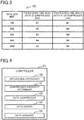
- the compression presence-absence time table 120 (first time table) is a data table that stores, for each data size predetermined step by step, the necessary times for transmission processing by the controller 13 when data is compressed and is uncompressed.
- FIG. 3 illustrates an example compression presence-absence time table 120 according to this embodiment.
- the example illustrated in FIG. 3 shows that the necessary time for transmitting data with a data size of 100 [KB] by the controller 13 is A1 [ms] when the data is compressed and B1 [ms] when the data is uncompressed.
- data to be uploaded to the server 2 is text data
- GNU ZIP gzip
- the controller 13 includes a Central Processing Unit (CPU), a Read Only Memory (ROM), a Random Access Memory (RAM), and the like (all unillustrated), and comprehensively controls the client device 1. As illustrated in FIG. 4 , the controller 13 includes, as unique functions of the present disclosure, an application processor 130, a compression necessity determiner 131, a data compressor 132, a data sender 133, and a data acquirer 134.
- CPU Central Processing Unit
- ROM Read Only Memory
- RAM Random Access Memory
- the controller 13 includes, as unique functions of the present disclosure, an application processor 130, a compression necessity determiner 131, a data compressor 132, a data sender 133, and a data acquirer 134.
- the application processor 130 generates data (to-be-uploaded data) to be uploaded to the server 2. For example, the application processor 130 accumulates data history records relating to the transition of the amount of consumed power per day in the household by a predetermined time period (for example, a week), and generates the to-be-uploaded data. In addition, the application processor 130 executes a process in accordance with data (downloading data) downloaded from the server 2. For example, the application processor 130 displays information on the basis of the downloading data on an unillustrated terminal device (for example, a tablet type personal computer).
- an unillustrated terminal device for example, a tablet type personal computer.
- the compression necessity determiner 131 determines the necessity of compression of the to-be-uploaded data generated by the application processor 130.
- the compression necessity determiner 131 determines the necessity of compression of the to-be-uploaded data on the basis of the size of the generated to-be-uploaded data and the compression presence-absence time table 120.
- the size of this to-be-uploaded data is 100 [KB]
- the compression necessity determiner 131 determines that the compression is necessary, and when A1 is greater than or equal to B1 is satisfied, the compression necessity determiner 131 determines that the compression is unnecessary.
- the data compressor 132 compresses the to-be-uploaded data generated by the application processor 130 in a predetermined scheme (in this embodiment, gzip).
- the data sender 133 executes processing of generating data (transmission data) that is uncompressed or compressed to-be-uploaded data to which a header is added, and sending out the generated transmission data to the wide-area communication interface 10. More specifically, the data sender 133 executes processing of writing data having a predetermined size in a transmission buffer of the wide-area communication interface 10 in sequence from the head of the transmission data. The data sender 133 stores, in the header added to the compressed to-be-uploaded data information indicating that the data is compressed data (the detail is described later).
- the data compressor 132 executes data compression processing, and after the completion of this data compression processing, the data sender 133 starts data sending processing.
- the transmission data that is compressed to-be-uploaded data to which the header is added is generated.
- the header to be added in this processing contains information indicating that the data is compressed data as described above.
- the transmission data is read from the head of the generated transmission data for every certain number of bytes, and is written in the transmission buffer of the wide-area communication interface 10.
- the data sending processing by the data sender 133 is completed.
- the necessary time for the transmission processing by the controller 13 when the to-be-uploaded data is compressed as described above is a time obtained by adding the necessary time for the data compression processing by the data compressor 132 to the necessary time for the data sending processing by the data sender 133.
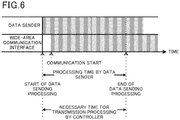
- the data sender 133 immediately starts the data sending processing. Transmission data that is uncompressed to-be-uploaded data to which a header is added is generated in the data sending processing. Needless to say, the added header in this case contains no information indicating that the data is compressed data.
- the transmission data is read from the head of the generated transmission data for every certain number of bytes in sequence, and is written in the transmission buffer of the wide-area communication interface 10.
- the data sending processing by the data sender 133 is completed.
- the necessary time for the transmission processing by the controller 13 when the to-be-uploaded data is uncompressed as described above is equal to the necessary time for the data sending processing by the data sender 133.
- the data acquirer 134 executes processing of acquiring data (reception data) from the wide-area communication interface 10, the reception data having been transmitted from the server 2 and received by the wide-area communication interface 10. More specifically, the reception data is acquired from a reception buffer of the wide-area communication interface 10 for every certain number of bytes in sequence. The data acquirer 134 supplies the acquired reception data to the application controller 130.
- FIG. 7 is a flowchart illustrating a procedure of the data transmission processing executed by the controller 13 of the client device 1. This data transmission processing is executed every time the application processor 130 generates to-be-uploaded data.
- the compression necessity determiner 131 determines the necessity of compression of the generated to-be-uploaded data as described above (step S101). Consequently, when the compression is necessary for the to-be-uploaded data (step S102; YES), the data compressor 132 compresses the to-be-uploaded data in the predetermined scheme (gzip in this embodiment) (step S103). Conversely, when the compression is unnecessary for the to-be-uploaded data (step S102; NO), the data sender 133 adds the header to the to-be-uploaded data thereby generating transmission data (step S104).
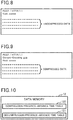
- FIG. 8 illustrates an example header in this case.
- step S105 the data sender 133 adds, to the compressed to-be-uploaded data the header that contains information indicating that the data is compressed data, thereby generating transmission data.
- FIG. 9 illustrates an example header in this case.
- the data sender 133 supplies the generated transmission data to the wide-area communication interface 10 (step S106). More specifically, the data sender 133 executes processing of writing, in the transmission buffer of the wide-area communication interface 10, data having a predetermined size in sequence from the head of the transmission data.
- the controller 13 of the client device 1 determines the necessity of compression of the to-be-uploaded data on the basis of the size of the to-be-uploaded data and the compression presence-absence time table 120 when transmitting the to-be-uploaded data to the server 2. At this time, the controller 13 determines the necessity of compression of the to-be-uploaded data so as to reduce the necessary time for the transmission processing by the controller 13.
- the necessary time for the transmission processing by the controller 13 is precisely reduced, reducing the load for the controller 13 (CPU) at the time of communication. Therefore, even if the CPU of the client device 1 does not have high performance, a delay in the main processing relating to the management of power and the control for each appliance 5 is suppressed.
- the data memory 12 included in the client device 1 stores, in addition to the compression presence-absence time table 120, a decompression presence-absence time table 121.
- the decompression presence-absence time table 121 (second time table) is a data table that stores, for each data size predetermined step by step, the necessary times for the reception processing by the controller 13 when data is decompressed and is not decompressed.
- FIG. 11 illustrates an example decompression presence-absence time table 121 according to this embodiment. The example in FIG. 11 shows that the necessary time when the controller 13 receives data with a data size of 100 [KB] is C1 [ms] when the data is decompressed, and is D1 [ms] when the data is not decompressed.
- the data size corresponding to the processing time when data is decompressed (for example, 100 [KB] corresponding to C1 [ms]) is not a data size after compression but a data size before the compression.
- the controller 13 included in the client device 1 includes, as unique functions to the present disclosure, the application processor 130, a compression necessity determiner 131A, the data compressor 132, a data sender 133A, the data acquirer 134, a decompression necessity determiner 135, and a data decompressor 136.
- the compression necessity determiner 131A determines, like the compression necessity determiner 131 of Embodiment 1, the necessity of compression of the to-be-uploaded data generated by the application processor 130. In addition, the compression necessity determiner 131A determines the necessity of compression of to-be-downloaded data that will be downloaded from, when the detail of the to-be-uploaded data indicates a download request to the server 2, the server 2 in response to this request.
- the compression necessity determiner 131A determines the necessity of compression of the to-be-downloaded data on the basis of the size thereof and the decompression presence-absence time table 121.
- the size of the to-be-downloaded data is 100 [KB]
- the compression necessity determiner 131A determines that the compression is necessary
- the compression necessity determiner 131A determines that the compression is unnecessary.
- the size of the to-be-downloaded data is determinable in accordance with the kind of the requested downloading data.
- the size of the requested downloading data may be specified by the application processor 130.
- the data sender 133A executes, like the data sender 133 of Embodiment 1, processing of generating data (transmission data) that is the compressed or the uncompressed to-be-uploaded data to which a header is added, and sending the generated transmission data to the wide-area communication interface 10.
- the data sender 133A stores, when the compression necessity determiner 131A determines that the compression is necessary for the to-be-downloaded data, information requesting the compression of the downloading data (which is described later in detail) in the header of the transmission data.
- the decompression necessity determiner 135 determines the necessity of decompression of this downloading data.
- the header added to the downloading data contains information indicating that the data is compressed data
- the decompression necessity determiner 135 determines that the decompression of the downloading data (that is, compressed downloading data) is necessary.
- the decompression necessity determiner 135 determines that the decompression of such downloading data is unnecessary.
- the data decompressor 136 decompresses (restores) the downloading data in a predetermined scheme (decompression scheme corresponding to gzip in this embodiment).
- the data acquirer 134 executes processing (data acquisition processing) of acquiring data (reception data) received by the wide-area communication interface 10 from the wide-area communication interface 10.
- processing data acquisition processing
- the data acquirer 134 acquires, from the reception buffer of the wide-area communication interface 10, the reception data for every certain number of bytes in sequence.
- the data decompressor 136 starts data decompression processing.
- the data decompressor 136 decompresses data (that is, compressed downloading data) that is the reception data acquired in the data acquisition processing and having the header eliminated. Next, when the data decompression processing is completed, the decompressed (that is, restored) downloading data is supplied to the application processor 130.
- the necessary time for the reception processing by the controller 13 when the compressed downloading data is received as described above is a time obtained by adding the necessary time for the data acquisition processing by the data acquirer 134 to the necessary time for the data decompression processing by the data decompressor 136.
- the necessary time for the reception processing by the controller 13 when uncompressed downloading data is received as described above is equal to the necessary time for the data acquisition processing by the data acquirer 134.
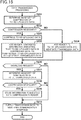
- FIG. 15 is a flowchart illustrating a procedure of the data transmission processing executed by the controller 13 of the client device 1 according to this embodiment. This data transmission processing is executed every time the application processor 130 generates to-be-uploaded data.
- the compression necessity determiner 131A determines the necessity of compression of the generated to-be-uploaded data (step S201). Consequently, when the compression of the to-be-uploaded data is necessary (step S202; YES), the data compressor 132 compresses the to-be-uploaded data in the predetermined scheme (gzip in this embodiment) (step S203). Conversely, when the compression of the to-be-uploaded data is unnecessary (step S202; NO), the data sender 133A adds a header to the to-be-uploaded data thereby generating transmission data (step S204).
- step S205 subsequent to step S203, the data sender 133A adds, to the compressed to-be-uploaded data a header containing information indicating that the data is compressed data, thereby generating transmission data.
- the compression necessity determiner 131A determines whether the content of the to-be-uploaded data indicates a download request to the server 2 (step S206). When the content of the to-be-uploaded data does not indicate the download request (step S206; NO), the controller 13 progresses the processing to step S210.
- step S206 when the content of the to-be-uploaded data indicates the download request (step S206; YES), the compression necessity determiner 131A determines the necessity of compression of to-be-downloaded data that will be downloaded from the server 2 in response to the request as described above (step S207).
- step S208 determines that the compression of the to-be-downloaded data is unnecessary (step S208; NO)
- the controller 13 progresses the processing to step S210.
- step S208 when the compression necessity determiner 131A determines that the compression of the to-be-downloaded data is necessary (step S208; YES), the data sender 133A stores information requesting the compression of downloading data in the header of the transmission data generated in step S204 or S205 (step S209).
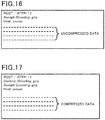
- FIG. 16 and FIG. 17 illustrate example headers in this case.
- FIG. 16 illustrates an example when the to-be-uploaded data is uncompressed
- FIG. 17 illustrates an example when the to-be-uploaded data is compressed.
- the data sender 133A supplies the generated transmission data to the wide-area communication interface 10 (step S210).
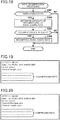
- FIG. 18 is a flowchart illustrating a procedure of the data decompression processing executed by the controller 13 of the client device 1 according to this embodiment. This data decompression processing is executed every time the data acquirer 134 completes the acquisition of the reception data from the wide-area communication interface 10.
- the decompression necessity determiner 135 determines whether the reception data contains downloading data (step S301). When the reception data contains no downloading data (step S301; NO), the data decompression processing ends in this case.
- the decompression necessity determiner 135 determines the necessity of decompression of the downloading data (step S302).
- the decompression necessity determiner 135 determines the necessity of decompression of the downloading data on the basis of whether the header added to the downloading data contains information (for example, information indicating a compression scheme) indicating that the data is compressed data. That is, as illustrated in FIG. 19 , when the header contains no information indicating that the data is compressed data, the decompression necessity determiner 135 determines that the decompression of the downloading data is unnecessary. Conversely, as illustrated in FIG. 20 , when the header contains the information indicating that the data is compressed data, the decompression necessity determiner 135 determines that the decompression of the downloading data is necessary.
- step S303 When the decompression of the downloading data is unnecessary (step S303; NO), the data decompression processing ends in this case. Conversely, when the decompression of the downloading data is necessary (step S303; YES), the data decompressor 136 decompresses the downloading data in a predetermined scheme (decompression scheme corresponding to gzip in this embodiment) (step S304). In this case, the decompressed (that is, restored) downloading data is supplied to the application processor 130.
- a predetermined scheme decompression scheme corresponding to gzip in this embodiment
- the client device 1 has the equivalent function to that of the client device 1 in Embodiment 1, and further determines, when requesting downloading data to the server 2, the necessity of compression of downloading data (to-be-downloaded data) that will be downloaded from the server 2 in response to the request.
- the controller 13 of the client device 1 determines the necessity of compression of the to-be-downloaded data so as to further reduce the necessary time for the reception processing by the controller 13 (CPU) on the basis of the size of the to-be-downloaded data and the decompression presence-absence time table 121.
- the data compression scheme when the data compressor 132 compresses the to-be-uploaded data is stationary (for example, gzip).
- the data compressor 132 compresses to-be-uploaded data in the selected compression scheme by the compression necessity determiner 131 among the multiple different compression schemes.
- the data memory 12 included in the client device 1 according to this embodiment stores the compression presence-absence time table 120 for each of the multiple different compression schemes.
- the compression presence-absence time tables 120 corresponding to compression schemes such as "compress” and "deflate", are also stored in the data memory 12.
- the compression necessity determiner 131 compares, for the record corresponding to the size of the to-be-uploaded data in the compression presence-absence time table 120 similar to Embodiment 1, the processing time when data is compressed with the processing time when data is uncompressed. In this embodiment, however, the compression necessity determiner 131 performs such a comparison for all compression presence-absence time tables 120. Next, when the processing time when data is compressed is shorter than the processing time when data is uncompressed is satisfied for the record corresponding to the size of the to-be-uploaded data in at least one of the compression presence-absence time tables 120, the compression necessity determiner 131 determines that the compression of the to-be-uploaded data is necessary.
- the compression necessity determiner 131 selects among the records, as a currently applied compression scheme, the compression scheme with the shortest processing time when data is compressed.
- the data compressor 132 compresses the to-be-uploaded data in the selected compression scheme by the compression necessity determiner 131.
- the data sender 133 adds, to the compressed to-be-uploaded data a header that contains information indicating the selected compression scheme by the compression necessity determiner 131, thereby generating transmission data.
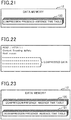
- FIG. 22 illustrates an example header in this case.
- the client device 1 compresses the to-be-uploaded data in the compression scheme selected as appropriate among the multiple compression schemes. Thus, a further reduction of the necessary time for the transmission processing by the controller 13 is accomplished.
- Embodiment 2 when the client device 1 requests a compression of downloading data to the server 2, the compression scheme for the downloading data by the server 2 is stationary (for example, gzip). According to Embodiment 4, however, the client device 1 specifies, to the server 2, a selected compression scheme among the multiple compression schemes.
- the functional configuration of the controller 13 included in the client device 1 according to this embodiment is the same as that of the controller 13 of Embodiment 2 (see FIG. 12 ).
- the data memory 12 included in the client device 1 according to this embodiment stores the compression presence-absence time table 120 for each of the multiple different compression schemes, and further the decompression presence-absence time table 121 for each of the multiple different compression schemes.
- the compression presence-absence time table 120 for each of the multiple different compression schemes is utilized to compress the to-be-uploaded data in the compression scheme selected as appropriate among the multiple compression schemes similar to Embodiment 3.
- the decompression presence-absence time tables 121 corresponding to gzip are also stored in the data memory 12.
- the compression necessity determiner 131A of this embodiment compares, for the record corresponding to the size of to-be-downloaded data in the decompression presence-absence time table 121 similar to Embodiment 2 when the detail of the to-be-uploaded data indicates a download request to the server 2, the processing time when data is decompressed and the processing time when data is not decompressed. In this embodiment, however, the compression necessity determiner 131A performs such a comparison for all decompression presence-absence time tables 121.
- the compression necessity determiner 131A determines that the compression of the to-be-downloaded data is necessary.
- the compression necessity determiner 131A selects among the records, as a currently applied compression scheme, the compression scheme with the shortest processing time when data is decompressed.
- the data sender 133A stores information indicating the selected compression scheme by the compression necessity determiner 131A in a header of the transmission data.
- FIG. 24 illustrates an example header in this case. The example in FIG. 24 shows that the to-be-uploaded data has been compressed by the scheme that is "deflate", and a request of compression of the downloading data by the scheme that is "compress" to the server 2.
- the server 2 compresses downloading data in the specified compression scheme by the client device 1
- the server 2 stores information indicating the compression scheme in a header added to the compressed downloading data.
- the decompression necessity determiner 135 determines that the decompression of the downloading data is necessary, and notifies the data decompressor 136 of the compression scheme.
- the data decompressor 136 decompresses the downloading data in the notified compression scheme by the decompression necessity determiner 135.
- the client device 1 has the equivalent function to those of the client devices 1 according to Embodiment 2 and Embodiment 3, and is further capable of specifying, to the server 2, the compression scheme selected as appropriate among the multiple compression schemes.
- the server 2 the compression scheme selected as appropriate among the multiple compression schemes.
- the client device 1 in this embodiment operates in either one of the two modes that are an actual operation mode and a test operation mode. At the time of the operation in the actual operation mode, the client device 1 in this embodiment accomplishes the equivalent function to that of the client device 1 in Embodiment 3.
- the client device 1 in this embodiment constructs the compression presence-absence time table 120 (see FIG. 21 ) for each of the multiple different compression schemes at the time of the operation in the test operation mode. This is described below in more detail.
- the controller 13 included in the client device 1 includes the application processor 130, the compression necessity determiner 131, the data compressor 132, the data sender 133, the data acquirer 134, a compression time measurer 137, and a sending time measurer 138.
- the compression time measurer 137 measures a necessary time from the start of the compression processing for the to-be-uploaded data by the data compressor 132 to the end of this processing, that is, the processing time by the data compressor 132.
- the user is capable of changing the operation of the client device 1 between the test operation mode and the actual operation mode through, for example, an operation given to a terminal device like a tablet type personal computer.
- the sending time measurer 138 measures a necessary time from the start of the sending processing for the transmission data by the data sender 133 to the end of this processing, that is, the processing time by the data sender 133.
- the user In the test operation mode, the user is capable of specifying, through the above terminal device, respective test parameters, such as the kind of the to-be-uploaded data to be generated by the application processor 130, the presence or absence of compression, and the compression scheme.
- respective test parameters such as the kind of the to-be-uploaded data to be generated by the application processor 130, the presence or absence of compression, and the compression scheme.
- the compression necessity determiner 131 is deactivated in the test operation mode.
- the data compressor 132 compresses the to-be-uploaded data in the specified compression scheme.
- the client device 1 When the user instructs the execution of a test, the client device 1 operates to transmit the generated to-be-uploaded data by the application processor 130 to the server 2 on the basis of the respective parameters specified as described above.
- the controller 13 generates a record containing the data size, the processing time when data is compressed, and the processing time when data is uncompressed on the basis of the processing time by the data compressor 132 and/or the processing time by the data sender 133 that are measured as described above through such an operation, and the size of the to-be-uploaded data.
- the controller 13 registers the generated record in the compression presence-absence time table 120 corresponding to the specified compression scheme.
- the compression presence-absence time table 120 for each of the multiple different compression schemes as illustrated in FIG. 21 is constructed.
- the compression presence-absence time table 120 for each of the multiple different compression schemes is constructed using data obtained by actually operating the client device 1 (the processing time by the data compressor 132, and the processing time by the data transmitter 133).
- the compression presence-absence time tables 120 constructed as described above can be utilized in the actual operation mode, and thereby the determination precision for the necessity of compression by the compression necessity determiner 131 improves. Consequently, a further reduction of the necessary time for the transmission processing by the controller 13 is accomplished.
- a client device 1 according to this embodiment operates, like the client device 1 of Embodiment 5, in either one of the two modes that are the actual operation mode and the test operation mode. At the time of the operation in the actual operation mode, the client device 1 of this embodiment accomplishes the equivalent function to that of the client device 1 in Embodiment 4.
- the client device 1 of this embodiment constructs, as illustrated in FIG. 23 , the compression presence-absence time table 120 for each of the multiple different compression schemes and the decompression presence-absence time table 121 for each of the multiple different compression schemes. This is described below in more detail.
- the controller 13 included in the client device 1 includes the application processor 130, the compression necessity determiner 131A, the data compressor 132, the data sender 133A, the data acquirer 134, the decompression necessity determiner 135, the data decompressor 136, the compression time measurer 137, the sending time measurer 138, a decompression time measurer 139, and an acquisition time measurer 140.
- the decompression time measurer 139 measures a time necessary from the start of the decompression processing of the downloading data by the data decompressor 136 to the end of this processing, that is, the processing time by the data decompressor 136. Similar to Embodiment 5, the user is capable of changing the operation of the client device 1 between the test operation mode and the actual operation mode through, for example, an operation given to a terminal device like a tablet type personal computer.
- the acquisition time measurer 140 measures the necessary time from the start of the acquisition processing of the reception data by the data acquirer 134 to the end of this processing, that is, the processing time by the data acquirer 134.
- the user is capable of specifying, through the above terminal device, respective test parameters, such as the size of the to-be-uploaded data to be generated by the application processor 130, the presence or absence of compression, and the compression scheme, for constructing the compression presence-absence time table 120.
- respective test parameters such as the kind of downloading data requested to the server 2, the presence or absence of compression request, and a compression scheme to be requested, for constructing the decompression presence-absence time table 121.
- the compression necessity determiner 131A is deactivated.
- the data compressor 132 compresses the to-be-uploaded data in the specified compression scheme.
- the controller 13 When the user instructs the execution of the test to construct the compression presence-absence time table 120, similar to Embodiment 5, the controller 13 generates a record containing the data size, the processing time when data is compressed, and the processing time when data is uncompressed on the basis of the processing time by the data compressor 132 and/or the processing time by the data sender 133A that are measured, and the size of the to-be-uploaded data. Next, the controller 13 registers the generated record in the compression presence-absence time table 120 corresponding to the specified compression scheme.
- the compression presence-absence time table 120 for each of the multiple different compression schemes illustrated in FIG. 23 is constructed.
- the client device 1 performs, on the basis of the respective specified parameters, an operation of transmitting, to the server 2, the to-be-uploaded data for requesting the downloading data, and an operation of receiving the downloading data sent from the server 2 in response to the request.
- the controller 13 generates a record containing the data size, the processing time when data is decompressed, and the processing time when data is not decompressed on the basis of the processing time by the data acquirer 134 and/or the processing time by the data decompressor 136 that are measured as described above through such operations, the presence or absence of the compression of the downloading data, the compression scheme of the downloading data, and the size of the (uncompressed) downloading data.
- the controller 13 registers the generated record in the decompression presence-absence time table 121 corresponding to the specified compression scheme.
- the decompression presence-absence time table 121 By repeating the above test to construct the decompression presence-absence time table 121 while changing the respective parameters, the decompression presence-absence time table 121 for each of the multiple different compression schemes illustrated in FIG. 23 is constructed.
- the decompression presence-absence time table 121 for each of the multiple different compression schemes is constructed using data obtained by actually operating the client device 1 (the processing time by the data acquirer 134 and the processing time by the data decompressor 136).
- the decompression presence-absence time tables 121 constructed as described above can be utilized in the actual operation mode, and thereby the determination precision of the necessity of compression of the to-be-downloaded data by the compression necessity determiner 131A improves. Consequently, a further reduction of the necessary time for the reception processing by the controller 13 is accomplished.
- the processing time when data is uncompressed and the processing time when data is not decompressed are defined by not the compression scheme but the data size. Hence, common processing times for such cases may be shared and stored.
- a program for execution by the client device 1 may be stored and distributed in a computer-readable recording medium such as a compact disc read-only memory (CD-ROM), a digital versatile disc (DVD), a magneto-optical disk (MO), a universal serial bus (USB) memory, and a memory card.
- a computer-readable recording medium such as a compact disc read-only memory (CD-ROM), a digital versatile disc (DVD), a magneto-optical disk (MO), a universal serial bus (USB) memory, and a memory card.
- the above-described program may be stored on a disk device or the like of a server device on a communication network such as the Internet to enable the program to be downloaded to the computer, for example by superimposing the program onto a carrier wave.
- the aforementioned processing can be achieved even by execution while the program is transferred through the communication network.
- the aforementioned processing can be achieved by executing all or part of the program on the server device, and executing the program while sending and receiving by the computer the information relating to such processing through the communication network.
- the non-OS portion alone may be stored and distributed in the aforementioned recording medium, or alternatively, may be, for example, downloaded to the computer.
- the present disclosure is suitably applicable to data communication techniques between a client device and a server.
Landscapes
- Engineering & Computer Science (AREA)
- Signal Processing (AREA)
- Computer Networks & Wireless Communication (AREA)
- Multimedia (AREA)
- Computer Security & Cryptography (AREA)
- Databases & Information Systems (AREA)
- Library & Information Science (AREA)
- Information Transfer Between Computers (AREA)
- Computer And Data Communications (AREA)
Abstract
Description
- The present disclosure relates to a client device, a data communication system, a data communication method, and a program.
- Providing services in the configuration of a referred to as cloud is becoming popular. For example, a service configuration in which a client device that manages a power usage status, and the like, in a general household is communicably connected to a server of a service provider via the Internet, and an exchange of a large amount of data as needed is enabled is well known.
- According to such a client device, in view of cost reduction, a Central Processing Unit (CPU) with not so high performance is equipped in many cases. In this case, when a large amount of data is exchanged with the server, the processing load on the CPU increases, possibly causing the client device to have a delay in main processing that should be executed. In order to solve this technical problem, conventionally, a scheme of exchanging compressed data between the client device and the server is typically adopted.
- As for the compressed data communication, for example,
Patent Literature 1 discloses a compressed image data transmitting device that determines the compression ratio of image data to be transmitted on the basis of the line speed of the communication line and the compression processing speed (computing power). - Patent Literature 1: Unexamined Japanese Patent Application Kokai Publication No.
2003-244698 - Meanwhile, when communication with compressed data is performed as described above, and when, for example, the CPU of the client device does not have a high performance, depending on the size of data to be uploaded and the like, the processing load on the CPU increases more than that of a transmission with uncompressed data, possibly causing a delay in the main processing.
- The present disclosure has been made to solve the above technical problems, and an objective of the present disclosure is to provide a client device, and the like, which is capable of suppressing a delay in main processing at the time of data communication.
- In order to accomplish the above objective, a client device according to the present disclosure includes:
- a communication interface configured to communicate with a server;
- a compression necessity determiner configured to determine a necessity of compression of to-be-uploaded data to be uploaded to the server;
- a data compressor configured to compress the to-be-uploaded data in a predetermined scheme when the compression necessity determiner determines that the compression of the to-be-uploaded data is necessary; and
- a data sender configured
- to send, when the compression necessity determiner determines that the compression of the to-be-uploaded data is unnecessary, to the communication interface data in which a header is added to the to-be-uploaded data, and
- to send, when the compression necessity determiner determines that the compression of the to-be-uploaded data is necessary, to the communication interface data in which a header is added to the to-be-uploaded data compressed by the data compressor, the header containing information indicating that the to-be-uploaded data is compressed data.
- According to the present disclosure, a determination on the necessity of compression of the to-be-uploaded data is made, and when determination that the compression is necessary is made, the to-be-uploaded data is compressed and transmitted to the server. Thus, a delay in main processing is preventable at the time of data communication.
-
-
FIG. 1 is a diagram illustrating an overall configuration of a data communication system according toEmbodiment 1 of the present disclosure; -
FIG. 2 is a block diagram illustrating a configuration of a client device according toEmbodiment 1; -
FIG. 3 is a diagram illustrating an example compression presence-absence time table according toEmbodiment 1; -
FIG. 4 is a diagram illustrating a functional configuration of a controller included in the client device according toEmbodiment 1; -
FIG. 5 is a diagram for describing a necessary time for transmission processing by the controller when data is compressed; -
FIG. 6 is a diagram for describing a necessary time for the transmission processing by the controller when data is uncompressed; -
FIG. 7 is a flowchart illustrating a procedure of data transmission processing according toEmbodiment 1; -
FIG. 8 is a diagram illustrating an example header added to uncompressed to-be-uploaded data inEmbodiment 1; -
FIG. 9 is a diagram illustrating an example header added to compressed to-be-uploaded data inEmbodiment 1; -
FIG. 10 is a diagram illustrating a table stored in a data memory included in a client device according toEmbodiment 2 of the present disclosure; -
FIG. 11 is a diagram illustrating an example decompression presence-absence time table according toEmbodiment 2; -
FIG. 12 is a diagram illustrating a functional configuration of a controller included in the client device according toEmbodiment 2; -
FIG. 13 is a diagram for describing a necessary time for reception processing by the controller when data is decompressed; -
FIG. 14 is a diagram for describing a necessary time for the reception processing by the controller when data is not decompressed; -
FIG. 15 is a flowchart illustrating a procedure of data transmission processing according toEmbodiment 2; -
FIG. 16 is a diagram illustrating a first example, an example header added to to-be-uploaded data when a compression is requested inEmbodiment 2; -
FIG. 17 is a diagram illustrating a second example, an example header added to to-be-uploaded data when a compression is requested inEmbodiment 2; -
FIG. 18 is a flowchart illustrating a procedure of data decompression processing according toEmbodiment 2; -
FIG. 19 is a diagram illustrating an example header added to uncompressed downloading data inEmbodiment 2; -
FIG. 20 is a diagram illustrating an example header added to compressed downloading data inEmbodiment 2; -
FIG. 21 is a diagram illustrating a table stored in a data memory included in a client device according toEmbodiment 3 of the present disclosure; -
FIG. 22 is a diagram illustrating an example header added to compressed to-be-uploaded data inEmbodiment 3; -
FIG. 23 is a diagram illustrating a table stored in a data memory included in a client device according toEmbodiment 4 of the present disclosure; -
FIG. 24 is a diagram illustrating an example header added to compressed to-be-uploaded data inEmbodiment 4; -
FIG. 25 is a diagram illustrating a functional configuration of a controller included in a client device according toEmbodiment 5; and -
FIG. 26 is a diagram illustrating a functional configuration of a controller included in a client device according to Embodiment 6. - Embodiments of the present disclosure are described below in detail in reference to figures.
-
FIG. 1 is a diagram illustrating an overall configuration of a data communication system according toEmbodiment 1 of the present disclosure. This data communication system includes aclient device 1 placed in a house H, and aserver 2 connected to a wide area network N like the Internet. - The
client device 1 is an energy management controller included in a system referred to as a Home Energy Management System (HEMS) that manages power utilized in a general household. Theclient device 1 is communicably connected to apower sensor 4 that measures the amount of power consumed in the household (consumer's site), and a plurality ofappliances 5 via a wireless network (unillustrated) constructed in the house H. Therespective appliances 5 are electric equipment installed in the house H, such as a lighting apparatus, an air conditioner, a refrigerator, an induction heating cooker, a rice cooker, a microwave oven, and a floor heating system. - The
client device 1 is connected to the wide area network N via arouter 3 adaptable to broadband, and exchanges data with theserver 2 as needed. In this embodiment, a Transmission Control Protocol/Internet Protocol (TCP/IP) is applied as the communication protocol between theclient device 1 and theserver 2, and a HyperText Transfer Protocol (HTTP) is applied as a data communication protocol. Thereby, theclient device 1 has an HTTP client function, while theserver 2 has an HTTP server function. - As illustrated in
FIG. 2 , theclient device 1 includes a wide-area communication interface 10 for a communication with theserver 2, anappliance communication interface 11 for a communication with thepower sensor 4 and eachappliance 5, adata memory 12 for storing programs and data, and acontroller 13 that controls those components. The respective components are connected to one another via abus 14. - The wide-
area communication interface 10 is connected to therouter 3, and is communicated and connected with theserver 2 via the wide area network N. The wide-area communication interface 10 transmits, to theserver 2, data supplied from thecontroller 13. In addition, the wide-area communication interface 10 supplies, to thecontroller 13, data received from theserver 2. - The
appliance communication interface 11 is connected to the above wireless network constructed in the house H, and performs wireless data communication with thepower sensor 4 and eachappliance 5 under the control of thecontroller 13. - The
data memory 12 is, for example, a readable and writable non-volatile semiconductor memory like a flash memory. Thedata memory 12 stores a compression presence-absence time table 120. Although not illustrated, thedata memory 12 stores a program for a data communication with theserver 2, and data to be utilized when this program is executed. In addition, thedata memory 12 stores a program for monitoring the amount of consumed power in the household, a program for controlling the operation of eachappliance 5, and data to be utilized when those programs are executed. - The compression presence-absence time table 120 (first time table) is a data table that stores, for each data size predetermined step by step, the necessary times for transmission processing by the
controller 13 when data is compressed and is uncompressed.FIG. 3 illustrates an example compression presence-absence time table 120 according to this embodiment. The example illustrated inFIG. 3 shows that the necessary time for transmitting data with a data size of 100 [KB] by thecontroller 13 is A1 [ms] when the data is compressed and B1 [ms] when the data is uncompressed. Note that according to this embodiment, data to be uploaded to the server 2 (to-be-uploaded data) is text data, and GNU ZIP (gzip) is applied as a data compression scheme. - The
controller 13 includes a Central Processing Unit (CPU), a Read Only Memory (ROM), a Random Access Memory (RAM), and the like (all unillustrated), and comprehensively controls theclient device 1. As illustrated inFIG. 4 , thecontroller 13 includes, as unique functions of the present disclosure, anapplication processor 130, acompression necessity determiner 131, adata compressor 132, adata sender 133, and adata acquirer 134. - The
application processor 130 generates data (to-be-uploaded data) to be uploaded to theserver 2. For example, theapplication processor 130 accumulates data history records relating to the transition of the amount of consumed power per day in the household by a predetermined time period (for example, a week), and generates the to-be-uploaded data. In addition, theapplication processor 130 executes a process in accordance with data (downloading data) downloaded from theserver 2. For example, theapplication processor 130 displays information on the basis of the downloading data on an unillustrated terminal device (for example, a tablet type personal computer). - The
compression necessity determiner 131 determines the necessity of compression of the to-be-uploaded data generated by theapplication processor 130. Thecompression necessity determiner 131 determines the necessity of compression of the to-be-uploaded data on the basis of the size of the generated to-be-uploaded data and the compression presence-absence time table 120. When, for example, the size of this to-be-uploaded data is 100 [KB], and when A1 is smaller than B1 is satisfied, thecompression necessity determiner 131 determines that the compression is necessary, and when A1 is greater than or equal to B1 is satisfied, thecompression necessity determiner 131 determines that the compression is unnecessary. - When the
compression necessity determiner 131 determines that the compression is necessary, thedata compressor 132 compresses the to-be-uploaded data generated by theapplication processor 130 in a predetermined scheme (in this embodiment, gzip). - The
data sender 133 executes processing of generating data (transmission data) that is uncompressed or compressed to-be-uploaded data to which a header is added, and sending out the generated transmission data to the wide-area communication interface 10. More specifically, thedata sender 133 executes processing of writing data having a predetermined size in a transmission buffer of the wide-area communication interface 10 in sequence from the head of the transmission data. Thedata sender 133 stores, in the header added to the compressed to-be-uploaded data information indicating that the data is compressed data (the detail is described later). - Here, a description is given of the necessary time for the transmission processing by the
controller 13 when the to-be-uploaded data is compressed. In this case, as illustrated inFIG. 5 , first, thedata compressor 132 executes data compression processing, and after the completion of this data compression processing, thedata sender 133 starts data sending processing. In the data sending processing, the transmission data that is compressed to-be-uploaded data to which the header is added is generated. The header to be added in this processing contains information indicating that the data is compressed data as described above. - Next, the transmission data is read from the head of the generated transmission data for every certain number of bytes, and is written in the transmission buffer of the wide-
area communication interface 10. Next, when the last data is read from the transmission data, and is written in the transmission buffer of the wide-area communication interface 10, the data sending processing by thedata sender 133 is completed. - According to this embodiment, the necessary time for the transmission processing by the
controller 13 when the to-be-uploaded data is compressed as described above is a time obtained by adding the necessary time for the data compression processing by thedata compressor 132 to the necessary time for the data sending processing by thedata sender 133. - Next, a description is given of a necessary time for the transmission processing by the
controller 13 when the to-be-uploaded data is uncompressed. In this case, as illustrated inFIG. 6 , thedata sender 133 immediately starts the data sending processing. Transmission data that is uncompressed to-be-uploaded data to which a header is added is generated in the data sending processing. Needless to say, the added header in this case contains no information indicating that the data is compressed data. - Next, as described above, the transmission data is read from the head of the generated transmission data for every certain number of bytes in sequence, and is written in the transmission buffer of the wide-
area communication interface 10. Next, when the last data is read from the transmission data, and is written in the transmission buffer of the wide-area communication interface 10, the data sending processing by thedata sender 133 is completed. - According to this embodiment, the necessary time for the transmission processing by the
controller 13 when the to-be-uploaded data is uncompressed as described above is equal to the necessary time for the data sending processing by thedata sender 133. - Returning to
FIG. 4 , thedata acquirer 134 executes processing of acquiring data (reception data) from the wide-area communication interface 10, the reception data having been transmitted from theserver 2 and received by the wide-area communication interface 10. More specifically, the reception data is acquired from a reception buffer of the wide-area communication interface 10 for every certain number of bytes in sequence. Thedata acquirer 134 supplies the acquired reception data to theapplication controller 130. -
FIG. 7 is a flowchart illustrating a procedure of the data transmission processing executed by thecontroller 13 of theclient device 1. This data transmission processing is executed every time theapplication processor 130 generates to-be-uploaded data. - First, the
compression necessity determiner 131 determines the necessity of compression of the generated to-be-uploaded data as described above (step S101). Consequently, when the compression is necessary for the to-be-uploaded data (step S102; YES), thedata compressor 132 compresses the to-be-uploaded data in the predetermined scheme (gzip in this embodiment) (step S103). Conversely, when the compression is unnecessary for the to-be-uploaded data (step S102; NO), thedata sender 133 adds the header to the to-be-uploaded data thereby generating transmission data (step S104).FIG. 8 illustrates an example header in this case. - In step S105 subsequent to step S103, the
data sender 133 adds, to the compressed to-be-uploaded data the header that contains information indicating that the data is compressed data, thereby generating transmission data.FIG. 9 illustrates an example header in this case. Next, thedata sender 133 supplies the generated transmission data to the wide-area communication interface 10 (step S106). More specifically, thedata sender 133 executes processing of writing, in the transmission buffer of the wide-area communication interface 10, data having a predetermined size in sequence from the head of the transmission data. - As described above, according to the data communication system in
Embodiment 1 of the present disclosure, thecontroller 13 of theclient device 1 determines the necessity of compression of the to-be-uploaded data on the basis of the size of the to-be-uploaded data and the compression presence-absence time table 120 when transmitting the to-be-uploaded data to theserver 2. At this time, thecontroller 13 determines the necessity of compression of the to-be-uploaded data so as to reduce the necessary time for the transmission processing by thecontroller 13. - Thereby, the necessary time for the transmission processing by the
controller 13 is precisely reduced, reducing the load for the controller 13 (CPU) at the time of communication. Therefore, even if the CPU of theclient device 1 does not have high performance, a delay in the main processing relating to the management of power and the control for eachappliance 5 is suppressed. - Next, a description is given of a data communication system according to
Embodiment 2 of the present disclosure. In the following description, the common structural component, and the like to the foregoing embodiment is denoted by the same reference numeral, and the description thereof is omitted. - As illustrated in
FIG. 10 , thedata memory 12 included in theclient device 1 according to this embodiment stores, in addition to the compression presence-absence time table 120, a decompression presence-absence time table 121. The decompression presence-absence time table 121 (second time table) is a data table that stores, for each data size predetermined step by step, the necessary times for the reception processing by thecontroller 13 when data is decompressed and is not decompressed.FIG. 11 illustrates an example decompression presence-absence time table 121 according to this embodiment. The example inFIG. 11 shows that the necessary time when thecontroller 13 receives data with a data size of 100 [KB] is C1 [ms] when the data is decompressed, and is D1 [ms] when the data is not decompressed. - In the decompression presence-absence time table 121 illustrated in
FIG. 11 , the data size corresponding to the processing time when data is decompressed (for example, 100 [KB] corresponding to C1 [ms]) is not a data size after compression but a data size before the compression. - As illustrated in
FIG. 12 , thecontroller 13 included in theclient device 1 according to this embodiment includes, as unique functions to the present disclosure, theapplication processor 130, acompression necessity determiner 131A, thedata compressor 132, adata sender 133A, thedata acquirer 134, adecompression necessity determiner 135, and adata decompressor 136. - The
compression necessity determiner 131A determines, like thecompression necessity determiner 131 ofEmbodiment 1, the necessity of compression of the to-be-uploaded data generated by theapplication processor 130. In addition, thecompression necessity determiner 131A determines the necessity of compression of to-be-downloaded data that will be downloaded from, when the detail of the to-be-uploaded data indicates a download request to theserver 2, theserver 2 in response to this request. - In this case, the
compression necessity determiner 131A determines the necessity of compression of the to-be-downloaded data on the basis of the size thereof and the decompression presence-absence time table 121. When, for example, the size of the to-be-downloaded data is 100 [KB], and when C1 is smaller than D1 is satisfied, thecompression necessity determiner 131A determines that the compression is necessary, and when C1 is greater than or equal to D1 is satisfied, thecompression necessity determiner 131A determines that the compression is unnecessary. In this embodiment, the size of the to-be-downloaded data is determinable in accordance with the kind of the requested downloading data. Alternatively, the size of the requested downloading data may be specified by theapplication processor 130. - The
data sender 133A executes, like thedata sender 133 ofEmbodiment 1, processing of generating data (transmission data) that is the compressed or the uncompressed to-be-uploaded data to which a header is added, and sending the generated transmission data to the wide-area communication interface 10. In addition, thedata sender 133A stores, when thecompression necessity determiner 131A determines that the compression is necessary for the to-be-downloaded data, information requesting the compression of the downloading data (which is described later in detail) in the header of the transmission data. - When data (reception data) received by the wide-
area communication interface 10 from theserver 2 contains downloading data, thedecompression necessity determiner 135 determines the necessity of decompression of this downloading data. When the header added to the downloading data contains information indicating that the data is compressed data, thedecompression necessity determiner 135 determines that the decompression of the downloading data (that is, compressed downloading data) is necessary. Conversely, when the header does not contain the information indicating that the data is compressed data, thedecompression necessity determiner 135 determines that the decompression of such downloading data is unnecessary. - When the
decompression necessity determiner 135 determines that the decompression of the downloading data is necessary, thedata decompressor 136 decompresses (restores) the downloading data in a predetermined scheme (decompression scheme corresponding to gzip in this embodiment). - Here, a description is given of the necessary time for the reception processing by the
controller 13 when decompressed downloading data by theserver 2 is received. In this case, as illustrated inFIG. 13 , first, thedata acquirer 134 executes processing (data acquisition processing) of acquiring data (reception data) received by the wide-area communication interface 10 from the wide-area communication interface 10. In the data acquisition processing, thedata acquirer 134 acquires, from the reception buffer of the wide-area communication interface 10, the reception data for every certain number of bytes in sequence. After the completion of the data acquisition processing, the data decompressor 136 starts data decompression processing. - The
data decompressor 136 decompresses data (that is, compressed downloading data) that is the reception data acquired in the data acquisition processing and having the header eliminated. Next, when the data decompression processing is completed, the decompressed (that is, restored) downloading data is supplied to theapplication processor 130. - In this embodiment, the necessary time for the reception processing by the
controller 13 when the compressed downloading data is received as described above is a time obtained by adding the necessary time for the data acquisition processing by thedata acquirer 134 to the necessary time for the data decompression processing by thedata decompressor 136. - Next, a description is given of the necessary time for the reception processing by the
controller 13 when downloading data that is not compressed by theserver 2 is received. In this case, as illustrated inFIG. 14 , when the data acquisition processing by thedata acquirer 134 is completed, thedata decompressor 136 does not execute the data decompression processing, but data, from which the header is removed, acquired by thedata acquirer 134 is supplied to theapplication processor 130 as the downloading data. - According to this embodiment, the necessary time for the reception processing by the
controller 13 when uncompressed downloading data is received as described above is equal to the necessary time for the data acquisition processing by thedata acquirer 134. -
FIG. 15 is a flowchart illustrating a procedure of the data transmission processing executed by thecontroller 13 of theclient device 1 according to this embodiment. This data transmission processing is executed every time theapplication processor 130 generates to-be-uploaded data. - First, the
compression necessity determiner 131A determines the necessity of compression of the generated to-be-uploaded data (step S201). Consequently, when the compression of the to-be-uploaded data is necessary (step S202; YES), thedata compressor 132 compresses the to-be-uploaded data in the predetermined scheme (gzip in this embodiment) (step S203). Conversely, when the compression of the to-be-uploaded data is unnecessary (step S202; NO), thedata sender 133A adds a header to the to-be-uploaded data thereby generating transmission data (step S204). - In step S205 subsequent to step S203, the
data sender 133A adds, to the compressed to-be-uploaded data a header containing information indicating that the data is compressed data, thereby generating transmission data. - The
compression necessity determiner 131A determines whether the content of the to-be-uploaded data indicates a download request to the server 2 (step S206). When the content of the to-be-uploaded data does not indicate the download request (step S206; NO), thecontroller 13 progresses the processing to step S210. - Conversely, when the content of the to-be-uploaded data indicates the download request (step S206; YES), the
compression necessity determiner 131A determines the necessity of compression of to-be-downloaded data that will be downloaded from theserver 2 in response to the request as described above (step S207). When thecompression necessity determiner 131A determines that the compression of the to-be-downloaded data is unnecessary (step S208; NO), thecontroller 13 progresses the processing to step S210. - Conversely, when the
compression necessity determiner 131A determines that the compression of the to-be-downloaded data is necessary (step S208; YES), thedata sender 133A stores information requesting the compression of downloading data in the header of the transmission data generated in step S204 or S205 (step S209).FIG. 16 and FIG. 17 illustrate example headers in this case.FIG. 16 illustrates an example when the to-be-uploaded data is uncompressed, whileFIG. 17 illustrates an example when the to-be-uploaded data is compressed. - Next, the
data sender 133A supplies the generated transmission data to the wide-area communication interface 10 (step S210). -
FIG. 18 is a flowchart illustrating a procedure of the data decompression processing executed by thecontroller 13 of theclient device 1 according to this embodiment. This data decompression processing is executed every time thedata acquirer 134 completes the acquisition of the reception data from the wide-area communication interface 10. - First, the
decompression necessity determiner 135 determines whether the reception data contains downloading data (step S301). When the reception data contains no downloading data (step S301; NO), the data decompression processing ends in this case. - Conversely, when the reception data contains the downloading data (step S301; YES), the
decompression necessity determiner 135 determines the necessity of decompression of the downloading data (step S302). Thedecompression necessity determiner 135 determines the necessity of decompression of the downloading data on the basis of whether the header added to the downloading data contains information (for example, information indicating a compression scheme) indicating that the data is compressed data. That is, as illustrated inFIG. 19 , when the header contains no information indicating that the data is compressed data, thedecompression necessity determiner 135 determines that the decompression of the downloading data is unnecessary. Conversely, as illustrated inFIG. 20 , when the header contains the information indicating that the data is compressed data, thedecompression necessity determiner 135 determines that the decompression of the downloading data is necessary. - When the decompression of the downloading data is unnecessary (step S303; NO), the data decompression processing ends in this case. Conversely, when the decompression of the downloading data is necessary (step S303; YES), the
data decompressor 136 decompresses the downloading data in a predetermined scheme (decompression scheme corresponding to gzip in this embodiment) (step S304). In this case, the decompressed (that is, restored) downloading data is supplied to theapplication processor 130. - As described above, according to the data communication system in
Embodiment 2 of the present disclosure, theclient device 1 has the equivalent function to that of theclient device 1 inEmbodiment 1, and further determines, when requesting downloading data to theserver 2, the necessity of compression of downloading data (to-be-downloaded data) that will be downloaded from theserver 2 in response to the request. At this time, thecontroller 13 of theclient device 1 determines the necessity of compression of the to-be-downloaded data so as to further reduce the necessary time for the reception processing by the controller 13 (CPU) on the basis of the size of the to-be-downloaded data and the decompression presence-absence time table 121. - For this reason, the necessary time for the transmission processing by the
controller 13 and that for the reception processing thereof are reduced precisely. Therefore, a load for the controller 13 (CPU) at the time of data transmission and data reception is reduced. - Next, a description is given of a data communication system according to
Embodiment 3 of the present disclosure. In the following description, the common structural component, and the like to the foregoing embodiments is denoted by the same reference numeral, and the description thereof is omitted. - In
Embodiment 1, the data compression scheme when thedata compressor 132 compresses the to-be-uploaded data is stationary (for example, gzip). InEmbodiment 3, however, thedata compressor 132 compresses to-be-uploaded data in the selected compression scheme by thecompression necessity determiner 131 among the multiple different compression schemes. - The functional structure of the
controller 13 included in theclient device 1 according to this embodiment is the same as that of thecontroller 13 of Embodiment 1 (seeFIG. 4 ). In addition, as illustrated inFIG. 21 , thedata memory 12 included in theclient device 1 according to this embodiment stores the compression presence-absence time table 120 for each of the multiple different compression schemes. According to this embodiment, in addition to, for example, the compression presence-absence time table 120 corresponding to gzip (seeFIG. 3 ), the compression presence-absence time tables 120 corresponding to compression schemes, such as "compress" and "deflate", are also stored in thedata memory 12. - The
compression necessity determiner 131 compares, for the record corresponding to the size of the to-be-uploaded data in the compression presence-absence time table 120 similar toEmbodiment 1, the processing time when data is compressed with the processing time when data is uncompressed. In this embodiment, however, thecompression necessity determiner 131 performs such a comparison for all compression presence-absence time tables 120. Next, when the processing time when data is compressed is shorter than the processing time when data is uncompressed is satisfied for the record corresponding to the size of the to-be-uploaded data in at least one of the compression presence-absence time tables 120, thecompression necessity determiner 131 determines that the compression of the to-be-uploaded data is necessary. In addition, when a condition, that the processing time when data is compressed is shorter than the processing time when data is uncompressed, is satisfied for the record corresponding to the size of the to-be-uploaded data in the multiple compression presence-absence time tables 120, thecompression necessity determiner 131 selects among the records, as a currently applied compression scheme, the compression scheme with the shortest processing time when data is compressed. - The
data compressor 132 compresses the to-be-uploaded data in the selected compression scheme by thecompression necessity determiner 131. When thedata compressor 132 has compressed the data, thedata sender 133 adds, to the compressed to-be-uploaded data a header that contains information indicating the selected compression scheme by thecompression necessity determiner 131, thereby generating transmission data.FIG. 22 illustrates an example header in this case. - As described above, according to the data communication system in
Embodiment 3 of the present disclosure, theclient device 1 compresses the to-be-uploaded data in the compression scheme selected as appropriate among the multiple compression schemes. Thus, a further reduction of the necessary time for the transmission processing by thecontroller 13 is accomplished. - Next, a description is given of a data communication system according to
Embodiment 4 of the present disclosure. In the following description, the common structural component, and the like to the foregoing embodiments is denoted by the same reference numeral, and the description thereof is omitted. - In
Embodiment 2, when theclient device 1 requests a compression of downloading data to theserver 2, the compression scheme for the downloading data by theserver 2 is stationary (for example, gzip). According toEmbodiment 4, however, theclient device 1 specifies, to theserver 2, a selected compression scheme among the multiple compression schemes. - The functional configuration of the
controller 13 included in theclient device 1 according to this embodiment is the same as that of thecontroller 13 of Embodiment 2 (seeFIG. 12 ). In addition, as illustrated inFIG. 23 , thedata memory 12 included in theclient device 1 according to this embodiment stores the compression presence-absence time table 120 for each of the multiple different compression schemes, and further the decompression presence-absence time table 121 for each of the multiple different compression schemes. The compression presence-absence time table 120 for each of the multiple different compression schemes is utilized to compress the to-be-uploaded data in the compression scheme selected as appropriate among the multiple compression schemes similar toEmbodiment 3. - According to this embodiment, in addition to, for example, the decompression presence-absence time table 121 corresponding to gzip (see
FIG. 11 ), the decompression presence-absence time tables 121 corresponding to the compression schemes, such as "compress" and "deflate", are also stored in thedata memory 12. - The
compression necessity determiner 131A of this embodiment compares, for the record corresponding to the size of to-be-downloaded data in the decompression presence-absence time table 121 similar toEmbodiment 2 when the detail of the to-be-uploaded data indicates a download request to theserver 2, the processing time when data is decompressed and the processing time when data is not decompressed. In this embodiment, however, thecompression necessity determiner 131A performs such a comparison for all decompression presence-absence time tables 121. Next, when the processing time when data is decompressed is shorter than the processing time when data is not decompressed is satisfied for the record corresponding to the size of the to-be-downloaded data in at least one of the decompression presence-absence time tables 121, thecompression necessity determiner 131A determines that the compression of the to-be-downloaded data is necessary. - In addition, when the condition, that the processing time when data is decompressed is shorter than the processing time when data is not decompressed, is satisfied for the record corresponding to the size of the to-be-downloaded data in the multiple decompression presence-absence time tables 121, the
compression necessity determiner 131A selects among the records, as a currently applied compression scheme, the compression scheme with the shortest processing time when data is decompressed. - When the
compression necessity determiner 131A determines that the compression of the to-be-downloaded data is necessary, thedata sender 133A stores information indicating the selected compression scheme by thecompression necessity determiner 131A in a header of the transmission data.FIG. 24 illustrates an example header in this case. The example inFIG. 24 shows that the to-be-uploaded data has been compressed by the scheme that is "deflate", and a request of compression of the downloading data by the scheme that is "compress" to theserver 2. - When the
server 2 compresses downloading data in the specified compression scheme by theclient device 1, theserver 2 stores information indicating the compression scheme in a header added to the compressed downloading data. - When the header added to the downloading data from the
server 2 contains the information indicating the compression scheme, thedecompression necessity determiner 135 determines that the decompression of the downloading data is necessary, and notifies thedata decompressor 136 of the compression scheme. Thedata decompressor 136 decompresses the downloading data in the notified compression scheme by thedecompression necessity determiner 135. - As described above, according to the data communication system in
Embodiment 4 of the present disclosure, theclient device 1 has the equivalent function to those of theclient devices 1 according toEmbodiment 2 andEmbodiment 3, and is further capable of specifying, to theserver 2, the compression scheme selected as appropriate among the multiple compression schemes. Thus, a further reduction of the necessary time for the transmission processing and for the reception processing by thecontroller 13 is accomplished. - Next, a description is given of a data communication system according to
Embodiment 5 of the present disclosure. In the following description, the common structural component, and the like to the foregoing embodiments is denoted by the same reference numeral, and the description thereof is omitted. - The
client device 1 in this embodiment operates in either one of the two modes that are an actual operation mode and a test operation mode. At the time of the operation in the actual operation mode, theclient device 1 in this embodiment accomplishes the equivalent function to that of theclient device 1 inEmbodiment 3. - The
client device 1 in this embodiment constructs the compression presence-absence time table 120 (seeFIG. 21 ) for each of the multiple different compression schemes at the time of the operation in the test operation mode. This is described below in more detail. - As illustrated in
FIG. 25 , thecontroller 13 included in theclient device 1 according to this embodiment includes theapplication processor 130, thecompression necessity determiner 131, thedata compressor 132, thedata sender 133, thedata acquirer 134, acompression time measurer 137, and a sendingtime measurer 138. - On the condition that the operation mode is the test operation mode, the
compression time measurer 137 measures a necessary time from the start of the compression processing for the to-be-uploaded data by thedata compressor 132 to the end of this processing, that is, the processing time by thedata compressor 132. Note that the user is capable of changing the operation of theclient device 1 between the test operation mode and the actual operation mode through, for example, an operation given to a terminal device like a tablet type personal computer. - On the condition that the operation mode is the test operation mode, the sending
time measurer 138 measures a necessary time from the start of the sending processing for the transmission data by thedata sender 133 to the end of this processing, that is, the processing time by thedata sender 133. - In the test operation mode, the user is capable of specifying, through the above terminal device, respective test parameters, such as the kind of the to-be-uploaded data to be generated by the
application processor 130, the presence or absence of compression, and the compression scheme. Note that thecompression necessity determiner 131 is deactivated in the test operation mode. In addition, when the presence of compression is specified by the above parameter, thedata compressor 132 compresses the to-be-uploaded data in the specified compression scheme. - When the user instructs the execution of a test, the
client device 1 operates to transmit the generated to-be-uploaded data by theapplication processor 130 to theserver 2 on the basis of the respective parameters specified as described above. Thecontroller 13 generates a record containing the data size, the processing time when data is compressed, and the processing time when data is uncompressed on the basis of the processing time by thedata compressor 132 and/or the processing time by thedata sender 133 that are measured as described above through such an operation, and the size of the to-be-uploaded data. In addition, thecontroller 13 registers the generated record in the compression presence-absence time table 120 corresponding to the specified compression scheme. - By repeating the above test while changing the respective parameters, the compression presence-absence time table 120 for each of the multiple different compression schemes as illustrated in
FIG. 21 is constructed. - As described above, according to the data communication system in
Embodiment 5 of the present disclosure, the compression presence-absence time table 120 for each of the multiple different compression schemes is constructed using data obtained by actually operating the client device 1 (the processing time by thedata compressor 132, and the processing time by the data transmitter 133). The compression presence-absence time tables 120 constructed as described above can be utilized in the actual operation mode, and thereby the determination precision for the necessity of compression by thecompression necessity determiner 131 improves. Consequently, a further reduction of the necessary time for the transmission processing by thecontroller 13 is accomplished. - Next, a description is given of a data communication system according to Embodiment 6 of the present disclosure. In the following description, the common structural component, and the like to the foregoing embodiments is denoted by the same reference numeral, and the description thereof is omitted.
- A
client device 1 according to this embodiment operates, like theclient device 1 ofEmbodiment 5, in either one of the two modes that are the actual operation mode and the test operation mode. At the time of the operation in the actual operation mode, theclient device 1 of this embodiment accomplishes the equivalent function to that of theclient device 1 inEmbodiment 4. - At the time of the operation in the test operation mode, the
client device 1 of this embodiment constructs, as illustrated inFIG. 23 , the compression presence-absence time table 120 for each of the multiple different compression schemes and the decompression presence-absence time table 121 for each of the multiple different compression schemes. This is described below in more detail. - As illustrated in
FIG. 26 , thecontroller 13 included in theclient device 1 according to this embodiment includes theapplication processor 130, thecompression necessity determiner 131A, thedata compressor 132, thedata sender 133A, thedata acquirer 134, thedecompression necessity determiner 135, thedata decompressor 136, thecompression time measurer 137, the sendingtime measurer 138, adecompression time measurer 139, and anacquisition time measurer 140. - On the condition that the operation mode is the test operation mode, the
decompression time measurer 139 measures a time necessary from the start of the decompression processing of the downloading data by the data decompressor 136 to the end of this processing, that is, the processing time by thedata decompressor 136. Similar toEmbodiment 5, the user is capable of changing the operation of theclient device 1 between the test operation mode and the actual operation mode through, for example, an operation given to a terminal device like a tablet type personal computer. - On the condition that the operation mode is the test operation mode, the
acquisition time measurer 140 measures the necessary time from the start of the acquisition processing of the reception data by thedata acquirer 134 to the end of this processing, that is, the processing time by thedata acquirer 134. - In the test operation mode, similar to
Embodiment 5, the user is capable of specifying, through the above terminal device, respective test parameters, such as the size of the to-be-uploaded data to be generated by theapplication processor 130, the presence or absence of compression, and the compression scheme, for constructing the compression presence-absence time table 120. In addition, in this embodiment, the user is also capable of specifying, through the above terminal device, respective test parameters, such as the kind of downloading data requested to theserver 2, the presence or absence of compression request, and a compression scheme to be requested, for constructing the decompression presence-absence time table 121. - In the test operation mode, the
compression necessity determiner 131A is deactivated. In addition, similar toEmbodiment 5, when the presence of compression is specified by the above parameter, thedata compressor 132 compresses the to-be-uploaded data in the specified compression scheme. - When the user instructs the execution of the test to construct the compression presence-absence time table 120, similar to
Embodiment 5, thecontroller 13 generates a record containing the data size, the processing time when data is compressed, and the processing time when data is uncompressed on the basis of the processing time by thedata compressor 132 and/or the processing time by thedata sender 133A that are measured, and the size of the to-be-uploaded data. Next, thecontroller 13 registers the generated record in the compression presence-absence time table 120 corresponding to the specified compression scheme. - By repeating the above test to construct the compression presence-absence time table 120 while changing the respective parameters, the compression presence-absence time table 120 for each of the multiple different compression schemes illustrated in
FIG. 23 is constructed. - In addition, when the user instructs the execution of the test to construct the decompression presence-absence time table 121, the
client device 1 performs, on the basis of the respective specified parameters, an operation of transmitting, to theserver 2, the to-be-uploaded data for requesting the downloading data, and an operation of receiving the downloading data sent from theserver 2 in response to the request. - The
controller 13 generates a record containing the data size, the processing time when data is decompressed, and the processing time when data is not decompressed on the basis of the processing time by thedata acquirer 134 and/or the processing time by thedata decompressor 136 that are measured as described above through such operations, the presence or absence of the compression of the downloading data, the compression scheme of the downloading data, and the size of the (uncompressed) downloading data. Next, thecontroller 13 registers the generated record in the decompression presence-absence time table 121 corresponding to the specified compression scheme. - By repeating the above test to construct the decompression presence-absence time table 121 while changing the respective parameters, the decompression presence-absence time table 121 for each of the multiple different compression schemes illustrated in
FIG. 23 is constructed. - As described above, according to the data communication system in Embodiment 6 of the present disclosure, the same effect as that of the data communication system in
Embodiment 5 is accomplished. In addition, according to the data communication system in Embodiment 6, the decompression presence-absence time table 121 for each of the multiple different compression schemes is constructed using data obtained by actually operating the client device 1 (the processing time by thedata acquirer 134 and the processing time by the data decompressor 136). The decompression presence-absence time tables 121 constructed as described above can be utilized in the actual operation mode, and thereby the determination precision of the necessity of compression of the to-be-downloaded data by thecompression necessity determiner 131A improves. Consequently, a further reduction of the necessary time for the reception processing by thecontroller 13 is accomplished. - Note that the present disclosure is not limited to each of the above embodiments, and various modifications without departing from the scope of the present disclosure can be made.
- For example, when the
data memory 12 stores the compression presence-absence time table 120 for each of the multiple different compression schemes, and the decompression presence-absence time table 121 for each of the multiple different compression schemes, the processing time when data is uncompressed and the processing time when data is not decompressed are defined by not the compression scheme but the data size. Hence, common processing times for such cases may be shared and stored. - Moreover, in each of the aforementioned embodiments, a program for execution by the
client device 1 may be stored and distributed in a computer-readable recording medium such as a compact disc read-only memory (CD-ROM), a digital versatile disc (DVD), a magneto-optical disk (MO), a universal serial bus (USB) memory, and a memory card. By installation of this program in a dedicated or general-purpose computer, the computer can function as theclient device 1 of each of the aforementioned embodiments. - The above-described program may be stored on a disk device or the like of a server device on a communication network such as the Internet to enable the program to be downloaded to the computer, for example by superimposing the program onto a carrier wave. Moreover, the aforementioned processing can be achieved even by execution while the program is transferred through the communication network. Furthermore, the aforementioned processing can be achieved by executing all or part of the program on the server device, and executing the program while sending and receiving by the computer the information relating to such processing through the communication network.
- Moreover, if the aforementioned functions are executed by sharing the functions between an operating system (OS) and application programs, or are executed by both the OS and the application programs in cooperation with each other, the non-OS portion alone may be stored and distributed in the aforementioned recording medium, or alternatively, may be, for example, downloaded to the computer.
- The foregoing describes some example embodiments for explanatory purposes. Although the foregoing discussion has presented specific embodiments, persons skilled in the art will recognize that changes may be made in form and detail without departing from the broader spirit and scope of the invention. Accordingly, the specification and drawings are to be regarded in an illustrative rather than a restrictive sense. This detailed description, therefore, is not to be taken in a limiting sense, and the scope of the invention is defined only by the included claims, along with the full range of equivalents to which such claims are entitled.
- The present disclosure is suitably applicable to data communication techniques between a client device and a server.
-
- 1
- Client device
- 2
- Server
- 3
- Router
- 4
- Power sensor
- 5
- Appliance
- 10
- Wide-area communication interface
- 11
- Appliance communication interface
- 12
- Data memory
- 13
- Controller
- 14
- Bus
- 120
- Compression presence-absence time table
- 121
- Decompression presence-absence time table
- 130
- Application processor
- 131, 131A
- Compression necessity determiner
- 132
- Data compressor
- 133, 133A
- Data sender
- 134
- Data acquirer
- 135
- Decompression necessity determiner
- 136
- Data decompressor
- 137
- Compression time measurer
- 138
- Sending time measurer
- 139
- Decompression time measurer
- 140
- Acquisition time measurer
Claims (11)
- A client device comprising:a communication interface configured to communicate with a server;a compression necessity determiner configured to determine a necessity of compression of to-be-uploaded data to be uploaded to the server;a data compressor configured to compress the to-be-uploaded data in a predetermined scheme when the compression necessity determiner determines that the compression of the to-be-uploaded data is necessary; anda data sender configuredto send, when the compression necessity determiner determines that the compression of the to-be-uploaded data is unnecessary, to the communication interface data in which a header is added to the to-be-uploaded data, andto send, when the compression necessity determiner determines that the compression of the to-be-uploaded data is necessary, to the communication interface data in which a header is added to the to-be-uploaded data compressed by the data compressor, the header containing information indicating that the to-be-uploaded data is compressed data.
- The client device according to claim 1, wherein the compression necessity determiner is configured to determine the necessity of compression of the to-be-uploaded data based on a size of the to-be-uploaded data and a first time table in which a total processing time obtained by adding a processing time by the data compressor to a processing time by the data sender when the to-be-uploaded data is compressed is associated with a processing time by the data sender when the to-be-uploaded data is uncompressed, for each data size predetermined step by step.
- The client device according to claim 2, wherein:the first time table is prepared for each of a plurality of different compression schemes;the compression necessity determiner is further configured to select a compression scheme when the compression is necessary; andwhen the compression necessity determiner determines that the compression of the to-be-uploaded data is necessary,the data compressor is configured to compress the to-be-uploaded data in the selected compression scheme, andthe data sender is configured to send, to the communication interface, data in which a header is added to the to-be-uploaded data compressed by the data compressor, the header containing information indicating the selected compression scheme.
- The client device according to any one of claims 1 to 3, further comprising:a compression time measurer configured to measure a processing time by the data compressor; anda sending time measurer configured to measure a processing time by the data sender.
- The client device according to any one of claims 1 to 4, further comprising:a data acquirer configured to acquire, from the communication interface, data transmitted from the server;a decompression necessity determiner configured to determine a necessity of decompression of downloading data when the data transmitted from the server contains the downloading data; anda data decompressor configured to decompress the downloading data in a predetermined scheme when the decompression necessity determiner determines that the decompression of the downloading data is necessary,wherein:the compression necessity determiner is configured to determine a necessity of compression of to-be-downloaded data to be downloaded from the server in response to a download request when content of the to-be-uploaded data indicates the download request to the server; andthe data sender is configured to store, in the header, information requesting compression of data when the compression necessity determiner determines that the compression of the to-be-downloaded data is necessary.
- The client device according to claim 5, wherein the compression necessity determiner is configured to determine the necessity of compression of the to-be-downloaded data based on a size of the to-be-downloaded data and a second time table in which a total processing time obtained by adding a processing time by the data decompressor to a processing time by the data acquirer when the downloading data is decompressed is associated with a processing time by the data acquirer when the downloading data is not decompressed, for each data size predetermined step by step.
- The client device according to claim 6, wherein:the second time table is prepared for each of a plurality of different compression schemes;the compression necessity determiner is further configured to select a compression scheme when the compression of the to-be-downloaded data is necessary; andthe data sender is configured to store, in the header, information indicating the selected compression scheme when the compression necessity determiner determines that the compression of the to-be-downloaded data is necessary.
- The client device according to any one of claims 5 to 7, further comprising:a decompression time measurer configured to measure a processing time by the data decompressor; andan acquisition time measurer configured to measure a processing time by the data acquirer.
- A data communication system comprising:the client device according to any one of claims 1 to 8; anda server configured to connect with the client device via a communication network.
- A data communication method comprising:determining by a compression necessity determiner a necessity of compression of to-be-uploaded data to be uploaded to a server;compressing by a data compressor the to-be-uploaded data in a predetermined scheme when the compression of the to-be-uploaded data is determined to be necessary by the compression necessity determiner; andsending by a data sender to a communication interface configured to communicate with the serverwhen the compression of the to-be-uploaded data is determined to be unnecessary by the compression necessity determiner, data in which a header is added to the to-be-uploaded data, andwhen the compression of the to-be-uploaded data is determined to be necessary by the compression necessity determiner, data in which a header is added to the to-be-uploaded data that is compressed by the data compressor, the header containing information indicating that the to-be-uploaded data is compressed data.
- A program for causing a computer to function as:a compression necessity determiner configured to determine a necessity of compression of to-be-uploaded data to be uploaded to a server;a data compressor configured to compress the to-be-uploaded data in a predetermined scheme when the compression necessity determiner determines that the compression of the to-be-uploaded data is necessary; anda data sender configuredto send, when the compression necessity determiner determines that the compression of the to-be-uploaded data is unnecessary, to a communication interface configured to communicate with the server, data in which a header is added to the to-be-uploaded data, andto send, when the compression necessity determiner determines that the compression of the to-be-uploaded data is necessary, to the communication interface data in which a header is added to the to-be-uploaded data compressed by the data compressor, the header containing information indicating that the to-be-uploaded data is compressed data.
Applications Claiming Priority (1)
| Application Number | Priority Date | Filing Date | Title |
|---|---|---|---|
| PCT/JP2014/059517 WO2015151186A1 (en) | 2014-03-31 | 2014-03-31 | Client device, data communication system, data communication method, and program |
Publications (3)
| Publication Number | Publication Date |
|---|---|
| EP3128432A1 true EP3128432A1 (en) | 2017-02-08 |
| EP3128432A4 EP3128432A4 (en) | 2017-11-22 |
| EP3128432B1 EP3128432B1 (en) | 2021-08-11 |
Family
ID=54239556
Family Applications (1)
| Application Number | Title | Priority Date | Filing Date |
|---|---|---|---|
| EP14888392.9A Active EP3128432B1 (en) | 2014-03-31 | 2014-03-31 | Client device, data communication system, data communication method, and program |
Country Status (5)
| Country | Link |
|---|---|
| US (1) | US10142433B2 (en) |
| EP (1) | EP3128432B1 (en) |
| JP (1) | JP6192810B2 (en) |
| CN (1) | CN106164876B (en) |
| WO (1) | WO2015151186A1 (en) |
Families Citing this family (5)
| Publication number | Priority date | Publication date | Assignee | Title |
|---|---|---|---|---|
| CN104506381A (en) * | 2014-12-16 | 2015-04-08 | 新余兴邦信息产业有限公司 | Method and device for monitoring file uploading through instrument |
| CN111866604B (en) * | 2020-07-24 | 2022-10-21 | 四川科泰智能电子有限公司 | Audio and video transmission method and system |
| CN114780501B (en) * | 2021-01-22 | 2025-12-19 | 伊姆西Ip控股有限责任公司 | Data processing method, electronic device and computer program product |
| CN113720399B (en) * | 2021-11-02 | 2022-04-15 | 国网湖北省电力有限公司检修公司 | Remote intelligent monitoring method and device for insulation sling for extra-high voltage live working |
| US12499090B2 (en) * | 2023-09-22 | 2025-12-16 | Capital One Services, Llc | Systems and methods for optimizing data for a serverless file system |
Family Cites Families (21)
| Publication number | Priority date | Publication date | Assignee | Title |
|---|---|---|---|---|
| JPH07162460A (en) * | 1993-12-10 | 1995-06-23 | Nec Eng Ltd | Data transfer device |
| JP3743037B2 (en) * | 1995-11-01 | 2006-02-08 | 株式会社日立製作所 | Information providing method to mobile terminal, information providing system, and mobile terminal |
| JP3873405B2 (en) * | 1997-10-21 | 2007-01-24 | ソニー株式会社 | Data distribution system and data distribution apparatus |
| JP3598495B2 (en) * | 1999-01-29 | 2004-12-08 | 株式会社 デジタルデザイン | Data transfer method, computer-readable recording medium, and data transfer system |
| AU2322900A (en) | 1999-01-29 | 2000-08-18 | Degitaldesign, ltd. | Data transmission method, computer-readable medium, and data transmission apparatus |
| JP2001053619A (en) | 1999-08-12 | 2001-02-23 | Hitachi Medical Corp | Image data communication device |
| US6427149B1 (en) * | 1999-09-09 | 2002-07-30 | Herman Rodriguez | Remote access of archived compressed data files |
| US6842768B1 (en) * | 2000-03-01 | 2005-01-11 | Siemens Communications, Inc. | Apparatus and method for selectable compression |
| US7325051B2 (en) * | 2001-11-06 | 2008-01-29 | International Business Machines Corporation | Integrated storage appliance |
| JP2003196183A (en) * | 2001-12-25 | 2003-07-11 | Hitachi Kokusai Electric Inc | Information display system |
| JP2003244698A (en) | 2002-02-21 | 2003-08-29 | Nec Viewtechnology Ltd | Device and method for transmitting compressed image data |
| US7395355B2 (en) * | 2002-07-11 | 2008-07-01 | Akamai Technologies, Inc. | Method for caching and delivery of compressed content in a content delivery network |
| JP2005204138A (en) | 2004-01-16 | 2005-07-28 | Sony Corp | Data communication system, data transmission terminal, data reception terminal, program |
| US20060010003A1 (en) * | 2004-07-02 | 2006-01-12 | Sky Kruse | User-capability-tailored transfer of digitally encoded content |
| JP2006108995A (en) * | 2004-10-04 | 2006-04-20 | Matsushita Electric Ind Co Ltd | Mobile content server and fixed content server |
| JP5710867B2 (en) * | 2009-03-25 | 2015-04-30 | 日本電気株式会社 | File transmission method, file transmission apparatus, and computer program |
| JP5489807B2 (en) * | 2010-03-25 | 2014-05-14 | キヤノン株式会社 | Information processing apparatus, form data creation method, and computer program |
| WO2013033242A1 (en) * | 2011-08-29 | 2013-03-07 | Latakoo, Inc. | Compressing, transcoding, sending, and retrieving video and audio files in a server-based system |
| US8886615B2 (en) * | 2011-11-08 | 2014-11-11 | Xerox Corporation | Web service performance optimization by adaptively using compression |
| CN103581130B (en) * | 2012-07-30 | 2017-01-25 | 优视科技有限公司 | data compression processing method, system and device |
| US8955137B2 (en) * | 2012-12-21 | 2015-02-10 | State Farm Mutual Automobile Insurance Company | System and method for uploading and verifying a document |
-
2014
- 2014-03-31 EP EP14888392.9A patent/EP3128432B1/en active Active
- 2014-03-31 WO PCT/JP2014/059517 patent/WO2015151186A1/en not_active Ceased
- 2014-03-31 CN CN201480077754.5A patent/CN106164876B/en not_active Expired - Fee Related
- 2014-03-31 US US15/125,665 patent/US10142433B2/en active Active
- 2014-03-31 JP JP2016511209A patent/JP6192810B2/en not_active Expired - Fee Related
Also Published As
| Publication number | Publication date |
|---|---|
| CN106164876B (en) | 2018-11-02 |
| CN106164876A (en) | 2016-11-23 |
| EP3128432B1 (en) | 2021-08-11 |
| EP3128432A4 (en) | 2017-11-22 |
| JP6192810B2 (en) | 2017-09-06 |
| US10142433B2 (en) | 2018-11-27 |
| JPWO2015151186A1 (en) | 2017-04-13 |
| WO2015151186A1 (en) | 2015-10-08 |
| US20170013079A1 (en) | 2017-01-12 |
Similar Documents
| Publication | Publication Date | Title |
|---|---|---|
| US10142433B2 (en) | Client device, data communication system, data communication method, and program | |
| CN102379104B (en) | Power harvesting device, power measuring device and power harvesting method | |
| JP6404366B2 (en) | Compression configuration identification | |
| US20140365786A1 (en) | Communication device, communication method, computer program product, and communication system | |
| CN112422525B (en) | Fault data transmission method, device, equipment and storage medium | |
| CN108418732A (en) | A kind of control method of household appliance and household appliance | |
| US20220141115A1 (en) | Gateway, communication system, and communication method | |
| CN114503478A (en) | Uplink transmission method, electronic device and storage medium | |
| WO2016152699A1 (en) | Information processing system, information processing method, and program | |
| EP2874130A1 (en) | Communication apparatus, communication system and communication method | |
| JP5650816B1 (en) | COMMUNICATION SYSTEM, COMMUNICATION DEVICE, COMMUNICATION METHOD, AND PROGRAM | |
| CN108737001B (en) | Data processing method and related equipment | |
| CN105005374B (en) | Control device and communication system | |
| JP6320563B2 (en) | Communication device, communication adapter, communication system, communication parameter response method, and program | |
| JP2004179983A (en) | Network equipment control system | |
| US11528208B2 (en) | Gateway, communication system, and communication method | |
| JP7319854B2 (en) | Control system, controlled device, and control method for controlled device | |
| CN110312094B (en) | Signal receiving apparatus, signal output control system, and signal output control method | |
| CN103890742B (en) | Home appliance and communication control method | |
| JP2016100623A (en) | Control device, measuring apparatus, communication system, control method, communication method, and program | |
| KR20170142667A (en) | Apparatus and Method for Providing Resource Information, and Computer Readable Recording Medium | |
| US20180109980A1 (en) | Method of handover, communication system and communication device | |
| JP2026052017A (en) | Equipment Management System | |
| CN109479046A (en) | Data transmission method and equipment | |
| CN104796571A (en) | Image processing system, image forming apparatus, relay device, and relay method |
Legal Events
| Date | Code | Title | Description |
|---|---|---|---|
| STAA | Information on the status of an ep patent application or granted ep patent |
Free format text: STATUS: THE INTERNATIONAL PUBLICATION HAS BEEN MADE |
|
| PUAI | Public reference made under article 153(3) epc to a published international application that has entered the european phase |
Free format text: ORIGINAL CODE: 0009012 |
|
| STAA | Information on the status of an ep patent application or granted ep patent |
Free format text: STATUS: REQUEST FOR EXAMINATION WAS MADE |
|
| 17P | Request for examination filed |
Effective date: 20161020 |
|
| AK | Designated contracting states |
Kind code of ref document: A1 Designated state(s): AL AT BE BG CH CY CZ DE DK EE ES FI FR GB GR HR HU IE IS IT LI LT LU LV MC MK MT NL NO PL PT RO RS SE SI SK SM TR |
|
| AX | Request for extension of the european patent |
Extension state: BA ME |
|
| DAX | Request for extension of the european patent (deleted) | ||
| A4 | Supplementary search report drawn up and despatched |
Effective date: 20171025 |
|
| RIC1 | Information provided on ipc code assigned before grant |
Ipc: H04L 29/06 20060101ALI20171019BHEP Ipc: H04L 29/08 20060101ALI20171019BHEP Ipc: H04N 21/4363 20110101ALI20171019BHEP Ipc: H04N 21/436 20110101ALI20171019BHEP Ipc: H04N 21/442 20110101ALI20171019BHEP Ipc: H04N 21/44 20110101ALI20171019BHEP Ipc: G06F 13/00 20060101AFI20171019BHEP |
|
| STAA | Information on the status of an ep patent application or granted ep patent |
Free format text: STATUS: EXAMINATION IS IN PROGRESS |
|
| 17Q | First examination report despatched |
Effective date: 20190729 |
|
| GRAP | Despatch of communication of intention to grant a patent |
Free format text: ORIGINAL CODE: EPIDOSNIGR1 |
|
| STAA | Information on the status of an ep patent application or granted ep patent |
Free format text: STATUS: GRANT OF PATENT IS INTENDED |
|
| RIN1 | Information on inventor provided before grant (corrected) |
Inventor name: SUZUKI, SHIGEKI |
|
| INTG | Intention to grant announced |
Effective date: 20201211 |
|
| GRAJ | Information related to disapproval of communication of intention to grant by the applicant or resumption of examination proceedings by the epo deleted |
Free format text: ORIGINAL CODE: EPIDOSDIGR1 |
|
| STAA | Information on the status of an ep patent application or granted ep patent |
Free format text: STATUS: EXAMINATION IS IN PROGRESS |
|
| GRAP | Despatch of communication of intention to grant a patent |
Free format text: ORIGINAL CODE: EPIDOSNIGR1 |
|
| STAA | Information on the status of an ep patent application or granted ep patent |
Free format text: STATUS: GRANT OF PATENT IS INTENDED |
|
| INTC | Intention to grant announced (deleted) | ||
| INTG | Intention to grant announced |
Effective date: 20210316 |
|
| GRAS | Grant fee paid |
Free format text: ORIGINAL CODE: EPIDOSNIGR3 |
|
| GRAA | (expected) grant |
Free format text: ORIGINAL CODE: 0009210 |
|
| STAA | Information on the status of an ep patent application or granted ep patent |
Free format text: STATUS: THE PATENT HAS BEEN GRANTED |
|
| AK | Designated contracting states |
Kind code of ref document: B1 Designated state(s): AL AT BE BG CH CY CZ DE DK EE ES FI FR GB GR HR HU IE IS IT LI LT LU LV MC MK MT NL NO PL PT RO RS SE SI SK SM TR |
|
| REG | Reference to a national code |
Ref country code: CH Ref legal event code: EP |
|
| REG | Reference to a national code |
Ref country code: DE Ref legal event code: R096 Ref document number: 602014079448 Country of ref document: DE |
|
| REG | Reference to a national code |
Ref country code: IE Ref legal event code: FG4D Ref country code: AT Ref legal event code: REF Ref document number: 1420088 Country of ref document: AT Kind code of ref document: T Effective date: 20210915 |
|
| REG | Reference to a national code |
Ref country code: LT Ref legal event code: MG9D |
|
| REG | Reference to a national code |
Ref country code: NL Ref legal event code: MP Effective date: 20210811 |
|
| REG | Reference to a national code |
Ref country code: AT Ref legal event code: MK05 Ref document number: 1420088 Country of ref document: AT Kind code of ref document: T Effective date: 20210811 |
|
| PG25 | Lapsed in a contracting state [announced via postgrant information from national office to epo] |
Ref country code: SE Free format text: LAPSE BECAUSE OF FAILURE TO SUBMIT A TRANSLATION OF THE DESCRIPTION OR TO PAY THE FEE WITHIN THE PRESCRIBED TIME-LIMIT Effective date: 20210811 Ref country code: RS Free format text: LAPSE BECAUSE OF FAILURE TO SUBMIT A TRANSLATION OF THE DESCRIPTION OR TO PAY THE FEE WITHIN THE PRESCRIBED TIME-LIMIT Effective date: 20210811 Ref country code: HR Free format text: LAPSE BECAUSE OF FAILURE TO SUBMIT A TRANSLATION OF THE DESCRIPTION OR TO PAY THE FEE WITHIN THE PRESCRIBED TIME-LIMIT Effective date: 20210811 Ref country code: ES Free format text: LAPSE BECAUSE OF FAILURE TO SUBMIT A TRANSLATION OF THE DESCRIPTION OR TO PAY THE FEE WITHIN THE PRESCRIBED TIME-LIMIT Effective date: 20210811 Ref country code: FI Free format text: LAPSE BECAUSE OF FAILURE TO SUBMIT A TRANSLATION OF THE DESCRIPTION OR TO PAY THE FEE WITHIN THE PRESCRIBED TIME-LIMIT Effective date: 20210811 Ref country code: PT Free format text: LAPSE BECAUSE OF FAILURE TO SUBMIT A TRANSLATION OF THE DESCRIPTION OR TO PAY THE FEE WITHIN THE PRESCRIBED TIME-LIMIT Effective date: 20211213 Ref country code: NO Free format text: LAPSE BECAUSE OF FAILURE TO SUBMIT A TRANSLATION OF THE DESCRIPTION OR TO PAY THE FEE WITHIN THE PRESCRIBED TIME-LIMIT Effective date: 20211111 Ref country code: LT Free format text: LAPSE BECAUSE OF FAILURE TO SUBMIT A TRANSLATION OF THE DESCRIPTION OR TO PAY THE FEE WITHIN THE PRESCRIBED TIME-LIMIT Effective date: 20210811 Ref country code: AT Free format text: LAPSE BECAUSE OF FAILURE TO SUBMIT A TRANSLATION OF THE DESCRIPTION OR TO PAY THE FEE WITHIN THE PRESCRIBED TIME-LIMIT Effective date: 20210811 Ref country code: BG Free format text: LAPSE BECAUSE OF FAILURE TO SUBMIT A TRANSLATION OF THE DESCRIPTION OR TO PAY THE FEE WITHIN THE PRESCRIBED TIME-LIMIT Effective date: 20211111 |
|
| PG25 | Lapsed in a contracting state [announced via postgrant information from national office to epo] |
Ref country code: PL Free format text: LAPSE BECAUSE OF FAILURE TO SUBMIT A TRANSLATION OF THE DESCRIPTION OR TO PAY THE FEE WITHIN THE PRESCRIBED TIME-LIMIT Effective date: 20210811 Ref country code: LV Free format text: LAPSE BECAUSE OF FAILURE TO SUBMIT A TRANSLATION OF THE DESCRIPTION OR TO PAY THE FEE WITHIN THE PRESCRIBED TIME-LIMIT Effective date: 20210811 Ref country code: GR Free format text: LAPSE BECAUSE OF FAILURE TO SUBMIT A TRANSLATION OF THE DESCRIPTION OR TO PAY THE FEE WITHIN THE PRESCRIBED TIME-LIMIT Effective date: 20211112 |
|
| PG25 | Lapsed in a contracting state [announced via postgrant information from national office to epo] |
Ref country code: NL Free format text: LAPSE BECAUSE OF FAILURE TO SUBMIT A TRANSLATION OF THE DESCRIPTION OR TO PAY THE FEE WITHIN THE PRESCRIBED TIME-LIMIT Effective date: 20210811 |
|
| PG25 | Lapsed in a contracting state [announced via postgrant information from national office to epo] |
Ref country code: DK Free format text: LAPSE BECAUSE OF FAILURE TO SUBMIT A TRANSLATION OF THE DESCRIPTION OR TO PAY THE FEE WITHIN THE PRESCRIBED TIME-LIMIT Effective date: 20210811 |
|
| REG | Reference to a national code |
Ref country code: DE Ref legal event code: R097 Ref document number: 602014079448 Country of ref document: DE |
|
| PG25 | Lapsed in a contracting state [announced via postgrant information from national office to epo] |
Ref country code: SM Free format text: LAPSE BECAUSE OF FAILURE TO SUBMIT A TRANSLATION OF THE DESCRIPTION OR TO PAY THE FEE WITHIN THE PRESCRIBED TIME-LIMIT Effective date: 20210811 Ref country code: SK Free format text: LAPSE BECAUSE OF FAILURE TO SUBMIT A TRANSLATION OF THE DESCRIPTION OR TO PAY THE FEE WITHIN THE PRESCRIBED TIME-LIMIT Effective date: 20210811 Ref country code: RO Free format text: LAPSE BECAUSE OF FAILURE TO SUBMIT A TRANSLATION OF THE DESCRIPTION OR TO PAY THE FEE WITHIN THE PRESCRIBED TIME-LIMIT Effective date: 20210811 Ref country code: EE Free format text: LAPSE BECAUSE OF FAILURE TO SUBMIT A TRANSLATION OF THE DESCRIPTION OR TO PAY THE FEE WITHIN THE PRESCRIBED TIME-LIMIT Effective date: 20210811 Ref country code: CZ Free format text: LAPSE BECAUSE OF FAILURE TO SUBMIT A TRANSLATION OF THE DESCRIPTION OR TO PAY THE FEE WITHIN THE PRESCRIBED TIME-LIMIT Effective date: 20210811 Ref country code: AL Free format text: LAPSE BECAUSE OF FAILURE TO SUBMIT A TRANSLATION OF THE DESCRIPTION OR TO PAY THE FEE WITHIN THE PRESCRIBED TIME-LIMIT Effective date: 20210811 |
|
| PLBE | No opposition filed within time limit |
Free format text: ORIGINAL CODE: 0009261 |
|
| STAA | Information on the status of an ep patent application or granted ep patent |
Free format text: STATUS: NO OPPOSITION FILED WITHIN TIME LIMIT |
|
| 26N | No opposition filed |
Effective date: 20220512 |
|
| PG25 | Lapsed in a contracting state [announced via postgrant information from national office to epo] |
Ref country code: IT Free format text: LAPSE BECAUSE OF FAILURE TO SUBMIT A TRANSLATION OF THE DESCRIPTION OR TO PAY THE FEE WITHIN THE PRESCRIBED TIME-LIMIT Effective date: 20210811 |
|
| PG25 | Lapsed in a contracting state [announced via postgrant information from national office to epo] |
Ref country code: SI Free format text: LAPSE BECAUSE OF FAILURE TO SUBMIT A TRANSLATION OF THE DESCRIPTION OR TO PAY THE FEE WITHIN THE PRESCRIBED TIME-LIMIT Effective date: 20210811 |
|
| PG25 | Lapsed in a contracting state [announced via postgrant information from national office to epo] |
Ref country code: MC Free format text: LAPSE BECAUSE OF FAILURE TO SUBMIT A TRANSLATION OF THE DESCRIPTION OR TO PAY THE FEE WITHIN THE PRESCRIBED TIME-LIMIT Effective date: 20210811 |
|
| REG | Reference to a national code |
Ref country code: CH Ref legal event code: PL |
|
| REG | Reference to a national code |
Ref country code: BE Ref legal event code: MM Effective date: 20220331 |
|
| PG25 | Lapsed in a contracting state [announced via postgrant information from national office to epo] |
Ref country code: LU Free format text: LAPSE BECAUSE OF NON-PAYMENT OF DUE FEES Effective date: 20220331 Ref country code: LI Free format text: LAPSE BECAUSE OF NON-PAYMENT OF DUE FEES Effective date: 20220331 Ref country code: IE Free format text: LAPSE BECAUSE OF NON-PAYMENT OF DUE FEES Effective date: 20220331 Ref country code: CH Free format text: LAPSE BECAUSE OF NON-PAYMENT OF DUE FEES Effective date: 20220331 |
|
| PG25 | Lapsed in a contracting state [announced via postgrant information from national office to epo] |
Ref country code: BE Free format text: LAPSE BECAUSE OF NON-PAYMENT OF DUE FEES Effective date: 20220331 |
|
| PGFP | Annual fee paid to national office [announced via postgrant information from national office to epo] |
Ref country code: FR Payment date: 20230208 Year of fee payment: 10 |
|
| PGFP | Annual fee paid to national office [announced via postgrant information from national office to epo] |
Ref country code: GB Payment date: 20230209 Year of fee payment: 10 Ref country code: DE Payment date: 20230131 Year of fee payment: 10 |
|
| P01 | Opt-out of the competence of the unified patent court (upc) registered |
Effective date: 20230512 |
|
| PG25 | Lapsed in a contracting state [announced via postgrant information from national office to epo] |
Ref country code: HU Free format text: LAPSE BECAUSE OF FAILURE TO SUBMIT A TRANSLATION OF THE DESCRIPTION OR TO PAY THE FEE WITHIN THE PRESCRIBED TIME-LIMIT; INVALID AB INITIO Effective date: 20140331 |
|
| PG25 | Lapsed in a contracting state [announced via postgrant information from national office to epo] |
Ref country code: MK Free format text: LAPSE BECAUSE OF FAILURE TO SUBMIT A TRANSLATION OF THE DESCRIPTION OR TO PAY THE FEE WITHIN THE PRESCRIBED TIME-LIMIT Effective date: 20210811 Ref country code: CY Free format text: LAPSE BECAUSE OF FAILURE TO SUBMIT A TRANSLATION OF THE DESCRIPTION OR TO PAY THE FEE WITHIN THE PRESCRIBED TIME-LIMIT Effective date: 20210811 |
|
| PG25 | Lapsed in a contracting state [announced via postgrant information from national office to epo] |
Ref country code: MT Free format text: LAPSE BECAUSE OF FAILURE TO SUBMIT A TRANSLATION OF THE DESCRIPTION OR TO PAY THE FEE WITHIN THE PRESCRIBED TIME-LIMIT Effective date: 20210811 |
|
| REG | Reference to a national code |
Ref country code: DE Ref legal event code: R119 Ref document number: 602014079448 Country of ref document: DE |
|
| GBPC | Gb: european patent ceased through non-payment of renewal fee |
Effective date: 20240331 |
|
| PG25 | Lapsed in a contracting state [announced via postgrant information from national office to epo] |
Ref country code: DE Free format text: LAPSE BECAUSE OF NON-PAYMENT OF DUE FEES Effective date: 20241001 |
|
| PG25 | Lapsed in a contracting state [announced via postgrant information from national office to epo] |
Ref country code: GB Free format text: LAPSE BECAUSE OF NON-PAYMENT OF DUE FEES Effective date: 20240331 |
|
| PG25 | Lapsed in a contracting state [announced via postgrant information from national office to epo] |
Ref country code: FR Free format text: LAPSE BECAUSE OF NON-PAYMENT OF DUE FEES Effective date: 20240331 |
|
| PG25 | Lapsed in a contracting state [announced via postgrant information from national office to epo] |
Ref country code: GB Free format text: LAPSE BECAUSE OF NON-PAYMENT OF DUE FEES Effective date: 20240331 Ref country code: FR Free format text: LAPSE BECAUSE OF NON-PAYMENT OF DUE FEES Effective date: 20240331 Ref country code: DE Free format text: LAPSE BECAUSE OF NON-PAYMENT OF DUE FEES Effective date: 20241001 |
|
| PG25 | Lapsed in a contracting state [announced via postgrant information from national office to epo] |
Ref country code: TR Free format text: LAPSE BECAUSE OF FAILURE TO SUBMIT A TRANSLATION OF THE DESCRIPTION OR TO PAY THE FEE WITHIN THE PRESCRIBED TIME-LIMIT Effective date: 20210811 |