EP3128106A1 - Lecture system, information processing apparatus, and storage medium - Google Patents
Lecture system, information processing apparatus, and storage medium Download PDFInfo
- Publication number
- EP3128106A1 EP3128106A1 EP15179997.0A EP15179997A EP3128106A1 EP 3128106 A1 EP3128106 A1 EP 3128106A1 EP 15179997 A EP15179997 A EP 15179997A EP 3128106 A1 EP3128106 A1 EP 3128106A1
- Authority
- EP
- European Patent Office
- Prior art keywords
- image
- room
- section
- lecturer
- image pickup
- Prior art date
- Legal status (The legal status is an assumption and is not a legal conclusion. Google has not performed a legal analysis and makes no representation as to the accuracy of the status listed.)
- Granted
Links
Images




Classifications
-
- G—PHYSICS
- G06—COMPUTING OR CALCULATING; COUNTING
- G06F—ELECTRIC DIGITAL DATA PROCESSING
- G06F3/00—Input arrangements for transferring data to be processed into a form capable of being handled by the computer; Output arrangements for transferring data from processing unit to output unit, e.g. interface arrangements
- G06F3/01—Input arrangements or combined input and output arrangements for interaction between user and computer
-
- G—PHYSICS
- G09—EDUCATION; CRYPTOGRAPHY; DISPLAY; ADVERTISING; SEALS
- G09B—EDUCATIONAL OR DEMONSTRATION APPLIANCES; APPLIANCES FOR TEACHING, OR COMMUNICATING WITH, THE BLIND, DEAF OR MUTE; MODELS; PLANETARIA; GLOBES; MAPS; DIAGRAMS
- G09B5/00—Electrically-operated educational appliances
-
- G—PHYSICS
- G09—EDUCATION; CRYPTOGRAPHY; DISPLAY; ADVERTISING; SEALS
- G09B—EDUCATIONAL OR DEMONSTRATION APPLIANCES; APPLIANCES FOR TEACHING, OR COMMUNICATING WITH, THE BLIND, DEAF OR MUTE; MODELS; PLANETARIA; GLOBES; MAPS; DIAGRAMS
- G09B5/00—Electrically-operated educational appliances
- G09B5/06—Electrically-operated educational appliances with both visual and audible presentation of the material to be studied
- G09B5/067—Combinations of audio and projected visual presentation, e.g. film, slides
-
- H—ELECTRICITY
- H04—ELECTRIC COMMUNICATION TECHNIQUE
- H04N—PICTORIAL COMMUNICATION, e.g. TELEVISION
- H04N7/00—Television systems
- H04N7/14—Systems for two-way working
- H04N7/141—Systems for two-way working between two video terminals, e.g. videophone
- H04N7/147—Communication arrangements, e.g. identifying the communication as a video-communication, intermediate storage of the signals
-
- H—ELECTRICITY
- H04—ELECTRIC COMMUNICATION TECHNIQUE
- H04N—PICTORIAL COMMUNICATION, e.g. TELEVISION
- H04N7/00—Television systems
- H04N7/18—Closed-circuit television [CCTV] systems, i.e. systems in which the video signal is not broadcast
- H04N7/181—Closed-circuit television [CCTV] systems, i.e. systems in which the video signal is not broadcast for receiving images from a plurality of remote sources
-
- E—FIXED CONSTRUCTIONS
- E04—BUILDING
- E04H—BUILDINGS OR LIKE STRUCTURES FOR PARTICULAR PURPOSES; SWIMMING OR SPLASH BATHS OR POOLS; MASTS; FENCING; TENTS OR CANOPIES, IN GENERAL
- E04H3/00—Buildings or groups of buildings for public or similar purposes; Institutions, e.g. infirmaries or prisons
- E04H3/08—Hospitals, infirmaries, or the like; Schools; Prisons
Definitions
- Embodiments described herein relate generally to a technique for efficiently delivering a lecture in a seminar room.
- a seminar room is spacious, it is hard for participants in the back of the room to see a lecturer and videos of lecture materials prepared by lecturer because the participants are far from the lecturer and the videos. Further, if the seminar room is spacious, for example, the lecturer cannot overlook the entire room and, in particular, cannot see if lecture content is communicated to the participant in the back.
- system further comprises:
- system further comprises:
- the first display section displays, in a part of a display region, the image picked up by the fourth image pickup section
- the second display section displays, in a part of a display region, the image picked up by the third image pickup section.
- system further comprises:
- the server receives data of the voice of the lecturer collected by the microphone, translates the data into the other language, and outputs the translated voice data to the second speaker.
- the server receives the images picked up by the third image pickup section and the fourth image pickup section and determines attendance of the respective participants on the basis of images of faces of the participant participating in the lecture.
- the system further comprises a plurality of vibrators configured to give vibration to the respective participants and vibrate when receiving information from the server, wherein the server specifies, on the basis of the images picked up by the third image pickup section and the fourth image pickup section, a participant looking down for a fixed period and transmits the information to the vibrator of the specified participant.
- the invention also relates to an information processing apparatus comprising:
- the interface section further receives information indicating detection of passage of the lecturer from a sensor that is set in a passageway between the first room and the second room and detects passage of the lecturer and receives an image from a second image pickup section that is disposed in the second room and picks up an image of the lecturer
- the control section further creates, when the interface section receives the information, an image formed by segmenting the image of the lecturer from the image picked up by the second image pickup section and controls the interface section to transmit the created image to a second projecting section that projects the image toward a wall of the first room on which the first display section is set.
- the interface section is configured to receive an image from a third image pickup section that picks up an image of participants present in the first room; and is configured to receive an image from a fourth image pickup section that picks up an image of participants present in the second room, the control section further controls the interface section to transmit the image picked up by the fourth image pickup section to the first display section displays, in a part of a display region, and to transmit the image picked up by the third image pickup section to the second display section, in a part of a display region.
- the interface section is configured to receive sound data collected by a microphone configured to collect voice of the lecturer, the control section further obtains a translation of the voice of the lecturer collected by the microphone into another language, and controls the interface section to output the voice of the lecturer collected by the microphone to a first speaker set in the first room, and to output the voice obtained by the translation to a second speaker set in the second room.
- the voice translation is operated by the control section.
- the interface section is configured to receive an image of the participants present in the first room picked up by a third image pickup section, to receive an image of the participants present in the second room picked up by a fourth image pickup section, the control section further determines attendance of the respective participants on the basis of the images received of the faces of the participant participating in the lecture.
- the interface section is configured to receive an image of the participants present in the first room picked up by a third image pickup section, to receive an image of the participants present in the second room picked up by a fourth image pickup section, and to control a plurality of vibrators configured to give vibration to the respective participants, the control section further specifies, on the basis of the images picked up by the third image pickup section and the fourth image pickup section, a participant looking down for a fixed period and controls the interface section to give a vibration to the specified participant.
- the invention also relates to a storage medium having a computer program stored therein, the computer program causing a computer to execute processing for:
- a lecture system includes a first display section, a second display section, a first image pickup section, a server, and a first projecting section.
- the first display section is set on one side surface of a wall that divides one room into two rooms and is set to be seen by participants present in a first room, which is one divided room, and displays a material of a lecture.
- the second display section is set on a side surface on the opposite side of the surface of the wall on which the first display section is set and is set to be seen by participants present in a second room, which is the other divided room, and displays a material including content same as content of the material displayed by the first display section.
- the first image pickup section is disposed in the first room and picks up an image of a lecturer.
- the server receives the image picked up by the first image pickup section and creates an image formed by segmenting the image of the lecturer.
- the first projecting section projects the image created by the server toward the wall of the second room.
- a wall is provided in the center of a seminar room to divide the seminar room into two.
- An output device such as a large display is set on the wall. It is possible to reduce the breadth of the seminar room to a half by setting the wall.
- the lecturer can stay in only one room.
- the figure of the lecturer is displayed in the other room. Consequently, it is possible to maintain feeling of a live lecture in both the rooms.
- the lecturer can see states of participants only in one room where the lecturer is present. However, in the lecture system in the embodiment, an image of the other room is displayed on the output device. Consequently, the lecturer can see states of both the rooms.
- the lecturer moves to the other room and continues the lecture.
- the lecture system determines the room where the lecturer is present and switches the image. Consequently, the lecturer can deliver the lecture in a desired room without stress.
- FIG. 1 is a schematic diagram (a perspective view) of a seminar room in a first embodiment.
- FIG. 2 is a schematic diagram of the seminar room viewed from above. Note that an X axis, a Y axis, and a Z axis shown in figures referred to below are common in the figures.
- a wall 150 is provided in the center to divide a classroom into two.
- the two divided rooms are referred to as room A (first room) and room B (second room).
- the wall 150 is set in a position away from inner walls of the seminar room enough for a person to pass between the wall 150 and the inner walls.
- infrared-ray emitting sections 11 and infrared-ray receiving sections 12 sensors are disposed in passageways formed by the inner walls of the seminar room and the wall 150.
- the infrared-ray emitting sections 11 and the infrared-ray receiving sections 12 detect passage of the person and transmit, to a management server 100, information indicating that the passage is detected.
- the detection information is transmitted by radio communication through an access point 301.
- a lecture system 1 includes a camera 160A (a first image pickup section) and a camera 160B (a second image pickup section).
- the camera 160A picks up an image of the wall 150 facing the room A.
- the camera 160B picks up an image of the wall 150 facing the room B.
- the cameras 160A and 160B sequentially transmit the picked-up images to the management server 100.
- the cameras 160A and 160B are immovable cameras including wide-angle lenses. However, the cameras 160A and 160B may be cameras that rotate around axes in the Z-axis direction.
- the camera in the room where a lecturer 500 (see FIG. 2 ) is present functions and the other camera stops. If the lecturer 500 is delivering a lecture in, for example, the room A, the camera 160A starts and performs image pickup but the camera 160B stops image pickup.
- the management server 100 performs switching of the image pickup from the camera 160A to the camera 160B.
- the image pickup is switched if the infrared-ray emitting section 11 and the infrared-ray receiving section 12 detect passage of the lecturer 500.
- an image picked up by the camera 160A includes the lecturer 500.
- the management server 100 acquires a moving image picked up by any one of the cameras 160A and 160B and creates a moving image formed by segmenting only a human image (only the lecturer 500) from the moving image.
- the management server 100 transmits the segmented moving image to any operating one of a projector 170A (a second projecting section) and a projector 170B (a first projecting section).
- the projectors 170A and 170B are units that project, on the wall 150, the moving image transmitted from the management server 100.
- One of the projectors 170A and 170B in the room where the lecturer 500 is absent starts and projects an image.
- One of the projectors 170A and 170B in the room where the lecturer 500 is present stops projection of an image.
- the projectors 170A and 170B are switched if the infrared-ray emitting section 11 and the infrared-ray receiving section 12 detect passage of the lecturer 500.
- a camera 180A (a third image pickup section) and a camera 180B (a fourth image pickup section) are immovable wide-angle fixed cameras that pick up images of the entire participant side.
- the cameras 180A and 180B transmit image pickup data to the management server 100 through radio communication.
- the management server 100 performs control to project a moving image picked up by the camera 180A on a part of a region of a display 120B (a second display section) facing the room B.
- the management server 100 performs control to project a moving image picked up by the camera 180B on a part of a region of a display 120A (a first display section) facing the room A.
- the displays 120A and 120B are set across the wall 150.
- the display 120A is set on a side surface on the room A side of the wall 150.
- the display 120A is set such that participants present in the room A view the display 120A.
- the display 120B is set on side surface of the wall 150 on the opposite side of the surface on which the display 120A is set.
- the display 120B is set such that the participants present in the room B view the display 120B. That is, the display 120A is set to direct a display surface thereof to the room A.
- the display 120B is set to direct a display surface thereof to the room B.
- the displays 120A and 120B display a lecture material including the same content to the participants present in the rooms. The lecture material is stored in the management server 100.
- the management server 100 projects images of the lecture material on the displays 120A and 120B via cables 61.
- Two cables 61 are prepared.
- One of the cables 61 connects the management server 100 and the display 120A.
- the other connects the management server 100 and the display 120B.
- the cables 61 are cables conforming to the HDMI (High-Definition Multimedia Interface) standard.
- the displays 120A and 120B may be touch panel displays, on display surfaces of which touch panels are stacked and disposed.
- the cables 61 are configured as cables of the HDMI standard for outputting a video and cables of the USB standard for transmitting a touch position to the management server 100.
- Projectors may be adopted instead of the displays 120A and 120B. In this case, the projectors are projectors for displaying a lecture material and are used differently from the projectors 170A and 170B.
- the access point 301 builds a communication infrastructure for performing data communication conforming to the radio communication standard of the IEEE 802.11 series.
- the access point 301 forms a local area network and relays data communication among the devices shown in FIGS. 1 and 2 .
- the access point 301 has a function of automatically allocating IP addresses to the devices.
- the access point 301 performs control on the basis of the IP address to uniquely identify the devices, specify a transmission source, and transmit data to a transmission destination.
- Speakers 470 shown in FIG. 2 output voice collected by a lecturer microphone explained below.
- the speakers 470 are units including power amplifiers and controllers.
- the management server 100 and the access point 301 are set on the outer side of the seminar room. However, the management server 100 and the access point 301 may be set on the inner side of the seminar room.
- FIG. 3 is a schematic diagram showing a seminar room in the past viewed from above.
- the seminar room is one room, since the back of the seminar room is far from the lecturer 500 and a display 120, it is difficult to view and listen to lecture content. Therefore, as shown in FIG. 2 , the seminar room is divided into two to reduce the distance from the lecturer 500 and enable the participants to understand the lecture content better.
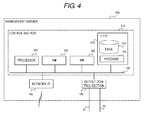
- FIG. 4 is a block diagram showing a configuration example of the management server 100.
- the management server 100 is a computer and includes a processor 101, a RAM (Random Access Memory) 102, a ROM (Read Only Memory) 103, a HDD (Hard Disk Drive) 104, a network I/F (Interface) 105, and an output control section 106.
- the units perform input and output of data and signals each other via a bus 107.
- a component including the processor 101, the RAM 102, the ROM 103, the HDD 104, and the bus 107 for the units to perform input and output is a control section 110.
- the processor 101 is an arithmetic unit such as a CPU (Central Processing Unit).
- the processor 101 expands, in the RAM 102, a computer program stored in the ROM 103 and a computer program 152 stored in the HDD 104 and executes arithmetic operation to provide various functions while cooperating with respective kinds of hardware.
- the RAM 102 is a main storage device.
- the ROM 103 is a device that has stored therein a system program and the like in a nonvolatile manner.
- the HDD 104 is an auxiliary storage device that stores, in a nonvolatile manner, the computer program 152, data 151 for controlling the operation of the computer program 152, and the like.
- the network I/F 105 includes a mechanism conforming to the radio communication standard of the IEEE 802.11 series and controls data communication between the management server 100 and an external apparatus.
- the output control section 106 is connected to the two cables 61 and directly controls display of the displays 120A and 120B.
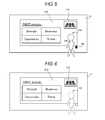
- FIG. 5 shows an example of a state viewed from participants on a side where the lecturer 500 is present.
- the display 120A displays material data prepared by the lecturer 500 and stored in the management server 100 beforehand and displays, in a region 121A, current photographed content by the camera 180B, that is, a state of participants in the room B where the lecturer 500 is absent.
- the lecturer 500 carries a portable terminal 450 connected to the management server 100 via the access point 301.
- the lecturer 500 operates the portable terminal 450 on the basis of a known technique to switch the display of the display 120A to, for example, the previous page or the next page. If the display 120A is mounted with a touch panel as well, the lecturer 500 can switch the display to the previous page or the next page by touching a screen and performing slide operation.
- the lecturer 500 wears a microphone 460 on clothes.
- the microphone 460 collects voice uttered by the lecturer 500.
- the collected voice is output from the speakers 470.
- FIG. 6 shows an example of a state viewed from participants in the other room where the lecturer 500 is absent, that is, in this example, the room B.
- the display 120B displays a lecture material including content same as content of the lecture material displayed by the display 120A. A page of the material is switched in the same manner in association with the display 120A.
- the voice collected by the microphone 460 is also output by the speakers 470 on the room B side.
- current photographed content by the camera 180A that is, a state of the participants in the room A where the lecturer 500 is present is displayed.
- a video of the lecturer 500 picked up by the camera 160A set in the room A is projected on the wall 150 on a real-time basis (in FIG. 6 , the video is indicated by a broken line).
- the management server 100 segments an image picked up by the camera 160A into only an image of the lecturer 500.
- the projector 170B receives an input of the segmented image data (a moving image) and projects the moving image on the wall 150.
- the image of the lecturer 500 can also be projected on a real-time basis in the room B where the lecturer 500 is absent. Therefore, all the participants in the room A and the room B can take a lecture in the same quality.
- the lecturer 500 can check a participation state in the other room (the room B) by looking at the region 121A of the display 120A. If the participants in the room B are not so enthusiastic, the lecturer 500 moves to the room B through the passageway formed by the wall 150 and the inner wall of the seminar room. A state in this case is shown in FIG. 7 . As indicated by an arrow line in FIG. 7 , the lecturer 500 passes between the infrared-ray emitting section 11 and the infrared-ray receiving section 12 when the lecturer 500 moves between the rooms. Consequently, the lecturer 500 blocks an infrared ray radiated from the infrared-ray emitting section 11. The infrared-ray receiving section 12 detects the passage of the lecturer 500 by being triggered by the blocking of the infrared ray and transmits information indicating that the detection of the passage to the management server 100 through the access point 301.
- the management server 100 When receiving the information from the infrared-ray receiving section 12, the management server 100 transmits instruction information for an image-pickup stop to the camera 160A, which is currently performing image pickup, and transmits instruction information for an image-pickup start to the camera 160B.
- the management server 100 transmits instruction information for a projection start to the projector 170A and transmits instruction information for a projection stop to the projector 170B.
- the management server 100 acquires an image picked up by the camera 160B, creates a segmented image of the lecturer 500, and outputs the created image to the projector 170A. Consequently, an image of the lecturer 500 moved to the room B is projected in the room A. The same applies when the lecturer 500 present in the room B moves to the room A.
- the infrared-ray receiving section 12 transmits detection information to the management server 100.
- the management server 100 switches image-pickup states in the cameras 160A and 160B and switches projection states in the projectors 170A and 170B.
- FIG. 8 An operation example of the management server 100 is explained with reference to a flowchart of FIG. 8 .
- This operation is realized by the processor 101 of the management server 100 in cooperation with the hardware in the management server 100 by expanding, in the RAM 102, the computer program 152 stored in the HDD 104 beforehand and executing arithmetic operation using the data 151 according to necessity.
- the lecturer 500 is delivering a lecture in the room A first.
- the processor 101 controls the network I/F 105, acquires a picked-up image (a moving image) from the camera 160A, and causes the RAM 102 to store the picked-up image once (ACT 001) .
- the processor 101 creates moving image data obtained by extracting a person (the lecturer 500) from obtained moving image data (ACT 002).
- the processor 101 divides the original moving image data into frames to create a plurality of still images and applies existing techniques, for example, image processing techniques such as an edge detection technique to the still images in combination to extract the person.
- the processor 101 combines extracted frame images to recreate moving image data of only the person.
- the processor 101 controls the network I/F 105 and transmits the moving image data of only the person to the projector 170B.
- the projector 170B projects the moving image on the wall 150 (ACT 003).
- the processor 101 determines whether information indicating that the lecturer 500 is detected is received from the sensor of the infrared-ray receiving section 12 (ACT 004). If the sensor detection information is not received (No in ACT 004), the processor 101 returns the processing to ACT 001. If the sensor detection information is received (Yes in ACT 004), the processor 101 switches the image pickup/stop operations of the cameras 160A and 160B and the projection/stop operations of the projectors 170A and 170B (ACT 005). The processor 101 transmits stop instruction information to the camera 160A to stop image pickup of the camera 160A. On the other hand, the processor 101 transmits image pickup instruction information to the camera 160B to start image pickup of the camera 160B. The processor 101 transmits projection instruction information to the projector 170A to start projection of the projector 170A. On the other hand, the processor 101 transmits stop instruction information to the projector 170B to stop projection of the projector 170B.
- the processor 101 controls the network I/F 105 and acquires a picked-up image (a moving image) from the camera 160B (ACT 006), creates moving image data obtained by extracting a person (the lecturer 500) (Act 007), and transmits moving image data of only the person to the projector 170A (ACT 008). This operation is repeatedly executed until sensor detection information is received (a loop of No in ACT 009).
- ACT 006 to ACT 008 are the same as ACT 001 to ACT 003 except that input and output destinations are changed.
- the processor 101 switches the image pickup/stop operations of the cameras 160A and 160B and the projection/stop operations of the projectors 170A and 170B (ACT 010).
- the processor 101 transmits stop instruction information to the camera 160B and stops the image pickup of the camera 160B.
- the processor 101 transmits image pickup instruction information to the camera 160A and starts the image pickup in the camera 160A.
- the processor 101 transmits projection instruction information to the projector 170B and starts the projection of the projector 170B.
- the processor 101 transmits stop instruction information to the projector 170A and stops the projection of the projector 170A. After the switching operation, the processor 101 returns the processing to ACT 001.
- FIG. 9 shows a configuration example of a seminar room in the second embodiment. A configuration example of the seminar room viewed from the above is shown.
- doors 151 are provided in passageways between the infrared-ray emitting sections 11 and the infrared-ray receiving sections 12. If the doors 151 are closed, sound leakage between the rooms A and B can be prevented. Therefore, for example, participants can take a lecture in English voice in one room and take a lecture in Japanese voice in the other room. Otherwise, the second embodiment is the same as the first embodiment.
- FIG. 10 is a flowchart for explaining an example of a sound translation operation in the second embodiment.
- the microphone 460 collects voice uttered by the lecturer 500 (ACT 101).
- the speakers 470 in one room in this example, the room A) directly output the voice (ACT 002).
- the processor 101 of the management server 100 receives sound data collected by the microphone 460 via the network I/F 105 and the access point 301 and once stores the sound data in the RAM 102 (ACT 103).
- the processor 101 subjects the sound data stored in the RAM 102 to sound recognition and converts the sound data into text data (ACT 104) and translates the recognized data (the text data) into another language such as Japanese (ACT 105).
- the processor 101 converts the translated text data into sound data (ACT 106).
- ACT 104 to ACT 106 are performed using an existing technique.
- the processor 101 operates the network I/F 105 and outputs the translated sound data to the speakers 470 in the room B (ACT 107). With the operation shown in FIG. 10 , it is possible to output English voice from the speakers 470 in one room and output the other language from the speakers 470 in the other room.
- switches are provided in both the doors 151 and, if both the doors 151 are closed, the processor 101 executes the operation shown in FIG. 10 .
- a translator translates voice uttered by the lecturer 500 and the voice is output from the speakers 470 in the other room.
- an implementation may be adopted in which, if sentences and terms are included in a lecture material for display, a translated lecture material is displayed in each of the rooms.
- the processor 101 causes a display to display the lecture material in Japanese in one room and causes a display to display the lecture material translated into English in the other room.
- materials in the languages are prepared beforehand.
- the processor 101 executes translation software to perform translation processing and incorporates translated sentences in the lecture material every time the translation processing is performed. Note that, in the materials used in the rooms, the languages are different but contents of the materials are not different. That is, the materials including the same content are displayed in both the rooms.
- a lecturer performs attendance check of participants on the basis of images picked up by the cameras 180A and 180B.
- an implementation example is explained in which a dozing participant is woken up.
- FIG. 11 shows a configuration example of a seminar room in the third embodiment and shows a configuration example of the seminar room viewed from above.
- a vibrator 510 is disposed in each of seats on which the participants are seated.
- the vibrator 510 is disposed in a position where the participant seated on the seat can check vibration such as a seating surface, a backrest, or an armrest.
- the vibrator 510 vibrates in order to wake up a dozing participant.
- FIG. 12 is a flowchart for explaining an operation example of attendance check processing of the management server 100.
- the attendance check processing is started immediately after a lecture start. If slight lateness is allowed, the attendance check processing is performed after a specified time elapses. The attendance check processing may be periodically performed during a lecture.
- the processor 101 acquires picked-up images from the cameras 180A and 180B and once stores the picked-up images in the RAM 102 (ACT 201). First, the processor 101 performs, in the images stored in the RAM 102, face identification processing for a participant seated in the leftmost in the front row.
- feature data data 151 of faces of all the participants is stored in the HDD 104 beforehand in association with participant identification information that uniquely defines the participants.
- the processor 101 performs the face identification processing by comparing feature data of a face obtained from the picked-up images and the data 151 stored in the HDD 104. As a specific method of the face identification processing, the face identification processing is performed on the basis of the related art.
- the processor 101 acquires participant identification information associated with the coincident or approximate feature data stored in the HDD 104 and causes the HDD 104 to store the participant identification information as another data in association with a date of the day (i.e., aparticipation date) .
- the processor 101 determines whether the processing for all the participants, whose images are picked up by the cameras 180A and 180B, is completed (ACT 205). If the processing for all the participants is not completed (No in ACT 205), the processor 101 returns to ACT 202 and applies the processing in ACT 202 to ACT 204 to the next participant.
- the processor 101 sequentially advances the processing toward the right direction of the picked-up image of the camera 180A. For example, in the case of a second participant, the processing is applied to a participant seated second from the left in the front row. After applying the face identification processing to all participants in the front row, the processor 101 advances the processing to the next row. If the processing is completed for the picked-up image of the camera 180A, the processing of the picked-up image obtained by the camera 180B is performed. Note that the advancing direction and the like of the processing are only examples.
- the processor 101 regards the participants, whose feature data of the face is not coincident or approximate with the data 151 in ACT 204, as not attending (ACT 206).
- the processor 101 acquires the participant identification information not acquired in ACT 204 and causes the HDD 104 to store the participant identification information as another data in association with the date of the day (i.e., the participation date).
- FIG. 13 is a flowchart for explaining an operation example of the management server 100 in specifying a dozing participant and vibrating the vibrator 510.
- the processor 101 controls the network I/F 105, acquires images picked up by the cameras 180A and 180B, and causes the RAM 102 to store the images (ACT 301).
- the processor 101 determines, on the basis of the acquired image, whether a participant looking down for a specified time or more (e.g., five minutes or more) is present (ACT 302). If a face of a participant cannot be specified for five minutes or more in the position of the face on the image on which the attendance of the participant can be confirmed, the processor 101 determines that the participant is looking down.
- a specified time or more e.g., five minutes or more
- the processor 101 If the participant looking down is absent (No in ACT 302), the processor 101 returns to ACT 301. On the other hand, if the participant looking down for the specified time is present (Yes in ACT 302), the processor 101 specifies a coordinate value in the image of the face position (ACT 303).
- the processor 101 specifies, on the basis of the specified coordinate, a seat of the looking-down participant (ACT 304).
- Coordinate positions and seat numbers e.g., IP addresses of the vibrators 510 corresponding to the coordinate positions are registered in the HDD 104 as the data 151 beforehand.
- the processor 101 extracts the seat number from the coordinate on the basis of this correspondence relation in ACT 304.
- the processor 101 transmits information for instructing a vibration start to the specified IP address (ACT 305). Consequently, the designated vibrator 510 vibrates.
- the functions for carrying out the modes are recorded in an apparatus in advance.
- the embodiments are not limited to this, and the same functions may be downloaded from a network to the apparatus, or a recording medium having the same functions stored therein may be installed in the apparatus.
- a form of the recording medium may be any form as long as the recording medium is a recording medium capable of storing a computer program and readable by the apparatus such as a CD-ROM.
- the functions obtained by the installation or the download in advance in this way may be realized in cooperation with an OS (operating system) or the like in the apparatus.
Landscapes
- Engineering & Computer Science (AREA)
- Theoretical Computer Science (AREA)
- Multimedia (AREA)
- Physics & Mathematics (AREA)
- General Physics & Mathematics (AREA)
- Business, Economics & Management (AREA)
- Educational Administration (AREA)
- Educational Technology (AREA)
- Signal Processing (AREA)
- General Engineering & Computer Science (AREA)
- Human Computer Interaction (AREA)
- Two-Way Televisions, Distribution Of Moving Picture Or The Like (AREA)
Abstract
Description
- Embodiments described herein relate generally to a technique for efficiently delivering a lecture in a seminar room.
- When a lecture is held in a high school or a university, if a seminar room is spacious, it is hard for participants in the back of the room to see a lecturer and videos of lecture materials prepared by lecturer because the participants are far from the lecturer and the videos. Further, if the seminar room is spacious, for example, the lecturer cannot overlook the entire room and, in particular, cannot see if lecture content is communicated to the participant in the back.
- We propose a lecture system comprising:
- a first display section set on one side surface of a wall that divides one room into two rooms, set to be seen by participants present in a first room, which is one divided room, and configured to display a material of a lecture;
- a second display section set on a side surface on an opposite side of the surface of the wall on which the first display section is set, set to be seen by participants present in a second room, which is the other divided room, and configured to display a material including content same as content of the material displayed by the first display section;
- a first image pickup section disposed in the first room and configured to pick up an image of a lecturer;
- a server configured to receive the image picked up by the first image pickup section and create an image formed by segmenting the image of the lecturer; and
- a first projecting section configured to project the image created by the server toward the wall of the second room.
- Advantageously and in a nonlimiting manner, the system further comprises:
- a sensor set in a passageway between the first room and the second room and configured to detect passage of the lecturer;
- a second image pickup section disposed in the second room and configured to pick up an image of the lecturer; and
- a second projecting section configured to project, toward the wall of the first room, an image created by the server on the basis of the image picked up by the second image pickup section, wherein
- when the sensor detects the passage of the lecturer, the server receives the image picked up by the second image pickup section, creates an image formed by segmenting the image of the lecturer, and transmits the created image to the second projecting section.
- Advantageously and in a nonlimiting manner, the system further comprises:
- a third image pickup section configured to pick up an image of participants present in the first room; and
- a fourth image pickup section configured to pick up an image of participants present in the second room.
- Advantageously and in a nonlimiting manner, the first display section displays, in a part of a display region, the image picked up by the fourth image pickup section, and
the second display section displays, in a part of a display region, the image picked up by the third image pickup section. - Advantageously and in a nonlimiting manner, the system further comprises:
- a microphone configured to collect voice of the lecturer;
- a first speaker set in the first room and configured to output the voice of the lecturer collected by the microphone; and
- a second speaker set in the second room and configured to output voice obtained by translating the voice of the lecturer collected by the microphone into another language.
- Advantageously and in a nonlimiting manner, the server receives data of the voice of the lecturer collected by the microphone, translates the data into the other language, and outputs the translated voice data to the second speaker.
- Advantageously and in a nonlimiting manner, the server receives the images picked up by the third image pickup section and the fourth image pickup section and determines attendance of the respective participants on the basis of images of faces of the participant participating in the lecture. Advantageously and in a nonlimiting manner, the system further comprises a plurality of vibrators configured to give vibration to the respective participants and vibrate when receiving information from the server, wherein
the server specifies, on the basis of the images picked up by the third image pickup section and the fourth image pickup section, a participant looking down for a fixed period and transmits the information to the vibrator of the specified participant. - The invention also relates to an information processing apparatus comprising:
- an interface section configured to receive an image from a first image pickup section that picks up an image of a lecturer present in a first room; and
- a control section configured to control a first display section set in the first room to display a material of a lecture, control a second display section set in a second room to display a material including content same as content of the material, create an image obtained by segmenting the image of the lecturer from the image received by the interface section, and control the interface section to transmit the created image to a first projecting section that projects an image toward a wall of the second room on which the second display section is set.
- Advantageously and in a nonlimiting manner, the interface section further receives information indicating detection of passage of the lecturer from a sensor that is set in a passageway between the first room and the second room and detects passage of the lecturer and receives an image from a second image pickup section that is disposed in the second room and picks up an image of the lecturer, and
the control section further creates, when the interface section receives the information, an image formed by segmenting the image of the lecturer from the image picked up by the second image pickup section and controls the interface section to transmit the created image to a second projecting section that projects the image toward a wall of the first room on which the first display section is set. - Advantageously and in a nonlimiting manner, the interface section is configured to receive an image from a third image pickup section that picks up an image of participants present in the first room; and is configured to receive an image from a fourth image pickup section that picks up an image of participants present in the second room,
the control section further controls the interface section to transmit the image picked up by the fourth image pickup section to the first display section displays, in a part of a display region, and to transmit the image picked up by the third image pickup section to the second display section, in a part of a display region. - Advantageously and in a nonlimiting manner, the interface section is configured to receive sound data collected by a microphone configured to collect voice of the lecturer,
the control section further obtains a translation of the voice of the lecturer collected by the microphone into another language, and controls the interface section to output the voice of the lecturer collected by the microphone to a first speaker set in the first room, and to output the voice obtained by the translation to a second speaker set in the second room. - Advantageously and in a nonlimiting manner, the voice translation is operated by the control section.
- Advantageously and in a nonlimiting manner, the interface section is configured to receive an image of the participants present in the first room picked up by a third image pickup section, to receive an image of the participants present in the second room picked up by a fourth image pickup section,
the control section further determines attendance of the respective participants on the basis of the images received of the faces of the participant participating in the lecture. - Advantageously and in a nonlimiting manner, the interface section is configured to receive an image of the participants present in the first room picked up by a third image pickup section, to receive an image of the participants present in the second room picked up by a fourth image pickup section, and to control a plurality of vibrators configured to give vibration to the respective participants,
the control section further specifies, on the basis of the images picked up by the third image pickup section and the fourth image pickup section, a participant looking down for a fixed period and controls the interface section to give a vibration to the specified participant. - The invention also relates to a storage medium having a computer program stored therein, the computer program causing a computer to execute processing for:
- controlling a first display section set in a first room to display a material of a lecture;
- controlling a second display section set in a second room to display a material including content same as content of the material;
- receiving an image from a first image pickup section that picks up an image of a lecturer present in the first room;
- creating an image formed by segmenting the image of the lecturer from the received image; and
- transmitting the created image to a first projecting section that projects an image toward a wall of the second room on which the second display section is set.
-
-
FIG. 1 is a diagram showing a configuration example of a lecture system in a first embodiment; -
FIG. 2 is a diagram showing a configuration example of a seminar room in the first embodiment viewed from above; -
FIG. 3 is a diagram showing a configuration example of a seminar room in the past viewed from above; -
FIG. 4 is a block diagram showing a configuration example of a management server in the first embodiment; -
FIG. 5 is a diagram showing how a screen is seen for participants in one room; -
FIG. 6 is a diagram showing how a screen is seen for participants in the other room; -
FIG. 7 is a diagram in which movement of a lecturer in the seminar room in the first embodiment is indicated by an arrow; -
FIG. 8 is a flowchart for explaining an operation example of a management server in the first embodiment; -
FIG. 9 is a diagram showing a configuration example of a seminar room in a second embodiment viewed from above; -
FIG. 10 is a flowchart for explaining an operation example of a management server in the second embodiment; -
FIG. 11 is a diagram showing a configuration example of a seminar room in a third embodiment viewed from above; -
FIG. 12 is a flowchart for explaining an operation example of attendance determination in the third embodiment; and -
FIG. 13 is a flowchart for explaining an operation example of a management server in actuating a vibrator set in a seat of a participant. - In general, according to one embodiment, a lecture system includes a first display section, a second display section, a first image pickup section, a server, and a first projecting section. The first display section is set on one side surface of a wall that divides one room into two rooms and is set to be seen by participants present in a first room, which is one divided room, and displays a material of a lecture. The second display section is set on a side surface on the opposite side of the surface of the wall on which the first display section is set and is set to be seen by participants present in a second room, which is the other divided room, and displays a material including content same as content of the material displayed by the first display section. The first image pickup section is disposed in the first room and picks up an image of a lecturer. The server receives the image picked up by the first image pickup section and creates an image formed by segmenting the image of the lecturer. The first projecting section projects the image created by the server toward the wall of the second room.
- In the lecture system in the embodiment, a wall is provided in the center of a seminar room to divide the seminar room into two. An output device such as a large display is set on the wall. It is possible to reduce the breadth of the seminar room to a half by setting the wall.
- If the seminar room is divided into two, since there is usually only one lecturer, the lecturer can stay in only one room. However, in the embodiment, the figure of the lecturer is displayed in the other room. Consequently, it is possible to maintain feeling of a live lecture in both the rooms.
- The lecturer can see states of participants only in one room where the lecturer is present. However, in the lecture system in the embodiment, an image of the other room is displayed on the output device. Consequently, the lecturer can see states of both the rooms.
- If the participants in the room where the lecturer is currently present enthusiastically listen to the lecture but the participants in the other room are not so enthusiastic, the lecturer moves to the other room and continues the lecture. The lecture system determines the room where the lecturer is present and switches the image. Consequently, the lecturer can deliver the lecture in a desired room without stress.
- Embodiments are explained below with reference to the drawings.
-
FIG. 1 is a schematic diagram (a perspective view) of a seminar room in a first embodiment.FIG. 2 is a schematic diagram of the seminar room viewed from above. Note that an X axis, a Y axis, and a Z axis shown in figures referred to below are common in the figures. - In the seminar room in the embodiment, a
wall 150 is provided in the center to divide a classroom into two. For convenience of explanation, the two divided rooms are referred to as room A (first room) and room B (second room). - To enable a lecturer to move between the two divided rooms, the
wall 150 is set in a position away from inner walls of the seminar room enough for a person to pass between thewall 150 and the inner walls. In passageways formed by the inner walls of the seminar room and thewall 150, infrared-ray emitting sections 11 and infrared-ray receiving sections 12 (sensors) are disposed. The infrared-ray emitting sections 11 and the infrared-ray receiving sections 12 detect passage of the person and transmit, to amanagement server 100, information indicating that the passage is detected. The detection information is transmitted by radio communication through anaccess point 301. - A
lecture system 1 includes acamera 160A (a first image pickup section) and acamera 160B (a second image pickup section). Thecamera 160A picks up an image of thewall 150 facing the room A. Thecamera 160B picks up an image of thewall 150 facing the room B. Thecameras management server 100. Thecameras cameras - Note that the camera in the room where a lecturer 500 (see
FIG. 2 ) is present functions and the other camera stops. If thelecturer 500 is delivering a lecture in, for example, the room A, thecamera 160A starts and performs image pickup but thecamera 160B stops image pickup. Themanagement server 100 performs switching of the image pickup from thecamera 160A to thecamera 160B. The image pickup is switched if the infrared-ray emitting section 11 and the infrared-ray receiving section 12 detect passage of thelecturer 500. - For example, if the
lecturer 500 is delivering a lecture in the room A, an image picked up by thecamera 160A includes thelecturer 500. Themanagement server 100 acquires a moving image picked up by any one of thecameras management server 100 transmits the segmented moving image to any operating one of aprojector 170A (a second projecting section) and aprojector 170B (a first projecting section). Theprojectors wall 150, the moving image transmitted from themanagement server 100. One of theprojectors lecturer 500 is absent starts and projects an image. One of theprojectors lecturer 500 is present stops projection of an image. Like the switching of thecameras projectors ray emitting section 11 and the infrared-ray receiving section 12 detect passage of thelecturer 500. - As explained above, in the room where the
lecturer 500 is present, the camera starts and the projector stops. On the other hand, in the room where thelecturer 500 is absent, the camera stops and the projector starts. If the infrared-ray emitting section 11 and the infrared-ray receiving section 12 detect passage of a person, that is, if thelecturer 500 moves to the other room, the start and the stop of the cameras and the projectors are switched. Acamera 180A (a third image pickup section) and acamera 180B (a fourth image pickup section) are immovable wide-angle fixed cameras that pick up images of the entire participant side. Thecameras management server 100 through radio communication. Themanagement server 100 performs control to project a moving image picked up by thecamera 180A on a part of a region of adisplay 120B (a second display section) facing the room B. Themanagement server 100 performs control to project a moving image picked up by thecamera 180B on a part of a region of adisplay 120A (a first display section) facing the room A. - The
displays wall 150. Thedisplay 120A is set on a side surface on the room A side of thewall 150. Thedisplay 120A is set such that participants present in the room A view thedisplay 120A. Thedisplay 120B is set on side surface of thewall 150 on the opposite side of the surface on which thedisplay 120A is set. Thedisplay 120B is set such that the participants present in the room B view thedisplay 120B. That is, thedisplay 120A is set to direct a display surface thereof to the room A. Thedisplay 120B is set to direct a display surface thereof to the room B. Thedisplays management server 100. Themanagement server 100 projects images of the lecture material on thedisplays cables 61. Twocables 61 are prepared. One of thecables 61 connects themanagement server 100 and thedisplay 120A. The other connects themanagement server 100 and thedisplay 120B. Thecables 61 are cables conforming to the HDMI (High-Definition Multimedia Interface) standard. - Note that the
displays cables 61 are configured as cables of the HDMI standard for outputting a video and cables of the USB standard for transmitting a touch position to themanagement server 100. Projectors may be adopted instead of thedisplays projectors - The
access point 301 builds a communication infrastructure for performing data communication conforming to the radio communication standard of the IEEE 802.11 series. Theaccess point 301 forms a local area network and relays data communication among the devices shown inFIGS. 1 and2 . Theaccess point 301 has a function of automatically allocating IP addresses to the devices. Theaccess point 301 performs control on the basis of the IP address to uniquely identify the devices, specify a transmission source, and transmit data to a transmission destination. -
Speakers 470 shown inFIG. 2 output voice collected by a lecturer microphone explained below. Thespeakers 470 are units including power amplifiers and controllers. InFIGS. 1 and2 , themanagement server 100 and theaccess point 301 are set on the outer side of the seminar room. However, themanagement server 100 and theaccess point 301 may be set on the inner side of the seminar room. -
FIG. 3 is a schematic diagram showing a seminar room in the past viewed from above. As shown inFIG. 3 , if the seminar room is one room, since the back of the seminar room is far from thelecturer 500 and adisplay 120, it is difficult to view and listen to lecture content. Therefore, as shown inFIG. 2 , the seminar room is divided into two to reduce the distance from thelecturer 500 and enable the participants to understand the lecture content better. -
FIG. 4 is a block diagram showing a configuration example of themanagement server 100. Themanagement server 100 is a computer and includes aprocessor 101, a RAM (Random Access Memory) 102, a ROM (Read Only Memory) 103, a HDD (Hard Disk Drive) 104, a network I/F (Interface) 105, and anoutput control section 106. The units perform input and output of data and signals each other via abus 107. Note that a component including theprocessor 101, theRAM 102, theROM 103, theHDD 104, and thebus 107 for the units to perform input and output is acontrol section 110. - The
processor 101 is an arithmetic unit such as a CPU (Central Processing Unit). Theprocessor 101 expands, in theRAM 102, a computer program stored in theROM 103 and acomputer program 152 stored in theHDD 104 and executes arithmetic operation to provide various functions while cooperating with respective kinds of hardware. TheRAM 102 is a main storage device. TheROM 103 is a device that has stored therein a system program and the like in a nonvolatile manner. - The
HDD 104 is an auxiliary storage device that stores, in a nonvolatile manner, thecomputer program 152,data 151 for controlling the operation of thecomputer program 152, and the like. The network I/F 105 includes a mechanism conforming to the radio communication standard of the IEEE 802.11 series and controls data communication between themanagement server 100 and an external apparatus. - The
output control section 106 is connected to the twocables 61 and directly controls display of thedisplays -
FIG. 5 shows an example of a state viewed from participants on a side where thelecturer 500 is present. In this example, it is assumed that thelecturer 500 is present in the room A. Thedisplay 120A displays material data prepared by thelecturer 500 and stored in themanagement server 100 beforehand and displays, in aregion 121A, current photographed content by thecamera 180B, that is, a state of participants in the room B where thelecturer 500 is absent. Thelecturer 500 carries aportable terminal 450 connected to themanagement server 100 via theaccess point 301. Thelecturer 500 operates theportable terminal 450 on the basis of a known technique to switch the display of thedisplay 120A to, for example, the previous page or the next page. If thedisplay 120A is mounted with a touch panel as well, thelecturer 500 can switch the display to the previous page or the next page by touching a screen and performing slide operation. - The
lecturer 500 wears amicrophone 460 on clothes. Themicrophone 460 collects voice uttered by thelecturer 500. The collected voice is output from thespeakers 470. -
FIG. 6 shows an example of a state viewed from participants in the other room where thelecturer 500 is absent, that is, in this example, the room B. Thedisplay 120B displays a lecture material including content same as content of the lecture material displayed by thedisplay 120A. A page of the material is switched in the same manner in association with thedisplay 120A. The voice collected by themicrophone 460 is also output by thespeakers 470 on the room B side. In aregion 121B shown inFIG. 6 , current photographed content by thecamera 180A, that is, a state of the participants in the room A where thelecturer 500 is present is displayed. - In the room B, instead of the
lecturer 500, a video of thelecturer 500 picked up by thecamera 160A set in the room A is projected on thewall 150 on a real-time basis (inFIG. 6 , the video is indicated by a broken line). Themanagement server 100 segments an image picked up by thecamera 160A into only an image of thelecturer 500. Theprojector 170B receives an input of the segmented image data (a moving image) and projects the moving image on thewall 150. With this configuration, the image of thelecturer 500 can also be projected on a real-time basis in the room B where thelecturer 500 is absent. Therefore, all the participants in the room A and the room B can take a lecture in the same quality. - The
lecturer 500 can check a participation state in the other room (the room B) by looking at theregion 121A of thedisplay 120A. If the participants in the room B are not so enthusiastic, thelecturer 500 moves to the room B through the passageway formed by thewall 150 and the inner wall of the seminar room. A state in this case is shown inFIG. 7 . As indicated by an arrow line inFIG. 7 , thelecturer 500 passes between the infrared-ray emitting section 11 and the infrared-ray receiving section 12 when thelecturer 500 moves between the rooms. Consequently, thelecturer 500 blocks an infrared ray radiated from the infrared-ray emitting section 11. The infrared-ray receiving section 12 detects the passage of thelecturer 500 by being triggered by the blocking of the infrared ray and transmits information indicating that the detection of the passage to themanagement server 100 through theaccess point 301. - When receiving the information from the infrared-
ray receiving section 12, themanagement server 100 transmits instruction information for an image-pickup stop to thecamera 160A, which is currently performing image pickup, and transmits instruction information for an image-pickup start to thecamera 160B. Themanagement server 100 transmits instruction information for a projection start to theprojector 170A and transmits instruction information for a projection stop to theprojector 170B. Themanagement server 100 acquires an image picked up by thecamera 160B, creates a segmented image of thelecturer 500, and outputs the created image to theprojector 170A. Consequently, an image of thelecturer 500 moved to the room B is projected in the room A. The same applies when thelecturer 500 present in the room B moves to the room A. When thelecturer 500 passes between the infrared-ray emitting section 11 and the infrared-ray receiving section 12, the infrared-ray receiving section 12 transmits detection information to themanagement server 100. When receiving the detection information, themanagement server 100 switches image-pickup states in thecameras projectors - An operation example of the
management server 100 is explained with reference to a flowchart ofFIG. 8 . This operation is realized by theprocessor 101 of themanagement server 100 in cooperation with the hardware in themanagement server 100 by expanding, in theRAM 102, thecomputer program 152 stored in theHDD 104 beforehand and executing arithmetic operation using thedata 151 according to necessity. In an example shown inFIG. 8 , it is assumed that thelecturer 500 is delivering a lecture in the room A first. - The
processor 101 controls the network I/F 105, acquires a picked-up image (a moving image) from thecamera 160A, and causes theRAM 102 to store the picked-up image once (ACT 001) . - The
processor 101 creates moving image data obtained by extracting a person (the lecturer 500) from obtained moving image data (ACT 002). Theprocessor 101 divides the original moving image data into frames to create a plurality of still images and applies existing techniques, for example, image processing techniques such as an edge detection technique to the still images in combination to extract the person. Theprocessor 101 combines extracted frame images to recreate moving image data of only the person. - The
processor 101 controls the network I/F 105 and transmits the moving image data of only the person to theprojector 170B. Theprojector 170B projects the moving image on the wall 150 (ACT 003). - The
processor 101 determines whether information indicating that thelecturer 500 is detected is received from the sensor of the infrared-ray receiving section 12 (ACT 004). If the sensor detection information is not received (No in ACT 004), theprocessor 101 returns the processing to ACT 001. If the sensor detection information is received (Yes in ACT 004), theprocessor 101 switches the image pickup/stop operations of thecameras projectors processor 101 transmits stop instruction information to thecamera 160A to stop image pickup of thecamera 160A. On the other hand, theprocessor 101 transmits image pickup instruction information to thecamera 160B to start image pickup of thecamera 160B. Theprocessor 101 transmits projection instruction information to theprojector 170A to start projection of theprojector 170A. On the other hand, theprocessor 101 transmits stop instruction information to theprojector 170B to stop projection of theprojector 170B. - The
processor 101 controls the network I/F 105 and acquires a picked-up image (a moving image) from thecamera 160B (ACT 006), creates moving image data obtained by extracting a person (the lecturer 500) (Act 007), and transmits moving image data of only the person to theprojector 170A (ACT 008). This operation is repeatedly executed until sensor detection information is received (a loop of No in ACT 009). ACT 006 to ACT 008 are the same as ACT 001 to ACT 003 except that input and output destinations are changed. - If the sensor detection information is received (Yes in ACT 009), the
processor 101 switches the image pickup/stop operations of thecameras projectors processor 101 transmits stop instruction information to thecamera 160B and stops the image pickup of thecamera 160B. On the other hand, theprocessor 101 transmits image pickup instruction information to thecamera 160A and starts the image pickup in thecamera 160A. Theprocessor 101 transmits projection instruction information to theprojector 170B and starts the projection of theprojector 170B. On the other hand, theprocessor 101 transmits stop instruction information to theprojector 170A and stops the projection of theprojector 170A. After the switching operation, theprocessor 101 returns the processing to ACT 001. - As an application of the mode explained in the first embodiment, a method of use for, for example, delivering a lecture of one same lecture content in different languages is also conceivable. In a second embodiment, this mode is explained.
FIG. 9 shows a configuration example of a seminar room in the second embodiment. A configuration example of the seminar room viewed from the above is shown. - In a
lecture system 1A in the second embodiment, in addition to the configuration in the first embodiment,doors 151 are provided in passageways between the infrared-ray emitting sections 11 and the infrared-ray receiving sections 12. If thedoors 151 are closed, sound leakage between the rooms A and B can be prevented. Therefore, for example, participants can take a lecture in English voice in one room and take a lecture in Japanese voice in the other room. Otherwise, the second embodiment is the same as the first embodiment. -
FIG. 10 is a flowchart for explaining an example of a sound translation operation in the second embodiment. Themicrophone 460 collects voice uttered by the lecturer 500 (ACT 101). Thespeakers 470 in one room (in this example, the room A) directly output the voice (ACT 002). - The
processor 101 of themanagement server 100 receives sound data collected by themicrophone 460 via the network I/F 105 and theaccess point 301 and once stores the sound data in the RAM 102 (ACT 103). Theprocessor 101 subjects the sound data stored in theRAM 102 to sound recognition and converts the sound data into text data (ACT 104) and translates the recognized data (the text data) into another language such as Japanese (ACT 105). Theprocessor 101 converts the translated text data into sound data (ACT 106).ACT 104 toACT 106 are performed using an existing technique. - The
processor 101 operates the network I/F 105 and outputs the translated sound data to thespeakers 470 in the room B (ACT 107). With the operation shown inFIG. 10 , it is possible to output English voice from thespeakers 470 in one room and output the other language from thespeakers 470 in the other room. - Note that an implementation may be adopted in which switches are provided in both the
doors 151 and, if both thedoors 151 are closed, theprocessor 101 executes the operation shown inFIG. 10 . Further, an implementation may be adopted in which a translator translates voice uttered by thelecturer 500 and the voice is output from thespeakers 470 in the other room. - Note that an implementation may be adopted in which, if sentences and terms are included in a lecture material for display, a translated lecture material is displayed in each of the rooms. For example, if Japanese is included a lecture material, the
processor 101 causes a display to display the lecture material in Japanese in one room and causes a display to display the lecture material translated into English in the other room. In this case, an implementation may be adopted in which materials in the languages are prepared beforehand. Further, an implementation may be adopted in which theprocessor 101 executes translation software to perform translation processing and incorporates translated sentences in the lecture material every time the translation processing is performed. Note that, in the materials used in the rooms, the languages are different but contents of the materials are not different. That is, the materials including the same content are displayed in both the rooms. - In a third embodiment, a lecturer performs attendance check of participants on the basis of images picked up by the
cameras -
FIG. 11 shows a configuration example of a seminar room in the third embodiment and shows a configuration example of the seminar room viewed from above. In alecture system 1B, in addition to the mode in the first embodiment, avibrator 510 is disposed in each of seats on which the participants are seated. Thevibrator 510 is disposed in a position where the participant seated on the seat can check vibration such as a seating surface, a backrest, or an armrest. When receiving instruction information from themanagement server 100 via theaccess point 301, thevibrator 510 vibrates in order to wake up a dozing participant. -
FIG. 12 is a flowchart for explaining an operation example of attendance check processing of themanagement server 100. In the flowchart ofFIG. 12 , if lateness is not allowed, the attendance check processing is started immediately after a lecture start. If slight lateness is allowed, the attendance check processing is performed after a specified time elapses. The attendance check processing may be periodically performed during a lecture. - The
processor 101 acquires picked-up images from thecameras processor 101 performs, in the images stored in theRAM 102, face identification processing for a participant seated in the leftmost in the front row. In this example, feature data (data 151) of faces of all the participants is stored in theHDD 104 beforehand in association with participant identification information that uniquely defines the participants. Theprocessor 101 performs the face identification processing by comparing feature data of a face obtained from the picked-up images and thedata 151 stored in theHDD 104. As a specific method of the face identification processing, the face identification processing is performed on the basis of the related art. As a result of the comparison, if feature data, an approximation value of which indicating that the two data are coincident or to which degree the two data are approximate is within a range of a specified value, is absent in the HDD 104 (No in ACT 203), theprocessor 101 returns the processing to ACT 202 and applies the face identification processing to the next participant. If coincident or approximate feature data is present in the HDD 104 (Yes in Act 203), theprocessor 101 recognizes the relevant participant as attending (ACT 204). In ACT 204, theprocessor 101 acquires participant identification information associated with the coincident or approximate feature data stored in theHDD 104 and causes theHDD 104 to store the participant identification information as another data in association with a date of the day (i.e., aparticipation date) . - The
processor 101 determines whether the processing for all the participants, whose images are picked up by thecameras processor 101 returns to ACT 202 and applies the processing in ACT 202 to ACT 204 to the next participant. Theprocessor 101 sequentially advances the processing toward the right direction of the picked-up image of thecamera 180A. For example, in the case of a second participant, the processing is applied to a participant seated second from the left in the front row. After applying the face identification processing to all participants in the front row, theprocessor 101 advances the processing to the next row. If the processing is completed for the picked-up image of thecamera 180A, the processing of the picked-up image obtained by thecamera 180B is performed. Note that the advancing direction and the like of the processing are only examples. - If the processing for all the participants, whose images are picked up by the
cameras processor 101 regards the participants, whose feature data of the face is not coincident or approximate with thedata 151 in ACT 204, as not attending (ACT 206). In ACT 206, theprocessor 101 acquires the participant identification information not acquired in ACT 204 and causes theHDD 104 to store the participant identification information as another data in association with the date of the day (i.e., the participation date). -
FIG. 13 is a flowchart for explaining an operation example of themanagement server 100 in specifying a dozing participant and vibrating thevibrator 510. Theprocessor 101 controls the network I/F 105, acquires images picked up by thecameras RAM 102 to store the images (ACT 301). Theprocessor 101 determines, on the basis of the acquired image, whether a participant looking down for a specified time or more (e.g., five minutes or more) is present (ACT 302). If a face of a participant cannot be specified for five minutes or more in the position of the face on the image on which the attendance of the participant can be confirmed, theprocessor 101 determines that the participant is looking down. If the participant looking down is absent (No in ACT 302), theprocessor 101 returns toACT 301. On the other hand, if the participant looking down for the specified time is present (Yes in ACT 302), theprocessor 101 specifies a coordinate value in the image of the face position (ACT 303). - Subsequently, the
processor 101 specifies, on the basis of the specified coordinate, a seat of the looking-down participant (ACT 304). Coordinate positions and seat numbers (e.g., IP addresses of the vibrators 510) corresponding to the coordinate positions are registered in theHDD 104 as thedata 151 beforehand. Theprocessor 101 extracts the seat number from the coordinate on the basis of this correspondence relation in ACT 304. - The
processor 101 transmits information for instructing a vibration start to the specified IP address (ACT 305). Consequently, the designatedvibrator 510 vibrates. - In the explanation in the embodiments, the functions for carrying out the modes are recorded in an apparatus in advance. The embodiments are not limited to this, and the same functions may be downloaded from a network to the apparatus, or a recording medium having the same functions stored therein may be installed in the apparatus. A form of the recording medium may be any form as long as the recording medium is a recording medium capable of storing a computer program and readable by the apparatus such as a CD-ROM. The functions obtained by the installation or the download in advance in this way may be realized in cooperation with an OS (operating system) or the like in the apparatus.
- With the modes of the embodiments, even participants in the back of a seminar room can check a lecturer and a lecture material prepared by the lecturer near the lecture and the lecture material. The lecturer can overlook the entire room.
- While certain embodiments have been described, these embodiments have been presented by way of example only, and are not intended to limit the scope of invention. Indeed, the novel apparatus and methods described herein may be embodied in a variety of other forms; furthermore, various omissions, substitutions and changes in the form of the apparatus and methods described herein may be made without departing from the spirit of the inventions. The accompanying claims and their equivalents are intended to cover such forms or modifications as would fall within the scope and spirit of the inventions.
Claims (15)
- A lecture system (1) comprising:a first display section (120A) set on one side surface of a wall (150) that divides one room into two rooms (A,B), set to be seen by participants present in a first room (A), which is one divided room, and configured to display a material of a lecture;a second display section (120B) set on a side surface on an opposite side of the surface of the wall (150) on which the first display section (120A) is set, set to be seen by participants present in a second room (B), which is the other divided room, and configured to display a material including content same as content of the material displayed by the first display section (120A);a first image pickup section (160A) disposed in the first room (A) and configured to pick up an image of a lecturer (500) ;a server (100) configured to receive the image picked up by the first image pickup section (160A) and create an image formed by segmenting the image of the lecturer (500); anda first projecting section (170B) configured to project the image created by the server (100) toward the wall (150) of the second room (B).
- The system (1) according to claim 1, further comprising:a sensor (11, 12) set in a passageway between the first room (A) and the second room (B) and configured to detect passage of the lecturer (500);a second image pickup section (160B) disposed in the second room (B) and configured to pick up an image of the lecturer (500); anda second projecting section (170A) configured to project, toward the wall (150) of the first room (A), an image created by the server (100) on the basis of the image picked up by the second image pickup section (160B), whereinwhen the sensor (11,12) detects the passage of the lecturer (500), the server (100) receives the image picked up by the second image pickup section (160B), creates an image formed by segmenting the image of the lecturer (500), and transmits the created image to the second projecting section (170A).
- The system (1) according to claim 1 or 2, further comprising:a third image pickup section (180A) configured to pick up an image of participants present in the first room (A) ; anda fourth image pickup section (180B) configured to pick up an image of participants present in the second room (B).
- The system (1) according to claim 3, wherein :the first display section (120A) displays, in a part of a display region (121A), the image picked up by the fourth image pickup section (180B), andthe second display section (120B) displays, in a part of a display region (121B), the image picked up by the third image pickup section (180A).
- The system (1) according to any one of claims 1 to 4, further comprising:a microphone (460) configured to collect voice of the lecturer (500);a first speaker (470) set in the first room (A) and configured to output the voice of the lecturer (500) collected by the microphone (460); anda second speaker (470) set in the second room (B) and configured to output voice obtained by translating the voice of the lecturer (500) collected by the microphone (460) into another language.
- The system (1) according to claim 5, wherein the server (100) receives data of the voice of the lecturer (500) collected by the microphone (460), translates the data into the other language, and outputs the translated voice data to the second speaker (470).
- The system (1) according to any one of claims 3 to 6, wherein the server (100) receives the images picked up by the third image pickup section (180A) and the fourth image pickup section (180B) and determines attendance of the respective participants on the basis of images of faces of the participant participating in the lecture.
- The system (1) according to any one of claims 3 to 7, further comprising a plurality of vibrators (510) configured to give vibration to the respective participants and vibrate when receiving information from the server (100), wherein
the server (100) specifies, on the basis of the images picked up by the third image pickup section (180A) and the fourth image pickup section (180B), a participant looking down for a fixed period and transmits the information to the vibrator (510) of the specified participant. - An information processing apparatus (100) comprising:an interface section (105) configured to receive an image from a first image pickup section (160A) that picks up an image of a lecturer (500) present in a first room (A); anda control section (110) configured to control a first display section (120A) set in the first room (A) to display a material of a lecture, control a second display section (120B) set in a second room (B) to display a material including content same as content of the material, create an image obtained by segmenting the image of the lecturer (500) from the image received by the interface section (105), and control the interface section (105) to transmit the created image to a first projecting section (170B) that projects an image toward a wall (150) of the second room (B) on which the second display section (120B) is set.
- The apparatus (100) according to claim 9, wherein
the interface section (105) further receives information indicating detection of passage of the lecturer (500) from a sensor (11,12) that is set in a passageway between the first room (A) and the second room (B) and detects passage of the lecturer (500) and receives an image from a second image pickup section (160B) that is disposed in the second room (B) and picks up an image of the lecturer (500), and
the control section (110) further creates, when the interface section (105) receives the information, an image formed by segmenting the image of the lecturer (500) from the image picked up by the second image pickup section (160B) and controls the interface section (105) to transmit the created image to a second projecting section (170A) that projects the image toward a wall (150) of the first room (A) on which the first display section (120A) is set. - The apparatus (100) according to claim 9 or 10, wherein the interface section (105) is configured to receive an image from a third image pickup section (180A) that picks up an image of participants present in the first room (A) ; and is configured to receive an image from a fourth image pickup section (180B) that picks up an image of participants present in the second room (B),
the control section (110) further controls the interface section (105) to transmit the image picked up by the fourth image pickup section (180B) to the first display section (120A) displays, in a part of a display region (121A), and to transmit the image picked up by the third image pickup section (180A) to the second display section (120B), in a part of a display region (121B). - The apparatus (100) according to any one of claims 9 to 11, wherein the interface section (105) is configured to receive sound data collected by a microphone (460) configured to collect voice of the lecturer (500),
the control section (110) further obtains a translation of the voice of the lecturer (500) collected by the microphone (460) into another language, and controls the interface section (105) to output the voice of the lecturer (500) collected by the microphone (460) to a first speaker (470) set in the first room (A), and to output the voice obtained by the translation to a second speaker (470) set in the second room (B). - The apparatus (100) according to any one of claims 9 to 12, wherein the interface section (105) is configured to receive an image of the participants present in the first room (A) picked up by a third image pickup section (180A), to receive an image of the participants present in the second room (B) picked up by a fourth image pickup section (180B),
the control section (110) further determines attendance of the respective participants on the basis of the images received of the faces of the participant participating in the lecture. - The apparatus (100) according to any one of claims 9 to 13, wherein the interface section (105) is configured to receive an image of the participants present in the first room (A) picked up by a third image pickup section (180A), to receive an image of the participants present in the second room (B) picked up by a fourth image pickup section (180B), and to control a plurality of vibrators (510) configured to give vibration to the respective participants,
the control section (110) further specifies, on the basis of the images picked up by the third image pickup section (180A) and the fourth image pickup section (180B), a participant looking down for a fixed period and controls the interface section (105) to give a vibration to the specified participant. - A storage medium (104) having a computer program (152) stored therein, the computer program (152) causing a computer to execute processing for:controlling a first display section (120A) set in a first room (A) to display a material of a lecture;controlling a second display section (120B) set in a second room (B) to display a material including content same as content of the material;receiving an image from a first image pickup section (160A) that picks up an image of a lecturer (500) present in the first room (A);creating an image formed by segmenting the image of the lecturer (500) from the received image; andtransmitting the created image to a first projecting section (170B) that projects an image toward a wall (150) of the second room (B) on which the second display section (120B) is set.
Priority Applications (1)
| Application Number | Priority Date | Filing Date | Title |
|---|---|---|---|
| EP15179997.0A EP3128106B1 (en) | 2015-08-06 | 2015-08-06 | Lecture system, information processing apparatus, and storage medium |
Applications Claiming Priority (1)
| Application Number | Priority Date | Filing Date | Title |
|---|---|---|---|
| EP15179997.0A EP3128106B1 (en) | 2015-08-06 | 2015-08-06 | Lecture system, information processing apparatus, and storage medium |
Publications (2)
| Publication Number | Publication Date |
|---|---|
| EP3128106A1 true EP3128106A1 (en) | 2017-02-08 |
| EP3128106B1 EP3128106B1 (en) | 2018-07-25 |
Family
ID=53879349
Family Applications (1)
| Application Number | Title | Priority Date | Filing Date |
|---|---|---|---|
| EP15179997.0A Not-in-force EP3128106B1 (en) | 2015-08-06 | 2015-08-06 | Lecture system, information processing apparatus, and storage medium |
Country Status (1)
| Country | Link |
|---|---|
| EP (1) | EP3128106B1 (en) |
Citations (2)
| Publication number | Priority date | Publication date | Assignee | Title |
|---|---|---|---|---|
| US20070081080A1 (en) * | 2005-10-12 | 2007-04-12 | Photo Control Corporation | Presentation video control system |
| KR20080078750A (en) * | 2006-12-30 | 2008-08-28 | (주)인사이드알에프 | Interactive Lecture Sharing System and Method |
-
2015
- 2015-08-06 EP EP15179997.0A patent/EP3128106B1/en not_active Not-in-force
Patent Citations (2)
| Publication number | Priority date | Publication date | Assignee | Title |
|---|---|---|---|---|
| US20070081080A1 (en) * | 2005-10-12 | 2007-04-12 | Photo Control Corporation | Presentation video control system |
| KR20080078750A (en) * | 2006-12-30 | 2008-08-28 | (주)인사이드알에프 | Interactive Lecture Sharing System and Method |
Non-Patent Citations (2)
| Title |
|---|
| "Lecture Capture: What Can Be Automated?", 1 January 2007 (2007-01-01), XP055247088, Retrieved from the Internet <URL:https://www.educause.edu/ir/library/pdf/eqm0725.pdf> [retrieved on 20160203] * |
| EROL B ET AL: "An Overview of Technologies for E-Meeting and E-Lecture", IEEE INTERNATIONAL CONFERENCE ON MULTIMEDIA AND EXPO, 2005. ICME 2005. AMSTERDAM, THE NETHERLANDS, 06-08 JULY 2005, IEEE, PISCATAWAY, NJ, USA, 6 July 2005 (2005-07-06), pages 1000 - 1005, XP010843210, ISBN: 978-0-7803-9331-8, DOI: 10.1109/ICME.2005.1521593 * |
Also Published As
| Publication number | Publication date |
|---|---|
| EP3128106B1 (en) | 2018-07-25 |
Similar Documents
| Publication | Publication Date | Title |
|---|---|---|
| US11595615B2 (en) | Conference device, method of controlling conference device, and computer storage medium | |
| US20200372902A1 (en) | Language presentation device, language presentation method, and language presentation program | |
| US9894320B2 (en) | Information processing apparatus and image processing system | |
| US11076144B2 (en) | Method and apparatus for obtaining image, storage medium and electronic device | |
| WO2019206186A1 (en) | Lip motion recognition method and device therefor, and augmented reality device and storage medium | |
| US20190394423A1 (en) | Data Processing Apparatus, Data Processing Method and Storage Medium | |
| US20090257730A1 (en) | Video server, video client device and video processing method thereof | |
| US20150215351A1 (en) | Control of enhanced communication between remote participants using augmented and virtual reality | |
| CN105554372B (en) | A shooting method and device | |
| CN110401810B (en) | Virtual picture processing method, device and system, electronic equipment and storage medium | |
| US10623657B2 (en) | Audio assisted auto exposure | |
| JP2018533264A (en) | Equipment for video communication | |
| WO2015192631A1 (en) | Video conferencing system and method | |
| US20220166918A1 (en) | Video chat with plural users using same camera | |
| CN111163280B (en) | Asymmetric video conference system and method thereof | |
| EP3466057A1 (en) | Information processing apparatus, conference system, and control method of information processing apparatus | |
| JP2016213677A (en) | Remote communication system, and control method and program for the same | |
| US9848168B2 (en) | Method, synthesizing device, and system for implementing video conference | |
| US12316999B2 (en) | Systems and methods for detection and display of whiteboard text and/or an active speaker | |
| US20230283888A1 (en) | Processing method and electronic device | |
| US12555253B2 (en) | Deterministic object alignment for background removal | |
| EP3128106B1 (en) | Lecture system, information processing apparatus, and storage medium | |
| CN107566863A (en) | A kind of exchange of information methods of exhibiting, device and equipment, set top box | |
| WO2023009124A1 (en) | Tactile copresence | |
| JP2016212262A (en) | Communication system, control method of the same, and program |
Legal Events
| Date | Code | Title | Description |
|---|---|---|---|
| PUAI | Public reference made under article 153(3) epc to a published international application that has entered the european phase |
Free format text: ORIGINAL CODE: 0009012 |
|
| STAA | Information on the status of an ep patent application or granted ep patent |
Free format text: STATUS: THE APPLICATION HAS BEEN PUBLISHED |
|
| AK | Designated contracting states |
Kind code of ref document: A1 Designated state(s): AL AT BE BG CH CY CZ DE DK EE ES FI FR GB GR HR HU IE IS IT LI LT LU LV MC MK MT NL NO PL PT RO RS SE SI SK SM TR |
|
| AX | Request for extension of the european patent |
Extension state: BA ME |
|
| STAA | Information on the status of an ep patent application or granted ep patent |
Free format text: STATUS: REQUEST FOR EXAMINATION WAS MADE |
|
| 17P | Request for examination filed |
Effective date: 20170808 |
|
| RBV | Designated contracting states (corrected) |
Designated state(s): AL AT BE BG CH CY CZ DE DK EE ES FI FR GB GR HR HU IE IS IT LI LT LU LV MC MK MT NL NO PL PT RO RS SE SI SK SM TR |
|
| REG | Reference to a national code |
Ref country code: DE Ref legal event code: R079 Ref document number: 602015013893 Country of ref document: DE Free format text: PREVIOUS MAIN CLASS: E04H0003000000 Ipc: H04N0007140000 |
|
| GRAP | Despatch of communication of intention to grant a patent |
Free format text: ORIGINAL CODE: EPIDOSNIGR1 |
|
| STAA | Information on the status of an ep patent application or granted ep patent |
Free format text: STATUS: GRANT OF PATENT IS INTENDED |
|
| RIC1 | Information provided on ipc code assigned before grant |
Ipc: G09B 5/06 20060101ALI20180129BHEP Ipc: G06F 3/01 20060101ALI20180129BHEP Ipc: E04H 3/00 20060101ALI20180129BHEP Ipc: G09B 5/00 20060101ALI20180129BHEP Ipc: H04N 7/18 20060101ALI20180129BHEP Ipc: H04N 7/14 20060101AFI20180129BHEP |
|
| INTG | Intention to grant announced |
Effective date: 20180223 |
|
| GRAS | Grant fee paid |
Free format text: ORIGINAL CODE: EPIDOSNIGR3 |
|
| GRAA | (expected) grant |
Free format text: ORIGINAL CODE: 0009210 |
|
| STAA | Information on the status of an ep patent application or granted ep patent |
Free format text: STATUS: THE PATENT HAS BEEN GRANTED |
|
| RAP1 | Party data changed (applicant data changed or rights of an application transferred) |
Owner name: TOSHIBA TEC KABUSHIKI KAISHA |
|
| AK | Designated contracting states |
Kind code of ref document: B1 Designated state(s): AL AT BE BG CH CY CZ DE DK EE ES FI FR GB GR HR HU IE IS IT LI LT LU LV MC MK MT NL NO PL PT RO RS SE SI SK SM TR |
|
| REG | Reference to a national code |
Ref country code: GB Ref legal event code: FG4D |
|
| REG | Reference to a national code |
Ref country code: CH Ref legal event code: EP |
|
| REG | Reference to a national code |
Ref country code: FR Ref legal event code: PLFP Year of fee payment: 4 |
|
| REG | Reference to a national code |
Ref country code: AT Ref legal event code: REF Ref document number: 1023036 Country of ref document: AT Kind code of ref document: T Effective date: 20180815 |
|
| REG | Reference to a national code |
Ref country code: DE Ref legal event code: R096 Ref document number: 602015013893 Country of ref document: DE |
|
| REG | Reference to a national code |
Ref country code: IE Ref legal event code: FG4D |
|
| REG | Reference to a national code |
Ref country code: NL Ref legal event code: MP Effective date: 20180725 |
|
| REG | Reference to a national code |
Ref country code: LT Ref legal event code: MG4D |
|
| PG25 | Lapsed in a contracting state [announced via postgrant information from national office to epo] |
Ref country code: NL Free format text: LAPSE BECAUSE OF FAILURE TO SUBMIT A TRANSLATION OF THE DESCRIPTION OR TO PAY THE FEE WITHIN THE PRESCRIBED TIME-LIMIT Effective date: 20180725 |
|
| REG | Reference to a national code |
Ref country code: AT Ref legal event code: MK05 Ref document number: 1023036 Country of ref document: AT Kind code of ref document: T Effective date: 20180725 |
|
| PG25 | Lapsed in a contracting state [announced via postgrant information from national office to epo] |
Ref country code: AT Free format text: LAPSE BECAUSE OF FAILURE TO SUBMIT A TRANSLATION OF THE DESCRIPTION OR TO PAY THE FEE WITHIN THE PRESCRIBED TIME-LIMIT Effective date: 20180725 Ref country code: SE Free format text: LAPSE BECAUSE OF FAILURE TO SUBMIT A TRANSLATION OF THE DESCRIPTION OR TO PAY THE FEE WITHIN THE PRESCRIBED TIME-LIMIT Effective date: 20180725 Ref country code: RS Free format text: LAPSE BECAUSE OF FAILURE TO SUBMIT A TRANSLATION OF THE DESCRIPTION OR TO PAY THE FEE WITHIN THE PRESCRIBED TIME-LIMIT Effective date: 20180725 Ref country code: NO Free format text: LAPSE BECAUSE OF FAILURE TO SUBMIT A TRANSLATION OF THE DESCRIPTION OR TO PAY THE FEE WITHIN THE PRESCRIBED TIME-LIMIT Effective date: 20181025 Ref country code: GR Free format text: LAPSE BECAUSE OF FAILURE TO SUBMIT A TRANSLATION OF THE DESCRIPTION OR TO PAY THE FEE WITHIN THE PRESCRIBED TIME-LIMIT Effective date: 20181026 Ref country code: IS Free format text: LAPSE BECAUSE OF FAILURE TO SUBMIT A TRANSLATION OF THE DESCRIPTION OR TO PAY THE FEE WITHIN THE PRESCRIBED TIME-LIMIT Effective date: 20181125 Ref country code: PL Free format text: LAPSE BECAUSE OF FAILURE TO SUBMIT A TRANSLATION OF THE DESCRIPTION OR TO PAY THE FEE WITHIN THE PRESCRIBED TIME-LIMIT Effective date: 20180725 Ref country code: FI Free format text: LAPSE BECAUSE OF FAILURE TO SUBMIT A TRANSLATION OF THE DESCRIPTION OR TO PAY THE FEE WITHIN THE PRESCRIBED TIME-LIMIT Effective date: 20180725 Ref country code: LT Free format text: LAPSE BECAUSE OF FAILURE TO SUBMIT A TRANSLATION OF THE DESCRIPTION OR TO PAY THE FEE WITHIN THE PRESCRIBED TIME-LIMIT Effective date: 20180725 Ref country code: BG Free format text: LAPSE BECAUSE OF FAILURE TO SUBMIT A TRANSLATION OF THE DESCRIPTION OR TO PAY THE FEE WITHIN THE PRESCRIBED TIME-LIMIT Effective date: 20181025 |
|
| PG25 | Lapsed in a contracting state [announced via postgrant information from national office to epo] |
Ref country code: LV Free format text: LAPSE BECAUSE OF FAILURE TO SUBMIT A TRANSLATION OF THE DESCRIPTION OR TO PAY THE FEE WITHIN THE PRESCRIBED TIME-LIMIT Effective date: 20180725 Ref country code: AL Free format text: LAPSE BECAUSE OF FAILURE TO SUBMIT A TRANSLATION OF THE DESCRIPTION OR TO PAY THE FEE WITHIN THE PRESCRIBED TIME-LIMIT Effective date: 20180725 Ref country code: HR Free format text: LAPSE BECAUSE OF FAILURE TO SUBMIT A TRANSLATION OF THE DESCRIPTION OR TO PAY THE FEE WITHIN THE PRESCRIBED TIME-LIMIT Effective date: 20180725 |
|
| REG | Reference to a national code |
Ref country code: CH Ref legal event code: PL |
|
| REG | Reference to a national code |
Ref country code: DE Ref legal event code: R097 Ref document number: 602015013893 Country of ref document: DE |
|
| PG25 | Lapsed in a contracting state [announced via postgrant information from national office to epo] |
Ref country code: RO Free format text: LAPSE BECAUSE OF FAILURE TO SUBMIT A TRANSLATION OF THE DESCRIPTION OR TO PAY THE FEE WITHIN THE PRESCRIBED TIME-LIMIT Effective date: 20180725 Ref country code: IT Free format text: LAPSE BECAUSE OF FAILURE TO SUBMIT A TRANSLATION OF THE DESCRIPTION OR TO PAY THE FEE WITHIN THE PRESCRIBED TIME-LIMIT Effective date: 20180725 Ref country code: CH Free format text: LAPSE BECAUSE OF NON-PAYMENT OF DUE FEES Effective date: 20180831 Ref country code: LI Free format text: LAPSE BECAUSE OF NON-PAYMENT OF DUE FEES Effective date: 20180831 Ref country code: CZ Free format text: LAPSE BECAUSE OF FAILURE TO SUBMIT A TRANSLATION OF THE DESCRIPTION OR TO PAY THE FEE WITHIN THE PRESCRIBED TIME-LIMIT Effective date: 20180725 Ref country code: ES Free format text: LAPSE BECAUSE OF FAILURE TO SUBMIT A TRANSLATION OF THE DESCRIPTION OR TO PAY THE FEE WITHIN THE PRESCRIBED TIME-LIMIT Effective date: 20180725 Ref country code: LU Free format text: LAPSE BECAUSE OF NON-PAYMENT OF DUE FEES Effective date: 20180806 Ref country code: MC Free format text: LAPSE BECAUSE OF FAILURE TO SUBMIT A TRANSLATION OF THE DESCRIPTION OR TO PAY THE FEE WITHIN THE PRESCRIBED TIME-LIMIT Effective date: 20180725 Ref country code: EE Free format text: LAPSE BECAUSE OF FAILURE TO SUBMIT A TRANSLATION OF THE DESCRIPTION OR TO PAY THE FEE WITHIN THE PRESCRIBED TIME-LIMIT Effective date: 20180725 |
|
| REG | Reference to a national code |
Ref country code: BE Ref legal event code: MM Effective date: 20180831 |
|
| REG | Reference to a national code |
Ref country code: IE Ref legal event code: MM4A |
|
| PG25 | Lapsed in a contracting state [announced via postgrant information from national office to epo] |
Ref country code: SK Free format text: LAPSE BECAUSE OF FAILURE TO SUBMIT A TRANSLATION OF THE DESCRIPTION OR TO PAY THE FEE WITHIN THE PRESCRIBED TIME-LIMIT Effective date: 20180725 Ref country code: DK Free format text: LAPSE BECAUSE OF FAILURE TO SUBMIT A TRANSLATION OF THE DESCRIPTION OR TO PAY THE FEE WITHIN THE PRESCRIBED TIME-LIMIT Effective date: 20180725 Ref country code: SM Free format text: LAPSE BECAUSE OF FAILURE TO SUBMIT A TRANSLATION OF THE DESCRIPTION OR TO PAY THE FEE WITHIN THE PRESCRIBED TIME-LIMIT Effective date: 20180725 |
|
| PLBE | No opposition filed within time limit |
Free format text: ORIGINAL CODE: 0009261 |
|
| STAA | Information on the status of an ep patent application or granted ep patent |
Free format text: STATUS: NO OPPOSITION FILED WITHIN TIME LIMIT |
|
| 26N | No opposition filed |
Effective date: 20190426 |
|
| PG25 | Lapsed in a contracting state [announced via postgrant information from national office to epo] |
Ref country code: IE Free format text: LAPSE BECAUSE OF NON-PAYMENT OF DUE FEES Effective date: 20180806 |
|
| PG25 | Lapsed in a contracting state [announced via postgrant information from national office to epo] |
Ref country code: SI Free format text: LAPSE BECAUSE OF FAILURE TO SUBMIT A TRANSLATION OF THE DESCRIPTION OR TO PAY THE FEE WITHIN THE PRESCRIBED TIME-LIMIT Effective date: 20180725 Ref country code: BE Free format text: LAPSE BECAUSE OF NON-PAYMENT OF DUE FEES Effective date: 20180831 |
|
| PG25 | Lapsed in a contracting state [announced via postgrant information from national office to epo] |
Ref country code: MT Free format text: LAPSE BECAUSE OF NON-PAYMENT OF DUE FEES Effective date: 20180806 |
|
| PG25 | Lapsed in a contracting state [announced via postgrant information from national office to epo] |
Ref country code: TR Free format text: LAPSE BECAUSE OF FAILURE TO SUBMIT A TRANSLATION OF THE DESCRIPTION OR TO PAY THE FEE WITHIN THE PRESCRIBED TIME-LIMIT Effective date: 20180725 |
|
| PG25 | Lapsed in a contracting state [announced via postgrant information from national office to epo] |
Ref country code: PT Free format text: LAPSE BECAUSE OF FAILURE TO SUBMIT A TRANSLATION OF THE DESCRIPTION OR TO PAY THE FEE WITHIN THE PRESCRIBED TIME-LIMIT Effective date: 20180725 |
|
| PG25 | Lapsed in a contracting state [announced via postgrant information from national office to epo] |
Ref country code: HU Free format text: LAPSE BECAUSE OF FAILURE TO SUBMIT A TRANSLATION OF THE DESCRIPTION OR TO PAY THE FEE WITHIN THE PRESCRIBED TIME-LIMIT; INVALID AB INITIO Effective date: 20150806 Ref country code: CY Free format text: LAPSE BECAUSE OF FAILURE TO SUBMIT A TRANSLATION OF THE DESCRIPTION OR TO PAY THE FEE WITHIN THE PRESCRIBED TIME-LIMIT Effective date: 20180725 Ref country code: MK Free format text: LAPSE BECAUSE OF NON-PAYMENT OF DUE FEES Effective date: 20180725 |
|
| PGFP | Annual fee paid to national office [announced via postgrant information from national office to epo] |
Ref country code: DE Payment date: 20200722 Year of fee payment: 6 Ref country code: FR Payment date: 20200715 Year of fee payment: 6 Ref country code: GB Payment date: 20200729 Year of fee payment: 6 |
|
| REG | Reference to a national code |
Ref country code: DE Ref legal event code: R119 Ref document number: 602015013893 Country of ref document: DE |
|
| GBPC | Gb: european patent ceased through non-payment of renewal fee |
Effective date: 20210806 |
|
| PG25 | Lapsed in a contracting state [announced via postgrant information from national office to epo] |
Ref country code: GB Free format text: LAPSE BECAUSE OF NON-PAYMENT OF DUE FEES Effective date: 20210806 Ref country code: FR Free format text: LAPSE BECAUSE OF NON-PAYMENT OF DUE FEES Effective date: 20210831 Ref country code: DE Free format text: LAPSE BECAUSE OF NON-PAYMENT OF DUE FEES Effective date: 20220301 |