EP3128008B1 - Double-stranded oligo rna and pharmaceutical composition comprising same for preventing or treating fibrosis or respiratory diseases - Google Patents
Double-stranded oligo rna and pharmaceutical composition comprising same for preventing or treating fibrosis or respiratory diseases Download PDFInfo
- Publication number
- EP3128008B1 EP3128008B1 EP15772613.4A EP15772613A EP3128008B1 EP 3128008 B1 EP3128008 B1 EP 3128008B1 EP 15772613 A EP15772613 A EP 15772613A EP 3128008 B1 EP3128008 B1 EP 3128008B1
- Authority
- EP
- European Patent Office
- Prior art keywords
- sirna
- double
- stranded oligo
- bond
- rna
- Prior art date
- Legal status (The legal status is an assumption and is not a legal conclusion. Google has not performed a legal analysis and makes no representation as to the accuracy of the status listed.)
- Active
Links
Images




Classifications
-
- C—CHEMISTRY; METALLURGY
- C12—BIOCHEMISTRY; BEER; SPIRITS; WINE; VINEGAR; MICROBIOLOGY; ENZYMOLOGY; MUTATION OR GENETIC ENGINEERING
- C12N—MICROORGANISMS OR ENZYMES; COMPOSITIONS THEREOF; PROPAGATING, PRESERVING, OR MAINTAINING MICROORGANISMS; MUTATION OR GENETIC ENGINEERING; CULTURE MEDIA
- C12N15/00—Mutation or genetic engineering; DNA or RNA concerning genetic engineering, vectors, e.g. plasmids, or their isolation, preparation or purification; Use of hosts therefor
- C12N15/09—Recombinant DNA-technology
- C12N15/11—DNA or RNA fragments; Modified forms thereof; Non-coding nucleic acids having a biological activity
- C12N15/113—Non-coding nucleic acids modulating the expression of genes, e.g. antisense oligonucleotides; Antisense DNA or RNA; Triplex- forming oligonucleotides; Catalytic nucleic acids, e.g. ribozymes; Nucleic acids used in co-suppression or gene silencing
-
- C—CHEMISTRY; METALLURGY
- C12—BIOCHEMISTRY; BEER; SPIRITS; WINE; VINEGAR; MICROBIOLOGY; ENZYMOLOGY; MUTATION OR GENETIC ENGINEERING
- C12N—MICROORGANISMS OR ENZYMES; COMPOSITIONS THEREOF; PROPAGATING, PRESERVING, OR MAINTAINING MICROORGANISMS; MUTATION OR GENETIC ENGINEERING; CULTURE MEDIA
- C12N15/00—Mutation or genetic engineering; DNA or RNA concerning genetic engineering, vectors, e.g. plasmids, or their isolation, preparation or purification; Use of hosts therefor
- C12N15/09—Recombinant DNA-technology
- C12N15/11—DNA or RNA fragments; Modified forms thereof; Non-coding nucleic acids having a biological activity
- C12N15/113—Non-coding nucleic acids modulating the expression of genes, e.g. antisense oligonucleotides; Antisense DNA or RNA; Triplex- forming oligonucleotides; Catalytic nucleic acids, e.g. ribozymes; Nucleic acids used in co-suppression or gene silencing
- C12N15/1136—Non-coding nucleic acids modulating the expression of genes, e.g. antisense oligonucleotides; Antisense DNA or RNA; Triplex- forming oligonucleotides; Catalytic nucleic acids, e.g. ribozymes; Nucleic acids used in co-suppression or gene silencing against growth factors, growth regulators, cytokines, lymphokines or hormones
-
- A—HUMAN NECESSITIES
- A61—MEDICAL OR VETERINARY SCIENCE; HYGIENE
- A61K—PREPARATIONS FOR MEDICAL, DENTAL OR TOILETRY PURPOSES
- A61K48/00—Medicinal preparations containing genetic material which is inserted into cells of the living body to treat genetic diseases; Gene therapy
-
- A—HUMAN NECESSITIES
- A61—MEDICAL OR VETERINARY SCIENCE; HYGIENE
- A61P—SPECIFIC THERAPEUTIC ACTIVITY OF CHEMICAL COMPOUNDS OR MEDICINAL PREPARATIONS
- A61P1/00—Drugs for disorders of the alimentary tract or the digestive system
- A61P1/16—Drugs for disorders of the alimentary tract or the digestive system for liver or gallbladder disorders, e.g. hepatoprotective agents, cholagogues, litholytics
-
- A—HUMAN NECESSITIES
- A61—MEDICAL OR VETERINARY SCIENCE; HYGIENE
- A61P—SPECIFIC THERAPEUTIC ACTIVITY OF CHEMICAL COMPOUNDS OR MEDICINAL PREPARATIONS
- A61P11/00—Drugs for disorders of the respiratory system
-
- A—HUMAN NECESSITIES
- A61—MEDICAL OR VETERINARY SCIENCE; HYGIENE
- A61P—SPECIFIC THERAPEUTIC ACTIVITY OF CHEMICAL COMPOUNDS OR MEDICINAL PREPARATIONS
- A61P11/00—Drugs for disorders of the respiratory system
- A61P11/02—Nasal agents, e.g. decongestants
-
- A—HUMAN NECESSITIES
- A61—MEDICAL OR VETERINARY SCIENCE; HYGIENE
- A61P—SPECIFIC THERAPEUTIC ACTIVITY OF CHEMICAL COMPOUNDS OR MEDICINAL PREPARATIONS
- A61P11/00—Drugs for disorders of the respiratory system
- A61P11/06—Antiasthmatics
-
- A—HUMAN NECESSITIES
- A61—MEDICAL OR VETERINARY SCIENCE; HYGIENE
- A61P—SPECIFIC THERAPEUTIC ACTIVITY OF CHEMICAL COMPOUNDS OR MEDICINAL PREPARATIONS
- A61P11/00—Drugs for disorders of the respiratory system
- A61P11/08—Bronchodilators
-
- A—HUMAN NECESSITIES
- A61—MEDICAL OR VETERINARY SCIENCE; HYGIENE
- A61P—SPECIFIC THERAPEUTIC ACTIVITY OF CHEMICAL COMPOUNDS OR MEDICINAL PREPARATIONS
- A61P11/00—Drugs for disorders of the respiratory system
- A61P11/10—Expectorants
-
- A—HUMAN NECESSITIES
- A61—MEDICAL OR VETERINARY SCIENCE; HYGIENE
- A61P—SPECIFIC THERAPEUTIC ACTIVITY OF CHEMICAL COMPOUNDS OR MEDICINAL PREPARATIONS
- A61P11/00—Drugs for disorders of the respiratory system
- A61P11/14—Antitussive agents
-
- A—HUMAN NECESSITIES
- A61—MEDICAL OR VETERINARY SCIENCE; HYGIENE
- A61P—SPECIFIC THERAPEUTIC ACTIVITY OF CHEMICAL COMPOUNDS OR MEDICINAL PREPARATIONS
- A61P13/00—Drugs for disorders of the urinary system
- A61P13/12—Drugs for disorders of the urinary system of the kidneys
-
- A—HUMAN NECESSITIES
- A61—MEDICAL OR VETERINARY SCIENCE; HYGIENE
- A61P—SPECIFIC THERAPEUTIC ACTIVITY OF CHEMICAL COMPOUNDS OR MEDICINAL PREPARATIONS
- A61P19/00—Drugs for skeletal disorders
-
- A—HUMAN NECESSITIES
- A61—MEDICAL OR VETERINARY SCIENCE; HYGIENE
- A61P—SPECIFIC THERAPEUTIC ACTIVITY OF CHEMICAL COMPOUNDS OR MEDICINAL PREPARATIONS
- A61P37/00—Drugs for immunological or allergic disorders
- A61P37/08—Antiallergic agents
-
- A—HUMAN NECESSITIES
- A61—MEDICAL OR VETERINARY SCIENCE; HYGIENE
- A61P—SPECIFIC THERAPEUTIC ACTIVITY OF CHEMICAL COMPOUNDS OR MEDICINAL PREPARATIONS
- A61P9/00—Drugs for disorders of the cardiovascular system
-
- C—CHEMISTRY; METALLURGY
- C12—BIOCHEMISTRY; BEER; SPIRITS; WINE; VINEGAR; MICROBIOLOGY; ENZYMOLOGY; MUTATION OR GENETIC ENGINEERING
- C12N—MICROORGANISMS OR ENZYMES; COMPOSITIONS THEREOF; PROPAGATING, PRESERVING, OR MAINTAINING MICROORGANISMS; MUTATION OR GENETIC ENGINEERING; CULTURE MEDIA
- C12N2310/00—Structure or type of the nucleic acid
- C12N2310/10—Type of nucleic acid
- C12N2310/14—Type of nucleic acid interfering nucleic acids [NA]
-
- C—CHEMISTRY; METALLURGY
- C12—BIOCHEMISTRY; BEER; SPIRITS; WINE; VINEGAR; MICROBIOLOGY; ENZYMOLOGY; MUTATION OR GENETIC ENGINEERING
- C12N—MICROORGANISMS OR ENZYMES; COMPOSITIONS THEREOF; PROPAGATING, PRESERVING, OR MAINTAINING MICROORGANISMS; MUTATION OR GENETIC ENGINEERING; CULTURE MEDIA
- C12N2310/00—Structure or type of the nucleic acid
- C12N2310/30—Chemical structure
- C12N2310/35—Nature of the modification
- C12N2310/351—Conjugate
-
- C—CHEMISTRY; METALLURGY
- C12—BIOCHEMISTRY; BEER; SPIRITS; WINE; VINEGAR; MICROBIOLOGY; ENZYMOLOGY; MUTATION OR GENETIC ENGINEERING
- C12N—MICROORGANISMS OR ENZYMES; COMPOSITIONS THEREOF; PROPAGATING, PRESERVING, OR MAINTAINING MICROORGANISMS; MUTATION OR GENETIC ENGINEERING; CULTURE MEDIA
- C12N2310/00—Structure or type of the nucleic acid
- C12N2310/30—Chemical structure
- C12N2310/35—Nature of the modification
- C12N2310/351—Conjugate
- C12N2310/3515—Lipophilic moiety, e.g. cholesterol
-
- C—CHEMISTRY; METALLURGY
- C12—BIOCHEMISTRY; BEER; SPIRITS; WINE; VINEGAR; MICROBIOLOGY; ENZYMOLOGY; MUTATION OR GENETIC ENGINEERING
- C12N—MICROORGANISMS OR ENZYMES; COMPOSITIONS THEREOF; PROPAGATING, PRESERVING, OR MAINTAINING MICROORGANISMS; MUTATION OR GENETIC ENGINEERING; CULTURE MEDIA
- C12N2320/00—Applications; Uses
- C12N2320/30—Special therapeutic applications
- C12N2320/32—Special delivery means, e.g. tissue-specific
-
- C—CHEMISTRY; METALLURGY
- C12—BIOCHEMISTRY; BEER; SPIRITS; WINE; VINEGAR; MICROBIOLOGY; ENZYMOLOGY; MUTATION OR GENETIC ENGINEERING
- C12Q—MEASURING OR TESTING PROCESSES INVOLVING ENZYMES, NUCLEIC ACIDS OR MICROORGANISMS; COMPOSITIONS OR TEST PAPERS THEREFOR; PROCESSES OF PREPARING SUCH COMPOSITIONS; CONDITION-RESPONSIVE CONTROL IN MICROBIOLOGICAL OR ENZYMOLOGICAL PROCESSES
- C12Q2600/00—Oligonucleotides characterized by their use
- C12Q2600/178—Oligonucleotides characterized by their use miRNA, siRNA or ncRNA
Definitions
- the present invention relates to a novel double strand oligo RNA and pharmaceutical compositions as defined in claims 1 to 7 and 9 for use in preventing or treating fibrosis or respiratory diseases containing the same, and a nanoparticle containing the high-efficiency double-stranded oligo RNA structure.
- the present invention relates to an siRNA which has a structure in which a hydrophilic material and a hydrophobic material are conjugated to both ends of a double-stranded oligo RNA (siRNA) via a simple covalent bond or linker-mediated covalent bond in order to be efficiently delivered into cells as defined in claims 1 to 7, and may be converted into a nanoparticle form as defined in claim 8 in an aqueous solution by hydrophobic interactions of double-stranded oligo RNA structure containing the same, and nanoparticles containing the high-efficiency double-stranded oligo RNA structure, wherein the siRNA is preferably specific for amphiregulin or stratifin, which is a respiratory disease-related gene.
- siRNA double-stranded oligo RNA
- the present invention relates to a pharmaceutical composition for use in preventing or treating fibrosis or respiratory diseases, containing a novel siRNA, a high-efficiency double-stranded oligo RNA structure containing the siRNA, or a nanoparticle containing the high-efficiency double-stranded oligo RNA structure, as an active ingredient as defined in claim 10.
- a technology of inhibiting expression of genes is an important tool for developing a therapeutic agent for treating diseases and verifying a target.
- technologies of transducing a transgene for the target gene have been disclosed. That is, a method of transducing a transgene in an antisense direction based on a promoter ( Sheehy et al., Proc. Natl. Acad.
- RNAi RNA interference
- siRNA is an important factor that inhibits expression of genes in various organisms including mammals ( Fire et al., Nature, 391:806-811, 1998 ; Timmons & Fire, Nature, 395:854, 1998 ; Kennerdell & Carthew, Cell, 95:1017-1026, 1998 ; Elbashir et al., Nature, 411:494-497, 2001 ; WO 99/32619 ).
- RISC RNA-induced silencing complex
- a technology for inhibiting expression of a gene using the siRNA which is used to inhibit the expression of a target gene in a target cell and observe changes caused by the inhibition, is advantageously used to identify functions of the target gene in the target cell.
- inhibiting functions of a target gene in an infectious virus, cancer cells, or the like may be usefully applied to develop a therapeutic method of the corresponding disease.
- expression of a target gene may be inhibited by the siRNA.
- a method of treating cancer cells by inhibiting expression of Bcl2 protein in the cancer cells using an siRNA has been disclosed in International Patent No. WO 03/070969
- a method of treating cancer cells by inhibiting expression of vascular endothelial growth factor (VEGF) protein causing angiogenesis using an siRNA has been disclosed in WO 04/009769 .
- VEGF vascular endothelial growth factor
- WO 2012/102793 discloses genes and gene products encoded by these sequences that are involved in the toxicity of one or more pathogens, or are otherwise associated with the life cycle of a pathogen. Furthermore, methods of decreasing infection by administering said genes or gene products are described.
- WO 2013/103249 discloses a high-efficiency nanoparticle-type double-helical oligo-RNA structure with enhanced cell delivery efficiency and improved cell membrane penetration function, which can be used in the treatment of cancer and infectious diseases.
- siRNA complementarily bind to the target mRNA to regulate expression of the target gene in a sequence-specific manner, it can be advantageously used in a remarkably enlarged as compared to conventional antibody-based drugs or small molecule drugs ( Progress Towards in Vivo Use of siRNAs: MOLECULAR THERAPY: 2006 13(4):664-670 ).
- siRNA in spite of excellent effects and various usage ranges of the siRNA, but in order to develop the siRNA as a therapeutic agent, it is required to improve the in vivo stability and intracellular delivery efficiency of siRNA so as to effectively deliver siRNA into its target ( Harnessing In Vivo siRNA Delivery for Drug Discovery and Therapeutic Development: Drug Discov. Today: 2006 Jan; 11(1-2):67-73 ).
- siRNA problems associated with innate immune stimulation problem of the siRNA In order to improve in vivo stability of siRNA problems associated with innate immune stimulation problem of the siRNA, research into a technology of modifying some nucleotides or a backbone of the siRNA so as to have resistance against nuclease or using a carrier such as a viral vector, liposome, nanoparticles have been actively conducted.
- a carrier such as a viral vector, liposome, nanoparticles
- a non-viral delivery system containing nanoparticles are evaluated to have low intracellular delivery efficiency compared to a viral delivery system, but has advantages, including high safety in vivo, target-specific delivery, have an improved delivery efficiency due to uptake and internalization of RNAi oligonucleotide contained therein by cells or tissue, and does not almost cause cytotoxicity and immune stimulation, such that currently, the non-viral delivery system has been evaluated as a potential delivery system as compared to the viral delivery system ( Nonviral Delivery of Synthetic siRNAs In Vivo, J. Clin. Invest: 2007 December 3; 117(12):3623-632 ).
- nanoparticles are formed using various polymers such as liposome, a cationic polymer complex, and the like, and then siRNA is supported on these nanoparticles, that is, the nanocarriers to thereby be delivered into cells.
- polymeric nanoparticles, polymer micelles, lipoplexes, and the like are mainly used.
- the lipoplex is composed of a cationic lipid and interacts with an anionic lipid of endosome in cells to destabilize endosome, thereby serving to deliver the siRNA into the cells.
- the efficiency of the siRNA in vivo can be increased by conjugating a chemical compound or the like to an end region of a passenger (sense) strand of the siRNA to allow the siRNA to have improved pharmacokinetic characteristics( Nature 11; 432(7014): 173-8, 2004 ).
- stability of the siRNA is changed depending on properties of the chemical bound to an end of a sense (passenger) or antisense (guide) strand of the siRNA.
- a polymer compound such as polyethylene glycol (PEG) interacts with an anionic phosphate group of the siRNA in a presence of a cationic material to form a complex, thereby serving as a carrier having improved siRNA stability ( J.
- siRNA conjugate obtained by conjugating a hydrophilic material (for example, polyethylene glycol (PEG)), which is a biocompatible polymer, to the siRNA via a simple covalent bond or a linker-mediated covalent bond
- a hydrophilic material for example, polyethylene glycol (PEG)
- PEG polyethylene glycol
- the siRNA is chemically modified and conjugated to polyethylene glycol (PEG) (that is, siRNA is PEGylated)
- disadvantages such as low stability in vivo and difficulty in delivering the siRNA into a target organ still remain.
- a double-stranded oligo RNA structure in which a hydrophilic material and a hydrophobic material are bound to an oligonucleotide, particularly, a double-stranded oligo RNA such as the siRNA has been developed.
- the structure forms self-assembled nanoparticles named as "Self-Assembled Micelle Inhibitory RNA (SAMiRNA TM )" (see Korean Patent No. 1224828 ).
- SAMiRNA TM technology has advantages in that homogenous nanoparticles having a significantly small size as compared to existing delivery technologies may be obtained.
- COPD Chronic obstructive pulmonary disease
- COPD which is a disease caused by pathological changes in the bronchioles and pulmonary parenchyma due to airway and pulmonary parenchymal inflammation, is characterized by obstructive bronchiolitis and emphysema (destruction of the pulmonary parenchyma).
- Types of COPD include chronic obstructive bronchitis, chronic bronchiolitis, and emphysema.
- COPD chronic obstructive bronchitis
- chronic bronchiolitis chronic bronchiolitis
- emphysema emphysema.
- cytokines such as granulocyte macrophage colony-stimulating factor (GM-CSF), tumor necrosis factor (TNF)- ⁇ , interleukin (IL)-8, and macrophage inflammatory protein (MIP)-2 are secreted. Inflammation occurs in the airway, the muscle wall becomes thick, and mucus secretion is increased, thereby causing bronchial obstruction.
- GM-CSF granulocyte macrophage colony-stimulating factor
- TNF tumor necrosis factor
- IL-8 interleukin-8
- MIP macrophage inflammatory protein
- a therapeutic agent having an anti-inflammatory effect or a bronchodilatory effect is used.
- essential prevention and treatment for COPD using a gene therapeutic agent is not yet sufficiently developed.
- a representative example of the therapeutic agents having the anti-inflammatory effect includes glucocorticoid, leukotriene modifiers, theophylline, and the like.
- the glucocorticoid since the glucocorticoid has potent effects, but is administered by inhalation due to its side effects, and it does not selectively inhibit inflammatory reactions, but inhibit all immune responses and anti-inflammatory responses, in some cases, necessary immune responses may also be inhibited. Since side effects of the leukotriene modifier is small, but there is a limitation in the effect thereof, and when the leukotriene modifier is used alone, it is impossible to regulate asthma. Therefore, in most cases, the leukotriene modifiers are auxiliary used. Theophylline has a problem in that effects are not excellent and there is a risk of side effects. Therefore, the demand for a novel therapeutic agent capable of having excellent effects of preventing and treating COPD and decreasing side effects has been urgently required.
- IPF' idiopathic pulmonary fibrosis
- an effective treatment thereof does not exist yet, and IPF is generally diagnosed only when symptoms appear, and has extremely bad prognosis since a median survival time is only about three to five years. It is reported that an incidence frequency of IPF is about 3 to 5 per 100,000 people in foreign countries, and it is known that mostly, an incidence rate of IPF is increased over the age of 50, and the incidence rate of IPF in men is 2 times higher than that in women.
- fibrosis Diseases in which for some reason, tissue or organs are consolidated due to excessive fibrosis of connective tissue are collectively referred to as fibrosis, and all processes of fibrosis are the same as those of scar treatment regardless of a site. It has been almost impossible to completely cure fibrosis symptoms up to now, and a method of treating fibrosis has still been developed and studied.
- An effective therapeutic agent for fibrosis may also be applied to various diseases accompanied with fibrosis as well as cirrhosis, myelofibrosis, myocardial fibrosis, renal fibrosis, and pulmonary fibrosis, which are representative fibrosis diseases. Therefore, the development of an efficient therapeutic agent for fibrosis has been urgently required.
- amphiregulin binds to an epithelial growth factor receptor (EGFR) to activate an EGFR pathway and participates in cell proliferation, and the fact that expression of amphiregulin may be inhibited by an amphiregulin-specific siRNA, and the amphiregulin-specific siRNA may have a therapeutic effect for specific type breast cancer has been disclosed ( Cancer Res., 2008;68:225-2265 ). Further, it was reported that cell penetration in inflammatory breast cancer may be suppressed using a shRNA for amphiregulin ( J.
- amphiregulin is related to airway smooth muscle (ASM) hyperplasia and angiogenesis, and particularly promotes airway remodeling in asthma patients, and an epidermal growth factor (EGF) excessively secreted in tissue remodeling in acute asthma and amphiregulin are associated with each other.
- ASM airway smooth muscle
- EGF epidermal growth factor
- stratifin 14-3-3 sigma protein or SFN
- SFN serine-1 sigma protein
- MMP-1 metalloproteinase-1
- An object of the present invention is to provide a novel double-stranded oligo RNA comprising an siRNA, capable of specifically and highly efficiently inhibiting a specific gene, a double-stranded oligo RNA structure containing the same as defined in claims 1 to 7, and a nanoparticle containing the double-stranded oligo RNA structure as defined in claim 8.
- Another object of the present invention is to provide a pharmaceutical composition for use in preventing or treating fibrosis or respiratory diseases, containing the siRNA, the double-stranded oligo RNA structure containing the siRNA, or the nanoparticle containing the double-stranded oligo RNA structure, as an active ingredient as defined in claim 10.
- the present invention provides an siRNA comprising a sense strand having the sequence SEQ ID NO.: 107 and an antisense strand having a sequence complementary thereto.
- the present invention provides a double-stranded oligo RNA structure comprising a structure represented by the following Structural Formula 1, [Structural Formula 1] A-X-R-Y-B
- the present invention provides a nanoparticle comprising the double-stranded oligo RNA structure as defined in claim 1, wherein the nanoparticle preferably comprises mixture of double-stranded oligo RNAs comprising siRNAs having different sequences from each other.
- the present invention provides a pharmaceutical composition
- a pharmaceutical composition comprising the double-stranded oligo RNA as defined in claim 1, or the nanoparticle as defined in claim 8 as an active ingredient or a lyophilized formulation thereof.
- the pharmaceutical composition or lyophilized formulation thereof is provided for use in preventing or treating fibrosis or respiratory diseases, comprising the siRNA, the double-stranded oligo RNA structure, or the nanoparticle.
- a novel amphiregulin- or stratifin-specific siRNA was prepared. As a result, it was confirmed that since the novel amphiregulin- or stratifin-specific siRNA has a base sequence designed so as to complementarily bind to an mRNA encoding amphiregulin or stratifin, the novel amphiregulin- or stratifin-specific siRNA may effectively inhibit expression of amphiregulin or stratifin.
- the present invention relates to an siRNA comprising a sense strand (first oligonucleotide) having the sequence of SEQ ID NO: 107 and an antisense strand (second oligonucleotide) having a sequence complementary thereto. 5'-ctgggaagcgtgaaccatt-3' (SEQ ID NO: 107),
- siRNA means an siRNA specific for a specific gene (for example, a respiratory disease-related gene), wherein the siRNA comprises a sense strand and an antisense strand, wherein the sense strand and the antisense strand consist of 19 nucleotides, wherein the sense strand has the sequence SEQ ID NO.: 107 and the antisense strand has a sequence complementary thereto.
- the sense or antisense strand consists of 19 nucleotides, wherein the sense strand has the sequence SEQ ID NO.: 107 and the antisense strand has a sequence complementary thereto.
- one or more phosphate groups preferably, 1 to 3 phosphate groups are bound to a 5'-end of the antisense strand of the siRNA.
- the present invention relates to a double-stranded oligo RNA structure comprising a structure represented by the following Structural Formula 1, [Structural Formula 1] A-X-R-Y-B
- a form of the double-stranded oligo RNA according to the present invention may be preferably a short interfering RNA (siRNA), a short hairpin RNA (shRNA), microRNA (miRNA), and the like, but is not limited thereto.
- siRNA short interfering RNA
- shRNA short hairpin RNA
- miRNA microRNA
- a single-stranded miRNA inhibitor capable of serving as an antagonist for the miRNA may be also included therein.
- the double-stranded oligo RNA structure may comprise a structure represented by the following Structural Formula 2, wherein, in the following Structural Formula 2, S and AS are a sense strand and an antisense strand of the siRNA of Structural Formula 1, respectively, and A, B, X, and Y have the same definitions as those in Structural Formula 1.
- the double-stranded oligo RNA structure may comprise a structure represented by the following Structural Formula 3, wherein, in the following Structural Formula 3, A, B, X, Y, S, and AS have the same definitions as those in Structural Formula 2, and 5' and 3' are a 5'-end and 3'-end of the sense strand of the siRNA, respectively.
- the double-stranded oligo RNA structure comprises a respiratory disease-related gene-specific siRNA according to the present invention.
- an shRNA may be used instead of the siRNA, which is obvious to those skilled in the art.
- the hydrophilic material A in Structural Formulas 1 to 3 is used in a form of a hydrophilic material block as represented by the following Structural Formula 4, with the proviso that the hydrophilic material A is not polyethylene glycol, polyvinyl pyrrolidone or polyoxazoline and problems caused by polydispersity that may occur in a case of using a general synthetic polymer material, or the like, may be significantly solved by using an appropriate number of hydrophilic material blocks as described above (the appropriate number is represented as n in Structural Formula 4) as needed.
- Structural Formula 4 (A' m -J) n
- A' is a hydrophilic material monomer, wherein A' is a compound selected from Compounds (1) and (3) represented as follows: wherein G is selected for the group consisting of CH2, O, S and NH,
- J is a linker linking m hydrophilic material monomers to each other (the number of hydrophilic material monomers is m) or linking m hydrophilic material monomers and the siRNA to each other selected from the group consisting of PO3-, SO3, and CO2, m is an integer of 1 to 15, n is an integer of 1 to 10, and the repeating unit represented by (A' m -J) corresponds to a base unit of the hydrophilic material block.
- a monomer selected from Compounds (1) and (3) illustrated in Table 1 is used, more preferably, the monomer of Compound (1) may be used, wherein in Compound (1), G is selected from CH 2 , O, S, and NH.
- the monomer of Compound (1) has advantages in that various functional groups may be introduced thereinto, and the monomer of Compound (1) may have good affinity in vivo, and induce little immune response, etc. to thereby have excellent bio-compatibility, and increase stability in vivo of oligo nucleotides included in the structures represented by Structural Formulas 1 to 3 and increase delivery efficiency, such that the monomer of Compound (1) is significantly suitable for preparing the structure according to the present invention.
- Compound (3) G is CH 2 , O, S or NH
- a total molecular weight of the hydrophilic material in Structural Formulas 1 to 3 is in a range of 1,000 to 2,000. Therefore, for example, in the case in which hexaethylene glycol is used as the monomer of Compound (1), since a molecular weight of a hexaethylene glycol spacer is 344, a repetition number (n) is preferably 3 to 5.
- the repeating unit of the hydrophilic group represented by (A' m -J) in Structural Formula 4, that is, the hydrophilic material block may be used in an appropriate number represented by n.
- hydrophilic material monomers are used in the respective hydrophilic material blocks.
- any one selected from the hydrophilic material monomers of Compounds (1) and (3) may also be equally used in all of the hydrophilic material blocks.
- linkers used in the respective hydrophilic material blocks may also be the same as each other or different from each other.
- m the number of hydrophilic material monomers, may be the same as each other or different from each other in the respective hydrophilic material blocks.
- linker J is selected from the group consisting of PO 3 - , SO3, and CO 2 .
- the hydrophobic material may be a steroid derivative, a glyceride derivative, glycerol ether, polypropylene glycol, an unsaturated or saturated (C12-C50) hydrocarbon, diacylphosphatidylcholine, fatty acid, phospholipid, lipopolyamine, lipid, tocopherol, or tocotrienol, wherein the steroid derivative may be cholesterol, cholestanol, cholic acid, cholesteryl formate, chotestanyl formate, or cholestanyl amine, the glyceride derivative may be mono-, di- or tri-glyceride, the lipid may be cationic lipid, anionic lipid, or hydrophobic lipid.
- the steroid derivative may be cholesterol, cholestanol, cholic acid, cholesteryl formate, chotestanyl formate, or cholestanyl amine
- the glyceride derivative may be mono-, di- or tri-glycer
- a molecular weight of the hydrophobic material may be preferably 250 to 1,000, but is not limited thereto.
- the hydrophobic material is bound to an opposite distal end of the hydrophilic material, and it does not matter if the hydrophobic material is bound to any position of the sense strand or the antisense strand of the siRNA.
- the covalent bonds represented by X and Y may be a non-degradable bond or degradable bond.
- the non-degradable bond may be an amide bond or phosphorylation bond
- the degradable bond may be a disulfide bond, an acid degradable bond, an ester bond, an anhydride bond, a biodegradable bond or an enzymatically degradable bond, but the present invention is not limited thereto.
- the linker mediating the covalent bond is not particularly limited as long as the linker may be covalently bound to the hydrophilic material or the hydrophobic material and the end of the amphiregulin or stratifin-specific siRNA, and the bond capable of being decomposed in a specific environment is provided. Therefore, any compound binding the hydrophilic material or hydrophobic material in order to activate the amphiregulin or stratifin-specific siRNA may be used.
- the present invention relates to a nanoparticle comprising a double-stranded oligo RNA structure according to the present invention, or to the nanoparticle as an active ingredient, or a lyophilized formulation thereof.
- the double-stranded oligo RNA structure according to the present invention forms self-assembling nanoparticles by a hydrophobic interaction of the hydrophobic materials ( Korean Patent Pulication No. 1224828 ), and since these nanoparticles have significantly excellent delivery in vivo, excellent stability in vivo, and excellent uniformity in particle size, quality control (QC) may be easy, such that a preparation process of the nanoparticles as a drug is simple.
- the double-stranded oligo RNA structure comprising the amphiregulin or stratifin-specific siRNA is amphipathic structure containing both of the hydrophobic material and the hydrophilic material, wherein hydrophilic portions have affinity through an interaction such as a hydrogen bond, and the like, with water molecules present in the body to be toward the outside and the hydrophobic materials are toward the inside by the hydrophobic interaction therebetween, thereby forming a thermodynamically stable nanoparticle.
- the hydrophobic material is positioned in the center of the nanoparticle and the hydrophilic material is positioned in an outward direction of the amphiregulin or stratifin-specific siRNA, thereby forming the nanoparticle in a form in which the nanoparticle protects the amphiregulin or stratifin-specific siRNA.
- the nanoparticle formed as described above may improve intracellular delivery of the amphiregulin or stratifin-specific siRNA and efficiency of the amphiregulin or stratifin-specific siRNA.
- the nanoparticle may comprise only a double-stranded oligo RNA structure comprising an siRNA having the same sequence, or formed of a mixture of double-stranded oligo RNA structures comprising siRNAs having different sequences from each other.
- the present invention provides a pharmaceutical composition or lyophilized formulation thereof for use in preventing or treating fibrosis or respiratory diseases, comprising the siRNA, the double-stranded oligo RNA structure, or the nanoparticle according to the present invention as an active ingredient.
- the pharmaceutical composition for use in preventing or treating fibrosis or respiratory diseases may have an effect of preventing or treating fibrosis or respiratory diseases by suppressing connective tissue remodeling, particularly, pulmonary artery remodeling and air way remodeling.
- the respiratory disease may be selected from COPD, asthma, acute or chronic bronchitis, allergic rhinitis, cough and phlegm, bronchitis, bronchiolitis, pharyngitis, tonsillitis, and laryngitis, and fibrosis may be selected from IPF, cirrhosis, myelofibrosis, myocardial fibrosis, renal fibrosis, pulmonary fibrosis, lung cancer, and the like, but the respiratory disease and fibrosis are not limited thereto.
- the pharmaceutical composition according the present invention may be prepared by additionally adding one or more pharmaceutically acceptable carriers for administration in addition to the active ingredient as described above.
- the pharmaceutically acceptable carrier needs to be compatible with the active ingredient according to the present invention, and a mixture of one or two or more ingredients selected from saline, sterile water, Ringer's solution, buffered saline, a dextrose solution, a maltodextrin solution, glycerol, and ethanol, may be used.
- other conventional additives such as an antioxidant, a buffer, a bacteriostatic agent, and the like, may be added thereto as needed.
- the composition may be formulated as a formulation for injection, such as an aqueous solution, suspension, emulsion, and the like, by additionally adding a diluent, a dispersant, a surfactant, a binder, and a lubricant thereto.
- a diluent such as an aqueous solution, suspension, emulsion, and the like
- a dispersant such as an aqueous solution, suspension, emulsion, and the like
- a surfactant such as a binder, and a lubricant thereto.
- any method generally known in the technical field to which the present invention pertains may be used, wherein a stabilizer for lyophilization may be added thereto.
- the composition may be preferably formulated depending on each disease or ingredient using appropriate methods in the art or a method disclosed in Remington's Pharmaceutical Science (Mack Publishing Company, Easton PA .).
- compositions according to the present invention may be determined by those skilled in the art based on the condition of the patient and the severity of the disease. Further, the composition may be formulated into various forms including powders, tablets, capsules, solutions, injections, ointments, syrups, and the like, and may be provided as a unit-dose container or a multi-dose container, for example, a sealed ampoule, bottle, and the like.
- the pharmaceutical composition according to the present invention may be, for example, orally or parenterally administered.
- An example of an administration route of the composition according to the present invention may include oral, intravenous, intramuscular, intraarterial, intramedullary, intradural, intracardiac, transdermal, subcutaneous, intraperitoneal, intestinal, sublingual or topical administration route, but is not limited thereto.
- the composition according to the present invention may also be administered into the lung via drip infusion in the bronchus for treatment of respiratory diseases.
- An administration dose of the composition according to the present invention may have various ranges depending on a weight, an age, gender, a health condition, diet, an administration time, an administration method, an excretion rate, or severity of a disease, and the like, of a patient, and be easily determined by a general expert skilled in the art. Further, the composition according to the present invention may be formulated into an appropriate formulation for clinical administration using a method known in the art.
- the present invention relates to a lyophilized formulation comprising the pharmaceutical composition according to the present invention.
- Target base sequences capable of binding to an mRNA sequence (NM_001657.2) of amphiregulin gene ( Homo sapiens ) , an mRNA sequence (NM_006142.2) of stratifin gene ( Homo sapiens ), an mRNA sequence (NM_009704.2) of amphiregulin gene ( Mus musculus ) , and an mRNA sequence (NM_018754.2) of stratifin gene ( Mus musculus ) were designed, and siRNAs of antisense strands having sequences complementary to the target base sequences were prepared.
- a gene design program (Turbo si-Designer) developed by Bioneer Co., was used to design the target base sequences to which the siRNA may bind from mRNA sequences of the corresponding genes.
- the amphiregulin and stratifin-specific siRNAs according to the present invention have a double stranded structure including a sense strand consisting of 19 nucleotides and an antisense strand complementary thereto.
- siCONT CUUACGCUGAGUACUUCGA (SEQ ID NO: 331) as a sense strand
- an siRNA having a sequence which does not cause inhibition of expression of any gene was prepared.
- the siRNA was prepared by linking phosphodiester bonds forming an RNA backbone structure using ⁇ -cyanoethyl phosphoramidite ( Nucleic Acids Research, 12: 4539-4557, 1984 ). Specifically, a reaction product including an RNA having a desired length was obtained by repeatedly performing a series of processes of deblocking, coupling, oxidation and capping, on a solid support to which nucleotide was attached, using an RNA synthesizer (384 Synthesizer, BIONEER, Korea).
- RNA of the reaction product was separated and purified by HPLC LC918 (Japan Analytical Industry, Japan) equipped with a Daisogel C18 (Daiso, Japan) column, and it was confirmed whether or not the purified RNA meets the target base sequence by MALDI-TOF mass spectrometer (Shimadzu, Japan). Then, an siRNA having any one sequence selected from SEQ ID NOS: 1 to 331 to be desired as a sense strand was prepared by binding the RNA sense and antisense strands to each other.
- a double-stranded oligo RNA structure (SAMiRNA LP) prepared in the present invention has a structure represented by the following Structural Formula 5.
- S is a sense strand of the siRNA
- AS is an antisense strand of the siRNA
- PEG which is a hydrophilic material, is polyethylene glycol
- C24 which is a hydrophobic material, is tetradocosane including a disulfide bond
- 5' and 3' mean directions of the double-stranded oligo RNA end.
- RNA-polymer structure For the antisense strand to be subjected to annealing together with the strand, the antisense strand having the sequence complementary to that of the sense strand was prepared by the above-mentioned reaction.
- RNA single strand and the RNA-polymer structure synthesized by treating 28% (v/v) ammonia in a water bath at 60°C were separated from the CPG, and protecting moieties were removed therefrom by a deprotection reaction.
- the RNA single strand and the RNA-polymer structure from which the protecting moieties were removed were treated with N-methylpyrrolidone, triethylamine, and triethylaminetrihydrofluoride at a volume ratio of 10:3:4 in an oven at 70°C, thereby removing tertbutyldimethylsilyl (2'TBDMS).
- RNA of the reaction product was separated and purified by HPLC LC918 (Japan Analytical Industry, Japan) equipped with a Daisogel C18 (Daiso, Japan) column, and it was confirmed whether or not the purified RNA meets the target base sequence by MALDI-TOF mass spectrometer (Shimadzu, Japan).
- the sense strand and the antisense strand each having the same amount were mixed with each other, put into a 1X annealing buffer (30 mM 4-(2-hydroxyethyl)-1-piperazineethanesulfonic acid (HEPES), 100 mM potassium acetate, 2 mM magnesium acetate, pH 7.0 to 7.5), reacted in a constant-temperature water bath at 90°C for 3 minutes, and reacted again at 37°C, thereby preparing each of the double-stranded oligo RNA structures including siRNAs having the sequences of SEQ ID NO: 6, 9, 28, 59, 75, 79, 80, 91, 92, 102, 241, 248, 257, 258, 263, 268, 290, and 327 as the sense strands, respectively, (hereinafter, referred to as SAMiRNALP-mAR, SAMiRNALP-hAR, SAMiRNALP
- the double-stranded oligo RNA structure (SAMiRNA LP) prepared by Example 2 formed a nanoparticle, that is, a micelle by a hydrophobic interaction between the hydrophobic materials bound to the end of the double-stranded oligo RNA ( FIG. 1 ).
- PDI polydispersity indexes
- the SAMiRNALP-hAR was dissolved in 1.5 ml Dulbecco's phosphate buffered saline (DPBS) at a concentration of 50 ug/ml, the obtained mixture was freeze-dried at -75°C and 5 mTorr condition for 48 hours to prepare nanoparticle powder, and the nanoparticle powder was dissolved in DPBS (solvent), thereby preparing homogenized nanoparticles.
- DPBS Dulbecco's phosphate buffered saline
- Nanoparticles formed of SAMiRNALP-hSFN, SAMiRNALP-mAR, SAMiRNALP-mSFN, and SAMiRNALP-CONT were prepared by the same method.
- Sizes of the nanoparticles were measured by zeta-potential measurement.
- a size of the homogenized nanoparticles prepared by Example 3-1 was measured by zeta-potential measurement (Nano-ZS, MALVERN, England), under conditions in which a refractive index to the material was 1.459, an absorption index was 0.001, a temperature of DPBS (solvent) was 25°C, and the corresponding viscosity and refractive index were 1.0200 and 1.335, respectively.
- zeta-potential measurement Nano-ZS, MALVERN, England
- the PDI value the more uniformly distributed the corresponding particles, and thus, it could be appreciated that the nanoparticles according to the present invention were formed to have a significantly uniform size.
- Mouse fibroblast which is a fibroblast cell line, was transformed with the amphiregulin-specific siRNAs having sequences of SEQ ID NOS: 1 to 30 as the sense strands, respectively, prepared by Example 1, and an expression pattern of amphiregulin, that is, a degree of inhibition of expression by the siRNA was analyzed in the transformed fibroblast cell line (NIH3T3).
- the mouse fibroblast cell line obtained from American Type Culture Collection (ATCC) was cultured in a RPMI 1640 culture medium (GIBCO/Invitrogen, USA, 10% (v/v) fetal bovine serum, 100 units/ml of penicillin, and 100 ⁇ g/ml of streptomycin) under condition of 37°C and 5% (v/v) CO 2 .
- Example 4-1 After 1 ⁇ 10 5 fibroblast cell lines cultured in Example 4-1 were cultured in a RPMI 1640 culture medium in a 12-well plate under condition of 37°C and 5% (v/v) CO 2 for 18 hours, the medium was removed, and 500 ⁇ l of Opti-MEM medium (GIBCO, USA) for each well was dispensed.
- a mixed solution was prepared by mixing 1.5 ⁇ l of Lipofectamine TM RNAi Max (Invitrogen, USA) and 248.5 ⁇ l of Opti-MEM medium with each other, and the mixed solution was reacted at room temperature for 5 minutes. Then, 20 ⁇ l of siRNAs (1 pmole/ ⁇ l) each having any one sequence of SEQ ID NOS: 1 to 30 as the sense strand, prepared in Example 1, were added to 230 ⁇ l of Opti-MEM medium, thereby preparing siRNA solutions each having a final concentration of 20 nM. The mixed solution of Lipofectamine TM RNAi Max was mixed and reacted with the siRNA solution at room temperature for 20 minutes, thereby preparing a transfection solution.
- each transfection solution was dispensed in each well containing the tumor cell line and Opti-MEME and incubated for 6 hours, and the Opti-MEM medium was removed.
- 1 ml of RPMI 1640 culture medium was dispensed into each well, and incubated for 24 hours under condition of 37°C and 5% (v/v) CO 2 .
- RNA was extracted from the cell line transfected in Example 4-2 using an RNA extraction kit (AccuPrep Cell total RNA extraction kit, BIONEER, Korea), and the extracted RNA was used to prepare cDNA by RNA reverse transcriptase (AccuPower CycleScript RT Premix/dT20, Bioneer, Korea) according to the following method. Specifically, the extracted RNA (1 ⁇ g/tube) was added to AccuPower CycleScript RT Premix/dT20 (Bioneer, Korea) contained in 0.25 ml Eppendorf tube, and distilled water treated with diethyl pyrocarbonate (DEPC) was added thereto so as to have a total volume of 20 ⁇ l.
- RNA extraction kit e.g/tube
- a process of hybridizing the RNA and primers at 30°C for 1 minute by a gene amplifier (MyGenie TM 96 Gradient Thermal Block, BIONEER, Korea) and a process of preparing the cDNA at 52°C for 4 minutes were repeated 6 times, and then, an amplification reaction was terminated by inactivating an enzyme at 95°C for 5 minutes.
- a relative amount of the amphiregulin mRNA was quantified by the following method through real-time PCR using the cDNA prepared by Example 4-3-1 as a template.
- the cDNA prepared in Example 4-3-1 was diluted 5 times with distilled water in each well of a 96-well plate.
- the following reaction was performed on the 96-well plate containing the mixed solution using Exicycler TM 96 Real-Time Quantitative Thermal Block (BIONEER, Korea). After performing the reaction at 95°C for 15 minutes to activate an enzyme and remove a secondary structure of the cDNA, four processes composed of a process of denaturing at 94°C for 30 seconds, a process of annealing at 58°C for 30 seconds, a process of extension at 72°C for 30 seconds, and a process of SYBR green scan were repeated 42 times, and final extension was performed at 72°C for 3 minutes. Then, the temperature was maintained at 55°C for 1 minute, and a melting curve was analyzed from 55°C to 95°C.
- Ct threshold cycle
- ⁇ Ct Ct value difference
- siRNAs in which the expression amount of the amphiregulin mRNA was significantly decreased by 70% or more, as compared to the control group at a final concentration of 20 nM, and which had sequences of SEQ ID NOS: 2, 6 to 9, 11, 17 to 21, 23, 24, 28, and 29 as the sense strands, respectively, were selected.
- Example 5 Inhibition of Expression of Amphiregulin Using siRNA Selected from Fibroblast Cell Line (NIH3T3)
- Mouse fibroblast cells which are the fibroblast cell lines, were transformed with the siRNAs having the sequences of SEQ ID NOS: 2, 6 to 9, 11, 17 to 21, 23, 24, 28, and 29 as the sense strands, respectively, selected in Example 4, and an expression profile of the amphiregulin mRNA in the transformed fibroblast cell line (NIH3T3) was analyzed.
- the mouse fibroblast cell line obtained from American Type Culture Collection (ATCC) was cultured in a RPMI 1640 culture medium (GIBCO/Invitrogen, USA, 10% (v/v) fetal bovine serum, 100 units/ml of penicillin, and 100 ⁇ g/ml of streptomycin) under condition of 37°C and 5% (v/v) CO 2 .
- Example 5-1 After 1 ⁇ 10 5 fibroblast cell lines cultured in Example 5-1 were cultured in a RPMI 1640 culture medium in a 12-well plate under condition of 37°C and 5% (v/v) CO 2 for 18 hours, the medium was removed, and 500 ⁇ l of Opti-MEM medium (GIBCO, USA) for each well was dispensed.
- a mixed solution was prepared by mixing 2 ⁇ l of Lipofectamine TM RNAi Max (Invitrogen, USA) and 248 ⁇ l of Opti-MEM medium with each other, and the mixed solution was reacted at room temperature for 5 minutes. Then, 5 ⁇ l of siRNAs (1pmole/ ⁇ l) each having any one sequence of SEQ ID NOS: 2, 6 to 9, 11, 17 to 21, 23, 24, 28, and 29 as the sense strand, selected in Example 4, were added to 245 ⁇ l of Opti-MEM medium, thereby preparing siRNA solutions each having a final concentration of 5 nM. The mixed solution of Lipofectamine TM RNAi Max was mixed and reacted with the siRNA solution at room temperature for 20 minutes, thereby preparing a transfection solution.
- each transfection solution was dispensed in each well of the tumor cell line containing Opti-MEM dispensed therein, and cultured for 6 hours, and the Opti-MEM medium was removed.
- 1ml of RPMI 1640 culture medium was dispensed therein and cultured under condition of 37°C and 5% (v/v) CO 2 for 24 hours.
- RNA was extracted from the cell line transfected in Example 5-2 using an RNA extraction kit (AccuPrep Cell total RNA extraction kit, BIONEER, Korea), and the extracted RNA was used to prepare cDNA by RNA reverse transcriptase (AccuPower CycleScript RT Premix/dT20, Bioneer, Korea) according to the following method. Specifically, the extracted RNA (1 ⁇ g/tube) was added to AccuPower CycleScript RT Premix/dT20 (Bioneer, Korea) contained in 0.25 ml Eppendorf tube, and distilled water treated with diethyl pyrocarbonate (DEPC) was added thereto so as to have a total volume of 20 ⁇ l.
- RNA extraction kit e.g/tube
- a process of hybridizing the RNA and primers at 30°C for 1 minute by a gene amplifier (MyGenie TM 96 Gradient Thermal Block, BIONEER, Korea) and a process of preparing the cDNA at 52°C for 4 minutes were repeated 6 times, and then, an amplification reaction was terminated by inactivating an enzyme at 95°C for 5 minutes.
- a relative amount of the amphiregulin mRNA was quantified by the following method through real-time PCR using the cDNA prepared by Example 5-3-1 as a template.
- the cDNA prepared in Example 5-3-1 was diluted 5 times with distilled water in each well of a 96-well plate.
- the following reaction was performed on the 96-well plate containing the mixed solution using Exicycler TM 96 Real-Time Quantitative Thermal Block (BIONEER, Korea). After performing the reaction at 95°C for 15 minutes to activate an enzyme and remove a secondary structure of the cDNA, four processes composed of a process of denaturing at 94°C for 30 seconds, a process of annealing at 58°C for 30 seconds, a process of extension at 72°C for 30 seconds, and a process of SYBR green scan were repeated 42 times, and final extension was performed at 72°C for 3 minutes. Then, the temperature was maintained at 55°C for 1 minute, and a melting curve was analyzed from 55°C to 95°C.
- Ct threshold cycle
- the expression amount of the target gene in the cell treated with each of the amphiregulin-specific siRNAs was relatively quantified by using the ⁇ Ct value and Calculation Equation, 2(- ⁇ Ct) ⁇ 100, such that changes in Expression amount of the mRNA by the amphiregulin-specific siRNAs having sequences of SEQ ID NOS: 2, 6 to 9, 11, 17 to 21, 23, 24, 28, and 29 as the sense strands, respectively, were relatively quantified.
- an IC50 which is a value at which expression of a target gene is inhibited by 50% after treatment with an siRNA, was confirmed, thereby selecting three kinds of siRNAs having the sequences of SEQ ID NOS: 8, 9, and 28 as the sense strands, respectively, showing the largest decrease in the expression amount of the amphiregulin mRNA at the final concentration of 5 nM as compared to the control group.
- Example 6 Inhibition of Expression of Amphiregulin Using siRNA Selected from Fibroblast Cell Line (NIH3T3)
- Mouse fibroblast cells (NIH3T3), which are the fibroblast cell lines, were transformed with the siRNAs having the sequences of SEQ ID NOS: 8, 9, and 29 as the sense strands, respectively, selected in Example 5, and an expression profile of the amphiregulin mRNA in the transformed fibroblast cells (NIH3T3) was analyzed, thereby confirming an IC 50 value of the siRNA.
- the mouse fibroblast cell line obtained from American Type Culture Collection (ATCC) was cultured in a RPMI 1640 culture medium (GIBCO/Invitrogen, USA, 10% (v/v) fetal bovine serum, 100 units/ml of penicillin, and 100 ⁇ g/ml of streptomycin) under condition of 37°C and 5% (v/v) CO 2 .
- Example 6-1 After 1 ⁇ 10 5 fibroblast cell lines cultured in Example 6-1 were cultured in a RPMI 1640 culture medium in a 12-well plate under condition of 37°C and 5% (v/v) CO 2 for 18 hours, the medium was removed, and 500 ⁇ l of Opti-MEM medium (GIBCO, USA) for each well was dispensed.
- a mixed solution was prepared by mixing 2 ⁇ l of Lipofectamine TM RNAi Max (Invitrogen, USA) and 248 ⁇ l of Opti-MEM medium with each other, and the mixed solution was reacted at room temperature for 5 minutes. Then, 0.2, 1, and 5 ⁇ l of siRNAs (1 pmole/ ⁇ l) having sequences of SEQ ID NOS: 8, 9, and 28 as the sense strands, respectively, selected in Example 4, were added to 249.8, 249, and 245 ⁇ l of Opti-MEM medium, respectively, thereby preparing siRNA solutions each having a final concentration of 0.2, 1, and 5 nM. The mixed solution of Lipofectamine TM RNAi Max was mixed and reacted with the siRNA solution at room temperature for 20 minutes, thereby preparing a transfection solution.
- each transfection solution was dispensed in each well of the tumor cell line containing Opti-MEM dispensed therein, and cultured for 6 hours, and the Opti-MEM medium was removed.
- 1 ml of RPMI 1640 culture medium was dispensed therein and cultured under condition of 37°C and 5% (v/v) CO 2 for 24 hours.
- RNA was extracted from the cell line transfected in Example 6-2 using an RNA extraction kit (AccuPrep Cell total RNA extraction kit, BIONEER, Korea), and the extracted RNA was used to prepare cDNA by RNA reverse transcriptase (AccuPower CycleScript RT Premix/dT20, Bioneer, Korea) according to the following method. Specifically, the extracted RNA (1 ug/tube) was added to AccuPower CycleScript RT Premix/dT20 (Bioneer, Korea) contained in 0.25 ml Eppendorf tube, and distilled water treated with diethyl pyrocarbonate (DEPC) was added thereto so as to have a total volume of 20 ⁇ l.
- a process of hybridizing the RNA and primers at 30°C for 1 minute by a gene amplifier (MyGenie TM 96 Gradient Thermal Block, BIONEER, Korea) and a process of preparing the cDNA at 52°C for 4 minutes were repeated 6 times, and then, an amplification reaction was terminated by inactivating an enzyme at 95°C for 5 minutes.
- a relative amount of the amphiregulin mRNA was quantified by the following method through real-time PCR using the cDNA prepared by Example 6-3-1 as a template.
- the cDNA prepared in Example 6-3-1 was diluted 5 times with distilled water in each well of a 96-well plate.
- the following reaction was performed on the 96-well plate containing the mixed solution using Exicycler TM 96 Real-Time Quantitative Thermal Block (BIONEER, Korea). After performing the reaction at 95°C for 15 minutes to activate an enzyme and remove a secondary structure of the cDNA, four processes composed of a process of denaturing at 94°C for 30 seconds, a process of annealing at 58°C for 30 seconds, a process of extension at 72°C for 30 seconds, and a process of SYBR green scan were repeated 42 times, and final extension was performed at 72°C for 3 minutes. Then, the temperature was maintained at 55°C for 1 minute, and a melting curve was analyzed from 55°C to 95°C.
- Ct threshold cycle
- ⁇ Ct Ct value difference
- amphiregulin-specific siRNAs having the sequences of SEQ ID NOS: 8, 9, and 28 as the sense strands, respectively, the expression amount of the amphiregulin mRNA was decreased by 50% or more even at a low concentration of 0.2 nM. Therefore, it was confirmed that the amphiregulin-specific siRNAs had an effect highly efficiently inhibiting expression of amphiregulin.
- Human lung cancer cell line (A549) which is a lung tumor cell line, was transformed using the siRNAs having the sequences of SEQ ID NOS: 31 to 130 and 231 to 330 as the sense strands, respectively, prepared in Example 1, and an expression profile of a target gene in the transformed lung cancer cell line (A549) was analyzed.
- the human lung cancer cell line (A549) obtained from American Type Culture Collection (ATCC) was cultured in a DMEM culture medium (GIBCO/Invitrogen, USA, 10% (v/v) fetal bovine serum, 100 units/ml of penicillin, and 100 ⁇ g/ml of streptomycin) under condition of 37°C and 5% (v/v) CO 2 .
- DMEM culture medium GIBCO/Invitrogen, USA, 10% (v/v) fetal bovine serum, 100 units/ml of penicillin, and 100 ⁇ g/ml of streptomycin
- Example 7-1 After 1.2 ⁇ 10 5 lung cancer cell lines (A549) cultured in Example 7-1 were cultured in a DMEM medium in a 6-well plate under condition of 37°C and 5% (v/v) CO 2 for 18 hours, the medium was removed, and 500 ⁇ l of Opti-MEM medium (GIBCO, USA) for each well was dispensed.
- a mixed solution was prepared by mixing 3.5 ⁇ l of Lipofectamine TM RNAi Max (Invitrogen, USA) and 246.5 ⁇ l of Opti-MEM medium with each other, and the mixed solution was reacted at room temperature for 5 minutes. Then, 1 ⁇ l of the siRNAs (1 pmole/ ⁇ l) having sequences of SEQ ID NOS: 31 to 130 and 231 to 330 as the sense strands, respectively, prepared in Example 1, were added to 230 ⁇ l of Opti-MEM medium, thereby preparing siRNA solutions each having a final concentration of 1 nM. The mixed solution of Lipofectamine TM RNAi Max was mixed and reacted with the siRNA solution at room temperature for 15 minutes, thereby preparing a transfection solution.
- each transfection solution was dispensed in each well of the tumor cell line containing Opti-MEM dispensed therein, and cultured for 6 hours, and the Opti-MEM medium was removed.
- 1 ml of RPMI 1640 culture medium was dispensed therein and cultured under condition of 37°C and 5% (v/v) CO 2 for 24 hours.
- Example 7-2 After preparing cDNA by extracting a total RNA from the cell line transfected in Example 7-2 by the same method as in Example 4-3, an expression amount of the target gene mRNA was relatively quantified using real-time polymerase chain reaction (PCR).
- PCR real-time polymerase chain reaction
- RNA was extracted from the cell line transfected in Example 7-2 using an RNA extraction kit (AccuPrep Cell total RNA extraction kit, BIONEER, Korea), and the extracted RNA was used to prepare cDNA by RNA reverse transcriptase (AccuPower CycleScript RT Premix/dT20, Bioneer, Korea) according to the following method. Specifically, the extracted RNA (1 ⁇ g/tube) was added to AccuPower CycleScript RT Premix/dT20 (Bioneer, Korea) contained in 0.25 ml Eppendorf tube, and distilled water treated with diethyl pyrocarbonate (DEPC) was added thereto so as to have a total volume of 20 ⁇ l.
- RNA extraction kit e.g/tube
- a process of hybridizing the RNA and primers at 30°C for 1 minute by a gene amplifier (MyGenie TM 96 Gradient Thermal Block, BIONEER, Korea) and a process of preparing the cDNA at 52°C for 4 minutes were repeated 6 times, and then, an amplification reaction was terminated by inactivating an enzyme at 90°C for 5 minutes.
- a relative amount of a respirator disease-related gene mRNA was quantified by the following method through real-time PCR using the cDNA prepared by Example 7-4 as a template.
- the cDNA prepared in Example 7-4 was diluted 5 times with distilled water in each well of a 96-well plate.
- the following reaction was performed on the 96-well plate containing the mixed solution using Exicycler TM 96 Real-Time Quantitative Thermal Block (BIONEER, Korea). After performing the reaction at 95°C for 15 minutes to activate an enzyme and remove a secondary structure of the cDNA, four processes composed of a process of denaturing at 94°C for 30 seconds, a process of annealing at 58°C for 30 seconds, a process of extension at 72°C for 30 seconds, and a process of SYBR green scan were repeated 42 times, and final extension was performed at 72°C for 3 minutes. Then, the temperature was maintained at 55°C for 1 minute, and a melting curve was analyzed from 55°C to 95°C.
- Ct threshold cycle
- the expression amount of the target gene in the cell treated with each of the amphiregulin (Homo sapiens)- specific siRNAs was relatively quantified by using the ⁇ Ct value and Calculation Equation, 2(- ⁇ Ct) ⁇ 100 ( FIG. 4 ).
- the expression amount of the target gene in the cell treated with each of the stratifin (Homo sapiens)- specific siRNAs was relatively quantified.
- Example 8 Selection of High-Efficiency Amphiregulin and Stratifin-Specific siRNAs for Human in Human Lung Cancer Cell Line (A549)
- Human lung cancer cell line (A549) was transformed using 26 kinds of human amphiregulin-specific siRNAs and 47 kinds of human stratifin-specific siRNAs having the sequences selected in Example 7-5 as the sense strands, respectively, and an expression profile of a target gene in the transformed lung cancer cell line (A549) was analyzed, thereby selecting high-efficiency siRNAs.
- Human lung cancer cell line (A549) obtained from American Type Culture Collection (ATCC) was cultured under the same conditions as those in Example 7-1.
- Example 8-1 After 1.2 ⁇ 10 5 lung cancer cell lines (A549) cultured in Example 8-1 were cultured in a DMEM medium in a 6-well plate under condition of 37°C and 5% (v/v) CO 2 for 18 hours, the medium was removed, and 500 ⁇ l of Opti-MEM medium (GIBCO, USA) for each well was dispensed.
- a mixed solution was prepared by mixing 3.5 ⁇ l of Lipofectamine TM RNAi Max (Invitrogen, USA) and 246.5 ⁇ l of Opti-MEM medium with each other, and the mixed solution was reacted at room temperature for 5 minutes. Then, 0.2 ⁇ l of siRNAs (that is, 26 kinds of human amphiregulin-specific siRNAs and 47 kinds of human stratifin-specific siRNAs, 1 pmole/ ⁇ l) having the sequences selected in Example 7-5 as the sense strands, respectively, were added to 230 ⁇ l of Opti-MEM medium, thereby preparing siRNA solutions each having a final concentration of 0.2 nM. The mixed solution of Lipofectamine TM RNAi Max was mixed and reacted with the siRNA solution at room temperature for 15 minutes, thereby preparing a transfection solution.
- siRNAs that is, 26 kinds of human amphiregulin-specific siRNAs and 47 kinds of human stratifin-specific siRNAs, 1 pmole/ ⁇
- each transfection solution was dispensed in each well of the tumor cell line containing Opti-MEM dispensed therein, and cultured for 6 hours, and the Opti-MEM medium was removed.
- 1 ml of RPMI 1640 culture medium was dispensed therein and cultured under condition of 37°C and 5% (v/v) CO 2 for 24 hours.
- Example 8-2 After preparing cDNA by extracting a total RNA from the cell line transfected in Example 8-2 by the same method as in Example 4-3, an expression amount of the target gene mRNA was relatively quantified using real-time polymerase chain reaction (PCR).
- PCR real-time polymerase chain reaction
- RNA was extracted from the cell line transfected in Example 8-2 using an RNA extraction kit (AccuPrep Cell total RNA extraction kit, BIONEER, Korea), and the extracted RNA was used to prepare cDNA by RNA reverse transcriptase (AccuPower CycleScript RT Premix/dT20, Bioneer, Korea) according to the following method. Specifically, the extracted RNA (1 ug/tube) was added to AccuPower CycleScript RT Premix/dT20 (Bioneer, Korea) contained in 0.25 ml Eppendorf tube, and distilled water treated with diethyl pyrocarbonate (DEPC) was added thereto so as to have a total volume of 20 ⁇ l.
- RNA extraction kit e.g/tube
- a process of hybridizing the RNA and primers at 30°C for 1 minute by a gene amplifier (MyGenie TM 96 Gradient Thermal Block, BIONEER, Korea) and a process of preparing the cDNA at 52°C for 4 minutes were repeated 6 times, and then, an amplification reaction was terminated by inactivating an enzyme at 90°C for 5 minutes.
- a relative amount of a respirator disease-related gene mRNA was quantified by the following method through real-time PCR using the cDNA prepared by Example 8-4 as a template.
- the cDNA prepared in Example 8-4 was diluted 5 times with distilled water in each well of a 96-well plate.
- the following reaction was performed on the 96-well plate containing the mixed solution using Exicycler TM 96 Real-Time Quantitative Thermal Block (BIONEER, Korea). After performing the reaction at 95°C for 15 minutes to activate an enzyme and remove a secondary structure of the cDNA, four processes composed of a process of denaturing at 94°C for 30 seconds, a process of annealing at 58°C for 30 seconds, a process of extension at 72°C for 30 seconds, and a process of SYBR green scan were repeated 42 times, and final extension was performed at 72°C for 3 minutes. Then, the temperature was maintained at 55°C for 1 minute, and a melting curve was analyzed from 55°C to 95°C.
- Ct threshold cycle
- the expression amount of the target gene in the cell treated with each of the amphiregulin ( Homo sapiens )-specific siRNAs was relatively quantified by using the ⁇ Ct value and Calculation Equation, 2(- ⁇ Ct) ⁇ 100 ( FIG. 6 ).
- Example 9 Inhibition of Expression of Target Gene in Tumor Cell Line Using Nanoparticle Made of SAMiRNA
- Human lung cancer cell line (A549) was transformed using nanoparticles made of SAMiRNAs prepared in Example 3-1 using 3 kinds of human amphiregulin-specific siRNAs having the sequences of SEQ ID NOS: 79, 80, and 91 and 5 kinds of human stratifin-specific siRNAs having the sequences of SEQ ID NOS: 248, 257, 268, 290, and 327 selected in Example 8-5 as the sense strands, respectively, and an expression profile of a target gene in the transformed lung cancer cell line (A549) was analyzed.
- Human lung cancer cell line (A549) obtained from American Type Culture Collection (ATCC) was cultured under the same conditions as those in Example 7-1.
- Example 9-1 After 0.8 ⁇ 10 5 human lung cancer cell lines (A549) cultured in Example 9-1 were cultured in a DMEM medium in a 12-well plate under condition of 37°C and 5% (v/v) CO 2 for 18 hours.
- each transfection solution was treated in each well, and the cells were cultured under condition of 37°C and 5% (v/v) CO 2 .
- the transfection solution was replaced with a new solution every 12 hours, and this process was repeated 4 times for 48 hours.
- RNA was extracted from the cell line transfected in Example 9-2 using an RNA extraction kit (AccuPrep Cell total RNA extraction kit, BIONEER, Korea), and the extracted RNA was used to prepare cDNA by RNA reverse transcriptase (AccuPower RocketScript RT Premix/dT20, Bioneer, Korea) according to the following method. Specifically, the extracted RNA (1 ⁇ g/tube) was added to AccuPower RocketScript RT ⁇ Premix/dT20 (Bioneer, Korea) contained in 0.25 ml Eppendorf tube, and distilled water treated with diethyl pyrocarbonate (DEPC) was added thereto so as to have a total volume of 20 ⁇ l.
- RNA extraction kit e.g/tube
- DEPC diethyl pyrocarbonate
- a process of hybridizing the RNA and primers at 30°C for 1 minute by a gene amplifier (MyGenie TM 96 Gradient Thermal Block, BIONEER, Korea) and a process of preparing the cDNA at 52°C for 4 minutes were repeated 6 times, and then, an amplification reaction was terminated by inactivating an enzyme at 90°C for 5 minutes.
- a relative amount of a respirator disease-related gene mRNA was quantified by the following method through real-time PCR using the cDNA prepared by Example 9-4 as a template.
- the cDNA prepared in Example 9-4 was diluted 5 times with distilled water in each well of a 96-well plate.
- the following reaction was performed on the 96-well plate containing the mixed solution using Exicycler TM 96 Real-Time Quantitative Thermal Block (BIONEER, Korea). After performing the reaction at 95°C for 15 minutes to activate an enzyme and remove a secondary structure of the cDNA, four processes composed of a process of denaturing at 94°C for 30 seconds, a process of annealing at 58°C for 30 seconds, a process of extension at 72°C for 30 seconds, and a process of SYBR green scan were repeated 42 times, and final extension was performed at 72°C for 3 minutes. Then, the temperature was maintained at 55°C for 1 minute, and a melting curve was analyzed from 55°C to 95°C.
- Ct threshold cycle
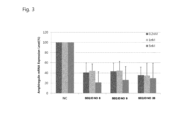
- the expression amount of the target gene in the cell treated with each of the amphiregulin ( Homo sapiens )-specific SAMiRNAs was relatively quantified by using the ⁇ Ct value and Calculation Equation, 2(- ⁇ Ct) ⁇ 100 ( FIG. 8 ).
- the expression amount of the target gene in the cell treated with each of the stratifin ( Homo sapiens )-specific SAMiRNAs was relatively quantified ( FIG. 9 ) .
- an siRNA according to the present invention may significantly efficiently inhibit expression of a respiratory disease-related gene, particularly, amphiregulin or stratifin
- the siRNA according to the present invention a double-stranded oligo RNA structure containing the same, and a nanoparticle containing the double-stranded oligo RNA structure may be usefully used to prevent or treat fibrosis or respiratory diseases.
Landscapes
- Health & Medical Sciences (AREA)
- Life Sciences & Earth Sciences (AREA)
- Engineering & Computer Science (AREA)
- Chemical & Material Sciences (AREA)
- Organic Chemistry (AREA)
- Bioinformatics & Cheminformatics (AREA)
- Genetics & Genomics (AREA)
- General Health & Medical Sciences (AREA)
- Biomedical Technology (AREA)
- Medicinal Chemistry (AREA)
- Veterinary Medicine (AREA)
- Public Health (AREA)
- Pharmacology & Pharmacy (AREA)
- Animal Behavior & Ethology (AREA)
- Nuclear Medicine, Radiotherapy & Molecular Imaging (AREA)
- General Chemical & Material Sciences (AREA)
- Chemical Kinetics & Catalysis (AREA)
- Biotechnology (AREA)
- Molecular Biology (AREA)
- Zoology (AREA)
- Wood Science & Technology (AREA)
- General Engineering & Computer Science (AREA)
- Pulmonology (AREA)
- Microbiology (AREA)
- Biochemistry (AREA)
- Physics & Mathematics (AREA)
- Plant Pathology (AREA)
- Biophysics (AREA)
- Endocrinology (AREA)
- Epidemiology (AREA)
- Heart & Thoracic Surgery (AREA)
- Immunology (AREA)
- Physical Education & Sports Medicine (AREA)
- Otolaryngology (AREA)
- Gastroenterology & Hepatology (AREA)
- Urology & Nephrology (AREA)
- Cardiology (AREA)
- Pharmaceuticals Containing Other Organic And Inorganic Compounds (AREA)
- Medicinal Preparation (AREA)
Description
- The present invention relates to a novel double strand oligo RNA and pharmaceutical compositions as defined in
claims 1 to 7 and 9 for use in preventing or treating fibrosis or respiratory diseases containing the same, and a nanoparticle containing the high-efficiency double-stranded oligo RNA structure. More particularly, the present invention relates to an siRNA which has a structure in which a hydrophilic material and a hydrophobic material are conjugated to both ends of a double-stranded oligo RNA (siRNA) via a simple covalent bond or linker-mediated covalent bond in order to be efficiently delivered into cells as defined inclaims 1 to 7, and may be converted into a nanoparticle form as defined inclaim 8 in an aqueous solution by hydrophobic interactions of double-stranded oligo RNA structure containing the same, and nanoparticles containing the high-efficiency double-stranded oligo RNA structure, wherein the siRNA is preferably specific for amphiregulin or stratifin, which is a respiratory disease-related gene. - In addition, the present invention relates to a pharmaceutical composition for use in preventing or treating fibrosis or respiratory diseases, containing a novel siRNA, a high-efficiency double-stranded oligo RNA structure containing the siRNA, or a nanoparticle containing the high-efficiency double-stranded oligo RNA structure, as an active ingredient as defined in
claim 10. - A technology of inhibiting expression of genes is an important tool for developing a therapeutic agent for treating diseases and verifying a target. As the related art for inhibiting expression of a target gene, technologies of transducing a transgene for the target gene have been disclosed. That is, a method of transducing a transgene in an antisense direction based on a promoter (Sheehy et al., Proc. Natl. Acad. Sci., USA, 85:8805-8808, 1988; Smith et al., Nature, 334:724-726, 1988) and a method of transducing a transgene in a sense direction based on a promoter (Napoli et al., Plant Cell, 2:279-289, 1990; van der Krol et al., Plant Cell, 2:291-299, 1990;
U.S. Patent No. 5,034,323 ;U.S. Patent No. 5,231,020 ; andU.S. Patent No. 5,283,184 ) have been disclosed. - Meanwhile, recently, it was reported that a gene inhibition or RNA interference (RNAi) phenomenon after transcription is caused by accumulation of a double-stranded RNA fragment having 20 to 25 base pairs, and the double-stranded oligo RNA is synthesized from an RNA template. The double-stranded oligo RNA fragment is named as "small interfering RNA" (hereinafter, referred to as siRNA). Thereafter, it has been demonstrated that the siRNA is an important factor that inhibits expression of genes in various organisms including mammals (Fire et al., Nature, 391:806-811, 1998; Timmons & Fire, Nature, 395:854, 1998; Kennerdell & Carthew, Cell, 95:1017-1026, 1998; Elbashir et al., Nature, 411:494-497, 2001;
WO 99/32619 WO 03/070969 WO 04/009769 -
WO 2012/102793 discloses genes and gene products encoded by these sequences that are involved in the toxicity of one or more pathogens, or are otherwise associated with the life cycle of a pathogen. Furthermore, methods of decreasing infection by administering said genes or gene products are described. -
WO 2013/103249 discloses a high-efficiency nanoparticle-type double-helical oligo-RNA structure with enhanced cell delivery efficiency and improved cell membrane penetration function, which can be used in the treatment of cancer and infectious diseases. - In addition, siRNA complementarily bind to the target mRNA to regulate expression of the target gene in a sequence-specific manner, it can be advantageously used in a remarkably enlarged as compared to conventional antibody-based drugs or small molecule drugs (Progress Towards in Vivo Use of siRNAs: MOLECULAR THERAPY: 2006 13(4):664-670).
- In spite of excellent effects and various usage ranges of the siRNA, but in order to develop the siRNA as a therapeutic agent, it is required to improve the in vivo stability and intracellular delivery efficiency of siRNA so as to effectively deliver siRNA into its target (Harnessing In Vivo siRNA Delivery for Drug Discovery and Therapeutic Development: Drug Discov. Today: 2006 Jan; 11(1-2):67-73).
- In order to improve in vivo stability of siRNA problems associated with innate immune stimulation problem of the siRNA, research into a technology of modifying some nucleotides or a backbone of the siRNA so as to have resistance against nuclease or using a carrier such as a viral vector, liposome, nanoparticles have been actively conducted.
- Delivery system using the viral vector such as adenovirus or retrovirus has high transfection efficiency, but immunogenicity and oncogenicity are also high. On the other hand, a non-viral delivery system containing nanoparticles are evaluated to have low intracellular delivery efficiency compared to a viral delivery system, but has advantages, including high safety in vivo, target-specific delivery, have an improved delivery efficiency due to uptake and internalization of RNAi oligonucleotide contained therein by cells or tissue, and does not almost cause cytotoxicity and immune stimulation, such that currently, the non-viral delivery system has been evaluated as a potential delivery system as compared to the viral delivery system (Nonviral Delivery of Synthetic siRNAs In Vivo, J. Clin. Invest: 2007 December 3; 117(12):3623-632).
- Among the non-viral delivery systems, in a method using a nanocarrier, nanoparticles are formed using various polymers such as liposome, a cationic polymer complex, and the like, and then siRNA is supported on these nanoparticles, that is, the nanocarriers to thereby be delivered into cells. In the methods using the nanocarrier, polymeric nanoparticles, polymer micelles, lipoplexes, and the like are mainly used. Among them, the lipoplex is composed of a cationic lipid and interacts with an anionic lipid of endosome in cells to destabilize endosome, thereby serving to deliver the siRNA into the cells.
- Further, it was known that the efficiency of the siRNA in vivo can be increased by conjugating a chemical compound or the like to an end region of a passenger (sense) strand of the siRNA to allow the siRNA to have improved pharmacokinetic characteristics(Nature 11; 432(7014): 173-8, 2004). Here, stability of the siRNA is changed depending on properties of the chemical bound to an end of a sense (passenger) or antisense (guide) strand of the siRNA. For example, an siRNA conjugated with a polymer compound such as polyethylene glycol (PEG) interacts with an anionic phosphate group of the siRNA in a presence of a cationic material to form a complex, thereby serving as a carrier having improved siRNA stability (J. Control Release 129(2): 107-16, 2008). Particularly, since micelles made of a polymer complex have a structure spontaneously formed while having significantly small sizes and significantly uniform distribution as compared to microsphere, nanoparticles, or the like, which is another system used as a drug delivery carrier, there are advantages in that quality of a product may be easily managed and reproducibility may be easily secured.
- Further, in order to improve intracellular delivery efficiency of the siRNA, a technology for securing stability of the siRNA and implementing efficient cell membrane permeability using an siRNA conjugate obtained by conjugating a hydrophilic material (for example, polyethylene glycol (PEG)), which is a biocompatible polymer, to the siRNA via a simple covalent bond or a linker-mediated covalent bond has been developed (
Korean Patent No. 883471 Korean Patent No. 1224828 - Chronic obstructive pulmonary disease (hereinafter, referred to as 'COPD'), which is one of the representative pulmonary diseases together with asthma, is different from asthma in that COPD is accompanied by irreversible airway obstruction, and is a respiratory disease characterized by abnormal inflammatory responses in the lung, caused by repetitive infection, inhalation of harmful particles and gases, or smoking, and air flow limitation corresponding thereto, which is not completely reversible and is progressive (Am. J. Respir. Crit. Care Med., 163:1256-1276, 2001). The severity of COPD is emerging around the world. The reason is that in 1990, COPD ranked sixth place among causes of death due to disease, but it is predicted that in 2020, COPD will rank third place, and has become a disease of which an incidence rate is uniquely increased among the top 10 diseases. Further, since COPD is predicted to rank fourth place among causes of disabilities due to diseases, it is expected that social and financial burden due to COPD will rapidly increase (Lancet, 349:1498-1504, 1997). COPD, which is a disease caused by pathological changes in the bronchioles and pulmonary parenchyma due to airway and pulmonary parenchymal inflammation, is characterized by obstructive bronchiolitis and emphysema (destruction of the pulmonary parenchyma). Types of COPD include chronic obstructive bronchitis, chronic bronchiolitis, and emphysema. In the case of COPD, the number of neutrophils is increased, and cytokines such as granulocyte macrophage colony-stimulating factor (GM-CSF), tumor necrosis factor (TNF)-α, interleukin (IL)-8, and macrophage inflammatory protein (MIP)-2 are secreted. Inflammation occurs in the airway, the muscle wall becomes thick, and mucus secretion is increased, thereby causing bronchial obstruction. When the bronchus is obstructed, the lung sac is expanded and damaged, such that, an exchange ability of oxygen and carbon dioxide is damaged, and occurrence of respiratory failure is increased. Even though 8% of adults over the age of 45 are COPD patients in Korea, medical treatment is biased toward only lung cancer, and as a method of treating COPD according to the related art, a therapeutic agent having an anti-inflammatory effect or a bronchodilatory effect is used. However, essential prevention and treatment for COPD using a gene therapeutic agent is not yet sufficiently developed. A representative example of the therapeutic agents having the anti-inflammatory effect includes glucocorticoid, leukotriene modifiers, theophylline, and the like. However, since the glucocorticoid has potent effects, but is administered by inhalation due to its side effects, and it does not selectively inhibit inflammatory reactions, but inhibit all immune responses and anti-inflammatory responses, in some cases, necessary immune responses may also be inhibited. Since side effects of the leukotriene modifier is small, but there is a limitation in the effect thereof, and when the leukotriene modifier is used alone, it is impossible to regulate asthma. Therefore, in most cases, the leukotriene modifiers are auxiliary used. Theophylline has a problem in that effects are not excellent and there is a risk of side effects. Therefore, the demand for a novel therapeutic agent capable of having excellent effects of preventing and treating COPD and decreasing side effects has been urgently required.
- Meanwhile, idiopathic pulmonary fibrosis (hereinafter, referred to as "IPF'), which is a kind of fibrosis, is a disease in which chronic inflammatory cells penetrate into a wall of the lung sac (alveola) to cause various changes by making the lung become hard, which causes severe structural changes in the lung tissue, such that lung functions are gradually deteriorated to thereby ultimately result in death. However, an effective treatment thereof does not exist yet, and IPF is generally diagnosed only when symptoms appear, and has extremely bad prognosis since a median survival time is only about three to five years. It is reported that an incidence frequency of IPF is about 3 to 5 per 100,000 people in foreign countries, and it is known that mostly, an incidence rate of IPF is increased over the age of 50, and the incidence rate of IPF in men is 2 times higher than that in women.
- The cause of IPF has not been yet clearly identified, and it was merely reported that the incidence of IPF is high in smokers, and anti-depressants, chronic lung inhalation due to gastro esophageal reflux, metal dust, wood dust, solvent inhalation, or the like, is a risk factor related to occurrence of IPF. However, factors having a certain causal factors cannot be found in the majority of patients.
- It is known that when IPF is not treated, IPF is continuously worsened, and thus, about 50% or more of patients die within 3 to 5 years. In addition, once a lung is completely hardened by fibrosis as the disease progresses, even when any type of treatment is conducted, a patient does not improve. Therefore, it is predicted that even though treatment is conducted, only when treatment is conducted at an early stage, a possibility for an effect to be exhibited will be increased. As the currently used therapeutic agent, a combination therapy method using steroid and azathioprine or cyclophosphamide, has been known, but it is difficult to say that there are special effects, and attempts of several fibrosis inhibitors in animal experiments and small group of patients failed in proving clear effects. Particularly, there is no other effective therapeutic method in patients with end-stage IPF except for lung transplantation. Therefore, the development of a more efficient therapeutic agent for IPF has been urgently required.
- Diseases in which for some reason, tissue or organs are consolidated due to excessive fibrosis of connective tissue are collectively referred to as fibrosis, and all processes of fibrosis are the same as those of scar treatment regardless of a site. It has been almost impossible to completely cure fibrosis symptoms up to now, and a method of treating fibrosis has still been developed and studied. An effective therapeutic agent for fibrosis may also be applied to various diseases accompanied with fibrosis as well as cirrhosis, myelofibrosis, myocardial fibrosis, renal fibrosis, and pulmonary fibrosis, which are representative fibrosis diseases. Therefore, the development of an efficient therapeutic agent for fibrosis has been urgently required.
- Meanwhile, it is known that amphiregulin binds to an epithelial growth factor receptor (EGFR) to activate an EGFR pathway and participates in cell proliferation, and the fact that expression of amphiregulin may be inhibited by an amphiregulin-specific siRNA, and the amphiregulin-specific siRNA may have a therapeutic effect for specific type breast cancer has been disclosed (Cancer Res., 2008;68:225-2265). Further, it was reported that cell penetration in inflammatory breast cancer may be suppressed using a shRNA for amphiregulin (J. Cell Physiol., 2011, 226(10):2691-2701), and when expression of amphiregulin is inhibited using an amphiregulin-specific shRNA, pulmonary artery remodeling is suppressed in mice exposed to cigarette smoke. It was reported that amphiregulin is related to airway smooth muscle (ASM) hyperplasia and angiogenesis, and particularly promotes airway remodeling in asthma patients, and an epidermal growth factor (EGF) excessively secreted in tissue remodeling in acute asthma and amphiregulin are associated with each other.
- In addition, it was reported that stratifin (14-3-3 sigma protein or SFN) participates in various intercellular functions such as cell cycle, apoptosis, signaling mechanism regulation, cellular trafficking, cell proliferation and differentiation, cell survival, and the like (Mol. Cell Biochem., 2007, 305:255-64), and participates in TGF-beta 1-mediated growth inhibition using a stratifin-specific siRNA (Mol. Cell, 2010; .2; 305-309). In addition, it was reported that a factor regulating formation and decomposition of collagen participates in the airway remodeling in asthma, and particularly, metalloproteinase (MMP)-1 performs an important function in decomposition of collagen, and one of the important factors regulating expression of MMP-1 in the airway is stratifin.
- As described above, possibilities of amphiregulin and stratifin as targets for treating respiratory diseases and fibrosis, particularly, COPD and idiopathic pulmonary fibrosis have been suggested, but until now, an siRNA therapeutic agent for amphiregulin and stratifin and a delivery technology of the an siRNA therapeutic agent have not been sufficiently developed. Therefore, the demand for an siRNA therapeutic agent capable of specifically and highly efficiently inhibiting expression of amphiregulin and stratifin, and a delivery technology thereof is significantly high on the market.
- An object of the present invention is to provide a novel double-stranded oligo RNA comprising an siRNA, capable of specifically and highly efficiently inhibiting a specific gene, a double-stranded oligo RNA structure containing the same as defined in
claims 1 to 7, and a nanoparticle containing the double-stranded oligo RNA structure as defined inclaim 8. - Another object of the present invention is to provide a pharmaceutical composition for use in preventing or treating fibrosis or respiratory diseases, containing the siRNA, the double-stranded oligo RNA structure containing the siRNA, or the nanoparticle containing the double-stranded oligo RNA structure, as an active ingredient as defined in
claim 10. -
-
FIG. 1 is a mimetic view of a nanoparticle containing a double-stranded oligo RNA structure according to the present invention. -
FIG. 2 , which illustrates results obtained by quantitatively analyzing expression amounts of amphiregulin mRNA in Example 4, is a graph illustrating relative expression amounts (%) of amphiregulin mRNA confirmed after transforming mouse fibroblast cell lines with 30 kinds of mice amphiregulin-specific siRNAs having the sequences of SEQ ID NOS: 1 to 30 according to the present invention as sense strands, respectively, at a concentration of 20nM. NC indicates an expression amount of amphiregulin mRNA in a total RNA obtained in a cell line (control group) which was not treated with the mouse amphiregulin-specific siRNA, and relative expression amounts of the amphiregulin mRNA depending on the respective siRNAs measured based on the NC (100%) are illustrated inFIG. 2 . -
FIG. 3 , which illustrates results obtained by quantitatively analyzing expression amounts of amphiregulin mRNA in Example 6, is a graph illustrating relative expression amounts (%) of amphiregulin mRNA confirmed after transforming mouse fibroblast cell lines with siRNAs having the sequences of SEQ ID NOS: 8, 9, and 28 according to the present invention as sense strands, respectively, at different concentrations of the siRNAs (0.2, 1, and 5nM). -
FIG. 4 , which illustrates results obtained by quantitatively analyzing expression amounts of amphiregulin mRNA in Example 7, is a graph illustrating relative expression amounts (%) of amphiregulin mRNA confirmed after transforming human lung tumor cell lines with 100 kinds of human amphiregulin-specific siRNAs having the sequences of SEQ ID NOS: 31 to 130 according to the present invention as sense strands, respectively, at a concentration of 1nM. -
FIG. 5 , which illustrates results obtained by quantitatively analyzing expression amounts of stratifin mRNA in Example 7, is a graph illustrating relative expression amounts (%) of stratifin mRNA confirmed after transforming human lung tumor cell lines with 100 kinds of human stratifin-specific siRNAs having the sequences of SEQ ID NOS: 231 to 330 according to the present invention as sense strands, respectively, at a concentration of 1nM. -
FIG. 6 , which illustrates results obtained by quantitatively analyzing expression amounts of amphiregulin mRNA in Example 8, is a graph illustrating relative expression amounts (%) of amphiregulin mRNA in transformed cell lines after transforming lung cancer cell lines with 26 kinds of human amphiregulin-specific siRNAs having the sequences of SEQ ID NOS: 40, 42, 43, 45, 46, 52, 53, 58, 59, 61, 63, 65, 69, 75, 79, 80, 81, 91, 92, 94, 98, 102, 115, 117, 120, and 128 according to the present invention as sense strands, respectively, at a concentration of 0.2 nM. -
FIG. 7 , which illustrates results obtained by quantitatively analyzing expression amounts of stratifin mRNA in Example 8, is a graph illustrating relative expression amounts (%) of stratifin mRNA in transformed cell lines after transforming lung cancer cell lines with 47 kinds of human stratifin-specific siRNAs having the sequences of SEQ ID NOS: 231, 234, 238, 241, 242, 243, 244, 245, 246, 247, 248, 249, 250, 251, 252, 253, 254, 255, 257, 258, 260, 261, 262, 263, 267, 268, 270, 272, 273, 275, 278, 283, 284, 290, 297, 299, 300, 302, 303, 307, 311, 314, 320, 324, 326, 327, and 328 according to the present invention as sense strands, respectively, at a concentration of 0.2 nM. -
FIG. 8 , which illustrates results obtained by quantitatively analyzing expression amounts of amphiregulin mRNA in Example 9, is a graph illustrating relative expression amounts (%) of amphiregulin mRNA in transformed cell lines after transforming human lung cancer cell lines with 3 kinds of human amphiregulin-specific SAMiRNA having the sequences of SEQ ID NOS: 79, 80, and 91 according to the present invention as the sense strands, respectively, at different concentrations of 100, 200, and 500 nM. -
FIG. 9 , which illustrates results obtained by quantitatively analyzing expression amounts of stratifin RNA in Example 9, is a graph illustrating relative expression amounts (%) of stratifin mRNA in transformed cell lines after transforming human lung cancer cell lines with 5 kinds of human stratifin-specific SAMiRNA having the sequences of SEQ ID NOS: 248, 257, 268, 290, and 327 as the sense strands, respectively, at different concentrations of 50, 100, and 200 nM. - Unless otherwise defined herein, all of the technical and scientific terms used in the present specification have the same meanings as those generally understood by specialists in the skilled art to which the present invention pertains. Generally, nomenclature used in the present specification is well known and commonly used in the art.
- In order to achieve the above-mentioned object, the present invention provides an siRNA comprising a sense strand having the sequence SEQ ID NO.: 107 and an antisense strand having a sequence complementary thereto.
- In particular, the present invention provides a double-stranded oligo RNA structure comprising a structure represented by the following
Structural Formula 1,
[Structural Formula 1] A-X-R-Y-B
- wherein R is said siRNA,
- wherein A is a hydrophilic material represented by the following Structural Formula 4:
[Structural Formula 4] (A'm -J)n
- with the proviso that the hydrophilic material A is not polyethylene glycol, polyvinyl pyrrolidone or polyoxazoline,
- wherein A' is a hydrophilic material monomer, J is a linker linking m hydrophilic material monomers to each other or linking m hydrophilic material monomers and the siRNA to each other, m is an integer of 1 to 15, n is an integer of 1 to 10, wherein A' is a compound selected from Compounds (1) and (3) represented as follows:

- wherein G is selected for the group consisting of CH2, O, S and NH,

- wherein J is selected from the group consisting of PO3-, SO3, and CO2,
- B is a hydrophobic material, X and Y are each independently a simple covalent bond or linker-mediated covalent bond, and the siRNA R comprises a sense strand and an antisense strand, wherein the sense strand and the antisense strand consist of 19 nucleotides, wherein the sense strand has the sequence SEQ ID NO.: 107 and the antisense strand has a sequence complementary thereto.
- Further, the present invention provides a nanoparticle comprising the double-stranded oligo RNA structure as defined in
claim 1, wherein the nanoparticle preferably comprises mixture of double-stranded oligo RNAs comprising siRNAs having different sequences from each other. - In addition, the present invention provides a pharmaceutical composition comprising the double-stranded oligo RNA as defined in
claim 1, or the nanoparticle as defined inclaim 8 as an active ingredient or a lyophilized formulation thereof. In one embodiment, the pharmaceutical composition or lyophilized formulation thereof is provided for use in preventing or treating fibrosis or respiratory diseases, comprising the siRNA, the double-stranded oligo RNA structure, or the nanoparticle. - In the present invention, a novel amphiregulin- or stratifin-specific siRNA was prepared. As a result, it was confirmed that since the novel amphiregulin- or stratifin-specific siRNA has a base sequence designed so as to complementarily bind to an mRNA encoding amphiregulin or stratifin, the novel amphiregulin- or stratifin-specific siRNA may effectively inhibit expression of amphiregulin or stratifin.
- In one aspect, the present invention relates to an siRNA comprising a sense strand (first oligonucleotide) having the sequence of SEQ ID NO: 107 and an antisense strand (second oligonucleotide) having a sequence complementary thereto.
5'-ctgggaagcgtgaaccatt-3' (SEQ ID NO: 107), - In the present specification, the term "siRNA" means an siRNA specific for a specific gene (for example, a respiratory disease-related gene), wherein the siRNA comprises a sense strand and an antisense strand, wherein the sense strand and the antisense strand consist of 19 nucleotides, wherein the sense strand has the sequence SEQ ID NO.: 107 and the antisense strand has a sequence complementary thereto.
- In the present invention, the sense or antisense strand consists of 19 nucleotides, wherein the sense strand has the sequence SEQ ID NO.: 107 and the antisense strand has a sequence complementary thereto.
- In the present invention, one or more phosphate groups, preferably, 1 to 3 phosphate groups are bound to a 5'-end of the antisense strand of the siRNA.
- In another aspect, the present invention relates to a double-stranded oligo RNA structure comprising a structure represented by the following
Structural Formula 1,
[Structural Formula 1] A-X-R-Y-B
- wherein R is said siRNA,
- wherein A is a hydrophilic material represented by the following Structural Formula 4:
(A'm -J)n ,
- with the proviso that the hydrophilic material A is not polyethylene glycol, polyvinyl pyrrolidone or polyoxazoline,
- wherein A' is a hydrophilic material monomer, J is a linker linking m hydrophilic material monomers to each other or linking m hydrophilic material monomers and the siRNA to each other, m is an integer of 1 to 15, n is an integer of 1 to 10, wherein A' is a compound selected from Compounds (1) and (3) represented as follows:

- wherein G is selected for the group consisting of CH2, O, S and NH,

- wherein J is selected from the group consisting of PO3-, SO3, and CO2,
- B is a hydrophobic material, X and Y are each independently a simple covalent bond or linker-mediated covalent bond, and the siRNA R comprises a sense strand and an antisense strand, wherein the sense strand and the antisense strand consist of 19 nucleotides, wherein the sense strand has the sequence SEQ ID NO.: 107 and the antisense strand has a sequence complementary thereto.
- A form of the double-stranded oligo RNA according to the present invention may be preferably a short interfering RNA (siRNA), a short hairpin RNA (shRNA), microRNA (miRNA), and the like, but is not limited thereto. A single-stranded miRNA inhibitor capable of serving as an antagonist for the miRNA may be also included therein.
- Hereinafter, the siRNA will be mainly described as the double-stranded oligo RNA according to the present invention. In the present invention, the double-stranded oligo RNA structure may comprise a structure represented by the following
Structural Formula 2, wherein, in the followingStructural Formula 2, S and AS are a sense strand and an antisense strand of the siRNA ofStructural Formula 1, respectively, and A, B, X, and Y have the same definitions as those inStructural Formula 1.
- In the present invention, the double-stranded oligo RNA structure may comprise a structure represented by the following
Structural Formula 3, wherein, in the followingStructural Formula 3, A, B, X, Y, S, and AS have the same definitions as those inStructural Formula 2, and 5' and 3' are a 5'-end and 3'-end of the sense strand of the siRNA, respectively.
- In the present invention, the double-stranded oligo RNA structure comprises a respiratory disease-related gene-specific siRNA according to the present invention. According to the present invention, in
Structural Formulas 1 to 3, an shRNA may be used instead of the siRNA, which is obvious to those skilled in the art. - Particularly, the hydrophilic material A in
Structural Formulas 1 to 3 is used in a form of a hydrophilic material block as represented by the followingStructural Formula 4, with the proviso that the hydrophilic material A is not polyethylene glycol, polyvinyl pyrrolidone or polyoxazoline and problems caused by polydispersity that may occur in a case of using a general synthetic polymer material, or the like, may be significantly solved by using an appropriate number of hydrophilic material blocks as described above (the appropriate number is represented as n in Structural Formula 4) as needed.
[Structural Formula 4] (A'm -J)n
- In
Structural Formula 4, A' is a hydrophilic material monomer, wherein A' is a compound selected from Compounds (1) and (3) represented as follows:


- J is a linker linking m hydrophilic material monomers to each other (the number of hydrophilic material monomers is m) or linking m hydrophilic material monomers and the siRNA to each other selected from the group consisting of PO3-, SO3, and CO2, m is an integer of 1 to 15, n is an integer of 1 to 10, and the repeating unit represented by (A'm-J) corresponds to a base unit of the hydrophilic material block.
- A monomer selected from Compounds (1) and (3) illustrated in Table 1 is used, more preferably, the monomer of Compound (1) may be used, wherein in Compound (1), G is selected from CH2, O, S, and NH.
- Particularly, among the hydrophilic material monomers, the monomer of Compound (1) has advantages in that various functional groups may be introduced thereinto, and the monomer of Compound (1) may have good affinity in vivo, and induce little immune response, etc. to thereby have excellent bio-compatibility, and increase stability in vivo of oligo nucleotides included in the structures represented by
Structural Formulas 1 to 3 and increase delivery efficiency, such that the monomer of Compound (1) is significantly suitable for preparing the structure according to the present invention.[Table 1] Structure of Hydrophilic Material Monomer in the Present Invention Compound (1) Compound (3) 

- It is preferable that a total molecular weight of the hydrophilic material in
Structural Formulas 1 to 3 is in a range of 1,000 to 2,000. Therefore, for example, in the case in which hexaethylene glycol is used as the monomer of Compound (1), since a molecular weight of a hexaethylene glycol spacer is 344, a repetition number (n) is preferably 3 to 5. - Particularly, according to the present invention, if necessary, the repeating unit of the hydrophilic group represented by (A'm-J) in
Structural Formula 4, that is, the hydrophilic material block may be used in an appropriate number represented by n. A', which is the hydrophilic material monomer included in respective hydrophilic material blocks, and J are each independently the same as or different from those in respective hydrophilic material blocks. That is, when three hydrophilic material blocks are used (n=3), for example, the hydrophilic material monomer of Compound (1) may be used in the first block, the hydrophilic material monomer of Compound (2) may be used in the second block, and the hydrophilic material monomer of Compound (3) may be used in the third block. That is, different hydrophilic material monomers are used in the respective hydrophilic material blocks. Alternatively, any one selected from the hydrophilic material monomers of Compounds (1) and (3) may also be equally used in all of the hydrophilic material blocks. Similarly, in the case of the linker mediating the binding between the hydrophilic material monomers, linkers used in the respective hydrophilic material blocks may also be the same as each other or different from each other. In addition, m, the number of hydrophilic material monomers, may be the same as each other or different from each other in the respective hydrophilic material blocks. That is, for example, three hydrophilic material monomers are linked in a first hydrophilic material block (m=3), five hydrophilic material monomers are linked in a second hydrophilic material block (m=5), four hydrophilic material monomers are linked in a third hydrophilic material block (m=4), etc. That is, different numbers of hydrophilic material monomers may be used in all of the hydrophilic material blocks. Alternatively, the same number of hydrophilic material monomers may be used in all of the hydrophilic material blocks. - Further, the linker J is selected from the group consisting of PO3 -, SO3, and CO2.
- In the present invention, the hydrophobic material may be a steroid derivative, a glyceride derivative, glycerol ether, polypropylene glycol, an unsaturated or saturated (C12-C50) hydrocarbon, diacylphosphatidylcholine, fatty acid, phospholipid, lipopolyamine, lipid, tocopherol, or tocotrienol, wherein the steroid derivative may be cholesterol, cholestanol, cholic acid, cholesteryl formate, chotestanyl formate, or cholestanyl amine, the glyceride derivative may be mono-, di- or tri-glyceride, the lipid may be cationic lipid, anionic lipid, or hydrophobic lipid. In addition, a molecular weight of the hydrophobic material may be preferably 250 to 1,000, but is not limited thereto. In the present invention, the hydrophobic material is bound to an opposite distal end of the hydrophilic material, and it does not matter if the hydrophobic material is bound to any position of the sense strand or the antisense strand of the siRNA.
- In the present invention, the covalent bonds represented by X and Y may be a non-degradable bond or degradable bond. The non-degradable bond may be an amide bond or phosphorylation bond, and the degradable bond may be a disulfide bond, an acid degradable bond, an ester bond, an anhydride bond, a biodegradable bond or an enzymatically degradable bond, but the present invention is not limited thereto. The linker mediating the covalent bond is not particularly limited as long as the linker may be covalently bound to the hydrophilic material or the hydrophobic material and the end of the amphiregulin or stratifin-specific siRNA, and the bond capable of being decomposed in a specific environment is provided. Therefore, any compound binding the hydrophilic material or hydrophobic material in order to activate the amphiregulin or stratifin-specific siRNA may be used.
- In another aspect, the present invention relates to a nanoparticle comprising a double-stranded oligo RNA structure according to the present invention, or to the nanoparticle as an active ingredient, or a lyophilized formulation thereof. The double-stranded oligo RNA structure according to the present invention forms self-assembling nanoparticles by a hydrophobic interaction of the hydrophobic materials (
Korean Patent Pulication No. 1224828 - More specifically, the double-stranded oligo RNA structure comprising the amphiregulin or stratifin-specific siRNA is amphipathic structure containing both of the hydrophobic material and the hydrophilic material, wherein hydrophilic portions have affinity through an interaction such as a hydrogen bond, and the like, with water molecules present in the body to be toward the outside and the hydrophobic materials are toward the inside by the hydrophobic interaction therebetween, thereby forming a thermodynamically stable nanoparticle. That is, the hydrophobic material is positioned in the center of the nanoparticle and the hydrophilic material is positioned in an outward direction of the amphiregulin or stratifin-specific siRNA, thereby forming the nanoparticle in a form in which the nanoparticle protects the amphiregulin or stratifin-specific siRNA. The nanoparticle formed as described above may improve intracellular delivery of the amphiregulin or stratifin-specific siRNA and efficiency of the amphiregulin or stratifin-specific siRNA.
- In the present invention, the nanoparticle may comprise only a double-stranded oligo RNA structure comprising an siRNA having the same sequence, or formed of a mixture of double-stranded oligo RNA structures comprising siRNAs having different sequences from each other.
- In another aspect, the present invention provides a pharmaceutical composition or lyophilized formulation thereof for use in preventing or treating fibrosis or respiratory diseases, comprising the siRNA, the double-stranded oligo RNA structure, or the nanoparticle according to the present invention as an active ingredient.
- The pharmaceutical composition for use in preventing or treating fibrosis or respiratory diseases may have an effect of preventing or treating fibrosis or respiratory diseases by suppressing connective tissue remodeling, particularly, pulmonary artery remodeling and air way remodeling.
- In the present invention, the respiratory disease may be selected from COPD, asthma, acute or chronic bronchitis, allergic rhinitis, cough and phlegm, bronchitis, bronchiolitis, pharyngitis, tonsillitis, and laryngitis, and fibrosis may be selected from IPF, cirrhosis, myelofibrosis, myocardial fibrosis, renal fibrosis, pulmonary fibrosis, lung cancer, and the like, but the respiratory disease and fibrosis are not limited thereto.
- The pharmaceutical composition according the present invention may be prepared by additionally adding one or more pharmaceutically acceptable carriers for administration in addition to the active ingredient as described above. The pharmaceutically acceptable carrier needs to be compatible with the active ingredient according to the present invention, and a mixture of one or two or more ingredients selected from saline, sterile water, Ringer's solution, buffered saline, a dextrose solution, a maltodextrin solution, glycerol, and ethanol, may be used. In addition, other conventional additives such as an antioxidant, a buffer, a bacteriostatic agent, and the like, may be added thereto as needed. In addition, the composition may be formulated as a formulation for injection, such as an aqueous solution, suspension, emulsion, and the like, by additionally adding a diluent, a dispersant, a surfactant, a binder, and a lubricant thereto. Particularly, it is preferred to provide the composition prepared as a lyophilized formulation. In order to prepare the lyophilized formulation, any method generally known in the technical field to which the present invention pertains may be used, wherein a stabilizer for lyophilization may be added thereto. In addition, the composition may be preferably formulated depending on each disease or ingredient using appropriate methods in the art or a method disclosed in Remington's Pharmaceutical Science (Mack Publishing Company, Easton PA.).
- The pharmaceutical composition according to the present invention may be determined by those skilled in the art based on the condition of the patient and the severity of the disease. Further, the composition may be formulated into various forms including powders, tablets, capsules, solutions, injections, ointments, syrups, and the like, and may be provided as a unit-dose container or a multi-dose container, for example, a sealed ampoule, bottle, and the like.
- The pharmaceutical composition according to the present invention may be, for example, orally or parenterally administered. An example of an administration route of the composition according to the present invention may include oral, intravenous, intramuscular, intraarterial, intramedullary, intradural, intracardiac, transdermal, subcutaneous, intraperitoneal, intestinal, sublingual or topical administration route, but is not limited thereto. Particularly, the composition according to the present invention may also be administered into the lung via drip infusion in the bronchus for treatment of respiratory diseases. An administration dose of the composition according to the present invention may have various ranges depending on a weight, an age, gender, a health condition, diet, an administration time, an administration method, an excretion rate, or severity of a disease, and the like, of a patient, and be easily determined by a general expert skilled in the art. Further, the composition according to the present invention may be formulated into an appropriate formulation for clinical administration using a method known in the art.
- In another aspect, the present invention relates to a lyophilized formulation comprising the pharmaceutical composition according to the present invention.
- Hereinafter, the present invention will be described in detail through the Examples. However, these Examples are only to illustrate the present invention, and those skilled in the art will appreciate that these Examples are not to be construed as limiting a scope of the present invention. Therefore, the substantial scope of the present invention is defined by the accompanying claims
- Target base sequences (sense strands) capable of binding to an mRNA sequence (NM_001657.2) of amphiregulin gene (Homo sapiens), an mRNA sequence (NM_006142.2) of stratifin gene (Homo sapiens), an mRNA sequence (NM_009704.2) of amphiregulin gene (Mus musculus), and an mRNA sequence (NM_018754.2) of stratifin gene (Mus musculus) were designed, and siRNAs of antisense strands having sequences complementary to the target base sequences were prepared.
- First, a gene design program (Turbo si-Designer) developed by Bioneer Co., was used to design the target base sequences to which the siRNA may bind from mRNA sequences of the corresponding genes. The amphiregulin and stratifin-specific siRNAs according to the present invention have a double stranded structure including a sense strand consisting of 19 nucleotides and an antisense strand complementary thereto. Further, siCONT (CUUACGCUGAGUACUUCGA (SEQ ID NO: 331) as a sense strand), an siRNA having a sequence which does not cause inhibition of expression of any gene, was prepared. The siRNA was prepared by linking phosphodiester bonds forming an RNA backbone structure using β-cyanoethyl phosphoramidite (Nucleic Acids Research, 12: 4539-4557, 1984). Specifically, a reaction product including an RNA having a desired length was obtained by repeatedly performing a series of processes of deblocking, coupling, oxidation and capping, on a solid support to which nucleotide was attached, using an RNA synthesizer (384 Synthesizer, BIONEER, Korea). The RNA of the reaction product was separated and purified by HPLC LC918 (Japan Analytical Industry, Japan) equipped with a Daisogel C18 (Daiso, Japan) column, and it was confirmed whether or not the purified RNA meets the target base sequence by MALDI-TOF mass spectrometer (Shimadzu, Japan). Then, an siRNA having any one sequence selected from SEQ ID NOS: 1 to 331 to be desired as a sense strand was prepared by binding the RNA sense and antisense strands to each other.
- A double-stranded oligo RNA structure (SAMiRNA LP) prepared in the present invention has a structure represented by the following
Structural Formula 5.

- In
Structural Formula 5, S is a sense strand of the siRNA; AS is an antisense strand of the siRNA; PEG, which is a hydrophilic material, is polyethylene glycol; C24, which is a hydrophobic material, is tetradocosane including a disulfide bond; and 5' and 3' mean directions of the double-stranded oligo RNA end. - In order to prepare the sense strand of the siRNA of
Structural Formula 5, after a double-stranded oligo RNA-hydrophilic material structure of a sense strand of which polyethylene glycol was bound to a 3'-end was synthesized by a method of linking phosphodiester bonds forming an RNA backbone structure using β-cyanoethyl phosphoramidite as in the above-mentioned method, based on 3' polyethylene glycol (PEG, Mn=2,000)-CPG prepared by a method in Example 1 disclosed in the existing Patent Document (Korean Patent Laid-Open Publication No. 10-2012-0119212 - When the synthesis was completed, the RNA single strand and the RNA-polymer structure synthesized by treating 28% (v/v) ammonia in a water bath at 60°C were separated from the CPG, and protecting moieties were removed therefrom by a deprotection reaction. The RNA single strand and the RNA-polymer structure from which the protecting moieties were removed were treated with N-methylpyrrolidone, triethylamine, and triethylaminetrihydrofluoride at a volume ratio of 10:3:4 in an oven at 70°C, thereby removing tertbutyldimethylsilyl (2'TBDMS).
- The RNA of the reaction product was separated and purified by HPLC LC918 (Japan Analytical Industry, Japan) equipped with a Daisogel C18 (Daiso, Japan) column, and it was confirmed whether or not the purified RNA meets the target base sequence by MALDI-TOF mass spectrometer (Shimadzu, Japan). Then, in order to prepare each of the double-stranded oligo RNA structures, the sense strand and the antisense strand each having the same amount were mixed with each other, put into a 1X annealing buffer (30 mM 4-(2-hydroxyethyl)-1-piperazineethanesulfonic acid (HEPES), 100 mM potassium acetate, 2 mM magnesium acetate, pH 7.0 to 7.5), reacted in a constant-temperature water bath at 90°C for 3 minutes, and reacted again at 37°C, thereby preparing each of the double-stranded oligo RNA structures including siRNAs having the sequences of SEQ ID NO: 6, 9, 28, 59, 75, 79, 80, 91, 92, 102, 241, 248, 257, 258, 263, 268, 290, and 327 as the sense strands, respectively, (hereinafter, referred to as SAMiRNALP-mAR, SAMiRNALP-hAR, SAMiRNALP-hSFN, and SAMiRNALP-CONT, respectively). It was confirmed that the prepared double-stranded oligo RNA structure was annealed by electrophoresis.
- The double-stranded oligo RNA structure (SAMiRNA LP) prepared by Example 2 formed a nanoparticle, that is, a micelle by a hydrophobic interaction between the hydrophobic materials bound to the end of the double-stranded oligo RNA (
FIG. 1 ). - It was confirmed by analyzing polydispersity indexes (PDI) of the nanoparticles formed of SAMiRNALP-hAR, SAMiRNALP-hSFN, SAMiRNALP-mAR, SAMiRNALP-mSFN, and SAMiRNALP-CONT that the nanoparticle (SAMiRNA) formed of the corresponding SAMiRNA LP was formed.
- The SAMiRNALP-hAR was dissolved in 1.5 ml Dulbecco's phosphate buffered saline (DPBS) at a concentration of 50 ug/ml, the obtained mixture was freeze-dried at -75°C and 5 mTorr condition for 48 hours to prepare nanoparticle powder, and the nanoparticle powder was dissolved in DPBS (solvent), thereby preparing homogenized nanoparticles.
- Nanoparticles formed of SAMiRNALP-hSFN, SAMiRNALP-mAR, SAMiRNALP-mSFN, and SAMiRNALP-CONT were prepared by the same method.
- Sizes of the nanoparticles were measured by zeta-potential measurement. A size of the homogenized nanoparticles prepared by Example 3-1 was measured by zeta-potential measurement (Nano-ZS, MALVERN, England), under conditions in which a refractive index to the material was 1.459, an absorption index was 0.001, a temperature of DPBS (solvent) was 25°C, and the corresponding viscosity and refractive index were 1.0200 and 1.335, respectively. Once measurement was conducted by repeatedly measuring the
size 15 times, and the measurement was repeated six times. - The lower the PDI value, the more uniformly distributed the corresponding particles, and thus, it could be appreciated that the nanoparticles according to the present invention were formed to have a significantly uniform size.
- Mouse fibroblast (NIH3T3), which is a fibroblast cell line, was transformed with the amphiregulin-specific siRNAs having sequences of SEQ ID NOS: 1 to 30 as the sense strands, respectively, prepared by Example 1, and an expression pattern of amphiregulin, that is, a degree of inhibition of expression by the siRNA was analyzed in the transformed fibroblast cell line (NIH3T3).
- The mouse fibroblast cell line (NIH3T3) obtained from American Type Culture Collection (ATCC) was cultured in a RPMI 1640 culture medium (GIBCO/Invitrogen, USA, 10% (v/v) fetal bovine serum, 100 units/ml of penicillin, and 100 µg/ml of streptomycin) under condition of 37°C and 5% (v/v) CO2.
- After 1×10⁵ fibroblast cell lines cultured in Example 4-1 were cultured in a RPMI 1640 culture medium in a 12-well plate under condition of 37°C and 5% (v/v) CO2 for 18 hours, the medium was removed, and 500 µl of Opti-MEM medium (GIBCO, USA) for each well was dispensed.
- Meanwhile, a mixed solution was prepared by mixing 1.5 µl of Lipofectamine™ RNAi Max (Invitrogen, USA) and 248.5 µl of Opti-MEM medium with each other, and the mixed solution was reacted at room temperature for 5 minutes. Then, 20 µl of siRNAs (1 pmole/µl) each having any one sequence of SEQ ID NOS: 1 to 30 as the sense strand, prepared in Example 1, were added to 230 µl of Opti-MEM medium, thereby preparing siRNA solutions each having a final concentration of 20 nM. The mixed solution of Lipofectamine™ RNAi Max was mixed and reacted with the siRNA solution at room temperature for 20 minutes, thereby preparing a transfection solution.
- Then, 500 µl of each transfection solution was dispensed in each well containing the tumor cell line and Opti-MEME and incubated for 6 hours, and the Opti-MEM medium was removed. Here, 1 ml of RPMI 1640 culture medium was dispensed into each well, and incubated for 24 hours under condition of 37°C and 5% (v/v) CO2.
- After preparing cDNA by extracting a total RNA from the cell line transfected in Example 4-2, an expression amount of the amphiregulin mRNA was relatively quantified using real-time polymerase chain reaction (PCR).
- The total RNA was extracted from the cell line transfected in Example 4-2 using an RNA extraction kit (AccuPrep Cell total RNA extraction kit, BIONEER, Korea), and the extracted RNA was used to prepare cDNA by RNA reverse transcriptase (AccuPower CycleScript RT Premix/dT20, Bioneer, Korea) according to the following method. Specifically, the extracted RNA (1 µg/tube) was added to AccuPower CycleScript RT Premix/dT20 (Bioneer, Korea) contained in 0.25 ml Eppendorf tube, and distilled water treated with diethyl pyrocarbonate (DEPC) was added thereto so as to have a total volume of 20 µl. A process of hybridizing the RNA and primers at 30°C for 1 minute by a gene amplifier (MyGenie™ 96 Gradient Thermal Block, BIONEER, Korea) and a process of preparing the cDNA at 52°C for 4 minutes were repeated 6 times, and then, an amplification reaction was terminated by inactivating an enzyme at 95°C for 5 minutes.
- A relative amount of the amphiregulin mRNA was quantified by the following method through real-time PCR using the cDNA prepared by Example 4-3-1 as a template. The cDNA prepared in Example 4-3-1 was diluted 5 times with distilled water in each well of a 96-well plate. Then, in order to analyze an expression amount of the amphiregulin mRNA, 3 µl of the diluted cDNA, 10 µl of 2X GreenStar™ PCR master mix (BIONEER, Korea), 6 µl of distilled water, and 1 µl of amphiregulin qPCR primers (SEQ ID NOS: 336 and 337 (Table 2); each 10 pmole/µl; BIONEER, Korea) were added thereto to prepare each mixed solution. Meanwhile, in order to normalize the expression amount of the amphiregulin mRNA, RPL13A (60S ribosomal protein L13a), which is a housekeeping gene (hereinafter, referred to as HK gene) was used as a reference gene. The following reaction was performed on the 96-well plate containing the mixed solution using Exicycler™ 96 Real-Time Quantitative Thermal Block (BIONEER, Korea). After performing the reaction at 95°C for 15 minutes to activate an enzyme and remove a secondary structure of the cDNA, four processes composed of a process of denaturing at 94°C for 30 seconds, a process of annealing at 58°C for 30 seconds, a process of extension at 72°C for 30 seconds, and a process of SYBR green scan were repeated 42 times, and final extension was performed at 72°C for 3 minutes. Then, the temperature was maintained at 55°C for 1 minute, and a melting curve was analyzed from 55°C to 95°C.
- After PCR was terminated, for a threshold cycle (Ct) value of each of the obtained target genes, Ct values of the target genes corrected through the RPL13A gene were calculated, and then a Ct value difference (ΔCt) was obtained using a test group treated with the siRNA (siCONT) having a control sequence, not causing inhibition of gene expression, as a control group. The expression amount of the target gene in the cell treated with each of the amphiregulin-specific siRNAs (having sequences of SEQ ID NOS: 1 to 30 as the sense strands, respectively) was relatively quantified by using the ΔCt value and Calculation Equation, 2(-ΔCt)×100 (
FIG. 2 ). - In order to select a high-efficiency siRNA, 15 kinds of siRNAs in which the expression amount of the amphiregulin mRNA was significantly decreased by 70% or more, as compared to the control group at a final concentration of 20 nM, and which had sequences of SEQ ID NOS: 2, 6 to 9, 11, 17 to 21, 23, 24, 28, and 29 as the sense strands, respectively, were selected.
[Table 2] Sequence Information of Primer for qPCR Primer Sequence SEQ ID NO mRPL13A-F CGATAGTGCATCTTGGCCTTT 332 mRPL13A-R CCTGCTGCTCTCAAGGTTGTT 333 hRPL13A-F AGCTCATGAGGCTACGGAAA 334 hRPL13A-R CGTACATTCCAGGGCAACA 335 mAR-F GGTCTTAGGCTCAGGCCATTA 336 mAR-R CGCTTATGGTGGAAACCTCT 337 hAR-F ACACCTACTCTGGGAAGCGT 338 hAR-R GCCAGGTATTTGTGGTTCGT 339 mSFN-F GTGTGTGCGACACCGTACT 340 mSFN-R CTCGGCTAGGTAGCGGTAG 341 hSFN-F AGAAGCGCATCATTGACTCAG 342 hSFN-R TCTCGTAGTGGAAGACGGAAA 343 - (Here, m indicates a mouse-specific sequence; h indicates a human-specific sequence, AR indicates an amphiregulin-specific sequence, SFN indicates a stratifin-specific sequence, F indicates a forward primer, and R indicates a reverse primer)
- Mouse fibroblast cells (NIH3T3), which are the fibroblast cell lines, were transformed with the siRNAs having the sequences of SEQ ID NOS: 2, 6 to 9, 11, 17 to 21, 23, 24, 28, and 29 as the sense strands, respectively, selected in Example 4, and an expression profile of the amphiregulin mRNA in the transformed fibroblast cell line (NIH3T3) was analyzed.
- The mouse fibroblast cell line (NIH3T3) obtained from American Type Culture Collection (ATCC) was cultured in a RPMI 1640 culture medium (GIBCO/Invitrogen, USA, 10% (v/v) fetal bovine serum, 100 units/ml of penicillin, and 100 µg/ml of streptomycin) under condition of 37°C and 5% (v/v) CO2.
- After 1×10⁵ fibroblast cell lines cultured in Example 5-1 were cultured in a RPMI 1640 culture medium in a 12-well plate under condition of 37°C and 5% (v/v) CO2 for 18 hours, the medium was removed, and 500 µl of Opti-MEM medium (GIBCO, USA) for each well was dispensed.
- Meanwhile, a mixed solution was prepared by mixing 2 µl of Lipofectamine™ RNAi Max (Invitrogen, USA) and 248 µl of Opti-MEM medium with each other, and the mixed solution was reacted at room temperature for 5 minutes. Then, 5 µl of siRNAs (1pmole/µl) each having any one sequence of SEQ ID NOS: 2, 6 to 9, 11, 17 to 21, 23, 24, 28, and 29 as the sense strand, selected in Example 4, were added to 245 µl of Opti-MEM medium, thereby preparing siRNA solutions each having a final concentration of 5 nM. The mixed solution of Lipofectamine™ RNAi Max was mixed and reacted with the siRNA solution at room temperature for 20 minutes, thereby preparing a transfection solution.
- Then, 500 µl of each transfection solution was dispensed in each well of the tumor cell line containing Opti-MEM dispensed therein, and cultured for 6 hours, and the Opti-MEM medium was removed. Here, 1ml of RPMI 1640 culture medium was dispensed therein and cultured under condition of 37°C and 5% (v/v) CO2 for 24 hours.
- After preparing cDNA by extracting a total RNA from the cell line transfected in Example 5-2, an expression amount of the amphiregulin mRNA was relatively quantified using real-time PCR.
- The total RNA was extracted from the cell line transfected in Example 5-2 using an RNA extraction kit (AccuPrep Cell total RNA extraction kit, BIONEER, Korea), and the extracted RNA was used to prepare cDNA by RNA reverse transcriptase (AccuPower CycleScript RT Premix/dT20, Bioneer, Korea) according to the following method. Specifically, the extracted RNA (1 µg/tube) was added to AccuPower CycleScript RT Premix/dT20 (Bioneer, Korea) contained in 0.25 ml Eppendorf tube, and distilled water treated with diethyl pyrocarbonate (DEPC) was added thereto so as to have a total volume of 20 µl. A process of hybridizing the RNA and primers at 30°C for 1 minute by a gene amplifier (MyGenie™ 96 Gradient Thermal Block, BIONEER, Korea) and a process of preparing the cDNA at 52°C for 4 minutes were repeated 6 times, and then, an amplification reaction was terminated by inactivating an enzyme at 95°C for 5 minutes.
- A relative amount of the amphiregulin mRNA was quantified by the following method through real-time PCR using the cDNA prepared by Example 5-3-1 as a template. The cDNA prepared in Example 5-3-1 was diluted 5 times with distilled water in each well of a 96-well plate. Then, in order to analyze an expression amount of the amphiregulin mRNA, 3 µl of the diluted cDNA, 10 µl of 2X GreenStar™ PCR master mix (BIONEER, Korea), 6 µl of distilled water, and 1 µl of amphiregulin qPCR primers (SEQ ID NOS: 336 and 337 (Table 2); each 10 pmole/µl; BIONEER, Korea) were added thereto to prepare each mixed solution. Meanwhile, in order to normalize the expression amount of the amphiregulin mRNA, RPL13A, which is a housekeeping gene, was used as a reference gene. The following reaction was performed on the 96-well plate containing the mixed solution using Exicycler™ 96 Real-Time Quantitative Thermal Block (BIONEER, Korea). After performing the reaction at 95°C for 15 minutes to activate an enzyme and remove a secondary structure of the cDNA, four processes composed of a process of denaturing at 94°C for 30 seconds, a process of annealing at 58°C for 30 seconds, a process of extension at 72°C for 30 seconds, and a process of SYBR green scan were repeated 42 times, and final extension was performed at 72°C for 3 minutes. Then, the temperature was maintained at 55°C for 1 minute, and a melting curve was analyzed from 55°C to 95°C. After PCR was terminated, for a threshold cycle (Ct) value of each of the obtained target genes, Ct values of the target genes corrected through the RPL13A gene were calculated, and then a Ct value difference (ΔCt) was obtained using a test group treated with the siRNA (siCONT) having a control sequence, not causing inhibition of gene expression, as a control group. The expression amount of the target gene in the cell treated with each of the amphiregulin-specific siRNAs was relatively quantified by using the ΔCt value and Calculation Equation, 2(-ΔCt)×100, such that changes in Expression amount of the mRNA by the amphiregulin-specific siRNAs having sequences of SEQ ID NOS: 2, 6 to 9, 11, 17 to 21, 23, 24, 28, and 29 as the sense strands, respectively, were relatively quantified.
- In order to select high-efficiency siRNAs, an IC50, which is a value at which expression of a target gene is inhibited by 50% after treatment with an siRNA, was confirmed, thereby selecting three kinds of siRNAs having the sequences of SEQ ID NOS: 8, 9, and 28 as the sense strands, respectively, showing the largest decrease in the expression amount of the amphiregulin mRNA at the final concentration of 5 nM as compared to the control group.
- Mouse fibroblast cells (NIH3T3), which are the fibroblast cell lines, were transformed with the siRNAs having the sequences of SEQ ID NOS: 8, 9, and 29 as the sense strands, respectively, selected in Example 5, and an expression profile of the amphiregulin mRNA in the transformed fibroblast cells (NIH3T3) was analyzed, thereby confirming an IC50 value of the siRNA.
- The mouse fibroblast cell line (NIH3T3) obtained from American Type Culture Collection (ATCC) was cultured in a RPMI 1640 culture medium (GIBCO/Invitrogen, USA, 10% (v/v) fetal bovine serum, 100 units/ml of penicillin, and 100 µg/ml of streptomycin) under condition of 37°C and 5% (v/v) CO2.
- After 1×10⁵ fibroblast cell lines cultured in Example 6-1 were cultured in a RPMI 1640 culture medium in a 12-well plate under condition of 37°C and 5% (v/v) CO2 for 18 hours, the medium was removed, and 500 µl of Opti-MEM medium (GIBCO, USA) for each well was dispensed.
- Meanwhile, a mixed solution was prepared by mixing 2 µl of Lipofectamine™ RNAi Max (Invitrogen, USA) and 248 µl of Opti-MEM medium with each other, and the mixed solution was reacted at room temperature for 5 minutes. Then, 0.2, 1, and 5 µl of siRNAs (1 pmole/µl) having sequences of SEQ ID NOS: 8, 9, and 28 as the sense strands, respectively, selected in Example 4, were added to 249.8, 249, and 245 µl of Opti-MEM medium, respectively, thereby preparing siRNA solutions each having a final concentration of 0.2, 1, and 5 nM. The mixed solution of Lipofectamine™ RNAi Max was mixed and reacted with the siRNA solution at room temperature for 20 minutes, thereby preparing a transfection solution.
- Then, 500 µl of each transfection solution was dispensed in each well of the tumor cell line containing Opti-MEM dispensed therein, and cultured for 6 hours, and the Opti-MEM medium was removed. Here, 1 ml of RPMI 1640 culture medium was dispensed therein and cultured under condition of 37°C and 5% (v/v) CO2 for 24 hours.
- After preparing cDNA by extracting a total RNA from the cell line transfected in Example 6-2, an expression amount of the amphiregulin mRNA was relatively quantified using real-time polymerase chain reaction (PCR).
- The total RNA was extracted from the cell line transfected in Example 6-2 using an RNA extraction kit (AccuPrep Cell total RNA extraction kit, BIONEER, Korea), and the extracted RNA was used to prepare cDNA by RNA reverse transcriptase (AccuPower CycleScript RT Premix/dT20, Bioneer, Korea) according to the following method. Specifically, the extracted RNA (1 ug/tube) was added to AccuPower CycleScript RT Premix/dT20 (Bioneer, Korea) contained in 0.25 ml Eppendorf tube, and distilled water treated with diethyl pyrocarbonate (DEPC) was added thereto so as to have a total volume of 20 µl. A process of hybridizing the RNA and primers at 30°C for 1 minute by a gene amplifier (MyGenie™ 96 Gradient Thermal Block, BIONEER, Korea) and a process of preparing the cDNA at 52°C for 4 minutes were repeated 6 times, and then, an amplification reaction was terminated by inactivating an enzyme at 95°C for 5 minutes.
- A relative amount of the amphiregulin mRNA was quantified by the following method through real-time PCR using the cDNA prepared by Example 6-3-1 as a template. The cDNA prepared in Example 6-3-1 was diluted 5 times with distilled water in each well of a 96-well plate. Then, in order to analyze an expression amount of the amphiregulin mRNA, 3 µl of the diluted cDNA, 10 µl of 2X GreenStar™ PCR master mix (BIONEER, Korea), 6 µl of distilled water, and 1 µl of amphiregulin qPCR primers (SEQ ID NOS: 336 and 337 (Table 2); each 10 pmole/µl; BIONEER, Korea) were added thereto to prepare each mixed solution. Meanwhile, in order to normalize the expression amount of the amphiregulin mRNA, RPL13A, which is a housekeeping gene, was used as a reference gene. The following reaction was performed on the 96-well plate containing the mixed solution using Exicycler™ 96 Real-Time Quantitative Thermal Block (BIONEER, Korea). After performing the reaction at 95°C for 15 minutes to activate an enzyme and remove a secondary structure of the cDNA, four processes composed of a process of denaturing at 94°C for 30 seconds, a process of annealing at 58°C for 30 seconds, a process of extension at 72°C for 30 seconds, and a process of SYBR green scan were repeated 42 times, and final extension was performed at 72°C for 3 minutes. Then, the temperature was maintained at 55°C for 1 minute, and a melting curve was analyzed from 55°C to 95°C. After PCR was terminated, for a threshold cycle (Ct) value of each of the obtained target genes, Ct values of the target genes corrected through the RPL13A gene were calculated, and then a Ct value difference (ΔCt) was obtained using a test group treated with the siRNA (siCONT) having a control sequence, not causing inhibition of gene expression, as a control group. The expression amount of the target gene in the cell treated with each of the amphiregulin-specific siRNAs was relatively quantified by using the ΔCt value and Calculation Equation, 2(-ΔCt)×100 (
FIG. 3 ). - As a result, in the cases of all of the amphiregulin-specific siRNAs having the sequences of SEQ ID NOS: 8, 9, and 28 as the sense strands, respectively, the expression amount of the amphiregulin mRNA was decreased by 50% or more even at a low concentration of 0.2 nM. Therefore, it was confirmed that the amphiregulin-specific siRNAs had an effect highly efficiently inhibiting expression of amphiregulin.
- Human lung cancer cell line (A549), which is a lung tumor cell line, was transformed using the siRNAs having the sequences of SEQ ID NOS: 31 to 130 and 231 to 330 as the sense strands, respectively, prepared in Example 1, and an expression profile of a target gene in the transformed lung cancer cell line (A549) was analyzed.
- The human lung cancer cell line (A549) obtained from American Type Culture Collection (ATCC) was cultured in a DMEM culture medium (GIBCO/Invitrogen, USA, 10% (v/v) fetal bovine serum, 100 units/ml of penicillin, and 100 µg/ml of streptomycin) under condition of 37°C and 5% (v/v) CO2.
- After 1.2×10⁵ lung cancer cell lines (A549) cultured in Example 7-1 were cultured in a DMEM medium in a 6-well plate under condition of 37°C and 5% (v/v) CO2 for 18 hours, the medium was removed, and 500 µl of Opti-MEM medium (GIBCO, USA) for each well was dispensed.
- Meanwhile, a mixed solution was prepared by mixing 3.5 µl of Lipofectamine™ RNAi Max (Invitrogen, USA) and 246.5 µl of Opti-MEM medium with each other, and the mixed solution was reacted at room temperature for 5 minutes. Then, 1 µl of the siRNAs (1 pmole/µl) having sequences of SEQ ID NOS: 31 to 130 and 231 to 330 as the sense strands, respectively, prepared in Example 1, were added to 230 µl of Opti-MEM medium, thereby preparing siRNA solutions each having a final concentration of 1 nM. The mixed solution of Lipofectamine™ RNAi Max was mixed and reacted with the siRNA solution at room temperature for 15 minutes, thereby preparing a transfection solution.
- Then, 500 µl of each transfection solution was dispensed in each well of the tumor cell line containing Opti-MEM dispensed therein, and cultured for 6 hours, and the Opti-MEM medium was removed. Here, 1 ml of RPMI 1640 culture medium was dispensed therein and cultured under condition of 37°C and 5% (v/v) CO2 for 24 hours.
- After preparing cDNA by extracting a total RNA from the cell line transfected in Example 7-2 by the same method as in Example 4-3, an expression amount of the target gene mRNA was relatively quantified using real-time polymerase chain reaction (PCR).
- The total RNA was extracted from the cell line transfected in Example 7-2 using an RNA extraction kit (AccuPrep Cell total RNA extraction kit, BIONEER, Korea), and the extracted RNA was used to prepare cDNA by RNA reverse transcriptase (AccuPower CycleScript RT Premix/dT20, Bioneer, Korea) according to the following method. Specifically, the extracted RNA (1 µg/tube) was added to AccuPower CycleScript RT Premix/dT20 (Bioneer, Korea) contained in 0.25 ml Eppendorf tube, and distilled water treated with diethyl pyrocarbonate (DEPC) was added thereto so as to have a total volume of 20 µl. A process of hybridizing the RNA and primers at 30°C for 1 minute by a gene amplifier (MyGenie™ 96 Gradient Thermal Block, BIONEER, Korea) and a process of preparing the cDNA at 52°C for 4 minutes were repeated 6 times, and then, an amplification reaction was terminated by inactivating an enzyme at 90°C for 5 minutes.
- A relative amount of a respirator disease-related gene mRNA was quantified by the following method through real-time PCR using the cDNA prepared by Example 7-4 as a template. The cDNA prepared in Example 7-4 was diluted 5 times with distilled water in each well of a 96-well plate. Then, in order to analyze an expression amount of the target gene mRNA, 3 µl of the diluted cDNA, 25 µl of 2X GreenStar™ PCR master mix (BIONEER, Korea), 19 µl of distilled water, and 3 µl of qPCR primers (amphiregulin gene, SEQ ID NOS: 338 and 339; stratifin gene, SEQ ID NOS: 342 and 343 (Table 2), F and R: each 10 pmole/µl; BIONEER, Korea) were added thereto to prepare each mixed solution. Meanwhile, in order to normalize the expression amount of the target gene mRNA, RPL13A, which is a housekeeping gene (hereinafter, referred to as HK gene) was used as a reference gene. The following reaction was performed on the 96-well plate containing the mixed solution using Exicycler™ 96 Real-Time Quantitative Thermal Block (BIONEER, Korea). After performing the reaction at 95°C for 15 minutes to activate an enzyme and remove a secondary structure of the cDNA, four processes composed of a process of denaturing at 94°C for 30 seconds, a process of annealing at 58°C for 30 seconds, a process of extension at 72°C for 30 seconds, and a process of SYBR green scan were repeated 42 times, and final extension was performed at 72°C for 3 minutes. Then, the temperature was maintained at 55°C for 1 minute, and a melting curve was analyzed from 55°C to 95°C. After PCR was terminated, for a threshold cycle (Ct) value of each of the obtained target genes, Ct values of the target genes corrected through the RPL13A gene were calculated, and then a Ct value difference (ΔCt) was obtained using a test group treated with the siRNA (siCONT) having a control sequence, not causing inhibition of gene expression, as a control group.
- The expression amount of the target gene in the cell treated with each of the amphiregulin (Homo sapiens)-specific siRNAs (having sequences of SEQ ID NOS: 31 to 130 as the sense strands, respectively) was relatively quantified by using the ΔCt value and Calculation Equation, 2(-ΔCt)×100 (
FIG. 4 ). - Further, the expression amount of the target gene in the cell treated with each of the stratifin (Homo sapiens)-specific siRNAs (having sequences of SEQ ID NOS: 231 to 330 as the sense strands, respectively) was relatively quantified.
- As a result, in the cases of 26 kinds of human amphiregulin-specific siRNA and 47 kinds of human stratifin-specific siRNAs, expression of the target gene was inhibited by 50% or more at a concentration of 1 nM in the present invention, and thus it may be confirmed that these siRNAs highly efficiently inhibited expression of the target gene (see
FIGS. 6 and7 ). - Human lung cancer cell line (A549) was transformed using 26 kinds of human amphiregulin-specific siRNAs and 47 kinds of human stratifin-specific siRNAs having the sequences selected in Example 7-5 as the sense strands, respectively, and an expression profile of a target gene in the transformed lung cancer cell line (A549) was analyzed, thereby selecting high-efficiency siRNAs.
- Human lung cancer cell line (A549) obtained from American Type Culture Collection (ATCC) was cultured under the same conditions as those in Example 7-1.
- After 1.2×10⁵ lung cancer cell lines (A549) cultured in Example 8-1 were cultured in a DMEM medium in a 6-well plate under condition of 37°C and 5% (v/v) CO2 for 18 hours, the medium was removed, and 500 µl of Opti-MEM medium (GIBCO, USA) for each well was dispensed.
- Meanwhile, a mixed solution was prepared by mixing 3.5 µl of Lipofectamine™ RNAi Max (Invitrogen, USA) and 246.5 µl of Opti-MEM medium with each other, and the mixed solution was reacted at room temperature for 5 minutes. Then, 0.2 µl of siRNAs (that is, 26 kinds of human amphiregulin-specific siRNAs and 47 kinds of human stratifin-specific siRNAs, 1 pmole/µl) having the sequences selected in Example 7-5 as the sense strands, respectively, were added to 230 µl of Opti-MEM medium, thereby preparing siRNA solutions each having a final concentration of 0.2 nM. The mixed solution of Lipofectamine™ RNAi Max was mixed and reacted with the siRNA solution at room temperature for 15 minutes, thereby preparing a transfection solution.
- Then, 500 µl of each transfection solution was dispensed in each well of the tumor cell line containing Opti-MEM dispensed therein, and cultured for 6 hours, and the Opti-MEM medium was removed. Here, 1 ml of RPMI 1640 culture medium was dispensed therein and cultured under condition of 37°C and 5% (v/v) CO2 for 24 hours.
- After preparing cDNA by extracting a total RNA from the cell line transfected in Example 8-2 by the same method as in Example 4-3, an expression amount of the target gene mRNA was relatively quantified using real-time polymerase chain reaction (PCR).
- The total RNA was extracted from the cell line transfected in Example 8-2 using an RNA extraction kit (AccuPrep Cell total RNA extraction kit, BIONEER, Korea), and the extracted RNA was used to prepare cDNA by RNA reverse transcriptase (AccuPower CycleScript RT Premix/dT20, Bioneer, Korea) according to the following method. Specifically, the extracted RNA (1 ug/tube) was added to AccuPower CycleScript RT Premix/dT20 (Bioneer, Korea) contained in 0.25 ml Eppendorf tube, and distilled water treated with diethyl pyrocarbonate (DEPC) was added thereto so as to have a total volume of 20 µl. A process of hybridizing the RNA and primers at 30°C for 1 minute by a gene amplifier (MyGenie™ 96 Gradient Thermal Block, BIONEER, Korea) and a process of preparing the cDNA at 52°C for 4 minutes were repeated 6 times, and then, an amplification reaction was terminated by inactivating an enzyme at 90°C for 5 minutes.
- A relative amount of a respirator disease-related gene mRNA was quantified by the following method through real-time PCR using the cDNA prepared by Example 8-4 as a template. The cDNA prepared in Example 8-4 was diluted 5 times with distilled water in each well of a 96-well plate. Then, in order to analyze an expression amount of the target gene mRNA, 3 µl of the diluted cDNA, 25 µl of 2X GreenStar™ PCR master mix (BIONEER, Korea), 19 µl of distilled water, and 3 µl of qPCR primers (amphiregulin gene, SEQ ID NOS: 338 and 339; stratifin gene, SEQ ID NOS: 342 and 343 (Table 2), F and R: each 10 pmole/µl; BIONEER, Korea) were added thereto to prepare each mixed solution. Meanwhile, in order to normalize an expression amount of the target gene mRNA, RPL13A, which is a housekeeping gene, was used as a reference gene. The following reaction was performed on the 96-well plate containing the mixed solution using Exicycler™ 96 Real-Time Quantitative Thermal Block (BIONEER, Korea). After performing the reaction at 95°C for 15 minutes to activate an enzyme and remove a secondary structure of the cDNA, four processes composed of a process of denaturing at 94°C for 30 seconds, a process of annealing at 58°C for 30 seconds, a process of extension at 72°C for 30 seconds, and a process of SYBR green scan were repeated 42 times, and final extension was performed at 72°C for 3 minutes. Then, the temperature was maintained at 55°C for 1 minute, and a melting curve was analyzed from 55°C to 95°C. After PCR was terminated, for a threshold cycle (Ct) value of each of the obtained target genes, Ct values of the target genes corrected through the RPL13A gene were calculated, and then a Ct value difference (ΔCt) was obtained using a test group treated with the siRNA (siCONT) having a control sequence, not causing inhibition of gene expression, as a control group.
- The expression amount of the target gene in the cell treated with each of the amphiregulin (Homo sapiens)-specific siRNAs was relatively quantified by using the ΔCt value and Calculation Equation, 2(-ΔCt)×100 (
FIG. 6 ). - In addition, the expression amount of the target gene in the cell treated with each of the stratifin (Homo sapiens)-specific siRNAs was relatively quantified (
FIG. 7 ). - As a result, in the cases of 7 kinds of high-efficiency human amphiregulin-specific siRNAs (SEQ ID NOS: 59, 75, 79, 80, 91, 92, and 102), expression of human amphiregulin was inhibited by 70% or more at a concentration of 0.2 nM in the present invention, and in the cases of 8 kinds of high-efficiency human stratifin-specific siRNAs (SEQ ID NOS: 241, 248, 257, 258, 263, 268, 290, and 327), expression of human stratifin was inhibited by 60% or more at a concentration of 0.2 nM in the present invention. Therefore, it may be confirmed that these siRNAs may highly efficiently inhibit expression of the target gene.
- Human lung cancer cell line (A549) was transformed using nanoparticles made of SAMiRNAs prepared in Example 3-1 using 3 kinds of human amphiregulin-specific siRNAs having the sequences of SEQ ID NOS: 79, 80, and 91 and 5 kinds of human stratifin-specific siRNAs having the sequences of SEQ ID NOS: 248, 257, 268, 290, and 327 selected in Example 8-5 as the sense strands, respectively, and an expression profile of a target gene in the transformed lung cancer cell line (A549) was analyzed.
- Human lung cancer cell line (A549) obtained from American Type Culture Collection (ATCC) was cultured under the same conditions as those in Example 7-1.
- After 0.8×10⁵ human lung cancer cell lines (A549) cultured in Example 9-1 were cultured in a DMEM medium in a 12-well plate under condition of 37°C and 5% (v/v) CO2 for 18 hours. In order to prepare transfection solutions of SAMiRNA containing the amphiregulin-specific siRNAs (SEQ ID NOS: 79, 80, and 91) and the stratifin-specific siRNAs (SEQ ID NOS: 248, 257, 268, 290, and 327) at concentrations of 50nM, 100 nM, 200 nM, 500 nM, 13.3 µl, respectively, 26.6 µl, 53.2 µl, and 133.0 µl of SAMiRNAs and 986.7 µl, 973.4 µl, 976.8 µl, and 867.0 µl of Opti-MEM medium (GIBCO, USA) were mixed with each other so as to have a total volume of 1 ml. After the cell culture medium was removed, 1 ml of each transfection solution was treated in each well, and the cells were cultured under condition of 37°C and 5% (v/v) CO2. The transfection solution was replaced with a new solution every 12 hours, and this process was repeated 4 times for 48 hours.
- After preparing cDNA by extracting a total RNA from the cell line transfected in Example 9-2 by the same method as in Example 4-3, an expression amount of the target gene mRNA was relatively quantified using real-time polymerase chain reaction (PCR).
- The total RNA was extracted from the cell line transfected in Example 9-2 using an RNA extraction kit (AccuPrep Cell total RNA extraction kit, BIONEER, Korea), and the extracted RNA was used to prepare cDNA by RNA reverse transcriptase (AccuPower RocketScript RT Premix/dT20, Bioneer, Korea) according to the following method. Specifically, the extracted RNA (1 µg/tube) was added to AccuPower RocketScript RT ·Premix/dT20 (Bioneer, Korea) contained in 0.25 ml Eppendorf tube, and distilled water treated with diethyl pyrocarbonate (DEPC) was added thereto so as to have a total volume of 20 µl. A process of hybridizing the RNA and primers at 30°C for 1 minute by a gene amplifier (MyGenie™ 96 Gradient Thermal Block, BIONEER, Korea) and a process of preparing the cDNA at 52°C for 4 minutes were repeated 6 times, and then, an amplification reaction was terminated by inactivating an enzyme at 90°C for 5 minutes.
- A relative amount of a respirator disease-related gene mRNA was quantified by the following method through real-time PCR using the cDNA prepared by Example 9-4 as a template. The cDNA prepared in Example 9-4 was diluted 5 times with distilled water in each well of a 96-well plate. Then, in order to analyze an expression amount of the target gene mRNA, 3 µl of the diluted cDNA, 25 µl of 2X GreenStar™ PCR master mix (BIONEER, Korea), 19 µl of distilled water, and 3 µl of qPCR primers (amphiregulin gene, SEQ ID NOS: 338 and 339; stratifin gene, SEQ ID NOS: 342 and 343 (Table 2), F and R: each 10 pmole/µl; BIONEER, Korea) were added thereto to prepare each mixed solution. Meanwhile, in order to normalize an expression amount of the target gene mRNA, RPL13A, which is a housekeeping gene, was used as a reference gene. The following reaction was performed on the 96-well plate containing the mixed solution using Exicycler™ 96 Real-Time Quantitative Thermal Block (BIONEER, Korea). After performing the reaction at 95°C for 15 minutes to activate an enzyme and remove a secondary structure of the cDNA, four processes composed of a process of denaturing at 94°C for 30 seconds, a process of annealing at 58°C for 30 seconds, a process of extension at 72°C for 30 seconds, and a process of SYBR green scan were repeated 42 times, and final extension was performed at 72°C for 3 minutes. Then, the temperature was maintained at 55°C for 1 minute, and a melting curve was analyzed from 55°C to 95°C. After PCR was terminated, for a threshold cycle (Ct) value of each of the obtained target genes, Ct values of the target genes corrected through the RPL13A gene were calculated, and then a Ct value difference (ΔCt) was obtained using a test group treated with the SAMiRNA-CONT (siCONT) having a control sequence, not causing inhibition of gene expression, as a control group.
- The expression amount of the target gene in the cell treated with each of the amphiregulin (Homo sapiens)-specific SAMiRNAs was relatively quantified by using the ΔCt value and Calculation Equation, 2(-ΔCt)×100 (
FIG. 8 ). - In addition, the expression amount of the target gene in the cell treated with each of the stratifin (Homo sapiens)-specific SAMiRNAs was relatively quantified (
FIG. 9 ) . - As a result, it was confirmed that at the time of treating the human lung cancer cell line (A549) with SAMiRNA-hAR (#80), and SAMiRNA-hSFN (#248, #290) at a concentration of 500 nM or 200 nM, expression of the target gene of the human lung cancer cell line (A549) was inhibited by 70%.
- Since an siRNA according to the present invention may significantly efficiently inhibit expression of a respiratory disease-related gene, particularly, amphiregulin or stratifin, the siRNA according to the present invention, a double-stranded oligo RNA structure containing the same, and a nanoparticle containing the double-stranded oligo RNA structure may be usefully used to prevent or treat fibrosis or respiratory diseases.
- Although the present invention has been described in detail based on particular features thereof, and it is obvious to those skilled in the art that these specific technologies are merely preferable embodiments and thus the scope of the present invention is not limited to the embodiments. Therefore, the substantial scope of the present invention is defined by the accompanying claims
Claims (10)
- A double-stranded oligo RNA comprising a structure represented by the following Structural Formula 1:
[Structural Formula 1] A-X-R-Y-B
wherein R is an siRNA,wherein A is a hydrophilic material represented by the following Structural Formula 4:
[Structural Formula 4] (A'm -J)n
with the proviso that the hydrophilic material A is not polyethylene glycol, polyvinyl pyrrolidone or polyoxazoline,
wherein A' is a hydrophilic material monomer, J is a linker linking m hydrophilic material monomers to each other or linking m hydrophilic material monomers and the siRNA to each other, m is an integer of 1 to 15, n is an integer of 1 to 10, wherein A' is a compound selected from Compounds (1) and (3) represented as follows: wherein G is selected for the group consisting of CH2, O, S and NH,
 wherein J is selected from the group consisting of PO3-, SO3, and CO2,B is a hydrophobic material, X and Y are each independently a simple covalent bond or linker-mediated covalent bond, and the siRNA R comprises a sense strand and an antisense strand, wherein the sense strand and the antisense strand consist of 19 nucleotides, wherein the sense strand has the sequence SEQ ID NO.: 107 and the antisense strand has a sequence complementary thereto.
 - The double-stranded oligo RNA of claim 1, wherein the structure comprises a structure represented by the following Structural Formula 2:

- The double-stranded oligo RNA of claim 2, wherein the structure comprises a structure represented by the following Structural Formula 3:

- The double-stranded oligo RNA of any one of claims 1 to 3, wherein one or more phosphate groups are bound to a 5'-end of the antisense strand.
- The double-stranded oligo RNA of claim 1, wherein the molecular weight of the hydrophilic material is 200 to 10,000, or wherein the molecular weight of the hydrophobic material is 250 to 1,000.
- The double-stranded oligo RNA of claim 1, wherein the hydrophobic material is selected from a group consisting of a steroid derivative, wherein the steroid derivative is preferably selected from a group consisting of cholesterol, cholestanol, cholic acid, cholesteryl formate, chotestanyl formate, and cholestanyl amine; a glyceride derivative, wherein the glyceride derivative is preferably selected from a group consisting of mono-, di- and triglyceride; glycerol ether; polypropylene glycol; an unsaturated or saturated (C12-C50) hydrocarbon; diacylphosphatidylcholine; fatty acid; phospholipid; lipopolyamine; lipid, tocopherol; and tocotrienol.
- The double-stranded oligo RNA of claim 1, wherein the covalent bonds represented by X and Y is a nondegradable bond, wherein the non-degradable bond is preferably an amide bond or phosphorylation bond; or a degradable bond, wherein the degradable bond is preferably selected from the group consisting of a disulfide bond, an acid degradable bond, an ester bond, an anhydride bond, a biodegradable bond and an enzymatically degradable bond.
- A nanoparticle comprising a double-stranded oligo RNA of claim 1, wherein the nanoparticle preferably comprises mixture of double-stranded oligo RNAs comprising siRNAs having different sequences from each other.
- A pharmaceutical composition comprising the double-stranded oligo RNA of claim 1, or the nanoparticle of claim 8 as an active ingredient, or a lyophilized formulation thereof.
- The pharmaceutical composition or lyophilized formulation thereof of claim 9 for (i) use in preventing or treating fibrosis, wherein the fibrosis is preferably selected from the group consisting of IPF, cirrhosis, myelofibrosis, myocardial fibrosis, renal fibrosis, and pulmonary fibrosis; or (ii) use in preventing or treating a respiratory disease, wherein the respiratory disease is preferably selected from the group consisting of COPD, asthma, acute or chronic bronchitis, allergic rhinitis, cough and phlegm, bronchitis, bronchiolitis, pharyngitis, tonsillitis and laryngitis.
Applications Claiming Priority (2)
| Application Number | Priority Date | Filing Date | Title |
|---|---|---|---|
| KR20140040699 | 2014-04-04 | ||
| PCT/KR2015/003400 WO2015152693A2 (en) | 2014-04-04 | 2015-04-06 | Novel double-stranded oligo rna and pharmaceutical composition comprising same for preventing or treating fibrosis or respiratory diseases |
Publications (4)
| Publication Number | Publication Date |
|---|---|
| EP3128008A2 EP3128008A2 (en) | 2017-02-08 |
| EP3128008A4 EP3128008A4 (en) | 2018-03-28 |
| EP3128008C0 EP3128008C0 (en) | 2024-05-29 |
| EP3128008B1 true EP3128008B1 (en) | 2024-05-29 |
Family
ID=54241409
Family Applications (1)
| Application Number | Title | Priority Date | Filing Date |
|---|---|---|---|
| EP15772613.4A Active EP3128008B1 (en) | 2014-04-04 | 2015-04-06 | Double-stranded oligo rna and pharmaceutical composition comprising same for preventing or treating fibrosis or respiratory diseases |
Country Status (8)
| Country | Link |
|---|---|
| US (1) | US10208309B2 (en) |
| EP (1) | EP3128008B1 (en) |
| JP (1) | JP6426268B2 (en) |
| KR (1) | KR102208588B1 (en) |
| CN (2) | CN106459974A (en) |
| BR (1) | BR112016023004B1 (en) |
| ES (1) | ES2984979T3 (en) |
| WO (1) | WO2015152693A2 (en) |
Families Citing this family (17)
| Publication number | Priority date | Publication date | Assignee | Title |
|---|---|---|---|---|
| US20100233270A1 (en) | 2009-01-08 | 2010-09-16 | Northwestern University | Delivery of Oligonucleotide-Functionalized Nanoparticles |
| EP3164113B1 (en) | 2014-06-04 | 2019-03-27 | Exicure, Inc. | Multivalent delivery of immune modulators by liposomal spherical nucleic acids for prophylactic or therapeutic applications |
| WO2016028940A1 (en) | 2014-08-19 | 2016-02-25 | Northwestern University | Protein/oligonucleotide core-shell nanoparticle therapeutics |
| US11213593B2 (en) | 2014-11-21 | 2022-01-04 | Northwestern University | Sequence-specific cellular uptake of spherical nucleic acid nanoparticle conjugates |
| KR101861738B1 (en) * | 2016-08-24 | 2018-05-29 | (주)바이오니아 | Double Stranded Oligo RNA Structure Comprising miRNA |
| US11364304B2 (en) | 2016-08-25 | 2022-06-21 | Northwestern University | Crosslinked micellar spherical nucleic acids |
| WO2018152524A1 (en) | 2017-02-20 | 2018-08-23 | Northwestern University | Toxic rnai active seed sequences for killing cancer cells |
| WO2018209270A1 (en) | 2017-05-11 | 2018-11-15 | Northwestern University | Adoptive cell therapy using spherical nucleic acids (snas) |
| US20200291394A1 (en) * | 2017-05-17 | 2020-09-17 | Northwestern University | Conjugation of peptides to spherical nucleic acids (snas) using traceless linkers |
| US11976092B2 (en) * | 2018-02-09 | 2024-05-07 | Ohio State Innovation Foundation | RNA nanostructures, methods of making, and uses thereof |
| AU2019272190B2 (en) | 2018-05-25 | 2022-12-01 | Bioneer Corporation | Amphiregulin gene-specific double-stranded oligonucleotide and composition for preventing and treating fibrosis-related diseases and respiratory diseases, comprising same |
| WO2020149644A1 (en) * | 2019-01-15 | 2020-07-23 | (주)바이오니아 | Double-stranded oligonucleotide targeting dkk1 gene, construct including same, and hair loss prevention or hair growth composition containing same |
| KR102757180B1 (en) * | 2019-11-22 | 2025-01-21 | (주)바이오니아 | A double-stranded oligonucleotide comprising CTGF specific sequence and a composition for treating and preventing fibrosis related diseases and respiratory related diseases |
| JP7554850B2 (en) * | 2020-05-14 | 2024-09-20 | バイオニア コーポレーション | Composition for preventing and treating obesity-related diseases comprising amphiregulin-specific double-stranded oligonucleotide structure |
| US11933781B2 (en) | 2020-12-09 | 2024-03-19 | The Regents Of The University Of Colorado | Fibrosis model and methods of use thereof |
| KR102570826B1 (en) * | 2021-03-08 | 2023-08-29 | (주)바이오니아 | Composition for administration of double-stranded oligonucleotide structures using an ultrasonic nebulizer for prevention or treatment of respiratory viral infection including COVID-19, pulmonary fibrosis caused by viral infection, or respiratory diseases |
| WO2024263858A2 (en) * | 2023-06-23 | 2024-12-26 | The Board Of Regents Of The University Of Oklahoma | Inhibiting cancer chemoresistance and metastasis by targeting doublecortin-like kinase 1 (dclk1) |
Citations (1)
| Publication number | Priority date | Publication date | Assignee | Title |
|---|---|---|---|---|
| WO2013103249A1 (en) * | 2012-01-05 | 2013-07-11 | (주)바이오니아 | High-efficiency nanoparticle-type double-helical oligo-rna structure and method for preparing same |
Family Cites Families (34)
| Publication number | Priority date | Publication date | Assignee | Title |
|---|---|---|---|---|
| US5034323A (en) | 1989-03-30 | 1991-07-23 | Dna Plant Technology Corporation | Genetic engineering of novel plant phenotypes |
| US5231020A (en) | 1989-03-30 | 1993-07-27 | Dna Plant Technology Corporation | Genetic engineering of novel plant phenotypes |
| US6005087A (en) | 1995-06-06 | 1999-12-21 | Isis Pharmaceuticals, Inc. | 2'-modified oligonucleotides |
| US5660985A (en) | 1990-06-11 | 1997-08-26 | Nexstar Pharmaceuticals, Inc. | High affinity nucleic acid ligands containing modified nucleotides |
| US5386023A (en) | 1990-07-27 | 1995-01-31 | Isis Pharmaceuticals | Backbone modified oligonucleotide analogs and preparation thereof through reductive coupling |
| ATE209887T1 (en) | 1993-04-02 | 2001-12-15 | Anticancer Inc | METHOD FOR ADMINISTRATION OF BENEFICIAL COMPOSITIONS TO HAIR FOLLICLES |
| US6506559B1 (en) | 1997-12-23 | 2003-01-14 | Carnegie Institute Of Washington | Genetic inhibition by double-stranded RNA |
| US6277967B1 (en) | 1998-07-14 | 2001-08-21 | Isis Pharmaceuticals, Inc. | Carbohydrate or 2′-modified oligonucleotides having alternating internucleoside linkages |
| US6175001B1 (en) | 1998-10-16 | 2001-01-16 | The Scripps Research Institute | Functionalized pyrimidine nucleosides and nucleotides and DNA's incorporating same |
| WO2003070969A2 (en) | 2002-02-20 | 2003-08-28 | Sirna Therapeutics, Inc. | RNA INTERFERENCE MEDIATED INHIBITION OF BCL2 GENE EXPRESSION USING SHORT INTERFERING NUCLEIC ACID (siNA) |
| US7148342B2 (en) | 2002-07-24 | 2006-12-12 | The Trustees Of The University Of Pennyslvania | Compositions and methods for sirna inhibition of angiogenesis |
| JP2006507841A (en) * | 2002-11-14 | 2006-03-09 | ダーマコン, インコーポレイテッド | Functional and ultrafunctional siRNA |
| EP1449538A1 (en) | 2003-02-21 | 2004-08-25 | Max-Planck-Gesellschaft zur Förderung der Wissenschaften e.V. | Inhibition of TACE or amphiregulin for the modulation of EGF receptor signal transactivation |
| WO2006023491A2 (en) | 2004-08-16 | 2006-03-02 | The Cbr Institute For Biomedical Research, Inc. | Method of delivering rna interference and uses thereof |
| US20090170794A1 (en) * | 2004-09-10 | 2009-07-02 | Somagenics Inc. | Small interfering rnas that efficiently inhibit viral expression and methods of use thereof |
| EP1812494A1 (en) | 2004-09-29 | 2007-08-01 | Alza Corporation | Microparticles and nanoparticles containing a lipopolymer |
| TWI386225B (en) | 2004-12-23 | 2013-02-21 | Alcon Inc | Rnai inhibition of ctgf for treatment of ocular disorders |
| CN101287835A (en) | 2005-08-17 | 2008-10-15 | 株式会社百奥尼 | siRNA-hydrophilic polymer conjugates for intracellular delivery of siRNA and methods thereof |
| US20090047338A1 (en) | 2005-10-05 | 2009-02-19 | Immune Disease Institute, Inc. | Method to Treat Flavivirus Infection with siRNA |
| JP5919593B2 (en) | 2006-10-11 | 2016-05-18 | フージョン アンティボディーズ リミテッド | Combination therapy |
| JP2010507387A (en) | 2006-10-25 | 2010-03-11 | クアーク・ファーマスーティカルス、インコーポレイテッド | Novel siRNA and method of using the same |
| US8067473B2 (en) | 2007-01-16 | 2011-11-29 | Teva Pharmaceutical Industries, Ltd. | Methods for enhancing the therapeutic efficacy of topoisomerase inhibitors |
| US8188060B2 (en) * | 2008-02-11 | 2012-05-29 | Dharmacon, Inc. | Duplex oligonucleotides with enhanced functionality in gene regulation |
| KR101087614B1 (en) | 2008-12-31 | 2011-11-29 | 서울대학교산학협력단 | Pharmaceutical composition for treatment of BCN-resistant polymorphic glioblastoma, comprising RHE-1-1 specific siRNA as an active ingredient |
| AU2010226434A1 (en) | 2009-03-20 | 2011-10-13 | Egen, Inc. | Polyamine derivatives |
| KR101224828B1 (en) * | 2009-05-14 | 2013-01-22 | (주)바이오니아 | SiRNA conjugate and preparing method thereof |
| US8569256B2 (en) | 2009-07-01 | 2013-10-29 | Protiva Biotherapeutics, Inc. | Cationic lipids and methods for the delivery of therapeutic agents |
| WO2012102793A2 (en) * | 2010-12-10 | 2012-08-02 | Zirus, Inc. | Mammalian genes involved in toxicity and infection |
| KR20140026396A (en) * | 2011-03-08 | 2014-03-05 | 어섹스 팔마큐티칼스 인코포레이티드 | Targeted nanocarrier systems for delivery of actives across biological membranes |
| EP2736887B1 (en) | 2011-07-29 | 2017-10-18 | Karyopharm Therapeutics, Inc. | Hydrazide containing nuclear transport modulators and uses thereof |
| ES2745373T3 (en) | 2011-10-18 | 2020-03-02 | Dicerna Pharmaceuticals Inc | Cationic amine lipids and their use |
| JP5952423B2 (en) | 2011-12-15 | 2016-07-13 | バイオニア コーポレーションBioneer Corporation | Novel oligonucleotide conjugates and uses thereof |
| KR101241852B1 (en) * | 2012-06-28 | 2013-03-11 | (주)바이오니아 | siRNA conjugate and preparing method thereof |
| KR20150064065A (en) * | 2012-10-05 | 2015-06-10 | (주)바이오니아 | AMPHIREGULIN-SPECIFIC DOUBLE-HELICAL OLIGO-RNA, DOUBLE-HELICAL OLIGO-RNA STRUCTURE COMPRISING DOUBLE-HELICAL OLIGO-RNA, AND COMPOSITION FOR PREVENTING OR TREATING RESPlRATORY DISEASES CONTAINING SAME |
-
2015
- 2015-04-06 US US15/301,713 patent/US10208309B2/en active Active
- 2015-04-06 ES ES15772613T patent/ES2984979T3/en active Active
- 2015-04-06 CN CN201580029581.4A patent/CN106459974A/en active Pending
- 2015-04-06 JP JP2017503756A patent/JP6426268B2/en active Active
- 2015-04-06 WO PCT/KR2015/003400 patent/WO2015152693A2/en not_active Ceased
- 2015-04-06 KR KR1020150048443A patent/KR102208588B1/en active Active
- 2015-04-06 BR BR112016023004-3A patent/BR112016023004B1/en active IP Right Grant
- 2015-04-06 EP EP15772613.4A patent/EP3128008B1/en active Active
- 2015-04-06 CN CN202010691387.5A patent/CN112159807A/en active Pending
Patent Citations (2)
| Publication number | Priority date | Publication date | Assignee | Title |
|---|---|---|---|---|
| WO2013103249A1 (en) * | 2012-01-05 | 2013-07-11 | (주)바이오니아 | High-efficiency nanoparticle-type double-helical oligo-rna structure and method for preparing same |
| EP2801615A1 (en) * | 2012-01-05 | 2014-11-12 | Bioneer Corporation | High-efficiency nanoparticle-type double-helical oligo-rna structure and method for preparing same |
Also Published As
| Publication number | Publication date |
|---|---|
| EP3128008A4 (en) | 2018-03-28 |
| CN106459974A (en) | 2017-02-22 |
| ES2984979T3 (en) | 2024-10-31 |
| EP3128008A2 (en) | 2017-02-08 |
| US10208309B2 (en) | 2019-02-19 |
| BR112016023004B1 (en) | 2023-12-05 |
| KR102208588B1 (en) | 2021-01-28 |
| KR20150115687A (en) | 2015-10-14 |
| WO2015152693A3 (en) | 2015-11-26 |
| CN112159807A (en) | 2021-01-01 |
| US20170130231A1 (en) | 2017-05-11 |
| WO2015152693A2 (en) | 2015-10-08 |
| JP6426268B2 (en) | 2018-11-21 |
| EP3128008C0 (en) | 2024-05-29 |
| JP2017512502A (en) | 2017-05-25 |
| BR112016023004A2 (en) | 2018-07-03 |
Similar Documents
| Publication | Publication Date | Title |
|---|---|---|
| US10208309B2 (en) | Double-stranded oligo RNA targeted to amphiregulin and pharmaceutical composition comprising same for preventing or treating fibrosis or respiratory diseases | |
| JP6899509B2 (en) | Respiratory disease-related gene-specific siRNAs, double-helix oligo RNA structures containing such siRNAs and compositions for the prevention or treatment of respiratory diseases containing them. | |
| JP7645849B2 (en) | Amphiregulin gene-specific double-stranded oligonucleotide and composition for preventing and treating fibrosis-related diseases and respiratory diseases comprising the same | |
| EP2905337A1 (en) | Amphiregulin-specific double-helical oligo-rna, double-helical oligo-rna structure comprising double-helical oligo-rna, and composition for preventing or treating respiratory diseases containing same | |
| JP7464709B2 (en) | CTGF gene-specific double-stranded oligonucleotide and composition for preventing and treating fibrosis-related and respiratory diseases comprising the same | |
| HK40040102A (en) | Novel double-stranded oligo rna and pharmaceutical composition comprising same for preventing or treating fibrosis or respiratory diseases | |
| HK40016323A (en) | Respiratory disease-related gene specific sirna, double-helical oligo rna structure containing sirna, compositon containing same for preventing or treating respiratory disease | |
| HK40051564A (en) | Amphiregulin gene-specific double-stranded oligonucleotide and composition, for preventing and treating fibrosis-related diseases and respiratory diseases, comprising same |
Legal Events
| Date | Code | Title | Description |
|---|---|---|---|
| STAA | Information on the status of an ep patent application or granted ep patent |
Free format text: STATUS: THE INTERNATIONAL PUBLICATION HAS BEEN MADE |
|
| PUAI | Public reference made under article 153(3) epc to a published international application that has entered the european phase |
Free format text: ORIGINAL CODE: 0009012 |
|
| STAA | Information on the status of an ep patent application or granted ep patent |
Free format text: STATUS: REQUEST FOR EXAMINATION WAS MADE |
|
| 17P | Request for examination filed |
Effective date: 20161102 |
|
| AK | Designated contracting states |
Kind code of ref document: A2 Designated state(s): AL AT BE BG CH CY CZ DE DK EE ES FI FR GB GR HR HU IE IS IT LI LT LU LV MC MK MT NL NO PL PT RO RS SE SI SK SM TR |
|
| AX | Request for extension of the european patent |
Extension state: BA ME |
|
| DAV | Request for validation of the european patent (deleted) | ||
| DAX | Request for extension of the european patent (deleted) | ||
| RIC1 | Information provided on ipc code assigned before grant |
Ipc: A61P 11/00 20060101ALI20171027BHEP Ipc: A61K 48/00 20060101ALI20171027BHEP Ipc: C12N 15/113 20100101AFI20171027BHEP |
|
| A4 | Supplementary search report drawn up and despatched |
Effective date: 20180227 |
|
| RIC1 | Information provided on ipc code assigned before grant |
Ipc: C12N 15/113 20100101AFI20180221BHEP Ipc: A61K 48/00 20060101ALI20180221BHEP Ipc: A61P 11/00 20060101ALI20180221BHEP |
|
| STAA | Information on the status of an ep patent application or granted ep patent |
Free format text: STATUS: EXAMINATION IS IN PROGRESS |
|
| 17Q | First examination report despatched |
Effective date: 20190128 |
|
| GRAP | Despatch of communication of intention to grant a patent |
Free format text: ORIGINAL CODE: EPIDOSNIGR1 |
|
| STAA | Information on the status of an ep patent application or granted ep patent |
Free format text: STATUS: GRANT OF PATENT IS INTENDED |
|
| INTG | Intention to grant announced |
Effective date: 20231114 |
|
| GRAS | Grant fee paid |
Free format text: ORIGINAL CODE: EPIDOSNIGR3 |
|
| GRAA | (expected) grant |
Free format text: ORIGINAL CODE: 0009210 |
|
| STAA | Information on the status of an ep patent application or granted ep patent |
Free format text: STATUS: THE PATENT HAS BEEN GRANTED |
|
| AK | Designated contracting states |
Kind code of ref document: B1 Designated state(s): AL AT BE BG CH CY CZ DE DK EE ES FI FR GB GR HR HU IE IS IT LI LT LU LV MC MK MT NL NO PL PT RO RS SE SI SK SM TR |
|
| REG | Reference to a national code |
Ref country code: GB Ref legal event code: FG4D |
|
| REG | Reference to a national code |
Ref country code: CH Ref legal event code: EP |
|
| REG | Reference to a national code |
Ref country code: IE Ref legal event code: FG4D |
|
| REG | Reference to a national code |
Ref country code: DE Ref legal event code: R096 Ref document number: 602015088841 Country of ref document: DE |
|
| U01 | Request for unitary effect filed |
Effective date: 20240529 |
|
| U07 | Unitary effect registered |
Designated state(s): AT BE BG DE DK EE FI FR IT LT LU LV MT NL PT SE SI Effective date: 20240604 |
|
| PG25 | Lapsed in a contracting state [announced via postgrant information from national office to epo] |
Ref country code: IS Free format text: LAPSE BECAUSE OF FAILURE TO SUBMIT A TRANSLATION OF THE DESCRIPTION OR TO PAY THE FEE WITHIN THE PRESCRIBED TIME-LIMIT Effective date: 20240929 |
|
| PG25 | Lapsed in a contracting state [announced via postgrant information from national office to epo] |
Ref country code: HR Free format text: LAPSE BECAUSE OF FAILURE TO SUBMIT A TRANSLATION OF THE DESCRIPTION OR TO PAY THE FEE WITHIN THE PRESCRIBED TIME-LIMIT Effective date: 20240529 |
|
| PG25 | Lapsed in a contracting state [announced via postgrant information from national office to epo] |
Ref country code: GR Free format text: LAPSE BECAUSE OF FAILURE TO SUBMIT A TRANSLATION OF THE DESCRIPTION OR TO PAY THE FEE WITHIN THE PRESCRIBED TIME-LIMIT Effective date: 20240830 |
|
| PG25 | Lapsed in a contracting state [announced via postgrant information from national office to epo] |
Ref country code: PL Free format text: LAPSE BECAUSE OF FAILURE TO SUBMIT A TRANSLATION OF THE DESCRIPTION OR TO PAY THE FEE WITHIN THE PRESCRIBED TIME-LIMIT Effective date: 20240529 |
|
| PG25 | Lapsed in a contracting state [announced via postgrant information from national office to epo] |
Ref country code: PL Free format text: LAPSE BECAUSE OF FAILURE TO SUBMIT A TRANSLATION OF THE DESCRIPTION OR TO PAY THE FEE WITHIN THE PRESCRIBED TIME-LIMIT Effective date: 20240529 Ref country code: NO Free format text: LAPSE BECAUSE OF FAILURE TO SUBMIT A TRANSLATION OF THE DESCRIPTION OR TO PAY THE FEE WITHIN THE PRESCRIBED TIME-LIMIT Effective date: 20240829 Ref country code: IS Free format text: LAPSE BECAUSE OF FAILURE TO SUBMIT A TRANSLATION OF THE DESCRIPTION OR TO PAY THE FEE WITHIN THE PRESCRIBED TIME-LIMIT Effective date: 20240929 Ref country code: HR Free format text: LAPSE BECAUSE OF FAILURE TO SUBMIT A TRANSLATION OF THE DESCRIPTION OR TO PAY THE FEE WITHIN THE PRESCRIBED TIME-LIMIT Effective date: 20240529 Ref country code: GR Free format text: LAPSE BECAUSE OF FAILURE TO SUBMIT A TRANSLATION OF THE DESCRIPTION OR TO PAY THE FEE WITHIN THE PRESCRIBED TIME-LIMIT Effective date: 20240830 Ref country code: RS Free format text: LAPSE BECAUSE OF FAILURE TO SUBMIT A TRANSLATION OF THE DESCRIPTION OR TO PAY THE FEE WITHIN THE PRESCRIBED TIME-LIMIT Effective date: 20240829 |
|
| REG | Reference to a national code |
Ref country code: ES Ref legal event code: FG2A Ref document number: 2984979 Country of ref document: ES Kind code of ref document: T3 Effective date: 20241031 |
|
| PG25 | Lapsed in a contracting state [announced via postgrant information from national office to epo] |
Ref country code: CZ Free format text: LAPSE BECAUSE OF FAILURE TO SUBMIT A TRANSLATION OF THE DESCRIPTION OR TO PAY THE FEE WITHIN THE PRESCRIBED TIME-LIMIT Effective date: 20240529 |
|
| PG25 | Lapsed in a contracting state [announced via postgrant information from national office to epo] |
Ref country code: RO Free format text: LAPSE BECAUSE OF FAILURE TO SUBMIT A TRANSLATION OF THE DESCRIPTION OR TO PAY THE FEE WITHIN THE PRESCRIBED TIME-LIMIT Effective date: 20240529 Ref country code: SK Free format text: LAPSE BECAUSE OF FAILURE TO SUBMIT A TRANSLATION OF THE DESCRIPTION OR TO PAY THE FEE WITHIN THE PRESCRIBED TIME-LIMIT Effective date: 20240529 |
|
| PG25 | Lapsed in a contracting state [announced via postgrant information from national office to epo] |
Ref country code: SM Free format text: LAPSE BECAUSE OF FAILURE TO SUBMIT A TRANSLATION OF THE DESCRIPTION OR TO PAY THE FEE WITHIN THE PRESCRIBED TIME-LIMIT Effective date: 20240529 |
|
| PG25 | Lapsed in a contracting state [announced via postgrant information from national office to epo] |
Ref country code: SM Free format text: LAPSE BECAUSE OF FAILURE TO SUBMIT A TRANSLATION OF THE DESCRIPTION OR TO PAY THE FEE WITHIN THE PRESCRIBED TIME-LIMIT Effective date: 20240529 Ref country code: SK Free format text: LAPSE BECAUSE OF FAILURE TO SUBMIT A TRANSLATION OF THE DESCRIPTION OR TO PAY THE FEE WITHIN THE PRESCRIBED TIME-LIMIT Effective date: 20240529 Ref country code: RO Free format text: LAPSE BECAUSE OF FAILURE TO SUBMIT A TRANSLATION OF THE DESCRIPTION OR TO PAY THE FEE WITHIN THE PRESCRIBED TIME-LIMIT Effective date: 20240529 Ref country code: CZ Free format text: LAPSE BECAUSE OF FAILURE TO SUBMIT A TRANSLATION OF THE DESCRIPTION OR TO PAY THE FEE WITHIN THE PRESCRIBED TIME-LIMIT Effective date: 20240529 |
|
| PLBE | No opposition filed within time limit |
Free format text: ORIGINAL CODE: 0009261 |
|
| STAA | Information on the status of an ep patent application or granted ep patent |
Free format text: STATUS: NO OPPOSITION FILED WITHIN TIME LIMIT |
|
| U20 | Renewal fee for the european patent with unitary effect paid |
Year of fee payment: 11 Effective date: 20250310 |
|
| 26N | No opposition filed |
Effective date: 20250303 |
|
| PGFP | Annual fee paid to national office [announced via postgrant information from national office to epo] |
Ref country code: ES Payment date: 20250508 Year of fee payment: 11 |
|
| PGFP | Annual fee paid to national office [announced via postgrant information from national office to epo] |
Ref country code: CH Payment date: 20250501 Year of fee payment: 11 |
|
| PG25 | Lapsed in a contracting state [announced via postgrant information from national office to epo] |
Ref country code: MC Free format text: LAPSE BECAUSE OF FAILURE TO SUBMIT A TRANSLATION OF THE DESCRIPTION OR TO PAY THE FEE WITHIN THE PRESCRIBED TIME-LIMIT Effective date: 20240529 |
|
| PGFP | Annual fee paid to national office [announced via postgrant information from national office to epo] |
Ref country code: GB Payment date: 20260313 Year of fee payment: 12 |
|
| PG25 | Lapsed in a contracting state [announced via postgrant information from national office to epo] |
Ref country code: IE Free format text: LAPSE BECAUSE OF NON-PAYMENT OF DUE FEES Effective date: 20250406 |
|
| U20 | Renewal fee for the european patent with unitary effect paid |
Year of fee payment: 12 Effective date: 20260310 |
|
| REG | Reference to a national code |
Ref country code: CH Ref legal event code: U11 Free format text: ST27 STATUS EVENT CODE: U-0-0-U10-U11 (AS PROVIDED BY THE NATIONAL OFFICE) Effective date: 20260501 |