EP3125589A1 - Information transmitting method and device and information receiving method and device - Google Patents
Information transmitting method and device and information receiving method and device Download PDFInfo
- Publication number
- EP3125589A1 EP3125589A1 EP14887464.7A EP14887464A EP3125589A1 EP 3125589 A1 EP3125589 A1 EP 3125589A1 EP 14887464 A EP14887464 A EP 14887464A EP 3125589 A1 EP3125589 A1 EP 3125589A1
- Authority
- EP
- European Patent Office
- Prior art keywords
- short message
- attachment
- burn
- sending
- message
- Prior art date
- Legal status (The legal status is an assumption and is not a legal conclusion. Google has not performed a legal analysis and makes no representation as to the accuracy of the status listed.)
- Withdrawn
Links
- 238000000034 method Methods 0.000 title claims abstract description 39
- 238000003780 insertion Methods 0.000 claims description 3
- 230000037431 insertion Effects 0.000 claims description 3
- 238000012545 processing Methods 0.000 claims description 3
- 239000003550 marker Substances 0.000 description 20
- 238000012217 deletion Methods 0.000 description 9
- 230000037430 deletion Effects 0.000 description 9
- 239000010813 municipal solid waste Substances 0.000 description 2
- 238000004891 communication Methods 0.000 description 1
- 238000010586 diagram Methods 0.000 description 1
- 238000005516 engineering process Methods 0.000 description 1
- 238000012986 modification Methods 0.000 description 1
- 230000004048 modification Effects 0.000 description 1
Images




Classifications
-
- H—ELECTRICITY
- H04—ELECTRIC COMMUNICATION TECHNIQUE
- H04L—TRANSMISSION OF DIGITAL INFORMATION, e.g. TELEGRAPHIC COMMUNICATION
- H04L51/00—User-to-user messaging in packet-switching networks, transmitted according to store-and-forward or real-time protocols, e.g. e-mail
- H04L51/07—User-to-user messaging in packet-switching networks, transmitted according to store-and-forward or real-time protocols, e.g. e-mail characterised by the inclusion of specific contents
- H04L51/18—Commands or executable codes
-
- H—ELECTRICITY
- H04—ELECTRIC COMMUNICATION TECHNIQUE
- H04L—TRANSMISSION OF DIGITAL INFORMATION, e.g. TELEGRAPHIC COMMUNICATION
- H04L51/00—User-to-user messaging in packet-switching networks, transmitted according to store-and-forward or real-time protocols, e.g. e-mail
- H04L51/06—Message adaptation to terminal or network requirements
- H04L51/063—Content adaptation, e.g. replacement of unsuitable content
-
- H—ELECTRICITY
- H04—ELECTRIC COMMUNICATION TECHNIQUE
- H04L—TRANSMISSION OF DIGITAL INFORMATION, e.g. TELEGRAPHIC COMMUNICATION
- H04L51/00—User-to-user messaging in packet-switching networks, transmitted according to store-and-forward or real-time protocols, e.g. e-mail
- H04L51/07—User-to-user messaging in packet-switching networks, transmitted according to store-and-forward or real-time protocols, e.g. e-mail characterised by the inclusion of specific contents
- H04L51/08—Annexed information, e.g. attachments
-
- H—ELECTRICITY
- H04—ELECTRIC COMMUNICATION TECHNIQUE
- H04L—TRANSMISSION OF DIGITAL INFORMATION, e.g. TELEGRAPHIC COMMUNICATION
- H04L51/00—User-to-user messaging in packet-switching networks, transmitted according to store-and-forward or real-time protocols, e.g. e-mail
- H04L51/21—Monitoring or handling of messages
- H04L51/212—Monitoring or handling of messages using filtering or selective blocking
-
- H—ELECTRICITY
- H04—ELECTRIC COMMUNICATION TECHNIQUE
- H04L—TRANSMISSION OF DIGITAL INFORMATION, e.g. TELEGRAPHIC COMMUNICATION
- H04L51/00—User-to-user messaging in packet-switching networks, transmitted according to store-and-forward or real-time protocols, e.g. e-mail
- H04L51/21—Monitoring or handling of messages
- H04L51/216—Handling conversation history, e.g. grouping of messages in sessions or threads
-
- H—ELECTRICITY
- H04—ELECTRIC COMMUNICATION TECHNIQUE
- H04L—TRANSMISSION OF DIGITAL INFORMATION, e.g. TELEGRAPHIC COMMUNICATION
- H04L51/00—User-to-user messaging in packet-switching networks, transmitted according to store-and-forward or real-time protocols, e.g. e-mail
- H04L51/58—Message adaptation for wireless communication
-
- H—ELECTRICITY
- H04—ELECTRIC COMMUNICATION TECHNIQUE
- H04L—TRANSMISSION OF DIGITAL INFORMATION, e.g. TELEGRAPHIC COMMUNICATION
- H04L63/00—Network architectures or network communication protocols for network security
- H04L63/04—Network architectures or network communication protocols for network security for providing a confidential data exchange among entities communicating through data packet networks
- H04L63/0428—Network architectures or network communication protocols for network security for providing a confidential data exchange among entities communicating through data packet networks wherein the data content is protected, e.g. by encrypting or encapsulating the payload
-
- H—ELECTRICITY
- H04—ELECTRIC COMMUNICATION TECHNIQUE
- H04L—TRANSMISSION OF DIGITAL INFORMATION, e.g. TELEGRAPHIC COMMUNICATION
- H04L63/00—Network architectures or network communication protocols for network security
- H04L63/10—Network architectures or network communication protocols for network security for controlling access to devices or network resources
- H04L63/105—Multiple levels of security
-
- H—ELECTRICITY
- H04—ELECTRIC COMMUNICATION TECHNIQUE
- H04W—WIRELESS COMMUNICATION NETWORKS
- H04W12/00—Security arrangements; Authentication; Protecting privacy or anonymity
- H04W12/02—Protecting privacy or anonymity, e.g. protecting personally identifiable information [PII]
Definitions
- the embodiments of the present disclosure relate to client terminal technology, and specifically to a message sending method, a message receiving method, a message sending device, and a message receiving device.
- Short messages are an important communication means, and privacy requirement of the short message have attracted more and more attentions from users.
- short messages received by terminals are saved automatically into the mobile phones.
- terminals such as mobile phones
- the short messages may then be moved to a trash can after a first deletion.
- the user needs to go to the trash can to delete the firstly-deleted short messages again.
- Such operations are troublesome for users.
- a received short message if the received short message is saved, all contents included in the received short message are saved, and if the received short message is deleted, all contents included in the short message are deleted. A user cannot choose to delete parts of the contents included in the received short message. Thus, it is inconvenient for the users.
- the present disclosure provides a new way of sending messages which enables the selection of a sending mode of attachments included in a short message flexibly.
- the short message is sent by a burn after reading sending mode, and when an exit or a close command to the short message is received, one or more attachments of burn after reading included in the short message are deleted directly, thus, privacy of the short message is improved.
- a message sending method is provided.
- the method is executed in a message sending device and includes: dividing contents included in a short message into at least one attachment according to a predetermined division rule, and selecting a sending mode for each of the at least one attachment according to a selection command, where the sending mode includes a burn after reading sending mode or an ordinary sending mode; inserting a burn after reading tag into one or more of the at least one attachment when the sending mode of the one or more of the at least one attachment is detected to be the burn after reading sending mode; sending the short message, one or more of the at least one attachment include in which having the burn after reading tag, to a message receiving device, when a sending command is received, for the message receiving device deleting the one or more of the at least one attachment according to the burn after reading tag after the short message has been opened.
- the short message is divided into at least one attachment, and a sending mode of each of the at least one attachment can be selected according to a selection command, thus flexibility and interest in message sending mode can be improved.
- a sending mode of one or more of the at least one attachment in the short message is the burn after reading sending mode
- a burn after reading tag is inserted into the one or more of the at least one attachment, and the short message is sent by the burn after reading sending mode.
- the short message is received, and when an exit or a close command to the short message is received, one or more of the at least one attachment having the burn after reading tag in the short message is deleted directly.
- all contents included in the short message are deleted when a deletion operation is executed on the short message.
- the present embodiment realizes customization of burn after reading to contents included in the short message. Privacy contents in the short message cannot be saved. The short message is protected against being leaked out, thus, privacy of the short message is improved.
- the burn after reading can be indicated by a marker.
- a marker For example, before a sending mode for each of the at least one attachment in the short message is selected, an initial marker for each of the at least one attachment can be set as "0". A default status can be that each of the at least one attachment is sent in an ordinary sending mode. After the burn after reading sending mode is selected for one or more of the at least one attachment, the marker of the one or more of the at least one attachment is changed to "1.” The one or more of the at least one attachment with the marker "1" will be deleted directly after short message has been opened.
- the marker for burn after reading can be any other form, the embodiments mentioned above are not to be taken as limiting.
- the predetermined division rule includes: indentifying types of the contents included in the short message, and dividing the contents in the short message into at least one attachment according to the types.
- the contents in the short message can include one or more or a combination of the following: character texts, pictures, audios, and videos.
- the contents in the short message can be divided into at least one attachment according to the types of the contents. That is, each of the character texts, pictures, audios, and videos can be taken as an attachment.
- the short message can be divided according to a predetermined character length. For example, for character texts, one character can be taken as an attachment, or more than one character can be taken as an attachment. The character length can be set by a user.
- the method further include: sending the short message in the ordinary sending mode, when it is detected that the sending mode of each of the at least one attachment in the short message is the ordinary sending mode.
- the sending mode of each of the at least one attachment in the short message is the ordinary sending mode, it represents that the short message can be sent in the ordinary sending mode and not the burn after reading mode.
- the method further include: displaying the at least one attachment of the short message and displaying the sending modes, for the user to select a sending mode for each of the at least one attachment.
- the present embodiment displays the at least one attachment of the short message and the sending modes in a display interface, thus, it is convenient for the user to select a sending mode for each of the at least one attachment. Furthermore, the sending mode of each of the at least one attachment can be shown visually, thus, the user can be reminded of the sending mode of each of the at least one attachment.
- a message receiving method is provided.
- the message receiving method is executed in a message receiving device and includes: receiving a short message from a message sending device, where the short message includes at least one attachment; determining whether any of the at least one attachment includes a burn after reading tag; and deleting one or more of the at least one attachment which includes the burn after reading tag, after the short message is opened and when an exit or close command is received.
- the present embodiment determines whether any of the at least one attachment of a received short message includes a burn after reading tag, and deletes one or more of the at least one attachment which includes the burn after reading tag directly, when the one or more of the at least one attachment includes the burn after reading tag, and when an exit or close command is received.
- all contents included in the short message are deleted when a deletion operation is executed on the short message.
- the present embodiment realizes customization of contents included in the short message to allow burn after reading. Privacy contents in the short message cannot be saved. The short message is protected against being leaked out, thus, privacy of the short message is improved.
- the method further includes: displaying the short message, one or more of the at least one attachment having the burn after reading tag.
- the short message is shown in a first display style when the short message has been received but not yet opened, and the short message is shown in a second display style after the short message is opened.
- the present embodiment shows the short message using two display styles, for the short message being opened or unopened. Thus, it is shown visually whether the short message has yet to be opened.
- the short messages When a plurality of short messages of burn after reading are received at the same time, it is easy to distinguish which of the plurality of short messages remain unopened according to the display styles. Namely, the short messages, one or more of the at least one attachment having the burn after reading tag has been deleted, can be distinguished according to the different showing styles. If a short message is shown in the first display style, the short message has not been opened, and can be opened to view. If a showing interface of the short message is closed after the short message is opened, the short message is shown in the second display style.
- the short message When the short message is shown in the second display style, one or more of the at least one attachment having the burn after reading tag included in the short message is deleted, thus, the one or more of the at least one attachment having the burn after reading tag cannot be viewed again even the short message is re-opened.
- the method further include setting the first display style and/or the second display style according to a setting command.
- the first display style and the second display style can be set freely, thus flexibility of showing the short message is improved.
- the first display style can be set as a bulging envelope display style
- the second display style can be set as an empty envelope display style.
- the first display style can be set as an envelope display style with the burn after reading tag
- the second display style can be set as an envelope display style which is torn in two pieces. It is to be understood that the display styles are not limited by the above examples.
- a message sending device includes: a division unit, which divides contents included in a short message into at least one attachment according to a predetermined division rule; a selection unit, which selects a sending mode for each of the at least one attachment according to a selection command, where the sending mode includes a burn after reading sending mode or an ordinary sending mode; a tag insertion unit, which inserts a burn after reading tag into one or more of the at least one attachment when the sending mode of the one or more of the at least one attachment is detected to be the burn after reading sending mode; and a sending unit, which sends the short message, one or more of the at least one attachment include in which having the burn after reading tag, to a message receiving device, when a sending command is received, for the message receiving device deleting the one or more of the at least one attachment according to the burn after reading tag after the short message has been opened.
- the short message is divided into at least one attachment, and a sending mode of each of the at least one attachment can be selected according to a selection command, thus flexibility and interest in message sending mode can be improved.
- a sending mode of one or more of the at least one attachment in the short message is the burn after reading sending mode
- a burn after reading tag is inserted into the one or more of the at least one attachment, and the short message is sent by the burn after reading sending mode.
- the short message is received, and when an exit or a close command to the short message is received, one or more of the at least one attachment having the burn after reading tag in the short message is deleted directly.
- all contents included in the short message are deleted when a deletion operation is executed on the short message.
- the present embodiment realizes customization of burn after reading to contents included in the short message. Privacy contents in the short message cannot be saved. The short message is protected against being leaked out, thus, privacy of the short message is improved.
- the burn after reading can be indicated by a marker.
- a marker For example, before a sending mode for each of the at least one attachment in the short message is selected, an initial marker for each of the at least one attachment can be set as "0". A default status can be that each of the at least one attachment is sent in an ordinary sending mode. After the burn after reading sending mode is selected for one or more of the at least one attachment, the marker of the one or more of the at least one attachment is changed to "1.” The one or more of the at least one attachment with the marker "1" will be deleted directly after short message has been opened.
- the marker for burn after reading can be any other form, the embodiments mentioned above are not to be taken as limiting.
- the division unit indentifies types of the contents included in the short message, and divides the contents in the short message into at least one attachment according to the types.
- the contents in the short message can include one or more or a combination of the following: character texts, pictures, audios, and videos.
- the contents in the short message can be divided into at least one attachment according to the types of the contents. That is, each of the character texts, pictures, audios, and videos can be taken as an attachment.
- the short message can be divided according to a predetermined character length. For example, for character texts, one character can be taken as an attachment, or more than one character can be taken as an attachment. The character length can be set by a user.
- the sending unit further: sends the short message in the ordinary sending mode, when it is detected that the sending mode of each of the at least one attachment in the short message is the ordinary sending mode.
- the sending mode of each of the at least one attachment in the short message is the ordinary sending mode, it represents that the short message can be sent in the ordinary sending mode and not the burn after reading mode.
- the above embodiments preferably, further include a display unit, which displays the at least one attachment of the short message and displays the sending modes, for the user to select a sending mode for each of the at least one attachment.
- the present embodiment displays the at least one attachment of the short message and the sending modes in a display interface, thus, it is convenient for the user to select a sending mode for each of the at least one attachment. Furthermore, the sending mode of each of the at least one attachment can be shown visually, thus, the user can be reminded of the sending mode of each of the at least one attachment.
- a message receiving device includes: a receiving unit, which receives a short message from a message sending device, where the short message includes at least one attachment; a determination unit, which determines whether any of the at least one attachment includes a burn after reading tag; and a processing unit, which deletes one or more of the at least one attachment which includes the burn after reading tag, after the short message is opened and when an exit or close command is received.
- the present embodiment determines whether any of the at least one attachment of a received short message includes a burn after reading tag, and deletes one or more of the at least one attachment which includes the burn after reading tag directly, when the one or more of the at least one attachment includes the burn after reading tag, and when an exit or close command is received.
- all contents included in the short message are deleted when a deletion operation is executed on the short message.
- the present embodiment realizes customization of contents included in the short message to allow burn after reading. Privacy contents in the short message cannot be saved. The short message is protected against being leaked out, thus, privacy of the short message is improved.
- the above embodiment preferably, further includes: a display unit, which displays the short message, one or more of the at least one attachment having the burn after reading tag.
- the short message is shown in a first display style when the short message has been received but not yet opened, and the short message is shown in a second display style after the short message is opened.
- the present embodiment shows the short message using two display styles, for the short message being opened or unopened. Thus, it is shown visually whether the short message has yet to be opened.
- the short messages When a plurality of short messages of burn after reading are received at the same time, it is easy to distinguish which of the plurality of short messages remain unopened according to the display styles. Namely, the short messages, one or more of the at least one attachment having the burn after reading tag has been deleted, can be distinguished according to the different showing styles. If a short message is shown in the first display style, the short message has not been opened, and can be opened to view. If a showing interface of the short message is closed after the short message is opened, the short message is shown in the second display style.
- the short message When the short message is shown in the second display style, one or more of the at least one attachment having the burn after reading tag included in the short message is deleted, thus, the one or more of the at least one attachment having the burn after reading tag cannot be viewed again even the short message is re-opened.
- the above embodiments preferably, further include: a setting unit, which sets the first display style and/or the second display style according to a setting command.
- the first display style and the second display style can be set freely, thus flexibility of showing the short message is improved.
- the first display style can be set as a bulging envelope display style
- the second display style can be set as an empty envelope display style.
- the first display style can be set as an envelope display style with the burn after reading tag
- the second display style can be set as an envelope display style which is torn in two pieces. It is to be understood that the display styles are not limited by the above examples.
- FIG. 1 shows a flowchart of one embodiment of a message sending method according to the present disclosure.
- the message sending method is executed in a message sending device, and includes: step 102, dividing contents included in a short message into at least one attachment according to a predetermined division rule, and selecting a sending mode for each of the at least one attachment according to a selection command, where the sending mode includes a burn after reading sending mode and an ordinary sending mode; step 104, inserting a burn after reading tag to one or more of the at least one attachment when the sending mode of the one or more of the at least one attachment is detected as the burn after reading sending mode; step 106, sending the short message, one or more of the at least one attachment include in which having the burn after reading tag, to a message receiving device, when a sending command is received, for the message receiving device deleting the one or more of the at least one attachment according to the burn after reading tag after the short message has been opened.
- the short message is divided into at least one attachment, and a sending mode of each of the at least one attachment can be selected according to a selection command, thus flexibility and interest in message sending mode can be improved.
- a sending mode of one or more of the at least one attachment in the short message is the burn after reading sending mode
- a burn after reading tag is inserted into the one or more of the at least one attachment, and the short message is sent by the burn after reading sending mode.
- the short message is received, and when an exit or a close command to the short message is received, one or more of the at least one attachment having the burn after reading tag in the short message is deleted directly.
- all contents included in the short message are deleted when a deletion operation is executed on the short message.
- the present embodiment realizes customization of burn after reading to contents included in the short message. Privacy contents in the short message cannot be saved. The short message is protected against being leaked out, thus, privacy of the short message is improved.
- the burn after reading can be indicated by a marker.
- a marker For example, before a sending mode for each of the at least one attachment in the short message is selected, an initial marker for each of the at least one attachment can be set as "0". A default status can be that each of the at least one attachment is sent in an ordinary sending mode. After the burn after reading sending mode is selected for one or more of the at least one attachment, the marker of the one or more of the at least one attachment is changed to "1.” The one or more of the at least one attachment with the marker "1" will be deleted directly after short message has been opened.
- the marker for burn after reading can be any other form, the embodiments mentioned above are not to be taken as limiting.
- the predetermined division rule includes: indentifying types of the contents included in the short message, and dividing the contents in the short message into at least one attachment according to the types.
- the contents in the short message can include one or more or a combination of the following: character texts, pictures, audios, and videos.
- the contents in the short message can be divided into at least one attachment according to the types of the contents. That is, each of the character texts, pictures, audios, and videos can be taken as an attachment.
- the short message can be divided according to a predetermined character length. For example, for character texts, one character can be taken as an attachment, or more than one character can be taken as an attachment. The character length can be set by a user.
- the above embodiments preferably, further include: sending the short message in the ordinary sending mode, when it is detected that the sending mode of each of the at least one attachment in the short message is the ordinary sending mode.
- the sending mode of each of the at least one attachment in the short message is the ordinary sending mode, it represents that the short message can be sent in the ordinary sending mode and not the burn after reading mode.
- the above embodiments preferably, further include: displaying the at least one attachment of the short message and displaying the sending modes, for the user to select a sending mode for each of the at least one attachment.
- the present embodiment displays the at least one attachment of the short message and the sending modes in a display interface, thus, it is convenient for the user to select a sending mode for each of the at least one attachment. Furthermore, the sending mode of each of the at least one attachment can be shown visually, thus, the user can be reminded of the sending mode of each of the at least one attachment.
- FIG. 2 shows a schematic flowchart of another embodiment of a message sending method according to the present disclosure.
- another embodiment of a message sending method includes:
- Step 202 a message application run, a message drafting interface of the message application is entered, and a selected receiver is received.
- Step 204 a short message is drafted by receiving inputted characters texts and inserted multimedia contents including pictures, audios, and videos.
- Step 206 a burn after reading tag is selected in a menu option; contents in the short message is identified automatically; the contents of the short message is divided into at least one attachment according to the contents; and an attachment management interface is entered.
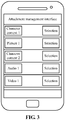
- the attachment management interface all of the characters texts, pictures, audios, and videos in the short message are listed, for a user can select a burn after reading tag for each of the characters texts, pictures, audios, and videos in the short message.
- the attachment management interface is shown in FIG. 3 . Users can select one or more attachments using the interface as shown in FIG. 3
- Step 208 after selecting a burn after reading sending mode for one or more of the at least one attachment in the attachment management interface, the message drafting interface is returned.
- Step 210 it is determined whether there is a need to insert a burn after reading tag to the at least one attachment in the short message.
- Step 212 is implemented when there is a need to insert a burn after reading tag to the at least one attachment.
- Step 214 is implemented when there is no need to insert a burn after reading tag to the at least one attachment.
- Step 212 a burn after reading tag is inserted into the one or more of the at least one attachment in the short message which is selected in the attachment management interface, such as a character text 1 and a picture 1.
- Step 214 no tag is inserted when there is no attachment selected in the attachment management interface.
- Step 216 a sending button is selected to send the short message, thus, the one or more of the at least one attachment in the short message can burn after reading, such as the character text 1 and the picture 1 can burn after reading, but the other attachments cannot burn after reading.
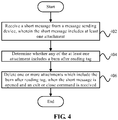
- FIG. 4 shows a schematic flowchart of one embodiment of a message receiving method according to the present disclosure.
- the message receiving method is applied in a message receiving device and includes: step 402, receiving a short message from a message sending device, where the short message includes at least one attachment; step 404, determining whether any of the at least one attachment includes a burn after reading tag; and step 406, deleting one or more of the at least one attachment which includes the burn after reading tag, after the short message is opened and when an exit or close command is received.
- the present embodiment determines whether any of the at least one attachment of a received short message includes a burn after reading tag, and deletes one or more of the at least one attachment which includes the burn after reading tag directly, when the one or more of the at least one attachment includes the burn after reading tag, and when an exit or close command is received.
- all contents included in the short message are deleted when a deletion operation is executed on the short message.
- the present embodiment realizes customization of contents included in the short message to allow burn after reading. Privacy contents in the short message cannot be saved. The short message is protected against being leaked out, thus, privacy of the short message is improved.
- the above embodiment preferably, further includes: displaying the short message, one or more of the at least one attachment having the burn after reading tag.
- the short message is shown in a first display style when the short message has been received but not yet opened, and the short message is shown in a second display style after the short message is opened.
- the present embodiment shows the short message using two display styles, for the short message being opened or unopened. Thus, it is shown visually whether the short message has yet to be opened.
- the short messages When a plurality of short messages of burn after reading are received at the same time, it is easy to distinguish which of the plurality of short messages remain unopened according to the display styles. Namely, the short messages, one or more of the at least one attachment having the burn after reading tag has been deleted, can be distinguished according to the different showing styles. If a short message is shown in the first display style, the short message has not been opened, and can be opened to view. If a showing interface of the short message is closed after the short message is opened, the short message is shown in the second display style.
- the short message When the short message is shown in the second display style, one or more of the at least one attachment having the burn after reading tag included in the short message is deleted, thus, the one or more of the at least one attachment having the burn after reading tag cannot be viewed again even the short message is re-opened.
- the above embodiments preferably, further include setting the first display style and/or the second display style according to a setting command.
- the first display style and the second display style can be set freely, thus flexibility of showing the short message is improved.
- the first display style can be set as a bulging envelope display style
- the second display style can be set as an empty envelope display style.
- the first display style can be set as an envelope display style with the burn after reading tag
- the second display style can be set as an envelope display style which is torn in two pieces. It is to be understood that the display styles are not limited by the above examples.
- FIG. 5 shows a schematic flowchart of another embodiment of a message receiving method according to the present disclosure.
- the message receiving method includes:
- FIG. 6 shows a schematic structure of an exemplary embodiment of a message sending device.
- a message sending device 600 includes: a division unit 602, which divides contents included in a short message into at least one attachment according to a predetermined division rule; a selection unit 604, which selects a sending mode for each of the at least one attachment according to a selection command, where the sending mode includes a burn after reading sending mode or an ordinary sending mode; a tag insertion unit 606, which inserts a burn after reading tag into one or more of the at least one attachment when the sending mode of the one or more of the at least one attachment is detected to be the burn after reading sending mode; and a sending unit 608, which sends the short message, one or more of the at least one attachment include in which having the burn after reading tag, to a message receiving device, when a sending command is received, for the message receiving device deleting the one or more of the at least one attachment according to the burn after reading tag after the short message has been opened.
- the short message is divided into at least one attachment, and a sending mode of each of the at least one attachment can be selected according to a selection command, thus flexibility and interest in message sending mode can be improved.
- a sending mode of one or more of the at least one attachment in the short message is the burn after reading sending mode
- a burn after reading tag is inserted into the one or more of the at least one attachment, and the short message is sent by the burn after reading sending mode.
- the short message is received, and when an exit or a close command to the short message is received, one or more of the at least one attachment having the burn after reading tag in the short message is deleted directly.
- all contents included in the short message are deleted when a deletion operation is executed on the short message.
- the present embodiment realizes customization of burn after reading to contents included in the short message. Privacy contents in the short message cannot be saved. The short message is protected against being leaked out, thus, privacy of the short message is improved.
- the burn after reading can be indicated by a marker.
- a marker For example, before a sending mode for each of the at least one attachment in the short message is selected, an initial marker for each of the at least one attachment can be set as "0". A default status can be that each of the at least one attachment is sent in an ordinary sending mode. After the burn after reading sending mode is selected for one or more of the at least one attachment, the marker of the one or more of the at least one attachment is changed to "1.” The one or more of the at least one attachment with the marker "1" will be deleted directly after short message has been opened.
- the marker for burn after reading can be any other form, the embodiments mentioned above are not to be taken as limiting.
- the division unit 602 further: indentifies types of the contents included in the short message, and dividing the contents in the short message into at least one attachment according to the types.
- the contents in the short message can include one or more or a combination of the following: character texts, pictures, audios, and videos.
- the contents in the short message can be divided into at least one attachment according to the types of the contents. That is, each of the character texts, pictures, audios, and videos can be taken as an attachment.
- the short message can be divided according to a predetermined character length. For example, for character texts, one character can be taken as an attachment, or more than one character can be taken as an attachment. The character length can be set by a user.
- the sending unit 608 further: sends the short message in the ordinary sending mode, when it is detected that the sending mode of each of the at least one attachment in the short message is the ordinary sending mode.
- the sending mode of each of the at least one attachment in the short message is the ordinary sending mode, it represents that the short message can be sent in the ordinary sending mode and not the burn after reading mode.
- the above embodiments preferably, further include: a display unit 610, which displays the at least one attachment of the short message and displays the sending modes, for the user to select a sending mode for each of the at least one attachment.
- the present embodiment displays the at least one attachment of the short message and the sending modes in a display interface, thus, it is convenient for the user to select a sending mode for each of the at least one attachment. Furthermore, the sending mode of each of the at least one attachment can be shown visually, thus, the user can be reminded of the sending mode of each of the at least one attachment.
- FIG. 7 shows a schematic structure of an exemplary embodiment of a message receiving device.
- a message receiving device 700 includes: a receiving unit 702, which receives a short message from the message sending device 600, where the short message includes at least one attachment; a determination unit 704, which determines whether any of the at least one attachment includes a burn after reading tag; and a processing unit 706, which deletes one or more of the at least one attachment which includes the burn after reading tag, after the short message is opened and when an exit or close command is received.
- the present embodiment determines whether any of the at least one attachment of a received short message includes a burn after reading tag, and deletes one or more of the at least one attachment which includes the burn after reading tag directly, when the one or more of the at least one attachment includes the burn after reading tag, and when an exit or close command is received.
- all contents included in the short message are deleted when a deletion operation is executed on the short message.
- the present embodiment realizes customization of contents included in the short message to allow burn after reading. Privacy contents in the short message cannot be saved. The short message is protected against being leaked out, thus, privacy of the short message is improved.
- the above embodiment preferably, further includes: a display unit 708, which displays the short message, one or more of the at least one attachment having the burn after reading tag.
- the short message is shown in a first display style when the short message has been received but not yet opened, and the short message is shown in a second display style after the short message is opened.
- the present embodiment shows the short message using two display styles, for the short message being opened or unopened. Thus, it is shown visually whether the short message has yet to be opened.
- the short messages When a plurality of short messages of burn after reading are received at the same time, it is easy to distinguish which of the plurality of short messages remain unopened according to the display styles. Namely, the short messages, one or more of the at least one attachment having the burn after reading tag has been deleted, can be distinguished according to the different showing styles. If a short message is shown in the first display style, the short message has not been opened, and can be opened to view. If a showing interface of the short message is closed after the short message is opened, the short message is shown in the second display style.
- the short message When the short message is shown in the second display style, one or more of the at least one attachment having the burn after reading tag included in the short message is deleted, thus, the one or more of the at least one attachment having the burn after reading tag cannot be viewed again even the short message is re-opened.
- the above embodiments preferably, further include: a setting unit 710, which sets the first display style and/or the second display style according to a setting command.
- the first display style and the second display style can be set freely, thus flexibility of showing the short message is improved.
- the first display style can be set as a bulging envelope display style
- the second display style can be set as an empty envelope display style.
- the first display style can be set as an envelope display style with the burn after reading tag
- the second display style can be set as an envelope display style which is torn in two pieces. It is to be understood that the display styles are not limited by the above examples.
- a sending mode of each of at least one attachment in a short message can be selected flexibility.
- the short message is sent using a burn after reading sending mode
- one or more of the at least one attachment in the short message of burn after reading is deleted directly, when a close or an exit command to the short message is received.
- privacy of the short message is improved.
- a program product stored in a non-transitory computer readable medium is provided.
- the program product is used to send message in a terminal, and includes instructions executable by a computer system to perform the following steps: dividing contents included in a short message into at least one attachment according to a predetermined division rule, and selecting a sending mode for each of the at least one attachment according to a selection command, where the sending mode includes a burn after reading sending mode or an ordinary sending mode; inserting a burn after reading tag into one or more of the at least one attachment when the sending mode of the one or more of the at least one attachment is detected to be the burn after reading sending mode; sending the short message, one or more of the at least one attachment include in which having the burn after reading tag, to a message receiving device, when a sending command is received, for the message receiving device deleting the one or more of the at least one attachment according to the burn after reading tag after the short message has been opened.
- a non-transitory computer readable medium stores a program product which is used to send message in a terminal and includes instructions executable by a computer system to perform the following steps: dividing contents included in a short message into at least one attachment according to a predetermined division rule, and selecting a sending mode for each of the at least one attachment according to a selection command, where the sending mode includes a burn after reading sending mode or an ordinary sending mode; inserting a burn after reading tag into one or more of the at least one attachment when the sending mode of the one or more of the at least one attachment is detected to be the burn after reading sending mode; sending the short message, one or more of the at least one attachment include in which having the burn after reading tag, to a message receiving device, when a sending command is received, for the message receiving device deleting the one or more of the at least one attachment according to the burn after reading tag after the short message has been opened.
- a program readable by a machine When executed by the machine, the program can cause the machine to perform a message sending method of any of the above mentioned embodiments.
- a storage medium which stores a program readable by a machine is also provided.
- the machine can perform a message sending method of any of the above mentioned embodiments.
- a program product stored in a non-transitory computer readable medium is provided.
- the program product is used to receive messages in a terminal, and includes instructions executable by a computer system to perform the following steps: receiving a short message from a message sending device, where the short message includes at least one attachment; determining whether any of the at least one attachment includes a burn after reading tag; and deleting one or more of the at least one attachment which includes the burn after reading tag, after the short message is opened and when an exit or close command is received.
- a non-transitory computer readable medium stores a program product which is used to send message in a terminal and includes instructions executable by a computer system to perform the following steps: receiving a short message from a message sending device, where the short message includes at least one attachment; determining whether any of the at least one attachment includes a burn after reading tag; and deleting one or more of the at least one attachment which includes the burn after reading tag, after the short message is opened and when an exit or close command is received.
- a program readable by a machine When executed by the machine, the program can cause the machine to perform a message receiving method of any of the above mentioned embodiments.
- a storage medium which stores a program readable by a machine is also provided.
- the machine can perform a message receiving method of any of the above mentioned embodiments.
Landscapes
- Engineering & Computer Science (AREA)
- Computer Networks & Wireless Communication (AREA)
- Signal Processing (AREA)
- Computer Security & Cryptography (AREA)
- Computer Hardware Design (AREA)
- Computing Systems (AREA)
- General Engineering & Computer Science (AREA)
- User Interface Of Digital Computer (AREA)
- Telephone Function (AREA)
- Mobile Radio Communication Systems (AREA)
- Telephonic Communication Services (AREA)
- Information Transfer Between Computers (AREA)
Abstract
Description
- The embodiments of the present disclosure relate to client terminal technology, and specifically to a message sending method, a message receiving method, a message sending device, and a message receiving device.
- With the popularity of mobile phones, security requirements and privacy requirements to the mobile phones are increasing gradually. Short messages are an important communication means, and privacy requirement of the short message have attracted more and more attentions from users.
- Currently, short messages received by terminals (such as mobile phones) are saved automatically into the mobile phones. To keep short messages private, users need to click a "menu", and select a "delete" option to delete the short message. For some mobile phones, the short messages may then be moved to a trash can after a first deletion. Thus, to clear the short messages thoroughly, the user needs to go to the trash can to delete the firstly-deleted short messages again. Such operations are troublesome for users. Furthermore, for a received short message, if the received short message is saved, all contents included in the received short message are saved, and if the received short message is deleted, all contents included in the short message are deleted. A user cannot choose to delete parts of the contents included in the received short message. Thus, it is inconvenient for the users.
- Therefore, how to delete only parts of the content included in short messages according to choices of the users is problematic.
- To solve the above problem, the present disclosure provides a new way of sending messages which enables the selection of a sending mode of attachments included in a short message flexibly. Upon condition that the short message is sent by a burn after reading sending mode, and when an exit or a close command to the short message is received, one or more attachments of burn after reading included in the short message are deleted directly, thus, privacy of the short message is improved.
- Therefore, according to one aspect of the present disclosure, a message sending method is provided. The method is executed in a message sending device and includes: dividing contents included in a short message into at least one attachment according to a predetermined division rule, and selecting a sending mode for each of the at least one attachment according to a selection command, where the sending mode includes a burn after reading sending mode or an ordinary sending mode; inserting a burn after reading tag into one or more of the at least one attachment when the sending mode of the one or more of the at least one attachment is detected to be the burn after reading sending mode; sending the short message, one or more of the at least one attachment include in which having the burn after reading tag, to a message receiving device, when a sending command is received, for the message receiving device deleting the one or more of the at least one attachment according to the burn after reading tag after the short message has been opened.
- In the present embodiment, the short message is divided into at least one attachment, and a sending mode of each of the at least one attachment can be selected according to a selection command, thus flexibility and interest in message sending mode can be improved. Moreover, when a sending mode of one or more of the at least one attachment in the short message is the burn after reading sending mode, a burn after reading tag is inserted into the one or more of the at least one attachment, and the short message is sent by the burn after reading sending mode. After the short message is received, and when an exit or a close command to the short message is received, one or more of the at least one attachment having the burn after reading tag in the short message is deleted directly. In prior art, all contents included in the short message are deleted when a deletion operation is executed on the short message. Compared with the prior art, the present embodiment realizes customization of burn after reading to contents included in the short message. Privacy contents in the short message cannot be saved. The short message is protected against being leaked out, thus, privacy of the short message is improved.
- The burn after reading can be indicated by a marker. For example, before a sending mode for each of the at least one attachment in the short message is selected, an initial marker for each of the at least one attachment can be set as "0". A default status can be that each of the at least one attachment is sent in an ordinary sending mode. After the burn after reading sending mode is selected for one or more of the at least one attachment, the marker of the one or more of the at least one attachment is changed to "1." The one or more of the at least one attachment with the marker "1" will be deleted directly after short message has been opened. One skilled in the art knows that the marker for burn after reading can be any other form, the embodiments mentioned above are not to be taken as limiting.
- In the above embodiment, preferably, the predetermined division rule includes: indentifying types of the contents included in the short message, and dividing the contents in the short message into at least one attachment according to the types.
- In the present embodiment, by dividing the contents in the short message into the at least one attachment according to the types of the contents, it is convenient to select the one or more of the at least one attachment which needs to be sent using the burn after reading sending mode. The contents in the short message can include one or more or a combination of the following: character texts, pictures, audios, and videos. Specifically, the contents in the short message can be divided into at least one attachment according to the types of the contents. That is, each of the character texts, pictures, audios, and videos can be taken as an attachment. In another embodiment, the short message can be divided according to a predetermined character length. For example, for character texts, one character can be taken as an attachment, or more than one character can be taken as an attachment. The character length can be set by a user.
- In the above embodiments, preferably, the method further include: sending the short message in the ordinary sending mode, when it is detected that the sending mode of each of the at least one attachment in the short message is the ordinary sending mode.
- In the present embodiment, when the sending mode of each of the at least one attachment in the short message is the ordinary sending mode, it represents that the short message can be sent in the ordinary sending mode and not the burn after reading mode.
- In the above embodiments, preferably, the method further include: displaying the at least one attachment of the short message and displaying the sending modes, for the user to select a sending mode for each of the at least one attachment.
- The present embodiment displays the at least one attachment of the short message and the sending modes in a display interface, thus, it is convenient for the user to select a sending mode for each of the at least one attachment. Furthermore, the sending mode of each of the at least one attachment can be shown visually, thus, the user can be reminded of the sending mode of each of the at least one attachment.
- According to a second aspect of the present disclosure, a message receiving method is provided. The message receiving method is executed in a message receiving device and includes: receiving a short message from a message sending device, where the short message includes at least one attachment; determining whether any of the at least one attachment includes a burn after reading tag; and deleting one or more of the at least one attachment which includes the burn after reading tag, after the short message is opened and when an exit or close command is received.
- The present embodiment determines whether any of the at least one attachment of a received short message includes a burn after reading tag, and deletes one or more of the at least one attachment which includes the burn after reading tag directly, when the one or more of the at least one attachment includes the burn after reading tag, and when an exit or close command is received. In prior art, all contents included in the short message are deleted when a deletion operation is executed on the short message. Compared with the prior art, the present embodiment realizes customization of contents included in the short message to allow burn after reading. Privacy contents in the short message cannot be saved. The short message is protected against being leaked out, thus, privacy of the short message is improved.
- In the above embodiment, preferably, the method further includes: displaying the short message, one or more of the at least one attachment having the burn after reading tag. The short message is shown in a first display style when the short message has been received but not yet opened, and the short message is shown in a second display style after the short message is opened.
- The present embodiment shows the short message using two display styles, for the short message being opened or unopened. Thus, it is shown visually whether the short message has yet to be opened.
- When a plurality of short messages of burn after reading are received at the same time, it is easy to distinguish which of the plurality of short messages remain unopened according to the display styles. Namely, the short messages, one or more of the at least one attachment having the burn after reading tag has been deleted, can be distinguished according to the different showing styles. If a short message is shown in the first display style, the short message has not been opened, and can be opened to view. If a showing interface of the short message is closed after the short message is opened, the short message is shown in the second display style. When the short message is shown in the second display style, one or more of the at least one attachment having the burn after reading tag included in the short message is deleted, thus, the one or more of the at least one attachment having the burn after reading tag cannot be viewed again even the short message is re-opened.
- In the above embodiments, preferably, the method further include setting the first display style and/or the second display style according to a setting command.
- In the present embodiment, the first display style and the second display style can be set freely, thus flexibility of showing the short message is improved. For example, the first display style can be set as a bulging envelope display style, and the second display style can be set as an empty envelope display style. Also, the first display style can be set as an envelope display style with the burn after reading tag, and the second display style can be set as an envelope display style which is torn in two pieces. It is to be understood that the display styles are not limited by the above examples.
- According to a third aspect of the present disclosure, a message sending device is provided. The message sending device includes: a division unit, which divides contents included in a short message into at least one attachment according to a predetermined division rule; a selection unit, which selects a sending mode for each of the at least one attachment according to a selection command, where the sending mode includes a burn after reading sending mode or an ordinary sending mode; a tag insertion unit, which inserts a burn after reading tag into one or more of the at least one attachment when the sending mode of the one or more of the at least one attachment is detected to be the burn after reading sending mode; and a sending unit, which sends the short message, one or more of the at least one attachment include in which having the burn after reading tag, to a message receiving device, when a sending command is received, for the message receiving device deleting the one or more of the at least one attachment according to the burn after reading tag after the short message has been opened.
- In the present embodiment, the short message is divided into at least one attachment, and a sending mode of each of the at least one attachment can be selected according to a selection command, thus flexibility and interest in message sending mode can be improved. Moreover, when a sending mode of one or more of the at least one attachment in the short message is the burn after reading sending mode, a burn after reading tag is inserted into the one or more of the at least one attachment, and the short message is sent by the burn after reading sending mode. After the short message is received, and when an exit or a close command to the short message is received, one or more of the at least one attachment having the burn after reading tag in the short message is deleted directly. In prior art, all contents included in the short message are deleted when a deletion operation is executed on the short message. Compared with the prior art, the present embodiment realizes customization of burn after reading to contents included in the short message. Privacy contents in the short message cannot be saved. The short message is protected against being leaked out, thus, privacy of the short message is improved.
- The burn after reading can be indicated by a marker. For example, before a sending mode for each of the at least one attachment in the short message is selected, an initial marker for each of the at least one attachment can be set as "0". A default status can be that each of the at least one attachment is sent in an ordinary sending mode. After the burn after reading sending mode is selected for one or more of the at least one attachment, the marker of the one or more of the at least one attachment is changed to "1." The one or more of the at least one attachment with the marker "1" will be deleted directly after short message has been opened. One skilled in the art knows that the marker for burn after reading can be any other form, the embodiments mentioned above are not to be taken as limiting.
- In the above embodiment, preferably, specifically, the division unit: indentifies types of the contents included in the short message, and divides the contents in the short message into at least one attachment according to the types.
- In the present embodiment, by dividing the contents in the short message into the at least one attachment according to the types of the contents, it is convenient to select the one or more of the at least one attachment which needs to be sent using the burn after reading sending mode. The contents in the short message can include one or more or a combination of the following: character texts, pictures, audios, and videos. Specifically, the contents in the short message can be divided into at least one attachment according to the types of the contents. That is, each of the character texts, pictures, audios, and videos can be taken as an attachment. In another embodiment, the short message can be divided according to a predetermined character length. For example, for character texts, one character can be taken as an attachment, or more than one character can be taken as an attachment. The character length can be set by a user.
- In the above embodiments, the sending unit further: sends the short message in the ordinary sending mode, when it is detected that the sending mode of each of the at least one attachment in the short message is the ordinary sending mode.
- In the present embodiment, when the sending mode of each of the at least one attachment in the short message is the ordinary sending mode, it represents that the short message can be sent in the ordinary sending mode and not the burn after reading mode.
- The above embodiments, preferably, further include a display unit, which displays the at least one attachment of the short message and displays the sending modes, for the user to select a sending mode for each of the at least one attachment.
- The present embodiment displays the at least one attachment of the short message and the sending modes in a display interface, thus, it is convenient for the user to select a sending mode for each of the at least one attachment. Furthermore, the sending mode of each of the at least one attachment can be shown visually, thus, the user can be reminded of the sending mode of each of the at least one attachment.
- According to a fourth aspect of the present disclosure, a message receiving device is provided. The message receiving device includes: a receiving unit, which receives a short message from a message sending device, where the short message includes at least one attachment; a determination unit, which determines whether any of the at least one attachment includes a burn after reading tag; and a processing unit, which deletes one or more of the at least one attachment which includes the burn after reading tag, after the short message is opened and when an exit or close command is received.
- The present embodiment determines whether any of the at least one attachment of a received short message includes a burn after reading tag, and deletes one or more of the at least one attachment which includes the burn after reading tag directly, when the one or more of the at least one attachment includes the burn after reading tag, and when an exit or close command is received. In prior art, all contents included in the short message are deleted when a deletion operation is executed on the short message. Compared with the prior art, the present embodiment realizes customization of contents included in the short message to allow burn after reading. Privacy contents in the short message cannot be saved. The short message is protected against being leaked out, thus, privacy of the short message is improved.
- The above embodiment, preferably, further includes: a display unit, which displays the short message, one or more of the at least one attachment having the burn after reading tag. The short message is shown in a first display style when the short message has been received but not yet opened, and the short message is shown in a second display style after the short message is opened.
- The present embodiment shows the short message using two display styles, for the short message being opened or unopened. Thus, it is shown visually whether the short message has yet to be opened.
- When a plurality of short messages of burn after reading are received at the same time, it is easy to distinguish which of the plurality of short messages remain unopened according to the display styles. Namely, the short messages, one or more of the at least one attachment having the burn after reading tag has been deleted, can be distinguished according to the different showing styles. If a short message is shown in the first display style, the short message has not been opened, and can be opened to view. If a showing interface of the short message is closed after the short message is opened, the short message is shown in the second display style. When the short message is shown in the second display style, one or more of the at least one attachment having the burn after reading tag included in the short message is deleted, thus, the one or more of the at least one attachment having the burn after reading tag cannot be viewed again even the short message is re-opened.
- The above embodiments, preferably, further include: a setting unit, which sets the first display style and/or the second display style according to a setting command.
- In the present embodiment, the first display style and the second display style can be set freely, thus flexibility of showing the short message is improved. For example, the first display style can be set as a bulging envelope display style, and the second display style can be set as an empty envelope display style. Also, the first display style can be set as an envelope display style with the burn after reading tag, and the second display style can be set as an envelope display style which is torn in two pieces. It is to be understood that the display styles are not limited by the above examples.
-
-
FIG. 1 shows a flowchart of one embodiment of a message sending method according to the present disclosure. -
FIG. 2 shows a flowchart of another embodiment of a message sending method according to the present disclosure. -
FIG. 3 shows a diagram of one embodiment of a selection interface for modes of sending attachments according to the present disclosure. -
FIG. 4 shows a flowchart of one embodiment of a message receiving method according to the present disclosure. -
FIG. 5 shows a flowchart of another embodiment of a message receiving method according to the present disclosure. -
FIG. 6 shows a structure of an exemplary embodiment of a message sending device. -
FIG. 7 shows a structure of an exemplary embodiment of a message receiving device. - For simplicity and clarity of illustration, where appropriate, the above drawings illustrate the embodiments. Different embodiments and elements in different embodiments of the present disclosure can be combined and not combined.
- The embodiments described herein are for better understanding of the present disclosure, other embodiments can also be practiced. The description is not to be considered as limiting the scope of the embodiments described herein.
-
FIG. 1 shows a flowchart of one embodiment of a message sending method according to the present disclosure. - As shown in
FIG. 1 , the message sending method according to the present disclosure is executed in a message sending device, and includes:step 102, dividing contents included in a short message into at least one attachment according to a predetermined division rule, and selecting a sending mode for each of the at least one attachment according to a selection command, where the sending mode includes a burn after reading sending mode and an ordinary sending mode;step 104, inserting a burn after reading tag to one or more of the at least one attachment when the sending mode of the one or more of the at least one attachment is detected as the burn after reading sending mode;step 106, sending the short message, one or more of the at least one attachment include in which having the burn after reading tag, to a message receiving device, when a sending command is received, for the message receiving device deleting the one or more of the at least one attachment according to the burn after reading tag after the short message has been opened. - In the present embodiment, the short message is divided into at least one attachment, and a sending mode of each of the at least one attachment can be selected according to a selection command, thus flexibility and interest in message sending mode can be improved. Moreover, when a sending mode of one or more of the at least one attachment in the short message is the burn after reading sending mode, a burn after reading tag is inserted into the one or more of the at least one attachment, and the short message is sent by the burn after reading sending mode. After the short message is received, and when an exit or a close command to the short message is received, one or more of the at least one attachment having the burn after reading tag in the short message is deleted directly. In prior art, all contents included in the short message are deleted when a deletion operation is executed on the short message. Compared with the prior art, the present embodiment realizes customization of burn after reading to contents included in the short message. Privacy contents in the short message cannot be saved. The short message is protected against being leaked out, thus, privacy of the short message is improved.
- The burn after reading can be indicated by a marker. For example, before a sending mode for each of the at least one attachment in the short message is selected, an initial marker for each of the at least one attachment can be set as "0". A default status can be that each of the at least one attachment is sent in an ordinary sending mode. After the burn after reading sending mode is selected for one or more of the at least one attachment, the marker of the one or more of the at least one attachment is changed to "1." The one or more of the at least one attachment with the marker "1" will be deleted directly after short message has been opened. One skilled in the art knows that the marker for burn after reading can be any other form, the embodiments mentioned above are not to be taken as limiting.
- In the above embodiment, preferably, the predetermined division rule includes: indentifying types of the contents included in the short message, and dividing the contents in the short message into at least one attachment according to the types.
- In the present embodiment, by dividing the contents in the short message into the at least one attachment according to the types of the contents, it is convenient to select the one or more of the at least one attachment which needs to be sent using the burn after reading sending mode. The contents in the short message can include one or more or a combination of the following: character texts, pictures, audios, and videos. Specifically, the contents in the short message can be divided into at least one attachment according to the types of the contents. That is, each of the character texts, pictures, audios, and videos can be taken as an attachment. In another embodiment, the short message can be divided according to a predetermined character length. For example, for character texts, one character can be taken as an attachment, or more than one character can be taken as an attachment. The character length can be set by a user.
- The above embodiments, preferably, further include: sending the short message in the ordinary sending mode, when it is detected that the sending mode of each of the at least one attachment in the short message is the ordinary sending mode.
- In the present embodiment, when the sending mode of each of the at least one attachment in the short message is the ordinary sending mode, it represents that the short message can be sent in the ordinary sending mode and not the burn after reading mode.
- The above embodiments, preferably, further include: displaying the at least one attachment of the short message and displaying the sending modes, for the user to select a sending mode for each of the at least one attachment.
- The present embodiment displays the at least one attachment of the short message and the sending modes in a display interface, thus, it is convenient for the user to select a sending mode for each of the at least one attachment. Furthermore, the sending mode of each of the at least one attachment can be shown visually, thus, the user can be reminded of the sending mode of each of the at least one attachment.
-
FIG. 2 shows a schematic flowchart of another embodiment of a message sending method according to the present disclosure. - Referring to
FIG. 2 , according to the present disclosure, another embodiment of a message sending method includes: -
Step 202, a message application run, a message drafting interface of the message application is entered, and a selected receiver is received. -
Step 204, a short message is drafted by receiving inputted characters texts and inserted multimedia contents including pictures, audios, and videos. -
Step 206, a burn after reading tag is selected in a menu option; contents in the short message is identified automatically; the contents of the short message is divided into at least one attachment according to the contents; and an attachment management interface is entered. In the attachment management interface, all of the characters texts, pictures, audios, and videos in the short message are listed, for a user can select a burn after reading tag for each of the characters texts, pictures, audios, and videos in the short message. The attachment management interface is shown inFIG. 3 . Users can select one or more attachments using the interface as shown inFIG. 3 -
Step 208, after selecting a burn after reading sending mode for one or more of the at least one attachment in the attachment management interface, the message drafting interface is returned. -
Step 210, it is determined whether there is a need to insert a burn after reading tag to the at least one attachment in the short message. Step 212 is implemented when there is a need to insert a burn after reading tag to the at least one attachment. Step 214 is implemented when there is no need to insert a burn after reading tag to the at least one attachment. -
Step 212, a burn after reading tag is inserted into the one or more of the at least one attachment in the short message which is selected in the attachment management interface, such as acharacter text 1 and apicture 1. -
Step 214, no tag is inserted when there is no attachment selected in the attachment management interface. -
Step 216, a sending button is selected to send the short message, thus, the one or more of the at least one attachment in the short message can burn after reading, such as thecharacter text 1 and thepicture 1 can burn after reading, but the other attachments cannot burn after reading. -
FIG. 4 shows a schematic flowchart of one embodiment of a message receiving method according to the present disclosure. - Referring to
FIG. 4 , according to the present disclosure, the message receiving method is applied in a message receiving device and includes:step 402, receiving a short message from a message sending device, where the short message includes at least one attachment;step 404, determining whether any of the at least one attachment includes a burn after reading tag; and step 406, deleting one or more of the at least one attachment which includes the burn after reading tag, after the short message is opened and when an exit or close command is received. - The present embodiment determines whether any of the at least one attachment of a received short message includes a burn after reading tag, and deletes one or more of the at least one attachment which includes the burn after reading tag directly, when the one or more of the at least one attachment includes the burn after reading tag, and when an exit or close command is received. In prior art, all contents included in the short message are deleted when a deletion operation is executed on the short message. Compared with the prior art, the present embodiment realizes customization of contents included in the short message to allow burn after reading. Privacy contents in the short message cannot be saved. The short message is protected against being leaked out, thus, privacy of the short message is improved.
- The above embodiment, preferably, further includes: displaying the short message, one or more of the at least one attachment having the burn after reading tag. The short message is shown in a first display style when the short message has been received but not yet opened, and the short message is shown in a second display style after the short message is opened.
- The present embodiment shows the short message using two display styles, for the short message being opened or unopened. Thus, it is shown visually whether the short message has yet to be opened.
- When a plurality of short messages of burn after reading are received at the same time, it is easy to distinguish which of the plurality of short messages remain unopened according to the display styles. Namely, the short messages, one or more of the at least one attachment having the burn after reading tag has been deleted, can be distinguished according to the different showing styles. If a short message is shown in the first display style, the short message has not been opened, and can be opened to view. If a showing interface of the short message is closed after the short message is opened, the short message is shown in the second display style. When the short message is shown in the second display style, one or more of the at least one attachment having the burn after reading tag included in the short message is deleted, thus, the one or more of the at least one attachment having the burn after reading tag cannot be viewed again even the short message is re-opened.
- The above embodiments, preferably, further include setting the first display style and/or the second display style according to a setting command.
- In the present embodiment, the first display style and the second display style can be set freely, thus flexibility of showing the short message is improved. For example, the first display style can be set as a bulging envelope display style, and the second display style can be set as an empty envelope display style. Also, the first display style can be set as an envelope display style with the burn after reading tag, and the second display style can be set as an envelope display style which is torn in two pieces. It is to be understood that the display styles are not limited by the above examples.
-
FIG. 5 shows a schematic flowchart of another embodiment of a message receiving method according to the present disclosure. - As shown in
FIG. 5 , according to the present disclosure, the message receiving method includes: -
Step 502, a short message is received as normal. -
Step 504, it is determined that whether any of attachments in the short message including a burn after reading tag. Step 506 is implemented when any of attachments in the short message includes a burn after reading tag. Otherwise,step 520 is implemented. -
Step 506, it is determined that whether the short message is opened when any of attachments in the short message includes a burn after reading tag. Step 512 is implemented when the short message is opened. Otherwise,step 508 is implemented. -
Step 508, the short message is shown as unopened (the first display style), and waits until being opened, when the short message is unopened. -
Step 510, the short message of burn after reading can be deleted as an ordinary short message, no matter whether the short message has been opened or unopened. After being deleted, the short message of burn after reading cannot be opened again. -
Step 512, the short message is clicked to be opened when there is a need to read the short message. -
Step 514, it is determined that whether an attachment which is opened currently in the short message includes a burn after reading tag after the short message is opened. Step 516 is implemented when the attachment which is opened currently in the short message includes the burn after reading tag. Otherwise,step 518 is implemented. -
Step 516, the attachment is deleted directly when the short message is closed or exited, and the attachment is disabled to be opened again, when the attachment includes the burn after reading tag. -
Step 518, the attachment is not deleted when the short message is closed or exited, and the attachment can be opened again, when the attachment does not include the burn after reading tag. -
Step 520, the short message is received as normal when no attachment in the short message includes a burn after reading tag. -
FIG. 6 shows a schematic structure of an exemplary embodiment of a message sending device. - Referring to
FIG. 6 , amessage sending device 600 according to the present embodiment includes: adivision unit 602, which divides contents included in a short message into at least one attachment according to a predetermined division rule; aselection unit 604, which selects a sending mode for each of the at least one attachment according to a selection command, where the sending mode includes a burn after reading sending mode or an ordinary sending mode; atag insertion unit 606, which inserts a burn after reading tag into one or more of the at least one attachment when the sending mode of the one or more of the at least one attachment is detected to be the burn after reading sending mode; and a sendingunit 608, which sends the short message, one or more of the at least one attachment include in which having the burn after reading tag, to a message receiving device, when a sending command is received, for the message receiving device deleting the one or more of the at least one attachment according to the burn after reading tag after the short message has been opened. - In the present embodiment, the short message is divided into at least one attachment, and a sending mode of each of the at least one attachment can be selected according to a selection command, thus flexibility and interest in message sending mode can be improved. Moreover, when a sending mode of one or more of the at least one attachment in the short message is the burn after reading sending mode, a burn after reading tag is inserted into the one or more of the at least one attachment, and the short message is sent by the burn after reading sending mode. After the short message is received, and when an exit or a close command to the short message is received, one or more of the at least one attachment having the burn after reading tag in the short message is deleted directly. In prior art, all contents included in the short message are deleted when a deletion operation is executed on the short message. Compared with the prior art, the present embodiment realizes customization of burn after reading to contents included in the short message. Privacy contents in the short message cannot be saved. The short message is protected against being leaked out, thus, privacy of the short message is improved.
- The burn after reading can be indicated by a marker. For example, before a sending mode for each of the at least one attachment in the short message is selected, an initial marker for each of the at least one attachment can be set as "0". A default status can be that each of the at least one attachment is sent in an ordinary sending mode. After the burn after reading sending mode is selected for one or more of the at least one attachment, the marker of the one or more of the at least one attachment is changed to "1." The one or more of the at least one attachment with the marker "1" will be deleted directly after short message has been opened. One skilled in the art knows that the marker for burn after reading can be any other form, the embodiments mentioned above are not to be taken as limiting.
- In the above embodiment, preferably, specifically, the
division unit 602 further: indentifies types of the contents included in the short message, and dividing the contents in the short message into at least one attachment according to the types. - In the specifically, embodiment, by dividing the contents in the short message into the at least one attachment according to the types of the contents, it is convenient to select the one or more of the at least one attachment which needs to be sent using the burn after reading sending mode. The contents in the short message can include one or more or a combination of the following: character texts, pictures, audios, and videos. Specifically, the contents in the short message can be divided into at least one attachment according to the types of the contents. That is, each of the character texts, pictures, audios, and videos can be taken as an attachment. In another embodiment, the short message can be divided according to a predetermined character length. For example, for character texts, one character can be taken as an attachment, or more than one character can be taken as an attachment. The character length can be set by a user.
- In the above embodiments, preferably,the sending
unit 608 further: sends the short message in the ordinary sending mode, when it is detected that the sending mode of each of the at least one attachment in the short message is the ordinary sending mode. - In the present embodiment, when the sending mode of each of the at least one attachment in the short message is the ordinary sending mode, it represents that the short message can be sent in the ordinary sending mode and not the burn after reading mode.
- The above embodiments, preferably, further include: a
display unit 610, which displays the at least one attachment of the short message and displays the sending modes, for the user to select a sending mode for each of the at least one attachment. - The present embodiment displays the at least one attachment of the short message and the sending modes in a display interface, thus, it is convenient for the user to select a sending mode for each of the at least one attachment. Furthermore, the sending mode of each of the at least one attachment can be shown visually, thus, the user can be reminded of the sending mode of each of the at least one attachment.
-
FIG. 7 shows a schematic structure of an exemplary embodiment of a message receiving device. - Referring to
FIG. 7 , amessage receiving device 700 according to the present embodiment, includes: a receivingunit 702, which receives a short message from themessage sending device 600, where the short message includes at least one attachment; adetermination unit 704, which determines whether any of the at least one attachment includes a burn after reading tag; and aprocessing unit 706, which deletes one or more of the at least one attachment which includes the burn after reading tag, after the short message is opened and when an exit or close command is received. - The present embodiment determines whether any of the at least one attachment of a received short message includes a burn after reading tag, and deletes one or more of the at least one attachment which includes the burn after reading tag directly, when the one or more of the at least one attachment includes the burn after reading tag, and when an exit or close command is received. In prior art, all contents included in the short message are deleted when a deletion operation is executed on the short message. Compared with the prior art, the present embodiment realizes customization of contents included in the short message to allow burn after reading. Privacy contents in the short message cannot be saved. The short message is protected against being leaked out, thus, privacy of the short message is improved.
- The above embodiment, preferably, further includes: a
display unit 708, which displays the short message, one or more of the at least one attachment having the burn after reading tag. The short message is shown in a first display style when the short message has been received but not yet opened, and the short message is shown in a second display style after the short message is opened. - The present embodiment shows the short message using two display styles, for the short message being opened or unopened. Thus, it is shown visually whether the short message has yet to be opened.
- When a plurality of short messages of burn after reading are received at the same time, it is easy to distinguish which of the plurality of short messages remain unopened according to the display styles. Namely, the short messages, one or more of the at least one attachment having the burn after reading tag has been deleted, can be distinguished according to the different showing styles. If a short message is shown in the first display style, the short message has not been opened, and can be opened to view. If a showing interface of the short message is closed after the short message is opened, the short message is shown in the second display style. When the short message is shown in the second display style, one or more of the at least one attachment having the burn after reading tag included in the short message is deleted, thus, the one or more of the at least one attachment having the burn after reading tag cannot be viewed again even the short message is re-opened.
- The above embodiments, preferably, further include: a setting
unit 710, which sets the first display style and/or the second display style according to a setting command. - In the present embodiment, the first display style and the second display style can be set freely, thus flexibility of showing the short message is improved. For example, the first display style can be set as a bulging envelope display style, and the second display style can be set as an empty envelope display style. Also, the first display style can be set as an envelope display style with the burn after reading tag, and the second display style can be set as an envelope display style which is torn in two pieces. It is to be understood that the display styles are not limited by the above examples.
- The present disclosure has been explicated above by referring to the drawings. Using the present disclosure, a sending mode of each of at least one attachment in a short message can be selected flexibility. Upon the condition that, the short message is sent using a burn after reading sending mode, one or more of the at least one attachment in the short message of burn after reading is deleted directly, when a close or an exit command to the short message is received. Thus, privacy of the short message is improved.
- According to the present disclosure, a program product stored in a non-transitory computer readable medium is provided. The program product is used to send message in a terminal, and includes instructions executable by a computer system to perform the following steps: dividing contents included in a short message into at least one attachment according to a predetermined division rule, and selecting a sending mode for each of the at least one attachment according to a selection command, where the sending mode includes a burn after reading sending mode or an ordinary sending mode; inserting a burn after reading tag into one or more of the at least one attachment when the sending mode of the one or more of the at least one attachment is detected to be the burn after reading sending mode; sending the short message, one or more of the at least one attachment include in which having the burn after reading tag, to a message receiving device, when a sending command is received, for the message receiving device deleting the one or more of the at least one attachment according to the burn after reading tag after the short message has been opened.
- According to the present disclosure, a non-transitory computer readable medium is also provided. The non-transitory computer readable medium stores a program product which is used to send message in a terminal and includes instructions executable by a computer system to perform the following steps: dividing contents included in a short message into at least one attachment according to a predetermined division rule, and selecting a sending mode for each of the at least one attachment according to a selection command, where the sending mode includes a burn after reading sending mode or an ordinary sending mode; inserting a burn after reading tag into one or more of the at least one attachment when the sending mode of the one or more of the at least one attachment is detected to be the burn after reading sending mode; sending the short message, one or more of the at least one attachment include in which having the burn after reading tag, to a message receiving device, when a sending command is received, for the message receiving device deleting the one or more of the at least one attachment according to the burn after reading tag after the short message has been opened.
- According to the present disclosure, a program readable by a machine is also provided. When executed by the machine, the program can cause the machine to perform a message sending method of any of the above mentioned embodiments.
- According to the present disclosure, a storage medium which stores a program readable by a machine is also provided. When executing the program, the machine can perform a message sending method of any of the above mentioned embodiments.
- According to the present disclosure, a program product stored in a non-transitory computer readable medium is provided. The program product is used to receive messages in a terminal, and includes instructions executable by a computer system to perform the following steps: receiving a short message from a message sending device, where the short message includes at least one attachment; determining whether any of the at least one attachment includes a burn after reading tag; and deleting one or more of the at least one attachment which includes the burn after reading tag, after the short message is opened and when an exit or close command is received.
- According to the present disclosure, a non-transitory computer readable medium is also provided. The non-transitory computer readable medium stores a program product which is used to send message in a terminal and includes instructions executable by a computer system to perform the following steps: receiving a short message from a message sending device, where the short message includes at least one attachment; determining whether any of the at least one attachment includes a burn after reading tag; and deleting one or more of the at least one attachment which includes the burn after reading tag, after the short message is opened and when an exit or close command is received.
- According to the present disclosure, a program readable by a machine is also provided. When executed by the machine, the program can cause the machine to perform a message receiving method of any of the above mentioned embodiments.
- According to the present disclosure, a storage medium which stores a program readable by a machine is also provided. When executing the program, the machine can perform a message receiving method of any of the above mentioned embodiments.
- Although certain inventive embodiments of the present disclosure have been specifically described, the present disclosure is not to be construed as being limited thereto. Various changes or modifications may be made to the present disclosure without departing from the scope and spirit of the present disclosure.
Claims (14)
- A message sending method, for being executed in a message sending device, the method comprising:dividing contents comprised in a short message into at least one attachment according to a predetermined division rule, and selecting a sending mode for each of the at least one attachment according to a selection command, the sending mode comprising a burn after reading sending mode and an ordinary sending mode;inserting a burn after reading tag into one or more of the at least one attachment when the sending mode of the one or more of the at least one attachment is detected to be the burn after reading sending mode; andsending the short message, one or more of the at least one attachment comprised in which having the burn after reading tag, to a message receiving device, when a sending command is received, for the message receiving device deleting the one or more of the at least one attachment according to the burn after reading tag after the short message has been opened.
- The method of claim 1, wherein the predetermined division rule comprises:indentifying types of the contents included in the short message, and dividing the contents in the short message into at least one attachment according to the types.
- The method of claim 1 or 2, further comprising:sending the short message in the ordinary sending mode, when it is detected that the sending mode of each of the at least one attachment in the short message is the ordinary sending mode.
- The method of claim 1, further comprising:displaying the at least one attachment of the short message and displaying the sending modes, for the user to select a sending mode for each of the at least one attachment.
- A message receiving method, for being executed in a message receiving device, and the method comprising:receiving a short message from a message sending device, the short message comprising at least one attachment;determining whether any of the at least one attachment comprises a burn after reading tag; anddeleting one or more of the at least one attachment which comprises the burn after reading tag, after the short message is opened and when an exit or close command is received.
- The method of claim 5, further comprising:displaying the short message, one or more of the at least one attachment having the burn after reading tag. The short message is shown in a first display style when the short message has been received but not yet opened, and the short message is shown in a second display style after the short message is opened.
- The method of claim 6, further comprising:setting the first display style and/or the second display style according to a setting command.
- A message sending device, comprising:a division unit, which divides contents comprised in a short message into at least one attachment according to a predetermined division rule;a selection unit, which selects a sending mode for each of the at least one attachment according to a selection command, wherein the sending mode comprises a burn after reading sending mode or an ordinary sending mode;a tag insertion unit, which inserts a burn after reading tag to one or more of the at least one attachment when the sending mode of the one or more of the at least one attachment is detected as the burn after reading sending mode; anda sending unit, which sends the short message, one or more of the at least one attachment include in which having the burn after reading tag, to a message receiving device, when a sending command is received, for the message receiving device deleting the one or more of the at least one attachment according to the burn after reading tag after the short message has been opened.
- The device of claim 8, wherein the division unit further:indentifies types of the contents comprised in the short message, and divides the contents in the short message into at least one attachment according to the types.
- The device of claim 8 or 9, wherein the sending unit further:sends the short message in the ordinary sending mode, when it is detected that the sending mode of each of the at least one attachment in the short message is the ordinary sending mode.
- The device of any one of claim 8, further comprising:a display unit, which displays the at least one attachment of the short message and displays the sending modes, for the user to select a sending mode for each of the at least one attachment.
- A message receiving device, comprising:a receiving unit, which receives a short message from a message sending device, wherein the short message comprises at least one attachment;a determination unit, which determines whether any of the at least one attachment comprises a burn after reading tag; anda processing unit, which deletes one or more of the at least one attachment which comprises the burn after reading tag, when the short message is opened and an exit or close command is received.
- The device of claim 12, further comprising:a display unit, which displays the short message, one or more of the at least one attachment having the burn after reading tag, wherein the short message is shown in a first display style when the short message has been received but not yet opened, and the short message is shown in a second display style after the short message is opened.
- The device of claim 13, further comprising:a setting unit, which sets the first display style and/or the second display style according to a setting command.
Applications Claiming Priority (1)
| Application Number | Priority Date | Filing Date | Title |
|---|---|---|---|
| PCT/CN2014/074230 WO2015143682A1 (en) | 2014-03-27 | 2014-03-27 | Information transmitting method and device and information receiving method and device |
Publications (2)
| Publication Number | Publication Date |
|---|---|
| EP3125589A1 true EP3125589A1 (en) | 2017-02-01 |
| EP3125589A4 EP3125589A4 (en) | 2017-11-15 |
Family
ID=54193919
Family Applications (1)
| Application Number | Title | Priority Date | Filing Date |
|---|---|---|---|
| EP14887464.7A Withdrawn EP3125589A4 (en) | 2014-03-27 | 2014-03-27 | Information transmitting method and device and information receiving method and device |
Country Status (4)
| Country | Link |
|---|---|
| US (1) | US10205693B2 (en) |
| EP (1) | EP3125589A4 (en) |
| CN (1) | CN106465075A (en) |
| WO (1) | WO2015143682A1 (en) |
Families Citing this family (5)
| Publication number | Priority date | Publication date | Assignee | Title |
|---|---|---|---|---|
| CN105490919B (en) * | 2015-11-24 | 2019-11-08 | 小米科技有限责任公司 | Message cancelling method and device |
| CN105791089B (en) * | 2016-02-29 | 2019-01-18 | 北京金山安全软件有限公司 | Communication message processing method and device and electronic equipment |
| CN107958380B (en) * | 2017-11-29 | 2021-06-15 | 努比亚技术有限公司 | Payment certificate processing method, terminal and computer readable storage medium |
| CN110555314A (en) * | 2019-05-31 | 2019-12-10 | 深圳大普微电子科技有限公司 | File data processing method and solid state disk |
| CN110808901A (en) * | 2019-11-07 | 2020-02-18 | 微位(深圳)网络科技有限公司 | Distributed burning-after-reading method and system for messages |
Family Cites Families (17)
| Publication number | Priority date | Publication date | Assignee | Title |
|---|---|---|---|---|
| US7966372B1 (en) * | 1999-07-28 | 2011-06-21 | Rpost International Limited | System and method for verifying delivery and integrity of electronic messages |
| WO2001010090A1 (en) * | 1999-07-28 | 2001-02-08 | Tomkow Terrance A | System and method for verifying delivery and integrity of electronic messages |
| US8849909B2 (en) * | 2007-07-06 | 2014-09-30 | Yahoo! Inc. | Real-time asynchronous event aggregation systems |
| US8589541B2 (en) * | 2009-01-28 | 2013-11-19 | Headwater Partners I Llc | Device-assisted services for protecting network capacity |
| US8832201B2 (en) * | 2008-08-18 | 2014-09-09 | International Business Machines Corporation | Method, system and program product for providing selective enhanced privacy and control features to one or more portions of an electronic message |
| US20110213845A1 (en) * | 2010-02-26 | 2011-09-01 | Research In Motion Limited | Automatic deletion of electronic messages |
| US9148302B2 (en) * | 2010-06-14 | 2015-09-29 | Blackberry Limited | Automatic full download of important emails |
| CN101867891B (en) * | 2010-06-23 | 2015-05-20 | 中兴通讯股份有限公司 | Realizing method, device and system for deleting short messages (SMS) automatically |
| US8554253B2 (en) * | 2010-08-26 | 2013-10-08 | John L. Rogitz | Telephone messaging privacy |
| CN202075726U (en) * | 2011-06-20 | 2011-12-14 | 迈奔灵动科技(北京)有限公司 | System for reading and displaying cellular phone multimedia messages on PC (Personal Computer) |
| CN102487490B (en) * | 2011-11-18 | 2014-03-19 | 腾讯科技(深圳)有限公司 | Method and system for automatically deleting instant messaging information |
| CN102883052B (en) * | 2012-09-14 | 2015-08-12 | 东莞宇龙通信科技有限公司 | Mobile terminal and image processing method |
| US9935907B2 (en) * | 2012-11-20 | 2018-04-03 | Dropbox, Inc. | System and method for serving a message client |
| CN103218568B (en) * | 2013-03-18 | 2016-09-21 | 东莞宇龙通信科技有限公司 | Method for secret protection during text display and communication terminal |
| CN103379451B (en) * | 2013-06-21 | 2017-09-08 | 宇龙计算机通信科技(深圳)有限公司 | The inspection method and its system of burn-after-reading information |
| US20150180845A1 (en) * | 2013-12-19 | 2015-06-25 | Robert Uomini | Electronic mail system and methods |
| US9191349B2 (en) * | 2014-01-22 | 2015-11-17 | Qualcomm Incorporated | Dynamic invites with automatically adjusting displays |
-
2014
- 2014-03-27 WO PCT/CN2014/074230 patent/WO2015143682A1/en not_active Ceased
- 2014-03-27 CN CN201480077296.5A patent/CN106465075A/en active Pending
- 2014-03-27 EP EP14887464.7A patent/EP3125589A4/en not_active Withdrawn
-
2016
- 2016-09-27 US US15/277,966 patent/US10205693B2/en active Active
Also Published As
| Publication number | Publication date |
|---|---|
| CN106465075A (en) | 2017-02-22 |
| US10205693B2 (en) | 2019-02-12 |
| EP3125589A4 (en) | 2017-11-15 |
| WO2015143682A1 (en) | 2015-10-01 |
| US20170019359A1 (en) | 2017-01-19 |
Similar Documents
| Publication | Publication Date | Title |
|---|---|---|
| US20240163125A1 (en) | Content Sharing by Pointing to Content | |
| KR102193489B1 (en) | Apparatus and method for maintaining a message thread with opt-in permanence for entries | |
| US10057731B2 (en) | Image and message integration system and method | |
| US20130097526A1 (en) | Electronic device and method for reply message composition | |
| US10205693B2 (en) | Message sending method and device and message receiving method and device | |
| KR102059231B1 (en) | Messages augmented with structured entities | |
| US20150033145A1 (en) | Email mailbox management with sender-specific message lists | |
| US11336607B2 (en) | Managing multiple forms of messages in a messaging application | |
| CN108353256A (en) | Method and system for creating and using emoticons and other graphical content in instant messaging systems | |
| EP2544437A1 (en) | Apparatus and method for transmitting message in mobile terminal | |
| US9800530B2 (en) | Message display method and device | |
| CN103118342A (en) | Multi-media information sending, receiving and transmission method and card sending and receiving terminal | |
| US20120066615A1 (en) | Graphically indicating relevancy of electronic messages | |
| US8949354B2 (en) | Propagation of message having time-based information | |
| US10102397B2 (en) | Information transmitting method and device and information receiving method and device | |
| US20170012917A1 (en) | Method for Information Transmitting/Receiving and Terminal Therefor | |
| CN102883291B (en) | Method, client and the system of bulk SMS breath | |
| CN104142780B (en) | A display method of a terminal device and its associated window | |
| CN108206890A (en) | A kind of applicative notifications management-control method, device and terminal | |
| EP3125590A1 (en) | Information transmitting method and device and information receiving method and device | |
| US10320737B2 (en) | Device and method for temporal correlation of communication types | |
| EP3364637A1 (en) | Method and apparatus for filtering object by means of pressure | |
| EP3125586A1 (en) | Information transmitting device and method and information receiving device and method | |
| KR20160069797A (en) | Apparatus and method for bookmark message | |
| CN106027383A (en) | Portable electronic device and content release method for portable electronic device |
Legal Events
| Date | Code | Title | Description |
|---|---|---|---|
| PUAI | Public reference made under article 153(3) epc to a published international application that has entered the european phase |
Free format text: ORIGINAL CODE: 0009012 |
|
| 17P | Request for examination filed |
Effective date: 20160927 |
|
| AK | Designated contracting states |
Kind code of ref document: A1 Designated state(s): AL AT BE BG CH CY CZ DE DK EE ES FI FR GB GR HR HU IE IS IT LI LT LU LV MC MK MT NL NO PL PT RO RS SE SI SK SM TR |
|
| AX | Request for extension of the european patent |
Extension state: BA ME |
|
| DAX | Request for extension of the european patent (deleted) | ||
| A4 | Supplementary search report drawn up and despatched |
Effective date: 20171018 |
|
| RIC1 | Information provided on ipc code assigned before grant |
Ipc: H04W 4/14 20090101AFI20171012BHEP Ipc: H04L 12/58 20060101ALI20171012BHEP |
|
| 17Q | First examination report despatched |
Effective date: 20190122 |
|
| GRAP | Despatch of communication of intention to grant a patent |
Free format text: ORIGINAL CODE: EPIDOSNIGR1 |
|
| STAA | Information on the status of an ep patent application or granted ep patent |
Free format text: STATUS: GRANT OF PATENT IS INTENDED |
|
| INTG | Intention to grant announced |
Effective date: 20201001 |
|
| STAA | Information on the status of an ep patent application or granted ep patent |
Free format text: STATUS: THE APPLICATION IS DEEMED TO BE WITHDRAWN |
|
| 18D | Application deemed to be withdrawn |
Effective date: 20201001 |