EP3125525B1 - Method and system for enabling camera of mobile terminal to automatically adapt to scene - Google Patents
Method and system for enabling camera of mobile terminal to automatically adapt to scene Download PDFInfo
- Publication number
- EP3125525B1 EP3125525B1 EP14886763.3A EP14886763A EP3125525B1 EP 3125525 B1 EP3125525 B1 EP 3125525B1 EP 14886763 A EP14886763 A EP 14886763A EP 3125525 B1 EP3125525 B1 EP 3125525B1
- Authority
- EP
- European Patent Office
- Prior art keywords
- threshold value
- scenario
- mobile terminal
- value
- determining
- Prior art date
- Legal status (The legal status is an assumption and is not a legal conclusion. Google has not performed a legal analysis and makes no representation as to the accuracy of the status listed.)
- Active
Links
Images

Classifications
-
- H—ELECTRICITY
- H04—ELECTRIC COMMUNICATION TECHNIQUE
- H04N—PICTORIAL COMMUNICATION, e.g. TELEVISION
- H04N23/00—Cameras or camera modules comprising electronic image sensors; Control thereof
- H04N23/60—Control of cameras or camera modules
- H04N23/62—Control of parameters via user interfaces
-
- H—ELECTRICITY
- H04—ELECTRIC COMMUNICATION TECHNIQUE
- H04N—PICTORIAL COMMUNICATION, e.g. TELEVISION
- H04N23/00—Cameras or camera modules comprising electronic image sensors; Control thereof
- H04N23/60—Control of cameras or camera modules
-
- H—ELECTRICITY
- H04—ELECTRIC COMMUNICATION TECHNIQUE
- H04N—PICTORIAL COMMUNICATION, e.g. TELEVISION
- H04N23/00—Cameras or camera modules comprising electronic image sensors; Control thereof
- H04N23/60—Control of cameras or camera modules
- H04N23/667—Camera operation mode switching, e.g. between still and video, sport and normal or high- and low-resolution modes
-
- H—ELECTRICITY
- H04—ELECTRIC COMMUNICATION TECHNIQUE
- H04N—PICTORIAL COMMUNICATION, e.g. TELEVISION
- H04N23/00—Cameras or camera modules comprising electronic image sensors; Control thereof
- H04N23/60—Control of cameras or camera modules
- H04N23/68—Control of cameras or camera modules for stable pick-up of the scene, e.g. compensating for camera body vibrations
- H04N23/681—Motion detection
- H04N23/6812—Motion detection based on additional sensors, e.g. acceleration sensors
Definitions
- the present invention relates to the field of mobile terminal software, and in particular relates to a method and a system for a mobile terminal camera to automatically adapt to scenarios.
- US2013/0242120A1 discloses a mobile device which uses motion data data from an accelerometer to determine a user context, such as a motion state of the user, based on a pattern recognition of a periodic signature of the motion data, and to adjust at least one camera feature based on the user context.
- the user context may include, e.g., at least one of panning, walking, standing, sitting, and traveling in a moving vehicle.
- US2012/0062779A1 discloses an image capturing device using motion data from a triaxial acceleration sensor to determine a state among a stop state, walking, running, traveling by bicycle, car or train, based on cyclic change pattern and an acceleration peak value of the motion data.
- the object of the present invention is to provide a method and a system for a mobile terminal camera to automatically adapt to scenarios.
- the present invention collects motion data of a mobile terminal within a predetermined period of time via a sensor, acquires the number of times when the maximum value of the motion data exceeds a predetermined value, obtains the current motion scenario of the user through analysis according to the number of times, and achieves adjustments of camera operation parameters, making it unnecessary for a user to conduct frequent operations while the user can conveniently and rapidly take pictures or videos in agreement with the current environment.
- the present invention provides a method and a system for a mobile terminal camera to automatically adapt to scenarios.
- a mobile terminal camera to automatically adapt to scenarios.
- the present invention will be further described in detail below. It should be understood that the specific embodiments herein are only used to describe the present invention, rather than to limit the present invention.
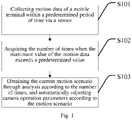
- Fig.1 is a flow chart of a preferred embodiment of the method for a mobile terminal camera to automatically adapt to scenarios according to the present invention. As shown in the figure, it comprises steps of:
- a sensor collects motion data of a mobile terminal first, said motion data depending on the type of the sensor, for example, if the type of the sensor is an acceleration sensor, then the motion data is an acceleration value.
- the sensor is an acceleration sensor, and with the acceleration sensor, the acceleration value of the mobile terminal can be detected, while the acceleration value can reflect the current motion state of the mobile terminal, when a person is in the walking state, a data wave diagram is collected through the mobile terminal, the data wave diagram is collected through a typical acceleration sensor with the X-axis representing time and the Y-axis representing acceleration value, and in the data wave diagram, the acceleration value shows a trend of steady change. Therefore, the current motion state of a mobile terminal can be reached backwardly according to the rule of acceleration value change.
- the current motion scenario of the mobile terminal can be obtained through analysis according to the number of times when the maximum acceleration value exceeds a predetermined value, as the swinging magnitude of the mobile terminal is different in different motion scenarios, based on which the current motion scenario of the mobile terminal can be obtained through analysis and then the operation parameters can be automatically adjusted according to the motion scenario.
- Step S101 Presetting corresponding relations between all motion scenarios and camera operation parameters, said motion scenarios including walking mode, bike mode, automobile mode, leaning mode and still mode.
- the present embodiment presets corresponding relations between all motion scenarios and camera operation parameters, one motion scenario corresponds to a set of camera operation parameters, and in such a way, when the mobile terminal is in a motion scenario, corresponding camera operation parameters can be called such that the mobile terminal camera works under the optimal environment and parameters and takes better pictures or videos.
- the motion scenarios provided in the present embodiment include walking mode, bike mode, automobile mode, leaning mode and still mode, the walking mode corresponds to a walking scenario, the bike mode corresponds to a bike scenario, and so on and so forth, wherein the leaning mode is an unsteady state between stillness and lifting.
- a variety of modes can certainly be further defined so as to meet more specific and actual needs.
- the walking mode can be further specifically classified into fast walking and slow walking modes, etc.
- Step S103 further comprises: Adjusting current camera operation parameters to operation parameters corresponding to the current mode of the mobile terminal according to the current mode of the mobile terminal obtained through analysis and preset corresponding relations between all motion scenarios and camera operation parameters.
- the maximum values of acceleration collected by an acceleration sensor are different in different motion states. For example, during walking, the maximum value of acceleration is relatively high, and when riding an automobile, the maximum value of acceleration is relatively low. As a result, the motion scenario of a mobile terminal can be accurately obtained through analysis according to the number of times when the maximum value exceeds different threshold values.
- the predetermined value comprises a first threshold value, a second threshold value, a third threshold value, and a fourth threshold value, the fourth threshold value > the third threshold value > the second threshold value > the first threshold value, and Step S102 specifically comprises: Acquiring the number of times when the maximum value of the motion data is between the first threshold value and the second threshold value, between the second threshold value and the third threshold value, between the third threshold value and the fourth threshold value, and greater than the fourth threshold value.
- Step S103 specifically comprises:
- the standard value of the walking mode is used to determine threshold values of the walking mode, the bike mode, the automobile mode and the leaning mode, respectively.
- the first threshold value, the second threshold value, the third threshold value, and the fourth threshold value are used to determine threshold values of the modes, respectively.
- the corresponding standard value of the walking mode refers to the threshold value for determining the number of times of the walking mode.
- the number of times when the maximum value is greater than the fourth threshold value is greater than the standard value of the walking mode, it can be determined that the mobile terminal is currently in the walking mode, and so on and so forth.
- determining if the number of times when the maximum value is greater than the fourth threshold value is greater than the standard value of the walking mode if yes, it indicates that the determination criterion of the walking mode is met, and at this moment, the number of times of a high acceleration value is relatively high, and it can be determined that the mobile terminal is in the walking mode, if no, further determining if the number of times when the maximum value is between the third threshold value and the fourth threshold value is greater than the standard value of the bike mode; when the maximum value is between the third threshold value and the fourth threshold value is greater than the standard value of the bike mode, it can be determined that the mobile terminal is in the bike mode, if no, further determining if the number of times when the maximum value is between the second threshold value and the third threshold value is greater than the standard value of the automobile mode; when the number of times when the maximum value is between the second threshold value and the third threshold value is greater than the standard value of the automobile mode, it can be determined that the mobile terminal is in the automobile mode, if no
- the camera operation parameters can be adjusted to the optimal level if a user turns on the mobile terminal camera.
- the camera's user scenario comprises the following modes: portrait, scenery, sports, night, sunset, anti-shake, etc.
- the camera can be adjusted to the sports mode, and the camera will automatically adjust operation parameters to the operation parameters of the sports mode; when it is detected that a user is currently in the still mode, the camera can exit the sports mode, and the camera operation parameters can be adjusted.
- the present invention can preset operation parameters corresponding to a plurality of motion scenarios in the mobile terminal system such that the camera has the optimal performance.
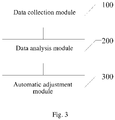
- the present invention further provides a system for a mobile terminal camera to automatically adapt to scenarios, as shown in Fig.3 , comprising:
- the system further comprises: A presetting module for presetting corresponding relations between all motion scenarios and camera operation parameters, said motion scenarios including walking mode, bike mode, automobile mode, leaning mode and still mode.
- the predetermined value comprises a first threshold value, a second threshold value, a third threshold value, and a fourth threshold value
- the data analysis module specifically comprises: A count acquiring unit for acquiring the number of times when the maximum value of the motion data is between the first threshold value and the second threshold value, between the second threshold value and the third threshold value, between the third threshold value and the fourth threshold value, and greater than the fourth threshold value.
- the automatic adjustment module comprises:
- the present invention collects motion data of a mobile terminal within a predetermined period of time via a sensor, acquires the number of times when the maximum value of the motion data exceeds a predetermined value, obtains the current motion scenario of the user through analysis according to the number of times, and achieves adjustments of camera operation parameters, making it unnecessary for a user to conduct frequent operations while the user can conveniently and rapidly take pictures or videos in agreement with the current environment.
Landscapes
- Engineering & Computer Science (AREA)
- Multimedia (AREA)
- Signal Processing (AREA)
- Human Computer Interaction (AREA)
- Telephone Function (AREA)
- Studio Devices (AREA)
Description
- The present invention relates to the field of mobile terminal software, and in particular relates to a method and a system for a mobile terminal camera to automatically adapt to scenarios.
- Right now, smart phones are developing rapidly. It is also the most popular and common function to use a mobile terminal, such as a cell phone, to take pictures, and cell phones have increasingly powerful camera functions, some cell phones even have camera capabilities as good as those of professional card cameras. There may be a variety of scenarios where a user uses a camera, for example, indoor, outdoor, moving, still, etc. Different camera parameters are required for different scenarios. However, existing mobile terminal cameras are unable to achieve the function of self-adaptation to scenarios. As a result, a user needs to make manual adjustments, leading to very inconvenient operations.
- Therefore, the prior art is still in need of improvement and development.
-
US2013/0242120A1 discloses a mobile device which uses motion data data from an accelerometer to determine a user context, such as a motion state of the user, based on a pattern recognition of a periodic signature of the motion data, and to adjust at least one camera feature based on the user context. The user context may include, e.g., at least one of panning, walking, standing, sitting, and traveling in a moving vehicle. -
US2012/0062779A1 discloses an image capturing device using motion data from a triaxial acceleration sensor to determine a state among a stop state, walking, running, traveling by bicycle, car or train, based on cyclic change pattern and an acceleration peak value of the motion data. - The object of the present invention is to provide a method and a system for a mobile terminal camera to automatically adapt to scenarios.
- The invention is defined by the independent claims. Further embodiments result from the depending claims.
- Advantageous effects: the present invention collects motion data of a mobile terminal within a predetermined period of time via a sensor, acquires the number of times when the maximum value of the motion data exceeds a predetermined value, obtains the current motion scenario of the user through analysis according to the number of times, and achieves adjustments of camera operation parameters, making it unnecessary for a user to conduct frequent operations while the user can conveniently and rapidly take pictures or videos in agreement with the current environment.
- The aforementioned characteristics, features and advantages of the invention as well as the way they are achieved will be further illustrated in connection with the following examples and considerations as discussed in view of the figures.
- Fig.1
- is a flow chart of a preferred embodiment of the method for a mobile terminal camera to automatically adapt to scenarios according to the present invention.
- Fig.2
- is a specific flow chart of Step S103 in the method illustrated in
Fig.1 according to the present invention. - Fig.3
- is a structural block diagram of a preferred embodiment of the system for a mobile terminal camera to automatically adapt to scenarios according to the present invention.
- The present invention provides a method and a system for a mobile terminal camera to automatically adapt to scenarios. To make the object, technical solution and effect of the present invention clearer and more specific, the present invention will be further described in detail below. It should be understood that the specific embodiments herein are only used to describe the present invention, rather than to limit the present invention.
- Please refer to
Fig.1, and Fig.1 is a flow chart of a preferred embodiment of the method for a mobile terminal camera to automatically adapt to scenarios according to the present invention. As shown in the figure, it comprises steps of: - S101. Collecting motion data of a mobile terminal within a predetermined period of time via a sensor;
- S102. Acquiring the number of times when the maximum value of the motion data exceeds a predetermined value;
- S103. Obtaining the current motion scenario through analysis according to the number of times, and automatically adjusting camera operation parameters according to the motion scenario.
- In the present embodiment, a sensor collects motion data of a mobile terminal first, said motion data depending on the type of the sensor, for example, if the type of the sensor is an acceleration sensor, then the motion data is an acceleration value. In the present invention, the sensor is an acceleration sensor, and with the acceleration sensor, the acceleration value of the mobile terminal can be detected, while the acceleration value can reflect the current motion state of the mobile terminal, when a person is in the walking state, a data wave diagram is collected through the mobile terminal, the data wave diagram is collected through a typical acceleration sensor with the X-axis representing time and the Y-axis representing acceleration value, and in the data wave diagram, the acceleration value shows a trend of steady change. Therefore, the current motion state of a mobile terminal can be reached backwardly according to the rule of acceleration value change.
- Furthermore, the current motion scenario of the mobile terminal can be obtained through analysis according to the number of times when the maximum acceleration value exceeds a predetermined value, as the swinging magnitude of the mobile terminal is different in different motion scenarios, based on which the current motion scenario of the mobile terminal can be obtained through analysis and then the operation parameters can be automatically adjusted according to the motion scenario.
- As a more preferred embodiment of the present invention, it further comprises prior to Step S101:
Presetting corresponding relations between all motion scenarios and camera operation parameters, said motion scenarios including walking mode, bike mode, automobile mode, leaning mode and still mode. - The present embodiment presets corresponding relations between all motion scenarios and camera operation parameters, one motion scenario corresponds to a set of camera operation parameters, and in such a way, when the mobile terminal is in a motion scenario, corresponding camera operation parameters can be called such that the mobile terminal camera works under the optimal environment and parameters and takes better pictures or videos. The motion scenarios provided in the present embodiment include walking mode, bike mode, automobile mode, leaning mode and still mode, the walking mode corresponds to a walking scenario, the bike mode corresponds to a bike scenario, and so on and so forth, wherein the leaning mode is an unsteady state between stillness and lifting. According to a user's need, a variety of modes can certainly be further defined so as to meet more specific and actual needs. For example, the walking mode can be further specifically classified into fast walking and slow walking modes, etc.
- In summary, as a more preferred embodiment of the present invention, Step S103 further comprises:
Adjusting current camera operation parameters to operation parameters corresponding to the current mode of the mobile terminal according to the current mode of the mobile terminal obtained through analysis and preset corresponding relations between all motion scenarios and camera operation parameters. - The maximum values of acceleration collected by an acceleration sensor are different in different motion states. For example, during walking, the maximum value of acceleration is relatively high, and when riding an automobile, the maximum value of acceleration is relatively low. As a result, the motion scenario of a mobile terminal can be accurately obtained through analysis according to the number of times when the maximum value exceeds different threshold values. As a more preferred embodiment of the present invention, the predetermined value comprises a first threshold value, a second threshold value, a third threshold value, and a fourth threshold value, the fourth threshold value > the third threshold value > the second threshold value > the first threshold value, and Step S102 specifically comprises:
Acquiring the number of times when the maximum value of the motion data is between the first threshold value and the second threshold value, between the second threshold value and the third threshold value, between the third threshold value and the fourth threshold value, and greater than the fourth threshold value. - As a more preferred embodiment of the present invention, as shown in
Fig.2 , Step S103 specifically comprises: - S201. Determining if the number of times when the maximum value is greater than the fourth threshold value is greater than the standard value of the walking mode, if yes, go to Step S202, and if no, go to Step S203;
- S202. Determining that the mobile terminal is currently in the walking mode;
- S203. Determining if the number of times when the maximum value is between the third threshold value and the fourth threshold value is greater than the standard value of the bike mode, if yes, go to Step S204, and if no, go to Step S205;
- S204. Determining that the mobile terminal is currently in the bike mode;
- S205. Determining if the number of times when the maximum value is between the second threshold value and the third threshold value is greater than the standard value of the automobile mode, if yes, go to Step S206, and if no, go to Step S207;
- S206. Determining that the mobile terminal is currently in the automobile mode;
- S207. Determining if the number of times when the maximum value is between the first threshold value and the second threshold value is greater than the standard value of the leaning mode, if yes, go to Step S208, and if no, go to Step S209;
- S208. Determining that the mobile terminal is currently in the leaning mode;
- S209. Determining that the mobile terminal is currently in the still mode;
- Wherein the standard value of the walking mode, the standard value of the bike mode, the standard value of the automobile mode and the standard value of the leaning mode are used to determine threshold values of the walking mode, the bike mode, the automobile mode and the leaning mode, respectively.
- The above embodiments are specifically set up for the above motion scenarios, the first threshold value, the second threshold value, the third threshold value, and the fourth threshold value are used to determine threshold values of the modes, respectively. For example, in the walking mode, only when the maximum value is greater than the fourth threshold value can it be possible to determine that it is currently in the walking mode, while the corresponding standard value of the walking mode refers to the threshold value for determining the number of times of the walking mode. For example, when the number of times when the maximum value is greater than the fourth threshold value is greater than the standard value of the walking mode, it can be determined that the mobile terminal is currently in the walking mode, and so on and so forth.
- Specifically, first, determining if the number of times when the maximum value is greater than the fourth threshold value is greater than the standard value of the walking mode, if yes, it indicates that the determination criterion of the walking mode is met, and at this moment, the number of times of a high acceleration value is relatively high, and it can be determined that the mobile terminal is in the walking mode, if no, further determining if the number of times when the maximum value is between the third threshold value and the fourth threshold value is greater than the standard value of the bike mode; when the maximum value is between the third threshold value and the fourth threshold value is greater than the standard value of the bike mode, it can be determined that the mobile terminal is in the bike mode, if no, further determining if the number of times when the maximum value is between the second threshold value and the third threshold value is greater than the standard value of the automobile mode; when the number of times when the maximum value is between the second threshold value and the third threshold value is greater than the standard value of the automobile mode, it can be determined that the mobile terminal is in the automobile mode, if no, further determining if the number of times when the maximum value is between the first threshold value and the second threshold value is greater than the standard value of the leaning mode; when the number of times when the maximum value is between the first threshold value and the second threshold value is greater than the standard value of the leaning mode, determining that the mobile terminal is currently in the leaning mode, if no, it indicates that the acceleration value is at a relatively low level, and therefore, it can be determined that the mobile terminal is currently in the still mode.
- When the current mode of the mobile terminal is detected with the above method, the camera operation parameters can be adjusted to the optimal level if a user turns on the mobile terminal camera.
- For example, on an existing smart phone such as an Android cell phone, the camera's user scenario comprises the following modes: portrait, scenery, sports, night, sunset, anti-shake, etc. When it is detected that a user is currently in the automobile mode, the camera can be adjusted to the sports mode, and the camera will automatically adjust operation parameters to the operation parameters of the sports mode; when it is detected that a user is currently in the still mode, the camera can exit the sports mode, and the camera operation parameters can be adjusted. Based on the above principle, the present invention can preset operation parameters corresponding to a plurality of motion scenarios in the mobile terminal system such that the camera has the optimal performance.
- Based on the above method, the present invention further provides a system for a mobile terminal camera to automatically adapt to scenarios, as shown in
Fig.3 , comprising: - A
data collection module 100 for collecting motion data of a mobile terminal within a predetermined period of time via a sensor; - A
data analysis module 200 for acquiring the number of times when the maximum value of the motion data exceeds a predetermined value; - An
automatic adjustment module 300 for obtaining the current motion scenario through analysis according to the number of times, and automatically adjusting camera operation parameters according to the motion scenario. - Furthermore, the system further comprises:
A presetting module for presetting corresponding relations between all motion scenarios and camera operation parameters, said motion scenarios including walking mode, bike mode, automobile mode, leaning mode and still mode. - Furthermore, the predetermined value comprises a first threshold value, a second threshold value, a third threshold value, and a fourth threshold value, the fourth threshold value > the third threshold value > the second threshold value > the first threshold value, and the data analysis module specifically comprises:
A count acquiring unit for acquiring the number of times when the maximum value of the motion data is between the first threshold value and the second threshold value, between the second threshold value and the third threshold value, between the third threshold value and the fourth threshold value, and greater than the fourth threshold value. - Furthermore, the automatic adjustment module comprises:
- A first determining unit for determining if the number of times when the maximum value is greater than the fourth threshold value is greater than the standard value of the walking mode, if yes, determining that the mobile terminal is currently in the walking mode, and if no, go to the second determining unit;
- A second determining unit for determining if the number of times when the maximum value is between the third threshold value and the fourth threshold value is greater than the standard value of the bike mode, if yes, determining that the mobile terminal is currently in the bike mode, and if no, go to the third determining unit;
- A third determining unit for determining if the number of times when the maximum value is between the second threshold value and the third threshold value is greater than the standard value of the automobile mode, if yes, determining that the mobile terminal is currently in the automobile mode, and if no, go to the fourth determining unit;
- A fourth determining unit for determining if the number of times when the maximum value is between the first threshold value and the second threshold value is greater than the standard value of the leaning mode, if yes, determining that the mobile terminal is currently in the leaning mode, and if no, determining that the mobile terminal is currently in the still mode;
- Wherein the standard value of the walking mode, the standard value of the bike mode, the standard value of the automobile mode and the standard value of the leaning mode are used to determine threshold values of the walking mode, the bike mode, the automobile mode and the leaning mode, respectively.
- Technical details regarding the above modules and units have been described in detail in the above method, which will not be repeated.
- In summary, the present invention collects motion data of a mobile terminal within a predetermined period of time via a sensor, acquires the number of times when the maximum value of the motion data exceeds a predetermined value, obtains the current motion scenario of the user through analysis according to the number of times, and achieves adjustments of camera operation parameters, making it unnecessary for a user to conduct frequent operations while the user can conveniently and rapidly take pictures or videos in agreement with the current environment.
Claims (6)
- A method for a mobile terminal camera to automatically adapt to scenarios comprising steps of:A. Collecting acceleration values of a mobile terminal within a predetermined period of time via an acceleration sensor (S101);B. Acquiring the number of times when a maximum value of the acceleration values exceeds at least one predetermined value (S102);C. Obtaining the current motion scenario through analysis according to the number of times, and automatically adjusting camera operation parameters according to the motion scenario (S103);wherein, prior to Step A, it further comprises:A0. Presetting corresponding relations between all motion scenarios and camera operation parameters, said motion scenarios including a walking scenario, a bike scenario, an automobile scenario, a leaning scenario and a still scenario; andwherein the at least one predetermined value comprises a first threshold value, a second threshold value, a third threshold value, and a fourth threshold value, the fourth threshold value > the third threshold value > the second threshold value > the first threshold value, andwherein Step B specifically comprises:- Acquiring the number of times when the maximum value of the motion data is between the first threshold value and the second threshold value, between the second threshold value and the third threshold value, between the third threshold value and the fourth threshold value, and greater than the fourth threshold value.
- The method for a mobile terminal camera to automatically adapt to scenarios according the previous claim, wherein Step C specifically comprises:C1. Determining if the number of times when the maximum value is greater than the fourth threshold value is greater than a standard value of the walking scenario (S201), if yes, determining that the mobile terminal is currently in the walking scenario (S202), and if no, go to Step C2;C2. Determining if the number of times when the maximum value is between the third threshold value and the fourth threshold value is greater than a standard value of the bike scenario (S203), if yes, determining that the mobile terminal is currently in the bike scenario (S204), and if no, go to Step C3;C3. Determining if the number of times when the maximum value is between the second threshold value and the third threshold value is greater than a standard value of the automobile scenario (S205), if yes, determining that the mobile terminal is currently in the automobile scenario (S206), and if no, go to Step C4;C4. Determining if the number of times when the maximum value is between the first threshold value and the second threshold value is greater than a standard value of the leaning scenario (S207), if yes, determining that the mobile terminal is currently in the leaning scenario (S208), and if no, determining that the mobile terminal is currently in the still scenario (S209).
- The method for a mobile terminal camera to automatically adapt to scenarios according to any of the preceding claims, wherein the camera further comprises: a portrait mode, a scenery mode, a sports mode, a night mode, a sunset mode and an anti-shake mode.
- The method for a mobile terminal camera to automatically adapt to scenarios according to any of the preceding claims,
wherein Step C specifically comprises:- Adjusting current camera operation parameters to operation parameters corresponding to the current operating mode of the mobile terminal according to the current motion scenario of the mobile terminal obtained through analysis and preset corresponding relations between all motion scenarios and camera operation parameters. - A system for a mobile terminal camera to automatically adapt to scenarios, the system comprising:- A data collection module (100) for collecting acceleration values of a mobile terminal within a predetermined period of time via an acceleration sensor;- A data analysis module (200) for acquiring the number of times when the maximum value of the acceleration values exceeds at least one predetermined value;- An automatic adjustment module (300) for obtaining the current motion scenario through analysis according to the number of times, and automatically adjusting camera operation parameters according to the motion scenario- A presetting module for presetting corresponding relations between all motion scenarios and camera operation parameters, said motion scenarios including a walking scenario, a bike scenario, an automobile scenario, a leaning scenario and a still scenario;- wherein the at least one predetermined value comprises a first threshold value, a second threshold value, a third threshold value, and a fourth threshold value, the fourth threshold value > the third threshold value > the second threshold value > the first threshold value, and the data analysis module specifically comprises:- A count acquiring unit for acquiring the number of times when the maximum value of the motion data is between the first threshold value and the second threshold value, between the second threshold value and the third threshold value, between the third threshold value and the fourth threshold value, and greater than the fourth threshold value.
- The system for a mobile terminal camera to automatically adapt to scenarios according to claim 5, wherein the automatic adjustment module comprises:- A first determining unit for determining if the number of times when the maximum value is greater than the fourth threshold value is greater than the standard value of the walking scenario, if yes, determining that the mobile terminal is currently in the walking scenario, and if no, go to the second determining unit;- A second determining unit for determining if the number of times when the maximum value is between the third threshold value and the fourth threshold value is greater than the standard value of the bike scenario, if yes, determining that the mobile terminal is currently in the bike scenario, and if no, go to the third determining unit;- A third determining unit for determining if the number of times when the maximum value is between the second threshold value and the third threshold value is greater than the standard value of the automobile scenario, if yes, determining that the mobile terminal is currently in the automobile scenario, and if no, go to the fourth determining unit;- A fourth determining unit for determining if the number of times when the maximum value is between the first threshold value and the second threshold value is greater than the standard value of the leaning scenario, if yes, determining that the mobile terminal is currently in the leaning scenario, and if no, determining that the mobile terminal is currently in the still scenario.
Applications Claiming Priority (2)
| Application Number | Priority Date | Filing Date | Title |
|---|---|---|---|
| CN201410115692.4A CN103873776A (en) | 2014-03-26 | 2014-03-26 | Method and system for making camera of mobile terminal adapt to scene automatically |
| PCT/CN2014/079130 WO2015143779A1 (en) | 2014-03-26 | 2014-06-04 | Method and system for enabling camera of mobile terminal to automatically adapt to scene |
Publications (3)
| Publication Number | Publication Date |
|---|---|
| EP3125525A1 EP3125525A1 (en) | 2017-02-01 |
| EP3125525A4 EP3125525A4 (en) | 2017-12-13 |
| EP3125525B1 true EP3125525B1 (en) | 2022-08-03 |
Family
ID=50911864
Family Applications (1)
| Application Number | Title | Priority Date | Filing Date |
|---|---|---|---|
| EP14886763.3A Active EP3125525B1 (en) | 2014-03-26 | 2014-06-04 | Method and system for enabling camera of mobile terminal to automatically adapt to scene |
Country Status (4)
| Country | Link |
|---|---|
| US (1) | US9692960B2 (en) |
| EP (1) | EP3125525B1 (en) |
| CN (1) | CN103873776A (en) |
| WO (1) | WO2015143779A1 (en) |
Families Citing this family (13)
| Publication number | Priority date | Publication date | Assignee | Title |
|---|---|---|---|---|
| CN104461015A (en) * | 2014-12-30 | 2015-03-25 | 北京智谷睿拓技术服务有限公司 | Shooting control method, shooting control device, shooting device and wearable device |
| CN104811619B (en) * | 2015-04-23 | 2018-12-25 | 小米科技有限责任公司 | Image-forming correction method and device, electronic equipment |
| WO2016179019A1 (en) * | 2015-05-01 | 2016-11-10 | Gopro, Inc. | Camera mode control |
| CN106558121A (en) * | 2015-09-30 | 2017-04-05 | 中兴通讯股份有限公司 | The method and device of shooting |
| CN105227844B (en) * | 2015-10-22 | 2018-10-12 | 上海斐讯数据通信技术有限公司 | Image acquiring method and device, mobile terminal |
| CN105550608B (en) * | 2015-12-02 | 2018-09-25 | 普联技术有限公司 | A kind of equipment recovers method and apparatus |
| CN106131430A (en) * | 2016-07-29 | 2016-11-16 | 维沃移动通信有限公司 | A kind of photographic method and mobile terminal |
| US10218906B2 (en) * | 2017-03-22 | 2019-02-26 | Htc Corporation | Camera device and method for camera device |
| CN108881706B (en) * | 2017-05-16 | 2023-10-10 | 北京三星通信技术研究有限公司 | Method and device for controlling operation of multimedia equipment |
| CN107395976B (en) * | 2017-08-11 | 2019-11-19 | 维沃移动通信有限公司 | A shooting parameter setting method and mobile terminal |
| CN109831628B (en) * | 2019-03-14 | 2021-07-16 | Oppo广东移动通信有限公司 | Adjustment method, device, terminal and storage medium for terminal photographing mode |
| CN109831629B (en) * | 2019-03-14 | 2021-07-02 | Oppo广东移动通信有限公司 | Adjustment method, device, terminal and storage medium for terminal photographing mode |
| CN112637476A (en) * | 2019-09-24 | 2021-04-09 | 中兴通讯股份有限公司 | Video recording method, device, terminal and computer readable storage medium |
Family Cites Families (22)
| Publication number | Priority date | Publication date | Assignee | Title |
|---|---|---|---|---|
| GB2388266B (en) * | 2002-04-30 | 2005-07-27 | Hewlett Packard Co | Improvements in and relating to camera controls |
| US20060170816A1 (en) * | 2005-01-28 | 2006-08-03 | Silverstein D A | Method and system for automatically adjusting exposure parameters of an imaging device |
| JP2007027967A (en) * | 2005-07-13 | 2007-02-01 | Fujifilm Holdings Corp | Imaging device |
| CN100461854C (en) | 2006-01-05 | 2009-02-11 | 中兴通讯股份有限公司 | A method for channelizing IPTV services |
| CN100591101C (en) * | 2006-11-30 | 2010-02-17 | 华晶科技股份有限公司 | Method for automatically adjusting photographing parameters according to photographing operation habit of user |
| JP5251039B2 (en) | 2007-08-23 | 2013-07-31 | ソニー株式会社 | Information processing apparatus, information processing method, and program |
| US9141974B2 (en) * | 2008-01-16 | 2015-09-22 | Martin Kelly Jones | Systems and methods for determining mobile thing (MT) identification and/or MT motion activity using sensor data of wireless communication device |
| US8275880B2 (en) | 2008-05-06 | 2012-09-25 | Microsoft Corporation | Media content programming, delivery, and consumption |
| US8996332B2 (en) * | 2008-06-24 | 2015-03-31 | Dp Technologies, Inc. | Program setting adjustments based on activity identification |
| US8587515B2 (en) * | 2008-08-05 | 2013-11-19 | Apple Inc. | Systems and methods for processing motion sensor generated data |
| CN101867717B (en) * | 2009-04-16 | 2012-05-30 | 华晶科技股份有限公司 | Adjusting method for photographic parameters of digital image and digital photographing device |
| US9113064B2 (en) * | 2009-11-05 | 2015-08-18 | Olympus Corporation | Image pickup apparatus and image acquisition method |
| US8180209B2 (en) * | 2010-05-19 | 2012-05-15 | Eastman Kodak Company | Determining camera activity from a steadiness signal |
| US8970720B2 (en) * | 2010-07-26 | 2015-03-03 | Apple Inc. | Automatic digital camera photography mode selection |
| JP5682241B2 (en) * | 2010-09-15 | 2015-03-11 | カシオ計算機株式会社 | Reproduction display apparatus, photographing apparatus, reproduction display method, and program |
| JP2013141155A (en) * | 2012-01-05 | 2013-07-18 | Nikon Corp | Imaging device |
| US20130242120A1 (en) * | 2012-03-15 | 2013-09-19 | Qualcomm Incorporated | Motion-state classification for camera applications |
| US20150164430A1 (en) * | 2013-06-25 | 2015-06-18 | Lark Technologies, Inc. | Method for classifying user motion |
| CN103079013A (en) * | 2013-01-17 | 2013-05-01 | 广东欧珀移动通信有限公司 | Application operation method and device of mobile terminal and mobile terminal |
| CN103596020B (en) | 2013-09-03 | 2017-06-20 | 百视通网络电视技术发展有限责任公司 | The mixing layout of TV programme and player method and system |
| CN103500047A (en) * | 2013-09-23 | 2014-01-08 | 百度在线网络技术(北京)有限公司 | Method, device and mobile terminal for controlling interactive element in mobile terminal |
| US10456622B2 (en) * | 2013-11-04 | 2019-10-29 | Intel Corporation | Detection of biking, walking, and running |
-
2014
- 2014-03-26 CN CN201410115692.4A patent/CN103873776A/en active Pending
- 2014-06-04 EP EP14886763.3A patent/EP3125525B1/en active Active
- 2014-06-04 US US14/770,362 patent/US9692960B2/en active Active
- 2014-06-04 WO PCT/CN2014/079130 patent/WO2015143779A1/en not_active Ceased
Also Published As
| Publication number | Publication date |
|---|---|
| EP3125525A1 (en) | 2017-02-01 |
| US20160156846A1 (en) | 2016-06-02 |
| CN103873776A (en) | 2014-06-18 |
| WO2015143779A1 (en) | 2015-10-01 |
| US9692960B2 (en) | 2017-06-27 |
| EP3125525A4 (en) | 2017-12-13 |
Similar Documents
| Publication | Publication Date | Title |
|---|---|---|
| US9692960B2 (en) | Method and system for enabling camera of mobile terminal to automatically adapt camera parameters according to scene motion | |
| US11368615B2 (en) | Modifying image parameters using wearable device input | |
| EP3228075B1 (en) | Sensor configuration switching for adaptation of video capturing frame rate | |
| CN104205804B (en) | Image processing device, photographing device and image processing method | |
| US8063952B2 (en) | Image-capturing apparatus and image-capturing method for performing drive log image capturing and life log image capturing as automatic image capturing | |
| CN107566752B (en) | Shooting method, terminal and computer storage medium | |
| US10356322B2 (en) | Wearable device, control apparatus, photographing control method and automatic imaging apparatus | |
| CN107615745B (en) | Photographing method and terminal | |
| US20170269326A1 (en) | Imaging apparatus and focusing control method | |
| CN105874776A (en) | Image processing apparatus and method | |
| CN104580969A (en) | Video frame rate adjusting method and device | |
| CN105430279A (en) | Fast auto-focus method and device for camera | |
| CN104104870B (en) | Filming control method, imaging control device and capture apparatus | |
| US9973687B2 (en) | Capturing apparatus and method for capturing images without moire pattern | |
| CN108139564B (en) | Focus control device, imaging device, focus control method, and focus control program | |
| US9906724B2 (en) | Method and device for setting a focus of a camera | |
| US20160088219A1 (en) | Image capture apparatus which controls frame rate based on motion of object, information transmission apparatus, image capture control method, information transmission method, and recording medium | |
| CN104301597A (en) | Photographing control system and method | |
| CN105430277A (en) | Automatic focusing control method and device | |
| US10778903B2 (en) | Imaging apparatus, imaging method, and program | |
| CN108961169A (en) | Monitor grasp shoot method and device | |
| US20150138076A1 (en) | Communication device and method of processing incoming call by facial image | |
| EP3213502B1 (en) | Time extension for image frame processing | |
| JP2014103643A (en) | Imaging device and subject recognition method | |
| CN113674258B (en) | Image processing method and related equipment |
Legal Events
| Date | Code | Title | Description |
|---|---|---|---|
| STAA | Information on the status of an ep patent application or granted ep patent |
Free format text: STATUS: THE INTERNATIONAL PUBLICATION HAS BEEN MADE |
|
| PUAI | Public reference made under article 153(3) epc to a published international application that has entered the european phase |
Free format text: ORIGINAL CODE: 0009012 |
|
| STAA | Information on the status of an ep patent application or granted ep patent |
Free format text: STATUS: REQUEST FOR EXAMINATION WAS MADE |
|
| 17P | Request for examination filed |
Effective date: 20161026 |
|
| AK | Designated contracting states |
Kind code of ref document: A1 Designated state(s): AL AT BE BG CH CY CZ DE DK EE ES FI FR GB GR HR HU IE IS IT LI LT LU LV MC MK MT NL NO PL PT RO RS SE SI SK SM TR |
|
| AX | Request for extension of the european patent |
Extension state: BA ME |
|
| DAX | Request for extension of the european patent (deleted) | ||
| A4 | Supplementary search report drawn up and despatched |
Effective date: 20171110 |
|
| RIC1 | Information provided on ipc code assigned before grant |
Ipc: H04N 5/232 20060101AFI20171106BHEP |
|
| STAA | Information on the status of an ep patent application or granted ep patent |
Free format text: STATUS: EXAMINATION IS IN PROGRESS |
|
| 17Q | First examination report despatched |
Effective date: 20200414 |
|
| GRAP | Despatch of communication of intention to grant a patent |
Free format text: ORIGINAL CODE: EPIDOSNIGR1 |
|
| STAA | Information on the status of an ep patent application or granted ep patent |
Free format text: STATUS: GRANT OF PATENT IS INTENDED |
|
| INTG | Intention to grant announced |
Effective date: 20210818 |
|
| RIN1 | Information on inventor provided before grant (corrected) |
Inventor name: WANG, YUNHUI |
|
| GRAJ | Information related to disapproval of communication of intention to grant by the applicant or resumption of examination proceedings by the epo deleted |
Free format text: ORIGINAL CODE: EPIDOSDIGR1 |
|
| STAA | Information on the status of an ep patent application or granted ep patent |
Free format text: STATUS: EXAMINATION IS IN PROGRESS |
|
| INTC | Intention to grant announced (deleted) | ||
| GRAP | Despatch of communication of intention to grant a patent |
Free format text: ORIGINAL CODE: EPIDOSNIGR1 |
|
| STAA | Information on the status of an ep patent application or granted ep patent |
Free format text: STATUS: GRANT OF PATENT IS INTENDED |
|
| INTG | Intention to grant announced |
Effective date: 20220215 |
|
| GRAS | Grant fee paid |
Free format text: ORIGINAL CODE: EPIDOSNIGR3 |
|
| GRAA | (expected) grant |
Free format text: ORIGINAL CODE: 0009210 |
|
| STAA | Information on the status of an ep patent application or granted ep patent |
Free format text: STATUS: THE PATENT HAS BEEN GRANTED |
|
| AK | Designated contracting states |
Kind code of ref document: B1 Designated state(s): AL AT BE BG CH CY CZ DE DK EE ES FI FR GB GR HR HU IE IS IT LI LT LU LV MC MK MT NL NO PL PT RO RS SE SI SK SM TR |
|
| REG | Reference to a national code |
Ref country code: AT Ref legal event code: REF Ref document number: 1509685 Country of ref document: AT Kind code of ref document: T Effective date: 20220815 Ref country code: CH Ref legal event code: EP |
|
| REG | Reference to a national code |
Ref country code: DE Ref legal event code: R096 Ref document number: 602014084521 Country of ref document: DE |
|
| REG | Reference to a national code |
Ref country code: IE Ref legal event code: FG4D |
|
| REG | Reference to a national code |
Ref country code: DE Ref legal event code: R079 Ref document number: 602014084521 Country of ref document: DE Free format text: PREVIOUS MAIN CLASS: H04N0005232000 Ipc: H04N0023600000 Ref country code: LT Ref legal event code: MG9D |
|
| REG | Reference to a national code |
Ref country code: NL Ref legal event code: MP Effective date: 20220803 |
|
| PG25 | Lapsed in a contracting state [announced via postgrant information from national office to epo] |
Ref country code: SE Free format text: LAPSE BECAUSE OF FAILURE TO SUBMIT A TRANSLATION OF THE DESCRIPTION OR TO PAY THE FEE WITHIN THE PRESCRIBED TIME-LIMIT Effective date: 20220803 Ref country code: RS Free format text: LAPSE BECAUSE OF FAILURE TO SUBMIT A TRANSLATION OF THE DESCRIPTION OR TO PAY THE FEE WITHIN THE PRESCRIBED TIME-LIMIT Effective date: 20220803 Ref country code: PT Free format text: LAPSE BECAUSE OF FAILURE TO SUBMIT A TRANSLATION OF THE DESCRIPTION OR TO PAY THE FEE WITHIN THE PRESCRIBED TIME-LIMIT Effective date: 20221205 Ref country code: NO Free format text: LAPSE BECAUSE OF FAILURE TO SUBMIT A TRANSLATION OF THE DESCRIPTION OR TO PAY THE FEE WITHIN THE PRESCRIBED TIME-LIMIT Effective date: 20221103 Ref country code: NL Free format text: LAPSE BECAUSE OF FAILURE TO SUBMIT A TRANSLATION OF THE DESCRIPTION OR TO PAY THE FEE WITHIN THE PRESCRIBED TIME-LIMIT Effective date: 20220803 Ref country code: LV Free format text: LAPSE BECAUSE OF FAILURE TO SUBMIT A TRANSLATION OF THE DESCRIPTION OR TO PAY THE FEE WITHIN THE PRESCRIBED TIME-LIMIT Effective date: 20220803 Ref country code: LT Free format text: LAPSE BECAUSE OF FAILURE TO SUBMIT A TRANSLATION OF THE DESCRIPTION OR TO PAY THE FEE WITHIN THE PRESCRIBED TIME-LIMIT Effective date: 20220803 Ref country code: FI Free format text: LAPSE BECAUSE OF FAILURE TO SUBMIT A TRANSLATION OF THE DESCRIPTION OR TO PAY THE FEE WITHIN THE PRESCRIBED TIME-LIMIT Effective date: 20220803 Ref country code: ES Free format text: LAPSE BECAUSE OF FAILURE TO SUBMIT A TRANSLATION OF THE DESCRIPTION OR TO PAY THE FEE WITHIN THE PRESCRIBED TIME-LIMIT Effective date: 20220803 |
|
| REG | Reference to a national code |
Ref country code: AT Ref legal event code: MK05 Ref document number: 1509685 Country of ref document: AT Kind code of ref document: T Effective date: 20220803 |
|
| PG25 | Lapsed in a contracting state [announced via postgrant information from national office to epo] |
Ref country code: PL Free format text: LAPSE BECAUSE OF FAILURE TO SUBMIT A TRANSLATION OF THE DESCRIPTION OR TO PAY THE FEE WITHIN THE PRESCRIBED TIME-LIMIT Effective date: 20220803 Ref country code: IS Free format text: LAPSE BECAUSE OF FAILURE TO SUBMIT A TRANSLATION OF THE DESCRIPTION OR TO PAY THE FEE WITHIN THE PRESCRIBED TIME-LIMIT Effective date: 20221203 Ref country code: HR Free format text: LAPSE BECAUSE OF FAILURE TO SUBMIT A TRANSLATION OF THE DESCRIPTION OR TO PAY THE FEE WITHIN THE PRESCRIBED TIME-LIMIT Effective date: 20220803 Ref country code: GR Free format text: LAPSE BECAUSE OF FAILURE TO SUBMIT A TRANSLATION OF THE DESCRIPTION OR TO PAY THE FEE WITHIN THE PRESCRIBED TIME-LIMIT Effective date: 20221104 |
|
| PG25 | Lapsed in a contracting state [announced via postgrant information from national office to epo] |
Ref country code: SM Free format text: LAPSE BECAUSE OF FAILURE TO SUBMIT A TRANSLATION OF THE DESCRIPTION OR TO PAY THE FEE WITHIN THE PRESCRIBED TIME-LIMIT Effective date: 20220803 Ref country code: RO Free format text: LAPSE BECAUSE OF FAILURE TO SUBMIT A TRANSLATION OF THE DESCRIPTION OR TO PAY THE FEE WITHIN THE PRESCRIBED TIME-LIMIT Effective date: 20220803 Ref country code: DK Free format text: LAPSE BECAUSE OF FAILURE TO SUBMIT A TRANSLATION OF THE DESCRIPTION OR TO PAY THE FEE WITHIN THE PRESCRIBED TIME-LIMIT Effective date: 20220803 Ref country code: CZ Free format text: LAPSE BECAUSE OF FAILURE TO SUBMIT A TRANSLATION OF THE DESCRIPTION OR TO PAY THE FEE WITHIN THE PRESCRIBED TIME-LIMIT Effective date: 20220803 Ref country code: AT Free format text: LAPSE BECAUSE OF FAILURE TO SUBMIT A TRANSLATION OF THE DESCRIPTION OR TO PAY THE FEE WITHIN THE PRESCRIBED TIME-LIMIT Effective date: 20220803 |
|
| REG | Reference to a national code |
Ref country code: DE Ref legal event code: R097 Ref document number: 602014084521 Country of ref document: DE |
|
| PG25 | Lapsed in a contracting state [announced via postgrant information from national office to epo] |
Ref country code: SK Free format text: LAPSE BECAUSE OF FAILURE TO SUBMIT A TRANSLATION OF THE DESCRIPTION OR TO PAY THE FEE WITHIN THE PRESCRIBED TIME-LIMIT Effective date: 20220803 Ref country code: EE Free format text: LAPSE BECAUSE OF FAILURE TO SUBMIT A TRANSLATION OF THE DESCRIPTION OR TO PAY THE FEE WITHIN THE PRESCRIBED TIME-LIMIT Effective date: 20220803 |
|
| PLBE | No opposition filed within time limit |
Free format text: ORIGINAL CODE: 0009261 |
|
| STAA | Information on the status of an ep patent application or granted ep patent |
Free format text: STATUS: NO OPPOSITION FILED WITHIN TIME LIMIT |
|
| PG25 | Lapsed in a contracting state [announced via postgrant information from national office to epo] |
Ref country code: AL Free format text: LAPSE BECAUSE OF FAILURE TO SUBMIT A TRANSLATION OF THE DESCRIPTION OR TO PAY THE FEE WITHIN THE PRESCRIBED TIME-LIMIT Effective date: 20220803 |
|
| 26N | No opposition filed |
Effective date: 20230504 |
|
| P01 | Opt-out of the competence of the unified patent court (upc) registered |
Effective date: 20230530 |
|
| PG25 | Lapsed in a contracting state [announced via postgrant information from national office to epo] |
Ref country code: SI Free format text: LAPSE BECAUSE OF FAILURE TO SUBMIT A TRANSLATION OF THE DESCRIPTION OR TO PAY THE FEE WITHIN THE PRESCRIBED TIME-LIMIT Effective date: 20220803 |
|
| PG25 | Lapsed in a contracting state [announced via postgrant information from national office to epo] |
Ref country code: MC Free format text: LAPSE BECAUSE OF FAILURE TO SUBMIT A TRANSLATION OF THE DESCRIPTION OR TO PAY THE FEE WITHIN THE PRESCRIBED TIME-LIMIT Effective date: 20220803 |
|
| PG25 | Lapsed in a contracting state [announced via postgrant information from national office to epo] |
Ref country code: MC Free format text: LAPSE BECAUSE OF FAILURE TO SUBMIT A TRANSLATION OF THE DESCRIPTION OR TO PAY THE FEE WITHIN THE PRESCRIBED TIME-LIMIT Effective date: 20220803 |
|
| REG | Reference to a national code |
Ref country code: CH Ref legal event code: PL |
|
| REG | Reference to a national code |
Ref country code: BE Ref legal event code: MM Effective date: 20230630 |
|
| PG25 | Lapsed in a contracting state [announced via postgrant information from national office to epo] |
Ref country code: LU Free format text: LAPSE BECAUSE OF NON-PAYMENT OF DUE FEES Effective date: 20230604 |
|
| REG | Reference to a national code |
Ref country code: IE Ref legal event code: MM4A |
|
| PG25 | Lapsed in a contracting state [announced via postgrant information from national office to epo] |
Ref country code: LU Free format text: LAPSE BECAUSE OF NON-PAYMENT OF DUE FEES Effective date: 20230604 |
|
| PG25 | Lapsed in a contracting state [announced via postgrant information from national office to epo] |
Ref country code: IE Free format text: LAPSE BECAUSE OF NON-PAYMENT OF DUE FEES Effective date: 20230604 |
|
| PG25 | Lapsed in a contracting state [announced via postgrant information from national office to epo] |
Ref country code: IE Free format text: LAPSE BECAUSE OF NON-PAYMENT OF DUE FEES Effective date: 20230604 Ref country code: CH Free format text: LAPSE BECAUSE OF NON-PAYMENT OF DUE FEES Effective date: 20230630 |
|
| PG25 | Lapsed in a contracting state [announced via postgrant information from national office to epo] |
Ref country code: IT Free format text: LAPSE BECAUSE OF FAILURE TO SUBMIT A TRANSLATION OF THE DESCRIPTION OR TO PAY THE FEE WITHIN THE PRESCRIBED TIME-LIMIT Effective date: 20220803 Ref country code: BE Free format text: LAPSE BECAUSE OF NON-PAYMENT OF DUE FEES Effective date: 20230630 |
|
| PG25 | Lapsed in a contracting state [announced via postgrant information from national office to epo] |
Ref country code: BG Free format text: LAPSE BECAUSE OF FAILURE TO SUBMIT A TRANSLATION OF THE DESCRIPTION OR TO PAY THE FEE WITHIN THE PRESCRIBED TIME-LIMIT Effective date: 20220803 |
|
| PG25 | Lapsed in a contracting state [announced via postgrant information from national office to epo] |
Ref country code: BG Free format text: LAPSE BECAUSE OF FAILURE TO SUBMIT A TRANSLATION OF THE DESCRIPTION OR TO PAY THE FEE WITHIN THE PRESCRIBED TIME-LIMIT Effective date: 20220803 |
|
| PG25 | Lapsed in a contracting state [announced via postgrant information from national office to epo] |
Ref country code: CY Free format text: LAPSE BECAUSE OF FAILURE TO SUBMIT A TRANSLATION OF THE DESCRIPTION OR TO PAY THE FEE WITHIN THE PRESCRIBED TIME-LIMIT; INVALID AB INITIO Effective date: 20140604 |
|
| PG25 | Lapsed in a contracting state [announced via postgrant information from national office to epo] |
Ref country code: HU Free format text: LAPSE BECAUSE OF FAILURE TO SUBMIT A TRANSLATION OF THE DESCRIPTION OR TO PAY THE FEE WITHIN THE PRESCRIBED TIME-LIMIT; INVALID AB INITIO Effective date: 20140604 |
|
| PG25 | Lapsed in a contracting state [announced via postgrant information from national office to epo] |
Ref country code: TR Free format text: LAPSE BECAUSE OF FAILURE TO SUBMIT A TRANSLATION OF THE DESCRIPTION OR TO PAY THE FEE WITHIN THE PRESCRIBED TIME-LIMIT Effective date: 20220803 |
|
| PGFP | Annual fee paid to national office [announced via postgrant information from national office to epo] |
Ref country code: GB Payment date: 20260625 Year of fee payment: 13 |
|
| PGFP | Annual fee paid to national office [announced via postgrant information from national office to epo] |
Ref country code: DE Payment date: 20260622 Year of fee payment: 13 |
|
| PGFP | Annual fee paid to national office [announced via postgrant information from national office to epo] |
Ref country code: FR Payment date: 20260626 Year of fee payment: 13 |