EP3125002A1 - Polyisocyanate monomer composition for optical members, and optical member and production method therefor - Google Patents
Polyisocyanate monomer composition for optical members, and optical member and production method therefor Download PDFInfo
- Publication number
- EP3125002A1 EP3125002A1 EP15769499.3A EP15769499A EP3125002A1 EP 3125002 A1 EP3125002 A1 EP 3125002A1 EP 15769499 A EP15769499 A EP 15769499A EP 3125002 A1 EP3125002 A1 EP 3125002A1
- Authority
- EP
- European Patent Office
- Prior art keywords
- diphenylmethane diisocyanate
- optical member
- mdi
- monomer composition
- mass
- Prior art date
- Legal status (The legal status is an assumption and is not a legal conclusion. Google has not performed a legal analysis and makes no representation as to the accuracy of the status listed.)
- Granted
Links
- 0 CC(*)(*)OC(Nc1c(Cc(cc2)ccc2NC(O*(*)*)=O)cccc1)=O Chemical compound CC(*)(*)OC(Nc1c(Cc(cc2)ccc2NC(O*(*)*)=O)cccc1)=O 0.000 description 1
Classifications
-
- C—CHEMISTRY; METALLURGY
- C08—ORGANIC MACROMOLECULAR COMPOUNDS; THEIR PREPARATION OR CHEMICAL WORKING-UP; COMPOSITIONS BASED THEREON
- C08G—MACROMOLECULAR COMPOUNDS OBTAINED OTHERWISE THAN BY REACTIONS ONLY INVOLVING UNSATURATED CARBON-TO-CARBON BONDS
- C08G18/00—Polymeric products of isocyanates or isothiocyanates
- C08G18/06—Polymeric products of isocyanates or isothiocyanates with compounds having active hydrogen
- C08G18/70—Polymeric products of isocyanates or isothiocyanates with compounds having active hydrogen characterised by the isocyanates or isothiocyanates used
- C08G18/72—Polyisocyanates or polyisothiocyanates
- C08G18/74—Polyisocyanates or polyisothiocyanates cyclic
- C08G18/76—Polyisocyanates or polyisothiocyanates cyclic aromatic
- C08G18/7657—Polyisocyanates or polyisothiocyanates cyclic aromatic containing two or more aromatic rings
- C08G18/7664—Polyisocyanates or polyisothiocyanates cyclic aromatic containing two or more aromatic rings containing alkylene polyphenyl groups
-
- C—CHEMISTRY; METALLURGY
- C08—ORGANIC MACROMOLECULAR COMPOUNDS; THEIR PREPARATION OR CHEMICAL WORKING-UP; COMPOSITIONS BASED THEREON
- C08G—MACROMOLECULAR COMPOUNDS OBTAINED OTHERWISE THAN BY REACTIONS ONLY INVOLVING UNSATURATED CARBON-TO-CARBON BONDS
- C08G18/00—Polymeric products of isocyanates or isothiocyanates
- C08G18/06—Polymeric products of isocyanates or isothiocyanates with compounds having active hydrogen
- C08G18/70—Polymeric products of isocyanates or isothiocyanates with compounds having active hydrogen characterised by the isocyanates or isothiocyanates used
- C08G18/72—Polyisocyanates or polyisothiocyanates
- C08G18/74—Polyisocyanates or polyisothiocyanates cyclic
- C08G18/76—Polyisocyanates or polyisothiocyanates cyclic aromatic
- C08G18/7657—Polyisocyanates or polyisothiocyanates cyclic aromatic containing two or more aromatic rings
- C08G18/7664—Polyisocyanates or polyisothiocyanates cyclic aromatic containing two or more aromatic rings containing alkylene polyphenyl groups
- C08G18/7671—Polyisocyanates or polyisothiocyanates cyclic aromatic containing two or more aromatic rings containing alkylene polyphenyl groups containing only one alkylene bisphenyl group
-
- C—CHEMISTRY; METALLURGY
- C08—ORGANIC MACROMOLECULAR COMPOUNDS; THEIR PREPARATION OR CHEMICAL WORKING-UP; COMPOSITIONS BASED THEREON
- C08G—MACROMOLECULAR COMPOUNDS OBTAINED OTHERWISE THAN BY REACTIONS ONLY INVOLVING UNSATURATED CARBON-TO-CARBON BONDS
- C08G18/00—Polymeric products of isocyanates or isothiocyanates
- C08G18/06—Polymeric products of isocyanates or isothiocyanates with compounds having active hydrogen
- C08G18/08—Processes
- C08G18/16—Catalysts
- C08G18/22—Catalysts containing metal compounds
- C08G18/24—Catalysts containing metal compounds of tin
- C08G18/242—Catalysts containing metal compounds of tin organometallic compounds containing tin-carbon bonds
-
- C—CHEMISTRY; METALLURGY
- C08—ORGANIC MACROMOLECULAR COMPOUNDS; THEIR PREPARATION OR CHEMICAL WORKING-UP; COMPOSITIONS BASED THEREON
- C08G—MACROMOLECULAR COMPOUNDS OBTAINED OTHERWISE THAN BY REACTIONS ONLY INVOLVING UNSATURATED CARBON-TO-CARBON BONDS
- C08G18/00—Polymeric products of isocyanates or isothiocyanates
- C08G18/06—Polymeric products of isocyanates or isothiocyanates with compounds having active hydrogen
- C08G18/08—Processes
- C08G18/16—Catalysts
- C08G18/22—Catalysts containing metal compounds
- C08G18/24—Catalysts containing metal compounds of tin
- C08G18/244—Catalysts containing metal compounds of tin tin salts of carboxylic acids
- C08G18/246—Catalysts containing metal compounds of tin tin salts of carboxylic acids containing also tin-carbon bonds
-
- C—CHEMISTRY; METALLURGY
- C08—ORGANIC MACROMOLECULAR COMPOUNDS; THEIR PREPARATION OR CHEMICAL WORKING-UP; COMPOSITIONS BASED THEREON
- C08G—MACROMOLECULAR COMPOUNDS OBTAINED OTHERWISE THAN BY REACTIONS ONLY INVOLVING UNSATURATED CARBON-TO-CARBON BONDS
- C08G18/00—Polymeric products of isocyanates or isothiocyanates
- C08G18/06—Polymeric products of isocyanates or isothiocyanates with compounds having active hydrogen
- C08G18/28—Polymeric products of isocyanates or isothiocyanates with compounds having active hydrogen characterised by the compounds used containing active hydrogen
- C08G18/30—Low-molecular-weight compounds
- C08G18/38—Low-molecular-weight compounds having heteroatoms other than oxygen
- C08G18/3855—Low-molecular-weight compounds having heteroatoms other than oxygen having sulfur
- C08G18/3876—Low-molecular-weight compounds having heteroatoms other than oxygen having sulfur containing mercapto groups
-
- C—CHEMISTRY; METALLURGY
- C08—ORGANIC MACROMOLECULAR COMPOUNDS; THEIR PREPARATION OR CHEMICAL WORKING-UP; COMPOSITIONS BASED THEREON
- C08G—MACROMOLECULAR COMPOUNDS OBTAINED OTHERWISE THAN BY REACTIONS ONLY INVOLVING UNSATURATED CARBON-TO-CARBON BONDS
- C08G18/00—Polymeric products of isocyanates or isothiocyanates
- C08G18/06—Polymeric products of isocyanates or isothiocyanates with compounds having active hydrogen
- C08G18/28—Polymeric products of isocyanates or isothiocyanates with compounds having active hydrogen characterised by the compounds used containing active hydrogen
- C08G18/40—High-molecular-weight compounds
- C08G18/48—Polyethers
- C08G18/4829—Polyethers containing at least three hydroxy groups
-
- C—CHEMISTRY; METALLURGY
- C08—ORGANIC MACROMOLECULAR COMPOUNDS; THEIR PREPARATION OR CHEMICAL WORKING-UP; COMPOSITIONS BASED THEREON
- C08L—COMPOSITIONS OF MACROMOLECULAR COMPOUNDS
- C08L75/00—Compositions of polyureas or polyurethanes; Compositions of derivatives of such polymers
- C08L75/04—Polyurethanes
-
- C—CHEMISTRY; METALLURGY
- C08—ORGANIC MACROMOLECULAR COMPOUNDS; THEIR PREPARATION OR CHEMICAL WORKING-UP; COMPOSITIONS BASED THEREON
- C08L—COMPOSITIONS OF MACROMOLECULAR COMPOUNDS
- C08L75/00—Compositions of polyureas or polyurethanes; Compositions of derivatives of such polymers
- C08L75/04—Polyurethanes
- C08L75/08—Polyurethanes from polyethers
-
- G—PHYSICS
- G02—OPTICS
- G02B—OPTICAL ELEMENTS, SYSTEMS OR APPARATUS
- G02B1/00—Optical elements characterised by the material of which they are made; Optical coatings for optical elements
- G02B1/04—Optical elements characterised by the material of which they are made; Optical coatings for optical elements made of organic materials, e.g. plastics
-
- C—CHEMISTRY; METALLURGY
- C08—ORGANIC MACROMOLECULAR COMPOUNDS; THEIR PREPARATION OR CHEMICAL WORKING-UP; COMPOSITIONS BASED THEREON
- C08L—COMPOSITIONS OF MACROMOLECULAR COMPOUNDS
- C08L2205/00—Polymer mixtures characterised by other features
- C08L2205/02—Polymer mixtures characterised by other features containing two or more polymers of the same C08L -group
- C08L2205/025—Polymer mixtures characterised by other features containing two or more polymers of the same C08L -group containing two or more polymers of the same hierarchy C08L, and differing only in parameters such as density, comonomer content, molecular weight, structure
-
- G—PHYSICS
- G02—OPTICS
- G02B—OPTICAL ELEMENTS, SYSTEMS OR APPARATUS
- G02B1/00—Optical elements characterised by the material of which they are made; Optical coatings for optical elements
- G02B1/04—Optical elements characterised by the material of which they are made; Optical coatings for optical elements made of organic materials, e.g. plastics
- G02B1/041—Lenses
Definitions
- the present invention relates to a polyisocyanate monomer composition for optical members, an optical member, and a production method therefor.
- Polythiol compounds or polyol compounds, and polyisocyanate compounds are widely used as the raw materials for urethane-based optical members.
- aromatic polyisocyanate compounds are produced inexpensively and in large amounts, and can contribute to the improvement of refractive indices, and thus are preferable as raw materials for urethane-based optical members for which specifically high refractive indices are required.
- 4,4'-diphenylmethane diisocyanate (hereinafter also referred to as "4,4'-MDI”) is useful as a raw material monomer for optical members having high refractive indices, from the viewpoints that they are easily available in industries, and that refractive indices are easily improved.
- Patent Literature 1 describes that a thiol compound having a specific structure and an aromatic polyisocyanate compound are used as raw materials as a polymerizable composition for use in an optical resin that can impart a high refractive index, and 4,4'-MDI is used in Examples and Comparative Examples (Examples 6 and 7).
- 4,4'-MDI is a compound rich in reactivity, and for example, a part of the isocyanate groups reacts with the moisture in the air to generate an amine, and the amine reacts with the isocyanate groups of other molecules to generate urea bonds, whereby a compound in which molecules are linked by urea bonds is formed.
- Patent Literature 2 describes that an urethane-based optical member that causes no turbidity and clouding, is excellent in transparency and has a high refractive index can be obtained by putting a compound formed by linking molecules by urea bonds by mixing 4,4'-MDI into a dissolved state in a polyisocyanate compound as a raw material, reacting the obtained compound with a polythiol compound, to thereby incorporate the compound in a structure that forms an optical member.
- the present inventors considered as to the above-mentioned problem, and found that turbidity and clouding can be suppressed by using 4,4'-MDI as a polyisocyanate compound and other polyisocyanate compound such as xylylene diisocyanate (XDI) in combination, but it was necessary to use a relatively large amount of other polyisocyanate compound, an excellent refractive index was not able to be obtained, and the transparency of the obtained optical member was not sufficient.
- 4,4'-MDI as a polyisocyanate compound and other polyisocyanate compound such as xylylene diisocyanate (XDI) in combination, but it was necessary to use a relatively large amount of other polyisocyanate compound, an excellent refractive index was not able to be obtained, and the transparency of the obtained optical member was not sufficient.
- the urethane-based optical member was produced by a reaction with a polythiol compound, but a reaction with a polyol compound, which generally has a higher reactivity and a lower refractive index than those of the polythiol compound, was not considered.
- the object of the present invention is to provide a polyisocyanate monomer composition for optical members, which can provide an optical member with which turbidity and clouding are difficult to generate, and which is excellent in transparency, and an optical member and a production method therefor.
- the present inventors proceeded intensive studies, and consequently found that, although 4,4'-MDI, 2,4'-MDI and 2,2'-MDI are all solid compounds at an ordinary temperature, a mixture containing 4,4'-MDI and at least one kind selected from 2,4'-MDI and 2,2'-MDI becomes a liquid, and an optical member with which turbidity and clouding are difficult to occur during the production thereof and which is excellent in transparency can be obtained by polymerizing a monomer composition containing this mixture, and completed the present invention.
- the present invention provides the polyisocyanate monomer composition for optical members, the optical member, and the production method therefor shown below.
- a polyisocyanate monomer composition for optical members from which an optical member with which turbidity and clouding are difficult to occur during the production thereof and which is excellent in transparency can be obtained, and an optical member and a production method therefor can be provided.
- the polyisocyanate monomer composition for optical members of the present invention an optical member that has a higher refractive index than that of an optical member obtained by using 4,4'-MDI as a polyisocyanate compound and other polyisocyanate compound such as xylylene diisocyanate (XDI) in combination, and an optical member having an excellent transparency can be obtained without conducting microfiltration as a pretreatment. Therefore, the polyisocyanate monomer composition also contributes to the excellent producibility of optical members.
- the polyisocyanate monomer composition for optical members (hereinafter also simply referred to as "monomer composition") of the present invention contains 4,4'-MDI, and at least one kind selected from 2,4'-MDI and 2,2'-MDI. Furthermore, the monomer composition preferably contains 4,4'-MDI and 2,4'-MDI.
- the total rate of the 2,4'-MDI and 2,2'-MDI monomer with respect to the total amount of the monomer composition is preferably 5% by mass or more, more preferably 10% by mass or more, further preferably 15% by mass or more, even more preferably 20% by mass or more, even more preferably 30% by mass or more, so as to prevent generation of clouding even when the polymerization initial temperature during the production of the optical member is decreased. Furthermore, the rate is preferably 95% by mass or less, more preferably 90% by mass or less, further preferably 80% by mass or less.
- the total rate of the 4,4' -MDI with respect to the total amount of the monomer composition is preferably 10% by mass or more, more preferably 20% by mass or more, so as to prevent generation of clouding even when the polymerization initial temperature during the production of the optical member is decreased. Furthermore, the rate is preferably 90% by mass or less, more preferably 85% by mass or less, further preferably 80% by mass or less, even more preferably 70% by mass or less.
- the mass ratio of the at least one kind selected from 2,4'-MDI and 2,2'-MDI to the 4,4'-MDI [(2,4'-MDI and 2,2'-MDI)/4,4'-MDI] is preferably 5/95 or more, more preferably 10/90 or more, further preferably 15/85 or more, even more preferably 20/80 or more, even more preferably 30/70 or more, so as to prevent generation of clouding even when the polymerization initial temperature during the production of the optical member is decreased. Furthermore, the mass ratio is preferably 95/5 or less, more preferably 90/10 or less, further preferably 80/20 or less.
- the monomer composition of the present invention is used for producing an optical member.
- the method for producing an optical member can include steps of mixing a polyisocyanate monomer composition for optical members containing 4,4'-MDI, and at least one kind selected from 2,4'-MDI and 2,2'-MDI, and an active hydrogen compound selected from a polythiol compound, a polyol compound and a polyamine compound, and polymerizing the mixture.
- the above-mentioned production method further includes a step of dissolving a mixture of polyisocyanate compounds containing 4,4'-MDI and at least one kind selected from 2,4'-MDI and 2,2'-MDI by heating under a condition of 30°C or more and 120°C or less before the polymerization step.
- a step of dissolving a mixture of polyisocyanate compounds containing 4,4'-MDI and at least one kind selected from 2,4'-MDI and 2,2'-MDI by heating under a condition of 30°C or more and 120°C or less before the polymerization step.
- the step of dissolving by heating is conducted, for example, by mixing the above-mentioned polyisocyanate compounds, and heating the mixture under stirring.
- the dissolution by heating is preferably conducted under an inert gas atmosphere.
- the temperature for the dissolution by heating is preferably 40°C or more, more preferably 50°C or more, preferably 100°C or less, more preferably 80°C or less, further preferably 70°C or less.
- the heating time is preferably 5 minutes or more and 30 minutes or less, more preferably 5 minutes or more and 10 minutes or less.
- polythiol compound examples include, for example, ethylene glycol bis(2-mercaptoacetate), pentaerythritol tetra(2-mercaptoacetate), dipentaerythritol hexakis(2-mercaptoacetate), pentaerythritol tetra(3-mercaptopropionate), trimethylolethane tris(2-mercaptoacetate), trimethylolethane tris(3-mercaptopropionate), trimethylolpropane tris(2-mercaptoacetate), trimethylolpropane tris(3-mercaptopropionate), dichloroneopentyl glycol bis(3-mercaptopropionate), dibromoneopentyl glycol bis(3-mercaptopropionate), 2,5-bismercaptomethyl-1,4-dithiane, 4,5-bismercaptomethyl-1,3-dithiane, bis[(2-mercaptoethyl)thio]-3-mer
- the polythiol compound is preferably at least one kind selected from pentaerythritol tetra(3-mercaptopropionate), 2,3-bis(2-mercaptoethylthio)propane-1-thiol and trimethylolpropane tris(3-mercaptopropionate), more preferably at least one kind selected from pentaerythritol tetra(3-mercaptopropionate), and 2,3-bis(2-mercaptoethylthio)propane-1-thiol, further preferably pentaerythritol tetra(3-mercaptopropionate).
- polyol compound examples include, for example, aliphatic polyols such as ethylene glycol, diethylene glycol, propylene glycol, dipropylene glycol, butylene glycol, neopentyl glycol, glycerin, trimethylolethane, trimethylolpropane, butanetriol, 1,2-methylglucoside, pentaerythritol, dipentaerythritol, tripentaerythritol, sorbitol, erythritol, tritol, ribitol, arabinitol, xylitol, alytol, mannitol, dulcytol, iditol, glycol, inocytol, hexanetriol, triglycerol, diglyperol, triethylene glycol, polyethylene glycol, tris(2-hydroxyethyl) isocyanurate, cyclobutanediol, cyclopentane
- polyamine compound examples include, for example, 3,5-diethyl-2,4-diaminotoluene, 3,5-diethyl-2,6-diaminotoluene, 3,5-dithiomethyl-2,4-diaminotoluene, 3,5-dithiomethyl-2,6-diaminotoluene and the like.
- the incorporation rate of the polyisocyanate compound and the active hydrogen compound is such that the molar ratio of NCO group/active hydrogen group is generally from 0.5 to 2.0, preferably from 0.95 to 1.05.
- the active hydrogen group include a hydroxy group, a mercapto group, and an amino group.
- Examples of the compound having an episulfide group include, for example, alicyclic skeleton-containing episulfide compounds such as 1,3- and 1,4-bis( ⁇ -epithiopropylthio)cyclohexanes, 1,3- and 1,4-bis( ⁇ -epithiopropylthiomethyl)cyclohexanes, bis[4-( ⁇ -epithiopropylthio)cyclohexyl]methane, 2,2-bis[4-( ⁇ -epithiopropylthio)cyclohexyl]propane, and bis[4-( ⁇ -epithiopropylthio)cyclohexyl]sulfide; aromatic skeleton-containing episulfide compounds such as 1,3- and 1,4-bis(p-epithiopropylthio)benzenes, 1,3- and 1,4-bis( ⁇ -epithiopropylthiomethyl)benzenes, bis
- additives that are used in optical members as necessary, such as polymerization catalysts such as organic tins such as dimethyltin dichloride, mold release agents such as butoxyethylacid phosphate, antioxidants, ultraviolet stabilizers and anti-coloring agents may be used.
- the polymerization is preferably a mold-injection polymerization process.
- a mixture obtained by mixing the above-mentioned monomer composition is injected in a molding mold including a mold made of glass or a metal and a gasket made of a resin in combination, and polymerization is conducted.
- the polymerization initiation temperature is preferably from 0 to 45°C, more preferably from 10 to 40°C, further preferably from 15 to 35°C.
- the polymerization conditions can be suitably preset depending on the above-mentioned initial temperature.
- the temperature is raised from the above-mentioned initial temperature, and curing forming is then conducted by heating.
- the temperature increasing temperature is generally from 110 to 130°C.
- the temperature increasing time up to this temperature is preferably from 5 to 48 hours, more preferably from 10 to 40 hours, more preferably from 20 to 30 hours.
- the heating time after the temperature has been increased is preferably from 10 to 30 hours, more preferably from 20 to 30 hours.
- optical member examples include plastic lenses of eye glasses, cameras and the like, prisms, optical fibers, substrates for recording media for use in optical discs and magnetic discs and the like, and optical filters attached to displays of word processors and the like.
- Preferable optical members are plastic lenses since they are excellent in transparency without turbidity and clouding, specifically plastic spectacle lenses, for which a high refractive index is required.
- the optical member of the present invention is formed of a polymer having a structure represented by the formula (1) and at least one kind of structure represented by the formula (2) or (3) (hereinafter simply referred to as "polymer A").
- the polymer A has a structure represented by the formula (1) and at least one kind of structure represented by the formula (2) or (3), and preferably has a structure represented by the formula (1) and a structure represented by the formula (2).
- Y represents a sulfur atom or an oxygen atom
- Y represents a sulfur atom or an oxygen atom
- Y represents a sulfur atom or an oxygen atom
- the polymer A further has a structure represented by the formula (5).
- X represents a residue formed by removing a mercapto group from a polythiol compound, or a residue formed by removing a hydroxyl group from a polyol compound
- * represents a binding site
- n is an integer of 2 to 6. It is preferable that the above-mentioned binding site binds to the site that was substituted with the mercapto group or the hydroxyl group. It is preferable that the above-mentioned binding site binds to Y of the structure represented by the formula (1), and of at least one kind of the structure represented by the formula (2) or (3). n is preferably an integer of 2 to 4.
- the polymer A is preferably a poly (thio) urethane in which the formula (1), at least one kind of structure represented by the formula (2) or (3), and the structure represented by the formula (5) are alternately arranged.
- the order of the arrangement of the structures represented by the formulas (1), (2) and (3) are not specifically limited.
- the polymer A may also have a unit derived from a dimer of a polyisocyanate compound.
- the poly(thio)urethane means at least one kind selected from a polythiourethane and a polyurethane.
- the case when X is a sulfur atom is referred to as a first form
- the case when X is an oxygen atom is referred to as a second form
- the case when the raw material is a polythiol compound is referred to as a first form
- the case when the raw material is a polyol compound is referred to as a second form
- these cases respectively correspond to the method for producing the optical member of the first form and the method for producing the optical member of the second form.
- the optical member of the present invention is formed of a polymer having a structure represented by the formula (S1) and at least one kind of structure represented by the formula (S2) or (S3) (hereinafter simply referred to as "polymer A1").
- the polymer A1 has a structure represented by the formula (S1) and at least one kind of structure represented by the formula (S2) or (S3), and preferably has a structure represented by the formula (S1) and a structure represented by the formula (S2).
- the polymer A1 further has a structure represented by the formula (5).
- X represents a residue formed by removing a mercapto group from a polythiol compound
- * represents a binding site
- n is an integer of 2 to 6. It is preferable that the above-mentioned binding site is positioned on the site that was substituted with the mercapto group. It is preferable that the above-mentioned binding site binds to the sulfur atoms of the structure represented by the formula (1) and of at least one kind of the structure represented by the formula (2) or (3).
- n is preferably an integer of 2 to 4.
- polythiol compound for the above-mentioned X polythiol compounds that are similar to the above-mentioned polythiol compounds are exemplified.
- the polythiol compound is preferably at least one kind selected from pentaerythritol tetra(3-mercaptopropionate), 2,3-bis(2-mercaptoethylthio)propane-1-thiol and trimethylolpropane tris(3-mercaptopropionate), more preferably at least one kind selected from pentaerythritol tetra(3-mercaptopropionate) and 2,3-bis(2-mercaptoethylthio)propane-1-thiol, further preferably pentaerythritol tetra(3-mercaptopropionate).
- the polymer A1 is preferably a polythiourethane in which the formula (S1), at least one kind of structure represented by the formula (S2) or (S3), and the structure represented by the formula (5) are alternately arranged.
- the order of the arrangement of the structures represented by the formulas (S1), (S2) and (S3) are not specifically limited.
- the polymer A1 may also have a unit derived from a dimer of a polyisocyanate compound.
- the numerical ratio (M2/M1) of the total (M2) of the structures of residues formed by removing the two isocyanate groups from the 2,4'-MDI or the 2,2'-MDI with respect to the total (M1) of structures of residues formed by removing two isocyanate groups from the 4,4'-MDI contained in the polymer A1 is 5/95 or more, more preferably 10/90 or more, further preferably 15/85 or more, even more preferably 20/80 or more, so as to prevent generation of clouding even when the polymerization initial temperature during the production of the optical member is decreased. Furthermore, M2/M1 is preferably 95/5 or less, more preferably 90/10 or less, further preferably 80/20 or less.
- the optical member of the present invention is formed of a polymer having a structure represented by the formula (O1) and at least one kind of structure represented by the formula (02) or (03) (hereinafter simply referred to as "polymer A2") .
- the polymer A2 has a structure represented by the formula (O1) and at least one kind of structure represented by the formula (02) or (03), and preferably has a structure represented by the formula (O1) and a structure represented by the formula (O2).
- the polymer A2 further has a structure represented by the formula (5).
- X represents a residue formed by removing a hydroxyl group from a polyol compound
- * represents a binding site
- n is an integer of 2 to 6. It is preferable that the above-mentioned binding site binds to the site that was substituted with the hydroxyl group.
- the above-mentioned binding site preferably binds to the oxygen atoms of the structure represented by the formula (O1) and of at least one kind of the structure represented by the formula (02) or (O3).
- n is preferably an integer of 2 to 4.
- polyol compounds that are similar to the above-mentioned polyol compounds are exemplified.
- polyalkylene oxide ethers of polyols are preferable, at least one kind selected from polyoxypropylene glyceryl ether, polyoxyethylene glyceryl ether, polyoxypropylene trimethylolpropyl ether, polyoxypropylene pentaerythritol ether is more preferable, and polyoxypropylene glyceryl ether is further preferable.
- the polymer A2 is preferably a polyurethane in which the formula (O1), at least one kind of structure represented by the formula (02) or (03), and the structure represented by the formula (5) are alternately arranged.
- the order of the arrangement of the structures represented by the formulas (O1), (02) and (03) are not specifically limited.
- the polymer A2 may also have a unit derived from a dimer of a polyisocyanate compound.
- the numerical ratio (M2/M1) of the total (M2) of the structures of residues formed by removing the two isocyanate groups from the 2,4'-MDI or the 2,2'-MDI with respect to the total (M1) of the structures of residues formed by removing two isocyanate groups from the 4,4'-MDI contained in the polymer A2 is more than 5/95, more preferably 10/90 or more, further preferably 15/85 or more, even more preferably 20/80 or more, even more preferably 30/70 or more, so as to prevent generation of clouding even when the polymerization initial temperature during the production of the optical member is decreased. Furthermore, M2/M1 is preferably 95/5 or less, more preferably 90/10 or less, further preferably 80/20 or less.
- the method for producing the optical member of the present invention includes a step of polymerizing a monomer composition containing a polyisocyanate compound including 4,4'-MDI and at least one kind selected from 2,4'-MDI and 2,2'-MDI, and at least one kind selected from a polythiol compound and a polyol compound.
- the polyisocyanate compound contained in the monomer composition contains 4,4'-MDI, and at least one kind selected from 2,4'-MDI and 2,2'-MDI, and preferably contains 4,4'-MDI and 2,4'-MDI.
- a preferable embodiment relating to the component amounts of the 2,4'-MDI and 2,2'-MDI is as follows.
- the total rate of the 2,4' -MDI and 2,2'-MDI with respect to the total amount of the polyisocyanate compound is preferably 5% by mass or more, more preferably 10% by mass or more, further preferably 15% by mass or more, even more preferably 20% by mass or more so as to prevent generation of clouding even when the polymerization initial temperature during the production of the optical member is decreased. Furthermore, the ratio is preferably 95% by mass or less, more preferably 90% by mass or less, further preferably 80% by mass or less.
- the mass ratio of the at least one kind selected from 2,4'-MDI and 2,2'-MDI with respect to the 4,4'-MDI (2,4'-MDI and 2,2'-MDI/4,4'-MDI) is preferably 5/95 or more, more preferably 10/90 or more, further preferably 15/85 or more, even more preferably 20/80 or more, so as to prevent generation of clouding even when the polymerization initial temperature during the production of the optical member is decreased. Furthermore, the mass ratio is preferably 95/5 or less, more preferably 90/10 or less, further preferably 80/20 or less.
- a preferable embodiment relating to the component amounts of the 2,4'-MDI and 2,2'-MDI is as follows.
- the total rate of the 2,4' -MDI and 2,2' -MDI with respect to the total amount of the polyisocyanate compound is preferably more than 5% by mass, more preferably 10% by mass or more, further preferably 15% by mass or more, even more preferably 20% by mass or more, even more preferably 30% by mass or more, so as to prevent generation of clouding even when the polymerization initial temperature during the production of the optical member is decreased.
- the mass ratio is preferably 95% by mass or less, more preferably 90% by mass or less, further preferably 80% by mass or less.
- the mass ratio of the at least one kind selected from 2,4'-MDI and 2 , 2' -MDI with respect to the 4,4'-MDI [(2,4'-MDI and 2,2'-MDI)/4,4'-MDI) is preferably more than 5/95, more preferably 10/90 or more, further preferably 15/85 or more, even more preferably 20/80 or more, even more preferably 30/70 or more, so as to prevent generation of clouding even when the polymerization initial temperature during the production of the optical member is decreased. Furthermore, the mass ratio is preferably 95/5 or less, more preferably 90/10 or less, further preferably 80/20 or less.
- the production method of the present invention further includes, prior to the step of polymerization, a step of dissolving the mixture of the polyisocyanate compounds containing 4,4'-MDI and at least one kind selected from 2,4'-MDI and 2,2'- MDI by heating under a condition of 30°C or more and 120°C or less.
- a step of dissolving by heating the insoluble components contained in the above-mentioned mixture of the polyisocyanate compounds are dissolved, thereby generation of white turbidity in the obtained optical member in the production steps can be prevented.
- the step of dissolving by heating is conducted, for example, by mixing the above-mentioned polyisocyanate compounds, and heating the mixture under stirring.
- the dissolution by heating is conducted preferably under an inert gas atmosphere.
- the temperature for the dissolution by heating is preferably 40°C or more, more preferably 50°C or more, and preferably 100°C or less, more preferably 80°C or less, further preferably 70°C or less.
- the heating time is preferably 5 minutes or more and 30 minutes or less, more preferably 5 minutes or more and 10 minutes or less.
- polythiol compound polythiol compounds that are similar to the polythiol compounds for X in the above-mentioned first form are exemplified, and preferable polythiol compounds are also similar to the examples listed in the above-mentioned X.
- polyol compound polyol compounds that are similar to the polyol compounds for X in the above-mentioned second form are exemplified, and preferable polyol compounds are also similar to the examples listed in the above-mentioned X.
- the incorporation ratio of the polyisocyanate compounds to the polythiol compound or the polyol compound is such that the molar ratio of NCO group/ (SH group or OH group) is generally from 0.5 to 2.0, preferably from 0.95 to 1.05.
- additives that are used in optical members as necessary such as polymerization catalysts such as organic tins such as dimethyltin dichloride, mold release agents such as butoxyethylacid phosphate, antioxidants, ultraviolet stabilizers and anti-coloring agents may be used.
- the polymerization is preferably a mold-injection polymerization process.
- a mixture obtained by mixing the above-mentioned monomer composition is injected in a molding mold including a mold made of glass or a metal and a gasket made of a resin in combination, and polymerization is conducted.
- preferable polymerization conditions are as follows.
- the polymerization initiation temperature Y is set depending on the total content X (% by mass) of the 2,4'-MDI and 2,2'-MDI.
- the polymerization initiation temperature Y preferably satisfies the following formulas (Sa), (Sb) and (Sc). Y ⁇ ⁇ X + 45 0 ⁇ X 0 ⁇ Y ⁇ 45 wherein X represents a total rate (% by mass) of the 2,4'-MDI and 2,2'-MDI with respect to the total amount of the polyisocyanate compound. Y represents a polymerization initiation temperature (°C) at which the monomer composition is polymerized.
- (Sa) is preferably Y ⁇ -X + 50.
- (Sb) is preferably 0 ⁇ X ⁇ 100, more preferably 5 ⁇ X ⁇ 95, further preferably 10 ⁇ X ⁇ 90, even more preferably 15 ⁇ X ⁇ 80, even more preferably 20 ⁇ X ⁇ 80.
- (Sc) is preferably 0 ⁇ Y ⁇ 45, more preferably 0 ⁇ Y ⁇ 40, further preferably 0 ⁇ Y ⁇ 30, even more preferably 20 ⁇ Y ⁇ 30, even more preferably 25 ⁇ Y ⁇ 30.
- the polymerization conditions can be suitably preset depending on the above-mentioned initial temperature.
- the temperature is raised from the above-mentioned initial temperature, and curing formation is then conducted by heating.
- the temperature increasing temperature is generally from 110 to 130°C.
- the temperature increasing time up to this temperature is preferably from 5 to 48 hours, more preferably from 10 to 40 hours, more preferably from 20 to 30 hours.
- the heating time after the temperature has been increased is preferably from 10 to 30 hours, more preferably from 20 to 30 hours.
- preferable polymerization conditions are as follows.
- the polymerization initiation temperature Y is set depending on the total content X (% by mass) of the 2,4'-MDI and 2,2'-MDI.
- the polymerization initiation temperature Y preferably satisfies the following formulas (Oa), (Ob) and (Oc). Y ⁇ ⁇ 0.46 X + 45 0 ⁇ X 0 ⁇ Y ⁇ 45 wherein X represents a total rate (% by mass) of the 2,4'-MDI and the 2,2'-MDI with respect to the total amount of the polyisocyanate compound, and Y represents a polymerization initiation temperature (°C) at which the monomer composition is polymerized.
- (Oa) is preferably Y > -0.46X + 50.
- (Ob) is preferably 0 ⁇ X ⁇ 100, more preferably 5 ⁇ X ⁇ 95, further preferably 10 ⁇ X ⁇ 90, even more preferably 15 ⁇ X ⁇ 80, even more preferably 20 ⁇ X ⁇ 80.
- (Oc) is preferably 0 ⁇ Y ⁇ 45, more preferably 0 ⁇ Y ⁇ 40, further preferably 0 ⁇ Y ⁇ 30, even more preferably 20 ⁇ Y ⁇ 30.
- the polymerization conditions can be suitably preset depending on the above-mentioned initial temperature.
- the temperature is raised from the above-mentioned initial temperature, and curing formation is conducted by heating.
- the temperature increasing temperature is generally from 110 to 130°C.
- the temperature increasing time up to this temperature is preferably from 5 to 48 hours, more preferably from 10 to 40 hours, more preferably from 20 to 30 hours.
- the heating time after the temperature has been increased is preferably from 10 to 30 hours, more preferably from 20 to 30 hours.
- optical member examples include plastic lenses of eye glasses, cameras and the like, prisms, optical fibers, substrates for recording media for use in optical discs and magnetic discs, and the like, and optical filters attached to displays of word processors and the like.
- Preferable optical members are plastic lens since they are excellent in transparency without turbidity and clouding, specifically plastic spectacle lenses for which a high refractive index is required.
- the white turbidity was evaluated by visually observing and evaluating the obtained lens according to the following criteria. ⁇ : White turbidity is not confirmed. ⁇ : Slight white turbidity is confirmed. ⁇ : White turbidity is clearly confirmed.
- Example 1 Table 1 Incorporation amount (parts by mass) Polymerization initiation temperature (°C) White turbidity MDI Thiol compound *2 Polymerization catalyst *3 Mold release agent *4 2,4'-MDI (% by mass) *1 4,4'-MDI (% by mass) *1 MDI Total Example 1-1 20 80 50.6 49.4 0.01 0.20 45 ⁇ 30 ⁇ 25 ⁇ Example 1-2 25 75 50.6 49.4 0.01 0.20 30 ⁇ 25 ⁇ Example 1-3 30 70 50.6 49.4 0.01 0.20 45 ⁇ 30 ⁇ Example 1-4 40 60 50.6 49.4 0.01 0.20 45 ⁇ 30 ⁇ Example 1-5 55 45 50.6 49.4 0.01 0.20 30 ⁇ Example 1-6 60 40 50.6 49.4 0.01 0.20 30 ⁇ Example 1-7 65 35 50.6 49.4 0.01 0.20 30 ⁇ Example 1-8 70 30 50.6 49.4 0.01 0.20 30 ⁇ Example 1-9 75 25 50.6 49.4 0.01 0.20 30 ⁇ Example 1-10 80 20 50.6
- Example 1-1 A mixture was prepared in a similar method to that of Example 1-1, except that the incorporation ratio of the respective components was changed as shown in Table 2.
- the mixture was formulated and injected into a lens mold after a day had lapsed, and polymerized over 24 hours by a temperature program from an initial temperature of X°C (25 to 45°C) to a final temperature of 120°C to give a lens.
- the result is shown in Table 2.
- Example 1-1 A mixture was prepared in a similar method to that of Example 1-1, except that the incorporation ratio of the respective components is changed as shown in Table 3.
- the mixture was formulated and injected into a lens mold after a day had lapsed, and polymerized over 24 hours by a temperature program from an initial temperature of X°C (25 to 45°C) to a final temperature of 120°C to give a lens.
- the result is shown in Table 3.
- Example 2-1 A mixture was prepared in a similar method to that of Example 2-1, except that the incorporation ratio of the above-mentioned respective components is changed as shown in Table 4.
- Isocyanate compositions having the components indicated in the following Table 5 were prepared, and the refractive indices were measured.
- the refractive indices were measured at 25°C by D-ray by means of a refractometer RA-500N manufactured by Kyoto Electronics Manufacturing Co., Ltd.
- Table 5 Mass ratio (% by mass) Index 45% 55% 4,4'-MDI 2,4'-MDI 1.6008 4,4'-MDI XDI 1.5693 4,4'-MDI HDI 1.5150 4,4'-MDI TDI 1.5820 XDI: xylene diisocyanate HDI: hexamethylene diisocyanate TDI: tolylene diisocyanate * TDI is a mixture of 2.4-TDI (80%) and 2,6-TDI (20%).
- a polyisocyanate monomer composition for optical members which can provide an optical member with which turbidity and clouding are difficult to generate during the production thereof, and which is excellent in transparency, and an optical member and a production method therefor can be provided, and thus the optical member can be preferably utilized as a plastic lens, specifically as plastic spectacle lenses.
Landscapes
- Chemical & Material Sciences (AREA)
- Organic Chemistry (AREA)
- Health & Medical Sciences (AREA)
- Chemical Kinetics & Catalysis (AREA)
- Medicinal Chemistry (AREA)
- Polymers & Plastics (AREA)
- Physics & Mathematics (AREA)
- General Physics & Mathematics (AREA)
- Optics & Photonics (AREA)
- Inorganic Chemistry (AREA)
- Polyurethanes Or Polyureas (AREA)
Abstract
Description
- The present invention relates to a polyisocyanate monomer composition for optical members, an optical member, and a production method therefor.
- Polythiol compounds or polyol compounds, and polyisocyanate compounds are widely used as the raw materials for urethane-based optical members. Among polyisocyanate compounds, aromatic polyisocyanate compounds are produced inexpensively and in large amounts, and can contribute to the improvement of refractive indices, and thus are preferable as raw materials for urethane-based optical members for which specifically high refractive indices are required. Specifically, 4,4'-diphenylmethane diisocyanate (hereinafter also referred to as "4,4'-MDI") is useful as a raw material monomer for optical members having high refractive indices, from the viewpoints that they are easily available in industries, and that refractive indices are easily improved. For example, Patent Literature 1 describes that a thiol compound having a specific structure and an aromatic polyisocyanate compound are used as raw materials as a polymerizable composition for use in an optical resin that can impart a high refractive index, and 4,4'-MDI is used in Examples and Comparative Examples (Examples 6 and 7).
- However, 4,4'-MDI is a compound rich in reactivity, and for example, a part of the isocyanate groups reacts with the moisture in the air to generate an amine, and the amine reacts with the isocyanate groups of other molecules to generate urea bonds, whereby a compound in which molecules are linked by urea bonds is formed. Therefore, in the case when a use amount of 4,4'-MDI is increased in accordance with increasing of a refractive index desired for an optical member to such a higher refractive index that goes beyond about 1.60, a problem that turbidity and clouding, which are deemed to be caused by the precipitation of the above-mentioned compound linked by urea bonds, easily appear in the obtained optical member, and thus the optical member is poor in transparency, was caused.
- As a technique for solving such problem, Patent Literature 2 describes that an urethane-based optical member that causes no turbidity and clouding, is excellent in transparency and has a high refractive index can be obtained by putting a compound formed by linking molecules by urea bonds by mixing 4,4'-MDI into a dissolved state in a polyisocyanate compound as a raw material, reacting the obtained compound with a polythiol compound, to thereby incorporate the compound in a structure that forms an optical member.
-
- Patent Literature 1:
JP 2010-83773 A - Patent Literature 2:
JP 2013-256575 A - However, although the polymerization was conducted at a polymerization initiation temperature within a relatively high range of from 50°C to 80°C in Examples in the technique described in Patent Literature 2, turbidity and clouding are generated in some cases when the ratio of 4,4' -MDI is increased in the range of polymerization initiation temperatures that are preferable for the production of the urethane-based optical member in view of suppression of stria (more than 0°C and lower than 45°C).
- The present inventors considered as to the above-mentioned problem, and found that turbidity and clouding can be suppressed by using 4,4'-MDI as a polyisocyanate compound and other polyisocyanate compound such as xylylene diisocyanate (XDI) in combination, but it was necessary to use a relatively large amount of other polyisocyanate compound, an excellent refractive index was not able to be obtained, and the transparency of the obtained optical member was not sufficient.
- Furthermore, since oligomerization, which causes turbidity and clouding, easily occurs in 4,4'-MDI, the inventors found that turbidity and clouding can be suppressed by conducting precise filtration as a pre-treatment, but the steps became complex, the producibility decreased, and the transparency of the obtained optical member was not sufficient.
- In the above-mentioned Patent Literature 2, the urethane-based optical member was produced by a reaction with a polythiol compound, but a reaction with a polyol compound, which generally has a higher reactivity and a lower refractive index than those of the polythiol compound, was not considered.
- The object of the present invention is to provide a polyisocyanate monomer composition for optical members, which can provide an optical member with which turbidity and clouding are difficult to generate, and which is excellent in transparency, and an optical member and a production method therefor.
- The present inventors proceeded intensive studies, and consequently found that, although 4,4'-MDI, 2,4'-MDI and 2,2'-MDI are all solid compounds at an ordinary temperature, a mixture containing 4,4'-MDI and at least one kind selected from 2,4'-MDI and 2,2'-MDI becomes a liquid, and an optical member with which turbidity and clouding are difficult to occur during the production thereof and which is excellent in transparency can be obtained by polymerizing a monomer composition containing this mixture, and completed the present invention.
- Specifically, the present invention provides the polyisocyanate monomer composition for optical members, the optical member, and the production method therefor shown below.
- [1] A polyisocyanate monomer composition for optical members, including 4,4'-diphenylmethane diisocyanate, and at least one kind selected from 2,4'-diphenylmethane diisocyanate and 2,2'-diphenylmethane diisocyanate.
- [2] The polyisocyanate monomer composition for optical members according to [1], wherein the rate of the total of the 2,4'-diphenylmethane diisocyanate and 2,2'-diphenylmethane diisocyanate with respect to the total amount of the polyisocyanate monomer composition for optical members is 5% by mass or more.
- [3] The polyisocyanate monomer composition for optical members according to [1] or [2], wherein the rate of the total of the 4,4'-diphenylmethane diisocyanate with respect to the total amount of the polyisocyanate monomer composition for optical members is 10% by mass or more.
- [4] An optical member including a polymer having a structure represented by the following formula (1), and at least one kind of structure represented by the following formula (2) or (3):


- [5] The optical member according to [4], including a polymer having a structure represented by the following formula (S1), and at least one kind of structure represented by the following formula (S2) or (S3):


- [6] The optical member according to [5], wherein the numerical ratio (M2/M1) of the total (M2) of the structures of residues formed by removing the two isocyanate groups from the 2,4'-diphenylmethane diisocyanate or the 2,2' -diphenylmethane diisocyanate with respect to the total (M1) of the structures of residues formed by removing the two isocyanate groups of the 4,4' -diphenylmethane diisocyanate contained in the polymer is 5/95 or more.
- [7] The optical member according to [4], including a polymer having a structure represented by the following formula (O1), and at least one kind of structure represented by the following formula (O2) or (O3):


- [8] The optical member according to [7], wherein the numerical ratio (M2/M1) of the total (M2) of the structures of residues formed by removing the two isocyanate groups from the 2,4' -diphenylmethane diisocyanate or the 2,2'-diphenylmethane diisocyanate with respect to the total (M1) of structures of residues formed by removing the two isocyanate groups of the 4,4'-diphenylmethane diisocyanate contained in the polymer is more than 5/95.
- [9] A method for producing an optical member, including a step of polymerizing a monomer composition including a polyisocyanate compound including 4,4'-diphenylmethane diisocyanate and at least one kind selected from 2,4'-diphenylmethane diisocyanate and 2,2'-diphenylmethane diisocyanate, and at least one kind selected from a polythiol compound and a polyol compound.
- [10] The method for producing an optical member according to [9], including a step of polymerizing a monomer composition including a polyisocyanate compound including 4,4'-diphenylmethane diisocyanate and at least one kind selected from 2,4'-diphenylmethane diisocyanate and 2,2'-diphenylmethane diisocyanate, and a polythiol compound.
- [11] The method for producing an optical member according to [10], which satisfies the following formulas (Sa), (Sb) and (Sc):



- [12] The method for producing an optical member according to [10] or [11], wherein the total rate of the 2,4'-diphenylmethane diisocyanate and the 2,2'-diphenylmethane diisocyanate with respect to the total amount of the polyisocyanate compound is 5% by mass or more.
- [13] The method for producing an optical member according to [9], including a step of polymerizing a monomer composition including a polyisocyanate compound including 4,4'-diphenylmethane diisocyanate and at least one kind selected from 2,4'-diphenylmethane diisocyanate and 2,2'-diphenylmethane diisocyanate, and a polyol compound.
- [14] The method for producing an optical member according to [13], which satisfies the following formulas (Oa), (Ob) and (Oc):


- [15] The method for producing an optical member according to [13] or [14], wherein the total rate of the 2,4'-diphenylmethane diisocyanate and the 2,2'-diphenylmethane diisocyanate with respect to the total amount of the polyisocyanate compound is more than 5% by mass.
- According to the present invention, a polyisocyanate monomer composition for optical members from which an optical member with which turbidity and clouding are difficult to occur during the production thereof and which is excellent in transparency can be obtained, and an optical member and a production method therefor can be provided.
- Furthermore, according to the polyisocyanate monomer composition for optical members of the present invention, an optical member that has a higher refractive index than that of an optical member obtained by using 4,4'-MDI as a polyisocyanate compound and other polyisocyanate compound such as xylylene diisocyanate (XDI) in combination, and an optical member having an excellent transparency can be obtained without conducting microfiltration as a pretreatment. Therefore, the polyisocyanate monomer composition also contributes to the excellent producibility of optical members.
- The polyisocyanate monomer composition for optical members (hereinafter also simply referred to as "monomer composition") of the present invention contains 4,4'-MDI, and at least one kind selected from 2,4'-MDI and 2,2'-MDI. Furthermore, the monomer composition preferably contains 4,4'-MDI and 2,4'-MDI.
- The total rate of the 2,4'-MDI and 2,2'-MDI monomer with respect to the total amount of the monomer composition is preferably 5% by mass or more, more preferably 10% by mass or more, further preferably 15% by mass or more, even more preferably 20% by mass or more, even more preferably 30% by mass or more, so as to prevent generation of clouding even when the polymerization initial temperature during the production of the optical member is decreased. Furthermore, the rate is preferably 95% by mass or less, more preferably 90% by mass or less, further preferably 80% by mass or less.
- The total rate of the 4,4' -MDI with respect to the total amount of the monomer composition is preferably 10% by mass or more, more preferably 20% by mass or more, so as to prevent generation of clouding even when the polymerization initial temperature during the production of the optical member is decreased. Furthermore, the rate is preferably 90% by mass or less, more preferably 85% by mass or less, further preferably 80% by mass or less, even more preferably 70% by mass or less.
- The mass ratio of the at least one kind selected from 2,4'-MDI and 2,2'-MDI to the 4,4'-MDI [(2,4'-MDI and 2,2'-MDI)/4,4'-MDI] is preferably 5/95 or more, more preferably 10/90 or more, further preferably 15/85 or more, even more preferably 20/80 or more, even more preferably 30/70 or more, so as to prevent generation of clouding even when the polymerization initial temperature during the production of the optical member is decreased. Furthermore, the mass ratio is preferably 95/5 or less, more preferably 90/10 or less, further preferably 80/20 or less.
- The monomer composition of the present invention is used for producing an optical member.
- The method for producing an optical member can include steps of mixing a polyisocyanate monomer composition for optical members containing 4,4'-MDI, and at least one kind selected from 2,4'-MDI and 2,2'-MDI, and an active hydrogen compound selected from a polythiol compound, a polyol compound and a polyamine compound, and polymerizing the mixture.
- It is preferable that the above-mentioned production method further includes a step of dissolving a mixture of polyisocyanate compounds containing 4,4'-MDI and at least one kind selected from 2,4'-MDI and 2,2'-MDI by heating under a condition of 30°C or more and 120°C or less before the polymerization step. By dissolving the insoluble components contained in the above-mentioned mixture of the polyisocyanate compounds by the step of dissolving by heating, generation of white turbidity in the steps of producing an optical member can be prevented.
- The step of dissolving by heating is conducted, for example, by mixing the above-mentioned polyisocyanate compounds, and heating the mixture under stirring. The dissolution by heating is preferably conducted under an inert gas atmosphere.
- The temperature for the dissolution by heating is preferably 40°C or more, more preferably 50°C or more, preferably 100°C or less, more preferably 80°C or less, further preferably 70°C or less.
- The heating time is preferably 5 minutes or more and 30 minutes or less, more preferably 5 minutes or more and 10 minutes or less.
- Examples of the polythiol compound include, for example, ethylene glycol bis(2-mercaptoacetate), pentaerythritol tetra(2-mercaptoacetate), dipentaerythritol hexakis(2-mercaptoacetate), pentaerythritol tetra(3-mercaptopropionate), trimethylolethane tris(2-mercaptoacetate), trimethylolethane tris(3-mercaptopropionate), trimethylolpropane tris(2-mercaptoacetate), trimethylolpropane tris(3-mercaptopropionate), dichloroneopentyl glycol bis(3-mercaptopropionate), dibromoneopentyl glycol bis(3-mercaptopropionate), 2,5-bismercaptomethyl-1,4-dithiane, 4,5-bismercaptomethyl-1,3-dithiane, bis[(2-mercaptoethyl)thio]-3-mercaptopropane, bis(mercaptomethyl)-3,6,9-trithiaundecane-1,11-dithiol,
- 1,2-bis(mercaptomethylthio)benzene, 1,3-bis(mercaptomethylthio)benzene, 1,4-bis(mercaptomethylthio)benzene, 1,2-bis(mercaptoethylthio)benzene, 1,3-bis(mercaptoethylthio)benzene, 1,4-bis(mercaptoethylthio)benzene, 1,2,3-tris(mercaptomethylthio)benzene, 1,2,4-tris(mercaptomethylthio)benzene, 1,3,5-tris(mercaptomethylthio)benzene, 1,2,3-tris(mercaptoethylthio)benzene, 1,2,4-tris(mercaptoethylthio)benzene, 1,3,5-tris(mercaptoethylthio)benzene, 1,2,3,4-tetrakis(mercaptomethylthio)benzene, 1,2,3,5-tetrakis(mercaptomethylthio)benzene, 1,2,4,5-tetrakis(mercaptomethylthio)benzene, 1,2,3,4-tetrakis(mercaptoethylthio)benzene, 1,2,3,5-tetrakis(mercaptoethylthio)benzene, 1,2,4,5-tetrakis(mercaptoethylthio)benzene, bis(mercaptomethyl)sulfide, bis(mercaptoethyl)sulfide, bis(mercaptopropyl)sulfide, bis(mercaptomethylthio)methane, bis(2-mercaptoethylthio)methane, bis(3-mercaptopropylthio)methane, 1,2-bis(mercaptomethylthio)ethane, 1,2-bis(2-mercaptoethylthio)ethane, 1,2-bis(3-mercaptopropylthio)ethane, 1,3-bis(mercaptomethylthio)propane, 1,3-bis(2-mercaptoethylthio)propane, 1,3-bis(3-mercaptopropylthio)propane, 1,2-bis(2-mercaptoethylthio)-3-mercaptopropane, 3,4-thiophenedithiol, tetrahydrothiophene-2,5-bismercaptomethyl, 2,5-dimercapto-1,3,4-thiadiazole, 2,5-dimercapto-1,4-dithiane, 2,3-bis(2-mercaptoethylthio)propane-1-thiol, and the like. These polythiol compounds may be used singly, or two or more kinds may also be used.
- The polythiol compound is preferably at least one kind selected from pentaerythritol tetra(3-mercaptopropionate), 2,3-bis(2-mercaptoethylthio)propane-1-thiol and trimethylolpropane tris(3-mercaptopropionate), more preferably at least one kind selected from pentaerythritol tetra(3-mercaptopropionate), and 2,3-bis(2-mercaptoethylthio)propane-1-thiol, further preferably pentaerythritol tetra(3-mercaptopropionate).
- Examples of the polyol compound include, for example, aliphatic polyols such as ethylene glycol, diethylene glycol, propylene glycol, dipropylene glycol, butylene glycol, neopentyl glycol, glycerin, trimethylolethane, trimethylolpropane, butanetriol, 1,2-methylglucoside, pentaerythritol, dipentaerythritol, tripentaerythritol, sorbitol, erythritol, treitol, ribitol, arabinitol, xylitol, alytol, mannitol, dulcytol, iditol, glycol, inocytol, hexanetriol, triglycerol, diglyperol, triethylene glycol, polyethylene glycol, tris(2-hydroxyethyl) isocyanurate, cyclobutanediol, cyclopentanediol, cyclohexanediol, cycloheptanediol, cyclooctanediol, cyclohexanedimethanol, hydroxypropylcyclohexanol, tricyclo[5,2,1,0,2,6]decane-dimethanol, bicyclo[4.3.0]nonanediol, dicyclohexanediol, tricyclo[5.3.1.1]dodecanediol, bicyclo[4,3,0]nonanedimethanol, tricyclo[5,3,1,1]dodecane-diethanol, hydroxypropyltricyclo[5,3,1,1]dodecanol, spiro[3.4]octanediol, butylcyclohexanediol, 1,1-bicyclohexylidenediol, cyclohexanetriol, and maltitol, lactitol, aromatic polyols such as dihydroxynaphthalene, trihydroxynaphthalene, tetrahydroxynaphthalene, dihydroxybenzene, benzenetriol, biphenyltetraol, pyrogallol, (hydroxynaphthyl)pyrogallol, trihydroxyphenanthrene, bisphenol A, bisphenol F, xyleneglycol, and tetrabromobisphenol A, sulfur atom-containing polyols such as di-(2-hydroxyethyl)sulfide, 1,2-bis-(2-hydroxyethylmercapto)ethane, bis(2-hydroxyethyl)disulfide, 1,4-dithian-2,5-diol, bis(2,3-dihydroxypropyl)sulfide, tetrakis(4-hydroxy-2-thiabutyl)methane, bis(4-hydroxyphenyl)sulfone(brand name: bisphenol S), tetrabromobisphenol S, tetramethylbisphenol S, 4,4'-thiobis(6-tert-butyl-3-methylphenol), and 1,3-bis(2-hydroxyethylthioethyl)-cyclohexane, polyalkylenene oxide ethers of polyols such as polyoxypropylene glyceryl ether, polyoxyethylene glyceryl ether, polyoxypropylene trimethylolpropyl ether and polyoxypropylene pentaerythritol ether, and the like. These polyol compounds may be used singly, or two or more kinds may be used.
- Examples of the polyamine compound include, for example, 3,5-diethyl-2,4-diaminotoluene, 3,5-diethyl-2,6-diaminotoluene, 3,5-dithiomethyl-2,4-diaminotoluene, 3,5-dithiomethyl-2,6-diaminotoluene and the like.
- The incorporation rate of the polyisocyanate compound and the active hydrogen compound is such that the molar ratio of NCO group/active hydrogen group is generally from 0.5 to 2.0, preferably from 0.95 to 1.05. Examples of the active hydrogen group include a hydroxy group, a mercapto group, and an amino group.
- Besides the above-mentioned raw material monomers, other monomer components such as a compound having an episulfide group and the like may also be used.
- Examples of the compound having an episulfide group include, for example, alicyclic skeleton-containing episulfide compounds such as 1,3- and 1,4-bis(β-epithiopropylthio)cyclohexanes, 1,3- and 1,4-bis(β-epithiopropylthiomethyl)cyclohexanes, bis[4-(β-epithiopropylthio)cyclohexyl]methane, 2,2-bis[4-(β-epithiopropylthio)cyclohexyl]propane, and bis[4-(β-epithiopropylthio)cyclohexyl]sulfide; aromatic skeleton-containing episulfide compounds such as 1,3- and 1,4-bis(p-epithiopropylthio)benzenes, 1,3- and 1,4-bis(β-epithiopropylthiomethyl)benzenes, bis[4-(β-epithiopropylthio)-phenyl]methane, 2,2-bis[4-(β-epithiopropylthio)phenyl]propane, bis[4-(β-epithiopropylthio)phenyl]sulfide, bis[4-(β-epithiopropylthio)phenyl]sulfide, and 4,4-bis(β-epithiopropylthio)biphenyl; dithiane ring skeleton-containing episulfide compounds such as 2,5-bis(β-epithiopropylthiomethyl)-1,4-dithiane, 2,5-bis(β-epithiopropylthioethylthiomethyl)-1,4-dithiane, 2,5-bis(β-epithiopropylthioethyl)-1,4,-dithiane, and 2,3,5-tri(β-epithiopropylthioethyl)-1,4-dithiane; and aliphatic skeleton-containing episulfide compounds such as 2-(2-β-epithiopropylthioethylthio)-1,3-bis(β-epithiopropylt hio)- propane, 1,2-bis[(2-β-epithiopropylthioethyl)thio]-3-(β-epithiopropy lthio)propane, tetrakis(β-epithiopropylthiomethyl)methane, 1,1,1-tris(β-epithiopropylthiomethyl)propane, and bis(β-epithiopropyl)sulfide. In the present invention, among these, from the viewpoint of providing high refractive index plastic spectacle lenses, bis-(β-epithiopropyl)sulfide, which contains sulfur atoms at a high content ratio, is used.
- Furthermore, various additives that are used in optical members as necessary, such as polymerization catalysts such as organic tins such as dimethyltin dichloride, mold release agents such as butoxyethylacid phosphate, antioxidants, ultraviolet stabilizers and anti-coloring agents may be used.
- In the case when the optical member is a plastic lens, the polymerization is preferably a mold-injection polymerization process.
- For example, a mixture obtained by mixing the above-mentioned monomer composition is injected in a molding mold including a mold made of glass or a metal and a gasket made of a resin in combination, and polymerization is conducted.
- The polymerization initiation temperature is preferably from 0 to 45°C, more preferably from 10 to 40°C, further preferably from 15 to 35°C.
- Furthermore, the polymerization conditions can be suitably preset depending on the above-mentioned initial temperature. The temperature is raised from the above-mentioned initial temperature, and curing forming is then conducted by heating. For example, the temperature increasing temperature is generally from 110 to 130°C. The temperature increasing time up to this temperature is preferably from 5 to 48 hours, more preferably from 10 to 40 hours, more preferably from 20 to 30 hours. The heating time after the temperature has been increased is preferably from 10 to 30 hours, more preferably from 20 to 30 hours.
- Examples of the optical member that can be produced as above include plastic lenses of eye glasses, cameras and the like, prisms, optical fibers, substrates for recording media for use in optical discs and magnetic discs and the like, and optical filters attached to displays of word processors and the like.
- Preferable optical members are plastic lenses since they are excellent in transparency without turbidity and clouding, specifically plastic spectacle lenses, for which a high refractive index is required.
- The optical member of the present invention is formed of a polymer having a structure represented by the formula (1) and at least one kind of structure represented by the formula (2) or (3) (hereinafter simply referred to as "polymer A").
- The polymer A has a structure represented by the formula (1) and at least one kind of structure represented by the formula (2) or (3), and preferably has a structure represented by the formula (1) and a structure represented by the formula (2).


- Preferably, the polymer A further has a structure represented by the formula (5).

- It is preferable that the polymer A is preferably a poly (thio) urethane in which the formula (1), at least one kind of structure represented by the formula (2) or (3), and the structure represented by the formula (5) are alternately arranged. The order of the arrangement of the structures represented by the formulas (1), (2) and (3) are not specifically limited. The polymer A may also have a unit derived from a dimer of a polyisocyanate compound. The poly(thio)urethane means at least one kind selected from a polythiourethane and a polyurethane.
- In the following explanation relating to the optical member of the present invention, the case when X is a sulfur atom is referred to as a first form, and the case when X is an oxygen atom is referred to as a second form. In the production method of the present invention, the case when the raw material is a polythiol compound is referred to as a first form, and the case when the raw material is a polyol compound is referred to as a second form, and these cases respectively correspond to the method for producing the optical member of the first form and the method for producing the optical member of the second form.
- The optical member of the present invention is formed of a polymer having a structure represented by the formula (S1) and at least one kind of structure represented by the formula (S2) or (S3) (hereinafter simply referred to as "polymer A1").
- The polymer A1 has a structure represented by the formula (S1) and at least one kind of structure represented by the formula (S2) or (S3), and preferably has a structure represented by the formula (S1) and a structure represented by the formula (S2).


- Preferably, the polymer A1 further has a structure represented by the formula (5).

- In the formula, X represents a residue formed by removing a mercapto group from a polythiol compound, * represents a binding site, and n is an integer of 2 to 6. It is preferable that the above-mentioned binding site is positioned on the site that was substituted with the mercapto group. It is preferable that the above-mentioned binding site binds to the sulfur atoms of the structure represented by the formula (1) and of at least one kind of the structure represented by the formula (2) or (3). n is preferably an integer of 2 to 4.
- As the polythiol compound for the above-mentioned X, polythiol compounds that are similar to the above-mentioned polythiol compounds are exemplified.
- The polythiol compound is preferably at least one kind selected from pentaerythritol tetra(3-mercaptopropionate), 2,3-bis(2-mercaptoethylthio)propane-1-thiol and trimethylolpropane tris(3-mercaptopropionate), more preferably at least one kind selected from pentaerythritol tetra(3-mercaptopropionate) and 2,3-bis(2-mercaptoethylthio)propane-1-thiol, further preferably pentaerythritol tetra(3-mercaptopropionate).
- It is preferable that the polymer A1 is preferably a polythiourethane in which the formula (S1), at least one kind of structure represented by the formula (S2) or (S3), and the structure represented by the formula (5) are alternately arranged. The order of the arrangement of the structures represented by the formulas (S1), (S2) and (S3) are not specifically limited. The polymer A1 may also have a unit derived from a dimer of a polyisocyanate compound.
- The numerical ratio (M2/M1) of the total (M2) of the structures of residues formed by removing the two isocyanate groups from the 2,4'-MDI or the 2,2'-MDI with respect to the total (M1) of structures of residues formed by removing two isocyanate groups from the 4,4'-MDI contained in the polymer A1 is 5/95 or more, more preferably 10/90 or more, further preferably 15/85 or more, even more preferably 20/80 or more, so as to prevent generation of clouding even when the polymerization initial temperature during the production of the optical member is decreased. Furthermore, M2/M1 is preferably 95/5 or less, more preferably 90/10 or less, further preferably 80/20 or less.
- The optical member of the present invention is formed of a polymer having a structure represented by the formula (O1) and at least one kind of structure represented by the formula (02) or (03) (hereinafter simply referred to as "polymer A2") .
- The polymer A2 has a structure represented by the formula (O1) and at least one kind of structure represented by the formula (02) or (03), and preferably has a structure represented by the formula (O1) and a structure represented by the formula (O2).


- Preferably, the polymer A2 further has a structure represented by the formula (5).

- In the formula, X represents a residue formed by removing a hydroxyl group from a polyol compound, * represents a binding site, and n is an integer of 2 to 6. It is preferable that the above-mentioned binding site binds to the site that was substituted with the hydroxyl group. The above-mentioned binding site preferably binds to the oxygen atoms of the structure represented by the formula (O1) and of at least one kind of the structure represented by the formula (02) or (O3). n is preferably an integer of 2 to 4.
- As the above-mentioned polyol compound for X, polyol compounds that are similar to the above-mentioned polyol compounds are exemplified. Among these, polyalkylene oxide ethers of polyols are preferable, at least one kind selected from polyoxypropylene glyceryl ether, polyoxyethylene glyceryl ether, polyoxypropylene trimethylolpropyl ether, polyoxypropylene pentaerythritol ether is more preferable, and polyoxypropylene glyceryl ether is further preferable.
- It is preferable that the polymer A2 is preferably a polyurethane in which the formula (O1), at least one kind of structure represented by the formula (02) or (03), and the structure represented by the formula (5) are alternately arranged. The order of the arrangement of the structures represented by the formulas (O1), (02) and (03) are not specifically limited. The polymer A2 may also have a unit derived from a dimer of a polyisocyanate compound.
- The numerical ratio (M2/M1) of the total (M2) of the structures of residues formed by removing the two isocyanate groups from the 2,4'-MDI or the 2,2'-MDI with respect to the total (M1) of the structures of residues formed by removing two isocyanate groups from the 4,4'-MDI contained in the polymer A2 is more than 5/95, more preferably 10/90 or more, further preferably 15/85 or more, even more preferably 20/80 or more, even more preferably 30/70 or more, so as to prevent generation of clouding even when the polymerization initial temperature during the production of the optical member is decreased. Furthermore, M2/M1 is preferably 95/5 or less, more preferably 90/10 or less, further preferably 80/20 or less.
- The method for producing the optical member of the present invention includes a step of polymerizing a monomer composition containing a polyisocyanate compound including 4,4'-MDI and at least one kind selected from 2,4'-MDI and 2,2'-MDI, and at least one kind selected from a polythiol compound and a polyol compound.
- The polyisocyanate compound contained in the monomer composition contains 4,4'-MDI, and at least one kind selected from 2,4'-MDI and 2,2'-MDI, and preferably contains 4,4'-MDI and 2,4'-MDI.
- In the first form (the case when the raw material is a polythiol compound), a preferable embodiment relating to the component amounts of the 2,4'-MDI and 2,2'-MDI is as follows.
- The total rate of the 2,4' -MDI and 2,2'-MDI with respect to the total amount of the polyisocyanate compound is preferably 5% by mass or more, more preferably 10% by mass or more, further preferably 15% by mass or more, even more preferably 20% by mass or more so as to prevent generation of clouding even when the polymerization initial temperature during the production of the optical member is decreased. Furthermore, the ratio is preferably 95% by mass or less, more preferably 90% by mass or less, further preferably 80% by mass or less.
- The mass ratio of the at least one kind selected from 2,4'-MDI and 2,2'-MDI with respect to the 4,4'-MDI (2,4'-MDI and 2,2'-MDI/4,4'-MDI) is preferably 5/95 or more, more preferably 10/90 or more, further preferably 15/85 or more, even more preferably 20/80 or more, so as to prevent generation of clouding even when the polymerization initial temperature during the production of the optical member is decreased. Furthermore, the mass ratio is preferably 95/5 or less, more preferably 90/10 or less, further preferably 80/20 or less.
- In the second form (the case when the raw material is a polyol compound), a preferable embodiment relating to the component amounts of the 2,4'-MDI and 2,2'-MDI is as follows.
- The total rate of the 2,4' -MDI and 2,2' -MDI with respect to the total amount of the polyisocyanate compound is preferably more than 5% by mass, more preferably 10% by mass or more, further preferably 15% by mass or more, even more preferably 20% by mass or more, even more preferably 30% by mass or more, so as to prevent generation of clouding even when the polymerization initial temperature during the production of the optical member is decreased. Furthermore, the mass ratio is preferably 95% by mass or less, more preferably 90% by mass or less, further preferably 80% by mass or less.
- The mass ratio of the at least one kind selected from 2,4'-MDI and 2 , 2' -MDI with respect to the 4,4'-MDI [(2,4'-MDI and 2,2'-MDI)/4,4'-MDI) is preferably more than 5/95, more preferably 10/90 or more, further preferably 15/85 or more, even more preferably 20/80 or more, even more preferably 30/70 or more, so as to prevent generation of clouding even when the polymerization initial temperature during the production of the optical member is decreased. Furthermore, the mass ratio is preferably 95/5 or less, more preferably 90/10 or less, further preferably 80/20 or less.
- It is preferable that the production method of the present invention further includes, prior to the step of polymerization, a step of dissolving the mixture of the polyisocyanate compounds containing 4,4'-MDI and at least one kind selected from 2,4'-MDI and 2,2'- MDI by heating under a condition of 30°C or more and 120°C or less. By this step of dissolving by heating, the insoluble components contained in the above-mentioned mixture of the polyisocyanate compounds are dissolved, thereby generation of white turbidity in the obtained optical member in the production steps can be prevented.
- The step of dissolving by heating is conducted, for example, by mixing the above-mentioned polyisocyanate compounds, and heating the mixture under stirring. The dissolution by heating is conducted preferably under an inert gas atmosphere.
- The temperature for the dissolution by heating is preferably 40°C or more, more preferably 50°C or more, and preferably 100°C or less, more preferably 80°C or less, further preferably 70°C or less.
- The heating time is preferably 5 minutes or more and 30 minutes or less, more preferably 5 minutes or more and 10 minutes or less.
- As the polythiol compound, polythiol compounds that are similar to the polythiol compounds for X in the above-mentioned first form are exemplified, and preferable polythiol compounds are also similar to the examples listed in the above-mentioned X.
- As the polyol compound, polyol compounds that are similar to the polyol compounds for X in the above-mentioned second form are exemplified, and preferable polyol compounds are also similar to the examples listed in the above-mentioned X.
- The incorporation ratio of the polyisocyanate compounds to the polythiol compound or the polyol compound is such that the molar ratio of NCO group/ (SH group or OH group) is generally from 0.5 to 2.0, preferably from 0.95 to 1.05.
- Furthermore, besides the above-mentioned raw material monomers, various additives that are used in optical members as necessary, such as polymerization catalysts such as organic tins such as dimethyltin dichloride, mold release agents such as butoxyethylacid phosphate, antioxidants, ultraviolet stabilizers and anti-coloring agents may be used.
- In the case when the optical member is a plastic lens, the polymerization is preferably a mold-injection polymerization process.
- For example, a mixture obtained by mixing the above-mentioned monomer composition is injected in a molding mold including a mold made of glass or a metal and a gasket made of a resin in combination, and polymerization is conducted.
- In the first form, preferable polymerization conditions are as follows.
- The polymerization initiation temperature Y is set depending on the total content X (% by mass) of the 2,4'-MDI and 2,2'-MDI.
- That is, from a viewpoint of obtaining an optical member with which turbidity and clouding are not caused and which is excellent in transparency, the polymerization initiation temperature Y preferably satisfies the following formulas (Sa), (Sb) and (Sc).


- (Sa) is preferably Y ≥ -X + 50.
- (Sb) is preferably 0 < X < 100, more preferably 5 < X ≤ 95, further preferably 10 ≤ X ≤ 90, even more preferably 15 ≤ X ≤ 80, even more preferably 20 ≤ X ≤ 80.
- (Sc) is preferably 0 < Y < 45, more preferably 0 < Y ≤ 40, further preferably 0 < Y ≤ 30, even more preferably 20 ≤ Y ≤ 30, even more preferably 25 ≤ Y ≤ 30.
- The polymerization conditions can be suitably preset depending on the above-mentioned initial temperature. The temperature is raised from the above-mentioned initial temperature, and curing formation is then conducted by heating. For example, the temperature increasing temperature is generally from 110 to 130°C. The temperature increasing time up to this temperature is preferably from 5 to 48 hours, more preferably from 10 to 40 hours, more preferably from 20 to 30 hours. The heating time after the temperature has been increased is preferably from 10 to 30 hours, more preferably from 20 to 30 hours.
- In the second form, preferable polymerization conditions are as follows.
- The polymerization initiation temperature Y is set depending on the total content X (% by mass) of the 2,4'-MDI and 2,2'-MDI.
- That is, from a viewpoint of obtaining an optical member with which turbidity and clouding are not caused and which is excellent in transparency, the polymerization initiation temperature Y preferably satisfies the following formulas (Oa), (Ob) and (Oc).


- (Oa) is preferably Y > -0.46X + 50.
- (Ob) is preferably 0 < X < 100, more preferably 5 < X ≤ 95, further preferably 10 ≤ X ≤ 90, even more preferably 15 ≤ X ≤ 80, even more preferably 20 ≤ X ≤ 80.
- (Oc) is preferably 0 < Y < 45, more preferably 0 < Y ≤ 40, further preferably 0 < Y ≤ 30, even more preferably 20 ≤ Y ≤ 30.
- The polymerization conditions can be suitably preset depending on the above-mentioned initial temperature. The temperature is raised from the above-mentioned initial temperature, and curing formation is conducted by heating. For example, the temperature increasing temperature is generally from 110 to 130°C. The temperature increasing time up to this temperature is preferably from 5 to 48 hours, more preferably from 10 to 40 hours, more preferably from 20 to 30 hours. The heating time after the temperature has been increased is preferably from 10 to 30 hours, more preferably from 20 to 30 hours.
- Examples of the optical member that can be produced as above include plastic lenses of eye glasses, cameras and the like, prisms, optical fibers, substrates for recording media for use in optical discs and magnetic discs, and the like, and optical filters attached to displays of word processors and the like.
- Preferable optical members are plastic lens since they are excellent in transparency without turbidity and clouding, specifically plastic spectacle lenses for which a high refractive index is required.
- The present invention will be explained below in more detail with Examples, but the present invention is not limited to these Examples. The plastic lenses obtained in Examples and Comparative Examples were evaluated as follows.
- The white turbidity was evaluated by visually observing and evaluating the obtained lens according to the following criteria.
⊙: White turbidity is not confirmed.
○: Slight white turbidity is confirmed.
×: White turbidity is clearly confirmed. - 0.08 g of butoxyethyl acid phosphate as a mold release agent and 0. 004 g of dimethyltin dichloride as a polymerization catalyst were put into a 100 ml eggplant flask, 20.24 g of a mixture of 2,4'-MDI and 4,4'-MDI dissolved by heating under an atmosphere at 50°C was put into the flask, and the mixture was stirred at 50°C under nitrogen purge for 5 minutes to completely mix and dissolve the mixture.
- Subsequently, 19.76 g of pentaerythritol tetra(3-mercaptopropionate) was incorporated, and stirring under a reduced pressure was conducted at 0.13 kPa (1.0 torr) for 10 minutes to give a mixture.
- This was injected into a lens mold, and polymerized over 24 hours by a temperature program from an initial temperature of X°C (25 to 45°C) to a final temperature of 120°C to give a lens. White turbidity according to the temperature difference of the above-mentioned initial temperature was visually evaluated. The result is shown in Table 1.
- A mixture was prepared in a similar method to that of Example 1, except that the incorporation ratio of the above-mentioned respective components was changed as shown in Table 1.
- This was injected into a lens mold, and polymerized over 24 hours by a temperature program from an initial temperature of X°C (25 to 45°C) to a final temperature of 120°C to give a lens. The result is shown in Table 1.
- [Table 1]
Table 1 Incorporation amount (parts by mass) Polymerization initiation temperature (°C) White turbidity MDI Thiol compound *2 Polymerization catalyst *3 Mold release agent *4 2,4'-MDI (% by mass) *1 4,4'-MDI (% by mass) *1 MDI Total Example 1-1 20 80 50.6 49.4 0.01 0.20 45 ⊙ 30 ⊙ 25 ⊙ Example 1-2 25 75 50.6 49.4 0.01 0.20 30 ⊙ 25 ⊙ Example 1-3 30 70 50.6 49.4 0.01 0.20 45 ⊙ 30 ⊙ Example 1-4 40 60 50.6 49.4 0.01 0.20 45 ⊙ 30 ⊙ Example 1-5 55 45 50.6 49.4 0.01 0.20 30 ⊙ Example 1-6 60 40 50.6 49.4 0.01 0.20 30 ⊙ Example 1-7 65 35 50.6 49.4 0.01 0.20 30 ⊙ Example 1-8 70 30 50.6 49.4 0.01 0.20 30 ⊙ Example 1-9 75 25 50.6 49.4 0.01 0.20 30 ⊙ Example 1-10 80 20 50.6 49.4 0.01 0.20 30 ⊙ Example 1-11 5 95 50.6 49.4 0.01 0.20 45 ⊙ 40 ○ Example 1-12 10 90 50.6 49.4 0.01 0.20 45 ⊙ 40 ⊙ 35 ⊙ 30 × Example 1-13 15 85 50.6 49.4 0.01 0.20 40 ⊙ 35 ⊙ 30 ○ Comparative Example 1-1 0 100 50.6 49.4 0.01 0.20 45 ⊙ 40 × 35 × 30 × *1 Incorporation amount with respect to MDI total (% by mass)
*2 Pentaerythritol tetra(3-mercaptopropionate)
*3 Dimethyltin dichloride
*4 Butoxyethyl acid phosphate - A mixture was prepared in a similar method to that of Example 1-1, except that the incorporation ratio of the respective components was changed as shown in Table 2.
- The mixture was formulated and injected into a lens mold after a day had lapsed, and polymerized over 24 hours by a temperature program from an initial temperature of X°C (25 to 45°C) to a final temperature of 120°C to give a lens. The result is shown in Table 2.
- [Table 2]
Table 2 Incorporation amount (parts by mass) Polymerization initiation temperature (°C) White turbidity MDI Thiol compound Polymerization catalyst *2 Mold release agent *3 2.4'-MDI (% by mass) *1 4.4'-MDI (% by mass) *1 Total a b c Example 1-14 55 45 50.6 49.4 - - 0.01 0.20 30 ⊙ Example 1-15 55 45 59.0 - 41.0 - 0.01 0.20 30 ⊙ Example 1-16 55 45 48.5 - - 51.5 0.01 0.20 30 ⊙ Example 1-17 20 80 50.6 49.4 - - 0.01 0.20 30 ⊙ Example 1-18 20 80 59.0 - 41.0 - 0.01 0.20 30 ⊙ Example 1-19 25 75 50.6 49.4 - - 0.01 0.20 30 ⊙ Example 1-20 25 75 59.0 - 41.0 - 0.01 0.20 30 ⊙ Comparative Example 1-2 0 100 50.6 49.4 - - 0.01 0.20 30 × Comparative Example 1-3 0 100 59.0 - 41.0 - 0.01 0.20 30 × Comparative Example 1-4 0 100 48.5 - - 51.5 0.01 0.20 30 × *1 Incorporation amount with respect to MDI total (% by mass)
*2 Dimethyltin dichloride
*3 Butoxyethyl acid phosphate
a. Pentaerythritol tetrakis(3-mercaptopropionate)
b. 2,3-Bis(2-mercaptoethylthio)propan-1-thiol
c. Trimethylolpropane tris(3-mercaptopropionate) - A mixture was prepared in a similar method to that of Example 1-1, except that the incorporation ratio of the respective components is changed as shown in Table 3.
- The mixture was formulated and injected into a lens mold after a day had lapsed, and polymerized over 24 hours by a temperature program from an initial temperature of X°C (25 to 45°C) to a final temperature of 120°C to give a lens. The result is shown in Table 3.
- [Table 3]
Table 3 Incorporation amount (parts by mass) Polymerization initiation temperature (°C) White turbidity Isocyanate compounds Thiol compound Polymerization catalyst *2 Mold release agent *3 XDI (% by mass) *1 4,4'-MDI (% by mass) *1 Total a b c Comparative Example 1-5 20 80 50.6 49.4 - - 0.01 0.20 30 × Comparative Example 1-6 20 80 59.0 - 41.0 - 0.01 0.20 30 × Comparative Example 1-7 20 80 48.5 - - 51.5 0.01 0.20 30 × Comparative Example 1-8 55 45 50.6 49.4 - - 0.01 0.20 30 × Comparative Example 1-9 55 45 59.0 - 41.0 - 0.01 0.20 30 ⊙ Comparative Example 1-10 55 45 48.5 - - 51.5 0.01 0.20 30 ○ *1 Incorporation amount with respect to MDI total (% by mass)
*2 Dimethyltin dichloride
*3 Butoxyethyl acid phosphate
a. Pentaerythritol tetrakis(3-mercaptopropionate)
b. 2,3-Bis(2-mercaptoethylthio)propan-1-thiol
c. Trimethylolpropane tris(3-mercaptopropionate) - 21.23 g of a mixture of 2,4'-MDI and 4,4'-MDI dissolved by heating under an atmosphere at 50°C was put into a 100 ml eggplant flask, 18.77 g of polyoxypropylene glyceryl ether was then incorporated, and the mixture was stirred under a reduced pressure of 0.13 kPa (1.0 torr) for 10 minutes to give a mixture. The result is shown in Table 4.
- This was injected in a lens mold having a glass part whose surface had undergone a mold release treatment with a silicone-based water repellent, and polymerized over 24 hours by a temperature program from an initial temperature of X°C (25 to 45°C) to a final temperature of 120°C to give a lens.
- A mixture was prepared in a similar method to that of Example 2-1, except that the incorporation ratio of the above-mentioned respective components is changed as shown in Table 4.
- This was injected into a lens mold, and polymerized over 24 hours by a temperature program from an initial temperature of X°C (25 to 45°C) to a final temperature of 120°C to give a lens. The result is shown in Table 4.
- [Table 4]
Table 4 Incorporation amount (parts by mass) Polymerization initiation temperature (°C) White turbidity MDI Polyol compound *2 2,4'-MDI (% by mass) *1 4,4'-MDI (% by mass) *1 Total Example 2-1 55 45 53.1 46.9 20 ⊙ Example 2-2 30 70 53.1 46.9 35 ⊙ Example 2-3 25 75 53.1 46.9 45 ⊙ 35 ○ Example 2-4 20 80 53.1 46.9 45 ⊙ 35 × Example 2-5 15 85 53.1 46.9 45 ○ 40 ○ 35 × Example 2-6 10 90 53.1 46.9 55 ⊙ 45 ○ 40 ○ 35 × Comparative Example 2-1 0 100 53.1 46.9 45 ○ 40 × *1 Incorporation amount with respect to MDI total (% by mass)
*2 polyoxypropylene glyceryl ether (weight average molecular weight: 300) - Isocyanate compositions having the components indicated in the following Table 5 were prepared, and the refractive indices were measured. The refractive indices were measured at 25°C by D-ray by means of a refractometer RA-500N manufactured by Kyoto Electronics Manufacturing Co., Ltd.
- [Table 5]
Table 5 Mass ratio (% by mass) Index 45% 55% 4,4'-MDI 2,4'-MDI 1.6008 4,4'-MDI XDI 1.5693 4,4'-MDI HDI 1.5150 4,4'-MDI TDI 1.5820 XDI: xylene diisocyanate
HDI: hexamethylene diisocyanate
TDI: tolylene diisocyanate
* TDI is a mixture of 2.4-TDI (80%) and 2,6-TDI (20%). - According to the present invention, a polyisocyanate monomer composition for optical members, which can provide an optical member with which turbidity and clouding are difficult to generate during the production thereof, and which is excellent in transparency, and an optical member and a production method therefor can be provided, and thus the optical member can be preferably utilized as a plastic lens, specifically as plastic spectacle lenses.
Claims (15)
- A polyisocyanate monomer composition for optical members, comprising 4,4'-diphenylmethane diisocyanate, and at least one kind selected from 2,4'-diphenylmethane diisocyanate and 2,2'-diphenylmethane diisocyanate.
- The polyisocyanate monomer composition for optical members according to claim 1, wherein the rate of the total of the 2,4'-diphenylmethane diisocyanate and 2,2'-diphenylmethane diisocyanate with respect to the total amount of the polyisocyanate monomer composition for optical members is 5% by mass or more.
- The polyisocyanate monomer composition for optical members according to claim 1 or 2, wherein the rate of the total of the 4,4'-diphenylmethane diisocyanate with respect to the total amount of the polyisocyanate monomer composition for optical members is 10% by mass or more.
- An optical member comprising a polymer having a structure represented by the following formula (1), and at least one kind of structure represented by the following formula (2) or (3) :


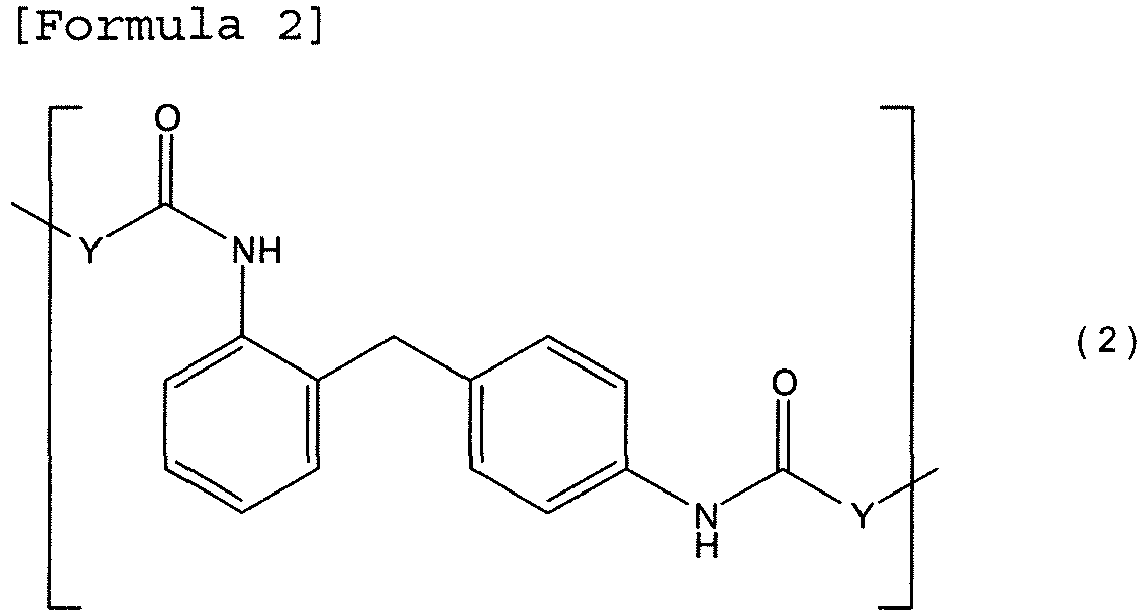

- The optical member according to claim 4, comprising a polymer having a structure represented by the following formula (S1), and at least one kind of structure represented by the following formula (S2) or (S3):


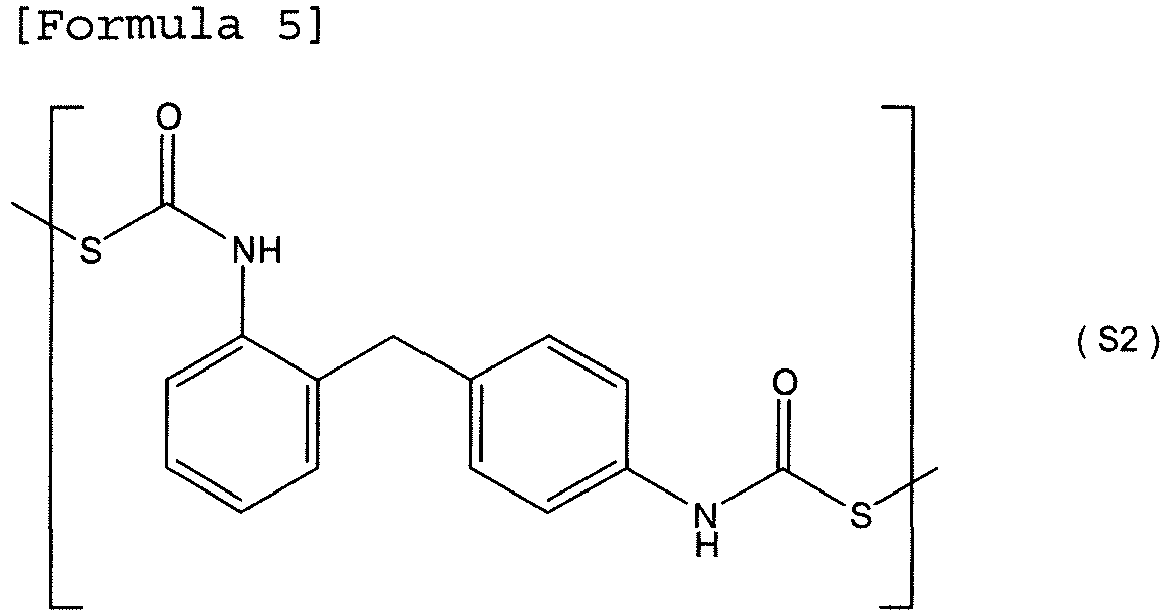
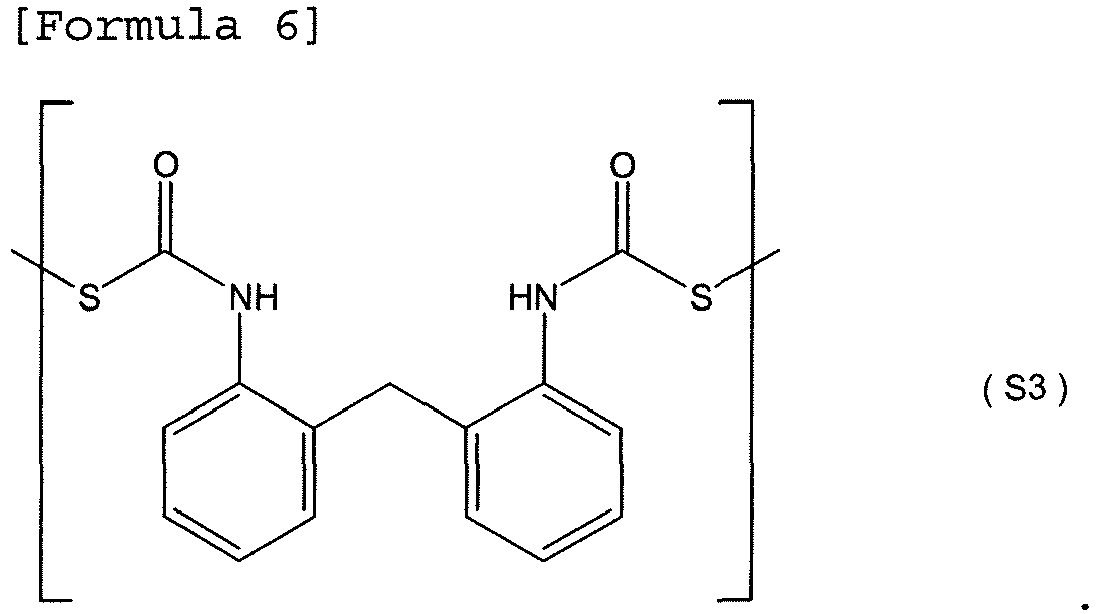
- The optical member according to claim 5, wherein the numerical ratio (M2/M1) of the total (M2) of the structures of residues formed by removing the two isocyanate groups from the 2,4' -diphenylmethane diisocyanate or the 2,2' -diphenylmethane diisocyanate with respect to the total (M1) of the structures of residues formed by removing the two isocyanate groups of the 4,4'-diphenylmethane diisocyanate contained in the polymer is 5/95 or more.
- The optical member according to claim 4, comprising a polymer having a structure represented by the following formula (O1), and at least one kind of structure represented by the following formula (02) or (O3):


- The optical member according to claim 7, wherein the numerical ratio (M2/M1) of the total (M2) of the structures of residues formed by removing the two isocyanate groups from the 2,4'-diphenylmethane diisocyanate or the 2,2' -diphenylmethane diisocyanate with respect to the total (M1) of structures of residues formed by removing the two isocyanate groups of the 4,4'-diphenylmethane diisocyanate contained in the polymer is more than 5/95.
- A method for producing an optical member, comprising a step of polymerizing a monomer composition comprising a polyisocyanate compound comprising 4,4'-diphenylmethane diisocyanate and at least one kind selected from 2,4'-diphenylmethane diisocyanate and 2,2'-diphenylmethane diisocyanate, and at least one kind selected from a polythiol compound and a polyol compound.
- The method for producing an optical member according to claim 9, comprising a step of polymerizing a monomer composition comprising a polyisocyanate compound comprising 4,4'-diphenylmethane diisocyanate and at least one kind selected from 2,4'-diphenylmethane diisocyanate and 2,2'-diphenylmethane diisocyanate, and a polythiol compound.
- The method for producing an optical member according to claim 10, which satisfies the following formulas (Sa), (Sb) and (Sc):


- The method for producing an optical member according to claim 10 or 11, wherein the total rate of the 2,4'-diphenylmethane diisocyanate and the 2,2'-diphenylmethane diisocyanate with respect to the total amount of the polyisocyanate compound is 5% by mass or more.
- The method for producing an optical member according to claim 9, comprising a step of polymerizing a monomer composition comprising a polyisocyanate compound comprising 4,4'-diphenylmethane diisocyanate and at least one kind selected from 2,4'-diphenylmethane diisocyanate and 2,2'-diphenylmethane diisocyanate, and a polyol compound.
- The method for producing an optical member according to claim 13, which satisfies the following formulas (Oa), (Ob) and (Oc):


- The method for producing an optical member according to claim 13 or 14, wherein the total rate of the 2,4'-diphenylmethane diisocyanate and the 2,2'-diphenylmethane diisocyanate with respect to the total amount of the polyisocyanate compound is more than 5% by mass.
Applications Claiming Priority (4)
| Application Number | Priority Date | Filing Date | Title |
|---|---|---|---|
| JP2014070606 | 2014-03-28 | ||
| JP2014070607 | 2014-03-28 | ||
| JP2014070605 | 2014-03-28 | ||
| PCT/JP2015/056486 WO2015146527A1 (en) | 2014-03-28 | 2015-03-05 | Polyisocyanate monomer composition for optical members, and optical member and production method therefor |
Publications (3)
| Publication Number | Publication Date |
|---|---|
| EP3125002A1 true EP3125002A1 (en) | 2017-02-01 |
| EP3125002A4 EP3125002A4 (en) | 2017-12-06 |
| EP3125002B1 EP3125002B1 (en) | 2021-04-21 |
Family
ID=54195056
Family Applications (1)
| Application Number | Title | Priority Date | Filing Date |
|---|---|---|---|
| EP15769499.3A Active EP3125002B1 (en) | 2014-03-28 | 2015-03-05 | Polyisocyanate monomer composition for optical members, and optical member and production method therefor |
Country Status (6)
| Country | Link |
|---|---|
| US (1) | US10329373B2 (en) |
| EP (1) | EP3125002B1 (en) |
| JP (1) | JP6352398B2 (en) |
| KR (1) | KR101919214B1 (en) |
| CN (1) | CN106164709B (en) |
| WO (1) | WO2015146527A1 (en) |
Families Citing this family (3)
| Publication number | Priority date | Publication date | Assignee | Title |
|---|---|---|---|---|
| KR102408416B1 (en) * | 2018-06-07 | 2022-06-14 | 우리화인켐 주식회사 | Method of preparing diisocyanate and optical lens |
| CN112300361B (en) | 2019-07-29 | 2021-12-14 | 万华化学集团股份有限公司 | A kind of preparation method of polyurethane optical resin and its application |
| CN112648625B (en) | 2019-10-12 | 2022-02-18 | 万华化学集团股份有限公司 | Device and method for rapidly cooling high-temperature gas |
Family Cites Families (17)
| Publication number | Priority date | Publication date | Assignee | Title |
|---|---|---|---|---|
| JP3277591B2 (en) | 1993-01-26 | 2002-04-22 | 日本ポリウレタン工業株式会社 | Polyurethane molding composition and method for producing molded article using the same |
| CA2117741A1 (en) | 1993-10-28 | 1995-04-29 | Michael F. Hurley | Rim process utilizing isocyanates based upon 2,4'-and 4,4'- diphenylmethane diisocyanate |
| JPH0820625A (en) | 1994-07-07 | 1996-01-23 | Mitsui Toatsu Chem Inc | Method for producing polyurethane urea solution |
| WO1996026184A1 (en) * | 1995-02-22 | 1996-08-29 | Ucb, S.A. | Sulfur-containing compounds for optical grade polymeric casting compositions |
| JPH11504314A (en) | 1996-02-08 | 1999-04-20 | ユ セ ベ ソシエテ アノニム | Sulfur-containing compounds for optical grade casting polymer compositions. |
| US6051733A (en) | 1996-02-22 | 2000-04-18 | Ucb, S.A. | Sulfur-containing compounds for optical grade polymeric casting compositions |
| US6310161B1 (en) | 1997-07-25 | 2001-10-30 | Ucb S.A. | Sulfur-containing compounds for optical grade polymeric casting compositions |
| DE102006004527A1 (en) | 2006-02-01 | 2007-08-09 | Bayer Materialscience Ag | Polyurethane cast elastomers from NCO prepolymers based on 2,4-MDI, a process for their preparation and their use |
| JP2009091522A (en) | 2007-10-12 | 2009-04-30 | Toyo Ink Mfg Co Ltd | Adhesive composition and laminate comprising the adhesive composition |
| AU2009228586B2 (en) | 2008-03-28 | 2014-02-13 | Polytex Sportbelage Produktions Gmbh | 2,2'-MDI-based isocyanate mixtures and the production and use thereof |
| JP5225797B2 (en) | 2008-09-30 | 2013-07-03 | 三井化学株式会社 | Composition, polymerizable composition containing the same, and method for producing the composition |
| EP2500372A4 (en) * | 2009-11-13 | 2014-01-08 | Mitsui Chemicals Inc | FILM AND APPLICATION THEREOF |
| WO2013024863A1 (en) * | 2011-08-15 | 2013-02-21 | Hoya株式会社 | Plastic lens |
| KR101922465B1 (en) | 2011-09-01 | 2018-11-27 | 호야 가부시키가이샤 | Method for producing polyurethane lens |
| CN102604038B (en) | 2012-03-01 | 2013-11-06 | 深圳市乐普泰科技股份有限公司 | Transparent polyurethane elastomer, preparation method and application |
| JP5747001B2 (en) | 2012-06-12 | 2015-07-08 | Hoya株式会社 | Urethane optical member and manufacturing method thereof |
| KR101874722B1 (en) * | 2013-09-10 | 2018-07-04 | 미쯔이가가꾸가부시끼가이샤 | Optical material and use therefor |
-
2015
- 2015-03-05 WO PCT/JP2015/056486 patent/WO2015146527A1/en not_active Ceased
- 2015-03-05 EP EP15769499.3A patent/EP3125002B1/en active Active
- 2015-03-05 KR KR1020167026909A patent/KR101919214B1/en active Active
- 2015-03-05 US US15/129,852 patent/US10329373B2/en active Active
- 2015-03-05 CN CN201580017101.2A patent/CN106164709B/en active Active
- 2015-03-05 JP JP2016510195A patent/JP6352398B2/en active Active
Also Published As
| Publication number | Publication date |
|---|---|
| CN106164709A (en) | 2016-11-23 |
| KR20160127118A (en) | 2016-11-02 |
| EP3125002B1 (en) | 2021-04-21 |
| EP3125002A4 (en) | 2017-12-06 |
| US10329373B2 (en) | 2019-06-25 |
| CN106164709B (en) | 2019-12-20 |
| JPWO2015146527A1 (en) | 2017-04-13 |
| JP6352398B2 (en) | 2018-07-04 |
| KR101919214B1 (en) | 2018-11-15 |
| WO2015146527A1 (en) | 2015-10-01 |
| US20170137560A1 (en) | 2017-05-18 |
Similar Documents
| Publication | Publication Date | Title |
|---|---|---|
| EP2894177B1 (en) | Composition for optical material, and method for producing same | |
| KR102279400B1 (en) | Polythiol compound and method for producing same | |
| CN114787230B (en) | Xylylenediisocyanate composition, xylylenediisocyanate modified product composition, polymerizable composition, resin | |
| JP2019061262A (en) | Transparent plastic substrate and plastic lens | |
| KR960013390B1 (en) | Highly-refractive plastic lens and process for making the lens | |
| KR102057747B1 (en) | Lightfast polyurethane compositions | |
| EP1878758B1 (en) | Polythiourethane polymerizable composition and method for producing optical resin by using same | |
| EP1348726B1 (en) | Process for producing plastic lens and plastic lens | |
| CN112661930A (en) | Xylylene diisocyanate composition and optical resin | |
| KR102763871B1 (en) | Xylylene diisocyanate composition, polymerizable composition, resin, molded article, optical element and lens | |
| US10329373B2 (en) | Polyisocyanate monomer composition for optical members, and optical member and production method therefor | |
| US9081131B2 (en) | Process for producing plastic lens | |
| KR102818362B1 (en) | Isocyanate composition and polymerizable composition comprising the same | |
| JPWO2019177141A1 (en) | A method for producing a polymerizable composition for an optical material, a method for producing a polymerizable composition for an optical material, and a method for producing an optical article. | |
| KR20170018305A (en) | Novel thiol compound and polymerizable composition containing same | |
| JP4123503B2 (en) | Plastic lens and manufacturing method thereof | |
| JP3483828B2 (en) | Manufacturing method of plastic lens and plastic lens | |
| KR20240004792A (en) | Polyisocyanate compositions, polymerizable compositions, resins, molded bodies, optical elements and lenses | |
| US20220120936A1 (en) | Polymerizable composition for optical material, optical material, and method for producing optical material | |
| KR102849974B1 (en) | isocyanate composition, optical lens comprising the same and storage method for isocyanate composition using the same | |
| EP4714937A1 (en) | Method for producing tetrafunctional thiol with episulfide resin as starting material | |
| WO2020262660A1 (en) | Method for manufacturing spectacle lens, spectacle lens, and spectacles | |
| JP2615182C (en) |
Legal Events
| Date | Code | Title | Description |
|---|---|---|---|
| STAA | Information on the status of an ep patent application or granted ep patent |
Free format text: STATUS: THE INTERNATIONAL PUBLICATION HAS BEEN MADE |
|
| PUAI | Public reference made under article 153(3) epc to a published international application that has entered the european phase |
Free format text: ORIGINAL CODE: 0009012 |
|
| STAA | Information on the status of an ep patent application or granted ep patent |
Free format text: STATUS: REQUEST FOR EXAMINATION WAS MADE |
|
| 17P | Request for examination filed |
Effective date: 20160928 |
|
| AK | Designated contracting states |
Kind code of ref document: A1 Designated state(s): AL AT BE BG CH CY CZ DE DK EE ES FI FR GB GR HR HU IE IS IT LI LT LU LV MC MK MT NL NO PL PT RO RS SE SI SK SM TR |
|
| AX | Request for extension of the european patent |
Extension state: BA ME |
|
| DAV | Request for validation of the european patent (deleted) | ||
| DAX | Request for extension of the european patent (deleted) | ||
| RIC1 | Information provided on ipc code assigned before grant |
Ipc: C08L 75/04 20060101ALI20171026BHEP Ipc: C08G 18/38 20060101ALI20171026BHEP Ipc: C08L 75/08 20060101ALI20171026BHEP Ipc: C08G 18/76 20060101ALI20171026BHEP Ipc: G02B 1/04 20060101AFI20171026BHEP Ipc: C08G 18/48 20060101ALI20171026BHEP Ipc: C08G 18/24 20060101ALI20171026BHEP |
|
| A4 | Supplementary search report drawn up and despatched |
Effective date: 20171107 |
|
| STAA | Information on the status of an ep patent application or granted ep patent |
Free format text: STATUS: EXAMINATION IS IN PROGRESS |
|
| 17Q | First examination report despatched |
Effective date: 20190726 |
|
| GRAJ | Information related to disapproval of communication of intention to grant by the applicant or resumption of examination proceedings by the epo deleted |
Free format text: ORIGINAL CODE: EPIDOSDIGR1 |
|
| STAA | Information on the status of an ep patent application or granted ep patent |
Free format text: STATUS: GRANT OF PATENT IS INTENDED |
|
| GRAP | Despatch of communication of intention to grant a patent |
Free format text: ORIGINAL CODE: EPIDOSNIGR1 |
|
| INTG | Intention to grant announced |
Effective date: 20201111 |
|
| GRAS | Grant fee paid |
Free format text: ORIGINAL CODE: EPIDOSNIGR3 |
|
| GRAA | (expected) grant |
Free format text: ORIGINAL CODE: 0009210 |
|
| STAA | Information on the status of an ep patent application or granted ep patent |
Free format text: STATUS: THE PATENT HAS BEEN GRANTED |
|
| AK | Designated contracting states |
Kind code of ref document: B1 Designated state(s): AL AT BE BG CH CY CZ DE DK EE ES FI FR GB GR HR HU IE IS IT LI LT LU LV MC MK MT NL NO PL PT RO RS SE SI SK SM TR |
|
| REG | Reference to a national code |
Ref country code: GB Ref legal event code: FG4D |
|
| REG | Reference to a national code |
Ref country code: CH Ref legal event code: EP |
|
| REG | Reference to a national code |
Ref country code: DE Ref legal event code: R096 Ref document number: 602015068391 Country of ref document: DE |
|
| REG | Reference to a national code |
Ref country code: IE Ref legal event code: FG4D |
|
| REG | Reference to a national code |
Ref country code: AT Ref legal event code: REF Ref document number: 1385229 Country of ref document: AT Kind code of ref document: T Effective date: 20210515 |
|
| REG | Reference to a national code |
Ref country code: LT Ref legal event code: MG9D |
|
| REG | Reference to a national code |
Ref country code: AT Ref legal event code: MK05 Ref document number: 1385229 Country of ref document: AT Kind code of ref document: T Effective date: 20210421 |
|
| REG | Reference to a national code |
Ref country code: NL Ref legal event code: MP Effective date: 20210421 |
|
| PG25 | Lapsed in a contracting state [announced via postgrant information from national office to epo] |
Ref country code: HR Free format text: LAPSE BECAUSE OF FAILURE TO SUBMIT A TRANSLATION OF THE DESCRIPTION OR TO PAY THE FEE WITHIN THE PRESCRIBED TIME-LIMIT Effective date: 20210421 Ref country code: BG Free format text: LAPSE BECAUSE OF FAILURE TO SUBMIT A TRANSLATION OF THE DESCRIPTION OR TO PAY THE FEE WITHIN THE PRESCRIBED TIME-LIMIT Effective date: 20210721 Ref country code: AT Free format text: LAPSE BECAUSE OF FAILURE TO SUBMIT A TRANSLATION OF THE DESCRIPTION OR TO PAY THE FEE WITHIN THE PRESCRIBED TIME-LIMIT Effective date: 20210421 Ref country code: NL Free format text: LAPSE BECAUSE OF FAILURE TO SUBMIT A TRANSLATION OF THE DESCRIPTION OR TO PAY THE FEE WITHIN THE PRESCRIBED TIME-LIMIT Effective date: 20210421 Ref country code: LT Free format text: LAPSE BECAUSE OF FAILURE TO SUBMIT A TRANSLATION OF THE DESCRIPTION OR TO PAY THE FEE WITHIN THE PRESCRIBED TIME-LIMIT Effective date: 20210421 Ref country code: FI Free format text: LAPSE BECAUSE OF FAILURE TO SUBMIT A TRANSLATION OF THE DESCRIPTION OR TO PAY THE FEE WITHIN THE PRESCRIBED TIME-LIMIT Effective date: 20210421 |
|
| PG25 | Lapsed in a contracting state [announced via postgrant information from national office to epo] |
Ref country code: SE Free format text: LAPSE BECAUSE OF FAILURE TO SUBMIT A TRANSLATION OF THE DESCRIPTION OR TO PAY THE FEE WITHIN THE PRESCRIBED TIME-LIMIT Effective date: 20210421 Ref country code: RS Free format text: LAPSE BECAUSE OF FAILURE TO SUBMIT A TRANSLATION OF THE DESCRIPTION OR TO PAY THE FEE WITHIN THE PRESCRIBED TIME-LIMIT Effective date: 20210421 Ref country code: PT Free format text: LAPSE BECAUSE OF FAILURE TO SUBMIT A TRANSLATION OF THE DESCRIPTION OR TO PAY THE FEE WITHIN THE PRESCRIBED TIME-LIMIT Effective date: 20210823 Ref country code: NO Free format text: LAPSE BECAUSE OF FAILURE TO SUBMIT A TRANSLATION OF THE DESCRIPTION OR TO PAY THE FEE WITHIN THE PRESCRIBED TIME-LIMIT Effective date: 20210721 Ref country code: PL Free format text: LAPSE BECAUSE OF FAILURE TO SUBMIT A TRANSLATION OF THE DESCRIPTION OR TO PAY THE FEE WITHIN THE PRESCRIBED TIME-LIMIT Effective date: 20210421 Ref country code: ES Free format text: LAPSE BECAUSE OF FAILURE TO SUBMIT A TRANSLATION OF THE DESCRIPTION OR TO PAY THE FEE WITHIN THE PRESCRIBED TIME-LIMIT Effective date: 20210421 Ref country code: GR Free format text: LAPSE BECAUSE OF FAILURE TO SUBMIT A TRANSLATION OF THE DESCRIPTION OR TO PAY THE FEE WITHIN THE PRESCRIBED TIME-LIMIT Effective date: 20210722 Ref country code: IS Free format text: LAPSE BECAUSE OF FAILURE TO SUBMIT A TRANSLATION OF THE DESCRIPTION OR TO PAY THE FEE WITHIN THE PRESCRIBED TIME-LIMIT Effective date: 20210821 Ref country code: LV Free format text: LAPSE BECAUSE OF FAILURE TO SUBMIT A TRANSLATION OF THE DESCRIPTION OR TO PAY THE FEE WITHIN THE PRESCRIBED TIME-LIMIT Effective date: 20210421 |
|
| REG | Reference to a national code |
Ref country code: DE Ref legal event code: R097 Ref document number: 602015068391 Country of ref document: DE |
|
| PG25 | Lapsed in a contracting state [announced via postgrant information from national office to epo] |
Ref country code: DK Free format text: LAPSE BECAUSE OF FAILURE TO SUBMIT A TRANSLATION OF THE DESCRIPTION OR TO PAY THE FEE WITHIN THE PRESCRIBED TIME-LIMIT Effective date: 20210421 Ref country code: EE Free format text: LAPSE BECAUSE OF FAILURE TO SUBMIT A TRANSLATION OF THE DESCRIPTION OR TO PAY THE FEE WITHIN THE PRESCRIBED TIME-LIMIT Effective date: 20210421 Ref country code: CZ Free format text: LAPSE BECAUSE OF FAILURE TO SUBMIT A TRANSLATION OF THE DESCRIPTION OR TO PAY THE FEE WITHIN THE PRESCRIBED TIME-LIMIT Effective date: 20210421 Ref country code: SK Free format text: LAPSE BECAUSE OF FAILURE TO SUBMIT A TRANSLATION OF THE DESCRIPTION OR TO PAY THE FEE WITHIN THE PRESCRIBED TIME-LIMIT Effective date: 20210421 Ref country code: SM Free format text: LAPSE BECAUSE OF FAILURE TO SUBMIT A TRANSLATION OF THE DESCRIPTION OR TO PAY THE FEE WITHIN THE PRESCRIBED TIME-LIMIT Effective date: 20210421 Ref country code: RO Free format text: LAPSE BECAUSE OF FAILURE TO SUBMIT A TRANSLATION OF THE DESCRIPTION OR TO PAY THE FEE WITHIN THE PRESCRIBED TIME-LIMIT Effective date: 20210421 |
|
| PLBE | No opposition filed within time limit |
Free format text: ORIGINAL CODE: 0009261 |
|
| STAA | Information on the status of an ep patent application or granted ep patent |
Free format text: STATUS: NO OPPOSITION FILED WITHIN TIME LIMIT |
|
| 26N | No opposition filed |
Effective date: 20220124 |
|
| PG25 | Lapsed in a contracting state [announced via postgrant information from national office to epo] |
Ref country code: IS Free format text: LAPSE BECAUSE OF FAILURE TO SUBMIT A TRANSLATION OF THE DESCRIPTION OR TO PAY THE FEE WITHIN THE PRESCRIBED TIME-LIMIT Effective date: 20210821 Ref country code: AL Free format text: LAPSE BECAUSE OF FAILURE TO SUBMIT A TRANSLATION OF THE DESCRIPTION OR TO PAY THE FEE WITHIN THE PRESCRIBED TIME-LIMIT Effective date: 20210421 |
|
| PG25 | Lapsed in a contracting state [announced via postgrant information from national office to epo] |
Ref country code: IT Free format text: LAPSE BECAUSE OF FAILURE TO SUBMIT A TRANSLATION OF THE DESCRIPTION OR TO PAY THE FEE WITHIN THE PRESCRIBED TIME-LIMIT Effective date: 20210421 |
|
| PG25 | Lapsed in a contracting state [announced via postgrant information from national office to epo] |
Ref country code: MC Free format text: LAPSE BECAUSE OF FAILURE TO SUBMIT A TRANSLATION OF THE DESCRIPTION OR TO PAY THE FEE WITHIN THE PRESCRIBED TIME-LIMIT Effective date: 20210421 |
|
| REG | Reference to a national code |
Ref country code: CH Ref legal event code: PL |
|
| REG | Reference to a national code |
Ref country code: BE Ref legal event code: MM Effective date: 20220331 |
|
| PG25 | Lapsed in a contracting state [announced via postgrant information from national office to epo] |
Ref country code: LU Free format text: LAPSE BECAUSE OF NON-PAYMENT OF DUE FEES Effective date: 20220305 Ref country code: LI Free format text: LAPSE BECAUSE OF NON-PAYMENT OF DUE FEES Effective date: 20220331 Ref country code: IE Free format text: LAPSE BECAUSE OF NON-PAYMENT OF DUE FEES Effective date: 20220305 Ref country code: CH Free format text: LAPSE BECAUSE OF NON-PAYMENT OF DUE FEES Effective date: 20220331 |
|
| PG25 | Lapsed in a contracting state [announced via postgrant information from national office to epo] |
Ref country code: BE Free format text: LAPSE BECAUSE OF NON-PAYMENT OF DUE FEES Effective date: 20220331 |
|
| P01 | Opt-out of the competence of the unified patent court (upc) registered |
Effective date: 20230418 |
|
| PG25 | Lapsed in a contracting state [announced via postgrant information from national office to epo] |
Ref country code: HU Free format text: LAPSE BECAUSE OF FAILURE TO SUBMIT A TRANSLATION OF THE DESCRIPTION OR TO PAY THE FEE WITHIN THE PRESCRIBED TIME-LIMIT; INVALID AB INITIO Effective date: 20150305 |
|
| PG25 | Lapsed in a contracting state [announced via postgrant information from national office to epo] |
Ref country code: MK Free format text: LAPSE BECAUSE OF FAILURE TO SUBMIT A TRANSLATION OF THE DESCRIPTION OR TO PAY THE FEE WITHIN THE PRESCRIBED TIME-LIMIT Effective date: 20210421 Ref country code: CY Free format text: LAPSE BECAUSE OF FAILURE TO SUBMIT A TRANSLATION OF THE DESCRIPTION OR TO PAY THE FEE WITHIN THE PRESCRIBED TIME-LIMIT Effective date: 20210421 |
|
| PG25 | Lapsed in a contracting state [announced via postgrant information from national office to epo] |
Ref country code: TR Free format text: LAPSE BECAUSE OF FAILURE TO SUBMIT A TRANSLATION OF THE DESCRIPTION OR TO PAY THE FEE WITHIN THE PRESCRIBED TIME-LIMIT Effective date: 20210421 |
|
| PG25 | Lapsed in a contracting state [announced via postgrant information from national office to epo] |
Ref country code: MT Free format text: LAPSE BECAUSE OF FAILURE TO SUBMIT A TRANSLATION OF THE DESCRIPTION OR TO PAY THE FEE WITHIN THE PRESCRIBED TIME-LIMIT Effective date: 20210421 |
|
| PGFP | Annual fee paid to national office [announced via postgrant information from national office to epo] |
Ref country code: GB Payment date: 20260202 Year of fee payment: 12 |
|
| PGFP | Annual fee paid to national office [announced via postgrant information from national office to epo] |
Ref country code: DE Payment date: 20260128 Year of fee payment: 12 |
|
| PGFP | Annual fee paid to national office [announced via postgrant information from national office to epo] |
Ref country code: FR Payment date: 20260209 Year of fee payment: 12 |