EP3124825A1 - Urethane bumper spring, and method for producing same - Google Patents
Urethane bumper spring, and method for producing same Download PDFInfo
- Publication number
- EP3124825A1 EP3124825A1 EP15768322.8A EP15768322A EP3124825A1 EP 3124825 A1 EP3124825 A1 EP 3124825A1 EP 15768322 A EP15768322 A EP 15768322A EP 3124825 A1 EP3124825 A1 EP 3124825A1
- Authority
- EP
- European Patent Office
- Prior art keywords
- urethane
- bumper spring
- density
- skin layer
- cell diameter
- Prior art date
- Legal status (The legal status is an assumption and is not a legal conclusion. Google has not performed a legal analysis and makes no representation as to the accuracy of the status listed.)
- Granted
Links
Images


Classifications
-
- B—PERFORMING OPERATIONS; TRANSPORTING
- B60—VEHICLES IN GENERAL
- B60G—VEHICLE SUSPENSION ARRANGEMENTS
- B60G11/00—Resilient suspensions characterised by arrangement, location or kind of springs
- B60G11/22—Resilient suspensions characterised by arrangement, location or kind of springs having rubber springs only
-
- B—PERFORMING OPERATIONS; TRANSPORTING
- B29—WORKING OF PLASTICS; WORKING OF SUBSTANCES IN A PLASTIC STATE IN GENERAL
- B29C—SHAPING OR JOINING OF PLASTICS; SHAPING OF MATERIAL IN A PLASTIC STATE, NOT OTHERWISE PROVIDED FOR; AFTER-TREATMENT OF THE SHAPED PRODUCTS, e.g. REPAIRING
- B29C39/00—Shaping by casting, i.e. introducing the moulding material into a mould or between confining surfaces without significant moulding pressure; Apparatus therefor
- B29C39/02—Shaping by casting, i.e. introducing the moulding material into a mould or between confining surfaces without significant moulding pressure; Apparatus therefor for making articles of definite length, i.e. discrete articles
-
- B—PERFORMING OPERATIONS; TRANSPORTING
- B29—WORKING OF PLASTICS; WORKING OF SUBSTANCES IN A PLASTIC STATE IN GENERAL
- B29C—SHAPING OR JOINING OF PLASTICS; SHAPING OF MATERIAL IN A PLASTIC STATE, NOT OTHERWISE PROVIDED FOR; AFTER-TREATMENT OF THE SHAPED PRODUCTS, e.g. REPAIRING
- B29C39/00—Shaping by casting, i.e. introducing the moulding material into a mould or between confining surfaces without significant moulding pressure; Apparatus therefor
- B29C39/22—Component parts, details or accessories; Auxiliary operations
- B29C39/24—Feeding the material into the mould
-
- B—PERFORMING OPERATIONS; TRANSPORTING
- B29—WORKING OF PLASTICS; WORKING OF SUBSTANCES IN A PLASTIC STATE IN GENERAL
- B29C—SHAPING OR JOINING OF PLASTICS; SHAPING OF MATERIAL IN A PLASTIC STATE, NOT OTHERWISE PROVIDED FOR; AFTER-TREATMENT OF THE SHAPED PRODUCTS, e.g. REPAIRING
- B29C45/00—Injection moulding, i.e. forcing the required volume of moulding material through a nozzle into a closed mould; Apparatus therefor
- B29C45/0001—Injection moulding, i.e. forcing the required volume of moulding material through a nozzle into a closed mould; Apparatus therefor characterised by the choice of material
-
- B—PERFORMING OPERATIONS; TRANSPORTING
- B29—WORKING OF PLASTICS; WORKING OF SUBSTANCES IN A PLASTIC STATE IN GENERAL
- B29C—SHAPING OR JOINING OF PLASTICS; SHAPING OF MATERIAL IN A PLASTIC STATE, NOT OTHERWISE PROVIDED FOR; AFTER-TREATMENT OF THE SHAPED PRODUCTS, e.g. REPAIRING
- B29C45/00—Injection moulding, i.e. forcing the required volume of moulding material through a nozzle into a closed mould; Apparatus therefor
- B29C45/17—Component parts, details or accessories; Auxiliary operations
- B29C45/18—Feeding the material into the injection moulding apparatus, i.e. feeding the non-plastified material into the injection unit
- B29C45/1866—Feeding multiple materials
-
- B—PERFORMING OPERATIONS; TRANSPORTING
- B29—WORKING OF PLASTICS; WORKING OF SUBSTANCES IN A PLASTIC STATE IN GENERAL
- B29C—SHAPING OR JOINING OF PLASTICS; SHAPING OF MATERIAL IN A PLASTIC STATE, NOT OTHERWISE PROVIDED FOR; AFTER-TREATMENT OF THE SHAPED PRODUCTS, e.g. REPAIRING
- B29C45/00—Injection moulding, i.e. forcing the required volume of moulding material through a nozzle into a closed mould; Apparatus therefor
- B29C45/17—Component parts, details or accessories; Auxiliary operations
- B29C45/26—Moulds
- B29C45/36—Moulds having means for locating or centering cores
-
- B—PERFORMING OPERATIONS; TRANSPORTING
- B29—WORKING OF PLASTICS; WORKING OF SUBSTANCES IN A PLASTIC STATE IN GENERAL
- B29C—SHAPING OR JOINING OF PLASTICS; SHAPING OF MATERIAL IN A PLASTIC STATE, NOT OTHERWISE PROVIDED FOR; AFTER-TREATMENT OF THE SHAPED PRODUCTS, e.g. REPAIRING
- B29C45/00—Injection moulding, i.e. forcing the required volume of moulding material through a nozzle into a closed mould; Apparatus therefor
- B29C45/17—Component parts, details or accessories; Auxiliary operations
- B29C45/72—Heating or cooling
- B29C45/7207—Heating or cooling of the moulded articles
-
- C—CHEMISTRY; METALLURGY
- C08—ORGANIC MACROMOLECULAR COMPOUNDS; THEIR PREPARATION OR CHEMICAL WORKING-UP; COMPOSITIONS BASED THEREON
- C08G—MACROMOLECULAR COMPOUNDS OBTAINED OTHERWISE THAN BY REACTIONS ONLY INVOLVING UNSATURATED CARBON-TO-CARBON BONDS
- C08G18/00—Polymeric products of isocyanates or isothiocyanates
- C08G18/06—Polymeric products of isocyanates or isothiocyanates with compounds having active hydrogen
- C08G18/28—Polymeric products of isocyanates or isothiocyanates with compounds having active hydrogen characterised by the compounds used containing active hydrogen
- C08G18/30—Low-molecular-weight compounds
- C08G18/32—Polyhydroxy compounds; Polyamines; Hydroxyamines
- C08G18/3203—Polyhydroxy compounds
- C08G18/3206—Polyhydroxy compounds aliphatic
-
- C—CHEMISTRY; METALLURGY
- C08—ORGANIC MACROMOLECULAR COMPOUNDS; THEIR PREPARATION OR CHEMICAL WORKING-UP; COMPOSITIONS BASED THEREON
- C08G—MACROMOLECULAR COMPOUNDS OBTAINED OTHERWISE THAN BY REACTIONS ONLY INVOLVING UNSATURATED CARBON-TO-CARBON BONDS
- C08G18/00—Polymeric products of isocyanates or isothiocyanates
- C08G18/06—Polymeric products of isocyanates or isothiocyanates with compounds having active hydrogen
- C08G18/28—Polymeric products of isocyanates or isothiocyanates with compounds having active hydrogen characterised by the compounds used containing active hydrogen
- C08G18/40—High-molecular-weight compounds
- C08G18/42—Polycondensates having carboxylic or carbonic ester groups in the main chain
-
- C—CHEMISTRY; METALLURGY
- C08—ORGANIC MACROMOLECULAR COMPOUNDS; THEIR PREPARATION OR CHEMICAL WORKING-UP; COMPOSITIONS BASED THEREON
- C08G—MACROMOLECULAR COMPOUNDS OBTAINED OTHERWISE THAN BY REACTIONS ONLY INVOLVING UNSATURATED CARBON-TO-CARBON BONDS
- C08G18/00—Polymeric products of isocyanates or isothiocyanates
- C08G18/06—Polymeric products of isocyanates or isothiocyanates with compounds having active hydrogen
- C08G18/28—Polymeric products of isocyanates or isothiocyanates with compounds having active hydrogen characterised by the compounds used containing active hydrogen
- C08G18/65—Low-molecular-weight compounds having active hydrogen with high-molecular-weight compounds having active hydrogen
- C08G18/66—Compounds of groups C08G18/42, C08G18/48, or C08G18/52
- C08G18/6633—Compounds of group C08G18/42
- C08G18/6637—Compounds of group C08G18/42 with compounds of group C08G18/32 or polyamines of C08G18/38
- C08G18/664—Compounds of group C08G18/42 with compounds of group C08G18/32 or polyamines of C08G18/38 with compounds of group C08G18/3203
-
- C—CHEMISTRY; METALLURGY
- C08—ORGANIC MACROMOLECULAR COMPOUNDS; THEIR PREPARATION OR CHEMICAL WORKING-UP; COMPOSITIONS BASED THEREON
- C08G—MACROMOLECULAR COMPOUNDS OBTAINED OTHERWISE THAN BY REACTIONS ONLY INVOLVING UNSATURATED CARBON-TO-CARBON BONDS
- C08G18/00—Polymeric products of isocyanates or isothiocyanates
- C08G18/06—Polymeric products of isocyanates or isothiocyanates with compounds having active hydrogen
- C08G18/70—Polymeric products of isocyanates or isothiocyanates with compounds having active hydrogen characterised by the isocyanates or isothiocyanates used
- C08G18/72—Polyisocyanates or polyisothiocyanates
- C08G18/74—Polyisocyanates or polyisothiocyanates cyclic
- C08G18/76—Polyisocyanates or polyisothiocyanates cyclic aromatic
- C08G18/7657—Polyisocyanates or polyisothiocyanates cyclic aromatic containing two or more aromatic rings
- C08G18/7664—Polyisocyanates or polyisothiocyanates cyclic aromatic containing two or more aromatic rings containing alkylene polyphenyl groups
- C08G18/7671—Polyisocyanates or polyisothiocyanates cyclic aromatic containing two or more aromatic rings containing alkylene polyphenyl groups containing only one alkylene bisphenyl group
-
- F—MECHANICAL ENGINEERING; LIGHTING; HEATING; WEAPONS; BLASTING
- F16—ENGINEERING ELEMENTS AND UNITS; GENERAL MEASURES FOR PRODUCING AND MAINTAINING EFFECTIVE FUNCTIONING OF MACHINES OR INSTALLATIONS; THERMAL INSULATION IN GENERAL
- F16F—SPRINGS; SHOCK-ABSORBERS; MEANS FOR DAMPING VIBRATION
- F16F1/00—Springs
- F16F1/36—Springs made of rubber or other material having high internal friction, e.g. thermoplastic elastomers
- F16F1/3605—Springs made of rubber or other material having high internal friction, e.g. thermoplastic elastomers characterised by their material
-
- F—MECHANICAL ENGINEERING; LIGHTING; HEATING; WEAPONS; BLASTING
- F16—ENGINEERING ELEMENTS AND UNITS; GENERAL MEASURES FOR PRODUCING AND MAINTAINING EFFECTIVE FUNCTIONING OF MACHINES OR INSTALLATIONS; THERMAL INSULATION IN GENERAL
- F16F—SPRINGS; SHOCK-ABSORBERS; MEANS FOR DAMPING VIBRATION
- F16F1/00—Springs
- F16F1/36—Springs made of rubber or other material having high internal friction, e.g. thermoplastic elastomers
- F16F1/37—Springs made of rubber or other material having high internal friction, e.g. thermoplastic elastomers of foam-like material, i.e. microcellular material, e.g. sponge rubber
-
- F—MECHANICAL ENGINEERING; LIGHTING; HEATING; WEAPONS; BLASTING
- F16—ENGINEERING ELEMENTS AND UNITS; GENERAL MEASURES FOR PRODUCING AND MAINTAINING EFFECTIVE FUNCTIONING OF MACHINES OR INSTALLATIONS; THERMAL INSULATION IN GENERAL
- F16F—SPRINGS; SHOCK-ABSORBERS; MEANS FOR DAMPING VIBRATION
- F16F1/00—Springs
- F16F1/36—Springs made of rubber or other material having high internal friction, e.g. thermoplastic elastomers
- F16F1/373—Springs made of rubber or other material having high internal friction, e.g. thermoplastic elastomers characterised by having a particular shape
- F16F1/376—Springs made of rubber or other material having high internal friction, e.g. thermoplastic elastomers characterised by having a particular shape having projections, studs, serrations or the like on at least one surface
-
- B—PERFORMING OPERATIONS; TRANSPORTING
- B29—WORKING OF PLASTICS; WORKING OF SUBSTANCES IN A PLASTIC STATE IN GENERAL
- B29K—INDEXING SCHEME ASSOCIATED WITH SUBCLASSES B29B, B29C OR B29D, RELATING TO MOULDING MATERIALS OR TO MATERIALS FOR MOULDS, REINFORCEMENTS, FILLERS OR PREFORMED PARTS, e.g. INSERTS
- B29K2075/00—Use of PU, i.e. polyureas or polyurethanes or derivatives thereof, as moulding material
-
- B—PERFORMING OPERATIONS; TRANSPORTING
- B29—WORKING OF PLASTICS; WORKING OF SUBSTANCES IN A PLASTIC STATE IN GENERAL
- B29K—INDEXING SCHEME ASSOCIATED WITH SUBCLASSES B29B, B29C OR B29D, RELATING TO MOULDING MATERIALS OR TO MATERIALS FOR MOULDS, REINFORCEMENTS, FILLERS OR PREFORMED PARTS, e.g. INSERTS
- B29K2105/00—Condition, form or state of moulded material or of the material to be shaped
- B29K2105/0002—Condition, form or state of moulded material or of the material to be shaped monomers or prepolymers
-
- B—PERFORMING OPERATIONS; TRANSPORTING
- B29—WORKING OF PLASTICS; WORKING OF SUBSTANCES IN A PLASTIC STATE IN GENERAL
- B29L—INDEXING SCHEME ASSOCIATED WITH SUBCLASS B29C, RELATING TO PARTICULAR ARTICLES
- B29L2031/00—Other particular articles
- B29L2031/30—Vehicles, e.g. ships or aircraft, or body parts thereof
-
- B—PERFORMING OPERATIONS; TRANSPORTING
- B29—WORKING OF PLASTICS; WORKING OF SUBSTANCES IN A PLASTIC STATE IN GENERAL
- B29L—INDEXING SCHEME ASSOCIATED WITH SUBCLASS B29C, RELATING TO PARTICULAR ARTICLES
- B29L2031/00—Other particular articles
- B29L2031/774—Springs
-
- B—PERFORMING OPERATIONS; TRANSPORTING
- B60—VEHICLES IN GENERAL
- B60G—VEHICLE SUSPENSION ARRANGEMENTS
- B60G2202/00—Indexing codes relating to the type of spring, damper or actuator
- B60G2202/10—Type of spring
- B60G2202/14—Plastic spring, e.g. rubber
- B60G2202/143—Plastic spring, e.g. rubber subjected to compression
-
- B—PERFORMING OPERATIONS; TRANSPORTING
- B60—VEHICLES IN GENERAL
- B60G—VEHICLE SUSPENSION ARRANGEMENTS
- B60G2204/00—Indexing codes related to suspensions per se or to auxiliary parts
- B60G2204/40—Auxiliary suspension parts; Adjustment of suspensions
- B60G2204/45—Stops limiting travel
- B60G2204/4502—Stops limiting travel using resilient buffer
- B60G2204/45021—Stops limiting travel using resilient buffer for limiting upper mount movement of a McPherson strut
-
- B—PERFORMING OPERATIONS; TRANSPORTING
- B60—VEHICLES IN GENERAL
- B60G—VEHICLE SUSPENSION ARRANGEMENTS
- B60G2206/00—Indexing codes related to the manufacturing of suspensions: constructional features, the materials used, procedures or tools
- B60G2206/01—Constructional features of suspension elements, e.g. arms, dampers, springs
- B60G2206/70—Materials used in suspensions
- B60G2206/73—Rubber; Elastomers
-
- B—PERFORMING OPERATIONS; TRANSPORTING
- B60—VEHICLES IN GENERAL
- B60G—VEHICLE SUSPENSION ARRANGEMENTS
- B60G2206/00—Indexing codes related to the manufacturing of suspensions: constructional features, the materials used, procedures or tools
- B60G2206/01—Constructional features of suspension elements, e.g. arms, dampers, springs
- B60G2206/80—Manufacturing procedures
- B60G2206/81—Shaping
- B60G2206/8101—Shaping by casting
- B60G2206/81012—Shaping by casting by injection moulding
-
- B—PERFORMING OPERATIONS; TRANSPORTING
- B60—VEHICLES IN GENERAL
- B60G—VEHICLE SUSPENSION ARRANGEMENTS
- B60G2206/00—Indexing codes related to the manufacturing of suspensions: constructional features, the materials used, procedures or tools
- B60G2206/01—Constructional features of suspension elements, e.g. arms, dampers, springs
- B60G2206/80—Manufacturing procedures
- B60G2206/81—Shaping
- B60G2206/8106—Shaping by thermal treatment, e.g. curing hardening, vulcanisation
-
- C—CHEMISTRY; METALLURGY
- C08—ORGANIC MACROMOLECULAR COMPOUNDS; THEIR PREPARATION OR CHEMICAL WORKING-UP; COMPOSITIONS BASED THEREON
- C08G—MACROMOLECULAR COMPOUNDS OBTAINED OTHERWISE THAN BY REACTIONS ONLY INVOLVING UNSATURATED CARBON-TO-CARBON BONDS
- C08G2110/00—Foam properties
- C08G2110/0083—Foam properties prepared using water as the sole blowing agent
-
- F—MECHANICAL ENGINEERING; LIGHTING; HEATING; WEAPONS; BLASTING
- F16—ENGINEERING ELEMENTS AND UNITS; GENERAL MEASURES FOR PRODUCING AND MAINTAINING EFFECTIVE FUNCTIONING OF MACHINES OR INSTALLATIONS; THERMAL INSULATION IN GENERAL
- F16F—SPRINGS; SHOCK-ABSORBERS; MEANS FOR DAMPING VIBRATION
- F16F9/00—Springs, vibration-dampers, shock-absorbers, or similarly-constructed movement-dampers using a fluid or the equivalent as damping medium
- F16F9/32—Details
- F16F9/58—Stroke limiting stops, e.g. arranged on the piston rod outside the cylinder
Definitions
- the present disclosure relates to a urethane bumper spring configured to be mounted onto a piston rod of a shock absorber in a suspension mechanism of a vehicle so as to elastically restrain an operation stroke of the shock absorber, and to a method of producing the same.
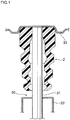
- a substantially tubular (bellows-shaped) bumper spring 2 formed of an elastic material, e.g., a rubber or a foamed polyurethane resin is externally fitted onto a piston rod 3Y of a shock absorber 30 serving as a component of a suspension of a vehicle, and the bumper spring 2 is arranged between a cylinder (absorber plate) 32 of the shock absorber 30, and a fitting portion thereof on a vehicle body side (upper support 33) (see Patent Literature 1).
- an elastic material e.g., a rubber or a foamed polyurethane resin
- urethane bumper spring using a foamed polyurethane resin (hereinafter abbreviated as "urethane").
- urethane foamed polyurethane resin
- a method of producing the urethane bumper spring mold-forming involving using a forming mold (die) is generally used (see Patent Literature 2).
- the mold-forming of the urethane is a method of obtaining a urethane bumper spring as a product involving: injecting (casting) a urethane raw material into a forming cavity of a forming mold (die) formed of a master mold and a core, followed by heating, to thereby cure the urethane raw material through a reaction (foaming) in the forming mold; and then removing the resultant from the forming mold, followed by extraction of the forming mold core inside a tubular urethane molded body (demolding).
- a foaming/curing method for the urethane there is known a method involving two-stage heating steps, i.e., primary vulcanization and secondary vulcanization.
- the forming mold core inside the urethane molded body subjected to the primary vulcanization is extracted (demolding is performed) before the urethane molded body is further heated to be subjected to secondary vulcanization, and thus the urethane bumper spring is obtained as a completely cured article (product) (see Patent Literature 3).
- a urethane bumper spring is required to withstand high load and high deformation, and hence a urethane raw material containing 1,5-naphthalene diisocyanate (NDI) as an isocyanate component is generally used for the urethane bumper spring.
- NDI 1,5-naphthalene diisocyanate
- the disclosed urethane bumper spring is capable of achieving a cost reduction while having durability and settling resistance under high load and high deformation, and a method of producing the same is disclosed.
- an urethane bumper spring having a hollow cylindrical shape, which is produced by mold forming and which has a skin layer in an outer layer thereof, the urethane bumper spring being configured to be fitted onto a piston rod of a shock absorber of a vehicle so as to elastically restrain an operation stroke of the shock absorber, the urethane bumper spring being produced from a urethane rawmaterial containing a polyester-based polyol as a polyol component and diphenylmethane diisocyanate as an isocyanate component, the urethane bumper spring including: a skin layer; and a core portion, in which the skin layer has a density (Da) and a foamed cell diameter (Ra), and the core portion has a density (Db) and a foamed cell diameter (Rb), the density (Da), the foamed cell diameter (Ra), the density (Db), and the foamed cell diameter (Rb) satisfying relationships shown in the following expressions (1) and
- a method of producing the urethane bumper spring of the first aspect including: a step of injecting a urethane raw material containing a polyester-based polyol as a polyol component and diphenylmethane diisocyanate as an isocyanate component into a cavity of a forming mold, followed by heating at 70°C or more, to thereby subject the urethane raw material to primary vulcanization in the forming mold; a demolding step of removing a urethane molded body after the primary vulcanization from the forming mold; and a step of heating the urethane molded body after the demolding to subject the urethane molded body to secondary vulcanization.
- the inventors have made extensive investigations in order to achieve the above-mentioned object. During the course of the investigations, the inventors have considered the use of a urethane raw material containing low-cost diphenylmethane diisocyanate (MDI) as an isocyanate component. As described above, however, there are problems in durability and settling resistance.
- MDI diphenylmethane diisocyanate
- the inventors have made further investigations in order to ascertain the cause of the problems, and as a result, have obtained the following finding: owing to notable differences in density and foamed cell diameter between the skin layer and the core portion of the urethane bumper spring, an internal crack (fracture) due to strain (stress concentration) is liable to occur in the bumper spring using the urethane raw material containing MDI as an isocyanate component, with the result that such bumper spring is poor in durability and settling resistance.
- the skin layer is formed in its outer layer (portion brought into contact with a forming mold).
- the inventors have made investigations on causing the skin layer and the core portion to have more similar densities and more similar foamed cell diameters, and as a result, have ascertained that, through the optimization of the polyol component, the optimization of the production method, and the like, the skin layer and the core portion can be caused to have more similar densities and more similar foamed cell diameters even in the case of the urethane rawmaterial containingMDI as an isocyanate component. That is, the inventors have found that the desired object can be achieved when the densities and the foamed cell diameters of the skin layer and the core portion satisfy the specific relationships. Thus, the inventors have reached the embodiment of the present invention.
- the urethane bumper spring is a hollow cylindrical one produced by mold forming, and is produced from the urethane raw material containing the polyester-based polyol as a polyol component and diphenylmethane diisocyanate as an isocyanate component.
- the density and the foamed cell diameter of the skin layer, and the density and the foamed cell diameter of the core portion satisfy the specific relationships. Accordingly, the urethane bumper spring is excellent in durability and settling resistance under high load and high deformation, and besides, can achieve a cost reduction.
- the method of producing the urethane bumper spring includes: a step of injecting the urethane raw material containing a polyester-based polyol as a polyol component and diphenylmethane diisocyanate as an isocyanate component into the cavity of the forming mold, followed by heating at 70°C or more, to thereby subj ect the urethane rawmaterial to primary vulcanization in the forming mold; a demolding step of removing the urethane molded body after the primary vulcanization from the forming mold; and a step of heating the urethane molded body after the demolding to subject the urethane molded body to secondary vulcanization.
- the urethane bumper spring as described above can be satisfactorily produced.
- a urethane bumper spring of the embodiments of the present invention is one to be fitted onto a piston rod of a shock absorber in a suspension system of an automobile so as to serve as a stopper or the like configured to elastically restrain an operation stroke of the shock absorber.
- the external appearance of the urethane bumper spring is, for example, a hollow cylindrical shape as with a related-art urethane bumper spring as illustrated in FIG. 1 .
- the urethane bumper spring is produced by mold forming, and hence has a skin layer in its outer layer (portion brought into contact with a forming mold) as with a related-art urethane bumper spring produced by mold forming.
- the urethane bumper spring is produced from a urethane rawmaterial containing apolyester-based polyol as a polyol component and diphenylmethane diisocyanate (MDI) as an isocyanate component, and includes: a skin layer; and a core portion, in which the skin layer has a density (Da) and a foamed cell diameter (Ra), and the core portion has a density (Db) and a foamed cell diameter (Rb), the density (Da), the foamed cell diameter (Ra), the density (Db), and the foamed cell diameter (Rb) satisfying relationships shown in the following expressions (1) and (2).
- the "skin layer” refers to a portion within 2 mm from a molded body surface in a thickness direction, and the "core portion” refers to a portion deeper than the skin layer.
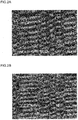
- FIG. 2A and FIG. 2B are electron micrographs (magnification of 50) showing a cross-section of a skin layer and a cross-section of a core portion, respectively, in the urethane bumper spring.
- FIG. 3A and FIG. 3B are electron micrographs (magnification of 50 times) showing a cross-section of a skin layer and a cross-section of a core portion, respectively, in the related-art urethane bumper spring. It is found from the cross-sectional photographs that the urethane bumper spring has less difference in foamed state between the skin layer and the core portion than in the related art.
- the skin layer and the core portion in the urethane bumper spring of FIGS. 2 satisfy the relationships shown in the expressions (1) and (2), whereas the skin layer and the core portion in the related-art urethane bumper spring of FIGS. 3 do not satisfy the relationships shown in the expressions (1) and (2).
- the density (Da) of the skin layer and the density (Db) of the core portion need to satisfy the relationship shown in the expression (1).
- the density (Da) of the skin layer falls within the range of preferably from 0.4 g/cm 3 to 0.7 g/cm 3 , more preferably from 0.5 g/cm 3 to 0.6 g/cm 3 .
- the density (Db) of the core portion falls within the range of preferably from 0.4 g/cm 3 to 0.7 g/cm 3 , more preferably from 0.5 g/cm 3 to 0.6 g/cm 3 .
- the foamed cell diameter (Ra) of the skin layer and the foamed cell diameter (Rb) of the core portion need to satisfy the relationship shown in the expression (2).
- the foamed cell diameter (Ra) of the skin layer falls within the range of preferably from 25 ⁇ m to 400 ⁇ m, more preferably from 50 ⁇ m to 300 ⁇ m.
- the foamed cell diameter (Rb) of the core portion falls within the range of preferably from 25 ⁇ m to 400 ⁇ m, more preferably from 50 ⁇ m to 300 ⁇ m.
- the density of each of the skin layer and the core portion is measured for a sample of the corresponding site using, for example, an automatic densimeter DSG-1 manufactured by Toyo Seiki Seisaku-sho, Ltd.
- the foamed cell diameter of each of the skin layer and the core portion is obtained by, for example, measuring, on the basis of cross-sectional photographs taken with an electron microscope as described above, the 10-point average of the diameters (cell diameters) of the foamed cells (hollow cells) thereof.
- the density and the foamed cell diameter of the skin layer and the density and the foamed cell diameter of the core portion satisfy the above-mentioned relationships mainly by virtue of the optimization of the polyol component and the optimization of the production method.
- MDI diphenylmethane diisocyanate
- the polyester-based polyol is used as the polyol component in the urethane raw material.
- the polyester-based polyol is not particularly limited, but it is preferred that a polyester-based polyol formed of a condensation polymer of ethylene glycol, butanediol, and adipic acid be used as the polyester-based polyol. This is because, when the urethane raw material containing the specific polyester-based polyol and MDI is used and, as described later, primary vulcanization is performed with the temperature of a forming mold set to high temperature, the urethane bumper spring including the skin layer and the core portion as described above can be satisfactorily produced.
- the polyester-based polyol formed of a condensation polymer of ethylene glycol, butanediol, and adipic acid has low freezing point. Accordingly, for example, when a prepolymer method is adopted, work involving melting the polyester-based polyol in advance before the preparation of a prepolymer is not required, and hence the preparation of the prepolymer is facilitated. In addition, by virtue of the low freezing point, a one-shot method, which includes a smaller number of steps than the prepolymer method, can also be adopted. As just described, the use of the specific polyester-based polyol provides advantages in terms of production method as well.
- the polyester-based polyol preferably has a number-average molecular weight (Mn) of from 500 to 4,000, and the number-average molecular weight (Mn) more preferably falls within the range of from 1,000 to 3,000. This is because, when the polyester-based polyol having such number-average molecular weight is used, the bumper spring having the characteristic structure as described above can be satisfactorily produced.
- the number-average molecular weight (Mn) may be determined by gel permeation chromatography measurement or the like.
- diphenylmethane diisocyanate (MDI) to be used with the polyester-based polyol
- examples of the diphenylmethane diisocyanate (MDI) to be used with the polyester-based polyol include 2,2' -MDI, 2,4' -MDI, 4,4'-MDI, and polymeric MDI.
- One kind of those diphenylmethane diisocyanates is used alone, or two or more kinds thereof are used in combination.
- the urethane raw material to be used contains the polyester-based polyol as a polyol component and diphenylmethane diisocyanate (MDI) as an isocyanate component.
- MDI diphenylmethane diisocyanate
- the components be blended so that the NCO index of the urethane raw material [equivalent ratio of an NCO group in the isocyanate to a hydroxy group in the polyol (NCO group/OH group)] may fall within the range of from 0.9 to 1.3 from the viewpoint of satisfactorily producing the bumper spring having the characteristic structure as described above. From a similar viewpoint, the NCO index more preferably falls within the range of from 1.0 to 1.2.
- the urethane raw material contains the polyol component, the isocyanate component, and as necessary, a foaming agent, such as water, a chain extender, a catalyst, a foam stabilizer, a hydrolysis inhibitor, a flame retardant, a viscosity reducer, a stabilizer, a filler, a cross-linking agent, a colorant, or the like.
- a foaming agent such as water, a chain extender, a catalyst, a foam stabilizer, a hydrolysis inhibitor, a flame retardant, a viscosity reducer, a stabilizer, a filler, a cross-linking agent, a colorant, or the like.
- a method of producing the urethane bumper spring includes, for example:
- the urethane bumper spring is specifically produced as described below in accordance with the steps 1) to 4).
- a die capable of forming a cavity having the same shape as the bumper spring (see FIG. 1 ) is prepared.
- the surface (outer peripheral surface) of its core is coated with a release agent by means of a spray or any other method, followed by drying, to form a uniform coating film formed of the release agent.
- the master mold and the core are combined to form a predetermined forming cavity, and then the die is heated to a predetermined temperature (70°C or more).
- the urethane rawmaterial containing the polyester-based polyol as a polyol component and diphenylmethane diisocyanate as an isocyanate component is injected into the cavity of the forming mold, and is heated at 70°C or more (preferably from 70°C to 130°C) for from 2 minutes to 60 minutes to be foamed and cured into polyurethane foam.
- 70°C or more preferably from 70°C to 130°C
- a bumper spring molded body subjected to primary vulcanization is produced.
- the heating temperature is 150°C or more, there is a risk in that a surface blister of the molded body may occur.
- the urethane raw material may be injected into the cavity of the forming mold after the preparation of a prepolymer in advance in accordance with the prepolymer method, or the polyol component and the isocyanate component may be mixed in the cavity of the forming mold in accordance with the one-shot method.
- the bumper spring molded body after the completion of the primary vulcanization is removed from the master mold, and then the core is extracted from the inner periphery of the molded body.
- the bumper spring molded body removed from the die as described above is heated using a heating furnace or the like in accordance with predetermined conditions to allow an unreacted polyol component and polyisocyanate component remaining in the molded body to sufficiently react.
- the curing reaction is completed to obtain a urethane bumper spring as a finished product.
- heating conditions in the secondary vulcanization step conditions of heating at a temperature of from about 100°C to about 150°C for from about 3 hours to about 20 hours are adopted.
- urethane bumper spring is suitable as a bumper spring to be mounted onto a piston rod of a shock absorber.
- a polyol agent which contains a polyester-based polyol as a polyol component thereof (Toral HT-2040, manufactured by DIC Corporation)
- Toral SM-2 manufactured by DIC Corporation
- An isocyanate agent which contains MDI as an isocyanate component thereof (Toral F-2560, manufactured by DIC Corporation)
- a liquid A formed of 100 parts by weight of a polyol agent, 11.8 parts by weight of a chain extender, 1.1 parts by weight of a catalyst, and 0.6 part by weight of a foaming agent was prepared.
- a liquid B formed of 169.3 parts by weight of an isocyanate agent was prepared.
- a die master mold and core capable of forming a cavity having the same shape as a bumper spring 40 as illustrated in FIG. 4 was prepared. Then, the master mold and the core were combined to form the predetermined forming cavity, and then the die formed of the master mold and the core was heated.
- the liquid A and the liquid B were stirred at 3, 000 rpm for 5 seconds (liquid temperature: 40 ⁇ 1°C, NCO index: 1.0), and then the mixture was injected into the die and subjected to primary vulcanization for 10 minutes while the temperature of the die was kept at 7 0 °C. Then, the urethane molded body after the primary vulcanization was demolded from the die, and further subjected to secondary vulcanization (110°C ⁇ 16 hours) in an oven. Thus, a urethane bumper spring of interest (height (A) : 75 mm, inner diameter (B) : 20 mm, outer diameter (C) : 57 mm «see FIG. 4 ») was produced.
- urethane bumper springs each having a shape as illustrated in FIG. 4 (height (A) : 75 mm, inner diameter (B): 20 mm, outer diameter (C): 57 mm ⁇ see FIG. 4 ») was produced.
- a sample was cut out, and the density Da (g/cm 3 ) of the skin layer and the density Db (g/cm 3 ) of the core portion were measured using an automatic densimeter DSG-1 manufactured by Toyo Seiki Seisaku-sho, Ltd. to determine Da/Db.
- the density measurement with the densimeter was performed a total of six times, i.e., at three sites in two samples for each of the skin layer and the core portion, and the average value of the six times of measurement was adopted as a measurement value.
- Electron micrographs were taken of a skin layer (within 2 mm from a molded body surface in a thickness direction) and a core portion (portion deeper than the skin layer) in a cross-section of a bumper spring, and on the basis of the 10-point average of the diameters (cell diameters) of the (hollow) cells thereof, the foamed cell diameter Ra ( ⁇ m) of the skin layer and the foamed cell diameter Rb ( ⁇ m) of the core portion were measured to determine Ra/Rb.
- the bumper spring 40 was fitted onto a servo endurance testing machine including a fitting 43, a piston rod 41, and an abutment portion 42, and was subjected to a repeated (200, 000-time) compression test of from 0 N to 7, 000 N at a frequency of 2 Hz.
- the bumper spring 40 has a height (A) of 75 mm, an inner diameter (B) of 20 mm, and an outer diameter (C) of 57 mm.
- the piston rod 41 has an outer diameter (D) of 12.5 mm
- the abutment portion 42 has an outer diameter (E) of 50 mm.
- the external appearance of the bumper spring was observed at an initial stage and after the 200,000-time compression test, and evaluation was performed by marking a case where a problem such as a crack was found after the compression test with Symbol " ⁇ ", and marking a case where a problem such as a crack was not found with Symbol " ⁇ ".
- the urethane bumper spring is suitable as a bumper spring to be mounted onto a piston rod of a shock absorber.
Landscapes
- Engineering & Computer Science (AREA)
- Chemical & Material Sciences (AREA)
- Mechanical Engineering (AREA)
- General Engineering & Computer Science (AREA)
- Polymers & Plastics (AREA)
- Health & Medical Sciences (AREA)
- Chemical Kinetics & Catalysis (AREA)
- Medicinal Chemistry (AREA)
- Organic Chemistry (AREA)
- Manufacturing & Machinery (AREA)
- Springs (AREA)
- Casting Or Compression Moulding Of Plastics Or The Like (AREA)
- Vibration Dampers (AREA)
- Fluid-Damping Devices (AREA)
- Molding Of Porous Articles (AREA)
- Polyurethanes Or Polyureas (AREA)
Abstract
Description
- The present disclosure relates to a urethane bumper spring configured to be mounted onto a piston rod of a shock absorber in a suspension mechanism of a vehicle so as to elastically restrain an operation stroke of the shock absorber, and to a method of producing the same.
- For example, as illustrated in
FIG. 1 , a substantially tubular (bellows-shaped) bumper spring 2 formed of an elastic material, e.g., a rubber or a foamed polyurethane resin is externally fitted onto a piston rod 3Y of ashock absorber 30 serving as a component of a suspension of a vehicle, and the bumper spring 2 is arranged between a cylinder (absorber plate) 32 of the shock absorber 30, and a fitting portion thereof on a vehicle body side (upper support 33) (see Patent Literature 1). - As a typical example of the bumper spring for a vehicle, there is given a urethane bumper spring using a foamed polyurethane resin (hereinafter abbreviated as "urethane"). In addition, as a method of producing the urethane bumper spring, mold-forming involving using a forming mold (die) is generally used (see Patent Literature 2).
- The mold-forming of the urethane is a method of obtaining a urethane bumper spring as a product involving: injecting (casting) a urethane raw material into a forming cavity of a forming mold (die) formed of a master mold and a core, followed by heating, to thereby cure the urethane raw material through a reaction (foaming) in the forming mold; and then removing the resultant from the forming mold, followed by extraction of the forming mold core inside a tubular urethane molded body (demolding). As a foaming/curing method for the urethane, there is known a method involving two-stage heating steps, i.e., primary vulcanization and secondary vulcanization. In that case, the forming mold core inside the urethane molded body subjected to the primary vulcanization (semi-cured article) is extracted (demolding is performed) before the urethane molded body is further heated to be subjected to secondary vulcanization, and thus the urethane bumper spring is obtained as a completely cured article (product) (see Patent Literature 3).
-
- PTL 1:
JP-B2-3758343 - PTL 2:
JP-A-2004-293697 - PTL 3:
JP-A-2006-56132 - A urethane bumper spring is required to withstand high load and high deformation, and hence a urethane raw material containing 1,5-naphthalene diisocyanate (NDI) as an isocyanate component is generally used for the urethane bumper spring. However, there is a problem in that such urethane bumper spring is difficult to apply to a general type of vehicle owing to high material cost of NDI. Accordingly, there is a demand for a bumper spring capable of achieving a cost reduction while having durability and settling resistance under high load and high deformation.
- The disclosed urethane bumper spring is capable of achieving a cost reduction while having durability and settling resistance under high load and high deformation, and a method of producing the same is disclosed.
- According to a first aspect, there is provided an urethane bumper spring having a hollow cylindrical shape, which is produced by mold forming and which has a skin layer in an outer layer thereof, the urethane bumper spring being configured to be fitted onto a piston rod of a shock absorber of a vehicle so as to elastically restrain an operation stroke of the shock absorber, the urethane bumper spring being produced from a urethane rawmaterial containing a polyester-based polyol as a polyol component and diphenylmethane diisocyanate as an isocyanate component, the urethane bumper spring including: a skin layer; and a core portion, in which the skin layer has a density (Da) and a foamed cell diameter (Ra), and the core portion has a density (Db) and a foamed cell diameter (Rb), the density (Da), the foamed cell diameter (Ra), the density (Db), and the foamed cell diameter (Rb) satisfying relationships shown in the following expressions (1) and (2).


- Further, according to a second aspect, there is provided a method of producing the urethane bumper spring of the first aspect, the method including: a step of injecting a urethane raw material containing a polyester-based polyol as a polyol component and diphenylmethane diisocyanate as an isocyanate component into a cavity of a forming mold, followed by heating at 70°C or more, to thereby subject the urethane raw material to primary vulcanization in the forming mold; a demolding step of removing a urethane molded body after the primary vulcanization from the forming mold; and a step of heating the urethane molded body after the demolding to subject the urethane molded body to secondary vulcanization.
- That is, the inventors have made extensive investigations in order to achieve the above-mentioned object. During the course of the investigations, the inventors have considered the use of a urethane raw material containing low-cost diphenylmethane diisocyanate (MDI) as an isocyanate component. As described above, however, there are problems in durability and settling resistance. The inventors have made further investigations in order to ascertain the cause of the problems, and as a result, have obtained the following finding: owing to notable differences in density and foamed cell diameter between the skin layer and the core portion of the urethane bumper spring, an internal crack (fracture) due to strain (stress concentration) is liable to occur in the bumper spring using the urethane raw material containing MDI as an isocyanate component, with the result that such bumper spring is poor in durability and settling resistance. In the case of the urethane bumper spring produced by mold forming, as described above, the skin layer is formed in its outer layer (portion brought into contact with a forming mold). When the skin layer poses the problems as described above, a measure involving cutting the skin layer after demolding is conceivable, but such measure still has, for example, the following problems: dimensional accuracy is not obtained; and a production process is complicated. In view of the foregoing, the inventors have made investigations on causing the skin layer and the core portion to have more similar densities and more similar foamed cell diameters, and as a result, have ascertained that, through the optimization of the polyol component, the optimization of the production method, and the like, the skin layer and the core portion can be caused to have more similar densities and more similar foamed cell diameters even in the case of the urethane rawmaterial containingMDI as an isocyanate component. That is, the inventors have found that the desired object can be achieved when the densities and the foamed cell diameters of the skin layer and the core portion satisfy the specific relationships. Thus, the inventors have reached the embodiment of the present invention.
- The urethane bumper spring is a hollow cylindrical one produced by mold forming, and is produced from the urethane raw material containing the polyester-based polyol as a polyol component and diphenylmethane diisocyanate as an isocyanate component. In the urethane bumper spring, the density and the foamed cell diameter of the skin layer, and the density and the foamed cell diameter of the core portion satisfy the specific relationships. Accordingly, the urethane bumper spring is excellent in durability and settling resistance under high load and high deformation, and besides, can achieve a cost reduction.
- Further, the method of producing the urethane bumper spring includes: a step of injecting the urethane raw material containing a polyester-based polyol as a polyol component and diphenylmethane diisocyanate as an isocyanate component into the cavity of the forming mold, followed by heating at 70°C or more, to thereby subj ect the urethane rawmaterial to primary vulcanization in the forming mold; a demolding step of removing the urethane molded body after the primary vulcanization from the forming mold; and a step of heating the urethane molded body after the demolding to subject the urethane molded body to secondary vulcanization. Through the use of such production method, the urethane bumper spring as described above can be satisfactorily produced.
-
-
FIG. 1 is an explanatory view illustrating a urethane bumper spring according to one embodiment of the present invention. -
FIG. 2A and FIG. 2B are electron micrographs showing a cross-section of a skin layer and a cross-section of a core portion, respectively, in a urethane bumper spring of the embodiment of the present invention. -
FIG. 3A and FIG. 3B are electron micrographs showing a cross-section of a skin layer and a cross-section of a core portion, respectively, in a related-art urethane bumper spring. -
FIG. 4 is an explanatory view illustrating a measurement method for a durability test of a urethane bumper spring in Examples. - Now, embodiments of the present invention are described in detail.
- A urethane bumper spring of the embodiments of the present invention is one to be fitted onto a piston rod of a shock absorber in a suspension system of an automobile so as to serve as a stopper or the like configured to elastically restrain an operation stroke of the shock absorber. The external appearance of the urethane bumper spring is, for example, a hollow cylindrical shape as with a related-art urethane bumper spring as illustrated in
FIG. 1 . - The urethane bumper spring is produced by mold forming, and hence has a skin layer in its outer layer (portion brought into contact with a forming mold) as with a related-art urethane bumper spring produced by mold forming. However, the urethane bumper spring is produced from a urethane rawmaterial containing apolyester-based polyol as a polyol component and diphenylmethane diisocyanate (MDI) as an isocyanate component, and includes: a skin layer; and a core portion, in which the skin layer has a density (Da) and a foamed cell diameter (Ra), and the core portion has a density (Db) and a foamed cell diameter (Rb), the density (Da), the foamed cell diameter (Ra), the density (Db), and the foamed cell diameter (Rb) satisfying relationships shown in the following expressions (1) and (2). The "skin layer" refers to a portion within 2 mm from a molded body surface in a thickness direction, and the "core portion" refers to a portion deeper than the skin layer.


-
FIG. 2A and FIG. 2B are electron micrographs (magnification of 50) showing a cross-section of a skin layer and a cross-section of a core portion, respectively, in the urethane bumper spring.FIG. 3A and FIG. 3B are electron micrographs (magnification of 50 times) showing a cross-section of a skin layer and a cross-section of a core portion, respectively, in the related-art urethane bumper spring. It is found from the cross-sectional photographs that the urethane bumper spring has less difference in foamed state between the skin layer and the core portion than in the related art. The skin layer and the core portion in the urethane bumper spring ofFIGS. 2 satisfy the relationships shown in the expressions (1) and (2), whereas the skin layer and the core portion in the related-art urethane bumper spring ofFIGS. 3 do not satisfy the relationships shown in the expressions (1) and (2). - In the urethane bumper spring, the density (Da) of the skin layer and the density (Db) of the core portion need to satisfy the relationship shown in the expression (1). The density (Da) of the skin layer falls within the range of preferably from 0.4 g/cm3 to 0.7 g/cm3, more preferably from 0.5 g/cm3 to 0.6 g/cm3. In addition, the density (Db) of the core portion falls within the range of preferably from 0.4 g/cm3 to 0.7 g/cm3, more preferably from 0.5 g/cm3 to 0.6 g/cm3.
- In addition, in the urethane bumper spring, the foamed cell diameter (Ra) of the skin layer and the foamed cell diameter (Rb) of the core portion need to satisfy the relationship shown in the expression (2). The foamed cell diameter (Ra) of the skin layer falls within the range of preferably from 25 µm to 400 µm, more preferably from 50 µm to 300 µm. In addition, the foamed cell diameter (Rb) of the core portion falls within the range of preferably from 25 µm to 400 µm, more preferably from 50 µm to 300 µm.
- The density of each of the skin layer and the core portion is measured for a sample of the corresponding site using, for example, an automatic densimeter DSG-1 manufactured by Toyo Seiki Seisaku-sho, Ltd. In addition, the foamed cell diameter of each of the skin layer and the core portion is obtained by, for example, measuring, on the basis of cross-sectional photographs taken with an electron microscope as described above, the 10-point average of the diameters (cell diameters) of the foamed cells (hollow cells) thereof.
- In the urethane bumper spring, as described above, despite the use of the urethane raw material containing diphenylmethane diisocyanate (MDI) as an isocyanate component, the density and the foamed cell diameter of the skin layer and the density and the foamed cell diameter of the core portion satisfy the above-mentioned relationships mainly by virtue of the optimization of the polyol component and the optimization of the production method.
- That is, the polyester-based polyol is used as the polyol component in the urethane raw material. The polyester-based polyol is not particularly limited, but it is preferred that a polyester-based polyol formed of a condensation polymer of ethylene glycol, butanediol, and adipic acid be used as the polyester-based polyol. This is because, when the urethane raw material containing the specific polyester-based polyol and MDI is used and, as described later, primary vulcanization is performed with the temperature of a forming mold set to high temperature, the urethane bumper spring including the skin layer and the core portion as described above can be satisfactorily produced.
- The polyester-based polyol formed of a condensation polymer of ethylene glycol, butanediol, and adipic acid has low freezing point. Accordingly, for example, when a prepolymer method is adopted, work involving melting the polyester-based polyol in advance before the preparation of a prepolymer is not required, and hence the preparation of the prepolymer is facilitated. In addition, by virtue of the low freezing point, a one-shot method, which includes a smaller number of steps than the prepolymer method, can also be adopted. As just described, the use of the specific polyester-based polyol provides advantages in terms of production method as well.
- In addition, the polyester-based polyol preferably has a number-average molecular weight (Mn) of from 500 to 4,000, and the number-average molecular weight (Mn) more preferably falls within the range of from 1,000 to 3,000. This is because, when the polyester-based polyol having such number-average molecular weight is used, the bumper spring having the characteristic structure as described above can be satisfactorily produced. The number-average molecular weight (Mn) may be determined by gel permeation chromatography measurement or the like.
- Examples of the diphenylmethane diisocyanate (MDI) to be used with the polyester-based polyol include 2,2' -MDI, 2,4' -MDI, 4,4'-MDI, and polymeric MDI. One kind of those diphenylmethane diisocyanates is used alone, or two or more kinds thereof are used in combination.
- In the urethane bumper spring, as described above, the urethane raw material to be used contains the polyester-based polyol as a polyol component and diphenylmethane diisocyanate (MDI) as an isocyanate component. In addition, with regard to the blending ratio of the isocyanate component with respect to the polyol component, it is preferred that the components be blended so that the NCO index of the urethane raw material [equivalent ratio of an NCO group in the isocyanate to a hydroxy group in the polyol (NCO group/OH group)] may fall within the range of from 0.9 to 1.3 from the viewpoint of satisfactorily producing the bumper spring having the characteristic structure as described above. From a similar viewpoint, the NCO index more preferably falls within the range of from 1.0 to 1.2.
- In addition, the urethane raw material contains the polyol component, the isocyanate component, and as necessary, a foaming agent, such as water, a chain extender, a catalyst, a foam stabilizer, a hydrolysis inhibitor, a flame retardant, a viscosity reducer, a stabilizer, a filler, a cross-linking agent, a colorant, or the like.
- Herein, a method of producing the urethane bumper spring includes, for example:
- 1) a die preparing step of preparing a forming mold (die) formed of a master mold and a core;
- 2) a primary vulcanization step of injecting (casting) the urethane raw material into the forming cavity of the die, followed by heating, to thereby foam and cure (semi-cure) the urethane raw material to obtain a molded body (semi-processed product) for a bumper spring;
- 3) a demolding step of removing the bumper spring molded body after the primary vulcanization from the master mold, followed by the extraction of the core from the inner periphery of the molded body; and
- 4) a secondary vulcanization step of heating the bumper spring molded body after the demolding to complete the curing reaction of the urethane, to thereby obtain a urethane bumper spring as a product.
- The urethane bumper spring is specifically produced as described below in accordance with the steps 1) to 4).
- First, a die capable of forming a cavity having the same shape as the bumper spring (see
FIG. 1 ) is prepared. In addition, as necessary, the surface (outer peripheral surface) of its core is coated with a release agent by means of a spray or any other method, followed by drying, to form a uniform coating film formed of the release agent. Then, the master mold and the core are combined to form a predetermined forming cavity, and then the die is heated to a predetermined temperature (70°C or more). - Next, the urethane rawmaterial containing the polyester-based polyol as a polyol component and diphenylmethane diisocyanate as an isocyanate component is injected into the cavity of the forming mold, and is heated at 70°C or more (preferably from 70°C to 130°C) for from 2 minutes to 60 minutes to be foamed and cured into polyurethane foam. Thus, a bumper spring molded body subjected to primary vulcanization (semi-processed product) is produced. When the heating temperature is 150°C or more, there is a risk in that a surface blister of the molded body may occur. In addition, the urethane raw material may be injected into the cavity of the forming mold after the preparation of a prepolymer in advance in accordance with the prepolymer method, or the polyol component and the isocyanate component may be mixed in the cavity of the forming mold in accordance with the one-shot method.
- Next, the bumper spring molded body after the completion of the primary vulcanization is removed from the master mold, and then the core is extracted from the inner periphery of the molded body.
- After that, the bumper spring molded body removed from the die as described above is heated using a heating furnace or the like in accordance with predetermined conditions to allow an unreacted polyol component and polyisocyanate component remaining in the molded body to sufficiently react. Thus, the curing reaction is completed to obtain a urethane bumper spring as a finished product. As heating conditions in the secondary vulcanization step, conditions of heating at a temperature of from about 100°C to about 150°C for from about 3 hours to about 20 hours are adopted.
- The thus obtained urethane bumper spring is suitable as a bumper spring to be mounted onto a piston rod of a shock absorber.
- Now, Examples are described together with Comparative Example. However, the embodiment of the present invention is not limited to these Examples, and modifications are possible without departing from the gist of the present disclosure.
- First, prior to Examples and Comparative Example, materials shown below were prepared.
- A polyol agent which contains a polyester-based polyol as a polyol component thereof (Toral HT-2040, manufactured by DIC Corporation)
- Ethylene glycol
- Toral SM-2, manufactured by DIC Corporation
- Water
- An isocyanate agent which contains MDI as an isocyanate component thereof (Toral F-2560, manufactured by DIC Corporation)
- A liquid A formed of 100 parts by weight of a polyol agent, 11.8 parts by weight of a chain extender, 1.1 parts by weight of a catalyst, and 0.6 part by weight of a foaming agent was prepared. In addition, a liquid B formed of 169.3 parts by weight of an isocyanate agent was prepared. Next, a die (master mold and core) capable of forming a cavity having the same shape as a
bumper spring 40 as illustrated inFIG. 4 was prepared. Then, the master mold and the core were combined to form the predetermined forming cavity, and then the die formed of the master mold and the core was heated. Subsequently, the liquid A and the liquid B were stirred at 3, 000 rpm for 5 seconds (liquid temperature: 40±1°C, NCO index: 1.0), and then the mixture was injected into the die and subjected to primary vulcanization for 10 minutes while the temperature of the die was kept at 7 0 °C. Then, the urethane molded body after the primary vulcanization was demolded from the die, and further subjected to secondary vulcanization (110°C×16 hours) in an oven. Thus, a urethane bumper spring of interest (height (A) : 75 mm, inner diameter (B) : 20 mm, outer diameter (C) : 57 mm «seeFIG. 4 ») was produced. - As shown in Table 1 below, the blending amounts of the respective components and the like were the same as those in Example 1, but the die temperature in the primary vulcanization was changed from that in Example 1. Thus, urethane bumper springs each having a shape as illustrated in
FIG. 4 (height (A) : 75 mm, inner diameter (B): 20 mm, outer diameter (C): 57 mm <<seeFIG. 4 ») was produced. - For the urethane bumper springs of Examples and Comparative Example obtained as described above, various properties were measured and evaluated in accordance with criteria described below. The results of measurement and evaluation are also shown in Table 1 below.
- From each of a skin layer (within 2 mm from a molded body surface in a thickness direction) and a core portion (portion deeper than the skin layer) in a cross-section of a bumper spring, a sample was cut out, and the density Da (g/cm3) of the skin layer and the density Db (g/cm3) of the core portion were measured using an automatic densimeter DSG-1 manufactured by Toyo Seiki Seisaku-sho, Ltd. to determine Da/Db. The density measurement with the densimeter was performed a total of six times, i.e., at three sites in two samples for each of the skin layer and the core portion, and the average value of the six times of measurement was adopted as a measurement value.
- Electron micrographs were taken of a skin layer (within 2 mm from a molded body surface in a thickness direction) and a core portion (portion deeper than the skin layer) in a cross-section of a bumper spring, and on the basis of the 10-point average of the diameters (cell diameters) of the (hollow) cells thereof, the foamed cell diameter Ra (µm) of the skin layer and the foamed cell diameter Rb (µm) of the core portion were measured to determine Ra/Rb.
- As illustrated in
FIG. 4 , thebumper spring 40 was fitted onto a servo endurance testing machine including a fitting 43, apiston rod 41, and anabutment portion 42, and was subjected to a repeated (200, 000-time) compression test of from 0 N to 7, 000 N at a frequency of 2 Hz. Thebumper spring 40 has a height (A) of 75 mm, an inner diameter (B) of 20 mm, and an outer diameter (C) of 57 mm. In addition, thepiston rod 41 has an outer diameter (D) of 12.5 mm, and theabutment portion 42 has an outer diameter (E) of 50 mm. In addition, the external appearance of the bumper spring was observed at an initial stage and after the 200,000-time compression test, and evaluation was performed by marking a case where a problem such as a crack was found after the compression test with Symbol "×", and marking a case where a problem such as a crack was not found with Symbol "○".Table 1 Example Comparative Example 1 2 3 4 1 Polyol agent 100 100 100 100 100 Chain extender 11.8 11.8 11.8 11.8 11.8 Catalyst 1.1 1.1 1.1 1.1 1.1 Foaming agent 0.6 0.6 0.6 0.6 0.6 Isocyanate agent 169.3 169.3 169.3 169.3 169.3 NCO index (NCO/OH) 1.0 1.0 1.0 1.0 1.0 Die temperature (°C) 70 90 110 130 50 Density (g/cm3) Skin layer (Da) 0.64 0.63 0.60 0.56 0.63 Core portion (Db) 0.49 0.52 0.52 0.50 0.47 Da/Db 1.32 1.22 1.16 1.13 1.34 Foamed cell diameter (µm) Skin layer (Ra) 83 115 110 114 75 Core portion (Rb) 119 124 139 131 142 Ra/Rb 0.70 0.93 0.79 0.87 0.53 Durability At 200,000th time ○ ○ ○ ○ × - As apparent from the results of Table 1, in the bumper spring of each of Examples, the problem such as a crack was not found even after the durability test, whereas in the bumper spring of Comparative Example 1, an internal crack occurred after the durability test owing to its excessively large value of Da/Db, and a crack was found in the external appearance.
- Although specific embodiments of the present invention have been described in Examples above, Examples are for illustrative purposes only and are not to be construed as limitative. It is intended that various modifications apparent to a person skilled in the art fall within the scope of the present invention.
- The urethane bumper spring is suitable as a bumper spring to be mounted onto a piston rod of a shock absorber.
Claims (3)
- A urethane bumper spring having a hollow cylindrical shape produced by mold forming comprising:a skin layer as an outer layer; anda core portion inside the skin layer,wherein the urethane bumper spring is produced from a urethane raw material containing a polyester-based polyol as a polyol component and diphenylmethane diisocyanate as an isocyanate component,wherein the skin layer has a density (Da) and a foamed cell diameter (Ra), and the core portion has a density (Db) and a foamed cell diameter (Rb), the density (Da), the foamed cell diameter (Ra), the density (Db), and the foamed cell diameter (Rb) satisfying relationships shown in the following expressions (1) and (2),

 wherein the urethane bumper spring is configured to be fitted onto a piston rod of a shock absorber of a vehicle so as to elastically restrain an operation stroke of the shock absorber.
 - The urethane bumper spring according to claim 1, wherein the polyester-based polyol is formed of a condensation polymer of ethylene glycol, butanediol, and adipic acid.
- A method of producing the urethane bumper spring of claim 1 or 2, the method comprising:injecting the urethane raw material containing the polyester-based polyol as the polyol component and diphenylmethane diisocyanate as the isocyanate component into a cavity of a forming mold, followed by heating at 70°C or more, to thereby subject the urethane raw material to primary vulcanization in the forming mold;removing a urethane molded body after the primary vulcanization from the forming mold; andheating the urethane molded body after removing the urethane molded body to subject the urethane molded body to secondary vulcanization.
Applications Claiming Priority (2)
| Application Number | Priority Date | Filing Date | Title |
|---|---|---|---|
| JP2014063589A JP5798656B1 (en) | 2014-03-26 | 2014-03-26 | Urethane bumper spring and its manufacturing method |
| PCT/JP2015/055327 WO2015146435A1 (en) | 2014-03-26 | 2015-02-25 | Urethane bumper spring, and method for producing same |
Publications (3)
| Publication Number | Publication Date |
|---|---|
| EP3124825A1 true EP3124825A1 (en) | 2017-02-01 |
| EP3124825A4 EP3124825A4 (en) | 2017-04-05 |
| EP3124825B1 EP3124825B1 (en) | 2019-10-02 |
Family
ID=54194969
Family Applications (1)
| Application Number | Title | Priority Date | Filing Date |
|---|---|---|---|
| EP15768322.8A Active EP3124825B1 (en) | 2014-03-26 | 2015-02-25 | Urethane bumper spring, and method for producing same |
Country Status (5)
| Country | Link |
|---|---|
| US (1) | US10029528B2 (en) |
| EP (1) | EP3124825B1 (en) |
| JP (1) | JP5798656B1 (en) |
| CN (1) | CN106104069B (en) |
| WO (1) | WO2015146435A1 (en) |
Families Citing this family (7)
| Publication number | Priority date | Publication date | Assignee | Title |
|---|---|---|---|---|
| CN109073032B (en) * | 2016-04-18 | 2021-08-31 | 巴斯夫欧洲公司 | Spring elements for vehicle shock absorbers and vehicle shock absorbers and vehicles with spring elements |
| JP6660924B2 (en) | 2017-10-11 | 2020-03-11 | Basf Inoacポリウレタン株式会社 | Bound stopper and method of manufacturing the same |
| CN108907934A (en) * | 2018-07-02 | 2018-11-30 | 芜湖市三山龙城新材料有限公司 | A kind of architectural decoration mechanical grinding device |
| CN109915516A (en) * | 2019-02-20 | 2019-06-21 | 都佰城集团有限公司 | A kind of ETPU product spring shock-absorbing device of automobile-used damping energy-absorbing noise reduction |
| JPWO2021130903A1 (en) * | 2019-12-25 | 2021-07-01 | ||
| JP6788310B1 (en) * | 2020-06-09 | 2020-11-25 | 惇 市村 | Urethane cushion for punch |
| JP2023149042A (en) * | 2022-03-30 | 2023-10-13 | 住友理工株式会社 | Vibration damping member and its manufacturing method |
Family Cites Families (25)
| Publication number | Priority date | Publication date | Assignee | Title |
|---|---|---|---|---|
| GB1146661A (en) * | 1965-04-29 | 1969-03-26 | Ici Ltd | Foamed polymers |
| US3823099A (en) * | 1971-09-24 | 1974-07-09 | E Doyle | Thermosetting unsaturated polyester foam products |
| JPS57100121A (en) | 1980-12-12 | 1982-06-22 | Tokai Rubber Ind Ltd | Urethane elastomer sponge composition |
| JPS59108040A (en) | 1982-12-09 | 1984-06-22 | Tokai Rubber Ind Ltd | Formed article of polyurethane elastomer sponge |
| JPH05202164A (en) | 1991-07-22 | 1993-08-10 | Tokyo Seat Kk | Production of urethane foam molding having high-density surface layer |
| CA2143389C (en) * | 1994-03-17 | 1999-05-18 | Tohoru Nagashima | Microcellular polyurethane elastomer and process for producing the same |
| DE4434604B4 (en) * | 1994-09-28 | 2005-03-03 | Basf Ag | A process for the preparation of fluorochlorohydrocarbon-free, urethane-containing moldings having a cellular core and a compacted edge zone |
| ID16099A (en) | 1996-03-05 | 1997-09-04 | Kao Corp | URETAN FOAM FOR SOL SHOES |
| JP3093988B2 (en) * | 1996-03-05 | 2000-10-03 | 花王株式会社 | Urethane foam for soles |
| US6225434B1 (en) * | 1997-08-01 | 2001-05-01 | Ppg Industries Ohio, Inc. | Film-forming compositions having improved scratch resistance |
| JP3758343B2 (en) | 1997-11-27 | 2006-03-22 | 東海ゴム工業株式会社 | Bumper spring for vehicles |
| EP1125959A1 (en) | 2000-02-17 | 2001-08-22 | Mitsui Chemicals, Inc. | Microcellular polyurethane elastomer, and method of producing the same |
| JP2002030129A (en) | 2000-02-17 | 2002-01-31 | Mitsui Chemicals Inc | Fine foamed polyurethane elastomer and method for producing the same |
| DE10105791A1 (en) * | 2001-02-07 | 2002-08-08 | Basf Ag | spring element |
| JP2004293697A (en) * | 2003-03-27 | 2004-10-21 | Tokai Rubber Ind Ltd | Urethane bumper spring |
| JP2006056132A (en) * | 2004-08-20 | 2006-03-02 | Tokai Rubber Ind Ltd | Method for producing polyurethane products |
| DE102005008263A1 (en) * | 2005-02-22 | 2006-08-24 | Basf Ag | Preparation of cylindrical molded bodies, useful in automobiles e.g. springs, comprises reaction of prepolymers based on methylenediphenyldiisocyanate with cross linking components based on polyetheralcohol, diols, water and catalysts |
| US20080012188A1 (en) * | 2006-07-17 | 2008-01-17 | Dickson Daniel G | One-piece microcellular polyurethane insulator having different densities |
| US20110156327A1 (en) * | 2008-06-26 | 2011-06-30 | Kenji Nobusue | Bump stopper and manufacturing method therefor |
| US20120193851A1 (en) * | 2010-08-12 | 2012-08-02 | E.I.Du Pont De Nemours And Company | Thermoplastic jounce bumpers |
| US8657271B2 (en) * | 2010-08-12 | 2014-02-25 | E I Du Pont De Nemours And Company | Thermoplastic jounce bumpers |
| US20120292842A1 (en) * | 2011-05-17 | 2012-11-22 | E I Du Pont De Nemours And Company | Jounce bumper |
| JP5745441B2 (en) * | 2012-02-27 | 2015-07-08 | 日本特殊塗料株式会社 | Sheet damping material with chipping resistance |
| EP2969458B1 (en) * | 2013-03-15 | 2021-11-24 | Basf Se | Method of overmolding a polymeric material onto a microcellular polyurethane and an article made therefrom |
| KR101551061B1 (en) * | 2014-02-17 | 2015-09-07 | 현대자동차주식회사 | Bumper stopper united with dust cover |
-
2014
- 2014-03-26 JP JP2014063589A patent/JP5798656B1/en active Active
-
2015
- 2015-02-25 WO PCT/JP2015/055327 patent/WO2015146435A1/en not_active Ceased
- 2015-02-25 EP EP15768322.8A patent/EP3124825B1/en active Active
- 2015-02-25 CN CN201580012794.6A patent/CN106104069B/en active Active
-
2016
- 2016-08-11 US US15/234,542 patent/US10029528B2/en active Active
Also Published As
| Publication number | Publication date |
|---|---|
| CN106104069A (en) | 2016-11-09 |
| WO2015146435A1 (en) | 2015-10-01 |
| US20160347140A1 (en) | 2016-12-01 |
| CN106104069B (en) | 2018-02-06 |
| EP3124825A4 (en) | 2017-04-05 |
| EP3124825B1 (en) | 2019-10-02 |
| US10029528B2 (en) | 2018-07-24 |
| JP2015183832A (en) | 2015-10-22 |
| JP5798656B1 (en) | 2015-10-21 |
Similar Documents
| Publication | Publication Date | Title |
|---|---|---|
| EP3124825B1 (en) | Urethane bumper spring, and method for producing same | |
| EP1981926B1 (en) | Method for the production of open-cell viscoelastic soft polyurethane foams | |
| KR101788339B1 (en) | Accelerated cure of isocyanate terminated prepolymers | |
| US10968306B2 (en) | Bound stopper and production method therefor | |
| CN109414902A (en) | Polyurethane laminate molding and method for producing the same | |
| JP2013513748A (en) | Use of layered superstructures in wind power plants | |
| CN110627991B (en) | Low-density high-performance high-resilience polyurethane foam plastic and preparation method and application thereof | |
| EP4215558A1 (en) | Aqueous polyurethane emulsion, preparation method therefor and use thereof | |
| JP7023237B2 (en) | Manufacturing method of fiber composite components | |
| JP2016023211A (en) | Manufacturing method of soft polyurethane foam and soft polyurethane foam | |
| EP2818489A1 (en) | Hydrolysis resistant PUR molded parts | |
| CN108250391B (en) | A kind of polyol system for preparing polyurethane | |
| WO2014076022A1 (en) | Method for producing composite components | |
| CN108164738B (en) | Box-type foaming combined polyether, polyurethane foam and preparation method thereof | |
| CN105348467B (en) | A kind of degradable golf and preparation method thereof | |
| CN106589292A (en) | High-rigidity and slow-gelling polyurethane elastomer and preparation method thereof | |
| KR20130025161A (en) | Microcellular polyurethane elastomer and manufacturing methods thereof | |
| CN101469054B (en) | Method for producing PPDI based polyurethane micropore elastomer | |
| KR101793050B1 (en) | Foamable composition for polyurethane foam, polyurethane foam, and jounce bumper comprising the same | |
| EP2904025B1 (en) | Polyurethane cast compound for the production of anti-wear protective coatings in casting applications | |
| KR20110054365A (en) | Soft polyurethane foam composition having excellent antimicrobial durability and automobile seat comprising the same | |
| CN114773561A (en) | Process for producing molded flexible foam and flexible foam produced by the process | |
| DE102007009128A1 (en) | Breathable composite | |
| EP4624504A1 (en) | Polyurethane resin | |
| KR101693577B1 (en) | Foamable composition for polyurethane foam, polyurethane foam, and jounce bumper comprising the same |
Legal Events
| Date | Code | Title | Description |
|---|---|---|---|
| PUAI | Public reference made under article 153(3) epc to a published international application that has entered the european phase |
Free format text: ORIGINAL CODE: 0009012 |
|
| STAA | Information on the status of an ep patent application or granted ep patent |
Free format text: STATUS: REQUEST FOR EXAMINATION WAS MADE |
|
| 17P | Request for examination filed |
Effective date: 20160804 |
|
| AK | Designated contracting states |
Kind code of ref document: A1 Designated state(s): AL AT BE BG CH CY CZ DE DK EE ES FI FR GB GR HR HU IE IS IT LI LT LU LV MC MK MT NL NO PL PT RO RS SE SI SK SM TR |
|
| AX | Request for extension of the european patent |
Extension state: BA ME |
|
| A4 | Supplementary search report drawn up and despatched |
Effective date: 20170303 |
|
| RIC1 | Information provided on ipc code assigned before grant |
Ipc: F16F 1/37 20060101ALI20170227BHEP Ipc: B29C 39/02 20060101ALI20170227BHEP Ipc: B29K 105/04 20060101ALI20170227BHEP Ipc: C08G 18/42 20060101ALI20170227BHEP Ipc: B29L 31/00 20060101ALI20170227BHEP Ipc: B29K 75/00 20060101ALI20170227BHEP Ipc: B29C 39/24 20060101ALI20170227BHEP Ipc: F16F 9/58 20060101AFI20170227BHEP |
|
| DAX | Request for extension of the european patent (deleted) | ||
| STAA | Information on the status of an ep patent application or granted ep patent |
Free format text: STATUS: EXAMINATION IS IN PROGRESS |
|
| 17Q | First examination report despatched |
Effective date: 20180103 |
|
| GRAP | Despatch of communication of intention to grant a patent |
Free format text: ORIGINAL CODE: EPIDOSNIGR1 |
|
| STAA | Information on the status of an ep patent application or granted ep patent |
Free format text: STATUS: GRANT OF PATENT IS INTENDED |
|
| INTG | Intention to grant announced |
Effective date: 20190527 |
|
| GRAS | Grant fee paid |
Free format text: ORIGINAL CODE: EPIDOSNIGR3 |
|
| GRAA | (expected) grant |
Free format text: ORIGINAL CODE: 0009210 |
|
| STAA | Information on the status of an ep patent application or granted ep patent |
Free format text: STATUS: THE PATENT HAS BEEN GRANTED |
|
| AK | Designated contracting states |
Kind code of ref document: B1 Designated state(s): AL AT BE BG CH CY CZ DE DK EE ES FI FR GB GR HR HU IE IS IT LI LT LU LV MC MK MT NL NO PL PT RO RS SE SI SK SM TR |
|
| REG | Reference to a national code |
Ref country code: GB Ref legal event code: FG4D |
|
| REG | Reference to a national code |
Ref country code: CH Ref legal event code: EP Ref country code: AT Ref legal event code: REF Ref document number: 1186531 Country of ref document: AT Kind code of ref document: T Effective date: 20191015 |
|
| REG | Reference to a national code |
Ref country code: DE Ref legal event code: R096 Ref document number: 602015039113 Country of ref document: DE |
|
| REG | Reference to a national code |
Ref country code: IE Ref legal event code: FG4D |
|
| REG | Reference to a national code |
Ref country code: NL Ref legal event code: MP Effective date: 20191002 |
|
| REG | Reference to a national code |
Ref country code: LT Ref legal event code: MG4D |
|
| REG | Reference to a national code |
Ref country code: AT Ref legal event code: MK05 Ref document number: 1186531 Country of ref document: AT Kind code of ref document: T Effective date: 20191002 |
|
| PG25 | Lapsed in a contracting state [announced via postgrant information from national office to epo] |
Ref country code: FI Free format text: LAPSE BECAUSE OF FAILURE TO SUBMIT A TRANSLATION OF THE DESCRIPTION OR TO PAY THE FEE WITHIN THE PRESCRIBED TIME-LIMIT Effective date: 20191002 Ref country code: PT Free format text: LAPSE BECAUSE OF FAILURE TO SUBMIT A TRANSLATION OF THE DESCRIPTION OR TO PAY THE FEE WITHIN THE PRESCRIBED TIME-LIMIT Effective date: 20200203 Ref country code: NO Free format text: LAPSE BECAUSE OF FAILURE TO SUBMIT A TRANSLATION OF THE DESCRIPTION OR TO PAY THE FEE WITHIN THE PRESCRIBED TIME-LIMIT Effective date: 20200102 Ref country code: GR Free format text: LAPSE BECAUSE OF FAILURE TO SUBMIT A TRANSLATION OF THE DESCRIPTION OR TO PAY THE FEE WITHIN THE PRESCRIBED TIME-LIMIT Effective date: 20200103 Ref country code: PL Free format text: LAPSE BECAUSE OF FAILURE TO SUBMIT A TRANSLATION OF THE DESCRIPTION OR TO PAY THE FEE WITHIN THE PRESCRIBED TIME-LIMIT Effective date: 20191002 Ref country code: BG Free format text: LAPSE BECAUSE OF FAILURE TO SUBMIT A TRANSLATION OF THE DESCRIPTION OR TO PAY THE FEE WITHIN THE PRESCRIBED TIME-LIMIT Effective date: 20200102 Ref country code: LV Free format text: LAPSE BECAUSE OF FAILURE TO SUBMIT A TRANSLATION OF THE DESCRIPTION OR TO PAY THE FEE WITHIN THE PRESCRIBED TIME-LIMIT Effective date: 20191002 Ref country code: SE Free format text: LAPSE BECAUSE OF FAILURE TO SUBMIT A TRANSLATION OF THE DESCRIPTION OR TO PAY THE FEE WITHIN THE PRESCRIBED TIME-LIMIT Effective date: 20191002 Ref country code: ES Free format text: LAPSE BECAUSE OF FAILURE TO SUBMIT A TRANSLATION OF THE DESCRIPTION OR TO PAY THE FEE WITHIN THE PRESCRIBED TIME-LIMIT Effective date: 20191002 Ref country code: AT Free format text: LAPSE BECAUSE OF FAILURE TO SUBMIT A TRANSLATION OF THE DESCRIPTION OR TO PAY THE FEE WITHIN THE PRESCRIBED TIME-LIMIT Effective date: 20191002 Ref country code: LT Free format text: LAPSE BECAUSE OF FAILURE TO SUBMIT A TRANSLATION OF THE DESCRIPTION OR TO PAY THE FEE WITHIN THE PRESCRIBED TIME-LIMIT Effective date: 20191002 Ref country code: NL Free format text: LAPSE BECAUSE OF FAILURE TO SUBMIT A TRANSLATION OF THE DESCRIPTION OR TO PAY THE FEE WITHIN THE PRESCRIBED TIME-LIMIT Effective date: 20191002 |
|
| PG25 | Lapsed in a contracting state [announced via postgrant information from national office to epo] |
Ref country code: CZ Free format text: LAPSE BECAUSE OF FAILURE TO SUBMIT A TRANSLATION OF THE DESCRIPTION OR TO PAY THE FEE WITHIN THE PRESCRIBED TIME-LIMIT Effective date: 20191002 Ref country code: IS Free format text: LAPSE BECAUSE OF FAILURE TO SUBMIT A TRANSLATION OF THE DESCRIPTION OR TO PAY THE FEE WITHIN THE PRESCRIBED TIME-LIMIT Effective date: 20200224 Ref country code: HR Free format text: LAPSE BECAUSE OF FAILURE TO SUBMIT A TRANSLATION OF THE DESCRIPTION OR TO PAY THE FEE WITHIN THE PRESCRIBED TIME-LIMIT Effective date: 20191002 Ref country code: RS Free format text: LAPSE BECAUSE OF FAILURE TO SUBMIT A TRANSLATION OF THE DESCRIPTION OR TO PAY THE FEE WITHIN THE PRESCRIBED TIME-LIMIT Effective date: 20191002 |
|
| PG25 | Lapsed in a contracting state [announced via postgrant information from national office to epo] |
Ref country code: AL Free format text: LAPSE BECAUSE OF FAILURE TO SUBMIT A TRANSLATION OF THE DESCRIPTION OR TO PAY THE FEE WITHIN THE PRESCRIBED TIME-LIMIT Effective date: 20191002 |
|
| REG | Reference to a national code |
Ref country code: DE Ref legal event code: R097 Ref document number: 602015039113 Country of ref document: DE |
|
| PG2D | Information on lapse in contracting state deleted |
Ref country code: IS |
|
| PG25 | Lapsed in a contracting state [announced via postgrant information from national office to epo] |
Ref country code: DK Free format text: LAPSE BECAUSE OF FAILURE TO SUBMIT A TRANSLATION OF THE DESCRIPTION OR TO PAY THE FEE WITHIN THE PRESCRIBED TIME-LIMIT Effective date: 20191002 Ref country code: EE Free format text: LAPSE BECAUSE OF FAILURE TO SUBMIT A TRANSLATION OF THE DESCRIPTION OR TO PAY THE FEE WITHIN THE PRESCRIBED TIME-LIMIT Effective date: 20191002 Ref country code: RO Free format text: LAPSE BECAUSE OF FAILURE TO SUBMIT A TRANSLATION OF THE DESCRIPTION OR TO PAY THE FEE WITHIN THE PRESCRIBED TIME-LIMIT Effective date: 20191002 Ref country code: IS Free format text: LAPSE BECAUSE OF FAILURE TO SUBMIT A TRANSLATION OF THE DESCRIPTION OR TO PAY THE FEE WITHIN THE PRESCRIBED TIME-LIMIT Effective date: 20200202 |
|
| PLBE | No opposition filed within time limit |
Free format text: ORIGINAL CODE: 0009261 |
|
| STAA | Information on the status of an ep patent application or granted ep patent |
Free format text: STATUS: NO OPPOSITION FILED WITHIN TIME LIMIT |
|
| PG25 | Lapsed in a contracting state [announced via postgrant information from national office to epo] |
Ref country code: SM Free format text: LAPSE BECAUSE OF FAILURE TO SUBMIT A TRANSLATION OF THE DESCRIPTION OR TO PAY THE FEE WITHIN THE PRESCRIBED TIME-LIMIT Effective date: 20191002 Ref country code: SK Free format text: LAPSE BECAUSE OF FAILURE TO SUBMIT A TRANSLATION OF THE DESCRIPTION OR TO PAY THE FEE WITHIN THE PRESCRIBED TIME-LIMIT Effective date: 20191002 Ref country code: IT Free format text: LAPSE BECAUSE OF FAILURE TO SUBMIT A TRANSLATION OF THE DESCRIPTION OR TO PAY THE FEE WITHIN THE PRESCRIBED TIME-LIMIT Effective date: 20191002 |
|
| 26N | No opposition filed |
Effective date: 20200703 |
|
| REG | Reference to a national code |
Ref country code: CH Ref legal event code: PL |
|
| REG | Reference to a national code |
Ref country code: BE Ref legal event code: MM Effective date: 20200229 |
|
| PG25 | Lapsed in a contracting state [announced via postgrant information from national office to epo] |
Ref country code: LU Free format text: LAPSE BECAUSE OF NON-PAYMENT OF DUE FEES Effective date: 20200225 Ref country code: MC Free format text: LAPSE BECAUSE OF FAILURE TO SUBMIT A TRANSLATION OF THE DESCRIPTION OR TO PAY THE FEE WITHIN THE PRESCRIBED TIME-LIMIT Effective date: 20191002 |
|
| PG25 | Lapsed in a contracting state [announced via postgrant information from national office to epo] |
Ref country code: LI Free format text: LAPSE BECAUSE OF NON-PAYMENT OF DUE FEES Effective date: 20200229 Ref country code: CH Free format text: LAPSE BECAUSE OF NON-PAYMENT OF DUE FEES Effective date: 20200229 Ref country code: SI Free format text: LAPSE BECAUSE OF FAILURE TO SUBMIT A TRANSLATION OF THE DESCRIPTION OR TO PAY THE FEE WITHIN THE PRESCRIBED TIME-LIMIT Effective date: 20191002 |
|
| PG25 | Lapsed in a contracting state [announced via postgrant information from national office to epo] |
Ref country code: IE Free format text: LAPSE BECAUSE OF NON-PAYMENT OF DUE FEES Effective date: 20200225 |
|
| PG25 | Lapsed in a contracting state [announced via postgrant information from national office to epo] |
Ref country code: BE Free format text: LAPSE BECAUSE OF NON-PAYMENT OF DUE FEES Effective date: 20200229 |
|
| PG25 | Lapsed in a contracting state [announced via postgrant information from national office to epo] |
Ref country code: TR Free format text: LAPSE BECAUSE OF FAILURE TO SUBMIT A TRANSLATION OF THE DESCRIPTION OR TO PAY THE FEE WITHIN THE PRESCRIBED TIME-LIMIT Effective date: 20191002 Ref country code: MT Free format text: LAPSE BECAUSE OF FAILURE TO SUBMIT A TRANSLATION OF THE DESCRIPTION OR TO PAY THE FEE WITHIN THE PRESCRIBED TIME-LIMIT Effective date: 20191002 Ref country code: CY Free format text: LAPSE BECAUSE OF FAILURE TO SUBMIT A TRANSLATION OF THE DESCRIPTION OR TO PAY THE FEE WITHIN THE PRESCRIBED TIME-LIMIT Effective date: 20191002 |
|
| PG25 | Lapsed in a contracting state [announced via postgrant information from national office to epo] |
Ref country code: MK Free format text: LAPSE BECAUSE OF FAILURE TO SUBMIT A TRANSLATION OF THE DESCRIPTION OR TO PAY THE FEE WITHIN THE PRESCRIBED TIME-LIMIT Effective date: 20191002 |
|
| PGFP | Annual fee paid to national office [announced via postgrant information from national office to epo] |
Ref country code: FR Payment date: 20251231 Year of fee payment: 12 |
|
| PGFP | Annual fee paid to national office [announced via postgrant information from national office to epo] |
Ref country code: GB Payment date: 20260106 Year of fee payment: 12 |
|
| PGFP | Annual fee paid to national office [announced via postgrant information from national office to epo] |
Ref country code: DE Payment date: 20260102 Year of fee payment: 12 |