EP3124645A1 - Casting product having alumina barrier layer - Google Patents
Casting product having alumina barrier layer Download PDFInfo
- Publication number
- EP3124645A1 EP3124645A1 EP14887198.1A EP14887198A EP3124645A1 EP 3124645 A1 EP3124645 A1 EP 3124645A1 EP 14887198 A EP14887198 A EP 14887198A EP 3124645 A1 EP3124645 A1 EP 3124645A1
- Authority
- EP
- European Patent Office
- Prior art keywords
- cast product
- aluminum oxide
- barrier layer
- mass
- amount
- Prior art date
- Legal status (The legal status is an assumption and is not a legal conclusion. Google has not performed a legal analysis and makes no representation as to the accuracy of the status listed.)
- Granted
Links
Images


Classifications
-
- C—CHEMISTRY; METALLURGY
- C23—COATING METALLIC MATERIAL; COATING MATERIAL WITH METALLIC MATERIAL; CHEMICAL SURFACE TREATMENT; DIFFUSION TREATMENT OF METALLIC MATERIAL; COATING BY VACUUM EVAPORATION, BY SPUTTERING, BY ION IMPLANTATION OR BY CHEMICAL VAPOUR DEPOSITION, IN GENERAL; INHIBITING CORROSION OF METALLIC MATERIAL OR INCRUSTATION IN GENERAL
- C23C—COATING METALLIC MATERIAL; COATING MATERIAL WITH METALLIC MATERIAL; SURFACE TREATMENT OF METALLIC MATERIAL BY DIFFUSION INTO THE SURFACE, BY CHEMICAL CONVERSION OR SUBSTITUTION; COATING BY VACUUM EVAPORATION, BY SPUTTERING, BY ION IMPLANTATION OR BY CHEMICAL VAPOUR DEPOSITION, IN GENERAL
- C23C8/00—Solid state diffusion of only non-metal elements into metallic material surfaces; Chemical surface treatment of metallic material by reaction of the surface with a reactive gas, leaving reaction products of surface material in the coating, e.g. conversion coatings, passivation of metals
- C23C8/06—Solid state diffusion of only non-metal elements into metallic material surfaces; Chemical surface treatment of metallic material by reaction of the surface with a reactive gas, leaving reaction products of surface material in the coating, e.g. conversion coatings, passivation of metals using gases
- C23C8/08—Solid state diffusion of only non-metal elements into metallic material surfaces; Chemical surface treatment of metallic material by reaction of the surface with a reactive gas, leaving reaction products of surface material in the coating, e.g. conversion coatings, passivation of metals using gases only one element being applied
- C23C8/10—Oxidising
-
- C—CHEMISTRY; METALLURGY
- C23—COATING METALLIC MATERIAL; COATING MATERIAL WITH METALLIC MATERIAL; CHEMICAL SURFACE TREATMENT; DIFFUSION TREATMENT OF METALLIC MATERIAL; COATING BY VACUUM EVAPORATION, BY SPUTTERING, BY ION IMPLANTATION OR BY CHEMICAL VAPOUR DEPOSITION, IN GENERAL; INHIBITING CORROSION OF METALLIC MATERIAL OR INCRUSTATION IN GENERAL
- C23C—COATING METALLIC MATERIAL; COATING MATERIAL WITH METALLIC MATERIAL; SURFACE TREATMENT OF METALLIC MATERIAL BY DIFFUSION INTO THE SURFACE, BY CHEMICAL CONVERSION OR SUBSTITUTION; COATING BY VACUUM EVAPORATION, BY SPUTTERING, BY ION IMPLANTATION OR BY CHEMICAL VAPOUR DEPOSITION, IN GENERAL
- C23C8/00—Solid state diffusion of only non-metal elements into metallic material surfaces; Chemical surface treatment of metallic material by reaction of the surface with a reactive gas, leaving reaction products of surface material in the coating, e.g. conversion coatings, passivation of metals
- C23C8/06—Solid state diffusion of only non-metal elements into metallic material surfaces; Chemical surface treatment of metallic material by reaction of the surface with a reactive gas, leaving reaction products of surface material in the coating, e.g. conversion coatings, passivation of metals using gases
- C23C8/08—Solid state diffusion of only non-metal elements into metallic material surfaces; Chemical surface treatment of metallic material by reaction of the surface with a reactive gas, leaving reaction products of surface material in the coating, e.g. conversion coatings, passivation of metals using gases only one element being applied
- C23C8/10—Oxidising
- C23C8/12—Oxidising using elemental oxygen or ozone
- C23C8/14—Oxidising of ferrous surfaces
-
- C—CHEMISTRY; METALLURGY
- C21—METALLURGY OF IRON
- C21D—MODIFYING THE PHYSICAL STRUCTURE OF FERROUS METALS; GENERAL DEVICES FOR HEAT TREATMENT OF FERROUS OR NON-FERROUS METALS OR ALLOYS; MAKING METAL MALLEABLE, e.g. BY DECARBURISATION OR TEMPERING
- C21D9/00—Heat treatment, e.g. annealing, hardening, quenching or tempering, adapted for particular articles; Furnaces therefor
- C21D9/08—Heat treatment, e.g. annealing, hardening, quenching or tempering, adapted for particular articles; Furnaces therefor for tubular bodies or pipes
- C21D9/14—Heat treatment, e.g. annealing, hardening, quenching or tempering, adapted for particular articles; Furnaces therefor for tubular bodies or pipes wear-resistant or pressure-resistant pipes
-
- C—CHEMISTRY; METALLURGY
- C22—METALLURGY; FERROUS OR NON-FERROUS ALLOYS; TREATMENT OF ALLOYS OR NON-FERROUS METALS
- C22C—ALLOYS
- C22C19/00—Alloys based on nickel or cobalt
- C22C19/03—Alloys based on nickel or cobalt based on nickel
- C22C19/05—Alloys based on nickel or cobalt based on nickel with chromium
-
- C—CHEMISTRY; METALLURGY
- C22—METALLURGY; FERROUS OR NON-FERROUS ALLOYS; TREATMENT OF ALLOYS OR NON-FERROUS METALS
- C22C—ALLOYS
- C22C19/00—Alloys based on nickel or cobalt
- C22C19/03—Alloys based on nickel or cobalt based on nickel
- C22C19/05—Alloys based on nickel or cobalt based on nickel with chromium
- C22C19/051—Alloys based on nickel or cobalt based on nickel with chromium and Mo or W
- C22C19/055—Alloys based on nickel or cobalt based on nickel with chromium and Mo or W with the maximum Cr content being at least 20% but less than 30%
-
- C—CHEMISTRY; METALLURGY
- C22—METALLURGY; FERROUS OR NON-FERROUS ALLOYS; TREATMENT OF ALLOYS OR NON-FERROUS METALS
- C22C—ALLOYS
- C22C19/00—Alloys based on nickel or cobalt
- C22C19/03—Alloys based on nickel or cobalt based on nickel
- C22C19/05—Alloys based on nickel or cobalt based on nickel with chromium
- C22C19/051—Alloys based on nickel or cobalt based on nickel with chromium and Mo or W
- C22C19/056—Alloys based on nickel or cobalt based on nickel with chromium and Mo or W with the maximum Cr content being at least 10% but less than 20%
-
- C—CHEMISTRY; METALLURGY
- C22—METALLURGY; FERROUS OR NON-FERROUS ALLOYS; TREATMENT OF ALLOYS OR NON-FERROUS METALS
- C22C—ALLOYS
- C22C30/00—Alloys containing less than 50% by weight of each constituent
-
- C—CHEMISTRY; METALLURGY
- C22—METALLURGY; FERROUS OR NON-FERROUS ALLOYS; TREATMENT OF ALLOYS OR NON-FERROUS METALS
- C22C—ALLOYS
- C22C38/00—Ferrous alloys, e.g. steel alloys
- C22C38/005—Ferrous alloys, e.g. steel alloys containing rare earths, i.e. Sc, Y, Lanthanides
-
- C—CHEMISTRY; METALLURGY
- C22—METALLURGY; FERROUS OR NON-FERROUS ALLOYS; TREATMENT OF ALLOYS OR NON-FERROUS METALS
- C22C—ALLOYS
- C22C38/00—Ferrous alloys, e.g. steel alloys
- C22C38/02—Ferrous alloys, e.g. steel alloys containing silicon
-
- C—CHEMISTRY; METALLURGY
- C22—METALLURGY; FERROUS OR NON-FERROUS ALLOYS; TREATMENT OF ALLOYS OR NON-FERROUS METALS
- C22C—ALLOYS
- C22C38/00—Ferrous alloys, e.g. steel alloys
- C22C38/04—Ferrous alloys, e.g. steel alloys containing manganese
-
- C—CHEMISTRY; METALLURGY
- C22—METALLURGY; FERROUS OR NON-FERROUS ALLOYS; TREATMENT OF ALLOYS OR NON-FERROUS METALS
- C22C—ALLOYS
- C22C38/00—Ferrous alloys, e.g. steel alloys
- C22C38/06—Ferrous alloys, e.g. steel alloys containing aluminium
-
- C—CHEMISTRY; METALLURGY
- C22—METALLURGY; FERROUS OR NON-FERROUS ALLOYS; TREATMENT OF ALLOYS OR NON-FERROUS METALS
- C22C—ALLOYS
- C22C38/00—Ferrous alloys, e.g. steel alloys
- C22C38/18—Ferrous alloys, e.g. steel alloys containing chromium
- C22C38/40—Ferrous alloys, e.g. steel alloys containing chromium with nickel
- C22C38/44—Ferrous alloys, e.g. steel alloys containing chromium with nickel with molybdenum or tungsten
-
- C—CHEMISTRY; METALLURGY
- C22—METALLURGY; FERROUS OR NON-FERROUS ALLOYS; TREATMENT OF ALLOYS OR NON-FERROUS METALS
- C22C—ALLOYS
- C22C38/00—Ferrous alloys, e.g. steel alloys
- C22C38/18—Ferrous alloys, e.g. steel alloys containing chromium
- C22C38/40—Ferrous alloys, e.g. steel alloys containing chromium with nickel
- C22C38/48—Ferrous alloys, e.g. steel alloys containing chromium with nickel with niobium or tantalum
-
- C—CHEMISTRY; METALLURGY
- C22—METALLURGY; FERROUS OR NON-FERROUS ALLOYS; TREATMENT OF ALLOYS OR NON-FERROUS METALS
- C22C—ALLOYS
- C22C38/00—Ferrous alloys, e.g. steel alloys
- C22C38/18—Ferrous alloys, e.g. steel alloys containing chromium
- C22C38/40—Ferrous alloys, e.g. steel alloys containing chromium with nickel
- C22C38/50—Ferrous alloys, e.g. steel alloys containing chromium with nickel with titanium or zirconium
-
- C—CHEMISTRY; METALLURGY
- C22—METALLURGY; FERROUS OR NON-FERROUS ALLOYS; TREATMENT OF ALLOYS OR NON-FERROUS METALS
- C22C—ALLOYS
- C22C38/00—Ferrous alloys, e.g. steel alloys
- C22C38/18—Ferrous alloys, e.g. steel alloys containing chromium
- C22C38/40—Ferrous alloys, e.g. steel alloys containing chromium with nickel
- C22C38/54—Ferrous alloys, e.g. steel alloys containing chromium with nickel with boron
-
- C—CHEMISTRY; METALLURGY
- C22—METALLURGY; FERROUS OR NON-FERROUS ALLOYS; TREATMENT OF ALLOYS OR NON-FERROUS METALS
- C22C—ALLOYS
- C22C38/00—Ferrous alloys, e.g. steel alloys
- C22C38/18—Ferrous alloys, e.g. steel alloys containing chromium
- C22C38/40—Ferrous alloys, e.g. steel alloys containing chromium with nickel
- C22C38/58—Ferrous alloys, e.g. steel alloys containing chromium with nickel with more than 1.5% by weight of manganese
-
- C—CHEMISTRY; METALLURGY
- C22—METALLURGY; FERROUS OR NON-FERROUS ALLOYS; TREATMENT OF ALLOYS OR NON-FERROUS METALS
- C22F—CHANGING THE PHYSICAL STRUCTURE OF NON-FERROUS METALS AND NON-FERROUS ALLOYS
- C22F1/00—Changing the physical structure of non-ferrous metals or alloys by heat treatment or by hot or cold working
-
- C—CHEMISTRY; METALLURGY
- C23—COATING METALLIC MATERIAL; COATING MATERIAL WITH METALLIC MATERIAL; CHEMICAL SURFACE TREATMENT; DIFFUSION TREATMENT OF METALLIC MATERIAL; COATING BY VACUUM EVAPORATION, BY SPUTTERING, BY ION IMPLANTATION OR BY CHEMICAL VAPOUR DEPOSITION, IN GENERAL; INHIBITING CORROSION OF METALLIC MATERIAL OR INCRUSTATION IN GENERAL
- C23C—COATING METALLIC MATERIAL; COATING MATERIAL WITH METALLIC MATERIAL; SURFACE TREATMENT OF METALLIC MATERIAL BY DIFFUSION INTO THE SURFACE, BY CHEMICAL CONVERSION OR SUBSTITUTION; COATING BY VACUUM EVAPORATION, BY SPUTTERING, BY ION IMPLANTATION OR BY CHEMICAL VAPOUR DEPOSITION, IN GENERAL
- C23C8/00—Solid state diffusion of only non-metal elements into metallic material surfaces; Chemical surface treatment of metallic material by reaction of the surface with a reactive gas, leaving reaction products of surface material in the coating, e.g. conversion coatings, passivation of metals
- C23C8/80—After-treatment
-
- B—PERFORMING OPERATIONS; TRANSPORTING
- B22—CASTING; POWDER METALLURGY
- B22D—CASTING OF METALS; CASTING OF OTHER SUBSTANCES BY THE SAME PROCESSES OR DEVICES
- B22D13/00—Centrifugal casting; Casting by using centrifugal force
- B22D13/02—Centrifugal casting; Casting by using centrifugal force of elongated solid or hollow bodies, e.g. pipes, in moulds rotating around their longitudinal axis
-
- C—CHEMISTRY; METALLURGY
- C21—METALLURGY OF IRON
- C21D—MODIFYING THE PHYSICAL STRUCTURE OF FERROUS METALS; GENERAL DEVICES FOR HEAT TREATMENT OF FERROUS OR NON-FERROUS METALS OR ALLOYS; MAKING METAL MALLEABLE, e.g. BY DECARBURISATION OR TEMPERING
- C21D1/00—General methods or devices for heat treatment, e.g. annealing, hardening, quenching or tempering
- C21D1/68—Temporary coatings or embedding materials applied before or during heat treatment
-
- C—CHEMISTRY; METALLURGY
- C21—METALLURGY OF IRON
- C21D—MODIFYING THE PHYSICAL STRUCTURE OF FERROUS METALS; GENERAL DEVICES FOR HEAT TREATMENT OF FERROUS OR NON-FERROUS METALS OR ALLOYS; MAKING METAL MALLEABLE, e.g. BY DECARBURISATION OR TEMPERING
- C21D1/00—General methods or devices for heat treatment, e.g. annealing, hardening, quenching or tempering
- C21D1/68—Temporary coatings or embedding materials applied before or during heat treatment
- C21D1/70—Temporary coatings or embedding materials applied before or during heat treatment while heating or quenching
-
- C—CHEMISTRY; METALLURGY
- C21—METALLURGY OF IRON
- C21D—MODIFYING THE PHYSICAL STRUCTURE OF FERROUS METALS; GENERAL DEVICES FOR HEAT TREATMENT OF FERROUS OR NON-FERROUS METALS OR ALLOYS; MAKING METAL MALLEABLE, e.g. BY DECARBURISATION OR TEMPERING
- C21D2251/00—Treating composite or clad material
- C21D2251/02—Clad material
-
- C—CHEMISTRY; METALLURGY
- C21—METALLURGY OF IRON
- C21D—MODIFYING THE PHYSICAL STRUCTURE OF FERROUS METALS; GENERAL DEVICES FOR HEAT TREATMENT OF FERROUS OR NON-FERROUS METALS OR ALLOYS; MAKING METAL MALLEABLE, e.g. BY DECARBURISATION OR TEMPERING
- C21D6/00—Heat treatment of ferrous alloys
- C21D6/004—Heat treatment of ferrous alloys containing Cr and Ni
-
- C—CHEMISTRY; METALLURGY
- C22—METALLURGY; FERROUS OR NON-FERROUS ALLOYS; TREATMENT OF ALLOYS OR NON-FERROUS METALS
- C22F—CHANGING THE PHYSICAL STRUCTURE OF NON-FERROUS METALS AND NON-FERROUS ALLOYS
- C22F1/00—Changing the physical structure of non-ferrous metals or alloys by heat treatment or by hot or cold working
- C22F1/10—Changing the physical structure of non-ferrous metals or alloys by heat treatment or by hot or cold working of nickel or cobalt or alloys based thereon
Definitions
- the present invention relates to a cast product having an alumina barrier layer, and more specifically, to a cast product having an alumina barrier layer with a stable structure.
- Heat-resistant steel castings such as reaction tubes and decomposition tubes for producing ethylene, and hearth rolls, radiant tubes and metal dusting-resistant materials for use in carburizing heat-treatment furnaces are exposed to a high-temperature atmosphere, and therefore are made of an austenite-based heat-resistant alloy having superior high-temperature strength.
- a metal oxide layer is formed on the surface of this type of austenite-based heat-resistant alloy during use in a high-temperature atmosphere.
- This oxide layer serves as a barrier, and thus protects the base material under a high-temperature atmosphere.
- the Cr-oxide layer has an insufficient function for preventing the entry of oxygen and carbon due to its low denseness, thus causing the internal oxidation under a high-temperature atmosphere and the thickening of the oxide film. Moreover, the Cr-oxide layer is likely to become detached during repeated cycles of heating and cooling. Even if the Cr-oxide layer do not become detached, the Cr-oxide layer has an insufficient function for preventing the entry of oxygen and carbon from an outside atmosphere, and therefore, there is a disadvantageous situation in which oxygen and carbon pass through the film and cause the internal oxidation or carburization of the base material.
- an oxide layer including alumina (Al 2 O 3 ) as a main component that has high denseness and makes it difficult for oxygen and carbon to pass therethrough is formed on the surface of the base material by increasing the content of Al compared with that in a common austenite-based heat-resistant alloy (see Patent Documents 1 and 2, for example).
- Al is a ferrite-forming element, and therefore, when the content of Al is increased, the ductility of the materials is deteriorated and the high-temperature strength is reduced. This tendency of reduction of the ductility is observed particularly when the content of Al exceeds 5%
- the austenite-based heat-resistant alloy of Patent Documents 1 and 2 can be expected to have an enhanced barrier function due to Al 2 O 3 , but has the disadvantage of causing a reduction of the ductility of the base material.
- Patent Document 3 proposes a cast product in which an alumina barrier layer including Al 2 O 3 is formed on the inner surface of a cast body and Cr-based particles that contain Cr at a higher concentration than that of a matrix of the base material are dispersed at an interface between the alumina barrier layer and the cast body by performing heat treatment under an oxidizing atmosphere after processing the inner surface such that a surface roughness (Ra) of the cast body is 0.05 to 2.5 ⁇ m (see Patent Document 3, for example).
- the cast product according to the present invention is a cast product having an alumina barrier layer including an aluminum oxide on a surface of a matrix, wherein the aluminum oxide is (Al (1-x) M (x) ) 2 O 3 , where M is at least one of Cr, Ni, Si, and Fe, and x satisfies a relationship 0 ⁇ x ⁇ 0.5.
- the cast product according to the present invention is a cast product having an alumina barrier layer including an aluminum oxide on a surface of a matrix, wherein at least one of Cr, Ni, Si, and Fe forms a solid solution in the aluminum oxide, and the at least one of Cr, Ni, Si, and Fe forming the solid solution with Al is contained so as to satisfy a relationship Al/(Cr+Ni+Si+Fe) ⁇ 2.0 in an atomic % ratio.
- At least one of Cr, Ni, Si, and Fe forms a solid solution in an alumina barrier layer formed on a surface of a matrix, thus enabling an aluminum oxide phase to have a stable structure.
- the aluminum oxide it is possible to suppress the coupling between the matrix and oxygen and the formation of oxides containing Cr, Ni, Si, Fe and the like as a main component on the surface of the matrix.
- the cast product of the present invention exhibits further superior oxidation resistance, carburization resistance, nitriding resistance, corrosion resistance, and the like when used under a high-temperature atmosphere.
- the cast product of the present invention when used for a reaction tube for producing ethylene, for example, it is possible to suppress the occurrence of coking, to prevent the yield from being reduced by the reduction of heat exchange rate and thermal conductivity due to the occurrence of coking, and to extend continuous operating time. In addition, since coking is unlikely to occur, it is possible to reduce the frequency and time period for coking-removing operation and to enhance operation efficiency.
- a cast product of the present invention has an alumina barrier layer including an aluminum oxide on the surface of a matrix.
- the aluminum oxide in the alumina barrier layer is (Al (1-x) M (x) ) 2 O 3 , where M is at least one of Cr, Ni, Si, and Fe, and x is adjusted so as to satisfy the relationship 0 ⁇ x ⁇ 0.5.
- At least one of Cr, Ni, Si, and Fe forms a solid solution in the aluminum oxide in the alumina barrier layer, and at least one of Cr, Ni, Si, and Fe forming a solid solution with Al is contained so as to satisfy the relationship Al/(Cr+Ni+Si+Fe) ⁇ 2.0 in an atomic % ratio.
- the cast product of the present invention is made of a heat-resistant alloy containing Cr in an amount of 15 mass% or more, Ni in an amount of 18 mass% or more, and Al in an amount of 1 to 5 mass%, it is possible to obtain the effects of the present invention.
- the cast product of the present invention is made of the following components, for example. It should be noted that in the following description, the term “%” refers to “mass%” unless otherwise stated.
- the content of C acts to improve castability and enhance a high-temperature creep rupture strength. Therefore, the content of C is set to at least 0.05%. However, if the content is too large, a primary carbide of Cr 7 C 3 is likely to be extensively formed and the movement of Al for forming the alumina barrier layer is suppressed. As a result, Al is insufficiently supplied to the surface portion of a cast body and the alumina barrier layer is locally divided, and thus the continuity of the alumina barrier layer is impaired. Moreover, a secondary carbide excessively deposits to reduce ductility and toughness. Therefore, the upper limit is set to 0.7%. It should be noted that the content of C is more desirably 0.3 to 0.5%.
- Si more than 0% to 2.5% or less
- Si is contained to serve as a deoxidizer for molten alloy and to enhance the fluidity of molten alloy. If the content is too large, a high-temperature creep rupture strength is reduced, and therefore, the upper limit is set to 2.5%. It should be noted that the content of Si is more desirably 2.0% or less.
- Mn more than 0% to 3.0% or less
- Mn is contained to serve as a deoxidizer for molten alloy and to fix S in molten alloy. If the content is too large, high-temperature creep rupture strength is reduced, and therefore, the upper limit is set to 3.0%. It should be noted that the content of Mn is more desirably 1.6% or less.
- Cr is contained in an amount of 15.0% or more in order to contribute to the enhancement of high-temperature strength and cyclic oxidation resistance. However, if the content is too large, high-temperature creep rupture strength is reduced, and therefore, the upper limit is set to 50.0%. It should be noted that the content of Cr is more desirably 23.0 to 35.0%.
- Ni is an element that is necessary to secure cyclic oxidation resistance and the stability of a metal structure. If the content of Ni is small, the content of Fe relatively becomes large. As a result, a Cr-Fe-Mn oxide is likely to be formed on the surface of the cast body, and thus the formation of the alumina barrier layer is inhibited. Therefore, the content of Ni is set to at least 18.0%. Even if the content of Ni exceeds 70.0%, it is impossible to obtain the efficacy corresponding to the increasing amount, and therefore, the upper limit is set to 70.0%. It should be noted that the content of Ni is more desirably 28.0 to 45.0%.
- Al is an element that is effective for enhancing carburization resistance and coking resistance. Also, in the present invention, Al is an element that is essential for forming the alumina barrier layer on the surface of the cast body. Therefore, the content of Al is set to at least 1.0%. However, if the content of Al exceeds 5%, the ductility is deteriorated, and therefore, the upper limit is set to 5.0% in the present invention. It should be noted that the content of Al is more desirably 2.5 to 3.8%.
- rare earth elements means 17 elements including 15 elements of the lanthanide series ranging from La to Lu in the periodic table, and Y and Sc. It is preferable that rare earth elements to be contained in the heat-resistant alloy of the present invention include at least one element selected from the group consisting of Ce, La and Nd. Rare earth elements contribute to the formation of the alumina barrier layer and the enhancement of stability thereof.
- rare earth elements that are contained in an amount of 0.005% or more effectively contribute to the formation of the alumina barrier layer.
- the upper limit is set to 0.4%.
- W 0.5 to 10.0% and/or Mo: 0.1 to 5.0%
- W and Mo enhance creep rupture strength by forming a solid solution in a matrix and strengthening an austenite phase. At least one of W and Mo is contained in order to achieve this efficacy.
- the content of W is set to 0.5% or more, and the content of Mo is set to 0.1% or more.
- the content of W is set to 10.0% or less, and the content of Mo is set to 5.0% or less. It should be noted that when both elements are contained, the total content is preferably set to 10.0% or less.
- Ti, Zr and Nb are elements that are likely to form carbides, and form less solid solutions in the matrix than W and Mo. Therefore, Ti, Zr and Nb do not exhibit any particular action of forming the alumina barrier layer, but enhance creep rupture strength. At least one of Ti, Zr and Nb can be contained as needed. The content of Ti or Zr is set to 0.01% or more and the content of Nb is set to 0.1% or more.
- the upper limit of the content of Ti or Zr is set to 0.6%, and the upper limit of the content of Nb is set to 1.8%.
- B Since B exhibits an action of strengthening the particle boundaries of the cast body, B can be contained as needed. It should be noted that if the content of B is large, creep rupture strength is reduced, and therefore, the content of B is set to 0.1% or less even in the case where B is added.
- the heat-resistant alloy making up the cast body of the present invention includes the above-described components and Fe as the balance.
- P, S, and other impurities that are inevitably mixed in the alloy when melting the alloy may be contained as long as such impurities are contained in an amount within a range that is usually allowable to this type of alloy material.
- Molten metal having a composition including the above-described components is produced and cast by centrifugal casting, static casting, or the like into the cast product of the present invention having the above composition.
- the obtained cast product can be shaped depending on the intended application.
- One example of the cast product is a tube, in particular, a reaction tube used under a high-temperature environment.
- Heat treatment which will be described later, is performed on the cast product.
- the alumina barrier layer having a stable phase structure is formed by the heat treatment.
- the heat treatment is performed on the cast product of the present invention under an oxidizing atmosphere.
- the heat treatment can be divided into low-temperature heat treatment and high-temperature heat treatment. It should be noted that the low-temperature heat treatment and the high-temperature heat treatment can be performed in separate steps or the high-temperature heat treatment may be performed subsequently to the low-temperature heat treatment.
- the low-temperature heat treatment is treatment in which an aluminum oxide layer is formed on the surface of the matrix under an oxidizing atmosphere.
- a low temperature is a temperature of less than 1050°C. It is desirably 600 to 900°C. It is desirable to perform the low-temperature heat treatment for 5 to 15 hours.
- an oxide layer 22 is formed as shown in FIG. 2 . Since this heat treatment is performed at a low temperature, Al forms oxides prior to Cr, Ni, Si, and Fe. Accordingly, an aluminum oxide layer 22 that contains Al as a main component and in which at least one of Cr, Ni, Si, and Fe, which have similarly diffused from the matrix, forms a solid solution is the oxide layer.
- At least one of Cr, Ni, Si, and Fe forming a solid solution with Al is contained so as to satisfy the relationship Al/(Cr+Ni+Si+Fe) ⁇ 2.0 in an atomic % ratio.
- the composition thereof is (Al (1-x) M (x) ) 2 O 3 , where M is at least one of Cr, Ni, Si, and Fe, and x satisfies the relationship 0 ⁇ x ⁇ 0.5.
- At least Cr forms a solid solution in the aluminum oxide
- Cr forming a solid solution with Al is more preferably contained so as to satisfy the relationship Al/Cr ⁇ 10 in atomic % ratio, and still more preferably the relationship Al/Cr ⁇ 15.
- at least one of Ni, Si, and Fe forms a solid solution, and it is more desirable that the total atomic % of at least one of Ni, Si, and Fe forming a solid solution with Al is 10 atm% or less.
- the aluminum oxide formed by the above-described low-temperature heat treatment has a metastable ⁇ or ⁇ alumina structure, which is a porous structure. Accordingly, the strength is not enough.
- the high-temperature heat treatment is heat treatment that is performed after the low-temperature heat treatment, and in which, as described later, the phase of the aluminum oxide formed by the low-temperature heat treatment is transformed to an ⁇ alumina structure (corundum structure), and an aluminum oxide layer containing Al at a high concentration is formed between that aluminum oxide layer and the matrix.
- the high-temperature heat treatment can be performed by heating the cast product on which the low-temperature heat treatment has been performed and the alumina barrier layer having a ⁇ or ⁇ alumina structure has been formed, at a high temperature under an oxidizing atmosphere.
- a high temperature is a temperature of 1050°C or more. It is desirable to perform the high-temperature heat treatment for 3 to 15 hours.
- the phase of the aluminum oxide that was formed first and has a ⁇ or ⁇ alumina structure is transformed to a stable ⁇ alumina structure (corundum structure).
- at least one of Cr, Ni, Si, and Fe forms a solid solution in the aluminum oxide layer having a ⁇ or ⁇ alumina structure. This makes it possible to promote the phase transformation from a ⁇ or ⁇ alumina structure to an ⁇ alumina structure (corundum structure) compared with the case where the aluminum oxide layer contains Al in a high ratio.
- the high-temperature heat treatment is further continuously performed on the cast product having the aluminum oxide layer in which the phase has been transformed to an ⁇ alumina structure (corundum structure), and thus oxygen passes through the aluminum oxide layer 22 as shown in FIG. 3 .
- the oxygen that has passed through the aluminum oxide layer 22 oxidizes Al that diffuses from the matrix, and an aluminum oxide layer 24 that contains Al at a high concentration is formed.
- the aluminum oxide layer that is formed by the low-temperature heat treatment and in which at least one of Cr, Ni, Si, and Fe forms a solid solution is referred to as "dilute-Al layer", and the aluminum oxide layer that is formed between the dilute-Al layer and the surface of the matrix and contains Al at a high concentration is referred to as "concentrated-Al layer”.
- concentration-Al layer Al/(Cr+Ni+Si+Fe) is larger than that in the dilute-Al layer 22.
- the concentrated-Al layer formed between the matrix and the dilute-Al layer contains Al at a higher concentration than the dilute-Al layer at the surface is as follows.
- the formed dilute-Al layer 22 allows a small amount of oxygen to pass therethrough under an oxidizing atmosphere.
- Al, Cr, Ni, Si, and Fe diffuse from the matrix 10 side to the matrix surface side as shown in FIG. 3 .
- Al needs a smaller amount of energy for binding to oxygen than Cr, Ni, Si, and Fe, Al priorly binds to oxygen, and the aluminum oxide layer (concentrated-Al layer 24) containing aluminum oxide at a high concentration is formed between the matrix 10 and the dilute-Al layer 22.
- the concentrated-Al layer 24 is formed by high-temperature heat treatment, and thus has a stable ⁇ alumina structure (corundum structure). It is desirable that 80 vol% or more of a crystal structure of each of the dilute-Al layer 22 and the concentrated-Al layer 24 is an ⁇ alumina structure (corundum structure).
- the alumina barrier layer 20 is constituted by the dilute-Al layer 22 and the concentrated-Al layer 24 formed between the matrix 10 and the dilute-Al layer 22, both of which have stable ⁇ alumina structures (corundum structures), the alumina barrier layer 20 has high denseness, serves as a barrier for preventing oxygen, carbon and nitrogen from entering the base material from the outside during use under a high-temperature atmosphere in the cast product provided therewith, and can maintain superior oxidation resistance, carburization resistance, nitriding resistance, corrosion resistance, and the like for a long period of time.
- the concentrated-Al layer 24 is desirably formed so as to be thicker than the dilute-Al layer 22, and it is preferable to form the concentrated-Al layer 24 such that the thickness of the concentrated-Al layer 24 is one fifth or more of that of the alumina barrier layer 20.
- the dilute-Al layer 22 has a thickness of 0.04 to 8.0 ⁇ m and the concentrated-Al layer 24 has a thickness of 0.01 to 2.0 ⁇ m.
- alumina barrier layer of the cast product It is possible to perform surface treatment on the alumina barrier layer of the cast product as needed.
- One example of the surface treatment is polishing.
- Fe, Ni and the like of the cast product come into contact with a hydrocarbon as a raw material and coke (carbon) is likely to adhere to the inner surface of the tube due to the catalytic action of Fe and Ni, but it is possible to suppress the adhesion of coke by performing the surface treatment to reduce the surface roughness (Ra) of the alumina barrier layer.
- the surface treatment such that the surface roughness (Ra) of the alumina barrier layer is 15 ⁇ m or less.
- the surface roughness (Ra) is more desirably 0.05 to 10 ⁇ m.
- Molten metal was produced by atmospheric melting in a highfrequency induction melting furnace and cast by metal mold centrifugal casting into tube bodies having alloy chemical compositions shown in Table 1 below.
- the tube body has an inner diameter of 80 mm, an outer diameter of 100 mm, and a length of 250 mm.
- Ex. 1 0.33 0.49 0.32 24.5 43.6 1.2 0.25 2.1 0.6 0.7 Work.
- Ex. 2 0.45 0.49 0.9 24.3 34.6 1.0 0.16 1.5 0.13 Work.
- Ex. 1 0.33 0.49 0.32 24.5 43.6 1.2 0.25 2.1 0.6 0.7 Work.
- Ex. 2 0.45 0.49 0.9 24.3 34.6 1.0 0.16 1.5 0.13 Work.
- Comparative Examples 2 to 6 satisfy the relationships Al/(Cr+Ni+Si+Fe) ⁇ 2.0 and Al/Cr ⁇ 10.
- Fe+Ni+Si is 10 atm% or less in Working Examples 1 to 4, and 6 and 7, and Comparative Example 3, and more than 10 atm% in other working examples and comparative examples.
- Table 3 shows that the ratio of the thickness of the concentrated-Al layer with respect to the thickness of the alumina barrier layer is 0.3 or more, that is, one fifth or more in each working example, but it is 0.15 at most in the comparative examples. It should be noted that since Comparative Example 1 contains no Al, no alumina barrier layer is formed.
- the cast body contained Al in a small amount of 0.9%, and Al for forming a film on the surface of the cast body was insufficient.
- the low-temperature heat treatment was performed at a high temperature of 1200°C, oxides containing Cr, Ni, Si, Fe and the like as a main component were formed before the alumina barrier layer having a ⁇ or ⁇ alumina structure was formed.
- Comparative Example 4 since the low-temperature heat treatment was performed at a low temperature of 500°C, no alumina barrier layer having a ⁇ or ⁇ alumina structure was formed.
- the high-temperature heat treatment was performed at a low temperature of 1000°C.
- the coking test was performed by placing the sample tubes in an electric furnace, supplying a hydrocarbon (ethane) to the sample tubes, and then heating them at a high temperature (955°C) for a predetermined time (12 to 24 hours). After the test, the degrees of carburization of the inner surfaces of the sample tubes were compared, and the weight ratio of coke (carbon) adhering to the inner surface of each sample tube was measured. Table 4 shows the results. Table 4 No. Carburization resistance Weight ratio of formed coke Surface roughness (Ra) Work. Ex. 1 Good 0.4 0.13 Work. Ex. 2 Fair 0.6 5.51 Work. Ex. 3 Good 0.8 7.63 Work. Ex. 4 Good 0.6 1.53 Work. Ex. 5 Fair 1.0 11.7 Work. Ex. 6 Good 0.6 1.54 Work.
- Table 4 shows that all of Working Examples 1 to 8, which were examples of the present invention, had favorable carburization resistance. On the other hand, all of the comparative examples were carburized to the inside of the sample tube.
- the alumina barrier layer having a stable ⁇ alumina structure (corundum structure) that was constituted by the concentrated-Al layer and the dilute-Al layer was preferably formed on the surface of the matrix that Working Examples 1 to 8 had superior carburization resistance.
- Working Examples 1, 3, 4, and 6 to 8 had extremely superior carburization resistance compared with the other working examples. It is thought that this is because a smaller amount of the concentrated-Al layer was formed in Working Examples 2 and 5 than in the other working examples.
- the surface roughness (Ra) of each sample tube was measured. Table 4 shows the results as well. Table 4 shows that the weight ratio of the formed coke and the surface roughness (Ra) were substantially in proportion to each other. Accordingly, the surface roughness (Ra) is preferably 15 ⁇ m or less, and more preferably 10 ⁇ m or less.
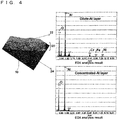
- FIG. 4 shows the results from Inventive Example 2
- FIG. 5 shows the results from Inventive Example 7.
- FIG. 4 shows that in Inventive Example 2, small amounts of Cr, Fe, and Ni were detected in the dilute-Al layer 22 formed on the surface side, which contained Al oxides as a main component. On the other hand, no Cr, Fe, Ni, and the like were detected in the concentrated-Al layer 24 but Al. Accordingly, it is found that the concentrated-Al layer 24 was made of aluminum oxide having a very high purity.
- FIG. 5 shows that in Inventive Example 7, a small amount of Cr was detected in the dilute-Al layer 22 formed on the surface side, which mainly included Al oxides. On the other hand, nothing but Al was detected in the concentrated-Al layer 24. Accordingly, it is found that the concentrated-Al layer 24 was made of aluminum oxide having a very high purity.
Landscapes
- Chemical & Material Sciences (AREA)
- Engineering & Computer Science (AREA)
- Materials Engineering (AREA)
- Mechanical Engineering (AREA)
- Metallurgy (AREA)
- Organic Chemistry (AREA)
- Chemical Kinetics & Catalysis (AREA)
- Physics & Mathematics (AREA)
- Thermal Sciences (AREA)
- Crystallography & Structural Chemistry (AREA)
- Other Surface Treatments For Metallic Materials (AREA)
- Laminated Bodies (AREA)
- Compositions Of Oxide Ceramics (AREA)
- Compounds Of Alkaline-Earth Elements, Aluminum Or Rare-Earth Metals (AREA)
Abstract
Description
- The present invention relates to a cast product having an alumina barrier layer, and more specifically, to a cast product having an alumina barrier layer with a stable structure.
- Heat-resistant steel castings such as reaction tubes and decomposition tubes for producing ethylene, and hearth rolls, radiant tubes and metal dusting-resistant materials for use in carburizing heat-treatment furnaces are exposed to a high-temperature atmosphere, and therefore are made of an austenite-based heat-resistant alloy having superior high-temperature strength.
- A metal oxide layer is formed on the surface of this type of austenite-based heat-resistant alloy during use in a high-temperature atmosphere. This oxide layer serves as a barrier, and thus protects the base material under a high-temperature atmosphere.
- On the other hand, when Cr-oxides (mainly constituted by Cr2O3) are formed as the metal oxide, the Cr-oxide layer has an insufficient function for preventing the entry of oxygen and carbon due to its low denseness, thus causing the internal oxidation under a high-temperature atmosphere and the thickening of the oxide film. Moreover, the Cr-oxide layer is likely to become detached during repeated cycles of heating and cooling. Even if the Cr-oxide layer do not become detached, the Cr-oxide layer has an insufficient function for preventing the entry of oxygen and carbon from an outside atmosphere, and therefore, there is a disadvantageous situation in which oxygen and carbon pass through the film and cause the internal oxidation or carburization of the base material.
- To address this, it is proposed that an oxide layer including alumina (Al2O3) as a main component that has high denseness and makes it difficult for oxygen and carbon to pass therethrough is formed on the surface of the base material by increasing the content of Al compared with that in a common austenite-based heat-resistant alloy (see Patent Documents 1 and 2, for example).
- However, Al is a ferrite-forming element, and therefore, when the content of Al is increased, the ductility of the materials is deteriorated and the high-temperature strength is reduced. This tendency of reduction of the ductility is observed particularly when the content of Al exceeds 5%
- For this reason, the austenite-based heat-resistant alloy of Patent Documents 1 and 2 can be expected to have an enhanced barrier function due to Al2O3, but has the disadvantage of causing a reduction of the ductility of the base material.
- Therefore, in order to provide a cast product that can secure the high-temperature stability of Al2O3 and can achieve a superior barrier function under a high-temperature atmosphere without reducing the ductility of the materials, Patent Document 3 proposes a cast product in which an alumina barrier layer including Al2O3 is formed on the inner surface of a cast body and Cr-based particles that contain Cr at a higher concentration than that of a matrix of the base material are dispersed at an interface between the alumina barrier layer and the cast body by performing heat treatment under an oxidizing atmosphere after processing the inner surface such that a surface roughness (Ra) of the cast body is 0.05 to 2.5 µm (see Patent Document 3, for example).
- Due to the presence of a stable alumina barrier layer, superior oxidation resistance, carburization resistance, nitriding resistance, corrosion resistance, and the like of the cast product of Patent document 3 can be maintained for a long period of time of use under a high-temperature atmosphere.
-
- Patent Document 1:
JP S52-78612A - Patent Document 2:
JP S57-39159A - Patent Document 3:
WO 2010/113830 - It is an object of the present invention to provide a cast product that can further enhance the stability of the alumina barrier layer and can exhibit further superior oxidation resistance, carburization resistance, nitriding resistance, corrosion resistance, and the like when used under a high-temperature atmosphere.
- The cast product according to the present invention is a cast product having an alumina barrier layer including an aluminum oxide on a surface of a matrix, wherein the aluminum oxide is (Al(1-x)M(x))2O3, where M is at least one of Cr, Ni, Si, and Fe, and x satisfies a
relationship 0<x<0.5. - Also, the cast product according to the present invention is a cast product having an alumina barrier layer including an aluminum oxide on a surface of a matrix, wherein at least one of Cr, Ni, Si, and Fe forms a solid solution in the aluminum oxide, and the at least one of Cr, Ni, Si, and Fe forming the solid solution with Al is contained so as to satisfy a relationship Al/(Cr+Ni+Si+Fe)≥2.0 in an atomic % ratio.
- With the cast product of the present invention, at least one of Cr, Ni, Si, and Fe forms a solid solution in an alumina barrier layer formed on a surface of a matrix, thus enabling an aluminum oxide phase to have a stable structure. With the aluminum oxide, it is possible to suppress the coupling between the matrix and oxygen and the formation of oxides containing Cr, Ni, Si, Fe and the like as a main component on the surface of the matrix.
- This makes it possible that the cast product of the present invention exhibits further superior oxidation resistance, carburization resistance, nitriding resistance, corrosion resistance, and the like when used under a high-temperature atmosphere.
- Accordingly, when the cast product of the present invention is used for a reaction tube for producing ethylene, for example, it is possible to suppress the occurrence of coking, to prevent the yield from being reduced by the reduction of heat exchange rate and thermal conductivity due to the occurrence of coking, and to extend continuous operating time. In addition, since coking is unlikely to occur, it is possible to reduce the frequency and time period for coking-removing operation and to enhance operation efficiency.
-
-
FIG. 1 is a cross-sectional view of a cast product before heat treatment. -
FIG. 2 is a schematic cross-sectional view illustrating a state where a dilute-Al layer is formed by low-temperature heat treatment. -
FIG. 3 is a schematic cross-sectional view illustrating a state where a concentrated-Al layer is formed between the dilute-Al layer and a matrix by high-temperature heat treatment. -
FIG. 4 shows a TEM photograph of a film of Working Example 2 and graphs illustrating the results of an EDX analysis. -
FIG. 5 shows a TEM photograph of a film of Working Example 7 and graphs illustrating the results of an EDX analysis. - Hereinafter, embodiments of the present invention will be described in detail.
- A cast product of the present invention has an alumina barrier layer including an aluminum oxide on the surface of a matrix.
- The aluminum oxide in the alumina barrier layer is (Al(1-x)M(x))2O3, where M is at least one of Cr, Ni, Si, and Fe, and x is adjusted so as to satisfy the
relationship 0<x<0.5. - Also, at least one of Cr, Ni, Si, and Fe forms a solid solution in the aluminum oxide in the alumina barrier layer, and at least one of Cr, Ni, Si, and Fe forming a solid solution with Al is contained so as to satisfy the relationship Al/(Cr+Ni+Si+Fe)≥2.0 in an atomic % ratio.
- As long as the cast product of the present invention is made of a heat-resistant alloy containing Cr in an amount of 15 mass% or more, Ni in an amount of 18 mass% or more, and Al in an amount of 1 to 5 mass%, it is possible to obtain the effects of the present invention. The cast product of the present invention is made of the following components, for example. It should be noted that in the following description, the term "%" refers to "mass%" unless otherwise stated.
- C acts to improve castability and enhance a high-temperature creep rupture strength. Therefore, the content of C is set to at least 0.05%. However, if the content is too large, a primary carbide of Cr7C3 is likely to be extensively formed and the movement of Al for forming the alumina barrier layer is suppressed. As a result, Al is insufficiently supplied to the surface portion of a cast body and the alumina barrier layer is locally divided, and thus the continuity of the alumina barrier layer is impaired. Moreover, a secondary carbide excessively deposits to reduce ductility and toughness. Therefore, the upper limit is set to 0.7%. It should be noted that the content of C is more desirably 0.3 to 0.5%.
- Si is contained to serve as a deoxidizer for molten alloy and to enhance the fluidity of molten alloy. If the content is too large, a high-temperature creep rupture strength is reduced, and therefore, the upper limit is set to 2.5%. It should be noted that the content of Si is more desirably 2.0% or less.
- Mn is contained to serve as a deoxidizer for molten alloy and to fix S in molten alloy. If the content is too large, high-temperature creep rupture strength is reduced, and therefore, the upper limit is set to 3.0%. It should be noted that the content of Mn is more desirably 1.6% or less.
- Cr is contained in an amount of 15.0% or more in order to contribute to the enhancement of high-temperature strength and cyclic oxidation resistance. However, if the content is too large, high-temperature creep rupture strength is reduced, and therefore, the upper limit is set to 50.0%. It should be noted that the content of Cr is more desirably 23.0 to 35.0%.
- Ni is an element that is necessary to secure cyclic oxidation resistance and the stability of a metal structure. If the content of Ni is small, the content of Fe relatively becomes large. As a result, a Cr-Fe-Mn oxide is likely to be formed on the surface of the cast body, and thus the formation of the alumina barrier layer is inhibited. Therefore, the content of Ni is set to at least 18.0%. Even if the content of Ni exceeds 70.0%, it is impossible to obtain the efficacy corresponding to the increasing amount, and therefore, the upper limit is set to 70.0%. It should be noted that the content of Ni is more desirably 28.0 to 45.0%.
- Al is an element that is effective for enhancing carburization resistance and coking resistance. Also, in the present invention, Al is an element that is essential for forming the alumina barrier layer on the surface of the cast body. Therefore, the content of Al is set to at least 1.0%. However, if the content of Al exceeds 5%, the ductility is deteriorated, and therefore, the upper limit is set to 5.0% in the present invention. It should be noted that the content of Al is more desirably 2.5 to 3.8%.
- The term "rare earth elements" means 17 elements including 15 elements of the lanthanide series ranging from La to Lu in the periodic table, and Y and Sc. It is preferable that rare earth elements to be contained in the heat-resistant alloy of the present invention include at least one element selected from the group consisting of Ce, La and Nd. Rare earth elements contribute to the formation of the alumina barrier layer and the enhancement of stability thereof.
- When the alumina barrier layer is formed by heat treatment under a high-temperature oxidizing atmosphere, rare earth elements that are contained in an amount of 0.005% or more effectively contribute to the formation of the alumina barrier layer.
- On the other hand, if the content is too large, the ductility and toughness are deteriorated, and therefore, the upper limit is set to 0.4%.
- W and Mo enhance creep rupture strength by forming a solid solution in a matrix and strengthening an austenite phase. At least one of W and Mo is contained in order to achieve this efficacy. The content of W is set to 0.5% or more, and the content of Mo is set to 0.1% or more.
- However, if the contents of W and Mo are too large, ductility is reduced and carburization resistance is deteriorated. Moreover, as in the case where the content of C is large, a primary carbide of (Cr, W, Mo)7C3 is likely to be extensively formed and the movement of Al for forming the alumina barrier layer is suppressed. As a result, Al is insufficiently supplied to the surface portion of the cast body and the alumina barrier layer is locally divided, and thus the continuity of the alumina barrier layer is likely to be impaired. Furthermore, since W and Mo have a large atomic radius, they suppress the movement of Al and Cr and inhibit the formation of the alumina barrier layer due to the formation of a solid solution in the matrix.
- Therefore, the content of W is set to 10.0% or less, and the content of Mo is set to 5.0% or less. It should be noted that when both elements are contained, the total content is preferably set to 10.0% or less.
- In addition, the following components can be contained.
- At least one selected from the group consisting of Ti in an amount of 0.01 to 0.6%, Zr in an amount of 0.01 to 0.6%, and Nb in an amount of 0.1 to 1.8%
- Ti, Zr and Nb are elements that are likely to form carbides, and form less solid solutions in the matrix than W and Mo. Therefore, Ti, Zr and Nb do not exhibit any particular action of forming the alumina barrier layer, but enhance creep rupture strength. At least one of Ti, Zr and Nb can be contained as needed. The content of Ti or Zr is set to 0.01% or more and the content of Nb is set to 0.1% or more.
- However, if they are excessively added, ductility is reduced. Furthermore, Nb reduces the peeling resistance of the alumina barrier layer. Therefore, the upper limit of the content of Ti or Zr is set to 0.6%, and the upper limit of the content of Nb is set to 1.8%.
- Since B exhibits an action of strengthening the particle boundaries of the cast body, B can be contained as needed. It should be noted that if the content of B is large, creep rupture strength is reduced, and therefore, the content of B is set to 0.1% or less even in the case where B is added.
- The heat-resistant alloy making up the cast body of the present invention includes the above-described components and Fe as the balance. P, S, and other impurities that are inevitably mixed in the alloy when melting the alloy may be contained as long as such impurities are contained in an amount within a range that is usually allowable to this type of alloy material.
- Molten metal having a composition including the above-described components is produced and cast by centrifugal casting, static casting, or the like into the cast product of the present invention having the above composition.
- The obtained cast product can be shaped depending on the intended application.
- One example of the cast product is a tube, in particular, a reaction tube used under a high-temperature environment.
- It is particularly preferable to produce the cast product of the present invention by centrifugal casting. This is because when using centrifugal casting, a fine metal structure grows in the radial direction with orientation due to the progress of cooling by a metal mold and thus an alloy structure in which Al easily moves can be obtained.
- Heat treatment, which will be described later, is performed on the cast product. The alumina barrier layer having a stable phase structure is formed by the heat treatment.
- The heat treatment is performed on the cast product of the present invention under an oxidizing atmosphere. The heat treatment can be divided into low-temperature heat treatment and high-temperature heat treatment. It should be noted that the low-temperature heat treatment and the high-temperature heat treatment can be performed in separate steps or the high-temperature heat treatment may be performed subsequently to the low-temperature heat treatment.
- The low-temperature heat treatment is treatment in which an aluminum oxide layer is formed on the surface of the matrix under an oxidizing atmosphere. One example of a low temperature is a temperature of less than 1050°C. It is desirably 600 to 900°C. It is desirable to perform the low-temperature heat treatment for 5 to 15 hours.
- By performing the low-temperature heat treatment, oxygen comes into contact with a
matrix 10 as shown inFIG. 1 to oxidize Al, Cr, Ni, Si, and Fe that has diffused from thematrix 10 to the surface of the matrix, and anoxide layer 22 is formed as shown inFIG. 2 . Since this heat treatment is performed at a low temperature, Al forms oxides prior to Cr, Ni, Si, and Fe. Accordingly, analuminum oxide layer 22 that contains Al as a main component and in which at least one of Cr, Ni, Si, and Fe, which have similarly diffused from the matrix, forms a solid solution is the oxide layer. - In the aluminum oxide formed by the low-temperature heat treatment, at least one of Cr, Ni, Si, and Fe forming a solid solution with Al is contained so as to satisfy the relationship Al/(Cr+Ni+Si+Fe)≥2.0 in an atomic % ratio. In addition, it is desirable that the composition thereof is (Al(1-x)M(x))2O3, where M is at least one of Cr, Ni, Si, and Fe, and x satisfies the
relationship 0<x<0.5. Moreover, at least Cr forms a solid solution in the aluminum oxide, and Cr forming a solid solution with Al is more preferably contained so as to satisfy the relationship Al/Cr≥10 in atomic % ratio, and still more preferably the relationship Al/Cr≥15. Furthermore, at least one of Ni, Si, and Fe forms a solid solution, and it is more desirable that the total atomic % of at least one of Ni, Si, and Fe forming a solid solution with Al is 10 atm% or less. - The aluminum oxide formed by the above-described low-temperature heat treatment has a metastable γ or θ alumina structure, which is a porous structure. Accordingly, the strength is not enough.
- The high-temperature heat treatment is heat treatment that is performed after the low-temperature heat treatment, and in which, as described later, the phase of the aluminum oxide formed by the low-temperature heat treatment is transformed to an α alumina structure (corundum structure), and an aluminum oxide layer containing Al at a high concentration is formed between that aluminum oxide layer and the matrix.
- The high-temperature heat treatment can be performed by heating the cast product on which the low-temperature heat treatment has been performed and the alumina barrier layer having a γ or θ alumina structure has been formed, at a high temperature under an oxidizing atmosphere. One example of a high temperature is a temperature of 1050°C or more. It is desirable to perform the high-temperature heat treatment for 3 to 15 hours.
- By performing the high-temperature heat treatment, the phase of the aluminum oxide that was formed first and has a γ or θ alumina structure is transformed to a stable α alumina structure (corundum structure). In the present invention, at least one of Cr, Ni, Si, and Fe forms a solid solution in the aluminum oxide layer having a γ or θ alumina structure. This makes it possible to promote the phase transformation from a γ or θ alumina structure to an α alumina structure (corundum structure) compared with the case where the aluminum oxide layer contains Al in a high ratio.
- Then, the high-temperature heat treatment is further continuously performed on the cast product having the aluminum oxide layer in which the phase has been transformed to an α alumina structure (corundum structure), and thus oxygen passes through the
aluminum oxide layer 22 as shown inFIG. 3 . - The oxygen that has passed through the
aluminum oxide layer 22 oxidizes Al that diffuses from the matrix, and analuminum oxide layer 24 that contains Al at a high concentration is formed. - Here, as shown in
FIG. 3 , the aluminum oxide layer that is formed by the low-temperature heat treatment and in which at least one of Cr, Ni, Si, and Fe forms a solid solution is referred to as "dilute-Al layer", and the aluminum oxide layer that is formed between the dilute-Al layer and the surface of the matrix and contains Al at a high concentration is referred to as "concentrated-Al layer". Specifically, in the concentrated-Al layer 24, Al/(Cr+Ni+Si+Fe) is larger than that in the dilute-Al layer 22. - It is thought that the reason why in terms of the alumina barrier layer, the concentrated-Al layer formed between the matrix and the dilute-Al layer contains Al at a higher concentration than the dilute-Al layer at the surface is as follows.
- The formed dilute-
Al layer 22 allows a small amount of oxygen to pass therethrough under an oxidizing atmosphere. - Al, Cr, Ni, Si, and Fe diffuse from the
matrix 10 side to the matrix surface side as shown inFIG. 3 . However, since Al needs a smaller amount of energy for binding to oxygen than Cr, Ni, Si, and Fe, Al priorly binds to oxygen, and the aluminum oxide layer (concentrated-Al layer 24) containing aluminum oxide at a high concentration is formed between thematrix 10 and the dilute-Al layer 22. - The concentrated-
Al layer 24 is formed by high-temperature heat treatment, and thus has a stable α alumina structure (corundum structure). It is desirable that 80 vol% or more of a crystal structure of each of the dilute-Al layer 22 and the concentrated-Al layer 24 is an α alumina structure (corundum structure). - Since the
alumina barrier layer 20 is constituted by the dilute-Al layer 22 and the concentrated-Al layer 24 formed between thematrix 10 and the dilute-Al layer 22, both of which have stable α alumina structures (corundum structures), thealumina barrier layer 20 has high denseness, serves as a barrier for preventing oxygen, carbon and nitrogen from entering the base material from the outside during use under a high-temperature atmosphere in the cast product provided therewith, and can maintain superior oxidation resistance, carburization resistance, nitriding resistance, corrosion resistance, and the like for a long period of time. - It should be noted that the concentrated-
Al layer 24 is desirably formed so as to be thicker than the dilute-Al layer 22, and it is preferable to form the concentrated-Al layer 24 such that the thickness of the concentrated-Al layer 24 is one fifth or more of that of thealumina barrier layer 20. - It is more desirable that the dilute-
Al layer 22 has a thickness of 0.04 to 8.0 µm and the concentrated-Al layer 24 has a thickness of 0.01 to 2.0 µm. - It is desirable to heat the cast product while rotating it in order to preferably form the aluminum oxide layer in the above-described low-temperature heat treatment and high-temperature heat treatment. This makes it possible to heat the cast product uniformly and bring the cast product into contact with oxygen in a good state. As a result, it is possible to reduce the surface roughness (Ra) of the formed
alumina barrier layer 20. - It is possible to perform surface treatment on the alumina barrier layer of the cast product as needed. One example of the surface treatment is polishing. For example, when the cast product is used for a reaction tube, Fe, Ni and the like of the cast product come into contact with a hydrocarbon as a raw material and coke (carbon) is likely to adhere to the inner surface of the tube due to the catalytic action of Fe and Ni, but it is possible to suppress the adhesion of coke by performing the surface treatment to reduce the surface roughness (Ra) of the alumina barrier layer.
- It is desirable to perform the surface treatment such that the surface roughness (Ra) of the alumina barrier layer is 15 µm or less. The surface roughness (Ra) is more desirably 0.05 to 10 µm.
- Molten metal was produced by atmospheric melting in a highfrequency induction melting furnace and cast by metal mold centrifugal casting into tube bodies having alloy chemical compositions shown in Table 1 below. The tube body has an inner diameter of 80 mm, an outer diameter of 100 mm, and a length of 250 mm.
Table 1 No. Alloy chemical composition (the balance includes Fe and inevitable im purities) (mass%) C Si Mn Cr Ni Al REM W Mo Ti Zr Nb B Work. Ex. 1 0.33 0.49 0.32 24.5 43.6 1.2 0.25 2.1 0.6 0.7 Work. Ex. 2 0.45 0.49 0.9 24.3 34.6 1.0 0.16 1.5 0.13 Work. Ex. 3 0.4 0.33 0.7 23.8 31.5 3.3 0.26 2.8 0.03 Work. Ex. 4 0.46 1.5 1.2 25.2 35.0 2.8 0.21 4.2 0.09 0.12 Work. Ex. 5 0.26 0.41 0.5 23.5 34.6 3.1 0.07 0.9 0.07 Work. Ex. 6 0.31 0.4 0.2 18.3 67.1 4.7 0.01 0.4 1.6 Work. Ex. 7 0.38 0.26 0.4 23.8 34.4 4.9 0.11 0.95 0.1 Work. Ex. 8 0.67 1.5 1.1 23.9 40.1 4.9 0.19 2.9 0.03 Comp. Ex. 1 0.33 1.78 0.17 25.0 33.4 0.0 0.11 0.83 0.12 Comp. Ex. 2 0.40 1.3 0.9 25.4 15.0 0.9 0.29 2.9 Comp. Ex. 3 0.27 1.02 0.2 23.8 33.6 1.1 0.19 11.7 Comp. Ex. 4 0.34 0.6 0.2 25.0 45.4 2.9 0.09 1.5 1.3 Comp. Ex. 5 0.45 1.43 1.3 22.9 34.7 3.2 0.24 3.15 0.23 Comp. Ex. 6 0.45 0.54 0.7 23.8 29.7 5.1 0.15 1.5 0.21 - Two steps of heat treatment that differed in a heating temperature were performed on each of Working Examples 1 to 8, which were obtained examples of the present invention, and Comparative Examples 1 to 6 under an oxidizing atmosphere. First, the low-temperature heat treatment was performed, and the high-temperature heat treatment was subsequently performed. The low-temperature heat treatment was performed for 5 hours, and the high-temperature heat treatment was performed for 5 hours.
Table 2 No. Low-temperature heat treatment temperature (°C) High-temperature heat treatment temperature (°C) Work. Ex. 1 700 1050 Work. Ex. 2 900 1100 Work. Ex. 3 800 1050 Work. Ex. 4 800 1100 Work. Ex. 5 900 1100 Work. Ex. 6 600 1050 Work. Ex. 7 700 1100 Work. Ex. 8 600 1150 Comp. Ex. 1 800 900 Comp. Ex. 2 1000 1250 Comp. Ex. 3 1200 1300 Comp. Ex. 4 500 1150 Comp. Ex. 5 900 1000 Comp. Ex. 6 600 800 - The atomic percentages of elements (Al, Cr, Fe, Ni, Si, O) contained in the alumina barrier layer formed on the surface of a sample tube of each of Working Examples 1 to 8 and Comparative Examples 1 to 6 that had been subjected to the heat treatment were measured by an EDX analysis (energy dispersive X-ray spectrometry). Table 3 shows the results.
Table 3 No. Al (atm%) Cr (atm%) Fe (atm%) Ni (atm%) Si (atm%) O (atm%) Cr+Fe +Ni+Si (atm%) Al/ (Cr+Fe +Ni+Si) Al/Cr Fe+Ni +Si (atm%) Concentrated-Al layer thickness /Al barrier layer thickness Work. Ex. 1 41.66 2.7 4.46 3.52 48.56 10.7 3.9 15.43 7.98 0.50 Work. Ex. 2 39.2 3.6 1.4 3.2 52.6 8.2 4.8 10.89 4.6 0.30 Work. Ex. 3 46.6 0.1 0.1 53.2 0.2 233.0 466.0 0.1 0.80 Work. Ex. 4 40.96 2.23 2.34 2.12 52.35 6.7 6.1 18.37 4.46 0.60 Work. Ex. 5 38.4 1.5 10.1 6.4 1.2 42.4 19.2 2.0 25.60 17.7 0.40 Work. Ex. 6 42.49 1.31 2.13 1.95 52.12 5.4 7.9 32.44 4.08 0.75 Work. Ex. 7 42.69 1.28 55.93 1.3 33.4 33.35 0 0.70 Work. Ex. 8 41.8 2.4 3.9 6.5 45.4 12.8 3.3 17.42 10.4 0.50 Comp. Ex. 1 4.61 10.25 7.09 31 47.05 53.0 0.0 0.00 48.34 0.00 Comp. Ex. 2 11.17 15.25 30.1 25.28 1.47 16.73 72.1 0.2 0.73 56.85 0.10 Comp. Ex. 3 6.7 35.46 1.65 1.8 1.64 52.75 40.6 0.2 0.19 5.09 0.05 Comp. Ex. 4 36.7 6.7 1.8 10.3 44.5 18.8 1.95 5.48 12.1 0.15 Comp. Ex. 5 9.77 21.54 11.34 9.51 1.02 46.82 43.4 0.2 0.45 21.87 0.10 Comp. Ex. 6 8.35 11 15.18 13.76 51.71 39.9 0.2 0.76 28.94 0.05 - All of Working Examples 1 to 8, which are examples of the present invention, satisfy the relationship Al/(Cr+Ni+Si+Fe)≥2.0 in atomic % ratio. Furthermore, they satisfy the relationship Al/Cr≥10. On the other hand, Comparative Example 1 contains no Al in the matrix, and therefore, no aluminum oxide is formed and both Al/(Cr+Ni+Si+Fe) and Al/Cr are zero.
- Moreover, all of Comparative Examples 2 to 6 satisfy the relationships Al/(Cr+Ni+Si+Fe)<2.0 and Al/Cr<10.
- Furthermore, Fe+Ni+Si is 10 atm% or less in Working Examples 1 to 4, and 6 and 7, and Comparative Example 3, and more than 10 atm% in other working examples and comparative examples.
- The ratio of the thickness of the concentrated-Al layer with respect to the thickness of the formed alumina barrier layer was measured in each of obtained Working Examples 1 to 8 and Comparative Examples 1 to 6. Table 3 above shows the results.
- Table 3 shows that the ratio of the thickness of the concentrated-Al layer with respect to the thickness of the alumina barrier layer is 0.3 or more, that is, one fifth or more in each working example, but it is 0.15 at most in the comparative examples. It should be noted that since Comparative Example 1 contains no Al, no alumina barrier layer is formed.
- This shows that since the low-temperature heat treatment was performed on the working examples, which were examples of the present invention, at a temperature of less than 1050°C and the high-temperature heat treatment was performed thereon at a temperature of 1050°C or more, the dilute-Al layer was formed on the surface of the matrix by the low-temperature heat treatment and then the concentrated-Al layer could be formed between the dilute-Al layer and the matrix by the high-temperature heat treatment.
- On the other hand, it is thought that the ratio of the thickness of the concentrated-Al layer with respect to the thickness of the alumina barrier layer was 0.15 at most in Comparative Examples 2 to 6 on which the alumina barrier layer was formed for the following reasons.
- In Comparative Example 2, the cast body contained Al in a small amount of 0.9%, and Al for forming a film on the surface of the cast body was insufficient. In Comparative Example 3, since the low-temperature heat treatment was performed at a high temperature of 1200°C, oxides containing Cr, Ni, Si, Fe and the like as a main component were formed before the alumina barrier layer having a γ or θ alumina structure was formed. In Comparative Example 4, since the low-temperature heat treatment was performed at a low temperature of 500°C, no alumina barrier layer having a γ or θ alumina structure was formed. In Comparative Examples 5 and 6, the high-temperature heat treatment was performed at a low temperature of 1000°C. As a result, a small amount of oxygen passed through the dilute-Al layer in the high-temperature heat treatment after the dilute-Al layer was formed in the low-temperature heat treatment, and Al did not obtain sufficient energy for binding to the oxygen taken in because the temperature was low.
- Next, a coking test was performed on the obtained sample tubes.
- The coking test was performed by placing the sample tubes in an electric furnace, supplying a hydrocarbon (ethane) to the sample tubes, and then heating them at a high temperature (955°C) for a predetermined time (12 to 24 hours). After the test, the degrees of carburization of the inner surfaces of the sample tubes were compared, and the weight ratio of coke (carbon) adhering to the inner surface of each sample tube was measured. Table 4 shows the results.
Table 4 No. Carburization resistance Weight ratio of formed coke Surface roughness (Ra) Work. Ex. 1 Good 0.4 0.13 Work. Ex. 2 Fair 0.6 5.51 Work. Ex. 3 Good 0.8 7.63 Work. Ex. 4 Good 0.6 1.53 Work. Ex. 5 Fair 1.0 11.7 Work. Ex. 6 Good 0.6 1.54 Work. Ex. 7 Good 0.7 2.02 Work. Ex. 8 Good 1.1 13.8 Comp. Ex. 1 Poor 0.9 9.17 Comp. Ex. 2 Poor 0.7 4.5 Comp. Ex. 3 Poor 1.5 18.1 Comp. Ex. 4 Poor 0.7 8.32 Comp. Ex. 5 Poor 0.8 6.27 Comp. Ex. 6 Poor 1.4 16.47 - Table 4 shows that all of Working Examples 1 to 8, which were examples of the present invention, had favorable carburization resistance. On the other hand, all of the comparative examples were carburized to the inside of the sample tube.
- It is because the alumina barrier layer having a stable α alumina structure (corundum structure) that was constituted by the concentrated-Al layer and the dilute-Al layer was preferably formed on the surface of the matrix that Working Examples 1 to 8 had superior carburization resistance. In particular, Working Examples 1, 3, 4, and 6 to 8 had extremely superior carburization resistance compared with the other working examples. It is thought that this is because a smaller amount of the concentrated-Al layer was formed in Working Examples 2 and 5 than in the other working examples.
- Furthermore, the surface roughness (Ra) of each sample tube was measured. Table 4 shows the results as well. Table 4 shows that the weight ratio of the formed coke and the surface roughness (Ra) were substantially in proportion to each other. Accordingly, the surface roughness (Ra) is preferably 15 µm or less, and more preferably 10 µm or less.
- It is possible to adjust the surface roughness (Ra) by performing the heat treatment while rotating the cast product. It is thought that it is because the heat treatment for forming a film was not properly performed and the surface roughness was increased due to the peeling and restoration of the film that the surface roughness of Comparative Examples 3 and 6 exceeded 15 µm.
- The alumina barrier layers of Inventive Examples 2 and 7 are observed using a transmission electron microscope (TEM). Furthermore, the EDX analysis was performed on the dilute-Al layer and the concentrated-Al layer of each inventive example.
FIG. 4 shows the results from Inventive Example 2, andFIG. 5 shows the results from Inventive Example 7. -
FIG. 4 shows that in Inventive Example 2, small amounts of Cr, Fe, and Ni were detected in the dilute-Al layer 22 formed on the surface side, which contained Al oxides as a main component. On the other hand, no Cr, Fe, Ni, and the like were detected in the concentrated-Al layer 24 but Al. Accordingly, it is found that the concentrated-Al layer 24 was made of aluminum oxide having a very high purity. -
FIG. 5 shows that in Inventive Example 7, a small amount of Cr was detected in the dilute-Al layer 22 formed on the surface side, which mainly included Al oxides. On the other hand, nothing but Al was detected in the concentrated-Al layer 24. Accordingly, it is found that the concentrated-Al layer 24 was made of aluminum oxide having a very high purity.
Claims (12)
- A cast product having an alumina barrier layer including an aluminum oxide on a surface of a matrix,
wherein the aluminum oxide is (Al(1-x)M(x))2O3, where M is at least one of Cr, Ni, Si, and Fe, and x satisfies a relationship 0<x<0.5. - A cast product having an alumina barrier layer including an aluminum oxide on a surface of a matrix,
wherein at least one of Cr, Ni, Si, and Fe forms a solid solution in the aluminum oxide, and the at least one of Cr, Ni, Si, and Fe forming the solid solution with Al is contained so as to satisfy a relationship Al/(Cr+Ni+Si+Fe)≥2.0 in an atomic % ratio. - The cast product according to claim 1 or 2,
wherein 80 vol% or more of a crystal structure of the aluminum oxide is a corundum structure. - The cast product according to any one of claims 1 to 3,
wherein at least Cr forms a solid solution in the aluminum oxide, and the Cr forming the solid solution with Al is contained so as to satisfy a relationship Al/Cr≥10 in an atomic % ratio. - The cast product according to any one of claims 1 to 4,
wherein at least one of Ni, Si, and Fe forms a solid solution in the aluminum oxide, and a total atomic % of the at least one of Ni, Si, and Fe forming the solid solution with Al is 10 atm% or less. - The cast product according to any one of claims 1 to 5,
wherein the aluminum oxide has a concentrated-Al layer in which the Al/(Cr+Ni+Si+Fe) on the matrix side is larger than that on the surface side. - The cast product according to claim 6,
wherein a thickness of the concentrated-Al layer is one fifth or more of a thickness of the alumina barrier layer. - The cast product according to any one of claims 1 to 7,
wherein the alumina barrier layer has a surface roughness (Ra) of 15 µm or less. - The cast product according to any one of claims 1 to 8,
wherein the matrix includes C in an amount of 0.05 to 0.7 mass%, Si in an amount of more than 0 mass% to 2.5 mass% or less, Mn in an amount of more than 0 mass% to 3.0 mass% or less, Cr in an amount of 15.0 to 50.0 mass%, Ni in an amount of 18.0 to 70.0 mass%, Al in an amount of 1.0 to 5.0 mass%, rare earth elements in an amount of 0.005 to 0.4 mass%, and W in an amount of 0.5 to 10.0 mass% and/or Mo in an amount of 0.1 to 5.0 mass%, and the balance includes Fe and inevitable impurities. - The cast product according to claim 9,
wherein the matrix further includes at least one selected from the group consisting of Ti in an amount of 0.01 to 0.6 mass%, Zr in an amount of 0.01 to 0.6 mass%, and Nb in an amount of 0.1 to 1.8 mass%. - The cast product according to claim 9 or 10,
wherein the matrix further includes B in an amount of more than 0 mass% to 0.1 mass% or less. - A reaction tube made of the cast product according to any one of claims 1 to 11,
the alumina barrier layer being formed on an inner surface of the tube through which hydrocarbon gas as a raw material flows.
Applications Claiming Priority (2)
| Application Number | Priority Date | Filing Date | Title |
|---|---|---|---|
| JP2014067836A JP6247977B2 (en) | 2014-03-28 | 2014-03-28 | Cast products having an alumina barrier layer |
| PCT/JP2014/083417 WO2015145896A1 (en) | 2014-03-28 | 2014-12-17 | Casting product having alumina barrier layer |
Publications (3)
| Publication Number | Publication Date |
|---|---|
| EP3124645A1 true EP3124645A1 (en) | 2017-02-01 |
| EP3124645A4 EP3124645A4 (en) | 2017-11-01 |
| EP3124645B1 EP3124645B1 (en) | 2019-10-23 |
Family
ID=54194463
Family Applications (1)
| Application Number | Title | Priority Date | Filing Date |
|---|---|---|---|
| EP14887198.1A Revoked EP3124645B1 (en) | 2014-03-28 | 2014-12-17 | Casting product having alumina barrier layer |
Country Status (7)
| Country | Link |
|---|---|
| US (1) | US20170306468A1 (en) |
| EP (1) | EP3124645B1 (en) |
| JP (1) | JP6247977B2 (en) |
| CN (1) | CN106460144B (en) |
| CA (2) | CA3167432A1 (en) |
| ES (1) | ES2765349T3 (en) |
| WO (1) | WO2015145896A1 (en) |
Cited By (1)
| Publication number | Priority date | Publication date | Assignee | Title |
|---|---|---|---|---|
| WO2023047142A1 (en) * | 2021-09-27 | 2023-03-30 | Alloyed Limited | Austenitic stainless steel |
Families Citing this family (4)
| Publication number | Priority date | Publication date | Assignee | Title |
|---|---|---|---|---|
| JP3019698B2 (en) | 1993-12-08 | 2000-03-13 | 東レ株式会社 | Partially fused composite false twisted yarn and method for producing the same |
| US20190292631A1 (en) * | 2016-05-20 | 2019-09-26 | Sandvik Intellectual Property Ab | An object comprising a pre-oxidized nickel-based alloy |
| JP6339284B1 (en) * | 2017-11-06 | 2018-06-06 | 株式会社クボタ | Steel products used in contact with steel |
| CN115404413B (en) * | 2022-08-22 | 2023-11-28 | 北京首钢吉泰安新材料有限公司 | Iron-chromium-aluminum alloy, preparation method thereof and electric heating element |
Family Cites Families (16)
| Publication number | Priority date | Publication date | Assignee | Title |
|---|---|---|---|---|
| US4204862A (en) * | 1975-10-29 | 1980-05-27 | Nippon Steel Corporation | Austenitic heat-resistant steel which forms Al2 O3 film in high-temperature oxidizing atmosphere |
| JPS5331517A (en) * | 1976-09-04 | 1978-03-24 | Mazda Motor Corp | Two-phase stain less steel |
| GB2017148B (en) * | 1978-03-22 | 1983-01-12 | Pompey Acieries | Nickel chromium iron alloys possessing very high resistantance to carburization at very high temperature |
| JPH05195138A (en) * | 1992-01-24 | 1993-08-03 | Kubota Corp | Heat resistant alloy having excellent carburization resistance and high creep rupture strength under conditions of high temperature and low stress |
| US5413642A (en) * | 1992-11-27 | 1995-05-09 | Alger; Donald L. | Processing for forming corrosion and permeation barriers |
| KR100372482B1 (en) * | 1999-06-30 | 2003-02-17 | 스미토모 긴조쿠 고교 가부시키가이샤 | Heat resistant Ni base alloy |
| JP4841931B2 (en) * | 2005-10-25 | 2011-12-21 | 財団法人電力中央研究所 | Method for improving oxidation resistance of heat-resistant metal material and method for producing heat-resistant metal member |
| US7744813B2 (en) | 2007-01-04 | 2010-06-29 | Ut-Battelle, Llc | Oxidation resistant high creep strength austenitic stainless steel |
| US8748008B2 (en) * | 2008-06-12 | 2014-06-10 | Exxonmobil Research And Engineering Company | High performance coatings and surfaces to mitigate corrosion and fouling in fired heater tubes |
| US8906170B2 (en) * | 2008-06-24 | 2014-12-09 | General Electric Company | Alloy castings having protective layers and methods of making the same |
| DE102008051014A1 (en) * | 2008-10-13 | 2010-04-22 | Schmidt + Clemens Gmbh + Co. Kg | Nickel-chromium alloy |
| CN102365381B (en) * | 2009-03-31 | 2013-12-25 | 株式会社久保田 | Cast product having alumina barrier layer |
| BR112013009481A2 (en) * | 2010-10-21 | 2016-07-26 | Exxonmobil Res & Eng Co | bimetallic tube formed from alumina for refinery process furnaces and methods of manufacture and use thereof |
| JP6068158B2 (en) * | 2012-03-30 | 2017-01-25 | 株式会社クボタ | Cast products having an alumina barrier layer |
| JP6005963B2 (en) * | 2012-03-23 | 2016-10-12 | 株式会社クボタ | Method for producing a cast product having an alumina barrier layer |
| WO2013141030A1 (en) * | 2012-03-23 | 2013-09-26 | 株式会社クボタ | Cast product having alumina barrier layer, and method for manufacturing same |
-
2014
- 2014-03-28 JP JP2014067836A patent/JP6247977B2/en active Active
- 2014-12-17 WO PCT/JP2014/083417 patent/WO2015145896A1/en not_active Ceased
- 2014-12-17 CA CA3167432A patent/CA3167432A1/en active Pending
- 2014-12-17 CN CN201480077579.XA patent/CN106460144B/en active Active
- 2014-12-17 CA CA2940179A patent/CA2940179C/en active Active
- 2014-12-17 US US15/116,738 patent/US20170306468A1/en not_active Abandoned
- 2014-12-17 ES ES14887198T patent/ES2765349T3/en active Active
- 2014-12-17 EP EP14887198.1A patent/EP3124645B1/en not_active Revoked
Non-Patent Citations (2)
| Title |
|---|
| None |
| See also references of WO2015145896A1 |
Cited By (1)
| Publication number | Priority date | Publication date | Assignee | Title |
|---|---|---|---|---|
| WO2023047142A1 (en) * | 2021-09-27 | 2023-03-30 | Alloyed Limited | Austenitic stainless steel |
Also Published As
| Publication number | Publication date |
|---|---|
| ES2765349T3 (en) | 2020-06-08 |
| WO2015145896A1 (en) | 2015-10-01 |
| JP6247977B2 (en) | 2017-12-13 |
| CN106460144A (en) | 2017-02-22 |
| CA3167432A1 (en) | 2015-10-01 |
| CN106460144B (en) | 2019-01-15 |
| US20170306468A1 (en) | 2017-10-26 |
| EP3124645B1 (en) | 2019-10-23 |
| EP3124645A4 (en) | 2017-11-01 |
| CA2940179C (en) | 2022-09-20 |
| JP2015190005A (en) | 2015-11-02 |
| CA2940179A1 (en) | 2015-10-01 |
Similar Documents
| Publication | Publication Date | Title |
|---|---|---|
| KR101565197B1 (en) | Cast product having alumina barrier layer | |
| KR101965925B1 (en) | Cast product having alumina barrier layer | |
| EP3124645B1 (en) | Casting product having alumina barrier layer | |
| JP6068158B2 (en) | Cast products having an alumina barrier layer | |
| EP3239311B1 (en) | Heat-resistant pipe having alumina barrier layer | |
| EP2801636B1 (en) | High carbon hot-rolled steel sheet and method for producing same | |
| KR101589008B1 (en) | Cr-containing austenite alloy pipe and production method for same | |
| EP3539714B1 (en) | Alloy for overlay welding, welding powder, and reaction tube | |
| JP2016223017A (en) | Reaction tube for ethylene production having an alumina barrier layer | |
| US11674212B2 (en) | Cast product having alumina barrier layer | |
| JP6534721B2 (en) | Method of manufacturing a cast product having an alumina barrier layer | |
| JP3979502B1 (en) | Method of nitriding / oxidizing and re-oxidizing metal member | |
| JP6005963B2 (en) | Method for producing a cast product having an alumina barrier layer | |
| US9080235B2 (en) | Composition and method for diffusion alloying of ferrocarbon workpiece | |
| JPH0254403B2 (en) | ||
| JP5631706B2 (en) | Thermal spray powder and method of installing an alloy spray coating on a member | |
| JP3053605B2 (en) | Metal members with excellent toughness and wear resistance | |
| JP3175589B2 (en) | Coating material for iron-based casting, iron-based casting provided with coating layer using the same, and method of forming coating layer therefor | |
| KR100502854B1 (en) | Chromuium-based stainless steel of good bonding ability to glass and acid resistance after high heat treatment | |
| JP2021088739A (en) | Chemical for heat treatment of stainless steel, heat treatment member of stainless steel, and method for manufacturing heat treatment member of stainless steel | |
| JP2022072751A (en) | Steel | |
| JPH03281755A (en) | High strength and heat resistant alloy excellent in carburizing resistance and coking resistance | |
| JPH10130813A (en) | Heating furnace tube excellent in heat resistance and method for producing the same |
Legal Events
| Date | Code | Title | Description |
|---|---|---|---|
| PUAI | Public reference made under article 153(3) epc to a published international application that has entered the european phase |
Free format text: ORIGINAL CODE: 0009012 |
|
| STAA | Information on the status of an ep patent application or granted ep patent |
Free format text: STATUS: REQUEST FOR EXAMINATION WAS MADE |
|
| 17P | Request for examination filed |
Effective date: 20160804 |
|
| AK | Designated contracting states |
Kind code of ref document: A1 Designated state(s): AL AT BE BG CH CY CZ DE DK EE ES FI FR GB GR HR HU IE IS IT LI LT LU LV MC MK MT NL NO PL PT RO RS SE SI SK SM TR |
|
| AX | Request for extension of the european patent |
Extension state: BA ME |
|
| DAX | Request for extension of the european patent (deleted) | ||
| A4 | Supplementary search report drawn up and despatched |
Effective date: 20171004 |
|
| RIC1 | Information provided on ipc code assigned before grant |
Ipc: C22C 19/05 20060101ALI20170927BHEP Ipc: C22C 30/00 20060101ALI20170927BHEP Ipc: C23C 8/14 20060101AFI20170927BHEP Ipc: C22C 38/58 20060101ALI20170927BHEP Ipc: C22C 38/00 20060101ALI20170927BHEP Ipc: C22F 1/00 20060101ALI20170927BHEP Ipc: C21D 6/00 20060101ALI20170927BHEP Ipc: C22F 1/10 20060101ALI20170927BHEP Ipc: C23C 8/80 20060101ALI20170927BHEP |
|
| TPAC | Observations filed by third parties |
Free format text: ORIGINAL CODE: EPIDOSNTIPA |
|
| STAA | Information on the status of an ep patent application or granted ep patent |
Free format text: STATUS: EXAMINATION IS IN PROGRESS |
|
| 17Q | First examination report despatched |
Effective date: 20181015 |
|
| GRAP | Despatch of communication of intention to grant a patent |
Free format text: ORIGINAL CODE: EPIDOSNIGR1 |
|
| STAA | Information on the status of an ep patent application or granted ep patent |
Free format text: STATUS: GRANT OF PATENT IS INTENDED |
|
| RIC1 | Information provided on ipc code assigned before grant |
Ipc: C23C 8/14 20060101AFI20190503BHEP Ipc: C22C 19/05 20060101ALI20190503BHEP Ipc: C22C 38/00 20060101ALI20190503BHEP Ipc: C22C 38/54 20060101ALI20190503BHEP Ipc: C22C 30/00 20060101ALI20190503BHEP Ipc: C22C 38/04 20060101ALI20190503BHEP Ipc: C22C 38/02 20060101ALI20190503BHEP Ipc: C21D 9/14 20060101ALI20190503BHEP Ipc: C22C 38/06 20060101ALI20190503BHEP Ipc: C23C 8/80 20060101ALI20190503BHEP Ipc: C22C 38/44 20060101ALI20190503BHEP Ipc: C22C 38/48 20060101ALI20190503BHEP Ipc: C22C 38/50 20060101ALI20190503BHEP |
|
| TPAC | Observations filed by third parties |
Free format text: ORIGINAL CODE: EPIDOSNTIPA |
|
| INTG | Intention to grant announced |
Effective date: 20190607 |
|
| TPAC | Observations filed by third parties |
Free format text: ORIGINAL CODE: EPIDOSNTIPA |
|
| GRAS | Grant fee paid |
Free format text: ORIGINAL CODE: EPIDOSNIGR3 |
|
| GRAA | (expected) grant |
Free format text: ORIGINAL CODE: 0009210 |
|
| STAA | Information on the status of an ep patent application or granted ep patent |
Free format text: STATUS: THE PATENT HAS BEEN GRANTED |
|
| AK | Designated contracting states |
Kind code of ref document: B1 Designated state(s): AL AT BE BG CH CY CZ DE DK EE ES FI FR GB GR HR HU IE IS IT LI LT LU LV MC MK MT NL NO PL PT RO RS SE SI SK SM TR |
|
| REG | Reference to a national code |
Ref country code: GB Ref legal event code: FG4D |
|
| REG | Reference to a national code |
Ref country code: CH Ref legal event code: EP |
|
| REG | Reference to a national code |
Ref country code: IE Ref legal event code: FG4D |
|
| REG | Reference to a national code |
Ref country code: DE Ref legal event code: R096 Ref document number: 602014055770 Country of ref document: DE |
|
| REG | Reference to a national code |
Ref country code: AT Ref legal event code: REF Ref document number: 1193701 Country of ref document: AT Kind code of ref document: T Effective date: 20191115 |
|
| REG | Reference to a national code |
Ref country code: NL Ref legal event code: MP Effective date: 20191023 |
|
| REG | Reference to a national code |
Ref country code: LT Ref legal event code: MG4D |
|
| PG25 | Lapsed in a contracting state [announced via postgrant information from national office to epo] |
Ref country code: LT Free format text: LAPSE BECAUSE OF FAILURE TO SUBMIT A TRANSLATION OF THE DESCRIPTION OR TO PAY THE FEE WITHIN THE PRESCRIBED TIME-LIMIT Effective date: 20191023 Ref country code: NO Free format text: LAPSE BECAUSE OF FAILURE TO SUBMIT A TRANSLATION OF THE DESCRIPTION OR TO PAY THE FEE WITHIN THE PRESCRIBED TIME-LIMIT Effective date: 20200123 Ref country code: GR Free format text: LAPSE BECAUSE OF FAILURE TO SUBMIT A TRANSLATION OF THE DESCRIPTION OR TO PAY THE FEE WITHIN THE PRESCRIBED TIME-LIMIT Effective date: 20200124 Ref country code: PL Free format text: LAPSE BECAUSE OF FAILURE TO SUBMIT A TRANSLATION OF THE DESCRIPTION OR TO PAY THE FEE WITHIN THE PRESCRIBED TIME-LIMIT Effective date: 20191023 Ref country code: NL Free format text: LAPSE BECAUSE OF FAILURE TO SUBMIT A TRANSLATION OF THE DESCRIPTION OR TO PAY THE FEE WITHIN THE PRESCRIBED TIME-LIMIT Effective date: 20191023 Ref country code: FI Free format text: LAPSE BECAUSE OF FAILURE TO SUBMIT A TRANSLATION OF THE DESCRIPTION OR TO PAY THE FEE WITHIN THE PRESCRIBED TIME-LIMIT Effective date: 20191023 Ref country code: PT Free format text: LAPSE BECAUSE OF FAILURE TO SUBMIT A TRANSLATION OF THE DESCRIPTION OR TO PAY THE FEE WITHIN THE PRESCRIBED TIME-LIMIT Effective date: 20200224 Ref country code: SE Free format text: LAPSE BECAUSE OF FAILURE TO SUBMIT A TRANSLATION OF THE DESCRIPTION OR TO PAY THE FEE WITHIN THE PRESCRIBED TIME-LIMIT Effective date: 20191023 Ref country code: LV Free format text: LAPSE BECAUSE OF FAILURE TO SUBMIT A TRANSLATION OF THE DESCRIPTION OR TO PAY THE FEE WITHIN THE PRESCRIBED TIME-LIMIT Effective date: 20191023 Ref country code: BG Free format text: LAPSE BECAUSE OF FAILURE TO SUBMIT A TRANSLATION OF THE DESCRIPTION OR TO PAY THE FEE WITHIN THE PRESCRIBED TIME-LIMIT Effective date: 20200123 |
|
| PG25 | Lapsed in a contracting state [announced via postgrant information from national office to epo] |
Ref country code: IS Free format text: LAPSE BECAUSE OF FAILURE TO SUBMIT A TRANSLATION OF THE DESCRIPTION OR TO PAY THE FEE WITHIN THE PRESCRIBED TIME-LIMIT Effective date: 20200224 Ref country code: RS Free format text: LAPSE BECAUSE OF FAILURE TO SUBMIT A TRANSLATION OF THE DESCRIPTION OR TO PAY THE FEE WITHIN THE PRESCRIBED TIME-LIMIT Effective date: 20191023 Ref country code: HR Free format text: LAPSE BECAUSE OF FAILURE TO SUBMIT A TRANSLATION OF THE DESCRIPTION OR TO PAY THE FEE WITHIN THE PRESCRIBED TIME-LIMIT Effective date: 20191023 |
|
| REG | Reference to a national code |
Ref country code: ES Ref legal event code: FG2A Ref document number: 2765349 Country of ref document: ES Kind code of ref document: T3 Effective date: 20200608 |
|
| PG25 | Lapsed in a contracting state [announced via postgrant information from national office to epo] |
Ref country code: AL Free format text: LAPSE BECAUSE OF FAILURE TO SUBMIT A TRANSLATION OF THE DESCRIPTION OR TO PAY THE FEE WITHIN THE PRESCRIBED TIME-LIMIT Effective date: 20191023 |
|
| REG | Reference to a national code |
Ref country code: DE Ref legal event code: R026 Ref document number: 602014055770 Country of ref document: DE |
|
| PG2D | Information on lapse in contracting state deleted |
Ref country code: IS |
|
| PG25 | Lapsed in a contracting state [announced via postgrant information from national office to epo] |
Ref country code: CZ Free format text: LAPSE BECAUSE OF FAILURE TO SUBMIT A TRANSLATION OF THE DESCRIPTION OR TO PAY THE FEE WITHIN THE PRESCRIBED TIME-LIMIT Effective date: 20191023 Ref country code: EE Free format text: LAPSE BECAUSE OF FAILURE TO SUBMIT A TRANSLATION OF THE DESCRIPTION OR TO PAY THE FEE WITHIN THE PRESCRIBED TIME-LIMIT Effective date: 20191023 Ref country code: DK Free format text: LAPSE BECAUSE OF FAILURE TO SUBMIT A TRANSLATION OF THE DESCRIPTION OR TO PAY THE FEE WITHIN THE PRESCRIBED TIME-LIMIT Effective date: 20191023 Ref country code: RO Free format text: LAPSE BECAUSE OF FAILURE TO SUBMIT A TRANSLATION OF THE DESCRIPTION OR TO PAY THE FEE WITHIN THE PRESCRIBED TIME-LIMIT Effective date: 20191023 Ref country code: IS Free format text: LAPSE BECAUSE OF FAILURE TO SUBMIT A TRANSLATION OF THE DESCRIPTION OR TO PAY THE FEE WITHIN THE PRESCRIBED TIME-LIMIT Effective date: 20200223 |
|
| PLBI | Opposition filed |
Free format text: ORIGINAL CODE: 0009260 |
|
| REG | Reference to a national code |
Ref country code: CH Ref legal event code: PL |
|
| PLAX | Notice of opposition and request to file observation + time limit sent |
Free format text: ORIGINAL CODE: EPIDOSNOBS2 |
|
| REG | Reference to a national code |
Ref country code: AT Ref legal event code: MK05 Ref document number: 1193701 Country of ref document: AT Kind code of ref document: T Effective date: 20191023 |
|
| REG | Reference to a national code |
Ref country code: BE Ref legal event code: MM Effective date: 20191231 |
|
| PG25 | Lapsed in a contracting state [announced via postgrant information from national office to epo] |
Ref country code: IT Free format text: LAPSE BECAUSE OF FAILURE TO SUBMIT A TRANSLATION OF THE DESCRIPTION OR TO PAY THE FEE WITHIN THE PRESCRIBED TIME-LIMIT Effective date: 20191023 Ref country code: SK Free format text: LAPSE BECAUSE OF FAILURE TO SUBMIT A TRANSLATION OF THE DESCRIPTION OR TO PAY THE FEE WITHIN THE PRESCRIBED TIME-LIMIT Effective date: 20191023 Ref country code: MC Free format text: LAPSE BECAUSE OF FAILURE TO SUBMIT A TRANSLATION OF THE DESCRIPTION OR TO PAY THE FEE WITHIN THE PRESCRIBED TIME-LIMIT Effective date: 20191023 Ref country code: SM Free format text: LAPSE BECAUSE OF FAILURE TO SUBMIT A TRANSLATION OF THE DESCRIPTION OR TO PAY THE FEE WITHIN THE PRESCRIBED TIME-LIMIT Effective date: 20191023 |
|
| 26 | Opposition filed |
Opponent name: SCHMIDT + CLEMENS + CO. KG Effective date: 20200723 |
|
| GBPC | Gb: european patent ceased through non-payment of renewal fee |
Effective date: 20200123 |
|
| PG25 | Lapsed in a contracting state [announced via postgrant information from national office to epo] |
Ref country code: LU Free format text: LAPSE BECAUSE OF NON-PAYMENT OF DUE FEES Effective date: 20191217 Ref country code: IE Free format text: LAPSE BECAUSE OF NON-PAYMENT OF DUE FEES Effective date: 20191217 Ref country code: GB Free format text: LAPSE BECAUSE OF NON-PAYMENT OF DUE FEES Effective date: 20200123 |
|
| PG25 | Lapsed in a contracting state [announced via postgrant information from national office to epo] |
Ref country code: AT Free format text: LAPSE BECAUSE OF FAILURE TO SUBMIT A TRANSLATION OF THE DESCRIPTION OR TO PAY THE FEE WITHIN THE PRESCRIBED TIME-LIMIT Effective date: 20191023 Ref country code: LI Free format text: LAPSE BECAUSE OF NON-PAYMENT OF DUE FEES Effective date: 20191231 Ref country code: SI Free format text: LAPSE BECAUSE OF FAILURE TO SUBMIT A TRANSLATION OF THE DESCRIPTION OR TO PAY THE FEE WITHIN THE PRESCRIBED TIME-LIMIT Effective date: 20191023 Ref country code: CH Free format text: LAPSE BECAUSE OF NON-PAYMENT OF DUE FEES Effective date: 20191231 Ref country code: BE Free format text: LAPSE BECAUSE OF NON-PAYMENT OF DUE FEES Effective date: 20191231 |
|
| PLBB | Reply of patent proprietor to notice(s) of opposition received |
Free format text: ORIGINAL CODE: EPIDOSNOBS3 |
|
| PG25 | Lapsed in a contracting state [announced via postgrant information from national office to epo] |
Ref country code: CY Free format text: LAPSE BECAUSE OF FAILURE TO SUBMIT A TRANSLATION OF THE DESCRIPTION OR TO PAY THE FEE WITHIN THE PRESCRIBED TIME-LIMIT Effective date: 20191023 |
|
| PG25 | Lapsed in a contracting state [announced via postgrant information from national office to epo] |
Ref country code: MT Free format text: LAPSE BECAUSE OF FAILURE TO SUBMIT A TRANSLATION OF THE DESCRIPTION OR TO PAY THE FEE WITHIN THE PRESCRIBED TIME-LIMIT Effective date: 20191023 Ref country code: HU Free format text: LAPSE BECAUSE OF FAILURE TO SUBMIT A TRANSLATION OF THE DESCRIPTION OR TO PAY THE FEE WITHIN THE PRESCRIBED TIME-LIMIT; INVALID AB INITIO Effective date: 20141217 |
|
| RDAF | Communication despatched that patent is revoked |
Free format text: ORIGINAL CODE: EPIDOSNREV1 |
|
| APBM | Appeal reference recorded |
Free format text: ORIGINAL CODE: EPIDOSNREFNO |
|
| APBP | Date of receipt of notice of appeal recorded |
Free format text: ORIGINAL CODE: EPIDOSNNOA2O |
|
| PG25 | Lapsed in a contracting state [announced via postgrant information from national office to epo] |
Ref country code: TR Free format text: LAPSE BECAUSE OF FAILURE TO SUBMIT A TRANSLATION OF THE DESCRIPTION OR TO PAY THE FEE WITHIN THE PRESCRIBED TIME-LIMIT Effective date: 20191023 |
|
| APAH | Appeal reference modified |
Free format text: ORIGINAL CODE: EPIDOSCREFNO |
|
| PLAB | Opposition data, opponent's data or that of the opponent's representative modified |
Free format text: ORIGINAL CODE: 0009299OPPO |
|
| PG25 | Lapsed in a contracting state [announced via postgrant information from national office to epo] |
Ref country code: MK Free format text: LAPSE BECAUSE OF FAILURE TO SUBMIT A TRANSLATION OF THE DESCRIPTION OR TO PAY THE FEE WITHIN THE PRESCRIBED TIME-LIMIT Effective date: 20191023 |
|
| R26 | Opposition filed (corrected) |
Opponent name: SCHMIDT + CLEMENS + CO. KG Effective date: 20200723 |
|
| APBQ | Date of receipt of statement of grounds of appeal recorded |
Free format text: ORIGINAL CODE: EPIDOSNNOA3O |
|
| P01 | Opt-out of the competence of the unified patent court (upc) registered |
Effective date: 20230517 |
|
| PGFP | Annual fee paid to national office [announced via postgrant information from national office to epo] |
Ref country code: DE Payment date: 20231031 Year of fee payment: 10 |
|
| REG | Reference to a national code |
Ref country code: DE Ref legal event code: R103 Ref document number: 602014055770 Country of ref document: DE Ref country code: DE Ref legal event code: R064 Ref document number: 602014055770 Country of ref document: DE |
|
| APBU | Appeal procedure closed |
Free format text: ORIGINAL CODE: EPIDOSNNOA9O |
|
| RDAG | Patent revoked |
Free format text: ORIGINAL CODE: 0009271 |
|
| STAA | Information on the status of an ep patent application or granted ep patent |
Free format text: STATUS: PATENT REVOKED |
|
| REG | Reference to a national code |
Ref country code: CH Ref legal event code: PL |
|
| 27W | Patent revoked |
Effective date: 20241004 |
|
| PGFP | Annual fee paid to national office [announced via postgrant information from national office to epo] |
Ref country code: FR Payment date: 20241111 Year of fee payment: 11 |
|
| PGFP | Annual fee paid to national office [announced via postgrant information from national office to epo] |
Ref country code: ES Payment date: 20250103 Year of fee payment: 11 |