EP3124478A1 - Novel organoleptic compounds - Google Patents
Novel organoleptic compounds Download PDFInfo
- Publication number
- EP3124478A1 EP3124478A1 EP16182061.8A EP16182061A EP3124478A1 EP 3124478 A1 EP3124478 A1 EP 3124478A1 EP 16182061 A EP16182061 A EP 16182061A EP 3124478 A1 EP3124478 A1 EP 3124478A1
- Authority
- EP
- European Patent Office
- Prior art keywords
- fragrance
- product
- methyl
- octahydro
- benzofuran
- Prior art date
- Legal status (The legal status is an assumption and is not a legal conclusion. Google has not performed a legal analysis and makes no representation as to the accuracy of the status listed.)
- Granted
Links
- 150000001875 compounds Chemical class 0.000 title claims abstract description 46
- 239000003205 fragrance Substances 0.000 claims abstract description 76
- 239000000463 material Substances 0.000 claims abstract description 20
- 239000000203 mixture Substances 0.000 claims description 58
- 238000009472 formulation Methods 0.000 claims description 30
- IAHIAGIEBSNFDK-UHFFFAOYSA-N 5-ethoxy-3-methyl-2,3-dihydro-1-benzofuran Chemical compound C(C)OC=1C=CC2=C(C(CO2)C)C=1 IAHIAGIEBSNFDK-UHFFFAOYSA-N 0.000 claims description 13
- 239000002781 deodorant agent Substances 0.000 claims description 11
- 239000003921 oil Substances 0.000 claims description 11
- 239000002304 perfume Substances 0.000 claims description 10
- 239000007788 liquid Substances 0.000 claims description 9
- 238000000034 method Methods 0.000 claims description 9
- 239000000344 soap Substances 0.000 claims description 8
- 239000007787 solid Substances 0.000 claims description 8
- 239000003599 detergent Substances 0.000 claims description 7
- 239000004744 fabric Substances 0.000 claims description 7
- 239000007921 spray Substances 0.000 claims description 7
- XUTZHJNXAOHUTM-UHFFFAOYSA-N 3-[4-(2-methylpropyl)cyclohexyl]propanal Chemical compound CC(C)CC1CCC(CCC=O)CC1 XUTZHJNXAOHUTM-UHFFFAOYSA-N 0.000 claims description 6
- QAJOFHCKLGLYPO-UHFFFAOYSA-N 9-methyltricyclo[5.2.1.02,6]decane-8-carbaldehyde Chemical compound C12CCCC2C2C(C)C(C=O)C1C2 QAJOFHCKLGLYPO-UHFFFAOYSA-N 0.000 claims description 6
- VYPSYNLAJGMNEJ-UHFFFAOYSA-N Silicium dioxide Chemical compound O=[Si]=O VYPSYNLAJGMNEJ-UHFFFAOYSA-N 0.000 claims description 6
- 239000002537 cosmetic Substances 0.000 claims description 6
- 230000002708 enhancing effect Effects 0.000 claims description 6
- 239000003795 chemical substances by application Substances 0.000 claims description 5
- 229920000642 polymer Polymers 0.000 claims description 5
- 239000000758 substrate Substances 0.000 claims description 5
- 238000005406 washing Methods 0.000 claims description 5
- 239000002386 air freshener Substances 0.000 claims description 4
- 230000001166 anti-perspirative effect Effects 0.000 claims description 4
- 239000003213 antiperspirant Substances 0.000 claims description 4
- 239000000645 desinfectant Substances 0.000 claims description 4
- XLYOFNOQVPJJNP-UHFFFAOYSA-N water Substances O XLYOFNOQVPJJNP-UHFFFAOYSA-N 0.000 claims description 4
- 239000000654 additive Substances 0.000 claims description 3
- 238000004851 dishwashing Methods 0.000 claims description 3
- 239000002979 fabric softener Substances 0.000 claims description 3
- 239000006260 foam Substances 0.000 claims description 3
- 239000011521 glass Substances 0.000 claims description 3
- 238000010419 pet care Methods 0.000 claims description 3
- 238000005201 scrubbing Methods 0.000 claims description 3
- 239000000377 silicon dioxide Substances 0.000 claims description 3
- 239000004094 surface-active agent Substances 0.000 claims description 3
- 239000004264 Petrolatum Substances 0.000 claims description 2
- 229920002472 Starch Polymers 0.000 claims description 2
- 229910021536 Zeolite Inorganic materials 0.000 claims description 2
- 239000007844 bleaching agent Substances 0.000 claims description 2
- HNPSIPDUKPIQMN-UHFFFAOYSA-N dioxosilane;oxo(oxoalumanyloxy)alumane Chemical compound O=[Si]=O.O=[Al]O[Al]=O HNPSIPDUKPIQMN-UHFFFAOYSA-N 0.000 claims description 2
- 239000003995 emulsifying agent Substances 0.000 claims description 2
- 239000000835 fiber Substances 0.000 claims description 2
- 239000000834 fixative Substances 0.000 claims description 2
- 235000013305 food Nutrition 0.000 claims description 2
- 230000036541 health Effects 0.000 claims description 2
- 239000002184 metal Substances 0.000 claims description 2
- 229910052751 metal Inorganic materials 0.000 claims description 2
- 239000002480 mineral oil Substances 0.000 claims description 2
- 235000016709 nutrition Nutrition 0.000 claims description 2
- 229940066842 petrolatum Drugs 0.000 claims description 2
- 235000019271 petrolatum Nutrition 0.000 claims description 2
- 150000003904 phospholipids Chemical class 0.000 claims description 2
- 235000019698 starch Nutrition 0.000 claims description 2
- 235000000346 sugar Nutrition 0.000 claims description 2
- 239000010457 zeolite Substances 0.000 claims description 2
- 238000004140 cleaning Methods 0.000 claims 2
- 230000000996 additive effect Effects 0.000 claims 1
- 235000010446 mineral oil Nutrition 0.000 claims 1
- 239000008107 starch Substances 0.000 claims 1
- 235000019645 odor Nutrition 0.000 description 27
- HEDRZPFGACZZDS-MICDWDOJSA-N Trichloro(2H)methane Chemical compound [2H]C(Cl)(Cl)Cl HEDRZPFGACZZDS-MICDWDOJSA-N 0.000 description 22
- 239000000126 substance Substances 0.000 description 15
- 238000005160 1H NMR spectroscopy Methods 0.000 description 11
- XEKOWRVHYACXOJ-UHFFFAOYSA-N Ethyl acetate Chemical compound CCOC(C)=O XEKOWRVHYACXOJ-UHFFFAOYSA-N 0.000 description 10
- 238000002360 preparation method Methods 0.000 description 10
- ZMXDDKWLCZADIW-UHFFFAOYSA-N N,N-Dimethylformamide Chemical compound CN(C)C=O ZMXDDKWLCZADIW-UHFFFAOYSA-N 0.000 description 8
- 239000004615 ingredient Substances 0.000 description 8
- -1 -tert-butyl cyclohexanes Chemical class 0.000 description 6
- 235000009508 confectionery Nutrition 0.000 description 6
- 239000000499 gel Substances 0.000 description 6
- 239000000843 powder Substances 0.000 description 6
- CFWUXOWTWHWMSB-UHFFFAOYSA-N 3-methyl-1-benzofuran-5-ol Chemical compound C1=C(O)C=C2C(C)=COC2=C1 CFWUXOWTWHWMSB-UHFFFAOYSA-N 0.000 description 5
- JGGCGHQLNDSPDT-UHFFFAOYSA-N 5-methoxy-3-methyl-2,3-dihydro-1-benzofuran Chemical compound COC=1C=CC2=C(C(CO2)C)C=1 JGGCGHQLNDSPDT-UHFFFAOYSA-N 0.000 description 5
- SMRWLUXZLIUAFB-UHFFFAOYSA-N C(C)OC=1C=CC2=C(C(=CO2)C)C=1 Chemical compound C(C)OC=1C=CC2=C(C(=CO2)C)C=1 SMRWLUXZLIUAFB-UHFFFAOYSA-N 0.000 description 5
- 238000012360 testing method Methods 0.000 description 5
- VPKMGDRERYMTJX-CMDGGOBGSA-N 1-(2,6,6-Trimethyl-2-cyclohexen-1-yl)-1-penten-3-one Chemical compound CCC(=O)\C=C\C1C(C)=CCCC1(C)C VPKMGDRERYMTJX-CMDGGOBGSA-N 0.000 description 4
- WGQKYLYKGWIDAI-UHFFFAOYSA-N 3-methyl-2,3-dihydro-1-benzofuran-5-ol Chemical compound C1=C(O)C=C2C(C)COC2=C1 WGQKYLYKGWIDAI-UHFFFAOYSA-N 0.000 description 4
- JRSNEXVRVTXGIK-UHFFFAOYSA-N 5-methoxy-3-methyl-1-benzofuran Chemical compound COC1=CC=C2OC=C(C)C2=C1 JRSNEXVRVTXGIK-UHFFFAOYSA-N 0.000 description 4
- KDLHZDBZIXYQEI-UHFFFAOYSA-N Palladium Chemical compound [Pd] KDLHZDBZIXYQEI-UHFFFAOYSA-N 0.000 description 4
- QMVPMAAFGQKVCJ-UHFFFAOYSA-N citronellol Chemical compound OCCC(C)CCC=C(C)C QMVPMAAFGQKVCJ-UHFFFAOYSA-N 0.000 description 4
- 230000000295 complement effect Effects 0.000 description 4
- 230000000694 effects Effects 0.000 description 4
- 235000019439 ethyl acetate Nutrition 0.000 description 4
- ISWSIDIOOBJBQZ-UHFFFAOYSA-N phenol group Chemical group C1(=CC=CC=C1)O ISWSIDIOOBJBQZ-UHFFFAOYSA-N 0.000 description 4
- 239000002904 solvent Substances 0.000 description 4
- 210000004243 sweat Anatomy 0.000 description 4
- 125000000391 vinyl group Chemical group [H]C([*])=C([H])[H] 0.000 description 4
- 229920002554 vinyl polymer Polymers 0.000 description 4
- KHQDWCKZXLWDNM-KPKJPENVSA-N (e)-2-ethyl-4-(2,2,3-trimethylcyclopent-3-en-1-yl)but-2-en-1-ol Chemical compound CC\C(CO)=C/CC1CC=C(C)C1(C)C KHQDWCKZXLWDNM-KPKJPENVSA-N 0.000 description 3
- NDLPUCZWTPHFHN-UHFFFAOYSA-N 2-methyl-1-benzofuran-5-ol Chemical compound OC1=CC=C2OC(C)=CC2=C1 NDLPUCZWTPHFHN-UHFFFAOYSA-N 0.000 description 3
- IMABOBLFKQOVOD-UHFFFAOYSA-N 3,6-dimethyl-1-benzofuran-5-ol Chemical compound CC1=C(O)C=C2C(C)=COC2=C1 IMABOBLFKQOVOD-UHFFFAOYSA-N 0.000 description 3
- GLKKLXSKJHWUSV-UHFFFAOYSA-N 3,7-dimethyl-1-benzofuran-5-ol Chemical compound C1=C(O)C=C2C(C)=COC2=C1C GLKKLXSKJHWUSV-UHFFFAOYSA-N 0.000 description 3
- PEUAZQMQTCPVPZ-UHFFFAOYSA-N 3-methyl-1-benzofuran-4-ol Chemical compound C1=CC(O)=C2C(C)=COC2=C1 PEUAZQMQTCPVPZ-UHFFFAOYSA-N 0.000 description 3
- FGGWLXUJNRJYAJ-UHFFFAOYSA-N 7-tert-butyl-3-methyl-1-benzofuran-5-ol Chemical compound Cc1coc2c(cc(O)cc12)C(C)(C)C FGGWLXUJNRJYAJ-UHFFFAOYSA-N 0.000 description 3
- 239000000443 aerosol Substances 0.000 description 3
- 229910052782 aluminium Inorganic materials 0.000 description 3
- XAGFODPZIPBFFR-UHFFFAOYSA-N aluminium Chemical compound [Al] XAGFODPZIPBFFR-UHFFFAOYSA-N 0.000 description 3
- 239000012459 cleaning agent Substances 0.000 description 3
- 239000010985 leather Substances 0.000 description 3
- 239000006210 lotion Substances 0.000 description 3
- 239000001993 wax Substances 0.000 description 3
- FINOAUDUYKVGDS-UHFFFAOYSA-N (2-tert-butylcyclohexyl) acetate Chemical compound CC(=O)OC1CCCCC1C(C)(C)C FINOAUDUYKVGDS-UHFFFAOYSA-N 0.000 description 2
- XEJGJTYRUWUFFD-FNORWQNLSA-N (e)-1-(2,6,6-trimethyl-1-cyclohex-3-enyl)but-2-en-1-one Chemical compound C\C=C\C(=O)C1C(C)C=CCC1(C)C XEJGJTYRUWUFFD-FNORWQNLSA-N 0.000 description 2
- YBUIAJZFOGJGLJ-SWRJLBSHSA-N 1-cedr-8-en-9-ylethanone Chemical compound C1[C@]23[C@H](C)CC[C@H]3C(C)(C)[C@@H]1C(C)=C(C(C)=O)C2 YBUIAJZFOGJGLJ-SWRJLBSHSA-N 0.000 description 2
- FJJYHTVHBVXEEQ-UHFFFAOYSA-N 2,2-dimethylpropanal Chemical compound CC(C)(C)C=O FJJYHTVHBVXEEQ-UHFFFAOYSA-N 0.000 description 2
- VSIXJPFQJMODCS-UHFFFAOYSA-N 3-methyl-4-phenylbutan-2-ol Chemical compound CC(O)C(C)CC1=CC=CC=C1 VSIXJPFQJMODCS-UHFFFAOYSA-N 0.000 description 2
- OXYRENDGHPGWKV-UHFFFAOYSA-N 3-methyl-5-phenylpentan-1-ol Chemical compound OCCC(C)CCC1=CC=CC=C1 OXYRENDGHPGWKV-UHFFFAOYSA-N 0.000 description 2
- MBZRJSQZCBXRGK-UHFFFAOYSA-N 4-tert-Butylcyclohexyl acetate Chemical compound CC(=O)OC1CCC(C(C)(C)C)CC1 MBZRJSQZCBXRGK-UHFFFAOYSA-N 0.000 description 2
- 241000402754 Erythranthe moschata Species 0.000 description 2
- 240000007472 Leucaena leucocephala Species 0.000 description 2
- 235000010643 Leucaena leucocephala Nutrition 0.000 description 2
- 150000001299 aldehydes Chemical class 0.000 description 2
- PNEYBMLMFCGWSK-UHFFFAOYSA-N aluminium oxide Inorganic materials [O-2].[O-2].[O-2].[Al+3].[Al+3] PNEYBMLMFCGWSK-UHFFFAOYSA-N 0.000 description 2
- 235000015241 bacon Nutrition 0.000 description 2
- MIZGSAALSYARKU-UHFFFAOYSA-N cashmeran Chemical compound CC1(C)C(C)C(C)(C)C2=C1C(=O)CCC2 MIZGSAALSYARKU-UHFFFAOYSA-N 0.000 description 2
- 235000000484 citronellol Nutrition 0.000 description 2
- 229910052593 corundum Inorganic materials 0.000 description 2
- 239000006071 cream Substances 0.000 description 2
- DENRZWYUOJLTMF-UHFFFAOYSA-N diethyl sulfate Chemical compound CCOS(=O)(=O)OCC DENRZWYUOJLTMF-UHFFFAOYSA-N 0.000 description 2
- 229940008406 diethyl sulfate Drugs 0.000 description 2
- 238000004821 distillation Methods 0.000 description 2
- ONKNPOPIGWHAQC-UHFFFAOYSA-N galaxolide Chemical compound C1OCC(C)C2=C1C=C1C(C)(C)C(C)C(C)(C)C1=C2 ONKNPOPIGWHAQC-UHFFFAOYSA-N 0.000 description 2
- 238000004128 high performance liquid chromatography Methods 0.000 description 2
- KVWWIYGFBYDJQC-UHFFFAOYSA-N methyl dihydrojasmonate Chemical compound CCCCCC1C(CC(=O)OC)CCC1=O KVWWIYGFBYDJQC-UHFFFAOYSA-N 0.000 description 2
- 238000012986 modification Methods 0.000 description 2
- 230000004048 modification Effects 0.000 description 2
- VLKZOEOYAKHREP-UHFFFAOYSA-N n-Hexane Chemical class CCCCCC VLKZOEOYAKHREP-UHFFFAOYSA-N 0.000 description 2
- 229940127285 new chemical entity Drugs 0.000 description 2
- BOPPSUHPZARXTH-UHFFFAOYSA-N ocean propanal Chemical compound O=CC(C)CC1=CC=C2OCOC2=C1 BOPPSUHPZARXTH-UHFFFAOYSA-N 0.000 description 2
- 230000009965 odorless effect Effects 0.000 description 2
- 230000008447 perception Effects 0.000 description 2
- 239000004033 plastic Substances 0.000 description 2
- 229920003023 plastic Polymers 0.000 description 2
- BWHMMNNQKKPAPP-UHFFFAOYSA-L potassium carbonate Chemical compound [K+].[K+].[O-]C([O-])=O BWHMMNNQKKPAPP-UHFFFAOYSA-L 0.000 description 2
- 230000009467 reduction Effects 0.000 description 2
- 230000001953 sensory effect Effects 0.000 description 2
- 239000002453 shampoo Substances 0.000 description 2
- 239000000779 smoke Substances 0.000 description 2
- 229910001845 yogo sapphire Inorganic materials 0.000 description 2
- ZSKAJFSSXURRGL-PKNBQFBNSA-N (2e)-1,1-dimethoxy-3,7-dimethylocta-2,6-diene Chemical compound COC(OC)\C=C(/C)CCC=C(C)C ZSKAJFSSXURRGL-PKNBQFBNSA-N 0.000 description 1
- VHBOIZSCWFNPBM-PTNGSMBKSA-N (2z)-2-[(4-methylphenyl)methylidene]heptanal Chemical compound CCCCC\C(C=O)=C\C1=CC=C(C)C=C1 VHBOIZSCWFNPBM-PTNGSMBKSA-N 0.000 description 1
- JIYIHILAGIZIMD-CLFYSBASSA-N (4z)-cyclopentadec-4-en-1-one Chemical compound O=C1CCCCCCCCCC\C=C/CC1 JIYIHILAGIZIMD-CLFYSBASSA-N 0.000 description 1
- IHPKGUQCSIINRJ-CSKARUKUSA-N (E)-beta-ocimene Chemical compound CC(C)=CC\C=C(/C)C=C IHPKGUQCSIINRJ-CSKARUKUSA-N 0.000 description 1
- QMVPMAAFGQKVCJ-SNVBAGLBSA-N (R)-(+)-citronellol Natural products OCC[C@H](C)CCC=C(C)C QMVPMAAFGQKVCJ-SNVBAGLBSA-N 0.000 description 1
- MTVBNJVZZAQKRV-BJMVGYQFSA-N (e)-2-methyl-4-(2,2,3-trimethylcyclopent-3-en-1-yl)but-2-en-1-ol Chemical compound OCC(/C)=C/CC1CC=C(C)C1(C)C MTVBNJVZZAQKRV-BJMVGYQFSA-N 0.000 description 1
- LIWYPQFTKLABSJ-WAYWQWQTSA-N (z)-1-(2-methylprop-2-enoxy)hex-3-ene Chemical compound CC\C=C/CCOCC(C)=C LIWYPQFTKLABSJ-WAYWQWQTSA-N 0.000 description 1
- FVUGZKDGWGKCFE-UHFFFAOYSA-N 1-(2,3,8,8-tetramethyl-1,3,4,5,6,7-hexahydronaphthalen-2-yl)ethanone Chemical compound CC1(C)CCCC2=C1CC(C(C)=O)(C)C(C)C2 FVUGZKDGWGKCFE-UHFFFAOYSA-N 0.000 description 1
- FXCYGAGBPZQRJE-ZHACJKMWSA-N 1-(2,6,6-Trimethyl-2-cyclohexen-1-yl)-1,6-heptadien-3-one Chemical compound CC1=CCCC(C)(C)C1\C=C\C(=O)CCC=C FXCYGAGBPZQRJE-ZHACJKMWSA-N 0.000 description 1
- OEVIJAZJVZDBQL-UHFFFAOYSA-N 1-(5,5-dimethylcyclohexen-1-yl)pent-4-en-1-one Chemical compound CC1(C)CCC=C(C(=O)CCC=C)C1 OEVIJAZJVZDBQL-UHFFFAOYSA-N 0.000 description 1
- MBVBLQFHVRGNLW-UHFFFAOYSA-N 1-methyl-3-(4-methylpent-3-enyl)cyclohex-3-ene-1-carbaldehyde Chemical compound CC(C)=CCCC1=CCCC(C)(C=O)C1 MBVBLQFHVRGNLW-UHFFFAOYSA-N 0.000 description 1
- VUIWFNRBSGUSIN-UHFFFAOYSA-N 1-methyl-4-(4-methylpent-3-enyl)cyclohex-3-ene-1-carbaldehyde Chemical compound CC(C)=CCCC1=CCC(C)(C=O)CC1 VUIWFNRBSGUSIN-UHFFFAOYSA-N 0.000 description 1
- BDERNNFJNOPAEC-UHFFFAOYSA-N 1-propanol Substances CCCO BDERNNFJNOPAEC-UHFFFAOYSA-N 0.000 description 1
- GWCCFAFCQHECBM-UHFFFAOYSA-N 2,2-dimethyl-4-phenylpentanenitrile Chemical compound N#CC(C)(C)CC(C)C1=CC=CC=C1 GWCCFAFCQHECBM-UHFFFAOYSA-N 0.000 description 1
- MZZRKEIUNOYYDF-UHFFFAOYSA-N 2,4-dimethylcyclohex-3-ene-1-carbaldehyde Chemical compound CC1C=C(C)CCC1C=O MZZRKEIUNOYYDF-UHFFFAOYSA-N 0.000 description 1
- YFHKETGXYQOMGB-UHFFFAOYSA-N 2,6,6,7,8,8-hexamethyl-3,3a,4,5,5a,7,8a,8b-octahydro-2h-cyclopenta[g][1]benzofuran Chemical compound C1CC2C(C)(C)C(C)C(C)(C)C2C2OC(C)CC21 YFHKETGXYQOMGB-UHFFFAOYSA-N 0.000 description 1
- CLUKHRLTJBCIBD-UHFFFAOYSA-N 2-(3-methylbutoxy)acetic acid Chemical compound CC(C)CCOCC(O)=O CLUKHRLTJBCIBD-UHFFFAOYSA-N 0.000 description 1
- YCOHHRPARVZBHK-JOEFCEOISA-N 2-methyl-3-[[(1S,2R,4S)-1,7,7-trimethyl-2-bicyclo[2.2.1]heptanyl]oxy]propan-1-ol Chemical compound CC(CO)CO[C@@H]1C[C@@H]2CC[C@]1(C2(C)C)C YCOHHRPARVZBHK-JOEFCEOISA-N 0.000 description 1
- IXIYWQIFBRZMNR-UHFFFAOYSA-N 3,4,5,6,6-pentamethylhept-3-en-2-one Chemical compound CC(C)(C)C(C)C(C)=C(C)C(C)=O IXIYWQIFBRZMNR-UHFFFAOYSA-N 0.000 description 1
- JFTSYAALCNQOKO-UHFFFAOYSA-N 3-(4-ethylphenyl)-2,2-dimethylpropanal Chemical compound CCC1=CC=C(CC(C)(C)C=O)C=C1 JFTSYAALCNQOKO-UHFFFAOYSA-N 0.000 description 1
- NWMCCMGWYCKNJR-UHFFFAOYSA-N 3-(4-ethylphenyl)-2,2-dimethylpropanenitrile Chemical compound CCC1=CC=C(CC(C)(C)C#N)C=C1 NWMCCMGWYCKNJR-UHFFFAOYSA-N 0.000 description 1
- JRJBVWJSTHECJK-PKNBQFBNSA-N 3-Methyl-4-(2,6,6-trimethyl-2-cyclohexen-1-yl)-3-buten-2-one Chemical compound CC(=O)C(\C)=C\C1C(C)=CCCC1(C)C JRJBVWJSTHECJK-PKNBQFBNSA-N 0.000 description 1
- NFXKDOMHRZMNMB-ALCCZGGFSA-N 3-[(Z)-hex-1-enyl]-2-hydroxybenzoic acid Chemical compound CCCC\C=C/C1=CC=CC(C(O)=O)=C1O NFXKDOMHRZMNMB-ALCCZGGFSA-N 0.000 description 1
- PXPQSXLFJHZPNJ-UHFFFAOYSA-N 3-o-[2-(3,3-dimethylcyclohexyl)ethyl] 1-o-ethyl propanedioate Chemical compound CCOC(=O)CC(=O)OCCC1CCCC(C)(C)C1 PXPQSXLFJHZPNJ-UHFFFAOYSA-N 0.000 description 1
- ORMHZBNNECIKOH-UHFFFAOYSA-N 4-(4-hydroxy-4-methylpentyl)cyclohex-3-ene-1-carbaldehyde Chemical compound CC(C)(O)CCCC1=CCC(C=O)CC1 ORMHZBNNECIKOH-UHFFFAOYSA-N 0.000 description 1
- YVSNOTITPICPTB-UHFFFAOYSA-N 4-methyl-2-(2-methylpropyl)oxan-4-ol Chemical compound CC(C)CC1CC(C)(O)CCO1 YVSNOTITPICPTB-UHFFFAOYSA-N 0.000 description 1
- REINJUBMDBESCN-UHFFFAOYSA-N 4-methyl-8-methylideneadamantan-2-ol Chemical compound C1C(C2=C)CC3C(C)C1CC2C3O REINJUBMDBESCN-UHFFFAOYSA-N 0.000 description 1
- NXFZLSLXLZRDPX-UHFFFAOYSA-N 8-cyclooctyl-8-(cyclopenten-1-ylmethyl)-2,2,3-trimethyloxocane Chemical compound O1C(C)(C)C(C)CCCCC1(C1CCCCCCC1)CC1=CCCC1 NXFZLSLXLZRDPX-UHFFFAOYSA-N 0.000 description 1
- 235000011468 Albizia julibrissin Nutrition 0.000 description 1
- 244000144725 Amygdalus communis Species 0.000 description 1
- 235000011437 Amygdalus communis Nutrition 0.000 description 1
- 244000099147 Ananas comosus Species 0.000 description 1
- 235000007119 Ananas comosus Nutrition 0.000 description 1
- 241000205585 Aquilegia canadensis Species 0.000 description 1
- 241000167854 Bourreria succulenta Species 0.000 description 1
- FERIUCNNQQJTOY-UHFFFAOYSA-M Butyrate Chemical compound CCCC([O-])=O FERIUCNNQQJTOY-UHFFFAOYSA-M 0.000 description 1
- FERIUCNNQQJTOY-UHFFFAOYSA-N Butyric acid Natural products CCCC(O)=O FERIUCNNQQJTOY-UHFFFAOYSA-N 0.000 description 1
- JDESNZLKIQXFJN-UHFFFAOYSA-N C(C=C(C)/CCC=C(C)C)CC(=O)O.C(C)(=O)OCC=C(CCC=C(C)C)C Chemical compound C(C=C(C)/CCC=C(C)C)CC(=O)O.C(C)(=O)OCC=C(CCC=C(C)C)C JDESNZLKIQXFJN-UHFFFAOYSA-N 0.000 description 1
- XWCDCDSDNJVCLO-UHFFFAOYSA-N Chlorofluoromethane Chemical compound FCCl XWCDCDSDNJVCLO-UHFFFAOYSA-N 0.000 description 1
- WTEVQBCEXWBHNA-UHFFFAOYSA-N Citral Natural products CC(C)=CCCC(C)=CC=O WTEVQBCEXWBHNA-UHFFFAOYSA-N 0.000 description 1
- 235000009917 Crataegus X brevipes Nutrition 0.000 description 1
- 235000013204 Crataegus X haemacarpa Nutrition 0.000 description 1
- 235000009685 Crataegus X maligna Nutrition 0.000 description 1
- 235000009444 Crataegus X rubrocarnea Nutrition 0.000 description 1
- 235000009486 Crataegus bullatus Nutrition 0.000 description 1
- 235000017181 Crataegus chrysocarpa Nutrition 0.000 description 1
- 235000009682 Crataegus limnophila Nutrition 0.000 description 1
- 240000000171 Crataegus monogyna Species 0.000 description 1
- 235000004423 Crataegus monogyna Nutrition 0.000 description 1
- 235000002313 Crataegus paludosa Nutrition 0.000 description 1
- 235000009840 Crataegus x incaedua Nutrition 0.000 description 1
- 241000612152 Cyclamen hederifolium Species 0.000 description 1
- 239000000253 Denture Cleanser Substances 0.000 description 1
- RWSOTUBLDIXVET-UHFFFAOYSA-N Dihydrogen sulfide Chemical class S RWSOTUBLDIXVET-UHFFFAOYSA-N 0.000 description 1
- 241000196324 Embryophyta Species 0.000 description 1
- 241000919496 Erysimum Species 0.000 description 1
- 235000016623 Fragaria vesca Nutrition 0.000 description 1
- 240000009088 Fragaria x ananassa Species 0.000 description 1
- 235000011363 Fragaria x ananassa Nutrition 0.000 description 1
- 240000001972 Gardenia jasminoides Species 0.000 description 1
- 244000215562 Heliotropium arborescens Species 0.000 description 1
- 241001632576 Hyacinthus Species 0.000 description 1
- PMGCQNGBLMMXEW-UHFFFAOYSA-N Isoamyl salicylate Chemical compound CC(C)CCOC(=O)C1=CC=CC=C1O PMGCQNGBLMMXEW-UHFFFAOYSA-N 0.000 description 1
- 235000010254 Jasminum officinale Nutrition 0.000 description 1
- 240000005385 Jasminum sambac Species 0.000 description 1
- 240000006568 Lathyrus odoratus Species 0.000 description 1
- 241000234435 Lilium Species 0.000 description 1
- 241000218378 Magnolia Species 0.000 description 1
- 241000220225 Malus Species 0.000 description 1
- 235000011430 Malus pumila Nutrition 0.000 description 1
- 235000015103 Malus silvestris Nutrition 0.000 description 1
- 235000014749 Mentha crispa Nutrition 0.000 description 1
- 244000246386 Mentha pulegium Species 0.000 description 1
- 235000016257 Mentha pulegium Nutrition 0.000 description 1
- 244000078639 Mentha spicata Species 0.000 description 1
- 235000004357 Mentha x piperita Nutrition 0.000 description 1
- 240000005852 Mimosa quadrivalvis Species 0.000 description 1
- 241000234479 Narcissus Species 0.000 description 1
- 241000233855 Orchidaceae Species 0.000 description 1
- 241000218657 Picea Species 0.000 description 1
- 235000008331 Pinus X rigitaeda Nutrition 0.000 description 1
- 241000018646 Pinus brutia Species 0.000 description 1
- 235000011613 Pinus brutia Nutrition 0.000 description 1
- 244000014047 Polianthes tuberosa Species 0.000 description 1
- 235000016067 Polianthes tuberosa Nutrition 0.000 description 1
- 235000014443 Pyrus communis Nutrition 0.000 description 1
- 240000001987 Pyrus communis Species 0.000 description 1
- 241001128140 Reseda Species 0.000 description 1
- 240000007651 Rubus glaucus Species 0.000 description 1
- 235000011034 Rubus glaucus Nutrition 0.000 description 1
- 235000009122 Rubus idaeus Nutrition 0.000 description 1
- 244000297179 Syringa vulgaris Species 0.000 description 1
- 235000004338 Syringa vulgaris Nutrition 0.000 description 1
- 241000219793 Trifolium Species 0.000 description 1
- 235000009499 Vanilla fragrans Nutrition 0.000 description 1
- 244000263375 Vanilla tahitensis Species 0.000 description 1
- 235000012036 Vanilla tahitensis Nutrition 0.000 description 1
- 244000172533 Viola sororia Species 0.000 description 1
- 235000009754 Vitis X bourquina Nutrition 0.000 description 1
- 235000012333 Vitis X labruscana Nutrition 0.000 description 1
- 240000006365 Vitis vinifera Species 0.000 description 1
- 235000014787 Vitis vinifera Nutrition 0.000 description 1
- 239000000853 adhesive Substances 0.000 description 1
- 230000001070 adhesive effect Effects 0.000 description 1
- 239000002671 adjuvant Substances 0.000 description 1
- 150000001298 alcohols Chemical class 0.000 description 1
- BHELZAPQIKSEDF-UHFFFAOYSA-N allyl bromide Chemical compound BrCC=C BHELZAPQIKSEDF-UHFFFAOYSA-N 0.000 description 1
- 235000020224 almond Nutrition 0.000 description 1
- UZFLPKAIBPNNCA-BQYQJAHWSA-N alpha-ionone Chemical compound CC(=O)\C=C\C1C(C)=CCCC1(C)C UZFLPKAIBPNNCA-BQYQJAHWSA-N 0.000 description 1
- WUOACPNHFRMFPN-UHFFFAOYSA-N alpha-terpineol Chemical compound CC1=CCC(C(C)(C)O)CC1 WUOACPNHFRMFPN-UHFFFAOYSA-N 0.000 description 1
- 150000001555 benzenes Chemical class 0.000 description 1
- JGQFVRIQXUFPAH-UHFFFAOYSA-N beta-citronellol Natural products OCCC(C)CCCC(C)=C JGQFVRIQXUFPAH-UHFFFAOYSA-N 0.000 description 1
- 235000013361 beverage Nutrition 0.000 description 1
- 230000015572 biosynthetic process Effects 0.000 description 1
- 238000004061 bleaching Methods 0.000 description 1
- 230000008859 change Effects 0.000 description 1
- 235000019693 cherries Nutrition 0.000 description 1
- 238000004587 chromatography analysis Methods 0.000 description 1
- 229940043350 citral Drugs 0.000 description 1
- 239000011280 coal tar Substances 0.000 description 1
- 229910052681 coesite Inorganic materials 0.000 description 1
- 238000004040 coloring Methods 0.000 description 1
- 230000003750 conditioning effect Effects 0.000 description 1
- 150000001907 coumarones Chemical class 0.000 description 1
- 229910052906 cristobalite Inorganic materials 0.000 description 1
- 229930186364 cyclamen Natural products 0.000 description 1
- BLBJUGKATXCWET-UHFFFAOYSA-N cyclaprop Chemical compound C12CC=CC2C2CC(OC(=O)CC)C1C2 BLBJUGKATXCWET-UHFFFAOYSA-N 0.000 description 1
- TXWOGHSRPAYOML-UHFFFAOYSA-N cyclobutanecarboxylic acid Chemical compound OC(=O)C1CCC1 TXWOGHSRPAYOML-UHFFFAOYSA-N 0.000 description 1
- OANSOJSBHVENEI-UHFFFAOYSA-N cyclohexene-1-carbaldehyde Chemical compound O=CC1=CCCCC1 OANSOJSBHVENEI-UHFFFAOYSA-N 0.000 description 1
- SQIFACVGCPWBQZ-UHFFFAOYSA-N delta-terpineol Natural products CC(C)(O)C1CCC(=C)CC1 SQIFACVGCPWBQZ-UHFFFAOYSA-N 0.000 description 1
- 239000000551 dentifrice Substances 0.000 description 1
- 230000001419 dependent effect Effects 0.000 description 1
- 230000002951 depilatory effect Effects 0.000 description 1
- 238000005108 dry cleaning Methods 0.000 description 1
- 239000000975 dye Substances 0.000 description 1
- 238000004043 dyeing Methods 0.000 description 1
- 235000013399 edible fruits Nutrition 0.000 description 1
- 230000007613 environmental effect Effects 0.000 description 1
- 150000002148 esters Chemical class 0.000 description 1
- 150000002170 ethers Chemical class 0.000 description 1
- 230000001815 facial effect Effects 0.000 description 1
- 239000003925 fat Substances 0.000 description 1
- 239000000796 flavoring agent Substances 0.000 description 1
- 235000019634 flavors Nutrition 0.000 description 1
- 238000004508 fractional distillation Methods 0.000 description 1
- 238000004817 gas chromatography Methods 0.000 description 1
- WTEVQBCEXWBHNA-JXMROGBWSA-N geranial Chemical compound CC(C)=CCC\C(C)=C\C=O WTEVQBCEXWBHNA-JXMROGBWSA-N 0.000 description 1
- HIGQPQRQIQDZMP-UHFFFAOYSA-N geranil acetate Natural products CC(C)=CCCC(C)=CCOC(C)=O HIGQPQRQIQDZMP-UHFFFAOYSA-N 0.000 description 1
- 230000037308 hair color Effects 0.000 description 1
- 239000008266 hair spray Substances 0.000 description 1
- XOYYHTTVCNEROD-UHFFFAOYSA-N hex-1-enyl 2-hydroxybenzoate Chemical compound CCCCC=COC(=O)C1=CC=CC=C1O XOYYHTTVCNEROD-UHFFFAOYSA-N 0.000 description 1
- 235000001050 hortel pimenta Nutrition 0.000 description 1
- 238000010348 incorporation Methods 0.000 description 1
- 239000000976 ink Substances 0.000 description 1
- 229930002839 ionone Natural products 0.000 description 1
- 150000002499 ionone derivatives Chemical class 0.000 description 1
- 150000002576 ketones Chemical class 0.000 description 1
- 150000002596 lactones Chemical class 0.000 description 1
- 150000002632 lipids Chemical class 0.000 description 1
- 238000004519 manufacturing process Methods 0.000 description 1
- 235000013372 meat Nutrition 0.000 description 1
- QSHDDOUJBYECFT-UHFFFAOYSA-N mercury Chemical compound [Hg] QSHDDOUJBYECFT-UHFFFAOYSA-N 0.000 description 1
- 229910052753 mercury Inorganic materials 0.000 description 1
- 238000002156 mixing Methods 0.000 description 1
- 239000002324 mouth wash Substances 0.000 description 1
- 239000013642 negative control Substances 0.000 description 1
- 150000002825 nitriles Chemical class 0.000 description 1
- 210000001331 nose Anatomy 0.000 description 1
- 150000007823 ocimene derivatives Chemical class 0.000 description 1
- 230000008569 process Effects 0.000 description 1
- 238000012545 processing Methods 0.000 description 1
- 239000000047 product Substances 0.000 description 1
- 239000003380 propellant Substances 0.000 description 1
- 238000004537 pulping Methods 0.000 description 1
- 239000013557 residual solvent Substances 0.000 description 1
- 150000003902 salicylic acid esters Chemical class 0.000 description 1
- VIDTVPHHDGRGAF-UHFFFAOYSA-N selenium sulfide Chemical compound [Se]=S VIDTVPHHDGRGAF-UHFFFAOYSA-N 0.000 description 1
- 239000010865 sewage Substances 0.000 description 1
- 238000010898 silica gel chromatography Methods 0.000 description 1
- 230000035943 smell Effects 0.000 description 1
- 235000011888 snacks Nutrition 0.000 description 1
- KWVISVAMQJWJSZ-VKROHFNGSA-N solasodine Chemical compound O([C@@H]1[C@@H]([C@]2(CC[C@@H]3[C@@]4(C)CC[C@H](O)CC4=CC[C@H]3[C@@H]2C1)C)[C@@H]1C)[C@]11CC[C@@H](C)CN1 KWVISVAMQJWJSZ-VKROHFNGSA-N 0.000 description 1
- 229910052682 stishovite Inorganic materials 0.000 description 1
- 238000003860 storage Methods 0.000 description 1
- 125000001424 substituent group Chemical group 0.000 description 1
- 150000008163 sugars Chemical class 0.000 description 1
- 239000000271 synthetic detergent Substances 0.000 description 1
- 229940116411 terpineol Drugs 0.000 description 1
- XTVMZZBLCLWBPM-UHFFFAOYSA-N tert-butylcyclohexane Chemical class CC(C)(C)C1CCCCC1 XTVMZZBLCLWBPM-UHFFFAOYSA-N 0.000 description 1
- 238000012956 testing procedure Methods 0.000 description 1
- 239000004753 textile Substances 0.000 description 1
- 238000009988 textile finishing Methods 0.000 description 1
- 239000000606 toothpaste Substances 0.000 description 1
- XJPBRODHZKDRCB-UHFFFAOYSA-N trans-alpha-ocimene Natural products CC(=C)CCC=C(C)C=C XJPBRODHZKDRCB-UHFFFAOYSA-N 0.000 description 1
- 229910052905 tridymite Inorganic materials 0.000 description 1
- 239000000341 volatile oil Substances 0.000 description 1
- 230000002087 whitening effect Effects 0.000 description 1
- IHPKGUQCSIINRJ-UHFFFAOYSA-N β-ocimene Natural products CC(C)=CCC=C(C)C=C IHPKGUQCSIINRJ-UHFFFAOYSA-N 0.000 description 1
Classifications
-
- C—CHEMISTRY; METALLURGY
- C07—ORGANIC CHEMISTRY
- C07C—ACYCLIC OR CARBOCYCLIC COMPOUNDS
- C07C69/00—Esters of carboxylic acids; Esters of carbonic or haloformic acids
- C07C69/02—Esters of acyclic saturated monocarboxylic acids having the carboxyl group bound to an acyclic carbon atom or to hydrogen
- C07C69/12—Acetic acid esters
- C07C69/14—Acetic acid esters of monohydroxylic compounds
-
- C—CHEMISTRY; METALLURGY
- C11—ANIMAL OR VEGETABLE OILS, FATS, FATTY SUBSTANCES OR WAXES; FATTY ACIDS THEREFROM; DETERGENTS; CANDLES
- C11B—PRODUCING, e.g. BY PRESSING RAW MATERIALS OR BY EXTRACTION FROM WASTE MATERIALS, REFINING OR PRESERVING FATS, FATTY SUBSTANCES, e.g. LANOLIN, FATTY OILS OR WAXES; ESSENTIAL OILS; PERFUMES
- C11B9/00—Essential oils; Perfumes
- C11B9/0007—Aliphatic compounds
- C11B9/0015—Aliphatic compounds containing oxygen as the only heteroatom
- C11B9/0019—Aliphatic compounds containing oxygen as the only heteroatom carbocylic acids; Salts or esters thereof
-
- A—HUMAN NECESSITIES
- A61—MEDICAL OR VETERINARY SCIENCE; HYGIENE
- A61K—PREPARATIONS FOR MEDICAL, DENTAL OR TOILETRY PURPOSES
- A61K47/00—Medicinal preparations characterised by the non-active ingredients used, e.g. carriers or inert additives; Targeting or modifying agents chemically bound to the active ingredient
- A61K47/06—Organic compounds, e.g. natural or synthetic hydrocarbons, polyolefins, mineral oil, petrolatum or ozokerite
- A61K47/08—Organic compounds, e.g. natural or synthetic hydrocarbons, polyolefins, mineral oil, petrolatum or ozokerite containing oxygen, e.g. ethers, acetals, ketones, quinones, aldehydes, peroxides
- A61K47/14—Esters of carboxylic acids, e.g. fatty acid monoglycerides, medium-chain triglycerides, parabens or PEG fatty acid esters
-
- A—HUMAN NECESSITIES
- A61—MEDICAL OR VETERINARY SCIENCE; HYGIENE
- A61K—PREPARATIONS FOR MEDICAL, DENTAL OR TOILETRY PURPOSES
- A61K8/00—Cosmetics or similar toiletry preparations
- A61K8/18—Cosmetics or similar toiletry preparations characterised by the composition
- A61K8/30—Cosmetics or similar toiletry preparations characterised by the composition containing organic compounds
- A61K8/33—Cosmetics or similar toiletry preparations characterised by the composition containing organic compounds containing oxygen
-
- A—HUMAN NECESSITIES
- A61—MEDICAL OR VETERINARY SCIENCE; HYGIENE
- A61K—PREPARATIONS FOR MEDICAL, DENTAL OR TOILETRY PURPOSES
- A61K8/00—Cosmetics or similar toiletry preparations
- A61K8/18—Cosmetics or similar toiletry preparations characterised by the composition
- A61K8/30—Cosmetics or similar toiletry preparations characterised by the composition containing organic compounds
- A61K8/33—Cosmetics or similar toiletry preparations characterised by the composition containing organic compounds containing oxygen
- A61K8/34—Alcohols
-
- A—HUMAN NECESSITIES
- A61—MEDICAL OR VETERINARY SCIENCE; HYGIENE
- A61K—PREPARATIONS FOR MEDICAL, DENTAL OR TOILETRY PURPOSES
- A61K8/00—Cosmetics or similar toiletry preparations
- A61K8/18—Cosmetics or similar toiletry preparations characterised by the composition
- A61K8/30—Cosmetics or similar toiletry preparations characterised by the composition containing organic compounds
- A61K8/49—Cosmetics or similar toiletry preparations characterised by the composition containing organic compounds containing heterocyclic compounds
- A61K8/4973—Cosmetics or similar toiletry preparations characterised by the composition containing organic compounds containing heterocyclic compounds with oxygen as the only hetero atom
-
- A—HUMAN NECESSITIES
- A61—MEDICAL OR VETERINARY SCIENCE; HYGIENE
- A61L—METHODS OR APPARATUS FOR STERILISING MATERIALS OR OBJECTS IN GENERAL; DISINFECTION, STERILISATION OR DEODORISATION OF AIR; CHEMICAL ASPECTS OF BANDAGES, DRESSINGS, ABSORBENT PADS OR SURGICAL ARTICLES; MATERIALS FOR BANDAGES, DRESSINGS, ABSORBENT PADS OR SURGICAL ARTICLES
- A61L9/00—Disinfection, sterilisation or deodorisation of air
- A61L9/01—Deodorant compositions
-
- A—HUMAN NECESSITIES
- A61—MEDICAL OR VETERINARY SCIENCE; HYGIENE
- A61Q—SPECIFIC USE OF COSMETICS OR SIMILAR TOILETRY PREPARATIONS
- A61Q1/00—Make-up preparations; Body powders; Preparations for removing make-up
-
- A—HUMAN NECESSITIES
- A61—MEDICAL OR VETERINARY SCIENCE; HYGIENE
- A61Q—SPECIFIC USE OF COSMETICS OR SIMILAR TOILETRY PREPARATIONS
- A61Q11/00—Preparations for care of the teeth, of the oral cavity or of dentures; Dentifrices, e.g. toothpastes; Mouth rinses
-
- A—HUMAN NECESSITIES
- A61—MEDICAL OR VETERINARY SCIENCE; HYGIENE
- A61Q—SPECIFIC USE OF COSMETICS OR SIMILAR TOILETRY PREPARATIONS
- A61Q13/00—Formulations or additives for perfume preparations
-
- A—HUMAN NECESSITIES
- A61—MEDICAL OR VETERINARY SCIENCE; HYGIENE
- A61Q—SPECIFIC USE OF COSMETICS OR SIMILAR TOILETRY PREPARATIONS
- A61Q15/00—Anti-perspirants or body deodorants
-
- A—HUMAN NECESSITIES
- A61—MEDICAL OR VETERINARY SCIENCE; HYGIENE
- A61Q—SPECIFIC USE OF COSMETICS OR SIMILAR TOILETRY PREPARATIONS
- A61Q19/00—Preparations for care of the skin
-
- A—HUMAN NECESSITIES
- A61—MEDICAL OR VETERINARY SCIENCE; HYGIENE
- A61Q—SPECIFIC USE OF COSMETICS OR SIMILAR TOILETRY PREPARATIONS
- A61Q19/00—Preparations for care of the skin
- A61Q19/10—Washing or bathing preparations
-
- A—HUMAN NECESSITIES
- A61—MEDICAL OR VETERINARY SCIENCE; HYGIENE
- A61Q—SPECIFIC USE OF COSMETICS OR SIMILAR TOILETRY PREPARATIONS
- A61Q5/00—Preparations for care of the hair
-
- C—CHEMISTRY; METALLURGY
- C07—ORGANIC CHEMISTRY
- C07C—ACYCLIC OR CARBOCYCLIC COMPOUNDS
- C07C69/00—Esters of carboxylic acids; Esters of carbonic or haloformic acids
- C07C69/02—Esters of acyclic saturated monocarboxylic acids having the carboxyl group bound to an acyclic carbon atom or to hydrogen
- C07C69/12—Acetic acid esters
-
- C—CHEMISTRY; METALLURGY
- C07—ORGANIC CHEMISTRY
- C07D—HETEROCYCLIC COMPOUNDS
- C07D307/00—Heterocyclic compounds containing five-membered rings having one oxygen atom as the only ring hetero atom
- C07D307/77—Heterocyclic compounds containing five-membered rings having one oxygen atom as the only ring hetero atom ortho- or peri-condensed with carbocyclic rings or ring systems
- C07D307/78—Benzo [b] furans; Hydrogenated benzo [b] furans
- C07D307/79—Benzo [b] furans; Hydrogenated benzo [b] furans with only hydrogen atoms, hydrocarbon or substituted hydrocarbon radicals, directly attached to carbon atoms of the hetero ring
-
- C—CHEMISTRY; METALLURGY
- C11—ANIMAL OR VEGETABLE OILS, FATS, FATTY SUBSTANCES OR WAXES; FATTY ACIDS THEREFROM; DETERGENTS; CANDLES
- C11B—PRODUCING, e.g. BY PRESSING RAW MATERIALS OR BY EXTRACTION FROM WASTE MATERIALS, REFINING OR PRESERVING FATS, FATTY SUBSTANCES, e.g. LANOLIN, FATTY OILS OR WAXES; ESSENTIAL OILS; PERFUMES
- C11B9/00—Essential oils; Perfumes
- C11B9/0007—Aliphatic compounds
- C11B9/0015—Aliphatic compounds containing oxygen as the only heteroatom
-
- C—CHEMISTRY; METALLURGY
- C11—ANIMAL OR VEGETABLE OILS, FATS, FATTY SUBSTANCES OR WAXES; FATTY ACIDS THEREFROM; DETERGENTS; CANDLES
- C11B—PRODUCING, e.g. BY PRESSING RAW MATERIALS OR BY EXTRACTION FROM WASTE MATERIALS, REFINING OR PRESERVING FATS, FATTY SUBSTANCES, e.g. LANOLIN, FATTY OILS OR WAXES; ESSENTIAL OILS; PERFUMES
- C11B9/00—Essential oils; Perfumes
- C11B9/0069—Heterocyclic compounds
- C11B9/0073—Heterocyclic compounds containing only O or S as heteroatoms
- C11B9/0076—Heterocyclic compounds containing only O or S as heteroatoms the hetero rings containing less than six atoms
-
- C—CHEMISTRY; METALLURGY
- C11—ANIMAL OR VEGETABLE OILS, FATS, FATTY SUBSTANCES OR WAXES; FATTY ACIDS THEREFROM; DETERGENTS; CANDLES
- C11D—DETERGENT COMPOSITIONS; USE OF SINGLE SUBSTANCES AS DETERGENTS; SOAP OR SOAP-MAKING; RESIN SOAPS; RECOVERY OF GLYCEROL
- C11D3/00—Other compounding ingredients of detergent compositions covered in group C11D1/00
- C11D3/50—Perfumes
-
- C—CHEMISTRY; METALLURGY
- C11—ANIMAL OR VEGETABLE OILS, FATS, FATTY SUBSTANCES OR WAXES; FATTY ACIDS THEREFROM; DETERGENTS; CANDLES
- C11D—DETERGENT COMPOSITIONS; USE OF SINGLE SUBSTANCES AS DETERGENTS; SOAP OR SOAP-MAKING; RESIN SOAPS; RECOVERY OF GLYCEROL
- C11D9/00—Compositions of detergents based essentially on soap
- C11D9/04—Compositions of detergents based essentially on soap containing compounding ingredients other than soaps
- C11D9/44—Perfumes; Colouring materials; Brightening agents ; Bleaching agents
- C11D9/442—Perfumes
-
- A—HUMAN NECESSITIES
- A61—MEDICAL OR VETERINARY SCIENCE; HYGIENE
- A61K—PREPARATIONS FOR MEDICAL, DENTAL OR TOILETRY PURPOSES
- A61K2800/00—Properties of cosmetic compositions or active ingredients thereof or formulation aids used therein and process related aspects
- A61K2800/10—General cosmetic use
-
- A—HUMAN NECESSITIES
- A61—MEDICAL OR VETERINARY SCIENCE; HYGIENE
- A61K—PREPARATIONS FOR MEDICAL, DENTAL OR TOILETRY PURPOSES
- A61K8/00—Cosmetics or similar toiletry preparations
- A61K8/18—Cosmetics or similar toiletry preparations characterised by the composition
- A61K8/30—Cosmetics or similar toiletry preparations characterised by the composition containing organic compounds
- A61K8/33—Cosmetics or similar toiletry preparations characterised by the composition containing organic compounds containing oxygen
- A61K8/37—Esters of carboxylic acids
-
- A—HUMAN NECESSITIES
- A61—MEDICAL OR VETERINARY SCIENCE; HYGIENE
- A61L—METHODS OR APPARATUS FOR STERILISING MATERIALS OR OBJECTS IN GENERAL; DISINFECTION, STERILISATION OR DEODORISATION OF AIR; CHEMICAL ASPECTS OF BANDAGES, DRESSINGS, ABSORBENT PADS OR SURGICAL ARTICLES; MATERIALS FOR BANDAGES, DRESSINGS, ABSORBENT PADS OR SURGICAL ARTICLES
- A61L9/00—Disinfection, sterilisation or deodorisation of air
- A61L9/015—Disinfection, sterilisation or deodorisation of air using gaseous or vaporous substances, e.g. ozone
- A61L9/04—Disinfection, sterilisation or deodorisation of air using gaseous or vaporous substances, e.g. ozone using substances evaporated in the air without heating
- A61L9/12—Apparatus, e.g. holders, therefor
- A61L9/127—Apparatus, e.g. holders, therefor comprising a wick
-
- A—HUMAN NECESSITIES
- A61—MEDICAL OR VETERINARY SCIENCE; HYGIENE
- A61L—METHODS OR APPARATUS FOR STERILISING MATERIALS OR OBJECTS IN GENERAL; DISINFECTION, STERILISATION OR DEODORISATION OF AIR; CHEMICAL ASPECTS OF BANDAGES, DRESSINGS, ABSORBENT PADS OR SURGICAL ARTICLES; MATERIALS FOR BANDAGES, DRESSINGS, ABSORBENT PADS OR SURGICAL ARTICLES
- A61L9/00—Disinfection, sterilisation or deodorisation of air
- A61L9/14—Disinfection, sterilisation or deodorisation of air using sprayed or atomised substances including air-liquid contact processes
Definitions
- the present invention relates to a new chemical entity and the incorporation and use of the new chemical entity as a fragrance material.
- trans-compounds are shown to share pronounced urine-perspiration-type odor, while the corresponding cis-compounds are odorless or at the most possess weak and undefinable flowery or woody odor.
- some other trans- and cis-tert-butyl cyclohexanes are shown to possess opposite sensory activities [ Ohloff, et al., Helvetica Chimica Acta 66, Fasc. 5: 1343-1354 (1983 )].
- it is hard for those with skill in the art to predict a given structure would be effective in sensory activities. Identifying desirable fragrance chemicals continues to pose difficult challenges.
- the present invention provides a novel compound and its unexpected advantageous use in enhancing, improving or modifying the fragrance of perfumes, colognes, toilet water, fabric care products, personal products and the like.
- the present invention relates to a novel compound 5-ethoxy-3-methyl-2,3-dihydro-benzofuran represented by Structure A set forth below:
- Another embodiment of the present invention relates to a fragrance composition comprising the novel compound provided above.
- Another embodiment of the present invention relates to a fragrance product comprising the novel compound provided above.
- Another embodiment of the present invention relates to a method of improving, enhancing or modifying a fragrance formulation through the addition of an olfactory acceptable amount of the novel compound provided above.
- the compounds described herein include isomeric mixtures of such compounds, as well as those isomers that may be separated using techniques known to those having skill in the art. Suitable techniques include chromatography such as high performance liquid chromatography, referred to as HPLC, and particularly silica gel chromatography and gas chromatography trapping known as GC trapping. Yet, commercial products are mostly offered as isomeric mixtures.
- the use of the compound of the present invention is widely applicable in current perfumery products, including the preparation of perfumes and colognes, the perfuming of personal care products such as soaps, shower gels, and hair care products, fabric care products, air fresheners, and cosmetic preparations.
- the present invention can also be used to perfume cleaning agents, such as, but not limited to detergents, dishwashing materials, scrubbing compositions, window cleaners and the like.
- complementary fragrance compound as used herein is defined as a fragrance compound selected from the group consisting of 2-[(4-methylphenyl)methylene]-heptanal (Acalea), iso-amyl oxyacetic acid allylester (Allyl Amyl Glycolate), (3,3-dimethylcyclohexyl)ethyl ethyl propane-1,3-dioate (Applelide), (E/Z)-1-ethoxy-1-decene (Arctical), 2-ethyl-4-(2,2,3-trimethyl-3-cyclo-penten-1-yl)-2-buten-1-ol (Bacdanol), 2-methyl-3-[(1,7,7-trimethylbicyclo[2.2.1]hept-2-yl)oxy] exo-1-propanol (Bornafix), 1,2,3,5,6,7-hexahydro-1
- fragrance formulation means the same and refer to a consumer composition that is a mixture of compounds including, for example, alcohols, aldehydes, ketones, esters, ethers, lactones, nitriles, natural oils, synthetic oils, and mercaptans, which are admixed so that the combined odors of the individual components produce a pleasant or desired fragrance.
- the fragrance formulation of the present invention is a consumer composition comprising a compound of the present invention.
- the fragrance formulation of the present invention comprises a compound of the present invention and further a complementary fragrance compound as defined above.
- fragment product means a consumer product containing a fragrance ingredient that adds fragrance or masks malodor.
- Fragrance products may include, for example, perfumes, colognes, bar soaps, liquid soaps, shower gels, foam baths, cosmetics, skin care products such as creams, lotions and shaving products, hair care products for shampooing, rinsing, conditioning, bleaching, coloring, dyeing and styling, deodorants and antiperspirants, feminine care products such as tampons and feminine napkins, baby care products such as diapers, bibs and wipes, family care products such as bath tissues, facial tissues, paper handkerchiefs or paper towels, fabric products such as fabric softeners and fresheners, air care products such as air fresheners and fragrance delivery systems, cosmetic preparations, cleaning agents and disinfectants such as detergents, dishwashing materials, scrubbing compositions, glass and metal cleaners such as window cleaners, countertop cleaners, floor and carpet cleaners, toilet cleaners and bleach additives, washing agents such as all-purpose, heavy duty
- the term “improving” in the phrase “improving, enhancing or modifying a fragrance formulation” is understood to mean raising the fragrance formulation to a more desirable character.
- the term “enhancing” is understood to mean making the fragrance formulation greater in effectiveness or providing the fragrance formulation with an improved character.
- the term “modifying” is understood to mean providing the fragrance formulation with a change in character.
- olfactory acceptable amount is understood to mean the amount of a compound in a fragrance formulation, wherein the compound will contribute its individual olfactory characteristics.
- the olfactory effect of the fragrance formulation will be the sum of effect of each of the fragrance ingredients.
- the compound of the present invention can be used to improve or enhance the aroma characteristics of the fragrance formulation, or by modifying the olfactory reaction contributed by other ingredients in the formulation.
- the olfactory acceptable amount may vary depending on many factors including other ingredients, their relative amounts and the olfactory effect that is desired.
- the amount of the compound of the present invention employed in a fragrance formulation varies from about 0.005 to about 70 weight percent, preferably from 0.005 to about 50 weight percent, more preferably from about 0.5 to about 25 weight percent, and even more preferably from about 1 to about 10 weight percent.
- Those with skill in the art will be able to employ the desired amount to provide desired fragrance effect and intensity.
- other materials can also be used in conjunction with the fragrance formulation to encapsulate and/or deliver the fragrance.
- Some well-known materials are, for example, but not limited to, polymers, oligomers, other non-polymers such as surfactants, emulsifiers, lipids including fats, waxes and phospholipids, organic oils, mineral oils, petrolatum, natural oils, perfume fixatives, fibers, starches, sugars and solid surface materials such as zeolite and silica.
- these ingredients When used in a fragrance formulation these ingredients provide additional notes to make a fragrance formulation more desirable and noticeable, and add the perception of value.
- the odor qualities found in these materials assist in beautifying and enhancing the finished accord as well as improving the performance of the other materials in the fragrance.
- the compound of the present invention is also surprisingly found to provide superior ingredient performance and possess unexpected advantages in malodor counteracting applications such as body perspiration, environmental odor such as mold and mildew, bathroom, and etc.
- the compound of the present invention substantially eliminates the perception of malodors and/or prevents the formation of such malodors, thus, can be utilized with a vast number of functional products.
- the functional products may include, for example, a conventional room freshener (or deodorant) composition such as room freshener sprays, an aerosol or other spray, fragrance diffusers, a wick or other liquid system, or a solid, for instance candles or a wax base as in pomanders and plastics, powders as in sachets or dry sprays or gels, as in solid gel sticks, clothes deodorants as applied by washing machine applications such as in detergents, powders, liquids, whiteners or fabric softeners, fabric refreshers, linen sprays, closet blocks, closet aerosol sprays, or clothes storage areas or in dry cleaning to overcome residual solvent notes on clothes, bathroom accessories such as paper towels, bathroom tissues, sanitary napkins, towellets, disposable wash cloths, disposable diapers, and diaper pail deodorants, cleansers such as disinfectants and toilet bowl cleaners, cosmetic products such as antiperspirant and de
- a conventional room freshener (or deodorant) composition such as room freshener sprays, an aerosol or other spray, fragrance
- the composition of the invention is usually one in which the malodor counteractant is present together with a carrier by means of which or from which the malodor counteractant can be introduced into air space wherein the malodor is present, or a substrate on which the malodor has deposited.
- the carrier can be an aerosol propellant such as a chlorofluoro-methane, or a solid such as a wax, plastics material, rubber, inert powder or gel.
- the carrier is a substantially odorless liquid of low volatility.
- a composition of the invention contains a surface active agent or a disinfectant, while in others, the malodor counteractant is present on a fibrous substrate.
- a fragrance component which imparts a fragrance to the composition. The fragrances stated above can all be employed.
- Malodor counteracting effective amount is understood to mean the amount of the inventive malodor counteractant employed in a functional product that is organoleptically effective to abate a given malodor while reducing the combined intensity of the odor level, wherein the given malodor is present in air space or has deposited on a substrate.
- the exact amount of malodor counteractant agent employed may vary depending upon the type of malodor counteractant, the type of the carrier employed, and the level of malodor counteractancy desired. In general, the amount of malodor counteractant agent present is the ordinary dosage required to obtain the desired result. Such dosage is known to the skilled practitioner in the art.
- Odor profiles and averaged scores are reported in the following: Compound Odor Profile Strength Complexity 5-Ethoxy-3-methyl-2,3-dihydro-benzofuran (Structure A) Fruity, lactonic, leather and floral 9 8 5-Ethoxy-3-methylbenzofuran (Structure 2) Vinyl, smoky and leathery 5 2 5-Methoxy-3-methyl-benzofuran (Structure 3) leathery with chemical and kerosene-like quality 7 3 5-Allyloxy-3-methyl-benzofuran (Structure 4) Leathery with chemical and waxy characters 5 5 3-Methyl-2,3-dihydro-benzofuran-5-ol (Structure 5) leathery, animalic and slightly floral with a thin body 5 5 5-Methoxy-3-methyl-2,3-dihydro-benzofuran (Structure 6) Strong leathery, woody and animalic notes with vinyl character 8 6 3,6-Dimethyl-benzofuran-5-ol
- Structure A exhibited particularly desirable, strong, and complex odors, superior to Structures 2-11. Its advantageous properties are unexpected.
- Odor profiles and averaged scores for the paired combinations are reported in the following: Structure A Structure 1 4-Isobutyl cyclohexanepropanal Odor Profile Soft and pleasant. Floral note appeared more elegant. Enhanced performance with softened top notes of 4-isobutyl cyclohexanepropana. Minimal interference from Structure A. Leathery note remained and blended well. Slightly harsh indicating less blending compatibility. Leathery note appeared harsh and phenolic, intrusive and less appealing. Such an odor profile showed limited applications. Strength 9 8 Stability Showed heat stability. No coloration was observed when the combination sample was stored at an elevated temperature for 3 days. Sample coloration observed under same conditions indicating less heat stability.
- Octahydro-4,7-methano-1H-indene-5-acetaldehyde and 6-methyl-octahydro-4,7-methano-indene-5-carbaldehyde Odor Profile Enhanced performance with pleasant and softened floral notes. Hedonic integrity maintained. Complexity improved. Chemical. The floral and aldehydic top notes of the aldehyde mixture appeared harsh and dominant. Phenolic character noticed. Strength 9 7 Stability Showed heat stability. No coloration was observed when the combination sample was stored at an elevated temperature for 3 days. Sample coloration observed under same conditions indicating less heat stability.
- Test Samples Two aluminum dishes were placed in an 8 oz glass jar. A malodor material was pipetted into one aluminum dish, and 5-ethoxy-3-methyl-2,3-dihydro-benzofuran (prepared above in EXAMPLE I-II) diluted in a solvent (1%) or a solvent alone control was pipetted into the other aluminum dish. The jar was then capped and the samples were allowed to equilibrate for one hour before the testing.
- Test samples were presented in a blind and random order to 15-18. internal panelists (consisting of men/women with an age range of 25 to 55). However, different odor samples were arranged in an alternative order (for example, sweat, mold/mildew, sweat, mold/mildew, and etc.).
- the panelists were instructed to take the steps of i) sniff jars containing only the malodor materials for familiarization prior to the testing; ii) uncap ajar; iii) place their noses at a distance of about 3-4 inches above the opening; iv) take short sniffs for 3 seconds; and v) enter a rating of overall intensity and malodor intensity on a handheld computer.
- %MOR Percent malodor reduction
Landscapes
- Chemical & Material Sciences (AREA)
- Health & Medical Sciences (AREA)
- Organic Chemistry (AREA)
- Life Sciences & Earth Sciences (AREA)
- Veterinary Medicine (AREA)
- Animal Behavior & Ethology (AREA)
- General Health & Medical Sciences (AREA)
- Public Health (AREA)
- Chemical Kinetics & Catalysis (AREA)
- Engineering & Computer Science (AREA)
- Oil, Petroleum & Natural Gas (AREA)
- Wood Science & Technology (AREA)
- Epidemiology (AREA)
- Dermatology (AREA)
- Birds (AREA)
- Emergency Medicine (AREA)
- General Chemical & Material Sciences (AREA)
- Medicinal Chemistry (AREA)
- Pharmacology & Pharmacy (AREA)
- Oral & Maxillofacial Surgery (AREA)
- Fats And Perfumes (AREA)
- Cosmetics (AREA)
- Detergent Compositions (AREA)
Abstract
Description
- This application claims priority to
U.S. provisional application 62/199,012 filed July 30, 2015 - The present invention relates to a new chemical entity and the incorporation and use of the new chemical entity as a fragrance material.
- There is an ongoing need in the fragrance industry to provide new chemicals to give perfumers and other persons the ability to create new fragrances for perfumes, colognes and personal care products. Those with skill in the art appreciate how small differences in chemical structures can result in unexpected and significant differences in odor, notes and characteristics of molecules. These variations allow perfumers and other persons to apply new compounds in creating new fragrances. For example, benzene compounds that differ slightly in substituents possess completely different odor profiles [Ishikawa, et al., International Journal of Quantum Chemistry 79: 101-108 (2000)]. In the case of tert-butyl cyclohexanes, the odor is said to be dependent on the compounds' conformation and therefore analogs adopting same conformation possess similar odor. Accordingly, many trans-compounds are shown to share pronounced urine-perspiration-type odor, while the corresponding cis-compounds are odorless or at the most possess weak and undefinable flowery or woody odor. However, some other trans- and cis-tert-butyl cyclohexanes are shown to possess opposite sensory activities [Ohloff, et al., Helvetica Chimica Acta 66, Fasc. 5: 1343-1354 (1983)]. Thus, it is hard for those with skill in the art to predict a given structure would be effective in sensory activities. Identifying desirable fragrance chemicals continues to pose difficult challenges.
- The present invention provides a novel compound and its unexpected advantageous use in enhancing, improving or modifying the fragrance of perfumes, colognes, toilet water, fabric care products, personal products and the like.
- More specifically, the present invention relates to a novel compound 5-ethoxy-3-methyl-2,3-dihydro-benzofuran represented by Structure A set forth below:

- Another embodiment of the present invention relates to a fragrance composition comprising the novel compound provided above.
- Another embodiment of the present invention relates to a fragrance product comprising the novel compound provided above.
- Another embodiment of the present invention relates to a method of improving, enhancing or modifying a fragrance formulation through the addition of an olfactory acceptable amount of the novel compound provided above.
- These and other embodiments of the present invention will be apparent by reading the following specification.
- It is intended herein that the compounds described herein include isomeric mixtures of such compounds, as well as those isomers that may be separated using techniques known to those having skill in the art. Suitable techniques include chromatography such as high performance liquid chromatography, referred to as HPLC, and particularly silica gel chromatography and gas chromatography trapping known as GC trapping. Yet, commercial products are mostly offered as isomeric mixtures.
- The preparation of the compound of the present invention is detailed in the Examples. Materials were purchased from Aldrich Chemical Company unless noted otherwise.
- The use of the compound of the present invention is widely applicable in current perfumery products, including the preparation of perfumes and colognes, the perfuming of personal care products such as soaps, shower gels, and hair care products, fabric care products, air fresheners, and cosmetic preparations. The present invention can also be used to perfume cleaning agents, such as, but not limited to detergents, dishwashing materials, scrubbing compositions, window cleaners and the like.
- In these preparations, the compound of the present invention can be used alone or in combination with other perfuming compositions, solvents, adjuvants and the like. The nature and variety of the other ingredients that can also be employed are known to those with skill in the art. Many types of fragrances can be employed in the present invention, the only limitation being the compatibility with the other components being employed. Suitable fragrances include but are not limited to fruits such as almond, apple, cherry, grape, pear, pineapple, orange, strawberry, raspberry; musk, flower scents such as lavender-like, rose-like, iris-like, carnation-like. Other pleasant scents include herbal and woodland scents derived from pine, spruce and other forest smells. Fragrances may also be derived from various oils, such as essential oils, or from plant materials such as peppermint, spearmint and the like.
- A list of suitable fragrances is provided in
US Pat. No. 4,534,891 , the contents of which are incorporated by reference as if set forth in its entirety. Another source of suitable fragrances is found in Perfumes. Cosmetics and Soap, Second Edition, edited by W. A. Poucher, 1959. Among the fragrances provided in this treatise are acacia, cassie, chypre, cyclamen, fern, gardenia, hawthorn, heliotrope, honeysuckle, hyacinth, jasmine, lilac, lily, magnolia, mimosa, narcissus, freshly-cut hay, orange blossom, orchid, reseda, sweet pea, trefle, tuberose, vanilla, violet, wallflower, and the like. - The compound of the present invention can be used in combination with a complementary fragrance compound. The term "complementary fragrance compound" as used herein is defined as a fragrance compound selected from the group consisting of 2-[(4-methylphenyl)methylene]-heptanal (Acalea), iso-amyl oxyacetic acid allylester (Allyl Amyl Glycolate), (3,3-dimethylcyclohexyl)ethyl ethyl propane-1,3-dioate (Applelide), (E/Z)-1-ethoxy-1-decene (Arctical), 2-ethyl-4-(2,2,3-trimethyl-3-cyclo-penten-1-yl)-2-buten-1-ol (Bacdanol), 2-methyl-3-[(1,7,7-trimethylbicyclo[2.2.1]hept-2-yl)oxy] exo-1-propanol (Bornafix), 1,2,3,5,6,7-hexahydro-1,1,2,3,3-pentamethyl-4H-inden-4-one (Cashmeran), trimethylcyclopentenylmethyloxabicyclooctane (Cassiffix), 1,1-dimethoxy-3,7-dimethyl-2,6-octadiene (Citral DMA), 3,7-dimethyl-6-octen-1-ol (Citronellol), 3A,4,5,6,7,7A-hexahydro-4,7-methano-1H-inden-5/6-yl acetate (Cyclacet), 3A,4,5,6,7,7A-hexahydro-4,7-methano-1H-inden-5/6-yl propinoate (Cyclaprop), 3A,4,5,6,7,7A-hexahydro-4,7-methano-1G-inden-5/6-yl butyrate (Cyclobutanate), 1-(2,6,6-trimethyl-3-cyclohexen-1-yl)-2-buten-1-one (Delta Damascone), 3-(4-ethylphenyl)-2,2-dimethyl propanenitrile (Fleuranil), 3-(O/P-ethylphenyl) 2,2-dimethyl propionaldehyde (Floralozone), tetrahydro-4-methyl-2-(2-methylpropyl)-2H-pyran-4-ol (Floriffol), 1,3,4,6,7,8-hexahydro-4,6,6,7,8,8-hexamethylcyclopenta-gamma-2-benzopyran (Galaxolide), 1-(5,5-dimethyl-1-cyclohexen-1-yl)pent-4-en-1-one (Galbascone), E/Z-3,7-dimethyl-2,6-octadien-1-yl acetate (Geranyl Acetate), α-methyl-1,3-benzodioxole-5-propanal (Helional), 1-(2,6,6-trimethyl-2-cyclohexen-1-yl)-1,6-heptadien-3-one (Hexalon), (Z)-3-hexenyl-2-hydroxybenzoate (Hexenyl Salicylate, CIS-3), 4-(2,6,6-trimethyl-2-cyclohexen-1-yl)-3-buten-2-one (Ionone α), 1-(1,2,3,4,5,6,7,8-octahydro-2,3,8,8-tetramethyl-2-naphthalenyl)-ethan-1-one (Iso E Super), methyl 3-oxo-2-pentylcyclopentaneacetate (Kharismal), 2,2,4-trimethyl-4-phenyl-butanenitrile (Khusinil), 3,4,5,6,6-pentamethylhept-3-en-2-one (Koavone), 3/4-(4-hydroxy-4-methyl-pentyl) cyclohexene-1-carboxaldehyde (Lyral), 3-methyl-4-(2,6,6-trimethyl-2-cyclohexen-1-yl)-3-buten-2-one (Methyl Ionone y), 1-(2,6,6-trimethyl-2-cyclohexen-1-yl) pent-1-en-3-one (Methyl Ionone α Extra, Methyl Ionone N), 3-methyl-4-phenylbutan-2-ol (Muguesia), cyclopentadec-4-en-1-one (Musk Z4), 3,3,4,5,5-pentamethyl-11,13-dioxatricyclo[7.4.0.0<2,6>]tridec-2(6)-ene (Nebulone), 3,7-dimethyl-2,6-octadien-1-yl acetate (Neryl Acetate), 3,7-dimethyl-1,3,6-octatriene (Ocimene), ortho-tolylethanol (Peomosa), 3-methyl-5-phenylpentanol (Phenoxanol), 1-methyl-4-(4-methyl-3-pentenyl) cyclohex-3-ene-1-carboxaldehyde (Precyclemone B), 4-methyl-8-methylene-2-adamantanol (Prismantol), 2-ethyl-4-(2,2,3-trimethyl-3-cyclopenten-1-yl)-2-buten-1-ol (Sanjinol), 2-methyl-4-(2,2,3-trimethyl-3-cyclopenten-1-yl)-2-buten-1-ol (Santaliff), Terpineol, 2,4-dimethyl-3-cyclohexene-1-carboxaldehyde (Triplal), decahydro-2,6,6,7,8,8-hexamethyl-2H-indeno[4,5-B]furan (Trisamber), 2-tert-butylcyclohexyl acetate (Verdox), 4-tert-butylcyclohexyL acetate (Vertenex), acetyl cedrene (Vertofix), 3,6/4,6-dimethylcyclohex-3-ene-1-carboxaldehyde (Vertoliff), and (3Z)-1-[(2-methyl-2-propenyl)oxy]-3-hexene (Vivaldie).
- The terms "fragrance formulation", "fragrance composition", and "perfume composition" mean the same and refer to a consumer composition that is a mixture of compounds including, for example, alcohols, aldehydes, ketones, esters, ethers, lactones, nitriles, natural oils, synthetic oils, and mercaptans, which are admixed so that the combined odors of the individual components produce a pleasant or desired fragrance. The fragrance formulation of the present invention is a consumer composition comprising a compound of the present invention. The fragrance formulation of the present invention comprises a compound of the present invention and further a complementary fragrance compound as defined above.
- The term "fragrance product" means a consumer product containing a fragrance ingredient that adds fragrance or masks malodor. Fragrance products may include, for example, perfumes, colognes, bar soaps, liquid soaps, shower gels, foam baths, cosmetics, skin care products such as creams, lotions and shaving products, hair care products for shampooing, rinsing, conditioning, bleaching, coloring, dyeing and styling, deodorants and antiperspirants, feminine care products such as tampons and feminine napkins, baby care products such as diapers, bibs and wipes, family care products such as bath tissues, facial tissues, paper handkerchiefs or paper towels, fabric products such as fabric softeners and fresheners, air care products such as air fresheners and fragrance delivery systems, cosmetic preparations, cleaning agents and disinfectants such as detergents, dishwashing materials, scrubbing compositions, glass and metal cleaners such as window cleaners, countertop cleaners, floor and carpet cleaners, toilet cleaners and bleach additives, washing agents such as all-purpose, heavy duty, and hand washing or fine fabric washing agents including laundry detergents and rinse additives, dental and oral hygiene products such as toothpastes, tooth gels, dental flosses, denture cleansers, denture adhesives, dentifrices, tooth whitening and mouthwashes, health care and nutritional products and food products such as snack and beverage products. The fragrance product of the present invention is a consumer product that contains a compound of the present invention. The fragrance product of the present invention contains a compound of the present invention and further a complementary fragrance compound as defined above.
- The term "improving" in the phrase "improving, enhancing or modifying a fragrance formulation" is understood to mean raising the fragrance formulation to a more desirable character. The term "enhancing" is understood to mean making the fragrance formulation greater in effectiveness or providing the fragrance formulation with an improved character. The term "modifying" is understood to mean providing the fragrance formulation with a change in character.
- The term "olfactory acceptable amount" is understood to mean the amount of a compound in a fragrance formulation, wherein the compound will contribute its individual olfactory characteristics. However, the olfactory effect of the fragrance formulation will be the sum of effect of each of the fragrance ingredients. Thus, the compound of the present invention can be used to improve or enhance the aroma characteristics of the fragrance formulation, or by modifying the olfactory reaction contributed by other ingredients in the formulation. The olfactory acceptable amount may vary depending on many factors including other ingredients, their relative amounts and the olfactory effect that is desired.
- The amount of the compound of the present invention employed in a fragrance formulation varies from about 0.005 to about 70 weight percent, preferably from 0.005 to about 50 weight percent, more preferably from about 0.5 to about 25 weight percent, and even more preferably from about 1 to about 10 weight percent. Those with skill in the art will be able to employ the desired amount to provide desired fragrance effect and intensity. In addition to the compound of the present invention, other materials can also be used in conjunction with the fragrance formulation to encapsulate and/or deliver the fragrance. Some well-known materials are, for example, but not limited to, polymers, oligomers, other non-polymers such as surfactants, emulsifiers, lipids including fats, waxes and phospholipids, organic oils, mineral oils, petrolatum, natural oils, perfume fixatives, fibers, starches, sugars and solid surface materials such as zeolite and silica.
- When used in a fragrance formulation these ingredients provide additional notes to make a fragrance formulation more desirable and noticeable, and add the perception of value. The odor qualities found in these materials assist in beautifying and enhancing the finished accord as well as improving the performance of the other materials in the fragrance.
- In addition, the compound of the present invention is also surprisingly found to provide superior ingredient performance and possess unexpected advantages in malodor counteracting applications such as body perspiration, environmental odor such as mold and mildew, bathroom, and etc. The compound of the present invention substantially eliminates the perception of malodors and/or prevents the formation of such malodors, thus, can be utilized with a vast number of functional products.
- Examples of the functional products are provided herein to illustrate the various aspects of the present invention. However, they do not intend to limit the scope of the present invention. The functional products may include, for example, a conventional room freshener (or deodorant) composition such as room freshener sprays, an aerosol or other spray, fragrance diffusers, a wick or other liquid system, or a solid, for instance candles or a wax base as in pomanders and plastics, powders as in sachets or dry sprays or gels, as in solid gel sticks, clothes deodorants as applied by washing machine applications such as in detergents, powders, liquids, whiteners or fabric softeners, fabric refreshers, linen sprays, closet blocks, closet aerosol sprays, or clothes storage areas or in dry cleaning to overcome residual solvent notes on clothes, bathroom accessories such as paper towels, bathroom tissues, sanitary napkins, towellets, disposable wash cloths, disposable diapers, and diaper pail deodorants, cleansers such as disinfectants and toilet bowl cleaners, cosmetic products such as antiperspirant and deodorants, general body deodorants in the form of powders, aerosols, liquids or solid, or hair care products such as hair sprays, conditioners, rinses, hair colors and dyes, permanent waves, depilatories, hair straighteners, hair groom applications such as pomade, creams and lotions, medicated hair care products containing such ingredients as selenium sulphide, coal tar or salicylates, or shampoos, or foot care products such as foot powders, liquids or colognes, after shaves and body lotions, or soaps and synthetic detergents such as bars, liquids, foams or powders, odor control such as during manufacturing processes, such as in the textile finishing industry and the printing industry (inks and paper), effluent control such as in processes involved in pulping, stock yard and meat processings, sewage treatment, garbage bags, or garbage disposal, or in product odor control as in textile finished goods, rubber finished goods or car fresheners, agricultural and pet care products such as dog and hen house effluents and domestic animal and pet care products such as deodorants, shampoo or cleaning agents, or animal litter material and in large scale closed air systems such as auditoria, and subways and transport systems.
- Thus, it will be seen that the composition of the invention is usually one in which the malodor counteractant is present together with a carrier by means of which or from which the malodor counteractant can be introduced into air space wherein the malodor is present, or a substrate on which the malodor has deposited. For example, the carrier can be an aerosol propellant such as a chlorofluoro-methane, or a solid such as a wax, plastics material, rubber, inert powder or gel. In a wick-type air freshener, the carrier is a substantially odorless liquid of low volatility. In several applications, a composition of the invention contains a surface active agent or a disinfectant, while in others, the malodor counteractant is present on a fibrous substrate. In many compositions of the invention there is also present a fragrance component which imparts a fragrance to the composition. The fragrances stated above can all be employed.
- Malodor counteracting effective amount is understood to mean the amount of the inventive malodor counteractant employed in a functional product that is organoleptically effective to abate a given malodor while reducing the combined intensity of the odor level, wherein the given malodor is present in air space or has deposited on a substrate. The exact amount of malodor counteractant agent employed may vary depending upon the type of malodor counteractant, the type of the carrier employed, and the level of malodor counteractancy desired. In general, the amount of malodor counteractant agent present is the ordinary dosage required to obtain the desired result. Such dosage is known to the skilled practitioner in the art. In a preferred embodiment, when used in conjunction with malodorous solid or liquid functional products, e.g., soap and detergent, the compound of the present invention may be present in an amount ranging from about 0.005 to about 50 weight percent, preferably from about 0.01 to about 20 weight percent, and more preferably from about 0.05 to about 5 weight percent, and when used in conjunction with malodorous gaseous functional products, the compound of the present invention may be present in an amount ranging from about 0.1 to 10 mg per cubic meter of air.
- The following are provided as specific embodiments of the present invention. Other modifications of this invention will be readily apparent to those skilled in the art. Such modifications are understood to be within the scope of this invention. As used herein all percentages are weight percent unless otherwise noted, ppm is understood to stand for parts per million, L is understood to be liter, mL is understood to be milliliter, g is understood to be gram, Kg is understood to be kilogram, mol is understood to be mole, psi is understood to be pound-force per square inch, and mmHg be millimeters (mm) of mercury (Hg). IFF as used in the examples is understood to mean International Flavors & Fragrances Inc., New York, NY, USA.
-
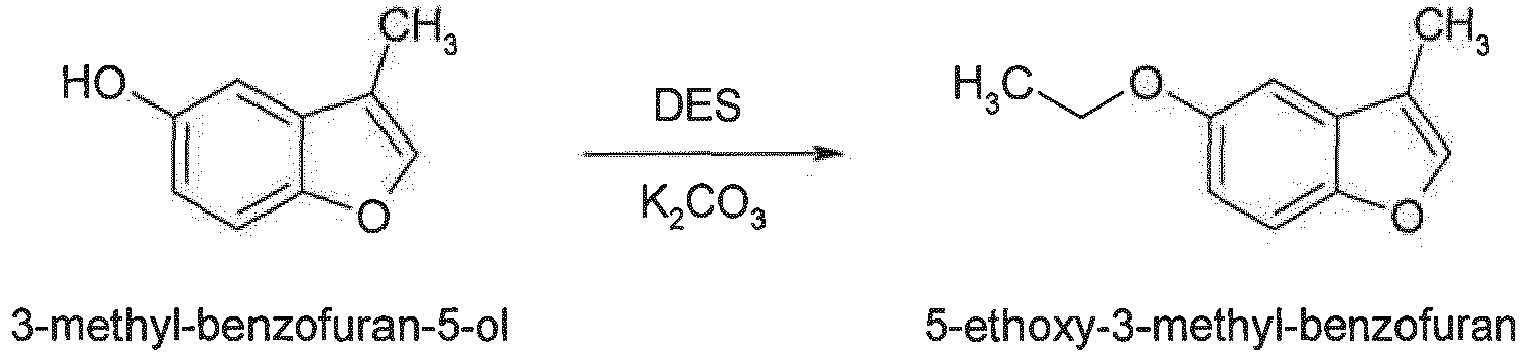
- Preparation of 5-Ethoxy-3-methyl-benzofuran (Structure 2): 3-Methyl-benzofuran-5-ol (Structure 1) (50 g, 0.34 mol, prepared according to the disclosure of
U.S. Patent Number 9,212,336
1H NMR (400 MHz, CDCl3): 7.34 (q, J=1.0 Hz, 1H), 7.30 (d, J=8.9 Hz, 1H), 6.94 (d, J=2.5 Hz, 1H), 6.86 (dd, J=8.9, 2.5 Hz, 1H), 4.03 (q, J=7.0 Hz, 2H), 2.17 (d, J=1.3 Hz, 3H), 1.41 (t, J=7.0 Hz, 3H)
5-Ethoxy-3-methylbenzofuran (Structure 2) was described as having vinyl, smoky and leather notes. -

- Preparation of 5-Ethoxy-3-methyl-2,3-dihydro-benzofuran (Structure A): 5-Ethoxy-3-methyl-benzofuran (45 g, 0.26 mol, prepared in EXAMPLE I) was hydrogenated over palladium on alumina (Pd/Al2O3) (0.45 g) at 65°C under H2 (200 psi). Further distillation afforded 5-ethoxy-3-methyl-2,3-dihydro-benzofuran as a clear oil (40 g).
1H NMR (400 MHz, CDCl3): 6.71-6.74 (m, 1H), 6.61-6.69 (m, 2H), 4.63 (dd, J=8.7, 8.5 Hz, 1H), 4.02 (dd, J=8.5, 7.7 Hz, 1H), 3.91-3.99 (m, 2H), 3.42-3.54 (m, 1H), 1.37 (t, J=7.0 Hz, 3H), 1.29 (d, J=6.9 Hz, 3H)
5-Ethoxy-3-methyl-2,3-dihydro-benzofuran (Structure A) was described as having fruity, lactonic, leather and floral notes. - In addition, following benzofuran compounds were prepared according to the disclosure of
U.S. Patent Number 9,212,336 -

5-Methoxy-3-methyl-benzofuran exhibited a leathery note with chemical and kerosene-like quality. -

- Preparation of 5-Allyloxy-3-methyl-benzofuran (Structure 4): 3-Methyl-benzofuran-5-ol (Structure A1) (8.7 g, 0.058 mol) was combined with N,N-dimethylformamide (117 mL) and potassium carbonate (K2CO3) (8.1 g, 0.059 mol) and heated to 50 °C. Allyl bromide (CH2CHCH2Br) (7.1 g, 0.06 mol) was fed in over 2 hours. The reaction was aged for additional 8.5 hours and then poured in to water (100 mL). The resulting mixture was extracted with ethyl acetate (CH3COOCH2CH3, EtOAc) (25 mL each time for three times). The solvent was evaporated and the residue was chromatographed (SiO2, 5% EtOAc/hexanes) to afford 5-allyloxy-3-methyl-benzofuran as a pale oil (4.0 g).
1H NMR (CDCl3, 400 MHz): 7.33-7.40 (q, J=1.0 Hz, 1H), 7.31 (d, J=8.9 Hz, 1H), 6.96 (d, J=2.4 Hz, 1H), 6.89 (dd, J=8.9, 2.4 Hz, 1H), 6.02-6.14 (m, 1H), 5.42 (dt, J=17.1, 1.5 Hz, 1H), 5.27 (dt, J=10.5, 1.5 Hz, 1H), 4.55 (ddd, J=5.3, 1.5, 1.5 Hz, 2H), 2.17 (d, J=1.3 Hz, 3H)
5-Allyloxy-3-methyl-benzofuran exhibited a leathery note with chemical and waxy characters. -

3-Methyl-2,3-dihydro-benzofuran-5-ol exhibited leathery, animalic and slightly floral notes. -

- Preparation of 5-Methoxy-3-methyl-2,3-dihydro-benzofuran (Structure 6): 5-Methoxy-3-methyl-benzofuran (Structure A3) (45 g, 0.26 mol) was hydrogenated over palladium on alumina (Pd/Al2O3) (0.45 g) at 65°C under H2 (200 psi). Further distillation afforded 5-methoxy-3-methyl-2,3-dihydro-benzofuran as a clear oil (42 g).
1H NMR (CDCl3, 500 MHz): 6.71 (d, J=2.5 Hz, 1H), 6.57-6.67 (m, 2H), 4.60 (dd, J=8.7, 8.6 Hz, 1H), 3.99 (dd, J=8.7, 8.0 Hz, 1H), 3.71 (s, 3H), 3.40-3.50 (m, 1H), 1.27 (d, J=6.9 Hz, 3H)
5-Methoxy-3-methyl-2,3-dihydro-benzofuran exhibited strong leathery, woody and animalic notes with vinyl character. -

3,6-Dimethyl-benzofuran-5-ol exhibited leathery note but less powerful or complex with more green and animalic characters and crude quality. -

3,7-Dimethyl-benzofuran-5-ol exhibited a weak leathery note with bacon and fatty quality. -

7-tert-Butyl-3-methyl-benzofuran-5-ol exhibited chemical and weak leathery notes with a thin body and kerosene-like and green characters. -

3-Methyl-benzofuran-4-ol exhibited balsamic, sweet and weak leathery notes with phenolic character and chemical quality. -

2-Methyl-benzofuran-5-ol exhibited balsamic, sweet and earthy notes supported by mossyness character with slightly leathery aspect. - The fragrance properties of the above compounds (i.e., Structures A and 2-11) were evaluated using (i) odor strength of 0 to 10, where 0 = none, 1 = very weak, 5 = moderate, 10 = extremely strong; and (ii) level of complexity, where 0 = none, 1 = very low, 5 = moderate, 10 = extremely high. Odor profiles and averaged scores are reported in the following:
Compound Odor Profile Strength Complexity 5-Ethoxy-3-methyl-2,3-dihydro-benzofuran (Structure A) Fruity, lactonic, leather and floral 9 8 5-Ethoxy-3-methylbenzofuran (Structure 2) Vinyl, smoky and leathery 5 2 5-Methoxy-3-methyl-benzofuran (Structure 3) Leathery with chemical and kerosene-like quality 7 3 5-Allyloxy-3-methyl-benzofuran (Structure 4) Leathery with chemical and waxy characters 5 5 3-Methyl-2,3-dihydro-benzofuran-5-ol (Structure 5) Leathery, animalic and slightly floral with a thin body 5 5 5-Methoxy-3-methyl-2,3-dihydro-benzofuran (Structure 6) Strong leathery, woody and animalic notes with vinyl character 8 6 3,6-Dimethyl-benzofuran-5-ol (Structure 7) Leathery but less complex with more green and animalic characters and crude quality 8 4 3,7-Dimethyl-benzofuran-5-ol (Structure 8) Weak leathery with bacon and fatty quality 6 6 -
Compound Odor Profile Strength Complexity 7-tert-Butyl-3-methyl-benzofuran-5-ol (Structure 9) Chemical and weak leathery with a thin body and kerosene-like and green characters 2 2 3-Methyl-benzofuran-4-ol (Structure 10) Balsamic, sweet and weak leathery with phenolic character and chemical quality 7 2 2-Methyl-benzofuran-5-ol (Structure 11) Balsamic, sweet and earthy with mossyness character and slightly leathery aspect 8 5 - Structure A exhibited particularly desirable, strong, and complex odors, superior to Structures 2-11. Its advantageous properties are unexpected.
- Paired combinations of 5-ethoxy-3-methyl-2,3-dihydro-benzofuran (Structure A) and 3-methyl-benzofuran-5-ol (Structure 1) with additional fragrance compounds were evaluated using (i) odor strength of 0 to 10, where 0 = none, 1 = very weak, 5 = moderate, 10 = extremely strong; and (ii) level of complexity, where 0 = none, 1 = very low, 5 = moderate, 10 = extremely high. 3-Methyl-benzofuran-5-ol (Structure 1) exhibits leathery, animalic and earthy notes.
- The additional fragrance compounds and their odors are as follows:
- (i) 4-Isobutyl cyclohexanepropanal (prepared according to the disclosure of
U.S. Patent Number 7,834,219 ) possesses floral, muguet, and green notes; - (ii) The mixture of octahydro-4,7-methano-1H-indene-5-acetaldehyde and 6-methyl-octahydro-4,7-methano-indene-5-carbaldehyde (prepared according to the disclosure of
U.S. Patent Number 8,633,144 ) possesses floral and muguet notes; and - (iii) 4,4a,5,6,7,8,9,9b-Octahydro-7,7,8,9,9-pentamethyl-indano[4,5-]-dioxin (prepared according to the disclosure of
U.S. Patent Number 6,303,798 ) possesses musky, sweet, clean and powdery notes. - Odor profiles and averaged scores for the paired combinations are reported in the following:
Structure A Structure 1 4-Isobutyl cyclohexanepropanal Odor Profile Soft and pleasant. Floral note appeared more elegant. Enhanced performance with softened top notes of 4-isobutyl cyclohexanepropana. Minimal interference from Structure A. Leathery note remained and blended well. Slightly harsh indicating less blending compatibility. Leathery note appeared harsh and phenolic, intrusive and less appealing. Such an odor profile showed limited applications. Strength 9 8 Stability Showed heat stability. No coloration was observed when the combination sample was stored at an elevated temperature for 3 days. Sample coloration observed under same conditions indicating less heat stability. Octahydro-4,7-methano-1H-indene-5-acetaldehyde and 6-methyl-octahydro-4,7-methano-indene-5-carbaldehyde Odor Profile Enhanced performance with pleasant and softened floral notes. Hedonic integrity maintained. Complexity improved. Chemical. The floral and aldehydic top notes of the aldehyde mixture appeared harsh and dominant. Phenolic character noticed. Strength 9 7 Stability Showed heat stability. No coloration was observed when the combination sample was stored at an elevated temperature for 3 days. Sample coloration observed under same conditions indicating less heat stability. 4,4a,5,6,7,8,9,9b-Octahydro-7,7,8,9,9-pentamethyl-indano[4,5-]-dioxin Odor Profile Musky and sweet notes remained and blended well with added body and dimension. Hedonic integrity maintained. Complexity improved. Altered odor properties with more green and more chemical characters. Strength 9 6 - Combinations of 5-ethoxy-3-methyl-2,3-dihydro-benzofuran (Structure A) with 4-isobutyl cyclohexanepropanal, the mixture of octahydro-4,7-methano-1H-indene-5-acetaldehyde and 6-methyl-octahydro-4,7-methano-indene-5-carbaldehyde, and 4,4a,5,6,7,8,9,9b-octahydro-7,7,8,9,9-pentamethyl-indano[4,5-]-dioxin, respectively, were found to be heat stable and possess particularly desirable, strong and complex odors, superior to the corresponding combinations containing 3-methyl-benzofuran-5-ol (Structure 1). Such advantageous properties are unexpected.
- Establishment of Malodor Models: The sweat, mold/mildew, bathroom and smoke malodor models were prepared based on Applicants' proprietary formulations for assessing the effectiveness of various malodor counteractants.
- Preparation of Test Samples: Two aluminum dishes were placed in an 8 oz glass jar. A malodor material was pipetted into one aluminum dish, and 5-ethoxy-3-methyl-2,3-dihydro-benzofuran (prepared above in EXAMPLE I-II) diluted in a solvent (1%) or a solvent alone control was pipetted into the other aluminum dish. The jar was then capped and the samples were allowed to equilibrate for one hour before the testing.
- Testing Procedure: Test samples were presented in a blind and random order to 15-18. internal panelists (consisting of men/women with an age range of 25 to 55). However, different odor samples were arranged in an alternative order (for example, sweat, mold/mildew, sweat, mold/mildew, and etc.).
- The panelists were instructed to take the steps of i) sniff jars containing only the malodor materials for familiarization prior to the testing; ii) uncap ajar; iii) place their noses at a distance of about 3-4 inches above the opening; iv) take short sniffs for 3 seconds; and v) enter a rating of overall intensity and malodor intensity on a handheld computer.
- The overall and malodor intensity was rated using the Labeled Magnitude Scale (LMS) [Green, et al., Chemical Senses, 21(3), Jun 1996, 323-334]. Percent malodor reduction ("%MOR") represents the perceived reduction in mean malodor intensity of the sample containing the malodor in the presence of a malodor counteractant relative to the negative control (Malodor Alone).
- Results and Discussion: The mean ranks of the malodor coverage for the above test were as follows:
Compound (1%) Malodor %MOR 5-Ethoxy-3-methyl-2,3-dihydro-benzofuran Sweat 46.56 Mold/Mildew 58.07 Bathroom 60.09 Smoke 49.63 - 5-Ethoxy-3-methyl-2,3-dihydro-benzofuran was demonstrated effective in counteracting various types of malodors.
Claims (14)
- A compound, 5-ethoxy-3-methyl-2,3-dihydro-benzofuran,
- A fragrance formulation comprising an olfactory acceptable amount of 5-ethoxy-3-methyl-2,3-dihydro-benzofuran.
- The fragrance formulation of claim 2 further containing an additional compound selected from the group consisting of:4-isobutyl cyclohexanepropanal;a mixture of octahydro-4,7-methano-1H-indene-5-acetaldehyde and 6-methyl-octahydro-4,7-methano-indene-5-carbaldehyde;4,4a,5,6,7,8,9,9b-octahydro-7,7,8,9,9-pentamethyl-indano[4,5-]-dioxin; and a mixture thereof.
- The fragrance formulation of claim 2, wherein:the olfactory acceptable amount is from about 0.005 to about 50 weight percent of the fragrance formulation; orwherein the olfactory acceptable amount is from about 0.5 to about 25 weight percent of the fragrance formulation; orwherein the olfactory acceptable amount is from about 1 to about 10 weight percent of the fragrance formulation.
- The fragrance formulation of any of claims 2 to 4 further containing a material selected from the group consisting of a polymer, an oligomer and a non-polymer; and
optionally or preferably, wherein the non-polymer is selected from the group consisting of a surfactant, an emulsifier, a fat, a wax, a phospholipid, an organic oil, a mineral oil, a petrolatum, a natural oil, a perfume fixative, a fiber, a starch, a sugar and a solid surface material; and
optionally or preferably, wherein the solid surface material is selected from the group consisting of zeolite and silica. - A method of improving, enhancing or modifying a fragrance formulation through the addition of an olfactory acceptable amount of 5-ethoxy-3-methyl-2,3-dihydro-benzofuran.
- The method of claim 6, wherein the fragrance formulation further comprises an additional compound selected from the group consisting of 4-isobutyl cyclohexanepropanal;
a mixture of octahydro-4,7-methano-1H-indene-5-acetaldehyde and 6-methyl-octahydro-4,7-methano-indene-5-carbaldehyde;
4,4a,5,6,7,8,9,9b-octahydro-7,7,8,9,9-pentamethyl-indano[4,5-]-dioxin; and
a mixture thereof. - The method of claim 6 or 7, wherein:the olfactory acceptable amount is from about 0.005 to about 50 weight percent of the fragrance formulation; orwherein the olfactory acceptable amount is from about 0.5 to about 25 weight percent of the fragrance formulation; orwherein the olfactory acceptable amount is from about 1 to about 10 weight percent of the fragrance formulation.
- A fragrance product containing an olfactory acceptable amount of the compound of claim 1.
- The fragrance product of claim 9 further containing an additional compound selected from the group consisting of 4-isobutyl cyclohexanepropanal;
a mixture of octahydro-4,7-methano-1H-indene-5-acetaldehyde and 6-methyl-octahydro-4,7-methano-indene-5-carbaldehyde;
4,4a,5,6,7,8,9,9b-octahydro-7,7,8,9,9-pentamethyl-indano[4,5-]-dioxin; and a mixture thereof. - The fragrance product of claim 9 or 10, wherein the fragrance product is selected from the group consisting of a perfume, a cologne, toilet water, a cosmetic product, a personal care product, a fabric care product, a cleaning product, an air freshener, a bar soap, a liquid soap, a shower gel, a foam bath, a skin care product, a hair care product, a deodorant, an antiperspirant, a feminine care product, a baby care product, a family care product, an air care product, a fragrance delivery system, a disinfectant, a washing agent, a dental and oral hygiene product, a health care and nutritional product and a food product.
- The fragrance product of claim 11, wherein the cleaning product is selected from the group consisting of a detergent, a dishwashing material, a scrubbing composition, a glass cleaner, a metal cleaner, a countertop cleaner, a floor cleaner, a carpet cleaner, a toilet cleaner and a bleach additive.
- A method of counteracting malodor in an air space or a substrate comprising the step of introducing a malodor counteracting effective amount of the compound of claim 1.
- The method of claim 13, wherein the substrate is a functional product selected from the group consisting of a room freshener spray, a fragrance diffuser, a candle, a sachet, a clothes deodorant, a detergent, a fabric softener, a fabric refresher, a linen spray, a disposable diaper, a diaper pail deodorant, an antiperspirant, a deodorant, a garbage bag, a car freshener, a pet care product and an animal litter material.
Applications Claiming Priority (2)
| Application Number | Priority Date | Filing Date | Title |
|---|---|---|---|
| US201562199012P | 2015-07-30 | 2015-07-30 | |
| US15/221,127 US9816048B2 (en) | 2015-07-30 | 2016-07-27 | Organoleptic compounds |
Publications (2)
| Publication Number | Publication Date |
|---|---|
| EP3124478A1 true EP3124478A1 (en) | 2017-02-01 |
| EP3124478B1 EP3124478B1 (en) | 2018-10-31 |
Family
ID=60000115
Family Applications (1)
| Application Number | Title | Priority Date | Filing Date |
|---|---|---|---|
| EP16182061.8A Not-in-force EP3124478B1 (en) | 2015-07-30 | 2016-07-29 | Novel organoleptic compounds |
Country Status (3)
| Country | Link |
|---|---|
| US (1) | US9816048B2 (en) |
| EP (1) | EP3124478B1 (en) |
| CN (1) | CN106397376A (en) |
Families Citing this family (1)
| Publication number | Priority date | Publication date | Assignee | Title |
|---|---|---|---|---|
| JP2022036533A (en) * | 2020-08-24 | 2022-03-08 | 高砂香料工業株式会社 | A tetracyclic compound having a dihydrobenzofuran ring or a dihydrobenzopyran ring and a fragrance composition containing the same. |
Citations (4)
| Publication number | Priority date | Publication date | Assignee | Title |
|---|---|---|---|---|
| US6303798B1 (en) | 2001-02-23 | 2001-10-16 | International Flavors & Fragrances Inc. | Methylene dioxy tetrahydroindane derivative |
| US7834219B1 (en) | 2009-11-16 | 2010-11-16 | International Flavors & Fragrances Inc. | 4-alkyl cyclohexanepropanal compounds and their use in perfume compositions |
| US8633144B2 (en) | 2011-11-02 | 2014-01-21 | International Flavors & Fragrances Inc. | Octahydro-1H-4,7-methano-indene-5-aldehydes and their use in perfume compositions |
| EP2862918A1 (en) * | 2013-10-18 | 2015-04-22 | International Flavors & Fragrances Inc. | 3-methyl-benzofuran-5-ol and its use in perfume compositions |
Family Cites Families (3)
| Publication number | Priority date | Publication date | Assignee | Title |
|---|---|---|---|---|
| CA1107290A (en) * | 1977-09-02 | 1981-08-18 | Maurice Le Corre | Oxygenated heterocycles and process for preparation thereof |
| EP0458970A4 (en) * | 1989-11-17 | 1992-05-13 | Meiji Milk Products Company Limited | Benzofuran derivative, process for preparing the same, and pharmaceutical comprising the same as active ingredient |
| US9115330B2 (en) * | 2013-05-07 | 2015-08-25 | International Flavors & Fragrances Inc. | Diethyl-methyl-hexahydro-isobenzofurans and their use in perfume compositions |
-
2016
- 2016-07-27 US US15/221,127 patent/US9816048B2/en not_active Expired - Fee Related
- 2016-07-29 CN CN201610617530.XA patent/CN106397376A/en active Pending
- 2016-07-29 EP EP16182061.8A patent/EP3124478B1/en not_active Not-in-force
Patent Citations (5)
| Publication number | Priority date | Publication date | Assignee | Title |
|---|---|---|---|---|
| US6303798B1 (en) | 2001-02-23 | 2001-10-16 | International Flavors & Fragrances Inc. | Methylene dioxy tetrahydroindane derivative |
| US7834219B1 (en) | 2009-11-16 | 2010-11-16 | International Flavors & Fragrances Inc. | 4-alkyl cyclohexanepropanal compounds and their use in perfume compositions |
| US8633144B2 (en) | 2011-11-02 | 2014-01-21 | International Flavors & Fragrances Inc. | Octahydro-1H-4,7-methano-indene-5-aldehydes and their use in perfume compositions |
| EP2862918A1 (en) * | 2013-10-18 | 2015-04-22 | International Flavors & Fragrances Inc. | 3-methyl-benzofuran-5-ol and its use in perfume compositions |
| US9212336B2 (en) | 2013-10-18 | 2015-12-15 | International Flavors & Fragrances Inc. | 3-methyl-benzofuran-5-ol and its use in perfume compositions |
Non-Patent Citations (3)
| Title |
|---|
| ISHIKAWA ET AL., INTERNATIONAL JOURNAL OF QUANTUM CHEMISTRY, vol. 79, 2000, pages 101 - 108 |
| OHLOFF ET AL., HELVETICA CHIMICA ACTA 66, FASC., vol. 5, 1983, pages 1343 - 1354 |
| W. A. POUCHER: "Perfumes. Cosmetics and Soaps", 1959 |
Also Published As
| Publication number | Publication date |
|---|---|
| CN106397376A (en) | 2017-02-15 |
| EP3124478B1 (en) | 2018-10-31 |
| US20170029741A1 (en) | 2017-02-02 |
| US9816048B2 (en) | 2017-11-14 |
Similar Documents
| Publication | Publication Date | Title |
|---|---|---|
| EP3072875B1 (en) | Organoleptic compounds | |
| EP2862918B1 (en) | 3-methyl-benzofuran-5-ol and its use in perfume compositions | |
| EP3339278B1 (en) | Novel organoleptic compounds | |
| US9738854B2 (en) | 3-(cyclohex-1-en-1-yl)propionates and their use in perfume compositions | |
| EP4416137B1 (en) | A novel furan compound and its use in fragrance formulations | |
| EP3124478B1 (en) | Novel organoleptic compounds | |
| EP3636627B1 (en) | Novel cyclopropylmethoxy derivatives | |
| EP3453698B1 (en) | Novel organoleptic compounds | |
| EP3124464B1 (en) | Novel organoleptic compounds | |
| US11352586B2 (en) | Dienoates and their use in perfume compositions | |
| EP3416611B1 (en) | Novel organoleptic compounds |
Legal Events
| Date | Code | Title | Description |
|---|---|---|---|
| PUAI | Public reference made under article 153(3) epc to a published international application that has entered the european phase |
Free format text: ORIGINAL CODE: 0009012 |
|
| STAA | Information on the status of an ep patent application or granted ep patent |
Free format text: STATUS: THE APPLICATION HAS BEEN PUBLISHED |
|
| AK | Designated contracting states |
Kind code of ref document: A1 Designated state(s): AL AT BE BG CH CY CZ DE DK EE ES FI FR GB GR HR HU IE IS IT LI LT LU LV MC MK MT NL NO PL PT RO RS SE SI SK SM TR |
|
| AX | Request for extension of the european patent |
Extension state: BA ME |
|
| STAA | Information on the status of an ep patent application or granted ep patent |
Free format text: STATUS: REQUEST FOR EXAMINATION WAS MADE |
|
| 17P | Request for examination filed |
Effective date: 20170801 |
|
| RBV | Designated contracting states (corrected) |
Designated state(s): AL AT BE BG CH CY CZ DE DK EE ES FI FR GB GR HR HU IE IS IT LI LT LU LV MC MK MT NL NO PL PT RO RS SE SI SK SM TR |
|
| GRAP | Despatch of communication of intention to grant a patent |
Free format text: ORIGINAL CODE: EPIDOSNIGR1 |
|
| STAA | Information on the status of an ep patent application or granted ep patent |
Free format text: STATUS: GRANT OF PATENT IS INTENDED |
|
| INTG | Intention to grant announced |
Effective date: 20180502 |
|
| GRAS | Grant fee paid |
Free format text: ORIGINAL CODE: EPIDOSNIGR3 |
|
| GRAA | (expected) grant |
Free format text: ORIGINAL CODE: 0009210 |
|
| STAA | Information on the status of an ep patent application or granted ep patent |
Free format text: STATUS: THE PATENT HAS BEEN GRANTED |
|
| AK | Designated contracting states |
Kind code of ref document: B1 Designated state(s): AL AT BE BG CH CY CZ DE DK EE ES FI FR GB GR HR HU IE IS IT LI LT LU LV MC MK MT NL NO PL PT RO RS SE SI SK SM TR |
|
| REG | Reference to a national code |
Ref country code: CH Ref legal event code: EP Ref country code: GB Ref legal event code: FG4D |
|
| REG | Reference to a national code |
Ref country code: AT Ref legal event code: REF Ref document number: 1059217 Country of ref document: AT Kind code of ref document: T Effective date: 20181115 |
|
| REG | Reference to a national code |
Ref country code: IE Ref legal event code: FG4D |
|
| REG | Reference to a national code |
Ref country code: DE Ref legal event code: R096 Ref document number: 602016006747 Country of ref document: DE |
|
| REG | Reference to a national code |
Ref country code: NL Ref legal event code: MP Effective date: 20181031 |
|
| REG | Reference to a national code |
Ref country code: LT Ref legal event code: MG4D |
|
| REG | Reference to a national code |
Ref country code: AT Ref legal event code: MK05 Ref document number: 1059217 Country of ref document: AT Kind code of ref document: T Effective date: 20181031 |
|
| PG25 | Lapsed in a contracting state [announced via postgrant information from national office to epo] |
Ref country code: NO Free format text: LAPSE BECAUSE OF FAILURE TO SUBMIT A TRANSLATION OF THE DESCRIPTION OR TO PAY THE FEE WITHIN THE PRESCRIBED TIME-LIMIT Effective date: 20190131 Ref country code: HR Free format text: LAPSE BECAUSE OF FAILURE TO SUBMIT A TRANSLATION OF THE DESCRIPTION OR TO PAY THE FEE WITHIN THE PRESCRIBED TIME-LIMIT Effective date: 20181031 Ref country code: AT Free format text: LAPSE BECAUSE OF FAILURE TO SUBMIT A TRANSLATION OF THE DESCRIPTION OR TO PAY THE FEE WITHIN THE PRESCRIBED TIME-LIMIT Effective date: 20181031 Ref country code: LT Free format text: LAPSE BECAUSE OF FAILURE TO SUBMIT A TRANSLATION OF THE DESCRIPTION OR TO PAY THE FEE WITHIN THE PRESCRIBED TIME-LIMIT Effective date: 20181031 Ref country code: IS Free format text: LAPSE BECAUSE OF FAILURE TO SUBMIT A TRANSLATION OF THE DESCRIPTION OR TO PAY THE FEE WITHIN THE PRESCRIBED TIME-LIMIT Effective date: 20190228 Ref country code: PL Free format text: LAPSE BECAUSE OF FAILURE TO SUBMIT A TRANSLATION OF THE DESCRIPTION OR TO PAY THE FEE WITHIN THE PRESCRIBED TIME-LIMIT Effective date: 20181031 Ref country code: BG Free format text: LAPSE BECAUSE OF FAILURE TO SUBMIT A TRANSLATION OF THE DESCRIPTION OR TO PAY THE FEE WITHIN THE PRESCRIBED TIME-LIMIT Effective date: 20190131 Ref country code: FI Free format text: LAPSE BECAUSE OF FAILURE TO SUBMIT A TRANSLATION OF THE DESCRIPTION OR TO PAY THE FEE WITHIN THE PRESCRIBED TIME-LIMIT Effective date: 20181031 Ref country code: LV Free format text: LAPSE BECAUSE OF FAILURE TO SUBMIT A TRANSLATION OF THE DESCRIPTION OR TO PAY THE FEE WITHIN THE PRESCRIBED TIME-LIMIT Effective date: 20181031 |
|
| REG | Reference to a national code |
Ref country code: ES Ref legal event code: FG2A Ref document number: 2712870 Country of ref document: ES Kind code of ref document: T3 Effective date: 20190516 |
|
| PG25 | Lapsed in a contracting state [announced via postgrant information from national office to epo] |
Ref country code: AL Free format text: LAPSE BECAUSE OF FAILURE TO SUBMIT A TRANSLATION OF THE DESCRIPTION OR TO PAY THE FEE WITHIN THE PRESCRIBED TIME-LIMIT Effective date: 20181031 Ref country code: GR Free format text: LAPSE BECAUSE OF FAILURE TO SUBMIT A TRANSLATION OF THE DESCRIPTION OR TO PAY THE FEE WITHIN THE PRESCRIBED TIME-LIMIT Effective date: 20190201 Ref country code: RS Free format text: LAPSE BECAUSE OF FAILURE TO SUBMIT A TRANSLATION OF THE DESCRIPTION OR TO PAY THE FEE WITHIN THE PRESCRIBED TIME-LIMIT Effective date: 20181031 Ref country code: SE Free format text: LAPSE BECAUSE OF FAILURE TO SUBMIT A TRANSLATION OF THE DESCRIPTION OR TO PAY THE FEE WITHIN THE PRESCRIBED TIME-LIMIT Effective date: 20181031 Ref country code: PT Free format text: LAPSE BECAUSE OF FAILURE TO SUBMIT A TRANSLATION OF THE DESCRIPTION OR TO PAY THE FEE WITHIN THE PRESCRIBED TIME-LIMIT Effective date: 20190301 Ref country code: NL Free format text: LAPSE BECAUSE OF FAILURE TO SUBMIT A TRANSLATION OF THE DESCRIPTION OR TO PAY THE FEE WITHIN THE PRESCRIBED TIME-LIMIT Effective date: 20181031 |
|
| PG25 | Lapsed in a contracting state [announced via postgrant information from national office to epo] |
Ref country code: CZ Free format text: LAPSE BECAUSE OF FAILURE TO SUBMIT A TRANSLATION OF THE DESCRIPTION OR TO PAY THE FEE WITHIN THE PRESCRIBED TIME-LIMIT Effective date: 20181031 Ref country code: IT Free format text: LAPSE BECAUSE OF FAILURE TO SUBMIT A TRANSLATION OF THE DESCRIPTION OR TO PAY THE FEE WITHIN THE PRESCRIBED TIME-LIMIT Effective date: 20181031 Ref country code: DK Free format text: LAPSE BECAUSE OF FAILURE TO SUBMIT A TRANSLATION OF THE DESCRIPTION OR TO PAY THE FEE WITHIN THE PRESCRIBED TIME-LIMIT Effective date: 20181031 |
|
| REG | Reference to a national code |
Ref country code: DE Ref legal event code: R097 Ref document number: 602016006747 Country of ref document: DE |
|
| PG25 | Lapsed in a contracting state [announced via postgrant information from national office to epo] |
Ref country code: EE Free format text: LAPSE BECAUSE OF FAILURE TO SUBMIT A TRANSLATION OF THE DESCRIPTION OR TO PAY THE FEE WITHIN THE PRESCRIBED TIME-LIMIT Effective date: 20181031 Ref country code: SM Free format text: LAPSE BECAUSE OF FAILURE TO SUBMIT A TRANSLATION OF THE DESCRIPTION OR TO PAY THE FEE WITHIN THE PRESCRIBED TIME-LIMIT Effective date: 20181031 Ref country code: RO Free format text: LAPSE BECAUSE OF FAILURE TO SUBMIT A TRANSLATION OF THE DESCRIPTION OR TO PAY THE FEE WITHIN THE PRESCRIBED TIME-LIMIT Effective date: 20181031 Ref country code: SK Free format text: LAPSE BECAUSE OF FAILURE TO SUBMIT A TRANSLATION OF THE DESCRIPTION OR TO PAY THE FEE WITHIN THE PRESCRIBED TIME-LIMIT Effective date: 20181031 |
|
| PLBE | No opposition filed within time limit |
Free format text: ORIGINAL CODE: 0009261 |
|
| STAA | Information on the status of an ep patent application or granted ep patent |
Free format text: STATUS: NO OPPOSITION FILED WITHIN TIME LIMIT |
|
| 26N | No opposition filed |
Effective date: 20190801 |
|
| PG25 | Lapsed in a contracting state [announced via postgrant information from national office to epo] |
Ref country code: SI Free format text: LAPSE BECAUSE OF FAILURE TO SUBMIT A TRANSLATION OF THE DESCRIPTION OR TO PAY THE FEE WITHIN THE PRESCRIBED TIME-LIMIT Effective date: 20181031 |
|
| REG | Reference to a national code |
Ref country code: DE Ref legal event code: R119 Ref document number: 602016006747 Country of ref document: DE |
|
| PG25 | Lapsed in a contracting state [announced via postgrant information from national office to epo] |
Ref country code: MC Free format text: LAPSE BECAUSE OF FAILURE TO SUBMIT A TRANSLATION OF THE DESCRIPTION OR TO PAY THE FEE WITHIN THE PRESCRIBED TIME-LIMIT Effective date: 20181031 |
|
| REG | Reference to a national code |
Ref country code: CH Ref legal event code: PL |
|
| PG25 | Lapsed in a contracting state [announced via postgrant information from national office to epo] |
Ref country code: TR Free format text: LAPSE BECAUSE OF FAILURE TO SUBMIT A TRANSLATION OF THE DESCRIPTION OR TO PAY THE FEE WITHIN THE PRESCRIBED TIME-LIMIT Effective date: 20181031 |
|
| REG | Reference to a national code |
Ref country code: BE Ref legal event code: MM Effective date: 20190731 |
|
| PG25 | Lapsed in a contracting state [announced via postgrant information from national office to epo] |
Ref country code: DE Free format text: LAPSE BECAUSE OF NON-PAYMENT OF DUE FEES Effective date: 20200201 |
|
| PG25 | Lapsed in a contracting state [announced via postgrant information from national office to epo] |
Ref country code: LI Free format text: LAPSE BECAUSE OF NON-PAYMENT OF DUE FEES Effective date: 20190731 Ref country code: LU Free format text: LAPSE BECAUSE OF NON-PAYMENT OF DUE FEES Effective date: 20190729 Ref country code: BE Free format text: LAPSE BECAUSE OF NON-PAYMENT OF DUE FEES Effective date: 20190731 Ref country code: CH Free format text: LAPSE BECAUSE OF NON-PAYMENT OF DUE FEES Effective date: 20190731 |
|
| PG25 | Lapsed in a contracting state [announced via postgrant information from national office to epo] |
Ref country code: IE Free format text: LAPSE BECAUSE OF NON-PAYMENT OF DUE FEES Effective date: 20190729 |
|
| PGFP | Annual fee paid to national office [announced via postgrant information from national office to epo] |
Ref country code: ES Payment date: 20200803 Year of fee payment: 5 Ref country code: FR Payment date: 20200727 Year of fee payment: 5 Ref country code: GB Payment date: 20200727 Year of fee payment: 5 |
|
| PG25 | Lapsed in a contracting state [announced via postgrant information from national office to epo] |
Ref country code: CY Free format text: LAPSE BECAUSE OF FAILURE TO SUBMIT A TRANSLATION OF THE DESCRIPTION OR TO PAY THE FEE WITHIN THE PRESCRIBED TIME-LIMIT Effective date: 20181031 |
|
| PG25 | Lapsed in a contracting state [announced via postgrant information from national office to epo] |
Ref country code: HU Free format text: LAPSE BECAUSE OF FAILURE TO SUBMIT A TRANSLATION OF THE DESCRIPTION OR TO PAY THE FEE WITHIN THE PRESCRIBED TIME-LIMIT; INVALID AB INITIO Effective date: 20160729 Ref country code: MT Free format text: LAPSE BECAUSE OF FAILURE TO SUBMIT A TRANSLATION OF THE DESCRIPTION OR TO PAY THE FEE WITHIN THE PRESCRIBED TIME-LIMIT Effective date: 20181031 |
|
| GBPC | Gb: european patent ceased through non-payment of renewal fee |
Effective date: 20210729 |
|
| PG25 | Lapsed in a contracting state [announced via postgrant information from national office to epo] |
Ref country code: GB Free format text: LAPSE BECAUSE OF NON-PAYMENT OF DUE FEES Effective date: 20210729 |
|
| PG25 | Lapsed in a contracting state [announced via postgrant information from national office to epo] |
Ref country code: FR Free format text: LAPSE BECAUSE OF NON-PAYMENT OF DUE FEES Effective date: 20210731 |
|
| PG25 | Lapsed in a contracting state [announced via postgrant information from national office to epo] |
Ref country code: MK Free format text: LAPSE BECAUSE OF FAILURE TO SUBMIT A TRANSLATION OF THE DESCRIPTION OR TO PAY THE FEE WITHIN THE PRESCRIBED TIME-LIMIT Effective date: 20181031 |
|
| REG | Reference to a national code |
Ref country code: ES Ref legal event code: FD2A Effective date: 20220902 |
|
| PG25 | Lapsed in a contracting state [announced via postgrant information from national office to epo] |
Ref country code: ES Free format text: LAPSE BECAUSE OF NON-PAYMENT OF DUE FEES Effective date: 20210730 |