EP3122041A1 - Method and apparatus for determining two-view geometry of two cameras - Google Patents

Method and apparatus for determining two-view geometry of two cameras Download PDF

Info

Publication number
EP3122041A1
EP3122041A1 EP15306195.7A EP15306195A EP3122041A1 EP 3122041 A1 EP3122041 A1 EP 3122041A1 EP 15306195 A EP15306195 A EP 15306195A EP 3122041 A1 EP3122041 A1 EP 3122041A1
Authority
EP
European Patent Office
Prior art keywords
cameras
matrix
view geometry
images
determining
Prior art date
Legal status (The legal status is an assumption and is not a legal conclusion. Google has not performed a legal analysis and makes no representation as to the accuracy of the status listed.)
Withdrawn
Application number
EP15306195.7A
Other languages
German (de)
French (fr)
Inventor
Lorenzo Sorgi
Current Assignee (The listed assignees may be inaccurate. Google has not performed a legal analysis and makes no representation or warranty as to the accuracy of the list.)
Thomson Licensing SAS
Original Assignee
Thomson Licensing SAS
Priority date (The priority date is an assumption and is not a legal conclusion. Google has not performed a legal analysis and makes no representation as to the accuracy of the date listed.)
Filing date
Publication date
Application filed by Thomson Licensing SAS filed Critical Thomson Licensing SAS
Priority to EP15306195.7A priority Critical patent/EP3122041A1/en
Publication of EP3122041A1 publication Critical patent/EP3122041A1/en
Withdrawn legal-status Critical Current

Links

Images

Classifications

    • GPHYSICS
    • G06COMPUTING OR CALCULATING; COUNTING
    • G06TIMAGE DATA PROCESSING OR GENERATION, IN GENERAL
    • G06T7/00Image analysis
    • G06T7/80Analysis of captured images to determine intrinsic or extrinsic camera parameters, i.e. camera calibration
    • G06T7/85Stereo camera calibration
    • HELECTRICITY
    • H04ELECTRIC COMMUNICATION TECHNIQUE
    • H04NPICTORIAL COMMUNICATION, e.g. TELEVISION
    • H04N13/00Stereoscopic video systems; Multi-view video systems; Details thereof
    • H04N13/20Image signal generators
    • H04N13/204Image signal generators using stereoscopic image cameras
    • H04N13/246Calibration of cameras
    • GPHYSICS
    • G06COMPUTING OR CALCULATING; COUNTING
    • G06TIMAGE DATA PROCESSING OR GENERATION, IN GENERAL
    • G06T2207/00Indexing scheme for image analysis or image enhancement
    • G06T2207/10Image acquisition modality
    • G06T2207/10016Video; Image sequence
    • GPHYSICS
    • G06COMPUTING OR CALCULATING; COUNTING
    • G06TIMAGE DATA PROCESSING OR GENERATION, IN GENERAL
    • G06T2207/00Indexing scheme for image analysis or image enhancement
    • G06T2207/30Subject of image; Context of image processing
    • G06T2207/30244Camera pose

Definitions

  • a method and an apparatus for determining two-view geometry of two cameras are described.
  • a computer readable medium suitable for such a method and an apparatus is also presented.
  • epipolar constraint is one of the common used fundamental theorems [I], which represents the intrinsic projective geometry between camera views and depends only on the relative pose between the cameras regardless of the scene structure.
  • the estimation of the essential matrix ( E ), or equivalently the estimation of a relative pose between two cameras, is generally denoted as two-view geometry estimation.
  • Kruppa proposed a solution to the estimation, showing that, given enough (five) correspondences between two perspective views, it is possible to retrieve all the possible configurations of the cameras which constitute a set of eleven solutions [III]. Latter it was shown that only ten out of the eleven solutions are valid [IV].
  • a method for determining a two-view geometry of two cameras comprises: receiving at least two images each captured by one of the two cameras; extracting a plurality of correspondence features from the images; generating (12) a matrix for each pair of the correspondence features, the matrix indicating a function of camera motions of the two cameras; and determining a two-view geometry of the two cameras by calculating a minimization of the sum of determinants of the matrices.
  • the correspondence features include a set of N point correspondences between the received images.
  • the two-view geometry of the two cameras is determined using Perturbation Theorem and Levemberg-Marquardt iterations.
  • the function of the matrix represents a volume of a tetrahedron implicitly drawn in 3D space by the corresponding pair of the extracted correspondence features.
  • an apparatus for determining a two-view geometry of two cameras which comprises an image reception unit and an operation unit.
  • the image reception unit is configured to receive at least two images each captured by one of the two cameras.
  • the operation unit is configured to extract a plurality of correspondences from the images, to generate a matrix for each pair of the correspondence features, and to determine a two-view geometry of the two cameras by calculating a minimization of the sum of determinants of the matrices.
  • the matrix indicates a function of camera motions of the two cameras.
  • the operation unit preferably determines the two-view geometry of the two cameras using Perturbation Theorem and Levemberg-Marquardt iterations.
  • a computer readable storage medium has stored therein instructions for determining a two-view geometry of two cameras, which, when executed by the computer, cause the computer to: receive at least two images each captured by one of the two cameras; extract a plurality of correspondence features from the images; generate a matrix for each pair of the correspondence features, the matrix indicating a function of camera motions of the two cameras; and determine a two-view geometry of the two cameras by calculating a minimization of the sum of determinants of the matrices.
  • the computer readable storage medium can be a non-transitory volatile or non-volatile storage medium, such as, for example, a hard disk, an optical or magnetic disk or tape, a solid state memory device, etc.
  • the storage medium thus tangibly embodies a program of instructions executable by a computer or a processing device to perform program steps as described herein.
  • the proposed method provides an improved solution for determining a two-view geometry of two cameras.
  • the matrix indicating a function of camera motions of the two cameras and by calculating a minimization of the sum of determinants of the matrices, the accuracy for the determination of two-view geometry is increased resulted from the geometrical nature of the objective function of the matrices.
  • the convexity subspace of the objective function is noticeably widened, which is highly desirable as it allows for a liable initialization of the numerical iterations of the subsequent calculation without the need of multiple seeds.
  • Fig. 1 schematically illustrates a preferred embodiment of the method for determining a two-view geometry of two cameras.
  • the method comprises: receiving 10 at least two images each captured by one of the two cameras; extracting 11 a plurality of correspondence features from the images; generating 12 a matrix for each pair of the correspondence features; and determining 13 a two-view geometry of the two cameras by calculating a minimization of the sum of determinants of the matrices.
  • the matrix is preferably a match matrix and indicates a function of camera motions of the two cameras.
  • the camera used for such method can be any kind of cameras that is feasible in different situations and for various demands.
  • the correspondence features can be optionally extracted 11 using any suitable methods and techniques known in the field.
  • the two-view geometry of the two cameras is estimated and determined 13 utilizing Perturbation Theorem.
  • the theorem and its exploitation for matrix determinant minimization are therefore first introduced below.
  • the Perturbation Theorem provides also a representation of a first order Taylor expansion of an eigensystem of a symmetric matrix A(x) : R ⁇ S N ⁇ N , where S N ⁇ N is the space of N-by-N symmetric positive-definite matrices.
  • An equivalent formulation can be derived to express the determinant of a non-symmetric matrix A ( x ).
  • the results of the Perturbation Theorem can be applied to compute the Jacobian J ⁇ i of the eigenvalues and express the first order Taylor approximation of the determinant of the non-symmetric A(x) as det A x + ⁇ ⁇ det A x + ⁇ i ⁇ j ⁇ i ⁇ j x J ⁇ i x 2 ⁇ i x ⁇ .
  • the Perturbation Theorem introduced above is then utilized to estimate and determine 13 a two-view geometry of two cameras.
  • Fig. 2 shows a model of a two-camera set in a calibrated camera space, where a 3D point M projects on the two cameras on the image points m and m ' respectively.
  • the corresponding incident vectors m ⁇ and m ⁇ ' can be computed by inverting the projection functions of the cameras [I].
  • This enables the definition of the incident vector in the second camera system as m ⁇ ⁇ ⁇ R ⁇ M - t , where ⁇ means equal up to a non-zero scale factor.
  • V 1 6 det a - b b - c c - d .
  • this objection function is minimized using the Levemberg-Marquardt (LM) iterations.
  • LM Levemberg-Marquardt
  • the normal equation is built using equations (4) and (6) derived from the Perturbation Theorem to express contributions and their Jacobian, and it is iteratively solved for updating the solution vector.
  • the scene model is set to be composed of a point cloud of 100 3D points and a stereo camera randomly located with respect to the point cloud at a fixed distance.
  • the image projections are corrupted using a zero-mean white Gaussian noise with increasing standard deviation ranging within the interval of [0, 2] pixels.
  • the Levemberg-Marquardt algorithm is initialized with an ideal stereo geometry, given by the null rotation and the unit norm x-vector ⁇ I 3 , [1 0 0] T ⁇ .
  • Fig. 3 The evaluation results are shown in Fig. 3 , in which Figs. 3(a) and 3(b) respectively show the measurements of the estimation error of the rotational and the translational component of the two-view geometry, which are denoted as Err ⁇ and Err t respectively.
  • Err ⁇ is defined as the angle of the different rotations between the real rotation of the two-view geometry and the estimated one.
  • Err t is defined as the angle between the real translation of the two-view geometry and the estimated one.
  • Fig. 4 schematically depicts an apparatus 20 configured to perform a method for determining a two-view geometry of two cameras.
  • the apparatus 20 comprises an image reception unit 21 and an operation unit 22.
  • the image reception unit 21 is configured to receive 10 at least two images each captured by one of the two cameras.
  • the operation unit 22 is configured to extract 11 a plurality of correspondence features from the images, to generate 12 a matrix for each pair of the correspondence features, and to determine 13 a two-view geometry of the two cameras by calculating a minimization of the sum of determinants of the matrices.
  • the matrix preferably indicates a function of camera motions of the two cameras.
  • the operation unit 22 determines 13 the two-view geometry of the two cameras using Perturbation Theorem and Levemberg-Marquardt iterations.

Landscapes

  • Engineering & Computer Science (AREA)
  • Multimedia (AREA)
  • Signal Processing (AREA)
  • Computer Vision & Pattern Recognition (AREA)
  • Physics & Mathematics (AREA)
  • General Physics & Mathematics (AREA)
  • Theoretical Computer Science (AREA)
  • Length Measuring Devices By Optical Means (AREA)
  • Studio Devices (AREA)
  • Image Analysis (AREA)

Abstract

A method for determining a two-view geometry of two cameras and an apparatus (20) performing the method are described. A reception unit (21) receives at least two images each captured by one of the two cameras. An operation unit (22) extracts a plurality of correspondence features from the images, generates a matrix for each pair of the correspondence features and determine a two-view geometry of the two cameras by calculating a minimization of the sum of determinants of the matrices. Each matrix indicates a function of camera motions of the two cameras.

Description

    TECHNICAL FIELD
  • A method and an apparatus for determining two-view geometry of two cameras are described. In addition, a computer readable medium suitable for such a method and an apparatus is also presented.
  • BACKGROUND
  • For estimation of the geometry of multiple camera views, epipolar constraint is one of the common used fundamental theorems [I], which represents the intrinsic projective geometry between camera views and depends only on the relative pose between the cameras regardless of the scene structure. In general, the intrinsic geometry can be described as a 3x3 matrix of rank 2, denoted as Essential Matrix (E). If a point X in 3D space is captured as x in a first view (or image) and x' in a second view (or image), the image points can be showed as satisfying the relation < x',Ex > = 0, where < a,b > represents the vector inner product [II].
  • The estimation of the essential matrix (E), or equivalently the estimation of a relative pose between two cameras, is generally denoted as two-view geometry estimation. Kruppa proposed a solution to the estimation, showing that, given enough (five) correspondences between two perspective views, it is possible to retrieve all the possible configurations of the cameras which constitute a set of eleven solutions [III]. Latter it was shown that only ten out of the eleven solutions are valid [IV].
  • Most of the techniques currently used in 3D vision systems attempt to solve high polynomial equations [V, VI, VII]. Since there is no general solution for fifth-degree or higher-degree polynomials according to the Abel-Ruffini theorem, iterative numerical routines are necessary to generate these solutions and make the solutions highly unstable due to the intrinsic illconditioned nature of the root finding problems.
  • One different approach was proposed to reformulate the essential matrix estimation as a constraint quadratic optimization problem by introducing two additional constraints [VIII]. The issue of finding the root of high degree polynomials is overcome in this approach. However, the use of multiple solution seeds in an iterative way as the starting point for the minimizer causes other unsolved problems such as the required amount of seed points in the solution space and how to sample these seed points.
  • SUMMARY
  • Therefore, it is an object to present an improved solution for determining two-view geometry of two cameras, and thus accordingly estimates the camera poses.
  • According to one embodiment, a method for determining a two-view geometry of two cameras is proposed. The method comprises: receiving at least two images each captured by one of the two cameras; extracting a plurality of correspondence features from the images; generating (12) a matrix for each pair of the correspondence features, the matrix indicating a function of camera motions of the two cameras; and determining a two-view geometry of the two cameras by calculating a minimization of the sum of determinants of the matrices.
  • In one embodiment, the correspondence features include a set of N point correspondences between the received images.
  • In one embodiment, the two-view geometry of the two cameras is determined using Perturbation Theorem and Levemberg-Marquardt iterations.
  • In one embodiment, the function of the matrix represents a volume of a tetrahedron implicitly drawn in 3D space by the corresponding pair of the extracted correspondence features. Preferably, calculating a minimization of the sum of determinants of the matrices includes solving the problem of R t = argmin R t SO 3 k = 1 , , N det 2 A k R t
    Figure imgb0001

    where SO(3) is the space of Euclidean transformations, { R , t } is the estimated Euclidean transformation relating two camera systems, Ak (R,t) is a real valued square matrix that is explicitly indicated as a function of {R,t} and is generated using k-th point correspondence in such a way that its determinant det A_k(R,t) represents the volume of a tetrahedron identified in a 3D space, the tetrahedron being defined by two involving points and two camera centers.
  • According to one embodiment, an apparatus for determining a two-view geometry of two cameras is introduced, which comprises an image reception unit and an operation unit. The image reception unit is configured to receive at least two images each captured by one of the two cameras. The operation unit is configured to extract a plurality of correspondences from the images, to generate a matrix for each pair of the correspondence features, and to determine a two-view geometry of the two cameras by calculating a minimization of the sum of determinants of the matrices. The matrix indicates a function of camera motions of the two cameras.
  • In one embodiment, the operation unit preferably determines the two-view geometry of the two cameras using Perturbation Theorem and Levemberg-Marquardt iterations.
  • Also, a computer readable storage medium has stored therein instructions for determining a two-view geometry of two cameras, which, when executed by the computer, cause the computer to: receive at least two images each captured by one of the two cameras; extract a plurality of correspondence features from the images; generate a matrix for each pair of the correspondence features, the matrix indicating a function of camera motions of the two cameras; and determine a two-view geometry of the two cameras by calculating a minimization of the sum of determinants of the matrices.
  • The computer readable storage medium can be a non-transitory volatile or non-volatile storage medium, such as, for example, a hard disk, an optical or magnetic disk or tape, a solid state memory device, etc. The storage medium thus tangibly embodies a program of instructions executable by a computer or a processing device to perform program steps as described herein.
  • The proposed method provides an improved solution for determining a two-view geometry of two cameras. By using the matrix indicating a function of camera motions of the two cameras and by calculating a minimization of the sum of determinants of the matrices, the accuracy for the determination of two-view geometry is increased resulted from the geometrical nature of the objective function of the matrices. The convexity subspace of the objective function is noticeably widened, which is highly desirable as it allows for a liable initialization of the numerical iterations of the subsequent calculation without the need of multiple seeds.
  • BRIEF DESCRIPTION OF THE DRAWINGS
  • For a better understanding the proposed solutions shall now be explained in more detail in the following description with reference to the figures. It is understood that the solutions are not limited to the disclosed exemplary embodiments and that specified features can also expediently be combined and/or modified without departing from the scope of the proposed solutions as defined in the appended claims.
  • Fig. 1
    is a flow chart illustrating one preferred embodiment of a method for determining two-view geometry of two cameras.
    Fig. 2
    schematically illustrates a model of two cameras and the two-view projection in a calibrated camera space.
    Fig. 3
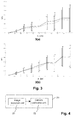
    illustrates exemplary evaluation and the estimated errors for one embodiment of the method for determining two-view geometry of two cameras.
    Fig. 4
    is a schematic diagram illustrating a preferred embodiment of an apparatus configured to perform the embodiments of a method for determining two-view geometry of two cameras.
    DETAILED DESCRIPTION OF PREFERRED EMBODIMENTS
  • Preferred embodiments of a method for determining a two-view geometry of two cameras will be described and explained in the following in detail. It should be noted that, when repeated and detailed descriptions of well-known functions or configurations may unnecessarily make obscure the gist of the present approach, the detailed description will be omitted.
  • Fig. 1 schematically illustrates a preferred embodiment of the method for determining a two-view geometry of two cameras. The method comprises: receiving 10 at least two images each captured by one of the two cameras; extracting 11 a plurality of correspondence features from the images; generating 12 a matrix for each pair of the correspondence features; and determining 13 a two-view geometry of the two cameras by calculating a minimization of the sum of determinants of the matrices. The matrix is preferably a match matrix and indicates a function of camera motions of the two cameras.
  • Of course, the camera used for such method can be any kind of cameras that is feasible in different situations and for various demands. The correspondence features can be optionally extracted 11 using any suitable methods and techniques known in the field.
  • In one preferred embodiment of the method, the two-view geometry of the two cameras is estimated and determined 13 utilizing Perturbation Theorem. The theorem and its exploitation for matrix determinant minimization are therefore first introduced below.
  • Perturbation Theorem and Application
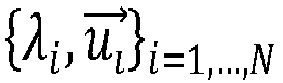
  • Let A and D be N-by-N symmetric real-valued matrices and λ i u ι i = 1 , , N
    Figure imgb0002
    the eigensystem of A, i.e. the set of eigenvalues and eigenvectors of A, it can be formulated such that: { A u ι = λ i u ι u ι , u J = δ i , j A = i λ i u ι u i T ,
    Figure imgb0003

    where 〈a,b〉 denotes the scalar product and δi,j is the Kronecker Delta-function δ i , j = { 1 i = j 0 i j .
    Figure imgb0004
  • Consider a perturbated matrix A' = A + εD, for a small ε, and λ i ʹ u i ʹ i = 1 , , N
    Figure imgb0005
    the eigensystem of A', corresponding to λ i u ι i = 1 , , N ,
    Figure imgb0006
    the following relations hold: { λ i ʹ = λ i + ε u ι , D u ι + O ε 2 u i ʹ = u ι ε j i u J , D u ι u J λ i - λ j + O ε 2 .
    Figure imgb0007
  • The equations (1) are known in literature as Perturbation Theorem.
  • The Perturbation Theorem provides also a representation of a first order Taylor expansion of an eigensystem of a symmetric matrix A(x) : RS N×N , where S N×N is the space of N-by-N symmetric positive-definite matrices. The first order Taylor expansion of A(x) is given by A x + ε A x + J A x ε , where J A x ε = A x x .
    Figure imgb0008
  • Corresponding to the above illustration, one can denote the eigensystem of A(x) as λ i x , u ι x i = 1 , , N ,
    Figure imgb0009
    and the first order Taylor expansion of the eigensystem is thus given by { λ i x + ε = λ i x + J λ i x ε + O ε 2 u ι x + ε = u ι x + J u i x ε + O ε 2
    Figure imgb0010
  • Equations (2) can be understood as the eigensystem of a matrix A(x) affected by a small perturbation JA (x)ε. Therefore the Perturbation Theorem implies that: { J λ i x = u ι x , J A x u ι x J u i x = j i u J x , J A x u ι x u J x λ i x - λ j x .
    Figure imgb0011
  • Furthermore, the Taylor expansion of the determinant of the matrix A(x) can also be derived, given by the product of its eigenvalues counted with their algebraic multiplicities: det A x + ε = i λ i x + ε i λ i x + J λ i x ε .
    Figure imgb0012
  • Substituting equation (2) in equation (3) and neglecting the higher order terms as a first approximation, det A x + ε i λ i x + i j i λ j x J λ i x ε .
    Figure imgb0013
  • The above equation provides the first order Taylor approximation of the determinant of the matrix A(x), and its Jacobian can be approximated as det A x + ε x i j i λ j x J λ i x .
    Figure imgb0014
  • An equivalent formulation can be derived to express the determinant of a non-symmetric matrix A(x). For A x = U Σ V T = U D σ 1 σ 2 σ 3 V T
    Figure imgb0015

    the Singular Composition of A(x), where the notation D(ω) means a diagonal matrix built with the element of the vector ω. Using the matrix relation det(AB) = det(A) det(B), one can obtain det A x = det U det D σ 1 σ 2 σ 3 det V T = i σ i x .
    Figure imgb0016
  • The singular values σi are related to the eigenvalues λi of the matrix K(x) = A(xAT (x) by the relation λ i = σ i 2 ,
    Figure imgb0017
    therefore by differentiation it is obtained that J λ i = 2 σ i J σ i .
    Figure imgb0018
  • As the matrix K(x) is by definition symmetric, the results of the Perturbation Theorem can be applied to compute the Jacobian Jλi of the eigenvalues and express the first order Taylor approximation of the determinant of the non-symmetric A(x) as det A x + ε det A x + i j i σ j x J λ i x 2 σ i x ε .
    Figure imgb0019
  • Two-View Geometry Determination
  • The Perturbation Theorem introduced above is then utilized to estimate and determine 13 a two-view geometry of two cameras.
  • Fig. 2 shows a model of a two-camera set in a calibrated camera space, where a 3D point M projects on the two cameras on the image points m and m' respectively. Under the calibrated camera condition, the corresponding incident vectors and ' can be computed by inverting the projection functions of the cameras [I].
  • Without loss of generality, the projection center of one of the two cameras can be defined as located at the origin of the reference system, i.e. ○=[0 0 0] T , the Euclidean transformation relating the two camera systems can be denoted as {R, t} ∈ SO(3) and consequently the projection center of the second camera becomes C =t. This enables the definition of the incident vector in the second camera system as m ^ ʹ R M - t ,
    Figure imgb0020

    where ∼ means equal up to a non-zero scale factor.
  • As known in 3D geometry, given a tetrahedron with vertices {a, b, c, d}, a corresponding volume V can be formulated as V = 1 6 det a - b b - c c - d .
    Figure imgb0021
  • Accordingly, for the model shown in the Fig. 2 and derived by geometric construction, the four points {C,m̂, t, RTm̂' + t} lay on a unique plane can identify a null-volume tetrahedron: det - m ^ m ^ - t - R T m ^ ʹ = det A R t = 0 ,
    Figure imgb0022

    where for clarity the matrix A(R,t) explicitly indicates a function of the camera motions {R,t}.
  • By receiving 10 at least two images each captured by one of the two cameras and extracting 11 a plurality of correspondence features from the images, e.g. a set of N point correspondences between the two images, the two-view geometry of the two cameras can be formulated as the solution of a minimization problem R t = argmin R t SO 3 k = 1 , , N det 2 A k R t ,
    Figure imgb0023

    where Ak (R,t) is a real valued square matrix generated according to equation (7) using the k-th point correspondences.
  • Preferably, this objection function is minimized using the Levemberg-Marquardt (LM) iterations. Within the LM optimization framework, the normal equation is built using equations (4) and (6) derived from the Perturbation Theorem to express contributions and their Jacobian, and it is iteratively solved for updating the solution vector.
  • Evaluation
  • The above described embodiment of the method for determining a two-view geometry of two cameras is evaluated on simulated data and compared with the standard approach provided by the minimization of Sampson error [I, VIII].
  • The scene model is set to be composed of a point cloud of 100 3D points and a stereo camera randomly located with respect to the point cloud at a fixed distance. Each camera is modelled as a 50° horizontal field-of-view lens and 1024×768 sensor, and the stereo geometry is randomly sampled from the subspace of Euclidean Transformation {R,t}, such that ∥t∥ = 1.
  • The image projections are corrupted using a zero-mean white Gaussian noise with increasing standard deviation ranging within the interval of [0, 2] pixels. For each level of image noise, a new scene is created fifty times and the median and the standard deviation of the estimation errors are collected. These are given by two angular measures: the angle between the estimated baseline vector and the real one, and the angle associated to the difference rotation δR between an estimated rotation and the real rotation, where δR = RTR̃. For the estimation, the Levemberg-Marquardt algorithm is initialized with an ideal stereo geometry, given by the null rotation and the unit norm x-vector {I 3, [1 0 0] T }.
  • The evaluation results are shown in Fig. 3, in which Figs. 3(a) and 3(b) respectively show the measurements of the estimation error of the rotational and the translational component of the two-view geometry, which are denoted as Errθ and Errt respectively. Errθ is defined as the angle of the different rotations between the real rotation of the two-view geometry and the estimated one. Errt is defined as the angle between the real translation of the two-view geometry and the estimated one.
  • For both Figs. 3(a) and 3(b), the solid lines show the results obtained from the above proposed techniques and the dotted lines show the results obtained from the Samson error minimization. It can be seen that the accuracy of the above proposed method for determining a two-view geometry of two cameras is higher than the one achieved by the minimization of Sampson Error. In addition, the convergence of the minimization of the proposed error function is achieved irrespective to the proximity of the initialization point to the actual solution. This does not happen for the Sampson Error minimization where a consistent number of trials fail to converge to the right solution.
  • Fig. 4 schematically depicts an apparatus 20 configured to perform a method for determining a two-view geometry of two cameras. The apparatus 20 comprises an image reception unit 21 and an operation unit 22. The image reception unit 21 is configured to receive 10 at least two images each captured by one of the two cameras. The operation unit 22 is configured to extract 11 a plurality of correspondence features from the images, to generate 12 a matrix for each pair of the correspondence features, and to determine 13 a two-view geometry of the two cameras by calculating a minimization of the sum of determinants of the matrices. The matrix preferably indicates a function of camera motions of the two cameras. Preferably, the operation unit 22 determines 13 the two-view geometry of the two cameras using Perturbation Theorem and Levemberg-Marquardt iterations.
  • REFERENCES
    1. [I] R. Hartley and A. Zisserman, Multiple View Geometry in Computer Vision (2 ed.). Cambridge University Press, New York, NY, USA, pp. 155-157, 2003
    2. [II] H. C. Longuet-Higgins, "A computer algorithm for reconstructing a scene from two projections", Nature 293, 133-135 (September 1991)
    3. [III] E. Kruppa, "Zur Ermittlung eines Objektes aus zwei Perspektiven mit innerer Orientierung", Sitzungsberichte der Mathematisch Naturwissenschaftlichen Kaiserlichen Akademie der Wissenschaften, 122, 1939-1948, 1913
    4. [IV] O. D. Faugeras and S. Maybank, "Motion from point matches: multiple of solutions", IEEE Proceedings Workshop on Visual Motion, 248-255, 1989
    5. [V] D. Nister, "An efficient solution to the five-point relative pose problem", IEEE Transactions on Pattern Analysis and Machine Intelligence, 26(6), 756-777, 2004
    6. [VI] B. Triggs, "Routines for relative pose of two calibrated cameras from 5 points", MOVI-IMAG-INRIA Rhône-Alpes / GRAVIR, Technical Report 2000
    7. [VII] J. Philip, "A non-iterative algorithm for determining all essential matrices corresponding to five point pairs", The Photogrammetric Record, 15(88), 589-599, 2003
    8. [VIII] D. Batra, B. Nabbe and M. Hebert, "An alternative formulation for the five point relative pose problem", IEEE Workshop on Motion and Video Computing 2007 (WMVC'07)

Claims (8)

  1. A method for determining a two-view geometry of two cameras, comprising:
    - receiving (10) at least two images each captured by one of the two cameras;
    - extracting (11) a plurality of correspondence features from the images;
    - generating (12) a matrix for each pair of the correspondence features, the matrix indicating a function of camera motions of the two cameras; and
    - determining (13) a two-view geometry of the two cameras by calculating a minimization of the sum of determinants of the matrices.
  2. The method of claim 1, wherein the correspondence features include a set of N point correspondences between the received images.
  3. The method of claim 1 or 2, wherein the two-view geometry of the two cameras is determined (13) using Perturbation Theorem and Levemberg-Marquardt iterations.
  4. The method of claim 3, wherein the function of a matrix represents a volume of a tetrahedron implicitly drawn in 3D space by the corresponding pair of the extracted correspondence features.
  5. The method of one of the preceding claims, wherein calculating a minimization of the sum of determinants of the matrices includes solving the problem of R t = argmin R t SO 3 k = 1 , , N det 2 A k R t
    Figure imgb0024

    where SO(3) is the space of Euclidean transformations, { R , t } is the estimated Euclidean transformation relating two camera systems, Ak (R,t) is a real valued square matrix that is explicitly indicated as a function of {R,t} and is generated using k-th point correspondence in such a way that its determinant det A_k(R,t) represents the volume of a tetrahedron identified in a 3D space, the tetrahedron being defined by two involving points and two camera centers.
  6. An apparatus for determining a two-view geometry of two cameras, comprising:
    - an image reception unit (21) configured to receive at least two images each captured by one of the two cameras; and
    - an operation unit (22) configured to extract (11) a plurality of correspondences from the images, to generate (12) a matrix for each pair of the correspondence features, and to determine (13) a two-view geometry of the two cameras by calculating a minimization of the sum of determinants of the matrices, wherein the matrix indicates a function of camera motions of the two cameras.
  7. The apparatus of claim 6, wherein the operation unit (22) determines (13) the two-view geometry of the two cameras using Perturbation Theorem and Levemberg-Marquardt iterations.
  8. A computer readable storage medium having stored therein instructions for determining a two-view geometry of two cameras, which when executed by a computer, cause the computer to:
    - receive at least two images each captured by one of the two cameras;
    - extract a plurality of correspondence features from the images;
    - generate a matrix for each pair of the correspondence features, the matrix indicating a function of camera motions of the two cameras; and
    - determine a two-view geometry of the two cameras by calculating a minimization of the sum of determinants of the matrices.
EP15306195.7A 2015-07-23 2015-07-23 Method and apparatus for determining two-view geometry of two cameras Withdrawn EP3122041A1 (en)

Priority Applications (1)

Application Number Priority Date Filing Date Title
EP15306195.7A EP3122041A1 (en) 2015-07-23 2015-07-23 Method and apparatus for determining two-view geometry of two cameras

Applications Claiming Priority (1)

Application Number Priority Date Filing Date Title
EP15306195.7A EP3122041A1 (en) 2015-07-23 2015-07-23 Method and apparatus for determining two-view geometry of two cameras

Publications (1)

Publication Number Publication Date
EP3122041A1 true EP3122041A1 (en) 2017-01-25

Family

ID=53794170

Family Applications (1)

Application Number Title Priority Date Filing Date
EP15306195.7A Withdrawn EP3122041A1 (en) 2015-07-23 2015-07-23 Method and apparatus for determining two-view geometry of two cameras

Country Status (1)

Country Link
EP (1) EP3122041A1 (en)

Non-Patent Citations (10)

* Cited by examiner, † Cited by third party
Title
"3D Imaging, Analysis and Applications", 1 January 2012, SPRINGER LONDON, London, ISBN: 978-1-44-714063-4, article STEPHEN SE ET AL: "Passive 3D Imaging", pages: 35 - 94, XP055158913, DOI: 10.1007/978-1-4471-4063-4_2 *
0. D. FAUGERAS; S. MAYBANK: "Motion from point matches: multiple of solutions", IEEE PROCEEDINGS WORKSHOP ON VISUAL MOTION, 1989, pages 248 - 255
B. TRIGGS: "Routines for relative pose of two calibrated cameras from 5 points", MOVI-IMAG-INRIA RHONE-ALPES / GRAVIR, TECHNICAL REPORT, 2000
D. BATRA; B. NABBE; M. HEBERT: "An alternative formulation for the five point relative pose problem", IEEE WORKSHOP ON MOTION AND VIDEO COMPUTING, 2007
D. NISTER: "An efficient solution to the five-point relative pose problem", IEEE TRANSACTIONS ON PATTERN ANALYSIS AND MACHINE INTELLIGENCE, vol. 26, no. 6, 2004, pages 756 - 777
E. KRUPPA: "Zur Ermittlung eines Objektes aus zwei Perspektiven mit innerer Orientierung", SITZUNGSBERICHTE DER MATHEMATISCH NATURWISSENSCHAFTLICHEN KAISERLICHEN AKADEMIE DER WISSENSCHAFTEN, vol. 122, 1913, pages 1939 - 1948
H. C. LONGUET-HIGGINS: "A computer algorithm for reconstructing a scene from two projections", NATURE, vol. 293, September 1991 (1991-09-01), pages 133 - 135
J. PHILIP: "A non-iterative algorithm for determining all essential matrices corresponding to five point pairs", THE PHOTOGRAMMETRIC RECORD, vol. 15, no. 88, 2003, pages 589 - 599
POLLEFEYS ET AL: "Tutorial on 3D Modeling from Images", INTERNET CITATION, 26 June 2000 (2000-06-26), XP002313028, Retrieved from the Internet <URL:DUBLIN, IRELAND http://www.esat.kuleuven.ac.be/pollefey/tutorial/tutorial.pdf> [retrieved on 20050111] *
R. HARTLEY; A. ZISSERMAN: "Multiple View Geometry in Computer Vision", 2003, CAMBRIDGE UNIVERSITY PRESS, pages: 155 - 157

Similar Documents

Publication Publication Date Title
US10438366B2 (en) Method for fast camera pose refinement for wide area motion imagery
US20110293142A1 (en) Method for recognizing objects in a set of images recorded by one or more cameras
US20150138322A1 (en) Image processing device and its control method, imaging apparatus, and storage medium
US10460471B2 (en) Camera pose estimating method and system
US20150325003A1 (en) Methods, systems, and computer readable media for visual odometry using rigid structures identified by antipodal transform
EP3166074A1 (en) Method of camera calibration for a multi-camera system and apparatus performing the same
CN103426190B (en) The method and system of image reconstruction
Tsaregorodtsev et al. Extrinsic camera calibration with semantic segmentation
Rodehorst et al. Evaluation of relative pose estimation methods for multi-camera setups
CN112288813B (en) Pose estimation method based on multi-view vision measurement and laser point cloud map matching
Ventura et al. P1ac: Revisiting absolute pose from a single affine correspondence
CN116630423A (en) A multi-target binocular positioning method and system for micro-robots based on ORB features
CN115100535B (en) Satellite remote sensing image rapid reconstruction method and device based on affine camera model
Wang et al. An adaptive 3D reconstruction method for asymmetric dual-angle multispectral stereo imaging system on UAV platform
Beschi et al. Stereo camera system calibration: the need of two sets of parameters
Arrigoni et al. Robust global motion estimation with matrix completion
Conomis Conics-based homography estimation from invariant points and pole-polar relationships
EP3136340A1 (en) Method for estimating a unified projection model for a camera and apparatus performing the same
Bazin et al. Fast central catadioptric line extraction
CN113378746B (en) Positioning method and device
Ershov et al. Stereovision algorithms applicability investigation for motion parallax of monocular camera case
Rodehorst Evaluation of the metric trifocal tensor for relative three-view orientation
Ma et al. Fusion of multi-angular aerial images based on epipolar geometry and matrix completion
Chien et al. Improved visual odometry based on transitivity error in disparity space: A third-eye approach
Cornou et al. Bundle adjustment: a fast method with weak initialisation.

Legal Events

Date Code Title Description
PUAI Public reference made under article 153(3) epc to a published international application that has entered the european phase

Free format text: ORIGINAL CODE: 0009012

AK Designated contracting states

Kind code of ref document: A1

Designated state(s): AL AT BE BG CH CY CZ DE DK EE ES FI FR GB GR HR HU IE IS IT LI LT LU LV MC MK MT NL NO PL PT RO RS SE SI SK SM TR

AX Request for extension of the european patent

Extension state: BA ME

STAA Information on the status of an ep patent application or granted ep patent

Free format text: STATUS: THE APPLICATION IS DEEMED TO BE WITHDRAWN

18D Application deemed to be withdrawn

Effective date: 20170726