EP3120698B1 - Animal treat delivery system - Google Patents
Animal treat delivery system Download PDFInfo
- Publication number
- EP3120698B1 EP3120698B1 EP16158034.5A EP16158034A EP3120698B1 EP 3120698 B1 EP3120698 B1 EP 3120698B1 EP 16158034 A EP16158034 A EP 16158034A EP 3120698 B1 EP3120698 B1 EP 3120698B1
- Authority
- EP
- European Patent Office
- Prior art keywords
- delivery system
- treat delivery
- animal treat
- animal
- recess
- Prior art date
- Legal status (The legal status is an assumption and is not a legal conclusion. Google has not performed a legal analysis and makes no representation as to the accuracy of the status listed.)
- Active
Links
Images



Classifications
-
- A—HUMAN NECESSITIES
- A01—AGRICULTURE; FORESTRY; ANIMAL HUSBANDRY; HUNTING; TRAPPING; FISHING
- A01K—ANIMAL HUSBANDRY; AVICULTURE; APICULTURE; PISCICULTURE; FISHING; REARING OR BREEDING ANIMALS, NOT OTHERWISE PROVIDED FOR; NEW BREEDS OF ANIMALS
- A01K15/00—Devices for taming animals, e.g. nose-rings or hobbles; Devices for overturning animals in general; Training or exercising equipment; Covering boxes
- A01K15/02—Training or exercising equipment, e.g. mazes or labyrinths for animals ; Electric shock devices; Toys specially adapted for animals
- A01K15/025—Toys specially adapted for animals
- A01K15/026—Chewable toys, e.g. for dental care of pets
-
- A—HUMAN NECESSITIES
- A01—AGRICULTURE; FORESTRY; ANIMAL HUSBANDRY; HUNTING; TRAPPING; FISHING
- A01K—ANIMAL HUSBANDRY; AVICULTURE; APICULTURE; PISCICULTURE; FISHING; REARING OR BREEDING ANIMALS, NOT OTHERWISE PROVIDED FOR; NEW BREEDS OF ANIMALS
- A01K15/00—Devices for taming animals, e.g. nose-rings or hobbles; Devices for overturning animals in general; Training or exercising equipment; Covering boxes
- A01K15/02—Training or exercising equipment, e.g. mazes or labyrinths for animals ; Electric shock devices; Toys specially adapted for animals
- A01K15/025—Toys specially adapted for animals
-
- A—HUMAN NECESSITIES
- A01—AGRICULTURE; FORESTRY; ANIMAL HUSBANDRY; HUNTING; TRAPPING; FISHING
- A01K—ANIMAL HUSBANDRY; AVICULTURE; APICULTURE; PISCICULTURE; FISHING; REARING OR BREEDING ANIMALS, NOT OTHERWISE PROVIDED FOR; NEW BREEDS OF ANIMALS
- A01K5/00—Feeding devices for stock or game ; Feeding wagons; Feeding stacks
- A01K5/01—Feed troughs; Feed pails
- A01K5/0114—Pet food dispensers; Pet food trays
-
- A—HUMAN NECESSITIES
- A01—AGRICULTURE; FORESTRY; ANIMAL HUSBANDRY; HUNTING; TRAPPING; FISHING
- A01K—ANIMAL HUSBANDRY; AVICULTURE; APICULTURE; PISCICULTURE; FISHING; REARING OR BREEDING ANIMALS, NOT OTHERWISE PROVIDED FOR; NEW BREEDS OF ANIMALS
- A01K5/00—Feeding devices for stock or game ; Feeding wagons; Feeding stacks
- A01K5/02—Automatic devices
Definitions
- 2004/200434A1 disclosing a food dispensing interlocking animal toy system with the ability to connect two or more separate toys to create larger and more complex toy systems.
- Some of the separate toys are food dispensing toys.
- Yet a further example is US Pat. Appl. 5,758,604A disclosing a toy, preferably for animals, shaped as a hollow body with an inner labyrinth.
- An object, such as a tidbit may be caused to move along the labyrinth as the toy is manipulated for example by a dog.
- the toy is further arranged to discharge the tidbit after it has passed through the labyrinth.
- pet toys that function as pet treat delivery systems may reduce destructive behavior of a pet only during a time period in which the pet remains interested in the pet toy.
- the present disclosure also appreciates that a pet may quickly loose interest in a pet toy when the pet toy no longer includes pet treats.
- the invention addresses these problems by providing an animal treat delivery system according to claim 1.
- the system includes an resilient material (e.g., an elastomer) molded over the body.
- the body only includes the first and second parts, the first recess is centrally located in the first part, and the second recess is centrally located in the second part.
- each of the baffles is formed of a baffle portion of the first part and a baffle portion of the second part.
- one of the baffles is configured such that two of the compartments that are adjacent to each other cannot directly communicate.
- the system includes a plurality of entrance holes formed in the first part and a plurality of elongated members formed in the second part.
- One or more first ones of the elongated members are configured to block associated ones of the entrance holes and a second one of the elongated members is configured to not block an associated one of the entrance holes.
- a surface of the first part includes an alignment mark and a surface of the second part includes a plurality of difficulty indicators to indicate a relative degrees of difficulty in discharging articles (e.g., animal digestible treats) from various compartments within the animal treat delivery system.
- the system includes a plurality of alignment guides integrated into an interior surface of one part that extend into the other part when the first and second parts are locked.
- the system may include a limiting structure located proximate the exit hole that is configured to meter discharge of articles from an interior of the body through the exit hole.
- the limiting structure may, for example, be made of a resilient material, which may be an extension of an overmold through a hole in the body.
- a central portion of the second part is keyed to receive a central portion of the first part.
- animal digestible treats are loaded into an interior the pet toy (which has a rigid or semi-rigid multi-part body) or an animal treat delivery system.
- the general construction of the pet toy serves to increase a time in which animal digestible treats are retained within an interior of the pet toy and, as such, increases the time in which a pet may remain interested in the pet toy.
- Animal treat delivery system 100 includes a multi-part body, which in this embodiment has the overall form of a faceted ball. In other embodiments, animal treat delivery system may have a different overall form, including, for example, a rounded, ovoid, cylindrical, elliptical, pyramidal, rectangular prism, or irregular form.
- the body of animal treat delivery system 100 can be molded from a rigid or semi-rigid material, such as nylon or acrylonitrile butadiene styrene (ABS).
- animal treat delivery system 100 may be formed of multiple layers.
- the rigid or semi-rigid material can form an inner layer 152,162
- animal treat delivery system 100 may additionally include an outer layer 150, 160, which may be formed of an resilient material.
- outer layer 150, 160 is formed of an elastomeric material, such as thermoplastic elastomer (TPE).
- the multi-part body of animal treat delivery system 100 includes only two parts, namely, a first part 102 and a second part 104, which each can be (but are not required to be) approximately half of the overall form.
- First part 102 of the body includes a centrally located first recess 110 formed therein
- second part 104 of the body has a centrally located second recess 114 formed therein.
- recesses 110 and 114 are co-linear.
- First recess 110 and second recess 114 can be (but are not required to be) substantially the same size.
- animal treat delivery system 100 may have an outer diameter of about 125 millimeters, first recess 110 may have a diameter of about 40 millimeters, and second recess 114 may have a diameter of about 30 millimeters, where such dimensions may vary, for example, plus or minus 5 millimeters.
- first part 102 includes an exit hole 112 within first recess 110 that is configured to allow an article within the body, such as an animal digestible treat, to exit the body.
- a lever 120 in one of first and second recesses 110, 114 extends into the other of first and second recesses 110, 114 to releasably interlock with a rib structure 122 (which in this embodiment is a component of second part 104 ) to releasably couple first part 102 and second part 104.
- parts 102, 104 of animal treat delivery system 100 can be disassembled by application of only manual force to lever 120, and then reassembled by application of manual force to engage a tooth (or detent) of lever 120 with rib structure 122.
- animal treat delivery system 100 can be readily assembled and disassembled by a human, but cannot be readily assembled and disassembled by an animal (e.g., a dog) lacking the ability and/or dexterity to manipulate lever 120.
- recess 110 of first part 102 may include one or more (and in this embodiment, four) entrance holes 130A, 130B, 130C, and 130D, in addition to exit hole 112.
- Second part 104 can additionally include a corresponding number of elongated members 140, 142, 144, or 146 formed integrally with a core defining second recess 114.
- entrance holes 130A-130D, elongated members 142-146 block corresponding ones of entrance holes 130A-130D, but elongated member 140 (which is shorter) does not block one of entrance holes 130A-130D, thus permitting an article, such as an appropriately sized animal digestible treat, to be loaded into an interior volume of animal treat delivery system 100.
- entrance hole 130A is not blocked by elongated member 140, as elongated member 140 is shorter than elongated members 142, 144, and 146.
- first part 102 and second part 104 includes one or more baffle portions, which when animal treat delivery system 100 is assembled, subdivide the interior volume of animal treat delivery system 100 into multiple compartments.
- first part 102 includes four baffle portions 132, 134, 136 and 138
- second part 104 includes four corresponding baffle portions 172, 174, 176 and 178.
- Baffle portion 132 includes a notch 133
- baffle portion 134 includes a notch 135
- baffle portion 136 includes a notch 137
- baffle portion 138 includes a notch 139.
- baffle portions 172, 174 and 178 include notches 173, 175, and 179, respectively, while baffle portion 176 includes a protrusion 177.
- notches 133, 135, 139, 173, 175, and 179 are sized to allow animal digestible treats to move between the interior compartments of animal treat delivery system 100 defined by the baffle portions as an animal interacts with (e.g., rotates) animal treat delivery system 100.
- protrusion 177 prevents animal digestible treats from moving between the compartments separated by baffle portions 136, 176.
- Figures 4 and 9 further illustrates that each of elongated members 140-146 includes an integrally formed rib structure 122 that is configured to releasably engage with a corresponding tooth or detent integrally formed on lever 120 of first part 102.
- Figure 4 further illustrates that one or more of first part 102 and second part 104 (and in this example, second part 104 only) can include alignment guides 181, 183, 185, 187 that extend into the other of parts 102, 104 to facilitate coupling of parts 102, 104.
- alignment guides 181, 183, 185, 187 can be used.
- animal treat delivery system 100 as assembled is illustrated in cross-section.
- animal treat delivery system 100 includes exit hole 112 and entrance hole 130D opening into a same compartment (i.e., an exit compartment), as elongated member 140 does not block entrance hole 130D (see Figure 1 , where elongated member 146 blocks entrance hole 130D ).
- a tooth or detent (and in this example, a tooth) of lever 120 of first part 102 is engaged with rib structure 122 of second part 104, releasably coupling first part 102 with second part 104.
- the end of lever 120 is depressed by manual force (to move the tooth on lever 120 away from rib structure 122 ), and first part 102 may then be separated from second part 104.
- animal treat delivery system 100 is illustrated as including an alignment mark 101 on an outer surface of first part 102 and one or more difficulty indicators 103 on an outer surface of second part 104.
- Difficulty indicator(s) 103 indicates a difficulty a pet should have in causing animal digestible treats to be discharged from animal treat delivery system 100. That is, difficulty indicator(s) 103 provides an indication of which internal compartment an animal digestible treat that is being deposited through an entrance hole will enter. Registration of alignment mark 101 with a difficulty indicator 103 comprising one bump indicates a lower difficulty, as any animal digestible treat inserted through an entrance hole 130 is retained in a same interior compartment that includes the exit hole 112.
- registration of alignment mark 101 with a difficulty indicator 103 comprising four bumps indicates a higher difficulty in that any animal digestible treat inserted in an open entrance hole 130 will have to transition through all interior compartments before being discharged from exit hole 112.
- first part 102 and second 104 in different rotational orientations, a human user can set the difficulty in discharging animal digestible treats from animal treat delivery system 100 at a desired level of difficulty.
- a first baffle includes baffle portion 174 of second part 104 and baffle portion 136 of first part 102.
- a second baffle includes baffle portion 172 of second part 104 and baffle portion 134 of first part 102.
- Passage 191 is defined by notches 137 and 175, and passage 193 is defined by notches 135 and 173.
- the first and second baffles define one side of different compartments.
- animal treat delivery system 100 includes four interior compartments defined by four baffle portions.
- an animal treat delivery system configured according to the present disclosure may include more or less than four compartments. For example, an animal treat delivery system with three baffles would include three compartments and an animal treat delivery system with two baffles would include two compartments.
- animal treat delivery system 100 has been described as including one or more entrance holes for loading animal digestible treats, it should be appreciated that such entrance hole(s) can be omitted in some embodiments.
- the first part and second part may disassembled to permit treats to be directly loaded into the interior of the animal treat delivery system.
- animal treat delivery system 200 that omits entrance hole(s) in accordance with one embodiment.
- animal treat delivery system 200 is constructed similarly to animal treat delivery system 100 as previously described, with some differences that will become apparent upon reference to the figures and corresponding description.
- the multi-part body of animal treat delivery system 200 includes only two parts, namely, a first part 202 and a second part 204, which are shown disassembled from each other in Figure 11 .
- First part 202 of the body includes a centrally located first recess formed therein, and second part 204 of the body has a centrally located second recess formed therein, generally as previously described.
- First part 202 includes a central portion, including walls 292 and 294 formed integrally with inner layer 252.
- Wall 292 includes a rib 293.
- Second part 204 correspondingly includes a central core 240 integrally formed with inner layer 262 of second part 204.
- Central core 240 includes a slot 241 configured to receive therein a rib 293 formed on wall 292, which is integrally formed on interior surface of inner layer 252 of first part 202.
- first part 202 and second part 204 can only mate in one rotational orientation. (In this example, mating of first part 202 and second part 204 is facilitated by alignment guides 281, 283 integral to both first part 202 and second part 204 .)
- first part 202 and second part 204 are releasably coupled by a lever 220, which is disposed between walls 292 and 294 and which includes a tooth 221 (or in alternative embodiments, a detent) that is configured to engage a rib structure (not shown) of central core 220 when first part 202 is mated with second part 204.
- First part 202 further includes an exit hole 212 is through which animal digestible treats 240 are discharged from an interior of animal treat delivery system 200 to an exterior of animal treat delivery system 200.
Landscapes
- Life Sciences & Earth Sciences (AREA)
- Environmental Sciences (AREA)
- Animal Husbandry (AREA)
- Biodiversity & Conservation Biology (AREA)
- Health & Medical Sciences (AREA)
- Physical Education & Sports Medicine (AREA)
- Animal Behavior & Ethology (AREA)
- Zoology (AREA)
- General Health & Medical Sciences (AREA)
- Birds (AREA)
- Dentistry (AREA)
- Feeding And Watering For Cattle Raising And Animal Husbandry (AREA)
- Housing For Livestock And Birds (AREA)
- Fodder In General (AREA)
Description
- The present invention relates to articles of manufacture and associated methods, and more specifically, to articles such as pet treats and molded pet toys that function as pet treat delivery systems and associated methods of manufacture and use.
- It is well known in the art that boredom is a significant contributor to destructive behavior in domesticated animals. For example,
U.S. Pat. No. 6,634,318 to Rucker and the prior art referenced therein discloses that barking, digging and other destructive behaviors are common problem behaviors of canines that become discontented or bored. As further disclosed in these patents, one common approach utilized in the art to address such destructive behaviors in dogs is to provide a toy with which the dog can interact and that encourages such interaction by rewarding the dog. For example, one class of dog toys dispense food (e.g., treats) from a hollow interior cavity through an opening as a dog interacts with the toy. The Rucker dog toy utilized an edible closure, a portion of which extended outside of the toy, to initially prevent treats from escaping through an opening in the toy. As a dog broke the edible closure, the edible closure dislodged from the opening to allow treats to readily exit the Rucker dog toy. Another example isU.S. Pat. Appl. 6,073,581A disclosing a dog toy for dispensing dog food, the dog toy comprising a spherical shell housing the dog food in its interior. The dog toy is configured to discharge dog food via a cylindrical valve when the spherical shell is rolled on the ground. A further example isUS Pat. Appl. 2004/200434A1 disclosing a food dispensing interlocking animal toy system with the ability to connect two or more separate toys to create larger and more complex toy systems. Some of the separate toys are food dispensing toys. Yet a further example isUS Pat. Appl. 5,758,604A disclosing a toy, preferably for animals, shaped as a hollow body with an inner labyrinth. An object, such as a tidbit, may be caused to move along the labyrinth as the toy is manipulated for example by a dog. The toy is further arranged to discharge the tidbit after it has passed through the labyrinth. - The present disclosure appreciates that pet toys that function as pet treat delivery systems may reduce destructive behavior of a pet only during a time period in which the pet remains interested in the pet toy. The present disclosure also appreciates that a pet may quickly loose interest in a pet toy when the pet toy no longer includes pet treats. The invention addresses these problems by providing an animal treat delivery system according to claim 1.
- In at least one embodiment, an animal treat delivery system includes a rigid multi-part body having an interior volume and a plurality of baffles within the body. The baffles divide the interior volume of the body into a plurality of compartments each having a respective opening that facilitates at least indirect communication between the compartments. The system includes a first recess formed in a first part of the body and a second recess formed in a second part of the body. The system further includes an exit hole positioned within one of the first and second recesses. The exit hole communicates with an exit compartment among the plurality of compartments, such that articles (e.g., animal digestible treats) within the exit compartment can exit the body via the exit hole. The system further includes a lever integral with one of the parts of the body. The lever has an end that is externally accessible via one of the first and second recesses and is configured to releasably engage a structure in the other part of the body to facilitate coupling and uncoupling the first and second parts.
- In various embodiments, the system includes an resilient material (e.g., an elastomer) molded over the body. In at least one embodiment, the body only includes the first and second parts, the first recess is centrally located in the first part, and the second recess is centrally located in the second part.
- In another embodiment, each of the baffles is formed of a baffle portion of the first part and a baffle portion of the second part. In an embodiment, one of the baffles is configured such that two of the compartments that are adjacent to each other cannot directly communicate.
- In at least one embodiment, the system includes a plurality of entrance holes formed in the first part and a plurality of elongated members formed in the second part. One or more first ones of the elongated members are configured to block associated ones of the entrance holes and a second one of the elongated members is configured to not block an associated one of the entrance holes. In an embodiment, a surface of the first part includes an alignment mark and a surface of the second part includes a plurality of difficulty indicators to indicate a relative degrees of difficulty in discharging articles (e.g., animal digestible treats) from various compartments within the animal treat delivery system.
- In yet another embodiment, the system includes a plurality of alignment guides integrated into an interior surface of one part that extend into the other part when the first and second parts are locked. The system may include a limiting structure located proximate the exit hole that is configured to meter discharge of articles from an interior of the body through the exit hole. The limiting structure may, for example, be made of a resilient material, which may be an extension of an overmold through a hole in the body. In at least one embodiment, a central portion of the second part is keyed to receive a central portion of the first part.
-
-
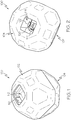
Figure 1 is a perspective view illustrating a top of an animal treat delivery system (having a rigid multi-part body) that includes a first recess (formed in a first part of the body) with an exit hole that is configured to allow an animal digestible treat within the body to exit the body in accordance with one embodiment; -
Figure 2 is a view of a bottom of the animal treat delivery system ofFigure 1 further illustrating a second recess that is formed in a second part the body; -
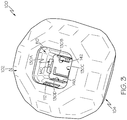
Figure 3 is another view of the top of the animal treat delivery system ofFigure 1 that further illustrates a relationship between entrance holes formed in the first part of the body and the exit hole in accordance with another embodiment; -
Figure 4 is a view of the animal treat delivery system ofFigure 1 with the first part and the second part of the body disassembled; -
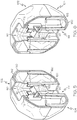
Figures 5 and 6 illustrate the animal treat delivery system ofFigure 1 in cross-section; -
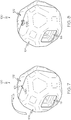
Figure 7 is a perspective view of the animal treat delivery system ofFigure 1 in which an outer surface of the first part includes an alignment mark and an outer surface of the second part includes a plurality of difficulty indicators (in this case one bump indicates that any treat entering an interior of the body through an entrance hole is retained in an exit compartment that includes the exit hole); -
Figure 8 is a perspective view of the animal treat delivery system ofFigure 1 in which an outer surface of the first part includes an alignment mark and an outer surface of the second part includes a plurality of difficulty indicators (in this case four bumps indicate that any treat entering an interior of the body through an entrance hole is retained in a compartment that requires the farthest travel to reach an exit compartment that includes the exit hole); -
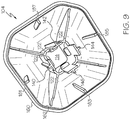
Figure 9 is an interior view of the second part of the animal treat delivery system ofFigure 1 further illustrating rib structures that facilitate locking the first and second parts; -
Figure 10 is a cross-section of the animal treat delivery system ofFigure 1 which further illustrates baffle portions in an interior volume of the body and the interlocking of a lever formed in the first part of the body with a rib structure formed in the second part of the body; -
Figure 11 is a view of an animal treat delivery system (having a rigid multi-part body) with a first part and a second part of the body disassembled, in accordance with another embodiment; and -
Figure 12 is a more detailed view of a portion of the first part of the animal treat delivery system ofFigure 11 further illustrating a limiting structure (located proximate an exit hole) that is configured to obstruct articles exiting an interior of the body through the exit hole. - Disclosed herein are innovative articles, i.e., pet toys that function as pet treat delivery systems, as well as associated methods of manufacture and use. In one embodiment described in detail herein, animal digestible treats are loaded into an interior the pet toy (which has a rigid or semi-rigid multi-part body) or an animal treat delivery system. The general construction of the pet toy serves to increase a time in which animal digestible treats are retained within an interior of the pet toy and, as such, increases the time in which a pet may remain interested in the pet toy.
- With reference now to the figures, and with particular reference to
Figures 1 and 2 , an animaltreat delivery system 100 is illustrated that is configured according to one embodiment of the present disclosure. Animaltreat delivery system 100 includes a multi-part body, which in this embodiment has the overall form of a faceted ball. In other embodiments, animal treat delivery system may have a different overall form, including, for example, a rounded, ovoid, cylindrical, elliptical, pyramidal, rectangular prism, or irregular form. In one or more embodiments, the body of animaltreat delivery system 100 can be molded from a rigid or semi-rigid material, such as nylon or acrylonitrile butadiene styrene (ABS). As best seen inFigure 4 , in at least some embodiments, animaltreat delivery system 100 may be formed of multiple layers. In such embodiments, the rigid or semi-rigid material can form an inner layer 152,162, and animaltreat delivery system 100 may additionally include anouter layer outer layer - In the illustrated embodiment, the multi-part body of animal
treat delivery system 100 includes only two parts, namely, afirst part 102 and asecond part 104, which each can be (but are not required to be) approximately half of the overall form.First part 102 of the body includes a centrally locatedfirst recess 110 formed therein, andsecond part 104 of the body has a centrally locatedsecond recess 114 formed therein. In at least one embodiment, when the multi-part body is assembled, recesses 110 and 114 are co-linear.First recess 110 andsecond recess 114 can be (but are not required to be) substantially the same size. As one example, animal treatdelivery system 100 may have an outer diameter of about 125 millimeters,first recess 110 may have a diameter of about 40 millimeters, andsecond recess 114 may have a diameter of about 30 millimeters, where such dimensions may vary, for example, plus or minus 5 millimeters. - As indicated in
Figure 1 ,first part 102 includes anexit hole 112 withinfirst recess 110 that is configured to allow an article within the body, such as an animal digestible treat, to exit the body. As further illustrated, for example, inFigures 2 ,5 and10 , alever 120 in one of first andsecond recesses 110, 114 (which in this embodiment is a component of first part 102) extends into the other of first andsecond recesses first part 102 andsecond part 104. In this manner,parts treat delivery system 100 can be disassembled by application of only manual force to lever 120, and then reassembled by application of manual force to engage a tooth (or detent) oflever 120 withrib structure 122. By virtue of the configuration of animaltreat delivery system 100 havinglever 120 disposed withinrecesses delivery system 100 can be readily assembled and disassembled by a human, but cannot be readily assembled and disassembled by an animal (e.g., a dog) lacking the ability and/or dexterity to manipulatelever 120. - With additional reference now to
Figures 3-4 , which respectively provide a more detailed view ofaperture 110 and a disassembled view of animaltreat delivery system 100, additional components of animaltreat delivery system 100 can be seen. As is partially illustrated, in some embodiments,recess 110 offirst part 102 may include one or more (and in this embodiment, four) entrance holes 130A, 130B, 130C, and 130D, in addition toexit hole 112.Second part 104 can additionally include a corresponding number ofelongated members second recess 114. When animal treatdelivery system 100 is assembled, entrance holes 130A-130D, elongated members 142-146 block corresponding ones of entrance holes 130A-130D, but elongated member 140 (which is shorter) does not block one of entrance holes 130A-130D, thus permitting an article, such as an appropriately sized animal digestible treat, to be loaded into an interior volume of animaltreat delivery system 100. In the particular example shown inFigure 3 ,entrance hole 130A is not blocked byelongated member 140, aselongated member 140 is shorter thanelongated members -
Figure 4 further illustrates that at least one of (and in the illustrated embodiment, each of)first part 102 andsecond part 104 includes one or more baffle portions, which when animal treatdelivery system 100 is assembled, subdivide the interior volume of animaltreat delivery system 100 into multiple compartments. In the illustrated example,first part 102 includes fourbaffle portions second part 104 includes fourcorresponding baffle portions Baffle portion 132 includes anotch 133,baffle portion 134 includes anotch 135,baffle portion 136 includes anotch 137, andbaffle portion 138 includes anotch 139. Similarly, baffleportions notches baffle portion 176 includes aprotrusion 177. As is discussed in detail in conjunction withFigure 10 ,notches treat delivery system 100 defined by the baffle portions as an animal interacts with (e.g., rotates) animaltreat delivery system 100. However, in this embodiment,protrusion 177 prevents animal digestible treats from moving between the compartments separated bybaffle portions -
Figures 4 and9 further illustrates that each of elongated members 140-146 includes an integrally formedrib structure 122 that is configured to releasably engage with a corresponding tooth or detent integrally formed onlever 120 offirst part 102. In addition,Figure 4 further illustrates that one or more offirst part 102 and second part 104 (and in this example,second part 104 only) can include alignment guides 181, 183, 185, 187 that extend into the other ofparts parts - With additional reference now to
Figures 5 and 6 , an animaltreat delivery system 100 as assembled is illustrated in cross-section. As assembled, animal treatdelivery system 100, includesexit hole 112 andentrance hole 130D opening into a same compartment (i.e., an exit compartment), aselongated member 140 does not blockentrance hole 130D (seeFigure 1 , whereelongated member 146blocks entrance hole 130D). As is shown, a tooth or detent (and in this example, a tooth) oflever 120 offirst part 102 is engaged withrib structure 122 ofsecond part 104, releasably couplingfirst part 102 withsecond part 104. To releasefirst part 102 fromsecond part 104, the end oflever 120 is depressed by manual force (to move the tooth onlever 120 away from rib structure 122), andfirst part 102 may then be separated fromsecond part 104. - With additional reference to
Figures 7-8 , animal treatdelivery system 100 is illustrated as including analignment mark 101 on an outer surface offirst part 102 and one or more difficulty indicators 103 on an outer surface ofsecond part 104. Difficulty indicator(s) 103 indicates a difficulty a pet should have in causing animal digestible treats to be discharged from animaltreat delivery system 100. That is, difficulty indicator(s) 103 provides an indication of which internal compartment an animal digestible treat that is being deposited through an entrance hole will enter. Registration ofalignment mark 101 with a difficulty indicator 103 comprising one bump indicates a lower difficulty, as any animal digestible treat inserted through an entrance hole 130 is retained in a same interior compartment that includes theexit hole 112. However, as shown inFigure 8 , registration ofalignment mark 101 with a difficulty indicator 103 comprising four bumps indicates a higher difficulty in that any animal digestible treat inserted in an open entrance hole 130 will have to transition through all interior compartments before being discharged fromexit hole 112. Thus, by selectively couplingfirst part 102 and second 104 in different rotational orientations, a human user can set the difficulty in discharging animal digestible treats from animaltreat delivery system 100 at a desired level of difficulty. - Referring additionally now to
Figure 10 , another cross-sectional view of an assembled animaltreat delivery system 100 is given to further illustrate two baffles. A first baffle includesbaffle portion 174 ofsecond part 104 andbaffle portion 136 offirst part 102. A second baffle includesbaffle portion 172 ofsecond part 104 andbaffle portion 134 offirst part 102.Passage 191 is defined bynotches passage 193 is defined bynotches delivery system 100 includes four interior compartments defined by four baffle portions. Again, it should be appreciated that an animal treat delivery system configured according to the present disclosure may include more or less than four compartments. For example, an animal treat delivery system with three baffles would include three compartments and an animal treat delivery system with two baffles would include two compartments. - While animal treat
delivery system 100 has been described as including one or more entrance holes for loading animal digestible treats, it should be appreciated that such entrance hole(s) can be omitted in some embodiments. In such embodiments, the first part and second part may disassembled to permit treats to be directly loaded into the interior of the animal treat delivery system. - With reference now to
Figure 11 , there is illustrated an animaltreat delivery system 200 that omits entrance hole(s) in accordance with one embodiment. In this example, animal treatdelivery system 200 is constructed similarly to animal treatdelivery system 100 as previously described, with some differences that will become apparent upon reference to the figures and corresponding description. - Animal
treat delivery system 100 includes a multi-part body, which in this embodiment again has the overall form of a faceted ball. In other embodiments, animal treat delivery system may have a different overall form, including, for example, a rounded, ovoid, cylindrical, elliptical, pyramidal, rectangular prism, or irregular form. In one or more embodiments, the body of animaltreat delivery system 100 can be molded from a rigid or semi-rigid material, such as nylon or acrylonitrile butadiene styrene (ABS). In at least some embodiments, animal treatdelivery system 100 may be formed of multiple layers. In such embodiments, the rigid or semi-rigid material can form aninner layer delivery system 100 may additionally include anouter layer - In the illustrated embodiment, the multi-part body of animal
treat delivery system 200 includes only two parts, namely, afirst part 202 and asecond part 204, which are shown disassembled from each other inFigure 11 .First part 202 of the body includes a centrally located first recess formed therein, andsecond part 204 of the body has a centrally located second recess formed therein, generally as previously described. -
First part 202 includes a central portion, includingwalls inner layer 252.Wall 292 includes arib 293.Second part 204 correspondingly includes acentral core 240 integrally formed withinner layer 262 ofsecond part 204.Central core 240 includes aslot 241 configured to receive therein arib 293 formed onwall 292, which is integrally formed on interior surface ofinner layer 252 offirst part 202. Given the relation ofrib 293 andslot 241,first part 202 andsecond part 204 can only mate in one rotational orientation. (In this example, mating offirst part 202 andsecond part 204 is facilitated by alignment guides 281, 283 integral to bothfirst part 202 andsecond part 204.) - As discussed above,
first part 202 andsecond part 204 are releasably coupled by alever 220, which is disposed betweenwalls central core 220 whenfirst part 202 is mated withsecond part 204.First part 202 further includes anexit hole 212 is through which animaldigestible treats 240 are discharged from an interior of animaltreat delivery system 200 to an exterior of animaltreat delivery system 200. - In the embodiment given in
Figure 11 , the interior volume of animaltreat delivery system 200 is again subdivided into multiple interior compartments. In particular,first part 202 includes fourbaffle portions inner layer 252. As is illustrated,baffle portion 232 does not include a notch, but baffleportions notches Second portion 204 similarly includes fourbaffle portions inner layer 262, wherebaffle portion 278 does not include a notch, but baffleportions notches treat delivery system 200 can cause animaldigestible treats 240 to pass between any of the interior compartments formed by the baffles, except between the compartments formed bybaffle portions baffle portions treat delivery system 200 by selecting the interior compartment(s) into which animaldigestible treats 240 are initially loaded, as well as the number of animaldigestible treats 240 loaded into each such interior compartment. As one use case illustrated inFigure 11 , the human user may elect to place a few animaldigestible treats 240 in the interior compartment that communicates directly with exit hole 212 (e.g., to initially incentivize initial animal interaction with animal treat delivery system 200) and distribute the remainder of the animaldigestible treats 240 among the other interior compartments (e.g., to incentivize continued animal interaction with animal treat delivery system 200). - As shown in
Figure 11 but as best seen in the detailed view provided byFigure 12 , in at least some embodiments, a limitingstructure 290 may be formedadjacent exit hole 212. Limitingstructure 290 serves to meter the discharge of animaldigestible treats 240 throughexit hole 212. In one preferred embodiment, limitingstructure 290 may be formed by permitting an elastomeric material from whichouter layer 250 is formed to flow through and fill a hole ininner layer 252, where such a hole is preferably spaced fromexit hole 212. As is further illustrated inFigures 11-12 , either or both ofinner layer 252 andinner layer 262 may have one or more additional holes formed there through that are filled byouter layer outer layers inner layers - Animal treat delivery systems as described herein may be manufactured by injecting a material (e.g., nylon) into a two-part mold to form inner layers and then over-molding an outer layer (e.g., an elastomeric material, such as TPE) over an outer surface of the inner layers. In various embodiments, the two-part mold is configured to form an animal treat delivery system that includes rigid or semi-rigid multi-part body having an interior volume and a plurality of baffle portions within the body. The baffles formed by the baffle portions divide the interior volume of the body into a plurality of compartments having openings therebetween that facilitate at least indirect communication between the compartments. A first recess is formed in a first part of the body, and a second recess is formed in a second part of the body. An exit hole is positioned within the first recess. The exit hole communicates with an exit compartment, included within the compartments, such that articles (e.g., animal digestible treats) within the exit compartment can be discharge from the body via the exit hole. A lever is also integrated in one of the parts of the body. The lever has an end that is externally accessible via one of the recesses and is configured to releasably engage a structure in the other part of the body to facilitate coupling and uncoupling the first and second parts.
- In use, a human will load one or more animal digestible treats into the animal treat delivery system and provide the animal treat delivery system to an animal. The animal will then play with the animal treat delivery system causing animal digestible treats to be discharged from the animal treat delivery system, perhaps until all of the animal digestible treats are consumed.
- While the present invention has been particularly shown as described with reference to one or more preferred embodiments, it will be understood by those skilled in the art that various changes in form and detail may be made therein without departing from the scope of the invention as defined by claim 1. For example, although the present invention has been described with reference to various embodiments of an animal treat delivery system, the present invention as described may also be embodied in other useful articles, such as containers, pet toys, and food dispensers. In addition, it should be appreciated that the dimensions and weights of animal treat delivery systems and their components may differ from those of the disclosed embodiments. With reference to weights and dimensions given herein, the term "about" should be understood as meaning plus or minus ten percent of the stated quantity. Finally, although specific embodiments suitable for use by dogs have been disclosed, it should be appreciated that the disclosed animal treat delivery systems could be employed to deliver treats to animals other than dogs.
Claims (15)
- An animal treat delivery system (100), comprising:a multi-part body having an interior volume, the multi-part body including a first part (102) and a second part (104);a first recess (110) formed in the first part (102) of the body and a second recess (114) formed in the second part (104) of the body;a plurality of baffles within the body that divide the interior volume into a plurality of compartments each having a respective opening that facilitates at least indirect communication between the plurality of compartments;an exit hole (112) positioned within one of the first (110) and second (114) recesses, wherein the exit hole (112) communicates with an exit compartment among the plurality of compartments, such that animal treats within the exit compartment can exit the body via the exit hole (112); characterized in that the animal treat delivery system further comprises:a lever (120) integral with one of the parts (102,104) of the body, wherein the lever (120) has an end that is externally accessible via one of the recesses (110,114) and is configured to releasably engage a structure in the other part of the body to permit coupling and uncoupling the first (102) and second (104) parts.
- The animal treat delivery system (100) of Claim 1, further comprising:a resilient material molded over the body.
- The animal treat delivery system (100) of Claim 1, wherein the body only includes the first (102) and second (104) parts, and wherein the first recess (110) is centrally located in the first part (102) and the second recess (114) is centrally located in the second part (104).
- The animal treat delivery system (100) of Claim 1, wherein each of the plurality of baffles is formed of a baffle portion (132,134,136,138) of the first part and a baffle portion (172,174,176,178) of the second part.
- The animal treat delivery system (100) of Claim 1, wherein one of the baffles is configured such that two of the plurality of compartments that are adjacent to each other cannot directly communicate.
- The animal treat delivery system (100) of Claim 1, further comprising:a plurality of entrance holes (130A,130B,130C,130D) formed in the first part (102); anda plurality of elongated members (140,142,144,146) formed in the second part (104), wherein one or more first ones of the elongated members (140,142,144,146) are configured to block one or more corresponding ones of the entrance holes (130A,130B,130C,130D) and a second one of the elongated members (140,142,144,146) is configured to not block a corresponding one of the entrance holes (130A,130B,130C,130D).
- The animal treat delivery system (100) of Claim 6, wherein a surface of the first part (102) includes an alignment mark (101) and a surface of the second part (104) includes a plurality of difficulty indicators (103) indicating with which of one of the plurality of compartments that a non-blocked one of the plurality of entrance holes (130A,130B,130C,130D) is aligned.
- The animal treat delivery system of Claim 1, further comprising:a plurality of alignment guides (181,183,185,187) integral with one of the first (102) and second (104) parts and extending into the other of the first (102) and second (104) parts when the first (102) and second (104) parts are coupled.
- The animal treat delivery system (100) of Claim 1, further comprising:a limiting structure located proximate the exit hole and configured to meter discharge of an article from the interior volume of the body through the exit hole (112).
- The animal treat delivery system (100) of Claim 9, wherein the limiting structure is made of a resilient material.
- The animal treat delivery system (100) of Claim 1, wherein a central core of the second part is keyed to receive a central portion of the first part.
- The animal treat delivery system (100) of Claim 1, wherein:the lever (120) is integral with the first part (102); andthe exit hole (112) is formed in the first recess (110).
- A pet toy comprising an animal treat delivery system (200) according to Claim 1,
wherein the exit hole (212) is disposed within the first recess, and
wherein the lever (220) has an end that is externally accessible via the second recess and is configured to releasably engage a structure in the second part (204) of the body to permit coupling and uncoupling the first (202) and second (204) parts. - The pet toy of Claim 13, further comprising:a resilient material molded over the body.
- The pet toy of Claim 13, wherein each of the plurality of baffles is formed of a baffle portion (232,234,236,238) of the first part (202) and a baffle portion (272,274,276,278) of the second part (204).
Applications Claiming Priority (1)
| Application Number | Priority Date | Filing Date | Title |
|---|---|---|---|
| US14/668,427 US9596829B2 (en) | 2015-03-25 | 2015-03-25 | Animal treat delivery systems and methods |
Publications (2)
| Publication Number | Publication Date |
|---|---|
| EP3120698A1 EP3120698A1 (en) | 2017-01-25 |
| EP3120698B1 true EP3120698B1 (en) | 2019-02-20 |
Family
ID=55451088
Family Applications (1)
| Application Number | Title | Priority Date | Filing Date |
|---|---|---|---|
| EP16158034.5A Active EP3120698B1 (en) | 2015-03-25 | 2016-03-01 | Animal treat delivery system |
Country Status (7)
| Country | Link |
|---|---|
| US (1) | US9596829B2 (en) |
| EP (1) | EP3120698B1 (en) |
| CN (1) | CN105993999B (en) |
| AU (1) | AU2016201342B2 (en) |
| CA (1) | CA2922186C (en) |
| ES (1) | ES2717783T3 (en) |
| TW (1) | TWI670007B (en) |
Families Citing this family (23)
| Publication number | Priority date | Publication date | Assignee | Title |
|---|---|---|---|---|
| US20190133080A1 (en) * | 2016-04-30 | 2019-05-09 | Danny Wilson | A animal training apparatus and method |
| US11202949B2 (en) * | 2016-09-08 | 2021-12-21 | Sportsmedia Technology Corporation | Molded hockey puck with electronic signal transmitter core |
| US10016669B2 (en) | 2016-09-08 | 2018-07-10 | Sportsmedia Technology Corporation | Molded hockey puck with electronic signal transmitter core |
| CN106954558B (en) * | 2017-04-22 | 2023-03-21 | 慈溪市伊贝斯日用品有限公司 | Pet exercise toy |
| CN207678631U (en) * | 2017-12-25 | 2018-08-03 | 南京通孚轻纺有限公司 | A kind of intelligent pet toy that can roll leakage food automatically |
| USD870986S1 (en) * | 2018-03-20 | 2019-12-24 | Doskocil Manufacturing Company, Inc. | Pet toy |
| USD866096S1 (en) * | 2018-05-08 | 2019-11-05 | Gramercy Products, Inc. | Hex ball toy |
| USD914304S1 (en) * | 2018-12-07 | 2021-03-23 | Sureflap Ltd. | Activity monitor |
| US11363801B1 (en) * | 2019-06-19 | 2022-06-21 | Gramercy Products, Inc. | Pet feeder/puzzle ball with selectable number of dispensing openings to vary dispensing rates |
| USD934968S1 (en) * | 2019-08-09 | 2021-11-02 | Lucas Michelin | Game ball |
| US20220256808A1 (en) * | 2021-02-18 | 2022-08-18 | T.F.H. Publications, Inc. | Pet toy having storage compartment for attracant and releasably engageable coupling |
| USD1099434S1 (en) | 2021-05-14 | 2025-10-21 | Benebone LLC | Treat dispensing toy for pets |
| US12471568B2 (en) * | 2021-05-14 | 2025-11-18 | Benebone LLC | Treat dispensing toy for pets |
| USD993550S1 (en) | 2021-06-03 | 2023-07-25 | Starmark Pet Products, Inc. | Pet toy |
| US11793168B2 (en) | 2021-06-03 | 2023-10-24 | Starmark Pet Products, Inc. | Pet toy having treat retention features |
| USD996741S1 (en) | 2021-06-03 | 2023-08-22 | Starmark Pet Products, Inc. | Pet toy |
| USD978479S1 (en) | 2021-06-03 | 2023-02-21 | Starmark Pet Products, Inc. | Pet treat |
| USD1002966S1 (en) | 2021-06-03 | 2023-10-24 | Starmark Pet Products, Inc. | Pet toy |
| US12225882B1 (en) * | 2021-12-28 | 2025-02-18 | Jonathan Willinger | Animal treat dispenser |
| US11660515B1 (en) | 2022-08-05 | 2023-05-30 | Sportsmedia Technology Corporation | Molded hockey puck with electronic signal transmitter core |
| US12342793B1 (en) | 2023-03-21 | 2025-07-01 | Make Ideas, LLC | Self-righting stick-type object holder for pets |
| USD1102675S1 (en) * | 2023-06-28 | 2025-11-18 | Benebone LLC | Toy for domestic pet |
| USD1121248S1 (en) | 2024-10-02 | 2026-03-31 | Evgeni Perzov | Muzzle |
Family Cites Families (41)
| Publication number | Priority date | Publication date | Assignee | Title |
|---|---|---|---|---|
| US5343828A (en) | 1993-05-07 | 1994-09-06 | Primate Products | Primate amusement and environmental enrichment device |
| DK171311B1 (en) * | 1994-06-21 | 1996-09-02 | Kruuse Joergen As | Toys, preferably for animals |
| US5819690A (en) | 1997-05-06 | 1998-10-13 | Stelaur Products, Llc | Treat-dispensing ball |
| US6158390A (en) | 1998-04-16 | 2000-12-12 | Our Pet's Company | Pet ball |
| US6237538B1 (en) | 1998-06-09 | 2001-05-29 | Napro, Inc. | Pet toy ball feeder |
| US6098571A (en) | 1998-10-16 | 2000-08-08 | T.F.H. Publications | Animal treat dispensing toy |
| DE29821473U1 (en) | 1998-12-01 | 1999-04-08 | Wang, Steve Yueh-Yu, Taipeh/T'ai-pei | Dog toy giving off dog food |
| CN2441311Y (en) * | 2000-08-02 | 2001-08-08 | 贸纬工艺制品(上海)有限公司 | Ball shape dog toy |
| US6634318B1 (en) | 2000-08-25 | 2003-10-21 | David Nathan Rucker | Closure for pet feeding toy |
| US6484671B2 (en) * | 2001-02-02 | 2002-11-26 | Marketing And Creative Sales | Treat dispensing toy |
| US6557496B2 (en) * | 2001-02-02 | 2003-05-06 | Marketing And Creative Sales, Inc. | Treat dispensing toy |
| WO2004087274A2 (en) * | 2003-03-25 | 2004-10-14 | Alise Shatoff | Food dispensing interlocking animal toy system |
| US7600488B2 (en) | 2003-09-02 | 2009-10-13 | Premier Pet Products, Llc | Treat dispensing pet toy and treats therefor |
| US7367283B2 (en) | 2003-11-10 | 2008-05-06 | Aboujaoude Jodi F | Leak-proof pet ball |
| US20060254531A1 (en) | 2005-05-13 | 2006-11-16 | Jonathan Willinger | Baffled treatball |
| US20070022971A1 (en) | 2005-07-26 | 2007-02-01 | Renforth Jack W | Pet treat-dispensing toy |
| US20080121190A1 (en) | 2006-06-12 | 2008-05-29 | Reynolds Ellsworth Moulton | Portion controlling treat dispenser |
| US7640894B2 (en) * | 2006-06-19 | 2010-01-05 | Artemis Rubber Technology Inc. | Treat dispenser for animals |
| CN101147525B (en) * | 2006-09-21 | 2010-12-15 | 蓝国浩 | Food ball for pet |
| CN200947771Y (en) * | 2006-09-22 | 2007-09-19 | 蓝国浩 | Food balls for pets |
| US20080083378A1 (en) | 2006-10-09 | 2008-04-10 | Roger Pearce | Pet exercise toy |
| CN201146739Y (en) * | 2008-01-18 | 2008-11-12 | 江苏三阳运动器材有限公司 | Food leakage ball |
| US20090314221A1 (en) | 2008-06-20 | 2009-12-24 | Topet (H.K.) Co., Limited | Pet toy for dispensing treats |
| USD632027S1 (en) | 2009-01-02 | 2011-02-01 | Joan Elizabeth Johnston | Feed ball |
| US8474404B2 (en) | 2009-10-14 | 2013-07-02 | The Kong Company, Llc | Pet toy with adjustable treat dispensing lid |
| US8225747B2 (en) | 2009-10-14 | 2012-07-24 | The Kong Company, Llc | Treat dispenser for animals and method |
| WO2011142707A1 (en) | 2010-05-11 | 2011-11-17 | Zoo Active Products Ottosson Legoindustri Ab | Motivational toy for a pet |
| US8640647B2 (en) | 2011-05-23 | 2014-02-04 | Straycat Enterprises, Llc | Adjustable pet foraging feeder and wobble toy |
| US8746182B2 (en) | 2011-06-17 | 2014-06-10 | Jw Pet Company, Inc. | Treat dispenser |
| US8584620B2 (en) | 2011-07-21 | 2013-11-19 | Jw Pet Company, Inc. | Overmolded pet toy |
| US8820268B2 (en) | 2011-09-01 | 2014-09-02 | Jw Pet Company, Inc. | Treat dispenser |
| US20130061816A1 (en) | 2011-09-13 | 2013-03-14 | Jodi F. Aboujaoude | Leak-Proof Pet Exercise Device and Method for Making the Same |
| CN202565944U (en) * | 2012-03-08 | 2012-12-05 | 赵琪 | Entertaining, grain-storing and training pet toy |
| US8997689B2 (en) * | 2012-06-22 | 2015-04-07 | Doskocil Manufacturing Company, Inc. | Treat dispenser |
| CN202958410U (en) * | 2012-11-15 | 2013-06-05 | 上海丝海浩国际贸易有限公司 | Pet bowl |
| US20140261194A1 (en) | 2013-03-13 | 2014-09-18 | Planet Ventures, Inc. | Interactive treat-dispensing toy for animals |
| US20140270931A1 (en) * | 2013-03-15 | 2014-09-18 | Artemis Rubber Technology | Pet toy |
| CN203775896U (en) * | 2013-09-29 | 2014-08-20 | 宁波新禾控股有限公司 | Pet food leakage ball |
| US9288969B2 (en) * | 2013-11-12 | 2016-03-22 | Tristan M Christianson | Puzzle pet toy and treat dispenser |
| US9462787B2 (en) * | 2013-11-12 | 2016-10-11 | Tristan M Christianson | Puzzle pet toy and treat dispenser |
| CN203884391U (en) * | 2014-02-14 | 2014-10-22 | 蓝国浩 | pet food ball |
-
2015
- 2015-03-25 US US14/668,427 patent/US9596829B2/en active Active
-
2016
- 2016-02-29 CA CA2922186A patent/CA2922186C/en active Active
- 2016-03-01 EP EP16158034.5A patent/EP3120698B1/en active Active
- 2016-03-01 ES ES16158034T patent/ES2717783T3/en active Active
- 2016-03-02 AU AU2016201342A patent/AU2016201342B2/en active Active
- 2016-03-04 TW TW105106730A patent/TWI670007B/en active
- 2016-03-23 CN CN201610169534.6A patent/CN105993999B/en active Active
Non-Patent Citations (1)
| Title |
|---|
| None * |
Also Published As
| Publication number | Publication date |
|---|---|
| TW201633904A (en) | 2016-10-01 |
| CA2922186C (en) | 2020-10-06 |
| CN105993999B (en) | 2019-03-08 |
| AU2016201342A1 (en) | 2016-10-13 |
| US9596829B2 (en) | 2017-03-21 |
| US20160278342A1 (en) | 2016-09-29 |
| ES2717783T3 (en) | 2019-06-25 |
| CN105993999A (en) | 2016-10-12 |
| CA2922186A1 (en) | 2016-09-25 |
| TWI670007B (en) | 2019-09-01 |
| AU2016201342B2 (en) | 2020-02-27 |
| EP3120698A1 (en) | 2017-01-25 |
Similar Documents
| Publication | Publication Date | Title |
|---|---|---|
| CA2922186C (en) | Animal treat delivery systems and methods | |
| US7866281B2 (en) | Baffled treatball | |
| US10485216B2 (en) | Treat dispenser | |
| EP3209119B1 (en) | Locking rotating chew toy | |
| TWI692301B (en) | Pet toy, animal treat delivery system, method of making the same and method of using the same | |
| US10582696B1 (en) | Medicine delivery system for animals | |
| US20090314221A1 (en) | Pet toy for dispensing treats | |
| US6073581A (en) | Dog toy for dispensing dog food | |
| US20160165845A1 (en) | Treat Dispensing Pet Toy | |
| EP2568803B1 (en) | Motivational toy for a pet and method of use | |
| US20070289553A1 (en) | Treat dispenser for animals | |
| US20130019812A1 (en) | Overmolded pet toy | |
| US20050120973A1 (en) | Treat dispensing chewing toy | |
| US20240373821A1 (en) | Interactive ball puzzle and treat maze for pets | |
| HK1228666A1 (en) | Animal treat delivery systems and methods | |
| HK1228666B (en) | Animal treat delivery systems and methods | |
| US20250040515A1 (en) | Treat dispensing pet toy | |
| US10660305B2 (en) | Systems for feeding cats, methods of use of the systems and packaging for the systems | |
| WO2017138805A1 (en) | Randomly bouncing toy ball for pets such as dogs and production method | |
| US12376568B2 (en) | Refillable dog puzzle chew toy fabricated for powerful dog chewers | |
| US20260137062A1 (en) | Refillable Dog Puzzle Chew Toy Fabricated for Powerful Dog Chewers | |
| HK1227624B (en) | Pet treat delivery systems | |
| HK1227624A1 (en) | Pet treat delivery systems | |
| KR20040058608A (en) | A candy acse letting candy by candy out of we cate |
Legal Events
| Date | Code | Title | Description |
|---|---|---|---|
| PUAI | Public reference made under article 153(3) epc to a published international application that has entered the european phase |
Free format text: ORIGINAL CODE: 0009012 |
|
| STAA | Information on the status of an ep patent application or granted ep patent |
Free format text: STATUS: THE APPLICATION HAS BEEN PUBLISHED |
|
| AK | Designated contracting states |
Kind code of ref document: A1 Designated state(s): AL AT BE BG CH CY CZ DE DK EE ES FI FR GB GR HR HU IE IS IT LI LT LU LV MC MK MT NL NO PL PT RO RS SE SI SK SM TR |
|
| AX | Request for extension of the european patent |
Extension state: BA ME |
|
| STAA | Information on the status of an ep patent application or granted ep patent |
Free format text: STATUS: REQUEST FOR EXAMINATION WAS MADE |
|
| 17P | Request for examination filed |
Effective date: 20170329 |
|
| RBV | Designated contracting states (corrected) |
Designated state(s): AL AT BE BG CH CY CZ DE DK EE ES FI FR GB GR HR HU IE IS IT LI LT LU LV MC MK MT NL NO PL PT RO RS SE SI SK SM TR |
|
| GRAP | Despatch of communication of intention to grant a patent |
Free format text: ORIGINAL CODE: EPIDOSNIGR1 |
|
| STAA | Information on the status of an ep patent application or granted ep patent |
Free format text: STATUS: GRANT OF PATENT IS INTENDED |
|
| RIC1 | Information provided on ipc code assigned before grant |
Ipc: A01K 5/01 20060101ALI20181009BHEP Ipc: A01K 15/02 20060101AFI20181009BHEP |
|
| INTG | Intention to grant announced |
Effective date: 20181024 |
|
| GRAS | Grant fee paid |
Free format text: ORIGINAL CODE: EPIDOSNIGR3 |
|
| GRAA | (expected) grant |
Free format text: ORIGINAL CODE: 0009210 |
|
| STAA | Information on the status of an ep patent application or granted ep patent |
Free format text: STATUS: THE PATENT HAS BEEN GRANTED |
|
| AK | Designated contracting states |
Kind code of ref document: B1 Designated state(s): AL AT BE BG CH CY CZ DE DK EE ES FI FR GB GR HR HU IE IS IT LI LT LU LV MC MK MT NL NO PL PT RO RS SE SI SK SM TR |
|
| REG | Reference to a national code |
Ref country code: GB Ref legal event code: FG4D |
|
| REG | Reference to a national code |
Ref country code: CH Ref legal event code: EP |
|
| REG | Reference to a national code |
Ref country code: DE Ref legal event code: R096 Ref document number: 602016009981 Country of ref document: DE |
|
| REG | Reference to a national code |
Ref country code: AT Ref legal event code: REF Ref document number: 1097007 Country of ref document: AT Kind code of ref document: T Effective date: 20190315 |
|
| REG | Reference to a national code |
Ref country code: IE Ref legal event code: FG4D |
|
| REG | Reference to a national code |
Ref country code: NL Ref legal event code: FP |
|
| REG | Reference to a national code |
Ref country code: ES Ref legal event code: FG2A Ref document number: 2717783 Country of ref document: ES Kind code of ref document: T3 Effective date: 20190625 |
|
| REG | Reference to a national code |
Ref country code: LT Ref legal event code: MG4D |
|
| PG25 | Lapsed in a contracting state [announced via postgrant information from national office to epo] |
Ref country code: PT Free format text: LAPSE BECAUSE OF FAILURE TO SUBMIT A TRANSLATION OF THE DESCRIPTION OR TO PAY THE FEE WITHIN THE PRESCRIBED TIME-LIMIT Effective date: 20190620 Ref country code: FI Free format text: LAPSE BECAUSE OF FAILURE TO SUBMIT A TRANSLATION OF THE DESCRIPTION OR TO PAY THE FEE WITHIN THE PRESCRIBED TIME-LIMIT Effective date: 20190220 Ref country code: LT Free format text: LAPSE BECAUSE OF FAILURE TO SUBMIT A TRANSLATION OF THE DESCRIPTION OR TO PAY THE FEE WITHIN THE PRESCRIBED TIME-LIMIT Effective date: 20190220 Ref country code: SE Free format text: LAPSE BECAUSE OF FAILURE TO SUBMIT A TRANSLATION OF THE DESCRIPTION OR TO PAY THE FEE WITHIN THE PRESCRIBED TIME-LIMIT Effective date: 20190220 Ref country code: NO Free format text: LAPSE BECAUSE OF FAILURE TO SUBMIT A TRANSLATION OF THE DESCRIPTION OR TO PAY THE FEE WITHIN THE PRESCRIBED TIME-LIMIT Effective date: 20190520 |
|
| PG25 | Lapsed in a contracting state [announced via postgrant information from national office to epo] |
Ref country code: GR Free format text: LAPSE BECAUSE OF FAILURE TO SUBMIT A TRANSLATION OF THE DESCRIPTION OR TO PAY THE FEE WITHIN THE PRESCRIBED TIME-LIMIT Effective date: 20190521 Ref country code: BG Free format text: LAPSE BECAUSE OF FAILURE TO SUBMIT A TRANSLATION OF THE DESCRIPTION OR TO PAY THE FEE WITHIN THE PRESCRIBED TIME-LIMIT Effective date: 20190520 Ref country code: RS Free format text: LAPSE BECAUSE OF FAILURE TO SUBMIT A TRANSLATION OF THE DESCRIPTION OR TO PAY THE FEE WITHIN THE PRESCRIBED TIME-LIMIT Effective date: 20190220 Ref country code: HR Free format text: LAPSE BECAUSE OF FAILURE TO SUBMIT A TRANSLATION OF THE DESCRIPTION OR TO PAY THE FEE WITHIN THE PRESCRIBED TIME-LIMIT Effective date: 20190220 Ref country code: LV Free format text: LAPSE BECAUSE OF FAILURE TO SUBMIT A TRANSLATION OF THE DESCRIPTION OR TO PAY THE FEE WITHIN THE PRESCRIBED TIME-LIMIT Effective date: 20190220 Ref country code: IS Free format text: LAPSE BECAUSE OF FAILURE TO SUBMIT A TRANSLATION OF THE DESCRIPTION OR TO PAY THE FEE WITHIN THE PRESCRIBED TIME-LIMIT Effective date: 20190620 |
|
| REG | Reference to a national code |
Ref country code: AT Ref legal event code: MK05 Ref document number: 1097007 Country of ref document: AT Kind code of ref document: T Effective date: 20190220 |
|
| PG25 | Lapsed in a contracting state [announced via postgrant information from national office to epo] |
Ref country code: SK Free format text: LAPSE BECAUSE OF FAILURE TO SUBMIT A TRANSLATION OF THE DESCRIPTION OR TO PAY THE FEE WITHIN THE PRESCRIBED TIME-LIMIT Effective date: 20190220 Ref country code: RO Free format text: LAPSE BECAUSE OF FAILURE TO SUBMIT A TRANSLATION OF THE DESCRIPTION OR TO PAY THE FEE WITHIN THE PRESCRIBED TIME-LIMIT Effective date: 20190220 Ref country code: CZ Free format text: LAPSE BECAUSE OF FAILURE TO SUBMIT A TRANSLATION OF THE DESCRIPTION OR TO PAY THE FEE WITHIN THE PRESCRIBED TIME-LIMIT Effective date: 20190220 Ref country code: EE Free format text: LAPSE BECAUSE OF FAILURE TO SUBMIT A TRANSLATION OF THE DESCRIPTION OR TO PAY THE FEE WITHIN THE PRESCRIBED TIME-LIMIT Effective date: 20190220 Ref country code: AL Free format text: LAPSE BECAUSE OF FAILURE TO SUBMIT A TRANSLATION OF THE DESCRIPTION OR TO PAY THE FEE WITHIN THE PRESCRIBED TIME-LIMIT Effective date: 20190220 Ref country code: DK Free format text: LAPSE BECAUSE OF FAILURE TO SUBMIT A TRANSLATION OF THE DESCRIPTION OR TO PAY THE FEE WITHIN THE PRESCRIBED TIME-LIMIT Effective date: 20190220 |
|
| REG | Reference to a national code |
Ref country code: DE Ref legal event code: R097 Ref document number: 602016009981 Country of ref document: DE |
|
| PG25 | Lapsed in a contracting state [announced via postgrant information from national office to epo] |
Ref country code: LU Free format text: LAPSE BECAUSE OF NON-PAYMENT OF DUE FEES Effective date: 20190301 Ref country code: SM Free format text: LAPSE BECAUSE OF FAILURE TO SUBMIT A TRANSLATION OF THE DESCRIPTION OR TO PAY THE FEE WITHIN THE PRESCRIBED TIME-LIMIT Effective date: 20190220 Ref country code: PL Free format text: LAPSE BECAUSE OF FAILURE TO SUBMIT A TRANSLATION OF THE DESCRIPTION OR TO PAY THE FEE WITHIN THE PRESCRIBED TIME-LIMIT Effective date: 20190220 |
|
| PLBE | No opposition filed within time limit |
Free format text: ORIGINAL CODE: 0009261 |
|
| STAA | Information on the status of an ep patent application or granted ep patent |
Free format text: STATUS: NO OPPOSITION FILED WITHIN TIME LIMIT |
|
| PG25 | Lapsed in a contracting state [announced via postgrant information from national office to epo] |
Ref country code: MC Free format text: LAPSE BECAUSE OF FAILURE TO SUBMIT A TRANSLATION OF THE DESCRIPTION OR TO PAY THE FEE WITHIN THE PRESCRIBED TIME-LIMIT Effective date: 20190220 Ref country code: AT Free format text: LAPSE BECAUSE OF FAILURE TO SUBMIT A TRANSLATION OF THE DESCRIPTION OR TO PAY THE FEE WITHIN THE PRESCRIBED TIME-LIMIT Effective date: 20190220 |
|
| 26N | No opposition filed |
Effective date: 20191121 |
|
| PG25 | Lapsed in a contracting state [announced via postgrant information from national office to epo] |
Ref country code: IE Free format text: LAPSE BECAUSE OF NON-PAYMENT OF DUE FEES Effective date: 20190301 |
|
| PG25 | Lapsed in a contracting state [announced via postgrant information from national office to epo] |
Ref country code: SI Free format text: LAPSE BECAUSE OF FAILURE TO SUBMIT A TRANSLATION OF THE DESCRIPTION OR TO PAY THE FEE WITHIN THE PRESCRIBED TIME-LIMIT Effective date: 20190220 |
|
| PG25 | Lapsed in a contracting state [announced via postgrant information from national office to epo] |
Ref country code: TR Free format text: LAPSE BECAUSE OF FAILURE TO SUBMIT A TRANSLATION OF THE DESCRIPTION OR TO PAY THE FEE WITHIN THE PRESCRIBED TIME-LIMIT Effective date: 20190220 |
|
| PG25 | Lapsed in a contracting state [announced via postgrant information from national office to epo] |
Ref country code: MT Free format text: LAPSE BECAUSE OF NON-PAYMENT OF DUE FEES Effective date: 20190301 |
|
| PG25 | Lapsed in a contracting state [announced via postgrant information from national office to epo] |
Ref country code: CY Free format text: LAPSE BECAUSE OF FAILURE TO SUBMIT A TRANSLATION OF THE DESCRIPTION OR TO PAY THE FEE WITHIN THE PRESCRIBED TIME-LIMIT Effective date: 20190220 |
|
| PG25 | Lapsed in a contracting state [announced via postgrant information from national office to epo] |
Ref country code: HU Free format text: LAPSE BECAUSE OF FAILURE TO SUBMIT A TRANSLATION OF THE DESCRIPTION OR TO PAY THE FEE WITHIN THE PRESCRIBED TIME-LIMIT; INVALID AB INITIO Effective date: 20160301 |
|
| PG25 | Lapsed in a contracting state [announced via postgrant information from national office to epo] |
Ref country code: MK Free format text: LAPSE BECAUSE OF FAILURE TO SUBMIT A TRANSLATION OF THE DESCRIPTION OR TO PAY THE FEE WITHIN THE PRESCRIBED TIME-LIMIT Effective date: 20190220 |
|
| PGFP | Annual fee paid to national office [announced via postgrant information from national office to epo] |
Ref country code: ES Payment date: 20250401 Year of fee payment: 10 |
|
| PGFP | Annual fee paid to national office [announced via postgrant information from national office to epo] |
Ref country code: CH Payment date: 20250401 Year of fee payment: 10 |
|
| REG | Reference to a national code |
Ref country code: CH Ref legal event code: U11 Free format text: ST27 STATUS EVENT CODE: U-0-0-U10-U11 (AS PROVIDED BY THE NATIONAL OFFICE) Effective date: 20260401 |
|
| PGFP | Annual fee paid to national office [announced via postgrant information from national office to epo] |
Ref country code: GB Payment date: 20260327 Year of fee payment: 11 |
|
| PGFP | Annual fee paid to national office [announced via postgrant information from national office to epo] |
Ref country code: DE Payment date: 20260327 Year of fee payment: 11 |
|
| PGFP | Annual fee paid to national office [announced via postgrant information from national office to epo] |
Ref country code: BE Payment date: 20260327 Year of fee payment: 11 Ref country code: IT Payment date: 20260319 Year of fee payment: 11 |
|
| PGFP | Annual fee paid to national office [announced via postgrant information from national office to epo] |
Ref country code: NL Payment date: 20260326 Year of fee payment: 11 |
|
| PGFP | Annual fee paid to national office [announced via postgrant information from national office to epo] |
Ref country code: FR Payment date: 20260325 Year of fee payment: 11 |