EP3118340A1 - Heat-resistant spherical graphite cast iron, method for producing same and engine exhaust system comprising same - Google Patents
Heat-resistant spherical graphite cast iron, method for producing same and engine exhaust system comprising same Download PDFInfo
- Publication number
- EP3118340A1 EP3118340A1 EP15760658.3A EP15760658A EP3118340A1 EP 3118340 A1 EP3118340 A1 EP 3118340A1 EP 15760658 A EP15760658 A EP 15760658A EP 3118340 A1 EP3118340 A1 EP 3118340A1
- Authority
- EP
- European Patent Office
- Prior art keywords
- weight percent
- cast iron
- range
- heat resistant
- spheroidal graphite
- Prior art date
- Legal status (The legal status is an assumption and is not a legal conclusion. Google has not performed a legal analysis and makes no representation as to the accuracy of the status listed.)
- Granted
Links
Images


Classifications
-
- C—CHEMISTRY; METALLURGY
- C22—METALLURGY; FERROUS OR NON-FERROUS ALLOYS; TREATMENT OF ALLOYS OR NON-FERROUS METALS
- C22C—ALLOYS
- C22C37/00—Cast-iron alloys
- C22C37/10—Cast-iron alloys containing aluminium or silicon
-
- B—PERFORMING OPERATIONS; TRANSPORTING
- B22—CASTING; POWDER METALLURGY
- B22D—CASTING OF METALS; CASTING OF OTHER SUBSTANCES BY THE SAME PROCESSES OR DEVICES
- B22D17/00—Pressure die casting or injection die casting, i.e. casting in which the metal is forced into a mould under high pressure
-
- B—PERFORMING OPERATIONS; TRANSPORTING
- B22—CASTING; POWDER METALLURGY
- B22D—CASTING OF METALS; CASTING OF OTHER SUBSTANCES BY THE SAME PROCESSES OR DEVICES
- B22D25/00—Special casting characterised by the nature of the product
- B22D25/02—Special casting characterised by the nature of the product by its peculiarity of shape; of works of art
-
- C—CHEMISTRY; METALLURGY
- C21—METALLURGY OF IRON
- C21C—PROCESSING OF PIG-IRON, e.g. REFINING, MANUFACTURE OF WROUGHT-IRON OR STEEL; TREATMENT IN MOLTEN STATE OF FERROUS ALLOYS
- C21C1/00—Refining of pig-iron; Cast iron
- C21C1/10—Making spheroidal graphite cast-iron
- C21C1/105—Nodularising additive agents
-
- C—CHEMISTRY; METALLURGY
- C22—METALLURGY; FERROUS OR NON-FERROUS ALLOYS; TREATMENT OF ALLOYS OR NON-FERROUS METALS
- C22C—ALLOYS
- C22C33/00—Making ferrous alloys
- C22C33/04—Making ferrous alloys by melting
-
- C—CHEMISTRY; METALLURGY
- C22—METALLURGY; FERROUS OR NON-FERROUS ALLOYS; TREATMENT OF ALLOYS OR NON-FERROUS METALS
- C22C—ALLOYS
- C22C33/00—Making ferrous alloys
- C22C33/08—Making cast-iron alloys
-
- C—CHEMISTRY; METALLURGY
- C22—METALLURGY; FERROUS OR NON-FERROUS ALLOYS; TREATMENT OF ALLOYS OR NON-FERROUS METALS
- C22C—ALLOYS
- C22C37/00—Cast-iron alloys
- C22C37/04—Cast-iron alloys containing spheroidal graphite
-
- C—CHEMISTRY; METALLURGY
- C22—METALLURGY; FERROUS OR NON-FERROUS ALLOYS; TREATMENT OF ALLOYS OR NON-FERROUS METALS
- C22C—ALLOYS
- C22C37/00—Cast-iron alloys
- C22C37/06—Cast-iron alloys containing chromium
-
- F—MECHANICAL ENGINEERING; LIGHTING; HEATING; WEAPONS; BLASTING
- F01—MACHINES OR ENGINES IN GENERAL; ENGINE PLANTS IN GENERAL; STEAM ENGINES
- F01N—GAS-FLOW SILENCERS OR EXHAUST APPARATUS FOR MACHINES OR ENGINES IN GENERAL; GAS-FLOW SILENCERS OR EXHAUST APPARATUS FOR INTERNAL-COMBUSTION ENGINES
- F01N13/00—Exhaust or silencing apparatus characterised by constructional features
- F01N13/14—Exhaust or silencing apparatus characterised by constructional features having thermal insulation
-
- G—PHYSICS
- G01—MEASURING; TESTING
- G01N—INVESTIGATING OR ANALYSING MATERIALS BY DETERMINING THEIR CHEMICAL OR PHYSICAL PROPERTIES
- G01N25/00—Investigating or analyzing materials by the use of thermal means
-
- G—PHYSICS
- G01—MEASURING; TESTING
- G01N—INVESTIGATING OR ANALYSING MATERIALS BY DETERMINING THEIR CHEMICAL OR PHYSICAL PROPERTIES
- G01N33/00—Investigating or analysing materials by specific methods not covered by groups G01N1/00 - G01N31/00
- G01N33/20—Metals
- G01N33/205—Metals in liquid state, e.g. molten metals
-
- H—ELECTRICITY
- H01—ELECTRIC ELEMENTS
- H01J—ELECTRIC DISCHARGE TUBES OR DISCHARGE LAMPS
- H01J49/00—Particle spectrometers or separator tubes
- H01J49/26—Mass spectrometers or separator tubes
-
- C—CHEMISTRY; METALLURGY
- C21—METALLURGY OF IRON
- C21D—MODIFYING THE PHYSICAL STRUCTURE OF FERROUS METALS; GENERAL DEVICES FOR HEAT TREATMENT OF FERROUS OR NON-FERROUS METALS OR ALLOYS; MAKING METAL MALLEABLE, e.g. BY DECARBURISATION OR TEMPERING
- C21D2211/00—Microstructure comprising significant phases
- C21D2211/004—Dispersions; Precipitations
-
- C—CHEMISTRY; METALLURGY
- C21—METALLURGY OF IRON
- C21D—MODIFYING THE PHYSICAL STRUCTURE OF FERROUS METALS; GENERAL DEVICES FOR HEAT TREATMENT OF FERROUS OR NON-FERROUS METALS OR ALLOYS; MAKING METAL MALLEABLE, e.g. BY DECARBURISATION OR TEMPERING
- C21D2211/00—Microstructure comprising significant phases
- C21D2211/005—Ferrite
-
- C—CHEMISTRY; METALLURGY
- C21—METALLURGY OF IRON
- C21D—MODIFYING THE PHYSICAL STRUCTURE OF FERROUS METALS; GENERAL DEVICES FOR HEAT TREATMENT OF FERROUS OR NON-FERROUS METALS OR ALLOYS; MAKING METAL MALLEABLE, e.g. BY DECARBURISATION OR TEMPERING
- C21D2211/00—Microstructure comprising significant phases
- C21D2211/009—Pearlite
-
- C—CHEMISTRY; METALLURGY
- C21—METALLURGY OF IRON
- C21D—MODIFYING THE PHYSICAL STRUCTURE OF FERROUS METALS; GENERAL DEVICES FOR HEAT TREATMENT OF FERROUS OR NON-FERROUS METALS OR ALLOYS; MAKING METAL MALLEABLE, e.g. BY DECARBURISATION OR TEMPERING
- C21D5/00—Heat treatments of cast-iron
-
- F—MECHANICAL ENGINEERING; LIGHTING; HEATING; WEAPONS; BLASTING
- F01—MACHINES OR ENGINES IN GENERAL; ENGINE PLANTS IN GENERAL; STEAM ENGINES
- F01N—GAS-FLOW SILENCERS OR EXHAUST APPARATUS FOR MACHINES OR ENGINES IN GENERAL; GAS-FLOW SILENCERS OR EXHAUST APPARATUS FOR INTERNAL-COMBUSTION ENGINES
- F01N2510/00—Surface coverings
- F01N2510/02—Surface coverings for thermal insulation
Definitions
- the present inventive concepts relate to heat resistant spheroidal graphite cast iron, a method of manufacturing the same, and an engine exhaust system including the same. More particularly, the present inventive concepts relate to heat resistant spheroidal graphite cast iron having a specific composition ratio and excellent high temperature material properties (for example, eutectoid transformation temperature and high temperature tensile strength), a method of manufacturing the same, and an engine exhaust system including the same.
- a specific composition ratio and excellent high temperature material properties for example, eutectoid transformation temperature and high temperature tensile strength
- Heat resistant spheroidal graphite cast iron including silicon (Si) and molybdenum (Mo) is a representative material used for a vehicle exhaust system component which is required to have excellent high temperature properties.
- silicon (Si) content may be increased and a carbide forming element such as molybdenum (Mo) may be added, respectively.
- a heat resistant property may be required to have more excellent high temperature material property and lower coefficient of thermal expansion than a widely used Si-Mo based heat resistant spheroidal graphite cast iron.
- example embodiments provide heat resistant spheroidal graphite cast iron having an excellent heat resistant property.
- Example embodiments provide a method of manufacturing heat resistant spheroidal graphite cast iron having an excellent heat resistant property.
- Example embodiments provide an engine component and exhaust system including heat resistant spheroidal graphite cast iron having an excellent heat resistant property.
- a molten cast iron in a method of manufacturing heat resistant spheroidal graphite cast iron, is formed, the molten cast iron including carbon (C) in a range from about 3.2 weight percent to about 3.4 weight percent, silicon (Si) in a range from about 4.3 weight percent to about 4.8 weight percent, manganese (Mn) in a range from about 0.2 weight percent to about 0.3 weight percent, molybdenum (Mo) in a range from about 0.8 weight percent to about 1.0 weight percent, vanadium (V) in a range from about 0.4 weight percent to about 0.6 weight percent, chrome (Cr) in range from about 0.2 weight percent to about 0.4 weight percent, niobium (Nb) in a range from about 0.2 weight percent to about 0.4 weight percent, inevitable impurities, and a remainder of iron (Fe), based on a total weight.
- the molten cast iron is tapped into a ladle.
- the tapped molten cast iron is injected into
- the method may further include, prior to injecting the tapped molten cast iron into the mold, adding barium (Ba) into the molten cast iron.
- a content ratio of chrome (Cr) and barium (Ba) (Cr/Ba) may be in a range from about 26 to about 89.
- barium (Ba) may be in a range from about 0.0045 weight percent to about 0.0075 weight percent based on a total weight.
- forming the molten cast iron may include forming an original molten cast iron including carbon (C) in a range from about 3.2 weight percent to about 3.4 weight percent, silicon (Si) in a range from about 4.3 weight percent to about 4.8 weight percent, manganese (Mn) in a range from about 0.2 weight percent to about 0.3 weight percent, inevitable impurities, and a remainder of iron (Fe), based on a total weight, and adding molybdenum (Mo) in a range from about 0.8 weight percent to about 1.0 weight percent, vanadium (V) in a range from about 0.4 weight percent to about 0.6 weight percent, chrome (Cr) in range from about 0.2 weight percent to about 0.4 weight percent and niobium (Nb) in a range from about 0.2 weight percent to about 0.4 weight percent, based on a total weight, into the original molten cast iron.
- C carbon
- Si silicon
- Mn manganese
- Fe iron
- Mo molybdenum
- Mo
- tapping the molten cast iron into the ladle may include adding a first inoculant into the molten cast iron.
- Injecting the tapped molten cast iron into the mold may include adding a second inoculant into the molten cast iron.
- forming the molten cast iron may include forming a preliminary molten cast iron, analyzing the preliminary molten cast iron by a thermal analysis or a mass spectrometer, and adding a deficient ingredient into the preliminary molten cast iron.
- heat resistant spheroidal graphite cast iron includes carbon (C) in a range from about 3.2 weight percent to about 3.4 weight percent, silicon (Si) in a range from about 4.3 weight percent to about 4.8 weight percent, manganese (Mn) in a range from about 0.2 weight percent to about 0.3 weight percent, molybdenum (Mo) in a range from about 0.8 weight percent to about 1.0 weight percent, vanadium (V) in a range from about 0.4 weight percent to about 0.6 weight percent, chrome (Cr) in range from about 0.2 weight percent to about 0.4 weight percent, niobium (Nb) in a range from about 0.2 weight percent to about 0.4 weight percent, inevitable impurities, and a remainder of iron (Fe), based on a total weight of the heat resistant spheroidal graphite cast iron.
- the heat resistant spheroidal graphite cast iron may have tensile strength of about 670 Mpa or more at a room temperature, and may have high temperature tensile strength of 100 Mpa or more at 700 °C and of 60 Mpa or more at 800 °C.
- the heat resistant spheroidal graphite cast iron may have coefficient of thermal expansion of about 13.5 ⁇ m/m ⁇ °C or less, and may have eutectoid transformation temperature of from about 920 °C to about 940 °C.
- the heat resistant spheroidal graphite cast iron may further include barium (Ba) in a range from about 0.0045 weight percent to about 0.0075 weight percent.
- a content ratio of chrome (Cr) and barium (Ba) (Cr/Ba) may be in a range from about 26 to about 89.
- the heat resistant spheroidal graphite cast iron may have high temperature tensile strength of from 59 Mpa to 70 Mpa at 800 °C.
- the heat resistant spheroidal graphite cast iron may include a ferrite structure occupying an area of about 50% or more in a total area.
- an engine exhaust system includes an exhaust manifold having the above-mentioned heat resistant spheroidal graphite cast.
- heat resistant spheroidal graphite cast iron may include additional elements such as vanadium (V), chrome (Cr) and niobium (Nb) capable of forming carbide.
- additional elements such as vanadium (V), chrome (Cr) and niobium (Nb) capable of forming carbide.
- the content of the additional elements may be precisely controlled to improve high temperature material properties such as high temperature tensile strength without reducing ductility.
- the heat resistant spheroidal graphite cast iron may further include barium (Ba) in addition to vanadium (V), chrome (Cr) and niobium (Nb).
- a content ratio of chrome (Cr) and barium (Ba) may be controlled such that chrome carbide showing embrittlement at a room temperature may be prevented from being generated and graphite nucleation creation may be facilitated, to thereby provide the heat resistant spheroidal graphite cast iron having a stable material property and structure. Because the heat resistant spheroidal cast iron has an improved high temperature tensile strength, the heat resistant spheroidal graphite cast iron may be effectively implemented to an exhaust manifold in an engine exhaust system which operates under high temperature.
- vanadium (V), chrome (Cr) and niobium (Nb) may be added to Si-Mo based heat resistant spheroidal graphite cast iron, and a content ratio of vanadium (V), chrome (Cr) and niobium (Nb) may be controlled to thereby provide heat resistant spheroidal graphite cast iron having an excellent high temperature material property.
- barium (Ba) may be additionally added to the spheroidal cast iron and a content ratio of barium and chrome may controlled to thereby improve a high temperature material property such as high temperature tensile strength.
- a first composition of heat resistant spheroidal graphite cast iron may include some additional elements in addition to elements of the Si-Mo based heat resistant spheroidal graphite cast iron, thereby achieving an improved heat resistant property.
- the Si-Mo based heat resistant spheroidal graphite cast iron may include iron (Fe), carbon (C), silicon (Si), molybdenum (Mo), phosphorous (P) and sulfur (S).
- Fe iron
- C carbon
- Si silicon
- Mo molybdenum
- P phosphorous
- S sulfur
- an amount of silicon (Si) may be limited so as to prevent graphite shape defects due to high silicon content.
- Examples of the additional elements may be vanadium (V), chrome (Cr), niobium (Nb), etc.
- the amount of vanadium (V), chrome (Cr) and niobium (Nb) may be determined in consideration of improvement effect of the heat resistant property, solid solubility thereof, etc. That is, the amount of vanadium (V), chrome (Cr) and niobium (Nb) may be an important factor in determining the heat resistant property of the heat resistant spheroidal graphite cast iron.
- weight percent based on a total weight of the heat resistant spheroidal graphite cast iron.
- the heat resistant spheroidal graphite cast iron may include carbon (C) in a range from about 3.2 weight percent (wt%) to about 3.4 wt%, silicon (Si) in a range from about 4.3 wt% to about 4.8 wt%, manganese (Mn) in a range from about 0.2 wt% to about 0.3 wt%, molybdenum (Mo) in a range from about 0.8 wt% to about 1.0 wt%, vanadium (V) in a range from about 0.4 wt% to about 0.6 wt%, chrome (Cr) in a range from about 0.2 wt% to about 0.4 wt%, niobium (Nb) in a range from about 0.2 wt% to about 0.4 wt%, and a remainder of iron (Fe), based on a total weight of the spheroidal graphite cast iron.
- C carbon
- Si silicon
- Si silicon
- Mo
- phosphorous (P) and sulfur (S) are contained in a raw material of the heat resistant spheroidal graphite cast iron, a trace of phosphorous (P) and sulfur (S) may remain naturally in the heat resistant spheroidal graphite cast iron even through these elements (P, S) are not added. Additionally, magnesium (Mg) may be added during Mg treatment (that is, spheroidization process) in manufacturing of the heat resistant spheroidal graphite cast iron.
- Silicon (Si) may increase a crystallized amount of graphite by carbon (C) and may be effective in inducing a matrix of ferrite. Additionally, silicon content of the heat resistant spheroidal graphite cast iron may be increased to thereby improve a heat resistant property and oxidation-resistive property. If an amount of silicon (Si) in the heat resistant spheroidal graphite cast iron according to example embodiments is less than about 4.3 wt%, eutectoid transformation temperature may be decreased. If the amount of silicon (Si) exceeds about 4.8 wt%, castability and fluidity may be reduced.
- Manganese (Mn) may be one of the basic essentials. This may be because manganese (Mn) reacts with sulfur (S) contained essentially in the raw material of the heat resistant spheroidal graphite cast iron and fixes sulfur (S) as a form of MnS, thereby suppressing adverse effects of sulfur (S). Additionally, the ferrite inducement of the matrix may be strengthened by solid solution strengthening, and creation of carbide may be increased to thereby facilitate a precipitation of pearlite in the matrix. In low oxygen (low O) and low sulfur (low S) heat resistant spheroidal graphite cast iron, even though manganese (Mn) content is increased, a deterioration of ductility may be small.
- the amount of manganese (Mn) exceeds about 0.3 wt%, the precipitation of pearlite in the matrix may be facilitated excessively, and thus, brittleness may be drastically increased and workability may be deteriorated.
- Molybdenum (Mo) may reinforce tensile strength and yield strength at a high temperature, thereby improving thermal crack resistance, like nickel (Ni). Additionally, molybdenum (Mo) may improve mechanical properties such as heat resistant crackability, like vanadium (V). In the heat resistant spheroidal graphite cast iron in accordance with example embodiments, if the amount of molybdenum (Mo) is less than about 0.8%, an improvement effect of heat resistant property may not be sufficiently achieved. If the amount of molybdenum (Mo) exceeds about 1.0 wt%, elongation percentage may be decreased and hardness may be increased by increased ratios of carbide and pearlite, and thus, machinabilty may be deteriorated.
- Chrome (Cr) may improve thermal crack resistance due to an oxidation-resistive property improvement and a strengthening of the matrix of pearlite. That is, chrome (Cr) may be added to achieve improvement of oxidation-resistive property and high temperature tensile strength, in order for a use in a high temperature.
- chrome (Cr) may be added to achieve improvement of oxidation-resistive property and high temperature tensile strength, in order for a use in a high temperature.
- the amount of chrome (Cr) is less than about 0.2%, an improvement effect of heat resistant property and oxidation-resistive property may not be achieved. If the amount of chrome (Cr) exceeds about 0.4 wt%, hardness may be increased by increased ratios of carbide, and thus, machinabilty may be deteriorated and fluidity may be reduced.
- V Vanadium (V) in a range from about 0.4 wt% to about 0.6 wt%
- Vanadium (V) may improve strength at a range of from a room temperature to a high temperature of about 850 °C. Vanadium (V) may create a fine vanadium carbide (VC) having a high melting point in a ferrite matrix to prevent strain due to stress at a high temperature, to thereby improve high temperature tensile strength. Specifically, vanadium (V) in the range from about 0.4 wt% to about 0.6 wt% may improve the high temperature tensile strength without reducing ductility. If an amount of vanadium (V) exceeds about 0.6 wt%, coarse vanadium carbide may be segregated between process cells to increase hardness and brittleness without improving the high temperature tensile strength.
- Niobium (Nb) may refine a grain, and improve mechanical properties such as tensile strength, impact strength, etc. Specifically, niobium (Nb) may have a good affinity to carbon or nitrogen to induce a precipitation of carbide such as niobium carbide in a cast iron, and may suppress a phase transition of ostenite and ferrite ( ⁇ / ⁇ ).
- the heat resistant spheroidal graphite cast iron may include vanadium (V), chrome (Cr) and niobium (Nb), when compared with a conventional cast iron. Vanadium (V), chrome (Cr) and niobium (Nb) may precipitate carbide or carbonitride, to improve heat resistant property of the spheroidal graphite cast iron.
- a second composition of heat resistant spheroidal graphite cast iron may include an additional element in addition to elements of the first composition of heat resistant spheroidal graphite cast iron as mentioned above.
- the additional element may be barium (Ba).
- the second composition of the heat resistant spheroidal graphite cast iron may include carbon (C) in a range from about 3.2 weight percent (wt%) to about 3.4 wt%, silicon (Si) in a range from about 4.3 wt% to about 4.8 wt%, manganese (Mn) in a range from about 0.2 wt% to about 0.3 wt%, molybdenum (Mo) in a range from about 0.8 wt% to about 1.0 wt%, vanadium (V) in a range from about 0.4 wt% to about 0.6 wt%, chrome (Cr) in a range from about 0.2 wt% to about 0.4 wt%, niobium (Nb) in a range from about 0.2 wt% to about 0.4 wt%, barium (Ba) in a range from about 0.0045 wt% to about 0.0075 wt% and a remainder of iron (Fe), based
- a trace amount of barium (Ba) may be used as an ingredient of the cast iron, and a content ratio of chrome (Cr) and barium (Ba) (Cr/Ba) may be in a range from about 26 to about 89.
- the content of barium may be detected by ICP (inductively coupled plasma) chemical analysis.
- the amounts of chrome (Cr) and barium (Ba) in the cast iron may be controlled in a specific range, inoculation ability may be maximized and they may serve as a nucleation site of spheroidal graphite to suppress a chill phenomenon and assist growth and precipitation of a robust graphite, to thereby achieve excellent high temperature tensile strength and machinability.
- barium (Ba) contained in the heat resistant spheroidal graphite cast iron and an amount of barium will be described in more detail.
- Barium (Ba) may delay and prevent a fading behavior generated in manufacturing of the heat resistant spheroidal graphite cast iron and crystallize a larger number of spheroidal graphite. If an amount of barium (Ba) is less than about 0.0045%, crystallization of oxide may be mainly induced and graphite forming ability may be decreased to thereby facilitate a chill phenomenon. If the amount of barium (Ba) exceeds about 0.0075 wt%, the number of eutectic cells may be reduced, effects on the inoculation may be decreased, and a fading preventing effect may be reduced.
- Barium (Ba) may improve thermal crack resistance due to an oxidation-resistive property improvement and a strengthening of the matrix of pearlite. That is, barium (Ba) may be added to achieve improvement of oxidation-resistive property and high temperature tensile strength, in order for a use in a high temperature.
- the amount of chrome (Cr) is less than about 0.2%, an improvement effect of heat resistant property and oxidation-resistive property may not be achieved. If the amount of chrome (Cr) exceeds about 0.4 wt%, hardness may be increased by increased ratios of carbide, and thus, machinabilty may be deteriorated and fluidity may be reduced.
- the content ratio of chrome (Cr) and barium (Ba) may be limited to be in a range from about 26 to about 89. If the content ratio (Cr/Ba) is outside the range 26 - 89, high temperature tensile strength may be decreased, and machinabilty and fluidity may be deteriorated due to supersaturated chrome carbide.
- phosphorous (P) and sulfur (S) are contained in a raw material of the heat resistant spheroidal graphite cast iron, a trace of phosphorous (P) and sulfur (S) may remain naturally in the heat resistant spheroidal graphite cast iron even through these elements (P, S) are not added.
- magnesium (Mg) may be added during Mg treatment in manufacturing of the heat resistant spheroidal graphite cast iron.
- the heat resistant spheroidal graphite cast iron in accordance with example embodiments may include barium (Ba) in addition to vanadium (V), chrome (Cr) and niobium (Nb).
- the content ratio of chrome (Cr) and barium (Ba) may be controlled such that chrome carbide showing embrittlement at a room temperature may be prevented from being generated and graphite nucleation creation may be facilitated, to thereby provide heat resistant spheroidal graphite cast iron having a stable material property and structure.
- FIG. 1 is a flow chart illustrating a method of manufacturing heat resistant spheroidal graphite cast iron in accordance with example embodiments.
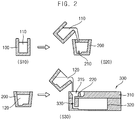
- FIG. 2 is a process schematic diagram illustrating the method of manufacturing heat resistant spheroidal graphite cast iron in accordance with example embodiments.
- a cast iron raw material may be melted in a melting furnace 100 to form a first molten cast iron 110 (S10).
- the first molten cast iron 110 may include cast iron ingredients such as carbon (C), silicon (Si), manganese (Mn), phosphorous (P) and sulfur (S).
- the first molten cast iron 110 may include carbon (C) in a range from about 3.2 weight percent (wt%) to about 3.4 wt%, silicon (Si) in a range from about 4.3 wt% to about 4.8 wt% and manganese (Mn) in a range from about 0.2 wt% to about 0.3 wt% based on a total weight of the manufactured heat resistant spheroidal graphite cast iron.
- Phosphorous (P) and sulfur (S) may be contained naturally in the raw material of the cast iron.
- the first molten cast iron 110 may include additional elements such as vanadium (V), chrome (Cr) and niobium (Nb).
- the first molten cast iron 110 may include vanadium (V) in a range from about 0.4 wt% to about 0.6 wt%, chrome (Cr) in a range from about 0.2 wt% to about 0.4 wt% and niobium (Nb) in a range from about 0.2 wt% to about 0.4 wt% based on the total weight of the manufactured heat resistant spheroidal graphite cast iron.
- the first molten cast iron 110 may include the cast iron ingredients, the additional elements and a remainder of iron (Fe).
- the cast iron ingredients and the additional elements may be formed as the first molten cast iron 110.
- the cast iron ingredients may be formed as an original molten cast iron, and then, the additional elements may be added to the original molten cast iron to form the first molten cast iron 110.
- a component analysis may be performed on the preliminary molten cast iron by a thermal analysis or a mass spectrometer and then a deficient ingredient may be added to form the first molten cast iron 110 having the above content ratios.
- the first molten cast iron 110 may be tapped into a ladle 200 (S20).
- Mg treatment that is, spheroidization process
- a first inoculation process may be performed using a first inoculant 210 concurrently with the tapping process.
- the first inoculant 210 may include a Fe-Si-based inoculant.
- a trace of barium (Ba) may be added in the first inoculation process.
- an amount of the barium (Ba) may be in a range from about 0.0045 wt% to about 0.0075 wt% based on the total weight of the manufactured heat resistant spheroidal graphite cast iron.
- the first inoculation process may be performed on the first molten cast iron 110 within the ladle 200 to obtain a second molten cast iron 120.
- a component analysis may be performed on the second molten cast iron 120 by a thermal analysis or a mass spectrometer and then a deficient ingredient may be added to obtain the above content ratios.
- a deficient ingredient which is dissipated during the tapping process may be compensated.
- the contents of chrome (Cr) and barium (Ba) may be adjusted precisely.
- a content ratio of chrome (Cr) and barium (Ba) (Cr/Ba) may be in a range from about 26 to about 89.
- the second molten cast iron 120 may be injected into a mold 300 (S30).
- a second inoculation process may be performed using a second inoculant 220 concurrently with the injecting process into the mold 300.
- the mold 300 may include an injection portion 310 and a mold body 320.
- the injection portion 310 may be integrally formed with the mold body 320.
- the second inoculation process may be performed using mold 310 having a pouring basin 315.
- the pouring basin 315 may be provided in the injection portion 310.
- the second molten cast iron 120 may stay temporarily in the pouring basin 315, and the second inoculant 220 may be disposed in the pouring basin 315.
- the second inoculant 220 may be formed from a material substantially the same as or similar to the first inoculants 210.
- the first inoculant 210 may include a Fe-Si-based inoculant.
- the second molten cast iron 120 may be transformed into a cast iron melting solution.
- the mold 300 may include an injection passage 330 through which a liquid flows from the pouring basin 315 into the mold body 320.
- the cast iron melting solution may be injected into the mold body 320 through the injection passage 330.
- the cast iron may be casted within the mold body 320 for a predetermined time, and then, may be cooled by a cooling process to manufacture a final heat resistant spheroidal graphite cast iron (S40).
- the heat resistant spheroidal graphite cast iron may be effectively implemented to an engine exhaust system component such as an exhaust manifold.
- conventional heat resistant spheroidal graphite cast iron was prepared based on compositions listed in Table 1 below.
- the conventional heat resistant spheroidal graphite cast iron was manufactured by processes similar to those of manufacturing heat resistant spheroidal graphite cast iron in accordance with example embodiments, except for addition of vanadium (V), chrome (Cr) and niobium (Nb).
- room temperature tensile strength and high temperature tensile strength (700°C, 800°C) of heat resistant spheroidal graphite cast iron in accordance with example embodiments and conventional heat resistant spheroidal graphite cast iron were measured.
- heat resistant spheroidal graphite cast iron in accordance with example embodiments has improved room temperature and high temperature tensile strength due to advanced alloy design technology when compared with the conventional heat resistant spheroidal graphite cast iron.
- Coefficient of thermal expansion and eutectoid transformation temperature of heat resistant spheroidal graphite cast iron for an engine exhaust system component in accordance with example embodiments were measured using dilatometer and Table 3 below shows measured results.
- a material technology capable of increasing the eutectoid temperature may be required to be developed.
- Silicon (Si) may be a main alloy element for increasing the eutectoid temperature, and carbide element such as chrome (Cr) and molybdenum (Mo) may assist in increasing the eutectoid temperature.
- heat resistant spheroidal graphite cast iron in accordance with example embodiments has improved eutectoid transformation temperature and low coefficient of thermal expansion when compared with the conventional heat resistant spheroidal graphite cast iron.
- Table 4 represents compositions and high temperature tensile strength (H.T.T.S) of heat resistant spheroidal graphite cast irons of Examples 1 to 7 (Ex. 1 to 7), and Comparative Examples 1 to 6 (C.E. 1 to 6). That is, heat resistant spheroidal graphite cast iron according to example embodiments and comparative examples include carbon (C), silicon (Si), manganese (Mn), phosphorous (P), sulfur (S), magnesium (Mg), molybdenum (Mo), chrome (Cr), niobium (Nb) and barium (Ba). In here, the content ratio of chrome (Cr) and barium (Ba) (Cr/Ba) was varied.
- the amount of chrome (Cr) was in range from about 0.2 wt% to about 0.4 wt%, and the content ratio of chrome (Cr) and barium (Ba) (Cr/Ba) was in a range from about 26 to about 89.
- Comparative Example 6 the amount of vanadium (V) was less than 0.4 wt%, and other elements were similar to Examples 1 to 5.
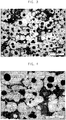
- FIGS. 3 and 4 are images illustrating microstructures of heat resistant spheroidal graphite cast iron in accordance with example embodiments.
- the heat resistant spheroidal graphite cast iron may include a ferrite structure (A) which occupies an area of about 50% or more in the images as shown in white and a pearlite structure (B) which occupies an area of about 40% or less in the images as shown in black.
- graphite (C) which is precipitated in the ferrite structure and has a spheroidal shape
- carbide (D) which is precipitated in the pearlite structure and is shown in a bright color, was observed.
- the carbide was chrome carbide, vanadium carbide and niobium carbide, and the carbide may improve high temperature material properties of the heat resistant spheroidal graphite cast iron.
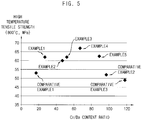
- FIG. 5 is a graph illustrating high temperature tensile strength at a temperature of 800 °C of heat resistant spheroidal graphite cast iron of Examples and Comparative Examples.
- high temperature tensile strength of the heat resistant spheroidal graphite cast iron may have a relatively high value of about 59 MPa or more at a temperature of about 800 °C.
- the heat resistant spheroidal graphite cast iron of Comparative Examples 1 to 3 has high temperature tensile strength of about 49 Mpa or less at a temperature of about 800 °C.
- chrome carbide may be increased over a proper content ratio, so that brittleness and machinability at a room temperature may be decreased and inoculation ability may be decreased. Consequently, the content ratio of chrome (Cr) and barium (Ba) of the second composition of the heat resistant spheroidal graphite cast iron may be controlled to thereby improve high temperature tensile strength by 20% or more.
- FIG. 6 illustrates an engine exhaust system including heat resistant spheroidal graphite cast iron in accordance with example embodiments.
- An engine exhaust system component may include an exhaust manifold 410 connected to an exhaust port (not illustrated) of a combustion chamber per each cylinder, a front pipe 420 coupled to a rear end of the exhaust manifold 410, and a vibration compensation device 430 installed in an outer periphery of the front pipe 420 and absorbing a vibration due to a shock wave during an exhaustion.
- the exhaust manifold 410 may contact a high temperature exhaust gas discharged from the combustion chamber, and thus may be required to have an excellent heat-resistance.
- the exhaust manifold 410 may include the heat resistant spheroidal graphite cast iron of the present inventive concepts.
- Heat resistant spheroidal graphite cast iron in accordance with example embodiments of the present inventive concepts may include vanadium (V), chrome (Cr) and niobium (Nb) as well as barium (Ba).
- the content ratio of chrome (Cr) and barium (Ba) may be controlled such that chrome carbide showing embrittlement at a room temperature may be prevented from being generated and graphite nucleation creation may be facilitated, to thereby provide the heat resistant spheroidal graphite cast iron having a stable material property and structure. Because the heat resistant spheroidal cast iron has an improved high temperature tensile strength, the heat resistant spheroidal graphite cast iron may be effectively implemented to the exhaust manifold in an engine exhaust system which operates under high temperature.
Landscapes
- Chemical & Material Sciences (AREA)
- Engineering & Computer Science (AREA)
- Mechanical Engineering (AREA)
- Materials Engineering (AREA)
- Metallurgy (AREA)
- Organic Chemistry (AREA)
- Health & Medical Sciences (AREA)
- Life Sciences & Earth Sciences (AREA)
- Analytical Chemistry (AREA)
- General Health & Medical Sciences (AREA)
- Physics & Mathematics (AREA)
- Biochemistry (AREA)
- General Physics & Mathematics (AREA)
- Immunology (AREA)
- Pathology (AREA)
- Food Science & Technology (AREA)
- Medicinal Chemistry (AREA)
- General Engineering & Computer Science (AREA)
- Combustion & Propulsion (AREA)
- Refinement Of Pig-Iron, Manufacture Of Cast Iron, And Steel Manufacture Other Than In Revolving Furnaces (AREA)
Abstract
Description
- This application claims priority under 35 USC § 119 to Korean Patent Application No.
10-2014-0028909, filed on March 12, 2014 - The present inventive concepts relate to heat resistant spheroidal graphite cast iron, a method of manufacturing the same, and an engine exhaust system including the same. More particularly, the present inventive concepts relate to heat resistant spheroidal graphite cast iron having a specific composition ratio and excellent high temperature material properties (for example, eutectoid transformation temperature and high temperature tensile strength), a method of manufacturing the same, and an engine exhaust system including the same.
- Recently, as demands for improved fuel efficiency are increased and environment-related restrictions are becoming strengthened globally, an engine operates with high power, resulting in an increase of a combustion temperature in an exhaust sytem component. As such, in order to meet continued demands for corresponding to the increased combustion temperature in a heat resistant part, a heat resistant material having an excellent heat resistant property is being developed necessarily.
- Heat resistant spheroidal graphite cast iron including silicon (Si) and molybdenum (Mo) is a representative material used for a vehicle exhaust system component which is required to have excellent high temperature properties. In order to increase eutectoid transformation temperature of the heat resistant spheroidal graphite cast iron and precipitate carbide at high temperature to maintain high strength, silicon (Si) content may be increased and a carbide forming element such as molybdenum (Mo) may be added, respectively.
- Especially, in order to maintain desired material properties at the combustion temperature of above 800 °C in the exhaust sytem, a heat resistant property may be required to have more excellent high temperature material property and lower coefficient of thermal expansion than a widely used Si-Mo based heat resistant spheroidal graphite cast iron.
- Studies have been conducted to improve a heat resistant property of a material based on the Si-Mo based heat resistant spheroidal graphite cast iron. Conventionally, in order to improve the heat resistant property, a carbide forming element and an additional alloy element was added, however, during alloy design about a selection of alloy element and an addition rate, quantitative reviews on precipitate prediction was insufficient. Thus, a development level of the conventional Si-Mo based heat resistant spheroidal graphite cast iron was low to the extent that high temperature tensile strength at 700 °C was about 70-80 Mpa and high temperature tensile strength at 800 °C was about 45-58 Mpa. In a conventional art, there was a limit to improve high temperature material properties such as high temperature tensile strength, and it was difficult to apply mass production because of matrix structure instability. Because an increase of high temperature tensile strength can greatly affect a product's stability, various researches are required to be conducted in order to improve high temperature material properties.
- To overcome the problems as discussed above, example embodiments provide heat resistant spheroidal graphite cast iron having an excellent heat resistant property.
- Example embodiments provide a method of manufacturing heat resistant spheroidal graphite cast iron having an excellent heat resistant property.
- Example embodiments provide an engine component and exhaust system including heat resistant spheroidal graphite cast iron having an excellent heat resistant property.
- According to example embodiments, in a method of manufacturing heat resistant spheroidal graphite cast iron, a molten cast iron is formed, the molten cast iron including carbon (C) in a range from about 3.2 weight percent to about 3.4 weight percent, silicon (Si) in a range from about 4.3 weight percent to about 4.8 weight percent, manganese (Mn) in a range from about 0.2 weight percent to about 0.3 weight percent, molybdenum (Mo) in a range from about 0.8 weight percent to about 1.0 weight percent, vanadium (V) in a range from about 0.4 weight percent to about 0.6 weight percent, chrome (Cr) in range from about 0.2 weight percent to about 0.4 weight percent, niobium (Nb) in a range from about 0.2 weight percent to about 0.4 weight percent, inevitable impurities, and a remainder of iron (Fe), based on a total weight. The molten cast iron is tapped into a ladle. The tapped molten cast iron is injected into a mold.
- In example embodiments, the method may further include, prior to injecting the tapped molten cast iron into the mold, adding barium (Ba) into the molten cast iron. A content ratio of chrome (Cr) and barium (Ba) (Cr/Ba) may be in a range from about 26 to about 89.
- In example embodiments, barium (Ba) may be in a range from about 0.0045 weight percent to about 0.0075 weight percent based on a total weight.
- In example embodiments, forming the molten cast iron may include forming an original molten cast iron including carbon (C) in a range from about 3.2 weight percent to about 3.4 weight percent, silicon (Si) in a range from about 4.3 weight percent to about 4.8 weight percent, manganese (Mn) in a range from about 0.2 weight percent to about 0.3 weight percent, inevitable impurities, and a remainder of iron (Fe), based on a total weight, and adding molybdenum (Mo) in a range from about 0.8 weight percent to about 1.0 weight percent, vanadium (V) in a range from about 0.4 weight percent to about 0.6 weight percent, chrome (Cr) in range from about 0.2 weight percent to about 0.4 weight percent and niobium (Nb) in a range from about 0.2 weight percent to about 0.4 weight percent, based on a total weight, into the original molten cast iron.
- In example embodiments, tapping the molten cast iron into the ladle may include adding a first inoculant into the molten cast iron. Injecting the tapped molten cast iron into the mold may include adding a second inoculant into the molten cast iron.
- In example embodiments, forming the molten cast iron may include forming a preliminary molten cast iron, analyzing the preliminary molten cast iron by a thermal analysis or a mass spectrometer, and adding a deficient ingredient into the preliminary molten cast iron.
- According to example embodiments, heat resistant spheroidal graphite cast iron includes carbon (C) in a range from about 3.2 weight percent to about 3.4 weight percent, silicon (Si) in a range from about 4.3 weight percent to about 4.8 weight percent, manganese (Mn) in a range from about 0.2 weight percent to about 0.3 weight percent, molybdenum (Mo) in a range from about 0.8 weight percent to about 1.0 weight percent, vanadium (V) in a range from about 0.4 weight percent to about 0.6 weight percent, chrome (Cr) in range from about 0.2 weight percent to about 0.4 weight percent, niobium (Nb) in a range from about 0.2 weight percent to about 0.4 weight percent, inevitable impurities, and a remainder of iron (Fe), based on a total weight of the heat resistant spheroidal graphite cast iron.
- In example embodiments, the heat resistant spheroidal graphite cast iron may have tensile strength of about 670 Mpa or more at a room temperature, and may have high temperature tensile strength of 100 Mpa or more at 700 °C and of 60 Mpa or more at 800 °C.
- In example embodiments, the heat resistant spheroidal graphite cast iron may have coefficient of thermal expansion of about 13.5 µm/m·°C or less, and may have eutectoid transformation temperature of from about 920 °C to about 940 °C.
- In example embodiments, the heat resistant spheroidal graphite cast iron may further include barium (Ba) in a range from about 0.0045 weight percent to about 0.0075 weight percent. A content ratio of chrome (Cr) and barium (Ba) (Cr/Ba) may be in a range from about 26 to about 89.
- In example embodiments, the heat resistant spheroidal graphite cast iron may have high temperature tensile strength of from 59 Mpa to 70 Mpa at 800 °C.
- In example embodiments, the heat resistant spheroidal graphite cast iron may include a ferrite structure occupying an area of about 50% or more in a total area.
- According to example embodiments, an engine exhaust system includes an exhaust manifold having the above-mentioned heat resistant spheroidal graphite cast.
- According to example embodiments of the present inventive concepts, heat resistant spheroidal graphite cast iron may include additional elements such as vanadium (V), chrome (Cr) and niobium (Nb) capable of forming carbide. The content of the additional elements may be precisely controlled to improve high temperature material properties such as high temperature tensile strength without reducing ductility. In addition, the heat resistant spheroidal graphite cast iron may further include barium (Ba) in addition to vanadium (V), chrome (Cr) and niobium (Nb). Especially, a content ratio of chrome (Cr) and barium (Ba) may controlled such that chrome carbide showing embrittlement at a room temperature may be prevented from being generated and graphite nucleation creation may be facilitated, to thereby provide the heat resistant spheroidal graphite cast iron having a stable material property and structure. Because the heat resistant spheroidal cast iron has an improved high temperature tensile strength, the heat resistant spheroidal graphite cast iron may be effectively implemented to an exhaust manifold in an engine exhaust system which operates under high temperature.
- Example embodiments will be more clearly understood from the following detailed description taken in conjunction with the accompanying drawings which represent non-limiting, example embodiments as described herein.
-
FIG. 1 is a flow chart illustrating a method of manufacturing heat resistant spheroidal graphite cast iron in accordance with example embodiments; -
FIG. 2 is a process schematic diagram illustrating the method of manufacturing heat resistant spheroidal graphite cast iron in accordance with example embodiments; -
FIGS. 3 and 4 are optical microscope images illustrating microstructures of heat resistant spheroidal graphite cast iron in accordance with example embodiments; -
FIG. 5 is a graph illustrating high temperature tensile strength at a temperature of 800 °C of heat resistant spheroidal graphite cast iron of Examples and Comparative Examples; and -
FIG. 6 illustrates an engine exhaust system including a heat resistant spheroidal graphite cast iron in accordance with example embodiments. - Various example embodiments will be described. The present inventive concept may, however, be embodied in many different forms and should not be construed as limited to the example embodiments set forth herein. Rather, these example embodiments are provided so that this description will be thorough and complete, and will fully convey the scope of the present inventive concept to those skilled in the art.
- Since many modifications are possible in example embodiments, a few example embodiments will be described with reference to the accompanying drawings. However, many modifications are possible in example embodiments without materially departing from the novel teachings and advantages of the present invention. Accordingly, all such modifications are intended to be included within the scope of the present inventive concepts.
- According to example embodiments of the present inventive concepts, vanadium (V), chrome (Cr) and niobium (Nb) may be added to Si-Mo based heat resistant spheroidal graphite cast iron, and a content ratio of vanadium (V), chrome (Cr) and niobium (Nb) may be controlled to thereby provide heat resistant spheroidal graphite cast iron having an excellent high temperature material property. Further, barium (Ba) may be additionally added to the spheroidal cast iron and a content ratio of barium and chrome may controlled to thereby improve a high temperature material property such as high temperature tensile strength.
- Hereinafter, chemical composition of a spheroidal graphite cast iron in accordance with example embodiments and methods of manufacturing the spheroidal graphite cast iron will be described.
- According to example embodiments, a first composition of heat resistant spheroidal graphite cast iron may include some additional elements in addition to elements of the Si-Mo based heat resistant spheroidal graphite cast iron, thereby achieving an improved heat resistant property.
- For example, the Si-Mo based heat resistant spheroidal graphite cast iron may include iron (Fe), carbon (C), silicon (Si), molybdenum (Mo), phosphorous (P) and sulfur (S). In here, an amount of silicon (Si) may be limited so as to prevent graphite shape defects due to high silicon content.
- Examples of the additional elements may be vanadium (V), chrome (Cr), niobium (Nb), etc. The amount of vanadium (V), chrome (Cr) and niobium (Nb) may be determined in consideration of improvement effect of the heat resistant property, solid solubility thereof, etc. That is, the amount of vanadium (V), chrome (Cr) and niobium (Nb) may be an important factor in determining the heat resistant property of the heat resistant spheroidal graphite cast iron.
- Hereinafter, the amount of each element may be referred to as weight percent (wt%) based on a total weight of the heat resistant spheroidal graphite cast iron.
- The heat resistant spheroidal graphite cast iron according to example embodiments may include carbon (C) in a range from about 3.2 weight percent (wt%) to about 3.4 wt%, silicon (Si) in a range from about 4.3 wt% to about 4.8 wt%, manganese (Mn) in a range from about 0.2 wt% to about 0.3 wt%, molybdenum (Mo) in a range from about 0.8 wt% to about 1.0 wt%, vanadium (V) in a range from about 0.4 wt% to about 0.6 wt%, chrome (Cr) in a range from about 0.2 wt% to about 0.4 wt%, niobium (Nb) in a range from about 0.2 wt% to about 0.4 wt%, and a remainder of iron (Fe), based on a total weight of the spheroidal graphite cast iron.
- On the other hand, since phosphorous (P) and sulfur (S) are contained in a raw material of the heat resistant spheroidal graphite cast iron, a trace of phosphorous (P) and sulfur (S) may remain naturally in the heat resistant spheroidal graphite cast iron even through these elements (P, S) are not added. Additionally, magnesium (Mg) may be added during Mg treatment (that is, spheroidization process) in manufacturing of the heat resistant spheroidal graphite cast iron.
- Hereinafter, each element contained in the heat resistant spheroidal graphite cast iron and an amount of each element will be described in more detail.
- Silicon (Si) may increase a crystallized amount of graphite by carbon (C) and may be effective in inducing a matrix of ferrite. Additionally, silicon content of the heat resistant spheroidal graphite cast iron may be increased to thereby improve a heat resistant property and oxidation-resistive property. If an amount of silicon (Si) in the heat resistant spheroidal graphite cast iron according to example embodiments is less than about 4.3 wt%, eutectoid transformation temperature may be decreased. If the amount of silicon (Si) exceeds about 4.8 wt%, castability and fluidity may be reduced.
- Manganese (Mn) may be one of the basic essentials. This may be because manganese (Mn) reacts with sulfur (S) contained essentially in the raw material of the heat resistant spheroidal graphite cast iron and fixes sulfur (S) as a form of MnS, thereby suppressing adverse effects of sulfur (S). Additionally, the ferrite inducement of the matrix may be strengthened by solid solution strengthening, and creation of carbide may be increased to thereby facilitate a precipitation of pearlite in the matrix. In low oxygen (low O) and low sulfur (low S) heat resistant spheroidal graphite cast iron, even though manganese (Mn) content is increased, a deterioration of ductility may be small. In the heat resistant spheroidal graphite cast iron in accordance with example embodiments, if the amount of manganese (Mn) exceeds about 0.3 wt%, the precipitation of pearlite in the matrix may be facilitated excessively, and thus, brittleness may be drastically increased and workability may be deteriorated.
- Molybdenum (Mo) may reinforce tensile strength and yield strength at a high temperature, thereby improving thermal crack resistance, like nickel (Ni). Additionally, molybdenum (Mo) may improve mechanical properties such as heat resistant crackability, like vanadium (V). In the heat resistant spheroidal graphite cast iron in accordance with example embodiments, if the amount of molybdenum (Mo) is less than about 0.8%, an improvement effect of heat resistant property may not be sufficiently achieved. If the amount of molybdenum (Mo) exceeds about 1.0 wt%, elongation percentage may be decreased and hardness may be increased by increased ratios of carbide and pearlite, and thus, machinabilty may be deteriorated.
- Chrome (Cr) may improve thermal crack resistance due to an oxidation-resistive property improvement and a strengthening of the matrix of pearlite. That is, chrome (Cr) may be added to achieve improvement of oxidation-resistive property and high temperature tensile strength, in order for a use in a high temperature. In the heat resistant spheroidal graphite cast iron in accordance with example embodiments, if the amount of chrome (Cr) is less than about 0.2%, an improvement effect of heat resistant property and oxidation-resistive property may not be achieved. If the amount of chrome (Cr) exceeds about 0.4 wt%, hardness may be increased by increased ratios of carbide, and thus, machinabilty may be deteriorated and fluidity may be reduced.
- Vanadium (V) may improve strength at a range of from a room temperature to a high temperature of about 850 °C. Vanadium (V) may create a fine vanadium carbide (VC) having a high melting point in a ferrite matrix to prevent strain due to stress at a high temperature, to thereby improve high temperature tensile strength. Specifically, vanadium (V) in the range from about 0.4 wt% to about 0.6 wt% may improve the high temperature tensile strength without reducing ductility. If an amount of vanadium (V) exceeds about 0.6 wt%, coarse vanadium carbide may be segregated between process cells to increase hardness and brittleness without improving the high temperature tensile strength.
- Niobium (Nb) may refine a grain, and improve mechanical properties such as tensile strength, impact strength, etc. Specifically, niobium (Nb) may have a good affinity to carbon or nitrogen to induce a precipitation of carbide such as niobium carbide in a cast iron, and may suppress a phase transition of ostenite and ferrite (γ/α).
- The heat resistant spheroidal graphite cast iron according to example embodiments may include vanadium (V), chrome (Cr) and niobium (Nb), when compared with a conventional cast iron. Vanadium (V), chrome (Cr) and niobium (Nb) may precipitate carbide or carbonitride, to improve heat resistant property of the spheroidal graphite cast iron.
- Second composition of heat resistant spheroidal graphite cast iron
- According to example embodiments, a second composition of heat resistant spheroidal graphite cast iron may include an additional element in addition to elements of the first composition of heat resistant spheroidal graphite cast iron as mentioned above. For example, the additional element may be barium (Ba).
- Thus, the second composition of the heat resistant spheroidal graphite cast iron may include carbon (C) in a range from about 3.2 weight percent (wt%) to about 3.4 wt%, silicon (Si) in a range from about 4.3 wt% to about 4.8 wt%, manganese (Mn) in a range from about 0.2 wt% to about 0.3 wt%, molybdenum (Mo) in a range from about 0.8 wt% to about 1.0 wt%, vanadium (V) in a range from about 0.4 wt% to about 0.6 wt%, chrome (Cr) in a range from about 0.2 wt% to about 0.4 wt%, niobium (Nb) in a range from about 0.2 wt% to about 0.4 wt%, barium (Ba) in a range from about 0.0045 wt% to about 0.0075 wt% and a remainder of iron (Fe), based on a total weight of the spheroidal graphite cast iron. In here, a trace amount of barium (Ba) may be used as an ingredient of the cast iron, and a content ratio of chrome (Cr) and barium (Ba) (Cr/Ba) may be in a range from about 26 to about 89. The content of barium may be detected by ICP (inductively coupled plasma) chemical analysis.
- When the amounts of chrome (Cr) and barium (Ba) in the cast iron may be controlled in a specific range, inoculation ability may be maximized and they may serve as a nucleation site of spheroidal graphite to suppress a chill phenomenon and assist growth and precipitation of a robust graphite, to thereby achieve excellent high temperature tensile strength and machinability.
- Hereinafter, barium (Ba) contained in the heat resistant spheroidal graphite cast iron and an amount of barium will be described in more detail.
- Barium (Ba) may delay and prevent a fading behavior generated in manufacturing of the heat resistant spheroidal graphite cast iron and crystallize a larger number of spheroidal graphite. If an amount of barium (Ba) is less than about 0.0045%, crystallization of oxide may be mainly induced and graphite forming ability may be decreased to thereby facilitate a chill phenomenon. If the amount of barium (Ba) exceeds about 0.0075 wt%, the number of eutectic cells may be reduced, effects on the inoculation may be decreased, and a fading preventing effect may be reduced.
- Barium (Ba) may improve thermal crack resistance due to an oxidation-resistive property improvement and a strengthening of the matrix of pearlite. That is, barium (Ba) may be added to achieve improvement of oxidation-resistive property and high temperature tensile strength, in order for a use in a high temperature. In the heat resistant spheroidal graphite cast iron in accordance with example embodiments, if the amount of chrome (Cr) is less than about 0.2%, an improvement effect of heat resistant property and oxidation-resistive property may not be achieved. If the amount of chrome (Cr) exceeds about 0.4 wt%, hardness may be increased by increased ratios of carbide, and thus, machinabilty may be deteriorated and fluidity may be reduced.
- In addition, the content ratio of chrome (Cr) and barium (Ba) (Cr/Ba) may be limited to be in a range from about 26 to about 89. If the content ratio (Cr/Ba) is outside the range 26 - 89, high temperature tensile strength may be decreased, and machinabilty and fluidity may be deteriorated due to supersaturated chrome carbide. On the other hand, since phosphorous (P) and sulfur (S) are contained in a raw material of the heat resistant spheroidal graphite cast iron, a trace of phosphorous (P) and sulfur (S) may remain naturally in the heat resistant spheroidal graphite cast iron even through these elements (P, S) are not added. Further, magnesium (Mg) may be added during Mg treatment in manufacturing of the heat resistant spheroidal graphite cast iron.
- The heat resistant spheroidal graphite cast iron in accordance with example embodiments may include barium (Ba) in addition to vanadium (V), chrome (Cr) and niobium (Nb). The content ratio of chrome (Cr) and barium (Ba) may be controlled such that chrome carbide showing embrittlement at a room temperature may be prevented from being generated and graphite nucleation creation may be facilitated, to thereby provide heat resistant spheroidal graphite cast iron having a stable material property and structure.
-
FIG. 1 is a flow chart illustrating a method of manufacturing heat resistant spheroidal graphite cast iron in accordance with example embodiments.FIG. 2 is a process schematic diagram illustrating the method of manufacturing heat resistant spheroidal graphite cast iron in accordance with example embodiments. - Referring to
FIGS. 1 and2 , a cast iron raw material may be melted in amelting furnace 100 to form a first molten cast iron 110 (S10). - In example embodiments, the first
molten cast iron 110 may include cast iron ingredients such as carbon (C), silicon (Si), manganese (Mn), phosphorous (P) and sulfur (S). The firstmolten cast iron 110 may include carbon (C) in a range from about 3.2 weight percent (wt%) to about 3.4 wt%, silicon (Si) in a range from about 4.3 wt% to about 4.8 wt% and manganese (Mn) in a range from about 0.2 wt% to about 0.3 wt% based on a total weight of the manufactured heat resistant spheroidal graphite cast iron. Phosphorous (P) and sulfur (S) may be contained naturally in the raw material of the cast iron. - In example embodiments, the first
molten cast iron 110 may include additional elements such as vanadium (V), chrome (Cr) and niobium (Nb). In some embodiments, the firstmolten cast iron 110 may include vanadium (V) in a range from about 0.4 wt% to about 0.6 wt%, chrome (Cr) in a range from about 0.2 wt% to about 0.4 wt% and niobium (Nb) in a range from about 0.2 wt% to about 0.4 wt% based on the total weight of the manufactured heat resistant spheroidal graphite cast iron. - The first
molten cast iron 110 may include the cast iron ingredients, the additional elements and a remainder of iron (Fe). - In some embodiments, the cast iron ingredients and the additional elements may be formed as the first
molten cast iron 110. In other embodiments, the cast iron ingredients may be formed as an original molten cast iron, and then, the additional elements may be added to the original molten cast iron to form the firstmolten cast iron 110. - In example embodiments, after a preliminary
molten cast iron 110 may be formed, a component analysis may be performed on the preliminary molten cast iron by a thermal analysis or a mass spectrometer and then a deficient ingredient may be added to form the firstmolten cast iron 110 having the above content ratios. - Then, the first
molten cast iron 110 may be tapped into a ladle 200 (S20). During the tapping process, Mg treatment (that is, spheroidization process) may be performed and a first inoculation process may be performed using afirst inoculant 210 concurrently with the tapping process. - In example embodiments, the
first inoculant 210 may include a Fe-Si-based inoculant. In some embodiments, a trace of barium (Ba) may be added in the first inoculation process. For example, an amount of the barium (Ba) may be in a range from about 0.0045 wt% to about 0.0075 wt% based on the total weight of the manufactured heat resistant spheroidal graphite cast iron. - The first inoculation process may be performed on the first
molten cast iron 110 within theladle 200 to obtain a secondmolten cast iron 120. - In some embodiments, a component analysis may be performed on the second
molten cast iron 120 by a thermal analysis or a mass spectrometer and then a deficient ingredient may be added to obtain the above content ratios. Thus, the deficient ingredient which is dissipated during the tapping process may be compensated. For example, the contents of chrome (Cr) and barium (Ba) may be adjusted precisely. A content ratio of chrome (Cr) and barium (Ba) (Cr/Ba) may be in a range from about 26 to about 89. - Then, the second
molten cast iron 120 may be injected into a mold 300 (S30). In example embodiments, a second inoculation process may be performed using asecond inoculant 220 concurrently with the injecting process into themold 300. - The
mold 300 may include aninjection portion 310 and amold body 320. Theinjection portion 310 may be integrally formed with themold body 320. - In some embodiments, the second inoculation process may be performed using
mold 310 having a pouringbasin 315. The pouringbasin 315 may be provided in theinjection portion 310. The secondmolten cast iron 120 may stay temporarily in the pouringbasin 315, and thesecond inoculant 220 may be disposed in the pouringbasin 315. - The
second inoculant 220 may be formed from a material substantially the same as or similar to thefirst inoculants 210. For example, thefirst inoculant 210 may include a Fe-Si-based inoculant. - As the second inoculation process may be performed using the
second inoculant 220, the secondmolten cast iron 120 may be transformed into a cast iron melting solution. - In some embodiments, the
mold 300 may include aninjection passage 330 through which a liquid flows from the pouringbasin 315 into themold body 320. The cast iron melting solution may be injected into themold body 320 through theinjection passage 330. - Then, the cast iron may be casted within the
mold body 320 for a predetermined time, and then, may be cooled by a cooling process to manufacture a final heat resistant spheroidal graphite cast iron (S40). The heat resistant spheroidal graphite cast iron may be effectively implemented to an engine exhaust system component such as an exhaust manifold. - First, in manufacturing of the heat resistant spheroidal graphite cast iron, according to the compositions of Table 1, an original molten metal containing carbon (C), silicon (Si), manganese (Mn), sulfur (S) and phosphorous (P) was prepared. Additionally, molybdenum (Mo) in a range from about 0.8 wt% to about 1.0 wt%, vanadium (V) in a range from about 0.4 wt% to about 0.6 wt%, chrome (Cr) in a range from about 0.2 wt% to about 0.4 wt% and niobium (Nb) in a range from about 0.2 wt% to about 0.4 wt% may be added to the molten cast iron. Before tapping the molten cast iron, content of each elements were adjusted using a spectrometer based on compositions listed in Table 1 below.
- Then, during the tapping process, Mg treatment was performed, and a Fe-Si based inoculant was injected concurrently with the tapping. After the tapping was finished into a ladle, a temperature of a molten metal was measured, and the molten metal was injected into a mold. A second inoculation was performed concurrently with the injection into the mold, to manufacture heat resistant spheroidal graphite cast iron.
- On the other hand, conventional heat resistant spheroidal graphite cast iron was prepared based on compositions listed in Table 1 below. The conventional heat resistant spheroidal graphite cast iron was manufactured by processes similar to those of manufacturing heat resistant spheroidal graphite cast iron in accordance with example embodiments, except for addition of vanadium (V), chrome (Cr) and niobium (Nb).
Table 1 weight percent (wt%) C Si Mn Mg Mo V Cr Nb conventional heat resistant spheroidal graphite cast iron 2.8-3.7 4.0-4.5 <0.35 >0.025 0.8-1.2 - - - heat resistant spheroidal graphite cast iron according to example embodiments 3.2-3.4 4.3-4.8 0.2-0.3 0.035-0.05 0.8-1.0 0.4-0.6 0.2-0.4 0.2-0.4 - Then, room temperature tensile strength and high temperature tensile strength (700°C, 800°C) of heat resistant spheroidal graphite cast iron in accordance with example embodiments and conventional heat resistant spheroidal graphite cast iron were measured. As listed in Table 2, heat resistant spheroidal graphite cast iron in accordance with example embodiments has improved room temperature and high temperature tensile strength due to advanced alloy design technology when compared with the conventional heat resistant spheroidal graphite cast iron.
Table 2 material mechanical properties room temperature tensile strength (MPa) high temperature tensile strength (MPa) 700 °C 800 °C conventional heat resistant spheroidal graphite cast iron 632 82-92 43-55 heat resistant spheroidal graphite cast iron according to example embodiments 671 107 66 - Coefficient of thermal expansion and eutectoid transformation temperature of heat resistant spheroidal graphite cast iron for an engine exhaust system component in accordance with example embodiments were measured using dilatometer and Table 3 below shows measured results. When an engine exhaust system component is heated to reach the eutectoid temperature, eutectoid transformation may occur to cause damage to the product due to lattice change. Therefore, a material technology capable of increasing the eutectoid temperature may be required to be developed. Silicon (Si) may be a main alloy element for increasing the eutectoid temperature, and carbide element such as chrome (Cr) and molybdenum (Mo) may assist in increasing the eutectoid temperature. Accordingly, heat resistant spheroidal graphite cast iron in accordance with example embodiments has improved eutectoid transformation temperature and low coefficient of thermal expansion when compared with the conventional heat resistant spheroidal graphite cast iron.
Table 3 material mechanical properties coefficient of thermal expansion (µm/m· °C) eutectoid transformation temperature (E.T.T) conventional heat resistant spheroidal graphite cast iron 14.7 878 °C heat resistant spheroidal graphite cast iron according to example embodiments 13.2 935 °C - Table 4 represents compositions and high temperature tensile strength (H.T.T.S) of heat resistant spheroidal graphite cast irons of Examples 1 to 7 (Ex. 1 to 7), and Comparative Examples 1 to 6 (C.E. 1 to 6). That is, heat resistant spheroidal graphite cast iron according to example embodiments and comparative examples include carbon (C), silicon (Si), manganese (Mn), phosphorous (P), sulfur (S), magnesium (Mg), molybdenum (Mo), chrome (Cr), niobium (Nb) and barium (Ba). In here, the content ratio of chrome (Cr) and barium (Ba) (Cr/Ba) was varied. In Examples 1 to 7, the amount of chrome (Cr) was in range from about 0.2 wt% to about 0.4 wt%, and the content ratio of chrome (Cr) and barium (Ba) (Cr/Ba) was in a range from about 26 to about 89.
- On the other hand, when the amount of barium (Ba) was less than 0.0045 wt% or more than 0.0075 wt% in Comparative Examples 1 to 3, high temperature tensile strength was relatively low.
- In Comparative Examples 4 and 5, high temperature tensile strength was relatively low when compared with the present inventive concepts.
- In Comparative Example 6, the amount of vanadium (V) was less than 0.4 wt%, and other elements were similar to Examples 1 to 5.
- In Comparative Examples 7 and 8, the amounts of chrome (Cr) were 0.13 wt% and 0.72 wt%, respectively. In this case, high temperature tensile strength was relatively low when compared with the present inventive concepts.
- In Comparative Examples 9 to 11, the amounts of niobium (Nb) were 0.12 wt%, 0.52 wt% and 0.78 wt% respectively. In this case, high temperature tensile strength was relatively low when compared with the present inventive concepts.
Table 4 C Si Mn P S Mg Mo V Cr Nb Ba Cr/ Ba H.T. T.S /MPa E.T. T (°C) Ex.1 3.23 4.68 0.21 0.021 0.007 0.045 0.93 0.53 0.2 0.24 0.0075 27 62 921 Ex.2 3.25 4.71 0.22 0.025 0.006 0.043 0.87 0.52 0.24 0.35 0.0051 47 60 924 Ex.3 3.24 4.80 0.22 0.024 0.007 0.037 0.94 0.55 0.32 0.35 0.0061 52 62 935 Ex.4 3.20 4.67 0.24 0.026 0.008 0.039 1.0 0.57 0.36 0.4 0.0054 67 67 920 Ex.5 3.25 4.72 0.27 0.024 0.007 0.04 0.85 0.56 0.4 0.29 0.0045 89 63 930 C.E.1 3.24 4.4 0.24 0.026 0.007 0.046 0.95 0.51 0.26 0.33 0.015 17 53 910 C.E.2 3.28 4.65 0.22 0.022 0.006 0.041 0.96 0.56 0.31 0.32 0.0032 97 52 918 C.E.3 3.25 4.52 0.21 0.025 0.007 0.043 0.99 0.52 0.32 0.28 0.0027 118 49 912 C.E.4 3.27 4.02 0.23 0.024 0.007 0.04 0.95 0.51 0.28 0.32 0.0062 45 47 873 C.E.5 3.37 4.57 0.25 0.024 0.006 0.047 0.71 0.54 0.24 0.26 0.0058 41 43 904 C.E.6 3.27 4.41 0.25 0.027 0.005 0.045 0.87 0.38 0.22 0.34 0.0068 32 45 897 C.E.7 3.29 4.43 0.22 0.025 0.008 0.042 0.96 0.57 0.13 0.35 0.0047 28 42 903 C.E.8 3.27 4.52 0.26 0.022 0.007 0.048 0.97 0.52 0.72 0.3 0.0054 133 43 909 C.E.9 3.3 4.58 0.21 0.024 0.006 0.036 0.89 0.55 0.35 0.12 0.0068 51 44 910 C.E. 10 3.25 4.38 0.24 0.027 0.008 0.042 0.90 0.58 0.28 0.52 0.0049 57 42 893 C.E. 11 3.22 4.72 0.23 0.026 0.009 0.046 0.97 0.54 0.27 0.78 0.007 39 46 925 -
FIGS. 3 and 4 are images illustrating microstructures of heat resistant spheroidal graphite cast iron in accordance with example embodiments. - Referring to
FIGS. 3 and 4 , the heat resistant spheroidal graphite cast iron may include a ferrite structure (A) which occupies an area of about 50% or more in the images as shown in white and a pearlite structure (B) which occupies an area of about 40% or less in the images as shown in black. InFIGS. 3 and 4 , graphite (C), which is precipitated in the ferrite structure and has a spheroidal shape, was observed and carbide (D), which is precipitated in the pearlite structure and is shown in a bright color, was observed. The carbide was chrome carbide, vanadium carbide and niobium carbide, and the carbide may improve high temperature material properties of the heat resistant spheroidal graphite cast iron. -
FIG. 5 is a graph illustrating high temperature tensile strength at a temperature of 800 °C of heat resistant spheroidal graphite cast iron of Examples and Comparative Examples. Referring toFIG. 5 and Table. 4, when the amount of chrome (Cr) is in a range from about 0.2 wt% to about 0.4 wt% and the content ratio of chrome (Cr) and barium (Br) (Cr/Ba) is in a range from about 26 to about 89, high temperature tensile strength of the heat resistant spheroidal graphite cast iron may have a relatively high value of about 59 MPa or more at a temperature of about 800 °C. On the other hand, the heat resistant spheroidal graphite cast iron of Comparative Examples 1 to 3 has high temperature tensile strength of about 49 Mpa or less at a temperature of about 800 °C. Especially, when the content ratio of chrome (Cr) and barium (Br) (Cr/Ba) exceeds about 89, chrome carbide may be increased over a proper content ratio, so that brittleness and machinability at a room temperature may be decreased and inoculation ability may be decreased. Consequently, the content ratio of chrome (Cr) and barium (Ba) of the second composition of the heat resistant spheroidal graphite cast iron may be controlled to thereby improve high temperature tensile strength by 20% or more. -
FIG. 6 illustrates an engine exhaust system including heat resistant spheroidal graphite cast iron in accordance with example embodiments. - An engine exhaust system component may include an
exhaust manifold 410 connected to an exhaust port (not illustrated) of a combustion chamber per each cylinder, afront pipe 420 coupled to a rear end of theexhaust manifold 410, and avibration compensation device 430 installed in an outer periphery of thefront pipe 420 and absorbing a vibration due to a shock wave during an exhaustion. - Particularly, the
exhaust manifold 410 may contact a high temperature exhaust gas discharged from the combustion chamber, and thus may be required to have an excellent heat-resistance. According to example embodiments, theexhaust manifold 410 may include the heat resistant spheroidal graphite cast iron of the present inventive concepts. - Heat resistant spheroidal graphite cast iron in accordance with example embodiments of the present inventive concepts may include vanadium (V), chrome (Cr) and niobium (Nb) as well as barium (Ba). In addition, the content ratio of chrome (Cr) and barium (Ba) may controlled such that chrome carbide showing embrittlement at a room temperature may be prevented from being generated and graphite nucleation creation may be facilitated, to thereby provide the heat resistant spheroidal graphite cast iron having a stable material property and structure. Because the heat resistant spheroidal cast iron has an improved high temperature tensile strength, the heat resistant spheroidal graphite cast iron may be effectively implemented to the exhaust manifold in an engine exhaust system which operates under high temperature.
- The foregoing is illustrative of example embodiments and is not to be construed as limiting thereof. Although a few example embodiments have been described, those skilled in the art will readily appreciate that many modifications are possible in example embodiments without materially departing from the novel teachings and advantages of the present invention. Accordingly, all such modifications are intended to be included within the scope of example embodiments as defined in the claims.
- * Description of Reference numerals
- 100: melting furnace 110: first molten cast iron
- 120: second molten cast iron 200: ladle
- 210: first inoculant 220: second incoulant
- 300: mold 310: injection portion
- 315: pouring basin 320: mold body
- 330: injection passage 410: exhaust manifold
- 420: front pipe 430: vibration compensation device
Claims (13)
- A heat resistant spheroidal graphite cast iron for an engine component, comprising:carbon (C) in a range from about 3.2 weight percent to about 3.4 weight percent, silicon (Si) in a range from about 4.3 weight percent to about 4.8 weight percent, manganese (Mn) in a range from about 0.2 weight percent to about 0.3 weight percent, molybdenum (Mo) in a range from about 0.8 weight percent to about 1.0 weight percent, vanadium (V) in a range from about 0.4 weight percent to about 0.6 weight percent, chrome (Cr) in range from about 0.2 weight percent to about 0.4 weight percent, niobium (Nb) in a range from about 0.2 weight percent to about 0.4 weight percent, inevitable impurities, and a remainder of iron (Fe), based on a total weight of the heat resistant spheroidal graphite cast iron.
- The heat resistant spheroidal graphite cast iron of claim 1, wherein the heat resistant spheroidal graphite cast iron has tensile strength of about 670 Mpa or more at a room temperature, and has high temperature tensile strength of 100 Mpa or more at 700 °C and of 60 Mpa or more at 800 °C.
- The heat resistant spheroidal graphite cast iron of claim 1, wherein the heat resistant spheroidal graphite cast iron has coefficient of thermal expansion of about 13.5 µm/m· °C or less, and has eutectoid transformation temperature of from about 920 °C to about 940 °C.
- The heat resistant spheroidal graphite cast iron of claim 1, further comprising barium (Ba) in a range from about 0.0045 weight percent to about 0.0075 weight percent, and
wherein a content ratio of chrome (Cr) and barium (Ba) (Cr/Ba) is in a range from about 26 to about 89. - The heat resistant spheroidal graphite cast iron of claim 4, wherein the heat resistant spheroidal graphite cast iron has high temperature tensile strength of from 59 Mpa to 70 Mpa at 800 °C.
- The heat resistant spheroidal graphite cast iron of claim 1, wherein the heat resistant spheroidal graphite cast iron comprises a ferrite structure occupying an area of about 50% or more in a total area.
- A component of engine exhaust system comprising the heat resistant spheroidal graphite cast iron according to claim 1 or 4.
- A method of manufacturing heat resistant spheroidal graphite cast iron, comprising:forming a molten cast iron including carbon (C) in a range from about 3.2 weight percent to about 3.4 weight percent, silicon (Si) in a range from about 4.3 weight percent to about 4.8 weight percent, manganese (Mn) in a range from about 0.2 weight percent to about 0.3 weight percent, molybdenum (Mo) in a range from about 0.8 weight percent to about 1.0 weight percent, vanadium (V) in a range from about 0.4 weight percent to about 0.6 weight percent, chrome (Cr) in range from about 0.2 weight percent to about 0.4 weight percent, niobium (Nb) in a range from about 0.2 weight percent to about 0.4 weight percent, inevitable impurities, and a remainder of iron (Fe), based on a total weight;tapping the molten cast iron into a ladle; andinjecting the tapped molten cast iron into a mold.
- The method of claim 8, further comprising, prior to injecting the tapped molten cast iron into the mold, adding barium (Ba) into the molten cast iron, wherein a content ratio of chrome (Cr) and barium (Ba) (Cr/Ba) is in a range from about 26 to about 89.
- The method of claim 8, wherein barium (Ba) is in a range from about 0.0045 weight percent to about 0.0075 weight percent based on a total weight.
- The method of claim 8, wherein forming the molten cast iron comprises
forming an original molten cast iron including carbon (C) in a range from about 3.2 weight percent to about 3.4 weight percent, silicon (Si) in a range from about 4.3 weight percent to about 4.8 weight percent, manganese (Mn) in a range from about 0.2 weight percent to about 0.3 weight percent, inevitable impurities, and a remainder of iron (Fe), based on a total weight; and
adding molybdenum (Mo) in a range from about 0.8 weight percent to about 1.0 weight percent, vanadium (V) in a range from about 0.4 weight percent to about 0.6 weight percent, chrome (Cr) in range from about 0.2 weight percent to about 0.4 weight percent and niobium (Nb) in a range from about 0.2 weight percent to about 0.4 weight percent, based on a total weight, into the original molten cast iron. - The method of claim 8, wherein tapping the molten cast iron into the ladle comprises adding a first inoculants into the molten cast iron, and wherein injecting the tapped molten cast iron into the mold comprises adding a second inoculant into the molten cast iron.
- The method of claim 8, wherein forming the molten cast iron comprises
forming a preliminary molten cast iron;
analyzing the preliminary molten cast iron by a thermal analysis or a mass spectrometer; and
adding a deficient ingredient into the preliminary molten cast iron.
Applications Claiming Priority (2)
| Application Number | Priority Date | Filing Date | Title |
|---|---|---|---|
| KR1020140028909A KR102148756B1 (en) | 2014-03-12 | 2014-03-12 | Heat-resistant spherical graphite cast iron, methods of preparing spherical graphite cast iron and exhaust system part including spherical graphite cast iron |
| PCT/KR2015/001253 WO2015137627A1 (en) | 2014-03-12 | 2015-02-06 | Heat-resistant spherical graphite cast iron, method for producing same and engine exhaust system comprising same |
Publications (3)
| Publication Number | Publication Date |
|---|---|
| EP3118340A1 true EP3118340A1 (en) | 2017-01-18 |
| EP3118340A4 EP3118340A4 (en) | 2017-08-23 |
| EP3118340B1 EP3118340B1 (en) | 2019-04-10 |
Family
ID=54072023
Family Applications (1)
| Application Number | Title | Priority Date | Filing Date |
|---|---|---|---|
| EP15760658.3A Active EP3118340B1 (en) | 2014-03-12 | 2015-02-06 | Heat-resistant spherical graphite cast iron, method for producing same and engine exhaust system comprising same |
Country Status (5)
| Country | Link |
|---|---|
| US (1) | US10294550B2 (en) |
| EP (1) | EP3118340B1 (en) |
| KR (1) | KR102148756B1 (en) |
| CN (1) | CN106103766B (en) |
| WO (1) | WO2015137627A1 (en) |
Cited By (1)
| Publication number | Priority date | Publication date | Assignee | Title |
|---|---|---|---|---|
| EP4428259A1 (en) * | 2023-03-07 | 2024-09-11 | Akademia Gorniczo-Hutnicza im. Stanislawa Staszica w Krakowie | A method for the modification of primary carbide precipitates in cast iron alloys |
Families Citing this family (6)
| Publication number | Priority date | Publication date | Assignee | Title |
|---|---|---|---|---|
| DK3434840T3 (en) | 2017-07-24 | 2020-02-17 | Viega Tech Gmbh & Co Kg | Odor sealing device for sanitary devices, especially urinals |
| KR102599427B1 (en) * | 2018-12-11 | 2023-11-08 | 현대자동차주식회사 | A method of manufacturing a cam piece for continuously variable valve duration and a cam piece manufactured therefrom |
| CN112798636A (en) * | 2020-12-25 | 2021-05-14 | 云南华红科技股份有限公司 | Cigarette pack scalding resistance detection equipment |
| CN114367538B (en) * | 2021-12-23 | 2024-12-03 | 中钢集团邢台机械轧辊有限公司 | A working roller of a leveling machine and a manufacturing method thereof |
| PL443935A1 (en) * | 2023-03-01 | 2024-09-02 | Odlewnia Rafamet Spółka Z Ograniczoną Odpowiedzialnością | Ductile grey cast iron with increased tensile strength |
| PL443934A1 (en) * | 2023-03-01 | 2024-09-02 | Odlewnia Rafamet Spółka Z Ograniczoną Odpowiedzialnością | Ductile grey cast iron with increased elongation |
Family Cites Families (11)
| Publication number | Priority date | Publication date | Assignee | Title |
|---|---|---|---|---|
| JPH09170041A (en) * | 1995-12-19 | 1997-06-30 | Kawasaki Steel Corp | Centrifugal casting roll and manufacturing method thereof |
| JP3766202B2 (en) * | 1998-02-13 | 2006-04-12 | 株式会社クボタ | Graphite crystallized high-speed cast iron material with excellent resistance to rough skin |
| CN100535423C (en) * | 2003-03-31 | 2009-09-02 | 日立金属株式会社 | Piston for internal combustion engine and preparation method thereof |
| KR20070002880A (en) | 2005-06-30 | 2007-01-05 | 엘지.필립스 엘시디 주식회사 | LCD Display |
| JP2007029968A (en) | 2005-07-25 | 2007-02-08 | Jfe Steel Kk | Method of manufacturing composite roll for hot rolling and composite roll for hot rolling |
| KR20070028809A (en) * | 2005-09-08 | 2007-03-13 | 현대자동차주식회사 | Composition of Spheroidal Graphite Iron for Engine Exhaust Manifold |
| KR20090018462A (en) * | 2007-08-17 | 2009-02-20 | 보그워너 인코포레이티드 | Manufacturing method of casting material for turbine housing / exhaust manifold |
| JP5232620B2 (en) | 2008-12-18 | 2013-07-10 | 三菱重工業株式会社 | Spheroidal graphite cast iron |
| DE102009004189B4 (en) * | 2009-01-09 | 2013-07-25 | Man Truck & Bus Ag | Component of a cast iron alloy, in particular for cylinder heads |
| JP2011012313A (en) * | 2009-07-02 | 2011-01-20 | Suzuki Motor Corp | Ferritic spheroidal graphite cast iron and method of manufacturing the same, and exhaust gas system parts for automobile using this |
| EP2902124B8 (en) * | 2013-05-02 | 2018-01-17 | Hitachi Metals, Ltd. | Hot-rolling composite roll produced by centrifugal casting |
-
2014
- 2014-03-12 KR KR1020140028909A patent/KR102148756B1/en active Active
-
2015
- 2015-02-06 EP EP15760658.3A patent/EP3118340B1/en active Active
- 2015-02-06 US US15/125,477 patent/US10294550B2/en active Active
- 2015-02-06 WO PCT/KR2015/001253 patent/WO2015137627A1/en not_active Ceased
- 2015-02-06 CN CN201580013206.0A patent/CN106103766B/en active Active
Cited By (1)
| Publication number | Priority date | Publication date | Assignee | Title |
|---|---|---|---|---|
| EP4428259A1 (en) * | 2023-03-07 | 2024-09-11 | Akademia Gorniczo-Hutnicza im. Stanislawa Staszica w Krakowie | A method for the modification of primary carbide precipitates in cast iron alloys |
Also Published As
| Publication number | Publication date |
|---|---|
| CN106103766A (en) | 2016-11-09 |
| CN106103766B (en) | 2018-05-18 |
| US20170073798A1 (en) | 2017-03-16 |
| KR102148756B1 (en) | 2020-08-27 |
| WO2015137627A1 (en) | 2015-09-17 |
| EP3118340A4 (en) | 2017-08-23 |
| KR20150106624A (en) | 2015-09-22 |
| EP3118340B1 (en) | 2019-04-10 |
| US10294550B2 (en) | 2019-05-21 |
Similar Documents
| Publication | Publication Date | Title |
|---|---|---|
| EP3118340B1 (en) | Heat-resistant spherical graphite cast iron, method for producing same and engine exhaust system comprising same | |
| CN102439186B (en) | High strength, high toughness steel wire rod, and method for manufacturing same | |
| KR101377251B1 (en) | C+N austenitic stainless steel having good low-temperature toughness and a fabrication method or the same | |
| JPWO2013100148A1 (en) | Spheroidal graphite cast iron excellent in strength and toughness and method for producing the same | |
| CN107177773A (en) | A kind of high-strength thin-walled gray iron casting | |
| KR102542938B1 (en) | High strength grey cast iron | |
| US10030289B2 (en) | Spheroidal graphite cast iron for an engine exhaust system | |
| KR20130087213A (en) | High strength flake graphite iron using rare earth element and preparation method thereof | |
| US9689059B2 (en) | High strength flake graphite cast iron having excellent workability and preparation method thereof | |
| JP7287448B1 (en) | Warm forged parts for carburizing and manufacturing method thereof | |
| CN116103472A (en) | A heat treatment process for improving low-temperature toughness of low-carbon high-strength martensitic stainless steel | |
| US10844450B2 (en) | Black heart malleable cast iron and manufacturing method thereof | |
| CN106702286A (en) | Medium-carbon low-alloy martensitic steel and smelting method thereof | |
| EP2796582B1 (en) | Method for manufacturing high strength flake graphite cast iron, flake graphite cast iron manufactured by the method, and engine body comprising the cast iron for internal combustion engine | |
| CN114875302B (en) | A kind of low alloy steel and its preparation method and application | |
| CN117966017A (en) | High-thermal-conductivity high-red-hardness RE-Nb composite microalloyed hot work die steel and preparation method thereof | |
| JP2009221528A (en) | Spheroidal graphite cast iron, and method for producing the same | |
| CN117568704A (en) | A thick specification and high toughness seamless line pipe and its manufacturing method | |
| EP2949771B1 (en) | High-strength flake graphite cast iron, manufacturing method thereofor, and engine body for internal combustion engine including cast iron | |
| CN119876744B (en) | Manufacturing method and application of cast steel alloy | |
| CN121272292A (en) | Nodular cast iron casting and preparation method and application thereof | |
| CN117821860A (en) | A high wear-resistant alloy bucket tooth and its production process | |
| KR101174612B1 (en) | Batch annealing furnace steel sheet for side panel of bus and method for manufacturing the same | |
| CN118023447A (en) | A kind of guard ring forging and preparation method thereof |
Legal Events
| Date | Code | Title | Description |
|---|---|---|---|
| STAA | Information on the status of an ep patent application or granted ep patent |
Free format text: STATUS: THE INTERNATIONAL PUBLICATION HAS BEEN MADE |
|
| PUAI | Public reference made under article 153(3) epc to a published international application that has entered the european phase |
Free format text: ORIGINAL CODE: 0009012 |
|
| STAA | Information on the status of an ep patent application or granted ep patent |
Free format text: STATUS: REQUEST FOR EXAMINATION WAS MADE |
|
| 17P | Request for examination filed |
Effective date: 20160927 |
|
| AK | Designated contracting states |
Kind code of ref document: A1 Designated state(s): AL AT BE BG CH CY CZ DE DK EE ES FI FR GB GR HR HU IE IS IT LI LT LU LV MC MK MT NL NO PL PT RO RS SE SI SK SM TR |
|
| AX | Request for extension of the european patent |
Extension state: BA ME |
|
| DAX | Request for extension of the european patent (deleted) | ||
| A4 | Supplementary search report drawn up and despatched |
Effective date: 20170720 |
|
| RIC1 | Information provided on ipc code assigned before grant |
Ipc: C22C 33/08 20060101ALI20170714BHEP Ipc: C22C 38/00 20060101ALI20170714BHEP Ipc: H01J 49/26 20060101ALI20170714BHEP Ipc: C22C 37/04 20060101AFI20170714BHEP Ipc: C21D 5/00 20060101ALI20170714BHEP Ipc: G01N 33/20 20060101ALI20170714BHEP Ipc: C22C 37/10 20060101ALI20170714BHEP Ipc: G01N 25/00 20060101ALI20170714BHEP Ipc: F01N 13/14 20100101ALI20170714BHEP Ipc: C21C 1/10 20060101ALI20170714BHEP Ipc: B22D 25/02 20060101ALI20170714BHEP Ipc: C22C 37/06 20060101ALI20170714BHEP Ipc: B22D 17/00 20060101ALI20170714BHEP Ipc: C22C 33/04 20060101ALI20170714BHEP |
|
| GRAP | Despatch of communication of intention to grant a patent |
Free format text: ORIGINAL CODE: EPIDOSNIGR1 |
|
| STAA | Information on the status of an ep patent application or granted ep patent |
Free format text: STATUS: GRANT OF PATENT IS INTENDED |
|
| INTG | Intention to grant announced |
Effective date: 20180912 |
|
| GRAS | Grant fee paid |
Free format text: ORIGINAL CODE: EPIDOSNIGR3 |
|
| GRAA | (expected) grant |
Free format text: ORIGINAL CODE: 0009210 |
|
| STAA | Information on the status of an ep patent application or granted ep patent |
Free format text: STATUS: THE PATENT HAS BEEN GRANTED |
|
| AK | Designated contracting states |
Kind code of ref document: B1 Designated state(s): AL AT BE BG CH CY CZ DE DK EE ES FI FR GB GR HR HU IE IS IT LI LT LU LV MC MK MT NL NO PL PT RO RS SE SI SK SM TR |
|
| REG | Reference to a national code |
Ref country code: GB Ref legal event code: FG4D |
|
| REG | Reference to a national code |
Ref country code: CH Ref legal event code: EP Ref country code: AT Ref legal event code: REF Ref document number: 1118724 Country of ref document: AT Kind code of ref document: T Effective date: 20190415 |
|
| REG | Reference to a national code |
Ref country code: DE Ref legal event code: R096 Ref document number: 602015028099 Country of ref document: DE |
|
| REG | Reference to a national code |
Ref country code: IE Ref legal event code: FG4D |
|
| REG | Reference to a national code |
Ref country code: NL Ref legal event code: MP Effective date: 20190410 |
|
| REG | Reference to a national code |
Ref country code: LT Ref legal event code: MG4D |
|
| REG | Reference to a national code |
Ref country code: AT Ref legal event code: MK05 Ref document number: 1118724 Country of ref document: AT Kind code of ref document: T Effective date: 20190410 |
|
| PG25 | Lapsed in a contracting state [announced via postgrant information from national office to epo] |
Ref country code: NL Free format text: LAPSE BECAUSE OF FAILURE TO SUBMIT A TRANSLATION OF THE DESCRIPTION OR TO PAY THE FEE WITHIN THE PRESCRIBED TIME-LIMIT Effective date: 20190410 |
|
| PG25 | Lapsed in a contracting state [announced via postgrant information from national office to epo] |
Ref country code: FI Free format text: LAPSE BECAUSE OF FAILURE TO SUBMIT A TRANSLATION OF THE DESCRIPTION OR TO PAY THE FEE WITHIN THE PRESCRIBED TIME-LIMIT Effective date: 20190410 Ref country code: SE Free format text: LAPSE BECAUSE OF FAILURE TO SUBMIT A TRANSLATION OF THE DESCRIPTION OR TO PAY THE FEE WITHIN THE PRESCRIBED TIME-LIMIT Effective date: 20190410 Ref country code: AL Free format text: LAPSE BECAUSE OF FAILURE TO SUBMIT A TRANSLATION OF THE DESCRIPTION OR TO PAY THE FEE WITHIN THE PRESCRIBED TIME-LIMIT Effective date: 20190410 Ref country code: NO Free format text: LAPSE BECAUSE OF FAILURE TO SUBMIT A TRANSLATION OF THE DESCRIPTION OR TO PAY THE FEE WITHIN THE PRESCRIBED TIME-LIMIT Effective date: 20190710 Ref country code: PT Free format text: LAPSE BECAUSE OF FAILURE TO SUBMIT A TRANSLATION OF THE DESCRIPTION OR TO PAY THE FEE WITHIN THE PRESCRIBED TIME-LIMIT Effective date: 20190910 Ref country code: LT Free format text: LAPSE BECAUSE OF FAILURE TO SUBMIT A TRANSLATION OF THE DESCRIPTION OR TO PAY THE FEE WITHIN THE PRESCRIBED TIME-LIMIT Effective date: 20190410 Ref country code: HR Free format text: LAPSE BECAUSE OF FAILURE TO SUBMIT A TRANSLATION OF THE DESCRIPTION OR TO PAY THE FEE WITHIN THE PRESCRIBED TIME-LIMIT Effective date: 20190410 Ref country code: ES Free format text: LAPSE BECAUSE OF FAILURE TO SUBMIT A TRANSLATION OF THE DESCRIPTION OR TO PAY THE FEE WITHIN THE PRESCRIBED TIME-LIMIT Effective date: 20190410 |
|
| PG25 | Lapsed in a contracting state [announced via postgrant information from national office to epo] |
Ref country code: LV Free format text: LAPSE BECAUSE OF FAILURE TO SUBMIT A TRANSLATION OF THE DESCRIPTION OR TO PAY THE FEE WITHIN THE PRESCRIBED TIME-LIMIT Effective date: 20190410 Ref country code: RS Free format text: LAPSE BECAUSE OF FAILURE TO SUBMIT A TRANSLATION OF THE DESCRIPTION OR TO PAY THE FEE WITHIN THE PRESCRIBED TIME-LIMIT Effective date: 20190410 Ref country code: BG Free format text: LAPSE BECAUSE OF FAILURE TO SUBMIT A TRANSLATION OF THE DESCRIPTION OR TO PAY THE FEE WITHIN THE PRESCRIBED TIME-LIMIT Effective date: 20190710 Ref country code: GR Free format text: LAPSE BECAUSE OF FAILURE TO SUBMIT A TRANSLATION OF THE DESCRIPTION OR TO PAY THE FEE WITHIN THE PRESCRIBED TIME-LIMIT Effective date: 20190711 Ref country code: PL Free format text: LAPSE BECAUSE OF FAILURE TO SUBMIT A TRANSLATION OF THE DESCRIPTION OR TO PAY THE FEE WITHIN THE PRESCRIBED TIME-LIMIT Effective date: 20190410 |
|
| PG25 | Lapsed in a contracting state [announced via postgrant information from national office to epo] |
Ref country code: IS Free format text: LAPSE BECAUSE OF FAILURE TO SUBMIT A TRANSLATION OF THE DESCRIPTION OR TO PAY THE FEE WITHIN THE PRESCRIBED TIME-LIMIT Effective date: 20190810 Ref country code: AT Free format text: LAPSE BECAUSE OF FAILURE TO SUBMIT A TRANSLATION OF THE DESCRIPTION OR TO PAY THE FEE WITHIN THE PRESCRIBED TIME-LIMIT Effective date: 20190410 |
|
| REG | Reference to a national code |
Ref country code: DE Ref legal event code: R097 Ref document number: 602015028099 Country of ref document: DE |
|
| PG25 | Lapsed in a contracting state [announced via postgrant information from national office to epo] |
Ref country code: SK Free format text: LAPSE BECAUSE OF FAILURE TO SUBMIT A TRANSLATION OF THE DESCRIPTION OR TO PAY THE FEE WITHIN THE PRESCRIBED TIME-LIMIT Effective date: 20190410 Ref country code: DK Free format text: LAPSE BECAUSE OF FAILURE TO SUBMIT A TRANSLATION OF THE DESCRIPTION OR TO PAY THE FEE WITHIN THE PRESCRIBED TIME-LIMIT Effective date: 20190410 Ref country code: EE Free format text: LAPSE BECAUSE OF FAILURE TO SUBMIT A TRANSLATION OF THE DESCRIPTION OR TO PAY THE FEE WITHIN THE PRESCRIBED TIME-LIMIT Effective date: 20190410 Ref country code: RO Free format text: LAPSE BECAUSE OF FAILURE TO SUBMIT A TRANSLATION OF THE DESCRIPTION OR TO PAY THE FEE WITHIN THE PRESCRIBED TIME-LIMIT Effective date: 20190410 Ref country code: CZ Free format text: LAPSE BECAUSE OF FAILURE TO SUBMIT A TRANSLATION OF THE DESCRIPTION OR TO PAY THE FEE WITHIN THE PRESCRIBED TIME-LIMIT Effective date: 20190410 |
|
| PLBE | No opposition filed within time limit |
Free format text: ORIGINAL CODE: 0009261 |
|
| STAA | Information on the status of an ep patent application or granted ep patent |
Free format text: STATUS: NO OPPOSITION FILED WITHIN TIME LIMIT |
|
| PG25 | Lapsed in a contracting state [announced via postgrant information from national office to epo] |
Ref country code: SM Free format text: LAPSE BECAUSE OF FAILURE TO SUBMIT A TRANSLATION OF THE DESCRIPTION OR TO PAY THE FEE WITHIN THE PRESCRIBED TIME-LIMIT Effective date: 20190410 Ref country code: IT Free format text: LAPSE BECAUSE OF FAILURE TO SUBMIT A TRANSLATION OF THE DESCRIPTION OR TO PAY THE FEE WITHIN THE PRESCRIBED TIME-LIMIT Effective date: 20190410 |
|
| 26N | No opposition filed |
Effective date: 20200113 |
|
| PG25 | Lapsed in a contracting state [announced via postgrant information from national office to epo] |
Ref country code: TR Free format text: LAPSE BECAUSE OF FAILURE TO SUBMIT A TRANSLATION OF THE DESCRIPTION OR TO PAY THE FEE WITHIN THE PRESCRIBED TIME-LIMIT Effective date: 20190410 |
|
| PG25 | Lapsed in a contracting state [announced via postgrant information from national office to epo] |
Ref country code: SI Free format text: LAPSE BECAUSE OF FAILURE TO SUBMIT A TRANSLATION OF THE DESCRIPTION OR TO PAY THE FEE WITHIN THE PRESCRIBED TIME-LIMIT Effective date: 20190410 |
|
| REG | Reference to a national code |
Ref country code: CH Ref legal event code: PL |
|
| GBPC | Gb: european patent ceased through non-payment of renewal fee |
Effective date: 20200206 |
|
| REG | Reference to a national code |
Ref country code: BE Ref legal event code: MM Effective date: 20200229 |
|
| PG25 | Lapsed in a contracting state [announced via postgrant information from national office to epo] |
Ref country code: LU Free format text: LAPSE BECAUSE OF NON-PAYMENT OF DUE FEES Effective date: 20200206 Ref country code: MC Free format text: LAPSE BECAUSE OF FAILURE TO SUBMIT A TRANSLATION OF THE DESCRIPTION OR TO PAY THE FEE WITHIN THE PRESCRIBED TIME-LIMIT Effective date: 20190410 |
|
| PG25 | Lapsed in a contracting state [announced via postgrant information from national office to epo] |
Ref country code: CH Free format text: LAPSE BECAUSE OF NON-PAYMENT OF DUE FEES Effective date: 20200229 Ref country code: LI Free format text: LAPSE BECAUSE OF NON-PAYMENT OF DUE FEES Effective date: 20200229 |
|
| PG25 | Lapsed in a contracting state [announced via postgrant information from national office to epo] |
Ref country code: IE Free format text: LAPSE BECAUSE OF NON-PAYMENT OF DUE FEES Effective date: 20200206 Ref country code: FR Free format text: LAPSE BECAUSE OF NON-PAYMENT OF DUE FEES Effective date: 20200229 Ref country code: GB Free format text: LAPSE BECAUSE OF NON-PAYMENT OF DUE FEES Effective date: 20200206 |
|
| PG25 | Lapsed in a contracting state [announced via postgrant information from national office to epo] |
Ref country code: BE Free format text: LAPSE BECAUSE OF NON-PAYMENT OF DUE FEES Effective date: 20200229 |
|
| REG | Reference to a national code |
Ref country code: DE Ref legal event code: R081 Ref document number: 602015028099 Country of ref document: DE Owner name: HYUNDAI DOOSAN INFRACORE CO., LTD., KR Free format text: FORMER OWNER: DOOSAN INFRACORE CO., LTD., INCHEON, KR Ref country code: DE Ref legal event code: R081 Ref document number: 602015028099 Country of ref document: DE Owner name: HD HYUNDAI INFRACORE CO., LTD., KR Free format text: FORMER OWNER: DOOSAN INFRACORE CO., LTD., INCHEON, KR |
|
| PG25 | Lapsed in a contracting state [announced via postgrant information from national office to epo] |
Ref country code: MT Free format text: LAPSE BECAUSE OF FAILURE TO SUBMIT A TRANSLATION OF THE DESCRIPTION OR TO PAY THE FEE WITHIN THE PRESCRIBED TIME-LIMIT Effective date: 20190410 Ref country code: CY Free format text: LAPSE BECAUSE OF FAILURE TO SUBMIT A TRANSLATION OF THE DESCRIPTION OR TO PAY THE FEE WITHIN THE PRESCRIBED TIME-LIMIT Effective date: 20190410 |
|
| PG25 | Lapsed in a contracting state [announced via postgrant information from national office to epo] |
Ref country code: MK Free format text: LAPSE BECAUSE OF FAILURE TO SUBMIT A TRANSLATION OF THE DESCRIPTION OR TO PAY THE FEE WITHIN THE PRESCRIBED TIME-LIMIT Effective date: 20190410 |
|
| REG | Reference to a national code |
Ref country code: DE Ref legal event code: R081 Ref document number: 602015028099 Country of ref document: DE Owner name: HD HYUNDAI INFRACORE CO., LTD., KR Free format text: FORMER OWNER: HYUNDAI DOOSAN INFRACORE CO., LTD., INCHEON, KR |
|
| PGFP | Annual fee paid to national office [announced via postgrant information from national office to epo] |
Ref country code: DE Payment date: 20251210 Year of fee payment: 12 |