EP3118262A1 - Oxygen absorptive resin composition - Google Patents
Oxygen absorptive resin composition Download PDFInfo
- Publication number
- EP3118262A1 EP3118262A1 EP15761741.6A EP15761741A EP3118262A1 EP 3118262 A1 EP3118262 A1 EP 3118262A1 EP 15761741 A EP15761741 A EP 15761741A EP 3118262 A1 EP3118262 A1 EP 3118262A1
- Authority
- EP
- European Patent Office
- Prior art keywords
- oxygen
- resin composition
- absorbing
- resin
- pet
- Prior art date
- Legal status (The legal status is an assumption and is not a legal conclusion. Google has not performed a legal analysis and makes no representation as to the accuracy of the status listed.)
- Withdrawn
Links
- 239000011342 resin composition Substances 0.000 title claims abstract description 46
- QVGXLLKOCUKJST-UHFFFAOYSA-N atomic oxygen Chemical compound [O] QVGXLLKOCUKJST-UHFFFAOYSA-N 0.000 title abstract description 79
- 239000001301 oxygen Substances 0.000 title abstract description 79
- 229910052760 oxygen Inorganic materials 0.000 title abstract description 79
- -1 aliphatic diamine Chemical class 0.000 claims abstract description 35
- 150000001875 compounds Chemical class 0.000 claims abstract description 33
- 229910052723 transition metal Inorganic materials 0.000 claims abstract description 29
- 150000003624 transition metals Chemical class 0.000 claims abstract description 29
- 239000003054 catalyst Substances 0.000 claims abstract description 27
- 239000000463 material Substances 0.000 claims abstract description 17
- 229920005992 thermoplastic resin Polymers 0.000 claims abstract description 12
- 229910052751 metal Inorganic materials 0.000 claims abstract description 8
- 239000002184 metal Substances 0.000 claims abstract description 8
- 238000004806 packaging method and process Methods 0.000 claims description 25
- 150000008065 acid anhydrides Chemical class 0.000 claims description 23
- 125000001931 aliphatic group Chemical group 0.000 claims description 12
- 125000000217 alkyl group Chemical group 0.000 claims description 12
- 125000001424 substituent group Chemical group 0.000 claims description 11
- 125000004122 cyclic group Chemical group 0.000 claims description 4
- 239000006096 absorbing agent Substances 0.000 abstract description 35
- 238000004383 yellowing Methods 0.000 abstract description 16
- 238000010521 absorption reaction Methods 0.000 abstract description 9
- KMOUUZVZFBCRAM-OLQVQODUSA-N (3as,7ar)-3a,4,7,7a-tetrahydro-2-benzofuran-1,3-dione Chemical compound C1C=CC[C@@H]2C(=O)OC(=O)[C@@H]21 KMOUUZVZFBCRAM-OLQVQODUSA-N 0.000 abstract description 2
- 229920000139 polyethylene terephthalate Polymers 0.000 description 51
- 239000005020 polyethylene terephthalate Substances 0.000 description 51
- 229920005989 resin Polymers 0.000 description 40
- 239000011347 resin Substances 0.000 description 40
- 239000010410 layer Substances 0.000 description 38
- 239000004698 Polyethylene Substances 0.000 description 17
- 239000004645 polyester resin Substances 0.000 description 17
- 229920001225 polyester resin Polymers 0.000 description 16
- 125000004432 carbon atom Chemical group C* 0.000 description 12
- 229920000728 polyester Polymers 0.000 description 12
- XLYOFNOQVPJJNP-UHFFFAOYSA-N water Chemical compound O XLYOFNOQVPJJNP-UHFFFAOYSA-N 0.000 description 12
- 230000015572 biosynthetic process Effects 0.000 description 11
- 239000000203 mixture Substances 0.000 description 11
- 238000003786 synthesis reaction Methods 0.000 description 11
- 229920000089 Cyclic olefin copolymer Polymers 0.000 description 10
- 239000004713 Cyclic olefin copolymer Substances 0.000 description 10
- 230000003647 oxidation Effects 0.000 description 9
- 238000007254 oxidation reaction Methods 0.000 description 9
- 239000004743 Polypropylene Substances 0.000 description 8
- 125000004018 acid anhydride group Chemical group 0.000 description 7
- 239000005022 packaging material Substances 0.000 description 7
- KFZMGEQAYNKOFK-UHFFFAOYSA-N Isopropanol Chemical compound CC(C)O KFZMGEQAYNKOFK-UHFFFAOYSA-N 0.000 description 6
- 229920002292 Nylon 6 Polymers 0.000 description 6
- YXFVVABEGXRONW-UHFFFAOYSA-N Toluene Chemical compound CC1=CC=CC=C1 YXFVVABEGXRONW-UHFFFAOYSA-N 0.000 description 6
- 230000004888 barrier function Effects 0.000 description 6
- 238000000465 moulding Methods 0.000 description 6
- 239000000047 product Substances 0.000 description 6
- 239000002356 single layer Substances 0.000 description 6
- 229920001169 thermoplastic Polymers 0.000 description 6
- 239000004416 thermosoftening plastic Substances 0.000 description 6
- LFQSCWFLJHTTHZ-UHFFFAOYSA-N Ethanol Chemical compound CCO LFQSCWFLJHTTHZ-UHFFFAOYSA-N 0.000 description 5
- 150000001408 amides Chemical class 0.000 description 5
- 238000006243 chemical reaction Methods 0.000 description 5
- 239000003795 chemical substances by application Substances 0.000 description 5
- 230000000052 comparative effect Effects 0.000 description 5
- 239000007789 gas Substances 0.000 description 5
- 238000002156 mixing Methods 0.000 description 5
- 239000008188 pellet Substances 0.000 description 5
- 239000007858 starting material Substances 0.000 description 5
- 239000000126 substance Substances 0.000 description 5
- WSSSPWUEQFSQQG-UHFFFAOYSA-N 4-methyl-1-pentene Chemical compound CC(C)CC=C WSSSPWUEQFSQQG-UHFFFAOYSA-N 0.000 description 4
- IJGRMHOSHXDMSA-UHFFFAOYSA-N Atomic nitrogen Chemical compound N#N IJGRMHOSHXDMSA-UHFFFAOYSA-N 0.000 description 4
- 125000002723 alicyclic group Chemical group 0.000 description 4
- 125000002619 bicyclic group Chemical group 0.000 description 4
- 229920001577 copolymer Polymers 0.000 description 4
- 125000000596 cyclohexenyl group Chemical group C1(=CCCCC1)* 0.000 description 4
- NAQMVNRVTILPCV-UHFFFAOYSA-N hexane-1,6-diamine Chemical compound NCCCCCCN NAQMVNRVTILPCV-UHFFFAOYSA-N 0.000 description 4
- QQVIHTHCMHWDBS-UHFFFAOYSA-N isophthalic acid Chemical compound OC(=O)C1=CC=CC(C(O)=O)=C1 QQVIHTHCMHWDBS-UHFFFAOYSA-N 0.000 description 4
- 238000000034 method Methods 0.000 description 4
- 229920005672 polyolefin resin Polymers 0.000 description 4
- LYCAIKOWRPUZTN-UHFFFAOYSA-N Ethylene glycol Chemical compound OCCO LYCAIKOWRPUZTN-UHFFFAOYSA-N 0.000 description 3
- 229920000219 Ethylene vinyl alcohol Polymers 0.000 description 3
- XEEYBQQBJWHFJM-UHFFFAOYSA-N Iron Chemical compound [Fe] XEEYBQQBJWHFJM-UHFFFAOYSA-N 0.000 description 3
- SECXISVLQFMRJM-UHFFFAOYSA-N N-Methylpyrrolidone Chemical compound CN1CCCC1=O SECXISVLQFMRJM-UHFFFAOYSA-N 0.000 description 3
- 239000004677 Nylon Substances 0.000 description 3
- DNIAPMSPPWPWGF-UHFFFAOYSA-N Propylene glycol Chemical compound CC(O)CO DNIAPMSPPWPWGF-UHFFFAOYSA-N 0.000 description 3
- 239000004840 adhesive resin Substances 0.000 description 3
- 229920006223 adhesive resin Polymers 0.000 description 3
- 230000008901 benefit Effects 0.000 description 3
- 239000000470 constituent Substances 0.000 description 3
- 239000005038 ethylene vinyl acetate Substances 0.000 description 3
- 238000001125 extrusion Methods 0.000 description 3
- 230000001771 impaired effect Effects 0.000 description 3
- 238000001746 injection moulding Methods 0.000 description 3
- 229920001778 nylon Polymers 0.000 description 3
- 229920001200 poly(ethylene-vinyl acetate) Polymers 0.000 description 3
- 229920006122 polyamide resin Polymers 0.000 description 3
- 125000003367 polycyclic group Chemical group 0.000 description 3
- 238000012360 testing method Methods 0.000 description 3
- VXNZUUAINFGPBY-UHFFFAOYSA-N 1-Butene Chemical compound CCC=C VXNZUUAINFGPBY-UHFFFAOYSA-N 0.000 description 2
- MMINFSMURORWKH-UHFFFAOYSA-N 3,6-dioxabicyclo[6.2.2]dodeca-1(10),8,11-triene-2,7-dione Chemical group O=C1OCCOC(=O)C2=CC=C1C=C2 MMINFSMURORWKH-UHFFFAOYSA-N 0.000 description 2
- MWSKJDNQKGCKPA-UHFFFAOYSA-N 6-methyl-3a,4,5,7a-tetrahydro-2-benzofuran-1,3-dione Chemical compound C1CC(C)=CC2C(=O)OC(=O)C12 MWSKJDNQKGCKPA-UHFFFAOYSA-N 0.000 description 2
- CURLTUGMZLYLDI-UHFFFAOYSA-N Carbon dioxide Chemical compound O=C=O CURLTUGMZLYLDI-UHFFFAOYSA-N 0.000 description 2
- RTZKZFJDLAIYFH-UHFFFAOYSA-N Diethyl ether Chemical compound CCOCC RTZKZFJDLAIYFH-UHFFFAOYSA-N 0.000 description 2
- JHWNWJKBPDFINM-UHFFFAOYSA-N Laurolactam Chemical compound O=C1CCCCCCCCCCCN1 JHWNWJKBPDFINM-UHFFFAOYSA-N 0.000 description 2
- 239000004594 Masterbatch (MB) Substances 0.000 description 2
- PXHVJJICTQNCMI-UHFFFAOYSA-N Nickel Chemical compound [Ni] PXHVJJICTQNCMI-UHFFFAOYSA-N 0.000 description 2
- 229920000571 Nylon 11 Polymers 0.000 description 2
- 229920000299 Nylon 12 Polymers 0.000 description 2
- 229920002302 Nylon 6,6 Polymers 0.000 description 2
- 239000004952 Polyamide Substances 0.000 description 2
- 239000005062 Polybutadiene Substances 0.000 description 2
- PPBRXRYQALVLMV-UHFFFAOYSA-N Styrene Chemical compound C=CC1=CC=CC=C1 PPBRXRYQALVLMV-UHFFFAOYSA-N 0.000 description 2
- KKEYFWRCBNTPAC-UHFFFAOYSA-N Terephthalic acid Chemical compound OC(=O)C1=CC=C(C(O)=O)C=C1 KKEYFWRCBNTPAC-UHFFFAOYSA-N 0.000 description 2
- WNLRTRBMVRJNCN-UHFFFAOYSA-N adipic acid Chemical compound OC(=O)CCCCC(O)=O WNLRTRBMVRJNCN-UHFFFAOYSA-N 0.000 description 2
- 150000001299 aldehydes Chemical class 0.000 description 2
- 125000003277 amino group Chemical group 0.000 description 2
- 150000004984 aromatic diamines Chemical class 0.000 description 2
- WERYXYBDKMZEQL-UHFFFAOYSA-N butane-1,4-diol Chemical compound OCCCCO WERYXYBDKMZEQL-UHFFFAOYSA-N 0.000 description 2
- 229910052799 carbon Inorganic materials 0.000 description 2
- 235000011089 carbon dioxide Nutrition 0.000 description 2
- 229910017052 cobalt Inorganic materials 0.000 description 2
- 239000010941 cobalt Substances 0.000 description 2
- GUTLYIVDDKVIGB-UHFFFAOYSA-N cobalt atom Chemical compound [Co] GUTLYIVDDKVIGB-UHFFFAOYSA-N 0.000 description 2
- 238000004040 coloring Methods 0.000 description 2
- HGCIXCUEYOPUTN-UHFFFAOYSA-N cyclohexene Chemical group C1CCC=CC1 HGCIXCUEYOPUTN-UHFFFAOYSA-N 0.000 description 2
- 230000003247 decreasing effect Effects 0.000 description 2
- 150000004985 diamines Chemical class 0.000 description 2
- 150000002148 esters Chemical class 0.000 description 2
- 125000000816 ethylene group Chemical group [H]C([H])([*:1])C([H])([H])[*:2] 0.000 description 2
- 230000002349 favourable effect Effects 0.000 description 2
- 239000012467 final product Substances 0.000 description 2
- 239000000796 flavoring agent Substances 0.000 description 2
- 235000019634 flavors Nutrition 0.000 description 2
- 230000009477 glass transition Effects 0.000 description 2
- 229920001903 high density polyethylene Polymers 0.000 description 2
- 239000004700 high-density polyethylene Substances 0.000 description 2
- 239000013067 intermediate product Substances 0.000 description 2
- 150000002576 ketones Chemical class 0.000 description 2
- 239000007788 liquid Substances 0.000 description 2
- 229920001684 low density polyethylene Polymers 0.000 description 2
- 239000004702 low-density polyethylene Substances 0.000 description 2
- 238000004519 manufacturing process Methods 0.000 description 2
- 125000001570 methylene group Chemical group [H]C([H])([*:1])[*:2] 0.000 description 2
- 229910052757 nitrogen Inorganic materials 0.000 description 2
- 239000012299 nitrogen atmosphere Substances 0.000 description 2
- JFNLZVQOOSMTJK-KNVOCYPGSA-N norbornene Chemical compound C1[C@@H]2CC[C@H]1C=C2 JFNLZVQOOSMTJK-KNVOCYPGSA-N 0.000 description 2
- 239000003960 organic solvent Substances 0.000 description 2
- 230000001590 oxidative effect Effects 0.000 description 2
- XNGIFLGASWRNHJ-UHFFFAOYSA-N phthalic acid Chemical compound OC(=O)C1=CC=CC=C1C(O)=O XNGIFLGASWRNHJ-UHFFFAOYSA-N 0.000 description 2
- 229920002647 polyamide Polymers 0.000 description 2
- 229920002857 polybutadiene Polymers 0.000 description 2
- 229920001707 polybutylene terephthalate Polymers 0.000 description 2
- 229920001155 polypropylene Polymers 0.000 description 2
- 239000000843 powder Substances 0.000 description 2
- 230000008569 process Effects 0.000 description 2
- CXMXRPHRNRROMY-UHFFFAOYSA-N sebacic acid Chemical compound OC(=O)CCCCCCCCC(O)=O CXMXRPHRNRROMY-UHFFFAOYSA-N 0.000 description 2
- 239000002002 slurry Substances 0.000 description 2
- 239000000243 solution Substances 0.000 description 2
- 239000003381 stabilizer Substances 0.000 description 2
- 0 *C(*)(CCC1C(O2)=O)CCC1C2=O Chemical compound *C(*)(CCC1C(O2)=O)CCC1C2=O 0.000 description 1
- GEYOCULIXLDCMW-UHFFFAOYSA-N 1,2-phenylenediamine Chemical compound NC1=CC=CC=C1N GEYOCULIXLDCMW-UHFFFAOYSA-N 0.000 description 1
- QFGCFKJIPBRJGM-UHFFFAOYSA-N 12-[(2-methylpropan-2-yl)oxy]-12-oxododecanoic acid Chemical compound CC(C)(C)OC(=O)CCCCCCCCCCC(O)=O QFGCFKJIPBRJGM-UHFFFAOYSA-N 0.000 description 1
- XPEKVUUBSDFMDR-UHFFFAOYSA-N 4-methyl-3a,4,7,7a-tetrahydro-2-benzofuran-1,3-dione Chemical compound CC1C=CCC2C(=O)OC(=O)C12 XPEKVUUBSDFMDR-UHFFFAOYSA-N 0.000 description 1
- CSHJJWDAZSZQBT-UHFFFAOYSA-N 7a-methyl-4,5-dihydro-3ah-2-benzofuran-1,3-dione Chemical class C1=CCCC2C(=O)OC(=O)C21C CSHJJWDAZSZQBT-UHFFFAOYSA-N 0.000 description 1
- 239000004215 Carbon black (E152) Substances 0.000 description 1
- VYZAMTAEIAYCRO-UHFFFAOYSA-N Chromium Chemical compound [Cr] VYZAMTAEIAYCRO-UHFFFAOYSA-N 0.000 description 1
- RYGMFSIKBFXOCR-UHFFFAOYSA-N Copper Chemical compound [Cu] RYGMFSIKBFXOCR-UHFFFAOYSA-N 0.000 description 1
- 238000005698 Diels-Alder reaction Methods 0.000 description 1
- VGGSQFUCUMXWEO-UHFFFAOYSA-N Ethene Chemical compound C=C VGGSQFUCUMXWEO-UHFFFAOYSA-N 0.000 description 1
- 239000005977 Ethylene Substances 0.000 description 1
- IAYPIBMASNFSPL-UHFFFAOYSA-N Ethylene oxide Chemical compound C1CO1 IAYPIBMASNFSPL-UHFFFAOYSA-N 0.000 description 1
- PIICEJLVQHRZGT-UHFFFAOYSA-N Ethylenediamine Chemical compound NCCN PIICEJLVQHRZGT-UHFFFAOYSA-N 0.000 description 1
- 101000576320 Homo sapiens Max-binding protein MNT Proteins 0.000 description 1
- OFOBLEOULBTSOW-UHFFFAOYSA-N Malonic acid Chemical compound OC(=O)CC(O)=O OFOBLEOULBTSOW-UHFFFAOYSA-N 0.000 description 1
- PWHULOQIROXLJO-UHFFFAOYSA-N Manganese Chemical compound [Mn] PWHULOQIROXLJO-UHFFFAOYSA-N 0.000 description 1
- 229920002319 Poly(methyl acrylate) Polymers 0.000 description 1
- 239000004721 Polyphenylene oxide Substances 0.000 description 1
- 239000004793 Polystyrene Substances 0.000 description 1
- 229920001328 Polyvinylidene chloride Polymers 0.000 description 1
- 229920006121 Polyxylylene adipamide Polymers 0.000 description 1
- BQCADISMDOOEFD-UHFFFAOYSA-N Silver Chemical compound [Ag] BQCADISMDOOEFD-UHFFFAOYSA-N 0.000 description 1
- KDYFGRWQOYBRFD-UHFFFAOYSA-N Succinic acid Natural products OC(=O)CCC(O)=O KDYFGRWQOYBRFD-UHFFFAOYSA-N 0.000 description 1
- ATJFFYVFTNAWJD-UHFFFAOYSA-N Tin Chemical compound [Sn] ATJFFYVFTNAWJD-UHFFFAOYSA-N 0.000 description 1
- RTAQQCXQSZGOHL-UHFFFAOYSA-N Titanium Chemical compound [Ti] RTAQQCXQSZGOHL-UHFFFAOYSA-N 0.000 description 1
- 239000004708 Very-low-density polyethylene Substances 0.000 description 1
- QCWXUUIWCKQGHC-UHFFFAOYSA-N Zirconium Chemical compound [Zr] QCWXUUIWCKQGHC-UHFFFAOYSA-N 0.000 description 1
- ORLQHILJRHBSAY-UHFFFAOYSA-N [1-(hydroxymethyl)cyclohexyl]methanol Chemical compound OCC1(CO)CCCCC1 ORLQHILJRHBSAY-UHFFFAOYSA-N 0.000 description 1
- 239000002253 acid Substances 0.000 description 1
- 229920001893 acrylonitrile styrene Polymers 0.000 description 1
- 239000001361 adipic acid Substances 0.000 description 1
- 235000011037 adipic acid Nutrition 0.000 description 1
- 230000032683 aging Effects 0.000 description 1
- 125000002947 alkylene group Chemical group 0.000 description 1
- 125000005263 alkylenediamine group Chemical group 0.000 description 1
- 150000001412 amines Chemical class 0.000 description 1
- 150000008064 anhydrides Chemical class 0.000 description 1
- 230000003712 anti-aging effect Effects 0.000 description 1
- 239000003963 antioxidant agent Substances 0.000 description 1
- 230000003078 antioxidant effect Effects 0.000 description 1
- 239000002216 antistatic agent Substances 0.000 description 1
- 239000004760 aramid Substances 0.000 description 1
- 229920003235 aromatic polyamide Polymers 0.000 description 1
- 125000003118 aryl group Chemical group 0.000 description 1
- 239000012298 atmosphere Substances 0.000 description 1
- 235000008452 baby food Nutrition 0.000 description 1
- 235000013405 beer Nutrition 0.000 description 1
- 235000013361 beverage Nutrition 0.000 description 1
- 239000011230 binding agent Substances 0.000 description 1
- 229920006167 biodegradable resin Polymers 0.000 description 1
- 229920001400 block copolymer Polymers 0.000 description 1
- 238000000071 blow moulding Methods 0.000 description 1
- KDYFGRWQOYBRFD-NUQCWPJISA-N butanedioic acid Chemical compound O[14C](=O)CC[14C](O)=O KDYFGRWQOYBRFD-NUQCWPJISA-N 0.000 description 1
- 235000012174 carbonated soft drink Nutrition 0.000 description 1
- 125000003178 carboxy group Chemical group [H]OC(*)=O 0.000 description 1
- 150000001732 carboxylic acid derivatives Chemical class 0.000 description 1
- 229910052804 chromium Inorganic materials 0.000 description 1
- 239000011651 chromium Substances 0.000 description 1
- KDMCQAXHWIEEDE-UHFFFAOYSA-L cobalt(2+);7,7-dimethyloctanoate Chemical compound [Co+2].CC(C)(C)CCCCCC([O-])=O.CC(C)(C)CCCCCC([O-])=O KDMCQAXHWIEEDE-UHFFFAOYSA-L 0.000 description 1
- 235000016213 coffee Nutrition 0.000 description 1
- 235000013353 coffee beverage Nutrition 0.000 description 1
- 239000003086 colorant Substances 0.000 description 1
- 238000007334 copolymerization reaction Methods 0.000 description 1
- 229910052802 copper Inorganic materials 0.000 description 1
- 239000010949 copper Substances 0.000 description 1
- 239000002537 cosmetic Substances 0.000 description 1
- 125000000753 cycloalkyl group Chemical group 0.000 description 1
- ILUAAIDVFMVTAU-UHFFFAOYSA-N cyclohex-4-ene-1,2-dicarboxylic acid Chemical compound OC(=O)C1CC=CCC1C(O)=O ILUAAIDVFMVTAU-UHFFFAOYSA-N 0.000 description 1
- QYQADNCHXSEGJT-UHFFFAOYSA-N cyclohexane-1,1-dicarboxylate;hydron Chemical compound OC(=O)C1(C(O)=O)CCCCC1 QYQADNCHXSEGJT-UHFFFAOYSA-N 0.000 description 1
- 230000006866 deterioration Effects 0.000 description 1
- 150000001991 dicarboxylic acids Chemical class 0.000 description 1
- 150000001993 dienes Chemical class 0.000 description 1
- MTHSVFCYNBDYFN-UHFFFAOYSA-N diethylene glycol Chemical compound OCCOCCO MTHSVFCYNBDYFN-UHFFFAOYSA-N 0.000 description 1
- 150000002009 diols Chemical class 0.000 description 1
- 235000015071 dressings Nutrition 0.000 description 1
- 239000003814 drug Substances 0.000 description 1
- 229940079593 drug Drugs 0.000 description 1
- 235000013399 edible fruits Nutrition 0.000 description 1
- 239000008157 edible vegetable oil Substances 0.000 description 1
- 230000000694 effects Effects 0.000 description 1
- 229920001971 elastomer Polymers 0.000 description 1
- 238000010101 extrusion blow moulding Methods 0.000 description 1
- 239000000945 filler Substances 0.000 description 1
- 235000013305 food Nutrition 0.000 description 1
- 235000015203 fruit juice Nutrition 0.000 description 1
- 239000003502 gasoline Substances 0.000 description 1
- 238000009998 heat setting Methods 0.000 description 1
- 239000012760 heat stabilizer Substances 0.000 description 1
- XXMIOPMDWAUFGU-UHFFFAOYSA-N hexane-1,6-diol Chemical compound OCCCCCCO XXMIOPMDWAUFGU-UHFFFAOYSA-N 0.000 description 1
- 229930195733 hydrocarbon Natural products 0.000 description 1
- 150000002430 hydrocarbons Chemical class 0.000 description 1
- 150000003949 imides Chemical class 0.000 description 1
- 238000002347 injection Methods 0.000 description 1
- 239000007924 injection Substances 0.000 description 1
- 229910017053 inorganic salt Inorganic materials 0.000 description 1
- 229910052742 iron Inorganic materials 0.000 description 1
- 235000015094 jam Nutrition 0.000 description 1
- 235000008960 ketchup Nutrition 0.000 description 1
- 238000004898 kneading Methods 0.000 description 1
- 239000000314 lubricant Substances 0.000 description 1
- FPYJFEHAWHCUMM-UHFFFAOYSA-N maleic anhydride Chemical compound O=C1OC(=O)C=C1 FPYJFEHAWHCUMM-UHFFFAOYSA-N 0.000 description 1
- 229910052748 manganese Inorganic materials 0.000 description 1
- 239000011572 manganese Substances 0.000 description 1
- 239000011159 matrix material Substances 0.000 description 1
- 235000010746 mayonnaise Nutrition 0.000 description 1
- 239000008268 mayonnaise Substances 0.000 description 1
- 235000013622 meat product Nutrition 0.000 description 1
- 238000002844 melting Methods 0.000 description 1
- 230000008018 melting Effects 0.000 description 1
- RTWNYYOXLSILQN-UHFFFAOYSA-N methanediamine Chemical compound NCN RTWNYYOXLSILQN-UHFFFAOYSA-N 0.000 description 1
- 125000002496 methyl group Chemical group [H]C([H])([H])* 0.000 description 1
- 239000008267 milk Substances 0.000 description 1
- 210000004080 milk Anatomy 0.000 description 1
- 235000013336 milk Nutrition 0.000 description 1
- FTQWRYSLUYAIRQ-UHFFFAOYSA-N n-[(octadecanoylamino)methyl]octadecanamide Chemical compound CCCCCCCCCCCCCCCCCC(=O)NCNC(=O)CCCCCCCCCCCCCCCCC FTQWRYSLUYAIRQ-UHFFFAOYSA-N 0.000 description 1
- KYTZHLUVELPASH-UHFFFAOYSA-N naphthalene-1,2-dicarboxylic acid Chemical compound C1=CC=CC2=C(C(O)=O)C(C(=O)O)=CC=C21 KYTZHLUVELPASH-UHFFFAOYSA-N 0.000 description 1
- 229910052759 nickel Inorganic materials 0.000 description 1
- 235000014571 nuts Nutrition 0.000 description 1
- 229920003023 plastic Polymers 0.000 description 1
- 239000004033 plastic Substances 0.000 description 1
- 229920003207 poly(ethylene-2,6-naphthalate) Polymers 0.000 description 1
- 229920005670 poly(ethylene-vinyl chloride) Polymers 0.000 description 1
- 229920000747 poly(lactic acid) Polymers 0.000 description 1
- 229920003229 poly(methyl methacrylate) Polymers 0.000 description 1
- 239000004417 polycarbonate Substances 0.000 description 1
- 229920000515 polycarbonate Polymers 0.000 description 1
- 229920005668 polycarbonate resin Polymers 0.000 description 1
- 239000004431 polycarbonate resin Substances 0.000 description 1
- 229920000573 polyethylene Polymers 0.000 description 1
- 239000011112 polyethylene naphthalate Substances 0.000 description 1
- 239000004626 polylactic acid Substances 0.000 description 1
- 229920000642 polymer Polymers 0.000 description 1
- 239000004926 polymethyl methacrylate Substances 0.000 description 1
- 229920006380 polyphenylene oxide Polymers 0.000 description 1
- 229920002223 polystyrene Polymers 0.000 description 1
- 229920000915 polyvinyl chloride Polymers 0.000 description 1
- 239000004800 polyvinyl chloride Substances 0.000 description 1
- 239000005033 polyvinylidene chloride Substances 0.000 description 1
- 238000002360 preparation method Methods 0.000 description 1
- SCUZVMOVTVSBLE-UHFFFAOYSA-N prop-2-enenitrile;styrene Chemical compound C=CC#N.C=CC1=CC=CC=C1 SCUZVMOVTVSBLE-UHFFFAOYSA-N 0.000 description 1
- AOHJOMMDDJHIJH-UHFFFAOYSA-N propylenediamine Chemical compound CC(N)CN AOHJOMMDDJHIJH-UHFFFAOYSA-N 0.000 description 1
- 229920005604 random copolymer Polymers 0.000 description 1
- 230000009467 reduction Effects 0.000 description 1
- 238000002407 reforming Methods 0.000 description 1
- 239000005060 rubber Substances 0.000 description 1
- 150000003839 salts Chemical class 0.000 description 1
- 238000007127 saponification reaction Methods 0.000 description 1
- 235000015067 sauces Nutrition 0.000 description 1
- 238000007789 sealing Methods 0.000 description 1
- 229910052709 silver Inorganic materials 0.000 description 1
- 239000004332 silver Substances 0.000 description 1
- 239000000344 soap Substances 0.000 description 1
- 239000007787 solid Substances 0.000 description 1
- 229920002994 synthetic fiber Polymers 0.000 description 1
- 239000012209 synthetic fiber Substances 0.000 description 1
- KKEYFWRCBNTPAC-UHFFFAOYSA-L terephthalate(2-) Chemical compound [O-]C(=O)C1=CC=C(C([O-])=O)C=C1 KKEYFWRCBNTPAC-UHFFFAOYSA-L 0.000 description 1
- 229920006230 thermoplastic polyester resin Polymers 0.000 description 1
- 239000011135 tin Substances 0.000 description 1
- 229910052718 tin Inorganic materials 0.000 description 1
- 239000010936 titanium Substances 0.000 description 1
- 229910052719 titanium Inorganic materials 0.000 description 1
- 229910052720 vanadium Inorganic materials 0.000 description 1
- GPPXJZIENCGNKB-UHFFFAOYSA-N vanadium Chemical compound [V]#[V] GPPXJZIENCGNKB-UHFFFAOYSA-N 0.000 description 1
- 235000013311 vegetables Nutrition 0.000 description 1
- 229920001866 very low density polyethylene Polymers 0.000 description 1
- 229920006163 vinyl copolymer Polymers 0.000 description 1
- 125000000391 vinyl group Chemical group [H]C([*])=C([H])[H] 0.000 description 1
- 229920002554 vinyl polymer Polymers 0.000 description 1
- 238000005406 washing Methods 0.000 description 1
- 238000005303 weighing Methods 0.000 description 1
- 235000014101 wine Nutrition 0.000 description 1
- 229910052726 zirconium Inorganic materials 0.000 description 1
- 239000004711 α-olefin Substances 0.000 description 1
Classifications
-
- C—CHEMISTRY; METALLURGY
- C08—ORGANIC MACROMOLECULAR COMPOUNDS; THEIR PREPARATION OR CHEMICAL WORKING-UP; COMPOSITIONS BASED THEREON
- C08K—Use of inorganic or non-macromolecular organic substances as compounding ingredients
- C08K5/00—Use of organic ingredients
- C08K5/16—Nitrogen-containing compounds
- C08K5/34—Heterocyclic compounds having nitrogen in the ring
- C08K5/3412—Heterocyclic compounds having nitrogen in the ring having one nitrogen atom in the ring
- C08K5/3415—Five-membered rings
- C08K5/3417—Five-membered rings condensed with carbocyclic rings
-
- B—PERFORMING OPERATIONS; TRANSPORTING
- B65—CONVEYING; PACKING; STORING; HANDLING THIN OR FILAMENTARY MATERIAL
- B65D—CONTAINERS FOR STORAGE OR TRANSPORT OF ARTICLES OR MATERIALS, e.g. BAGS, BARRELS, BOTTLES, BOXES, CANS, CARTONS, CRATES, DRUMS, JARS, TANKS, HOPPERS, FORWARDING CONTAINERS; ACCESSORIES, CLOSURES, OR FITTINGS THEREFOR; PACKAGING ELEMENTS; PACKAGES
- B65D81/00—Containers, packaging elements, or packages, for contents presenting particular transport or storage problems, or adapted to be used for non-packaging purposes after removal of contents
- B65D81/24—Adaptations for preventing deterioration or decay of contents; Applications to the container or packaging material of food preservatives, fungicides, pesticides or animal repellants
- B65D81/26—Adaptations for preventing deterioration or decay of contents; Applications to the container or packaging material of food preservatives, fungicides, pesticides or animal repellants with provision for draining away, or absorbing, or removing by ventilation, fluids, e.g. exuded by contents; Applications of corrosion inhibitors or desiccators
-
- C—CHEMISTRY; METALLURGY
- C08—ORGANIC MACROMOLECULAR COMPOUNDS; THEIR PREPARATION OR CHEMICAL WORKING-UP; COMPOSITIONS BASED THEREON
- C08L—COMPOSITIONS OF MACROMOLECULAR COMPOUNDS
- C08L101/00—Compositions of unspecified macromolecular compounds
-
- C—CHEMISTRY; METALLURGY
- C08—ORGANIC MACROMOLECULAR COMPOUNDS; THEIR PREPARATION OR CHEMICAL WORKING-UP; COMPOSITIONS BASED THEREON
- C08K—Use of inorganic or non-macromolecular organic substances as compounding ingredients
- C08K2201/00—Specific properties of additives
- C08K2201/012—Additives improving oxygen scavenging properties
Definitions
- This invention relates to an oxygen-absorbing composition containing, as an oxygen absorber, a compound which by itself has oxygen-absorbing property.
- the container From the standpoint of saving resources and decreasing the weight of the packaging containers such as polyester bottles that have been placed in the market, it has been desired to further decrease the thickness of the body portions, and the like. To meet the above requirement, further, it becomes necessary to suppress a decrease in the barrier property against the gases such as oxygen and the like caused by a reduction in the thickness, as a matter of course.
- the container In an embodiment that uses the gas-barrier resin, in this case, the container must be formed in a multiplicity of layers to shut off the permeation of gases making it difficult to decrease the thickness of the container to a sufficient degree.
- Oxygen-barrier property can also be improved by using an inorganic oxygen absorber such as iron powder.
- the oxygen absorber by itself undergoes oxidation and absorbs oxygen; i.e. , exhibits barrier property to shut off the permeation of oxygen upon absorbing oxygen.
- the inorganic oxygen absorber causes the resins to be colored and, therefore, cannot be used in the field of packaging where transparency is required. In the field of packaging, therefore, it is a general practice to use an organic oxygen absorber that does not cause resins to be colored.
- a patent document 1 proposes an oxygen-absorbing resin composition containing an organic oxygen absorber (oxidizing organic component) such as unmodified polybutadiene or maleic anhydride-modified polybutadiene.
- an organic oxygen absorber oxidizing organic component
- a patent document 2 proposes an oxygen-trapping composition containing a compound having an unsaturated alicyclic structure (cyclohexene structure) as an organic oxygen absorber.
- Patent Documents
- an object of the present invention to provide an oxygen-absorbing resin composition which contains an organic oxygen absorber and effectively solves the problem of yellowing caused by the absorption of oxygen.
- an oxygen-absorbing resin composition containing:
- the oxygen-absorbing resin composition of the present invention uses an organic oxygen absorber ⁇ i.e., component (B) ⁇ as the oxygen absorber and, therefore, effectively alleviates the problem of coloring.
- the organic oxygen absorber further, the invention uses a specific bisimide compound derived from the acid anhydride of the above formula (1) and the aliphatic diamine, and effectively suppresses the problem of yellowing caused by the absorption of oxygen.
- the oxygen-absorbing resin composition of the present invention contains, as essential components, (A) a base material resin, (B) an organic oxygen absorber and (C) a transition metal catalyst and, further, contains, as required, various blending agents that have been known per se. within ranges in which they do not impair the objects of the present invention.
- the base material resin serves as a matrix for dispersing (B) the organic oxygen absorber and (C) the transition metal catalyst that will be described later.
- the base material resin there is used a thermoplastic resin from the viewpoint of formability.
- Olefin resins such as low-density polyethylene, high-density polyethylene, polypropylene, poly 1-butene, poly 4-methyl-1-pentene and random or block copolymers of ⁇ -olefins such as ethylene, propylene, 1-butene or 4-methyl-1-pentene, and cyclic olefin copolymer; Ethylene-vinyl copolymer such as ethylene-vinyl acetate copolymer, ethylene-vinyl alcohol copolymer and ethylene-vinyl chloride copolymer; Styrene resins such as polystyrene, acrylonitrile-styrene copolymer, ABS, and ⁇ -methylstyrene-styrene copolymer; Vinyl resins such as polyvinyl chloride, polyvinylidene chloride, vinyl chloride-vinylidene chloride copolymer, poly(methyl acrylate) and poly(methyl meth
- the advantage of the present invention can be utilized to a maximum degree when the polyester resin is used as the base material resin, the polyester resin having the highest glass transition temperature (Tg) among the above-mentioned thermoplastic resins and capable of being kneaded and formed at a high temperature.
- Tg glass transition temperature
- the polyester resin should have a molecular weight which is at least large enough for forming a film and is, desirably, a polyester resin having an intrinsic viscosity (I.V.) in a range of 0.6 to 1.40 dl/g and, specifically, 0.63 to 1.30 dl/g.
- a thermoplastic polyester that can be biaxially stretch-blow molded and crystallized, like polyethylene terephthalate (PET), polybutylene terephthalate, and polyethylene naphthalate, and a blend of these polyesters and a polycarbonate, an arylate resin and the like.
- the present invention uses, particularly preferably, a PET polyester of the packaging grade of which not less than 60 mol% and, preferably, not less than 80 mol% of the ester recurring unit is an ethylene terephthalate unit.
- the PET polyester of the packaging grade has no unsaturated group and has a glass transition point (Tg) of as high as 50 to 90°C and, specifically, 55 to 80°C and a melting point (Tm) in a range of 200 to 275°C.
- the dibasic acid other than the terephthalic acid there can be exemplified aromatic dicarboxylic acids such as isophthalic acid, phthalic acid and naphthalenedicarboxylic acid; alicyclic dicarboxylic acids such as cyclohexanedicarboxylic acid, etc.; and aliphatic dicarboxylic acids such as succinic acid, adipic acid, sebacic acid and dodecanedioic acid, which may be used in one kind or in a combination of two or more kinds.
- aromatic dicarboxylic acids such as isophthalic acid, phthalic acid and naphthalenedicarboxylic acid
- alicyclic dicarboxylic acids such as cyclohexanedicarboxylic acid, etc.
- aliphatic dicarboxylic acids such as succinic acid, adipic acid, sebacic acid and dodecanedioic acid, which may be used in one kind or in a
- diol component other than the ethylene glycol there can be exemplified propylene glycol, 1,4-butanediol, diethyene glycol, 1, 6-hexylene glycol, cyclohexanedimethanol, ethylene oxide adduct of bispheol A, etc., which may be used in one kind or in two or more kinds.
- the so-called gas-barrier resin can be favorably used as the base material resin.
- the gas-barrier resin has excellent oxygen shut-off property.
- the gas-barrier resin By using the gas-barrier resin as the base material resin, therefore, it is allowed to extend the effective life of the oxygen absorber and to sustain excellent oxygen-barrier property over extended periods of time. It is, further, allowed to improve barrier property against gases (e.g., water vapor, carbonic acid gas) in addition to oxygen.
- gases e.g., water vapor, carbonic acid gas
- the above gas-barrier resin should have a molecular weight large enough for forming a film.
- the ring is simply cleaved without, however, by-producing any low-molecular decomposed product (e.g., ketone or aldehyde) by oxidation. Therefore, even when the bisimide compound having such an unsaturated alicyclic structure is used as an oxygen-absorbing component, no offensive odor is generated despite oxygen is absorbed. Therefore, when a packaging container is formed by using the bisimide compound (B) as a packaging material, there is no decrease in the flavor of the content in the container.
- the bisimide compound (B) as a packaging material
- the ring X (unsaturated aliphatic ring having an unsaturated bond) possessed by the acid anhydride of the formula (1) is, preferably, a cyclohexene ring.
- preferred examples also include a bicyclic ring that has a bridging group (e.g., methylene group, ethylene group, etc.) in the cyclohexene ring, and a ring having a polycyclic structure in which an aliphatic group is, further, bonded to the bicyclic ring.
- a bridging group e.g., methylene group, ethylene group, etc.
- ring X is the tetracyclo[4.4.0.1 2,5 1 7,10 ]-3-dodecene;
- the carbon atoms are bonded to the acid anhydride group at the eighth and ninth positions relative to the unsaturated bond at the third position.
- the ring X is the pentacyclo[6.6.1.1 3,6 0 2,7 .0 9,14 ]-4-hexadecene;
- the carbon atoms are bonded to the acid anhydride group at the eleventh and twelfth positions relative to the unsaturated bond at the fourth position.
- the number n of the substituents Y (alkyl groups) is zero or 1 particularly from the standpoint of synthesis. If the number n is 1, it is desired that the substituent Y (alkyl group) is bonded to either the third position or the fourth position provided the ring X is, for example, a cyclohexene ring, and is bonded to the third position provided the ring X is the bicyclo[2.2.1]hept-2-ene.
- the most preferred examples of the acid anhydride of the above formula (1) include a 3-methyl- ⁇ 4 -tetrahydrophthalic anhydride presented by the following formula (2) and a 4-methyl- ⁇ 3 -tetrahydrophthalic anhydride presented by the following formula (3).
- the packaging container of the single-layer structure makes it possible to decrease the thickness of the container wall and, therefore, to reduce the weight of the container, to save resources and to lower the cost.
- the bisimide compound used as the organic oxygen absorber has excellent heat resistance, it is most desired to form stretch-molded container by using the polyester as the base resin and, further, to form a heat-resistant bottle having improved heat resistance through the heat-setting.
- the packaging container of the multilayer structure is formed in the same manner as that of forming the containers of the single-layer structure.
- a starting material for an oxygen-absorbing component
- a starting material for an oxygen-absorbing component
- a mixture of methyltetrahydrophthalic acid anhydrides HN-2200, manufactured by Hitachi Chemical Co., Ltd.
- HN-2200 methyltetrahydrophthalic acid anhydrides
- a 4-methyl- ⁇ 3-tetraydrophthalic acid anhydride containing 45% by weight of a 4-methyl- ⁇ 3-tetraydrophthalic acid anhydride and 21% by weight of a cis-3-methyl- ⁇ 4- tetrahydrophthalic acid anhydride.
- BX 250 Grams of BX was fed as an oxygen-absorbing starting material (acid anhydride) into a 1000-mL four neck separable flask equipped with a stirrer, a nitrogen introduction pipe and a dropping funnel. Further, an amine component dissolved in 200 mL of ethanol, and 87.1 g of a hexamethylenediamine (manufactured by Tokyo Chemical Industry Co., Ltd.) were gradually added thereto. After they have been all thrown in, the reaction was carried out in a nitrogen atmosphere at 120 to 180°C for about 5 hours while removing water that was formed, and an oxygen-absorbing component B1 was obtained.
- an oxygen-absorbing starting material as an oxygen-absorbing starting material (acid anhydride) into a 1000-mL four neck separable flask equipped with a stirrer, a nitrogen introduction pipe and a dropping funnel. Further, an amine component dissolved in 200 mL of ethanol, and 87.1 g of a hexamethylenediamine (manufact
- Oxygen-free water having almost zero oxygen concentration was produced by using an oxygen-free water producing apparatus (LOW DISSOLVED OXYGEN, manufactured by MIURA CO. , LTD.). A bottle that was formed was filled with this water to its full capacity and was sealed with a plastic cap. After the bottle was stored in an air-conditioned room maintained at 23°C50%RH for 2 months, the concentration of oxygen dissolved in water in the bottle was measured by using an instrument for measuring the concentration of oxygen dissolved in water (Oxygen Indicator, manufactured by Orbisphere Laboratories).
Landscapes
- Chemical & Material Sciences (AREA)
- Health & Medical Sciences (AREA)
- Chemical Kinetics & Catalysis (AREA)
- Medicinal Chemistry (AREA)
- Polymers & Plastics (AREA)
- Organic Chemistry (AREA)
- Engineering & Computer Science (AREA)
- Food Science & Technology (AREA)
- Mechanical Engineering (AREA)
- Packages (AREA)
- Wrappers (AREA)
- Compositions Of Macromolecular Compounds (AREA)
- Laminated Bodies (AREA)
Abstract
Description
- This invention relates to an oxygen-absorbing composition containing, as an oxygen absorber, a compound which by itself has oxygen-absorbing property.
- Thermoplastic resins or polyester resins, such as polyethylene terephthalate (PET) and the like, excel in such properties as formability, transparency, mechanical strength and resistance against chemicals and, further, have relatively high barrier properties against gases such as oxygen and the like. Therefore, the polyester resins have been used in a variety of fields as packaging materials such as films, sheets and bottles. To improve the gas-barrier property of such packaging materials, further, there has been known a multi-layer structure which includes, as an intermediate layer, a layer of a gas-barrier resin such as a saponified product of an ethylene-vinyl acetate copolymer or a polyamide having excellent gas-barrier property between an inner layer and an outer layer of a polyester resin via suitable adhesive resin layers.
- From the standpoint of saving resources and decreasing the weight of the packaging containers such as polyester bottles that have been placed in the market, it has been desired to further decrease the thickness of the body portions, and the like. To meet the above requirement, further, it becomes necessary to suppress a decrease in the barrier property against the gases such as oxygen and the like caused by a reduction in the thickness, as a matter of course. In an embodiment that uses the gas-barrier resin, in this case, the container must be formed in a multiplicity of layers to shut off the permeation of gases making it difficult to decrease the thickness of the container to a sufficient degree.
- Oxygen-barrier property can also be improved by using an inorganic oxygen absorber such as iron powder. The oxygen absorber by itself undergoes oxidation and absorbs oxygen; i.e. , exhibits barrier property to shut off the permeation of oxygen upon absorbing oxygen. However, the inorganic oxygen absorber causes the resins to be colored and, therefore, cannot be used in the field of packaging where transparency is required. In the field of packaging, therefore, it is a general practice to use an organic oxygen absorber that does not cause resins to be colored.
- A patent document 1, for example, proposes an oxygen-absorbing resin composition containing an organic oxygen absorber (oxidizing organic component) such as unmodified polybutadiene or maleic anhydride-modified polybutadiene.
- Further, a patent document 2 proposes an oxygen-trapping composition containing a compound having an unsaturated alicyclic structure (cyclohexene structure) as an organic oxygen absorber.
- Further, patent documents 3 and 4 filed by the present applicant are proposing oxygen-absorbing resin compositions containing, as an organic oxygen absorber, an acid anhydride represented by the following formula,

- ring X is an aliphatic ring having an unsaturated bond,
- n is a number of zero or 1, and
- Y is an alkyl group,
-
- Patent document 1:
JP-A-2004-161796 - Patent document 2:
JP-T-2010-523799 - Patent document 3:
WO2012/102086 - Patent document 4:
WO2013/099921 - Unlike the inorganic oxygen absorbers, the above-mentioned organic oxygen absorbers do not cause inconvenience such as coloring the resin that is used as a binder. According to the study by the present inventors, however, they still have a problem of yellowing as they absorb oxygen. Though the degree of yellowing is not so serious, it cannot be neglected in the field of packaging containers where transparency is required, and improvements have been desired.
- It is, therefore, an object of the present invention to provide an oxygen-absorbing resin composition which contains an organic oxygen absorber and effectively solves the problem of yellowing caused by the absorption of oxygen.
- Another object of the present invention is to provide a packaging container having a layer that contains the above oxygen-absorbing resin composition.
- In studying the organic oxygen absorbers, the present inventors have discovered the new fact that by selecting, as the organic oxygen absorber, a bisimide compound obtained by reacting an anhydride having a tetrahydrophthalic anhydride structure with an aliphatic diamine, and by using the organic oxygen absorber in combination with a small amount of transition metal catalyst, it is made possible to effectively suppress the yellowing caused by the absorption of oxygen without impairing the oxygen-absorbing capability, and have thus completed the invention.
- Namely, according to the present invention, there is provided an oxygen-absorbing resin composition containing:
- (A) a base material which comprises a thermoplastic resin;
- (B) a bisimide compound derived from an acid anhydride represented by the following formula (1):

and an aliphatic diamine; and - (C) a transition metal catalyst;
wherein the bisimide compound (B) is contained in amounts of 0.1 to 10.0% by weight, and the transition metal catalyst (C) is contained in amounts of 10 to 350 ppm calculated as metal. - In the oxygen-absorbing resin composition of the present invention, it is desired that:
- (1) The bisimide compound (B) is contained in amounts of 1.0 to 5.0% by weight, and the content of the transition metal catalyst (C) is contained in amounts of 20 to 100 ppm calculated as metal; and
- (2) The aliphatic diamine has a non-cyclic structure.
- According to the present invention, further, there is provided a packaging container having a layer that contains the above oxygen-absorbing resin composition.
- The oxygen-absorbing resin composition of the present invention uses an organic oxygen absorber {i.e., component (B)} as the oxygen absorber and, therefore, effectively alleviates the problem of coloring. As the organic oxygen absorber, further, the invention uses a specific bisimide compound derived from the acid anhydride of the above formula (1) and the aliphatic diamine, and effectively suppresses the problem of yellowing caused by the absorption of oxygen.
- As demonstrated in Examples and Comparative Examples appearing later, for example, even if the acid anhydride of the formula (1) is used, a bottle made of the resin composition blended with the bisimide obtained by the reaction thereof with the aromatic diamine permits the b*-value to greatly increase in the L*a*b* color space with an increase in the amount of oxygen absorption, and it is recognized that the the degree of yellowness increases (Comparative Example 3). On the other hand, if the bottle is formed by using the resin composition of the present invention blended with the bisimide obtained by reacting the acid anhydride of the formula (1) with the aliphatic diamine, the b*-value varies very small despite oxygen is absorbed. It is, therefore, learned that yellowing is effectively suppressed even after oxygen is absorbed.
- In the present invention, further, the bisimide used as the organic oxygen absorber exhibits a very large heat resistance. Therefore, even if it is melt-kneaded together with the polyester resin such as polyethylene terephthalate (PET) that must be melt-kneaded at a high temperature, there is no probability of impairing oxygen-absorbing capability.
- The oxygen-absorbing resin composition of the present invention containing the bisimide as the organic oxygen absorber excels in such properties as non-colorability, yellowing resistance and heat resistance, in addition to imparting oxygen-barrier property as it absorbs oxygen. Accordingly, the oxygen-absorbing resin composition of the invention is useful in the field of packaging containers where transparency is required, and is, further, very useful for stretch-molded heat-resistant containers that have improved heat resistance and strength as a result of having been heat-set.
- The oxygen-absorbing resin composition of the present invention contains, as essential components, (A) a base material resin, (B) an organic oxygen absorber and (C) a transition metal catalyst and, further, contains, as required, various blending agents that have been known per se. within ranges in which they do not impair the objects of the present invention.
- In the oxygen-absorbing resin composition of the present invention, the base material resin serves as a matrix for dispersing (B) the organic oxygen absorber and (C) the transition metal catalyst that will be described later. As the base material resin, there is used a thermoplastic resin from the viewpoint of formability.
- As the thermoplastic base material resin, there can be used any thermoplastic resin so far as it is capable of being formed, such as those described below.
- Olefin resins such as low-density polyethylene, high-density polyethylene, polypropylene, poly 1-butene, poly 4-methyl-1-pentene and random or block copolymers of α-olefins such as ethylene, propylene, 1-butene or 4-methyl-1-pentene, and cyclic olefin copolymer;
Ethylene-vinyl copolymer such as ethylene-vinyl acetate copolymer, ethylene-vinyl alcohol copolymer and ethylene-vinyl chloride copolymer;
Styrene resins such as polystyrene,
acrylonitrile-styrene copolymer, ABS, and α -methylstyrene-styrene copolymer;
Vinyl resins such as polyvinyl chloride, polyvinylidene chloride, vinyl chloride-vinylidene chloride copolymer, poly(methyl acrylate) and poly(methyl methacrylate);
Polyamide resins such as nylon 6, nylon 6-6, nylon 6/6-6 copolymer, polymetaxylileneadipamide, nylon 6-10, nylon 11, nylon 12 and nylon 13;
Polyester resins such as polyethylene terephthalate (PET), polybutylene terephthalate, polyethylene naphtalate and copolymerized polyesters thereof;
Polycarbonate resins;
Polyphenylene oxide resins; and
Biodegradable resins such as polylactic acid, etc. - It is also allowable to use a blend of these thermoplastic resins as a base material resin, as a matter of course, so far as the formability is not impaired.
- The oxygen-absorbing composition of the present invention exhibits oxygen-barrier property as it absorbs oxygen and, besides, suppresses the yellowing despite of having absorbed oxygen. Among the above-mentioned thermoplastic resins, therefore, it is desired to use, as the base material resin, a resin such as olefin resin or polyester resin that has heretofore been preferably used as a packaging material. Specifically, (B) the bisimide compound (organic oxygen absorber) that will be described later exhibits a large heat resistance. Therefore, the advantage of the present invention can be utilized to a maximum degree when the polyester resin is used as the base material resin, the polyester resin having the highest glass transition temperature (Tg) among the above-mentioned thermoplastic resins and capable of being kneaded and formed at a high temperature.
- The polyester resin should have a molecular weight which is at least large enough for forming a film and is, desirably, a polyester resin having an intrinsic viscosity (I.V.) in a range of 0.6 to 1.40 dl/g and, specifically, 0.63 to 1.30 dl/g. Among them, there can be used, particularly, a thermoplastic polyester that can be biaxially stretch-blow molded and crystallized, like polyethylene terephthalate (PET), polybutylene terephthalate, and polyethylene naphthalate, and a blend of these polyesters and a polycarbonate, an arylate resin and the like.
- The present invention uses, particularly preferably, a PET polyester of the packaging grade of which not less than 60 mol% and, preferably, not less than 80 mol% of the ester recurring unit is an ethylene terephthalate unit. The PET polyester of the packaging grade has no unsaturated group and has a glass transition point (Tg) of as high as 50 to 90°C and, specifically, 55 to 80°C and a melting point (Tm) in a range of 200 to 275°C.
- The PET polyester is, most desirably, a homopolyethylene terephthalate. It is, however, also allowable to desirably use a copolymerized polyester containing the ethylene terephthalate unit in an amount within the above-mentioned range.
- In the copolymerized polyester, as the dibasic acid other than the terephthalic acid, there can be exemplified aromatic dicarboxylic acids such as isophthalic acid, phthalic acid and naphthalenedicarboxylic acid; alicyclic
dicarboxylic acids such as cyclohexanedicarboxylic acid, etc.; and aliphatic dicarboxylic acids such as succinic acid, adipic acid, sebacic acid and dodecanedioic acid, which may be used in one kind or in a combination of two or more kinds. - As the diol component other than the ethylene glycol, there can be exemplified propylene glycol, 1,4-butanediol, diethyene glycol, 1, 6-hexylene glycol, cyclohexanedimethanol, ethylene oxide adduct of bispheol A, etc., which may be used in one kind or in two or more kinds.
- In the present invention, further, among the above-mentioned thermoplastic resins, the so-called gas-barrier resin, too, can be favorably used as the base material resin. Namely, the gas-barrier resin has excellent oxygen shut-off property. By using the gas-barrier resin as the base material resin, therefore, it is allowed to extend the effective life of the oxygen absorber and to sustain excellent oxygen-barrier property over extended periods of time. It is, further, allowed to improve barrier property against gases (e.g., water vapor, carbonic acid gas) in addition to oxygen.
- As the gas-barrier resin, there can be exemplified polyamide resins such as nylon 6, nylon 6·6, nylon 6/6·6 copolymer, polymetaxylilenediadipamide (MXD6), nylon 6·10, nylon 11, nylon 12 and nylon 13. Among these polyamides, a polymetaxylilenediadipamide having a terminal amino group in an amount of not less than 40 eq/106 g and, specifically, not less than 50 eq/106 g, has a large resistance against the deterioration by oxidation and is desired.
- As the gas-barrier resin other than the polyamide resin, further, an ethylene-vinyl alcohol copolymer is a representative example. For instance, there can be preferably used a saponified product of a copolymer obtained by saponifying an ethylene-vinyl acetate copolymer having an ethylene content of 20 to 60 mol% and, specifically, 25 to 50 mol% such that the degree of saponification is not less than 96% and, specifically, not less than 99 mol%.
- The above gas-barrier resin should have a molecular weight large enough for forming a film.
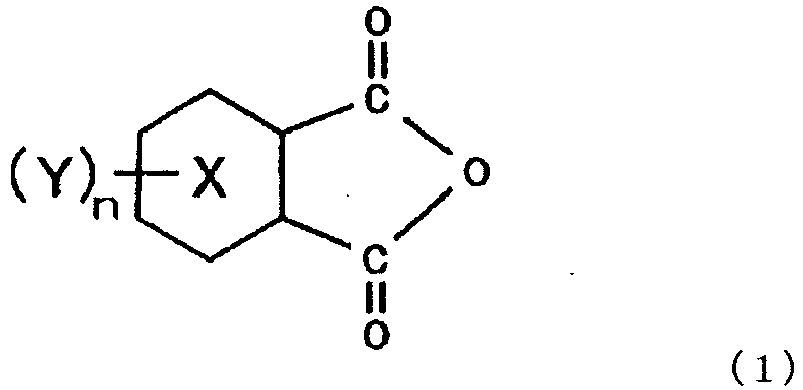
- As the organic oxygen absorber (B) for absorbing oxygen, the present invention uses a bisimide compound derived from an acid anhydride represented by the following formula (1):
and an aliphatic diamine. In the bisimide compound, an unsaturated bond in the unsaturated ring in a molecule is easily oxidized to thereby absorb oxygen, i.e., to exhibit oxygen-absorbing capability. The unsaturated bond in, for example, an aromatic ring is not of a nature to be oxidized. - The above bisimide compound is of the organic type, does not cause the resin to be colored, can be favorably used for the applications where transparency is required, has favorable heat resistance, and does not lose its excellent properties even when a polyester resin such as PET having a high process temperature is used as the base material resin.
- Further, in case the unsaturated bond is oxidized in the unsaturated alicyclic structure in the bisimide compound, the ring is simply cleaved without, however, by-producing any low-molecular decomposed product (e.g., ketone or aldehyde) by oxidation. Therefore, even when the bisimide compound having such an unsaturated alicyclic structure is used as an oxygen-absorbing component, no offensive odor is generated despite oxygen is absorbed. Therefore, when a packaging container is formed by using the bisimide compound (B) as a packaging material, there is no decrease in the flavor of the content in the container.
- When, for example, a container is formed by using the oxygen-absorbing resin composition, the layer of this composition can be arranged on the side that comes in contact with the content in the container. Moreover, the container can be formed using the layer of this composition only (i.e., single-layer structure). Specifically, when the container is formed in the single-layer structure, the layer exhibits favorable oxygen-barrier property since it excellently absorbs oxygen. Therefore, the thickness of the container wall can be decreased offering a great advantage from the standpoint of reducing the weight of the container and saving resources.
- Besides, in the present invention, the bisimide compound is used as the organic oxygen absorber (B), and the transition metal catalyst (C) that will be described later is also used in a small amount in combination to effectively suppress the problem of yellowing caused by the absorption of oxygen. This is the greatest advantage of the present invention.
- The bisimide compound is obtained by reacting the unsaturated aliphatic ring-containing acid anhydride of the formula (1) with the aliphatic diamine, and heat-treating the obtained amide.
- The ring X (unsaturated aliphatic ring having an unsaturated bond) possessed by the acid anhydride of the formula (1) is, preferably, a cyclohexene ring. However, preferred examples also include a bicyclic ring that has a bridging group (e.g., methylene group, ethylene group, etc.) in the cyclohexene ring, and a ring having a polycyclic structure in which an aliphatic group is, further, bonded to the bicyclic ring. As the polycyclic ring, there can be exemplified those having a bicyclic ring structure represented by the following formula (1a);

- In the bicyclic ring, the carbon atom in the ring to which the bridge group Z is bonded is a tertiary carbon atom which can be easily oxidized. Therefore, the oxygen-absorbing capability due to oxidation is, further, improved.
- Described below are concrete examples of the polycyclic rings though not limited thereto only.


- There is no particular limitation on the positional relationship between the unsaturated bond in the ring X and the acid anhydride group bonded to the ring X unless the property of the unsaturated bond for being oxidized is not basically impaired. By taking the property for being synthesized and the stability of the compound into consideration, however, it is desired that the following positional relationships are maintained.
- When the ring X is a cyclohexene ring;
The carbon atoms are bonded to the acid anhydride group at the first and second positions, and the unsaturated bond is at the third or fourth position. - When the ring X is the bicyclo[2.2.1]hept-2-ene;
The carbon atoms are bonded to the acid anhydride group at the fifth and sixth positions relative to the unsaturated bond at the second position. - When the ring X is the tricyclo[4.4.0.12,5]-3-undecene;
The carbon atoms are bonded to the acid anhydride group at the eighth and ninth positions relative to the unsaturated bond at the third position. - When the ring X is the tetracyclo[4.4.0.12,517,10]-3-dodecene;
The carbon atoms are bonded to the acid anhydride group at the eighth and ninth positions relative to the unsaturated bond at the third position. - When the ring X is a pentacyclo[8.4.0.12,519,12.08,13]-3-hexadecene;
The carbon atoms are bonded to the acid anhydride group at the tenth and eleventh positions relative to the unsaturated bond at the third position. - When the ring X is the pentacyclo[6.6.1.13,602,7.09,14]-4-hexadecene;
The carbon atoms are bonded to the acid anhydride group at the eleventh and twelfth positions relative to the unsaturated bond at the fourth position. - In the above formula (1), Y represents a substituent bonded to the aliphatic ring X. Concretely, Y is an alkyl group. Though not specifically limited, the alkyl group is, usually, a lower alkyl group having not more than 3 carbon atoms from the standpoint of synthesis and property of being oxidized and, particularly desirably, is a methyl group.
- Though there is no particular limitation on the number n of the substituents Y (alkyl groups), it is better to avoid, at least, the structure in which the substituents Y are bonded to both of the two carbon atoms that are forming the unsaturated bond possessed by the ring X. This is because if the substituents Y (alkyl groups) are bonded to both of these two carbon atoms, then the unsaturated bond loses the property for being oxidized. Namely, in the present invention, the number n of the substituents Y (alkyl groups) may be 2 or larger, or may be zero, as a matter of course unless the substituents Y are bonded to both of the above two carbon atoms.
- In the present invention, it is desired that the number n of the substituents Y (alkyl groups) is zero or 1 particularly from the standpoint of synthesis. If the number n is 1, it is desired that the substituent Y (alkyl group) is bonded to either the third position or the fourth position provided the ring X is, for example, a cyclohexene ring, and is bonded to the third position provided the ring X is the bicyclo[2.2.1]hept-2-ene.
- The acid anhydride of the above formula (1) is synthesized by, for example, the Diels-Alder reaction of maleic acid anhydride with the diene.
- In the present invention, the most preferred examples of the acid anhydride of the above formula (1) include a 3-methyl-Δ4-tetrahydrophthalic anhydride presented by the following formula (2) and a 4-methyl-Δ3-tetrahydrophthalic anhydride presented by the following formula (3).


- In the present invention, the bisimide compound (B) used as the organic oxygen absorber is obtained by heat-treating an amide that is formed by reacting the above acid anhydride with an aliphatic diamine. The amide which is the intermediate product and the bisimide which is the final product are expressed by the following formulas.
- Amide which is the intermediate product;
HOOC-X-CONH-R-CONH-X-COOH
wherein,
X is an unsaturated aliphatic ring possessed by the acid anhydride of the formula (1), and R is an aliphatic group derived from the diamine used for the reaction. - Bisamide which is the final product;
X-(CO)2-N-R-N-(CO)2-X
wherein, X and R are as defined above. - In the present invention, it is important that the diamine to be reacted with the acid anhydride is the one of the aliphatic type. With the bisamide compound obtained by using, for example, an aromatic diamine such as phenylenediamine, however, it is not possible to avoid the yellowing caused by the absorption of oxygen as also demonstrated in Examples and Comparative Examples appearing later.
- There is no specific limitation on the aliphatic diamine that is to be reacted with the acid anhydride provided it is capable of reacting with the acid anhydride. The divalent aliphatic group between the amino groups may be any one of the straight chain group, branched chain group or cyclic hydrocarbon group. From the standpoint of highly preventing the yellowing, however, it is desired to use an alkylenediamine which is a non-cyclic (i.e., straight chain or branched chain) alkylene group, such as methylenediamine, ethylenediamine or propylenediamine.
- The acid anhydride and the aliphatic diamine may, respectively, be those that are selected from a plurality of kinds thereof, and may be put to the reaction. In this case, the obtained bisimide compound assumes an asymmetrical structure.
- The amount of the organic oxygen absorber (B), i.e., the bisimide compound to be added to the thermoplastic base resin (A) is in a range of 0.1 to 10.0% by weight and, preferably, 1.0 to 5.0% by weight in the resin composition.
- If the amount thereof is smaller than the above range, the oxygen-absorbing capability becomes unsatisfactory. If the amount thereof is larger than the above range, on the other hand, the tendency to yellow becomes conspicuously as a result of absorbing oxygen.
- In the present invention, the transition metal catalyst is used for accelerating the oxidation of the bisimide compound (B) and to improve its oxygen absorbing capability. The transition metal catalyst is used all the time in combination with the organic oxygen absorber.
- Representative examples of the transition metal used for the transition metal catalyst include iron, cobalt, nickel, copper, silver, tin, titanium, zirconium, vanadium, chromium and manganese. Among them, however, cobalt is most desired from the standpoint of accelerating the oxidation of the bisimde compound {organic oxygen absorber (B) } and improving its oxygen absorbing capability. The catalyst of such a transition metal is, usually, used in the form of a low-valence inorganic salt, an organic salt or a complex of the transition metal. Their concrete examples have been known as closely described in, for example,
JP-A-2004-161796 - In the present invention, the transition metal catalyst should be added in a small amount. Concretely, the transition metal catalyst should be added to the resin composition in an amount in a range calculated as metal of 10 to 350 ppm and, preferably, 20 to 100 ppm. If the transition metal catalyst is not added or is added but in an amount smaller than the above range, then the oxidation of the bisimide compound is not promoted and the oxygen-absorbing capability becomes low. Specifically, the oxygen-barrier property becomes insufficient in the field of packaging containers. If the transition metal catalyst is added in an amount larger than the above range, it becomes difficult to effectively suppress the yellowing caused by the absorption of oxygen. Presumably, this is due to that low-molecular components such as aldehyde and the like are much generated by the oxidation giving rise to the yellowing.
- Other blending agents;
The oxygen-absorbing resin composition of the invention containing the above-mentioned components (A) to (C) as essential components can be, further, blended with various blending agents such as filler, coloring agent, heat stabilizer, aging stabilizer, antioxidant, antiaging agent, photo stabilizer, ultraviolet ray absorber, antistatic agent, lubricant like metal soap or wax, reforming resin and rubber in suitable amounts in a range in which they do not impair the capability for suppressing the yellowing, oxygen-absorbing capability or formability. - The oxygen-absorbing resin composition of the invention described above is, usually, prepared by kneading the above-mentioned components in a non-oxidizing atmosphere by using an extruder, and the like. It is, however, also allowable to employ such means as mixing some of the components in advance and, thereafter, adding the rest of the components thereto.
- For example, part of the thermoplastic base resin (A), the oxygen absorber (B) and the other blending agent to be suitably added are melt-kneaded together by using a twin screw extruder while conducting the deaeration to prepare a master batch thereof in the form of pellets. Just prior to the use, the rest of the thermoplastic base resin (A) is kneaded together therewith, and the mixture is put into the forming. In this case, the properties may not be the same between the thermoplastic resin used for preparing the master batch and the thermoplastic resin that is kneaded subsequently. Employment of the above means makes it possible to adjust the properties so as to meet the use.
- As for the transition metal catalyst (C), further, it is desired that the transition metal catalyst (C) is homogeneously blended. For this purpose, the transition metal catalyst is dissolved in a suitable organic solvent (e.g., organic solvent of the type of alcohol, ether, ketone, hydrocarbon, etc.). The thus obtained solution is then mixed with other components in a kneader such as extruder.
- The oxygen-absorbing resin composition of the present invention not only exhibits oxygen-absorbing capability to such a degree that is sufficient for maintaining gas-barrier property required in the field of the packaging containers but also effectively suppresses the yellowing caused by the absorption of oxygen. Therefore, the oxygen-absorbing resin composition of the invention is very useful, specifically, in the field of use where transparency is required.
- Further, even when a polyester resin such as PET having a high process temperature is used as the base resin, excellent oxygen-absorbing capability (property to be oxidized) of the bisimide compound that is used as the organic oxygen absorber is not impaired. Therefore, the resin composition of the present invention, usually, uses the polyester such as PET. Accordingly, the resin composition of the invention is, most desirably, used in the field of packaging materials that require transparency.
- In absorbing oxygen, further, the resin composition of the invention is not accompanied by the by-production of low-molecular decomposed product that could cause offensive odor. Even from the standpoint of preventing the content from being deteriorated by oxidation and preventing the flavor from being deteriorated, therefore, the resin composition of the present invention is very suited for use in the field of packaging materials.
- Accordingly, the oxygen-absorbing resin composition of the present invention is preferably used as a packaging material in the forms of, for example, film, sheet, cup, tray, bottle, tube, lid, and the like. The oxygen-absorbing resin composition can be, further, used in the form of powder, film, sheet, and the like in order to absorb oxygen in the sealed packaging containers.
- In absorbing oxygen, further, the oxygen-absorbing resin composition of the invention is not accompanied by the by-production of low-molecular decomposed product that could cause offensive odor. In forming packaging containers such as bag, cup, bottle, tube and the like, therefore, the layer comprising the resin composition may be located on a side that comes in contact with the content in the container. Therefore, the packaging containers can be formed by using only the layer that comprises the oxygen-absorbing resin composition.
- By utilizing the oxygen-barrier property of the above resin composition based on its excellent oxygen-absorbing capability, the packaging container of the single-layer structure makes it possible to decrease the thickness of the container wall and, therefore, to reduce the weight of the container, to save resources and to lower the cost.
- The packaging containers can be formed by any known means. For example, the resin composition can be extrusion-molded into a film which is then stuck together by heat-sealing to form a bag-like container. Through the extrusion molding or injection molding, further, a preform is formed in the shape of a sheet or a test tube, and is formed into a packaging container in the form of cup, tray, bottle, and the like through the secondary forming such as vacuum molding, stretch molding, compressed air molding, plug assist molding or stretch-blow molding. Moreover, the packaging container in the shape of a tube can be also directly molded through the extrusion molding, injection molding, extrusion blow molding, and the like.
- Since the bisimide compound used as the organic oxygen absorber has excellent heat resistance, it is most desired to form stretch-molded container by using the polyester as the base resin and, further, to form a heat-resistant bottle having improved heat resistance through the heat-setting.
- It is, further, allowable to obtain a packaging container of a multi-layer structure by using the oxygen-absorbing resin composition of the present invention in combination with other resins or resin compositions. By increasing the number of the layers, it is made possible to further improve barrier property against oxygen, to improve barrier property against gases (e.g. , carbonic acid gas and water vapor) other than oxygen and, further, to sustain the oxygen-absorbing capability for extended periods of time.
- Described below are examples of the multilayer structure. Here, the layer constitutions are abbreviated as described below.
- OAR:
- Oxygen-absorbing layer formed by using the oxygen-absorbing resin composition of the present invention.
- PET:
- Polyethylene terephthalate layer.
- PE:
- Layer of a low-, intermediate- or high-density polyethylene, straight chain low-density polyethylene or linear very-low-density polyethylene.
- PP:
- Polypropylene layer.
- COC:
- Cyclic olefin resin layer.
- GBAR:
- Gas-barrier layer of aromatic polyamide or ethylenevinyl alcohol copolymer.
-
- Two-layer structure;
- PET/OAR
- Three-layer structures;
- PE/OAR/PET
- PET/OAR/PET
- GBAR/OAR/PET
- PE/OAR/COC
- Four-layer structures;
- PE/PET/OAR/PET
- PE/OAR/GBAR/PET
- PET/OAR/GBAR/PET
- PE/OAR/GBAR/COC
- PE/OAR/GBAR/PE
- Five-layer structures;
- PET/OAR/PET/OAR/PET
- PE/PET/OAR/GBAR/PET
- PET/OAR/GBAR/COC/PET
- PET/OAR/PET/COC/PET
- PE/OAR/GBAR/COC/PET
- PE/GBAR/OAR/GBAR/PE
- PP/GBAR/OAR/GBAR/PP
- Six-layer structures;
- PET/OAR/PET/OAR/GBAR/PET
- PE/PET/OAR/COC/GBAR/PET
- PET/OAR/GBAR/PET/COC/PET
- PE/GBAR/OAR/PE/GBAR/PE
- PP/GBAR/OAR/PP/GBAR/PP
- Seven-layer structure;
- PET/OAR/COC/PET/GBAR/OAR/PET
- In the above multilayer structures, an embodiment that includes the gas-barrier resin layer (GBAR) is desired from the standpoint of sustaining the oxygen-absorbing capability of the oxygen-absorbing layer (OAR) for extended periods of time.
- Either side of the above multilayered structures may be formed on the inner surface side or the outer surface side of the container.
- If the adhesiveness is not sufficient among the layers, then layers of an adhesive resin such as olefin resin modified with an unsaturated carboxylic acid may be interposed among them. Here, the oxygen-absorbing layer (OAR) of an oxygen-absorbing resin composition using the polyester as the thermoplastic base resin exhibits excellent adhesiveness to the PET layer and can, therefore, be laminated on the PET layer without interposing any particular adhesive resin layer.
- By utilizing the technique of forming multilayer structure based on the co-extrusion or the co-injection, the packaging container of the multilayer structure is formed in the same manner as that of forming the containers of the single-layer structure.
- The packaging container including the layer of the oxygen-absorbing resin composition of the invention exhibits excellent oxygen-barrier property owing to its excellent oxygen-absorbing capability. Either when it is formed in a single-layer structure or in a multilayer structure, therefore, the packaging container of the invention can be very favorably used for containing a variety of kinds of contents that tend to be deteriorated in the presence of oxygen, such as beverages like beer, wine, fruit juice, carbonated soft drinks, as well as fruits, nuts, vegetables, meat products, infant foods, coffee, jam, mayonnaise, ketchup, edible oils, dressings, sauces, food boiled down in soy, milk products, medicines, cosmetics, gasoline and the like.
- Owing to its excellent transparency, further, the packaging container of the invention can be favorably used in a field where transparency is required.
- The invention will be, further, described by way of Examples to which only, however, the invention is in no way limited. The materials and testing methods used in Examples and Comparative Examples were as described below.
- Isophthalic acid (copolymerization ratio = 1.8 mol%) copolymerized polyethylene terephthalate resin (5015w: manufactured by Shinkong Synthetic Fibers Corp., IV = 0.83).
- As a starting material (acid anhydride) for an oxygen-absorbing component, there was used a mixture of methyltetrahydrophthalic acid anhydrides (HN-2200, manufactured by Hitachi Chemical Co., Ltd.) containing 45% by weight of a 4-methyl-Δ3-tetraydrophthalic acid anhydride and 21% by weight of a cis-3-methyl-Δ4- tetrahydrophthalic acid anhydride.
- A cis-4-cyclohexene-1,2-dicarboxylic acid anhydride (manufactured by Tokyo Chemical Industry Co., Ltd.) was used as a starting material (acid anhydride) for the oxygen-absorbing component.
- Cobalt neodecanoate (DICNATE 5000, manufactured by
DIC Corporation) - 250 Grams of BX was fed as an oxygen-absorbing starting material (acid anhydride) into a 1000-mL four neck separable flask equipped with a stirrer, a nitrogen introduction pipe and a dropping funnel. Further, an amine component dissolved in 200 mL of ethanol, and 87.1 g of a hexamethylenediamine (manufactured by Tokyo Chemical Industry Co., Ltd.) were gradually added thereto. After they have been all thrown in, the reaction was carried out in a nitrogen atmosphere at 120 to 180°C for about 5 hours while removing water that was formed, and an oxygen-absorbing component B1 was obtained.
- A compound B2 was obtained by conducting the synthesis in the same manner as in Synthesis Example 1 but using 250 g of BX, 101 g of metaxylenediamine and 200 mL of ethanol.
- 200 Grams of BY, 75 g of hexamethylenediamine, 50 mL of toluene (manufactured by Wako Pure Chemical Industries, Ltd.) and 150 mL of N-methylpyrrolidone (NMP) (manufactured by Wako Pure Chemical Industries, Ltd.) were fed into a 1000-mL separable flask equipped with a stirrer, a nitrogen introduction pipe and a Dean-Stark type water separator, and were reacted together in a nitrogen atmosphere at 140°C for about 4 hours while removing water that was formed. To the reaction solution, there was added 500 mL of 2-propanol, and the obtained slurry was filtered by suction followed by washing with 100 mL of 2-propanol. Thereafter, the slurry was dried in vacuum at 40°C for 12 hours to obtain a compound B3.
- A compound B4 was obtained by conducting the synthesis in the same manner as in Synthesis Example 3 but using 200 g of BY, 80 g of metaxylenediamine, 50 mL of toluene and 150 mL of NMP.
- By using a twin screw extruder equipped with a granulating facility {TEM-35B, manufactured by TOSHIBA MACHINE CO., LTD.} with its barrel being heated at a temperature of 280°C, the polyester resin A was mixed and kneaded with various kinds of constituent components, and the mixture hereof was extruded in a stranded form to obtain resin composition pellets.
- As for introducing the constituent components, the components in the form of solid pellets were fed by using a powder feeder and the components in the form of a liquid were fed by using a liquid feeder (MOHNO PUMP, manufactured by HEISHIN Ltd.) through an opening in the extruder such that the amounts thereof was 10% by weight.
- Oxygen-free water having almost zero oxygen concentration was produced by using an oxygen-free water producing apparatus (LOW DISSOLVED OXYGEN, manufactured by MIURA CO. , LTD.). A bottle that was formed was filled with this water to its full capacity and was sealed with a plastic cap. After the bottle was stored in an air-conditioned room maintained at 23°C50%RH for 2 months, the concentration of oxygen dissolved in water in the bottle was measured by using an instrument for measuring the concentration of oxygen dissolved in water (Oxygen Indicator, manufactured by Orbisphere Laboratories).
- Body portion was cut out from the bottle right after it was formed and from the bottle after the concentration of oxygen dissolved in water therein has been measured. The body portions were measured for their b*-values by using a color computer {SM-4, manufactured by Suga Test Instruments Co.,Ltd.}.
- The polyester resins, oxygen-absorbing resin pellets and transition metal catalyst described above were dry-blended and were thrown into a hopper of a molding machine to obtain, by the injection molding, single-layer preforms for molding bottles each weighing 24 g. Thereafter, the formed preforms were biaxially stretch-blow molded into 500-mL bottles.
- Table 1 shows the weight ratios of the materials that were used, concentrations of oxygen dissolved in water and b*-values.
Table 1 Oxygen-absorbing polyester resin composition Evaluated results Polyester resin (wt%) Oxygen-absorbing component (wt%) Transition metal catalyst (ppm as metal) Concentration of dissolved oxygen (ppm) b*-value Just after formed After 2 months at 23°C Example 1 A: 95.1 B1: 4.9 70 0.064 1.36 - Example 2 A: 97.0 B3: 3.0 70 0.631 1.05 1.32 Comp. Ex. 1 A: 100 - 4.480 0.60 0.60 Comp. Ex. 2 A: 95.6 B2: 4.4 70 0.060 1.83 - Comp. Ex. 3 A: 97.0 B4: 3.0 70 0.807 2.12 2.51
Claims (4)
- An oxygen-absorbing resin composition containing:(A) a base material which comprises a thermoplastic resin;(B) a bisimide compound derived from an acid anhydride represented by the following formula (1),

and an aliphatic diamine; and(C) a transition metal catalyst;wherein said bisimide compound (B) is contained in amounts of 0.1 to 10.0% by weight, and said transition metal catalyst (C) is contained in amounts of 10 to 350 ppm calculated as metal. - The oxygen-absorbing resin composition according to claim 1, wherein said bisimide compound (B) is contained in amounts of 1.0 to 5.0% by weight, and said transition metal catalyst (C) is contained in amounts of 20 to 100 ppm calculated as metal.
- The oxygen-absorbing resin composition according to claim 1, wherein said aliphatic diamine has a non-cyclic structure.
- A packaging container having a layer that contains the oxygen-absorbing resin composition of claim 1.
Applications Claiming Priority (2)
| Application Number | Priority Date | Filing Date | Title |
|---|---|---|---|
| JP2014051035A JP2015174895A (en) | 2014-03-14 | 2014-03-14 | oxygen-absorbing resin composition |
| PCT/JP2015/057307 WO2015137450A1 (en) | 2014-03-14 | 2015-03-12 | Oxygen absorptive resin composition |
Publications (2)
| Publication Number | Publication Date |
|---|---|
| EP3118262A1 true EP3118262A1 (en) | 2017-01-18 |
| EP3118262A4 EP3118262A4 (en) | 2017-10-04 |
Family
ID=54071887
Family Applications (1)
| Application Number | Title | Priority Date | Filing Date |
|---|---|---|---|
| EP15761741.6A Withdrawn EP3118262A4 (en) | 2014-03-14 | 2015-03-12 | Oxygen absorptive resin composition |
Country Status (6)
| Country | Link |
|---|---|
| US (1) | US20170066903A1 (en) |
| EP (1) | EP3118262A4 (en) |
| JP (1) | JP2015174895A (en) |
| KR (1) | KR20160127788A (en) |
| CN (1) | CN106103595A (en) |
| WO (1) | WO2015137450A1 (en) |
Families Citing this family (5)
| Publication number | Priority date | Publication date | Assignee | Title |
|---|---|---|---|---|
| JP6790560B2 (en) * | 2016-08-04 | 2020-11-25 | 東洋製罐グループホールディングス株式会社 | Oxygen Absorbent Resin Composition Containing Organic Oxygen Absorbent |
| JP2018051902A (en) | 2016-09-28 | 2018-04-05 | 東洋製罐グループホールディングス株式会社 | Multilayer structure molded body |
| KR102244999B1 (en) | 2016-09-28 | 2021-04-27 | 도요세이칸 그룹 홀딩스 가부시키가이샤 | Molded body with excellent gas barrier properties |
| JP7115827B2 (en) * | 2017-07-26 | 2022-08-09 | 東洋製罐グループホールディングス株式会社 | Resin molding with excellent discoloration resistance |
| JP2024122406A (en) * | 2023-02-28 | 2024-09-09 | 東洋製罐グループホールディングス株式会社 | Oxygen-absorbing laminate |
Family Cites Families (8)
| Publication number | Priority date | Publication date | Assignee | Title |
|---|---|---|---|---|
| US3386795A (en) * | 1964-10-05 | 1968-06-04 | Eastman Kodak Co | Polyesters having improved dyeing properties |
| JP4186592B2 (en) | 2002-11-08 | 2008-11-26 | 東洋製罐株式会社 | Resin composition and packaging material excellent in moldability and gas barrier properties |
| US20070218304A1 (en) * | 2006-03-20 | 2007-09-20 | Graham Packaging Company, Lp | Active oxygen barrier compositions of poly(hydroxyalkanoates) and articles made thereof |
| BRPI0809573A8 (en) | 2007-04-10 | 2016-10-11 | Valspar Sourcing Inc | composition and method |
| CA2797127C (en) * | 2010-05-06 | 2017-09-05 | Graham Packaging Company, L.P. | Oxygen scavenging additives for plastic containers |
| EP2402396B1 (en) * | 2010-06-30 | 2015-02-25 | Clariant Masterbatches (Italia) S.p.A. | Oxygen scavenging plastic material |
| CN103354827B (en) * | 2011-01-27 | 2014-12-10 | 东洋制罐集团控股株式会社 | Oxygen-absorbing resin composition |
| EP2799497B1 (en) * | 2011-12-26 | 2018-09-12 | Toyo Seikan Group Holdings, Ltd. | Oxygen-absorbing resin composition |
-
2014
- 2014-03-14 JP JP2014051035A patent/JP2015174895A/en active Pending
-
2015
- 2015-03-12 WO PCT/JP2015/057307 patent/WO2015137450A1/en not_active Ceased
- 2015-03-12 CN CN201580013998.1A patent/CN106103595A/en active Pending
- 2015-03-12 EP EP15761741.6A patent/EP3118262A4/en not_active Withdrawn
- 2015-03-12 KR KR1020167026688A patent/KR20160127788A/en not_active Ceased
- 2015-03-12 US US15/123,326 patent/US20170066903A1/en not_active Abandoned
Also Published As
| Publication number | Publication date |
|---|---|
| CN106103595A (en) | 2016-11-09 |
| WO2015137450A1 (en) | 2015-09-17 |
| KR20160127788A (en) | 2016-11-04 |
| JP2015174895A (en) | 2015-10-05 |
| EP3118262A4 (en) | 2017-10-04 |
| US20170066903A1 (en) | 2017-03-09 |
Similar Documents
| Publication | Publication Date | Title |
|---|---|---|
| EP2669334B1 (en) | Oxygen-absorbing resin composition | |
| EP2799497B1 (en) | Oxygen-absorbing resin composition | |
| JP6255745B2 (en) | Oxygen absorber | |
| CN101466761B (en) | Oxygen-absorbing resin, oxygen-absorbing resin compositions and oxygen-absorbing containers | |
| EP3118262A1 (en) | Oxygen absorptive resin composition | |
| CN107075235A (en) | It is not required to the oxygen-scavenging compositions of induction period | |
| CN109790303B (en) | Molded article having excellent gas barrier properties | |
| JP6790560B2 (en) | Oxygen Absorbent Resin Composition Containing Organic Oxygen Absorbent |
Legal Events
| Date | Code | Title | Description |
|---|---|---|---|
| STAA | Information on the status of an ep patent application or granted ep patent |
Free format text: STATUS: THE INTERNATIONAL PUBLICATION HAS BEEN MADE |
|
| PUAI | Public reference made under article 153(3) epc to a published international application that has entered the european phase |
Free format text: ORIGINAL CODE: 0009012 |
|
| STAA | Information on the status of an ep patent application or granted ep patent |
Free format text: STATUS: REQUEST FOR EXAMINATION WAS MADE |
|
| 17P | Request for examination filed |
Effective date: 20160825 |
|
| AK | Designated contracting states |
Kind code of ref document: A1 Designated state(s): AL AT BE BG CH CY CZ DE DK EE ES FI FR GB GR HR HU IE IS IT LI LT LU LV MC MK MT NL NO PL PT RO RS SE SI SK SM TR |
|
| AX | Request for extension of the european patent |
Extension state: BA ME |
|
| DAV | Request for validation of the european patent (deleted) | ||
| DAX | Request for extension of the european patent (deleted) | ||
| A4 | Supplementary search report drawn up and despatched |
Effective date: 20170831 |
|
| RIC1 | Information provided on ipc code assigned before grant |
Ipc: C08K 5/20 20060101ALI20170825BHEP Ipc: B65D 65/40 20060101ALI20170825BHEP Ipc: B65D 81/26 20060101ALI20170825BHEP Ipc: C08K 5/098 20060101ALI20170825BHEP Ipc: C08L 101/00 20060101AFI20170825BHEP |
|
| STAA | Information on the status of an ep patent application or granted ep patent |
Free format text: STATUS: THE APPLICATION HAS BEEN WITHDRAWN |
|
| 18W | Application withdrawn |
Effective date: 20180418 |