EP3115481A1 - Laminate, and method for producing laminate - Google Patents
Laminate, and method for producing laminate Download PDFInfo
- Publication number
- EP3115481A1 EP3115481A1 EP15758220.6A EP15758220A EP3115481A1 EP 3115481 A1 EP3115481 A1 EP 3115481A1 EP 15758220 A EP15758220 A EP 15758220A EP 3115481 A1 EP3115481 A1 EP 3115481A1
- Authority
- EP
- European Patent Office
- Prior art keywords
- copper powder
- metallic coating
- phosphorus
- laminate
- substrate
- Prior art date
- Legal status (The legal status is an assumption and is not a legal conclusion. Google has not performed a legal analysis and makes no representation as to the accuracy of the status listed.)
- Granted
Links
- 238000004519 manufacturing process Methods 0.000 title claims description 12
- 238000000576 coating method Methods 0.000 claims abstract description 119
- 239000011248 coating agent Substances 0.000 claims abstract description 100
- RYGMFSIKBFXOCR-UHFFFAOYSA-N Copper Chemical compound [Cu] RYGMFSIKBFXOCR-UHFFFAOYSA-N 0.000 claims abstract description 76
- OAICVXFJPJFONN-UHFFFAOYSA-N Phosphorus Chemical compound [P] OAICVXFJPJFONN-UHFFFAOYSA-N 0.000 claims abstract description 65
- 229910052698 phosphorus Inorganic materials 0.000 claims abstract description 65
- 239000011574 phosphorus Substances 0.000 claims abstract description 65
- 239000000758 substrate Substances 0.000 claims abstract description 50
- 238000002844 melting Methods 0.000 claims abstract description 7
- 230000008018 melting Effects 0.000 claims abstract description 7
- 239000007787 solid Substances 0.000 claims abstract description 7
- 238000005507 spraying Methods 0.000 claims abstract description 5
- 238000000151 deposition Methods 0.000 claims abstract description 4
- 238000000034 method Methods 0.000 claims description 21
- 239000007789 gas Substances 0.000 description 69
- 230000003213 activating effect Effects 0.000 description 63
- 239000007921 spray Substances 0.000 description 52
- 230000000052 comparative effect Effects 0.000 description 41
- 239000000843 powder Substances 0.000 description 28
- 238000012360 testing method Methods 0.000 description 26
- 239000013078 crystal Substances 0.000 description 20
- 229910052782 aluminium Inorganic materials 0.000 description 18
- XAGFODPZIPBFFR-UHFFFAOYSA-N aluminium Chemical compound [Al] XAGFODPZIPBFFR-UHFFFAOYSA-N 0.000 description 18
- 239000000463 material Substances 0.000 description 18
- 238000006073 displacement reaction Methods 0.000 description 14
- 229910052802 copper Inorganic materials 0.000 description 12
- 239000010949 copper Substances 0.000 description 12
- 238000013001 point bending Methods 0.000 description 12
- IJGRMHOSHXDMSA-UHFFFAOYSA-N Atomic nitrogen Chemical compound N#N IJGRMHOSHXDMSA-UHFFFAOYSA-N 0.000 description 8
- 238000005259 measurement Methods 0.000 description 8
- 238000007669 thermal treatment Methods 0.000 description 8
- 230000000694 effects Effects 0.000 description 7
- 238000001953 recrystallisation Methods 0.000 description 7
- 229910052751 metal Inorganic materials 0.000 description 6
- 239000002184 metal Substances 0.000 description 6
- 238000011156 evaluation Methods 0.000 description 5
- 239000007769 metal material Substances 0.000 description 5
- 239000000470 constituent Substances 0.000 description 4
- 229910052757 nitrogen Inorganic materials 0.000 description 4
- 229910002065 alloy metal Inorganic materials 0.000 description 3
- 238000001887 electron backscatter diffraction Methods 0.000 description 3
- XKRFYHLGVUSROY-UHFFFAOYSA-N Argon Chemical compound [Ar] XKRFYHLGVUSROY-UHFFFAOYSA-N 0.000 description 2
- 239000000956 alloy Substances 0.000 description 2
- 229910045601 alloy Inorganic materials 0.000 description 2
- 238000004873 anchoring Methods 0.000 description 2
- 238000010894 electron beam technology Methods 0.000 description 2
- 239000001307 helium Substances 0.000 description 2
- 229910052734 helium Inorganic materials 0.000 description 2
- SWQJXJOGLNCZEY-UHFFFAOYSA-N helium atom Chemical compound [He] SWQJXJOGLNCZEY-UHFFFAOYSA-N 0.000 description 2
- 238000009692 water atomization Methods 0.000 description 2
- 238000007545 Vickers hardness test Methods 0.000 description 1
- 239000003570 air Substances 0.000 description 1
- 238000000137 annealing Methods 0.000 description 1
- 229910052786 argon Inorganic materials 0.000 description 1
- 230000015572 biosynthetic process Effects 0.000 description 1
- 238000010288 cold spraying Methods 0.000 description 1
- 238000005520 cutting process Methods 0.000 description 1
- 238000009826 distribution Methods 0.000 description 1
- 230000005611 electricity Effects 0.000 description 1
- 238000004146 energy storage Methods 0.000 description 1
- 238000010438 heat treatment Methods 0.000 description 1
- 239000011261 inert gas Substances 0.000 description 1
- 230000001678 irradiating effect Effects 0.000 description 1
- 238000012986 modification Methods 0.000 description 1
- 230000004048 modification Effects 0.000 description 1
- 230000003647 oxidation Effects 0.000 description 1
- 238000007254 oxidation reaction Methods 0.000 description 1
- 238000012545 processing Methods 0.000 description 1
- 238000007751 thermal spraying Methods 0.000 description 1
- 230000008646 thermal stress Effects 0.000 description 1
- 230000009466 transformation Effects 0.000 description 1
Images



Classifications
-
- C—CHEMISTRY; METALLURGY
- C23—COATING METALLIC MATERIAL; COATING MATERIAL WITH METALLIC MATERIAL; CHEMICAL SURFACE TREATMENT; DIFFUSION TREATMENT OF METALLIC MATERIAL; COATING BY VACUUM EVAPORATION, BY SPUTTERING, BY ION IMPLANTATION OR BY CHEMICAL VAPOUR DEPOSITION, IN GENERAL; INHIBITING CORROSION OF METALLIC MATERIAL OR INCRUSTATION IN GENERAL
- C23C—COATING METALLIC MATERIAL; COATING MATERIAL WITH METALLIC MATERIAL; SURFACE TREATMENT OF METALLIC MATERIAL BY DIFFUSION INTO THE SURFACE, BY CHEMICAL CONVERSION OR SUBSTITUTION; COATING BY VACUUM EVAPORATION, BY SPUTTERING, BY ION IMPLANTATION OR BY CHEMICAL VAPOUR DEPOSITION, IN GENERAL
- C23C24/00—Coating starting from inorganic powder
- C23C24/02—Coating starting from inorganic powder by application of pressure only
- C23C24/04—Impact or kinetic deposition of particles
-
- B—PERFORMING OPERATIONS; TRANSPORTING
- B32—LAYERED PRODUCTS
- B32B—LAYERED PRODUCTS, i.e. PRODUCTS BUILT-UP OF STRATA OF FLAT OR NON-FLAT, e.g. CELLULAR OR HONEYCOMB, FORM
- B32B15/00—Layered products comprising a layer of metal
- B32B15/01—Layered products comprising a layer of metal all layers being exclusively metallic
Definitions
- the present invention relates to a laminate formed by depositing a metallic coating onto a substrate and a method of fabricating the laminate.
- the cold spray method is now widely known as a method of forming a coating.
- the cold spray method forms a coating on a substrate by spraying powder of a metallic material in a state of being equal to or lower than the melting point or the softening point from a nozzle together with inert gas such as helium, argon, and nitrogen and having the powder impact with a substrate to be coated while keeping the powder in the solid state (see Non Patent Literatures 1 and 2).
- the cold spray method forms a coating at a relatively low temperature.
- the cold spray method thus exerts advantageous effects in reducing influence of thermal stress and obtaining a metallic coating with no phase transformation and with controlled oxidation.
- a metallic material for both a substrate and a coating can generate a laminate with increased adhesion strength because an impact of the powder of the metallic material with the substrate (or an earlier formed coating) causes plastic deformation between the powder and the substrate, which results in the anchoring effect, and further causes a metallic bond between the newly formed surfaces where oxide coatings have been destroyed.
- a metallic material used for the cold spray method include copper of high thermal conductivity, electrical conductivity, and mechanical properties.
- Non Patent Literature 1 Yoshiyasu Itoh, et al., "Thermal and electrical properties of copper coatings produced by cold spraying", materials (Journal of Society of Materials of Science, Japan ), The Society of Materials Science, Japan, Vol. 59, No. 2, pp. 143-148, Feb. 2010
- Non Patent Literature 2 Mitsuru Yoshida, et al., "Properties report of sprayed coating of copper formed by cold spray", Proceedings of 94th (2011 autumn) National Symposium, Japan Thermal Spraying Society, pp. 19-20, 2011 Summary
- a metallic coating formed by the cold spray method is subjected to thermal treatment (annealing treatment) to increase thermal conductivity, electrical conductivity, and mechanical properties; however, forming a metallic coating with excellent thermal conductivity, electrical conductivity, and mechanical properties without separately providing thermal treatment has been required to reduce the number of devices and fabricating processes.
- thermal treatment annealing treatment
- a laminate according to the present invention includes: a substrate; and a metallic coating that is formed from copper powder containing 0.002% to 0.020% by weight of phosphorus and having been subjected to reduction treatment, the metallic coating being deposited on the substrate.
- a method of fabricating a laminate according to the present invention includes: accelerating copper powder containing 0.002% to 0.020% by weight of phosphorus and having been subjected to reduction treatment together with gas heated to a temperature lower than a melting point of the copper powder; spraying the copper powder onto a surface of a substrate while keeping the copper powder in a solid state; and depositing the copper powder on the substrate to form a metallic coating.
- the copper powder is accelerated with gas heated to a temperature of 600 degrees or higher.
- the copper powder has an average grain size of 20 ⁇ m to 50 ⁇ m.
- the present invention exerts advantageous effects in obtaining a laminate with excellent thermal conductivity, electrical conductivity, and mechanical properties even without separately providing thermal treatment.
- FIG. 1 is a schematic perspective view that illustrates the configuration of the laminate in the embodiment of the present invention.
- the laminate 1 is used as a conductive member referred to as a bus bar.
- the laminate 1 includes a substrate 10 composed of metal or alloy metal and a metallic coating 11 formed on the surface of the substrate 10, laminated by the later-described cold spray method, and composed of a metallic material containing copper as a major constituent.
- the laminate 1 is not limited to a rectangular flat shape as illustrated in FIG. 1 and may be in the shape of a cylinder, a polygonal cylinder, or the like.
- the substrate 10 may be made from any materials composed of metal or alloy metal.
- the substrate 10 is formed from aluminum or alloy metal containing aluminum.
- a softener substrate in forming a coating by the cold spray method, can enhance adhesion between the substrate and the coating because of the anchoring effect.
- the substrate 10 is made from aluminum or alloyed aluminum
- the metallic coating 11 is formed from powder composed of metal containing copper as a major constituent. This structure allows the laminate 1 to have enhanced adhesion between the substrate and the coating.
- the metallic coating 11 is formed from copper powder having copper as a major constituent and containing a predetermined percent by weight of phosphorus.
- the copper powder has an average grain size of 20 ⁇ m to 50 ⁇ m and is fabricated by, for example, the water atomizing method.
- the copper powder has been subjected to reduction treatment.
- the copper powder contains 0.002% to 0.020% by weight of phosphorus in powder.
- the copper powder contains 0.002% to 0.020% by weight of phosphorus, thereby reducing hardness of the powder and forming a densified metallic coating 11.
- the heat generated in forming the coating by the cold spray method causes recrystallization. This process reduces displacement, and the reduction in displacement improves the electrical conductivity and increases ductility. Consequently, the metallic coating 11 with excellent thermal conductivity, electrical conductivity and mechanical properties (ductility) can be obtained.
- An increase in the amount of phosphorus to larger than 0.020% by weight increases the amount of phosphorus contained in the metal coating, which increases electrical resistance and reduces the electrical conductivity of the metal coating.
- An increase in the amount of phosphorus to larger than 0.020% by weight increases the temperature at which recrystallization is caused, and the heat generated in forming the coating is less likely to cause a reduction in dislocation.
- the copper powder preferably contains 0.005% to 0.010% by weight of phosphorus so that the formed metallic coating 11 has high electrical conductivity and high ductility. Keeping the amount of phosphorus between 0.005% and 0.010% by weight reduces dislocation, which improves the electrical conductivity and markedly increases ductility. With this structure, the metallic coating 11 with excellent thermal conductivity, electrical conductivity and mechanical properties (ductility) can be obtained.
- the laminate 1 is fabricated in such a manner that accelerates copper powder containing a predetermined percent by weight of phosphorus together with gas heated to a temperature lower than the melting point of the copper powder toward the surface of the substrate 10, sprays the copper powder in the solid state onto the substrate 10 to be deposited thereon, and forms the metallic coating 11.
- FIG. 2 is a schematic view that illustrates an overview of a cold spray device 20 used for forming the metallic coating 11 of the laminate 1 according to the embodiment of the present invention.
- the cold spray device 20 includes a gas heater 21 that heats activating gas, a powder supply device 23 that stores therein a powder material to be sprayed onto the substrate 10 and supplies the material to a spray gun 22, and a gas nozzle 24 that sprays the powder material mixed with the heated activating gas in the spray gun 22 to the substrate 10.
- the powder material is copper powder having a grain size (an average grain size) of about 20 ⁇ m to 50 ⁇ m and containing a range of 0.002% to 0.020% by weight of phosphorus.
- the activating gas helium, nitrogen, air, and the like are used. Supplied activating gas is supplied to the gas heater 21 and the powder supply device 23 by valves 25 and 26, respectively.
- the activating gas supplied to the gas heater 21 is heated to a temperature, for example, between 600 degrees and the melting point, inclusive, of alloy used as the powder material to form the metallic coating 11 and is supplied to the spray gun 22.
- the temperature for heating the activating gas is preferably between 800 degrees and the melting point, inclusive, of alloy used as the powder material.
- the activating gas supplied to the powder supply device 23 supplies a predetermined discharge amount of the powder material (copper powder) in the powder supply device 23 to the spray gun 22.
- the heated activating gas is turned to a supersonic flow (about 340 m/s or higher) by the gas nozzle 24 in the convergent-divergent shape.
- the gas pressure of the activating gas is preferably between 1 MPa and 5 MPa, more preferably, between 2 MPa and 4 MPa.
- the gas pressure of the activating gas is set between 1 MPa to 5 MPa, which can increase the adhesion strength between the substrate 10 and the metallic coating 11.
- the powder material supplied to the spray gun 22 is put into the ultrasonic flow of the activating gas and accelerated.
- the powder material impacts with the substrate 10 at a high speed while keeping the solid state and forms the metallic coating 11.
- the device is not limited to the cold spray device 20 in FIG. 2 as long as the device can form the metallic coating 11 by causing a powder material composed of metal containing copper as a major constituent to impact with the substrate 10 while keeping the powder material in the solid state.
- the metallic coating 11 preferably has electrical conductivity (IACS) of 90% or higher, more preferably, 93% or higher. IACS indicates the electrical conductivity (%) to the standard annealed copper (with the standard annealed copper representing 100%).
- the metallic coating 11 is formed from copper powder having excellent thermal conductivity and has good electrical conductivity. With these facts, the metallic coating 11 is considered to have good thermal conductivity.
- the metallic coating 11 is formed by the spray coating method using copper powder, which contains 0.002% to 0.020% by weight of phosphorus and has been subjected to reduction treatment. In this manner, a laminate having excellent thermal conductivity, electrical conductivity, and mechanical properties can be obtained even without separately providing thermal treatment.
- a Laminate was fabricated by causing a copper coating containing a predetermined amount of phosphorus to be formed on an aluminum substrate (board) by the method of fabricating a laminate according to the embodiment, and evaluations of electrical conductivity and mechanical properties of the laminate were carried out.
- a laminate was fabricated in such a manner that sprays copper powder (the average grain size: about 35 ⁇ m), which contains 0.002% by weight of phosphorus and has been subjected to reduction treatment, on an aluminum substrate (A1050 - H24) using the cold spray device 20 under the following conditions: activating gas: nitrogen, the activating gas temperature: 600 degrees, the activating gas pressure: 3 MPa, the working distance (WD): 25 mm, the traverse speed: 200 mm/s, and the number of passes: six times, and forms a metallic coating.
- an about 1.1 mm metallic coating was formed in one pass, and an about 6.6 mm metallic coating was thus formed in six passes. Copper powder fabricated by the water atomizing method was used.
- a laminate was fabricated in such a manner that sprays copper powder (the average grain size: about 35 ⁇ m), which contains 0.007% by weight of phosphorus and has been subjected to reduction treatment, on an aluminum substrate (A1050 - H24) using the cold spray device 20 under the same conditions as the first example for the activating gas, the activating gas temperature, the activating gas pressure, the working distance, the traverse speed, and the number of passes and forms a metallic coating.
- a laminate was fabricated in such a manner that sprays copper powder (the average grain size: about 35 ⁇ m), which contains 0.009% by weight of phosphorus and has been subjected to reduction treatment, on an aluminum substrate (A1050 - H24) using the cold spray device 20 under the same conditions as the first example for the activating gas, the activating gas temperature, the activating gas pressure, the working distance, the traverse speed, and the number of passes and forms a metallic coating.
- a laminate was fabricated in such a manner that sprays copper powder (the average grain size: about 35 ⁇ m), which contains 0.017% by weight of phosphorus and has been subjected to reduction treatment, on an aluminum substrate (A1050 - H24) using the cold spray device 20 under the same conditions as the first example for the activating gas, the activating gas temperature, the activating gas pressure, the working distance, the traverse speed, and the number of passes and forms a metallic coating.
- a laminate was fabricated in such a manner that sprays copper powder (the average grain size: about 35 ⁇ m), which contains 0.021% by weight of phosphorus and has been subjected to reduction treatment, on an aluminum substrate (A1050 - H24) using the cold spray device 20 under the same conditions as the example for the activating gas, the activating gas temperature, the activating gas pressure, the working distance, the traverse speed, and the number of passes and forms a metallic coating.
- a laminate was fabricated in such a manner that sprays copper powder (the average grain size: about 35 ⁇ m), which contains 0.023% by weight of phosphorus and has been subjected to reduction treatment, on an aluminum substrate (A1050 - H24) using the cold spray device 20 under the same conditions as the first example for the activating gas, the activating gas temperature, the activating gas pressure, the working distance, the traverse speed, and the number of passes and forms a metallic coating.
- a laminate was fabricated in such a manner that sprays copper powder (the average grain size: about 35 ⁇ m), which contains 0.013% by weight of phosphorus and has not been subjected to reduction treatment, on an aluminum substrate (A1050 - H24) using the cold spray device 20 under the same conditions as the first example for the activating gas, the activating gas temperature, the activating gas pressure, the working distance, the traverse speed, and the number of passes and forms a metallic coating.
- a portion of the metallic coating was cut out from each of the laminates, which were fabricated in the above-described methods, according to the first to the fourth examples and the first to the third comparative examples as a test piece. Evaluations of electrical conductivity were carried out on the test pieces. Results of the evaluations are indicated in Table 1. IACS in Table 1 indicates the electrical conductivity (%) to the standard annealed copper (with the standard annealed copper representing 100%). Each of the test pieces was cut out in a rectangular prism of 2 mm x 2 mm x 40 mm in size. Potential was measured using four terminal sensing by applying measurement current (1 A) between measuring points having a distance of 23 mm therebetween.
- a test piece was fabricated in such a manner that sprays copper powder (the average grain size: about 35 ⁇ m), which contains 0.002% by weight of phosphorus and has been subjected to reduction treatment, on an aluminum substrate (A1050 - H24) using the cold spray device 20 under the following conditions: activating gas: nitrogen, the activating gas temperature: 800 degrees, the activating gas pressure: 3 MPa, the working distance (WD): 25 mm, the traverse speed: 200 mm/s, and the number of passes: six times, and forms a metallic coating.
- an about 1.2 mm metallic coating was formed in one pass, and an about 7.2 mm metallic coating was thus formed in six passes.
- a test piece was fabricated in such a manner that sprays copper powder (the average grain size: about 35 ⁇ m), which contains 0.007% by weight of phosphorus and has been subjected to reduction treatment, on an aluminum substrate (A1050 - H24) using the cold spray device 20 under the same conditions as the fifth example for the activating gas, the activating gas temperature, the activating gas pressure, the working distance, the traverse speed, and the number of passes and forms a metallic coating.
- a test piece was fabricated in such a manner that sprays copper powder (the average grain size: about 35 ⁇ m), which contains 0.009% by weight of phosphorus and has been subjected to reduction treatment, on an aluminum substrate (A1050 - H24) using the cold spray device 20 under the same conditions as the fifth example for the activating gas, the activating gas temperature, the activating gas pressure, the working distance, the traverse speed, and the number of passes and forms a metallic coating.
- a test piece was fabricated in such a manner that sprays copper powder (the average grain size: about 35 ⁇ m), which contains 0.017% by weight of phosphorus and has been subjected to reduction treatment, on an aluminum substrate (A1050 - H24) using the cold spray device 20 under the same conditions as the fifth example for the activating gas, the activating gas temperature, the activating gas pressure, the working distance, the traverse speed, and the number of passes and forms a metallic coating.
- a test piece was fabricated in such a manner that sprays copper powder (the average grain size: about 35 ⁇ m), which contains 0.023% by weight of phosphorus and has been subjected to reduction treatment, on an aluminum substrate (A1050 - H24) using the cold spray device 20 under the same conditions as the fifth example for the activating gas, the activating gas temperature, the activating gas pressure, the working distance, the traverse speed, and the number of passes and forms a metallic coating.
- a test piece was fabricated in such a manner that sprays copper powder (the average grain size: about 35 ⁇ m), which contains 0.013% by weight of phosphorus and has not been subjected to reduction treatment, on an aluminum substrate (A1050 - H24) using the cold spray device 20 under the same conditions as the fifth example for the activating gas, the activating gas temperature, the activating gas pressure, the working distance, the traverse speed, and the number of passes and forms a metallic coating.
- FIG. 3 is a graph that illustrates relations between the phosphorus content and the electrical conductivity (IACS) on the metallic coatings according to the examples.
- a dot indicates a result of measuring a metallic coating (the first to the fourth examples and the first to the third comparative examples) formed at an activating temperature of 600 degrees
- a square indicates a result of measuring a metallic coating (the fifth to the eighth examples and the fourth and the fifth comparative examples) formed at an activating temperature of 800 degrees.
- FIG. 3 is a graph that illustrates relations between the phosphorus content and the electrical conductivity (IACS) on the metallic coatings according to the examples.
- a dot indicates a result of measuring a metallic coating (the first to the fourth examples and the first to the third comparative examples) formed at an activating temperature of 600 degrees
- a square indicates a result of measuring a metallic coating (the fifth to the eighth examples and the fourth and the fifth comparative examples) formed at an activating temperature of 800 degrees.
- a white mark with a black outline indicates a result of measuring a metallic coating (the first to the eighth examples and the first, the second, and the fourth comparative examples) formed from copper powder having been subjected to reduction treatment, whereas a black mark indicates a result of measuring a metallic coating (the third and the fifth comparative examples) formed from copper powder having not been subjected to reduction treatment.
- the electrical conductivity in the first to the eighth examples containing respective amounts of phosphorus is higher compared with the electrical conductivity in the first to the fifth comparative examples.
- the second, the third, the fifth to the seventh examples each have electrical conductivity of 99.0 percent or higher, which means that a metallic coating with higher electrical conductivity can be obtained by setting the amount of phosphorus contained in the copper powder between 0.007% and 0.010% by weight. Even when using 0.017% by weight of phosphorus, a metallic coating with high electrical conductivity can be obtained by setting the activating gas temperature at 800 degrees. Consequently, a metallic coating with higher electrical conductivity can be obtained by controlling the amount of phosphorus.
- Metallic coatings (the third and the fifth comparative examples) formed from copper powder having not been subjected to reduction treatment each have 0.013% by weight of phosphorus; however, the electrical conductivity is lower compared with metallic coatings of the first to the eighth examples.
- FIG. 4 is an illustrative drawing of measurement of displacement by four-point bending on the metallic coating according to the examples.
- the measurement of displacement by four-point bending was carried out on each test piece TP of 2 mm x 2 mm x 40 mm in size in such a manner that presses the test piece TP between cylindrical supports 101 and 102 and cylindrical supports 103 and 104 in a direction perpendicular to the longitudinal direction and applies a load to the test piece TP.
- the test piece TP was pressed between the supports in such a manner that has the test piece contact with two supports 101 and 102, which have a distance D1 of 10 mm between the respective force application points (between the respective shaft centers), from a side of the test piece and further has the test piece contact with two supports 103 and 104, which have a distance D2 of 30 mm between the respective supporting points (between the respective shaft centers), from the other side of the test piece.
- a load was applied to the test piece TP by applying a load to the supports 101 and 102.
- the load speed of the load applied to the test piece was 3.0 mm/min., and the supports 101 to 104 had diameters of 2.5 mm.
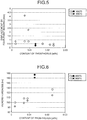
- FIG. 5 is a graph that illustrates relations between the phosphorus content and displacement by four-point bending on the metallic coatings according to the examples.
- a dot indicates a result of measuring a metallic coating (the first to the fourth examples and the first to the third comparative examples) formed at an activating temperature of 600 degrees
- a square indicates a result of measuring a metallic coating (the fifth to the seventh examples and the fourth and the fifth comparative examples) formed at an activating temperature of 800 degrees.
- FIG. 5 is a graph that illustrates relations between the phosphorus content and displacement by four-point bending on the metallic coatings according to the examples.
- a white mark with a black outline indicates a result of measuring a metallic coating (the first to the seventh examples and the first, the second, and the fourth comparative examples) formed from copper powder having been subjected to reduction treatment, whereas a black mark indicates a result of measuring a metallic coating (the third and the fifth comparative examples) formed from copper powder having not been subjected to reduction treatment.
- the amounts of displacement by four-point bending on the metallic coatings of the first to the seventh examples are larger compared with the amounts of displacement by four-point bending in the first to the fifth comparative examples.
- the sixth and the seventh examples have larger amounts of displacement by four-point bending, which means that a metallic coating with higher ductility can be obtained by setting the amount of phosphorus contained in the copper powder between 0.007% to 0.009% by weight.
- dynamic recrystallization was difficult to be caused due to such a large amount of phosphorus, which resulted in brittle fracture.
- Metallic coatings (the third and the fifth comparative examples) formed from copper powder having not been subjected to reduction treatment have 0.013% by weight of phosphorus; however, the amounts of displacement by four-point bending are smaller compared with the metallic coatings of the first to the seventh examples.
- test pieces were prepared by cutting out the center portions of respective metallic coatings cut in a size of 50 mm x 50 mm x 6 mm. After the test pieces were buried and mirror-polished, the vickers hardness test was conducted on the test pieces. The applied load was 300 gf, and an average value between 3 and 5 pieces was calculated.
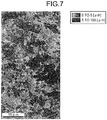
- FIG. 6 is a graph that illustrates relations between the phosphorus content and the vickers hardness on the metallic coatings according to the examples.
- a dot indicates a result of measuring a metallic coating (the first to the third examples and the second and the third comparative examples) formed at an activating temperature of 600 degrees
- a square indicates a result of measuring a metallic coating (the sixth and the seventh examples and the fourth and the fifth comparative examples) formed at an activating temperature of 800 degrees.
- FIG. 6 is a graph that illustrates relations between the phosphorus content and the vickers hardness on the metallic coatings according to the examples.
- a white mark with a black outline indicates a result of measuring a metallic coating (the first to the third, the sixth, and the seventh examples and the second and the fourth comparative examples) formed from copper powder having been subjected to reduction treatment, whereas a black mark indicates a result of measuring a metallic coating (the third and the fifth comparative examples) formed from copper powder having not been subjected to reduction treatment.
- the vickers hardness increases with an increase in the content of phosphorus as illustrated in FIG. 6 .
- the sixth and the seventh examples have larger amounts of displacement by four-point bending, which means that a metallic coating with higher ductility can be obtained by setting the content of phosphorus between 0.007% and 0.009% by weight. Consequently, a metallic coating with further higher ductility is considered to be available by controlling the amount of phosphorus, for example, between 0.005% to 0.010% by weight.
- Metallic coatings (the third and the fifth comparative examples) formed from copper powder having not been subjected to reduction treatment each have 0.013% by weight of phosphorus, and the vickers hardness is extremely large compared with the metallic coatings of the first to the third, the sixth, and the seventh examples.
- a crystal grain map was fabricated based on the above-described test pieces.
- Electron backscatter diffraction (EBSD) caused on the surface of the sample by irradiating a metallic coating with an electron beam exerts effects in obtaining information about the crystal system and the crystal orientation of the sample.
- Information about the crystal system and the crystal orientation distribution in a micro area was obtained by inspecting the EBSD pattern with the electron beam scanning and analyzing the EBSD pattern, and in this manner, a crystal grain map was fabricated.
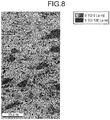
- FIG. 7 is a drawing that illustrates a crystal grain map (the activating gas temperature: 800 degrees) of the metallic coating containing 0.002% by weight of phosphorus according to the fifth example of the examples.
- FIG. 8 is a drawing that illustrates a crystal grain map (the activating gas temperature: 600 degrees) of the metallic coating containing 0.007% by weight of phosphorus according to the second example of the examples.
- FIG. 9 is a drawing that illustrates a crystal grain map (the activating gas temperature: 800 degrees) of the metallic coating containing 0.023% by weight of phosphorus according to the fourth comparative example of the examples.
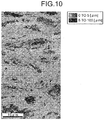
- FIG. 10 is a drawing that illustrates a crystal grain map (the activating gas temperature: 600 degrees) of the metallic coating containing 0.013% by weight of phosphorus and formed from copper powder having not been subjected to reduction treatment according to the third comparative example of the examples.
- the crystal grain maps with 0.002% (the fifth example) and 0.007% (the second example) by weight of phosphorus large areas are occupied by 5 ⁇ m or larger grains.
- the average crystal grain sizes of the detected grains are large, such as 2.15 ⁇ m in the second example and 2.87 ⁇ m in the fifth example.
- the crystal grain maps with 0.023% (the fourth comparative example) and 0.013% (the third comparative example) by weight of phosphorus quite small areas are occupied by 5 ⁇ m or larger grains, and most areas are with grains of an undetectable grain size.
- the average crystal grain sizes of the detected grains are small, such as 1.67 ⁇ m in the third comparative example and 1.50 ⁇ m in the fourth comparative example.
- the crystal grain maps of FIGS. 7 to 9 indicate that recrystallization is likely to be caused by controlling the amount of phosphorus even without separately providing thermal treatment and that a metallic coating with excellent electrical conductivity and mechanical properties can be obtained in this manner.
- the metallic coating the third comparative example and FIG. 10
- the average crystal grain size is small compared with those of the metallic coatings of the second and the fifth examples. In this case, recrystallization is difficult to be caused.
- a laminate and a method of fabricating the laminate according to the present invention exert advantageous effects in obtaining a laminate with excellent thermal conductivity, electrical conductivity, and mechanical properties even without separately providing thermal treatment.
Landscapes
- Chemical & Material Sciences (AREA)
- Chemical Kinetics & Catalysis (AREA)
- Engineering & Computer Science (AREA)
- Materials Engineering (AREA)
- Mechanical Engineering (AREA)
- Metallurgy (AREA)
- Organic Chemistry (AREA)
- Other Surface Treatments For Metallic Materials (AREA)
- Powder Metallurgy (AREA)
Abstract
Description
- The present invention relates to a laminate formed by depositing a metallic coating onto a substrate and a method of fabricating the laminate.
- The cold spray method is now widely known as a method of forming a coating. The cold spray method forms a coating on a substrate by spraying powder of a metallic material in a state of being equal to or lower than the melting point or the softening point from a nozzle together with inert gas such as helium, argon, and nitrogen and having the powder impact with a substrate to be coated while keeping the powder in the solid state (see
Non Patent Literatures 1 and 2). Unlike with the thermal spray method in which a powder material is melted and sprayed onto a substrate, the cold spray method forms a coating at a relatively low temperature. The cold spray method thus exerts advantageous effects in reducing influence of thermal stress and obtaining a metallic coating with no phase transformation and with controlled oxidation. Moreover, use of a metallic material for both a substrate and a coating can generate a laminate with increased adhesion strength because an impact of the powder of the metallic material with the substrate (or an earlier formed coating) causes plastic deformation between the powder and the substrate, which results in the anchoring effect, and further causes a metallic bond between the newly formed surfaces where oxide coatings have been destroyed. Examples of a metallic material used for the cold spray method include copper of high thermal conductivity, electrical conductivity, and mechanical properties. - Non Patent Literature 1: Yoshiyasu Itoh, et al., "Thermal and electrical properties of copper coatings produced by cold spraying", materials (Journal of Society of Materials of Science, Japan), The Society of Materials Science, Japan, Vol. 59, No. 2, pp. 143-148, Feb. 2010
- Non Patent Literature 2: Mitsuru Yoshida, et al., "Properties report of sprayed coating of copper formed by cold spray", Proceedings of 94th (2011 autumn) National Symposium, Japan Thermal Spraying Society, pp. 19-20, 2011 Summary
- A metallic coating formed by the cold spray method is subjected to thermal treatment (annealing treatment) to increase thermal conductivity, electrical conductivity, and mechanical properties; however, forming a metallic coating with excellent thermal conductivity, electrical conductivity, and mechanical properties without separately providing thermal treatment has been required to reduce the number of devices and fabricating processes.
- In view of the above, it is an object of the present invention to provide a laminate with excellent thermal conductivity, electrical conductivity, and mechanical properties and a method of fabricating the laminate without separately providing thermal treatment. Solution to Problem
- To solve the above-described problem and achieve the object, a laminate according to the present invention includes: a substrate; and a metallic coating that is formed from copper powder containing 0.002% to 0.020% by weight of phosphorus and having been subjected to reduction treatment, the metallic coating being deposited on the substrate.
- Moreover, a method of fabricating a laminate according to the present invention includes: accelerating copper powder containing 0.002% to 0.020% by weight of phosphorus and having been subjected to reduction treatment together with gas heated to a temperature lower than a melting point of the copper powder; spraying the copper powder onto a surface of a substrate while keeping the copper powder in a solid state; and depositing the copper powder on the substrate to form a metallic coating.
- Moreover, in the above-described method of fabricating a laminate according to the present invention, the copper powder is accelerated with gas heated to a temperature of 600 degrees or higher.
- Moreover, in the above-described method of fabricating a laminate according to the present invention, the copper powder has an average grain size of 20 µm to 50 µm.
- The present invention exerts advantageous effects in obtaining a laminate with excellent thermal conductivity, electrical conductivity, and mechanical properties even without separately providing thermal treatment.
-
-
FIG. 1 is a schematic perspective view that illustrates a configuration of a laminate according to an embodiment of the present invention. -
FIG. 2 is a schematic view that illustrates an overview of a cold spray device used for forming a metallic coating of the laminate according to the embodiment of the present invention. -
FIG. 3 is a graph that illustrates relations between the phosphorus content and the electrical conductivity on the metallic coatings according to examples of the present invention. -
FIG. 4 is an illustrative drawing of measurement of displacement by four-point bending on the metallic coatings according to the examples of the present invention. -
FIG. 5 is a graph that illustrates relations between the phosphorus content and displacement by four-point bending on the metallic coatings according to the examples of the present invention. -
FIG. 6 is a graph that illustrates relations between the phosphorus content and the vickers hardness on the metallic coatings according to the examples of the present invention. -
FIG. 7 is a drawing that illustrates a crystal grain map of a metallic coating containing 0.002% by weight of phosphorus according to a fifth example of the examples of the present invention. -
FIG. 8 is a drawing that illustrates a crystal grain map of a metallic coating containing 0.007% by weight of phosphorus according to a second example of the examples of the present invention. -
FIG. 9 is a drawing that illustrates a crystal grain map of a metallic coating containing 0.023% by weight of phosphorus according to a fourth comparative example of the examples of the present invention. -
FIG. 10 is a drawing that illustrates a crystal grain map of a metallic coating containing 0.013% by weight of phosphorus and formed from copper powder having not been subjected to reduction processing according to a third comparative example of the examples of the present invention. - Embodiments of the present invention will now be described in detail with reference to the drawings. It should be noted that the embodiments are not intended to limit the present invention. The drawings referred to in the following description schematically illustrate the shapes, the sizes, and the positional relations to the necessary extent to understand the spirit of the present invention. The present invention is therefore not limited to the shapes, the sizes, and the positional relations illustrated in the drawings as examples.
- A laminate of an embodiment of the present invention will now be described in detail with reference to the drawings.
FIG. 1 is a schematic perspective view that illustrates the configuration of the laminate in the embodiment of the present invention. When alaminate 1 illustrated inFIG. 1 is used in such a case that needs a large amount of electricity, for example, vehicles and power supplies for energy storage, thelaminate 1 is used as a conductive member referred to as a bus bar. - The
laminate 1 includes asubstrate 10 composed of metal or alloy metal and ametallic coating 11 formed on the surface of thesubstrate 10, laminated by the later-described cold spray method, and composed of a metallic material containing copper as a major constituent. Thelaminate 1 is not limited to a rectangular flat shape as illustrated inFIG. 1 and may be in the shape of a cylinder, a polygonal cylinder, or the like. Thesubstrate 10 may be made from any materials composed of metal or alloy metal. For example, thesubstrate 10 is formed from aluminum or alloy metal containing aluminum. - Generally, in forming a coating by the cold spray method, a softener substrate can enhance adhesion between the substrate and the coating because of the anchoring effect. In this embodiment, the
substrate 10 is made from aluminum or alloyed aluminum, and themetallic coating 11 is formed from powder composed of metal containing copper as a major constituent. This structure allows thelaminate 1 to have enhanced adhesion between the substrate and the coating. - The
metallic coating 11 is formed from copper powder having copper as a major constituent and containing a predetermined percent by weight of phosphorus. The copper powder has an average grain size of 20 µm to 50 µm and is fabricated by, for example, the water atomizing method. The copper powder has been subjected to reduction treatment. - More specifically, the copper powder contains 0.002% to 0.020% by weight of phosphorus in powder. The copper powder contains 0.002% to 0.020% by weight of phosphorus, thereby reducing hardness of the powder and forming a densified
metallic coating 11. Furthermore, with the copper powder containing 0.002% to 0.020% by weight of phosphorus, the heat generated in forming the coating by the cold spray method causes recrystallization. This process reduces displacement, and the reduction in displacement improves the electrical conductivity and increases ductility. Consequently, themetallic coating 11 with excellent thermal conductivity, electrical conductivity and mechanical properties (ductility) can be obtained. - An increase in the amount of phosphorus to larger than 0.020% by weight increases the amount of phosphorus contained in the metal coating, which increases electrical resistance and reduces the electrical conductivity of the metal coating. An increase in the amount of phosphorus to larger than 0.020% by weight increases the temperature at which recrystallization is caused, and the heat generated in forming the coating is less likely to cause a reduction in dislocation.
- The copper powder preferably contains 0.005% to 0.010% by weight of phosphorus so that the formed
metallic coating 11 has high electrical conductivity and high ductility. Keeping the amount of phosphorus between 0.005% and 0.010% by weight reduces dislocation, which improves the electrical conductivity and markedly increases ductility. With this structure, themetallic coating 11 with excellent thermal conductivity, electrical conductivity and mechanical properties (ductility) can be obtained. - A method of fabricating the
laminate 1 according to the present invention will now be described. Thelaminate 1 is fabricated in such a manner that accelerates copper powder containing a predetermined percent by weight of phosphorus together with gas heated to a temperature lower than the melting point of the copper powder toward the surface of thesubstrate 10, sprays the copper powder in the solid state onto thesubstrate 10 to be deposited thereon, and forms themetallic coating 11. - The
metallic coating 11 is formed on thesubstrate 10 by the cold spray method using the above-described copper powder. Formation of themetallic coating 11 will be described with reference toFIG. 2. FIG. 2 is a schematic view that illustrates an overview of acold spray device 20 used for forming themetallic coating 11 of thelaminate 1 according to the embodiment of the present invention. - The
cold spray device 20 includes agas heater 21 that heats activating gas, apowder supply device 23 that stores therein a powder material to be sprayed onto thesubstrate 10 and supplies the material to aspray gun 22, and agas nozzle 24 that sprays the powder material mixed with the heated activating gas in thespray gun 22 to thesubstrate 10. The powder material is copper powder having a grain size (an average grain size) of about 20 µm to 50 µm and containing a range of 0.002% to 0.020% by weight of phosphorus. - As the activating gas, helium, nitrogen, air, and the like are used. Supplied activating gas is supplied to the
gas heater 21 and thepowder supply device 23 byvalves gas heater 21 is heated to a temperature, for example, between 600 degrees and the melting point, inclusive, of alloy used as the powder material to form themetallic coating 11 and is supplied to thespray gun 22. The temperature for heating the activating gas is preferably between 800 degrees and the melting point, inclusive, of alloy used as the powder material. - The activating gas supplied to the
powder supply device 23 supplies a predetermined discharge amount of the powder material (copper powder) in thepowder supply device 23 to thespray gun 22. The heated activating gas is turned to a supersonic flow (about 340 m/s or higher) by thegas nozzle 24 in the convergent-divergent shape. The gas pressure of the activating gas is preferably between 1 MPa and 5 MPa, more preferably, between 2 MPa and 4 MPa. The gas pressure of the activating gas is set between 1 MPa to 5 MPa, which can increase the adhesion strength between thesubstrate 10 and themetallic coating 11. The powder material supplied to thespray gun 22 is put into the ultrasonic flow of the activating gas and accelerated. The powder material impacts with thesubstrate 10 at a high speed while keeping the solid state and forms themetallic coating 11. The device is not limited to thecold spray device 20 inFIG. 2 as long as the device can form themetallic coating 11 by causing a powder material composed of metal containing copper as a major constituent to impact with thesubstrate 10 while keeping the powder material in the solid state. - When the powder material forming the
metallic coating 11 is sprayed on the surface of thesubstrate 10 by the cold spray method, heat resulting from impact of the powder material with thesubstrate 10 causes recrystallization (dynamic recrystallization) on the formed metallic coating. With this process, a densifiedmetallic coating 11 can be obtained without providing thermal treatment to the formed coating. - The
metallic coating 11 preferably has electrical conductivity (IACS) of 90% or higher, more preferably, 93% or higher. IACS indicates the electrical conductivity (%) to the standard annealed copper (with the standard annealed copper representing 100%). Themetallic coating 11 is formed from copper powder having excellent thermal conductivity and has good electrical conductivity. With these facts, themetallic coating 11 is considered to have good thermal conductivity. - According to the above-described embodiment, the
metallic coating 11 is formed by the spray coating method using copper powder, which contains 0.002% to 0.020% by weight of phosphorus and has been subjected to reduction treatment. In this manner, a laminate having excellent thermal conductivity, electrical conductivity, and mechanical properties can be obtained even without separately providing thermal treatment. - A Laminate was fabricated by causing a copper coating containing a predetermined amount of phosphorus to be formed on an aluminum substrate (board) by the method of fabricating a laminate according to the embodiment, and evaluations of electrical conductivity and mechanical properties of the laminate were carried out.
- A laminate was fabricated in such a manner that sprays copper powder (the average grain size: about 35 µm), which contains 0.002% by weight of phosphorus and has been subjected to reduction treatment, on an aluminum substrate (A1050 - H24) using the
cold spray device 20 under the following conditions: activating gas: nitrogen, the activating gas temperature: 600 degrees, the activating gas pressure: 3 MPa, the working distance (WD): 25 mm, the traverse speed: 200 mm/s, and the number of passes: six times, and forms a metallic coating. In this example, an about 1.1 mm metallic coating was formed in one pass, and an about 6.6 mm metallic coating was thus formed in six passes. Copper powder fabricated by the water atomizing method was used. - A laminate was fabricated in such a manner that sprays copper powder (the average grain size: about 35 µm), which contains 0.007% by weight of phosphorus and has been subjected to reduction treatment, on an aluminum substrate (A1050 - H24) using the
cold spray device 20 under the same conditions as the first example for the activating gas, the activating gas temperature, the activating gas pressure, the working distance, the traverse speed, and the number of passes and forms a metallic coating. - A laminate was fabricated in such a manner that sprays copper powder (the average grain size: about 35 µm), which contains 0.009% by weight of phosphorus and has been subjected to reduction treatment, on an aluminum substrate (A1050 - H24) using the
cold spray device 20 under the same conditions as the first example for the activating gas, the activating gas temperature, the activating gas pressure, the working distance, the traverse speed, and the number of passes and forms a metallic coating. - A laminate was fabricated in such a manner that sprays copper powder (the average grain size: about 35 µm), which contains 0.017% by weight of phosphorus and has been subjected to reduction treatment, on an aluminum substrate (A1050 - H24) using the
cold spray device 20 under the same conditions as the first example for the activating gas, the activating gas temperature, the activating gas pressure, the working distance, the traverse speed, and the number of passes and forms a metallic coating. - A laminate was fabricated in such a manner that sprays copper powder (the average grain size: about 35 µm), which contains 0.021% by weight of phosphorus and has been subjected to reduction treatment, on an aluminum substrate (A1050 - H24) using the
cold spray device 20 under the same conditions as the example for the activating gas, the activating gas temperature, the activating gas pressure, the working distance, the traverse speed, and the number of passes and forms a metallic coating. - A laminate was fabricated in such a manner that sprays copper powder (the average grain size: about 35 µm), which contains 0.023% by weight of phosphorus and has been subjected to reduction treatment, on an aluminum substrate (A1050 - H24) using the
cold spray device 20 under the same conditions as the first example for the activating gas, the activating gas temperature, the activating gas pressure, the working distance, the traverse speed, and the number of passes and forms a metallic coating. - A laminate was fabricated in such a manner that sprays copper powder (the average grain size: about 35 µm), which contains 0.013% by weight of phosphorus and has not been subjected to reduction treatment, on an aluminum substrate (A1050 - H24) using the
cold spray device 20 under the same conditions as the first example for the activating gas, the activating gas temperature, the activating gas pressure, the working distance, the traverse speed, and the number of passes and forms a metallic coating. - A portion of the metallic coating was cut out from each of the laminates, which were fabricated in the above-described methods, according to the first to the fourth examples and the first to the third comparative examples as a test piece. Evaluations of electrical conductivity were carried out on the test pieces. Results of the evaluations are indicated in Table 1. IACS in Table 1 indicates the electrical conductivity (%) to the standard annealed copper (with the standard annealed copper representing 100%). Each of the test pieces was cut out in a rectangular prism of 2 mm x 2 mm x 40 mm in size. Potential was measured using four terminal sensing by applying measurement current (1 A) between measuring points having a distance of 23 mm therebetween.
Table 1 Reduction treatment on powder Phosphorus content (wt %) Activating gas temperature (degree) IACS (%) First example Applied 0.002 600 93.0 Second example Applied 0.007 600 100.0 Third example Applied 0.009 600 99.0 Fourth example Applied 0.017 600 93.1 First comparative example Applied 0.021 600 85.2 Second comparative example Applied 0.023 600 83.0 Third comparative example Not Applied 0.013 600 83.2 - A test piece was fabricated in such a manner that sprays copper powder (the average grain size: about 35 µm), which contains 0.002% by weight of phosphorus and has been subjected to reduction treatment, on an aluminum substrate (A1050 - H24) using the
cold spray device 20 under the following conditions: activating gas: nitrogen, the activating gas temperature: 800 degrees, the activating gas pressure: 3 MPa, the working distance (WD): 25 mm, the traverse speed: 200 mm/s, and the number of passes: six times, and forms a metallic coating. In this example, an about 1.2 mm metallic coating was formed in one pass, and an about 7.2 mm metallic coating was thus formed in six passes. - A test piece was fabricated in such a manner that sprays copper powder (the average grain size: about 35 µm), which contains 0.007% by weight of phosphorus and has been subjected to reduction treatment, on an aluminum substrate (A1050 - H24) using the
cold spray device 20 under the same conditions as the fifth example for the activating gas, the activating gas temperature, the activating gas pressure, the working distance, the traverse speed, and the number of passes and forms a metallic coating. - A test piece was fabricated in such a manner that sprays copper powder (the average grain size: about 35 µm), which contains 0.009% by weight of phosphorus and has been subjected to reduction treatment, on an aluminum substrate (A1050 - H24) using the
cold spray device 20 under the same conditions as the fifth example for the activating gas, the activating gas temperature, the activating gas pressure, the working distance, the traverse speed, and the number of passes and forms a metallic coating. - A test piece was fabricated in such a manner that sprays copper powder (the average grain size: about 35 µm), which contains 0.017% by weight of phosphorus and has been subjected to reduction treatment, on an aluminum substrate (A1050 - H24) using the
cold spray device 20 under the same conditions as the fifth example for the activating gas, the activating gas temperature, the activating gas pressure, the working distance, the traverse speed, and the number of passes and forms a metallic coating. - A test piece was fabricated in such a manner that sprays copper powder (the average grain size: about 35 µm), which contains 0.023% by weight of phosphorus and has been subjected to reduction treatment, on an aluminum substrate (A1050 - H24) using the
cold spray device 20 under the same conditions as the fifth example for the activating gas, the activating gas temperature, the activating gas pressure, the working distance, the traverse speed, and the number of passes and forms a metallic coating. - A test piece was fabricated in such a manner that sprays copper powder (the average grain size: about 35 µm), which contains 0.013% by weight of phosphorus and has not been subjected to reduction treatment, on an aluminum substrate (A1050 - H24) using the
cold spray device 20 under the same conditions as the fifth example for the activating gas, the activating gas temperature, the activating gas pressure, the working distance, the traverse speed, and the number of passes and forms a metallic coating. - A portion of the metallic coating was cut out from each of the laminates, which were fabricated in the above-described methods, according to the fifth to the eighth examples and the fourth and the fifth comparative examples as a test piece. Evaluations of electrical conductivity were carried out on the test pieces. Results of the evaluations are indicated in Table 2. Electrical conductivity was measured in the same manner as the above-described first to fourth examples, which is, in such a manner that measures potential using four terminal sensing by applying measurement current (1 A) between measuring points, which have a distance of 23 mm therebetween, on a test piece of 2 mm x 2 mm x 40 mm in size.
Table 2 Reduction treatment on powder Phosphorus content (wt %) Activating gas temperature (degree) IACS (%) Fifth example Applied 0.002 800 99.0 Sixth example Applied 0.007 800 100.0 Seventh example Applied 0.009 800 100.0 Eighth example Applied 0.017 800 100.0 Fourth comparative Applied 0.023 800 92.0 example Fifth comparative example Not Applied 0.013 800 92.0 -
FIG. 3 is a graph that illustrates relations between the phosphorus content and the electrical conductivity (IACS) on the metallic coatings according to the examples. On the graph ofFIG. 3 , a dot indicates a result of measuring a metallic coating (the first to the fourth examples and the first to the third comparative examples) formed at an activating temperature of 600 degrees, whereas a square indicates a result of measuring a metallic coating (the fifth to the eighth examples and the fourth and the fifth comparative examples) formed at an activating temperature of 800 degrees. Furthermore, on the graph ofFIG. 3 , a white mark with a black outline indicates a result of measuring a metallic coating (the first to the eighth examples and the first, the second, and the fourth comparative examples) formed from copper powder having been subjected to reduction treatment, whereas a black mark indicates a result of measuring a metallic coating (the third and the fifth comparative examples) formed from copper powder having not been subjected to reduction treatment. - As illustrated in Tables 1 and 2, and
FIG. 3 , the electrical conductivity in the first to the eighth examples containing respective amounts of phosphorus is higher compared with the electrical conductivity in the first to the fifth comparative examples. Specifically, the second, the third, the fifth to the seventh examples each have electrical conductivity of 99.0 percent or higher, which means that a metallic coating with higher electrical conductivity can be obtained by setting the amount of phosphorus contained in the copper powder between 0.007% and 0.010% by weight. Even when using 0.017% by weight of phosphorus, a metallic coating with high electrical conductivity can be obtained by setting the activating gas temperature at 800 degrees. Consequently, a metallic coating with higher electrical conductivity can be obtained by controlling the amount of phosphorus. Metallic coatings (the third and the fifth comparative examples) formed from copper powder having not been subjected to reduction treatment each have 0.013% by weight of phosphorus; however, the electrical conductivity is lower compared with metallic coatings of the first to the eighth examples. - As a next step, measurement of displacement by four-point bending was carried out on laminates of the first to the seventh examples and the first to the fifth comparative examples.
FIG. 4 is an illustrative drawing of measurement of displacement by four-point bending on the metallic coating according to the examples. The measurement of displacement by four-point bending was carried out on each test piece TP of 2 mm x 2 mm x 40 mm in size in such a manner that presses the test piece TP betweencylindrical supports cylindrical supports supports supports supports supports 101 to 104 had diameters of 2.5 mm. -
FIG. 5 is a graph that illustrates relations between the phosphorus content and displacement by four-point bending on the metallic coatings according to the examples. On the graph ofFIG. 5 , a dot indicates a result of measuring a metallic coating (the first to the fourth examples and the first to the third comparative examples) formed at an activating temperature of 600 degrees, whereas a square indicates a result of measuring a metallic coating (the fifth to the seventh examples and the fourth and the fifth comparative examples) formed at an activating temperature of 800 degrees. Furthermore, on the graph ofFIG. 5 , a white mark with a black outline indicates a result of measuring a metallic coating (the first to the seventh examples and the first, the second, and the fourth comparative examples) formed from copper powder having been subjected to reduction treatment, whereas a black mark indicates a result of measuring a metallic coating (the third and the fifth comparative examples) formed from copper powder having not been subjected to reduction treatment. - As illustrated in
FIG. 5 , the amounts of displacement by four-point bending on the metallic coatings of the first to the seventh examples, which contain respective amounts of phosphorus, are larger compared with the amounts of displacement by four-point bending in the first to the fifth comparative examples. Specifically, the sixth and the seventh examples have larger amounts of displacement by four-point bending, which means that a metallic coating with higher ductility can be obtained by setting the amount of phosphorus contained in the copper powder between 0.007% to 0.009% by weight. Conversely, in the second and the fourth comparative examples, dynamic recrystallization was difficult to be caused due to such a large amount of phosphorus, which resulted in brittle fracture. Consequently, a metallic coating with high ductility can be obtained by controlling the amount of phosphorus. Metallic coatings (the third and the fifth comparative examples) formed from copper powder having not been subjected to reduction treatment have 0.013% by weight of phosphorus; however, the amounts of displacement by four-point bending are smaller compared with the metallic coatings of the first to the seventh examples. - As a next step, measurement of the vickers hardness was conducted on laminates of the first to the sixth examples and the second to the fifth comparative examples. In measuring the vickers hardness, test pieces were prepared by cutting out the center portions of respective metallic coatings cut in a size of 50 mm x 50 mm x 6 mm. After the test pieces were buried and mirror-polished, the vickers hardness test was conducted on the test pieces. The applied load was 300 gf, and an average value between 3 and 5 pieces was calculated.
-
FIG. 6 is a graph that illustrates relations between the phosphorus content and the vickers hardness on the metallic coatings according to the examples. On the graph ofFIG. 6 , a dot indicates a result of measuring a metallic coating (the first to the third examples and the second and the third comparative examples) formed at an activating temperature of 600 degrees, whereas a square indicates a result of measuring a metallic coating (the sixth and the seventh examples and the fourth and the fifth comparative examples) formed at an activating temperature of 800 degrees. Furthermore, on the graph ofFIG. 6 , a white mark with a black outline indicates a result of measuring a metallic coating (the first to the third, the sixth, and the seventh examples and the second and the fourth comparative examples) formed from copper powder having been subjected to reduction treatment, whereas a black mark indicates a result of measuring a metallic coating (the third and the fifth comparative examples) formed from copper powder having not been subjected to reduction treatment. - In metallic coatings of the examples, the vickers hardness increases with an increase in the content of phosphorus as illustrated in
FIG. 6 . Specifically, the sixth and the seventh examples have larger amounts of displacement by four-point bending, which means that a metallic coating with higher ductility can be obtained by setting the content of phosphorus between 0.007% and 0.009% by weight. Consequently, a metallic coating with further higher ductility is considered to be available by controlling the amount of phosphorus, for example, between 0.005% to 0.010% by weight. Metallic coatings (the third and the fifth comparative examples) formed from copper powder having not been subjected to reduction treatment each have 0.013% by weight of phosphorus, and the vickers hardness is extremely large compared with the metallic coatings of the first to the third, the sixth, and the seventh examples. - As a next step, a crystal grain map was fabricated based on the above-described test pieces. Electron backscatter diffraction (EBSD) caused on the surface of the sample by irradiating a metallic coating with an electron beam exerts effects in obtaining information about the crystal system and the crystal orientation of the sample. Information about the crystal system and the crystal orientation distribution in a micro area was obtained by inspecting the EBSD pattern with the electron beam scanning and analyzing the EBSD pattern, and in this manner, a crystal grain map was fabricated.
-
FIG. 7 is a drawing that illustrates a crystal grain map (the activating gas temperature: 800 degrees) of the metallic coating containing 0.002% by weight of phosphorus according to the fifth example of the examples.FIG. 8 is a drawing that illustrates a crystal grain map (the activating gas temperature: 600 degrees) of the metallic coating containing 0.007% by weight of phosphorus according to the second example of the examples.FIG. 9 is a drawing that illustrates a crystal grain map (the activating gas temperature: 800 degrees) of the metallic coating containing 0.023% by weight of phosphorus according to the fourth comparative example of the examples.FIG. 10 is a drawing that illustrates a crystal grain map (the activating gas temperature: 600 degrees) of the metallic coating containing 0.013% by weight of phosphorus and formed from copper powder having not been subjected to reduction treatment according to the third comparative example of the examples. - As illustrated in
FIGS. 7 and8 , on the crystal grain maps with 0.002% (the fifth example) and 0.007% (the second example) by weight of phosphorus, large areas are occupied by 5 µm or larger grains. The average crystal grain sizes of the detected grains are large, such as 2.15 µm in the second example and 2.87 µm in the fifth example. - As illustrated in
FIGS. 9 and10 , on the crystal grain maps with 0.023% (the fourth comparative example) and 0.013% (the third comparative example) by weight of phosphorus, quite small areas are occupied by 5 µm or larger grains, and most areas are with grains of an undetectable grain size. The average crystal grain sizes of the detected grains are small, such as 1.67 µm in the third comparative example and 1.50 µm in the fourth comparative example. - The crystal grain maps of
FIGS. 7 to 9 indicate that recrystallization is likely to be caused by controlling the amount of phosphorus even without separately providing thermal treatment and that a metallic coating with excellent electrical conductivity and mechanical properties can be obtained in this manner. With regards to the metallic coating (the third comparative example andFIG. 10 ) formed from copper powder having not been subjected to reduction treatment, although the amount of phosphorus is 0.013% by weight, the average crystal grain size is small compared with those of the metallic coatings of the second and the fifth examples. In this case, recrystallization is difficult to be caused. - The above-described embodiments are only examples to implement the present invention, and the present invention is not limited to these embodiments. Various modifications can be made to the present invention according to specifications or the like, and it is obvious from the above description that other various embodiments can be implemented within the scope of the present invention.
- As described above, a laminate and a method of fabricating the laminate according to the present invention exert advantageous effects in obtaining a laminate with excellent thermal conductivity, electrical conductivity, and mechanical properties even without separately providing thermal treatment.
-
- 1
- laminate
- 10
- substrate
- 11
- metallic coating
- 20
- cold spray device
- 21
- gas heater
- 22
- spray gun
- 23
- powder supply device
- 24
- gas nozzle
Claims (4)
- A laminate comprising:a substrate; anda metallic coating that is formed from copper powder containing 0.002% to 0.020% by weight of phosphorus and having been subjected to reduction treatment, the metallic coating being deposited on the substrate.
- A method of fabricating a laminate, the method comprising:accelerating copper powder containing 0.002% to 0.020% by weight of phosphorus and having been subjected to reduction treatment together with gas heated to a temperature lower than a melting point of the copper powder;spraying the copper powder onto a surface of a substrate while keeping the copper powder in a solid state; anddepositing the copper powder on the substrate to form a metallic coating.
- The method of fabricating a laminate according to claim 2, wherein the copper powder is accelerated with gas heated to a temperature of 600 degrees or higher.
- The method of fabricating a laminate according to claim 2 or 3, wherein the copper powder has an average grain size of 20 µm to 50 µm.
Applications Claiming Priority (2)
| Application Number | Priority Date | Filing Date | Title |
|---|---|---|---|
| JP2014044190A JP5889938B2 (en) | 2014-03-06 | 2014-03-06 | LAMINATE AND METHOD FOR PRODUCING LAMINATE |
| PCT/JP2015/055485 WO2015133351A1 (en) | 2014-03-06 | 2015-02-25 | Laminate, and method for producing laminate |
Publications (3)
| Publication Number | Publication Date |
|---|---|
| EP3115481A1 true EP3115481A1 (en) | 2017-01-11 |
| EP3115481A4 EP3115481A4 (en) | 2017-10-11 |
| EP3115481B1 EP3115481B1 (en) | 2018-10-03 |
Family
ID=54055160
Family Applications (1)
| Application Number | Title | Priority Date | Filing Date |
|---|---|---|---|
| EP15758220.6A Not-in-force EP3115481B1 (en) | 2014-03-06 | 2015-02-25 | Method for producing a laminate |
Country Status (4)
| Country | Link |
|---|---|
| US (1) | US10435792B2 (en) |
| EP (1) | EP3115481B1 (en) |
| JP (1) | JP5889938B2 (en) |
| WO (1) | WO2015133351A1 (en) |
Families Citing this family (2)
| Publication number | Priority date | Publication date | Assignee | Title |
|---|---|---|---|---|
| JP6811719B2 (en) * | 2015-11-11 | 2021-01-13 | 日本発條株式会社 | Method of manufacturing a laminate |
| KR102866116B1 (en) | 2021-11-26 | 2025-09-30 | 삼성전자주식회사 | Semiconductor package |
Family Cites Families (13)
| Publication number | Priority date | Publication date | Assignee | Title |
|---|---|---|---|---|
| JP3984534B2 (en) * | 2002-11-19 | 2007-10-03 | 三井金属鉱業株式会社 | Copper powder for conductive paste and method for producing the same |
| JP4352121B2 (en) * | 2003-04-02 | 2009-10-28 | Dowaエレクトロニクス株式会社 | Copper powder manufacturing method |
| JP4868716B2 (en) | 2004-04-28 | 2012-02-01 | 三井金属鉱業株式会社 | Flake copper powder and conductive paste |
| FI120050B (en) | 2004-06-03 | 2009-06-15 | Luvata Oy | Method for reducing and bonding metal oxide powder to a heat transfer surface and heat transfer surface |
| EP1806183A1 (en) * | 2006-01-10 | 2007-07-11 | Siemens Aktiengesellschaft | Nozzle arrangement and method for cold gas spraying |
| JP4586823B2 (en) * | 2007-06-21 | 2010-11-24 | トヨタ自動車株式会社 | Film forming method, heat transfer member, power module, vehicle inverter, and vehicle |
| JP5321942B2 (en) * | 2008-02-29 | 2013-10-23 | 新東工業株式会社 | Method for manufacturing electronic circuit board and electronic circuit board |
| JP5155743B2 (en) * | 2008-03-04 | 2013-03-06 | 三井金属鉱業株式会社 | Copper powder for conductive paste and conductive paste |
| CA2735151C (en) | 2008-08-29 | 2017-09-05 | Ishihara Sangyo Kaisha, Ltd. | Metallic copper dispersion and application thereof, and process for producing the metallic copper dispersion |
| JP2010077520A (en) * | 2008-09-29 | 2010-04-08 | Toray Ind Inc | Method for producing fine copper particle, and fine copper particle |
| JP2010129934A (en) * | 2008-11-30 | 2010-06-10 | Sintokogio Ltd | Glass circuit board and method of manufacturing the same |
| JP2011060654A (en) * | 2009-09-11 | 2011-03-24 | Toyobo Co Ltd | Manufacturing method for copper thin film, and copper thin film |
| WO2013158178A2 (en) * | 2012-01-27 | 2013-10-24 | Ndsu Research Foundation | Micro cold spray direct write systems and methods for printed micro electronics |
-
2014
- 2014-03-06 JP JP2014044190A patent/JP5889938B2/en active Active
-
2015
- 2015-02-25 EP EP15758220.6A patent/EP3115481B1/en not_active Not-in-force
- 2015-02-25 US US15/123,021 patent/US10435792B2/en not_active Expired - Fee Related
- 2015-02-25 WO PCT/JP2015/055485 patent/WO2015133351A1/en not_active Ceased
Also Published As
| Publication number | Publication date |
|---|---|
| US20170058406A1 (en) | 2017-03-02 |
| WO2015133351A1 (en) | 2015-09-11 |
| JP5889938B2 (en) | 2016-03-22 |
| EP3115481B1 (en) | 2018-10-03 |
| EP3115481A4 (en) | 2017-10-11 |
| US10435792B2 (en) | 2019-10-08 |
| JP2015168846A (en) | 2015-09-28 |
Similar Documents
| Publication | Publication Date | Title |
|---|---|---|
| US9070487B2 (en) | Conductive member | |
| KR101579239B1 (en) | Lamination and method for manufacturing lamination | |
| KR101746974B1 (en) | Method for preparing metal-coated steel sheet and metal-coated steel sheet prepared by the same | |
| JP5654088B1 (en) | Conductive member and method of manufacturing conductive member | |
| EP3375606B1 (en) | Laminate and laminate manufacturing method | |
| JP2012201890A (en) | Laminate, conductive material, and method for producing laminate | |
| Wielage et al. | New method for producing power electronic circuit boards by cold-gas spraying and investigation of adhesion mechanisms | |
| EP3572555A1 (en) | Method for manufacturing ceramic circuit board | |
| EP2858154A1 (en) | Separator material for solid polymer fuel cells having excellent corrosion resistance, conductivity and formability, and method for manufacturing same | |
| JP5605901B2 (en) | Method for repairing metal material by cold spray method, method for producing powder material for cold spray, and cold spray film | |
| EP3018234A1 (en) | Sputtering target and method for manufacturing same | |
| WO2015005131A1 (en) | Laminate and method for manufacturing laminate | |
| US10435792B2 (en) | Laminate and method of fabricating laminate | |
| KR20140097687A (en) | Method for corrosion resistance alloy thin film with amorphous phase | |
| JP6948350B2 (en) | Manufacturing method of ceramic circuit board | |
| JP6006846B1 (en) | Conductive member, conductive member for gas insulated switchgear, and manufacturing method of conductive member for gas insulated switchgear | |
| JP5548948B2 (en) | Composite material in which a metal glass sprayed coating layer is formed on a thin metal substrate and method for producing the same | |
| KR20160007650A (en) | Silver coating material and method for manufacturing same | |
| Roh et al. | Direct energy Deposition of Mo powDer prepareD by electroDe inDuction Melting gas atoMization | |
| GB2533447A (en) | Method for treating sheet metal | |
| Jung et al. | Analysis of BCP characteristics for SRF cavities | |
| DE19958424A1 (en) | Composite material for thin-film coating of large substrates comprises a base layer of titanium or primed steel or copper, a transitional layer of primer and titanium dioxide and a working layer of titanium dioxide and metal | |
| JP2024140110A (en) | Manufacturing method of layered object, powder for layered object, and binder solution | |
| US20160185648A1 (en) | Manufacturing of wafer-like thin glass plates having structures thereon and separation thereof into individual smaller thin glass plates | |
| Watanabe et al. | Microtexture and Electrical and Mechanical Properties of the Cold-Sprayed Copper Deposit |
Legal Events
| Date | Code | Title | Description |
|---|---|---|---|
| PUAI | Public reference made under article 153(3) epc to a published international application that has entered the european phase |
Free format text: ORIGINAL CODE: 0009012 |
|
| STAA | Information on the status of an ep patent application or granted ep patent |
Free format text: STATUS: REQUEST FOR EXAMINATION WAS MADE |
|
| 17P | Request for examination filed |
Effective date: 20160824 |
|
| AK | Designated contracting states |
Kind code of ref document: A1 Designated state(s): AL AT BE BG CH CY CZ DE DK EE ES FI FR GB GR HR HU IE IS IT LI LT LU LV MC MK MT NL NO PL PT RO RS SE SI SK SM TR |
|
| AX | Request for extension of the european patent |
Extension state: BA ME |
|
| DAX | Request for extension of the european patent (deleted) | ||
| REG | Reference to a national code |
Ref country code: DE Ref legal event code: R079 Ref document number: 602015017554 Country of ref document: DE Free format text: PREVIOUS MAIN CLASS: C23C0024080000 Ipc: C23C0024040000 |
|
| A4 | Supplementary search report drawn up and despatched |
Effective date: 20170911 |
|
| RIC1 | Information provided on ipc code assigned before grant |
Ipc: C23C 24/04 20060101AFI20170901BHEP |
|
| GRAP | Despatch of communication of intention to grant a patent |
Free format text: ORIGINAL CODE: EPIDOSNIGR1 |
|
| STAA | Information on the status of an ep patent application or granted ep patent |
Free format text: STATUS: GRANT OF PATENT IS INTENDED |
|
| INTG | Intention to grant announced |
Effective date: 20180525 |
|
| GRAS | Grant fee paid |
Free format text: ORIGINAL CODE: EPIDOSNIGR3 |
|
| GRAA | (expected) grant |
Free format text: ORIGINAL CODE: 0009210 |
|
| STAA | Information on the status of an ep patent application or granted ep patent |
Free format text: STATUS: THE PATENT HAS BEEN GRANTED |
|
| AK | Designated contracting states |
Kind code of ref document: B1 Designated state(s): AL AT BE BG CH CY CZ DE DK EE ES FI FR GB GR HR HU IE IS IT LI LT LU LV MC MK MT NL NO PL PT RO RS SE SI SK SM TR |
|
| REG | Reference to a national code |
Ref country code: GB Ref legal event code: FG4D |
|
| REG | Reference to a national code |
Ref country code: CH Ref legal event code: EP Ref country code: AT Ref legal event code: REF Ref document number: 1048698 Country of ref document: AT Kind code of ref document: T Effective date: 20181015 |
|
| REG | Reference to a national code |
Ref country code: IE Ref legal event code: FG4D Ref country code: DE Ref legal event code: R096 Ref document number: 602015017554 Country of ref document: DE |
|
| REG | Reference to a national code |
Ref country code: NL Ref legal event code: MP Effective date: 20181003 |
|
| REG | Reference to a national code |
Ref country code: LT Ref legal event code: MG4D |
|
| REG | Reference to a national code |
Ref country code: AT Ref legal event code: MK05 Ref document number: 1048698 Country of ref document: AT Kind code of ref document: T Effective date: 20181003 |
|
| PG25 | Lapsed in a contracting state [announced via postgrant information from national office to epo] |
Ref country code: NL Free format text: LAPSE BECAUSE OF FAILURE TO SUBMIT A TRANSLATION OF THE DESCRIPTION OR TO PAY THE FEE WITHIN THE PRESCRIBED TIME-LIMIT Effective date: 20181003 |
|
| PG25 | Lapsed in a contracting state [announced via postgrant information from national office to epo] |
Ref country code: NO Free format text: LAPSE BECAUSE OF FAILURE TO SUBMIT A TRANSLATION OF THE DESCRIPTION OR TO PAY THE FEE WITHIN THE PRESCRIBED TIME-LIMIT Effective date: 20190103 Ref country code: BG Free format text: LAPSE BECAUSE OF FAILURE TO SUBMIT A TRANSLATION OF THE DESCRIPTION OR TO PAY THE FEE WITHIN THE PRESCRIBED TIME-LIMIT Effective date: 20190103 Ref country code: PL Free format text: LAPSE BECAUSE OF FAILURE TO SUBMIT A TRANSLATION OF THE DESCRIPTION OR TO PAY THE FEE WITHIN THE PRESCRIBED TIME-LIMIT Effective date: 20181003 Ref country code: FI Free format text: LAPSE BECAUSE OF FAILURE TO SUBMIT A TRANSLATION OF THE DESCRIPTION OR TO PAY THE FEE WITHIN THE PRESCRIBED TIME-LIMIT Effective date: 20181003 Ref country code: LT Free format text: LAPSE BECAUSE OF FAILURE TO SUBMIT A TRANSLATION OF THE DESCRIPTION OR TO PAY THE FEE WITHIN THE PRESCRIBED TIME-LIMIT Effective date: 20181003 Ref country code: LV Free format text: LAPSE BECAUSE OF FAILURE TO SUBMIT A TRANSLATION OF THE DESCRIPTION OR TO PAY THE FEE WITHIN THE PRESCRIBED TIME-LIMIT Effective date: 20181003 Ref country code: HR Free format text: LAPSE BECAUSE OF FAILURE TO SUBMIT A TRANSLATION OF THE DESCRIPTION OR TO PAY THE FEE WITHIN THE PRESCRIBED TIME-LIMIT Effective date: 20181003 Ref country code: CZ Free format text: LAPSE BECAUSE OF FAILURE TO SUBMIT A TRANSLATION OF THE DESCRIPTION OR TO PAY THE FEE WITHIN THE PRESCRIBED TIME-LIMIT Effective date: 20181003 Ref country code: ES Free format text: LAPSE BECAUSE OF FAILURE TO SUBMIT A TRANSLATION OF THE DESCRIPTION OR TO PAY THE FEE WITHIN THE PRESCRIBED TIME-LIMIT Effective date: 20181003 Ref country code: IS Free format text: LAPSE BECAUSE OF FAILURE TO SUBMIT A TRANSLATION OF THE DESCRIPTION OR TO PAY THE FEE WITHIN THE PRESCRIBED TIME-LIMIT Effective date: 20190203 Ref country code: AT Free format text: LAPSE BECAUSE OF FAILURE TO SUBMIT A TRANSLATION OF THE DESCRIPTION OR TO PAY THE FEE WITHIN THE PRESCRIBED TIME-LIMIT Effective date: 20181003 |
|
| PG25 | Lapsed in a contracting state [announced via postgrant information from national office to epo] |
Ref country code: GR Free format text: LAPSE BECAUSE OF FAILURE TO SUBMIT A TRANSLATION OF THE DESCRIPTION OR TO PAY THE FEE WITHIN THE PRESCRIBED TIME-LIMIT Effective date: 20190104 Ref country code: RS Free format text: LAPSE BECAUSE OF FAILURE TO SUBMIT A TRANSLATION OF THE DESCRIPTION OR TO PAY THE FEE WITHIN THE PRESCRIBED TIME-LIMIT Effective date: 20181003 Ref country code: PT Free format text: LAPSE BECAUSE OF FAILURE TO SUBMIT A TRANSLATION OF THE DESCRIPTION OR TO PAY THE FEE WITHIN THE PRESCRIBED TIME-LIMIT Effective date: 20190203 Ref country code: SE Free format text: LAPSE BECAUSE OF FAILURE TO SUBMIT A TRANSLATION OF THE DESCRIPTION OR TO PAY THE FEE WITHIN THE PRESCRIBED TIME-LIMIT Effective date: 20181003 Ref country code: AL Free format text: LAPSE BECAUSE OF FAILURE TO SUBMIT A TRANSLATION OF THE DESCRIPTION OR TO PAY THE FEE WITHIN THE PRESCRIBED TIME-LIMIT Effective date: 20181003 |
|
| REG | Reference to a national code |
Ref country code: DE Ref legal event code: R097 Ref document number: 602015017554 Country of ref document: DE |
|
| PG25 | Lapsed in a contracting state [announced via postgrant information from national office to epo] |
Ref country code: DK Free format text: LAPSE BECAUSE OF FAILURE TO SUBMIT A TRANSLATION OF THE DESCRIPTION OR TO PAY THE FEE WITHIN THE PRESCRIBED TIME-LIMIT Effective date: 20181003 Ref country code: IT Free format text: LAPSE BECAUSE OF FAILURE TO SUBMIT A TRANSLATION OF THE DESCRIPTION OR TO PAY THE FEE WITHIN THE PRESCRIBED TIME-LIMIT Effective date: 20181003 |
|
| PLBE | No opposition filed within time limit |
Free format text: ORIGINAL CODE: 0009261 |
|
| STAA | Information on the status of an ep patent application or granted ep patent |
Free format text: STATUS: NO OPPOSITION FILED WITHIN TIME LIMIT |
|
| PG25 | Lapsed in a contracting state [announced via postgrant information from national office to epo] |
Ref country code: SK Free format text: LAPSE BECAUSE OF FAILURE TO SUBMIT A TRANSLATION OF THE DESCRIPTION OR TO PAY THE FEE WITHIN THE PRESCRIBED TIME-LIMIT Effective date: 20181003 Ref country code: SM Free format text: LAPSE BECAUSE OF FAILURE TO SUBMIT A TRANSLATION OF THE DESCRIPTION OR TO PAY THE FEE WITHIN THE PRESCRIBED TIME-LIMIT Effective date: 20181003 Ref country code: RO Free format text: LAPSE BECAUSE OF FAILURE TO SUBMIT A TRANSLATION OF THE DESCRIPTION OR TO PAY THE FEE WITHIN THE PRESCRIBED TIME-LIMIT Effective date: 20181003 Ref country code: EE Free format text: LAPSE BECAUSE OF FAILURE TO SUBMIT A TRANSLATION OF THE DESCRIPTION OR TO PAY THE FEE WITHIN THE PRESCRIBED TIME-LIMIT Effective date: 20181003 |
|
| 26N | No opposition filed |
Effective date: 20190704 |
|
| REG | Reference to a national code |
Ref country code: CH Ref legal event code: PL |
|
| PG25 | Lapsed in a contracting state [announced via postgrant information from national office to epo] |
Ref country code: MC Free format text: LAPSE BECAUSE OF FAILURE TO SUBMIT A TRANSLATION OF THE DESCRIPTION OR TO PAY THE FEE WITHIN THE PRESCRIBED TIME-LIMIT Effective date: 20181003 Ref country code: SI Free format text: LAPSE BECAUSE OF FAILURE TO SUBMIT A TRANSLATION OF THE DESCRIPTION OR TO PAY THE FEE WITHIN THE PRESCRIBED TIME-LIMIT Effective date: 20181003 Ref country code: LU Free format text: LAPSE BECAUSE OF NON-PAYMENT OF DUE FEES Effective date: 20190225 |
|
| REG | Reference to a national code |
Ref country code: BE Ref legal event code: MM Effective date: 20190228 |
|
| REG | Reference to a national code |
Ref country code: IE Ref legal event code: MM4A |
|
| PG25 | Lapsed in a contracting state [announced via postgrant information from national office to epo] |
Ref country code: CH Free format text: LAPSE BECAUSE OF NON-PAYMENT OF DUE FEES Effective date: 20190228 Ref country code: LI Free format text: LAPSE BECAUSE OF NON-PAYMENT OF DUE FEES Effective date: 20190228 |
|
| PG25 | Lapsed in a contracting state [announced via postgrant information from national office to epo] |
Ref country code: IE Free format text: LAPSE BECAUSE OF NON-PAYMENT OF DUE FEES Effective date: 20190225 |
|
| PG25 | Lapsed in a contracting state [announced via postgrant information from national office to epo] |
Ref country code: BE Free format text: LAPSE BECAUSE OF NON-PAYMENT OF DUE FEES Effective date: 20190228 |
|
| PG25 | Lapsed in a contracting state [announced via postgrant information from national office to epo] |
Ref country code: TR Free format text: LAPSE BECAUSE OF FAILURE TO SUBMIT A TRANSLATION OF THE DESCRIPTION OR TO PAY THE FEE WITHIN THE PRESCRIBED TIME-LIMIT Effective date: 20181003 |
|
| PG25 | Lapsed in a contracting state [announced via postgrant information from national office to epo] |
Ref country code: MT Free format text: LAPSE BECAUSE OF NON-PAYMENT OF DUE FEES Effective date: 20190225 |
|
| PG25 | Lapsed in a contracting state [announced via postgrant information from national office to epo] |
Ref country code: CY Free format text: LAPSE BECAUSE OF FAILURE TO SUBMIT A TRANSLATION OF THE DESCRIPTION OR TO PAY THE FEE WITHIN THE PRESCRIBED TIME-LIMIT Effective date: 20181003 |
|
| PG25 | Lapsed in a contracting state [announced via postgrant information from national office to epo] |
Ref country code: HU Free format text: LAPSE BECAUSE OF FAILURE TO SUBMIT A TRANSLATION OF THE DESCRIPTION OR TO PAY THE FEE WITHIN THE PRESCRIBED TIME-LIMIT; INVALID AB INITIO Effective date: 20150225 |
|
| PGFP | Annual fee paid to national office [announced via postgrant information from national office to epo] |
Ref country code: GB Payment date: 20220106 Year of fee payment: 8 Ref country code: DE Payment date: 20220105 Year of fee payment: 8 |
|
| PGFP | Annual fee paid to national office [announced via postgrant information from national office to epo] |
Ref country code: FR Payment date: 20220118 Year of fee payment: 8 |
|
| PG25 | Lapsed in a contracting state [announced via postgrant information from national office to epo] |
Ref country code: MK Free format text: LAPSE BECAUSE OF FAILURE TO SUBMIT A TRANSLATION OF THE DESCRIPTION OR TO PAY THE FEE WITHIN THE PRESCRIBED TIME-LIMIT Effective date: 20181003 |
|
| REG | Reference to a national code |
Ref country code: DE Ref legal event code: R119 Ref document number: 602015017554 Country of ref document: DE |
|
| GBPC | Gb: european patent ceased through non-payment of renewal fee |
Effective date: 20230225 |
|
| PG25 | Lapsed in a contracting state [announced via postgrant information from national office to epo] |
Ref country code: GB Free format text: LAPSE BECAUSE OF NON-PAYMENT OF DUE FEES Effective date: 20230225 |
|
| PG25 | Lapsed in a contracting state [announced via postgrant information from national office to epo] |
Ref country code: GB Free format text: LAPSE BECAUSE OF NON-PAYMENT OF DUE FEES Effective date: 20230225 Ref country code: FR Free format text: LAPSE BECAUSE OF NON-PAYMENT OF DUE FEES Effective date: 20230228 Ref country code: DE Free format text: LAPSE BECAUSE OF NON-PAYMENT OF DUE FEES Effective date: 20230901 |