EP3115401B1 - Low-thermal conductivity rigid polyurethane foam with c-pentane as main foaming agent and manufacturing method and applications thereof - Google Patents
Low-thermal conductivity rigid polyurethane foam with c-pentane as main foaming agent and manufacturing method and applications thereof Download PDFInfo
- Publication number
- EP3115401B1 EP3115401B1 EP14884546.4A EP14884546A EP3115401B1 EP 3115401 B1 EP3115401 B1 EP 3115401B1 EP 14884546 A EP14884546 A EP 14884546A EP 3115401 B1 EP3115401 B1 EP 3115401B1
- Authority
- EP
- European Patent Office
- Prior art keywords
- parts
- polyurethane foam
- rigid polyurethane
- pentane
- polyol composition
- Prior art date
- Legal status (The legal status is an assumption and is not a legal conclusion. Google has not performed a legal analysis and makes no representation as to the accuracy of the status listed.)
- Active
Links
- LDTMPQQAWUMPKS-OWOJBTEDSA-N FC(/C=C/Cl)(F)F Chemical compound FC(/C=C/Cl)(F)F LDTMPQQAWUMPKS-OWOJBTEDSA-N 0.000 description 1
Images
Classifications
-
- C—CHEMISTRY; METALLURGY
- C08—ORGANIC MACROMOLECULAR COMPOUNDS; THEIR PREPARATION OR CHEMICAL WORKING-UP; COMPOSITIONS BASED THEREON
- C08J—WORKING-UP; GENERAL PROCESSES OF COMPOUNDING; AFTER-TREATMENT NOT COVERED BY SUBCLASSES C08B, C08C, C08F, C08G or C08H
- C08J9/00—Working-up of macromolecular substances to porous or cellular articles or materials; After-treatment thereof
- C08J9/04—Working-up of macromolecular substances to porous or cellular articles or materials; After-treatment thereof using blowing gases generated by a previously added blowing agent
- C08J9/12—Working-up of macromolecular substances to porous or cellular articles or materials; After-treatment thereof using blowing gases generated by a previously added blowing agent by a physical blowing agent
- C08J9/14—Working-up of macromolecular substances to porous or cellular articles or materials; After-treatment thereof using blowing gases generated by a previously added blowing agent by a physical blowing agent organic
- C08J9/149—Mixtures of blowing agents covered by more than one of the groups C08J9/141 - C08J9/143
-
- C—CHEMISTRY; METALLURGY
- C08—ORGANIC MACROMOLECULAR COMPOUNDS; THEIR PREPARATION OR CHEMICAL WORKING-UP; COMPOSITIONS BASED THEREON
- C08G—MACROMOLECULAR COMPOUNDS OBTAINED OTHERWISE THAN BY REACTIONS ONLY INVOLVING UNSATURATED CARBON-TO-CARBON BONDS
- C08G18/00—Polymeric products of isocyanates or isothiocyanates
- C08G18/06—Polymeric products of isocyanates or isothiocyanates with compounds having active hydrogen
- C08G18/28—Polymeric products of isocyanates or isothiocyanates with compounds having active hydrogen characterised by the compounds used containing active hydrogen
- C08G18/40—High-molecular-weight compounds
- C08G18/4009—Two or more macromolecular compounds not provided for in one single group of groups C08G18/42 - C08G18/64
- C08G18/4018—Mixtures of compounds of group C08G18/42 with compounds of group C08G18/48
-
- C—CHEMISTRY; METALLURGY
- C08—ORGANIC MACROMOLECULAR COMPOUNDS; THEIR PREPARATION OR CHEMICAL WORKING-UP; COMPOSITIONS BASED THEREON
- C08G—MACROMOLECULAR COMPOUNDS OBTAINED OTHERWISE THAN BY REACTIONS ONLY INVOLVING UNSATURATED CARBON-TO-CARBON BONDS
- C08G18/00—Polymeric products of isocyanates or isothiocyanates
- C08G18/06—Polymeric products of isocyanates or isothiocyanates with compounds having active hydrogen
- C08G18/28—Polymeric products of isocyanates or isothiocyanates with compounds having active hydrogen characterised by the compounds used containing active hydrogen
- C08G18/40—High-molecular-weight compounds
- C08G18/42—Polycondensates having carboxylic or carbonic ester groups in the main chain
- C08G18/4205—Polycondensates having carboxylic or carbonic ester groups in the main chain containing cyclic groups
- C08G18/4208—Polycondensates having carboxylic or carbonic ester groups in the main chain containing cyclic groups containing aromatic groups
-
- C—CHEMISTRY; METALLURGY
- C08—ORGANIC MACROMOLECULAR COMPOUNDS; THEIR PREPARATION OR CHEMICAL WORKING-UP; COMPOSITIONS BASED THEREON
- C08G—MACROMOLECULAR COMPOUNDS OBTAINED OTHERWISE THAN BY REACTIONS ONLY INVOLVING UNSATURATED CARBON-TO-CARBON BONDS
- C08G18/00—Polymeric products of isocyanates or isothiocyanates
- C08G18/06—Polymeric products of isocyanates or isothiocyanates with compounds having active hydrogen
- C08G18/28—Polymeric products of isocyanates or isothiocyanates with compounds having active hydrogen characterised by the compounds used containing active hydrogen
- C08G18/40—High-molecular-weight compounds
- C08G18/48—Polyethers
- C08G18/4829—Polyethers containing at least three hydroxy groups
-
- C—CHEMISTRY; METALLURGY
- C08—ORGANIC MACROMOLECULAR COMPOUNDS; THEIR PREPARATION OR CHEMICAL WORKING-UP; COMPOSITIONS BASED THEREON
- C08G—MACROMOLECULAR COMPOUNDS OBTAINED OTHERWISE THAN BY REACTIONS ONLY INVOLVING UNSATURATED CARBON-TO-CARBON BONDS
- C08G18/00—Polymeric products of isocyanates or isothiocyanates
- C08G18/06—Polymeric products of isocyanates or isothiocyanates with compounds having active hydrogen
- C08G18/28—Polymeric products of isocyanates or isothiocyanates with compounds having active hydrogen characterised by the compounds used containing active hydrogen
- C08G18/40—High-molecular-weight compounds
- C08G18/48—Polyethers
- C08G18/50—Polyethers having heteroatoms other than oxygen
- C08G18/5021—Polyethers having heteroatoms other than oxygen having nitrogen
-
- C—CHEMISTRY; METALLURGY
- C08—ORGANIC MACROMOLECULAR COMPOUNDS; THEIR PREPARATION OR CHEMICAL WORKING-UP; COMPOSITIONS BASED THEREON
- C08G—MACROMOLECULAR COMPOUNDS OBTAINED OTHERWISE THAN BY REACTIONS ONLY INVOLVING UNSATURATED CARBON-TO-CARBON BONDS
- C08G18/00—Polymeric products of isocyanates or isothiocyanates
- C08G18/06—Polymeric products of isocyanates or isothiocyanates with compounds having active hydrogen
- C08G18/70—Polymeric products of isocyanates or isothiocyanates with compounds having active hydrogen characterised by the isocyanates or isothiocyanates used
- C08G18/72—Polyisocyanates or polyisothiocyanates
- C08G18/74—Polyisocyanates or polyisothiocyanates cyclic
- C08G18/76—Polyisocyanates or polyisothiocyanates cyclic aromatic
- C08G18/7657—Polyisocyanates or polyisothiocyanates cyclic aromatic containing two or more aromatic rings
- C08G18/7664—Polyisocyanates or polyisothiocyanates cyclic aromatic containing two or more aromatic rings containing alkylene polyphenyl groups
- C08G18/7671—Polyisocyanates or polyisothiocyanates cyclic aromatic containing two or more aromatic rings containing alkylene polyphenyl groups containing only one alkylene bisphenyl group
-
- C—CHEMISTRY; METALLURGY
- C08—ORGANIC MACROMOLECULAR COMPOUNDS; THEIR PREPARATION OR CHEMICAL WORKING-UP; COMPOSITIONS BASED THEREON
- C08J—WORKING-UP; GENERAL PROCESSES OF COMPOUNDING; AFTER-TREATMENT NOT COVERED BY SUBCLASSES C08B, C08C, C08F, C08G or C08H
- C08J9/00—Working-up of macromolecular substances to porous or cellular articles or materials; After-treatment thereof
- C08J9/0014—Use of organic additives
- C08J9/0023—Use of organic additives containing oxygen
-
- C—CHEMISTRY; METALLURGY
- C08—ORGANIC MACROMOLECULAR COMPOUNDS; THEIR PREPARATION OR CHEMICAL WORKING-UP; COMPOSITIONS BASED THEREON
- C08J—WORKING-UP; GENERAL PROCESSES OF COMPOUNDING; AFTER-TREATMENT NOT COVERED BY SUBCLASSES C08B, C08C, C08F, C08G or C08H
- C08J9/00—Working-up of macromolecular substances to porous or cellular articles or materials; After-treatment thereof
- C08J9/0014—Use of organic additives
- C08J9/0042—Use of organic additives containing silicon
-
- C—CHEMISTRY; METALLURGY
- C08—ORGANIC MACROMOLECULAR COMPOUNDS; THEIR PREPARATION OR CHEMICAL WORKING-UP; COMPOSITIONS BASED THEREON
- C08J—WORKING-UP; GENERAL PROCESSES OF COMPOUNDING; AFTER-TREATMENT NOT COVERED BY SUBCLASSES C08B, C08C, C08F, C08G or C08H
- C08J9/00—Working-up of macromolecular substances to porous or cellular articles or materials; After-treatment thereof
- C08J9/04—Working-up of macromolecular substances to porous or cellular articles or materials; After-treatment thereof using blowing gases generated by a previously added blowing agent
- C08J9/12—Working-up of macromolecular substances to porous or cellular articles or materials; After-treatment thereof using blowing gases generated by a previously added blowing agent by a physical blowing agent
- C08J9/14—Working-up of macromolecular substances to porous or cellular articles or materials; After-treatment thereof using blowing gases generated by a previously added blowing agent by a physical blowing agent organic
- C08J9/141—Hydrocarbons
-
- C—CHEMISTRY; METALLURGY
- C08—ORGANIC MACROMOLECULAR COMPOUNDS; THEIR PREPARATION OR CHEMICAL WORKING-UP; COMPOSITIONS BASED THEREON
- C08J—WORKING-UP; GENERAL PROCESSES OF COMPOUNDING; AFTER-TREATMENT NOT COVERED BY SUBCLASSES C08B, C08C, C08F, C08G or C08H
- C08J9/00—Working-up of macromolecular substances to porous or cellular articles or materials; After-treatment thereof
- C08J9/04—Working-up of macromolecular substances to porous or cellular articles or materials; After-treatment thereof using blowing gases generated by a previously added blowing agent
- C08J9/12—Working-up of macromolecular substances to porous or cellular articles or materials; After-treatment thereof using blowing gases generated by a previously added blowing agent by a physical blowing agent
- C08J9/14—Working-up of macromolecular substances to porous or cellular articles or materials; After-treatment thereof using blowing gases generated by a previously added blowing agent by a physical blowing agent organic
- C08J9/143—Halogen containing compounds
- C08J9/144—Halogen containing compounds containing carbon, halogen and hydrogen only
-
- F—MECHANICAL ENGINEERING; LIGHTING; HEATING; WEAPONS; BLASTING
- F25—REFRIGERATION OR COOLING; COMBINED HEATING AND REFRIGERATION SYSTEMS; HEAT PUMP SYSTEMS; MANUFACTURE OR STORAGE OF ICE; LIQUEFACTION SOLIDIFICATION OF GASES
- F25D—REFRIGERATORS; COLD ROOMS; ICE-BOXES; COOLING OR FREEZING APPARATUS NOT OTHERWISE PROVIDED FOR
- F25D23/00—General constructional features
- F25D23/06—Walls
- F25D23/065—Details
- F25D23/066—Liners
-
- C—CHEMISTRY; METALLURGY
- C08—ORGANIC MACROMOLECULAR COMPOUNDS; THEIR PREPARATION OR CHEMICAL WORKING-UP; COMPOSITIONS BASED THEREON
- C08G—MACROMOLECULAR COMPOUNDS OBTAINED OTHERWISE THAN BY REACTIONS ONLY INVOLVING UNSATURATED CARBON-TO-CARBON BONDS
- C08G2110/00—Foam properties
- C08G2110/0025—Foam properties rigid
-
- C—CHEMISTRY; METALLURGY
- C08—ORGANIC MACROMOLECULAR COMPOUNDS; THEIR PREPARATION OR CHEMICAL WORKING-UP; COMPOSITIONS BASED THEREON
- C08J—WORKING-UP; GENERAL PROCESSES OF COMPOUNDING; AFTER-TREATMENT NOT COVERED BY SUBCLASSES C08B, C08C, C08F, C08G or C08H
- C08J2203/00—Foams characterized by the expanding agent
- C08J2203/14—Saturated hydrocarbons, e.g. butane; Unspecified hydrocarbons
-
- C—CHEMISTRY; METALLURGY
- C08—ORGANIC MACROMOLECULAR COMPOUNDS; THEIR PREPARATION OR CHEMICAL WORKING-UP; COMPOSITIONS BASED THEREON
- C08J—WORKING-UP; GENERAL PROCESSES OF COMPOUNDING; AFTER-TREATMENT NOT COVERED BY SUBCLASSES C08B, C08C, C08F, C08G or C08H
- C08J2203/00—Foams characterized by the expanding agent
- C08J2203/16—Unsaturated hydrocarbons
- C08J2203/162—Halogenated unsaturated hydrocarbons, e.g. H2C=CF2
-
- C—CHEMISTRY; METALLURGY
- C08—ORGANIC MACROMOLECULAR COMPOUNDS; THEIR PREPARATION OR CHEMICAL WORKING-UP; COMPOSITIONS BASED THEREON
- C08J—WORKING-UP; GENERAL PROCESSES OF COMPOUNDING; AFTER-TREATMENT NOT COVERED BY SUBCLASSES C08B, C08C, C08F, C08G or C08H
- C08J2203/00—Foams characterized by the expanding agent
- C08J2203/18—Binary blends of expanding agents
- C08J2203/182—Binary blends of expanding agents of physical blowing agents, e.g. acetone and butane
-
- C—CHEMISTRY; METALLURGY
- C08—ORGANIC MACROMOLECULAR COMPOUNDS; THEIR PREPARATION OR CHEMICAL WORKING-UP; COMPOSITIONS BASED THEREON
- C08J—WORKING-UP; GENERAL PROCESSES OF COMPOUNDING; AFTER-TREATMENT NOT COVERED BY SUBCLASSES C08B, C08C, C08F, C08G or C08H
- C08J2205/00—Foams characterised by their properties
- C08J2205/10—Rigid foams
-
- C—CHEMISTRY; METALLURGY
- C08—ORGANIC MACROMOLECULAR COMPOUNDS; THEIR PREPARATION OR CHEMICAL WORKING-UP; COMPOSITIONS BASED THEREON
- C08J—WORKING-UP; GENERAL PROCESSES OF COMPOUNDING; AFTER-TREATMENT NOT COVERED BY SUBCLASSES C08B, C08C, C08F, C08G or C08H
- C08J2375/00—Characterised by the use of polyureas or polyurethanes; Derivatives of such polymers
- C08J2375/04—Polyurethanes
-
- C—CHEMISTRY; METALLURGY
- C08—ORGANIC MACROMOLECULAR COMPOUNDS; THEIR PREPARATION OR CHEMICAL WORKING-UP; COMPOSITIONS BASED THEREON
- C08J—WORKING-UP; GENERAL PROCESSES OF COMPOUNDING; AFTER-TREATMENT NOT COVERED BY SUBCLASSES C08B, C08C, C08F, C08G or C08H
- C08J2375/00—Characterised by the use of polyureas or polyurethanes; Derivatives of such polymers
- C08J2375/04—Polyurethanes
- C08J2375/08—Polyurethanes from polyethers
Definitions
- the present application relates to the technical field of rigid polyurethane foams, and particularly to a rigid polyurethane foam and a manufacturing method and applications thereof.
- C-pentane as the present most consumable and most popular rigid polyurethane foam foaming agent in the industries of refrigerators and freezers both in China and abroad, has the advantages of good environmental friendliness and simple operation. Furthermore, C-pentane as a petrochemical product has mature refining process, easily available and low price, and thus has been widely used in refrigerating appliances as a preferred foaming agent in replace of CFC-11 (trichlorofluoromethane) and HCFC-141b (dichlorofluoroethane). C-pentane dominates the field of polyurethane foaming agents.
- C-pentane also has prominent defects, specifically: C-pentane is flammable, and it is thus required to construct ventilation facilities during the production and application; the resulting foam cannot satisfy the increasing standards of energy efficiency of household appliances due to its low thermal insulating property and high overall energy consumption; and high boiling point and low vapor pressure result in low strength and high filling intensity of the foam and more foaming raw materials are thus consumed.
- Table 1 Physical and chemical properties of C-pentane and HFO-1233zd Foaming agent Molecular structure ODP (Ozone Depleting Potential) GWP (Global Warming Potential) Boiling point (°C) Saturated vapor pressure KPa (20°C) Thermal conductivity (20°C, mW/m.K) Explosion limit (%) C-pentane 0 11 49 45 12 1.4-8.1 HFO-1233zd ⁇ 0* 7 19 108 9 / *: Verified by the National Institute of Standards and Technology (NIST)
- the ozone depleting potential (ODP) of both C-pentane and HFO-1233zd is 0; the global warming potential (GWP) of both C-pentane and HFO-1233zd is less than 15; HFO-1233zd also has characteristics of low boiling point, low thermal conductivity and high vapor pressure and its molecules have a structure with multiple fluorine atoms, so it is expected to be used as a nucleating additive to make up the inherent defects of C-pentane.
- the thermal conductivity of solids is relatively constant, and the convective thermal conductivity may be ignored when the size of rigid foam cells is less than 2 mm.
- radiation conductivity is the main factor which influences the thermal conductivity of the rigid foam. The most effective approach to reduce the radiation conductivity is to reduce the size of cells.
- blowing agent compositions comprising HFO-1233zd and a second component selected from cyclopentane, isopentane, n-pentane, and combinations thereof.
- An objective of the present application is to provide a rigid polyurethane foam with low thermal conductivity, in order to overcome deficiencies of the existing rigid polyurethane foams such as high thermal conductivity.
- the appropriate adjustment of the formulation can cause the thermal conductivity of the prepared rigid polyurethane foam to be greatly reduced (which can be as low as 0.01800 W/m.K or below).
- Another objective of the present application is to provide a method for preparing the rigid polyurethane foam.
- Yet another objective of the present application is to provide application of the rigid polyurethane foam in manufacturing refrigerators and freezers.
- a rigid polyurethane foam is provided, and the rigid polyurethane foam is prepared from the following raw materials in parts by weight through mixing and reaction:
- This range includes any specific numerical values, for example, but not limited to, 8 parts, 9 parts, 10 parts, 11 parts, 12 parts, 13 parts, 14 parts or 15 parts.
- the polyisocyanate is polymethylene polyphenyl polyisocyanate.
- the polyether polyols are prepared by the addition polymerization reaction of one or more of sucrose, glycerine, toluenediamine, sorbitol, ethylenediamine, diol or ethanolamine, as initiators, and oxyalkylene.
- the aromatic polyester polyols are prepared by the synthesis of at least one of phthalic acid, isophthalic acid, terephthalic acid, halogen substituted benzenedicarboxylate and anhydrides thereof and at least one of ethylene glycol, propylene glycol, diethylene glycol, neopentyl glycol and bisphenol A with an aromatic ring.
- HFO-1233zd 1-chloro-3,3,3-trifluoropropene
- C-pentane foaming agent
- the HFO-1233zd may also be used as a nucleating agent since its molecules have a structure with multiple fluorine atoms, and the application of the HFO-1233zd in manufacturing rigid polyurethane foam plastics can result in smaller, finer and more uniform cells, thereby facilitating reducing the thermal conductivity of the foam and improving the structure and strength of cells. Furthermore, the HFO-1233zd is not flammable, so the safety of the C-pentane foaming production can be improved.
- aromatic polyether polyol monomers and aromatic polyester polyol monomers are introduced into the polyol composition in the raw materials, and therefore, the application of the polyol composition in manufacturing rigid polyurethane foam plastics can result in smaller, finer and more uniform cells, so that the thermal conductivity of the foam is further reduced and a rigid polyurethane foam with low thermal conductivity is manufactured.
- aromatic polyether polyols obtained by the addition polymerization reaction of toluenediamine as an initiator and oxyalkylene account for 15-40 parts in weight in the polyol composition. This range includes any specific numerical values, for example, but not limited to, 15 parts, 20 parts, 25 parts, 30 parts, 35 parts or 40 parts.
- aromatic polyether polyols obtained by the addition polymerization reaction of toluenediamine as an initiator and oxyalkylene account for 20-25 parts in weight in the polyol composition.
- aromatic polyester polyols account for 12-15 parts in weight in the polyol composition.
- 1-chloro-3,3,3-trifluoropropene accounts for 1%-3% of the total weight of the raw materials. This range includes any specific numerical values, for example, but not limited to, 1%, 1.1%, 1.2%, 1.3%, 1.4%, 1.5%, 1.6%, 1.7%, 1.8%, 1.9%, 2%, 2.1%, 2.2%, 2.3%, 2.4%, 2.5%, 2.6%, 2.7%, 2.8%, 2.9% or 3.0%.
- 1-chloro-3,3,3-trifluoropropene accounts for 2%-3% of the total weight of the raw materials.
- 1-chloro-3,3,3-trifluoropropene accounts for 2.5%-3% of the total weight of the raw materials.
- the rigid polyurethane foam is prepared from the following raw materials in parts by weight:
- the rigid polyurethane foam is prepared from the following raw materials in parts by weight:
- a method for preparing the rigid polyurethane foam comprising the following steps:
- the 1-chloro-3,3,3-trifluoropropene in step S1 is cooled to 10 °C to 19°C and then evenly mixed with C-pentane and polyol composition, wherein the temperature of the C-pentane is from 10°C to 30°C, and the temperature of the mixture after the mixing in step S1 is from 18°C to 25°C.
- the rigid polyurethane foam according to the present application has a positive role in promoting upgrading and updating of the existing C-pentane foaming technologies for refrigerators.
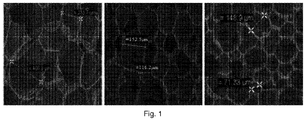
- Fig. 1 is an electron micrograph of the rigid polyurethane foam prepared in embodiments and comparison examples, wherein the left picture is the foam prepared from a single component (C-pentane only) system in Comparison Example 3, the middle picture is the foam prepared from a C-pentane + HFO-1233zd system without aromatic polyester in Comparison Example 4, and the right picture is the foam prepared in Embodiment 3.
- Embodiments 1-2 are rigid polyurethane foams prepared according to common methods of the present application
- Embodiments 3-4 are rigid polyurethane foams prepared according to preferred methods of the present application.
- Table 2 Embodiment 1 Embodiment 2 Embodiment 3 Embodiment 4 Comparison example 1 Comparison example 2 Comparison example 3 Polyether A 35 / 25 / 25 25 35 Polyether B / 40 10 30 10 10 / Polyether C 20 23 20 25 20 20 25 Polyether D 20 25 20 20 20 20 20 25 Polyether E 10 / 10 13 10 10 15 Polyester F 15 12 15 12 15 15 / Catalyst 2.0 2.0 2.0 2.0 2.0 2.0 2.0 2.1 Silicone oil 2.3 2.3 2.3 2.3 2.3 2.3 2.3 2.3 2.3 2.3 Water 1.95 2.05 2.0 2.1 2.0 2.0 2.0 2.0 PM2010 (polyisocyanate) 141 148 150 160 144 155 150 C-pentane 12.5 12.0 11.5 11.0 11.0 / 13.0 HFO-1233zd/total weight of the raw materials (%)
- Embodiments 1-4 it can be known from Embodiments 1-4 that, in the rigid polyurethane foam plastics prepared from a foaming system which is formed by adding a proper amount of HFO-1233zd (an additive) that may be used as a nucleating agent into the C-pentane system and then optimizing the premixed polyether polyol formulation and adding a certain amount of preferred aromatic polyethers and aromatic polyesters or other components in the premixed polyether polyols, the thermal conductivity of the foam is significantly reduced, and the thermal insulating effect is improved and is significantly better than the single-component (C-pentane only) foaming system in Comparison Example 3.
- HFO-1233zd an additive
- HFO-1233zd in improving the thermal conductivity as the foaming agent is also not obvious because its content in percentage is too small.
- HFO-1233zd accounts for 2.5%-3.0% of the total weight of the foaming raw materials.
- Those embodiments and comparison examples are all foamed by high-pressure foaming machines in two-door refrigerator molds having a volume of 300L produced by Hisense Ronshen Refrigerator Co.,LTD.
- the left picture is the foam prepared from a single component (C-pentane only) system in Comparison Example 3
- the middle picture is the foam prepared from a C-pentane + HFO-1233zd system without aromatic polyester in Comparison Example 4
- the right picture is the foam prepared in Embodiment 3. It can be seen from the electron micrograph of Fig. 1 that the size of cells gradually decreases from left picture to right picture. It is indicated that the addition of HFO-1233zd and aromatic polyeaster polyols causes cells of the rigid polyurethane foam more uniform and finer.
Landscapes
- Chemical & Material Sciences (AREA)
- Health & Medical Sciences (AREA)
- Chemical Kinetics & Catalysis (AREA)
- Medicinal Chemistry (AREA)
- Polymers & Plastics (AREA)
- Organic Chemistry (AREA)
- Engineering & Computer Science (AREA)
- Materials Engineering (AREA)
- Emergency Medicine (AREA)
- Combustion & Propulsion (AREA)
- Physics & Mathematics (AREA)
- Mechanical Engineering (AREA)
- Thermal Sciences (AREA)
- General Engineering & Computer Science (AREA)
- Polyurethanes Or Polyureas (AREA)
Description
- The present application relates to the technical field of rigid polyurethane foams, and particularly to a rigid polyurethane foam and a manufacturing method and applications thereof.
- C-pentane, as the present most consumable and most popular rigid polyurethane foam foaming agent in the industries of refrigerators and freezers both in China and abroad, has the advantages of good environmental friendliness and simple operation. Furthermore, C-pentane as a petrochemical product has mature refining process, easily available and low price, and thus has been widely used in refrigerating appliances as a preferred foaming agent in replace of CFC-11 (trichlorofluoromethane) and HCFC-141b (dichlorofluoroethane). C-pentane dominates the field of polyurethane foaming agents. However, C-pentane also has prominent defects, specifically: C-pentane is flammable, and it is thus required to construct ventilation facilities during the production and application; the resulting foam cannot satisfy the increasing standards of energy efficiency of household appliances due to its low thermal insulating property and high overall energy consumption; and high boiling point and low vapor pressure result in low strength and high filling intensity of the foam and more foaming raw materials are thus consumed.
- The disadvantages of high energy consumption and high resource consumption of C-pentane have always been problems to be overcome in the PU field, but it is difficult to achieve a breakthrough effectively. The root cause is that it is difficult to find an approach that can meet the requirements of environmental regulations and make up inherent defects of C-pentane. This situation does not change until HFO-1233zd (1-chloro-3,3,3-trifluoropropene) is introduced. The physical and chemical properties of C-pentane and HFO-1233zd are shown in Table 1.
Table 1: Physical and chemical properties of C-pentane and HFO-1233zd Foaming agent Molecular structure ODP (Ozone Depleting Potential) GWP (Global Warming Potential) Boiling point (°C) Saturated vapor pressure KPa (20°C) Thermal conductivity (20°C, mW/m.K) Explosion limit (%) C-pentane 
0 11 49 45 12 1.4-8.1 HFO-1233zd 
≈0* 7 19 108 9 / *: Verified by the National Institute of Standards and Technology (NIST) - From the above table, it can be known that the ozone depleting potential (ODP) of both C-pentane and HFO-1233zd is 0; the global warming potential (GWP) of both C-pentane and HFO-1233zd is less than 15; HFO-1233zd also has characteristics of low boiling point, low thermal conductivity and high vapor pressure and its molecules have a structure with multiple fluorine atoms, so it is expected to be used as a nucleating additive to make up the inherent defects of C-pentane.
- In Version 1 of Handbook of Plastic Industry by LI, Junxian in 1999, relevant theoretical research stated that the thermal conductivity of the foam is composed of several factors:

- where: λF: thermal conductivity of the rigid foam;
- λG: thermal conductivity of gas inside cells;
- λS: thermal conductivity of solids;
- λR: radiation conductivity; and
- λC: convective thermal conductivity.
- In this formula, the thermal conductivity of solids is relatively constant, and the convective thermal conductivity may be ignored when the size of rigid foam cells is less than 2 mm. In the case where the main gas components inside the cells are known, radiation conductivity is the main factor which influences the thermal conductivity of the rigid foam. The most effective approach to reduce the radiation conductivity is to reduce the size of cells.
-
Williams et al. (WO2013/082963A1 - An objective of the present application is to provide a rigid polyurethane foam with low thermal conductivity, in order to overcome deficiencies of the existing rigid polyurethane foams such as high thermal conductivity. The appropriate adjustment of the formulation can cause the thermal conductivity of the prepared rigid polyurethane foam to be greatly reduced (which can be as low as 0.01800 W/m.K or below).
- Another objective of the present application is to provide a method for preparing the rigid polyurethane foam.
- Yet another objective of the present application is to provide application of the rigid polyurethane foam in manufacturing refrigerators and freezers.
- To achieve those purposes, the present application complies with the following technical solutions.
- A rigid polyurethane foam is provided, and the rigid polyurethane foam is prepared from the following raw materials in parts by weight through mixing and reaction:
- 135-165 parts of polyisocyanate;
- 100 parts of polyol composition;
- 10-16 parts of C-pentane;
- 1.8-2.3 parts of catalyst;
- 1.8-2.5 parts of silicone oil;
- 1.6-2.4 parts of water;
- and 1-chloro-3,3,3-trifluoropropene accounting for 1%-3% of the total weight of the raw materials;
- This range includes any specific numerical values, for example, but not limited to, 8 parts, 9 parts, 10 parts, 11 parts, 12 parts, 13 parts, 14 parts or 15 parts.
- Wherein, the polyisocyanate is polymethylene polyphenyl polyisocyanate.
- Wherein, the polyether polyols are prepared by the addition polymerization reaction of one or more of sucrose, glycerine, toluenediamine, sorbitol, ethylenediamine, diol or ethanolamine, as initiators, and oxyalkylene.
- Wherein, the aromatic polyester polyols are prepared by the synthesis of at least one of phthalic acid, isophthalic acid, terephthalic acid, halogen substituted benzenedicarboxylate and anhydrides thereof and at least one of ethylene glycol, propylene glycol, diethylene glycol, neopentyl glycol and bisphenol A with an aromatic ring.
- 1-chloro-3,3,3-trifluoropropene (HFO-1233zd) has an ODP of 0 and a GWP of less than 15, and also has characteristics of low boiling point, low thermal conductivity and high vapor pressure. Therefore, mixing a certain amount of HFO-1233zd with C-pentane can effectively make up the weaknesses of C-pentane (foaming agent) such as high thermal conductivity and low foam strength and improve the performance of the foam. In addition, it was unexpectedly found by the inventor that the HFO-1233zd may also be used as a nucleating agent since its molecules have a structure with multiple fluorine atoms, and the application of the HFO-1233zd in manufacturing rigid polyurethane foam plastics can result in smaller, finer and more uniform cells, thereby facilitating reducing the thermal conductivity of the foam and improving the structure and strength of cells. Furthermore, the HFO-1233zd is not flammable, so the safety of the C-pentane foaming production can be improved.
- Meanwhile, aromatic polyether polyol monomers and aromatic polyester polyol monomers are introduced into the polyol composition in the raw materials, and therefore, the application of the polyol composition in manufacturing rigid polyurethane foam plastics can result in smaller, finer and more uniform cells, so that the thermal conductivity of the foam is further reduced and a rigid polyurethane foam with low thermal conductivity is manufactured.
- Wherein, the aromatic polyether polyols obtained by the addition polymerization reaction of toluenediamine as an initiator and oxyalkylene account for 15-40 parts in weight in the polyol composition. This range includes any specific numerical values, for example, but not limited to, 15 parts, 20 parts, 25 parts, 30 parts, 35 parts or 40 parts.
- Wherein, the aromatic polyether polyols obtained by the addition polymerization reaction of toluenediamine as an initiator and oxyalkylene account for 20-25 parts in weight in the polyol composition.
- Wherein, the aromatic polyester polyols account for 12-15 parts in weight in the polyol composition.
- In the rigid polyurethane foam, 1-chloro-3,3,3-trifluoropropene accounts for 1%-3% of the total weight of the raw materials. This range includes any specific numerical values, for example, but not limited to, 1%, 1.1%, 1.2%, 1.3%, 1.4%, 1.5%, 1.6%, 1.7%, 1.8%, 1.9%, 2%, 2.1%, 2.2%, 2.3%, 2.4%, 2.5%, 2.6%, 2.7%, 2.8%, 2.9% or 3.0%.
- In the rigid polyurethane foam, 1-chloro-3,3,3-trifluoropropene accounts for 2%-3% of the total weight of the raw materials.
- In the rigid polyurethane foam, 1-chloro-3,3,3-trifluoropropene accounts for 2.5%-3% of the total weight of the raw materials.
- As a preferred solution, the rigid polyurethane foam is prepared from the following raw materials in parts by weight:
- 140-160 parts of polyisocyanate;
- 100 parts of polyol composition;
- 11-14 parts of C-pentane;
- 1.8-2.1 parts of catalyst;
- 1.9-2.4 parts of silicone oil;
- 1.9-2.2 parts of water; and
- 1-chloro-3,3,3-trifluoropropene accounting for 2.0%-3.0% of the total weight of the raw materials.
- As a further preferred solution, the rigid polyurethane foam is prepared from the following raw materials in parts by weight:
- 145-155 parts of polyisocyanate;
- 100 parts of polyol composition;
- 11.0-12.5 parts of C-pentane;
- 1.8-2.0 parts of catalyst;
- 2.0-2.3 parts of silicone oil;
- 1.9-2.1 parts of water; and
- 1-chloro-3,3,3-trifluoropropene accounting for 2.5%-3.0% of the total weight of the raw materials.
- A method for preparing the rigid polyurethane foam is provided, comprising the following steps:
- S1: evenly mixing polyol composition, C-pentane, 1-chloro-3,3,3-trifluoropropene, catalyst, silicone oil and water in proportion; and
- S2: evenly mixing the mixture obtained in step S1 with polyisocyanate in proportion, and then foaming at a pressure from 110 bar to 160 bar.
- As a preferred solution, the 1-chloro-3,3,3-trifluoropropene in step S1 is cooled to 10 °C to 19°C and then evenly mixed with C-pentane and polyol composition, wherein the temperature of the C-pentane is from 10°C to 30°C, and the temperature of the mixture after the mixing in step S1 is from 18°C to 25°C.
- Compared with the prior art, the present application has the following beneficial effects.
- (1) In the present application, C-pentane is used as the main component foaming agent, and a certain amount of HFO-1233zd is added. In this way, the advantages of low cost and mature technology of C-pentane are fully utilized, and the HFO-1233zd also has characteristics of low boiling point, low thermal conductivity and high vapor pressure. The coordinated use of C-pentane and HFO-1233zd reduces the thermal conductivity of the foam and increases the strength of the foam.
- (2) The component HFO-1233zd in the present application contains a structure with multiple fluorine atoms, and thus can be used as a nucleating agent. This can result in smaller, finer and more uniform cells, and the structure and strength of cells are further improved, thereby facilitating reducing the thermal conductivity, improving the performance of the foam, and being more energy-saving.
- (3) The component HFO-1233zd in the present application is not flammable and contains no volatile organics (VOC), the ozone depleting potential (ODP) thereof is 0, and the global warming potential (GWP) is less than 10. The HFO-1233zd itself has the function of a foaming agent. The HFO-1233zd is environmentally friendly.
- (4) Since the HFO-1233zd has a low boiling point so that the foam may have excellent fluidity, and also has a high vapor pressure. Manufacturing the rigid polyurethane foam by the method of the present application can increase the strength of the foam, reduce the consumption of foaming raw materials, and save resources.
- (5) In the present application, the premixed polyether polyol formulation is optimized: preferred aromatic polyether monomers and aromatic polyester monomers are used so that the cells are smaller and finer and the thermal conductivity is reduced; with the addition of the HFO-1233zd, the polyurethane foam with low thermal conductivity can be prepared.
- The cells of the rigid polyurethane foam plastics prepared from the composition of the present application are finer and more uniform, so that the thermal conductivity (which can be as low as 0.01800 W/m.K or below) is greatly reduced and the strength of the foam is increased; the thermal insulating effect of the thermal insulating layer is improved, and the energy consumption is reduced; it is good in environmental friendliness (ODP=0, GWP<15), and it is safer than foaming by a single component (C-pentane only). The rigid polyurethane foam according to the present application has a positive role in promoting upgrading and updating of the existing C-pentane foaming technologies for refrigerators.
-
Fig. 1 is an electron micrograph of the rigid polyurethane foam prepared in embodiments and comparison examples, wherein the left picture is the foam prepared from a single component (C-pentane only) system in Comparison Example 3, the middle picture is the foam prepared from a C-pentane + HFO-1233zd system without aromatic polyester in Comparison Example 4, and the right picture is the foam prepared in Embodiment 3. - The present application will be further described below by embodiments. Those embodiments are merely typical illustrations of the present application, and the present application is not limited thereto.
- The following raw materials are used in the present application:
- polyether A: obtained by polymerization with oxyalkylene by using sucrose as an initiator; functionality: 8; and hydroxyl value: 370-415 mg/KOH/g;
- polyether B: obtained by polymerization with oxyalkylene by using sucrose and glycerine as initiators; functionality: 5-6; and hydroxyl value: 360-390 mg/KOH/g;
- polyether C: obtained by polymerization with oxyalkylene by using sorbitol as an initiator; functionality: 6; and hydroxyl value: 480-500 mg/KOH/g;
- polyether D: obtained by polymerization with oxyalkylene by using toluenediamine as an initiator; functionality: 4; and hydroxyl value: 400-420 mg/KOH/g;
- polyether E: obtained by polymerization with oxyalkylene by using ethylenediamine as an initiator; functionality: 4; and hydroxyl value: 630-700 mg/KOH/g;
- polyester F: obtained by condensation of aromatic carboxylic acids or anhydrides and alcohols; functionality: 2-3; and hydroxyl value: 300-330mg/KOH/g; PS3152, produced by Nanjing Stepan Jinling Chemical Co., Ltd.;
- C-pentane: produced by Shunde Meilong Cyclopentane Chemical Co., Ltd.;
- HFO-1233zd foaming agent: produced by Honeywell, Inc.;
- catalyst: TMR-2, PC-5, PC-8, produced by Air Products and Chemicals, Inc.;
- silicone oil: a surfactant, produced by Evonik Degussa;
- polyisocyanate: PM2010, produced by Yantai Wanhua Chemical Group Co., Ltd.; and
- production equipment: high-pressure foaming machines produced by Hennecke GmbH.
- Other raw materials in the embodiments of the present application may be purchased from the market.
- Embodiments 1-2 are rigid polyurethane foams prepared according to common methods of the present application, and Embodiments 3-4 are rigid polyurethane foams prepared according to preferred methods of the present application.
Table 2 Embodiment 1 Embodiment 2 Embodiment 3 Embodiment 4 Comparison example 1 Comparison example 2 Comparison example 3 Polyether A 35 / 25 / 25 25 35 Polyether B / 40 10 30 10 10 / Polyether C 20 23 20 25 20 20 25 Polyether D 20 25 20 20 20 20 25 Polyether E 10 / 10 13 10 10 15 Polyester F 15 12 15 12 15 15 / Catalyst 2.0 2.0 2.0 2.0 2.0 2.0 2.1 Silicone oil 2.3 2.3 2.3 2.3 2.3 2.3 2.3 Water 1.95 2.05 2.0 2.1 2.0 2.0 2.0 PM2010 (polyisocyanate) 141 148 150 160 144 155 150 C-pentane 12.5 12.0 11.5 11.0 11.0 / 13.0 HFO-1233zd/total weight of the raw materials (%) 1.50 2.05 2.50 2.95 3.65 10.00 / Free rise foam density (kg/m3) 24.20 23.75 23.60 23.50 23.68 24.00 25.44 Density of molded foam core (kg/m3) 32.30 32.06 31.56 31.78 31.54 31.47 35.51 Thermal conductivity (W/m.K) 0.01910 0.01856 0.01788 0.01757 0.01748 0.01728 0.02034 Compressive strength (vertical) Mpa 0.130 0.133 0.138 0.139 0.140 0.142 0.141 Size stability % (-30°C, 24h) -0.41 -0.30 -0.22 -0.26 -0.22 -0.27 -0.19 - It can be known from Embodiments 1-4 that, in the rigid polyurethane foam plastics prepared from a foaming system which is formed by adding a proper amount of HFO-1233zd (an additive) that may be used as a nucleating agent into the C-pentane system and then optimizing the premixed polyether polyol formulation and adding a certain amount of preferred aromatic polyethers and aromatic polyesters or other components in the premixed polyether polyols, the thermal conductivity of the foam is significantly reduced, and the thermal insulating effect is improved and is significantly better than the single-component (C-pentane only) foaming system in Comparison Example 3.
- It can be known from Embodiments 1-4 and Comparison Example 3 that the compressive strengths are close to each other although there is a difference of about 3 kg/m3 in density. It is indicated that the addition of HFO-1233zd, aromatic polyether polyols and aromatic polyester polyols may also increase the strength of the foam.
- It can be known from Embodiments 1-4 and Comparison Examples 1-2 that the thermal conductivity of the foam is minimized (which can be as low as 0.01800 mW/m.K or below) when HFO-1233zd accounts for about 2.5% or more of the total weight of the foaming raw materials. At this moment, if the amount of HFO-1233zd is continuously increased, within a certain range, the improvement and reduction of the thermal conductivity are not obvious, because the main components of the foaming agent inside the cells are still C-pentane and a proper amount of HFO-1233zd that may be used as the nucleating agent. In this case, it is not obvious to continuously add a certain amount of HFO-1233zd to facilitate nucleation. The effect of the HFO-1233zd in improving the thermal conductivity as the foaming agent is also not obvious because its content in percentage is too small. When analyzed in consideration of cost and foam performance, it is regarded to be the most cost-effective when HFO-1233zd accounts for 2.5%-3.0% of the total weight of the foaming raw materials.
Table 3 Embodiment 3 Comparison Example 4 Comparison Example 5 Polyether A 25 35 25 Polyether B 10 10 10 Polyether C 20 25 20 Polyether D 20 20 / Polyether E 10 10 15 Polyester F 15 / / Catalyst 2.0 2.0 2.0 Silicone oil 2.3 2.3 2.3 Water 2.0 2.0 2.0 PM2010 (polyisocyanate) 150 150 150 C-pentane 11.5 11.5 11.5 HFO-1233zd/total weight of the raw materials (%) 2.50 2.50 2.50 Free rise foam density (kg/m3) 23.60 23.70 23.84 Density of molded foam core (kg/m3) 31.56 31.97 31.92 Thermal conductivity (W/m.K) 0.01788 0.01811 0.01823 Compressive strength (vertical) Mpa 0.138 0.135 0.134 Size stability % (-30°C, 24h) -0.22 -0.25 -0.24 - It can be known from Embodiment 3 and Comparison Examples 4-5 that the thermal conductivity of the foam can be most effectively improved by adding a proper amount of HFO-1233zd in the C-pentane system and by using aromatic polyether polyols and aromatic polyester polyols in the premixed polyether polyol formulation.
Table 4 Refrigerator manufactured in Embodiment 3 Refrigerator manufactured in Comparison Example 3 Refrigerant charge (g) 7450 8200 1 (kg/m3) 31.17 36.54 2 (kg/m3) 31.75 35.44 3 (kg/m3) 31.97 34.92 4 (kg/m3) 31.52 35.66 5 (kg/m3) 31.65 34.64 Average density (kg/m3) 31.66 35.51 Range of density (Max-min) 0.8 1.9 - Note: Those embodiments and comparison examples are all foamed by high-pressure foaming machines in two-door refrigerator molds having a volume of 300L produced by Hisense Ronshen Refrigerator Co.,LTD.
- It can be known from Table 4 that the range of density (max-min) of the refrigerator foam manufactured in Embodiment 3 is 0.8, while the range of density (max-min) of the refrigerator foam manufactured in Comparison Example 3 is 1.9. It is indicated that the addition of HFO-1233zd causes the foam to have more excellent fluidity.
- In
Fig. 1 , the left picture is the foam prepared from a single component (C-pentane only) system in Comparison Example 3, the middle picture is the foam prepared from a C-pentane + HFO-1233zd system without aromatic polyester in Comparison Example 4, and the right picture is the foam prepared in Embodiment 3. It can be seen from the electron micrograph ofFig. 1 that the size of cells gradually decreases from left picture to right picture. It is indicated that the addition of HFO-1233zd and aromatic polyeaster polyols causes cells of the rigid polyurethane foam more uniform and finer. - The application of HFO-1233zd (an additive) in the C-pentane foaming system as a nucleating agent and the improvement of the formulation by using aromatic polyethers and aromatic polyeasters can effectively overcome the defect of high thermal conductivity which occurs when the C-pentane-only system is used. Meanwhile, the safety of foaming by C-pentane can be improved since HFO-1233zd is not flammable. Furthermore, due to VOC=0, ODP=0 and GWP<10, by the method for preparing the rigid polyurethane foam from the composition of the present application, the energy-saving effect, economic benefits, safety and environmental friendliness of refrigerator products can be better realized.
- The foregoing descriptions are merely preferred embodiments of the present application and not intended to limit the present application.
Claims (15)
- A rigid polyurethane foam, characterized in that the rigid polyurethane foam is prepared from the following raw materials in parts by weight through mixing and reaction:135-165 parts of polyisocyanate;100 parts of polyol composition;10-16 parts of C-pentane;1.8-2.3 parts of catalyst;1.8-2.5 parts of silicone oil;1.6-2.4 parts of water; and1-chloro-3,3,3-trifluoropropene accounting for 1%-3% of the total weight of the raw materials;wherein the polyol composition consists of polyether polyols and aromatic polyester polyols, and the aromatic polyester polyols account for 8-15 parts in weight in the polyol composition.
- The rigid polyurethane foam according to claim 1, characterized in that the rigid polyurethane foam is prepared from the following raw materials in parts by weight through mixing and reaction:140-160 parts of polyisocyanate;100 parts of polyol composition;11-14 parts of C-pentane;1.8-2.1 parts of catalyst;1.9-2.4 parts of silicone oil;1.9-2.2 parts of water; and1-chloro-3,3,3-trifluoropropene accounting for 2.0%-3.0% of the total weight of the raw materials.
- The rigid polyurethane foam according to claim 1, characterized in that the rigid polyurethane foam is prepared from the following raw materials in parts by weight through mixing and reaction:145-155 parts of polyisocyanate;100 parts of polyol composition;11.5-12.5 parts of C-pentane;1.8-2.0 parts of catalyst;2.0-2.3 parts of silicone oil;1.9-2.1 parts of water; and1-chloro-3,3,3-trifluoropropene accounting for 2.5%-3.0% of the total weight of the raw materials.
- The rigid polyurethane foam according to claim 1, characterized in that the polyisocyanate is polymethylene polyphenyl polyisocyanate.
- The rigid polyurethane foam according to claim 1, characterized in that the polyether polyols are prepared by the addition polymerization reaction of one or more of sucrose, glycerine, toluenediamine, sorbitol, ethylenediamine, diol or ethanolamine, as initiators, and oxyalkylene.
- The rigid polyurethane foam according to claim 5, characterized in that the aromatic polyether polyols obtained by the addition polymerization reaction of toluenediamine as an initiator and oxyalkylene account for 15-40 parts in weight in the polyol composition.
- The rigid polyurethane foam according to claim 6, characterized in that the aromatic polyether polyols obtained by the addition polymerization reaction of toluenediamine as an initiator and oxyalkylene account for 20-25 parts in weight in the polyol composition.
- The rigid polyurethane foam according to claim 1, characterized in that the aromatic polyester polyols are prepared by the synthesis of at least one of phthalic acid, isophthalic acid, terephthalic acid, halogen substituted benzenedicarboxylate and anhydrides thereof and at least one of ethylene glycol, propylene glycol, diethylene glycol, neopentyl glycol and bisphenol A with an aromatic ring.
- The rigid polyurethane foam according to claim 1, characterized in that the aromatic polyester polyols account for 12-15 parts in weight in the polyol composition.
- The rigid polyurethane foam according to claim 1, characterized in that in the rigid polyurethane foam, 1-chloro-3,3,3-trifluoropropene accounts for 2%-3% of the total weight of the raw materials.
- The rigid polyurethane foam according to claim 1, characterized in that in the rigid polyurethane foam, 1-chloro-3,3,3-trifluoropropene accounts for 2.5%-3% of the total weight of the raw materials.
- A method for preparing rigid polyurethane foam according to any one of claims 1 to 11, comprising the following steps:S1: evenly mixing polyol composition, C-pentane, 1-chloro-3,3,3-trifluoropropene, catalyst, silicone oil and water in proportion; andS2: evenly mixing the mixture obtained in step S1 with polyisocyanate in proportion, and then foaming at a pressure from 110 bar to 160 bar.
- The method for preparing rigid polyurethane foam according to claim 12, characterized in that the 1-chloro-3,3,3-trifluoropropene in step S1 is cooled to 10°C to 19 °C and then evenly mixed with C-pentane and polyol composition, wherein the temperature of the C-pentane is from 10°C to 30°C, and the temperature of the mixture after the mixing in step S1 is from 18°C to 25°C.
- The method for preparing rigid polyurethane foam according to claim 12, characterized in that in step S1, the polyol composition is 100 parts, the C-pentane is 11-14 parts, the catalyst is 1.8-2.1 parts, the silicone oil is 1.9-2.4 parts, the water is 1.9-2.2 parts and 1-chloro-3,3,3-trifluoropropene accounts for 2.0%-3.0% of the total weight of the raw materials, and in step S2, the polyisocyanate is 140-160 parts.
- Applications of the rigid polyurethane foam of any one of claims 1 to 11 in manufacturing refrigerators and freezers.
Applications Claiming Priority (1)
| Application Number | Priority Date | Filing Date | Title |
|---|---|---|---|
| PCT/CN2014/072883 WO2015131340A1 (en) | 2014-03-05 | 2014-03-05 | Low-thermal conductivity rigid polyurethane foam with c-pentane as main body and manufacturing method and applications thereof |
Publications (4)
| Publication Number | Publication Date |
|---|---|
| EP3115401A1 EP3115401A1 (en) | 2017-01-11 |
| EP3115401A4 EP3115401A4 (en) | 2017-10-18 |
| EP3115401B1 true EP3115401B1 (en) | 2021-01-06 |
| EP3115401B8 EP3115401B8 (en) | 2021-03-31 |
Family
ID=54054351
Family Applications (1)
| Application Number | Title | Priority Date | Filing Date |
|---|---|---|---|
| EP14884546.4A Active EP3115401B8 (en) | 2014-03-05 | 2014-03-05 | Low-thermal conductivity rigid polyurethane foam with c-pentane as main foaming agent and manufacturing method and applications thereof |
Country Status (3)
| Country | Link |
|---|---|
| US (1) | US20160369077A1 (en) |
| EP (1) | EP3115401B8 (en) |
| WO (1) | WO2015131340A1 (en) |
Families Citing this family (19)
| Publication number | Priority date | Publication date | Assignee | Title |
|---|---|---|---|---|
| WO2017155863A1 (en) * | 2016-03-07 | 2017-09-14 | Basf Se | Rigid polyurethane foam |
| CN107286315B (en) * | 2016-04-13 | 2020-06-23 | 南京红宝丽新材料有限公司 | Rigid polyurethane foam plastic with high compression strength and preparation method thereof |
| US11505670B2 (en) * | 2016-11-17 | 2022-11-22 | Covestro Llc | Polyurethane foams co-blown with a mixture of a hydrocarbon and a halogenated olefin |
| JP2018119034A (en) * | 2017-01-24 | 2018-08-02 | 東ソー株式会社 | Rigid polyurethane foam composition and method for producing rigid polyurethane foam |
| US12398232B2 (en) * | 2017-01-31 | 2025-08-26 | Basf Se | HFO containing PU formulation |
| CN108727551A (en) * | 2017-04-19 | 2018-11-02 | 科思创德国股份有限公司 | A kind of hard polyurethane foams and the preparation method and application thereof |
| JP6909074B2 (en) * | 2017-06-28 | 2021-07-28 | サンスター技研株式会社 | Polyurethane composition |
| WO2019194966A1 (en) * | 2018-04-03 | 2019-10-10 | Dow Global Technologies Llc | Foam formulations |
| US10640600B2 (en) * | 2018-04-24 | 2020-05-05 | Covestro Llc | Rigid polyurethane foams suitable for use as panel insulation |
| US12540214B2 (en) | 2019-01-11 | 2026-02-03 | Covestro Llc | HCFO-containing isocyanate-reactive compositions, related foam-forming compositions and polyurethane foams |
| CN110372838B (en) * | 2019-07-15 | 2022-03-01 | 上海东大聚氨酯有限公司 | Combined polyether polyol, polyurethane foam and preparation method thereof |
| CN110628073A (en) * | 2019-08-15 | 2019-12-31 | 长虹美菱股份有限公司 | A kind of polyurethane rigid foam formulation and preparation method thereof |
| CN111303364A (en) * | 2020-04-15 | 2020-06-19 | 长虹美菱股份有限公司 | High-heat-insulation polyurethane foaming formula and freezer based on same |
| BR112022026388A2 (en) * | 2020-06-25 | 2023-01-17 | Basf Se | PROCESS FOR PRODUCING POLYISOCYANURATE FOAM AND RIGID POLYISOCYANURATE FOAM |
| CN112708094A (en) * | 2020-12-28 | 2021-04-27 | 上海东大聚氨酯有限公司 | Environment-friendly combined polyether and polyurethane foam for ultralow-temperature incubator and preparation method thereof |
| CN114716722A (en) * | 2021-01-04 | 2022-07-08 | 海信容声(广东)冰箱有限公司 | Refrigerator, hard polyurethane foam and preparation method of hard polyurethane foam |
| CN117447666B (en) * | 2023-09-20 | 2024-04-19 | 青岛凯州专用车有限公司 | Thermal insulation material for cold chain transportation and preparation method thereof |
| CN117467113B (en) * | 2023-12-28 | 2024-05-10 | 山东一诺威新材料有限公司 | Polyurethane material for foam filled insulating tube and preparation method thereof |
| CN119684611B (en) * | 2025-02-06 | 2025-07-18 | 北京理工大学前沿技术研究院 | A method for preparing polysiloxane |
Family Cites Families (7)
| Publication number | Priority date | Publication date | Assignee | Title |
|---|---|---|---|---|
| US6005016A (en) * | 1998-10-06 | 1999-12-21 | Bayer Corporation | Rigid polyurethane foam based on polyethers of TDA |
| US9550854B2 (en) * | 2007-10-12 | 2017-01-24 | Honeywell International Inc. | Amine catalysts for polyurethane foams |
| AU2009282260A1 (en) * | 2008-08-13 | 2010-02-18 | E. I. Du Pont De Nemours And Company | Foam-forming compositions containing mixtures of 2-chloro-3,3,3-trifluoropropene and hydrocarbon and their uses in the preparation of polyisocyanate-based foams |
| US8163196B2 (en) * | 2008-10-28 | 2012-04-24 | Honeywell International Inc. | Azeotrope-like compositions comprising 1-chloro-3,3,3-trifluoropropene |
| CA2840235C (en) * | 2011-07-13 | 2017-11-14 | Oxane Materials, Inc. | Low surface friction proppants |
| JP2015500362A (en) * | 2011-12-09 | 2015-01-05 | ハネウェル・インターナショナル・インコーポレーテッド | Articles made from foam and foam comprising HCFO or HFO blowing agent |
| CN103804711B (en) * | 2014-02-20 | 2016-05-25 | 海信容声(广东)冰箱有限公司 | A kind of low heat conductivity polyurethane hard bubble foam and manufacture method and application taking pentamethylene as main body |
-
2014
- 2014-03-05 EP EP14884546.4A patent/EP3115401B8/en active Active
- 2014-03-05 WO PCT/CN2014/072883 patent/WO2015131340A1/en not_active Ceased
-
2016
- 2016-08-31 US US15/253,100 patent/US20160369077A1/en not_active Abandoned
Non-Patent Citations (1)
| Title |
|---|
| None * |
Also Published As
| Publication number | Publication date |
|---|---|
| WO2015131340A1 (en) | 2015-09-11 |
| EP3115401A4 (en) | 2017-10-18 |
| EP3115401B8 (en) | 2021-03-31 |
| EP3115401A1 (en) | 2017-01-11 |
| US20160369077A1 (en) | 2016-12-22 |
Similar Documents
| Publication | Publication Date | Title |
|---|---|---|
| EP3115401A1 (en) | Low-thermal conductivity rigid polyurethane foam with c-pentane as main body and manufacturing method and applications thereof | |
| CN103804711B (en) | A kind of low heat conductivity polyurethane hard bubble foam and manufacture method and application taking pentamethylene as main body | |
| CN111647191B (en) | Low-conductivity foaming agent composition, polyurethane rigid foam and preparation method thereof | |
| CN107177028B (en) | Combined polyether and polyurethane foam and its preparation method and application | |
| CN102079803B (en) | Full-water-type combined polyether and application method thereof, and polyurethane rigid foam composition | |
| CN102229697B (en) | Solar polyurethane thermal insulation material | |
| CN109762136B (en) | Polyurethane foaming composition, polyurethane foam, and preparation method and application thereof | |
| CN110628073A (en) | A kind of polyurethane rigid foam formulation and preparation method thereof | |
| CN106750093A (en) | A kind of refrigerator for the polyurethane foam system of refrigerator and based on it | |
| CN106496494A (en) | A kind of low-density, polyurethane foam of low heat conductivity and preparation method thereof | |
| CN108840985B (en) | A kind of rigid polyurethane foam material for refrigerator and preparation method thereof | |
| CN105985503A (en) | Polyurethane reaction composition for negative pressure foaming and method for preparing polyurethane foam by using composition | |
| CN106188607A (en) | A kind of green-blowing agent compositions, polyurethane foam and its preparation method and application | |
| CN107163221A (en) | A kind of refrigerator for the high-quality polyurethane foam system of refrigerator and based on it | |
| CN104448230B (en) | Premixed polyol and polyurethane sandwich panel made of premixed polyol | |
| CN104877105A (en) | Polyurethane hard foam composite material and preparation method thereof | |
| CN107163220A (en) | A kind of polyurethane foam system and the refrigerator based on it | |
| WO2020078329A1 (en) | Flame retardant combination polyether, and thermal insulating material for polyisocyanurate sheet material and preparation method therefor | |
| CN108192127A (en) | Composite environment-friendly type polyurethane heated board combination material | |
| CN101348551A (en) | Full water foaming polyurethane rigid foam combination polyether | |
| CN103709369A (en) | Fluoride-free environmentally-friendly-type rigid polyurethane foam sheet material composite material | |
| CN113754850A (en) | A kind of polyurethane foam and preparation method and application | |
| CN102532442A (en) | Preparation method of bamboo wood phenolic alcohol liquefaction product formaldehyde resin for foaming | |
| CN114805902A (en) | Carbonic acid alkanolamine salt foaming agent composition for polyurethane rigid foam | |
| CN113637136B (en) | Mixed foaming agent combined polyether and polyurethane hard foam |
Legal Events
| Date | Code | Title | Description |
|---|---|---|---|
| PUAI | Public reference made under article 153(3) epc to a published international application that has entered the european phase |
Free format text: ORIGINAL CODE: 0009012 |
|
| STAA | Information on the status of an ep patent application or granted ep patent |
Free format text: STATUS: REQUEST FOR EXAMINATION WAS MADE |
|
| 17P | Request for examination filed |
Effective date: 20160829 |
|
| AK | Designated contracting states |
Kind code of ref document: A1 Designated state(s): AL AT BE BG CH CY CZ DE DK EE ES FI FR GB GR HR HU IE IS IT LI LT LU LV MC MK MT NL NO PL PT RO RS SE SI SK SM TR |
|
| AX | Request for extension of the european patent |
Extension state: BA ME |
|
| DAX | Request for extension of the european patent (deleted) | ||
| A4 | Supplementary search report drawn up and despatched |
Effective date: 20170918 |
|
| RIC1 | Information provided on ipc code assigned before grant |
Ipc: C08J 9/14 20060101AFI20170912BHEP Ipc: C08G 18/42 20060101ALI20170912BHEP Ipc: F25D 23/06 20060101ALI20170912BHEP Ipc: C08G 18/40 20060101ALI20170912BHEP Ipc: C08G 18/76 20060101ALI20170912BHEP Ipc: C08G 18/48 20060101ALI20170912BHEP Ipc: C08G 101/00 20060101ALI20170912BHEP Ipc: C08G 18/50 20060101ALI20170912BHEP Ipc: C08J 9/00 20060101ALI20170912BHEP |
|
| STAA | Information on the status of an ep patent application or granted ep patent |
Free format text: STATUS: EXAMINATION IS IN PROGRESS |
|
| 17Q | First examination report despatched |
Effective date: 20191113 |
|
| GRAP | Despatch of communication of intention to grant a patent |
Free format text: ORIGINAL CODE: EPIDOSNIGR1 |
|
| STAA | Information on the status of an ep patent application or granted ep patent |
Free format text: STATUS: GRANT OF PATENT IS INTENDED |
|
| INTG | Intention to grant announced |
Effective date: 20200728 |
|
| GRAS | Grant fee paid |
Free format text: ORIGINAL CODE: EPIDOSNIGR3 |
|
| GRAA | (expected) grant |
Free format text: ORIGINAL CODE: 0009210 |
|
| STAA | Information on the status of an ep patent application or granted ep patent |
Free format text: STATUS: THE PATENT HAS BEEN GRANTED |
|
| AK | Designated contracting states |
Kind code of ref document: B1 Designated state(s): AL AT BE BG CH CY CZ DE DK EE ES FI FR GB GR HR HU IE IS IT LI LT LU LV MC MK MT NL NO PL PT RO RS SE SI SK SM TR |
|
| REG | Reference to a national code |
Ref country code: GB Ref legal event code: FG4D |
|
| REG | Reference to a national code |
Ref country code: AT Ref legal event code: REF Ref document number: 1352318 Country of ref document: AT Kind code of ref document: T Effective date: 20210115 Ref country code: CH Ref legal event code: EP |
|
| REG | Reference to a national code |
Ref country code: DE Ref legal event code: R096 Ref document number: 602014074120 Country of ref document: DE |
|
| REG | Reference to a national code |
Ref country code: IE Ref legal event code: FG4D |
|
| GRAT | Correction requested after decision to grant or after decision to maintain patent in amended form |
Free format text: ORIGINAL CODE: EPIDOSNCDEC |
|
| RAP2 | Party data changed (patent owner data changed or rights of a patent transferred) |
Owner name: HISENSE RONSHEN (GUANGDONG) REFRIGERATOR CO., LTD |
|
| REG | Reference to a national code |
Ref country code: CH Ref legal event code: PK Free format text: BERICHTIGUNG B8 |
|
| REG | Reference to a national code |
Ref country code: NL Ref legal event code: MP Effective date: 20210106 |
|
| REG | Reference to a national code |
Ref country code: AT Ref legal event code: MK05 Ref document number: 1352318 Country of ref document: AT Kind code of ref document: T Effective date: 20210106 |
|
| REG | Reference to a national code |
Ref country code: LT Ref legal event code: MG9D |
|
| PG25 | Lapsed in a contracting state [announced via postgrant information from national office to epo] |
Ref country code: LT Free format text: LAPSE BECAUSE OF FAILURE TO SUBMIT A TRANSLATION OF THE DESCRIPTION OR TO PAY THE FEE WITHIN THE PRESCRIBED TIME-LIMIT Effective date: 20210106 Ref country code: PT Free format text: LAPSE BECAUSE OF FAILURE TO SUBMIT A TRANSLATION OF THE DESCRIPTION OR TO PAY THE FEE WITHIN THE PRESCRIBED TIME-LIMIT Effective date: 20210506 Ref country code: HR Free format text: LAPSE BECAUSE OF FAILURE TO SUBMIT A TRANSLATION OF THE DESCRIPTION OR TO PAY THE FEE WITHIN THE PRESCRIBED TIME-LIMIT Effective date: 20210106 Ref country code: FI Free format text: LAPSE BECAUSE OF FAILURE TO SUBMIT A TRANSLATION OF THE DESCRIPTION OR TO PAY THE FEE WITHIN THE PRESCRIBED TIME-LIMIT Effective date: 20210106 Ref country code: GR Free format text: LAPSE BECAUSE OF FAILURE TO SUBMIT A TRANSLATION OF THE DESCRIPTION OR TO PAY THE FEE WITHIN THE PRESCRIBED TIME-LIMIT Effective date: 20210407 Ref country code: BG Free format text: LAPSE BECAUSE OF FAILURE TO SUBMIT A TRANSLATION OF THE DESCRIPTION OR TO PAY THE FEE WITHIN THE PRESCRIBED TIME-LIMIT Effective date: 20210406 Ref country code: NO Free format text: LAPSE BECAUSE OF FAILURE TO SUBMIT A TRANSLATION OF THE DESCRIPTION OR TO PAY THE FEE WITHIN THE PRESCRIBED TIME-LIMIT Effective date: 20210406 Ref country code: NL Free format text: LAPSE BECAUSE OF FAILURE TO SUBMIT A TRANSLATION OF THE DESCRIPTION OR TO PAY THE FEE WITHIN THE PRESCRIBED TIME-LIMIT Effective date: 20210106 |
|
| PG25 | Lapsed in a contracting state [announced via postgrant information from national office to epo] |
Ref country code: LV Free format text: LAPSE BECAUSE OF FAILURE TO SUBMIT A TRANSLATION OF THE DESCRIPTION OR TO PAY THE FEE WITHIN THE PRESCRIBED TIME-LIMIT Effective date: 20210106 Ref country code: PL Free format text: LAPSE BECAUSE OF FAILURE TO SUBMIT A TRANSLATION OF THE DESCRIPTION OR TO PAY THE FEE WITHIN THE PRESCRIBED TIME-LIMIT Effective date: 20210106 Ref country code: AT Free format text: LAPSE BECAUSE OF FAILURE TO SUBMIT A TRANSLATION OF THE DESCRIPTION OR TO PAY THE FEE WITHIN THE PRESCRIBED TIME-LIMIT Effective date: 20210106 Ref country code: SE Free format text: LAPSE BECAUSE OF FAILURE TO SUBMIT A TRANSLATION OF THE DESCRIPTION OR TO PAY THE FEE WITHIN THE PRESCRIBED TIME-LIMIT Effective date: 20210106 |
|
| PG25 | Lapsed in a contracting state [announced via postgrant information from national office to epo] |
Ref country code: IS Free format text: LAPSE BECAUSE OF FAILURE TO SUBMIT A TRANSLATION OF THE DESCRIPTION OR TO PAY THE FEE WITHIN THE PRESCRIBED TIME-LIMIT Effective date: 20210506 |
|
| REG | Reference to a national code |
Ref country code: DE Ref legal event code: R097 Ref document number: 602014074120 Country of ref document: DE |
|
| PG25 | Lapsed in a contracting state [announced via postgrant information from national office to epo] |
Ref country code: CZ Free format text: LAPSE BECAUSE OF FAILURE TO SUBMIT A TRANSLATION OF THE DESCRIPTION OR TO PAY THE FEE WITHIN THE PRESCRIBED TIME-LIMIT Effective date: 20210106 Ref country code: EE Free format text: LAPSE BECAUSE OF FAILURE TO SUBMIT A TRANSLATION OF THE DESCRIPTION OR TO PAY THE FEE WITHIN THE PRESCRIBED TIME-LIMIT Effective date: 20210106 Ref country code: SM Free format text: LAPSE BECAUSE OF FAILURE TO SUBMIT A TRANSLATION OF THE DESCRIPTION OR TO PAY THE FEE WITHIN THE PRESCRIBED TIME-LIMIT Effective date: 20210106 |
|
| REG | Reference to a national code |
Ref country code: CH Ref legal event code: PL |
|
| PLBE | No opposition filed within time limit |
Free format text: ORIGINAL CODE: 0009261 |
|
| STAA | Information on the status of an ep patent application or granted ep patent |
Free format text: STATUS: NO OPPOSITION FILED WITHIN TIME LIMIT |
|
| PG25 | Lapsed in a contracting state [announced via postgrant information from national office to epo] |
Ref country code: DK Free format text: LAPSE BECAUSE OF FAILURE TO SUBMIT A TRANSLATION OF THE DESCRIPTION OR TO PAY THE FEE WITHIN THE PRESCRIBED TIME-LIMIT Effective date: 20210106 Ref country code: ES Free format text: LAPSE BECAUSE OF FAILURE TO SUBMIT A TRANSLATION OF THE DESCRIPTION OR TO PAY THE FEE WITHIN THE PRESCRIBED TIME-LIMIT Effective date: 20210106 Ref country code: SK Free format text: LAPSE BECAUSE OF FAILURE TO SUBMIT A TRANSLATION OF THE DESCRIPTION OR TO PAY THE FEE WITHIN THE PRESCRIBED TIME-LIMIT Effective date: 20210106 Ref country code: RO Free format text: LAPSE BECAUSE OF FAILURE TO SUBMIT A TRANSLATION OF THE DESCRIPTION OR TO PAY THE FEE WITHIN THE PRESCRIBED TIME-LIMIT Effective date: 20210106 |
|
| 26N | No opposition filed |
Effective date: 20211007 |
|
| REG | Reference to a national code |
Ref country code: BE Ref legal event code: MM Effective date: 20210331 |
|
| PG25 | Lapsed in a contracting state [announced via postgrant information from national office to epo] |
Ref country code: LI Free format text: LAPSE BECAUSE OF NON-PAYMENT OF DUE FEES Effective date: 20210331 Ref country code: LU Free format text: LAPSE BECAUSE OF NON-PAYMENT OF DUE FEES Effective date: 20210305 Ref country code: AL Free format text: LAPSE BECAUSE OF FAILURE TO SUBMIT A TRANSLATION OF THE DESCRIPTION OR TO PAY THE FEE WITHIN THE PRESCRIBED TIME-LIMIT Effective date: 20210106 Ref country code: CH Free format text: LAPSE BECAUSE OF NON-PAYMENT OF DUE FEES Effective date: 20210331 Ref country code: FR Free format text: LAPSE BECAUSE OF NON-PAYMENT OF DUE FEES Effective date: 20210306 Ref country code: IE Free format text: LAPSE BECAUSE OF NON-PAYMENT OF DUE FEES Effective date: 20210305 |
|
| PG25 | Lapsed in a contracting state [announced via postgrant information from national office to epo] |
Ref country code: SI Free format text: LAPSE BECAUSE OF FAILURE TO SUBMIT A TRANSLATION OF THE DESCRIPTION OR TO PAY THE FEE WITHIN THE PRESCRIBED TIME-LIMIT Effective date: 20210106 |
|
| PG25 | Lapsed in a contracting state [announced via postgrant information from national office to epo] |
Ref country code: IT Free format text: LAPSE BECAUSE OF FAILURE TO SUBMIT A TRANSLATION OF THE DESCRIPTION OR TO PAY THE FEE WITHIN THE PRESCRIBED TIME-LIMIT Effective date: 20210106 |
|
| PG25 | Lapsed in a contracting state [announced via postgrant information from national office to epo] |
Ref country code: IS Free format text: LAPSE BECAUSE OF FAILURE TO SUBMIT A TRANSLATION OF THE DESCRIPTION OR TO PAY THE FEE WITHIN THE PRESCRIBED TIME-LIMIT Effective date: 20210506 |
|
| PG25 | Lapsed in a contracting state [announced via postgrant information from national office to epo] |
Ref country code: BE Free format text: LAPSE BECAUSE OF NON-PAYMENT OF DUE FEES Effective date: 20210331 |
|
| PG25 | Lapsed in a contracting state [announced via postgrant information from national office to epo] |
Ref country code: RS Free format text: LAPSE BECAUSE OF FAILURE TO SUBMIT A TRANSLATION OF THE DESCRIPTION OR TO PAY THE FEE WITHIN THE PRESCRIBED TIME-LIMIT Effective date: 20210106 Ref country code: HU Free format text: LAPSE BECAUSE OF FAILURE TO SUBMIT A TRANSLATION OF THE DESCRIPTION OR TO PAY THE FEE WITHIN THE PRESCRIBED TIME-LIMIT; INVALID AB INITIO Effective date: 20140305 |
|
| P01 | Opt-out of the competence of the unified patent court (upc) registered |
Effective date: 20230511 |
|
| PG25 | Lapsed in a contracting state [announced via postgrant information from national office to epo] |
Ref country code: CY Free format text: LAPSE BECAUSE OF FAILURE TO SUBMIT A TRANSLATION OF THE DESCRIPTION OR TO PAY THE FEE WITHIN THE PRESCRIBED TIME-LIMIT Effective date: 20210106 |
|
| PG25 | Lapsed in a contracting state [announced via postgrant information from national office to epo] |
Ref country code: MC Free format text: LAPSE BECAUSE OF NON-PAYMENT OF DUE FEES Effective date: 20210106 |
|
| PG25 | Lapsed in a contracting state [announced via postgrant information from national office to epo] |
Ref country code: MK Free format text: LAPSE BECAUSE OF FAILURE TO SUBMIT A TRANSLATION OF THE DESCRIPTION OR TO PAY THE FEE WITHIN THE PRESCRIBED TIME-LIMIT Effective date: 20210106 |
|
| PG25 | Lapsed in a contracting state [announced via postgrant information from national office to epo] |
Ref country code: TR Free format text: LAPSE BECAUSE OF FAILURE TO SUBMIT A TRANSLATION OF THE DESCRIPTION OR TO PAY THE FEE WITHIN THE PRESCRIBED TIME-LIMIT Effective date: 20210106 |
|
| PG25 | Lapsed in a contracting state [announced via postgrant information from national office to epo] |
Ref country code: MT Free format text: LAPSE BECAUSE OF FAILURE TO SUBMIT A TRANSLATION OF THE DESCRIPTION OR TO PAY THE FEE WITHIN THE PRESCRIBED TIME-LIMIT Effective date: 20210106 |
|
| PGFP | Annual fee paid to national office [announced via postgrant information from national office to epo] |
Ref country code: GB Payment date: 20260324 Year of fee payment: 13 |
|
| PGFP | Annual fee paid to national office [announced via postgrant information from national office to epo] |
Ref country code: DE Payment date: 20260319 Year of fee payment: 13 |