EP3115361A1 - Heterocyclic compounds, and preparation method and use thereof - Google Patents
Heterocyclic compounds, and preparation method and use thereof Download PDFInfo
- Publication number
- EP3115361A1 EP3115361A1 EP15757771.9A EP15757771A EP3115361A1 EP 3115361 A1 EP3115361 A1 EP 3115361A1 EP 15757771 A EP15757771 A EP 15757771A EP 3115361 A1 EP3115361 A1 EP 3115361A1
- Authority
- EP
- European Patent Office
- Prior art keywords
- benzo
- thiophen
- piperazin
- alkyl
- ethyl
- Prior art date
- Legal status (The legal status is an assumption and is not a legal conclusion. Google has not performed a legal analysis and makes no representation as to the accuracy of the status listed.)
- Granted
Links
- 0 *C1(CCCCCCC1)N Chemical compound *C1(CCCCCCC1)N 0.000 description 7
- OZKJZYPVNPFPSU-UHFFFAOYSA-N C1N=CSc2c1cccc2 Chemical compound C1N=CSc2c1cccc2 OZKJZYPVNPFPSU-UHFFFAOYSA-N 0.000 description 1
- GCUDWDNUXMSUIK-UHFFFAOYSA-N C1NOc2ccccc12 Chemical compound C1NOc2ccccc12 GCUDWDNUXMSUIK-UHFFFAOYSA-N 0.000 description 1
- XXBQLHATYQHJQC-UHFFFAOYSA-N C1Nc2ccccc2N=C1 Chemical compound C1Nc2ccccc2N=C1 XXBQLHATYQHJQC-UHFFFAOYSA-N 0.000 description 1
- HORKYAIEVBUXGM-UHFFFAOYSA-N C1Nc2ccccc2NC1 Chemical compound C1Nc2ccccc2NC1 HORKYAIEVBUXGM-UHFFFAOYSA-N 0.000 description 1
- KSAKALIOEYQLNZ-UHFFFAOYSA-N C1OC=Nc2cc(-c3cc4n[o]nc4cc3)ccc12 Chemical compound C1OC=Nc2cc(-c3cc4n[o]nc4cc3)ccc12 KSAKALIOEYQLNZ-UHFFFAOYSA-N 0.000 description 1
- DYXWBIIIQALDGP-UHFFFAOYSA-N C1OCNc2c1cccc2 Chemical compound C1OCNc2c1cccc2 DYXWBIIIQALDGP-UHFFFAOYSA-N 0.000 description 1
- FTNJQNQLEGKTGD-UHFFFAOYSA-N C1Oc2ccccc2O1 Chemical compound C1Oc2ccccc2O1 FTNJQNQLEGKTGD-UHFFFAOYSA-N 0.000 description 1
- DGVCYVIODIYGDQ-UHFFFAOYSA-N C1Sc2ccccc2C=N1 Chemical compound C1Sc2ccccc2C=N1 DGVCYVIODIYGDQ-UHFFFAOYSA-N 0.000 description 1
- QQPGOSALLNXEOS-UHFFFAOYSA-N C=Cc1ccc(CCC(N2)=O)c2c1 Chemical compound C=Cc1ccc(CCC(N2)=O)c2c1 QQPGOSALLNXEOS-UHFFFAOYSA-N 0.000 description 1
- PIBQUPOHNJFBQR-UHFFFAOYSA-N CC1(CCCCCC1)N Chemical compound CC1(CCCCCC1)N PIBQUPOHNJFBQR-UHFFFAOYSA-N 0.000 description 1
- RNKLPBMXHDOSEU-UHFFFAOYSA-N CC1(CCCCCCC1)N Chemical compound CC1(CCCCCCC1)N RNKLPBMXHDOSEU-UHFFFAOYSA-N 0.000 description 1
- NSJHZYGPHVWAMS-UHFFFAOYSA-N CCN(CC1)CCN1c1c(cc[s]2)c2ncc1 Chemical compound CCN(CC1)CCN1c1c(cc[s]2)c2ncc1 NSJHZYGPHVWAMS-UHFFFAOYSA-N 0.000 description 1
- INXBWGGDDNWPTK-UHFFFAOYSA-N O=C1Nc2cc(C3OC3)ccc2CC1 Chemical compound O=C1Nc2cc(C3OC3)ccc2CC1 INXBWGGDDNWPTK-UHFFFAOYSA-N 0.000 description 1
- VQKDCCCCXOXFLA-UHFFFAOYSA-N OCCc1ccc(CCC(N2)=O)c2c1 Chemical compound OCCc1ccc(CCC(N2)=O)c2c1 VQKDCCCCXOXFLA-UHFFFAOYSA-N 0.000 description 1
- LPMASUTYBHSHIC-UHFFFAOYSA-N c1ccc2NC=CNc2c1 Chemical compound c1ccc2NC=CNc2c1 LPMASUTYBHSHIC-UHFFFAOYSA-N 0.000 description 1
- JJDNBBLXPYVGPN-UHFFFAOYSA-N c1ccc2NONc2c1 Chemical compound c1ccc2NONc2c1 JJDNBBLXPYVGPN-UHFFFAOYSA-N 0.000 description 1
- XSCHRSMBECNVNS-UHFFFAOYSA-N c1ccc2nccnc2c1 Chemical compound c1ccc2nccnc2c1 XSCHRSMBECNVNS-UHFFFAOYSA-N 0.000 description 1
- KTZQTRPPVKQPFO-UHFFFAOYSA-N c1n[o]c2ccccc12 Chemical compound c1n[o]c2ccccc12 KTZQTRPPVKQPFO-UHFFFAOYSA-N 0.000 description 1
Classifications
-
- C—CHEMISTRY; METALLURGY
- C07—ORGANIC CHEMISTRY
- C07D—HETEROCYCLIC COMPOUNDS
- C07D409/00—Heterocyclic compounds containing two or more hetero rings, at least one ring having sulfur atoms as the only ring hetero atoms
- C07D409/02—Heterocyclic compounds containing two or more hetero rings, at least one ring having sulfur atoms as the only ring hetero atoms containing two hetero rings
- C07D409/12—Heterocyclic compounds containing two or more hetero rings, at least one ring having sulfur atoms as the only ring hetero atoms containing two hetero rings linked by a chain containing hetero atoms as chain links
-
- A—HUMAN NECESSITIES
- A61—MEDICAL OR VETERINARY SCIENCE; HYGIENE
- A61K—PREPARATIONS FOR MEDICAL, DENTAL OR TOILETRY PURPOSES
- A61K31/00—Medicinal preparations containing organic active ingredients
- A61K31/33—Heterocyclic compounds
- A61K31/395—Heterocyclic compounds having nitrogen as a ring hetero atom, e.g. guanethidine or rifamycins
- A61K31/435—Heterocyclic compounds having nitrogen as a ring hetero atom, e.g. guanethidine or rifamycins having six-membered rings with one nitrogen as the only ring hetero atom
- A61K31/47—Quinolines; Isoquinolines
- A61K31/4709—Non-condensed quinolines and containing further heterocyclic rings
-
- A—HUMAN NECESSITIES
- A61—MEDICAL OR VETERINARY SCIENCE; HYGIENE
- A61K—PREPARATIONS FOR MEDICAL, DENTAL OR TOILETRY PURPOSES
- A61K31/00—Medicinal preparations containing organic active ingredients
- A61K31/33—Heterocyclic compounds
- A61K31/395—Heterocyclic compounds having nitrogen as a ring hetero atom, e.g. guanethidine or rifamycins
- A61K31/495—Heterocyclic compounds having nitrogen as a ring hetero atom, e.g. guanethidine or rifamycins having six-membered rings with two or more nitrogen atoms as the only ring heteroatoms, e.g. piperazine or tetrazines
- A61K31/496—Non-condensed piperazines containing further heterocyclic rings, e.g. rifampin, thiothixene or sparfloxacin
-
- A—HUMAN NECESSITIES
- A61—MEDICAL OR VETERINARY SCIENCE; HYGIENE
- A61K—PREPARATIONS FOR MEDICAL, DENTAL OR TOILETRY PURPOSES
- A61K31/00—Medicinal preparations containing organic active ingredients
- A61K31/33—Heterocyclic compounds
- A61K31/395—Heterocyclic compounds having nitrogen as a ring hetero atom, e.g. guanethidine or rifamycins
- A61K31/495—Heterocyclic compounds having nitrogen as a ring hetero atom, e.g. guanethidine or rifamycins having six-membered rings with two or more nitrogen atoms as the only ring heteroatoms, e.g. piperazine or tetrazines
- A61K31/505—Pyrimidines; Hydrogenated pyrimidines, e.g. trimethoprim
- A61K31/517—Pyrimidines; Hydrogenated pyrimidines, e.g. trimethoprim ortho- or peri-condensed with carbocyclic ring systems, e.g. quinazoline, perimidine
-
- A—HUMAN NECESSITIES
- A61—MEDICAL OR VETERINARY SCIENCE; HYGIENE
- A61K—PREPARATIONS FOR MEDICAL, DENTAL OR TOILETRY PURPOSES
- A61K31/00—Medicinal preparations containing organic active ingredients
- A61K31/33—Heterocyclic compounds
- A61K31/395—Heterocyclic compounds having nitrogen as a ring hetero atom, e.g. guanethidine or rifamycins
- A61K31/495—Heterocyclic compounds having nitrogen as a ring hetero atom, e.g. guanethidine or rifamycins having six-membered rings with two or more nitrogen atoms as the only ring heteroatoms, e.g. piperazine or tetrazines
- A61K31/505—Pyrimidines; Hydrogenated pyrimidines, e.g. trimethoprim
- A61K31/519—Pyrimidines; Hydrogenated pyrimidines, e.g. trimethoprim ortho- or peri-condensed with heterocyclic rings
-
- A—HUMAN NECESSITIES
- A61—MEDICAL OR VETERINARY SCIENCE; HYGIENE
- A61K—PREPARATIONS FOR MEDICAL, DENTAL OR TOILETRY PURPOSES
- A61K31/00—Medicinal preparations containing organic active ingredients
- A61K31/33—Heterocyclic compounds
- A61K31/395—Heterocyclic compounds having nitrogen as a ring hetero atom, e.g. guanethidine or rifamycins
- A61K31/535—Heterocyclic compounds having nitrogen as a ring hetero atom, e.g. guanethidine or rifamycins having six-membered rings with at least one nitrogen and one oxygen as the ring hetero atoms, e.g. 1,2-oxazines
- A61K31/5375—1,4-Oxazines, e.g. morpholine
- A61K31/538—1,4-Oxazines, e.g. morpholine ortho- or peri-condensed with carbocyclic ring systems
-
- A—HUMAN NECESSITIES
- A61—MEDICAL OR VETERINARY SCIENCE; HYGIENE
- A61K—PREPARATIONS FOR MEDICAL, DENTAL OR TOILETRY PURPOSES
- A61K31/00—Medicinal preparations containing organic active ingredients
- A61K31/33—Heterocyclic compounds
- A61K31/395—Heterocyclic compounds having nitrogen as a ring hetero atom, e.g. guanethidine or rifamycins
- A61K31/54—Heterocyclic compounds having nitrogen as a ring hetero atom, e.g. guanethidine or rifamycins having six-membered rings with at least one nitrogen and one sulfur as the ring hetero atoms, e.g. sulthiame
- A61K31/5415—Heterocyclic compounds having nitrogen as a ring hetero atom, e.g. guanethidine or rifamycins having six-membered rings with at least one nitrogen and one sulfur as the ring hetero atoms, e.g. sulthiame ortho- or peri-condensed with carbocyclic ring systems, e.g. phenothiazine, chlorpromazine, piroxicam
-
- A—HUMAN NECESSITIES
- A61—MEDICAL OR VETERINARY SCIENCE; HYGIENE
- A61P—SPECIFIC THERAPEUTIC ACTIVITY OF CHEMICAL COMPOUNDS OR MEDICINAL PREPARATIONS
- A61P25/00—Drugs for disorders of the nervous system
-
- A—HUMAN NECESSITIES
- A61—MEDICAL OR VETERINARY SCIENCE; HYGIENE
- A61P—SPECIFIC THERAPEUTIC ACTIVITY OF CHEMICAL COMPOUNDS OR MEDICINAL PREPARATIONS
- A61P25/00—Drugs for disorders of the nervous system
- A61P25/04—Centrally acting analgesics, e.g. opioids
-
- A—HUMAN NECESSITIES
- A61—MEDICAL OR VETERINARY SCIENCE; HYGIENE
- A61P—SPECIFIC THERAPEUTIC ACTIVITY OF CHEMICAL COMPOUNDS OR MEDICINAL PREPARATIONS
- A61P25/00—Drugs for disorders of the nervous system
- A61P25/14—Drugs for disorders of the nervous system for treating abnormal movements, e.g. chorea, dyskinesia
-
- A—HUMAN NECESSITIES
- A61—MEDICAL OR VETERINARY SCIENCE; HYGIENE
- A61P—SPECIFIC THERAPEUTIC ACTIVITY OF CHEMICAL COMPOUNDS OR MEDICINAL PREPARATIONS
- A61P25/00—Drugs for disorders of the nervous system
- A61P25/14—Drugs for disorders of the nervous system for treating abnormal movements, e.g. chorea, dyskinesia
- A61P25/16—Anti-Parkinson drugs
-
- A—HUMAN NECESSITIES
- A61—MEDICAL OR VETERINARY SCIENCE; HYGIENE
- A61P—SPECIFIC THERAPEUTIC ACTIVITY OF CHEMICAL COMPOUNDS OR MEDICINAL PREPARATIONS
- A61P25/00—Drugs for disorders of the nervous system
- A61P25/18—Antipsychotics, i.e. neuroleptics; Drugs for mania or schizophrenia
-
- A—HUMAN NECESSITIES
- A61—MEDICAL OR VETERINARY SCIENCE; HYGIENE
- A61P—SPECIFIC THERAPEUTIC ACTIVITY OF CHEMICAL COMPOUNDS OR MEDICINAL PREPARATIONS
- A61P25/00—Drugs for disorders of the nervous system
- A61P25/20—Hypnotics; Sedatives
-
- A—HUMAN NECESSITIES
- A61—MEDICAL OR VETERINARY SCIENCE; HYGIENE
- A61P—SPECIFIC THERAPEUTIC ACTIVITY OF CHEMICAL COMPOUNDS OR MEDICINAL PREPARATIONS
- A61P25/00—Drugs for disorders of the nervous system
- A61P25/22—Anxiolytics
-
- A—HUMAN NECESSITIES
- A61—MEDICAL OR VETERINARY SCIENCE; HYGIENE
- A61P—SPECIFIC THERAPEUTIC ACTIVITY OF CHEMICAL COMPOUNDS OR MEDICINAL PREPARATIONS
- A61P25/00—Drugs for disorders of the nervous system
- A61P25/24—Antidepressants
-
- A—HUMAN NECESSITIES
- A61—MEDICAL OR VETERINARY SCIENCE; HYGIENE
- A61P—SPECIFIC THERAPEUTIC ACTIVITY OF CHEMICAL COMPOUNDS OR MEDICINAL PREPARATIONS
- A61P25/00—Drugs for disorders of the nervous system
- A61P25/28—Drugs for disorders of the nervous system for treating neurodegenerative disorders of the central nervous system, e.g. nootropic agents, cognition enhancers, drugs for treating Alzheimer's disease or other forms of dementia
-
- A—HUMAN NECESSITIES
- A61—MEDICAL OR VETERINARY SCIENCE; HYGIENE
- A61P—SPECIFIC THERAPEUTIC ACTIVITY OF CHEMICAL COMPOUNDS OR MEDICINAL PREPARATIONS
- A61P43/00—Drugs for specific purposes, not provided for in groups A61P1/00-A61P41/00
-
- C—CHEMISTRY; METALLURGY
- C07—ORGANIC CHEMISTRY
- C07D—HETEROCYCLIC COMPOUNDS
- C07D409/00—Heterocyclic compounds containing two or more hetero rings, at least one ring having sulfur atoms as the only ring hetero atoms
- C07D409/14—Heterocyclic compounds containing two or more hetero rings, at least one ring having sulfur atoms as the only ring hetero atoms containing three or more hetero rings
-
- C—CHEMISTRY; METALLURGY
- C07—ORGANIC CHEMISTRY
- C07D—HETEROCYCLIC COMPOUNDS
- C07D413/00—Heterocyclic compounds containing two or more hetero rings, at least one ring having nitrogen and oxygen atoms as the only ring hetero atoms
- C07D413/02—Heterocyclic compounds containing two or more hetero rings, at least one ring having nitrogen and oxygen atoms as the only ring hetero atoms containing two hetero rings
- C07D413/12—Heterocyclic compounds containing two or more hetero rings, at least one ring having nitrogen and oxygen atoms as the only ring hetero atoms containing two hetero rings linked by a chain containing hetero atoms as chain links
-
- C—CHEMISTRY; METALLURGY
- C07—ORGANIC CHEMISTRY
- C07D—HETEROCYCLIC COMPOUNDS
- C07D417/00—Heterocyclic compounds containing two or more hetero rings, at least one ring having nitrogen and sulfur atoms as the only ring hetero atoms, not provided for by group C07D415/00
- C07D417/02—Heterocyclic compounds containing two or more hetero rings, at least one ring having nitrogen and sulfur atoms as the only ring hetero atoms, not provided for by group C07D415/00 containing two hetero rings
- C07D417/04—Heterocyclic compounds containing two or more hetero rings, at least one ring having nitrogen and sulfur atoms as the only ring hetero atoms, not provided for by group C07D415/00 containing two hetero rings directly linked by a ring-member-to-ring-member bond
-
- C—CHEMISTRY; METALLURGY
- C07—ORGANIC CHEMISTRY
- C07D—HETEROCYCLIC COMPOUNDS
- C07D417/00—Heterocyclic compounds containing two or more hetero rings, at least one ring having nitrogen and sulfur atoms as the only ring hetero atoms, not provided for by group C07D415/00
- C07D417/02—Heterocyclic compounds containing two or more hetero rings, at least one ring having nitrogen and sulfur atoms as the only ring hetero atoms, not provided for by group C07D415/00 containing two hetero rings
- C07D417/12—Heterocyclic compounds containing two or more hetero rings, at least one ring having nitrogen and sulfur atoms as the only ring hetero atoms, not provided for by group C07D415/00 containing two hetero rings linked by a chain containing hetero atoms as chain links
-
- C—CHEMISTRY; METALLURGY
- C07—ORGANIC CHEMISTRY
- C07D—HETEROCYCLIC COMPOUNDS
- C07D471/00—Heterocyclic compounds containing nitrogen atoms as the only ring hetero atoms in the condensed system, at least one ring being a six-membered ring with one nitrogen atom, not provided for by groups C07D451/00 - C07D463/00
- C07D471/02—Heterocyclic compounds containing nitrogen atoms as the only ring hetero atoms in the condensed system, at least one ring being a six-membered ring with one nitrogen atom, not provided for by groups C07D451/00 - C07D463/00 in which the condensed system contains two hetero rings
- C07D471/04—Ortho-condensed systems
-
- C—CHEMISTRY; METALLURGY
- C07—ORGANIC CHEMISTRY
- C07D—HETEROCYCLIC COMPOUNDS
- C07D495/00—Heterocyclic compounds containing in the condensed system at least one hetero ring having sulfur atoms as the only ring hetero atoms
- C07D495/02—Heterocyclic compounds containing in the condensed system at least one hetero ring having sulfur atoms as the only ring hetero atoms in which the condensed system contains two hetero rings
- C07D495/04—Ortho-condensed systems
-
- C—CHEMISTRY; METALLURGY
- C07—ORGANIC CHEMISTRY
- C07D—HETEROCYCLIC COMPOUNDS
- C07D495/00—Heterocyclic compounds containing in the condensed system at least one hetero ring having sulfur atoms as the only ring hetero atoms
- C07D495/12—Heterocyclic compounds containing in the condensed system at least one hetero ring having sulfur atoms as the only ring hetero atoms in which the condensed system contains three hetero rings
-
- C—CHEMISTRY; METALLURGY
- C07—ORGANIC CHEMISTRY
- C07D—HETEROCYCLIC COMPOUNDS
- C07D519/00—Heterocyclic compounds containing more than one system of two or more relevant hetero rings condensed among themselves or condensed with a common carbocyclic ring system not provided for in groups C07D453/00 or C07D455/00
Definitions
- the present invention belongs to the field of medicinal chemistry. More specifically, the present invention provide a heterocyclic compound represented by general formula (I), stereoisomer or pharmaceutically acceptable salt thereof, the producing processes thereof, pharmaceutical compositions and their use in the manufacture of drugs for the treatment of central nervous system diseases.
- a heterocyclic compound represented by general formula (I), stereoisomer or pharmaceutically acceptable salt thereof the producing processes thereof, pharmaceutical compositions and their use in the manufacture of drugs for the treatment of central nervous system diseases.
- Mental illness is a group of neurological disease mainly manifested in behavior and mental activity disorder, clinically manifested in abnormal mental activity, specifically manifested in disorders in varying degrees in perception, thinking, attention, memory, emotion, behavior, intelligence and consciousness.
- Dopamine system is involved in the regulation of many physiological functions such as movement, emotion, reward and cognition.
- Serotonin (5-HT) is also involved in the regulation of many physiological functions, such as body temperature regulation, emotional activities, pain, sleep-awakening. Therefore, the therapeutic effects of existing drugs for the treatment of central nervous system disease correlate closely to the regulation of neurotransmitters such as dopamine and 5-HT in the brain.
- D 2 receptor antagonists are developed as typical antipsychotics and they are also used in the treatment of insomnia; 5-HT 2A receptor antagonism can reduce EPS, improve negative symptoms, cognitive impairment, depression, anxiety and insomnia ( European Journal of Pharmacology, 2000, 407: 39-46 ). However, pure D 2 antagonists or D 2 /5-HT 2A antagonists still have side effects of varying degrees.
- 5-HT 1A receptor agonists have showed good prospect for the clinical treatment of severe depression, anxiety, depression and improvement of negative symptoms and cognitive function in patients with schizophrenia ( CNS Drugs, 2013 Sep, 27: 703-16 ).
- 5-HT 1A receptor agonist BAY-3702 showed neuroprotective, anxiolytic and antidepressant effects in animal models( European Journal of Pharmacology, 1998, 357: 1-8 ); gepirone can be used to alleviate specific primary depressive disorder ( US4771053 ), such as severe depression, endogenous depression and atypical depression; buspirone can be used to treat various symptoms associated with attention deficit and hyperactivity disorder (ADHD).
- ADHD attention deficit and hyperactivity disorder
- D 2 receptor agonist in combination with 5-HT 1A receptor agonist can be effective in the treatment of ADHD and Parkinson's disease ( WO200016777A ); ixabepilone can be effective in the treatment of cognitive impairment associated with Alzheimer's disease or Parkinson's disease by improving memory ( US5824680 ).
- Dopamine receptor partial agonists can improve the positive symptoms, negative symptoms, depression, anxiety and cognitive deficits associated with schizophrenia while rarely cause increased serum prolactin level as D 2 receptor antagonists, rarely cause weight gain and metabolic disorders as D 2 /5-HT 2A receptor antagonists. Gnenerally, they are safety and well tolerated.
- a drug has multiple pharmacological effects on DA/5-HT receptors is conducive to better regulation of DA /5-HT system in the brain so as to treat central nervous system diseases.
- the present invention provides a novel class of compounds endowed with D 2 /5-HT 1A /5-HT 2A multireceptor activities that are effective for the treatment of central nervous system disorders, particularly depression, manic-depression, schizophrenia, anxiety, phobias, autism, Alzheimer's disease, bipolar disorder, hysteria, obsessive-compulsive disorder, hyperkinetic syndrome and the like.
- An object of the present invention is to provide a heterocyclic compound represented by the general formula (I), a stereoisomer thereof or a pharmaceutically acceptable salt thereof.
- Another object of the present invention is to provide a process for preparing a heterocyclic compound represented by the general formula (I), a stereoisomer thereof or a pharmaceutically acceptable salt thereof.
- a further object of the present invention is to provide a heterocyclic compound of the general formula (I), a stereoisomer thereof or a pharmaceutically acceptable salt thereof in the manufacture of drugs for the prevention and/or treatment of central nervous system disease.
- a further object of the present invention is to provide pharmaceutical compositions containing a therapeutically effective amount of the compound of the general formula (I) of the present invention, a stereoisomer thereof or a pharmaceutically acceptable salt thereof.
- the present invention provides a heterocyclic compound represented by formula (I), a stereoisomer, or a pharmaceutically acceptable salt thereof: wherein:
- heterocyclic compound of the formula (I) of the present invention is selected from the group consisting of Preferably, represents
- heterocyclic compound of the formula (I) of the present invention is represented by the compounds selected from the following: more preferably, the heterocyclic compound of the formula (I) of the present invention is represented by a compound selected from the following: wherein, R 1 , R 2 , R 3 , L and ring G are defined and preferred as hereinbefore.
- heterocyclic compound of general formula (I) stereoisomers or pharmaceutically acceptable salt thereof
- most preferable compounds include a compound or a pharmaceutically acceptable salt thereof selected from:
- the present invention provides a process for producing a heterocyclic compound represented by formula (I) as shown in methods 1 to 5.
- Said oxidation reaction is carried out in the presence of an oxidant, the oxidant included but not limited to: Dess-Martin reagent, Jones reagent, Swern reagents (DMSO and oxalyl chloride) or 2,3-Dichloro-5,6-dicyano-1,4-benzoquinone (DDQ) and the like.
- an oxidant included but not limited to: Dess-Martin reagent, Jones reagent, Swern reagents (DMSO and oxalyl chloride) or 2,3-Dichloro-5,6-dicyano-1,4-benzoquinone (DDQ) and the like.
- Grignard reaction is carried out in the presence of a Grignard reagent, the Grignard reagent included but are not limited to: Methylmagnesium chloride, Methylmagnesium bromide, Methylmagnesium iodide or Ethylmagnesium bromide and the like.
- Said hydrolysis reaction may be carried out in the presence of an acid or a base, the acid or base included but are not limited to: hydrochloric acid, sulfuric acid, sodium hydroxide or potassium hydroxide and the like.
- Said fluorination reaction is carried out in the presence of a fluorinated agent, the fluorinated agents included but are not limited to: diethylamino sulfur trifluoride (DAST), sulfur tetrafluoride or iodine pentafluoride and the like.
- a fluorinated agent included but are not limited to: diethylamino sulfur trifluoride (DAST), sulfur tetrafluoride or iodine pentafluoride and the like.
- Said chlorination reaction is carried out in the presence of a chlorinated agents, the chlorinated agents included but are not limited to: thionyl chloride, phosphorus pentachloride or N-chlorosuccinimide (NCS) and the like.
- a chlorinated agents included but are not limited to: thionyl chloride, phosphorus pentachloride or N-chlorosuccinimide (NCS) and the like.
- Said thiosulfate reaction is carried out in the presence of a thiosulfate reagent, the thiosulfate agents included but are not limited to: phosphorus pentasulfide or Lawesson reagent and the like.
- the starting compounds used in the above reaction may be in the form of suitable salts
- the suitable salts include alkali metal salts and alkaline earth metal salts such as sodium, potassium, calcium, magnesium salt and the like; organic base salts such as pyridine salt, triethylamine salt and the like; inorganic acid salts such as hydrochloride, hydrobromide, hydroiodide, sulfate, nitrate, phosphate and the like; organic acid salts such as formate, acetate, propionate, glycolate, oxalate, malonate, succinate, fumarate, maleate, lactate, malate, citrate, tartrate, picrate, glutamate, methanesulfonate and benzene sulfonate;
- the starting compound used in the above reactions may be in the form of solvates, e.g. hydrates, alcoholates and the like.
- heterocyclic compounds represented by the general formula (I) and stereoisomers thereof in the present invention also include compounds in the form of solvate, such as hydrates, alcoholates, and the solvates are included within the scope of the present invention.
- the Pharmaceutically acceptable salt of the heterocyclic compound represented by formula (I) or its stereoisomer refers to converting the heterocyclic compound represented by formula (I) or its stereoisomer to non-toxic addition salt forms with therapeutic activity with suitable acid.
- Specific examples of said salts include hydrochloride, hydrobromide, hydroiodide, sulfate, bisulfate, nitrate, phosphate, acid phosphate, perchlorate, formate, acetate, trifluoroacetate, propionate, pyruvate, glycolate, oxalate, malonate, succinate, glutarate, maleate, fumarate, lactate, malate, citrate, tartrate, picrate, glutamate, benzoate, methanesulfonate, ethanesulfonate, benzenesulfonate, p-toluenesulfonate, salicylate, ascorbate, camphor acid salt or camphorsulfonic acid salt.
- solvates are included within the scope of the present invention.
- examples of solvates include the hydrates, alcoholates and the like.
- the objective compounds prepared by the above reaction formula may be isolated and purified from the reaction mixture by the following methods: the reaction mixture was cooled and filtered or extracted or concentrated to give a crude, then the crude was purified by chromatography, recrystallization or slurrying process.
- the present invention also provides a use of the heterocyclic compounds of the general formula(I) in the present invention, stereoisomers or a pharmaceutically acceptable salt thereof in the manufacture of medicament for the prevention and/or treatment of central nervous system disease.
- the present invention also provides a method for the treatment or prevention of the central nervous system disease. Such method comprises administering to a human or animal the heterocyclic compound represented by formula (I), stereoisomer or a pharmaceutically acceptable salt thereof.
- the present invention also provides a pharmaceutical composition comprising a therapeutically effective amount of the heterocyclic compound represented by formula (I), stereoisomer or a pharmaceutically acceptable salt thereof and one or more pharmaceutically acceptable carrier.
- the pharmaceutical composition is very useful in the treatment or prevention of central nervous system disease.
- the present invention further provides a process for preparing a pharmaceutical composition
- a process for preparing a pharmaceutical composition comprising mixing the heterocyclic compound represented by formula (I), stereoisomer or a pharmaceutically acceptable salt thereof with one or more pharmaceutically acceptable carrier.
- compositions of the present invention various forms of pharmaceutical preparations can be selected according to the treatment purpose, generally include: tablets, pills, capsules, granules, suspensions, solutions, creams, ointments, powders, suppositories, aerosols and injections.
- Said central nervous system disease is selected from the group consisting of schizophrenia; refractory, intractable or chronic schizophrenia; emotional disturbance; psychotic disorder; mood disorder; bipolar I type disorder; bipolar II type disorder; depression; endogenous depression; major depression; refractory depression; dysthymic disorder; cyclothymic disorder; panic attack; panic disorder; social phobia; obsessive-compulsive disorder; impulse disorder; post-traumatic stess disorder; anxiety disorder; acute stress disorder; hysteria; anorexia nervosa; sleep disorder; adjustment disorder; cognitive disorder; autism; neuropathic headache; mania; Parkinson's disease; Huntington's disease; Alzheimer's disease; dementia; memory disorder; hyperkinetic syndrome; attention deficit/hyperactivity disorder , tic disorder and the like.
- Carbamoyl C1 ⁇ C6 alkyl refers to a linear or branched alkyl group having 1 to 6 carbon atoms was linked with a carbamoyl group through a carbonyl carbon atom, for example, -CH 2 CONH 2 , -CH 2 CH 2 CONH 2 , -CH(CONH 2 )CH 3 or -CH 2 CH 2 CH 2 CONH 2 and the like;
- C1 ⁇ C6 alkyl-substituted carbamoyl C1 ⁇ C6 alkyl group refers to an carbamoyl C1 ⁇ C6 alkyl group whose hydrogen atoms on the carbamoyl part is replaced by one or two identical or different C1 ⁇ C6 alkyl group, for example, -CH 2 CONHMe, -CH 2 CH 2 CONHEt, -CH 2 CH 2 CONMe 2 or -CH 2 CONEt 2 and the like;
- Cyano C1 ⁇ C6 alkyl refers to a linear or branche
- the compounds of the present invention have advantages of multi-target effect, lower effective dose, fewer side effects, better safety and tolerability compared with conventional antipsychotics and show good clinical prospect.
- Lithium aluminium hydride (4.6g, 121mmol) was added to a flask containing dry tetrahydrofuran (20ml).
- Compound 12-a (10g, 53.2mmol) dissolved in tetrahydrofuran (100ml) was added dropwise under ice bath condition. The mixture was stirred for 20 minutes at room temperature, then at reflux for 3 hours. Sodium sulfate decahydrate was added slowly until no bubbles appear. The mixture was filtered, the filtrate was dried, concentrated, subjected to column chromatography to obtain the product 12-b (7.8g, yield: 85%).
- Magnesium debris (113mg, 4.7mmol) was added to tetrahydrofuran (5ml) under a nitrogen atmosphere, the mixture was stirred for 5 min and then heated to 60 °C. Part of the tetrahydrofuran solution (1.0 g, 4.7mmol, 5ml) of compound 14-e (2ml) was added dropwise to the above systems and stirred at 60 °C. The Grignard reaction began as the system turned cyan blue. The remaining tetrahydrofuran solution of the compound 14-e was added dropwise under refux and the system turned pale yellow. The reaction was continued at reflux until disappearance of magnesium debris(about 2 hours), which indicated the end of the Grignard reaction.
- Indolin-2-one 15-a (2g, 15.03mmol) was dissolved in dichloromethane (10ml), aluminum trichloride (7g, 52.60mmol) was added, then chloroacetyl chloride (2.26ml, 30.06 mmol) dissolved in dichloromethane (10ml) was slowly added dropwise under ice bath, the mixture was stirred at this temperature for 1 hour and at reflux for 2 hours. The mixture was cooled, poured into ice water, the aqueous layer was adjusted to be strongly acidic, the precipitated solid was filtered and dried to give a light gray white solid (2.811g, yield: 90%).
- Benzothiazole-2(3H)-one 20-a (500mg, 3.307mmol) was suspended in carbon disulfide (8ml), anhydrous aluminum chloride (2.65g, 19.841mmol) was added portionwise under ice bath, then chloroacetyl chloride (324ul, 4.299mmol) was slowly added dropwise. The reaction mixture was stirred at room temperature for 10 minutes and at reflux for 1.5 hours. The reaction was quenched with ice water and concentrated. Ice water (15ml) and 4N hydrochloric acid (10ml) was added thereto.
- Triethylamine (125ul, 0.87mmol) was added to the compound 23-a (100mg, 0.43mmol) in dichloromethane (5ml). Methanesulfonyl chloride (51ul, 0.65mmol) was added thereto under ice-bath followed by stirring at room temperature for 2 hours. The reaction was diluted with dichloromethane, washed with saturated ammonium chloride solution, the organic phase was dried, concentrated and subjected to column chromatography to obtain a white solid (71mg, yield: 53%). ESI-MS ( m / z ): 311.1 [M+H] + .
- o-aminobenzoate 24-a (1.0g, 6.62mmol), acrylonitrile (0.88ml, 13.24mmol) were dissolved in 1,4-dioxane, hydrogen chloride-1,4-dioxane (10ml) solution was slowly added thereto under ice bath condition. The mixture was stirred in a sealed tube at 80°C overnight and concentrated. Water and dichloromethane was added thereto and the pH value of the aqueous layer was adjusted to 7-8 with ammonia. The mixture was filtered, the filter cake was slurried in methyl t-butyl ether, filtered and dried to give a pale yellow solid (660mg, yield: 52%). ESI-MS ( m / z ): 209.1 [M+H] + .
- 3-chloropropionyl chloride (538ul, 5.63mmol) was added dropwise to anhydrous aluminum chloride (2g, 15.02mmol) suspended in carbon disulfide under ice bath condition and stirred for 10 minutes, indolin-2-one 15- a (500mg, 3.75mmol) was added thereto. The mixture was stirred at room temperature for 15 minutes and at reflux for 3 hours. Carbon disulfide was removed, the reaction mixture was added with ice and 4N hydrochloric acid (5ml) under stirring. The resulting solid was filtered, the filter cake was washed 3 times with ice water, dried to give a crude.
- Triethylsilane (900ul, 5.58mmol) was added dropwise to compound 25-a (500mg, 2.32mmol) dissolved in trifluoroacetic acid and the mixture was stirred at 30 °C overnight.
- Diisopropylamine (2.4g, 24.0mmol) was dissolved in dry tetrahydrofuran (20ml) under a nitrogen atmosphere, n-butyllithium in n-hexane(9.6ml, 24.0mmol) was added dropwise thereto at 0 °C followed by stirring at this temperature for 30 minutes, dry tetrahydrofuran (30ml) was added and the mixture was cooled to -78 °C, 3,5-dibromo-pyridine 26-a (4.7g, 20mml) in dry tetrahydrofuran (50ml) was added dropwise thereto followed by stirring for 30 minutes.
- Chloroacetyl chloride (470 ⁇ l, 6.20mmol) was added dropwise into anhydrous aluminum chloride (2.48g, 18.60mmol) suspended in carbon disulfide under ice bath condition and stirred for 10 minutes.
- 4,5-dihydro-benzo-1H-azepine-2(3H)-one 29-a (500mg, 3.10mmol) was added and the mixture was stirred at room temperature for 15 minutes and at reflux for 3 hours.
- Carbon disulfide was removed, ice and 4N hydrochloric acid (5ml) was added sequentially under stirring. The precipitated pale yellow solid was filtered, washed 3 times with ice water, dried to give a crude.
- Triethylsilane (840 ⁇ L, 5.25mmol) was added dropwise into compound 29-b (500mg, 2.10mmol) dissolved in trifluoroacetic acid (5ml) and the mixture was stirred at 50 °C overnight.
- the reaction mixture was poured into ice water, extracted three times with dichloromethane. The combined organic phase was dried and concentrated. The residue was slurried in isopropyl ether, filtered and dried to give a pale yellow solid (430 mg, yield: 91.4%).
- Diisopropylamine (5.14g, 50.8mmol) was dissolved in dry tetrahydrofuran (50ml) under a nitrogen atmosphere, n-butyllithium in hexane (20.3ml, 50.8mml) was added dropwise thereto at 0 °C followed by stirring for 30 minutes.
- the reaction mixture was cooled to -78 °C, 1-bromo-3-fluorobenzene 31-a (10.0g, 42.4mml) in dry tetrahydrofuran (100ml) solution was added dropwise thereto followed by stirring for 30 minutes.
- Methyl formate (7.63g, 127.2mml) was added dropwise thereto followed by stirring for 30 minutes.
- Cuprous oxide (966mg, 0.676mml) was added into compound 31-g (2.44g, 6.76mmol) dispersed in quinoline (30ml) and the mixture was stirred at 140 °C for 5 hours, then cooled to room temperature. The pH value of the mixture was adjusted to 4-5 with 1N hydrochloric acid. The mixture was extracted with ethyl acetate (100ml x 3). The combined organic phase was dried over anhydrous sodium sulfate, filtered, concentrated, subjected to column chromatography to give 31-h as a white solid (1.0g, yield : 46.7%). ESI-MS ( m / z ): 318.2 [M+H] + .
- Triethylsilane (587 ⁇ l, 3.68mmol) was added dropwise into compound 33-b (350mg, 1.47mmol) dissolved in trifluoroacetic acid (4ml) and the mixture was stirred at 35 °C for 2.5 hours.
- the reaction solution was poured into ice water, the precipitated solid was filtered, the filter cake was washed 3 times with ice water, dried to give a pale yellow solid (320mg, yield: 97%).
- Chloroacetyl chloride (640 ⁇ l, 8.49mmol) was added to anhydrous aluminum chloride (2.72g, 20.38mmol) suspended in carbon disulfide (10ml) under ice bath. The mixture was stirred for 10 minutes and 3,4-dihydroquinoline-2(1H)-one 35-a (500mg, 3.40mmol) was added. The system was stirred at room temperature for 15 minutes and at reflux for 9 hours. Carbon disulfide was removed, ice and 4N hydrochloric acid (5ml) were added under stirring. The precipitated solid was filtered, dried to give a crude.
- Triethylsilane (900 ⁇ L, 5.58mmol) was added dropwise into compound 35-b(500mg, 2.32mmol) dissolved in trifluoroacetic acid (5ml) and the mixture was stirred at 30 °C overnight.
- the reaction mixture was poured into ice water (15ml ⁇ 3) and extracted with dichloromethane. The combined organic phase was dried, filtered and concentrated. The residue was slurried in petroleum ether, filtered, dried to give the target product as a brown solid (417mg, yield: 89%).
- 6-chloro-5-(2-chloroethyl)indolin-2-one 120mg, 0.52mmol
- the product of Reference Example 12 115mg, 0.52mmol
- potassium carbonate 215mg, 1.56mmol
- potassium iodide 86mg, 0.52mmol
- acetonitrile 5ml
- a single isomer 4a and 4b was obtained respectively by HPLC chiral separation, the retention time is 13.2 minute and 16.3 minute respectively.
- Column type: AY-H 4.6 ⁇ 250mm; mobile phase: ethanol: hexane 30: 70 (v / v); flow rate: 1.0ml / min; detection wavelength: 277nm.
- Example 4 The product of Example 4 (120mg, 0.28mmol) was dissolved in dichloromethane (5ml), Dess-Martin reagent (359mg, 0.84mmol) was added portionwise thereto and stirred at room temperature for 5 hours, then saturated sodium bicarbonate solution (2ml) and sodium thiosulfate solution (1ml) were added followed by stirring for 10 minutes. The mixture was extracted with dichloromethane, washed with brine, dried over anhydrous sodium sulfate, concentrated and subjected to column chromatography to give a pale yellow solid (70 mg, yield: 58%).
- Example 5 The product of Example 5 (120mg, 0.28mmol) was dissolved in dry tetrahydrofuran (3ml), methyl magnesium bromide (2ml, 1.99mmol, 1M in THF) was added dropwise thereto under ice-cooling condition followed by stirring at room temperature for 3 hours. The reaction was quenched with saturated ammonium chloride, concentrated, extracted with dichloromethane, washed with brine, dried over anhydrous sodium sulfate, concentrated and subjected to column chromatography to give an oil. Hydrogen chloride-ethanol solution was added thereto under stirring, the resulting salt was slurried in acetonitrile, filtered to give a pale yellow solid (40mg, yield: 32%).
- Example 17 The product of Example 17 (180mg, 0.35mmol) was added into concentrated hydrochloric acid (5ml) and stirred at 80 °C for 2 hours. The reaction mixture was cooled and isopropanol (5ml) was added dropwise thereto. The precipitated solid was filtered to give a pale yellow solid (130 mg, yield 87%).
- Example 5 The product of Example 5 (120mg, 0.28mmol) was dissolved in dichloromethane (3ml), diethylaminosulfur trifluoride (0.079ml, 0.59mmol) dissolved in dichloromethane (3ml) was added dropwise thereto under ice bath condition followed by stirring at room temperature overnight. The mixture was extracted with dichloromethane and saturated sodium bicarbonate solution. The organic phase was washed with brine, dried over anhydrous sodium sulfate, filtered, concentrated and the residue was purified by column chromatography to obtain a crude. Hydrogen chloride-ethanol solution was added thereto under stirring, the resulting salt was filtered to give a pale yellow solid (50mg, yield: 39%).
- Example 8 The product of Example 8 (500mg, 1.325mmol) was suspended in toluene (15ml), Lawesson's reagent was added (642mg, 1.59mmol) and the mixture was stirred at 80 °C overnight. The reaction solution was concentrated, and the residue was purified by column chromatography to obtain a crude. Hydrogen chloride-ethanol solution was added thereto under stirring, the resulting salt was slurried in isopropyl ether/methanol system, filtered to give a yellow solid (40mg, yield: 7.6%).
- Example 9 The product of Example 9 (200mg, 0.51mmol) was suspended in toluene (20ml), Lawesson's reagent (416mg, 1.02mmol) was added and the mixture was stirred at 80 °C for 14 hours. The reaction mixture was concentrated, and the residue was purified by column chromatography to obtain a yellow solid (60mg, yield: 28.8%).
- the 5-HT 1A receptor agonism activity test (The agonism activity of test cmpounds on 5-HT 1A receptor expressing human recombinant 5-HT 1A receptor in HEK293 cells) was performed using LANCE TM cAMP 384 Kit (Product of USA PerkinElmer Inc.). The 5-HT 1A receptor agonism activity of test compounds was evaluated through their inhibition on cAMP production in HEK293 cells. cAMP concentration test was performed according to the method documented in the kit instructions. The concentration of the test compounds was 0.1nM-10000nM, 8-OH-DPAT was used as a positive control, EC 50 value was calculated by the Excelfit software and the results are shown in Table 1.
- the D 2 receptor antagonism activity test (The antagonism activity of test cmpounds on D 2 receptor expressing human recombinant D 2 receptor in HEK293 cells) was performed using LANCE TM cAMP 384 Kit (Product of USA PerkinElmer Inc.). The D 2 antagonism activity of test compounds was evaluated through their inhibition on dopamine-induced decrease of cAMP production in HEK293 cells.
- cAMP concentration test was performed according to the method documented in the kit instructions. The concentration of the test compounds was 0.1nM-10000nM, risperidone was used as a positive control, IC 50 value was calculated by the Excelfit software and the results are shown in Table 1.
- the 5-HT 2A receptor antagonism activity test (The antagonism activity of test cmpounds on 5-HT 2A receptor expressing human recombinant 5-HT 2A receptor in CHO-K1 cells) was performed using FLIPR® Calcium 5 Assay Kit (Product of Molecular Devices USA Inc.) according to the method documented in the kit instructions. The concentration of the test compounds was 0.1nM-10000nM and risperidone was used as a positive control.
- Test method is as follows: On the first day the seed cells are placed in T-175 flask containing 25ml growth medium (F-12 nutrient mixture + 10% FBS + 1% penicillin / streptomycin + 1.2% 50mg / ml Geneticin) at a density of 14 million per bottle, cells were cultured under 37 °C/5% CO 2 /humidified conditions for 24 hours; On the next day the seed cells were inoculated to the 384-well cell culture plate (each well containing 20,000 cells), the growth medium was replaced by 50 ⁇ L detecting medium (F-12 nutrient mixture + 1.5% activated carbon-treated FBS), the cells were cultured under 37 °C/5% CO 2 /humidified conditions for 16 hours; On the third day the medium was removed, each well of the cells plates were added with 24 ⁇ L freshly prepared loading dye solution (formulated according to the instructions), the plates were placed in an incubator and incubated under 37 °C/5% CO 2 /humidified conditions for 120 minutes,; transfer 6 ⁇
- the D 2 receptor agonism activity test (The agonism activity of test cmpounds on D 2 receptor expressing human recombinant D 2 receptor in HEK293 cells) was performed using LANCE TM cAMP 384 Kit (Product of USA PerkinElmer Inc.). The D 2 agonism of test compounds was evaluated through their inhibition on cAMP production in HEK293 cells. cAMP concentration test was performed according to the method documented in the kit instructions. The concentration of the test compound is 0.1nM-10000nM, dopamine was used as a positive control, EC 50 value was calculated by the Excelfit software and the results are shown in Table 2.
- Table 2 Test compound D 2 receptor agonism (IC 50 , mol/L) Compound of example 9 3.39E-09 Compound of example 11 2.06E-09 Compound of example 19 2.23E-09 Compound of example 22 2.16E-09 Compound of example 27 3.84E-10 Compound of example 57 4.8E-10 Compound of example 64 2.42E-10 Compound of example 65 9.21E-11 Compound of example 72 6.72E-10 Compound of example 74 3.20E-10 Compound of example 77 2.19E-10 Compound of example 79 1.2E-09 Compound of example 83 7.4E-09 Compound of example 101 1.30E-09 Compound of example 131 3.53E-09 risperidone >1E-4 aripiprazole 1.01E-08
- PCP solution was prepared in a suitable concentration for 7mg/kg dosage with saline. Solutions of aripiprazole and all the test compounds in a suitable concentration were prepared with 0.5% CMC-Na solution respectively.
- mice track was recorded and analyzed by the spontaneous, open-field video analysis system.
- the total distance in each group was calculate and expressed as mean ⁇ SD and statistical evaluation was performed by one way ANOVA.
- PCP was administered, a significant increase in locomotor activity was observed compared with the saline group.
- the test compound can significantly reduce PCP-induced hyperactivity in mice at following doses (Table 3), and showed statistical significances compared with the model group.
- Table 3 Test ompound Effective dose (mg/kg) Compound of example 3 0.03-0.1 Compound of example 4 0.1-3 Compound of example 5 0.1-0.3 Compound of example 7 0.1-0.3 Compound of example 8 0.1-0.3 Compound of example 15 0.1-1 Compound of example 19 0.1 Compound of example 27 0.3 Compound of example 29 0.3 Compound of example 30 0.3 Compound of example 31 1 Compound of example 33 1 Compound of example 46 1 Compound of example 47 0.3 Compound of example 49 1 Compound of example 50 1 Compound of example 51 1 Compound of example 57 1 Compound of example 59 0.3 Compound of example 64 1 Compound of example 65 3 Compound of example 68 0.3 Compound of example 71 3 Compound of example 72 3 Compound of example 74 3 Compound of example 77 3 Compound of example 78 3 Compound of example 79 1 Compound of example 80 1 Compound of example 81 1 Compound of example 82 1 Compound of example 83 1 Compound of example 85 1 Compound of example 87 1
Landscapes
- Chemical & Material Sciences (AREA)
- Organic Chemistry (AREA)
- Health & Medical Sciences (AREA)
- General Health & Medical Sciences (AREA)
- Medicinal Chemistry (AREA)
- Pharmacology & Pharmacy (AREA)
- Life Sciences & Earth Sciences (AREA)
- Animal Behavior & Ethology (AREA)
- Public Health (AREA)
- Veterinary Medicine (AREA)
- Engineering & Computer Science (AREA)
- Bioinformatics & Cheminformatics (AREA)
- Neurosurgery (AREA)
- Biomedical Technology (AREA)
- Neurology (AREA)
- Epidemiology (AREA)
- Nuclear Medicine, Radiotherapy & Molecular Imaging (AREA)
- General Chemical & Material Sciences (AREA)
- Chemical Kinetics & Catalysis (AREA)
- Psychiatry (AREA)
- Psychology (AREA)
- Pain & Pain Management (AREA)
- Hospice & Palliative Care (AREA)
- Anesthesiology (AREA)
- Pharmaceuticals Containing Other Organic And Inorganic Compounds (AREA)
- Plural Heterocyclic Compounds (AREA)
- Heterocyclic Carbon Compounds Containing A Hetero Ring Having Oxygen Or Sulfur (AREA)
- Nitrogen Condensed Heterocyclic Rings (AREA)
- Nitrogen And Oxygen Or Sulfur-Condensed Heterocyclic Ring Systems (AREA)
Abstract
Description
- The present invention belongs to the field of medicinal chemistry. More specifically, the present invention provide a heterocyclic compound represented by general formula (I), stereoisomer or pharmaceutically acceptable salt thereof, the producing processes thereof, pharmaceutical compositions and their use in the manufacture of drugs for the treatment of central nervous system diseases.
- Mental illness is a group of neurological disease mainly manifested in behavior and mental activity disorder, clinically manifested in abnormal mental activity, specifically manifested in disorders in varying degrees in perception, thinking, attention, memory, emotion, behavior, intelligence and consciousness.
- Due to the complexity of the central nervous system, conventional antipsychotics still have their limitations. For example, the clinical drugs for the treatment of major depressive disorder (MDD) and anxiety have slow onset of action and poor efficacy; existing antipsychotic drugs are mostly ineffective in improving the negative symptoms and cognitive impairment in schizophrenia, and they are usually associated with side effects such as extrapyramidal reactions (EPS) and metabolic disorder. Therefore, there is a need to find new antipsychotics with high efficacy, low side effect, and broad treatment spectrum.
- Dopamine system is involved in the regulation of many physiological functions such as movement, emotion, reward and cognition. Serotonin (5-HT) is also involved in the regulation of many physiological functions, such as body temperature regulation, emotional activities, pain, sleep-awakening. Therefore, the therapeutic effects of existing drugs for the treatment of central nervous system disease correlate closely to the regulation of neurotransmitters such as dopamine and 5-HT in the brain.
- D2 receptor antagonists are developed as typical antipsychotics and they are also used in the treatment of insomnia; 5-HT2A receptor antagonism can reduce EPS, improve negative symptoms, cognitive impairment, depression, anxiety and insomnia (European Journal of Pharmacology, 2000, 407: 39-46). However, pure D2 antagonists or D2/5-HT2A antagonists still have side effects of varying degrees.
- 5-HT1A receptor agonists have showed good prospect for the clinical treatment of severe depression, anxiety, depression and improvement of negative symptoms and cognitive function in patients with schizophrenia (CNS Drugs, 2013 Sep, 27: 703-16). For example, 5-HT1A receptor agonist BAY-3702 showed neuroprotective, anxiolytic and antidepressant effects in animal models(European Journal of Pharmacology, 1998, 357: 1-8); gepirone can be used to alleviate specific primary depressive disorder (
US4771053 ), such as severe depression, endogenous depression and atypical depression; buspirone can be used to treat various symptoms associated with attention deficit and hyperactivity disorder (ADHD). D2 receptor agonist in combination with 5-HT1A receptor agonist can be effective in the treatment of ADHD and Parkinson's disease (WO200016777A US5824680 ). - Dopamine receptor partial agonists can improve the positive symptoms, negative symptoms, depression, anxiety and cognitive deficits associated with schizophrenia while rarely cause increased serum prolactin level as D2 receptor antagonists, rarely cause weight gain and metabolic disorders as D2/5-HT2A receptor antagonists. Gnenerally, they are safety and well tolerated.
- Thus, a drug has multiple pharmacological effects on DA/5-HT receptors is conducive to better regulation of DA /5-HT system in the brain so as to treat central nervous system diseases. The present invention provides a novel class of compounds endowed with D2/5-HT1A/5-HT2A multireceptor activities that are effective for the treatment of central nervous system disorders, particularly depression, manic-depression, schizophrenia, anxiety, phobias, autism, Alzheimer's disease, bipolar disorder, hysteria, obsessive-compulsive disorder, hyperkinetic syndrome and the like.
- It is an object of the present invention to provide a novel class of compounds hve serotonin 2A (5-HT2A) receptor antagonism activity and/ or good activity on dopamine D2 receptor and/ or good activity on serotonin 1A (5-HT1A) receptor. An object of the present invention is to provide a heterocyclic compound represented by the general formula (I), a stereoisomer thereof or a pharmaceutically acceptable salt thereof.
- Another object of the present invention is to provide a process for preparing a heterocyclic compound represented by the general formula (I), a stereoisomer thereof or a pharmaceutically acceptable salt thereof. A further object of the present invention is to provide a heterocyclic compound of the general formula (I), a stereoisomer thereof or a pharmaceutically acceptable salt thereof in the manufacture of drugs for the prevention and/or treatment of central nervous system disease.
- A further object of the present invention is to provide pharmaceutical compositions containing a therapeutically effective amount of the compound of the general formula (I) of the present invention, a stereoisomer thereof or a pharmaceutically acceptable salt thereof.
- The present invention provides a heterocyclic compound represented by formula (I), a stereoisomer, or a pharmaceutically acceptable salt thereof:

- A, B and D are each independently C or N, and when A is N, D is N simultaneouly;
-
--- represents a single or double bond; - E is CH, N or C; when E is CH or N, the bond
--- connected to E represents a single bond; when E is C, the bond--- connected to E represents a double bond; - R1 is hydrogen or 1 to 4 substituents each independently selected from the group comsisting of halogen, hydroxy, mercapto, oxo(=O), thioxo(=S), C1∼C6 alkoxy, halogenated C1∼C6 alkoxy, C1∼C6 alkylthio, C1∼C6 alkyl, halogenated C1∼C6 alkyl, nitro, amino, C1∼C6 alkyl-substituted amino, cyano, carboxy, aldehyde group, amino C1∼C6 alkyl, hydroxyl C1∼C6 alkyl, cyano C1∼C6 alkyl, C1∼C6 alkanoyl, halogenated C1∼C6 alkanoyl, sulfonic group (-SO2OH), aminosulfonyl(-SO2NH2), carbamoyl(-CONH2), C1∼C6 alkyl-substituted carbamoyl, carboxyl C1∼C6 alkyl, C1∼C6 alkylsulfonyl, halogenated C1∼C6 alkylsulfonyl, C1∼C6 alkyl-substituted amino C1∼C6 alkyl, carbamoyl C1∼C6 alkyl and C1∼C6 alkyl-substituted carbamoyl C1∼C6 alkyl group;
- preferably, R1 is hydrogen or 1 to 4 substituents each independently selected from the group comsisting of halogen, hydroxy, mercapto, oxo(=O), thioxo(=S), C1∼C4 alkoxy, halogenated C1∼C4 alkoxy, C1∼C4 alkylthio, C1∼C4 alkyl, halogenated C1∼C4 alkyl, nitro, amino, C1∼C4 alkyl-substituted amino, cyano, carboxy, aldehyde group, amino C1∼C4 alkyl, hydroxyl C1∼C4 alkyl, cyano C1∼C4 alkyl, C1∼C4 alkanoyl, halogenated C1∼C4 alkanoyl, sulfonic group(-SO2OH), aminosulfonyl(-SO2NH2), carbamoyl (-CONH2), C1∼C4 alkyl-substituted carbamoyl, carboxyl C1∼C4 alkyl, C1∼C4 alkylsulfonyl, halogenated C1∼C4 alkylsulfonyl, C1∼C4 alkyl-substituted amino C1∼C4 alkyl, carbamoyl C1∼C4 alkyl and C1∼C4 alkyl-substituted carbamoyl C1∼C4 alkyl group;
- more Preferably, R1 is hydrogen or 1 to 4 substituents each independently selected from the group consisting of fluorine, chlorine, bromine, hydroxy, mercapto, oxo(=O), thioxo(=S), methoxy, ethoxy, trifluoromethoxy, -SCH3, -SCH2CH3, methyl, ethyl, propyl, isopropyl, t-butyl, trifluoromethyl, bromomethyl, chloromethyl, nitro, amino, N-methylamino, N-ethylamino, N, N-dimethylamino, N, N-diethylamino, cyano, carboxyl, aldehyde group, -CH2NH2, -CH2CH2NH2, -CH2OH, -CH2CH2OH, -CH2CN, -CH2CH2CN, formyl, acetyl, propionyl, trifluoroacetyl, sulfonic group(-SO2OH), aminosulfonyl (-SO2NH2), carbamoyl, N-methylcarbamoyl, N, N-dimethylcarbamoyl, N-ethylcarbamoyl, N, N-diethylcarbamoyl, -CH2CO2H, -CH2CH2CO2H, -SO2CH3, -SO2CF3, -CH2NHMe, -CH2NMe2, -CH2CONH2, -CH2CONHMe and -CH2CONMe2;
- R2 does not exist, or is 1 to 3 substituents each independently selected from the group consisting of halogen, hydroxy, mercapto, C1∼C6 alkoxy, halogenated C1∼C6 alkoxy, C1∼C6 alkylthio, C1∼C6 alkyl, halogenated C1∼C6 alkyl, nitro, amino, C1∼C6 alkyl-substituted amino, cyano, carboxyl, aldehyde group, amino C1∼C6 alkyl, hydroxyl C1∼C6 alkyl, cyano C1∼C6 alkyl, C1∼C6 alkanoyl, halogenated C1∼C6 alkanoyl, sulfonic group (-SO2OH), aminosulfonyl (-SO2NH2), carbamoyl (-CONH2), C1∼C6 alkyl-substituted carbamoyl, carboxy C1∼C6 alkyl, C1∼C6 alkylsulfonyl, halogenated C1∼C6 alkylsulfonyl, C1∼C6 alkyl-substituted amino C1∼C6 alkyl, carbamoyl C1∼C6 alkyl and C1∼C6 alkyl-substituted carbamoyl C1∼C6 alkyl group;
- preferably, R2 does not exist, or is 1 to 3 substituents each independently selected from the group consisting of halogen, hydroxy, mercapto, C1∼C4 alkoxy, halogenated C1∼C4 alkoxy, C1∼C4 alkylthio, C1∼C4 alkyl group, halogenated C1∼C4 alkyl, nitro, amino, C1∼C4 alkyl-substituted amino, cyano, carboxyl, aldehyde group, amino C1∼C4 alkyl, hydroxyl C1∼C4 alkyl, cyano C1∼C4 alkyl, C1∼C4 alkanoyl, halogenated C1∼C4 alkanoyl, sulfonic group(-SO2OH), aminosulfonyl(-SO2NH2), carbamoyl(-CONH2), C1∼C4 alkyl-substituted carbamoyl, carboxy C1∼C4 alkyl, C1∼C4 alkylsulfonyl, halogenated C1∼C4 alkylsulfonyl, C1∼C4 alkyl-substituted amino C1∼C4 alkyl, carbamoyl C1∼C4 alkyl and C1∼C4 alkyl-substituted carbamoyl C1∼ C4 alkyl group;
- more Preferably, R2 does not exist, or is 1 to 3 substituents each independently selected from the group consisting of fluorine, chlorine, bromine, hydroxy, mercapto, methoxy, ethoxy, trifluoromethoxy, -SCH3, -SCH2CH3, methyl, ethyl, propyl, isopropyl, t-butyl, trifluoromethyl, bromomethyl, chloromethyl, nitro, amino, N-methylamino, N-ethylamino, N, N-dimethylamino, N, N-diethylamino, cyano, carboxyl, aldehyde group, -CH2OH, -CH2CH2OH, -CH2CN, -CH2CH2CN, formyl, acetyl, propionyl, trifluoroacetyl, sulfonic acid group (-SO2OH), aminosulfonyl (-SO2NH2), carbamoyl, N-methylcarbamoyl, N, N-dimethylcarbamoyl, N-ethylcarbamoyl, N, N-diethyl carbamoyl, -CH2CO2H, -CH2CH2CO2H, -SO2CH3, -SO2CF3, -CH2NH2, -CH2CH2NH2, -CH2NHMe, -CH2NMe2, -CH2CONH2, -CH2CONHMe and -CH2CONMe2;
- R3 is hydrogen or 1 to 4 substituents each independently selected from the group consisting of hydroxyl and C1∼C6 alkyl group; preferably R3 is hydrogen or 1 to 4 substituents each independently selected from the group consisting of hydroxyl and C1∼C4 alkyl group; more preferably R3 is hydrogen or 1 to 4 substituents each independently selected from the group consisting of hydroxyl, methyl and ethyl group;
- L does not exist or is C1∼C5 alkylene group(e.g., C1 alkylene, C2 alkylene, C3 alkylene, C4 alkylene, C5 alkylene group), and when L is C1∼C5 alkylene group, the alkylene group is optionally substituted with one or more substituents selected from the group consisting of hydroxy, C1∼C6 alkoxy and oxo(O=) group; Preferably, L does not exist or is C1∼C4 alkylene group, and when L is C1∼C4 alkylene group, the alkylene group is optionally substituted with one or more substituents selected from the group consisting of hydroxy, C1∼C6 alkoxy and oxo(O=) group;
- ring G is a heteromonocyclic or heterobicyclic group, said heterobicyclic group is a phenyl-fused heteromonocyclic group, a cyclohydrocarbyl-fused heteromonocyclic group or a heteromonocycle-fused heteromonocyclic group, wherein said heteromonocyclic group contains at least one heteroatom selected from the group consisting of N, S and O;
- preferably ring G is a 3 to 10-membered heteromonocyclic group, a phenyl-fused 3 to 10-membered heteromonocyclic group, a C3∼C10 cyclohydrocarbyl-fused 3 to 10-membered heteromonocyclic group or 3 to 10-membered heteromonocycle-fused 3 to 10-membered heteromonocyclic group;
- more preferably, ring G is a 5 to 7-membered heteromonocyclic group, a phenyl-fused 5 to 7-membered heteromonocyclic group, a C5∼C7 cyclohydrocarbyl-fused 5 to 7-membered heteromonocyclic group or a 5 to 7-membered heteromonocycle-fused 5 to 7-membered heteromonocyclic group;
- more preferably, ring G is a heterocyclic group selected from the group consisting of furyl, dihydrofuranyl, tetrahydrofuranyl, thienyl, dihydrothienyl, tetrahydrothienyl, pyrrolyl, dihydro-pyrrolyl, pyrrolidinyl, pyrazolyl, dihydro-pyrazolyl, pyrazolidinyl, triazolyl, dihydro-triazole, triazolidinyl, thiazolyl, dihydro-thiazolyl, thiazolidinyl, isothiazolyl, dihydro-isothiazolyl, isothiazolidinyl, oxazolyl, dihydro-oxazolyl, oxazolidinyl, isoxazolyl, dihydro-isoxazolyl, isoxazolidinyl, pyranyl, dihydropyranyl, tetrahydropyranyl, pyrazinyl, di hydropyrazinyl, tetrahydro-pyrazinyl, piperazinyl, pyridazinyl, dihydropyridazinyl, tetrahydro-pyridazinyl,














- Ring G is connected to L through a carbon atom on G ring rather than other atoms;
- and ring G is optionally substituted with one or more substituents which are identical or different;
- the substituent on the ring G is selected from the group consisting of halogen, C1∼C6 alkyl, halogenated C1∼C6 alkyl, C1∼C6 alkoxy, halogenated C1∼C6 alkoxy, nitro, cyano, hydroxy, mercapto, amino, C1∼C6 alkyl-substituted amino, azido, C1∼C6 alkanoyl, halogenated C1∼C6 alkanoyl, C2∼C6 alkenyl, C2∼C6 alkynyl, carboxy C1∼C6 alkyl, cyano C1∼C6 alkyl, C2∼C6 alkenyloxy, carboxy C1∼C6 alkyl, cyano C1∼C6 alkyl, C2∼C6 alkenyloxy, C2∼C6 alkynyloxy, carbamoyl(-CONH2), C1∼C6 alkyl-substituted carbamoyl, carboxyl, hydroxyl C1∼C6 alkyl, oxo(=O), thioxo(=S), sulfonamido, C1∼C6 alkylthio, C1∼C6 alkylsulfonyl, halogenated C1∼C6 alkylsulfonyl, sulfonic group(-SO2OH), aldehyde group, amino C1∼C6 alkyl, C1∼C6 alkyl-substituted amino C1∼C6 alkyl, carbamoyl C1∼C6 alkyl, C1∼C6 alkyl-substituted carbamoyl C1∼C6 alkyl, C3∼C10 cyclohydrocarbyl, C3∼C10 cyclohydrocarbyl C1∼C6 alkyl, C3∼C10 cyclohydrocarbylformamido, furyl, thienyl, pyrrolyl, pyrrolidinyl, pyrazolyl, pyrazolidinyl, triazolyl, triazolidinyl, thiazolyl, thiazolidinyl, isothiazolyl, isothiazolidinyl, oxazolyl, oxazolidinyl, isoxazolyl, isoxazolidinyl, pyranyl, pyrazinyl, piperazinyl, pyridazinyl, pyridyl, piperidinyl, pyrimidinyl, imidazolyl, C3∼C10 cyclohydrocarbyl C1∼C6 alkoxy, furyl C1∼C6 alkyl, furanyl C1∼C6 alkoxy, thienyl C1∼C6 alkyl, thienyl C1∼C6 alkoxy, pyrrolyl C1∼C6 alkyl, pyrrolyl C1∼C6 alkoxy, pyrrolidinyl C1∼C6 alkyl, pyrrolidinyl C1∼C6 alkoxy, pyrazolyl C1∼C6 alkyl, pyrazolyl C1∼C6 alkoxy, triazolyl C1∼C6 alkyl, triazolyl C1∼ C6 alkoxy, thiazolyl C1∼C6 alkyl, thiazolyl C1∼C6 alkoxy, isothiazolyl C1∼C6 alkyl, isothiazolyl C1∼C6 alkoxy, oxazolyl C1∼C6 alkyl, oxazolyl C1∼C6 alkoxy, isoxazolyl C1∼C6 alkyl, isoxazolyl C1∼C6 alkoxy, pyrazinyl C1∼C6 alkyl, pyrazinyl C1∼C6 alkoxy, pyridazinyl C1∼C6 alkyl, pyridazinyl C1∼C6 alkoxy, pyridyl C1∼C6 alkyl, pyridyl C1∼C6 alkoxy, pyrimidinyl C1∼C6 alkyl, pyrimidinyl C1∼C6 alkoxy, phenyl, phenoxy, phenylsulfonyl, phenyl C1∼C6 alkyl, phenyl C1∼C6 alkoxy, phenyl C1∼C6 alkanoyl and phenyl C1∼C6 alkanoyloxy group;
- said C3∼C10 cyclohydrocarbyl, C3∼C10 cyclohydrocarbyl C1∼C6 alkyl group, furyl, thienyl, pyrrolyl, pyrrolidinyl, pyrazolyl, pyrazolidinyl, triazolyl, triazolidinyl, thiazolyl, thiazolidinyl, isothiazolyl, isothiazolidinyl, oxazolyl, oxazolidinyl, isoxazolyl, isoxazolidinyl, pyranyl, pyrazinyl, piperazinyl, pyridazinyl, pyridyl, piperidinyl, pyrimidinyl, imidazolyl, C3∼C10 cyclohydrocarbyl C1∼C6 alkoxy, furyl C1∼C6 alkyl, furanyl C1∼C6 alkoxy, thienyl C1∼C6 alkyl, thienyl C1∼C6 alkoxy, pyrrolyl C1∼C6 alkyl, pyrrolyl C1∼C6 alkoxy, pyrrolidinyl C1∼C6 alkyl, pyrrolidinyl C1∼C6 alkoxy, pyrazolyl C1∼C6 alkyl, pyrazolyl C1∼C6 alkoxy, triazolyl C1∼C6 alkyl, triazolyl C1∼C6 alkoxy, thiazolyl C1∼C6 alkyl, thiazolyl C1∼C6 alkoxy, isothiazolyl C1∼C6 alkyl, isothiazolyl C1∼C6 alkoxy, oxazolyl C1∼C6 alkyl, oxazolyl C1∼C6 alkoxy, isoxazolyl C1∼C6 alkyl, isoxazolyl C1∼C6 alkoxy, pyrazinyl C1∼C6 alkyl, pyrazinyl C1∼C6 alkoxy, pyridazinyl C1∼C6 alkyl, pyridazinyl C1∼C6 alkoxy, pyridyl C1∼C6 alkyl, pyridyl C1∼C6 alkoxy, pyrimidinyl C1∼C6 alkyl, pyrimidinyl C1∼C6 alkoxy, phenyl, phenoxy, phenylsulfonyl, phenyl C1∼C6 alkyl, phenyl C1∼C6 alkoxy, phenyl C1∼C6 alkanoyl or phenyl C1∼C6 alkanoyloxy group is optionally substituted with one or more substituents selected from the group consisting of halogen, C1∼C6 alkyl, halogenated C1∼C6 alkyl, C1∼C6 alkoxy, C1∼C6 alkoxycarbonyl , halogenated C1∼C6 alkoxy, nitro, cyano, hydroxy, amino, C1∼C6 alkanoyl, halogenated C1∼C6 alkanoyl, carbamoyl and carboxyl group;
- preferably, the substituent on the ring G is selected from the group consisting of halogen, C1∼C4 alkyl, halogenated C1∼C4 alkyl, C1∼C4 alkoxy, halogenated C1∼C4 alkoxy, nitro, cyano, hydroxy, mercapto, amino, C1∼C4 alkyl-substituted amino, azido, C1∼C4 alkanoyl, halogenated C1∼C4 alkanoyl, C2∼C4 alkenyl, C2∼C4 alkynyl, carboxy C1∼C4 alkyl, cyano C1∼C4 alkyl, C2∼C4 alkenyloxy, C2∼C4 alkynyloxy, carbamoyl(-CONH2), C1∼C4 alkyl-substituted carbamoyl, carboxyl, hydroxyl C1∼C4 alkyl group, oxo(=O), thioxo(=S), sulfonamido, C1∼C4 alkylthio, C1∼C4 alkylsulfonyl, halogenated C1∼C4 alkylsulfonyl, sulfonic group (-SO2OH), aldehyde group, amino C1∼C4 alkyl, C1∼C4 alkyl-substituted amino C1∼C4 alkyl, carbamoyl C1∼C4 alkyl, C1∼C4 alkyl-substituted carbamoyl C1∼C4 alkyl, C3∼C7 cyclohydrocarbyl, C3∼C7 cyclohydrocarbyl C1∼C4 alkyl, C3∼C7 cyclohydrocarbyl formamido, furyl, thienyl, pyrrolyl, pyrrolidinyl, pyrazolyl, pyrazolidinyl, triazolyl, triazolidinyl, thiazolyl, thiazolidinyl, isothiazolyl, isothiazolidinyl, oxazolyl, oxazolidinyl, isoxazolyl, isoxazolidinyl, pyranyl, pyrazinyl, piperazinyl, pyridazinyl, pyridyl, piperidinyl, pyrimidinyl, imidazolyl, C3∼C7 cyclohydrocarbyl C1∼C4 alkoxy, furyl C1∼C4 alkyl, furanyl C1∼C4 alkoxy, thienyl C1∼C4 alkyl, thienyl C1∼C4 alkoxy, pyrrolyl C1∼C4 alkyl, pyrrolyl C1∼C4 alkoxy, pyrrolidinyl C1∼C4 alkyl, pyrrolidinyl C1∼C4 alkoxy, pyrazolyl C1∼C4 alkyl, pyrazolyl C1∼C4 alkoxy, triazolyl C1∼C6 alkyl, triazolyl C1∼C4 alkoxy, thiazolyl C1∼C4 alkyl, thiazolyl C1∼C4 alkoxy, isothiazolyl C1∼C6 alkyl, isothiazolyl C1∼C4 alkoxy, oxazolyl C1∼C4 alkyl, oxazolyl C1∼C4 alkoxy, isoxazolyl C1∼C4 alkyl, isoxazolyl C1∼C4 alkoxy, pyrazinyl C1∼C4 alkyl, pyrazinyl C1∼C4 alkoxy, pyridazinyl C1∼C4 alkyl, pyridazinyl C1∼C4 alkoxy, pyridyl C1∼C4 alkyl, pyridyl C1∼C4 alkoxy, pyrimidinyl C1∼C4 alkyl, pyrimidinyl C1∼C4 alkoxy, phenyl, phenoxy, phenylsulfonyl, phenyl C1∼C4 alkyl, phenyl C1∼C4 alkoxy, phenyl C1∼C4 alkanoyl and phenyl C1∼C4 alkanoyloxy group;
- said C3∼C7 cyclohydrocarbyl, C3∼C7 cyclohydrocarbyl C1∼C4 alkyl, furyl, thienyl, pyrrolyl, pyrrolidinyl, pyrazolyl, pyrazolidinyl, triazolyl, triazolidinyl, thiazolyl, thiazolidinyl, isothiazolyl, isothiazolidinyl, oxazolyl, oxazolidinyl, isoxazolyl, isoxazolidinyl, pyranyl, pyrazinyl, piperazinyl, pyridazinyl, pyridyl, piperidinyl, pyrimidinyl, imidazolyl, C3∼C7 cyclohydrocarbyl C1~C4 alkoxy group, furyl C1∼C4 alkyl, furanyl C1∼C4 alkoxy, thienyl C1∼ C4 alkyl, thienyl C1∼C4 alkoxy, pyrrolyl C1∼C4 alkyl, pyrrolyl C1∼C4 alkoxy, pyrrolidinyl C1∼C4 alkyl, pyrrolidinyl C1∼C4 alkoxy, pyrazolyl C1∼C4 alkyl, pyrazolyl C1∼C4 alkoxy, triazolyl C1∼C4 alkyl, triazolyl C1∼C4 alkoxy, thiazolyl C1∼C4 alkyl, thiazolyl C1∼C4 alkoxy, isothiazolyl C1∼C4 alkyl, isothiazolyl C1∼C4, oxazolyl C1∼C4 alkyl, oxazolyl C1∼C4 alkoxy, isoxazolyl C1∼C4 alkyl, isoxazolyl C1∼C4 alkoxy, pyrazinyl C1∼C4 alkyl, pyrazinyl C1∼C4 alkoxy, pyridazinyl C1∼C4 alkyl, pyridazinyl C1∼C4 alkoxy, pyridyl C1∼C4 alkyl, pyridyl C1∼C4 alkoxy, pyrimidinyl C1∼C4 alkyl, pyrimidinyl C1∼C4 alkoxy, phenyl, phenoxy, phenylsulfonyl, phenyl C1∼C4 alkyl, phenyl C1∼C4 alkoxy, phenyl C1∼C4 alkanoyl or phenyl C1∼C4 alkanoyloxy group is optionally substituted with one or more substituents selected from the group consisting of halogen, C1∼C4 alkyl, halogenated C1∼C4 alkyl, C1∼C4 alkoxy, C1∼C4 alkoxycarbonyl, halogenated C1∼C4 alkoxy, nitro, cyano, hydroxy, amino, C1∼C4 alkanoyl, halogenated C1∼C4 alkanoyl, carbamoyl and carboxyl group;
- more preferably, the substituent on the ring G is selected from the group consisting of fluorine, chlorine, bromine, methyl, ethyl, propyl, isopropyl, t-butyl, trifluoromethyl, methoxy, ethoxy, trifluoromethoxy, nitro, cyano, hydroxy, mercapto, amino, N-methylamino, N-ethylamino, N, N-dimethylamino, N, N-diethylamino, azido, formyl, acetyl, propionyl, trifluoroacetyl, -CH2CO2H, -CH2CH2CO2H, -CH2CN, -CH2CH2CN, carbamoyl, N-methylcarbamoyl, N, N-dimethylcarbamoyl, N-ethylcarbamoyl, N, N-diethylcarbamoyl, carboxyl, -CH2OH, -CH2CH2OH, oxo(=O), thio(=S), aminosulfonyl group(-SO2NH2), -SCH3, -SCH2CH3, -SO2CH3, -SO2CF3, sulfonic acid group (-SO2OH), aldehyde group, -CH2NH2, -CH2CH2NH2, -CH2NHMe, -CH2NMe2, -CH2NHEt, -CH2NEt2, -CH2CH2NHMe, -CH2CH2NHEt, -CH2CH2NMe2, -CH2CH2NEt2, -CH2CONH2, -CH2CONHMe, -CH2CONMe2, -CH2CONHEt, -CH2CONEt2, -CH2CH2CONH2, -CH2CH2CONHMe, -CH2CH2CONMe2, -CH2CH2CONHEt, -CH2CH2CONEt2, phenyl, phenoxy, phenylsulfonyl, -CH2Ph, -CH2CH2Ph, -OCH2Ph, -OCH2CH2Ph, -COPh, -COCH2Ph and -CH2Ph(OMe)2;
- provided that the following compounds are excluded:
- 1)1-(2-(4-(2-cyano-7-fluorobenzo[b]thiophen-4-yl)-2-methylpiperazin-1-yl)ethyl)isochroman-6 -carboxamide;
- 2) 1-(2-(4-(7-fluorobenzo[b]thiophen-4-yl)-2-methylpiperazin-1-yl)ethyl)isochroman-6-carboxa mide;
- 3) 6-ethyl-4-(4-(2-(thiophen-2-yl)ethyl)piperazin-1-yl)thieno[2,3-d]pyrimidine;
- 4)6-(2-(4-(5-methylthieno[2,3-d]pyrimidin-4-yl)piperazin-1-yl)ethyl)-2H-benzo[b][1,4]oxazin-3(4H)-one;
- 5)5-(3-(4-(6-ethylthieno[2,3-d]pyrimidin-4-yl)piperazin-1-yl)propyl)-3-(thiophen-2-yl)-1,2,4-o xadiazole;
- 6)5-(3-(4-(5,6-dimethylthieno[2,3-d]pyrimidin-4-yl)piperazin-1-yl)propyl)-3-(p-tolyl)-1,2,4-oxa diazole.
-
- In a preferred embodiment,


- In a preferred embodiment the heterocyclic compound of the formula (I) of the present invention is represented by the compounds selected from the following:

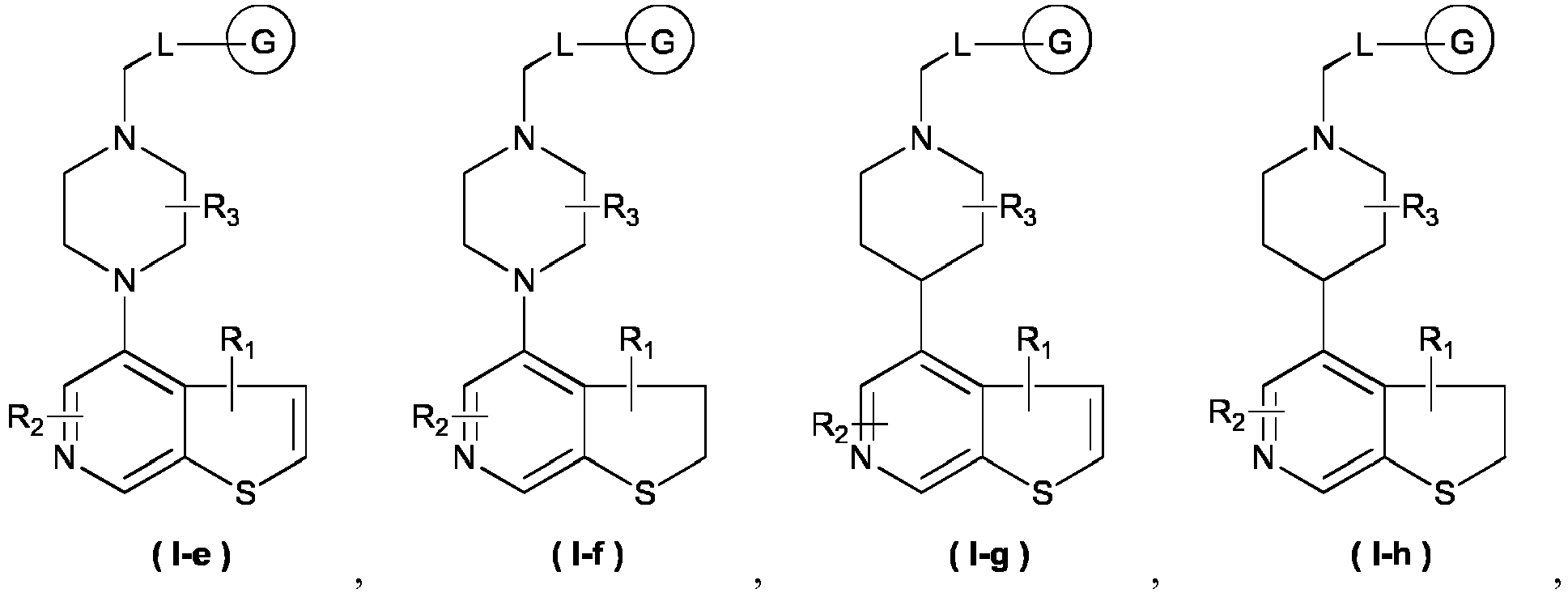


- Among the heterocyclic compound of general formula (I), stereoisomers or pharmaceutically acceptable salt thereof, most preferable compounds include a compound or a pharmaceutically acceptable salt thereof selected from:
- (1) 6-chloro-5-(2-(4-(2,3-dihydrobenzo[b]thiophen-4-yl)piperazin-1-yl)ethyl)indolin-2-one;
- (2) 3-(2-(4-(2,3-dihydrobenzo[b]thiophen-4-yl)piperazin-1-yl)ethyl)-9-hydroxy-2-methyl-6,7,8, 9-tetrahydro-4H-pyrido[1,2-a]pyrimidin-4-one;
- (3) 3-(2-(4-(benzo[b]thiophen-4-yl)piperazin-1-yl)ethyl)-2-methyl-6,7,8,9-tetrahydro-4H-pyrid o[1,2-a]pyrimidin-4-one;
- (4) 3-(2-(4-(benzo[b]thiophen-4-yl)piperazin-1-yl)ethyl)-9-hydroxy-2-methyl-6,7,8,9-tetrahydr o-4H-pyrido[1,2-a]pyrimidin-4-one;
- (4a)(+)-3-(2-(4-(benzo[b]thiophen-4-yl)piperazin-1-yl)ethyl)-9-hydroxy-2-methyl-6,7,8,9-tetrah ydro-4H-pyrido[1,2-a]pyrimidin-4-one;
- (4b)(-)-3-(2-(4-(benzo[b]thiophen-4-yl)piperazin-1-yl)ethyl)-9-hydroxy-2-methyl-6,7,8,9-tetrah ydro-4H-pyrido[1,2-a]pyrimidin-4-one;
- (5) 3-(2-(4-(benzo[b]thiophen-4-yl)piperazin-1-yl)ethyl)-2-methyl-7,8-dihydro-4H-pyrido[1,2-a ]pyrimidine-4,9(6H)-dione;
- (6) 3-(2-(4-(benzo[b]thiophen-4-yl)piperazin-1-yl)ethyl)-9-hydroxy-2,9-dimethyl-6,7,8,9-tetrah ydro-4H-pyrido[1,2-a]pyrimidin-4-one;
- (7) 3-(2-(4-(benzo[b]thiophen-4-yl)piperazin-1-yl)ethyl)-9-fluoro-2-methyl-6,7,8,9-tetrahydro-4H-pyrido[1,2-a]pyrimidin-4-one;
- (8) 5-(2-(4-(benzo[b]thiophen-4-yl)piperazin-1-yl)ethyl)indolin-2-one;
- (9) 7-(2-(4-(benzo[b]thiophen-4-yl)piperazin-1-yl)ethyl)quinolin-2(1H)-one;
- (10) 7-(5-(4-(benzo[b]thiophen-4-yl)piperazin-1-yl)pentyl)-3,4-dihydroquinolin-2(1H)-one;
- (11) 7-(5-(4-(benzo[b]thiophen-4-yl)piperazin-1-yl)pentyl)quinolin-2(1H)-one;
- (12) 7-(5-(4-(2-chlorobenzo[b]thiophen-4-yl)piperazin-1-yl)pentyl)quinolin-2(1H)-one;
- (13) 7-(5-(4-(2-fluorobenzo[b]thiophen-4-yl)piperazin-1-yl)pentyl)quinolin-2(1H)-one;
- (14) 7-(5-(4-(benzo[b]thiophen-4-yl)-5,6-dihydropyridin-1(2H)-yl)pentyl)quinolin-2(1H)-one;
- (15) 5-(2-(4-(benzo[b]thiophen-4-yl)piperazin-1-yl)ethyl)-6-chloroindolin-2-one;
- (16) 3-(2-(4-(benzo[b]thiophen-4-yl)piperazin-1-yl)ethyl)-2-methyl-6,7-dihydro-4H-pyrido[1,2-a]pyrimidin-4-one;
- (17) 3-(2-(4-(benzo[b]thiophen-4-yl)piperazin-1-yl)ethyl)-9-(benzyloxy)-2-methyl-4H-pyrido[1, 2-a]pyrimidin-4-one;
- (18) 3-(2-(4-(benzo[b]thiophen-4-yl)piperazin-1-yl)ethyl)-9-hydroxy-2-methyl-4H-pyrido[1,2-a ]pyrimidin-4-one;
- (19) 7-(2-(4-(benzo[b]thiophen-4-yl)piperazin-1-yl)ethyl)-3,4-dihydroquinolin-2(1H)-one;
- (20)9-hydroxy-2-methyl-3-(2-(4-(thieno[2,3-d]pyrimidin-4-yl)piperazin-1-yl)ethyl)-6,7,8,9-tetr ahydro-4H-pyrido[1,2-a]pyrimidin-4-one;
- (21)2-methyl-3-(2-(4-(thieno[2,3-d]pyrimidin-4-yl)piperazin-1-yl)ethyl)-6,7,8,9-tetrahydro-4H-pyrido[1,2-a]pyrimidin-4-one;
- (22) 7-(4-(4-(benzo[b]thiophen-4-yl)piperazin-1-yl)butyl)-3,4-dihydroquinolin-2(1H)-one;
- (23) 7-(2-(4-(benzo[b]thiophen-4-yl)piperazin-1-yl)ethyl)-6-chloro-3,4-dihydroquinolin-2(1H)-one;
- (24) 6-(5-(4-(benzo[b]thiophen-4-yl)piperazin-1-yl)pentyl)-2-methylquinazolin-4(3H)-one;
- (25) 7-(2-(4-(2,3-dihydrobenzo[b]thiophen-4-yl)piperazin-1-yl)ethyl)quinolin-2(1H)-one;
- (26) 5-(2-(4-(benzo[b]thiophen-4-yl)piperazin-1-yl)ethyl)-4-methylthiazole;
- (27) 5-(2-(4-(benzo[b]thiophen-4-yl)piperazin-1-yl)ethyl)-1H-benzo[d]imidazol-2(3H)-one;
- (28) 3-(2-(4-(benzo[b]thiophen-4-yl)piperazin-1-yl)ethyl)-9,9-difluoro-2-methyl-6,7,8,9-tetrahy dro-4H-pyrido[1,2-a]pyrimidin-4-one;
- (29) 6-(2-(4-(benzo[b]thiophen-4-yl)piperazin-1-yl)ethyl)benzo[d]thiazol-2(3H)-one;
- (30) 6-(2-(4-(benzo[b]thiophen-4-yl)piperazin-1-yl)ethyl)-2H-benzo[b][1,4]oxazin-3(4H)-one;
- (31) 6-(2-(4-(benzo[b]thiophen-4-yl)piperazin-1-yl)ethyl)-2H-benzo[b][1,4]thiazin-3(4H)-one;
- (32) 7-(2-(4-(thieno[2,3-d]pyrimidin-4-yl)piperazin-1-yl)ethyl)quinolin-2(1H)-one;
- (33) 7-(4-(4-(benzo[b]thiophen-4-yl)piperazin-1-yl)butyl)quinolin-2(1H)-one;
- (34) 6-(5-(4-(benzo[b]thiophen-4-yl)piperazin-1-yl)pentyl)quinazolin-4(3H)-one;
- (35) 2-(2-(4-(benzo[b]thiophen-4-yl)piperazin-1-yl)ethyl)quinazolin-4(3H)-one;
- (36) 3-(2-(4-(benzo[b]thiophen-4-yl)piperidin-1-yl)ethyl)-9-hydroxy-2-methyl-6,7,8,9-tetrahydr o-4H-pyrido[1,2-a]pyrimidin-4-one;
- (37) 5-(2-(4-(benzo[b]thiophen-4-yl)piperidin-1-yl)ethyl)-6-chloroindolin-2-one;
- (38) 4-(2-(4-(benzo[b]thiophen-4-yl)piperazin-1-yl)ethyl)indolin-2-one;
- (39) 6-(2-(4-(benzo[b]thiophen-4-yl)piperazin-1-yl)ethyl)indolin-2-one;
- (40) 7-(2-(4-(benzo[b]thiophen-4-yl)piperazin-1-yl)ethyl)-6-chloroquinolin-2(1H)-one;
- (41) 9-hydroxy-2-methyl-3-(2-(4-(thieno[2,3-c]pyridin-4-yl)piperazin-1-yl)ethyl)-6,7,8,9-tetrah ydro-4H-pyrido[1,2-a]pyrimidin-4-one;
- (42) 6-chloro-5-(2-(4-(thieno[2,3-c]pyridin-4-yl)piperazin-1-yl)ethyl)indolin-2-one;
- (43) 7-(2-(4-(thieno[2,3-c]pyridin-4-yl)piperazin-1-yl)ethyl)quinolin-2(1H)-one;
- (44) 7-(3-(4-(benzo[b]thiophen-4-yl)piperazin-1-yl)propyl)quinolin-2(1H)-one;
- (45) 7-(3-(4-(benzo[b]thiophen-4-yl)piperazin-1-yl)propyl)-3,4-dihydroquinolin-2(1H)-one;
- (46) 3-(2-(4-(benzo[b]thiophen-4-yl)piperazin-1-yl)ethyl)-1H-indole;
- (47) 6-(2-(4-(benzo[b]thiophen-4-yl)piperazin-1-yl)ethyl)-3,4-dihydroquinolin-2(1H)-one;
- (48) 5-(3-(4-(benzo[b]thiophen-4-yl)piperazin-1-yl)propyl)indolin-2-one;
- (49) 7-(2-(4-(benzo[b]thiophen-4-yl)piperazin-1-yl)ethyl)-4,5-dihydro-1H-benzo[b]azepin-2(3H )-one;
- (50) 3-(2-(4-(benzo[b]thiophen-4-yl)piperazin-1-yl)ethyl)-2-methyl-4H-pyrido[1,2-a]pyrimidin-4-one;
- (51) 6-(2-(4-(benzo[b]thiophen-4-yl)piperazin-1-yl)ethyl)-3-methyl-3,4-dihydroquinazolin-2(1H )-one;
- (52) 3-(2-(4-(benzo[b]thiophen-4-yl)piperazin-1-yl)ethyl)-9-chloro-2-methyl-6,7,8,9-tetrahydro-4H-pyrido[1,2-a ]pyrimidin-4-one;
- (53) 5-(2-(4-(benzo[b]thiophen-4-yl)piperazin-1-yl)ethyl)indoline-2-thione;
- (54) 7-(2-(4-(benzo[b]thiophen-4-yl)piperazin-1-yl)ethyl)quinoline-2(1H)-thione;
- (55) 2-(2-(4-(benzo[b]thiophen-4-yl)piperazin-1-yl)ethyl)-5,6-diethylpyrimidin-4(3H)-one;
- (56) 2-(2-(4-(benzo[b]thiophen-4-yl)piperazin-1-yl)ethyl)pyrimidin-4(3H)-one;
- (57) 7-(2-(4-(2-fluorobenzo[b]thiophen-4-yl)piperazin-1-yl)ethyl)quinolin-2(1H)-one;
- (58) 2-((4-(benzo[b]thiophen-4-yl)piperazin-1-yl)methyl)-1H-benzo[d]imidazole;
- (59) 6-(2-(4-(benzo[b]thiophen-4-yl)piperazin-1-yl)ethyl)benzo[d]thiazole;
- (60) 7-(2-(4-(2-fluorobenzo[b]thiophen-4-yl)piperazin-1-yl)ethyl)benzo[d]thiazol-2-amine;
- (61) N-(7-(2-(4-(2-fluorobenzo[b]thiophen-4-yl)piperazin-1-yl)ethyl)benzo[d]thiazol-2-yl)aceta mide;
- (62) 5-(2-(4-(2-fluorobenzo[b]thiophen-4-yl)piperazin-1-yl)ethyl)benzo[d]thiazol-2-amine;
- (63)N-(5-(2-(4-(2-fluorobenzo[b]thiophen-4-yl)piperazin-1-yl)ethyl)benzo[d]thiazol-2-yl)aceta mide;
- (64) 7-(2-(4-(2-fluorobenzo[b]thiophen-4-yl)piperazin-1-yl)ethyl)-3,4-dihydroquinolin-2(1H)-o ne;
- (65) 6-(2-(4-(2-fluorobenzo[b]thiophen-4-yl)piperazin-1-yl)ethyl)-3,4-dihydroquinolin-2(1H)-o ne;
- (66) 6-(2-(4-(benzo[b]thiophen-4-yl)piperazin-1-yl)ethyl)-7-fluoro-2H-benzo[b][1,4]oxazin-3(4 H)-one;
- (67) 7-(2-(4-(3-methylbenzo[b]thiophen-4-yl)piperazin-1-yl)ethyl)-3,4-dihydroquinolin-2(1H)-o ne;
- (68) 6-(2-(4-(benzo[b]thiophen-4-yl)piperazin-1-yl)ethyl)benzo[d]oxazol-2(3H)-one;
- (69) 4-((4-(benzo[b]thiophen-4-yl)piperazin-1-yl)methyl)quinolin-2(1H)-one;
- (70) 3-(4-(4-(benzo[b]thiophen-4-yl)piperazin-1-yl)butyl)-1H-indole-5-carbonitrile;
- (71) 7-(5-(4-(6-fluorobenzo[b]thiophen-4-yl)piperazin-1-yl)pentyl)quinolin-2(1H)-one;
- (72) 6-(4-(4-(benzo[b]thiophen-4-yl)piperazin-1-yl)butyl)-8-fluoro-2H-benzo[b][1,4]oxazin-3(4 H)-one;
- (73) 1-(benzo[b]thiophen-4-yl)-4-((2,3-dihydrobenzo[b][1,4]dioxin-2-yl)methyl)piperazine;
- (74) 6-(4-(4-(2-fluorobenzo[b]thiophen-4-yl)piperazin-1-yl)butyl)-3,4-dihydroquinolin-2(1H)-o ne;
- (75) 2-(2-(4-(benzo[b]thiophen-4-yl)piperazin-1-yl)ethyl)-1H-benzo[d]imidazole;
- (76) N-(6-(2-(4-(2-fluorobenzo[b]thiophen-4-yl)piperazin-1-yl)ethyl)benzo[d]thiazol-2-yl)aceta mide;
- (77) 5-(2-(4-(2-fluorobenzo[b]thiophen-4-yl)piperazin-1-yl)ethyl)-1H-benzo[d]imidazol-2(3H)-one;
- (78) 6-(2-(4-(6-fluorobenzo[b]thiophen-4-yl)piperazin-1-yl)ethyl)-2H-benzo[b][1,4]oxazin-3(4 H)-one;
- (79) 5-(2-(4-(2-fluorobenzo[b]thiophen-4-yl)piperazin-1-yl)ethyl)indolin-2-one;
- (80) 6-(2-(4-(benzo[b]thiophen-4-yl)piperazin-1-yl)ethyl)-2-methylquinazolin-4(3H)-one;
- (81) 7-(2-(4-(benzo[b]thiophen-4-yl)piperazin-1-yl)ethyl)-1,1-dioxide-3,4-dihydro-2H-benzo[e] [1,2]thiazine;
- (82) 5-(2-(4-(benzo[b]thiophen-4-yl)piperidin-1-yl)ethyl)indolin-2-one;
- (83) 7-(2-(4-(benzo[b]thiophen-4-yl)piperidin-1-yl)ethyl)-3,4-dihydroquinolin-2(1H)-one;
- (84) 5-(2-(4-(6-fluorobenzo[b]thiophen-4-yl)piperazin-1-yl)ethyl)indolin-2-one;
- (85) 7-(2-(4-(6-fluorobenzo[b]thiophen-4-yl)piperazin-1-yl)ethyl)-3,4-dihydroquinolin-2(1H)-o ne;
- (86) 6-(2-(4-(benzo[b]thiophen-4-yl)piperazin-1-yl)ethyl)-1-methyl-1H-benzo[d]imidazol-2(3H )-one;
- (87) 5-(2-(4-(benzo[b]thiophen-4-yl)piperazin-1-yl)ethyl)-1,3-dimethyl-1H-benzo[d]imidazol-2( 3H)-one;
- (88) 5-(2-(4-(benzo[b]thiophen-4-yl)piperazin-1-yl)ethyl)-1-methyl-1H-benzo[d]imidazol-2(3H )-one;
- (89) 6-(2-(4-(2-methoxybenzo[b]thiophen-4-yl)piperazin-1-yl)ethyl)-3,4-dihydroquinolin-2(1H) -one;
- (90) 3-(2-(4-(6-fluorobenzo[b]thiophen-4-yl)piperazin-1-yl)ethyl)-2-methyl-6,7,8,9-tetrahydro-4 H-pyrido[1,2-a]pyrimidin-4-one;
- (91) 7-(2-(4-(2-oxo-2,3-dihydrobenzo[b]thiophen-4-yl)piperazin-1-yl)ethyl)-3,4-dihydroquinoli n-2(1H)-one;
- (92) 6-(2-(4-(2-fluorobenzo[b]thiophen-4-yl)piperazin-1-yl)ethyl)-2H-benzo[b][1,4]oxazin-3(4 H)-one;
- (93) 5-(2-(4-(2-fluorobenzo[b]thiophen-4-yl)piperazin-1-yl)ethyl)-1,3-dimethyl-1H-benzo[d]imi dazol-2(3H)-one;
- (94) 6-fluoro-5-(2-(4-(2-fluorobenzo[b]thiophen-4-yl)piperazin-1-yl)ethyl)indolin-2-one;
- (95) 5-(2-(4-(benzo[b]thiophen-4-yl)piperazin-1-yl)ethyl)-6-fluoroindolin-2-one;
- (96) 7-(2-(4-(benzo[b]thiophen-4-yl)piperazin-1-yl)ethyl)-1-benzyl-3-methylquinazoline-2,4(1H ,3H)-dione;
- (97) 6-(2-(4-(benzo[b]thiophen-4-yl)piperidin-1-yl)ethyl)-2H-benzo[b][1,4]oxazin-3(4H)-one;
- (98) 6-(2-(4-(benzo[b]thiophen-4-yl)piperidin-1-yl)ethyl)-3,4-dihydroquinolin-2(H)-one;
- (99) 3-(2-(4-(benzo[b]thiophen-4-yl)piperidin-1-yl)ethyl)-2-methyl-6,7,8,9-tetrahydro-4H-pyrid o[1,2-a]pyrimidin-4-one;
- (100) 6-(2-(4-(2-fluorobenzo[b]thiophen-4-yl)piperazin-1-yl)ethyl)quinolm-2(1H)-one;
- (101) 5-(4-(4-(2-fluorobenzo[b]thiophen-4-yl)piperazin-1-yl)butyl)indolin-2-one;
- (102) 7-(2-(4-(6-fluorobenzo[b]thiophen-4-yl)piperazin-1-yl)ethyl)quinolin-2(1H)-one;
- (103) 3-(4-(4-(benzo[b]thiophen-4-yl)piperazin-1-yl)butyl)-6,7-dimethoxy-4H-chromen-4-on e;
- (104) 6-(4-(4-(benzo[b]thiophen-4-yl)piperidin-1-yl)butyl)-3,4-dihydroquinolin-2(1H)-one;
- (105) 3-(2-(4-(benzo[b]thiophen-4-yl)piperazin-1-yl)ethyl)-5-methoxy-1H-indole;
- (106) 3-(3-(4-(benzo[b]thiophen-4-yl)piperazin-1-yl)propyl)-5-methoxy-1H-indole;
- (107) 3-(4-(4-(benzo[b]thiophen-4-yl)piperazin-1-yl)butyl)-5-methoxy-1H-indole
- (108) 3-(3-(4-(benzo[b]thiophen-4-yl)piperazin-1-yl)propyl)-1H-indole-5-carbonitrile;
- (109) 3-(2-(4-(benzo[b]thiophen-4-yl)piperazin-1-yl)ethyl)-1H-indole-5-carbonitrile;
- (110) 1-acetyl-3-(4-(4-(benzo[b]thiophen-4-yl)piperazin-1-yl)butyl)-1H-indole-5-carbonitrile; ;
- (111) 6-(4-(4-(benzo[b]thiophen-4-yl)piperazin-1-yl)butyl)-3,4-dihydroquinolin-2(1H)-one;
- (112) 5-(4-(4-(benzo[b]thiophen-4-yl)piperazin-1-yl)butyl)indolin-2-one;
- (113) 6-chloro-5-(2-(4-(2-fluorobenzo[b]thiophen-4-yl)piperazm-1-yl)ethyl)indolin-2-one;
- (114) 6-(2-(4-(benzo[b]thiophen-4-yl)piperazin-1-yl)ethyl)-4-methyl-2H-benzo[b][1,4]oxazi n-3(4H)-one;
- (115) 7-(2-(4-(benzo[b]thiophen-4-yl)piperazin-1-yl)ethyl)-1-methyl-3,4-dihydroquinolin-2( 1H)-one;
- (116) 5-(2-(4-(benzo[b]thiophen-4-yl)piperazin-1-yl)ethyl)benzo[d]thiazol-2-amine;
- (117) 7-(2-(4-(benzo[b]thiophen-4-yl)piperazin-1-yl)ethyl)benzo[d]thiazol-2-amine;
- (118) N-(5-(2-(4-(benzo[b]thiophen-4-yl)piperazin-1-yl)ethyl)benzo[d]thiazol-2-yl)acetamid e;
- (119) N-(7-(2-(4-(benzo[b]thiophen-4-yl)piperazin-1-yl)ethyl)benzo[d]thiazol-2-yl)acetamid e;
- (120) 4-(2-(4-(benzo[b]thiophen-4-yl)piperazin-1-yl)ethyl)benzo[d]thiazol-2-amine;
- (121) N-(4-(2-(4-(benzo[b]thiophen-4-yl)piperazin-1-yl)ethyl)benzo[d]thiazol-2-yl)acetamid e;
- (122) 7-(2-(4-(2-methylbenzo[b]thiophen-4-yl)piperazin-1-yl)ethyl)-3,4-dihydroquinolin-2(1 H)-one;
- (123) 3-((4-(benzo[b]thiophen-4-yl)piperazin-1-yl)methyl)-1-methyl-1H-indole;
- (124) 1-(3-(2-(4-(benzo[b]thiophen-4-yl)piperazin-1-yl)ethyl)indolin-1-yl)ethanone;
- (125) 3-(2-(4-(benzo[b]thiophen-4-yl)piperazin-1-yl)ethyl)-1-tosyl-1H-indole-5-carbonitrile;
- (126) 3-(3-(4-(benzo[b]thiophen-4-yl)piperazin-1-yl)propyl)-1-tosyl-1H-indole-5-carbonitril e;
- (127) 3-(4-(4-(benzo[b]thiophen-4-yl)piperazin-1-yl)butyl)-5-methoxy-1-tosyl-1H-indole;
- (128) 3-(3-(4-(benzo[b]thiophen-4-yl)piperazin-1-yl)propyl)-5-methoxy-1-tosyl-1H-indole;
- (129) 3-(2-(4-(benzo[b]thiophen-4-yl)piperazin-1-yl)ethyl)-5-methoxy-1-tosyl-1H-indole;
- (130) 6-(2-(4-(2-oxo-2,3-dihydrobenzo[b]thiophen-4-yl)piperazin-1-yl)ethyl)-3,4-dihydroqui nolin-2(1H)-one;
- (131) 3-(2-(4-(2-fluorobenzo[b]thiophen-4-yl)piperazin-1-yl)ethyl)-9-hydroxy-2-methyl-6,7, 8,9-tetrahydro-4H-pyrido[1,2-a]pyrimidin-4-one;
- (132) 2-(2-(4-(benzo[b]thiophen-4-yl)piperazin-1-yl)ethyl)-2H-benzo[b][1,4]oxazin-3(4H)-o ne;
- (133) 7-(2-(4-(benzo[b]thiophen-4-yl)piperazin-1-yl)ethyl)-3,4-dihydroquinoline-2(1H)-thio ne;
- (134) (3aR,4R,6aS)-4-(5-(4-(benzo[b]thiophen-4-yl)piperazin-1-yl)pentyl)tetrahydro-1H-thie no[3,4-d]imidazol-2(3H)-one;
- (135) pentyl
(6-(2-(4-(benzo[b]thiophen-4-yl)piperazin-1-yl)ethyl)benzo[d]thiazol-2-yl)carbamate; - (136) 3-(2-(4-(benzo[b]thiophen-4-yl)piperazin-1-yl)ethyl)-2-methyl-4-oxo-6,7,8,9-tetrahydr o-4H-pyrido[1,2-a]pyrimidin-9-yl benzoate;
- (137) 6-(4-(4-(benzo[b]thiophen-4-yl)piperazin-1-yl)butyl)-2H-benzo[b][1,4]oxazin-3(4H)-o ne;
- (138) 1-(benzo[b]thiophen-4-yl)-4-(4-(1-cyclohexyl-1H-tetrazol-5-yl)butyl)piperazine;
- (139) 6-(2-(4-(benzo[b]thiophen-4-yl)piperazin-1-yl)ethyl)-8-fluoro-2H-benzo[b][1,4]oxazin -3(4H)-one;
- (140) 7-(2-(4-(benzo[b]thiophen-4-yl)piperazin-1-yl)-1-hydroxyethyl)quinolin-2(1H)-one;
- (141) 6-(2-(4-(benzo[b]thiophen-4-yl)piperazin-1-yl)-1-hydroxyethyl)-2H-benzo[b][1,4]oxaz in-3(4H)-one;
- (142) 6-(2-(4-(benzo[b]thiophen-4-yl)piperazin-1-yl)-1-hydroxyethyl)-2H-benzo[b][1,4]thiaz in-3(4H)-one;
- (143) 5-(2-(4-(benzo[b]thiophen-4-yl)piperazin-1-yl)acetyl)indolin-2-one;
- (144) 8-(2-(4-(benzo[b]thiophen-4-yl)piperazin-1-yl)-1-methoxyethyl)-2H-benzo[b][1,4]oxa zin-3(4H)-one;
- (145) 5-(2-(4-(benzo[b]thiophen-4-yl)piperazin-1-yl)-1-hydroxyethyl)indolin-2-one;
- (146) 6-(2-(4-(benzo[b]thiophen-4-yl)piperazin-1-yl)acetyl)benzo[d]thiazol-2(3H)-one;
- (147) 5-(2-(4-(benzo[b]thiophen-4-yl)piperazin-1-yl)acetyl)-1H-benzo[d]imidazol-2(3H)-one; ;
- (148) 7-(2-(4-(benzo[b]thiophen-4-yl)piperazin-1-yl)acetyl)-3,4-dihydroquinolin-2(1H)-one;
- (149) 7-(5-(4-(benzo[b]thiophen-4-yl)piperazin-1-yl)pentanoyl)quinolin-2(1H)-one;
- (150) 7-(5-(4-(benzo[b]thiophen-4-yl)piperazin-1-yl)-1-hydroxypentyl)-3,4-dihydroquinolin-2(1H)-one;
- (151) 7-(5-(4-(benzo[b]thiophen-4-yl)piperazin-1-yl)pentanoyl)-3,4-dihydroquinolin-2(1H)-one;
- (152) N-(6-(2-(4-(benzo[b]thiophen-4-yl)piperazin-1-yl)ethyl)benzo[d]thiazol-2-yl)cyclopent anecarboxamide;
- (153) N-(6-(2-(4-(benzo[b]thiophen-4-yl)piperazin-1-yl)ethyl)benzo[d]thiazol-2-yl)acetamid e;
- (154) 6-(2-(4-(benzo[b]thiophen-4-yl)piperazin-1-yl)ethyl)benzo[d]thiazol-2-amine.
- The present invention provides a process for producing a heterocyclic compound represented by formula (I) as shown in methods 1 to 5.
- Method 1: The method comprises the step to obtain the compound of formula (I) or a salt thereof by the N-alkylation reaction of the compound of formula (II) or a salt thereof with the compound of formula (III) or a salt thereof, as shown in Reaction Formula 1:

- wherein, ring G, L, A, B, D, E, R1, R2 and R3 are defined and preferred as hereinbefore;
- X represents a leaving group such as halogen, C1∼C6 alkylsulfonyloxy, phenylsulfonyloxy, naphthylsulfonyloxy, said C1~C6 alkylsulfonyloxy, phenylsulfonyloxy or naphthylsulfonyloxy is optionally substituted with one or more substituents selected from the group consisting of halogen, C1∼C6 alkyl, C1∼C6 alkoxy, nitro, hydroxy, amino and C1∼C6 alkanoyl group; preferably X represents halogen, C1∼C4 alkylsulfonyloxy, phenylsulfonyloxy and naphthylsulfonyloxy group, said C1∼C4 alkylsulfonyloxy, phenylsulfonyloxy or naphthylsulfonyloxy group is optionally substituted with one or more substituents selected from the group consisting of halogen, C1∼C4 alkyl, C1∼C4 alkoxy, nitro, hydroxy, amino and C1∼C4 alkanoyl; most preferably, X represents chlorine, bromine, methylsulfonyloxy, trifluoromethylsulfonyloxy, phenylsulfonyloxy, naphthylsulfonyloxy, methyl-phenylsulfonyloxy, nitro-phenylsulfonyloxy, amino-phenylsulfonyloxy, chloro-phenylsulfonyloxy, bromo-phenylsulfonyloxy or methoxy-phenylsulfonyloxy group.
Said N-alkylation reaction between the compound of formula (II) or a salt thereof and the compound of formula (III) or a salt thereof was conducted in solvents in the presence or absence of a base, or it may be conducted without solvents. Said solvents include water; ethers such as dioxane, tetrahydrofuran, diethyl ether, methyl t-butyl ether, diisopropyl ether, diglyme, ethylene glycol dimethyl ether; aromatic hydrocarbons such as benzene, toluene, xylene, nitrobenzene, chlorobenzene; alcohols such as methanol, ethanol, isopropanol, butanol, tert-butanol, ethylene glycol; ketones such as acetone, methyl ethyl ketone, 4-methyl-2-pentanone; amides such as N,N-dimethylformamide, N,N-dimethylacetamide, 1-methyl-2-pyrrolidinone; halogenated hydrocarbons such as chloroform, dichloromethane, dichloroethane, carbon tetrachloride; esters such as ethyl acetate, ethyl formate, methyl acetate, isopropyl acetate; others such as dimethyl sulfoxide, acetonitrile. These solvents may be used singly or in combination with two or more.
Said base may be inorganic or organic base, the inorganic base is selected from the group consisting of alkali metal hydroxides(e.g., sodium hydroxide, potassium hydroxide, cesium hydroxide, lithium hydroxide); alkali metal carbonates(e.g., sodium carbonate, potassium carbonate, cesium carbonate, lithium carbonate); alkali metal bicarbonates such as sodium hydrogencarbonate, potassium hydrogencarbonate, lithium hydrogencarbonate; alkali metal such as potassium, sodium; others such as sodium amide, potassium amide, sodium hydride, potassium hydride; the organic base is selected from the group consisting of sodium methoxide, sodium ethoxide, potassium methoxide, potassium ethoxide, sodium acetate, triethylamine, pyridine, diisopropylamine, diisopropylethylamine, tripropylamine, diethylamine, pyrimidine, quinoline, piperidine, piperazine, imidazole, dimethylaminopyridine, trimethylamine, N-ethyldiisopropylamine, N-methylmorpholine, dimethylaniline, 1,8-diazabicyclo[5.4.0] undec-7-ene (DBU), 1,5- diazabicyclo[4.3.0]non-5-ene (DBN), 1,4-diazabicyclo[2.2.2] octane (DABCO). These bases may be used singly or in combination with two or more.
The above reaction may be conducted in the presence of an iodide of alkali metal such as potassium iodide and sodium iodide as a catalyst if necessary.
The reaction temperature is room temperature to 200°C, preferably from room temperature to 150°C. The reaction time is 1 hour to 30 hours, preferably 5 hours to 20 hours. - Method 2: The method comprises the step to obtain the compound of formula (Ia) or a salt thereof by the coupling reaction of the compound of formula (IV) or a salt thereof with the compound of formula (V) or a salt thereof, as shown in Reaction Formula 2:

the coupling reaction is carried out in the presence of a base and a palladium catalyst and the compounds of formula (Ia) is a special case of the compound of formula (I).
Said palladium catalyst is selected from the group consisting of palladium acetate (Pd (OAc)2), bis(triphenylphosphine)palladium(II) chloride((Ph3P)2PdCl2), bis(benzonitrile) palladium(II) chloride ((PhCN)2PdCl2), Tetrakis(triphenylphosphine)palladium (Pd(PPh3)4), bis (triphenylphosphine)palladium acetate ((Ph3P)2Pd(OAc)2), [1,2-Bis(diphenylphosphino)ethane]dichloropalladium(II)(PdCl2(dppe)), bis (1,2-bis (diphenylphosphino) ethane) palladium (Pd(dppe)2), bis(dibenzylideneacetone)palladium(Pd(dba)2), tris(dibenzylideneacetone) dipalladium (Pd2(dba)3), [1,3-bis(diphenylphosphino)propane]palladium dichloride (PdCl2 (dippp)), and [1,1'-bis(diphenylphosphino)ferrocene] dichloropalladium (Pd(dppf)Cl2); said base is one or more selected from the group consisting of sodium bis (trimethylsilyl) amide, potassium tert-butoxide, sodium tert-butoxide, potassium phosphate, sodium phosphate, sodium methoxide, sodium ethoxide, potassium hydroxide, sodium hydroxide, potassium fluoride, sodium fluoride, tetrabutylammonium fluoride (TBAF), sodium acetate, potassium acetate, cesium carbonate , potassium carbonate or sodium carbonate. The reaction solvent is not particularly limited and include water; ethers such a dioxane, tetrahydrofuran; aromatic hydrocarbons such as toluene, xylene; alcohols such as t-butanol; ketones such as acetone; amides such as N, N-dimethylformamide; others such as dimethylsulfoxide, acetonitrile; or a mixture of the above solvents; a suitable ligand can be added thereto as a reaction accelerator if necessary. Examples of said suitable ligands are 2,2'-Bis(diphenylphosphino)-1,1'-binaphthalene(BINAP), Tri-t-butyl phosphine(P(t-Bu)3), 1,1'-bis(diphenylphosphino)ferrocene (dppf), 2-Dicyclohexylphosphino-2',4',6'-triisopropylbiphenyl (x-phos), 4,5-bis(diphenylphosphino)-9,9-dimethyl xanthene(Xantphos), tri-tert-butylphosphine tetrafluoroborate and Tri(o-tolyl)phosphine (P (o-tolyl)3). - Method 3: The method comprises the step to obtain the compound of formula (VII) or a salt thereof by the amidation reaction of the compound of formula (VI) or a salt thereof with the compound of formula (III) compound or a salt thereof, followed by the reduction step to give a compound of formula (I), as shown in Reaction Formula 3:

The first amidation method is conducted in the presence or absence of a catalyst, by activating the carboxyl group of the compound of formula (VI) followed by the ammonolysis reaction with the compound of formula (III). The activator may be one or more selected from the group consisting of thionyl chloride, oxalyl chloride, thionyl bromide, phosphorus oxychloride, phosphorus pentachloride, pivaloyl chloride, ethyl chloroformate, isobutyl chloroformate, carbonyl diimidazole (CDI), methanesulfonyl chloride, p-toluenesulfonyl chloride, p-nitrobenzenesulfonyl chloride and the like. The catalyst may be one or more selected from the group consisting of N, N-dimethylformamide (DMF), diethylaniline, dimethylaniline, N-methylmorpholine and the like. The solvent for the carboxyl group activation reaction is not particularly limited, for example, may be one or more selected from the group consisting of dichloromethane, dichloroethane, dimethylsulfoxide, tetrahydrofuran, benzene, toluene, chloroform, carbon tetrachloride, xylene, N, N-dimethylformamide, N, N-dimethylacetamide and the like. The aminolysis reaction is conducted in the presence of a base in an appropriate solvent. Said base may be one or more selected from the group consisting of pyridine, piperidine, pyrrolidine, morpholine, N-methylmorpholine, quinoline, 4-dimethylaminopyridine (DMAP), triethylamine, diethylamine, tri-n-butyl amine, tripropylamine, diisopropylamine, diisopropylethylamine, sodium methoxide, sodium ethoxide, potassium t-butoxide, butyl lithium, 1,8-diazabicyclo[5,4,0]undec-7-ene (DBU), sodium hydride, sodium hydroxide, potassium hydroxide, lithium hydroxide, sodium hydrogencarbonate, potassium hydrogencarbonate, sodium carbonate and potassium carbonate. The ammonolysis reaction solvent is one or more selected from the group consisting of aromatic hydrocarbon solvents, ether solvents, halogenated hydrocarbon solvents and other solvents. Wherein said aromatic hydrocarbon solvents may be one or more selected from the group consisting of benzene, toluene, xylene and the like; said ether solvents may be one or more selected from the group consisting of tetrahydrofuran (THF), diethyl ether, methyl t-butyl ether , ethylene glycol dimethyl ether, diethylene glycol dimethyl ether, ethylene glycol monomethyl ether, 1,4-dioxane and the like; said halogenated hydrocarbon solvents may be one or more selected from the group consisting of dichloromethane, chloroform, carbon tetrachloride, dichloroethane, and the like; said other solvents may be one or more selected from the group consisting of methanol, ethanol, ethylene glycol, hexane, cyclohexane, N, N-dimethylformamide (DMF), N, N-dimethylacetamide, dimethylsulfoxide (DMSO), N-methyl pyrrolidone, acetone, acetonitrile, ethyl acetate, and the like; but the present invention is not limited to the above solvents.The temperature for the ammonolysis reaction is not particularly limited, but preferably is -30 °C∼ 150 °C, more preferably is -10 °C∼ 120°C. The reaction time for the ammonolysis reaction is not particularly limited, but preferably is 10 minutes to 24 hours.
The second amidation method is conducted in the presence of a condensing agent, with or without a catalyst, with or without a base. Said condensing agent can be one or more selected from the group consisting of N, N'-dicyclohexyl carbodiimide (DCC), 1-ethyl-3-(3-dimethylaminopropyl) carbodiimide (EDCI), N, N'-diisopropyl carbodiimide (DIC), O-(Benzotriazol-1-yl)-N,N,N',N'-tetramethyluronium tetrafluoroborate (TBTU), o-(7-Azabenzotriazol-1-yl)-N,N,N',N'-te-tramethyluronium hexafluorophosphate (HATU), o-Benzotriazol-1-yl-N,N,N',N'-tetramethyluronium hexafluorophosphate (HBTU), (Benzotriazol-1-yloxy)tris(dimethylamino)phosphonium hexafluorophosphate (BOP) and Benzotriazole-1-yl-oxytripyrrolidinophosphonium hexafluorophosphate (PyBOP). Said catalyst may be one or more selected from the group consisting of 1-hydroxy-benzotriazole (HOBt) and 4-dimethylaminopyridine (DMAP). Said base may be one or more selected from the group consisting of triethylamine, diethylamine, n-butylamine, tripropylamine, diisopropylamine, diisopropylethylamine, trimethylamine, pyridine, 2,6-dimethyl pyridine, 4-dimethylaminopyridine, piperidine, pyrrolidine, quinoline, morpholine, N-methyl morpholine, N-ethyl morpholine, 1,8-diazabicyclo[5,4,0]undecene-7 (DBU) or 1,5-diazabicyclo[4.3.0]non-5-ene (DBN) and the like. The solvent of the second amidation method may be selected from the group consisting of hydrocarbons, such as benzene, xylene, toluene, dichloromethane or chloroform; ethers such as tetrahydrofuran, diethyl ether, dipropyl ether, or 1,4-dioxane; amides such as N, N-dimethylformamide, N, N-diethylformamide or N, N-dimethylacetamide; nitriles such as acetonitrile; others such as dimethyl sulfoxide; these solvents may be used singly or in combination with two or more. Preferably, the reaction solvent is selected from the group consisting of tetrahydrofuran, acetonitrile, dichloromethane, N, N-dimethylformamide, N, N-dimethylacetamide or dimethylsulfoxide. The reaction temperature of the second amidation method is not particularly limited, but preferably is -20 °C ∼ 80 °C, more preferably is 0 °C∼ 50 °C.
Said reducing agent is one or more selected from the group consisting of borane, hydrogen/palladium on carbon, lithium aluminum tetrahydride, triacetoxy sodium borohydride, diisobutyl aluminum hydride, boron trifluoride, boron tribromide, sodium borohydride and potassium borohydride. - Method 4: The compound of Formula (I) was obtained by the reductive amination reaction of the compound of Formula (VIII) or a salt thereof and the compound of formula (III) or a salt thereof, as shown in Reaction Formula 4:

Said reaction solvent is selected from the group consisting of water; ethers such as dioxane, tetrahydrofuran, diethyl ether, methyl t-butyl ether, diisopropyl ether, diglyme, ethylene glycol dimethyl ether; aromatic hydrocarbons such as benzene, toluene, xylene, nitrobenzene, chlorobenzene; alcohols such as methanol, ethanol, isopropanol, butanol, tert-butanol, ethylene glycol; ketones such as acetone, methyl ethyl ketone, 4-methyl-2-pentanone; amides such as N, N-dimethylformamide, N, N-dimethylacetamide, 1-methyl-2-pyrrolidinone; halogenated hydrocarbons such as chloroform, dichloromethane, dichloroethane, carbon tetrachloride; esters such as ethyl acetate, ethyl formate, methyl acetate, isopropyl acetate; nitriles such as acetonitrile; others such as dimethyl sulfoxide. These solvents may be used singly or in combination with two or more. The reaction temperature is generally 10°C to 100°C, preferably from 20°C to 50°C. The reaction time is generally 1 hour to 30 hours. - Method 5: The compound of Formula (I) was obtained through the functional group conversion from the product obtained by method 1-4. e.g., by the oxidation reaction, the Grignard reaction, the hydrolysis reaction, the fluorination reaction, the chlorination reaction or the thiosulfate reaction.
- Said oxidation reaction is carried out in the presence of an oxidant, the oxidant included but not limited to: Dess-Martin reagent, Jones reagent, Swern reagents (DMSO and oxalyl chloride) or 2,3-Dichloro-5,6-dicyano-1,4-benzoquinone (DDQ) and the like.
- Said Grignard reaction is carried out in the presence of a Grignard reagent, the Grignard reagent included but are not limited to: Methylmagnesium chloride, Methylmagnesium bromide, Methylmagnesium iodide or Ethylmagnesium bromide and the like.
- Said hydrolysis reaction may be carried out in the presence of an acid or a base, the acid or base included but are not limited to: hydrochloric acid, sulfuric acid, sodium hydroxide or potassium hydroxide and the like.
- Said fluorination reaction is carried out in the presence of a fluorinated agent, the fluorinated agents included but are not limited to: diethylamino sulfur trifluoride (DAST), sulfur tetrafluoride or iodine pentafluoride and the like.
- Said chlorination reaction is carried out in the presence of a chlorinated agents, the chlorinated agents included but are not limited to: thionyl chloride, phosphorus pentachloride or N-chlorosuccinimide (NCS) and the like.
- Said thiosulfate reaction is carried out in the presence of a thiosulfate reagent, the thiosulfate agents included but are not limited to: phosphorus pentasulfide or Lawesson reagent and the like.
- The compounds of Formula (II), formula (III), formula (IV), Formula (V), formula (VI), and formula (VIII) are commercially available or are prepared according to the reported mthods or are prepared according to the reported mthods of their analogs.
- The starting compounds used in the above reaction may be in the form of suitable salts, the suitable salts include alkali metal salts and alkaline earth metal salts such as sodium, potassium, calcium, magnesium salt and the like; organic base salts such as pyridine salt, triethylamine salt and the like; inorganic acid salts such as hydrochloride, hydrobromide, hydroiodide, sulfate, nitrate, phosphate and the like; organic acid salts such as formate, acetate, propionate, glycolate, oxalate, malonate, succinate, fumarate, maleate, lactate, malate, citrate, tartrate, picrate, glutamate, methanesulfonate and benzene sulfonate;
- Further, the starting compound used in the above reactions may be in the form of solvates, e.g. hydrates, alcoholates and the like.
- The heterocyclic compounds represented by the general formula (I) and stereoisomers thereof in the present invention also include compounds in the form of solvate, such as hydrates, alcoholates, and the solvates are included within the scope of the present invention.
- The Pharmaceutically acceptable salt of the heterocyclic compound represented by formula (I) or its stereoisomer refers to converting the heterocyclic compound represented by formula (I) or its stereoisomer to non-toxic addition salt forms with therapeutic activity with suitable acid. Specific examples of said salts include hydrochloride, hydrobromide, hydroiodide, sulfate, bisulfate, nitrate, phosphate, acid phosphate, perchlorate, formate, acetate, trifluoroacetate, propionate, pyruvate, glycolate, oxalate, malonate, succinate, glutarate, maleate, fumarate, lactate, malate, citrate, tartrate, picrate, glutamate, benzoate, methanesulfonate, ethanesulfonate, benzenesulfonate, p-toluenesulfonate, salicylate, ascorbate, camphor acid salt or camphorsulfonic acid salt. Conversely, the acid addition salt can also be converted to the free base form with a base.
- The term "pharmaceutically acceptable salts" used above also includes solvates thereof, and the solvates are included within the scope of the present invention. Examples of solvates include the hydrates, alcoholates and the like.
- The objective compounds prepared by the above reaction formula may be isolated and purified from the reaction mixture by the following methods: the reaction mixture was cooled and filtered or extracted or concentrated to give a crude, then the crude was purified by chromatography, recrystallization or slurrying process.
- The present invention also provides a use of the heterocyclic compounds of the general formula(I) in the present invention, stereoisomers or a pharmaceutically acceptable salt thereof in the manufacture of medicament for the prevention and/or treatment of central nervous system disease.
- The present invention also provides a method for the treatment or prevention of the central nervous system disease. Such method comprises administering to a human or animal the heterocyclic compound represented by formula (I), stereoisomer or a pharmaceutically acceptable salt thereof. The present invention also provides a pharmaceutical composition comprising a therapeutically effective amount of the heterocyclic compound represented by formula (I), stereoisomer or a pharmaceutically acceptable salt thereof and one or more pharmaceutically acceptable carrier. The pharmaceutical composition is very useful in the treatment or prevention of central nervous system disease.
- The present invention further provides a process for preparing a pharmaceutical composition comprising mixing the heterocyclic compound represented by formula (I), stereoisomer or a pharmaceutically acceptable salt thereof with one or more pharmaceutically acceptable carrier.
- In the pharmaceutical compositions of the present invention, various forms of pharmaceutical preparations can be selected according to the treatment purpose, generally include: tablets, pills, capsules, granules, suspensions, solutions, creams, ointments, powders, suppositories, aerosols and injections.
- Said central nervous system disease is selected from the group consisting of schizophrenia; refractory, intractable or chronic schizophrenia; emotional disturbance; psychotic disorder; mood disorder; bipolar I type disorder; bipolar II type disorder; depression; endogenous depression; major depression; refractory depression; dysthymic disorder; cyclothymic disorder; panic attack; panic disorder; social phobia; obsessive-compulsive disorder; impulse disorder; post-traumatic stess disorder; anxiety disorder; acute stress disorder; hysteria; anorexia nervosa; sleep disorder; adjustment disorder; cognitive disorder; autism; neuropathic headache; mania; Parkinson's disease; Huntington's disease; Alzheimer's disease; dementia; memory disorder; hyperkinetic syndrome; attention deficit/hyperactivity disorder , tic disorder and the like.
- The groups in the general formula (I) are defined as follows:
- The term halogen generally refers to fluorine, chlorine, bromine and iodine; preferably fluorine, chlorine or bromine; more preferably fluorine or chlorine;
- C1∼C6 alkyl group refers to a linear or branched alkyl group having 1 to 6 carbon atoms, for example, methyl, ethyl, n-propyl, isopropyl, n-butyl, isobutyl, tert-butyl, sec-butyl, n-pentyl, 1-ethylpropyl, isopentyl, neopentyl, isohexyl, 3-methylpentyl or n-hexyl group and the like, preferably methyl, ethyl, n-propyl, isopropyl, butyl, isobutyl or tert-butyl group;
- Halogenated C1∼C6 alkyl group refers to a linear or branched alkyl group having 1 to 6 carbon atoms that was substituted with one or more identical or different halogen atoms, for example, trifluoromethyl, fluoromethyl, difluoromethyl, chloromethyl, bromomethyl, dichlorofluoromethyl, chloroethyl, bromopropyl, 2-chloro-butyl or pentafluoroethyl group;
- C1∼C6 alkoxy group refers to a linear or branched alkoxy group having 1 to 6 carbon atoms, for example, methoxy, ethoxy, n-propoxy, isopropoxy, n-butoxy, isobutoxy, tert-butoxy, sec-butoxy, n-pentyloxy, isopentyloxy, neopentyloxy, isohexyloxy, 3-methylpentyloxy or n-hexyloxy group and the like, preferably methoxy, ethoxy, n-propoxy, isopropoxy, n-butoxy, isobutoxy or tert-butoxy group;
- Halogenated C1∼C6 alkoxy refers to a linear or branched alkoxy group having 1 to 6 carbon atoms that was substituted with one or more identical or different halogen atoms, for example, -OCF3, -OCH2CH2Cl, -OCHBrCH2Cl or -OCF2CF3 and the like;
- C1∼C6 alkylthio group refers to a linear or branched alkylthio group having 1 to 6 carbon atoms, for example, methylthio, ethylthio, n-propylthio, isopropylthio, n-butylthio, isobutylthio, tert-butylthio, sec-butylthio, n-pentylthio, isopentylthio, neopentylthio or n-hexylthio and the like, preferably methylthio, ethylthio, n-propylthio, isopropylthio, n-butylthio, iso-butylthio or tert-butylthio group;
- C2∼C6 alkenyl refers to an unsaturated linear or branched alkyl group having 1 to 3 double bonds and 2 to 6 carbon atoms, including both cis and trans configuration, for example, vinyl, 1-propenyl, 2-propenyl, 1-methyl-1-propenyl, 2-methyl-1-propenyl, 2-methyl-2-propenyl, 1-butenyl, 2-butenyl, 3-butenyl, 1-pentenyl, 2-pentenyl, 3-pentenyl, 4-pentenyl, 1,3-butadienyl, 1,3-pentadienyl, 1-hexenyl, 2-hexenyl, 3-hexenyl, 4-hexenyl, 5-hexenyl, 3,3-dimethyl-1-propenyl or 2-ethyl-1-propenyl group and the like;
- C2∼C6 alkynyl refers to a linear or branched alkynyl group having 2 to 6 carbon atoms, for example, ethynyl, 2-propynyl, 2-butynyl, 3-butynyl, 1-methyl-2-propynyl, 2-pentynyl or 2-hexynyl group and the like;
- Phenyl C1∼C6 alkyl refers to a saturated linear or branched hydrocarbon group having 1 to 6 carbon atoms was linked with phenyl group through carbon atoms, for example, benzyl, phenylethyl or phenylpropyl group and the like;Phenyl-C1~C6 alkoxy refers to a linear or branched alkoxy group having 1 to 6 carbon atoms was linked with phenyl group through carbon atoms, for example, benzyloxy, -OCH(CH3)Ph, phenylethoxy or phenylpropoxy group and the like;
- Phenyl C1∼C6 alkanoyl group refers to a linear or branched alkanoyl group having 1 to 6 carbon atoms was linked with phenyl group through carbon atoms, for example, benzoyl, phenylacetyl or phenylpropionyl and the like;
- C2∼C6 alkenyloxy group refers to a linear or branched alkenyloxy group containing 1 to 3 double bonds and 2 to 6 carbon atoms, such as vinyloxy, 1-propenyloxy, 1-methyl-1-propenyloxy, 2-methyl-1-propenyloxy, 1-pentenyloxy, 1,3-pentadienyloxy or 2-pentenyloxy group and the like;
- C2∼C6 alkynyl group refers to a linear or branched alkynyl group having 2 to 6 carbon atoms, for example, ethynyloxy, 2-propynyloxy, 2-butynyloxy, 3-butynyloxy, 1-methyl-2-propynyloxy, 2-pentynyloxy or 2-hexynyloxy group and the like;
- C1∼C6 alkanoyl group refers to a linear or branched alkoxy group having 1 to 6 carbon atoms, for example, formyl, acetyl, propionyl, butyryl, isobutyryl, pentanoyl, t-butyryl or hexanoyl group and the like;
- Halogenated C1∼C6 alkanoyl group refers to a linear or branched alkanoyl group having 1 to 6 carbon atoms that was substituted with one or more identical or different halogen atoms, for example, trifluoroacetyl group and the like; C1∼C6 alkyl-substituted carbamoyl group refers to an carbamoyl group substituted with one or two identical or different C1∼C6 alkyl group, for example, -CONHMe, -CON(Me)Et, -CONEt2 or -CONMe2 and the like;
- Hydroxy C1∼C6 alkyl group refers to a linear or branched alkyl group having 1 to 6 carbon atoms was linked with a hydroxyl group through a carbon atom, for example, -CH2OH, -CH2CH2OH, -CH(OH)CH3, -CH2CH2CH2OH -CH2CH2CH2CH2OH or -CH2CH(CH3)CH2OH and the like;
- Amino C1∼C6 alkyl refers to a linear or branched alkyl group having 1 to 6 carbon atoms was linked with an amino group through a carbon atom, for example, -CH2NH2, -CH2CH2NH2, -CH(NH2)CH3,-CH2CH2CH2NH2 or -CH2CH2CH2CH2NH2 and the like;
- C1∼C6 alkyl-substituted amino C1∼C6 alkyl group refers to an amino C1∼C6 alkyl group whose hydrogen atom on the amino part is replaced by one or two identical or different C1∼C6 alkyl group, for example, -CH2NHMe or -CH2CH2NEt2 and the like.
- Carbamoyl C1∼C6 alkyl refers to a linear or branched alkyl group having 1 to 6 carbon atoms was linked with a carbamoyl group through a carbonyl carbon atom, for example, -CH2CONH2, -CH2CH2CONH2, -CH(CONH2)CH3 or -CH2CH2CH2CONH2 and the like;
C1∼C6 alkyl-substituted carbamoyl C1∼C6 alkyl group refers to an carbamoyl C1∼C6 alkyl group whose hydrogen atoms on the carbamoyl part is replaced by one or two identical or different C1∼C6 alkyl group, for example, -CH2CONHMe, -CH2CH2CONHEt, -CH2CH2CONMe2 or -CH2CONEt2 and the like;
Cyano C1∼C6 alkyl refers to a linear or branched alkyl group having 1 to 6 carbon atoms was linked with a cyano group through a carbon atom, for example, cyanomethyl, 2-cyanoethyl, 1-cyanoethyl, 3-cyanopropyl, 4-cyanobutyl or 5-cyano-pentyl group and the like;
Carboxy C1∼C6 alkyl group refers to a linear or branched alkyl group having 1 to 6 carbon atoms was linked with a carboxyl group through a carbon atom, for example, carboxymethyl, 2-carboxyethyl, 1-carboxyethyl, 3-carboxypropyl, 4-carboxybutyl or 5-carboxy-pentyl group and the like;
C1∼C6 alkylsulfonyl group refers to a linear or branched alkylsulfonyl group having 1 to 6 carbon atoms, for example, methylsulfonyl, ethylsulfonyl or propylsulfonyl and the like;
Halogenated C1∼C6 alkylsulfonyl group refers to a linear or branched alkylsulfonyl group having 1 to 6 carbon atoms that was substituted with one or more identical or different halogen atoms, for example, trifluoromethylsulfonyl group;
C1∼C6 alkyl-substituted amino group refers to an amino group substituted with one or two identical or different C1∼C6 alkyl group, for example, -NHMe or -NEt2 and the like;
C3∼C10 cyclohydrocarbyl refers to a saturated or unsaturated cycloalkyl group having 3-10 carbon atoms, such as cyclopropyl, cyclobutyl, cyclopentyl, cyclohexyl, cycloheptyl, cyclooctyl, cyclobutenyl, cyclohexenyl, cyclohexadienyl, cyclopentenyl, or cyclopentadienyl group and the like;
3-10 membered heteromonocyclic group refers to a 3-10 membered monocyclic group containing at least one hetero atom selected from N, S and O, such as oxiranyl, azetidinyl, furanyl, dihydrofuranyl, tetrahydrofuranyl, thienyl, dihydrothienyl, tetrahydrothienyl, pyrrolyl, dihydro-pyrrolyl, pyrrolidinyl, pyrazolyl, dihydro-pyrazolyl, pyrazolidinyl, triazolyl, dihydro-triazole, triazolidinyl, thiazolyl, dihydro-thiazolyl, thiazolidinyl, isothiazolyl, dihydro-isothiazolyl, isothiazolidinyl, oxazolyl, dihydro-oxazolyl, oxazolidinyl, isoxazolyl, dihydro-isoxazolyl, isoxazolidinyl, pyranyl, dihydro-pyranyl, tetrahydropyranyl, pyrazinyl, dihydro-pyrazinyl, tetrahydro-pyrazinyl, piperazinyl, pyridazinyl, dihydro-pyridazinyl, tetrahydro-pyridazinyl,




- The compounds of this invention have the following advantages:
- 1) The compounds of the present invention show good activities for the serotonin 1A (5-HT1A) receptor and/or dopamine D2 receptor and/or serotonin 2A (5-HT2A) receptor, especially for 5-HT1A receptor, the EC50 value of some compounds even reach 1∼0.1nM level.
- 2) The compounds of the present invention have multi-target effect and simultaneously act on multiple subtypes of dopamine/serotonin receptors, specifically, they have high activity on dopamine D2 receptor, 5-HT1A receptor and 5-HT2A receptor. As seen from the results of pharmacological experiments, most of the compounds have D2 receptor antagonism/5-HT1A receptor agonism/5-HT2A receptor antagonism activities or D2 receptor partial agonism/ 5-HT1A receptor agonism/5-HT2A receptor antagonism activities. In particular, some compounds have extremely potent D2 receptor antagonism/5-HT1A receptor agonism/5-HT2A receptor antagonism activities and the IC50/EC50 values reached 10-9 ∼ 10-10M level. The multi-target effect characteristic is helpful to maintain receptor-balance in the brain, especially the balance of 5-HT and DA system, so as to treat central nervous system disease effectively.
- 3) Since the compounds of the present invention are multi-target modulators for the central nervous system receptors, they are devoid of side effects associated with D2 receptor antagonists or D2/5-HT2A receptor antagonists, such as extrapyramidal symptom (EPS) and metabolic disorders.
- 4) The compounds of the present invention are highly potent, orally active, and endowed with low effective dose and low toxicity. They are extremely effective for the treatment of central nervous system disorders, especially for major depressive disorder (MDD), anxiety disorder, negative symptoms in schizophrenia, cognitive impairment, Parkinson's disease, ADHD and the like.
- In summary, the compounds of the present invention have advantages of multi-target effect, lower effective dose, fewer side effects, better safety and tolerability compared with conventional antipsychotics and show good clinical prospect.
- Hereinbelow, the present invention will be further made clear with reference to Reference Examples, Examples and Pharmacological Experimental Examples. It should be understood, the following examples are only used for illustration of the present invention without intended to limit the scope of the invention.
-

- 2-chloro-6-fluorobenzaldehyde 1-a (500mg, 3.15mmol) and 1-boc-piperazine (646 mg, 3.47 mmol) were dissolved in N, N-dimethylformamide (5ml), potassium carbonate (2.18 g, 15.77mmol) was added thereto at room temperature under a nitrogen atmosphere. The mixture was stirred at 80 °C for 4 hours, cooled and filtered. The mixture was extracted with ethyl acetate (5 ml x 3) and water (20ml), washed with 1N hydrochloric acid (3ml) and saturated sodium bicarbonate solution, dried over anhydrous sodium sulfate and concentrated. The residue was slurried in petroleum ether (50ml) for 1 hour, filtered to give compound 1-b as a pale yellow solid(1.0 g, yield: 90%). 1H-NMR (300Hz, DMSO-d6): δ ppm 10.19(s, 1H), 7.52(t, 1H), 7.18(d, 2H), 3.46(t, 4H), 2.94(t, 4H), 1.39(s, 9H).
- Compound 1-b (5g, 15.3 mmol), ethyl thioglycolate (1.8g, 15.3mmol), potassium carbonate (6.2 g, 44.9 mmol) were added to N, N-dimethylformamide (50ml) at room temperature under a nitrogen atmosphere. The mixture was stirred at 80 °C for 5 hours, cooled, filtered after ethyl acetate (50ml) was added. The filtrate was extracted with ethyl acetate and water (200ml). The organic phase was dried and concentrated to give a red-brown oil, which was slurried in petroleum ether, filtered to give compound 1-c (5.9 g, yield: 98%). ESI-MS (m/z): 391.4 [M+H]+. 1H-NMR (300Hz, CDC13): δ ppm 8.10(s, 1H), 7.52(d, 1H), 7.37(t, 1H), 6.88(d, 1H), 4.40(q, 2H), 3.68(t, 4H), 3.10(t, 4H), 1.49(s, 9H), 1.41(t, 3H).
- Compound 1-c (1.0 g, 2.5 mmol) was dissolved in 1,4-dioxane (5ml), 4N aqueous sodium hydroxide (1.8ml, 7.2 mmol) was added and the mixture was stirred at 80 °C for 3 hours. The reaction mixture was cooled to room temperature and extracted with ethyl acetate (10ml) and water (5ml). The pH value of the aqueous phase was adjusted with 1N hydrochloric acid to 4.0, the resulting solid was filtered, dried to give compound 1-d as a pale yellow solid (0.83g, yield: 90%) . 1H-NMR (300Hz, DMSO-d6): δ ppm 13.51(brs, 1H), 7.96(s, 1H), 7.65(d, 1H), 7.40(t, 1H), 6.95(d, 1H), 3.55(s, 4H), 3.00(s, 4H), 1.41(s, 9H).
- Compound 1-d (20g, 54mmol) and cuprous oxide (1g) were dissolved in quinoline (50ml). The mixture was stirred at 140 °C overnight and filtered after cooling. The mixture was extracted with ethyl acetate and water, washed with 1N hydrochloric acid and saturated sodium bicarbonate solution sequentially, dried over anhydrous sodium sulfate, filtered, concentrated and purified by column chromatography to give a crude. The crude was slurried in petroleum ether and then filtered to give compound 1-e as a white solid (10 g). ESI-MS (m/z): 319.2 [M+H]+. 1H-NMR (300Hz, CDCl3): δ ppm 7.57(d, 1H), 7.41(s, 2H), 7.27(t, 1H), 6.88(d, 1H), 3.66(t, 4H), 3.09(t, 4H), 1.50(s, 9H).
- Compound 1-e (1g, 3.14mmol) was added into hydrochloric acid-methanol solution (5ml) and the mixture was stirred at 50 °C for half an hour. The reaction mixture was concentrated to dryness, slurried in acetonitrile and filtered to give an off-white solid (800 mg, yield: 100%). ESI-MS (m / z): 219.2 [M + H] +.
-

- The reaction flask was charged with 7-hydroxy-3,4-dihydro-quinolin-2(1H)-one 2-a (10g, 61.3mmol), chloroform (100ml) and pyridine (10.6g, 134mmol) were added thereto. The mixture was stirred at room temperature for 10 minutes and then cooled to 0 °C. Trifluoromethanesulfonic anhydride (17.2g, 60.99mmol) was slowly added dropwise under ice bath followed by stirring for 30 minutes. The reaction was stirred at room temperature for 1 hour, filtered, the filtrate was washed with aqueous potassium bisulfate(1M) and water twice, dried over anhydrous sodium sulfate, concentrated, subjected to column chromatography to give 2-b as a pale yellow solid (12g, yield: 67%).
- Compound 2-b (18g, 61.0mmol), bis(triphenylphosphine) palladium dichloride (3.6g, 5.12mmol) and cuprous iodide (3.96g, 20.8mmol) were added into the reaction flask under a nitrogen atmosphere. 4-pentyn-1-ol (5g, 59.5mmol), triethylamine (26g, 25.7mmol) and N, N-dimethylformamide (100ml) were injected and the mixture was stirred at 80 °C overnight. The reaction was cooled to room temperature, ethyl acetate (300ml) was added. The insoluble solid was filtered off, the filtrate was washed twice with 1N hydrochloric acid and water, dried over anhydrous sodium sulfate, concentrated and the residue was purified by column chromatography to give compound 2-c as a white solid(5.5g, yield:39%).
- A single-necked flask was charged with compound 2-c (5.5g, 24.0mmol), methanol (55 ml) and 10% Pd/C (150mg) were added and the mixture was stirred at 55 °C under a hydrogen atmosphere for 15 hours. The mixture was cooled, filtered, concentrated and subjected to column chromatography to give 2-d as a white solid (3.3g, yield: 60%).
- Compound 2-d (0.5g, 2.14mmol) was dissolved in dichloromethane (5ml) and triethylamine (0.6ml, 4.28mmol) was added. Methanesulfonyl chloride (0.2ml, 2.56mmol) was slowly injected into the above solution under ice bath condition in 15 minutes. Then the mixture was stirred at room temperature for 2 hours. The reaction mixture was extracted with dichloromethane and water. The organic phase was washed with brine, dried over anhydrous sodium sulfate and concentrated to give the target compound as a white solid (0.6 g, yield: 90%). ESI-MS (m/z): 312.1 [M+H]+.
-

- 1,4-dioxane (5ml) and 2,3-dichloro-5,6-dicyano-1,4-benzoquinone (0.875mg, 3.85mmol) were added into the product of Reference Example 2(0.8g, 2.57mmol) and the mixture was stirred at 95 °C for 3 hours. The reaction mixture was cooled, filtered, the filtrate was extracted with dichloromethane, washed with saturated sodium bicarbonate solution, saturated sodium thiosulfate solution, and brine sequentially, then dried over anhydrous sodium sulfate, concentrated and the residue was subjected to column chromatography to give a white solid (0.6 g, yield: 75%). ESI-MS (m/z): 310.1 [M+H]+.
-
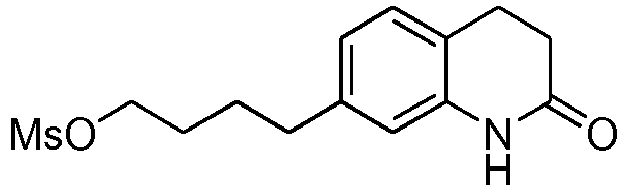
- By a similar method as in Reference example 2, 4-(2-oxo-1,2,3,4-tetrahydroquinolin-7-yl)butyl methanesulfonate was prepared from 3-butyn-1-ol as pale yellow oil, yield 34%. ESI-MS (m/z): 298.1 [M+H]+. 1H-NMR (300Hz, CDCl3): δ ppm 8.43(s, 1H), 7.07(d, 1H), 6.79(d, 1H), 6.60(s, 1H), 4.23(t, 2H), 3.00(s, 3H), 2.93(t, 2H), 2.62(m, 4H), 1.75(m, 4H).
-

- By a similar method as in Reference example 3, 4-(2-oxo-1,2-dihydroquinolin-7-yl)butyl methanesulfonate was prepared from the product of Reference example 4 as grey solid, yield 61%. ESI-MS (m/z): 296.1 [M+H]+. 1H-NMR (300Hz, CDCl3): δ ppm 12.37(s, 1H), 7.85(d, 1H), 7.52(d, 1H), 7.26(s, 1H), 7.09(d, 1H), 6.72(d, 1H), 4.25(t, 2H), 3.00(s, 3H), 2.78(t, 2H), 1.79(m, 4H).
-

- Lithium chloride(8.7g, 203.1mmol), bis(triphenylphosphine)palladium dichloride (5.7g, 8.12mmol) and N, N-dimethyl formamide (200ml) were added into compound 2-b (20g, 67.7mmol). Tributylvinyltin (21ml, 74.4mmol) was injected thereto under a nitrogen atmosphere followed by stirring at 100 °C overnight. The mixture was filtered, extracted with dichloromethane and water, the organic phase was washed with brine, dried, concentrated, and subjected to column chromatography to give compound 6-a (8.0g, yield: 68%).
- Potassium peroxomonosulfate (Oxone, 43.6g, 69.3mmol), sodium bicarbonate (29.2 g) and acetone-water (400ml: 400ml) solution were added into compound 6-a (8g, 46.2mmol) and the mixture was stirred at room temperature for 2 hours. The mixture was filtered, extracted with dichloromethane and water. The organic phase was washed with brine, dried, concentrated, and subjected to column chromatography to obtain the target 6-b (5.7g, yield: 65 %). ESI-MS (m/z): 190.1 [M+H]+. 1H-NMR (300Hz, CDCl3): δ ppm 8.42(brs, 1H), 7.16(d, 1H), 6.94(dd, 1H), 6.71(d, 1H), 3.85(dd, 1H), 3.15(dd, 1H), 2.98(t, 2H), 2.78(dd, 1H), 2.66(t, 2H).
- A mixture of compound 6-b (3.6g, 19.0mmol), ammonium formate (3.0g, 47.6mmol), ethyl acetate (100ml), methanol (100ml) and 10% Pd/C (460mg) was stirred at reflux under a nitrogen atmosphere overnight. The mixture was filtered, concentrated, subjected to column chromatography to obtain the compound 6-c (1.5g, yield: 41%). ESI-MS (m/z): 192.0 [M+H]+. 1H-NMR (300Hz, CDCl3): δ ppm 8.87(brs, 1H), 7.07(d, 1H), 6.84(d, 1H), 6.69(s, 1H), 3.84(t, 2H), 3.78(s, 1H), 2.90(t, 2H), 2.80(t, 2H), 2.59(t, 2H).
- Compound 6-c (1.5g, 7.85mmol) was dissolved in dichloromethane (60ml) and triethylamine (3ml, 23.55mmol) was added. Methanesulfonyl chloride (0.92ml, 11.77mmol) was added dropwise under ice bath followed by stirring at room temperature for 3 hours. The mixture was extracted with dichloromethane and water, the organic phase was dried, concentrated, subjected to column chromatography to obtain a white solid (1.3g, yield: 61%). 1H-NMR(300Hz, CDCl3): δ ppm 8.97(brs, 1H), 7.11(d, 1H), 6.86(dd, 1H), 6.69(d, 1H), 4.39(t, 2H), 3.00(t, 2H), 2.94(t, 2H), 2.93(s, 3H), 2.63(t, 2H).
-

- By a similar method as in Reference example 3, 2-(2-oxo-1,2-dihydroquinolin-7-yl)ethyl methanesulfonate was prepared from the product of Reference example 6 as a white solid, yield 75%. ESI-MS (m/z): 268.1 [M+H]+. 1H-NMR (300Hz, DMSO-d6): δ ppm 11.74(brs, 1H), 7.87(d, 1H), 7.61(d, 1H), 7.18(s, 1H), 7.12(d, 1H), 6.45(d, 1H), 4.44(t, 2H), 3.13(s, 3H), 3.07(t, 2H).
-

- Compound 1-e (1g, 3.14mmol) was dissolved in dry tetrahydrofuran, stirred at -78 °C under a nitrogen atmosphere for 30 minutes. 2.5M n-butyllithium in n-hexane (1.65ml, 4.08mmol) was added dropwise and the mixture was stirred at the same temperature for 3 hours. N-Fluorobenzenesulfonimide (1.5g, 4.71 mmol) dissolved in tetrahydrofuran (5ml) was added dropwise into the system. The mixture was maintained at -78 °C for one hour and then stirred at room temperature overnight. The reaction was quenched with saturated ammonium chloride solution. The mixture was extracted with dichloromethane and water. The organic phase was washed with brine, dried over anhydrous sodium sulfate, concentrated, subjected to column chromatography to obtain 8-a as an oil (600 mg, yield: 57 %).
- Compound 8-a (600mg) was dissolved in dichloromethane (1ml) and trifluoroacetic acid (1ml), the mixture was stirred at room temperature for 1 hour. The reaction mixture was concentrated and saturated sodium bicarbonate solution (5ml) was added. The precipitated solid was filtered, dried to obtain a pale yellow solid (400mg, 95% yield). ESI-MS (m/z): 237.1 [M+H]+.
-

- Compound 1-e (900mg, 2.83mmol) was dissolved in tetrahydrofuran (3ml) in a three-necked flask under a nitrogen atmosphere. The mixture was cooled to -78 °C, 2.5M n-butyllithium in n-hexane (1.47 ml, 3.67mmol) was injected and the mixture was stirred at -78 °C for 3 hours. N-chlorosuccinimide (677mg, 5.09mmol) dissolved in tetrahydrofuran (3ml) was slowly injected into the reaction system in 0.5 h. Then the mixture was stirred at room temperature overnight and quenched with saturated ammonium chloride solution. The mixture was extracted with dichloromethane and water. The organic phase was washed with brine, dried over anhydrous sodium sulfate, concentrated, subjected to column chromatography to obtain 9-a as an oil (540mg, yield: 54%).
- Compound 9-a (540mg, 1.53mmol) was dissolved in dichloromethane (1ml) and trifluoroacetic acid (1ml), the mixture was stirred at room temperature for 3 hours. The reaction mixture was concentrated and saturated sodium bicarbonate solution was added (3 ml). The precipitated solid was filtered, slurried in acetonitrile to give a white solid (210mg, yield: 54%). ESI-MS (m/z): 253.2 [M+H]+. 1HNMR (300MHz, DMSO-d6): δ ppm 8.19(brs, 1H), 7.46-7.68(m, 2H), 7.32(t, 1H), 6.98(d, 1H), 3.25(s, 4H), 3.16(s, 4H).
-

- Triethylamine (0.85ml, 6.19mmol) and dichloromethane (10ml) were added into compound 10-a (1g, 4.13mmol), then methanesulfonyl chloride (0.38ml, 4.95mmol) was added dropwise under ice bath condition. The mixture was stirred at room temperature for 30 minutes and extracted with dichloromethane and water. The organic phase was washed with brine, dried, and concentrated to give 10-b as an oil (1.23g, yield: 93%).
- Lithium bromide (418mg, 4.86mmol), lithium carbonate (358mg, 4.86mmol) and N, N-dimethylformamide (5ml) were added into compound 10-b (520mg, 1.62mmol), the mixture was stirred at 115 °C for 2 hours and extracted with dichloromethane and water. The organic phase was washed with brine, dried and concentrated to give a yellow solid (400mg, yield: 100%). ESI-MS (m/z): 225.1 [M+H]+. 1H-NMR (300Hz, CDCl3): δ ppm 2.35(s, 3H), 2.54(m, 2H), 3.01(t, 2H), 3.76(t, 2H), 4.14(t, 2H), 6.35(dt, 1H), 6.64(m, 1H).
-
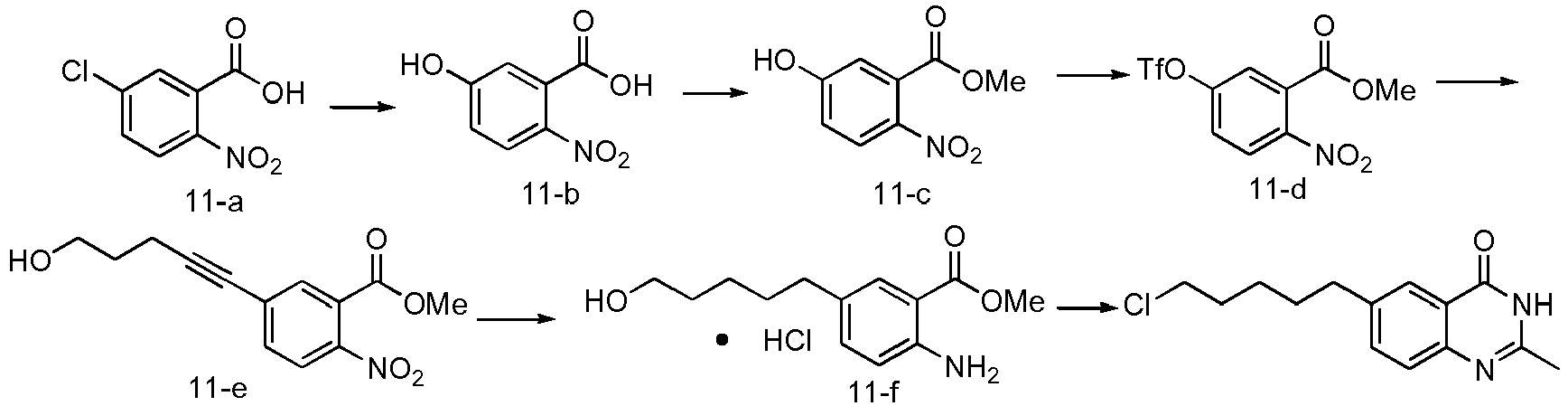
- Potassium hydroxide aqueous solution (13.8g, 248mmol, 40ml) was added into 5-chloro-2-nitrobenzoic acid 11-a (5g, 24.8mmol) and the mixture was stirred at reflux for 24 hours. The pH value of the reaction mixture was adjusted to 2 with concentrated hydrochloric acid under ice-cooling, the precipitated solid was filtered and dried to give 11-b as a white solid (4.1g, yield: 90%).
- Thionyl chloride (26.8 mmol) and methanol (10ml) were added into compound 11-b (4.1g, 22.4mmol) and the mixture was stirred at reflux for 5 hours. The reaction solution was concentrated, extracted with ethyl acetate and water, washed with brine, dried, and concentrated to give the target 11-c (3.19g, yield: 72%).
- Pyridine (67.5 mmol) and dichloromethane (10ml) were added into compound 11-c (2.66g, 13.5mmol). Trifluoromethanesulfonic anhydride (20.2mmol) was slowly added dropwise thereto under ice-cooling followed by stirring at room temperature for 6 hours. The mixture was diluted with dichloromethane (100ml), washed with 1N hydrochloric acid (70ml) and brine, the organic phase was dried over anhydrous sodium sulfate and concentrated to give 11-d as a tan solid (3.86g, yield: 87%).
- A mixture of compound 11-d (2.83g, 8.6mmol), 4-pentyn-1-ol (789mg, 9.4mmol), bis (triphenylphosphine) palladium dichloride (603mg, 0.86mmol), cuprous iodide (245mg, 1.29mmol), triethylamine (5.9ml, 43mmol) and N, N-dimethylformamide (10ml) was stirred at room temperature overnight. The reaction mixture was diluted with dichloromethane, washed twice with dilute hydrochloric acid, the organic phase was dried, concentrated, subjected to column chromatography to obtain 11-e as an oil (2.2g, yield: 97%). 1H-NMR (300Hz, CDCl3): δ ppm 7.88(d, 1H), 7.67(d, 1H), 7.57(dd, 1H), 3.92(s, 3H), 3.80(q, 2H), 2.58(t, 2H), 1.87(m, 2H), 1.49(t, 1H).
- Ethanol (5ml) and Pd/C (150 mg) were added into compound 11-e (1.04g, 3.95mmol) and the reaction mixture was stirred at 50 °C under a hydrogen atmosphere for 24 hours. The mixture was filtered and the filtrate was concentrated. Hydrogen chloride-ethanol solution was added, the resulting hydrochloride salt was slurried in acetone/methyl tert-butyl ether system, filtered, and dried to give 11-f as a yellow solid (840mg, yield: 89%). ESI-MS (m/z): 238.1 [M+H]+.
- Compound 11-f (455mg, 1.91mmol) was dissolved in acetonitrile (3ml) and hydrogen chloride/1,4-dioxane solution (3 ml) in a sealed tube and the mixture was stirred at 70 °C overnight. The reaction mixture was concentrated, the pH value thereof was adjusted to be around 7 with saturated sodium bicarbonate solution. The mixture was extracted with ethyl acetate, the organic phase was dried, concentrated and subjected to silica gel column chromatography to give the title compound (280mg, yield: 55%). ESI-MS (m/z): 265.1 [M+H]+. 1H-NMR (300Hz, DMSO-d6): δ ppm 12.11(brs, 1H), 7.86(d, 1H), 7.60(dd, 1H), 7.48(d, 1H), 3.61(t, 2H), 2.69(t, 2H), 2.32(s, 3H), 1.73(m, 2H), 1.62(m, 2H), 1.39(m, 2H).
-

- Lithium aluminium hydride (4.6g, 121mmol) was added to a flask containing dry tetrahydrofuran (20ml). Compound 12-a (10g, 53.2mmol) dissolved in tetrahydrofuran (100ml) was added dropwise under ice bath condition. The mixture was stirred for 20 minutes at room temperature, then at reflux for 3 hours. Sodium sulfate decahydrate was added slowly until no bubbles appear. The mixture was filtered, the filtrate was dried, concentrated, subjected to column chromatography to obtain the product 12-b (7.8g, yield: 85%).
- Compound 12-b (6.7g, 38.5mmol), triethylamine (4.66g, 46.2mmol) and dichloromethane (80ml) were added to the flask, p-toluenesulfonyl chloride (7.34g, 38.5mmol) in dichloromethane (20ml) was added dropwise at room temperature and the mixture was stirred. After the reaction is complete, water and 1N hydrochloric acid was added, the mixture was extracted with dichloromethane. The organic phase was washed with water and saturated sodium bicarbonate solution, dried and concentrated to give the product 12-c (10g, yield: 80%).
- Compound 12-c (10g, 30.4mmol), sodium sulfide nonahydrate (8.75g, 36.4mmol) and N-methylpyrrolidinone (50ml) were added to the flask and the mixture was stirred at 150 °C for 4 hours. The mixture was extracted with methyl t-butyl ether (80mlx2) and water (100ml). The organic phase was washed with saturated brine (100mlx2), dried, concentrated, subjected to column chromatography to obtain the product 12-d (1.8g, yield: 35%)
- Compound 12-d (500mg, 2.94mmol), anhydrous piperazine (379mg, 4.41mmol), sodium tert-butoxide (423mg, 4.41mmol), 2,2'-bis(diphenylphosphino-1,1'-binaphthyl) (83mg, 0.13mmol), palladium acetate (10mg, 0.044mmol) and dry toluene (10ml) were added to the flask under a nitrogen atmosphere and the mixture was stirred at 115 °C for 24 hours. The reaction mixture was concentrated, and subjected to column chromatography to obtain an oil. Hydrogen chloride-ethanol solution was added, the resulting hydrochloride salt was slurried in acetonitrile, filtered to give a white solid (280mg, yield: 43%). ESI-MS (m/z): 221.1 [M+H]+.
-

- Methyl 2-Amino-thiophene-3-carboxylate (2.0g, 12.7mmol) was dissolved in formamide (60ml) and the mixture was stirred at 190 °C for 4 hours. The mixture was cooled, poured into water (200ml) and extracted with n-butanol (50ml × 4). The combined organic phase was dried over anhydrous sodium sulfate, concentrated and subjected to column chromatography to give 13-b as a pale yellow solid (1.2g, yield: 63%). ESI-MS (m/z): 153.0 [M+H]+. 1H-NMR (300Hz, DMSO-d6): δ ppm 7.39(d, 1H), 7.57(d, 1H), 8.12(s, 1H), 12.49(brs, 1H).
- Phosphorus oxychloride (10ml) was added into compound 13-b (500mg, 3.23mmol) followed by stirring at reflux overnight. The reaction mixture was cooled to room temperature, poured into a vigorously stirred ice-water mixture and stirring was continued for 30 minutes. The mixture was extracted with dichloromethane (50ml x 3). The combined organic phase was washed with brine, dried over anhydrous sodium sulfate, and concentrated to give 13-c as a yellow solid (600mg, yield: 100%). ESI-MS (m/z): 170.9 [M+H]+. 1H-NMR (300Hz, CDCl3): δ ppm 7.46(d, 1H), 7.64(d, 1H), 8.87(s, 1H).
- Compound 13-c (600mg, 3.53 mmol) was dissolved in tetrahydrofuran (20ml), 1-boc-piperazine (984mg, 5.3mmol) and N, N-diisopropylethylamine (910mg, 7.06mmol) were added thereto followed by stirring at reflux for 2 hours. The reaction mixture was cooled to room temperature, concentrated, subjected to column chromatography to obtain 13-d as a white solid (900mg, yield: 79.4%). ESI-MS (m/z): 321.2 [M+H]+. 1H-NMR (300Hz, CDCl3): δ ppm 1.48(s, 9H), 3.61(m, 4H), 3.92(m, 4H), 7.32(m, 2H), 8.50(s, 1H).
- Compound 13-d (900mg) was dissolved in dichloromethane (10ml), trifluoroacetic acid (1ml) was added at 0°C and the mixture was stirred overnight at room temperature. The reaction mixture was concentrated to dryness under reduced pressure, the residue was slurried in methyl t-butyl ether/methanol system(V:V=15ml :1ml), filtered, and dried to give a yellow solid (606mg, yield: 98%).
-

- A 500mL three-necked flask was charged with tetrahydrofuran (250ml) and diisopropylamine (28ml), n-butyllithium (78 ml) was added dropwise at -10 °C ∼ 0 °C under a nitrogen atmosphere. The mixture was stirred at 0 °C for 30 minutes and then cooled to -78°C. 3-Bromofluorobenzene (21ml) was added dropwise, after stirring at -78°C for 1 hour, N, N-dimethylformamide (17ml) was added followed by stirring 20 minutes at the same temperature. Then glacial acetic acid (28ml) and water (200ml) was quickly added and the mixture was warmed to 15°C. The mixture was extracted with ethyl acetate (500ml × 2), the organic phase was washed with water (300ml x 2) and brine (200ml x 1), dried over anhydrous sodium sulfate, concentrated and subjected to column chromatography to obtain the target 14-b (32g, yield: 81%).
- A three-necked flask was charged with N, N-dimethylformamide (250ml) and potassium carbonate (51.5g, 373mmol). Ethyl thioglycolate (13.7 ml) was added dropwise at room temperature under a nitrogen atmosphere followed by rapid addition of compound 14-b (25.2g, 124mmol). The mixture was stirred at 60 °C overnight, diluted with ethyl acetate (300ml), filtered, and the filtrate was washed with water and saturated brine, dried, concentrated and subjected to column chromatography to obtain compound 14-c (23g, yield: 66%).
- A 500mL single-neck flask was charged with compound 14-c (20g, 70.4mmol)), tetrahydrofuran (120ml) and water (100ml). 4N aqueous sodium hydroxide solution (40ml) was added under stirring followed by stirring at 70 °C for 1 hour. The reaction mixture was extracted with ethyl acetate (70ml x 2), the pH of the aqueous phase was adjusted with concentrated hydrochloric acid to 1 ∼ 2, the precipitated solid was filtered and dried to give compound 14-d (16g, yield: 88%).
- Compound 14-d (14g, 54.6mmol) and dimethyl sulfoxide (140ml) were placed in a 25mL single neck flask, silver carbonate (15g, 54.3mmol) and acetic acid (163mg) were added thereto under stirring. The mixture was stirred at 120 °C overnight, cooled to room temperature, filtered after ethyl acetate (100ml) was added. The filtrate was extracted with ethyl acetate (200ml x 3) and water, the organic phase was dried, concentrated, subjected to column chromatography to obtain 14-e as a colorless transparent oil (11g, yield: 95%).
- Magnesium debris (113mg, 4.7mmol) was added to tetrahydrofuran (5ml) under a nitrogen atmosphere, the mixture was stirred for 5 min and then heated to 60 °C. Part of the tetrahydrofuran solution (1.0 g, 4.7mmol, 5ml) of compound 14-e (2ml) was added dropwise to the above systems and stirred at 60 °C. The Grignard reaction began as the system turned cyan blue. The remaining tetrahydrofuran solution of the compound 14-e was added dropwise under refux and the system turned pale yellow. The reaction was continued at reflux until disappearance of magnesium debris(about 2 hours), which indicated the end of the Grignard reaction.
- Tert-butyl 4-oxopiperidine-1-carboxylate (1.0g, 5mmol) in tetrahydrofuran (5ml) was added dropwise into the fresh Grignard reagent 14-f at 0 °C followed by stirring at room temperature for 1 hour. The reaction was cooled to 0 °C and saturated ammonium chloride solution was added. The mixture was extracted with ethyl acetate, washed with brine, dried, concentrated and subjected to column chromatography to obtain compound 14 -g (700mg, 44% yield by two steps).
- Compound 14-g (120 mg, 0.36mmol) was dissolved in toluene (5ml) and 6N hydrochloric acid (5ml) and the mixture was stirred at 100 °C overnight. The reaction was cooled to room temperature, the pH value of the aqueous phase was adjusted to 9.0 with 10% sodium hydroxide solution at 0 °C. The mixture was extracted with dichloromethane, dried, concentrated, the residue was dissolved in ethyl acetate and added with hydrogen chloride-ethanol solution. The resulting salt was filtered to give the target (50 mg, yield: 65%). ESI-MS (m/z): 216.1 [M+H]+. 1H-NMR (300Hz, MeOH-d4): δ ppm 7.89(d, 1H), 7.64(d, 1H), 7.56(dd, 1H), 7.37(t, 1H), 7.28(dd, 1H), 5.96(m, 1H), 3.93(m, 2H), 3.55(t, 2H), 2.85(m, 2H).
-

- Indolin-2-one 15-a (2g, 15.03mmol) was dissolved in dichloromethane (10ml), aluminum trichloride (7g, 52.60mmol) was added, then chloroacetyl chloride (2.26ml, 30.06 mmol) dissolved in dichloromethane (10ml) was slowly added dropwise under ice bath, the mixture was stirred at this temperature for 1 hour and at reflux for 2 hours. The mixture was cooled, poured into ice water, the aqueous layer was adjusted to be strongly acidic, the precipitated solid was filtered and dried to give a light gray white solid (2.811g, yield: 90%).
- Compound 15-b (1g, 4.78mmol) was dissolved in trifluoroacetic acid (10ml), triethylsilane (1.5ml) was added dropwise under ice-cooling followed by stirring at room temperature for 2 hours. The reaction solution was poured into water, extracted twice with ethyl acetate. The organic phase was washed with saturated sodium bicarbonate solution and brine, dried and concentrated to give a khaki solid (0.9g, yield: 96%). ESI-MS (m/z): 195.9 [M+H]+. 1H-NMR (300Hz, CDCl3): δ ppm 7.69(brs, 1H), 7.10(s, 1H), 7.07(d, 1H), 6.80(d, 1H), 3.68(t, 2H), 3.52(s, 2H), 3.02(t, 2H).
-

- N, N-dimethylformamide (8ml) and N-chlorosuccinimide (228mg, 1.71mmol) were added into the product of Reference Example 6 (440mg, 1.63mmol) and the mixture was stirred at 100 °C for 4 hours. The mixture was extracted with dichloromethane and water, the organic phase was washed with brine, dried over anhydrous sodium sulfate, concentrated and subjected to column chromatography to give a white solid (330 mg , yield: 67%). ESI-MS (m/z): 304.0 [M+H]+.
-

- 3-(2-chloroethyl)-9-hydroxy-2-methyl-6,7,8,9-tetrahydro-pyrido[1,2-a]pyrimidin-4-one 10-a (500mg, 2.06 mmol) was dissolved in dichloromethane (10ml), diethylaminosulfur trifluoride (0.32ml, 2.47mmol) dissolved in dichloromethane (8ml) was added dropwise thereto under ice bath followed by stirring at room temperature for 3 hours. The mixture was quenched with water, saturated sodium bicarbonate solution was added to adjust pH to 7. The mixture was extracted with dichloromethane, dried over anhydrous sodium sulfate, concentrated and subjected to column chromatography to obtain the product as white crystal (370mg, yield: 74%). ESI-MS (m/z): 245.1 [M+H]+. 1H-NMR (300Hz, DMSO-d6): δ ppm 1.92(m, 2H), 2.15(m, 2H), 2.29(s, 3H), 2.90(t, 2H), 3.55(m, 1H), 3.73(t, 2H), 4.00(dt, 1H), 5.26-5.47(dt, 1H).
-

- 2-(4-methyl-thiazol-5-yl) ethanol 18-a (500mg, 3.49mmol) was added into thionyl chloride (4ml) and the mixture was stirred at reflux for 3 hours. The mixture was concentrated to dryness to give a pale yellow solid (680 mg, yield: 98%). ESI-MS (m/z): 162.0 [M+H]+.
-

- 1H-benzimidazol-2(3H)-one 19-a (500mg, 3.73mmol) was added into anhydrous aluminum chloride (1.98g, 14.9mmol) and tetrachloroethane (3ml). Chloroacetyl chloride (843mg, 7.46mmol) dissolved in tetrachloroethane (3ml) was added dropwise thereto under ice bath followed by stirring at 100 °C for 1 hour. The mixture was cooled to room temperature, ice and 4N hydrochloric acid (20ml) were added sequentially followed by stirring for 6 hours, the precipitated solid was filtered, the filter cake was slurried in isopropanol, filtered, and dried to give 19-b as an off-white solid (730mg, yield : 93%). EI-MS (m/z): 210.
- Compound 19-b (350mg, 1.67mmol) was dissolved in trifluoroacetic acid (5ml), triethylsilane (0.66ml, 4.17mmol) was added dropwise under ice-cooling followed by stirring at room temperature overnight. The reaction mixture was concentrated, saturated sodium bicarbonate solution was added, the precipitated solid was filtered, the filter cake was washed three times with ice water and dried to give a pale yellow solid (310mg, yield: 95%). EI-MS (m/z): 196.
-

- Benzothiazole-2(3H)-one 20-a (500mg, 3.307mmol) was suspended in carbon disulfide (8ml), anhydrous aluminum chloride (2.65g, 19.841mmol) was added portionwise under ice bath, then chloroacetyl chloride (324ul, 4.299mmol) was slowly added dropwise. The reaction mixture was stirred at room temperature for 10 minutes and at reflux for 1.5 hours. The reaction was quenched with ice water and concentrated. Ice water (15ml) and 4N hydrochloric acid (10ml) was added thereto. The mixture was stirred for 2 hours at room temperature, filtered, the filter cake was washed with ice water twice, dried to give 20-b as a pink solid (740mg, yield: 98%). ESI-MS (m/z): 227.9 [M+H]+. 1H-NMR (300Hz, DMSO-d6): δ ppm 12.35(s, 1H), 8.25(d, 1H), 7.89(dd, 1H), 7.20(d, 1H), 5.13(s, 2H).
- Compound 20-b (360mg, 1.586mmol) was dissolved in trifluoroacetic acid (5ml), triethylsilane (630ul, 3.965mmol) was added dropwise followed by stirring at 10 °C overnight. The reaction mixture was concentrated, extracted with dichloromethane and water. The organic phase was dried over anhydrous sodium sulfate, filtered and concentrated to give a crude(385mg), which was purified by column chromatography to obtain the target (280mg, yield: 82.5%).
-

- 2H-1,4-benzoxazin-3(4H)-one 21-a (500mg, 3.356mmol) was suspended in dichloromethane (8ml). Anhydrous aluminum chloride (895 mg, 6.712mmol) was added portionwise under ice bath, then chloroacetyl chloride (330ul, 4.363mmol) was added slowly dropwise. The reaction mixture was stirred at room temperature for 10 minutes, then at reflux for 5 hours. The reaction was quenched with water, concentrated. The residue was added with ice water (10ml), 4N hydrochloric acid (5ml) and stirred for 2 hours at room temperature, then filtered, the filter cake was washed with ice water twice, dried to give 21-b as a pale yellow solid (690mg, yield: 91%).
- Compound 21-b (370mg, 1.637mmol) was dissolved in trifluoroacetic acid (4ml), triethylsilane (640ul, 4.093mmol) was added dropwise under ice-bath followed by stirring at 10 °C overnight. The reaction solution was concentrated and extracted with dichloromethane and water. The organic phase was dried over anhydrous sodium sulfate, filtered and concentrated to give a crude (375mg). The crude was slurried in petroleum ether, filtered and dried to give a pale yellow solid (316mg, yield:91%). 1H-NMR (300Hz, DMSO-d6): δ ppm 10.68(brs, 1H), 6.86(d, 1H), 6.81(dd, 1H), 6.74(d, 1H), 4.51(s, 2H), 3.75(t, 2H), 2.90(t, 2H).
-

- Anhydrous aluminum trichloride (1.62g, 12.15mmol) was added portionwise into chloroacetyl chloride (912ul, 12.11mmol) dissolved in methylene chloride (6ml) under ice bath followed by stirring for 10 minutes at this temperature. Then 2H-1,4-benzothiazine-3(4H)-one 22-a (500mg, 3.027mmol) was added portionwise thereto, the reaction was stirred under ice bath for 4 hours and at room temperature overnight. Ice water (10ml) and 4N hydrochloric acid (10ml) was added sequentially. The mixture was stirred at room temperature for 2 hours. The precipitated solid was filtered, the filter cake was washed twice with ice water, dried to give 22-b as a pale yellow solid (700mg, yield: 95.6%). 1H-NMR (300Hz, DMSO-d6): δ ppm 10.76(brs, 1H), 7.57(dd, 1H), 7.50(m, 2H), 5.11(s, 2H), 3.54(s, 2H).
- Compound 22-b (350mg, 1.446mmol) was dissolved in trifluoroacetic acid (4ml). triethylsilane (578ul, 3.615mmol) was added dropwise thereto under ice bath condition followed by stirring at 30 °C overnight. The reaction mixture was poured into ice water, extracted with dichloromethane, the organic phase was dried over anhydrous sodium sulfate, filtered, concentrated and subjected to column chromatography to give a pale yellow solid (285mg, yield: 86.8%). EI-MS (m/z): 227.
-

- A mixture of compound 11-f(395mg, 1.66mmol), ammonium formate (1.04g, 16.6mmol) and formamide (5ml) was stirred at 135 °C for 60 hours. The reaction mixture was poured into ice water and extracted with ethyl acetate three times. The combined organic layer was washed with brine, dried over anhydrous sodium sulfate, concentrated and subjected to column chromatography to obtain the target 23-a (150mg, yield: 38%). ESI-MS (m/z): 233.2 [M+H]+. 1H-NMR (300Hz, DMSO-d6): δ ppm 12.17(brs, 1H), 8.03(s, 1H), 7.90(d, 1H), 7.65(dd, 1H), 7.57(d, 1H), 4.36(t, 1H), 3.37(m, 2H), 2.70(t, 2H), 1.60(m, 2H), 1.43(m, 2H), 1.30(m, 2H).
- Triethylamine (125ul, 0.87mmol) was added to the compound 23-a (100mg, 0.43mmol) in dichloromethane (5ml). Methanesulfonyl chloride (51ul, 0.65mmol) was added thereto under ice-bath followed by stirring at room temperature for 2 hours. The reaction was diluted with dichloromethane, washed with saturated ammonium chloride solution, the organic phase was dried, concentrated and subjected to column chromatography to obtain a white solid (71mg, yield: 53%). ESI-MS (m/z): 311.1 [M+H]+.
-

- o-aminobenzoate 24-a (1.0g, 6.62mmol), acrylonitrile (0.88ml, 13.24mmol) were dissolved in 1,4-dioxane, hydrogen chloride-1,4-dioxane (10ml) solution was slowly added thereto under ice bath condition. The mixture was stirred in a sealed tube at 80°C overnight and concentrated. Water and dichloromethane was added thereto and the pH value of the aqueous layer was adjusted to 7-8 with ammonia. The mixture was filtered, the filter cake was slurried in methyl t-butyl ether, filtered and dried to give a pale yellow solid (660mg, yield: 52%). ESI-MS (m/z): 209.1 [M+H]+.
-

- 3-chloropropionyl chloride (538ul, 5.63mmol) was added dropwise to anhydrous aluminum chloride (2g, 15.02mmol) suspended in carbon disulfide under ice bath condition and stirred for 10 minutes, indolin-2-one 15- a (500mg, 3.75mmol) was added thereto. The mixture was stirred at room temperature for 15 minutes and at reflux for 3 hours. Carbon disulfide was removed, the reaction mixture was added with ice and 4N hydrochloric acid (5ml) under stirring. The resulting solid was filtered, the filter cake was washed 3 times with ice water, dried to give a crude. The crude was slurried in ethyl acetate, filtered and dried to give 25-a as a pale pink solid (777mg, yield: 92.4%). 1HNMR (300MHz, DMSO-d6): δ ppm 10.77(s, 1H), 7.86(d, 1H), 7.81(s, 1H), 6.89(d, 1H), 3.89(t, 2H), 3.54(s, 2H), 3.44(t, 2H).
- Triethylsilane (900ul, 5.58mmol) was added dropwise to compound 25-a (500mg, 2.32mmol) dissolved in trifluoroacetic acid and the mixture was stirred at 30 °C overnight. The reaction mixture was poured into ice water, and extracted three times with dichloromethane, the combined organic phase was dried and concentrated. The residue was slurried in petroleum ether/acetone system(V:V=30: 1), filtered and dried to give a light pink solid (430mg, yield: 92%).
-

- Diisopropylamine (2.4g, 24.0mmol) was dissolved in dry tetrahydrofuran (20ml) under a nitrogen atmosphere, n-butyllithium in n-hexane(9.6ml, 24.0mmol) was added dropwise thereto at 0 °C followed by stirring at this temperature for 30 minutes, dry tetrahydrofuran (30ml) was added and the mixture was cooled to -78 °C, 3,5-dibromo-pyridine 26-a (4.7g, 20mml) in dry tetrahydrofuran (50ml) was added dropwise thereto followed by stirring for 30 minutes. Methyl formate (2.4g, 40mml) was added followed by stirring for 30 minutes, The mixture was warmed to room temperature, extracted with saturated sodium bicarbonate (100ml) and ethyl acetate (50ml x 3). The combined organic phase was dried over anhydrous sodium sulfate, concentrated and subjected to column chromatography to give 26-b as a pale yellow solid (4.0 g, yield: 75%). 1HNMR (300MHz, DMSO-d6): δ ppm 10.06(s, 1H), 8.87(s, 2H).
- Compound 26-b (2.0g, 7.5mmol) was dissolved in tetrahydrofuran (10ml), ethyl thioglycolate (0.68ml, 7.5mmol) was added thereto at 0 °C and the mixture was stirred for 1 hour. Cesium carbonate (2.46g, 7.5mmol) was added thereto followed by stirring at room temperature overnight. The reaction mixture was filtered, concentrated and subjected to column chromatography to give 26-c as a white solid (1.6g, yield: 74%). ESI-MS (m/z): 286.1 [M+H]+. 1HNMR (300MHz, DMSO-d6): δ ppm 9.36(s, 1H), 8.71(s, 1H), 8.01(s, 1H), 4.39(q, 2H), 1.34(t, 3H).
- Compound 26-c (2.0g, 7.0 mmol) was dissolved in tetrahydrofuran(40ml), lithium hydroxide monohydrate (588mg, 14.0mmol) and methanol (5ml) were added thereto followed by stirring at room temperature for 2 hours. The pH value of the mixture was adjusted to 4 with 2N hydrochloric acid. The mixture was concentrated to remove tetrahydrofuran and methanol, filtered, and dried in vacuum to give 26-d as a white solid (1.0g, yield: 55%). 1HNMR (300MHz, DMSO-d6): δ ppm 9.33(s, 1H), 8.69(s, 1H), 7.94(s, 1H).
- Compound 26-d (500mg, 1.9mol) was added into diphenyl ether (6ml) and stirred at 230 °C for 2 hours. The mixture was cooled to room temperature, concentrated and subjected to silica gel column chromatography to obtain 26-e as a white solid (300mg, yield: 73%). ESI-MS (m/z): 213.8 [M+H]+. 1HNMR (300MHz, CDCl3): δ ppm 9.10(s, 1H), 8.60(s, 1H), 7.89(d, 1H), 7.54(d, 1H).
- Compound 26-e (1.5g, 7.0 mmol), 1-boc-piperazine (2.6g, 14.0mml), 2,2'-bis(diphenylphosphino-1,1'-binaphthyl) (436mg, 0.7mml), tris(dibenzylideneacetone) dipalladium (320.3mg, 0.35mmol) and sodium tert-butoxide (1.34g, 14.0mml) were dispersed in anhydrous toluene (50ml) and stirred at 100 °C overnight under a nitrogen atmosphere. The reaction was cooled to room temperature, filtered, concentrated and subjected to silica gel column chromatography to obtain 26-f as a pale yellow solid (1.7g, yield: 77%). ESI-MS (m/z): 320.3 [M+H]+.
- Compound 26-f (687mg) was dissolved in dichloromethane (10ml), trifluoroacetic acid (3.0 ml) was added thereto under 0°C followed by stirring at room temperature overnight. The reaction mixture was concentrated to dryness under reduced pressure, the residual oil was slurried in methyl t-butyl ether/methanol (V:V=15ml:1ml) system, filtered, and dried to give a yellow solid (941 mg , yield: 98%). 1HNMR (300MHz, CDCl3): δ ppm 8.90(s, 1H), 8.06(s, 1H), 7.89(d, 1H), 7.51(d, 1H), 3.68(t, 4H), 3.21(t, 4H), 1.49(s, 9H).
-

- Compound 2-b (10.0g, 33.9mmol), Bis(triphenylphosphine) palladium dichloride (1.2g, 1.7mmol), triphenylphosphine (888.2mg, 3.39mmol), cuprous iodide (644mg, 3.39mol) and diisopropylamine (17.17g, 170.0mmol) were dispersed in N, N-dimethylformamide (100ml) and the mixture was heated to 80 °C under a nitrogen atmosphere. Propargyl alcohol (9.5 g, 170.0mmol) was added dropwise followed by stirring for 4 hours. The reaction mixture was cooled, concentrated, subjected to column chromatography to give a pale yellow solid (4.0 g, yield: 58%). ESI-MS (m/z): 202.1 [M+H]+. 1HNMR (300MHz, DMSO-d6): δ ppm 10.14(s, 1H), 7.14(d, 1H), 6.93(dd, 1H), 6.85(d, 1H), 5.30(t, 1H), 4.25(d, 2H), 2.85(t, 2H), 2.42(t, 2H).
- Compound 27-a (2.0g, 10.0 mmol) was dissolved in methanol (50ml), 10% Pd / C (200mg) was added and the mixture was stirred under a hydrogen atmosphere overnight. The reaction mixture was cooled, filtered, concentrated and subjected to column chromatography to give 27-b as a white solid (1.2 g, yield: 58%). ESI-MS (m/z): 206.2 [M+H]+. 1HNMR (300MHz, DMSO-d6): δ ppm 9.98(s, 1H), 7.02(d, 1H), 6.71(dd, 1H), 6.64(d, 1H), 4.44(t, 1H), 3.37(q, 2H), 2.78(t, 2H), 2.49(t, 2H), 2.39(t, 2H), 1.63(m, 2H).
- Compound 27-b (600mg, 2.93mmol) was dissolved in dichloromethane (10ml) and trimethylamine (443.9mg, 4.4mmol) was added. Methanesulfonyl chloride (404mg, 3.51mmol) was added dropwise under ice bath condition followed by stirring at room temperature for 2 hours. Dichloromethane (100ml) was added thereto, the organic phase was separated, washed with 1N hydrochloric acid and saturated sodium bicarbonate solution, dried over anhydrous sodium sulfate, concentrated and the residue was purified by column chromatography to give a white solid (745mg, yield: 90.5%). ESI-MS (m/z): 284.1 [M+H]+. 1HNMR (300MHz, CDCl3): δ ppm 8.76(s, 1H), 7.08(d, 1H), 6.81(d, 1H), 6.63(s, 1H), 4.21(t, 2H), 3.01(s, 3H), 2.93(t, 2H), 2.70(t, 2H), 2.63(t, 2H), 2.04(m, 2H).
-

- By a similar method as in Reference Example 3, 3-(2-oxo-1,2-dihydroquinolin-7-yl)propyl methanesulfonate was prepared from the product of Reference Example 27 as a gray solid, yield 37.5%. ESI-MS (m/z): 282.2 [M+H]+. 1HNMR (300MHz, DMSO-d6): δ ppm 11.67(s, 1H), 7.83(d, 1H), 7.56(d, 1H), 7.10(s, 1H), 7.04(d, 1H), 6.40(d, 1H), 4.19(t, 2H), 3.16(s, 3H), 2.71(t, 2H), 1.96(m, 2H).
-

- Chloroacetyl chloride (470µl, 6.20mmol) was added dropwise into anhydrous aluminum chloride (2.48g, 18.60mmol) suspended in carbon disulfide under ice bath condition and stirred for 10 minutes. 4,5-dihydro-benzo-1H-azepine-2(3H)-one 29-a (500mg, 3.10mmol) was added and the mixture was stirred at room temperature for 15 minutes and at reflux for 3 hours. Carbon disulfide was removed, ice and 4N hydrochloric acid (5ml) was added sequentially under stirring. The precipitated pale yellow solid was filtered, washed 3 times with ice water, dried to give a crude. The crude was recrystallized in water-methanol system(11ml: 11ml) to give the product as tan needles (640mg, yield: 86.7%). 1HNMR (300MHz, CDCl3): δ ppm 8.31(s, 1H), 7.86(d, 1H), 7.84(dd, 1H), 7.07(d, 1H), 4.67(s, 2H), 2.88(t, 2H), 2.41(t, 2H), 2.29(m, 2H).
- Triethylsilane (840µL, 5.25mmol) was added dropwise into compound 29-b (500mg, 2.10mmol) dissolved in trifluoroacetic acid (5ml) and the mixture was stirred at 50 °C overnight. The reaction mixture was poured into ice water, extracted three times with dichloromethane. The combined organic phase was dried and concentrated. The residue was slurried in isopropyl ether, filtered and dried to give a pale yellow solid (430 mg, yield: 91.4%).
-

- The reaction flask was charged with 2,2'-(1,4-phenylene)diacetic acid 30-a (9.2g, 47.4mmol) and ethanol (50ml), concentrated sulfuric acid (5ml, 94.8mmol) was slowly added dropwise under stirring. The mixture was stirred at 80 °C overnight and then concentrated under reduced pressure to remove ethanol. Dichloromethane was added and the pH value of the aqueous layer was adjusted to 8 with saturated sodium bicarbonate solution. The aqueous phase was separated and extracted again with dichloromethane.The combined organic phase was dried and concentrated to give 30-b as solid (10.3g, yield: 87%). ESI-MS (m/z): 251.2 [M+H]+.
- The reaction flask was charged with compound 30-b (10g, 40mmol) and concentrated sulfuric acid (30ml), fuming nitric acid (1.7ml, 40.4mmol) was added dropwise thereto at 0 °C followed by stirring at room temperature for 1 hour. The reaction mixture was poured into ice water, the precipitated solid was filtered, washed with water and dried to give 30-c as solid(11g, yield: 93%).
- Ethanol (25ml) and 10% Pd/C (850mg) were added into compound 30-c (4.7g, 15.9mmol) and the mixture was stirred at 40 °C under a hydrogen atmosphere overnight. The mixture was filtered at 40 °C, the filtrate was concentrated to give a crude(3.1g). The crude was slurried in petroleum ether/ethyl acetate (V:V=6: 1) system, filtered to obtain 30-d (2.4g, yield: 71%). EI-MS (m/z): 219. 1HNMR (300MHz, CDCl3): δ ppm 8.80(brs, 1H),7.17(d, 1H), 6.93(d, 1H), 6.86(s, 1H), 4.17(q, 2H), 3.60(s, 2H), 3.52(s, 2H), 1.28(t, 3H).
- The reaction flask was charged with compound 30-d (2.86g, 13.0mmol) and tetrahydrofuran (200ml), lithium aluminum hydride (2.5g, 65.3mmol) was added portionwise at 0 °C followed by stirring for 30 minutes. Water (1.24ml), 15% aqueous sodium hydroxide solution (1.24ml) and water (3.72 ml) were slowly added dropwise successively. The mixture was filtered and concentrated. The residue was slurried in dichloromethane, filtered to give a crude(1.28g). The crude was slurried in petroleum ether/dichloromethane system, filtered and dried to give 30-e as a white solid (1.17g, yield: 50%). ESI-MS (m/z): 178.1 [M+H]+. 1HNMR (300MHz, DMSO-d6): δ ppm 10.31(brs, 1H), 7.07(d, 1H), 6.76(d, 1H), 6.68(s, 1H), 4.64(t, 1H), 3.57(q, 2H), 3.39(s, 2H), 2.67(t, 2H).
- Compound 30-e (200mg, 1.1mmol) and pyridine (0.24, 3.3mmol) were suspended in dichloromethane. Methanesulfonyl chloride (0.12ml, 1.21mmol) was slowly added thereto dropwise under ice bath followed by stirring at room temperature for 4 hours. The reaction mixture was poured into water, washed with 1N hydrochloric acid and saturated brine, the organic phase was dried, filtered and concentrated to give the target (220 mg, yield: 76%). ESI-MS (m/z): 256.0 [M+H]+.
-

- Diisopropylamine (5.14g, 50.8mmol) was dissolved in dry tetrahydrofuran (50ml) under a nitrogen atmosphere, n-butyllithium in hexane (20.3ml, 50.8mml) was added dropwise thereto at 0 °C followed by stirring for 30 minutes. The reaction mixture was cooled to -78 °C, 1-bromo-3-fluorobenzene 31-a (10.0g, 42.4mml) in dry tetrahydrofuran (100ml) solution was added dropwise thereto followed by stirring for 30 minutes. Methyl formate (7.63g, 127.2mml) was added dropwise thereto followed by stirring for 30 minutes. The mixture was warmed to room temperature, extracted with ethyl acetate(100ml x 3) and 1N hydrochloric acid (100ml). The combined organic phase was dried over anhydrous sodium sulfate, filtered, concentrated, subjected to column chromatography to give 31-b as a white solid (8.0 g, yield: 93%).
- Compound 31-b (4.1 g, 20.4mmol), tert-butyl 4-(4,4,5,5-tetramethyl-1,3,2-dioxaborolan-2-yl)-5,6-dihydropyridine-1(2H)-carboxylate (6.3g, 20.4mmo1),1,1'-Bis(diphenylphosphino)ferrocene-palladium(II)dichloride-dichloromethane complex (Pd(dppf)Cl2.CH2Cl2, 1.7g, 2.04mmol) and potassium carbonate (7.04g, 51.0mmol) were dispersed in anhydrous N, N-dimethylformamide (80ml) and stirred at 80 °C under a nitrogen atmosphere overnight. The reaction was cooled to room temperature, poured into water (200ml) and extracted with ethyl acetate(100ml x 3). The combined organic phase was washed with brine, dried over anhydrous sodium sulfate, filtered, concentrated, subjected to column chromatography to give 31-c as a colorless oil (3.5 g, yield: 55.5%). 1HNMR (300MHz, CDCl3): δ ppm 10.26(s, 1H), 7.50(m, 1H), 7.09(t, 1H), 7.03(d, 1H), 5.55(s, 1H), 4.05(m, 2H), 3.67(m, 2H), 2.33(s, 2H), 1.49(s, 9H).
- Compound 31-c (3.5g, 11.5mmol) was dissolved in ethyl acetate (50ml), 10% Pd / C (1.0g) was added and the mixture was stirred at room temperature under a hydrogen atmosphere for 5 hours. The mixture was filtered, the filtrate was concentrated to give 31-d as a colorless oil (3.5g, 100%). ESI-MS (m/z): 310.1 [M+H]+. 1HNMR (300MHz, DMSO-d6): δ ppm 7.26(dd, 1H), 7.04(d, 1H), 6.93(t, 1H), 4.80(s, 2H), 4.24(d, 2H), 3.08(t, 1H), 2.82(t, 2H), 1.78(d, 2H), 1.72-1.53(m, 4H), 1.47(s, 9H).
- Compound 31-d (3.5g, 11.5 mmol) was dissolved in dichloromethane (50ml), pyridinium chlorochromate (PCC, 3.0g, 13.8mmol) was added thereto at room temperature followed by stirring for 1 hour. The mixture was filtered, concentrated and subjected to column chromatography to obtain 31-e as a white solid (3.0g, yield: 85%). ESI-MS (m/z): 308.1 [M+H]+. 1HNMR (300MHz, CDCl3): δ ppm 10.54(s, 1H), 7.51(dd, 1H), 7.16(d, 1H), 7.02(t, 1H), 4.23(d, 2H), 3.78(t, 1H), 2.86(t, 2H), 1.78(d, 2H), 1.57(m, 2H), 1.47(s, 9H).
- Compound 31-e (3.0g, 9.4 mmol) was dissolved in acetonitrile (50ml), potassium carbonate (1.95g, 14.1mmol) and ethyl thioglycolate (0.85ml, 9.4mmol) were added thereto followed by stirring at 80 °C overnight. The mixture was filtered, concentrated and subjected to column chromatography to give 31-f as a white solid (3.3g, yield: 90.1%). ESI-MS (m/z): 390.0 [M+H]+. 1HNMR (300MHz, CDCl3): δ ppm 8.20(s, 1H), 7.71(d, 1H), 7.41(t, 1H), 7.22(d, 1H), 4.41(q, 2H), 4.30(d, 2H), 3.22(m, 1H), 2.90(t, 2H), 1.91(d, 2H), 1.75(m, 2H), 1.49(s, 9H), 1.42(t, 3H).
- Lithium hydroxide monohydrate (698mg, 16.6mmol) and methanol (10ml) were added into compound 31-f (3.24g, 8.3mmol) dissolved in tetrahydrofuran (60ml) and the mixture was stirred at room temperature for 5 hours. The pH of the reaction mixture was adjusted to 4-5 with 1N hydrochloric acid, the precipitated solid was filtered, dried in vacuo to give 31-g as a white solid (2.8g, yield: 96.5%).
- Cuprous oxide (966mg, 0.676mml) was added into compound 31-g (2.44g, 6.76mmol) dispersed in quinoline (30ml) and the mixture was stirred at 140 °C for 5 hours, then cooled to room temperature. The pH value of the mixture was adjusted to 4-5 with 1N hydrochloric acid. The mixture was extracted with ethyl acetate (100ml x 3). The combined organic phase was dried over anhydrous sodium sulfate, filtered, concentrated, subjected to column chromatography to give 31-h as a white solid (1.0g, yield : 46.7%). ESI-MS (m/z): 318.2 [M+H]+. 1HNMR (300MHz, CDCl3): δ ppm 7.76(d, 1H), 7.47(s, 2H), 7.32(t, 1H), 7.19(d, 1H), 4.31(s, 2H), 3.20(t, 1H), 2.89(t, 2H), 1.93(d, 2H), 1.77(m, 2H), 1.49(s, 9H).
- Compound 31-h (400mg, 1.26mmol) was dissolved in dichloromethane (1ml), trifluoroacetic acid (1ml) was added followed by stirring at room temperature overnight. The reaction mixture was concentrated to dryness, the residual oil was slurried in methyl tert-butyl ether/methanol (V:V=15ml:1ml) system, filtered, and dried to give a yellow solid (219 mg, yield: 80%). ESI-MS (m/z): 218.0 [M+H]+.
-

- A reaction flask was charged with the product of Reference Example 16 2-(6-chloro-2-oxo-1,2,3,4-tetrahydro-quinolin-7-yl) ethyl methanesulfonate (330mg, 1.09mmol) , 1,4-dioxane (5ml) and 2,3-dichloro-5,6-dicyano-1,4-benzoquinone (DDQ, 740mg, 3.26mmol) were added thereto followed by stirring at reflux overnight. After completion of the reaction, the mixture was concentrated and dichloromethane (25ml) was added. The mixture was washed with saturated sodium bicarbonate solution, saturated sodium thiosulfate solution and brine sequentially. The organic phase was dried, concentrated and purified by column chromatography to obtain the target (180mg, yield: 55%). ESI-MS (m/z): 301.9 [M+H]+.
-

- Chloroacetyl chloride (460µL, 6.16mmol) was added into anhydrous aluminum chloride(1.03g, 7.7mmol) suspended in 1,2-dichloroethane under ice bath condition and stirred for 10 minutes. 3-methyl 3,4-dihydro-quinazolin-2(1H)-one 33-a (500mg, 3.08mmol) was added and the mixture was stirred at room temperature for 15 minutes and at 48 °C for 3 hours. The reaction mixture was cooled to room temperature and poured into ice. The precipitated pale yellow solid was filtered, the filter cake was washed 3 times with ice water, dried to give compound 33-b as a pale yellow solid (710mg, yield: 97%). 1HNMR (300MHz, DMSO-d6): δ ppm 9.72(s, 1H), 7.82-7.73(m, 2H), 6.84(d, 1H), 5.06(s, 2H), 4.47(s, 2H), 2.87(s, 3H).
- Triethylsilane (587µl, 3.68mmol) was added dropwise into compound 33-b (350mg, 1.47mmol) dissolved in trifluoroacetic acid (4ml) and the mixture was stirred at 35 °C for 2.5 hours. The reaction solution was poured into ice water, the precipitated solid was filtered, the filter cake was washed 3 times with ice water, dried to give a pale yellow solid (320mg, yield: 97%).
-

- Compound 34-a (200mg, 1.24mmol) was dissolved in dichloromethane (5ml), triethylamine (0.206ml, 1.49mmol) was added, methanesulfonyl chloride (0.105ml, 1.36mmol) was added dropwise under ice bath condition and the mixture was stirred at room temperature for 3 hours.The mixture was extracted with dichloromethane and water. The organic phase was washed with brine, dried and concentrated to give the target (260mg, yield: 87%). ESI-MS (m/z): 240.0 [M+H]+.
-

- Chloroacetyl chloride (640µl, 8.49mmol) was added to anhydrous aluminum chloride (2.72g, 20.38mmol) suspended in carbon disulfide (10ml) under ice bath. The mixture was stirred for 10 minutes and 3,4-dihydroquinoline-2(1H)-one 35-a (500mg, 3.40mmol) was added. The system was stirred at room temperature for 15 minutes and at reflux for 9 hours. Carbon disulfide was removed, ice and 4N hydrochloric acid (5ml) were added under stirring. The precipitated solid was filtered, dried to give a crude. The crude was slurried in ethyl acetate, filtered, dried to give an off-white solid (710mg, yield: 93%). 1HNMR (300MHz, DMSO-d6): δ ppm 10.46(s, 1H), 7.81(d, 1H), 7.78(dd, 1H), 6.92(d, 1H), 5.07(s, 2H), 2.93(t, 2H), 2.48(t, 2H).
- Triethylsilane (900µL, 5.58mmol) was added dropwise into compound 35-b(500mg, 2.32mmol) dissolved in trifluoroacetic acid (5ml) and the mixture was stirred at 30 °C overnight. The reaction mixture was poured into ice water (15ml × 3) and extracted with dichloromethane. The combined organic phase was dried, filtered and concentrated. The residue was slurried in petroleum ether, filtered, dried to give the target product as a brown solid (417mg, yield: 89%).
-

- 4-(2-hydroxyethyl)indolin-2-one 36-a (500mg, 2.822mmol) was dissolved in dichloromethane (15ml) and pyridine (335mg, 4.233mmol) was added. Methanesulfonyl chloride (356mg, 3.104mmol) was added dropwise thereto at 0°C followed by stirring at room temperature overnight. The mixture was diluted with dichloromethane (15 ml), washed with 1N hydrochloric acid, water, and brine sequentially. The organic phase was dried over anhydrous sodium sulfate, concentrated and subjected to column chromatography to obtain a yellow solid (460mg, yield: 64%). ESI-MS (m/z): 256.0 [M+H]+.
-

- A mixture of compound 37-a (2.0g, 16.3mmol), ethyl 2-ethyl-3-oxopentanoate 37-b (6.0g, 19.5mmol), potassium carbonate (9.4g, 48.9mmol) and ethanol (20ml) was stirred at reflux for 15 hours, then cooled and filtered. The filtrate was concentrated and subjected to column chromatography to obtain the target (198mg). 1H-NMR (300Hz, DMSO-d6): δ ppm 12.09(brs, 1H), 4.75(brs, 1H), 3.72(t, 2H), 2.61(t, 2H), 2.45(q, 2H), 2.37(q, 2H), 1.11(t, 3H), 0.98(t, 3H).
- Di-tert-butyl dicarbonate (317mg, 1.45mmol) was added into compound 37-c (250mg, 1.32mmol) suspended in tetrahydrofuran(15ml) and the reaction mixture was stirred at 25 ∼ 30 °C overnight. The mixture was concentrated and subjected to column chromatography to obtain a pale yellow oil (494mg).
- Compound 37-d (494mg, 1.667mmol) was dissolved in dichloromethane (20ml) and triethylamine (253mg, 2.5mmol) was added. Methanesulfonyl chloride (210mg, 1.834mmol) was added thereto under 0 ∼ 5 °C followed by stirring at room temperature for 1 hour. The reaction mixture was washed with water and brine, dried over anhydrous sodium sulfate and filtered. The filtrate was concentrated and subjected to column chromatography to obtain the target (520mg). ESI-MS (m/z): 374.3 [M+H]+.
-

- By a similar method as in Reference Example 37, tert-butyl 2-(2-((methylsulfonyl)oxy)ethyl)-6-oxopyrimidine-1(6H)-carboxylate was prepared from Ethyl propiolate. ESI-MS (m/z): 319.1 [M+H]+.
- 6-chloro-5-(2-chloroethyl)indolin-2-one (120mg, 0.52mmol), the product of Reference Example 12 (115mg, 0.52mmol), potassium carbonate (215mg, 1.56mmol), potassium iodide (86mg, 0.52mmol) and acetonitrile (5ml) were added to the flask and the mixture was stirred at 85 °C overnight. The reaction mixture was concentrated and subjected to column chromatography to obtain a white solid (120 mg, yield: 56%). 1HNMR (300MHz, DMSO-d6): δ ppm 10.42(brs, 1H), 7.21(s, 1H), 7.07(t, 1H), 6.90(d, 1H), 6.80(s, 1H), 6.69(d, 1H), 3.45(s, 2H), 3.30(t, 2H), 3.14(t, 2H), 2.74-2.95(m, 6H), 2.59(brs, 4H), 2.50(t, 2H). ESI-MS (m/z): 414.2 [M+H]+.
- 3-(2-chloroethyl)-9-hydroxy-2-methyl-6,7,8,9-tetrahydro-4Hpyrido[1,2-a]pyrimidin-4-on e 10-a (120mg, 0.49 mmol), the product of Reference Example 12 (109mg, 0.49mmol), potassium carbonate (202mg, 1.47mmol), potassium iodide (81mg, 0.49mmol) and acetonitrile (5ml) were added to the flask and the mixture was stirred at 85 °C overnight. The reaction mixture was concentrated and subjected to column chromatography to give a pale yellow solid (120mg, yield: 56%). 1HNMR (300MHz, DMSO-d6): δ ppm 7.07(t, 1H), 6.89(d, 1H), 6.69(d, 1H), 5.68(d, 1H), 4.44(m, 1H), 3.89(m, 1H), 3.66(m, 1H), 3.30(t, 2H), 3.14(t, 2H), 2.87(brt, 4H), 2.53-2.67(m, 6H), 2.39(t, 2H), 2.26(s, 3H), 1.73-2.06(m, 4H). ESI-MS (m/z): 427.2 [M+H]+.
- 3-(2-chloroethyl)-2-methyl-6,7,8,9-tetrahydro-4Hpyrido[1,2-a]pyrimidin-4-one (120mg, 0.53mmol), the product of Reference Example 1(116mg, 0.53mmol), potassium carbonate (219mg, 1.59mmol), potassium iodide (88mg, 0.53mmol) and acetonitrile (5ml) were added to the flask and the mixture was stirred at 85 °C overnight. The reaction mixture was concentrated and subjected to column chromatography to obtain a white solid (120 mg, yield: 55%). 1HNMR (300MHz, DMSO-d6): δ ppm 7.69(d, 1H), 7.61(d, 1H), 7.40(d, 1H), 7.27(t, 1H), 6.89(d, 1H), 3.78(t, 2H), 3.07(brs, 4H), 2.75(t, 2H), 2.68(brs, 4H), 2.63(t, 2H), 2.42(t, 2H), 2.22(s, 3H), 1.85(m, 2H), 1.76(m, 2H). ESI-MS (m/z): 409.1 [M+H]+.
- A mixture of 3-(2-chloroethyl)-9-hydroxy-2-methyl-6,7,8,9-tetrahydro-4H-pyrido[1,2-a]pyrimidin-4-one 10-a (1g, 4.13mmol), the product of Reference Example 1 (1.05g, 4.13mmol), potassium carbonate (1.7g, 12.3mmol), potassium iodide (0.68g, 4.13mmol) and acetonitrile (10ml) was stirred at 85 °C overnight, the reaction was concentrated and subjected to column chromatography to obtain a pale yellow solid (1g, yield: 58%). 1HNMR (300MHz, DMSO-d6): δ ppm 7.69(d, 1H), 7.61(d, 1H), 7.40(d, 1H), 7.27(t, 1H), 6.90(d, 1H), 5.69(d, 1H), 4.44(q, 1H), 3.91(m, 1H), 3.68(m, 1H), 3.08(brs, 4H), 2.69(brs, 4H), 2.66(t, 2H), 2.45(t, 2H), 2.28(s, 3H), 1.74-2.04(m, 4H). ESI-MS (m/z): 425.3 [M+H]+.
- A single isomer 4a and 4b was obtained respectively by HPLC chiral separation, the retention time is 13.2 minute and 16.3 minute respectively. Column type: AY-H 4.6 × 250mm; mobile phase: ethanol: hexane = 30: 70 (v / v); flow rate: 1.0ml / min; detection wavelength: 277nm.
- Comound 4a: (+)-3-(2-(4-(benzo[b]thiophen-4-yl)piperazin-1-yl)ethyl)-9-hydroxy-2-methyl-6,7,8,9-tetrahydr o-4H-pyrido[1,2-a]pyrimidin-4-one, specific rotation: +8.82°(C=0.17, CH2Cl2).
- Comound 4b: (-)-3-(2-(4-(benzo[b]thiophen-4-yl)piperazin-1-yl)ethyl)-9-hydroxy-2-methyl-6,7,8,9-tetrahydro -4H-pyrido[1,2-a]pyrimidin-4-one, specific rotation: -7.98°(C=0.17, CH2Cl2).
- The product of Example 4 (120mg, 0.28mmol) was dissolved in dichloromethane (5ml), Dess-Martin reagent (359mg, 0.84mmol) was added portionwise thereto and stirred at room temperature for 5 hours, then saturated sodium bicarbonate solution (2ml) and sodium thiosulfate solution (1ml) were added followed by stirring for 10 minutes. The mixture was extracted with dichloromethane, washed with brine, dried over anhydrous sodium sulfate, concentrated and subjected to column chromatography to give a pale yellow solid (70 mg, yield: 58%). 1HNMR (300MHz, CDCl3): δ ppm 7.54(d, 1H), 7.39(m, 2H), 7.27(t, 1H), 6.89(d, 1H), 4.20(t, 2H), 3.20(brs, 4H), 2.92-2.74(m, 8H), 2.62(t, 2H), 2.48(s, 3H), 2.33(m, 2H). ESI-MS (m/z): 423.2 [M+H]+.
- The product of Example 5 (120mg, 0.28mmol) was dissolved in dry tetrahydrofuran (3ml), methyl magnesium bromide (2ml, 1.99mmol, 1M in THF) was added dropwise thereto under ice-cooling condition followed by stirring at room temperature for 3 hours. The reaction was quenched with saturated ammonium chloride, concentrated, extracted with dichloromethane, washed with brine, dried over anhydrous sodium sulfate, concentrated and subjected to column chromatography to give an oil. Hydrogen chloride-ethanol solution was added thereto under stirring, the resulting salt was slurried in acetonitrile, filtered to give a pale yellow solid (40mg, yield: 32%). 1HNMR (300MHz,MeOH-d6): δ ppm 7.65(d, 1H), 7.58(d, 1H), 7.48(d, 1H), 7.31(t, 1H), 7.02(d, 1H), 4.37(d, 1H), 3.83(m, 1H), 3.66(m, 3H), 3.41(m, 2H), 3.19(m, 4H), 2.93-2.49(m, 4H), 2.22-1.60(m, 6H), 1.52(s, 3H).
- The product of Reference Example 17 (125mg, 0.51mmol), the product of Reference Example 1 (112mg, 0.51mmol), potassium carbonate (213mg, 1.54mmol), potassium iodide (85mg, 0.51mmol) and acetonitrile (5ml) were added to the flask and the mixture was stirred at 85 °C overnight. The reaction mixture was concentrated and subjected to column chromatography to obtain a pale yellow solid (150 mg , yield: 68%). 1HNMR (300MHz, CDCl3): δ ppm 7.54(d, 1H), 7.36-7.43(m, 2H), 7.27(t, 1H), 6.90(d, 1H), 5.25-5.46(dt, 1H), 4.18(dt, 1H), 3.75(m, 1H), 3.21(brt, 4H), 2.82(m, 6H), 2.60(t, 2H), 2.30-2.46(m, 1H), 2.39(s, 3H), 1.96-2.25(m, 3H). ESI-MS (m/z): 427.2 [M+H]+.
- The product of Reference Example 15 (79mg, 0.40mmol), the product of Reference Example 1 (104mg, 0.40mmol), sodium carbonate (108mg, 0.81mmol), sodium iodide (60mg, 0.40mmol) and water (3ml) were added to the flask and the mixture was stirred at 100 °C overnight. The mixture was extracted with dichloromethane and water, the organic phase was dried over anhydrous sodium sulfate, concentrated and subjected to column chromatography to give a crude. The crude was slurried in acetonitrile, filtered to give a white powder (90 mg , yield: 58%). 1HNMR (300MHz, DMSO-d6): δ ppm 10.28(brs, 1H), 7.69(d, 1H), 7.61(d, 1H), 7.40(d, 1H), 7.27(t, 1H), 7.10(s, 1H), 7.04(d, 1H), 6.90(d, 1H), 6.72(d, 1H), 3.44(s, 2H), 3.07(brs, 4H), 2.72(t, 2H), 2.70(brs, 4H), 2.57(t, 2H). ESI-MS (m/z): 378.3 [M+H]+.
- The product of Reference Example 7 (440mg, 1.64mmol), the product of Reference Example 1 (418mg, 1.64mmol), potassium carbonate (682mg, 4.94mmol), potassium iodide (272mg, 1.64mmol) were dissolved in acetonitrile (10ml) and stirred at reflux overnight. The reaction mixture was poured into ice water and extracted twice with ethyl acetate, the combined organic layer was washed with brine, dried over anhydrous sodium sulfate, concentrated to give a crude which was further purified by column chromatography to obtain a white solid (200mg, yield: 31%). 1HNMR (400MHz, DMSO-d6): δ ppm 11.70(brs, 1H), 7.86(d, 1H), 7.70(d, 1H), 7.61(d, 1H), 7.57(d, 1H), 7.40(d, 1H), 7.27(t, 1H), 7.17(s, 1H), 7.09(dd, 1H), 6.90(d, 1H), 6.42(dd, 1H), 3.08(brs, 4H), 2.85(t, 2H), 2.71(brs, 4H), 2.64(t, 2H). ESI-MS (m/z): 390.2 [M+H]+.
- The product of Reference Example 2 (250mg, 0.80mmol), the product of Reference Example 1 (140mg, 0.80mmol), potassium carbonate (221mg, 1.6mmol), potassium iodide (132mg, 0.80mmol) and acetonitrile (5ml) were added to the flask and the mixture was stirred at 85 °C overnight. The reaction mixture was concentrated, and the residue was purified by column chromatography to obtain a white powder (270 mg, yield: 77%). 1HNMR (300MHz, DMSO-d6): δ ppm 9.98(brs, 1H), 7.68(d, 1H), 7.60(d, 1H), 7.38(d, 1H), 7.26(t, 1H), 7.04(d, 1H), 6.88(d, 1H), 6.74(d, 1H), 6.67(s, 1H), 3.05(brs, 4H), 2.80(t, 2H), 2.58(brs, 4H), 2.49(t, 2H), 2.40(t, 2H), 2.34(t, 2H), 1.51(m, 4H), 1.30(m, 2H). ESI-MS (m/z): 434.3 [M+H]+.
- The product of Reference Example 3 (180mg, 0.58mmol), the product of Reference Example 1 (148g, 0.58mmol), anhydrous potassium carbonate (241mg, 1.74mmol), potassium iodide (96mg, 0.58mmol) and acetonitrile (5ml) were added to the flask and the mixture was stirred at 85 °C overnight. The reaction mixture was concentrated, and the residue was purified by column chromatography to obtain a white powder (200mg, yield: 79%). 1HNMR (300MHz, DMSO-d6): δ ppm 11.65(s, 1H), 7.84(d, 1H), 7.68(d, 1H), 7.60(d, 1H), 7.55(d, 1H), 7.38(d, 1H), 7.26(t, 1H), 7.11(s, 1H), 7.03(dd, 1H), 6.87(d, 1H), 6.41(d, 1H), 3.03(brs, 4H), 2.65(t, 2H), 2.57(brs, 4H), 2.34(t, 2H), 1.62(m, 2H), 1.49(m, 2H), 1.33(m, 2H). ESI-MS (m/z): 432.3 [M+H]+.
- A mixture of the product of Reference Example 3 (108mg, 0.35mmol), the product of Reference Example 9 (90mg, 0.35mmol), potassium carbonate (147mg, 1.07mmol), potassium iodide (58mg, 0.35mmol) and acetonitrile (5ml) was stirred at 85 °C overnight. The reaction solution was concentrated, and subjected to column chromatography to obtain a white powder (75mg, yield: 45%). 1HNMR (500MHz, DMSO-d6): δ ppm 11.66(brs, 1H), 7.84(d, 1H), 7.55(m, 2H), 7.36(s, 1H), 7.29(t, 1H), 7.10(s, 1H), 7.03(d, 1H), 6.91(d, 1H), 6.41(d, 1H), 3.00(brs, 4H), 2.64(t, 2H), 2.56(brs, 4H), 2.33(t, 2H), 1.61(m, 2H), 1.49(m, 2H), 1.32(m, 2H). ESI-MS (m/z): 466.2 [M+H]+.
- A mixture of the product of Reference Example 3 (104mg, 0.33mmol), the product of Reference Example 8 (80mg, 0.33mmol), potassium carbonate (140mg, 1.01mmol), potassium iodide (56mg, 0.33mmol) and acetonitrile (5ml) was stirred at 85 °C overnight. The reaction mixture was concentrated, subjected to column chromatography to obtain an oil. Hydrogen chloride-ethanol solution was added thereto under stirring, the resulting salt was filtered to give a white solid (95mg, yield:62%). 1HNMR (400MHz, DMSO-d6): δ ppm 11.70(s, 1H), 10.67(brs, 1H), 7.85(d, 1H), 7.61(d, 1H), 7.57(d, 1H), 7.31(t, 1H), 7.15(d, 1H), 7.12(s, 1H), 7.05(d, 1H), 7.01(d, 1H), 6.42(d, 1H), 3.55(d, 1H), 3.44(d, 1H), 3.05-3.29(m, 6H), 2.67(t, 2H), 1.77(m, 2H), 1.64(m, 2H), 1.35(m, 2H). ESI-MS (m/z): 450.2 [M+H]+.
- A mixture of the product of Reference Example 3 (114mg, 0.37mmol), the product of Reference Example 14 (80mg, 0.37mmol), potassium carbonate (154mg, 1.11mmol), potassium iodide (61mg, 0.37mmol) and acetonitrile (5ml) was stirred at 85 °C overnight. The reaction mixture was concentrated, and subjected to column chromatography to obtain a white powder (66mg, yield: 60%). 1HNMR (500MHz, DMSO-d6): δ ppm 11.65(brs, 1H), 7.88(d, 1H), 7.84(d, 1H), 7.73(d, 1H), 7.55(d, 1H), 7.48(d, 1H), 7.32(t, 1H), 7.21(d, 1H), 7.11(s, 1H), 7.04(d, 1H), 6.41(d, 1H), 5.86(s, 1H), 3.09(s, 2H), 2.65(m, 4H), 2.49 (t, 2H), 2.40 (t, 2H), 1.63(m, 2H), 1.53(m, 2H), 1.35(m, 2H). ESI-MS (m/z): 429.3 [M+H]+.
- A mixture of 6-chloro-5-(2-chloroethyl)indolin-2-one (332mg, 1.45 mmol), the product of Reference Example 1 (370mg, 1.45 mmol), sodium carbonate (461mg, 4.35mmol), iodine sodium (216mg, 1.45mmol) and water (5ml) was stirred under reflux for 24 hours. The reaction was cooled to room temperature, extracted with methylene chloride and water. The organic phase was dried over anhydrous sodium sulfate, filtered, concentrated and subjected to column chromatography to obtain an oil. Hydrogen chloride-ethanol solution was added thereto under stirring, the resulting salt was slurried in isopropanol, filtered to give a pale yellow solid (308mg, yield: 51%). 1HNMR (400MHz, DMSO-d6): δ ppm 11.04(brs, 1H), 10.55(s, 1H), 7.77(d, 1H), 7.71(d, 1H), 7.50(d, 1H), 7.32(t, 1H), 7.29(s, 1H), 6.98(d, 1H), 6.88(s, 1H), 3.71(d, 2H), 3.57(d, 2H), 3.50(s, 2H), 3.38(m, 4H), 3.21(m, 4H). ESI-MS (m/z): 412.2 [M+H]+.
- A mixture of the product of Reference Example 10 (100mg, 0.44 mmol), the product of Reference Example 1 (113mg, 0.44 mmol), potassium carbonate (184mg, 1.33mmol), potassium iodide (74mg, 0.44mmol) and acetonitrile (5ml) was stirred at 85 °C overnight. The reaction was cooled to room temperature, extracted with methylene chloride and water. The organic phase was dried over anhydrous sodium sulfate, filtered, concentrated and subjected to column chromatography to obtain an oil. Hydrogen chloride-ethanol solution was added thereto under stirring, the resulting salt was slurried in isopropanol, filtered to give a white powder(60mg, yield: 33%). 1HNMR (300MHz, DMSO-d6): δ ppm 11.34(brs, 1H), 7.77(d, 1H), 7.70(d, 1H), 7.50(d, 1H), 7.32(t, 1H), 7.00(m, 2H), 6.60(d, 1H), 4.04(t, 2H), 3.71(d, 2H), 3.56(d, 2H), 3.14-3.47(m, 6H), 3.02(m, 2H), 2.61(m, 2H), 2.42(s, 3H). ESI-MS (m/z): 407.1 [M+H]+.
- The product of Reference Example 1 (155mg, 0.60mmol), 9-(benzyloxy)-3-(2-chloroethyl)-2-methyl--4H-pyrido [1,2-a] pyrimidin-4-one (200mg, 0.60mmol), potassium carbonate (673mg, 4.87mmol), potassium iodide (101mg, 0.60mmol) and acetonitrile (5ml) were added to the flask and the mixture was stirred at 85 °C for 24 hours. The reaction mixture was cooled to room temperature, extracted with dichloromethane and water. The organic layer was dried over anhydrous sodium sulfate, filtered, concentrated and subjected to column chromatography to obtain an oil. Hydrogen chloride-ethanol solution was added thereto under stirring, the resulting salt was filtered to give a white powder (200mg, yield:64%). 1HNMR (300MHz, CDCl3): δ ppm 8.61(dd, 1H), 7.54(d, 1H), 7.24-7.49(m, 8H), 6.86-6.93(m, 3H), 5.39(s, 2H), 3.23(brs, 4H), 3.01(t, 2H), 2.87(brs, 4H), 2.69(t, 2H), 2.64(s, 3H). ESI-MS (m/z): 511.3 [M+H]+.
- The product of Example 17 (180mg, 0.35mmol) was added into concentrated hydrochloric acid (5ml) and stirred at 80 °C for 2 hours. The reaction mixture was cooled and isopropanol (5ml) was added dropwise thereto. The precipitated solid was filtered to give a pale yellow solid (130 mg, yield 87%). 1HNMR (300MHz, DMSO-d6): δ ppm 11.64(brs, 1H), 8.63(d, 1H), 7.88(m, 1H), 7.77(d, 1H), 7.69(d, 1H), 7.57(td, 1H), 7.50(d, 1H), 7.31(t, 1H), 6.96(d, 1H), 3.75(d, 1H), 3.56(d, 1H), 3.50-3.12(m, 8H), 2.70(s, 3H). ESI-MS (m/z): 421.2 [M+H]+.
- The product of Reference Example 6 (100mg, 0.37mmol), the product of Reference Example 1 (95mg, 0.37mmol), potassium carbonate (153mg, 1.11 mmol), potassium iodide (61mg, 0.37mmol) were dissolved in acetonitrile (10ml) and the mixture was stirred at reflux overnight. The reaction mixture was concentrated, the residue was subjected to column chromatography to obtain a white solid (70 mg, yield 48%). 1HNMR (400MHz, DMSO-d6): δ ppm 10.02(brs, 1H), 7.70(d, 1H), 7.62(d, 1H), 7.41(d, 1H), 7.28(t, 1H), 7.07(d, 1H), 6.91(d, 1H), 6.80(dd, 1H), 6.74(d, 1H), 3.08(brs, 4H), 2.82(t, 2H), 2.69(m,6H), 2.58(t, 2H), 2.43(t, 2H). ESI-MS (m/z): 392.1 [M+H]+.
- The product of Reference Example 13 (77mg, 0.30mmol), 3-(2-chloroethyl)-9-hydroxy-2-methyl-6,7,8,9-tetrahydro-4H-pyrido[1,2-a]pyrimidin-4-one 10-a (73mg, 0.30 mmol), potassium carbonate (145mg, 1.05mmol), potassium iodide (50mg, 0.30mmol) were dissolved in acetonitrile (7.5 ml) and the mixture was stirred at reflux overnight. The reaction mixture was concentrated and subjected to column chromatography to obtain a white solid (53mg, yield: 41%). 1HNMR (300MHz, DMSO-d6): δ ppm 8.40(s, 1H), 7.63(s, 2H), 5.71(d, 1H), 4.44(m, 1H), 3.87(brs, 5H), 3.66(m, 1H), 2.53-2.70(m, 6H), 2.39(t, 2H), 2.26(s, 3H), 1.73-2.06(m, 4H). ESI-MS (m/z): 427.2 [M+H]+.
- The product of Reference Example 13 (93mg, 0.36mmol), 3-(2-chloroethyl)-2-methyl-6,7,8,9-tetrahydro-4H-pyrido[1,2-a]pyrimidin-4-one (82mg, 0.36mmol), potassium carbonate (173mg, 1.26mmol), potassium iodide (60mg, 0.36mmol) were dissolved in acetonitrile (7.5 ml) and the mixture was stirred at reflux overnight. The reaction mixture was concentrated and subjected to column chromatography to obtain a white solid (80mg, yield: 54%). 1HNMR (300MHz, DMSO-d6): δ pmm 8.40(s, 1H), 7.62(s, 2H), 3.87 (brs, 4H), 3.77(t, 2H), 2.74(t, 2H), 2.58(brs, 6H), 2.38(t, 2H), 1.84(m, 2H), 1.74(m, 2H). ESI-MS (m/z): 411.1 [M+H]+.
- The product of Reference Example 4 (154mg, 0.52mmol), the product of Reference Example 1 (133mg, 0.52mmol), potassium carbonate (215mg, 1.56mmol) and potassium iodide (86mg, 0.52mmol) were dissolved in acetonitrile (7.5 ml) and the mixture was stirred at reflux overnight. The reaction mixture was concentrated and subjected to column chromatography to obtain a yellow solid (110 mg, yield: 50%). 1HNMR (300MHz, DMSO-d6): δ ppm 10.02 (brs, 1H), 7.69(d, 1H), 7.61(d, 1H), 7.39(d, 1H),7.27(t, 1H), 7.05(d, 1H), 6.88(d, 1H), 6.74(d, 1H), 6.68(s, 1H), 3.05(brs, 4H), 2.81(t, 2H), 2.58(brs, 4H), 2.50(t, 2H), 2.41(t, 4H), 1.39-1.64(m, 4H). ESI-MS (m/z): 420.2 [M+H]+.
- The product of Reference Example 16 (100mg, 0.33mmol), the product of Reference Example 1 (84mg, 0.33mmol), potassium carbonate (114mg, 0.82mmol), potassium iodide (55mg, 0.33mmol) were dissolved in acetonitrile (10ml) and the mixture was stirred at reflux overnight. The mixture was concentrated and subjected to column chromatography to obtain a white solid (45mg, yield: 32%). 1HNMR (300MHz, DMSO-d6): δ ppm 10.17(brs, 1H), 7.69(d, 1H), 7.62(d, 1H), 7.41(d, 1H), 7.20-7.33(m, 2H), 6.90(d, 1H), 6.84(s, 1H), 3.08(brs, 4H), 2.83(m, 4H), 2.70(brs, 4H), 2.56(t, 2H), 2.42(t, 2H). ESI-MS (m/z): 426.3 [M+H]+.
- The product of Reference Example 11 (77mg, 0.29mmol), the product of Reference Example 1 (74mg, 0.29mmol), potassium carbonate (120mg, 0.87mmol), potassium iodide (48mg, 0.29mmol) were added to acetonitrile (3ml) and the mixture was stirred at reflux for 50 hours. The reaction mixture was concentrated and subjected to column chromatography to give a pale yellow solid (35mg, yield: 27%). 1H-NMR (300Hz, CDCl3): δ ppm 10.84(brs, 1H), 8.05(s, 1H), 7.51-7.63(m, 3H), 7.38(m, 2H), 7.27(t, 1H), 6.91(d, 1H), 3.27(brs, 4H), 2.83(brs, 4H), 2.77(t, 2H), 2.57(t, 2H), 2.54(s, 3H), 1.72(m, 4H), 1.41(m, 2H). ESI-MS (m/z): 447.3 [M+H]+.
- The product of Reference Example 12 (85mg, 0.38mmol), the product of Reference Example 7 (103mg, 0.38mmol), potassium carbonate (157mg, 1.14mmol), potassium iodide (63mg, 0.38mmol) and acetonitrile (5ml) were added to the flask and the mixture was stirred at 85 °C overnight. The reaction mixture was concentrated and subjected to column chromatography to obtain a crude. The crude was slurried in acetonitrile, filtered to give the product as a white solid (70mg, yield: 46%). 1H-NMR (300Hz, DMSO-d6): δ ppm 11.67(brs, 1H), 7.85(d, 1H), 7.56(d, 1H), 7.16(s, 1H), 7.07(m, 2H), 6.90(d, 1H), 6.69(d, 1H), 6.42(d, 1H), 3.30(t, 2H), 3.14(t, 2H), 2.88(brs, 4H), 2.83(t, 2H), 2.61(m, 6H). ESI-MS (m/z): 392.2 [M+H]+.
- The product of Reference Example 18, The product of Reference Example 1, potassium carbonate (836mg, 6.058mmol), potassium iodide (87mg, 0.529mmol) were added to acetonitrile (6ml) and the mixture was stirred at reflux overnight. The reaction mixture was concentrated and extracted with dichloromethane and water. The organic layer was dried, concentrated and subjected to column chromatography to give an oil (140mg). Hydrogen chloride-ethanol solution was added thereto under stirring, the resulting salt was filtered and dried to give a white solid (78mg, yield:39%). 1H-NMR (300Hz, DMSO-d6): δ ppm 8.79(s, 1H), 7.70(d, 1H), 7.62(d, 1H), 7.40(d, 1H), 7.28(t, 1H), 6.91(d, 1H), 3.09(brs, 4H), 2.95(t, 2H), 2.70(brs, 4H), 2.60(t, 2H), 2.33(s, 3H). ESI-MS (m/z): 344.2 [M+H]+.
- The product of Reference Example 19 (150mg, 0.76mmol), the product of Reference Example 1 (178mg, 0.61mmol), potassium carbonate (42mg, 3.04mmol), potassium iodide (126mg, 0.76mmol) were added to N, N- dimethylformamide (6ml) and the mixture was stirred at 105 °C overnight. The reaction mixture was extracted with dichloromethane and water. The organic phase was dried, concentrated and subjected to column chromatography to give a pale yellow solid (59mg, yield: 20%). 1H-NMR (300Hz, DMSO-d6): δ ppm 10.53(s, 1H), 10.49(s, 1H), 7.70(d, 1H), 7.62(d, 1H), 7.40(d, 1H), 7.28(t, 1H), 6.90(d, 1H), 6.81(m, 3H), 3.08(brs, 4H), 2.75(t, 2H), 2.69(brs, 4H), 2.58(t, 2H). ESI-MS (m/z): 379.2 [M+H]+.
- The product of Example 5 (120mg, 0.28mmol) was dissolved in dichloromethane (3ml), diethylaminosulfur trifluoride (0.079ml, 0.59mmol) dissolved in dichloromethane (3ml) was added dropwise thereto under ice bath condition followed by stirring at room temperature overnight. The mixture was extracted with dichloromethane and saturated sodium bicarbonate solution. The organic phase was washed with brine, dried over anhydrous sodium sulfate, filtered, concentrated and the residue was purified by column chromatography to obtain a crude. Hydrogen chloride-ethanol solution was added thereto under stirring, the resulting salt was filtered to give a pale yellow solid (50mg, yield: 39%). 1HNMR (300MHz, DMSO-d6): δ ppm 10.91(brs, 1H), 7.77(d, 1H), 7.71(d, 1H), 7.51(d, 1H), 7.32(t, 1H), 6.98(d, 1H), 3.88(t, 2H), 3.73(d, 2H), 3.58(d, 2H), 3.40(m, 2H), 3.23(m, 4H), 3.02(m, 2H), 2.43(m, 2H), 2.40(s, 3H), 2.07(m, 2H). ESI-MS (m/z): 445.3 [M+H]+.
- The product of Reference Example 1 (228mg, 0.784mmol), the product of Reference Example 20 (186mg, 0.869mmol), sodium carbonate (333mg, 3.142mmol), sodium iodide (5mg) were added to 4-methyl-2-pentanone (MIBK, 6ml) under a nitrogen atmosphere and the mixture was stirred at reflux for 24h. The reaction mixture was concentrated and the residue was purified by column chromatography to obtain a yellow oil. Hydrogen chloride-ethanol solution was added thereto under stirring. The resulting hydrochloride salt was slurried in acetone/isopropyl ether system(V:V=1: 1), filtered, and dried to give the product as a pale yellow solid (58mg, yield: 17%). 1H-NMR (400Hz, DMSO-d6): δ ppm 11.98(s, 1H), 11.05(brs, 1H), 7.78(d, 1H), 7.72(d, 1H), 7.53(s, 1H), 7.50(d, 1H), 7.33(t, 1H), 7.23(dd, 1H), 7.12(d, 1H), 6.99(d, 1H), 3.68(d, 2H), 3.57(d, 2H), 3.39(m, 4H), 3.24(t, 2H), 3.14(m, 2H). ESI-MS (m/z): 396.2 [M+H]+.
- The product of Reference Example 1 (224mg, 0.77mmol), the product of Reference Example 22 (196mg, 0.925mmol), sodium carbonate (328mg, 3.094mmol), sodium iodide (5mg) were added to N- methylpyrrolidone (NMP, 6ml) under a nitrogen atmosphere and the mixture was stirred at 120 °C for 11 hours. The reaction solution was poured into ice water, the precipitated red-brown solid was filtered. The filter cake was washed three times with ice water, dried and subjected to silica gel column chromatography to give a crude (112mg). Hydrogen chloride-ethanol solution was added thereto under stirring, the resulting salt was slurried in acetone, filtered and dried to give a pale yellow solid (105mg, yield: 31.7%). 1H-NMR (300Hz, DMSO-d6): δ ppm 10.67(s, 1H), 7.69(d, 1H), 7.62(d, 1H), 7.40(d, 1H), 7.28(t, 1H), 6.90(d, 1H), 6.88-6.76(m, 3H), 4.52(s, 2H), 3.08(brt, 4H), 2.69(m, 6H), 2.56(t, 2H). ESI-MS (m/z): 394.3 [M+H]+.
- The product of Reference Example 1 (204mg, 0.701mmol), the product of Reference Example 22 (200mg, 0.881mmol), sodium carbonate (300mg, 2.83mmol), sodium iodide (132mg, 0.881mmol) were added to N-methylpyrrolidone (NMP , 6ml) under a nitrogen atmosphere and the mixture was stirred at 120 °C overnight. The reaction mixture was poured into ice water under stirring, the precipitated tan solid was filtered, the filter cake was washed three times with ice water, dried, subjected to silica gel column chromatography to give an oil. The oil was slurried in ethyl acetate, filtered, and dried to give a pale yellow solid (43mg, yield: 15%). 1H-NMR (300Hz, DMSO-d6): δ ppm 10.54(brs, 1H), 7.71(d, 1H), 7.64(d, 1H), 7.43(d, 1H), 7.27(m, 2H), 6.90(m, 3H), 3.44(s, 2H), 3.11(brt, 4H), 2.74(m, 6H), 2.50(t, 2H). ESI-MS (m/z): 410.2 [M+H]+.
- The product of Reference Example 7 (40mg, 0.15mmol), the product of Reference Example 13 (50mg, 0.15mmol), potassium carbonate (41mg, 0.3mmol), potassium iodide (25mg, 0.15mmol) were suspended in water (3ml) and stirred at 80 °C overnight. The reaction mixture was cooled to room temperature and filtered. The filter cake was washed with water and dried to give a gray solid (30mg, yield: 51%). 1H-NMR (300Hz, DMSO-d6): δ ppm 11.68(s, 1H), 8.41(s, 1H), 7.85(d, 1H), 7.63(m, 2H), 7.56(d, 1H), 7.17(s, 1H), 7.08(d, 1H), 6.42(d, 1H), 3.89(brt, 4H), 2.84(t, 2H), 2.60(m, 6H). ESI-MS (m/z): 392.3 [M+H]+.
- The product of Reference Example 5 (100mg, 0.34mmol), the product of Reference Example 1 (87mg, 0.34mmol), potassium carbonate (117mg, 0.85mmol), potassium iodide (56mg, 0.34mmol) were suspended in acetonitrile (7.5 ml) and the mixture was stirred at reflux overnight. The reaction mixture was concentrated and subjected to silica gel column chromatography to give a crude. The crude was slurried in methyl tert-butyl ether, filtered, and dried to obtain the product as an off-white solid (40mg, yield: 28%). 1H-NMR (DMSO-d6) : δ ppm 11.70(brs, 1H), 7.86(d, 1H), 7.73(d, 1H), 7.66(d, 1H), 7.58(d, 1H), 7.44(d, 1H), 7.29(t, 1H), 7.12(s, 1H), 7.06(d,1H), 6.93(d, 1H), 6.43(d, 1H), 3.33(t, 2H), 3.07(m, 6H), 2.70(brs, 4H), 1.64(m, 4H). ESI-MS (m/z): 418.4 [M+H]+.
- The product of Reference Example 1 (60mg, 0.206mmol), the product of Reference Example 23 (71mg, 0.229mmol), potassium carbonate (95mg, 0.688mmol) were added to acetonitrile (3ml) and the mixture was stirred at reflux overnight. The reaction mixture was concentrated and subjected to silica gel column chromatography to give an oil(60mg). Hydrogen chloride-ethanol solution was added thereto under stirring. The resulting hydrochloride salt was slurried in acetone, filtered, and dried to give a pale yellow solid (55mg, yield: 56.9%). 1H-NMR (300Hz, DMSO-d6): δ ppm 12.15(brs, 1H), 8.03(s, 1H), 7.93(d, 1H), 7.68(d, 1H), 7.66(d, 1H), 7.61(d, 1H), 7.58(d, 1H), 7.38(d, 1H), 7.27(t, 1H), 6.87(d, 1H), 3.03(brs, 4H), 2.74(t, 2H), 2.58(brs, 4H), 2.35(t, 2H), 1.65(m, 2H), 1.51(m, 2H), 1.33(m, 2H). ESI-MS (m/z): 433.4 [M+H]+.
- The product of Reference Example 24 (120mg, 0.57mmol), the product of Reference Example 1 (145mg, 0.57mmol), potassium carbonate (236mg, 1.71mmol), potassium iodide (95mg, 0.57mmol) and water (10ml) were added to the flask. The mixture was stirred at reflux overnight, concentrated and the residue was purified by column chromatography to give the product (100mg, yield: 44%). 1H-NMR(400Hz, DMSO-d6): δ ppm 12.29(s, 1H), 8.09(dd, 1H), 7.79(td, 1H), 7.70(d, 1H), 7.62(d, 2H), 7.47(t, 1H), 7.41(d, 1H), 7.27(t, 1H), 6.90(d, 1H), 3.07(brs, 4H), 2.87(m, 4H), 2.73(brs, 4H). ESI-MS (m/z): 391.3 [M+H]+.
- 3-(2-chloroethyl)-9-hydroxy-2-methyl-6,7,8,9-tetrahydro-4H-pyrido[1,2-a]pyrimidin-4-on e 10-a (133mg, 0.55mmol), the product of Reference Example 31 (120mg, 0.55mmol), potassium carbonate (229mg, 1.65mmol), potassium iodide (92mg, 0.55mmol) and acetonitrile (5ml) were added to the flask. The mixture was stirred at reflux for 12 hours, concentrated, and the residue was purified by column chromatography to obtain a white solid (115mg, yield: 49%). 1H-NMR (400Hz, DMSO-d6): δ ppm 7.84(d, 1H), 7.76(d, 1H), 7.62(d, 1H), 7.33(t, 1H), 7.26(d, 1H), 5.71(d, 1H), 4.45(q, 1H), 3.91(m, 1H), 3.68(m, 1H), 3.08(m, 3H), 2.65(m, 2H), 2.41(t, 2H), 2.28(s, 3H), 2.21(t, 2H), 2.06-1.70(m, 8H). ESI-MS (m/z): 424.4 [M+H]+.
- The product of Reference Example 31 (120mg, 0.553mmol), 6-chloro-5-(2-chloroethyl)indolin-2-one (150mg, 0.663mmol), potassium carbonate (230mg, 1.66mmol), potassium iodide (90mg, 0.553mmol) and water (5ml) were added to the flask. The mixture was stirred at 105 °C for 12 hours, cooled, filtered. The filter cake was slurried in acetonitrile and filtered to give the product (155mg, yield: 58%). 1H-NMR (400Hz, DMSO-d6): δ ppm 10.43(s, 1H), 7.84(d, 1H), 7.76(d, 1H), 7.62(d, 1H), 7.33(t, 1H), 7.26(d, 1H), 7.23(s, 1H), 6.81(s, 1H), 3.47(s, 2H), 3.08(d, 3H), 2.84(t, 2H), 2.51(m, 2H), 2.23(t, 2H), 1.79(m, 4H). ESI-MS (m/z): 411.3 [M+H]+.
- The product of Reference Example 36 (180mg, 0.706mmol), the product of Reference Example 1 (180mg, 0.706mmol), potassium carbonate (243mg, 1.77mmol), potassium iodide (176mg, 1.06mmol) were added to acetonitrile (7.5 ml) and the mixture was stirred at 80 °C overnight. The reaction mixture was concentrated and the residue was purified by column chromatography to obtain a yellow solid (126mg, yield: 47%). 1H-NMR (300Hz, DMSO-d6): δ ppm 10.35(s, 1H), 7.69(d, 1H), 7.61(d, 1H), 7.40(d, 1H), 7.27(t, 1H), 7.10(t, 1H), 6.89(d, 1H), 6.82(d, 1H), 6.66(d, 1H), 3.49(s, 2H), 3.07(brs, 4H), 2.70(m, 6H), 2.60(t, 2H). ESI-MS (m/z): 378.4 [M+H]+.
- The product of Reference Example 30 (110mg, 0.412mmol), the product of Reference Example 1 (100mg, 0.344mmol), potassium carbonate (200mg, 1.376mmol), potassium iodide (73mg, 0.344mmol) were suspended in acetonitrile (5ml) and the mixture was stirred at reflux overnight. The reaction solution was concentrated, and the residue was purified by column chromatography to obtain a crude. Hydrogen chloride-ethanol solution was added thereto under stirring, the resulting salt was filtered to give an off-white solid (100mg, yield: 61%). 1H-NMR (400Hz, DMSO-d6): δ ppm 11.05(brs, 1H), 10.52(s, 1H), 7.79(d, 1H), 7.72(d, 1H), 7.50(d, 1H), 7.33(t, 1H), 7.19(d, 1H), 6.99(d, 1H), 6.87(dd, 1H), 6.77(d, 1H), 3.69(d, 2H), 3.58(d, 2H), 3.46(s, 2H), 3.38(m, 4H), 3.24(t, 2H), 3.09(m, 2H). ESI-MS (m/z): 378.2 [M+H]+.
- The product of Reference Example 32 (24mg, 0.079mmol), the product of Reference Example 1 (20mg, 0.079mmol), potassium carbonate (22mg, 0.158mmol), potassium iodide (13mg) were suspended in water (3ml) and the reaction was stirred at 80 °C overnight. The reaction mixture was cooled to room temperature, filtered, the filter cake was washed with water and dried to give a gray solid (23mg, yield: 69%). 1H-NMR (300Hz, DMSO-d6): δ ppm 11.77(brs, 1H), 7.80(m, 2H), 7.67(d, 1H), 7.59(d, 1H), 7.39(d, 1H), 7.26(m, 2H), 6.88(d, 1H), 6.48(d, 1H), 3.08(brs, 4H), 2.94(t, 2H), 2.71(brs, 4H), 2.63(t, 2H). ESI-MS (m/z): 424.2 [M+H]+.
- The product of Reference Example 26 (200mg, 0.632mmol), 3-(2-chloroethyl)-9-hydroxy-2-methyl-6,7,8,9-tetrahydro-4H-pyrido[1,2-a]pyrimidin-4-one 10-a (158mg, 0.695mmol), potassium carbonate (218mg, 1.58mmol), potassium iodide (157mg, 0.948mmol) were added to acetonitrile (7.5 ml) and the mixture was stirred at 80 °C overnight. The reaction mixture was concentrated and subjected to column chromatography to obtain a yellow solid (125mg, yield: 46.6%). 1H-NMR (300Hz, DMSO-d6): δ ppm 8.91(s, 1H), 8.06(m, 2H), 7.53(d, 1H), 5.71(d, 1H), 4.45(q, 1H), 3.91(m, 1H), 3.68(m, 1H), 3.21(brs, 4H), 2.95-2.61(m, 6H), 2.50(t, 2H), 2.29(s, 3H), 2.10-1.70(m, 4H). ESI-MS (m/z): 426.3 [M+H]+.
- The product of Reference Example 26 (200mg, 0.632mmol), 6-chloro-5-(2-chloroethyl)indolin-2-one (160mg, 0.695mmol), potassium carbonate (218mg, 1.58mmol), potassium iodide (157mg, 0.948mmol) were added to acetonitrile (7.5 ml) and the mixture was stirred at 80 °C overnight. The reaction mixture was concentrated and subjected to column chromatography to obtain a white solid (25mg, yield: 8.7%). 1H-NMR (300Hz, DMSO-d6): δ ppm 10.41(s, 1H), 8.89(s, 1H), 8.04(m, 2H), 7.51(d, 1H), 7.23(s, 1H), 6.81(s, 1H), 3.46(s, 2H), 3.18(brs, 4H), 2.85(t, 2H), 2.71(brs, 4H), 2.56(t, 2H). ESI-MS (m/z): 413.3 [M+H]+.
- The product of Reference Example 26 (177mg, 0.56mmol), the product of Reference Example 7 (150mg, 0.56mmol), potassium carbonate (271mg, 1.96mmol), potassium iodide (140mg, 0.84mmol) were added to acetonitrile (7.5 ml) and the mixture was stirred at 80 °C overnight. The reaction mixture was concentrated and subjected to column chromatography to give a white solid (75mg, yield: 34.4%). 1H-NMR (DMSO-d6): δ ppm 11.68(s, 1H), 8.90(s, 1H), 8.05(s, 2H), 7.85(d, 1H), 7.54(m, 2H), 7.18(s, 1H), 7.09(m, 1H), 6.42(d, 1H), 3.19(brs, 4H), 2.86(t, 2H), 2.74(brs, 6H). ESI-MS (m/z): 391.3 [M+H]+.
- The product of Reference Example 28 (100mg, 0.355mmol), the product of Reference Example 1 (91mg, 0.355mmol), potassium carbonate (172mg, 1.24mmol), potassium iodide (88mg, 0.53mmol) were added to acetonitrile (7.5 ml) and the mixture was stirred at 80 °C overnight. The reaction mixture was cooled to room temperature, poured into water (30ml). The precipitated solid was filtered, washed with water and dried to give a crude. The crude was slurried in ethyl acetate (2.0ml), filtred, dried to give the product as an off-white solid (88mg, yield: 61.5%). 1H-NMR (DMSO-d6): δ ppm 11.68(s, 1H), 7.85(d, 1H), 7.69(d, 1H), 7.61(d, 1H), 7.56(d, 1H), 7.38(d, 1H), 7.27(t, 1H), 7.14(s, 1H), 7.06(d, 1H), 6.89(d, 1H), 6.42(d, 1H), 3.07(brs, 4H), 2.69(t, 2H), 2.60(brs, 4H) , 2.38(t, 2H), 1.79(m, 2H). ESI-MS (m/z): 404.4 [M+H]+.
- The product of Reference Example 27 (120mg, 0.424mmol), the product of Reference Example 1 (108mg, 0.424mmol), potassium carbonate (205mg, 1.484mmol), potassium iodide (106mg, 0.636mmol) were added to acetonitrile (7.5 ml) and the mixture was stirred at 80 °C overnight. The reaction mixture was cooled to room temperature, poured into water (30ml). The precipitated solid was filtered, washed with water and dried to give a crude. The crude was slurried in petroleum ether-ethyl acetate system, filtered, dried to give the product as an off-white solid (58mg, yield: 34%). 1H-NMR (DMSO-d6): δ ppm 10.01(s, 1H), 7.69(d, 1H), 7.61(d, 1H), 7.39(d, 1H), 7.27(t, 1H), 7.05(d, 1H), 6.89(d, 1H), 6.76(d, 1H), 6.70(s, 1H), 3.07(brs, 4H), 2.81(t, 2H), 2.59(brs, 4H), 2.54(t, 2H), 2.39(m, 4H), 1.72(m, 2H). ESI-MS (m/z): 406.3 [M+H]+.
- The product of Reference Example 34 (200mg, 0.83mmol), the product of Reference Example 1 (182mg, 0.83mmol), potassium carbonate (347mg, 2.5mmol), potassium iodide (139mg, 0.83mmol) were added to acetonitrile (5ml) and the mixture was stirred at 80 °C overnight. The reaction mixture was concentrated and subjected to column chromatography to give a white solid (120 mg, yield: 39%). 1H-NMR (DMSO-d6): δ ppm 10.85(s, 1H), 7.71(d, 1H), 7.63(d, 1H), 7.56(d, 1H), 7.43(d, 1H), 7.35(d, 1H), 7.29(t, 1H), 7.20(s, 1H), 7.07(t, 1H), 6.98(t, 1H), 6.92(d, 1H), 3.16(brs, 4H), 3.04-2.63(m, 8H). ESI-MS (m/z): 362.1 [M+H]+.
- The product of Reference Example 35 (120mg, 0.57mmol), the product of Reference Example 1 (163mg, 0.56mmol), sodium carbonate (238mg, 2.23mmol), sodium iodide (2mg) were added to N, N-dimethylformamide (3ml) under a nitrogen atmosphere and the mixture was stirred at 120 °C for 9 hours. The reaction mixture was poured into ice water. The precipitated pale yellow solid was filtered, washed three times with ice water, dried, subjected to column chromatography to give a crude. Hydrogen chloride-ethanol solution was added thereto under stirring. The resulting hydrochloride salt was slurried in acetonitrile/methanol system, filtered, and dried to give a pale yellow solid(80mg, yield: 33%). 1H-NMR (300Hz, DMSO-d6): δ ppm 9.99(s, 1H), 7.69(d, 1H), 7.61(d, 1H), 7.40(d, 1H), 7.27(t, 1H), 7.05(d, 1H), 7.01(d, 1H), 6.90(d, 1H), 6.76(d, 1H), 3.07(brt, 4H), 2.83(t, 2H), 2.69(m, 6H), 2.56(t, 2H), 2.42(t, 2H). ESI-MS (m/z): 392.1 [M+H]+.
- The product of Reference Example 25 (100mg, 0.48mmol), the product of Reference Example 1 (136mg, 0.47mmol), sodium carbonate (198mg, 1.87mmol), sodium iodide (71mg, 0.48mmol) were added to water (4ml) under a nitrogen atmosphere and the mixture was stirred at reflux for 9 hours. The reaction mixture was extracted twice with dichloromethane.The combined organic layer was dried, concentrated, subjected to column chromatography to obtain a crude. Hydrogen chloride-ethanol solution was added thereto under stirring. The resulting hydrochloride salt was slurried in ethyl acetate- methanol system, filtered, dried to give a white solid (135mg, yield: 68%). 1H-NMR (300Hz, DMSO-d6): δ ppm 10.27(s, 1H), 7.69(d, 1H), 7.61(d, 1H), 7.39(d, 1H), 7.27(t, 1H), 7.07(s, 1H), 7.00(d, 1H), 6.89(d, 1H), 6.71(d, 1H), 3.43(s, 2H), 3.07(brs, 4H), 2.59(brs, 4H), 2.55(t, 2H), 2.37(t, 2H), 1.73(m, 2H). ESI-MS (m/z): 392.2 [M+H]+.
- The product of Reference Example 29 (100mg, 0.45mmol), the product of Reference Example 1 (130mg, 0.45mmol), potassium carbonate (246mg, 1.79mmol), potassium iodide (74mg, 0.45mmol) were added to acetonitrile (4ml) and the mixture was stirred at reflux for 20 hours. The reaction mixture was extracted with dichloromethane and water. The combined organic layer was dried, concentrated, subjected to column chromatography to obtain a crude. Hydrogen chloride-ethanol solution was added thereto under stirring. The resulting hydrochloride salt was slurried in ethyl acetate, filtered, dried to give a pale yellow solid (90 mg , yield: 45.6%). 1H-NMR (300Hz, DMSO-d6): δ ppm 9.45(s, 1H), 7.69(d, 1H), 7.61(d, 1H), 7.40(d, 1H), 7.27(t, 1H), 7.11(m, 2H), 6.89(m, 2H), 3.08(brs, 4H), 2.80-2.54(m, 10H), 2.11(m, 4H). ESI-MS (m/z): 406.3 [M+H]+.
- The product of Reference Example 1 (50mg, 0.17mmol), 3-(2-chloroethyl)-2-methyl-4H-pyrido[1,2-a]pyrimidin-4-one (40mg, 0.18mmol), potassium carbonate (82mg, 0.60mmol), potassium iodide (2mg) were added to acetonitrile (2ml) and the mixture was stirred at reflux overnight. The reaction mixture was extracted with dichloromethane and water. The organic layer was combined, dried, concentrated, subjected to column chromatography to obtain a crude. Hydrogen chloride-ethanol solution was added thereto under stirring. The resulting hydrochloride salt was slurried in ethyl acetate/n-hexane system, filtered, dried to give a white solid (40mg, yield: 49%). 1H-NMR (300Hz, DMSO-d6): δ ppm 8.89(d, 1H), 7.85(t, 1H), 7.69(d, 1H), 7.60(t, 2H), 7.42(d, 1H), 7.28(t , 2H), 6.91(d, 1H), 3.09(brs, 4H), 2.85(t, 2H), 2.73(brs, 4H), 2.54(t, 2H), 2.50(s, 3H). ESI-MS (m/z): 405.3 [M+H]+.
- The product of Reference Example 33 (180mg, 0.80mmol), the product of Reference Example 1 (230mg, 0.79mmol), sodium carbonate (335mg, 3.16mmol), sodium iodide (4mg) were added to N, N-dimethylformamide (4ml) under a nitrogen atmosphere and the mixture was stirred at 120 °C for 16 hours. The reaction mixture was poured into ice water, the precipitated solid was filtered, washed 3 times with ice water, dried, subjected to column chromatography to give a crude (110mg). The crude was slurried in ethyl acetate, filtered, dried to give a pale yellow solid (80mg, yield: 25%). 1H-NMR(300Hz, DMSO-d6): δ ppm 9.12(s, 1H), 7.69(d, 1H), 7.61(d, 1H), 7.40(d, 1H), 7.27(t, 1H), 7.00(d, 1H), 6.96(s, 1H), 6.89(d, 1H), 6.68(d, 1H), 4.36(s, 2H), 3.07(brs, 4H), 2.84(s, 3H), 2.67(m, 6H), 2.55(t, 2H). ESI-MS (m/z): 407.3 [M+H]+.
- Thionyl chloride (6.8ul, 0.094mmol) in dichloromethane was added dropwise to the product of Example 4 (20mg, 0.047mmol) dissolved in dichloromethane under ice bath followed by stirring at 10 °C for 1 hour. The reaction solution was diluted with dichloromethane, washed with saturated aqueous sodium bicarbonate solution. The organic phase was dried, concentrated and subjected to column chromatography to obtain the target (19mg, yield: 91%). 1H-NMR (300Hz, MeOH-d4): δ ppm 7.66(d, 1H), 7.60(d, 1H), 7.50(d, 1H), 7.33(t, 1H), 7.03(d, 1H), 5.18(m, 1H), 4.30(m, 1H), 3.71(m, 1H), 3.49(brs, 4H), 3.41(brs, 4H), 3.21(t, 2H), 3.03(m, 2H), 2.43(s, 3H), 2.35(m, 3H), 2.14(m, 1H). ESI-MS (m/z): 443.3 [M+H]+.
- The product of Example 8 (500mg, 1.325mmol) was suspended in toluene (15ml), Lawesson's reagent was added (642mg, 1.59mmol) and the mixture was stirred at 80 °C overnight. The reaction solution was concentrated, and the residue was purified by column chromatography to obtain a crude. Hydrogen chloride-ethanol solution was added thereto under stirring, the resulting salt was slurried in isopropyl ether/methanol system, filtered to give a yellow solid (40mg, yield: 7.6%). 1H-NMR (300Hz, DMSO-d6): δ ppm 12.66(s, 1H), 10.96(brs, 1H), 7.77(d, 1H), 7.71(d, 1H), 7.49(d, 1H), 7.32(t, 1H), 7.25(s, 1H), 7.19(d, 1H), 6.99(d, 1H), 6.96(d, 1H), 4.06(s, 2H), 3.02-3.74(m, 12H).
- The product of Example 9 (200mg, 0.51mmol) was suspended in toluene (20ml), Lawesson's reagent (416mg, 1.02mmol) was added and the mixture was stirred at 80 °C for 14 hours. The reaction mixture was concentrated, and the residue was purified by column chromatography to obtain a yellow solid (60mg, yield: 28.8%). 1H-NMR (300Hz, DMSO-d6): δ ppm 13.64(s, 1H), 7.80(d, 1H), 7.72(m, 2H), 7.63(d, 1H), 7.51(s, 1H), 7.43(d, 1H), 7.28(m, 2H), 7.21(d, 1H), 6.92(d, 1H), 3.14(brt, 4H), 2.64-3.06(m, 8H). ESI-MS (m/z): 406.2 [M+H]+.
- The product of Reference Example 37(270mg, 0.72mmol), the product of Reference Example 1 (314mg, 1.44mmol) were dissolved in acetonitrile (10ml) under a nitrogen atmosphere and the mixture was stirred at reflux overnight. The reaction mixture was cooled to room temperature, concentrated, subjected to column chromatography to obtain a crude (160mg). The crude was dissolved in methanol (5ml), added with hydrogen chloride-methanol solution (1.0ml), stirred for 3 hours at room temperature, concentrated and the residue was purified by column chromatography to give the target (35mg, yield: 12.2%). 1H-NMR(300Hz, DMSO-d6): δ ppm 12.23(brs, 1H), 7.69(d, 1H), 7.61(d, 1H), 7.40(d, 1H), 7.27(t, 1H), 6.89(d, 1H), 3.05(brt, 4H), 2.61-2.86(m, 8H), 2.31-2.57(m, 4H), 1.13(t, 3H), 0.99(t, 3H). ESI-MS (m/z): 397.2 [M+H]+.
- By a similar method as in example 55, 2-(2-(4-(benzo[b]thiophen-4-yl)piperazin-1-yl)ethyl)pyrimidin-4(3H)-one hydrochloride was prepared from Reference Example 38 and Reference Example 1. 1H-NMR(300Hz, DMSO-d6): δ ppm 9.45(brs, 1H), 7.96(d, 1H), 7.77(d, 1H), 7.70(d, 1H), 7.50(d, 1H), 7.31(t, 1H), 6.96(d, 1H), 6.36(d, 1H), 3.63(t, 2H), 3.17-3.57(m, 10H). ESI-MS (m/z): 341.0 [M+H]+.
- The table below shows compounds of Examples 57 to 154, these compounds can be prepared by a similar method as in example 1-55, using the corresponding starting materials and intermediates.
Example No. name 1H NMR ESI-MS
57 7-(2-(4-(2-fluorobenzo[b]thi ophen-4-yl)piperazin-1-yl)et hyl)quinolin-2(1H)-one hydrochloride 1H NMR (300MHz, DMSO-d6) δ 3.12-3.55 (m, 6H), 3.66 (d, 2H), 4.94 (br, 4H), 6.47 (d, 1H), 7.03 (d, 1H), 7.16 (m, 3H), 7.32 (t, 1H), 7.61 (d, 1H), 7.65 (d, 1H), 7.89 (d, 1H), 11.59 (s, 1H), 11.83 (s, 1H). ESI-MS m/z 408.7 [M+H]+. 58 2-((4-(benzo[b]thiophen-4-y 1)piperazin-1-yl)methyl)-1H -benzo[d]imidazole 1H NMR (300MHz, DMSO-d6) δ 2.73(br, 4H), 3.11(br, 4H), 3.83(s, 2H), 6.90(d, 1H), 7.14(m, 2H), 7.27(t, 1H), 7.40(d, 1H), 7.45(d, 1H), 7.57(d, 1H), 7.61(d, 1H), 7.68(d, 1H), 12.35(s, 1H). ESI-MS m/z 349.3 [M+H]+. 59 6-(2-(4-(benzo[b]thiophen-4 -yl)piperazin-1-yl)ethyl)ben zo[d]thiazole 1H NMR (300MHz, DMSO-d6) δ 3.20-3.63(m, 10H), 3.70(d, 2H), 6.98(d, 1H), 7.32(t, 1H), 7.50(m, 2H), 7.70(d, 1H), 7.77(d, 1H), 8.09(m, 2H), 9.38(s, 1H), 11.45(s, 1H). ESI-MS m/z 380.0 [M+H]+. 60 7-(2-(4-(2-fluorobenzo[b]thi ophen-4-yl)piperazin-1-yl)et hyl)benzo[d]thiazol-2-amine 1H NMR (300MHz, DMSO-d6) δ 2.69(m, 6H), 2.85(t, 2H), 3.02(br, 4H), 6.89-7.01(m, 3H), 7.17(m, 2H), 7.28(t, 1H), 7.43(s, 2H), 7.52(d, 1H). ESI-MS m/z 413.7 [M+H]+. 61 N-(7-(2-(4-(2-fluorobenzo[b ]thiophen-4-yl)piperazin-1-y 1)ethyl)benzo[d]thiazol-2-yl) acetamide 1H NMR (300MHz, DMSO-d6) δ 2.20(s, 3H), 2.72(m, 6H), 3.02(m, 6H), 6.95(d, 1H), 7.00(d, 1H), 7.21(d, 1H), 7.27(t, 1H), 7.38(t, 1H), 7.52(d, 1H), 7.60(d, 1H), 12.33(s, 1H). ESI-MS m/z 455.0 [M+H]+. 62 5-(2-(4-(2-fluorobenzo[b]thi ophen-4-yl)piperazin-1-yl)et hyl)benzo[d]thiazol-2-amine hydrochloride 1H NMR (300MHz, DMSO-d6) δ 2.90-3.78(m, 12H), 6.94(d, 1H), 7.02(d, 1H), 7.13(s, 1H), 7.30(m, 2H), 7.48(s, 2H), 7.60(d, 2H), 10.70(s, 1H). ESI-MS m/z 413.1 [M+H]+. 63 N-(5-(2-(4-(2-fluorobenzo[b ]thiophen-4-yl)piperazin-1-y 1)ethyl)benzo[d]thiazol-2-yl) acetamide 1H NMR (300MHz, DMSO-d6) δ 2.19(s, 3H), 2.69(m, 6H), 2.91(t, 2H), 3.02(br, 4H), 6.97(m, 2H), 7.21(d, 1H), 7.28(t, 1H), 7.52(d, 1H), 7.63(s, 1H), 7.85(d, 1H), 12.30(s, 1H). ESI-MS m/z 454.9 [M+H]+. 64 7-(2-(4-(2-fluorobenzo[b]thi ophen-4-yl)piperazin-1-yl)et hyl)-3,4-dihydroquinolin-2( 1 H)-onehydrochloride 1H NMR (300MHz, DMSO-d6) δ 2.43(t, 2H). 2.84(t, 2H), 2.99-3.53(m, 10H), 3.65(d, 2H), 6.75(s, 1H), 6.85(d, 1H), 7.02(d, 1H), 7.15(m, 2H), 7.32(t, 1H), 7.61(d, 1H), 10.15(s, 1H), 11.32(s, 1H). ESI-MS m/z 410.5 [M+H]+. 65 6-(2-(4-(2-fluorobenzo [b]thi ophen-4-yl)piperazin-1-yl)et hyl)-3,4-dihydroquinolin-2(1H)-one 1H NMR (300MHz, DMSO-d6) δ 2.42(t, 2H), 2.55(t, 2H), 2.66(m, 6H), 2.83(t, 2H), 3.01(br, 4H), 6.76(d, 1H), 6.99(m, 4H), 7.27(t, 1H), 7.52(d, 1H), 9.99(s, 1H). ESI-MS m/z 410.5 [M+H]+. 66 6-(2-(4-(benzo[b]thiophen-4 -yl)piperazin-1-yl)ethyl)-7-f luoro-2H-benzo[b][1,4]oxaz in-3(4H)-one 1H NMR (300MHz, DMSO-d6) δ 2.55(t, 2H), 2.70(m, 6H), 3.08(br, 4H), 4.56(s, 2H), 6.87(m, 3H), 7.27(t, 1H), 7.40(d, 1H), 7.61(d, 1H), 7.69(d, 1H), 10.70(s, 1H). ESI-MS m/z 412.1 [M+H]+. 67 7-(2-(4-(3-methylbenzo[b]th iophen-4-yl)piperazin-1-yl)e thyl)-3,4-dihydroquinolin-2( 1H)-one 1H NMR (300MHz, DMSO-d6) δ 2.26-2.60(m, 6H), 2.63-3.09(m, 13H), 6.73(s, 1H), 6.79(d, 1H), 7.06(d, 1H), 7.11(d, 1H), 7.27(m, 2H), 7.64(d, 1H), 10.01(s, 1H). ESI-MS m/z 406.1 [M+H]+. 68 6-(2-(4-(benzo[b]thiophen-4 -yl)piperazin-1-yl)ethyl)ben zo[d]oxazol-2(3H)-one 1H NMR (300MHz, DMSO-d6) δ 2.60(t, 2H), 2.68(br, 4H), 2.79(t, 2H), 3.06(br, 4H), 6.90(d, 1H), 7.01(m, 2H), 7.22(s, 1H), 7.27(t, 1H), 7.39(d, 1H), 7.61(d, 1H), 7.69(d, 1H), 11.52(s, 1H). ESI-MS m/z 380.2 [M+H]+. 69 4-((4-(benzo[b]thiophen-4-y 1)piperazin-1-yl)methyl)quin olin-2(1H)-one 1H NMR (300MHz, DMSO-d6) δ 2.73(br, 4H), 3.08(br, 4H), 3.78(s, 2H), 6.56(s, 1H), 6.90(d, 1H), 7.15-7.36(m, 3H), 7.41(d, 1H), 7.50(t, 1H), 7.61(d, 1H), 7.70(d, 1H), 7.96(d, 1H), 11.71(s, 1H). ESI-MS m/z 376.2 [M+H]+. 70 3-(4-(4-(benzo[b]thiophen-4 -yl)piperazin-1-yl)butyl)-1H -indole-5-carbonitrile 1H NMR (300MHz, DMSO-d6) δ 1.75(m, 4H), 2.79(t, 2H), 3.23(m, 6H), 3.55(t, 4H), 6.96(d, 1H), 7.31(t, 1H), 7.41(m, 2H), 7.50(m, 2H), 7.70(d, 1H), 7.77(d, 1H), 8.12(s, 1H), 11.49(s, 1H). ESI-MS m/z 415.3 [M+H]+. 71 7-(5-(4-(6-fluorobenzo[b]thi ophen-4-yl)piperazin-1-yl)p entyl)quinolin-2(1H)-one 1H NMR (300MHz, DMSO-d6) δ 1.33(m, 2H), 1.49(m, 2H), 1.62(m, 2H), 2.35(t, 2H), 2.57(br, 4H), 2.64(t, 2H), 3.06(br, 4H), 6.41(d, 1H), 6.73(d, 1H), 7.03(d, 1H), 7.10(s, 1H), 7.35(d, 1H), 7.49(d, 1H), 7.55(d, 1H), 7.65(d, 1H), 7.84(d, 1H), 11.65(s,1 H). ESI-MS m/z 449.9 [M+H]+. 72 6-(4-(4-(benzo[b]thiophen-4 -yl)piperazin-1-yl)butyl)-8-f luoro-2H-benzo[b][1,4]oxaz in-3(4H)-one 1H NMR (300MHz, DMSO-d6) δ 1.48(m, 2H), 1.56(m, 2H), 2.38(t, 2H), 2.52(t, 2H), 2.58(br, 4H), 3.06(br, 4H), 4.61(s, 2H), 6.55(s, 1H), 6.75(d, 1H), 6.89(d, 1H), 7.27(t, 1H), 7.39(d, 1H), 7.61(d, 1H), 7.69(d, 1H), 10.83(s, 1H). ESI-MS m/z 440.2 [M+H]+. 73 1-(benzo[b]thiophen-4-yl)-4 -((2,3-dihydrobenzo[b][1,4] dioxin-2-yl)methyl)piperazi ne 1H NMR (300MHz, DMSO-d6) δ 2.63-2.83(m, 6H), 3.08(brt, 4H), 4.00(dd, 1H), 4.33(dd, 1H), 4.40(m, 1H), 6.78-6.93(m, 5H), 7.27(t, 1H), 7.40(d, 1H), 7.61(d, 1H), 7.68(d, 1H). ESI-MS m/z 366.7 [M+H]+. 74 6-(4-(4-(2-fluorobenzo[b]thi ophen-4-yl)piperazin-1-yl)b utyl)-3,4-dihydroquinolin-2( 1H)-one 1H NMR (300MHz, DMSO-d6) δ 1.47(m, 2H), 1.56(m, 2H), 2.39(m, 4H), 2.54(m, 6H), 2.83(t, 2H), 2.99(br, 4H), 6.75(d, 1H), 6.96(m, 4H), 7.27(t, 1H), 7.51(d, 1H), 9.97(s, 1H). ESI-MS m/z 438.6 [M+H]+. 75 2-(2-(4-(benzo[b]thiophen-4 -yl)piperazin-1-yl)ethyl)-1H -benzo[d]imidazole 1H NMR (300MHz, DMSO-d6) δ 2.72(br, 4H), 2.89(t, 2H), 3.06(m, 6H), 6.89(d, 1H), 7.11(m, 2H), 7.26(t, 1H), 7.41(d, 1H), 7.48(m, 2H), 7.61(d, 1H), 7.69(d, 1H), 12.20(s, 1H). ESI-MS m/z 362.9 [M+H]+. 76 N-(6-(2-(4-(2-fluorobenzo[b ]thiophen-4-yl)piperazin-1-y 1)ethyl)benzo[d]thiazol-2-yl) acetamide hydrochloride 1H NMR (300MHz, DMSO-d6) δ 2.20(s, 3H), 3.14-3.75(m, 12H), 7.04(d, 1H), 7.17(d, 1H), 7.35(m, 2H), 7.62(d, 1H), 7.73(d, 1H), 7.90(s, 1H), 11.03(s, 1H), 12.36(s, 1H). ESI-MS m/z 455.5 [M+H]+. 77 5-(2-(4-(2-fluorobenzo[b]thi ophen-4-yl)piperazin-1-yl)et hyl)-1H-benzo[d]imidazol-2 (3H)-one 1H NMR (300MHz, DMSO-d6) δ 2.57(t, 2H), 2.66(br, 4H), 2.74(t, 2H), 3.01(br, 4H), 6.81(m, 3H), 6.96(m, 2H), 7.27(t, 1H), 7.52(d, 1H), 10.46(s, 1H), 10.50(s, 1H). ESI-MS m/z 397.1 [M+H]+. 78 6-(2-(4-(6-fluorobenzo [b]thiophen-4-yl)piperazin-1-yl)et hyl)-2H-benzo[b][1,4]oxazi n-3(4H)-one 1H NMR (300MHz, DMSO-d6) δ 2.57(t, 2H), 2.69(m, 6H), 3.11(br, 4H), 4.53(s, 2H), 6.72-6.89(m, 4H), 7.37(d, 1H), 7.50(dd, 1H), 7.66(d, 1H), 10.65(s, 1H). ESI-MS m/z 412.1 [M+H]+. 79 5-(2-(4-(2-fluorobenzo[b]thi ophen-4-yl)piperazin-1-yl)et hyl)indolin-2-one 1H NMR (300MHz, DMSO-d6) δ 2.55(t, 2H), 2.68(m, 6H), 3.01(br, 4H), 3.43(s, 2H), 6.72(d, 1H), 6.96(m, 2H), 7.03(d, 1H), 7.09(s, 1H), 7.27(t, 1H), 7.52(d, 1H), 10.28(s, 1H). ESI-MS m/z 396.0 [M+H]+. 80 6-(2-(4-(benzo[b]thiophen-4 -yl)piperazin-1-yl)ethyl)-2-methylquinazolin-4(3H)-one 1H NMR (300MHz, DMSO-d6) δ 2.33(s, 3H), 2.75(m, 6H), 2.95(t, 2H), 3.08(br, 4H), 6.90(d, 1H), 7.27(t, 1H), 7.39(m, 2H), 7.47(s, 1H), 7.62(d, 1H), 7.70(d, 1H), 7.99(d, 1H), 12.13(s, 1H). ESI-MS m/z 405.1 [M+H]+. 81 7-(2-(4-(benzo[b]thiophen-4 -yl)piperazin-1-yl)ethyl)-1,1-dioxide-3,4-dihydro-2H-benzo[e][1,2]thiazine hydrochloride 1H NMR (300MHz, DMSO-d6) δ 2.90(t, 2H), 3.14-3.49(m, 8H), 3.57(m, 4H), 3.69(d, 2H), 6.98(d, 1H), 7.33(m, 2H), 7.48(m, 3H), 7.70(m, 2H), 7.77(d, 1H), 11.26(s, 1H). ESI-MS m/z 428.0 [M+H]+. 82 5-(2-(4-(benzo[b]thiophen-4 -yl)piperidin-1-yl)ethyl)indo lin-2-one 1H NMR (300MHz, DMSO-d6) δ 1.83(m, 4H), 2.31(m, 1H), 2.69(m, 4H), 3.14(br, 4H), 3.44(s, 2H), 6.73(d, 1H), 7.04(d, 1H), 7.10(s, 1H), 7.25(d, 1H), 7.32(t, 1H), 7.62(d, 1H), 7.76(d, 1H), 7.84(d, 1H), 10.31(s, 1H). ESI-MS m/z 377.0 [M+H]+. 83 7-(2-(4-(benzo[b]thiophen-4 -yl)piperidin-1-yl)ethyl)-3,4 -dihydroquinolin-2(1H)-one 1H NMR (300MHz, DMSO-d6) δ 1.79(m, 5H), 2.21(m, 2H), 2.40(t, 2H), 2.53(m, 2H), 2.69(br, 2H), 2.80(t, 2H), 3.09(br, 2H), 6.70(s, 1H), 6.78(d, 1H), 7.05(d, 1H), 7.23(d, 1H), 7.31(t, 1H), 7.60(d, 1H), 7.75(d, 1H), 7.82(d, 1H), 10.03(s, 1H). ESI-MS m/z 391.1 [M+H]+. 84 5-(2-(4-(6-fluorobenzo[b]thi ophen-4-yl)piperazin-1-yl)ethyl)indolin-2-one 1H NMR (300MHz, DMSO-d6) δ 2.56(t, 2H), 2.69(m, 6H), 3.09(br, 4H), 3.43(s, 2H), 6.73(m, 2H), 7.03(d, 1H), 7.09(s, 1H), 7.37(d, 1H), 7.49(d, 1H), 7.65(d, 1H), 10.27(s, 1H). ESI-MS m/z 396.5 [M+H]+. 85 7-(2-(4-(6-fluorobenzo[b]thi ophen-4-yl)piperazin-1-yl)et hyl)-3,4-dihydroquinolin-2( 1H)-one 1H NMR (300MHz, DMSO-d6) δ 2.42(t, 2H), 2.57(t, 2H), 2.68(m, 6H), 2.82(t, 2H), 3.10(br, 4H), 6.76(m, 3H), 7.06(d, 1H), 7.37(d, 1H), 7.49(d, 1H), 7.66(d, 1H), 10.01(s, 1H). ESI-MS m/z 410.5 [M+H]+. 86 6-(2-(4-(benzo[b]thiophen-4 -yl)piperazin-1-yl)ethyl)-1-methyl-1 H-benzo [d]imidazo 1-2(3H)-one 1H NMR (300MHz, DMSO-d6) δ 2.62(t, 2H), 2.70(br, 4H), 2.80(t, 2H), 3.08(br, 4H), 3.26(s, 3H), 6.89(m, 3H), 6.99(s, 1H), 7.27(t, 1H), 7.40(d, 1H), 7.61(d, 1H), 7.69(d, 1H), 10.70(s, 1H). ESI-MS m/z 393.5 [M+H]+. 87 5-(2-(4-(benzo[b]thiophen-4 -yl)piperazin-1-yl)ethyl)-1,3 -dimethyl-1H-benzo[d]imid azol-2(3H)-one hydrochloride 1H NMR (300MHz, DMSO-d6) δ 3.13-3.47(m, 14H), 3.56(d, 2H), 3.68(d, 2H), 6.99(t, 2H), 7.12(m, 2H), 7.32(t, 1H), 7.49(d, 1H), 7.70(d, 1H), 7.77(d, 1H), 11.44(s, 1H). ESI-MS m/z 407.0 [M+H]+. 88 5-(2-(4-(benzo[b]thiophen-4 -yl)piperazin-1-yl)ethyl)-1-methyl-1 H-benzo [d]imidazo 1-2(3H)-one 1H NMR (300MHz, DMSO-d6) δ 2.59(t, 2H), 2.69(br, 4H), 2.78(t, 2H), 3.07(br, 4H), 3.25(s, 3H), 6.89(m, 3H), 6.98(d, 1H), 7.27(t, 1H), 7.40(d, 1H), 7.61(d, 1H), 7.69(d, 1H), 10.74(s, 1H). ESI-MS m/z 393.5 [M+H]+. 89 6-(2-(4-(2-methoxybenzo[b] thiophen-4-yl)piperazin-1-yl )ethyl)-3,4-dihydroquinolin-2(1H)-one 1H NMR (300MHz, DMSO-d6) δ 2.42(t, 2H), 2.53-2.93(m, 10H), 3.05(br, 4H), 6.43(s, 1H), 6.78(d, 1H), 6.89(d, 1H), 7.03(m, 2H), 7.13(t, 1H), 7.40(d, 1H), 10.01(s, 1H). ESI-MS m/z 422.0 [M+H]+. 90 3-(2-(4-(6-fluorobenzo[b]thi ophen-4-yl)piperazin-1-yl)et hyl)-2-methyl-6,7,8,9-tetrah ydro-4H-pyrido[1,2-a]pyrim idin-4-one 1H NMR (300MHz, DMSO-d6) δ 1.76(m, 2H), 1.85(m, 2H), 2.22(s, 3H), 2.43(t, 2H), 2.57-2.82(m, 8H), 3.10(br, 4H), 3.78(t, 2H), 6.75(d, 1H), 7.37(d, 1H), 7.49(d, 1H), 7.65(d, 1H). ESI-MS m/z 427.5 [M+H]+. 91 7-(2-(4-(2-oxo-2,3-dihydrob enzo[b]thiophen-4-yl)pipera zin-1-yl)ethyl)-3,4-dihydroq uinolin-2(1H)-one 1H NMR (300MHz, DMSO-d6) δ 2.42(t, 2H), 2.84(t, 2H), 2.98-3.45(m, 12H), 3.59(d, 2H), 4.15(s, 2H), 6.74(s, 1H), 6.83(d, 1H), 6.99(d, 1H), 7.14(d, 1H), 7.26(d, 1H), 7.35(t, 1H), 10.14(s, 1H), 11.34(s, 1H). ESI-MS m/z 408.1 [M+H]+. 92 6-(2-(4-(2-fluorobenzo[b]thi ophen-4-yl)piperazin-1-yl)et hyl)-2H-benzo[b][1,4]oxazi n-3(4H)-one 1H NMR (300MHz, DMSO-d6) δ 2.55(t, 2H), 2.67(m, 6H), 3.02(br, 4H), 4.52(s, 2H), 6.82(m, 3H), 6.97(m, 2H), 7.28(t, 1H), 7.52(d, 1H), 10.66(s, 1H). ESI-MS m/z 412.2 [M+H]+. 93 5-(2-(4-(2-fluorobenzo[b]thi ophen-4-yl)piperazin-1-yl)et hyl)-1,3-dimethyl-1H-benzo [d]imidazol-2(3H)-one hydrochloride 1H NMR (300MHz, DMSO-d6) δ 3.03-3.55(m, 16H), 3.62(d, 2H), 7.00(m, 2H), 7.11(m, 3H), 7.30(t, 1H), 7.59(d, 1H), 8.59(br, 2H), 11.53(s, 1H). ESI-MS m/z 425.1[M+H]+. 94 6-fluoro-5-(2-(4-(2-fluorobe nzo[b]thiophen-4-yl)piperaz in-1-yl)ethyl)indolin-2-one 1H NMR (300MHz, DMSO-d6) δ 2.54(t, 2H), 2.66(br, 4H), 2.73(t, 2H), 3.01(br, 4H), 3.42(s, 2H), 6.58(d, 1H), 6.95(d, 1H), 6.98(d, 1H), 7.16(d, 1H), 7.27(t, 1H), 7.52(d, 1H), 10.40(s, 1H). ESI-MS m/z 414.1 [M+H]+. 95 5-(2-(4-(benzo[b]thiophen-4 -yl)piperazin-1-yl)ethyl)-6-f luoroindolin-2-one 1H NMR (300MHz, DMSO-d6) δ 2.55(t, 2H), 2.70(m, 6H), 3.07(br, 4H), 3.42(s, 2H), 6.59(d, 1H), 6.89(d, 1H), 7.16(d, 1H), 7.27(t, 1H), 7.40(d, 1H), 7.61(d, 1H), 7.68(d, 1H), 10.41(s, 1H). ESI-MS m/z 396.0 [M+H]+. 96 7-(2-(4-(benzo[b]thiophen-4 -yl)piperazin-1-yl)ethyl)-1-b enzyl-3-methylquinazoline-2,4(1H,3H)-dione 1H NMR (300MHz, DMSO-d6) δ 3.11-3.46(m, 11H), 3.53(d, 2H), 3.62(d, 2H), 5.40(s, 2H), 6.97(d, 1H), 7.21-7.39(m, 8H), 7.48(d, 1H), 7.70(d, 1H), 7.77(d, 1H), 8.07(d, 1H), 11.18(s, 1H). ESI-MS m/z 511.7 [M+H]+. 97 6-(2-(4-(benzo[b]thiophen-4 -yl)piperidin-1-yl)ethyl)-2H -benzo[b][1,4]oxazin-3(4H)-one 1H NMR (300MHz, DMSO-d6) δ 1.54(m, 1H), 1.84(br, 4H), 2.72(br, 4H), 3.14(brt, 4H), 4.51(s, 2H), 6.81(m, 3H), 7.23(d, 1H), 7.32(t, 1H), 7.61(d, 1H), 7.75(d, 1H), 7.83(d, 1H), 10.66(s, 1H). ESI-MS m/z 393.0 [M+H]+. 98 6-(2-(4-(benzo[b]thiophen-4 -yl)piperidin-1-yl)ethyl)-3,4 -dihydroquinolin-2(lH)-one 1H NMR (300MHz, DMSO-d6) δ 1.54(m, 1H), 1.79(m, 4H), 2.25(br, 2H), 2.40(t, 2H), 2.63(m, 4H), 2.81(t, 2H), 3.34(br, 2H), 6.75(d, 1H), 6.99(d, 1H), 7.02(s, 1H), 7.23(d, 1H), 7.31(t, 1H), 7.59(d, 1H), 7.74(d, 1H), 7.82(d, 1H), 9.97(s, 1H). ESI-MS m/z 391.0 [M+H]+. 99 3-(2-(4-(benzo[b]thiophen-4 -yl)piperidin-1-yl)ethyl)-2-methyl-6,7,8,9-tetrahydro-4 H-pyrido[1,2-a]pyrimidin-4-one hydrochloride 1H NMR (300MHz, DMSO-d6) δ 1.83(m, 4H), 2.05(m, 4H), 2.29(s, 3H), 2.84(m, 4H), 3.07-3.55(m, 5H), 3.79(m, 4H), 7.24(d, 1H), 7.38(t, 1H), 7.70(d, 1H), 7.85(d, 1H), 7.92(d, 1H), 9.28(s, 1H). ESI-MS m/z 408.2 [M+H]+. 100 6-(2-(4-(2-fluorobenzo[b]thi ophen-4-yl)piperazin-1-yl)et hyl)quinolin-2(1H)-one 1H NMR (300MHz, DMSO-d6) δ 2.65(m, 6H), 2.82(t, 2H), 3.01(br, 4H), 6.47(d, 1H), 6.95(d, 1H), 6.98(d, 1H), 7.23(d, 1H), 7.27(t, 1H), 7.40(d, 1H), 7.51(m, 2H), 7.84(d, 1H), 11.66(s, 1H). ESI-MS m/z 408.3 [M+H]+. 101 5-(4-(4-(2-fluorobenzo[b]thi ophen-4-yl)piperazin-1-yl)b utyl)indolin-2-one 1H NMR (300MHz, DMSO-d6) δ 1.52(m, 4H), 2.36(t, 2H), 2.54(m, 6H), 2.99(br, 4H), 3.31(s, 2H), 6.71(d, 1H), 6.96(m, 3H), 7.04(s, 1H), 7.27(t, 1H), 7.51(d, 1H), 10.25(s, 1H). ESI-MS m/z 424.5 [M+H]+. 102 7-(2-(4-(6-fluorobenzo[b]thi ophen-4-yl)piperazin-1-yl)et hyl)quinolin-2(1H)-one 1H NMR (300MHz, DMSO-d6) δ 2.66(m, 6H), 2.85(t, 2H), 3.10(br, 4H), 6.42(d, 1H), 6.75(d, 1H), 7.09(d, 1H), 7.18(s, 1H), 7.37(d, 1H), 7.49(d, 1H), 7.57(d, 1H), 7.66(d, 1H), 7.85(d, 1H), 11.68(s, 1H). ESI-MS m/z 408.7 [M+H]+. 103 3-(4-(4-(benzo[b]thiophen-4 -yl)piperazin-1-yl)butyl)-6,7 -dimethoxy-4H-chromen-4-one 1H NMR (300MHz, DMSO-d6) δ 1.53(m, 4H), 2.40(t, 4H), 2.60(br, 4H), 3.06(br, 4H), 3.85(s, 3H), 3.90(s, 3H), 6.89(d, 1H), 7.17(s, 1H), 7.27(t, 1H), 7.38(s, 1H), 7.39(d, 1H), 7.61(d, 1H), 7.69(d, 1H), 8.19(s, 1H). ESI-MS m/z 479.0 [M+H]+. 104 6-(4-(4-(benzo[b]thiophen-4 -yl)piperidin-1-yl)butyl)-3,4 -dihydroquinolin-2(lH)-one 1H NMR (300MHz, DMSO-d6) δ 1.46(m, 2H), 1.55(m, 2H), 1.76(m, 4H), 2.07(t, 2H), 2.33(t, 2H), 2.41(t, 2H), 2.51(d, 2H), 2.83(t, 2H), 2.96(d, 2H), 3.05(m, 1H), 6.75(d, 1H), 6.95(d, 1H), 6.99(s, 1H), 7.24(d, 1H), 7.31 (t, 1H), 7.59(d, 1H), 7.74(d, 1H), 7.82(d, 1H), 9.96(s, 1H). ESI-MS m/z 419.5 [M+H]+. 105 3-(2-(4-(benzo[b]thiophen-4 -yl)piperazin-1-yl)ethyl)-5-methoxy-1H-indole 1H NMR (300MHz, DMSO-d6) δ 2.72(m, 6H), 2.87(t, 2H), 3.11(br, 4H), 3.77(s, 3H), 6.71(dd, 1H), 6.91 (d, 1H), 7.01 (d, 1H), 7.14(d, 1H), 7.22(d, 1H), 7.28(t, 1H), 7.42(d, 1H), 7.62(d, 1H), 7.69(d, 1H), 10.61(s, 1H). ESI-MS m/z 392.1 [M+H]+. 106 3-(3-(4-(benzo[b]thiophen-4 -yl)piperazin-1-yl)propyl)-5 -methoxy-1H-indole 1H NMR (300MHz, DMSO-d6) δ 1.84(m, 2H), 2.45(t, 2H), 2.62(br, 4H), 2.69(t, 2H), 3.08(br, 4H), 3.76(s, 3H), 6.70(dd, 1H), 6.90(d, 1H), 6.98(d, 1H), 7.08(d, 1H), 7.21(d, 1H), 7.27(t, 1H), 7.39(d, 1H), 7.61(d, 1H), 7.68(d, 1H), 10.57(s, 1H). ESI-MS m/z 406.8 [M+H]+. 107 3-(4-(4-(benzo[b]thiophen-4 -yl)piperazin-1-yl)butyl)-5-methoxy-1H-indole 1H NMR (300MHz, DMSO-d6) δ 1.55(m, 2H), 1.68(m, 2H), 2.41(t, 2H), 2.59(br, 4H), 2.68(t, 2H), 3.05(br, 4H), 3.75(s, 3H), 6.70(dd, 1H), 6.88(d, 1H), 6.98(d, 1H), 7.06(d, 1H), 7.21(d, 1H), 7.27(t, 1H), 7.38(d, 1H), 7.60(d, 1H), 7.68(d, 1H), 10.56(s, 1H). ESI-MS m/z 420.1 [M+H]+. 108 3-(3-(4-(benzo[b]thiophen-4 -yl)piperazin-1-yl)propyl)-1 H-indole-5-carbonitrile 1H NMR (300MHz, DMSO-d6) δ 1.85(m, 2H), 2.41(t, 2H), 2.61(br, 4H), 2.76(t, 2H), 3.09(br, 4H), 6.90(d, 1H), 7.27(t, 1H), 7.38(m, 3H), 7.49(d, 1H), 7.61(d, 1H), 7.69(d, 1H), 8.11(s, 1H), 11.38(s, 1H). ESI-MS m/z 401.0 [M+H]+. 109 3-(2-(4-(benzo[b]thiophen-4 -yl)piperazin-1-yl)ethyl)-1H -indole-5-carbonitrile 1H NMR (300MHz, DMSO-d6) δ 2.72(m, 6H), 2.94(t, 2H), 3.10(br, 4H), 6.91(d, 1H), 7.28(t, 1H), 7.41(m, 3H), 7.50(d, 1H), 7.62(d, 1H), 7.70(d, 1H), 8.13(s, 1H), 11.41(s, 1H). ESI-MS m/z 387.6 [M+H]+. 110 1-acetyl-3-(4-(4-(benzo[b]th iophen-4-yl)piperazin-1-yl)b utyl)-1H-indole-5-carbonitri le 1H NMR (300MHz, DMSO-d6) δ 1.58(m, 2H), 1.72(m, 2H), 2.44(t, 2H), 2.60(br, 4H), 2.66(s, 3H), 2.74(t, 2H), 3.06(br, 4H), 6.89(d, 1H), 7.26(t, 1H), 7.39(d, 1H), 7.60(d, 1H), 7.68(d, 1H), 7.72(dd, 1H), 7.84(s, 1H), 8.22(d, 1H), 8.45(d, 1H). ESI-MS m/z 457.6 [M+H]+. 111 6-(4-(4-(benzo[b]thiophen-4 -yl)piperazin-1-yl)butyl)-3,4 -dihydroquinolin-2(lH)-one 1H NMR (300MHz, DMSO-d6) δ 1.52(m, 4H), 2.41(t, 4H), 2.57(m, 6H), 2.83(t, 2H), 3.05(br, 4H), 6.76(d, 1H), 6.89(d, 1H), 6.96(d, 1H), 7.00(s, 1H), 7.27(t, 1H), 7.39(d, 1H), 7.61(d, 1H), 7.69(d, 1H), 9.97(s, 1H). ESI-MS m/z 420.5 [M+H]+. 112 5-(4-(4-(benzo[b]thiophen-4 -yl)piperazin-1-yl)butyl)ind olin-2-one 1H NMR (300MHz, DMSO-d6) δ 1.52(m, 4H), 2.37(t, 2H), 2.56(m, 6H), 3.05(br, 4H), 3.42(s, 2H), 6.71(d, 1H), 6.88(d, 1H), 6.98(d, 1H), 7.04(s, 1H), 7.26(t, 1H), 7.38(d, 1H), 7.60(d, 1H), 7.68(d, 1H), 10.25(s, 1H). ESI-MS m/z 405.8 [M+H]+. 113 6-chloro-5-(2-(4-(2-fluorobe nzo[b]thiophen-4-yl)piperaz in-1-yl)ethyl)indolin-2-one 1H NMR (300MHz, DMSO-d6) δ 2.55(t, 2H), 2.68(br, 4H), 2.84(t, 2H), 3.02(br, 4H), 3.46(s, 2H), 6.81(s, 1H), 6.97(m, 2H), 7.23(s, 1H), 7.28(t, 1H), 7.52(d, 1H), 10.40(s, 1H). ESI-MS m/z 430.1 [M+H]+. 114 6-(2-(4-(benzo[b]thiophen-4 -yl)piperazin-1-yl)ethyl)-4-methyl-2H-benzo [b] [1,4]ox azin-3 (4H)-one 1H NMR (300MHz, DMSO-d6) δ 2.62(t, 2H), 2.71(br, 4H), 2.78(t, 2H), 3.08(br, 4H), 3.28(s, 3H), 4.60(s, 2H), 6.91(m, 2H), 7.08(s, 1H), 7.27(t, 1H), 7.40(d, 1H), 7.61(d, 1H), 7.69(d, 1H). ESI-MS m/z 408.2 [M+H]+. 115 7-(2-(4-(benzo[b]thiophen-4 -yl)piperazin-1-yl)ethyl)-1-methyl-3,4-dihydroquinolin-2(1H)-one 1H NMR (300MHz, DMSO-d6) δ 2.51(t, 2H), 2.63(t, 2H), 2.71(br, 4H), 2.80(m, 4H), 3.08(br, 4H), 3.26(s, 3H), 6.90(m, 2H), 7.00(s, 1H), 7.11(d, 1H), 7.27(t, 1H), 7.40(d, 1H), 7.61(d, 1H), 7.69(d, 1H). ESI-MS m/z 406.0 [M+H]+. 116 5-(2-(4-(benzo[b]thiophen-4 -yl)piperazin-1-yl)ethyl)ben zo[d]thiazol-2-amine 1H NMR (300MHz, DMSO-d6) δ 2.66(m, 6H), 2.79(t, 2H), 3.08(br, 4H), 6.90(m, 2H), 7.26(m, 2H), 7.41(m, 3H), 7.53(d, 1H), 7.61(d, 1H), 7.69(d, 1H). ESI-MS m/z 395.0 [M+H]+. 117 7-(2-(4-(benzo[b]thiophen-4 -yl)piperazin-1-yl)ethyl)ben zo[d]thiazol-2-amine 1H NMR (300MHz, DMSO-d6) δ 2.70(m, 6H), 2.86(t, 2H), 3.09(br, 4H), 6.91(t, 2H), 7.17(m, 2H), 7.27(t, 1H), 7.41(d, 1H), 7.44(s, 2H), 7.61(d, 1H), 7.69(d, 1H). ESI-MS m/z 395.0 [M+H]+. 118 N-(5-(2-(4-(benzo[b]thiophe n-4-yl)piperazin-1-yl)ethyl) benzo[d]thiazol-2-yl)acetam ide 1H NMR (300MHz, DMSO-d6) δ 2.19(s, 3H), 2.70(m, 6H), 2.91(t, 2H), 3.08(br, 4H), 6.90(d, 1H), 7.21 (dd, 1H), 7.27(t, 1H), 7.40(d, 1H), 7.61(d, 1H), 7.63(d, 1H), 7.69(d, 1H), 7.85(d, 1H), 12.30(s, 1H). ESI-MS m/z 437.1 [M+H]+. 119 N-(7-(2-(4-(benzo[b]thiophe n-4-yl)piperazin-1-yl)ethyl) benzo[d]thiazol-2-yl)acetam ide 1H NMR (300MHz, DMSO-d6) δ 2.20(s, 3H), 2.74(m, 6H), 3.03(t, 2H), 3.09(br, 4H), 6.90(d, 1H), 7.21(d, 1H), 7.27(t, 1H), 7.38(t, 1H), 7.42(d, 1H), 7.60(t, 2H), 7.69(d, 1H), 12.33(s, 1H). ESI-MS m/z 437.1 [M+H]+. 120 4-(2-(4-(benzo[b]thiophen-4 -yl)piperazin-1-yl)ethyl)ben zo[d]thiazol-2-amine 1H NMR (300MHz, DMSO-d6) δ 2.69(m, 6H), 3.04(t, 2H), 3.08(br, 4H), 6.93(m, 2H), 7.10(d, 1H), 7.28(t, 1H), 7.41(d, 1H), 7.49(m, 3H), 7.61(d, 1H), 7.69(d, 1H). ESI-MS m/z 395.0 [M+H]+. 121 N-(4-(2-(4-(benzo[b]thiophe n-4-yl)piperazin-1-yl)ethyl) benzo[d]thiazol-2-yl)acetam ide 1H NMR (300MHz, DMSO-d6) δ 2.20(s, 3H), 2.72(m, 6H), 3.09(br, 4H), 3.19(t, 2H), 6.90(d, 1H), 7.26(m, 3H), 7.40(d, 1H), 7.61(d, 1H), 7.69(d, 1H), 7.79(d, 1H), 12.38(s, 1H). ESI-MS m/z 437.1 [M+H]+. 122 7-(2-(4-(2-methylbenzo[b]th iophen-4-yl)piperazin-1-yl)e thyl)-3,4-dihydroquinolin-2( 1H)-one 1H NMR (300MHz, DMSO-d6) δ 2.42(t, 2H), 2.56(m, 5H), 2.68(m, 6H), 2.82(t, 2H), 3.04(br, 4H), 6.73(s, 1H), 6.80(d, 1H), 6.85(d, 1H), 7.06(d, 1H), 7.10(s, 1H), 7.18(t, 1H), 7.47(d, 1H), 10.02(s, 1H). ESI-MS m/z 406.1 [M+H]+. 123 3-((4-(benzo[b]thiophen-4-y l)piperazin-1-yl)methyl)-1-methyl-1H-indole hydrochloride 1H NMR (300MHz, DMSO-d6) δ 3.16(m, 2H), 3.37(m, 2H), 3.52(br, 4H), 3.85(s, 3H), 4.57(s, 2H), 6.94(d, 1H), 7.13-7.34(m, 3H), 7.47(d, 1H), 7.51(d, 1H), 7.68(m, 2H), 7.74(d, 1H), 7.91(d, 1H), 10.67(s, 1H). ESI-MS m/z 362.1 [M+H]+. 124 1-(3-(2-(4-(benzo[b]thiophe n-4-yl)piperazin-1-yl)ethyl)i ndolin-1-yl)ethanone hydrochloride 1H NMR (300MHz, DMSO-d6) δ 2.03(m, 1H), 2.19(s, 3H), 2.28(m, 1H), 3.24(m, 2H), 3.54(d, 3H), 3.64(d, 2H), 3.86(m, 5H), 4.26(t, 1H), 6.97(d, 1H), 7.05(t, 1H), 7.20(t, 1H), 7.32(m, 2H), 7.48(d, 1H), 7.70(d, 1H), 7.77(d, 1H), 8.06(d, 1H), 11.06(s, 1H). ESI-MS m/z 406.5 [M+H]+. 125 3-(2-(4-(benzo[b]thiophen-4 -yl)piperazin-1-yl)ethyl)-1-t osyl-1H-indole-5-carbonitril e 1H NMR (300MHz, DMSO-d6) δ 2.29(s, 3H), 2.70(m, 6H), 2.91(t, 2H), 3.05(br, 4H), 6.90(d, 1H), 7.29(t, 1H), 7.39(m, 3H), 7.62(d, 1H), 7.70(d, 1H), 7.73(dd, 1H), 7.88(m, 3H), 8.08(d, 1H), 8.26(d, 1H). ESI-MS m/z 541.1 [M+H]+. 126 3-(3-(4-(benzo[b]thiophen-4 -yl)piperazin-1-yl)propyl)-1 -tosyl-1H-indole-5-carbonitr ile 1H NMR (300MHz, DMSO-d6) δ 1.84(m, 2H), 2.30(s, 3H), 2.35(t, 2H), 2.56(br, 4H), 2.72(t, 2H), 3.03(br, 4H), 6.87(d, 1H), 7.28(t, 1H), 7.39(m, 3H), 7.61(d, 1H), 7.69(d, 1H), 7.73(dd, 1H), 7.81(s, 1H), 7.90(d, 2H), 8.08(d, 1H), 8.25(d, 1H). ESI-MS m/z 555.7 [M+H]+. 127 3-(4-(4-(benzo[b]thiophen-4 -yl)piperazin-1-yl)butyl)-5-methoxy-1-tosyl-1 H-indole 1H NMR (300MHz, DMSO-d6) δ 1.47(m, 2H), 1.65(m, 2H), 2.28(s, 3H), 2.38(t, 2H), 2.55(br, 4H), 2.64(t, 2H), 3.03(br, 4H), 3.76(s, 3H), 6.88(d, 1H), 6.93(dd, 1H), 7.05(d, 1H), 7.22-7.42(m, 4H), 7.49(s, 1H), 7.61(d, 1H), 7.69(d, 1H), 7.77(m, 3H). ESI-MS m/z 573.9 [M+H]+. 128 3-(3-(4-(benzo[b]thiophen-4 -yl)piperazin-1-yl)propyl)-5 -methoxy-1-tosyl- H-indole 1H NMR (300MHz, DMSO-d6) δ 1.82(m, 2H), 2.29(s, 3H), 2.35(t, 2H), 2.57(br, 4H), 2.65(t, 2H), 3.06(br, 4H), 3.77(s, 3H), 6.88(d, 1H), 6.93(dd, 1H), 7.04(d, 1H), 7.27(t, 1H), 7.34(d, 2H), 7.39(d, 1H), 7.50(s, 1H), 7.61(d, 1H), 7.69(d, 1H), 7.79(m, 3H). ESI-MS m/z 560.7 [M+H]+. 129 3-(2-(4-(benzo[b]thiophen-4 -yl)piperazin-1-yl)ethyl)-5-methoxy-1-tosyl-1 H-indole 1H NMR (300MHz, DMSO-d6) δ 2.27(s, 3H), 2.71(m, 6H), 2.83(t, 2H), 3.07(br, 4H), 3.77(s, 3H), 6.92(m, 2H), 7.10(d, 1H), 7.31(m, 3H), 7.41(d, 1H), 7.58(s, 1H), 7.62(d, 1H), 7.70(d, 1H), 7.78(m, 3H). ESI-MS m/z 545.9 [M+H]+. 130 6-(2-(4-(2-oxo-2,3-dihydrob enzo[b]thiophen-4-yl)pipera zin-1-yl)ethyl)-3,4-dihydroq uinolin-2(1H)-one 1H NMR (300MHz, DMSO-d6) δ 2.41(t, 2H), 2.52-2.73(m, 8H), 2.83(t, 2H), 2.95(br, 4H), 4.09(s, 2H), 6.76(d, 1H), 6.93(d, 1H), 7.00(d, 1H), 7.03(s, 1H), 7.17(d, 1H), 7.29(t, 1H), 9.98(s, 1H). ESI-MS m/z 408.1 [M+H]+. 131 3-(2-(4-(2-fluorobenzo[b]thi ophen-4-yl)piperazin-1-yl)et hyl)-9-hydroxy-2-methyl-6, 7,8,9-tetrahydro-4H-pyrido[ 1,2-a]pyrimidin-4-one hydrochloride 1H NMR (300MHz, DMSO-d6) δ 1.78-2.11(m, 4H), 2.50(s, 3H), 3.04(m, 2H), 3.15-3.43(m, 6H), 3.49(d, 2H), 3.68(d, 2H), 3.77(m, 1H), 3.94(m, 1H), 4.75(t, 1H), 7.02(d, 1H), 7.17(d, 1H), 7.32(t, 1H), 7.61(d, 1H), 11.52(s, 1H). ESI-MS m/z 443.0 [M+H]+. 132 2-(2-(4-(benzo[b]thiophen-4 -yl)piperazin-1-yl)ethyl)-2H -benzo[b][1,4]oxazin-3(4H) -one hydrochloride 1H NMR (300MHz, DMSO-d6) δ 3.16-3.71(m, 10H), 3.84(m, 2H), 4.78(m, 1H), 6.97(m, 5H), 7.31(t, 1H), 7.49(d, 1H), 7.70(d, 1H), 7.76(d, 1H), 10.87(s, 1H), 11.06(s, 1H). ESI-MS m/z 394.0 [M+H]+. 133 7-(2-(4-(benzo[b]thiophen-4 -yl)piperazin-1-yl)ethyl)-3,4 -dihydroquinoline-2(1H)-thi one hydrochloride 1H NMR (300MHz, DMSO-d6) δ 2.43 (t, 2H), 2.84 (t, 2H), 3.06 (m, 2H), 3.20-3.46 (m, 6H), 3.56(d, 2H), 3.67 (d, 2H), 6.76 (s, 1H), 6.86(d, 1H), 6.98 (d, 1H), 7.15 (d, 1H), 7.32 (t, 1H), 7.49 (d, 1H), 7.70 (d, 1H), 7.77 (d, 1H), 10.13 (s, 1H), 11.30 (s, 1H). ESI-MS m/z 408.0 [M+H]+. 134 (3aR,4R,6aS)-4-(5-(4-(benz o[b]thiophen-4-yl)piperazin-1-yl)pentyl)tetrahydro-1H-t hieno[3,4-d]imidazol-2(3H) -one 1H NMR (300MHz, CDCl3) δ 1.44 (m, 4H), 1.68 (m, 4H), 2.60 (m, 2H), 2.74 (d, 1H), 2.88(m, 5H), 3.16 (m, 1H), 3.28 (br, 4H), 4.31(dd, 1H), 4.50 (dd, 1H), 6.91 (d, 1H), 7.27 (t, 1H), 7.39 (m, 2H), 7.56 (d, 1H). ESI-MS m/z 431.6 [M+H]+. 135 pentyl (6-(2-(4-(benzo[b]thiophen-4-yl)piperazin-1-yl)ethyl)be nzo[d]thiazol-2-yl)carbamat e 1H NMR (300MHz, DMSO-d6) δ 0.88(t, 3H), 1.32(m, 4H), 1.64(m, 2H), 2.68(m, 6H), 2.87(t, 2H), 3.08(br, 4H), 4.18(t, 2H), 6.89(d, 1H), 7.27(m, 2H), 7.40(d, 1H), 7.60(m, 2H), 7.68(d, 1H), 7.81(s, 1H), 11.94(s, 1H). ESI-MS m/z 509.1 [M+H]+. 136 3-(2-(4-(benzo[b]thiophen-4 -yl)piperazin-1-yl)ethyl)-2-methyl-4-oxo-6,7,8,9-tetrah ydro-4H-pyrido[1 ,2-a]pyrim idin-9-yl benzoate 1H NMR (300MHz, DMSO-d6) δ 1.97-2.28(m, 7H), 2.47(t, 2H), 2.68(m, 6H), 3.08(br, 4H), 3.76(m, 1H), 4.02(m, 1H), 5.96(t, 1H), 6.89(d, 1H), 7.27(t, 1H), 7.40(d, 1H), 7.53(t, 2H), 7.61(d, 1H), 7.67(m, 2H), 8.00(d, 2H). ESI-MS m/z 529.1 [M+H]+. 137 6-(4-(4-(benzo[b]thiophen-4 -yl)piperazin-1-yl)butyl)-2H -benzo[b][1,4]oxazin-3(4H) -one 1H NMR (300MHz, DMSO-d6) δ 1.51(m, 4H), 2.37(t, 2H), 2.53(t, 2H), 2.58(br, 4H), 3.05(br, 4H), 4.51(s, 2H), 6.74(m, 2H), 6.87(m, 2H), 7.27(t, 1H), 7.39(d, 1H), 7.61(d, 1H), 7.68(d, 1H), 10.62(s, 1H). ESI-MS m/z 422.0 [M+H]+. 138 1-(benzo[b]thiophen-4-yl)-4 -(4-(1-cyclohexyl-1H-tetrazol-5-yl)butyl)piperazine hydrochloride 1H NMR (300MHz, DMSO-d6) δ 1.16-2.04 (m, 14H), 2.98 (t, 2H), 3.25 (m, 6H), 3.56 (t, 4H), 4.43 (m, 1H), 6.96 (d, 1H), 7.32 (t, 1H), 7.49 (d, 1H), 7.70 (d, 1H), 7.77 (d, 1H), 10.82 (s, 1H). ESI-MS m/z 425.3 [M+H]+. 139 6-(2-(4-(benzo[b]thiophen-4 -yl)piperazin-1-yl)ethyl)-8-f luoro-2H-benzo[b][1,4]oxaz in-3(4H)-one 1H NMR (300MHz, DMSO-d6) δ 3.07 (t, 2H), 3.33 (m, 6H), 3.56 (d, 2H), 3.66 (d, 2H), 4.65 (s, 2H), 6.65 (s, 1H), 6.88 (d, 1H), 6.98 (d, 1H), 7.32 (t, 1H), 7.48 (d, 1H), 7.70 (d, 1H), 7.76 (d, 1H), 11.00 (s, 1H), 11.26 (br, 1H). ESI-MS m/z 411.6 (M+H)+. 140 7-(2-(4-(benzo[b]thiophen-4 -yl)piperazin-1-yl)-1-hydrox yethyl)quinolin-2(1H)-one 1H NMR (300MHz, DMSO-d6) δ 2.54 (d, 1H), 2.60 (dd, 1H), 2.75 (brt, 4H), 3.07 (brt, 4H), 4.83(m, 1H), 5.29 (d, 1H), 6.44 (d, 1H), 6.89(d, 1H), 7.18 (d, 1H), 7.27 (t, 1H), 7.37 (s, 1H), 7.39 (d, 1H), 7.60 (t, 2H), 7.69 (d, 1H), 7.87 (d, 1H), 11.75 (s, 1H). ESI-MS m/z 406.1 [M+H]+. 141 6-(2-(4-(benzo[b]thiophen-4 -yl)piperazin-1-yl)-1-hydrox yethyl)-2H-benzo[b][1,4]ox azin-3(4H)-one 1H NMR (300MHz, DMSO-d6) δ 2.39-2.61 (m, 2H), 2.73 (brt, 4H), 3.07 (brt, 4H), 4.54 (s, 2H), 4.68(m, 1H), 5.04 (d, 1H), 6.90 (m, 3H), 6.96(s, 1H), 7.27 (t, 1H), 7.39 (d, 1H), 7.61 (d, 1H), 7.68 (d, 1H), 10.68 (s, 1H). ESI-MS m/z 410.1 [M+H]+. 142 6-(2-(4-(benzo[b]thiophen-4 -yl)piperazin-1-yl)-1-hydrox yethyl)-2H-benzo[b][1,4]thi azin-3(4H)-one 1H NMR (300MHz, DMSO-d6) δ 2.41-2.63 (m, 2H), 2.74 (brt, 4H), 3.07 (brt, 4H), 3.43 (s, 2H), 4.70(m, 1H), 5.14 (d, 1H), 6.89 (d, 1H), 6.97(dd, 1H), 7.04 (s, 1H), 7.27 (m, 2H), 7.39 (d, 1H), 7.60 (d, 1H), 7.68 (d, 1H), 10.54 (s, 1H). ESI-MS m/z 426.0 [M+H]+. 143 5-(2-(4-(benzo[b]thiophen-4 -yl)piperazin-1-yl)acetyl)ind olin-2-one hydrochloride 1H NMR (300MHz, DMSO-d6) δ 3.30 (t, 2H), 3.40-3.75 (m, 8H), 5.16 (s, 2H), 7.01 (t, 2H), 7.33(t, 1H), 7.50 (d, 1H), 7.72 (d, 1H), 7.78(d, 1H), 7.88 (s, 1H), 7.93 (d, 1H), 10.49 (s, 1H), 11.05 (s, 1H). ESI-MS m/z 392.2 [M+H]+. 144 8-(2-(4-(benzo[b]thiophen-4-yl)piperazin-1-yl)-1-metho xyethyl)-2H-benzo[b][1,4]o xazin-3(4H)-one 1H NMR (300MHz, DMSO-d6) δ 2.55 (d, 1H), 2.71 (m, 5H), 3.06 (brt, 4H), 3.18 (s, 3H), 4.60(s, 2H), 4.77 (dd, 1H), 6.79-7.02 (m, 4H), 7.27(t, 1H), 7.40 (d, 1H), 7.60 (d, 1H), 7.68 (d, 1H), 10.72 (s, 1H). ESI-MS m/z 424.1 [M+H]+. 145 5-(2-(4-(benzo[b]thiophen-4 -yl)piperazin-1-yl)-1-hydrox yethyl)indolin-2-one 1H NMR (300MHz, DMSO-d6) δ 2.45 (dd, 1H), 2.57 (dd, 1H), 2.73 (br, 4H), 3.06 (br, 4H), 3.46(s, 2H), 4.70 (m, 1H), 4.95 (d, 1H), 6.75(d, 1H), 6.89 (d, 1H), 7.15 (d, 1H), 7.22 (s, 1H), 7.27 (t, 1H), 7.39 (d, 1H), 7.61 (d, 1H), 7.68 (d, 1H), 10.33 (s, 1H). ESI-MS m/z 394.5 (M+H)+. 146 6-(2-(4-(benzo[b]thiophen-4 -yl)piperazin-1-yl)acetyl)be nzo[d]thiazol-2(3H)-one 1H NMR (300MHz, DMSO-d6) δ 2.77 (brt, 4H), 3.08 (brt, 4H), 3.90 (s, 2H), 6.90 (d, 1H), 7.21(d, 1H), 7.27 (t, 1H), 7.40 (dd, 1H), 7.61(d, 1H), 7.69 (d, 1H), 7.98 (dd, 1H), 8.31 (d, 1H), 12.28 (s, 1H). ESI-MS m/z 410.2 [M+H]+. 147 5-(2-(4-(benzo[b]thiophen-4 -yl)piperazin-1-yl)acetyl)-1 H-benzo[d]imidazol-2(3H)-one 1H NMR (300MHz, DMSO-d6) δ 2.76 (brt, 4H), 3.08 (brt, 4H), 3.89 (s, 2H), 6.90 (d, 1H), 7.02(d, 1H), 7.27 (t, 1H), 7.40 (d, 1H), 7.57 (d, 1H), 7.61 (d, 1H), 7.69 (d, 1H), 7.75 (dd, 1H), 10.90 (s, 1H), 11.07 (s, 1H). ESI-MS m/z 393.2 [M+H]+. 153 N-(6-(2-(4-(benzo[b]thiophe n-4-yl)piperazin-1-yl)ethyl) benzo[d]thiazol-2-yl)acetam ide 1H NMR (300MHz, DMSO-d6) δ 2.19 (s, 3H), 2.69 (m, 6H), 2.90 (t, 2H), 3.08 (br, 4H), 6.90 (d, 1H), 7.27 (t, 1H), 7.32 (d, 1H), 7.41 (d, 1H), 7.63 (t, 2H), 7.70 (d, 1H), 7.84 (s, 1H), 12.29 (s, 1H). ESI-MS m/z 437.0 [M+H]+. 154 6-(2-(4-(benzo[b]thiophen-4 -yl)piperazin-1-yl)ethyl)ben zo[d]thiazol-2-amine 1H NMR (300MHz, DMSO-d6) δ 2.61 (t, 2H), 2.69 (br, 4H), 2.79 (t, 2H), 3.08 (br, 4H), 6.90 (d, 1H), 7.09 (dd, 1H), 7.26 (m, 2H), 7.35 (s, 2H), 7.40 (d, 1H), 7.53 (d, 1H), 7.61 (d, 1H), 7.69 (d, 1H). ESI-MS m/z 396.2 [M+H]+. - The 5-HT1A receptor agonism activity test (The agonism activity of test cmpounds on 5-HT1A receptor expressing human recombinant 5-HT1A receptor in HEK293 cells) was performed using LANCE ™ cAMP 384 Kit (Product of USA PerkinElmer Inc.). The 5-HT1A receptor agonism activity of test compounds was evaluated through their inhibition on cAMP production in HEK293 cells. cAMP concentration test was performed according to the method documented in the kit instructions. The concentration of the test compounds was 0.1nM-10000nM, 8-OH-DPAT was used as a positive control, EC50 value was calculated by the Excelfit software and the results are shown in Table 1.
- The D2 receptor antagonism activity test (The antagonism activity of test cmpounds on D2 receptor expressing human recombinant D2 receptor in HEK293 cells) was performed using LANCE ™ cAMP 384 Kit (Product of USA PerkinElmer Inc.). The D2 antagonism activity of test compounds was evaluated through their inhibition on dopamine-induced decrease of cAMP production in HEK293 cells. cAMP concentration test was performed according to the method documented in the kit instructions. The concentration of the test compounds was 0.1nM-10000nM, risperidone was used as a positive control, IC50 value was calculated by the Excelfit software and the results are shown in Table 1.
- The 5-HT2A receptor antagonism activity test (The antagonism activity of test cmpounds on 5-HT2A receptor expressing human recombinant 5-HT2A receptor in CHO-K1 cells) was performed using FLIPR® Calcium 5 Assay Kit (Product of Molecular Devices USA Inc.) according to the method documented in the kit instructions. The concentration of the test compounds was 0.1nM-10000nM and risperidone was used as a positive control. Test method is as follows: On the first day the seed cells are placed in T-175 flask containing 25ml growth medium (F-12 nutrient mixture + 10% FBS + 1% penicillin / streptomycin + 1.2% 50mg / ml Geneticin) at a density of 14 million per bottle, cells were cultured under 37 °C/5% CO2/humidified conditions for 24 hours; On the next day the seed cells were inoculated to the 384-well cell culture plate (each well containing 20,000 cells), the growth medium was replaced by 50µL detecting medium (F-12 nutrient mixture + 1.5% activated carbon-treated FBS), the cells were cultured under 37 °C/5% CO2/humidified conditions for 16 hours; On the third day the medium was removed, each well of the cells plates were added with 24 µL freshly prepared loading dye solution (formulated according to the instructions), the plates were placed in an incubator and incubated under 37 °C/5% CO2/humidified conditions for 120 minutes,; transfer 6µL test compound solution to the assay plate and gently shaking for one minute, incubated under 37 °C/5% CO2/humidified conditions for 30 minutes; each well of the assay plate was added with 10µL freshly prepared α-methyl-5-hydroxytryptamine solution (1.2µM, the final concentration of α-methyl-5-hydroxytryptamine is 300nM), data were detected and analyzed by FLIPR (Product of US Molecular Devices Corporation). Inhibition rate of the compounds at different concentrations was calculated, IC50 value was calculated by the Excelfit software and the results are shown in Table 1.
Table 1: Test compound 5-HT1A receptor agonism (EC50, mol/L) D2 receptor antagonism (IC50, mol/L) 5-HT2A receptor antagonism (IC50, mol/L) Compound of example 1 3.31E-09 5.69E-08 2.27E-07 Compound of example 2 2.86E-08 1.18E-08 2.64E-08 Compound of example 3 4.57E-09 2.61E-09 1.51E-08 Compound of example 4 9.75E-09 5.43E-09 2.9E-09 Compound of example 4a 3.83E-08 6.89E-09 1.72E-09 Compound of example 4b 6.03E-08 2.1E-08 3.46E-09 Compound of example 5 3.29E-08 5.7E-08 4.4E-08 Compound of example 7 7.2E-09 3.32E-09 1.02E-08 Compound of example 8 1.67E-09 8.83E-09 6.36E-09 Compound of example 9 9.72E-10 7.06E-09 9.56E-08 Compound of example 11 1.95E-09 1.02E-08 2.09E-07 Compound of example 15 1.05E-09 1.29E-08 7.46E-08 Compound of example 16 1.2E-08 1.67E-08 7.72E-08 Compound of example 17 6.94E-09 2.07E-08 3.5E-07 Compound of example 18 1.07E-08 2.67E-08 7.13E-08 Compound of example 19 9.26E-10 8.62E-09 1.69E-07 Compound of example 23 4.63E-07 8.12E-08 9.76E-08 Compound of example 24 2.59E-08 5.07E-08 7.81E-07 Compound of example 25 8.24E-10 8.51E-08 7.79E-08 Compound of example 26 9.98E-09 4.82E-07 4.95E-08 Compound of example 27 1.91E-08 1.95E-08 4.91E-09 Compound of example 28 1.72E-08 3.51E-09 2.54E-08 Compound of example 29 2.13E-09 4.88E-08 7.64E-09 Compound of example 30 6.26E-10 3.42E-08 4.21E-08 Compound of example 31 6.8E-10 9.27E-08 5.22E-08 Compound of example 33 2.24E-09 3.56E-08 2.44E-07 Compound of example 34 5.4E-08 3.24E-07 2.01E-07 Compound of example 35 4.19E-08 2.16E-07 2.15E-08 Compound of example 36 3.41E-08 7.54E-08 7.66E-09 Compound of example 37 3.11E-09 5.19E-08 2.81E-08 Compound of example 38 1.01E-09 6.98E-08 8.46E-09 Compound of example 41 8.99E-07 9.6E-07 6.54E-08 Compound of example 42 1E-07 2.7E-07 1.15E-07 Compound of example 43 1.23E-09 2.41E-07 2.86E-07 Compound of example 52 9.69E-09 5.49E-09 1.22E-08 Compound of example 57 4.51E-09 8.4E-09 3.68E-07 Compound of example 58 4.55E-09 1.01E-07 2.17E-06 Compound of example 59 9.33E-09 2.67E-08 1.02E-08 Compound of example 64 3.16E-08 2.94E-09 2.57E-07 Compound of example 65 1.25E-09 7.76E-09 4.03E-08 Compound of example 66 1.29E-09 6.17E-08 8.15E-08 Compound of example 68 1.55E-08 5.46E-09 4.82E-09 Compound of example 70 9.7E-09 7.97E-08 3.32E-07 Compound of example 72 2.53E-09 1.32E-08 9.51E-07 Compound of example 74 2.08E-08 1.06E-09 8.74E-07 Compound of example 77 4.80E-09 6.91E-09 1.57E-07 Compound of example 78 5.99E-10 4.56E-08 3.28E-07 Compound of example 79 7.7E-10 3.87E-09 1.68E-08 Compound of example 80 1.74E-09 2.51E-08 1.19E-08 Compound of example 81 1.05E-09 1.43E-08 1.67E-09 Compound of example 82 2.8E-09 1.09E-08 1.15E-08 Compound of example 83 4.91E-09 1.04E-08 2.5E-08 Compound of example 84 2.35E-10 1.09E-08 1.75E-08 Compound of example 85 1.38E-09 5.32E-09 7.75E-08 Compound of example 86 2.16E-08 2.35E-08 9.33E-08 Compound of example 87 4.5E-09 9.24E-09 8.8E-08 Compound of example 88 6.31E-09 2.15E-07 3.56E-07 Compound of example 89 1.29E-09 8.06E-09 1.05E-06 Compound of example 90 2.77E-08 1.04E-08 1.36E-08 Compound of example 97 2.23E-10 6.81E-09 1.73E-07 Compound of example 98 2.9E-09 1.24E-08 1.85E-07 Compound of example 99 7.62E-08 1.04E-08 5.12E-09 Compound of example 101 1.68E-08 1.84E-09 7.59E-07 Compound of example 102 3.29E-09 1.06E-07 1.90E-06 Compound of example 104 1.23E-08 9.88E-08 1.06E-07 Compound of example 105 5.64E-09 4.41E-07 2.55E-08 Compound of example 106 1.04E-08 5.43E-07 6.62E-07 Compound of example 107 7.95E-09 8.43E-09 3.93E-07 Compound of example 108 4.49E-08 2.17E-08 8.19E-07 Compound of example 109 9.99E-08 2.43E-07 2E-07 Compound of example 110 8.4E-08 5.76E-08 1.76E-06 Compound of example 111 2.95E-08 2.39E-08 4E-07 Compound of example 112 3.46E-08 2.81E-08 2.57E-07 Compound of example 113 9.09E-09 6.1E-08 7.16E-07 Compound of example 114 8.08E-09 2.69E-08 4.61E-07 Compound of example 115 8.52E-09 2.93E-08 5.37E-08 Compound of example 116 3.79E-10 5.97E-09 9.03E-09 Compound of example 117 3.97E-10 6.02E-09 1.59E-08 Compound of example 118 6.02E-10 1.19E-07 7.5E-08 Compound of example 119 7.87E-10 4.69E-09 3.43E-08 Compound of example 120 7.61E-10 2.29E-07 7.33E-09 Compound of example 121 3.2E-08 2.16E-07 4.1E-08 Compound of example 124 1.42E-08 1.21E-07 5.36E-07 Compound of example 131 2.60E-08 1.91E-07 5.13E-08 Compound of example 132 1.18E-08 1.14E-07 9.92E-07 Compound of example 133 1.02E-09 1.09E-08 5.54E-08 Compound of example 134 7.5E-10 3.79E-08 1.67E-08 Compound of example 137 1.81E-09 3.02E-08 7.11E-07 Compound of example 138 1.02E-09 9.4E-09 4.18E-08 Compound of example 139 7.66E-10 7.96E-08 1.04E-07 Compound of example 144 8.93E-09 6.58E-08 1.7E-08 Compound of example 145 6.3E-09 1.92E-07 1.47E-08 Compound of example 150 1.57E-08 4.54E-09 1.08E-07 Compound of example 153 2.35E-09 3.8E-09 1.89E-08 Compound of example 154 1.32E-09 2.01E-09 1.61E-09 risperidone >1.0E-04 1.33E-08 4.67E-09 aripiprazole 1.88E-06 / 2.79E-06 - The D2 receptor agonism activity test (The agonism activity of test cmpounds on D2 receptor expressing human recombinant D2 receptor in HEK293 cells) was performed using LANCE ™ cAMP 384 Kit (Product of USA PerkinElmer Inc.). The D2 agonism of test compounds was evaluated through their inhibition on cAMP production in HEK293 cells. cAMP concentration test was performed according to the method documented in the kit instructions. The concentration of the test compound is 0.1nM-10000nM, dopamine was used as a positive control, EC50 value was calculated by the Excelfit software and the results are shown in Table 2.
Table 2: Test compound D2 receptor agonism (IC50, mol/L) Compound of example 9 3.39E-09 Compound of example 11 2.06E-09 Compound of example 19 2.23E-09 Compound of example 22 2.16E-09 Compound of example 27 3.84E-10 Compound of example 57 4.8E-10 Compound of example 64 2.42E-10 Compound of example 65 9.21E-11 Compound of example 72 6.72E-10 Compound of example 74 3.20E-10 Compound of example 77 2.19E-10 Compound of example 79 1.2E-09 Compound of example 83 7.4E-09 Compound of example 101 1.30E-09 Compound of example 131 3.53E-09 risperidone >1E-4 aripiprazole 1.01E-08 - PCP solution was prepared in a suitable concentration for 7mg/kg dosage with saline. Solutions of aripiprazole and all the test compounds in a suitable concentration were prepared with 0.5% CMC-Na solution respectively. Male ICR mice (18-22g) were used as test animals. All the test mice were randomly divided into vehicle control group, model control group, positive control group, and treatment group(8 mice per group). Mice of each group were orally administered test compounds or vehicle. After 45 minutes PCP solution was administered (7mg/kg) through intraperitoneal injection. The mice track after drug or saline administration was recorded and analyzed by the spontaneous, open-field video analysis system. Then the mice track in 75 min after PCP administration was recorded. The mice track was recorded and analyzed by the spontaneous, open-field video analysis system. The total distance in each group was calculate and expressed as mean ± SD and statistical evaluation was performed by one way ANOVA. After PCP was administered, a significant increase in locomotor activity was observed compared with the saline group. The test compound can significantly reduce PCP-induced hyperactivity in mice at following doses (Table 3), and showed statistical significances compared with the model group.
Table 3: Test ompound Effective dose (mg/kg) Compound of example 3 0.03-0.1 Compound of example 4 0.1-3 Compound of example 5 0.1-0.3 Compound of example 7 0.1-0.3 Compound of example 8 0.1-0.3 Compound of example 15 0.1-1 Compound of example 19 0.1 Compound of example 27 0.3 Compound of example 29 0.3 Compound of example 30 0.3 Compound of example 31 1 Compound of example 33 1 Compound of example 46 1 Compound of example 47 0.3 Compound of example 49 1 Compound of example 50 1 Compound of example 51 1 Compound of example 57 1 Compound of example 59 0.3 Compound of example 64 1 Compound of example 65 3 Compound of example 68 0.3 Compound of example 71 3 Compound of example 72 3 Compound of example 74 3 Compound of example 77 3 Compound of example 78 3 Compound of example 79 1 Compound of example 80 1 Compound of example 81 1 Compound of example 82 1 Compound of example 83 1 Compound of example 85 1 Compound of example 87 1 Compound of example 88 1 Compound of example 89 1 Compound of example 102 3 Compound of example 112 1 Compound of example 124 3 Compound of example 131 3 Compound of example 133 1 Compound of example 137 3 Compound of example 4a 0.03 Compound of example 4b 0.03 aripiprazole 3
Claims (14)
- A heterocyclic compound represented by formula(I), a stereoisomer or a pharmaceutically acceptable salt thereof:
 A, B and D are each independently C or N, and when A is N, D is N simultaneouly;
--- represents a single or double bond;E is CH, N or C; when E is CH or N, the bond--- connected to E represents a single bond; and when E is C, the bond--- connected to E represents a double bond;R1 is hydrogen or 1 to 4 substituents each independently selected from the group consisting of halogen, hydroxy, mercapto, oxo(=O), thioxo(=S), C1∼C6 alkoxy, halogenated C1∼C6 alkoxy, C1∼C6 alkylthio, C1∼C6 alkyl, halogenated C1∼C6 alkyl, nitro, amino, C1∼C6 alkyl-substituted amino, cyano, carboxyl, aldehyde group, amino C1∼C6 alkyl, hydroxyl C1∼C6 alkyl, cyano C1∼C6 alkyl, C1∼C6 alkanoyl, halogenated C1∼C6 alkanoyl, sulfonic group(-SO2OH), aminosulfonyl(-SO2NH2), carbamoyl(-CONH2), C1∼C6 alkyl-substituted carbamoyl, carboxyl C1∼C6 alkyl, C1∼C6 alkylsulfonyl, halogenated C1∼C6 alkylsulfonyl, C1∼C6 alkyl-substituted amino C1∼C6 alkyl, carbamoyl C1∼C6 alkyl and C1∼C6 alkyl-substituted carbamoyl C1∼C6 alkyl;R2 does not exist, or is 1 to 3 substituents each independently selected from the group consisting of halogen, hydroxy, mercapto, C1∼C6 alkoxy, halogenated C1∼C6 alkoxy, C1∼C6 alkylthio, C1∼C6 alkyl, halogenated C1∼C6 alkyl, nitro, amino, C1∼C6 alkyl-substituted amino, cyano, carboxyl, aldehyde group, amino C1∼C6 alkyl, hydroxyl C1∼C6 alkyl, cyano C1∼C6 alkyl, C1∼C6 alkanoyl, halogenated C1∼C6 alkanoyl, sulfonic group(-SO2OH), aminosulfonyl(-SO2NH2), carbamoyl(-CONH2), C1∼C6 alkyl-substituted carbamoyl, carboxy C1∼C6 alkyl, C1∼C6 alkylsulfonyl, halogenated C1∼C6 alkylsulfonyl, C1∼C6 alkyl-substituted amino C1∼C6 alkyl, carbamoyl C1∼C6 alkyl and C1∼C6 alkyl-substituted carbamoyl C1∼C6 alkyl;R3 is hydrogen or 1 to 4 substituents each independently selected from the group consisting of hydroxyl and C1∼C6 alkyl;L does not exist or is C1∼C5 alkylene, and when L is C1∼C5 alkylene, the alkylene is optionally substituted with one or more substituents selected from the group consisting of hydroxy, C1∼C6 alkoxy and oxo(=O);ring G is a heteromonocyclic or heterobicyclic group, wherein said heterobicyclic group is a phenyl-fused heteromonocyclic group, a cyclohydrocarbyl-fused heteromonocyclic group or a heteromonocycle-fused heteromonocyclic group, wherein said heteromonocyclic group contains at least one heteroatom selected from the group consisting of N, S and O;ring G is connected to L through a carbon atom on ring G; andring G is optionally substituted with one or more substituents which are identical or different;the substituent on the ring G is selected from the group consisting of halogen, C1∼C6 alkyl, halogenated C1∼C6 alkyl, C1∼C6 alkoxy, halogenated C1∼C6 alkoxy, nitro, cyano, hydroxy, mercapto, amino, C1∼C6 alkyl-substituted amino, azido, C1∼C6 alkanoyl, halogenated C1∼C6 alkanoyl, C2∼C6 alkenyl, C2∼C6 alkynyl, carboxy C1∼C6 alkyl, cyano C1∼C6 alkyl, C2∼C6 alkenyloxy, C2∼C6 alkynyloxy, carbamoyl(-CONH2), C1∼C6 alkyl-substituted carbamoyl, carboxyl, hydroxyl C1∼C6 alkyl, oxo(=O), thioxo(=S), aminosulfonyl(-SO2NH2), C1∼C6 alkylthio, C1∼C6 alkylsulfonyl, halogenated C1∼C6 alkylsulfonyl, sulfonic group(-SO2OH), aldehyde group, amino C1∼C6 alkyl, C1∼C6 alkyl-substituted amino C1∼C6 alkyl, carbamoyl C1∼C6 alkyl, C1∼C6 alkyl-substituted carbamoyl C1∼C6 alkyl, C3∼C10 cyclohydrocarbyl, C3~C10 cyclohydrocarbyl C1∼C6 alkyl, C3~C10 cyclohydrocarbylformamido, furyl, thienyl, pyrrolyl, pyrrolidinyl, pyrazolyl, pyrazolidinyl, triazolyl, triazolidinyl, thiazolyl, thiazolidinyl, isothiazolyl, isothiazolidinyl, oxazolyl, oxazolidinyl, isoxazolyl, isoxazolidinyl, pyranyl, pyrazinyl, piperazinyl, pyridazinyl, pyridyl, piperidinyl, pyrimidinyl, imidazolyl, C3∼C10 cyclohydrocarbyl C1∼C6 alkoxy, furyl C1∼C6 alkyl, furanyl C1∼C6 alkoxy, thienyl C1∼C6 alkyl, thienyl C1∼C6 alkoxy, pyrrolyl C1∼C6 alkyl, pyrrolyl C1∼C6 alkoxy, pyrrolidinyl C1∼C6 alkyl, pyrrolidinyl C1∼C6 alkoxy, pyrazolyl C1∼C6 alkyl, pyrazolyl C1∼C6 alkoxy, triazolyl C1∼C6 alkyl, triazolyl C1∼C6 alkoxy, thiazolyl C1∼C6 alkyl, thiazolyl C1∼C6 alkoxy, isothiazolyl C1∼C6 alkyl, isothiazolyl C1∼C6 alkoxy, oxazolyl C1∼C6 alkyl, oxazolyl C1∼C6 alkoxy, isoxazolyl C1∼C6 alkyl, isoxazolyl C1∼C6 alkoxy, pyrazinyl C1∼C6 alkyl, pyrazinyl C1∼C6 alkoxy, pyridazinyl C1∼C6 alkyl, pyridazinyl C1∼C6 alkoxy, pyridyl C1∼C6 alkyl, pyridyl C1∼C6 alkoxy, pyrimidinyl C1∼C6 alkyl, pyrimidinyl C1∼C6 alkoxy, phenyl, phenoxy, phenylsulfonyl, phenyl C1∼C6 alkyl, phenyl C1∼C6 alkoxy, phenyl C1∼C6 alkanoyl, and phenyl C1∼C6 alkanoyloxy; said C3~C10 cyclohydrocarbyl, C3~C10 cyclohydrocarbyl C1∼C6 alkyl, furyl, thienyl, pyrrolyl, pyrrolidinyl, pyrazolyl, pyrazolidinyl, triazolyl, triazolidinyl, thiazolyl, thiazolidinyl, isothiazolyl, isothiazolidinyl, oxazolyl, oxazolidinyl, isoxazolyl, isoxazolidinyl, pyranyl, pyrazinyl, piperazinyl, pyridazinyl, pyridyl, piperidinyl, pyrimidinyl, imidazolyl, C3~C10 cyclohydrocarbyl C1∼C6 alkoxy, furyl C1∼C6 alkyl, furanyl C1∼C6 alkoxy, thienyl C1∼C6 alkyl, thienyl C1∼C6 alkoxy, pyrrolyl C1∼C6 alkyl, pyrrolyl C1∼C6 alkoxy, pyrrolidinyl C1∼C6 alkyl, pyrrolidinyl C1∼C6 alkoxy, pyrazolyl C1∼C6 alkyl, pyrazolyl C1∼C6 alkoxy, triazolyl C1∼C6 alkyl, triazolyl C1∼C6 alkoxy, thiazolyl C1∼C6 alkyl, thiazolyl C1∼C6 alkoxy, isothiazolyl C1∼C6 alkyl, isothiazolyl C1∼C6 alkoxy, oxazolyl C1∼C6 alkyl, oxazolyl C1∼C6 alkoxy, isoxazolyl C1∼C6 alkyl, isoxazolyl C1∼C6 alkoxy, pyrazinyl C1∼C6 alkyl, pyrazinyl C1∼C6 alkoxy, pyridazinyl C1∼C6 alkyl, pyridazinyl C1∼C6 alkoxy, pyridyl C1∼C6 alkyl, pyridyl C1∼C6 alkoxy, pyrimidinyl C1∼C6 alkyl, pyrimidinyl C1∼C6 alkoxy, phenyl, phenoxy, phenylsulfonyl, phenyl C1∼C6 alkyl, phenyl C1∼C6 alkoxy, phenyl C1∼C6 alkanoyl and phenyl C1∼C6 alkanoyloxy are optionally substituted with one or more substituents selected from the group consisting of halogen, C1∼C6 alkyl, halogenated C1∼C6 alkyl, C1∼C6 alkoxy, C1∼C6 alkoxycarbonyl, halogenated C1∼C6 alkoxy, nitro, cyano, hydroxy, amino, C1∼C6 alkanoyl, halogenated C1∼C6 alkanoyl, carbamoyl, and carboxyl;provided that the following compounds are excluded:1)1 -(2-(4-(2-cyano-7-fluorobenzo[b]thiophen-4-yl)-2-methylpiperazin-1-yl)ethyl)isochrom an-6-carboxamide;2)1-(2-(4-(7-fluorobenzo[b]thiophen-4-yl)-2-methylpiperazin-1-yl)ethyl)isochroman-6-car boxamide;3)6-ethyl-4-(4-(2-(thiophen-2-yl)ethyl)piperazin-1-yl)thieno[2,3-d]pyrimidine;4)6-(2-(4-(5-methylthieno[2,3-d]pyrimidin-4-yl)piperazin-1-yl)ethyl)-2H-benzo[b] [1,4]ox azin-3(4H)-one;5)5-(3-(4-(6-ethylthieno[2,3-d]pyrimidin-4-yl)piperazin-1-yl)propyl)-3-(thiophen-2-yl)-1,2 ,4-oxadiazole;6)5-(3-(4-(5,6-dimethylthieno[2,3-d]pyrimidin-4-yl)piperazin-1-yl)propyl)-3-(p-tolyl)-1,2, 4-oxadiazole. - The heterocyclic compound, stereoisomer or pharmaceutically acceptable salt thereof according to claim 1, wherein, ring G is a 3 to 10-membered heteromonocyclic group, a phenyl-fused 3 to 10-membered heteromonocyclic group, a C3∼C10 cyclohydrocarbyl-fused 3 to 10-membered heteromonocyclic group or 3 to 10-membered heteromonocycle-fused 3 to 10-membered heteromonocyclic group.
- The heterocyclic compound, stereoisomer or pharmaceutically acceptable salt thereof according to claim 2, wherein ring G is a 5 to 7-membered heteromonocyclic group, a phenyl-fused 5 to 7-membered heteromonocyclic group, a C5∼C7 cyclohydrocarbyl-fused 5 to 7-membered heteromonocyclic group or a 5 to 7-membered heteromonocycle-fused 5 to 7-membered heteromonocyclic group.
- The heterocyclic compound, stereoisomer or pharmaceutically acceptable salt thereof according to claim 3, wherein, ring G is a heterocyclic group selected from the group consisting of furyl, dihydrofuranyl, tetrahydrofuranyl, thienyl, dihydrothienyl, tetrahydrothienyl, pyrrolyl, dihydro-pyrrolyl, pyrrolidinyl, pyrazolyl, dihydro-pyrazolyl, pyrazolyl, pyrazolidinyl, triazolyl, dihydrotriazole, triazolidinyl, thiazolyl, dihydro-thiazolyl, thiazolidinyl, isothiazolyl, dihydro-isothiazolyl, isothiazolidinyl, oxazolyl, dihydro-oxazolyl, oxazolidinyl, isoxazolyl, dihydro-isoxazolyl, isoxazolidinyl, pyranyl, dihydro-pyranyl, tetrahydropyranyl, pyrazinyl, dihydro-pyrazinyl, tetrahydro-pyrazinyl, piperazinyl, pyridazinyl, dihydro-pyridazinyl, tetrahydro-pyridazinyl,













- The heterocyclic compound, stereoisomer or pharmaceutically acceptable salt thereof according to any one of claims 1 to 4, wherein,
R1 is hydrogen or 1 to 4 substituents each independently selected from the group consisting of halogen, hydroxy, mercapto, oxo(=O), thioxo(=S), C1∼C4 alkoxy, halogenated C1∼C4 alkoxy, C1∼C4 alkylthio, C1∼C4 alkyl, halogenated C1∼C4 alkyl, nitro, amino, C1∼C4 alkyl-substituted amino, cyano, carboxyl, aldehyde group, amino C1~C4 alkyl, hydroxyl C1∼C4 alkyl, cyano C1∼C4 alkyl, C1∼C4 alkanoyl, halogenated C1∼C4 alkanoyl, sulfonic group(-SO2OH), aminosulfonyl(-SO2NH2), carbamoyl(-CONH2), C1~C4 alkyl-substituted carbamoyl, carboxyl C1∼C4 alkyl, C1∼C4 alkylsulfonyl, halogenated C1∼C4 alkylsulfonyl, C1∼C4 alkyl-substituted amino C1∼C4 alkyl, carbamoyl C1∼C4 alkyl, and C1∼C4 alkyl-substituted carbamoyl C1~C4 alkyl;
R2 does not exist, or is 1 to 3 substituents each independently selected from the group consisting of halogen, hydroxy, mercapto, C1∼C4 alkoxy, halogenated C1∼C4 alkoxy, C1∼C4 alkylthio, C1∼C4 alkyl, halogenated C1∼C4 alkyl, nitro, amino, C1∼C4 alkyl-substituted amino, cyano, carboxyl, aldehyde group, hydroxyl C1∼C4 alkyl, cyano C1∼C4 alkyl, C1∼C4 alkanoyl, halogenated C1~C4 alkanoyl, sulfonic group(-SO2OH), aminosulfonyl(-SO2NH2), carbamoyl(-CONH2), C1∼C4 alkyl-substituted carbamoyl, carboxy C1∼C4 alkyl, C1∼C4 alkylsulfonyl, halogenated C1∼C4 alkylsulfonyl, amino C1∼C4 alkyl, C1∼C4 alkyl-substituted amino C1∼C4 alkyl, carbamoyl C1∼C4 alkyl, and C1∼C4 alkyl-substituted carbamoyl C1∼C4 alkyl;
R3 is hydrogen or 1 to 4 substituents each independently selected from the group consisting of hydroxyl and C1∼C4 alkyl;
L does not exist or is C1∼C4 alkylene, and when L is C1∼C4 alkylene, the alkylene is optionally substituted with one or more substituents selected from the group consisting of hydroxy, C1∼C6 alkoxy and oxo(=O);
ring G is connected to L through a carbon atom on ring G; and ring G is optionally substituted with one or more substituents which are identical or different;
the substituent on the ring G is selected from the group consisting of halogen, C1~C4 alkyl, halogenated C1∼C4 alkyl, C1∼C4 alkoxy, halogenated C1∼C4 alkoxy, nitro, cyano, hydroxy, mercapto, amino, C1∼C4 alkyl-substituted amino, azido, C1∼C4 alkanoyl, halogenated C1∼C4 alkanoyl, C2∼C4 alkenyl, C2∼C4 alkynyl, carboxyl C1∼C4 alkyl, cyano C1∼C4 alkyl, C2∼C4 alkenyloxy, C2∼C4 alkynyloxy, carbamoyl(-CONH2), C1~C4 alkyl-substituted carbamoyl, carboxyl, hydroxyl C1∼C4 alkyl, oxo(=O), thioxo(=S), aminosulfonyl(-SO2NH2), C1∼C4 alkylthio, C1∼C4 alkylsulfonyl, halogenated C1∼C4 alkylsulfonyl, sulfonic group(-SO2OH), aldehyde group, amino C1∼C4 alkyl, C1∼C4 alkyl substituted amino C1∼C4 alkyl, carbamoyl C1~C4 alkyl, C1~C4 alkyl-substituted carbamoyl C1~C4 alkyl, C3∼C7 cyclohydrocarbyl, C3∼C7 cyclohydrocarbyl C1~C4 alkyl, C3∼C7 cyclohydrocarbyl formamido, furyl, thienyl, pyrrolyl, pyrrolidinyl, pyrazolyl, pyrazolidinyl, triazolyl, triazolidinyl, thiazolyl, thiazolidinyl, isothiazolyl, isothiazolidinyl, oxazolyl, oxazolidinyl, isoxazolyl, isoxazolidinyl, pyranyl, pyrazinyl, piperazinyl, pyridazinyl, pyridyl, piperidinyl, pyrimidinyl, imidazolyl, C3∼C7 cyclohydrocarbyl C1∼C4 alkoxy, furyl C1∼C4 alkyl, furanyl C1∼C4 alkoxy, thienyl C1∼C4 alkyl, thienyl C1∼C4 alkoxy, pyrrolyl C1∼C4 alkyl, pyrrolyl C1∼C4 alkoxy, pyrrolidinyl C1∼C4 alkyl, pyrrolidinyl C1∼C4 alkoxy, pyrazolyl C1∼C4 alkyl, pyrazolyl C1∼C4 alkoxy, triazolyl C1∼C4 alkyl, triazolyl C1∼C4 alkoxy, thiazolyl C1∼C4 alkyl, thiazolyl C1∼C4 alkoxy, isothiazolyl C1∼C4 alkyl, isothiazolyl C1∼C4 alkoxy, oxazolyl C1∼C4 alkyl, oxazolyl C1∼C4 alkoxy, isoxazolyl C1∼C4 alkyl, isoxazolyl C1∼C4 alkoxy, pyrazinyl C1∼C4 alkyl, pyrazinyl C1∼C4 alkoxy, pyridazinyl C1∼C4 alkyl, pyridazinyl C1∼C4 alkoxy, pyridyl C1∼C4 alkyl, pyridyl C1∼C4 alkoxy, pyrimidinyl C1∼C4 alkyl, pyrimidinyl C1∼C4 alkoxy, phenyl, phenoxy, phenylsulfonyl, phenyl C1∼C4 alkyl, phenyl C1∼C4 alkoxy, phenyl C1∼C4 alkanoyl, and phenyl C1∼C4 alkanoyloxy; said C3-C7 cyclohydrocarbyl, C3-C7 cyclohydrocarbyl C1~C4 alkyl, furyl, thienyl, pyrrolyl, pyrrolidinyl, pyrazolyl, pyrazolidinyl, triazolyl, triazolidinyl, thiazolyl, thiazolidinyl, isothiazolyl, isothiazolidinyl, oxazolyl, oxazolidinyl, isoxazolyl, isoxazolidinyl, pyranyl, pyrazinyl, piperazinyl, pyridazinyl, pyridyl, piperidinyl, pyrimidinyl, imidazolyl, C3-C7 cyclohydrocarbyl C1~C4 alkoxy, furyl C1~C4 alkyl, furanyl C1∼C4 alkoxy, thienyl C1∼C4 alkyl, thienyl C1∼C4 alkoxy, pyrrolyl C1∼C4 alkyl, pyrrolyl C1∼C4 alkoxy, pyrrolidinyl C1∼C4 alkyl, pyrrolidinyl C1∼C4 alkoxy, pyrazolyl C1∼C4 alkyl, pyrazolyl C1∼C4 alkoxy, triazolyl C1∼C4 alkyl, triazolyl C1∼C4 alkoxy, thiazolyl C1∼C4 alkyl, thiazolyl C1∼C4 alkoxy, isothiazolyl C1∼C4 alkyl, isothiazolyl C1∼C4 alkoxy, oxazolyl C1∼C4 alkyl, oxazolyl C1∼C4 alkoxy, isoxazolyl C1∼C4 alkyl, isoxazolyl C1∼C4 alkoxy, pyrazinyl C1∼C4 alkyl, pyrazinyl C1∼C4 alkoxy, pyridazinyl C1∼C4 alkyl, pyridazinyl C1∼C4 alkoxy, pyridyl C1∼C4 alkyl, pyridyl C1∼C4 alkoxy, pyrimidinyl C1∼C4 alkyl, pyrimidinyl C1∼C4 alkoxy, phenyl, phenoxy, phenylsulfonyl, phenyl C1∼C4 alkyl, phenyl C1∼C4 alkoxy, phenyl C1∼C4 alkanoyl and phenyl C1∼C4 alkanoyloxy are optionally substituted with one or more substituents selected from the group consisting of halogen, C1∼C4 alkyl, halogenated C1∼C4 alkyl, C1∼C4 alkoxy, C1∼C4 alkoxycarbonyl, halogenated C1∼C4 alkoxy, nitro, cyano, hydroxy, amino, C1∼C4 alkanoyl, halogenated C1∼C4 alkanoyl, carbamoyl, and carboxyl. - The heterocyclic compound, stereoisomer or pharmaceutically acceptable salt thereof according to claim 5, wherein, R1 is hydrogen or 1 to 4 substituents each independently selected from the group selected from fluorine, chlorine, bromine, hydroxy, mercapto, oxo(=O), thioxo(=S), methoxy, ethoxy, trifluoromethoxy, -SCH3, -SCH2CH3, methyl, ethyl, propyl, isopropyl, t-butyl, trifluoromethyl, bromomethyl, chloromethyl, nitro, amino, N-methylamino, N-ethylamino, N,N-dimethylamino, N,N-diethylamino, cyano, carboxyl, aldehyde group, -CH2NH2, -CH2CH2NH2, -CH2OH, -CH2CH2OH, -CH2CN, -CH2CH2CN, formyl, acetyl, propionyl, trifluoroacetyl, sulfonic group(-SO2OH), aminosulfonyl(-SO2NH2), carbamoyl, N-methylcarbamoyl, N,N-dimethylcarbamoyl, N-ethylcarbamoyl, N,N-diethylcarbamoyl, -CH2CO2H, -CH2CH2CO2H, -SO2CH3, -SO2CF3, -CH2NHMe, -CH2NMe2, -CH2CONH2, -CH2CONHMe and -CH2CONMe2;
R2 does not exist, or is 1 to 3 substituents each independently selected from the group consisting of fluorine, chlorine, bromine, hydroxy, mercapto, methoxy, ethoxy, trifluoromethoxy, -SCH3, -SCH2CH3, methyl, ethyl, propyl, isopropyl, t-butyl, trifluoromethyl, bromomethyl, chloromethyl, nitro, amino, N-methylamino, N-ethylamino, N,N-dimethylamino, N,N-diethylamino, cyano, carboxyl, aldehyde group, -CH2OH, -CH2CH2OH, -CH2CN, -CH2CH2CN, formyl, acetyl, propionyl, trifluoroacetyl, sulfonic group(-SO2OH), aminosulfonyl(-SO2NH2), carbamoyl, N-methylcarbamoyl, N,N-dimethylcarbamoyl, N-ethylcarbamoyl, N,N-diethylcarbamoyl, -CH2CO2H, -CH2CH2CO2H, -SO2CH3, -SO2CF3, -CH2NH2, -CH2CH2NH2, -CH2NHMe, -CH2NMe2, -CH2CONH2, -CH2CONHMe and -CH2CONMe2;
R3 is hydrogen or 1-4 substituents each independently selected from the group consisting of hydroxy, methyl and ethyl;
the substituent on the ring G is selected from the group consisting of fluorine, chlorine, bromine, methyl, ethyl, propyl, isopropyl, t-butyl, trifluoromethyl, methoxy, ethoxy, trifluoromethoxy, nitro, cyano, hydroxy, mercapto, amino, N-methylamino, N-ethylamino, N,N-dimethylamino, N,N-diethylamino, azido, formyl, acetyl, propionyl, trifluoroacetyl, -CH2CO2H, -CH2CH2CO2H, -CH2CN, -CH2CH2CN, carbamoyl, N-methylcarbamoyl, N,N-dimethylcarbamoyl, N-ethylcarbamoyl, N,N-diethylcarbamoyl, carboxyl, -CH2OH, -CH2CH2OH, oxo(=O), thio(=S), aminosulfonyl(-SO2NH2), -SCH3, -SCH2CH3, -SO2CH3, -SO2CF3, sulfonic group(-SO2OH), aldehyde group, -CH2NH2, -CH2CH2NH2, -CH2NHMe, -CH2NMe2, -CH2NHEt, -CH2NEt2, -CH2CH2NHMe, -CH2CH2NHEt, -CH2CH2NMe2, -CH2CH2NEt2, -CH2CONH2, -CH2CONHMe, -CH2CONMe2, -CH2CONHEt, -CH2CONEt2, -CH2CH2CONH2, -CH2CH2CONHMe, -CH2CH2CONMe2, -CH2CH2CONHEt, -CH2CH2CONEt2, phenyl, phenoxy, phenylsulfonyl, -CH2Ph, -CH2CH2Ph, -OCH2Ph, -OCH2CH2Ph, -COPh, -COCH2Ph and -CH2Ph(OMe)2. - The heterocyclic compound, stereoisomer or pharmaceutically acceptable salt thereof according to any one of claims 1 to 6, wherein,


- The heterocyclic compound, stereoisomer or pharmaceutically acceptable salt thereof according to any one of claims 1 to 6, wherein the compound of the formula(I) is selected from the group consisting of:


- The heterocyclic compound, stereoisomer or pharmaceutically acceptable salt thereof according to any one of claims 1 to 8 selected from the group consisting of:(1) 6-chloro-5-(2-(4-(2,3-dihydrobenzo[b]thiophen-4-yl)piperazin-1-yl)ethyl)indolin-2-one;(2) 3-(2-(4-(2,3-dihydrobenzo[b]thiophen-4-yl)piperazin-1-yl)ethyl)-9-hydroxy-2-methyl-6,7,8, 9-tetrahydropyrido[1,2-a]pyrimidin-4-one;(3) 3-(2-(4-(benzo[b]thiophen-4-yl)piperazin-1-yl)ethyl)-2-methyl-6,7,8,9-tetrahydropyrido[1,2 -a]pyrimidin-4-one;(4) 3-(2-(4-(benzo[b]thiophen-4-yl)piperazin-1-yl)ethyl)-9-hydroxy-2-methyl-6,7,8,9-tetrahydr opyrido[1,2-a]pyrimidin-4-one;(4a)(+)-3-(2-(4-(benzo[b]thiophen-4-yl)piperazin-1-yl)ethyl)-9-hydroxy-2-methyl-6,7,8,9-tetrah ydropyrido[ 1,2-a]pyrimidin-4-one;(4b)(-)-3-(2-(4-(benzo[b]thiophen-4-yl)piperazin-1-yl)ethyl)-9-hydroxy-2-methyl-6,7,8,9-tetrah ydropyrido[ 1,2-a]pyrimidin-4-one;(5) 3-(2-(4-(benzo[b]thiophen-4-yl)piperazin-1-yl)ethyl)-2-methyl-7,8-dihydro-6H-pyrido[1,2-a ]pyrimidine-4,9-dione;(6) 3-(2-(4-(benzo[b]thiophen-4-yl)piperazin-1-yl)ethyl)-9-hydroxy-2,9-dimethyl-6,7,8,9-tetrah ydropyrido[ 1,2-a]pyrimidin-4-one;(7) 3-(2-(4-(benzo[b]thiophen-4-yl)piperazin-1-yl)ethyl)-9-fluoro-2-methyl-6,7,8,9-tetrahydrop yrido[1,2-a]pyrimidin-4-one;(8) 5-(2-(4-(benzo[b]thiophen-4-yl)piperazin-1-yl)ethyl)indolin-2-one;(9) 7-(2-(4-(benzo[b]thiophen-4-yl)piperazin-1-yl)ethyl)quinolin-2(1H)-one;(10) 7-(5-(4-(benzo[b]thiophen-4-yl)piperazin-1-yl)pentyl)-3,4-dihydroquinolin-2(1H)-one;(11) 7-(5-(4-(benzo[b]thiophen-4-yl)piperazin-1-yl)pentyl)quinolin-2(1H)-one;(12) 7-(5-(4-(2-chlorobenzo[b]thiophen-4-yl)piperazin-1-yl)pentyl)quinolin-2(1H)-one;(13) 7-(5-(4-(2-fluorobenzo[b]thiophen-4-yl)piperazin-1-yl)pentyl)quinolin-2(1H)-one;(14) 7-(5-(4-(benzo[b]thiophen-4-yl)-5,6-dihydropyridin-1(2H)-yl)pentyl)quinolin-2(1H)-one;(15) 5-(2-(4-(benzo[b]thiophen-4-yl)piperazin-1-yl)ethyl)-6-chloroindolin-2-one;(16) 3-(2-(4-(benzo[b]thiophen-4-yl)piperazin-1-yl)ethyl)-2-methyl-6,7-dihydropyrido [1,2-a]py rimidin-4-one;(17) 3-(2-(4-(benzo[b]thiophen-4-yl)piperazin-1-yl)ethyl)-9-(benzyloxy)-2-methyl-4H-pyrido[1, 2-a]pyrimidin-4-one;(18)3-(2-(4-(benzo[b]thiophen-4-yl)piperazin-1-yl)ethyl)-9-hydroxy-2-methyl-4H-pyrido [1,2-a ]pyrimidin-4-one;(19) 7-(2-(4-(benzo[b]thiophen-4-yl)piperazin-1-yl)ethyl)-3,4-dihydroquinolin-2(1H)-one;(20) 9-hydroxy-2-methyl-3-(2-(4-(thieno[2,3-d]pyrimidin-4-yl)piperazin-1-yl)ethyl)-6,7,8,9-tetr ahydropyrido[1,2-a]pyrimidin-4-one;(21) 2-methyl-3-(2-(4-(thieno[2,3-d]pyrimidin-4-yl)piperazin-1-yl)ethyl)-6,7,8,9-tetrahydropyri do[1,2-a]pyrimidin-4-one;(22) 7-(4-(4-(benzo[b]thiophen-4-yl)piperazin-1-yl)butyl)-3,4-dihydroquinolin-2(1H)-one;(23) 7-(2-(4-(benzo[b]thiophen-4-yl)piperazin-1-yl)ethyl)-6-chloro-3,4-dihydroquinolin-2(1H)-one;(24) 6-(5-(4-(benzo[b]thiophen-4-yl)piperazin-1-yl)pentyl)-2-methylquinazolin-4(3H)-one;(25) 7-(2-(4-(2,3-dihydrobenzo[b]thiophen-4-yl)piperazin-1-yl)ethyl)quinolin-2(1H)-one;(26) 5-(2-(4-(benzo[b]thiophen-4-yl)piperazin-1-yl)ethyl)-4-methylthiazole;(27) 5-(2-(4-(benzo[b]thiophen-4-yl)piperazin-1-yl)ethyl)-1H-benzo[d]imidazol-2(3H)-one;(28) 3-(2-(4-(benzo[b]thiophen-4-yl)piperazin-1-yl)ethyl)-9,9-difluoro-2-methyl-6,7,8,9-tetrahy dropyrido[1,2-a]pyrimidin-4-one;(29) 6-(2-(4-(benzo[b]thiophen-4-yl)piperazin-1-yl)ethyl)benzo[d]thiazol-2(3H)-one;(30) 6-(2-(4-(benzo[b]thiophen-4-yl)piperazin-1-yl)ethyl)-2H-benzo[b][1,4]oxazin-3(4H)-one;(31) 6-(2-(4-(benzo[b]thiophen-4-yl)piperazin-1-yl)ethyl)-2H-benzo[b][1,4]thiazin-3(4H)-one;(32) 7-(2-(4-(thieno[2,3-d]pyrimidin-4-yl)piperazin-1-yl)ethyl)quinolin-2(1H)-one;(33) 7-(4-(4-(benzo[b]thiophen-4-yl)piperazin-1-yl)butyl)quinolin-2(1H)-one;(34) 6-(5-(4-(benzo[b]thiophen-4-yl)piperazm-1-yl)pentyl)qunazolin-4(3H)-one;(35) 2-(2-(4-(benzo[b]thiophen-4-yl)piperazin-1-yl)ethyl)quinazolin-4(3H)-one;(36) 3-(2-(4-(benzo[b]thiophen-4-yl)piperidin-1-yl)ethyl)-9-hydroxy-2-methyl-6,7,8,9-tetrahydr opyrido[1,2-a]pyrimidin-4-one;(37) 5-(2-(4-(benzo[b]thiophen-4-yl)piperidin-1-yl)ethyl)-6-chloroindolin-2-one;(38) 4-(2-(4-(benzo[b]thiophen-4-yl)piperazin-1-yl)ethyl)indolin-2-one;(39) 6-(2-(4-(benzo[b]thiophen-4-yl)piperazin-1-yl)ethyl)indolin-2-one;(40) 7-(2-(4-(benzo[b]thiophen-4-yl)piperazin-1-yl)ethyl)-6-chloroquinolin-2(1H)-one;(41) 9-hydroxy-2-methyl-3-(2-(4-(thieno[2,3-c]pyrid-4-yl)piperazin-1-yl)ethyl)-6,7,8,9-tetrahyd ropyrido[1,2-a]pyrimidin-4-one;(42) 6-chloro-5-(2-(4-(thieno[2,3-c]pyridin-4-yl)piperazin-1-yl)ethyl)indolin-2-one;(43) 7-(2-(4-(thieno[2,3-c]pyrid-4-yl)piperazin-1-yl)ethyl)quinolin-2(1H)-one;(44) 7-(3-(4-(benzo[b]thiophen-4-yl)piperazin-1-yl)propyl)quinolin-2(1H)-one;(45) 7-(3-(4-(benzo[b]thiophen-4-yl)piperazin-1-yl)propyl)-3,4-dihydroquinolin-2(1H)-one;(46) 3-(2-(4-(benzo[b]thiophen-4-yl)piperazin-1-yl)ethyl)-1H-indole;(47) 6-(2-(4-(benzo[b]thiophen-4-yl)piperazin-1-yl)ethyl)-3,4-dihydroquinolin-2(1H)-one;(48) 5-(3-(4-(benzo[b]thiophen-4-yl)piperazin-1-yl)propyl)indolin-2-one;(49) 7-(2-(4-(benzo[b]thiophen-4-yl)piperazin-1-yl)ethyl)-4,5-dihydro-1H-benzo[b]azepin-2(3H )-one;(50) 3-(2-(4-(benzo[b]thiophen-4-yl)piperazin-1-yl)ethyl)-2-methyl-4H-pyrido[1,2-a]pyrimidin-4-one;(51) 6-(2-(4-(benzo[b]thiophen-4-yl)piperazin-1-yl)ethyl)-3-methyl-3,4-dihydroquinazolin-2(1H )-one;(52) 3-(2-(4-(benzo[b]thiophen-4-yl)piperazin-1-yl)ethyl)-9-chloro-2-methyl-6,7,8,9-tetrahydro pyrido[1,2-a]pyrimidin-4-one;(53) 5-(2-(4-(benzo[b]thiophen-4-yl)piperazin-1-yl)ethyl)indoline-2-thione;(54) 7-(2-(4-(benzo[b]thiophen-4-yl)piperazin-1-yl)ethyl)quinoline-2(1H)-thione;(55) 2-(2-(4-(benzo[b]thiophen-4-yl)piperazin-1-yl)ethyl)-5,6-diethylpyrimidin-4(3H)-one;(56) 2-(2-(4-(benzo[b]thiophen-4-yl)piperazin-1-yl)ethyl)pyrimidin-4(3H)-one;(57) 7-(2-(4-(2-fluorobenzo[b]thiophen-4-yl)piperazin-1-yl)ethyl)quinolin-2(1H)-one;(58) 2-((4-(benzo[b]thiophen-4-yl)piperazin-1-yl)methyl)-1H-benzo[d]imidazole;(59) 6-(2-(4-(benzo[b]thiophen-4-yl)piperazin-1-yl)ethyl)benzo[d]thiazole;(60) 7-(2-(4-(2-fluorobenzo[b]thiophen-4-yl)piperazin-1-yl)ethyl)benzo[d]thiazol-2-amine;(61) N-(7-(2-(4-(2-fluorobenzo[b]thiophen-4-yl)piperazin-1-yl)ethyl)benzo[d]thiazol-2-yl)aceta mide;(62) 5-(2-(4-(2-fluorobenzo[b]thiophen-4-yl)piperazin-1-yl)ethyl)benzo[d]thiazol-2-amine;(63) N-(5-(2-(4-(2-fluorobenzo[b]thiophen-4-yl)piperazin-1-yl)ethyl)benzo[d]thiazol-2-yl)aceta mide;(64) 7-(2-(4-(2-fluorobenzo[b]thiophen-4-yl)piperazin-1-yl)ethyl)-3,4-dihydroquinolin-2(1H)-o ne;(65) 6-(2-(4-(2-fluorobenzo[b]thiophen-4-yl)piperazin-1-yl)ethyl)-3,4-dihydroquinolin-2(1H)-o ne;(66) 6-(2-(4-(benzo[b]thiophen-4-yl)piperazin-1-yl)ethyl)-7-fluoro-2H-benzo[b][1,4]oxazin-3(4 H)-one;(67) 7-(2-(4-(3-methylbenzo[b]thiophen-4-yl)piperazin-1-yl)ethyl)-3,4-dihydroquinolin-2(1H)-o ne;(68) 6-(2-(4-(benzo[b]thiophen-4-yl)piperazin-1-yl)ethyl)benzo[d]oxazol-2(3H)-one;(69) 4-((4-(benzo[b]thiophen-4-yl)piperazin-1-yl)methyl)quinolin-2(1H)-one;(70) 3-(4-(4-(benzo[b]thiophen-4-yl)piperazin-1-yl)butyl)-1H-indole-5-carbonitrile;(71) 7-(5-(4-(6-fluorobenzo[b]thiophen-4-yl)piperazin-1-yl)pentyl)quinolin-2(1H)-one;(72) 6-(4-(4-(benzo[b]thiophen-4-yl)piperazin-1-yl)butyl)-8-fluoro-2H-benzo[b][1,4]oxazin-3(4 H)-one;(73) 1-(benzo[b]thiophen-4-yl)-4-((2,3-dihydrobenzo[b][1,4]dioxin-2-yl)methyl)piperazine;(74) 6-(4-(4-(2-fluorobenzo[b]thiophen-4-yl)piperazin-1-yl)butyl)-3,4-dihydroquinolin-2(1H)-o ne;(75) 2-(2-(4-(benzo[b]thiophen-4-yl)piperazin-1-yl)ethyl)-1H-benzo[d]imidazole;(76) N-(6-(2-(4-(2-fluorobenzo[b]thiophen-4-yl)piperazin-1-yl)ethyl)benzo[d]thiazol-2-yl)aceta mide;(77) 5-(2-(4-(2-fluorobenzo[b]thiophen-4-yl)piperazin-1-yl)ethyl)-1H-benzo[d]imidazol-2(3H)-one;(78) 6-(2-(4-(6-fluorobenzo[b]thiophen-4-yl)piperazin-1-yl)ethyl)-2H-benzo[b][1,4]oxazin-3(4 H)-one;(79) 5-(2-(4-(2-fluorobenzo[b]thiophen-4-yl)piperazin-1-yl)ethyl)indolin-2-one;(80) 6-(2-(4-(benzo[b]thiophen-4-yl)piperazin-1-yl)ethyl)-2-methylquinazolin-4(3H)-one;(81) 7-(2-(4-(benzo[b]thiophen-4-yl)piperazin-1-yl)ethyl)-1,1-dioxo-3,4-dihydro-2H-benzo[e][1 ,2]thiazine;(82) 5-(2-(4-(benzo[b]thiophen-4-yl)piperidin-1-yl)ethyl)indolin-2-one;(83) 7-(2-(4-(benzo[b]thiophen-4-yl)piperidin-1-yl)ethyl)-3,4-dihydroquinolin-2(1H)-one;(84) 5-(2-(4-(6-fluorobenzo[b]thiophen-4-yl)piperazin-1-yl)ethyl)indolin-2-one;(85) 7-(2-(4-(6-fluorobenzo[b]thiophen-4-yl)piperazin-1-yl)ethyl)-3,4-dihydroquinolin-2(1H)-o ne;(86) 6-(2-(4-(benzo[b]thiophen-4-yl)piperazin-1-yl)ethyl)-1-methyl-1H-benzo[d]imidazol-2(3H )-one;(87) 5-(2-(4-(benzo[b]thiophen-4-yl)piperazin-1-yl)ethyl)-1,3-dimethyl-1H-benzo[d]imidazol-2( 3H)-one;(88) 5-(2-(4-(benzo[b]thiophen-4-yl)piperazin-1-yl)ethyl)-1-methyl-1H-benzo[d]imidazol-2(3H )-one;(89) 6-(2-(4-(2-methoxybenzo[b]thiophen-4-yl)piperazin-1-yl)ethyl)-3,4-dihydroquinolin-2(1H) -one;(90) 3-(2-(4-(6-fluorobenzo[b]thiophen-4-yl)piperazin-1-yl)ethyl)-2-methyl-6,7,8,9-tetrahydro-4 H-pyrido[1,2-a]pyrimidin-4-one;(91) 7-(2-(4-(2-oxo-2,3-dihydrobenzo[b]thiophen-4-yl)piperazin-1-yl)ethyl)-3,4-dihydroquinoli n-2(1H)-one;(92) 6-(2-(4-(2-fluorobenzo[b]thiophen-4-yl)piperazin-1-yl)ethyl)-2H-benzo[b][1,4]oxazin-3(4 H)-one;(93) 5-(2-(4-(2-fluorobenzo[b]thiophen-4-yl)piperazin-1-yl)ethyl)-1,3-dimethyl-1H-benzo[d]imi dazol-2(3H)-one;(94) 6-fluoro-5-(2-(4-(2-fluorobenzo[b]thiophen-4-yl)piperazin-1-yl)ethyl)indolin-2-one;(95) 5-(2-(4-(benzo[b]thiophen-4-yl)piperazin-1-yl)ethyl)-6-fluoroindolin-2-one;(96) 7-(2-(4-(benzo[b]thiophen-4-yl)piperazin-1-yl)ethyl)-1-benzyl-3-methylquinazoline-2,4(1H ,3H)-dione;(97) 6-(2-(4-(benzo[b]thiophen-4-yl)piperidin-1-yl)ethyl)-2H-benzo[b][1,4]oxazin-3(4H)-one;(98) 6-(2-(4-(benzo[b]thiophen-4-yl)piperidin-1-yl)ethyl)-3,4-dihydroquinolin-2(H)-one;(99) 3-(2-(4-(benzo[b]thiophen-4-yl)piperidin-1-yl)ethyl)-2-methyl-6,7,8,9-tetrahydro-4H-pyrid o[1,2-a]pyrimidin-4-one;(100) 6-(2-(4-(2-fluorobenzo[b]thiophen-4-yl)piperazin-1-yl)ethyl)quinolin-2(1H)-one;(101) 5-(4-(4-(2-fluorobenzo[b]thiophen-4-yl)piperazin-1-yl)butyl)indolin-2-one;(102) 7-(2-(4-(6-fluorobenzo[b]thiophen-4-yl)piperazin-1-yl)ethyl)quinolin-2(1H)-one;(103) 3-(4-(4-(benzo[b]thiophen-4-yl)piperazin-1-yl)butyl)-6,7-dimethoxy-4H-chromen-4-on e;(104) 6-(4-(4-(benzo[b]thiophen-4-yl)piperidin-1-yl)butyl)-3,4-dihydroquinolin-2(1H)-one;(105) 3-(2-(4-(benzo[b]thiophen-4-yl)piperazin-1-yl)ethyl)-5-methoxy-1H-indole;(106) 3-(3-(4-(benzo[b]thiophen-4-yl)piperazin-1-yl)propyl)-5-methoxy-1H-indole;(107) 3-(4-(4-(benzo[b]thiophen-4-yl)piperazin-1-yl)butyl)-5-methoxy-1H-indole;(108) 3-(3-(4-(benzo[b]thiophen-4-yl)piperazin-1-yl)propyl)-1H-indole-5-carbonitrile;(109) 3-(2-(4-(benzo[b]thiophen-4-yl)piperazin-1-yl)ethyl)-1H-indole-5-carbonitrile;(110) 1-acetyl-3-(4-(4-(benzo[b]thiophen-4-yl)piperazin-1-yl)butyl)-1H-indole-5-carbonitrile ;(111) 6-(4-(4-(benzo[b]thiophen-4-yl)piperazin-1-yl)butyl)-3,4-dihydroquinolin-2(1H)-one;(112) 5-(4-(4-(benzo[b]thiophen-4-yl)piperazin-1-yl)butyl)indolin-2-one;(113) 6-chloro-5-(2-(4-(2-fluorobenzo[b]thiophen-4-yl)piperazin-1-yl)ethyl)indolin-2-one;(114) 6-(2-(4-(benzo[b]thiophen-4-yl)piperazin-1-yl)ethyl)-4-methyl-2H-benzo[b][1,4]oxazi n-3(4H)-one;(115) 7-(2-(4-(benzo[b]thiophen-4-yl)piperazin-1-yl)ethyl)-1-methyl-3,4-dihydroquinolin-2( 1H)-one;(116) 5-(2-(4-(benzo[b]thiophen-4-yl)piperazin-1-yl)ethyl)benzo[d]thiazol-2-amine;(117) 7-(2-(4-(benzo[b]thiophen-4-yl)piperazin-1-yl)ethyl)benzo[d]thiazol-2-amine;(118) N-(5-(2-(4-(benzo[b]thiophen-4-yl)piperazin-1-yl)ethyl)benzo[d]thiazol-2-yl)acetamid e;(119) N-(7-(2-(4-(benzo[b]thiophen-4-yl)piperazin-1-yl)ethyl)benzo[d]thiazol-2-yl)acetamid e;(120) 4-(2-(4-(benzo[b]thiophen-4-yl)piperazin-1-yl)ethyl)benzo[d]thiazol-2-amine;(121) N-(4-(2-(4-(benzo[b]thiophen-4-yl)piperazin-1-yl)ethyl)benzo[d]thiazol-2-yl)acetamid e;(122) 7-(2-(4-(2-methylbenzo[b]thiophen-4-yl)piperazin-1-yl)ethyl)-3,4-dihydroquinolin-2(1 H)-one;(123) 3-((4-(benzo[b]thiophen-4-yl)piperazin-1-yl)methyl)-1-methyl-1H-indole;(124) 1-(3-(2-(4-(benzo[b]thiophen-4-yl)piperazin-1-yl)ethyl)indolin-1-yl)ethanone;(125) 3-(2-(4-(benzo[b]thiophen-4-yl)piperazin-1-yl)ethyl)-1-tosyl-1H-indole-5-carbonitrile;(126) 3-(3-(4-(benzo[b]thiophen-4-yl)piperazin-1-yl)propyl)-1-tosyl-1H-indole-5-carbonitril e;(127) 3-(4-(4-(benzo[b]thiophen-4-yl)piperazin-1-yl)butyl)-5-methoxy-1-tosyl-1H-indole;(128) 3-(3-(4-(benzo[b]thiophen-4-yl)piperazin-1-yl)propyl)-5-methoxy-1-tosyl-1H-indole;(129) 3-(2-(4-(benzo[b]thiophen-4-yl)piperazin-1-yl)ethyl)-5-methoxy-1-tosyl-1H-indole;(130) 6-(2-(4-(2-oxo-2,3-dihydrobenzo[b]thiophen-4-yl)piperazin-1-yl)ethyl)-3,4-dihydroqui nolin-2(1H)-one;(131) 3-(2-(4-(2-fluorobenzo[b]thiophen-4-yl)piperazin-1-yl)ethyl)-9-hydroxy-2-methyl-6,7, 8,9-tetrahydro-4H-pyrido[1,2-a]pyrimidin-4-one;(132) 2-(2-(4-(benzo[b]thiophen-4-yl)piperazin-1-yl)ethyl)-2H-benzo[b][1,4]oxazin-3(4H)-o ne;(133) 7-(2-(4-(benzo[b]thiophen-4-yl)piperazin-1-yl)ethyl)-3,4-dihydroquinoline-2(1H)-thio ne;(134) (3aR,4R,6aS)-4-(5-(4-(benzo[b]thiophen-4-yl)piperazin-1-yl)pentyl)tetrahydro-1H-thie no[3,4-d]imidazol-2(3H)-one;(135) pentyl (6-(2-(4-(benzo[b]thiophen-4-yl)piperazin-1-yl)ethyl)benzo[d]thiazol-2-yl)carbamate;(136) 3-(2-(4-(benzo[b]thiophen-4-yl)piperazin-1-yl)ethyl)-2-methyl-4-oxo-6,7,8,9-tetrahydr o-4H-pyrido[1,2-a]pyrimidin-9-yl benzoate;(137) 6-(4-(4-(benzo[b]thiophen-4-yl)piperazin-1-yl)butyl)-2H-benzo[b][1,4]oxazin-3(4H)-o ne;(138) 1-(benzo[b]thiophen-4-yl)-4-(4-(1-cyclohexyl-1H-tetrazol-5-yl)butyl)piperazine;(139) 6-(2-(4-(benzo[b]thiophen-4-yl)piperazin-1-yl)ethyl)-8-fluoro-2H-benzo[b][1,4]oxazin -3(4H)-one;(140) 7-(2-(4-(benzo[b]thiophen-4-yl)piperazin-1-yl)-1-hydroxyethyl)quinolin-2(1H)-one;(141) 6-(2-(4-(benzo[b]thiophen-4-yl)piperazin-1-yl)-1-hydroxyethyl)-2H-benzo[b][1,4]oxaz in-3(4H)-one;(142) 6-(2-(4-(benzo[b]thiophen-4-yl)piperazin-1-yl)-1-hydroxyethyl)-2H-benzo[b][1,4]thiaz in-3(4H)-one;(143) 5-(2-(4-(benzo[b]thiophen-4-yl)piperazin-1-yl)acetyl)indolin-2-one;(144) 8-(2-(4-(benzo[b]thiophen-4-yl)piperazin-1-yl)-1-methoxyethyl)-2H-benzo[b][1,4]oxa zin-3(4H)-one;(145) 5-(2-(4-(benzo[b]thiophen-4-yl)piperazin-1-yl)-1-hydroxyethyl)indolin-2-one;(146) 6-(2-(4-(benzo[b]thiophen-4-yl)piperazin-1-yl)acetyl)benzo[d]thiazol-2(3H)-one;(147) 5-(2-(4-(benzo[b]thiophen-4-yl)piperazin-1-yl)acetyl)-1H-benzo[d]imidazol-2(3H)-one ;(148) 7-(2-(4-(benzo[b]thiophen-4-yl)piperazin-1-yl)acetyl)-3,4-dihydroquinolin-2(1H)-one;(149) 7-(5-(4-(benzo[b]thiophen-4-yl)piperazin-1-yl)valeryl)quinolin-2(1H)-one;(150) 7-(5-(4-(benzo[b]thiophen-4-yl)piperazin-1-yl)-1-hydroxylpentyl)-3,4-dihydroquinolin -2(1H)-one;(151) 7-(5-(4-(benzo[b]thiophen-4-yl)piperazin-1-yl)valeryl)-3,4-dihydroquinolin-2(1H)-one(152) N-(6-(2-(4-(benzo[b]thiophen-4-yl)piperazin-1-yl)ethyl)benzo[d]thiazol-2-yl) cyclopentylformamide;(153) N-(6-(2-(4-(benzo[b]thiophen-4-yl)piperazin-1-yl)ethyl)benzo[d]thiazol-2-yl)acetamid e;(154) 6-(2-(4-(benzo[b]thiophen-4-yl)piperazin-1-yl)ethyl)benzo[d]thiazol-2-amine.
- A pharmaceutical composition comprising a therapeutically effective amount of the heterocyclic compound, stereoisomer or pharmaceutically acceptable salt thereof according to any one of claims 1 to 9, and one or more pharmaceutically acceptable carriers.
- A method of preparing a pharmaceutical composition comprising mixing the heterocyclic compound, stereoisomer or pharmaceutically acceptable salt thereof according to any one of claims 1 to 9 with one or more pharmaceutically acceptable carrier.
- A use of the heterocyclic compound, stereoisomer or pharmaceutically acceptable salt thereof according to any one of claims 1 to 9 in preparing a medicament for the prevention and/or treatment of central nervous system disease.
- The use according to claim 12, wherein said central nervous system disease is selected from the group consisting of schizophrenia; refractory, intractable or chronic schizophrenia; emotional disturbance; psychotic disorder; mood disorder; bipolar I type disorder; bipolar II type disorder; depression; endogenous depression; major depression; refractory depression; dysthymic disorder; cyclothymic disorder; panic attack; panic disorder; social phobia; obsessive-compulsive disorder; impulse disorder; post-traumatic stress disorder; anxiety disorder; acute stress disorder; hysteria; anorexia nervosa; sleep disorder; adjustment disorder; cognitive disorder; autism; neuropathic headache; mania; Parkinson's disease; Huntington's disease; Alzheimer's disease; dementia; memory disorder; hyperkinetic syndrome; attention deficit/hyperactivity disorders, and tic disorder.
- A method of preparing the heterocyclic compound, stereoisomer or pharmaceutically acceptable salt thereof according to any one of claims 1 to 9, which is one of the following 5 methods:Method 1: the compound of formula(II) or a salt thereof reacts with the compound of formula(III) or a salt thereof as shown in Reaction Formula 1:

X represents a leaving group such as halogen, C1∼C6 alkylsulfonyloxy, phenylsulfonyloxy, naphthylsulfonyloxy, said C1∼C6 alkylsulfonyloxy, phenylsulfonyloxy and naphthylsulfonyloxy are optionally substituted with one or more substituents selected from the group consisting of halogen, C1∼C6 alkyl, C1∼C6 alkoxy, nitro, hydroxy, amino, and C1∼C6 alkanoyl group;Method 2: the compound of formula(IV) or a salt thereof reacts with the compound of formula(V) or a salt thereof as shown in Reaction Formula 2:
X1 represents halogen or trifluoromethylsulfonyloxy;Method 3: the compound of formula(VI) or a salt thereof reacts with the compound of formula(III) or a salt thereof through amidation to obtain the compound of formula(VII) or a salt thereof, and the compound of formula(VII) or a salt thereof is treated with a reducing agent to give a compound of formula(I), as shown in Reaction Formula 3: Method 4: the compound of Formula(VIII) or a salt thereof reacts with the compound of formula(III) or a salt thereof through a reductive amination to obtain the compound of Formula(I), as shown in Reaction Formula 4:
 Method 5: the target compound is obtained through a functional group conversion from the compound of formula (I) obtained by one of the methods 1-4.
Applications Claiming Priority (3)
| Application Number | Priority Date | Filing Date | Title |
|---|---|---|---|
| CN201410083602 | 2014-03-07 | ||
| CN201410853950.9A CN104892589A (en) | 2014-03-07 | 2014-12-31 | Heterocyclic compound, preparation method therefor and use thereof |
| PCT/CN2015/073854 WO2015131856A1 (en) | 2014-03-07 | 2015-03-09 | Heterocyclic compounds, and preparation method and use thereof |
Publications (3)
| Publication Number | Publication Date |
|---|---|
| EP3115361A1 true EP3115361A1 (en) | 2017-01-11 |
| EP3115361A4 EP3115361A4 (en) | 2017-04-26 |
| EP3115361B1 EP3115361B1 (en) | 2019-10-23 |
Family
ID=54025602
Family Applications (1)
| Application Number | Title | Priority Date | Filing Date |
|---|---|---|---|
| EP15757771.9A Active EP3115361B1 (en) | 2014-03-07 | 2015-03-09 | Heterocyclic compounds, and preparation method and use thereof |
Country Status (9)
| Country | Link |
|---|---|
| US (1) | US10174011B2 (en) |
| EP (1) | EP3115361B1 (en) |
| JP (1) | JP6395850B2 (en) |
| KR (1) | KR101840249B1 (en) |
| CN (2) | CN104892589A (en) |
| AU (1) | AU2015226578B2 (en) |
| CA (1) | CA2941771C (en) |
| RU (1) | RU2667498C2 (en) |
| WO (1) | WO2015131856A1 (en) |
Cited By (3)
| Publication number | Priority date | Publication date | Assignee | Title |
|---|---|---|---|---|
| EP3812384A4 (en) * | 2018-06-21 | 2021-05-12 | Shanghai Institute of Materia Medica, Chinese Academy of Sciences | MALEATE OF BENZOTHIOPHIC COMPOUND, CRYSTALLINE FORM OF IT AND USE OF IT |
| EP4382521A4 (en) * | 2021-08-05 | 2025-01-01 | Shujing Biopharma Co., Ltd | REGULATOR WITH TRICYCLIC DERIVATIVE, MANUFACTURING METHOD AND USE THEREOF |
| EP4326713A4 (en) * | 2021-04-12 | 2025-03-19 | Impact Therapeutics (Shanghai), Inc. | SUBSTITUTED FUSED BICYCLIC COMPOUNDS AS PARP INHIBITORS AND THEIR USE |
Families Citing this family (15)
| Publication number | Priority date | Publication date | Assignee | Title |
|---|---|---|---|---|
| CN104557896A (en) * | 2013-10-18 | 2015-04-29 | 沈敬山 | Brexpiprezole, and preparation methods of key intermediate and salt thereof |
| JP2018502158A (en) * | 2015-01-12 | 2018-01-25 | レビバ ファーマシューティカルズ,インコーポレイティド | Treatment of psychosis associated with Parkinson's disease |
| CN107206007B (en) * | 2015-01-12 | 2021-08-10 | 雷维瓦药品公司 | Method for treating pulmonary hypertension |
| JP2018502157A (en) * | 2015-01-12 | 2018-01-25 | レビバ ファーマシューティカルズ,インコーポレイティド | Treatment of Alzheimer's disease |
| EP3150591A1 (en) * | 2015-10-02 | 2017-04-05 | Crystal Pharma S.A.U | Process and intermediates for the preparation of benzo[b]thiophene compounds |
| CN105461608B (en) * | 2015-11-23 | 2017-11-28 | 东南大学 | Ketone D3 receptors ligands of indoline 2 and its production and use |
| US10464931B2 (en) | 2015-12-28 | 2019-11-05 | Honour (R&D) | Process for the preparation of Quinolin-2(1H)-one derivatives |
| CN106478548A (en) * | 2016-07-19 | 2017-03-08 | 贵州大学 | A kind of preparation technology of 6 hydroxyl bentazone |
| CN107098855A (en) * | 2017-04-05 | 2017-08-29 | 上海诺星医药科技有限公司 | A kind of method for preparing the quinolinone of 7 hydroxyl 2 |
| CN111004211B (en) * | 2019-12-29 | 2021-04-02 | 苏州诚和医药化学有限公司 | Synthetic method of brexpiprazole intermediate 4-bromobenzo [ b ] thiophene |
| CN116425716A (en) * | 2021-12-31 | 2023-07-14 | 南京艾德凯腾生物医药有限责任公司 | A kind of preparation method of ebiprazole intermediate |
| US11851435B2 (en) * | 2022-03-07 | 2023-12-26 | National Health Research Institutes | PTGR2 inhibitors and their use |
| KR20240161147A (en) | 2022-03-14 | 2024-11-12 | 슬랩 파마슈티컬스 엘엘씨 | multicyclic compounds |
| EP4501926A4 (en) | 2022-03-30 | 2025-06-25 | Vigonvita Life Sciences Co., Ltd. | N-SUBSTITUTED QUINOLINONE COMPOUND, PRODUCTION PROCESS THEREOF AND USE THEREOF |
| WO2025067486A1 (en) * | 2023-09-28 | 2025-04-03 | 苏州旺山旺水生物医药股份有限公司 | Quinolinone compound, preparation method therefor and use thereof |
Family Cites Families (23)
| Publication number | Priority date | Publication date | Assignee | Title |
|---|---|---|---|---|
| US4771053A (en) | 1987-03-02 | 1988-09-13 | Bristol-Myers Company | Method for alleviation of primary depressive disorders |
| US5824680A (en) | 1991-08-31 | 1998-10-20 | Bayer Aktiengesellschaft | Ipsapirone for the treatment of alzheimer's disease by improving memory |
| US5137894A (en) * | 1991-12-05 | 1992-08-11 | New James S | 4-(4-Piperidinyl-thieno[3,2-c]pyridine derivatives of n-alkylglutarimides |
| HN1999000146A (en) | 1998-09-21 | 2000-11-11 | Pfizer Prod Inc | PHARMACEUTICAL AGENTS FOR THE TREATMENT OF PARKINSON'S DISEASE, ADHD AND MICROADENOMAS. |
| GB2370270A (en) * | 2000-12-20 | 2002-06-26 | Lilly Co Eli | Pharmaceutical compounds |
| GB0227240D0 (en) * | 2002-11-21 | 2002-12-31 | Glaxo Group Ltd | Compounds |
| UA84566C2 (en) * | 2004-06-09 | 2008-11-10 | Солвей Фармасьютикалс Б.В. | Novel thiophenepyrimidinone derivatives and their use in therapy, pharmaceutical composition |
| JP4315393B2 (en) * | 2005-04-14 | 2009-08-19 | 大塚製薬株式会社 | Heterocyclic compounds |
| TWI320783B (en) * | 2005-04-14 | 2010-02-21 | Otsuka Pharma Co Ltd | Heterocyclic compound |
| JP2008037850A (en) | 2006-08-10 | 2008-02-21 | Mitsubishi Tanabe Pharma Corp | Novel substituted piperidine derivatives |
| AR063302A1 (en) * | 2006-10-13 | 2009-01-21 | Otsuka Pharma Co Ltd | DERIVATIVES OF 4-BENZO [B] TIOFEN-4-IL-PIPERAZIN-1-IL WITH ANTAGONIST ACTION OF THE 5-HT2A SEROTONINE RECEIVER AND ADRENALINE ALFA1 RECEPTOR AND PARTIAL AGRONIST OF THE D2 RECEPTOR, A PHARMACEUTICAL COMPOSITION THAT UNDERSTANDS AND UNDERSTANDS TO PRODUCE IT. |
| JP4540700B2 (en) | 2006-10-13 | 2010-09-08 | 大塚製薬株式会社 | Medicine |
| JP2008115175A (en) | 2006-10-13 | 2008-05-22 | Otsuka Pharmaceut Co Ltd | Heterocyclic compound |
| UY31232A1 (en) * | 2007-07-19 | 2009-03-02 | COMPOUNDS DERIVED FROM DIBENZOTIFENILAMINO-CROMEN-4-ACTIVE WAVES REPLACED AND ITS ISOMERS AND APPLICATIONS | |
| WO2009094279A1 (en) * | 2008-01-25 | 2009-07-30 | Merck & Co., Inc. | Quinolizidinone m1 receptor positive allosteric modulators |
| US20100063047A1 (en) * | 2008-09-10 | 2010-03-11 | Kalypsys, Inc. | Aminopyrimidine inhibitors of histamine receptors for the treatment of disease |
| ES2665277T3 (en) * | 2009-03-13 | 2018-04-25 | Katholieke Universiteit Leuven K.U. Leuven R&D | Purine analogues and their use as immunosuppressive agents |
| US8993552B2 (en) * | 2009-09-04 | 2015-03-31 | The Regents Of The University Of Michigan | Compositions and methods for treatment of leukemia |
| AU2011225095C1 (en) * | 2010-03-11 | 2017-01-19 | Sumitomo Dainippon Pharma Co., Ltd. | N-Acyl cyclic amine derivative or pharmaceutically acceptable salt thereof |
| GB201012889D0 (en) * | 2010-08-02 | 2010-09-15 | Univ Leuven Kath | Antiviral activity of novel bicyclic heterocycles |
| GB201114212D0 (en) * | 2011-08-18 | 2011-10-05 | Ucb Pharma Sa | Therapeutic agents |
| JP2014162781A (en) * | 2013-02-27 | 2014-09-08 | Otsuka Pharmaceut Co Ltd | Heterocyclic compound |
| WO2016003296A1 (en) * | 2014-07-04 | 2016-01-07 | Instytut Farmakologii Polskiej Akademii Nauk | (quinoline or isoquinoline)sulfonamides of cyclic amines as antipsychotic drugs |
-
2014
- 2014-12-31 CN CN201410853950.9A patent/CN104892589A/en active Pending
-
2015
- 2015-03-09 CA CA2941771A patent/CA2941771C/en active Active
- 2015-03-09 US US15/124,264 patent/US10174011B2/en active Active
- 2015-03-09 AU AU2015226578A patent/AU2015226578B2/en not_active Ceased
- 2015-03-09 RU RU2016137169A patent/RU2667498C2/en active
- 2015-03-09 WO PCT/CN2015/073854 patent/WO2015131856A1/en not_active Ceased
- 2015-03-09 CN CN201580008897.5A patent/CN106132956B/en active Active
- 2015-03-09 EP EP15757771.9A patent/EP3115361B1/en active Active
- 2015-03-09 KR KR1020167027945A patent/KR101840249B1/en active Active
- 2015-03-09 JP JP2016556278A patent/JP6395850B2/en active Active
Cited By (3)
| Publication number | Priority date | Publication date | Assignee | Title |
|---|---|---|---|---|
| EP3812384A4 (en) * | 2018-06-21 | 2021-05-12 | Shanghai Institute of Materia Medica, Chinese Academy of Sciences | MALEATE OF BENZOTHIOPHIC COMPOUND, CRYSTALLINE FORM OF IT AND USE OF IT |
| EP4326713A4 (en) * | 2021-04-12 | 2025-03-19 | Impact Therapeutics (Shanghai), Inc. | SUBSTITUTED FUSED BICYCLIC COMPOUNDS AS PARP INHIBITORS AND THEIR USE |
| EP4382521A4 (en) * | 2021-08-05 | 2025-01-01 | Shujing Biopharma Co., Ltd | REGULATOR WITH TRICYCLIC DERIVATIVE, MANUFACTURING METHOD AND USE THEREOF |
Also Published As
| Publication number | Publication date |
|---|---|
| CA2941771C (en) | 2020-02-18 |
| RU2016137169A (en) | 2018-03-21 |
| US10174011B2 (en) | 2019-01-08 |
| CN106132956A (en) | 2016-11-16 |
| AU2015226578A1 (en) | 2016-10-20 |
| CA2941771A1 (en) | 2015-09-11 |
| RU2016137169A3 (en) | 2018-03-21 |
| RU2667498C2 (en) | 2018-09-21 |
| EP3115361B1 (en) | 2019-10-23 |
| CN106132956B (en) | 2019-12-10 |
| CN104892589A (en) | 2015-09-09 |
| KR20160122269A (en) | 2016-10-21 |
| KR101840249B1 (en) | 2018-03-20 |
| AU2015226578B2 (en) | 2017-11-23 |
| EP3115361A4 (en) | 2017-04-26 |
| WO2015131856A1 (en) | 2015-09-11 |
| JP6395850B2 (en) | 2018-09-26 |
| JP2017508756A (en) | 2017-03-30 |
| US20170158680A1 (en) | 2017-06-08 |
Similar Documents
| Publication | Publication Date | Title |
|---|---|---|
| EP3115361B1 (en) | Heterocyclic compounds, and preparation method and use thereof | |
| CN113382991B (en) | Aminopyrimidines useful for inhibiting protein tyrosine kinase activity | |
| CN101258147B (en) | 4-piperazin-1-yl-4-benzo[B]thiophene derivatives for use in the treatment of CNS diseases | |
| CN105814054B (en) | Condensed imidazole and pyrazole derivatives as TNF active regulators | |
| CN101155804B (en) | Piperazine-substituted benzothiophenes for treatment of mental disorders | |
| JP5739334B2 (en) | Fused heterocyclic derivatives and uses thereof | |
| AU2010315077B2 (en) | Aryl- and heteroarylcarbonyl derivatives of hexahydroindenopyridine and octahydrobenzoquinoline | |
| WO2002032872A1 (en) | Nitrogenous aromatic ring compounds | |
| CN101006078A (en) | Gonadotropin releasing hormone receptor antagonists | |
| CN103476776B (en) | 2,4-diaminourea-6,7-dihydro-5H-pyrrolo-[2,3] pyrimidine derivatives as FAK/Pyk2 inhibitor | |
| JP5722781B2 (en) | Fused heterocyclic derivatives and uses thereof | |
| JP2008239617A (en) | Medicinal agent | |
| TW201111356A (en) | Nitrogen-containing compound and pharmaceutical composition | |
| WO2018019252A1 (en) | Novel fused pyridine derivatives useful as fak/aurora kinase inhibitors | |
| JP2008115175A (en) | Heterocyclic compound | |
| JP4596792B2 (en) | Drugs having both 5-HT1A agonistic action and 5-HT3 antagonistic action | |
| CN116332910A (en) | 2-aminopyrimidine derivatives as kinase inhibitors and their preparation and application | |
| CN118852123A (en) | Novel heterocyclic compounds as Polθ inhibitors for treating and preventing cancer and pharmaceutical compositions containing the same | |
| EP4713095A1 (en) | Compounds, compositions and methods of treating disorders | |
| HK40104970A (en) | Ferroptosis modulators, preparations, and uses thereof | |
| HK40065851B (en) | Iso-citrate dehydrogenase (idh) inhibitor | |
| HK40065851A (en) | Iso-citrate dehydrogenase (idh) inhibitor | |
| HK1112236B (en) | Piperazine-substituted benzothiophenes for treatment of mental disorders | |
| HK1119707B (en) | Derivatives of 4-piperazin-1-yl-4-benz0 [b] thiophene suitable for the treatment of cns disorders |
Legal Events
| Date | Code | Title | Description |
|---|---|---|---|
| STAA | Information on the status of an ep patent application or granted ep patent |
Free format text: STATUS: THE INTERNATIONAL PUBLICATION HAS BEEN MADE |
|
| PUAI | Public reference made under article 153(3) epc to a published international application that has entered the european phase |
Free format text: ORIGINAL CODE: 0009012 |
|
| STAA | Information on the status of an ep patent application or granted ep patent |
Free format text: STATUS: REQUEST FOR EXAMINATION WAS MADE |
|
| 17P | Request for examination filed |
Effective date: 20160926 |
|
| AK | Designated contracting states |
Kind code of ref document: A1 Designated state(s): AL AT BE BG CH CY CZ DE DK EE ES FI FR GB GR HR HU IE IS IT LI LT LU LV MC MK MT NL NO PL PT RO RS SE SI SK SM TR |
|
| AX | Request for extension of the european patent |
Extension state: BA ME |
|
| RIC1 | Information provided on ipc code assigned before grant |
Ipc: A61P 25/24 20060101ALI20170111BHEP Ipc: C07D 409/14 20060101ALI20170111BHEP Ipc: C07D 409/12 20060101AFI20170111BHEP Ipc: A61P 25/00 20060101ALI20170111BHEP Ipc: A61P 25/18 20060101ALI20170111BHEP Ipc: C07D 495/04 20060101ALI20170111BHEP Ipc: A61K 31/4709 20060101ALI20170111BHEP Ipc: C07D 413/12 20060101ALI20170111BHEP Ipc: C07D 417/12 20060101ALI20170111BHEP Ipc: A61K 31/496 20060101ALI20170111BHEP Ipc: A61K 31/55 20060101ALI20170111BHEP Ipc: A61K 31/5415 20060101ALI20170111BHEP Ipc: A61K 31/517 20060101ALI20170111BHEP Ipc: C07D 519/00 20060101ALI20170111BHEP Ipc: A61K 31/519 20060101ALI20170111BHEP Ipc: A61P 25/22 20060101ALI20170111BHEP Ipc: C07D 471/04 20060101ALI20170111BHEP Ipc: A61K 31/538 20060101ALI20170111BHEP |
|
| A4 | Supplementary search report drawn up and despatched |
Effective date: 20170328 |
|
| RIC1 | Information provided on ipc code assigned before grant |
Ipc: C07D 413/12 20060101ALI20170320BHEP Ipc: A61K 31/55 20060101ALI20170320BHEP Ipc: A61P 25/22 20060101ALI20170320BHEP Ipc: A61P 25/24 20060101ALI20170320BHEP Ipc: C07D 409/12 20060101AFI20170320BHEP Ipc: C07D 417/12 20060101ALI20170320BHEP Ipc: C07D 495/04 20060101ALI20170320BHEP Ipc: A61P 25/18 20060101ALI20170320BHEP Ipc: C07D 519/00 20060101ALI20170320BHEP Ipc: C07D 471/04 20060101ALI20170320BHEP Ipc: A61K 31/517 20060101ALI20170320BHEP Ipc: A61K 31/519 20060101ALI20170320BHEP Ipc: A61K 31/538 20060101ALI20170320BHEP Ipc: A61K 31/496 20060101ALI20170320BHEP Ipc: A61K 31/5415 20060101ALI20170320BHEP Ipc: C07D 409/14 20060101ALI20170320BHEP Ipc: A61K 31/4709 20060101ALI20170320BHEP Ipc: A61P 25/00 20060101ALI20170320BHEP |
|
| DAV | Request for validation of the european patent (deleted) | ||
| DAX | Request for extension of the european patent (deleted) | ||
| STAA | Information on the status of an ep patent application or granted ep patent |
Free format text: STATUS: EXAMINATION IS IN PROGRESS |
|
| 17Q | First examination report despatched |
Effective date: 20180216 |
|
| GRAP | Despatch of communication of intention to grant a patent |
Free format text: ORIGINAL CODE: EPIDOSNIGR1 |
|
| STAA | Information on the status of an ep patent application or granted ep patent |
Free format text: STATUS: GRANT OF PATENT IS INTENDED |
|
| INTG | Intention to grant announced |
Effective date: 20190531 |
|
| GRAS | Grant fee paid |
Free format text: ORIGINAL CODE: EPIDOSNIGR3 |
|
| GRAA | (expected) grant |
Free format text: ORIGINAL CODE: 0009210 |
|
| STAA | Information on the status of an ep patent application or granted ep patent |
Free format text: STATUS: THE PATENT HAS BEEN GRANTED |
|
| AK | Designated contracting states |
Kind code of ref document: B1 Designated state(s): AL AT BE BG CH CY CZ DE DK EE ES FI FR GB GR HR HU IE IS IT LI LT LU LV MC MK MT NL NO PL PT RO RS SE SI SK SM TR |
|
| REG | Reference to a national code |
Ref country code: GB Ref legal event code: FG4D |
|
| REG | Reference to a national code |
Ref country code: CH Ref legal event code: EP |
|
| REG | Reference to a national code |
Ref country code: IE Ref legal event code: FG4D |
|
| REG | Reference to a national code |
Ref country code: DE Ref legal event code: R096 Ref document number: 602015040308 Country of ref document: DE |
|
| REG | Reference to a national code |
Ref country code: AT Ref legal event code: REF Ref document number: 1193514 Country of ref document: AT Kind code of ref document: T Effective date: 20191115 |
|
| REG | Reference to a national code |
Ref country code: NL Ref legal event code: MP Effective date: 20191023 |
|
| REG | Reference to a national code |
Ref country code: LT Ref legal event code: MG4D |
|
| PG25 | Lapsed in a contracting state [announced via postgrant information from national office to epo] |
Ref country code: SE Free format text: LAPSE BECAUSE OF FAILURE TO SUBMIT A TRANSLATION OF THE DESCRIPTION OR TO PAY THE FEE WITHIN THE PRESCRIBED TIME-LIMIT Effective date: 20191023 Ref country code: LV Free format text: LAPSE BECAUSE OF FAILURE TO SUBMIT A TRANSLATION OF THE DESCRIPTION OR TO PAY THE FEE WITHIN THE PRESCRIBED TIME-LIMIT Effective date: 20191023 Ref country code: NL Free format text: LAPSE BECAUSE OF FAILURE TO SUBMIT A TRANSLATION OF THE DESCRIPTION OR TO PAY THE FEE WITHIN THE PRESCRIBED TIME-LIMIT Effective date: 20191023 Ref country code: PT Free format text: LAPSE BECAUSE OF FAILURE TO SUBMIT A TRANSLATION OF THE DESCRIPTION OR TO PAY THE FEE WITHIN THE PRESCRIBED TIME-LIMIT Effective date: 20200224 Ref country code: FI Free format text: LAPSE BECAUSE OF FAILURE TO SUBMIT A TRANSLATION OF THE DESCRIPTION OR TO PAY THE FEE WITHIN THE PRESCRIBED TIME-LIMIT Effective date: 20191023 Ref country code: BG Free format text: LAPSE BECAUSE OF FAILURE TO SUBMIT A TRANSLATION OF THE DESCRIPTION OR TO PAY THE FEE WITHIN THE PRESCRIBED TIME-LIMIT Effective date: 20200123 Ref country code: LT Free format text: LAPSE BECAUSE OF FAILURE TO SUBMIT A TRANSLATION OF THE DESCRIPTION OR TO PAY THE FEE WITHIN THE PRESCRIBED TIME-LIMIT Effective date: 20191023 Ref country code: PL Free format text: LAPSE BECAUSE OF FAILURE TO SUBMIT A TRANSLATION OF THE DESCRIPTION OR TO PAY THE FEE WITHIN THE PRESCRIBED TIME-LIMIT Effective date: 20191023 Ref country code: GR Free format text: LAPSE BECAUSE OF FAILURE TO SUBMIT A TRANSLATION OF THE DESCRIPTION OR TO PAY THE FEE WITHIN THE PRESCRIBED TIME-LIMIT Effective date: 20200124 Ref country code: NO Free format text: LAPSE BECAUSE OF FAILURE TO SUBMIT A TRANSLATION OF THE DESCRIPTION OR TO PAY THE FEE WITHIN THE PRESCRIBED TIME-LIMIT Effective date: 20200123 |
|
| PG25 | Lapsed in a contracting state [announced via postgrant information from national office to epo] |
Ref country code: RS Free format text: LAPSE BECAUSE OF FAILURE TO SUBMIT A TRANSLATION OF THE DESCRIPTION OR TO PAY THE FEE WITHIN THE PRESCRIBED TIME-LIMIT Effective date: 20191023 Ref country code: IS Free format text: LAPSE BECAUSE OF FAILURE TO SUBMIT A TRANSLATION OF THE DESCRIPTION OR TO PAY THE FEE WITHIN THE PRESCRIBED TIME-LIMIT Effective date: 20200224 Ref country code: HR Free format text: LAPSE BECAUSE OF FAILURE TO SUBMIT A TRANSLATION OF THE DESCRIPTION OR TO PAY THE FEE WITHIN THE PRESCRIBED TIME-LIMIT Effective date: 20191023 |
|
| PG25 | Lapsed in a contracting state [announced via postgrant information from national office to epo] |
Ref country code: AL Free format text: LAPSE BECAUSE OF FAILURE TO SUBMIT A TRANSLATION OF THE DESCRIPTION OR TO PAY THE FEE WITHIN THE PRESCRIBED TIME-LIMIT Effective date: 20191023 |
|
| REG | Reference to a national code |
Ref country code: DE Ref legal event code: R097 Ref document number: 602015040308 Country of ref document: DE |
|
| PG2D | Information on lapse in contracting state deleted |
Ref country code: IS |
|
| PG25 | Lapsed in a contracting state [announced via postgrant information from national office to epo] |
Ref country code: RO Free format text: LAPSE BECAUSE OF FAILURE TO SUBMIT A TRANSLATION OF THE DESCRIPTION OR TO PAY THE FEE WITHIN THE PRESCRIBED TIME-LIMIT Effective date: 20191023 Ref country code: CZ Free format text: LAPSE BECAUSE OF FAILURE TO SUBMIT A TRANSLATION OF THE DESCRIPTION OR TO PAY THE FEE WITHIN THE PRESCRIBED TIME-LIMIT Effective date: 20191023 Ref country code: ES Free format text: LAPSE BECAUSE OF FAILURE TO SUBMIT A TRANSLATION OF THE DESCRIPTION OR TO PAY THE FEE WITHIN THE PRESCRIBED TIME-LIMIT Effective date: 20191023 Ref country code: EE Free format text: LAPSE BECAUSE OF FAILURE TO SUBMIT A TRANSLATION OF THE DESCRIPTION OR TO PAY THE FEE WITHIN THE PRESCRIBED TIME-LIMIT Effective date: 20191023 Ref country code: DK Free format text: LAPSE BECAUSE OF FAILURE TO SUBMIT A TRANSLATION OF THE DESCRIPTION OR TO PAY THE FEE WITHIN THE PRESCRIBED TIME-LIMIT Effective date: 20191023 Ref country code: IS Free format text: LAPSE BECAUSE OF FAILURE TO SUBMIT A TRANSLATION OF THE DESCRIPTION OR TO PAY THE FEE WITHIN THE PRESCRIBED TIME-LIMIT Effective date: 20200223 |
|
| REG | Reference to a national code |
Ref country code: AT Ref legal event code: MK05 Ref document number: 1193514 Country of ref document: AT Kind code of ref document: T Effective date: 20191023 |
|
| PLBE | No opposition filed within time limit |
Free format text: ORIGINAL CODE: 0009261 |
|
| STAA | Information on the status of an ep patent application or granted ep patent |
Free format text: STATUS: NO OPPOSITION FILED WITHIN TIME LIMIT |
|
| PG25 | Lapsed in a contracting state [announced via postgrant information from national office to epo] |
Ref country code: SK Free format text: LAPSE BECAUSE OF FAILURE TO SUBMIT A TRANSLATION OF THE DESCRIPTION OR TO PAY THE FEE WITHIN THE PRESCRIBED TIME-LIMIT Effective date: 20191023 Ref country code: IT Free format text: LAPSE BECAUSE OF FAILURE TO SUBMIT A TRANSLATION OF THE DESCRIPTION OR TO PAY THE FEE WITHIN THE PRESCRIBED TIME-LIMIT Effective date: 20191023 Ref country code: SM Free format text: LAPSE BECAUSE OF FAILURE TO SUBMIT A TRANSLATION OF THE DESCRIPTION OR TO PAY THE FEE WITHIN THE PRESCRIBED TIME-LIMIT Effective date: 20191023 |
|
| 26N | No opposition filed |
Effective date: 20200724 |
|
| PG25 | Lapsed in a contracting state [announced via postgrant information from national office to epo] |
Ref country code: MC Free format text: LAPSE BECAUSE OF FAILURE TO SUBMIT A TRANSLATION OF THE DESCRIPTION OR TO PAY THE FEE WITHIN THE PRESCRIBED TIME-LIMIT Effective date: 20191023 |
|
| REG | Reference to a national code |
Ref country code: CH Ref legal event code: PL |
|
| PG25 | Lapsed in a contracting state [announced via postgrant information from national office to epo] |
Ref country code: AT Free format text: LAPSE BECAUSE OF FAILURE TO SUBMIT A TRANSLATION OF THE DESCRIPTION OR TO PAY THE FEE WITHIN THE PRESCRIBED TIME-LIMIT Effective date: 20191023 Ref country code: SI Free format text: LAPSE BECAUSE OF FAILURE TO SUBMIT A TRANSLATION OF THE DESCRIPTION OR TO PAY THE FEE WITHIN THE PRESCRIBED TIME-LIMIT Effective date: 20191023 |
|
| REG | Reference to a national code |
Ref country code: BE Ref legal event code: MM Effective date: 20200331 |
|
| PG25 | Lapsed in a contracting state [announced via postgrant information from national office to epo] |
Ref country code: LU Free format text: LAPSE BECAUSE OF NON-PAYMENT OF DUE FEES Effective date: 20200309 |
|
| PG25 | Lapsed in a contracting state [announced via postgrant information from national office to epo] |
Ref country code: IE Free format text: LAPSE BECAUSE OF NON-PAYMENT OF DUE FEES Effective date: 20200309 Ref country code: LI Free format text: LAPSE BECAUSE OF NON-PAYMENT OF DUE FEES Effective date: 20200331 Ref country code: CH Free format text: LAPSE BECAUSE OF NON-PAYMENT OF DUE FEES Effective date: 20200331 |
|
| PG25 | Lapsed in a contracting state [announced via postgrant information from national office to epo] |
Ref country code: BE Free format text: LAPSE BECAUSE OF NON-PAYMENT OF DUE FEES Effective date: 20200331 |
|
| PGFP | Annual fee paid to national office [announced via postgrant information from national office to epo] |
Ref country code: FR Payment date: 20210322 Year of fee payment: 7 |
|
| PGFP | Annual fee paid to national office [announced via postgrant information from national office to epo] |
Ref country code: GB Payment date: 20210121 Year of fee payment: 7 Ref country code: DE Payment date: 20210331 Year of fee payment: 7 |
|
| PG25 | Lapsed in a contracting state [announced via postgrant information from national office to epo] |
Ref country code: TR Free format text: LAPSE BECAUSE OF FAILURE TO SUBMIT A TRANSLATION OF THE DESCRIPTION OR TO PAY THE FEE WITHIN THE PRESCRIBED TIME-LIMIT Effective date: 20191023 Ref country code: MT Free format text: LAPSE BECAUSE OF FAILURE TO SUBMIT A TRANSLATION OF THE DESCRIPTION OR TO PAY THE FEE WITHIN THE PRESCRIBED TIME-LIMIT Effective date: 20191023 Ref country code: CY Free format text: LAPSE BECAUSE OF FAILURE TO SUBMIT A TRANSLATION OF THE DESCRIPTION OR TO PAY THE FEE WITHIN THE PRESCRIBED TIME-LIMIT Effective date: 20191023 |
|
| PG25 | Lapsed in a contracting state [announced via postgrant information from national office to epo] |
Ref country code: MK Free format text: LAPSE BECAUSE OF FAILURE TO SUBMIT A TRANSLATION OF THE DESCRIPTION OR TO PAY THE FEE WITHIN THE PRESCRIBED TIME-LIMIT Effective date: 20191023 |
|
| REG | Reference to a national code |
Ref country code: DE Ref legal event code: R119 Ref document number: 602015040308 Country of ref document: DE |
|
| GBPC | Gb: european patent ceased through non-payment of renewal fee |
Effective date: 20220309 |
|
| PG25 | Lapsed in a contracting state [announced via postgrant information from national office to epo] |
Ref country code: GB Free format text: LAPSE BECAUSE OF NON-PAYMENT OF DUE FEES Effective date: 20220309 Ref country code: FR Free format text: LAPSE BECAUSE OF NON-PAYMENT OF DUE FEES Effective date: 20220331 Ref country code: DE Free format text: LAPSE BECAUSE OF NON-PAYMENT OF DUE FEES Effective date: 20221001 |