EP3113753B1 - Aqueous oxidizing composition for hair - Google Patents
Aqueous oxidizing composition for hair Download PDFInfo
- Publication number
- EP3113753B1 EP3113753B1 EP13900863.5A EP13900863A EP3113753B1 EP 3113753 B1 EP3113753 B1 EP 3113753B1 EP 13900863 A EP13900863 A EP 13900863A EP 3113753 B1 EP3113753 B1 EP 3113753B1
- Authority
- EP
- European Patent Office
- Prior art keywords
- composition
- hair
- composition according
- total
- weight
- Prior art date
- Legal status (The legal status is an assumption and is not a legal conclusion. Google has not performed a legal analysis and makes no representation as to the accuracy of the status listed.)
- Active
Links
- 0 OCCOCCNC(*CC(NCC=*CO)=O)=O Chemical compound OCCOCCNC(*CC(NCC=*CO)=O)=O 0.000 description 1
Classifications
-
- A—HUMAN NECESSITIES
- A61—MEDICAL OR VETERINARY SCIENCE; HYGIENE
- A61K—PREPARATIONS FOR MEDICAL, DENTAL OR TOILETRY PURPOSES
- A61K8/00—Cosmetics or similar toiletry preparations
- A61K8/18—Cosmetics or similar toiletry preparations characterised by the composition
- A61K8/19—Cosmetics or similar toiletry preparations characterised by the composition containing inorganic ingredients
- A61K8/22—Peroxides; Oxygen; Ozone
-
- A—HUMAN NECESSITIES
- A61—MEDICAL OR VETERINARY SCIENCE; HYGIENE
- A61K—PREPARATIONS FOR MEDICAL, DENTAL OR TOILETRY PURPOSES
- A61K8/00—Cosmetics or similar toiletry preparations
- A61K8/18—Cosmetics or similar toiletry preparations characterised by the composition
- A61K8/30—Cosmetics or similar toiletry preparations characterised by the composition containing organic compounds
- A61K8/31—Hydrocarbons
-
- A—HUMAN NECESSITIES
- A61—MEDICAL OR VETERINARY SCIENCE; HYGIENE
- A61K—PREPARATIONS FOR MEDICAL, DENTAL OR TOILETRY PURPOSES
- A61K8/00—Cosmetics or similar toiletry preparations
- A61K8/18—Cosmetics or similar toiletry preparations characterised by the composition
- A61K8/30—Cosmetics or similar toiletry preparations characterised by the composition containing organic compounds
- A61K8/33—Cosmetics or similar toiletry preparations characterised by the composition containing organic compounds containing oxygen
- A61K8/34—Alcohols
-
- A—HUMAN NECESSITIES
- A61—MEDICAL OR VETERINARY SCIENCE; HYGIENE
- A61K—PREPARATIONS FOR MEDICAL, DENTAL OR TOILETRY PURPOSES
- A61K8/00—Cosmetics or similar toiletry preparations
- A61K8/18—Cosmetics or similar toiletry preparations characterised by the composition
- A61K8/30—Cosmetics or similar toiletry preparations characterised by the composition containing organic compounds
- A61K8/33—Cosmetics or similar toiletry preparations characterised by the composition containing organic compounds containing oxygen
- A61K8/34—Alcohols
- A61K8/342—Alcohols having more than seven atoms in an unbroken chain
-
- A—HUMAN NECESSITIES
- A61—MEDICAL OR VETERINARY SCIENCE; HYGIENE
- A61K—PREPARATIONS FOR MEDICAL, DENTAL OR TOILETRY PURPOSES
- A61K8/00—Cosmetics or similar toiletry preparations
- A61K8/18—Cosmetics or similar toiletry preparations characterised by the composition
- A61K8/30—Cosmetics or similar toiletry preparations characterised by the composition containing organic compounds
- A61K8/33—Cosmetics or similar toiletry preparations characterised by the composition containing organic compounds containing oxygen
- A61K8/34—Alcohols
- A61K8/345—Alcohols containing more than one hydroxy group
-
- A—HUMAN NECESSITIES
- A61—MEDICAL OR VETERINARY SCIENCE; HYGIENE
- A61K—PREPARATIONS FOR MEDICAL, DENTAL OR TOILETRY PURPOSES
- A61K8/00—Cosmetics or similar toiletry preparations
- A61K8/18—Cosmetics or similar toiletry preparations characterised by the composition
- A61K8/30—Cosmetics or similar toiletry preparations characterised by the composition containing organic compounds
- A61K8/33—Cosmetics or similar toiletry preparations characterised by the composition containing organic compounds containing oxygen
- A61K8/36—Carboxylic acids; Salts or anhydrides thereof
- A61K8/368—Carboxylic acids; Salts or anhydrides thereof with carboxyl groups directly bound to carbon atoms of aromatic rings
-
- A—HUMAN NECESSITIES
- A61—MEDICAL OR VETERINARY SCIENCE; HYGIENE
- A61K—PREPARATIONS FOR MEDICAL, DENTAL OR TOILETRY PURPOSES
- A61K8/00—Cosmetics or similar toiletry preparations
- A61K8/18—Cosmetics or similar toiletry preparations characterised by the composition
- A61K8/30—Cosmetics or similar toiletry preparations characterised by the composition containing organic compounds
- A61K8/40—Cosmetics or similar toiletry preparations characterised by the composition containing organic compounds containing nitrogen
- A61K8/41—Amines
- A61K8/411—Aromatic amines, i.e. where the amino group is directly linked to the aromatic nucleus
-
- A—HUMAN NECESSITIES
- A61—MEDICAL OR VETERINARY SCIENCE; HYGIENE
- A61K—PREPARATIONS FOR MEDICAL, DENTAL OR TOILETRY PURPOSES
- A61K8/00—Cosmetics or similar toiletry preparations
- A61K8/18—Cosmetics or similar toiletry preparations characterised by the composition
- A61K8/30—Cosmetics or similar toiletry preparations characterised by the composition containing organic compounds
- A61K8/40—Cosmetics or similar toiletry preparations characterised by the composition containing organic compounds containing nitrogen
- A61K8/41—Amines
- A61K8/415—Aminophenols
-
- A—HUMAN NECESSITIES
- A61—MEDICAL OR VETERINARY SCIENCE; HYGIENE
- A61K—PREPARATIONS FOR MEDICAL, DENTAL OR TOILETRY PURPOSES
- A61K8/00—Cosmetics or similar toiletry preparations
- A61K8/18—Cosmetics or similar toiletry preparations characterised by the composition
- A61K8/30—Cosmetics or similar toiletry preparations characterised by the composition containing organic compounds
- A61K8/40—Cosmetics or similar toiletry preparations characterised by the composition containing organic compounds containing nitrogen
- A61K8/41—Amines
- A61K8/416—Quaternary ammonium compounds
-
- A—HUMAN NECESSITIES
- A61—MEDICAL OR VETERINARY SCIENCE; HYGIENE
- A61K—PREPARATIONS FOR MEDICAL, DENTAL OR TOILETRY PURPOSES
- A61K8/00—Cosmetics or similar toiletry preparations
- A61K8/18—Cosmetics or similar toiletry preparations characterised by the composition
- A61K8/30—Cosmetics or similar toiletry preparations characterised by the composition containing organic compounds
- A61K8/46—Cosmetics or similar toiletry preparations characterised by the composition containing organic compounds containing sulfur
- A61K8/463—Cosmetics or similar toiletry preparations characterised by the composition containing organic compounds containing sulfur containing sulfuric acid derivatives, e.g. sodium lauryl sulfate
-
- A—HUMAN NECESSITIES
- A61—MEDICAL OR VETERINARY SCIENCE; HYGIENE
- A61K—PREPARATIONS FOR MEDICAL, DENTAL OR TOILETRY PURPOSES
- A61K8/00—Cosmetics or similar toiletry preparations
- A61K8/18—Cosmetics or similar toiletry preparations characterised by the composition
- A61K8/30—Cosmetics or similar toiletry preparations characterised by the composition containing organic compounds
- A61K8/49—Cosmetics or similar toiletry preparations characterised by the composition containing organic compounds containing heterocyclic compounds
- A61K8/494—Cosmetics or similar toiletry preparations characterised by the composition containing organic compounds containing heterocyclic compounds with more than one nitrogen as the only hetero atom
- A61K8/4946—Imidazoles or their condensed derivatives, e.g. benzimidazoles
-
- A—HUMAN NECESSITIES
- A61—MEDICAL OR VETERINARY SCIENCE; HYGIENE
- A61K—PREPARATIONS FOR MEDICAL, DENTAL OR TOILETRY PURPOSES
- A61K8/00—Cosmetics or similar toiletry preparations
- A61K8/18—Cosmetics or similar toiletry preparations characterised by the composition
- A61K8/30—Cosmetics or similar toiletry preparations characterised by the composition containing organic compounds
- A61K8/49—Cosmetics or similar toiletry preparations characterised by the composition containing organic compounds containing heterocyclic compounds
- A61K8/494—Cosmetics or similar toiletry preparations characterised by the composition containing organic compounds containing heterocyclic compounds with more than one nitrogen as the only hetero atom
- A61K8/4953—Cosmetics or similar toiletry preparations characterised by the composition containing organic compounds containing heterocyclic compounds with more than one nitrogen as the only hetero atom containing pyrimidine ring derivatives, e.g. minoxidil
-
- A—HUMAN NECESSITIES
- A61—MEDICAL OR VETERINARY SCIENCE; HYGIENE
- A61Q—SPECIFIC USE OF COSMETICS OR SIMILAR TOILETRY PREPARATIONS
- A61Q5/00—Preparations for care of the hair
- A61Q5/10—Preparations for permanently dyeing the hair
-
- A—HUMAN NECESSITIES
- A61—MEDICAL OR VETERINARY SCIENCE; HYGIENE
- A61K—PREPARATIONS FOR MEDICAL, DENTAL OR TOILETRY PURPOSES
- A61K2800/00—Properties of cosmetic compositions or active ingredients thereof or formulation aids used therein and process related aspects
- A61K2800/40—Chemical, physico-chemical or functional or structural properties of particular ingredients
- A61K2800/42—Colour properties
- A61K2800/43—Pigments; Dyes
- A61K2800/432—Direct dyes
- A61K2800/4322—Direct dyes in preparations for temporarily coloring the hair further containing an oxidizing agent
-
- A—HUMAN NECESSITIES
- A61—MEDICAL OR VETERINARY SCIENCE; HYGIENE
- A61K—PREPARATIONS FOR MEDICAL, DENTAL OR TOILETRY PURPOSES
- A61K2800/00—Properties of cosmetic compositions or active ingredients thereof or formulation aids used therein and process related aspects
- A61K2800/40—Chemical, physico-chemical or functional or structural properties of particular ingredients
- A61K2800/49—Solubiliser, Solubilising system
-
- A—HUMAN NECESSITIES
- A61—MEDICAL OR VETERINARY SCIENCE; HYGIENE
- A61K—PREPARATIONS FOR MEDICAL, DENTAL OR TOILETRY PURPOSES
- A61K2800/00—Properties of cosmetic compositions or active ingredients thereof or formulation aids used therein and process related aspects
- A61K2800/40—Chemical, physico-chemical or functional or structural properties of particular ingredients
- A61K2800/59—Mixtures
- A61K2800/596—Mixtures of surface active compounds
-
- A—HUMAN NECESSITIES
- A61—MEDICAL OR VETERINARY SCIENCE; HYGIENE
- A61K—PREPARATIONS FOR MEDICAL, DENTAL OR TOILETRY PURPOSES
- A61K2800/00—Properties of cosmetic compositions or active ingredients thereof or formulation aids used therein and process related aspects
- A61K2800/80—Process related aspects concerning the preparation of the cosmetic composition or the storage or application thereof
- A61K2800/88—Two- or multipart kits
- A61K2800/882—Mixing prior to application
Definitions
- Present invention relates to an aqueous oxidizing composition for hair which makes possible achieving homogeneous coloration of multiple damaged hair and especially provides excellent grey coverage with oxidative hair dyes.
- Oxidative hair dyeing has been known for many years. Among targets of oxidative hair dyeing, achieving homogeneous coloration and grey coverage have been particularly important. There are many patent publications and also many products available in mass and professional markets promising customers to achieve such results. Some of them are citing alkalinity to be an important factor and the others relate to dyestuff concentration in the dyeing composition. The results are not always satisfactory and therefore there is a clear need for new techniques to achieve homogeneous colors and especially to improve grey coverage of oxidative dyeing compositions, especially based on oxidative dye precursors.
- an aqueous oxidizing composition comprising one or more polyol, one or more oil, one or more solid fatty alcohol and one or more surfactant delivers improved homogeneous coloration and improved grey coverage.
- first object of the present invention is an aqueous oxidizing composition for hair as defined in claim 1.
- the second object of the present invention is the use of the aqueous oxidizing composition of the present invention for homogeneous coloring hair and/or for improved grey coverage of an oxidative dyeing composition.
- the third object of the present invention is a process for coloring hair wherein the oxidizing composition of the present invention is mixed with a composition comprising one or more hair dyes and applied onto hair and after leaving on the hair for 1 to 45 min, rinsed off from hair and optionally hair is shampooed.
- the fourth object of the present invention is a process for coloring hair wherein the oxidizing composition of the present invention is mixed with a composition comprising one or more oxidative dye precursors and having an alkaline pH and applied onto hair and after leaving on the hair for 1 to 45 min, rinsed off from hair and optionally hair is shampooed.
- the fifth object of the present invention is a kit for coloring hair comprising to or more products wherein one of the products is the aqueous oxidizing composition of the present invention.
- Aqueous oxidizing composition of the present invention comprises at least one oxidizing agent. Suitable non limiting examples are hydrogen peroxide, urea peroxide, melamine peroxide and sodium bromate. Most preferred is hydrogen peroxide.
- One or more oxidizing agents are comprised in the aqueous composition at a concentration of 1 to 20%, preferably 1 to 15% and more preferably 2 to 12% by weight calculated to the total of the composition.
- the pH of the aqueous composition comprising one or more oxidizing agents is in the range of 2 to 5, preferably 2.5 to 4 and more preferably 3 to 4 whereas the pH of the composition comprising sodium bromate is preferably in the range of 6.5 to 7.5.
- the aqueous oxidizing composition of the present invention comprises one or more polyol at a concentration less than but equal to 2%, preferably 1.75%, more preferably 1.5% and most preferably 1.25% and in particular 1% by weight calculated to the total of the composition.
- polyol means any compound having 2 or more hydroxyl groups in its molecule. Suitable non-limiting examples are glycerin, 1,2-propylene glycol, polyglycerins with 2 to 10 glycerin units, panthenol, glycol, butyleneglycol, 1,2-butanediol, 1,4, butanediol, 2,3-butanediol, pentylene glycol and 1,5-pentanediol.
- glycerin 1,2-propylene glycol, glycol, butyleneglycol 1,2-butanediol, 1,4, butanediol, 2,3-butanediol,and panthenol. More preferred are glycerin, 1,2-propylene glycol, glycol, butyleneglycol,and panthenol. Most preferred are glycerine, 1,2-propylene glycol,,and panthenol and particularly preferred polyol is glycerin.
- the composition of the present invention comprises one or more oil.
- Suitable oil components are those are liquid at room temperature i.e. 20°C.
- Suitable ones are synthetic and natural oils.
- Synthetic oils are silicones especially those of nonvolatile ones such as dimethicones with viscosity of 50 to 350 cSt measured by capillary viscosimeter and at 20°C, fatty acid fatty alcohol esters according to the general structure R 1 CO(O) R 2 wherein R 1 is a straight or branched, saturated or unsaturated alkyl with 11 to 21 C atomes and R 2 is a straight or branched, saturated or unsaturated alkyl with 1 to 22 C atomes such as behenyl behenate, behenyl isostearte, butyl stearate, butyl oleate, butyl myristate,butyloctyl oleate,cetyl palmitate, cetyl myristate, cetyl oleate, cety
- Natural oils are such as mineral oil and plant derived oils such as avocado oil, olive oil, almond oil, peach oil, passiflora oil, black cumin oil, borage oils, evening primrose oil, grapeseed oil, hempseed oil, kukui nut oil, rosehip oil, safflower oil, walnut oil and weatgerm oil.
- mineral oil such as avocado oil, olive oil, almond oil, peach oil, passiflora oil, black cumin oil, borage oils, evening primrose oil, grapeseed oil, hempseed oil, kukui nut oil, rosehip oil, safflower oil, walnut oil and weatgerm oil.
- mineral oil is such as avocado oil, olive oil, almond oil, peach oil, passiflora oil, black cumin oil, borage oils, evening primrose oil, grapeseed oil, hempseed oil, kukui nut oil, rosehip oil, safflower oil, walnut oil and weatgerm oil.
- the most preferred is mineral oil.
- Concentration of oil in the oxidizing compositions of the present invention is in the range of 0.5 to 10%, preferably 0.5 to 7.5% and more preferably 0.75 to 5% and most preferably 1 to 4% by weight calculated to the total of the composition.
- the oxidizing composition of the present invention comprises one or more fatty alcohol solid at room temperature, i.e. 20°C. Suitable ones are those straight unsaturated fatty alcohols with 14 to 22 C atoms in their alkyl chains. Suitable ones are myristyl alcohol, cetyl alcohol, stearyl alcohol, arachidyl alcohol and behenyl alcohol and their mixtures.. The most preferred is cetaryl alcohol which is the mixture of cetyl and stearyl alcohol. Concentration of fatty alcohol in the oxidizing compositions of the present invention is in the range of 0.74 to 4.9% and most preferably 0.9 to 3.9% by weight calculated to the total of the composition.
- composition of the present invention comprises one or more surfactants. Suitable ones are anionic, non-ionic, amphoteric and cationic surfactants. Preferred are anionic and cationic ones and most preferred are anionic surfactants.
- Total concentration of the surfactants varies in the range of 0.08 to 2.9 % and preferably 0.09 % to 1.95 % by weight, calculated to total composition.
- Non-limiting suitable anionic surfactants are especially the known alkyl sulphates and alkyl ether sulfates, carboxylic acids, in particular in form of their alkali salts, as well as protein fatty acid condensates, fatty acid salts, alkyl/alkenyl succinates, anionic amino acid surfactants especially glutames such as sodium lautoyl glutamate.
- the preferred anionic surfactants are alkyl sulphates and alkyl ether sulphates and the most preferred is alkyl sulphate types and their salts and in particular sodium lauryl sulphate.
- Nonionic surfactants are optional and include C 8 -C 18 -fatty alcohol polyglycol ethers such as ceteareth-20, laureth-16, ceteth-30, fatty acid polyglycol esters, fatty acid alkanolamides, amineoxides, and especially C 8 -C 18 -alkyl polyglucosides.
- C 8 -C 18 -fatty alcohol polyglycol ethers such as ceteareth-20, laureth-16, ceteth-30, fatty acid polyglycol esters, fatty acid alkanolamides, amineoxides, and especially C 8 -C 18 -alkyl polyglucosides.
- Amphoteric surfactants such as the known alkyl betaines, alkyl amido betaines, and alkyl amphoacetates are prefered surfactants.
- the amphoteric surfactant include carbobetaine, amidobetaine, sulfobetaine, hydroxyl sulfobetaine, amidosulfobetaine, phospho-betaine, and imidazolinium surfactants having an alkyl group, an alkenyl group, or an acyl group having 8 to 24 carbon atoms.
- Cationic surfactants especially mono alkyl quaternary ammonium slats of the following general structure where R 5 is a saturated or unsaturated, branched or non-branched alkyl chain with 8-22 C atoms or R 9 CO NH (CH 2 ) n where R 9 is saturated or unsaturated, branched or non-branched alkyl chain with 7-21 C atoms and n has typical value of 1 - 4 or R 10 CO O (CH 2 ) n
- Suitable non-limiting examples are cetrimonium chloride, steartrimonium chloride and behentrimonium chloride.
- compositions of the present invention comprise surfactant, fatty alcohol and oil components at a specific weight ratio.
- the weight ratio of the surfactant to total of fatty alcohol and oil content is 0.25, preferably 0.2 and more preferably 0.15 and most preferably 0.1.
- compositions of the present invention may furthermore comprise additional compounds such as stabilizing compounds for oxidizing agent especially for hydrogen peroxide, chelating agents, and buffering agents such as phosphoric acid and its salts and fragrance.
- additional compounds such as stabilizing compounds for oxidizing agent especially for hydrogen peroxide, chelating agents, and buffering agents such as phosphoric acid and its salts and fragrance.
- composition of the present invention is mixed with a composition comprising at least one hair dye (Dye composition) prior to application onto hair.
- Suitable hair dyes are direct dyes such as anionic, cationic and neutral nitro dyes. Preferred are cationic and neutral nitro dyes and their mixtures.
- Suitable direct dyes are selected from cationic, anionic, neutral nitro dyes and their mixtures. Preferred are cationic and neutral nitro dyes and their mixtures.
- Any cationic direct dye is in principal suitable for the compositions.
- Examples are Basic Blue 6, Basic Blue 7, Basic Blue 9, Basic Blue 26, Basic Blue 41, Basic Blue 99, Basic Brown 4, Basic Brown 16, Basic Brown 17, Natural Brown 7, Basic Green 1, Basic Orange 31, Basic Red 2, Basic Red 12 Basic Red 22, Basic Red 51, Basic Red 76, Basic Violet 1, Basic Violet 2, Basic Violet 3, Basic Violet 10, Basic Violet 14, Basic Yellow 57 and Basic Yellow 87.
- Any anionic dye is in principal suitable for the compositions. Suitable examples are such as Acid Black 1, Acid Blue 1, Acid Blue 3, Food Blue 5, Acid Blue 7, Acid Blue 9, Acid Blue 74, Acid Orange 3, Acid Orange 6, Acid Orange 7, Acid Orange 10, Acid Red 1, Acid Red 14, Acid Red 18, Acid Red 27, Acid Red 50, Acid Red 52, Acid Red 73, Acid Red 87, Acid Red 88, Acid Red 92, Acid Red 155, Acid Red 180, Acid Violet 9, Acid Violet 43, Acid Violet 49, Acid Yellow 1, Acid Yellow 23, Acid Yellow 3, Food Yellow No. 8, D&C Brown No. 1, D&C Green No. 5, D&C Green No. 8, D&C Orange No. 4, D&C Orange No. 10, D&C Orange No. 11, D&C Red No. 21, D&C Red No. 27, D&C Red No.
- the preferred anionic dyestuffs are Acid Red 52, Acid Violet 2, Acid Red 33, Acid Orange 4, Acid Red 27 and Acid Yellow 10 and their salts.
- the most preferred anionic dyes are Acid Red 52, Acid Violet 2, Acid Red 33, Acid Orange 4 and Acid Yellow 10, and their salts
- Neutral dyes so called nitro dyes for shading purposes are also optionally contained in the compositions. Suitable ones are HC Blue No.2, HC Blue No.4, HC Blue No.5, HC Blue No.6, HC Blue No.7, HC Blue No.8, HC Blue No.9, HC Blue No.10, HC Blue No.11, HC Blue No.12, HC Blue No.13, HC Brown No.1, HC Brown No.2, HC Green No.1, HC Orange No.1, HC Orange No.2, HC Orange No.3, HC Orange No.5, HC Red BN, HC Red No.1, HC Red No.3, HC Red No.7, HC Red No.8, HC Red No.9, HC Red No.10, HC Red No.11, HC Red No.13, HC Red No.54, HC Red No.14, HC Violet BS, HC Violet No.1, HC Violet No.2, HC Yellow No.2, HC Yellow No.4, HC Yellow No.5, HC Yellow No
- Concentration of one or more direct dyes in total is in the range of 0.001 to 10% by weight, preferably 0.01 to 7.5% more preferably 0.05 to 5%, most preferably 0.1 to 3% by weight calculated to total of the dye composition.
- the dye composition comprises additionally or only oxidative dye precursors and an alkalizing agent.
- Suitable examples to the oxidative dye precursors are p-phenylenediamine, p-methylaminophenol and substituted p-phenylenediamines such as 2,5-diamino-toluene, 2-n-propyl or 2-ethyl-p-phenylenediamine, 2,6-di-methyl-p-phenylene- diamine, 2-(2,5-diaminophenyl) ethanol, 1-amino-4-bis-(2'-hydroxy-ethyl)amino- benzene, 2-(2-hydroxyethyl amino)-5-aminotoluene, 4,4'-diaminodiphenylamine, 4-aminodiphenylamine, 2-amino-5-N,N-diethyl aminotoluene, 4-amino-N-ethyl-N-isopropyl aniline, 2-chloro-p-phenylenediamine, 1- ⁇ -hydroxyethyl
- aminopyridines are 2,5-diaminopyridine, 2,3-diaminopyridine, 2,6-diaminopyridine, 3-amino-2-methyl amino-6-methoxypyridine, 2-dimethyl-5-aminopyridine, 2-dimethyl aminoethyl-3-hydroxypyridine, 2-amino-4,6-dimethyl pyridine, 2-amino-3-hydroxypyridine, 3-amino-2( ⁇ -hydroxyethyl amino)-6-methoxy-pyridine, 2,6-dimethyl amino-5-aminopyridine, 2-di(hydroxyethyl) amino-5-aminopyridine, 2-hydroxyethyl amino-5-aminopyridine, 4-hydroxy-2,5,6-triaminopyrimidine and/or the water-soluble salts thereof.
- Indole and indoline derivatives can as well be contained in the colouring composition of the present invention.
- examples to those are: 6-aminoindol, 6-hydroxyindole, 1-ethyl-6-hydroxyindole, 1-methyl-4-hydroxyindol, 1-methyl-6-hydroxyindole, 2-methyl-6-hydroxyindole, 5-hydroxyindol, 4-hydroxyindol, 5,6-dihydroxyindole, 6-aminoindoline, 6-hydroxyindoline, 1-ethyl-6-hydroxyindoline, 1-methyl-4-hydroxyindoline, 1-methyl-6-hydroxyindoline, 2-methyl-6-hydroxyindoline, 5-hydroxyindoline, 4-hydroxyindoline, 5,6-dihydroxyindoline and their respective salts.
- Suitable coupling agents are resorcinol, 2-methyl resorcinol, 4-chlororesorcinol, 2-amino-4-chlorophenol, 5-amino-4-methoxy-2-methylphenol, 3-amino-phenol, 1-methyl-2-hydroxy-4-aminobenzene, 3-N,N-dimethyl aminophenol, 2.6-dihydroxy-3.5-dimethoxypyridine, 5-amino-3-methylphenol, 6-amino-3-methylphenol, 3-amino-2-methylamino-6-methoxypyridine, 2-amino-3-hydroxy-pyridine, 2-dimethyl-amino-5-aminopyridine, 2,6-diaminopyridine, 1,3-diamino- benzene, 1-amino-3-(2'-hydroxyethylamino)benzene, 1-amino-3-[bis(2'-hydroxy-ethyl) amino]benzene, ⁇ -naphthol, 4,6-dichlor
- Concentration of one or more oxidative dyes in total - total concentration of precursors and couplers, if present - is in the range of 0.001 to 10% by weight, preferably 0.01 to 7.5% more preferably 0.05 to 5%, most preferably 0.1 to 3% by weight calculated to total of the dye composition.
- the dye composition comprises one or more alkalizing agent. Suitable are sodium or potassium hydroxide, ammonia, alkanol amines such as monoethanolamine, carbonates such as ammonium carbonate, potassium carbonate, ammonium bicarbonate and ammonium chloride. Concentration of one or more alkalizing agents in total is in the range of 1 to 10% by weight calculated to the total composition. The most preferred are ammonia and monoethanolamine.
- pH of the dye composition varies in the range of 2 to 11, preferably 6 to 10.5, more preferably 6.5 to 10.
- the aqueous oxidizing composition and/or dyeing compositions comprising direct dyes and/or oxidative dye precursors may further comprise one or more of the compounds described below.
- compositions may comprise additional cationic polymer.
- cationic polymers listed under the generic name "Polyquaternium” in the CTFA International Cosmetic Ingredient Dictionary. Examples are Polyquaternium 6, Polyquaternium 7, Polyquaternium 10, Polyquaternium 11, Polyquaternium 22 and Polyquaternium 28, Polyquaternium 39, Polyquaternium 16 and Polyquaternium 87.
- the cationic polymers also include the quaternized products of graft polymers from organopolysiloxanes and polyethyl oxazolines described in EP-A 524 612 and EP-A 640 643 . Such polymer is known with its CTFA name Polysilicone-9.
- Concentration of one or more additional cationic polymers is in the range from 0.05 % to 2.5 %, preferably 0.1% to 1.5 % by weight, calculated to total each composition.
- composition may comprise one or more organic solvent.
- organic solvents are 2-methyl-1,3-propanediol, mono and dialcohols or the ethers thereof, in particular mono-C 1 -C 3 -alkyl ether, ethanol, n-propanol, isopropyl alcohol, 1-methoxypropanol, 1-ethoxypropanol and ethoxydiglycol, diols and their esters 1,3- and 1,4-butanediol, diethyleneglycol and the monomethyl and monoethyl ether thereof, dipropylene glycol and the monomethyl and monoethyl ether thereof, glycerol, hexanetriol, ethyl carbitol, benzyl alcohol, benzyloxy ethanol, propylene carbonate, N-alkyl pyrrolidone, and urea or their mixture preferably in an amount from about 0.1 % to 10 % by weight, calculated to the total of
- compositions can comprise further ceramide type of compound such as cetyl-PG-hydroxyethylpalmitamide.
- sterols especially the phytosterols are useful hair restructuring compounds can be present in the above mentioned compositions.
- Especially preferred ones are of plant origin for example ergosterol, sitosterol, stigmasterol, fucosterol, brassicasterol, fungisterol, campesterol, zymosterol, ascosterol, cerevisterol, episterol, faecosterol, spinasterol.
- those phytosterols the ones found in "Avocadin" which is the unsaponified fraction of the avocado oil is more preferred.
- compositions may comprises at least one diamine compound.
- Preferred diamide compounds are according to the general structure wherein R 11 is a linear or branched, saturated or unsaturated alkyl chain with 1 to 12 C atoms which may be substituted with hydroxy and/or alkoxy groups, preferably R 11 is linear or branched, saturated or unsaturated alkyl chain with 1 to 12 C atoms which may be substituted by 1 to 3 substituents selected from a hydroxy group and C1 to C6 alkoxy group, more preferably R 11 is a unsubstituted alkyl group with 1 to 12 C atoms, and alkyl group with 2 to 12 C atoms substituted by one or two hydroxyl groups, by one alkoxy group with 1 to 6 C atoms or by one hydroxyl and one alkoxy group with 2 to 6 C atoms, R 12 is linear or branched alkyl chain with 1 to 5 C atoms, preferably linear or branched alkyl chain
- Preferred individual diamide compounds are the ones according to the formula A to G.
- Particularly preferred diamide compound is the compound F which is bis (methoxypropylamido) isodocosane and commercially available from Kao Corporation - Japan.
- Concentration of diamide compounds in the intermediate treatment compositions of the present invention is in the range of 0.001 to 5%, preferably 0.002 to 3% more preferably 0.005 to 2% and most preferably 0.01 to 1% by weight calculated to total of each composition.
- compositions of the present invention is ubichinone of the formula where n is a number between 1 and 10.
- Preferred ubichinones are the ones where n is a number between 6 and 10 and especially preferred is Ubichinone 50 where n is 10, also known as Coenzyme Q10.
- Concentration ubichinone of the above formula in the compositions is from 0.0001 to 1%, preferably from 0.0002 to 0.75%, more preferably from 0.0002 to 0.5% and most preferably from 0.0005 to 0.5% by weight, calculated to total composition.
- pH of the above composition was 9.8.
- the above oxidizing and dyeing compositions were mixed at a weight ratio of 1:1 and the mixture had a pH of 9.8.
- Partial grey and damaged hair was dyed with the above compositions. It was observed that the hair was dyed homogeneously and grey coverage was 100%.
- pH of the above composition was 9.8.
- the above oxidizing and dyeing compositions were mixed at a weight ratio of 1:1 and the mixture had a pH of 9.5.
- Partial grey and damaged hair was dyed with the above compositions. It was observed that the hair was dyed homogeneously and grey coverage was 100%.
Landscapes
- Health & Medical Sciences (AREA)
- Life Sciences & Earth Sciences (AREA)
- Animal Behavior & Ethology (AREA)
- General Health & Medical Sciences (AREA)
- Public Health (AREA)
- Veterinary Medicine (AREA)
- Birds (AREA)
- Epidemiology (AREA)
- Emergency Medicine (AREA)
- Chemical & Material Sciences (AREA)
- Inorganic Chemistry (AREA)
- Cosmetics (AREA)
Description
- Present invention relates to an aqueous oxidizing composition for hair which makes possible achieving homogeneous coloration of multiple damaged hair and especially provides excellent grey coverage with oxidative hair dyes.
- Oxidative hair dyeing has been known for many years. Among targets of oxidative hair dyeing, achieving homogeneous coloration and grey coverage have been particularly important. There are many patent publications and also many products available in mass and professional markets promising customers to achieve such results. Some of them are citing alkalinity to be an important factor and the others relate to dyestuff concentration in the dyeing composition. The results are not always satisfactory and therefore there is a clear need for new techniques to achieve homogeneous colors and especially to improve grey coverage of oxidative dyeing compositions, especially based on oxidative dye precursors.
- The inventors of the present invention made observation that the homogenous hair coloring and improved grey coverage is indeed achieved when oxidizing compositions content is adjusted carefully. It has unexpectedly and surprisingly been found out that an aqueous oxidizing composition comprising one or more polyol, one or more oil, one or more solid fatty alcohol and one or more surfactant delivers improved homogeneous coloration and improved grey coverage.
- Accordingly first object of the present invention is an aqueous oxidizing composition for hair as defined in claim 1.
- The second object of the present invention is the use of the aqueous oxidizing composition of the present invention for homogeneous coloring hair and/or for improved grey coverage of an oxidative dyeing composition.
- The third object of the present invention is a process for coloring hair wherein the oxidizing composition of the present invention is mixed with a composition comprising one or more hair dyes and applied onto hair and after leaving on the hair for 1 to 45 min, rinsed off from hair and optionally hair is shampooed.
- The fourth object of the present invention is a process for coloring hair wherein the oxidizing composition of the present invention is mixed with a composition comprising one or more oxidative dye precursors and having an alkaline pH and applied onto hair and after leaving on the hair for 1 to 45 min, rinsed off from hair and optionally hair is shampooed.
- The fifth object of the present invention is a kit for coloring hair comprising to or more products wherein one of the products is the aqueous oxidizing composition of the present invention.
- Aqueous oxidizing composition of the present invention comprises at least one oxidizing agent. Suitable non limiting examples are hydrogen peroxide, urea peroxide, melamine peroxide and sodium bromate. Most preferred is hydrogen peroxide. One or more oxidizing agents are comprised in the aqueous composition at a concentration of 1 to 20%, preferably 1 to 15% and more preferably 2 to 12% by weight calculated to the total of the composition.
- The pH of the aqueous composition comprising one or more oxidizing agents is in the range of 2 to 5, preferably 2.5 to 4 and more preferably 3 to 4 whereas the pH of the composition comprising sodium bromate is preferably in the range of 6.5 to 7.5.
- The aqueous oxidizing composition of the present invention comprises one or more polyol at a concentration less than but equal to 2%, preferably 1.75%, more preferably 1.5% and most preferably 1.25% and in particular 1% by weight calculated to the total of the composition. The term polyol means any compound having 2 or more hydroxyl groups in its molecule. Suitable non-limiting examples are glycerin, 1,2-propylene glycol, polyglycerins with 2 to 10 glycerin units, panthenol, glycol, butyleneglycol, 1,2-butanediol, 1,4, butanediol, 2,3-butanediol, pentylene glycol and 1,5-pentanediol. Preferred are glycerin, 1,2-propylene glycol, glycol, butyleneglycol 1,2-butanediol, 1,4, butanediol, 2,3-butanediol,and panthenol. More preferred are glycerin, 1,2-propylene glycol, glycol, butyleneglycol,and panthenol. Most preferred are glycerine, 1,2-propylene glycol,,and panthenol and particularly preferred polyol is glycerin.
- The composition of the present invention comprises one or more oil. Suitable oil components are those are liquid at room temperature i.e. 20°C. Suitable ones are synthetic and natural oils. Synthetic oils are silicones especially those of nonvolatile ones such as dimethicones with viscosity of 50 to 350 cSt measured by capillary viscosimeter and at 20°C, fatty acid fatty alcohol esters according to the general structure
R1 CO(O) R2
wherein R1 is a straight or branched, saturated or unsaturated alkyl with 11 to 21 C atomes and R2 is a straight or branched, saturated or unsaturated alkyl with 1 to 22 C atomes such as behenyl behenate, behenyl isostearte, butyl stearate, butyl oleate, butyl myristate,butyloctyl oleate,cetyl palmitate, cetyl myristate, cetyl oleate, cetyl caprylate, cetyl caprate, decyl oleate, decyl cocoate, decyl isostearate, ethylhexyl myristate, ethyl hexyl laurate, ethyl hexyl oleate, ethyl isostearte, ethyl laurate, ethyl linoleate, ethyl myristate, ethyl oleate, ethyl palmitate, ethylricinoleate, ethyl stearate, hexyl isostearet, hexyl laurate, hexyl myristate, hexyl stearate, hexyl decyl oleate, isobutyl laurate, isobutyl myristate, isobutyl palmitate, isobutyl stearate, isocetyl behenate, isobutyl laurate, isobutyl oleate, isobutyl stearate, isobutyl cocoate, isohexyl caprate, isopropyl palmitate, isopropyl stearate, isopropyl behenate, isopropyl laurate, isopropyl oleate, isopropyl ricinoleate and isopropyl palmitate, fatty alcohol ethers according to general structure
R3 O R4
wherein R3 and R4 are same or different, straight or branched, saturated or unsaturated alkyl with 8 to 22 C atoms such as dicetyl ether, dimyristyl ether, dicyprylyl ether and dodecyl ether. - Natural oils are such as mineral oil and plant derived oils such as avocado oil, olive oil, almond oil, peach oil, passiflora oil, black cumin oil, borage oils, evening primrose oil, grapeseed oil, hempseed oil, kukui nut oil, rosehip oil, safflower oil, walnut oil and weatgerm oil. The most preferred is mineral oil.
- Concentration of oil in the oxidizing compositions of the present invention is in the range of 0.5 to 10%, preferably 0.5 to 7.5% and more preferably 0.75 to 5% and most preferably 1 to 4% by weight calculated to the total of the composition.
- The oxidizing composition of the present invention comprises one or more fatty alcohol solid at room temperature, i.e. 20°C. Suitable ones are those straight unsaturated fatty alcohols with 14 to 22 C atoms in their alkyl chains. Suitable ones are myristyl alcohol, cetyl alcohol, stearyl alcohol, arachidyl alcohol and behenyl alcohol and their mixtures.. The most preferred is cetaryl alcohol which is the mixture of cetyl and stearyl alcohol. Concentration of fatty alcohol in the oxidizing compositions of the present invention is in the range of 0.74 to 4.9% and most preferably 0.9 to 3.9% by weight calculated to the total of the composition.
- The composition of the present invention comprises one or more surfactants. Suitable ones are anionic, non-ionic, amphoteric and cationic surfactants. Preferred are anionic and cationic ones and most preferred are anionic surfactants.
- Total concentration of the surfactants varies in the range of 0.08 to 2.9 % and preferably 0.09 % to 1.95 % by weight, calculated to total composition.
- Non-limiting suitable anionic surfactants are especially the known alkyl sulphates and alkyl ether sulfates, carboxylic acids, in particular in form of their alkali salts, as well as protein fatty acid condensates, fatty acid salts, alkyl/alkenyl succinates, anionic amino acid surfactants especially glutames such as sodium lautoyl glutamate. The preferred anionic surfactants are alkyl sulphates and alkyl ether sulphates and the most preferred is alkyl sulphate types and their salts and in particular sodium lauryl sulphate.
- Nonionic surfactants are optional and include C8-C18-fatty alcohol polyglycol ethers such as ceteareth-20, laureth-16, ceteth-30, fatty acid polyglycol esters, fatty acid alkanolamides, amineoxides, and especially C8-C18-alkyl polyglucosides.
- Amphoteric surfactants, such as the known alkyl betaines, alkyl amido betaines, and alkyl amphoacetates are prefered surfactants. Examples of the amphoteric surfactant include carbobetaine, amidobetaine, sulfobetaine, hydroxyl sulfobetaine, amidosulfobetaine, phospho-betaine, and imidazolinium surfactants having an alkyl group, an alkenyl group, or an acyl group having 8 to 24 carbon atoms.
- Cationic surfactants especially mono alkyl quaternary ammonium slats of the following general structure
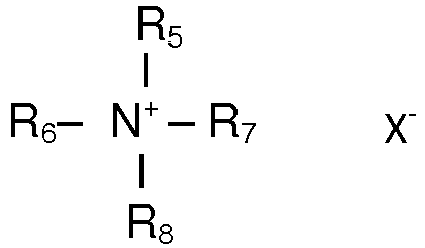
R9CO NH (CH2)n
where R9 is saturated or unsaturated, branched or non-branched alkyl chain with 7-21 C atoms and n has typical value of 1 - 4 or
R10CO O (CH2)n
- where R10 is saturated or unsaturated, branched or non-branched alkyl chain with 7-21 C atoms and n has typical value of 1 - 4, and
- and R6, R7 and R8 are independent from each other H or lower alkyl chain with 1 to 4 carbon atoms, and X is an anion such as chloride, bromide or methosulfate.
- Suitable non-limiting examples are cetrimonium chloride, steartrimonium chloride and behentrimonium chloride.
- The compositions of the present invention comprise surfactant, fatty alcohol and oil components at a specific weight ratio. The weight ratio of the surfactant to total of fatty alcohol and oil content is 0.25, preferably 0.2 and more preferably 0.15 and most preferably 0.1.
- The compositions of the present invention may furthermore comprise additional compounds such as stabilizing compounds for oxidizing agent especially for hydrogen peroxide, chelating agents, and buffering agents such as phosphoric acid and its salts and fragrance.
- The composition of the present invention is mixed with a composition comprising at least one hair dye (Dye composition) prior to application onto hair.
- Suitable hair dyes are direct dyes such as anionic, cationic and neutral nitro dyes. Preferred are cationic and neutral nitro dyes and their mixtures.
- Suitable direct dyes are selected from cationic, anionic, neutral nitro dyes and their mixtures. Preferred are cationic and neutral nitro dyes and their mixtures.
- Any cationic direct dye is in principal suitable for the compositions. Examples are Basic Blue 6, Basic Blue 7, Basic Blue 9, Basic Blue 26, Basic Blue 41, Basic Blue 99, Basic Brown 4, Basic Brown 16, Basic Brown 17, Natural Brown 7, Basic Green 1, Basic Orange 31, Basic Red 2, Basic Red 12 Basic Red 22, Basic Red 51, Basic Red 76, Basic Violet 1, Basic Violet 2, Basic Violet 3, Basic Violet 10, Basic Violet 14, Basic Yellow 57 and Basic Yellow 87.
- Any anionic dye is in principal suitable for the compositions. Suitable examples are such as Acid Black 1, Acid Blue 1, Acid Blue 3, Food Blue 5, Acid Blue 7, Acid Blue 9, Acid Blue 74, Acid Orange 3, Acid Orange 6, Acid Orange 7, Acid Orange 10, Acid Red 1, Acid Red 14, Acid Red 18, Acid Red 27, Acid Red 50, Acid Red 52, Acid Red 73, Acid Red 87, Acid Red 88, Acid Red 92, Acid Red 155, Acid Red 180, Acid Violet 9, Acid Violet 43, Acid Violet 49, Acid Yellow 1, Acid Yellow 23, Acid Yellow 3, Food Yellow No. 8, D&C Brown No. 1, D&C Green No. 5, D&C Green No. 8, D&C Orange No. 4, D&C Orange No. 10, D&C Orange No. 11, D&C Red No. 21, D&C Red No. 27, D&C Red No. 33, D&C Violet 2, D&C Yellow No. 7, D&C Yellow No. 8, D&C Yellow No. 10, FD&C Red 2, FD&C Red 40, FD&C Red No. 4, FD&C Yellow No. 6, FD&C Blue 1, Food Black 1, Food Black 2, Disperse Black 9 and Disperse Violet 1 and their alkali metal salts such as sodium, potassium.
- Among those, the preferred anionic dyestuffs are Acid Red 52, Acid Violet 2, Acid Red 33, Acid Orange 4, Acid Red 27 and Acid Yellow 10 and their salts. The most preferred anionic dyes are Acid Red 52, Acid Violet 2, Acid Red 33, Acid Orange 4 and Acid Yellow 10, and their salts
- Neutral dyes, so called nitro dyes for shading purposes are also optionally contained in the compositions. Suitable ones are HC Blue No.2, HC Blue No.4, HC Blue No.5, HC Blue No.6, HC Blue No.7, HC Blue No.8, HC Blue No.9, HC Blue No.10, HC Blue No.11, HC Blue No.12, HC Blue No.13, HC Brown No.1, HC Brown No.2, HC Green No.1, HC Orange No.1, HC Orange No.2, HC Orange No.3, HC Orange No.5, HC Red BN, HC Red No.1, HC Red No.3, HC Red No.7, HC Red No.8, HC Red No.9, HC Red No.10, HC Red No.11, HC Red No.13, HC Red No.54, HC Red No.14, HC Violet BS, HC Violet No.1, HC Violet No.2, HC Yellow No.2, HC Yellow No.4, HC Yellow No.5, HC Yellow No.6, HC Yellow No.7, HC Yellow No.8, HC Yellow No.9, HC Yellow No.10, HC Yellow No.11, HC Yellow No.12, HC Yellow No.13, HC Yellow No.14, HC Yellow No.15, 2-Amino-6-chloro-4-nitrophenol, picramic acid, 1,2-Diamino-4-nitrobenzol, 1,4-Diamino-2-nitrobenzol, 3-Nitro-4-aminophenol, 1-Hydroxy-2-amino-3-nitrobenzol and 2-hydroxyethylpicramic acid.
- Concentration of one or more direct dyes in total is in the range of 0.001 to 10% by weight, preferably 0.01 to 7.5% more preferably 0.05 to 5%, most preferably 0.1 to 3% by weight calculated to total of the dye composition.
- The dye composition comprises additionally or only oxidative dye precursors and an alkalizing agent.
- Suitable examples to the oxidative dye precursors are p-phenylenediamine, p-methylaminophenol and substituted p-phenylenediamines such as 2,5-diamino-toluene, 2-n-propyl or 2-ethyl-p-phenylenediamine, 2,6-di-methyl-p-phenylene- diamine, 2-(2,5-diaminophenyl) ethanol, 1-amino-4-bis-(2'-hydroxy-ethyl)amino- benzene, 2-(2-hydroxyethyl amino)-5-aminotoluene, 4,4'-diaminodiphenylamine, 4-aminodiphenylamine, 2-amino-5-N,N-diethyl aminotoluene, 4-amino-N-ethyl-N-isopropyl aniline, 2-chloro-p-phenylenediamine, 1-β-hydroxyethyl-2,5-diamino-4-chlorobenzene, 1-β-hydroxyethyl-2,5-diamino-4-methyl benzene, 2-methoxy-p-phenylenediamine, N,N-diethyl-p-phenylenediamine, 1-amino-4-β-methoxyethyl aminobenzene, 1-dimethyl-amino-4-aminobenzene, 1-hydroxy-2,5-diamino-4-methyl benzene, 1-hydroxymethyl-2,5-diaminobenzene, 1,3-dimethyl-2,5-diaminobenzene, 1,4-diamino isopropyl benzene and/or 1-amino-4-β-hydroxypropyl aminobenzene, pyrazole and the derivatives thereof such as 1-hydroxyethyl-4,5-diaminopyrazole, 3,4-diamino-5-hydroxypyrazole, 3,5-diaminopyrazole, 3,5-diamino pyrazol-1-carboxamide, 3-amino-5-hydroxypyrazole, 1-phenyl-2-methylpyrazole, 1-phenyl-3-methylpyrazole-5-one, 3,5-dimethylpyrazole, 3,5-dimethylpyrazole-1-methanol, 3,5-diamino-1,2,4-triazole, 4-aminophenol and the derivatives thereof such as 4-amino-3-methylphenol, 2-chloro-4-aminophenol, 2,6-dichloro-4-aminophenol, 2,4-diamino-phenol, 2,6-dibromo-4-aminophenol, tetraamino pyrimidines, triaminohydroxy pyrimidines, diaminomono- and -dihydroxy pyrimidines, aminotriazines, 5-amino salicylic acid and/or 1,2,4-triamino benzene or the water-soluble salts thereof.
- Further suitable aminopyridines are 2,5-diaminopyridine, 2,3-diaminopyridine, 2,6-diaminopyridine, 3-amino-2-methyl amino-6-methoxypyridine, 2-dimethyl-5-aminopyridine, 2-dimethyl aminoethyl-3-hydroxypyridine, 2-amino-4,6-dimethyl pyridine, 2-amino-3-hydroxypyridine, 3-amino-2(β-hydroxyethyl amino)-6-methoxy-pyridine, 2,6-dimethyl amino-5-aminopyridine, 2-di(hydroxyethyl) amino-5-aminopyridine, 2-hydroxyethyl amino-5-aminopyridine, 4-hydroxy-2,5,6-triaminopyrimidine and/or the water-soluble salts thereof.
- Further, Indole and indoline derivatives can as well be contained in the colouring composition of the present invention. Examples to those are: 6-aminoindol, 6-hydroxyindole, 1-ethyl-6-hydroxyindole, 1-methyl-4-hydroxyindol, 1-methyl-6-hydroxyindole, 2-methyl-6-hydroxyindole, 5-hydroxyindol, 4-hydroxyindol, 5,6-dihydroxyindole, 6-aminoindoline, 6-hydroxyindoline, 1-ethyl-6-hydroxyindoline, 1-methyl-4-hydroxyindoline, 1-methyl-6-hydroxyindoline, 2-methyl-6-hydroxyindoline, 5-hydroxyindoline, 4-hydroxyindoline, 5,6-dihydroxyindoline and their respective salts.
- Suitable coupling agents are resorcinol, 2-methyl resorcinol, 4-chlororesorcinol, 2-amino-4-chlorophenol, 5-amino-4-methoxy-2-methylphenol, 3-amino-phenol, 1-methyl-2-hydroxy-4-aminobenzene, 3-N,N-dimethyl aminophenol, 2.6-dihydroxy-3.5-dimethoxypyridine, 5-amino-3-methylphenol, 6-amino-3-methylphenol, 3-amino-2-methylamino-6-methoxypyridine, 2-amino-3-hydroxy-pyridine, 2-dimethyl-amino-5-aminopyridine, 2,6-diaminopyridine, 1,3-diamino- benzene, 1-amino-3-(2'-hydroxyethylamino)benzene, 1-amino-3-[bis(2'-hydroxy-ethyl) amino]benzene, α-naphthol, 4,6-dichlororesorcinol, 1,3-diamino-toluene, 1-hydroxy naphthalene, 4-hydroxy-1,2-methylenedioxy benzene, 1,5-dihydroxy naphthalene, 1,6-dihydroxy naphthalene, 1,7-dihydroxy naphthalene, 2,7-dihydroxy naphthalene, 1-hydroxy-2-methyl naphthalene, 4-hydroxy-1,2-methyldioxy benzene, 2,4-diamino-3-chlorophenol, 5-amino-2-methoxyphenol and/or 1-methoxy-2-amino-4-(2'-hydroxyethyl amino)benzene or the water-soluble salts thereof. 5-amino-2-methylphenol, 2-methyl-5-hydroxyethylaminophenol, 2,4-diamnophenoxyethanol, 2-amino-4-hydroxyethylaminoanisol, 2-methyl-5-amino-6-chlorophenol, 1,3-bis(2,4-diaminophenoxy)propane, 2-bis(2-hydroxyethyl)aminotoluene, 2-amino-5-methylphenol or the water-soluble salts thereof.
- Concentration of one or more oxidative dyes in total - total concentration of precursors and couplers, if present - is in the range of 0.001 to 10% by weight, preferably 0.01 to 7.5% more preferably 0.05 to 5%, most preferably 0.1 to 3% by weight calculated to total of the dye composition.
- The dye composition comprises one or more alkalizing agent. Suitable are sodium or potassium hydroxide, ammonia, alkanol amines such as monoethanolamine, carbonates such as ammonium carbonate, potassium carbonate, ammonium bicarbonate and ammonium chloride. Concentration of one or more alkalizing agents in total is in the range of 1 to 10% by weight calculated to the total composition. The most preferred are ammonia and monoethanolamine.
- pH of the dye composition varies in the range of 2 to 11, preferably 6 to 10.5, more preferably 6.5 to 10.
- Any of the compositions described above, the aqueous oxidizing composition and/or dyeing compositions comprising direct dyes and/or oxidative dye precursors may further comprise one or more of the compounds described below.
- Further, the above mentioned compositions may comprise additional cationic polymer. Basically suitable are all cationic polymers listed under the generic name "Polyquaternium" in the CTFA International Cosmetic Ingredient Dictionary. Examples are Polyquaternium 6, Polyquaternium 7, Polyquaternium 10, Polyquaternium 11, Polyquaternium 22 and Polyquaternium 28, Polyquaternium 39, Polyquaternium 16 and Polyquaternium 87.
- The cationic polymers also include the quaternized products of graft polymers from organopolysiloxanes and polyethyl oxazolines described in
EP-A 524 612 EP-A 640 643 - Concentration of one or more additional cationic polymers is in the range from 0.05 % to 2.5 %, preferably 0.1% to 1.5 % by weight, calculated to total each composition.
- Further the above mentioned composition may comprise one or more organic solvent. Suitable organic solvents are 2-methyl-1,3-propanediol, mono and dialcohols or the ethers thereof, in particular mono-C1-C3-alkyl ether, ethanol, n-propanol, isopropyl alcohol, 1-methoxypropanol, 1-ethoxypropanol and ethoxydiglycol, diols and their esters 1,3- and 1,4-butanediol, diethyleneglycol and the monomethyl and monoethyl ether thereof, dipropylene glycol and the monomethyl and monoethyl ether thereof, glycerol, hexanetriol, ethyl carbitol, benzyl alcohol, benzyloxy ethanol, propylene carbonate, N-alkyl pyrrolidone, and urea or their mixture preferably in an amount from about 0.1 % to 10 % by weight, calculated to the total of each composition.
- The above mentioned compositions can comprise further ceramide type of compound such as cetyl-PG-hydroxyethylpalmitamide.
- Further optional ingredient are sterols, especially the phytosterols are useful hair restructuring compounds can be present in the above mentioned compositions. Especially preferred ones are of plant origin for example ergosterol, sitosterol, stigmasterol, fucosterol, brassicasterol, fungisterol, campesterol, zymosterol, ascosterol, cerevisterol, episterol, faecosterol, spinasterol. Among those phytosterols, the ones found in "Avocadin" which is the unsaponified fraction of the avocado oil is more preferred.
- In a further preferred embodiment of the present invention, compositions may comprises at least one diamine compound. Preferred diamide compounds are according to the general structure

- Preferred individual diamide compounds are the ones according to the formula A to G.


- Particularly preferred diamide compound is the compound F which is bis (methoxypropylamido) isodocosane and commercially available from Kao Corporation - Japan.
- Concentration of diamide compounds in the intermediate treatment compositions of the present invention is in the range of 0.001 to 5%, preferably 0.002 to 3% more preferably 0.005 to 2% and most preferably 0.01 to 1% by weight calculated to total of each composition.
- Further additional compounds may be present in the above mentioned compositions of the present invention is ubichinone of the formula

- The following examples are to illustrate but not to limit the invention.
-
% by weight Cetearyl alcohol 2.0 Mineral oil 2.5 Sodium lauryl sulphate 0.2 Glycerin 0.9 Hydrogen peroxide 6.0 Salicylic acid 0.05 Phosphoric acid/sodium phosphate q.s. to pH 2.1 Water to 100 -
% by weight Decyl glucoside 0.1 Sodium laureth sulphate 0.1 Polyquaternium - 7 0.5 Sodium sulphite 0.5 Ascorbic acid 0.5 Monoethanol amine 4.0 Ammonium hydroxide 4.0 EDTA di sodium salt 0.5 Ethanol 10.0 4-amino-m-cresol 0.35 4-amino-2-hydroxytoluene 0.2 2-Hydroxyethyl-p-phenylenediamine sulfate 0.15 m-aminophenol 0.1 Resorcinol 0.2 2,5,6-triamino-4-pyrimidinol sulphate 0.05 2-amino-6-chloro-4-nitrophenol 0.11 Fragrance 0.5 Water q.s. to 100 - pH of the above composition was 9.8.
- The above oxidizing and dyeing compositions were mixed at a weight ratio of 1:1 and the mixture had a pH of 9.8.
- Partial grey and damaged hair was dyed with the above compositions. It was observed that the hair was dyed homogeneously and grey coverage was 100%.
-
% by weight Behenyl alcohol 2.0 Isopropyl myristate 2.5 Behentrimonium chloride 0.2 Panthenol 0.9 Hydrogen peroxide 6.0 Salicylic acid 0.05 Phosphoric acid/sodium phosphate q.s. to pH 3.1 Water to 100 -
4-amino-m-cresol 0.4 4-amino-2-hydroxytoluene 0.2 2- Hydroxyethyl-p-phenylenediamine sulfate 0.15 m-aminophenol 0.1 Resorcinol 0.2 Basic red 51 0.5 Basic orange 31 0.5 Basic yellow 87 0.2 HC red 3 0.5 Ammonium hydroxide 8.0 Ceteareth-30 0.2 Water to 100 - pH of the above composition was 9.8.
- The above oxidizing and dyeing compositions were mixed at a weight ratio of 1:1 and the mixture had a pH of 9.5.
- Partial grey and damaged hair was dyed with the above compositions. It was observed that the hair was dyed homogeneously and grey coverage was 100%.
Claims (15)
- An aqueous oxidizing composition for hair characterized in that it comprises one or more oxidizing agent, one or more polyol, one or more oil selected from the synthetic and natural oils at a concentration 0.5 to 10% by weight, calculated to the total of the composition, one or more fatty alcohol solid at room temperature (20°C) at a concentration in the range of 0.74 to 4.9%, by weight calculated to the total of the composition and surfactant at a total concentration in the range of 0.08 to 2.9% by weight, calculated to the total of the composition wherein the surfactant(s) is selected from anionic, amphoteric and cationic surfactants wherein fatty alcohol to oil weight ratio is less than 1, weight ratio of surfactant to sum of fatty alcohol and oil is less than 0.25 and polyol concentration is less than or equal to 2% by weight, calculated to the total of the composition.
- The composition according to claim 1 characterised in that oxidizing agent is hydrogen peroxide and preferably comprised at a concentration of 1 to 20% by weight calculated to the total of the compositions and preferably the composition has a pH between 2 and 5.
- The composition according to claims 1 and 2 characterised in that one or more polyol is selected from glycerine, 1,2-propylene glycol, polyglycerins with 2 to 10 glycerin units, panthenol, glycol and 1,5-pentanediol.
- The composition according to claims 1 to 3 characterised in that it comprise glycerine as the sole polyol.
- The composition according to any of the preceding claims characterised in that it comprises one or more oil selected from the synthetic and natural oils at a concentration 0.5 to 7.5% by weight, calculated to the total of the composition.
- The composition according to any of the preceding claims characterised in that it comprises mineral oil as the sole oil component.
- The composition according to any of the preceding claims characterised in that one or more fatty alcohol solid at room temperature is selected from myristyl alcohol, cetyl alcohol, stearyl alcohol, arachidyl alcohol and behenyl alcohol and their mixtures, preferably at a concentration in the range of 0.9 to 3.9 % by weight calculated to the total of the composition.
- The composition according to any of the preceding claims characterised in that it comprises the surfactant at a concentration in the range of 0.09 to 1.95 % by weight, calculated to the total composition.
- The composition according to any of the preceding claims characterised in that the surfactant is sodium lauryl sulphate.
- The composition according to any of the preceding claims characterised in that cationic surfactant is selected from quaternary ammonium compounds of the general structure
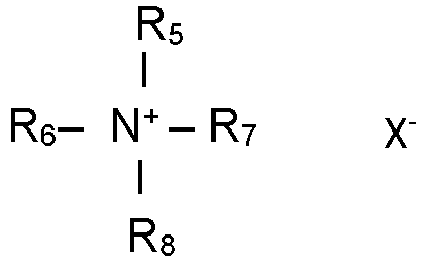 where R5 is a saturated or unsaturated, branched or non-branched alkyl chain with 8-22 C atoms or
R9CO NH (CH2)n
where R9 is saturated or unsaturated, branched or non-branched alkyl chain with 7-21 C atoms and n has typical value of 1 - 4 or
R10CO O (CH2)n
where R10 is saturated or unsaturated, branched or non-branched alkyl chain with 7-21 C atoms and n has typical value of 1 - 4, andand R6, R7 and R8 are independent from each other H or lower alkyl chain with 1 to 4 carbon atoms, and X is an anion such as chloride, bromide or methosulfate. - Process for coloring hair characterized in that the oxidizing composition according to claims 1 to 10 is mixed with a composition comprising one or more hair dyes and applied onto hair and after leaving on the hair for 1 to 45 min, rinsed off from hair and optionally hair is shampooed.
- The process according to claim 11 characterised in that the hair dye is selected from direct dyes, preferably anionic, cationic and neutral nitro dyes.
- Process for coloring hair characterized in that the oxidizing composition according to claims 1 to 10 is mixed with a composition comprising one or more oxidative dye precursors and having an alkaline pH and applied onto hair and after leaving on the hair for 1 to 45 min, rinsed off from hair and optionally hair is shampooed.
- Use of the composition according to claims 1 to 10 for homogeneous colouring human hair and/or for improved grey coverage of an oxidative dyeing composition.
- Kit for dyeing hair characterised is that it comprises two or more products wherein one of the products is the aqueous oxidizing composition according to claims 1 to 10.
Applications Claiming Priority (2)
| Application Number | Priority Date | Filing Date | Title |
|---|---|---|---|
| EP12198682 | 2012-12-20 | ||
| PCT/EP2013/076478 WO2015180739A1 (en) | 2012-12-20 | 2013-12-13 | Aqueous oxidizing composition for hair |
Publications (3)
| Publication Number | Publication Date |
|---|---|
| EP3113753A1 EP3113753A1 (en) | 2017-01-11 |
| EP3113753B1 true EP3113753B1 (en) | 2021-06-16 |
| EP3113753B2 EP3113753B2 (en) | 2026-03-18 |
Family
ID=47469786
Family Applications (1)
| Application Number | Title | Priority Date | Filing Date |
|---|---|---|---|
| EP13900863.5A Active EP3113753B2 (en) | 2012-12-20 | 2013-12-13 | Aqueous oxidizing composition for hair |
Country Status (4)
| Country | Link |
|---|---|
| US (1) | US10238588B2 (en) |
| EP (1) | EP3113753B2 (en) |
| AU (1) | AU2013409773B2 (en) |
| WO (1) | WO2015180739A1 (en) |
Families Citing this family (1)
| Publication number | Priority date | Publication date | Assignee | Title |
|---|---|---|---|---|
| CN118804737A (en) * | 2022-02-28 | 2024-10-18 | 花王株式会社 | Dyeing compositions in aqueous alcoholic media |
Citations (4)
| Publication number | Priority date | Publication date | Assignee | Title |
|---|---|---|---|---|
| JP2003081792A (en) | 2001-09-13 | 2003-03-19 | Hoyu Co Ltd | Decolorant composition and hair color composition |
| FR2850019A1 (en) | 2003-01-16 | 2004-07-23 | Oreal | CLEANING COMPOSITIONS READY FOR USE, PREPARATION METHOD AND DECOLORATION PROCESS |
| US20110104092A1 (en) | 2008-04-07 | 2011-05-05 | Johannes Panten | Use of carboxylic acid esters as a fragrance substance |
| US20110318293A1 (en) | 2009-03-11 | 2011-12-29 | Astrid Kleen | Hair Preparation Comprising Royal Jelly |
Family Cites Families (10)
| Publication number | Priority date | Publication date | Assignee | Title |
|---|---|---|---|---|
| JPH0525025A (en) | 1991-07-22 | 1993-02-02 | Kao Corp | Hair cosmetics |
| EP0640643B1 (en) | 1993-08-10 | 2000-04-26 | Kao Corporation | Organopolysiloxanes and a method of setting hair using the same |
| FR2812810B1 (en) * | 2000-08-11 | 2002-10-11 | Oreal | COMPOSITION FOR OXIDATION DYEING OF KERATINIC FIBERS COMPRISING A CATIONIC AMPHIPHILIC POLYMER, OXYALKYLENE OR POLYGLYCEROLE FATTY ALCOHOL AND HYDROXYL SOLVENT |
| US7896931B2 (en) * | 2007-06-29 | 2011-03-01 | Kao Corporation | Hair dye composition |
| FR2942704B1 (en) * | 2009-03-04 | 2011-09-02 | Oreal | DEVICE FOR DISPENSING A TINCTORIAL COMPOSITION FOR KERATIN FIBERS AND ASSOCIATED METHOD. |
| JP2011105620A (en) * | 2009-11-13 | 2011-06-02 | Hoyu Co Ltd | Hair cosmetic composition and method for using the same |
| EP2425809A1 (en) * | 2010-09-03 | 2012-03-07 | KPSS-Kao Professional Salon Services GmbH | Aqueous colouring composition |
| WO2012032671A1 (en) * | 2010-09-08 | 2012-03-15 | L'oreal | Cosmetic composition for keratin fibers |
| FR2970174B1 (en) | 2011-01-10 | 2013-07-05 | Oreal | COLORING OR LIGHTENING PROCESS USING A RICH BODY COMPOSITION COMPRISING AT LEAST 20 CARBON ALCOHOL, COMPOSITIONS AND DEVICE |
| FR2970173B1 (en) * | 2011-01-10 | 2013-07-05 | Oreal | COLORING OR LIGHTENING PROCESS USING A RICH BODY COMPOSITION COMPRISING A SOLID ALCOHOL AND ESTER, COMPOSITIONS AND DEVICE |
-
2013
- 2013-12-13 US US14/898,554 patent/US10238588B2/en not_active Expired - Fee Related
- 2013-12-13 AU AU2013409773A patent/AU2013409773B2/en active Active
- 2013-12-13 EP EP13900863.5A patent/EP3113753B2/en active Active
- 2013-12-13 WO PCT/EP2013/076478 patent/WO2015180739A1/en not_active Ceased
Patent Citations (4)
| Publication number | Priority date | Publication date | Assignee | Title |
|---|---|---|---|---|
| JP2003081792A (en) | 2001-09-13 | 2003-03-19 | Hoyu Co Ltd | Decolorant composition and hair color composition |
| FR2850019A1 (en) | 2003-01-16 | 2004-07-23 | Oreal | CLEANING COMPOSITIONS READY FOR USE, PREPARATION METHOD AND DECOLORATION PROCESS |
| US20110104092A1 (en) | 2008-04-07 | 2011-05-05 | Johannes Panten | Use of carboxylic acid esters as a fragrance substance |
| US20110318293A1 (en) | 2009-03-11 | 2011-12-29 | Astrid Kleen | Hair Preparation Comprising Royal Jelly |
Also Published As
| Publication number | Publication date |
|---|---|
| AU2013409773A1 (en) | 2016-05-12 |
| US20160136064A1 (en) | 2016-05-19 |
| EP3113753B2 (en) | 2026-03-18 |
| US10238588B2 (en) | 2019-03-26 |
| WO2015180739A1 (en) | 2015-12-03 |
| AU2013409773B2 (en) | 2018-09-06 |
| EP3113753A1 (en) | 2017-01-11 |
Similar Documents
| Publication | Publication Date | Title |
|---|---|---|
| EP2020254B1 (en) | Process for colouring and permanent shaping keratin fibres | |
| EP2191864B1 (en) | Process for colouring and straightening keratin fibres | |
| US8349025B2 (en) | Process for oxidative colouring keratin fibres | |
| US20130263878A1 (en) | Oxidizing composition for hair | |
| EP2191865B1 (en) | Process for colouring and straightening keratin fibres | |
| EP2883571B1 (en) | Hair lightening/bleaching composition | |
| EP3342464A1 (en) | Method for colouring keratin fibers | |
| US20130255008A1 (en) | Dyeing composition for keratin fibers | |
| EP2020255B1 (en) | Process for colouring and permanent shaping keratin fibres | |
| EP3113847B1 (en) | Anhydrous dyeing composition and process for dyeing hair | |
| EP2658518B1 (en) | Composition and process for oxidative colouring keratin fibers | |
| US8579993B2 (en) | Use of dyestuffs for dyeing keratin fibers and compositions comprising the dyestuffs | |
| EP3113753B1 (en) | Aqueous oxidizing composition for hair | |
| EP2883572A1 (en) | Hair lightening/bleaching composition | |
| WO2015188841A1 (en) | Anhydrous dyeing composition and process for dyeing hair | |
| EP2608763A2 (en) | Stable oxidative colouring composition for keratin fibres | |
| US20080060141A1 (en) | Hair Colouring Composition | |
| EP2724708A1 (en) | Aqueous oxidizing composition comprising an organic solvent | |
| EP2018846A1 (en) | Process for colouring keratin fibres |
Legal Events
| Date | Code | Title | Description |
|---|---|---|---|
| PUAI | Public reference made under article 153(3) epc to a published international application that has entered the european phase |
Free format text: ORIGINAL CODE: 0009012 |
|
| STAA | Information on the status of an ep patent application or granted ep patent |
Free format text: STATUS: REQUEST FOR EXAMINATION WAS MADE |
|
| 17P | Request for examination filed |
Effective date: 20160513 |
|
| AK | Designated contracting states |
Kind code of ref document: A1 Designated state(s): AL AT BE BG CH CY CZ DE DK EE ES FI FR GB GR HR HU IE IS IT LI LT LU LV MC MK MT NL NO PL PT RO RS SE SI SK SM TR |
|
| STAA | Information on the status of an ep patent application or granted ep patent |
Free format text: STATUS: EXAMINATION IS IN PROGRESS |
|
| 17Q | First examination report despatched |
Effective date: 20171222 |
|
| GRAP | Despatch of communication of intention to grant a patent |
Free format text: ORIGINAL CODE: EPIDOSNIGR1 |
|
| STAA | Information on the status of an ep patent application or granted ep patent |
Free format text: STATUS: GRANT OF PATENT IS INTENDED |
|
| RIC1 | Information provided on ipc code assigned before grant |
Ipc: A61K 8/34 20060101AFI20210209BHEP Ipc: A61K 8/36 20060101ALI20210209BHEP Ipc: A61Q 5/10 20060101ALI20210209BHEP Ipc: A61K 8/22 20060101ALI20210209BHEP Ipc: A61K 8/92 20060101ALI20210209BHEP Ipc: A61K 8/41 20060101ALI20210209BHEP Ipc: A61Q 5/06 20060101ALI20210209BHEP |
|
| INTG | Intention to grant announced |
Effective date: 20210305 |
|
| GRAS | Grant fee paid |
Free format text: ORIGINAL CODE: EPIDOSNIGR3 |
|
| GRAA | (expected) grant |
Free format text: ORIGINAL CODE: 0009210 |
|
| STAA | Information on the status of an ep patent application or granted ep patent |
Free format text: STATUS: THE PATENT HAS BEEN GRANTED |
|
| AK | Designated contracting states |
Kind code of ref document: B1 Designated state(s): AL AT BE BG CH CY CZ DE DK EE ES FI FR GB GR HR HU IE IS IT LI LT LU LV MC MK MT NL NO PL PT RO RS SE SI SK SM TR |
|
| REG | Reference to a national code |
Ref country code: GB Ref legal event code: FG4D |
|
| REG | Reference to a national code |
Ref country code: CH Ref legal event code: EP |
|
| REG | Reference to a national code |
Ref country code: DE Ref legal event code: R096 Ref document number: 602013078005 Country of ref document: DE |
|
| REG | Reference to a national code |
Ref country code: AT Ref legal event code: REF Ref document number: 1401729 Country of ref document: AT Kind code of ref document: T Effective date: 20210715 |
|
| REG | Reference to a national code |
Ref country code: IE Ref legal event code: FG4D |
|
| REG | Reference to a national code |
Ref country code: LT Ref legal event code: MG9D |
|
| PG25 | Lapsed in a contracting state [announced via postgrant information from national office to epo] |
Ref country code: BG Free format text: LAPSE BECAUSE OF FAILURE TO SUBMIT A TRANSLATION OF THE DESCRIPTION OR TO PAY THE FEE WITHIN THE PRESCRIBED TIME-LIMIT Effective date: 20210916 Ref country code: LT Free format text: LAPSE BECAUSE OF FAILURE TO SUBMIT A TRANSLATION OF THE DESCRIPTION OR TO PAY THE FEE WITHIN THE PRESCRIBED TIME-LIMIT Effective date: 20210616 Ref country code: FI Free format text: LAPSE BECAUSE OF FAILURE TO SUBMIT A TRANSLATION OF THE DESCRIPTION OR TO PAY THE FEE WITHIN THE PRESCRIBED TIME-LIMIT Effective date: 20210616 Ref country code: HR Free format text: LAPSE BECAUSE OF FAILURE TO SUBMIT A TRANSLATION OF THE DESCRIPTION OR TO PAY THE FEE WITHIN THE PRESCRIBED TIME-LIMIT Effective date: 20210616 |
|
| REG | Reference to a national code |
Ref country code: AT Ref legal event code: MK05 Ref document number: 1401729 Country of ref document: AT Kind code of ref document: T Effective date: 20210616 |
|
| REG | Reference to a national code |
Ref country code: NL Ref legal event code: MP Effective date: 20210616 |
|
| PG25 | Lapsed in a contracting state [announced via postgrant information from national office to epo] |
Ref country code: RS Free format text: LAPSE BECAUSE OF FAILURE TO SUBMIT A TRANSLATION OF THE DESCRIPTION OR TO PAY THE FEE WITHIN THE PRESCRIBED TIME-LIMIT Effective date: 20210616 Ref country code: SE Free format text: LAPSE BECAUSE OF FAILURE TO SUBMIT A TRANSLATION OF THE DESCRIPTION OR TO PAY THE FEE WITHIN THE PRESCRIBED TIME-LIMIT Effective date: 20210616 Ref country code: NO Free format text: LAPSE BECAUSE OF FAILURE TO SUBMIT A TRANSLATION OF THE DESCRIPTION OR TO PAY THE FEE WITHIN THE PRESCRIBED TIME-LIMIT Effective date: 20210916 Ref country code: LV Free format text: LAPSE BECAUSE OF FAILURE TO SUBMIT A TRANSLATION OF THE DESCRIPTION OR TO PAY THE FEE WITHIN THE PRESCRIBED TIME-LIMIT Effective date: 20210616 Ref country code: GR Free format text: LAPSE BECAUSE OF FAILURE TO SUBMIT A TRANSLATION OF THE DESCRIPTION OR TO PAY THE FEE WITHIN THE PRESCRIBED TIME-LIMIT Effective date: 20210917 |
|
| PG25 | Lapsed in a contracting state [announced via postgrant information from national office to epo] |
Ref country code: ES Free format text: LAPSE BECAUSE OF FAILURE TO SUBMIT A TRANSLATION OF THE DESCRIPTION OR TO PAY THE FEE WITHIN THE PRESCRIBED TIME-LIMIT Effective date: 20210616 Ref country code: RO Free format text: LAPSE BECAUSE OF FAILURE TO SUBMIT A TRANSLATION OF THE DESCRIPTION OR TO PAY THE FEE WITHIN THE PRESCRIBED TIME-LIMIT Effective date: 20210616 Ref country code: NL Free format text: LAPSE BECAUSE OF FAILURE TO SUBMIT A TRANSLATION OF THE DESCRIPTION OR TO PAY THE FEE WITHIN THE PRESCRIBED TIME-LIMIT Effective date: 20210616 Ref country code: PT Free format text: LAPSE BECAUSE OF FAILURE TO SUBMIT A TRANSLATION OF THE DESCRIPTION OR TO PAY THE FEE WITHIN THE PRESCRIBED TIME-LIMIT Effective date: 20211018 Ref country code: AT Free format text: LAPSE BECAUSE OF FAILURE TO SUBMIT A TRANSLATION OF THE DESCRIPTION OR TO PAY THE FEE WITHIN THE PRESCRIBED TIME-LIMIT Effective date: 20210616 Ref country code: SM Free format text: LAPSE BECAUSE OF FAILURE TO SUBMIT A TRANSLATION OF THE DESCRIPTION OR TO PAY THE FEE WITHIN THE PRESCRIBED TIME-LIMIT Effective date: 20210616 Ref country code: SK Free format text: LAPSE BECAUSE OF FAILURE TO SUBMIT A TRANSLATION OF THE DESCRIPTION OR TO PAY THE FEE WITHIN THE PRESCRIBED TIME-LIMIT Effective date: 20210616 Ref country code: EE Free format text: LAPSE BECAUSE OF FAILURE TO SUBMIT A TRANSLATION OF THE DESCRIPTION OR TO PAY THE FEE WITHIN THE PRESCRIBED TIME-LIMIT Effective date: 20210616 Ref country code: CZ Free format text: LAPSE BECAUSE OF FAILURE TO SUBMIT A TRANSLATION OF THE DESCRIPTION OR TO PAY THE FEE WITHIN THE PRESCRIBED TIME-LIMIT Effective date: 20210616 |
|
| PG25 | Lapsed in a contracting state [announced via postgrant information from national office to epo] |
Ref country code: PL Free format text: LAPSE BECAUSE OF FAILURE TO SUBMIT A TRANSLATION OF THE DESCRIPTION OR TO PAY THE FEE WITHIN THE PRESCRIBED TIME-LIMIT Effective date: 20210616 |
|
| REG | Reference to a national code |
Ref country code: DE Ref legal event code: R026 Ref document number: 602013078005 Country of ref document: DE |
|
| PLBI | Opposition filed |
Free format text: ORIGINAL CODE: 0009260 |
|
| PLAX | Notice of opposition and request to file observation + time limit sent |
Free format text: ORIGINAL CODE: EPIDOSNOBS2 |
|
| 26 | Opposition filed |
Opponent name: L'OREAL Effective date: 20220316 |
|
| PG25 | Lapsed in a contracting state [announced via postgrant information from national office to epo] |
Ref country code: DK Free format text: LAPSE BECAUSE OF FAILURE TO SUBMIT A TRANSLATION OF THE DESCRIPTION OR TO PAY THE FEE WITHIN THE PRESCRIBED TIME-LIMIT Effective date: 20210616 |
|
| PG25 | Lapsed in a contracting state [announced via postgrant information from national office to epo] |
Ref country code: AL Free format text: LAPSE BECAUSE OF FAILURE TO SUBMIT A TRANSLATION OF THE DESCRIPTION OR TO PAY THE FEE WITHIN THE PRESCRIBED TIME-LIMIT Effective date: 20210616 |
|
| PG25 | Lapsed in a contracting state [announced via postgrant information from national office to epo] |
Ref country code: MC Free format text: LAPSE BECAUSE OF FAILURE TO SUBMIT A TRANSLATION OF THE DESCRIPTION OR TO PAY THE FEE WITHIN THE PRESCRIBED TIME-LIMIT Effective date: 20210616 Ref country code: IT Free format text: LAPSE BECAUSE OF FAILURE TO SUBMIT A TRANSLATION OF THE DESCRIPTION OR TO PAY THE FEE WITHIN THE PRESCRIBED TIME-LIMIT Effective date: 20210616 |
|
| PLBB | Reply of patent proprietor to notice(s) of opposition received |
Free format text: ORIGINAL CODE: EPIDOSNOBS3 |
|
| REG | Reference to a national code |
Ref country code: BE Ref legal event code: MM Effective date: 20211231 |
|
| PG25 | Lapsed in a contracting state [announced via postgrant information from national office to epo] |
Ref country code: LU Free format text: LAPSE BECAUSE OF NON-PAYMENT OF DUE FEES Effective date: 20211213 Ref country code: IE Free format text: LAPSE BECAUSE OF NON-PAYMENT OF DUE FEES Effective date: 20211213 |
|
| PG25 | Lapsed in a contracting state [announced via postgrant information from national office to epo] |
Ref country code: BE Free format text: LAPSE BECAUSE OF NON-PAYMENT OF DUE FEES Effective date: 20211231 |
|
| PLAB | Opposition data, opponent's data or that of the opponent's representative modified |
Free format text: ORIGINAL CODE: 0009299OPPO |
|
| R26 | Opposition filed (corrected) |
Opponent name: L'OREAL Effective date: 20220316 |
|
| PG25 | Lapsed in a contracting state [announced via postgrant information from national office to epo] |
Ref country code: HU Free format text: LAPSE BECAUSE OF FAILURE TO SUBMIT A TRANSLATION OF THE DESCRIPTION OR TO PAY THE FEE WITHIN THE PRESCRIBED TIME-LIMIT; INVALID AB INITIO Effective date: 20131213 |
|
| P01 | Opt-out of the competence of the unified patent court (upc) registered |
Effective date: 20230426 |
|
| PG25 | Lapsed in a contracting state [announced via postgrant information from national office to epo] |
Ref country code: CY Free format text: LAPSE BECAUSE OF FAILURE TO SUBMIT A TRANSLATION OF THE DESCRIPTION OR TO PAY THE FEE WITHIN THE PRESCRIBED TIME-LIMIT Effective date: 20210616 |
|
| REG | Reference to a national code |
Ref country code: CH Ref legal event code: PK Free format text: BERICHTIGUNGEN |
|
| RIC2 | Information provided on ipc code assigned after grant |
Ipc: A61K 8/46 20060101ALI20240308BHEP Ipc: A61K 8/31 20060101ALI20240308BHEP Ipc: A61K 8/36 20060101ALI20240308BHEP Ipc: A61K 8/41 20060101ALI20240308BHEP Ipc: A61Q 5/06 20060101ALI20240308BHEP Ipc: A61Q 5/10 20060101ALI20240308BHEP Ipc: A61K 8/92 20060101ALI20240308BHEP Ipc: A61K 8/22 20060101ALI20240308BHEP Ipc: A61K 8/34 20060101AFI20240308BHEP |
|
| APBP | Date of receipt of notice of appeal recorded |
Free format text: ORIGINAL CODE: EPIDOSNNOA2O |
|
| APAH | Appeal reference modified |
Free format text: ORIGINAL CODE: EPIDOSCREFNO |
|
| APAW | Appeal reference deleted |
Free format text: ORIGINAL CODE: EPIDOSDREFNO |
|
| PG25 | Lapsed in a contracting state [announced via postgrant information from national office to epo] |
Ref country code: MK Free format text: LAPSE BECAUSE OF FAILURE TO SUBMIT A TRANSLATION OF THE DESCRIPTION OR TO PAY THE FEE WITHIN THE PRESCRIBED TIME-LIMIT Effective date: 20210616 |
|
| PG25 | Lapsed in a contracting state [announced via postgrant information from national office to epo] |
Ref country code: TR Free format text: LAPSE BECAUSE OF FAILURE TO SUBMIT A TRANSLATION OF THE DESCRIPTION OR TO PAY THE FEE WITHIN THE PRESCRIBED TIME-LIMIT Effective date: 20210616 |
|
| APBQ | Date of receipt of statement of grounds of appeal recorded |
Free format text: ORIGINAL CODE: EPIDOSNNOA3O |
|
| PG25 | Lapsed in a contracting state [announced via postgrant information from national office to epo] |
Ref country code: MT Free format text: LAPSE BECAUSE OF FAILURE TO SUBMIT A TRANSLATION OF THE DESCRIPTION OR TO PAY THE FEE WITHIN THE PRESCRIBED TIME-LIMIT Effective date: 20210616 |
|
| PGFP | Annual fee paid to national office [announced via postgrant information from national office to epo] |
Ref country code: DE Payment date: 20241216 Year of fee payment: 12 |
|
| APAH | Appeal reference modified |
Free format text: ORIGINAL CODE: EPIDOSCREFNO |
|
| PGFP | Annual fee paid to national office [announced via postgrant information from national office to epo] |
Ref country code: CH Payment date: 20250101 Year of fee payment: 12 |
|
| APBU | Appeal procedure closed |
Free format text: ORIGINAL CODE: EPIDOSNNOA9O |
|
| PGFP | Annual fee paid to national office [announced via postgrant information from national office to epo] |
Ref country code: GB Payment date: 20251218 Year of fee payment: 13 |
|
| PGFP | Annual fee paid to national office [announced via postgrant information from national office to epo] |
Ref country code: FR Payment date: 20251217 Year of fee payment: 13 |
|
| PUAH | Patent maintained in amended form |
Free format text: ORIGINAL CODE: 0009272 |
|
| STAA | Information on the status of an ep patent application or granted ep patent |
Free format text: STATUS: PATENT MAINTAINED AS AMENDED |
|
| REG | Reference to a national code |
Ref country code: CH Ref legal event code: M12 Free format text: ST27 STATUS EVENT CODE: U-0-0-M10-M12 (AS PROVIDED BY THE NATIONAL OFFICE) Effective date: 20260218 |
|
| 27A | Patent maintained in amended form |
Effective date: 20260318 |
|
| AK | Designated contracting states |
Kind code of ref document: B2 Designated state(s): AL AT BE BG CH CY CZ DE DK EE ES FI FR GB GR HR HU IE IS IT LI LT LU LV MC MK MT NL NO PL PT RO RS SE SI SK SM TR |
|
| REG | Reference to a national code |
Ref country code: DE Ref legal event code: R102 Ref document number: 602013078005 Country of ref document: DE |