EP3113019A1 - Policy-based compression of machine code generated by a virtual machine - Google Patents
Policy-based compression of machine code generated by a virtual machine Download PDFInfo
- Publication number
- EP3113019A1 EP3113019A1 EP16159751.3A EP16159751A EP3113019A1 EP 3113019 A1 EP3113019 A1 EP 3113019A1 EP 16159751 A EP16159751 A EP 16159751A EP 3113019 A1 EP3113019 A1 EP 3113019A1
- Authority
- EP
- European Patent Office
- Prior art keywords
- machine code
- code file
- computing system
- package
- application
- Prior art date
- Legal status (The legal status is an assumption and is not a legal conclusion. Google has not performed a legal analysis and makes no representation as to the accuracy of the status listed.)
- Withdrawn
Links
Images


Classifications
-
- G—PHYSICS
- G06—COMPUTING OR CALCULATING; COUNTING
- G06F—ELECTRIC DIGITAL DATA PROCESSING
- G06F8/00—Arrangements for software engineering
- G06F8/60—Software deployment
- G06F8/61—Installation
-
- G—PHYSICS
- G06—COMPUTING OR CALCULATING; COUNTING
- G06F—ELECTRIC DIGITAL DATA PROCESSING
- G06F9/00—Arrangements for program control, e.g. control units
- G06F9/06—Arrangements for program control, e.g. control units using stored programs, i.e. using an internal store of processing equipment to receive or retain programs
- G06F9/44—Arrangements for executing specific programs
- G06F9/455—Emulation; Interpretation; Software simulation, e.g. virtualisation or emulation of application or operating system execution engines
- G06F9/45533—Hypervisors; Virtual machine monitors
-
- G—PHYSICS
- G06—COMPUTING OR CALCULATING; COUNTING
- G06F—ELECTRIC DIGITAL DATA PROCESSING
- G06F9/00—Arrangements for program control, e.g. control units
- G06F9/06—Arrangements for program control, e.g. control units using stored programs, i.e. using an internal store of processing equipment to receive or retain programs
- G06F9/44—Arrangements for executing specific programs
- G06F9/445—Program loading or initiating
- G06F9/44568—Immediately runnable code
- G06F9/44578—Preparing or optimising for loading
-
- G—PHYSICS
- G06—COMPUTING OR CALCULATING; COUNTING
- G06F—ELECTRIC DIGITAL DATA PROCESSING
- G06F8/00—Arrangements for software engineering
- G06F8/40—Transformation of program code
- G06F8/41—Compilation
-
- G—PHYSICS
- G06—COMPUTING OR CALCULATING; COUNTING
- G06F—ELECTRIC DIGITAL DATA PROCESSING
- G06F9/00—Arrangements for program control, e.g. control units
- G06F9/06—Arrangements for program control, e.g. control units using stored programs, i.e. using an internal store of processing equipment to receive or retain programs
- G06F9/44—Arrangements for executing specific programs
- G06F9/455—Emulation; Interpretation; Software simulation, e.g. virtualisation or emulation of application or operating system execution engines
- G06F9/45504—Abstract machines for programme code execution, e.g. Java virtual machine [JVM], interpreters, emulators
- G06F9/45516—Runtime code conversion or optimisation
- G06F9/4552—Involving translation to a different instruction set architecture, e.g. just-in-time translation in a JVM
Definitions
- Implementations of the disclosure relate to software management in a computing system that hosts a virtual machine.
- a virtual machine is a software emulating implementation of a machine (e.g., a computer) for executing high level programs.
- a VM provides a platform-independent programming environment that abstracts away details of the underlying hardware or operating system (OS), and allows a high level program to execute in the same way on any platform.
- OS operating system
- One type of VM sometimes called a Managed Runtime Environment (MRE), runs on top of a host OS to provide an emulation environment for a single process.
- MRE Managed Runtime Environment
- high level program e.g., JAVA
- To execute on a real hardware machine e.g., ARM processors, x86 processors, etc.
- the bytecode is either compiled or interpreted by a VM to executable machine code.
- Android is a commonly-used mobile framework based on the Linux kernel.
- Android Runtime (ART) is the VM used by some applications and system services in Android. ART as the runtime executes its bytecode in the Dalvik Executable (DEX) format to generate machine code for the target device.
- DEX Dalvik Executable
- a DEX file (.dex) holds a set of class definitions and their associated data.
- JIT Just-in-Time
- the JIT compiler generates and caches a subset of the executable machine code that was executed most frequently.
- a more recent version of Dalvik performs runtime verification and optimization by converting a DEX file into an optimized DEX file (.odex).
- ART introduces the use of ahead-of-time (AOT) compilation by statistically pre-compiling an application into native machine code upon its first installation, first booting or first launching.
- AOT ahead-of-time
- ART improves the overall execution efficiency and reduces power consumption, which results in improved battery autonomy on mobile devices.
- ART brings faster execution of applications, improved memory allocation and garbage collection (GC) mechanisms, new applications debugging features, and more accurate high-level profiling of applications.
- GC memory allocation and garbage collection
- ART pre-compiles an application into native machine code by using an on-device utility called dex2oat.
- This utility accepts an application package with DEX files as input and generates a compiled machine code file executable by the target device.
- the machine code file is native binary code for a specific hardware processor, and is formatted as Executable and Linkable Format (ELF).
- ELF Executable and Linkable Format
- the computing time for dex2oat is non-negligible, especially when the system boots for the first time or when an application is installed for the first time.
- the resulting machine code takes a significantly larger amount of storage space (e.g., 2-3 times more per application) than a DEX bytecode file.
- a method for policy-based compression of a machine code file.
- the method comprises the steps of: generating the machine code file from bytecode by a virtual machine hosted in a computing system; determining whether to compress the machine code file according to a set of conditions specified by a policy; and in response to a determination that the set of conditions is satisfied, compressing the machine code file to a compressed machine code file in the computing system.
- a computing system for policy-based compression of a machine code file.
- the system comprises one or more processors; a (volatile) memory; a (non-volatile) storage; and an interconnect coupled to the memory and the one or more processors.
- the one or more processors are adapted to: generate the machine code file from bytecode by a virtual machine hosted in the computing system; determine whether to compress the machine code file according to a set of conditions specified by a policy; and in response to a determination that the set of conditions is satisfied, compress the machine code file to a compressed machine code file in the computing system.
- the machine code file can be deleted to save storage.
- the compressed machine code file is decompressed for execution.
- the application process terminates the decompressed machine code file can be deleted.
- the machine code file compression and deletion can be performed on a mobile device to save its storage space, or on a host to reduce a system image size for decreasing the download time.
- Parallel file compression and decompression algorithms can be used for compressing and decompressing the machine code file in a multi-core computing system to speed up the time of system booting, the application installation, and the application launching.
- compression and decompression algorithms can be performed by an additional compression circuitry.
- Implementations of the disclosure provide a method and system for policy-based compression of machine code generated by a VM.
- the method is performed by a mobile device system to save its storage space and to speed up system performance when booting the system, installing a package, launching an application, or other system events.
- the method can also be performed by a host computing system, e.g., when building a system image, to reduce the system image size for faster download time, such as download by flash tools or over-the-air (OTA) download.
- the system determines whether to compress a compiled machine code file based on a policy that specifies a set of one or more conditions. The machine code file is compressed if the set of conditions is satisfied.
- the original machine code file (that was compiled from the bytecode before compression) can be deleted for saving storage.
- the compressed machine code file is decompressed into a machine code file for execution.
- the application process terminates (e.g., stopped by a user or killed by the system)
- the decompressed machine code file can be deleted from the system to save its storage space.
- the compression and decompression may be executed according to a parallel compression algorithm by multiple cores of a multi-core processor, or by special-purpose compression/decompression hardware, to reduce the time required for system booting, package installation, application launching, system image building and other system events.
- the policy-based compression is described in the context of Android software. It should be understood, however, the policy-based compression may be implemented in any software environment that provides virtual machines for bytecode to machine code translation or compilation. Furthermore, although specific bytecode and machine code file formats, programming languages and utilities are mentioned in the following description, it is understood that the policy-based compression may apply to any bytecode and machine code file formats, programming languages and utilities. In some parts of the following description, Java application programming language and its related software framework are used as examples; however, it is understood that the policy-based compression may be applied to machine code generated by virtual machines that are based on another programming language different from Java.
- FIG. 1 illustrates Android software architecture 100 according to one implementation.
- the architecture 100 consists of five layers.
- Kernel 110 e.g., a Linux kernel
- Libraries 120 which provide a set of native libraries written in C or C++ programming languages, including libc, SQLite, WebKit, etc.
- the libraries 120 include compression module 180 that may be used for compression and decompression of the machine code file.
- Android Runtime 130 which is a VM with core libraries to execute application programs (e.g., Java code). In addition, it provides an enhanced dex2oat tool 650 for generating the machine code file from its DEX bytecode.
- Android framework 140 which provides higher-level services to applications by Java classes and interfaces. Examples of the services include, but are not limited to, Package Manager Service (PMS) 141 and Activity Manger Service (AMS) 142. Specifically, PMS 141 is responsible for managing, installing and un-installing application packages, and AMS 142 is responsible for managing all activities for interacting with users.
- Applications 150 which are programs in high-level programming languages (e.g., Java).
- a package includes Java programs and necessary files with compression, e.g., in a zip format.
- a package (.apk file) includes classes.dex, which is Dalvik bytecode containing compiled .class files; AndroidManifest.xml, which is a binary file containing package information; resources.arsc, which contains a compiled resource file; a directory Res ⁇ , which contains uncompiled resource files; and a directory META-INF ⁇ , which is used to certify an application for .apk completeness and security.
- the Android software architecture 100 includes the enhanced dex2oat tool 650 with policy-based compression in Android Runtime 130 and compression module 180 in Libraries 120.
- Compression module 180 can be used to compress and decompress machine code files.
- the compression module 180 is shown in Figure 1 as part of the libraries 120, in alternative implementations the compression module 180 may be in a different layer of the architecture 100.
- the compression module 180 may be invoked when a set of one or more conditions is satisfied, where the set of conditions is specified in a policy in enhanced dex2oat 650.
- Examples of the conditions include, but are not limited to: the machine code file is not from a specific system package, the machine code file is not from a frequently-used (i.e., exceeding a predetermined frequency threshold) application package, the package filename matches any name in a specific name list, the package filename matches a keyword in a specific keyword list, the package filename is not in a white list, the package filename is in a black list, whether this application package is predicted to be not used immediately after installation (i.e., not used within a predetermined time period), etc.
- the machine code file is compressed if its package filename is in a black list and is not from a frequently-used application package; according to another policy, the machine code is not compressed if the package filename contains the keyword "android" (which is an indication of frequent usage).
- a policy may specify a combination of any number of the above conditions.
- the same policy with the same set of conditions may be used for different system events such as system booting, package installation, application launching, application process termination and system image building.
- policies with different sets of conditions may be used for these different events.
- some of the events may use the same policy with the same set of conditions, while some others of the events may use policies with different sets of conditions.
- the compression module 180 may be called by an enhanced bytecode compilation tool, which is used in ART Runtime 130 to perform not only bytecode to machine code translation but also the policy-based compression of machine code file.
- An example of the enhanced translation tool in Android is the enhanced dex2oat tool 650, which will be described in further detail below.
- FIG. 2 illustrates a computing system 200 that performs the policy-based compression according to one implementation.
- the computing system 200 includes one or more processors 210 (also referred to as central processing units (CPUs)), and each processor includes one or more cores 212.
- the computing system 200 may be part of a mobile device or a host computer.
- Each core 212 executes machine code.
- each core 212 hosts one or more VMs for executing applications in a software emulation environment, such as the Android software architecture 100 shown in Figure 1 .
- the computing system 200 further includes a volatile memory 230 (e.g., dynamic random-access memory (DRAM)) for storing code and data, which can be fast accessed during code execution.
- DRAM dynamic random-access memory
- the computing system 200 further includes a non-volatile storage 250 (e.g., flash storage, a magnetic data storage device, an optical magnetic data storage device, etc.) for storing the system image, application packages (e.g., .apk files), data-cache files, etc.
- the computing system 200 also includes an interconnect 240 (also referred to as a "bus" in some systems) to interconnect the processors 210, the memory 230 and the storage 250.
- the computing system 200 also includes peripheral devices such as a display, a camera, a modem, a network interface, etc.
- one or more cores 212 of the computing system 200 perform the policy-based compression of machine code as will be described in detail in connection with Figures 4-12 .
- Figure 3 illustrates a computing system 300 that performs the policy-based compression according to another implementation.
- the computing system 300 also include special-purpose compression circuitry 310 for compression and decompression.
- the compression circuitry 310 may be one or more coprocessors (e.g., Single-Instruction-Multiple-Data (SIMD) processors such as ARM® NEON), graphic processing units (GPUs), or an Application-Specific Integrated Circuit (ASIC).
- SIMD Single-Instruction-Multiple-Data
- GPUs graphic processing units
- ASIC Application-Specific Integrated Circuit
- the compression circuitry 310 may be used for performing the policy-based machine code file compression as will be described in detail in connection with Figures 4-12 .
- each of the computing systems 200 and 300 could be part of a mobile computing and/or communication device (e.g., a smartphone, a tablet, laptop, etc.). In one implementation, each of the computing systems 200 and 300 could be a host computer, or a part of a cloud server system.
- a mobile computing and/or communication device e.g., a smartphone, a tablet, laptop, etc.
- each of the computing systems 200 and 300 could be a host computer, or a part of a cloud server system.
- the compression module 180 of Figure 1 may perform machine code file compression and decompression according to a file compression algorithm.
- Different file compression algorithms have different compression rates (i.e., the ratio of compressed file size vs. original file size), compression speed, and decompression speed.
- general compression algorithms include, but are not limited to: GZIP, ZIP, BZIP2, LZMA, LZH, etc. These general algorithms are typically slow in decompression and compression speed.
- parallel algorithms for multi-core processors e.g., PIGZ (which is a parallel implementation of gzip for multiple cores), LBZIP2, PBZIP2, PLZIP, P7ZIP, etc.
- PIGZ which is a parallel implementation of gzip for multiple cores
- LBZIP2 PBZIP2
- PLZIP P7ZIP
- FIG 4 is a flow diagram providing an overview of a method 400 for policy-based compression of machine code according to one implementation.
- the method 400 may be performed by a computing system, such as the computing system 200 of Figure 2 , or the computing system 300 of Figure 3 .
- the method 400 starts with step 401 at which the computing system retrieves bytecode from an application package.
- the computing system compiles (i.e., translates) the bytecode to machine code.
- the bytecode compilation is performed by a VM hosted in the computing system.
- the computing system writes the machine code into an ELF file in storage.
- the ELF file for machine code is generated from bytecode by a VM hosted in a computing system.
- the computing system determines whether a set of one or more conditions specified in a policy is satisfied. If satisfied, the ELF file of the machine code is compressed into a compressed file at step 405 and the method 400 ends. If the set of one or more conditions specified in the policy is not satisfied, the method 400 ends without the compression.
- the original (i.e., uncompressed) machine code file may be deleted if the method 400 is invoked for certain events, such as system booting or package installation.
- the original machine code file can be deleted to save storage space, and the compressed machine code file is stored for future use.
- the original machine code file may be kept in storage without being deleted for the special case that it is known or predicted that the machine code execution is immediate (e.g., within a predetermined time period) or frequent (i.e., above a predetermined frequency threshold), such as when an application is just installed for launching. It is understood that other events not mentioned herein may also cause the original machine code file to be deleted, or to be kept in storage.
- FIG. 5 is a flow diagram illustrating a method 500 for policy-based compression of machine code during system booting or package installation, according to one implementation.
- the method 500 may be performed by a computing system, such as the computing system 200 of Figure 2 , or the computing system 300 of Figure 3 .
- the method 500 includes steps 501-505 that are the same as steps 401-405 of the method 400 of Figure 4 , respectively.
- FIG. 6 illustrates a system booting process 600 that performs the method 500 according to one implementation.
- the process 600 utilizes an enhanced dex2oat tool 650 to perform bytecode to machine code compilation and policy-based compression of machine code during system booting in Android.
- a system server 610 issues StartBootstrapServices command 611 to PMS 141 ( Figure 1 ).
- PMS 141 invokes PackageManagerService() function 621, which in turn calls a sequence of functions, such as scanDirLI() 622, scanPackageLI() 623 and performDexOptLI() 624.
- PMS 141 For performDexOptLI() 624, PMS 141 checks whether it is necessary to optimize the bytecode file (e.g., IsDexOptNeeded()) at step 625. If it is not necessary, then no optimization is performed. If it is necessary to perform the optimization, PMS 141 calls dexopt() 626 to Installer 630. Next, Installer 630 performs do_dexopt() 631 to Installd 640 (a daemon running in the background).
- IsDexOptNeeded() e.g., IsDexOptNeeded()
- FIG. 7 illustrates a package installation process 700 that also performs the method 500 according to one implementation.
- the process 700 also utilizes the enhanced dex2oat tool 650 to perform bytecode to machine code compilation and policy-based machine code file compression during package installation in Android.
- PMS 141 Figure 1
- PMS 141 calls a sequence of functions, such as installPackage() 711, scanPackageLI() 712 and performDexOptLI() 713.
- PMS 141 checks whether it is necessary to optimize the bytecode file (e.g., IsDexOptNeeded()) at step 714. If it is not necessary, then no optimization is performed. If it is necessary to perform the optimization, PMS 141 calls dexopt() 715 to Installer 630 perform. Next, Installer 630 performs do_dexopt() 731 to Installd 640. Then, Installd 640 invokes dex2oat 741 to enhanced dex2oat 650 if the runtime environment is ART. Then the bytecode file is translated into a machine code file (e.g., in the .oat format) by invoking dex2oat 741. Finally, the enhanced dex2oat 650 performs the method 500 described in Figure 5 .
- the bytecode file e.g., IsDexOptNeeded()
- FIG 8 is a flow diagram illustrating a method 800 for policy-based machine code file compression when launching an application according to one implementation.
- the method 800 may be performed by a computing system, such as the computing system 200 of Figure 2 , or the computing system 300 of Figure 3 .
- the method 800 starts with the computing system checking its storage whether a compressed ELF file for the application is available at step 811. If it is available, the compressed ELF file is decompressed for launching at step 812. If it is not available, the computing system performs the method 400 of Figure 4 .
- the method 800 is performed when an application was installed a while ago; e.g., N minutes ago, where N is a predetermined number. For an application that was installed recently (e.g., within the last N minutes), this application can be launched directly without the method 800 being performed.
- the computing system retrieves bytecode from an application package at step 801.
- the computing system compiles (i.e., translates) the bytecode to machine code.
- the bytecode compilation is performed by a VM hosted in the computing system.
- the computing system writes the machine code into an ELF file in storage.
- the computing system determines whether a set of one or more conditions specified in a policy is satisfied. If satisfied, the ELF file of the machine code is compressed into a compressed file at step 805 and the method 800 ends. If the set of one or more conditions specified in the policy is not satisfied, the method 800 ends without the compression.
- FIG. 9 illustrates a process 900 that performs the method 800 according to one implementation.
- the process 900 also utilizes the enhanced dex2oat tool 650 to perform bytecode to machine code compilation and policy-based compression of machine code when launching an application in Android.
- Launcher 910 initiates startActivity() 911 to Activity 920.
- Activity 920 calls the startActivity() function 921.
- AMS 142 ( Figure 1 ) calls a sequence of functions, such as startActivity() 931, startProcessLocked() 932 and attachApplication() 933.
- AMS 142 also invokes ensurePackageDexOpt() 934, which causes PMS 141 to invoke performDexOptLI() 941.
- PMS 141 checks its storage whether a compressed ELF file for the application is available at steps 811. If it is available, the compressed ELF file is decompressed for launching at step 812. If it is not available, the computing system performs the step 942.
- PMS 141 further checks whether it is necessary to optimize the bytecode file (e.g., IsDexOptNeeded()) at step 942. If it is not necessary, then no optimization is performed. If it is necessary to perform the optimization, PMS 141 calls dexopt() 943 to Installer 630. Next, Installer 630 performs do_dexopt() 951 to Installd 640. Then, Installd 640 invokes dex2oat 961 to enhanced dex2oat 650 if the runtime environment is ART. Finally, the enhanced dex2oat 650 performs the method 400 described in Figure 4 , which includes the same steps as steps 801-805 of the method 800 in Figure 8 .
- the bytecode file e.g., IsDexOptNeeded()
- Figure 10 is a flow diagram illustrating a method 1000 for policy-based compression of machine code when an application process terminates according to one implementation.
- the method 1000 may be performed by a computing system, such as the computing system 200 of Figure 2 , or the computing system 300 of Figure 3 .
- the method 1000 for an application process termination is performed after the application is launched according to the method 800 of Figure 8 .
- the method 1000 starts when the application process terminates (e.g., when the application is stopped by a user or killed by the system) at step 1001.
- the process resources e.g., memory, I/O, etc.
- the computing system determines whether a set of one or more conditions of a predetermined policy is satisfied. If satisfied, the decompressed machine code file is deleted at step 1004 and the method 1000 ends.
- the method 1000 ends without deleting the decompressed machine code file.
- the policy used in method 1000 may contain a combination of any of the aforementioned conditions, and may additionally include a prediction of whether the decompressed machine code will be immediately used again (i.e., within a predetermined time period).
- the methods and processes of Figure 5-10 describe policy-based compression of machine code typically performed on a mobile device.
- the policy-based compression of machine code may also be implemented on a host computer (e.g., a server computer); e.g., for building a system image.
- the method 400 described in Figure 4 may be used by a host computer to compress a set of machine code files selected to form a system image for downloading to a device (e.g., a mobile device).
- a device e.g., a mobile device.
- the compression improves the download time by a flash tool or by OTA technologies. For OTA, the compression further saves the download bandwidth of radio resource.
- Figure 11 illustrates a system image building process 1100 that performs the method 400 according to one implementation for building a system image on a host.
- the process 1100 utilizes the enhanced dex2oat tool to perform bytecode to machine code compilation and policy-based machine code file compression when building a system image in Android.
- the process 1100 starts when Package_internal.mk 1110 is invoked to perform dexpreopt-one-file 1111. For ART, this causes dex_preopt.mk 1120 to perform dex2oat-one-file 1121. Next, this invokes dex_preopt_libART.mk 1130 to call dex2oat() 1131. Finally, the enhanced dex2oat 650 performs the method 400 described in Figure 4 .
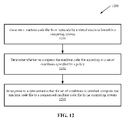
- FIG 12 is a flow diagram illustrating a method 1200 for policy-based machine code file compression according to one implementation.
- the method 1200 may be performed by a computing system, such as the computing system 200 of Figure 2 , or the computing system 300 of Figure 3 .
- the method 1200 starts when a VM hosted in a computing system generates a machine code file from bytecode at step 1201.
- the computing system determines, at step 1201, whether to compress the machine code file according to a set of conditions specified by a policy.
- the machine code file is compressed to a compressed machine code file in the computing system at step 1203.
Landscapes
- Engineering & Computer Science (AREA)
- Software Systems (AREA)
- Theoretical Computer Science (AREA)
- General Engineering & Computer Science (AREA)
- Physics & Mathematics (AREA)
- General Physics & Mathematics (AREA)
- Stored Programmes (AREA)
Abstract
Description
- This application claims the benefit of
U.S. Provisional Application No. 62/186,144 filed on June 29, 2015 U.S. Patent Application No. 14/960,644 filed on 7 December 2015 - Implementations of the disclosure relate to software management in a computing system that hosts a virtual machine.
- A virtual machine (VM) is a software emulating implementation of a machine (e.g., a computer) for executing high level programs. A VM provides a platform-independent programming environment that abstracts away details of the underlying hardware or operating system (OS), and allows a high level program to execute in the same way on any platform. One type of VM, sometimes called a Managed Runtime Environment (MRE), runs on top of a host OS to provide an emulation environment for a single process. For VM emulating, high level program (e.g., JAVA) is compiled into a specific bytecode format. To execute on a real hardware machine (e.g., ARM processors, x86 processors, etc.), the bytecode is either compiled or interpreted by a VM to executable machine code.
- Android is a commonly-used mobile framework based on the Linux kernel. Android Runtime (ART) is the VM used by some applications and system services in Android. ART as the runtime executes its bytecode in the Dalvik Executable (DEX) format to generate machine code for the target device. A DEX file (.dex) holds a set of class definitions and their associated data. The predecessor of ART, Dalvik, had evolved over the years from a runtime interpreter into a Just-in-Time (JIT) compiler. During the application runtime, the JIT compiler generates and caches a subset of the executable machine code that was executed most frequently. A more recent version of Dalvik performs runtime verification and optimization by converting a DEX file into an optimized DEX file (.odex). By contrast, ART introduces the use of ahead-of-time (AOT) compilation by statistically pre-compiling an application into native machine code upon its first installation, first booting or first launching. Compared to Dalvik, ART improves the overall execution efficiency and reduces power consumption, which results in improved battery autonomy on mobile devices. At the same time, ART brings faster execution of applications, improved memory allocation and garbage collection (GC) mechanisms, new applications debugging features, and more accurate high-level profiling of applications.
- ART pre-compiles an application into native machine code by using an on-device utility called dex2oat. This utility accepts an application package with DEX files as input and generates a compiled machine code file executable by the target device. The machine code file is native binary code for a specific hardware processor, and is formatted as Executable and Linkable Format (ELF). For ART, its filename has oat as the postfix.
- However, the computing time for dex2oat is non-negligible, especially when the system boots for the first time or when an application is installed for the first time. Furthermore, the resulting machine code (ELF file) takes a significantly larger amount of storage space (e.g., 2-3 times more per application) than a DEX bytecode file. Thus, providing ART on low-cost devices with small storage, such as typical mobile devices, remains a challenge to hardware and software developers.
- In one implementation, a method is provided for policy-based compression of a machine code file. The method comprises the steps of: generating the machine code file from bytecode by a virtual machine hosted in a computing system; determining whether to compress the machine code file according to a set of conditions specified by a policy; and in response to a determination that the set of conditions is satisfied, compressing the machine code file to a compressed machine code file in the computing system.
- In one implementation, a computing system is provided for policy-based compression of a machine code file. The system comprises one or more processors; a (volatile) memory; a (non-volatile) storage; and an interconnect coupled to the memory and the one or more processors. The one or more processors are adapted to: generate the machine code file from bytecode by a virtual machine hosted in the computing system; determine whether to compress the machine code file according to a set of conditions specified by a policy; and in response to a determination that the set of conditions is satisfied, compress the machine code file to a compressed machine code file in the computing system.
- In some implementations, for system booting and package installation, the machine code file can be deleted to save storage. When launching an application, the compressed machine code file is decompressed for execution. When the application process terminates, the decompressed machine code file can be deleted. The machine code file compression and deletion can be performed on a mobile device to save its storage space, or on a host to reduce a system image size for decreasing the download time. Parallel file compression and decompression algorithms can be used for compressing and decompressing the machine code file in a multi-core computing system to speed up the time of system booting, the application installation, and the application launching. Alternatively, compression and decompression algorithms can be performed by an additional compression circuitry.
- The present disclosure is illustrated by way of example, and not by way of limitation, in the figures of the accompanying drawings in which like references indicate similar elements. It should be noted that different references to "an" or "one" implementation in this disclosure are not necessarily to the same implementation, and such references mean at least one. Further, when a particular feature, structure, or characteristic is described in connection with an implementation, it is submitted that it is within the knowledge of one skilled in the art to effect such feature, structure, or characteristic in connection with other implementations whether or not explicitly described.
-
Figure 1 illustrates Android software architecture according to one implementation. -
Figure 2 illustrates a computing system according to one implementation. -
Figure 3 illustrates a computing system according to another implementation. -
Figure 4 is a flow diagram providing an overview of a method for policy-based compression of machine code according to one implementation. -
Figure 5 is a flow diagram illustrating a method for policy-based compression of machine code during system booting or package installation, according to one implementation. -
Figure 6 illustrates a system booting process according to one implementation. -
Figure 7 illustrates a package installation process according to one implementation. -
Figure 8 is a flow diagram illustrating a method for policy-based compression of machine code when launching an application according to one implementation. -
Figure 9 illustrates an application launching process according to one implementation. -
Figure 10 is a flow diagram illustrating a method for policy-based compression of machine code when an application process terminates according to one implementation. -
Figure 11 illustrates a system image building process according to one implementation. -
Figure 12 is a flow diagram illustrating a method for policy-based compression of machine code according to one implementation. - In the following description, numerous specific details are set forth. However, it is understood that implementations of the disclosure may be practiced without these specific details. In other instances, well-known circuits, structures and techniques have not been shown in detail in order not to obscure the understanding of this description. It will be appreciated, however, by one skilled in the art, that the disclosure may be practiced without such specific details. Those of ordinary skill in the art, with the included descriptions, will be able to implement appropriate functionality without undue experimentation.
- Implementations of the disclosure provide a method and system for policy-based compression of machine code generated by a VM. In one implementation, the method is performed by a mobile device system to save its storage space and to speed up system performance when booting the system, installing a package, launching an application, or other system events. The method can also be performed by a host computing system, e.g., when building a system image, to reduce the system image size for faster download time, such as download by flash tools or over-the-air (OTA) download. The system determines whether to compress a compiled machine code file based on a policy that specifies a set of one or more conditions. The machine code file is compressed if the set of conditions is satisfied. In some implementations, after the machine code file is compressed and saved in the storage, the original machine code file (that was compiled from the bytecode before compression) can be deleted for saving storage. When launching an application, if a compressed machine code file exists, the compressed machine code file is decompressed into a machine code file for execution. When the application process terminates (e.g., stopped by a user or killed by the system), the decompressed machine code file can be deleted from the system to save its storage space.
- In some implementations, the compression and decompression may be executed according to a parallel compression algorithm by multiple cores of a multi-core processor, or by special-purpose compression/decompression hardware, to reduce the time required for system booting, package installation, application launching, system image building and other system events.
- In the following description, the policy-based compression is described in the context of Android software. It should be understood, however, the policy-based compression may be implemented in any software environment that provides virtual machines for bytecode to machine code translation or compilation. Furthermore, although specific bytecode and machine code file formats, programming languages and utilities are mentioned in the following description, it is understood that the policy-based compression may apply to any bytecode and machine code file formats, programming languages and utilities. In some parts of the following description, Java application programming language and its related software framework are used as examples; however, it is understood that the policy-based compression may be applied to machine code generated by virtual machines that are based on another programming language different from Java.
-
Figure 1 illustratesAndroid software architecture 100 according to one implementation. Thearchitecture 100 consists of five layers. (1) Kernel 110 (e.g., a Linux kernel), which is responsible for basic system functionalities, such as process management, memory management, power management, resource access, and device drivers. (2)Libraries 120, which provide a set of native libraries written in C or C++ programming languages, including libc, SQLite, WebKit, etc. In one implementation, thelibraries 120 includecompression module 180 that may be used for compression and decompression of the machine code file. (3)Android Runtime 130, which is a VM with core libraries to execute application programs (e.g., Java code). In addition, it provides anenhanced dex2oat tool 650 for generating the machine code file from its DEX bytecode. (4)Android framework 140, which provides higher-level services to applications by Java classes and interfaces. Examples of the services include, but are not limited to, Package Manager Service (PMS) 141 and Activity Manger Service (AMS) 142. Specifically,PMS 141 is responsible for managing, installing and un-installing application packages, andAMS 142 is responsible for managing all activities for interacting with users. (5)Applications 150, which are programs in high-level programming languages (e.g., Java). - With respect to the
Applications 150, typically theApplications 150 are distributed and installed as Android application packages with a package file format .apk. A package includes Java programs and necessary files with compression, e.g., in a zip format. In general, a package (.apk file) includes classes.dex, which is Dalvik bytecode containing compiled .class files; AndroidManifest.xml, which is a binary file containing package information; resources.arsc, which contains a compiled resource file; a directory Res\, which contains uncompiled resource files; and a directory META-INF\, which is used to certify an application for .apk completeness and security. - In one implementation, for the policy-based compression of machine code, the
Android software architecture 100 includes theenhanced dex2oat tool 650 with policy-based compression inAndroid Runtime 130 andcompression module 180 inLibraries 120.Compression module 180 can be used to compress and decompress machine code files. Although thecompression module 180 is shown inFigure 1 as part of thelibraries 120, in alternative implementations thecompression module 180 may be in a different layer of thearchitecture 100. For the policy-based compression of machine code, thecompression module 180 may be invoked when a set of one or more conditions is satisfied, where the set of conditions is specified in a policy inenhanced dex2oat 650. Examples of the conditions include, but are not limited to: the machine code file is not from a specific system package, the machine code file is not from a frequently-used (i.e., exceeding a predetermined frequency threshold) application package, the package filename matches any name in a specific name list, the package filename matches a keyword in a specific keyword list, the package filename is not in a white list, the package filename is in a black list, whether this application package is predicted to be not used immediately after installation (i.e., not used within a predetermined time period), etc. For example, according to one policy, the machine code file is compressed if its package filename is in a black list and is not from a frequently-used application package; according to another policy, the machine code is not compressed if the package filename contains the keyword "android" (which is an indication of frequent usage). A policy may specify a combination of any number of the above conditions. - In one implementation, the same policy with the same set of conditions may be used for different system events such as system booting, package installation, application launching, application process termination and system image building. In alternative implementations, policies with different sets of conditions may be used for these different events. In yet alternative implementations, some of the events may use the same policy with the same set of conditions, while some others of the events may use policies with different sets of conditions.
- In one implementation, the
compression module 180 may be called by an enhanced bytecode compilation tool, which is used inART Runtime 130 to perform not only bytecode to machine code translation but also the policy-based compression of machine code file. An example of the enhanced translation tool in Android is theenhanced dex2oat tool 650, which will be described in further detail below. -
Figure 2 illustrates acomputing system 200 that performs the policy-based compression according to one implementation. Thecomputing system 200 includes one or more processors 210 (also referred to as central processing units (CPUs)), and each processor includes one ormore cores 212. Thecomputing system 200 may be part of a mobile device or a host computer. Eachcore 212 executes machine code. In one implementation, each core 212 hosts one or more VMs for executing applications in a software emulation environment, such as theAndroid software architecture 100 shown inFigure 1 . Thecomputing system 200 further includes a volatile memory 230 (e.g., dynamic random-access memory (DRAM)) for storing code and data, which can be fast accessed during code execution. Thecomputing system 200 further includes a non-volatile storage 250 (e.g., flash storage, a magnetic data storage device, an optical magnetic data storage device, etc.) for storing the system image, application packages (e.g., .apk files), data-cache files, etc. Thecomputing system 200 also includes an interconnect 240 (also referred to as a "bus" in some systems) to interconnect theprocessors 210, thememory 230 and thestorage 250. In some implementations, thecomputing system 200 also includes peripheral devices such as a display, a camera, a modem, a network interface, etc. In one implementation, one ormore cores 212 of thecomputing system 200 perform the policy-based compression of machine code as will be described in detail in connection withFigures 4-12 . -
Figure 3 illustrates acomputing system 300 that performs the policy-based compression according to another implementation. In addition to the one ormore processors 210, thememory 230, thestorage 250 and theinterconnect 240 that are shown inFigure 2 , thecomputing system 300 also include special-purpose compression circuitry 310 for compression and decompression. In one implementation, thecompression circuitry 310 may be one or more coprocessors (e.g., Single-Instruction-Multiple-Data (SIMD) processors such as ARM® NEON), graphic processing units (GPUs), or an Application-Specific Integrated Circuit (ASIC). In one implementation, thecompression circuitry 310 may be used for performing the policy-based machine code file compression as will be described in detail in connection withFigures 4-12 . - In one implementation, each of the
computing systems computing systems - In one implementation, the
compression module 180 ofFigure 1 , as well as thecompression circuitry 310 ofFigure 3 , may perform machine code file compression and decompression according to a file compression algorithm. Different file compression algorithms have different compression rates (i.e., the ratio of compressed file size vs. original file size), compression speed, and decompression speed. Examples of general compression algorithms include, but are not limited to: GZIP, ZIP, BZIP2, LZMA, LZH, etc. These general algorithms are typically slow in decompression and compression speed. Alternatively, parallel algorithms for multi-core processors, e.g., PIGZ (which is a parallel implementation of gzip for multiple cores), LBZIP2, PBZIP2, PLZIP, P7ZIP, etc. These parallel algorithms of compression and decompression typically have faster speed than the general algorithms in a multi-core processor environment, such as thecomputing system 200 ofFigure 2 and thecomputing system 300 ofFigure 3 . -
Figure 4 is a flow diagram providing an overview of amethod 400 for policy-based compression of machine code according to one implementation. Themethod 400 may be performed by a computing system, such as thecomputing system 200 ofFigure 2 , or thecomputing system 300 ofFigure 3 . Themethod 400 starts withstep 401 at which the computing system retrieves bytecode from an application package. Atstep 402, the computing system compiles (i.e., translates) the bytecode to machine code. In one implementation, the bytecode compilation is performed by a VM hosted in the computing system. Atstep 403, the computing system writes the machine code into an ELF file in storage. In short, fromsteps 401 to 403, the ELF file for machine code is generated from bytecode by a VM hosted in a computing system. Taking ART as example, these steps of the prior art are performed by an original dex2oat tool. Atstep 404, the computing system determines whether a set of one or more conditions specified in a policy is satisfied. If satisfied, the ELF file of the machine code is compressed into a compressed file atstep 405 and themethod 400 ends. If the set of one or more conditions specified in the policy is not satisfied, themethod 400 ends without the compression. - After the compression of the machine code file, the original (i.e., uncompressed) machine code file may be deleted if the
method 400 is invoked for certain events, such as system booting or package installation. Thus, the original machine code file can be deleted to save storage space, and the compressed machine code file is stored for future use. It is noted that, the original machine code file may be kept in storage without being deleted for the special case that it is known or predicted that the machine code execution is immediate (e.g., within a predetermined time period) or frequent (i.e., above a predetermined frequency threshold), such as when an application is just installed for launching. It is understood that other events not mentioned herein may also cause the original machine code file to be deleted, or to be kept in storage. -
Figure 5 is a flow diagram illustrating amethod 500 for policy-based compression of machine code during system booting or package installation, according to one implementation. Themethod 500 may be performed by a computing system, such as thecomputing system 200 ofFigure 2 , or thecomputing system 300 ofFigure 3 . Themethod 500 includes steps 501-505 that are the same as steps 401-405 of themethod 400 ofFigure 4 , respectively. Atstep 504, it is determined whether one or more conditions specified in a policy are satisfied. If not, themethod 500 ends. If the one or more conditions specified in the policy are satisfied atstep 504, themethod 500 additionally includesstep 506 afterstep 505, which deletes the ELF file of the machine code after the compression. -
Figure 6 illustrates a system booting process 600 that performs themethod 500 according to one implementation. The process 600 utilizes anenhanced dex2oat tool 650 to perform bytecode to machine code compilation and policy-based compression of machine code during system booting in Android. When booting the system, asystem server 610 issues StartBootstrapServices command 611 to PMS 141 (Figure 1 ).PMS 141 then invokes PackageManagerService()function 621, which in turn calls a sequence of functions, such as scanDirLI() 622, scanPackageLI() 623 and performDexOptLI() 624. For performDexOptLI() 624,PMS 141 checks whether it is necessary to optimize the bytecode file (e.g., IsDexOptNeeded()) atstep 625. If it is not necessary, then no optimization is performed. If it is necessary to perform the optimization,PMS 141 calls dexopt() 626 toInstaller 630. Next,Installer 630 performs do_dexopt() 631 to Installd 640 (a daemon running in the background). - Then,
Installd 640 invokes dex2oat 641 toenhanced dex2oat 650 if the runtime environment is ART. Finally, theenhanced dex2oat 650 performs themethod 500 described inFigure 5 .Figure 7 illustrates a package installation process 700 that also performs themethod 500 according to one implementation. The process 700 also utilizes theenhanced dex2oat tool 650 to perform bytecode to machine code compilation and policy-based machine code file compression during package installation in Android. When installing a package installation, PMS 141 (Figure 1 ) calls a sequence of functions, such as installPackage() 711, scanPackageLI() 712 and performDexOptLI() 713. For performDexOptLI() 713,PMS 141 checks whether it is necessary to optimize the bytecode file (e.g., IsDexOptNeeded()) at step 714. If it is not necessary, then no optimization is performed. If it is necessary to perform the optimization,PMS 141 calls dexopt() 715 toInstaller 630 perform. Next,Installer 630 performs do_dexopt() 731 toInstalld 640. Then,Installd 640 invokes dex2oat 741 toenhanced dex2oat 650 if the runtime environment is ART. Then the bytecode file is translated into a machine code file (e.g., in the .oat format) by invoking dex2oat 741. Finally, theenhanced dex2oat 650 performs themethod 500 described inFigure 5 . -
Figure 8 is a flow diagram illustrating amethod 800 for policy-based machine code file compression when launching an application according to one implementation. Themethod 800 may be performed by a computing system, such as thecomputing system 200 ofFigure 2 , or thecomputing system 300 ofFigure 3 . Themethod 800 starts with the computing system checking its storage whether a compressed ELF file for the application is available atstep 811. If it is available, the compressed ELF file is decompressed for launching atstep 812. If it is not available, the computing system performs themethod 400 ofFigure 4 . In one implementation, themethod 800 is performed when an application was installed a while ago; e.g., N minutes ago, where N is a predetermined number. For an application that was installed recently (e.g., within the last N minutes), this application can be launched directly without themethod 800 being performed. - More specifically, if a compressed ELF file for the application is not available, the computing system retrieves bytecode from an application package at
step 801. Atstep 802, the computing system compiles (i.e., translates) the bytecode to machine code. In one implementation, the bytecode compilation is performed by a VM hosted in the computing system. Atstep 803, the computing system writes the machine code into an ELF file in storage. Atstep 804, the computing system determines whether a set of one or more conditions specified in a policy is satisfied. If satisfied, the ELF file of the machine code is compressed into a compressed file atstep 805 and themethod 800 ends. If the set of one or more conditions specified in the policy is not satisfied, themethod 800 ends without the compression. -
Figure 9 illustrates a process 900 that performs themethod 800 according to one implementation. The process 900 also utilizes theenhanced dex2oat tool 650 to perform bytecode to machine code compilation and policy-based compression of machine code when launching an application in Android. When launching an application,Launcher 910 initiates startActivity() 911 toActivity 920.Activity 920 calls the startActivity()function 921. Next, AMS 142 (Figure 1 ) calls a sequence of functions, such as startActivity() 931, startProcessLocked() 932 and attachApplication() 933.AMS 142 also invokes ensurePackageDexOpt() 934, which causesPMS 141 to invoke performDexOptLI() 941. Then,PMS 141 checks its storage whether a compressed ELF file for the application is available atsteps 811. If it is available, the compressed ELF file is decompressed for launching atstep 812. If it is not available, the computing system performs thestep 942. -
PMS 141 further checks whether it is necessary to optimize the bytecode file (e.g., IsDexOptNeeded()) atstep 942. If it is not necessary, then no optimization is performed. If it is necessary to perform the optimization,PMS 141 calls dexopt() 943 toInstaller 630. Next,Installer 630 performs do_dexopt() 951 toInstalld 640. Then,Installd 640 invokes dex2oat 961 toenhanced dex2oat 650 if the runtime environment is ART. Finally, theenhanced dex2oat 650 performs themethod 400 described inFigure 4 , which includes the same steps as steps 801-805 of themethod 800 inFigure 8 . -
Figure 10 is a flow diagram illustrating amethod 1000 for policy-based compression of machine code when an application process terminates according to one implementation. Themethod 1000 may be performed by a computing system, such as thecomputing system 200 ofFigure 2 , or thecomputing system 300 ofFigure 3 . Themethod 1000 for an application process termination is performed after the application is launched according to themethod 800 ofFigure 8 . - In one implementation, the
method 1000 starts when the application process terminates (e.g., when the application is stopped by a user or killed by the system) atstep 1001. Atstep 1002, the process resources (e.g., memory, I/O, etc.) are released. At step 1003, the computing system determines whether a set of one or more conditions of a predetermined policy is satisfied. If satisfied, the decompressed machine code file is deleted atstep 1004 and themethod 1000 ends. - If the set of one or more conditions is not satisfied, the
method 1000 ends without deleting the decompressed machine code file. In one implementation, the policy used inmethod 1000 may contain a combination of any of the aforementioned conditions, and may additionally include a prediction of whether the decompressed machine code will be immediately used again (i.e., within a predetermined time period). - The methods and processes of
Figure 5-10 describe policy-based compression of machine code typically performed on a mobile device. The policy-based compression of machine code may also be implemented on a host computer (e.g., a server computer); e.g., for building a system image. In one implementation, themethod 400 described inFigure 4 may be used by a host computer to compress a set of machine code files selected to form a system image for downloading to a device (e.g., a mobile device). By compressing the selected machine code files in the system image ahead of time, the total size of the system image is reduced. The compression improves the download time by a flash tool or by OTA technologies. For OTA, the compression further saves the download bandwidth of radio resource. -
Figure 11 illustrates a system image building process 1100 that performs themethod 400 according to one implementation for building a system image on a host. The process 1100 utilizes the enhanced dex2oat tool to perform bytecode to machine code compilation and policy-based machine code file compression when building a system image in Android. - The process 1100 starts when Package_internal.mk 1110 is invoked to perform dexpreopt-one-
file 1111. For ART, this causes dex_preopt.mk 1120 to perform dex2oat-one-file 1121. Next, this invokes dex_preopt_libART.mk 1130 to call dex2oat() 1131. Finally, theenhanced dex2oat 650 performs themethod 400 described inFigure 4 . -
Figure 12 is a flow diagram illustrating amethod 1200 for policy-based machine code file compression according to one implementation. Themethod 1200 may be performed by a computing system, such as thecomputing system 200 ofFigure 2 , or thecomputing system 300 ofFigure 3 . Themethod 1200 starts when a VM hosted in a computing system generates a machine code file from bytecode atstep 1201. The computing system then determines, atstep 1201, whether to compress the machine code file according to a set of conditions specified by a policy. In response to a determination that the set of conditions is satisfied, the machine code file is compressed to a compressed machine code file in the computing system atstep 1203. - It is to be understood that the above description is intended to be illustrative, and not restrictive. Many other implementations will be apparent to those of skill in the art upon reading and understanding the above description. Although the present disclosure has been described with reference to specific exemplary implementations, it will be recognized that the disclosure is not limited to the implementations described, but can be practiced with modification and alteration within the scope of the appended claims. Accordingly, the specification and drawings are to be regarded in an illustrative sense rather than a restrictive sense. The scope of the disclosure should, therefore, be determined with reference to the appended claims, along with the full scope of equivalents to which such claims are entitled.
-
- 1. A method for policy-based compression of a machine code file, comprising the steps of:
- generating the machine code file from bytecode by a virtual machine hosted in a computing system;
- determining whether to compress the machine code file according to a set of conditions specified by a policy; and
- in response to a determination that the set of conditions is satisfied, compressing the machine code file to a compressed machine code file in the computing system.
- 2. The method of
clause 1, wherein compressing the machine code file further comprises the step of:- deleting the machine code file from the computing system when booting the computing system.
- 3. The method of
clause 1, wherein compressing the machine code file further comprises the step of:- deleting the machine code file from the computing system when installing an application package.
- 4. The method of
clause 1, further comprising:- determining whether the compressed machine code file is stored in the computing system when launching an application; and
- decompressing the compressed machine code file into the machine code for execution in response to a determination that the compressed machine code file is stored in the computing system.
- 5. The method of clause 4, further comprising:
- in response to a determination that the compressed machine code file is not stored in the computing system, retrieving the bytecode of the application from an application package before the step of generating the machine code.
- 6. The method of clause 4, wherein decompressing the machine code file further comprises:
- decompressing the compressed machine code file by multiple cores of the computing system in parallel according to the parallel decompression algorithm.
- 7. The method of
clause 1, further comprising:- detecting when an application process terminates;
- determining whether to delete a decompressed machine code file of the application according to a second set of one or more conditions specified by a second policy; and
- in response to a determination that the second set of one or more conditions is satisfied, deleting the decompressed machine code file in the computing system.
- 8. The method of
clause 1, wherein the computing system is a host computer, the method further comprising:- selecting the compressed file as part of a system image for downloading to mobile devices.
- 9. The method of
clause 1, wherein the policy specifies the set of conditions including one or more of the following:- the machine code file is not from a specific system package, the machine code file is not from a frequently-used application package, the system package filename or the application package filename does not match any name in a specific name list, the package filename does not match a keyword in a specific keyword list, the package filename is not in a white list, the package filename is in a black list, the application package is predicted to be not used immediately after installation.
- 10. The method of
clause 1, wherein compressing the machine code file further comprises:- compressing the machine code file by multiple cores of the computing system in parallel according to a parallel compression algorithm; and
- decompressing the compressed machine code file by the multiple cores of the computing system in parallel according to the parallel compression algorithm.
- 11. The method of
clause 1, wherein the computing system is in a mobile device and the step of determining is performed during one or more of the following events: system booting, package installation and application launching. - 12. A computing system for policy-based compression of a machine code file, comprising:
- a memory;
- one or more processors; and
- an interconnect coupled to the memory and the one or more processors,
- generate the machine code file from bytecode by a virtual machine hosted in the computing system;
- determine whether to compress the machine code file according to a set of conditions specified by a policy; and
- in response to a determination that the set of conditions is satisfied, compress the machine code file to a compressed machine code file in the computing system.
- 13. The computing system of clause 12, wherein the one or more processors are further adapted to:
- delete the machine code file from the computing system after compressing the machine code file when booting the computing system.
- 14. The computing system of clause 12, wherein the one or more processors are further adapted to:
- delete the machine code file from the computing system after compressing the machine code file when installing an application package from which the bytecode is retrieved.
- 15. The computing system of clause 12, wherein the one or more processors are further adapted to:
- determine whether the compressed machine code file is stored in the computing system when launching an application; and
- decompress the compressed machine code file into the machine code for execution in response to a determination that the compressed machine code file is stored in the computing system.
- 16. The computing system of clause 15, wherein the one or more processors are further adapted to:
- decompress the compressed machine code file by multiple cores of the computing system in parallel according to the parallel decompression algorithm.
- 17. The computing system of clause 15, wherein the one or more processors are further adapted to:
- in response to a determination that the compressed machine code file is not stored in the computing system, retrieve the bytecode of the application from an application package before generating the machine code.
- 18. The computing system of clause 12, wherein the one or more processors are further adapted to:
- detect when a process of an application terminates,
- determine whether to delete a decompressed machine code file of the application according to a second set of one or more conditions specified by a second policy; and
- in response to a determination that the second set of one or more conditions is satisfied, deleting the decompressed machine code file in the computing system.
- 19. The computing system of clause 12, wherein the computing system is a host computer, the one or more processors are further adapted to select the machine code file to be part of a system image for downloading to mobile devices.
- 20. The computing system of clause 12, wherein the policy specifies the set of conditions including one or more of the following:
- the machine code file is not from a specific system package, the machine code file is not from a frequently-used application package, the system package filename or the application package filename does not match any name in a specific name list, the package filename does not match a keyword in a specific keyword list, the package filename is not in a white list, the package filename is in a black list, the application package is predicted to be not used immediately after installation.
- 21. The computing system of clause 12, further comprising multiple cores in the one or more processors, the multiple cores adapted to:
- compress the machine code file in parallel according to a parallel compression algorithm; and
- decompress the compressed machine code file in parallel according to the parallel compression algorithm.
- 22. The computing system of clause 12, wherein the computing system is in a mobile device, which determines whether to compress the machine code file during one or more of the following events: system booting, package installation and application launching.
- 23. The computing system of clause 12, further comprising:
- special-purpose compression circuitry coupled to the interconnect to compress the machine code file.
Claims (15)
- A method for policy-based compression of a machine code file, comprising the steps of:generating the machine code file from bytecode by a virtual machine hosted in a computing system;determining whether to compress the machine code file according to a set of conditions specified by a policy; andin response to a determination that the set of conditions is satisfied, compressing the machine code file to a compressed machine code file in the computing system.
- The method of claim 1, wherein compressing the machine code file further comprises the step of:deleting the machine code file from the computing system when booting the computing system.
- The method of claim 1, wherein compressing the machine code file further comprises the step of:deleting the machine code file from the computing system when installing an application package.
- The method of claim 1, further comprising:determining whether the compressed machine code file is stored in the computing system when launching an application; anddecompressing the compressed machine code file into the machine code for execution in response to a determination that the compressed machine code file is stored in the computing system.
- The method of claim 4, further comprising:in response to a determination that the compressed machine code file is not stored in the computing system, retrieving the bytecode of the application from an application package before the step of generating the machine code.
- The method of any one of the preceding claims, further comprising:detecting when an application process terminates;determining whether to delete a decompressed machine code file of the application according to a second set of one or more conditions specified by a second policy; andin response to a determination that the second set of one or more conditions is satisfied, deleting the decompressed machine code file in the computing system.
- The method of any one of the preceding claims, wherein the computing system is a host computer, the method further comprising:selecting the compressed file as part of a system image for downloading to mobile devices.
- The method of any one of the preceding claims, wherein the policy specifies the set of conditions including one or more of the following:the machine code file is not from a specific system package, the machine code file is not from a frequently-used application package, the system package filename or the application package filename does not match any name in a specific name list, the package filename does not match a keyword in a specific keyword list, the package filename is not in a white list, the package filename is in a black list, the application package is predicted to be not used immediately after installation.
- A computing system for policy-based compression of a machine code file, comprising:a memory;one or more processors; andan interconnect coupled to the memory and the one or more processors,wherein the one or more processors are adapted to:generate the machine code file from bytecode by a virtual machine hosted in the computing system;determine whether to compress the machine code file according to a set of conditions specified by a policy; andin response to a determination that the set of conditions is satisfied, compress the machine code file to a compressed machine code file in the computing system.
- The computing system of claim 9, wherein the one or more processors are further adapted to:delete the machine code file from the computing system after compressing the machine code file when booting the computing system.
- The computing system of claim 9, wherein the one or more processors are further adapted to:delete the machine code file from the computing system after compressing the machine code file when installing an application package from which the bytecode is retrieved.
- The computing system of claim 9, wherein the one or more processors are further adapted to:determine whether the compressed machine code file is stored in the computing system when launching an application; anddecompress the compressed machine code file into the machine code for execution in response to a determination that the compressed machine code file is stored in the computing system.
- The computing system of claim 12, wherein the one or more processors are further adapted to:in response to a determination that the compressed machine code file is not stored in the computing system, retrieve the bytecode of the application from an application package before generating the machine code.
- The computing system of any one of claims 9 to 13, wherein the computing system is a host computer, the one or more processors are further adapted to select the machine code file to be part of a system image for downloading to mobile devices.
- The computing system of any one of claims 9 to 14, wherein the policy specifies the set of conditions including one or more of the following:the machine code file is not from a specific system package, the machine code file is not from a frequently-used application package, the system package filename or the application package filename does not match any name in a specific name list, the package filename does not match a keyword in a specific keyword list, the package filename is not in a white list, the package filename is in a black list, the application package is predicted to be not used immediately after installation.
Applications Claiming Priority (2)
| Application Number | Priority Date | Filing Date | Title |
|---|---|---|---|
| US201562186144P | 2015-06-29 | 2015-06-29 | |
| US14/960,644 US20160378452A1 (en) | 2015-06-29 | 2015-12-07 | Policy-Based Compression of Machine Code Generated by a Virtual Machine |
Publications (1)
| Publication Number | Publication Date |
|---|---|
| EP3113019A1 true EP3113019A1 (en) | 2017-01-04 |
Family
ID=55527839
Family Applications (1)
| Application Number | Title | Priority Date | Filing Date |
|---|---|---|---|
| EP16159751.3A Withdrawn EP3113019A1 (en) | 2015-06-29 | 2016-03-10 | Policy-based compression of machine code generated by a virtual machine |
Country Status (3)
| Country | Link |
|---|---|
| US (1) | US20160378452A1 (en) |
| EP (1) | EP3113019A1 (en) |
| CN (1) | CN106293870A (en) |
Cited By (1)
| Publication number | Priority date | Publication date | Assignee | Title |
|---|---|---|---|---|
| EP3404538A4 (en) * | 2016-01-26 | 2019-04-17 | Huawei Technologies Co., Ltd. | METHOD OF PROCESSING DATA AND APPARATUS FOR PROCESSING DATA |
Families Citing this family (6)
| Publication number | Priority date | Publication date | Assignee | Title |
|---|---|---|---|---|
| CN108279941B (en) | 2016-12-31 | 2021-06-15 | 阿里巴巴集团控股有限公司 | An application program compression method and device |
| CN106970824B (en) * | 2017-03-07 | 2019-12-17 | 华中科技大学 | A bandwidth-aware virtual machine migration compression method and system |
| CN107357656B (en) * | 2017-06-27 | 2020-10-27 | 海南飞特同创科技有限公司 | Memory allocation method, mobile terminal and computer readable storage medium |
| CN112835975B (en) * | 2020-06-05 | 2023-09-29 | 支付宝(杭州)信息技术有限公司 | A method to deploy, update, and call smart contracts in the blockchain |
| CN112612518B (en) * | 2020-12-08 | 2022-04-01 | 麒麟软件有限公司 | Network checksum algorithm optimization method based on Feiteng platform |
| CN114924845A (en) * | 2022-07-21 | 2022-08-19 | 合肥中科类脑智能技术有限公司 | Mirror image delay loading method and system suitable for edge AI scene |
Citations (1)
| Publication number | Priority date | Publication date | Assignee | Title |
|---|---|---|---|---|
| EP2487583A1 (en) * | 2010-11-23 | 2012-08-15 | Samsung Electronics Co., Ltd. | Booting apparatus and method using snapshot image |
Family Cites Families (17)
| Publication number | Priority date | Publication date | Assignee | Title |
|---|---|---|---|---|
| US6151618A (en) * | 1995-12-04 | 2000-11-21 | Microsoft Corporation | Safe general purpose virtual machine computing system |
| US6324685B1 (en) * | 1998-03-18 | 2001-11-27 | Becomm Corporation | Applet server that provides applets in various forms |
| US6819271B2 (en) * | 1999-01-29 | 2004-11-16 | Quickshift, Inc. | Parallel compression and decompression system and method having multiple parallel compression and decompression engines |
| US7185081B1 (en) * | 1999-04-30 | 2007-02-27 | Pmc-Sierra, Inc. | Method and apparatus for programmable lexical packet classifier |
| US7360073B1 (en) * | 2003-05-15 | 2008-04-15 | Pointsec Mobile Technologies, Llc | Method and apparatus for providing a secure boot for a computer system |
| GB0513432D0 (en) * | 2005-06-30 | 2005-08-10 | Nokia Corp | Signal message compression |
| US7561081B2 (en) * | 2006-07-12 | 2009-07-14 | Qualcomm Incorporated | Method and apparatus for optimization of SigComp UDVM performance |
| US8533687B1 (en) * | 2009-11-30 | 2013-09-10 | dynaTrade Software GmbH | Methods and system for global real-time transaction tracing |
| US20080115125A1 (en) * | 2006-11-13 | 2008-05-15 | Cingular Wireless Ii, Llc | Optimizing static dictionary usage for signal compression and for hypertext transfer protocol compression in a wireless network |
| US7796592B2 (en) * | 2006-11-13 | 2010-09-14 | At&T Mobility Ii Llc | Optimizing static dictionary usage for signal, hypertext transfer protocol and bytecode compression in a wireless network |
| US9025898B2 (en) * | 2009-04-06 | 2015-05-05 | Red Hat Israel, Ltd. | Dynamically selecting compression method for graphics remoting |
| US20100262797A1 (en) * | 2009-04-10 | 2010-10-14 | PHD Virtual Technologies | Virtual machine data backup |
| US8694685B2 (en) * | 2011-02-25 | 2014-04-08 | International Business Machines Corporation | Migrating virtual machines with adaptive compression |
| US9183205B1 (en) * | 2012-10-05 | 2015-11-10 | Symantec Corporation | User-based backup |
| US9083977B2 (en) * | 2012-11-27 | 2015-07-14 | Omnivision Technologies, Inc. | System and method for randomly accessing compressed data from memory |
| CN103607571B (en) * | 2013-11-22 | 2016-08-17 | 吉林大学 | Android phone is used to realize remote video monitoring and cloud platform control method |
| US9916320B2 (en) * | 2015-04-26 | 2018-03-13 | International Business Machines Corporation | Compression-based filtering for deduplication |
-
2015
- 2015-12-07 US US14/960,644 patent/US20160378452A1/en not_active Abandoned
-
2016
- 2016-03-10 EP EP16159751.3A patent/EP3113019A1/en not_active Withdrawn
- 2016-03-24 CN CN201610171954.8A patent/CN106293870A/en not_active Withdrawn
Patent Citations (1)
| Publication number | Priority date | Publication date | Assignee | Title |
|---|---|---|---|---|
| EP2487583A1 (en) * | 2010-11-23 | 2012-08-15 | Samsung Electronics Co., Ltd. | Booting apparatus and method using snapshot image |
Non-Patent Citations (2)
| Title |
|---|
| DAVID GRIFFITH: "How Android Apps are Built and Run . dogriffiths/HeadFirstAndroid Wiki . GitHub", 18 April 2015 (2015-04-18), XP055320177, Retrieved from the Internet <URL:https://github.com/dogriffiths/HeadFirstAndroid/wiki/How-Android-Apps-are-Built-and-Run> [retrieved on 20161116] * |
| SAUMYA DEBRAY ET AL: "Profile-guided code compression", ACM SIGPLAN NOTICES, ACM, 2 PENN PLAZA, SUITE 701 NEW YORK NY 10121-0701 USA, vol. 37, no. 5, 17 May 2002 (2002-05-17), pages 95 - 105, XP058127983, ISSN: 0362-1340, DOI: 10.1145/543552.512542 * |
Cited By (2)
| Publication number | Priority date | Publication date | Assignee | Title |
|---|---|---|---|---|
| EP3404538A4 (en) * | 2016-01-26 | 2019-04-17 | Huawei Technologies Co., Ltd. | METHOD OF PROCESSING DATA AND APPARATUS FOR PROCESSING DATA |
| US11061857B2 (en) | 2016-01-26 | 2021-07-13 | Huawei Technologies, Co., Ltd. | Data processing method and device |
Also Published As
| Publication number | Publication date |
|---|---|
| US20160378452A1 (en) | 2016-12-29 |
| CN106293870A (en) | 2017-01-04 |
Similar Documents
| Publication | Publication Date | Title |
|---|---|---|
| US20160378452A1 (en) | Policy-Based Compression of Machine Code Generated by a Virtual Machine | |
| US10367822B2 (en) | Restrictive access control for modular reflection | |
| US11392357B2 (en) | Delegating bytecode runtime compilation to serverless environment | |
| US10289435B2 (en) | Instruction set emulation for guest operating systems | |
| US8924922B2 (en) | Pre-compiling hosted managed code | |
| US8739147B2 (en) | Class isolation to minimize memory usage in a device | |
| US9588803B2 (en) | Executing native-code applications in a browser | |
| US10684827B2 (en) | Generating dynamic modular proxies | |
| US8839215B2 (en) | String cache file for optimizing memory usage in a java virtual machine | |
| JP2015507310A (en) | Software code generation and caching | |
| CN105359090A (en) | Systems and methods for mobile applications | |
| US20170269950A1 (en) | Selective execution of ahead-of-time compiled code | |
| US10467027B1 (en) | Dynamic script loading resource files | |
| US10846417B2 (en) | Identifying permitted illegal access operations in a module system | |
| Liu et al. | Horus: Accelerating kernel fuzzing through efficient host-vm memory access procedures | |
| US10552135B1 (en) | Reducing a size of an application package | |
| US20180081704A1 (en) | Tuning a virtual machine startup parameter | |
| KR101562282B1 (en) | System and Method for Verifying Integrity of an ODEX | |
| Wen et al. | WasmAndroid: a cross-platform runtime for native programming languages on Android (WIP paper) | |
| US20200341884A1 (en) | Converting between a carried thread and a carrier thread for debugging the carried thread | |
| Güven | Executing codes for IA-32 (x86) architecture on java virtual machines | |
| WO2017034652A1 (en) | Restrictive access control for modular reflection |
Legal Events
| Date | Code | Title | Description |
|---|---|---|---|
| PUAI | Public reference made under article 153(3) epc to a published international application that has entered the european phase |
Free format text: ORIGINAL CODE: 0009012 |
|
| STAA | Information on the status of an ep patent application or granted ep patent |
Free format text: STATUS: THE APPLICATION HAS BEEN PUBLISHED |
|
| AK | Designated contracting states |
Kind code of ref document: A1 Designated state(s): AL AT BE BG CH CY CZ DE DK EE ES FI FR GB GR HR HU IE IS IT LI LT LU LV MC MK MT NL NO PL PT RO RS SE SI SK SM TR |
|
| AX | Request for extension of the european patent |
Extension state: BA ME |
|
| STAA | Information on the status of an ep patent application or granted ep patent |
Free format text: STATUS: REQUEST FOR EXAMINATION WAS MADE |
|
| 17P | Request for examination filed |
Effective date: 20170703 |
|
| RBV | Designated contracting states (corrected) |
Designated state(s): AL AT BE BG CH CY CZ DE DK EE ES FI FR GB GR HR HU IE IS IT LI LT LU LV MC MK MT NL NO PL PT RO RS SE SI SK SM TR |
|
| STAA | Information on the status of an ep patent application or granted ep patent |
Free format text: STATUS: EXAMINATION IS IN PROGRESS |
|
| 17Q | First examination report despatched |
Effective date: 20171116 |
|
| STAA | Information on the status of an ep patent application or granted ep patent |
Free format text: STATUS: THE APPLICATION IS DEEMED TO BE WITHDRAWN |
|
| 18D | Application deemed to be withdrawn |
Effective date: 20190605 |