EP3112351A1 - Naphthylamide compound, preparation method and use thereof - Google Patents
Naphthylamide compound, preparation method and use thereof Download PDFInfo
- Publication number
- EP3112351A1 EP3112351A1 EP15751703.8A EP15751703A EP3112351A1 EP 3112351 A1 EP3112351 A1 EP 3112351A1 EP 15751703 A EP15751703 A EP 15751703A EP 3112351 A1 EP3112351 A1 EP 3112351A1
- Authority
- EP
- European Patent Office
- Prior art keywords
- group
- dioxaborolan
- tetramethyl
- naphthalenecarboxamide
- amino
- Prior art date
- Legal status (The legal status is an assumption and is not a legal conclusion. Google has not performed a legal analysis and makes no representation as to the accuracy of the status listed.)
- Granted
Links
- GPFPDFIXKKHSEO-UHFFFAOYSA-N CC(C(C=CC=C1C(Nc2cccc([N+]([O-])=O)c2)=O)C1=CC1)C1(C)c1c2c(N)n[nH]c2ccc1 Chemical compound CC(C(C=CC=C1C(Nc2cccc([N+]([O-])=O)c2)=O)C1=CC1)C1(C)c1c2c(N)n[nH]c2ccc1 GPFPDFIXKKHSEO-UHFFFAOYSA-N 0.000 description 1
- RGFRYUMNOMOZEL-UHFFFAOYSA-N CC1(N)NNc2c1c(-c(ccc1c3ccc(C(Nc4ccccc4)=O)c1)c3F)ccc2 Chemical compound CC1(N)NNc2c1c(-c(ccc1c3ccc(C(Nc4ccccc4)=O)c1)c3F)ccc2 RGFRYUMNOMOZEL-UHFFFAOYSA-N 0.000 description 1
- FHOTZTIYTQLXIB-UHFFFAOYSA-N COc(ccc(-c(cc1)cc2c1c(C(Nc1ccccc1)=O)ccc2)c12)c1[o]nc2N Chemical compound COc(ccc(-c(cc1)cc2c1c(C(Nc1ccccc1)=O)ccc2)c12)c1[o]nc2N FHOTZTIYTQLXIB-UHFFFAOYSA-N 0.000 description 1
- BMVVDRAHYJJNBI-UHFFFAOYSA-N Cc(cc1)ccc1NC(c1cccc2c1ccc(-c1c3c(N)n[nH]c3ccc1)c2)=O Chemical compound Cc(cc1)ccc1NC(c1cccc2c1ccc(-c1c3c(N)n[nH]c3ccc1)c2)=O BMVVDRAHYJJNBI-UHFFFAOYSA-N 0.000 description 1
- ONVHDXSJJJDQJA-UHFFFAOYSA-N Nc(c1c(cc2)-c(cc3)cc4c3c(C(Nc3ccccc3)=O)ccc4)n[nH]c1c2Br Chemical compound Nc(c1c(cc2)-c(cc3)cc4c3c(C(Nc3ccccc3)=O)ccc4)n[nH]c1c2Br ONVHDXSJJJDQJA-UHFFFAOYSA-N 0.000 description 1
- DTLAGBDQKLFYQO-UHFFFAOYSA-N Nc(c1c(cc2)-c(cc3)cc4c3c(C(Nc3ccccc3)=O)ccc4)n[nH]c1c2F Chemical compound Nc(c1c(cc2)-c(cc3)cc4c3c(C(Nc3ccccc3)=O)ccc4)n[nH]c1c2F DTLAGBDQKLFYQO-UHFFFAOYSA-N 0.000 description 1
- LBUBNEZVZCOGMA-UHFFFAOYSA-N Nc(c1c(cc2)-c(cc3)cc4c3c(C(Nc3ccccc3)=O)ccc4)n[o]c1c2F Chemical compound Nc(c1c(cc2)-c(cc3)cc4c3c(C(Nc3ccccc3)=O)ccc4)n[o]c1c2F LBUBNEZVZCOGMA-UHFFFAOYSA-N 0.000 description 1
- OZORZWHPVSHGMH-UHFFFAOYSA-N Nc1n[nH]c2c1c(-c(cc1)cc3c1c(C(Nc1cccc([N+]([O-])=O)c1)=O)ccc3)ccc2 Chemical compound Nc1n[nH]c2c1c(-c(cc1)cc3c1c(C(Nc1cccc([N+]([O-])=O)c1)=O)ccc3)ccc2 OZORZWHPVSHGMH-UHFFFAOYSA-N 0.000 description 1
- LMNLAFWVDSQLDV-UHFFFAOYSA-N Nc1n[nH]c2c1c(-c(ccc1c3ccc(C(Nc4ccccc4)=O)c1)c3F)ccc2 Chemical compound Nc1n[nH]c2c1c(-c(ccc1c3ccc(C(Nc4ccccc4)=O)c1)c3F)ccc2 LMNLAFWVDSQLDV-UHFFFAOYSA-N 0.000 description 1
- YBNCMEUCGIRINC-UHFFFAOYSA-N Nc1n[nH]c2c1c(-c1cc3cccc(C(Nc4cc(C(F)(F)F)ccc4)=O)c3cc1)ccc2 Chemical compound Nc1n[nH]c2c1c(-c1cc3cccc(C(Nc4cc(C(F)(F)F)ccc4)=O)c3cc1)ccc2 YBNCMEUCGIRINC-UHFFFAOYSA-N 0.000 description 1
- QYPLQTZNJKBXDI-UHFFFAOYSA-N Nc1n[nH]c2c1c(-c1cc3cccc(C(Nc4ccccc4F)=O)c3cc1)ccc2 Chemical compound Nc1n[nH]c2c1c(-c1cc3cccc(C(Nc4ccccc4F)=O)c3cc1)ccc2 QYPLQTZNJKBXDI-UHFFFAOYSA-N 0.000 description 1
- KDIKNVYPZCVDTG-UHFFFAOYSA-N Nc1n[nH]c2cccc(-c(cc3)cc4c3c(C(Nc3cc(Br)cc(Br)c3)=O)ccc4)c12 Chemical compound Nc1n[nH]c2cccc(-c(cc3)cc4c3c(C(Nc3cc(Br)cc(Br)c3)=O)ccc4)c12 KDIKNVYPZCVDTG-UHFFFAOYSA-N 0.000 description 1
Classifications
-
- C—CHEMISTRY; METALLURGY
- C07—ORGANIC CHEMISTRY
- C07D—HETEROCYCLIC COMPOUNDS
- C07D231/00—Heterocyclic compounds containing 1,2-diazole or hydrogenated 1,2-diazole rings
- C07D231/54—Heterocyclic compounds containing 1,2-diazole or hydrogenated 1,2-diazole rings condensed with carbocyclic rings or ring systems
- C07D231/56—Benzopyrazoles; Hydrogenated benzopyrazoles
-
- A—HUMAN NECESSITIES
- A61—MEDICAL OR VETERINARY SCIENCE; HYGIENE
- A61K—PREPARATIONS FOR MEDICAL, DENTAL OR TOILETRY PURPOSES
- A61K31/00—Medicinal preparations containing organic active ingredients
- A61K31/33—Heterocyclic compounds
- A61K31/395—Heterocyclic compounds having nitrogen as a ring hetero atom, e.g. guanethidine or rifamycins
- A61K31/41—Heterocyclic compounds having nitrogen as a ring hetero atom, e.g. guanethidine or rifamycins having five-membered rings with two or more ring hetero atoms, at least one of which being nitrogen, e.g. tetrazole
- A61K31/415—1,2-Diazoles
- A61K31/416—1,2-Diazoles condensed with carbocyclic ring systems, e.g. indazole
-
- A—HUMAN NECESSITIES
- A61—MEDICAL OR VETERINARY SCIENCE; HYGIENE
- A61K—PREPARATIONS FOR MEDICAL, DENTAL OR TOILETRY PURPOSES
- A61K31/00—Medicinal preparations containing organic active ingredients
- A61K31/33—Heterocyclic compounds
- A61K31/395—Heterocyclic compounds having nitrogen as a ring hetero atom, e.g. guanethidine or rifamycins
- A61K31/41—Heterocyclic compounds having nitrogen as a ring hetero atom, e.g. guanethidine or rifamycins having five-membered rings with two or more ring hetero atoms, at least one of which being nitrogen, e.g. tetrazole
- A61K31/42—Oxazoles
- A61K31/422—Oxazoles not condensed and containing further heterocyclic rings
-
- A—HUMAN NECESSITIES
- A61—MEDICAL OR VETERINARY SCIENCE; HYGIENE
- A61K—PREPARATIONS FOR MEDICAL, DENTAL OR TOILETRY PURPOSES
- A61K31/00—Medicinal preparations containing organic active ingredients
- A61K31/33—Heterocyclic compounds
- A61K31/395—Heterocyclic compounds having nitrogen as a ring hetero atom, e.g. guanethidine or rifamycins
- A61K31/41—Heterocyclic compounds having nitrogen as a ring hetero atom, e.g. guanethidine or rifamycins having five-membered rings with two or more ring hetero atoms, at least one of which being nitrogen, e.g. tetrazole
- A61K31/42—Oxazoles
- A61K31/423—Oxazoles condensed with carbocyclic rings
-
- A—HUMAN NECESSITIES
- A61—MEDICAL OR VETERINARY SCIENCE; HYGIENE
- A61K—PREPARATIONS FOR MEDICAL, DENTAL OR TOILETRY PURPOSES
- A61K31/00—Medicinal preparations containing organic active ingredients
- A61K31/33—Heterocyclic compounds
- A61K31/395—Heterocyclic compounds having nitrogen as a ring hetero atom, e.g. guanethidine or rifamycins
- A61K31/435—Heterocyclic compounds having nitrogen as a ring hetero atom, e.g. guanethidine or rifamycins having six-membered rings with one nitrogen as the only ring hetero atom
- A61K31/4353—Heterocyclic compounds having nitrogen as a ring hetero atom, e.g. guanethidine or rifamycins having six-membered rings with one nitrogen as the only ring hetero atom ortho- or peri-condensed with heterocyclic ring systems
- A61K31/4355—Heterocyclic compounds having nitrogen as a ring hetero atom, e.g. guanethidine or rifamycins having six-membered rings with one nitrogen as the only ring hetero atom ortho- or peri-condensed with heterocyclic ring systems the heterocyclic ring system containing a five-membered ring having oxygen as a ring hetero atom
-
- A—HUMAN NECESSITIES
- A61—MEDICAL OR VETERINARY SCIENCE; HYGIENE
- A61K—PREPARATIONS FOR MEDICAL, DENTAL OR TOILETRY PURPOSES
- A61K31/00—Medicinal preparations containing organic active ingredients
- A61K31/33—Heterocyclic compounds
- A61K31/395—Heterocyclic compounds having nitrogen as a ring hetero atom, e.g. guanethidine or rifamycins
- A61K31/435—Heterocyclic compounds having nitrogen as a ring hetero atom, e.g. guanethidine or rifamycins having six-membered rings with one nitrogen as the only ring hetero atom
- A61K31/4353—Heterocyclic compounds having nitrogen as a ring hetero atom, e.g. guanethidine or rifamycins having six-membered rings with one nitrogen as the only ring hetero atom ortho- or peri-condensed with heterocyclic ring systems
- A61K31/4365—Heterocyclic compounds having nitrogen as a ring hetero atom, e.g. guanethidine or rifamycins having six-membered rings with one nitrogen as the only ring hetero atom ortho- or peri-condensed with heterocyclic ring systems the heterocyclic ring system having sulfur as a ring hetero atom, e.g. ticlopidine
-
- A—HUMAN NECESSITIES
- A61—MEDICAL OR VETERINARY SCIENCE; HYGIENE
- A61K—PREPARATIONS FOR MEDICAL, DENTAL OR TOILETRY PURPOSES
- A61K31/00—Medicinal preparations containing organic active ingredients
- A61K31/33—Heterocyclic compounds
- A61K31/395—Heterocyclic compounds having nitrogen as a ring hetero atom, e.g. guanethidine or rifamycins
- A61K31/435—Heterocyclic compounds having nitrogen as a ring hetero atom, e.g. guanethidine or rifamycins having six-membered rings with one nitrogen as the only ring hetero atom
- A61K31/44—Non condensed pyridines; Hydrogenated derivatives thereof
- A61K31/4427—Non condensed pyridines; Hydrogenated derivatives thereof containing further heterocyclic ring systems
- A61K31/4439—Non condensed pyridines; Hydrogenated derivatives thereof containing further heterocyclic ring systems containing a five-membered ring with nitrogen as a ring hetero atom, e.g. omeprazole
-
- A—HUMAN NECESSITIES
- A61—MEDICAL OR VETERINARY SCIENCE; HYGIENE
- A61K—PREPARATIONS FOR MEDICAL, DENTAL OR TOILETRY PURPOSES
- A61K31/00—Medicinal preparations containing organic active ingredients
- A61K31/33—Heterocyclic compounds
- A61K31/395—Heterocyclic compounds having nitrogen as a ring hetero atom, e.g. guanethidine or rifamycins
- A61K31/495—Heterocyclic compounds having nitrogen as a ring hetero atom, e.g. guanethidine or rifamycins having six-membered rings with two or more nitrogen atoms as the only ring heteroatoms, e.g. piperazine or tetrazines
- A61K31/505—Pyrimidines; Hydrogenated pyrimidines, e.g. trimethoprim
- A61K31/519—Pyrimidines; Hydrogenated pyrimidines, e.g. trimethoprim ortho- or peri-condensed with heterocyclic rings
-
- A—HUMAN NECESSITIES
- A61—MEDICAL OR VETERINARY SCIENCE; HYGIENE
- A61P—SPECIFIC THERAPEUTIC ACTIVITY OF CHEMICAL COMPOUNDS OR MEDICINAL PREPARATIONS
- A61P17/00—Drugs for dermatological disorders
- A61P17/06—Antipsoriatics
-
- A—HUMAN NECESSITIES
- A61—MEDICAL OR VETERINARY SCIENCE; HYGIENE
- A61P—SPECIFIC THERAPEUTIC ACTIVITY OF CHEMICAL COMPOUNDS OR MEDICINAL PREPARATIONS
- A61P19/00—Drugs for skeletal disorders
- A61P19/02—Drugs for skeletal disorders for joint disorders, e.g. arthritis, arthrosis
-
- A—HUMAN NECESSITIES
- A61—MEDICAL OR VETERINARY SCIENCE; HYGIENE
- A61P—SPECIFIC THERAPEUTIC ACTIVITY OF CHEMICAL COMPOUNDS OR MEDICINAL PREPARATIONS
- A61P27/00—Drugs for disorders of the senses
- A61P27/02—Ophthalmic agents
-
- A—HUMAN NECESSITIES
- A61—MEDICAL OR VETERINARY SCIENCE; HYGIENE
- A61P—SPECIFIC THERAPEUTIC ACTIVITY OF CHEMICAL COMPOUNDS OR MEDICINAL PREPARATIONS
- A61P29/00—Non-central analgesic, antipyretic or antiinflammatory agents, e.g. antirheumatic agents; Non-steroidal antiinflammatory drugs [NSAID]
-
- A—HUMAN NECESSITIES
- A61—MEDICAL OR VETERINARY SCIENCE; HYGIENE
- A61P—SPECIFIC THERAPEUTIC ACTIVITY OF CHEMICAL COMPOUNDS OR MEDICINAL PREPARATIONS
- A61P35/00—Antineoplastic agents
-
- A—HUMAN NECESSITIES
- A61—MEDICAL OR VETERINARY SCIENCE; HYGIENE
- A61P—SPECIFIC THERAPEUTIC ACTIVITY OF CHEMICAL COMPOUNDS OR MEDICINAL PREPARATIONS
- A61P43/00—Drugs for specific purposes, not provided for in groups A61P1/00-A61P41/00
-
- C—CHEMISTRY; METALLURGY
- C07—ORGANIC CHEMISTRY
- C07D—HETEROCYCLIC COMPOUNDS
- C07D261/00—Heterocyclic compounds containing 1,2-oxazole or hydrogenated 1,2-oxazole rings
- C07D261/20—Heterocyclic compounds containing 1,2-oxazole or hydrogenated 1,2-oxazole rings condensed with carbocyclic rings or ring systems
-
- C—CHEMISTRY; METALLURGY
- C07—ORGANIC CHEMISTRY
- C07D—HETEROCYCLIC COMPOUNDS
- C07D401/00—Heterocyclic compounds containing two or more hetero rings, having nitrogen atoms as the only ring hetero atoms, at least one ring being a six-membered ring with only one nitrogen atom
- C07D401/02—Heterocyclic compounds containing two or more hetero rings, having nitrogen atoms as the only ring hetero atoms, at least one ring being a six-membered ring with only one nitrogen atom containing two hetero rings
- C07D401/12—Heterocyclic compounds containing two or more hetero rings, having nitrogen atoms as the only ring hetero atoms, at least one ring being a six-membered ring with only one nitrogen atom containing two hetero rings linked by a chain containing hetero atoms as chain links
-
- C—CHEMISTRY; METALLURGY
- C07—ORGANIC CHEMISTRY
- C07D—HETEROCYCLIC COMPOUNDS
- C07D413/00—Heterocyclic compounds containing two or more hetero rings, at least one ring having nitrogen and oxygen atoms as the only ring hetero atoms
- C07D413/02—Heterocyclic compounds containing two or more hetero rings, at least one ring having nitrogen and oxygen atoms as the only ring hetero atoms containing two hetero rings
- C07D413/12—Heterocyclic compounds containing two or more hetero rings, at least one ring having nitrogen and oxygen atoms as the only ring hetero atoms containing two hetero rings linked by a chain containing hetero atoms as chain links
-
- C—CHEMISTRY; METALLURGY
- C07—ORGANIC CHEMISTRY
- C07D—HETEROCYCLIC COMPOUNDS
- C07D491/00—Heterocyclic compounds containing in the condensed ring system both one or more rings having oxygen atoms as the only ring hetero atoms and one or more rings having nitrogen atoms as the only ring hetero atoms, not provided for by groups C07D451/00 - C07D459/00, C07D463/00, C07D477/00 or C07D489/00
- C07D491/02—Heterocyclic compounds containing in the condensed ring system both one or more rings having oxygen atoms as the only ring hetero atoms and one or more rings having nitrogen atoms as the only ring hetero atoms, not provided for by groups C07D451/00 - C07D459/00, C07D463/00, C07D477/00 or C07D489/00 in which the condensed system contains two hetero rings
- C07D491/04—Ortho-condensed systems
- C07D491/044—Ortho-condensed systems with only one oxygen atom as ring hetero atom in the oxygen-containing ring
- C07D491/048—Ortho-condensed systems with only one oxygen atom as ring hetero atom in the oxygen-containing ring the oxygen-containing ring being five-membered
-
- C—CHEMISTRY; METALLURGY
- C07—ORGANIC CHEMISTRY
- C07D—HETEROCYCLIC COMPOUNDS
- C07D495/00—Heterocyclic compounds containing in the condensed system at least one hetero ring having sulfur atoms as the only ring hetero atoms
- C07D495/02—Heterocyclic compounds containing in the condensed system at least one hetero ring having sulfur atoms as the only ring hetero atoms in which the condensed system contains two hetero rings
- C07D495/04—Ortho-condensed systems
Definitions
- the present invention relates to the field of pharmaceutical chemistry and pharmacotherapeutics, particularly to naphthylamide compounds, medicinal salts, prodrugs and hydrates or solvates thereof, and also relates to a method of preparing the compounds, pharmaceutical compositions comprising the compounds and the uses thereof as protein tyrosine kinase inhibitors, particularly as VEGFR-2 inhibitors, in preparing drugs for preventing and treating diseases related to abnormal angiogenesis.
- Angiogenesis i.e., new blood vessel constructed from existing blood vessel, is an important mechanism of many physiological and pathological processes occurrence. Under normal circumstances, angiogenesis occurs only in embryonic development, wound healing and menstrual cycles of women. Abnormal angiogenesis may occur under pathological conditions ( Shibuya M. BMB. Rep. 2008; 41(4): 278-86 ), especially during the growth of tumors which requires new blood vessels to supply nutrients and excrete metabolites. Endothelial proliferation and new blood vessel formation promote an increase in solid tumors.
- VEGFR-1, -2 and -3 vascular endothelial growth factor-1, -2 and -3.
- VEGFR-2 has a higher affinity and kinase activity, and plays a more important role in directly regulating angiogenesis, mitogenic signaling and permeability increasement.
- Vascular endothelial growth factor receptors (VEGFRs) are expressed at high levels in many human solid tumors, including glioma, lung cancer, breast cancer, renal cancer, ovarian cancer and gastrointestinal cancer.
- VEGF/VEGFR-2 signaling pathway plays a critical role in tumor angiogenesis, and can inhibit angiogenesis by blocking or interfering with VEGF/VEGFR-2 signaling pathway in order to achieve the effect of controlling the growth of tumors.
- VEGFR-2 inhibitors are being developed, some of which are useful in treating angiogenesis disorder related disease such as inflammatory diseases, retinopathy and so on.
- the present inventors have designed and synthesized naphthalene amides having novel structures and found small molecule VEGFR-2 inhibitors having good activity in the enzyme level and cellular level by optimizing the substituents.
- a series of novel compounds were designed and synthesized by studing the crystal structure of VEGFR-2 and structure-activity relationship of other tyrosine kinase inhibitor, and screened by molecular and cellular screening model. These compounds can significantly inhibit the enzymic activity of VEGFR-2 at molecular level and significantly inhibit VEGF-induced human umbilical vein endothelial cells (HUVEC) proliferation at cellular level.
- VEGFR-2 VEGF-induced human umbilical vein endothelial cells
- One object of the present invention is to provide naphthylamide compounds as represented by formula (I), medicinal salts, prodrugs and hydrates or solvates thereof:
- Another object of the present invention is to provide a method for preparing the above naphthylamide compounds.
- a further object of the present invention is to provide a pharmaceutical composition containing a therapeutically effective amount of one or more of above naphthylamide compounds, medicinal salts, prodrugs and hydrates or solvates thereof.
- a further object of the present invention is to provide a use of one or more of above naphthylamide compounds, medicinal salts, prodrugs and hydrates or solvates thereof as protein tyrosine kinase inhibitor, especially as a VEGFR-2 inhibitor, in the preparation of drugs for preventing and/or treating diseases associated with aberrant angiogenesis.
- the present invention relates to naphthylamide compounds of general formula (I), medicinal salts, prodrugs and hydrates or solvates thereof: wherein,
- naphthylamide compounds represented by general formula (I) are compounds represented by following formula (II):
- naphthylamide compounds represented by general formula (I) are selected from the compounds represented by the following general formula:
- naphthylamide compound represented by general formula (I) in the present invention is selected from the compounds shown in Table 1: Table 1 compound name structural formula I-1 6-(3-amino-1H-indazol-4-yl)-N-phenyl-1-naphthalenecarboxami de I-2 6-(4-aminofuro[3,2-c]pyridin-3-yl)-N-phenyl-1-naphthalenecarb oxamide I-3 6-(4-aminothieno[3,2-c]pyridin-3-yl)-N-phenyl-1-naphthalenecar boxamide I-4 6-(4-aminothieno[2,3-d]pyrimidi n-5-yl)-N-phenyl-1-naphthalenec arboxamide I-5 6-(4-amino-7-(1-(2-hydroxyethyl )-1H-pyrazol-4-yl)thieno[3,2-c]p yridin-3-y
- the pharmaceutically acceptable salts of the compounds of the present invention may be prepared through direct salt forming reaction of free base of compound and inorganic or organic acid.
- Inorganic or organic acid may be selected from the group consisting of hydrochloric acid, sulfuric acid, phosphoric acid, nitric acid, hydrofluoric acid, hydrobromic acid, formic acid, acetic acid, picric acid, citric acid, maleic acid, methanesulfonic acid, trifluoromethanesulfonic acid, ethanesulfonic acid, p-toluenesulfonic acid, and the like.
- the present invention also relates to a preparation method of naphthylamide compounds of general formula (I), for example, including the following steps:
- the preparation method comprises the steps of:
- the preparation method of naphthylamide compounds of the present invention has advantages such as mild reaction condition, abundant accessible raw materials, simple operation and post-processing and the like.
- the present invention also relates to a pharmaceutical composition
- a pharmaceutical composition comprising a therapeutically effective amount of one or more of naphthylamide compounds of formula (I), pharmaceutically acceptable salts, prodrugs, hydrates and solvates thereof, and optionally a pharmaceutically acceptable carrier, which may be used in prevention and/or treatment of abnormal angiogenesis-related diseases.
- the pharmaceutical compositions may be prepared in various forms depending on different route of administration.
- the present invention also relates to use of one or more of naphthylamide compounds of formula (I), pharmaceutically acceptable salts, prodrugs, hydrates and solvates thereof, or pharmaceutical composition comprising a therapeutically effective amount of one or more of naphthylamide compounds of formula (I), pharmaceutically acceptable salts, prodrugs, hydrates and solvates thereof in the preparation of drugs for the prevention and/or treatment of abnormal angiogenesis-related diseases, preferably as protein tyrosine kinase inhibitors, especially as VEGFR-2 inhibitors.
- the abnormal angiogenesis-related disease is selected from the group consisting of tumor, rheumatoid arthritis, age-related macular degeneration and psoriasis.
- the tumor includes lung cancer, breast cancer, colon cancer, prostate cancer, pancreatic cancer, stomach cancer, liver cancer, ovarian cancer, renal cancer, glioma, melanoma, pancreatic cancer, head and neck cancer, bladder cancer, cervical cancer, cholangiocarcinoma, nasopharyngeal cancer, thyroid cancer, osteosarcoma, synovial sarcoma, rhabdomyosarcoma, fibrosarcoma, leiomyosarcoma, myeloma, lymphoma and the like.
- Step 1 methyl 6-(trifluoromethylsulfonyloxy)-1-naphthoate
- 6-hydroxy-1-naphthoic acid was dissloved in 200 ml of methanol, and 2.8 ml of thionyl chloride was added dropwise with stirring. The mixture was heated under reflux for 2 hours, then cooled to room temperature and concentrated under reduced pressure to give methyl 6-hydroxy-1-naphthoate as tan solid which was directly used to the next step.
- 2.5 g of methyl 6-hydroxy-1-naphthoate was dissloved in 150 ml of dichloromethane and 6.5 ml of diisopropylethylamine and 3 ml of trifluoromethanesulfonic anhydride were added dropwise with stirring at -78 °C.
- Step 2 methyl 6-(4,4,5,5-tetramethyl-1,3,2-dioxaborolan-2-yl)-1-naphthoate
- Step 3 6-(4,4,5,5-tetramethyl-1,3,2-dioxaborolan-2-yl)-1-naphthoic acid
- Step 4 N-phenyl-6-(4,4,5,5-tetramethyl-1,3,2-dioxaborolan-2-yl)-1-naphthalene -carboxamide
- Step 3 6-(4-amino-7-(1-(2-hydroxyethyl)-1H-pyrazol-4-yl)thieno[3,2-c]pyridin-3-yl)-N-phenyl-1-nap hthalenecarboxamide (1-5)
- Step 1 6-(4,4,5,5-tetramethyl-1,3,2-dioxaborolan-2-yl)-N-(o-methylphenyl)-1-naphthalenecarboxamid e
- Phenylamine was replaced by o-methylphenylamine and other raw materials, reagents and preparation method were identical with those in step 4 of example 1 to give 6-(4,4,5,5-tetramethyl-1,3,2-dioxaborolan-2-yl)-N-(o-methylphenyl)-1-naphthalenecarboxamid e as yellow solid.
- Step 2 6-(3-amino-1H-indazol-4-yl)-N-(o-methylphenyl)-1-naphthalenecarboxamide ( I-6 )
- N-phenyl-6-(4,4,5,5-tetramethyl-1,3,2-dioxaborolan-2-yl)-1-naphthalenecarboxamide was replaced by 6-(4,4,5,5-tetramethyl-1,3,2-dioxaborolan-2-yl)-N-(o-methylphenyl)-1-naphthalenecarboxamide and other raw materials, reagents and preparation method were identical with those in step 6 of example 1 to give 1-6 as tan solid.
- Step 1 6-(4,4,5,5-tetramethyl-1,3,2-dioxaborolan-2-yl)-N-(m-methylphenyl)-1-naphthalenecarboxami de
- Phenylamine was replaced by m -methylphenylamine and other raw materials, reagents and preparation method were identical with those in step 4 of example 1 to give 6-(4,4,5,5-tetramethyl-1,3,2-dioxaborolan-2-yl)-N-(m-methylphenyl)-1-naphthalenecarboxamide as tan solid.
- N-phenyl-6-(4,4,5,5-tetramethyl-1,3,2-dioxaborolan-2-yl)-1-naphthalenecarboxamide was replaced by 6-(4,4,5,5-tetramethyl-1,3,2-dioxaborolan-2-yl)-N-(m-methylphenyl)-1-naphthalenecarboxamide and other raw materials, reagents and preparation method were identical with those in step 6 of example 1 to give 1-7 as off-white solid.
- Step 1 6-(4,4,5,5-tetramethyl-1,3,2-dioxaborolan-2-yl)-N-(p-methylphenyl)-1-naphthalenecarboxamid e
- Phenylamine was replaced by p -methylphenylamine and other raw materials, reagents and preparation method were identical with those in step 4 of example 1 to give 6-(4,4,5,5-tetramethyl-1,3,2-dioxaborolan-2-yl)-N-(p-methylphenyl)-1-naphthalenecarboxamid e as yellow solid.
- N-phenyl-6-(4,4,5,5-tetramethyl-1,3,2-dioxaborolan-2-yl)-1-naphthalenecarboxamide was replaced by 6-(4,4,5,5-tetramethyl-1,3,2-dioxaborolan-2-yl)-N-(p-methylphenyl)-1-naphthalenecarboxamide and other raw materials, reagents and preparation method were identical with those in step 6 of example 1 to give 1-8 as tan solid.
- Step 1 N-(3-ethylphenyl)-6-(4,4,5,5-tetramethyl-1,3,2-dioxaborolan-2-yl)-1-naphthalenecarboxamide
- Phenylamine was replaced by m -ethylphenylamine and other raw materials, reagents and preparation method were identical with those in step 4 of example 1 to give N-(3-ethylphenyl)-6-(4,4,5,5-tetramethyl-1,3,2-dioxaborolan-2-yl)-1-naphthalenecarboxamide as tan solid.
- N-phenyl-6-(4,4,5,5-tetramethyl-1,3,2-dioxaborolan-2-yl)-1-naphthalenecarboxamide was replaced by N-(3-ethylphenyl)-6-(4,4,5,5-tetramethyl-1,3,2-dioxaborolan-2-yl)-1-naphthalene carboxamide and other raw materials, reagents and preparation method were identical with those in step 6 of example 1 to give 1-9 as white solid.
- Step 1 N-(2-fluorophenyl)-6-(4,4,5,5-tetramethyl-1,3,2-dioxaborolan-2-yl)-1-naphthalenecarboxamide
- Phenylamine was replaced by 2-fluorophenylamineand other raw materials, reagents and preparation method were identical with those in step 4 of example 1 to give N-(2-fluorophenyl)-6-(4,4,5,5-tetramethyl-1,3,2-dioxaborolan-2-yl)-1-naphthalenecarboxamide as yellow solid.
- Step 2 6-(3 -amino-1H-indazol-4-yl)-N-(2-fluorophenyl)-1-naphthalenecarboxamide (1-10)
- N-phenyl-6-(4,4,5,5-tetramethyl-1,3,2-dioxaborolan-2-yl)-1-naphthalenecarboxamide was replaced by N-(2-fluorophenyl)-6-(4,4,5,5-tetramethyl-1,3,2-dioxaborolan-2-yl)-1-naphthalenecarboxamide and other raw materials, reagents and preparation method were identical with those in step 6 of example 1 to give off-white solid 1-10.
- Step 1 N-(3-fluorophenyl)-6-(4,4,5,5-tetramethyl-1,3,2-dioxaborolan-2-yl)-1-naphthalenecarboxamide
- Phenylamine was replaced by 3-fluorophenylamine and other raw materials, reagents and preparation method were identical with those in step 4 of example 1 to give N-(3-fluorophenyl)-6-(4,4,5,5-tetramethyl-1,3,2-dioxaborolan-2-yl)-1-naphthalenecarboxamide as faint yellow solid.
- N-phenyl-6-(4,4,5,5-tetramethyl-1,3,2-dioxaborolan-2-yl)-1-naphthalenecarboxamide was replaced by N-(3-fluorophenyl)-6-(4,4,5,5-tetramethyl-1,3,2-dioxaborolan-2-yl)-1-naphthalene carboxamide and other raw materials, reagents and preparation method were identical with those in step 6 of example 1 to give off-white solid 1-11.
- Step 1 N-(4-fluorophenyl)-6-(4,4,5,5-tetramethyl-1,3,2-dioxaborolan-2-yl)-1-naphthalenecarboxamide
- Phenylamine was replaced by 4-fluorophenylamine and other raw materials, reagents and preparation method were identical with those in step 4 of example 1 to give N-(4-fluorophenyl)-6-(4,4,5,5-tetramethyl-1,3,2-dioxaborolan-2-yl)-1-naphthalenecarboxamide as off-white solid.
- Step 2 6-(3 -amino-1H-indazol-4-yl)-N-(4-fluorophenyl)-1 -naphthalenecarboxamide (1-12)
- N-phenyl-6-(4,4,5,5-tetramethyl-1,3,2-dioxaborolan-2-yl)-1-naphthalenecarboxamide was replaced by N-(4-fluorophenyl)-6-(4,4,5,5-tetramethyl-1,3,2-dioxaborolan-2-yl)-1-naphthalene carboxamide and other raw materials, reagents and preparation method were identical with those in step 6 of example 1 to give off-white solid 1-12.
- Step 1 N-(2,4-difluorophenyl)-6-(4,4,5,5-tetramethyl-1,3,2-dioxaborolan-2-yl)-1-naphthalenecarboxa mide
- Phenylamine was replaced by 2,4-difluorophenylamine and other raw materials, reagents and preparation method were identical with those in step 4 of example 1 to give N-(2,4-difluorophenyl)-6-(4,4,5,5-tetramethyl-1,3,2-dioxaborolan-2-yl)-1-naphthalenecarboxa mide as yellow solid.
- N-phenyl-6-(4,4,5,5-tetramethyl-1,3,2-dioxaborolan-2-yl)-1-naphthalenecarboxamide was replaced by N-(2,4-difluorophenyl)-6-(4,4,5,5-tetramethyl-1,3,2-dioxaborolan-2-yl)-1-naphthalenecarboxamide and other raw materials, reagents and preparation method were identical with those in step 6 of example 1 to give white solid 1-13.
- Step 1 N-(3,5-difluorophenyl)-6-(4,4,5,5-tetramethyl-1,3,2-dioxaborolan-2-yl)-1-naphthalenecarboxa mide
- Phenylamine was replaced by 3,5-difluorophenylamine and other raw materials, reagents and preparation method were identical with those in step 4 of example 1 to give N-(3,5-difluorophenyl)-6-(4,4,5,5-tetramethyl-1,3,2-dioxaborolan-2-yl)-1-naphthalenecarboxa mide as off-white solid.
- N-phenyl-6-(4,4,5,5-tetramethyl-1,3,2-dioxaborolan-2-yl)-1-naphthalenecarboxamide was replaced by N-(3,5-difluorophenyl)-6-(4,4,5,5-tetramethyl-1,3,2-dioxaborolan-2-yl)-1-naphthalenecarboxamide and other raw materials, reagents and preparation method were identical with those in step 6 of example 1 to give faint yellow solid 1-14.
- Step 1 N-(3-chlorophenyl)-6-(4,4,5,5-tetramethyl-1,3,2-dioxaborolan-2-yl)-1-naphthalenecarboxamid e
- Phenylamine was replaced by 3-chlorophenylamine and other raw materials, reagents and preparation method were identical with those in step 4 of example 1 to give N-(3-chlorophenyl)-6-(4,4,5,5-tetramethyl-1,3,2-dioxaborolan-2-yl)-1-naphthalenecarboxamid e as faint yellow solid.
- N-phenyl-6-(4,4,5,5-tetramethyl-1,3,2-dioxaborolan-2-yl)-1-naphthalenecarboxamide was replaced by N-(3-chlorophenyl)-6-(4,4,5,5-tetramethyl-1,3,2-dioxaborolan-2-yl)-1-naphthalenecarboxamide and other raw materials, reagents and preparation method were identical with those in step 6 of example 1 to give off-white solid 1-15.
- Step 1 N-(3-bromophenyl)-6-(4,4,5,5-tetramethyl-1,3,2-dioxaborolan-2-yl)-1-naphthalenecarboxamid e
- Phenylamine was replaced by 3-bromophenylamine and other raw materials, reagents and preparation method were identical with those in step 4 of example 1 to give N-(3-bromophenyl)-6-(4,4,5,5-tetramethyl-1,3,2-dioxaborolan-2-yl)-1-naphthalenecarboxamid e as faint yellow solid.
- N-phenyl-6-(4,4,5,5-tetramethyl-1,3,2-dioxaborolan-2-yl)-1-naphthalenecarboxamide was replaced by N-(3-bromophenyl)-6-(4,4,5,5-tetramethyl-1,3,2-dioxaborolan-2-yl)-1-naphthalenecarboxamide and other raw materials, reagents and preparation method were identical with those in step 6 of example 1 to give off-white solid 1-16.
- Step 1 N-(3,5-dichlorophenyl)-6-(4,4,5,5-tetramethyl-1,3,2-dioxaborolan-2-yl)-1-naphthalenecarboxa mide
- Phenylamine was replaced by 3,5-dichlorophenylamine and other raw materials, reagents and preparation method were identical with those in step 4 of example 1 to give N-(3,5-dichlorophenyl)-6-(4,4,5,5-tetramethyl-1,3,2-dioxaborolan-2-yl)-1-naphthalenecarboxa mide as white solid.
- N-phenyl-6-(4,4,5,5-tetramethyl-1,3,2-dioxaborolan-2-yl)-1-naphthalenecarboxamide was replaced by N-(3,5-dichlorophenyl)-6-(4,4,5,5-tetramethyl-1,3,2-dioxaborolan-2-yl)-1-naphthalenecarboxamide and other raw materials, reagents and preparation method were identical with those in step 6 of example 1 to give off-white solid 1-17 .
- Step 1 N-(3,5-dibromophenyl)-6-(4,4,5,5-tetramethyl-1,3,2-dioxaborolan-2-yl)-1-naphthalenecarboxa mide
- Phenylamine was replaced by 3,5-dibromophenylamine and other raw materials, reagents and preparation method were identical with those in step 4 of example 1 to give N-(3,5-dibromophenyl)-6-(4,4,5,5-tetramethyl-1,3,2-dioxaborolan-2-yl)-1-naphthalenecarboxa mide as off-white solid.
- N-phenyl-6-(4,4,5,5-tetramethyl-1,3,2-dioxaborolan-2-yl)-1-naphthalenecarboxamide was replaced by N-(3,5-dibromophenyl)-6-(4,4,5,5-tetramethyl-1,3,2-dioxaborolan-2-yl)-1-naphthalenecarboxamide and other raw materials, reagents and preparation method were identical with those in step 6 of example 1 to give white solid 1-18.
- Step 1 6-(4,4,5,5-tetramethyl-1,3,2-dioxaborolan-2-yl)-N-(3-(trifluoromethyl)phenyl)-1-naphthalenec arboxamide
- Phenylamine was replaced by 3-trifluoromethylphenylamine and other raw materials, reagents and preparation method were identical with those in step 4 of example 1 to give 6-(4,4,5,5-tetramethyl-1,3,2-dioxaborolan-2-yl)-N-(3-(trifluoromethyl)phenyl)-1-naphthalenec arboxamide as yellow solid.
- N-phenyl-6-(4,4,5,5-tetramethyl-1,3,2-dioxaborolan-2-yl)-1-naphthalenecarboxamide was replaced by 6-(4,4,5,5-tetramethyl-1,3,2-dioxaborolan-2-yl)-N-(3-(trifluoromethyl)phenyl)-1-naphthalenecarboxamide and other raw materials, reagents and preparation method were identical with those in step 6 of example 1 to give off-white solid 1-19.
- Step 1 N-(2-fluoro-5-methylphenyl)-6-(4,4,5,5-tetramethyl-1,3,2-dioxaborolan-2-yl)-1-naphthalenecar boxamide
- Phenylamine was replaced by 2-fluoro-5-methylphenylamine and other raw materials, reagents and preparation method were identical with those in step 4 of example 1 to give N-(2-fluoro-5-methylphenyl)-6-(4,4,5,5-tetramethyl-1,3,2-dioxaborolan-2-yl)-1-naphthalenecar boxamide as tan solid.
- N-phenyl-6-(4,4,5,5-tetramethyl-1,3,2-dioxaborolan-2-yl)-1-naphthalenecarboxamide was replaced by N-(2-fluoro-5-methylphenyl)-6-(4,4,5,5-tetramethyl-1,3,2-dioxaborolan-2-yl)-1-naphthalenecarboxamide and other raw materials, reagents and preparation method were identical with those in step 6 of example 1 to give off-white solid 1-20.
- Step 1 N-(4-fluoro-3-methylphenyl)-6-(4,4,5,5-tetramethyl-1,3,2-dioxaborolan-2-yl)-1-naphthalenecar boxamide
- Phenylamine was replaced by 4-fluoro-3-methylphenylamine and other raw materials, reagents and preparation method were identical with those in step 4 of example 1 to give N-(4-fluoro-3-methylphenyl)-6-(4,4,5,5-tetramethyl-1,3,2-dioxaborolan-2-yl)-1-naphthalenecar boxamide as off-white solid.
- Step 2 6-(3-amino-1H-indazol-4-yl)-N-(4-fluoro-3-methylphenyl)-1-naphthalenecarboxamide (1-21)
- N-phenyl-6-(4,4,5,5-tetramethyl-1,3,2-dioxaborolan-2-yl)-1-naphthalenecarboxamide was replaced by N-(4-fluoro-3-methylphenyl)-6-(4,4,5,5-tetramethyl-1,3,2-dioxaborolan-2-yl)-1-naphthalenecarboxamide and other raw materials, reagents and preparation method were identical with those in step 6 of example 1 to give off-white solid 1-21.
- Step 1 N-(2-fluoro-4-methylphenyl)-6-(4,4,5,5-tetramethyl-1,3,2-dioxaborolan-2-yl)-1-naphthalenecar boxamide
- Phenylamine was replaced by 2-fluoro-4-methylphenylamine and other raw materials, reagents and preparation method were identical with those in step 4 of example 1 to give N-(2-fluoro-4-methylphenyl)-6-(4,4,5,5-tetramethyl-1,3,2-dioxaborolan-2-yl)-1-naphthalenecar boxamide as off-white solid.
- N-phenyl-6-(4,4,5,5-tetramethyl-1,3,2-dioxaborolan-2-yl)-1-naphthalenecarboxamide was replaced by N-(2-fluoro-4-methylphenyl)-6-(4,4,5,5-tetramethyl-1,3,2-dioxaborolan-2-yl)-1-naphthalenecarboxamide and other raw materials, reagents and preparation method were identical with those in step 6 of example 1 to give white solid 1-22.
- Step 1 N-(3-fluoro-4-methylphenyl)-6-(4,4,5,5-tetramethyl-1,3,2-dioxaborolan-2-yl)-1-naphthalenecar boxamide
- Phenylamine was replaced by 3-fluoro-4-methylphenylamine and other raw materials, reagents and preparation method were identical with those in step 4 of example 1 to give N-(3-fluoro-4-methylphenyl)-6-(4,4,5,5-tetramethyl-1,3,2-dioxaborolan-2-yl)-1-naphthalenecar boxamide as off-white solid.
- Step 2 6-(3-amino-1H-indazol-4-yl)-N-(3-fluoro-4-methylphenyl)-1-naphthalenecarboxamide (1-23)
- N-phenyl-6-(4,4,5,5-tetramethyl-1,3,2-dioxaborolan-2-yl)-1-naphthalenecarboxamide was replaced by N-(3-fluoro-4-methylphenyl)-6-(4,4,5,5-tetramethyl-1,3,2-dioxaborolan-2-yl)-1-naphthalenecarboxamide and other raw materials, reagents and preparation method were identical with those in step 6 of example 1 to give white solid 1-23.
- Step 1 N-(5-methylisoxazol-3-yl)-6-(4,4,5,5-tetramethyl-1,3,2-dioxaborolan-2-yl)-1-naphthalenecarbo xamide
- Phenylamine was replaced by 5-methylisoxazolamine and other raw materials, reagents and preparation method were identical with those in step 4 of example 1 to give N-(5-methylisoxazol-3-yl)-6-(4,4,5,5-tetramethyl-1,3,2-dioxaborolan-2-yl)-1-naphthalenecarbo xamide as white solid.
- N-phenyl-6-(4,4,5,5-tetramethyl-1,3,2-dioxaborolan-2-yl)-1-naphthalenecarboxamide was replaced by N-(5-methylisoxazol-3-yl)-6-(4,4,5,5-tetramethyl-1,3,2-dioxaborolan-2-yl)-1-naphthalenecarboxamide and other raw materials, reagents and preparation method were identical with those in step 6 of example 1 to give white solid 1-24.
- Step 1 N-(pyridin-3-yl)-6-(4,4,5,5-tetramethyl-1,3,2-dioxaborolan-2-yl)-1-naphthalenecarboxamide
- Phenylamine was replaced by 3-aminopyridine and other raw materials, reagents and preparation method were identical with those in step 4 of example 1 to give N-(pyridin-3-yl)-6-(4,4,5,5-tetramethyl-1,3,2-dioxaborolan-2-yl)-1-naphthalenecarboxamide as white solid.
- N-phenyl-6-(4,4,5,5-tetramethyl-1,3,2-dioxaborolan-2-yl)-1-naphthalenecarboxamide was replaced by N-(pyridin-3-yl)-6-(4,4,5,5-tetramethyl-1,3,2-dioxaborolan-2-yl)-1-naphthalene carboxamide and other raw materials, reagents and preparation method were identical with those in step 6 of example 1 to give faint yellow solid 1-25.
- Step 1 N-ethyl-6-(4,4,5,5 -tetramethyl-1,3,2-dioxaborolan-2-yl)-1 -naphthalenecarboxamide
- Phenylamine was replaced by ethylamine (2 mol/L, in tetrahydrofuran) and other raw materials, reagents and preparation method were identical with those in step 4 of example 1 to give N-ethyl-6-(4,4,5,5-tetramethyl-1,3,2-dioxaborolan-2-yl)-1-naphthalenecarboxamide as white solid.
- N-phenyl-6-(4,4,5,5-tetramethyl-1,3,2-dioxaborolan-2-)-1-naphthalenecarboxamide was replaced by N-ethyl-6-(4,4,5,5 -tetramethyl-1,3,2-dioxaborolan-2-yl)-1 -naphthalene carboxamide and other raw materials, reagents and preparation method were identical with those in step 6 of example 1 to give white solid 1-26.
- Step 1 N-cyclopropyl-6-(4,4,5,5 -tetramethyl-1,3,2-dioxaborolan-2-yl)-1-naphthalenecarboxamide
- Phenylamine was replaced by cyclopropylamine and other raw materials, reagents and preparation method were identical with those in step 4 of example 1 to give N-cyclopropyl-6-(4,4,5,5-tetramethyl-1,3,2-dioxaborolan-2-yl)-1-naphthalenecarboxamide as white solid.
- N-phenyl-6-(4,4,5,5-tetramethyl-1,3,2-dioxaborolan-2-yl)-1-naphthalenecarboxamide was replaced by N-cyclopropyl-6-(4,4,5,5-tetramethyl-1,3,2-dioxaborolan-2-yl)-1 -naphthalene carboxamide and other raw materials, reagents and preparation method were identical with those in step 6 of example 1 to give off-white solid 1-27.
- Step 1 methyl 5-fluoro-6-hydroxy-1-naphthoate
- Step 2 methyl 5-fluoro-6-(((trifluoromethyl)sulfonyl)oxy)-1-naphthoate
- Methyl 6-hydroxy-1-naphthoate was replaced by methyl 5-fluoro-6-hydroxy-1-naphthoate and other raw materials, reagents and preparation method were identical with those in step 1 of example 1 to give methyl 5-fluoro-6-(((trifluoromethyl)sulfonyl)oxy)-1-naphthoate as pale yellow oil.
- Step 3 methyl 5-fluoro-6-(4,4,5,5-tetramethyl-1,3,2-dioxaborolan-2-yl)-1-naphthoate
- Methyl 6-(((trifluoromethyl)sulfonyl)oxy)-1-naphthoate was replaced by methyl 5-fluoro-6-(((trifluoromethyl)sulfonyl)oxy)-1-naphthoate and other raw materials, reagents and preparation method were identical with those in step 2 of example 1 to give methyl 5-fluoro-6-(4,4,5,5-tetramethyl-1,3,2-dioxaborolan-2-yl)-1-naphthoate as white solid.
- Step 4 5-fluoro-6-(4,4,5,5-tetramethyl-1,3,2-dioxaborolan-2-yl)-1-naphthoic acid
- Methyl 6-(4,4,5,5-tetramethyl-1,3,2-dioxaborolan-2-yl)-1-naphthoate was replaced by methyl 5-fluoro-6-(4,4,5,5-tetramethyl-1,3,2-dioxaborolan-2-yl)-1-naphthoate and other raw materials, reagents and preparation method were identical with those in step 3 of example 1 to give 5-fluoro-6-(4,4,5,5-tetramethyl-1,3,2-dioxaborolan-2-yl)-1-naphthoic acid as white solid.
- Step 5 5-fluoro-N-phenyl-6-(4,4,5,5-tetramethyl-1,3,2-dioxaborolan-2-yl)-1-naphthalenecarboxamide
- 6-(4,4,5,5-tetramethyl-1,3,2-dioxaborolan-2-yl)-1-naphthoic acid was replaced by 5-fluoro-6-(4,4,5,5-tetramethyl-1,3,2-dioxaborolan-2-yl)-1-naphthoic acidand other raw materials, reagents and preparation method were identical with those in step 4 of example 1 to give 5-fluoro-N-phenyl-6-(4,4,5,5-tetramethyl-1,3,2-dioxaborolan-2-yl)-1-naphthalene carboxamide as yellow solid.
- N-phenyl-6-(4,4,5,5-tetramethyl-1,3,2-dioxaborolan-2-yl)-1-naphthalenecarboxamide was replaced by 5-fluoro-N-phenyl-6-(4,4,5,5-tetramethyl-1,3,2-dioxaborolan-2-yl)-1-naphthalene carboxamide and other raw materials, reagents and preparation method were identical with those in step 6 of example 1 to give brown solid 1-28.
- Step 1 methyl 6-(trifluoromethylsulfonyloxy)-2-naphthoate
- 6-hydroxy-1-naphthoic acid was replaced by 6-hydroxy-2-naphthoic acid and other raw materials, reagents and preparation method were identical with those in step 1 of example 1 to give methyl 6-(trifluoromethylsulfonyloxy)-2-naphthoate as yellow solid.
- Step 2 methyl 6-(4,4,5,5-tetramethyl-1,3,2-dioxaborolan-2-yl)-2-naphthoate
- Methyl 6-(trifluoromethylsulfonyloxy)-1-naphthoate was replaced by methyl 6-(trifluoromethylsulfonyloxy)-2-naphthoate and other raw materials, reagents and preparation method were identical with those in step 2 of example 1 to give methyl 6-(4,4,5,5-tetramethyl-1,3,2-dioxaborolan-2-yl)-2-naphthoate as white solid.
- Step 3 6-(4,4,5,5-tetramethyl-1,3,2-dioxaborolan-2-yl)-2-naphthoic acid
- Methyl 6-(4,4,5,5-tetramethyl-1,3,2-dioxaborolan-2-yl)-1-naphthoate was replaced by methyl 6-(4,4,5,5-tetramethyl-1,3,2-dioxaborolan-2-yl)-2-naphthoate and other raw materials, reagents and preparation method were identical with those in step 3 of example 1 to give 6-(4,4,5,5-tetramethyl-1,3,2-dioxaborolan-2-yl)-2-naphthoic acid as white solid.
- Step 4 N-phenyl-6-(4,4,5,5-tetramethyl-1,3,2-dioxaborolan-2-yl)-2-naphthalenecarboxamide
- 6-(4,4,5,5-tetramethyl-1,3,2-dioxaborolan-2-yl)-1-naphthoic acid was replaced by 6-(4,4,5,5-tetramethyl-1,3,2-dioxaborolan-2-yl)-2-naphthoic acidand other raw materials, reagents and preparation method were identical with those in step 4 of example 1 to give N-phenyl-6-(4,4,5,5-tetramethyl-1,3,2-dioxaborolan-2-yl)-2-naphthalenecarboxamide as orange jelly.
- N-phenyl-6-(4,4,5,5-tetramethyl-1,3,2-dioxaborolan-2-yl)-1-naphthalenecarboxamide was replaced by N-phenyl-6-(4,4,5,5-tetramethyl-1,3,2-dioxaborolan-2-yl)-2-naphthalene carboxamide and other raw materials, reagents and preparation method were identical with those in step 6 of example 1 to give yellow solid 1-30.
- Methyl 6-hydroxy-1-naphthoate was replaced by methyl 6-hydroxy-2-naphthoate and other raw materials, reagents and preparation method were identical with those in step 1 of example 28 to give methyl 5-fluoro-6-hydroxy-2-naphthoate as yellow solid.
- Step 2 methyl 5-fluoro-6-(((trifluoromethyl)sulfonyl)oxy)-2-naphthoate
- Methyl 6-hydroxy-1-naphthoate was replaced by methyl 5-fluoro-6-hydroxy-2-naphthoate and other raw materials, reagents and preparation method were identical with those in step 1 of example 1 to give methyl 5-fluoro-6-(((trifluoromethyl)sulfonyl)oxy)-2-naphthoate as yellow solid.
- Step 3 methyl 5-fluoro-6-(4,4,5,5-tetramethyl-1,3,2-dioxaborolan-2-yl)-2-naphthoate
- Methyl 6-(((trifluoromethyl)sulfonyl)oxy)-1-naphthoate was replaced by methyl 5-fluoro-6-(((trifluoromethyl)sulfonyl)oxy)-2-naphthoate and other raw materials, reagents and preparation method were identical with those in step 2 of example 1 to give methyl 5-fluoro-6-(4,4,5,5-tetramethyl-1,3,2-dioxaborolan-2-yl)-2-naphthoate as yellow solid.
- Step 4 5-fluoro-6-(4,4,5,5-tetramethyl-1,3,2-dioxaborolan-2-yl)-2-naphthoic acid
- Methyl 6-(4,4,5,5-tetramethyl-1,3,2-dioxaborolan-2-yl)-1-naphthoate was replaced by methyl 5-fluoro-6-(4,4,5,5-tetramethyl-1,3,2-dioxaborolan-2-yl)-2-naphthoate and other raw materials, reagents and preparation method were identical with those in step 3 of example 1 to give 5-fluoro-6-(4,4,5,5-tetramethyl-1,3,2-dioxaborolan-2-yl)-2-naphthoic acid as white solid.
- Step 5 5-fluoro-N-phenyl-6-(4,4,5,5-tetramethyl-1,3,2-dioxaborolan-2-yl)-2-naphthalenecarboxamide
- 6-(4,4,5,5-tetramethyl-1,3,2-dioxaborolan-2-yl)-1-naphthoic acid was replaced by 5-fluoro-6-(4,4,5,5-tetramethyl-1,3,2-dioxaborolan-2-yl)-2-naphthoic acidand other raw materials, reagents and preparation method were identical with those in step 4 of example 1 to give 5-fluoro-N-phenyl-6-(4,4,5,5-tetramethyl-1,3,2-dioxaborolan-2-yl)-2-naphthalene carboxamide as yellow solid.
- N-phenyl-6-(4,4,5,5-tetramethyl-1,3,2-dioxaborolan-2-yl)-1-naphthalenecarboxamide was replaced by 5-fluoro-N-phenyl-6-(4,4,5,5-tetramethyl-1,3,2-dioxaborolan-2-yl)-2-naphthalene carboxamide and other raw materials, reagents and preparation method were identical with those in step 6 of example 1 to give brown solid 1-31.
- Step 1 methyl 5-chloro-6-hydroxy-1-naphthoate
- Step 2 methyl 5-chloro-6-(((trifluoromethyl)sulfonyl)oxy)-1-naphthoate
- Methyl 6-hydroxy-1-naphthoate was replaced by methyl 5-chloro-6-hydroxy-1-naphthoate and other raw materials, reagents and preparation method were identical with those in step 1 of example 1 to give methyl 5-chloro-6-(((trifluoromethyl)sulfonyl)oxy)-1-naphthoate as faint yellow solid.
- Step 3 methyl 5-chloro-6-(4,4,5,5-tetramethyl-1,3,2-dioxaborolan-2-yl)-1-naphthoate
- Methyl 6-(((trifluoromethyl)sulfonyl)oxy)-1-naphthoate was replaced by methyl 5-chloro-6-(((trifluoromethyl)sulfonyl)oxy)-1-naphthoate and other raw materials, reagents and preparation method were identical with those in step 2 of example 1 to give methyl 5-chloro-6-(4,4,5,5-tetramethyl-1,3,2-dioxaborolan-2-yl)-1-naphthoate as yellow solid.
- Step 4 5-chloro-6-(4,4,5,5-tetramethyl-1,3,2-dioxaborolan-2-yl)-1-naphthoic acid
- Methyl 6-(4,4,5,5-tetramethyl-1,3,2-dioxaborolan-2-yl)-1-naphthoate was replaced by methyl 5-chloro-6-(4,4,5,5-tetramethyl-1,3,2-dioxaborolan-2-yl)-1-naphthoate and other raw materials, reagents and preparation method were identical with those in step 3 of example 1 to give 5-chloro-6-(4,4,5,5-tetramethyl-1,3,2-dioxaborolan-2-yl)-1-naphthoic acid as yellow solid.
- Step 5 5-chloro-N-phenyl-6-(4,4,5,5-tetramethyl-1,3,2-dioxaborolan-2-yl)-1-naphthalenecarboxamide
- 6-(4,4,5,5-tetramethyl-1,3,2-dioxaborolan-2-yl)-1-naphthoic acid was replaced by 5-chloro-6-(4,4,5,5-tetramethyl-1,3,2-dioxaborolan-2-yl)-1-naphthoic acid and other raw materials, reagents and preparation method were identical with those in step 4 of example 1 to give 5-chloro-N-phenyl-6-(4,4,5,5-tetramethyl-1,3,2-dioxaborolan-2-yl)-1-naphthalene carboxamide as yellow solid.
- N-phenyl-6-(4,4,5,5-tetramethyl-1,3,2-dioxaborolan-2-yl)-1-naphthalenecarboxamide was replaced by 5-chloro-N-phenyl-6-(4,4,5,5-tetramethyl-1,3,2-dioxaborolan-2-yl)-1-naphthalene carboxamide and other raw materials, reagents and preparation method were identical with those in step 6 of example 1 to give brown solid 1-32.
- Step 1 N-(3-methoxyphenyl)-6-(4,4,5,5-tetramethyl-1,3,2-dioxaborolan-2-yl)-1-naphthalenecarboxam ide
- Phenylamine was replaced by m -methoxyphenylamine and other raw materials, reagents and preparation method were identical with those in step 4 of example 1 to give N-(3-methoxyphenyl)-6-(4,4,5,5-tetramethyl-1,3,2-dioxaborolan-2-yl)-1-naphthalenecarboxamide as brown solid.
- Step 2 6-(3-amino-1H-indazol-4-yl)-N-(3-methoxyphenyl)-1-naphthalenecarboxamide (1-36)
- N-phenyl-6-(4,4,5,5-tetramethyl-1,3,2-dioxaborolan-2-yl)-1-naphthalenecarboxamide was replaced by N-(3-methoxyphenyl)-6-(4,4,5,5-tetramethyl-1,3,2-dioxaborolan-2-yl)-1-naphthalenecarboxamide and other raw materials, reagents and preparation method were identical with those in step 6 of example 1 to give white solid 1-36.
- Step 1 N-(3-trifluoromethoxyphenyl)-6-(4,4,5,5-tetramethyl-1,3,2-dioxaborolan-2-yl)-1-naphthalenec arboxamide
- Phenylamine was replaced by m -trifluoromethoxyphenyla mineand other raw materials, reagents and preparation method were identical with those in step 4 of example 1 to give N-(3-trifluoromethoxyphenyl)-6-(4,4,5,5-tetramethyl-1,3,2-dioxaborolan-2-yl)-1-naphthalenec arboxamide as brown solid.
- Step 2 6-(3-amino-1H-indazol-4-yl)-N-(3-(trifluoromethoxy)phenyl)-1-naphthalenecarboxamide (1-37)
- N-phenyl-6-(4,4,5,5-tetramethyl-1,3,2-dioxaborolan-2-yl)-1-naphthalenecarboxamide was replaced by N-(3-trifluoromethoxyphenyl)-6-(4,4,5,5-tetramethyl-1,3,2-dioxaborolan-2-yl)-1-naphthalenec arboxamide and other raw materials, reagents and preparation method were identical with those in step 6 of example 1 to give white solid 1-37.
- Step 1 N-(3-hydroxyphenyl)-6-(4,4,5,5-tetramethyl-1,3,2-dioxaborolan-2-yl)-1-naphthalenecarboxami de
- Phenylamine was replaced by m -hydroxyphenylamineand other raw materials, reagents and preparation method were identical with those in step 4 of example 1 to give N-(3-hydroxyphenyl)-6-(4,4,5,5-tetramethyl-1,3,2-dioxaborolan-2-yl)-1-naphthalenecarboxami de as brown solid.
- Step 2 6-(3-amino-1H-indazol-4-yl)-N-(3-(trifluoromethoxy)phenyl)-1-naphthalenecarboxamide (1-38)
- N-phenyl-6-(4,4,5,5-tetramethyl-1,3,2-dioxaborolan-2-yl)-1-naphthalenecarboxamide was replaced by N-(3-hydroxyphenyl)-6-(4,4,5,5-tetramethyl-1,3,2-dioxaborolan-2-yl)-1-naphthalenecarboxami de and other raw materials, reagents and preparation method were identical with those in step 6 of example 1 to give white solid 1-38.
- Step 1 N-(3-nitrophenyl)-6-(4,4,5,5-tetramethyl-1,3,2-dioxaborolan-2-yl)-1-naphthalenecarboxamide
- Phenylamine was replaced by m -nitrophenylamine and other raw materials, reagents and preparation method were identical with those in step 4 of example 1 to give N-(3-nitrophenyl)-6-(4,4,5,5-tetramethyl-1,3,2-dioxaborolan-2-yl)-1-naphthalenecarboxamide as brown solid.
- N-phenyl-6-(4,4,5,5-tetramethyl-1,3,2-dioxaborolan-2-yl)-1-naphthalenecarboxamide was replaced by N-(3-nitrophenyl)-6-(4,4,5,5-tetramethyl-1,3,2-dioxaborolan-2-yl)-1-naphthalenecarboxamide and other raw materials, reagents and preparation method were identical with those in step 6 of example 1 to give white solid 1-39.
- Step 1 4-iodobenzo[d]isoxazol-3-amine 61 mg of acetohydroxamic acid was dissloved in 1 ml of N,N-dimethylformamide and 91 mg of potassium t-butoxide was added slowly with stirring and stirred for 0.5 h at room temperature. Then 100 mg of 2-fluoro-6-iodobenzonitrile was added slowly and stirred for 12 hours at room temperature. Then 10 ml of water was added and the mixture was filtered. The filter cake was washed with water and dried to give 72 mg of 4-iodobenzo[d]isoxazol-3-amine as white solid. Yield: 69%.
- 2-fluoro-6-iodobenzonitrile was replaced by 2,3-difluoro-6-iodobenzonitrile and other raw materials, reagents and preparation method were identical with those in step 1 of example 41 to give 7-fluoro-4-iodobenzo[d]isoxazol-3-amine as white solid.
- Step 2 6-(3-amino-7-methylbenzo[d]isoxazol-4-yl)-N-phenyl-1-naphthalenecarboxamide (1-43)
- Step 2 6-(3-amino-7-methoxybenzo[d]isoxazol-4-yl)-N-phenyl-1-naphthalenecarboxamide (1-44)
- the enzyme reaction substrate Poly(Glu, Tyr)4:1 was diluted with potassium-free PBS (10 mM sodium phosphate buffer, 150mM NaCl, pH 7.2-7.4) to 20 ⁇ g/ml and microwell plate was coated with 125 ml/well mixture. The reaction was carried out at 37 °C for 12-16 h. Then the liquid was discarded and the microwell plate was washed with 200ml/well T-PBS (PBS containing 0.1% Tween-20) three times, 5 minutes each. The microwell plate was dried for 1-2 hours at 37 °C oven.
- reaction buffer 50 mM HEPES, pH 7.4, 50 mM MgCl 2 , 5 mM MnCl 2 , 0.2 mM Na 3 VO 4 , 1 mM DTT
- diluted ATP solution 50 mL
- Drug was diluted with 1% DMSO to a suitable concentration. 10 ⁇ l /well of drug was added and then 40 ⁇ l reaction buffer diluted VEGFR-2 tyrosine kinase protein was added.
- the microwell plate was placed into a shaker (100 rpm) and the reaction was carried out at 37 °C for 1 h. The microwell plate was washed with T-PBS three times.
- IC 50 values were calculated by inhibition curves with four parameters fitting.
- Enzyme activity assay at molecular level showed that naphthylamide compounds of the present invention at nanomolar concentration have good inhibitory effect on VEGFR-2 tyrosine kinase.
- Half VEGFR-2 inhibitory concentration of some compounds was about 1 nM and better than positive control compounds SU11248 and ABT869.
- the compounds of the present invention were potent VEGFR-2 tyrosine kinase inhibitors.
- 5000-8000 primary HUVEC cells before 5-15 doublings were seeded to each well of 96-well plate and each well contained 90 ⁇ l.
- the cells were cultured overnight and then starved with 90 ⁇ l/well serum-free basal culture medium for 24 h. Then 10 ⁇ l different concentration of compound was added to each well. Five concentrations were set and each concentration had 3 wells. After 2 h, 100 ng/mL of VEGF growth-stimulating factor was added. After 48 h, the medium was discarded, the cells were fixed with pre-cooled 10% TCA at 4 °C for 1 h, then washed with distilled water five times and dried in air.
- IC 5o values were calculated by inhibition curves with four parameters fitting.
Landscapes
- Chemical & Material Sciences (AREA)
- Organic Chemistry (AREA)
- Health & Medical Sciences (AREA)
- Veterinary Medicine (AREA)
- Medicinal Chemistry (AREA)
- Pharmacology & Pharmacy (AREA)
- Life Sciences & Earth Sciences (AREA)
- Animal Behavior & Ethology (AREA)
- General Health & Medical Sciences (AREA)
- Public Health (AREA)
- Epidemiology (AREA)
- Nuclear Medicine, Radiotherapy & Molecular Imaging (AREA)
- General Chemical & Material Sciences (AREA)
- Chemical Kinetics & Catalysis (AREA)
- Bioinformatics & Cheminformatics (AREA)
- Engineering & Computer Science (AREA)
- Rheumatology (AREA)
- Ophthalmology & Optometry (AREA)
- Pain & Pain Management (AREA)
- Immunology (AREA)
- Orthopedic Medicine & Surgery (AREA)
- Physical Education & Sports Medicine (AREA)
- Dermatology (AREA)
- Pharmaceuticals Containing Other Organic And Inorganic Compounds (AREA)
- Heterocyclic Carbon Compounds Containing A Hetero Ring Having Oxygen Or Sulfur (AREA)
- Nitrogen Condensed Heterocyclic Rings (AREA)
- Heterocyclic Carbon Compounds Containing A Hetero Ring Having Nitrogen And Oxygen As The Only Ring Hetero Atoms (AREA)
Abstract
Description
- The present invention relates to the field of pharmaceutical chemistry and pharmacotherapeutics, particularly to naphthylamide compounds, medicinal salts, prodrugs and hydrates or solvates thereof, and also relates to a method of preparing the compounds, pharmaceutical compositions comprising the compounds and the uses thereof as protein tyrosine kinase inhibitors, particularly as VEGFR-2 inhibitors, in preparing drugs for preventing and treating diseases related to abnormal angiogenesis.
- Angiogenesis (Angiogenesis), i.e., new blood vessel constructed from existing blood vessel, is an important mechanism of many physiological and pathological processes occurrence. Under normal circumstances, angiogenesis occurs only in embryonic development, wound healing and menstrual cycles of women. Abnormal angiogenesis may occur under pathological conditions (Shibuya M. BMB. Rep. 2008; 41(4): 278-86), especially during the growth of tumors which requires new blood vessels to supply nutrients and excrete metabolites. Endothelial proliferation and new blood vessel formation promote an increase in solid tumors.
- The key signal system regulates endothelial cell proliferation and migration is vascular endothelial growth factor (VEGF) and its receptor (VEGFR-1, -2 and -3). VEGFR-2 has a higher affinity and kinase activity, and plays a more important role in directly regulating angiogenesis, mitogenic signaling and permeability increasement. Vascular endothelial growth factor receptors (VEGFRs) are expressed at high levels in many human solid tumors, including glioma, lung cancer, breast cancer, renal cancer, ovarian cancer and gastrointestinal cancer.
- VEGF/VEGFR-2 signaling pathway plays a critical role in tumor angiogenesis, and can inhibit angiogenesis by blocking or interfering with VEGF/VEGFR-2 signaling pathway in order to achieve the effect of controlling the growth of tumors. Thus, many small molecule VEGFR-2 inhibitors are being developed, some of which are useful in treating angiogenesis disorder related disease such as inflammatory diseases, retinopathy and so on. The present inventors have designed and synthesized naphthalene amides having novel structures and found small molecule VEGFR-2 inhibitors having good activity in the enzyme level and cellular level by optimizing the substituents.
- In the present inventipon, a series of novel compounds were designed and synthesized by studing the crystal structure of VEGFR-2 and structure-activity relationship of other tyrosine kinase inhibitor, and screened by molecular and cellular screening model. These compounds can significantly inhibit the enzymic activity of VEGFR-2 at molecular level and significantly inhibit VEGF-induced human umbilical vein endothelial cells (HUVEC) proliferation at cellular level.
- One object of the present invention is to provide naphthylamide compounds as represented by formula (I), medicinal salts, prodrugs and hydrates or solvates thereof:

- Another object of the present invention is to provide a method for preparing the above naphthylamide compounds.
- A further object of the present invention is to provide a pharmaceutical composition containing a therapeutically effective amount of one or more of above naphthylamide compounds, medicinal salts, prodrugs and hydrates or solvates thereof.
- A further object of the present invention is to provide a use of one or more of above naphthylamide compounds, medicinal salts, prodrugs and hydrates or solvates thereof as protein tyrosine kinase inhibitor, especially as a VEGFR-2 inhibitor, in the preparation of drugs for preventing and/or treating diseases associated with aberrant angiogenesis.
- More specifically, the present invention relates to naphthylamide compounds of general formula (I), medicinal salts, prodrugs and hydrates or solvates thereof:

- R1 may be located at any one of 5-8 positions on the naphthalene ring, and is a substituted or unsubstituted 5-16 membered monocyclic, dicyclic or tricyclic heteroaryl containing 1-5 hetero atoms selected from the group comprising N, O, S and P, preferably is a substituted or unsubstituted 5-10 membered monocyclic or dicyclic heteroaryl containing 1-3 hetero atoms selected from the group comprising N, O and S, more preferably a substituted or unsubstituted group as follows: pyrazolyl, furyl, pyrrolyl, pyridyl, indazolyl (e.g., 1H-indazolyl, 2H-indazolyl), furo[3,2-c]pyridyl, thieno[3,2-c]pyridyl, thieno[2,3-d]pyrimidinyl, benzo[d] isoxazolyl, benzo[d]isothiazolyl, indolyl, quinolyl or isoquinolyl; most preferably a substituted or unsubstituted group as follows: indazolyl (eg, 1H-indazolyl), furo[3,2-c]pyridyl, thieno[3,2 -c]pyridyl or thieno[2,3-d]pyrimidinyl, benzo[d]isoxazolyl; in the case of substitution, the substituent may be 1 to 3 substituents, said substituent is independently selected from the group comprising amino, C1-C3 alkyl, C1-C3 alkoxy, halogen, pyrazolyl, C1-C3 alkyl-substituted pyrazolyl, C1-C3 hydroxyalkyl-substituted pyrazolyl, preferably amino, methyl, methoxy, F, Cl, Br, pyrazolyl, methyl-substituted pyrazolyl and hydroxyethyl-substituted pyrazolyl;
- in most preferred embodiment, R1 is the following structure:


- wherein, R4 is selected from the group comprising hydrogen, halogen, C1-C3 alkyl and C1-C3 alkoxy, preferably selected from the group comprising hydrogen, F, Cl, Br, methyl and methoxy;

- R3 is selected from the group consisting of hydrogen, C1-C6 alkyl, C3-C6 cycloalkyl, a substituted or unsubstituted phenyl and a substituted or unsubstituted 5-10 membered heteroaryl containing 1-5 hetero atoms selected from N, O and S, preferably selected from the group consisting of hydrogen, C1-C3 alkyl, C3-C6 cycloalkyl, a substituted or unsubstituted phenyl and a substituted or unsubstituted 5-6 membered heteroaryl containing 1-3 hetero atoms selected from N, O and S; more preferably selected from the group consisting of hydrogen, C1-C3 alkyl, C3-C6 cycloalkyl and a substituted or unsubstituted following group: phenyl, pyridyl, pyrimidinyl, oxazolyl, isoxazolyl, thienyl, imidazolyl, pyrazolyl, thiazolyl, furyl and pyrrolyl; most preferably selected from the group consisting of hydrogen, C1-C3 alkyl, C3-C6 cycloalkyl and a substituted or unsubstituted following group: phenyl, pyridyl, oxazolyl and isoxazolyl; in the case of substitution, the substituent may be 1 to 3 substituents and each substituent is independently selected from the group consisting of C1-C3 alkyl, C1-C3 alkoxy, C1-C3 haloalkyl, C1-C3 haloalkoxy, hydroxy, amino, nitro, and halogen; preferably selected from the group consisting of C1-C3 alkyl, methoxy, trifluoromethyl, trifluoromethoxy, hydroxy, amino, nitro, F, Cl and Br;
- R2 can be located at any one of positions 1-8 on the naphthalene ring except R1

- Preferably, the naphthylamide compounds represented by general formula (I) are compounds represented by following formula (II):

- wherein, R2 and

- Z is C(R5)=CH, S or O;
- Y is NH, NMe, O, CH=C(R6) or CH=N;
- R5 is selected from the group consisting of hydrogen, halogen, C1-C3 alkyl and C1-C3 alkoxy, preferably from the group consisting of hydrogen, F, Cl, Br, methyl and methoxy; R6 is selected from the group consisting of hydrogen, pyrazolyl, C1-C3 alkyl-substituted pyrazolyl and C1-C3 hydroxyalkyl-substituted pyrazolyl, preferably from the group consisting of hydrogen, pyrazolyl, methyl-substituted pyrazolyl and hydroxyethyl-substituted pyrazolyl.
- Preferably, naphthylamide compounds represented by general formula (I) are selected from the compounds represented by the following general formula:


- wherein,

- V is S or O;
- W is N or C(R7);
- R7 is selected from the group consisting of hydrogen, pyrazolyl, C1-C3 alkyl-substituted pyrazolyl and C1-C3 hydroxyalkyl-substituted pyrazolyl, preferably from the group consisting of hydrogen, pyrazolyl, methyl-substituted pyrazolyl and hydroxyethyl-substituted pyrazolyl.
- Preferably, naphthylamide compound represented by general formula (I) in the present invention is selected from the compounds shown in Table 1:
Table 1 compound name structural formula I-1 6-(3-amino-1H-indazol-4-yl)-N-phenyl-1-naphthalenecarboxami de 
I-2 6-(4-aminofuro[3,2-c]pyridin-3-yl)-N-phenyl-1-naphthalenecarb oxamide 
I-3 6-(4-aminothieno[3,2-c]pyridin-3-yl)-N-phenyl-1-naphthalenecar boxamide 
I-4 6-(4-aminothieno[2,3-d]pyrimidi n-5-yl)-N-phenyl-1-naphthalenec arboxamide 
I-5 6-(4-amino-7-(1-(2-hydroxyethyl )-1H-pyrazol-4-yl)thieno[3,2-c]p yridin-3-yl)-N-phenyl-1-naphtha lenecarboxamide 
I-6 6-(3-amino-1H-indazol-4-yl)-N-( o-methylphenyl)-1 -naphthalenec arboxamide 
I-7 6-(3-amino-1H-indazol-4-yl)-N-( m-methylphenyl)-1-naphthalene carboxamide 
I-8 6-(3-amino-1H-indazol-4-yl)-N-( p-methylphenyl)-1-naphthalenec arboxamide 
I-9 6-(3-amino-1H-indazol-4-yl)-N-( 3-ethylphenyl)-1-naphthalenecar boxamide 
I-10 6-(3-amino-1H-indazol-4-yl)-N-( 2-fluorophenyl)-1-naphthaleneca rboxamide 
I-11 6-(3-amino-1H-indazol-4-yl)-N-( 3-fluorophenyl)-1-naphthaleneca rboxamide 
I-12 6-(3-amino-1H-indazol-4-yl)-N-( 4-fluorophenyl)-1-naphthaleneca rboxamide 
I-13 6-(3-amino-1H-indazol-4-yl)-N-( 2,4-difluorophenyl)-1-naphthale necarboxamide 
I-14 6-(3-amino-1H-indazol-4-yl)-N-( 3,5-difluorophenyl)-1-naphthale necarboxamide 
I-15 6-(3-amino-1H-indazol-4-yl)-N-( 3-chlorophenyl)-1-naphthaleneca rboxamide 
I-16 6-(3-amino-1H-indazol-4-yl)-N-( 3-bromophenyl)-1-naphthalenec arboxamide 
I-17 6-(3-amino-1H-indazol-4-yl)-N-( 3,5-dichlorophenyl)-1-naphthale necarboxamide 
I-18 6-(3-amino-1H-indazol-4-yl)-N-( 3,5-dibromophenyl)-1-naphthale necarboxamide 
I-19 6-(3-amino-1H-indazol-4-yl)-N-( 3-(trifluoromethyl)phenyl)-1-nap hthalenecarboxamide 
I-20 6-(3-amino-1H-indazol-4-yl)-N-( 2-fluoro-5-methylphenyl)-1-nap hthalenecarboxamide 
I-21 6-(3-amino-1H-indazol-4-yl)-N-( 4-fluoro-3-methylphenyl)-1-nap hthalenecarboxamide 
I-22 6-(3-amino-1H-indazol-4-yl)-N-( 2-fluoro-4-methylphenyl)-1-nap hthalenecarboxamide 
I-23 6-(3-amino-1H-indazol-4-yl)-N-( 3-fluoro-4-methylphenyl)-1-nap hthalenecarboxamide 
I-24 6-(3-amino-1H-indazol-4-yl)-N-( 5-methylisoxazol-3-yl)-1-naphth alenecarboxamide 
I-25 6-(3-amino-1H-indazol-4-yl)-N-( pyridin-3-yl)-1-naphthalenecarb oxamide 
I-26 6-(3-amino-1H-indazol-4-yl)-N-ethyl-1-naphthalenecarboxamide 
I-27 6-(3-amino-1H-indazol-4-yl)-N-cyclopropyl-1-naphthalenecarbo xamide 
I-28 6-(3-amino-1H-indazol-4-yl)-5-f luoro-N-phenyl-1-naphthaleneca rboxamide 
I-29 6-(3-amino-1-methyl-1 H-indazol -4-yl)-N-phenyl-1-naphthaleneca rboxamide 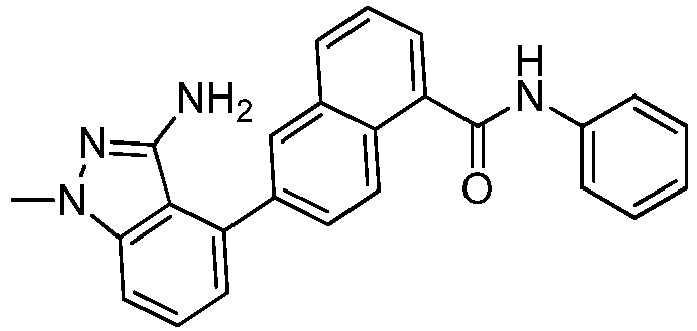
I-30 6-(3-amino-1H-indazol-4-yl)-N-phenyl-2-naphthalenecarboxami de 
I-31 6-(3-amino-1H-indazol-4-yl)-5-f luoro-N-phenyl-2-naphthaleneca rboxamide 
I-32 6-(3-amino-1H-indazol-4-yl)-5-c hloro-N-phenyl-1-naphthaleneca rboxamide 
I-33 6-(3-amino-7-fluoro-1H-indazol-4-yl)-N-phenyl-1-naphthalenecar boxamide 
I-34 6-(3-amino-7-bromo-1H-indazol -4-yl)-N-phenyl-1-naphthaleneca rboxamide 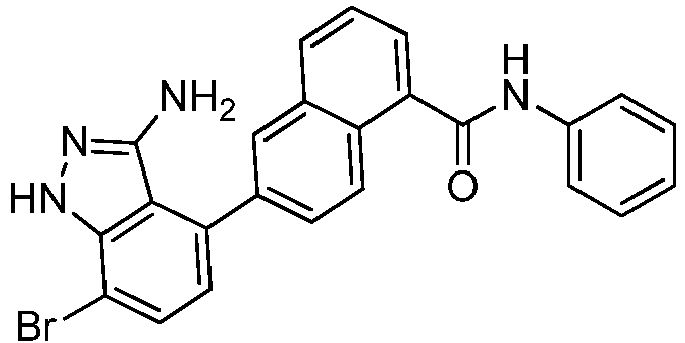
I-35 6-(3-amino-7-methyl-1H-indazol -4-yl)-N-phenyl-1-naphthaleneca rboxamide 
I-36 6-(3-amino-1H-indazol-4-yl)-N-( 3-methoxyphenyl)-1-naphthalen ecarboxamide 
I-37 6-(3-amino-1H-indazol-4-yl)-N-( 3-(trifluoromethoxy)phenyl)-1-n aphthalenecarboxamide 
I-38 6-(3-amino-1H-indazol-4-yl)-N-( 3-hydroxyphenyl)-1-naphthalene carboxamide 
I-39 6-(3-amino-1H-indazol-4-yl)-N-( 3-nitrophenyl)-1-naphthalenecar boxamide 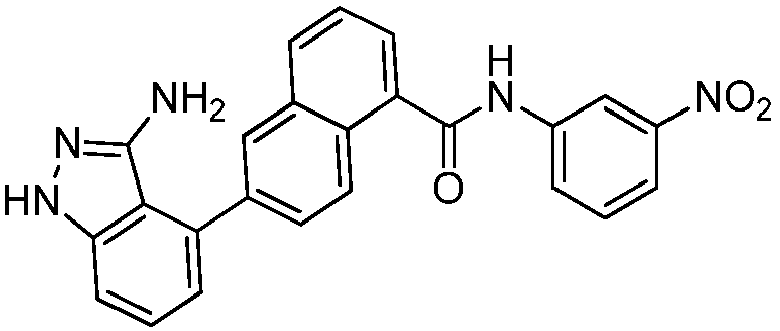
I-40 6-(3-amino-1H-indazol-4-yl)-N-( 3-aminophenyl)-1-naphthaleneca rboxamide 
I-41 6-(3-aminobenzo[d]isoxazol-4-yl )-N-phenyl-1-naphthalenecarbox amide 
I-42 6-(3-amino-7-fluorobenzo[d]isox azol-4-yl)-N-phenyl-1-naphthale necarboxamide 
I-43 6-(3-amino-7-methylbenzo[d]iso xazol-4-yl)-N-phenyl-1-naphthal enecarboxamide 
I-44 6-(3-amino-7-methoxybenzo[d]i soxazol-4-yl)-N-phenyl-1-naphth alenecarboxamide 
- The pharmaceutically acceptable salts of the compounds of the present invention may be prepared through direct salt forming reaction of free base of compound and inorganic or organic acid. Inorganic or organic acid may be selected from the group consisting of hydrochloric acid, sulfuric acid, phosphoric acid, nitric acid, hydrofluoric acid, hydrobromic acid, formic acid, acetic acid, picric acid, citric acid, maleic acid, methanesulfonic acid, trifluoromethanesulfonic acid, ethanesulfonic acid, p-toluenesulfonic acid, and the like.
- The present invention also relates to a preparation method of naphthylamide compounds of general formula (I), for example, including the following steps:

- Starting from compound 1, hydroxyl was reacted to form triflate, and then to form borate. Naphthalate was hydrolyzed, then condensed with the corresponding ammonia/amine to obtain naphthylamide borate and finally coupled with a heteroaryl halide to give the target compound.
- Specifically, the preparation method comprises the steps of:
- 1) Compound 1 is reacted with trifluoromethanesulfonic anhydride under basic condition to give compound 2;
- 2) Compound 2 and bis(pinacolato)diboron are subjected to coupling reaction in the presence of a palladium catalyst to obtain boronate 3;
- 3) Compound 3 was hydrolyzed with lithium hydroxide or sodium hydroxide to obtain compound 4;
- 4) Compound 4 and the corresponding ammonia/amine R3NH2 are subjected to condensation reaction under the effect of condensation agent such as dicyclohexyl carbodiimide (DCC), 1- (3-dimethylaminopropyl)-3-ethyl carbodiimide (EDC), 1-(3-dimethylaminopropyl)-3-ethyl carbodiimide hydrochloride (EDCI) or N,N'-diisopropyl carbodiimide (DIC) to obtain compound 5;
- 5) Compound 5 and the corresponding heteroaryl halide R1X are subjected to coupling reaction in the presence of a palladium catalyst to obtain the objective compound (I);
- The preparation method of naphthylamide compounds of the present invention has advantages such as mild reaction condition, abundant accessible raw materials, simple operation and post-processing and the like.
- The present invention also relates to a pharmaceutical composition comprising a therapeutically effective amount of one or more of naphthylamide compounds of formula (I), pharmaceutically acceptable salts, prodrugs, hydrates and solvates thereof, and optionally a pharmaceutically acceptable carrier, which may be used in prevention and/or treatment of abnormal angiogenesis-related diseases. The pharmaceutical compositions may be prepared in various forms depending on different route of administration.
- The present invention also relates to use of one or more of naphthylamide compounds of formula (I), pharmaceutically acceptable salts, prodrugs, hydrates and solvates thereof, or pharmaceutical composition comprising a therapeutically effective amount of one or more of naphthylamide compounds of formula (I), pharmaceutically acceptable salts, prodrugs, hydrates and solvates thereof in the preparation of drugs for the prevention and/or treatment of abnormal angiogenesis-related diseases, preferably as protein tyrosine kinase inhibitors, especially as VEGFR-2 inhibitors.
- Wherein, the abnormal angiogenesis-related disease is selected from the group consisting of tumor, rheumatoid arthritis, age-related macular degeneration and psoriasis.
- The tumor includes lung cancer, breast cancer, colon cancer, prostate cancer, pancreatic cancer, stomach cancer, liver cancer, ovarian cancer, renal cancer, glioma, melanoma, pancreatic cancer, head and neck cancer, bladder cancer, cervical cancer, cholangiocarcinoma, nasopharyngeal cancer, thyroid cancer, osteosarcoma, synovial sarcoma, rhabdomyosarcoma, fibrosarcoma, leiomyosarcoma, myeloma, lymphoma and the like.
- The present invention will be further illustrated by the following examples. These examples are intended to illustrate the present invention, but not to limit the invention in any way. Unless otherwise defined or stated, all professional and scientific terms used herein have same meanings known as the skilled in the art.
-

- 5g of 6-hydroxy-1-naphthoic acid was dissloved in 200 ml of methanol, and 2.8 ml of thionyl chloride was added dropwise with stirring. The mixture was heated under reflux for 2 hours, then cooled to room temperature and concentrated under reduced pressure to give methyl 6-hydroxy-1-naphthoate as tan solid which was directly used to the next step. 2.5 g of methyl 6-hydroxy-1-naphthoate was dissloved in 150 ml of dichloromethane and 6.5 ml of diisopropylethylamine and 3 ml of trifluoromethanesulfonic anhydride were added dropwise with stirring at -78 °C. The mixture was stirred at -78 °C for another 1 hour and 100 ml of saturated aqueous ammonium chloride solution was poured in. The organic phase was separated, and the aqueous phase was extracted with dichloromethane. The combined organic phases was washed with saturated sodium chloride, dried over anhydrous sodium sulfate, filtered and concentrated. The residue was purified by column chromatography (ethyl acetate: petroleum ether = 5: 95) to give 3.5 g methyl 6-(trifluoromethylsulfonyloxy)-1-naphthoate as tan solid. Yield: 93%.
1H NMR (300 MHz, DMSO-d 6) δ (ppm): 3.97 (s, 3H), 7.74-7.81 (m, 2H), 8.27 (dd, J = 7.2, 1.2 Hz, 1H), 8.30 (d, J= 3.0 Hz, 1H), 8.36 (d, J= 8.1 Hz, 1H), 8.94 (d, J= 9.3 Hz, 1H). - 3g of methyl 6-(trifluoromethylsulfonyloxy)-1-naphthoate, 2.74 g of bis(pinacolato) diboron, 675 mg of [1,1'-Bis(diphenylphosphino)ferrocene]dichloropalladium(II), 498 mg of 1,1'-bis(diphenyphosphino)ferrocene, 2.87 g of potassium acetate and 60 ml of dioxane were added to the reaction flask, heated to 80 °C under Ar, stirred for 4 h and then cooled to room temperature. Water and ethyl acetate were added to separate. The aqueous phase was extracted with ethyl acetate. The combined organic phases was washed with saturated sodium chloride, dried over anhydrous sodium sulfate, filtered and concentrated. The residue was purified by column chromatography (ethyl acetate: petroleum ether = 5: 95) to give 2.74 g of methyl 6-(4,4,5,5-tetramethyl-1,3,2-dioxaborolan-2-yl)-1-naphthoate as brown oil.Yield: 98%.
1H NMR (300 MHz, CDCl3) δ (ppm): 1.40 (s, 12H), 4.01 (s, 3H), 7.50 (t, J= 7.5 Hz, 1H), 7.97 (dd, J = 8.7, 1.2 Hz, 1H), 8.06 (d, J = 8.4 Hz, 1H), 8.22 (dd, J = 7.5, 1.2 Hz, 1H), 8.40 (s, 1H), 8.88 (d, J= 9.0 Hz, 1H). - 2.74 g of methyl 6-(4,4,5,5-tetramethyl-1,3,2-dioxaborolan-2-yl)-1-naphthoate was dissloved in 27 ml of tetrahydrofuran and 27 ml of water and 1.11 g of lithium hydrate was added with stirring. The mixture was stirred at room temperature for 12 h, then acidified with 2 mol/L hydrochloric acid and extracted with ethyl acetate. The combined organic phases was washed with saturated sodium chloride, dried over anhydrous sodium sulfate, filtered and concentrated. The residue was purified by column chromatography (methanol: dichloromethane = 3: 97) to give 2.04 g of 6-(4,4,5,5-tetramethyl-1,3,2-dioxaborolan-2-yl)-1-naphthoic acid as faint yellow solid.Yield: 78%.
1H NMR (300 MHz, CDCl3) δ (ppm): 1.41 (s, 12H), 7.55 (t, J = 8.1 Hz, 1H), 7.80 (dd, J = 8.4, 1.2 Hz, 1H), 8.13 (d, J= 8.1 Hz, 1H), 8.43-8.46 (m, 2H), 9.05 (d, J= 8.7 Hz, 1H). - 80 mg of 6-(4,4,5,5-tetramethyl-1,3,2-dioxaborolan-2-yl)-1-naphthoic acid was dissloved in 8 ml of dichloromethane and 39 mg of 4-dimethylaminopyridine, 77 mg of 1-(3-dimethylaminopropyl)-3-ethylcarbodiimide hydrochloride were successively added with stirring at 0 °C. After 15 minutes, 27 microliters aniline was added and then the mixture was warmed to room temperature and stirred overnight. On the next day the mixture was concentrated. The residue was purified by column chromatography (dichloromethane) to give 52 mg of N-phenyl-6-(4,4,5,5-tetramethyl-1,3,2-dioxaborolan-2-yl)-1-naphthalenecarboxamide as off- white solid. Yield: 52%.
1H NMR (400 MHz, CDCl3) δ (ppm): 1.40 (s, 12H), 7.19 (m, 2H), 7.41 (m, 2H), 7.52 (m, 1H), 7.69-7.01 (m, 3H), 7.79 (d, J = 6.8 Hz, 1H), 7.92 (dd, J = 8.4, 1.2 Hz, 1H), 8.02 (d, J = 8.0 Hz, 1H), 8.34 (d, J = 8.4 Hz, 1H), 8.15 (s, 1H). - 500 mg of 2-fluoro-6-iodobenzonitrile and 1.3 ml of hydrazine hydrate (85%) were dissloved in 10 ml of n-butanol and heated to 110 °C. The mixture was stirred for 6 hours and then cooled to room temperature. Water and ethyl acetate were added to separate. The aqueous phase was extracted with ethyl acetate. The combined organic phases was washed with saturated sodium chloride, dried over anhydrous sodium sulfate, filtered and concentrated to dryness to give 502 mg of 4-iodo-1H-indazol-3-amine as tan solid. Yield: 96%.
1H NMR (300 MHz, DMSO-d 6) δ (ppm): 5.05 (s, 2H), 6.90-6.96 (m, 1H), 7.29 (d, J = 8.1 Hz, 1H), 7.34 (d, J = 7.5 Hz, 1H), 11.80 (s, 1H). - 30 mg of N-phenyl-6-(4,4,5,5-tetramethyl-1,3,2-dioxaborolan-2-yl)-1-naphthalene carboxamide, 17 mg of 4-iodo-1H-indazol-3-amine, 5 mg of palladium(II) bis(triphenyl phosphine) dichloride, 18 mg of sodium carbonate, 2 ml of ethanol, 1 ml of toluene and 1 ml of water were added to a reaction flask and heated under an argon atmosphere to 85 °C. The mixture was stirred for 2 h and then cooled to room temperature. Water and ethyl acetate were added to separate. The aqueous phase was extracted with ethyl acetate. The combined organic phases was washed with saturated sodium chloride, dried over anhydrous sodium sulfate, filtered and concentrated. The residue was purified by column chromatography (methanol: dichloromethane = 3: 97) to give 14 mg of I-1 as off-white solid. Yield: 56%.
1H NMR (400 MHz, DMSO-d 6) δ (ppm): 4.32 (s, 2H), 6.95 (t, J = 3.6 Hz, 1H), 7.14 (t, J = 8.0 Hz, 1H), 7.34-7.37 (m, 2H), 7.39 (t, J= 8.0 Hz, 2H), 7.68 (dd, J= 8.4, 7.2 Hz, 1H), 7.75 (dd, J = 8.8, 2.0 Hz, 1H), 7.81 (dd, J = 7.2, 0.8 Hz, 1H), 7.84 (d, J = 8.0, 2H), 8.14 (d, J = 2.0 Hz, 1H), 8.18 (d, J = 8.4 Hz, 1H), 8.30 (d, J = 9.2 Hz, 1H), 10.64 (s, 1H), 11.84 (s, 1H). -

- 200 mg of 3-bromo-4-chlorofuro[3,2-c]pyridine, 3 ml of concentrated aqueous ammonia and 3 ml of dioxane were added to a stainless steel sealed tube, closed and heated to 150 °C. After stirred for 3 days, the mixture was cooled to room temperature. Water and ethyl acetate were added to separate. The aqueous phase was extracted with ethyl acetate. The combined organic phases was washed with saturated sodium chloride, dried over anhydrous sodium sulfate, filtered and concentrated to dryness to give 98 mg of 3-bromofuro[3,2-c]pyridin-4-amine as tan solid. Yield: 67%.
1H NMR (300 MHz, DMSO-d 6) δ (ppm): 6.19 (s, 2H), 6.92 (d, J= 6.0 Hz, 1H), 7.85 (d, J = 6.0 Hz, 1H), 8.11 (s, 1H). - 4-iodo-1H-indazol-3-amine was replaced by 3-bromofuro[3,2-c]pyridin-4-amine and other raw materials, reagents and preparation method were identical with those in step 6 of example 1. I-2 as yellow solid was obtained.
1H NMR (300 MHz, DMSO-d 6) δ (ppm): 5.68 (s, 2H), 7.02 (d, J = 6.0 Hz, 1H), 7.11-7.16 (m, 1H), 7.36-7.42 (m, 2H), 7.66-7.71 (m, 1H), 7.76 (dd, J = 9.0, 1.8 Hz, 1H), 7.82-7.85 (m, 3H), 7.92 (d, J = 6.0 Hz, 1H), 8.13-8.19 (m, 3H), 8.34 (d, J = 8.4 Hz, 1H), 10.62 (s, 1H). -

- 4-iodo-1H-indazol-3-amine was replaced by 3-bromothieno[3,2-c]pyridin-4-amine and other raw materials, reagents and preparation method were identical with those in step 6 of example 1. I-3 as yellow solid was obtained.
1H NMR (300 MHz, DMSO-d 6) δ (ppm): 5.51 (s, 2H), 7.11-7.16 (m, 1H), 7.34-7.41 (m, 3H), 7.64 (s, 1H), 7.68-7.23 (m, 2H), 7.82-7.88 (m, 4H), 8.16-8.19 (m, 2H), 8.32 (d, J= 9.0 Hz, 1H), 10.64 (s, 1H). -

- 360 mg of 5-bromo-4-chlorothieno[2,3-d]pyrimidine and 20 ml of concentrated aqueous ammonia were added to a stainless steel sealed tube, closed and heated to 90 °C. After stirred for 24 h, the mixture was cooled to room temperature, filtered and washed with water to give 272 mg of 5-bromothieno[2,3-d]pyrimidin-4-amine as yellow solid. Yield: 82%.
1H NMR (300 MHz, DMSO-d 6) δ (ppm): 6.99-7.65 (br s, 1H), 7.78 (s, 1H), 8.32 (s, 1H). - 4-iodo-1H-indazol-3-amine was replaced by 5-bromothieno[2,3-d]pyrimidin-4-amine and other raw materials, reagents and preparation method were identical with those in step 6 of example 1 to give 1-4 as white solid.
1H NMR (300 MHz, DMSO-d 6) δ (ppm): 7.14 (t, J= 7.2 Hz, 1H), 7.39-7.41 (m, 2H), 7.63 (s, 1H), 7.67-7.31 (m, 2H), 7.82-7.85 (m, 3H), 8.16-8.19 (m, 2H), 8.33 (d, J = 9.0 Hz, 1H), 8.38 (s, 1H), 10.62 (s, 1H). - Example 5:
-

- 100 mg of 4-(4,4,5,5-tetramethyl-1,3,2-dioxaborolan-2-yl)-1H-pyrazole and 91 mg of 1,3-dioxolan-2-one were dissloved in 2 ml of dimethylformamide. 336 mg of cesium carbonate was heated to 140 °C, stirred for 0.5 h and then cooled to room temperature and concentrated. The residue was purified by column chromatography (ethyl acetate: petroleum ether = 30: 70) to give 93 mg of 2-(4-(4,4,5,5-tetramethyl-1,3,2-dioxaborolan-2-yl)-1H-pyrazol-1-yl)ethanol as pale yellow oil. Yield: 76%.
1H NMR (300 MHz, DMSO-d 6) δ (ppm): 1.25 (s, 12H), 3.71 (q, J= 5.4 Hz, 2H), 4.15 (t, J = 5.4 Hz, 2H), 4.87 (t, J = 5.4 Hz, 1H), 7.57 (s, 1H), 7.88 (s, 1H). - 80 mg of 6-(4-aminothieno[3,2-c]pyridin-3-yl)-N-phenyl-1-naphthalenecarboxamide (1-3) was dissloved in 3 ml of dimethylformamide. In an ice bath, 50 mg of N-iodosuccinimide was added with stirring and stirred overnight. On the next day the mixture was concentrated. The residue was purified by column chromatography (methanol: dichloromethane = 2: 98) to give 94 mg of 6-(4-amino-7-iodothieno[3,2-c]pyridin-3-yl)-N-phenyl-1-naphthalenecarboxamide as black solid. Yield: 90%.
1H NMR (300 MHz, DMSO-d 6) δ (ppm): 5.58 (s, 2H), 7.13 (t, J= 7.2 Hz, 1H), 7.39 (t, J = 7.8 Hz, 2H), 7.68-7.73 (m, 3H), 7.82-7.85 (m, 3H), 8.06 (s, 1H), 8.16-8.19 (m, 2H), 8.32 (d, J = 8.7 Hz, 1H), 10.64 (s, 1H). - 26 mg of 6-(4-amino-7-iodothieno[3,2-c]pyridin-3-yl)-N-phenyl-1-naphthalene carboxamide, 24 mg of 2-(4-(4,4,5,5-tetramethyl-1,3,2-dioxaborolan-2-yl)-1H-pyrazol-1-yl) ethanol, 4 mg of palladium(II)bis(triphenylphosphine) dichloride, 13 mg of sodium carbonate, 2 ml of ethanol, 1 ml of toluene and 1 ml of water were added to a reaction flask and heated to 90 °C under Ar. After stirred for 4 h, the mixture was cooled to room temperature. Water and ethyl acetate were added to separate. The aqueous phase was extracted with ethyl acetate. The combined organic phases was washed with saturated sodium chloride, dried over anhydrous sodium sulfate, filtered and concentrated. The residue was purified by column chromatography (methanol: dichloromethane = 5: 95) to give 8 mg of I-5 as brown solid. Yield: 32%.
1H NMR (400 MHz, DMSO-d 6) δ (ppm): 3.81 (q, J = 5.2 Hz, 2H), 4.25 (t, J = 5.6 Hz, 2H), 5.02 (t, J = 5.2 Hz, 1H), 5.68 (s, 2H), 7.14 (t, J = 7.2 Hz, 1H), 7.39 (t, J = 8.0 Hz, 2H), 7.70-7.74 (m, 2H), 7.77 (s, 1H), 7.83-7.86 (m, 3H), 7.96 (s, 1H), 8.11 (s, 1H), 8.18-8.22 (m, 3H), 8.33 (d, J= 8.8 Hz, 1H), 10.67 (s,1H). -

- Phenylamine was replaced by o-methylphenylamine and other raw materials, reagents and preparation method were identical with those in step 4 of example 1 to give 6-(4,4,5,5-tetramethyl-1,3,2-dioxaborolan-2-yl)-N-(o-methylphenyl)-1-naphthalenecarboxamid e as yellow solid.
1H NMR (400 MHz, CDCl3) δ (ppm): 1.40 (s, 12H), 2.32 (s, 3H), 7.14-7.17 (m, 1H), 7.25-7.26 (m, 1H), 7.31-7.35 (m, 1H), 7.51-7.55 (m, 2H), 7.83 (d, J= 6.4 Hz, 1H), 7.94 (dd, J = 8.4, 1.2 Hz, 1H), 8.03 (d, J = 8.0 Hz, 1H), 8.14 (d, J = 7.2 Hz, 1H), 8.40 (d, J = 8.4 Hz, 1H), 8.42 (s, 1H). - N-phenyl-6-(4,4,5,5-tetramethyl-1,3,2-dioxaborolan-2-yl)-1-naphthalenecarboxamide was replaced by 6-(4,4,5,5-tetramethyl-1,3,2-dioxaborolan-2-yl)-N-(o-methylphenyl)-1-naphthalenecarboxamide and other raw materials, reagents and preparation method were identical with those in step 6 of example 1 to give 1-6 as tan solid.
1H NMR (400 MHz, DMSO-d 6) δ (ppm): 2.36 (s, 3H), 4.33 (s, 2H), 6.94-6.96 (m, 1H), 7.20-7.22 (m, 1H), 7.25-7.32 (m, 2H), 7.35-7.36 (m, 2H), 7.54 (d, J = 7.6 Hz, 1H), 7.69 (t, J = 7.6 Hz, 1H), 7.77 (dd, J= 8.8, 2.0 Hz, 1H), 7.88 (d, J = 7.2 Hz, 1H), 8.13 (d, J = 1.6 Hz, 1H), 8.18 (d, J = 8.0 Hz, 1H), 8.42 (d, J = 8.8 Hz, 1H), 10.12 (s, 1H), 11.84 (s, 1H). -

- Phenylamine was replaced by m-methylphenylamine and other raw materials, reagents and preparation method were identical with those in step 4 of example 1 to give 6-(4,4,5,5-tetramethyl-1,3,2-dioxaborolan-2-yl)-N-(m-methylphenyl)-1-naphthalenecarboxamide as tan solid.
1H NMR (300 MHz, CDCl3) δ (ppm): 1.40 (s, 12H), 2.39 (s, 3H), 6.99 (d, J= 7.5 Hz, 1H), 7.27 (t, J = 8.1 Hz, 1H), 7.42-7.50 (m, 2H), 7.56 (s, 1H), 7.69-7.75 (m, 2H), 7.90 (dd, J = 8.4, 0.9 Hz, 1H), 7.99 (d, J = 8.4 Hz, 1H), 8.32 (d, J = 9.0 Hz, 1H), 8.40 (s, 1H). - N-phenyl-6-(4,4,5,5-tetramethyl-1,3,2-dioxaborolan-2-yl)-1-naphthalenecarboxamide was replaced by 6-(4,4,5,5-tetramethyl-1,3,2-dioxaborolan-2-yl)-N-(m-methylphenyl)-1-naphthalenecarboxamide and other raw materials, reagents and preparation method were identical with those in step 6 of example 1 to give 1-7 as off-white solid.
1H NMR (400 MHz, DMSO-d 6) δ (ppm): 2.34 (s, 3H), 4.32 (s, 2H), 6.93-6.97 (m, 2H), 7.26 (m, 1H), 7.34-7.35 (m, 2H), 7.60 (d, J= 8.0 Hz, 1H), 6.67 (t, J= 7.6 Hz, 1H), 7.71 (s, 1H), 7.75 (dd, J = 8.8, 1.6 Hz, 1H), 7.79 (d, J = 6.8 Hz, 1H), 8.13 (d, J = 1.2 Hz, 1H), 8.18 (d, J = 8.0 Hz, 1H), 8.29 (d, J= 8.8 Hz, 1H), 10.57 (s, 1H), 11.84 (s, 1H). -

- Phenylamine was replaced by p-methylphenylamine and other raw materials, reagents and preparation method were identical with those in step 4 of example 1 to give 6-(4,4,5,5-tetramethyl-1,3,2-dioxaborolan-2-yl)-N-(p-methylphenyl)-1-naphthalenecarboxamid e as yellow solid.
1H NMR (400 MHz, CDCl3) δ (ppm): 1.40 (s, 12H), 2.36 (s, 3H), 7.21 (d, J= 8.0 Hz, 2H), 7.49-7.53 (m, 1H), 7.57 (d, J = 8.4 Hz, 2H), 7.64 (s, 1H), 7.78 (d, J = 7.2 Hz, 1H), 7.92 (dd, J= 8.4, 0.8 Hz, 1H), 7.80 (d, J = 8.4 Hz, 1H), 8.34 (d, J = 8.4 Hz, 1H), 8.41 (s, 1H). - N-phenyl-6-(4,4,5,5-tetramethyl-1,3,2-dioxaborolan-2-yl)-1-naphthalenecarboxamide was replaced by 6-(4,4,5,5-tetramethyl-1,3,2-dioxaborolan-2-yl)-N-(p-methylphenyl)-1-naphthalenecarboxamide and other raw materials, reagents and preparation method were identical with those in step 6 of example 1 to give 1-8 as tan solid.
1H NMR (400 MHz, DMSO-d 6) δ (ppm): 2.30 (s, 3H), 4.32 (s, 2H), 6.94 (t, J = 4.0 Hz, 1H), 7.19 (d, J= 8.0 Hz, 2H), 7.34-7.35 (m, 2H), 7.65-7.80 (m, 5H), 8.13 (s, 1H), 8.18 (d, J = 8.0 Hz, 1H), 8.30 (d, J= 8.8 Hz, 1H), 10.56 (s, 1H), 11.85 (s, 1H). -

- Phenylamine was replaced by m-ethylphenylamine and other raw materials, reagents and preparation method were identical with those in step 4 of example 1 to give N-(3-ethylphenyl)-6-(4,4,5,5-tetramethyl-1,3,2-dioxaborolan-2-yl)-1-naphthalenecarboxamide as tan solid.
1H NMR (400 MHz, CDCl3) δ (ppm): 1.28 (t, J = 7.6 Hz, 3H), 1.40 (s, 12H), 2.69 (q, J = 7.6 Hz, 2H), 7.04 (d, J = 7.6 Hz, 1H), 7.32 (t, J = 8.0 Hz, 1H), 7.49-7.53 (m, 2H), 7.57 (s, 1H), 7.65 (s, 1H), 7.78 (d, J = 6.8 Hz, 1H), 7.92 (dd, J = 8.4, 1.2 Hz, 1H), 8.01 (d, J = 8.4 Hz, 1H), 8.35 (d, J= 8.4 Hz, 1H), 8.42 (s, 1H). - N-phenyl-6-(4,4,5,5-tetramethyl-1,3,2-dioxaborolan-2-yl)-1-naphthalenecarboxamide was replaced by N-(3-ethylphenyl)-6-(4,4,5,5-tetramethyl-1,3,2-dioxaborolan-2-yl)-1-naphthalene carboxamide and other raw materials, reagents and preparation method were identical with those in step 6 of example 1 to give 1-9 as white solid.
1H NMR (400 MHz, DMSO-d 6) δ (ppm): 1.21 (t, J= 7.6 Hz, 3H), 2.63 (q, J= 7.6, 2H), 4.32 (s, 2H), 6.94 (t, J= 4.0 Hz, 1H), 6.99 (d, J= 7.6 Hz, 1H), 7.27-7.31 (m, 1H), 7.33-7.36 (m, 2H), 7.62-7.69 (m, 2H), 7.73-7.80 (m, 3H), 8.13 (d, J = 1.2 Hz, 1H), 8.18 (d, J = 8.0 Hz, 1H), 8.30 (d, J= 8.4 Hz, 1H), 10.58 (s, 1H), 11.84 (s, 1H). -

- Phenylamine was replaced by 2-fluorophenylamineand other raw materials, reagents and preparation method were identical with those in step 4 of example 1 to give N-(2-fluorophenyl)-6-(4,4,5,5-tetramethyl-1,3,2-dioxaborolan-2-yl)-1-naphthalenecarboxamide as yellow solid.
1H NMR (400 MHz, CDCl3) δ (ppm): 1.40 (s, 12H), 7.12-7.16 (m, 2H), 7.24-7.26 (m, 1H), 7.53 (dd, J = 8.4, 7.2 Hz, 1H), 7.82 (dd, J = 7.2, 0.8 Hz, 1H), 7.93-7.95 (m, 2H), 8.04 (d, J = 8.0 Hz, 1H), 8.37 (d, J = 8.8 Hz, 1H), 8.43 (s, 1H), 8.59 (s, 1H). - N-phenyl-6-(4,4,5,5-tetramethyl-1,3,2-dioxaborolan-2-yl)-1-naphthalenecarboxamide was replaced by N-(2-fluorophenyl)-6-(4,4,5,5-tetramethyl-1,3,2-dioxaborolan-2-yl)-1-naphthalenecarboxamide and other raw materials, reagents and preparation method were identical with those in step 6 of example 1 to give off-white solid 1-10.
1H NMR (400 MHz, DMSO-d 6) δ (ppm): 4.32 (s, 2H), 6.95 (t, J= 4.0 Hz, 1H), 7.27-7.36 (m, 5H), 6.68 (t, J = 7.6 Hz, 1H), 7.76 (dd, J = 8.8, 2.0 Hz, 1H), 7.81-7.86 (m, 2H), 8.13 (d, J = 1.6 Hz, 1H), 8.19 (d, J = 8.4 Hz, 1H), 8.38 (d, J = 8.8 Hz, 1H), 10.43 (s, 1H), 11.84 (s, 1H). -

- Phenylamine was replaced by 3-fluorophenylamine and other raw materials, reagents and preparation method were identical with those in step 4 of example 1 to give N-(3-fluorophenyl)-6-(4,4,5,5-tetramethyl-1,3,2-dioxaborolan-2-yl)-1-naphthalenecarboxamide as faint yellow solid.
1H NMR (400 MHz, CDCl3) δ (ppm): 1.40 (s, 12H), 6.87-6.91 (m, 1H), 7.29-7.35 (m, 2H), 7.50-7.54 (m, 1H), 7.69-7.72 (m, 1H), 7.75-7.79 (m, 2H), 7.93 (d, J = 8.8 Hz, 1H), 8.03 (d, J = 8.0 Hz, 1H), 8.31 (d, J = 8.8 Hz, 1H), 8.42 (s, 1H). - N-phenyl-6-(4,4,5,5-tetramethyl-1,3,2-dioxaborolan-2-yl)-1-naphthalenecarboxamide was replaced by N-(3-fluorophenyl)-6-(4,4,5,5-tetramethyl-1,3,2-dioxaborolan-2-yl)-1-naphthalene carboxamide and other raw materials, reagents and preparation method were identical with those in step 6 of example 1 to give off-white solid 1-11.
1H NMR (400 MHz, DMSO-d 6) δ (ppm): 4.32 (s, 2H), 6.94-7.00 (m, 2H), 7.35-7.36 (m, 2H), 7.40-7.45 (m, 1H), 7.58 (d, J = 8.4 Hz, 1H), 7.67-7.71 (m, 1H), 7.76 (dd, J = 8.8, 2.0 Hz, 1H), 7.82-7.86 (m, 2H), 8.14 (d, J = 1.6 Hz, 1H), 8.20 (d, J = 8.4 Hz, 1H), 8.30 (d, J = 8.8 Hz, 1H), 10.86 (s, 1H), 11.85 (s, 1H). -

- Phenylamine was replaced by 4-fluorophenylamine and other raw materials, reagents and preparation method were identical with those in step 4 of example 1 to give N-(4-fluorophenyl)-6-(4,4,5,5-tetramethyl-1,3,2-dioxaborolan-2-yl)-1-naphthalenecarboxamide as off-white solid.
1H NMR (400 MHz, CDCl3) δ (ppm): 1.40 (s, 12H), 7.10 (t, J= 8.4 Hz, 2H), 7.50-7.54 (m, 1H), 7.64-7.69 (m, 3H), 7.78 (d, J = 6.4 Hz, 1H), 7.93 (dd, J = 8.4, 1.2 Hz, 1H), 8.02 (d, J = 8.0 Hz, 1H), 8.32 (d, J= 8.4 Hz, 1H), 8.42 (s, 1H). - N-phenyl-6-(4,4,5,5-tetramethyl-1,3,2-dioxaborolan-2-yl)-1-naphthalenecarboxamide was replaced by N-(4-fluorophenyl)-6-(4,4,5,5-tetramethyl-1,3,2-dioxaborolan-2-yl)-1-naphthalene carboxamide and other raw materials, reagents and preparation method were identical with those in step 6 of example 1 to give off-white solid 1-12.
1H NMR (300 MHz, DMSO-d 6) δ (ppm): 4.31 (s, 2H), 6.93-6.96 (m, 1H), 7.24 (t, J= 9.0 Hz, 2H), 7.34-7.36 (m, 2H), 7.65-7.70 (m, 1H), 7.75 (dd, J= 8.7, 1.8 Hz, 1H), 7.80-7.88 (m, 3H), 8.13 (d, J = 1.5 Hz, 1H), 8.18 (d, J = 8.1 Hz, 1H), 8.31 (d, J = 9.0 Hz, 1H), 10.68 (s, 1H), 11.83 (s, 1H). -

- Phenylamine was replaced by 2,4-difluorophenylamine and other raw materials, reagents and preparation method were identical with those in step 4 of example 1 to give N-(2,4-difluorophenyl)-6-(4,4,5,5-tetramethyl-1,3,2-dioxaborolan-2-yl)-1-naphthalenecarboxa mide as yellow solid.
1H NMR (400 MHz, CDCl3) δ (ppm): 1.40 (s, 12H), 6.92-7.03 (m, 2H), 7.54-7.57 (m, 1H), 7.83-7.84 (m, 2H), 7.96 (dd, J= 8.4, 1.2 Hz, 1H), 8.06 (d, J= 8.0 Hz, 1H), 8.37 (d, J= 8.8 Hz, 1H), 8.44 (s, 1H), 8.55-8.58 (m, 1H). - N-phenyl-6-(4,4,5,5-tetramethyl-1,3,2-dioxaborolan-2-yl)-1-naphthalenecarboxamide was replaced by N-(2,4-difluorophenyl)-6-(4,4,5,5-tetramethyl-1,3,2-dioxaborolan-2-yl)-1-naphthalenecarboxamide and other raw materials, reagents and preparation method were identical with those in step 6 of example 1 to give white solid 1-13.
1H NMR (400 MHz, DMSO-d 6) δ (ppm): 4.32 (s, 2H), 6.95 (t, J = 4.0 Hz, 1H), 7.18-7.22 (m, 1H), 7.35-7.36 (m, 2H), 7.39-7.44 (m, 1H), 7.68 (t, J = 7.6 Hz, 1H), 7.75-7.80 (m, 2H), 7.85 (d, J = 6.8 Hz, 1H), 8.13 (d, J = 1.6 Hz, 1H), 8.19 (d, J = 8.0 Hz, 1H), 8.38 (d, J = 8.8 Hz, 1H), 10.44 (s, 1H), 11.85 (s, 1H). -

- Phenylamine was replaced by 3,5-difluorophenylamine and other raw materials, reagents and preparation method were identical with those in step 4 of example 1 to give N-(3,5-difluorophenyl)-6-(4,4,5,5-tetramethyl-1,3,2-dioxaborolan-2-yl)-1-naphthalenecarboxa mide as off-white solid.
1H NMR (400 MHz, CDCl3) δ (ppm): 1.40 (s, 12H), 6.61-6.66 (m, 1H), 7.31 (d, J = 7.2 Hz, 2H), 7.49-7.53 (m, 1H), 7.75-7.77 (m, 2H), 7.94 (d, J = 8.8 Hz, 1H), 8.03 (d, J = 8.4 Hz, 1H), 8.28 (d, J = 8.4 Hz, 1H), 8.42 (s, 1H). - N-phenyl-6-(4,4,5,5-tetramethyl-1,3,2-dioxaborolan-2-yl)-1-naphthalenecarboxamide was replaced by N-(3,5-difluorophenyl)-6-(4,4,5,5-tetramethyl-1,3,2-dioxaborolan-2-yl)-1-naphthalenecarboxamide and other raw materials, reagents and preparation method were identical with those in step 6 of example 1 to give faint yellow solid 1-14.
1H NMR (400 MHz, DMSO-d 6) δ (ppm): 4.32 (s, 2H), 6.95-7.02 (m, 2H), 7.35 (s, 2H), 7.57-7.59 (s, 2H), 7.69-7.85 (m, 3H), 8.15-8.31 (m, 3H), 11.02 (s, 1H), 11.85 (s, 1H). -

- Phenylamine was replaced by 3-chlorophenylamine and other raw materials, reagents and preparation method were identical with those in step 4 of example 1 to give N-(3-chlorophenyl)-6-(4,4,5,5-tetramethyl-1,3,2-dioxaborolan-2-yl)-1-naphthalenecarboxamid e as faint yellow solid.
1H NMR (400 MHz, CDCl3) δ (ppm): 1.40 (s, 12H), 7.16 (d, J = 8.4 Hz, 1H), 7.30-7.34 (m, 1H), 7.50-7.54 (m, 2H), 7.70 (s, 1H), 7.77 (d, J = 6.8 Hz, 1H), 7.86 (s, 1H), 7.93 (d, J = 8.8 Hz, 1H), 8.02 (d, J = 8.4 Hz, 1H), 8.31 (d, J = 8.4 Hz, 1H), 8.42 (s, 1H). - N-phenyl-6-(4,4,5,5-tetramethyl-1,3,2-dioxaborolan-2-yl)-1-naphthalenecarboxamide was replaced by N-(3-chlorophenyl)-6-(4,4,5,5-tetramethyl-1,3,2-dioxaborolan-2-yl)-1-naphthalenecarboxamide and other raw materials, reagents and preparation method were identical with those in step 6 of example 1 to give off-white solid 1-15.
1H NMR (400 MHz, DMSO-d 6) δ (ppm): 4.33 (s, 2H), 6.94 (t, J= 4.0 Hz, 1H), 7.19-7.22 (m, 1H), 7.34-7.35 (m, 2H), 7.42 (t, J = 8.0 Hz, 1H), 7.67-7.73 (m, 2H), 7.75 (dd, J = 8.8, 2.0 Hz, 1H), 7.83 (dd, J = 6.8, 0.8 Hz, 1H), 8.06 (t, J = 2.0 Hz, 1H), 8.14 (d, J = 1.6 Hz, 1H), 8.20 (d, J = 8.4 Hz, 1H), 8.30 (d, J = 8.4 Hz, 1H), 10.83 (s, 1H), 11.85 (s, 1H). -

- Phenylamine was replaced by 3-bromophenylamine and other raw materials, reagents and preparation method were identical with those in step 4 of example 1 to give N-(3-bromophenyl)-6-(4,4,5,5-tetramethyl-1,3,2-dioxaborolan-2-yl)-1-naphthalenecarboxamid e as faint yellow solid.
1H NMR (400 MHz, CDCl3) δ (ppm): 1.40 (s, 12H), 7.28 (m, 1H), 7.31-7.33 (m, 1H), 7.50-7.58 (m, 2H), 7.68 (s, 1H), 7.77 (d, J = 6.8 Hz, 1H), 7.93 (d, J = 8.4 Hz, 1H), 7.80-8.04 (m, 2H), 8.31 (d, J = 8.4 Hz, 1H), 8.42 (s, 1H). - N-phenyl-6-(4,4,5,5-tetramethyl-1,3,2-dioxaborolan-2-yl)-1-naphthalenecarboxamide was replaced by N-(3-bromophenyl)-6-(4,4,5,5-tetramethyl-1,3,2-dioxaborolan-2-yl)-1-naphthalenecarboxamide and other raw materials, reagents and preparation method were identical with those in step 6 of example 1 to give off-white solid 1-16.
1H NMR (400 MHz, DMSO-d 6) δ (ppm): 4.32 (s, 2H), 6.94 (t, J= 4.0 Hz, 1H), 7.32-7.38 (m, 4H), 7.66-7.70 (m, 1H), 7.74-7.76 (m, 2H), 7.83 (dd, J = 6.8, 0.8 Hz, 1H), 8.14 (d, J = 1.2 Hz, 1H), 8.19-8.21 (m, 2H), 8.30 (d, J= 8.8 Hz, 1H), 10.82 (s, 1H), 11.85 (s, 1H). -

- Phenylamine was replaced by 3,5-dichlorophenylamine and other raw materials, reagents and preparation method were identical with those in step 4 of example 1 to give N-(3,5-dichlorophenyl)-6-(4,4,5,5-tetramethyl-1,3,2-dioxaborolan-2-yl)-1-naphthalenecarboxa mide as white solid.
1H NMR (300 MHz, CDCl3) δ (ppm): 1.40 (s, 12H), 7.18 (m, 1H), 7.49-7.54 (m, 1H), 7.67-7.76 (m, 4H), 7.93 (d, J = 8.4 Hz, 1H), 8.03 (d, J = 8.7 Hz, 1H), 8.29 (d, J = 9.0 Hz, 1H), 8.41 (s, 1H). - N-phenyl-6-(4,4,5,5-tetramethyl-1,3,2-dioxaborolan-2-yl)-1-naphthalenecarboxamide was replaced by N-(3,5-dichlorophenyl)-6-(4,4,5,5-tetramethyl-1,3,2-dioxaborolan-2-yl)-1-naphthalenecarboxamide and other raw materials, reagents and preparation method were identical with those in step 6 of example 1 to give off-white solid 1-17 .
1H NMR (400 MHz, DMSO-d 6) δ (ppm): 4.32 (s, 2H), 6.95 (t, J= 4.0 Hz, 1H), 7.35-7.36 (m, 2H), 7.39 (t, J = 2.0 Hz, 1H), 7.70 (dd, J = 8.0, 7.2 Hz, 1H), 7.76 (dd, J = 8.8, 2.0 Hz, 1H), 7.85 (dd, J = 7.2, 1.2 Hz, 1H), 7.93-7.94 (m, 2H), 8.15 (d, J = 1.6 Hz, 1H), 8.22 (d, J = 8.4 Hz, 1H), 8.31 (d, J = 8.4 Hz, 1H), 10.99 (s, 1H), 11.85 (s, 1H). -

- Phenylamine was replaced by 3,5-dibromophenylamine and other raw materials, reagents and preparation method were identical with those in step 4 of example 1 to give N-(3,5-dibromophenyl)-6-(4,4,5,5-tetramethyl-1,3,2-dioxaborolan-2-yl)-1-naphthalenecarboxa mide as off-white solid.
1H NMR (400 MHz, CDCl3) δ (ppm): 1.40 (s, 12H), 7.48 (s, 1H), 7.49-7.53 (m, 1H), 7.71 (s, 1H), 7.75 (d, J= 7.2 Hz, 1H), 7.87 (s, 2H), 7.94 (d, J= 8.8 Hz, 1H), 8.03 (d, J= 8.4 Hz, 1H), 8.28 (d, J= 8.0 Hz, 1H), 8.40 (s, 1H). - N-phenyl-6-(4,4,5,5-tetramethyl-1,3,2-dioxaborolan-2-yl)-1-naphthalenecarboxamide was replaced by N-(3,5-dibromophenyl)-6-(4,4,5,5-tetramethyl-1,3,2-dioxaborolan-2-yl)-1-naphthalenecarboxamide and other raw materials, reagents and preparation method were identical with those in step 6 of example 1 to give white solid 1-18.
1H NMR (400 MHz, DMSO-d 6) δ (ppm): 4.32 (s, 2H), 6.94 (m, 1H), 7.34-7.35 (m, 2H), 7.61 (s, 1H), 7.67-7.71 (m, 1H), 7.75-7.77 (m, 1H), 7.84 (d, J= 6.8 Hz, 1H), 8.11-8.15 (m, 3H), 8.22 (d, J = 8.0 Hz, 1H), 8.31 (d, J = 8.4 Hz, 1H), 10.94 (s, 1H), 11.84 (s, 1H). -

- Phenylamine was replaced by 3-trifluoromethylphenylamine and other raw materials, reagents and preparation method were identical with those in step 4 of example 1 to give 6-(4,4,5,5-tetramethyl-1,3,2-dioxaborolan-2-yl)-N-(3-(trifluoromethyl)phenyl)-1-naphthalenec arboxamide as yellow solid.
1H NMR (400 MHz, CDCl3) δ (ppm): 1.40 (s, 12H), 7.44 (d, J = 7.6 Hz, 1H), 7.49-7.54 (m, 2H), 7.78 (d, J= 7.2 Hz, 1H), 7.85 (s, 1H), 7.89-7.94 (m, 2H), 8.00-8.04 (m, 2H), 8.32 (d, J = 8.8 Hz, 1H), 8.41 (s, 1H). - N-phenyl-6-(4,4,5,5-tetramethyl-1,3,2-dioxaborolan-2-yl)-1-naphthalenecarboxamide was replaced by 6-(4,4,5,5-tetramethyl-1,3,2-dioxaborolan-2-yl)-N-(3-(trifluoromethyl)phenyl)-1-naphthalenecarboxamide and other raw materials, reagents and preparation method were identical with those in step 6 of example 1 to give off-white solid 1-19.
1H NMR (400 MHz, DMSO-d 6) δ (ppm): 4.32 (s, 2H), 6.95 (t, J= 4.0 Hz, 1H), 7.34-7.35 (m, 2H), 7.50 (d, J= 7.6 Hz, 1H), 7.64 (t, J= 8.0 Hz, 1H), 7.67-7.71 (m, 1H), 7.75 (dd, J= 8.8, 2.0 Hz, 1H), 7.86 (dd, J = 7.2, 1.2 Hz, 1H), 8.03 (d, J = 8.0 Hz, 1H), 8.14 (d, J = 1.6 Hz, 1H), 8.21 (d, J= 8.4 Hz, 1H), 8.33 (d, J = 8.8 Hz, 1H), 8.37 (s, 1H), 10.99 (s, 1H), 11.85 (s, 1H). -

- Phenylamine was replaced by 2-fluoro-5-methylphenylamine and other raw materials, reagents and preparation method were identical with those in step 4 of example 1 to give N-(2-fluoro-5-methylphenyl)-6-(4,4,5,5-tetramethyl-1,3,2-dioxaborolan-2-yl)-1-naphthalenecar boxamide as tan solid.
1H NMR (400 MHz, CDCl3) δ (ppm): 1.40 (s, 12H), 2.41 (s, 3H), 6.91-6.93 (m, 1H), 7.00-7.04 (m, 1H), 7.51-7.55 (m, 1H), 7.81 (d, J = 6.4 Hz, 1H), 7.87 (m, 1H), 7.94 (dd, J = 8.4, 1.2 Hz, 1H), 8.03 (d, J = 8.0 Hz, 1H), 8.37 (d, J = 8.8 Hz, 1H), 8.41-8.42 (m, 2H). - N-phenyl-6-(4,4,5,5-tetramethyl-1,3,2-dioxaborolan-2-yl)-1-naphthalenecarboxamide was replaced by N-(2-fluoro-5-methylphenyl)-6-(4,4,5,5-tetramethyl-1,3,2-dioxaborolan-2-yl)-1-naphthalenecarboxamide and other raw materials, reagents and preparation method were identical with those in step 6 of example 1 to give off-white solid 1-20.
1H NMR (400 MHz, DMSO-d 6) δ (ppm): 2.34 (s, 3H), 4.32 (s, 2H), 6.95 (t, J = 4.0 Hz, 1H), 7.08-7.10 (m, 1H), 7.18-7.23 (m, 1H), 7.35-7.37 (m, 2H), 7.62 (d, J = 6.4 Hz, 1H), 7.65-7.69 (m, 1H), 7.76 (dd, J= 8.8, 2.0 Hz, 1H), 7.82 (d, J= 6.8 Hz, 1H), 8.13 (d, J= 1.6 Hz, 1H), 8.18 (d, J= 8.0 Hz, 1H), 8.37 (d, J= 8.8 Hz, 1H), 10.37 (s, 1H), 11.86 (s, 1H). -

- Phenylamine was replaced by 4-fluoro-3-methylphenylamine and other raw materials, reagents and preparation method were identical with those in step 4 of example 1 to give N-(4-fluoro-3-methylphenyl)-6-(4,4,5,5-tetramethyl-1,3,2-dioxaborolan-2-yl)-1-naphthalenecar boxamide as off-white solid.
1H NMR (300 MHz, CDCl3) δ (ppm): 1.40 (s, 12H), 2.32 (d, J = 0.6 Hz, 3H), 7.02 (t, J = 9.0 Hz, 1H), 7.39-7.42 (m, 1H), 7.48-7.53 (m, 1H), 7.57-7.62 (m, 2H), 7.76 (d, J= 7.2 Hz, 1H), 7.92 (d, J = 8.4 Hz, 1H), 8.01 (d, J = 7.8 Hz, 1H), 8.32 (d, J = 8.4 Hz, 1H), 8.41 (s, 1H). - N-phenyl-6-(4,4,5,5-tetramethyl-1,3,2-dioxaborolan-2-yl)-1-naphthalenecarboxamide was replaced by N-(4-fluoro-3-methylphenyl)-6-(4,4,5,5-tetramethyl-1,3,2-dioxaborolan-2-yl)-1-naphthalenecarboxamide and other raw materials, reagents and preparation method were identical with those in step 6 of example 1 to give off-white solid 1-21.
1H NMR (400 MHz, DMSO-d 6) δ (ppm): 2.27 (s, 3H), 4.32 (s, 2H), 6.94 (t, J = 3.6 Hz, 1H), 7.16 (t, J = 9.2 Hz, 1H), 7.34-7.35 (m, 2H), 7.61-7.69 (m, 2H), 7.73-7.80 (m, 3H), 8.13 (s, 1H), 8.18 (d, J = 8.0 Hz, 1H), 8.29 (d, J = 8.4 Hz, 1H), 10.62 (s, 1H), 11.84 (s, 1H). -

- Phenylamine was replaced by 2-fluoro-4-methylphenylamine and other raw materials, reagents and preparation method were identical with those in step 4 of example 1 to give N-(2-fluoro-4-methylphenyl)-6-(4,4,5,5-tetramethyl-1,3,2-dioxaborolan-2-yl)-1-naphthalenecar boxamide as off-white solid.
1H NMR (300 MHz, CDCl3) δ (ppm): 1.40 (s, 12H), 2.63 (s, 3H), 6.94-7.05 (m, 2H), 7.50-7.55 (m, 1H), 7.78-7.82 (m, 2H), 7.93 (d, J = 8.4 Hz, 1H), 8.02 (d, J = 8.1 Hz, 1H), 8.36-8.44 (m, 3H). - N-phenyl-6-(4,4,5,5-tetramethyl-1,3,2-dioxaborolan-2-yl)-1-naphthalenecarboxamide was replaced by N-(2-fluoro-4-methylphenyl)-6-(4,4,5,5-tetramethyl-1,3,2-dioxaborolan-2-yl)-1-naphthalenecarboxamide and other raw materials, reagents and preparation method were identical with those in step 6 of example 1 to give white solid 1-22.
1H NMR (400 MHz, DMSO-d 6) δ (ppm): 2.35 (s, 3H), 4.32 (s, 2H), 6.94 (t, J = 4.0 Hz, 1H), 7.07 (d, J = 8.0 Hz, 1H), 7.16 (d, J = 11.6 Hz, 1H), 7.34-7.35 (m, 2H), 7.64-7.69 (m, 2H), 7.75 (d, J = 8.8 Hz, 1H), 7.83 (d, J = 6.8 Hz, 1H), 8.12 (s, 1H), 8.18 (d, J = 8.0 Hz, 1H), 8.37 (d, J= 8.8 Hz, 1H), 10.32 (s, 1H), 11.85 (s, 1H). -

- Phenylamine was replaced by 3-fluoro-4-methylphenylamine and other raw materials, reagents and preparation method were identical with those in step 4 of example 1 to give N-(3-fluoro-4-methylphenyl)-6-(4,4,5,5-tetramethyl-1,3,2-dioxaborolan-2-yl)-1-naphthalenecar boxamide as off-white solid.
1H NMR (300 MHz, CDCl3) δ (ppm): 1.40 (s, 12H), 2.27 (d, J = 1.8 Hz, 3H), 7.17-7.18 (m, 2H), 7.48-7.53 (m, 1H), 7.61-7.66 (m, 2H), 7.76 (d, J = 7.2 Hz, 1H), 7.92 (dd, J = 8.7, 1.5 Hz, 1H), 8.01 (d, J= 8.4 Hz, 1H), 8.32 (d, J= 8.7 Hz, 1H), 8.41 (s, 1H). - N-phenyl-6-(4,4,5,5-tetramethyl-1,3,2-dioxaborolan-2-yl)-1-naphthalenecarboxamide was replaced by N-(3-fluoro-4-methylphenyl)-6-(4,4,5,5-tetramethyl-1,3,2-dioxaborolan-2-yl)-1-naphthalenecarboxamide and other raw materials, reagents and preparation method were identical with those in step 6 of example 1 to give white solid 1-23.
1H NMR (400 MHz, DMSO-d 6) δ (ppm): 2.23 (s, 3H), 4.32 (s, 2H), 6.94 (t, J = 4.0 Hz, 1H), 7.28 (t, J = 8.4 Hz, 1H), 7.34-7.35 (m, 2H), 7.46-7.48 (m, 1H), 7.68 (t, J = 7.6 Hz, 1H), 7.74-7.81 (m, 3H), 8.13 (s, 1H), 8.19 (d, J = 8.4 Hz, 1H), 8.29 (d, J = 8.8 Hz, 1H), 10.75 (s, 1H), 11.85 (s, 1H). -

- Phenylamine was replaced by 5-methylisoxazolamine and other raw materials, reagents and preparation method were identical with those in step 4 of example 1 to give N-(5-methylisoxazol-3-yl)-6-(4,4,5,5-tetramethyl-1,3,2-dioxaborolan-2-yl)-1-naphthalenecarbo xamide as white solid.
1H NMR (400 MHz, CDCl3) δ (ppm): 1.40 (s, 12H), 2.47 (s, 3H), 6.95 (s, 1H), 7.50-7.54 (m, 1H), 7.82 (dd, J = 7.2, 1.2 Hz, 1H), 7.94 (dd, J = 8.4, 1.2 Hz, 1H), 8.05 (d, J = 8.0, 1H), 8.35 (d, J= 8.8 Hz, 1H), 8.42 (s, 1H), 8.50 (s, 1H). - N-phenyl-6-(4,4,5,5-tetramethyl-1,3,2-dioxaborolan-2-yl)-1-naphthalenecarboxamide was replaced by N-(5-methylisoxazol-3-yl)-6-(4,4,5,5-tetramethyl-1,3,2-dioxaborolan-2-yl)-1-naphthalenecarboxamide and other raw materials, reagents and preparation method were identical with those in step 6 of example 1 to give white solid 1-24.
1H NMR (400 MHz, DMSO-d 6) δ (ppm): 2.46 (s, 3H), 4.32 (s, 2H), 6.87 (s, 1H), 6.95 (t, J = 3.6 Hz, 1H), 7.35-7.36 (m, 2H), 7.66 (dd, J= 8.0, 7.2 Hz, 1H), 7.76 (dd, J= 8.4, 1.6 Hz, 1H), 7.84 (dd, J = 7.2, 0.8 Hz, 1H), 8.14 (d, J = 1.6 Hz, 1H), 8.20 (d, J = 8.4 Hz, 1H), 8.31 (d, J = 8.8 Hz, 1H), 11.58 (s, 1H), 11.85 (s, 1H). -

- Phenylamine was replaced by 3-aminopyridine and other raw materials, reagents and preparation method were identical with those in step 4 of example 1 to give N-(pyridin-3-yl)-6-(4,4,5,5-tetramethyl-1,3,2-dioxaborolan-2-yl)-1-naphthalenecarboxamide as white solid.
1H NMR (300 MHz, CDCl3) δ (ppm): 1.40 (s, 12H), 7.35-7.39 (m, 1H), 7.51-7.56 (m, 1H), 7.75 (s, 1H), 7.80-7.82 (m, 1H), 7.94 (dd, J = 8.4, 1.2 Hz, 1H), 8.04 (d, J = 8.4 Hz, 1H), 8.32 (d, J= 8.4 Hz, 1H), 8.40-8.44 (m, 3H), 8.67 (d, J = 2.1 Hz, 1H). - N-phenyl-6-(4,4,5,5-tetramethyl-1,3,2-dioxaborolan-2-yl)-1-naphthalenecarboxamide was replaced by N-(pyridin-3-yl)-6-(4,4,5,5-tetramethyl-1,3,2-dioxaborolan-2-yl)-1-naphthalene carboxamide and other raw materials, reagents and preparation method were identical with those in step 6 of example 1 to give faint yellow solid 1-25.
1H NMR (400 MHz, DMSO-d 6) δ (ppm): 4.32 (s, 2H), 6.95 (t, J= 4.0 Hz, 1H), 7.35-7.36 (m, 2H), 7.43-7.47 (m, 1H), 7.68-7.72 (m, 1H), 7.76 (dd, J = 8.8, 2.0 Hz, 1H), 7.87 (dd, J = 7.2, 0.8 Hz, 1H), 8.15 (d, J = 1.6 Hz, 1H), 8.21 (d, J = 8.4 Hz, 1H), 8.28-8.30 (m, 1H), 8.33-8.36 (m, 2H), 8.98 (d, J = 2.4 Hz, 1H), 10.87 (s, 1H), 11.85 (s, 1H). -

- Phenylamine was replaced by ethylamine (2 mol/L, in tetrahydrofuran) and other raw materials, reagents and preparation method were identical with those in step 4 of example 1 to give N-ethyl-6-(4,4,5,5-tetramethyl-1,3,2-dioxaborolan-2-yl)-1-naphthalenecarboxamide as white solid.
1H NMR (400 MHz, CDCl3) δ (ppm): 1.31 (t, J= 7.2 Hz, 3H), 1.40 (s, 12H), 3.56-3.63 (m, 2H), 5.96 (m, 1H), 7.45 (dd, J = 8.4, 7.2 Hz, 1H), 7.63 (dd, J = 7.2, 1.2 Hz, 1H), 7.90 (dd, J = 8.4, 1.2 Hz, 1H), 7.95 (d, J = 8.4 Hz, 1H), 8.26 (d, J = 8.8 Hz, 1H), 8.38 (s, 1H). - N-phenyl-6-(4,4,5,5-tetramethyl-1,3,2-dioxaborolan-2-)-1-naphthalenecarboxamide was replaced by N-ethyl-6-(4,4,5,5 -tetramethyl-1,3,2-dioxaborolan-2-yl)-1 -naphthalene carboxamide and other raw materials, reagents and preparation method were identical with those in step 6 of example 1 to give white solid 1-26.
1H NMR (400 MHz, DMSO-d 6) δ (ppm): 1.20 (t, J = 7.2 Hz, 3H), 3.40 (m, 2H), 4.30 (s, 2H), 6.92-6.94 (m, 1H), 7.34-7.35 (m, 2H), 7.58-7.64 (m, 2H), 7.71 (dd, J= 8.8, 2.0 Hz, 1H), 8.08 (d, J = 2.0 Hz, 1H), 8.10 (dd, J = 8.0, 2.0 Hz, 1H), 8.31 (d, J = 8.8 Hz, 1H), 8.60 (t, J = 5.6 Hz, 1H), 11.83 (s, 1H). -

- Phenylamine was replaced by cyclopropylamine and other raw materials, reagents and preparation method were identical with those in step 4 of example 1 to give N-cyclopropyl-6-(4,4,5,5-tetramethyl-1,3,2-dioxaborolan-2-yl)-1-naphthalenecarboxamide as white solid.
1H NMR (300 MHz, CDCl3) δ (ppm): 0.67-0.70 (m, 2H), 0.90-0.94 (m, 2H), 1.39 (s, 12H), 3.01-3.04 (m, 1H), 6.08 (s, 1H), 7.41-7.46 (m, 1H), 7.59-7.61 (m, 1H), 7.89-7.96 (m, 2H), 8.26 (d, J= 8.4 Hz, 1H), 8.37 (s, 1H). - N-phenyl-6-(4,4,5,5-tetramethyl-1,3,2-dioxaborolan-2-yl)-1-naphthalenecarboxamide was replaced by N-cyclopropyl-6-(4,4,5,5-tetramethyl-1,3,2-dioxaborolan-2-yl)-1 -naphthalene carboxamide and other raw materials, reagents and preparation method were identical with those in step 6 of example 1 to give off-white solid 1-27.
1H NMR (400 MHz, DMSO-d 6) δ (ppm): 0.61-0.63 (m, 2H), 0.74-0.76 (m, 2H), 2.97 (m, 1H), 4.30 (s, 2H), 6.93 (t, J = 4.0 Hz, 1H), 7.34-7.35 (m, 2H), 7.58-7.60 (m, 2H), 7.71 (dd, J= 8.8, 2.0 Hz, 1H), 8.07 (d, J = 1.6 Hz, 1H), 8.09 (dd, J = 6.4, 2.4 Hz, 1H), 8.30 (d, J = 8.4 Hz, 1H), 8.64 (d, J = 4.4 Hz, 1H), 11. 84 (s, 1H). -

- 1 g of methyl 6-hydroxy-1-naphthoate was dissloved in 10 ml of acetonitrile and 1.92 g of 1-chloromethyl-4-fluoro-1,4-diazabicyclo[2.2.2]octane bis(tetrafluoroborate) was added and heated to 85 °C. After stirred for 24 h, the mixture was cooled to room temperature and then concentrated. The residue was purified by column chromatography (dichloromethane) to give 593 mg of methyl 5-fluoro-6-hydroxy-1-naphthoate as yellow solid. Yield: 54%.
1H NMR (300 MHz, DMSO-d 6) δ (ppm): 3.92 (s, 3H), 7.40 (t, J = 9.0 Hz, 1H), 7.59-7.64 (m, 1H), 7.98 (d, J = 7.2 Hz, 1H), 8.17 (d, J = 8.4 Hz, 1H), 8.43 (d, J = 9.3 Hz, 1H), 10.34 (s, 1H). - Methyl 6-hydroxy-1-naphthoate was replaced by methyl 5-fluoro-6-hydroxy-1-naphthoate and other raw materials, reagents and preparation method were identical with those in step 1 of example 1 to give methyl 5-fluoro-6-(((trifluoromethyl)sulfonyl)oxy)-1-naphthoate as pale yellow oil.
1H NMR (300 MHz, DMSO-d 6) δ (ppm): 3.98 (s, 3H), 7.86-7.97 (m, 2H), 8.36 (dd, J = 7.2, 0.9 Hz, 1H), 8.47 (d, J= 8.4 Hz, 1H), 8.75 (dd, J= 9.6, 0.6 Hz, 1H). - Methyl 6-(((trifluoromethyl)sulfonyl)oxy)-1-naphthoate was replaced by methyl 5-fluoro-6-(((trifluoromethyl)sulfonyl)oxy)-1-naphthoate and other raw materials, reagents and preparation method were identical with those in step 2 of example 1 to give methyl 5-fluoro-6-(4,4,5,5-tetramethyl-1,3,2-dioxaborolan-2-yl)-1-naphthoate as white solid.
1H NMR (300 MHz, CDCl3) δ (ppm): 1.41 (s, 12H), 4.01 (s, 3H), 7.56 (dd, J = 8.4, 7.8 Hz, 1H), 7.84 (dd, J = 8.4, 6.0 Hz, 1H), 8.27 (dd, J = 7.5, 1.2 Hz, 1H), 8.38 (d, J = 8.4 Hz, 1H), 8.66 (dd, J = 8.7, 0.9 Hz, 1H). - Methyl 6-(4,4,5,5-tetramethyl-1,3,2-dioxaborolan-2-yl)-1-naphthoate was replaced by methyl 5-fluoro-6-(4,4,5,5-tetramethyl-1,3,2-dioxaborolan-2-yl)-1-naphthoate and other raw materials, reagents and preparation method were identical with those in step 3 of example 1 to give 5-fluoro-6-(4,4,5,5-tetramethyl-1,3,2-dioxaborolan-2-yl)-1-naphthoic acid as white solid.
1H NMR (300 MHz, DMSO-d 6) δ (ppm): 1.35 (s, 12H), 7.70-7.78 (m, 2H), 8.28 (dd, J = 7.5, 1.2 Hz, 1H), 8.34 (d, J = 8.1 Hz, 1H), 8.66 (d, J = 9.0 Hz, 1H). - 6-(4,4,5,5-tetramethyl-1,3,2-dioxaborolan-2-yl)-1-naphthoic acid was replaced by 5-fluoro-6-(4,4,5,5-tetramethyl-1,3,2-dioxaborolan-2-yl)-1-naphthoic acidand other raw materials, reagents and preparation method were identical with those in step 4 of example 1 to give 5-fluoro-N-phenyl-6-(4,4,5,5-tetramethyl-1,3,2-dioxaborolan-2-yl)-1-naphthalene carboxamide as yellow solid.
1H NMR (300 MHz, CDCl3) δ (ppm): 1.41 (s, 12H), 7.20 (t, J = 7.2 Hz, 1H), 7.41 (t, J = 7.8 Hz, 2H), 7.53-7.58 (m, 1H), 7.68-7.72 (m, 3H), 7.77-7.83 (m, 2H), 8.09 (d, J= 8.4 Hz, 1H), 8.29 (d, J= 8.4 Hz, 1H). - N-phenyl-6-(4,4,5,5-tetramethyl-1,3,2-dioxaborolan-2-yl)-1-naphthalenecarboxamide was replaced by 5-fluoro-N-phenyl-6-(4,4,5,5-tetramethyl-1,3,2-dioxaborolan-2-yl)-1-naphthalene carboxamide and other raw materials, reagents and preparation method were identical with those in step 6 of example 1 to give brown solid 1-28.
1H NMR (300 MHz, DMSO-d 6) δ (ppm): 4.19 (s, 2H), 6.94 (dd, J = 5.7, 2.1 Hz, 1H), 7.12-7.17 (m, 1H), 7.33-7.42 (m, 4H), 7.61-7.66 (m, 1H), 7.77-7.84 (m, 3H), 7.90-7.92 (m, 1H), 8.12 (d, J= 8.7 Hz, 1H), 8.29 (d, J = 8.4 Hz, 1H), 10.69 (s, 1H), 11.88 (s, 1H). -

- Hydrazine hydrate was replaced by methylhydrazine and other raw materials, reagents and preparation method were identical with those in step 5 of example 1 to give 4-iodo-1-methyl-1H-indazol-3-amine as yellow solid.
1H NMR (300 MHz, DMSO-d 6) δ (ppm): 3.74 (s, 3H), 5.12 (s, 2H), 6.97 (dd, J = 8.4, 7.5 Hz, 1H), 7.34 (d, J = 7.8 Hz, 1H), 7.40 (d, J = 8.4 Hz, 1H). - 4-iodo-1H-indazol-3-amine was replaced by 4-iodo-1-methyl-1H-indazol-3-amine and other raw materials, reagents and preparation method were identical with those in step 6 of example 1 to give yellow solid 1-29.
1H NMR (300 MHz, DMSO-d 6) δ (ppm): 3.83 (s, 3H), 4.38 (s, 2H), 6.96 (d, J = 6.9 Hz, 1H), 7.14 (t, J = 7.5 Hz, 1H), 7.37-7.47 (m, 4H), 7.68-7.75 (m, 2H), 7.80-7.85 (m, 3H), 8.13 (s, 1H), 8.19 (d, J = 8.4 Hz, 1H), 8.31 (d, J = 8.7 Hz, 1H), 10.64 (s, 1H). -

- 6-hydroxy-1-naphthoic acid was replaced by 6-hydroxy-2-naphthoic acid and other raw materials, reagents and preparation method were identical with those in step 1 of example 1 to give methyl 6-(trifluoromethylsulfonyloxy)-2-naphthoate as yellow solid.
1H NMR (300 MHz, CDCl3) δ (ppm): 4.01 (s, 3H), 7.45 (dd, J= 9.0, 2.4 Hz, 1H), 7.80 (d, J = 2.4 Hz, 1H), 7.94 (d, J = 8.4 Hz, 1H), 8.06 (d, J = 9.3 Hz, 1H), 8.17 (dd, J = 8.4, 1.2 Hz, 1H), 8.66 (s, 1H). - Methyl 6-(trifluoromethylsulfonyloxy)-1-naphthoate was replaced by methyl 6-(trifluoromethylsulfonyloxy)-2-naphthoate and other raw materials, reagents and preparation method were identical with those in step 2 of example 1 to give methyl 6-(4,4,5,5-tetramethyl-1,3,2-dioxaborolan-2-yl)-2-naphthoate as white solid.
1H NMR (300 MHz, CDCl3) δ (ppm): 1.40 (s, 12H), 3.98 (s, 3H), 7.88-7.95 (m, 3H), 8.06 (d, J = 8.4 Hz, 1H), 8.40 (s, 1H), 8.60 (s, 1H). - Methyl 6-(4,4,5,5-tetramethyl-1,3,2-dioxaborolan-2-yl)-1-naphthoate was replaced by methyl 6-(4,4,5,5-tetramethyl-1,3,2-dioxaborolan-2-yl)-2-naphthoate and other raw materials, reagents and preparation method were identical with those in step 3 of example 1 to give 6-(4,4,5,5-tetramethyl-1,3,2-dioxaborolan-2-yl)-2-naphthoic acid as white solid.
1H NMR (300 MHz, DMSO-d 6) δ (ppm): 1.34 (s, 12H), 7.78 (d, J= 8.1 Hz, 1H), 7.98 (dd, J= 8.7, 1.5 Hz, 1H), 8.08-8.13 (m, 2H), 8.38 (s, 1H), 8.60 (s, 1H), 13.15 (s, 1H). - 6-(4,4,5,5-tetramethyl-1,3,2-dioxaborolan-2-yl)-1-naphthoic acid was replaced by 6-(4,4,5,5-tetramethyl-1,3,2-dioxaborolan-2-yl)-2-naphthoic acidand other raw materials, reagents and preparation method were identical with those in step 4 of example 1 to give N-phenyl-6-(4,4,5,5-tetramethyl-1,3,2-dioxaborolan-2-yl)-2-naphthalenecarboxamide as orange jelly.
1H NMR (300 MHz, CDCl3) δ (ppm): 1.41 (s, 12H), 7.16-7.26 (m, 1H), 7.41 (t,J = 7.8Hz, 2H), 7.70 (d, J = 8.1 Hz, 2H), 7.91-8.01 (m, 5H), 8.37 (s, 1H), 8.42 (s, 1H). - N-phenyl-6-(4,4,5,5-tetramethyl-1,3,2-dioxaborolan-2-yl)-1-naphthalenecarboxamide was replaced by N-phenyl-6-(4,4,5,5-tetramethyl-1,3,2-dioxaborolan-2-yl)-2-naphthalene carboxamide and other raw materials, reagents and preparation method were identical with those in step 6 of example 1 to give yellow solid 1-30.
1H NMR (300 MHz, DMSO-d 6) δ (ppm): 4.33 (s, 2H), 6.96-6.98 (m, 1H), 7.13 (t, J = 7.5 Hz, 1H), 7.35-7.42 (m, 4H), 7.76 (d, J= 8.4 Hz, 1H), 7.85 (d, J= 7.5 Hz, 2H), 8.07-8.17 (m, 3H), 8.22 (d, J= 8.4 Hz, 1H), 8.67 (s, 1H), 10.48 (s, 1H), 11.86 (s, 1H). -

- Methyl 6-hydroxy-1-naphthoate was replaced by methyl 6-hydroxy-2-naphthoate and other raw materials, reagents and preparation method were identical with those in step 1 of example 28 to give methyl 5-fluoro-6-hydroxy-2-naphthoate as yellow solid.
1H NMR (300 MHz, DMSO-d 6) δ (ppm): 3.90 (s, 3H), 7.35 (t, J = 8.7 Hz, 1H), 7.87 (d, J = 9.0 Hz, 1H), 7.94-7.98 (m, 2H), 8.58 (s, 1H), 10.58 (s, 1H). - Methyl 6-hydroxy-1-naphthoate was replaced by methyl 5-fluoro-6-hydroxy-2-naphthoate and other raw materials, reagents and preparation method were identical with those in step 1 of example 1 to give methyl 5-fluoro-6-(((trifluoromethyl)sulfonyl)oxy)-2-naphthoate as yellow solid.
1H NMR (300 MHz, CDCl3) δ (ppm): 4.02 (s, 3H), 7.48 (dd, J= 9.0, 6.9 Hz, 1H), 7.84 (dd, J = 9.0, 1.5 Hz, 1H), 8.19-8.26 (m, 2H), 8.66 (s, 1H). - Methyl 6-(((trifluoromethyl)sulfonyl)oxy)-1-naphthoate was replaced by methyl 5-fluoro-6-(((trifluoromethyl)sulfonyl)oxy)-2-naphthoate and other raw materials, reagents and preparation method were identical with those in step 2 of example 1 to give methyl 5-fluoro-6-(4,4,5,5-tetramethyl-1,3,2-dioxaborolan-2-yl)-2-naphthoate as yellow solid.
- Methyl 6-(4,4,5,5-tetramethyl-1,3,2-dioxaborolan-2-yl)-1-naphthoate was replaced by methyl 5-fluoro-6-(4,4,5,5-tetramethyl-1,3,2-dioxaborolan-2-yl)-2-naphthoate and other raw materials, reagents and preparation method were identical with those in step 3 of example 1 to give 5-fluoro-6-(4,4,5,5-tetramethyl-1,3,2-dioxaborolan-2-yl)-2-naphthoic acid as white solid.
- 6-(4,4,5,5-tetramethyl-1,3,2-dioxaborolan-2-yl)-1-naphthoic acid was replaced by 5-fluoro-6-(4,4,5,5-tetramethyl-1,3,2-dioxaborolan-2-yl)-2-naphthoic acidand other raw materials, reagents and preparation method were identical with those in step 4 of example 1 to give 5-fluoro-N-phenyl-6-(4,4,5,5-tetramethyl-1,3,2-dioxaborolan-2-yl)-2-naphthalene carboxamide as yellow solid.
- N-phenyl-6-(4,4,5,5-tetramethyl-1,3,2-dioxaborolan-2-yl)-1-naphthalenecarboxamide was replaced by 5-fluoro-N-phenyl-6-(4,4,5,5-tetramethyl-1,3,2-dioxaborolan-2-yl)-2-naphthalene carboxamide and other raw materials, reagents and preparation method were identical with those in step 6 of example 1 to give brown solid 1-31.
1H NMR (300 MHz, DMSO-d 6) δ (ppm): 4.21 (s, 2H), 6.96 (d, J = 6.0 Hz, 1H), 7.14 (t, J = 7.5 Hz, 1H), 7.36-7.43 (m, 4H), 7.64 (t, J = 8.1 Hz, 1H), 7.85 (d, J = 8.4 Hz, 2H), 8.07 (d, J = 8.4 Hz, 1H), 8.18 (d, J = 8.4 Hz, 1H), 8.26 (d, J = 9. 0 Hz, 1H), 8.74 (s, 1H), 10.55 (s, 1H), 11.85 (s, 1H). -

- 1 g of methyl 6-hydroxy-1-naphthoate and 762 mg of N-chlorosuccinimide were dissloved in 100 ml of tetrahydrofuran and stirred at room temperature for 5h, then concentrated. The residue was purified by column chromatography (ethyl acetate: petroleum ether = 10: 90) to give 1.17 g of methyl 5-chloro-6-hydroxy-1-naphthoate as white solid. Yield: 100%.
1H NMR (300 MHz, DMSO-d6) δ (ppm): 3.93 (s, 3H), 7.43 (d, J = 9.3 Hz, 1H), 7.67 (dd, J = 8.1, 7.2 Hz, 1H), 7.96 (d, J = 7.5 Hz, 1H), 8.32 (d, J = 8.4 Hz, 1H), 8.57 (d, J = 9.3 Hz, 1H), 10.73 (s, 1H). - Methyl 6-hydroxy-1-naphthoate was replaced by methyl 5-chloro-6-hydroxy-1-naphthoate and other raw materials, reagents and preparation method were identical with those in step 1 of example 1 to give methyl 5-chloro-6-(((trifluoromethyl)sulfonyl)oxy)-1-naphthoate as faint yellow solid.
1H NMR (300 MHz, CDCl3) δ (ppm): 4.03 (s, 3H), 7.56 (d, J = 9.6 Hz, 1H), 7.71-7.77 (m, 1H), 8.33 (dd, J= 7.2, 0.9 Hz, 1H), 8.58 (d, J= 8.4 Hz, 1H), 9.05 (d, J= 9.0 Hz, 1H). - Methyl 6-(((trifluoromethyl)sulfonyl)oxy)-1-naphthoate was replaced by methyl 5-chloro-6-(((trifluoromethyl)sulfonyl)oxy)-1-naphthoate and other raw materials, reagents and preparation method were identical with those in step 2 of example 1 to give methyl 5-chloro-6-(4,4,5,5-tetramethyl-1,3,2-dioxaborolan-2-yl)-1-naphthoate as yellow solid.
1H NMR (300 MHz, CDCl3) δ (ppm): 1.43 (s, 12H), 4.00 (s, 3H), 7.60 (t, J= 8.1 Hz, 1H), 7.79 (d, J = 9.0 Hz, 1H), 8.23 (d, J = 7.2 Hz, 1H), 8.66 (d, J = 8.4 Hz, 1H), 8.80 (d, J = 8.7 Hz, 1H). - Methyl 6-(4,4,5,5-tetramethyl-1,3,2-dioxaborolan-2-yl)-1-naphthoate was replaced by methyl 5-chloro-6-(4,4,5,5-tetramethyl-1,3,2-dioxaborolan-2-yl)-1-naphthoate and other raw materials, reagents and preparation method were identical with those in step 3 of example 1 to give 5-chloro-6-(4,4,5,5-tetramethyl-1,3,2-dioxaborolan-2-yl)-1-naphthoic acid as yellow solid.
- 6-(4,4,5,5-tetramethyl-1,3,2-dioxaborolan-2-yl)-1-naphthoic acid was replaced by 5-chloro-6-(4,4,5,5-tetramethyl-1,3,2-dioxaborolan-2-yl)-1-naphthoic acid and other raw materials, reagents and preparation method were identical with those in step 4 of example 1 to give 5-chloro-N-phenyl-6-(4,4,5,5-tetramethyl-1,3,2-dioxaborolan-2-yl)-1-naphthalene carboxamide as yellow solid.
- N-phenyl-6-(4,4,5,5-tetramethyl-1,3,2-dioxaborolan-2-yl)-1-naphthalenecarboxamide was replaced by 5-chloro-N-phenyl-6-(4,4,5,5-tetramethyl-1,3,2-dioxaborolan-2-yl)-1-naphthalene carboxamide and other raw materials, reagents and preparation method were identical with those in step 6 of example 1 to give brown solid 1-32.
1H NMR (300 MHz, DMSO-d 6) δ (ppm): 4.01 (s, 2H), 6.84-6.86 (m, 1H), 7.14 (t, J= 7.5 Hz, 1H), 7.35-7.42 (m, 4H), 7.63 (d, J = 8.7 Hz, 1H), 7.82-7.89 (m, 3H), 7.92-7.94 (m, 1H), 8.25 (d, J = 7.8 Hz, 1H), 8.49 (d, J = 8.1 Hz, 1H), 10.72 (s, 1H), 11.80 (s, 1H). -

- 2-fluoro-6-iodobenzonitrile was replaced by 2,3-difluoro-6-iodobenzonitrile and other raw materials, reagents and preparation method were identical with those in step 5 of example 1 to give 7-fluoro-4-iodo-1H-indazol-3-amine as yellow solid.
1H NMR (300 MHz, DMSO-d 6) δ (ppm): 5.18 (s, 2H), 6.88 (dd, J = 11.1, 7.8 Hz, 1H), 7.28 (dd, J = 8.1, 4.2 Hz, 1H), 12.33 (s, 1H). - 4-iodo-1H-indazol-3-amine was replaced by 7-fluoro-4-iodo-1H-indazol-3-amine and other raw materials, reagents and preparation method were identical with those in step 6 of example 1 to give white solid 1-33.
1H NMR (300 MHz, DMSO-d 6) δ (ppm): 4.43 (s, 2H), 6.88-6.92 (m, 1H), 7.11-7.24 (m, 2H), 7.36-7.42 (m, 2H), 7.65-7.74 (m, 2H), 7.80-7.85 (m, 3H), 8.11 (s, 1H), 8.18 (d, J = 8.1 Hz, 1H), 8.30 (d, J = 8.7 Hz, 1H), 10.62 (s, 1H), 12.34 (s, 1H). -

- 2-fluoro-6-iodobenzonitrile was replaced by 3-bromo-2-fluoro-6-iodobenzonitrile and other raw materials, reagents and preparation method were identical with those in step 5 of example 1 to give 7-bromo-4-iodo-1H-indazol-3-amine as yellow solid.
1H NMR (300 MHz, DMSO-d 6) δ (ppm): 5.18 (s, 2H), 7.19 (d, J= 7.8 Hz, 1H), 7.27 (d, J = 7.5 Hz, 1H), 12.18 (s, 1H). - 4-iodo-1H-indazol-3-amine was replaced by 7-bromo-4-iodo-1H-indazol-3-amine and other raw materials, reagents and preparation method were identical with those in step 6 of example 1 to give white solid 1-34.
1H NMR (300 MHz, DMSO-d 6) δ (ppm): 4.45 (s, 2H), 6.89 (d, J= 7.5 Hz, 1H), 7.14 (t, J = 7.5 Hz, 1H), 7.37-7.42 (m, 2H), 7.59 (d, J= 7.2 Hz, 1H), 7.69-7.75 (m, 2H), 7.81-7.85 (m, 3H), 8.15 (s, 1H), 8.19 (d, J = 8.1 Hz, 1H), 8.32 (d, J = 8.7 Hz, 1H), 10.64 (s, 1H), 12.22 (s, 1H). -

- 2-fluoro-6-iodobenzonitrile was replaced by 2-fluoro-6-iodo-3-methylbenzonitrile and other raw materials, reagents and preparation method were identical with those in step 5 of example 1 to give 4-iodo-7-methyl-1H-indazol-3-amine as yellow solid.
1H NMR (300 MHz, DMSO-d 6) δ (ppm): 2.33 (d, J= 0.9 Hz, 3H), 5.02 (s, 2H), 6.74 (dd, J = 7.5, 1.2 Hz, 1H), 7.24 (d, J = 7.5 Hz, 1H), 11.83 (s, 1H). - 4-iodo-1H-indazol-3-amine was replaced by 4-iodo-7-methyl-1H-indazol-3-amine and other raw materials, reagents and preparation method were identical with those in step 6 of example 1 to give white solid 1-35.
1H NMR (300 MHz, DMSO-d 6) δ (ppm): 2.47 (s, 3H), 4.31 (s, 2H), 6.86 (d, J = 6.9 Hz, 1H), 7.11-7.16 (m, 2H), 7.39 (t, J = 7.5 Hz, 2H), 7.64-7.69 (m, 1H), 7.72 (dd, J = 8.4, 1.8 Hz, 1H), 7.78-7.80 (m, 1H), 7.84 (d, J = 7.5 Hz, 2H), 8.10 (d, J = 1.5 Hz, 1H), 8.17 (d, J = 8.1 Hz, 1H), 8.29 (d, J = 8.7 Hz, 1H), 10.63 (s, 1H), 11.8 (s, 1H). -

- Phenylamine was replaced by m-methoxyphenylamine and other raw materials, reagents and preparation method were identical with those in step 4 of example 1 to give N-(3-methoxyphenyl)-6-(4,4,5,5-tetramethyl-1,3,2-dioxaborolan-2-yl)-1-naphthalenecarboxamide as brown solid.
- N-phenyl-6-(4,4,5,5-tetramethyl-1,3,2-dioxaborolan-2-yl)-1-naphthalenecarboxamide was replaced by N-(3-methoxyphenyl)-6-(4,4,5,5-tetramethyl-1,3,2-dioxaborolan-2-yl)-1-naphthalenecarboxamide and other raw materials, reagents and preparation method were identical with those in step 6 of example 1 to give white solid 1-36.
1H NMR (300 MHz, DMSO-d 6) δ (ppm): 3.77 (s, 3H), 4.31 (s, 2H), 6.72 (dd, J= 8.1, 2.4 Hz, 1H), 6.94 (t, J = 3.9 Hz, 1H), 7.26-7.31 (m, 1H), 7.34-7.35 (m, 2H), 7.39 (d, J = 8.4 Hz, 1H), 7.55 (s, 1H), 7.65-7.70 (m, 1H), 7.75 (dd, J = 8.7, 1.5 Hz, 1H), 7.79 (d, J = 7.2 Hz, 1H), 8.13 (d, J = 1.5 Hz, 1H), 8.19 (d, J = 8.7 Hz, 1H), 8.29 (d, J = 8.7 Hz, 1H), 10.61 (s, 1H), 11. 83 (s, 1H). -

- Phenylamine was replaced by m-trifluoromethoxyphenyla mineand other raw materials, reagents and preparation method were identical with those in step 4 of example 1 to give N-(3-trifluoromethoxyphenyl)-6-(4,4,5,5-tetramethyl-1,3,2-dioxaborolan-2-yl)-1-naphthalenec arboxamide as brown solid.
1H NMR (300 MHz, CDCl3) δ (ppm): 1.40 (s, 12H), 7.05 (dd, J = 8.4, 0.9 Hz, 1H), 7.38-7.43 (m, 1H), 7.49-7.55 (m, 2H), 7.75-7.79 (m, 3H), 7.93 (dd, J = 8.4, 1.2 Hz, 1H), 8.03 (d, J = 8.1 Hz, 1H), 8.32 (d, J = 8.7 Hz, 1H), 8.42 (s, 1H). - N-phenyl-6-(4,4,5,5-tetramethyl-1,3,2-dioxaborolan-2-yl)-1-naphthalenecarboxamide was replaced by N-(3-trifluoromethoxyphenyl)-6-(4,4,5,5-tetramethyl-1,3,2-dioxaborolan-2-yl)-1-naphthalenec arboxamide and other raw materials, reagents and preparation method were identical with those in step 6 of example 1 to give white solid 1-37.
1H NMR (300 MHz, DMSO-d 6) δ (ppm): 4.31 (s, 2H), 6.93-6.96 (m, 1H), 7.12-7.15 (m, 1H), 7.34-7.36 (m, 2H), 7.52 (t, J = 8.1 Hz, 1H), 7.69 (dd, J = 8.1, 7.2 Hz, 1H), 7.74-7.77 (m, 2H), 7.86 (dd, J = 7.2, 0.9 Hz, 1H), 8.03 (s, 1H), 8.14 (d, J = 1.5 Hz, 1H), 8.21 (d, J = 8.4 Hz, 1H), 8.32 (d, J = 8.7 Hz, 1H), 10.92 (s, 1H), 11.83 (s, 1H). -

- Phenylamine was replaced by m-hydroxyphenylamineand other raw materials, reagents and preparation method were identical with those in step 4 of example 1 to give N-(3-hydroxyphenyl)-6-(4,4,5,5-tetramethyl-1,3,2-dioxaborolan-2-yl)-1-naphthalenecarboxami de as brown solid.
- N-phenyl-6-(4,4,5,5-tetramethyl-1,3,2-dioxaborolan-2-yl)-1-naphthalenecarboxamide was replaced by N-(3-hydroxyphenyl)-6-(4,4,5,5-tetramethyl-1,3,2-dioxaborolan-2-yl)-1-naphthalenecarboxami de and other raw materials, reagents and preparation method were identical with those in step 6 of example 1 to give white solid 1-38.
1H NMR (300 MHz, DMSO-d 6) δ (ppm): 6.52-6.56 (m, 1H), 6.97 (dd, J = 4.2, 3.6 Hz, 1H), 7.12-7.20 (m, 2H), 7.37-7.38 (m, 2H), 7.42 (s, 1H), 7.63-7.69 (m, 1H), 7.72-7.77 (m, 2H), 8.12 (d, J = 1.5 Hz, 1H), 8.17 (d, J = 8.1 Hz, 1H), 8.27 (d, J = 8.7 Hz, 1H), 10.51 (s, 1H). -

- Phenylamine was replaced by m-nitrophenylamine and other raw materials, reagents and preparation method were identical with those in step 4 of example 1 to give N-(3-nitrophenyl)-6-(4,4,5,5-tetramethyl-1,3,2-dioxaborolan-2-yl)-1-naphthalenecarboxamide as brown solid.
- N-phenyl-6-(4,4,5,5-tetramethyl-1,3,2-dioxaborolan-2-yl)-1-naphthalenecarboxamide was replaced by N-(3-nitrophenyl)-6-(4,4,5,5-tetramethyl-1,3,2-dioxaborolan-2-yl)-1-naphthalenecarboxamide and other raw materials, reagents and preparation method were identical with those in step 6 of example 1 to give white solid 1-39.
1H NMR (300 MHz, DMSO-d 6) δ (ppm): 4.33 (s, 2H), 6.95 (t, J= 3.9 Hz, 1H), 7.34-7.36 (m, 2H), 7.67-7.78 (m, 3H), 7.88 (d, J= 6.9 Hz, 1H), 8.02 (dd, J= 8.1, 1.5 Hz, 1H), 8.15-8.18 (m, 2H), 8.23 (d, J = 8.1 Hz, 1H), 8.35 (d, J = 8.7 Hz, 1H), 8.91 (s, 1H), 11.12 (s, 1H), 11. 84 (s, 1H). -
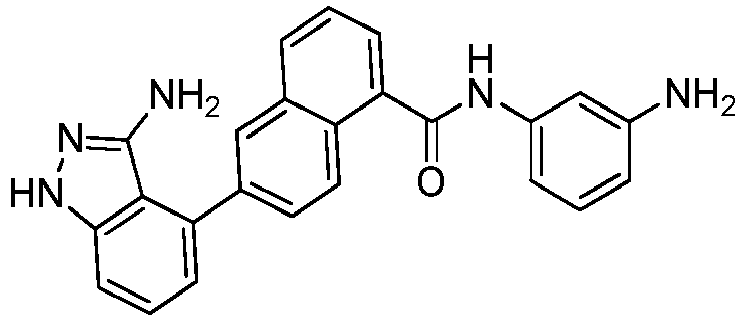
- 20 mg of 6-(3-amino-1H-indazol-4-yl)-N-(3-nitrophenyl)-1-naphthalenecarboxamide (1-39) was dissloved in 1 ml of ethanol, 25 mg of ammonium chloride in 0.5 ml water and 13 mg of iron powder were added and heated to 70 °C. After stirred for 0.5 h, the mixture was cooled to room temperature, filtered and then concentrated. Water and ethyl acetate were added to separate. The aqueous phase was extracted with ethyl acetate. The combined organic phases was washed with saturated sodium chloride, dried over anhydrous sodium sulfate, filtered and concentrated to give 13 mg of white solid 1-40. Yield: 72%.
1H NMR (300 MHz, DMSO-d 6) δ (ppm): 4.31 (s, 2H), 5.16 (s, 2H), 6.34 (dd, J= 7.8, 0.9 Hz, 1H), 6.88 (d, J = 8.1 Hz, 1H), 6.93-7.01 (m, 2H), 7.21 (s, 1H), 7.34-7.35 (m, 2H), 7.63-7.68 (m, 1H), 7.72-7.75 (m, 2H), 8.11 (d, J = 1.5 Hz, 1H), 8.16 (d, J = 8.1 Hz, 1H), 8.27 (d, J= 9.0 Hz, 1H), 10.33 (s, 1H), 11.84 (s, 1H). -

1H NMR (300 MHz, DMSO-d 6) δ (ppm): 5.93 (s, 2H), 7.24-7.29 (m, 1H), 7.55 (dd, J= 8.4, 0.6 Hz, 1H), 7.69-7.71 (m, 1H). - 4-iodo-1H-indazol-3-amine was replaced by 4-iodobenzo[d]isoxazol-3-amine and other raw materials, reagents and preparation method were identical with those in step 6 of example 1 to give white solid 1-41.
1H NMR (300 MHz, DMSO-d 6) δ (ppm): 5.23 (s, 2H), 7.14 (t, J= 7.5 Hz, 1H), 7.30 (dd, J = 7.2, 0.9 Hz, 1H), 7.37-7.42 (m, 2H), 7.59 (dd, J= 8.1, 0.6 Hz, 1H), 7.64-7.72 (m, 2H), 7.77 (dd, J = 8.4, 1.5 Hz, 1H), 7.83-7.85 (m, 3H), 8.19-8.21 (m, 2H), 8.35 (d, J = 8.7 Hz, 1H), 10.63 (s, 1H). -

- 2-fluoro-6-iodobenzonitrile was replaced by 2,3-difluoro-6-iodobenzonitrile and other raw materials, reagents and preparation method were identical with those in step 1 of example 41 to give 7-fluoro-4-iodobenzo[d]isoxazol-3-amine as white solid.
- 4-iodo-1H-indazol-3-amine was replaced by 7-fluoro-4-iodobenzo[d]isoxazol-3-amine and other raw materials, reagents and preparation method were identical with those in step 6 of example 1 to give yellow solid 1-42.
1H NMR (300 MHz, DMSO-d 6) δ (ppm): 5.41 (s, 2H), 7.11-7.16 (m, 1H), 7.26-7.30 (m, 1H), 7.39 (t, J= 7.5 Hz, 2H), 7.58-7.76 (m, 3H), 7.82-7.85 (m, 3H), 8.18-8.20 (m, 2H), 8.35 (d, J = 8.7 Hz, 1H), 10.63 (s, 1H). -

- 2-fluoro-6-iodobenzonitrile was replaced by 2-fluoro-6-iodo-3-methylbenzonitrile and other raw materials, reagents and preparation method were identical with those in step 1 of example 41 to give 4-iodo-7-methylbenzo[d]isoxazol-3-amine as white solid.
1H NMR (300 MHz, DMSO-d 6) δ (ppm): 2.35 (s, 3H), 5.91 (s, 2H), 7.09 (dd, J= 7.5, 0.9 Hz, 1H), 7.58 (d, J = 7.2 Hz, 1H). - 4-iodo-1H-indazol-3-amine was replaced by 4-iodo-7-methylbenzo[d]isoxazol-3-amine and other raw materials, reagents and preparation method were identical with those in step 6 of example 1 to give white solid 1-43.
1H NMR (300 MHz, DMSO-d 6) δ (ppm): 5.22 (s, 2H), 7.14 (t, J = 7.5 Hz, 1H), 7.20 (d, J = 7.5 Hz, 1H), 7.40 (t, J = 8.1 Hz, 2H), 7.48 (d, J = 7.5 Hz, 1H), 7.67-7.76 (m, 2H), 7.83-7.85 (m, 3H), 8.16-8.21 (m, 2H), 8.34 (d, J = 8.7 Hz, 1H), 10.63 (s, 1H). -
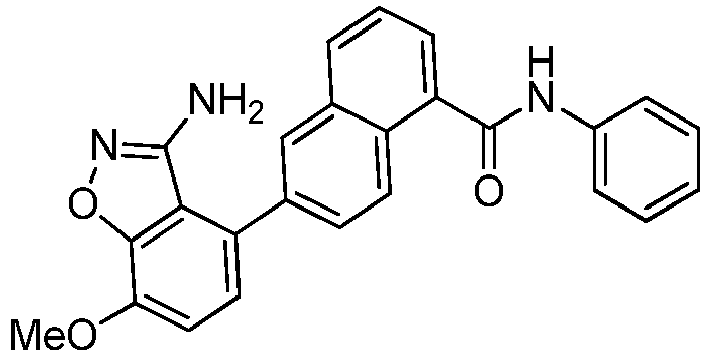
- 2-fluoro-6-iodobenzonitrile was replaced by 2-fluoro-6-iodo-3-methoxybenzonitrile and other raw materials, reagents and preparation method were identical with those in step 1 of example 41 to give 4-iodo-7-methoxybenzo[d]isoxazol-3-amine as white solid.
1H NMR (300 MHz, DMSO-d 6) δ (ppm): 3.91 (s, 3H), 5.91 (s, 2H), 6.91 (d, J = 8.4 Hz, 1H), 7.57 (d, J = 8.1 Hz, 1H). - 4-iodo-1H-indazol-3-amine was replaced by 4-iodo-7-methoxybenzo[d]isoxazol-3-amine and other raw materials, reagents and preparation method were identical with those in step 6 of example 1 to give white solid 1-44.
1H NMR (300 MHz, DMSO-d 6) δ (ppm): 4.00 (s, 3H), 5.23 (s, 2H), 7.14 (t, J = 7.5 Hz, 1H), 7.20-7.26 (m, 2H), 7.39 (t, J= 7.5 Hz, 2H), 7.65-7.74 (m, 2H), 7.81-7.85 (m, 3H), 8.13 (s, 1H), 8.18 (d, J = 8.4 Hz, 1H), 8.32 (d, J = 8.4 Hz, 1H), 10.61 (s, 1H). - The enzyme reaction substrate Poly(Glu, Tyr)4:1 was diluted with potassium-free PBS (10 mM sodium phosphate buffer, 150mM NaCl, pH 7.2-7.4) to 20 µg/ml and microwell plate was coated with 125 ml/well mixture. The reaction was carried out at 37 °C for 12-16 h. Then the liquid was discarded and the microwell plate was washed with 200ml/well T-PBS (PBS containing 0.1% Tween-20) three times, 5 minutes each. The microwell plate was dried for 1-2 hours at 37 °C oven. Each well was added with reaction buffer (50 mM HEPES, pH 7.4, 50 mM MgCl2, 5 mM MnCl2, 0.2 mM Na3VO4, 1 mM DTT) diluted ATP solution (50 mL) whose final concentration is 5 µM. Drug was diluted with 1% DMSO to a suitable concentration. 10 µl /well of drug was added and then 40 µl reaction buffer diluted VEGFR-2 tyrosine kinase protein was added. The microwell plate was placed into a shaker (100 rpm) and the reaction was carried out at 37 °C for 1 h. The microwell plate was washed with T-PBS three times. Three enzyme-free control wells and corresponding concentration of DMSO control wells were required for each experiment. 100 ml of primary antibody PY99 (p-Tyr (PY99), Cell Signaling Technology, diluted with T-PBS containing 5 mg/ml BSA, 1: 1000 dilution) was added to each well and the plate was placed into a shaker to react for 0.5 h at 37 °C. The plate was washed with T-PBS three times. 100 ml of secondary antibody horseradish peroxidase-labeled goat anti-mouse IgG (diluted with T-PBS containing 5 mg/ml BSA, 1: 2000 dilution) was added to each well and the plate was placed into a shaker to react for 0.5 h at 37 °C. The plate was washed with T-PBS three times. 100 ml of 2 mg/ml of OPD developing solution (diluted with 0.1 M citric acid - sodium citrate buffer containing 0.03% of H2O2 (pH = 5.4)) was added to each well and the reaction was carried out at 25 °C in the dark for 1-10 minutes. OPD was dissolved under ultrasound and developing solution was freshly prepared. 50 ml of 2 M H2SO4 was added to each well to quench the reaction and OD value was measured by wavelength tunable microplate reader SPECTRA MAX 190. Wavelength was 490 nm.
- Inhibition rate of the compound was obtained by the following formula:

- IC50 values were calculated by inhibition curves with four parameters fitting.
- Enzyme activity assay at molecular level showed that naphthylamide compounds of the present invention at nanomolar concentration have good inhibitory effect on VEGFR-2 tyrosine kinase. Half VEGFR-2 inhibitory concentration of some compounds was about 1 nM and better than positive control compounds SU11248 and ABT869. The compounds of the present invention were potent VEGFR-2 tyrosine kinase inhibitors.
Table 2: Half inhibitory concentration of compounds in examples of the preset invention for receptor tyrosine kinase VEGFR-2 Compound IC50 (nM) SU11248 a 7.4 ABT869 b 6.2 I-1 1.6 I-2 7.0 I-3 7.1 I-4 1.5 I-5 1.3 I-6 26.7 I-7 7.3 I-8 1.9 I-9 18.2 I-10 18.7 I-11 7.1 I-12 9.2 I-13 92.5 I-14 10.8 I-15 48.4 I-16 24.0 I-17 1.4 I-18 2.5 I-19 7.3 I-20 3.8 I-21 8.1 I-22 7.6 I-23 4.5 I-24 9.7 I-25 20.2 I-26 101.3 I-27 95.2 I-28 8.6 aSU11248, positive control (Mendel, D. B. et al., Clin. Cancer Res. 2003; 9 (1): 327-37.)
bABT869, positive control (Dai, Y. et al., J. Med. Chem. 2007; 50 (7): 1584-97.) - 5000-8000 primary HUVEC cells before 5-15 doublings were seeded to each well of 96-well plate and each well contained 90 µl. The cells were cultured overnight and then starved with 90 µl/well serum-free basal culture medium for 24 h. Then 10 µl different concentration of compound was added to each well. Five concentrations were set and each concentration had 3 wells. After 2 h, 100 ng/mL of VEGF growth-stimulating factor was added. After 48 h, the medium was discarded, the cells were fixed with pre-cooled 10% TCA at 4 °C for 1 h, then washed with distilled water five times and dried in air. Then 100 µl of 4 mg/ml of sulforodamine B (SRB) solution prepared from 1% acetic acid was added to each well to dye 15 minutes at room temperature. The staining solution was discarded and each well was washed with 1% acetic acid five times and then dried in air. Finally, each well was added with 150 µl Tris-HCl solution (10mM Tris, pH 10.0) and absorbance OD values at 560nm were measured by microplate reader. Inhibition rate of the compound on HUVEC cell proliferation was measured to reflect VEGF-mediated proliferation inhibition effect of compound.
- Inhibition rate of the compound was obtained by the following formula:

- IC5o values were calculated by inhibition curves with four parameters fitting.
- It can be seen from the data in table 3 that half inhibitory concentrations of most of naphthylamide compounds of the present invention for VEGF-induced human umbilical vein endothelial cells (HUVEC) proliferation were in the nanomolar level, wherein cell activities of compounds 1-4, I -8, 1-9, 1-14 and 1-21 were stronger than that of positive control compound ABT869.
Table 3: Half inhibitory concentrations of compounds in examples of the present invention for VEGF-induced human umbilical vein endothelial cells (HUVEC) proliferation Compound in the example IC50 (nM) ABT869 2.32 I-1 3.76 I-2 20.54 I-3 20.17 I-4 0.9 I-6 86.36 I-7 2.08 I-8 1.3 I-9 1.44 I-10 6.1 I-11 2.26 I-12 16.99 I-13 2.63 I-14 1.57 I-15 3.12 I-16 3.86 I-17 >100 I-18 >100 I-19 >100 I-20 6.09 I-21 1.53 I-22 3.261 I-23 4.456 I-24 5.72 I-26 6.96 I-27 2.79
Claims (10)
- A compound as represented by general formula (I), medicinal salts, prodrugs and hydrates or solvates thereof:
 wherein, R1 is located at any one of positions 5-8 on the naphthalene ring, and is a substituted or unsubstituted 5-16 membered monocyclic, dicyclic or tricyclic heteroaryl containing 1-5 hetero atoms selected from the group consisting of N, O, S and P; in the case of substitution, the substituent is 1 to 3 substituents, and said substituent is independently selected from the group consisting of amino, C1-C3 alkyl, C1-C3 alkoxy, halogen, pyrazolyl, C1-C3 alkyl-substituted pyrazolyl and C1-C3 hydroxyalkyl-substituted pyrazolyl;
 R3 is selected from the group consisting of hydrogen, C1-C6 alkyl, C3-C6 cycloalkyl, a substituted or unsubstituted phenyl and a substituted or unsubstituted 5-10 membered heteroaryl containing 1-5 hetero atoms selected from N, O and S; in the case of substitution, the substituent is 1 to 3 substituents and each substituent is independently selected from the group consisting of C1-C3 alkyl, C 1-C3 alkoxy, C1-C3 haloalkyl, C1-C3 haloalkoxy, hydroxy, amino, nitro and halogen;R2 is located at any one of positions 1-8 on the naphthalene ring except R1 and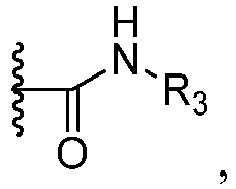
- The compound, medicinal salts, prodrugs and hydrates or solvates thereof of claim 1, wherein, R1 is located at any one of positions 5-8 on the naphthalene ring, and is a substituted or unsubstituted 5-10 membered monocyclic or dicyclic heteroaryl containing 1-3 hetero atoms selected from the group consisting of N, O and S, preferably a substituted or unsubstituted group as follows: pyrazolyl, furyl, pyrrolyl, pyridyl, indazolyl, furo[3,2-c]pyridyl, thieno[3,2-c]pyridyl, thieno[2,3-d]pyrimidinyl, benzo[d]isoxazolyl, benzo[d]isothiazolyl, indolyl, quinolyl and isoquinolyl; in the case of substitution, the substituent is 1 to 3 substituents, said substituent is independently selected from the group consisting of amino, methyl, methoxy, F, Cl, Br, pyrazolyl, methyl-substituted pyrazolyl and hydroxyethyl-substituted pyrazolyl;
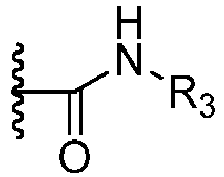
R3 is selected from the group consisting of hydrogen, C1-C3 alkyl, C3-C6 cycloalkyl, a substituted or unsubstituted phenyl and a substituted or unsubstituted 5-6 membered heteroaryl containing 1-3 hetero atoms selected from N, O and S; in the case of substitution, the substituent may be 1 to 3 substituents and each substituent is independently selected from the group consisting of C1-C3 alkyl, methoxy, trifluoromethyl, trifluoromethoxy, hydroxy, amino, nitro, F, Cl and Br;
R2 is located at any one of positions 1-8 on the naphthalene ring except R1 and
- The compound, medicinal salts, prodrugs and hydrates or solvates thereof of claim 1 or 2, wherein, R1 is any one of the following structures:


- The compound, medicinal salts, prodrugs and hydrates or solvates thereof of claim 1 or 2, wherein, the compound is compound represented by following general formula (II):
 wherein, R2 and
 Z is C(R5)=CH, S or O;Y is NH, NMe, O, CH=C(R6) or CH=N;R5 is selected from the group consisting of hydrogen, halogen, C1-C3 alkyl and C1-C3 alkoxy, preferably from the group consisting of hydrogen, F, Cl, Br, methyl and methoxy; R6 is selected from the group consisting of hydrogen, pyrazolyl, C1-C3 alkyl-substituted pyrazolyl and C1-C3 hydroxyalkyl-substituted pyrazolyl, preferably from the group consisting of hydrogen, pyrazolyl, methyl-substituted pyrazolyl and hydroxyethyl-substituted pyrazolyl.
 - The compound, medicinal salts, prodrugs and hydrates or solvates thereof of claim 1 or 2, wherein, the compound is compound represented by general formula (III), (IV), (V) or (VI):

 wherein,
 V is S or O;W is N or C(R7);R7 is selected from the group consisting of hydrogen, pyrazolyl, C1-C3 alkyl-substituted pyrazolyl and C1-C3 hydroxyalkyl-substituted pyrazolyl, preferably from the group consisting of hydrogen, pyrazolyl, methyl-substituted pyrazolyl and hydroxyethyl-substituted pyrazolyl.
 - The compound, medicinal salts, prodrugs and hydrates or solvates thereof of claim 1 or 2, wherein, the compound is selected from the group consisting of the following compounds:

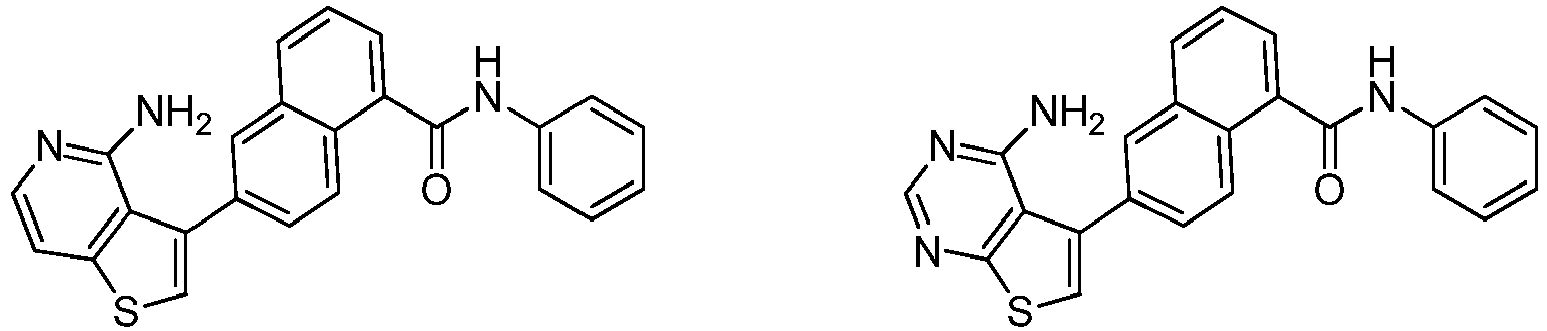


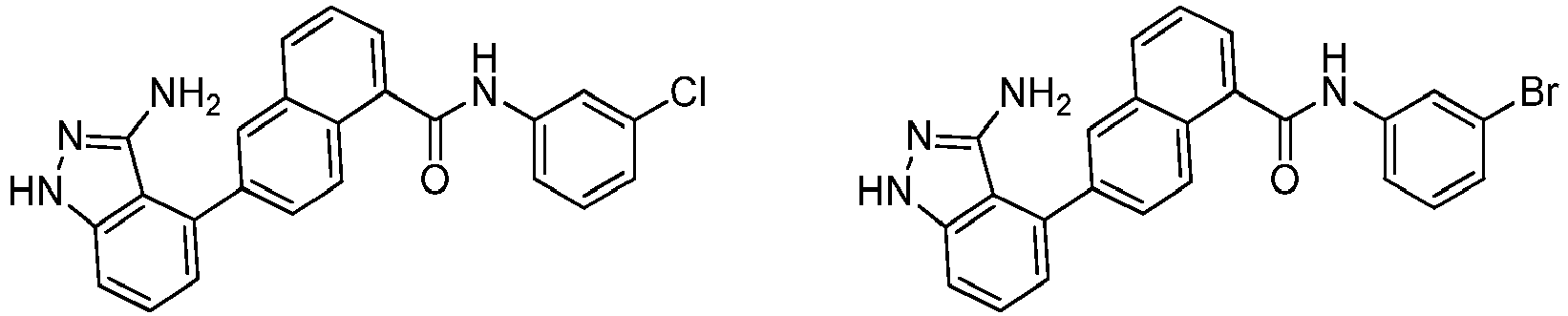


- A pharmaceutical composition comprising a therapeutically effective amount of one or more of compounds, pharmaceutically acceptable salts, prodrugs, hydrates and solvates thereof of any one of claims 1-6 and optionally a pharmaceutically acceptable carrier.
- Use of one or more of compounds, pharmaceutically acceptable salts, prodrugs, hydrates and solvates thereof of any one of claims 1-6 and the pharmaceutical composition of claim 7 in the preparation of medicaments for preventing and/or treating abnormal angiogenesis-related diseases, preferably as protein tyrosine kinase inhibitors, especially as VEGFR-2 inhibitors.
- The use of claim 8, wherein, the abnormal angiogenesis-related disease is selected from the group consisting of tumor, rheumatoid arthritis, age-related macular degeneration and psoriasis.
- The use of claim 9, wherein, the tumor includes lung cancer, breast cancer, colon cancer, prostate cancer, pancreas cancer, stomach cancer, liver cancer, ovarian cancer, renal cancer, glioma, melanoma, pancreatic cancer, head and neck cancer, bladder cancer, cervical cancer, cholangiocarcinoma, nasopharyngeal cancer, thyroid cancer, osteosarcoma, synovial sarcoma, rhabdomyosarcoma, fibrosarcoma, leiomyosarcoma, myeloma and lymphoma.
Applications Claiming Priority (2)
| Application Number | Priority Date | Filing Date | Title |
|---|---|---|---|
| CN201410062209.0A CN104860885B (en) | 2014-02-24 | 2014-02-24 | Naphthoyl aminated compounds, preparation method and use |
| PCT/CN2015/073121 WO2015124101A1 (en) | 2014-02-24 | 2015-02-15 | Naphthylamide compound, preparation method and use thereof |
Publications (3)
| Publication Number | Publication Date |
|---|---|
| EP3112351A1 true EP3112351A1 (en) | 2017-01-04 |
| EP3112351A4 EP3112351A4 (en) | 2017-02-01 |
| EP3112351B1 EP3112351B1 (en) | 2022-03-30 |
Family
ID=53877639
Family Applications (1)
| Application Number | Title | Priority Date | Filing Date |
|---|---|---|---|
| EP15751703.8A Active EP3112351B1 (en) | 2014-02-24 | 2015-02-15 | Naphthylamide compound, preparation method and use thereof |
Country Status (9)
| Country | Link |
|---|---|
| US (1) | US9914707B2 (en) |
| EP (1) | EP3112351B1 (en) |
| JP (1) | JP6353556B2 (en) |
| KR (1) | KR101908333B1 (en) |
| CN (1) | CN104860885B (en) |
| AU (1) | AU2015221343B2 (en) |
| CA (1) | CA2940614C (en) |
| RU (1) | RU2655607C2 (en) |
| WO (1) | WO2015124101A1 (en) |
Families Citing this family (12)
| Publication number | Priority date | Publication date | Assignee | Title |
|---|---|---|---|---|
| CN109803645B (en) * | 2017-04-10 | 2022-03-25 | 师健友 | A medicine for treating tumor and having antibacterial, antiviral and antiinflammatory effects |
| CN109999035A (en) * | 2019-05-05 | 2019-07-12 | 西安交通大学 | Sorafenib derivative application in preparation of anti-tumor drugs |
| CN110950739B (en) * | 2019-11-22 | 2022-05-20 | 浙江工业大学 | Method for directly fluorinating ortho-position of phenol compound |
| CN119454695A (en) * | 2020-09-23 | 2025-02-18 | 上海润石医药科技有限公司 | CSF1R kinase inhibitors and uses thereof |
| CN117919234A (en) * | 2022-10-25 | 2024-04-26 | 上海润石医药科技有限公司 | Application of naphthalamide compound in treatment of drug-resistant tumor |
| WO2024088273A1 (en) * | 2022-10-25 | 2024-05-02 | 中国科学院上海药物研究所 | Use of naphthylamide compound in treatment of kras mutation-related diseases |
| KR20250129103A (en) | 2023-01-09 | 2025-08-28 | 상하이 런쉬 메디컬 테크놀로지 컴퍼니 리미티드 | Self-emulsifying pharmaceutical composition, method for preparing the same, and use thereof |
| CN116102514B (en) * | 2023-01-17 | 2024-03-15 | 河南省锐达医药科技有限公司 | Naphthalene amide compound and preparation method and application thereof |
| KR20250136418A (en) | 2023-03-03 | 2025-09-16 | 상하이 런쉬 메디컬 테크놀로지 컴퍼니 리미티드 | Use of naphthalenamide compounds in the treatment of meningiomas |
| CN118894823B (en) * | 2024-06-28 | 2025-09-19 | 重庆医科大学 | Naphthylamide compound serving as VEGFR inhibitor and application thereof |
| WO2026037303A1 (en) * | 2024-08-12 | 2026-02-19 | 上海润石医药科技有限公司 | Crystal form of naphthalimide compound and preparation method therefor and use thereof |
| CN119528737B (en) * | 2024-12-03 | 2025-10-14 | 厦门大学 | A small molecule compound DHN and its preparation method and application |
Family Cites Families (16)
| Publication number | Priority date | Publication date | Assignee | Title |
|---|---|---|---|---|
| US5006519A (en) * | 1990-07-11 | 1991-04-09 | Merck & Co., Inc. | 2-naphthyl-carbapenem antibacterial agents |
| CA2336848A1 (en) * | 1998-07-10 | 2000-01-20 | Merck & Co., Inc. | Novel angiogenesis inhibitors |
| US20030225273A1 (en) * | 2002-03-21 | 2003-12-04 | Michaelides Michael R. | Thiopyrimidine and isothiazolopyrimidine kinase inhibitors |
| JP4932495B2 (en) * | 2004-01-23 | 2012-05-16 | アムゲン インコーポレイテッド | Compound and method of use |
| GB0420520D0 (en) * | 2004-09-15 | 2004-10-20 | Novartis Ag | Organic compounds |
| PE20060664A1 (en) | 2004-09-15 | 2006-08-04 | Novartis Ag | BICYCLE AMIDAS AS KINASE INHIBITORS |
| US20070054916A1 (en) * | 2004-10-01 | 2007-03-08 | Amgen Inc. | Aryl nitrogen-containing bicyclic compounds and methods of use |
| MX2007015679A (en) * | 2005-06-30 | 2008-02-21 | Amgen Inc | Bis-aryl kinase inhibitors and their use in the treatment of inflammation, angiogenesis and cancer. |
| US7566721B2 (en) * | 2005-08-08 | 2009-07-28 | Osi Pharmaceuticals, Inc. | Substituted thienol[2,3-d]pyrimidines as kinase inhibitors |
| GT200600411A (en) * | 2005-09-13 | 2007-05-21 | Novartis Ag | COMBINATIONS THAT INCLUDE AN INHIBITOR OF THE RECEIVER OF THE VASCULAR ENDOTELIAL GROWTH FACTOR |
| CN101906076B (en) * | 2009-06-04 | 2013-03-13 | 深圳微芯生物科技有限责任公司 | Naphthaline amide derivative serving as protein kinase inhibitor and histone deacetylase inhibitor and preparation method and application thereof |
| US20110112121A1 (en) * | 2009-07-06 | 2011-05-12 | Joerg Berghausen | Pharmaceutical Compositions and Solid Forms |
| CN103288728A (en) * | 2013-05-17 | 2013-09-11 | 华侨大学 | Naphthoyl amine derivative, and preparation method and application thereof |
| CN103351336A (en) * | 2013-06-28 | 2013-10-16 | 华侨大学 | Naphthalenecarboxamide derivative as inhibitors of protein kinase and histone deacetylase and preparation method thereof |
| CN103896836A (en) * | 2014-03-20 | 2014-07-02 | 华侨大学 | N-benzyl-6-[(7-chloroquinoline-4-oxo) phenolic ether]-2-naphthamide and preparation method thereof |
| CN103923004A (en) * | 2014-04-04 | 2014-07-16 | 华侨大学 | Naphthalene formamide derivative and preparation and application thereof |
-
2014
- 2014-02-24 CN CN201410062209.0A patent/CN104860885B/en active Active
-
2015
- 2015-02-15 EP EP15751703.8A patent/EP3112351B1/en active Active
- 2015-02-15 RU RU2016137356A patent/RU2655607C2/en active
- 2015-02-15 AU AU2015221343A patent/AU2015221343B2/en active Active
- 2015-02-15 JP JP2016570154A patent/JP6353556B2/en active Active
- 2015-02-15 US US15/120,771 patent/US9914707B2/en active Active
- 2015-02-15 WO PCT/CN2015/073121 patent/WO2015124101A1/en not_active Ceased
- 2015-02-15 CA CA2940614A patent/CA2940614C/en active Active
- 2015-02-15 KR KR1020167026019A patent/KR101908333B1/en active Active
Also Published As
| Publication number | Publication date |
|---|---|
| RU2655607C2 (en) | 2018-05-29 |
| WO2015124101A1 (en) | 2015-08-27 |
| AU2015221343A1 (en) | 2016-09-15 |
| KR101908333B1 (en) | 2018-10-16 |
| AU2015221343B2 (en) | 2017-08-03 |
| EP3112351A4 (en) | 2017-02-01 |
| CA2940614C (en) | 2017-11-07 |
| CA2940614A1 (en) | 2015-08-27 |
| KR20160116010A (en) | 2016-10-06 |
| CN104860885B (en) | 2017-11-17 |
| EP3112351B1 (en) | 2022-03-30 |
| JP2017507177A (en) | 2017-03-16 |
| RU2016137356A3 (en) | 2018-04-02 |
| RU2016137356A (en) | 2018-04-02 |
| US20170066723A1 (en) | 2017-03-09 |
| JP6353556B2 (en) | 2018-07-04 |
| US9914707B2 (en) | 2018-03-13 |
| CN104860885A (en) | 2015-08-26 |
Similar Documents
| Publication | Publication Date | Title |
|---|---|---|
| EP3112351B1 (en) | Naphthylamide compound, preparation method and use thereof | |
| CA2564355C (en) | Protein kinase modulators and method of use | |
| CN104529904B (en) | The preparation method of Bo Maxini | |
| CN103570625A (en) | N-(3-aryl-heteroaryl)-4-aryl-aryl carboxamide and analog as hedgehog pathway inhibitors and application thereof | |
| WO2013013614A1 (en) | 4-(3-heteroarylarylamino)quinazoline and 1-(3-heteroarylarylamino)isoquinoline as hedgehog pathway inhibitor and use thereof | |
| CN106905245B (en) | 2,4-disubstituted pyrimidines | |
| WO2017005137A1 (en) | Quinazoline compound, intermediate, preparation method, pharmaceutical composition and uses thereof | |
| CN105884699A (en) | 4-substituted anilinoquinazoline derivatives, and preparation method and application thereof | |
| CN104163794A (en) | 2-amino aromatic ring vascular endothelial growth factor receptor (VEGFR) inhibitor, preparation method and use thereof | |
| EP2768809B1 (en) | Pyridine-sulfoximines as tyrosine kinase inhibitors | |
| WO2019242689A1 (en) | Cyano-substituted pyridine and cyano-substituted pyrimidine compound, and preparation method and application thereof | |
| CN108341791B (en) | Benzothiadiazole compound, its preparation method and use | |
| CN114105887A (en) | Aminopyrimidine derivative and preparation method and application thereof | |
| JP2009242240A (en) | Boron-containing quinazoline derivative | |
| CN110818609A (en) | Preparation method and use of 3-acetyl indole BRPF1 inhibitor | |
| CN114539167B (en) | Process for producing alkynyl ketone derivative | |
| JPWO2002014262A1 (en) | 2,3-Diphenylpropionic acid derivatives or salts thereof, medicines and cell adhesion inhibitors using the same, and methods of using the same | |
| CN103833671B (en) | A class of dihydrothiazolone compounds and their pharmaceutical compositions and uses | |
| KR20110103438A (en) | Method for preparing quinazoline derivatives | |
| CN103373971B (en) | Urea compounds as protein kinase inhibitors | |
| CN104829542B (en) | Aniline pyrimidine class compound, its preparation method and medical usage | |
| JP2009518364A (en) | Pyrimidyl, condensed pyrimidyl, pyridylhydrazone that suppresses growth | |
| CN106496107A (en) | VEGFR inhibitor 2 and preparation method thereof | |
| CN110669027A (en) | Compounds and their esters, their preparation and use | |
| JP2025533275A (en) | Novel heterobicyclic compounds for inhibiting YAP-TEAD interaction and pharmaceutical compositions containing the same |
Legal Events
| Date | Code | Title | Description |
|---|---|---|---|
| PUAI | Public reference made under article 153(3) epc to a published international application that has entered the european phase |
Free format text: ORIGINAL CODE: 0009012 |
|
| STAA | Information on the status of an ep patent application or granted ep patent |
Free format text: STATUS: REQUEST FOR EXAMINATION WAS MADE |
|
| 17P | Request for examination filed |
Effective date: 20160824 |
|
| AK | Designated contracting states |
Kind code of ref document: A1 Designated state(s): AL AT BE BG CH CY CZ DE DK EE ES FI FR GB GR HR HU IE IS IT LI LT LU LV MC MK MT NL NO PL PT RO RS SE SI SK SM TR |
|
| AX | Request for extension of the european patent |
Extension state: BA ME |
|
| A4 | Supplementary search report drawn up and despatched |
Effective date: 20170105 |
|
| RIC1 | Information provided on ipc code assigned before grant |
Ipc: A61K 31/4439 20060101ALI20161223BHEP Ipc: A61P 35/00 20060101ALI20161223BHEP Ipc: C07D 491/048 20060101ALI20161223BHEP Ipc: A61P 29/00 20060101ALI20161223BHEP Ipc: C07D 261/20 20060101ALI20161223BHEP Ipc: A61P 17/06 20060101ALI20161223BHEP Ipc: A61K 31/519 20060101ALI20161223BHEP Ipc: A61K 31/416 20060101ALI20161223BHEP Ipc: A61K 31/4365 20060101ALI20161223BHEP Ipc: A61K 31/422 20060101ALI20161223BHEP Ipc: A61K 31/4355 20060101ALI20161223BHEP Ipc: A61K 31/423 20060101ALI20161223BHEP Ipc: C07D 231/56 20060101AFI20161223BHEP Ipc: A61P 27/02 20060101ALI20161223BHEP Ipc: C07D 495/04 20060101ALI20161223BHEP |
|
| DAX | Request for extension of the european patent (deleted) | ||
| GRAP | Despatch of communication of intention to grant a patent |
Free format text: ORIGINAL CODE: EPIDOSNIGR1 |
|
| STAA | Information on the status of an ep patent application or granted ep patent |
Free format text: STATUS: GRANT OF PATENT IS INTENDED |
|
| INTG | Intention to grant announced |
Effective date: 20211104 |
|
| GRAS | Grant fee paid |
Free format text: ORIGINAL CODE: EPIDOSNIGR3 |
|
| GRAA | (expected) grant |
Free format text: ORIGINAL CODE: 0009210 |
|
| STAA | Information on the status of an ep patent application or granted ep patent |
Free format text: STATUS: THE PATENT HAS BEEN GRANTED |
|
| AK | Designated contracting states |
Kind code of ref document: B1 Designated state(s): AL AT BE BG CH CY CZ DE DK EE ES FI FR GB GR HR HU IE IS IT LI LT LU LV MC MK MT NL NO PL PT RO RS SE SI SK SM TR |
|
| REG | Reference to a national code |
Ref country code: GB Ref legal event code: FG4D |
|
| REG | Reference to a national code |
Ref country code: CH Ref legal event code: EP |
|
| REG | Reference to a national code |
Ref country code: AT Ref legal event code: REF Ref document number: 1479090 Country of ref document: AT Kind code of ref document: T Effective date: 20220415 |
|
| REG | Reference to a national code |
Ref country code: DE Ref legal event code: R096 Ref document number: 602015077861 Country of ref document: DE |
|
| REG | Reference to a national code |
Ref country code: IE Ref legal event code: FG4D |
|
| REG | Reference to a national code |
Ref country code: LT Ref legal event code: MG9D |
|
| PG25 | Lapsed in a contracting state [announced via postgrant information from national office to epo] |
Ref country code: SE Free format text: LAPSE BECAUSE OF FAILURE TO SUBMIT A TRANSLATION OF THE DESCRIPTION OR TO PAY THE FEE WITHIN THE PRESCRIBED TIME-LIMIT Effective date: 20220330 Ref country code: RS Free format text: LAPSE BECAUSE OF FAILURE TO SUBMIT A TRANSLATION OF THE DESCRIPTION OR TO PAY THE FEE WITHIN THE PRESCRIBED TIME-LIMIT Effective date: 20220330 Ref country code: NO Free format text: LAPSE BECAUSE OF FAILURE TO SUBMIT A TRANSLATION OF THE DESCRIPTION OR TO PAY THE FEE WITHIN THE PRESCRIBED TIME-LIMIT Effective date: 20220630 Ref country code: LT Free format text: LAPSE BECAUSE OF FAILURE TO SUBMIT A TRANSLATION OF THE DESCRIPTION OR TO PAY THE FEE WITHIN THE PRESCRIBED TIME-LIMIT Effective date: 20220330 Ref country code: HR Free format text: LAPSE BECAUSE OF FAILURE TO SUBMIT A TRANSLATION OF THE DESCRIPTION OR TO PAY THE FEE WITHIN THE PRESCRIBED TIME-LIMIT Effective date: 20220330 Ref country code: BG Free format text: LAPSE BECAUSE OF FAILURE TO SUBMIT A TRANSLATION OF THE DESCRIPTION OR TO PAY THE FEE WITHIN THE PRESCRIBED TIME-LIMIT Effective date: 20220630 |
|
| REG | Reference to a national code |
Ref country code: NL Ref legal event code: MP Effective date: 20220330 |
|
| REG | Reference to a national code |
Ref country code: AT Ref legal event code: MK05 Ref document number: 1479090 Country of ref document: AT Kind code of ref document: T Effective date: 20220330 |
|
| PG25 | Lapsed in a contracting state [announced via postgrant information from national office to epo] |
Ref country code: LV Free format text: LAPSE BECAUSE OF FAILURE TO SUBMIT A TRANSLATION OF THE DESCRIPTION OR TO PAY THE FEE WITHIN THE PRESCRIBED TIME-LIMIT Effective date: 20220330 Ref country code: GR Free format text: LAPSE BECAUSE OF FAILURE TO SUBMIT A TRANSLATION OF THE DESCRIPTION OR TO PAY THE FEE WITHIN THE PRESCRIBED TIME-LIMIT Effective date: 20220701 Ref country code: FI Free format text: LAPSE BECAUSE OF FAILURE TO SUBMIT A TRANSLATION OF THE DESCRIPTION OR TO PAY THE FEE WITHIN THE PRESCRIBED TIME-LIMIT Effective date: 20220330 |
|
| PG25 | Lapsed in a contracting state [announced via postgrant information from national office to epo] |
Ref country code: NL Free format text: LAPSE BECAUSE OF FAILURE TO SUBMIT A TRANSLATION OF THE DESCRIPTION OR TO PAY THE FEE WITHIN THE PRESCRIBED TIME-LIMIT Effective date: 20220330 |
|
| PG25 | Lapsed in a contracting state [announced via postgrant information from national office to epo] |
Ref country code: SM Free format text: LAPSE BECAUSE OF FAILURE TO SUBMIT A TRANSLATION OF THE DESCRIPTION OR TO PAY THE FEE WITHIN THE PRESCRIBED TIME-LIMIT Effective date: 20220330 Ref country code: SK Free format text: LAPSE BECAUSE OF FAILURE TO SUBMIT A TRANSLATION OF THE DESCRIPTION OR TO PAY THE FEE WITHIN THE PRESCRIBED TIME-LIMIT Effective date: 20220330 Ref country code: RO Free format text: LAPSE BECAUSE OF FAILURE TO SUBMIT A TRANSLATION OF THE DESCRIPTION OR TO PAY THE FEE WITHIN THE PRESCRIBED TIME-LIMIT Effective date: 20220330 Ref country code: PT Free format text: LAPSE BECAUSE OF FAILURE TO SUBMIT A TRANSLATION OF THE DESCRIPTION OR TO PAY THE FEE WITHIN THE PRESCRIBED TIME-LIMIT Effective date: 20220801 Ref country code: ES Free format text: LAPSE BECAUSE OF FAILURE TO SUBMIT A TRANSLATION OF THE DESCRIPTION OR TO PAY THE FEE WITHIN THE PRESCRIBED TIME-LIMIT Effective date: 20220330 Ref country code: EE Free format text: LAPSE BECAUSE OF FAILURE TO SUBMIT A TRANSLATION OF THE DESCRIPTION OR TO PAY THE FEE WITHIN THE PRESCRIBED TIME-LIMIT Effective date: 20220330 Ref country code: CZ Free format text: LAPSE BECAUSE OF FAILURE TO SUBMIT A TRANSLATION OF THE DESCRIPTION OR TO PAY THE FEE WITHIN THE PRESCRIBED TIME-LIMIT Effective date: 20220330 Ref country code: AT Free format text: LAPSE BECAUSE OF FAILURE TO SUBMIT A TRANSLATION OF THE DESCRIPTION OR TO PAY THE FEE WITHIN THE PRESCRIBED TIME-LIMIT Effective date: 20220330 |
|
| PG25 | Lapsed in a contracting state [announced via postgrant information from national office to epo] |
Ref country code: PL Free format text: LAPSE BECAUSE OF FAILURE TO SUBMIT A TRANSLATION OF THE DESCRIPTION OR TO PAY THE FEE WITHIN THE PRESCRIBED TIME-LIMIT Effective date: 20220330 Ref country code: IS Free format text: LAPSE BECAUSE OF FAILURE TO SUBMIT A TRANSLATION OF THE DESCRIPTION OR TO PAY THE FEE WITHIN THE PRESCRIBED TIME-LIMIT Effective date: 20220730 Ref country code: AL Free format text: LAPSE BECAUSE OF FAILURE TO SUBMIT A TRANSLATION OF THE DESCRIPTION OR TO PAY THE FEE WITHIN THE PRESCRIBED TIME-LIMIT Effective date: 20220330 |
|
| REG | Reference to a national code |
Ref country code: DE Ref legal event code: R097 Ref document number: 602015077861 Country of ref document: DE |
|
| PG25 | Lapsed in a contracting state [announced via postgrant information from national office to epo] |
Ref country code: DK Free format text: LAPSE BECAUSE OF FAILURE TO SUBMIT A TRANSLATION OF THE DESCRIPTION OR TO PAY THE FEE WITHIN THE PRESCRIBED TIME-LIMIT Effective date: 20220330 |
|
| PLBE | No opposition filed within time limit |
Free format text: ORIGINAL CODE: 0009261 |
|
| STAA | Information on the status of an ep patent application or granted ep patent |
Free format text: STATUS: NO OPPOSITION FILED WITHIN TIME LIMIT |
|
| 26N | No opposition filed |
Effective date: 20230103 |
|
| PG25 | Lapsed in a contracting state [announced via postgrant information from national office to epo] |
Ref country code: SI Free format text: LAPSE BECAUSE OF FAILURE TO SUBMIT A TRANSLATION OF THE DESCRIPTION OR TO PAY THE FEE WITHIN THE PRESCRIBED TIME-LIMIT Effective date: 20220330 |
|
| P01 | Opt-out of the competence of the unified patent court (upc) registered |
Effective date: 20230529 |
|
| PG25 | Lapsed in a contracting state [announced via postgrant information from national office to epo] |
Ref country code: IT Free format text: LAPSE BECAUSE OF FAILURE TO SUBMIT A TRANSLATION OF THE DESCRIPTION OR TO PAY THE FEE WITHIN THE PRESCRIBED TIME-LIMIT Effective date: 20220330 |
|
| PG25 | Lapsed in a contracting state [announced via postgrant information from national office to epo] |
Ref country code: MC Free format text: LAPSE BECAUSE OF FAILURE TO SUBMIT A TRANSLATION OF THE DESCRIPTION OR TO PAY THE FEE WITHIN THE PRESCRIBED TIME-LIMIT Effective date: 20220330 |
|
| REG | Reference to a national code |
Ref country code: CH Ref legal event code: PL |
|
| REG | Reference to a national code |
Ref country code: BE Ref legal event code: MM Effective date: 20230228 |
|
| PG25 | Lapsed in a contracting state [announced via postgrant information from national office to epo] |
Ref country code: LU Free format text: LAPSE BECAUSE OF NON-PAYMENT OF DUE FEES Effective date: 20230215 Ref country code: LI Free format text: LAPSE BECAUSE OF NON-PAYMENT OF DUE FEES Effective date: 20230228 Ref country code: CH Free format text: LAPSE BECAUSE OF NON-PAYMENT OF DUE FEES Effective date: 20230228 |
|
| REG | Reference to a national code |
Ref country code: IE Ref legal event code: MM4A |
|
| PG25 | Lapsed in a contracting state [announced via postgrant information from national office to epo] |
Ref country code: IE Free format text: LAPSE BECAUSE OF NON-PAYMENT OF DUE FEES Effective date: 20230215 |
|
| PG25 | Lapsed in a contracting state [announced via postgrant information from national office to epo] |
Ref country code: BE Free format text: LAPSE BECAUSE OF NON-PAYMENT OF DUE FEES Effective date: 20230228 |
|
| PG25 | Lapsed in a contracting state [announced via postgrant information from national office to epo] |
Ref country code: CY Free format text: LAPSE BECAUSE OF FAILURE TO SUBMIT A TRANSLATION OF THE DESCRIPTION OR TO PAY THE FEE WITHIN THE PRESCRIBED TIME-LIMIT; INVALID AB INITIO Effective date: 20150215 |
|
| PG25 | Lapsed in a contracting state [announced via postgrant information from national office to epo] |
Ref country code: HU Free format text: LAPSE BECAUSE OF FAILURE TO SUBMIT A TRANSLATION OF THE DESCRIPTION OR TO PAY THE FEE WITHIN THE PRESCRIBED TIME-LIMIT; INVALID AB INITIO Effective date: 20150215 |
|
| PG25 | Lapsed in a contracting state [announced via postgrant information from national office to epo] |
Ref country code: TR Free format text: LAPSE BECAUSE OF FAILURE TO SUBMIT A TRANSLATION OF THE DESCRIPTION OR TO PAY THE FEE WITHIN THE PRESCRIBED TIME-LIMIT Effective date: 20220330 |
|
| PGFP | Annual fee paid to national office [announced via postgrant information from national office to epo] |
Ref country code: GB Payment date: 20251215 Year of fee payment: 12 |
|
| PGFP | Annual fee paid to national office [announced via postgrant information from national office to epo] |
Ref country code: FR Payment date: 20251215 Year of fee payment: 12 |
|
| PGFP | Annual fee paid to national office [announced via postgrant information from national office to epo] |
Ref country code: DE Payment date: 20260217 Year of fee payment: 12 |