EP3112344A1 - Method for preparation of certain thioacetamides - Google Patents
Method for preparation of certain thioacetamides Download PDFInfo
- Publication number
- EP3112344A1 EP3112344A1 EP15174514.8A EP15174514A EP3112344A1 EP 3112344 A1 EP3112344 A1 EP 3112344A1 EP 15174514 A EP15174514 A EP 15174514A EP 3112344 A1 EP3112344 A1 EP 3112344A1
- Authority
- EP
- European Patent Office
- Prior art keywords
- group
- alkyl
- alkoxy
- compound
- substituted
- Prior art date
- Legal status (The legal status is an assumption and is not a legal conclusion. Google has not performed a legal analysis and makes no representation as to the accuracy of the status listed.)
- Withdrawn
Links
- 238000000034 method Methods 0.000 title claims abstract description 35
- 238000002360 preparation method Methods 0.000 title claims abstract description 20
- YUKQRDCYNOVPGJ-UHFFFAOYSA-N thioacetamide Chemical class CC(N)=S YUKQRDCYNOVPGJ-UHFFFAOYSA-N 0.000 title abstract description 4
- -1 1,5 disubstituted tetrazoles Chemical class 0.000 claims abstract description 107
- 150000001875 compounds Chemical class 0.000 claims abstract description 87
- FWMUJAIKEJWSSY-UHFFFAOYSA-N sulfur dichloride Chemical class ClSCl FWMUJAIKEJWSSY-UHFFFAOYSA-N 0.000 claims abstract description 13
- 125000001997 phenyl group Chemical group [H]C1=C([H])C([H])=C(*)C([H])=C1[H] 0.000 claims description 49
- 125000001424 substituent group Chemical group 0.000 claims description 49
- 229910052801 chlorine Inorganic materials 0.000 claims description 38
- 125000002023 trifluoromethyl group Chemical group FC(F)(F)* 0.000 claims description 35
- 239000000203 mixture Substances 0.000 claims description 34
- 229910052731 fluorine Inorganic materials 0.000 claims description 30
- JUJWROOIHBZHMG-UHFFFAOYSA-N Pyridine Chemical compound C1=CC=NC=C1 JUJWROOIHBZHMG-UHFFFAOYSA-N 0.000 claims description 28
- 229910052736 halogen Inorganic materials 0.000 claims description 25
- 125000000229 (C1-C4)alkoxy group Chemical group 0.000 claims description 24
- ZMANZCXQSJIPKH-UHFFFAOYSA-N Triethylamine Chemical compound CCN(CC)CC ZMANZCXQSJIPKH-UHFFFAOYSA-N 0.000 claims description 24
- 125000000449 nitro group Chemical group [O-][N+](*)=O 0.000 claims description 24
- FYSNRJHAOHDILO-UHFFFAOYSA-N thionyl chloride Chemical compound ClS(Cl)=O FYSNRJHAOHDILO-UHFFFAOYSA-N 0.000 claims description 24
- PXJJSXABGXMUSU-UHFFFAOYSA-N disulfur dichloride Chemical compound ClSSCl PXJJSXABGXMUSU-UHFFFAOYSA-N 0.000 claims description 23
- 229910052717 sulfur Inorganic materials 0.000 claims description 21
- 125000004169 (C1-C6) alkyl group Chemical group 0.000 claims description 20
- 229910052794 bromium Inorganic materials 0.000 claims description 19
- 229910052757 nitrogen Inorganic materials 0.000 claims description 19
- ITQTTZVARXURQS-UHFFFAOYSA-N 3-methylpyridine Chemical compound CC1=CC=CN=C1 ITQTTZVARXURQS-UHFFFAOYSA-N 0.000 claims description 18
- 238000006243 chemical reaction Methods 0.000 claims description 18
- 125000005842 heteroatom Chemical group 0.000 claims description 18
- 125000002496 methyl group Chemical group [H]C([H])([H])* 0.000 claims description 17
- 229910052760 oxygen Inorganic materials 0.000 claims description 17
- 125000004076 pyridyl group Chemical group 0.000 claims description 17
- 125000004093 cyano group Chemical group *C#N 0.000 claims description 16
- MHAJPDPJQMAIIY-UHFFFAOYSA-N Hydrogen peroxide Chemical compound OO MHAJPDPJQMAIIY-UHFFFAOYSA-N 0.000 claims description 14
- UMJSCPRVCHMLSP-UHFFFAOYSA-N pyridine Natural products COC1=CC=CN=C1 UMJSCPRVCHMLSP-UHFFFAOYSA-N 0.000 claims description 14
- IVRMZWNICZWHMI-UHFFFAOYSA-N Azide Chemical compound [N-]=[N+]=[N-] IVRMZWNICZWHMI-UHFFFAOYSA-N 0.000 claims description 13
- XHXFXVLFKHQFAL-UHFFFAOYSA-N phosphoryl trichloride Chemical compound ClP(Cl)(Cl)=O XHXFXVLFKHQFAL-UHFFFAOYSA-N 0.000 claims description 12
- 125000004209 (C1-C8) alkyl group Chemical group 0.000 claims description 11
- JGFZNNIVVJXRND-UHFFFAOYSA-N N,N-Diisopropylethylamine (DIPEA) Chemical compound CCN(C(C)C)C(C)C JGFZNNIVVJXRND-UHFFFAOYSA-N 0.000 claims description 11
- 125000003545 alkoxy group Chemical group 0.000 claims description 11
- 125000004178 (C1-C4) alkyl group Chemical group 0.000 claims description 10
- 229910052783 alkali metal Inorganic materials 0.000 claims description 10
- GZUXJHMPEANEGY-UHFFFAOYSA-N bromomethane Chemical compound BrC GZUXJHMPEANEGY-UHFFFAOYSA-N 0.000 claims description 10
- 125000002883 imidazolyl group Chemical group 0.000 claims description 10
- 125000003226 pyrazolyl group Chemical group 0.000 claims description 10
- 125000004191 (C1-C6) alkoxy group Chemical group 0.000 claims description 9
- SJRJJKPEHAURKC-UHFFFAOYSA-N N-Methylmorpholine Chemical compound CN1CCOCC1 SJRJJKPEHAURKC-UHFFFAOYSA-N 0.000 claims description 9
- 125000000999 tert-butyl group Chemical group [H]C([H])([H])C(*)(C([H])([H])[H])C([H])([H])[H] 0.000 claims description 9
- VHYFNPMBLIVWCW-UHFFFAOYSA-N 4-Dimethylaminopyridine Chemical compound CN(C)C1=CC=NC=C1 VHYFNPMBLIVWCW-UHFFFAOYSA-N 0.000 claims description 8
- NTSLROIKFLNUIJ-UHFFFAOYSA-N 5-Ethyl-2-methylpyridine Chemical compound CCC1=CC=C(C)N=C1 NTSLROIKFLNUIJ-UHFFFAOYSA-N 0.000 claims description 8
- JLTDJTHDQAWBAV-UHFFFAOYSA-N N,N-dimethylaniline Chemical compound CN(C)C1=CC=CC=C1 JLTDJTHDQAWBAV-UHFFFAOYSA-N 0.000 claims description 8
- 229910018105 SCl2 Inorganic materials 0.000 claims description 8
- 125000002112 pyrrolidino group Chemical group [*]N1C([H])([H])C([H])([H])C([H])([H])C1([H])[H] 0.000 claims description 8
- IMNIMPAHZVJRPE-UHFFFAOYSA-N triethylenediamine Chemical compound C1CN2CCN1CC2 IMNIMPAHZVJRPE-UHFFFAOYSA-N 0.000 claims description 8
- 101100494773 Caenorhabditis elegans ctl-2 gene Proteins 0.000 claims description 7
- 101100112369 Fasciola hepatica Cat-1 gene Proteins 0.000 claims description 7
- 101100005271 Neurospora crassa (strain ATCC 24698 / 74-OR23-1A / CBS 708.71 / DSM 1257 / FGSC 987) cat-1 gene Proteins 0.000 claims description 7
- YGYAWVDWMABLBF-UHFFFAOYSA-N Phosgene Chemical compound ClC(Cl)=O YGYAWVDWMABLBF-UHFFFAOYSA-N 0.000 claims description 7
- 125000000217 alkyl group Chemical group 0.000 claims description 7
- NHQDETIJWKXCTC-UHFFFAOYSA-N 3-chloroperbenzoic acid Chemical compound OOC(=O)C1=CC=CC(Cl)=C1 NHQDETIJWKXCTC-UHFFFAOYSA-N 0.000 claims description 6
- KZBUYRJDOAKODT-UHFFFAOYSA-N Chlorine Chemical compound ClCl KZBUYRJDOAKODT-UHFFFAOYSA-N 0.000 claims description 6
- 229910019213 POCl3 Inorganic materials 0.000 claims description 6
- 229910006069 SO3H Inorganic materials 0.000 claims description 6
- 125000001246 bromo group Chemical group Br* 0.000 claims description 6
- NEHMKBQYUWJMIP-NJFSPNSNSA-N chloro(114C)methane Chemical compound [14CH3]Cl NEHMKBQYUWJMIP-NJFSPNSNSA-N 0.000 claims description 6
- 125000003963 dichloro group Chemical group Cl* 0.000 claims description 6
- VAYGXNSJCAHWJZ-UHFFFAOYSA-N dimethyl sulfate Chemical compound COS(=O)(=O)OC VAYGXNSJCAHWJZ-UHFFFAOYSA-N 0.000 claims description 6
- 229910052739 hydrogen Inorganic materials 0.000 claims description 6
- VUQUOGPMUUJORT-UHFFFAOYSA-N methyl 4-methylbenzenesulfonate Chemical compound COS(=O)(=O)C1=CC=C(C)C=C1 VUQUOGPMUUJORT-UHFFFAOYSA-N 0.000 claims description 6
- CZXGXYBOQYQXQD-UHFFFAOYSA-N methyl benzenesulfonate Chemical compound COS(=O)(=O)C1=CC=CC=C1 CZXGXYBOQYQXQD-UHFFFAOYSA-N 0.000 claims description 6
- PQIOSYKVBBWRRI-UHFFFAOYSA-N methylphosphonyl difluoride Chemical group CP(F)(F)=O PQIOSYKVBBWRRI-UHFFFAOYSA-N 0.000 claims description 6
- 125000000951 phenoxy group Chemical group [H]C1=C([H])C([H])=C(O*)C([H])=C1[H] 0.000 claims description 6
- 125000000020 sulfo group Chemical group O=S(=O)([*])O[H] 0.000 claims description 6
- WVLBCYQITXONBZ-UHFFFAOYSA-N trimethyl phosphate Chemical compound COP(=O)(OC)OC WVLBCYQITXONBZ-UHFFFAOYSA-N 0.000 claims description 6
- UCPYLLCMEDAXFR-UHFFFAOYSA-N triphosgene Chemical compound ClC(Cl)(Cl)OC(=O)OC(Cl)(Cl)Cl UCPYLLCMEDAXFR-UHFFFAOYSA-N 0.000 claims description 6
- YNJSNEKCXVFDKW-UHFFFAOYSA-N 3-(5-amino-1h-indol-3-yl)-2-azaniumylpropanoate Chemical compound C1=C(N)C=C2C(CC(N)C(O)=O)=CNC2=C1 YNJSNEKCXVFDKW-UHFFFAOYSA-N 0.000 claims description 5
- 229910052784 alkaline earth metal Inorganic materials 0.000 claims description 5
- GDTBXPJZTBHREO-UHFFFAOYSA-N bromine Chemical compound BrBr GDTBXPJZTBHREO-UHFFFAOYSA-N 0.000 claims description 5
- 239000003054 catalyst Substances 0.000 claims description 5
- 239000007795 chemical reaction product Substances 0.000 claims description 5
- INQOMBQAUSQDDS-UHFFFAOYSA-N iodomethane Chemical compound IC INQOMBQAUSQDDS-UHFFFAOYSA-N 0.000 claims description 5
- 229940102396 methyl bromide Drugs 0.000 claims description 5
- MBABOKRGFJTBAE-UHFFFAOYSA-N methyl methanesulfonate Chemical compound COS(C)(=O)=O MBABOKRGFJTBAE-UHFFFAOYSA-N 0.000 claims description 5
- 150000002978 peroxides Chemical class 0.000 claims description 5
- UHZYTMXLRWXGPK-UHFFFAOYSA-N phosphorus pentachloride Chemical compound ClP(Cl)(Cl)(Cl)Cl UHZYTMXLRWXGPK-UHFFFAOYSA-N 0.000 claims description 5
- FAIAAWCVCHQXDN-UHFFFAOYSA-N phosphorus trichloride Chemical compound ClP(Cl)Cl FAIAAWCVCHQXDN-UHFFFAOYSA-N 0.000 claims description 5
- 125000004400 (C1-C12) alkyl group Chemical group 0.000 claims description 4
- 125000005913 (C3-C6) cycloalkyl group Chemical group 0.000 claims description 4
- JVSFQJZRHXAUGT-UHFFFAOYSA-N 2,2-dimethylpropanoyl chloride Chemical compound CC(C)(C)C(Cl)=O JVSFQJZRHXAUGT-UHFFFAOYSA-N 0.000 claims description 4
- BSKHPKMHTQYZBB-UHFFFAOYSA-N 2-methylpyridine Chemical compound CC1=CC=CC=N1 BSKHPKMHTQYZBB-UHFFFAOYSA-N 0.000 claims description 4
- FKNQCJSGGFJEIZ-UHFFFAOYSA-N 4-methylpyridine Chemical compound CC1=CC=NC=C1 FKNQCJSGGFJEIZ-UHFFFAOYSA-N 0.000 claims description 4
- KNCHDRLWPAKSII-UHFFFAOYSA-N 5-ethyl-2-methylpyridine Natural products CCC1=CC=NC(C)=C1 KNCHDRLWPAKSII-UHFFFAOYSA-N 0.000 claims description 4
- PLUBXMRUUVWRLT-UHFFFAOYSA-N Ethyl methanesulfonate Chemical compound CCOS(C)(=O)=O PLUBXMRUUVWRLT-UHFFFAOYSA-N 0.000 claims description 4
- 125000003236 benzoyl group Chemical group [H]C1=C([H])C([H])=C(C([H])=C1[H])C(*)=O 0.000 claims description 4
- AGEZXYOZHKGVCM-UHFFFAOYSA-N benzyl bromide Chemical compound BrCC1=CC=CC=C1 AGEZXYOZHKGVCM-UHFFFAOYSA-N 0.000 claims description 4
- KCXMKQUNVWSEMD-UHFFFAOYSA-N benzyl chloride Chemical compound ClCC1=CC=CC=C1 KCXMKQUNVWSEMD-UHFFFAOYSA-N 0.000 claims description 4
- 229940073608 benzyl chloride Drugs 0.000 claims description 4
- RDHPKYGYEGBMSE-UHFFFAOYSA-N bromoethane Chemical compound CCBr RDHPKYGYEGBMSE-UHFFFAOYSA-N 0.000 claims description 4
- HRYZWHHZPQKTII-UHFFFAOYSA-N chloroethane Chemical compound CCCl HRYZWHHZPQKTII-UHFFFAOYSA-N 0.000 claims description 4
- DENRZWYUOJLTMF-UHFFFAOYSA-N diethyl sulfate Chemical compound CCOS(=O)(=O)OCC DENRZWYUOJLTMF-UHFFFAOYSA-N 0.000 claims description 4
- 229940008406 diethyl sulfate Drugs 0.000 claims description 4
- HCUYBXPSSCRKRF-UHFFFAOYSA-N diphosgene Chemical compound ClC(=O)OC(Cl)(Cl)Cl HCUYBXPSSCRKRF-UHFFFAOYSA-N 0.000 claims description 4
- VRZVPALEJCLXPR-UHFFFAOYSA-N ethyl 4-methylbenzenesulfonate Chemical compound CCOS(=O)(=O)C1=CC=C(C)C=C1 VRZVPALEJCLXPR-UHFFFAOYSA-N 0.000 claims description 4
- XDRMBCMMABGNMM-UHFFFAOYSA-N ethyl benzenesulfonate Chemical compound CCOS(=O)(=O)C1=CC=CC=C1 XDRMBCMMABGNMM-UHFFFAOYSA-N 0.000 claims description 4
- 229960003750 ethyl chloride Drugs 0.000 claims description 4
- HVTICUPFWKNHNG-UHFFFAOYSA-N iodoethane Chemical compound CCI HVTICUPFWKNHNG-UHFFFAOYSA-N 0.000 claims description 4
- 125000001624 naphthyl group Chemical group 0.000 claims description 4
- USHAGKDGDHPEEY-UHFFFAOYSA-L potassium persulfate Chemical class [K+].[K+].[O-]S(=O)(=O)OOS([O-])(=O)=O USHAGKDGDHPEEY-UHFFFAOYSA-L 0.000 claims description 4
- IMFACGCPASFAPR-UHFFFAOYSA-N tributylamine Chemical compound CCCCN(CCCC)CCCC IMFACGCPASFAPR-UHFFFAOYSA-N 0.000 claims description 4
- DQWPFSLDHJDLRL-UHFFFAOYSA-N triethyl phosphate Chemical compound CCOP(=O)(OCC)OCC DQWPFSLDHJDLRL-UHFFFAOYSA-N 0.000 claims description 4
- 125000000876 trifluoromethoxy group Chemical group FC(F)(F)O* 0.000 claims description 4
- 125000004213 tert-butoxy group Chemical group [H]C([H])([H])C(O*)(C([H])([H])[H])C([H])([H])[H] 0.000 claims description 3
- LCPVQAHEFVXVKT-UHFFFAOYSA-N 2-(2,4-difluorophenoxy)pyridin-3-amine Chemical class NC1=CC=CN=C1OC1=CC=C(F)C=C1F LCPVQAHEFVXVKT-UHFFFAOYSA-N 0.000 claims description 2
- 229910020667 PBr3 Inorganic materials 0.000 claims description 2
- 229910020656 PBr5 Inorganic materials 0.000 claims description 2
- 229910019201 POBr3 Inorganic materials 0.000 claims description 2
- 125000004453 alkoxycarbonyl group Chemical group 0.000 claims description 2
- 150000001540 azides Chemical class 0.000 claims description 2
- PLQVNWHRQIGIKW-UHFFFAOYSA-O carbamimidoylazanium;azide Chemical compound [N-]=[N+]=[N-].NC(N)=[NH2+] PLQVNWHRQIGIKW-UHFFFAOYSA-O 0.000 claims description 2
- UXCDUFKZSUBXGM-UHFFFAOYSA-N phosphoric tribromide Chemical compound BrP(Br)(Br)=O UXCDUFKZSUBXGM-UHFFFAOYSA-N 0.000 claims description 2
- IPNPIHIZVLFAFP-UHFFFAOYSA-N phosphorus tribromide Chemical compound BrP(Br)Br IPNPIHIZVLFAFP-UHFFFAOYSA-N 0.000 claims description 2
- 125000005843 halogen group Chemical group 0.000 claims 8
- 125000003178 carboxy group Chemical group [H]OC(*)=O 0.000 claims 1
- CSCPPACGZOOCGX-UHFFFAOYSA-N Acetone Chemical class CC(C)=O CSCPPACGZOOCGX-UHFFFAOYSA-N 0.000 abstract description 14
- KWOLFJPFCHCOCG-UHFFFAOYSA-N Acetophenone Chemical compound CC(=O)C1=CC=CC=C1 KWOLFJPFCHCOCG-UHFFFAOYSA-N 0.000 abstract description 7
- KJUGUADJHNHALS-UHFFFAOYSA-N 1H-tetrazole Substances C=1N=NNN=1 KJUGUADJHNHALS-UHFFFAOYSA-N 0.000 abstract description 2
- 150000003536 tetrazoles Chemical class 0.000 abstract description 2
- YXFVVABEGXRONW-UHFFFAOYSA-N Toluene Chemical compound CC1=CC=CC=C1 YXFVVABEGXRONW-UHFFFAOYSA-N 0.000 description 42
- UHOVQNZJYSORNB-UHFFFAOYSA-N Benzene Chemical compound C1=CC=CC=C1 UHOVQNZJYSORNB-UHFFFAOYSA-N 0.000 description 30
- 239000000460 chlorine Substances 0.000 description 26
- XEKOWRVHYACXOJ-UHFFFAOYSA-N Ethyl acetate Chemical compound CCOC(C)=O XEKOWRVHYACXOJ-UHFFFAOYSA-N 0.000 description 24
- MVPPADPHJFYWMZ-UHFFFAOYSA-N chlorobenzene Chemical compound ClC1=CC=CC=C1 MVPPADPHJFYWMZ-UHFFFAOYSA-N 0.000 description 20
- HEMHJVSKTPXQMS-UHFFFAOYSA-M Sodium hydroxide Chemical compound [OH-].[Na+] HEMHJVSKTPXQMS-UHFFFAOYSA-M 0.000 description 18
- 150000002367 halogens Chemical class 0.000 description 17
- XLYOFNOQVPJJNP-UHFFFAOYSA-N water Substances O XLYOFNOQVPJJNP-UHFFFAOYSA-N 0.000 description 15
- WYURNTSHIVDZCO-UHFFFAOYSA-N Tetrahydrofuran Chemical compound C1CCOC1 WYURNTSHIVDZCO-UHFFFAOYSA-N 0.000 description 14
- YMWUJEATGCHHMB-UHFFFAOYSA-N Dichloromethane Chemical compound ClCCl YMWUJEATGCHHMB-UHFFFAOYSA-N 0.000 description 12
- KWYUFKZDYYNOTN-UHFFFAOYSA-M Potassium hydroxide Chemical compound [OH-].[K+] KWYUFKZDYYNOTN-UHFFFAOYSA-M 0.000 description 12
- CDBYLPFSWZWCQE-UHFFFAOYSA-L Sodium Carbonate Chemical compound [Na+].[Na+].[O-]C([O-])=O CDBYLPFSWZWCQE-UHFFFAOYSA-L 0.000 description 10
- PXIPVTKHYLBLMZ-UHFFFAOYSA-N Sodium azide Chemical compound [Na+].[N-]=[N+]=[N-] PXIPVTKHYLBLMZ-UHFFFAOYSA-N 0.000 description 10
- 239000002904 solvent Substances 0.000 description 10
- WEVYAHXRMPXWCK-UHFFFAOYSA-N Acetonitrile Chemical compound CC#N WEVYAHXRMPXWCK-UHFFFAOYSA-N 0.000 description 9
- GQHTUMJGOHRCHB-UHFFFAOYSA-N 2,3,4,6,7,8,9,10-octahydropyrimido[1,2-a]azepine Chemical compound C1CCCCN2CCCN=C21 GQHTUMJGOHRCHB-UHFFFAOYSA-N 0.000 description 8
- 125000000956 methoxy group Chemical group [H]C([H])([H])O* 0.000 description 8
- BWHMMNNQKKPAPP-UHFFFAOYSA-L potassium carbonate Chemical compound [K+].[K+].[O-]C([O-])=O BWHMMNNQKKPAPP-UHFFFAOYSA-L 0.000 description 8
- 238000005160 1H NMR spectroscopy Methods 0.000 description 7
- 125000001495 ethyl group Chemical group [H]C([H])([H])C([H])([H])* 0.000 description 7
- 125000001449 isopropyl group Chemical group [H]C([H])([H])C([H])(*)C([H])([H])[H] 0.000 description 7
- 125000004123 n-propyl group Chemical group [H]C([H])([H])C([H])([H])C([H])([H])* 0.000 description 7
- DFOFVBAIHWDCNO-UHFFFAOYSA-N (1-methyltetrazol-5-yl)-phenylmethanone Chemical group CN1N=NN=C1C(=O)C1=CC=CC=C1 DFOFVBAIHWDCNO-UHFFFAOYSA-N 0.000 description 6
- HEDRZPFGACZZDS-UHFFFAOYSA-N Chloroform Chemical compound ClC(Cl)Cl HEDRZPFGACZZDS-UHFFFAOYSA-N 0.000 description 6
- LFQSCWFLJHTTHZ-UHFFFAOYSA-N Ethanol Chemical compound CCO LFQSCWFLJHTTHZ-UHFFFAOYSA-N 0.000 description 6
- OKKJLVBELUTLKV-UHFFFAOYSA-N Methanol Chemical compound OC OKKJLVBELUTLKV-UHFFFAOYSA-N 0.000 description 6
- ZMXDDKWLCZADIW-UHFFFAOYSA-N N,N-Dimethylformamide Chemical compound CN(C)C=O ZMXDDKWLCZADIW-UHFFFAOYSA-N 0.000 description 6
- 239000000872 buffer Substances 0.000 description 6
- RYHBNJHYFVUHQT-UHFFFAOYSA-N 1,4-Dioxane Chemical compound C1COCCO1 RYHBNJHYFVUHQT-UHFFFAOYSA-N 0.000 description 5
- DKPFZGUDAPQIHT-UHFFFAOYSA-N Butyl acetate Natural products CCCCOC(C)=O DKPFZGUDAPQIHT-UHFFFAOYSA-N 0.000 description 5
- 239000006227 byproduct Substances 0.000 description 5
- 238000002425 crystallisation Methods 0.000 description 5
- 230000008025 crystallization Effects 0.000 description 5
- FUZZWVXGSFPDMH-UHFFFAOYSA-N hexanoic acid Chemical compound CCCCCC(O)=O FUZZWVXGSFPDMH-UHFFFAOYSA-N 0.000 description 5
- ZRKSVHFXTRFQFL-UHFFFAOYSA-N isocyanomethane Chemical compound C[N+]#[C-] ZRKSVHFXTRFQFL-UHFFFAOYSA-N 0.000 description 5
- 238000000746 purification Methods 0.000 description 5
- 230000035484 reaction time Effects 0.000 description 5
- 229910000029 sodium carbonate Inorganic materials 0.000 description 5
- 239000000243 solution Substances 0.000 description 5
- SGUVLZREKBPKCE-UHFFFAOYSA-N 1,5-diazabicyclo[4.3.0]-non-5-ene Chemical compound C1CCN=C2CCCN21 SGUVLZREKBPKCE-UHFFFAOYSA-N 0.000 description 4
- VTYYLEPIZMXCLO-UHFFFAOYSA-L Calcium carbonate Chemical compound [Ca+2].[O-]C([O-])=O VTYYLEPIZMXCLO-UHFFFAOYSA-L 0.000 description 4
- VEXZGXHMUGYJMC-UHFFFAOYSA-M Chloride anion Chemical compound [Cl-] VEXZGXHMUGYJMC-UHFFFAOYSA-M 0.000 description 4
- VEXZGXHMUGYJMC-UHFFFAOYSA-N Hydrochloric acid Chemical compound Cl VEXZGXHMUGYJMC-UHFFFAOYSA-N 0.000 description 4
- 101100325773 Magnaporthe oryzae (strain 70-15 / ATCC MYA-4617 / FGSC 8958) BAS2 gene Proteins 0.000 description 4
- SECXISVLQFMRJM-UHFFFAOYSA-N N-Methylpyrrolidone Chemical compound CN1CCCC1=O SECXISVLQFMRJM-UHFFFAOYSA-N 0.000 description 4
- JCXJVPUVTGWSNB-UHFFFAOYSA-N Nitrogen dioxide Chemical compound O=[N]=O JCXJVPUVTGWSNB-UHFFFAOYSA-N 0.000 description 4
- 101100083256 Saccharomyces cerevisiae (strain ATCC 204508 / S288c) PHO2 gene Proteins 0.000 description 4
- WQDUMFSSJAZKTM-UHFFFAOYSA-N Sodium methoxide Chemical compound [Na+].[O-]C WQDUMFSSJAZKTM-UHFFFAOYSA-N 0.000 description 4
- RAHZWNYVWXNFOC-UHFFFAOYSA-N Sulphur dioxide Chemical compound O=S=O RAHZWNYVWXNFOC-UHFFFAOYSA-N 0.000 description 4
- 239000002585 base Substances 0.000 description 4
- AXCZMVOFGPJBDE-UHFFFAOYSA-L calcium dihydroxide Chemical compound [OH-].[OH-].[Ca+2] AXCZMVOFGPJBDE-UHFFFAOYSA-L 0.000 description 4
- 239000000920 calcium hydroxide Substances 0.000 description 4
- 229910001861 calcium hydroxide Inorganic materials 0.000 description 4
- 238000007796 conventional method Methods 0.000 description 4
- 238000000605 extraction Methods 0.000 description 4
- SHFJWMWCIHQNCP-UHFFFAOYSA-M hydron;tetrabutylazanium;sulfate Chemical compound OS([O-])(=O)=O.CCCC[N+](CCCC)(CCCC)CCCC SHFJWMWCIHQNCP-UHFFFAOYSA-M 0.000 description 4
- YLHXLHGIAMFFBU-UHFFFAOYSA-N methyl phenylglyoxalate Chemical compound COC(=O)C(=O)C1=CC=CC=C1 YLHXLHGIAMFFBU-UHFFFAOYSA-N 0.000 description 4
- URHWNXDZOULUHC-ULJHMMPZSA-N picarbutrazox Chemical compound CN1N=NN=C1\C(C=1C=CC=CC=1)=N/OCC1=CC=CC(NC(=O)OC(C)(C)C)=N1 URHWNXDZOULUHC-ULJHMMPZSA-N 0.000 description 4
- 229910000027 potassium carbonate Inorganic materials 0.000 description 4
- CPELXLSAUQHCOX-UHFFFAOYSA-M Bromide Chemical compound [Br-] CPELXLSAUQHCOX-UHFFFAOYSA-M 0.000 description 3
- GAWIXWVDTYZWAW-UHFFFAOYSA-N C[CH]O Chemical group C[CH]O GAWIXWVDTYZWAW-UHFFFAOYSA-N 0.000 description 3
- LYCAIKOWRPUZTN-UHFFFAOYSA-N Ethylene glycol Chemical compound OCCO LYCAIKOWRPUZTN-UHFFFAOYSA-N 0.000 description 3
- NINIDFKCEFEMDL-UHFFFAOYSA-N Sulfur Chemical compound [S] NINIDFKCEFEMDL-UHFFFAOYSA-N 0.000 description 3
- 150000001340 alkali metals Chemical class 0.000 description 3
- 150000001342 alkaline earth metals Chemical class 0.000 description 3
- 239000008346 aqueous phase Substances 0.000 description 3
- 125000004218 chloromethyl group Chemical group [H]C([H])(Cl)* 0.000 description 3
- 125000001995 cyclobutyl group Chemical group [H]C1([H])C([H])([H])C([H])(*)C1([H])[H] 0.000 description 3
- 125000000582 cycloheptyl group Chemical group [H]C1([H])C([H])([H])C([H])([H])C([H])([H])C([H])(*)C([H])([H])C1([H])[H] 0.000 description 3
- 125000000113 cyclohexyl group Chemical group [H]C1([H])C([H])([H])C([H])([H])C([H])(*)C([H])([H])C1([H])[H] 0.000 description 3
- 125000001511 cyclopentyl group Chemical group [H]C1([H])C([H])([H])C([H])([H])C([H])(*)C1([H])[H] 0.000 description 3
- 125000001559 cyclopropyl group Chemical group [H]C1([H])C([H])([H])C1([H])* 0.000 description 3
- 238000004821 distillation Methods 0.000 description 3
- 125000005745 ethoxymethyl group Chemical group [H]C([H])([H])C([H])([H])OC([H])([H])* 0.000 description 3
- 125000004216 fluoromethyl group Chemical group [H]C([H])(F)* 0.000 description 3
- 125000004029 hydroxymethyl group Chemical group [H]OC([H])([H])* 0.000 description 3
- 239000012535 impurity Substances 0.000 description 3
- 229910052740 iodine Inorganic materials 0.000 description 3
- 125000000959 isobutyl group Chemical group [H]C([H])([H])C([H])(C([H])([H])[H])C([H])([H])* 0.000 description 3
- 125000004184 methoxymethyl group Chemical group [H]C([H])([H])OC([H])([H])* 0.000 description 3
- 125000004108 n-butyl group Chemical group [H]C([H])([H])C([H])([H])C([H])([H])C([H])([H])* 0.000 description 3
- 125000000740 n-pentyl group Chemical group [H]C([H])([H])C([H])([H])C([H])([H])C([H])([H])C([H])([H])* 0.000 description 3
- 125000002914 sec-butyl group Chemical group [H]C([H])([H])C([H])([H])C([H])(*)C([H])([H])[H] 0.000 description 3
- 239000011593 sulfur Substances 0.000 description 3
- 125000006704 (C5-C6) cycloalkyl group Chemical group 0.000 description 2
- 125000001637 1-naphthyl group Chemical group [H]C1=C([H])C([H])=C2C(*)=C([H])C([H])=C([H])C2=C1[H] 0.000 description 2
- 125000004201 2,4-dichlorophenyl group Chemical group [H]C1=C([H])C(*)=C(Cl)C([H])=C1Cl 0.000 description 2
- 125000001622 2-naphthyl group Chemical group [H]C1=C([H])C([H])=C2C([H])=C(*)C([H])=C([H])C2=C1[H] 0.000 description 2
- 125000004189 3,4-dichlorophenyl group Chemical group [H]C1=C([H])C(Cl)=C(Cl)C([H])=C1* 0.000 description 2
- 125000003762 3,4-dimethoxyphenyl group Chemical group [H]C1=C([H])C(OC([H])([H])[H])=C(OC([H])([H])[H])C([H])=C1* 0.000 description 2
- 125000000242 4-chlorobenzoyl group Chemical group ClC1=CC=C(C(=O)*)C=C1 0.000 description 2
- 125000001255 4-fluorophenyl group Chemical group [H]C1=C([H])C(*)=C([H])C([H])=C1F 0.000 description 2
- 125000004172 4-methoxyphenyl group Chemical group [H]C1=C([H])C(OC([H])([H])[H])=C([H])C([H])=C1* 0.000 description 2
- 125000004863 4-trifluoromethoxyphenyl group Chemical group [H]C1=C([H])C(OC(F)(F)F)=C([H])C([H])=C1* 0.000 description 2
- 125000004199 4-trifluoromethylphenyl group Chemical group [H]C1=C([H])C(=C([H])C([H])=C1*)C(F)(F)F 0.000 description 2
- ZAMOUSCENKQFHK-UHFFFAOYSA-N Chlorine atom Chemical compound [Cl] ZAMOUSCENKQFHK-UHFFFAOYSA-N 0.000 description 2
- IAZDPXIOMUYVGZ-WFGJKAKNSA-N Dimethyl sulfoxide Chemical compound [2H]C([2H])([2H])S(=O)C([2H])([2H])[2H] IAZDPXIOMUYVGZ-WFGJKAKNSA-N 0.000 description 2
- BAVYZALUXZFZLV-UHFFFAOYSA-N Methylamine Chemical compound NC BAVYZALUXZFZLV-UHFFFAOYSA-N 0.000 description 2
- CTQNGGLPUBDAKN-UHFFFAOYSA-N O-Xylene Chemical compound CC1=CC=CC=C1C CTQNGGLPUBDAKN-UHFFFAOYSA-N 0.000 description 2
- KFSLWBXXFJQRDL-UHFFFAOYSA-N Peracetic acid Chemical compound CC(=O)OO KFSLWBXXFJQRDL-UHFFFAOYSA-N 0.000 description 2
- QAOWNCQODCNURD-UHFFFAOYSA-L Sulfate Chemical compound [O-]S([O-])(=O)=O QAOWNCQODCNURD-UHFFFAOYSA-L 0.000 description 2
- 239000008351 acetate buffer Substances 0.000 description 2
- 150000001408 amides Chemical class 0.000 description 2
- MDFFNEOEWAXZRQ-UHFFFAOYSA-N aminyl Chemical compound [NH2] MDFFNEOEWAXZRQ-UHFFFAOYSA-N 0.000 description 2
- VJGNLOIQCWLBJR-UHFFFAOYSA-M benzyl(tributyl)azanium;chloride Chemical compound [Cl-].CCCC[N+](CCCC)(CCCC)CC1=CC=CC=C1 VJGNLOIQCWLBJR-UHFFFAOYSA-M 0.000 description 2
- 230000015572 biosynthetic process Effects 0.000 description 2
- 239000012267 brine Substances 0.000 description 2
- 125000000484 butyl group Chemical group [H]C([*])([H])C([H])([H])C([H])([H])C([H])([H])[H] 0.000 description 2
- 229910000019 calcium carbonate Inorganic materials 0.000 description 2
- WOWHHFRSBJGXCM-UHFFFAOYSA-M cetyltrimethylammonium chloride Chemical compound [Cl-].CCCCCCCCCCCCCCCC[N+](C)(C)C WOWHHFRSBJGXCM-UHFFFAOYSA-M 0.000 description 2
- 150000004820 halides Chemical class 0.000 description 2
- IXCSERBJSXMMFS-UHFFFAOYSA-N hydrogen chloride Substances Cl.Cl IXCSERBJSXMMFS-UHFFFAOYSA-N 0.000 description 2
- 229910000041 hydrogen chloride Inorganic materials 0.000 description 2
- ZLNQQNXFFQJAID-UHFFFAOYSA-L magnesium carbonate Chemical compound [Mg+2].[O-]C([O-])=O ZLNQQNXFFQJAID-UHFFFAOYSA-L 0.000 description 2
- 239000001095 magnesium carbonate Substances 0.000 description 2
- 229910000021 magnesium carbonate Inorganic materials 0.000 description 2
- VTHJTEIRLNZDEV-UHFFFAOYSA-L magnesium dihydroxide Chemical compound [OH-].[OH-].[Mg+2] VTHJTEIRLNZDEV-UHFFFAOYSA-L 0.000 description 2
- 239000000347 magnesium hydroxide Substances 0.000 description 2
- 229910001862 magnesium hydroxide Inorganic materials 0.000 description 2
- CRGZYKWWYNQGEC-UHFFFAOYSA-N magnesium;methanolate Chemical compound [Mg+2].[O-]C.[O-]C CRGZYKWWYNQGEC-UHFFFAOYSA-N 0.000 description 2
- 238000002156 mixing Methods 0.000 description 2
- 125000000896 monocarboxylic acid group Chemical group 0.000 description 2
- 125000003854 p-chlorophenyl group Chemical group [H]C1=C([H])C(*)=C([H])C([H])=C1Cl 0.000 description 2
- 125000001037 p-tolyl group Chemical group [H]C1=C([H])C(=C([H])C([H])=C1*)C([H])([H])[H] 0.000 description 2
- 125000001147 pentyl group Chemical group C(CCCC)* 0.000 description 2
- 239000008363 phosphate buffer Substances 0.000 description 2
- 239000000047 product Substances 0.000 description 2
- QDRKDTQENPPHOJ-UHFFFAOYSA-N sodium ethoxide Chemical compound [Na+].CC[O-] QDRKDTQENPPHOJ-UHFFFAOYSA-N 0.000 description 2
- HPALAKNZSZLMCH-UHFFFAOYSA-M sodium;chloride;hydrate Chemical compound O.[Na+].[Cl-] HPALAKNZSZLMCH-UHFFFAOYSA-M 0.000 description 2
- CIHOLLKRGTVIJN-UHFFFAOYSA-N tert‐butyl hydroperoxide Chemical compound CC(C)(C)OO CIHOLLKRGTVIJN-UHFFFAOYSA-N 0.000 description 2
- NHGXDBSUJJNIRV-UHFFFAOYSA-M tetrabutylammonium chloride Chemical compound [Cl-].CCCC[N+](CCCC)(CCCC)CCCC NHGXDBSUJJNIRV-UHFFFAOYSA-M 0.000 description 2
- 239000008096 xylene Substances 0.000 description 2
- 125000003837 (C1-C20) alkyl group Chemical group 0.000 description 1
- YQTCQNIPQMJNTI-UHFFFAOYSA-N 2,2-dimethylpropan-1-one Chemical group CC(C)(C)[C]=O YQTCQNIPQMJNTI-UHFFFAOYSA-N 0.000 description 1
- 125000004791 2-fluoroethoxy group Chemical group FCCO* 0.000 description 1
- CSDQQAQKBAQLLE-UHFFFAOYSA-N 4-(4-chlorophenyl)-4,5,6,7-tetrahydrothieno[3,2-c]pyridine Chemical compound C1=CC(Cl)=CC=C1C1C(C=CS2)=C2CCN1 CSDQQAQKBAQLLE-UHFFFAOYSA-N 0.000 description 1
- BVKZGUZCCUSVTD-UHFFFAOYSA-L Carbonate Chemical compound [O-]C([O-])=O BVKZGUZCCUSVTD-UHFFFAOYSA-L 0.000 description 1
- AVXURJPOCDRRFD-UHFFFAOYSA-N Hydroxylamine Chemical compound ON AVXURJPOCDRRFD-UHFFFAOYSA-N 0.000 description 1
- 229910017912 NH2OH Inorganic materials 0.000 description 1
- OPSLANSOLRYEOR-UHFFFAOYSA-N O=C1C(C=CC=C1)CC(=S)NC Chemical compound O=C1C(C=CC=C1)CC(=S)NC OPSLANSOLRYEOR-UHFFFAOYSA-N 0.000 description 1
- OAICVXFJPJFONN-UHFFFAOYSA-N Phosphorus Chemical compound [P] OAICVXFJPJFONN-UHFFFAOYSA-N 0.000 description 1
- KEAYESYHFKHZAL-UHFFFAOYSA-N Sodium Chemical compound [Na] KEAYESYHFKHZAL-UHFFFAOYSA-N 0.000 description 1
- UIIMBOGNXHQVGW-DEQYMQKBSA-M Sodium bicarbonate-14C Chemical compound [Na+].O[14C]([O-])=O UIIMBOGNXHQVGW-DEQYMQKBSA-M 0.000 description 1
- HRKAMJBPFPHCSD-UHFFFAOYSA-N Tri-isobutylphosphate Chemical compound CC(C)COP(=O)(OCC(C)C)OCC(C)C HRKAMJBPFPHCSD-UHFFFAOYSA-N 0.000 description 1
- 125000002777 acetyl group Chemical group [H]C([H])([H])C(*)=O 0.000 description 1
- 150000008044 alkali metal hydroxides Chemical class 0.000 description 1
- 229910001860 alkaline earth metal hydroxide Inorganic materials 0.000 description 1
- 150000004703 alkoxides Chemical class 0.000 description 1
- 238000004458 analytical method Methods 0.000 description 1
- 239000007864 aqueous solution Substances 0.000 description 1
- PASDCCFISLVPSO-UHFFFAOYSA-N benzoyl chloride Chemical compound ClC(=O)C1=CC=CC=C1 PASDCCFISLVPSO-UHFFFAOYSA-N 0.000 description 1
- 125000001797 benzyl group Chemical group [H]C1=C([H])C([H])=C(C([H])=C1[H])C([H])([H])* 0.000 description 1
- 238000009835 boiling Methods 0.000 description 1
- 150000004649 carbonic acid derivatives Chemical class 0.000 description 1
- 239000003153 chemical reaction reagent Substances 0.000 description 1
- 238000005660 chlorination reaction Methods 0.000 description 1
- 150000001805 chlorine compounds Chemical class 0.000 description 1
- 125000003754 ethoxycarbonyl group Chemical group C(=O)(OCC)* 0.000 description 1
- 239000002024 ethyl acetate extract Substances 0.000 description 1
- 125000002485 formyl group Chemical group [H]C(*)=O 0.000 description 1
- 230000000855 fungicidal effect Effects 0.000 description 1
- 239000000417 fungicide Substances 0.000 description 1
- 238000010438 heat treatment Methods 0.000 description 1
- 231100000086 high toxicity Toxicity 0.000 description 1
- 150000004678 hydrides Chemical class 0.000 description 1
- QAOWNCQODCNURD-UHFFFAOYSA-M hydrogensulfate Chemical compound OS([O-])(=O)=O QAOWNCQODCNURD-UHFFFAOYSA-M 0.000 description 1
- 125000006328 iso-butylcarbonyl group Chemical group [H]C([H])([H])C([H])(C(*)=O)C([H])([H])[H] 0.000 description 1
- 125000005929 isobutyloxycarbonyl group Chemical group [H]C([H])([H])C([H])(C([H])([H])[H])C([H])([H])OC(*)=O 0.000 description 1
- 125000005928 isopropyloxycarbonyl group Chemical group [H]C([H])([H])C([H])(OC(*)=O)C([H])([H])[H] 0.000 description 1
- 238000011031 large-scale manufacturing process Methods 0.000 description 1
- 239000007791 liquid phase Substances 0.000 description 1
- 238000004519 manufacturing process Methods 0.000 description 1
- 125000001160 methoxycarbonyl group Chemical group [H]C([H])([H])OC(*)=O 0.000 description 1
- VQKOLBPBJRMCMR-UHFFFAOYSA-N n-methyl-2-oxo-2-phenylacetamide Chemical compound CNC(=O)C(=O)C1=CC=CC=C1 VQKOLBPBJRMCMR-UHFFFAOYSA-N 0.000 description 1
- 125000006252 n-propylcarbonyl group Chemical group [H]C([H])([H])C([H])([H])C([H])([H])C(*)=O 0.000 description 1
- 125000002801 octanoyl group Chemical group C(CCCCCCC)(=O)* 0.000 description 1
- 239000003444 phase transfer catalyst Substances 0.000 description 1
- 229910052698 phosphorus Inorganic materials 0.000 description 1
- 239000011574 phosphorus Substances 0.000 description 1
- 239000003223 protective agent Substances 0.000 description 1
- 239000011541 reaction mixture Substances 0.000 description 1
- 230000009257 reactivity Effects 0.000 description 1
- 125000005930 sec-butyloxycarbonyl group Chemical group [H]C([H])([H])C([H])([H])C([H])(OC(*)=O)C([H])([H])[H] 0.000 description 1
- 239000012312 sodium hydride Substances 0.000 description 1
- 229910000104 sodium hydride Inorganic materials 0.000 description 1
- 239000007787 solid Substances 0.000 description 1
- 239000012258 stirred mixture Substances 0.000 description 1
- 238000003756 stirring Methods 0.000 description 1
- 239000000126 substance Substances 0.000 description 1
- 125000005931 tert-butyloxycarbonyl group Chemical group [H]C([H])([H])C(OC(*)=O)(C([H])([H])[H])C([H])([H])[H] 0.000 description 1
- GMRIOAVKKGNMMV-UHFFFAOYSA-N tetrabutylazanium;azide Chemical compound [N-]=[N+]=[N-].CCCC[N+](CCCC)(CCCC)CCCC GMRIOAVKKGNMMV-UHFFFAOYSA-N 0.000 description 1
- YIHJHCFUGYYAKW-UHFFFAOYSA-O triethylazanium;azide Chemical compound [N-]=[N+]=[N-].CC[NH+](CC)CC YIHJHCFUGYYAKW-UHFFFAOYSA-O 0.000 description 1
- 239000002699 waste material Substances 0.000 description 1
Classifications
-
- C—CHEMISTRY; METALLURGY
- C07—ORGANIC CHEMISTRY
- C07C—ACYCLIC OR CARBOCYCLIC COMPOUNDS
- C07C257/00—Compounds containing carboxyl groups, the doubly-bound oxygen atom of a carboxyl group being replaced by a doubly-bound nitrogen atom, this nitrogen atom not being further bound to an oxygen atom, e.g. imino-ethers, amidines
- C07C257/02—Compounds containing carboxyl groups, the doubly-bound oxygen atom of a carboxyl group being replaced by a doubly-bound nitrogen atom, this nitrogen atom not being further bound to an oxygen atom, e.g. imino-ethers, amidines with replacement of the other oxygen atom of the carboxyl group by halogen atoms, e.g. imino-halides
-
- C—CHEMISTRY; METALLURGY
- C07—ORGANIC CHEMISTRY
- C07C—ACYCLIC OR CARBOCYCLIC COMPOUNDS
- C07C327/00—Thiocarboxylic acids
- C07C327/38—Amides of thiocarboxylic acids
- C07C327/40—Amides of thiocarboxylic acids having carbon atoms of thiocarboxamide groups bound to hydrogen atoms or to acyclic carbon atoms
- C07C327/44—Amides of thiocarboxylic acids having carbon atoms of thiocarboxamide groups bound to hydrogen atoms or to acyclic carbon atoms to carbon atoms of an unsaturated carbon skeleton
-
- C—CHEMISTRY; METALLURGY
- C07—ORGANIC CHEMISTRY
- C07D—HETEROCYCLIC COMPOUNDS
- C07D257/00—Heterocyclic compounds containing rings having four nitrogen atoms as the only ring hetero atoms
- C07D257/02—Heterocyclic compounds containing rings having four nitrogen atoms as the only ring hetero atoms not condensed with other rings
- C07D257/04—Five-membered rings
Definitions
- the invention discloses a method for the preparation of certain thioacetamides with sulfur chlorides starting from certain methylketones, and their use in the preparation of certain 1,5 disubstituted tetrazoles, which allows the preparation of said tetrazoles from readily available compounds such as acetophenone and similar compounds.
- Picarbutrazox with CAS 500207-04-5 is a fungicide useful as plant protecting agent.
- a key intermediate for the preparation of picarbutrazox is 1-methyl-5-benzoyltetrazole.
- EP 2546236 A1 discloses the steps from 1-methyl-5-benzoyltetrazole to picarbutrazox.
- EP 2407461 A1 discloses a method for preparation of 1-methyl-5-benzoyltetrazole from methyl 2-oxo-2-phenylacetate, via intermediate conversion of N-methyl-2-oxo-2-phenylacetamide into an imidoyl chloride.
- Methyl 2-oxo-2-phenylacetate is an expensive intermediate.
- amides are unreactive compounds, and the conversion of amides into imidoyl chlorides can sometimes require elevated reaction temperatures, causing the formation of byproducts and low yields of the required imidoyl chloride.
- the reaction times disclosed in EP 2407461 A1 are rather long. The reaction temperatures are rather high
- WO 2011/110651 A1 discloses a method for preparation of 1-methyl-5-benzoyltetrazole starting from benzoylchloride.
- the method uses methyl isocyanide.
- Methyl isocyanide is a substance that is problematic to use in large scale production due its high toxicity, high volatility, and high reactivity.
- the production of methyl isocyanide usually causes the formation of large amounts of phosphorus-containing waste, which is expensive to dispose of.
- the method does not use methyl isocyanide or methyl 2-oxo-2-phenylacetate.
- Subject of the invention is a method for the preparation of compound of formula (II); compound of formula (II) is prepared in two steps, a step ST1 and a step ST2; ST1 comprises a reaction REAC1 of compound of formula (I) with a compound SULFCHLO; SULFCHLO is S 2 Cl 2 , SCl 2 , or a mixture thereof; REAC1 results in a reaction product REACPROD1; ST2 comprises a reaction REAC2 of REACPROD1 with R2-NH 2 ; REAC2 results in compound of formula (II); wherein
- R1 is selected from the group consisting of tertiary C 4-12 alkyl, phenyl, the phenyl being unsubstituted or substituted by 1, 2 or 3 substituents selected from the group consisting of halogen, nitro, cyano, trifluoromethyl, C 1-6 alkyl, and C 1-6 alkoxy, and 5 or 6 membered aromatic heterocycle with 1, 2 or 3 heteroatoms selected from the group consisting of N, O and S, the 5 or 6 membered aromatic heterocycle being unsubstituted or substituted by 1, 2 or 3 substituents selected from the group consisting of halogen, nitro, cyano, trifluoromethyl, C 1-6 alkyl, and C 1-6 alkoxy; more preferably, R1 is selected from the group consisting of tert-butyl, phenyl, the phenyl being unsubstituted or substituted by 1, 2 or 3 substituents selected from the group consisting of halogen, nitro,
- R2 is selected from the group consisting of C 1-6 alkyl, the C 1-6 alkyl being unsubstituted or substituted by 1 substituent selected from the group consisting of phenyl or 5 or 6 membered aromatic heterocycle with 1, 2 or 3 heteroatoms selected from the group consisting of N, O and S, C 3-6 cycloalkyl, phenyl, the phenyl being unsubstituted or substituted by 1, 2 or 3 substituents selected from the group consisting of halogen, nitro, cyano, trifluoromethyl, C 1-6 alkyl, and C 1-6 alkoxy, and 5 or 6 membered aromatic heterocycle with 1, 2 or 3 heteroatoms selected from the group consisting of N, O and S, the 5 or 6 membered aromatic heterocycle being unsubstituted or substituted by 1, 2 or 3 substituents selected from the group consisting of halogen, nitro, cyano, trifluoromethyl, C 1-6 alkyl, and C 1-6 alkoxy
- the molar amount of R2-NH 2 in REAC2 is from 1 to 20 times, more preferably from 1 to 15 times, and even more preferably from 1 to 12 times, based on the molar amount of compound of formula (I).
- REAC2 is done at a temperature of from -40 °C to 100 °C, more preferably from -20 °C to 80 °C, even more preferably from from -10 °C to 50 °C.
- REAC2 is done at a pressure of from ambient pressure to 10 bar, more preferably from ambient pressure to 5 bar, even more preferably from ambient pressure to 2 bar.
- the reaction time of REAC2 is from 5 min to 48 h, more preferably from 20 min to 24 h, even more preferably from 30 min to 18 h, especially from 30 min to 10 h.
- REAC2 can be done neat or in a solvent.
- SOLV2 is selected from the group consisting of benzene, toluene, xylene, chlorobenzene, pyridine, 3-picoline, 2-methyl-5-ethylpyridine, chloroform, dichloromethane, THF, water, and mixtures thereof; more preferably, SOLV2 is selected from the group consisting of benzene, toluene, xylene, chlorobenzene, pyridine, 3-picoline, 2-methyl-5-ethylpyridine, dichloromethane, THF, water, and mixtures thereof.
- the weight of SOLV2 is from 0.01 to 50 times, more preferably from 0.05 to 20 times, even more preferably from 0.1 to 10 times, of the weight of compound of formula (I).
- REAC2 can be done in the presence of a base. If REAC2 is done in the presence of a base, then the base is a compound BAS2, BAS2 is selected from the group consisting of sodium carbonate, sodium bicarbonate, potassium carbonate, sodium hydroxide, potassium hydroxide, calcium hydroxide, and mixtures therof; more preferably, BAS2 is selected from the group consisting of sodium carbonate, potassium carbonate, sodium hydroxide, calcium hydroxide, and mixtures therof.
- the molar amount of BAS2 is from 1 to 10 times, more preferably from 1 to 5 times, and even more preferably from 1 to 3 times, based on the molar amount of compound of formula (I).
- Compound of formula (II) can be isolated after REAC2 by any conventional method, for instance by extraction, by distillation under reduced pressure, or by crystallization. Preferably, any volatile byproduct is distilled off, and the residue is purified by crystallization, or used without further purification.
- the molar amount of SULFCHLO in REAC 1 is from 2 to 40 times, more preferably from 2 to 20 times, and even more preferably from 2 to 15 times, based on the molar amount of compound of formula (I).
- S 2 Cl 2 also known as disulfur dichloride or even referred to as sulfur monochloride, decomposes upon contact with water, e.g. moisture of air, into HCl, SO 2 , and sulfur. It is also known that S 2 Cl 2 decomposes upon heating into SCl 2 , also known as sulfur dichloride, and into other sulfur chlorides. Moreover, S 2 Cl 2 is prepared by chlorination of sulfur, and, depending on the precise reaction conditions and purification methods used, commercially available S 2 Cl 2 may contain variable amounts of chlorine and SCl 2 .
- COMPSULFCHLO that is used in REAC1
- COMPSULFCHLO may have various qualities, various impurity contents and various impurity profiles. Therefore COMPSULFCHLO may contain e.g. up to 5%, 10%, 20%, 30% or even up to 50%, the % being % by weight based on the total weight of COMPSULFCHLO, of sulfur dichloride, chlorine, hydrogen chloride, SO 2 , sulfur, or of mixtures of said impurities.
- COMPSULFCHLO contains 50 to 100%, more preferably 70 to 100%, even more preferably 80 to 100%, especially 90 to 100%, more especially 95 top 100%, of SULFCHLO, the % being % by weight based on the total weight of COMPSULFCHLO.
- S 2 Cl 2 and SCl 2 are equivalent reagents for REAC2.
- S 2 Cl 2 is commercially available.
- Preferably SULFCHLO is S 2 Cl 2 .
- REAC 1 is done at a temperature of from -20 °C to 80 °C, more preferably from -10 °C to 60 °C, even more preferably from from -5 °C to 40 °C.
- the temperature of REAC 1 can be varied during the course of the reaction, so that REAC 1 is done with a temperature profile.
- REAC2 is done at a pressure of from ambient pressure to 100 bar, more preferably of from ambient pressure to 75 bar, even more preferably of from ambient pressure to 50 bar, especially of from ambient pressure to 30 bar, more especially of from ambient pressure to 25 bar, even more especially of from ambient pressure to 20 bar.
- the pressure of REAC1 can be adjusted according to the chosen temperature of REAC1 and the boiling point of SULFCHLO.
- the reaction time of REAC1 is from 10 min to 72 h, more preferably from 30 min to 48 h, even more preferably from 1 h to 24 h.
- REAC 1 can be done neat or in a solvent.
- SOLV1 is selected from the group consisting of benzene, chlorobenzene, toluene, dichloromethane, chloroform, acetonitrile, and mixtures thereof; more preferably, SOLV1 is selected from the group consisting of benzene, chlorobenzene, toluene, dichloromethane, chloroform, and mixtures thereof.
- the weight of SOLV1 is from 0.01 to 20 times, more preferably from 0.05 to 10 times, even more preferably from 0.1 to 5 times, of the weight of compound of formula (I).
- REAC 1 can be done in the presence of a catalyst. If REAC1 1 is done in the presence of a catalyst, then the catalyst is a compound CAT1, CAT1 is selected from the group consisting of pyridine, 2-picoline, 3-picoline, 4-picoline, 5-ethyl-2-methylpyridine, 4-(dimethylamino)pyridine, 1,4-diazabicyclo[2.2.2]octane, triethylamine, tributylamine, N-methylmorpholine, N-ethyldiisopropylamine, N,N-dimethylaniline, and mixtures thereof; more preferably, CAT1 is selected from the group consisting of pyridine, 3-picoline, 5-ethyl-2-methylpyridine, 4-(dimethylamino)pyridine, 1,4-diazabicyclo[2.2.2]octane, triethylamine, tributylamine, N-methylmorpholine, N-ethy
- the molar amount of CAT1 is from 0.0001 to 0.6 times, more preferably from 0.0001 to 0.4 times, and even more preferably from 0.0001 to 0.3 times, based on the molar amount of compound of formula (I).
- REACPROD1 can be isolated after REAC1 by any conventional method, for instance by extraction, by distillation under reduced pressure, or by crystallization. Preferably, any volatile byproduct is distilled off, and the residue is used without further purification.
- ST4 comprises a reaction REAC4 of a compound of formula (III) with a compound AZID;
- AZID is selected from the group consisting of alkali metal azide, alkali earth metal azide, [N(R10)(R11)(R12)R13] + [N 3 ] - and guanidinium azide;
- R10, R11, R12 and R13 are identical or different and independently from each other selected from the group consisting of H and C 1-8 alkyl;
- X1 is selected from the group consisting of Cl, Br, S-CH 3 , S-CH 2 -CH 3 , S-CH 2 -Phenyl, S-C(O)-C(CH 3 ) 3 , and SO 3 H;
- REAC4 results in compound of formula (IV);
- compound of formula (III) is prepared in ST3;
- ST3 comprises a reaction REAC3 of a compound of formula (II) with a compound COMPREAC3;
- COMPREAC3 is
- AZID is selected from the group consisting of alkali metal azide, and [N(R10)(R11)(R12)R13] + [N 3 ] - .
- AZID is selected from the group consisting of alkali metal azide, and [N(R10)(R11)(R12)R13] + [N 3 ] - ; and R10 is C 1-4 alkyl; and R11, R12 and R13 are identical or different and independently from each other selected from the group consisting of H and C 1-4 alkyl.
- AZID is selected from the group consisting of sodium azide, tetrabutylammonium azide, and triethylammonium azide.
- the molar amount of AZID is from 1 to 20 times, more preferably from 1 to 15 times, and even more preferably from 1 to 10 times, based on the molar amount of compound of formula (III).
- REAC4 is done at a temperature of from -60 °C to 100 °C, more preferably from -30 °C to 60 °C, even more preferably from from -10 °C to 40 °C.
- REAC4 is done at a pressure of from ambient pressure to 10 bar, more preferably from ambient pressure to 5 bar, even more preferably from ambient pressure to 2 bar.
- the reaction time of REAC4 is from 5 min to 24 h, more preferably from 15 min to 12 h, even more preferably from 30 min to 8 h.
- REAC4 is done in a solvent SOLV4;
- SOLV4 is selected from the group consisting of water, acetone, acetonitrile, ethanol, methanol, ethylene glycol, benzene, toluene, chlorobenzene, N,N-dimethylformamide, NMP, THF, dioxane, ethyl acetate, butyl acetate, and mixtures thereof;
- SOLV4 is selected from the group consisting of water, acetone, ethanol, methanol, benzene, toluene, chlorobenzene, THF, dioxane, ethyl acetate, butyl acetate, and mixtures thereof; even more preferably, SOLV4 is selected from the group consisting of water, benzene, to
- the weight of SOLV4 is from 0.01 to 50 times, more preferably from 0.05 to 30 times, even more preferably from 0.1 to 20 times, of the weight of compound of formula (III).
- REAC4 can be done in the presence of a compound PTCS4,
- PTCS4 is a compound of formula [PTCS4]; [N(R20)(R21)(R22)R23] + [X2] - [PTCS4]
- R20, R21, R22 and R23 are identical or different and independently from each other selected from the group consisting of H, C 1-20 alkyl, phenyl and benzyl;
- [X2] - is selected from the group consisting of halide and hydrogensulfate.
- PTCS4 is selected from the group consisting of tetrabutylammonium halide, tetrabutylammonium hydrogensulfate, cetyltrimethylammonium chloride and bromide, and benzyltributylammonium chloride and bromide; even more preferably, PTCS4 is selected from the group consisting of tetrabutylammonium chloride and bromide, tetrabutylammonium hydrogensulfate, cetyltrimethylammonium chloride, and benzyltributylammonium chloride.
- the molar amount of PTCS4 is from 0.001 to 1.0 times, more preferably from 0.005 to 0.8 times, and even more preferably from 0.01 to 0.5 times, based on the molar amount of compound of formula (III).
- REAC4 is done by mixing compound of formula (III) dissolved in SOLV4, SOLV4 except water, with AZID dissolved in water, thereby the reaction mixture in REAC4 has two liquid phases.
- PTCS4 can be used.
- REAC4 is done by mixing compound of formula (III) dissolved in SOLV4, SOLV4 except water, with AZID in solid form. Also in this embodiment PTCS4 can be used.
- the method of instant invention allows the use of PTCS4, but also works without the use of PTCS4.
- no PTCS4 is used in REAC4.
- no PTCS4 and no Bu 3 N-CH 2 -Ph and no chloride of Bu 3 N-CH 2 -Ph is used.
- no phase transfer catalyst is used in REAC4.
- the pH of said aqueous phase can be adjusted by addition of a buffer.
- the pH of the aqueous phase of REAC4 is between 0 and 14, more preferably between 2 and 10, and even more preferably between 3 and 8.
- BUFF4 is selected from the group consisting of acetate buffer, phosphate buffer, carbonate buffer, sulfate buffer, and mixtures thereof; more preferably, BUFF4 is selected from the group consisting of acetate buffer, phosphate buffer and sulfate buffer.
- the molar amount of BUFF4 is from 0.01 to 20 times, more preferably from 0.05 to 6 times, and even more preferably from 0.1 to 3 times, based on the molar amount of compound of formula (III).
- Compound of formula (IV) can be isolated after REAC4 by any conventional method, for instance by extraction and by crystallization. Preferably, any volatile byproduct is distilled off, and the residue is purified or used without further purification.
- COMPREAC3 is selected from the group consisting of thionyl chloride, COCl 2 , diphosgene, triphosgene, POCl 3 , PCl 3 , PCl 5 , S 2 Cl 2 , SCl 2 , pivaloyl chloride, methyl chloride, methyl bromide, methyl iodide, ethyl chloride, ethyl bromide, ethyl iodide, benzyl chloride, benzyl bromide, dimethyl sulfate, diethyl sulfate, trimethylphosphate, triethylphosphate, methyl methanesulfonate, methyl benzenesulfonate, methyl tosylate, ethyl methanesulfonate, ethyl benzenesulfonate, ethyl tosylate, hydrogen peroxide, C 1-4 alkyl hydro peroxide, C
- X1 is selected from the group consisting of Cl, S-CH 3 , S-CH 2 -CH 3 , S-CH 2 -Phenyl, S-C(O)-C(CH 3 ) 3 , and SO 3 H; more preferably, X1 is selected from the group consisting of Cl, S-CH 3 , and SO 3 H.
- the molar amount of COMPREAC3 is from 1 to 50 times, more preferably from 1 to 30 times, and even more preferably from 1 to 20 times, based on the molar amount of compound of formula (II).
- REAC3 is done at a temperature of from -30 °C to 120 °C, more preferably from -10 °C to 90 °C, even more preferably from 0 °C to 60 °C, especially from 0 °C to 50 °C, more especially from 0 °C to 40 °C, even more especially from 0 °C to 30 °C.
- REAC3 is done at a pressure of from ambient pressure to 10 bar, more preferably from ambient pressure to 5 bar, even more preferably from ambient pressure to 2 bar.
- the reaction time of REAC3 is from 5 min to 24 h, more preferably from 10 min to 12 h, even more preferably from 30 min to 10 h, especially from 30 min to 8 h, more especially from 30 min to 7 h, even more especially from 30 min to 6 h, in particular from 30 min to 5 h, more in particular from 30 min to 4 h, even more in particular from 30 min to 3 h.
- REAC3 can be done neat or in a solvent.
- SOLV3 is selected from the group consisting of water, pyridine, 3-picoline, acetone, acetonitrile, benzene, toluene, chlorobenzene, N,N-dimethylformamide, NMP, THF, dioxane, ethyl acetate, butyl acetate, and mixtures thereof; more preferably, SOLV3 is selected from the group consisting of water, pyridine, 3-picoline, acetone, benzene, toluene, chlorobenzene, THF, dioxane, ethyl acetate, butyl acetate, and mixtures thereof; even more preferably, SOLV3 is selected from the group consisting of water, pyridine, 3-picoline, benzene, toluene, chlorobenzene, THF, dioxane, and mixtures thereof.
- the weight of SOLV3 is from 0.01 to 50 times, more preferably from 0.05 to 30 times, even more preferably from 0.1 to 20 times, of the weight of compound of formula (II).
- R1 is phenyl; and R2 is methyl; more especially, SULFCHLO is S 2 Cl 2 ; R1 is phenyl; and R2 is methyl; even more especially, SULFCHLO is S 2 Cl 2 ; COMPREAC3 is selected from the group consisting of thionyl chloride, COCl 2 , hydrogen peroxide, S 2 Cl 2 and Cl 2 ; X1 is Cl or SO 3 H; AZID is sodium azide; R1 is phenyl; and R2 is methyl; in particular, SULFCHLO is S 2 Cl 2 ; COMPREAC3 is thionyl chloride; X1 is Cl; AZID is sodium azide; R1 is phenyl; R2 is methyl.
- Compound of formula (III) can be isolated after REAC3 by any conventional method, for instance by extraction, distillation under reduced pressure, or by crystallization. Preferably, any volatile byproduct is distilled off, and the residue is used without further purification.
- Preferred embodiments of compound of formula (I), compound of formula (II), compound of formula (III) and compound of formula (IV) are compound of formula (I-1), compound of formula (II-1), compound of formula (III-1) and compound of formula (IV-1).
- the preparation of compound of formula (VII) starting from compound of formula (IV) has three steps, a step ST5, a step ST6 and a step ST7, details for these three steps are disclosed in EP 2546236 A1 .
- ST5 comprises a reaction REAC5, in REAC5 the compound of formula (IV) is reacted with NH 2 OH.
- the reaction product of REAC5 is a compound of formula (V); with R1 and R2 as defined above, also with all their embodiments.
- ST6 comprises a reaction REAC6, in REAC6 the compound of formula (V) is reacted with a compound of formula (HETLIG);
- reaction product of REAC6 is compound of formula (VI).
- ST7 comprises a reaction REAC7, in REAC7 the compound of formula (VI) is reacted with a base BAS7.
- BAS7 is selected from the group consisting of alkali metal hydroxides, alkaline earth metal hydroxides, carbonates of alkali metal or of alkaline earth metal, hydrides of alkali metal or of alkaline earth metal, C 1-2 alkoxides of alkali metal or of alkaline earth metal, triethylamine, diisopropylethylamine, pyridine, N,Ndimethylaminopyridine, 1,4-diazabicyclo[2.2.2]octane, 4-(dimethylamino)pyridine, 1,8-diazabicyclo[5.4.0]undec-7-ene, 1,5-diazabicyclo[4.3.0]non-5-ene, and mixtures thereof; more preferably, BAS7 is selected from the group consisting of sodium hydroxide, potassium hydroxide, magnesium hydroxide, calcium hydroxide, sodium carbonate, potassium carbonate, magnesium carbonate, calcium carbonate, sodium hydride, calcium hydride
- reaction product of REAC7 is a compound of formula (VII).
Landscapes
- Chemical & Material Sciences (AREA)
- Organic Chemistry (AREA)
- Organic Low-Molecular-Weight Compounds And Preparation Thereof (AREA)
Abstract
The invention discloses a method for the preparation of certain thioacetamides with sulfur chlorides starting from certain methylketones, and their use in the preparation of certain 1,5 disubstituted tetrazoles, which allows the preparation of said tetrazoles from readily available compounds such as acetophenone and similar compounds.
Description
- The invention discloses a method for the preparation of certain thioacetamides with sulfur chlorides starting from certain methylketones, and their use in the preparation of certain 1,5 disubstituted tetrazoles, which allows the preparation of said tetrazoles from readily available compounds such as acetophenone and similar compounds.
- Picarbutrazox with CAS 500207-04-5 is a fungicide useful as plant protecting agent. A key intermediate for the preparation of picarbutrazox is 1-methyl-5-benzoyltetrazole.
EP 2546236 A1 discloses the steps from 1-methyl-5-benzoyltetrazole to picarbutrazox. -
EP 2407461 A1 discloses a method for preparation of 1-methyl-5-benzoyltetrazole from methyl 2-oxo-2-phenylacetate, via intermediate conversion of N-methyl-2-oxo-2-phenylacetamide into an imidoyl chloride. Methyl 2-oxo-2-phenylacetate, however, is an expensive intermediate. Moreover, amides are unreactive compounds, and the conversion of amides into imidoyl chlorides can sometimes require elevated reaction temperatures, causing the formation of byproducts and low yields of the required imidoyl chloride. The reaction times disclosed inEP 2407461 A1 are rather long. The reaction temperatures are rather high -
WO 2011/110651 A1 discloses a method for preparation of 1-methyl-5-benzoyltetrazole starting from benzoylchloride. The method uses methyl isocyanide. Methyl isocyanide is a substance that is problematic to use in large scale production due its high toxicity, high volatility, and high reactivity. The production of methyl isocyanide usually causes the formation of large amounts of phosphorus-containing waste, which is expensive to dispose of. - There was a need for a method that does not use methyl isocyanide or methyl 2-oxo-2-phenylacetate.
- Unexpectedly a method for preparation of certain 1,5 disubstituted tetrazols was found starting from certain thioacetamides, which ultimately allows the preparation of these certain 1,5 disubstituted tetrazoles also from readily available compounds such as acetophenone and similar compounds.
- The method does not use methyl isocyanide or methyl 2-oxo-2-phenylacetate.
- In the following text,
- ambient
- pressure maens usually 1 bar, depending on the weather;
- halide
- means F , Cl-, Br or I-, preferably Cl-, Br or I-, more preferably Cl- or Br ;
- halogen
- means F, Cl, Br or I, preferably Cl, Br or I;
if not otherwise stated. - Subject of the invention is a method for the preparation of compound of formula (II);

ST1 comprises a reaction REAC1 of compound of formula (I) with a compound SULFCHLO; SULFCHLO is S2Cl2, SCl2, or a mixture thereof;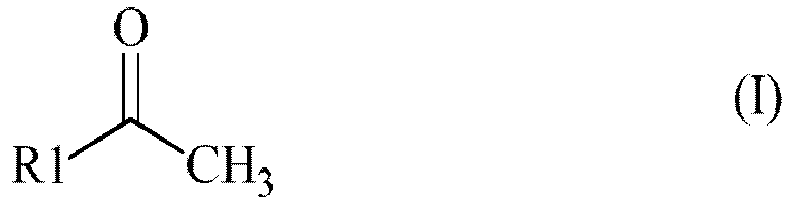
ST2 comprises a reaction REAC2 of REACPROD1 with R2-NH2;
REAC2 results in compound of formula (II);
wherein - R1
- is selected from the group consisting of
tertiary C4-12 alkyl,
phenyl, the phenyl being unsubstituted or substituted by 1, 2, 3, 4 or 5 substituents selected from the group consisting of halogen, nitro, cyano, trifluoromethyl, C1-8 alkyl, and C1-8 alkoxy, and
5 or 6 membered aromatic heterocycle with 1, 2 or 3 heteroatoms selected from the group consisting of N, O and S, the 5 or 6 membered aromatic heterocycle being unsubstituted or substituted by 1, 2 or 3 substituents selected from the group consisting of halogen, nitro, cyano, trifluoromethyl, C1-8 alkyl, and C1-8 alkoxy; - R2
- is selected from the group consisting of
C1-12 alkyl, the C1-12 alkyl being unsubstituted or substituted by 1, 2 or 3 substituents selected from the group consisting of phenyl or 5 or 6 membered aromatic heterocycle with 1, 2 or 3 heteroatoms selected from the group consisting of N, O and S,
C3-6 cycloalkyl,
phenyl, the phenyl being unsubstituted or substituted by 1, 2, 3, 4 or 5 substituents selected from the group consisting of halogen, nitro, cyano, trifluoromethyl, C1-8 alkyl, and C1-8 alkoxy, and - Preferably, R1 is selected from the group consisting of
tertiary C4-12 alkyl,
phenyl, the phenyl being unsubstituted or substituted by 1, 2 or 3 substituents selected from the group consisting of halogen, nitro, cyano, trifluoromethyl, C1-6 alkyl, and C1-6 alkoxy, and
5 or 6 membered aromatic heterocycle with 1, 2 or 3 heteroatoms selected from the group consisting of N, O and S, the 5 or 6 membered aromatic heterocycle being unsubstituted or substituted by 1, 2 or 3 substituents selected from the group
consisting of halogen, nitro, cyano, trifluoromethyl, C1-6 alkyl, and C1-6 alkoxy; more preferably, R1 is selected from the group consisting of
tert-butyl,
phenyl, the phenyl being unsubstituted or substituted by 1, 2 or 3 substituents selected from the group consisting of halogen, nitro, trifluoromethyl, C1-6 alkyl, and methoxy, and
5 or 6 membered aromatic heterocycle with 1, 2 or 3 heteroatoms selected from the group consisting of N, O and S, the 5 or 6 membered aromatic heterocycle being unsubstituted or substituted by 1, 2 or 3 substituents selected from the group
consisting of halogen, nitro, trifluoromethyl, C1-6 alkyl, and methoxy;
even more preferably, R1 is selected from the group consisting of
tert-butyl,
phenyl, the phenyl being unsubstituted or substituted by 1 or 2 substituents selected from the group consisting of halogen, nitro, trifluoromethyl, C1-6 alkyl, and methoxy, and
5 or 6 membered aromatic heterocycle with 1, 2 or 3 heteroatoms selected from the group consisting of N and S, the 5 or 6 membered aromatic heterocycle being unsubstituted or substituted by 1 or 2 substituents selected from the group consisting of halogen, nitro, trifluoromethyl, C1-6 alkyl and methoxy. - Preferably, R2 is selected from the group consisting of
C1-6 alkyl, the C1-6 alkyl being unsubstituted or substituted by 1 substituent selected from the group consisting of phenyl or 5 or 6 membered aromatic heterocycle with 1, 2 or 3 heteroatoms selected from the group consisting of N, O and S,
C3-6 cycloalkyl,
phenyl, the phenyl being unsubstituted or substituted by 1, 2 or 3 substituents selected from the group consisting of halogen, nitro, cyano, trifluoromethyl, C1-6 alkyl, and C1-6 alkoxy, and
5 or 6 membered aromatic heterocycle with 1, 2 or 3 heteroatoms selected from the group consisting of N, O and S, the 5 or 6 membered aromatic heterocycle being unsubstituted or substituted by 1, 2 or 3 substituents selected from the group
consisting of halogen, nitro, cyano, trifluoromethyl, C1-6 alkyl, and C1-6 alkoxy;
more preferably, R2 is selected from the group consisting of
methyl, ethyl, n-propyl, iso-propyl, butyl and pentyl, the methyl, ethyl, n-propyl, iso-propyl, butyl and pentyl being unsubstituted or substituted by 1 substituent selected from the group consisting of phenyl or 5 or 6 membered aromatic heterocycle with 1, 2 or 3 heteroatoms selected from the group consisting of N, O and S,
C5-6 cycloalkyl, phenyl, the phenyl being unsubstituted or substituted by 1, 2 or 3 substituents selected from the group consisting of halogen, nitro, trifluoromethyl, C1-6 alkyl, and methoxy, and
5 or 6 membered aromatic heterocycle with 1, 2 or 3 heteroatoms selected from the group consisting of N, O and S, the 5 or 6 membered aromatic heterocycle being unsubstituted or substituted by 1, 2 or 3 substituents selected from the group
consisting of halogen, nitro, trifluoromethyl, C1-6 alkyl, and methoxy;
even more preferably, R2 is selected from the group consisting of
methyl, ethyl, n-propyl and iso-propyl, the methyl, ethyl, n-propyl and iso-propyl being unsubstituted or substituted by 1 substituent selected from the group consisting of phenyl or 5 or 6 membered aromatic heterocycle with 1, 2 or 3 heteroatoms selected from the group consisting of N, O and S,
C5-6 cycloalkyl,
phenyl, the phenyl being unsubstituted or substituted by 1 or 2 substituents selected from
the group consisting of halogen, nitro, trifluoromethyl, C1-6 alkyl, and methoxy, and
5 or 6 membered aromatic heterocycle with 1, 2 or 3 heteroatoms selected from the group consisting of N, O and S, the 5 or 6 membered aromatic heterocycle being unsubstituted or substituted by 1 or 2 substituents selected from the group consisting of halogen, nitro, trifluoromethyl, C1-6 alkyl, and methoxy; - Preferably, the molar amount of R2-NH2 in REAC2 is from 1 to 20 times, more preferably from 1 to 15 times, and even more preferably from 1 to 12 times, based on the molar amount of compound of formula (I).
- Preferably, REAC2 is done at a temperature of from -40 °C to 100 °C, more preferably from -20 °C to 80 °C, even more preferably from from -10 °C to 50 °C.
- Preferably, REAC2 is done at a pressure of from ambient pressure to 10 bar, more preferably from ambient pressure to 5 bar, even more preferably from ambient pressure to 2 bar.
- Preferably, the reaction time of REAC2 is from 5 min to 48 h, more preferably from 20 min to 24 h, even more preferably from 30 min to 18 h, especially from 30 min to 10 h.
- REAC2 can be done neat or in a solvent.
- If REAC2 is done in a solvent, it is done preferably in a solvent SOLV2, SOLV2 is selected from the group consisting of benzene, toluene, xylene, chlorobenzene, pyridine, 3-picoline, 2-methyl-5-ethylpyridine, chloroform, dichloromethane, THF, water, and mixtures thereof;
more preferably, SOLV2 is selected from the group consisting of benzene, toluene, xylene, chlorobenzene, pyridine, 3-picoline, 2-methyl-5-ethylpyridine, dichloromethane, THF, water, and mixtures thereof. - Preferably, the weight of SOLV2 is from 0.01 to 50 times, more preferably from 0.05 to 20 times, even more preferably from 0.1 to 10 times, of the weight of compound of formula (I).
- REAC2 can be done in the presence of a base. If REAC2 is done in the presence of a base, then the base is a compound BAS2, BAS2 is selected from the group consisting of sodium carbonate, sodium bicarbonate, potassium carbonate, sodium hydroxide, potassium hydroxide, calcium hydroxide, and mixtures therof;
more preferably, BAS2 is selected from the group consisting of sodium carbonate, potassium carbonate, sodium hydroxide, calcium hydroxide, and mixtures therof. - Preferably, the molar amount of BAS2 is from 1 to 10 times, more preferably from 1 to 5 times, and even more preferably from 1 to 3 times, based on the molar amount of compound of formula (I).
- Compound of formula (II) can be isolated after REAC2 by any conventional method, for instance by extraction, by distillation under reduced pressure, or by crystallization. Preferably, any volatile byproduct is distilled off, and the residue is purified by crystallization, or used without further purification.
- Preferably, the molar amount of SULFCHLO in REAC 1 is from 2 to 40 times, more preferably from 2 to 20 times, and even more preferably from 2 to 15 times, based on the molar amount of compound of formula (I).
- It is known that S2Cl2, also known as disulfur dichloride or even referred to as sulfur monochloride, decomposes upon contact with water, e.g. moisture of air, into HCl, SO2, and sulfur. It is also known that S2Cl2 decomposes upon heating into SCl2, also known as sulfur dichloride, and into other sulfur chlorides. Moreover, S2Cl2 is prepared by chlorination of sulfur, and, depending on the precise reaction conditions and purification methods used, commercially available S2Cl2 may contain variable amounts of chlorine and SCl2. Therefore SULFCHLO, that is used in REAC1, is preferably used in form of a compound COMPSULFCHLO, COMPSULFCHLO may have various qualities, various impurity contents and various impurity profiles. Therefore COMPSULFCHLO may contain e.g. up to 5%, 10%, 20%, 30% or even up to 50%, the % being % by weight based on the total weight of COMPSULFCHLO, of sulfur dichloride, chlorine, hydrogen chloride, SO2, sulfur, or of mixtures of said impurities.
- Therefore preferably, COMPSULFCHLO contains 50 to 100%, more preferably 70 to 100%, even more preferably 80 to 100%, especially 90 to 100%, more especially 95 top 100%, of SULFCHLO, the % being % by weight based on the total weight of COMPSULFCHLO.
- S2Cl2 and SCl2 are equivalent reagents for REAC2. S2Cl2 is commercially available. Preferably SULFCHLO is S2Cl2.
- Preferably, REAC 1 is done at a temperature of from -20 °C to 80 °C, more preferably from -10 °C to 60 °C, even more preferably from from -5 °C to 40 °C.
- The temperature of REAC 1 can be varied during the course of the reaction, so that REAC 1 is done with a temperature profile.
- Preferably, REAC2 is done at a pressure of from ambient pressure to 100 bar, more preferably of from ambient pressure to 75 bar, even more preferably of from ambient pressure to 50 bar, especially of from ambient pressure to 30 bar, more especially of from ambient pressure to 25 bar, even more especially of from ambient pressure to 20 bar.
- The pressure of REAC1 can be adjusted according to the chosen temperature of REAC1 and the boiling point of SULFCHLO.
- Preferably, the reaction time of REAC1 is from 10 min to 72 h, more preferably from 30 min to 48 h, even more preferably from 1 h to 24 h.
- REAC 1 can be done neat or in a solvent.
- If REAC1 is done in a solvent, it is done preferably in a solvent SOLV1, SOLV1 is selected from the group consisting of benzene, chlorobenzene, toluene, dichloromethane, chloroform, acetonitrile, and mixtures thereof;
more preferably, SOLV1 is selected from the group consisting of benzene, chlorobenzene, toluene, dichloromethane, chloroform, and mixtures thereof. - Preferably, the weight of SOLV1 is from 0.01 to 20 times, more preferably from 0.05 to 10 times, even more preferably from 0.1 to 5 times, of the weight of compound of formula (I).
- REAC 1 can be done in the presence of a catalyst. If REAC1 1 is done in the presence of a catalyst, then the catalyst is a compound CAT1, CAT1 is selected from the group consisting of pyridine, 2-picoline, 3-picoline, 4-picoline, 5-ethyl-2-methylpyridine, 4-(dimethylamino)pyridine, 1,4-diazabicyclo[2.2.2]octane, triethylamine, tributylamine, N-methylmorpholine, N-ethyldiisopropylamine, N,N-dimethylaniline, and mixtures thereof;
more preferably, CAT1 is selected from the group consisting of pyridine, 3-picoline, 5-ethyl-2-methylpyridine, 4-(dimethylamino)pyridine, 1,4-diazabicyclo[2.2.2]octane, triethylamine, tributylamine, N-methylmorpholine, N-ethyldiisopropylamine, N,N-dimethylaniline, and mixtures thereof;
even more preferably, CAT1 is selected from the group consisting of pyridine, 3-picoline, 5-ethyl-2-methylpyridine, 4-(dimethylamino)pyridine, 1,4-diazabicyclo[2.2.2]octane, triethylamine, tributylamine, N,N-dimethylaniline, and mixtures thereof. - Preferably, the molar amount of CAT1 is from 0.0001 to 0.6 times, more preferably from 0.0001 to 0.4 times, and even more preferably from 0.0001 to 0.3 times, based on the molar amount of compound of formula (I).
- REACPROD1 can be isolated after REAC1 by any conventional method, for instance by extraction, by distillation under reduced pressure, or by crystallization. Preferably, any volatile byproduct is distilled off, and the residue is used without further purification.
- Further subject of the invention is a method for the preparation of compound of formula (IV);

- ST4 comprises a reaction REAC4 of a compound of formula (III) with a compound AZID;

R10, R11, R12 and R13 are identical or different and independently from each other selected from the group consisting of H and C1-8 alkyl;
X1 is selected from the group consisting of Cl, Br, S-CH3, S-CH2-CH3, S-CH2-Phenyl, S-C(O)-C(CH3)3, and SO3H;
REAC4 results in compound of formula (IV);
compound of formula (III) is prepared in ST3;
ST3 comprises a reaction REAC3 of a compound of formula (II) with a compound COMPREAC3;
COMPREAC3 is selected from the group consisting of thionyl chloride, COCl2, diphosgene, triphosgene, POCl3, PCl3, PCl5, POBr3, PBr3, PBr5, S2Cl2, SCl2, pivaloyl chloride, methyl chloride, methyl bromide, methyl iodide, ethyl chloride, ethyl bromide, ethyl iodide, benzyl chloride, benzyl bromide, dimethyl sulfate, diethyl sulfate, trimethylphosphate, triethylphosphate, methyl methanesulfonate, methyl benzenesulfonate, methyl tosylate, ethyl methanesulfonate, ethyl benzenesulfonate, ethyl tosylate, hydrogen peroxide, C1-4 alkyl hydro peroxide, C1-6 alkaloyl peroxide, perbenzoic acid, 3-chloro-perbenzoic acid, alkali metal persulfate salt, Cl2, Br2, and I2;
REAC3 results in compound of formula (III);
compound of formula (II) is prepared in the two steps ST1 and ST2;
with ST1, ST2, R1 and R2 as defined herein, also with all their embodiments. - Preferably, AZID is selected from the group consisting of alkali metal azide, and [N(R10)(R11)(R12)R13]+ [N3]-.
- More preferably, AZID is selected from the group consisting of alkali metal azide, and [N(R10)(R11)(R12)R13]+ [N3]-; and
R10 is C1-4 alkyl; and
R11, R12 and R13 are identical or different and independently from each other selected from the group consisting of H and C1-4 alkyl. - Even more preferably, AZID is selected from the group consisting of sodium azide, tetrabutylammonium azide, and triethylammonium azide.
- Preferably, the molar amount of AZID is from 1 to 20 times, more preferably from 1 to 15 times, and even more preferably from 1 to 10 times, based on the molar amount of compound of formula (III).
- Preferably, REAC4 is done at a temperature of from -60 °C to 100 °C, more preferably from -30 °C to 60 °C, even more preferably from from -10 °C to 40 °C.
- Preferably, REAC4 is done at a pressure of from ambient pressure to 10 bar, more preferably from ambient pressure to 5 bar, even more preferably from ambient pressure to 2 bar.
- Preferably, the reaction time of REAC4 is from 5 min to 24 h, more preferably from 15 min to 12 h, even more preferably from 30 min to 8 h. Preferably, REAC4 is done in a solvent SOLV4; SOLV4 is selected from the group consisting of water, acetone, acetonitrile, ethanol, methanol, ethylene glycol, benzene, toluene, chlorobenzene, N,N-dimethylformamide, NMP, THF, dioxane, ethyl acetate, butyl acetate, and mixtures thereof;
more preferably, SOLV4 is selected from the group consisting of water, acetone, ethanol, methanol, benzene, toluene, chlorobenzene, THF, dioxane, ethyl acetate, butyl acetate, and mixtures thereof;
even more preferably, SOLV4 is selected from the group consisting of water, benzene, toluene, chlorobenzene, ethyl acetate, butyl acetate, and mixtures thereof. - Preferably, the weight of SOLV4 is from 0.01 to 50 times, more preferably from 0.05 to 30 times, even more preferably from 0.1 to 20 times, of the weight of compound of formula (III).
- REAC4 can be done in the presence of a compound PTCS4, PTCS4 is a compound of formula [PTCS4];
[N(R20)(R21)(R22)R23]+ [X2]- [PTCS4]
R20, R21, R22 and R23 are identical or different and independently from each other selected from the group consisting of H, C1-20 alkyl, phenyl and benzyl;
[X2]- is selected from the group consisting of halide and hydrogensulfate. - More preferably, PTCS4 is selected from the group consisting of tetrabutylammonium halide, tetrabutylammonium hydrogensulfate, cetyltrimethylammonium chloride and bromide, and benzyltributylammonium chloride and bromide;
even more preferably, PTCS4 is selected from the group consisting of tetrabutylammonium chloride and bromide, tetrabutylammonium hydrogensulfate, cetyltrimethylammonium chloride, and benzyltributylammonium chloride. - Preferably, the molar amount of PTCS4 is from 0.001 to 1.0 times, more preferably from 0.005 to 0.8 times, and even more preferably from 0.01 to 0.5 times, based on the molar amount of compound of formula (III).
- In one possible embodiment, REAC4 is done by mixing compound of formula (III) dissolved in SOLV4, SOLV4 except water, with AZID dissolved in water, thereby the reaction mixture in REAC4 has two liquid phases. In this embodiment PTCS4 can be used.
- In another embodiment REAC4 is done by mixing compound of formula (III) dissolved in SOLV4, SOLV4 except water, with AZID in solid form. Also in this embodiment PTCS4 can be used.
- The method of instant invention allows the use of PTCS4, but also works without the use of PTCS4.
- Therefore in one embodiment, no PTCS4 is used in REAC4.
- In another embodiment, no Bu3N-CH2-Ph or a chloride thereof is used.
- In another embodiment, no PTCS4 and no Bu3N-CH2-Ph and no chloride of Bu3N-CH2-Ph is used.
- In another embodiment, no phase transfer catalyst is used in REAC4.
- When REAC4 is conducted in the presence of an aqueous phase, the pH of said aqueous phase can be adjusted by addition of a buffer. Preferably, the pH of the aqueous phase of REAC4 is between 0 and 14, more preferably between 2 and 10, and even more preferably between 3 and 8.
- Preferably, when a buffer is used in REAC4, a buffer BUFF4 is used, BUFF4 is selected from the group consisting of acetate buffer, phosphate buffer, carbonate buffer, sulfate buffer, and mixtures thereof;
more preferably, BUFF4 is selected from the group consisting of acetate buffer, phosphate buffer and sulfate buffer. - Preferably, the molar amount of BUFF4 is from 0.01 to 20 times, more preferably from 0.05 to 6 times, and even more preferably from 0.1 to 3 times, based on the molar amount of compound of formula (III).
- Compound of formula (IV) can be isolated after REAC4 by any conventional method, for instance by extraction and by crystallization. Preferably, any volatile byproduct is distilled off, and the residue is purified or used without further purification.
- Preferably, COMPREAC3 is selected from the group consisting of thionyl chloride, COCl2, diphosgene, triphosgene, POCl3, PCl3, PCl5, S2Cl2, SCl2, pivaloyl chloride, methyl chloride, methyl bromide, methyl iodide, ethyl chloride, ethyl bromide, ethyl iodide, benzyl chloride, benzyl bromide, dimethyl sulfate, diethyl sulfate, trimethylphosphate, triethylphosphate, methyl methanesulfonate, methyl benzenesulfonate, methyl tosylate, ethyl methanesulfonate, ethyl benzenesulfonate, ethyl tosylate, hydrogen peroxide, C1-4 alkyl hydro peroxide, C1-6 alkaloyl peroxide, perbenzoic acid, 3-chloro-perbenzoic acid, sodium persulfate salt, potassium persulfate salt, Cl2, Br2, and I2;
more preferably, COMPREAC3 is selected from the group consisting of thionyl chloride, COCl2, triphosgene, POCl3, PCl3, PCl5, S2Cl2, methyl chloride, methyl bromide, methyl iodide, dimethyl sulfate, trimethylphosphate, methyl methanesulfonate, methyl benzenesulfonate, methyl tosylate, hydrogen peroxide, C1-4 alkyl hydro peroxide, C1-6 alkaloyl peroxide, perbenzoic acid, 3-chloro-perbenzoic acid, potassium persulfate salt, Cl2, Br2, and I2;
even more preferably, COMPREAC3 is selected from the group consisting of thionyl chloride, COCl2, triphosgene, POCl3, S2Cl2, methyl chloride, dimethyl sulfate, trimethylphosphate, methyl benzenesulfonate, methyl tosylate, hydrogen peroxide, tert-butylhydroperoxide, peracetic acid, 3-chloro-perbenzoic acid, potassium persulfate salt, Cl2, and Br2. - Preferably, X1 is selected from the group consisting of Cl, S-CH3, S-CH2-CH3, S-CH2-Phenyl, S-C(O)-C(CH3)3, and SO3H;
more preferably, X1 is selected from the group consisting of Cl, S-CH3, and SO3H. - Preferably, the molar amount of COMPREAC3 is from 1 to 50 times, more preferably from 1 to 30 times, and even more preferably from 1 to 20 times, based on the molar amount of compound of formula (II).
- Preferably, REAC3 is done at a temperature of from -30 °C to 120 °C, more preferably from -10 °C to 90 °C, even more preferably from 0 °C to 60 °C, especially from 0 °C to 50 °C,
more especially from 0 °C to 40 °C, even more especially from 0 °C to 30 °C. Preferably, REAC3 is done at a pressure of from ambient pressure to 10 bar, more preferably from ambient pressure to 5 bar, even more preferably from ambient pressure to 2 bar. - Preferably, the reaction time of REAC3 is from 5 min to 24 h, more preferably from 10 min to 12 h, even more preferably from 30 min to 10 h, especially from 30 min to 8 h, more especially from 30 min to 7 h, even more especially from 30 min to 6 h, in particular from 30 min to 5 h, more in particular from 30 min to 4 h, even more in particular from 30 min to 3 h.
- REAC3 can be done neat or in a solvent.
- If REAC3 is done in a solvent, it is done preferably in is done in a solvent SOLV3, SOLV3 is selected from the group consisting of water, pyridine, 3-picoline, acetone, acetonitrile, benzene, toluene, chlorobenzene, N,N-dimethylformamide, NMP, THF, dioxane, ethyl acetate, butyl acetate, and mixtures thereof;
more preferably, SOLV3 is selected from the group consisting of water, pyridine, 3-picoline, acetone, benzene, toluene, chlorobenzene, THF, dioxane, ethyl acetate, butyl acetate, and mixtures thereof;
even more preferably, SOLV3 is selected from the group consisting of water, pyridine, 3-picoline, benzene, toluene, chlorobenzene, THF, dioxane, and mixtures thereof. - Preferably, the weight of SOLV3 is from 0.01 to 50 times, more preferably from 0.05 to 30 times, even more preferably from 0.1 to 20 times, of the weight of compound of formula (II).
- Especially,
R1 is phenyl; and
R2 is methyl;
more especially,
SULFCHLO is S2Cl2;
R1 is phenyl; and
R2 is methyl;
even more especially,
SULFCHLO is S2Cl2;
COMPREAC3 is selected from the group consisting of thionyl chloride, COCl2, hydrogen peroxide, S2Cl2 and Cl2;
X1 is Cl or SO3H;
AZID is sodium azide;
R1 is phenyl; and
R2 is methyl;
in particular,
SULFCHLO is S2Cl2;
COMPREAC3 is thionyl chloride;
X1 is Cl;
AZID is sodium azide;
R1 is phenyl;
R2 is methyl. - Compound of formula (III) can be isolated after REAC3 by any conventional method, for instance by extraction, distillation under reduced pressure, or by crystallization. Preferably, any volatile byproduct is distilled off, and the residue is used without further purification.
- Preferred embodiments of compound of formula (I), compound of formula (II), compound of formula (III) and compound of formula (IV) are compound of formula (I-1), compound of formula (II-1), compound of formula (III-1) and compound of formula (IV-1).


- Further subject of the invention is a method for the preparation of compound of formula (VII),

- R31
- is selected from the group consisting of linear, branched and cyclic C1-10 alkyl and linear, branched and cyclic C1-10 alkoxy, wherein the linear, branched and cyclic C1-10 alkyl and the linear, branched and cyclic C1-10 alkoxy can be unsubstituted or substituted by 1, 2 or 3 substituents selected from the group consisting of F, Cl, Br, C1-4 alkoxy, C1-4 alkoxy substituted by F, Cl, difluoro, dichloro, bromo or dibromo, carbomethoxy, carboethoxy and OH;
- R32
- is selected from the group consisting of F, Cl, Br, CN, NO2, OH, SH, C(O)H, COOH, N(R50)R51,
linear, branched and cyclic C1-10 alkyl, wherein the linear, branched and cyclic C1-10 alkyl can be unsubstituted or substituted by 1, 2 or 3 substituents selected from the group consisting of F, Cl, Br, C1-4 alkoxy, C1-4 alkoxy substituted by F, Cl, difluoro, dichloro, bromo or dibromo, carbomethoxy, carboethoxy and OH,
phenyl, naphthyl, wherein the phenyl and the napthyl are unsubstituted or substituted by 1, 2 or 3 substituents selected from the group consisting of C1-4 alkyl, F, Cl, trifluoromethyl, C1-4 alkoxy, phenoxy and trifluoromethoxy,
pyridinyl, pyridyl, pyrazolyl, imidazolyl, pyrrolidino, wherein the pyridinyl and the pyridyl and the pyrazolyl and the imidazolyl and the pyrrolidino are unsubstituted or substitutued by 1, 2 or 3 substituents selected from the group consisting of C1-4 alkyl, F, Cl, trifluoromethyl, C1-4 alkoxy and trifluoromethoxy,
C1-4 alkoxy, the C1-4 alkoxy being unsubstituted or substituted by 1, 2 or 3 substituents selected from the group consisting of C1-2 alkoxy, F and Cl,
phenoxy,
S(O)m2R41, C(O)R41 and CO2R41;
R41 is selected from the group consisting of
N(R50)R51,
linear, branched and cyclic C1-10 alkyl, wherein the linear, branched and cyclic C1-10 alkyl can be unsubstituted or substituted by 1, 2 or 3 substituents selected from the group consisting of F, Cl, Br, C1-4 alkoxy, C1-4 alkoxy substituted by F, Cl, difluoro, dichloro, bromo or dibromo, carbomethoxy, carboethoxy and OH,
phenyl, naphthyl, wherein the phenyl and the napthyl are unsubstituted or substituted by 1, 2 or 3 substituents selected from the group consisting of C1-4 alkyl, F, Cl, trifluoromethyl, C1-4 alkoxy, phenoxy and trifluoromethoxy,
pyridinyl, pyridyl, pyrazolyl, imidazolyl, pyrrolidino, wherein the pyridinyl and pyridyl and the pyrazolyl and the imidazolyl and the pyrrolidino are unsubstituted or substitutued by 1, 2 or 3 substituents selected from the group consisting of C1-4 alkyl, F, Cl, trifluoromethyl, C1-4 alkoxy and trifluoromethoxy,
m2 is 0, 1 or 2;
R50 and R51 are identical or different and selected from the group consisting of H, C1-2 alkyl, C1-4 alkoxycarbonyl and benzoyl; - m1
- is 0, 1, 2 or 3;
when m1 is 2 or 3, then the substituents R32 can be identical or different from each other; wherein ST1, ST2, R1 and R2 are as defined herein, also with all their embodiments;
further subject of the invention is a method for the preparation of compound of formula (VII), wherein the method comprises the two steps ST1 and ST2, and comprises the two steps ST3 and ST4;
wherein ST3and ST4 are as defined herein, also with all their embodiments;
also with any individual embodiment or with any combination of two or more embodiments,
the embodiments as described herein for any of these steps; - R1
- is phenyl;
- R2
- is methyl;
- R31
- is tert-butoxy;
- m1
- is 0, that is no substituent R32.
- Preferably, the preparation of compound of formula (VII) starting from compound of formula (IV) has three steps, a step ST5, a step ST6 and a step ST7, details for these three steps are disclosed in
EP 2546236 A1 . - ST5 comprises a reaction REAC5, in REAC5 the compound of formula (IV) is reacted with NH2OH. The reaction product of REAC5 is a compound of formula (V);

- ST6 comprises a reaction REAC6, in REAC6 the compound of formula (V) is reacted with a compound of formula (HETLIG);

- R30
- is selected from the group consisting of H-C(O) and R40-C(O);
- R40
- is selected from the group consisting of C1-8 alkyl, C1-6 alkoxy, phenyl, phenyloxy, and pyridyl;
- R40
- can be unsubstituted or substituted by 1, 2 or 3 substitutents selected from the group consisting of CN, NO2, F, Cl, Br, C1-2 alkyl and C1-2 alkoxy;
- X3
- is F, Cl, Br or I;
- Preferably,
- R30
- is selected from the group consisting of methoxycarbonyl, ethoxycarbonyl, isopropoxycarbonyl, n-propoxycarbonyl, n-butoxycarbonyl, iso-butoxycarbonyl, sec-butoxycarbonyl, tert-butoxycarbonyl, formyl, acetyl, n-propylcarbonyl, iso-propylcarbonyl, n-butylcarbonyl, iso-butylcarbonyl, sec-butylcarbonyl, pivaloyl, octanoyl, benzoyl, 2,6-dimethoxybenzoyl, 3,5-nitrobenzoyl, 2,4,6-trichlorobenzoyl, 4-chlorobenzoyl and 2-pyridylcarbonyl;
- R31
- is selected from the group consisting of methyl, ethyl, n-propyl, iso-propyl, n-butyl, iso-butyl, sec-butyl, tert-butyl, n-pentyl, n-octyl, cyclopropyl, cyclobutyl, cyclopentyl, cyclohexyl, cycloheptyl, 2,2-dimethylcyclopropyl, menthyl, chloromethyl, fluoromethyl, trifluoromethyl, methoxymethyl, ethoxymethyl, methoxyethyl, methoxypropyl, ethoxybutyl, methoxybutyl, methoxyhexyl, propoxyoctyl, 2-methoxy-1,1-dimethylethyl, 1-ethoxy-1-methylethyl, carbomethoxymethyl, 1-carboethoxy-2,2-dimethyl-3-cyclopropyl, hydroxymethyl, hydroxyethyl, 1-hydroxypropyl, methoxy, ethoxy, n-propoxy, iso-propoxy, n-butoxy, iso-butoxy, sec-butoxy, tert-butoxy, n-pentyloxy, n-hexyloxy, n-decyloxy, cyclopropyloxy, cyclobutyloxy, cyclopentyloxy, cyclohexyloxy, menthyloxy, chloromethoxy, fluoromethoxy, trifluoromethoxy, methoxymethoxy, ethoxymethoxy, methoxyethoxy, 3-ethoxypropoxy, 2-ethoxybutoxy, 4-butoxybutoxy, 1-butoxypentoxy, fluoromethoxymethoxy, dichloromethoxymethoxy, 1 ,2-dibromo-3-methoxypropoxy and 3-isopropoxy-2-methylpropoxy;
- R32
- is selected from the group consisting of F, Cl, Br, CN, NO2, OH, SH, C(O)H, COOH, NH2, methylamino, dimethylamino, methylethylamino, diethylamino, tert-butoxycarbonylmethylamino, tert-butoxycarbonylamino, acetylmethylamino, acetylethylamino, benzoylmethylamino, methyl, ethyl, n-propyl, iso-propyl, n-butyl, iso-butyl, sec-butyl, tert-butyl, n-pentyl, n-octyl, cyclopropyl, cyclobutyl, cyclopentyl, cyclohexyl, cycloheptyl, 2,2-dimethylcyclopropyl, menthyl, chloromethyl, fluoromethyl, trifluoromethyl, methoxymethyl, ethoxymethyl, methoxyethyl, methoxypropyl, ethoxybutyl, methoxybutyl, methoxyhexyl, propoxyoctyl, 2-methoxy-1,1-dimethylethyl, 1-ethoxy-1-methylethyl, carbomethoxymethyl, 1-carboethoxy-2,2-dimethyl-3-cyclopropyl, hydroxymethyl, hydroxyethyl, 1-hydroxypropyl, phenyl, 1-naphthyl, 2-naphthyl, 6-methylphenyl, 4-methylphenyl, 4-fluorophenyl, 4-chlorophenyl, 2,4-dichlorophenyl, 3,4-dichlorophenyl, 3,5-dichlorophenyl, 2,6-difluorophenyl, 4-trifluoromethylphenyl, 4-methoxyphenyl, 3,4-dimethoxyphenyl, 3-phenoxyphenyl, 4-trifluoromethoxyphenyl, 4-methoxy-1-naphthyl, pyridinyl, pyridyl, pyrazolyl, imidazolyl, pyrrolidino, 3-trifluoromethylpyridin-2-yl, 4-trifluoromethoxy-2-pyridyl, 3-methyl-1-pyrazolyl, 4-trifluoromethyl-1-imidazolyl, 3,4-difluoropyrrolidino, methoxy, ethoxy, n-propoxy, iso-propoxy, n-butoxy, sec-butoxy, iso-butoxy, tert-butoxy, methoxymethoxy, ethoxymethoxy, methoxyethoxy, ethoxyethoxy, phenoxy, trichloromethoxy, trifluoromethoxy, difluoromethoxy, 2,2,2-trifluor-ethoxy and 2-fluoroethoxy,
- R41
- is selected from the group consisting of NH2, methylamino, dimethylamino, methylethylamino, diethylamino, tert-butoxycarbonylmethylamino, tert-butoxycarbonylamino, acetylmethylamino, acetylethylamino, benzoylmethylamino, methyl, ethyl, n-propyl, iso-propyl, n-butyl, iso-butyl, sec-butyl, tert-butyl, n-pentyl, n-octyl, cyclopropyl, cyclobutyl, cyclopentyl, cyclohexyl, cycloheptyl, 2,2-dimethylcyclopropyl, menthyl, chloromethyl, fluoromethyl, trifluoromethyl, methoxymethyl, ethoxymethyl, methoxyethyl, methoxypropyl, ethoxybutyl, methoxybutyl, methoxyhexyl, propoxyoctyl, 2-methoxy-1,1 -dimethylethyl, 1-ethoxy-1-methylethyl, carbomethoxymethyl, 1-carboethoxy-2,2-dimethyl-3-cyclopropyl, hydroxymethyl, hydroxyethyl, 1-hydroxypropyl, phenyl, 1-naphthyl, 2-naphthyl, 6-methylphenyl, 4-methylphenyl, 4-fluorophenyl, 4-chlorophenyl, 2,4-dichlorophenyl, 3,4-dichlorophenyl, 3,5-dichlorophenyl, 2,6-difluorophenyl, 4-trifluoromethylphenyl, 4-methoxyphenyl, 3,4-dimethoxyphenyl, 3-phenoxyphenyl, 4-trifluoromethoxyphenyl, 4-methoxy-1-naphthyl, pyridinyl, pyridyl, pyrazolyl, imidazolyl, pyrrolidino, 3-trifluoromethylpyridin-2-yl, 4-trifluoromethoxy-2-pyridyl, 3-methyl-1-pyrazolyl, 4-trifluoromethyl-1-imidazolyl and 3,4-difluoropyrrolidino,
- m2
- is 0, 1 or 2;
- m1
- is 0, 1 or 2;
- X3
- is F, Cl or Br.
- More preferably,
- R30
- is selected from the group consisting of benzoyl, 2,6-dimethoxybenzoyl, 3,5-nitrobenzoyl, 2,4,6-trichlorobenzoyl and 4-chlorobenzoyl;
- R31
- is tert-butoxy;
- m1
- is 0;
- X3
- is Cl or Br.
- The reaction product of REAC6 is compound of formula (VI).

- ST7 comprises a reaction REAC7, in REAC7 the compound of formula (VI) is reacted with a base BAS7.
- Preferably, BAS7 is selected from the group consisting of alkali metal hydroxides, alkaline earth metal hydroxides, carbonates of alkali metal or of alkaline earth metal, hydrides of alkali metal or of alkaline earth metal, C1-2 alkoxides of alkali metal or of alkaline earth metal, triethylamine, diisopropylethylamine, pyridine, N,Ndimethylaminopyridine, 1,4-diazabicyclo[2.2.2]octane, 4-(dimethylamino)pyridine, 1,8-diazabicyclo[5.4.0]undec-7-ene, 1,5-diazabicyclo[4.3.0]non-5-ene, and mixtures thereof;
more preferably, BAS7 is selected from the group consisting of sodium hydroxide, potassium hydroxide, magnesium hydroxide, calcium hydroxide, sodium carbonate, potassium carbonate, magnesium carbonate, calcium carbonate, sodium hydride, calcium hydride, sodium methoxide, sodium ethoxide, magnesium methoxide, triethylamine, diisopropylethylamine, pyridine, N,Ndimethylaminopyridine, 1,4-diazabicyclo[2.2.2]octane, 4-(dimethylamino)pyridine, 1,8-diazabicyclo[5.4.0]undec-7-ene, 1,5-diazabicyclo[4.3.0]non-5-ene, and mixtures thereof;
even more preferably, BAS7 is selected from the group consisting of sodium hydroxide, potassium hydroxide, magnesium hydroxide, calcium hydroxide, sodium carbonate, potassium carbonate, magnesium carbonate, calcium carbonate, sodium methoxide, sodium ethoxide, magnesium methoxide, triethylamine, diisopropylethylamine, pyridine, N,Ndimethylaminopyridine, 1,4-diazabicyclo[2.2.2]octane, 4-(dimethylamino)pyridine, 1,8-diazabicyclo[5.4.0]undec-7-ene, 1,5-diazabicyclo[4.3.0]non-5-ene, and mixtures thereof;
especially, BAS7 is selected from the group consisting of sodium hydroxide, potassium hydroxide, sodium carbonate, triethylamine, diisopropylethylamine, pyridine, N,Ndimethylaminopyridine, 1,4-diazabicyclo[2.2.2]octane, 4-(dimethylamino)pyridine, 1,8-diazabicyclo[5.4.0]undec-7-ene, 1,5-diazabicyclo[4.3.0]non-5-ene, and mixtures thereof;
more especially, BAS7 is sodium hydroxide. - The reaction product of REAC7 is a compound of formula (VII).
- 1H NMR was done with triisobutylphosphate as internal standard, if not otherwise stated.
- To a mixture of compound of formula (I-1) (0.117 ml, 1.00 mmol) and pyridine (0.016 ml, 0.20 mmol) at 0 °C was added S2Cl2 (0.32 ml, 4.00 mmol), and the resulting mixture was stirred at 0 °C for 6 h. Toluene (2.0 ml) was added, and the solution was added dropwise to a rapidly stirred mixture of water (1.0 ml) and an aqueous solution of methyl amine (40% by weight, 0.70 ml, 8.0 mmol) at 0 °C. The mixture was then stirred at room temperature for 15.5 h. The mixture was then diluted with IN aqueous hydrochloric acid (10 ml) and ethyl acetate (2 ml), and a part of the ethyl acetate extract was concentrated and the residue analyzed by 1H NMR. The residue consisted mainly of compound of formula (II-1).
- 1H NMR (d6-DMSO, 400 MHz) delta = 11.11 (s, br, 1H), 7.91 (d, br, J = 8 Hz, 2H), 7.68 (t, br, J = 8 Hz, 1H), 7.55 (t, br, J = 8 Hz, 2H), 3.18 (d, J = 3 Hz, 3H).
- To compound of formula (II-1) (90 mg with 80% being compound of formula (II-1), 0.40 mmol), prepared according to example 1, was added thionyl chloride (0.50 ml, 6.9 mmol). The mixture was stirred at room temperature. Analysis by 1H NMR after 2 h indicated over 90% conversion to compound of formula (III-1).
- After stirring for further 40 min the excess thionyl chloride was evaporated off. The residue was redissolved in toluene (1.0 ml) and the resulting solution was added drop wise at 0 °C to a solution of sodium azide (0.19 g, 3.0 mmol) in water (0.5 ml). The resulting mixture was stirred at 0 °C for 3 h, and then at room temperature for 1 h 20 min. Then the mixture was diluted with brine (10 ml), and the product extracted with ethyl acetate. Yield determination by 1H NMR indicated a yield of 69% of compound of formula (IV-1).
- 1H NMR (d6-DMSO, 400 MHz) delta = 8.29 (d, br, J = 8 Hz, 2H), 7.80 (t, br, J = 8 Hz, 1H), 7.65 (t, br, J = 8 Hz, 2H), 4.31 (s, 3H).
- To compound of formula (II-1) (90 mg with 80% being compound of formula (II-1), 0.40 mmol), prepared according to example 1, was added toluene (0.8 ml) and then thionyl chloride (0.109 ml, 1.51 mmol). The mixture was stirred at room temperature for 2 h 40 min, and the excess thionyl chloride was evaporated off. The residue was redissolved in toluene (1.0 ml) and the resulting solution was added dropwise at 0 °C to a solution of sodium azide (0.19 g, 3.0 mmol) in water (0.5 ml). The resulting mixture was stirred at 0 °C for 3 h, and then at room temperature for 1 h 20 min. Then the mixture was diluted with brine (10 ml), and the product extracted with ethyl acetate. Yield determination by 1H NMR indicated a yield of 76% of compound of formula (IV-1).
Claims (13)
- Method for the preparation of compound of formula (II);

ST1 comprises a reaction REAC1 of compound of formula (I) with a compound SULFCHLO; SULFCHLO is S2Cl2, SCl2, or a mixture thereof;
ST2 comprises a reaction REAC2 of REACPROD1 with R2-NH2; REAC2 results in compound of formula (II);
whereinR1 is selected from the group consisting of tertiary C4-12 alkyl, phenyl, the phenyl being unsubstituted or substituted by 1, 2, 3, 4 or 5 substituents selected from the group consisting of halogen, nitro, cyano, trifluoromethyl, C1-8 alkyl, and C1-8 alkoxy, and 5 or 6 membered aromatic heterocycle with 1, 2 or 3 heteroatoms selected from the group consisting of N, O and S, the 5 or 6 membered aromatic heterocycle being unsubstituted or substituted by 1, 2 or 3 substituents selected from the group consisting of halogen, nitro, cyano, trifluoromethyl, C1-8 alkyl, and C1-8 alkoxy;R2 is selected from the group consisting of C1-12 alkyl, the C1-12 alkyl being unsubstituted or substituted by 1, 2 or 3 substituents selected from the group consisting of phenyl or 5 or 6 membered aromatic heterocycle with 1, 2 or 3 heteroatoms selected from the group consisting of N, O and S, C3-6 cycloalkyl, phenyl, the phenyl being unsubstituted or substituted by 1, 2, 3, 4 or 5 substituents selected from the group consisting of halogen, nitro, cyano, trifluoromethyl, C1-8 alkyl, and C1-8 alkoxy, and5 or 6 membered aromatic heterocycle with 1, 2 or 3 heteroatoms selected from the group consisting of N, O and S, the 5 or 6 membered aromatic heterocycle being unsubstituted or substituted by 1, 2 or 3 substituents selected from the group consisting of halogen, nitro, cyano, trifluoromethyl, C1-8 alkyl, and C1-8 alkoxy. - Method according to claim 1, whereinR1 is selected from the group consisting of tertiary C4-12 alkyl, phenyl, the phenyl being unsubstituted or substituted by 1, 2 or 3 substituents selected from the group consisting of halogen, nitro, cyano, trifluoromethyl, C1-6 alkyl, and C1-6 alkoxy, and 5 or 6 membered aromatic heterocycle with 1, 2 or 3 heteroatoms selected from the group consisting of N, O and S, the 5 or 6 membered aromatic heterocycle being unsubstituted or substituted by 1, 2 or 3 substituents selected from the group consisting of halogen, nitro, cyano, trifluoromethyl, C1-6 alkyl, and C1-6 alkoxy.
- Method according to claim 1 or 2, whereinR2 is selected from the group consisting of C1-6 alkyl, the C1-6 alkyl being unsubstituted or substituted by 1 substituent selected from the group consisting of phenyl or 5 or 6 membered aromatic heterocycle with 1, 2 or 3 heteroatoms selected from the group consisting of N, O and S, C3-6 cycloalkyl, phenyl, the phenyl being unsubstituted or substituted by 1, 2 or 3 substituents selected from the group consisting of halogen, nitro, cyano, trifluoromethyl, C1-6 alkyl, and C1-6 alkoxy, and
5 or 6 membered aromatic heterocycle with 1, 2 or 3 heteroatoms selected from the group consisting of N, O and S, the 5 or 6 membered aromatic heterocycle being unsubstituted or substituted by 1, 2 or 3 substituents selected from the group consisting of halogen, nitro, cyano, trifluoromethyl, C1-6 alkyl, and C1-6 alkoxy. - Method according to one or more of claims 1 to 3, whereinR1 is phenyl; andR2 is methyl.
- Method according to one or more of claims 1 to 4, wherein
SULFCHLO is S2Cl2. - Method according to one or more of claims 1 to 5, wherein
REAC1 is done in the presence of a catalyst, the catalyst is a compound CAT1, CAT1 is selected from the group consisting of pyridine, 2-picoline, 3-picoline, 4-picoline, 5-ethyl-2-methylpyridine, 4-(dimethylamino)pyridine, 1,4-diazabicyclo[2.2.2]octane, triethylamine, tributylamine, N-methylmorpholine, N-ethyldiisopropylamine, N,N-dimethylaniline, and mixtures thereof. - Method for the preparation of compound of formula (IV);

ST4 comprises a reaction REAC4 of a compound of formula (III) with a compound AZID;
R10, R11, R12 and R13 are identical or different and independently from each other selected from the group consisting of H and C1-8 alkyl;
X1 is selected from the group consisting of Cl, Br, S-CH3, S-CH2-CH3, S-CH2-Phenyl, S-C(O)-C(CH3)3, and SO3H;
REAC4 results in compound of formula (IV);
compound of formula (III) is prepared in ST3;
ST3 comprises a reaction REAC3 of a compound of formula (II) with a compound COMPREAC3;
COMPREAC3 is selected from the group consisting of thionyl chloride, COCl2, diphosgene, triphosgene, POCl3, PCl3, PCl5, POBr3, PBr3, PBr5, S2Cl2, SCl2, pivaloyl chloride, methyl chloride, methyl bromide, methyl iodide, ethyl chloride, ethyl bromide, ethyl iodide, benzyl chloride, benzyl bromide, dimethyl sulfate, diethyl sulfate, trimethylphosphate, triethylphosphate, methyl methanesulfonate, methyl benzenesulfonate, methyl tosylate, ethyl methanesulfonate, ethyl benzenesulfonate, ethyl tosylate, hydrogen peroxide, C1-4 alkyl hydro peroxide, C1-6 alkaloyl peroxide, perbenzoic acid, 3-chloro-perbenzoic acid, alkali metal persulfate salt, Cl2, Br2, and I2;
REAC3 results in compound of formula (III);
compound of formula (II) is prepared in the two steps ST1 and ST2;
with ST1, ST2, R1 and R2 as defined in any one of claims 1 to 6. - Method according to claim 7, wherein
AZID is selected from the group consisting of alkali metal azide, and
[N(R10)(R11)(R12)R13]+ [N3]-. - Method according to claim 7 or 8, wherein
COMPREAC3 is selected from the group consisting of thionyl chloride, COCl2, diphosgene, triphosgene, POCl3, PCl3, PCl5, S2Cl2, pivaloyl chloride, methyl chloride, methyl bromide, methyl iodide, ethyl chloride, ethyl bromide, ethyl iodide, benzyl chloride, benzyl bromide, dimethyl sulfate, diethyl sulfate, trimethylphosphate, triethylphosphate, methyl methanesulfonate, methyl benzenesulfonate, methyl tosylate, ethyl methanesulfonate, ethyl benzenesulfonate, ethyl tosylate, hydrogen peroxide, C1-4 alkyl hydro peroxide, C1-6 alkaloyl peroxide, perbenzoic acid, 3-chloro-perbenzoic acid, sodium persulfate salt, potassium persulfate salt, Cl2, Br2, and I2. - Method according to claim 7 or 8, wherein
X1 is selected from the group consisting of Cl, S-CH3, S-CH2-CH3, S-CH2-Phenyl, S-C(O)-C(CH3)3, and SO3H. - Method for the preparation of compound of formula (VII),
 R1 and R2 are as defined in anyone of claims 1 to 4;R31 is selected from the group consisting of linear, branched and cyclic C1-10 alkyl and linear, branched and cyclic C1-10 alkoxy, wherein the linear, branched and cyclic C1-10 alkyl and the linear, branched and cyclic C1-10 alkoxy can be unsubstituted or substituted by 1, 2 or 3 substituents selected from the group consisting of F, Cl, Br, C1-4 alkoxy, C1-4 alkoxy substituted by F, Cl, difluoro, dichloro, bromo or dibromo, carbomethoxy, carboethoxy and OH;R32 is selected from the group consisting of F, Cl, Br, CN, NO2, OH, SH, C(O)H, COOH, N(R50)R51, linear, branched and cyclic C1-10 alkyl, wherein the linear, branched and cyclic C1-10 alkyl can be unsubstituted or substituted by 1, 2 or 3 substituents selected from the group consisting of F, Cl, Br, C1-4 alkoxy, C1-4 alkoxy substituted by F, Cl, difluoro, dichloro, bromo or dibromo, carbomethoxy, carboethoxy and OH, phenyl, naphthyl, wherein the phenyl and the napthyl are unsubstituted or substituted by 1, 2 or 3 substituents selected from the group consisting of C1-4 alkyl, F, Cl, trifluoromethyl, C1-4 alkoxy, phenoxy and trifluoromethoxy, pyridinyl, pyridyl, pyrazolyl, imidazolyl, pyrrolidino, wherein the pyridinyl and the pyridyl and the pyrazolyl and the imidazolyl and the pyrrolidino are unsubstituted or substitutued by 1, 2 or 3 substituents selected from the group consisting of C1-4 alkyl, F, Cl, trifluoromethyl, C1-4 alkoxy and trifluoromethoxy, C1-4 alkoxy, the C1-4 alkoxy being unsubstituted or substituted by 1, 2 or 3 substituents selected from the group consisting of C1-2 alkoxy, F and Cl, phenoxy, S(O)m2R41, C(O)R41 and CO2R41; R41 is selected from the group consisting of N(R50)R51, linear, branched and cyclic C1-10 alkyl, wherein the linear, branched and cyclic C1-10 alkyl can be unsubstituted or substituted by 1, 2 or 3 substituents selected from the group consisting of F, Cl, Br, C1-4 alkoxy, C1-4 alkoxy substituted by F, Cl, difluoro, dichloro, bromo or dibromo, carbomethoxy, carboethoxy and OH, phenyl, naphthyl, wherein the phenyl and the napthyl are unsubstituted or substituted by 1, 2 or 3 substituents selected from the group consisting of C1-4 alkyl, F, Cl, trifluoromethyl, C1-4 alkoxy, phenoxy and trifluoromethoxy, pyridinyl, pyridyl, pyrazolyl, imidazolyl, pyrrolidino, wherein the pyridinyl and pyridyl and the pyrazolyl and the imidazolyl and the pyrrolidino are unsubstituted or substitutued by 1, 2 or 3 substituents selected from the group consisting of C1-4 alkyl, F, Cl, trifluoromethyl, C1-4 alkoxy and trifluoromethoxy, m2 is 0, 1 or 2; R50 and R51 are identical or different and selected from the group consisting of H, C1-2 alkyl, C1-4 alkoxycarbonyl and benzoyl; m1 is 0, 1, 2 or 3;
when m1 is 2 or 3, then the substituents R32 can be identical or different from each other. - Method according to claim 11,
wherein the method comprises the two steps ST3 and ST4 as defined in anyone of claims 7 to 10. - Method according to claim 11 or 12, whereinR1 is phenyl;R2 is methyl;R31 is tert-butoxy;m1 is 0.
Priority Applications (1)
| Application Number | Priority Date | Filing Date | Title |
|---|---|---|---|
| EP15174514.8A EP3112344A1 (en) | 2015-06-30 | 2015-06-30 | Method for preparation of certain thioacetamides |
Applications Claiming Priority (1)
| Application Number | Priority Date | Filing Date | Title |
|---|---|---|---|
| EP15174514.8A EP3112344A1 (en) | 2015-06-30 | 2015-06-30 | Method for preparation of certain thioacetamides |
Publications (1)
| Publication Number | Publication Date |
|---|---|
| EP3112344A1 true EP3112344A1 (en) | 2017-01-04 |
Family
ID=53502516
Family Applications (1)
| Application Number | Title | Priority Date | Filing Date |
|---|---|---|---|
| EP15174514.8A Withdrawn EP3112344A1 (en) | 2015-06-30 | 2015-06-30 | Method for preparation of certain thioacetamides |
Country Status (1)
| Country | Link |
|---|---|
| EP (1) | EP3112344A1 (en) |
Cited By (1)
| Publication number | Priority date | Publication date | Assignee | Title |
|---|---|---|---|---|
| CN110511193A (en) * | 2019-08-27 | 2019-11-29 | 武汉工程大学 | A kind of α -one thioamide analog compound and its synthetic method |
Citations (3)
| Publication number | Priority date | Publication date | Assignee | Title |
|---|---|---|---|---|
| WO2011110651A1 (en) | 2010-03-12 | 2011-09-15 | Bayer Cropscience Ag | Process for the preparation of 5-substituted 1-alkyltetrazoles |
| EP2407461A1 (en) | 2009-03-11 | 2012-01-18 | Nippon Soda Co., Ltd. | Process for preparation of 1-alkyl-5-benzoyl-1h-tetrazole derivatives |
| EP2546236A1 (en) | 2010-03-12 | 2013-01-16 | Nippon Soda Co., Ltd. | Compound containing pyridine ring and method for producing halogenated picoline derivative and tetrazolyloxime derivative |
-
2015
- 2015-06-30 EP EP15174514.8A patent/EP3112344A1/en not_active Withdrawn
Patent Citations (3)
| Publication number | Priority date | Publication date | Assignee | Title |
|---|---|---|---|---|
| EP2407461A1 (en) | 2009-03-11 | 2012-01-18 | Nippon Soda Co., Ltd. | Process for preparation of 1-alkyl-5-benzoyl-1h-tetrazole derivatives |
| WO2011110651A1 (en) | 2010-03-12 | 2011-09-15 | Bayer Cropscience Ag | Process for the preparation of 5-substituted 1-alkyltetrazoles |
| EP2546236A1 (en) | 2010-03-12 | 2013-01-16 | Nippon Soda Co., Ltd. | Compound containing pyridine ring and method for producing halogenated picoline derivative and tetrazolyloxime derivative |
Non-Patent Citations (4)
| Title |
|---|
| DATABASE CA [online] CHEMICAL ABSTRACTS SERVICE, COLUMBUS, OHIO, US; MATSUDA, TOSHIO ET AL: "Reactions of sulfur chloride with acetophenones", XP002751775, retrieved from STN Database accession no. 1973:110804 * |
| G ADIWIDJAJA ET AL: "a-Oxo-und a-Thioxothioamide aus Methylketonen", LIEBIGS ANN. CHEM., 1983, pages 1116 - 1132, XP055198621 * |
| MATSUDA TOSHIO ET AL: "Reaction of sulfur chloride with acetophenone. II", PHOSPHORUS AND SULFUR AND THE RELATED ELEMENTS, GORDON AND BREACH - HARWOOD ACADEMIC, CH, vol. 1, no. 1, 1976, pages 75 - 79, XP008178284, ISSN: 0308-664X * |
| MATSUDA, TOSHIO ET AL: "Reactions of sulfur chloride with acetophenones", INTERNATIONAL JOURNAL OF SULFUR CHEMISTRY, PART A: ORIGINAL EXPERIMENTAL AND THEORETICAL STUDIES, 2(2), 89-92 CODEN: IJTSAU; ISSN: 0367-8423, 1972, XP008178306 * |
Cited By (2)
| Publication number | Priority date | Publication date | Assignee | Title |
|---|---|---|---|---|
| CN110511193A (en) * | 2019-08-27 | 2019-11-29 | 武汉工程大学 | A kind of α -one thioamide analog compound and its synthetic method |
| CN110511193B (en) * | 2019-08-27 | 2023-03-21 | 武汉工程大学 | Alpha-ketothioamide compound and synthetic method thereof |
Similar Documents
| Publication | Publication Date | Title |
|---|---|---|
| KR101719891B1 (en) | Method of producing 4-[5-(pyridin-4-yl)-1h-1,2,4-triazole-3-yl]pyridin-2-carbonitrile, and intermediary thereof | |
| CN104144914A (en) | Process for the preparation of phenyl substituted 3 - difluoromethyl - 1 -methyl - 1h - pyrazole - 4 - carboxylic n-methoxy- [1 -methyl- 2 - phenylethyl] amides | |
| EP2473485A1 (en) | Process for preparing 1-phenylpyrazoles | |
| ES2474015T3 (en) | Procedure for the preparation of aryl substituted pyrazoles | |
| KR101409137B1 (en) | Compound containing pyridine ring and method for producing halogenated picoline derivative and tetrazolyloxime derivative | |
| TW201609663A (en) | Method for preparing 5-fluoro-1H-pyrazole (2) | |
| JPH0575746B2 (en) | ||
| EP3812368B1 (en) | Method for preparing an n-cyclopropylmethyl aniline compound | |
| EP3221305B1 (en) | Method for preparation of certain 1,5 disubstituted tetrazoles | |
| CA2601870A1 (en) | Conversion of 2-pyrazolines to pyrazoles using bromine | |
| US9334241B2 (en) | Process for the preparation of N-substituted pyrazole compounds | |
| JP2018070520A (en) | 3-chloro-2-nitroso-n-phenyl aniline compound and process for producing the same, and process for producing 5-chloro-3-alkoxycarbonyl-1-phenylquinoxalin-2(1h)-one compound | |
| JPH0730032B2 (en) | Method for producing 1-aryl-5-amino-billazole | |
| KR101308227B1 (en) | Method for producing nicotinic acid derivative or salt thereof | |
| TWI547489B (en) | Process for the preparation of n-hydroxy-1-(1-alkyl-1h-tetrazol-5-yl)-1-phenylmethanimine derivatives | |
| KR101336728B1 (en) | Method for producing carboxamides | |
| HK1238634A1 (en) | Method for preparation of certain 1,5 disubstituted tetrazoles | |
| HK1238634B (en) | Method for preparation of certain 1,5 disubstituted tetrazoles | |
| US7256304B2 (en) | Process for producing 3-unsubstituted 5-amino-4-nitrosopyrazole compound, and 2-hydroxyimino-3-oxopropionitrile, 3-hydrazono-2-hydroxyiminopropionitrile compound, and processes for producing these | |
| JP2018203731A (en) | Process for producing 4- (fluoroalkylpyridyl) -1,2,3-triazole derivative | |
| EP1408025B1 (en) | 3,3-dialkoxy-2-hydroxyiminopropionitriles, process for preparation thereof and process of preparing 5-amino -4-nitrosopyrazoles or salts thereof by the use of the same | |
| JP2011178706A (en) | Method for producing alkoxy-substituted triazine compound | |
| UA51621C2 (en) | Derivatives of 3-amino-2-mercaptobenzoic acid and method of their producing |
Legal Events
| Date | Code | Title | Description |
|---|---|---|---|
| PUAI | Public reference made under article 153(3) epc to a published international application that has entered the european phase |
Free format text: ORIGINAL CODE: 0009012 |
|
| AK | Designated contracting states |
Kind code of ref document: A1 Designated state(s): AL AT BE BG CH CY CZ DE DK EE ES FI FR GB GR HR HU IE IS IT LI LT LU LV MC MK MT NL NO PL PT RO RS SE SI SK SM TR |
|
| AX | Request for extension of the european patent |
Extension state: BA ME |
|
| STAA | Information on the status of an ep patent application or granted ep patent |
Free format text: STATUS: THE APPLICATION HAS BEEN WITHDRAWN |
|
| 18W | Application withdrawn |
Effective date: 20170206 |