EP3112140A2 - Low-profile optical warning system - Google Patents
Low-profile optical warning system Download PDFInfo
- Publication number
- EP3112140A2 EP3112140A2 EP15178574.8A EP15178574A EP3112140A2 EP 3112140 A2 EP3112140 A2 EP 3112140A2 EP 15178574 A EP15178574 A EP 15178574A EP 3112140 A2 EP3112140 A2 EP 3112140A2
- Authority
- EP
- European Patent Office
- Prior art keywords
- light
- optical
- fresnel optic
- optic array
- warning system
- Prior art date
- Legal status (The legal status is an assumption and is not a legal conclusion. Google has not performed a legal analysis and makes no representation as to the accuracy of the status listed.)
- Granted
Links
Images




Classifications
-
- F—MECHANICAL ENGINEERING; LIGHTING; HEATING; WEAPONS; BLASTING
- F21—LIGHTING
- F21S—NON-PORTABLE LIGHTING DEVICES; SYSTEMS THEREOF; VEHICLE LIGHTING DEVICES SPECIALLY ADAPTED FOR VEHICLE EXTERIORS
- F21S8/00—Lighting devices intended for fixed installation
-
- F—MECHANICAL ENGINEERING; LIGHTING; HEATING; WEAPONS; BLASTING
- F21—LIGHTING
- F21V—FUNCTIONAL FEATURES OR DETAILS OF LIGHTING DEVICES OR SYSTEMS THEREOF; STRUCTURAL COMBINATIONS OF LIGHTING DEVICES WITH OTHER ARTICLES, NOT OTHERWISE PROVIDED FOR
- F21V5/00—Refractors for light sources
- F21V5/007—Array of lenses or refractors for a cluster of light sources, e.g. for arrangement of multiple light sources in one plane
-
- B—PERFORMING OPERATIONS; TRANSPORTING
- B60—VEHICLES IN GENERAL
- B60Q—ARRANGEMENT OF SIGNALLING OR LIGHTING DEVICES, THE MOUNTING OR SUPPORTING THEREOF OR CIRCUITS THEREFOR, FOR VEHICLES IN GENERAL
- B60Q1/00—Arrangement of optical signalling or lighting devices, the mounting or supporting thereof or circuits therefor
- B60Q1/26—Arrangement of optical signalling or lighting devices, the mounting or supporting thereof or circuits therefor the devices being primarily intended to indicate the vehicle, or parts thereof, or to give signals, to other traffic
- B60Q1/2611—Indicating devices mounted on the roof of the vehicle
-
- B—PERFORMING OPERATIONS; TRANSPORTING
- B60—VEHICLES IN GENERAL
- B60Q—ARRANGEMENT OF SIGNALLING OR LIGHTING DEVICES, THE MOUNTING OR SUPPORTING THEREOF OR CIRCUITS THEREFOR, FOR VEHICLES IN GENERAL
- B60Q1/00—Arrangement of optical signalling or lighting devices, the mounting or supporting thereof or circuits therefor
- B60Q1/26—Arrangement of optical signalling or lighting devices, the mounting or supporting thereof or circuits therefor the devices being primarily intended to indicate the vehicle, or parts thereof, or to give signals, to other traffic
- B60Q1/2696—Mounting of devices using LEDs
-
- F—MECHANICAL ENGINEERING; LIGHTING; HEATING; WEAPONS; BLASTING
- F21—LIGHTING
- F21V—FUNCTIONAL FEATURES OR DETAILS OF LIGHTING DEVICES OR SYSTEMS THEREOF; STRUCTURAL COMBINATIONS OF LIGHTING DEVICES WITH OTHER ARTICLES, NOT OTHERWISE PROVIDED FOR
- F21V23/00—Arrangement of electric circuit elements in or on lighting devices
-
- F—MECHANICAL ENGINEERING; LIGHTING; HEATING; WEAPONS; BLASTING
- F21—LIGHTING
- F21V—FUNCTIONAL FEATURES OR DETAILS OF LIGHTING DEVICES OR SYSTEMS THEREOF; STRUCTURAL COMBINATIONS OF LIGHTING DEVICES WITH OTHER ARTICLES, NOT OTHERWISE PROVIDED FOR
- F21V5/00—Refractors for light sources
- F21V5/008—Combination of two or more successive refractors along an optical axis
-
- F—MECHANICAL ENGINEERING; LIGHTING; HEATING; WEAPONS; BLASTING
- F21—LIGHTING
- F21V—FUNCTIONAL FEATURES OR DETAILS OF LIGHTING DEVICES OR SYSTEMS THEREOF; STRUCTURAL COMBINATIONS OF LIGHTING DEVICES WITH OTHER ARTICLES, NOT OTHERWISE PROVIDED FOR
- F21V5/00—Refractors for light sources
- F21V5/04—Refractors for light sources of lens shape
- F21V5/045—Refractors for light sources of lens shape the lens having discontinuous faces, e.g. Fresnel lenses
-
- F—MECHANICAL ENGINEERING; LIGHTING; HEATING; WEAPONS; BLASTING
- F21—LIGHTING
- F21V—FUNCTIONAL FEATURES OR DETAILS OF LIGHTING DEVICES OR SYSTEMS THEREOF; STRUCTURAL COMBINATIONS OF LIGHTING DEVICES WITH OTHER ARTICLES, NOT OTHERWISE PROVIDED FOR
- F21V5/00—Refractors for light sources
- F21V5/08—Refractors for light sources producing an asymmetric light distribution
-
- G—PHYSICS
- G08—SIGNALLING
- G08G—TRAFFIC CONTROL SYSTEMS
- G08G1/00—Traffic control systems for road vehicles
- G08G1/09—Arrangements for giving variable traffic instructions
- G08G1/095—Traffic lights
-
- B—PERFORMING OPERATIONS; TRANSPORTING
- B29—WORKING OF PLASTICS; WORKING OF SUBSTANCES IN A PLASTIC STATE IN GENERAL
- B29D—PRODUCING PARTICULAR ARTICLES FROM PLASTICS OR FROM SUBSTANCES IN A PLASTIC STATE
- B29D11/00—Producing optical elements, e.g. lenses or prisms
- B29D11/00009—Production of simple or compound lenses
- B29D11/00269—Fresnel lenses
-
- F—MECHANICAL ENGINEERING; LIGHTING; HEATING; WEAPONS; BLASTING
- F21—LIGHTING
- F21S—NON-PORTABLE LIGHTING DEVICES; SYSTEMS THEREOF; VEHICLE LIGHTING DEVICES SPECIALLY ADAPTED FOR VEHICLE EXTERIORS
- F21S43/00—Signalling devices specially adapted for vehicle exteriors, e.g. brake lamps, direction indicator lights or reversing lights
- F21S43/10—Signalling devices specially adapted for vehicle exteriors, e.g. brake lamps, direction indicator lights or reversing lights characterised by the light source
- F21S43/13—Signalling devices specially adapted for vehicle exteriors, e.g. brake lamps, direction indicator lights or reversing lights characterised by the light source characterised by the type of light source
- F21S43/14—Light emitting diodes [LED]
-
- F—MECHANICAL ENGINEERING; LIGHTING; HEATING; WEAPONS; BLASTING
- F21—LIGHTING
- F21S—NON-PORTABLE LIGHTING DEVICES; SYSTEMS THEREOF; VEHICLE LIGHTING DEVICES SPECIALLY ADAPTED FOR VEHICLE EXTERIORS
- F21S43/00—Signalling devices specially adapted for vehicle exteriors, e.g. brake lamps, direction indicator lights or reversing lights
- F21S43/10—Signalling devices specially adapted for vehicle exteriors, e.g. brake lamps, direction indicator lights or reversing lights characterised by the light source
- F21S43/19—Attachment of light sources or lamp holders
- F21S43/195—Details of lamp holders, terminals or connectors
-
- F—MECHANICAL ENGINEERING; LIGHTING; HEATING; WEAPONS; BLASTING
- F21—LIGHTING
- F21S—NON-PORTABLE LIGHTING DEVICES; SYSTEMS THEREOF; VEHICLE LIGHTING DEVICES SPECIALLY ADAPTED FOR VEHICLE EXTERIORS
- F21S43/00—Signalling devices specially adapted for vehicle exteriors, e.g. brake lamps, direction indicator lights or reversing lights
- F21S43/20—Signalling devices specially adapted for vehicle exteriors, e.g. brake lamps, direction indicator lights or reversing lights characterised by refractors, transparent cover plates, light guides or filters
- F21S43/26—Refractors, transparent cover plates, light guides or filters not provided in groups F21S43/235 - F21S43/255
-
- F—MECHANICAL ENGINEERING; LIGHTING; HEATING; WEAPONS; BLASTING
- F21—LIGHTING
- F21V—FUNCTIONAL FEATURES OR DETAILS OF LIGHTING DEVICES OR SYSTEMS THEREOF; STRUCTURAL COMBINATIONS OF LIGHTING DEVICES WITH OTHER ARTICLES, NOT OTHERWISE PROVIDED FOR
- F21V23/00—Arrangement of electric circuit elements in or on lighting devices
- F21V23/003—Arrangement of electric circuit elements in or on lighting devices the elements being electronics drivers or controllers for operating the light source, e.g. for a LED array
- F21V23/004—Arrangement of electric circuit elements in or on lighting devices the elements being electronics drivers or controllers for operating the light source, e.g. for a LED array arranged on a substrate, e.g. a printed circuit board
- F21V23/005—Arrangement of electric circuit elements in or on lighting devices the elements being electronics drivers or controllers for operating the light source, e.g. for a LED array arranged on a substrate, e.g. a printed circuit board the substrate is supporting also the light source
-
- F—MECHANICAL ENGINEERING; LIGHTING; HEATING; WEAPONS; BLASTING
- F21—LIGHTING
- F21W—INDEXING SCHEME ASSOCIATED WITH SUBCLASSES F21K, F21L, F21S and F21V, RELATING TO USES OR APPLICATIONS OF LIGHTING DEVICES OR SYSTEMS
- F21W2111/00—Use or application of lighting devices or systems for signalling, marking or indicating, not provided for in codes F21W2102/00 – F21W2107/00
- F21W2111/02—Use or application of lighting devices or systems for signalling, marking or indicating, not provided for in codes F21W2102/00 – F21W2107/00 for roads, paths or the like
-
- F—MECHANICAL ENGINEERING; LIGHTING; HEATING; WEAPONS; BLASTING
- F21—LIGHTING
- F21Y—INDEXING SCHEME ASSOCIATED WITH SUBCLASSES F21K, F21L, F21S and F21V, RELATING TO THE FORM OR THE KIND OF THE LIGHT SOURCES OR OF THE COLOUR OF THE LIGHT EMITTED
- F21Y2113/00—Combination of light sources
- F21Y2113/10—Combination of light sources of different colours
- F21Y2113/13—Combination of light sources of different colours comprising an assembly of point-like light sources
-
- F—MECHANICAL ENGINEERING; LIGHTING; HEATING; WEAPONS; BLASTING
- F21—LIGHTING
- F21Y—INDEXING SCHEME ASSOCIATED WITH SUBCLASSES F21K, F21L, F21S and F21V, RELATING TO THE FORM OR THE KIND OF THE LIGHT SOURCES OR OF THE COLOUR OF THE LIGHT EMITTED
- F21Y2115/00—Light-generating elements of semiconductor light sources
- F21Y2115/10—Light-emitting diodes [LED]
-
- G—PHYSICS
- G02—OPTICS
- G02B—OPTICAL ELEMENTS, SYSTEMS OR APPARATUS
- G02B19/00—Condensers, e.g. light collectors or similar non-imaging optics
- G02B19/0004—Condensers, e.g. light collectors or similar non-imaging optics characterised by the optical means employed
- G02B19/0009—Condensers, e.g. light collectors or similar non-imaging optics characterised by the optical means employed having refractive surfaces only
-
- G—PHYSICS
- G02—OPTICS
- G02B—OPTICAL ELEMENTS, SYSTEMS OR APPARATUS
- G02B19/00—Condensers, e.g. light collectors or similar non-imaging optics
- G02B19/0033—Condensers, e.g. light collectors or similar non-imaging optics characterised by the use
- G02B19/0047—Condensers, e.g. light collectors or similar non-imaging optics characterised by the use for use with a light source
- G02B19/0061—Condensers, e.g. light collectors or similar non-imaging optics characterised by the use for use with a light source the light source comprising a LED
- G02B19/0066—Condensers, e.g. light collectors or similar non-imaging optics characterised by the use for use with a light source the light source comprising a LED in the form of an LED array
-
- G—PHYSICS
- G02—OPTICS
- G02B—OPTICAL ELEMENTS, SYSTEMS OR APPARATUS
- G02B3/00—Simple or compound lenses
- G02B3/0006—Arrays
- G02B3/0037—Arrays characterized by the distribution or form of lenses
- G02B3/005—Arrays characterized by the distribution or form of lenses arranged along a single direction only, e.g. lenticular sheets
-
- G—PHYSICS
- G02—OPTICS
- G02B—OPTICAL ELEMENTS, SYSTEMS OR APPARATUS
- G02B3/00—Simple or compound lenses
- G02B3/02—Simple or compound lenses with non-spherical faces
- G02B3/08—Simple or compound lenses with non-spherical faces with discontinuous faces, e.g. Fresnel lens
Definitions
- This disclosure relates to optical warning systems and, in particular, to a low-profile optical warning system that is composed of light-emitting modules implemented with Fresnel arrays and optical diffusers.
- Warning light signals are generally used to clear the right of way or to warn oncoming motorists of potential moving or stationary hazards, such as a vehicle that is stopped or a vehicle moving slower or faster than the rate of traffic. Warning light signals may also be used to provide specific directions to motorists, such as merge right or merge left or pull over. Some vehicles incorporate an arrow board or even a text matrix display to generate warning light signals to direct traffic.
- emergency beacons are restricted by law in many jurisdictions for only responding to an emergency, initiating a traffic stop, bona fide training exercises, or when a specific hazard exists in the road.
- An optical warning system comprises a light head that includes a light source emitting light rays from a light-emitting area.
- the light rays propagate through an optical diffuser to provide a visual warning signal to an observer remotely located from the optical warning system.
- a Fresnel optic array positioned between the optical diffuser and the light-emitting area is spaced apart from and spatially aligned with the light-emitting area to receive the light rays emitted from the light-emitting area and form a collimated light beam.
- the Fresnel optic array has first and second opposite major surfaces, of which the first major surface has multiple concentric ring facets positioned nearer to the optical diffuser and of which the second major surface is flat and positioned nearer to the light-emitting area.
- the multiple concentric ring facets form separate inner and outer groups, the concentric ring facets in the inner group having facet spacings that are greater than facet spacings of the concentric ring facets in the outer group.
- Each of the multiple ring facets in the outer group occupies an annular region in which a draft facet and an adjacent optical facet are joined to form a rounded peak.
- the draft facet is inclined at a draft angle, and the rounded peak is defined by a peak radius.
- the draft angle and peak radius are set to values that are coordinated to cause incident light rays emitted from the light-emitting area to propagate through the optical facet and not through the draft facet and the rounded peak. This increases optical transmission efficiency of the Fresnel optic array by reducing light lost to scattering by the rounded peak in forming the collimated light beam.
- Figs. 1A and 1B are respective perspective and end views of an embodiment of an optical warning system in the form of a two-level light bar composed of a set of five housing modules.
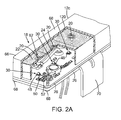
- Figs. 2A and 2B are respective fragmentary and exploded views of a light bar light-emitting diode (LED) module that is installed in the upper level of one of housing modules of the optical warning system of Figs. 1A and 1B .
- LED light bar light-emitting diode
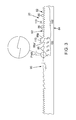
- Fig. 3 is an enlarged fragmentary cross-sectional view of a fine pitch Fresnel optic array employed in the optical warning system of Figs. 1A and 1B .
- Fig. 4 is a pair of diagrams presenting a side-by-side comparison between the feature profile of a standard Fresnel lens (left-hand feature diagram "A") and the feature profile of the disclosed Fresnel optic array (right-hand feature diagram "B") of Fig. 3 .
- Fig. 5 shows the placement of red and blue LEDs underneath the Fresnel optic array of Fig. 3 to create a two-color LED warning light configuration.
- Fig. 6 is a graph showing an example of summing two 45° full-width, half-maximum (FWHM) dispersions with ⁇ 6° horizontal offset of light emitted by the red and blue LEDs of Fig. 5 .
- FWHM full-width, half-maximum
- Figs. 1A and 1B are respective perspective and end views of an embodiment of an optical warning system in the form of a two-level light bar 10 composed of a set of five housing modules.
- the set of five housing modules includes two outboard-type housing modules 12a positioned adjacent different ones of two short center-type housing modules 12b, which are positioned adjacent either side of a long center-type housing module 12c.
- Each one of housing modules 12, 12b, and 12c (collectively, “housing modules 12") has an upper level 14, which performs a primary emergency warning lighting function, and a lower level 16, which either provides white auxiliary lighting or performs amber-colored traffic director functions.
- Figs. 2A and 2B are respective fragmentary and exploded views of a light bar light-emitting diode (LED) module 18 that is installed in upper level 14 of one of housing modules 12.
- Fig. 2A has portions of LED module 18 cut away to show its interior optical and electronic components.
- Each of housing modules 12 of Figs. 1A and 1B is configured to enclose multiple LED modules 18.
- each of LED modules 18 mounted in upper level 14 includes multiple Fresnel optic arrays 20 formed on an exterior surface 22 of an optic cover 24.
- the center-to-center pitch between adjacent Fresnel optic arrays 20 is preferably 22 mm; and the length, width, and depth of optic cover 24 are preferably 132.9 mm, 32.9 mm, and 13.821 mm, respectively.
- Each one of LED modules 18 includes a base plate 26 that supports a printed circuit board 28 on which the electronic components are mounted. Base plate 26 is in heat transfer communication with and functions as a heat sink for printed circuit board 28.
- Figs. 1A and 1B show that housing modules 12 containing LED modules 18 are arranged to provide a visual warning signal with effective coverage throughout 360°.
- Auxiliary or traffic director lighting modules mounted in lower level 16 of light bar 10 are based on a light reflector design that is incidental to the subject matter of this disclosure.
- Each of multiple light-emitting areas 30 defined on printed circuit board 28 includes one or more surface mount LEDs 48 (three and six light-emitting areas 30, each with one LED 48, shown in Figs. 2A and 2B , respectively) and electronic drive circuitry 50.
- a microcontroller 52 mounted on printed circuit board 28 provides electrical signals to LEDs 48 and drive circuitry 50 to selectively energize them.
- a power supply circuit 64 connected to printed circuit board 28 provides the electric power to operate LED module 18.
- Each Fresnel optic array 20 formed on optic cover 24 includes a lens portion 62 that is positioned above and in spatial alignment with light-emitting area 30 to receive light rays emitted by LED 48.
- a lens cover 66 having an interior surface onto which an optical diffuser 68 is placed comprises a portion of LED module 18 that cover light-emitting areas 30 and transmits light emitted from them.
- Screws 68 (three shown) pass through axially aligned holes at the corners of base plate 26, printed circuit board 28, optic cover 24, and lens cover 66 to secure them together and thereby form LED module 18.
- LED module 18 is attached to upper level 14 of light bar 10 by a mounting bracket 70 extending from base plate 26 and secured to a platform 72 by fasteners (not shown) passing through holes 74 in mounting bracket 70.
- Fig. 3 shows an enlarged fragmentary cross-sectional view of a fine pitch Fresnel optic array 20.
- Fresnel optic array 20 has a first or front major surface 82 and a second or back, opposite major surface 84.
- Front major surface 82 has multiple concentric ring facets 86 positioned nearer to optical diffuser 68
- back major surface 84 is a flat surface positioned nearer to light-emitting area 30.
- Fresnel optic array 20 efficiently captures a large portion and creates a tightly collimated beam of light emitted by LED 48, thereby imaging the LED die structure.
- Fresnel optic array 20 is designed so that its front major surface 82 appears as a continuous light-emitting surface.
- Fig. 3 shows a convex center portion 90 and part of a faceted portion 92 of Fresnel optic array 20.
- Fresnel optic array 20 has very small feature sizes to prevent an observer's eyes from readily resolving its alternate light-emitting and light non-emitting surfaces, as described below.
- FIG. 4 is a pair of diagrams presenting a side-by-side comparison between the feature profile of a standard Fresnel lens 94 (left-hand feature diagram "A") and the feature profile of the disclosed Fresnel optic array 20 (right-hand feature diagram "B").
- Feature diagram A of Fig. 4 shows a ring facet 94f and portions of adjacent ring facets 94a1 and 94a2 of standard Fresnel lens 94 through which a bundle of light rays 96 propagates.
- Ring facet 94f occupies an annular region, in which a draft facet 94d and an adjacent optical facet 94o are joined to form a rounded peak 94p defined by a peak radius 94r.
- Draft facet 94d and optical facet 94o are, respectively, the non-optical surface and optical surface of standard Fresnel lens 94.
- Radius 94r is required at peak 94p because it is a trough in the SPDT injection mold tool.
- An SPDT mold tool requires radii on all internal corners to enable removal of the molded part from the tool.
- a molded SPDT Fresnel lens has many internal corners because of the fine feature pitch. Radius 94r at peak 94p of standard Fresnel lens 94 removes material from optical facet 94o and thereby reduces light transmission efficiency. These regions of the optical surface from which material is removed scatter light rays 96 instead of collimating them.
- Feature diagram B of Fig. 4 shows a ring facet 86f, which is designed to eliminate the reduction in light transmission efficiency resulting from scattering of light rays 96. The elimination of the reduction of light transmission efficiency is accomplished by machining the radius of the rounded peak within the non-optical surface, i.e., the draft facet.
- Feature diagram B of Fig. 4 shows ring facet 86f and portions of adjacent facets 86a1 and 86a2 of Fresnel optic array 20, through which the bundle of light rays 96 propagates in accordance with the present disclosure.
- multiple concentric ring facets 86 are divided into an inner group 100 and an outer group 102 extending radially outwardly from convex circular center portion 90.
- Each ring facet 86 occupies an annular region 106, in which a draft facet 86d and an optical facet 86o are joined to form a rounded peak 86p defined by a peak radius 86r.
- Draft facet 86d is inclined at a draft angle ⁇ d
- optical facet 86o is inclined at a slope angle ⁇ s .
- a facet spacing or ring pitch 110 is defined as the distance between peaks 86p of adjacent ring facets 86.
- Fresnel optic array 20 is designed to have, to the extent possible, optical facets 86o function as light-emitting surfaces (i.e., the refractive surfaces) and draft facets 86d function as light non-emitting surfaces (i.e., the non-optical surfaces). This is accomplished by reducing draft angles ⁇ d and thereby forming rounded peaks 86p with radius 86r moved into the non-optical surfaces, i.e., draft facets 86d.
- the general ring pitch of the features of Fresnel optical array is 0.3 mm.
- Draft surfaces 86d located near an optic array center 112 of Fresnel optic array 20 tend toward a vertical orientation (i.e., draft angles ⁇ d approach 0°). Reducing draft angles ⁇ d of ring facets 86 located near optic array center 112 becomes infeasible because their draft surfaces 86d would tilt beyond vertical and create undercuts.
- the design of Fresnel optic array 20 accepts a small number of radii 86r of rounded peaks 86p that extend into draft facets 86d and thereby reduce optical transmission efficiency.
- inner group 100 of ring facets 86 with increased ring pitch 110 relative to that of ring facets 86 in outer group 102 includes five of the innermost ring facets 86 with increasing ring pitch 110, 1.2 mm for the center ring facet 86 and 0.6 mm for each of the next four ring facets 86.
- Outer group 102 includes the twenty remaining ring facets 86, each having a 0.3 mm general ring pitch 110.
- the thickness of Fresnel optic array 20 is 1.5 mm ⁇ 0.05 mm, measured from optic array center 112 to back major surface 84.
- Fresnel optic array 20 incorporates machining radii allowances into its non-optical regions. As described above, these radii are present to allow the SPDT process to create the tooling inserts of the injection mold tool. These radii are located in the troughs of the SPDT mold tool. If these radii were simply added to the feature profile of a standard Fresnel lens with no modification to the non-optical surfaces, a significant portion of light would be lost to scattering. By reducing draft angles ⁇ d , a small radius 86r can be added to each of the troughs in the region where no light would be emitting (non-optical surfaces 86d). This allows for the manufacture of injection-molded SPDT Fresnel optics while minimizing losses from the tooling and machining processes.
- the resultant PMMA part is a more accurate representation of the computer aided design (CAD) data used to machine ring facet features.
- CAD computer aided design
- An alternative method to produce the Fresnel lens features with draft angles that are essentially vertical is not an option for the design of Fresnel optic array 20. The reason is that the effective focal point of Fresnel optic array 20 is short (10.5 mm below flat surface 84) and the area of light-emitting surface 82 (22.75 mm x 32.9 mm) is relatively large, such that the enclosed angle required for tooling the Fresnel facets would be outside of SPDT tooling limitations and, therefore, could not be manufactured.
- optical diffuser 68 creates an effective warning coverage angle by dispersing in a desired pattern the collimated beam of light propagating from Fresnel optic array 20. A small portion of the light is allowed to pass undiverged through a front surface 120 of optical diffuser 68 to give an intense warning signal directly in front, but the bulk remainder of the light is diverged horizontally in a controlled manner to create an efficient, highly effective warning signal around upper level 14 of light bar 10.
- a preferred optical diffuser 68 is a light shaping diffuser manufactured from polycarbonate material that is of clear color and in which the diffuser surface is the inside face of an interchangeable tool insert. The diffuser surface (FWHM) texture is preferably 95°H x 10°V with 2 mm border (ECE).
- FWHM textures include 60°H x 1°V with 2 mm border, 4 vertical stripes, and 1 horizontal stripe (SAE) or 10° with 2 mm border (SPOT). Other dispersion characteristics are readily achieved by different inserts into the tool.
- SAE horizontal stripe
- SPOT 10° with 2 mm border
- LED module 18 shown in Figs. 2A and 2B is a single color module (i.e. red, blue, amber, white, and green).
- Fig. 5 is an exploded pictorial view of a set of six two-color light sources mounted on printed circuit board 28 beneath a cluster 122 of six Fresnel optic arrays 20 housed in an LED module 18 2 (of which only optic cover 24 and printed circuit board 28 are shown in Fig. 5 ).
- module 18 2 is manufactured as a two-color system, with a pair of LEDs 48r and 48b positioned adjacent each other along the horizontal axis ( i.e., axis extending parallel to the plane and along the length of printed circuit board 28) under the focal point of each Fresnel optic array 20.
- Fresnel optic array 20 functions as a first stage that produces two off-axis collimated beams diverging in the horizontal direction.
- Optical diffuser 68 functions as a second stage that averages the light by dispersing it at a significantly greater horizontal angle than the two collimated beam divergence beam angle and that subsequently produces a two-color light output appearing not to exhibit positional change of the light source.
- Fig. 5 shows the intended placement of LEDs 48r and 48b underneath Fresnel optic array 20 to create the two-color LED warning light configuration.
- the ordering of LEDs 48r and 48b in each adjacent pair is interchanged, such that the combined output of red light is symmetrical about 0° horizontally and the combined output of blue light is symmetrical of about 0° horizontally.
- the graphs superimposed on Fig. 5 and set above cluster 122 of the six Fresnel optic arrays 20 are representations of the light output corresponding to the graph shown in Fig. 6 . Inspection of Fig. 5 reveals that there are three blue LEDs 48b focused slightly left and three blue LEDs 48b focused slightly right. The same can be seen with LEDs 48r.
- the order of a pair of LEDs 48r and 48b in a light source is the reverse of that for the pair of LEDs 48r and 48b in an adjacent light source of the set of six two-color light sources. Staggering of the two colors further negates the effects of the positional offset of the LED output.
- Fig. 6 is a graph showing an example of summing two 45° full width, half-maximum (FWHM) dispersions with ⁇ 6° horizontal offset.
- FWHM full width, half-maximum
- the two 45° FWHM normalized LEDs 48r and 48b dashed lines
- offsets of -6° and +6° combine to produce a symmetrical output centered about 0° (solid line).
- This principle is used to produce two-color LED modules 18 2 , with each color filling the entire module front surface and having a symmetrical light output pattern using Fresnel optic array 20 in combination with optical diffuser 68.
- Fresnel optic array 20 For two-color applications, there is a significant benefit to the geometry of Fresnel optic array 20 in that back major (flat) surface 84 is relatively far away (i.e., 10.5 mm) from LEDs 48r and 48b. If LEDs 48r and 48b are of small dimensions and are placed symmetrically adjacent to each other in the horizontal axis, as close as manufacturer tolerances will permit, they will be set at a distance of 1.75 mm from the focal point of Fresnel optic array 20. Fresnel optic array 20 collimates each LED 48r and 48b sufficiently but aims the collimated beams in a slightly different direction horizontally.
- optical warning system 10 affords relative freedom of component placement within the enclosure of Fresnel optic array 20. This allows for other electronic components, such as LEDs 48r and 48b, to be readily mounted onto the same printed circuit board assembly, thereby extending the possible applications to, for example, standalone LED surface-mount modules.
Landscapes
- Engineering & Computer Science (AREA)
- General Engineering & Computer Science (AREA)
- Mechanical Engineering (AREA)
- Physics & Mathematics (AREA)
- General Physics & Mathematics (AREA)
- Led Device Packages (AREA)
- Non-Portable Lighting Devices Or Systems Thereof (AREA)
- Optics & Photonics (AREA)
Description
- © 2015 Hazard Systems Pty LTD. A portion of the disclosure of this patent document contains material that is subject to copyright protection. The copyright owner has no objection to the facsimile reproduction by anyone of the patent document or the patent disclosure, as it appears in the Patent and Trademark Office patent file or records, but otherwise reserves all copyright rights whatsoever.
- This disclosure relates to optical warning systems and, in particular, to a low-profile optical warning system that is composed of light-emitting modules implemented with Fresnel arrays and optical diffusers.
- Warning light signals are generally used to clear the right of way or to warn oncoming motorists of potential moving or stationary hazards, such as a vehicle that is stopped or a vehicle moving slower or faster than the rate of traffic. Warning light signals may also be used to provide specific directions to motorists, such as merge right or merge left or pull over. Some vehicles incorporate an arrow board or even a text matrix display to generate warning light signals to direct traffic.
- The use of emergency beacons is restricted by law in many jurisdictions for only responding to an emergency, initiating a traffic stop, bona fide training exercises, or when a specific hazard exists in the road.
- An optical warning system comprises a light head that includes a light source emitting light rays from a light-emitting area. The light rays propagate through an optical diffuser to provide a visual warning signal to an observer remotely located from the optical warning system. A Fresnel optic array positioned between the optical diffuser and the light-emitting area is spaced apart from and spatially aligned with the light-emitting area to receive the light rays emitted from the light-emitting area and form a collimated light beam.
- The Fresnel optic array has first and second opposite major surfaces, of which the first major surface has multiple concentric ring facets positioned nearer to the optical diffuser and of which the second major surface is flat and positioned nearer to the light-emitting area. The multiple concentric ring facets form separate inner and outer groups, the concentric ring facets in the inner group having facet spacings that are greater than facet spacings of the concentric ring facets in the outer group. Each of the multiple ring facets in the outer group occupies an annular region in which a draft facet and an adjacent optical facet are joined to form a rounded peak. The draft facet is inclined at a draft angle, and the rounded peak is defined by a peak radius. The draft angle and peak radius are set to values that are coordinated to cause incident light rays emitted from the light-emitting area to propagate through the optical facet and not through the draft facet and the rounded peak. This increases optical transmission efficiency of the Fresnel optic array by reducing light lost to scattering by the rounded peak in forming the collimated light beam.
- The application should be taken to extend to the following numbered statements:
- 1. In an optical warning system comprising a light head that includes a light source emitting light rays from a light-emitting area, the light rays propagating through an optical diffuser to provide a visual warning signal to an observer remotely located from the optical warning system, the improvement comprising:
- a Fresnel optic array positioned between the optical diffuser and the light-emitting area, the Fresnel optic array spaced apart from and spatially aligned with the light-emitting area to receive the light rays emitted from the light-emitting area and form a collimated light beam, and the Fresnel optic array having first and second opposite major surfaces, of which the first major surface has multiple concentric ring facets positioned nearer to the optical diffuser and of which the second major surface is flat and positioned nearer to the light-emitting area;
- the multiple concentric ring facets forming separate inner and outer groups, the concentric ring facets in the inner group having facet spacings that are greater than facet spacings of the concentric ring facets in the outer group; and
- each of the multiple ring facets in the outer group occupying an annular region in which a draft facet and an adjacent optical facet are joined to form a rounded peak, the draft facet inclined at a draft angle and the rounded peak defined by a peak radius, the draft angle and peak radius set to values that are coordinated to cause incident light rays emitted from the light-emitting area to propagate through the optical facet and not through the draft facet and the rounded peak thereby to increase optical transmission efficiency of the Fresnel optic array by reducing light lost to scattering by the rounded peak in forming the collimated light beam.
- 2. The optical warning system of statement 1, in which the Fresnel optic array has a focal point, and in which the light source includes a light-emitting diode positioned a distance away from the flat major surface at the focal point of the Fresnel optic array.
- 3. The optical warning system of statement 1, in which the Fresnel optic array has a focal point lying on a focal plane, in which the light source includes two light-emitting diodes positioned on either side of the focal point in the light-emitting area and on the focal plane of the Fresnel optic array, and in which the Fresnel optic array forms two substantially collimated light beams.
- 4. The optical warning system of statement 3, in which the light-emitting diodes emit light of different colors and are positioned at substantially equal distances on either side of the focal point.
- 5. The optical warning system of statement 3, in which the optical diffuser forms from the two substantially collimated beams a combined diffused light intensity pattern having a peak intensity.
- 6. The optical warning system of statement 5, in which the Fresnel optic array has a principal axis, and in which the light-emitting diodes emit light of different colors and are positioned at substantially equal distances on either side of the focal point so that the diffused light intensity pattern is symmetrical about and the peak intensity lies on the principal axis of the Fresnel optic array.
- 7. The optical warning system of statement 1, in which the inner group includes fewer of the multiple concentric ring facets than those in the outer group.
- 8. The optical warning system of statement 1, in which the peak radius of the rounded peak is no greater than about 0.04 mm.
- 9. In an optical warning system comprising a light head that includes multiple light sources emitting light rays from associated light-emitting areas, the light rays propagating through an optical diffuser to provide a visual warning signal to an observer remotely located from the optical warning system, the improvement comprising:
- multiple Fresnel optic arrays positioned between the optical diffuser and the associated light-emitting areas, each of the multiple Fresnel optic arrays spaced apart from and spatially aligned with the light-emitting area with which the Fresnel optic array is associated to receive the light rays emitted from the light-emitting area and form a collimated light beam, and each of the multiple Fresnel optic arrays having first and second opposite major surfaces, of which the first major surface has multiple concentric ring facets positioned nearer to the optical diffuser and of which the second major surface is flat and positioned nearer to the light-emitting area;
- the multiple concentric ring facets of each of the multiple Fresnel optic arrays forming separate inner and outer groups, the concentric ring facets in the inner group having facet spacings that are greater than facet spacings of the concentric ring facets in the outer group; and
- each of the multiple ring facets in the outer group occupying an annular region in which a draft facet and an adjacent optical facet are joined to form a rounded peak, the draft facet inclined at a draft angle and the rounded peak defined by a peak radius, the draft angle and peak radius set to values that are coordinated to cause incident light rays emitted from the light-emitting area to propagate through the optical facet and not through the draft facet and the rounded peak thereby to increase optical transmission efficiency of the Fresnel optic array by reducing light lost to scattering by the rounded peak in forming the collimated light beam.
- 10. The optical warning system of statement 9, in which each of the multiple Fresnel optic arrays has a focal point, and in which each of the multiple light sources includes a light-emitting diode positioned a distance away from the flat major surface at the focal point of the Fresnel optic array.
- 11. The optical warning system of statement 9, in which each of the multiple Fresnel optic arrays has a focal point lying on a focal plane, in which each of the multiple light sources includes two light-emitting diodes positioned on either side of the focal point in the light-emitting area with which the Fresnel optic array is associated and on the focal plane of the Fresnel optic array, and in which the Fresnel optic array forms two substantially collimated light beams.
- 12. The optical warning system of statement 11, in which the two light-emitting diodes of each of the multiple light sources emit light of different colors and are positioned at substantially equal distances on either side of the focal point in the light-emitting area with which the Fresnel optic array is associated.
- 13. The optical warning system of statement 11, in which the optical diffuser forms from the two substantially collimated beams a combined diffused light intensity pattern having a peak intensity.
- 14. The optical warning system of statement 13, in which each of the multiple Fresnel optic arrays has a principal axis, and in which the two light-emitting diodes emit light of different colors and are positioned at substantially equal distances on either side of the focal point in the light-emitting area with which the Fresnel optic array is associated so that the diffused light intensity pattern is symmetrical about and the peak intensity lies on the principal axis of the Fresnel optic array.
- 15. The optical warning system of statement 9, in which the inner group includes fewer of the multiple concentric ring facets than those in the outer group.
- 16. The optical warning system of statement 9, in which the peak radius of the rounded peak is no greater than about 0.04 mm.
- 17. The optical warning system of statement 11, in which the two light-emitting diodes of each of the multiple light sources emit light of different colors, and in which the multiple light sources are placed in a linear configuration in which the two light-emitting diodes included in adjacent pairs of the multiple light sources are set in reverse order so that light-emitting diodes of adjacent light sources emit light of the same color to produce a symmetrical two-color light output.
- Additional aspects and advantages will be apparent from the following detailed description of preferred embodiments, which proceeds with reference to the accompanying drawings.
-
Figs. 1A and 1B are respective perspective and end views of an embodiment of an optical warning system in the form of a two-level light bar composed of a set of five housing modules. -
Figs. 2A and2B are respective fragmentary and exploded views of a light bar light-emitting diode (LED) module that is installed in the upper level of one of housing modules of the optical warning system ofFigs. 1A and 1B . -
Fig. 3 is an enlarged fragmentary cross-sectional view of a fine pitch Fresnel optic array employed in the optical warning system ofFigs. 1A and 1B . -
Fig. 4 is a pair of diagrams presenting a side-by-side comparison between the feature profile of a standard Fresnel lens (left-hand feature diagram "A") and the feature profile of the disclosed Fresnel optic array (right-hand feature diagram "B") ofFig. 3 . -
Fig. 5 shows the placement of red and blue LEDs underneath the Fresnel optic array ofFig. 3 to create a two-color LED warning light configuration. -
Fig. 6 is a graph showing an example of summing two 45° full-width, half-maximum (FWHM) dispersions with ±6° horizontal offset of light emitted by the red and blue LEDs ofFig. 5 . -
Figs. 1A and 1B are respective perspective and end views of an embodiment of an optical warning system in the form of a two-level light bar 10 composed of a set of five housing modules. With reference toFigs. 1A and 1B , the set of five housing modules includes two outboard-type housing modules 12a positioned adjacent different ones of two short center-type housing modules 12b, which are positioned adjacent either side of a long center-type housing module 12c. Each one ofhousing modules upper level 14, which performs a primary emergency warning lighting function, and alower level 16, which either provides white auxiliary lighting or performs amber-colored traffic director functions. -
Figs. 2A and2B are respective fragmentary and exploded views of a light bar light-emitting diode (LED)module 18 that is installed inupper level 14 of one of housing modules 12.Fig. 2A has portions ofLED module 18 cut away to show its interior optical and electronic components. Each of housing modules 12 ofFigs. 1A and 1B is configured to enclosemultiple LED modules 18. With reference toFigs. 1A, 1B ,2A , and2B , each ofLED modules 18 mounted inupper level 14 includes multipleFresnel optic arrays 20 formed on anexterior surface 22 of anoptic cover 24. The center-to-center pitch between adjacentFresnel optic arrays 20 is preferably 22 mm; and the length, width, and depth ofoptic cover 24 are preferably 132.9 mm, 32.9 mm, and 13.821 mm, respectively. Each one ofLED modules 18 includes abase plate 26 that supports a printedcircuit board 28 on which the electronic components are mounted.Base plate 26 is in heat transfer communication with and functions as a heat sink for printedcircuit board 28.
Figs. 1A and 1B show that housing modules 12 containingLED modules 18 are arranged to provide a visual warning signal with effective coverage throughout 360°. Auxiliary or traffic director lighting modules mounted inlower level 16 oflight bar 10 are based on a light reflector design that is incidental to the subject matter of this disclosure. - Each of multiple light-emitting
areas 30 defined on printedcircuit board 28 includes one or more surface mount LEDs 48 (three and six light-emittingareas 30, each with oneLED 48, shown inFigs. 2A and2B , respectively) andelectronic drive circuitry 50. Amicrocontroller 52 mounted on printedcircuit board 28 provides electrical signals toLEDs 48 and drivecircuitry 50 to selectively energize them. Apower supply circuit 64 connected to printedcircuit board 28 provides the electric power to operateLED module 18. EachFresnel optic array 20 formed onoptic cover 24 includes alens portion 62 that is positioned above and in spatial alignment with light-emittingarea 30 to receive light rays emitted byLED 48. Alens cover 66 having an interior surface onto which anoptical diffuser 68 is placed comprises a portion ofLED module 18 that cover light-emittingareas 30 and transmits light emitted from them. Screws 68 (three shown) pass through axially aligned holes at the corners ofbase plate 26, printedcircuit board 28,optic cover 24, and lens cover 66 to secure them together and thereby formLED module 18.LED module 18 is attached toupper level 14 oflight bar 10 by a mountingbracket 70 extending frombase plate 26 and secured to aplatform 72 by fasteners (not shown) passing throughholes 74 in mountingbracket 70. -
Fig. 3 shows an enlarged fragmentary cross-sectional view of a fine pitchFresnel optic array 20. With reference toFig. 3 ,Fresnel optic array 20 has a first or frontmajor surface 82 and a second or back, oppositemajor surface 84. Frontmajor surface 82 has multipleconcentric ring facets 86 positioned nearer tooptical diffuser 68, and backmajor surface 84 is a flat surface positioned nearer to light-emittingarea 30.Fresnel optic array 20 efficiently captures a large portion and creates a tightly collimated beam of light emitted byLED 48, thereby imaging the LED die structure.Fresnel optic array 20 is designed so that its frontmajor surface 82 appears as a continuous light-emitting surface.Fig. 3 shows aconvex center portion 90 and part of afaceted portion 92 ofFresnel optic array 20.Fresnel optic array 20 has very small feature sizes to prevent an observer's eyes from readily resolving its alternate light-emitting and light non-emitting surfaces, as described below. - Single Point Diamond Turning (SPDT) is a preferred process performed to create fine pitch Fresnel features in poly (methyl methacrylate) (PMMA) material.
Fig. 4 is a pair of diagrams presenting a side-by-side comparison between the feature profile of a standard Fresnel lens 94 (left-hand feature diagram "A") and the feature profile of the disclosed Fresnel optic array 20 (right-hand feature diagram "B"). - Feature diagram A of
Fig. 4 shows a ring facet 94f and portions of adjacent ring facets 94a1 and 94a2 ofstandard Fresnel lens 94 through which a bundle oflight rays 96 propagates. Ring facet 94f occupies an annular region, in which adraft facet 94d and an adjacent optical facet 94o are joined to form arounded peak 94p defined by apeak radius 94r.Draft facet 94d and optical facet 94o are, respectively, the non-optical surface and optical surface ofstandard Fresnel lens 94.Radius 94r is required atpeak 94p because it is a trough in the SPDT injection mold tool. An SPDT mold tool requires radii on all internal corners to enable removal of the molded part from the tool. A molded SPDT Fresnel lens has many internal corners because of the fine feature pitch.Radius 94r at peak 94p ofstandard Fresnel lens 94 removes material from optical facet 94o and thereby reduces light transmission efficiency. These regions of the optical surface from which material is removed scatter light rays 96 instead of collimating them. - Feature diagram B of
Fig. 4 shows aring facet 86f, which is designed to eliminate the reduction in light transmission efficiency resulting from scattering oflight rays 96. The elimination of the reduction of light transmission efficiency is accomplished by machining the radius of the rounded peak within the non-optical surface, i.e., the draft facet. Feature diagram B ofFig. 4 showsring facet 86f and portions of adjacent facets 86a1 and 86a2 ofFresnel optic array 20, through which the bundle oflight rays 96 propagates in accordance with the present disclosure. - With reference to
Fig. 3 and feature diagram B ofFig. 4 , multipleconcentric ring facets 86 are divided into aninner group 100 and anouter group 102 extending radially outwardly from convexcircular center portion 90. Eachring facet 86 occupies anannular region 106, in which adraft facet 86d and an optical facet 86o are joined to form arounded peak 86p defined by apeak radius 86r.Draft facet 86d is inclined at a draft angle Θd, and optical facet 86o is inclined at a slope angle Θs. A facet spacing orring pitch 110 is defined as the distance betweenpeaks 86p ofadjacent ring facets 86. - To achieve the desired optical characteristics by providing alternate light-emitting and light non-emitting surfaces,
Fresnel optic array 20 is designed to have, to the extent possible, optical facets 86o function as light-emitting surfaces (i.e., the refractive surfaces) anddraft facets 86d function as light non-emitting surfaces (i.e., the non-optical surfaces). This is accomplished by reducing draft angles Θd and thereby formingrounded peaks 86p withradius 86r moved into the non-optical surfaces, i.e.,draft facets 86d. The general ring pitch of the features of Fresnel optical array is 0.3 mm. Draft surfaces 86d located near anoptic array center 112 of Fresnel optic array 20 (i.e., draft surfaces 86d ofring facets 86 of inner group 100) tend toward a vertical orientation (i.e., draft angles Θd approach 0°). Reducing draft angles Θd ofring facets 86 located nearoptic array center 112 becomes infeasible because theirdraft surfaces 86d would tilt beyond vertical and create undercuts. The design ofFresnel optic array 20 accepts a small number of radii 86r ofrounded peaks 86p that extend intodraft facets 86d and thereby reduce optical transmission efficiency. The number of such radii is minimized by providinginner group 100 ofring facets 86 with increasedring pitch 110 relative to that ofring facets 86 inouter group 102. In a preferred embodiment,inner group 100 includes five of theinnermost ring facets 86 with increasingring pitch 110, 1.2 mm for thecenter ring facet 86 and 0.6 mm for each of the next fourring facets 86.Outer group 102 includes the twenty remainingring facets 86, each having a 0.3 mmgeneral ring pitch 110. The thickness ofFresnel optic array 20 is 1.5 mm ± 0.05 mm, measured fromoptic array center 112 to backmajor surface 84. - The optical design of
Fresnel optic array 20 incorporates machining radii allowances into its non-optical regions. As described above, these radii are present to allow the SPDT process to create the tooling inserts of the injection mold tool. These radii are located in the troughs of the SPDT mold tool. If these radii were simply added to the feature profile of a standard Fresnel lens with no modification to the non-optical surfaces, a significant portion of light would be lost to scattering. By reducing draft angles Θd, asmall radius 86r can be added to each of the troughs in the region where no light would be emitting (non-optical surfaces 86d). This allows for the manufacture of injection-molded SPDT Fresnel optics while minimizing losses from the tooling and machining processes. - The resultant PMMA part is a more accurate representation of the computer aided design (CAD) data used to machine ring facet features. An alternative method to produce the Fresnel lens features with draft angles that are essentially vertical is not an option for the design of
Fresnel optic array 20. The reason is that the effective focal point ofFresnel optic array 20 is short (10.5 mm below flat surface 84) and the area of light-emitting surface 82 (22.75 mm x 32.9 mm) is relatively large, such that the enclosed angle required for tooling the Fresnel facets would be outside of SPDT tooling limitations and, therefore, could not be manufactured. - When
LED module 18 is installed inlight bar 10,optical diffuser 68 creates an effective warning coverage angle by dispersing in a desired pattern the collimated beam of light propagating fromFresnel optic array 20. A small portion of the light is allowed to pass undiverged through afront surface 120 ofoptical diffuser 68 to give an intense warning signal directly in front, but the bulk remainder of the light is diverged horizontally in a controlled manner to create an efficient, highly effective warning signal aroundupper level 14 oflight bar 10. A preferredoptical diffuser 68 is a light shaping diffuser manufactured from polycarbonate material that is of clear color and in which the diffuser surface is the inside face of an interchangeable tool insert. The diffuser surface (FWHM) texture is preferably 95°H x 10°V with 2 mm border (ECE). Alternative diffuser surface (FWHM) textures include 60°H x 1°V with 2 mm border, 4 vertical stripes, and 1 horizontal stripe (SAE) or 10° with 2 mm border (SPOT). Other dispersion characteristics are readily achieved by different inserts into the tool. The appearance of the optical output oflight bar 10 using the ECE diffuser surface, from the standpoint of an observer, is that of a continuous light emitting surface. -
LED module 18 shown inFigs. 2A and2B is a single color module (i.e. red, blue, amber, white, and green).Fig. 5 is an exploded pictorial view of a set of six two-color light sources mounted on printedcircuit board 28 beneath acluster 122 of sixFresnel optic arrays 20 housed in an LED module 182 (of which onlyoptic cover 24 and printedcircuit board 28 are shown inFig. 5 ). With reference toFig. 5 ,module 182 is manufactured as a two-color system, with a pair ofLEDs Fresnel optic array 20. In this configuration,Fresnel optic array 20 functions as a first stage that produces two off-axis collimated beams diverging in the horizontal direction.Optical diffuser 68 functions as a second stage that averages the light by dispersing it at a significantly greater horizontal angle than the two collimated beam divergence beam angle and that subsequently produces a two-color light output appearing not to exhibit positional change of the light source. -
Fig. 5 shows the intended placement ofLEDs Fresnel optic array 20 to create the two-color LED warning light configuration. The ordering ofLEDs Fig. 5 and set abovecluster 122 of the sixFresnel optic arrays 20 are representations of the light output corresponding to the graph shown inFig. 6 . Inspection ofFig. 5 reveals that there are threeblue LEDs 48b focused slightly left and threeblue LEDs 48b focused slightly right. The same can be seen withLEDs 48r. The order of a pair ofLEDs LEDs -
Fig. 6 is a graph showing an example of summing two 45° full width, half-maximum (FWHM) dispersions with ±6° horizontal offset. With reference toFig. 6 , the two 45° FWHM normalizedLEDs color LED modules 182, with each color filling the entire module front surface and having a symmetrical light output pattern usingFresnel optic array 20 in combination withoptical diffuser 68. - For two-color applications, there is a significant benefit to the geometry of
Fresnel optic array 20 in that back major (flat)surface 84 is relatively far away (i.e., 10.5 mm) fromLEDs LEDs Fresnel optic array 20.Fresnel optic array 20 collimates eachLED - Another benefit of the design of
optical warning system 10 is that it affords relative freedom of component placement within the enclosure ofFresnel optic array 20. This allows for other electronic components, such asLEDs - The combination of fine-pitch SPDT
Fresnel optic array 20 withoptical diffuser 68 provides a unique low-profileoptical warning system 10. - It will be obvious to those having skill in the art that many changes may be made to the details of the above-described embodiments without departing from the underlying principles of the invention. The scope of the present invention should, therefore, be determined only by the following claims.
Claims (15)
- An optical warning system comprising a light head that includes a light source emitting light rays from a light-emitting area, the light rays propagating through an optical diffuser to provide a visual warning signal to an observer remotely located from the optical warning system, characterized in that system further comprises:a Fresnel optic array positioned between the optical diffuser and the light-emitting area, the Fresnel optic array spaced apart from and spatially aligned with the light-emitting area to receive the light rays emitted from the light-emitting area and form a collimated light beam, and the Fresnel optic array having first and second opposite major surfaces, of which the first major surface has multiple concentric ring facets positioned nearer to the optical diffuser and of which the second major surface is flat and positioned nearer to the light-emitting area;the multiple concentric ring facets forming separate inner and outer groups, the concentric ring facets in the inner group having facet spacings that are greater than facet spacings of the concentric ring facets in the outer group; andeach of the multiple ring facets in the outer group occupying an annular region in which a draft facet and an adjacent optical facet are joined to form a rounded peak, the draft facet inclined at a draft angle and the rounded peak defined by a peak radius, the draft angle and peak radius set to values that are coordinated to cause incident light rays emitted from the light-emitting area to propagate through the optical facet and not through the draft facet and the rounded peak thereby to increase optical transmission efficiency of the Fresnel optic array by reducing light lost to scattering by the rounded peak in forming the collimated light beam.
- The optical warning system of claim 1, in which the Fresnel optic array has a focal point, and in which the light source includes a light-emitting diode positioned a distance away from the flat major surface at the focal point of the Fresnel optic array.
- The optical warning system of claim 1, in which the Fresnel optic array has a focal point lying on a focal plane, in which the light source includes two light-emitting diodes positioned on either side of the focal point in the light-emitting area and on the focal plane of the Fresnel optic array, and in which the Fresnel optic array forms two substantially collimated light beams.
- The optical warning system of claim 3, in which the light-emitting diodes emit light of different colors and are positioned at substantially equal distances on either side of the focal point.
- The optical warning system of claim 3, in which the optical diffuser forms from the two substantially collimated beams a combined diffused light intensity pattern having a peak intensity.
- The optical warning system of claim 5, in which the Fresnel optic array has a principal axis, and in which the light-emitting diodes emit light of different colors and are positioned at substantially equal distances on either side of the focal point so that the diffused light intensity pattern is symmetrical about and the peak intensity lies on the principal axis of the Fresnel optic array.
- An optical warning system according to claim 1, where the light head includes multiple light sources emitting light rays from associated light-emitting areas, wherein multiple Fresnel optic arrays are positioned between the optical diffuser and the associated light-emitting areas, each of the multiple Fresnel optic arrays spaced apart from and spatially aligned with the light-emitting area with which the Fresnel optic array is associated to receive the light rays emitted from the light-emitting area and form a collimated light beam, and each of the multiple Fresnel optic arrays having first and second opposite major surfaces, of which the first major surface has multiple concentric ring facets positioned nearer to the optical diffuser and of which the second major surface is flat and positioned nearer to the light-emitting area;
Wherein the multiple concentric ring facets of each of the multiple Fresnel optic arrays forming separate inner and outer groups, the concentric ring facets in the inner group having facet spacings that are greater than facet spacings of the concentric ring facets in the outer group; and
each of the multiple ring facets in the outer group occupying an annular region in which a draft facet and an adjacent optical facet are joined to form a rounded peak, the draft facet inclined at a draft angle and the rounded peak defined by a peak radius, the draft angle and peak radius set to values that are coordinated to cause incident light rays emitted from the light-emitting area to propagate through the optical facet and not through the draft facet and the rounded peak thereby to increase optical transmission efficiency of the Fresnel optic array by reducing light lost to scattering by the rounded peak in forming the collimated light beam. - The optical warning system of claim 7, in which each of the multiple Fresnel optic arrays has a focal point, and in which each of the multiple light sources includes a light-emitting diode positioned a distance away from the flat major surface at the focal point of the Fresnel optic array.
- The optical warning system of claim 7, in which each of the multiple Fresnel optic arrays has a focal point lying on a focal plane, in which each of the multiple light sources includes two light-emitting diodes positioned on either side of the focal point in the light-emitting area with which the Fresnel optic array is associated and on the focal plane of the Fresnel optic array, and in which the Fresnel optic array forms two substantially collimated light beams.
- The optical warning system of claim 9, in which the two light-emitting diodes of each of the multiple light sources emit light of different colors and are positioned at substantially equal distances on either side of the focal point in the light-emitting area with which the Fresnel optic array is associated.
- The optical warning system of claim 9, in which the optical diffuser forms from the two substantially collimated beams a combined diffused light intensity pattern having a peak intensity.
- The optical warning system of claim 11, in which each of the multiple Fresnel optic arrays has a principal axis, and in which the two light-emitting diodes emit light of different colors and are positioned at substantially equal distances on either side of the focal point in the light-emitting area with which the Fresnel optic array is associated so that the diffused light intensity pattern is symmetrical about and the peak intensity lies on the principal axis of the Fresnel optic array.
- The optical warning system of any preceding claim, in which the inner group includes fewer of the multiple concentric ring facets than those in the outer group.
- The optical warning system of any preceding claim, in which the peak radius of the rounded peak is no greater than about 0.04 mm.
- The optical warning system of claim 9, in which the two light-emitting diodes of each of the multiple light sources emit light of different colors, and in which the multiple light sources are placed in a linear configuration in which the two light-emitting diodes included in adjacent pairs of the multiple light sources are set in reverse order so that light-emitting diodes of adjacent light sources emit light of the same color to produce a symmetrical two-color light output.
Applications Claiming Priority (1)
| Application Number | Priority Date | Filing Date | Title |
|---|---|---|---|
| US14/735,014 US9719657B2 (en) | 2015-06-09 | 2015-06-09 | Low-profile optical warning system |
Publications (3)
| Publication Number | Publication Date |
|---|---|
| EP3112140A2 true EP3112140A2 (en) | 2017-01-04 |
| EP3112140A3 EP3112140A3 (en) | 2017-05-03 |
| EP3112140B1 EP3112140B1 (en) | 2021-06-02 |
Family
ID=53871840
Family Applications (1)
| Application Number | Title | Priority Date | Filing Date |
|---|---|---|---|
| EP15178574.8A Active EP3112140B1 (en) | 2015-06-09 | 2015-07-28 | Low-profile optical warning system |
Country Status (4)
| Country | Link |
|---|---|
| US (1) | US9719657B2 (en) |
| EP (1) | EP3112140B1 (en) |
| CN (1) | CN106247212B (en) |
| AU (1) | AU2015203519B2 (en) |
Families Citing this family (13)
| Publication number | Priority date | Publication date | Assignee | Title |
|---|---|---|---|---|
| FR3025289B1 (en) * | 2014-09-03 | 2019-07-26 | Zodiac Aero Electric | LIGHTING AND / OR EXTERNAL SIGNALING PROJECTOR AND CORRESPONDING LIGHTING AND / OR SIGNALING SYSTEM |
| DE102015117266B4 (en) * | 2015-10-09 | 2017-07-13 | Trw Automotive Electronics & Components Gmbh | Lens component of a rain sensor and modular system, method and tool for manufacturing |
| WO2017152739A1 (en) * | 2016-03-07 | 2017-09-14 | 欧普照明股份有限公司 | Optical element, light source module and illumination device |
| DE102016109647B4 (en) * | 2016-05-25 | 2022-08-25 | OSRAM Opto Semiconductors Gesellschaft mit beschränkter Haftung | Lens and lamp with such a lens |
| CZ2017419A3 (en) * | 2017-07-19 | 2019-01-30 | Varroc Lighting Systems, s.r.o. | Lighting equipment, in particular fog lights, for motor vehicles |
| US10753579B2 (en) * | 2018-07-20 | 2020-08-25 | Flex-N-Gate Advanced Product Development, Llc | Animated 3D image multiplier |
| EP3911976B1 (en) * | 2019-01-15 | 2023-08-30 | Signify Holding B.V. | Optical system and lighting device |
| WO2020216206A1 (en) * | 2019-04-25 | 2020-10-29 | 苏州欧普照明有限公司 | Light distribution assembly and illumination device |
| US10710499B1 (en) * | 2019-06-19 | 2020-07-14 | Ford Global Technologies, Llc | Light assembly with housing having cover providing for wire passage |
| TWI711841B (en) * | 2019-12-10 | 2020-12-01 | 廣達電腦股份有限公司 | Method and device for eliminating ring effect |
| JP7543837B2 (en) * | 2020-10-23 | 2024-09-03 | スズキ株式会社 | Lamp unit |
| ES2936957B2 (en) * | 2021-09-21 | 2023-08-31 | Daisalux S A U | Emergency luminaire |
| DE102023124550B3 (en) * | 2023-09-12 | 2024-10-24 | HELLA GmbH & Co. KGaA | headlights for vehicles |
Family Cites Families (24)
| Publication number | Priority date | Publication date | Assignee | Title |
|---|---|---|---|---|
| DE3883181T2 (en) * | 1987-12-14 | 1993-12-02 | Ichiko Industries Ltd | Method of manufacturing a Fresnel-type prismatic lens. |
| US5636915A (en) * | 1993-11-12 | 1997-06-10 | General Electric Company | High brightness projection lighting system |
| DE9400235U1 (en) * | 1994-01-08 | 1994-04-28 | Pintsch Bamag Antriebs- und Verkehrstechnik GmbH, 46537 Dinslaken | Luminaire, in particular beacon |
| US5816681A (en) * | 1995-11-02 | 1998-10-06 | Kaiser Optical Systems, Inc. | Inconspicuous light sources particularly for vehicular applications |
| US6670207B1 (en) * | 1999-03-15 | 2003-12-30 | Gentex Corporation | Radiation emitter device having an integral micro-groove lens |
| US6616299B2 (en) * | 2001-02-02 | 2003-09-09 | Gelcore Llc | Single optical element LED signal |
| JP2002329935A (en) * | 2001-05-07 | 2002-11-15 | Toshiba Corp | Laser light source device, laser device, laser emission method, and method of manufacturing laser light source device |
| US8662702B2 (en) * | 2009-09-08 | 2014-03-04 | Star Headlight & Lantern Co., Inc. | LED beacon |
| JP2005189334A (en) * | 2003-12-24 | 2005-07-14 | Arisawa Mfg Co Ltd | Transmission type screen and manufacturing method thereof |
| US8115411B2 (en) * | 2006-02-09 | 2012-02-14 | Led Smart, Inc. | LED lighting system |
| AU2009208383A1 (en) * | 2008-01-31 | 2009-08-06 | Hella Australia Pty Ltd | Optical warning device |
| US20110171765A1 (en) * | 2008-09-23 | 2011-07-14 | Helio Optoelectronics Corporation | Multi-field arranging method of led chips under single lens |
| EP2347170A4 (en) * | 2008-11-06 | 2017-12-27 | Innovations in Optics, Inc. | Light emitting diode emergency lighting module |
| TWI431328B (en) * | 2008-12-26 | 2014-03-21 | Canon Kk | Fresnel lens and injection mold |
| ES2553420T3 (en) * | 2009-12-28 | 2015-12-09 | Pirelli & C. S.P.A. | Photovoltaic concentrator with stepped optical lens and procedure to design it |
| JP2013047091A (en) * | 2011-07-25 | 2013-03-07 | Sharp Corp | Lighting device and vehicle headlamp including the same |
| US9598001B2 (en) * | 2011-08-26 | 2017-03-21 | Ali Omidfar | Hazard beacon |
| US8833978B2 (en) * | 2011-10-25 | 2014-09-16 | Leotek Electronics Corporation | Traffic signal light device |
| CN103968268B (en) * | 2013-01-31 | 2016-09-21 | 深圳市光峰光电技术有限公司 | A kind of LED light source system and LED light device |
| CN105026830B (en) * | 2013-02-19 | 2019-04-23 | 飞利浦照明控股有限公司 | Apparatus including optics and reflector |
| KR101529166B1 (en) * | 2013-08-06 | 2015-06-16 | 현대모비스 주식회사 | Lamp for vehicle |
| EP3051322B1 (en) * | 2013-09-25 | 2019-01-30 | Dai Nippon Printing Co., Ltd. | Linear fresnel lens sheet, transmissive display apparatus, and roll-shaped molding die for manufacturing linear fresnel lens sheet |
| CN204268183U (en) * | 2014-09-24 | 2015-04-15 | 广东德豪润达电气股份有限公司 | LED flexible light strip |
| JP6576705B2 (en) * | 2015-06-23 | 2019-09-18 | スタンレー電気株式会社 | Vehicle lighting |
-
2015
- 2015-06-09 US US14/735,014 patent/US9719657B2/en active Active
- 2015-06-25 AU AU2015203519A patent/AU2015203519B2/en active Active
- 2015-07-27 CN CN201510445769.9A patent/CN106247212B/en active Active
- 2015-07-28 EP EP15178574.8A patent/EP3112140B1/en active Active
Non-Patent Citations (1)
| Title |
|---|
| None |
Also Published As
| Publication number | Publication date |
|---|---|
| AU2015203519B2 (en) | 2020-09-10 |
| AU2015203519A1 (en) | 2017-01-05 |
| EP3112140A3 (en) | 2017-05-03 |
| EP3112140B1 (en) | 2021-06-02 |
| CN106247212A (en) | 2016-12-21 |
| US20160363288A1 (en) | 2016-12-15 |
| US9719657B2 (en) | 2017-08-01 |
| CN106247212B (en) | 2020-09-18 |
Similar Documents
| Publication | Publication Date | Title |
|---|---|---|
| EP3112140B1 (en) | Low-profile optical warning system | |
| US10641458B2 (en) | Light emitting assembly, lighting apparatus and vehicle | |
| EP3539825B1 (en) | Vehicle dual-functional lighting module and vehicle dual-functional lighting set | |
| US8979303B2 (en) | Light fixture with curved frame | |
| AU2003208501B2 (en) | Single light-emitting diode vehicle lamp | |
| US7055996B2 (en) | Side turn/marker lamp | |
| US9464768B2 (en) | Collimating light head including base with projecting dome-like lens | |
| US10060592B2 (en) | Dual beam pattern vehicular lighting assembly | |
| US9791123B2 (en) | Vehicle signal lamp | |
| US20200158309A1 (en) | Lamp and vehicle having same | |
| EP2927727B1 (en) | Wide Angle Optical System for LED Array | |
| US9074746B2 (en) | Non-uniform multi-faceted reflector for rear combination lamp providing sparkle effect | |
| CN103256564A (en) | Light guide device for a motor vehicle lamp | |
| US9459436B2 (en) | Linear LED optical assembly for emitting collimated light | |
| US9739441B2 (en) | Light fixture with curved frame | |
| KR20160117122A (en) | Light device of vehicle | |
| EP2912368B1 (en) | Optical cover for a light emitting module | |
| JP5314639B2 (en) | Vehicle lighting | |
| KR20160077723A (en) | A lamp apparatus for vehicles | |
| CN111706827B (en) | Optical system for car lamp and tail lamp | |
| KR102316356B1 (en) | Optical lens for guiding road gaze and device for guiding road gaze using the same | |
| JP2021039882A (en) | Lighting apparatus | |
| KR20190126383A (en) | Optical system for warning lights |
Legal Events
| Date | Code | Title | Description |
|---|---|---|---|
| PUAI | Public reference made under article 153(3) epc to a published international application that has entered the european phase |
Free format text: ORIGINAL CODE: 0009012 |
|
| STAA | Information on the status of an ep patent application or granted ep patent |
Free format text: STATUS: THE APPLICATION HAS BEEN PUBLISHED |
|
| AK | Designated contracting states |
Kind code of ref document: A2 Designated state(s): AL AT BE BG CH CY CZ DE DK EE ES FI FR GB GR HR HU IE IS IT LI LT LU LV MC MK MT NL NO PL PT RO RS SE SI SK SM TR |
|
| AX | Request for extension of the european patent |
Extension state: BA ME |
|
| PUAL | Search report despatched |
Free format text: ORIGINAL CODE: 0009013 |
|
| AK | Designated contracting states |
Kind code of ref document: A3 Designated state(s): AL AT BE BG CH CY CZ DE DK EE ES FI FR GB GR HR HU IE IS IT LI LT LU LV MC MK MT NL NO PL PT RO RS SE SI SK SM TR |
|
| AX | Request for extension of the european patent |
Extension state: BA ME |
|
| RIC1 | Information provided on ipc code assigned before grant |
Ipc: B29D 11/00 20060101AFI20170330BHEP Ipc: B60Q 1/26 20060101ALI20170330BHEP Ipc: G02B 3/08 20060101ALI20170330BHEP |
|
| STAA | Information on the status of an ep patent application or granted ep patent |
Free format text: STATUS: REQUEST FOR EXAMINATION WAS MADE |
|
| 17P | Request for examination filed |
Effective date: 20171009 |
|
| RBV | Designated contracting states (corrected) |
Designated state(s): AL AT BE BG CH CY CZ DE DK EE ES FI FR GB GR HR HU IE IS IT LI LT LU LV MC MK MT NL NO PL PT RO RS SE SI SK SM TR |
|
| RAP1 | Party data changed (applicant data changed or rights of an application transferred) |
Owner name: ECCO SAFETY GROUP AUSTRALIA PTY LTD. |
|
| STAA | Information on the status of an ep patent application or granted ep patent |
Free format text: STATUS: EXAMINATION IS IN PROGRESS |
|
| 17Q | First examination report despatched |
Effective date: 20190319 |
|
| GRAP | Despatch of communication of intention to grant a patent |
Free format text: ORIGINAL CODE: EPIDOSNIGR1 |
|
| STAA | Information on the status of an ep patent application or granted ep patent |
Free format text: STATUS: GRANT OF PATENT IS INTENDED |
|
| INTG | Intention to grant announced |
Effective date: 20200504 |
|
| GRAJ | Information related to disapproval of communication of intention to grant by the applicant or resumption of examination proceedings by the epo deleted |
Free format text: ORIGINAL CODE: EPIDOSDIGR1 |
|
| STAA | Information on the status of an ep patent application or granted ep patent |
Free format text: STATUS: EXAMINATION IS IN PROGRESS |
|
| INTC | Intention to grant announced (deleted) | ||
| GRAP | Despatch of communication of intention to grant a patent |
Free format text: ORIGINAL CODE: EPIDOSNIGR1 |
|
| STAA | Information on the status of an ep patent application or granted ep patent |
Free format text: STATUS: GRANT OF PATENT IS INTENDED |
|
| INTG | Intention to grant announced |
Effective date: 20201014 |
|
| GRAJ | Information related to disapproval of communication of intention to grant by the applicant or resumption of examination proceedings by the epo deleted |
Free format text: ORIGINAL CODE: EPIDOSDIGR1 |
|
| STAA | Information on the status of an ep patent application or granted ep patent |
Free format text: STATUS: EXAMINATION IS IN PROGRESS |
|
| GRAP | Despatch of communication of intention to grant a patent |
Free format text: ORIGINAL CODE: EPIDOSNIGR1 |
|
| STAA | Information on the status of an ep patent application or granted ep patent |
Free format text: STATUS: GRANT OF PATENT IS INTENDED |
|
| INTC | Intention to grant announced (deleted) | ||
| INTG | Intention to grant announced |
Effective date: 20201222 |
|
| GRAS | Grant fee paid |
Free format text: ORIGINAL CODE: EPIDOSNIGR3 |
|
| GRAA | (expected) grant |
Free format text: ORIGINAL CODE: 0009210 |
|
| STAA | Information on the status of an ep patent application or granted ep patent |
Free format text: STATUS: THE PATENT HAS BEEN GRANTED |
|
| REG | Reference to a national code |
Ref country code: CH Ref legal event code: EP |
|
| AK | Designated contracting states |
Kind code of ref document: B1 Designated state(s): AL AT BE BG CH CY CZ DE DK EE ES FI FR GB GR HR HU IE IS IT LI LT LU LV MC MK MT NL NO PL PT RO RS SE SI SK SM TR |
|
| REG | Reference to a national code |
Ref country code: GB Ref legal event code: FG4D |
|
| REG | Reference to a national code |
Ref country code: AT Ref legal event code: REF Ref document number: 1398044 Country of ref document: AT Kind code of ref document: T Effective date: 20210615 |
|
| REG | Reference to a national code |
Ref country code: IE Ref legal event code: FG4D |
|
| REG | Reference to a national code |
Ref country code: DE Ref legal event code: R096 Ref document number: 602015069931 Country of ref document: DE |
|
| REG | Reference to a national code |
Ref country code: LT Ref legal event code: MG9D |
|
| PG25 | Lapsed in a contracting state [announced via postgrant information from national office to epo] |
Ref country code: LT Free format text: LAPSE BECAUSE OF FAILURE TO SUBMIT A TRANSLATION OF THE DESCRIPTION OR TO PAY THE FEE WITHIN THE PRESCRIBED TIME-LIMIT Effective date: 20210602 Ref country code: FI Free format text: LAPSE BECAUSE OF FAILURE TO SUBMIT A TRANSLATION OF THE DESCRIPTION OR TO PAY THE FEE WITHIN THE PRESCRIBED TIME-LIMIT Effective date: 20210602 Ref country code: BG Free format text: LAPSE BECAUSE OF FAILURE TO SUBMIT A TRANSLATION OF THE DESCRIPTION OR TO PAY THE FEE WITHIN THE PRESCRIBED TIME-LIMIT Effective date: 20210902 Ref country code: HR Free format text: LAPSE BECAUSE OF FAILURE TO SUBMIT A TRANSLATION OF THE DESCRIPTION OR TO PAY THE FEE WITHIN THE PRESCRIBED TIME-LIMIT Effective date: 20210602 |
|
| REG | Reference to a national code |
Ref country code: NL Ref legal event code: MP Effective date: 20210602 |
|
| REG | Reference to a national code |
Ref country code: AT Ref legal event code: MK05 Ref document number: 1398044 Country of ref document: AT Kind code of ref document: T Effective date: 20210602 |
|
| PG25 | Lapsed in a contracting state [announced via postgrant information from national office to epo] |
Ref country code: PL Free format text: LAPSE BECAUSE OF FAILURE TO SUBMIT A TRANSLATION OF THE DESCRIPTION OR TO PAY THE FEE WITHIN THE PRESCRIBED TIME-LIMIT Effective date: 20210602 Ref country code: NO Free format text: LAPSE BECAUSE OF FAILURE TO SUBMIT A TRANSLATION OF THE DESCRIPTION OR TO PAY THE FEE WITHIN THE PRESCRIBED TIME-LIMIT Effective date: 20210902 Ref country code: RS Free format text: LAPSE BECAUSE OF FAILURE TO SUBMIT A TRANSLATION OF THE DESCRIPTION OR TO PAY THE FEE WITHIN THE PRESCRIBED TIME-LIMIT Effective date: 20210602 Ref country code: SE Free format text: LAPSE BECAUSE OF FAILURE TO SUBMIT A TRANSLATION OF THE DESCRIPTION OR TO PAY THE FEE WITHIN THE PRESCRIBED TIME-LIMIT Effective date: 20210602 Ref country code: GR Free format text: LAPSE BECAUSE OF FAILURE TO SUBMIT A TRANSLATION OF THE DESCRIPTION OR TO PAY THE FEE WITHIN THE PRESCRIBED TIME-LIMIT Effective date: 20210903 Ref country code: LV Free format text: LAPSE BECAUSE OF FAILURE TO SUBMIT A TRANSLATION OF THE DESCRIPTION OR TO PAY THE FEE WITHIN THE PRESCRIBED TIME-LIMIT Effective date: 20210602 |
|
| PG25 | Lapsed in a contracting state [announced via postgrant information from national office to epo] |
Ref country code: SM Free format text: LAPSE BECAUSE OF FAILURE TO SUBMIT A TRANSLATION OF THE DESCRIPTION OR TO PAY THE FEE WITHIN THE PRESCRIBED TIME-LIMIT Effective date: 20210602 Ref country code: SK Free format text: LAPSE BECAUSE OF FAILURE TO SUBMIT A TRANSLATION OF THE DESCRIPTION OR TO PAY THE FEE WITHIN THE PRESCRIBED TIME-LIMIT Effective date: 20210602 Ref country code: EE Free format text: LAPSE BECAUSE OF FAILURE TO SUBMIT A TRANSLATION OF THE DESCRIPTION OR TO PAY THE FEE WITHIN THE PRESCRIBED TIME-LIMIT Effective date: 20210602 Ref country code: CZ Free format text: LAPSE BECAUSE OF FAILURE TO SUBMIT A TRANSLATION OF THE DESCRIPTION OR TO PAY THE FEE WITHIN THE PRESCRIBED TIME-LIMIT Effective date: 20210602 Ref country code: NL Free format text: LAPSE BECAUSE OF FAILURE TO SUBMIT A TRANSLATION OF THE DESCRIPTION OR TO PAY THE FEE WITHIN THE PRESCRIBED TIME-LIMIT Effective date: 20210602 Ref country code: RO Free format text: LAPSE BECAUSE OF FAILURE TO SUBMIT A TRANSLATION OF THE DESCRIPTION OR TO PAY THE FEE WITHIN THE PRESCRIBED TIME-LIMIT Effective date: 20210602 Ref country code: PT Free format text: LAPSE BECAUSE OF FAILURE TO SUBMIT A TRANSLATION OF THE DESCRIPTION OR TO PAY THE FEE WITHIN THE PRESCRIBED TIME-LIMIT Effective date: 20211004 Ref country code: ES Free format text: LAPSE BECAUSE OF FAILURE TO SUBMIT A TRANSLATION OF THE DESCRIPTION OR TO PAY THE FEE WITHIN THE PRESCRIBED TIME-LIMIT Effective date: 20210602 Ref country code: AT Free format text: LAPSE BECAUSE OF FAILURE TO SUBMIT A TRANSLATION OF THE DESCRIPTION OR TO PAY THE FEE WITHIN THE PRESCRIBED TIME-LIMIT Effective date: 20210602 |
|
| REG | Reference to a national code |
Ref country code: CH Ref legal event code: PL |
|
| REG | Reference to a national code |
Ref country code: DE Ref legal event code: R097 Ref document number: 602015069931 Country of ref document: DE |
|
| PG25 | Lapsed in a contracting state [announced via postgrant information from national office to epo] |
Ref country code: MC Free format text: LAPSE BECAUSE OF FAILURE TO SUBMIT A TRANSLATION OF THE DESCRIPTION OR TO PAY THE FEE WITHIN THE PRESCRIBED TIME-LIMIT Effective date: 20210602 |
|
| REG | Reference to a national code |
Ref country code: BE Ref legal event code: MM Effective date: 20210731 |
|
| PLBE | No opposition filed within time limit |
Free format text: ORIGINAL CODE: 0009261 |
|
| STAA | Information on the status of an ep patent application or granted ep patent |
Free format text: STATUS: NO OPPOSITION FILED WITHIN TIME LIMIT |
|
| PG25 | Lapsed in a contracting state [announced via postgrant information from national office to epo] |
Ref country code: LI Free format text: LAPSE BECAUSE OF NON-PAYMENT OF DUE FEES Effective date: 20210731 Ref country code: DK Free format text: LAPSE BECAUSE OF FAILURE TO SUBMIT A TRANSLATION OF THE DESCRIPTION OR TO PAY THE FEE WITHIN THE PRESCRIBED TIME-LIMIT Effective date: 20210602 Ref country code: CH Free format text: LAPSE BECAUSE OF NON-PAYMENT OF DUE FEES Effective date: 20210731 |
|
| 26N | No opposition filed |
Effective date: 20220303 |
|
| PG25 | Lapsed in a contracting state [announced via postgrant information from national office to epo] |
Ref country code: LU Free format text: LAPSE BECAUSE OF NON-PAYMENT OF DUE FEES Effective date: 20210728 Ref country code: AL Free format text: LAPSE BECAUSE OF FAILURE TO SUBMIT A TRANSLATION OF THE DESCRIPTION OR TO PAY THE FEE WITHIN THE PRESCRIBED TIME-LIMIT Effective date: 20210602 |
|
| PG25 | Lapsed in a contracting state [announced via postgrant information from national office to epo] |
Ref country code: IT Free format text: LAPSE BECAUSE OF FAILURE TO SUBMIT A TRANSLATION OF THE DESCRIPTION OR TO PAY THE FEE WITHIN THE PRESCRIBED TIME-LIMIT Effective date: 20210602 Ref country code: IE Free format text: LAPSE BECAUSE OF NON-PAYMENT OF DUE FEES Effective date: 20210728 Ref country code: BE Free format text: LAPSE BECAUSE OF NON-PAYMENT OF DUE FEES Effective date: 20210731 |
|
| PG25 | Lapsed in a contracting state [announced via postgrant information from national office to epo] |
Ref country code: HU Free format text: LAPSE BECAUSE OF FAILURE TO SUBMIT A TRANSLATION OF THE DESCRIPTION OR TO PAY THE FEE WITHIN THE PRESCRIBED TIME-LIMIT; INVALID AB INITIO Effective date: 20150728 |
|
| PG25 | Lapsed in a contracting state [announced via postgrant information from national office to epo] |
Ref country code: CY Free format text: LAPSE BECAUSE OF FAILURE TO SUBMIT A TRANSLATION OF THE DESCRIPTION OR TO PAY THE FEE WITHIN THE PRESCRIBED TIME-LIMIT Effective date: 20210602 |
|
| PG25 | Lapsed in a contracting state [announced via postgrant information from national office to epo] |
Ref country code: MK Free format text: LAPSE BECAUSE OF FAILURE TO SUBMIT A TRANSLATION OF THE DESCRIPTION OR TO PAY THE FEE WITHIN THE PRESCRIBED TIME-LIMIT Effective date: 20210602 |
|
| PG25 | Lapsed in a contracting state [announced via postgrant information from national office to epo] |
Ref country code: TR Free format text: LAPSE BECAUSE OF FAILURE TO SUBMIT A TRANSLATION OF THE DESCRIPTION OR TO PAY THE FEE WITHIN THE PRESCRIBED TIME-LIMIT Effective date: 20210602 |
|
| PG25 | Lapsed in a contracting state [announced via postgrant information from national office to epo] |
Ref country code: MT Free format text: LAPSE BECAUSE OF FAILURE TO SUBMIT A TRANSLATION OF THE DESCRIPTION OR TO PAY THE FEE WITHIN THE PRESCRIBED TIME-LIMIT Effective date: 20210602 |
|
| PGFP | Annual fee paid to national office [announced via postgrant information from national office to epo] |
Ref country code: GB Payment date: 20250619 Year of fee payment: 11 |
|
| PGFP | Annual fee paid to national office [announced via postgrant information from national office to epo] |
Ref country code: FR Payment date: 20250623 Year of fee payment: 11 |
|
| PGFP | Annual fee paid to national office [announced via postgrant information from national office to epo] |
Ref country code: DE Payment date: 20250624 Year of fee payment: 11 |