EP3110838B1 - April variants - Google Patents
April variants Download PDFInfo
- Publication number
- EP3110838B1 EP3110838B1 EP15708871.7A EP15708871A EP3110838B1 EP 3110838 B1 EP3110838 B1 EP 3110838B1 EP 15708871 A EP15708871 A EP 15708871A EP 3110838 B1 EP3110838 B1 EP 3110838B1
- Authority
- EP
- European Patent Office
- Prior art keywords
- april
- seq
- bcma
- cell
- cells
- Prior art date
- Legal status (The legal status is an assumption and is not a legal conclusion. Google has not performed a legal analysis and makes no representation as to the accuracy of the status listed.)
- Active
Links
Images


Classifications
-
- C—CHEMISTRY; METALLURGY
- C07—ORGANIC CHEMISTRY
- C07K—PEPTIDES
- C07K14/00—Peptides having more than 20 amino acids; Gastrins; Somatostatins; Melanotropins; Derivatives thereof
- C07K14/435—Peptides having more than 20 amino acids; Gastrins; Somatostatins; Melanotropins; Derivatives thereof from animals; from humans
- C07K14/52—Cytokines; Lymphokines; Interferons
- C07K14/525—Tumour necrosis factor [TNF]
-
- A—HUMAN NECESSITIES
- A61—MEDICAL OR VETERINARY SCIENCE; HYGIENE
- A61K—PREPARATIONS FOR MEDICAL, DENTAL OR TOILETRY PURPOSES
- A61K40/00—Cellular immunotherapy
- A61K40/10—Cellular immunotherapy characterised by the cell type used
- A61K40/11—T-cells, e.g. tumour infiltrating lymphocytes [TIL] or regulatory T [Treg] cells; Lymphokine-activated killer [LAK] cells
-
- A—HUMAN NECESSITIES
- A61—MEDICAL OR VETERINARY SCIENCE; HYGIENE
- A61K—PREPARATIONS FOR MEDICAL, DENTAL OR TOILETRY PURPOSES
- A61K40/00—Cellular immunotherapy
- A61K40/30—Cellular immunotherapy characterised by the recombinant expression of specific molecules in the cells of the immune system
- A61K40/31—Chimeric antigen receptors [CAR]
-
- A—HUMAN NECESSITIES
- A61—MEDICAL OR VETERINARY SCIENCE; HYGIENE
- A61K—PREPARATIONS FOR MEDICAL, DENTAL OR TOILETRY PURPOSES
- A61K40/00—Cellular immunotherapy
- A61K40/40—Cellular immunotherapy characterised by antigens that are targeted or presented by cells of the immune system
- A61K40/41—Vertebrate antigens
- A61K40/42—Cancer antigens
- A61K40/4202—Receptors, cell surface antigens or cell surface determinants
- A61K40/4214—Receptors for cytokines
- A61K40/4215—Receptors for tumor necrosis factors [TNF], e.g. lymphotoxin receptor [LTR], CD30
-
- A—HUMAN NECESSITIES
- A61—MEDICAL OR VETERINARY SCIENCE; HYGIENE
- A61P—SPECIFIC THERAPEUTIC ACTIVITY OF CHEMICAL COMPOUNDS OR MEDICINAL PREPARATIONS
- A61P35/00—Antineoplastic agents
-
- A—HUMAN NECESSITIES
- A61—MEDICAL OR VETERINARY SCIENCE; HYGIENE
- A61P—SPECIFIC THERAPEUTIC ACTIVITY OF CHEMICAL COMPOUNDS OR MEDICINAL PREPARATIONS
- A61P35/00—Antineoplastic agents
- A61P35/02—Antineoplastic agents specific for leukemia
-
- A—HUMAN NECESSITIES
- A61—MEDICAL OR VETERINARY SCIENCE; HYGIENE
- A61P—SPECIFIC THERAPEUTIC ACTIVITY OF CHEMICAL COMPOUNDS OR MEDICINAL PREPARATIONS
- A61P43/00—Drugs for specific purposes, not provided for in groups A61P1/00-A61P41/00
-
- A—HUMAN NECESSITIES
- A61—MEDICAL OR VETERINARY SCIENCE; HYGIENE
- A61P—SPECIFIC THERAPEUTIC ACTIVITY OF CHEMICAL COMPOUNDS OR MEDICINAL PREPARATIONS
- A61P7/00—Drugs for disorders of the blood or the extracellular fluid
-
- C—CHEMISTRY; METALLURGY
- C07—ORGANIC CHEMISTRY
- C07K—PEPTIDES
- C07K14/00—Peptides having more than 20 amino acids; Gastrins; Somatostatins; Melanotropins; Derivatives thereof
- C07K14/435—Peptides having more than 20 amino acids; Gastrins; Somatostatins; Melanotropins; Derivatives thereof from animals; from humans
- C07K14/705—Receptors; Cell surface antigens; Cell surface determinants
- C07K14/70503—Immunoglobulin superfamily
- C07K14/7051—T-cell receptor (TcR)-CD3 complex
-
- C—CHEMISTRY; METALLURGY
- C12—BIOCHEMISTRY; BEER; SPIRITS; WINE; VINEGAR; MICROBIOLOGY; ENZYMOLOGY; MUTATION OR GENETIC ENGINEERING
- C12N—MICROORGANISMS OR ENZYMES; COMPOSITIONS THEREOF; PROPAGATING, PRESERVING, OR MAINTAINING MICROORGANISMS; MUTATION OR GENETIC ENGINEERING; CULTURE MEDIA
- C12N15/00—Mutation or genetic engineering; DNA or RNA concerning genetic engineering, vectors, e.g. plasmids, or their isolation, preparation or purification; Use of hosts therefor
- C12N15/09—Recombinant DNA-technology
- C12N15/63—Introduction of foreign genetic material using vectors; Vectors; Use of hosts therefor; Regulation of expression
- C12N15/79—Vectors or expression systems specially adapted for eukaryotic hosts
- C12N15/85—Vectors or expression systems specially adapted for eukaryotic hosts for animal cells
-
- G—PHYSICS
- G01—MEASURING; TESTING
- G01N—INVESTIGATING OR ANALYSING MATERIALS BY DETERMINING THEIR CHEMICAL OR PHYSICAL PROPERTIES
- G01N33/00—Investigating or analysing materials by specific methods not covered by groups G01N1/00 - G01N31/00
- G01N33/48—Biological material, e.g. blood, urine; Haemocytometers
- G01N33/50—Chemical analysis of biological material, e.g. blood, urine; Testing involving biospecific ligand binding methods; Immunological testing
- G01N33/53—Immunoassay; Biospecific binding assay; Materials therefor
- G01N33/575—Immunoassay; Biospecific binding assay; Materials therefor for cancer
- G01N33/57557—Immunoassay; Biospecific binding assay; Materials therefor for cancer of other specific parts of the body, e.g. brain
-
- A—HUMAN NECESSITIES
- A61—MEDICAL OR VETERINARY SCIENCE; HYGIENE
- A61K—PREPARATIONS FOR MEDICAL, DENTAL OR TOILETRY PURPOSES
- A61K2239/00—Indexing codes associated with cellular immunotherapy of group A61K40/00
- A61K2239/10—Indexing codes associated with cellular immunotherapy of group A61K40/00 characterized by the structure of the chimeric antigen receptor [CAR]
- A61K2239/11—Antigen recognition domain
- A61K2239/15—Non-antibody based
-
- A—HUMAN NECESSITIES
- A61—MEDICAL OR VETERINARY SCIENCE; HYGIENE
- A61K—PREPARATIONS FOR MEDICAL, DENTAL OR TOILETRY PURPOSES
- A61K2239/00—Indexing codes associated with cellular immunotherapy of group A61K40/00
- A61K2239/31—Indexing codes associated with cellular immunotherapy of group A61K40/00 characterized by the route of administration
-
- A—HUMAN NECESSITIES
- A61—MEDICAL OR VETERINARY SCIENCE; HYGIENE
- A61K—PREPARATIONS FOR MEDICAL, DENTAL OR TOILETRY PURPOSES
- A61K2239/00—Indexing codes associated with cellular immunotherapy of group A61K40/00
- A61K2239/38—Indexing codes associated with cellular immunotherapy of group A61K40/00 characterised by the dose, timing or administration schedule
-
- A—HUMAN NECESSITIES
- A61—MEDICAL OR VETERINARY SCIENCE; HYGIENE
- A61K—PREPARATIONS FOR MEDICAL, DENTAL OR TOILETRY PURPOSES
- A61K2239/00—Indexing codes associated with cellular immunotherapy of group A61K40/00
- A61K2239/46—Indexing codes associated with cellular immunotherapy of group A61K40/00 characterised by the cancer treated
- A61K2239/48—Blood cells, e.g. leukemia or lymphoma
-
- C—CHEMISTRY; METALLURGY
- C07—ORGANIC CHEMISTRY
- C07K—PEPTIDES
- C07K2319/00—Fusion polypeptide
-
- C—CHEMISTRY; METALLURGY
- C07—ORGANIC CHEMISTRY
- C07K—PEPTIDES
- C07K2319/00—Fusion polypeptide
- C07K2319/01—Fusion polypeptide containing a localisation/targetting motif
- C07K2319/03—Fusion polypeptide containing a localisation/targetting motif containing a transmembrane segment
-
- C—CHEMISTRY; METALLURGY
- C07—ORGANIC CHEMISTRY
- C07K—PEPTIDES
- C07K2319/00—Fusion polypeptide
- C07K2319/30—Non-immunoglobulin-derived peptide or protein having an immunoglobulin constant or Fc region, or a fragment thereof, attached thereto
-
- C—CHEMISTRY; METALLURGY
- C07—ORGANIC CHEMISTRY
- C07K—PEPTIDES
- C07K2319/00—Fusion polypeptide
- C07K2319/70—Fusion polypeptide containing domain for protein-protein interaction
-
- G—PHYSICS
- G01—MEASURING; TESTING
- G01N—INVESTIGATING OR ANALYSING MATERIALS BY DETERMINING THEIR CHEMICAL OR PHYSICAL PROPERTIES
- G01N2333/00—Assays involving biological materials from specific organisms or of a specific nature
- G01N2333/435—Assays involving biological materials from specific organisms or of a specific nature from animals; from humans
- G01N2333/705—Assays involving receptors, cell surface antigens or cell surface determinants
- G01N2333/70575—NGF/TNF-superfamily, e.g. CD70, CD95L, CD153 or CD154
-
- G—PHYSICS
- G01—MEASURING; TESTING
- G01N—INVESTIGATING OR ANALYSING MATERIALS BY DETERMINING THEIR CHEMICAL OR PHYSICAL PROPERTIES
- G01N2800/00—Detection or diagnosis of diseases
- G01N2800/22—Haematology
Definitions
- the present invention relates to a variant proliferation-inducing ligand (APRIL) which binds the B cell maturation antigen (BCMA).
- APRIL proliferation-inducing ligand
- BCMA B cell maturation antigen
- Therapeutic agents comprising such a variant APRIL are useful in the treatment of plasma cell diseases such as multiple myeloma.
- Myeloma is a bone-marrow malignancy of plasma cells. Collections of abnormal plasma cells accumulate in the bone marrow, where they interfere with the production of normal blood cells. Myeloma is the second most common hematological malignancy in the U.S. (after non-Hodgkin lymphoma), and constitutes 13% of haematologic malignancies and 1% of all cancers. The disease is burdensome in terms of suffering as well as medical expenditure since it causes pathological fractures, susceptibility to infection, renal and then bone-marrow failure before death.
- myeloma is currently incurable.
- Standard chemotherapy agents used in lymphoma are largely ineffective for myeloma.
- CD20 expression is lost in plasma cells, Rituximab cannot be used against this disease.
- New agents such as Bortezamib and Lenolidomide are partially effective, but fail to lead to long-lasting remissions.
- BCMA also known as TNFRSF17, is a plasma cell specific surface antigen which is expressed exclusively on B-lineage haemopoietic cells or dendritic cells. It is a member of the TNF receptor family. BCMA is not expressed on na ⁇ ve B cells but is up-regulated during B-cell differentiation into plasmablasts, and is brightly expressed on memory B cells, plasmablasts and bone marrow plasma cells. BCMA is also expressed on the majority of primary myeloma cells. Apart from low levels of mRNA detected on dendritic cells, BCMA expression appears to be absent on other tissues, indicating the potential as a target for novel therapeutics for multiple myeloma.
- BCMA functions within a network of interconnected ligands and receptors which is shown schematically in Figure 1 .
- Two other TNF receptors share the ligands APRIL and BAFF with BCMA - transmembrane activator and calcium modulator and cyclophilin ligand interactor (TACI, also known as TNFRSF13B), which is found on activated T-cells and all B-cells; and BAFF-R (TNFRSF13C) which is predominantly expressed on B-lymphocytes.
- TACI also known as TNFRSF13B
- BAFF-R TNFRSF13C
- Multiple myeloma cells express TACI in some cases and BCMA in most cases, but never BAFF-R.
- the natural ligand APRIL is potentially useful as or as part of a BCMA-targeting therapeutic.
- cross-reaction with TACI is potentially a problem, because TACI is found on activated T-cells and all B-cells, so treatment with an agent directed to BCMA on myeloma cells may also cause a pathological depletion of non-cancerous B and T cell subsets.
- APRIL is also potentially useful in diagnostic applications to identify plasma cells, in particular the presence of malignant plasma cells in conditions such as multiple myeloma.
- the capacity of APRIL to also bind TACI means that APRIL-based diagnostics will also identify generally activated T-cells and all B-cells, meaning that the results are ambiguous.
- Kimberley et al. describe the use of an algorithm to design a variant of APRIL that specifically binds BCMA and two variants that selectively bind TACI (JBC; 2012; 287(44); 37434-37446)
- the present inventors have activated developed mutants of the BCMA-binding ligand APRIL, which have a higher BCMA:TACI binding ratio that wild-type APRIL. These mutants exhibit a greater degree of specificity for BCMA so provide more focussed targeting of BCMA-expressing cells for therapeutic and diagnostic applications.
- the present invention provides a variant proliferation-inducing ligand (APRIL), which has a higher binding affinity to BCMA than wild-type APRIL; and/or a higher BCMA:TACI (transmembrane activator and calcium modulator and cyclophilin ligand interactor) binding ratio than wild-type APRIL and which comprises one of the following single mutations: M200C, M200L, M200G, M200S, M200A, M200N.
- APRIL proliferation-inducing ligand
- the variant APRIL may comprise one of the following mutation combinations:
- the present invention also provides a variant proliferation-inducing ligand (APRIL) which comprises the mutation M200G.
- APRIL proliferation-inducing ligand
- the present invention also provides a chimeric antigen receptor (CAR) which comprises an antigen-binding domain, a transmembrane domain and an endodomain, wherein the antigen-binding domain comprises a variant APRIL according to any the first aspect of the invention.
- CAR chimeric antigen receptor
- the present invention also provides a bispecific T-cell engager (BiTE) which comprises and antigen-binding domain and a T-cell activation domain, wherein the antigen-binding domain comprises a variant APRIL according to the first aspect of the invention.
- BiTE bispecific T-cell engager
- the present invention provides a nucleic acid sequence encoding a variant APRIL according to the first aspect of the invention, or a CAR or BiTE comprising such a variant APRIL.
- the present invention provides a vector comprising a nucleic acid sequence according to the second aspect of the invention.
- the present invention also provides a cell which comprises a chimeric antigen receptor comprising a variant APRIL according to the first aspect of the invention.
- the present invention also provides a method for making such a cell which comprises the step of transducing or transfecting a cell with a vector according to the third aspect of the invention which comprises a nucleic acid sequence encoding a chimeric antigen receptor.
- a therapeutic agent which comprises a variant APRIL according to the first aspect of the invention, a CAR or BiTE comprising such a variant APRIL.
- the present application provides a cell comprising such a CAR, a nucleic acid according to the second aspect of the invention or a vector according to the third aspect of the invention.
- a cell or bi-specific T cell engager of the invention for use in treating a plasma cell disorder.
- the present invention also provides a diagnostic agent for detecting plasma cells which comprises a variant APRIL according to the first aspect of the invention.
- diagnostic agent for diagnosing a plasma cell disorder.
- Described herein is a method for diagnosing a plasma cell disorder in a subject in vivo which comprises the step of administering a diagnostic agent according to the invention to the subject.
- the is also provided a method for diagnosing a plasma cell disorder in a subject which comprises the step of adding a diagnostic agent according to the invention to a sample from the subject in vitro.
- the sample may be, or be derived from, a blood sample.
- the plasma cell disorder may be selected from: plasmacytoma, plasma cell leukemia, multiple myeloma, macroglobulinemia, amyloidosis, Waldenstrom's macroglobulinemia, solitary bone plasmacytoma, extramedullary plasmacytoma, osteosclerotic myeloma, heavy chain diseases, monoclonal gammopathy of undetermined significance and smoldering multiple myeloma.
- the plasma cell disorder may be multiple myeloma.
- the present invention relates to a variant proliferation-inducing ligand (APRIL), which has a higher binding affinity to BCMA than wild-type APRIL; and/or a higher BCMA:TACI (transmembrane activator and calcium modulator and cyclophilin ligand interactor) binding ratio than wild-type APRIL.
- APRIL is also known as TNFSF13.
- variant is synonymous with “mutant” or “engineered” and means APRIL comprising one or more mutations, such as substitution(s), addition(s) or deletions(s). Typically the mutation is a substitution.
- APRIL The wild-type sequence of APRIL is available at UNIPROT / O75888 and is shown below (SEQ ID No. 1). It is not a classical secreted protein in that it has no signal peptide. It has a furin cleavage site "KQKKQK” (underlined in SEQ ID No. 1). The amino terminus is involved in proteoglycan binding.
- All mutants except APRIL-R231A retained the ability to bind both BCMA and TACI.
- the R231A mutant showed complete loss of binding to both receptors but retained its ability to bind HSPGs.
- the variant APRIL of the present invention comprises the BCMA-binding site of APRIL.
- the variant APRIL may comprise a fragment of APRIL which comprises the BCMA-binding site.
- the variant APRIL may comprise a truncated APRIL, which lacks the amino terminal end of the molecule.
- the truncated APRIL may retain BCMA and TACI binding but lose proteoglycan binding.
- Truncated APRIL can be cleaved at or immediately after the furin cleavage site.
- Truncated APRIL may lack the amino terminal 116 amino acids from the wild-type APRIL molecule shown as SEQ ID No. 1.
- Truncated APRIL may comprise the sequence shown as SEQ ID No. 2 (which corresponds to the portion of SEQ ID No. 1 shown in bold) or a variant thereof. This corresponds to the portion of the molecule which is needed for BCMA and TACI binding.
- the variant APRIL or variant truncated APRIL has binding characteristics which make it more specific that wild-type APRIL. For instance, in some embodiments or applications, the variant APRIL has higher affinity to BCMA than wild-type APRIL. In some applications, the variant APRIL has a BCMA:TACI binding ratio is higher than wild-type APRIL or a combination thereof.
- the mutant APRIL described herein comprises mutations at one or more of the following positions: A125, V174, T175, M200, P201, S202, H203, D205 and R206 (shown in grey in SEQ ID No. 1).
- variant APRIL described herein may comprise one of following the single mutations: (SEQ IDs 3 to 8 and 15 to 26):
- the variant APRIL of the present invention comprises one of the following single mutations (SEQ IDs 9 to 14) M200C, M200L, M200G, M200S, M200A, M200N.
- the variant APRIL described herein may comprise a combination of mutations at the following positions: V174 and T175; or V174 and M200; or V174 and S202; or T175 and M200, or T175 and S202; or S202 and H203; or D205 and R206; or V174, T175 and M200; or V174, T175 and S202; or T175, D205 and R206; or M200, D205 and R206; or V174, T175, M200 and S202; or T175, S202, D205 and R206;
- variant APRIL described herein may comprise one of the following specific combined mutations:
- the variant APRIL may comprise one of the following specific combined mutations: V174T and M200G; or V175A and M200G; or V174T, T175A and M200G; or M200G, D205S and R206H.
- the present invention also provides a bi-specific molecule which comprises
- the second domain of the molecule of the present invention is capable of activating T cells.
- T cells have a T cell-receptor (TCR) at the cell surface which recognises antigenic peptides when presented by an MHC molecule on the surface of an antigen presenting cell.
- TCR T cell-receptor
- Such antigen recognition results in the phosphorylation of immunoreceptor tyrosine-based activation motifs (ITAMs) by Src family kinases, triggering recruitment of further kinases which results in T cell activation including Ca 2+ release.
- ITAMs immunoreceptor tyrosine-based activation motifs
- the second domain may cause T cell activation by triggering the same pathway triggered by antigen-specific recognition by the TCR.
- the second domain of the bi-specific molecule of the invention may bind CD3.
- CD3 is a protein complex composed of four distinct chains: a CD3 ⁇ chain, a CD3 ⁇ chain, and two CD3 ⁇ chains.
- CD3 associates with the T-cell receptor (TCR) and the ⁇ -chain on the surface of a T cell to generate an activation signal.
- TCR T-cell receptor
- the TCR, ⁇ -chain, and CD3 molecule together comprise the TCR complex.
- the second domain may comprise an antibody or part thereof which specifically binds CD3, such as OKT3, WT32, anti-leu-4, UCHT-1, SPV-3TA, TR66, SPV-T3B or affinity tuned variants thereof.
- CD3 such as OKT3, WT32, anti-leu-4, UCHT-1, SPV-3TA, TR66, SPV-T3B or affinity tuned variants thereof.
- antibody means a polypeptide having an antigen binding site which comprises at least one complementarity determining region CDR.
- the antibody may comprise 3 CDRs and have an antigen binding site which is equivalent to that of a domain antibody (dAb).
- dAb domain antibody
- the antibody may comprise 6 CDRs and have an antigen binding site which is equivalent to that of a classical antibody molecule.
- the remainder of the polypeptide may be any sequence which provides a suitable scaffold for the antigen binding site and displays it in an appropriate manner for it to bind the antigen.
- the antibody may be a whole immunoglobulin molecule or a part thereof such as a Fab, F(ab)' 2 , Fv, single chain Fv (ScFv) fragment, Nanobody or single chain variable domain (which may be a VH or VL chain, having 3 CDRs).
- the antibody may be a bifunctional antibody.
- the antibody may be non-human, chimeric, humanised or fully human.
- the second domain may comprise a CD3-binding molecule which is not derived from or based on an immunoglobulin.
- CD3-binding molecule which is not derived from or based on an immunoglobulin.
- DRPs "antibody mimetic" designed repeat proteins
- Such molecules include ankyrin or leucine-rich repeat proteins e.g. DARPins (Designed Ankyrin Repeat Proteins), Anticalins, Avimers and Versabodies.
- the second domain of the bi-specific molecule of the invention may comprise all or part of the monoclonal antibody OKT3, which was the first monoclonal antibody approved by the FDA.
- OKT3 is available from ATCC CRL 8001. The antibody sequences are published in US 7,381,803 .
- the second domain may comprise one or more CDRs from OKT3.
- the second binding domain may comprise CDR3 from the heavy-chain of OKT3 and/or CDR3 from the light chain of OKT3.
- the second binding domain may comprise all 6 CDRs from OKT3, as shown below.
- the second binding domain may comprise a scFv which comprises the CDR sequences from OKT3.
- the second binding domain may comprise the scFv sequence shown below as SEQ IN No. 65 or a variant thereof having at least 80% sequence identity, which retains the capacity to bind CD3.
- a variant sequence from SEQ ID No. 65 may have at least 80, 85, 90, 95, 98 or 99% sequence identity and have equivalent or improved CD3 binding and/or TCR activation capabilities as the sequence shown as SEQ ID No. 65.
- BiTES are a new class of therapeutics which approximate a target antigen with the T-cell receptor (TCR).
- TCR T-cell receptor
- BiTEs are commonly made by fusing an anti-CD3 scFv to an anti-target antigen scFv via a short five residue peptide linker (GGGGS).
- GGGGS short five residue peptide linker
- a tandem scFv targeting EpCAM (epithelial 17-1A antigen) and human CD3 in CHO cells was produced.
- This new kind of bi-specific antibody format proved to be highly cytotoxic at nanomolar concentrations against various cell lines, using unstimulated human PBMCs in the absence of co-signaling.
- a fusion between a murine anti-CD19 scFv and a murine anti-CD3 scFv was created.
- This molecule demonstrated outstanding in vitro properties, including efficient cytotoxicity, without the need of co-signaling (e.g., through CD28).
- Blinatumomab a murine anti-human CD3 ⁇ anti-human CD19 was the first BiTE developed and is the most advanced BiTE in clinical trials. The candidate is being studied as a treatment of lymphoma and leukemia.
- MT110 an anti-human EpCAM ⁇ anti-human CD3 TaFv
- MT110 was the second BiTE tested in clinical trial and the first directed to a wide spectrum of solid tumors.
- In vitro characterizations of MT110 have recapitulated the results obtained with MT103 on tumor cell lines, thereby demonstrating the generality of the BiTE format.
- MT110 is currently in clinical trial for lung, colorectal and gastrointestinal cancer patients.
- the bi-specific molecule of the present invention is based on a BiTE-like format, but instead of having a scFv or other antibody-based binding domain binding the target antigen, it has a binding domain based on the ligand for BCMA, namely APRIL.
- This "APRILiTE" format is favourable compared with a classical scFv-scFv format for various reasons: (a) a single domain - scFv fusion is likely more stable and easier to make than other formats; (b) the assembly of BCMA and APRIL on the cell surface require trimerization of each binding partner. This induces clustering of T-cell activating domain at a protein level making the protein highly specific and highly potent.
- the molecule of the present invention may comprise one of the following amino acid sequences, but with one of the following single mutations in the portion of the sequence corresponding to APRIL (with reference to the position numbering shown in SEQ ID No. 1): M200C, M200L, M200G, M200S, M200A, M200N.
- the molecule of the invention may comprise a variant of the sequence shown as SEQ ID No. 66, 67 or 68 having at least 80, 85, 90, 95, 98 or 99% sequence identity, provided that the variant sequence is a molecule as defined in the first aspect of the invention, i.e. a bi-specific molecule which comprises:
- the bi-specific molecule of the invention may comprise a signal peptide to aid in its production.
- the signal peptide may cause the bi-specific molecule to be secreted by a host cell, such that the bi-specific molecule can be harvested from the host cell supernatant.
- the core of the signal peptide may contain a long stretch of hydrophobic amino acids that has a tendency to form a single alpha-helix.
- the signal peptide may begin with a short positively charged stretch of amino acids, which helps to enforce proper topology of the polypeptide during translocation.
- At the end of the signal peptide there is typically a stretch of amino acids that is recognized and cleaved by signal peptidase.
- Signal peptidase may cleave either during or after completion of translocation to generate a free signal peptide and a mature protein.
- the free signal peptides are then digested by specific proteases.
- the signal peptide may be at the amino terminus of the molecule.
- the bi-specific molecule may have the general formula: Signal peptide - first domain - second domain.
- the signal peptide may comprise the SEQ ID No. 69 or 70 or a variant thereof having 5, 4, 3, 2 or 1 amino acid mutations (insertions, substitutions or additions) provided that the signal peptide still functions to cause secretion of the bi-specific molecule.
- the signal peptides of SEQ ID No. 69 and 70 are compact and highly efficient. They are predicted to give about 95% cleavage after the terminal glycine, giving efficient removal by signal peptidase.
- the molecule of the present invention may comprise a spacer sequence to connect the first domain with the second domain and spatially separate the two domains.
- the spacer sequence may, for example, comprise an IgG1 hinge or a CD8 stalk.
- the linker may alternatively comprise an alternative linker sequence which has similar length and/or domain spacing properties as an IgG1 hinge or a CD8 stalk.
- the spacer may be a short spacer, for example a spacer which comprises less than 100, less than 80, less than 60 or less than 45 amino acids.
- the spacer may be or comprise an IgG1 hinge or a CD8 stalk or a modified version thereof.
- amino acid sequences for these linkers are given below:
- the CD8 stalk has a sequence such that it may induce the formation of homodimers (see Figure 2 ). If this is not desired, one or more cysteine residues may be substituted or removed from the CD8 stalk sequence.
- the bispecific molecule of the invention may include a spacer which comprises or consists of the sequence shown as SEQ ID No. 72 or a variant thereof having at least 80, 85, 90, 95, 98 or 99% sequence identity, provided that the variant sequence is a molecule which causes approximately equivalent spacing of the first and second domains and/or that the variant sequence causes homodimerisation of the bi-specific molecule.
- the molecule of the invention may have the general formula: Signal peptide - first domain - spacer - second domain.
- the spacer may also comprise one or more linker motifs to introduce a chain-break.
- a chain break separate two distinct domains but allows orientation in different angles.
- sequences include the sequence SDP, and the sequence SGGGSDP (SEQ ID No. 73).
- the linker may comprise a serine-glycine linker, such as SGGGGS (SEQ ID No. 74).
- Chimeric antigen receptors also known as chimeric T cell receptors, artificial T cell receptors and chimeric immunoreceptors, are engineered receptors, which graft an arbitrary specificity onto an immune effector cell.
- CAR Click-activated antigen receptor
- Figure 3 the specificity of a monoclonal antibody is grafted on to a T cell or NK cell.
- CAR-encoding nucleic acids may be introduced into T cells or NK cells using, for example, retroviral vectors. In this way, a large number of cancer-specific T cells or NK cells can be generated for adoptive cell transfer.
- Early clinical studies of this approach have shown efficacy in some cancers, primarily when targeting the pan-B-cell antigen CD19 to treat B-cell malignancies.
- the target-antigen binding domain of a CAR is commonly fused via a spacer and transmembrane domain to a signaling endodomain. When the CAR binds the target-antigen, this results in the transmission of an activating signal to the T-cell it is expressed on.
- the CAR may comprise:
- the endodomain may comprise or associate with an intracellular T-cell signalling domain.
- the CAR of the present invention may comprise one of the following amino acid sequences, but with one of the following single mutations in the portion of the sequence corresponding to APRIL (with reference to the position numbering shown in SEQ ID No. 1): M200C, M200L, M200G, M200S, M200A, M200N.
- the molecule of the invention may comprise a variant of the sequence shown as SEQ ID No. 75, 76, 77, 78, 79 or 80 having at least 80, 85, 90, 95, 98 or 99% sequence identity, provided that the variant sequence is a molecule as defined in the first aspect of the invention, i.e. a CAR which comprises:
- the percentage identity between two polypeptide sequences may be readily determined by programs such as BLAST which is freely available at http://blast.ncbi.nlm.nih.gov.
- the present invention also provides a nucleic acid sequence encoding a variant APRIL, a CAR comprising a variant APRIL or a BiTE comprising a variant APRIL as defined above.
- the nucleic acid sequence may be RNA or DNA, it may be double or single-stranded.
- Nucleic acid sequences encoding APRIL-BiTEs are shown as SEQ ID No. 81-83.
- the nucleic acid sequence of the present invention may encode the amino acid sequence as encoded by SEQ ID No. 81, 82 or 83, but with one of the following single mutations in the portion of the sequence corresponding to APRIL (with reference to the position numbering shown in SEQ ID No. 1): M200C, M200L, M200G, M200S, M200A, M200N.
- Nucleic acid sequences encoding APRIL-CARs are shown as SEQ ID No. 84-89.
- the nucleic acid sequence of the present invention may encode the amino acid sequence as encoded by SEQ ID No. 84, 85, 86, 87, 88 or 89, but with one of the following single mutations in the portion of the sequence corresponding to APRIL (with reference to the position numbering shown in SEQ ID No. 1): M200C, M200L, M200G, M200S, M200A, M200N.
- the nucleic acid sequence may encode the same amino acid sequence as that encoded by SEQ ID No. 81, 82, 83, 84, 85, 86, 87, 88 or 89 comprising the variation mentioned above, but may have a different nucleic acid sequence, due to the degeneracy of the genetic code.
- the nucleic acid sequence may have at least 80, 85, 90, 95, 98 or 99% identity to the sequence shown as SEQ ID No. 81 to 89, provided that it encodes a molecule as defined in the first aspect of the invention.
- nucleic acid sequence described herein may encode the amino acid sequence as encoded by SEQ ID No. 81 to 89, but with one of following the single mutations (SEQ IDs 22 to 27, 34 to 45):
- the nucleic acid may encode the amino acid sequence as encoded by SEQ ID No.81 to 89, but with one the following single mutations (SEQ IDs 28 to 33): M200C, M200L, M200G, M200S, M200A, M200N.
- the nucleic acid sequence may encode the amino acid sequence as encoded by SEQ ID No. 81 to 89, but with a combination of mutations at the following positions: V174 and T175; or V174 and M200; or V174 and S202; or T175 and M200, or T175 and S202; or D205 and R206; or V174, T175 and M200; or V174, T175 and S202; or T175, D205 and R206; or M200, D205 and R206; or V174, T175, M200 and S202; or T175, S202, D205 and R206;
- nucleic acid sequence described herein may encode the amino acid sequence as encoded by SEQ ID No. 81 to 89, but with one of the following specific mutation combinations:
- the nucleic acid sequence may encode the amino acid sequence as encoded by SEQ ID No. 84 to 89, but with one of the following specific mutations combinations: V174T and M200G; or T175A and M200G; or V174T, T175A and M200G; or M200G, D205A and R206H.
- the present invention also provides a vector which comprises a nucleic acid sequence according to the present invention.
- a vector may be used to introduce the nucleic acid sequence into a host cell so that it expresses and produces a variant APRIL according to the first aspect of the invention.
- the vector may, for example, be a plasmid or synthetic mRNA or a viral vector, such as a retroviral vector or a lentiviral vector.
- the vector may be capable of transfecting or transducing an effector cell.
- the invention also provides a host cell which comprises a nucleic acid according to the invention.
- the invention also provides a cell which comprises a CAR according to the invention.
- the cell may be an immune cell such as a T-cell or natural killer (NK) cell. It may be a primary cell or a cell from a cell line.
- NK natural killer
- the invention also provides a cell composition comprising a plurality of CAR-expressing cells of the invention.
- the invention also provides a method for making a cell according to the present invention which comprises the step of transducing or transfecting a cell with a vector of the invention which comprises a nucleic acid sequence encoding a chimeric antigen receptor.
- the cell may be transfected or transduced ex vivo and then reimplanted into the same or a different subject.
- the present disclosure provides a therapeutic agent which comprises a variant APRIL, a nucleic acid, a vector a CAR-expressing cell or a BiTE as defined above.
- the therapeutic agent may comprise a variant APRIL as the targeting portion, to target the agent to BCMA-expressing cells, such as plasma cells.
- the therapeutic agent may also comprise a functional domain which exerts a therapeutic affect, for example by acting directly on the plasma cell or recruiting other cells of the immune system to act on the plasma cell.
- the variant APRIL may be conjugated to a drug, such as a cytotoxic drug.
- the Variant APRIL may be part of a chimeric antigen receptor, or Bispecific T-cell engager (BiTE)
- the present invention also relates to a pharmaceutical composition containing a therapeutic agent of the invention together with a pharmaceutically acceptable carrier, diluent or excipient, and optionally one or more further pharmaceutically active polypeptides and/or compounds.
- a pharmaceutically acceptable carrier diluent or excipient
- Such a formulation may, for example, be in a form suitable for intravenous infusion).
- the therapeutic agent and pharmaceutical composition may be used for the treatment of a cancerous disease, in particular a plasma cell disorder or a B cell disorder which correlates with enhanced BCMA expression.
- Plasma cell disorders include plasmacytoma, plasma cell leukemia, multiple myeloma, macroglobulinemia, amyloidosis, Waldenstrom's macroglobulinemia, solitary bone plasmacytoma, extramedullary plasmacytoma, osteosclerotic myeloma (POEMS Syndrome) and heavy chain diseases as well as the clinically unclear monoclonal gammopathy of undetermined significance/smoldering multiple myeloma.
- Plasma cell disorders include plasmacytoma, plasma cell leukemia, multiple myeloma, macroglobulinemia, amyloidosis, Waldenstrom's macroglobulinemia, solitary bone plasmacytoma, extramedullary plasmacytoma, osteosclerotic myeloma (POEMS Syndrome) and heavy chain diseases as well as the clinically unclear monoclonal gammopathy of undetermined significance/smoldering multiple myeloma.
- POEMS Syndrome osteosclerotic myeloma
- the disease may be multiple myeloma.
- B cell disorders which correlate with elevated BCMA expression levels are CLL (chronic lymphocytic leukemia) and non-Hodgkins lymphoma (NHL).
- CLL chronic lymphocytic leukemia
- NHL non-Hodgkins lymphoma
- the bispecific binding agents of the invention may also be used in the therapy of autoimmune diseases like Systemic Lupus Erythematosus (SLE), multiple sclerosis (MS) and rheumatoid arthritis (RA).
- SLE Systemic Lupus Erythematosus
- MS multiple sclerosis
- RA rheumatoid arthritis
- the method of the present disclosure may be for treating a cancerous disease, in particular a plasma cell disorder or a B cell disorder which correlates with enhanced BCMA expression.
- a method for the treatment of disease relates to the therapeutic use of an agent of the invention.
- the agent may be administered to a subject having an existing disease or condition in order to lessen, reduce or improve at least one symptom associated with the disease and/or to slow down, reduce or block the progression of the disease.
- the method of the disclosure may cause or promote T-cell mediated killing of BCMA-expressing cells, such as plasma cells.
- the present invention also provides a diagnostic agent for detecting plasma cells which comprises a variant APRIL of the invention.
- the diagnostic agent may also comprise a detectable label, such as a radioactive or fluorescent label or a dye.
- the diagnostic agent may be for diagnosing a plasma cell disorder.
- the diagnostic method is carried out in vitro.
- the diagnostic agent is administered to the subject.
- the variant APRIL is added to a sample from the subject in vitro.
- the sample may comprise plasma cells.
- the sample may be or be derived from a blood sample, such as a PBMC sample.
- BCMA copy number on a myeloma cell surface is low: at 348.7-4268.4 BCMA copies per cell with a mean of 1181 and a median of 1084.9 ( Figure 2 ). This is considerably lower than e.g. CD19 and GD2, classic targets for CARs. Presence of BCMA expression on primary myeloma cells was also confirmed with the Vicky-1 antibody (Abcam Ab17323), examples of which are shown in figure 18 .
- APRIL in its natural form is a secreted type II protein.
- the use of APRIL as a BCMA binding domain for a CAR requires conversion of this type II secreted protein to a type I membrane bound protein and for this protein to be stable and to retain binding to BCMA in this form.
- the extreme amino-terminus of APRIL was deleted to remove binding to proteoglycans.
- a signal peptide was added to direct the nascent protein to the endoplasmic reticulum and hence the cell surface.
- an APRIL based CAR was generated comprising (i) a human IgG1 spacer altered to remove Fc binding motifs; (ii) a CD8 stalk; and (iii) the IgG1 hinge alone (cartoon in Figure 4 and amino acid sequences in Figure 5 , and also amino acid sequences in figure 19 which differ from the sequences in figure 5 by having a different signal peptide and the V5 epitope tag).
- These CARs were expressed in a bicistronic retroviral vector ( Figure 6A ) so that a marker protein - truncated CD34 could be co-expressed as a convenient marker gene.
- the aim of this study was to test whether the APRIL based CARs which had been constructed were expressed on the cell surface and whether APRIL had folded to form the native protein.
- T-cells were transduced with these different CAR constructs and stained using a commercially available anti-APRIL mAb, along with staining for the marker gene and analysed by flow-cytometry.
- the results of this experiment are shown in Figure 6B where APRIL binding is plotting against marker gene fluorescence.
- Example 4 APRIL based chimeric antigen receptors are active against BCMA expressing cells
- T-cells from normal donors were transduced with the different APRIL CARs and tested against SupT1 cells either wild-type, or engineered to express BCMA and TACI.
- Assays were used to determine function.
- a classical chromium release assay was performed.
- the target cells (the SupT1 cells) were labelled with 51 Cr and mixed with effectors (the transduced T-cells) at different ratio. Lysis of target cells was determined by counting 51 Cr in the co-culture supernatant ( Figure 6A shows the cumulative data, example data from a single assay with different effector:target ratios is shown in figure 16 ).
- Example 5 - APRIL based CARs are able to kill primary myeloma cells
- the present inventors have constructed a series of bi-specific engagers which connect a scFv from OKT3 to the extracellular domain of APRIL, as shown in Figure 24A .
- Several design considerations were made during the construction of these molecules: (a) the proteoglycan binding amino terminus of APRIL was truncated to prevent non-specific binding; (b) in constructs 4, 5 and 6, a signal peptide was attached to the mature ectodomain of APRIL; (c) the OKT3 was re-formatted as a scFv with a linker connecting the heavy and light chain variable regions; (d) various different spacers were tried between the scFv and APRIL.
- 293 T cells were transfected with expression plasmids coding for the APRILiTE constructs listed above. Supernatant from the 293T cells was run on an acrylamide gel and proteins transferred to a membrane. The membrane was then stained with an antibody which recognized APRIL. The results are shown in Figure 25 . Proteins 1, 3 and 6 were detected at the expected molecular weight. Proteins 2, 4 and 5 were not detected, indicating that these configurations are unstable.
- TCR T-cell receptor
- BCMA T-cell receptor
- SupT1 cells engineered to express BCMA and SupT1 cells engineered to express TACI were then stained with the above supernatant, using a secondary anti-APRIL biotin followed by streptavidin PE. The results are shown in Figure 26a . It was found that APRILiTES 1,3 and 6 bound BCMA, and TACI to a lesser extent.
- T-cells Normal donor T-cells were cultivated 1:1 with different SupT1 s.
- the SupT1 s used were either non-transduced, engineered to express BCMA or engineered to express TACI.
- the results are shown in Figure 27 . It was found that T-cells only released IFN ⁇ in the presence of either APRILiTE when exposed with SupT1-cells engineered with BCMA or TACI. The response to BCMA was greater than that with TACI.
- Example 10 Stable APRILITEs trigger T-cell mediated killing of BCMA+ targets
- T-cells were cultured 1:1 with wild-type SupT1 cells, SupT1 cells expressing BCMA and SupT1 cells expressing TACI in the absence of or in the presence of APRILiTEs 1,3 and 6. The results are shown in Figure 28 . The remaining T-cells are shown as a proportion of SupT1 cells present in the condition with no APRILiTE added.
- a huSCID model is used: NSG (nod-scid gamma, NOD-scid IL2Rgamma null ) mice are xenografted with a myeloma cell line which expresses typical levels of BCMA. These lines are engineered to express firefly Luciferase to measure disease by bioluminescence imaging.
- Normal donor PBMCs are administered via the tail vein during concomitant intraperitoneal administration of APRILiTEs. The following are sequentially measured (1) serum levels of APRILiTEs; (2) serum levels of human Interferon-gamma; (3) peripheral blood T-cell expansion, engraftment and activation by flow cytometry; (4) Bioluminescence measurement of tumour.
- tumour burden by marrow histology (2) T-cell proliferation and engraftment by flow cytometry of marrow, spleen, blood and lymph nodes; and (3) the remaining tissues are examined grossly and immunohistochemically for any toxicity.
- FIG. 31B A strategy to identify mutations at these residues with useful properties is outlined in Figure 31B .
- These ligation products were transformed into competent bacteria, single colonies picked, individually expanded and the DNA was extracted and transfected into 293T cells.
- the 293T cells were subsequently incubated separately with either recombinant human BCMA-Fc or TACI-Fc. Cells were then washed and secondarily stained with Jackson polyclonal anti-Fc Alexa fluor 488 and the marker gene stained with anti-CD34 APC.
- the APRIL mutants were screened in this manner in batches with wild-type APRIL and a CD34 only as controls in each batch. CD34 +ve events were split into 4 gates numbered as shown in Figure 31 .
- the Alexa fluor 488 median fluorescence index(MFI) was calculated for each gate and average gradient between MFI of various gates was calculated using the formula: [(MFI.1-MFI.2)+ (MFI.2-MFI.3)+ (MFI.3-MFI.4)]/3 (illustrated in Figure 31C ).
- mutants were then combined together by a similar strategy to that outlined for single mutants, but mutant APRIL coding plasmid was used as template to introduce further mutations.
- the results of this work are summarized in Table 2 and illustrated in Figure 11 . It was possible to generate mutants with much higher affinity to BCMA than wild-type: for instance mutant D205R, R206G; we were able to generate mutants with BCMA binding equal to wild-type APRIL but no binding to TACI - for instance mutant T175A, S202P.
- Example 15 Secreted and truncated APRIL fused to an Fc spacer recognizes BCMA and TACI
- Example 16 - APRIL based chimeric antigen receptors are stably expressed on the surface of T-cells
- the CAR spacer domain can alter sensitivity and specificity.
- Three versions of an APRIL-based CAR were generated with three spacer domains: (i) a human IgG1 spacer altered to remove Fc binding motifs; (ii) a CD8 stalk; and (iii) the IgG1 hinge alone ( Figure 14B ).
- Primary human T-cells were transduced with these different CARs and stained using a commercially available anti-APRIL mAb ( Figure 15 ).
- Example 17 - APRIL based chimeric antigen receptors are active against cognate target expressing cells
- T-cells from normal donors were transduced with the different APRIL CARs and tested against SupT1 cells either wild-type, or engineered to express BCMA and TACI.
- Assays were used to determine function.
- a classical chromium release assay was performed.
- the target cells the SupT1 cells
- effectors the transduced T-cells
- Lysis of target cells was determined by counting 51 Cr in the co-culture supernatant ( Figure 16 ).
- T-cell expansion after one week of co-culture with SupT1 cells was also performed. T-cells were counted by flow-cytometry calibrated with counting beads. Initial data (not shown) appears to indicate that the CD8 stalk based construct results in more T-cell proliferation than the other constructs.
- APRIL mutants were generated using degenerate primers targeting specific codons.
- the codons were identified through in silico analysis of APRIL-BCMA and APRIL-TACI binding. From this analysis, residues that seemed involved in TACI binding but not BCMA binding were targeted.
- Plasmids were produced encoding (i) cell surface expressed CD34 and (ii) the APRIL mutants. The plasmids were then transformed into bacteria, plated, single colonies picked, individually expanded and the DNA was extracted and transfected into 293T cells.
- T cells expressing a single APRIL mutant and CD34 were each aliquoted into two and incubated separately with 0.1 ⁇ g RND human BCMA-hFc or TACI-hFc chimera. Cells were then washed and secondarily stained with Jackson polyclonal ahFc Alexa fluor 488 and BD aCD34 APC.
- the APRIL mutants were screened in this manner in batches with wild-type APRIL as a control in each batch.
- CD34 +ve events were split into 4 gates numbered as shown in Figure 9 .
- the Alexa fluor 488 median fluorescence index(MFI) was calculated for each gate and average gradient between MFI of various gates was calculated using the formula: [(MFI.1-MFI.2)+ (MFI.2-MFI.3)+ (MFI.3-MFI.4)]/3.
- APRIL CAR T-cell function was tested in a human / mouse chimeric model.
- MM1.s (ATCC CRL-2974) is a human myeloma cell line which expresses intermediate levels of BCMA. The inventors engineered this cell line to express firefly Luciferase to derive the cell-line MM1.s.FLuc.
- NOD scid gamma (NSG: NOD.Cg-Prkdc scid II2rgtm1 Wjl/SzJ ) mice are profoundly immunosuppressed mice capable of engrafting several human cell lines and human peripheral blood lymphocytes.
- 5x10 6 APRIL-HNG-CD280XZ CAR T-cells were administered via tail vein injection.
- Serial bioluminescence was performed which showed rapid decrease in burden of MM1.s ( Figure 23 ) in all treated mice to a complete remission. This response to CAR therapy was confirmed by flow-cytometry and immunohistochemistry.
- Example 20 Testing function of various APRIL mutants in a BiTE format
Landscapes
- Health & Medical Sciences (AREA)
- Life Sciences & Earth Sciences (AREA)
- Chemical & Material Sciences (AREA)
- General Health & Medical Sciences (AREA)
- Organic Chemistry (AREA)
- Veterinary Medicine (AREA)
- Public Health (AREA)
- Animal Behavior & Ethology (AREA)
- Immunology (AREA)
- Medicinal Chemistry (AREA)
- Genetics & Genomics (AREA)
- Molecular Biology (AREA)
- Epidemiology (AREA)
- Zoology (AREA)
- Engineering & Computer Science (AREA)
- Biochemistry (AREA)
- Biophysics (AREA)
- Proteomics, Peptides & Aminoacids (AREA)
- Gastroenterology & Hepatology (AREA)
- Toxicology (AREA)
- Biomedical Technology (AREA)
- Cell Biology (AREA)
- Bioinformatics & Cheminformatics (AREA)
- Hematology (AREA)
- Pharmacology & Pharmacy (AREA)
- Chemical Kinetics & Catalysis (AREA)
- Nuclear Medicine, Radiotherapy & Molecular Imaging (AREA)
- General Chemical & Material Sciences (AREA)
- Biotechnology (AREA)
- General Engineering & Computer Science (AREA)
- Wood Science & Technology (AREA)
- Physics & Mathematics (AREA)
- Microbiology (AREA)
- Urology & Nephrology (AREA)
- Plant Pathology (AREA)
- Diabetes (AREA)
- Pathology (AREA)
- Food Science & Technology (AREA)
- Oncology (AREA)
- Analytical Chemistry (AREA)
Description
- The present invention relates to a variant proliferation-inducing ligand (APRIL) which binds the B cell maturation antigen (BCMA). Therapeutic agents comprising such a variant APRIL are useful in the treatment of plasma cell diseases such as multiple myeloma.
- Multiple Myeloma (myeloma) is a bone-marrow malignancy of plasma cells. Collections of abnormal plasma cells accumulate in the bone marrow, where they interfere with the production of normal blood cells. Myeloma is the second most common hematological malignancy in the U.S. (after non-Hodgkin lymphoma), and constitutes 13% of haematologic malignancies and 1% of all cancers. The disease is burdensome in terms of suffering as well as medical expenditure since it causes pathological fractures, susceptibility to infection, renal and then bone-marrow failure before death.
- Unlike many lymphomas, myeloma is currently incurable. Standard chemotherapy agents used in lymphoma are largely ineffective for myeloma. In addition, since CD20 expression is lost in plasma cells, Rituximab cannot be used against this disease. New agents such as Bortezamib and Lenolidomide are partially effective, but fail to lead to long-lasting remissions.
- There is thus a need for alternative agents for the treatment of myeloma which have increased efficacy and improved long-term effects.
- BCMA, also known as TNFRSF17, is a plasma cell specific surface antigen which is expressed exclusively on B-lineage haemopoietic cells or dendritic cells. It is a member of the TNF receptor family. BCMA is not expressed on naïve B cells but is up-regulated during B-cell differentiation into plasmablasts, and is brightly expressed on memory B cells, plasmablasts and bone marrow plasma cells. BCMA is also expressed on the majority of primary myeloma cells. Apart from low levels of mRNA detected on dendritic cells, BCMA expression appears to be absent on other tissues, indicating the potential as a target for novel therapeutics for multiple myeloma.
- BCMA functions within a network of interconnected ligands and receptors which is shown schematically in
Figure 1 . Two other TNF receptors share the ligands APRIL and BAFF with BCMA - transmembrane activator and calcium modulator and cyclophilin ligand interactor (TACI, also known as TNFRSF13B), which is found on activated T-cells and all B-cells; and BAFF-R (TNFRSF13C) which is predominantly expressed on B-lymphocytes. Multiple myeloma cells express TACI in some cases and BCMA in most cases, but never BAFF-R. - The natural ligand APRIL is potentially useful as or as part of a BCMA-targeting therapeutic. However, cross-reaction with TACI is potentially a problem, because TACI is found on activated T-cells and all B-cells, so treatment with an agent directed to BCMA on myeloma cells may also cause a pathological depletion of non-cancerous B and T cell subsets.
- APRIL is also potentially useful in diagnostic applications to identify plasma cells, in particular the presence of malignant plasma cells in conditions such as multiple myeloma. However, again, the capacity of APRIL to also bind TACI means that APRIL-based diagnostics will also identify generally activated T-cells and all B-cells, meaning that the results are ambiguous. Kimberley et al. describe the use of an algorithm to design a variant of APRIL that specifically binds BCMA and two variants that selectively bind TACI (JBC; 2012; 287(44); 37434-37446)
- There is thus a need to develop anti-BCMA therapeutics and diagnostics which are not associated with these disadvantages.
-
-
Figure 1 - Ligand Specificity and Function Assignment of APRIL and BAFF
B-cell-activating factor (BAFF, TNFSF13B) interacts with BAFF-Receptor (BAFF-R, TNFRSF13C), B-cell membrane antigen (BCMA, TNFRSF17) and transmembrane activator and calcium modulator and cyclophilin ligand interactor (TACI, TNFRSF13B) while A proliferation-inducing ligand (APRIL, TNFSF13) interacts with BCMA, TACI and proteoglycans. BAFF-R activation affects peripheral B-cell survival, while BCMA may affect plasma cell survival. APRIL interaction with proteoglycans involves acidic sulphated glycol-saminoglycan side-chain containing amino-terminus of APRIL. -
Figure 2 - Expression data of BCMA on Myeloma
Myeloma cells from bone marrow samples from 39 multiple myeloma patients were isolated by a CD138+ magnetic bead selection. These cells were stained with the anti-BCMA monoclonal antibody J6MO conjugated with PE (GSK). Antigen copy number was quantified using PE Quantibrite beads (Becton Dickenson) as per the manufacturer's instructions. A box and whiskers plot of antigen copy number is presented along with the range, interquartile and median values plotted. We found the range is 348.7-4268.4 BCMA copies per cell with a mean of 1181 and a median of 1084.9. -
Figure 3 - Standard design of a Chimeric Antigen Receptor
The typical format of a chimeric antigen receptor is shown. These are type I transmembrane proteins. An ectodomain recognizes antigen. This is composed of an antibody derived single-chain variable fragment (scFv) which is attached to a spacer domain. This in turn is connected to a transmembrane domain which acts to anchor the molecule in the membrane. Finally, this is connected to an endodomain which acts to transmits intracellular signals to the cell. This is composed of one or more signalling domains. -
Figure 4 -Design of the different APRIL-based CARs generated.
The CAR design as shown inFigure 3 was modified so that the scFv was replaced with a modified form of APRIL to act as an antigen binding domain: APRIL was truncated so that the proteoglycan binding amino-terminus is absent. A signal peptide was then attached to truncated APRIL amino-terminus to direct the protein to the cell surface. Three CARs were generated with this APRIL based binding domain: A. In the first CAR, the human CD8 stalk domain was used as a spacer domain. B. In the second CAR, the hinge from IgG1 was used as a spacer domain. C. In the third CAR, the hinge, CH2 and CH3 domains of human IgG1 modified with the pva/a mutations described by Hombach et al (2010 Gene Ther. 17:1206-1213) to reduce Fc Receptor binding was used as a spacer (henceforth referred as Fc-pvaa). In all CARs, these spacers were connected to the CD28 transmembrane domain and then to a tripartite endodomain containing a fusion of the CD28, OX40 and the CD3-Zeta endodomain (Pule et al, Molecular therapy, 2005: ). -
Figure 5 - Annotated Amino acid sequence of the above three APRIL-CARS
A: Shows the annotated amino acid sequence of the CD8 stalk APRIL CAR; B: Shows the annotated amino acid sequence of the APRIL IgG1 hinge based CAR; C: Shows the annotated amino acid sequence of the APRIL Fc-pvaa based CAR. -
Figure 6 - Expression and ligand binding of different APRIL based CARs
A. The receptors were co-expressed with a marker gene truncated CD34 in a retroviral gene vector. Expression of the marker gene on transduced cells allows confirmation of transduction. B. T-cells were transduced with APRIL based CARs with either the CD8 stalk spacer, IgG1 hinge or Fc spacer. To test whether these receptors could be stably expressed on the cell surface, T-cells were then stained with anti-APRIL-biotin/Streptavidin APC and anti-CD34. Flow-cytometric analysis was performed. APRIL was equally detected on the cell surface in the three CARs suggesting they are equally stably expressed. C. Next, the capacity of the CARs to recognize TACI and BCMA was determined. The transduced T-cells were stained with either recombinant BCMA or TACI fused to mouse IgG2a Fc fusion along with an anti-mouse secondary and anti-CD34. All three receptor formats showed binding to both BCMA and TACI. A surprising finding was that binding to BCMA seemed greater than to TACI. A further surprising finding was that although all three CARs were equally expressed, the CD8 stalk and IgG1 hinge CARs appeared better at recognizing BCMA and TACI than that with the Fc spacer. -
Figure 7 - Function of the different CAR constructs.
Functional assays were performed of the three different APRIL based CARs. Normal donor peripheral blood T-cells either non-transduced (NT), or transduced to express the different CARs. Transduction was performed using equal titer supernatant. These T-cells were then CD56 depleted to remove non-specific NK activity and used as effectors. SupT1 cells either non-transduced (NT), or transduced to express BCMA or TACI were used as targets. Data shown is mean and standard deviation from 5 independent experiments. A. Specific killing of BCMA and TACI expressing T-cells was determined using Chromium release. B. Interferon-γ release was also determined. Targets and effectors were co-cultured at a ratio of 1:1. After 24 hours, Interferon-γ in the supernatant was assayed by ELISA. C. Proliferation / survival of CAR T-cells were also determined by counting number of CAR T-cells in the same co-culture incubated for a further 6 days. All 3 CARs direct responses against BCMA and TACI expressing targets. The responses to BCMA were greater than for TACI. -
Figure 8 - Killing of primary Myeloma cells by APRIL CAR T-cells
Since most primary myeloma cells express a low number of BCMA molecules on their surface, it was investigated whether killing of primary myeloma cells occurs despite low-density expression. Three cases were selected which represented the range of BCMA expression described inFigure 2 : the first had dim expression (lower than mean); the second case had intermediate expression (approximately mean expression) and the third had bright (above mean expression). A histogram of BCMA staining against isotype control for all three cases is shown on the left. In this assay, only the CD8 stalk and hinge APRIL CARs were tested. On the left, survival of myeloma cells compared with starting numbers is shown atday 3 andday 6 after a 1:1 co-culture of myeloma cells and CAR T-cells. Byday 6, >95% of the myeloma cells were eliminated, including those with dim BCMA expression. -
Figure 9 - Methods used to develop novel APRIL mutants useful for BCMA targeting.
A. Candidate APRIL molecules were displayed in the CD8 stalk CAR format (but without a signalling endodomain) and were co-expressed with CD34 using a foot-and-mouth disease 2A sequence. B. Residues which appeared important for BCMA specificity or affinity from crystallographic data were randomized by splicing-by-overlap PCR using oligonucleotides which were degenerate over the coding codon as primers. These PCR products were ligated into the CD8 stalk CAR format and used to transform bacteria. Individual bacterial colonies (each containing a single mutant) were cultured. Plasmid DNA was isolated from these cultures and used to transfect 293T cells. After transfection, 293T cells were stained with either BCMA-Fc fusion or TACI-Fc fusion separately, along with the marker gene. C. How relative binding to BCMA and TACI was estimated during screening: the slope of fluorescent intensity of CD34 staining versus either BCMA or TACI was calculated. Next, the ratio of this slope to that of wild-type APRIL was calculated. This value was used as the read-out. -
Figure 10 - Summary of APRIL mutants - single residue mutations.
Mutations which show altered binding to BCMA-Fc and TACI-Fc are summarized in comparison with that of wild type APRIL. -
Figure 11 - Summary of APRIL mutants - multiple residue mutations.
Promising mutants were crossed either once or multiply with other mutants and characterized. Altered binding to BCMA-Fc and TACI-Fc is shown here again compared to wild-type APRIL. -
Figure 12 - BCMA-FC, TACI-FC and APRIL binding of some selected mutants
Flow cytometry plots of selected mutants are shown in a table. The first column shows BCMA-Fc staining vs that of CD34. The second column shows TACI-Fc staining vs that of CD34. The third column shows APRIL staining vs that of CD34. The first row shows wild-type APRIL staining as a control. The second row shows CD34 alone control. -
Figure 13 - Vector co-expressing APRIL based CAR with truncated CD34
A cell line expressing the vector used for screening was incubated with either BCMA-Fc or TACI-Fc and stained with both anti-CD34 and anti-human-Fc PE and FITC conjugated mAbs. The cells were then studied by flow-cytometery. This shows a typical pattern of binding of BCMA and TACI relative to the marker gene CD34. -
Figure 14A - Schematic diagram illustrating a classical CAR
B: Design of the different APRIL-based CARs generated.
A signal peptide ias attached to truncated APRIL amino-terminus. This was fused to different spacers: either the hinge, CH2 and CH3 domains of human IgG1 modified with the pvaa mutation described by Hombach et al (2010 Gene Ther. 17:1206-1213) to reduce Fc Receptor binding; the stalk of human CD8a; and the hinge of IgG1. These spacers were connected to a tripartite endodomain containing CD28 transmembrane domain, the OX40 endodomain and the CD3-Zeta endodomain. -
Figure 15 - Expression of different CARs
The receptors were co-expressed with enhanced blue fluorescence protein 2 (eBFP2) using an IRES sequence. Primary human T-cells were transduced and stained with anti-APRIL-biotin/Streptavidin APC. Flow-cytometric analysis was performed. eBFP2 signal is shown against APRIL detection. All three CARs are stably expressed (representative experiment of 3 independent experiments performed using 3 different normal donor T-cells). -
Figure 16 -- Chromium release assay
Using normal donor peripheral blood T-cells either non-transduced (NT), or transduced to express different spacer CARs as effectors, and SupT1 cells either non-transduced (NT), or transduced to express BCMA or TACI as targets. The T-cells were CD56 depleted to reduce NK activity. This is a representative of three independent experiments and is shown as an example. Cumulative killing data is shown infigure 7A . Specific killing of BCMA and TACI expressing T-cells is seen with no activity against negative target cells. -
Figure 17 - Interferon-gamma release
From a 1:1 co-culture of effectors and targets is measured by ELISA. The CD8 stalk construct appears to have the best specificity while the hinge construct results in the most Interferon release demonstrates some non-specific activity. This is representative of 3 independent experiments and is shown as an example. Cumulative interferon-gamma release data is shown infigure 7B . -
Figure 18 -- Examples of BCMA expression on primary myelomas
Four examples of myeloma samples stained with the rat anti-human BCMA mAb Vicky1 is shown. The first panel shows bright BCMA staining in a patient with a plasma cell leukemia (an unusual, advanced and aggressive form of myeloma). The other three cases are clinically and morphologically typical myelomas. They show the intermediate or dim staining typically seen. Staining with isotype control (grey) is superimposed. These are examples of cumulative BCMA expression data shown infigure 2 . -
Figure 19 - Amino acid sequence of APRIL-CARS with a V5 epitope tag.- A: dAPRIL-HCH2CH3pvaa-CD28OXZ
- B: dAPRIL-CD8STK-CD28OXZ
- C: dAPRIL-HNG-CD28OXZ
figure 5 have a different signal peptide and no V5 tag. -
Figure 20 - Summary of screening BCMA specific APRIL mutants
Altered binding to BCMA-Fc and TACI-Fc. This is an example of initial screening data miniprep DNA. Mutants were screened in batches with inter-experimental variation corrected for by expressed the average MFI gradient of APRIL mutant compared to wild type APRIL checked with each batch. -
Figure 21 - Sequence alignment of BCMA specific APRIL mutants
Minipreps selected during the random mutagenesis process were screened for expression by staining with BCMA-Fc and TACI-Fc. Mutants with potentially useful or informative phenotypes were sequenced by capilliary sequences and aligned with the original APRIL sequence they were derived from. Shown in this figure are alignments of example mutants identified during such a screening process. -
Figure 22 - Graph of altered BCMA and TACI binding with glycine substitutions at targeted residues -
Figure 23 - Demonstration of in vivo function of APRIL CAR T-cells
Six 3 month old female NSG mice received 1x10⁷ MM1.s.FLuc cells vial tail-vein injection. Mice were imaged with bioluminescence atday 8 andday 13. After imaging onday 13, four mice received 5x10⁶ APRIL CAR T-cells via tail vein injection. Mice were imaged onday 13 andday 18. Mice which received CAR T-cells are indicated with (*). Remission of Myeloma could be observed byDay 18 in all treated mice, while disease in untreated mice progressed. -
Figure 24 - A: Different APRIL-BiTE formats designed and constructed
(1) OKT3 scFv connected to truncated APRIL by the IgG1 hinge; (2) OKT3 scFv connected to truncated APRIL via a (SGGGGS)3 linker; (3) OKT3 scFv connected to truncated APRIL via the CD8 stalk; (4) truncated APRIL connected to OKT3 scFv via an IgG1 hinge; (5) truncated APRIL connected to the OKT3 scFv via a (SGGGGS)3 linker; (6) truncated APRIL connected to the OKT3 scFv via a CD8 spacer. Constructs (3) and (6) should form homodimers through disulphide bonds in the CD8 spacer. - B: schematic diagram of molecular clustering on the cell-to-cell interface upon binding of the APRILiTE.
- A: Different APRIL-BiTE formats designed and constructed
-
Figure 25 - Western blot of supernatant from 293T cells transfected with the different APRILiTE constructs. Blotting was done with anti-APRIL. -
Figure 26(a) - Binding ofAPRILiTES -
Figure 26(b) - Binding of APRILiTEs to wild-type Jurkats, but not to Jurkats with no T-cell receptor. This demonstrates that the APRILiTES bind the T-cell receptor. -
Figure 27 - Co-culture of T-cells 1:1 non-transduced or engineered SupT1 cells in the presence of blank media or the 3 APRILiTES. -
Figure 28 - Complete deletion of BCMA expressing SupT1 cells was observed after 3 day co-culture in the presence ofAPRILiTE -
Figure 29 - Examples of BCMA expression on primary myelomas. Four examples of myeloma samples stained with the rat anti-human BCMA mAb Vicky1 is shown. The first panel shows bright BCMA staining in a patient with a plasma cell leukemia (an unusual, advanced and aggressive form of myeloma). The other three cases are clinically and morphologically typical myelomas. They show the intermediate or dim staining typically seen. Staining with isotype control (grey) is superimposed. -
Figure 30 - Amino acid sequence of APRILiTEs
A:APRILiTE# 01; B:APRILiTE# 03; C:APRILiTE# 06 -
Figure 31 - Staining of myeloma samples for BCMA overlaid on isotype control. These myeloma cells express BCMA but at low levels -
Figure 32 - Low-power microscopy of co-cultures and controls atday 1. Clear clumping / activation of T-cells can be seen when cultured with myeloma cells in the presence of an APRILiTE. -
Figure 33 - Inteferon-gamma release with myeloma cells alone, co-cultured with peripheral blood T-cells, both together in the absence of and presence ofAPRILiTES# 3 and #6 -
Figure 34 - Survival atday 6 of co-culture of myeloma cells in culture. Both APRILiTES tested result in efficient killing of primary myeloma cells in the presence of PBMCs. -
Figure 35 - Testing function of various APRIL mutants in a BiTE format
Four normal donor PBMCs were incubated with SupT1 cells, SupT1 cells engineered to express BCMA, SupT1 cells engineered to express TACI or alone in the presence of different BiTES based on either WT APRIL or various mutants. Interferon-gamma levels were measured 24 hours later. - The present inventors have activated developed mutants of the BCMA-binding ligand APRIL, which have a higher BCMA:TACI binding ratio that wild-type APRIL. These mutants exhibit a greater degree of specificity for BCMA so provide more focussed targeting of BCMA-expressing cells for therapeutic and diagnostic applications.
- Thus, in a first aspect the present invention provides a variant proliferation-inducing ligand (APRIL), which has a higher binding affinity to BCMA than wild-type APRIL; and/or a higher BCMA:TACI (transmembrane activator and calcium modulator and cyclophilin ligand interactor) binding ratio than wild-type APRIL and which comprises one of the following single mutations: M200C, M200L, M200G, M200S, M200A, M200N.
- The variant APRIL may comprise one of the following mutation combinations:
- V174T and M200G;
- or T175A or M200G;
- or V174T, T175A and M200G;
- or
- M200G, D205P and R206N; or M200G, D205S and R206H; or
- V174T, T175A, M200G and S202E.
- The present invention also provides a variant proliferation-inducing ligand (APRIL) which comprises the mutation M200G.
- The present invention also provides a chimeric antigen receptor (CAR) which comprises an antigen-binding domain, a transmembrane domain and an endodomain, wherein the antigen-binding domain comprises a variant APRIL according to any the first aspect of the invention.
- The present invention also provides a bispecific T-cell engager (BiTE) which comprises and antigen-binding domain and a T-cell activation domain, wherein the antigen-binding domain comprises a variant APRIL according to the first aspect of the invention.
- In a second aspect, the present invention provides a nucleic acid sequence encoding a variant APRIL according to the first aspect of the invention, or a CAR or BiTE comprising such a variant APRIL.
- In a third aspect the present invention provides a vector comprising a nucleic acid sequence according to the second aspect of the invention.
- The present invention also provides a cell which comprises a chimeric antigen receptor comprising a variant APRIL according to the first aspect of the invention.
- The present invention also provides a method for making such a cell which comprises the step of transducing or transfecting a cell with a vector according to the third aspect of the invention which comprises a nucleic acid sequence encoding a chimeric antigen receptor.
- Described herein is a therapeutic agent which comprises a variant APRIL according to the first aspect of the invention, a CAR or BiTE comprising such a variant APRIL. In another aspect, the present application provides a cell comprising such a CAR, a nucleic acid according to the second aspect of the invention or a vector according to the third aspect of the invention.
- There is also provided a cell or bi-specific T cell engager of the invention for use in treating a plasma cell disorder.
- The present invention also provides a diagnostic agent for detecting plasma cells which comprises a variant APRIL according to the first aspect of the invention.
- There is also provided the diagnostic agent according to the invention for diagnosing a plasma cell disorder.
- Described herein is a method for diagnosing a plasma cell disorder in a subject in vivo which comprises the step of administering a diagnostic agent according to the invention to the subject.
- The is also provided a method for diagnosing a plasma cell disorder in a subject which comprises the step of adding a diagnostic agent according to the invention to a sample from the subject in vitro.
- The sample may be, or be derived from, a blood sample.
- The plasma cell disorder may be selected from: plasmacytoma, plasma cell leukemia, multiple myeloma, macroglobulinemia, amyloidosis, Waldenstrom's macroglobulinemia, solitary bone plasmacytoma, extramedullary plasmacytoma, osteosclerotic myeloma, heavy chain diseases, monoclonal gammopathy of undetermined significance and smoldering multiple myeloma.
- The plasma cell disorder may be multiple myeloma.
- The present invention relates to a variant proliferation-inducing ligand (APRIL), which has a higher binding affinity to BCMA than wild-type APRIL; and/or a higher BCMA:TACI (transmembrane activator and calcium modulator and cyclophilin ligand interactor) binding ratio than wild-type APRIL. APRIL is also known as TNFSF13.
- The term "variant" is synonymous with "mutant" or "engineered" and means APRIL comprising one or more mutations, such as substitution(s), addition(s) or deletions(s). Typically the mutation is a substitution.
- The wild-type sequence of APRIL is available at UNIPROT/O75888 and is shown below (SEQ ID No. 1). It is not a classical secreted protein in that it has no signal peptide. It has a furin cleavage site "KQKKQK" (underlined in SEQ ID No. 1). The amino terminus is involved in proteoglycan binding.
- Kimberley et al (2009, FASEB J 23:1584-1595) is a study investigating the role of heparin sulphate proteoglycan (HSPG) interaction in APRIL signalling. Point mutations were generated as follows:
- 1) APRIL-triple (designated WT-triple), containing 3 point mutations: R146S, R189S, H220E;
- 2) APRIL-HSPG (designated HSPG), containing three point mutations in the hydrophobic motif (QKQKK113Q);
- 3) APRIL-HSPG-triple (designated HSPG-triple), in which all 6 amino acids were mutated at both these sites.
- 4) APRIL-R231A, a form of APRIL capable of binding HSPGs but lacking the ability to bind either TACI or BCMA (
Fig. 2 ) which comprises a key arginine to alanine mutation within the receptor binding region. - All mutants except APRIL-R231A retained the ability to bind both BCMA and TACI. The R231A mutant showed complete loss of binding to both receptors but retained its ability to bind HSPGs.
- The variant APRIL of the present invention comprises the BCMA-binding site of APRIL. The variant APRIL may comprise a fragment of APRIL which comprises the BCMA-binding site.
- The variant APRIL may comprise a truncated APRIL, which lacks the amino terminal end of the molecule. The truncated APRIL may retain BCMA and TACI binding but lose proteoglycan binding. Truncated APRIL can be cleaved at or immediately after the furin cleavage site. Truncated APRIL may lack the
amino terminal 116 amino acids from the wild-type APRIL molecule shown as SEQ ID No. 1. Truncated APRIL may comprise the sequence shown as SEQ ID No. 2 (which corresponds to the portion of SEQ ID No. 1 shown in bold) or a variant thereof. This corresponds to the portion of the molecule which is needed for BCMA and TACI binding. - SEQ ID No. 1

- SEQ ID No. 2

- The variant APRIL or variant truncated APRIL has binding characteristics which make it more specific that wild-type APRIL. For instance, in some embodiments or applications, the variant APRIL has higher affinity to BCMA than wild-type APRIL. In some applications, the variant APRIL has a BCMA:TACI binding ratio is higher than wild-type APRIL or a combination thereof. The mutant APRIL described herein comprises mutations at one or more of the following positions: A125, V174, T175, M200, P201, S202, H203, D205 and R206 (shown in grey in SEQ ID No. 1).
- In particular, the variant APRIL described herein may comprise one of following the single mutations: (
SEQ IDs 3 to 8 and 15 to 26): - A125T,
- V174T, V174G,
- T175H, T175S, T175G,
- P201V, P201A, P201G, P201R, P201Y, P201W,
- S202G, S202F, S202D, S202V, S202P, D205P.
- The variant APRIL of the present invention comprises one of the following single mutations (
SEQ IDs 9 to 14) M200C, M200L, M200G, M200S, M200A, M200N. - These mutations have been determined to alter binding to BCMA and TACI in a manner which may be useful to BCMA targeting. The relative binding to BCMA and TACI is shown in Table 1, illustrated in
Figure 10 with some examples shown inFigure 12 .TABLE 1 Mutation % BCMA WT % TACI WT Sequence A125T 46 42 SEQ ID 13V174T 379 500 SEQ ID 14V174G 109 34 SEQ ID 15T175H 144 78 SEQ ID 16T175S 129 35 SEQ ID 17T175G 67 41 SEQ ID 18M200C 50 0 SEQ ID 19M200L 164 62 SEQ ID 20M200G 35 0 SEQ ID 21M200S 10 0 SEQ ID 22M200A 20 3 SEQ ID 23 M200N 12 4 SEQ ID 24P201V 20 1 SEQ ID 25P201A 24 18 SEQ ID 26P201G 13 4 SEQ ID 27P201R 8 3 SEQ ID 28P201Y 9 0 SEQ ID 29P201W 6 5 SEQ ID 30S202G 116 68 SEQ ID 31S202F 28 30 SEQ ID 32S202D 30 32 SEQ ID 33S202V 204 232 SEQ ID 34S202P 163 218 SEQ ID 35D205P 26 18 SEQ ID 36 - SEQ ID 3 (A125T)

- SEQ ID 4 (V174T)

- SEQ ID 5 (V174G)

- SEQ ID 6 (T175H)

-
SEQ ID 7 T175S
- SEQ ID 8 (T175G)

- SEQ ID 9 (M200C)

- SEQ ID 10 (M200L)

- SEQ ID 11 (M200G)

- SEQ ID 12 (M200S)

- SEQ ID 13 (M200A)

- SEQ ID 14 (M200N)

- SEQ ID 15 (P201V)

- SEQ ID 16 (P201A)

- SEQ ID 17 (P201G)

- SEQ ID 18 (P201Y)

- SEQ ID 19 (P201R)

- SEQ ID 20 (P201W)

- SEQ ID 21 (S202G)

- SEQ ID 22 (S202F)

- SEQ ID 23 (S202D)

- SEQ ID 24 (S202V)

- SEQ ID 25 (S202P)

- SEQ ID 26 (D205P)

- The variant APRIL described herein may comprise a combination of mutations at the following positions: V174 and T175; or V174 and M200; or V174 and S202; or T175 and M200, or T175 and S202; or S202 and H203; or D205 and R206; or V174, T175 and M200; or V174, T175 and S202; or T175, D205 and R206; or M200, D205 and R206; or V174, T175, M200 and S202; or T175, S202, D205 and R206;
- In particular, the variant APRIL described herein may comprise one of the following specific combined mutations:
- V174T and T175A; or V174S and S202G; or
- V174T and S202V; or V174G and S202G, or V174G and S202E; or
- V174G and S202A; or V174G and S202G; or V174E and S202Y; or
- T175A and S202E; or T175G and S202G; or T175G and S202V; or
- T175A and S202P; or T175S and S202G; or
- S202V and H203N; or D205H and R206L; or D205P and R206K; or
- D205P and R206N; or D205S and R206P; or D205R and R206G; or
- D205P and R206I; or D205S and R206H; or
- V174T, T175A and S202E; or
- T175A, D205P and R206N; or T175A, D205S and R206H; or
- M200G, D205P and R206N; or
- V174T, T175A, M200G and S202E; or
- T175A, S202E, D205P and R206N; or
- T175A, S202E, D205S and R206H.
- The variant APRIL may comprise one of the following specific combined mutations: V174T and M200G; or V175A and M200G; or V174T, T175A and M200G; or M200G, D205S and R206H.
- These specific combined mutations have been shown to alter binding to BCMA and TACI in a manner which is useful to BCMA targeting (see Table 2 and
Figure 11 ).TABLE 2 Mutation % BCMA WT % TACI WT Sequence V174T, T175A 131 80 SEQ ID 27 V174T, M200G 172 49 SEQ ID 28 V174S, S202G 43 13 SEQ ID 29 V174T, S202V 303 613 SEQ ID 30 V174G, S202G 67 24 SEQ ID 31 V174G, S202E 35 18 SEQ ID 32 V174G, S202A 132 36 SEQ ID 33 V174G, S202G 29 49 SEQ ID 34 V174E, S202Y 33 15 SEQ ID 35 T175A, S202E 87 15 SEQ ID 36 T175G, S202G 34 17 SEQ ID 37 T175G, S202V 59 30 SEQ ID 38 T175A, S202P 100 0 SEQ ID 39 T175A, M200G 14 1 SEQ ID 40 T175S, S202G 43 13 SEQ ID 41 S202V, H203N 11 24 SEQ ID 42 D205H, R206L 357 86 SEQ ID 43 D205P, R206K 255 90 SEQ ID 44 D205P, R206N 111 138 SEQ ID 45 D205S, R206P 420 81 SEQ ID 46 D205R, R206G 404 84 SEQ ID 47 D205P, R206I 343 54 SEQ ID 48 D205S, R206H 234 112 SEQ ID 49 V174T, T175A, S202E 186 87 SEQ ID 50 V174T, T175A, M200G 28 4 SEQ ID 51 T175A, D205P, R206N 13 1 SEQ ID 52 T175A, D205S, R206H 15 2 SEQ ID 53 M200G, D205P, R206N 53 4 SEQ ID 54 M200G, D205S, R206H 68 15 SEQ ID 55 V174T, T175A, M200G, S202E 43 0 SEQ ID 56 T175A, S202E, D205P, R206N 19 0 SEQ ID 57 T175A, S202E, D205S, R206H 28 0 SEQ ID 58 - SEQ ID 27 (V174T, T175A)

- SEQ ID 28 (V174T, M200G)

- SEQ ID 29 (V174S, S202G)

- SEQ ID 30 (V174T, S202V)

- SEQ ID 31 (V174G, S202G)

- SEQ ID 32 (V174G, S202E)

- SEQ ID 33 (V174G, S202A)

- SEQ ID 34 (V174G, S202G)

- SEQ ID 35 (V174E, S202Y)

- SEQ ID 36 (T175A, S202E)

- SEQ ID 37 (T175G, S202G)

- SEQ ID 38 (T175G, S202V)

- SEQ ID 39 (T175A, S202P)

- SEQ ID 40 (T175A, M200G)

-
SEQ ID 41 T175S, S202G
- SEQ ID 42 (S202V H203N)

- SEQ ID 43 (D205H, R206L)

- SEQ ID 44 (D205P, R206K)

- SEQ ID 45 (D205P, R206N)

- SEQ ID 46 (D205S, R206P)

- SEQ ID 47 (D205R, R206G)

- SEQ ID 48 (D205P, R206I)

- SEQ ID 49 (D205S, R206H)

- SEQ ID 50 (V174T, T175A, S202E)

- SEQ ID 51 (V174T, T175A, M200G)

- SEQ ID 52 (T175A, D205P, R206N)

- SEQ ID 53 (T175A, D205S, R206H)

-
SEQ ID 54 M200G, D205P, R206N)
- SEQ ID 55 (M200G, D205S, R206H)

- SEQ ID 56 (V174T, T175A, M200G, S202E)

- SEQ ID 57 (T175A, S202E, D205P, R206N)

- SEQ ID 58 (T175A, S202E, D205S, R206H)

- The present invention also provides a bi-specific molecule which comprises
- (i) a first domain which binds B cell maturation antigen (BCMA) and comprises a mutant APRIL according to the first aspect of the invention; and
- (ii) a second domain capable of activating a T-cell.
- The second domain of the molecule of the present invention is capable of activating T cells. T cells have a T cell-receptor (TCR) at the cell surface which recognises antigenic peptides when presented by an MHC molecule on the surface of an antigen presenting cell. Such antigen recognition results in the phosphorylation of immunoreceptor tyrosine-based activation motifs (ITAMs) by Src family kinases, triggering recruitment of further kinases which results in T cell activation including Ca2+ release.
- The second domain may cause T cell activation by triggering the same pathway triggered by antigen-specific recognition by the TCR.
- The second domain of the bi-specific molecule of the invention may bind CD3.
- CD3 is a protein complex composed of four distinct chains: a CD3γ chain, a CD3δ chain, and two CD3ε chains. CD3 associates with the T-cell receptor (TCR) and the ζ-chain on the surface of a T cell to generate an activation signal. The TCR, ζ-chain, and CD3 molecule together comprise the TCR complex.
- Clustering of CD3 on T cells, e.g. by immobilized anti-CD3-antibodies, leads to T cell activation similar to the engagement of the T cell receptor, but independent from its clone typical specificity.
- Due to its central role in modulating T cell activity, there have been attempts to develop molecules that are capable of binding TCR/CD3. Much of this work has focused on the generation of antibodies that are specific for the human CD3 antigen.
- The second domain may comprise an antibody or part thereof which specifically binds CD3, such as OKT3, WT32, anti-leu-4, UCHT-1, SPV-3TA, TR66, SPV-T3B or affinity tuned variants thereof.
- As used herein, "antibody" means a polypeptide having an antigen binding site which comprises at least one complementarity determining region CDR. The antibody may comprise 3 CDRs and have an antigen binding site which is equivalent to that of a domain antibody (dAb). The antibody may comprise 6 CDRs and have an antigen binding site which is equivalent to that of a classical antibody molecule. The remainder of the polypeptide may be any sequence which provides a suitable scaffold for the antigen binding site and displays it in an appropriate manner for it to bind the antigen. The antibody may be a whole immunoglobulin molecule or a part thereof such as a Fab, F(ab)'2, Fv, single chain Fv (ScFv) fragment, Nanobody or single chain variable domain (which may be a VH or VL chain, having 3 CDRs). The antibody may be a bifunctional antibody. The antibody may be non-human, chimeric, humanised or fully human.
- Alternatively the second domain may comprise a CD3-binding molecule which is not derived from or based on an immunoglobulin. A number of "antibody mimetic" designed repeat proteins (DRPs) have been developed to exploit the binding abilities of non-antibody polypeptides. Such molecules include ankyrin or leucine-rich repeat proteins e.g. DARPins (Designed Ankyrin Repeat Proteins), Anticalins, Avimers and Versabodies.
- The second domain of the bi-specific molecule of the invention may comprise all or part of the monoclonal antibody OKT3, which was the first monoclonal antibody approved by the FDA. OKT3 is available from ATCC CRL 8001. The antibody sequences are published in
US 7,381,803 . - The second domain may comprise one or more CDRs from OKT3. The second binding domain may comprise CDR3 from the heavy-chain of OKT3 and/or CDR3 from the light chain of OKT3. The second binding domain may comprise all 6 CDRs from OKT3, as shown below.
-
- CDR1: (SEQ ID No. 59) KASGYTFTRYTMH
- CDR2: (SEQ ID No. 60) INPSRGYTNYNQKFKD
- CDR3: (SEQ ID No. 61) YYDDHYCLDY
-
- CDR1: (SEQ ID No. 62) SASSSVSYMN
- CDR2: (SEQ ID No. 63) RWIYDTSKLAS
- CDR3: (SEQ ID No. 64) QQWSSNPFT
- The second binding domain may comprise a scFv which comprises the CDR sequences from OKT3. The second binding domain may comprise the scFv sequence shown below as SEQ IN No. 65 or a variant thereof having at least 80% sequence identity, which retains the capacity to bind CD3.
- SEQ ID No. 65

- A variant sequence from SEQ ID No. 65 may have at least 80, 85, 90, 95, 98 or 99% sequence identity and have equivalent or improved CD3 binding and/or TCR activation capabilities as the sequence shown as SEQ ID No. 65.
- BiTES are a new class of therapeutics which approximate a target antigen with the T-cell receptor (TCR). The original design was of two scFvs connected together by a linker with one scFv targeting antigen and the other activating a T-cell.
- BiTEs are commonly made by fusing an anti-CD3 scFv to an anti-target antigen scFv via a short five residue peptide linker (GGGGS). In 1995, a tandem scFv targeting EpCAM (epithelial 17-1A antigen) and human CD3 in CHO cells was produced. This new kind of bi-specific antibody format proved to be highly cytotoxic at nanomolar concentrations against various cell lines, using unstimulated human PBMCs in the absence of co-signaling. Later, a fusion between a murine anti-CD19 scFv and a murine anti-CD3 scFv was created. This molecule demonstrated outstanding in vitro properties, including efficient cytotoxicity, without the need of co-signaling (e.g., through CD28).
- Blinatumomab, a murine anti-human CD3 × anti-human CD19 was the first BiTE developed and is the most advanced BiTE in clinical trials. The candidate is being studied as a treatment of lymphoma and leukemia.
- MT110, an anti-human EpCAM × anti-human CD3 TaFv, was the second BiTE tested in clinical trial and the first directed to a wide spectrum of solid tumors. In vitro characterizations of MT110 have recapitulated the results obtained with MT103 on tumor cell lines, thereby demonstrating the generality of the BiTE format. MT110 is currently in clinical trial for lung, colorectal and gastrointestinal cancer patients.
The bi-specific molecule of the present invention is based on a BiTE-like format, but instead of having a scFv or other antibody-based binding domain binding the target antigen, it has a binding domain based on the ligand for BCMA, namely APRIL. - This "APRILiTE" format is favourable compared with a classical scFv-scFv format for various reasons: (a) a single domain - scFv fusion is likely more stable and easier to make than other formats; (b) the assembly of BCMA and APRIL on the cell surface require trimerization of each binding partner. This induces clustering of T-cell activating domain at a protein level making the protein highly specific and highly potent.
- The molecule of the present invention may comprise one of the following amino acid sequences, but with one of the following single mutations in the portion of the sequence corresponding to APRIL (with reference to the position numbering shown in SEQ ID No. 1): M200C, M200L, M200G, M200S, M200A, M200N.
- SEQ ID No. 66

- SEQ ID No. 67

- SEQ ID No. 68

- The molecule of the invention may comprise a variant of the sequence shown as SEQ ID No. 66, 67 or 68 having at least 80, 85, 90, 95, 98 or 99% sequence identity, provided that the variant sequence is a molecule as defined in the first aspect of the invention, i.e. a bi-specific molecule which comprises:
- (i) a first domain which binds B cell maturation antigen (BCMA) and comprises at least part of a proliferation-inducing ligand (APRIL); and
- (ii) a second domain capable of activating a T cell.
- The bi-specific molecule of the invention may comprise a signal peptide to aid in its production. The signal peptide may cause the bi-specific molecule to be secreted by a host cell, such that the bi-specific molecule can be harvested from the host cell supernatant.
- The core of the signal peptide may contain a long stretch of hydrophobic amino acids that has a tendency to form a single alpha-helix. The signal peptide may begin with a short positively charged stretch of amino acids, which helps to enforce proper topology of the polypeptide during translocation. At the end of the signal peptide there is typically a stretch of amino acids that is recognized and cleaved by signal peptidase. Signal peptidase may cleave either during or after completion of translocation to generate a free signal peptide and a mature protein. The free signal peptides are then digested by specific proteases.
- The signal peptide may be at the amino terminus of the molecule.
- The bi-specific molecule may have the general formula:
Signal peptide - first domain - second domain. - The signal peptide may comprise the SEQ ID No. 69 or 70 or a variant thereof having 5, 4, 3, 2 or 1 amino acid mutations (insertions, substitutions or additions) provided that the signal peptide still functions to cause secretion of the bi-specific molecule.
- SEQ ID No. 69: METDTLLLWVLLLWVPGSTG
- SEQ ID No. 70: MGTSLLCWMALCLLGADHADG
- The signal peptides of SEQ ID No. 69 and 70 are compact and highly efficient. They are predicted to give about 95% cleavage after the terminal glycine, giving efficient removal by signal peptidase.
- The molecule of the present invention may comprise a spacer sequence to connect the first domain with the second domain and spatially separate the two domains.
- The spacer sequence may, for example, comprise an IgG1 hinge or a CD8 stalk. The linker may alternatively comprise an alternative linker sequence which has similar length and/or domain spacing properties as an IgG1 hinge or a CD8 stalk.
- The spacer may be a short spacer, for example a spacer which comprises less than 100, less than 80, less than 60 or less than 45 amino acids. The spacer may be or comprise an IgG1 hinge or a CD8 stalk or a modified version thereof.
- Examples of amino acid sequences for these linkers are given below:
- SEQ ID No. 71 (IgG1 hinge): AEPKSPDKTHTCPPCPKDPKSGGGGS
- SEQ ID No. 72 (CD8 stalk):
TTTPAPRPPTPAPTIASQPLSLRPEACRPAAGGAVHTRGLDFACD - The CD8 stalk has a sequence such that it may induce the formation of homodimers (see
Figure 2 ). If this is not desired, one or more cysteine residues may be substituted or removed from the CD8 stalk sequence. The bispecific molecule of the invention may include a spacer which comprises or consists of the sequence shown as SEQ ID No. 72 or a variant thereof having at least 80, 85, 90, 95, 98 or 99% sequence identity, provided that the variant sequence is a molecule which causes approximately equivalent spacing of the first and second domains and/or that the variant sequence causes homodimerisation of the bi-specific molecule. - The molecule of the invention may have the general formula:
Signal peptide - first domain - spacer - second domain. - The spacer may also comprise one or more linker motifs to introduce a chain-break. A chain break separate two distinct domains but allows orientation in different angles. Such sequences include the sequence SDP, and the sequence SGGGSDP (SEQ ID No. 73).
- The linker may comprise a serine-glycine linker, such as SGGGGS (SEQ ID No. 74).
- Chimeric antigen receptors (CARs), also known as chimeric T cell receptors, artificial T cell receptors and chimeric immunoreceptors, are engineered receptors, which graft an arbitrary specificity onto an immune effector cell. In a classical CAR (
Figure 3 ), the specificity of a monoclonal antibody is grafted on to a T cell or NK cell. CAR-encoding nucleic acids may be introduced into T cells or NK cells using, for example, retroviral vectors. In this way, a large number of cancer-specific T cells or NK cells can be generated for adoptive cell transfer. Early clinical studies of this approach have shown efficacy in some cancers, primarily when targeting the pan-B-cell antigen CD19 to treat B-cell malignancies. - The target-antigen binding domain of a CAR is commonly fused via a spacer and transmembrane domain to a signaling endodomain. When the CAR binds the target-antigen, this results in the transmission of an activating signal to the T-cell it is expressed on.
- The CAR may comprise:
- (i) a variant APRIL, acting as the B cell maturation antigen (BCMA)-binding domain;
- (ii) a optional spacer
- (iii) a transmembrane domain; and
- (iv) an endodomain.
- The endodomain may comprise or associate with an intracellular T-cell signalling domain.
- The CAR of the present invention may comprise one of the following amino acid sequences, but with one of the following single mutations in the portion of the sequence corresponding to APRIL (with reference to the position numbering shown in SEQ ID No. 1): M200C, M200L, M200G, M200S, M200A, M200N.
- SEQ ID No. 75 (dAPRIL-HCH2CH3pvaa-CD28OXZ)

- SEQ ID No. 76 (dAPRIL-CD8STK-CD28OXZ)

- SEQ ID No. 77 (dAPRIL-HNG-CD28OXZ)
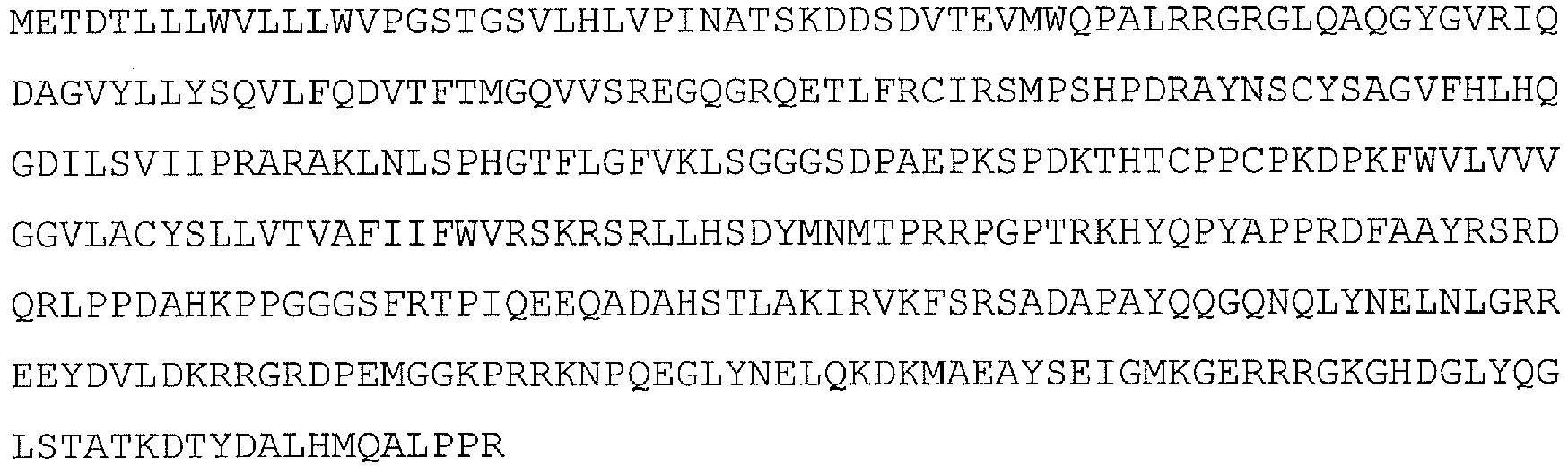
- SEQ ID No. 78 (dAPRIL-HCH2CH3pvaa-CD28OXZ)


- SEQ ID No. 79 (dAPRIL-CD8STK-CD28OXZ)

- SEQ ID No. 80 (dAPRIL-HNG-CD28OXZ)

- The molecule of the invention may comprise a variant of the sequence shown as SEQ ID No. 75, 76, 77, 78, 79 or 80 having at least 80, 85, 90, 95, 98 or 99% sequence identity, provided that the variant sequence is a molecule as defined in the first aspect of the invention, i.e. a CAR which comprises:
- (i) a BCMA-binding domain;
- (ii) a optional spacer domain
- (iii) a transmembrane domain; and
- (iv) an endodomain;
- The percentage identity between two polypeptide sequences may be readily determined by programs such as BLAST which is freely available at http://blast.ncbi.nlm.nih.gov.
- The present invention also provides a nucleic acid sequence encoding a variant APRIL, a CAR comprising a variant APRIL or a BiTE comprising a variant APRIL as defined above.
- The nucleic acid sequence may be RNA or DNA, it may be double or single-stranded.
- Nucleic acid sequences encoding APRIL-BiTEs are shown as SEQ ID No. 81-83. The nucleic acid sequence of the present invention may encode the amino acid sequence as encoded by SEQ ID No. 81, 82 or 83, but with one of the following single mutations in the portion of the sequence corresponding to APRIL (with reference to the position numbering shown in SEQ ID No. 1): M200C, M200L, M200G, M200S, M200A, M200N.
- SEQ ID No. 81 (APRILiTE#01)


- SEQ ID No. 82 (APRILiTE#03)

- SEQ ID No. 83 (APRILiTE#06)

- Nucleic acid sequences encoding APRIL-CARs are shown as SEQ ID No. 84-89. The nucleic acid sequence of the present invention may encode the amino acid sequence as encoded by SEQ ID No. 84, 85, 86, 87, 88 or 89, but with one of the following single mutations in the portion of the sequence corresponding to APRIL (with reference to the position numbering shown in SEQ ID No. 1): M200C, M200L, M200G, M200S, M200A, M200N.
- SEQ ID No. 84 (dAPRIL-HCH2CH3pvaa-CD28OXZ)
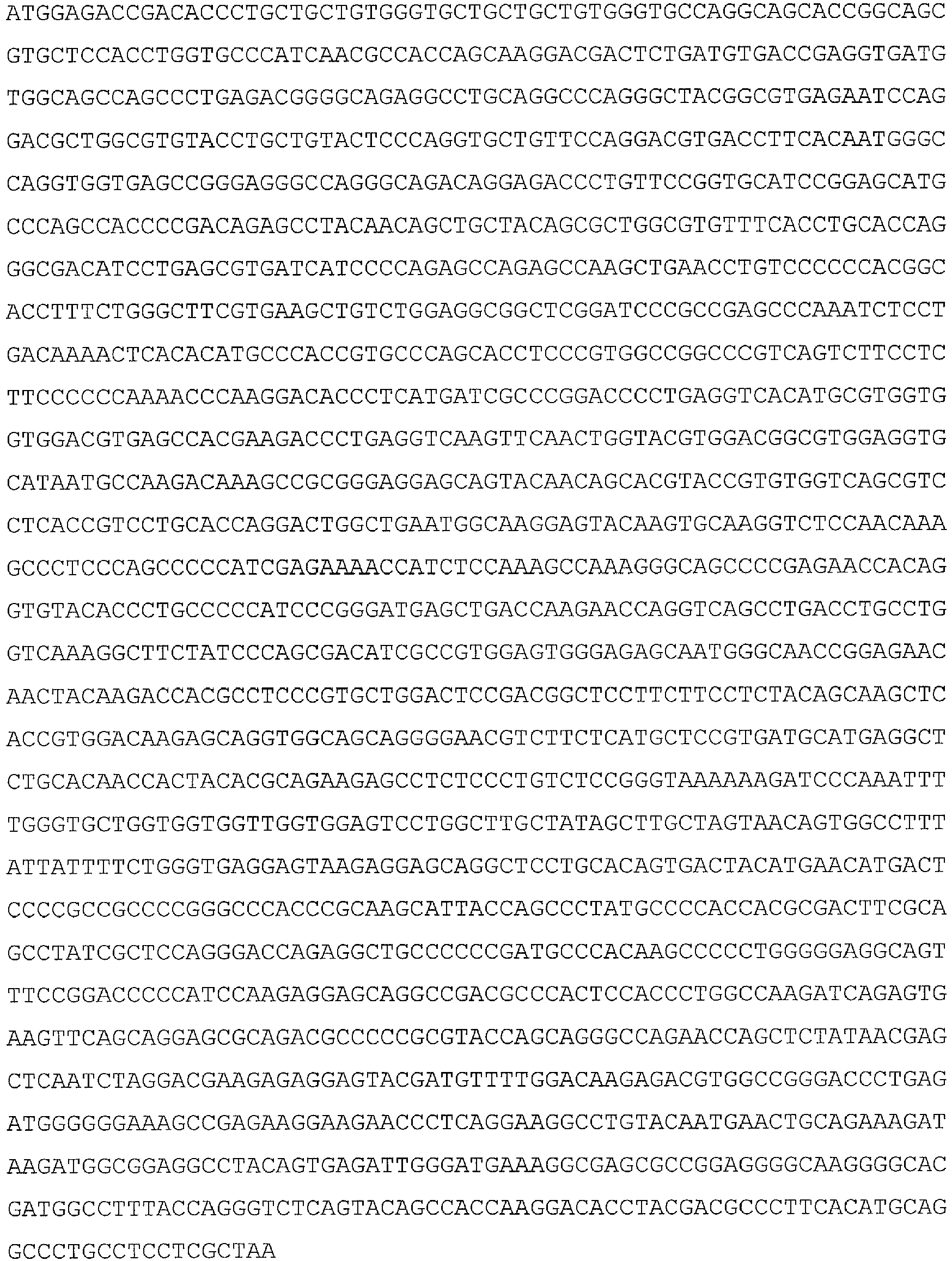
- SEQ ID No. 85 (dAPRIL-CD8STK-CD28OXZ)


- SEQ ID No. 86 (dAPRIL-HNG-CD28OXZ)

- SEQ ID No. 87 (dAPRIL-HCH2CH3pvaa-CD28OXZ)

- SEQ ID No. 88 (dAPRIL-CD8STK-CD28OXZ)


- SEQ ID No. 89 (dAPRIL-HNG-CD28OXZ)


- The nucleic acid sequence may encode the same amino acid sequence as that encoded by SEQ ID No. 81, 82, 83, 84, 85, 86, 87, 88 or 89 comprising the variation mentioned above, but may have a different nucleic acid sequence, due to the degeneracy of the genetic code. The nucleic acid sequence may have at least 80, 85, 90, 95, 98 or 99% identity to the sequence shown as SEQ ID No. 81 to 89, provided that it encodes a molecule as defined in the first aspect of the invention.
- The nucleic acid sequence described herein may encode the amino acid sequence as encoded by SEQ ID No. 81 to 89, but with one of following the single mutations (
SEQ IDs 22 to 27, 34 to 45): - A125T,
- V174T, V174G,
- T175H, T175S, T175G,
- P201V, P201A, P201G, P201R, P201Y, P201W,
- S202G, S202F, S202D, S202V, S202P, D205P.
- The nucleic acid may encode the amino acid sequence as encoded by SEQ ID No.81 to 89, but with one the following single mutations (
SEQ IDs 28 to 33): M200C, M200L, M200G, M200S, M200A, M200N. - The nucleic acid sequence may encode the amino acid sequence as encoded by SEQ ID No. 81 to 89, but with a combination of mutations at the following positions: V174 and T175; or V174 and M200; or V174 and S202; or T175 and M200, or T175 and S202; or D205 and R206; or V174, T175 and M200; or V174, T175 and S202; or T175, D205 and R206; or M200, D205 and R206; or V174, T175, M200 and S202; or T175, S202, D205 and R206;
- The nucleic acid sequence described herein may encode the amino acid sequence as encoded by SEQ ID No. 81 to 89, but with one of the following specific mutation combinations:
- V174T and T175A; or V174S and S202G; or
- V174T and S202V; or V174G and S202G, or V174G and S202E; or
- V174G and S202A; or V174G and S202G; or V174E and S202Y; or
- T175A and S202E; or T175G and S202G; or T175G and S202V; or
- T175A and S202P; or T175S and S202G; or
- S202V and H203N; or D205H and R206L; or D205P and R206K; or
- D205P and R206N; or D205S and R206P; or D205R and R206G; or
- D205P and R206I; or D205S and R206H; or
- V174T, T175A and S202E; or
- T175A, D205P and R206N; or T175A, D205S and R206H; or
- M200G, D205P and R206N; or
- V174T, T175A, M200G and S202E; or
- T175A, S202E, D205P and R206N; or
- T175A, S202E, D205S and R206H.
- The nucleic acid sequence may encode the amino acid sequence as encoded by SEQ ID No. 84 to 89, but with one of the following specific mutations combinations: V174T and M200G; or T175A and M200G; or V174T, T175A and M200G; or M200G, D205A and R206H.
- The present invention also provides a vector which comprises a nucleic acid sequence according to the present invention. Such a vector may be used to introduce the nucleic acid sequence into a host cell so that it expresses and produces a variant APRIL according to the first aspect of the invention.
- The vector may, for example, be a plasmid or synthetic mRNA or a viral vector, such as a retroviral vector or a lentiviral vector.
- The vector may be capable of transfecting or transducing an effector cell.
- The invention also provides a host cell which comprises a nucleic acid according to the invention.
- The invention also provides a cell which comprises a CAR according to the invention.
- The cell may be an immune cell such as a T-cell or natural killer (NK) cell. It may be a primary cell or a cell from a cell line.
- The invention also provides a cell composition comprising a plurality of CAR-expressing cells of the invention.
- The invention also provides a method for making a cell according to the present invention which comprises the step of transducing or transfecting a cell with a vector of the invention which comprises a nucleic acid sequence encoding a chimeric antigen receptor.
- The cell may be transfected or transduced ex vivo and then reimplanted into the same or a different subject.
- The present disclosure provides a therapeutic agent which comprises a variant APRIL, a nucleic acid, a vector a CAR-expressing cell or a BiTE as defined above.
- The therapeutic agent may comprise a variant APRIL as the targeting portion, to target the agent to BCMA-expressing cells, such as plasma cells. The therapeutic agent may also comprise a functional domain which exerts a therapeutic affect, for example by acting directly on the plasma cell or recruiting other cells of the immune system to act on the plasma cell.
- The variant APRIL may be conjugated to a drug, such as a cytotoxic drug.
- The Variant APRIL may be part of a chimeric antigen receptor, or Bispecific T-cell engager (BiTE)
- The present invention also relates to a pharmaceutical composition containing a therapeutic agent of the invention together with a pharmaceutically acceptable carrier, diluent or excipient, and optionally one or more further pharmaceutically active polypeptides and/or compounds. Such a formulation may, for example, be in a form suitable for intravenous infusion).
- The therapeutic agent and pharmaceutical composition may be used for the treatment of a cancerous disease, in particular a plasma cell disorder or a B cell disorder which correlates with enhanced BCMA expression.
- Plasma cell disorders include plasmacytoma, plasma cell leukemia, multiple myeloma, macroglobulinemia, amyloidosis, Waldenstrom's macroglobulinemia, solitary bone plasmacytoma, extramedullary plasmacytoma, osteosclerotic myeloma (POEMS Syndrome) and heavy chain diseases as well as the clinically unclear monoclonal gammopathy of undetermined significance/smoldering multiple myeloma.
- The disease may be multiple myeloma.
- Examples for B cell disorders which correlate with elevated BCMA expression levels are CLL (chronic lymphocytic leukemia) and non-Hodgkins lymphoma (NHL). The bispecific binding agents of the invention may also be used in the therapy of autoimmune diseases like Systemic Lupus Erythematosus (SLE), multiple sclerosis (MS) and rheumatoid arthritis (RA).
- The method of the present disclosure may be for treating a cancerous disease, in particular a plasma cell disorder or a B cell disorder which correlates with enhanced BCMA expression.
- A method for the treatment of disease relates to the therapeutic use of an agent of the invention. In this respect, the agent may be administered to a subject having an existing disease or condition in order to lessen, reduce or improve at least one symptom associated with the disease and/or to slow down, reduce or block the progression of the disease. The method of the disclosure may cause or promote T-cell mediated killing of BCMA-expressing cells, such as plasma cells.
- The present invention also provides a diagnostic agent for detecting plasma cells which comprises a variant APRIL of the invention.
- The diagnostic agent may also comprise a detectable label, such as a radioactive or fluorescent label or a dye.
- The diagnostic agent may be for diagnosing a plasma cell disorder.
- The diagnostic method is carried out in vitro. In an in vivo method, the diagnostic agent is administered to the subject.
- In the in vitro method, the variant APRIL is added to a sample from the subject in vitro. The sample may comprise plasma cells. The sample may be or be derived from a blood sample, such as a PBMC sample.
- The invention will now be further described by way of Examples, which are meant to serve to assist one of ordinary skill in the art in carrying out the invention and are not intended in any way to limit the scope of the invention.
- Primary myeloma cells were isolated by performing a CD138 immunomagnetic selection on fresh bone marrow samples from Multiple myeloma patients that were known to have frank disease. These cells were stained with the BCMA specific J6MO mAb (GSK) which was conjugated to PE. At the same time, a standard of beads with known numbers of binding sites was generated using the PE Quantibrite bead kit (Becton Dickenson) as per the manufacturer's instructions. The BCMA copy number on myeloma cells could be derived by correlating the mean-fluorescent intensity from the myeloma cells with the standard curve derived from the beads. It was found that the range of BCMA copy number on a myeloma cell surface is low: at 348.7-4268.4 BCMA copies per cell with a mean of 1181 and a median of 1084.9 (
Figure 2 ). This is considerably lower than e.g. CD19 and GD2, classic targets for CARs. Presence of BCMA expression on primary myeloma cells was also confirmed with the Vicky-1 antibody (Abcam Ab17323), examples of which are shown infigure 18 . - APRIL in its natural form is a secreted type II protein. The use of APRIL as a BCMA binding domain for a CAR requires conversion of this type II secreted protein to a type I membrane bound protein and for this protein to be stable and to retain binding to BCMA in this form. To generate candidate molecules, the extreme amino-terminus of APRIL was deleted to remove binding to proteoglycans. Next, a signal peptide was added to direct the nascent protein to the endoplasmic reticulum and hence the cell surface. Also, because the nature of spacer used can alter the function of a CAR, three different spacer domains were tested: an APRIL based CAR was generated comprising (i) a human IgG1 spacer altered to remove Fc binding motifs; (ii) a CD8 stalk; and (iii) the IgG1 hinge alone (cartoon in
Figure 4 and amino acid sequences inFigure 5 , and also amino acid sequences infigure 19 which differ from the sequences infigure 5 by having a different signal peptide and the V5 epitope tag). These CARs were expressed in a bicistronic retroviral vector (Figure 6A ) so that a marker protein - truncated CD34 could be co-expressed as a convenient marker gene. - The aim of this study was to test whether the APRIL based CARs which had been constructed were expressed on the cell surface and whether APRIL had folded to form the native protein. T-cells were transduced with these different CAR constructs and stained using a commercially available anti-APRIL mAb, along with staining for the marker gene and analysed by flow-cytometry. The results of this experiment are shown in
Figure 6B where APRIL binding is plotting against marker gene fluorescence. These data show that in this format, the APRIL based CARs are expressed on the cell surface and APRIL folds sufficiently to be recognized by an anti-APRIL mAb. - Next, it was determined whether APRIL in this format could recognize BCMA and TACI. Recombinant BCMA and TACI were generated as fusions with mouse IgG2a-Fc. These recombinant proteins were incubated with the transduced T-cells. After this, the cells were washed and stained with an anti-mouse fluorophore conjugated antibody and an antibody to detect the marker gene conjugated to a different fluorophore. The cells were analysed by flow cytometry and the results are presented in
Figure 6C . The different CARs were able to bind both BCMA and TACI. Surprisingly, the CARs were better able to bind BCMA than TACI. Also, surprisingly CARs with a CD8 stalk or IgG1 hinge spacer were better able to bind BCMA and TACI than CAR with an Fc spacer. - T-cells from normal donors were transduced with the different APRIL CARs and tested against SupT1 cells either wild-type, or engineered to express BCMA and TACI. Several different assays were used to determine function. A classical chromium release assay was performed. Here, the target cells (the SupT1 cells) were labelled with 51Cr and mixed with effectors (the transduced T-cells) at different ratio. Lysis of target cells was determined by counting 51Cr in the co-culture supernatant (
Figure 6A shows the cumulative data, example data from a single assay with different effector:target ratios is shown infigure 16 ). - In addition, supernatant from T-cells cultured 1:1 with SupT1 cells was assayed by ELISA for Interferon-gamma (
Figure 6B shows cumulative data, example data from a single assay is shown infigure 17 ). Measurement of T-cell expansion after one week of co-culture with SupT1 cells was also performed (Figure 6C ). T-cells were counted by flow-cytometry calibrated with counting beads. These experimental data show that APRIL based CARs can kill BCMA expressing targets. Further, these data show that CARs based on the CD8 stalk or IgG1 hinge performed better than the Fc-pvaa based CAR. - The above data are encouraging since they demonstrate that it in principle, it is possible to make an APRIL based CAR. However, since most primary myeloma cells express a low number of BCMA molecules on their surface, it was investiagated whether such an APRIL based CAR would cause killing of primary myeloma cells, particularly in cases with low-density expression. Three cases were selected which represented the range of BCMA expression described in
Figure 2 : the first had dim expression (lower than mean); the second case had intermediate expression (approximately mean expression) and the third had bright (above mean expression).Figure 8 shows a histogram of BCMA staining against isotype control for all three cases on the left to illustrate BCMA expression. Since when comparing APRIL based CARs with different spacers it had been determined that CARs with CD8 stalk spacer and IgG1 hinge spacer performed better than the Fc-pvaa spacered CAR, in this assay, only the CD8 stalk and hinge APRIL CARs were tested. On the left, survival of myeloma cells compared with starting numbers is shown atday 3 andday 6 after a 1:1 co-culture of myeloma cells and CAR T-cells. Byday 6, >95% of the myeloma cells were eliminated, including those with dim BCMA expression. Dim BCMA expressing myeloma cells can be targeted by the APRIL CARs albeit with a slower tempo of killing than higher expressers. - The present inventors have constructed a series of bi-specific engagers which connect a scFv from OKT3 to the extracellular domain of APRIL, as shown in
Figure 24A . Several design considerations were made during the construction of these molecules: (a) the proteoglycan binding amino terminus of APRIL was truncated to prevent non-specific binding; (b) inconstructs - The various different formats were as follows:
- (1) OKT3 scFv connected to truncated APRIL by the IgG1 hinge;
- (2) OKT3 scFv connected to truncated APRIL via a (SGGGGS)3 linker;
- (3) OKT3 scFv connected to truncated APRIL via the CD8 stalk;
- (4) truncated APRIL connected to OKT3 scFv via an IgG1 hinge;
- (5) truncated APRIL connected to the OKT3 scFv via a (SGGGGS)3 linker; and
- (6) truncated APRIL connected to the OKT3 scFv via a CD8 spacer.
- 293 T cells were transfected with expression plasmids coding for the APRILiTE constructs listed above. Supernatant from the 293T cells was run on an acrylamide gel and proteins transferred to a membrane. The membrane was then stained with an antibody which recognized APRIL. The results are shown in
Figure 25 .Proteins Proteins - It was then investigated whether these proteins could bind either the T-cell receptor (TCR) on one end, and BCMA on the other end. Supernatant from 293T cells transfected was used to stain Jurkat T-cells and a Jurkat T-cell clone which has TCRαβ knocked out. This demonstrates the APRILiTE binds the TCR (
Figure 26b ). SupT1 cells engineered to express BCMA and SupT1 cells engineered to express TACI were then stained with the above supernatant, using a secondary anti-APRIL biotin followed by streptavidin PE. The results are shown inFigure 26a . It was found thatAPRILiTES - Normal donor T-cells were cultivated 1:1 with different SupT1 s. The SupT1 s used were either non-transduced, engineered to express BCMA or engineered to express TACI. The results are shown in
Figure 27 . It was found that T-cells only released IFNγ in the presence of either APRILiTE when exposed with SupT1-cells engineered with BCMA or TACI. The response to BCMA was greater than that with TACI. - T-cells were cultured 1:1 with wild-type SupT1 cells, SupT1 cells expressing BCMA and SupT1 cells expressing TACI in the absence of or in the presence of
APRILiTEs Figure 28 . The remaining T-cells are shown as a proportion of SupT1 cells present in the condition with no APRILiTE added. - Four different myeloma samples were stained with the rat anti-human BCMA mAb Vicky1. The results are shown in
Figure 29 . In clinically and morphologically typical myelomas (panels 2 to 4) intermediate or dim staining is seen. - Left over material from a diagnostic bone-marrow aspirate from two patients with known multiple BCMA+ myeloma was used. A CD138 magnetic bead selection was performed to purify myeloma cells from the aspirate. These cells were rested in complete culture medium for 48 hours and staining for BCMA was performed to check that they were in fact BCMA positive. It was found that the myeloma cells express BCMA but at low levels (
Figure 31 ). - Next, normal donor peripheral mononuclear cells which had been stimulated using OKT3 and CD28.2 were CD56 depleted to remove NK cells. A 1:1 co-culture of CD56 depleted PBMCs and CD138 selected primary Myeloma cells were performed in the absence or presence of either
APRILITE# 03 and #06. Insufficient material was present to testAPRILiTE# 01. The co-cultures were observed by microscopy. Interferon gamma release into supernatant was measured by ELISA. Survival of myeloma cells was measured by Annexin V/PI staining and bead-count controlled flow-cytometry. - Clear clumping (a sign of T-cell activation) was seen upon co-culture (see
Figure 32 ). Interferon-gamma release was observed in conditions where PBMCs were cultured with Myeloma cells in the presence of the APRILiTES, albeit at less absolute amounts than when co-cultured with SupT1. BCMA cells (Figure 33 ). Killing of Myeloma cells was also observed when PBMCs were present with APRILiTE after 6 days of co-culture (Figure 34 ). - These findings demonstrate that APRILiTEs cause T cell activation in the presence of primary myeloma cells at a level sufficient to cause T-cell mediated killing of the myeloma cells.
- A huSCID model is used: NSG (nod-scid gamma, NOD-scid IL2Rgammanull) mice are xenografted with a myeloma cell line which expresses typical levels of BCMA. These lines are engineered to express firefly Luciferase to measure disease by bioluminescence imaging. Normal donor PBMCs are administered via the tail vein during concomitant intraperitoneal administration of APRILiTEs. The following are sequentially measured (1) serum levels of APRILiTEs; (2) serum levels of human Interferon-gamma; (3) peripheral blood T-cell expansion, engraftment and activation by flow cytometry; (4) Bioluminescence measurement of tumour. At take-down, the following are measured: (1) tumour burden by marrow histology; (2) T-cell proliferation and engraftment by flow cytometry of marrow, spleen, blood and lymph nodes; and (3) the remaining tissues are examined grossly and immunohistochemically for any toxicity.
- The aim was to generate APRIL mutants whose binding may be more suitable for CAR. Using crystallographic data described by Hymowitz et al, 2004, The Journal of biological chemistry: Volume 280; and from RCSB deposits 1XU1 and 1XU2, several residues were selected which may alter binding to BCMA or may increase specificity to BCMA over TACI.
- A strategy to identify mutations at these residues with useful properties is outlined in
Figure 31B . Using splicing by overlap PCR with oligonucleotides degenerate over codons for mutation, libraries of mutant APRILs were generated randomized over key mutants. These libraries were ligated into a scaffold shown inFigure 31A which presents APRIL on a CD8 stalk and co-expresses CD34 with a foot-and-mouth 2A peptide. Typical expression from this construct is shown inFigure 9 . These ligation products were transformed into competent bacteria, single colonies picked, individually expanded and the DNA was extracted and transfected into 293T cells. - The 293T cells were subsequently incubated separately with either recombinant human BCMA-Fc or TACI-Fc. Cells were then washed and secondarily stained with Jackson polyclonal
anti-Fc Alexa fluor 488 and the marker gene stained with anti-CD34 APC. The APRIL mutants were screened in this manner in batches with wild-type APRIL and a CD34 only as controls in each batch. CD34 +ve events were split into 4 gates numbered as shown inFigure 31 . TheAlexa fluor 488 median fluorescence index(MFI) was calculated for each gate and average gradient between MFI of various gates was calculated using the formula: [(MFI.1-MFI.2)+ (MFI.2-MFI.3)+ (MFI.3-MFI.4)]/3 (illustrated inFigure 31C ). - In this way, an average MFI gradient was calculated for binding to BCMA and TACI for each APRIL mutant. For each mutant, the average MFI gradient of BCMA and TACI binding was converted to a ratio of binding to APRIL WT control in each batch. Plasmids giving rise to potentially useful mutants were sequenced by capillary sequencing.
- The results of this initial screening are summarized in Table 1 and illustrated in
Figure 10 . - Classes of mutants were then combined together by a similar strategy to that outlined for single mutants, but mutant APRIL coding plasmid was used as template to introduce further mutations. The results of this work are summarized in Table 2 and illustrated in
Figure 11 . It was possible to generate mutants with much higher affinity to BCMA than wild-type: for instance mutant D205R, R206G; we were able to generate mutants with BCMA binding equal to wild-type APRIL but no binding to TACI - for instance mutant T175A, S202P. We were also able to generate mutants with lower binding to BCMA than wild-type (which may paradoxically improve recognition of low-density antigen), but no binding of TACI - for instance mutant V174T, T175A, M200G, S202E. - Larger scale, higher quality plasmid DNA from the most promising mutants was generated and repeat transfection and expression data was performed. These data are shown in
Figure 12 . - In order to investigate whether truncated APRIL in a CAR format (i.e. fused to a transmembrane domain and anchored to a cell membrane) could bind BCMA and TACI, a basic CAR was engineered in frame with the self-cleaving foot and
mouth disease 2A peptide with truncated CD34, as a convenient marker gene. A stable SUPT1 cell line was established which expresses this construct. Secreted truncated BCMA and TACI fused to human (and other species, not shown) Ig Fc domain was also generated and recombinant protein produced. It was shown that both BCMA-Fc and TACI-Fc bind the engineered SUPT1 cell line. Only cells expressing the CD34 marker gene were found to bind BCMA-Fc and TACI-Fc (Figure 9 ). - The CAR spacer domain can alter sensitivity and specificity. Three versions of an APRIL-based CAR were generated with three spacer domains: (i) a human IgG1 spacer altered to remove Fc binding motifs; (ii) a CD8 stalk; and (iii) the IgG1 hinge alone (
Figure 14B ). Primary human T-cells were transduced with these different CARs and stained using a commercially available anti-APRIL mAb (Figure 15 ). - T-cells from normal donors were transduced with the different APRIL CARs and tested against SupT1 cells either wild-type, or engineered to express BCMA and TACI. Several different assays were used to determine function. A classical chromium release assay was performed. Here, the target cells (the SupT1 cells) were labelled with 51Cr and mixed with effectors (the transduced T-cells) at different ratio. Lysis of target cells was determined by counting 51Cr in the co-culture supernatant (
Figure 16 ). - In addition, supernatant from T-cells cultured 1:1 with SupT1 cells was assayed by ELISA for Interferon-gamma (
Figure 17 ). - Measurement of T-cell expansion after one week of co-culture with SupT1 cells was also performed. T-cells were counted by flow-cytometry calibrated with counting beads. Initial data (not shown) appears to indicate that the CD8 stalk based construct results in more T-cell proliferation than the other constructs.
- APRIL mutants were generated using degenerate primers targeting specific codons. The codons were identified through in silico analysis of APRIL-BCMA and APRIL-TACI binding. From this analysis, residues that seemed involved in TACI binding but not BCMA binding were targeted.
- Plasmids were produced encoding (i) cell surface expressed CD34 and (ii) the APRIL mutants. The plasmids were then transformed into bacteria, plated, single colonies picked, individually expanded and the DNA was extracted and transfected into 293T cells.
- T cells expressing a single APRIL mutant and CD34 were each aliquoted into two and incubated separately with 0.1µg RND human BCMA-hFc or TACI-hFc chimera. Cells were then washed and secondarily stained with Jackson polyclonal
ahFc Alexa fluor 488 and BD aCD34 APC. - The APRIL mutants were screened in this manner in batches with wild-type APRIL as a control in each batch. CD34 +ve events were split into 4 gates numbered as shown in
Figure 9 . TheAlexa fluor 488 median fluorescence index(MFI) was calculated for each gate and average gradient between MFI of various gates was calculated using the formula: [(MFI.1-MFI.2)+ (MFI.2-MFI.3)+ (MFI.3-MFI.4)]/3. - In this way, an average MFI gradient was calculated for binding to BCMA and TACI for each APRIL mutant. For each mutant, the average MFI gradient of BCMA and TACI binding was converted to a ratio of binding to APRIL WT control in the relevant screened batch. The mutants which showed a higher BCMA:TACI binding ratio than wild type were then sequenced.
- The results are shown in
Figures 20 and the sequences of key mutants are shown inFigure 21 . - The effect of glycine substitution was then examined at the targeted residues. The results, which are shown in
Figure 22 , show that residues S202, P201, M200, T175, V174, A125, H203, D205 and R206 on APRILwt are comparatively more important for binding to TACI than BCMA. - In order to demonstrate APRIL CAR T-cell function in vivo, APRIL CAR T-cells were tested in a human / mouse chimeric model.
- MM1.s (ATCC CRL-2974) is a human myeloma cell line which expresses intermediate levels of BCMA. The inventors engineered this cell line to express firefly Luciferase to derive the cell-line MM1.s.FLuc.
- NOD scid gamma (NSG: NOD.Cg-Prkdcscid II2rgtm1Wjl/SzJ) mice are profoundly immunosuppressed mice capable of engrafting several human cell lines and human peripheral blood lymphocytes. Three month old female NSG mice received 1x10⁷ MM1.s.FLuc cells vial tail-vein injection without any preparative therapy. Engraftment was determined by serial bioluminescence imaging (
Figure 23 ). Robust and increasing intramedullary engraftment was observed in all mice. Atday 13, 5x10⁶ APRIL-HNG-CD280XZ CAR T-cells were administered via tail vein injection. Serial bioluminescence was performed which showed rapid decrease in burden of MM1.s (Figure 23 ) in all treated mice to a complete remission. This response to CAR therapy was confirmed by flow-cytometry and immunohistochemistry. - Four normal donor PBMCs were incubated with SupT1 cells, SupT1 cells engineered to express BCMA, SupT1 cells engineered to express TACI or alone in the presence of different BiTES based on either WT APRIL or various mutants. Interferon-gamma levels were measured 24 hours later. The results are shown in
Figure 35 . The mutant M200G shows significantly improved BCMA vs TACI specificity than wild-type. - Various modifications and variations of the described methods and system of the invention will be apparent to those skilled in the art without departing from the scope and spirit of the invention. Although the invention has been described in connection with specific preferred embodiments, it should be understood that the invention as claimed should not be unduly limited to such specific embodiments. Indeed, various modifications of the described modes for carrying out the invention which are obvious to those skilled in molecular biology, cellular immunology or related fields are intended to be within the scope of the following claims.
-
- <110> UCL Business PLC
- <120> LIGAND
- <130> P103292PCT1
- <150>
GB 1403481.3
<151> 2014-02-27 - <150>
GB 1403479.7
<151> 2014-02-27 - <150>
GB 1409759.6
<151> 2014-06-02 - <150>
GB 1409761.2
<151> 2014-06-02 - <160> 101
- <170> PatentIn version 3.5
- <210> 1
<211> 250
<212> PRT
<213> Homo sapiens - <400> 1


- <210> 2
<211> 134
<212> PRT
<213> Homo sapiens - <400> 2


- <210> 3
<211> 134
<212> PRT
<213> Artificial Sequence - <220>
<223> Variant APRIL (a proliferation-inducing ligand) sequence - <400> 3

- <210> 4
<211> 134
<212> PRT
<213> Artificial Sequence - <220>
<223> Variant APRIL sequence - <400> 4

- <210> 5
<211> 134
<212> PRT
<213> Artificial Sequence - <220>
<223> Variant APRIL sequence - <400> 5


- <210> 6
<211> 134
<212> PRT
<213> Artificial Sequence - <220>
<223> Variant APRIL sequence - <400> 6


- <210> 7
<211> 134
<212> PRT
<213> Artificial Sequence - <220>
<223> Variant APRIL sequence - <400> 7
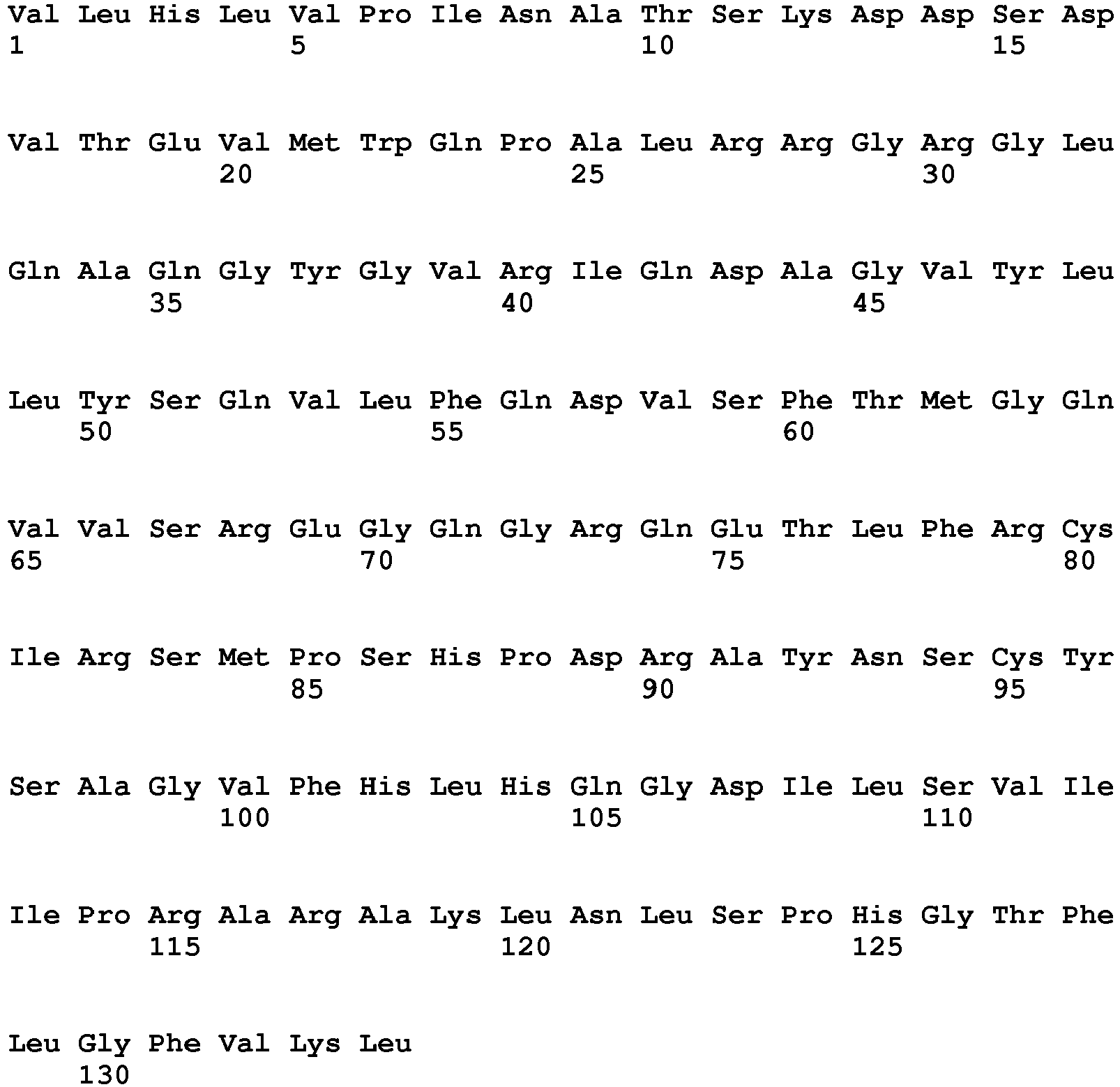
- <210> 8
<211> 134
<212> PRT
<213> Artificial Sequence - <220>
<223> Variant APRIL sequence - <400> 8

- <210> 9
<211> 134
<212> PRT
<213> Artificial Sequence - <220>
<223> Variant APRIL sequence - <400> 9


- <210> 10
<211> 134
<212> PRT
<213> Artificial Sequence - <220>
<223> Variant APRIL sequence - <400> 10

- <210> 11
<211> 134
<212> PRT
<213> Artificial Sequence - <220>
<223> Variant APRIL sequence - <400> 11

- <210> 12
<211> 134
<212> PRT
<213> Artificial Sequence - <220>
<223> Variant APRIL sequence - <400> 12


- <210> 13
<211> 134
<212> PRT
<213> Artificial Sequence - <220>
<223> Variant APRIL sequence - <400> 13


- <210> 14
<211> 134
<212> PRT
<213> Artificial Sequence - <220>
<223> Variant APRIL sequence - <400> 14

- <210> 15
<211> 134
<212> PRT
<213> Artificial Sequence - <220>
<223> Variant APRIL sequence - <400> 15

- <210> 16
<211> 134
<212> PRT
<213> Artificial Sequence - <220>
<223> Variant APRIL sequence - <400> 16


- <210> 17
<211> 134
<212> PRT
<213> Artificial Sequence - <220>
<223> Variant APRIL sequence - <400> 17


- <210> 18
<211> 134
<212> PRT
<213> Artificial Sequence - <220>
<223> Variant APRIL sequence - <400> 18

- <210> 19
<211> 134
<212> PRT
<213> Artificial Sequence - <220>
<223> Variant APRIL sequence - <400> 19

- <210> 20
<211> 134
<212> PRT
<213> Artificial Sequence - <220>
<223> Variant APRIL sequence - <400> 20


- <210> 21
<211> 134
<212> PRT
<213> Artificial Sequence - <220>
<223> Variant APRIL sequence - <400> 21


- <210> 22
<211> 134
<212> PRT
<213> Artificial Sequence - <220>
<223> Variant APRIL sequence - <400> 22

- <210> 23
<211> 134
<212> PRT
<213> Artificial Sequence - <220>
<223> Variant APRIL sequence - <400> 23


- <210> 24
<211> 134
<212> PRT
<213> Artificial Sequence - <220>
<223> Variant APRIL sequence - <400> 24


- <210> 25
<211> 134
<212> PRT
<213> Artificial Sequence - <220>
<223> Variant APRIL sequence - <400> 25

- <210> 26
<211> 134
<212> PRT
<213> Artificial Sequence - <220>
<223> Variant APRIL sequence - <400> 26

- <210> 27
<211> 134
<212> PRT
<213> Artificial Sequence - <220>
<223> Variant APRIL sequence - <400> 27


- <210> 28
<211> 134
<212> PRT
<213> Artificial Sequence - <220>
<223> Variant APRIL sequence - <400> 28


- <210> 29
<211> 134
<212> PRT
<213> Artificial Sequence - <220>
<223> Variant APRIL sequence - <400> 29

- <210> 30
<211> 134
<212> PRT
<213> Artificial Sequence - <220>
<223> Variant APRIL sequence - <400> 30

- <210> 31
<211> 134
<212> PRT
<213> Artificial Sequence - <220>
<223> Variant APRIL sequence - <400> 31


- <210> 32
<211> 134
<212> PRT
<213> Artificial Sequence - <220>
<223> Variant APRIL sequence - <400> 32


- <210> 33
<211> 134
<212> PRT
<213> Artificial Sequence - <220>
<223> Variant APRIL sequence - <400> 33

- <210> 34
<211> 134
<212> PRT
<213> Artificial Sequence - <220>
<223> Variant APRIL sequence - <400> 34


- <210> 35
<211> 134
<212> PRT
<213> Artificial Sequence - <220>
<223> Variant APRIL sequence - <400> 35


- <210> 36
<211> 134
<212> PRT
<213> Artificial Sequence - <220>
<223> Variant APRIL sequence - <400> 36

- <210> 37
<211> 134
<212> PRT
<213> Artificial Sequence - <220>
<223> Variant APRIL sequence - <400> 37

- <210> 38
<211> 134
<212> PRT
<213> Artificial Sequence - <220>
<223> Variant APRIL sequence - <400> 38


- <210> 39
<211> 134
<212> PRT
<213> Artificial Sequence - <220>
<223> Variant APRIL sequence - <400> 39


- <210> 40
<211> 134
<212> PRT
<213> Artificial Sequence - <220>
<223> Variant APRIL sequence - <400> 40

- <210> 41
<211> 134
<212> PRT
<213> Artificial Sequence - <220>
<223> Variant APRIL sequence - <400> 41

- <210> 42
<211> 134
<212> PRT
<213> Artificial Sequence - <220>
<223> Variant APRIL sequence - <400> 42


- <210> 43
<211> 134
<212> PRT
<213> Artificial Sequence - <220>
<223> Variant APRIL sequence - <400> 43


- <210> 44
<211> 134
<212> PRT
<213> Artificial Sequence - <220>
<223> Variant APRIL sequence - <400> 44

- <210> 45
<211> 134
<212> PRT
<213> Artificial Sequence - <220>
<223> Variant APRIL sequence - <400> 45

- <210> 46
<211> 134
<212> PRT
<213> Artificial Sequence - <220>
<223> Variant APRIL sequence - <400> 46


- <210> 47
<211> 134
<212> PRT
<213> Artificial Sequence - <220>
<223> Variant APRIL sequence - <400> 47


- <210> 48
<211> 134
<212> PRT
<213> Artificial Sequence - <220>
<223> Variant APRIL sequence - <400> 48

- <210> 49
<211> 134
<212> PRT
<213> Artificial Sequence - <220>
<223> Variant APRIL sequence - <400> 49


- <210> 50
<211> 134
<212> PRT
<213> Artificial Sequence - <220>
<223> Variant APRIL sequence - <400> 50


- <210> 51
<211> 134
<212> PRT
<213> Artificial Sequence - <220>
<223> Variant APRIL sequence - <400> 51

- <210> 52
<211> 134
<212> PRT
<213> Artificial Sequence - <220>
<223> Variant APRIL sequence - <400> 52

- <210> 53
<211> 134
<212> PRT
<213> Artificial Sequence - <220>
<223> Variant APRIL sequence - <400> 53


- <210> 54
<211> 134
<212> PRT
<213> Artificial Sequence - <220>
<223> Variant APRIL sequence - <400> 54


- <210> 55
<211> 134
<212> PRT
<213> Artificial Sequence - <220>
<223> Variant APRIL sequence - <400> 55

- <210> 56
<211> 134
<212> PRT
<213> Artificial Sequence - <220>
<223> Variant APRIL sequence - <400> 56

- <210> 57
<211> 134
<212> PRT
<213> Artificial Sequence - <220>
<223> Variant APRIL sequence - <400> 57

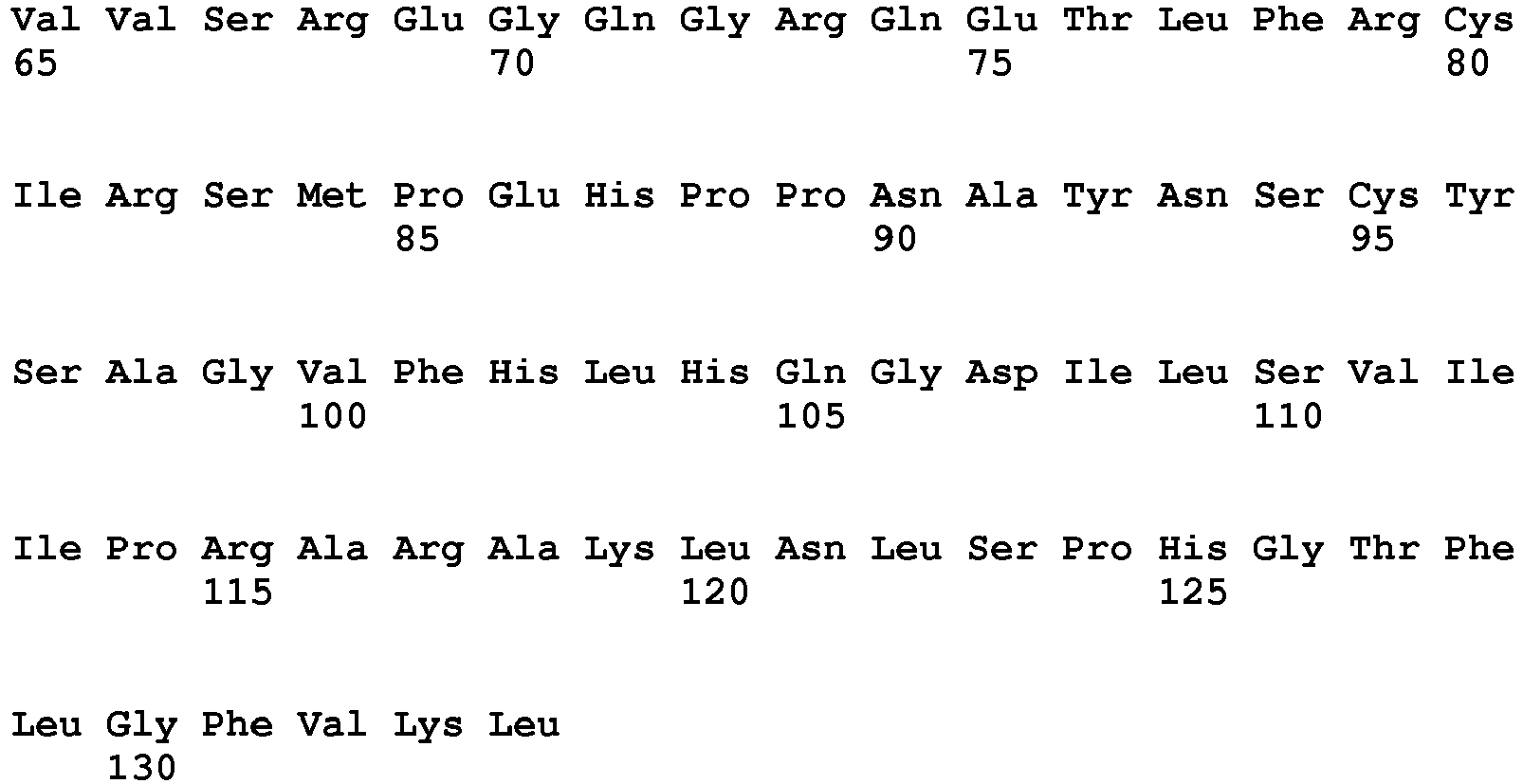
- <210> 58
<211> 134
<212> PRT
<213> Artificial Sequence - <220>
<223> Variant APRIL sequence - <400> 58


- <210> 59
<211> 13
<212> PRT
<213> Artificial Sequence - <220>
<223> Heavy chain CDR1 - <400> 59

- <210> 60
<211> 16
<212> PRT
<213> Artificial Sequence - <220>
<223> Heavy chain CDR2 - <400> 60

- <210> 61
<211> 10
<212> PRT
<213> Artificial Sequence - <220>
<223> Heavy chain CDR3 - <400> 61

- <210> 62
<211> 10
<212> PRT
<213> Artificial Sequence - <220>
<223> Light chain CDR1 - <400> 62

- <210> 63
<211> 11
<212> PRT
<213> Artificial Sequence - <220>
<223> Light chain CDR2 - <400> 63

- <210> 64
<211> 9
<212> PRT
<213> Artificial Sequence - <220>
<223> Light chain CDR3 - <400> 64

- <210> 65
<211> 242
<212> PRT
<213> Artificial Sequence - <220>
<223> scFv sequence - <400> 65


- <210> 66
<211> 425
<212> PRT
<213> Artificial Sequence - <220>
<223> Sequence of bi-specific molecule - <400> 66


- <210> 67
<211> 450
<212> PRT
<213> Artificial Sequence - <220>
<223> Sequence of bi-specific molecule - <400> 67


- <210> 68
<211> 456
<212> PRT
<213> Artificial Sequence - <220>
<223> Sequence of bi-specific molecule - <400> 68


- <210> 69
<211> 20
<212> PRT
<213> Artificial Sequence - <220>
<223> Signal peptide - <400> 69

- <210> 70
<211> 21
<212> PRT
<213> Artificial Sequence - <220>
<223> Signal peptide - <400> 70

- <210> 71
<211> 26
<212> PRT
<213> Artificial Sequence - <220>
<223> Spacer sequence (IgG1 hinge) - <400> 71

- <210> 72
<211> 45
<212> PRT
<213> Artificial Sequence - <220>
<223> Spacer sequence (CD8 stalk) - <400> 72

- <210> 73
<211> 7
<212> PRT
<213> Artificial Sequence - <220>
<223> Linker - <400> 73

- <210> 74
<211> 6
<212> PRT
<213> Artificial Sequence - <220>
<223> Linker - <400> 74

- <210> 75
<211> 614
<212> PRT
<213> Artificial Sequence - <220>
<223> Chimeric antigen receptor (CAR) dAPRIL-HCH2CH3pvaa-CD28OXZ - <400> 75
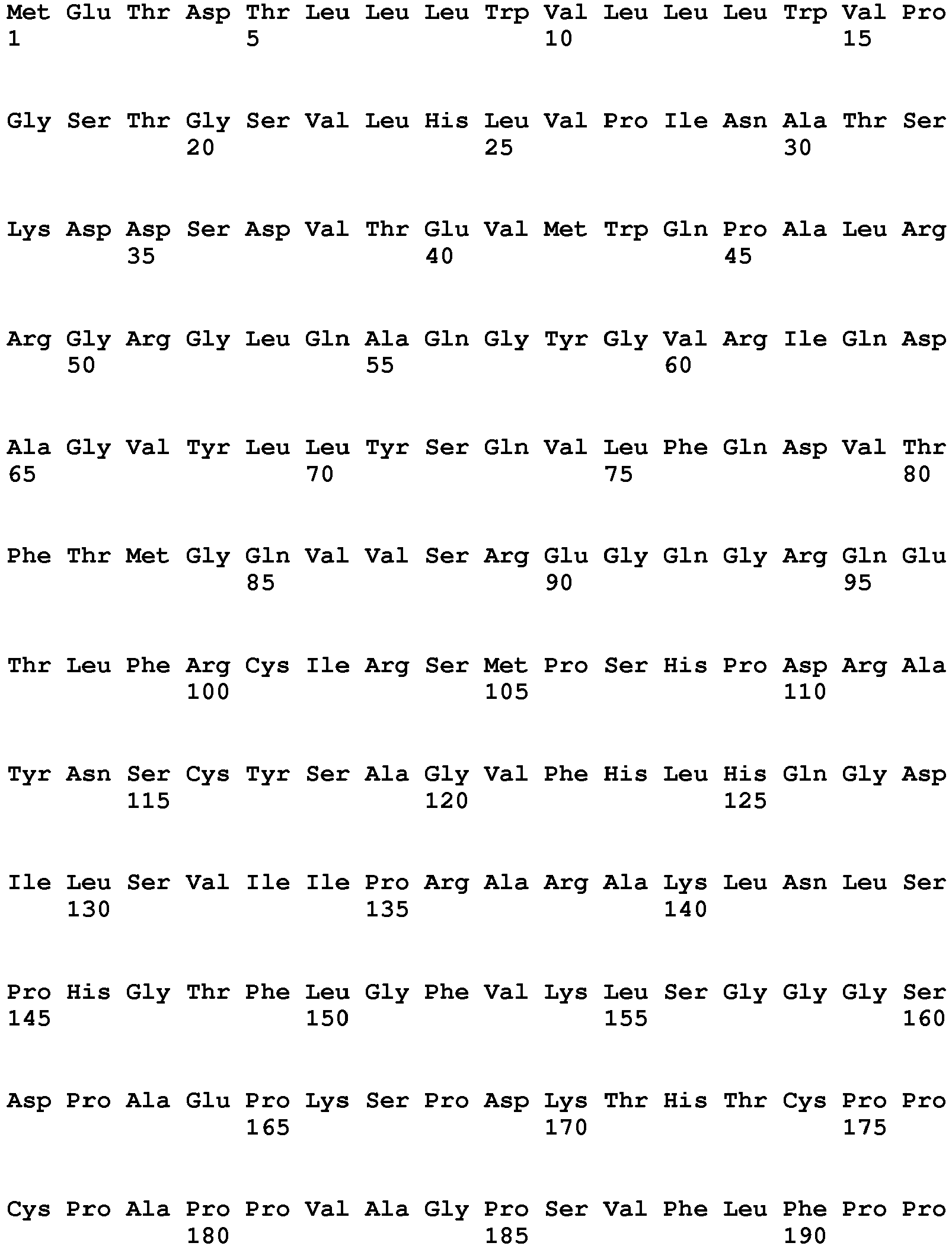


- <210> 76
<211> 424
<212> PRT
<213> Artificial Sequence - <220>
<223> Chimeric antigen receptor (CAR) dAPRIL-CD8STK-CD28OXZ - <400> 76

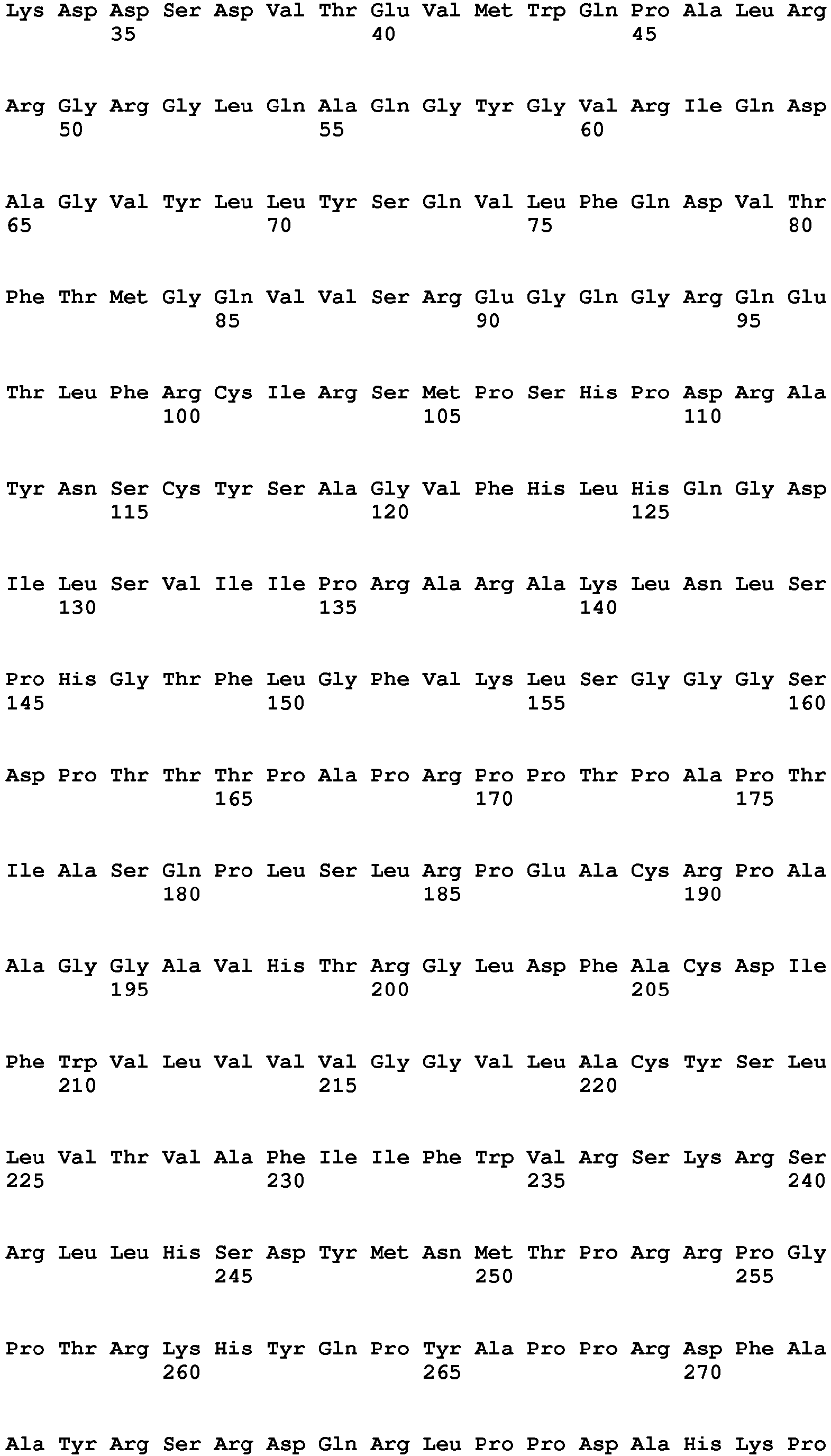

- <210> 77
<211> 398
<212> PRT
<213> Artificial Sequence - <220>
<223> Chimeric antigen receptor (CAR) dAPRIL-HNG-CD28OXZ - <400> 77


- <210> 78
<211> 633
<212> PRT
<213> Artificial Sequence - <220>
<223> Chimeric antigen receptor (CAR) dAPRIL-HCH2CH3pvaa-CD28OXZ - <400> 78


- <210> 79
<211> 443
<212> PRT
<213> Artificial Sequence - <220>
<223> Chimeric antigen receptor (CAR) dAPRIL-CD8STK-CD28OXZ - <400> 79


- <210> 80
<211> 417
<212> PRT
<213> Artificial Sequence - <220>
<223> Chimeric antigen receptor (CAR) dAPRIL-HNG-CD28OXZ - <400> 80
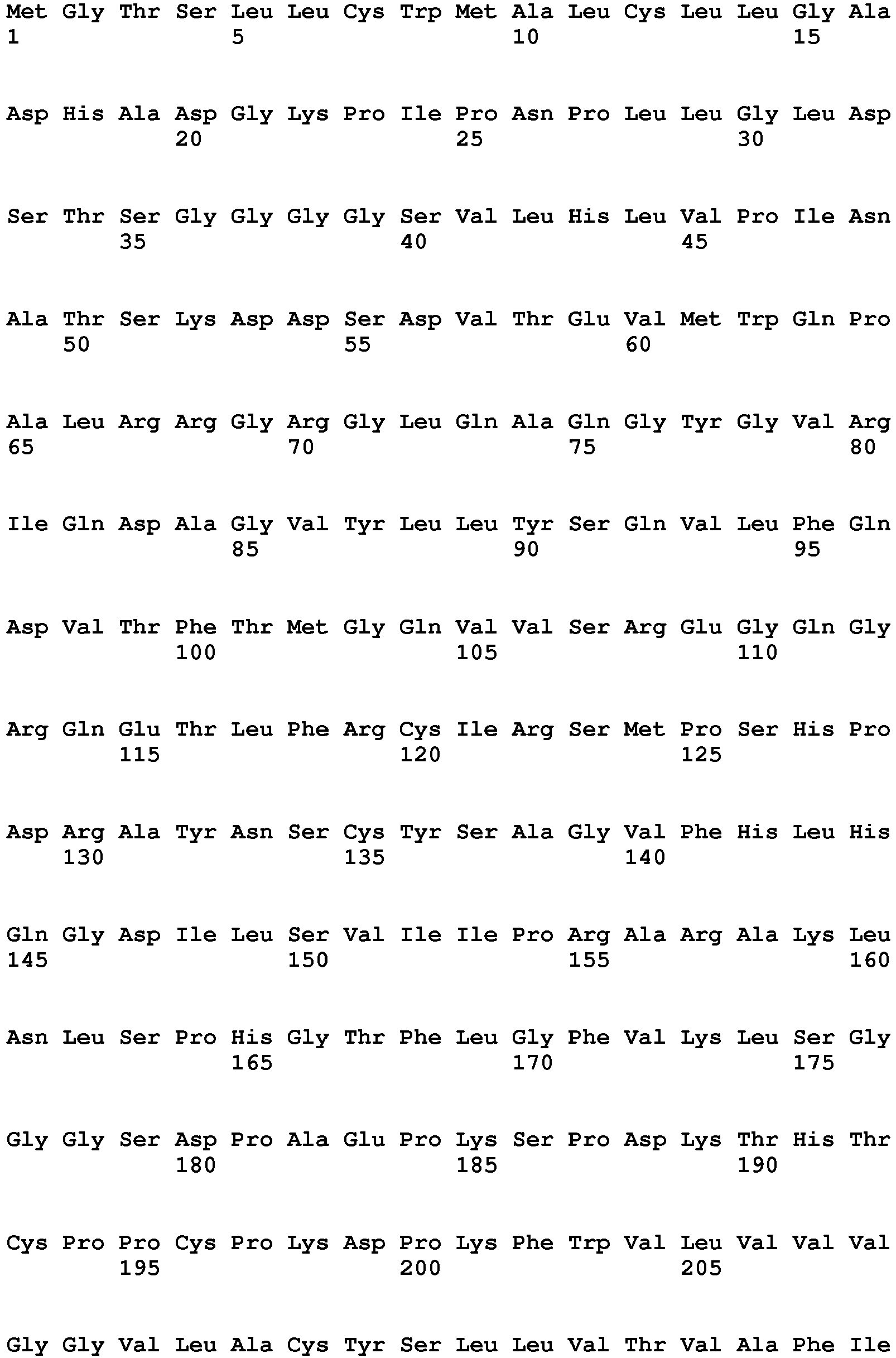

- <210> 81
<211> 1278
<212> DNA
<213> Artificial Sequence - <220>
<223> Nucleic acid sequence encoding APRIL-BiTE (APRILiTE#01) - <400> 81

- <210> 82
<211> 1353
<212> DNA
<213> Artificial Sequence - <220>
<223> Nucleic acid sequence encoding APRIL-BiTE (APRILiTE#03) - <400> 82


- <210> 83
<211> 1371
<212> DNA
<213> Artificial Sequence - <220>
<223> Nucleic acid sequence encoding APRIL-BiTE (APRILiTE#06) - <400> 83
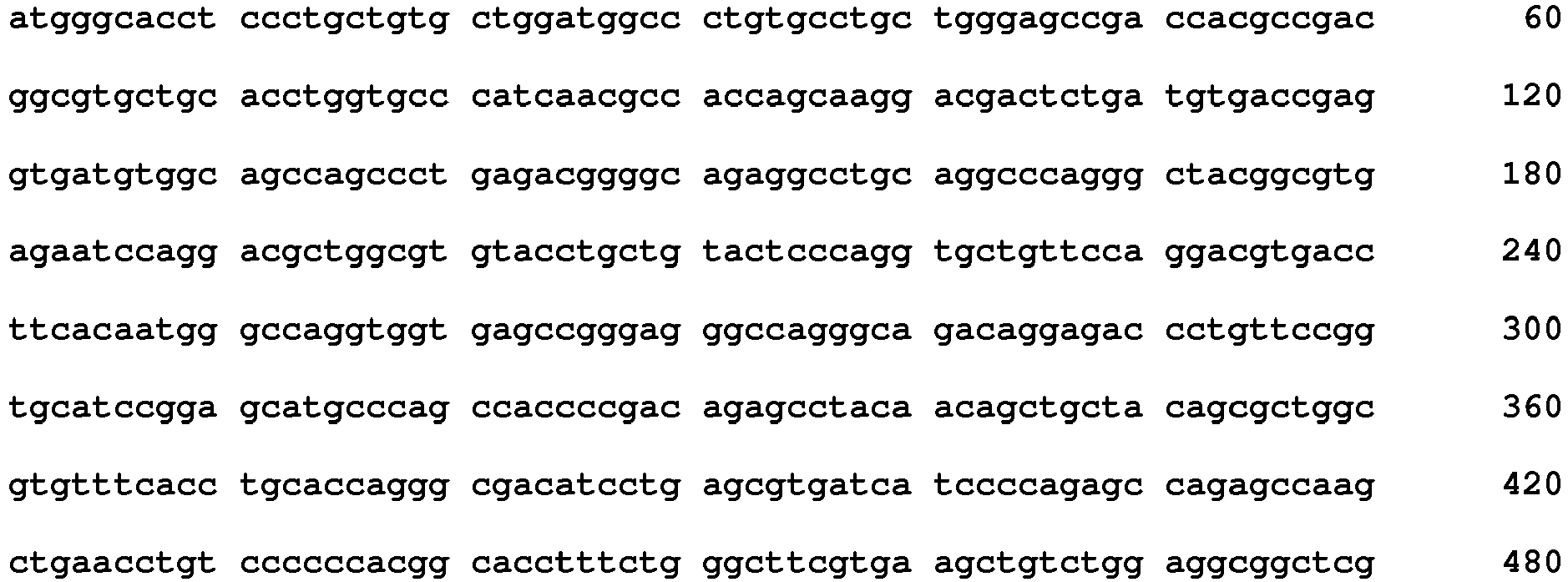

- <210> 84
<211> 1845
<212> DNA
<213> Artificial Sequence - <220>
<223> Nucleic acid sequence encoding APRIL-CAR dAPRIL-HCH2CH3pvaa-CD28OXZ - <400> 84


- <210> 85
<211> 1275
<212> DNA
<213> Artificial Sequence - <220>
<223> Nucleic acid sequence encoding APRIL-CAR dAPRIL-CD8STK-CD28OXZ - <400> 85


- <210> 86
<211> 1197
<212> DNA
<213> Artificial Sequence - <220>
<223> Nucleic acid sequence encoding APRIL-CAR dAPRIL-HNG-CD28OXZ - <400> 86


- <210> 87
<211> 1902
<212> DNA
<213> Artificial Sequence - <220>
<223> Nucleic acid sequence encoding APRIL-CAR dAPRIL-HCH2CH3pvaa-CD28OXZ - <400> 87


- <210> 88
<211> 1332
<212> DNA
<213> Artificial Sequence - <220>
<223> Nucleic acid sequence encoding APRIL-CAR dAPRIL-CD8STK-CD28OXZ - <400> 88


- <210> 89
<211> 1254
<212> DNA
<213> Artificial Sequence - <220>
<223> Nucleic acid sequence encoding APRIL-CAR dAPRIL-HNG-CD28OXZ - <400> 89


- <210> 90
<211> 424
<212> PRT
<213> Artificial Sequence - <220>
<223> CD8 stalk APRIL CAR - <400> 90


- <210> 91
<211> 398
<212> PRT
<213> Artificial Sequence - <220>
<223> APRIL IgG1 hinge based CAR - <400> 91


- <210> 92
<211> 614
<212> PRT
<213> Artificial Sequence - <220>
<223> APRIL Fc-pvaa based CAR - <400> 92
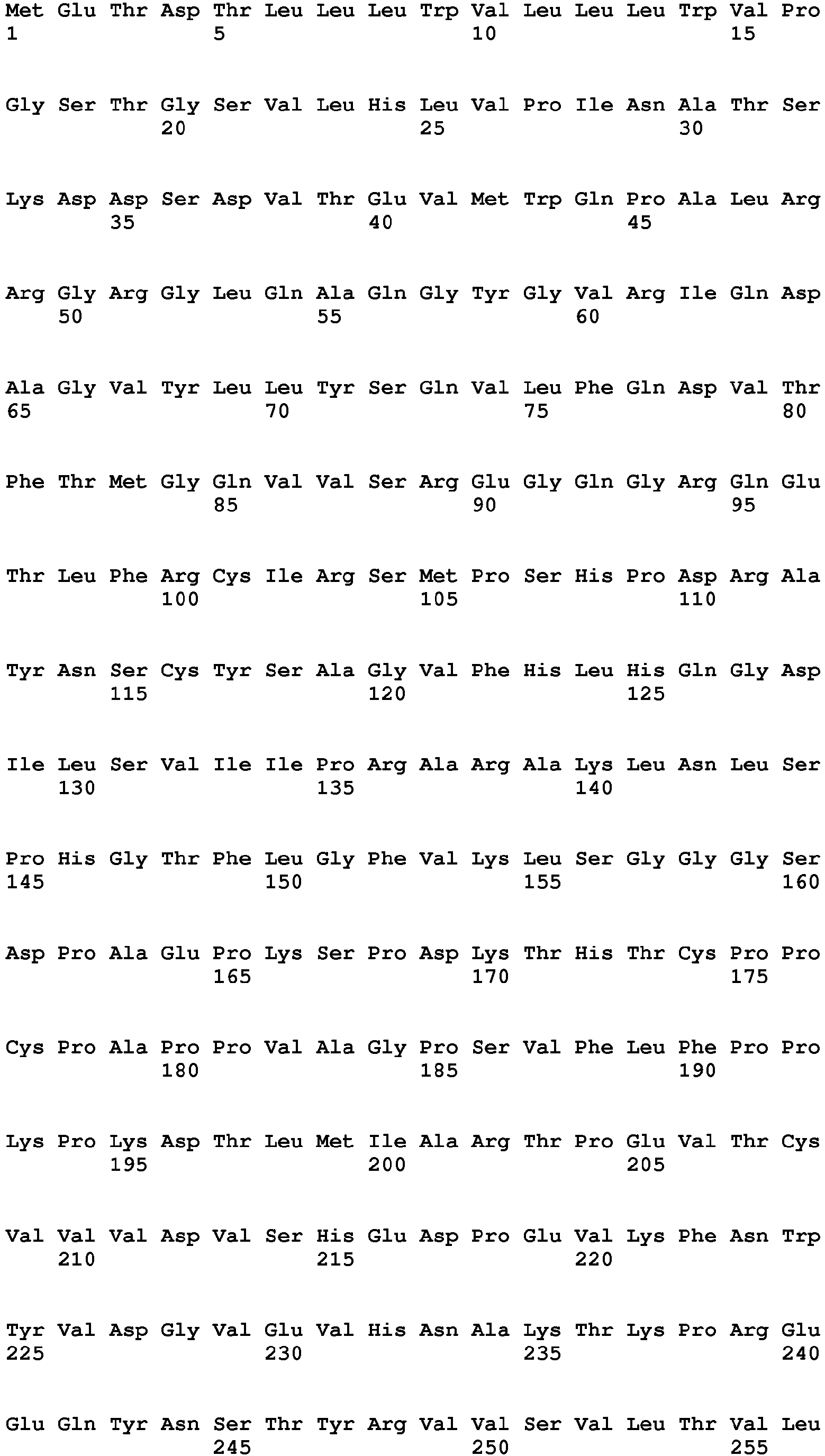


- <210> 93
<211> 633
<212> PRT
<213> Artificial Sequence - <220>
<223> APRIL CAR with a V5 epitope tag dAPRIL-HCH2CH3pvaa-CD28OXZ - <400> 93


- <210> 94
<211> 443
<212> PRT
<213> Artificial Sequence - <220>
<223> APRIL CAR with a V5 epitope tag dAPRIL-CD8STK-CD28OXZ - <400> 94


- <210> 95
<211> 417
<212> PRT
<213> Artificial Sequence - <220>
<223> APRIL CAR with a V5 epitope tag dAPRIL-HNG-CD28OXZ - <400> 95


- <210> 96
<211> 425
<212> PRT
<213> Artificial Sequence - <220>
<223> Sequence ofAPRILiTE# 01 - <400> 96


- <210> 97
<211> 450
<212> PRT
<213> Artificial Sequence - <220>
<223> Sequence ofAPRILiTE# 03 - <400> 97


- <210> 98
<211> 456
<212> PRT
<213> Artificial Sequence - <220>
<223> Sequence ofAPRILiTE# 06 - <400> 98


- <210> 99
<211> 18
<212> PRT
<213> Artificial Sequence - <220>
<223> Linker - <400> 99

- <210> 100
<211> 6
<212> PRT
<213> Artificial Sequence - <220>
<223> Furin cleavage site - <400> 100

- <210> 101
<211> 5
<212> PRT
<213> Artificial Sequence - <220>
<223> Linker - <400> 101

Claims (13)
- A variant proliferation-inducing ligand (APRIL), which has a higher binding affinity to BCMA than wild-type APRIL; and/or a higher BCMA:TACI (transmembrane activator and calcium modulator and cyclophilin ligand interactor) binding ratio than wild-type APRIL; and which comprises one of the following single mutations: M200C, M200L, M200G, M200S, M200A, M200N.
- A variant APRIL according to claim 1 which comprises one of the following mutation combinations:
V174T and M200G; or T175A and M200G; or V174T, T175A and M200G; or M200G, D205S and R206H. - A variant proliferation-inducing ligand (APRIL) according to claim 1, which comprises the mutation M200G.
- A chimeric antigen receptor (CAR) which comprises an antigen-binding domain, a transmembrane domain and an endodomain, wherein the antigen-binding domain comprises a variant APRIL according to any preceding claim.
- A bispecific T-cell engager (BiTE) which comprises and antigen-binding domain and a T-cell activation domain, wherein the antigen-binding domain comprises a variant APRIL according to any of claims 1 to 3.
- A nucleic acid sequence encoding a variant APRIL according to any of claims 1 to 3, a chimeric antigen receptor according to claim 4 or a bispecific T-cell engager according to claim 5.
- A vector comprising a nucleic acid sequence according to claim 6.
- A cell which comprises a chimeric antigen receptor according to claim 4.
- A method for making a cell according to claim 8 which comprises the step of transducing or transfecting a cell ex vivo with a vector according to claim 7 which comprises a nucleic acid sequence encoding a chimeric antigen receptor.
- A cell according to claim 8 or a bi-specific T cell engager according to claim 5 for use in treating a plasma cell disorder.
- A diagnostic agent for detecting plasma cells which comprises a variant APRIL according to any of claims 1 to 3.
- A diagnostic agent according to claim 11, for diagnosing a plasma cell disorder.
- A method for diagnosing a plasma cell disorder in a subject which comprises the step of adding a variant APRIL according to any of claims 1 to 3 to a sample from the subject in vitro.
Priority Applications (1)
| Application Number | Priority Date | Filing Date | Title |
|---|---|---|---|
| EP17172770.4A EP3243831A1 (en) | 2014-02-27 | 2015-02-26 | Variants of the proliferation-inducing ligand (april) |
Applications Claiming Priority (5)
| Application Number | Priority Date | Filing Date | Title |
|---|---|---|---|
| GB201403479A GB201403479D0 (en) | 2014-02-27 | 2014-02-27 | Molecule |
| GB201403481A GB201403481D0 (en) | 2014-02-27 | 2014-02-27 | Chimeric antigen receptor |
| GB201409761A GB201409761D0 (en) | 2014-06-02 | 2014-06-02 | Chimeric antigen receptor |
| GB201409759A GB201409759D0 (en) | 2014-06-02 | 2014-06-02 | Molecule |
| PCT/GB2015/050557 WO2015128653A2 (en) | 2014-02-27 | 2015-02-26 | Ligand |
Related Child Applications (2)
| Application Number | Title | Priority Date | Filing Date |
|---|---|---|---|
| EP17172770.4A Division EP3243831A1 (en) | 2014-02-27 | 2015-02-26 | Variants of the proliferation-inducing ligand (april) |
| EP17172770.4A Division-Into EP3243831A1 (en) | 2014-02-27 | 2015-02-26 | Variants of the proliferation-inducing ligand (april) |
Publications (2)
| Publication Number | Publication Date |
|---|---|
| EP3110838A2 EP3110838A2 (en) | 2017-01-04 |
| EP3110838B1 true EP3110838B1 (en) | 2019-06-26 |
Family
ID=52633311
Family Applications (2)
| Application Number | Title | Priority Date | Filing Date |
|---|---|---|---|
| EP17172770.4A Withdrawn EP3243831A1 (en) | 2014-02-27 | 2015-02-26 | Variants of the proliferation-inducing ligand (april) |
| EP15708871.7A Active EP3110838B1 (en) | 2014-02-27 | 2015-02-26 | April variants |
Family Applications Before (1)
| Application Number | Title | Priority Date | Filing Date |
|---|---|---|---|
| EP17172770.4A Withdrawn EP3243831A1 (en) | 2014-02-27 | 2015-02-26 | Variants of the proliferation-inducing ligand (april) |
Country Status (8)
| Country | Link |
|---|---|
| US (2) | US10752665B2 (en) |
| EP (2) | EP3243831A1 (en) |
| JP (3) | JP6556156B2 (en) |
| CN (1) | CN106414502A (en) |
| AU (1) | AU2015221933B2 (en) |
| CA (1) | CA2939411A1 (en) |
| ES (1) | ES2737690T3 (en) |
| WO (1) | WO2015128653A2 (en) |
Families Citing this family (27)
| Publication number | Priority date | Publication date | Assignee | Title |
|---|---|---|---|---|
| GB201317929D0 (en) | 2013-10-10 | 2013-11-27 | Ucl Business Plc | Chimeric antigen receptor |
| GB201317928D0 (en) * | 2013-10-10 | 2013-11-27 | Ucl Business Plc | Molecule |
| WO2015128653A2 (en) | 2014-02-27 | 2015-09-03 | Ucl Business Plc | Ligand |
| US11384350B2 (en) | 2014-12-15 | 2022-07-12 | The Regents Of The University Of California | Cytotoxic molecules responsive to intracellular ligands for selective T cell mediated killing |
| CA3008162A1 (en) | 2014-12-15 | 2016-06-23 | The Regents Of The University Of California | Bispecific or-gate chimeric antigen receptor responsive to cd19 and cd20 |
| TWI700298B (en) | 2015-04-13 | 2020-08-01 | 美商輝瑞股份有限公司 | Chimeric antigen receptors targeting b-cell maturation antigen |
| DK3368571T5 (en) | 2015-10-30 | 2024-09-30 | Univ California | Transforming growth factor-beta responsive polypeptides and methods of use thereof |
| US12048718B2 (en) * | 2016-06-07 | 2024-07-30 | Max-Delbrück-Centrum für Molekulare Medizin in der Helmholtz-Geminschaft | Chimeric antigen receptor and CAR-T cells that bind BCMA |
| JP2019530440A (en) | 2016-09-02 | 2019-10-24 | ザ リージェンツ オブ ザ ユニバーシティ オブ カリフォルニア | Methods and compositions comprising interleukin-6 receptor alpha-binding single chain variable fragments |
| WO2018121679A1 (en) * | 2016-12-30 | 2018-07-05 | 四川大学 | Lymphocyte modified with chimeric antigen receptor expressing cxcr4, preparation method, and use |
| CN110913954A (en) | 2017-03-03 | 2020-03-24 | 黑曜石疗法公司 | Compositions and methods of immunotherapy |
| IL273961B2 (en) * | 2017-10-18 | 2025-04-01 | Precigen Inc | Polypeptide compositions comprising spacers |
| GB201720426D0 (en) * | 2017-12-07 | 2018-01-24 | Hummingbird Bioscience Pte Ltd | CD47 and BCMA antigen-binding molecules |
| US20220298254A1 (en) | 2017-11-01 | 2022-09-22 | Hummingbird Bioscience Holdings Pte. Ltd. | Cd47 antigen-binding molecules |
| WO2019140127A2 (en) * | 2018-01-10 | 2019-07-18 | The General Hospital Corporation | Immune cells expressing a chimeric antigen receptor |
| US20200054675A1 (en) * | 2018-06-01 | 2020-02-20 | Washington University | Suppression of cytokine release syndrome in chimeric antigen receptor cell therapy |
| CN112566643A (en) * | 2018-06-12 | 2021-03-26 | 加利福尼亚大学董事会 | Single chain bispecific chimeric antigen receptors for the treatment of cancer |
| CA3139057A1 (en) | 2019-06-04 | 2020-12-10 | Marcela V. Maus | Antibodies and chimeric antigen receptors that target taci |
| CN110642953B (en) * | 2019-10-12 | 2021-09-17 | 华夏源(上海)细胞基因工程股份有限公司 | BCMA-targeted T cell receptor fusion protein and application thereof |
| JP2024534771A (en) | 2021-08-11 | 2024-09-26 | サナ バイオテクノロジー,インコーポレイテッド | Genetically modified cells for allogeneic cell therapy to reduce complement-mediated inflammatory responses - Patent Application 20070229633 |
| WO2023019226A1 (en) | 2021-08-11 | 2023-02-16 | Sana Biotechnology, Inc. | Genetically modified cells for allogeneic cell therapy |
| JP2024531234A (en) | 2021-08-11 | 2024-08-29 | サナ バイオテクノロジー,インコーポレイテッド | Genetically modified primary cells for allogeneic cell therapy |
| AU2022325955A1 (en) | 2021-08-11 | 2024-02-08 | Sana Biotechnology, Inc. | Genetically modified cells for allogeneic cell therapy to reduce instant blood mediated inflammatory reactions |
| JP2025508720A (en) | 2022-02-17 | 2025-04-10 | サナ バイオテクノロジー,インコーポレイテッド | CROSS-REFERENCE TO RELATED APPLICATIONS REGARDING ENGINEERED CD47 PROTEINS AND USES THEREOF |
| WO2024097315A2 (en) | 2022-11-02 | 2024-05-10 | Sana Biotechnology, Inc. | Cell therapy products and methods for producing same |
| IL326710A (en) | 2023-08-23 | 2026-04-01 | Sana Biotechnology Inc | Modified cd47 proteins and their uses |
| CN120775060A (en) * | 2024-04-02 | 2025-10-14 | 信达生物制药(苏州)有限公司 | TACI/BCMA chimeric fusion proteins and uses thereof |
Family Cites Families (18)
| Publication number | Priority date | Publication date | Assignee | Title |
|---|---|---|---|---|
| US7381803B1 (en) | 1992-03-27 | 2008-06-03 | Pdl Biopharma, Inc. | Humanized antibodies against CD3 |
| US6812327B1 (en) | 1996-10-25 | 2004-11-02 | Human Genome Sciences, Inc. | Neutrokine-alpha polypeptides |
| AU2048501A (en) * | 2000-02-16 | 2001-08-27 | Genentech Inc. | Uses of agonists and antagonists to modulate activity of tnf-related molecules |
| CA2438682A1 (en) | 2001-02-20 | 2002-08-29 | Zymogenetics, Inc. | Antibodies that bind both bcma and taci |
| WO2004020593A2 (en) * | 2002-08-30 | 2004-03-11 | Incyte Corporation | Immune response associated proteins |
| US20050003480A1 (en) * | 2003-01-06 | 2005-01-06 | Xencor | April variants and methods thereof |
| WO2004089982A2 (en) * | 2003-01-06 | 2004-10-21 | Xencor | April variants and methods thereof |
| US20060014248A1 (en) * | 2003-01-06 | 2006-01-19 | Xencor, Inc. | TNF super family members with altered immunogenicity |
| AT503861B1 (en) | 2006-07-05 | 2008-06-15 | F Star Biotech Forsch & Entw | METHOD FOR MANIPULATING T-CELL RECEPTORS |
| WO2008045437A2 (en) | 2006-10-09 | 2008-04-17 | The General Hospital Corporation | Chimeric t-cell receptors and t-cells targeting egfrviii on tumors |
| US8003335B2 (en) | 2008-04-30 | 2011-08-23 | Universite Paris-SUD11 | Levels of APRIL in serum and use in diagnostic methods |
| SI3415531T1 (en) | 2011-05-27 | 2023-12-29 | Glaxo Group Limited | BCMA (CD269/TNFRSF17) - BINDING PROTEINS |
| TWI679212B (en) * | 2011-11-15 | 2019-12-11 | 美商安進股份有限公司 | Binding molecules for e3 of bcma and cd3 |
| ES3065694T3 (en) | 2012-04-11 | 2026-05-07 | Us Health | Chimeric antigen receptors targeting b-cell maturation antigen |
| GB201317928D0 (en) | 2013-10-10 | 2013-11-27 | Ucl Business Plc | Molecule |
| GB201317929D0 (en) | 2013-10-10 | 2013-11-27 | Ucl Business Plc | Chimeric antigen receptor |
| WO2015128653A2 (en) | 2014-02-27 | 2015-09-03 | Ucl Business Plc | Ligand |
| AU2017357649A1 (en) | 2016-11-11 | 2019-05-23 | Autolus Limited | Chimeric antigen receptor |
-
2015
- 2015-02-26 WO PCT/GB2015/050557 patent/WO2015128653A2/en not_active Ceased
- 2015-02-26 ES ES15708871T patent/ES2737690T3/en active Active
- 2015-02-26 US US15/121,644 patent/US10752665B2/en not_active Expired - Fee Related
- 2015-02-26 EP EP17172770.4A patent/EP3243831A1/en not_active Withdrawn
- 2015-02-26 EP EP15708871.7A patent/EP3110838B1/en active Active
- 2015-02-26 JP JP2016553489A patent/JP6556156B2/en not_active Expired - Fee Related
- 2015-02-26 CN CN201580010156.0A patent/CN106414502A/en active Pending
- 2015-02-26 AU AU2015221933A patent/AU2015221933B2/en not_active Ceased
- 2015-02-26 CA CA2939411A patent/CA2939411A1/en not_active Abandoned
-
2017
- 2017-05-26 US US15/606,660 patent/US10611811B2/en not_active Expired - Fee Related
- 2017-05-31 JP JP2017107701A patent/JP6707496B2/en not_active Expired - Fee Related
-
2019
- 2019-01-30 JP JP2019014039A patent/JP2019068855A/en active Pending
Non-Patent Citations (1)
| Title |
|---|
| None * |
Also Published As
| Publication number | Publication date |
|---|---|
| JP2017514787A (en) | 2017-06-08 |
| US10611811B2 (en) | 2020-04-07 |
| EP3243831A1 (en) | 2017-11-15 |
| WO2015128653A2 (en) | 2015-09-03 |
| AU2015221933B2 (en) | 2019-09-12 |
| US10752665B2 (en) | 2020-08-25 |
| JP2017145258A (en) | 2017-08-24 |
| AU2015221933A1 (en) | 2016-09-01 |
| CA2939411A1 (en) | 2015-09-03 |
| JP2019068855A (en) | 2019-05-09 |
| ES2737690T3 (en) | 2020-01-15 |
| EP3110838A2 (en) | 2017-01-04 |
| WO2015128653A3 (en) | 2015-11-05 |
| CN106414502A (en) | 2017-02-15 |
| US20170334964A1 (en) | 2017-11-23 |
| JP6556156B2 (en) | 2019-08-07 |
| JP6707496B2 (en) | 2020-06-10 |
| US20160362467A1 (en) | 2016-12-15 |
Similar Documents
| Publication | Publication Date | Title |
|---|---|---|
| US10611811B2 (en) | Ligand | |
| US20260062458A1 (en) | Chimeric antigen receptor | |
| US11492408B2 (en) | Bi-specific T-cell engager specific for BCMA | |
| BR112019017629A2 (en) | antigen-binding receptor, isolated polynucleotide, vector, transduced t cell, methods for treating a disease and for inducing lysis, use of the receptor and receptor | |
| CN111479918A (en) | Cells | |
| AU2017341936A1 (en) | Modular tetravalent bispecific antibody platform | |
| WO2022093694A1 (en) | Polypeptides targeting hpv peptide-mhc complexes and methods of use thereof | |
| KR20220122844A (en) | Humanized antibody specific for CD22 and uses thereof | |
| HK1227893B (en) | April variants | |
| HK1227893A1 (en) | April variants | |
| Claus et al. | Article Not peer-reviewed version | |
| JP2026511106A (en) | Biomarkers for cancer treatment using anti-claudin-1 antibodies | |
| CN121780440A (en) | Immunocyte therapy | |
| KR20220155943A (en) | Antibody specific for CD22 and uses thereof | |
| CN119585301A (en) | Inhibitory chimeric receptor structure | |
| HK1222186B (en) | Chimeric antigen receptor |
Legal Events
| Date | Code | Title | Description |
|---|---|---|---|
| PUAI | Public reference made under article 153(3) epc to a published international application that has entered the european phase |
Free format text: ORIGINAL CODE: 0009012 |
|
| STAA | Information on the status of an ep patent application or granted ep patent |
Free format text: STATUS: REQUEST FOR EXAMINATION WAS MADE |
|
| 17P | Request for examination filed |
Effective date: 20160927 |
|
| AK | Designated contracting states |
Kind code of ref document: A2 Designated state(s): AL AT BE BG CH CY CZ DE DK EE ES FI FR GB GR HR HU IE IS IT LI LT LU LV MC MK MT NL NO PL PT RO RS SE SI SK SM TR |
|
| AX | Request for extension of the european patent |
Extension state: BA ME |
|
| DAX | Request for extension of the european patent (deleted) | ||
| REG | Reference to a national code |
Ref country code: HK Ref legal event code: DE Ref document number: 1227893 Country of ref document: HK |
|
| STAA | Information on the status of an ep patent application or granted ep patent |
Free format text: STATUS: EXAMINATION IS IN PROGRESS |
|
| 17Q | First examination report despatched |
Effective date: 20180327 |
|
| GRAP | Despatch of communication of intention to grant a patent |
Free format text: ORIGINAL CODE: EPIDOSNIGR1 |
|
| STAA | Information on the status of an ep patent application or granted ep patent |
Free format text: STATUS: GRANT OF PATENT IS INTENDED |
|
| INTG | Intention to grant announced |
Effective date: 20190108 |
|
| GRAJ | Information related to disapproval of communication of intention to grant by the applicant or resumption of examination proceedings by the epo deleted |
Free format text: ORIGINAL CODE: EPIDOSDIGR1 |
|
| STAA | Information on the status of an ep patent application or granted ep patent |
Free format text: STATUS: EXAMINATION IS IN PROGRESS |
|
| GRAR | Information related to intention to grant a patent recorded |
Free format text: ORIGINAL CODE: EPIDOSNIGR71 |
|
| GRAS | Grant fee paid |
Free format text: ORIGINAL CODE: EPIDOSNIGR3 |
|
| STAA | Information on the status of an ep patent application or granted ep patent |
Free format text: STATUS: GRANT OF PATENT IS INTENDED |
|
| GRAA | (expected) grant |
Free format text: ORIGINAL CODE: 0009210 |
|
| STAA | Information on the status of an ep patent application or granted ep patent |
Free format text: STATUS: THE PATENT HAS BEEN GRANTED |
|
| INTC | Intention to grant announced (deleted) | ||
| INTG | Intention to grant announced |
Effective date: 20190516 |
|
| AK | Designated contracting states |
Kind code of ref document: B1 Designated state(s): AL AT BE BG CH CY CZ DE DK EE ES FI FR GB GR HR HU IE IS IT LI LT LU LV MC MK MT NL NO PL PT RO RS SE SI SK SM TR |
|
| REG | Reference to a national code |
Ref country code: GB Ref legal event code: FG4D |
|
| REG | Reference to a national code |
Ref country code: CH Ref legal event code: EP |
|
| REG | Reference to a national code |
Ref country code: AT Ref legal event code: REF Ref document number: 1148165 Country of ref document: AT Kind code of ref document: T Effective date: 20190715 |
|
| REG | Reference to a national code |
Ref country code: DE Ref legal event code: R096 Ref document number: 602015032656 Country of ref document: DE |
|
| REG | Reference to a national code |
Ref country code: IE Ref legal event code: FG4D |
|
| REG | Reference to a national code |
Ref country code: NL Ref legal event code: MP Effective date: 20190626 |
|
| PG25 | Lapsed in a contracting state [announced via postgrant information from national office to epo] |
Ref country code: SE Free format text: LAPSE BECAUSE OF FAILURE TO SUBMIT A TRANSLATION OF THE DESCRIPTION OR TO PAY THE FEE WITHIN THE PRESCRIBED TIME-LIMIT Effective date: 20190626 Ref country code: HR Free format text: LAPSE BECAUSE OF FAILURE TO SUBMIT A TRANSLATION OF THE DESCRIPTION OR TO PAY THE FEE WITHIN THE PRESCRIBED TIME-LIMIT Effective date: 20190626 Ref country code: LT Free format text: LAPSE BECAUSE OF FAILURE TO SUBMIT A TRANSLATION OF THE DESCRIPTION OR TO PAY THE FEE WITHIN THE PRESCRIBED TIME-LIMIT Effective date: 20190626 Ref country code: NO Free format text: LAPSE BECAUSE OF FAILURE TO SUBMIT A TRANSLATION OF THE DESCRIPTION OR TO PAY THE FEE WITHIN THE PRESCRIBED TIME-LIMIT Effective date: 20190926 Ref country code: FI Free format text: LAPSE BECAUSE OF FAILURE TO SUBMIT A TRANSLATION OF THE DESCRIPTION OR TO PAY THE FEE WITHIN THE PRESCRIBED TIME-LIMIT Effective date: 20190626 Ref country code: AL Free format text: LAPSE BECAUSE OF FAILURE TO SUBMIT A TRANSLATION OF THE DESCRIPTION OR TO PAY THE FEE WITHIN THE PRESCRIBED TIME-LIMIT Effective date: 20190626 |
|
| REG | Reference to a national code |
Ref country code: LT Ref legal event code: MG4D |
|
| PG25 | Lapsed in a contracting state [announced via postgrant information from national office to epo] |
Ref country code: RS Free format text: LAPSE BECAUSE OF FAILURE TO SUBMIT A TRANSLATION OF THE DESCRIPTION OR TO PAY THE FEE WITHIN THE PRESCRIBED TIME-LIMIT Effective date: 20190626 Ref country code: LV Free format text: LAPSE BECAUSE OF FAILURE TO SUBMIT A TRANSLATION OF THE DESCRIPTION OR TO PAY THE FEE WITHIN THE PRESCRIBED TIME-LIMIT Effective date: 20190626 Ref country code: GR Free format text: LAPSE BECAUSE OF FAILURE TO SUBMIT A TRANSLATION OF THE DESCRIPTION OR TO PAY THE FEE WITHIN THE PRESCRIBED TIME-LIMIT Effective date: 20190927 Ref country code: BG Free format text: LAPSE BECAUSE OF FAILURE TO SUBMIT A TRANSLATION OF THE DESCRIPTION OR TO PAY THE FEE WITHIN THE PRESCRIBED TIME-LIMIT Effective date: 20190926 |
|
| RAP2 | Party data changed (patent owner data changed or rights of a patent transferred) |
Owner name: UCL BUSINESS LTD |
|
| REG | Reference to a national code |
Ref country code: ES Ref legal event code: FG2A Ref document number: 2737690 Country of ref document: ES Kind code of ref document: T3 Effective date: 20200115 Ref country code: AT Ref legal event code: MK05 Ref document number: 1148165 Country of ref document: AT Kind code of ref document: T Effective date: 20190626 |
|
| PG25 | Lapsed in a contracting state [announced via postgrant information from national office to epo] |
Ref country code: NL Free format text: LAPSE BECAUSE OF FAILURE TO SUBMIT A TRANSLATION OF THE DESCRIPTION OR TO PAY THE FEE WITHIN THE PRESCRIBED TIME-LIMIT Effective date: 20190626 Ref country code: AT Free format text: LAPSE BECAUSE OF FAILURE TO SUBMIT A TRANSLATION OF THE DESCRIPTION OR TO PAY THE FEE WITHIN THE PRESCRIBED TIME-LIMIT Effective date: 20190626 Ref country code: PT Free format text: LAPSE BECAUSE OF FAILURE TO SUBMIT A TRANSLATION OF THE DESCRIPTION OR TO PAY THE FEE WITHIN THE PRESCRIBED TIME-LIMIT Effective date: 20191028 Ref country code: CZ Free format text: LAPSE BECAUSE OF FAILURE TO SUBMIT A TRANSLATION OF THE DESCRIPTION OR TO PAY THE FEE WITHIN THE PRESCRIBED TIME-LIMIT Effective date: 20190626 Ref country code: SK Free format text: LAPSE BECAUSE OF FAILURE TO SUBMIT A TRANSLATION OF THE DESCRIPTION OR TO PAY THE FEE WITHIN THE PRESCRIBED TIME-LIMIT Effective date: 20190626 Ref country code: RO Free format text: LAPSE BECAUSE OF FAILURE TO SUBMIT A TRANSLATION OF THE DESCRIPTION OR TO PAY THE FEE WITHIN THE PRESCRIBED TIME-LIMIT Effective date: 20190626 Ref country code: EE Free format text: LAPSE BECAUSE OF FAILURE TO SUBMIT A TRANSLATION OF THE DESCRIPTION OR TO PAY THE FEE WITHIN THE PRESCRIBED TIME-LIMIT Effective date: 20190626 |
|
| PG25 | Lapsed in a contracting state [announced via postgrant information from national office to epo] |
Ref country code: IS Free format text: LAPSE BECAUSE OF FAILURE TO SUBMIT A TRANSLATION OF THE DESCRIPTION OR TO PAY THE FEE WITHIN THE PRESCRIBED TIME-LIMIT Effective date: 20191026 Ref country code: SM Free format text: LAPSE BECAUSE OF FAILURE TO SUBMIT A TRANSLATION OF THE DESCRIPTION OR TO PAY THE FEE WITHIN THE PRESCRIBED TIME-LIMIT Effective date: 20190626 |
|
| PG25 | Lapsed in a contracting state [announced via postgrant information from national office to epo] |
Ref country code: TR Free format text: LAPSE BECAUSE OF FAILURE TO SUBMIT A TRANSLATION OF THE DESCRIPTION OR TO PAY THE FEE WITHIN THE PRESCRIBED TIME-LIMIT Effective date: 20190626 |
|
| PG25 | Lapsed in a contracting state [announced via postgrant information from national office to epo] |
Ref country code: DK Free format text: LAPSE BECAUSE OF FAILURE TO SUBMIT A TRANSLATION OF THE DESCRIPTION OR TO PAY THE FEE WITHIN THE PRESCRIBED TIME-LIMIT Effective date: 20190626 Ref country code: PL Free format text: LAPSE BECAUSE OF FAILURE TO SUBMIT A TRANSLATION OF THE DESCRIPTION OR TO PAY THE FEE WITHIN THE PRESCRIBED TIME-LIMIT Effective date: 20190626 |
|
| PG25 | Lapsed in a contracting state [announced via postgrant information from national office to epo] |
Ref country code: IS Free format text: LAPSE BECAUSE OF FAILURE TO SUBMIT A TRANSLATION OF THE DESCRIPTION OR TO PAY THE FEE WITHIN THE PRESCRIBED TIME-LIMIT Effective date: 20200224 |
|
| REG | Reference to a national code |
Ref country code: DE Ref legal event code: R097 Ref document number: 602015032656 Country of ref document: DE |
|
| PLBE | No opposition filed within time limit |
Free format text: ORIGINAL CODE: 0009261 |
|
| STAA | Information on the status of an ep patent application or granted ep patent |
Free format text: STATUS: NO OPPOSITION FILED WITHIN TIME LIMIT |
|
| PG2D | Information on lapse in contracting state deleted |
Ref country code: IS |
|
| 26N | No opposition filed |
Effective date: 20200603 |
|
| PG25 | Lapsed in a contracting state [announced via postgrant information from national office to epo] |
Ref country code: SI Free format text: LAPSE BECAUSE OF FAILURE TO SUBMIT A TRANSLATION OF THE DESCRIPTION OR TO PAY THE FEE WITHIN THE PRESCRIBED TIME-LIMIT Effective date: 20190626 |
|
| REG | Reference to a national code |
Ref country code: CH Ref legal event code: PL |
|
| REG | Reference to a national code |
Ref country code: BE Ref legal event code: MM Effective date: 20200229 |
|
| PG25 | Lapsed in a contracting state [announced via postgrant information from national office to epo] |
Ref country code: MC Free format text: LAPSE BECAUSE OF FAILURE TO SUBMIT A TRANSLATION OF THE DESCRIPTION OR TO PAY THE FEE WITHIN THE PRESCRIBED TIME-LIMIT Effective date: 20190626 Ref country code: LU Free format text: LAPSE BECAUSE OF NON-PAYMENT OF DUE FEES Effective date: 20200226 |
|
| PG25 | Lapsed in a contracting state [announced via postgrant information from national office to epo] |
Ref country code: LI Free format text: LAPSE BECAUSE OF NON-PAYMENT OF DUE FEES Effective date: 20200229 Ref country code: CH Free format text: LAPSE BECAUSE OF NON-PAYMENT OF DUE FEES Effective date: 20200229 |
|
| PG25 | Lapsed in a contracting state [announced via postgrant information from national office to epo] |
Ref country code: IE Free format text: LAPSE BECAUSE OF NON-PAYMENT OF DUE FEES Effective date: 20200226 |
|
| PG25 | Lapsed in a contracting state [announced via postgrant information from national office to epo] |
Ref country code: BE Free format text: LAPSE BECAUSE OF NON-PAYMENT OF DUE FEES Effective date: 20200229 |
|
| PGFP | Annual fee paid to national office [announced via postgrant information from national office to epo] |
Ref country code: FR Payment date: 20210223 Year of fee payment: 7 Ref country code: IT Payment date: 20210219 Year of fee payment: 7 |
|
| PGFP | Annual fee paid to national office [announced via postgrant information from national office to epo] |
Ref country code: GB Payment date: 20210225 Year of fee payment: 7 Ref country code: ES Payment date: 20210301 Year of fee payment: 7 Ref country code: DE Payment date: 20210225 Year of fee payment: 7 |
|
| PG25 | Lapsed in a contracting state [announced via postgrant information from national office to epo] |
Ref country code: MT Free format text: LAPSE BECAUSE OF FAILURE TO SUBMIT A TRANSLATION OF THE DESCRIPTION OR TO PAY THE FEE WITHIN THE PRESCRIBED TIME-LIMIT Effective date: 20190626 Ref country code: CY Free format text: LAPSE BECAUSE OF FAILURE TO SUBMIT A TRANSLATION OF THE DESCRIPTION OR TO PAY THE FEE WITHIN THE PRESCRIBED TIME-LIMIT Effective date: 20190626 |
|
| PG25 | Lapsed in a contracting state [announced via postgrant information from national office to epo] |
Ref country code: MK Free format text: LAPSE BECAUSE OF FAILURE TO SUBMIT A TRANSLATION OF THE DESCRIPTION OR TO PAY THE FEE WITHIN THE PRESCRIBED TIME-LIMIT Effective date: 20190626 |
|
| REG | Reference to a national code |
Ref country code: DE Ref legal event code: R119 Ref document number: 602015032656 Country of ref document: DE |
|
| GBPC | Gb: european patent ceased through non-payment of renewal fee |
Effective date: 20220226 |
|
| PG25 | Lapsed in a contracting state [announced via postgrant information from national office to epo] |
Ref country code: FR Free format text: LAPSE BECAUSE OF NON-PAYMENT OF DUE FEES Effective date: 20220228 |
|
| PG25 | Lapsed in a contracting state [announced via postgrant information from national office to epo] |
Ref country code: GB Free format text: LAPSE BECAUSE OF NON-PAYMENT OF DUE FEES Effective date: 20220226 Ref country code: DE Free format text: LAPSE BECAUSE OF NON-PAYMENT OF DUE FEES Effective date: 20220901 |
|
| REG | Reference to a national code |
Ref country code: ES Ref legal event code: FD2A Effective date: 20230427 |
|
| PG25 | Lapsed in a contracting state [announced via postgrant information from national office to epo] |
Ref country code: IT Free format text: LAPSE BECAUSE OF NON-PAYMENT OF DUE FEES Effective date: 20220226 |
|
| P01 | Opt-out of the competence of the unified patent court (upc) registered |
Effective date: 20230513 |
|
| PG25 | Lapsed in a contracting state [announced via postgrant information from national office to epo] |
Ref country code: ES Free format text: LAPSE BECAUSE OF NON-PAYMENT OF DUE FEES Effective date: 20220227 |