EP3110815B1 - Indoloquinolone compounds as anaplastic lymphoma kinase (alk) inhibitors - Google Patents
Indoloquinolone compounds as anaplastic lymphoma kinase (alk) inhibitors Download PDFInfo
- Publication number
- EP3110815B1 EP3110815B1 EP14883866.7A EP14883866A EP3110815B1 EP 3110815 B1 EP3110815 B1 EP 3110815B1 EP 14883866 A EP14883866 A EP 14883866A EP 3110815 B1 EP3110815 B1 EP 3110815B1
- Authority
- EP
- European Patent Office
- Prior art keywords
- mmol
- alkyl
- indolo
- oxo
- dihydro
- Prior art date
- Legal status (The legal status is an assumption and is not a legal conclusion. Google has not performed a legal analysis and makes no representation as to the accuracy of the status listed.)
- Active
Links
- 102100033793 ALK tyrosine kinase receptor Human genes 0.000 title description 51
- 101710168331 ALK tyrosine kinase receptor Proteins 0.000 title description 51
- 239000003112 inhibitor Substances 0.000 title description 12
- XXENJDSQBDRHCO-UHFFFAOYSA-N pyrido[3,2-c]carbazol-2-one Chemical class N1=C2C=CC=CC2=C2C1=CC=C1C=CC(=O)N=C12 XXENJDSQBDRHCO-UHFFFAOYSA-N 0.000 title description 4
- 125000000217 alkyl group Chemical group 0.000 claims description 107
- 150000001875 compounds Chemical class 0.000 claims description 107
- 125000000753 cycloalkyl group Chemical group 0.000 claims description 81
- 150000003839 salts Chemical class 0.000 claims description 69
- 125000000623 heterocyclic group Chemical group 0.000 claims description 48
- 125000003342 alkenyl group Chemical group 0.000 claims description 43
- 125000003118 aryl group Chemical group 0.000 claims description 43
- 239000001257 hydrogen Substances 0.000 claims description 42
- 229910052739 hydrogen Inorganic materials 0.000 claims description 42
- 206010028980 Neoplasm Diseases 0.000 claims description 39
- 125000003545 alkoxy group Chemical group 0.000 claims description 39
- 125000000304 alkynyl group Chemical group 0.000 claims description 38
- 125000005843 halogen group Chemical group 0.000 claims description 36
- 125000002887 hydroxy group Chemical group [H]O* 0.000 claims description 32
- 125000001072 heteroaryl group Chemical group 0.000 claims description 29
- 201000011510 cancer Diseases 0.000 claims description 27
- 125000004435 hydrogen atom Chemical group [H]* 0.000 claims description 21
- 125000004093 cyano group Chemical group *C#N 0.000 claims description 18
- 125000004193 piperazinyl group Chemical group 0.000 claims description 18
- 125000003386 piperidinyl group Chemical group 0.000 claims description 16
- 230000005764 inhibitory process Effects 0.000 claims description 13
- 108090000623 proteins and genes Proteins 0.000 claims description 12
- 239000004480 active ingredient Substances 0.000 claims description 10
- 230000004927 fusion Effects 0.000 claims description 10
- 125000001153 fluoro group Chemical group F* 0.000 claims description 9
- 208000002154 non-small cell lung carcinoma Diseases 0.000 claims description 9
- 239000003937 drug carrier Substances 0.000 claims description 7
- 239000008194 pharmaceutical composition Substances 0.000 claims description 7
- 208000003174 Brain Neoplasms Diseases 0.000 claims description 6
- 206010009944 Colon cancer Diseases 0.000 claims description 6
- 208000020816 lung neoplasm Diseases 0.000 claims description 6
- 208000001333 Colorectal Neoplasms Diseases 0.000 claims description 4
- 201000003803 Inflammatory myofibroblastic tumor Diseases 0.000 claims description 4
- 206010058467 Lung neoplasm malignant Diseases 0.000 claims description 4
- 206010033128 Ovarian cancer Diseases 0.000 claims description 4
- 206010061535 Ovarian neoplasm Diseases 0.000 claims description 4
- 210000003169 central nervous system Anatomy 0.000 claims description 4
- 201000005202 lung cancer Diseases 0.000 claims description 4
- 208000029729 tumor suppressor gene on chromosome 11 Diseases 0.000 claims description 4
- 206010067917 Inflammatory myofibroblastic tumour Diseases 0.000 claims description 3
- 101100091501 Mus musculus Ros1 gene Proteins 0.000 claims description 3
- 206010012818 diffuse large B-cell lymphoma Diseases 0.000 claims description 3
- 206010000830 Acute leukaemia Diseases 0.000 claims description 2
- 208000010507 Adenocarcinoma of Lung Diseases 0.000 claims description 2
- 201000003076 Angiosarcoma Diseases 0.000 claims description 2
- 206010005003 Bladder cancer Diseases 0.000 claims description 2
- 206010005949 Bone cancer Diseases 0.000 claims description 2
- 208000018084 Bone neoplasm Diseases 0.000 claims description 2
- 206010006187 Breast cancer Diseases 0.000 claims description 2
- 208000026310 Breast neoplasm Diseases 0.000 claims description 2
- 206010007953 Central nervous system lymphoma Diseases 0.000 claims description 2
- 208000007207 Epithelioid hemangioendothelioma Diseases 0.000 claims description 2
- 208000000461 Esophageal Neoplasms Diseases 0.000 claims description 2
- 208000001258 Hemangiosarcoma Diseases 0.000 claims description 2
- 208000017604 Hodgkin disease Diseases 0.000 claims description 2
- 208000010747 Hodgkins lymphoma Diseases 0.000 claims description 2
- 208000008839 Kidney Neoplasms Diseases 0.000 claims description 2
- 208000031671 Large B-Cell Diffuse Lymphoma Diseases 0.000 claims description 2
- 208000032004 Large-Cell Anaplastic Lymphoma Diseases 0.000 claims description 2
- 206010025323 Lymphomas Diseases 0.000 claims description 2
- 206010027406 Mesothelioma Diseases 0.000 claims description 2
- 206010061902 Pancreatic neoplasm Diseases 0.000 claims description 2
- 206010060862 Prostate cancer Diseases 0.000 claims description 2
- 208000000236 Prostatic Neoplasms Diseases 0.000 claims description 2
- 208000015634 Rectal Neoplasms Diseases 0.000 claims description 2
- 206010038389 Renal cancer Diseases 0.000 claims description 2
- 208000000453 Skin Neoplasms Diseases 0.000 claims description 2
- 208000005718 Stomach Neoplasms Diseases 0.000 claims description 2
- 208000007097 Urinary Bladder Neoplasms Diseases 0.000 claims description 2
- 208000002495 Uterine Neoplasms Diseases 0.000 claims description 2
- 230000001154 acute effect Effects 0.000 claims description 2
- 208000009956 adenocarcinoma Diseases 0.000 claims description 2
- 208000006990 cholangiocarcinoma Diseases 0.000 claims description 2
- 208000024207 chronic leukemia Diseases 0.000 claims description 2
- 208000029742 colonic neoplasm Diseases 0.000 claims description 2
- 201000004101 esophageal cancer Diseases 0.000 claims description 2
- 201000006585 gastric adenocarcinoma Diseases 0.000 claims description 2
- 206010017758 gastric cancer Diseases 0.000 claims description 2
- 201000010536 head and neck cancer Diseases 0.000 claims description 2
- 208000014829 head and neck neoplasm Diseases 0.000 claims description 2
- 201000010982 kidney cancer Diseases 0.000 claims description 2
- 201000005249 lung adenocarcinoma Diseases 0.000 claims description 2
- 208000015486 malignant pancreatic neoplasm Diseases 0.000 claims description 2
- 201000001441 melanoma Diseases 0.000 claims description 2
- 201000002528 pancreatic cancer Diseases 0.000 claims description 2
- 208000008443 pancreatic carcinoma Diseases 0.000 claims description 2
- 208000016800 primary central nervous system lymphoma Diseases 0.000 claims description 2
- 206010038038 rectal cancer Diseases 0.000 claims description 2
- 201000001275 rectum cancer Diseases 0.000 claims description 2
- 201000000849 skin cancer Diseases 0.000 claims description 2
- 201000002314 small intestine cancer Diseases 0.000 claims description 2
- 206010041823 squamous cell carcinoma Diseases 0.000 claims description 2
- 201000011549 stomach cancer Diseases 0.000 claims description 2
- 201000005112 urinary bladder cancer Diseases 0.000 claims description 2
- 206010046766 uterine cancer Diseases 0.000 claims description 2
- 125000001309 chloro group Chemical group Cl* 0.000 claims 1
- YMWUJEATGCHHMB-UHFFFAOYSA-N Dichloromethane Chemical compound ClCCl YMWUJEATGCHHMB-UHFFFAOYSA-N 0.000 description 332
- 239000000203 mixture Substances 0.000 description 241
- 239000000243 solution Substances 0.000 description 178
- 238000006243 chemical reaction Methods 0.000 description 146
- HEDRZPFGACZZDS-MICDWDOJSA-N Trichloro(2H)methane Chemical compound [2H]C(Cl)(Cl)Cl HEDRZPFGACZZDS-MICDWDOJSA-N 0.000 description 128
- 238000005160 1H NMR spectroscopy Methods 0.000 description 113
- VLKZOEOYAKHREP-UHFFFAOYSA-N n-Hexane Chemical compound CCCCCC VLKZOEOYAKHREP-UHFFFAOYSA-N 0.000 description 111
- -1 cycloalyl Chemical group 0.000 description 110
- XEKOWRVHYACXOJ-UHFFFAOYSA-N Ethyl acetate Chemical compound CCOC(C)=O XEKOWRVHYACXOJ-UHFFFAOYSA-N 0.000 description 106
- QTBSBXVTEAMEQO-UHFFFAOYSA-N Acetic acid Chemical compound CC(O)=O QTBSBXVTEAMEQO-UHFFFAOYSA-N 0.000 description 105
- 238000010898 silica gel chromatography Methods 0.000 description 100
- OKKJLVBELUTLKV-MZCSYVLQSA-N Deuterated methanol Chemical compound [2H]OC([2H])([2H])[2H] OKKJLVBELUTLKV-MZCSYVLQSA-N 0.000 description 96
- 239000002904 solvent Substances 0.000 description 92
- USIUVYZYUHIAEV-UHFFFAOYSA-N diphenyl ether Chemical compound C=1C=CC=CC=1OC1=CC=CC=C1 USIUVYZYUHIAEV-UHFFFAOYSA-N 0.000 description 75
- XLYOFNOQVPJJNP-UHFFFAOYSA-N water Substances O XLYOFNOQVPJJNP-UHFFFAOYSA-N 0.000 description 75
- 239000002244 precipitate Substances 0.000 description 72
- IAZDPXIOMUYVGZ-UHFFFAOYSA-N Dimethylsulphoxide Chemical compound CS(C)=O IAZDPXIOMUYVGZ-UHFFFAOYSA-N 0.000 description 66
- JRNVZBWKYDBUCA-UHFFFAOYSA-N N-chlorosuccinimide Chemical compound ClN1C(=O)CCC1=O JRNVZBWKYDBUCA-UHFFFAOYSA-N 0.000 description 60
- 235000019439 ethyl acetate Nutrition 0.000 description 52
- 230000002829 reductive effect Effects 0.000 description 50
- CSCPPACGZOOCGX-UHFFFAOYSA-N Acetone Chemical compound CC(C)=O CSCPPACGZOOCGX-UHFFFAOYSA-N 0.000 description 48
- 238000001914 filtration Methods 0.000 description 48
- 238000002953 preparative HPLC Methods 0.000 description 40
- JGFZNNIVVJXRND-UHFFFAOYSA-N N,N-Diisopropylethylamine (DIPEA) Chemical compound CCN(C(C)C)C(C)C JGFZNNIVVJXRND-UHFFFAOYSA-N 0.000 description 38
- 238000001990 intravenous administration Methods 0.000 description 37
- OKKJLVBELUTLKV-UHFFFAOYSA-N Methanol Chemical compound OC OKKJLVBELUTLKV-UHFFFAOYSA-N 0.000 description 36
- CIIFKVFOVFJZDM-UHFFFAOYSA-N quinoline-8-carbonitrile Chemical compound C1=CN=C2C(C#N)=CC=CC2=C1 CIIFKVFOVFJZDM-UHFFFAOYSA-N 0.000 description 34
- 239000011541 reaction mixture Substances 0.000 description 34
- 239000012973 diazabicyclooctane Substances 0.000 description 31
- YNJBWRMUSHSURL-UHFFFAOYSA-N trichloroacetic acid Chemical compound OC(=O)C(Cl)(Cl)Cl YNJBWRMUSHSURL-UHFFFAOYSA-N 0.000 description 31
- IMNIMPAHZVJRPE-UHFFFAOYSA-N triethylenediamine Chemical compound C1CN2CCN1CC2 IMNIMPAHZVJRPE-UHFFFAOYSA-N 0.000 description 31
- IJGRMHOSHXDMSA-UHFFFAOYSA-N Atomic nitrogen Chemical compound N#N IJGRMHOSHXDMSA-UHFFFAOYSA-N 0.000 description 30
- 0 Cc(c(**)c1C2**2)c(*)c2c1N(*)c([n](c1c(*)c(*)c(*)c(*)c11)O*)c1C2=O Chemical compound Cc(c(**)c1C2**2)c(*)c2c1N(*)c([n](c1c(*)c(*)c(*)c(*)c11)O*)c1C2=O 0.000 description 27
- UXOQQUHZHRSERD-UHFFFAOYSA-N methyl 6-cyano-1h-indole-3-carboxylate Chemical compound N#CC1=CC=C2C(C(=O)OC)=CNC2=C1 UXOQQUHZHRSERD-UHFFFAOYSA-N 0.000 description 27
- KDLHZDBZIXYQEI-UHFFFAOYSA-N Palladium Chemical compound [Pd] KDLHZDBZIXYQEI-UHFFFAOYSA-N 0.000 description 24
- 238000010791 quenching Methods 0.000 description 24
- 239000012321 sodium triacetoxyborohydride Substances 0.000 description 24
- UIIMBOGNXHQVGW-UHFFFAOYSA-M Sodium bicarbonate Chemical compound [Na+].OC([O-])=O UIIMBOGNXHQVGW-UHFFFAOYSA-M 0.000 description 22
- RIOQSEWOXXDEQQ-UHFFFAOYSA-N triphenylphosphine Chemical compound C1=CC=CC=C1P(C=1C=CC=CC=1)C1=CC=CC=C1 RIOQSEWOXXDEQQ-UHFFFAOYSA-N 0.000 description 22
- CDBYLPFSWZWCQE-UHFFFAOYSA-L Sodium Carbonate Chemical compound [Na+].[Na+].[O-]C([O-])=O CDBYLPFSWZWCQE-UHFFFAOYSA-L 0.000 description 20
- 210000004027 cell Anatomy 0.000 description 20
- 238000004895 liquid chromatography mass spectrometry Methods 0.000 description 20
- 125000002496 methyl group Chemical group [H]C([H])([H])* 0.000 description 20
- 150000002431 hydrogen Chemical group 0.000 description 19
- 125000005842 heteroatom Chemical group 0.000 description 17
- DPGSPRJLAZGUBQ-UHFFFAOYSA-N 2-ethenyl-4,4,5,5-tetramethyl-1,3,2-dioxaborolane Chemical compound CC1(C)OB(C=C)OC1(C)C DPGSPRJLAZGUBQ-UHFFFAOYSA-N 0.000 description 16
- 239000000047 product Substances 0.000 description 16
- 229910052757 nitrogen Inorganic materials 0.000 description 15
- 239000000706 filtrate Substances 0.000 description 13
- 238000000034 method Methods 0.000 description 13
- LFQSCWFLJHTTHZ-UHFFFAOYSA-N Ethanol Chemical compound CCO LFQSCWFLJHTTHZ-UHFFFAOYSA-N 0.000 description 12
- 238000005984 hydrogenation reaction Methods 0.000 description 12
- 229910000030 sodium bicarbonate Inorganic materials 0.000 description 11
- IAZDPXIOMUYVGZ-WFGJKAKNSA-N Dimethyl sulfoxide Chemical compound [2H]C([2H])([2H])S(=O)C([2H])([2H])[2H] IAZDPXIOMUYVGZ-WFGJKAKNSA-N 0.000 description 10
- 125000002837 carbocyclic group Chemical group 0.000 description 10
- 229910000029 sodium carbonate Inorganic materials 0.000 description 10
- 229910052717 sulfur Inorganic materials 0.000 description 10
- DTQVDTLACAAQTR-UHFFFAOYSA-N trifluoroacetic acid Substances OC(=O)C(F)(F)F DTQVDTLACAAQTR-UHFFFAOYSA-N 0.000 description 10
- DNIAPMSPPWPWGF-UHFFFAOYSA-N Propylene glycol Chemical compound CC(O)CO DNIAPMSPPWPWGF-UHFFFAOYSA-N 0.000 description 9
- VYPSYNLAJGMNEJ-UHFFFAOYSA-N Silicium dioxide Chemical compound O=[Si]=O VYPSYNLAJGMNEJ-UHFFFAOYSA-N 0.000 description 9
- 125000001449 isopropyl group Chemical group [H]C([H])([H])C([H])(*)C([H])([H])[H] 0.000 description 9
- 229910052760 oxygen Inorganic materials 0.000 description 9
- 239000000843 powder Substances 0.000 description 9
- PVOAHINGSUIXLS-UHFFFAOYSA-N 1-Methylpiperazine Chemical compound CN1CCNCC1 PVOAHINGSUIXLS-UHFFFAOYSA-N 0.000 description 8
- 125000004432 carbon atom Chemical group C* 0.000 description 8
- 208000037265 diseases, disorders, signs and symptoms Diseases 0.000 description 8
- 150000002430 hydrocarbons Chemical group 0.000 description 8
- HQKMJHAJHXVSDF-UHFFFAOYSA-L magnesium stearate Chemical compound [Mg+2].CCCCCCCCCCCCCCCCCC([O-])=O.CCCCCCCCCCCCCCCCCC([O-])=O HQKMJHAJHXVSDF-UHFFFAOYSA-L 0.000 description 8
- 238000002360 preparation method Methods 0.000 description 8
- LJWAPDSCYTZUJU-UHFFFAOYSA-N 3-fluoro-4-methoxyaniline Chemical compound COC1=CC=C(N)C=C1F LJWAPDSCYTZUJU-UHFFFAOYSA-N 0.000 description 7
- HJBBQQVVZZARSZ-UHFFFAOYSA-N BrC=1C=C2C(C3=C(N(C2=CC=1F)C(C)C)NC=1C=C(C=CC=13)C#N)=O Chemical compound BrC=1C=C2C(C3=C(N(C2=CC=1F)C(C)C)NC=1C=C(C=CC=13)C#N)=O HJBBQQVVZZARSZ-UHFFFAOYSA-N 0.000 description 7
- 201000010099 disease Diseases 0.000 description 7
- 239000003814 drug Substances 0.000 description 7
- 125000001495 ethyl group Chemical group [H]C([H])([H])C([H])([H])* 0.000 description 7
- 239000000725 suspension Substances 0.000 description 7
- YYBXNWIRMJXEQJ-UHFFFAOYSA-N 4-piperidin-4-ylmorpholine Chemical compound C1CNCCC1N1CCOCC1 YYBXNWIRMJXEQJ-UHFFFAOYSA-N 0.000 description 6
- UFHFLCQGNIYNRP-UHFFFAOYSA-N Hydrogen Chemical compound [H][H] UFHFLCQGNIYNRP-UHFFFAOYSA-N 0.000 description 6
- PAYRUJLWNCNPSJ-UHFFFAOYSA-N N-phenyl amine Natural products NC1=CC=CC=C1 PAYRUJLWNCNPSJ-UHFFFAOYSA-N 0.000 description 6
- CSCPPACGZOOCGX-WFGJKAKNSA-N acetone d6 Chemical compound [2H]C([2H])([2H])C(=O)C([2H])([2H])[2H] CSCPPACGZOOCGX-WFGJKAKNSA-N 0.000 description 6
- 150000001721 carbon Chemical group 0.000 description 6
- 229910052799 carbon Inorganic materials 0.000 description 6
- BGTOWKSIORTVQH-UHFFFAOYSA-N cyclopentanone Chemical compound O=C1CCCC1 BGTOWKSIORTVQH-UHFFFAOYSA-N 0.000 description 6
- BWHMMNNQKKPAPP-UHFFFAOYSA-L potassium carbonate Chemical compound [K+].[K+].[O-]C([O-])=O BWHMMNNQKKPAPP-UHFFFAOYSA-L 0.000 description 6
- 229920006395 saturated elastomer Polymers 0.000 description 6
- 125000001424 substituent group Chemical group 0.000 description 6
- 239000003826 tablet Substances 0.000 description 6
- IAKYTFCQUZNOEY-UHFFFAOYSA-N C(C)(C)(C)OC(=O)N1CCC(CC1)C=1C(=C(C=CC1OC)N(C=1NC2=CC(=CC=C2C1C(=O)OC)C#N)C(C)C)F Chemical compound C(C)(C)(C)OC(=O)N1CCC(CC1)C=1C(=C(C=CC1OC)N(C=1NC2=CC(=CC=C2C1C(=O)OC)C#N)C(C)C)F IAKYTFCQUZNOEY-UHFFFAOYSA-N 0.000 description 5
- JESHSYHFABUQSA-UHFFFAOYSA-N C(C)(C)(C)OC(=O)N1CCC(CC1)C=1C=C(C=CC1CC)N(C=1NC2=CC(=CC=C2C1C(=O)OC)C#N)C(C)C Chemical compound C(C)(C)(C)OC(=O)N1CCC(CC1)C=1C=C(C=CC1CC)N(C=1NC2=CC(=CC=C2C1C(=O)OC)C#N)C(C)C JESHSYHFABUQSA-UHFFFAOYSA-N 0.000 description 5
- 125000002619 bicyclic group Chemical group 0.000 description 5
- 239000002775 capsule Substances 0.000 description 5
- 239000003153 chemical reaction reagent Substances 0.000 description 5
- 125000004122 cyclic group Chemical group 0.000 description 5
- SHQSVMDWKBRBGB-UHFFFAOYSA-N cyclobutanone Chemical compound O=C1CCC1 SHQSVMDWKBRBGB-UHFFFAOYSA-N 0.000 description 5
- 229940079593 drug Drugs 0.000 description 5
- 230000002401 inhibitory effect Effects 0.000 description 5
- 125000002950 monocyclic group Chemical group 0.000 description 5
- 125000002757 morpholinyl group Chemical group 0.000 description 5
- 238000000746 purification Methods 0.000 description 5
- 239000000741 silica gel Substances 0.000 description 5
- 229910002027 silica gel Inorganic materials 0.000 description 5
- 239000000758 substrate Substances 0.000 description 5
- FIQMHBFVRAXMOP-UHFFFAOYSA-N triphenylphosphane oxide Chemical compound C=1C=CC=CC=1P(C=1C=CC=CC=1)(=O)C1=CC=CC=C1 FIQMHBFVRAXMOP-UHFFFAOYSA-N 0.000 description 5
- OKLSPPNBXPEEJR-UHFFFAOYSA-N 3-fluoro-n-propan-2-ylaniline Chemical compound CC(C)NC1=CC=CC(F)=C1 OKLSPPNBXPEEJR-UHFFFAOYSA-N 0.000 description 4
- 206010073478 Anaplastic large-cell lymphoma Diseases 0.000 description 4
- NYMCRPCSTZYLEU-UHFFFAOYSA-N BrC=1C=C2C(C3=C(N(C2=CC=1N1CCN(CC1)C)C(C)C)NC=1C=C(C=CC=13)C#N)=O Chemical compound BrC=1C=C2C(C3=C(N(C2=CC=1N1CCN(CC1)C)C(C)C)NC=1C=C(C=CC=13)C#N)=O NYMCRPCSTZYLEU-UHFFFAOYSA-N 0.000 description 4
- BVUHUOSWVJZOAY-UHFFFAOYSA-N COC=1C=C2C(C3=C(N(C2=CC=1N1CCN(CC1)C)C(C)CCC)NC=1C=C(C=CC=13)C#N)=O Chemical compound COC=1C=C2C(C3=C(N(C2=CC=1N1CCN(CC1)C)C(C)CCC)NC=1C=C(C=CC=13)C#N)=O BVUHUOSWVJZOAY-UHFFFAOYSA-N 0.000 description 4
- OKTJSMMVPCPJKN-UHFFFAOYSA-N Carbon Chemical compound [C] OKTJSMMVPCPJKN-UHFFFAOYSA-N 0.000 description 4
- WBXRCZKXRZOSMX-UHFFFAOYSA-N FC1=CC=C2C(C3=C(N(C2=C1)C(C)C)NC=1C=C(C=CC13)C#N)=O Chemical compound FC1=CC=C2C(C3=C(N(C2=C1)C(C)C)NC=1C=C(C=CC13)C#N)=O WBXRCZKXRZOSMX-UHFFFAOYSA-N 0.000 description 4
- IBKQQKQDJFWDCW-UHFFFAOYSA-N FC=1C=C(NC(C)C)C=CC1OCCC Chemical compound FC=1C=C(NC(C)C)C=CC1OCCC IBKQQKQDJFWDCW-UHFFFAOYSA-N 0.000 description 4
- 239000002146 L01XE16 - Crizotinib Substances 0.000 description 4
- 239000002253 acid Substances 0.000 description 4
- 125000004429 atom Chemical group 0.000 description 4
- 239000000969 carrier Substances 0.000 description 4
- 229960005061 crizotinib Drugs 0.000 description 4
- KTEIFNKAUNYNJU-GFCCVEGCSA-N crizotinib Chemical compound O([C@H](C)C=1C(=C(F)C=CC=1Cl)Cl)C(C(=NC=1)N)=CC=1C(=C1)C=NN1C1CCNCC1 KTEIFNKAUNYNJU-GFCCVEGCSA-N 0.000 description 4
- 239000002552 dosage form Substances 0.000 description 4
- 230000000694 effects Effects 0.000 description 4
- 235000019359 magnesium stearate Nutrition 0.000 description 4
- 230000017095 negative regulation of cell growth Effects 0.000 description 4
- 239000003921 oil Substances 0.000 description 4
- 235000019198 oils Nutrition 0.000 description 4
- 125000006413 ring segment Chemical group 0.000 description 4
- 239000007921 spray Substances 0.000 description 4
- KZPYGQFFRCFCPP-UHFFFAOYSA-N 1,1'-bis(diphenylphosphino)ferrocene Chemical compound [Fe+2].C1=CC=C[C-]1P(C=1C=CC=CC=1)C1=CC=CC=C1.C1=CC=C[C-]1P(C=1C=CC=CC=1)C1=CC=CC=C1 KZPYGQFFRCFCPP-UHFFFAOYSA-N 0.000 description 3
- ZWNCJCPLPUBNCZ-UHFFFAOYSA-N 1,2-dimethoxyethane;hydrate Chemical compound O.COCCOC ZWNCJCPLPUBNCZ-UHFFFAOYSA-N 0.000 description 3
- OOFHMBQLAOOSMZ-UHFFFAOYSA-N 2,3-difluoro-n-propan-2-ylaniline Chemical compound CC(C)NC1=CC=CC(F)=C1F OOFHMBQLAOOSMZ-UHFFFAOYSA-N 0.000 description 3
- UOUVQBLTCRRJMF-UHFFFAOYSA-N 3-fluoro-4-methoxy-n-pentan-2-ylaniline Chemical compound CCCC(C)NC1=CC=C(OC)C(F)=C1 UOUVQBLTCRRJMF-UHFFFAOYSA-N 0.000 description 3
- UGQVLVZTBDDNSF-UHFFFAOYSA-N 3-fluoro-n-propan-2-yl-4-propan-2-yloxyaniline Chemical compound CC(C)NC1=CC=C(OC(C)C)C(F)=C1 UGQVLVZTBDDNSF-UHFFFAOYSA-N 0.000 description 3
- LTSNBGQSOOPDPT-UHFFFAOYSA-N 4-bromo-3-fluoro-n-propan-2-ylaniline Chemical compound CC(C)NC1=CC=C(Br)C(F)=C1 LTSNBGQSOOPDPT-UHFFFAOYSA-N 0.000 description 3
- WORIXDKKDQDLGS-UHFFFAOYSA-N 4-fluoro-2-methoxy-3-[1-(oxetan-3-yl)piperidin-4-yl]-11-oxo-5-propan-2-yl-6H-indolo[2,3-b]quinoline-8-carbonitrile Chemical compound FC=1C(=C(C=C2C(C3=C(N(C12)C(C)C)NC=1C=C(C=CC13)C#N)=O)OC)C1CCN(CC1)C1COC1 WORIXDKKDQDLGS-UHFFFAOYSA-N 0.000 description 3
- HBAQYPYDRFILMT-UHFFFAOYSA-N 8-[3-(1-cyclopropylpyrazol-4-yl)-1H-pyrazolo[4,3-d]pyrimidin-5-yl]-3-methyl-3,8-diazabicyclo[3.2.1]octan-2-one Chemical class C1(CC1)N1N=CC(=C1)C1=NNC2=C1N=C(N=C2)N1C2C(N(CC1CC2)C)=O HBAQYPYDRFILMT-UHFFFAOYSA-N 0.000 description 3
- QXVFGAXTBMMCAF-UHFFFAOYSA-N BrC1=C(C=C(C=C1)N(C=1NC2=CC(=CC=C2C1C(=O)OC)C#N)C1CCC1)F Chemical compound BrC1=C(C=C(C=C1)N(C=1NC2=CC(=CC=C2C1C(=O)OC)C#N)C1CCC1)F QXVFGAXTBMMCAF-UHFFFAOYSA-N 0.000 description 3
- RWUBDDJVQKUOJN-UHFFFAOYSA-N BrC=1C=C2C(C3=C(N(C2=CC1N1CCC(CC1)N1CCN(CC1)C)C(C)C)NC=1C=C(C=CC13)C#N)=O Chemical compound BrC=1C=C2C(C3=C(N(C2=CC1N1CCC(CC1)N1CCN(CC1)C)C(C)C)NC=1C=C(C=CC13)C#N)=O RWUBDDJVQKUOJN-UHFFFAOYSA-N 0.000 description 3
- YCQWJLGQEXZUGN-UHFFFAOYSA-N BrC=1C=C2C(C3=C(N(C2=CC=1N1CCN(CC1)C(C)C)C(C)C)NC=1C=C(C=CC=13)C#N)=O Chemical compound BrC=1C=C2C(C3=C(N(C2=CC=1N1CCN(CC1)C(C)C)C(C)C)NC=1C=C(C=CC=13)C#N)=O YCQWJLGQEXZUGN-UHFFFAOYSA-N 0.000 description 3
- APZQAYBVFKAOGK-UHFFFAOYSA-N BrC=1C=C2C(C3=C(N(C2=CC=1N1CCOCC1)C(C)C)NC=1C=C(C=CC=13)C#N)=O Chemical compound BrC=1C=C2C(C3=C(N(C2=CC=1N1CCOCC1)C(C)C)NC=1C=C(C=CC=13)C#N)=O APZQAYBVFKAOGK-UHFFFAOYSA-N 0.000 description 3
- FXKSAFJJEKALDK-UHFFFAOYSA-N C(#N)C1=CC=C2C(=C(NC2=C1)N(C(C)C)C1=C(C(=C(C=C1)OC(C)C)F)F)C(=O)OC Chemical compound C(#N)C1=CC=C2C(=C(NC2=C1)N(C(C)C)C1=C(C(=C(C=C1)OC(C)C)F)F)C(=O)OC FXKSAFJJEKALDK-UHFFFAOYSA-N 0.000 description 3
- IQPASPDIBGHIPG-UHFFFAOYSA-N C(#N)C1=CC=C2C(=C(NC2=C1)N(C(C)C)C1=C(C(=C(C=C1)OC)C1CCN(CC1)C(C)C)F)C(=O)OC Chemical compound C(#N)C1=CC=C2C(=C(NC2=C1)N(C(C)C)C1=C(C(=C(C=C1)OC)C1CCN(CC1)C(C)C)F)C(=O)OC IQPASPDIBGHIPG-UHFFFAOYSA-N 0.000 description 3
- MSMKGELHTIIWNC-UHFFFAOYSA-N C(#N)C1=CC=C2C(=C(NC2=C1)N(C(C)C)C1=C(C(=C(C=C1)OC)C1CCN(CC1)C)F)C(=O)OC Chemical compound C(#N)C1=CC=C2C(=C(NC2=C1)N(C(C)C)C1=C(C(=C(C=C1)OC)C1CCN(CC1)C)F)C(=O)OC MSMKGELHTIIWNC-UHFFFAOYSA-N 0.000 description 3
- ZTHGOMXCTOCPIB-UHFFFAOYSA-N C(#N)C1=CC=C2C(=C(NC2=C1)N(C(C)C)C1=C(C(=C(C=C1)OC)C1CCN(CC1)C1CCOCC1)F)C(=O)OC Chemical compound C(#N)C1=CC=C2C(=C(NC2=C1)N(C(C)C)C1=C(C(=C(C=C1)OC)C1CCN(CC1)C1CCOCC1)F)C(=O)OC ZTHGOMXCTOCPIB-UHFFFAOYSA-N 0.000 description 3
- SEWYPZRWWSLECT-UHFFFAOYSA-N C(#N)C1=CC=C2C(=C(NC2=C1)N(C(C)C)C1=C(C(=C(C=C1)OC)C1CCN(CC1)C1COC1)F)C(=O)OC Chemical compound C(#N)C1=CC=C2C(=C(NC2=C1)N(C(C)C)C1=C(C(=C(C=C1)OC)C1CCN(CC1)C1COC1)F)C(=O)OC SEWYPZRWWSLECT-UHFFFAOYSA-N 0.000 description 3
- MOCVKNRGFPOJPO-UHFFFAOYSA-N C(#N)C1=CC=C2C(=C(NC2=C1)N(C(C)C)C1=C(C(=C(C=C1)OCC)F)F)C(=O)OC Chemical compound C(#N)C1=CC=C2C(=C(NC2=C1)N(C(C)C)C1=C(C(=C(C=C1)OCC)F)F)C(=O)OC MOCVKNRGFPOJPO-UHFFFAOYSA-N 0.000 description 3
- PLYWZIJFVAAJIL-UHFFFAOYSA-N C(#N)C1=CC=C2C(=C(NC2=C1)N(C(C)C)C1=CC(=C(C=C1)CC)C1CCN(CC1)C(C)C)C(=O)OC Chemical compound C(#N)C1=CC=C2C(=C(NC2=C1)N(C(C)C)C1=CC(=C(C=C1)CC)C1CCN(CC1)C(C)C)C(=O)OC PLYWZIJFVAAJIL-UHFFFAOYSA-N 0.000 description 3
- ZHIHBHBLVIOKBK-UHFFFAOYSA-N C(#N)C1=CC=C2C(=C(NC2=C1)N(C(C)C)C1=CC(=C(C=C1)CC)C1CCN(CC1)C)C(=O)OC Chemical compound C(#N)C1=CC=C2C(=C(NC2=C1)N(C(C)C)C1=CC(=C(C=C1)CC)C1CCN(CC1)C)C(=O)OC ZHIHBHBLVIOKBK-UHFFFAOYSA-N 0.000 description 3
- PMAWJVQMQLTRLI-UHFFFAOYSA-N C(#N)C1=CC=C2C(=C(NC2=C1)N(C(C)C)C1=CC(=C(C=C1)CC)C1CCN(CC1)C1CCOCC1)C(=O)OC Chemical compound C(#N)C1=CC=C2C(=C(NC2=C1)N(C(C)C)C1=CC(=C(C=C1)CC)C1CCN(CC1)C1CCOCC1)C(=O)OC PMAWJVQMQLTRLI-UHFFFAOYSA-N 0.000 description 3
- GKCVCROXIIMERR-UHFFFAOYSA-N C(#N)C1=CC=C2C(=C(NC2=C1)N(C(C)C)C1=CC(=C(C=C1)I)F)C(=O)OC Chemical compound C(#N)C1=CC=C2C(=C(NC2=C1)N(C(C)C)C1=CC(=C(C=C1)I)F)C(=O)OC GKCVCROXIIMERR-UHFFFAOYSA-N 0.000 description 3
- CKDQFGILBYSNSL-UHFFFAOYSA-N C(#N)C1=CC=C2C(=C(NC2=C1)N(C(C)C)C1=CC(=C(C=C1)OC(C)C)F)C(=O)OC Chemical compound C(#N)C1=CC=C2C(=C(NC2=C1)N(C(C)C)C1=CC(=C(C=C1)OC(C)C)F)C(=O)OC CKDQFGILBYSNSL-UHFFFAOYSA-N 0.000 description 3
- UNTWZSITHRZOEP-UHFFFAOYSA-N C(#N)C1=CC=C2C(=C(NC2=C1)N(C(C)C)C1=CC(=C(C=C1)OC)F)C(=O)OC Chemical compound C(#N)C1=CC=C2C(=C(NC2=C1)N(C(C)C)C1=CC(=C(C=C1)OC)F)C(=O)OC UNTWZSITHRZOEP-UHFFFAOYSA-N 0.000 description 3
- HCYXLURZLQWHCG-UHFFFAOYSA-N C(#N)C1=CC=C2C(=C(NC2=C1)N(C(C)C)C1=CC(=C(C=C1)OCCC)F)C(=O)OC Chemical compound C(#N)C1=CC=C2C(=C(NC2=C1)N(C(C)C)C1=CC(=C(C=C1)OCCC)F)C(=O)OC HCYXLURZLQWHCG-UHFFFAOYSA-N 0.000 description 3
- BFMWXOQFWHPADI-UHFFFAOYSA-N C(#N)C1=CC=C2C(=C(NC2=C1)N(C(C)CCC)C1=CC(=C(C=C1)OC)F)C(=O)OC Chemical compound C(#N)C1=CC=C2C(=C(NC2=C1)N(C(C)CCC)C1=CC(=C(C=C1)OC)F)C(=O)OC BFMWXOQFWHPADI-UHFFFAOYSA-N 0.000 description 3
- HHIAOKQARQNNEF-UHFFFAOYSA-N C(#N)C1=CC=C2C(=C(NC2=C1)N(C)C1=CC(=C(C=C1)OC)F)C(=O)OC Chemical compound C(#N)C1=CC=C2C(=C(NC2=C1)N(C)C1=CC(=C(C=C1)OC)F)C(=O)OC HHIAOKQARQNNEF-UHFFFAOYSA-N 0.000 description 3
- FPCLMLCYNZKBNA-UHFFFAOYSA-N C(#N)C1=CC=C2C(=C(NC2=C1)N(C)C1=CC(=CC=C1)F)C(=O)OC Chemical compound C(#N)C1=CC=C2C(=C(NC2=C1)N(C)C1=CC(=CC=C1)F)C(=O)OC FPCLMLCYNZKBNA-UHFFFAOYSA-N 0.000 description 3
- XLRAMVSSPKAHLL-UHFFFAOYSA-N C(#N)C1=CC=C2C(=C(NC2=C1)N(C1=CC(=C(C=C1)CC)F)C1CCCC1)C(=O)OC Chemical compound C(#N)C1=CC=C2C(=C(NC2=C1)N(C1=CC(=C(C=C1)CC)F)C1CCCC1)C(=O)OC XLRAMVSSPKAHLL-UHFFFAOYSA-N 0.000 description 3
- VJNUTHDUDXPEIA-UHFFFAOYSA-N C(#N)C1=CC=C2C(=C(NC2=C1)N(C1=CC(=C(C=C1)CC)F)CC)C(=O)OC Chemical compound C(#N)C1=CC=C2C(=C(NC2=C1)N(C1=CC(=C(C=C1)CC)F)CC)C(=O)OC VJNUTHDUDXPEIA-UHFFFAOYSA-N 0.000 description 3
- UJGUWWNREGMFNV-UHFFFAOYSA-N C(#N)C1=CC=C2C(=C(NC2=C1)N(C1=CC(=C(C=C1)I)F)C1CCC1)C(=O)OC Chemical compound C(#N)C1=CC=C2C(=C(NC2=C1)N(C1=CC(=C(C=C1)I)F)C1CCC1)C(=O)OC UJGUWWNREGMFNV-UHFFFAOYSA-N 0.000 description 3
- BSBWUDORYCNTKU-UHFFFAOYSA-N C(#N)C1=CC=C2C(=C(NC2=C1)N(C1=CC(=C(C=C1)OCC)F)C1CCCC1)C(=O)OC Chemical compound C(#N)C1=CC=C2C(=C(NC2=C1)N(C1=CC(=C(C=C1)OCC)F)C1CCCC1)C(=O)OC BSBWUDORYCNTKU-UHFFFAOYSA-N 0.000 description 3
- YGPKBBQJLHBHHL-UHFFFAOYSA-N C(C)(C)(C)[Si](OCCN1CCC(CC1)C=1C=C(C=CC1CC)N(C=1NC2=CC(=CC=C2C1C(=O)OC)C#N)C(C)C)(C)C Chemical compound C(C)(C)(C)[Si](OCCN1CCC(CC1)C=1C=C(C=CC1CC)N(C=1NC2=CC(=CC=C2C1C(=O)OC)C#N)C(C)C)(C)C YGPKBBQJLHBHHL-UHFFFAOYSA-N 0.000 description 3
- ZKBKSUIVJGLMNZ-UHFFFAOYSA-N C(C)(C)N1C2=C(C(C3=CC(=C(C=C13)N1CCN(CC1)C)C(=C)C)=O)C=1C=CC(=CC1N2)C#N Chemical compound C(C)(C)N1C2=C(C(C3=CC(=C(C=C13)N1CCN(CC1)C)C(=C)C)=O)C=1C=CC(=CC1N2)C#N ZKBKSUIVJGLMNZ-UHFFFAOYSA-N 0.000 description 3
- WGOPXKVZWARVEY-UHFFFAOYSA-N C(C)(C)N1C2=C(C(C3=CC(=C(C=C13)N1CCN(CC1)C)C=C)=O)C=1C=CC(=CC=1N2)C#N Chemical compound C(C)(C)N1C2=C(C(C3=CC(=C(C=C13)N1CCN(CC1)C)C=C)=O)C=1C=CC(=CC=1N2)C#N WGOPXKVZWARVEY-UHFFFAOYSA-N 0.000 description 3
- VEQQXOPIOGMCBX-UHFFFAOYSA-N C(C)(C)N1C2=C(C(C3=CC(=C(C=C13)N1CCN(CC1)C)CCC)=O)C=1C=CC(=CC=1N2)C#N Chemical compound C(C)(C)N1C2=C(C(C3=CC(=C(C=C13)N1CCN(CC1)C)CCC)=O)C=1C=CC(=CC=1N2)C#N VEQQXOPIOGMCBX-UHFFFAOYSA-N 0.000 description 3
- OORSPMSOZZAJHG-UHFFFAOYSA-N C(C)(C)N1C2=C(C(C3=CC=C(C=C13)N1CCC(CC1)N1CCOCC1)=O)C=1C=CC(=CC=1N2)C#N Chemical compound C(C)(C)N1C2=C(C(C3=CC=C(C=C13)N1CCC(CC1)N1CCOCC1)=O)C=1C=CC(=CC=1N2)C#N OORSPMSOZZAJHG-UHFFFAOYSA-N 0.000 description 3
- NAOYVJDKRINCIA-UHFFFAOYSA-N C(C)C1=C(C=C(C=C1)NC(C)C)C1CCN(CC1)C(=O)OC(C)(C)C Chemical compound C(C)C1=C(C=C(C=C1)NC(C)C)C1CCN(CC1)C(=O)OC(C)(C)C NAOYVJDKRINCIA-UHFFFAOYSA-N 0.000 description 3
- MQFDMWKUDVHCEY-UHFFFAOYSA-N C(C)C=1C=C2C(C3=C(N(C2=CC1C1CCN(CC1)C(C)C)C(C)C)NC=1C=C(C=CC13)C#N)=O Chemical compound C(C)C=1C=C2C(C3=C(N(C2=CC1C1CCN(CC1)C(C)C)C(C)C)NC=1C=C(C=CC13)C#N)=O MQFDMWKUDVHCEY-UHFFFAOYSA-N 0.000 description 3
- XHDVHERQHAUGEI-UHFFFAOYSA-N C(C)C=1C=C2C(C3=C(N(C2=CC1C1CCN(CC1)C1CCOCC1)C(C)C)NC=1C=C(C=CC13)C#N)=O Chemical compound C(C)C=1C=C2C(C3=C(N(C2=CC1C1CCN(CC1)C1CCOCC1)C(C)C)NC=1C=C(C=CC13)C#N)=O XHDVHERQHAUGEI-UHFFFAOYSA-N 0.000 description 3
- RRGOWDXXTOSZBU-UHFFFAOYSA-N C(C)C=1C=C2C(C3=C(N(C2=CC1C1CCN(CC1)CCO)C(C)C)NC=1C=C(C=CC13)C#N)=O Chemical compound C(C)C=1C=C2C(C3=C(N(C2=CC1C1CCN(CC1)CCO)C(C)C)NC=1C=C(C=CC13)C#N)=O RRGOWDXXTOSZBU-UHFFFAOYSA-N 0.000 description 3
- MNBYHVOYYAFPOL-UHFFFAOYSA-N C(C)C=1C=C2C(C3=C(N(C2=CC1C1CCNCC1)C(C)C)NC=1C=C(C=CC13)C#N)=O Chemical compound C(C)C=1C=C2C(C3=C(N(C2=CC1C1CCNCC1)C(C)C)NC=1C=C(C=CC13)C#N)=O MNBYHVOYYAFPOL-UHFFFAOYSA-N 0.000 description 3
- AZQBMJTXWUIWGZ-UHFFFAOYSA-N C(C)C=1C=C2C(C3=C(N(C2=CC1N1CCNCC1)C(C)C)NC=1C=C(C=CC13)C#N)=O Chemical compound C(C)C=1C=C2C(C3=C(N(C2=CC1N1CCNCC1)C(C)C)NC=1C=C(C=CC13)C#N)=O AZQBMJTXWUIWGZ-UHFFFAOYSA-N 0.000 description 3
- MYMYMGDLFVYDDX-UHFFFAOYSA-N C(C)C=1C=C2C(C3=C(N(C2=CC=1F)CC)NC=1C=C(C=CC=13)C#N)=O Chemical compound C(C)C=1C=C2C(C3=C(N(C2=CC=1F)CC)NC=1C=C(C=CC=13)C#N)=O MYMYMGDLFVYDDX-UHFFFAOYSA-N 0.000 description 3
- XUQIXLVBOXPADX-UHFFFAOYSA-N C(C)C=1C=C2C(C3=C(N(C2=CC=1N1CCN(CC1)C(C)C)C(C)C)NC=1C=C(C=CC=13)C#N)=O Chemical compound C(C)C=1C=C2C(C3=C(N(C2=CC=1N1CCN(CC1)C(C)C)C(C)C)NC=1C=C(C=CC=13)C#N)=O XUQIXLVBOXPADX-UHFFFAOYSA-N 0.000 description 3
- NNLFKFDRKBJFRD-UHFFFAOYSA-N C(C)C=1C=C2C(C3=C(N(C2=CC=1N1CCOCC1)C(C)C)NC=1C=C(C=CC=13)C#N)=O Chemical compound C(C)C=1C=C2C(C3=C(N(C2=CC=1N1CCOCC1)C(C)C)NC=1C=C(C=CC=13)C#N)=O NNLFKFDRKBJFRD-UHFFFAOYSA-N 0.000 description 3
- QZQWMXLEAQRPGB-UHFFFAOYSA-N C(C)N1C2=C(C(C3=CC(=C(C=C13)F)OC)=O)C=1C=CC(=CC1N2)C#N Chemical compound C(C)N1C2=C(C(C3=CC(=C(C=C13)F)OC)=O)C=1C=CC(=CC1N2)C#N QZQWMXLEAQRPGB-UHFFFAOYSA-N 0.000 description 3
- XKUGXCJCKFHTGJ-UHFFFAOYSA-N C(C)OC1=C(C(=C(NC(C)C)C=C1)F)F Chemical compound C(C)OC1=C(C(=C(NC(C)C)C=C1)F)F XKUGXCJCKFHTGJ-UHFFFAOYSA-N 0.000 description 3
- PIEZBQCMYOLPAV-UHFFFAOYSA-N C(C)OC=1C=C2C(C3=C(N(C2=C(C1F)F)C(C)C)NC=1C=C(C=CC13)C#N)=O Chemical compound C(C)OC=1C=C2C(C3=C(N(C2=C(C1F)F)C(C)C)NC=1C=C(C=CC13)C#N)=O PIEZBQCMYOLPAV-UHFFFAOYSA-N 0.000 description 3
- NUVATECFQNHATN-UHFFFAOYSA-N C(CCC)OC1=C(C=C(C=C1)N(C=1NC2=CC(=CC=C2C1C(=O)OC)C#N)C(C)C)F Chemical compound C(CCC)OC1=C(C=C(C=C1)N(C=1NC2=CC(=CC=C2C1C(=O)OC)C#N)C(C)C)F NUVATECFQNHATN-UHFFFAOYSA-N 0.000 description 3
- BQAGEXPORBZQDR-UHFFFAOYSA-N C(CCC)OC1=C(C=C(NC(C)C)C=C1)F Chemical compound C(CCC)OC1=C(C=C(NC(C)C)C=C1)F BQAGEXPORBZQDR-UHFFFAOYSA-N 0.000 description 3
- AAZALNLFOQZWQM-UHFFFAOYSA-N C1(CCC1)NC1=CC(=C(C=C1)I)F Chemical compound C1(CCC1)NC1=CC(=C(C=C1)I)F AAZALNLFOQZWQM-UHFFFAOYSA-N 0.000 description 3
- WRTHESHLBLVOJL-UHFFFAOYSA-N C1(CCCC1)NC1=CC(=C(C=C1)CC)F Chemical compound C1(CCCC1)NC1=CC(=C(C=C1)CC)F WRTHESHLBLVOJL-UHFFFAOYSA-N 0.000 description 3
- CQSXXDPVIZPJPD-UHFFFAOYSA-N CC(C)(C)OC(=O)N1CCC(=CC1)C1=C(Br)C=CC(=C1)[N+]([O-])=O Chemical compound CC(C)(C)OC(=O)N1CCC(=CC1)C1=C(Br)C=CC(=C1)[N+]([O-])=O CQSXXDPVIZPJPD-UHFFFAOYSA-N 0.000 description 3
- GDDOHCXZTMRCPZ-UHFFFAOYSA-N CC(C)(C)OC(=O)N1CCC(=CC1)C1=C(C=C)C=CC(=C1)[N+]([O-])=O Chemical compound CC(C)(C)OC(=O)N1CCC(=CC1)C1=C(C=C)C=CC(=C1)[N+]([O-])=O GDDOHCXZTMRCPZ-UHFFFAOYSA-N 0.000 description 3
- KMIIJRDKJBXWEX-UHFFFAOYSA-N CCc1ccc(cc1C1CCN(CC1)C(=O)OC(C)(C)C)N(C(C)C)c1[nH]c2cc(ccc2c1C(O)=O)C#N Chemical compound CCc1ccc(cc1C1CCN(CC1)C(=O)OC(C)(C)C)N(C(C)C)c1[nH]c2cc(ccc2c1C(O)=O)C#N KMIIJRDKJBXWEX-UHFFFAOYSA-N 0.000 description 3
- GBVFGGULFRDHHZ-UHFFFAOYSA-N COC1=CC=C(C(F)=C1C1=CCN(CC1)C(=O)OC(C)(C)C)[N+]([O-])=O Chemical compound COC1=CC=C(C(F)=C1C1=CCN(CC1)C(=O)OC(C)(C)C)[N+]([O-])=O GBVFGGULFRDHHZ-UHFFFAOYSA-N 0.000 description 3
- PXAPEBSLHPIACO-UHFFFAOYSA-N COC=1C=C2C(C3=C(N(C2=CC1N1CCN(CC1)C)C)NC=1C=C(C=CC13)C#N)=O Chemical compound COC=1C=C2C(C3=C(N(C2=CC1N1CCN(CC1)C)C)NC=1C=C(C=CC13)C#N)=O PXAPEBSLHPIACO-UHFFFAOYSA-N 0.000 description 3
- XYSJTNZRGJUZKE-UHFFFAOYSA-N COC=1C=C2C(C3=C(N(C2=CC=1N1CCC(CC1)N1CCOCC1)C)NC=1C=C(C=CC=13)C#N)=O Chemical compound COC=1C=C2C(C3=C(N(C2=CC=1N1CCC(CC1)N1CCOCC1)C)NC=1C=C(C=CC=13)C#N)=O XYSJTNZRGJUZKE-UHFFFAOYSA-N 0.000 description 3
- RTZKZFJDLAIYFH-UHFFFAOYSA-N Diethyl ether Chemical compound CCOCC RTZKZFJDLAIYFH-UHFFFAOYSA-N 0.000 description 3
- FZAZOVOMGSOGFQ-UHFFFAOYSA-N FC1=C(C=C2C(C3=C(N(C2=C1)C(C)C)NC=1C=C(C=CC=13)C#N)=O)OC Chemical compound FC1=C(C=C2C(C3=C(N(C2=C1)C(C)C)NC=1C=C(C=CC=13)C#N)=O)OC FZAZOVOMGSOGFQ-UHFFFAOYSA-N 0.000 description 3
- CTLFWOXXRADAEC-UHFFFAOYSA-N FC1=C(C=C2C(C3=C(N(C2=C1)C)NC=1C=C(C=CC=13)C#N)=O)OC Chemical compound FC1=C(C=C2C(C3=C(N(C2=C1)C)NC=1C=C(C=CC=13)C#N)=O)OC CTLFWOXXRADAEC-UHFFFAOYSA-N 0.000 description 3
- PLDMDTYAKKNEJQ-UHFFFAOYSA-N FC1=C(C=C2C(C3=C(N(C2=C1F)C(C)C)NC=1C=C(C=CC13)C#N)=O)OC(C)C Chemical compound FC1=C(C=C2C(C3=C(N(C2=C1F)C(C)C)NC=1C=C(C=CC13)C#N)=O)OC(C)C PLDMDTYAKKNEJQ-UHFFFAOYSA-N 0.000 description 3
- GVAFJBKXBKYICU-UHFFFAOYSA-N FC1=C(NC(C)C)C=CC(=C1F)OC Chemical compound FC1=C(NC(C)C)C=CC(=C1F)OC GVAFJBKXBKYICU-UHFFFAOYSA-N 0.000 description 3
- KXCQGIWSHVGDSA-UHFFFAOYSA-N FC1=C(NC(C)C)C=CC(=C1F)OC(C)C Chemical compound FC1=C(NC(C)C)C=CC(=C1F)OC(C)C KXCQGIWSHVGDSA-UHFFFAOYSA-N 0.000 description 3
- FJIQKMAWSBCABY-UHFFFAOYSA-N FC1=CC=C2C(C3=C(N(C2=C1)C)NC=1C=C(C=CC13)C#N)=O Chemical compound FC1=CC=C2C(C3=C(N(C2=C1)C)NC=1C=C(C=CC13)C#N)=O FJIQKMAWSBCABY-UHFFFAOYSA-N 0.000 description 3
- BCTAOLWOVJMFBZ-UHFFFAOYSA-N FC=1C(=C(C=C2C(C3=C(N(C12)C(C)C)NC=1C=C(C=CC13)C#N)=O)OC)C1CCN(CC1)C Chemical compound FC=1C(=C(C=C2C(C3=C(N(C12)C(C)C)NC=1C=C(C=CC13)C#N)=O)OC)C1CCN(CC1)C BCTAOLWOVJMFBZ-UHFFFAOYSA-N 0.000 description 3
- WJTWXLSZXQYDDG-UHFFFAOYSA-N FC=1C(=C(C=C2C(C3=C(N(C12)C(C)C)NC=1C=C(C=CC13)C#N)=O)OC)C1CCN(CC1)C1CCOCC1 Chemical compound FC=1C(=C(C=C2C(C3=C(N(C12)C(C)C)NC=1C=C(C=CC13)C#N)=O)OC)C1CCN(CC1)C1CCOCC1 WJTWXLSZXQYDDG-UHFFFAOYSA-N 0.000 description 3
- AMZWXKZPONDNKZ-UHFFFAOYSA-N FC=1C(=C(C=C2C(C3=C(N(C12)C(C)C)NC=1C=C(C=CC13)C#N)=O)OC)C1CCN(CC1)CCO Chemical compound FC=1C(=C(C=C2C(C3=C(N(C12)C(C)C)NC=1C=C(C=CC13)C#N)=O)OC)C1CCN(CC1)CCO AMZWXKZPONDNKZ-UHFFFAOYSA-N 0.000 description 3
- XLYOFNOQVPJJNP-ZSJDYOACSA-N Heavy water Chemical compound [2H]O[2H] XLYOFNOQVPJJNP-ZSJDYOACSA-N 0.000 description 3
- GUBGYTABKSRVRQ-QKKXKWKRSA-N Lactose Natural products OC[C@H]1O[C@@H](O[C@H]2[C@H](O)[C@@H](O)C(O)O[C@@H]2CO)[C@H](O)[C@@H](O)[C@H]1O GUBGYTABKSRVRQ-QKKXKWKRSA-N 0.000 description 3
- XTGLYYZRNTXBKY-UHFFFAOYSA-N N-cyclopentyl-4-ethoxy-3-fluoroaniline Chemical compound C1(CCCC1)NC1=CC(=C(C=C1)OCC)F XTGLYYZRNTXBKY-UHFFFAOYSA-N 0.000 description 3
- DNMZSSWODZOSLT-UHFFFAOYSA-N NC=1C(=C(C(=CC1)OC)C1CCN(CC1)C(=O)OC(C)(C)C)F Chemical compound NC=1C(=C(C(=CC1)OC)C1CCN(CC1)C(=O)OC(C)(C)C)F DNMZSSWODZOSLT-UHFFFAOYSA-N 0.000 description 3
- 239000007832 Na2SO4 Substances 0.000 description 3
- 108091000080 Phosphotransferase Proteins 0.000 description 3
- PMZURENOXWZQFD-UHFFFAOYSA-L Sodium Sulfate Chemical compound [Na+].[Na+].[O-]S([O-])(=O)=O PMZURENOXWZQFD-UHFFFAOYSA-L 0.000 description 3
- 239000000443 aerosol Substances 0.000 description 3
- 238000003556 assay Methods 0.000 description 3
- 239000012298 atmosphere Substances 0.000 description 3
- 230000015572 biosynthetic process Effects 0.000 description 3
- 238000012054 celltiter-glo Methods 0.000 description 3
- 239000001913 cellulose Substances 0.000 description 3
- 235000010980 cellulose Nutrition 0.000 description 3
- 229920002678 cellulose Polymers 0.000 description 3
- 239000003795 chemical substances by application Substances 0.000 description 3
- KRKNYBCHXYNGOX-UHFFFAOYSA-N citric acid Chemical compound OC(=O)CC(O)(C(O)=O)CC(O)=O KRKNYBCHXYNGOX-UHFFFAOYSA-N 0.000 description 3
- 239000012458 free base Substances 0.000 description 3
- 239000005457 ice water Substances 0.000 description 3
- 239000008101 lactose Substances 0.000 description 3
- 239000008297 liquid dosage form Substances 0.000 description 3
- HCDHOFLCYSNXFT-UHFFFAOYSA-N n-cyclohexyl-3-fluoro-4-methoxyaniline Chemical compound C1=C(F)C(OC)=CC=C1NC1CCCCC1 HCDHOFLCYSNXFT-UHFFFAOYSA-N 0.000 description 3
- MNOCGLNQTQKELY-UHFFFAOYSA-N n-cyclopentyl-3-fluoro-4-methoxyaniline Chemical compound C1=C(F)C(OC)=CC=C1NC1CCCC1 MNOCGLNQTQKELY-UHFFFAOYSA-N 0.000 description 3
- FBLDQMCFXIZNRC-UHFFFAOYSA-N n-cyclopropyl-3-fluoro-4-methoxyaniline Chemical compound C1=C(F)C(OC)=CC=C1NC1CC1 FBLDQMCFXIZNRC-UHFFFAOYSA-N 0.000 description 3
- 239000001301 oxygen Substances 0.000 description 3
- 125000004430 oxygen atom Chemical group O* 0.000 description 3
- 102000020233 phosphotransferase Human genes 0.000 description 3
- 229910000027 potassium carbonate Inorganic materials 0.000 description 3
- 108090000765 processed proteins & peptides Proteins 0.000 description 3
- 102000004169 proteins and genes Human genes 0.000 description 3
- 150000003254 radicals Chemical class 0.000 description 3
- 229910052938 sodium sulfate Inorganic materials 0.000 description 3
- 239000003381 stabilizer Substances 0.000 description 3
- 125000004434 sulfur atom Chemical group 0.000 description 3
- OTVSQLPMDRWOLE-UHFFFAOYSA-N tert-butyl 4-(5-amino-2-ethylphenyl)piperidine-1-carboxylate Chemical compound CCC1=CC=C(N)C=C1C1CCN(C(=O)OC(C)(C)C)CC1 OTVSQLPMDRWOLE-UHFFFAOYSA-N 0.000 description 3
- 125000000391 vinyl group Chemical group [H]C([*])=C([H])[H] 0.000 description 3
- LBUJPTNKIBCYBY-UHFFFAOYSA-N 1,2,3,4-tetrahydroquinoline Chemical compound C1=CC=C2CCCNC2=C1 LBUJPTNKIBCYBY-UHFFFAOYSA-N 0.000 description 2
- AWBNZHRQRUEANT-UHFFFAOYSA-N 1-bromo-2-iodo-4-nitrobenzene Chemical compound [O-][N+](=O)C1=CC=C(Br)C(I)=C1 AWBNZHRQRUEANT-UHFFFAOYSA-N 0.000 description 2
- NZAUVXCUULSKDI-UHFFFAOYSA-N 2,3,4-trifluoro-n-propan-2-ylaniline Chemical compound CC(C)NC1=CC=C(F)C(F)=C1F NZAUVXCUULSKDI-UHFFFAOYSA-N 0.000 description 2
- MEETZAMYCFAKKW-UHFFFAOYSA-N 2,3-difluoro-4-methoxyaniline Chemical compound COC1=CC=C(N)C(F)=C1F MEETZAMYCFAKKW-UHFFFAOYSA-N 0.000 description 2
- MEBFFOKESLAUSJ-UHFFFAOYSA-N 2-[tert-butyl(dimethyl)silyl]oxyacetaldehyde Chemical compound CC(C)(C)[Si](C)(C)OCC=O MEBFFOKESLAUSJ-UHFFFAOYSA-N 0.000 description 2
- NIIWUCLAZHTKFR-UHFFFAOYSA-N 2-bromo-3-fluoro-1-methoxy-4-nitrobenzene Chemical compound BrC1=C(C=CC(=C1F)[N+](=O)[O-])OC NIIWUCLAZHTKFR-UHFFFAOYSA-N 0.000 description 2
- 125000001494 2-propynyl group Chemical group [H]C#CC([H])([H])* 0.000 description 2
- KUVVJHBHRIXJKI-UHFFFAOYSA-N 3-fluoro-4-iodoaniline Chemical compound NC1=CC=C(I)C(F)=C1 KUVVJHBHRIXJKI-UHFFFAOYSA-N 0.000 description 2
- RCTILAVSUKWZAU-UHFFFAOYSA-N 3-fluoro-4-methoxy-n-propan-2-ylaniline Chemical compound COC1=CC=C(NC(C)C)C=C1F RCTILAVSUKWZAU-UHFFFAOYSA-N 0.000 description 2
- YTMVYYAKOPIJCZ-UHFFFAOYSA-N 4-bromo-3-fluoroaniline Chemical compound NC1=CC=C(Br)C(F)=C1 YTMVYYAKOPIJCZ-UHFFFAOYSA-N 0.000 description 2
- FBDWIETXEVPWDC-UHFFFAOYSA-N 4-bromo-n-cyclobutyl-3-fluoroaniline Chemical compound C1=C(Br)C(F)=CC(NC2CCC2)=C1 FBDWIETXEVPWDC-UHFFFAOYSA-N 0.000 description 2
- 125000001054 5 membered carbocyclic group Chemical group 0.000 description 2
- AILRADAXUVEEIR-UHFFFAOYSA-N 5-chloro-4-n-(2-dimethylphosphorylphenyl)-2-n-[2-methoxy-4-[4-(4-methylpiperazin-1-yl)piperidin-1-yl]phenyl]pyrimidine-2,4-diamine Chemical compound COC1=CC(N2CCC(CC2)N2CCN(C)CC2)=CC=C1NC(N=1)=NC=C(Cl)C=1NC1=CC=CC=C1P(C)(C)=O AILRADAXUVEEIR-UHFFFAOYSA-N 0.000 description 2
- 125000004008 6 membered carbocyclic group Chemical group 0.000 description 2
- XKRFYHLGVUSROY-UHFFFAOYSA-N Argon Chemical compound [Ar] XKRFYHLGVUSROY-UHFFFAOYSA-N 0.000 description 2
- CIWBSHSKHKDKBQ-JLAZNSOCSA-N Ascorbic acid Chemical compound OC[C@H](O)[C@H]1OC(=O)C(O)=C1O CIWBSHSKHKDKBQ-JLAZNSOCSA-N 0.000 description 2
- INYQOUVLSZPHIS-UHFFFAOYSA-N BrC1=C(C=C(C=C1)N(C=1NC2=CC(=CC=C2C1C(=O)OC)C#N)C(C)C)F Chemical compound BrC1=C(C=C(C=C1)N(C=1NC2=CC(=CC=C2C1C(=O)OC)C#N)C(C)C)F INYQOUVLSZPHIS-UHFFFAOYSA-N 0.000 description 2
- JHRXFUJBHXHPLD-UHFFFAOYSA-N BrC=1C=C2C(C3=C(N(C2=CC1N1CCNCC1)C(C)C)NC=1C=C(C=CC13)C#N)=O Chemical compound BrC=1C=C2C(C3=C(N(C2=CC1N1CCNCC1)C(C)C)NC=1C=C(C=CC13)C#N)=O JHRXFUJBHXHPLD-UHFFFAOYSA-N 0.000 description 2
- DWDVWWZQSAHFFA-UHFFFAOYSA-N BrC=1C=C2C(C3=C(N(C2=CC=1N1CCC(CC1)N1CCOCC1)C(C)C)NC=1C=C(C=CC=13)C#N)=O Chemical compound BrC=1C=C2C(C3=C(N(C2=CC=1N1CCC(CC1)N1CCOCC1)C(C)C)NC=1C=C(C=CC=13)C#N)=O DWDVWWZQSAHFFA-UHFFFAOYSA-N 0.000 description 2
- WGLHPWRLZSPXFH-UHFFFAOYSA-N C(#N)C1=CC=C2C(=C(NC2=C1)N(C(C)C)C1=C(C(=C(C=C1)OC)F)F)C(=O)OC Chemical compound C(#N)C1=CC=C2C(=C(NC2=C1)N(C(C)C)C1=C(C(=C(C=C1)OC)F)F)C(=O)OC WGLHPWRLZSPXFH-UHFFFAOYSA-N 0.000 description 2
- HKNABEVXJFQPTG-UHFFFAOYSA-N C(#N)C1=CC=C2C(=C(NC2=C1)N(C(C)C)C1=C(C(=CC=C1)F)F)C(=O)OC Chemical compound C(#N)C1=CC=C2C(=C(NC2=C1)N(C(C)C)C1=C(C(=CC=C1)F)F)C(=O)OC HKNABEVXJFQPTG-UHFFFAOYSA-N 0.000 description 2
- RDXWULOQEJGNTB-UHFFFAOYSA-N C(#N)C1=CC=C2C(=C(NC2=C1)N(C(C)C)C1=CC(=C(C=C1)C#C[Si](C)(C)C)F)C(=O)OC Chemical compound C(#N)C1=CC=C2C(=C(NC2=C1)N(C(C)C)C1=CC(=C(C=C1)C#C[Si](C)(C)C)F)C(=O)OC RDXWULOQEJGNTB-UHFFFAOYSA-N 0.000 description 2
- AYKOCRUEJFGEOU-UHFFFAOYSA-N C(#N)C1=CC=C2C(=C(NC2=C1)N(C(C)C)C1=CC(=C(C=C1)CC)C1CCN(CC1)C1COC1)C(=O)OC Chemical compound C(#N)C1=CC=C2C(=C(NC2=C1)N(C(C)C)C1=CC(=C(C=C1)CC)C1CCN(CC1)C1COC1)C(=O)OC AYKOCRUEJFGEOU-UHFFFAOYSA-N 0.000 description 2
- OFBDMNFGGHNENI-UHFFFAOYSA-N C(#N)C1=CC=C2C(=C(NC2=C1)N(C(C)C)C1=CC(=CC=C1)F)C(=O)OC Chemical compound C(#N)C1=CC=C2C(=C(NC2=C1)N(C(C)C)C1=CC(=CC=C1)F)C(=O)OC OFBDMNFGGHNENI-UHFFFAOYSA-N 0.000 description 2
- AJYXBWXNCSSUJR-UHFFFAOYSA-N C(#N)C1=CC=C2C(=C(NC2=C1)N(C1=C(C(=C(C=C1)F)F)F)C(C)C)C(=O)OC Chemical compound C(#N)C1=CC=C2C(=C(NC2=C1)N(C1=C(C(=C(C=C1)F)F)F)C(C)C)C(=O)OC AJYXBWXNCSSUJR-UHFFFAOYSA-N 0.000 description 2
- ZFZFHXRQKBLZQQ-UHFFFAOYSA-N C(#N)C1=CC=C2C(=C(NC2=C1)N(C1=CC(=C(C=C1)C#C[Si](C)(C)C)F)C1CCC1)C(=O)OC Chemical compound C(#N)C1=CC=C2C(=C(NC2=C1)N(C1=CC(=C(C=C1)C#C[Si](C)(C)C)F)C1CCC1)C(=O)OC ZFZFHXRQKBLZQQ-UHFFFAOYSA-N 0.000 description 2
- VRTPXCQAZNGYQH-UHFFFAOYSA-N C(#N)C1=CC=C2C(=C(NC2=C1)N(C1=CC(=C(C=C1)OC)F)C1CC1)C(=O)OC Chemical compound C(#N)C1=CC=C2C(=C(NC2=C1)N(C1=CC(=C(C=C1)OC)F)C1CC1)C(=O)OC VRTPXCQAZNGYQH-UHFFFAOYSA-N 0.000 description 2
- WTSDVAUHYPFTHD-UHFFFAOYSA-N C(#N)C1=CC=C2C(=C(NC2=C1)N(C1=CC(=C(C=C1)OC)F)C1CCC1)C(=O)OC Chemical compound C(#N)C1=CC=C2C(=C(NC2=C1)N(C1=CC(=C(C=C1)OC)F)C1CCC1)C(=O)OC WTSDVAUHYPFTHD-UHFFFAOYSA-N 0.000 description 2
- SIGVUBHQSZUMQJ-UHFFFAOYSA-N C(#N)C1=CC=C2C(=C(NC2=C1)N(C1=CC(=C(C=C1)OC)F)C1CCCC1)C(=O)OC Chemical compound C(#N)C1=CC=C2C(=C(NC2=C1)N(C1=CC(=C(C=C1)OC)F)C1CCCC1)C(=O)OC SIGVUBHQSZUMQJ-UHFFFAOYSA-N 0.000 description 2
- JWHNNPZUVUIENP-UHFFFAOYSA-N C(#N)C1=CC=C2C(=C(NC2=C1)N(C1=CC(=C(C=C1)OC)F)C1CCCCC1)C(=O)OC Chemical compound C(#N)C1=CC=C2C(=C(NC2=C1)N(C1=CC(=C(C=C1)OC)F)C1CCCCC1)C(=O)OC JWHNNPZUVUIENP-UHFFFAOYSA-N 0.000 description 2
- RPLCUERMNLUTGP-UHFFFAOYSA-N C(#N)C1=CC=C2C(=C(NC2=C1)N(C1=CC(=C(C=C1)OC)F)CC)C(=O)OC Chemical compound C(#N)C1=CC=C2C(=C(NC2=C1)N(C1=CC(=C(C=C1)OC)F)CC)C(=O)OC RPLCUERMNLUTGP-UHFFFAOYSA-N 0.000 description 2
- PXBPVOYHUSKNBL-UHFFFAOYSA-N C(C)(C)(C)[Si](OCCN1CCC(CC1)C=1C(=C(C=CC1OC)N(C=1NC2=CC(=CC=C2C1C(=O)OC)C#N)C(C)C)F)(C)C Chemical compound C(C)(C)(C)[Si](OCCN1CCC(CC1)C=1C(=C(C=CC1OC)N(C=1NC2=CC(=CC=C2C1C(=O)OC)C#N)C(C)C)F)(C)C PXBPVOYHUSKNBL-UHFFFAOYSA-N 0.000 description 2
- YTSQDQMEPSWWAH-UHFFFAOYSA-N C(C)(C)C=1C=C2C(C3=C(N(C2=CC1N1CCN(CC1)C)C(C)C)NC=1C=C(C=CC13)C#N)=O Chemical compound C(C)(C)C=1C=C2C(C3=C(N(C2=CC1N1CCN(CC1)C)C(C)C)NC=1C=C(C=CC13)C#N)=O YTSQDQMEPSWWAH-UHFFFAOYSA-N 0.000 description 2
- FSOPLNIUWPDTGK-UHFFFAOYSA-N C(C)(C)N1C2=C(C(C3=CC(=C(C=C13)N1CCN(CC1)C)C=C(C)C)=O)C=1C=CC(=CC1N2)C#N Chemical compound C(C)(C)N1C2=C(C(C3=CC(=C(C=C13)N1CCN(CC1)C)C=C(C)C)=O)C=1C=CC(=CC1N2)C#N FSOPLNIUWPDTGK-UHFFFAOYSA-N 0.000 description 2
- NGOUFXLIRYCFIQ-UHFFFAOYSA-N C(C)(C)N1C2=C(C(C3=CC=C(C=C13)N1CCN(CC1)C)=O)C=1C=CC(=CC=1N2)C#N Chemical compound C(C)(C)N1C2=C(C(C3=CC=C(C=C13)N1CCN(CC1)C)=O)C=1C=CC(=CC=1N2)C#N NGOUFXLIRYCFIQ-UHFFFAOYSA-N 0.000 description 2
- YDQNWJPKZAVASE-UHFFFAOYSA-N C(C)(CC)N1C2=C(C(C3=CC(=C(C=C13)F)OC)=O)C=1C=CC(=CC=1N2)C#N Chemical compound C(C)(CC)N1C2=C(C(C3=CC(=C(C=C13)F)OC)=O)C=1C=CC(=CC=1N2)C#N YDQNWJPKZAVASE-UHFFFAOYSA-N 0.000 description 2
- WOAHSBPZJMDKPC-UHFFFAOYSA-N C(C)C=1C=C2C(C3=C(N(C2=CC1C1CCN(CC1)C)C(C)C)NC=1C=C(C=CC13)C#N)=O Chemical compound C(C)C=1C=C2C(C3=C(N(C2=CC1C1CCN(CC1)C)C(C)C)NC=1C=C(C=CC13)C#N)=O WOAHSBPZJMDKPC-UHFFFAOYSA-N 0.000 description 2
- XBAZEEWKYHKYHL-UHFFFAOYSA-N C(C)C=1C=C2C(C3=C(N(C2=CC1C1CCN(CC1)C1COC1)C(C)C)NC=1C=C(C=CC13)C#N)=O Chemical compound C(C)C=1C=C2C(C3=C(N(C2=CC1C1CCN(CC1)C1COC1)C(C)C)NC=1C=C(C=CC13)C#N)=O XBAZEEWKYHKYHL-UHFFFAOYSA-N 0.000 description 2
- AJQBKJJHPWIRDW-UHFFFAOYSA-N C(C)C=1C=C2C(C3=C(N(C2=CC1N1CCC(CC1)N1CCN(CC1)C)C(C)C)NC=1C=C(C=CC13)C#N)=O Chemical compound C(C)C=1C=C2C(C3=C(N(C2=CC1N1CCC(CC1)N1CCN(CC1)C)C(C)C)NC=1C=C(C=CC13)C#N)=O AJQBKJJHPWIRDW-UHFFFAOYSA-N 0.000 description 2
- YGHQUSGGWDTTDJ-UHFFFAOYSA-N C(C)C=1C=C2C(C3=C(N(C2=CC1N1CCC(CC1)N1CCOCC1)C(C)C)NC=1C=C(C=CC13)C#N)=O Chemical compound C(C)C=1C=C2C(C3=C(N(C2=CC1N1CCC(CC1)N1CCOCC1)C(C)C)NC=1C=C(C=CC13)C#N)=O YGHQUSGGWDTTDJ-UHFFFAOYSA-N 0.000 description 2
- YIKHWZHPZBHOAY-UHFFFAOYSA-N C(C)C=1C=C2C(C3=C(N(C2=CC=1N1CCN(CC1)C)CC)NC=1C=C(C=CC=13)C#N)=O Chemical compound C(C)C=1C=C2C(C3=C(N(C2=CC=1N1CCN(CC1)C)CC)NC=1C=C(C=CC=13)C#N)=O YIKHWZHPZBHOAY-UHFFFAOYSA-N 0.000 description 2
- QMILYSISXZOKRR-UHFFFAOYSA-N C(C)N1C2=C(C(C3=CC(=C(C=C13)N1CCN(CC1)C)OC)=O)C=1C=CC(=CC=1N2)C#N Chemical compound C(C)N1C2=C(C(C3=CC(=C(C=C13)N1CCN(CC1)C)OC)=O)C=1C=CC(=CC=1N2)C#N QMILYSISXZOKRR-UHFFFAOYSA-N 0.000 description 2
- KKAYFVHOEBDZJO-UHFFFAOYSA-N C(C)OC=1C=C2C(C3=C(N(C2=C(C=1N1CCC(CC1)N1CCOCC1)F)C(C)C)NC=1C=C(C=CC=13)C#N)=O Chemical compound C(C)OC=1C=C2C(C3=C(N(C2=C(C=1N1CCC(CC1)N1CCOCC1)F)C(C)C)NC=1C=C(C=CC=13)C#N)=O KKAYFVHOEBDZJO-UHFFFAOYSA-N 0.000 description 2
- HEUNAPRMJJHWMB-UHFFFAOYSA-N C(C)OC=1C=C2C(C3=C(N(C2=C(C=1N1CCN(CC1)C)F)C(C)C)NC=1C=C(C=CC=13)C#N)=O Chemical compound C(C)OC=1C=C2C(C3=C(N(C2=C(C=1N1CCN(CC1)C)F)C(C)C)NC=1C=C(C=CC=13)C#N)=O HEUNAPRMJJHWMB-UHFFFAOYSA-N 0.000 description 2
- QUMMHOWULKKKKY-UHFFFAOYSA-N C(CCC)OC=1C=C2C(C3=C(N(C2=CC=1F)C(C)C)NC=1C=C(C=CC=13)C#N)=O Chemical compound C(CCC)OC=1C=C2C(C3=C(N(C2=CC=1F)C(C)C)NC=1C=C(C=CC=13)C#N)=O QUMMHOWULKKKKY-UHFFFAOYSA-N 0.000 description 2
- GEHCZJCGRRJWQI-UHFFFAOYSA-N C1(CCC1)N1C2=C(C(C3=CC(=C(C=C13)N1CCN(CC1)C)C=C)=O)C=1C=CC(=CC1N2)C#N Chemical compound C1(CCC1)N1C2=C(C(C3=CC(=C(C=C13)N1CCN(CC1)C)C=C)=O)C=1C=CC(=CC1N2)C#N GEHCZJCGRRJWQI-UHFFFAOYSA-N 0.000 description 2
- ZZJJTMPKVANRAO-UHFFFAOYSA-N C1(CCC1)N1C2=C(C(C3=CC(=C(C=C13)N1CCN(CC1)C)CC)=O)C=1C=CC(=CC1N2)C#N Chemical compound C1(CCC1)N1C2=C(C(C3=CC(=C(C=C13)N1CCN(CC1)C)CC)=O)C=1C=CC(=CC1N2)C#N ZZJJTMPKVANRAO-UHFFFAOYSA-N 0.000 description 2
- VOQYWFZDOGIVBU-UHFFFAOYSA-N C1(CCC1)NC1=C(C(=C(C=C1)OC)F)F Chemical compound C1(CCC1)NC1=C(C(=C(C=C1)OC)F)F VOQYWFZDOGIVBU-UHFFFAOYSA-N 0.000 description 2
- OQKMANHMWFRHTQ-UHFFFAOYSA-N C1(CCCC1)N1C2=C(C(C3=CC(=C(C=C13)F)CC)=O)C=1C=CC(=CC=1N2)C#N Chemical compound C1(CCCC1)N1C2=C(C(C3=CC(=C(C=C13)F)CC)=O)C=1C=CC(=CC=1N2)C#N OQKMANHMWFRHTQ-UHFFFAOYSA-N 0.000 description 2
- XOAVJDWRBYAFAK-UHFFFAOYSA-N C1(CCCC1)N1C2=C(C(C3=CC(=C(C=C13)F)OC)=O)C=1C=CC(=CC1N2)C#N Chemical compound C1(CCCC1)N1C2=C(C(C3=CC(=C(C=C13)F)OC)=O)C=1C=CC(=CC1N2)C#N XOAVJDWRBYAFAK-UHFFFAOYSA-N 0.000 description 2
- KKOPCNVMWJXUHS-UHFFFAOYSA-N C1(CCCC1)N1C2=C(C(C3=CC(=C(C=C13)F)OCC)=O)C=1C=CC(=CC=1N2)C#N Chemical compound C1(CCCC1)N1C2=C(C(C3=CC(=C(C=C13)F)OCC)=O)C=1C=CC(=CC=1N2)C#N KKOPCNVMWJXUHS-UHFFFAOYSA-N 0.000 description 2
- BXXRBVBNBOLZFF-UHFFFAOYSA-N C1(CCCC1)N1C2=C(C(C3=CC(=C(C=C13)N1CCN(CC1)C)OCC)=O)C=1C=CC(=CC=1N2)C#N Chemical compound C1(CCCC1)N1C2=C(C(C3=CC(=C(C=C13)N1CCN(CC1)C)OCC)=O)C=1C=CC(=CC=1N2)C#N BXXRBVBNBOLZFF-UHFFFAOYSA-N 0.000 description 2
- ZXDBCNLZPAQLNT-UHFFFAOYSA-N C1(CCCCC1)N1C2=C(C(C3=CC(=C(C=C13)F)OC)=O)C=1C=CC(=CC=1N2)C#N Chemical compound C1(CCCCC1)N1C2=C(C(C3=CC(=C(C=C13)F)OC)=O)C=1C=CC(=CC=1N2)C#N ZXDBCNLZPAQLNT-UHFFFAOYSA-N 0.000 description 2
- RNZOWTZPISMIQT-UHFFFAOYSA-N CN1C2=C(C(C3=CC=C(C=C13)N1CCC(CC1)N1CCOCC1)=O)C=1C=CC(=CC=1N2)C#N Chemical compound CN1C2=C(C(C3=CC=C(C=C13)N1CCC(CC1)N1CCOCC1)=O)C=1C=CC(=CC=1N2)C#N RNZOWTZPISMIQT-UHFFFAOYSA-N 0.000 description 2
- GXGJBGOMSPNMTA-UHFFFAOYSA-N COc1ccc(N(C(C)C)c2[nH]c3cc(ccc3c2C(O)=O)C#N)c(F)c1C1CCN(CC1)C(=O)OC(C)(C)C Chemical compound COc1ccc(N(C(C)C)c2[nH]c3cc(ccc3c2C(O)=O)C#N)c(F)c1C1CCN(CC1)C(=O)OC(C)(C)C GXGJBGOMSPNMTA-UHFFFAOYSA-N 0.000 description 2
- 229920000858 Cyclodextrin Polymers 0.000 description 2
- 102100027100 Echinoderm microtubule-associated protein-like 4 Human genes 0.000 description 2
- 101710203446 Echinoderm microtubule-associated protein-like 4 Proteins 0.000 description 2
- ORVMTRZXJYHJER-UHFFFAOYSA-N FC1=C(C(=CC=C1NC(C)C)OC)C1CCN(CC1)C(=O)OC(C)(C)C Chemical compound FC1=C(C(=CC=C1NC(C)C)OC)C1CCN(CC1)C(=O)OC(C)(C)C ORVMTRZXJYHJER-UHFFFAOYSA-N 0.000 description 2
- SMCGVKYGXOSWKC-UHFFFAOYSA-N FC=1C(=C(C=C2C(C3=C(N(C12)C(C)C)NC=1C=C(C=CC13)C#N)=O)OC(C)C)N1CCC(CC1)N1CCOCC1 Chemical compound FC=1C(=C(C=C2C(C3=C(N(C12)C(C)C)NC=1C=C(C=CC13)C#N)=O)OC(C)C)N1CCC(CC1)N1CCOCC1 SMCGVKYGXOSWKC-UHFFFAOYSA-N 0.000 description 2
- VDWMGRKLSRZHDJ-UHFFFAOYSA-N FC=1C(=C(C=C2C(C3=C(N(C12)C(C)C)NC=1C=C(C=CC13)C#N)=O)OC)C1CCN(CC1)C(C)C Chemical compound FC=1C(=C(C=C2C(C3=C(N(C12)C(C)C)NC=1C=C(C=CC13)C#N)=O)OC)C1CCN(CC1)C(C)C VDWMGRKLSRZHDJ-UHFFFAOYSA-N 0.000 description 2
- PXBXKKPXLWTPJE-UHFFFAOYSA-N FC=1C=C(NC(C)C)C=CC1I Chemical compound FC=1C=C(NC(C)C)C=CC1I PXBXKKPXLWTPJE-UHFFFAOYSA-N 0.000 description 2
- WSFSSNUMVMOOMR-UHFFFAOYSA-N Formaldehyde Chemical compound O=C WSFSSNUMVMOOMR-UHFFFAOYSA-N 0.000 description 2
- WQZGKKKJIJFFOK-GASJEMHNSA-N Glucose Natural products OC[C@H]1OC(O)[C@H](O)[C@@H](O)[C@@H]1O WQZGKKKJIJFFOK-GASJEMHNSA-N 0.000 description 2
- RRHGJUQNOFWUDK-UHFFFAOYSA-N Isoprene Chemical compound CC(=C)C=C RRHGJUQNOFWUDK-UHFFFAOYSA-N 0.000 description 2
- TWRXJAOTZQYOKJ-UHFFFAOYSA-L Magnesium chloride Chemical compound [Mg+2].[Cl-].[Cl-] TWRXJAOTZQYOKJ-UHFFFAOYSA-L 0.000 description 2
- 241001465754 Metazoa Species 0.000 description 2
- YNAVUWVOSKDBBP-UHFFFAOYSA-N Morpholine Chemical compound C1COCCN1 YNAVUWVOSKDBBP-UHFFFAOYSA-N 0.000 description 2
- UFWIBTONFRDIAS-UHFFFAOYSA-N Naphthalene Chemical compound C1=CC=CC2=CC=CC=C21 UFWIBTONFRDIAS-UHFFFAOYSA-N 0.000 description 2
- 102100022678 Nucleophosmin Human genes 0.000 description 2
- 108010025568 Nucleophosmin Proteins 0.000 description 2
- NQRYJNQNLNOLGT-UHFFFAOYSA-N Piperidine Chemical class C1CCNCC1 NQRYJNQNLNOLGT-UHFFFAOYSA-N 0.000 description 2
- WQDUMFSSJAZKTM-UHFFFAOYSA-N Sodium methoxide Chemical compound [Na+].[O-]C WQDUMFSSJAZKTM-UHFFFAOYSA-N 0.000 description 2
- 229920002472 Starch Polymers 0.000 description 2
- 231100000480 WST assay Toxicity 0.000 description 2
- 229960001611 alectinib Drugs 0.000 description 2
- GYABBVHSRIHYJR-UHFFFAOYSA-N alectinib hydrochloride Chemical compound Cl.CCC1=CC=2C(=O)C(C3=CC=C(C=C3N3)C#N)=C3C(C)(C)C=2C=C1N(CC1)CCC1N1CCOCC1 GYABBVHSRIHYJR-UHFFFAOYSA-N 0.000 description 2
- 150000001448 anilines Chemical class 0.000 description 2
- 239000007900 aqueous suspension Substances 0.000 description 2
- 125000001164 benzothiazolyl group Chemical group S1C(=NC2=C1C=CC=C2)* 0.000 description 2
- 125000004196 benzothienyl group Chemical group S1C(=CC2=C1C=CC=C2)* 0.000 description 2
- 125000004541 benzoxazolyl group Chemical group O1C(=NC2=C1C=CC=C2)* 0.000 description 2
- 239000008280 blood Substances 0.000 description 2
- 210000004369 blood Anatomy 0.000 description 2
- 229950004272 brigatinib Drugs 0.000 description 2
- 239000012267 brine Substances 0.000 description 2
- 125000001246 bromo group Chemical group Br* 0.000 description 2
- 230000010261 cell growth Effects 0.000 description 2
- 230000003833 cell viability Effects 0.000 description 2
- OSASVXMJTNOKOY-UHFFFAOYSA-N chlorobutanol Chemical compound CC(C)(O)C(Cl)(Cl)Cl OSASVXMJTNOKOY-UHFFFAOYSA-N 0.000 description 2
- 229940075614 colloidal silicon dioxide Drugs 0.000 description 2
- 239000007891 compressed tablet Substances 0.000 description 2
- GBRBMTNGQBKBQE-UHFFFAOYSA-L copper;diiodide Chemical compound I[Cu]I GBRBMTNGQBKBQE-UHFFFAOYSA-L 0.000 description 2
- 239000006071 cream Substances 0.000 description 2
- 229940097362 cyclodextrins Drugs 0.000 description 2
- JHIVVAPYMSGYDF-UHFFFAOYSA-N cyclohexanone Chemical compound O=C1CCCCC1 JHIVVAPYMSGYDF-UHFFFAOYSA-N 0.000 description 2
- 125000000113 cyclohexyl group Chemical group [H]C1([H])C([H])([H])C([H])([H])C([H])(*)C([H])([H])C1([H])[H] 0.000 description 2
- 125000001511 cyclopentyl group Chemical group [H]C1([H])C([H])([H])C([H])([H])C([H])(*)C1([H])[H] 0.000 description 2
- YMWUJEATGCHHMB-DICFDUPASA-N dichloromethane-d2 Chemical compound [2H]C([2H])(Cl)Cl YMWUJEATGCHHMB-DICFDUPASA-N 0.000 description 2
- HPNMFZURTQLUMO-UHFFFAOYSA-N diethylamine Chemical compound CCNCC HPNMFZURTQLUMO-UHFFFAOYSA-N 0.000 description 2
- 239000006185 dispersion Substances 0.000 description 2
- 238000001704 evaporation Methods 0.000 description 2
- 230000008020 evaporation Effects 0.000 description 2
- 239000007903 gelatin capsule Substances 0.000 description 2
- 239000001963 growth medium Substances 0.000 description 2
- 239000007902 hard capsule Substances 0.000 description 2
- 229930195733 hydrocarbon Natural products 0.000 description 2
- PQNFLJBBNBOBRQ-UHFFFAOYSA-N indane Chemical compound C1=CC=C2CCCC2=C1 PQNFLJBBNBOBRQ-UHFFFAOYSA-N 0.000 description 2
- 238000002347 injection Methods 0.000 description 2
- 239000007924 injection Substances 0.000 description 2
- 125000002346 iodo group Chemical group I* 0.000 description 2
- 150000002576 ketones Chemical class 0.000 description 2
- 230000035772 mutation Effects 0.000 description 2
- UQEMPXDBADWXIN-UHFFFAOYSA-N n-butan-2-yl-3-fluoro-4-methoxyaniline Chemical compound CCC(C)NC1=CC=C(OC)C(F)=C1 UQEMPXDBADWXIN-UHFFFAOYSA-N 0.000 description 2
- BYLWAHFEXYRBFE-UHFFFAOYSA-N n-cyclobutyl-3-fluoro-4-methoxyaniline Chemical compound C1=C(F)C(OC)=CC=C1NC1CCC1 BYLWAHFEXYRBFE-UHFFFAOYSA-N 0.000 description 2
- 239000002674 ointment Substances 0.000 description 2
- 231100000590 oncogenic Toxicity 0.000 description 2
- 230000002246 oncogenic effect Effects 0.000 description 2
- JMJRYTGVHCAYCT-UHFFFAOYSA-N oxan-4-one Chemical compound O=C1CCOCC1 JMJRYTGVHCAYCT-UHFFFAOYSA-N 0.000 description 2
- LXCFILQKKLGQFO-UHFFFAOYSA-N p-hydroxybenzoic acid methyl ester Natural products COC(=O)C1=CC=C(O)C=C1 LXCFILQKKLGQFO-UHFFFAOYSA-N 0.000 description 2
- 108700009251 p80(NPM-ALK) Proteins 0.000 description 2
- 239000003182 parenteral nutrition solution Substances 0.000 description 2
- XNLICIUVMPYHGG-UHFFFAOYSA-N pentan-2-one Chemical compound CCCC(C)=O XNLICIUVMPYHGG-UHFFFAOYSA-N 0.000 description 2
- 230000026731 phosphorylation Effects 0.000 description 2
- 238000006366 phosphorylation reaction Methods 0.000 description 2
- CHKVPAROMQMJNQ-UHFFFAOYSA-M potassium bisulfate Chemical compound [K+].OS([O-])(=O)=O CHKVPAROMQMJNQ-UHFFFAOYSA-M 0.000 description 2
- 229910000343 potassium bisulfate Inorganic materials 0.000 description 2
- QELSKZZBTMNZEB-UHFFFAOYSA-N propylparaben Chemical compound CCCOC(=O)C1=CC=C(O)C=C1 QELSKZZBTMNZEB-UHFFFAOYSA-N 0.000 description 2
- 238000000425 proton nuclear magnetic resonance spectrum Methods 0.000 description 2
- 125000003373 pyrazinyl group Chemical group 0.000 description 2
- CKKBFRWSTPFAHR-UHFFFAOYSA-N quinoline-5-carbonitrile Chemical compound C1=CC=C2C(C#N)=CC=CC2=N1 CKKBFRWSTPFAHR-UHFFFAOYSA-N 0.000 description 2
- 102000027426 receptor tyrosine kinases Human genes 0.000 description 2
- 108091008598 receptor tyrosine kinases Proteins 0.000 description 2
- 238000000611 regression analysis Methods 0.000 description 2
- 238000007363 ring formation reaction Methods 0.000 description 2
- 102220197958 rs1057519781 Human genes 0.000 description 2
- 102220197959 rs1057519782 Human genes 0.000 description 2
- 102220197961 rs1057519784 Human genes 0.000 description 2
- 102200003102 rs863225281 Human genes 0.000 description 2
- GEHJYWRUCIMESM-UHFFFAOYSA-L sodium sulfite Chemical compound [Na+].[Na+].[O-]S([O-])=O GEHJYWRUCIMESM-UHFFFAOYSA-L 0.000 description 2
- VSIVTUIKYVGDCX-UHFFFAOYSA-M sodium;4-[2-(2-methoxy-4-nitrophenyl)-3-(4-nitrophenyl)tetrazol-2-ium-5-yl]benzene-1,3-disulfonate Chemical compound [Na+].COC1=CC([N+]([O-])=O)=CC=C1[N+]1=NC(C=2C(=CC(=CC=2)S([O-])(=O)=O)S([O-])(=O)=O)=NN1C1=CC=C([N+]([O-])=O)C=C1 VSIVTUIKYVGDCX-UHFFFAOYSA-M 0.000 description 2
- HPALAKNZSZLMCH-UHFFFAOYSA-M sodium;chloride;hydrate Chemical compound O.[Na+].[Cl-] HPALAKNZSZLMCH-UHFFFAOYSA-M 0.000 description 2
- 239000008107 starch Substances 0.000 description 2
- 235000019698 starch Nutrition 0.000 description 2
- 238000003756 stirring Methods 0.000 description 2
- 238000006467 substitution reaction Methods 0.000 description 2
- VVDCRJGWILREQH-UHFFFAOYSA-N tert-butyl 4-(4,4,5,5-tetramethyl-1,3,2-dioxaborolan-2-yl)-3,6-dihydro-2h-pyridine-1-carboxylate Chemical compound C1N(C(=O)OC(C)(C)C)CCC(B2OC(C)(C)C(C)(C)O2)=C1 VVDCRJGWILREQH-UHFFFAOYSA-N 0.000 description 2
- CWMFRHBXRUITQE-UHFFFAOYSA-N trimethylsilylacetylene Chemical group C[Si](C)(C)C#C CWMFRHBXRUITQE-UHFFFAOYSA-N 0.000 description 2
- 230000004565 tumor cell growth Effects 0.000 description 2
- BZMMRNKDONDVIB-UHFFFAOYSA-N (1-ethoxycyclopropyl)oxy-trimethylsilane Chemical compound CCOC1(O[Si](C)(C)C)CC1 BZMMRNKDONDVIB-UHFFFAOYSA-N 0.000 description 1
- 125000005988 1,1-dioxo-thiomorpholinyl group Chemical group 0.000 description 1
- WSLDOOZREJYCGB-UHFFFAOYSA-N 1,2-Dichloroethane Chemical compound ClCCCl WSLDOOZREJYCGB-UHFFFAOYSA-N 0.000 description 1
- JPRPJUMQRZTTED-UHFFFAOYSA-N 1,3-dioxolanyl Chemical group [CH]1OCCO1 JPRPJUMQRZTTED-UHFFFAOYSA-N 0.000 description 1
- 125000005940 1,4-dioxanyl group Chemical group 0.000 description 1
- 125000004972 1-butynyl group Chemical group [H]C([H])([H])C([H])([H])C#C* 0.000 description 1
- WHKWMTXTYKVFLK-UHFFFAOYSA-N 1-propan-2-ylpiperazine Chemical compound CC(C)N1CCNCC1 WHKWMTXTYKVFLK-UHFFFAOYSA-N 0.000 description 1
- 125000000530 1-propynyl group Chemical group [H]C([H])([H])C#C* 0.000 description 1
- 125000004214 1-pyrrolidinyl group Chemical group [H]C1([H])N(*)C([H])([H])C([H])([H])C1([H])[H] 0.000 description 1
- WRDGNXCXTDDYBZ-UHFFFAOYSA-N 2,3,4-trifluoroaniline Chemical compound NC1=CC=C(F)C(F)=C1F WRDGNXCXTDDYBZ-UHFFFAOYSA-N 0.000 description 1
- YCCQGFYAVUTQFK-UHFFFAOYSA-N 2,3-difluoroaniline Chemical compound NC1=CC=CC(F)=C1F YCCQGFYAVUTQFK-UHFFFAOYSA-N 0.000 description 1
- ZWEHNKRNPOVVGH-UHFFFAOYSA-N 2-Butanone Chemical compound CCC(C)=O ZWEHNKRNPOVVGH-UHFFFAOYSA-N 0.000 description 1
- JKMHFZQWWAIEOD-UHFFFAOYSA-N 2-[4-(2-hydroxyethyl)piperazin-1-yl]ethanesulfonic acid Chemical compound OCC[NH+]1CCN(CCS([O-])(=O)=O)CC1 JKMHFZQWWAIEOD-UHFFFAOYSA-N 0.000 description 1
- IQCPYFIIMNLQNU-UHFFFAOYSA-N 2-bromo-1,3-difluoro-4-nitrobenzene Chemical compound [O-][N+](=O)C1=CC=C(F)C(Br)=C1F IQCPYFIIMNLQNU-UHFFFAOYSA-N 0.000 description 1
- 125000000069 2-butynyl group Chemical group [H]C([H])([H])C#CC([H])([H])* 0.000 description 1
- IPATUISQGPPBHT-UHFFFAOYSA-N 2-ethenyl-3-morpholin-4-yl-11-oxo-5-propan-2-yl-6H-indolo[2,3-b]quinoline-8-carbonitrile Chemical compound C(C)(C)N1C2=C(C(C3=CC(=C(C=C13)N1CCOCC1)C=C)=O)C=1C=CC(=CC=1N2)C#N IPATUISQGPPBHT-UHFFFAOYSA-N 0.000 description 1
- 125000004105 2-pyridyl group Chemical group N1=C([*])C([H])=C([H])C([H])=C1[H] 0.000 description 1
- 125000004485 2-pyrrolidinyl group Chemical group [H]N1C([H])([H])C([H])([H])C([H])([H])C1([H])* 0.000 description 1
- 125000001698 2H-pyranyl group Chemical group O1C(C=CC=C1)* 0.000 description 1
- 125000000474 3-butynyl group Chemical group [H]C#CC([H])([H])C([H])([H])* 0.000 description 1
- PSKWYWANKQMURA-UHFFFAOYSA-N 3-fluoro-4-methoxy-n-methylaniline Chemical compound CNC1=CC=C(OC)C(F)=C1 PSKWYWANKQMURA-UHFFFAOYSA-N 0.000 description 1
- ICUXLCRUPIGCIB-UHFFFAOYSA-N 3-fluoro-4-propan-2-yloxyaniline Chemical compound CC(C)OC1=CC=C(N)C=C1F ICUXLCRUPIGCIB-UHFFFAOYSA-N 0.000 description 1
- NFCPCAIHYGSXLP-UHFFFAOYSA-N 3-fluoro-4-propoxyaniline Chemical compound CCCOC1=CC=C(N)C=C1F NFCPCAIHYGSXLP-UHFFFAOYSA-N 0.000 description 1
- FHYDHJXZZQCXOX-UHFFFAOYSA-N 3-fluoro-n-methylaniline Chemical compound CNC1=CC=CC(F)=C1 FHYDHJXZZQCXOX-UHFFFAOYSA-N 0.000 description 1
- QZVQQUVWFIZUBQ-UHFFFAOYSA-N 3-fluoroaniline Chemical compound NC1=CC=CC(F)=C1 QZVQQUVWFIZUBQ-UHFFFAOYSA-N 0.000 description 1
- ROADCYAOHVSOLQ-UHFFFAOYSA-N 3-oxetanone Chemical compound O=C1COC1 ROADCYAOHVSOLQ-UHFFFAOYSA-N 0.000 description 1
- 125000003349 3-pyridyl group Chemical group N1=C([H])C([*])=C([H])C([H])=C1[H] 0.000 description 1
- 125000004364 3-pyrrolinyl group Chemical group [H]C1=C([H])C([H])([H])N(*)C1([H])[H] 0.000 description 1
- LWXHOCHDERDUID-UHFFFAOYSA-N 4,4,5,5-tetramethyl-2-(2-methylprop-1-enyl)-1,3,2-dioxaborolane Chemical compound CC(C)=CB1OC(C)(C)C(C)(C)O1 LWXHOCHDERDUID-UHFFFAOYSA-N 0.000 description 1
- COPMASWDWLENMV-VOTSOKGWSA-N 4,4,5,5-tetramethyl-2-[(e)-prop-1-enyl]-1,3,2-dioxaborolane Chemical compound C\C=C\B1OC(C)(C)C(C)(C)O1 COPMASWDWLENMV-VOTSOKGWSA-N 0.000 description 1
- SVSUYEJKNSMKKW-UHFFFAOYSA-N 4,4,5,5-tetramethyl-2-prop-1-en-2-yl-1,3,2-dioxaborolane Chemical compound CC(=C)B1OC(C)(C)C(C)(C)O1 SVSUYEJKNSMKKW-UHFFFAOYSA-N 0.000 description 1
- DOGBVIAOAPGSKZ-UHFFFAOYSA-N 4-(difluoromethoxy)-3-fluoroaniline Chemical compound NC1=CC=C(OC(F)F)C(F)=C1 DOGBVIAOAPGSKZ-UHFFFAOYSA-N 0.000 description 1
- SVSPYOUPPXEKHB-UHFFFAOYSA-N 4-butoxy-3-fluoroaniline Chemical compound CCCCOC1=CC=C(N)C=C1F SVSPYOUPPXEKHB-UHFFFAOYSA-N 0.000 description 1
- HQGQPBARTOHEJX-UHFFFAOYSA-N 4-ethoxy-2,3-difluoroaniline Chemical compound CCOC1=CC=C(N)C(F)=C1F HQGQPBARTOHEJX-UHFFFAOYSA-N 0.000 description 1
- ASLWQZGYKULGPD-UHFFFAOYSA-N 4-ethoxy-3-fluoroaniline Chemical compound CCOC1=CC=C(N)C=C1F ASLWQZGYKULGPD-UHFFFAOYSA-N 0.000 description 1
- SSHTYWFFOIFINB-UHFFFAOYSA-N 4-ethyl-3-fluoroaniline Chemical compound CCC1=CC=C(N)C=C1F SSHTYWFFOIFINB-UHFFFAOYSA-N 0.000 description 1
- LGOVWLNGCMDRCT-UHFFFAOYSA-N 4-fluoro-2-methoxy-3-(4-morpholin-4-ylpiperidin-1-yl)-11-oxo-5-propan-2-yl-6H-indolo[2,3-b]quinoline-8-carbonitrile 4-piperidin-4-ylmorpholine Chemical compound O1CCN(CC1)C1CCNCC1.FC=1C(=C(C=C2C(C3=C(N(C12)C(C)C)NC=1C=C(C=CC13)C#N)=O)OC)N1CCC(CC1)N1CCOCC1 LGOVWLNGCMDRCT-UHFFFAOYSA-N 0.000 description 1
- 125000000339 4-pyridyl group Chemical group N1=C([H])C([H])=C([*])C([H])=C1[H] 0.000 description 1
- 125000001826 4H-pyranyl group Chemical group O1C(=CCC=C1)* 0.000 description 1
- HTMGQIXFZMZZKD-UHFFFAOYSA-N 5,6,7,8-tetrahydroisoquinoline Chemical compound N1=CC=C2CCCCC2=C1 HTMGQIXFZMZZKD-UHFFFAOYSA-N 0.000 description 1
- 125000004938 5-pyridyl group Chemical group N1=CC=CC(=C1)* 0.000 description 1
- RDFSPMPXDYGXHP-UHFFFAOYSA-N 6h-indolo[2,3-b]quinoline Chemical class C1=CC=C2C=C3C4=CC=CC=C4NC3=NC2=C1 RDFSPMPXDYGXHP-UHFFFAOYSA-N 0.000 description 1
- 125000003341 7 membered heterocyclic group Chemical group 0.000 description 1
- MZXDPTWGJXNUMW-UHFFFAOYSA-N 7h-pyrido[3,2-c]carbazole Chemical class C1=CC=NC2=C3C4=CC=CC=C4NC3=CC=C21 MZXDPTWGJXNUMW-UHFFFAOYSA-N 0.000 description 1
- 101150023956 ALK gene Proteins 0.000 description 1
- QTBSBXVTEAMEQO-UHFFFAOYSA-M Acetate Chemical compound CC([O-])=O QTBSBXVTEAMEQO-UHFFFAOYSA-M 0.000 description 1
- QGZKDVFQNNGYKY-UHFFFAOYSA-O Ammonium Chemical compound [NH4+] QGZKDVFQNNGYKY-UHFFFAOYSA-O 0.000 description 1
- 229940122531 Anaplastic lymphoma kinase inhibitor Drugs 0.000 description 1
- HPSIRTVGSFQCNQ-UHFFFAOYSA-N BrC=1C=C2C(C3=C(N(C2=CC=1F)C1CCC1)NC=1C=C(C=CC=13)C#N)=O Chemical compound BrC=1C=C2C(C3=C(N(C2=CC=1F)C1CCC1)NC=1C=C(C=CC=13)C#N)=O HPSIRTVGSFQCNQ-UHFFFAOYSA-N 0.000 description 1
- GMRJHAVPBOKWHU-UHFFFAOYSA-N BrC=1C=C2C(C3=C(N(C2=CC=1N1CCN(CC1)C)C1CCC1)NC=1C=C(C=CC=13)C#N)=O Chemical compound BrC=1C=C2C(C3=C(N(C2=CC=1N1CCN(CC1)C)C1CCC1)NC=1C=C(C=CC=13)C#N)=O GMRJHAVPBOKWHU-UHFFFAOYSA-N 0.000 description 1
- FGBYYODGRUMKLE-UHFFFAOYSA-N C(#C)C=1C=C2C(C3=C(N(C2=CC=1N1CCN(CC1)C)C(C)C)NC=1C=C(C=CC=13)C#N)=O Chemical compound C(#C)C=1C=C2C(C3=C(N(C2=CC=1N1CCN(CC1)C)C(C)C)NC=1C=C(C=CC=13)C#N)=O FGBYYODGRUMKLE-UHFFFAOYSA-N 0.000 description 1
- RRCKIPLRWSZDJF-UHFFFAOYSA-N C(#N)C1=CC=C2C(=C(NC2=C1)N(C1=C(C(=C(C=C1)OC)F)F)C1CCC1)C(=O)OC Chemical compound C(#N)C1=CC=C2C(=C(NC2=C1)N(C1=C(C(=C(C=C1)OC)F)F)C1CCC1)C(=O)OC RRCKIPLRWSZDJF-UHFFFAOYSA-N 0.000 description 1
- PBOJHYMQYDDQOP-UHFFFAOYSA-N C(C(C)C)C=1C=C2C(C3=C(N(C2=CC1N1CCN(CC1)C)C(C)C)NC=1C=C(C=CC13)C#N)=O Chemical compound C(C(C)C)C=1C=C2C(C3=C(N(C2=CC1N1CCN(CC1)C)C(C)C)NC=1C=C(C=CC13)C#N)=O PBOJHYMQYDDQOP-UHFFFAOYSA-N 0.000 description 1
- QYACZOAOEUOHAG-UHFFFAOYSA-N C(C)(C)N1C2=C(C(C3=CC(=C(C=C13)N1CCC(CC1)N1CCN(CC1)C)C=C)=O)C=1C=CC(=CC=1N2)C#N Chemical compound C(C)(C)N1C2=C(C(C3=CC(=C(C=C13)N1CCC(CC1)N1CCN(CC1)C)C=C)=O)C=1C=CC(=CC=1N2)C#N QYACZOAOEUOHAG-UHFFFAOYSA-N 0.000 description 1
- UXPSTAUBVLXLGE-UHFFFAOYSA-N C(C)(C)N1C2=C(C(C3=CC(=C(C=C13)N1CCC(CC1)N1CCOCC1)C=C)=O)C=1C=CC(=CC=1N2)C#N Chemical compound C(C)(C)N1C2=C(C(C3=CC(=C(C=C13)N1CCC(CC1)N1CCOCC1)C=C)=O)C=1C=CC(=CC=1N2)C#N UXPSTAUBVLXLGE-UHFFFAOYSA-N 0.000 description 1
- AYXGRJWKOMNLND-UHFFFAOYSA-N C(C)(C)N1C2=C(C(C3=CC(=C(C=C13)N1CCC(CC1)N1CCOCC1)OC)=O)C=1C=CC(=CC=1N2)C#N Chemical compound C(C)(C)N1C2=C(C(C3=CC(=C(C=C13)N1CCC(CC1)N1CCOCC1)OC)=O)C=1C=CC(=CC=1N2)C#N AYXGRJWKOMNLND-UHFFFAOYSA-N 0.000 description 1
- AVFPGOBFJBFTQI-UHFFFAOYSA-N C(C)(C)N1C2=C(C(C3=CC(=C(C=C13)N1CCN(CC1)C(C)C)C=C)=O)C=1C=CC(=CC=1N2)C#N Chemical compound C(C)(C)N1C2=C(C(C3=CC(=C(C=C13)N1CCN(CC1)C(C)C)C=C)=O)C=1C=CC(=CC=1N2)C#N AVFPGOBFJBFTQI-UHFFFAOYSA-N 0.000 description 1
- ZUVNFZPWAOEUKH-UHFFFAOYSA-N C(C)(C)N1C2=C(C(C3=CC(=C(C=C13)N1CCN(CC1)C)OC)=O)C=1C=CC(=CC=1N2)C#N Chemical compound C(C)(C)N1C2=C(C(C3=CC(=C(C=C13)N1CCN(CC1)C)OC)=O)C=1C=CC(=CC=1N2)C#N ZUVNFZPWAOEUKH-UHFFFAOYSA-N 0.000 description 1
- TVGOBODNFZEHAZ-UHFFFAOYSA-N C(C)(C)N1C2=C(C(C3=CC(=C(C=C13)N1CCN(CC1)C)OCCC)=O)C=1C=CC(=CC=1N2)C#N Chemical compound C(C)(C)N1C2=C(C(C3=CC(=C(C=C13)N1CCN(CC1)C)OCCC)=O)C=1C=CC(=CC=1N2)C#N TVGOBODNFZEHAZ-UHFFFAOYSA-N 0.000 description 1
- ZMUUDCYHZPXMRF-UHFFFAOYSA-N C(C)(C)N1C2=C(C(C3=CC(=C(C=C13)N1CCNCC1)C=C)=O)C=1C=CC(=CC=1N2)C#N Chemical compound C(C)(C)N1C2=C(C(C3=CC(=C(C=C13)N1CCNCC1)C=C)=O)C=1C=CC(=CC=1N2)C#N ZMUUDCYHZPXMRF-UHFFFAOYSA-N 0.000 description 1
- YBKCBFXKFOVNOR-UHFFFAOYSA-N C(C)(C)OC=1C=C2C(C3=C(N(C2=CC1N1CCN(CC1)C)C(C)C)NC=1C=C(C=CC13)C#N)=O Chemical compound C(C)(C)OC=1C=C2C(C3=C(N(C2=CC1N1CCN(CC1)C)C(C)C)NC=1C=C(C=CC13)C#N)=O YBKCBFXKFOVNOR-UHFFFAOYSA-N 0.000 description 1
- YKLLQGRIBRSBNT-UHFFFAOYSA-N C(C)(CC)N(C=1NC2=CC(=CC=C2C1C(=O)OC)C#N)C1=CC(=C(C=C1)OC)F Chemical compound C(C)(CC)N(C=1NC2=CC(=CC=C2C1C(=O)OC)C#N)C1=CC(=C(C=C1)OC)F YKLLQGRIBRSBNT-UHFFFAOYSA-N 0.000 description 1
- KWOFDYYOHXTUCA-UHFFFAOYSA-N C(C)(CC)N1C2=C(C(C3=CC(=C(C=C13)N1CCN(CC1)C)OC)=O)C=1C=CC(=CC=1N2)C#N Chemical compound C(C)(CC)N1C2=C(C(C3=CC(=C(C=C13)N1CCN(CC1)C)OC)=O)C=1C=CC(=CC=1N2)C#N KWOFDYYOHXTUCA-UHFFFAOYSA-N 0.000 description 1
- ISURMEFGNSMOGB-UHFFFAOYSA-N C(C)C=1C=C2C(C3=C(N(C2=CC=1N1CCN(CC1)C)C(C)C)NC=1C=C(C=CC=13)C#N)=O Chemical compound C(C)C=1C=C2C(C3=C(N(C2=CC=1N1CCN(CC1)C)C(C)C)NC=1C=C(C=CC=13)C#N)=O ISURMEFGNSMOGB-UHFFFAOYSA-N 0.000 description 1
- SSGJDIWHCRLRGL-UHFFFAOYSA-N C(C)C=1C=C2C(C3=C(N(C2=CC=1N1CCN(CC1)C1COC1)C(C)C)NC=1C=C(C=CC=13)C#N)=O Chemical compound C(C)C=1C=C2C(C3=C(N(C2=CC=1N1CCN(CC1)C1COC1)C(C)C)NC=1C=C(C=CC=13)C#N)=O SSGJDIWHCRLRGL-UHFFFAOYSA-N 0.000 description 1
- JAXKVURSJJPVNY-UHFFFAOYSA-N C(C)NC1=CC(=C(C=C1)CC)F Chemical compound C(C)NC1=CC(=C(C=C1)CC)F JAXKVURSJJPVNY-UHFFFAOYSA-N 0.000 description 1
- XTVRYXGMEVTHJF-UHFFFAOYSA-N C(CCC)OC=1C=C2C(C3=C(N(C2=CC=1N1CCN(CC1)C)C(C)C)NC=1C=C(C=CC=13)C#N)=O Chemical compound C(CCC)OC=1C=C2C(C3=C(N(C2=CC=1N1CCN(CC1)C)C(C)C)NC=1C=C(C=CC=13)C#N)=O XTVRYXGMEVTHJF-UHFFFAOYSA-N 0.000 description 1
- YMPPUIMNYYVJHP-UHFFFAOYSA-N C1(CC1)N1C2=C(C(C3=CC(=C(C=C13)F)OC)=O)C=1C=CC(=CC=1N2)C#N Chemical compound C1(CC1)N1C2=C(C(C3=CC(=C(C=C13)F)OC)=O)C=1C=CC(=CC=1N2)C#N YMPPUIMNYYVJHP-UHFFFAOYSA-N 0.000 description 1
- SHPJFLCXWOQOHY-UHFFFAOYSA-N C1(CCC1)N1C2=C(C(C3=CC(=C(C(=C13)F)N1CCC(CC1)N1CCOCC1)OC)=O)C=1C=CC(=CC=1N2)C#N Chemical compound C1(CCC1)N1C2=C(C(C3=CC(=C(C(=C13)F)N1CCC(CC1)N1CCOCC1)OC)=O)C=1C=CC(=CC=1N2)C#N SHPJFLCXWOQOHY-UHFFFAOYSA-N 0.000 description 1
- CDEKPNWBHDRMAG-UHFFFAOYSA-N C1(CCC1)N1C2=C(C(C3=CC(=C(C=C13)F)OC)=O)C=1C=CC(=CC=1N2)C#N Chemical compound C1(CCC1)N1C2=C(C(C3=CC(=C(C=C13)F)OC)=O)C=1C=CC(=CC=1N2)C#N CDEKPNWBHDRMAG-UHFFFAOYSA-N 0.000 description 1
- JXGCNPKNQFQETR-UHFFFAOYSA-N C1(CCC1)N1C2=C(C(C3=CC(=C(C=C13)N1CCN(CC1)C)C#C)=O)C=1C=CC(=CC=1N2)C#N Chemical compound C1(CCC1)N1C2=C(C(C3=CC(=C(C=C13)N1CCN(CC1)C)C#C)=O)C=1C=CC(=CC=1N2)C#N JXGCNPKNQFQETR-UHFFFAOYSA-N 0.000 description 1
- UTCMGNNWMXRBKY-UHFFFAOYSA-N C1(CCC1)N1C2=C(C(C3=CC(=C(C=C13)N1CCN(CC1)C)OC)=O)C=1C=CC(=CC=1N2)C#N Chemical compound C1(CCC1)N1C2=C(C(C3=CC(=C(C=C13)N1CCN(CC1)C)OC)=O)C=1C=CC(=CC=1N2)C#N UTCMGNNWMXRBKY-UHFFFAOYSA-N 0.000 description 1
- LORBIWKQJGGFQQ-UHFFFAOYSA-N C1(CCCC1)N1C2=C(C(C3=CC(=C(C=C13)N1CCN(CC1)C)CC)=O)C=1C=CC(=CC=1N2)C#N Chemical compound C1(CCCC1)N1C2=C(C(C3=CC(=C(C=C13)N1CCN(CC1)C)CC)=O)C=1C=CC(=CC=1N2)C#N LORBIWKQJGGFQQ-UHFFFAOYSA-N 0.000 description 1
- PZXRASDQERNSGD-UHFFFAOYSA-N C1(CCCC1)N1C2=C(C(C3=CC(=C(C=C13)N1CCN(CC1)C)OC)=O)C=1C=CC(=CC=1N2)C#N Chemical compound C1(CCCC1)N1C2=C(C(C3=CC(=C(C=C13)N1CCN(CC1)C)OC)=O)C=1C=CC(=CC=1N2)C#N PZXRASDQERNSGD-UHFFFAOYSA-N 0.000 description 1
- ITPYQJRPDTUNPR-UHFFFAOYSA-N C1(CCCCC1)N1C2=C(C(C3=CC(=C(C=C13)N1CCN(CC1)C)OC)=O)C=1C=CC(=CC=1N2)C#N Chemical compound C1(CCCCC1)N1C2=C(C(C3=CC(=C(C=C13)N1CCN(CC1)C)OC)=O)C=1C=CC(=CC=1N2)C#N ITPYQJRPDTUNPR-UHFFFAOYSA-N 0.000 description 1
- RUOVEBGSRWBICN-UHFFFAOYSA-N CCCOCCNC(CC1)CCN1c(c(OCC)cc1c2N(C(C)C)c([nH]c3cc(C#N)ccc33)c3C1=O)c2F Chemical compound CCCOCCNC(CC1)CCN1c(c(OCC)cc1c2N(C(C)C)c([nH]c3cc(C#N)ccc33)c3C1=O)c2F RUOVEBGSRWBICN-UHFFFAOYSA-N 0.000 description 1
- 125000006519 CCH3 Chemical group 0.000 description 1
- RAPXYRSOTPZUOO-UHFFFAOYSA-N COC=1C=C2C(C3=C(N(C2=CC1N1CCN(CC1)C)C(CC)CC)NC=1C=C(C=CC13)C#N)=O Chemical compound COC=1C=C2C(C3=C(N(C2=CC1N1CCN(CC1)C)C(CC)CC)NC=1C=C(C=CC13)C#N)=O RAPXYRSOTPZUOO-UHFFFAOYSA-N 0.000 description 1
- GMZGLTBDGHVBQK-UHFFFAOYSA-N COC=1C=C2C(C3=C(N(C2=CC=1N1CCN(CC1)C)CCC)NC=1C=C(C=CC=13)C#N)=O Chemical compound COC=1C=C2C(C3=C(N(C2=CC=1N1CCN(CC1)C)CCC)NC=1C=C(C=CC=13)C#N)=O GMZGLTBDGHVBQK-UHFFFAOYSA-N 0.000 description 1
- OYPRJOBELJOOCE-UHFFFAOYSA-N Calcium Chemical compound [Ca] OYPRJOBELJOOCE-UHFFFAOYSA-N 0.000 description 1
- 239000004215 Carbon black (E152) Substances 0.000 description 1
- 238000003734 CellTiter-Glo Luminescent Cell Viability Assay Methods 0.000 description 1
- FBPFZTCFMRRESA-FSIIMWSLSA-N D-Glucitol Natural products OC[C@H](O)[C@H](O)[C@@H](O)[C@H](O)CO FBPFZTCFMRRESA-FSIIMWSLSA-N 0.000 description 1
- 206010059866 Drug resistance Diseases 0.000 description 1
- KCXVZYZYPLLWCC-UHFFFAOYSA-N EDTA Chemical compound OC(=O)CN(CC(O)=O)CCN(CC(O)=O)CC(O)=O KCXVZYZYPLLWCC-UHFFFAOYSA-N 0.000 description 1
- 102000004190 Enzymes Human genes 0.000 description 1
- 108090000790 Enzymes Proteins 0.000 description 1
- YABRBRHWPMZGJR-UHFFFAOYSA-N FC1=C(C=C2C(C3=C(N(C2=C1)C(C)CCC)NC=1C=C(C=CC13)C#N)=O)OC Chemical compound FC1=C(C=C2C(C3=C(N(C2=C1)C(C)CCC)NC=1C=C(C=CC13)C#N)=O)OC YABRBRHWPMZGJR-UHFFFAOYSA-N 0.000 description 1
- PTKMZSSKRYKRAJ-UHFFFAOYSA-N FC1=C(C=C2C(C3=C(N(C2=C1F)C(C)C)NC=1C=C(C=CC=13)C#N)=O)OC Chemical compound FC1=C(C=C2C(C3=C(N(C2=C1F)C(C)C)NC=1C=C(C=CC=13)C#N)=O)OC PTKMZSSKRYKRAJ-UHFFFAOYSA-N 0.000 description 1
- MXJOHHOPDYVAKB-UHFFFAOYSA-N FC1=C(N)C=CC(=C1F)OC(C)C Chemical compound FC1=C(N)C=CC(=C1F)OC(C)C MXJOHHOPDYVAKB-UHFFFAOYSA-N 0.000 description 1
- PNPPQHLZZUOJFG-UHFFFAOYSA-N FC1=CC=C2C(C3=C(N(C2=C1F)C(C)C)NC=1C=C(C=CC=13)C#N)=O Chemical compound FC1=CC=C2C(C3=C(N(C2=C1F)C(C)C)NC=1C=C(C=CC=13)C#N)=O PNPPQHLZZUOJFG-UHFFFAOYSA-N 0.000 description 1
- BTMWKTGYUMMFLC-UHFFFAOYSA-N FC=1C(=C(C=C2C(C3=C(N(C=12)C(C)C)NC=1C=C(C=CC=13)C#N)=O)OC(C)C)N1CCN(CC1)C Chemical compound FC=1C(=C(C=C2C(C3=C(N(C=12)C(C)C)NC=1C=C(C=CC=13)C#N)=O)OC(C)C)N1CCN(CC1)C BTMWKTGYUMMFLC-UHFFFAOYSA-N 0.000 description 1
- AQWSSLUSWIRCGY-UHFFFAOYSA-N FC=1C(=C(C=C2C(C3=C(N(C=12)C(C)C)NC=1C=C(C=CC=13)C#N)=O)OC)N1CCC(CC1)N1CCOCC1 Chemical compound FC=1C(=C(C=C2C(C3=C(N(C=12)C(C)C)NC=1C=C(C=CC=13)C#N)=O)OC)N1CCC(CC1)N1CCOCC1 AQWSSLUSWIRCGY-UHFFFAOYSA-N 0.000 description 1
- LGVFDBFWIDLWED-UHFFFAOYSA-N FC=1C(=CC=C2C(C3=C(N(C=12)C(C)C)NC=1C=C(C=CC=13)C#N)=O)N1CCN(CC1)C Chemical compound FC=1C(=CC=C2C(C3=C(N(C=12)C(C)C)NC=1C=C(C=CC=13)C#N)=O)N1CCN(CC1)C LGVFDBFWIDLWED-UHFFFAOYSA-N 0.000 description 1
- UGGBCNCZZXMRSB-UHFFFAOYSA-N FC=1C=C2C(C3=C(N(C2=C(C=1F)F)C(C)C)NC=1C=C(C=CC=13)C#N)=O Chemical compound FC=1C=C2C(C3=C(N(C2=C(C=1F)F)C(C)C)NC=1C=C(C=CC=13)C#N)=O UGGBCNCZZXMRSB-UHFFFAOYSA-N 0.000 description 1
- SZUXODKNQVFHOH-UHFFFAOYSA-N FC=1C=C2C(C3=C(N(C2=C(C=1N1CCN(CC1)C)F)C(C)C)NC=1C=C(C=CC=13)C#N)=O Chemical compound FC=1C=C2C(C3=C(N(C2=C(C=1N1CCN(CC1)C)F)C(C)C)NC=1C=C(C=CC=13)C#N)=O SZUXODKNQVFHOH-UHFFFAOYSA-N 0.000 description 1
- 239000007995 HEPES buffer Substances 0.000 description 1
- 241000238631 Hexapoda Species 0.000 description 1
- 241000282412 Homo Species 0.000 description 1
- 101000779641 Homo sapiens ALK tyrosine kinase receptor Proteins 0.000 description 1
- DGAQECJNVWCQMB-PUAWFVPOSA-M Ilexoside XXIX Chemical compound C[C@@H]1CC[C@@]2(CC[C@@]3(C(=CC[C@H]4[C@]3(CC[C@@H]5[C@@]4(CC[C@@H](C5(C)C)OS(=O)(=O)[O-])C)C)[C@@H]2[C@]1(C)O)C)C(=O)O[C@H]6[C@@H]([C@H]([C@@H]([C@H](O6)CO)O)O)O.[Na+] DGAQECJNVWCQMB-PUAWFVPOSA-M 0.000 description 1
- 102000003746 Insulin Receptor Human genes 0.000 description 1
- 108010001127 Insulin Receptor Proteins 0.000 description 1
- WHXSMMKQMYFTQS-UHFFFAOYSA-N Lithium Chemical compound [Li] WHXSMMKQMYFTQS-UHFFFAOYSA-N 0.000 description 1
- 241000124008 Mammalia Species 0.000 description 1
- 229920000168 Microcrystalline cellulose Polymers 0.000 description 1
- WHNWPMSKXPGLAX-UHFFFAOYSA-N N-Vinyl-2-pyrrolidone Chemical compound C=CN1CCCC1=O WHNWPMSKXPGLAX-UHFFFAOYSA-N 0.000 description 1
- 208000012902 Nervous system disease Diseases 0.000 description 1
- 206010029260 Neuroblastoma Diseases 0.000 description 1
- 208000025966 Neurological disease Diseases 0.000 description 1
- 108700020796 Oncogene Proteins 0.000 description 1
- 229910019142 PO4 Inorganic materials 0.000 description 1
- 239000004698 Polyethylene Substances 0.000 description 1
- 229920002565 Polyethylene Glycol 400 Polymers 0.000 description 1
- 229920001213 Polysorbate 20 Polymers 0.000 description 1
- ZLMJMSJWJFRBEC-UHFFFAOYSA-N Potassium Chemical compound [K] ZLMJMSJWJFRBEC-UHFFFAOYSA-N 0.000 description 1
- 239000012980 RPMI-1640 medium Substances 0.000 description 1
- 241000700159 Rattus Species 0.000 description 1
- 239000002262 Schiff base Substances 0.000 description 1
- 150000004753 Schiff bases Chemical class 0.000 description 1
- DWAQJAXMDSEUJJ-UHFFFAOYSA-M Sodium bisulfite Chemical compound [Na+].OS([O-])=O DWAQJAXMDSEUJJ-UHFFFAOYSA-M 0.000 description 1
- FAPWRFPIFSIZLT-UHFFFAOYSA-M Sodium chloride Chemical compound [Na+].[Cl-] FAPWRFPIFSIZLT-UHFFFAOYSA-M 0.000 description 1
- DBMJMQXJHONAFJ-UHFFFAOYSA-M Sodium laurylsulphate Chemical compound [Na+].CCCCCCCCCCCCOS([O-])(=O)=O DBMJMQXJHONAFJ-UHFFFAOYSA-M 0.000 description 1
- 235000021355 Stearic acid Nutrition 0.000 description 1
- NINIDFKCEFEMDL-UHFFFAOYSA-N Sulfur Chemical compound [S] NINIDFKCEFEMDL-UHFFFAOYSA-N 0.000 description 1
- 238000002835 absorbance Methods 0.000 description 1
- 238000010521 absorption reaction Methods 0.000 description 1
- DPXJVFZANSGRMM-UHFFFAOYSA-N acetic acid;2,3,4,5,6-pentahydroxyhexanal;sodium Chemical compound [Na].CC(O)=O.OCC(O)C(O)C(O)C(O)C=O DPXJVFZANSGRMM-UHFFFAOYSA-N 0.000 description 1
- 150000001299 aldehydes Chemical class 0.000 description 1
- KDGFLJKFZUIJMX-UHFFFAOYSA-N alectinib Chemical compound CCC1=CC=2C(=O)C(C3=CC=C(C=C3N3)C#N)=C3C(C)(C)C=2C=C1N(CC1)CCC1N1CCOCC1 KDGFLJKFZUIJMX-UHFFFAOYSA-N 0.000 description 1
- 125000001931 aliphatic group Chemical group 0.000 description 1
- HSFWRNGVRCDJHI-UHFFFAOYSA-N alpha-acetylene Natural products C#C HSFWRNGVRCDJHI-UHFFFAOYSA-N 0.000 description 1
- XAGFODPZIPBFFR-UHFFFAOYSA-N aluminium Chemical compound [Al] XAGFODPZIPBFFR-UHFFFAOYSA-N 0.000 description 1
- 229910052782 aluminium Inorganic materials 0.000 description 1
- 150000001413 amino acids Chemical class 0.000 description 1
- 230000003321 amplification Effects 0.000 description 1
- 230000001093 anti-cancer Effects 0.000 description 1
- 230000003064 anti-oxidating effect Effects 0.000 description 1
- 229940027991 antiseptic and disinfectant quinoline derivative Drugs 0.000 description 1
- 239000007864 aqueous solution Substances 0.000 description 1
- 229910052786 argon Inorganic materials 0.000 description 1
- 125000006615 aromatic heterocyclic group Chemical group 0.000 description 1
- 235000010323 ascorbic acid Nutrition 0.000 description 1
- 239000011668 ascorbic acid Substances 0.000 description 1
- 229960005070 ascorbic acid Drugs 0.000 description 1
- QVGXLLKOCUKJST-UHFFFAOYSA-N atomic oxygen Chemical compound [O] QVGXLLKOCUKJST-UHFFFAOYSA-N 0.000 description 1
- JPNZKPRONVOMLL-UHFFFAOYSA-N azane;octadecanoic acid Chemical class [NH4+].CCCCCCCCCCCCCCCCCC([O-])=O JPNZKPRONVOMLL-UHFFFAOYSA-N 0.000 description 1
- 125000003725 azepanyl group Chemical group 0.000 description 1
- 125000002393 azetidinyl group Chemical group 0.000 description 1
- 125000004069 aziridinyl group Chemical group 0.000 description 1
- 239000002585 base Substances 0.000 description 1
- 229960000686 benzalkonium chloride Drugs 0.000 description 1
- 150000001555 benzenes Chemical class 0.000 description 1
- 125000004601 benzofurazanyl group Chemical group N1=C2C(=NO1)C(=CC=C2)* 0.000 description 1
- 125000004618 benzofuryl group Chemical group O1C(=CC2=C1C=CC=C2)* 0.000 description 1
- 150000001558 benzoic acid derivatives Chemical class 0.000 description 1
- SIKJAQJRHWYJAI-UHFFFAOYSA-N benzopyrrole Natural products C1=CC=C2NC=CC2=C1 SIKJAQJRHWYJAI-UHFFFAOYSA-N 0.000 description 1
- CADWTSSKOVRVJC-UHFFFAOYSA-N benzyl(dimethyl)azanium;chloride Chemical compound [Cl-].C[NH+](C)CC1=CC=CC=C1 CADWTSSKOVRVJC-UHFFFAOYSA-N 0.000 description 1
- GPRLTFBKWDERLU-UHFFFAOYSA-N bicyclo[2.2.2]octane Chemical compound C1CC2CCC1CC2 GPRLTFBKWDERLU-UHFFFAOYSA-N 0.000 description 1
- GNTFBMAGLFYMMZ-UHFFFAOYSA-N bicyclo[3.2.2]nonane Chemical compound C1CC2CCC1CCC2 GNTFBMAGLFYMMZ-UHFFFAOYSA-N 0.000 description 1
- 210000004556 brain Anatomy 0.000 description 1
- 239000000872 buffer Substances 0.000 description 1
- 239000012928 buffer substance Substances 0.000 description 1
- 125000000484 butyl group Chemical group [H]C([*])([H])C([H])([H])C([H])([H])C([H])([H])[H] 0.000 description 1
- 239000011575 calcium Substances 0.000 description 1
- 229910052791 calcium Inorganic materials 0.000 description 1
- 125000003178 carboxy group Chemical group [H]OC(*)=O 0.000 description 1
- 239000001768 carboxy methyl cellulose Substances 0.000 description 1
- 150000001768 cations Chemical class 0.000 description 1
- 238000001516 cell proliferation assay Methods 0.000 description 1
- 238000003570 cell viability assay Methods 0.000 description 1
- 229960001602 ceritinib Drugs 0.000 description 1
- VERWOWGGCGHDQE-UHFFFAOYSA-N ceritinib Chemical compound CC=1C=C(NC=2N=C(NC=3C(=CC=CC=3)S(=O)(=O)C(C)C)C(Cl)=CN=2)C(OC(C)C)=CC=1C1CCNCC1 VERWOWGGCGHDQE-UHFFFAOYSA-N 0.000 description 1
- 229960004926 chlorobutanol Drugs 0.000 description 1
- 125000000259 cinnolinyl group Chemical group N1=NC(=CC2=CC=CC=C12)* 0.000 description 1
- 150000001860 citric acid derivatives Chemical class 0.000 description 1
- 238000000576 coating method Methods 0.000 description 1
- 239000003086 colorant Substances 0.000 description 1
- 238000004040 coloring Methods 0.000 description 1
- 238000004440 column chromatography Methods 0.000 description 1
- 229940000425 combination drug Drugs 0.000 description 1
- 235000012343 cottonseed oil Nutrition 0.000 description 1
- 239000002385 cottonseed oil Substances 0.000 description 1
- 230000008878 coupling Effects 0.000 description 1
- 238000010168 coupling process Methods 0.000 description 1
- 238000005859 coupling reaction Methods 0.000 description 1
- 229960000913 crospovidone Drugs 0.000 description 1
- 150000003997 cyclic ketones Chemical class 0.000 description 1
- 125000001995 cyclobutyl group Chemical group [H]C1([H])C([H])([H])C([H])(*)C1([H])[H] 0.000 description 1
- 125000000582 cycloheptyl group Chemical group [H]C1([H])C([H])([H])C([H])([H])C([H])([H])C([H])(*)C([H])([H])C1([H])[H] 0.000 description 1
- 125000003678 cyclohexadienyl group Chemical group C1(=CC=CCC1)* 0.000 description 1
- 125000006547 cyclononyl group Chemical group [H]C1([H])C([H])([H])C([H])([H])C([H])([H])C([H])([H])C([H])(*)C([H])([H])C([H])([H])C1([H])[H] 0.000 description 1
- 125000000640 cyclooctyl group Chemical group [H]C1([H])C([H])([H])C([H])([H])C([H])([H])C([H])(*)C([H])([H])C([H])([H])C1([H])[H] 0.000 description 1
- NLUNLVTVUDIHFE-UHFFFAOYSA-N cyclooctylcyclooctane Chemical compound C1CCCCCCC1C1CCCCCCC1 NLUNLVTVUDIHFE-UHFFFAOYSA-N 0.000 description 1
- 125000001559 cyclopropyl group Chemical group [H]C1([H])C([H])([H])C1([H])* 0.000 description 1
- 230000001086 cytosolic effect Effects 0.000 description 1
- DEZRYPDIMOWBDS-UHFFFAOYSA-N dcm dichloromethane Chemical compound ClCCl.ClCCl DEZRYPDIMOWBDS-UHFFFAOYSA-N 0.000 description 1
- 230000002939 deleterious effect Effects 0.000 description 1
- 230000001419 dependent effect Effects 0.000 description 1
- 238000001514 detection method Methods 0.000 description 1
- 238000011161 development Methods 0.000 description 1
- 239000008121 dextrose Substances 0.000 description 1
- 125000002576 diazepinyl group Chemical group N1N=C(C=CC=C1)* 0.000 description 1
- GLUUGHFHXGJENI-UHFFFAOYSA-N diethylenediamine Natural products C1CNCCN1 GLUUGHFHXGJENI-UHFFFAOYSA-N 0.000 description 1
- 125000004852 dihydrofuranyl group Chemical group O1C(CC=C1)* 0.000 description 1
- 125000005043 dihydropyranyl group Chemical group O1C(CCC=C1)* 0.000 description 1
- 125000004655 dihydropyridinyl group Chemical group N1(CC=CC=C1)* 0.000 description 1
- 125000005057 dihydrothienyl group Chemical group S1C(CC=C1)* 0.000 description 1
- 239000003085 diluting agent Substances 0.000 description 1
- 239000001177 diphosphate Substances 0.000 description 1
- XPPKVPWEQAFLFU-UHFFFAOYSA-J diphosphate(4-) Chemical class [O-]P([O-])(=O)OP([O-])([O-])=O XPPKVPWEQAFLFU-UHFFFAOYSA-J 0.000 description 1
- 235000011180 diphosphates Nutrition 0.000 description 1
- 208000035475 disorder Diseases 0.000 description 1
- 238000006073 displacement reaction Methods 0.000 description 1
- 125000005883 dithianyl group Chemical group 0.000 description 1
- 125000005411 dithiolanyl group Chemical group S1SC(CC1)* 0.000 description 1
- UZZWBUYVTBPQIV-UHFFFAOYSA-N dme dimethoxyethane Chemical compound COCCOC.COCCOC UZZWBUYVTBPQIV-UHFFFAOYSA-N 0.000 description 1
- CETRZFQIITUQQL-UHFFFAOYSA-N dmso dimethylsulfoxide Chemical compound CS(C)=O.CS(C)=O CETRZFQIITUQQL-UHFFFAOYSA-N 0.000 description 1
- 231100000673 dose–response relationship Toxicity 0.000 description 1
- 239000008298 dragée Substances 0.000 description 1
- 239000006196 drop Substances 0.000 description 1
- 238000001035 drying Methods 0.000 description 1
- 229920001971 elastomer Polymers 0.000 description 1
- 239000003480 eluent Substances 0.000 description 1
- 239000000839 emulsion Substances 0.000 description 1
- 238000005516 engineering process Methods 0.000 description 1
- 230000002255 enzymatic effect Effects 0.000 description 1
- MVPICKVDHDWCJQ-UHFFFAOYSA-N ethyl 3-pyrrolidin-1-ylpropanoate Chemical compound CCOC(=O)CCN1CCCC1 MVPICKVDHDWCJQ-UHFFFAOYSA-N 0.000 description 1
- WHQLQYRFIHPMNA-UHFFFAOYSA-N ethyl acetate;oxolane Chemical compound C1CCOC1.CCOC(C)=O WHQLQYRFIHPMNA-UHFFFAOYSA-N 0.000 description 1
- DEFVIWRASFVYLL-UHFFFAOYSA-N ethylene glycol bis(2-aminoethyl)tetraacetic acid Chemical compound OC(=O)CN(CC(O)=O)CCOCCOCCN(CC(O)=O)CC(O)=O DEFVIWRASFVYLL-UHFFFAOYSA-N 0.000 description 1
- 125000000219 ethylidene group Chemical group [H]C(=[*])C([H])([H])[H] 0.000 description 1
- 125000002534 ethynyl group Chemical group [H]C#C* 0.000 description 1
- OJCSPXHYDFONPU-UHFFFAOYSA-N etoac etoac Chemical compound CCOC(C)=O.CCOC(C)=O OJCSPXHYDFONPU-UHFFFAOYSA-N 0.000 description 1
- 238000011156 evaluation Methods 0.000 description 1
- 230000005284 excitation Effects 0.000 description 1
- 238000002474 experimental method Methods 0.000 description 1
- 239000003889 eye drop Substances 0.000 description 1
- 229940012356 eye drops Drugs 0.000 description 1
- 238000011049 filling Methods 0.000 description 1
- 239000000796 flavoring agent Substances 0.000 description 1
- RMBPEFMHABBEKP-UHFFFAOYSA-N fluorene Chemical compound C1=CC=C2C3=C[CH]C=CC3=CC2=C1 RMBPEFMHABBEKP-UHFFFAOYSA-N 0.000 description 1
- 239000006260 foam Substances 0.000 description 1
- 235000013355 food flavoring agent Nutrition 0.000 description 1
- VZCYOOQTPOCHFL-OWOJBTEDSA-L fumarate(2-) Chemical class [O-]C(=O)\C=C\C([O-])=O VZCYOOQTPOCHFL-OWOJBTEDSA-L 0.000 description 1
- 125000003838 furazanyl group Chemical group 0.000 description 1
- 125000004612 furopyridinyl group Chemical group O1C(=CC2=C1C=CC=N2)* 0.000 description 1
- 125000002541 furyl group Chemical group 0.000 description 1
- 210000001035 gastrointestinal tract Anatomy 0.000 description 1
- 239000000499 gel Substances 0.000 description 1
- 230000014509 gene expression Effects 0.000 description 1
- 230000002068 genetic effect Effects 0.000 description 1
- 239000008103 glucose Substances 0.000 description 1
- 150000002334 glycols Chemical class 0.000 description 1
- 239000008187 granular material Substances 0.000 description 1
- 229940093915 gynecological organic acid Drugs 0.000 description 1
- 230000036541 health Effects 0.000 description 1
- 208000024200 hematopoietic and lymphoid system neoplasm Diseases 0.000 description 1
- 238000004128 high performance liquid chromatography Methods 0.000 description 1
- 102000051965 human ALK Human genes 0.000 description 1
- 235000010979 hydroxypropyl methyl cellulose Nutrition 0.000 description 1
- 229920003088 hydroxypropyl methyl cellulose Polymers 0.000 description 1
- 238000005462 in vivo assay Methods 0.000 description 1
- 125000003453 indazolyl group Chemical group N1N=C(C2=C1C=CC=C2)* 0.000 description 1
- PZOUSPYUWWUPPK-UHFFFAOYSA-N indole Natural products CC1=CC=CC2=C1C=CN2 PZOUSPYUWWUPPK-UHFFFAOYSA-N 0.000 description 1
- RKJUIXBNRJVNHR-UHFFFAOYSA-N indolenine Natural products C1=CC=C2CC=NC2=C1 RKJUIXBNRJVNHR-UHFFFAOYSA-N 0.000 description 1
- 150000002475 indoles Chemical class 0.000 description 1
- 125000003387 indolinyl group Chemical group N1(CCC2=CC=CC=C12)* 0.000 description 1
- 125000001041 indolyl group Chemical group 0.000 description 1
- 238000001802 infusion Methods 0.000 description 1
- 238000001361 intraarterial administration Methods 0.000 description 1
- 238000007917 intracranial administration Methods 0.000 description 1
- 238000007918 intramuscular administration Methods 0.000 description 1
- 238000007919 intrasynovial administration Methods 0.000 description 1
- 238000007913 intrathecal administration Methods 0.000 description 1
- SUMDYPCJJOFFON-UHFFFAOYSA-N isethionic acid Chemical class OCCS(O)(=O)=O SUMDYPCJJOFFON-UHFFFAOYSA-N 0.000 description 1
- 150000003893 lactate salts Chemical class 0.000 description 1
- 230000000670 limiting effect Effects 0.000 description 1
- 238000012417 linear regression Methods 0.000 description 1
- 229910052744 lithium Inorganic materials 0.000 description 1
- 210000004072 lung Anatomy 0.000 description 1
- 210000005265 lung cell Anatomy 0.000 description 1
- 229910001629 magnesium chloride Inorganic materials 0.000 description 1
- 150000002688 maleic acid derivatives Chemical class 0.000 description 1
- 150000004701 malic acid derivatives Chemical class 0.000 description 1
- 239000002609 medium Substances 0.000 description 1
- COTNUBDHGSIOTA-UHFFFAOYSA-N meoh methanol Chemical compound OC.OC COTNUBDHGSIOTA-UHFFFAOYSA-N 0.000 description 1
- AFVFQIVMOAPDHO-UHFFFAOYSA-M methanesulfonate group Chemical class CS(=O)(=O)[O-] AFVFQIVMOAPDHO-UHFFFAOYSA-M 0.000 description 1
- GQAOKIFQOYUHBJ-UHFFFAOYSA-N methyl 6-cyano-2-[4-ethyl-3-[1-(oxetan-3-yl)piperidin-2-yl]-N-propan-2-ylanilino]-1H-indole-3-carboxylate Chemical compound C(#N)C1=CC=C2C(=C(NC2=C1)N(C(C)C)C1=CC(=C(C=C1)CC)C1N(CCCC1)C1COC1)C(=O)OC GQAOKIFQOYUHBJ-UHFFFAOYSA-N 0.000 description 1
- 150000004702 methyl esters Chemical group 0.000 description 1
- 235000010270 methyl p-hydroxybenzoate Nutrition 0.000 description 1
- 239000004292 methyl p-hydroxybenzoate Substances 0.000 description 1
- 229960002216 methylparaben Drugs 0.000 description 1
- 229940016286 microcrystalline cellulose Drugs 0.000 description 1
- 235000019813 microcrystalline cellulose Nutrition 0.000 description 1
- 239000008108 microcrystalline cellulose Substances 0.000 description 1
- 150000007522 mineralic acids Chemical class 0.000 description 1
- 230000004048 modification Effects 0.000 description 1
- 238000012986 modification Methods 0.000 description 1
- 125000004312 morpholin-2-yl group Chemical group [H]N1C([H])([H])C([H])([H])OC([H])(*)C1([H])[H] 0.000 description 1
- 125000004572 morpholin-3-yl group Chemical group N1C(COCC1)* 0.000 description 1
- 238000010172 mouse model Methods 0.000 description 1
- WOOWBQQQJXZGIE-UHFFFAOYSA-N n-ethyl-n-propan-2-ylpropan-2-amine Chemical compound CCN(C(C)C)C(C)C.CCN(C(C)C)C(C)C WOOWBQQQJXZGIE-UHFFFAOYSA-N 0.000 description 1
- 125000001624 naphthyl group Chemical group 0.000 description 1
- 125000004593 naphthyridinyl group Chemical group N1=C(C=CC2=CC=CN=C12)* 0.000 description 1
- 125000001971 neopentyl group Chemical group [H]C([*])([H])C(C([H])([H])[H])(C([H])([H])[H])C([H])([H])[H] 0.000 description 1
- 150000002823 nitrates Chemical class 0.000 description 1
- 231100000252 nontoxic Toxicity 0.000 description 1
- 230000003000 nontoxic effect Effects 0.000 description 1
- UMRZSTCPUPJPOJ-KNVOCYPGSA-N norbornane Chemical compound C1C[C@H]2CC[C@@H]1C2 UMRZSTCPUPJPOJ-KNVOCYPGSA-N 0.000 description 1
- 238000003199 nucleic acid amplification method Methods 0.000 description 1
- 239000012038 nucleophile Substances 0.000 description 1
- NIHNNTQXNPWCJQ-UHFFFAOYSA-N o-biphenylenemethane Natural products C1=CC=C2CC3=CC=CC=C3C2=C1 NIHNNTQXNPWCJQ-UHFFFAOYSA-N 0.000 description 1
- QIQXTHQIDYTFRH-UHFFFAOYSA-N octadecanoic acid Chemical compound CCCCCCCCCCCCCCCCCC(O)=O QIQXTHQIDYTFRH-UHFFFAOYSA-N 0.000 description 1
- OQCDKBAXFALNLD-UHFFFAOYSA-N octadecanoic acid Natural products CCCCCCCC(C)CCCCCCCCC(O)=O OQCDKBAXFALNLD-UHFFFAOYSA-N 0.000 description 1
- 239000004006 olive oil Substances 0.000 description 1
- 235000008390 olive oil Nutrition 0.000 description 1
- 229940054534 ophthalmic solution Drugs 0.000 description 1
- 239000002997 ophthalmic solution Substances 0.000 description 1
- 229940100654 ophthalmic suspension Drugs 0.000 description 1
- 150000007524 organic acids Chemical class 0.000 description 1
- 235000005985 organic acids Nutrition 0.000 description 1
- 239000003960 organic solvent Substances 0.000 description 1
- 230000002018 overexpression Effects 0.000 description 1
- 125000002971 oxazolyl group Chemical group 0.000 description 1
- 125000003551 oxepanyl group Chemical group 0.000 description 1
- 125000003566 oxetanyl group Chemical group 0.000 description 1
- 125000000466 oxiranyl group Chemical group 0.000 description 1
- 235000019629 palatability Nutrition 0.000 description 1
- UQPUONNXJVWHRM-UHFFFAOYSA-N palladium;triphenylphosphane Chemical compound [Pd].C1=CC=CC=C1P(C=1C=CC=CC=1)C1=CC=CC=C1 UQPUONNXJVWHRM-UHFFFAOYSA-N 0.000 description 1
- 238000007911 parenteral administration Methods 0.000 description 1
- 230000008506 pathogenesis Effects 0.000 description 1
- 125000003538 pentan-3-yl group Chemical group [H]C([H])([H])C([H])([H])C([H])(*)C([H])([H])C([H])([H])[H] 0.000 description 1
- 239000003208 petroleum Substances 0.000 description 1
- 239000000546 pharmaceutical excipient Substances 0.000 description 1
- 229940124531 pharmaceutical excipient Drugs 0.000 description 1
- 125000001997 phenyl group Chemical group [H]C1=C([H])C([H])=C(*)C([H])=C1[H] 0.000 description 1
- 235000021317 phosphate Nutrition 0.000 description 1
- 150000003013 phosphoric acid derivatives Chemical class 0.000 description 1
- 125000004592 phthalazinyl group Chemical group C1(=NN=CC2=CC=CC=C12)* 0.000 description 1
- 239000000049 pigment Substances 0.000 description 1
- 150000004885 piperazines Chemical class 0.000 description 1
- 125000000587 piperidin-1-yl group Chemical group [H]C1([H])N(*)C([H])([H])C([H])([H])C([H])([H])C1([H])[H] 0.000 description 1
- 125000004483 piperidin-3-yl group Chemical group N1CC(CCC1)* 0.000 description 1
- 125000004482 piperidin-4-yl group Chemical group N1CCC(CC1)* 0.000 description 1
- DNUTZBZXLPWRJG-UHFFFAOYSA-M piperidine-1-carboxylate Chemical compound [O-]C(=O)N1CCCCC1 DNUTZBZXLPWRJG-UHFFFAOYSA-M 0.000 description 1
- 125000003367 polycyclic group Chemical group 0.000 description 1
- 229920000573 polyethylene Polymers 0.000 description 1
- 239000000256 polyoxyethylene sorbitan monolaurate Substances 0.000 description 1
- 235000010486 polyoxyethylene sorbitan monolaurate Nutrition 0.000 description 1
- 239000000244 polyoxyethylene sorbitan monooleate Substances 0.000 description 1
- 235000010482 polyoxyethylene sorbitan monooleate Nutrition 0.000 description 1
- 229940068968 polysorbate 80 Drugs 0.000 description 1
- 229920000053 polysorbate 80 Polymers 0.000 description 1
- 235000013809 polyvinylpolypyrrolidone Nutrition 0.000 description 1
- 229920000523 polyvinylpolypyrrolidone Polymers 0.000 description 1
- 239000011591 potassium Substances 0.000 description 1
- 229910052700 potassium Inorganic materials 0.000 description 1
- 239000003755 preservative agent Substances 0.000 description 1
- 230000002335 preservative effect Effects 0.000 description 1
- 239000003380 propellant Substances 0.000 description 1
- 125000001436 propyl group Chemical group [H]C([*])([H])C([H])([H])C([H])([H])[H] 0.000 description 1
- 235000010232 propyl p-hydroxybenzoate Nutrition 0.000 description 1
- 239000004405 propyl p-hydroxybenzoate Substances 0.000 description 1
- 229960003415 propylparaben Drugs 0.000 description 1
- 239000012460 protein solution Substances 0.000 description 1
- LVTJOONKWUXEFR-FZRMHRINSA-N protoneodioscin Natural products O(C[C@@H](CC[C@]1(O)[C@H](C)[C@@H]2[C@]3(C)[C@H]([C@H]4[C@@H]([C@]5(C)C(=CC4)C[C@@H](O[C@@H]4[C@H](O[C@H]6[C@@H](O)[C@@H](O)[C@@H](O)[C@H](C)O6)[C@@H](O)[C@H](O[C@H]6[C@@H](O)[C@@H](O)[C@@H](O)[C@H](C)O6)[C@H](CO)O4)CC5)CC3)C[C@@H]2O1)C)[C@H]1[C@H](O)[C@H](O)[C@H](O)[C@@H](CO)O1 LVTJOONKWUXEFR-FZRMHRINSA-N 0.000 description 1
- 125000001042 pteridinyl group Chemical group N1=C(N=CC2=NC=CN=C12)* 0.000 description 1
- 125000000561 purinyl group Chemical group N1=C(N=C2N=CNC2=C1)* 0.000 description 1
- 125000004309 pyranyl group Chemical group O1C(C=CC=C1)* 0.000 description 1
- 125000003072 pyrazolidinyl group Chemical group 0.000 description 1
- 125000002755 pyrazolinyl group Chemical group 0.000 description 1
- 125000002098 pyridazinyl group Chemical group 0.000 description 1
- 125000004076 pyridyl group Chemical group 0.000 description 1
- 125000004527 pyrimidin-4-yl group Chemical group N1=CN=C(C=C1)* 0.000 description 1
- 125000004528 pyrimidin-5-yl group Chemical group N1=CN=CC(=C1)* 0.000 description 1
- 125000002294 quinazolinyl group Chemical group N1=C(N=CC2=CC=CC=C12)* 0.000 description 1
- 125000002943 quinolinyl group Chemical group N1=C(C=CC2=CC=CC=C12)* 0.000 description 1
- 125000001567 quinoxalinyl group Chemical group N1=C(C=NC2=CC=CC=C12)* 0.000 description 1
- 230000008707 rearrangement Effects 0.000 description 1
- 230000009467 reduction Effects 0.000 description 1
- 238000010992 reflux Methods 0.000 description 1
- 239000013557 residual solvent Substances 0.000 description 1
- 150000003873 salicylate salts Chemical class 0.000 description 1
- 229930195734 saturated hydrocarbon Natural products 0.000 description 1
- 125000002914 sec-butyl group Chemical group [H]C([H])([H])C([H])([H])C([H])(*)C([H])([H])[H] 0.000 description 1
- 239000000377 silicon dioxide Substances 0.000 description 1
- 208000000649 small cell carcinoma Diseases 0.000 description 1
- 239000011734 sodium Substances 0.000 description 1
- 229910052708 sodium Inorganic materials 0.000 description 1
- WXMKPNITSTVMEF-UHFFFAOYSA-M sodium benzoate Chemical compound [Na+].[O-]C(=O)C1=CC=CC=C1 WXMKPNITSTVMEF-UHFFFAOYSA-M 0.000 description 1
- 235000010234 sodium benzoate Nutrition 0.000 description 1
- 239000004299 sodium benzoate Substances 0.000 description 1
- 239000012279 sodium borohydride Substances 0.000 description 1
- 229910000033 sodium borohydride Inorganic materials 0.000 description 1
- 235000019812 sodium carboxymethyl cellulose Nutrition 0.000 description 1
- 229920001027 sodium carboxymethylcellulose Polymers 0.000 description 1
- 239000011780 sodium chloride Substances 0.000 description 1
- 235000010267 sodium hydrogen sulphite Nutrition 0.000 description 1
- 235000019333 sodium laurylsulphate Nutrition 0.000 description 1
- 229940045902 sodium stearyl fumarate Drugs 0.000 description 1
- 235000010265 sodium sulphite Nutrition 0.000 description 1
- 239000007901 soft capsule Substances 0.000 description 1
- 239000007787 solid Substances 0.000 description 1
- 239000007909 solid dosage form Substances 0.000 description 1
- 239000000600 sorbitol Substances 0.000 description 1
- 239000003549 soybean oil Substances 0.000 description 1
- 235000012424 soybean oil Nutrition 0.000 description 1
- 230000000087 stabilizing effect Effects 0.000 description 1
- 239000008117 stearic acid Substances 0.000 description 1
- 238000007920 subcutaneous administration Methods 0.000 description 1
- 150000003890 succinate salts Chemical class 0.000 description 1
- 239000011593 sulfur Substances 0.000 description 1
- 150000003467 sulfuric acid derivatives Chemical class 0.000 description 1
- 239000000829 suppository Substances 0.000 description 1
- 238000013268 sustained release Methods 0.000 description 1
- 239000012730 sustained-release form Substances 0.000 description 1
- 238000003786 synthesis reaction Methods 0.000 description 1
- 239000006188 syrup Substances 0.000 description 1
- 235000020357 syrup Nutrition 0.000 description 1
- 150000003892 tartrate salts Chemical class 0.000 description 1
- 125000000999 tert-butyl group Chemical group [H]C([H])([H])C(*)(C([H])([H])[H])C([H])([H])[H] 0.000 description 1
- CWXPZXBSDSIRCS-UHFFFAOYSA-N tert-butyl piperazine-1-carboxylate Chemical compound CC(C)(C)OC(=O)N1CCNCC1 CWXPZXBSDSIRCS-UHFFFAOYSA-N 0.000 description 1
- 238000012360 testing method Methods 0.000 description 1
- 125000003718 tetrahydrofuranyl group Chemical group 0.000 description 1
- 125000001412 tetrahydropyranyl group Chemical group 0.000 description 1
- 125000004853 tetrahydropyridinyl group Chemical group N1(CCCC=C1)* 0.000 description 1
- 125000005958 tetrahydrothienyl group Chemical group 0.000 description 1
- 125000004632 tetrahydrothiopyranyl group Chemical group S1C(CCCC1)* 0.000 description 1
- CZDYPVPMEAXLPK-UHFFFAOYSA-N tetramethylsilane Chemical compound C[Si](C)(C)C CZDYPVPMEAXLPK-UHFFFAOYSA-N 0.000 description 1
- UEUXEKPTXMALOB-UHFFFAOYSA-J tetrasodium;2-[2-[bis(carboxylatomethyl)amino]ethyl-(carboxylatomethyl)amino]acetate Chemical compound [Na+].[Na+].[Na+].[Na+].[O-]C(=O)CN(CC([O-])=O)CCN(CC([O-])=O)CC([O-])=O UEUXEKPTXMALOB-UHFFFAOYSA-J 0.000 description 1
- 125000003831 tetrazolyl group Chemical group 0.000 description 1
- WROMPOXWARCANT-UHFFFAOYSA-N tfa trifluoroacetic acid Chemical compound OC(=O)C(F)(F)F.OC(=O)C(F)(F)F WROMPOXWARCANT-UHFFFAOYSA-N 0.000 description 1
- 238000010257 thawing Methods 0.000 description 1
- 229940124597 therapeutic agent Drugs 0.000 description 1
- 230000001225 therapeutic effect Effects 0.000 description 1
- 238000002560 therapeutic procedure Methods 0.000 description 1
- 125000005308 thiazepinyl group Chemical group S1N=C(C=CC=C1)* 0.000 description 1
- 125000000335 thiazolyl group Chemical group 0.000 description 1
- 125000001544 thienyl group Chemical group 0.000 description 1
- 125000001583 thiepanyl group Chemical group 0.000 description 1
- 125000002053 thietanyl group Chemical group 0.000 description 1
- 125000001730 thiiranyl group Chemical group 0.000 description 1
- 125000004568 thiomorpholinyl group Chemical group 0.000 description 1
- 125000005503 thioxanyl group Chemical group 0.000 description 1
- 238000002877 time resolved fluorescence resonance energy transfer Methods 0.000 description 1
- JOXIMZWYDAKGHI-UHFFFAOYSA-N toluene-4-sulfonic acid Chemical class CC1=CC=C(S(O)(=O)=O)C=C1 JOXIMZWYDAKGHI-UHFFFAOYSA-N 0.000 description 1
- 238000011200 topical administration Methods 0.000 description 1
- 230000009466 transformation Effects 0.000 description 1
- 238000000844 transformation Methods 0.000 description 1
- 125000004306 triazinyl group Chemical group 0.000 description 1
- RYFMWSXOAZQYPI-UHFFFAOYSA-K trisodium phosphate Chemical compound [Na+].[Na+].[Na+].[O-]P([O-])([O-])=O RYFMWSXOAZQYPI-UHFFFAOYSA-K 0.000 description 1
- MWOOGOJBHIARFG-UHFFFAOYSA-N vanillin Chemical compound COC1=CC(C=O)=CC=C1O MWOOGOJBHIARFG-UHFFFAOYSA-N 0.000 description 1
- 235000012141 vanillin Nutrition 0.000 description 1
- FGQOOHJZONJGDT-UHFFFAOYSA-N vanillin Natural products COC1=CC(O)=CC(C=O)=C1 FGQOOHJZONJGDT-UHFFFAOYSA-N 0.000 description 1
- 239000003981 vehicle Substances 0.000 description 1
- 229920002554 vinyl polymer Polymers 0.000 description 1
- 239000003643 water by type Substances 0.000 description 1
- 239000008215 water for injection Substances 0.000 description 1
Classifications
-
- C—CHEMISTRY; METALLURGY
- C07—ORGANIC CHEMISTRY
- C07D—HETEROCYCLIC COMPOUNDS
- C07D471/00—Heterocyclic compounds containing nitrogen atoms as the only ring hetero atoms in the condensed system, at least one ring being a six-membered ring with one nitrogen atom, not provided for by groups C07D451/00 - C07D463/00
- C07D471/02—Heterocyclic compounds containing nitrogen atoms as the only ring hetero atoms in the condensed system, at least one ring being a six-membered ring with one nitrogen atom, not provided for by groups C07D451/00 - C07D463/00 in which the condensed system contains two hetero rings
- C07D471/04—Ortho-condensed systems
-
- A—HUMAN NECESSITIES
- A61—MEDICAL OR VETERINARY SCIENCE; HYGIENE
- A61K—PREPARATIONS FOR MEDICAL, DENTAL OR TOILETRY PURPOSES
- A61K31/00—Medicinal preparations containing organic active ingredients
- A61K31/33—Heterocyclic compounds
- A61K31/395—Heterocyclic compounds having nitrogen as a ring hetero atom, e.g. guanethidine or rifamycins
- A61K31/435—Heterocyclic compounds having nitrogen as a ring hetero atom, e.g. guanethidine or rifamycins having six-membered rings with one nitrogen as the only ring hetero atom
- A61K31/47—Quinolines; Isoquinolines
- A61K31/4738—Quinolines; Isoquinolines ortho- or peri-condensed with heterocyclic ring systems
- A61K31/4745—Quinolines; Isoquinolines ortho- or peri-condensed with heterocyclic ring systems condensed with ring systems having nitrogen as a ring hetero atom, e.g. phenantrolines
-
- A—HUMAN NECESSITIES
- A61—MEDICAL OR VETERINARY SCIENCE; HYGIENE
- A61P—SPECIFIC THERAPEUTIC ACTIVITY OF CHEMICAL COMPOUNDS OR MEDICINAL PREPARATIONS
- A61P35/00—Antineoplastic agents
-
- A—HUMAN NECESSITIES
- A61—MEDICAL OR VETERINARY SCIENCE; HYGIENE
- A61P—SPECIFIC THERAPEUTIC ACTIVITY OF CHEMICAL COMPOUNDS OR MEDICINAL PREPARATIONS
- A61P35/00—Antineoplastic agents
- A61P35/02—Antineoplastic agents specific for leukemia
-
- A—HUMAN NECESSITIES
- A61—MEDICAL OR VETERINARY SCIENCE; HYGIENE
- A61P—SPECIFIC THERAPEUTIC ACTIVITY OF CHEMICAL COMPOUNDS OR MEDICINAL PREPARATIONS
- A61P43/00—Drugs for specific purposes, not provided for in groups A61P1/00-A61P41/00
Definitions
- the invention is in the field of medicinal chemistry.
- the invention relates to novel indoloquinolone compounds capable of inhibiting the kinase activity of anaplastic lymphoma kinase (ALK).
- ALK anaplastic lymphoma kinase
- This invention also relates to pharmaceutical compositions comprising such compounds and such compounds for use in treatment of diseases modulated by ALK such as cancer and neurological disorders such as depression.
- ALK anaplastic lymphoma kinase
- compounds of the invention are useful in treating patients with cancers expressing modified ALK or cancers related to ALK expression.
- Anaplastic lymphoma kinase is a receptor tyrosine kinase (RTK) belonging to the insulin receptor superfamily.
- ALK fusion genes have been identified in anaplastic large cell lymphomas (ALCL; Morris, S. W. eta al., Science 263:1281 (1994 )), inflammatory myofibroblastic tumor (IMT; Griffin, C. A. et al., Cancer Res. 59: 2776 (1999 )), squamous cell carcinoma (SCC; Jazii, F. R. et al, World J. Gastroenterol. 12: 7104 (2006 )), diffuse large B-cell lymphoma (DLBCL; Gascoyne, R. D. et al.,Blood 102: 2568 (2003 )), and non-small-cell lung cancer (NSCLC; Soda, M. et al., Nature 448: 561 (2007 )).
- ACL anaplastic large cell lympho
- nucleophosmin is the most common partner in ALCL ( Morris, S. W. eta al., Science 263: 1281 (1994 )) while echinoderm microtubule-associated protein-like-4 (EML4) is the main partner in NSCLC.
- NPM-ALK fusion is detected in about 75% of all ALK-positive ALCL patients and is implicated in the pathogenesis of ALCL ( Li, R. et al., Med. Res. Rev. 28: 372 (2008 )).
- EML4-ALK fusion in NSCLC was the first fusion gene found to be oncogenic in solid tumor ( Mano H. et al., Cancer Sci.
- ALK fusion genes are oncogenic drivers in a small percentage of blood and solid tumors. ALK inhibitors are being pursued as a new class of therapy for the treatment of human cancers harboring a rearrangement of the ALK gene (ALK-positive tumors).
- Crizotinib was the first ALK inhibitor approved by the US Food and Drug Administration (FDA) in 2011 for the treatment of ALK-positive NSCLC patients.
- FDA US Food and Drug Administration
- crizitinib is very effective in the initial stage of the treatment, acquired drug resistance caused by mutations of ALK has been identified in patients treated with crizotinib. Therefore, there is a clear need for new ALK inhibitors (second generation of ALK inhibitors), which inhibit not only wild-type ALK but also ALK mutations that are resistant to crizotinib.
- ROS1 protein is a close relative of ALK. Similar to ALK, inhibition of ROS1 provides potential treatment for diseases, such as lung and brain cancers, which are treatable by inhibition of ROS1.
- the present invention provides a new class of compounds that may inhibit not only wild-type ALK but also mutated ALK and ROS1.
- composition comprising at least one compound of formula (I) and/or at least one pharmaceutically acceptable salt thereof and at least one pharmaceutically acceptable carrier.
- Also disclosed herein is a compound for use in treating in a subject a disease responsive to inhibition of ALK and/or inhibition of ROS 1.
- This treatment comprises administering to the subject in need thereof an effective amount of at least one compound of formula (I) and/or at least one pharmaceutically acceptable salt thereof.
- Also disclosed herein is a compound for use in treating in a subject a cancer responsive to inhibition of ALK and/or inhibition of ROS 1.
- This treatment comprises administering to the subject in need thereof an effective amount of at least one compound of formula (I) and/or at least one pharmaceutically acceptable salt thereof.
- Also disclosed herein is a at least one compound of formula (I) and/or at least one pharmaceutically acceptable salt thereof for use in preparation of a medication for treating cancer responsive to inhibition of ALK.
- a medicine or pharmaceutical composition for use in treating cancer responsive to inhibition of ALK which comprises at least one compound of formula (I) and/or at least one pharmaceutically acceptable salt thereof and at least one pharmaceutically acceptable carrier.
- Cancers as disclosed herein include, for example, lung cancer, pancreatic cancer, skin cancer, bone cancer, head and neck cancer, uterine cancer, ovarian cancer, rectal cancer, breast cancer, colorectal cancer, stomach cancer, colon cancer, acute or chronic leukemia, adenocarcinoma, lymphoma, melanoma, prostate cancer, bladder cancer, kidney cancer, brain tumor, Hodgkin's Disease, neoplasms of the central nervous system (CNS), primary CNS lymphoma, mesothelioma, small intestine cancer, and esophagus cancer.
- CNS central nervous system
- the cancer is lung cancer, such as non-small cell lung cancer. In some embodiments, the cancer is brain cancer.
- the cancer is chosen from lung adenocarcinoma, cholangiocarcinoma, ovarian cancer, gastric adenocarcinoma, colorectal cancer, inflammatory myofibroblastic tumor, angiosarcoma, and epithelioid hemangioendothelioma.
- a dash (“-") that is not between two letters or symbols is used to indicate a point of attachment for a substituent.
- -CONH 2 is attached through the carbon atom.
- alkyl herein refers to a hydrocarbon group selected from linear and branched saturated hydrocarbon groups comprising from 1 to 18, such as from 1 to 12, further such as from 1 to 10, even further such as from 1 to 6, carbon atoms.
- alkoxy herein refers to a straight or branched alkyl group comprising from 1 to 10 carbon atoms attached through an oxygen bridge such as methoxy, ethoxy, propoxy, isopropoxy, n-butoxy, sec-butoxy, tert-butoxy, pentoxy, 2-pentyloxy, isopentoxy, neopentoxy, hexoxy, 2-hexoxy, 3-hexoxy, 3-methylpentoxy, and the like.
- alkoxy groups comprise from 1 to 6 carbon atoms attached through the oxygen bridge.
- the point of attachment can be on the unsaturated carbon or saturated carbon.
- alkynyl herein refers to a hydrocarbon group selected from linear and branched hydrocarbon groups, comprising at least oneC ⁇ C triple bond and from 2 to 18, such as from 2 to 6, carbon atoms.
- alkynyl group include ethynyl (-C ⁇ CH), 1-propynyl (-C ⁇ CCH 3 ), 2-propynyl (propargyl, -CH 2 C ⁇ CH), 1-butynyl, 2-butynyl, and 3-butynyl groups.
- the point of attachment can be on the unsaturated carbon or saturated carbon.
- cycloalkyl herein refers to a hydrocarbon group selected from saturated and partially unsaturated cyclic hydrocarbon groups, comprising monocyclic and polycyclic (e.g., bicyclic and tricyclic) groups.
- the cycloalkyl group may comprise from 3 to 12, such as from 3 to 8, further such as from 3 to 6, from 3 to 5, or from 3 to 4, carbon atoms.
- the cycloalkyl group may beselected from monocyclic group comprising from 3 to 12, such as from 3 to 8, or from 3 to 6, carbon atoms.
- Examples of the monocyclic cycloalkyl group include cyclopropyl, cyclobutyl, cyclopentyl, 1-cyclopent-1-enyl, 1-cyclopent-2-enyl, 1-cyclopent-3-enyl, cyclohexyl, 1-cyclohex-1-enyl, 1-cyclohex-2-enyl, 1-cyclohex-3-enyl, cyclohexadienyl, cycloheptyl, cyclooctyl, cyclononyl, cyclodecyl, cycloundecyl, and cyclododecyl groups.
- bicyclic cycloalkyl groups include those comprising from 7 to 12 ring atoms arranged as a bicycle ring selected from [4,4], [4,5], [5,5], [5,6] and [6,6] ring systems, or as a bridged bicyclic ring selected from bicyclo[2.2.1]heptane, bicyclo[2.2.2]octane, and bicyclo[3.2.2]nonane, etc.
- the ring may be saturated or have at least one double bond (i.e. partially unsaturated), but is not fully conjugated, and is not aromatic, as aromatic is defined herein.
- the cycloalkyl may be substituted with, for example, oxo and/or other hetero atoms.
- aryl herein refers to a group selected from:
- the aryl group is selected from 5 and 6-membered carbocyclic aromatic rings fused to a 5- to 7-membered cycloalkyl or heterocyclic ring optionally comprising at least one heteroatom selected from N, O, and S, provided that the point of attachment is at the carbocyclic aromatic ring when the carbocyclic aromatic ring is fused with a heterocyclic ring, and the point of attachment can be at the carbocyclic aromatic ring or at the cycloalkyl group when the carbocyclic aromatic ring is fused with a cycloalkyl group.
- Bivalent radicals formed from substituted benzene derivatives and having the free valences at ring atoms are named as substituted phenylene radicals.
- Bivalent radicals derived from univalent polycyclic hydrocarbon radicals whose names end in "-yl” by removal of one hydrogen atom from the carbon atom with the free valence are named by adding "-idene" to the name of the corresponding univalent radical, e.g., a naphthyl group with two points of attachment is termed naphthylidene.
- Aryl does not encompass or overlap in any way with heteroaryl, separately defined below. Hence, if one or more carbocyclic aromatic rings are fused with a heterocyclic aromatic ring, the resulting ring system is heteroaryl, not aryl, as defined herein.
- halo herein refers to F, Cl, Br or I.
- heteroaryl herein refers to a group selected from:
- the heteroaryl group includes a 5- to 7-membered heterocyclic aromatic ring fused to a 5- to 7-membered cycloalkyl ring.
- the point of attachment may be at the heteroaromatic ring or at the cycloalkyl ring.
- the total number of S and O atoms in the heteroaryl group exceeds 1, those heteroatoms are not adjacent to one another. In some embodiments, the total number of S and O atoms in the heteroaryl group is not more than 2. In some embodiments, the total number of S and O atoms in the aromatic heterocycle is not more than 1.
- heteroaryl group examples include, but are not limited to, (as numbered from the linkage position assigned priority)pyridyl (such as 2-pyridyl, 3-pyridyl, or 4-pyridyl), cinnolinyl,pyrazinyl, 2,4-pyrimidinyl, 3,5-pyrimidinyl, 2,4-imidazolyl, imidazopyridinyl,isoxazolyl, oxazolyl, thiazolyl, isothiazolyl,thiadiazolyl, tetrazolyl, thienyl, triazinyl,benzothienyl, furyl, benzofuryl, benzoimidazolyl, indolyl, isoindolyl,indolinyl, phthalazinyl,pyrazinyl,pyridazinyl, pyrrolyl,triazolyl, quinolinyl, isoquinolinyl,pyrazolyl,
- heterocyclyl refers to a ring selected from 4- to 12-membered monocyclic, bicyclic and tricyclic, saturated and partially unsaturated rings comprising at least one carbon atoms in addition to at least one heteroatom, such as from 1-4 heteratoms, further such as from 1-3, or further such as 1 or 2 heteroatoms, selected from oxygen, sulfur, and nitrogen.
- Heterocyclyl herein also refers to a 5- to 7-membered saturated or partially unsaturated carbocyclic ring comprising at least one heteroatom selected from N, O, and S (heterocyclic ring) fused with 5-, 6-, and/or 7-membered cycloalkyl, heterocyclic or carbocyclic aromatic ring, provided that the point of attachment is at the heterocyclic ring when the heterocyclic ring is fused with a carbocyclic aromatic ring, and that the point of attachment can be at the cycloalkyl or heterocyclic ring when the heterocylic ring is fused with cycloalkyl.
- Heterocyclyl herein also refers to an aliphatic spirocyclic ring comprising at least one heteroatom selected from N, O, and S.
- the rings may be saturated or have at least one double bond (i.e. partially unsaturated).
- the heterocyclyl may be substituted with, for example,oxo.
- the point of the attachment may be carbon or heteroatom.
- a heterocyclyl is not a heteroaryl as defined herein.
- heterocycle examples include, but not limited to, (as numbered from the linkage position assigned priority) 1-pyrrolidinyl, 2-pyrrolidinyl, 2,4-imidazolidinyl, 2,3-pyrazolidinyl, 1-piperidinyl, 2-piperidinyl, 3-piperidinyl, 4-piperidinyl, 2,5-piperazinyl, pyranyl, 2-morpholinyl, 3-morpholinyl, oxiranyl, aziridinyl, thiiranyl, azetidinyl, oxetanyl, thietanyl, 1,2-dithietanyl, 1,3-dithietanyl, dihydropyridinyl, tetrahydropyridinyl, thiomorpholinyl, thioxanyl, piperazinyl, homopiperazinyl, homopiperidinyl, azepanyl, oxepanyl, thiepan
- Substituted heterocycles also include ring systems substituted with one or more oxo moieties, such as piperidinyl N-oxide, morpholinyl-N-oxide, 1-oxo-1-thiomorpholinyl and 1,1-dioxo-1-thiomorpholinyl.
- oxo moieties such as piperidinyl N-oxide, morpholinyl-N-oxide, 1-oxo-1-thiomorpholinyl and 1,1-dioxo-1-thiomorpholinyl.
- Compounds disclosed herein may contain an asymmetric center and may thus exist as enantiomers. Where the compounds disclosed herein possess two or more asymmetric centers, they may additionally exist as diastereomers. Enantiomers and diastereomers fall within the broader class of stereoisomers. All such possible stereoisomers as substantially pure resolved enantiomers, racemic mixtures thereof, as well as mixtures of diastereomers are intended to be included. All stereoisomers of the compounds disclosed herein and/or pharmaceutically acceptable salts thereof are intended to be included. Unless specifically mentioned otherwise, reference to one isomer applies to any of the possible isomers. Whenever the isomeric composition is unspecified, all possible isomers are included.
- alkyl optionally substituted with X encompasses both “alkyl” and “alkyl substituted with X”. It will be understood by those skilled in the art, with respect to any group containing one or more substituents, that such groups are not intended to introduce any substitution or substitution patterns that are sterically impractical, synthetically non-feasible and/or inherently unstable.
- substituted with one or more groups refers to two hydrogens on the designated atom or group being independently replaced with two selections from the indicated group of substituents. In some embodiments, “substituted with one or more groups” refers to three hydrogens on the designated atom or group being independently replaced with three selections from the indicated group of substituents. In some embodiments, “substituted with one or more groups” refers to four hydrogens on the designated atom or group being independently replaced with four selections from the indicated group of substituents.
- “Pharmaceutically acceptable salts” include, but are not limited to, salts with inorganic acids, selected, for example, from hydrochlorates, phosphates, diphosphates, hydrobromates, sulfates, sulfinates, and nitrates; as well as salts with organic acids, selected, for example, from malates, maleates, fumarates, tartrates, succinates, citrates, lactates, methanesulfonates, p-toluenesulfonates, 2-hydroxyethylsulfonates, benzoates, salicylates, stearates, alkanoates such as acetate, and salts with HOOC-(CH 2 )n-COOH, wherein n is selected from 0 to 4.
- examples of pharmaceutically acceptable cations include, but are not limited to, sodium, potassium, calcium, aluminum, lithium, and ammonium.
- the free base can be obtained by basifying a solution of the acid salt.
- an addition salt such as a pharmaceutically acceptable addition salt, may be produced by dissolving the free base in a suitable organic solvent and treating the solution with an acid, in accordance with conventional procedures for preparing acid addition salts from base compounds.
- Treating refers to administering at least one compound and/or at least one stereoisomer thereof if any, and/or at least one pharmaceutically acceptable salt thereofdisclosed herein to a subject in recognized need thereof that has, for example, cancer.
- an effective amount refers to an amount of at least one compound and/or at least one stereoisomer thereof, if any, and/or at least onepharmaceutically acceptable salt thereof disclosed herein effective to "treat,” as defined above, a disease or disorder in a subject.
- R 9 in formula (I) is selected from hydrogen, alkyl, and cycloalkyl, wherein each of the alkyl and cycloalkyl is optionally substituted with at least one group, such as one, two, three, or four groups, independently selected from R a .
- R 9 in formula (I) is selected from alkyl and cycloalkyl, wherein each of the alkyl and cycloalkyl is optionally substituted with at least one group, such as one, two, three, or four groups, independently selected from alkyl, halo, and hydroxyl.
- the at least one compound of formula (I), and/or at least one pharmaceutically acceptable salt thereof is selected from compounds of formula (II):
- R 9 in formula (II) is selected from hydrogen, alkyl, and cycloalkyl, wherein each of the alkyl and cycloalkyl is optionally substituted with at least one group, such as one, two, three, or four groups, independently selected from R a .
- R 9 in formula (II) is selected from alkyl and cycloalkyl, wherein each of the alkyl and cycloalkyl is optionally substituted with at least one group, such as one, two, three, or four groups, independently selected from alkyl, halo, and hydroxyl.
- At least one compound of formula (I), and/or at least one pharmaceutically acceptable salt thereof is selected from compounds of formula (III): wherein R 5 , R 6 , R 7 , R 8 , and R 9 are the same as those defined in formula (I) above.
- R 5 is hydrogen.
- R 6 in formula (III) is selected from hydrogen, alkyl, alkynyl, alkenyl, alkoxy, halo, hydroxyl, and -CN, wherein the alkyl, alkynyl, alkenyl, alkoxy, and cycloalkyl are unsubstituted.
- R 8 in formula (III) is hydrogen or halo, such as fluoro.
- R 7 in formula (III) is selected from piperidinyl and piperazinyl, optionally substituted with at least one group, such as one, two, three, or four groups, independently selected from alkyl (such as methyl, ethyl, or iso-propyl), cycloalklyl and heterocyclyl (such as piperidinyl, piperazinyl, or morpholinyl), wherein each of the alkyl, cycloalklyl, and heterocyclyl is optionally substituted by hydroxyl.
- alkyl such as methyl, ethyl, or iso-propyl
- heterocyclyl such as piperidinyl, piperazinyl, or morpholinyl
- R 9 in formula (III) is selected from hydrogen, alkyl, and cycloalkyl, wherein each of the alkyl and cycloalkyl is optionally substituted with at least one group, such as one, two, three, or four groups, independently selected from R a .
- R 9 in formula (III) is selected from alkyl and cycloalkyl, wherein each of the alkyl and cycloalkyl is optionally substituted with at least one group, such as one, two, three, or four groups, independently selected from alkyl, halo, and hydroxyl.
- the at least one compound of formula (I), and/or at least one pharmaceutically acceptable salt thereof is selected from compounds of formula (IV): wherein R 6 , R 7 , R 8 , and R 9 are the same as those defined in formula (I) above.
- R 6 in formula (IV) is selected from hydrogen, alkyl, alkynyl, alkenyl, alkoxy, halo, hydroxyl, and -CN, wherein the alkyl, alkynyl, alkenyl, alkoxy, and cycloalkyl are unsubstituted.
- R 8 in formula (IV) is hydrogen or halo, such as fluoro.
- R 7 in formula (IV) is selected from piperidinyl and piperazinyl, optionally substituted with at least one group, such as one, two, three, or four groups, independently selected from alkyl (such as methyl, ethyl, or iso-propyl), cycloalklyl and heterocyclyl (such as piperidinyl, piperazinyl, or morpholinyl), wherein each of the alkyl, cycloalklyl, and heterocyclyl is optionally substituted by hydroxyl.
- alkyl such as methyl, ethyl, or iso-propyl
- heterocyclyl such as piperidinyl, piperazinyl, or morpholinyl
- R 9 in formula (IV) is selected from hydrogen, alkyl, and cycloalkyl, wherein each of the alkyl and cycloalkyl is optionally substituted with at least one group, such as one, two, three, or four groups, independently selected from R a .
- R 9 in formula (IV) is selected from alkyl and cycloalkyl, wherein each of the alkyl and cycloalkyl is optionally substituted with at least one group, such as one, two, three, or four groups, independently selected from alkyl, halo, and hydroxyl.
- the at least one compound of formula (I), and/or at least one pharmaceutically acceptable salt thereof is selected from compounds of formula (V): wherein R 6 , R 7 , and R 9 are the same as those defined in formula (I) above.
- R 6 in formula (V) are independently selected from hydrogen, alkyl, alkynyl, alkenyl, alkoxy, halo, hydroxyl, and -CN, wherein the alkyl, alkynyl, alkenyl, alkoxy, and cycloalkyl are each optionally substituted with at least one group, such as one, two, three, or four groups, independently selected from R a .
- R 6 in formula (V) is selected from hydrogen, alkyl, alkynyl, alkenyl, alkoxy, halo, hydroxyl, and -CN, wherein the alkyl, alkynyl, alkenyl, alkoxy, and cycloalkyl are unsubstituted.
- R 7 in formula (V) is selected from piperidinyl and piperazinyl, optionally substituted with at least one group, such as one, two, three, or four groups, independently selected from alkyl (such as methyl, ethyl, or iso-propyl), cycloalklyl and heterocyclyl (such as piperidinyl, piperazinyl, or morpholinyl), wherein each of the alkyl, cycloalklyl, and heterocyclyl is optionally substituted by hydroxyl.
- alkyl such as methyl, ethyl, or iso-propyl
- heterocyclyl such as piperidinyl, piperazinyl, or morpholinyl
- R 9 in formula (V) is selected from hydrogen, alkyl, and cycloalkyl, wherein each of the alkyl and cycloalkyl is optionally substituted with at least one group, such as one, two, three, or four groups, independently selected from R a .
- R 9 in formula (V) is selected from alkyl and cycloalkyl, wherein each of the alkyl and cycloalkyl is optionally substituted with at least one group, such as one, two, three, or four groups, independently selected from alkyl, halo, and hydroxyl.
- R 9 is methyl, ethyl, propyl, iso-propyl, cyclopropanyl, cyoclobutyl, cyclopentyl, cyclohexyl, butyl, 2-butyl, 2-pentyl, 3-pentyl, and 2,2-dimethyl-propyl optionally substituted with at least one group selected from halo (such as fluoro) and hydroxyl.
- Also disclosed herein is a compound for use in a method of treating a disease, such as cancer, which is responsive to inhibition of ALK, comprising administering to a subject, such as a mammal or human, in need of treating for the disease, such as cancer, an effective amount of at least one compound of formula (I) (such as formulae (II), (III), (IV) and (V)), and/or at least onepharmaceutically acceptable salt thereof.
- a subject such as a mammal or human
- an effective amount of at least one compound of formula (I) such as formulae (II), (III), (IV) and (V)
- at least onepharmaceutically acceptable salt thereof such as formulae (II), (III), (IV) and (V)
- compositions comprising at least one compound of formula (I) (such as formulae (II), (III), (IV) and (V)) and/or at least one pharmaceutically acceptable salt thereof, and at least one pharmaceutically acceptable carrier.
- the pharmaceutical composition comprising at least one compound of formula (I) (such as formulae (II), (III), (IV) and (V)) and/or at least one pharmaceutically acceptable salt thereof, and at least one pharmaceutically acceptable carrier, can be administered in various known manners, such as orally, topically, rectally, parenterally, by inhalation spray, or via an implanted reservoir, although the most suitable route in any given case will depend on the particular host, and nature and severity of the conditions for which the active ingredient is being administered.
- parenteral as used herein includes subcutaneous, intracutaneous, intravenous, intramuscular, intraarticular, intraarterial, intrasynovial, intrasternal, intrathecal, intralesional and intracranial injection or infusion techniques.
- the compositions disclosed herein may be conveniently presented in unit dosage form and prepared by any of the methods well known in the art.
- the at least one compound of formula (I) (such as formulae (II), (III), (IV) and (V)) and/or at least one pharmaceutically acceptable salt thereof can be administered orally in solid dosage forms, such as capsules, tablets, troches, dragées, granules and powders, or in liquid dosage forms, such as elixirs, syrups, emulsions, dispersions, and suspensions.
- the at least one compound of formula (I) (such as formulae (II), (III), (IV) and (V)) and/or at least one pharmaceutically acceptable salt thereof can also be administered parenterally, in sterile liquid dosage forms, such as dispersions, suspensions or solutions.
- dosages forms that can also be used to administer the at least one compound of formula (I) (such as formulae (II), (III), (IV) and (V)) and/or at least one pharmaceutically acceptable salt thereof include ointment, cream, drops, transdermal patch or powder for topical administration, an ophthalmic solution or suspension formation, i.e., eye drops, for ocular administration, an aerosol spray or powder composition for inhalation or intranasal administration, or a cream, ointment, spray or suppository for rectal or vaginal administration.
- formulae (II), (III), (IV) and (V) include ointment, cream, drops, transdermal patch or powder for topical administration, an ophthalmic solution or suspension formation, i.e., eye drops, for ocular administration, an aerosol spray or powder composition for inhalation or intranasal administration, or a cream, ointment, spray or suppository for rectal or vaginal administration.
- Gelatin capsules containing the at least one compound of formula (I) (such as formulae (II), (III), (IV) and (V)) and/or at least one pharmaceutically acceptable salt thereof and powdered carriers, such as lactose, starch, cellulose derivatives, phosphate sodium, magnesium stearate, stearic acid, sodium stearyl fumarate and the like, can also be used.
- powdered carriers such as lactose, starch, cellulose derivatives, phosphate sodium, magnesium stearate, stearic acid, sodium stearyl fumarate and the like, can also be used.
- Similar diluents can be used to make compressed tablets. Both tablets and capsules can be manufactured as sustained release products to provide for continuous release of medication over a period of time. Compressed tablets can be sugar coated or film coated to mask any unpleasant taste and protect the tablet from the atmosphere, or enteric coated for selective disintegration in the gastrointestinal tract.
- Liquid dosage forms for oral administration can further comprise at least one agent selected from coloring and flavoring agents to increase patient acceptance.
- parenteral solutions can be examples of suitable carriers for parenteral solutions.
- Solutions for parenteral administration may comprise a water soluble salt of the at least one compound disclosed herein, at least one suitable stabilizing agent, and if necessary, at least one buffer substance.
- Antioxidizing agents such as sodium bisulfite, sodium sulfite, or ascorbic acid, either alone or combined, can be examples of suitable stabilizing agents.
- Citric acid and its salts and sodium EDTA can also be used as examples of suitable stabilizing agents.
- parenteral solutions can further comprise at least one preservative, selected, for example, from benzalkonium chloride, methyl- and propylparaben, and chlorobutanol.
- a pharmaceutically acceptable carrier is, for example, selected from carriers that are compatible with active ingredients of the pharmaceutical composition (and in some embodiments, capable of stabilizing the active ingredients) and not deleterious to the subject to be treated.
- solubilizing agents such as cyclodextrins (which can form specific, more soluble complexes with the at least one compound and/or at least one pharmaceutically acceptable salt disclosed herein), can be utilized as pharmaceutical excipients for delivery of the active ingredients.
- examples of other carriers include colloidal silicon dioxide, magnesium stearate, cellulose, sodium lauryl sulfate, and pigments such as D&C Yellow # 10. Suitable pharmaceutically acceptable carriers are disclosed in Remington's Pharmaceutical Sciences, A. Osol, a standard reference text in the art.
- the at least one compound of formula (I) (such as formulae (II), (III), (IV) and (V)) and/or at least one pharmaceutically acceptable salt thereof can further be examined for efficacy in treating cancer by in vivo assays.
- the at least one compound and/or the at least one pharmaceutically acceptable salt thereof can be administered to an animal (e.g., a mouse model) having cancer and its therapeutic effects can be accessed. Positive results in one or more of such tests are sufficient to increase the scientific storehouse of knowledge and hence sufficient to demonstrate practical utility of the compounds and/or salts tested. Based on the results, an appropriate dosage range and administration route for animals, such as humans, can also be determined.
- the at least one compound of formula (I) (such as formulae (II), (III), (IV) and (V)) and/or at least one pharmaceutically acceptable salt thereof may be conveniently delivered in the form of an aerosol spray presentation from pressurized packs or nebulisers.
- the at least one compound of formula (I) (such as formulae (II), (III), (IV) and (V)) and/or at least one pharmaceutically acceptable salt thereof may also be delivered as powders, which may be formulated and the powder composition may be inhaled with the aid of an insufflation powder inhaler device.
- One exemplary delivery system for inhalation can be a metered dose inhalation (MDI) aerosol, which may be formulated as a suspension or solution of at least one compound of formula (I) (such as formulae (II), (III), (IV) and (V)) and/or at least one pharmaceutically acceptable salt thereof in at least one suitable propellant, selected, for example, from fluorocarbons and hydrocarbons.
- MDI metered dose inhalation
- an ophthalmic preparation may be formulated with an appropriate weight percentage of a solution or suspension or gel of the at least one compound of formula (I) (such as formulae (II), (III), (IV) and (V)) and/or at least one pharmaceutically acceptable salt in an appropriate ophthalmic vehicle, such that the at least one compound of formula (I) (such as formulae (II), (III), (IV) and (V)) and/or at least one pharmaceutically acceptable salt is maintained in contact with the ocular surface for a sufficient time period to allow the compound to penetrate the corneal and internal regions of the eye.
- the at least one compound of formula (I) such as formulae (II), (III), (IV) and (V)
- at least one pharmaceutically acceptable salt is maintained in contact with the ocular surface for a sufficient time period to allow the compound to penetrate the corneal and internal regions of the eye.
- Useful pharmaceutical dosage-forms for administration of the at least one compound of formula (I) include, but are not limited to, hard and soft capsules, such as HPMC capsules, tablets, parenteral injectables, and oral suspensions.
- the dosage administered will be dependent on factors, such as the age, health and weight of the recipient, the extent of disease, type of concurrent treatment, if any, frequency of treatment, and the nature of the effect desired.
- a daily dosage of the active ingredient can vary, for example, from 0.1 to 2000 milligrams per day. For example, 10- 500 milligrams once or multiple times per day may be effective to obtain the desired results.
- the at least one compound of formula (I) (such as formulae (II), (III), (IV) and (V)) and/or at least one pharmaceutically acceptable salt can be present in an amount of 1, 5, 10, 15, 25, 50, 75, 100, 125, 150, 200, 250, 300, 400 and 500 mg in a capsule.
- a large number of unit capsules can be prepared by filling standard two-piece hard gelatin capsules each with, for example, 100 milligrams of the at least one compound of formula (I) (such as formulae (II), (III), (IV) and (V)) and/or at least one pharmaceutically acceptable salt thereof in powder, 150 milligrams of lactose, 50 milligrams of cellulose, and 6 milligrams magnesium stearate.
- formula (I) such as formulae (II), (III), (IV) and (V)
- at least one pharmaceutically acceptable salt thereof in powder 150 milligrams of lactose, 50 milligrams of cellulose, and 6 milligrams magnesium stearate.
- a mixture of the at least one compound of formula (I) (such as formulae (II), (III), (IV) and (V)) and/or at least one pharmaceutically acceptable salt thereof and a digestible oil such as soybean oil, cottonseed oil or olive oil can be prepared and injected by means of a positive displacement pump into liquid- filled hard capsules containing 5, 10, 20 or 50milligrams of the active ingredient.
- a digestible oil such as soybean oil, cottonseed oil or olive oil
- the at least one compound of formula (I) (such as formulae (II), (III), (IV) and (V)) and/or at least one pharmaceutically acceptable salt can be present in an amount of 1, 5, 10, 15, 25, 50, 75, 100, 125, 150, 200, 250, 300, 400 and 500 mg in a tablet.
- a large number of tablets can be prepared by conventional procedures so that the dosage unit comprises, for example, 100 milligrams of the at least one compound of formula (I) (such as formulae (II), (III), (IV) and (V)) and/or at least one pharmaceutically acceptable salt thereof, 0.2 milligrams of colloidal silicon dioxide, 5 milligrams of magnesium stearate, 275 milligrams of microcrystalline cellulose, 11 milligrams of starch, 10milligrams of crospovidone, and 98.8 milligrams of lactose.
- Appropriate coatings may, for example, be applied to increase palatability or delay absorption.
- a parenteral composition suitable for administration by injection can be prepared by stirring 0.5% by weight of the at least one compound of formula (I) (such as formulae (II), (III), (IV) and (V)) and/or at least one pharmaceutically acceptable salt thereof in 20% by volume propylene glycol (PEG), such as PEG 400.
- PEG propylene glycol
- an aqueous suspension can be prepared for oral administration.
- each 5 milliliters of an aqueous suspension comprising 100 milligrams of finely divided at least one compound of formula (I) (such as formulae (II), (III), (IV) and (V)) and/or at least one pharmaceutically acceptable salt thereof, 100 milligrams of sodium carboxymethyl cellulose, 5 milligrams of sodium benzoate, 1.0 grams of sorbitol solution, U.S.P., and 0.025 milliliters of vanillin can be used.
- the same dosage forms can generally be used when the at least one compound of formula (I) (such as formulae (II), (III), (IV) and (V)) and/or at least one pharmaceutically acceptable salt thereof are administered stepwise or in conjunction with at least one other therapeutic agent.
- the dosage form and administration route should be selected depending on the compatibility of the combined drugs.
- coadministration is understood to include the administration of at least two agents concomitantly or sequentially, or alternatively as a fixed dose combination of the at least two active components.
- the at least one compound of formula (I) (such as formulae (II), (III), (IV) and (V)) and/or at least one pharmaceutically acceptable salt thereof can be administered as the sole active ingredient or in combination with at least one second active ingredient, selected, for example, from other active ingredients known to be useful for treating the target cancers in a patient.
- the compounds of the invention can be prepared using the general synthetic routes shown below in Scheme 1, Scheme 2, and Scheme 3 and described more fully in the examples.
- the at least one compound of formula (I) can be prepared by following Scheme 1 as illustrated below:
- R 1 -R 9 can be obtained through transformations before, after, or simultaneously when the cyclization in Ph 2 O occurs.
- R 7 is, for example, fluoro
- a nucleophile such as optionally substituted piperazine or piperidine
- R 7 can be fluoro.
- R 5 and R 8 are hydrogen.
- the ketone can be cyclic ketone.
- reaction flasks were fitted with rubber septa for the introduction of substrates and reagents via syringe; and glassware was oven dried and/or heat dried.
- column chromatography purification was conducted on a Biotage system (Manufacturer: Dyax Corporation) having a silica gel column or on a silica SepPak cartridge (Waters), or was conducted on a Teledyne IscoCombiflash purification system using self-packed or prepacked silica gel cartridges.
- 1 H NMR spectra were recorded on a Varian instrument operating at 400 MHz. 1 H-NMR spectra were obtained using CDCl 3 , CD 2 Cl 2 , CD 3 OD, D 2 O, d 6 -DMSO, d 6 -acetone or (CD 3 ) 2 CO as solvent and tetramethylsilane (0.00 ppm) or residual solvent (CDCl 3 : 7.25 ppm; CD 3 OD: 3.31 ppm; D 2 O: 4.79 ppm; d 6 -DMSO: 2.50 ppm; d 6 -acetone: 2.05; (CD 3 ) 2 CO: 2.05) as the reference standard.
- Step A Methyl 6-cyano-2-((3-fluorophenyl)(methyl)amino)-1H-indole-3-carboxylate.
- DABCO 62 mg, 0.55 mmol
- Methyl 6-cyano-1H-indole-3-carboxylate 200 mg, 1 mmol
- DCM 20 mL
- N-Chlorosuccinimide 147 mg, 1.1 mmol
- Step B 3-Fluoro-5-methyl-11-oxo-6,11-dihydro-5H-indolo[2,3-b]quinoline-8-carbonitrile.
- Methyl 6-cyano-2-((3-fluorophenyl)(methyl)amino)-1H-indole-3-carboxylate (220 mg, 0.68 mmol) was dissolved in Diphenyl ether (10 mL) and the solution was refluxed for 1 hr. The mixture was cooled to RT. Hexane (20 mL) was added and the precipitate was collected by filtration.
- Step C 5-Methyl-3-(4-morpholinopiperidin-1-yl)-11-oxo-6,11-dihydro-5H-indolo[2,3-b]quinoline-8-carbonitrile.
- 4-Morpholinopiperidine (262 mg, 1.56 mmol) and DIPEA (0.5 ml) were added to a solution of 3-Fluoro-5-methyl-11-oxo-6,11-dihydro-5H-indolo[2,3-b]quinoline-8-carbonitrile (150 mg, 0.52 mmol) in DMSO (2 ml) and the mixture was heated to 120 to 140 °C for 3 days.
- Step A 3-Fluoro-N-isopropylaniline.
- Acetone (11.6 g, 200 mmol) Acetic acid (1.8 g, 30 mmol)
- Sodium triacetoxyborohydride (6.36 g, 30 mmol) were added to a solution of 3-Fluoroaniline (2.22 g, 20 mmol) in DCM (120 mL) and the mixture was stirred at RT for 12 hr. Water was added to quench the reaction and the mixture was extracted with DCM. The solvent was removed under and the residue was purified by silica gel chromatography to afford 3-Fluoro-N-isopropylaniline (2.6 g, 85% yield).
- Step B Methyl 6-cyano-2-((3-fluorophenyl)(Isopropyl)amino)-1H-indole-3-carboxylate.
- DABCO 62 mg, 0.55 mmol
- Methyl 6-cyano-1H-indole-3-carboxylate 200 mg, 1 mmol
- DCM 20 mL
- N-Chlorosuccinimide 147 mg, 1.1 mmol
- Step C 3-Fluoro-5-isopropyl-11-oxo-6,11-dihydro-5H-indolo[2,3-b]quinoline-8-carbonitrile.
- Methyl 6-cyano-2-((3-fluorophenyl)(isopropyl)amino)-1H-indole-3-carboxylate(265 mg, 0.75 mmol) was dissolved in Diphenyl ether (10 mL) and the solution was refluxed for 1 hr. The mixture was cooled to RT. Hexane (20 mL) was added and the precipitate was collected by filtration.
- StepD 5-isoPropyl-3-(4-morpholinopiperidin-1-yl)-11-oxo-6,11-dihydro-5H-indolo[2,3-b]quinoline-8-carbonitrile.
- 4-Morpholinopiperidine (262 mg, 1.56 mmol) and DIPEA (0.5 ml) were added to a solution of 3-Fluoro-5-isopropyl-11-oxo-6,11-dihydro-5H-indolo[2,3-b]quinoline-8-carbonitrile (190 mg, 0.59 mmol) in DMSO (2 ml) and the mixture was heated to 120 to 140 °C for 3 days.
- Step A Methyl 6-cyano-2-((3-fluoro-4-methoxyphenyl)(methyl)amino)-1H-indole-3-carboxylate.
- DABCO 62 mg, 0.55 mmol
- Methyl 6-cyano-1H-indole-3-carboxylate 200 mg, 1 mmol
- DCM 20 mL
- N-Chlorosuccinimide 147 mg, 1.1 mmol
- Step B 3-Fluoro-2-methoxy-5-methy)-11-oxo-6,11-dihydro-5H-indolo[2,3-b]quinoline-8-carbonitrile.
- Methyl 6-cyano-2-((3 -fluoro-4-methoxyphenyl)(methyl)amino)-1H-indole-3-carboxylate (220 mg, 0.62 mmol) was dissolved in Diphenyl ether (10 mL) and the solution was refluxed for 1 hr. The mixture was cooled to RT. Hexane (20 mL) was added and the precipitate was collected by filtration.
- Step C 2-Methoxy-5-methyl-3-(4-morpholinopiperidin-1-yl)-11-oxo-6,11-dihydro-5H-indolo[2,3-b]quinoline-8-carbonitrile.
- 4-Morpholinopiperidine (262 mg, 1.56 mmol) and DIPEA (0.5 ml) were added to a solution of 3-Fluoro-2-methoxy-5-methyl-11-oxo-6,11-dihydro-5H-indolo[2,3-b]quinoline-8-carbonitrile (140 mg, 0.44 mmol) in DMSO (2 ml) and the mixture was heated to 120 to 140 °C for 3 days.
- Step A 3-Fluoro-N-isopropyl-4-methoxyaniline.
- Acetone (11.6 g, 200 mmol) Acetic acid (1.8 g, 30 mmol)
- Sodium triacetoxyborohydride (6.36 g, 30 mmol) were added to a solution of 3-Fluoro-4-methoxyaniline (2.82 g, 20 mmol) in DCM (120 mL) and the mixture was stirred at RT for 12 hr. Water was added to quench the reaction and the mixture was extracted with DCM.
- Step B Methyl 6-cyano-2-((3-fluoro-4-methoxyphenyl)(isopropyl)amino)-1H-indole-3-carboxylate.
- DABCO 62 mg, 0.55 mmol
- Methyl 6-cyano-1H-indole-3-carboxylate 200 mg, 1 mmol
- DCM 20 mL
- N-Chlorosuccinimide 147 mg, 1.1 mmol was then added and the reaction was stirred at 0 °C for 2 hr.
- Step C 3-Fluoro-5-isopropyl-2-methoxy-11-oxo-6,11-dihydro-5H-indolo[2,3-b]quinoline-8-carbonitrile.
- Methyl 6-cyano-2-((3-fluoro-4-methoxyphenyl)(isopropyl)amino)-1H-indole-3-carboxylate 250 mg, 0.66 mmol
- Diphenyl ether (10 mL) was dissolved in Diphenyl ether (10 mL) and the solution was refluxed for 1 hr. The mixture was cooled to RT. Hexane (20 mL) was added and the precipitate was collected by filtration.
- Step D 5-isoPropyl-2-methoxy-3-(4-methylpiperazin-1-yl)-11-oxo-6,11-dihydro-5H-indolo[2,3-b]quinoline-8-carbonitrile.
- 1-Methylpiperazine (0.5 mL) and DIPEA (0.5 ml) were added to a solution of 3-Fluoro-5-isopropyl-2-methoxy-11-oxo-6,11-dihydro-5H-indolo[2,3-b]quinoline-8-carbonitrile (175 mg, 0.50 mmol) in DMSO (2 ml) and the mixture was heated to 120 to 140 °C for 3 days.
- Step A N -Cyclobutyl-3-fluoro-4-methoxyniline.
- Cyclobutanone (14.0 g, 200 mmol) Acetic acid (1.8 g, 30 mmol), and Sodium triacetoxyborohydride (6.36 g, 30 mmol) were added to a solution of 3-Fluoro-4-methoxyaniline (2.82 g, 20 mmol) in DCM (120 mL) and the mixture was stirred at RT for 12 hr. Water was added to quench the reaction and the mixture was extracted with DCM.
- Step B Methyl 6-cyano-2-(cyclobutyl(3-fluoro-4-methoxyphenyl)amino)-1H-indole-3-carboxylate.
- DABCO 62 mg, 0.55 mmol
- Methyl 6-cyano-1H-indole-3-carboxylate 200 mg, 1 mmol
- DCM 20 mL
- N-Chlorosuccinimide 147 mg, 1.1 mmol was then added and the reaction was stirred at 0 °C for 2 hr.
- Step C 5-Cyclobutyl-3-fluoro-2-methoxy-11-oxo-6,11-dibydro-5H-indolo[2,3-b]quinoline-8-carbonitrile.
- Methyl 6-cyano-2-(cyclobutyl(3-fluoro-4-methoxyphenyl)amino)-1H-indole-3-carboxylate(245 mg, 0.66 mmol) was dissolved in Diphenyl ether (10 mL) and the solution was refluxed for 1 hr. The mixture was cooled to RT. Hexane (20 mL) was added and the precipitate was collected by filtration.
- Step D 5-Cyclobutyl-2-methoxy-3-(4-methylpiperazin-1-yl)-11-oxa-6,11-dihydro-5H-indolo[2,3-b]quinoline-8-carbonitrile.
- 1-Methylpiperazine (0.5 mL) and DIPEA (0.5 ml) were added to a solution of 5-Cyclobutyl-3-fluoro-2-methoxy-11-oxo-6,11-dihydro-5H-indolo[2,3-b]quinoline-8-carbonitrile (155 mg, 0.50 mmol) in DMSO (2 ml) and the mixture was heated to 120 to 140 °C for 3 days.
- Step A N -Cyclopentyl-3-fluoro-4-methoxyaniline.
- Cyclopentanone (16.8 g, 200 mmol), Acetic acid (1.8 g, 30 mmol), and Sodium triacetoxyborohydride (6.36 g, 30 mmol) were added to a solution of 3-Fluoro-4-methoxyaniline (2.82 g, 20 mmol) in DCM (120 mL) and the mixture was stirred at RT for 12 hr. Water was added to quench the reaction and the mixture was extracted with DCM.
- Step B Methyl 6-cyano-2-(cyclopentyl(3-fluoro-4-methoxyphenyl)amino)-1H-indole-3-carboxylate.
- DABCO 62 mg, 0.55 mmol
- Methyl 6-cyano-1H-indole-3-carboxylate 200 mg, 1 mmol
- DCM 20 mL
- N-Chlorosuccinimide 147 mg, 1.1 mmol was then added and the reaction was stirred at 0 °C for 2 hr.
- Step C 5-Cyclopentyl-3-fluoro-2-methoxy-11-oxo-6,11-dihydro-5H-indolo[2,3-b]quinoline-8-carbonitrile.
- Methyl 6-cyano-2-(cyclopentyl(3-fluoro-4-methoxyphenyl)amino)-1H-indole-3-carboxylate (280 mg, 0.69 mmol) was dissolved in Diphenyl ether (10 mL) and the solution was refluxed for 1 hr. The mixture was cooled to RT. Hexane (20 mL) was added and the precipitate was collected by filtration.
- Step D 5-Cyclopentyl-2-methoxy-3-(4-methylpiperazin-1-yl)-11-oxo-6,11-dihydro-5H-indolo[2,3-b]quinoline-8-carbonitrile.
- 1-Methylpiperazine (0.5 mL) and DIPEA (0.5 ml) were added to a solution of 5-Cyclopentyl-3-fluoro-2-methoxy-11-oxo-6,11-dihydro-5H-indolo[2,3-b]quinoline-8-carbonitrile (130 mg, 0.35 mmol) in DMSO (2 ml) and the mixture was heated to 120 to 140 °C for 3 days.
- Step A N -Cyclohexyl-3-fluoro-4-methoxyaniline.
- Cyclohexanone (19.62 g, 200 mmol) Acetic acid (1.8 g, 30 mmol), and Sodium triacetoxyborohydride (6.36 g, 30 mmol) were added to a solution of 3-Fluoro-4-metboxyaniline (2.82 g, 20 mmol) in DCM (120 mL) and the mixture was stirred at RT for 12 hr. Water was added to quench the reaction and the mixture was extracted with DCM.
- Step B Methyl 6-cyano-2-(cyclohexyl(3-fluoro-4-methoxyphenyl)amino)-1H-indole-3-carboxylate.
- DABCO 62 mg, 0.55 mmol
- methyl 6-cyano-1H-indole-3-caiboxylate 200 mg, 1 mmol
- DCM 20 mL
- N-Chlorosuccinimide 147 mg, 1.1 mmol was then added and the reaction was stirred at 0 °C for 2 hr.
- Step C 5-Cyclohexyl-3-fluoro-2-methoxy-11-oxo-6,11-dihydro-5H-indolo[2,3-b]quinoline-8-carbonitrile.
- Methyl 6-cyano-2-(cyclohexyl(3-fluoro-4-methoxyphenyl)amino)-1H-indole-3-carboxylate (240 mg, 0.57 mmol) was dissolved in Diphenyl ether (10 mL) and the solution was refluxed for 1 hr. The mixture was cooled to RT. Hexane (20 mL) was added and the precipitate was collected by filtration.
- Step D 5-Cyclohexyl-2-methoxy-3-(4-methylpiperazin-1-yl)-11-oxo-6,11-dihydro-5H-indolo[2,3-b]qninoline-8-carbonitrile.
- 1-Methylpiperazine (0.5 mL) and DIPEA (0.5 ml) were added to a solution of 5-Cyclohexyl-3-fiuoro-2-methoxy-11-oxo-6,11-dihydro-5H-indolo[2,3-b]quinoline-8-carbonitrile (160 mg, 0.41 mmol) in DMSO (2 ml) and the mixture was heated to 120 to 140 °C for 3 days.
- Step A N -Cyclopropyl-3-fluoro-4-methoxyaniline.
- 3-Fluoro-4-methoxyaniline 1.0 g, 7.0 mmol
- 1-Ethoxy-1-trimethylsiloxy-cyclopropane 1.50 g, 8.4 mmol
- MeOH 7.5 ml
- Acetic acid 15 ml
- Step B Methyl 6-cyano-2-(cyclopropyl(3-fluoro-4-methoxyphenyl)amino)-1H-indole-3-carboxylate.
- DABCO 62 mg, 0.55 mmol
- Methyl 6-cyano-1H-indole-3-carboxylate 200 mg, 1 mmol
- DCM 20 mL
- N-Chlorosuccinimide 147 mg, 1.1 mmol was then added and the reaction was stirred at 0 °C for 2 hr.
- Step C 5-Cydopropyl-3-fluoro-2-methoxy-11-oxo-6,11-dihydro-5H-indolo[2,3-b ] qui no line-8-carbonitrile.
- Methyl 6-cyano-2-(cyclopropyl(3-fluoro-4-methoxyphenyl)amino)-1H-indole-3-carboxylate 180 mg, 0.47mmol
- Step D 5-Cydopropyl-2-methoxy-(4-methylpiperazin-1-yl)-11-oxo-6,11-dihydro-5H-indolo[2,3-b]quinoline-8-carbonitrile.
- 1-Methylpiperazine (0.5 mL) and DIPEA (0.5 ml) were added to a solution of 5-Cyclopropyl-3-fluoro-2-methoxy-11-oxo-6,11-dihydro-5H-indolo[2,3-b]quinoline-8-carbonitrile (160 mg, 0.41 mmol) in DMSO (2 ml) and the mixture was heated to 120 to 140 °C for 3 days.
- Step A N -(sec-Butyl),3-fluoro-4-methoxyaniline.
- 2-Butanone 14.40 g, 200 mmol
- Acetic acid 1.8 g, 30 mmol
- Sodium triacetoxyborohydride 6.36 g, 30 mmol
- DCM 120 mL
- Water was added to quench the reaction and the mixture was extracted with DCM.
- Step B Methyl2-(sec-butyl(3-fluoro-4-methoxyphenyl)amino)-6-cyano-1H-indole-3-carboxylate.
- DABCO 62 mg, 0.55 mmol
- methyl 6-cyano-1H-indole-3-carboxylate 200 mg, 1 mmol
- DCM 20 mL
- N-Chlorosuccinimide 147 mg, 1.1 mmol
- Step C 5-(sec-Butyl)-3-fluoro-2-methoxy-11-oxo-6,11-dihydro-5H-indolo[2,3-b]quinoline-8-carbonitrile.
- Methyl 2-(sec-butyl(3-fluoro-4-methoxyphenyl)amino)-6-cyano-1H-indole-3-carboxylate 210 mg, 0.53 mmol
- Step D 5-(sec-Butyl)-2-methoxy-3-(4-methylpiperazin-1-yl)-11-oxo-6,11-dihydro-5H-indolo[2,3-b]quinoline-8-carbonitrile.
- 1-Methylpiperazine (0.5 mL) and DIPEA (0.5 ml) were added to a solution of 5-(sec-Butyl)-3-fluoro-2-methoxy-11-oxo-6,11-dihydro-5H-indolo[2,3-b]quinoline-8-carbonitrile (150 mg, 0.41 mmol) in DMSO (2 ml) and the mixture was heated to 120 to 140 °C for 3 days.
- Step A 3-Fluoro-4-methoxy-N-(pentan-2-yl)aniline.
- 2-pentanone (17.2 g, 200 mmol)
- Acetic acid (1.8 g, 30 mmol)
- Sodium triacetoxyborohydride (6.36 g, 30 mmol) were added to a solution of 3-Fluoro-4-methoxyaniline (2.82 g, 20 mmol) in DCM (120 mL) and the mixture was stirred at RT for 12 hr. Water was added to quench the reaction and the mixture was extracted with DCM.
- Step B Methyl 6-cyano-2-((3-fluoro-4-methoxyphenyl)(pentan-2-yl)amino)-1H-indole-3-carboxylate.
- DABCO 62 mg, 0.55 mmol
- Methyl 6-cyano-1H-indole-3-carboxylate 200 mg, 1 mmol
- DCM 20 mL
- N-Chlorosuccinimide 147 mg, 1.1 mmol
- Step C 3-Fluoro-2-methoxy-11-oxo-5-(pentan-2-yl ⁇ -6,11-dihydro-5H-indolo[2,3-b]quinoline-8-carboiiitrile.
- Methyl 6-cyano-2-((3-fluoro-4-methoxyphenyl)(pentan-2-yl)amino)-1H-indole-3-carboxylate (196 mg, 0.48 mmol) was dissolved in Diphenyl ether (10 mL) and the solution was refluxed for 1 hr. The mixture was cooled to RT. Hexane (20 mL) was added and the precipitate was collected by filtration.
- Step D 2-Methoxy-3-(4-methylpiperazin-1-yl)-11-oxo-5-(pentan-2-yl)-6,11-dihydro-5H-indolo[2,3-b]quinoline-8-carbonitrile.
- 1-Methylpiperazine (0.5 mL) and DIPEA (0.5 ml) were added to a solution of 3-Fluoro-2-methoxy-11-oxo-5-(pentan-2-yl)-6,11-dihydro-5H-indolo[2,3-b]quinoline-8-carbonitrile (148 mg, 0.39 mmol) in DMSO (2 ml) and the mixture was heated to 120 to 140 °C for 3 days.
- Step A Methyl 6-cyano-2-(ethyl(3-fluoro-4-methoxyphenyl)amino)-1H-indole-3-carboxylate.
- DABCO 62 mg, 0.55 mmol
- Methyl 6-cyano-1H-indole-3-carboxylate 200 mg, 1 mmol
- DCM 20 mL
- N-Chlorosuccinimide 147 mg, 1.1 mmol was then added and the reaction was stirred at 0 °C for 2 hr.
- Step B 5-Ethyl-3-fluoro-2-methoxy-11-oxo-6,11-dihydro-5H-indolo[2,3-b]quinoline-8-carbonitrile.
- Methyl 6-cyano-2-(ethyl(3-fluoro-4-methoxyphenyl)amino)-1H-indole-3-carboxylate 160 mg, 0.44 mmol was dissolved in Diphenyl ether (10 mL) and the solution was refluxed for 1 hr. The mixture was cooled to RT. Hexane (20 mL) was added and the precipitate was collected by filtration.
- Step C 50-Ethyl-2-methoxy-3-(4-methylpiperazin-1-yl)-11-oxo-6,11-dihydro-5H-indolo[2,3-b]quinoline-8-carbonitrile.
- 1-Methylpiperazine (0.5 mL) and DIPEA (0.5 ml) were added to a solution of 5-Ethyl-3-fluoro-2-methoxy-11-oxo-6,11-dihydro-5H-indolo[2,3-b]quinoline-8-carbonitrile (98 mg, 0.29mmol) in DMSO (2 ml) and the mixture was heated to 120 to 140 °C for 3 days.
- Step A 4-Bromo-N-cyclobutyl-3-fluoroaniline.
- Step B Methyl 2-((4-bromo-3-fluorophenyl)(cyclobutyl)amino)-6-cyano-1H-indole-3-carboxylate.
- DABCO 62 mg, 0.55 mmol
- Methyl 6-cyano-1H-indole-3-carboxylate 200 mg, 1 mmol
- DCM 20 mL
- N-Chlorosuccinimide 147 mg, 1.1 mmol was then added and the reaction was stirred at 0 °C for 2 hr.
- Step C 2-Bromo-5-cyclobutyl-3-fluoro-11-oxo-6,11-dihydro-5H-indolo[2,3-b]quinoline-8-carbonitrile.
- Methyl 2-((4-bromo-3-fluorophenyl)(cyclobutyl)amino)-6-cyano-1H-indole-3-carboxylate 230 mg, 0.52 mmol
- Step D 2-Bromo-5-cyclobutyl-3-(4-methylpiperazin-1-yl)-11-oxo-6,11-dihydro-5H-indolo[2,3-b]quinoline-8-carbonitrile.
- 1-Methylpiperazine (0.5 mL) and DIPEA (0.5 ml) were added to a solution of 2-Bromo-5-cyclobutyl-3-fluoro-11-oxo-6,11-dihydro-5H-indolo[2,3-b]quinoline-8-carbonitrile (130 mg, 0.32 mmol) in DMSO (2 ml) and the mixture was heated to 120 to 140 °C for 3 days.
- Step E 5-Cylobutyl-2-ethyl-3-(4-methylpiperazin-1-yl)-11-oxo-6,11-dihydro-5H-indolo[2,3-b]quinoline-8-carbonitrile.
- Step A 4-Bromo-3-fluoro-N-isopropylaniline.
- Acetone (11.6 g, 200 mmol) Acetic acid (1.8 g, 30 mmol)
- Sodium triacetoxyborohydride (6.36 g, 30 mmol) were added to a solution of 4-Bromo-3-fluoroaniline (3.8 g, 20 mmol) in DCM (120 mL) and the mixture was stirred at RT for 12 hr. Water was added to quench the reaction and the mixture was extracted with DCM. The solvent was removed under and the residue was purified by silica gel chromatography to afford 4-Bromo-3-fluoro-N-isopropylaniline (3.4 g, 73% yield).
- Step B Methyl 2-((4-bromo-3-fluorophenyl)(isopropyl)amino)-6-eyano-1H-indole-3- carboxylate.
- DABCO 62 mg, 0.55 mmol
- Methyl 6-cyano-1H-indole-3-carboxylate 200 mg, 1 mmol
- DCM 20 mL
- N-Chlorosuccinimide 147 mg, 1.1 mmol was then added and the reaction was stirred at 0 °C for 2 hr.
- Step C 2-Bromo-3-fluoro-5-isopropyl-11-oxo-6,11-dihydro-5H-indolo[2,3-b]quinoline-8-carbonitrile.
- Methyl 2-((4-bromo-3-fluorophenyl)(isopropyl)amino)-6-cyano-1H-indole-3-carboxylate (245 mg, 0.57mmol) was dissolved in Diphenyl ether (10 mL) and the solution was refluxed for 1 hr. The mixture was cooled to RT. Hexane (20 mL) was added and the precipitate was collected by filtration.
- Step D 2-Bromo-5-isopropyl-3-(4-methylpiperazin-1-yl)-11-oxo-6,11-dihydro-5H-indolo[2,3-b]quinoline-8-carbonitrile.
- 1-Methylpiperazine (0.5 mL) and DIPEA (0.5 ml) were added to a solution of 2-Bromo-3-fluoro-5-isopropyl-11-oxo-6,11-dihydro-5H-indolo[2,3-b]quinoline-8-carbonitrile (110 mg, 0.28 mmol) in DMSO (2 ml) and the mixture was heated to 120 to 140 °C for 3 days.
- Step A N -Cyclopentyl-4-ethyl-3-fluoroaniline.
- Cyclopentanone (16.8 g, 200 mmol), Acetic acid (1.8 g, 30 mmol), and Sodium triacetoxyborohydride (6.36 g, 30 mmol) were added to a solution of 4-Ethyl-3-fluoroaniline (2.78 g, 20 mmol) in DCM (120 mL) and the mixture was stirred at RT for 12 hr. Water was added to quench the reaction and the mixture was extracted with DCM.
- Step B Methyl 6-cyano-2-(cyclopentyl(4-ethyl-3-fluorophenyl)amino)-1H-indole-3-carboxylate.
- DABCO 62 mg, 0.55 mmol
- Methyl 6-cyano-1H-indole-3-carboxylate 200 mg, 1 mmol
- DCM 20 mL
- N-Chlorosuccinimide 147 mg, 1.1 mmol was then added and the reaction was stirred at 0 °C for 2 hr.
- Step C 5-Cyclopentyl-2-ethyl-3-fluoro-11-oxo-6,11-dihydro-5H-indolo[2,3-b]quinoline-8-carbonitrile.
- Methyl 6-cyano-2-(cyclopentyl(4-ethyl-3-fluorophenyl)amino)-1H-indole-3-carboxylate (260 mg, 0.64 mmol) was dissolved in Diphenyl ether (10 mL) and the solution was refluxed for 1 hr. The mixture was cooled to RT. Hexane (20 mL) was added and the precipitate was collected by filtration.
- Step D 5-Cyclopentyl-2-ethyl-3-(4-methylpiperazin-1-yl)-11-oxo-6,11-dihydro-5H-indolo[2,3-b]quinoline-8-carbonitrile.
- 1-Methylpiperazine (0.5 mL) and DIPEA (0.5 ml) were added to a solution of 5-Cyclopentyl-2-ethyl-3-fluoro-11-oxo-6,11-dihydro-5H-indolo[2,3-b]quinoline-8-carbonitrile (140 mg, 0.38 mmol) in DMSO (2 ml) and the mixture was heated to 120 to 140 °C for 3 days.
- Step A Methyl 6-cyano-2-(ethyl(4-ethyl-3-fluorophenyl)amino)-1H-indole-3-carboxylate.
- DABCO 62 mg, 0.55 mmol
- Methyl 6-cyano-1H-indole-3-carboxylate 200 mg, 1 mmol
- DCM 20 mL
- N-Chlorosuccinimide 147 mg, 1.1 mmol was then added and the reaction was stirred at 0 °C for 2 hr.
- Step B 2,5-Diethyl-3-fluoro-11-oxo-6,11-dihydro-5H-indolo[2,3-b]quinoline-8-carbonitrile.
- Methyl 6-cyano-2-(ethyl(4-ethyl-3-fluorophenyl)amino)-1H-indole-3-carboxylate (197 mg, 0.54 mmol) was dissolved in Diphenyl ether (10 mL) and the solution was refluxed for 1 hr. The mixture was cooled to RT. Hexane (20 mL) was added and the precipitate was collected by filtration.
- Step C 2,5-Diethyl-3-(4-methylpiperazin-1-yl)-11-oxo-6,11-dihydro-5H-indolo[2,3-b]quinoline-8-carbonitrile.
- 1-Methylpiperazine (0.5 mL) and DIPEA (0.5 ml) were added to a solution of 2,5-Diethyl-3-fluoro-11-oxo-6,11-dihydro-5H-indolo[2,3-b]quinoline-8-carbonitrile (122 mg, 0.37 mmol) in DMSO (2 ml) and the mixture was heated to 120 to 140 °C for 3 days.
- Step A N -Cyclopentyl-4-ethoxy-3-fluoroaniline .
- Cyclopentanone (16.8 g, 200 mmol), Acetic acid (1.8 g, 30 mmol), and Sodium triacetoxyborohydride (6.36 g, 30 mmol) were added to a solution of 4-Ethoxy-3-fluoroaniline (3.10 g, 20 mmol) in DCM (120 mL) and the mixture was stirred at RT for 12 hr. Water was added to quench the reaction and the mixture was extracted with DCM.
- Step B Methyl 6-cyano-2-(cyclopentyl(4-ethoxy-3-fluorophenyl)amino)-1H-indole-3-carboxylate.
- DABCO 62 mg, 0.55 mmol
- Methyl 6-cyano-1H-indole-3-carboxylate 200 mg, 1 mmol
- DCM 20 mL
- N-Chlorosuccinimide 147 mg, 1.1 mmol was then added and the reaction was stirred at 0 °C for 2 hr.
- Step C 5-Cyclopentyl-2-ethoxy-3-fluoro-11-oxo-6,11-dihydro-5H-indolo[2,3-b]quinoline-8-carbonitrile .
- Methyl 6-cyano-2-(cyclopentyl(4-ethoxy-3-fluorophenyl)amino)-1H-indole-3-carboxylate (240 mg, 0.57mmol) was dissolved in Diphenyl ether (10 mL) and the solution was refluxed for 1 hr. The mixture was cooled to RT. Hexane (20 mL) was added and the precipitate was collected by filtration.
- Step D 5-Cydopentyl-2-ethoxy-3-(4-methylpiperazin-1-yl-11-oxo-6,11-dihydro-5H-indolo[2,3-b]quinoline-8-carbonitrile.
- 1-Methylpiperazine (0.5 mL) and DIPEA (0.5 ml) were added to a solution of 5-Cyclopentyl-2-ethoxy-3-fluoro-11-oxo-6,11-dihydro-5H-indolo[2,3-b]quinoline-8-carbonitrile (170 mg, 0.44 mmol) in DMSO (2 ml) and the mixture was heated to 120 to 140 °C for 3 days.
- Step A 3-Fluoro-4-isopropoxy-N-isopropylaniline.
- Acetone (11.6 g, 200 mmol), Acetic acid (1.8 g, 30 mmol), and Sodium triacetoxyborohydride (6.36 g, 30 mmol) were added to a solution of 3-Fluoro-4-isopropoxyaniline (3.38 g, 20 mmol) in DCM (120 mL) and the mixture was stirred at RT for 12 hr. Water was added to quench the reaction and the mixture was extracted with DCM.
- Step B Methyl 6-cyano-2-((3-fluoro4-isopropoxyphenyl)(isopropyl)amino)-1H-indole-3-carboxylate.
- DABCO 62 mg, 0.55 mmol
- Methyl 6-cyano-1H-indole-3-carboxylate 200 mg, 1 mmol
- DCM 20 mL
- N-Chlorosuccinimide 147 mg, 1.1 mmol
- Step C 3-Fluoro-2-isopropoxy-5-isopropyl-11-oxo-6,11-dftdro-5H-indolo[2,3-b]quinoline-8-carbonitrile.
- Methyl 6-cyano-2-((3-fluoro-4-isopropoxyphenyl)(isopropyl)amino)-1H-indole-3-carboxylate (220 mg, 0.54 mmol) was dissolved in Diphenyl ether (10 mL) and the solution was refluxed for 1 hr. The mixture was cooled to RT. Hexane (20 mL) was added and the precipitate was collected by filtration.
- Step D 2-isoPropoxy-5-isopropyl-3-(4-methylpiperazin-1-yl)-11-oxo-6,11-dihydro-5H-indolo[2,3-b]quinoline-8-carbonitrile.
- 1-Methylpiperazine (0.5 mL) and DIPEA (0.5 ml) were added to a solution of 3-Fluoro-2-isopropoxy-5-isopropyl-11-oxo-6,11-dihydro-5H-indolo[2,3-b]quinoline-8-carbonitrile (130 mg, 0.34 mmol) in DMSO (2 ml) and the mixture was heated to 120 to 140 °C for 3 days.
- Step A 2,3,4-Trifluoro-N-isopropylaniline.
- Acetone (11.6 g, 200 mmol) Acetic acid (1.8 g, 30 mmol)
- Sodium triacetoxyborohydride (6.36 g, 30 mmol) were added to a solution of 2,3,4-Trifluoroaniline (2.94 g, 20 mmol) in DCM (120 mL) and the mixture was stirred at RT for 12 hr. Water was added to quench the reaction and the mixture was extracted with DCM. The solvent was removed under and the residue was purified by silica gel chromatography to afford 23,4-Trifluoro-N-isopropylaniline (3.1 g, 82% yield).
- Step B Methyl 6-cyano-2-(isopropyl(2,3,4-trifluorophenyl)amino)-1H-indole-3-carboxylate.
- DABCO 62 mg, 0.55 mmol
- Methyl 6-cyano-1H-indole-3-carboxylate 200 mg, 1 mmol
- DCM 20 mL
- N-Chlorosuccinimide 147 mg, 1.1 mmol
- Step C 2,3,4-Trifluoro-54sopropyl-11-oxo-6,11-dihydro-5H-indolo[2,3-b]quinoline-8-carbonitrile.
- Methyl 6-cyano-2-(isopropyl(2,3,4-trifluorophenyl)amino)-1H-indole-3-carboxylate 210 mg, 0.54 mmol was dissolved in Diphenyl ether (10 mL) and the solution was refluxed for 1 hr. The mixture was cooled to RT. Hexane (20 mL) was added and the precipitate was collected by filtration.
- Step D 2,4-Dfluoro-5-isopropyl-3-(4-methylpiperazin-1-yl)-11-oxo-6,11-dihydro-5H-indolo[2,3-b]quinoline-8-carbonitrile.
- 1-Methylpiperazine (0.5 mL) and DIPEA (0.5 ml) were added to a solution of 2,3,4-Trifluoro-5-isopropyl-11-oxo-6,11-dihydro-5H-indolo[2,3-b]quinoline-8-carbonitrile (100 mg, 0.28 mmol) in DMSO (2 ml) and the mixture was heated to 120 to 140 °C for 3 days.
- Step A 3-Fluoro-N-isopropyl-4-propoxyaniline.
- Acetone (11.6 g, 200 mmol) Acetic acid (1.8 g, 30 mmol)
- Step B Methyl 6-cyano-2-((3-fluoro4-propoxyphenyl)(isopropyl)amino)-1H-indole-3-carboxylate.
- DABCO 62 mg, 0.55 mmol
- Methyl 6-cyano-1H-indole-3-carboxylate 200 mg, 1 mmol
- DCM 20 mL
- N-Chlorosuccinimide 147 mg, 1.1 mmol was then added and the reaction was stirred at 0 °C for 2 hr.
- Step C 3-Fluoro-5-isopropyl-11-ozo-2-propoxy-6,11-dihydro-5H-indolo[2,3-b ] quinoline-8-carbonitrile.
- Methyl 6-cyano-2-((3-fluoro-4-propoxyphenyl)(isopropyl)amino)-1H-indole-3-carboxylate (235 mg, 0.57 mmol) was dissolved in Diphenyl ether (10 mL) and the solution was refluxed for 1 hr. The mixture was cooled to RT. Hexane (20 mL) was added and the precipitate was collected by filtration.
- Step D 5-isoPropyl-3-(4-methylpiperazin-1-yl)-11-oxo-2-propoxy-6,11-dihydro-5H-indolo[2,3-b]quinoline-8-carbonitrile.
- 1-Methylpiperazine (0.5 mL) and DIPEA (0.5 ml) were added to a solution of 3-Fluoro-5-isopropyl-11-oxo-2-propoxy-6,11-dihydro-5H-indolo[2,3-b]quinoline-8-carbonitrile (130 mg, 0.34 mmol) in DMSO (2 ml) and the mixture was heated to 120 to 140 °C for 3 days.
- Step A 2,3-Difluoro-N-isopropylaniline.
- Acetone (11.6 g, 200 mmol) Acetic acid (1.8 g, 30 mmol)
- Sodium triacetoxyborohydride (6.36 g, 30 mmol) were added to a solution of 2,3-Difluoroaniline (2.58 g, 20 mmol) in DCM (120 mL) and the mixture was stirred at RT for 12 hr. Water was added to quench the reaction and the mixture was extracted with DCM. The solvent was removed under and the residue was purified by silica gel chromatography to afford 2,3-Difluoro-N-isopropylaniline (3.0 g, 88% yield).
- Step B Methyl 6-cyano-2-((2,3-Muorophenyl)(isopropyl)amino)-1H-indole-3-carboxylate.
- DABCO 62 mg, 0.55 mmol
- Methyl ⁇ -cyano-1H-indole-3-carboxylate 200 mg, 1 mmol
- DCM 20 mL
- N-Chlorosuccinimide 147 mg, 1.1 mmol was then added and the reaction was stirred at 0 °C for 2 hr.
- Step C 3A-Difluoro-5-isopropyl-11-oxo-6,11-dihydro-5H-indolo[2,3-b]quinoline-8-carbonitrile.
- Methyl 6-cyano-2-((2,3-difluorophenyl)(isopropyl)amino)-1H-indole-3-carboxylate 200 mg, 0.54 mmol was dissolved in Diphenyl ether (10 mL) and the solution was refluxed for 1 hr. The mixture was cooled to RT. Hexane (20 mL) was added and the precipitate was collected by filtration.
- Step D 4-Fluoro-5-isopropyl-3-(4-methylpiperazin-1-yl)-11-oxo-6,11-dihydro-5H-indolo[2,3-b]quinoline-8-carbonitrile.
- 1-Methylpiperazine (0.5 mL) and DIPEA (0.5 ml) were added to a solution of 3,4-Difluoro-5-isopropyl-11-oxo-6,11-dihydro-5H-indolo[2,3-b]quinoline-8-carbonitrile (112 mg, 0.33 mmol) in DMSO (2 ml) and the mixture was heated to 120 to 140 °C for 3 days.
- Step A 4-Butoxy-3-fluoro-N-isopropylaniline .Acetone (11.6 g, 200 mmol), Acetic acid (1.8 g, 30 mmol), and Sodium triacetoxyborohydride (6.36 g, 30 mmol) were added to a solution of 4-Butoxy-3-fluoroaniline (3.66 g, 20 mmol) in DCM (120 mL) and the mixture was stirred at RT for 12 hr. Water was added to quench the reaction and the mixture was extracted with DCM. The solvent was removed under and the residue was purified by silica gel chromatography to afford 4-Butoxy-3-fluoro-N-isopropylaniline (3.2 g, 71% yield).
- Step B Methyl 2-((4-butoxy-3-fluorophenyl)(isopropyl)amino)-6-cyano-1H-indole-3-carboxylate.
- DABCO 62 mg, 0.55 mmol
- Methyl 6-cyano-1H-indole-3-carboxylate 200 mg, 1 mmol
- DCM 20 mL
- N-Chlorosuccinimide 147 mg, 1.1 mmol was then added and the reaction was stirred at 0 °C for 2 hr.
- Step C 2-Butoxy-3-fluoro-5-isopropyl-11-oxo-6,11-dihydro-5H-indolo[2,3-b]quinoline-8-carbonitrile.
- Methyl 2-((4-butoxy-3-fluorophenyl)(isopropyl)amino)-6-cyano-1H-indole-3-carboxylate (245 mg, 0.58 mmol) was dissolved in Diphenyl ether (10 mL) and the solution was refluxed for 1 hr. The mixture was cooled to RT. Hexane (20 mL) was added and the precipitate was collected by filtration.
- Step D 2-Butoxy-5-isopropyl-3-(4-methylperazin-1-yl)-11-ozo-6,11-dihydro-5H-indolo[2,3-b]quinoline-8-carbonitrile.
- 1-Methylpiperazine (0.5 mL) and DIPEA (0.5 ml) were added to a solution of 2-Butoxy-3-fluoro-5-isopropyl-11-oxo-6,11-dihydro-5H-indolo[2,3-b]quinoline-8-carbonitrile (165 mg, 0.42 mmol) in DMSO (2 ml) and the mixture was heated to 120 to 140 °C for 3 days.
- Step A 2,3-Difluoro-N-isopropyl-4-methoxyaniline.
- Sodium triacetoxyborohydride (6.36 g, 30 mmol) were added to a solution of 2,3-Difluoro-4-methoxyaniline (3.18 g, 20 mmol) in DCM (120 mL) and the mixture was stirred at RT for 12 hr. Water was added to quench the reaction and the mixture was extracted with DCM. The solvent was removed under and the residue was purified by silica gel chromatography to afford 2,3-Difluoro-N-isopropyl-4-methoxyaniline.
- Step B Methyl 6-cyano-2-((23-difluoro-4-methoxyphenyl)(isopropyl)amino)-1H-indole-3-carboxylate.
- DABCO 62 mg, 0.55 mmol
- Methyl 6-cyano-1H-indole-3-carboxylate 200 mg, 1 mmol
- DCM 20 mL
- N-Chlorosuccinimide 147 mg, 1.1 mmol
- Step C 3,4-Difluoro-5-isopropyl-2-methoxy-11-oxo-6,11-dihydro-5H-indolo[2,3-b]quinoline-8-carbonitrile.
- Methyl 6-cyano-2-((2,3-difluoro-4-methoxyphenyl)(isopropyl)amino)-1H-indole-3-carboxylate 225 mg, 0.56 mmol
- Step D 4-Fluoro-5-isopropyl-2-methoxy-3-(4-methylpiperazin-1-yl)-11-oxo-6,11-dihydro-5-indolo[2,3-b]quinoline-8-carbonitrile.
- 1-Methylpiperazine (0.5 mL) and DIPEA (0.5 ml) were added to a solution of 3,4-Difluoro-5-isopropyl-2-methoxy-11-oxo-6,11-dihydro-5H-indolo[2,3-b]quinoline-8-carbonitrile (135 mg, 0.37 mmol) in DMSO (2 ml) and the mixture was heated to 120 to 140 °C for 3 days.
- Step A 3-Fluoro-4-iodo-N-isopropylaniline.
- Acetone (11.6 g, 200 mmol)
- Acetic acid (1.80 g, 30 mmol)
- Sodium triacetoxyborohydride (6.36 g, 30 mmol) were added to a solution of 3-Fluoro-4-iodoaniline (4.74 g, 20 mmol) in DCM (120 mL) and the mixture was stirred at RT for 2 hr. Water was added to quench the reaction and the mixture was extracted with DCM.
- Step B Methyl 6-cyano-2-((3-fluoro-4-iodophenyl)(isopropyl)amino)-1H-indole-3-carboxylate.
- DABCO 62 mg, 0.55 mmol
- Methyl 6-cyano-1H-indole-3-carboxylate 200 mg, 1 mmol
- DCM 20 mL
- N-Chlorosuccinimide 147 mg, 1.1 mmol
- Step C Methyl 6-cyano-2-((3-fluoro-4-(2-(trimethylsilyl)ethynyl)phenyl)(isopropyl)amino)-1H-indole-3-carboxylate.
- Trimethylsilylacetylene (98mg, 1mmol), Methyl 6-cyano-2-((3-fluoro-4-iodophenyl)(isopropyl)amino)-1H-indole-3-carboxylate (238g, 0.5mmol), Copper iodide (28mg, 0.15mmol) and Pd(PPh 3 ) 2 Cl 2 (34mg, 0.05mmol) in Diethyl amine (5ml) is stirred under N 2 at 80 °C overnight. Water (20ml) was added and the mixture was extracted with ethyl acetate (150ml) for three times.
- Step D 2-(Trimethylsilyl)thynyl-3-fluoro-5-isopropyl-11-oxo-6,11-dihydro-5H-indolo[2,3-b]quinoline-8-carbonitrile.
- Methyl 6-cyano-2-((3-fluoro-4-(2-(trimethylsilyl)ethynyl)pihenyl)(isopropyl)amino)-1H-indole-3-carboxylate 250 mg, 0.56 mmol
- Diphenyl ether (10 mL) 10 mL
- the mixture was cooled to RT.
- Step E 2-Ethynyl-5-isopropyl-3-(4-methylpiperazin-1-yl)-11-oxo-6,11-dihydro-5H-indolo[2,3-b]quinoline-8-carbonitrile.
- 1-Methylpiperazine (0.5 mL) and DIPEA (0.5 ml) were added to a solution of 2-(Trimethylsilyl)ethynyl-3-fluoro-5-isopropyl-11-oxo-6,11-dihydro-5H-indolo[2,3-b]quinoline-8-carbonitrile (127 mg, 0.37 mmol) in DMSO (2 ml) and the mixture was heated to 120 to 140 °C for 2 days.
- Step A N-Cyclobutyl-3-fluoro-4-iodoaniline.
- Cyclobutanone (14.0 g, 200 mmol), Acetic acid (1.80 g, 30 mmol), and Sodium triacetoxyborohydride (6.36 g, 30 mmol) were added to a solution of 3-Fluoro-4-iodoaniline (4.74 g, 20 mmol) in DCM (120 mL) and the mixture was stirred at RT for 2 hr. Water was added to quench the reaction and the mixture was extracted with DCM.
- Step B Methyl 6-cyano-2-(cyclobutyl(3-fluoro-4-iodophenyl)amino)-1H-indole-3-carboxylate.
- DABCO 62 mg, 0.55 mmol
- Methyl 6-cyano-1H-indole-3-carboxylate 200 mg, 1 mmol
- DCM 20 mL
- N-Chlorosuccinimide 147 mg, 1.1 mmol was then added and the reaction was stirred at 0 °C for 2 hr.
- Step C Methyl 6-cyano-2-(cyclobutyl(3-fluoro4-((trimethylsilyl)ethynyl)phenyl)amino)-1H-indole-3-carboxylate.
- Trimethylsilylacetylene (98mg, 1mmol)
- Methyl 6-cyano-2-((3-fluoro-4-iodophenyl)(cyclobutyl)amino)-1H-indole-3-carboxylate (245g, 0.5mmol)
- Copper iodide 28mg, 0.15mmol
- Pd(PPh3)2Cl2 34mg, 0.05mmol
- Step D 5-Cyclobutyl-2-(Trimethylsilyl)ethynyl-3-fluoro-11-oxo-6,11-dihydro-5H-indolo[2,3-b]quinoline-8-carbonitrile.
- Methyl 6-cyano-2-(cyclobutyl(3-fluoro-4-((trimethylsilyl)ethynyl)phenyl)amino)-1H-indole-3-carboxylate (257 mg, 0.56 mmol) was dissolved in Diphenyl ether (10 mL) and the solution was refluxed for 3 hr. The mixture was cooled to RT. Hexane (20 mL) was added and the precipitate was collected by filtration.
- Step E 5-Cyclobutyl-2-ethynyl-3-(4-methylpiperazin-1-yl)-11-oxo-6,11-dihydro-5H-indolo[2,3-b]quinoline-8-carbonitrile .1-Methylpiperazine (0.5 mL) and DIPEA (0.5 ml) were added to a solution of 5-Cyclobutyl-2-(Trimethylsilyl)ethynyl-3-fluoro-11-oxo-6,11-dihydro-5H-indolo[2,3-blquinoline-8-carbonitirile (131 mg, 0.37 mmol) in DMSO (2 ml) and the mixture was heated to 120 to 140 °C for 2 days.
- Step A N-Cyclobutyl-2,3-difluoro-4-inethoxyamline.
- Cyclobutanone (14.0 g, 200 mmol), Acetic acid (1.8 g, 30 mmol), and Sodium triacetoxyborohydride (6.36 g, 30 mmol) were added to a solution of 2,3-Difluoro-4-methoxyaniline (3.18 g, 20 mmol) in DCM (120 mL) and the mixture was stirred at RT overnight. Water was added to quench the reaction and the mixture was extracted with DCM.
- Step B Methyl 6-cyano-2-(cyclobutyl(2,3-difluoro-4-methoxyphenyl)amino)-1H-indole-3-carboxylate.
- DABCO 62 mg, 0.55 mmol
- Methyl 6-cyano-1H-indole-3-carboxylate 200 mg, 1 mmol
- DCM 20 mL
- N-Chlorosuccinimide 147 mg, 1.1 mmol
- Step C 5-Cyclobutyl-3,4-difluoro-2-methoxy-11-oxo-6,11-dihydro-5H-indolo[2,3. b]quinoline-8-carbonitrile.
- Methyl 6-cyano-2-(cyclobutyl(2,3 -difluoro-4-methoxyphenyl)amino)-1H-indole-3-carboxylate 230 mg, 0.56 mmol
- Step D 5-Cyclobutyl-4-fluoro-2-methoxy-3-(4-morpholinopiperidin-1-yl)-11-oxo-6,11-dihydro-5H-indolo[2,3-b]quinoline-8-carbonitrile.
- 4-Morpholinopiperidine (0.5 g) and DIPEA (0.5 ml) were added to a solution of 5-Cyclobutyl-3,4-difluoro-2-methoxy-11-oxo-6,11-dihydro-5H-indolo[2,3-b]quinoline-8-carbonitrile (140 mg, 0.37 mmol) in DMSO (2 ml) and the mixture was heated to 120 to 140 °C for 2 days.
- reaction mixture was cooled to RT and purified by preparative HPLC to afford 5-Cyclobutyl-4-fluoro-2-methoxy-3-(4-methylpiperazin-1-yl)-11-oxo-6,11-dihydro-5H-indolo[23-b]quinoline-8-carbonitrile(24mg, 15% yield).
- Step A 4-Ethoxy-2,3-difluoro-N-isopropylaniline.
- Sodium triacetoxyborohydride (6.36 g, 30 mmol) were added to a solution of 4-Ethoxy-2,3-difluoroaniline (3.46 g, 20 mmol) in DCM (120 mL) and the mixture was stirred at RT for 12 hr. Water was added to quench the reaction and the mixture was extracted with DCM.
- Step B Methyl 6-cyano-2-((4-ethoxy-2,3-difluorophenyl)(isopropyl)amino)-1H-indole-3-carboxylate.
- DABCO 62 mg, 0.55 mmol
- Methyl 6-cyano-1H-indole-3-carboxylate 200 mg, 1 mmol
- DCM 20 mL
- N-Chlorosuccinimide 147 mg, 1.1 mmol
- Step A 2-Bromo-5-isopropyl-3-(4-morpholinopiperidin-1-yl)-11-ozo-6,11-dihydro-5H-indolo[2,3-b]quinoline-8-carbonitrile.4-Morpholinopiperidine (0.5 g) and DIPEA (0.5 ml) were added to a solution of 2-Bromo-3-fluoro-5-isopropyl-11-oxo-6,11-dihydro-5H-indolo[2,3-b]quinoline-8-carbonitrile (110 mg, 0.28 mmol) in DMSO (2 ml) and the mixture was heated to 120 to 140 °C for 3 days.
- Step B 2-Ethyl-5-isopropyl-3-(4-morpholinopiperidin-1-yi)-11-oxo-6,11-dihydro- 5 H-indolo[2,3-b]quinoline-8-carbonitrile.
- Step A 2-Bromo-5-isopropyl-3-(4-(4-methylpiperazin-1-yl)piperidin-1-yl)-11-oxo-6,11-dihydro-5H-indolo[2,3-b]quinoline-8-carbonitrile.
- 4-Methylpiperazin-1-piperdine (1g) and DIPEA (1 ml) were added to a solution of 2-Bromo-3-fluoro-5-isopropyl-11-oxo-6,11-dihydro-5H-indolo[2,3-b]quinoline-8-carbonitrile (330 mg, 0.84 mmol) in DMSO (2 ml) and the mixture was heated to 120 to 140 °C for 3 days.
- StepB 2-Ethyl-5-isopropyl-3-(4-(4-methylpiperazin-1-yl)piperidin-1-yl)-11-oxo-6,11-dihydro-5H-indolo[2,3-b]quinoline-8-carbonitrile.
- Step A 2-Bromo-5-isopropyl-3-(4-isopropylpiperazin-1-yl)-11-oxo-6,11-dihydro-5H-indolo[2,3-b]quinoline-8-carbonitrile.
- 4-isoPropylpiperazine (0.5 mL) and DIPEA (0.5 ml) were added to a solution of 2-Bromo-3-fluoro-5-isopropyl-11-oxo-6,11-dihydro-5H-indolo[2,3-b]quinoline-8-carbonitrile (110 mg, 0.28 mmol) in DMSO (2 ml) and the mixture was heated to 120 to 140 °C for 3 days.
- Step B 2-Ethyl-5-isopropyl-3-(4-isopropylpiperazin-1-yl)-11-oxo-6,11-dihydro-5H-indolo[2,3-b]quinoline-8-carbonitrile.
- Step A 2-Bromo-5-isopropyl-11-ozo-3-(piperazin-1-yl)-6,11-dihydro-5H-indolo[2,3-b]quinoline-8-carbonitrile.
- N-Boc-piperazine (0.5g) and DIPEA (0.5 ml) were added to a solution of 2-Bromo-3-fluoro-5-isopropyl-11-oxo-6,11-dihydro-5H-indolo[2,3-b]quinoline-8-carbonitrile (110 mg, 0.28 mmol) in DMSO (2 ml) and the mixture was heated to 120 to 140 °C for 7 days. The reaction was cooled to RT and water (20 ml) was added.
- Step B 2-Ethyl-5-isopropyl-11-oxo-3-(piperazin-1-yl)-6,11-dihydro-5H-indolo[2,3-b]quinoline-8-carbonitrile.
- a mixture of 2-Bromo-5-isopropyl-3-(piperazin-1-yl)-11-oxo-6,11-dihydro-5H-indolo[2,3-b]quinoline-8-carbonitrile (28 mg, 0.061 mmol), Na 2 CO 3 (25 mg, 0.183 mmol), Pd(PPh 3 ) 2 Cl 2 (4.3 mg, 0.0061 mmol), and 4,4,5,5-Tetramethyl-2-vinyl-1,3,2-dioxaborolane (14 mg, 0.091 mmol) in DME/H 2 O (4.8 ml, V/V 5/1) was stirred under nitrogen at 80 °C overnight.
- Step A 2-Bromo-5-isopropyl-3-morpholino-11-oxo-6,11-dihydro-5H-indolo[2,3-b]quinoline-8-carbonitrile. Morpholine (0.5 mL) and DIPEA (0.5 ml) were added to a solution of 2-Bromo-3-fluoro-5-isopropyl-11-oxo-6,11-dihydro-5H-indolo[2,3-b]quinoline-8-carbonitrile (110 mg, 0.28 mmol) in DMSO (2 ml) and the mixture was heated to 120 to 140 °C for 3 days.
- Step B 2-Ethyl-5-isopropyl-3-morpholino-11-oxo-6,11-dihydro-5H-indolo[2,3-b]quinoline-8-carbonitrile.
- a mixture of 2-Bromo-5-isopropyl-3-morpholino-11-oxo-6,11-dihydro-5H-indolo[2,3-b]quinoline-8-carbonitrile (25 mg, 0.061 mmol), Na 2 CO 3 (25 mg, 0.183 mmol), Pd(PPh 3 ) 2 Cl 2 (4.3 mg, 0.0061 mmol), and 4,4,5,5-Tetramethyl-2-vinyl-1,3,2-dioxaborolane (14 mg, 0.091 mmol) in DME/H 2 O (4.8 ml, V/V 5/1) was stirred under nitrogen at 80 °C overnight.
- Step A 2,3-Difluoro-4-isopropoxy-N-isopropylaniline.
- Acetone (11.6 g, 200 mmol)
- Acetic acid (1.8 g, 30 mmol)
- Sodium triacetoxyborohydride (6.36 g, 30 mmol) were added to a solution of 2,3-Difluoro-4-isopropoxyaniline (3.74 g, 20 mmol) in DCM (120 mL) and the mixture was stirred at RT for 12 hr. Water was added to quench the reaction and the mixture was extracted with DCM.
- Step B Methyl 6-cyano-2-((2,3-difluoro-4-isopropoxyphenyl)(isopropyl)amino)-1H-indole-3-carboxylate.
- DABCO 62 mg, 0.55 mmol
- Methyl 6-cyano-1H-indole-3-carboxylate 200 mg, 1 mmol
- DCM 20 mL
- N-Chlorosuccinimide 147 mg, 1.1 mmol
- Step C 3,4-Difluoro-2-isopropoxy-5-isopropyl-11-oxo-6,11-dihydro-5H-indolo[2,3-b]quinoline-8-carbonitrile.
- Methyl 6-cyano-2-((2,3-difluoro-4-isopropoxyphenyl)(isopropyl)amino)-1H-indole-3-carboxylate 230 mg, 0.54 mmol
- Diphenyl ether (10 mL) was dissolved in Diphenyl ether (10 mL) and the solution was refluxed for 1 hr. The mixture was cooled to RT. Hexane (20 mL) was added and the precipitate was collected by filtration.
- Step D 4-Fluoro-2-isopropoxy-5-isopropyl-3-(4-morpholinopiperidin-1-yl)-11-oxo-6,11-dihydro-5H-indolo[2,3-b]quinoline-8-carbonitrile.
- Step A tert-Butyl 4-(2-bromo-5-nitrophenyl)-5,6-dihydropyridine-1(2H)-carboxylate.
- tert-Butyl 4-(4,4,5,5-tetramethyl-1,3,2-dioxaborolan-2-yl)-5,6-dihydropyridine-1(2H)-carboxylate (471 mg, 1.52 mmol), Pd(dppf)Cl 2 (44 mg, 0.06 mmol), and K 2 CO 3 (629 mg, 4.56 mmol) were added to a solution of 1-Bromo-2-iodo-4-nitrobenzene (500 mg, 1.52 mmol) in DME-H 2 O (11 mL, 10:1 mixture).
- Step B tert-Butyl 4-(5-nitro-2-vinylphenyl)-5,6-dihydropyridine-1(2H)-carboxylate.
- 4,4,5,5-Tetramethyl-2-vinyl-1,3,2-dioxaborolane (80 mg, 0.52 mmol), Pd(dppf)Cl 2 (7.6 mg, 0.01 mmol), and K 2 CO 3 (108 mg, 0.78 mmol) were added to a solution of tert-Butyl 4-(2-bromo-5-nitrophenyl)-5,6-dihydropyridine-1(2H)-carboxylate (100 mg, 0.26 mmol) in DME-H 2 O (11 mL, 10:1 mixture).
- Step C tert-Butyl 4-(5-amino-2-ethylphenyl)piperidine-1-carboxylate.
- 10% Pd-C(140 mg) was added to a solution of tert-Butyl 4-(5-nitro-2-vinylphenyl)-5,6-dihydropyridine-1(2H)-carboxylate (1.4 g, 4.2 mmol) in Ethanol (20 mL) and the mixture underwent hydrogenation at RT overnight. The Pd-C was filtered off.
- Step D tert-Butyl 4-(2-ethyl-5-(isopropylamino)phenyl)piperidine-1-carboxylate.
- Sodium triacetoxyborohydride (1.256 g, 5.93 mmol) were added to a solution of tert-Butyl 4-(5-amino-2-ethylphenyl)piperidine-1-carboxylate (1.2 g, 3.95 mmol) in DCM (120 mL) and the mixture was stirred at RT for 12 hr. Water was added to quench the reaction and the mixture was extracted with DCM.
- Step E Methyl 2-((3-(1-(tert-butoxycarbonyl)piperidin-4-yl)-4-ethylphenyl)(isopropyl)amino)-6-cyano-1H-indole-3-carboxylate.
- DABCO 123 mg, 1.1 mmol
- Methyl 6-cyano-1H-indole-3-carboxylate 400 mg, 2 mmol
- DCM 20 mL
- N-Chlorosuccinimide (293 mg, 2.2 mmol) was then added and the reaction was stirred at 0 °C for 2 hr.
- Step F -2-Ethyl-5-isopropyl-11-oxo-3-(piperidin-4-yl)-6,11-dihydro-5H-indolo[2,3-b]quinoline-8-carbonitrile.
- Methyl 2-((3-(1-(tert-butoxycarbonyl)piperidin-4-yl)-4-ethylphenyl)(isopropyl)amino)-6-cyano-1H-indole-3-carboxylate (200 mg, 0.54 mmol) was dissolved in Diphenyl ether (10 mL) and the solution was refluxed for 1 hr. The mixture was cooled to RT.
- Step A Methyl 6-cyano-2-((4-ethyl-3-(1-methylpiperidin-4-yl)phenyl)(isopropyl)amino)-1H-indole-3-carboxylate.
- TFA (1 mL) was added to a solution ofMethyl 2-((3-(1-(tert-butoxycarbonyl)piperidin-4-yl)-4-ethylphenyl)(isopropyl)amino)-6-cyano-1H-indole-3-carboxylate (85 mg, 0.16 mmol) in DCM (5 mL) and the mixture was stirred at RT for 12 hr.
- Step B 2-Ethyl-5-isopropyl-3-(1-methylpiperidin-4-yl)-11-oxo-6,11-dihydro-5H-indolo[2,3-b]quinoline-8-carbonitrile.
- Methyl 6-cyano-2-((4-ethyl-3-(1-methylpiperidin-4-yl)phenyl)(isopropyl)amino)-1H-indole-3-carboxylate 70 mg, 0.15 mmol
- Diphenyl ether (10 mL) was dissolved in Diphenyl ether (10 mL) and the solution was refluxed for 1 hr. The mixture was cooled to RT. Hexane (20 mL) was added and the precipitate was collected by filtration.
- Step A Methyl 6-cyano-2-((4-ethyl-3-(1-(oxetan-3-yl)piperidin-4-yl)phenyl)(isopropyl)amino)-1H-indole-3-carboxylate.
- TFA (1 mL) was added to a solution ofMethyl 2-((3-(1-(tert-butoxycarbonyl)piperidin-4-yl)-4-ethylphenyl)(isopropyl)amino)-6-cyano-1H-indole-3-carboxylate (250 mg, 0.46 mmol) in DCM (5 mL) and the mixture was stirred at RT for 12 hr.
- Step B 2-Ethyl-5-isopropyl-3-(1-(oxetan-3-yl)piperidin-4-yl)-11-oxo-6,11-dihydro-5H-indolo[2,3-b]quinoline-5-carbonitrile.
- Methyl 6-cyano-2-((4-ethyl-3-(1-(oxetan-3-yl)piperidin-4-yl)phenyl)(isopropyl)amino)-1H-indole-3-carboxylate (210 mg, 0.42 mmol) was dissolved in Diphenyl ether (10 mL) and the solution was refluxed for 1 hr. The mixture was cooled to RT.
- Step A Methyl 6-cyano-2-((4-ethyl-3-(1-isopropylpiperidin-4-yl)phenyl)(isopropyl)amino)-1H-indole-3-carboxylate.
- TFA (1 mL) was added to a solution of Methyl 2-((3-(1-(tert-butoxycarbonyl)piperidin-4-yl)-4-ethylphenyl)(isopropyl)amino)-6-cyano-1H-indole-3-carboxylate (250 mg, 0.46 mmol) in DCM (5 mL) and the mixture was stirred at RT for 12 hr.
- Step B 2-Ethyl-5-isopropyl-3-(1-isopropylpiperidin-4-yl)-11-oxo-6,11-dihydro-5H-indolo[2,3-b]quinoline-8-carbonitrile.
- Methyl 6-cyano-2-((4-ethyl-3-(1-isopropylpiperidin-4-yl)phenyl)(isopropyl)amino)-1H-indole-3-carboxylate (220 mg, 0.45 mmol) was dissolved in Diphenyl ether (10 mL) and the solution was refluxed for 1 hr. The mixture was cooled to RT.
- Step A Methyl 6-cyano-2-((4-ethyl-3-(1-(tetrahydro-2H-pyran-4-yl)piperidin-4-yl)phenyl)(isopropyl)amino)-1H-indole-3-carboxylate.
- Step B 2-Ethyl-5-isopropyl-11-oxo-3-(1-(tetrahydro-2H-pyran-4-yl)piperidin-4-yl)-6,11-dihydro-5H-indolo[2,3-b]quinoline-8-carbonitrile.
- Step A Methyl 2-((3-(1-(2-((tert-butyldimethylsilyl)oxy)ethyl)piperidin-4-yl)4-ethylphenyl)(isopropyl)amino)-6-cyano-1H-indole-3-carboxylate.
- EtOAc was evaporated under reduced pressure and the residue was purified by silica gel chromatography (EtOAc) to afford Methyl 2-((3-(1-(2-((tertbutyldimethylsilyl)oxy)ethyl)piperidin-4-yl)-4-ethylphenyl)(isopropyl)amino)-6-cyano-1H-indole-3-carboxylate (250 mg, 90% yield).
- Step B 2-Ethyl-3-(1-(2-hydroxyethyl)piperidin-4-yl)-5-isopropyl-11-oxo-6,11-dihydro-5H-indolo[2,3-b]quinoline-8-carbonitrile.
- Step A 2-Bromo-3-fluoro-1-methoxy-4-nitrobenzene. 25% Sodium methoxide (0.9 g,4.2mmol) was added dropwise to a solution of 2-Bromo-1,3-difluoro-4-nitrobenzene (1 g, 4.2 mmol) in MeOH (5 mL) and the mixture was stirred at 0 °C for 1 hr and RT for 4 hr. The reaction was quenched by addition of water and the product was extracted with EtOAc.
- Step B tert-Butyl 4-(2-fluoro-6-methoxy-3-nitrophenyl)-5,6-dihydropyridine-1(2H)- carboxylate .
- Pd(dppf)Cl 2 117 mg, 0.16 mmol
- K 2 CO 3 1.656 g, 12 mmol
- Step C tert-Butyl 4-(3-amino-2-fluoro-6-methoxyphenyl)piperidine-1-carboxylate .10% Pd-C(140 mg) was added to a solution of tert-Butyl 4-(2-fluoro-6-methoxy-3-nitrophenyl)-5,6-dihydropyridine-1(2H)-carboxylate (1.3 g, 3.69 mmol) in Ethanol (20 mL) and the mixture underwent hydrogenation at RT overnight. The Pd-C was filtered off.
- Step D tert-Butyl 4-(2-fluoro-3-(isopropylamino)-6-methoxyphenyl)piperidine-1-carboxylate.
- Acetone (1.74 g, 30 mmol)
- Acetic acid (0.27 g, 4.5 mmol)
- Sodium triacetoxyborohydride (0.98 g, 4.5 mmol) were added to a solution of tert-Butyl 4-(3-amino-2-fluoro-6-methoxyphenyl)piperidine-1-carboxylate (1.0 g, 3 mmol) in DCM (20 mL) and the mixture was stirred at RT for 12 hr. Water was added to quench the reaction and the mixture was extracted with DCM.
- Step E Methyl 2-((3-(1-(tert-butoxycarbonyl)piperidin-4-yl)-2-fluoro-4-methoxyphenyl)(isopropyl)amino)-6-cyano-1H-indole-3-carboxylate.
- DABCO 84 mg, 0.75 mmol
- Methyl 6-cyano-1H-indole-3-carboxylate (273 mg, 1.366 mmol) in DCM (20 mL) and the mixture was cool to 0 °C.
- N-Chlorosuccinimide 200 mg, 1.5 mmol was then added and the reaction was stirred at 0 °C for 2 hr.
- Step F Methyl 6-cyano-2-((2-fluoro-4-methoxy-3-(1-methylpiperidin-4-yl)phenyl)(isopropyl)amino)-1H-indole-3-carboxylate.
- TFA (1 mL) was added to a solution ofMethyl 2-((3-(1-(tert-butoxycarbonyl)piperidin-4-yl)-2-fluoro-4-methoxyphenyl)(isopropyl)amino)-6-cyano-1H-indole-3-carboxylate (240 mg, 0.425 mmol) in DCM (5 mL) and the mixture was stirred at RT for 12 hr.
- Step G 4-Fluoro-5-isopropyl-2-methoxy-3-(1-methylpiperidin-4-yl)-11-oxo-6,11-dihydro-5H-indolo[2,3-b]quinoline-8-carbonitrile.
- Methyl 6-cyano-2-((2-fluoro-4-methoxy-3-(1-methylpiperidin-4-yl)phenyl)(isopropyl)amino)-1H-indole-3-carboxylate 180 mg, 0.38 mmol
- Step A Methyl 6-cyano-2-((2-fluoro-4-methoxy-3-(1-(oxetan-3-yl)piperidin-4-yl)phenyl)(isopropyl)amino)-1H-indole-3-carboxylate.
- Step B 4-Fluoro-5-isopropyl-2-methoxy-3-(1-(oxetan-3-yl)piperidin-4-yl)-11-oxo-6,11-dihydro-5H-indolo[2,3-b]quinoline-8-carbonitrile.
- Step A Methyl 6-cyano-2-((2-fluoro-3-(1-isopropylpiperidin-4-yl)-4-methoxyphenyl)(isopropyl)amino)-1H-indole-3-carboxylate.
- TFA (1 mL) was added to a solution of Methyl 2-((3-(1-(tert-butoxycarbonyl)piperidin-4-yl)-2-fluoro-4-methoxyphenyl)(isopropyl)amino)-6-cyano-1H-indole-3-carboxylate (365 mg, 0.647 mmol) in DCM (5 mL) and the mixture was stirred at RT for 12 hr.
- Step B 4-Fluoro-5-isopropyl-3-(1-isopropylpiperidin-4-yl)-2-methoxy-11-oxo-6,11-dihydro-5H-indolo[2,3-b]quinoline-8-carbonitrile.
- Methyl 6-cyano-2-((2-fluoro-3-(1-isopropylpiperidin-4-yl)-4-methoxyphenyl)(isopropyl)amino)-1H-indole-3-carboxylate 150 mg, 0.296 mmol
- Diphenyl ether (10 mL) was dissolved in Diphenyl ether (10 mL) and the solution was refluxed for 1 hr. The mixture was cooled to RT.
- Step A Methyl 6-cyano-2-((2-fluoro-4-methoxy-3-(1-(tetrahydro-2H-pyran-4-yl)piperidin-4-yl)phenyl)(isopropyl)amino)-1H-indole-3-carboxylate.
- Step B 4-Fluoro-5-isopropyl-2-methoxy-11-oxo-3-(1-(tetrahydro-2H-pyran-4-yl)piperidin-4-yl)-6,11-dihydro-5H-indolo[2,3-b]quinoline-8-carbonitrile.
- Methyl 6-cyano-2-((2-fluoro-4-methoxy-3-(1-(tetrahydro-2H-pyran-4-yl)piperidin-4-yl)phenyl)(isopropyl)amino)-1H-indole-3-carboxylate (140 mg, 0.255 mmol) was dissolved in Diphenyl ether (10 mL) and the solution was refluxed for 1 hr. The mixture was cooled to RT. Hexane (20 mL) was added and the precipitate was collected by filtration.
- Step A Methyl 2-((3-(1-(2-((tert-butyldimethysilyl)oxy)ethyl)piperidin-4-yl)-2-fluoro-4-methoxyphenyl)(isopropyl)amino)-6-cyano-1H-indole-3-carboxylate.
- Step B 4-Fluoro-3-(1-(2-hydroxyethyl)piperidin-4-yl)-5-isopropyl-2-methoxy-11-oxo-6,11-dihydro-5H-indolo[2,3-b]quinoline-8-carbonitrile.
- the cytoplasmic domain (amino acid 1058-1620) of wild-type human ALK protein expressed as N-terminal GST-fusion protein was purchased from Carna Biosciences, Inc (Japan). Mutated ALK proteins were expressed in SF9 insect cells with N-terminal tags cleaved after purification. Kinase activities of all enzymes were assessed using a Lance TR-FRET assay kit from Perkin Elmer Life Sciences (Waltham, MA).
- Concentrations of different ALK proteins were adjusted accordingly to achieve comparable enzymatic activities for both wild-type and all mutated ALK proteins.
- Final ALK concentrations were 1 nM, 1 nM, 1nM, 128 nM, and 2 nM for wild-type, F1174L, L1196M, S1206Y, and G1269A, respectively.
- the reaction was allowed to perform for 90 minutes in dark with gentle shaking at room temperature after which 10 ⁇ L of 20 mM EDTA and 2 nM Eu-W1024 anti-phosphotyrosineantibody (PT66) mixture solution in the detection buffer from the manufacturer was added to terminate the reaction and detect the phosphorylation of the peptide substrate.
- PT66 anti-phosphotyrosineantibody
- Table 1 includes ALK IC 50 values against wild-type ALK obtained using the procedure set forth above. Table1. Inhibitory activity against wild-type ALK Compound ALK IC 50 (nM) Compound ALK IC 50 (nM) ALK-18 1510 CJ-2096 >50,000 ALK-20 33.1 CJ-2113 1510 ALK-21 23.6 CJ-2172-2 2.0 ALK-22 661 CJ-2173-2 0.71,1.5 ALK-23 309 CJ-2200 Not tested ALK-24 5.3 CJ-2204 0.26 ALK-25 17.8 CJ-2212 0.49 ALK-30 >10000 CJ-2217 0.52 ALK-31 >10000 CJ-2224 5.5 ALK-32 >10000 CJ-2225 2.5 ALK-33 >10000 CJ-2226 1.3 ALK-34 12.1 CJ-2227 0.62 ALK-35 4.5 CJ-2238 2.6 ALK-36 5.4 CJ-2239 0.77 ALK-37 16.5 CJ-2240 0.78 ALK-38 7.7 CJ-2241 0.32 ALK-34 12.1
- Table 2 includes IC 50 values for representative inhibitors against mutated ALK proteins obtained using the procedure set forth above.
- Table 2.Inhibitory activity (IC50) against wild-type and mutated ALK proteins Compound ALK-62 ALK-64 ALK-69 ALK-70 ALK-71 ALK-72 AP-26113 CH5424802 Crizotinib ALK Wild-type 0.26, 0.34 0.79, 1.1 0.87 1.6 0.31 0.67 1.5 ⁇ 0.3 3.1 ⁇ 0.9 34.5 ⁇ 5.0 IC 50 (nM) ALK mutant (L1196M) 1.5, 0.93 4.4, 3.2 5.3, 4.8 0.95, 0.66 2.2, 2.2 3.5, 1.9 7.2, 6.1 529, 427 ALK mutant (F1174L) 0.63 1.4 5.2 1.3 1.9 2.4 6.0 66.0 ALK mutant (G1269A) 2.0 1.7 2.9 0.47 2.4 1.6 8.5 821 0.55 6.5 580 ALK mutant (S1206Y) 2.2 2.1 3.2 1.3 1.9
- the effect of compounds on cell viability was determined in a 4-day proliferation assay.
- Cells were maintained in RPMI1640 culture medium with 10% FBS at 37°C and an atmosphere of 5% CO 2 .
- Kappas-299 and H3122 were used within three months of thawing fresh vials.
- Cells were seeded in 96-well plates at a density of 3,000-10,000 cells/well in 75 ⁇ l of culture medium.
- Compounds were serially diluted in the appropriate medium, and 75 ⁇ l of the diluted compounds were added to the appropriate wells of the cell plate. After the addition of compounds, the cells were incubated at 37°C in an atmosphere of 5% CO 2 for 4 days.
- Cell viability was determined using the CellTiter-Glo® Luminescent Cell Viability Assay Kit (Promega, Madison, WI) (for KARPAS-299 cells) or WST (2-(2-methoxy-4-nitrophenyl)-3-(4-nitrophenyl)-5-(2,4-disulfophenyl)-2H-tetrazolium, monosodium salt) Cell Counting-8 Kit (Dojindo Molecular Technologies, Inc., Rockville, MD) (for H3122 cells) according to the manufacturers' instructions.
- WST-8 reagent was added to each well at a final concentration of 10% (v/v), and then the plates were incubated at 37°C for 1-2 hours for color development.
- the absorbance was measured at 450 nm using a SPECTRAmax PLUS plate reader (Molecular Devices, Sunnyvale, CA).
- the readings were normalized to the DMSO-treated cells and the half maximal inhibitory concentration (IC 50 ) was calculated by nonlinear regression analysis using the GraphPad Prism 5 software (GraphPad Software, La Jolla, CA).
- Table 3 includes the inhibition of cell growth in the Kappas-299 cell line. Cells were treated for four days and cell growth was determind using a CellTiter-Glo assay. Table 3. Inhibition of cell growth in Kappas-299 cells containing NPM-ALK fusion protein. Multiple values were obtained from independent experiments.
- Table 4 includes the inhibition of cell growth in the H3122 non-small-cell lung cell line containing the EML4-ALK fusion gene. Cells were treated for four days and cell growth was determind using a WST assay. Table 4. Inhibition of cell growth in H3122 non-small cell lung cancer cell line harboring the EML4-ALK fusion gene. Cells were treated by different concentrations of the inhibitors for 4 days.
- Compound IC 50 (nM) in Inhibition of Tumor Cell Growth H3122 Cell line Compound IC 50 (nM) in Inhibition of Tumor Cell Growth H3122 Cell line ALK-68 63 ⁇ 34 CJ-2212 19 ⁇ 6 ALK-73 86 ⁇ 37 CJ-2217 17 ⁇ 8 ALK-74 84 CJ-2224 241 ALK-75 35.93 CJ-2225 30 ⁇ 13 ALK-76 85 ⁇ 11 CJ-2226 61 ⁇ 14 ALK-77 25.92 CJ-2227 64 ALK-78 13.08 CJ-2238 1038 ALK-79 2 ⁇ 1 CJ-2239 36 ⁇ 13 ALK-80 3 ⁇ 1 CJ-2240 33 ⁇ 12 ALK-83 8.8 CJ-2241 154 ALK-85 148 ⁇ 26 Critozinib 43 ⁇ 20 ALK-86 161 CH-5424802 71 ⁇ 47
- PK pharmacokinetic parameters in SD rats for selected compounds with intravenous (IV) and oral (PO) administrations are provided in the following table (Table 5). Table 5. Pharmacokinetic Profiles of Selected Inhibitors Compound T max (h) C max(ng/mL) AUC0-t (ng ⁇ hlmL) t 1/2 (h) Oral Bioavailability (F) IV PO IV PO IV PO IV PO ALK83 0.083 4.0 346 548 1102 4426 5.24 4.10 78.8% ALK86 0.083 4.0 261 258 1079 2445 5.23 5.11 44.6% CJ-2226 0.083 4.67 296 230 1002 2370 4.37 4.99 47.3% CJ-2212 0.083 5.33 169 208 574 2064 4.78 4.08 70.6% CJ-2224 0.083 0.67 959 1169 2344 9636 4.71 3.86 81.5% CJ-2225 0.222 5.33 212 225 1108 2336 4.54 4.31 41.7%
Landscapes
- Chemical & Material Sciences (AREA)
- Organic Chemistry (AREA)
- Health & Medical Sciences (AREA)
- Veterinary Medicine (AREA)
- Medicinal Chemistry (AREA)
- Pharmacology & Pharmacy (AREA)
- Life Sciences & Earth Sciences (AREA)
- Animal Behavior & Ethology (AREA)
- General Health & Medical Sciences (AREA)
- Public Health (AREA)
- Nuclear Medicine, Radiotherapy & Molecular Imaging (AREA)
- Chemical Kinetics & Catalysis (AREA)
- General Chemical & Material Sciences (AREA)
- Epidemiology (AREA)
- Engineering & Computer Science (AREA)
- Bioinformatics & Cheminformatics (AREA)
- Hematology (AREA)
- Oncology (AREA)
- Pharmaceuticals Containing Other Organic And Inorganic Compounds (AREA)
- Nitrogen Condensed Heterocyclic Rings (AREA)
Description
- The invention is in the field of medicinal chemistry. In particular, the invention relates to novel indoloquinolone compounds capable of inhibiting the kinase activity of anaplastic lymphoma kinase (ALK). This invention also relates to pharmaceutical compositions comprising such compounds and such compounds for use in treatment of diseases modulated by ALK such as cancer and neurological disorders such as depression. Thus, compounds of the invention are useful in treating patients with cancers expressing modified ALK or cancers related to ALK expression.
- Anaplastic lymphoma kinase (ALK) is a receptor tyrosine kinase (RTK) belonging to the insulin receptor superfamily.ALK fusion genes have been identified in anaplastic large cell lymphomas (ALCL; Morris, S. W. eta al., Science 263:1281 (1994)), inflammatory myofibroblastic tumor (IMT; Griffin, C. A. et al., Cancer Res. 59: 2776 (1999)), squamous cell carcinoma (SCC; Jazii, F. R. et al, World J. Gastroenterol. 12: 7104 (2006)), diffuse large B-cell lymphoma (DLBCL; Gascoyne, R. D. et al.,Blood 102: 2568 (2003)), and non-small-cell lung cancer (NSCLC; Soda, M. et al., Nature 448: 561 (2007)).
- Among ALK fusion genes identified to date, nucleophosmin (NPM) is the most common partner in ALCL (Morris, S. W. eta al., Science 263: 1281 (1994)) while echinoderm microtubule-associated protein-like-4 (EML4) is the main partner in NSCLC. NPM-ALK fusion is detected in about 75% of all ALK-positive ALCL patients and is implicated in the pathogenesis of ALCL (Li, R. et al., Med. Res. Rev. 28: 372 (2008)). EML4-ALK fusion in NSCLC was the first fusion gene found to be oncogenic in solid tumor (Mano H. et al., Cancer Sci. 99: 2349 (2008)) and was detected in approximately 5% of NSCLC patients (Koivenen, J. P. et al., Clin. Cancer Res. 14: 4275 (2008)). Moreover, genetic amplification and overexpression of ALK have been discovered to cause childhood neuroblastoma (Osajima-Hakomori, Y. et al., Am. J. Pathol. 167:213 (2005)). ALK fusion genes are oncogenic drivers in a small percentage of blood and solid tumors. ALK inhibitors are being pursued as a new class of therapy for the treatment of human cancers harboring a rearrangement of the ALK gene (ALK-positive tumors).
- Crizotinib was the first ALK inhibitor approved by the US Food and Drug Administration (FDA) in 2011 for the treatment of ALK-positive NSCLC patients. Although crizitinib is very effective in the initial stage of the treatment, acquired drug resistance caused by mutations of ALK has been identified in patients treated with crizotinib. Therefore, there is a clear need for new ALK inhibitors (second generation of ALK inhibitors), which inhibit not only wild-type ALK but also ALK mutations that are resistant to crizotinib.
- Although seveal such second-generation ALK inhibitors, including
CH5424802 - Researchers have also discovered that a number of cancers, such as brain and lung cancers, implicate c-ros oncogene 1 (ROS1) protein. (Acquaviva J. et al., BBA-Rev. Cancer. 1795:37 (2009)). ROS1 protein is a close relative of ALK. Similar to ALK, inhibition of ROS1 provides potential treatment for diseases, such as lung and brain cancers, which are treatable by inhibition of ROS1.
- Chen Y-L et al, in "Synthesis and anticancer evaluation of certain indolo[2,3-b]quinoline derivatives", Bioorganic & Medicinal Chemistry, vol. 12, no. 24, pages 6539-6545, describe indoloquinoline compounds that may be useful in the treatment of cancer.
- The present invention provides a new class of compounds that may inhibit not only wild-type ALK but also mutated ALK and ROS1.
- Disclosed herein are certain indoloquinolone compounds as ALK inhibitors.
- Specifically, disclosed herein is at least one compound of formula (I), and/or at least one pharmaceutically acceptable salt thereof:

- wherein R1, R3, R4, R5, and R8 are independently selected from hydrogen, alkyl and halo,
- R2 is CN, and R7 is selected from piperidinyl and piperazinyl, each being optionally substituted with at least one group independently selected from alkyl, cycloalkyl and heterocyclyl, each of the alkyl, cycloalkyl and heterocyclyl is optionally substituted with hydroxyl;
- R6 is selected from hydrogen, alkyl, alkynyl, alkenyl, alkoxy, halo, hydroxyl, -CN, - COORb, -CONRbRc, -NRbRc, -NO2, -O- cycloalkyl, -O-heterocyclyl, -O-aryl, -O-heteroayl, cycloalkyl, heterocyclyl, aryl, and heteroaryl,
- R9 and R10 are independently selected from hydrogen, alkyl, cycloalkyl, heterocyclyl, aryl, and heteroaryl,
- wherein the above alkyl, alkynyl, alkenyl, alkoxy,cycloalkyl, heterocyclyl, aryl, and heteroaryl are each optionally substituted with at least one group independently selected from Ra,
- Ra is selected from alkyl, alkoxy, halo, hydroxyl, -CN, alkenyl, alkynyl, cycloalkyl, heterocyclyl, aryl, heteroaryl, -COORb, -CONRbRc, -NRbRc, and oxo, each of the alkyl, alkoxy, alkenyl, alkynyl, cycloalyl, heterocyclyl, aryl, heteroaryl being optionally substituted with at least one group independently selected from alkyl, hydroxyl, alkoxy, halo, -COORb, -CONRbRc, and -NRbRc, and
- Rb and Rc are each independently selected from hydrogen, alkyl, alkenyl, cycloalkyl, heterocyclyl, aryl, and heteroaryl.
- Further disclosed herein is a pharmaceutical composition, comprising at least one compound of formula (I) and/or at least one pharmaceutically acceptable salt thereof and at least one pharmaceutically acceptable carrier.
- Also disclosed herein is a compound for use in treating in a subject a disease responsive to inhibition of ALK and/or inhibition of ROS 1. This treatment comprises administering to the subject in need thereof an effective amount of at least one compound of formula (I) and/or at least one pharmaceutically acceptable salt thereof.
- Also disclosed herein is a compound for use in treating in a subject a cancer responsive to inhibition of ALK and/or inhibition of ROS 1. This treatment comprises administering to the subject in need thereof an effective amount of at least one compound of formula (I) and/or at least one pharmaceutically acceptable salt thereof.
- Also disclosed herein is a at least one compound of formula (I) and/or at least one pharmaceutically acceptable salt thereof for use in preparation of a medication for treating cancer responsive to inhibition of ALK.
- Also disclosed herein is a medicine or pharmaceutical composition for use in treating cancer responsive to inhibition of ALK, which comprises at least one compound of formula (I) and/or at least one pharmaceutically acceptable salt thereof and at least one pharmaceutically acceptable carrier.
- Cancers as disclosed herein include, for example, lung cancer, pancreatic cancer, skin cancer, bone cancer, head and neck cancer, uterine cancer, ovarian cancer, rectal cancer, breast cancer, colorectal cancer, stomach cancer, colon cancer, acute or chronic leukemia, adenocarcinoma, lymphoma, melanoma, prostate cancer, bladder cancer, kidney cancer, brain tumor, Hodgkin's Disease, neoplasms of the central nervous system (CNS), primary CNS lymphoma, mesothelioma, small intestine cancer, and esophagus cancer.
- In some embodiments, the cancer is lung cancer, such as non-small cell lung cancer. In some embodiments, the cancer is brain cancer.
- In some embodiments, the cancer is chosen from lung adenocarcinoma, cholangiocarcinoma, ovarian cancer, gastric adenocarcinoma, colorectal cancer, inflammatory myofibroblastic tumor, angiosarcoma, and epithelioid hemangioendothelioma.
- As used herein, the following words, phrases and symbols are generally intended to have the meanings as set forth below, except to the extent that the context in which they are used indicates otherwise. The following abbreviations and terms have the indicated meanings throughout.
- A dash ("-") that is not between two letters or symbols is used to indicate a point of attachment for a substituent. For example, -CONH2 is attached through the carbon atom.
- The term "alkyl" herein refers to a hydrocarbon group selected from linear and branched saturated hydrocarbon groups comprising from 1 to 18, such as from 1 to 12, further such as from 1 to 10, even further such as from 1 to 6, carbon atoms.
- The term "alkoxy" herein refers to a straight or branched alkyl group comprising from 1 to 10 carbon atoms attached through an oxygen bridge such as methoxy, ethoxy, propoxy, isopropoxy, n-butoxy, sec-butoxy, tert-butoxy, pentoxy, 2-pentyloxy, isopentoxy, neopentoxy, hexoxy, 2-hexoxy, 3-hexoxy, 3-methylpentoxy, and the like. In some embodiments, alkoxy groups comprise from 1 to 6 carbon atoms attached through the oxygen bridge.
- The term "alkenyl" herein refers to a hydrocarbon group selected from linear and branched hydrocarbon groups, comprising at least one C=C double bond and from 2 to 18, such as from 2 to 6, carbon atoms. Examples of the alkenyl group may be selected from ethenyl or vinyl (-CH=CH2), prop-1-enyl (-CH=CHCH3), prop-2-enyl (-CH2CH=CH2), 2-methylprop-1-enyl, buta-1-enyl, buta-2-enyl, buta-3-enyl, buta-1,3-dienyl, 2-methylbuta-1,3-diene, hex-1-enyl, hex-2-enyl, hex-3-enyl, hex-4-enyl, and hexa-1,3-dienyl groups. The point of attachment can be on the unsaturated carbon or saturated carbon.
- The term "alkynyl" herein refers to a hydrocarbon group selected from linear and branched hydrocarbon groups, comprising at least oneC≡C triple bond and from 2 to 18, such as from 2 to 6, carbon atoms. Examples of the alkynyl group include ethynyl (-C≡CH), 1-propynyl (-C≡CCH3), 2-propynyl (propargyl, -CH2C≡CH), 1-butynyl, 2-butynyl, and 3-butynyl groups. The point of attachment can be on the unsaturated carbon or saturated carbon.
- The term "cycloalkyl" herein refers to a hydrocarbon group selected from saturated and partially unsaturated cyclic hydrocarbon groups, comprising monocyclic and polycyclic (e.g., bicyclic and tricyclic) groups.For example, the cycloalkyl group may comprise from 3 to 12, such as from 3 to 8, further such as from 3 to 6, from 3 to 5, or from 3 to 4, carbon atoms. Even further for example, the cycloalkyl group may beselected from monocyclic group comprising from 3 to 12, such as from 3 to 8, or from 3 to 6, carbon atoms. Examples of the monocyclic cycloalkyl group include cyclopropyl, cyclobutyl, cyclopentyl, 1-cyclopent-1-enyl, 1-cyclopent-2-enyl, 1-cyclopent-3-enyl, cyclohexyl, 1-cyclohex-1-enyl, 1-cyclohex-2-enyl, 1-cyclohex-3-enyl, cyclohexadienyl, cycloheptyl, cyclooctyl, cyclononyl, cyclodecyl, cycloundecyl, and cyclododecyl groups. Examples of the bicyclic cycloalkyl groups include those comprising from 7 to 12 ring atoms arranged as a bicycle ring selected from [4,4], [4,5], [5,5], [5,6] and [6,6] ring systems, or as a bridged bicyclic ring selected from bicyclo[2.2.1]heptane, bicyclo[2.2.2]octane, and bicyclo[3.2.2]nonane, etc. The ring may be saturated or have at least one double bond (i.e. partially unsaturated), but is not fully conjugated, and is not aromatic, as aromatic is defined herein. The cycloalkyl may be substituted with, for example, oxo and/or other hetero atoms.
- The term "aryl" herein refers to a group selected from:
- 5- and 6-membered carbocyclic aromatic rings, for example, phenyl;
- bicyclic ring systems such as 7 to 12 membered bicyclic ring systems wherein at least one ring is carbocyclic and aromatic, selected, for example, from naphthalene, indane, and 1,2,3,4-tetrahydroquinoline; and
- tricyclic ring systems such as 10 to 15 membered tricyclic ring systems, wherein at least one ring is carbocyclic and aromatic, for example, fluorene.
- In some embodiments, the aryl group is selected from 5 and 6-membered carbocyclic aromatic rings fused to a 5- to 7-membered cycloalkyl or heterocyclic ring optionally comprising at least one heteroatom selected from N, O, and S, provided that the point of attachment is at the carbocyclic aromatic ring when the carbocyclic aromatic ring is fused with a heterocyclic ring, and the point of attachment can be at the carbocyclic aromatic ring or at the cycloalkyl group when the carbocyclic aromatic ring is fused with a cycloalkyl group. Bivalent radicals formed from substituted benzene derivatives and having the free valences at ring atoms are named as substituted phenylene radicals. Bivalent radicals derived from univalent polycyclic hydrocarbon radicals whose names end in "-yl" by removal of one hydrogen atom from the carbon atom with the free valence are named by adding "-idene" to the name of the corresponding univalent radical, e.g., a naphthyl group with two points of attachment is termed naphthylidene. Aryl, however, does not encompass or overlap in any way with heteroaryl, separately defined below. Hence, if one or more carbocyclic aromatic rings are fused with a heterocyclic aromatic ring, the resulting ring system is heteroaryl, not aryl, as defined herein.
- The term "halo" herein refers to F, Cl, Br or I.
- The term "heteroaryl" herein refers to a group selected from:
- 5- to 7-membered aromatic, monocyclic rings comprising at least one heteroatom, for example, from 1 to 4, or, in some embodiments, from 1 to 3, heteroatoms, selected from N, O, and S, with the remaining ring atoms being carbon;
- 8- to 12-membered bicyclic rings comprising at least one heteroatom, for example, from 1 to 4, or, in some embodiments, from 1 to 3, or, in other embodiments, 1 or 2, heteroatoms, selected from N, O, and S, with the remaining ring atoms being carbon and wherein at least one ring is aromatic and at least one heteroatom is present in the aromatic ring, and with the point of attachment being on any ring; and
- 11- to 14-membered tricyclic rings comprising at least one heteroatom, for example, from 1 to 4, or in some embodiments, from 1 to 3, or, in other embodiments, 1 or 2, heteroatoms, selected from N, O, and S, with the remainingring atoms being carbon and wherein at least one ring is aromatic and at least one heteroatom is present in an aromatic ring, and with the point of attachment being on any ring.
- In some embodiments, the heteroaryl group includes a 5- to 7-membered heterocyclic aromatic ring fused to a 5- to 7-membered cycloalkyl ring. For such fused, bicyclic heteroaryl ring systems wherein only one of the rings comprises at least one heteroatom, the point of attachment may be at the heteroaromatic ring or at the cycloalkyl ring.
- When the total number of S and O atoms in the heteroaryl group exceeds 1, those heteroatoms are not adjacent to one another. In some embodiments, the total number of S and O atoms in the heteroaryl group is not more than 2. In some embodiments, the total number of S and O atoms in the aromatic heterocycle is not more than 1.
- Examples of the heteroaryl group include, but are not limited to, (as numbered from the linkage position assigned priority)pyridyl (such as 2-pyridyl, 3-pyridyl, or 4-pyridyl), cinnolinyl,pyrazinyl, 2,4-pyrimidinyl, 3,5-pyrimidinyl, 2,4-imidazolyl, imidazopyridinyl,isoxazolyl, oxazolyl, thiazolyl, isothiazolyl,thiadiazolyl, tetrazolyl, thienyl, triazinyl,benzothienyl, furyl, benzofuryl, benzoimidazolyl, indolyl, isoindolyl,indolinyl, phthalazinyl,pyrazinyl,pyridazinyl, pyrrolyl,triazolyl, quinolinyl, isoquinolinyl,pyrazolyl, pyrrolopyridinyl (such as 1H-pyrrolo[2,3-b]pyridin-5-yl), pyrazolopyridinyl (such as1H-pyrazolo[3,4-b]pyridin-5-yl), benzoxazolyl (such as benzo[d]oxazol-6-yl), pteridinyl, purinyl, 1-oxa-2,3-diazolyl, 1-oxa-2,4-diazolyl, 1-oxa-2,5-diazolyl, 1-oxa-3,4-diazolyl, 1-thia-2,3-diazolyl, 1-thia-2,4-diazolyl, 1-thia-2,5-diazolyl, 1-thia-3,4-diazolyl, furazanyl, benzofurazanyl, benzothiophenyl, benzothiazolyl, benzoxazolyl, quinazolinyl, quinoxalinyl, naphthyridinyl, furopyridinyl, benzothiazolyl (such as benzo[d]thiazol-6-yl), indazolyl (such as 1H-indazol-5-yl) and 5,6,7,8-tetrahydroisoquinoline.
- The term "heterocyclyl" herein refers to a ring selected from 4- to 12-membered monocyclic, bicyclic and tricyclic, saturated and partially unsaturated rings comprising at least one carbon atoms in addition to at least one heteroatom, such as from 1-4 heteratoms, further such as from 1-3, or further such as 1 or 2 heteroatoms, selected from oxygen, sulfur, and nitrogen. "Heterocyclyl" herein also refers to a 5- to 7-membered saturated or partially unsaturated carbocyclic ring comprising at least one heteroatom selected from N, O, and S (heterocyclic ring) fused with 5-, 6-, and/or 7-membered cycloalkyl, heterocyclic or carbocyclic aromatic ring, provided that the point of attachment is at the heterocyclic ring when the heterocyclic ring is fused with a carbocyclic aromatic ring, and that the point of attachment can be at the cycloalkyl or heterocyclic ring when the heterocylic ring is fused with cycloalkyl. "Heterocyclyl" herein also refers to an aliphatic spirocyclic ring comprising at least one heteroatom selected from N, O, and S. The rings may be saturated or have at least one double bond (i.e. partially unsaturated). The heterocyclyl may be substituted with, for example,oxo. The point of the attachment may be carbon or heteroatom. A heterocyclyl is not a heteroaryl as defined herein.
- Examples of the heterocycle include, but not limited to, (as numbered from the linkage position assigned priority) 1-pyrrolidinyl, 2-pyrrolidinyl, 2,4-imidazolidinyl, 2,3-pyrazolidinyl, 1-piperidinyl, 2-piperidinyl, 3-piperidinyl, 4-piperidinyl, 2,5-piperazinyl, pyranyl, 2-morpholinyl, 3-morpholinyl, oxiranyl, aziridinyl, thiiranyl, azetidinyl, oxetanyl, thietanyl, 1,2-dithietanyl, 1,3-dithietanyl, dihydropyridinyl, tetrahydropyridinyl, thiomorpholinyl, thioxanyl, piperazinyl, homopiperazinyl, homopiperidinyl, azepanyl, oxepanyl, thiepanyl, 1,4-oxathianyl, 1,4-dioxepanyl, 1,4-oxathiepanyl, 1,4-oxaazepanyl, 1,4-dithiepanyl, 1,4-thiazepanyl and 1,4-diazepane 1,4-dithianyl, 1,4-azathianyl, oxazepinyl, diazepinyl, thiazepinyl, dihydrothienyl, dihydropyranyl, dihydrofuranyl, tetrahydrofuranyl, tetrahydrothienyl, tetrahydropyranyl, tetrahydrothiopyranyl, 1-pyrrolinyl, 2-pyrrolinyl, 3-pyrrolinyl, indolinyl, 2H-pyranyl, 4H-pyranyl, 1,4-dioxanyl, 1,3-dioxolanyl, pyrazolinyl, pyrazolidinyl, dithianyl, dithiolanyl, pyrazolidinylimidazolinyl, pyrimidinonyl, 1,1-dioxo-thiomorpholinyl, 3-azabicyco[3.1.0]hexanyl, 3-azabicyclo[4.1.0]heptanyl and azabicyclo[2.2.2]hexanyl. Substituted heterocycles also include ring systems substituted with one or more oxo moieties, such as piperidinyl N-oxide, morpholinyl-N-oxide, 1-oxo-1-thiomorpholinyl and 1,1-dioxo-1-thiomorpholinyl.
- Compounds disclosed herein may contain an asymmetric center and may thus exist as enantiomers. Where the compounds disclosed herein possess two or more asymmetric centers, they may additionally exist as diastereomers. Enantiomers and diastereomers fall within the broader class of stereoisomers. All such possible stereoisomers as substantially pure resolved enantiomers, racemic mixtures thereof, as well as mixtures of diastereomers are intended to be included. All stereoisomers of the compounds disclosed herein and/or pharmaceutically acceptable salts thereof are intended to be included. Unless specifically mentioned otherwise, reference to one isomer applies to any of the possible isomers. Whenever the isomeric composition is unspecified, all possible isomers are included.
- When the compounds disclosed herein contain olefinic double bonds, unless specified otherwise, such double bonds are meant to include both E and Z geometric isomers.
- By "optional" or "optionally" is meant that the subsequently described event or circumstance may or may not occur, and that the description includes instances where the event or circumstance occurs and instances in which it does not. For example, "alkyl optionally substituted with X" encompasses both "alkyl" and "alkyl substituted with X". It will be understood by those skilled in the art, with respect to any group containing one or more substituents, that such groups are not intended to introduce any substitution or substitution patterns that are sterically impractical, synthetically non-feasible and/or inherently unstable.
- In some embodiments, "substituted with one or more groups" refers to two hydrogens on the designated atom or group being independently replaced with two selections from the indicated group of substituents. In some embodiments, "substituted with one or more groups" refers to three hydrogens on the designated atom or group being independently replaced with three selections from the indicated group of substituents. In some embodiments, "substituted with one or more groups" refers to four hydrogens on the designated atom or group being independently replaced with four selections from the indicated group of substituents.
- "Pharmaceutically acceptable salts" include, but are not limited to, salts with inorganic acids, selected, for example, from hydrochlorates, phosphates, diphosphates, hydrobromates, sulfates, sulfinates, and nitrates; as well as salts with organic acids, selected, for example, from malates, maleates, fumarates, tartrates, succinates, citrates, lactates, methanesulfonates, p-toluenesulfonates, 2-hydroxyethylsulfonates, benzoates, salicylates, stearates, alkanoates such as acetate, and salts with HOOC-(CH2)n-COOH, wherein n is selected from 0 to 4. Similarly, examples of pharmaceutically acceptable cations include, but are not limited to, sodium, potassium, calcium, aluminum, lithium, and ammonium.
- In addition, if a compound disclosed herein is obtained as an acid addition salt, the free base can be obtained by basifying a solution of the acid salt. Conversely, if the product is a free base, an addition salt, such as a pharmaceutically acceptable addition salt, may be produced by dissolving the free base in a suitable organic solvent and treating the solution with an acid, in accordance with conventional procedures for preparing acid addition salts from base compounds. Those skilled in the art will recognize various synthetic methodologies that may be used without undue experimentation to prepare non-toxic pharmaceutically acceptable addition salts.
- "Treating," "treat," or "treatment" or "alleviation" refers to administering at least one compound and/or at least one stereoisomer thereof if any, and/or at least one pharmaceutically acceptable salt thereofdisclosed herein to a subject in recognized need thereof that has, for example, cancer.
- The term "effective amount" refers to an amount of at least one compound and/or at least one stereoisomer thereof, if any, and/or at least onepharmaceutically acceptable salt thereof disclosed herein effective to "treat," as defined above, a disease or disorder in a subject.
- Disclosed herein is at least one compound of formula (I), and/or at least one pharmaceutically acceptable salt thereof:

- wherein R1, R3, R4, R5, and R8 are independently selected from hydrogen, alkyl, and halo,
- R2 is CN, and R7 is selected from piperidinyl and piperazinyl, each being optionally substituted with at least one group independently selected from alkyl, cycloalkyl and heterocyclyl, each of the alkyl, cycloalkyl and heterocyclyl is optionally substituted with hydroxyl;
- R6 is selected from hydrogen, alkyl, alkynyl, alkenyl, alkoxy, halo, hydroxyl, -CN, - COORb, -CONRbRc, -NRbRc, -NO2, -O- cycloalkyl, -O-heterocyclyl, -O-aryl, -O-heteroayl, cycloalkyl, heterocyclyl, aryl, and heteroaryl,
- R9 and R10 are independently selected from hydrogen, alkyl, cycloalkyl, heterocyclyl, aryl, and heteroaryl,
- wherein the above alkyl, alkynyl, alkenyl, alkoxy, cycloalkyl, heterocyclyl, aryl, and heteroaryl are each optionally substituted with at least one group, such as one, two, three, or four groups, independently selected from Ra,
- Ra is selected from alkyl, alkoxy, halo, hydroxyl, -CN, alkenyl, alkynyl, cycloalkyl, heterocyclyl, aryl, heteroaryl, -COORb, -CONRbRc, -NRbRc, and oxo, wherein each of the alkyl, alkoxy, alkenyl, alkynyl, cycloalkyl, heterocyclyl, aryl, heteroaryl is optionally substituted with at least one group, such as one, two, three or four groups, independently selected from alkyl, hydroxyl, alkoxy, halo, -COORb, -CONRbRc, and -NRbRc,
- Rb and Rc are each independently selected from hydrogen, alkyl, alkenyl, cycloalkyl, heterocyclyl, aryl, and heteroaryl.
- R2 in formula (I) is -CN. In some embodiments, R3 in formula (I) is hydrogen or -CN. In some embodiments, R6 in formula (I) is selected from hydrogen, alkyl, alkynyl, alkenyl, alkoxy, and cycloalkyl, wherein the alkyl, alkynyl, alkenyl, alkoxy, and cycloalkyl are unsubstituted. In some embodiments, R1, R4, and R5 are hydrogen. In some embodiments, R8 is hydrogen or halo, such as fluoro.
- R7 in formula (I) is selected from piperidinyl and piperazinyl, optionally substituted with at least one group, such as one, two, three, or four groups, independently selected from alkyl (such as methyl, ethyl, or iso-propyl), cycloalklyl and heterocyclyl (such as piperidiny, piperazinyl, or morpholinyl), wherein each of the alkyl, cycloalkly, and heterocyclyl is optionally substituted by hydroxyl.
- In some embodiments, R9 in formula (I) is selected from hydrogen, alkyl, and cycloalkyl, wherein each of the alkyl and cycloalkyl is optionally substituted with at least one group, such as one, two, three, or four groups, independently selected from Ra. In some embodiments, R9 in formula (I) is selected from alkyl and cycloalkyl, wherein each of the alkyl and cycloalkyl is optionally substituted with at least one group, such as one, two, three, or four groups, independently selected from alkyl, halo, and hydroxyl.
- In some embodiments, the at least one compound of formula (I), and/or at least one pharmaceutically acceptable salt thereof, is selected from compounds of formula (II):

- wherein R2, R5, R6, R7, R8, and R9 are the same as those defined in formula (I) above.
- R2 in formula (II) is -CN. In some embodiments, R5 is hydrogen. In some embodiments, R6 in formula (II) is selected from hydrogen, alkyl, alkynyl, alkenyl, alkoxy, halo, hydroxyl, and -CN, wherein the alkyl, alkynyl, alkenyl, alkoxy, and cycloalkyl are unsubstituted. In some embodiment, R8 in formula (II) is hydrogen or halo, such as fluoro.
- R7 in formula (II) is selected from piperidinyl and piperazinyl, optionally substituted with at least one group, such as one, two, three, or four groups, independently selected from alkyl (such as methyl, ethyl, or iso-propyl), cycloalklyl and heterocyclyl (such as piperidinyl, piperazinyl, or morpholinyl), wherein each of the alkyl, cycloalklyl, and heterocyclyl is optionally substituted by hydroxyl.
- In some embodiments, R9 in formula (II) is selected from hydrogen, alkyl, and cycloalkyl, wherein each of the alkyl and cycloalkyl is optionally substituted with at least one group, such as one, two, three, or four groups, independently selected from Ra. In some embodiments, R9 in formula (II) is selected from alkyl and cycloalkyl, wherein each of the alkyl and cycloalkyl is optionally substituted with at least one group, such as one, two, three, or four groups, independently selected from alkyl, halo, and hydroxyl.
- In some embodiments, at least one compound of formula (I), and/or at least one pharmaceutically acceptable salt thereof, is selected from compounds of formula (III):

- In some emboidments, R5 is hydrogen. In some embodiemnts, R6 in formula (III) is selected from hydrogen, alkyl, alkynyl, alkenyl, alkoxy, halo, hydroxyl, and -CN, wherein the alkyl, alkynyl, alkenyl, alkoxy, and cycloalkyl are unsubstituted. In some embodiments, R8 in formula (III) is hydrogen or halo, such as fluoro.
- R7 in formula (III) is selected from piperidinyl and piperazinyl, optionally substituted with at least one group, such as one, two, three, or four groups, independently selected from alkyl (such as methyl, ethyl, or iso-propyl), cycloalklyl and heterocyclyl (such as piperidinyl, piperazinyl, or morpholinyl), wherein each of the alkyl, cycloalklyl, and heterocyclyl is optionally substituted by hydroxyl.
- In some embodiments, R9 in formula (III) is selected from hydrogen, alkyl, and cycloalkyl, wherein each of the alkyl and cycloalkyl is optionally substituted with at least one group, such as one, two, three, or four groups, independently selected from Ra. In some embodiments, R9 in formula (III) is selected from alkyl and cycloalkyl, wherein each of the alkyl and cycloalkyl is optionally substituted with at least one group, such as one, two, three, or four groups, independently selected from alkyl, halo, and hydroxyl.
- In some embodiments, the at least one compound of formula (I), and/or at least one pharmaceutically acceptable salt thereof, is selected from compounds of formula (IV):

- In some embodiments, R6 in formula (IV) is selected from hydrogen, alkyl, alkynyl, alkenyl, alkoxy, halo, hydroxyl, and -CN, wherein the alkyl, alkynyl, alkenyl, alkoxy, and cycloalkyl are unsubstituted. In some embodiment, R8 in formula (IV) is hydrogen or halo, such as fluoro.
- R7 in formula (IV) is selected from piperidinyl and piperazinyl, optionally substituted with at least one group, such as one, two, three, or four groups, independently selected from alkyl (such as methyl, ethyl, or iso-propyl), cycloalklyl and heterocyclyl (such as piperidinyl, piperazinyl, or morpholinyl), wherein each of the alkyl, cycloalklyl, and heterocyclyl is optionally substituted by hydroxyl.
- In some embodiments, R9 in formula (IV) is selected from hydrogen, alkyl, and cycloalkyl, wherein each of the alkyl and cycloalkyl is optionally substituted with at least one group, such as one, two, three, or four groups, independently selected from Ra. In some embodiments, R9 in formula (IV) is selected from alkyl and cycloalkyl, wherein each of the alkyl and cycloalkyl is optionally substituted with at least one group, such as one, two, three, or four groups, independently selected from alkyl, halo, and hydroxyl.
- In some embodiments, the at least one compound of formula (I), and/or at least one pharmaceutically acceptable salt thereof, is selected from compounds of formula (V):

- In some embodiments, R6 in formula (V) are independently selected from hydrogen, alkyl, alkynyl, alkenyl, alkoxy, halo, hydroxyl, and -CN, wherein the alkyl, alkynyl, alkenyl, alkoxy, and cycloalkyl are each optionally substituted with at least one group, such as one, two, three, or four groups, independently selected from Ra. In some embodiments, R6 in formula (V) is selected from hydrogen, alkyl, alkynyl, alkenyl, alkoxy, halo, hydroxyl, and -CN, wherein the alkyl, alkynyl, alkenyl, alkoxy, and cycloalkyl are unsubstituted.
- R7 in formula (V) is selected from piperidinyl and piperazinyl, optionally substituted with at least one group, such as one, two, three, or four groups, independently selected from alkyl (such as methyl, ethyl, or iso-propyl), cycloalklyl and heterocyclyl (such as piperidinyl, piperazinyl, or morpholinyl), wherein each of the alkyl, cycloalklyl, and heterocyclyl is optionally substituted by hydroxyl.
- In some embodiments, R9 in formula (V) is selected from hydrogen, alkyl, and cycloalkyl, wherein each of the alkyl and cycloalkyl is optionally substituted with at least one group, such as one, two, three, or four groups, independently selected from Ra. In some embodiments, R9 in formula (V) is selected from alkyl and cycloalkyl, wherein each of the alkyl and cycloalkyl is optionally substituted with at least one group, such as one, two, three, or four groups, independently selected from alkyl, halo, and hydroxyl.
- In some embodiments, R9 is methyl, ethyl, propyl, iso-propyl, cyclopropanyl, cyoclobutyl, cyclopentyl, cyclohexyl, butyl, 2-butyl, 2-pentyl, 3-pentyl, and 2,2-dimethyl-propyl optionally substituted with at least one group selected from halo (such as fluoro) and hydroxyl.
- Also disclosed herein is at least one compound selected from the following compounds, and/or at least one pharmaceutically acceptable salt thereof:


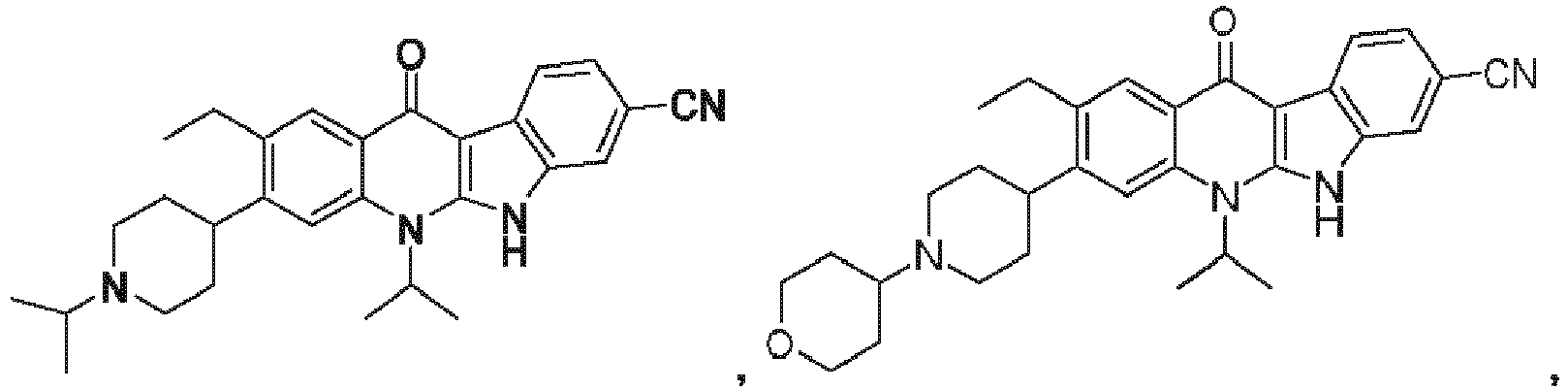
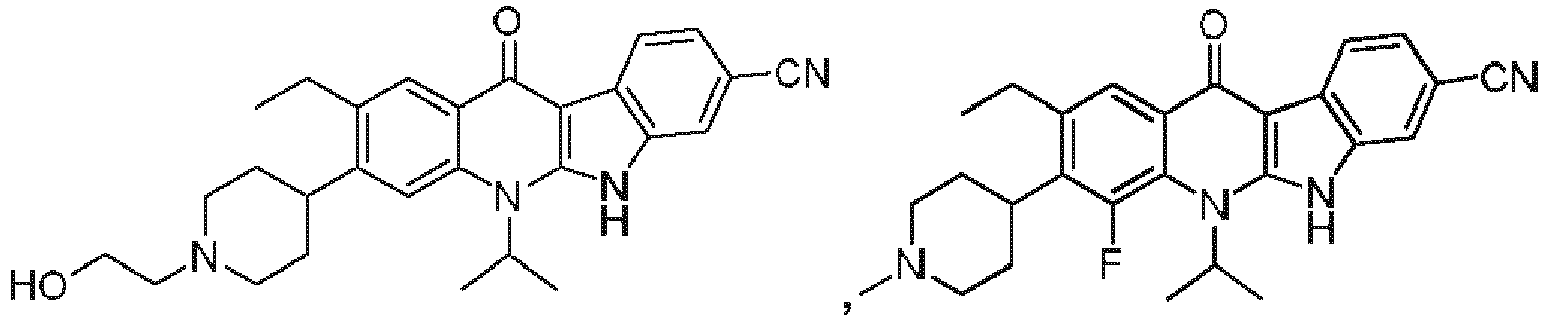


- Also disclosed herein is a compound for use in a method of treating a disease, such as cancer, which is responsive to inhibition of ALK, comprising administering to a subject, such as a mammal or human, in need of treating for the disease, such as cancer, an effective amount of at least one compound of formula (I) (such as formulae (II), (III), (IV) and (V)), and/or at least onepharmaceutically acceptable salt thereof.
- Also disclosed herein is a pharmaceutical composition, comprising at least one compound of formula (I) (such as formulae (II), (III), (IV) and (V)) and/or at least one pharmaceutically acceptable salt thereof, and at least one pharmaceutically acceptable carrier.
- The pharmaceutical composition comprising at least one compound of formula (I) (such as formulae (II), (III), (IV) and (V)) and/or at least one pharmaceutically acceptable salt thereof, and at least one pharmaceutically acceptable carrier, can be administered in various known manners, such as orally, topically, rectally, parenterally, by inhalation spray, or via an implanted reservoir, although the most suitable route in any given case will depend on the particular host, and nature and severity of the conditions for which the active ingredient is being administered. The term "parenteral" as used herein includes subcutaneous, intracutaneous, intravenous, intramuscular, intraarticular, intraarterial, intrasynovial, intrasternal, intrathecal, intralesional and intracranial injection or infusion techniques. The compositions disclosed herein may be conveniently presented in unit dosage form and prepared by any of the methods well known in the art.
- The at least one compound of formula (I) (such as formulae (II), (III), (IV) and (V)) and/or at least one pharmaceutically acceptable salt thereof can be administered orally in solid dosage forms, such as capsules, tablets, troches, dragées, granules and powders, or in liquid dosage forms, such as elixirs, syrups, emulsions, dispersions, and suspensions. The at least one compound of formula (I) (such as formulae (II), (III), (IV) and (V)) and/or at least one pharmaceutically acceptable salt thereof can also be administered parenterally, in sterile liquid dosage forms, such as dispersions, suspensions or solutions. Other dosages forms that can also be used to administer the at least one compound of formula (I) (such as formulae (II), (III), (IV) and (V)) and/or at least one pharmaceutically acceptable salt thereof include ointment, cream, drops, transdermal patch or powder for topical administration, an ophthalmic solution or suspension formation, i.e., eye drops, for ocular administration, an aerosol spray or powder composition for inhalation or intranasal administration, or a cream, ointment, spray or suppository for rectal or vaginal administration.
- Gelatin capsules containing the at least one compound of formula (I) (such as formulae (II), (III), (IV) and (V)) and/or at least one pharmaceutically acceptable salt thereof and powdered carriers, such as lactose, starch, cellulose derivatives, phosphate sodium, magnesium stearate, stearic acid, sodium stearyl fumarate and the like, can also be used. Similar diluents can be used to make compressed tablets. Both tablets and capsules can be manufactured as sustained release products to provide for continuous release of medication over a period of time. Compressed tablets can be sugar coated or film coated to mask any unpleasant taste and protect the tablet from the atmosphere, or enteric coated for selective disintegration in the gastrointestinal tract.
- Liquid dosage forms for oral administration can further comprise at least one agent selected from coloring and flavoring agents to increase patient acceptance.
- In general, water, suitable oil, saline, aqueous dextrose (glucose), and related sugar solutions and glycols such as propylene glycol or polyethylene gycols, and solubilizing agents such as cyclodextrins and polysorbate 80, can be examples of suitable carriers for parenteral solutions. Solutions for parenteral administration may comprise a water soluble salt of the at least one compound disclosed herein, at least one suitable stabilizing agent, and if necessary, at least one buffer substance. Antioxidizing agents such as sodium bisulfite, sodium sulfite, or ascorbic acid, either alone or combined, can be examples of suitable stabilizing agents. Citric acid and its salts and sodium EDTA can also be used as examples of suitable stabilizing agents. In addition, parenteral solutions can further comprise at least one preservative, selected, for example, from benzalkonium chloride, methyl- and propylparaben, and chlorobutanol.
- A pharmaceutically acceptable carrier is, for example, selected from carriers that are compatible with active ingredients of the pharmaceutical composition (and in some embodiments, capable of stabilizing the active ingredients) and not deleterious to the subject to be treated. For example, solubilizing agents, such as cyclodextrins (which can form specific, more soluble complexes with the at least one compound and/or at least one pharmaceutically acceptable salt disclosed herein), can be utilized as pharmaceutical excipients for delivery of the active ingredients. Examples of other carriers include colloidal silicon dioxide, magnesium stearate, cellulose, sodium lauryl sulfate, and pigments such as D&C Yellow # 10. Suitable pharmaceutically acceptable carriers are disclosed in Remington's Pharmaceutical Sciences, A. Osol, a standard reference text in the art.
- The at least one compound of formula (I) (such as formulae (II), (III), (IV) and (V)) and/or at least one pharmaceutically acceptable salt thereof can further be examined for efficacy in treating cancer by in vivo assays. For example, the at least one compound and/or the at least one pharmaceutically acceptable salt thereof can be administered to an animal (e.g., a mouse model) having cancer and its therapeutic effects can be accessed. Positive results in one or more of such tests are sufficient to increase the scientific storehouse of knowledge and hence sufficient to demonstrate practical utility of the compounds and/or salts tested. Based on the results, an appropriate dosage range and administration route for animals, such as humans, can also be determined.
- For administration by inhalation, the at least one compound of formula (I) (such as formulae (II), (III), (IV) and (V)) and/or at least one pharmaceutically acceptable salt thereof may be conveniently delivered in the form of an aerosol spray presentation from pressurized packs or nebulisers. The at least one compound of formula (I) (such as formulae (II), (III), (IV) and (V)) and/or at least one pharmaceutically acceptable salt thereof may also be delivered as powders, which may be formulated and the powder composition may be inhaled with the aid of an insufflation powder inhaler device. One exemplary delivery system for inhalation can be a metered dose inhalation (MDI) aerosol, which may be formulated as a suspension or solution of at least one compound of formula (I) (such as formulae (II), (III), (IV) and (V)) and/or at least one pharmaceutically acceptable salt thereof in at least one suitable propellant, selected, for example, from fluorocarbons and hydrocarbons.
- For ocular administration, an ophthalmic preparation may be formulated with an appropriate weight percentage of a solution or suspension or gel of the at least one compound of formula (I) (such as formulae (II), (III), (IV) and (V)) and/or at least one pharmaceutically acceptable salt in an appropriate ophthalmic vehicle, such that the at least one compound of formula (I) (such as formulae (II), (III), (IV) and (V)) and/or at least one pharmaceutically acceptable salt is maintained in contact with the ocular surface for a sufficient time period to allow the compound to penetrate the corneal and internal regions of the eye.
- Useful pharmaceutical dosage-forms for administration of the at least one compound of formula (I) (such as formulae (II), (III), (IV) and (V)) and/or at least one pharmaceutically acceptable salt thereof include, but are not limited to, hard and soft capsules, such as HPMC capsules, tablets, parenteral injectables, and oral suspensions.
- The dosage administered will be dependent on factors, such as the age, health and weight of the recipient, the extent of disease, type of concurrent treatment, if any, frequency of treatment, and the nature of the effect desired. In general, a daily dosage of the active ingredient can vary, for example, from 0.1 to 2000 milligrams per day. For example, 10- 500 milligrams once or multiple times per day may be effective to obtain the desired results.
- In some embodiments, the at least one compound of formula (I) (such as formulae (II), (III), (IV) and (V)) and/or at least one pharmaceutically acceptable salt can be present in an amount of 1, 5, 10, 15, 25, 50, 75, 100, 125, 150, 200, 250, 300, 400 and 500 mg in a capsule.
- In some embodiments, a large number of unit capsules can be prepared by filling standard two-piece hard gelatin capsules each with, for example, 100 milligrams of the at least one compound of formula (I) (such as formulae (II), (III), (IV) and (V)) and/or at least one pharmaceutically acceptable salt thereof in powder, 150 milligrams of lactose, 50 milligrams of cellulose, and 6 milligrams magnesium stearate.
- In some embodiments, a mixture of the at least one compound of formula (I) (such as formulae (II), (III), (IV) and (V)) and/or at least one pharmaceutically acceptable salt thereof and a digestible oil such as soybean oil, cottonseed oil or olive oil can be prepared and injected by means of a positive displacement pump into liquid- filled hard capsules containing 5, 10, 20 or 50milligrams of the active ingredient.
- In some embodiments, the at least one compound of formula (I) (such as formulae (II), (III), (IV) and (V)) and/or at least one pharmaceutically acceptable salt can be present in an amount of 1, 5, 10, 15, 25, 50, 75, 100, 125, 150, 200, 250, 300, 400 and 500 mg in a tablet.
- In some embodiments, a large number of tablets can be prepared by conventional procedures so that the dosage unit comprises, for example, 100 milligrams of the at least one compound of formula (I) (such as formulae (II), (III), (IV) and (V)) and/or at least one pharmaceutically acceptable salt thereof, 0.2 milligrams of colloidal silicon dioxide, 5 milligrams of magnesium stearate, 275 milligrams of microcrystalline cellulose, 11 milligrams of starch, 10milligrams of crospovidone, and 98.8 milligrams of lactose. Appropriate coatings may, for example, be applied to increase palatability or delay absorption.
- In some embodiments, a parenteral composition suitable for administration by injection can be prepared by stirring 0.5% by weight of the at least one compound of formula (I) (such as formulae (II), (III), (IV) and (V)) and/or at least one pharmaceutically acceptable salt thereof in 20% by volume propylene glycol (PEG), such as PEG 400. The solution is made to the expected volume with water for injection and sterilized.
- In some embodiment, an aqueous suspension can be prepared for oral administration. For example, each 5 milliliters of an aqueous suspension comprising 100 milligrams of finely divided at least one compound of formula (I) (such as formulae (II), (III), (IV) and (V)) and/or at least one pharmaceutically acceptable salt thereof, 100 milligrams of sodium carboxymethyl cellulose, 5 milligrams of sodium benzoate, 1.0 grams of sorbitol solution, U.S.P., and 0.025 milliliters of vanillin can be used.
- The same dosage forms can generally be used when the at least one compound of formula (I) (such as formulae (II), (III), (IV) and (V)) and/or at least one pharmaceutically acceptable salt thereof are administered stepwise or in conjunction with at least one other therapeutic agent. When drugs are administered in physical combination, the dosage form and administration route should be selected depending on the compatibility of the combined drugs. Thus, the term "coadministration" is understood to include the administration of at least two agents concomitantly or sequentially, or alternatively as a fixed dose combination of the at least two active components.
- The at least one compound of formula (I) (such as formulae (II), (III), (IV) and (V)) and/or at least one pharmaceutically acceptable salt thereof can be administered as the sole active ingredient or in combination with at least one second active ingredient, selected, for example, from other active ingredients known to be useful for treating the target cancers in a patient.
- The compounds of the invention can be prepared using the general synthetic routes shown below in Scheme 1, Scheme 2, and Scheme 3 and described more fully in the examples.
- The at least one compound of formula (I) can be prepared by following Scheme 1 as illustrated below:

- The mixture of methyl ester substituted indole (1.0 equiv.) and DABCO (0.55 equiv.) in CH2Cl2 was cooled in an ice-water bath. To that cooled mixture was added NCS (1.1 equiv.). After the mixture was stirred under ice-water bath for 2 hours, N-substituted aniline (1.1 equiv.) and Trichloroacetic acid (0.25 equiv.) in CH2Cl2 were added. The ice-water bath was removed, and the reaction temperature was allowed to warm up to room temperature. After the reaction mixture was stirred for 2 to 3 hours at room temperature, CH2Cl2 (50 ml), water (50 ml), saturated aqueous NaHCO3 (50 ml), and brine (50 ml) were added to the reaction mixture. CH2Cl2 layer was separated and concentrated in vacuo. The residue was purified on silica gel column to afford A as an oil or foam. The yield ranged from 50% to 80%.
- The suspension of A in Ph2O was stirred vigorously and refluxed at approximately 280 °C for 1 to 3 hours until the reaction was complete. The reaction mixture was cooled down to room temperature, after which the reaction mixture was filtered. Hexane was used to wash the solid on the filter to remove Ph2O. Compound B was obtained as grey or brown colored powder. The yield ranged from 20% to 50%.
- One of ordinary skill in the art can recognize that the desired substituents for variables R1-R9 can be obtained through transformations before, after, or simultaneously when the cyclization in Ph2O occurs. For example, when R7 is, for example, fluoro, the replacement of fluoro with a nucleophile (such as optionally substituted piperazine or piperidine) can be accomplished after cyclization, as illustrated below:

- The mixture of compound B' (60 mg), DIPEA (0.5 ml), 1-Methylpiperazine (0.5 ml) and DMSO (2 ml) was heated to 120 to 140 °C. After stirred at 120-140 °C for 2-7 days, the mixture was filtered and the filtrate was purified by preparative HPLC. The collected portions were dried on lyophilizer to afford compound C as a powder. The yield ranged from 10% to 50%.
- The following schemes further exemplified the preparation of indoloquinolone compounds of formula (I) (such as formulae (II), (III), (IV), or (V)):


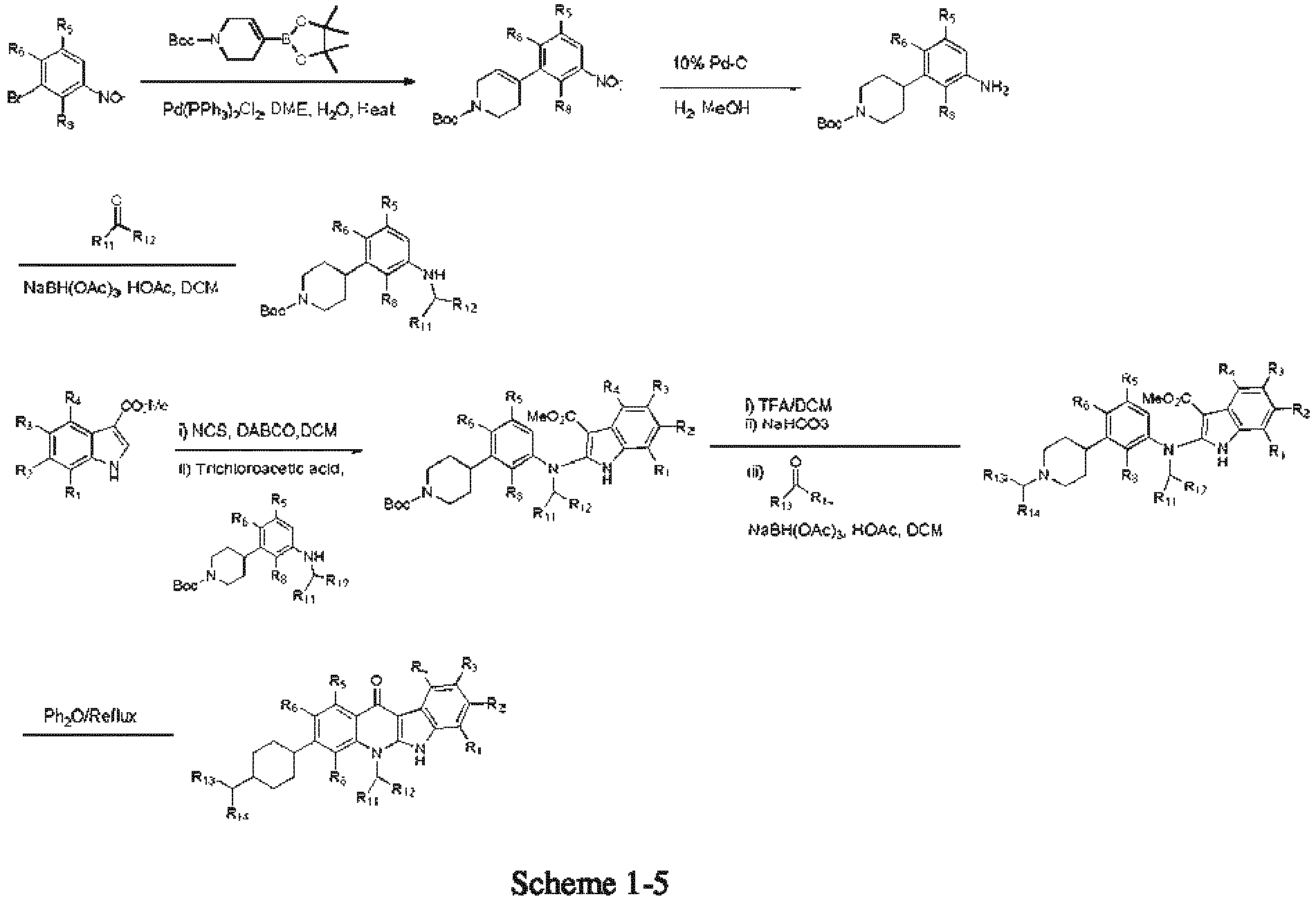
- The following scheme illustrates another general synthetic route to prepare N-substituted anilines, which involves Schiff base formation and subsequent reduction:

- To a mixture of substituted aniline (1.0 equiv.) and ketone or aldehyde (1.5 to 10 equiv.) in 1,2-dichloroethane (6 ml for 1 mmol aniline) was added NaHB(OAc)3 (1.5 equiv.) while stirring. After stirred at room temperature overnight, the reaction was quenched with water (100 ml for 1 mol aniline). The aqueous solution was extracted with CH2Cl2 (3 x 150 ml). The combined CH2Cl2layer was dried over Na2SO4. The filtrate after filtration was concentrated in vacuo. The resulting residue was purified on silica gel column to afford the desired substituted aniline with yield from 50% to 90%.
- In some embodiments, R7 can be fluoro. In some embodiments, R5 and R8 are hydrogen. In some embodiments, the ketone can be cyclic ketone.
- Modification of the above Scheme can be used to synthesize numerous compounds of the invention as will be apparent to those skilled in the art.
- The invention is further described by reference to the following examples, which are intended to exemplify the claimed invention but not to limit it in any way.
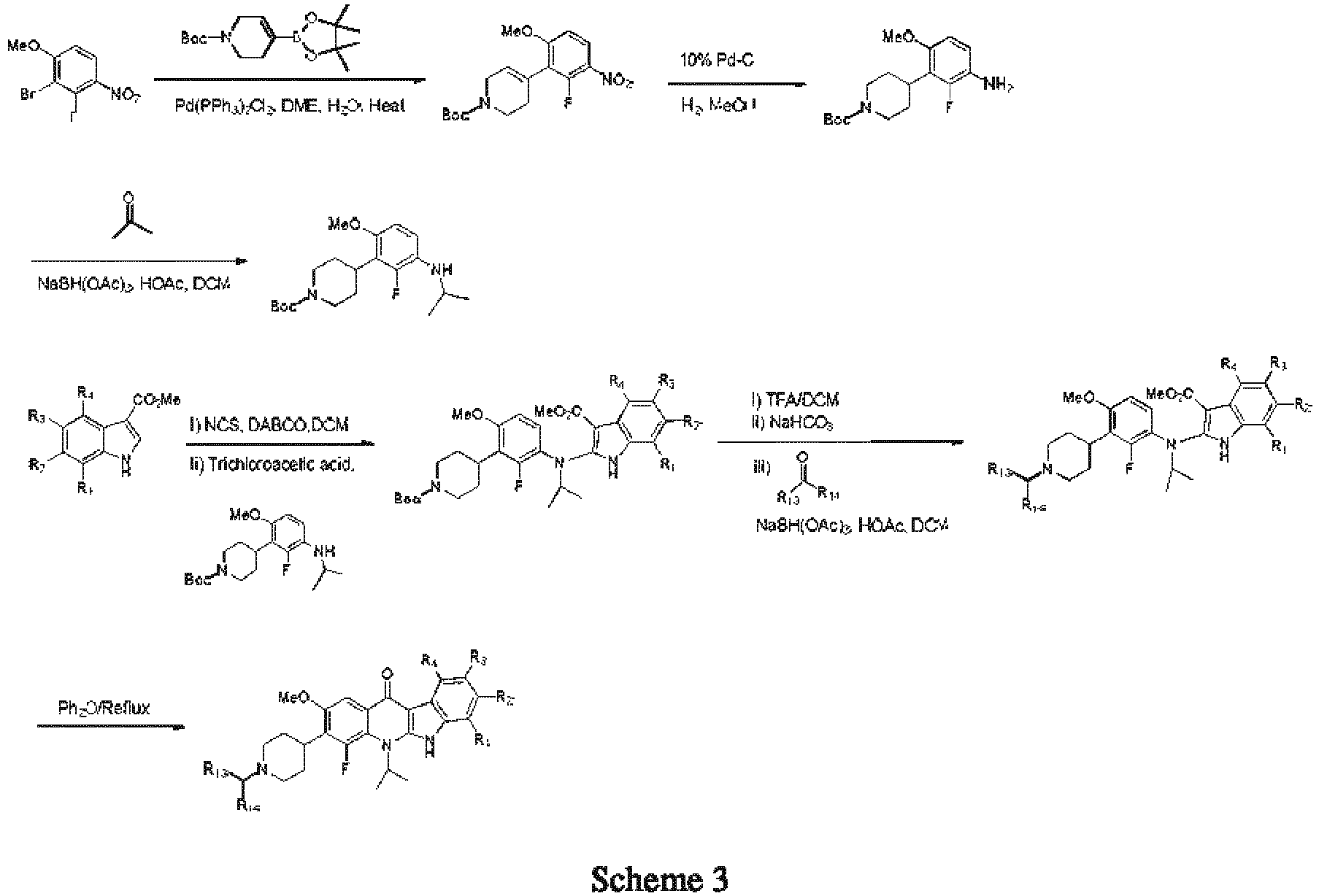
- The examples below are intended to be purely exemplary and should not be considered to be limiting in any way. Efforts have been made to ensure accuracy with respect to numbers used (for example, amounts, temperature, etc.), but some experimental errors and deviations should be accounted for. Unless indicated otherwise, temperature is in degrees Centigrade. Reagents were purchased from commercial suppliers such as Sigma-Aldrich, Alfa Aesar, or TCI, and were used without further purification unless otherwise indicated.
- Unless otherwise indicated, the reactions set forth below were performed under a positive pressure of nitrogen or argon or with a drying tube in anhydrous solvents; the reaction flasks were fitted with rubber septa for the introduction of substrates and reagents via syringe; and glassware was oven dried and/or heat dried.
- Unless otherwise indicated, column chromatography purification was conducted on a Biotage system (Manufacturer: Dyax Corporation) having a silica gel column or on a silica SepPak cartridge (Waters), or was conducted on a Teledyne IscoCombiflash purification system using self-packed or prepacked silica gel cartridges.
- 1H NMR spectra were recorded on a Varian instrument operating at 400 MHz. 1H-NMR spectra were obtained using CDCl3, CD2Cl2, CD3OD, D2O, d6-DMSO, d6-acetone or (CD3)2CO as solvent and tetramethylsilane (0.00 ppm) or residual solvent (CDCl3: 7.25 ppm; CD3OD: 3.31 ppm; D2O: 4.79 ppm; d6-DMSO: 2.50 ppm; d6-acetone: 2.05; (CD3)2CO: 2.05) as the reference standard. When peak multiplicities are reported, the following abbreviations are used: s (singlet), d (doublet), t (triplet), q (quartet), qn (quintuplet), sx (sextuplet), m (multiplet), br (broadened), dd (doublet of doublets), dt (doublet of triplets). Coupling constants, when given, are reported in Hertz (Hz). All compound names except the reagents were generated by ChemDraw.
- In the following examples, the abbreviations below are used:
- DMSO
- Dimethyl sulfoxide
- DIPEA
- Diisopropylethylamine
- DCM
- Dichloromethane
- MeOH
- Methanol
- Hexn-
- Hexane
- EA
- Ethyl acetate
- THF
- Tetrahydrogenfuran
- EtOAc
- Ethyl acetate
- DABCO
- 1,4-Diazo[2.2.2]bicyclooctane
- DME
- Dimethoxyethane
- TFA
- Trifluoroacetic acid
-

-

- Step A: Methyl 6-cyano-2-((3-fluorophenyl)(methyl)amino)-1H-indole-3-carboxylate.DABCO (62 mg, 0.55 mmol) was added to a solution of Methyl 6-cyano-1H-indole-3-carboxylate (200 mg, 1 mmol) in DCM (20 mL) and the mixture was cooled to 0 °C. N-Chlorosuccinimide (147 mg, 1.1 mmol) was then added and the reaction was stirred at 0 °C for 2 hr. A solution of 3-Fluoro-N-methylaniline (125 mg, 1 mmol) and Trichloroacetic acid (41 mg, 0.25 mmol) in DCM (5 mL) was added dropwise and the reaction was stirred for 2 hr at room temperature. The reaction was quenched by adding water and the mixture was extracted with DCM. Solvent was removed under vacuum and the residue was purified by silica gel chromatography (Hex:EA=4:1) to afford Methyl 6-cyano-2-((3-fluorophenyl)(methyl)amino)-1H-indole-3-carboxylate (220 mg, 68% yield). 1H NMR (400 MHz, CDCl3) δ ppm 8.26 (s, 1H), 8.03 (d, J = 8.6 Hz, 1H), 7.46 (d, J = 1.8 Hz, 1H), 7.39 (dd, J = 8.6,1.8 Hz, 1H), 7.21-7.18 (m, 1H), 6.66-6.49 (m, 3H), 3.85 (s, 3H), 3.43 (s, 3H).

- Step B: 3-Fluoro-5-methyl-11-oxo-6,11-dihydro-5H-indolo[2,3-b]quinoline-8-carbonitrile. Methyl 6-cyano-2-((3-fluorophenyl)(methyl)amino)-1H-indole-3-carboxylate (220 mg, 0.68 mmol) was dissolved in Diphenyl ether (10 mL) and the solution was refluxed for 1 hr. The mixture was cooled to RT. Hexane (20 mL) was added and the precipitate was collected by filtration. The precipitate was purified by silica gel chromatography (Hex:EA=2:1) to afford 3-Fluoro-5-methyl-11-oxo-6,11-dihydro-5H-indolo[2,3-b]quinoline-8-carbonitrile (178 mg, 90% yield).MS m/z = 292 [M+H].

- Step C:5-Methyl-3-(4-morpholinopiperidin-1-yl)-11-oxo-6,11-dihydro-5H-indolo[2,3-b]quinoline-8-carbonitrile. 4-Morpholinopiperidine (262 mg, 1.56 mmol) and DIPEA (0.5 ml) were added to a solution of 3-Fluoro-5-methyl-11-oxo-6,11-dihydro-5H-indolo[2,3-b]quinoline-8-carbonitrile (150 mg, 0.52 mmol) in DMSO (2 ml) and the mixture was heated to 120 to 140 °C for 3 days. The reaction mixture was cooled to RT and purified by preparative HPLC to afford 5-Methyl-3-(4-morpholinopiperidin-1-yl)-11-oxo-6,11-dihydro-5H-indolo[2,3-b]quinoline-8-carbonitrile (70 mg, 31% yield). 1H NMR (300 MHz, CD3OD) δ ppm 8.30 (d, J=7.0 Hz, 1H), 8.28 (d, J=8.0 Hz, 1H), 7.58 (s, 1H), 7.52 (d, J=8.0 Hz, 1H), 7.12 (d, J=7.0 Hz,1H), 6.84 (s, 1H), 4.37-4.10 (m, 4H), 4.00-3.72 (m, 2H), 3.89 (s, 3H), 3.70-3.20 (m, 5H), 3.18-3.00 (m, 2H), 2.40-2.26 (m, 2H), 1.97-1.86 (m, 2H).
-

-

- Step A: 3-Fluoro-N-isopropylaniline. Acetone (11.6 g, 200 mmol), Acetic acid (1.8 g, 30 mmol), and Sodium triacetoxyborohydride (6.36 g, 30 mmol) were added to a solution of 3-Fluoroaniline (2.22 g, 20 mmol) in DCM (120 mL) and the mixture was stirred at RT for 12 hr. Water was added to quench the reaction and the mixture was extracted with DCM. The solvent was removed under and the residue was purified by silica gel chromatography to afford 3-Fluoro-N-isopropylaniline (2.6 g, 85% yield). 1H NMR (400 MHz, CDCl3) δ ppm 7.15-7.08(m, 1H), 6.45 - 6.27 (m, 3H), 3.65-3.60 (m, 2H), 1.25 (d, J = 6.2 Hz, 6H).

- Step B: Methyl 6-cyano-2-((3-fluorophenyl)(Isopropyl)amino)-1H-indole-3-carboxylate. DABCO (62 mg, 0.55 mmol) was added to a solution of Methyl 6-cyano-1H-indole-3-carboxylate (200 mg, 1 mmol) in DCM (20 mL) and the mixture was cooled to 0 °C. N-Chlorosuccinimide (147 mg, 1.1 mmol) was then added and the reaction was stirred at 0 °C for 2 hr. A solution of 3-Fluoro-N-isopropylaniline (153 mg, 1 mmol) and Trichloroacetic acid (41 mg, 0.25 mmol) in DCM (5 mL) was added dropwise and the reaction was stirred for 2 hr at room temperature. The reaction was quenched by adding water and the mixture was extracted with DCM. Solvent was removed under vacuum and the residue was purified by silica gel chromatography (Hex:EA=4:1) to afford Methyl 6-cyano-2-((3-fluorophenyl)(isopropyl)amino)-1H-indole-3-carboxylate (265 mg, 75% yield). 1H NMR (400 MHz, CDCl3) δ ppm 8.39 (s, 1H), 8.23 (d, J = 8.4 Hz, 1H), 7.64 - 7.59 (m, 1H), 7.50 (dd, J = 8.4, 1.5 Hz, 1H), 7.24-7.22 (m, 1H), 6.74-6.64 (m, 1H), 6.60-6.56 (m, 2H), 4.56-4.49 (m, 1H), 3.81 (s, 3H), 1.32 (d, J= 6.6Hz, 6H).

- Step C: 3-Fluoro-5-isopropyl-11-oxo-6,11-dihydro-5H-indolo[2,3-b]quinoline-8-carbonitrile. Methyl 6-cyano-2-((3-fluorophenyl)(isopropyl)amino)-1H-indole-3-carboxylate(265 mg, 0.75 mmol) was dissolved in Diphenyl ether (10 mL) and the solution was refluxed for 1 hr. The mixture was cooled to RT. Hexane (20 mL) was added and the precipitate was collected by filtration. The precipitate was purified by silica gel chromatography (Hex:EA=2:1) to afford 3-Fluoro-5-isopropyl-11-oxo-6,11-dihydro-5H-indolo[2,3-b]quinoline-8-carbonitrile (190 mg, 79% yield). 1H NMR (400 MHz, DMSO-d6) δ ppm 12.24 (s, 1H), 8.45 (dd, J = 8.8,7.1 Hz, 1H), 8.32 (dd, J = 7.9,2.7 Hz, 1H), 8.05-7.84 (m, 2H), 7.66-7.64 (m, 1H), 7.34 - 7.25 (m, 1H), 5.35-5.32 (m, 1H), 1.75 (d, J = 7.1 Hz, 6H).

- StepD: 5-isoPropyl-3-(4-morpholinopiperidin-1-yl)-11-oxo-6,11-dihydro-5H-indolo[2,3-b]quinoline-8-carbonitrile. 4-Morpholinopiperidine (262 mg, 1.56 mmol) and DIPEA (0.5 ml) were added to a solution of 3-Fluoro-5-isopropyl-11-oxo-6,11-dihydro-5H-indolo[2,3-b]quinoline-8-carbonitrile (190 mg, 0.59 mmol) in DMSO (2 ml) and the mixture was heated to 120 to 140 °C for 3 days. The reaction mixture was cooled to RT and purified by preparative HPLC to afford 5-isoPropyl-3-(4-morpholinopiperidin-1-yl)-11-oxo-6,11-dihydro-5H-indolo[2,3-b]quinoline-8-carbonitrile (75 mg, 27% yield).1H NMR (300 MHz, CD3OD) δ ppm 8.39 (d, J=8.0 Hz, 1H), 8.38 (d, J=8.9 Hz, 1H), 7.82 (s, 1H), 7.56 (dd, J=8.0, 1.3 Hz, 1H), 7.30-7.15 (m, 2H), 5.45-5.32 (m, 1H), 4.38-4.10 (m, 4H), 3.90-3.72 (m, 2H), 3.70-3.20 (m, 5H), 3.18-3.00 (m, 2H), 2.40-2.30 (m, 2H), 1.97-1.80 (m, 2H), 1.87 (d, J=7.1 Hz, 6H).
-

- 5-isoPropyl-3-(4-methylpiperazin-1-yl)-11-oxo-6,11-dihydro-5H-indolo[2,3-b]quinoline-8-carbonitrile.1-Methylpiperazine (0.5 mL)and DIPEA (0.5 ml) were added to a solution of 3-Fluoro-5-isopropyl-11-oxo-6,11-dihydro-5H-indolo[2,3-b]quinoline-8-carbonitrile (190 mg, 0.59 mmol) in DMSO (2 ml) and the mixture was heated to 120 to 140 °C for 3 days. The reaction mixture was cooled to RT and purified by preparative HPLC to afford 5-isoPropyl-3-(4-methylpiperazin-1-yl)-11-oxo-6,11-dihydro-5H-indolo[2,3-b]quinoline-8-carbonitrile (48 mg, 20% yield).1H NMR (300 MHz, CD3OD) δ ppm 8.42 (d, J=8.1 Hz, 1H), 8.39 (d, J=9.2 Hz, 1H), 7.81 (d, J=1.3 Hz, 1H), 7.55 (dd, J=8.1, 1.3 Hz, 1H), 7.28 (d, J=1.8 Hz, 1H), 7.21 (dd, J=9.2, 1.8 Hz, 1H), 5.50-5.30 (m, 1H), 4.36-4.10 (m, 2H), 3.80-3.60 (m, 2H), 3.55-3.20 (m, 4H), 3.04 (s, 3H), 1.87 (d, J=7.1 Hz, 6H).
-

-

- Step A: Methyl 6-cyano-2-((3-fluoro-4-methoxyphenyl)(methyl)amino)-1H-indole-3-carboxylate. DABCO (62 mg, 0.55 mmol) was added to a solution of Methyl 6-cyano-1H-indole-3-carboxylate (200 mg, 1 mmol) in DCM (20 mL) and the mixture was cooled to 0 °C. N-Chlorosuccinimide (147 mg, 1.1 mmol) was then added and the reaction was stirred at 0 °C for 2 hr. A solution of 3-Fluoro-4-methoxy-N-methylaniline (155 mg, 1 mmol) and Trichloroacetic acid (41 mg, 0.25 mmol) in DCM (5 mL) was added dropwise and the reaction was stirred for 2 hr at room temperature. The reaction was quenched by adding water and the mixture was extracted with DCM. Solvent was removed under vacuum and the residue was purified by silica gel chromatography (Hex:EA=4:1) to afford Methyl 6-cyano-2-((3-fluoro-4-methoxyphenyl)(methyl)amino)-1H-indole-3-carboxylate (220 mg, 62% yield).1H NMR (400 MHz, CDCl3) δ ppm 8.14 (s, 1H), 7.85 (d, J = 8.1 Hz, 1H), 7.44 (dd, J = 8.1, 1.4 Hz, 1H), 7.40 (d, J = 1.4 Hz, 1H), 7.17-7.06 (m, 3H), 3.98 (s, 3H), 3.96 (s, 3H), 1.57 (s, 3H).

- Step B: 3-Fluoro-2-methoxy-5-methy)-11-oxo-6,11-dihydro-5H-indolo[2,3-b]quinoline-8-carbonitrile. Methyl 6-cyano-2-((3 -fluoro-4-methoxyphenyl)(methyl)amino)-1H-indole-3-carboxylate (220 mg, 0.62 mmol) was dissolved in Diphenyl ether (10 mL) and the solution was refluxed for 1 hr. The mixture was cooled to RT. Hexane (20 mL) was added and the precipitate was collected by filtration. The precipitate was purified by silica gel chromatography (Hex:EA=2:1) to afford 3-Fluoro-2-methoxy-5-methyl-11-oxo-6,11-dihydro-5H-indolo[2,3-b]quinoline-8-carbonitrile (140 mg, 70% yield).MS m/z: 322 [M+H].

- Step C: 2-Methoxy-5-methyl-3-(4-morpholinopiperidin-1-yl)-11-oxo-6,11-dihydro-5H-indolo[2,3-b]quinoline-8-carbonitrile.4-Morpholinopiperidine (262 mg, 1.56 mmol) and DIPEA (0.5 ml) were added to a solution of 3-Fluoro-2-methoxy-5-methyl-11-oxo-6,11-dihydro-5H-indolo[2,3-b]quinoline-8-carbonitrile (140 mg, 0.44 mmol) in DMSO (2 ml) and the mixture was heated to 120 to 140 °C for 3 days. The reaction mixture was cooled to RT and purified by preparative HPLC to afford 2-Methoxy-5-methyl-3-(4-morpholinopiperidin-1-yl)-11-oxo-6,11-dihydro-5H-indolo[2,3-b]quinoline-8-carbonitrile (55 mg, 27% yield),1H NMR (300 MHz, CD3OD) δ ppm 8.28 (d, J=8.4 Hz, 1H), 7.81 (s, 1H), 7.52 (s, 1H), 7.48 (d, J=8.4 Hz, 1H), 6.94 (s, 1H), 4.27-3.70 (m, 6H), 4.05 (s, 3H), 3.89 (s, 3H), 3.66-323 (m, 5H), 2.92-2.80 (m, 2H), 2.40-2.30 (m, 2H), 2.20-2.00 (m, 2H).
-

- 2-Methoxy-5-methyl-3-(4-methylpiperazin-1-yl)-11-oxo-6,11-dihydro-5H-indolo[2,3-b]quinoline-8-carbonitrile.1-Methylpiperazine (0.5 mL)and DIPEA (0.5 ml) were added to a solution of 3-Fluoro-2-methoxy-5-methyl-11-oxo-6,11-dihydro-5H-indolo [2,3-b]quinoline-8-carbonitrile (140 mg, 0.44 mmol) in DMSO (2 ml) and the mixture was heated to 120 to 140 °C for 3 days. The reaction mixture was cooled to RT and purified by preparative HPLC to afford 2-Methoxy-5-methyl-3-(4-methylpiperazin-1-yl)-11-oxo-6,11-dihydro-5H-indolo[2,3-b]quinoline-8-carbonitrile (58 mg, 33% yield).1H NMR (300 MHz, CD3OD) δ ppm 8.24 (d, J=8.3 Hz, 1H), 7.82 (s, 1H), 7.50-7.40 (m, 2H), 6.96 (s, 1H), 4.05 (s, 3H), 4.03-3.90 (m, 2H), 3.89 (s, 3H), 3.80-3.65 (m, 2H), 3.55-3.40 (m, 2H), 3.26-3.14 (m, 2H), 3.05 (s, 3H).
-

-

- Step A: 3-Fluoro-N-isopropyl-4-methoxyaniline. Acetone (11.6 g, 200 mmol), Acetic acid (1.8 g, 30 mmol), and Sodium triacetoxyborohydride (6.36 g, 30 mmol) were added to a solution of 3-Fluoro-4-methoxyaniline (2.82 g, 20 mmol) in DCM (120 mL) and the mixture was stirred at RT for 12 hr. Water was added to quench the reaction and the mixture was extracted with DCM. The solvent was removed under and the residue was purified by silica gel chromatography to afford 3-Fluoro-N-isopropyl-4-memoxyaniline (2.90 g, 79% yield). 1H NMR (400 MHz, CDCl3) δ ppm 6.84 (dd, J = 9.5, 8.7 Hz, 1H), 6.41 (dd, J = 13.5,2.7 Hz, 1H), 6.33-6.27(m, 1H), 3.83 (s, 3H), 3.54-3.52(m, 1H), 3.28 (s, 1H), 1.21 (d, J = 63 Hz, 6H).

- Step B: Methyl 6-cyano-2-((3-fluoro-4-methoxyphenyl)(isopropyl)amino)-1H-indole-3-carboxylate. DABCO (62 mg, 0.55 mmol) was added to a solution of Methyl 6-cyano-1H-indole-3-carboxylate (200 mg, 1 mmol) in DCM (20 mL) and the mixture was cooled to 0 °C. N-Chlorosuccinimide (147 mg, 1.1 mmol) was then added and the reaction was stirred at 0 °C for 2 hr. A solution of 3-Fluoro-N-isopropyl-4-methoxyaniline (183 mg, 1 mmol) and Trichloroacetic acid (41 mg, 0.25 mmol) in DCM (5 mL) was added dropwise and the reaction was stirred for 2 hr at room temperature. The reaction was quenched by adding water and the mixture was extracted with DCM. Solvent was removed under vacuum and the residue was purified by silica gel chromatography (Hex:EA=4:1) to afford Methyl 6-cyano-2-((3-fluoro-4-methoxyphenyl)(isopropyl)amino)-1H-indole-3-carboxylate (250 mg, 66% yield). 1H NMR (400 MHz, CDCl3) δ ppm 8.08-8.06 (m, 2H), 7.45 - 7.36 (m, 2H), 7.05 - 6.87 (m, 3H), 4.88 - 4.80 (m, 1H), 3.92 (s, 3H), 3.88 (s, 3H), 1.26(d, J=6.6Hz, 6H).

- Step C: 3-Fluoro-5-isopropyl-2-methoxy-11-oxo-6,11-dihydro-5H-indolo[2,3-b]quinoline-8-carbonitrile.Methyl 6-cyano-2-((3-fluoro-4-methoxyphenyl)(isopropyl)amino)-1H-indole-3-carboxylate (250 mg, 0.66 mmol) was dissolved in Diphenyl ether (10 mL) and the solution was refluxed for 1 hr. The mixture was cooled to RT. Hexane (20 mL) was added and the precipitate was collected by filtration. The precipitate was purified by silica gel chromatography (HexEA=2:1) to afford 3-Fluoro-5-isopropyl-2-methoxy-11-oxo-6,11-dihydro-5H-indolo[2,3-b]quinoline-8-carbonitrile (175 mg, 76% yield).1H NMR (400 MHz, DMSO-d6) δ 12.15 (s, 1H), 8.32 (d, J = 8.0 Hz, 1H), 8.04 - 7.94 (m, 2H), 7.90 (d, J = 1.3 Hz, 1H), 7.63 (dd, J = 8.0,1.3 Hz, 1H), 5.35 - 5.27 (m, 1H), 3.98 (s, 3H), 1.73 (d, J = 6.9 Hz, 6H).
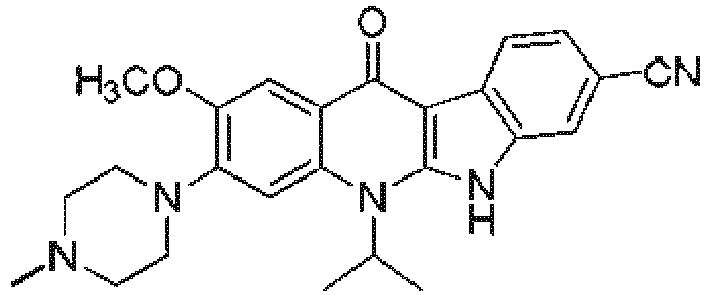
- Step D: 5-isoPropyl-2-methoxy-3-(4-methylpiperazin-1-yl)-11-oxo-6,11-dihydro-5H-indolo[2,3-b]quinoline-8-carbonitrile. 1-Methylpiperazine (0.5 mL) and DIPEA (0.5 ml) were added to a solution of 3-Fluoro-5-isopropyl-2-methoxy-11-oxo-6,11-dihydro-5H-indolo[2,3-b]quinoline-8-carbonitrile (175 mg, 0.50 mmol) in DMSO (2 ml) and the mixture was heated to 120 to 140 °C for 3 days. The reaction mixture was cooled to RT and purified by preparative HPLC to afford 5-isoPropyl-2-methoxy-3-(4-methylpiperazin-1-yl)-11-oxo-6,11-dihydro-5H-indolo[2,3-b]quinoline-8-carbonitrile (56 mg, 26% yield).1H NMR (300 MHz, CD3OD) δ ppm 8.42 (d, J=8.1 Hz, 1H), 8.00 (s, 1H), 7.82 (s, 1H), 7.57 (d, J=8.1 Hz, 1H), 7.36 (s, 1H), 5.44-5.35 (m, 1H), 4.05 (s, 3H), 4.02-3.92 (m, 2H), 3.70-3.63 (m, 2H), 3.50-3.18 (m, 4H), 3.05 (s, 3H), 1.88 (d, J=7.1 Hz, 6H).
-

- 5-isoPropyl-2-methoxy-3-(4-morpholinopiperidin-1-yl)-11-oxo-6,11-dihydro-5H-indolo[2,3-b]quinoline-8-carbonitrile. 4-Morpholinopiperidine (252 mg, 1.5 mmol) and DIPEA (0.5 ml) were added to a solution of 3-Fluoro-5-isopropyl-2-methoxy-11-oxo-6,11-dihydro-5H-indolo[2,3-b]quinoline-8-carbonitrile (175 mg, 0.50 mmol) in DMSO (2 ml) and the mixture was heated to 120 to 140 °C for 3 days. The reaction mixture was cooled to RT and purified by preparative HPLC to afford 5-isoPropyl-2-methoxy-3-(4-methylpipemin-1-yl)-11-oxo-6,11-dihydro-5H-indolo[2,3-b]quinoline-8-carbonitrile (72 mg, 29% yield].1H NMR (400 MHz, DMSO-d 6) δ ppm 12.18 (s, 1H), 9.87 (s, 1H), 8.31 (d, J = 8.1 Hz, 1H), 7.89 (d, J = 1.4 Hz, 1H), 7.81 (s, 1H), 7.61 (dd, J = 8.1, 1.4 Hz, 1H), 7.21 (s, 1H), 5.35-5.25 (m, 1H), 4.10 - 4.02 (m, 2H), 3.94 (s, 3H), 3.83-3.79(m, 2H), 3.75-3.70(m, 2H), 3.57-3.52(m, 2H), 3.47-3.36 (m, 1H), 3.22-3.18(m, 2H), 2.80-2.75(m, 2H), 2.24-2.23 (m, 2H), 1.86-1.82 (m, 2H), 1.76 (d, J= 6.8 Hz, 6H).
-

-
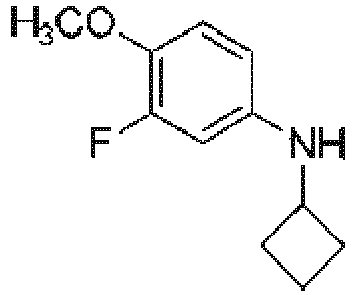
- Step A: N-Cyclobutyl-3-fluoro-4-methoxyniline. Cyclobutanone (14.0 g, 200 mmol), Acetic acid (1.8 g, 30 mmol), and Sodium triacetoxyborohydride (6.36 g, 30 mmol) were added to a solution of 3-Fluoro-4-methoxyaniline (2.82 g, 20 mmol) in DCM (120 mL) and the mixture was stirred at RT for 12 hr. Water was added to quench the reaction and the mixture was extracted with DCM. The solvent was removed under and the residue was purified by silica gel chromatography to afford N-Cyclobutyl-3 -fluoro-4-methoxyaniline (2.4 g, 61% yield). 1H NMR (300 MHz, CDCl3) δ ppm 6.81 (t, J = 9.1 Hz, 1H), 6.40-6.19 (m, 2H), 3.82 (s, 3H), 3.79-3.77 (m, 1H), 3.65 (s, 1H), 2.50-2.30 (m, 2H), 1.80-1.78 (m, 4H).

- Step B: Methyl 6-cyano-2-(cyclobutyl(3-fluoro-4-methoxyphenyl)amino)-1H-indole-3-carboxylate. DABCO (62 mg, 0.55 mmol) was added to a solution of Methyl 6-cyano-1H-indole-3-carboxylate (200 mg, 1 mmol) in DCM (20 mL) and the mixture was cooled to 0 °C. N-Chlorosuccinimide (147 mg, 1.1 mmol) was then added and the reaction was stirred at 0 °C for 2 hr. A solution of N-Cyclobutyl-3-fluoro-4-methoxyaniline (195 mg, 1 mmol) and Trichloroacetic acid (41 mg, 0.25 mmol) in DCM (5 mL) was added dropwise and the reaction was stirred for 2 hr at room temperature. The reaction was quenched by adding water and the mixture was extracted with DCM. Solvent was removed under vacuum and the residue was purified by silica gel chromatography (Hex:EA=4:1) to afford Methyl 6-cyano-2-(cyclobutyl(3-fluoro-4-methoxyphenyl)amino)-1H-indole-3-carboxylate (245 mg, 62% yield).1H NMR (400 MHz, CDCl3) δ ppm 8.62 (s, 1H), 8.17 (d, J = 8.4 Hz, 1H), 7.55 (d, J = 1.5 Hz, 1H), 7.47 (dd, J = 8.4, 1.5 Hz, 1H), 6.89 (t, J = 9.1 Hz, 1H), 6.64 (dd, J = 12.9,2.8 Hz, 1H), 6.60-6.51 (m, 1H), 4.55-4.43 (m, 1H), 3.86 (s, 3H), 3.81 (s, 3H), 2.40-2.28 (m, 2H), 2.00-1.90 (m, 2H), 1.77-1.63 (m, 2H).

- Step C: 5-Cyclobutyl-3-fluoro-2-methoxy-11-oxo-6,11-dibydro-5H-indolo[2,3-b]quinoline-8-carbonitrile. Methyl 6-cyano-2-(cyclobutyl(3-fluoro-4-methoxyphenyl)amino)-1H-indole-3-carboxylate(245 mg, 0.66 mmol) was dissolved in Diphenyl ether (10 mL) and the solution was refluxed for 1 hr. The mixture was cooled to RT. Hexane (20 mL) was added and the precipitate was collected by filtration. The precipitate was purified by silica gel chromatography (Hex:EA=2:1) to afford 5-Cyclobutyl-3-fluoro-2-methoxy-11-oxo-6,11-dihydro-5H-indolo[2,3-b]quinoline-8-carbonitrile (155 mg, 65% yield). MS m/z=362 [M+H].

- Step D: 5-Cyclobutyl-2-methoxy-3-(4-methylpiperazin-1-yl)-11-oxa-6,11-dihydro-5H-indolo[2,3-b]quinoline-8-carbonitrile. 1-Methylpiperazine (0.5 mL) and DIPEA (0.5 ml) were added to a solution of 5-Cyclobutyl-3-fluoro-2-methoxy-11-oxo-6,11-dihydro-5H-indolo[2,3-b]quinoline-8-carbonitrile (155 mg, 0.50 mmol) in DMSO (2 ml) and the mixture was heated to 120 to 140 °C for 3 days. The reaction mixture was cooled to RT and purified by Preparative HPLC to afford 5-Cyclobutyl-2-methoxy-3-(4-methylpiperazin-1-yl)-11-oxo-6,11-dihydro-5H-indolo[2,3-b]quinoline-8-carbonitrile (43 mg, 20% yield).1H NMR (300 MHz, CD3OD) δ ppm 8.39 (d, J = 8.1 Hz, 1H), 7.94 (s, 1H), 7.79 (s, 1H), 7.55 (d, J = 8.1 Hz, 1H), 7.14 (s, 1H), 5.31-5.25 (m, 1H), 4.03 (s, 3H), 3.95-3.91(m, 2H), 3.69-3.65(m, 2H), 3.45-3.37 (m, 2H), 3.19-3.14(m, 2H), 3.07-2.99 (m, 5H), 2.68-2.53 (m, 2H), 2.04-2.02 (m, 2H).
-

-

- Step A: N-Cyclopentyl-3-fluoro-4-methoxyaniline. Cyclopentanone (16.8 g, 200 mmol), Acetic acid (1.8 g, 30 mmol), and Sodium triacetoxyborohydride (6.36 g, 30 mmol) were added to a solution of 3-Fluoro-4-methoxyaniline (2.82 g, 20 mmol) in DCM (120 mL) and the mixture was stirred at RT for 12 hr. Water was added to quench the reaction and the mixture was extracted with DCM. The solvent was removed under and the residue was purified by silica gel chromatography to afford N-Cyclopentyl-3-fluoro-4-methoxyaniline (2.0 g, 48% yield). MS m/z=210 [M+H].

- Step B: Methyl 6-cyano-2-(cyclopentyl(3-fluoro-4-methoxyphenyl)amino)-1H-indole-3-carboxylate.DABCO (62 mg, 0.55 mmol) was added to a solution of Methyl 6-cyano-1H-indole-3-carboxylate (200 mg, 1 mmol) in DCM (20 mL) and the mixture was cooled to 0 °C. N-Chlorosuccinimide (147 mg, 1.1 mmol) was then added and the reaction was stirred at 0 °C for 2 hr. A solution of N-Cyclopentyl-3-fluoro-4-methoxyaniline (209 mg, 1 mmol) and Trichloroacetic acid (41 mg, 0.25 mmol) in DCM (5 mL) was added dropwise and the reaction was stirred for 2 hr at room temperature. The reaction was quenched by adding water and the mixture was extracted with DCM. Solvent was removed under vacuum and the residue was purified by silica gel chromatography (Hex:EA=4:1) to afford Methyl 6-cyano-2-(cyclopentyl(3-fluoro-4-methoxyphenyl)amino)-1H-indole-3-carboxylate (280 mg, 69% yield).1H NMR (400 MHz, CDCl3) δ ppm 8.55 (s, 1H), 8.13 (d, J = 8.3 Hz, 1H),7.50 (d, J = 1.4 Hz, 1H), 7.44 (dd, J = 8.3,1.4 Hz, 1H), 6.92 (t, J = 9.1 Hz, 1H), 6.79 (dd, J = 12.7,2.7 Hz, 1H), 6.75-6.71 (m, 1H), 4.61-4.52 (m, 1H), 3.87 (s, 3H), 3.83 (s, 3H), 2.09-1.98 (m, 2H), 1.66-1.62 (m, 4H), 1.59-1.47 (m, 2H).

- Step C: 5-Cyclopentyl-3-fluoro-2-methoxy-11-oxo-6,11-dihydro-5H-indolo[2,3-b]quinoline-8-carbonitrile. Methyl 6-cyano-2-(cyclopentyl(3-fluoro-4-methoxyphenyl)amino)-1H-indole-3-carboxylate(280 mg, 0.69 mmol) was dissolved in Diphenyl ether (10 mL) and the solution was refluxed for 1 hr. The mixture was cooled to RT. Hexane (20 mL) was added and the precipitate was collected by filtration. The precipitate was purified by silica gel chromatography (Hex:EA=2:1) to afford 5-Cyclopentyl-3-fluoro-2-methoxy-11-oxo-6,11-dihydro-5H-indolo[2,3-b]quinoline-8-carbonitrile (130 mg, 50% yield). MS m/z=376 [M+H].

- Step D: 5-Cyclopentyl-2-methoxy-3-(4-methylpiperazin-1-yl)-11-oxo-6,11-dihydro-5H-indolo[2,3-b]quinoline-8-carbonitrile. 1-Methylpiperazine (0.5 mL) and DIPEA (0.5 ml) were added to a solution of 5-Cyclopentyl-3-fluoro-2-methoxy-11-oxo-6,11-dihydro-5H-indolo[2,3-b]quinoline-8-carbonitrile (130 mg, 0.35 mmol) in DMSO (2 ml) and the mixture was heated to 120 to 140 °C for 3 days. The reaction mixture was cooled to RT and purified by preparative HPLC to afford 5-Cyclopentyl-2-methoxy-3-(4-methylpiperazin-1-yl)-11-oxo-6,11-dihydro-5H-indolo[2,3-b]quinoline-8-carbonitrile (51 mg, 32% yield).1H NMR (300 MHz, CD3OD) δ ppm 8.29 (d, J = 8.1 Hz, 1H), 7.94 (s, 1H), 7.65 (d, J = 13 Hz, 1H), 7.45 (dd, J = 8.1, 1.3 Hz, 1H), 7.08 (s, 1H), 5.40-5.28 (m, 1H), 4.03 (s, 3H), 3.96-3.94(m, 2H), 3.71-3.67(m, 2H), 3.51-3.18 (m, 4H), 3.03 (s, 3H), 2.54-2.47 (m, 2H), 2.41-2.13 (m, 4H), 2.10-1.89 (m, 2H).
-

-

- Step A: N-Cyclohexyl-3-fluoro-4-methoxyaniline. Cyclohexanone (19.62 g, 200 mmol), Acetic acid (1.8 g, 30 mmol), and Sodium triacetoxyborohydride (6.36 g, 30 mmol) were added to a solution of 3-Fluoro-4-metboxyaniline (2.82 g, 20 mmol) in DCM (120 mL) and the mixture was stirred at RT for 12 hr. Water was added to quench the reaction and the mixture was extracted with DCM. The solvent was removed under and the residue was purified by silica gel chromatography to afford N-Cyclohexyl-3-fluoro-4-methoxyaniline (2.8 g, 63% yield). MS m/z=224 [M+H].

- Step B: Methyl 6-cyano-2-(cyclohexyl(3-fluoro-4-methoxyphenyl)amino)-1H-indole-3-carboxylate. DABCO (62 mg, 0.55 mmol) was added to a solution of methyl 6-cyano-1H-indole-3-caiboxylate (200 mg, 1 mmol) in DCM (20 mL) and the mixture was cooled to 0 °C. N-Chlorosuccinimide (147 mg, 1.1 mmol) was then added and the reaction was stirred at 0 °C for 2 hr. A solution of N-Cyclohexyl-3-fluoro-4-methoxyaniline (223 mg, 1 mmol) and Trichloroacetic acid (41 mg, 0.25 mmol) in DCM (5 mL) was added dropwise and the reaction was stirred for 2 hr at room temperature. The reaction was quenched by adding water and the mixture was extracted with DCM. Solvent was removed under vacuum and the residue was purified by silica gel chromatography (Hex:EA=4:1) to afford Methyl 6-cyano-2-(cyclohexyl(3-fluoro-4-methoxyphenyl)amino)-1H-indole-3-carboxylate (240 mg, 57% yield).1H NMR (400 MHz, CDCl3) δ ppm 8.06 (d, J = 8.3 Hz, 1H), 8.02 (s, 1H), 7.45-7.37 (m, 2H), 7.04-6.82 (m, 3H), 4.37-4.26 (m, 1H), 3.92 (s, 3H), 3.88 (s, 3H), 2.10-2.06 (m, 2H), 1.85-1.62 (m, 2H), 1.67-1.63 (m, 2H), 1.47-1.35 (m, 2H), 1.30-127 (m, 2H).

- Step C: 5-Cyclohexyl-3-fluoro-2-methoxy-11-oxo-6,11-dihydro-5H-indolo[2,3-b]quinoline-8-carbonitrile. Methyl 6-cyano-2-(cyclohexyl(3-fluoro-4-methoxyphenyl)amino)-1H-indole-3-carboxylate(240 mg, 0.57 mmol) was dissolved in Diphenyl ether (10 mL) and the solution was refluxed for 1 hr. The mixture was cooled to RT. Hexane (20 mL) was added and the precipitate was collected by filtration. The precipitate was purified by silica gel chromatography (Hex:EA=2:1) to afford 5-Cyclohexyl-3-fluoro-2-methoxy-11-oxo-6,11-dihydro-5H-indolo[2,3-b]quinoline-8-carbonitrile (160 mg, 72% yield). MS m/z=390 [M+H].

- Step D: 5-Cyclohexyl-2-methoxy-3-(4-methylpiperazin-1-yl)-11-oxo-6,11-dihydro-5H-indolo[2,3-b]qninoline-8-carbonitrile. 1-Methylpiperazine (0.5 mL) and DIPEA (0.5 ml) were added to a solution of 5-Cyclohexyl-3-fiuoro-2-methoxy-11-oxo-6,11-dihydro-5H-indolo[2,3-b]quinoline-8-carbonitrile (160 mg, 0.41 mmol) in DMSO (2 ml) and the mixture was heated to 120 to 140 °C for 3 days. The reaction mixture was cooled to RT and purified by preparative HPLC to afford 5-Cyclohexyl-2-methoxy-3-(4-methylpiperazin-1-yl)-11-oxo-6,11-dihydro-5H-indolo[2,3-b]quinoline-8-carbonitrile (53 mg, 27% yield). 1H NMR (300 MHz, CD3OD) δ ppm 8.42 (d, J = 8.1 Hz, 1H), 7.98 (s, 1H), 7.82 (d, J = 1.4 Hz, 1H), 7.57 (dd, J = 8.1, 1.4 Hz, 1H), 7.42 (s, 1H), 4.90-4.78 (m, 1H), 4.03 (s, 3H), 4.00-3.82 (m, 2H), 3.69-3.63 (m, 2H), 3.50-3.37(m, 2H), 3.21-3.11(m, 2H), 3.04 (s, 3H), 2.70-2.49 (m,2H), 2.11-1.40(m, 8H).
-

-

- Step A: N-Cyclopropyl-3-fluoro-4-methoxyaniline. To a round bottom flask was sequentially added 3-Fluoro-4-methoxyaniline (1.0 g, 7.0 mmol), 1-Ethoxy-1-trimethylsiloxy-cyclopropane (1.50 g, 8.4 mmol), MeOH (7.5 ml) and Acetic acid (15 ml). After refluxing at 65 °C for 3 hr, the reaction mixture was concentrated in vacuo. The residue was dissolved in anhydrous THF (10 ml) (Solution A).A mixture of NaBH4 (530 mg, 14 mmol), BF3·Et2O (2.2 ml, 14 mmol) in anhydrous THF (10 ml) was cooled in an ice bath and stirred for 1 hour. To this mixture was added Solution A slowly while maintaining the temperature at 0-5 °C. The resulting mixture was stirred at room temperature for 16 hr and subsequently refluxed for 2 hr. The reaction mixture was cooled down, and EtOAc and water were added. The resulting mixture was extracted with EtOAc (3 x 150 ml). The EtOAc layers were combined, washed with brine, and dried over Na2SO4. After filtration, the filtrate was concentrated in vacuum. The residue was purified on silica gel column with gradient petroleum ether/EtOAc as eluent to afford N-Cyclopropyl-3-fluoro-4-methoxyaniline as yellow oil (860 mg, 67% yield). 1H NMR (300 MHz, CDCl3) δ ppm 6.84 (t, J = 9.1 Hz, 1H), 6.61 (dd, J = 13.4, 2.7 Hz, 1H), 6.45-6.43 (m, 1H), 4.02 (s, 1H), 3.82 (s, 3H), 2.37-2.35 (m, 1H), 0.76-0.66 (m, 2H), 0.54-0.45 (m, 2H).

- Step B: Methyl 6-cyano-2-(cyclopropyl(3-fluoro-4-methoxyphenyl)amino)-1H-indole-3-carboxylate. DABCO (62 mg, 0.55 mmol) was added to a solution of Methyl 6-cyano-1H-indole-3-carboxylate (200 mg, 1 mmol) in DCM (20 mL) and the mixture was cooled to 0 °C. N-Chlorosuccinimide (147 mg, 1.1 mmol) was then added and the reaction was stirred at 0 °C for 2 hr. A solution of N-Cyclopropyl-3-fluoro-4-methoxyaniline (181 mg, 1 mmol) and Trichloroacetic acid (41 mg, 0.25 mmol) in DCM (5 mL) was added dropwise and the reaction was stirred for 2 hr at room temperature. The reaction was quenched by adding water and the mixture was extracted with DCM. Solvent was removed under vacuum and the residue was purified by silica gel chromatography (Hex:EA=4:1) to afford Methyl 6-cyano-2-(cyclopropyl(3-fluoro-4-methoxyphenyl)amino)-1H-indole-3-carboxylate(180 mg, 47% yield). 1H NMR (400 MHz, CDCl3) δ ppm 8.94 (s, 1H), 8.17 (d, J = 8.4 Hz, 1H), 7.57 (d, J = 1.4 Hz, 1H), 7.48 (dd, J = 8.4, 1.4 Hz, 1H), 6.94-6.82 (m, 2H), 6.77-6.69 (m, 1H), 3.85 (s, 3H), 3.74 (s, 3H), 3.17-2.99 (m, 1H), 1.00-0.93 (m, 2H), 0.81-0.74 (m, 2H).

- Step C: 5-Cydopropyl-3-fluoro-2-methoxy-11-oxo-6,11-dihydro-5H-indolo[2,3-b]quinoline-8-carbonitrile. Methyl 6-cyano-2-(cyclopropyl(3-fluoro-4-methoxyphenyl)amino)-1H-indole-3-carboxylate (180 mg, 0.47mmol) was dissolved in Diphenyl ether (10 mL) and the solution was refluxed for 1 hr. The mixture was cooled to RT. Hexane (20 mL) was added and the precipitate was collected by filtration. The precipitate was purified by silica gel chromatography (Hex:EA=2:1) to afford 5-Cyclopropyl-3-fluoro-2-methoxy-11-oxo-6,11-dihydro-5H-indolo[2,3-b]quinoline-8-carbonitrile (102 mg, 62% yield). MS m/z=348 [M+H].

- Step D:5-Cydopropyl-2-methoxy-(4-methylpiperazin-1-yl)-11-oxo-6,11-dihydro-5H-indolo[2,3-b]quinoline-8-carbonitrile. 1-Methylpiperazine (0.5 mL) and DIPEA (0.5 ml) were added to a solution of 5-Cyclopropyl-3-fluoro-2-methoxy-11-oxo-6,11-dihydro-5H-indolo[2,3-b]quinoline-8-carbonitrile (160 mg, 0.41 mmol) in DMSO (2 ml) and the mixture was heated to 120 to 140 °C for 3 days. The reaction mixture was cooled to RT and purified by Preparative HPLC to afford 5-Cyclopropyl-2-methoxy-3-(4-methylpiperazin-1-yl)-11-oxo-6,11-dihydro-5H-indolo[2,3-blquinoline-8-carbonitrile (36 mg, 18% yield).1H NMR (300 MHz, CD3OD) δ ppm 8.27 (d, J=7.8 Hz, 1H), 7.84 (s, 1H), 7.70 (s, 1H), 7.54 (s, 1H), 7.47 (d, J=7.8 Hz, 1H), 4.04 (s, 3H), 4.03-3.90 (m, 2H), 3.72-3.63 (m, 2H), 3.60-3.37 (m, 3H), 3.25-3.12 (m, 2H), 3.05 (s, 3H), 1.66-157 (m, 2H), 1.30-1.18 (m, 2H).
-

-

- Step A: N-(sec-Butyl),3-fluoro-4-methoxyaniline. 2-Butanone (14.40 g, 200 mmol), Acetic acid (1.8 g, 30 mmol), and Sodium triacetoxyborohydride (6.36 g, 30 mmol) were added to a solution of 3-Fluoro-4-methoxyaniline (2.82 g, 20 mmol) in DCM (120 mL) and the mixture was stirred at RT for 12 hr. Water was added to quench the reaction and the mixture was extracted with DCM. The solvent was removed under and the residue was purified by silica gel chromatography to afford N-(sec-Butyl)-3-fluoro-4-methoxyaniline (2.6 g, 66% yield). MS m/z=198 [M+H].

- Step B:Methyl2-(sec-butyl(3-fluoro-4-methoxyphenyl)amino)-6-cyano-1H-indole-3-carboxylate. DABCO (62 mg, 0.55 mmol) was added to a solution of methyl 6-cyano-1H-indole-3-carboxylate (200 mg, 1 mmol) in DCM (20 mL) and the mixture was cooled to 0 °C. N-Chlorosuccinimide (147 mg, 1.1 mmol) was then added and the reaction was stirred at 0 °C for 2 hr. A solution of N-(sec-Butyl)-3-fluoro-4-methoxyaniline (197 mg, 1 mmol) and Trichloroacetic acid (41 mg, 0.25 mmol) in DCM (5 mL) was added dropwise and the reaction was stirred for 2 hr at room temperature. The reaction was quenched by adding water and the mixture was extracted with DCM. Solvent was removed under vacuum and the residue was purified by silica gel chromatography (Hex:EA=4:1) to afford Methyl 2-(sec-butyl(3-fluoro)-4-methoxyphenyl)amino)-6-cyano-1H-indole-3-carboxylate (210 mg, 53% yield). 1H NMR (400 MHz, CDCl3) δ ppm 8.05 (d, J = 8.3 Hz, 1H), 7.93 (s, 1H), 7.41 (dd, J = 8.3, 1.4 Hz, 1H), 7.37 (d, J = 1.4 Hz, 1H), 7.07 - 6.85 (m, 3H), 4.60-4.54 (m, 1H), 3.93 (s, 3H), 3.88 (s, 3H), 1.79-1.75 (m, 1H), 1.54-1.51 (m, 1H), 1.26 (d, J = 6.7 Hz, 3H), 0.98 (t, J = 7.4 Hz, 3H).

- Step C: 5-(sec-Butyl)-3-fluoro-2-methoxy-11-oxo-6,11-dihydro-5H-indolo[2,3-b]quinoline-8-carbonitrile. Methyl 2-(sec-butyl(3-fluoro-4-methoxyphenyl)amino)-6-cyano-1H-indole-3-carboxylate (210 mg, 0.53 mmol) was dissolved in Diphenyl ether (10 mL) and the solution was refluxed for 1 hr. The mixture was cooled to RT. Hexane (20 mL) was added and the precipitate was collected by filtration. The precipitate was purified by silica gel chromatography (Hex:EA=2:1) to afford 5-(sec-Butyl)-3-fluoro-2-methoxy-11-oxo-6,11-dihydro-5H-indolo[2,3-b]quinoline-8-carbonitrile (150 mg, 78% yield). MS m/z=364 [M+H].

- Step D: 5-(sec-Butyl)-2-methoxy-3-(4-methylpiperazin-1-yl)-11-oxo-6,11-dihydro-5H-indolo[2,3-b]quinoline-8-carbonitrile. 1-Methylpiperazine (0.5 mL) and DIPEA (0.5 ml) were added to a solution of 5-(sec-Butyl)-3-fluoro-2-methoxy-11-oxo-6,11-dihydro-5H-indolo[2,3-b]quinoline-8-carbonitrile (150 mg, 0.41 mmol) in DMSO (2 ml) and the mixture was heated to 120 to 140 °C for 3 days. The reaction mixture was cooled to RT and purified by Preparative HPLC to afford 5-(sec-Butyl)-2-methoxy-3-(4-methylpiperazin-1-yl)-11-oxo-6,11-dihydro-5H-indolo[2,3-b]quinoline-8-caibonitrile (35 mg, 19% yield). 1H NMR (300 MHz, CD3OD) δ ppm 8.46 (d, J = 8.1 Hz, 1H), 8.02 (s, 1H), 7.8 (s, 1H), 7.59 (d, J = 8.1 Hz, 1H), 7.36 (s, 1H), 5.05-4.80 (m, 1H), 4.05 (s, 3H), 4.02-3.79 (m, 2H), 3.77-3.61 (m, 2H), 3.51-3.32 (m, 2H), 3.28-3.12(m, 2H), 3.03 (s, 3H), 2.48-2.40 (m, 1H), 2.25-2.18 (m, 1H), 1.88 (d, J = 6.8 Hz, 3H), 0.90 (t, J = 7.3 Hz, 3H).
-
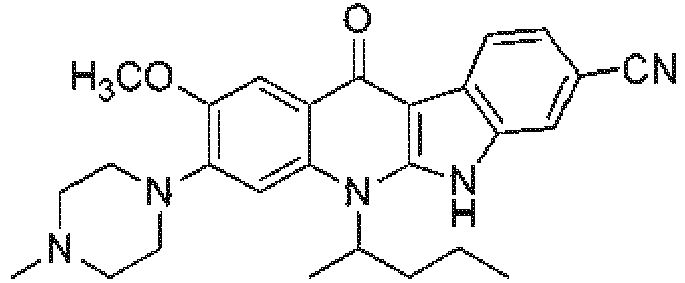
-

- Step A: 3-Fluoro-4-methoxy-N-(pentan-2-yl)aniline. 2-pentanone (17.2 g, 200 mmol), Acetic acid (1.8 g, 30 mmol), and Sodium triacetoxyborohydride (6.36 g, 30 mmol) were added to a solution of 3-Fluoro-4-methoxyaniline (2.82 g, 20 mmol) in DCM (120 mL) and the mixture was stirred at RT for 12 hr. Water was added to quench the reaction and the mixture was extracted with DCM. The solvent was removed under and the residue was purified by silica gel chromatography to afford 3-Fluoro-4-methoxy-N-(pentan-2-yl)aniline(2.1 g, 50% yield). MS m/z=212 [M+H].

- Step B: Methyl 6-cyano-2-((3-fluoro-4-methoxyphenyl)(pentan-2-yl)amino)-1H-indole-3-carboxylate. DABCO (62 mg, 0.55 mmol) was added to a solution of Methyl 6-cyano-1H-indole-3-carboxylate (200 mg, 1 mmol) in DCM (20 mL) and the mixture was cooled to 0 °C. N-Chlorosuccinimide (147 mg, 1.1 mmol) was then added and the reaction was stirred at 0 °C for 2 hr. A solution of 3-Fluoro-4-methoxy-N-(pentan-2-yl)aniline (211 mg, 1 mmol) and Trichloroacetic acid (41 mg, 0.25 mmol) in DCM (5 mL) was added dropwise and the reaction was stirred for 2 hr at room temperature. The reaction was quenched by adding water and the mixture was extracted with DCM. Solvent was removed under vacuum and the residue was purified by silica gel chromatography (Hex:EA=4:1) to afford Methyl 6-cyano-2-((3-fluoro-4-methoxyphenyl)(pentan-2-yl)amino)-1H-indole-3-carboxylate (196 mg, 48% yield). 1H NMR (400 MHz, CDCl3) δ ppm 8.05 (d, J = 8.3 Hz, 1H), 7.77 (br s, 1H), 7.41 (dd, J = 8.3, 1.5 Hz, 1H), 7.36 (d, J = 1.5 Hz, 1H), 7.07-6.90 (m, 3H), 4.78-4.61 (m, 1H), 3.95 (s, 3H), 3.89 (s, 3H), 1.72-1.65 (m, 1H), 1.49-1.41 (m, 3H), 1.26 (d, J = 6.8 Hz, 3H), 0.92 (t, J=7.2 Hz, 3H).

- Step C: 3-Fluoro-2-methoxy-11-oxo-5-(pentan-2-yl}-6,11-dihydro-5H-indolo[2,3-b]quinoline-8-carboiiitrile. Methyl 6-cyano-2-((3-fluoro-4-methoxyphenyl)(pentan-2-yl)amino)-1H-indole-3-carboxylate (196 mg, 0.48 mmol) was dissolved in Diphenyl ether (10 mL) and the solution was refluxed for 1 hr. The mixture was cooled to RT. Hexane (20 mL) was added and the precipitate was collected by filtration. The precipitate was purified by silica gel chromatography (Hex:EA=2:1) to afford 3-Fluoro-2-methoxy-11-oxo-5-(pentan-2-yl)-6,11-dihydro-5H-indolo[2,3-b]quinoline-8-carbonitrile (148 mg, 82% yield). MS m/z=378 [M+H]. 1H NMR (300 MHz, CD3OD) δ ppm 8.43 (d, J=8.0 Hz, 1H), 8.00 (s, 1H), 7.82 (s, 1H), 7.58 (d, J=8.0 Hz, 1H), 7.36 (s, 1H), 5.05-4.85 (m, 1H), 4.05 (s, 3H), 4.00-3.82 (m, 2H), 3.75-3.60 (m, 2H), 3.50-3.10 (m, 4H), 3.05 (s, 3H), 2.50-2.10 (m, 2H), 1.95-1.75 (m, 3H), 1.50-1.15 (m, 2H), 0.91 (t, J=7.3 Hz, 3H).

- Step D: 2-Methoxy-3-(4-methylpiperazin-1-yl)-11-oxo-5-(pentan-2-yl)-6,11-dihydro-5H-indolo[2,3-b]quinoline-8-carbonitrile. 1-Methylpiperazine (0.5 mL) and DIPEA (0.5 ml) were added to a solution of 3-Fluoro-2-methoxy-11-oxo-5-(pentan-2-yl)-6,11-dihydro-5H-indolo[2,3-b]quinoline-8-carbonitrile (148 mg, 0.39 mmol) in DMSO (2 ml) and the mixture was heated to 120 to 140 °C for 3 days. The reaction was cooled to RT and purified by Preparative HPLC to afford 2-Methoxy-3-(4-methylpiperazin-1-yl)-11-oxo-5-(pentan-2-yl)-6,11-dihydro-5H-indolo[2,3-b]quinoline-8-carbonitrile (45 mg, 23% yield). MS m/z=458[M+H].
-

- 2-Methoxy-3-(4-methylpiperazin-1-yl)-11-oxo-5-(pentan-3-yl)-6,11-dihydro-5H-indolo[2,3-b]quinoline-8-carbonitrile. The title compound was prepared in a method similar to that used in the preparation of 2-Methoxy-3-(4-methylpiperazin-1-yl)-11-oxo-5-(pentan-2-yl)-6,11-dihydro-5H-indolo[2,3-b]quinoline-8-carbonitrile. 1H NMR (300 MHz, CD3OD) δ ppm 8.43 (d, J = 8.1 Hz, 1H), 8.01 (s, 1H), 7.82 (s, 1H), 7.58 (dd, J = 8.1,1.4 Hz, 1H), 7.36 (d, J=1.4Hz, 1H), 4.77-4.66 (m, 1H), 4.03 (s, 3H), 3.94-3.85 (m, 2H), 3.70-3.64(m, 2H), 3.42-3.38 (m, 2H), 3.25-3.12 (m, 2H), 3.03 (s, 3H), 2.56-2.33 (m, 2H), 2.29-2.21 (m, 2H), 0.95-0.87 (m, 6H).
-

-

- Step A: Methyl 6-cyano-2-(ethyl(3-fluoro-4-methoxyphenyl)amino)-1H-indole-3-carboxylate. DABCO (62 mg, 0.55 mmol) was added to a solution of Methyl 6-cyano-1H-indole-3-carboxylate (200 mg, 1 mmol) in DCM (20 mL) and the mixture was cooled to 0 °C. N-Chlorosuccinimide (147 mg, 1.1 mmol) was then added and the reaction was stirred at 0 °C for 2 hr. A solution of N-Etbyl-3-fluoro-4-methoxyaniline (169 mg, 1 mmol) and Trichloroacetic acid (41 mg, 0.25 mmol) in DCM (5 mL) was added dropwise and the reaction was stirred for 2 hr at room temperature. The reaction was quenched by adding water and the mixture was extracted with DCM. Solvent was removed under vacuum and the residue was purified by silica gel chromatography (Hex:EA=4:1) to afford Methyl 6-cyano-2-(ethyl(3-fluoro-4-methoxyphenyl)amino)-1H-indole-3-caiboxylate (160 mg, 44% yield). 1H NMR (400 MHz, CDCl3) δ ppm 8.31 (s, 1H), 8.09 (d, J = 8.7 Hz, 1H), 7.47-7.39 (m, 2H), 7.02-6.84 (m, 3H), 4.01 (q, J=7.1Hz, 2H), 3.89 (s, 3H), 3.87 (s, 3H), 1.30 (t, J = 7.1 Hz, 3H).

- Step B: 5-Ethyl-3-fluoro-2-methoxy-11-oxo-6,11-dihydro-5H-indolo[2,3-b]quinoline-8-carbonitrile. Methyl 6-cyano-2-(ethyl(3-fluoro-4-methoxyphenyl)amino)-1H-indole-3-carboxylate (160 mg, 0.44 mmol) was dissolved in Diphenyl ether (10 mL) and the solution was refluxed for 1 hr. The mixture was cooled to RT. Hexane (20 mL) was added and the precipitate was collected by filtration. The precipitate was purified by silica gel chromatography (Hex:EA=2:1) to afford 5-Ethyl-3-fluoro-2-methoxy-11-oxo-6,11-dihydro-5H-indolo[2,3-b]quinoline-8-carbonitrile (98 mg, 67% yield). 1H NMR (400 MHz, DMSO-d 6) δ ppm 12.58 (s, 1H), 8.29 (d, J = 8.1 Hz, 1H), 7.98 (d, J = 9.7 Hz, 1H), 7.94-7.84 (m, 2H), 7.62 (dd, J = 8.1, 1.5 Hz, 1H), 4.52 (d, J = 7.4 Hz, 2H), 3.97 (s, 3H), 1.38 (t, J = 7.4Hz, 3H).

- Step C: 50-Ethyl-2-methoxy-3-(4-methylpiperazin-1-yl)-11-oxo-6,11-dihydro-5H-indolo[2,3-b]quinoline-8-carbonitrile. 1-Methylpiperazine (0.5 mL) and DIPEA (0.5 ml) were added to a solution of 5-Ethyl-3-fluoro-2-methoxy-11-oxo-6,11-dihydro-5H-indolo[2,3-b]quinoline-8-carbonitrile (98 mg, 0.29mmol) in DMSO (2 ml) and the mixture was heated to 120 to 140 °C for 3 days. The reaction mixture was cooled to RT and purified by Preparative HPLC to afford 5-Ethyl-2-methoxy-3-(4-methylpiperazin-1-yl)-11-oxo-6,11-dihydro-5H-indolo[2,3-b]quinoline-8-carbonitrile (25 mg, 21% yield). 1H NMR (300 MHz, CD3OD) δ ppm 8.31 (d, J=7.6 Hz, 1H), 7.91 (s, 1H), 7.59 (d, J=0.7 Hz, 1H), 7.50 (dd, J=7.6, 0.7Hz, 1H), 7.06 (s, 1H), 4.50 (q, J=7.3 Hz, 2H), 4.06 (s, 3H), 4.04-3.86 (m, 2H), 3,75-3.63 (m, 2H), 3.50-3.37 (m, 2H), 3.26-3.17 (m, 2H), 3.05 (s, 3H), 1.53 (t, J=7.3 Hz, 3H).
-
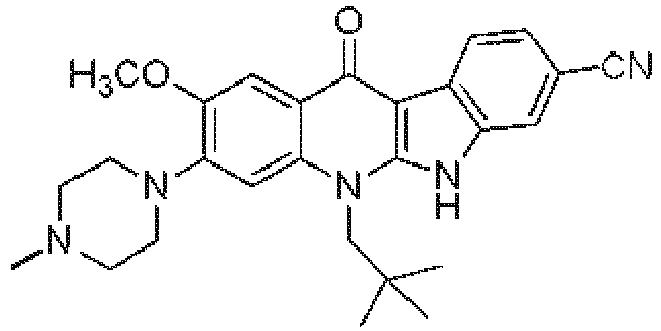
- 2-Methoxy-3-(4-methylpiperadn-1-yl)-5-neopentyl-11-oxo-6,11-dihydro-5H-indolo[2,3-b]quinoline-8-carbonitrile. The title compound was prepared in a method similar to that used in the preparation of 2-Methoxy-3-(4-methylpiperazin-1-yl)-11-oxo-5-(pentan-2-yl)-6,11-dihydro-5H-indolo[2,3-b]quinoline-8-carbonitrile. 1H NMR (300 MHz, CD3OD) δ ppm 8.38 (d, J = 8.1 Hz, 1H), 7.95 (s, 1H), 7.67 (s, 1H), 7.55-7.50(m, 1H), 7.32 (s, 1H), 4.72 (d, J =16.0 Hz, 1H), 4.21 (d, J = 16.0 Hz, 1H), 4.04 (s, 3H), 4.01-3.96 (m, 2H), 3.86-3.68 (m, 2H), 3.15-3.10 (m, 4H), 3.02 (s, 3H), 1.04 (s, 9H).
-

- 2-Methoxy-3-(4-methylpiperazin-1-yl)-11-oxo-5-propyl-6,11-dihydro-5H-indolo[2,3-b]quinoline-8-carbonitrile. The title compound was prepared in a method similar to that used in the preparation of 2-Methoxy-3-(4-methylpiperazin-1-yl)-11-oxo-5-(pentan-2-yl)-6,11-dihydro-5H-indolo[2,3-b]quinoline-8-carbonitrile. 1H NMR (300 MHz, CD3OD) δ ppm 8.24 (d, J = 8.1 Hz, 1H), 7.83 (s, 1H), 7.47 (d, J = 1.4 Hz, 1H), 7.42 (dd, J = 8.1, 1.4 Hz, 1H), 6.94 (s, 1H), 4.32 (t, J = 7.9 Hz, 2H), 4.03 (s, 3H), 3.99 - 3.90 (m, 2H), 3.71-3.68(m, 2H), 3.41-3.38(m, 2H), 3.20-3.17(m, 2H), 3.04 (s, 3H), 2.00-1.80 (m, 2H), 1.09 (t, J = 7.6 Hz, 3H).
-

-

- Step A: 4-Bromo-N-cyclobutyl-3-fluoroaniline. 2-Cyclobutanone (14.0 g, 200 mmol), Acetic acid (1.8 g, 30 mmol), and Sodium triacetoxyborohydride (6.36 g, 30 mmol) were added to a solution of 4-Bromo-3-fluoroaniline (3.8 g, 20 mmol) in DCM (120 mL) and the mixture was stirred at RT for 12 hr. Water was added to quench the reaction and the mixture was extracted with DCM. The solvent was removed under and the residue was purified by silica gel chromatography to afford 4-Bromo-N-cyclobutyl-3-fluoroaniline (3.6 g, 74% yield). MS m/e=244 [M+H].

- Step B: Methyl 2-((4-bromo-3-fluorophenyl)(cyclobutyl)amino)-6-cyano-1H-indole-3-carboxylate. DABCO (62 mg, 0.55 mmol) was added to a solution of Methyl 6-cyano-1H-indole-3-carboxylate (200 mg, 1 mmol) in DCM (20 mL) and the mixture was cooled to 0 °C. N-Chlorosuccinimide (147 mg, 1.1 mmol) was then added and the reaction was stirred at 0 °C for 2 hr. A solution of 4-Bromo-N-eyelobutyl-3-fluoroaniline (243 mg, 1 mmol) and Trichloroacetic acid (41 mg, 0.25 mmol) in DCM (5 mL) was added dropwise and the reaction was stirred for 2 hr at room temperature. The reaction was quenched by adding water and the mixture was extracted with DCM. Solvent was removed under vacuum and the residue was purified by silica gel chromatography (Hex:EA=4:1) to afford Methyl 2-((4-bromo-3-fluorophenyl)(cyclobutyl)amino)-6-cyano-1H-indole-3-carboxylate (230 mg, 52% yield).1H NMR (400 MHz, CDCl3) δ ppm 8.62 (s, 1H), 8.29 (d, J = 8.4 Hz, 1H), 7.75-7.69 (m, 1H), 7.56 (dd, J = 8.4,1.4 Hz, 1H), 7.35-7.29 (m, 1H), 6.46-6.40 (m, 1H), 6.32-6.24 (m, 1H), 4.47-4.34 (m, 1H), 3.82 (s, 3H), 2.38-2.32 (m, 2H), 1.95-1.90 (m, 2H), 1.85-1.65 (m, 2H).

- Step C: 2-Bromo-5-cyclobutyl-3-fluoro-11-oxo-6,11-dihydro-5H-indolo[2,3-b]quinoline-8-carbonitrile. Methyl 2-((4-bromo-3-fluorophenyl)(cyclobutyl)amino)-6-cyano-1H-indole-3-carboxylate (230 mg, 0.52 mmol) was dissolved in Diphenyl ether (10 mL) and the solution was refluxed for 1 hr. The mixture was cooled to RT. Hexane (20 mL) was added and the precipitate was collected by filtration. The precipitate was purified by silica gel chromatography (Hex:EA=2:1) to afford 2-Bromo-5-cyclobuty1-3-fluoro-11-oxo-6,11-dihydro-5H-indolo[2,3-b]quinoline-8-carbonitrile (130 mg, 61% yield). MS m/z=410 [M+H].

- Step D: 2-Bromo-5-cyclobutyl-3-(4-methylpiperazin-1-yl)-11-oxo-6,11-dihydro-5H-indolo[2,3-b]quinoline-8-carbonitrile. 1-Methylpiperazine (0.5 mL) and DIPEA (0.5 ml) were added to a solution of 2-Bromo-5-cyclobutyl-3-fluoro-11-oxo-6,11-dihydro-5H-indolo[2,3-b]quinoline-8-carbonitrile (130 mg, 0.32 mmol) in DMSO (2 ml) and the mixture was heated to 120 to 140 °C for 3 days. The reaction mixture was cooled to RT and purified by Preparative HPLC to afford 2-Bromo-5-cyclobutyl-3-(4-methylpiperazin-1-yl)-11-oxo-6,11-dihydro-5H-indolo[2,3-b]quinoline-8-carbonitrile (34 mg, 22% yield). 1H NMR (400 MHz, DMSO-d 6) δ ppm 11.94 (s, 1H), 10.16 (s, 1H), 8.43 (s, 1H), 8.26 (d, J = 8.1 Hz, 1H), 7.94-7.88 (m, 1H), 7.61 (dd, J= 8.1, 1.5 Hz, 1H), 7.25 (s, 1H), 5.33-5.20 (m, 1H), 3.68-3.63(m, 4H), 3.18-3.14(m, 4H), 2.95-2.92 (m, 5H), 2.50-2.37 (m, 2H), 1.96-1.79 (m, 2H).

- Step E: 5-Cylobutyl-2-ethyl-3-(4-methylpiperazin-1-yl)-11-oxo-6,11-dihydro-5H-indolo[2,3-b]quinoline-8-carbonitrile. A mixture of 2-Bromo-5-cyclobutyl-3-(4-methylpiperazin-1-yl)-11-oxo-6,11-dihydro-5H-indolo[2,3-b]quinoline-8-carbonitrile (30 mg, 0.061 mmol), Na2CO3 (25 mg, 0.183 mmol), Pd(PPh3)2Cl2 (4.3 mg, 0.0061 mmol), and 4,4,5,5-Tetramethyl-2-vinyl-1,3,2-dioxaborolane (14 mg, 0.091 mmol) in DME/H2O (4.8 ml, V/V=5/1) was stirred under nitrogen at 80 °C overnight. After the reaction was complete as indicated by LC-MS, the reaction mixture was cooled down to RT. Water (50 ml) was added. The mixture was extracted with CH2Cl2 (2 x 150 ml). The combined CH2Cl2 layer was dried over Na2SO4 and concentrated to give crude 5-Cyclobutyl-3-(4-methylpiperazin-1-yl)-11-oxo-2-vinyl-6,11-dihydro-5H-indolo[2,3-b]quinoline-8-carbonitrile (25 mg) which was used directly in the next step without further purification.
- 5-Cyclobutyl-3-(4-methylpiperazin-1-yl)-11-oxo-2-vinyl-6,11-dihydro-5H-indolo[2,3-b]quinoline-8-carbonitrile (crude, 25 mg) was dissolved in THF (5 ml). Pd/C (10%, 20 mg) was added to the THF solution. The mixture underwent hydrogenation at room temperature overnight until LC-MS indicated that the reaction was complete. The filtrate after filtration was concentrated and the residue was purified by preparative HPLC to afford 5-Cyclobutyl-2-ethyl-3-(4-methylpiperazin-1-yl)-11-oxo-6,11-dihydro-5H-indolo[2,3-b]quinoline-8-carbonitrile (8 mg, 30% yield). 1H NMR (300 MHz, CD3OD) δ ppm 8.45-8.40 (m, 2H), 7.81 (d, J=0.8 Hz, 1H), 757 (dd, J=8.1, 0.8 Hz, 1H), 7.31 (s, 1H), 5.40-5.25 (m, 1H), 3.70-3.60 (m, 2H), 3.55-3.35 (m, 4H), 3.30-3.15 (m, 2H), 3.10-3.00 (m, 2H), 3.06 (s, 3H), 2.88 (q, J=7.5 Hz, 2H), 2.70-2.53 (m, 2H), 2.20-1.96 (m, 2H), 1.41 (t, J=7.5 Hz, 3H).
-

-

- Step A: 4-Bromo-3-fluoro-N-isopropylaniline. Acetone (11.6 g, 200 mmol), Acetic acid (1.8 g, 30 mmol), and Sodium triacetoxyborohydride (6.36 g, 30 mmol) were added to a solution of 4-Bromo-3-fluoroaniline (3.8 g, 20 mmol) in DCM (120 mL) and the mixture was stirred at RT for 12 hr. Water was added to quench the reaction and the mixture was extracted with DCM. The solvent was removed under and the residue was purified by silica gel chromatography to afford 4-Bromo-3-fluoro-N-isopropylaniline (3.4 g, 73% yield). 1H NMR (400 MHz, CDCl3) δ ppm 7.25 (dd, J = 8.7, 8.0 Hz, 1H), 6.36 (dd, J = 11.3,2.7 Hz, 1H), 6.27-6.23 (m, 1H), 3.65 (s, 1H), 3.59-3.53 (m, 1H), 1.22 (d, J = 6.2 Hz, 6H).
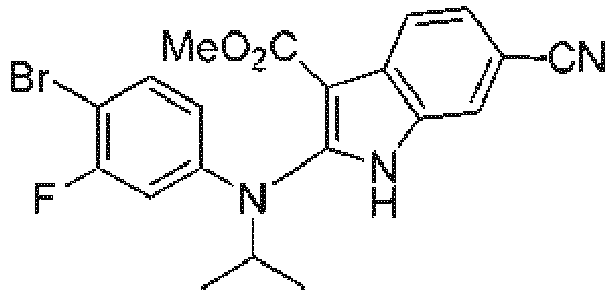
- Step B: Methyl 2-((4-bromo-3-fluorophenyl)(isopropyl)amino)-6-eyano-1H-indole-3-carboxylate. DABCO (62 mg, 0.55 mmol) was added to a solution of Methyl 6-cyano-1H-indole-3-carboxylate (200 mg, 1 mmol) in DCM (20 mL) and the mixture was cooled to 0 °C. N-Chlorosuccinimide (147 mg, 1.1 mmol) was then added and the reaction was stirred at 0 °C for 2 hr. A solution of 4-Bromo-3-fluoro-N-isopropylaniline (232 mg, 1 mmol) and Trichloroacetic acid (41 mg, 0.25 mmol) in DCM (5 mL) was added dropwise and the reaction was stirred for 2 hr at room temperature. The reaction was quenched by adding water and the mixture was extracted with DCM. Solvent was removed under vacuum and the residue was purified by silica gel chromatography (Hex:EA=4:1) to afford Methyl 2-((4-bromo-3-fluorophenyl)(isopropyl)amino)-6-cyano-1H-indole-3-carboxylate (245 mg, 57% yield).1H NMR (400 MHz, CDCl3) δ ppm 8.44 (s, 1H), 8.27 (d, J = 8.3 Hz, 1H), 7.73-7.64 (m, 1H), 7.54 (dd, J = 8.3,1.4 Hz, 1H), 7.34 (dd, J = 9.0, 7.9 Hz, 1H), 6.56 (dd, J = 11.3, 2.7 Hz, 1H), 6.41 (dd, J = 9.0, 2.7 Hz, 1H), 4.45-4.41 (m, 1H), 3.81 (s, 3H), 1.31 (d, J= 6.6 Hz, 6H).

- Step C: 2-Bromo-3-fluoro-5-isopropyl-11-oxo-6,11-dihydro-5H-indolo[2,3-b]quinoline-8-carbonitrile. Methyl 2-((4-bromo-3-fluorophenyl)(isopropyl)amino)-6-cyano-1H-indole-3-carboxylate (245 mg, 0.57mmol) was dissolved in Diphenyl ether (10 mL) and the solution was refluxed for 1 hr. The mixture was cooled to RT. Hexane (20 mL) was added and the precipitate was collected by filtration. The precipitate was purified by silica gel chromatography (Hex:EA=2:1) to afford 2-Bromo-3-fluoro-5-isopropyl-11-oxo-6,11-dihydro-5H-indolo[2,3-b]quinoline-8-carbonitrile (110 mg, 49% yield). 1H NMR (400 MHz, DMSO-d 6) δ 12.30 (s, 1H), 8.54 (d, J = 8.3 Hz, 1H), 8.28 (d, J = 8.0 Hz, 1H), 8.08 (d, J = 11.9 Hz, 1H), 7.92 (d, J = 1.4 Hz, 1H), 7.63 (dd, J = 8.0, 1.4 Hz, 1H), 5.37-5.28 (m, 1H), 1.74 (d, J = 7.0 Hz, 6H).

- Step D: 2-Bromo-5-isopropyl-3-(4-methylpiperazin-1-yl)-11-oxo-6,11-dihydro-5H-indolo[2,3-b]quinoline-8-carbonitrile. 1-Methylpiperazine (0.5 mL) and DIPEA (0.5 ml) were added to a solution of 2-Bromo-3-fluoro-5-isopropyl-11-oxo-6,11-dihydro-5H-indolo[2,3-b]quinoline-8-carbonitrile (110 mg, 0.28 mmol) in DMSO (2 ml) and the mixture was heated to 120 to 140 °C for 3 days. The reaction mixture was cooled to RT and purified by preparative HPLC to afford 2-Bromo-5-isopropyl-3-(4-methylpiperazin-1-yl)-11-oxo-6,11-dihydro-5H-indolo[2,3-b]quinoline-8-carbonitrile (29 mg, 22% yield). 1H NMR (300 MHz, CD3OD) δ ppm 8.58 (s, 1H), 8.29 (d, J=7.9 Hz, 1H), 7.77 (s, 1H), 7.52 (d, J=7.9 Hz, 1H), 7.49 (s, 1H), 5.44-5.30 (m, 1H), 3.90-3.70 (m, 4H), 3.60-3.30 (m, 4H), 3.08 (s, 3H), 1.89 (d, J=7.1 Hz, 6H
-

- 5-isoPropyl-3-(4-methylpiperazin-1-yl)-11-oxo-2-vinyl-6,11-dihydro-5H-indolo[2,3-b]quinoline-8-carbonitrile. A mixture of 2-Bromo-5-isopropyl-3-(4-methylpiperazin-1-yl)-11-oxo-6,11-dihydro-5H-indolo[2,3-b]quinoline-8-carbonitrile(30 mg, 0.061 mmol), Na2CO3 (25 mg, 0.183 mmol), Pd(PPh3)2Cl2 (4.3 mg, 0.0061 mmol), and 4,4,5,5-Tetramethyl-2-vinyl-1,3,2-dioxaborolane (14 mg, 0.091 mmol) in DME/H2O (4.8 ml, V/V=5/1) was stirred under nitrogen at 80 C for overnight. After the reaction was complete as indicated by LC-MS, the mixture was purified by preparative HPLC to afford 5-isoPropyl-3-(4-methylpiperazin-1-yl)-11-oxo-2-vinyl-6,11-dihydro-5H-indolo[2,3-b]quinoline-8-carbonitrile (10 mg, 37% yield).MS m/z= 426 [M+H].
-

- 2-Ethyl-5-isopropyl-,3-(4-methylpiperazin-1-yl)-11-ozo-6,11-dihydro-5H-indolo[2,3-b]quinoline-8-carbonitrile. 5-isoPropyl-3-(4-methylpiperazin-1-yl)-11-oxo-2-vinyl-6,11-dihydro-5H-indolo[2,3-b]quinoline-8-carbonitrile (50 mg, 0.12 mmol) was dissolved in THF (5 ml). Pd/C (10%, 20 mg) was added to the THF solution. The mixture underwent hydrogenation at room temperature overnight until LC-MS indicated that the reaction was complete. The filtrate after filtration was concentrated and the residue was purified by preparative HPLC to afford 2-Ethyl-5-isopropyl-3-(4-methylpiperazin-1-yl)-11-oxo-6,11-dihydro-5H-indolo[2,3-b]quinoline-8-carbonitrile (26 mg, 52% yield).1H NMR (300 MHz, CD3OD) δ ppm 8.38 (s, 1H), 8.29 (d, J=8.0 Hz, 1H), 7.70 (s, 1H), 7.50 (s, 1H), 7.44 (d, J=8.0 Hz, 1H), 5.40-5.30 (m, 1H), 3.75-3.65 (m, 2H), 3.63-3.25 (m, 6H), 3.06 (s, 3H), 2.90 (q, J=7.4 Hz, 2H), 1.88 (d, J=7.1 Hz, 6H), 1.40 (t, J=7.4 Hz, 3H).
-
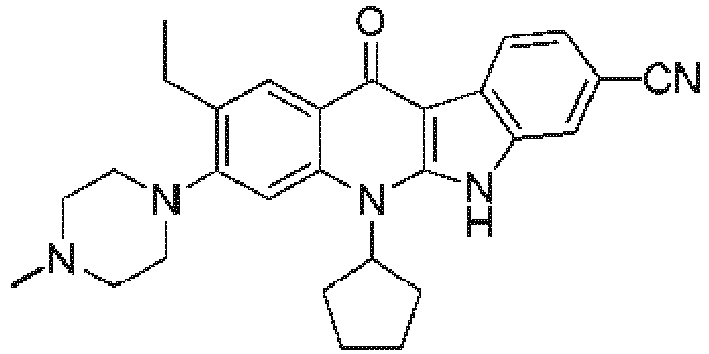
-

- Step A: N-Cyclopentyl-4-ethyl-3-fluoroaniline. Cyclopentanone (16.8 g, 200 mmol), Acetic acid (1.8 g, 30 mmol), and Sodium triacetoxyborohydride (6.36 g, 30 mmol) were added to a solution of 4-Ethyl-3-fluoroaniline (2.78 g, 20 mmol) in DCM (120 mL) and the mixture was stirred at RT for 12 hr. Water was added to quench the reaction and the mixture was extracted with DCM. The solvent was removed under and the residue was purified by silica gel chromatography to afford N-Cyclopentyl-4-ethyl-3-fluoroaniline (3.1 g, 75% yield). MS m/z=208 [M+H].

- Step B: Methyl 6-cyano-2-(cyclopentyl(4-ethyl-3-fluorophenyl)amino)-1H-indole-3-carboxylate. DABCO (62 mg, 0.55 mmol) was added to a solution of Methyl 6-cyano-1H-indole-3-carboxylate (200 mg, 1 mmol) in DCM (20 mL) and the mixture was cooled to 0 °C. N-Chlorosuccinimide (147 mg, 1.1 mmol) was then added and the reaction was stirred at 0 °C for 2 hr. A solution of N-Cyclopentyl-4-ethyl-3-fluoroaniline (207 mg, 1 mmol) and Trichloroacetic acid (41 mg, 0.25 mmol) in DCM (5 mL) was added dropwise and the reaction was stirred for 2 hr at room temperature. The reaction was quenched by adding water and the mixture was extracted with DCM. Solvent was removed under vacuum and the residue was purified by silica gel chromatography (Hex:EA=4:1) to afford Methyl 6-cyano-2-(cyclopentyl(4-ethyl-3-fluorophenyl)amino)-1H-indole-3-carboxylate (260 mg, 64% yield).1H NMR (400 MHz, CDCl3) δ ppm 8.44 (s, 1H), 8.22 (d, J = 8.4 Hz, 1H), 7.64-7.61 (m, 1H), 7.55-7.41 (m, 1H), 7.06 (t, J = 8.4 Hz, 1H), 6.59-6.39 (m, 2H), 4.48-4.45 (m, 1H), 3.81 (s, 3H), 3.75-3.47 (m, 2H), 2.61 (q, J = 7.6 Hz, 2H), 2.17-1.92 (m, 2H), 1.74-1.62 (m, 2H), 1.34-1.26 (m, 2H), 1.21 (t, J = 7.6 Hz, 3H).

- Step C: 5-Cyclopentyl-2-ethyl-3-fluoro-11-oxo-6,11-dihydro-5H-indolo[2,3-b]quinoline-8-carbonitrile. Methyl 6-cyano-2-(cyclopentyl(4-ethyl-3-fluorophenyl)amino)-1H-indole-3-carboxylate (260 mg, 0.64 mmol) was dissolved in Diphenyl ether (10 mL) and the solution was refluxed for 1 hr. The mixture was cooled to RT. Hexane (20 mL) was added and the precipitate was collected by filtration. The precipitate was purified by silica gel chromatography (Hex:EA=2:1) to afford 5-Cyclopentyl-2-ethyl-3-fluoro-11-oxo-6,11-dihydro-5H-indolo[2,3-b]quinoline-8-carbonitrile (140 mg, 59% yield). MS m/z=374 [M+H].

- Step D: 5-Cyclopentyl-2-ethyl-3-(4-methylpiperazin-1-yl)-11-oxo-6,11-dihydro-5H-indolo[2,3-b]quinoline-8-carbonitrile. 1-Methylpiperazine (0.5 mL) and DIPEA (0.5 ml) were added to a solution of 5-Cyclopentyl-2-ethyl-3-fluoro-11-oxo-6,11-dihydro-5H-indolo[2,3-b]quinoline-8-carbonitrile (140 mg, 0.38 mmol) in DMSO (2 ml) and the mixture was heated to 120 to 140 °C for 3 days. The reaction mixture was cooled to RT and purified by preparative HPLC to afford 5-Cyclopentyl-2-ethyl-3-(4-methylpiperazin-1-yl)-11-oxo-6,11-dihydro-5H-indolo[2,3-b]quinoline-8-caibonitrile (39 mg, 23% yield). 1H NMR (300 MHz, CD3OD) δ ppm 8.48 (s, 1H), 8.39 (d, J=8.0 Hz, 1H), 7.77 (s, 1H), 7.56 (d, J=8.0 Hz, 1H), 7.31 (s, 1H), 5.45-5.35 (m, 1H), 3.70-3.60 (m, 2H), 3.55-3.30 (m, 4H), 3.25-3.15 (m, 2H), 3.06 (s, 3H), 2.89 (q, J=7.5 Hz, 2H), 2.60-2.00 (m, 8H), 1.42 (t, J=75 Hz, 3H).
-

-

- Step A: Methyl 6-cyano-2-(ethyl(4-ethyl-3-fluorophenyl)amino)-1H-indole-3-carboxylate. DABCO (62 mg, 0.55 mmol) was added to a solution of Methyl 6-cyano-1H-indole-3-carboxylate (200 mg, 1 mmol) in DCM (20 mL) and the mixture was cooled to 0 °C. N-Chlorosuccinimide (147 mg, 1.1 mmol) was then added and the reaction was stirred at 0 °C for 2 hr. A solution of N,4-Diethyl-3-fluoroaniline (167 mg, 1 mmol) and Trichloroacetic acid (41 mg, 0.25 mmol) in DCM (5 mL) was added dropwise and the reaction was stirred for 2 hr at room temperature. The reaction was quenched by adding water and the mixture was extracted with DCM. Solvent was removed under vacuum and the residue was purified by silica gel chromatography (Hex:EA=4:1) to afford Methyl 6-cyano-2-(ethyl(4-ethyl-3-fluorophenyl)amino)-1H-indole-3-carboxylate (197 mg, 54% yield). 1H NMR (400 MHz, CDCl3) δ ppm 8.50 (s, 1H), 8.14 (d, J = 8.4 Hz, 1H), 7.52-7.48 (m, 1H), 7.45 (dd, J = 8.4, 1.4 Hz, 1H), 7.15-7.13 (t, J = 8.6 Hz, 1H), 6.78-6.62 (m, 2H), 3.99 (q, J = 7.1 Hz, 2H), 3.85 (s, 3H), 2.64 (q, J = 7.6 Hz, 2H), 1.30 (t, J = 7.1 Hz, 3H), 1.23 (t, J = 7.6 Hz, 3H).

- Step B: 2,5-Diethyl-3-fluoro-11-oxo-6,11-dihydro-5H-indolo[2,3-b]quinoline-8-carbonitrile. Methyl 6-cyano-2-(ethyl(4-ethyl-3-fluorophenyl)amino)-1H-indole-3-carboxylate (197 mg, 0.54 mmol) was dissolved in Diphenyl ether (10 mL) and the solution was refluxed for 1 hr. The mixture was cooled to RT. Hexane (20 mL) was added and the precipitate was collected by filtration. The precipitate was purified by silica gel chromatography (Hex:EA=2:1) to afford 2,5-Diethyl-3-fluoro-11-oxo-6,11-dihydro-5H-indolo[2,3-b]quinoline-8-carbonitrile (122 mg, 68% yield). MS m/z=334 [M+H].

- Step C: 2,5-Diethyl-3-(4-methylpiperazin-1-yl)-11-oxo-6,11-dihydro-5H-indolo[2,3-b]quinoline-8-carbonitrile. 1-Methylpiperazine (0.5 mL) and DIPEA (0.5 ml) were added to a solution of 2,5-Diethyl-3-fluoro-11-oxo-6,11-dihydro-5H-indolo[2,3-b]quinoline-8-carbonitrile (122 mg, 0.37 mmol) in DMSO (2 ml) and the mixture was heated to 120 to 140 °C for 3 days. The reaction mixture was cooled to RT and purified by preparative HPLC to afford 2,5-Diethyl-3-(4-methylpiperazin-1-yl)-11-oxo-6,11-dihydro-5H-indolo[2,3-b]quinoline-8-carbonitrile (27 mg, 18% yield).1H NMR (300 MHz, CD3OD) δ ppm 8.43 (s, 1H), 8.38 (d, J = 8.0 Hz, 1H), 7.75-7.68 (m, 1H), 7.60-7.49 (m, 1H), 7.32 (s, 1H), 4.58 (q, J = 7.1 Hz, 2H), 3.71-3.67(m, 2H), 3.61-3.37 (m, 4H), 3.35-3.23 (m, 2H), 3.05 (s, 3H), 2.93-2.83 (m, 2H), 1.56 (t, J = 7.1 Hz, 3H), 1.41 (t, J = 7.5 Hz, 3H).
-

- 5-isoPropyl-3-(4-methylpiperazin-1-yl)-11-oxo-2-(prop-1-en-2-yl)-6,11-dihydro-5H-indolo[2,3-b]quinoline-8-carbonitrile. A mixture of 2-Bromo-5-isopropyl-3-(4-methylpiperazin-1-yl)-11-oxo-6,11-dihydro-5H-indolo[2,3-b]quinoline-8-carbonitrile (30 mg, 0.061 mmol), Na2CO3 (25 mg, 0.183 mmol), Pd(PPh3)2Cl2 (4.3 mg, 0.0061 mmol), and 4,4,5,5-Tetramethyl-2-(prop-1-en-2-yl)-1,3,2-dioxaborolane (16 mg, 0.091 mmol) in DME/H2O (4.8 ml, V/V=5/1) was stirred under nitrogen at 80 °C overnight. After the reaction was complete as indicated by LC-MS, the mixture was purified by preparative HPLCto afford 5-isoPropyl-3-(4-methylpiperazin-1-yl)-11-oxo-2-(prop-1-en-2-yl)-6,11-dihydro-5H-indolo[2,3-b]quinoline-8-carbonitrile (10 mg, 36% yield).1H NMR (300 MHz, CD3OD) δ ppm 8.41-8.34 (m, 1H), 8.30 (s, 1H), 7.82-7.72 (m, 1H), 7.53 (dd, J = 8.1, 1.4 Hz, 1H), 7.37 (s, 1H), 5.46-5.25 (m, 3H), 3.88-3.84(m, 2H), 3.69-3.66 (m, 2H), 3.41-3.35 (m, 2H), 3.30-3.10 (m, 2H), 3.03 (s, 3H), 2.27 (s, 3H), 1.88 (d, J = 7.0 Hz, 6H).
-

- 2,5-Diisopropyl-3-(4-methylpiperazin-1-yl)-11-oxo-6,11-dihydro-5H-indolo[2,3-b]quinoline-8-carbonitrile. 5-isoPropyl-3-(4-methylpiperazin-1-yl)-11-oxo-2-(prop-1-en-2-yl)-6,11-dihydro-5H-indolo[2,3-b]quinoline-8-carbonitrile (50 mg, 0.12 mmol) was dissolved in THF (5 ml). Pd/C (10%, 20 mg) was added to the THF solution. The resulting mixture underwent hydrogenation at room temperature for overnight until LC-MS indicated that the reaction was complete. The filtrate after filtration was concentrated and the residue was purified by preparative HPLC to afford 2,5-Diisopropyl-3-(4-methylpiperazin-1-yl)-11-oxo-6,11-dihydro-5H-indolo[2,3-b]quinoline-8-carbonitrile (22 mg, 44% yield). 1H NMR (300 MHz, CD3OD) δ ppm 8.53 (s, 1H), 8.42 (d, J=8.0 Hz, 1H), 7.82 (m, 1H), 7.60-7.52 (m, 2H), 5.45-5.27 (m, 1H), 3.92-3.25 (m, 9H), 3.07 (s, 3H), 1.89 (d, J=6.1 Hz, 6H), 1.38 (d, J=6.8 Hz, 6H).
-

-

- Step A: N-Cyclopentyl-4-ethoxy-3-fluoroaniline. Cyclopentanone (16.8 g, 200 mmol), Acetic acid (1.8 g, 30 mmol), and Sodium triacetoxyborohydride (6.36 g, 30 mmol) were added to a solution of 4-Ethoxy-3-fluoroaniline (3.10 g, 20 mmol) in DCM (120 mL) and the mixture was stirred at RT for 12 hr. Water was added to quench the reaction and the mixture was extracted with DCM. The solvent was removed under and the residue was purified by silica gel chromatography to afford N-Cyclopentyl-4-ethoxy-3-fluoroaniline (3.1 g, 70% yield). MS m/z=224 [M+H].1H NMR (300 MHz, CDCl3) δ ppm 6.82 (t, J = 9.1 Hz, 1H), 6.44-6.21 (m, 2H), 4.01 (q, J = 7.0 Hz, 2H), 3.76-3.61 (m, 1H), 3.48 (s, 1H), 2.00-1.98 (m, 2H), 1.80-1.54 (m, 4H), 1.54-1.23 (m, 2H), 1.38(t, J=7.0Hz, 3H).

- Step B: Methyl 6-cyano-2-(cyclopentyl(4-ethoxy-3-fluorophenyl)amino)-1H-indole-3-carboxylate. DABCO (62 mg, 0.55 mmol) was added to a solution of Methyl 6-cyano-1H-indole-3-carboxylate (200 mg, 1 mmol) in DCM (20 mL) and the mixture was cooled to 0 °C. N-Chlorosuccinimide (147 mg, 1.1 mmol) was then added and the reaction was stirred at 0 °C for 2 hr. A solution of N-Cyclopentyl-4-ethoxy-3-fluoroaniline (223 mg, 1 mmol) and Trichloroacetic acid (41 mg, 0.25 mmol) in DCM (5 mL) was added dropwise and the reaction was stirred for 2 hr at room temperature. The reaction was quenched by adding water and the mixture was extracted with DCM. Solvent was removed under vacuum and the residue was purified by silica gel chromatography (Hex:EA=4:1) to afford Methyl 6-cyano-2-(cyclopentyl(4-ethoxy-3-fluorophenyl)amino)-1H-indole-3-carboxylate (240 mg, 57% yield). 1H NMR (400 MHz, CDCl3) δ ppm 8.17 (s, 1H), 8.13 (d, J = 8.3 Hz, 1H), 7.49 (d, J = 1.4 Hz, 1H), 7.46 (dd, J = 8.3, 1.4 Hz, 1H), 6.93 (t, J = 9.0 Hz, 1H), 6.81 (dd, J = 12.7, 2.7 Hz, 1H), 6.73-6.70 (m, 1H), 4.65-4.56 (m, 1H), 4.11 (q, J = 7.0 Hz, 2H), 3.85 (s, 3H), 2.11-1.94 (m, 2H), 1.73-1.60 (m, 4H), 1.61-1.49(m, 2H), 1.46 (t, J = 7.0 Hz, 3H).

- Step C: 5-Cyclopentyl-2-ethoxy-3-fluoro-11-oxo-6,11-dihydro-5H-indolo[2,3-b]quinoline-8-carbonitrile. Methyl 6-cyano-2-(cyclopentyl(4-ethoxy-3-fluorophenyl)amino)-1H-indole-3-carboxylate (240 mg, 0.57mmol) was dissolved in Diphenyl ether (10 mL) and the solution was refluxed for 1 hr. The mixture was cooled to RT. Hexane (20 mL) was added and the precipitate was collected by filtration. The precipitate was purified by silica gel chromatography (Hex:EA=2:1) to afford 5-Cyclopentyl-2-ethoxy-3-fluoro-11-oxo-6,11-dihydro-5H-indolo[2,3-b]quinoline-8-carbonitrile (170 mg, 77% yield). MS m/z=390 [M+H]. 1H NMR (400 MHz, DMSO-d 6) δ ppm 12.32 (s, 1H), 8.31 (d, J = 8.1 Hz, 1H), 8.01 (d, J = 9.8 Hz, 1H), 7.91 (d, J = 1.4 Hz, 1H), 7.67-7.56 (m, 2H), 5.36-5.34 (m, 1H), 4.25 (q, J = 6.9 Hz, 2H), 2.34-2.30 (m, 2H), 2.20-2.06 (m, 4H), 1.86-1.82 (m, 2H), 1.43 (t, J = 6.9 Hz, 3H).
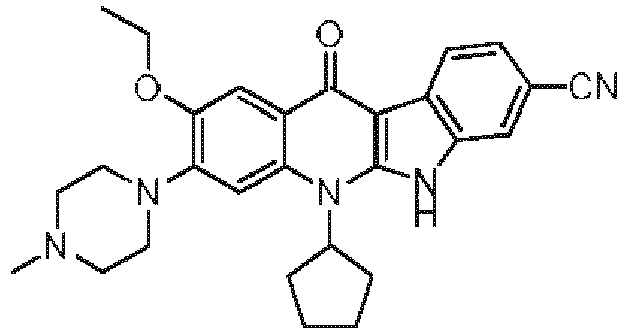
- Step D: 5-Cydopentyl-2-ethoxy-3-(4-methylpiperazin-1-yl-11-oxo-6,11-dihydro-5H-indolo[2,3-b]quinoline-8-carbonitrile. 1-Methylpiperazine (0.5 mL) and DIPEA (0.5 ml) were added to a solution of 5-Cyclopentyl-2-ethoxy-3-fluoro-11-oxo-6,11-dihydro-5H-indolo[2,3-b]quinoline-8-carbonitrile (170 mg, 0.44 mmol) in DMSO (2 ml) and the mixture was heated to 120 to 140 °C for 3 days. The reaction mixture was cooled to RT and purified by preparative HPLC to afford 5-Cyclopentyl-2-ethoxy-3-(4-methylpiperazin-1-yl)-11-oxo-6,11-dihydro-5H-indolo[2,3-b]quinoline-8-carbonitrile (45 mg, 22% yield). 1H NMR (300 MHz, CD3OD) δ ppm 8.33 (d, J=8.0 Hz, 1H), 7.93 (s, 1H), 7.70 (s, 1H), 7.50 (d, J=8.0 Hz, 1H), 7.10 (s, 1H), 5.45-5.35 (m, 1H), 4.27 (q, J=6.8 Hz, 2H), 4.20-3.95 (m, 2H), 3.75-3.30 (m, 4H), 3.25-3.15 (m, 2H), 3.05 (s, 3H), 2.60-1.97 (m, 8H), 1.56 (t, J=6.8 Hz, 3H).
-

-
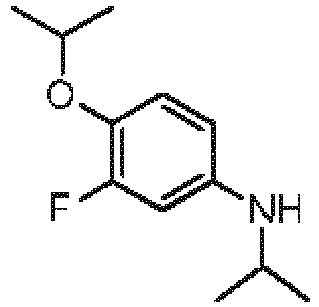
- Step A: 3-Fluoro-4-isopropoxy-N-isopropylaniline. Acetone (11.6 g, 200 mmol), Acetic acid (1.8 g, 30 mmol), and Sodium triacetoxyborohydride (6.36 g, 30 mmol) were added to a solution of 3-Fluoro-4-isopropoxyaniline (3.38 g, 20 mmol) in DCM (120 mL) and the mixture was stirred at RT for 12 hr. Water was added to quench the reaction and the mixture was extracted with DCM. The solvent was removed under and the residue was purified by silica gel chromatography to afford 3-Fluoro-4-isopropoxy-N-isopropylaniline (3.1 g, 73% yield). 1H NMR (300 MHz, CDCl3) δ ppm 6.83 (t, J = 9.0 Hz, 1H), 6.50-6.33 (m, 2H), 4.28-4.26 (m, 1H), 3.52-3.50 (m, 1H), 3.27 (s, 1H), 1.30 (d, J = 6.1 Hz, 6H), 1.19 (d, J = 6.3 Hz, 6H).

- Step B: Methyl 6-cyano-2-((3-fluoro4-isopropoxyphenyl)(isopropyl)amino)-1H-indole-3-carboxylate. DABCO (62 mg, 0.55 mmol) was added to a solution of Methyl 6-cyano-1H-indole-3-carboxylate (200 mg, 1 mmol) in DCM (20 mL) and the mixture was cooled to 0 °C. N-Chlorosuccinimide (147 mg, 1.1 mmol) was then added and the reaction was stirred at 0 °C for 2 hr. A solution of 3 -Fluoro-4-isopropoxy-N-isopropylaniline (211 mg, 1 mmol) and Trichloroacetic acid (41 mg, 0.25 mmol) in DCM (5 mL) was added dropwise and the reaction was stirred for 2 hr at room temperature. The reaction was quenched by adding water and the mixture was extracted with DCM. Solvent was removed under vacuum and the residue was purified by silica gel chromatography (Hex:EA=4:1) to afford Methyl 6-cyano-2-((3-fluoro-4-isopropoxyphenyl)(isopropyl)amino)-1H-indole-3-carboxylate (220 mg, 54% yield). 1H NMR (300 MHz, CDCl3) δ ppm 8.05 (d, J = 8.3 Hz, 1H), 7.85 (s, 1H), 7.45-7.33 (m, 1H), 6.99 (t, J = 8.9 Hz, 1H), 6.91 (dd, J = 12.1, 2.7 Hz, 1H), 6.82-6.80 (m, 1H), 4.81 (m, 1H), 4.54 (m, 1H), 3.86 (s, 3H), 1.39 (d, J = 6.1 Hz, 6H), 1.31-1.21 (m, 6H).

- Step C: 3-Fluoro-2-isopropoxy-5-isopropyl-11-oxo-6,11-dftdro-5H-indolo[2,3-b]quinoline-8-carbonitrile. Methyl 6-cyano-2-((3-fluoro-4-isopropoxyphenyl)(isopropyl)amino)-1H-indole-3-carboxylate (220 mg, 0.54 mmol) was dissolved in Diphenyl ether (10 mL) and the solution was refluxed for 1 hr. The mixture was cooled to RT. Hexane (20 mL) was added and the precipitate was collected by filtration. The precipitate was purified by silica gel chromatography (Hex:EA=2:1) to afford 3-Fluoro-2-isopropoxy-5-isopropyl-11-oxo-6,11-dihydro-5H-indolo[2,3-b]quinoline-8-caibonitrile (130 mg, 70% yield). MS m/z=378 [M+H].

- Step D: 2-isoPropoxy-5-isopropyl-3-(4-methylpiperazin-1-yl)-11-oxo-6,11-dihydro-5H-indolo[2,3-b]quinoline-8-carbonitrile. 1-Methylpiperazine (0.5 mL) and DIPEA (0.5 ml) were added to a solution of 3-Fluoro-2-isopropoxy-5-isopropyl-11-oxo-6,11-dihydro-5H-indolo[2,3-b]quinoline-8-carbonitrile (130 mg, 0.34 mmol) in DMSO (2 ml) and the mixture was heated to 120 to 140 °C for 3 days. The reaction mixture was cooled to RT and purified by Preparative HPLC to afford 2-isoPropoxy-5-isopropyl-3-(4-methylpiperazin-1-yl)-11-oxo-6,11-dihydro-5H-indolo[2,3-b]quinoline-8-carbonitrile (35 mg, 22% yield). 1H NMR (300 MHz, CD3OD) δ ppm 8.43 (d, J=8.6 Hz, 1H), 8.01 (s, 1H), 7.84 (s, 1H), 7.59 (d, J=8.6 Hz, 1H), 7.36 (s, 1H), 5.42-5.35 (m, 1H), 4.90-4.80 (m, 1H), 4.02-3.95 (m, 2H), 3.70-3.63 (m, 2H), 3.50-3.10 (m, 4H), 3.05 (s, 3H), 1.88 (d, J=7.1 Hz, 6H), 1.47 (d, J=6.0 Hz, 6H).
-

- 2-(Difluoromethoxy)-S-isopropyl-3-(4-methylpiperazin-1-yl)-11-oxo-6,11-dihydro-5H-indolo[2,3-b]quinoline-8-carbonitrile. The title compound was prepared from 4-(Difluoromethoxy)-3-fluoroaniline using a method similar to that used in the preparation of 2-isoRropoxy-5-isopropyl-3-(4-methylpiperazin-1-yl)-11-oxo-6,11-dihydro-5H-indolo[2,3-b]quinoline-8-carbonitrile. 1H NMR (300 MHz, CD3OD) δ ppm 8.35 (d, J = 8.1Hz, 1H), 8.20 (s, 1H), 7.79 (d, J = 1.4 Hz, 1H), 7.54 (dd, J=8.1, 1.4Hz, 1H), 7.44 (s, 1H), 6.93 (t, J = 73.9 Hz, 1H), 551-5.24 (m, 1H), 3.98-3.90 (m, 2H), 3.72-3.62 (m, 2H), 350-3.35 (m, 4H), 3.04 (s, 3H), 1.87 (d, J = 7.0 Hz, 6H).
-

-

- Step A: 2,3,4-Trifluoro-N-isopropylaniline. Acetone (11.6 g, 200 mmol), Acetic acid (1.8 g, 30 mmol), and Sodium triacetoxyborohydride (6.36 g, 30 mmol) were added to a solution of 2,3,4-Trifluoroaniline (2.94 g, 20 mmol) in DCM (120 mL) and the mixture was stirred at RT for 12 hr. Water was added to quench the reaction and the mixture was extracted with DCM. The solvent was removed under and the residue was purified by silica gel chromatography to afford 23,4-Trifluoro-N-isopropylaniline (3.1 g, 82% yield).1H NMR (400 MHz, CDCl3) δ ppm 6.88-6.77 (m, 1H), 6.40-6.34 (m, 1H), 3.65-3.57 (m, 2H), 1.25 (d, J= 6.0 Hz, 6H).

- Step B: Methyl 6-cyano-2-(isopropyl(2,3,4-trifluorophenyl)amino)-1H-indole-3-carboxylate. DABCO (62 mg, 0.55 mmol) was added to a solution of Methyl 6-cyano-1H-indole-3-carboxylate (200 mg, 1 mmol) in DCM (20 mL) and the mixture was cooled to 0 °C. N-Chlorosuccinimide (147 mg, 1.1 mmol) was then added and the reaction was stirred at 0 °C for 2 hr. A solution of 2,3,4-Trifluoro-N-isopropylaniline (189 mg, 1 mmol) and Trichloroacetic acid (41 mg, 0.25 mmol) in DCM (5 mL) was added dropwise and the reaction was stirred for 2 hr at room temperature. The reaction was quenched by adding water and the mixture was extracted with DCM. Solvent was removed under vacuum and the residue was purified by silica gel chromatography (Hex:EA=4:1) to afford Methyl 6-cyano-2-(isopropyl(2,3,4-trifluorophenyl)amino)-1H-indole-3-carboxylate (210 mg, 54% yield). 1H NMR (400 MHz, CDCl3) δ ppm 8.36 (s, 1H), 8.07 (d, J = 8.3 Hz, 1H), 7.53 (d, J = 1.4 Hz, 1H), 7.44 (dd, J = 8.3, 1.4 Hz, 1H), 7.15-7.10 (m, 1H), 7.05-7.00 (m, 1H), 4.65-4.60 (m, 1H), 3.82 (s, 3H), 1.33 (dd, J = 6.5, 0.9 Hz, 6H).

- Step C: 2,3,4-Trifluoro-54sopropyl-11-oxo-6,11-dihydro-5H-indolo[2,3-b]quinoline-8-carbonitrile.Methyl 6-cyano-2-(isopropyl(2,3,4-trifluorophenyl)amino)-1H-indole-3-carboxylate (210 mg, 0.54 mmol) was dissolved in Diphenyl ether (10 mL) and the solution was refluxed for 1 hr. The mixture was cooled to RT. Hexane (20 mL) was added and the precipitate was collected by filtration. The precipitate was purified by silica gel chromatography (Hex:EA=2:1) to afford 2,3,4-Trifluoro-5-isopropyl-11-oxo-6,11-dihydro-5H-indolo[2,3-b]quinoline-8-carbonitrile (100 mg, 52% yield). MS m/z=356 [M+H].

- Step D: 2,4-Dfluoro-5-isopropyl-3-(4-methylpiperazin-1-yl)-11-oxo-6,11-dihydro-5H-indolo[2,3-b]quinoline-8-carbonitrile. 1-Methylpiperazine (0.5 mL) and DIPEA (0.5 ml) were added to a solution of 2,3,4-Trifluoro-5-isopropyl-11-oxo-6,11-dihydro-5H-indolo[2,3-b]quinoline-8-carbonitrile (100 mg, 0.28 mmol) in DMSO (2 ml) and the mixture was heated to 120 to 140 °C for 3 days. The reaction was cooled to RT and purified by Preparative HPLC to afford 2,4-Difluoro-5-isopropyl-3-(4-methylpiperazin-1-yl)-11-oxo-6,11-dihydro-5H-indolo[2,3-b]quinoline-8-carbonitrile (25 mg, 20% yield). MS m/z=436 [M+H].
-

- 5-isoPropyl-3-(4-methylpiperazin-1-yl)-11-oxo-2-propyl-6,11-dihydro-5H-indolo[2,3-b]quinoline-8-carbonitrile. A mixture of 2-Bromo-5-isopropyl-3-(4-methylpiperazin-1-yl)-11-oxo-6,11-dihydro-5H-indolo[2,3-b]quinoline-8-carbonitrile (30 mg, 0.061 mmol), Na2CO3 (25 mg, 0.183 mmol), Pd(PPh3)2Cl2 (4.3 mg, 0.0061 mmol), and 4,4,5,5-tetramethyl-2-(prop-1-en-1-yl)-1,3,2-dioxaborolane (16 mg, 0.091 mmol) in DME/H2O (4.8 ml, V/V=5/1) was stirred under nitrogen at 80 °C overnight. After the reaction was complete as indicated by LC-MS, the mixture was purified by preparative HPLC to afford 5-isoPropyl-3-(4-methylpiperazin-1-yl)-11-oxo-2-(prop-1-en-1-yl)-6,11-dihydro-5H-indolo[2,3-b]quinohne-8-carbonitrile.5-isoPropyl-3-(4-methylpiperazin-1-yl)-11-oxo-2-(prop-1-en-1-yl)-6,11-dihydio-5H-indolo[2,3-b]quinoline-8-carbonitrile was dissolved in THF (5 ml). Pd/C (10%, 20 mg) was added to the THF solution. The mixture underwent hydrogenation at room temperature overnight until LC-MS indicated that the reaction was complete. The filtrate after filtration was concentrated and the residue was purified by preparative HPLC to afford 5-isoPropyl-3-(4-methylpiperazin-1-yl)-11-oxo-2-propyl-6,11-dihydro-5H-indolo[2,3-b]quinoline-8-carbonitrile (8 mg, 29% yield for two steps).1H NMR (300 MHz, CD3OD) δ ppm 8.37 (s, 1H), 8.32 (d, J=8.1Hz, 1H), 7.74 (d, J = 1.3 Hz, 1H), 7.56-7.39(m, 2H), 5.39-5.32 (m, 1H), 3.71-3.68(m, 2H), 3.55-3.37 (m, 4H), 3.29-3.22(m, 2H), 3.05 (s, 3H), 2.90-2.70 (m, 2H), 1.87 (d, J=7.1Hz, 6H), 1.85-1.73(m, 2H), 1.04 (t, J = 7.3 Hz, 3H).
-

- 2-isoButyl-5-isopropyl-3-(4-methylpiperazin-1-yl)-11-oxo-6,11-dihydro-5H-indolo[2,3-b]quinoline-8-carbonitrile. A mixture of 2-Bromo-5-isopropyl-3-(4-methylpiperazin- 1-yl)-11-oxo-6,11-dihydro-5H-indolo[2,3-b]quinoline-8-carbonitrile (30 mg, 0.061 mmol), Na2CO3 (25 mg, 0.183 mmol), Pd(PPh3)2Cl2 (4.3 mg, 0.0061 mmol), and 4,4,5,5-Tetramethyl-2-(2-methylprop-1-en-1-yl)-1,3,2-dioxaborolane (16 mg, 0.091 mmol) in DME/H2O (4.8 ml, V/V=5/1) was stirred under nitrogen at 80 °C overnight. After the reaction was complete as indicated by LC-MS, the mixture was purified by preparative HPLC to afford 5-isoPropyl-3-(4-methylpiperazin-1-yl)-2-(2-methylprop-1-en-1-yl)-11-oxo-6,11-dihydro-5H-indolo[2,3-b]quinoline-8-carbonitrile. 5-isoPropyl-3-(4-methylpiperazin-1-yl)-2-(2-methylprop-1-en-1-yl)-11-oxo-6,11-dihydro-5H-indolo[2,3-b]quinoline-8-carbonitrile was dissolved in THF (5 ml). Pd/C (10%, 20 mg) was added to the THF solution. The mixture underwent hydrogenation at room temperature overnight until LC-MS indicated that the reaction was complete. The filtrate after filtration was concentrated and the resulting residue was purified by preparative HPLC to afford 5-isoPropyl-3-(4-methylpiperazin-1-yl)-11oxo-2-propyl-6,11-dihydro-5H-indolo[2,3-b]quinoline-8-carbonitrile (10 mg, 35% yield for two steps). 1H NMR (300 MHz, CD3OD) δ ppm 8.45 (s, 1H), 8.22 (d, J=8.0 Hz, 1H), 7.62 (s, 1H), 7.39 (s, 1H), 7.18 (d, J=8.0 Hz, 1H), 5.50-5.40 (m, 1H), 3.70-3.60 (m, 2H), 3.55-3.30 (m, 6H), 2.75 (d, J=7.1 Hz, 2H), 2.53 (s, 3H), 2.25-2.15 (m, 1H), 1.90 (d, J=7.1 Hz, 6H), 0.99 (d, J=6.6 Hz, 6H).
-

-

- Step A: 3-Fluoro-N-isopropyl-4-propoxyaniline. Acetone (11.6 g, 200 mmol), Acetic acid (1.8 g, 30 mmol), and Sodium triacetoxyborohydride (6.36 g, 30 mmol) were added to a solution of 3-Fluoro-4-propoxyaniline (3.38 g, 20 mmol) in DCM (120 mL) and the mixture was stirred at RT for 12 hr. Water was added to quench the reaction and the mixture was extracted with DCM. The solvent was removed under and the residue was purified by silica gel chromatography to afford 3-Fluoro-N-isopropyl-4-propoxyaniline (3.2 g, 76% yield). MS m/z=212 [M+H].

- Step B: Methyl 6-cyano-2-((3-fluoro4-propoxyphenyl)(isopropyl)amino)-1H-indole-3-carboxylate. DABCO (62 mg, 0.55 mmol) was added to a solution of Methyl 6-cyano-1H-indole-3-carboxylate (200 mg, 1 mmol) in DCM (20 mL) and the mixture was cooled to 0 °C. N-Chlorosuccinimide (147 mg, 1.1 mmol) was then added and the reaction was stirred at 0 °C for 2 hr. A solution of 3-Fluoro-N-isopropyl-4-propoxyaniline (211 mg, 1 mmol) and Trichloroacetic acid (41 mg, 0.25 mmol) in DCM (5 mL) was added dropwise and the reaction was stirred for 2 hr at room temperature. The reaction was quenched by adding water and the mixture was extracted with DCM. Solvent was removed under vacuum and the residue was purified by silica gel chromatography (Hex:EA=4:1) to afford Methyl 6-cyano-2-((3-fluoro-4-propoxyphenyl)(isopropyl)amino)-1H-indole-3-carboxylate (235 mg, 57% yield). 1H NMR (400 MHz, CDCl3) δ ppm 8.05 (d, J = 8.3 Hz, 1H), 7.95 (s, 1H), 7.41 (dd, J = 8.3, 1.4 Hz, 1H), 7.37 (d, J = 1.4 Hz, 1H), 7.01 (t, J = 8.9 Hz, 1H), 6.97 (dd, J = 12.0, 2.6 Hz, 1H), 6.90-6.85 (m, 1H), 4.91-4.82 (m, 1H), 4.03 (t, J = 6.6 Hz, 2H), 3.89 (s, 3H), 1.90-1.88 (m, 2H), 1.26 (d, J= 6.6 Hz, 6H), 1.09 (t, J = 7.4 Hz, 3H).

- Step C: 3-Fluoro-5-isopropyl-11-ozo-2-propoxy-6,11-dihydro-5H-indolo[2,3-b]quinoline-8-carbonitrile.Methyl 6-cyano-2-((3-fluoro-4-propoxyphenyl)(isopropyl)amino)-1H-indole-3-carboxylate (235 mg, 0.57 mmol) was dissolved in Diphenyl ether (10 mL) and the solution was refluxed for 1 hr. The mixture was cooled to RT. Hexane (20 mL) was added and the precipitate was collected by filtration. The precipitate was purified by silica gel chromatography (Hex:EA=2:1) to afford 3-Fluoro-5-isoprvpyl-11-oxo-2-propoxy-6,11 -dihydro-5H-indolo[2,3-b]quinoline-8-carbonitrile (130 mg, 60% yield). MS m/z=378 [M+H].

- Step D: 5-isoPropyl-3-(4-methylpiperazin-1-yl)-11-oxo-2-propoxy-6,11-dihydro-5H-indolo[2,3-b]quinoline-8-carbonitrile. 1-Methylpiperazine (0.5 mL) and DIPEA (0.5 ml) were added to a solution of 3-Fluoro-5-isopropyl-11-oxo-2-propoxy-6,11-dihydro-5H-indolo[2,3-b]quinoline-8-carbonitrile (130 mg, 0.34 mmol) in DMSO (2 ml) and the mixture was heated to 120 to 140 °C for 3 days. The reaction mixture was cooled to RT and purified by Preparative HPLC to afford 5-isoPropyl-3-(4-methylpiperazin-1-yl)-11-oxo-2-propoxy-6.11-dihydro-5H-indolo[2,3-b]quinoline-8-carbonitrile (28 mg, 18% yield). 1H NMR (300 MHz, CD3OD) δ ppm 8.37 (d, J=8.1 Hz, 1H), 7.93 (s, 1H), 7.78 (s, 1H), 754 (d, J=8.1 Hz, 1H), 7.33 (s, 1H), 5.46-5.25 (m, 1H), 4.18 (t, J=6.4 Hz, 2H), 4.10-3.97 (m, 2H), 3.75-3.65 (m, 2H), 3.50-3.20 (m, 4H), 3.06 (s, 3H), 2.03-1.94 (m, 2H), 1.88 (d, J=7.1 Hz, 6H), 1.17 (t, J=7.4 Hz, 3H).
-

-

- Step A: 2,3-Difluoro-N-isopropylaniline. Acetone (11.6 g, 200 mmol), Acetic acid (1.8 g, 30 mmol), and Sodium triacetoxyborohydride (6.36 g, 30 mmol) were added to a solution of 2,3-Difluoroaniline (2.58 g, 20 mmol) in DCM (120 mL) and the mixture was stirred at RT for 12 hr. Water was added to quench the reaction and the mixture was extracted with DCM. The solvent was removed under and the residue was purified by silica gel chromatography to afford 2,3-Difluoro-N-isopropylaniline (3.0 g, 88% yield). 1H NMR (400 MHz, CDCl3) δ ppm 6.91 - 6.89 (m, 1H), 6.51-6.39 (m, 2H), 3.79 (br s, 1H), 3.70-3.68 (m, 1H), 1.26 (d, J= 6.2 Hz, 6H).

- Step B: Methyl 6-cyano-2-((2,3-Muorophenyl)(isopropyl)amino)-1H-indole-3-carboxylate. DABCO (62 mg, 0.55 mmol) was added to a solution of Methyl δ-cyano-1H-indole-3-carboxylate (200 mg, 1 mmol) in DCM (20 mL) and the mixture was cooled to 0 °C. N-Chlorosuccinimide (147 mg, 1.1 mmol) was then added and the reaction was stirred at 0 °C for 2 hr. A solution of 2,3-Difluoro-N-isopropylaniline (171 mg, 1 mmol) and Trichloroacetic acid (41 mg, 0.25 mmol) in DCM (5 mL) was added dropwise and the reaction was stirred for 2 hr at room temperature. The reaction was quenched by adding water and the mixture was extracted with DCM. Solvent was removed under vacuum and the residue was purified by silica gel chromatography (Hex:EA=4:1) to afford Methyl 6-cyano-2-((2,3-difluorophenyl)(isopropyl)amino)-1H-indole-3-carboxylate (200 mg, 54% yield). 1H NMR (400 MHz, CDCl3) δ ppm 8.18 (s, 1H), 8.09 (d, J = 8.4 Hz, 1H), 7.51 (d, J = 1.4 Hz, 1H), 7.45 (dd, J = 8.4,1.4 Hz, 1H), 7.17-7.07 (m, 3H), 4.77-4.61 (m, 1H), 3.82 (s, 3H), 1.34 (d, J= 6.6 Hz, 6H).

- Step C: 3A-Difluoro-5-isopropyl-11-oxo-6,11-dihydro-5H-indolo[2,3-b]quinoline-8-carbonitrile.Methyl 6-cyano-2-((2,3-difluorophenyl)(isopropyl)amino)-1H-indole-3-carboxylate (200 mg, 0.54 mmol) was dissolved in Diphenyl ether (10 mL) and the solution was refluxed for 1 hr. The mixture was cooled to RT. Hexane (20 mL) was added and the precipitate was collected by filtration. The precipitate was purified by silica gel chromatography (Hex:EA=2:1) to afford 3,4-Difluoro-5-isopropyl-11-oxo-6,11-dihydro-5H-indolo[2,3-b]quinoline-8-carbonitrile (112 mg, 61% yield). MS m/z=338 [M+H].

- Step D: 4-Fluoro-5-isopropyl-3-(4-methylpiperazin-1-yl)-11-oxo-6,11-dihydro-5H-indolo[2,3-b]quinoline-8-carbonitrile. 1-Methylpiperazine (0.5 mL) and DIPEA (0.5 ml) were added to a solution of 3,4-Difluoro-5-isopropyl-11-oxo-6,11-dihydro-5H-indolo[2,3-b]quinoline-8-carbonitrile (112 mg, 0.33 mmol) in DMSO (2 ml) and the mixture was heated to 120 to 140 °C for 3 days. The reaction mixture was cooled to RT and purified by preparative HPLC to afford 4-Fluoro-5-isopropyl-3-(4-methylpiperazin-1-yl)-11-oxo-6,11-dihydro-5H-indolo[2,3 - b]quinoline-8-carbonitrile (22 mg, 16% yield). MS m/z=418 [M+H].
-

-

- Step A: 4-Butoxy-3-fluoro-N-isopropylaniline.Acetone (11.6 g, 200 mmol), Acetic acid (1.8 g, 30 mmol), and Sodium triacetoxyborohydride (6.36 g, 30 mmol) were added to a solution of 4-Butoxy-3-fluoroaniline (3.66 g, 20 mmol) in DCM (120 mL) and the mixture was stirred at RT for 12 hr. Water was added to quench the reaction and the mixture was extracted with DCM. The solvent was removed under and the residue was purified by silica gel chromatography to afford 4-Butoxy-3-fluoro-N-isopropylaniline (3.2 g, 71% yield). 1H NMR (400 MHz, CDCl3) δ ppm 6.84 (t, J = 9.1 Hz, 1H), 6.39 (dd, J = 13.5,2.8 Hz, 1H), 6.30-625 (m, 1H), 3.96 (t, J = 6.6 Hz, 2H), 3.56-3.49 (m, 1H), 3.27 (br s, 1H), 1.79-1.72 (m, 2H), 1.55-1.43 (m, 2H), 1.22 (d, J= 6.2 Hz, 6H), 0.98 (t, J = 7.4 Hz, 3H).

- Step B: Methyl 2-((4-butoxy-3-fluorophenyl)(isopropyl)amino)-6-cyano-1H-indole-3-carboxylate.DABCO (62 mg, 0.55 mmol) was added to a solution of Methyl 6-cyano-1H-indole-3-carboxylate (200 mg, 1 mmol) in DCM (20 mL) and the mixture was cooled to 0 °C. N-Chlorosuccinimide (147 mg, 1.1 mmol) was then added and the reaction was stirred at 0 °C for 2 hr. A solution of 4-Butoxy-3-fluoro-N-isopropylaniline (225 mg, 1 mmol) and Trichloroacetic acid (41 mg, 0.25 mmol) in DCM (5 mL) was added dropwise and the reaction was stirred for 2 hr at room temperature. The reaction was quenched by adding water and the mixture was extracted with DCM. Solvent was removed under vacuum and the residue was purified by silica gel chromatography (Hex:EA=4:1) to afford Methyl 2-((4-butoxy-3-fluorophenyl)(isopropyl)amino)-6-cyano-1H-indole-3-carboxylate (245 mg, 58% yield). 1H NMR (400 MHz, CDCl3) δ ppm 8.05 (d, J = 8.3 Hz, 1H), 7.86 (s, 1H), 7.41 (dd, J = 8.3, 1.4 Hz, 1H), 7.37 (d, J = 1.4 Hz, 1H), 7.01 (t, J = 8.9 Hz, 1H), 6.97 (dd, J = 12.1, 2.6 Hz, 1H), 6.91-6.88 (m, 1H), 4.91-4.83 (m, 1H), 4.08 (t, J = 6.5 Hz, 2H), 3.90 (s, 3H), 1.87-1.83 (m, 2H), 1.58-1.48 (m, 2H), 1.27 (d, J= 6.7 Hz, 6H), 1.02 (t, J = 7.4 Hz, 3H).

- Step C: 2-Butoxy-3-fluoro-5-isopropyl-11-oxo-6,11-dihydro-5H-indolo[2,3-b]quinoline-8-carbonitrile. Methyl 2-((4-butoxy-3-fluorophenyl)(isopropyl)amino)-6-cyano-1H-indole-3-carboxylate (245 mg, 0.58 mmol) was dissolved in Diphenyl ether (10 mL) and the solution was refluxed for 1 hr. The mixture was cooled to RT. Hexane (20 mL) was added and the precipitate was collected by filtration. The precipitate was purified by silica gel chromatography (Hex:EA=2:1) to afford 2-Butoxy-3-fluoro-5-isopropyl-11-oxo-6,11-dihydro-5H-indolo[2,3-b]quinoline-8-carbonitrile (165 mg, 73% yield). MS m/z=392 [M+H].

- Step D: 2-Butoxy-5-isopropyl-3-(4-methylperazin-1-yl)-11-ozo-6,11-dihydro-5H-indolo[2,3-b]quinoline-8-carbonitrile. 1-Methylpiperazine (0.5 mL) and DIPEA (0.5 ml) were added to a solution of 2-Butoxy-3-fluoro-5-isopropyl-11-oxo-6,11-dihydro-5H-indolo[2,3-b]quinoline-8-carbonitrile (165 mg, 0.42 mmol) in DMSO (2 ml) and the mixture was heated to 120 to 140 °C for 3 days. The reaction mixture was cooled to RT and purified by preparative HPLC to afford 2-Butoxy-5-isopropyl-3-(4-methylpiperazin-1-yl)-11-oxo-6,11-dihydro-5H-indolo[2,3-b]quinoline-8-carbanitrile (36 mg, 18% yield). 1H NMR (300 MHz, CD3OD) δ ppm 8.39 (d, J = 8.1 Hz, 1H), 7.95 (s, 1H), 7.79 (d, J = 1.4 Hz, 1H), 7.55 (dd, J = 8.1,1.4 Hz, 1H), 7.32 (s, 1H), 5.40-5.32 (m, 1H), 4.21 (t, J = 6.4 Hz, 2H), 3.99-3.95(m, 2H), 3.71-3.69(m, 2H), 3.43-3.40(m, 2H), 3.28-3.12(m, 2H), 3.04 (s, 3H), 1.96-1.89 (m, 2H), 1.87(d, J=7.1Hz. 6H), 1.68-1.54 (m, 2H), 1.06 (t, J = 7.4 Hz, 3H).
-

-

- Step A: 2,3-Difluoro-N-isopropyl-4-methoxyaniline. Acetone (11.6 g, 200 mmol), Acetic acid (1.8 g, 30 mmol), and Sodium triacetoxyborohydride (6.36 g, 30 mmol) were added to a solution of 2,3-Difluoro-4-methoxyaniline (3.18 g, 20 mmol) in DCM (120 mL) and the mixture was stirred at RT for 12 hr. Water was added to quench the reaction and the mixture was extracted with DCM. The solvent was removed under and the residue was purified by silica gel chromatography to afford 2,3-Difluoro-N-isopropyl-4-methoxyaniline. (2.8 g, 70% yield). 1H NMR (400 MHz, CDCl3) δ ppm 6.65 (td, J = 8.7, 2.3 Hz, 1H), 6.39 (td, J = 8.7,2.3 Hz, 1H), 3.85 (s, 3H), 3.58-3.56 (m, 1H), 3.46 (s, 1H), 1.24 (d, J = 6.2 Hz, 6H).

- Step B: Methyl 6-cyano-2-((23-difluoro-4-methoxyphenyl)(isopropyl)amino)-1H-indole-3-carboxylate. DABCO (62 mg, 0.55 mmol) was added to a solution of Methyl 6-cyano-1H-indole-3-carboxylate (200 mg, 1 mmol) in DCM (20 mL) and the mixture was cooled to 0 °C. N-Chlorosuccinimide (147 mg, 1.1 mmol) was then added and the reaction was stirred at 0 °C for 2 hr. A solution of 2,3-Difluoro-N-isopropyl-4-methoxyaniline (201 mg, 1 mmol) and Trichloroacetic acid (41 mg, 0.25 mmol) in DCM (5 mL) was added dropwise and the reaction was stirred for 2 hr at room temperature. The reaction was quenched by adding water and the mixture was extracted with DCM. Solvent was removed under vacuum and the residue was purified by silica gel chromatography (Hex:EA=4:1) to afford Methyl 6-cyano-2-((2,3-difluoro-4-methoxyphenyl)(isopropyl)amino)-1H-indole-3-carboxylate (225 mg, 56% yield). 1H NMR (400 MHz, CDCl3) δ ppm 8.25 (s, 1H), 8.02 (d, J = 8.0 Hz, 1H), 7.45-7.36 (m, 2H), 7.13-7.06 (m, 1H), 6.846.80 (m, 1H), 4.85-4.79 (m, 1H), 3.95 (s, 3H), 3.85 (s, 3H), 1.27 (dd, J = 6.5, 1.1 Hz, 6H).
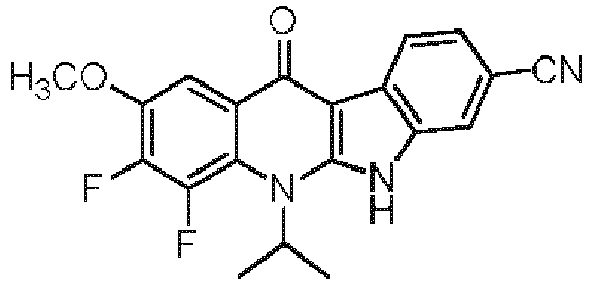
- Step C: 3,4-Difluoro-5-isopropyl-2-methoxy-11-oxo-6,11-dihydro-5H-indolo[2,3-b]quinoline-8-carbonitrile. Methyl 6-cyano-2-((2,3-difluoro-4-methoxyphenyl)(isopropyl)amino)-1H-indole-3-carboxylate (225 mg, 0.56 mmol) was dissolved in Diphenyl ether (10 mL) and the solution was refluxed for 1 hr. The mixture was cooled to RT. Hexane (20 mL) was added and the precipitate was collected by filtration. The precipitate was purified by silica gel chromatography (Hex:EA=2:1) to afford 3,4-Difluoro-5-isopropyl-2-methoxy-11-oxo-6,11-dihydro-5H-indolo[2,3-b]qunoline-8-carbonitrile.(135 mg, 65% yield). MS m/z=368 [M+H].

- Step D: 4-Fluoro-5-isopropyl-2-methoxy-3-(4-methylpiperazin-1-yl)-11-oxo-6,11-dihydro-5-indolo[2,3-b]quinoline-8-carbonitrile. 1-Methylpiperazine (0.5 mL) and DIPEA (0.5 ml) were added to a solution of 3,4-Difluoro-5-isopropyl-2-methoxy-11-oxo-6,11-dihydro-5H-indolo[2,3-b]quinoline-8-carbonitrile (135 mg, 0.37 mmol) in DMSO (2 ml) and the mixture was heated to 120 to 140 °C for 3 days. The reaction mixture was cooled to RT and purified by preparative HPLC to afford 4-Fluoro-5-isopropyl-2-methoxy-3-(4-methylpiperazin-1-yl)-11-oxo-6,11-dihydro-5H-indolo[2,3-b]quinoline-8-carbonitrile (24 mg, 15% yield). 1H NMR (300 MHz, CD3OD+CDCl3) δ ppm 8.33 (d, J=8.0 Hz, 1H), 7.77 (s, 1H), 7.72 (s, 1H), 7.48 (d, J=8.0 Hz, 1H), 5.20-5.00 (m, 1H), 4.04 (s, 3H), 3.80-3.50 (m, 6H), 3.40-3.25 (m, 2H), 3.00 (s, 3H), 1.74 (dd, J=5.6, 1.8 Hz, 6H).
-

-

- Step A: 3-Fluoro-4-iodo-N-isopropylaniline. Acetone (11.6 g, 200 mmol), Acetic acid (1.80 g, 30 mmol), and Sodium triacetoxyborohydride (6.36 g, 30 mmol) were added to a solution of 3-Fluoro-4-iodoaniline (4.74 g, 20 mmol) in DCM (120 mL) and the mixture was stirred at RT for 2 hr. Water was added to quench the reaction and the mixture was extracted with DCM. The solvent was removed under vacuum and the residue was purified by silica gel chromatography (Hex:EA =20:1) to afford 3-F1uom-4-iodo-N-isopropylaniline(3.90 g, 70% yield). MS m/z= 280 [M+H].

- Step B: Methyl 6-cyano-2-((3-fluoro-4-iodophenyl)(isopropyl)amino)-1H-indole-3-carboxylate. DABCO (62 mg, 0.55 mmol) was added to a solution of Methyl 6-cyano-1H-indole-3-carboxylate (200 mg, 1 mmol) in DCM (20 mL) and the mixture was cooled to 0 °C. N-Chlorosuccinimide (147 mg, 1.1 mmol) was then added and the reaction was stirred at 0 °C for 2 hr. A solution of 3-Fluoro-4-iodo-N-isopropylaniline (417 mg, 1.5 mmol) and Trichloroacetic acid (41 mg, 0.25 mmol) in DCM (5 mL) was added dropwise and the reaction was stirred for 2 hr at room temperature. The reaction was quenched by adding water and the mixture was extracted with DCM. Solvent was removed under vacuum and the residue was purified by silica gel chromatography (Hex:EA=4:1) to afford Methyl 6-cyano-2-((3-fluoro-4-iodophenyl)(isopropyl)amino)-1H-indole-3-carboxylate (267 mg, 56% yield).MS m/z= 478 [M+H].

- Step C: Methyl 6-cyano-2-((3-fluoro-4-(2-(trimethylsilyl)ethynyl)phenyl)(isopropyl)amino)-1H-indole-3-carboxylate. Trimethylsilylacetylene (98mg, 1mmol), Methyl 6-cyano-2-((3-fluoro-4-iodophenyl)(isopropyl)amino)-1H-indole-3-carboxylate (238g, 0.5mmol), Copper iodide (28mg, 0.15mmol) and Pd(PPh3)2Cl2 (34mg, 0.05mmol) in Diethyl amine (5ml) is stirred under N2 at 80 °C overnight. Water (20ml) was added and the mixture was extracted with ethyl acetate (150ml) for three times. The solvent was removed under vacuum and the residue was purified by silica gel chromatography to afford Methyl 6-cyano-2-((3-fluoro-4-(2-(trimethylsilyl)ethynyl)phenyl)(isopropyl)amino)-1H-indole-3-carboxylate (215 mg, 96% yield).MS m/z= 448 [M+H].

- Step D: 2-(Trimethylsilyl)thynyl-3-fluoro-5-isopropyl-11-oxo-6,11-dihydro-5H-indolo[2,3-b]quinoline-8-carbonitrile. Methyl 6-cyano-2-((3-fluoro-4-(2-(trimethylsilyl)ethynyl)pihenyl)(isopropyl)amino)-1H-indole-3-carboxylate (250 mg, 0.56 mmol) was dissolved in Diphenyl ether (10 mL) and the solution was refluxed for 3 hr. The mixture was cooled to RT. Hexane (20 mL) was added and the precipitate was collected by filtration. The precipitate was purified by silica gel chromatography (HexEA=2:1) to afford2-(Trimethylsilyl)ethynyl-3-fluoro-5-isopropyl-11-oxo-6,11-dihydro-5H-indolo[2,3-b]quinoline-8-carbonitrile (115 mg, 60% yield).MS m/z= 416 [M+H].

- Step E: 2-Ethynyl-5-isopropyl-3-(4-methylpiperazin-1-yl)-11-oxo-6,11-dihydro-5H-indolo[2,3-b]quinoline-8-carbonitrile. 1-Methylpiperazine (0.5 mL) and DIPEA (0.5 ml) were added to a solution of 2-(Trimethylsilyl)ethynyl-3-fluoro-5-isopropyl-11-oxo-6,11-dihydro-5H-indolo[2,3-b]quinoline-8-carbonitrile (127 mg, 0.37 mmol) in DMSO (2 ml) and the mixture was heated to 120 to 140 °C for 2 days. The reaction mixture was cooled to RT and purified by preparative HPLC to afford 2-Ethynyl-5-isopropyl-3-(4-methylpiperazin-1-yl)-11-oxo-6,11-dihydro-5H-indolo[2,3-b]quinoline-8-carbonitrile (31 mg, 20% yield). 1H NMR (300 MHz, CD3OD) δ ppm 8.52 (s, 1H), 8.34 (d, J=8.1 Hz, 1H), 7.80 (s, 1H), 7.56 (d, J=8.1 Hz, 1H), 7.31 (s, 1H), 5.43-5.30 (m, 1H), 4.20-4.09 (m, 2H), 4.02 (s, 1H), 3.80-3.70 (m, 2H), 3.50-3.23 (m, 4H), 3.07 (s, 3H), 1.89 (d, J=7.1 Hz, 6H).
-

-

- Step A: N-Cyclobutyl-3-fluoro-4-iodoaniline. Cyclobutanone (14.0 g, 200 mmol), Acetic acid (1.80 g, 30 mmol), and Sodium triacetoxyborohydride (6.36 g, 30 mmol) were added to a solution of 3-Fluoro-4-iodoaniline (4.74 g, 20 mmol) in DCM (120 mL) and the mixture was stirred at RT for 2 hr. Water was added to quench the reaction and the mixture was extracted with DCM. The solvent was removed under vacuum and the residue was purified by silica gel chromatography to afford N-Cyclobutyl-3-fluoro-4-iodoaniline (4.06 g, 70%yield). MS m/z= 292 [M+H].

- Step B: Methyl 6-cyano-2-(cyclobutyl(3-fluoro-4-iodophenyl)amino)-1H-indole-3-carboxylate. DABCO (62 mg, 0.55 mmol) was added to a solution of Methyl 6-cyano-1H-indole-3-carboxylate (200 mg, 1 mmol) in DCM (20 mL) and the mixture was cooled to 0 °C. N-Chlorosuccinimide (147 mg, 1.1 mmol) was then added and the reaction was stirred at 0 °C for 2 hr. A solution of N-Cyclobutyl-3-fluoro-4-iodoaniline (435 mg, 1.5 mmol) and Trichloroacetic acid (41 mg, 0.25 mmol) in DCM (5 mL) was added dropwise and the reaction was stirred for 2 hr at room temperature. The reaction was quenched by adding water and the mixture was extracted with DCM. Solvent was removed under vacuum and the residue was purified by silica gel chromatography (Hex:EA=4:1) to afford Methyl 6-cyano-2-(cyclobutyl(3-fluoro-4-iodophenyl)amino)-1H-indole-3-carboxylate (342 mg, 70% yield).MS m/z= 490 [M+H].

- Step C: Methyl 6-cyano-2-(cyclobutyl(3-fluoro4-((trimethylsilyl)ethynyl)phenyl)amino)-1H-indole-3-carboxylate. Trimethylsilylacetylene (98mg, 1mmol), Methyl 6-cyano-2-((3-fluoro-4-iodophenyl)(cyclobutyl)amino)-1H-indole-3-carboxylate (245g, 0.5mmol), Copper iodide (28mg, 0.15mmol) and Pd(PPh3)2Cl2 (34mg, 0.05mmol) in Diethyl amine (5ml) is stirred under N2 at 80 °C overnight. Water (20ml) was added and the mixture was extracted with ethyl acetate (150ml) for three times. The solvent was removed under vacuum and the residue was purified by silica gel chromatography to afford Methyl 6-cyano-2-(cyclobutyl(3-fluoro-4-((trimethylsilyl)ethynyl)phenyl)amino)-1H-indole-3-carboxylate (206mg, 90% yield).MS m/z=460 [M+H].

- Step D: 5-Cyclobutyl-2-(Trimethylsilyl)ethynyl-3-fluoro-11-oxo-6,11-dihydro-5H-indolo[2,3-b]quinoline-8-carbonitrile. Methyl 6-cyano-2-(cyclobutyl(3-fluoro-4-((trimethylsilyl)ethynyl)phenyl)amino)-1H-indole-3-carboxylate (257 mg, 0.56 mmol) was dissolved in Diphenyl ether (10 mL) and the solution was refluxed for 3 hr. The mixture was cooled to RT. Hexane (20 mL) was added and the precipitate was collected by filtration. The precipitate was purified by silica gel chromatography (Hex:EA=2:1) to afford 5-Cyclobutyl-2-(Trimethylsilyl)ethynyl-3-fluoro-11-oxo-6,11-dihydro-5H-indolo[2,3-b]quinoline-8-carbonitrile (213 mg, 60% yield). MS m/z=428 [M+H].

- Step E: 5-Cyclobutyl-2-ethynyl-3-(4-methylpiperazin-1-yl)-11-oxo-6,11-dihydro-5H-indolo[2,3-b]quinoline-8-carbonitrile.1-Methylpiperazine (0.5 mL) and DIPEA (0.5 ml) were added to a solution of 5-Cyclobutyl-2-(Trimethylsilyl)ethynyl-3-fluoro-11-oxo-6,11-dihydro-5H-indolo[2,3-blquinoline-8-carbonitirile (131 mg, 0.37 mmol) in DMSO (2 ml) and the mixture was heated to 120 to 140 °C for 2 days. The reaction mixture was cooled to RT and purified by preparative HPLC to afford 5-Cyclobutyl-2-ethynyl-3-(4-methylpiperazin-1-yl)-11-oxo-6,11-dihydro-5H-indolo[2,3-b]quinoline-8-carbonitrile (32 mg, 20% yield). 1H NMR (300 MHz, DMSO-d6) δ ppm 11.88 (s, 1H), 8.33 (s, 1H), 8.26 (d, J=8.0 Hz, 1H), 7.91 (s, 1H), 7.61 (d, J=8.0 Hz, 1H), 7.04 (s, 1H), 5.40-520 (m, 1H), 4.57 (s, 1H), 4.00-3.95 (m, 2H), 3.92-3.05 (m, 8H), 2.94 (s, 3H), 2.60-2.35 (m, 2H), 2.00-1.90 (m, 2H).
-

- 4-Fluoro-5-isopropyl-2-methoxy-3-(4-morpholinopiperidin-1-yl)-11-oxo-6,11-dihydro-5H-indolo[2,3-b]quinoline-8-carbonitrile- 4-Morpholinopiperidine (0.5 g) and DIPEA (0.5 ml) were added to a solution of 3,4-Difluoro-5-isopropyl-2-methoxy-11-oxo-6,11-dihydro-5H-indolo[2,3-b]quinoline-8-carbonibile (135 mg, 0.37mmol) in DMSO (2 ml) and the mixture was heated to 120 to 140 °C for 3 days. The reaction mixture was cooled to RT and purified by preparative HPLC to afford 4-Fluoro-5-isopropyl-2-methoxy-3-(4-morpholinopiperidin-1-yl)-11-oxo-6,11-dihydro-5H-indolo[2,3-b]quinoline-8-carbonitrile (24 mg, 15% yield). 1H NMR (300 MHz, CD3OD) δ ppm 8.21 (d, J=8.0 Hz, 1H), 7.64 (s, 1H), 7.60 (s, 1H), 7.39 (d, J=8.0 Hz, 1H), 5.10-4.90 (m, 1H), 4.20-4.10 (m, 2H), 4.00 (s, 3H), 3.90-3.70 (m, 2H), 3.65-3.50 (m, 4H), 3.45-3.20 (m, 5H), 2.33-2.20 (m, 2H), 2.10-1.85 (m, 2H), 1.70 (dd, J=69, 1.9 Hz, 6H).
-

-

- Step A: N-Cyclobutyl-2,3-difluoro-4-inethoxyamline. Cyclobutanone (14.0 g, 200 mmol), Acetic acid (1.8 g, 30 mmol), and Sodium triacetoxyborohydride (6.36 g, 30 mmol) were added to a solution of 2,3-Difluoro-4-methoxyaniline (3.18 g, 20 mmol) in DCM (120 mL) and the mixture was stirred at RT overnight. Water was added to quench the reaction and the mixture was extracted with DCM. The solvent was removed under and the residue was purified by silica gel chromatography to afford N-Cyclobutyl-2,3-difluoro-4-methoxyaniline (3.82g, 90% yield).MS m/z= 214 [M+H].

- Step B: Methyl 6-cyano-2-(cyclobutyl(2,3-difluoro-4-methoxyphenyl)amino)-1H-indole-3-carboxylate.DABCO (62 mg, 0.55 mmol) was added to a solution of Methyl 6-cyano-1H-indole-3-carboxylate (200 mg, 1 mmol) in DCM (20 mL) and the mixture was cooled to 0 °C. N-Chlorosuccinimide (147 mg, 1.1 mmol) was then added and the reaction was stirred at 0 °C for 2 hr. A solution of N-Cyclobutyl-2,3-difluoro-4-methoxyaniline (213 mg, 1 mmol) and Trichloroacetic acid (41 mg, 0.25 mmol) in DCM (5 mL) was added dropwise and the reaction was stirred for 2 hr at room temperature. The reaction was quenched by adding water and the mixture was extracted with DCM. Solvent was removed under vacuum and the residue was purified by silica gel chromatography (Hex:EA=5:1) to afford Methyl 6-cyano-2-(cyclobutyl(2,3-difluoro-4-methoxyphenyl)amino)-1H-indole-3-carboxylate(238 mg, 56% yield).MS m/z= 412 [M+H].

- Step C: 5-Cyclobutyl-3,4-difluoro-2-methoxy-11-oxo-6,11-dihydro-5H-indolo[2,3. b]quinoline-8-carbonitrile.Methyl 6-cyano-2-(cyclobutyl(2,3 -difluoro-4-methoxyphenyl)amino)-1H-indole-3-carboxylate (230 mg, 0.56 mmol) was dissolved in Diphenyl ether (10 mL) and the solution was refluxed for 1 hr. The mixture was cooled to RT. Hexane (20 mL) was added and the precipitate was collected by filtration. The precipitate was purified by silica gel chromatography (Hex:EA=2:1) to afford 5-Cyclobutyl-3,4-difluoro-2-methoxy-11-oxo-6,11-dihydro-5H-indolo[2,3-b]quinoline-8-carbonitrile(137 mg, 65% yield). MS m/z=380 [M+H].

- Step D: 5-Cyclobutyl-4-fluoro-2-methoxy-3-(4-morpholinopiperidin-1-yl)-11-oxo-6,11-dihydro-5H-indolo[2,3-b]quinoline-8-carbonitrile. 4-Morpholinopiperidine (0.5 g) and DIPEA (0.5 ml) were added to a solution of 5-Cyclobutyl-3,4-difluoro-2-methoxy-11-oxo-6,11-dihydro-5H-indolo[2,3-b]quinoline-8-carbonitrile (140 mg, 0.37 mmol) in DMSO (2 ml) and the mixture was heated to 120 to 140 °C for 2 days. The reaction mixture was cooled to RT and purified by preparative HPLC to afford 5-Cyclobutyl-4-fluoro-2-methoxy-3-(4-morpholinopiperidin-1-yl)-11-oxo-6,11-dihydro-5H-indolo[2,3-blquinoline-8-carbonitrile (29 mg, 15% yield). 1H NMR (300 MHz, CD3OD) δ ppm 8.18 (d, J=8.0 Hz, 1H), 7.62 (s, 1H), 7.58 (s, 1H), 7.40 (d, J=8.0 Hz, 1H), 5.18-5.02 (m, 1H), 4.20-4.08 (m, 2H), 3.98 (s, 3H), 3.90-3.74 (m, 2H), 3.70-3.50 (m, 4H), 3.46-3.20 (m, 5H), 2.83-2.70 (m, 2H), 2.30-1.64 (m, 8H).
-

- 5-Cyclobutyl-4-fluoro-2-methoxy-3-(4-methylpiperazin-1-yl)-11-oxo-6,11-dihydro-5H-indolo[23-b]quinoline-8-carbonitrile. 1-Methylpiperazine (0.5 ml) and DIPEA (0.5 ml) were added to a solution of 5-cyclobutyl-3,4-difluoro-2-minethoxy-11-oxo-6,11-dihydro-5H-indolo[2,3-b]quinoline-8-carbonitrile (140 mg, 0.37 mmol) in DMSO (2 ml) and the mixture was heated to 120 to 140 °C for 2 days. The reaction mixture was cooled to RT and purified by preparative HPLC to afford 5-Cyclobutyl-4-fluoro-2-methoxy-3-(4-methylpiperazin-1-yl)-11-oxo-6,11-dihydro-5H-indolo[23-b]quinoline-8-carbonitrile(24mg, 15% yield). 1H NMR (300 MHz, CD3OD+CDCl3)δ ppm 8.36 (d, J=8.1 Hz, 1H), 7.78-7.73 (m, 2H), 7.54 (d, J=8.1 Hz, 1H), 5.25-5.08 (m, 1H), 4.02 (s, 3H), 3.74-3.48 (m, 6H), 3.40-3.25 (m, 2H), 2.98 (s, 3H), 2.80-2.70 (m, 2H), 2.25-1.85 (m,4H).
-

-

- Step A: 4-Ethoxy-2,3-difluoro-N-isopropylaniline. Acetone (11.6 g, 200 mmol), Acetic acid (1.8 g, 30 mmol), and Sodium triacetoxyborohydride (6.36 g, 30 mmol) were added to a solution of 4-Ethoxy-2,3-difluoroaniline (3.46 g, 20 mmol) in DCM (120 mL) and the mixture was stirred at RT for 12 hr. Water was added to quench the reaction and the mixture was extracted with DCM. The solvent was removed under and the residue was purified by silica gel chromatography to afford 4-Ethoxy-2,3-difluoro-N-isopropylaniline (3.40 g, 80% yield). 1H NMR (400 MHz, CDCl3) δ ppm 6.66-6.63 (m, 1H), 6.39-6.36 (m, 1H), 4.04 (q, J = 7.0 Hz, 2H), 3.59-3.57 (m, 1H), 3.45 (s, 1H), 1.41 (t, J = 7.0 Hz, 3H), 1.23 (d, J = 6.2 Hz, 6H).

- Step B: Methyl 6-cyano-2-((4-ethoxy-2,3-difluorophenyl)(isopropyl)amino)-1H-indole-3-carboxylate. DABCO (62 mg, 0.55 mmol) was added to a solution of Methyl 6-cyano-1H-indole-3-carboxylate (200 mg, 1 mmol) in DCM (20 mL) and the mixture was cooled to 0 °C. N-Chlorosuccinimide (147 mg, 1.1 mmol) was then added and the reaction was stirred at 0 °C for 2 hr. A solution of 4-Ethoxy-2,3-difluoro-N-isopropylaniline (215 mg, 1 mmol) and Trichloroacetic acid (41 mg, 0.25 mmol) in DCM (5 mL) was added dropwise and the reaction was stirred for 2 hr at room temperature. The reaction was quenched by adding water and the mixture was extracted with DCM. Solvent was removed under vacuum and the residue was purified by silica gel chromatography (Hex:EA=4:1) to afford Methyl 6-cyano-2-((4-ethoxy-2,3-difluorophenyl)(isopropyl)amino)-1H-indole-3-carboxylate (247 mg, 60% yield). 1H NMR (400 MHz, CDCl3) δ ppm 8.02 (d, J = 8.3 Hz, 1H), 7.92 (s, 1H), 7.42-7.39 (m, 2H), 7.09-7.05 (m, 1H), 6.86-6.76 (m, 1H), 4.83 (m, 1H), 4.19 (q, J = 7.0 Hz, 2H), 3.88 (s, 3H), 1.51 (t, J = 7.0 Hz, 3H), 1.27 (dd, J = 6.6, 1.2 Hz, 6H).

- 2-Ethoxy-34-difluoro-5-isopropyl-11-oxo-6,11-dihydro-5H-indolo[2,3-b]quinoline-8-carbonitrile. Methyl 6-cyano-2-((4-ethoxy-2,3-difluorophenyl)(isopropyl)amino)-1H-indole-3-carboxylate (270 mg, 0.65 mmol) was dissolved in Diphenyl ether (10 mL) and the solution was refluxed for 1 hr. The mixture was cooled to RT. Hexane (20 mL) was added and the precipitate was collected by filtration. The precipitate was purified by silica gel chromatography (Hex:EA=2:1) to afford 2-Ethoxy-3,4-difluoro-5-isopropyl-11-oxo-6,11-dihydro-5H-indolo[2,3-b]quinoline-8-carbonitrile (155 mg, 41% yield). 1H NMR (400 MHz, DMSO-d6) δ 12.11 (s, 1H), 8.26 (d, J = 8.1 Hz, 1H), 7.89 (d, J = 1.4 Hz, 1H), 7.78 (dd, J = 9.0,1.9 Hz, 1H), 7.63 (dd, J = 8.1, 1.4 Hz, 1H), 5.06-5.04 (m, 1H), 4.27 (q, J = 6.9 Hz, 2H), 1.67 (dd, J = 7.0, 2.1 Hz, 6H), 1.43 (t, J = 6.9 Hz, 3H).

- 2-Ethoxy-4-fluoro-5-isopropyl-3-(4-morpholinopiperidin-1-yl)-11-oxo-6,11-dihydro-5H-indolo[2,3-b]quinoline-8-carbonitrile. 4-Morpholinopiperidine (0.5 g) and DIPEA (0.5 ml) were added to a solution of 2-Ethoxy-3,4-difluoro-5-isopropyl-11-oxo-6,11-dihydro-5H-indolo[2,3-b]quinoline-8-carbonitrile (155 mg, 0.41mmol) in DMSO (2 ml) and the mixture was heated to 120 to 140 °C for 3 days. The reaction mixture was cooled to RT and purified by preparative HPLC to afford 2-Ethoxy4-fluoro-5-isopropyl-3-(4-morpholinopiperidin-1-yl)-11-oxo-6,11-dihydro-5H-indolo[2,3-b]quinoline-8-carbonitrile (48 mg, 22% yield). 1H NMR (300 MHz, CD3OD) δ ppm 8.34 (d, J=8.1 Hz, 1H), 7.78 (s, 1H), 7.70 (s, 1H), 7.54 (d, J=8.1 Hz, 1H), 5.20-5.02 (m, 1H), 4.24 (q, J=6.9 Hz, 2H), 4.22-4.17 (m, 2H), 3.90-3.60 (m, 6H), 3.55-3.20 (m, 5H), 2.35-2.20 (m, 2H), 2.00-1.84 (m, 2H), 1.74 (dd, J=7.0, 2.0 Hz, 6H), 1.55 (t, J=6.9 Hz, 3H).
-

-
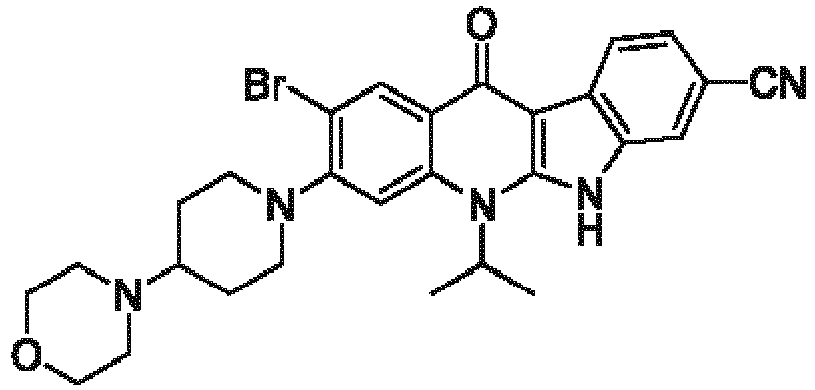
- Step A: 2-Bromo-5-isopropyl-3-(4-morpholinopiperidin-1-yl)-11-ozo-6,11-dihydro-5H-indolo[2,3-b]quinoline-8-carbonitrile.4-Morpholinopiperidine (0.5 g) and DIPEA (0.5 ml) were added to a solution of 2-Bromo-3-fluoro-5-isopropyl-11-oxo-6,11-dihydro-5H-indolo[2,3-b]quinoline-8-carbonitrile (110 mg, 0.28 mmol) in DMSO (2 ml) and the mixture was heated to 120 to 140 °C for 3 days. The reaction mixture was cooled to RT and purified by preparative HPLC to afford 2-Bromo-5-isopropyl-3-(4-morpholinopiperidin-1-yl)-11-oxo-6,11-dihydro-5H-indolo[2,3-b]quinoline-8-carbonitrile (34 mg, 22% yield).MS m/z=548 [M+H].
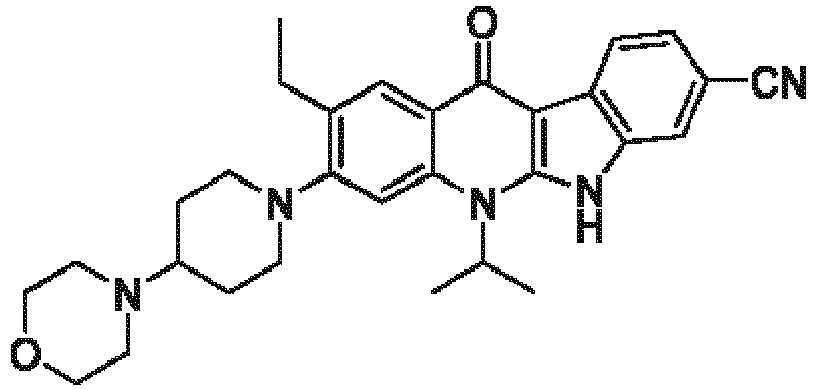
- Step B: 2-Ethyl-5-isopropyl-3-(4-morpholinopiperidin-1-yi)-11-oxo-6,11-dihydro-5H-indolo[2,3-b]quinoline-8-carbonitrile. A mixture of 2-Bromo-5-isopropyl-3-(4-morpholinopiperidin-1-yl)-11-oxo-6,11-dihydro-5H-indolo[2,3-b]quinoline-8-carbonitrile (33 mg, 0.061 mmol), Na2CO3 (25 mg, 0.183 mmol), Pd(PPh3)2Cl2 (4.3 mg, 0.0061 mmol), and 4,4,5,5-Tetramethyl-2-vinyl-1,3,2-dioxaborolane (14 mg, 0.091 mmol) in DME/H2O (4.8 ml, V/V=5/1) was stirred under nitrogen at 80 °C overnight. After the reaction was complete as indicated by LC-MS, the solvent was removed under vacuum, and the residue was purified by silica gel chromatography to afford mixture of 5-isoPropyl-3-(4-morpholinopiperidin-1-yl)-1 1-oxo-2-vinyl-6,11-dihydro-5H-indolo[2,3-b]quinoline-8-carbonitrile and Triphenyl phosphine oxide. The mixture was dissolved in THF (5 ml). Pd/C (10%, 5 mg) was added to the THF solution. The mixture underwent hydrogenation at room temperature for overnight until LC-MS indicated that the reaction was complete. The filtrate after filtration was concentrated and the residue was purified by preparative HPLC to afford 2-Ethyl-5-isopropyl-3-(4-morpholinopiperidin-1-yl)-11-oxo-6,11-dihydro-5H-indolo[2,3-b]quinoline-8-carbonitrile (17 mg, 52% yield). MS m/z=498 [M+H].
-

- 2-Ethyl-5-isopropyl-3-(4-(oxetan-3-yl)piperazin-1-yl)-11-oxo-6,11-dihydro-5H-indolo[2,3-b]quinoline-8-carbonitrile. The title compound was prepared in a method similar to that used in the preparation of 2-Ethyl-5-isopropyl-3-(4-morpholinopiperidin-1-yl)-11-oxo-6,11-dihydro-5H-indolo[2,3 -b]quinoline-8-carbonitrile. MS m/z=470 [M+H].
-

-

- Step A: 2-Bromo-5-isopropyl-3-(4-(4-methylpiperazin-1-yl)piperidin-1-yl)-11-oxo-6,11-dihydro-5H-indolo[2,3-b]quinoline-8-carbonitrile. 4-Methylpiperazin-1-piperdine (1g) and DIPEA (1 ml) were added to a solution of 2-Bromo-3-fluoro-5-isopropyl-11-oxo-6,11-dihydro-5H-indolo[2,3-b]quinoline-8-carbonitrile (330 mg, 0.84 mmol) in DMSO (2 ml) and the mixture was heated to 120 to 140 °C for 3 days. The reaction mixture was cooled to RT and purified by preparative HPLC to afford 2-Bromo-5-isopropyl-3-(4-(4-methylpiperazin-1-yl)piperidin-1-yl)-11-oxo-6,11-dihydro-5H-indolo[2,3-b]quinoline-8-carbonitrile (103 mg, 22% yield).MS m/z=561 [M+H].

- StepB:2-Ethyl-5-isopropyl-3-(4-(4-methylpiperazin-1-yl)piperidin-1-yl)-11-oxo-6,11-dihydro-5H-indolo[2,3-b]quinoline-8-carbonitrile. A mixture of 2-Bromo-5-isopropyl-3-(4-(4-methylpiperazin-1-yl)piperidin-1-yl)-11-oxo-6,11-dihydro-5H-indolo[2,3-b]quinoline-8-carbonitrile (340 mg, 0.61 mmol), Na2CO3 (250 mg, 1.83 mmol), Pd(PPh3)2Cl2 (43 mg, 0.061 mmol), and 4,4,5,5-Tetramethyl-2-vinyl-1,3,2-dioxaborolane (14 0mg, 0.91 mmol) in DME/H2O (20 ml, V/V=4/1) was stirred under nitrogen at 80 °C overnight. After the reaction was complete as indicated by LC-MS, the solvent was removed under vacuum, and the residue was purified by silica gel chromatography to afford mixture of 5-isoPropyl-3-(4-(4-methylpiperazin-1-yl)piperidin-1-yl)-11-oxo-2-vinyl-6,11-dihydro-5H-indolo[2,3-b]quinoline-8-carbonitrile and Triphenyl phosphine oxide. The mixture wasdissolved in THF (25 ml). Pd/C (10%, 5 mg) was added to the THF solution. The mixture underwent hydrogenation at room temperature for overnight until LC-MS indicated that the reaction was complete. The filtrate after filtration was concentrated and the residue was purified by preparative HPLC to afford 2-Ethyl-5-isopropyl-3-(4-(4-methylpiperazin-1-yl)piperidin-1-yl)-11-oxo-6,11-dihydro-5H-indolo[2,3-b]quinoline-8-carbonitrile (161 mg, 52% yield).MS m/z=511 [M+H].
-

-

- Step A: 2-Bromo-5-isopropyl-3-(4-isopropylpiperazin-1-yl)-11-oxo-6,11-dihydro-5H-indolo[2,3-b]quinoline-8-carbonitrile. 4-isoPropylpiperazine (0.5 mL) and DIPEA (0.5 ml) were added to a solution of 2-Bromo-3-fluoro-5-isopropyl-11-oxo-6,11-dihydro-5H-indolo[2,3-b]quinoline-8-carbonitrile (110 mg, 0.28 mmol) in DMSO (2 ml) and the mixture was heated to 120 to 140 °C for 3 days. The reaction mixture was cooled to RT and purified by preparative HPLC to afford 2-Bromo-5-isopropyl-3-(4-isopropylpiperazin-1-yl)-11-oxo-6,11-dihydro-5H-indolo[2,3-b]quinoline-8-carbonitrile (31 mg, 22% yield).MS m/z=506 [M+H].

- Step B: 2-Ethyl-5-isopropyl-3-(4-isopropylpiperazin-1-yl)-11-oxo-6,11-dihydro-5H-indolo[2,3-b]quinoline-8-carbonitrile. A mixture of 2-Bromo-5-isopropyl-3-(4-isopropylpiperazin-1-yl)-11-oxo-6,11-dihydro-5H-indolo[2,3-b]quinoline-8-carbonitrile (31 mg, 0.061 mmol), Na2CO3 (25 mg, 0.183 mmol), Pd(PPh3)2Cl2 (4.3 mg, 0.0061 mmol), and 4,4,5,5-tetramethyl-2-vinyl-1,3,2-dioxaborolane (14 mg, 0.091 mmol) in DME/H2O (4.8 ml, V/V=5/1) was stirred under nitrogen at 80 °C overnight. After the reaction was complete as indicated by LC-MS, the solvent was removed under vacuum, and the residue was purified by silica gel chromatography to afford a mixture of 5-isoPropyl-3-(4-isopropylpiperazin-1-yl)-11-oxo-2-vinyl-6,11-dihydro-5H-indolo[2,3-b]quinoline-8-carbonitrile and Triphenyl phosphine oxide. The mixture was dissolved in THF (5 ml). Pd/C (10%, 5 mg) was added to the THF solution. The mixture underwent hydrogenation at room temperature overnight until LC-MS indicated that the reaction was complete. The filtrate after filtration was concentrated and the residue was purified by preparative HPLC to afford 2-Ethyl-5-isopropyl-3-(4-isopropylpiperazin-1-yl)-11-oxo-6,11-dihydro-5H-indolo[2,3-b]quinoline-8-carbonitrile (14 mg, 52% yield).MS m/z=456 [M+H].
-
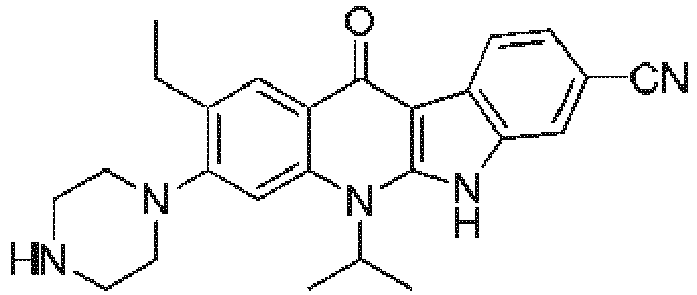
-

- Step A: 2-Bromo-5-isopropyl-11-ozo-3-(piperazin-1-yl)-6,11-dihydro-5H-indolo[2,3-b]quinoline-8-carbonitrile. N-Boc-piperazine (0.5g) and DIPEA (0.5 ml) were added to a solution of 2-Bromo-3-fluoro-5-isopropyl-11-oxo-6,11-dihydro-5H-indolo[2,3-b]quinoline-8-carbonitrile (110 mg, 0.28 mmol) in DMSO (2 ml) and the mixture was heated to 120 to 140 °C for 7 days. The reaction was cooled to RT and water (20 ml) was added. The mixture was extracted with dichloromethane (60 ml) for three times. The solvent was removed under vacuum and the residue was purified by silica gel chromatography (DCM/MeOH=10/1) to afford 2-Bromo-5-isopropyl-3-(N-Boc-piperazin-1-yl)-11-oxo-6,11-dihydro-5H-indolo[2,3-b]quinoline-8-carbonitrile. 2-Bromo-5-isopropyl-3-(N-Boc-piperazin-1-yl)-11-oxo-6,11-dihydro-5H-indolo[2,3-b]quinoline-8-carbonitrile was dissolved in DCM (1 ml) and Trichloroacetic acid (0.5ml) was added and the mixture was stirred at RTovemight. The solvent was removed under vacuum to afford 2-Bromo-5-isopropyl-11-oxo-3-(piperazin-1-yl)-6,11-dihydro-5H-indolo[2,3-b]quinoline-8-carbonitrile (33mg, 28%).MS m/z=464 [M+H].

- Step B: 2-Ethyl-5-isopropyl-11-oxo-3-(piperazin-1-yl)-6,11-dihydro-5H-indolo[2,3-b]quinoline-8-carbonitrile. A mixture of 2-Bromo-5-isopropyl-3-(piperazin-1-yl)-11-oxo-6,11-dihydro-5H-indolo[2,3-b]quinoline-8-carbonitrile (28 mg, 0.061 mmol), Na2CO3 (25 mg, 0.183 mmol), Pd(PPh3)2Cl2 (4.3 mg, 0.0061 mmol), and 4,4,5,5-Tetramethyl-2-vinyl-1,3,2-dioxaborolane (14 mg, 0.091 mmol) in DME/H2O (4.8 ml, V/V=5/1) was stirred under nitrogen at 80 °C overnight. After the reaction was complete as indicated by LC-MS, the solvent was removed under vacuum, and the residue was purified by silica gel chromatography to afford a mixture of 5-isoPropyl-3-(piperazin-1-yl)-11-oxo-2-vinyl-6,11-dihydro-5H-indolo[2,3-b]quinoline-8-carbonitrile and Triphenyl phosphine oxide. The mixture wasdissolved in THF (5 ml). Pd/C (10%, 5 mg) was added to the THF solution. The mixture underwent hydrogenation at room temperature overnight until LC-MS indicated that the reaction was complete. The filtrate after filtration was concentrated and the residue was purified by preparative HPLC to afford 2-Ethyl-5-isopropyl-11-oxo-3-(piperazin-1-yl)-6,11-dihydro-5H-indolo[2,3-b]quinoline-8-carbonitrile (13 mg, 52% yield).MS m/z=414 [M+H]. 1H NMR (300 MHz, CD3OD) δ ppm 8.42 (s, 1H), 8.37 (d, J=8.0 Hz, 1H), 7.77 (s, 1H), 7.57-7.45 (m, 2H), 5.46-5.30 (m, 1H), 3.55-3.50 (m, 4H), 3.48-3.26 (m, 4H), 2.87 (q, J=7.4 Hz, 2H), 1.89 (d, J=7.1 Hz, 6H), 1.41 (t, J=7.4 Hz, 3H).
-

-
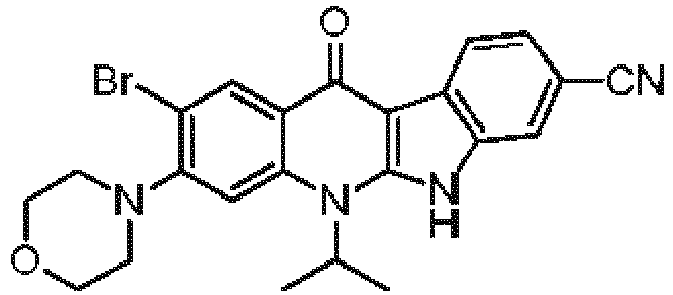
- Step A: 2-Bromo-5-isopropyl-3-morpholino-11-oxo-6,11-dihydro-5H-indolo[2,3-b]quinoline-8-carbonitrile. Morpholine (0.5 mL) and DIPEA (0.5 ml) were added to a solution of 2-Bromo-3-fluoro-5-isopropyl-11-oxo-6,11-dihydro-5H-indolo[2,3-b]quinoline-8-carbonitrile (110 mg, 0.28 mmol) in DMSO (2 ml) and the mixture was heated to 120 to 140 °C for 3 days. The reaction mixture was cooled to RT and purified by preparative HPLC to afford 2-Bromo-5-isopropyl-3-morpholino-11-oxo-6,11-dihydro-5H-indolo[2,3-b]quinoline-8-carbonitrile (38 mg, 29% yield).MS m/z=465 [M+H].

- Step B: 2-Ethyl-5-isopropyl-3-morpholino-11-oxo-6,11-dihydro-5H-indolo[2,3-b]quinoline-8-carbonitrile. A mixture of 2-Bromo-5-isopropyl-3-morpholino-11-oxo-6,11-dihydro-5H-indolo[2,3-b]quinoline-8-carbonitrile (25 mg, 0.061 mmol), Na2CO3 (25 mg, 0.183 mmol), Pd(PPh3)2Cl2 (4.3 mg, 0.0061 mmol), and 4,4,5,5-Tetramethyl-2-vinyl-1,3,2-dioxaborolane (14 mg, 0.091 mmol) in DME/H2O (4.8 ml, V/V=5/1) was stirred under nitrogen at 80 °C overnight. After the reaction was complete as indicated by LC-MS, the solvent was removed under vacuum, and the residue was purified by silica gel chromatography to afford a mixture of 5-isoPropyl-3-morpholino-11-oxo-2-vinyl-6,11-dihydro-5H-indolo[2,3-b]quinoline-8-carbonitrile and Triphenyl phosphine oxide. The mixture was dissolved in THF (5 ml). Pd/C (10%, 5 mg) was added to the THF solution. The mixture underwent hydrogenation at room temperature overnight until LC-MS indicated that the reaction was complete. The filtrate after filtration was concentrated and the residue was purified on HPLC to afford 2-Ethyl-5-isopropyl-3-morpholino-11-oxo-6,11-dihydro-5H-indolo[2,3-b]quinoline-8-carbonitrile (17 mg, 60% yield). MS m/z=415 [M+H].
-
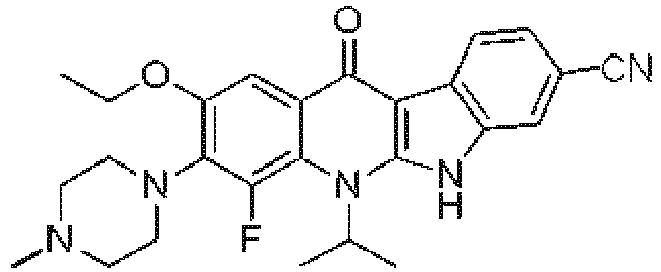
- 2-Ethoxy-4-fluoro-5-isopropyl-3-(4-methylpiperazin-1-yl)-11-oxo-6,11-dihydro-5H-indolo[2,3-b]quinoline-8-carbonitrile. 1-Methylpiperazine (0.5 mL) and DIPEA (0.5 ml) were added to a solution of 2-Ethoxy-3,4-difluoro-5-isopropyl-11-oxo-6,11-dihydro-5H-indolo[2,3-b]quinoline-8-carbonitrile (135 mg, 0.37 mmol) in DMSO (2 ml) and the mixture was heated to 120 to 140 °C for 3 days. The reaction mixture was cooled to RT and purified by preparative HPLC to afford 2-Ethoxy-4-fluoro-5-isopropyl-3-(4-methylpiperazin-1-yl)-11-oxo-6,11-dihydro-5H-indolo[2,3-b]quinoline-8-carbonitrile (26 mg, 15% yield). 1H NMR (300 MHz, CD3OD) δ ppm 8.16 (d, J=8.0 Hz, 1H), 7.61 (s, 1H), 7.55 (s, 1H), 7.36 (d, J=8.0 Hz, 1H), 5.104.90 (m, 1H), 4.23 (q, J=6.9 Hz, 2H), 3.80-3.60 (m, 6H), 3.50-3.30 (m, 2H), 3.04 (s, 3H), 1.70 (dd, J=6.9, 1.9 Hz, 6H), 1.56 (t, J=6.9 Hz, 3H).
-

-
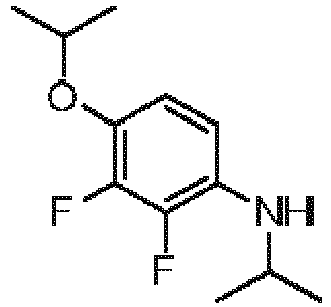
- Step A: 2,3-Difluoro-4-isopropoxy-N-isopropylaniline. Acetone (11.6 g, 200 mmol), Acetic acid (1.8 g, 30 mmol), and Sodium triacetoxyborohydride (6.36 g, 30 mmol) were added to a solution of 2,3-Difluoro-4-isopropoxyaniline (3.74 g, 20 mmol) in DCM (120 mL) and the mixture was stirred at RT for 12 hr. Water was added to quench the reaction and the mixture was extracted with DCM. The solvent was removed under and the residue was purified by silica gel chromatography to afford 2,3-Difluoro-4-isopropoxy-N-isopropylaniline. (3.80 g, 83% yield). 1H NMR (400 MHz, CDCl3) δ ppm 6.70-6.65 (m, 1H), 6.36 (td, J = 8.9, 2.4 Hz, 1H), 4.40-4.26 (m, 1H), 3.61-3.57 (m, 2H), 1.33 (d, J = 6.1 Hz, 6H), 1.24 (d, J = 6.3 Hz, 6H).

- Step B: Methyl 6-cyano-2-((2,3-difluoro-4-isopropoxyphenyl)(isopropyl)amino)-1H-indole-3-carboxylate. DABCO (62 mg, 0.55 mmol) was added to a solution of Methyl 6-cyano-1H-indole-3-carboxylate (200 mg, 1 mmol) in DCM (20 mL) and the mixture was cooled to 0 °C. N-Chlorosuccinimide (147 mg, 1.1 mmol) was then added and the reaction was stirred at 0 °C for 2 hr. A solution of 2,3-Difluoro-4-isopropoxy-N-isopropylaniline (229 mg, 1 mmol) and Trichloroacetic acid (41 mg, 0.25 mmol) in DCM (5 mL) was added dropwise and the reaction was stirred for 2 hr at room temperature. The reaction was quenched by adding water and the mixture was extracted with DCM. Solvent was removed under vacuum and the residue was purified by silica gel chromatography (Hex:EA=4:1) to afford Methyl 6-cyano-2-((2,3-difluoro-4-isopropoxyphenyl)(isopropyl)amino)-1H-indole-3-carboxylate (230 mg, 54% yield). MS m/z=428 [M+H].1H NMR (300 MHz, CDCl3) δ 8.05-7.95 (m, 2H), 7.43-7.33 (m, 2H), 7.02 (td, J = 8.6, 2.3 Hz, 1H), 6.79-6.78 (m, 1H),4.83-4.78 (m, 1H), 4.63-4.59 (m, 1H), 3.84 (s, 3H), 1.40 (d, J = 6.1 Hz, 6H), 1.31 - 1.17 (m, 6H).

- Step C: 3,4-Difluoro-2-isopropoxy-5-isopropyl-11-oxo-6,11-dihydro-5H-indolo[2,3-b]quinoline-8-carbonitrile. Methyl 6-cyano-2-((2,3-difluoro-4-isopropoxyphenyl)(isopropyl)amino)-1H-indole-3-carboxylate (230 mg, 0.54 mmol) was dissolved in Diphenyl ether (10 mL) and the solution was refluxed for 1 hr. The mixture was cooled to RT. Hexane (20 mL) was added and the precipitate was collected by filtration. The precipitate was purified by silica gel chromatography (Hex:EA=2:1) to afford 3,4-Difluoro-2-isopropoxy-5-isopropyl-11-oxo-6,11-dihydro-5H-indolo[2,3-b]quinoline-8-carbonitrile (125 mg, 59% yield). 1H NMR (400 MHz, DMSO-d 6) δ 12.13 (s, 1H), 8.28 (d, J = 8.0 Hz, 1H), 7.91 (d, J = 1.4 Hz, 1H), 7.82 (dd, J = 9.0, 1.9 Hz, 1H), 7.64 (dd, J = 8.0,1.4 Hz, 1H), 5.08-5.06 (m, 1H), 4.83-4.81 (m, 1H), 1.68 (dd, J = 7.1, 2.1 Hz, 6H), 1.38 (d, J = 6.0 Hz, 6H).

- Step D: 4-Fluoro-2-isopropoxy-5-isopropyl-3-(4-morpholinopiperidin-1-yl)-11-oxo-6,11-dihydro-5H-indolo[2,3-b]quinoline-8-carbonitrile. 4-Morpholinopiperidine (161 mg, 0.96 mmol) and DIPEA (0.5 ml) were added to a solution of 3,4-Difluoro-2-isopropoxy-5-isopropyl-11-oxo-6,11-dihydro-5H-indolo[2,3-b]quinoline-8-carbonitrile (125 mg, 0.32 mmol) in DMSO (2 ml) and the mixture was heated to 120 to 140 °C for 3 days. The reaction mixture was cooled to RT and purified by preparative HPLC to afford 4-Fluoro-2-isopropoxy-5-isopropyl-3-(4-morpholinopiperidin-1-yl)-11-oxo-6,11-dihydro-5H-indolo[2,3-b]quinoline-8-carbonitrile (35 mg, 20% yield). 1H NMR (300 MHz, CD3OD) δ ppm 8.29 (d, J=8.0 Hz, 1H), 7.73-7.71(m, 2H), 7.47 (d, J=8.0 Hz, 1H), 5.10-5.00 (m, 1H), 4.90-4.70 (m, 1H), 4.20-4.10 (m, 2H), 3.90-3.73 (m, 2H), 3.70-3.50 (m, 3H), 3.44-3.20 (m, 6H), 2.36-2.22 (m, 2H), 2.00-1.83 (m, 2H), 1.73 (dd, J=6.9, 1.8 Hz, 6H), 1.47 (d, J=6.0 Hz, 6H).
-

- 4-Fluoro-2-isopropoxy-5-isopropyl-3-(4-methylpiperazin-1-yl)-11-oxo-6,11-dihydro-5H-indolo[2,3-b]quinoline-8-carbonitrile. 1-Methylpiperazine (0.5 mL) and DIPEA (0.5 ml) were added to a solution of 3,4-Difluoro-2-isopropoxy-5-isopropyl-11-oxo-6,11-dihydro-5H-indolo[2,3-b]quinoline-8-carbonitrile (125 mg, 0.32 mmol) in DMSO (2 ml) and the mixture was heated to 120 to 140 °C for 3 days. The reaction mixture was cooled to RT and purified by preparative HPLC to afford 4-Fluoro-2-isopropoxy-5-isopropyl-3-(4-morpholinopiperidin-1-yl)-11-oxo-6,11-dihydro-5H-indolo[2,3-b]quinoline-8-carbonitrile (52 mg, 35% yield). 1H NMR (300 MHz, CD3OD) δ ppm 8.21 (d, J=8.0 Hz, 1H), 7.71 (s, 1H), 7.59 (s, 1H), 7.39 (d, J=8.0 Hz, 1H), 5.18-5.00 (m, 1H), 4.90-4.80 (m, 1H), 3.80-3.57 (m, 6H), 3.42-3.30 (m, 2H), 3.04 (s, 3H), 1.72 (dd, J=6.9,1.8 Hz, 6H), 1.49 (d, J=6.0 Hz, 6H).
-

-

- Step A: tert-Butyl 4-(2-bromo-5-nitrophenyl)-5,6-dihydropyridine-1(2H)-carboxylate. tert-Butyl 4-(4,4,5,5-tetramethyl-1,3,2-dioxaborolan-2-yl)-5,6-dihydropyridine-1(2H)-carboxylate (471 mg, 1.52 mmol), Pd(dppf)Cl2 (44 mg, 0.06 mmol), and K2CO3 (629 mg, 4.56 mmol) were added to a solution of 1-Bromo-2-iodo-4-nitrobenzene (500 mg, 1.52 mmol) in DME-H2O (11 mL, 10:1 mixture). The mixture was stirred at 80 °C for 12 hr under nitrogen. The reaction was cooled to RT and the product was extracted with EtOAc. Solvent was removed under reduced pressure and the residue was purified by silica gel chromatography (Hex:EA=8:1) to afford tert-Butyl 4-(2-bromo-5-nitrophenyl)-5,6-dihydropyridine-1(2H)-carboxylate (470 mg, 80% yield). 1H NMR (300 MHz, CDCl3) δ ppm 8.04 (d, J=2.7 Hz, 1H), 7.98 (dd, J=8.7, 2.7 Hz, 1H), 7.75 (d, J=8.7 Hz, 1H), 5.70-5.80 (m, 1H), 4.15-4.06 (m, 2H), 3.67 (t, J=5.6 Hz, 2H), 2.50-2.40 (m, 2H), 1.51 (s, 9H).

- Step B: tert-Butyl 4-(5-nitro-2-vinylphenyl)-5,6-dihydropyridine-1(2H)-carboxylate. 4,4,5,5-Tetramethyl-2-vinyl-1,3,2-dioxaborolane (80 mg, 0.52 mmol), Pd(dppf)Cl2 (7.6 mg, 0.01 mmol), and K2CO3 (108 mg, 0.78 mmol) were added to a solution of tert-Butyl 4-(2-bromo-5-nitrophenyl)-5,6-dihydropyridine-1(2H)-carboxylate (100 mg, 0.26 mmol) in DME-H2O (11 mL, 10:1 mixture). The mixture was stirred at 80 °C for 12 hr under nitrogen. The reaction was cooled to RT and the product was extracted with EtOAc. Solvent was removed under reduced pressure and the residue was purified by silica gel chromatography (Hex:EA=10:1) to afford tert-Butyl 4-(5-nitro-2-vinylphenyl)-5,6-dihydropyridine-1(2H)-carboxylate (68 mg, 79% yield). 1H NMR (300 MHz, CDCl3) δ ppm 8.12 (dd, J=8.6, 2.4 Hz, 1H), 8.03 (d, J=2.4 Hz, 1H), 7.68 (d, J=8.6 Hz, 1H), 6.86 (dd, J=17.6, 11.1 Hz, 1H), 5.86 (d, J=17.6 Hz, 1H), 5.75-5.68 (m, 1H), 5.49 (d, J=11.1 Hz, 1H), 4.15-4.02 (m, 2H), 3.67 (t, J=5.6 Hz, 2H), 2.40-2.30 (m, 2H), 1.53 (s, 9H).

- Step C: tert-Butyl 4-(5-amino-2-ethylphenyl)piperidine-1-carboxylate. 10% Pd-C(140 mg) was added to a solution of tert-Butyl 4-(5-nitro-2-vinylphenyl)-5,6-dihydropyridine-1(2H)-carboxylate (1.4 g, 4.2 mmol) in Ethanol (20 mL) and the mixture underwent hydrogenation at RT overnight. The Pd-C was filtered off. Evaporation of Ethanol under reduced pressure afforded tert-Butyl 4-(5-amino-2-ethylphenyl)piperidine-1-carboxylate (1.2 g, 93% yield). 1H NMR (300 MHz, CDCl3) δ ppm 6.97 (d, J=7.8 Hz, 1H), 6.58-6.40 (m, 2H), 4.38-4.18 (m, 2H), 2.90-2.70 (m, 3H), 2.57 (q, J=7.5 Hz, 2H), 1.75-1.50 (m, 4H), 1.49 (s, 9H), 1.16 (t, J=7.5 Hz, 3H).
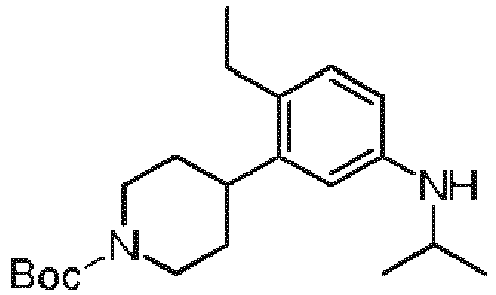
- Step D: tert-Butyl 4-(2-ethyl-5-(isopropylamino)phenyl)piperidine-1-carboxylate. Acetone (2.28 g, 39.5 mmol), Acetic acid (0.356 g, 5.93 mmol), and Sodium triacetoxyborohydride (1.256 g, 5.93 mmol) were added to a solution of tert-Butyl 4-(5-amino-2-ethylphenyl)piperidine-1-carboxylate (1.2 g, 3.95 mmol) in DCM (120 mL) and the mixture was stirred at RT for 12 hr. Water was added to quench the reaction and the mixture was extracted with DCM. The solvent was removed under and the residue was purified by silica gel chromatography to afford tert-Butyl 4-(2-ethyl-5-(isopropylamino)phenyl)piperidine-1-carboxylate. (1.1 g, 81% yield). 1H NMR (300 MHz, CDCl3) δ ppm 6.98 (d, J=8.9 Hz, 1H), 6.45-6.40 (m, 2H), 4.30-4.20 (m, 2H), 3.65-3.50 (m, 1H), 2.82-2.70 (m, 3H), 2.56 (q, J=7.5 Hz, 2H), 1.75-1.51 (m, 4H), 1.49 (s, 9H), 1.25-1.13 (m, 9H).

- Step E: Methyl 2-((3-(1-(tert-butoxycarbonyl)piperidin-4-yl)-4-ethylphenyl)(isopropyl)amino)-6-cyano-1H-indole-3-carboxylate. DABCO (123 mg, 1.1 mmol) was added to a solution of Methyl 6-cyano-1H-indole-3-carboxylate (400 mg, 2 mmol) in DCM (20 mL) and the mixture was cooled to 0 °C. N-Chlorosuccinimide (293 mg, 2.2 mmol) was then added and the reaction was stirred at 0 °C for 2 hr. A solution of tert-Butyl 4-(2-ethyl-5-(isopropylamino)phenyl)piperidine-1-carboxylate (692 mg, 2 mmol) and Trichloroacetic acid (82 mg, 0.5 mmol) in DCM (5 mL) was added dropwise and the reaction was stirred for 2 hr at room temperature. The reaction was quenched by adding water and the mixture was extracted with DCM. Solvent was removed under vacuum and the residue was purified by silica gel chromatography (Hex:EA=4:1) to afford Methyl 2-((3-(1-(tert-butoxycarbonyl)piperidin-4-yl)-4-ethylphenyl)(isopropyl)amino)-6-cyano-1H-indole-3-carboxylate (470 mg, 43% yield). 1H NMR (300 MHz, CDCl3) δ ppm 8.27 (s, 1H), 8.02 (d, J=8.3 Hz, 1H), 7.40-7.35 (m, 2H), 7.21 (d, J=8.0 Hz, 1H), 7.00-6.85 (m, 2H), 4.98-4.78 (m, 1H), 4.36-4.20 (m, 2H), 3.84 (s, 3H), 3.00-2.72 (m, 3H), 2.70 (q, J=7.6 Hz, 2H), 1.75-1.50 (m, 4H), 1.46 (s, 9H), 1.25-1.20 (m, 9H).

- Step F: -2-Ethyl-5-isopropyl-11-oxo-3-(piperidin-4-yl)-6,11-dihydro-5H-indolo[2,3-b]quinoline-8-carbonitrile. Methyl 2-((3-(1-(tert-butoxycarbonyl)piperidin-4-yl)-4-ethylphenyl)(isopropyl)amino)-6-cyano-1H-indole-3-carboxylate (200 mg, 0.54 mmol) was dissolved in Diphenyl ether (10 mL) and the solution was refluxed for 1 hr. The mixture was cooled to RT. Hexane (20 mL) was added and the precipitate was collected by filtration. The precipitate was purified by preparative-BPLC to afford 2-Ethyl-5-isopropyl-11-oxo-3-(piperidin-4-yl)-6,11-dihydro-5H-indolo[2,3-b]quinoline-8-carbonitrile (90 mg, 59% yield). 1H NMR (300 MHz, DMSO-d6) δ ppm 12.42 (s, 1H), 8.30 (d, J=8.0 Hz, 1H), 8.21 (S, 1H), 7.89 (s, 1H), 7.66 (s, 1H), 7.61 (d, J=8.0 Hz, 1H), 5.35-5.25 (m, 1H), 3.50-3.05 (m, 5H), 2.84 (q, J=7.3 Hz, 2H), 2.15-1.93 (m, 4H), 1.79 (d, J=6.9Hz, 6H), 1.26 (t, J=7.3 Hz, 3H).
-

-

- Step A: Methyl 6-cyano-2-((4-ethyl-3-(1-methylpiperidin-4-yl)phenyl)(isopropyl)amino)-1H-indole-3-carboxylate. TFA (1 mL) was added to a solution ofMethyl 2-((3-(1-(tert-butoxycarbonyl)piperidin-4-yl)-4-ethylphenyl)(isopropyl)amino)-6-cyano-1H-indole-3-carboxylate (85 mg, 0.16 mmol) in DCM (5 mL) and the mixture was stirred at RT for 12 hr. Solvent was removed under reduced pressure and the residue was nutrilized with NaHCO3 and extracted with EtOAc. EtOAc was removed under reduced pressure and the residue was dissolved in DCM (5 mL). 37% HCHO (38 mg, 0.47 mmol), Acetic acid (14 mg, 0.24 mmol), and NaBH(OAc)3 (50 mg, 0.24 mmol) were then added and the reaction mixture was stirred at RT for 6 hr. Solvent was removed under reduced pressure and the product was extracted with EtOAc. EtOAc was evaporated under reduced pressure and the residue was purified by silica gel chromatography (EA:MeOH=80:20) to afford Methyl 6-cyano-2-((4-ethyl-3-(1-methylpiperidin-4-yl)phenyl)(isopropyl)amino)-1H-indole-3-carboxylate (70 mg, 98% yield). 1H NMR (300 MHz, CDCl3) δ ppm 8.30 (s, 1H), 8.02 (d, J=8.7 Hz, 1H), 7.40-7.30 (m, 2H), 7.18 (d, J=8.2 Hz, 1H), 7.06 (d, J=1.9 Hz, 1H), 6.88 (dd, J=8.2, 1.9 Hz, 1H), 4.90-4.75 (m, 1H), 3.82 (s, 3H), 3.15-3.00 (m, 2H), 2.85-2.75 (m, 1H), 2.20 (q, J=7.3 Hz, 2H), 2.37 (s, 3H), 2.25-2.10 (m, 2H), 1.90-1.65 (m, 4H), 1.25-1.12 (m, 9H).

- Step B: 2-Ethyl-5-isopropyl-3-(1-methylpiperidin-4-yl)-11-oxo-6,11-dihydro-5H-indolo[2,3-b]quinoline-8-carbonitrile. Methyl 6-cyano-2-((4-ethyl-3-(1-methylpiperidin-4-yl)phenyl)(isopropyl)amino)-1H-indole-3-carboxylate (70 mg, 0.15 mmol) was dissolved in Diphenyl ether (10 mL) and the solution was refluxed for 1 hr. The mixture was cooled to RT. Hexane (20 mL) was added and the precipitate was collected by filtration. The precipitate was purified by preparative-HPLC to afford 2-Ethyl-5-isopropyl-11-oxo-3-(piperidin-4-yl)-6,11-dihydro-5H-indolo[2,3-b]quinoline-8-carbonitrile (30 mg, 46% yield).1H NMR (300 MHz, CD3OD) δ ppm 8.22 (s, 1H), 8.19 (d, J=8.0 Hz, 1H), 7.74 (s, 1H), 7.61 (s, 1H), 7.32 (d, J=8.0 Hz, 1H), 5.30-5.20 (m, 1H), 3.64-3.59 (m, 2H), 3.32-3.13 (m, 3H), 2.99 (s, 3H), 2.92 (q, J=7.5 Hz, 2H), 2.20-2.02 (m, 4H), 1.88 (d, J=7.1 Hz, 6H), 1.35 (t, J=7.5 Hz, 3H).
-

-

- Step A: Methyl 6-cyano-2-((4-ethyl-3-(1-(oxetan-3-yl)piperidin-4-yl)phenyl)(isopropyl)amino)-1H-indole-3-carboxylate. TFA (1 mL) was added to a solution ofMethyl 2-((3-(1-(tert-butoxycarbonyl)piperidin-4-yl)-4-ethylphenyl)(isopropyl)amino)-6-cyano-1H-indole-3-carboxylate (250 mg, 0.46 mmol) in DCM (5 mL) and the mixture was stirred at RT for 12 hr. Solvent was removed under reduced pressure and the residue was nutrilized with NaHCO3 and extracted with EtOAc. EtOAc was removed under reduced pressure and the residue was dissolved in DCM (5 mL). Oxetan-3-one (99 mg, 1.38 mmol), Acetic acid (41 mg, 0.69 mmol), and NaBH(OAc)3 (146 mg, 0.69 mmol) were then added and the reaction mixture was stirred at RT for 6 hr. Solvent was removed under reduced pressure and the product was extracted with EtOAc. EtOAc was evaporated under reduced pressure and the residue was purified by silica gel chromatography (EA:Hex=80:20) to afford Methyl 6-cyano-2-((4-ethyl-3-(1-(oxetan-3-yl)piperidin-yl)phenyl)(isopropyl)amino)-1H-indole-3-carboxylate (210 mg, 91% yield).1H NMR (300 MHz, CDCl3) δ ppm 8.02 (d, J=8.2 Hz, 1H), 7.89 (s, 1H), 7.37 (dd, J=8.2, 1.4 Hz, 1H), 7.31 (d, J=1.4 Hz, 1H), 7.23 (d, J=8.2 Hz, 1H), 7.08 (d, J=2.2 Hz, 1H), 6.95 (dd, J=8.2, 2.2 Hz, 1H), 4.95-4.80 (m, 1H), 4.75-4.55 (m, 4H), 3.86 (s, 3H), 3.60-3.40 (m, 1H), 2.95-2.60 (m, 5H), 2.00-1.70 (m, 6H), 1.27-1.15 (m, 9H).

- Step B: 2-Ethyl-5-isopropyl-3-(1-(oxetan-3-yl)piperidin-4-yl)-11-oxo-6,11-dihydro-5H-indolo[2,3-b]quinoline-5-carbonitrile. Methyl 6-cyano-2-((4-ethyl-3-(1-(oxetan-3-yl)piperidin-4-yl)phenyl)(isopropyl)amino)-1H-indole-3-carboxylate (210 mg, 0.42 mmol) was dissolved in Diphenyl ether (10 mL) and the solution was refluxed for 1 hr. The mixture was cooled to RT. Hexane (20 mL) was added and the precipitate was collected by filtration. The precipitate was purified by preparative-HPLC to afford 2-Ethyl-5-isopropyl-3-(1-(oxetan-3-yl)piperidin-4-yl)-11-oxo-6,11-dihydro-5H-indolo[2,3-b]quinoline-8-carbonitrile (140 mg, 71% yield).1H NMR (300 MHz, CD3OD) δ ppm 8.27 (s, 1H), 8.21 (d, J=8.0 Hz, 1H), 7.75 (s, 1H), 7.63 (s, 1H), 7.35 (d, J=8.0 Hz, 1H), 5.40-5.30 (m, 1H), 5.25-4.85 (m, 4H), 4.60-4.40 (m, 1H), 3.75-3.60 (m, 2H), 3.50-3.10 (m, 3H), 2.90 (q, J=7.4 Hz, 2H), 2.45-2.20 (m, 4H), 1.89 (d, J=7.1 Hz, 6H), 1.35 (t, J=7.4 Hz, 3H).
-

-

- Step A: Methyl 6-cyano-2-((4-ethyl-3-(1-isopropylpiperidin-4-yl)phenyl)(isopropyl)amino)-1H-indole-3-carboxylate. TFA (1 mL) was added to a solution of Methyl 2-((3-(1-(tert-butoxycarbonyl)piperidin-4-yl)-4-ethylphenyl)(isopropyl)amino)-6-cyano-1H-indole-3-carboxylate (250 mg, 0.46 mmol) in DCM (5 mL) and the mixture was stirred at RT for 12 hr. Solvent was removed under reduced pressure and the residue was nutrilized with NaHCO3 and extracted with EtOAc. EtOAc was removed under reduced pressure and the residue was dissolved in DCM (5 mL). Acetone(80 mg, 1.38 mmol), Acetic acid (41 mg, 0.69 mmol), and NaBH(OAc)3 (146 mg, 0.69 mmol) were then added and the reaction mixture was stirred at RT for 12 hr. Solvent was removed under reduced pressure and the product was extracted with EtOAc. EtOAc was evaporated under reduced pressure and the residue was purified by silica gel chromatography (EA:MeOH=80:20) to afford Methyl 6-cyano-2-((4-ethyl-3-(1-isopropylpiperidin-4-yl)phenyl)(isopropyl)amino)-1H-indole-3-carboxylate (220 mg, 99% yield). 1H NMR (300 MHz, CDCl3) δ ppm 8.37 (s, 1H), 8.02 (d, J=8.6 Hz, 1H), 7.40-730 (m, 2H), 7.18 (d, J=8.2 Hz, 1H), 7.10 (d, J=2.2 Hz, 1H), 6.89 (dd, J=8.2, 2.2 Hz, 1H), 4.90-4.75 (m, 1H), 3.82 (s, 3H), 3.10-2.90 (m, 2H), 2.80-2.20 (m, 4H), 2.40-2.25 (m, 2H), 1.80-1.70 (m, 4H), 1.30-1.20 (m, 9H), 1.09 (d, J=6.5 Hz, 6H).

- Step B: 2-Ethyl-5-isopropyl-3-(1-isopropylpiperidin-4-yl)-11-oxo-6,11-dihydro-5H-indolo[2,3-b]quinoline-8-carbonitrile. Methyl 6-cyano-2-((4-ethyl-3-(1-isopropylpiperidin-4-yl)phenyl)(isopropyl)amino)-1H-indole-3-carboxylate (220 mg, 0.45 mmol) was dissolved in Diphenyl ether (10 mL) and the solution was refluxed for 1 hr. The mixture was cooled to RT. Hexane (20 mL) was added and the precipitate was collected by filtration. The precipitate was purified by preparative-HPLC to 2-Ethyl-5-isopropyl-3-(1-isopropylpiperidin-4-yl)-11-oxo-6,11-dihydro-5H-indolo[2,3-b]quinoline-8-carbonitrile (100 mg, 49% yield).1H NMR (300 MHz, CD3OD+CDCl3) δ ppm 8.50-8.30 (m, 2H), 7.76 (s, 1H), 7.74 (s, 1H), 7.48 (dd, J=8.0, 1.3 Hz, 1H), 5.40-5.25 (m, 1H), 3.75-3.52 (m, 3H), 3.47-3.12 (m, 3H), 2.88 (q, J=7.5 Hz, 2H), 2.50-2.10 (m, 4H), 1.84 (d, J=7.1 Hz, 6H), 1.43 (d, J=6.7 Hz, 6H), 1.33 (t, J=7.5 Hz, 3H).
-

-

- Step A: Methyl 6-cyano-2-((4-ethyl-3-(1-(tetrahydro-2H-pyran-4-yl)piperidin-4-yl)phenyl)(isopropyl)amino)-1H-indole-3-carboxylate. TFA (1 mL) was added to a solution ofMethyl 2-((3-(1-(tert-butoxycarbonyl)piperidin-4-yl)-4-ethylphenyl)(isopropyl)amino)-6-cyano-1H-indole-3-carboxylate (250 mg, 0.46 mmol) in DCM (5 mL) and the mixture was stirred at RT for 12 hr. Solvent was removed under reduced pressure and the residue was nutrilized with NaHCO3 and extracted with EtOAc. EtOAc was removed under reduced pressure and the residue was dissolved in DCM (5 mL). Dihydro-2H-pyran-4(3H)-one(138 mg, 1.38 mmol), Acetic acid (41 mg, 0.69 mmol), and NaBH(OAc)3 (146 mg, 0.69 mmol) were then added and the reaction mixture was stirred at RT for 12 hr. Solvent was removed under reduced pressure and the product was extracted with EtOAc. EtOAc was evaporated under reduced pressure and the residue was purified by silica gel chromatography (EA:MeOH=80:20) to afford Methyl 6-cyano-2-((4-ethyl-3-(1-(tetrahydro-2H-pyran-4-yl)piperidin-4-yl)phenyl)(isopropyl)amino)-1H-indole-3-carboxylate (240 mg, 99% yield).1H NMR (300 MHz, CDCl3) δ ppm 8.17 (s, 1H), 8.02 (d, J=8.3 Hz, 1H), 7.35 (dd, J=8.3, 1.4 Hz, 1H), 7.34 (d, J=1.4 Hz, 1H), 7.20 (d, J=8.2 Hz, 1H), 7.08 (d, J=2.2 Hz, 1H), 6.92 (dd, J=8.2, 2.2 Hz, 1H), 4.90-4.78 (m, 1H), 4.10-3.95 (m, 2H), 3.84 (s, 3H), 3.45-3.25 (m, 2H), 3.20-3.00 (m, 2H), 2.80-2.50 (m, 4H), 2.40-2.25 (m, 2H), 1.80-1.55 (m, 8H), 1.25-1.15 (m, 9H).

- Step B: 2-Ethyl-5-isopropyl-11-oxo-3-(1-(tetrahydro-2H-pyran-4-yl)piperidin-4-yl)-6,11-dihydro-5H-indolo[2,3-b]quinoline-8-carbonitrile. Methyl 6-cyano-2-((4-ethyl-3-(1-(tetrahydro-2H-pyran-4-yl)piperidin-4-yl)phenyl)(isopropyl)amino)-1H-indole-3-carboxylate (240 mg, 0.45 mmol) was dissolved in Diphenyl ether (10 mL) and the solution was refluxed for 1 hr. The mixture was cooled to RT. Hexane (20 mL) was added and the precipitate was collected by filtration. The precipitate was purified by preparative-HPLC to afford 2-Ethyl-5-isopropyl-11-oxo-3-(1-(tetrahydro-2H-pyran-4-yl)piperidin-4-yl)-6,11-dihydro-5H-indolo[2,3-b]quinoline-8-carbonitrile (80 mg, 36% yield). 1H NMR (300 MHz, CD3OD+CDCl3) δ ppm 8.43 (d, J=8.0 Hz, 1H), 8.41 (s, 1H), 7.75-7.67 (m, 2H), 7.53 (d, J=8.0 Hz, 1H), 5.40-5.20 (m, 1H), 4.20-4.10 (m, 2H), 3.75-3.62 (m, 2H), 3.55-3.40 (m, 3H), 3.35-3.02 (m, 3H), 2.88 (q, J=7.3 Hz, 2H), 2.60-2.30 (m, 2H), 2.20-1.90 (m, 6H), 1.83 (d, J=7.0 Hz, 6H), 1.34 (t, J=7.3 Hz, 3H).
-

-

- Step A: Methyl 2-((3-(1-(2-((tert-butyldimethylsilyl)oxy)ethyl)piperidin-4-yl)4-ethylphenyl)(isopropyl)amino)-6-cyano-1H-indole-3-carboxylate. TFA (1 mL) was added to a solution of Methyl 2-((3-(1-(tert-butoxycarbonyl)piperidin-4-yl)-4-ethylphenyl)(isopropyl)amino)-6-cyano-1H-indole-3-carboxylate (250 mg, 0.46 mmol) in DCM (5 mL) and the mixture was stirred at RT for 12 hr. Solvent was removed under reduced pressure and the residue was nutrilized with NaHCO3 and extracted with EtOAc. EtOAc was removed under reduced pressure and the residue was dissolved in DCM (5 mL). 2-((tertButyldimethylsilyl)oxy)acetaldehyde(120 mg, 0.69 mmol), Acetic acid (41 mg, 0.69 mmol), and NaBH(OAc)3 (146 mg, 0.69 mmol) were then added and the reaction mixture was stirred at RT for 6 hr. Solvent was removed under reduced pressure and the product was extracted with EtOAc. EtOAc was evaporated under reduced pressure and the residue was purified by silica gel chromatography (EtOAc) to afford Methyl 2-((3-(1-(2-((tertbutyldimethylsilyl)oxy)ethyl)piperidin-4-yl)-4-ethylphenyl)(isopropyl)amino)-6-cyano-1H-indole-3-carboxylate (250 mg, 90% yield).1H NMR (300 MHz, CDCl3) δ ppm 8.18 (s, 1H), 8.03 (d, J=8.3 Hz, 1H), 7.37 (dd, J=8.3, 1.4 Hz, 1H), 7.33 (d, J=1.4 Hz, 1H), 7.22 (d, J=8.2 Hz, 1H), 7.10 (d, J=2.2 Hz, 1H), 6.94 (dd, J=8.2, 2.2 Hz, 1H), 4.95-4.80 (m, 1H), 3.86 (s, 3H), 3.81 (t, J=6.5 Hz, 2H), 3.20-3.05 (m, 2H), 2.85-2.10 (m, 5H), 2.40-2.25 (m, 2H), 1.90-1.70 (m, 4H), 1.35-1.20 (m, 9H), 0.90 (s, 9H), 0.07 (s, 6H).
-

- Step B: 2-Ethyl-3-(1-(2-hydroxyethyl)piperidin-4-yl)-5-isopropyl-11-oxo-6,11-dihydro-5H-indolo[2,3-b]quinoline-8-carbonitrile. Methyl 2-((3-(1-(2-((tertbutyldimethylsilyl)oxy)ethyl)piperidin-4-yl)-4-ethylphenyl)(isopropyl)amino)-6-cyano-1H-indole-3-carboxylate (250 mg, 0.41 mmol) was dissolved in Diphenyl ether (10 mL) and the solution was refluxed for 1 hr. The mixture was cooled to RT. Hexane (20 mL) was added and the precipitate was collected by filtration. The precipitate was dissolved in MeOH (10 mL) and the solution was treated with KHSO4 (278 mg, 2.05 mmol). The mixture was stirred at RT for 12 hr. Solvent was removed under reduced pressure and the residue was purified by preparative-HPLC to afford 2-Ethyl-3-(1-(2-hydroxyethyl)piperidin-4-yl)-5-isopropyl-11-oxo-6,11-dihydro-5H-indolo[2,3-b]quinoline-8-carbonitrile (70 mg, 37% yield).1H NMR (300 MHz, CD3OD+CDCl3) δ ppm 8.44 (d, J=8.1 Hz, 1H), 8.42 (s, 1H), 7.79 (s, 1H), 7.77 (s, 1H), 7.56 (d, J=8.1 Hz, 1H), 5.40-5.25 (m, 1H), 4.00-3.75 (m, 4H), 3.45-3.20 (m, 5H), 2.91 (q, J=7.5 Hz, 2H), 2.50-2.10 (m, 4H), 1.88 (d, J=7.1 Hz, 6H), 1.36 (t, J=7.5 Hz, 3H).
-

-

- Step A: 2-Bromo-3-fluoro-1-methoxy-4-nitrobenzene. 25% Sodium methoxide (0.9 g,4.2mmol) was added dropwise to a solution of 2-Bromo-1,3-difluoro-4-nitrobenzene (1 g, 4.2 mmol) in MeOH (5 mL) and the mixture was stirred at 0 °C for 1 hr and RT for 4 hr. The reaction was quenched by addition of water and the product was extracted with EtOAc. Solvent was removed under reduced pressure and the residue was purified by silica gel chromatography (Hex:EA=10:1) to afford 2-Bromo-3-fluoro-1-methoxy-4-nitrobenzene (0.58 g, 55% yield).1H NMR (300 MHz, CDCl3) δ ppm 8.14 (dd, J=9.3, 8.3 Hz, 1H), 6.80 (dd, J=9.3, 1.7 Hz, 1H), 4.03 (s, 3H).

- Step B: tert-Butyl 4-(2-fluoro-6-methoxy-3-nitrophenyl)-5,6-dihydropyridine-1(2H)-carboxylate. tert-Butyl 4-(4,4,5,5-tetramethyl-1,3,2-dioxaborolan-2-yl)-5,6-dihydropyridine-1(2H)-carboxylate (1.854 g, 6 mmol), Pd(dppf)Cl2 (117 mg, 0.16 mmol), and K2CO3 (1.656 g, 12 mmol) were added to a solution of 1-Bromo-2-iodo-4-nitrobenzene (1 g, 4 mmol) in DME-H2O (22 mL, 10:1 mixture). The mixture was stirred at 80 °C for 12 hr under nitrogen. The reaction was cooled to RT and the product was extracted with EtOAc. Solvent was removed under reduced pressure and the residue was purified by silica gel chromatography (Hex:EA=3:1) to afford tert-Butyl 4-(2-fluoro-6-methoxy-3-nitrophenyl)-5,6-dihydropyridine-1(2H)-carboxylate (1.3 g, 92% yield).1H NMR (300 MHz, CDCl3) δ ppm 8.06 (m, 1H), 6.74 (d, J=9.3 Hz, 1H), 5.72 (s, 1H), 4.15-4.03 (m, 2H), 3.82 (s, 3H), 3.70-3.60 (m, 2H), 2.40-2.30 (m, 2H), 1.50 (s, 9H).

- Step C: tert-Butyl 4-(3-amino-2-fluoro-6-methoxyphenyl)piperidine-1-carboxylate.10% Pd-C(140 mg) was added to a solution of tert-Butyl 4-(2-fluoro-6-methoxy-3-nitrophenyl)-5,6-dihydropyridine-1(2H)-carboxylate (1.3 g, 3.69 mmol) in Ethanol (20 mL) and the mixture underwent hydrogenation at RT overnight. The Pd-C was filtered off. Evaporation of Ethanol under reduced pressure afforded tert-Butyl 4-(3-amino-2-fluoro-6-methoxyphenyl)piperidine-1-carboxylate (1.1 g, 92% yield).1H NMR (300 MHz, CDCl3) δ ppm6.65-6.45 (m, 2H), 4.30-4.10 (m, 2H), 3.74 (s, 3H), 3.43 (s, 2H), 3.30-3.20 (m, 1H), 2.80-2.70 (m, 2H), 2.20-2.00 (m, 2H), 1.70-1.55 (m, 2H), 1.49 (s, 9H).

- Step D: tert-Butyl 4-(2-fluoro-3-(isopropylamino)-6-methoxyphenyl)piperidine-1-carboxylate. Acetone (1.74 g, 30 mmol), Acetic acid (0.27 g, 4.5 mmol), and Sodium triacetoxyborohydride (0.98 g, 4.5 mmol) were added to a solution of tert-Butyl 4-(3-amino-2-fluoro-6-methoxyphenyl)piperidine-1-carboxylate (1.0 g, 3 mmol) in DCM (20 mL) and the mixture was stirred at RT for 12 hr. Water was added to quench the reaction and the mixture was extracted with DCM. The solvent was removed under and the residue was purified by silica gel chromatography to afford tert-Butyl 4-(2-fluoro-3-(isopropylamino)-6-methoxyphenyl)piperidine-1-carboxylate. (1.06 g, 94% yield). 1H NMR (300 MHz, CDCl3) δ ppm 6.58-6.44 (m, 2H), 4.30-4.10 (m, 2H), 3.74 (s, 3H), 3.60-3.50 (m, 1H), 3.74 (s, 1H), 3.30-3.17 (m, 1H), 2.83-2.70 (m, 2H), 2.40-2.00 (m, 2H), 1.63-1.55 (m, 2H), 1.49 (s, 9H), 1.21 (d, J=6.2 Hz, 6H).
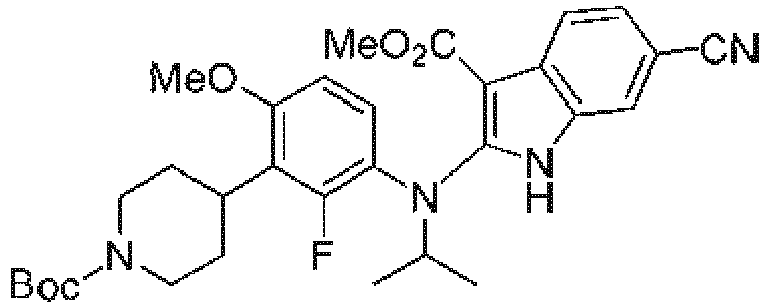
- Step E: Methyl 2-((3-(1-(tert-butoxycarbonyl)piperidin-4-yl)-2-fluoro-4-methoxyphenyl)(isopropyl)amino)-6-cyano-1H-indole-3-carboxylate. DABCO (84 mg, 0.75 mmol) was added to a solution of Methyl 6-cyano-1H-indole-3-carboxylate (273 mg, 1.366 mmol) in DCM (20 mL) and the mixture was cool to 0 °C. N-Chlorosuccinimide (200 mg, 1.5 mmol) was then added and the reaction was stirred at 0 °C for 2 hr. A solution of tert-Butyl 4-(2-fluoro-3-(isopropylamino)-6-methoxyphenyl)piperidine-1-carboxylate(500 mg, 1.366 mmol) and Trichloroacetic acid (56 mg, 0.342 mmol) in DCM (10 mL) was added dropwise and the reaction was stirred for 2 hr at room temperature. The reaction was quenched by adding water and the mixture was extracted with DCM. Solvent was removed under vacuum and the residue was purified by silica gel chromatography (Hex:EA=4:1) to afford Methyl 2-((3-(1-(tert-butoxycarbonyl)piperidin-4-yl)-2-fluoro-4-methoxyphenyl)(isopropyl)amino)-6-cyano-1H-indole-3-carboxylate (530 mg, 69% yield). 1H NMR (300 MHz, CDCl3) δ ppm 8.34 (s, 1H), 7.96 (d, J=8.2 Hz, 1H), 7.40-7.30 (m, 2H), 7.18 (t, J=8.7Hz, 1H), 6.72 (dd, J=8.7, 1.1 Hz, 1H), 4.90-4.75 (m, 1H), 4.25-4.10 (m, 2H), 3.86 (s, 3H), 3.84 (s, 3H), 3.30-3.20 (m, 1H), 2.80-2.65 (m, 2H), 2.20-2.00 (m, 2H), 1.65-1.50 (m, 2H), 1.46 (s, 9H), 1.20 (d, J=6.5 Hz, 6H).

- Step F: Methyl 6-cyano-2-((2-fluoro-4-methoxy-3-(1-methylpiperidin-4-yl)phenyl)(isopropyl)amino)-1H-indole-3-carboxylate. TFA (1 mL) was added to a solution ofMethyl 2-((3-(1-(tert-butoxycarbonyl)piperidin-4-yl)-2-fluoro-4-methoxyphenyl)(isopropyl)amino)-6-cyano-1H-indole-3-carboxylate (240 mg, 0.425 mmol) in DCM (5 mL) and the mixture was stirred at RT for 12 hr. Solvent was removed under reduced pressure and the residue was nutrilized with NaHCO3 and extracted with EtOAc. EtOAc was removed under reduced pressure and the residue was dissolved in DCM (5 mL). 37% HCHO (100 mg, 1.28 mmol), Acetic acid (38 mg, 0.64 mmol), and NaBH(OAc)3 (135 mg, 0.64 mmol) were then added and the reaction mixture was stirred at RT for 6 hr. Solvent was removed under reduced pressure and the product was extracted with EtOAc. EtOAc was evaporated under reduced pressure and the residue was purified by silica gel chromatography (EA:MeOH=80:20) to afford Methyl 6-cyano-2-((2-fluoro-4-methoxy-3-(1-methylpiperidin-4-yl)phenyl)(isopropyl)amino)-1H-indole-3-carboxylate (180 mg, 89% yield).1H NMR (300 MHz, CDCl3) δ ppm 8.85 (s, 1H), 7.94 (d, J=8.3 Hz, 1H), 7.38 (s, 1H), 7.32 (d, J=8.3 Hz, 1H), 7.15 (t, J=8.7 Hz, 1H), 6.69 (d, J=8.7 Hz, 1H), 4.95-4.80 (m, 1H), 3.83 (s, 3H), 3.81 (s, 3H), 3.20-3.00 (m, 3H), 2.45-2.25 (m, 2H), 2.35 (s, 3H), 2.20-2.02 (m, 2H), 1.73-1.60 (m, 2H), 1.19 (d, J=6.6 Hz, 6H).
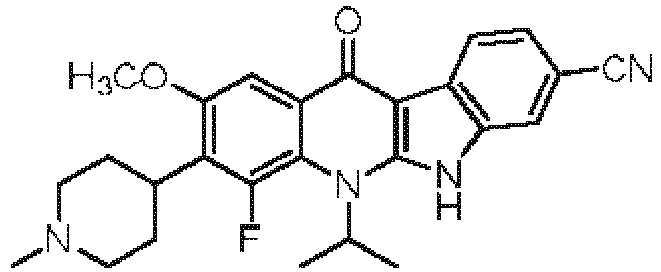
- Step G: 4-Fluoro-5-isopropyl-2-methoxy-3-(1-methylpiperidin-4-yl)-11-oxo-6,11-dihydro-5H-indolo[2,3-b]quinoline-8-carbonitrile. Methyl 6-cyano-2-((2-fluoro-4-methoxy-3-(1-methylpiperidin-4-yl)phenyl)(isopropyl)amino)-1H-indole-3-carboxylate (180 mg, 0.38 mmol) was dissolved in Diphenyl ether (10 mL) and the solution was refluxed for 1 hr. The mixture was cooled to RT. Hexane (20 mL) was added and the precipitate was collected by filtration. The precipitate was purified by preparative-HPLC to afford 4-Fluoro-5-isopropyl-2-methoxy-3-(1-methylpiperidin-4-yl)-11-oxo-6,11-dihydro-5H-indolo[2,3-b]quinoline-8-carbonitrile (100 mg, 59% yield).1H NMR (300 MHz, CD3OD) δ ppm 8.25 (d, J=8.0 Hz, 1H), 7.76 (s, 1H), 7.67 (s, 1H), 7.44 (d, J=8.0 Hz, 1H), 5.10-5.00 (m, 1H), 4.03 (s, 3H), 3.80-3.62 (m, 3H), 3.30-3.12 (m, 2H), 2.96 (s, 3H), 2.80-2.60 (m, 2H), 2.18-2.00 (m, 2H), 1.73 (dd, J=7.0, 2.0 Hz, 6H).
-

-

- Step A: Methyl 6-cyano-2-((2-fluoro-4-methoxy-3-(1-(oxetan-3-yl)piperidin-4-yl)phenyl)(isopropyl)amino)-1H-indole-3-carboxylate. TFA (1 mL) was added to a solution ofMethyl 2-((3-(1-(tert-butoxycarbonyl)piperidin-4-yl)-2-fluoro-4-methoxyphenyl)(isopropyl)amino)-6-cyano-1H-indole-3-carboxylate (365 mg, 0.647 mmol) in DCM (5 mL) and the mixture was stirred at RT for 12 hr. Solvent was removed under reduced pressure and the residue was nutrilized with NaHCO3 and extracted with EtOAc. EtOAc was removed under reduced pressure and the residue was dissolved in DCM (5 mL). Cyclobutanone (140 mg, 1.94 mmol), Acetic acid (58 mg, 0.97 mmol), and NaBH(OAc)3 (206 mg, 0.97 mmol) were then added and the reaction mixture was stirred at RT for 6 hr. Solvent was removed under reduced pressure and the product was extracted with EtOAc. EtOAc was evaporated under reduced pressure and the residue was purified by silica gel chromatography (EA:MeOH=80:20) to afford Methyl 6-cyano-2-((2-fluoro-4-methoxy-3-(1-(oxetan-3-yl)piperidin-4-yl)phenyl)(isopropyl)amino)-1H-indole-3-carboxylate (190 mg, 58% yield). 1H NMR (300 MHz, CDCl3) δ ppm 8.20 (s, 1H), 7.96 (d, J=8.2 Hz, 1H), 7.48-7.30 (m, 2H), 7.17 (t, J=8.7 Hz, 1H), 6.73 (d, J=8.7Hz, 1H), 4.95-4.80 (m, 1H), 4.64 (d, J=6.7 Hz, 4H), 3.88 (s, 3H), 3.85 (s, 3H), 3.51-3.49 (m, 1H), 3.25-3.05 (m, 1H), 2.95-2.75 (m, 2H), 2.45-2.25 (m, 2H), 2.00-1.80 (m, 2H), 1.73-1.60 (m, 2H), 1.20 (d, J=6.5 Hz, 6H).

- Step B: 4-Fluoro-5-isopropyl-2-methoxy-3-(1-(oxetan-3-yl)piperidin-4-yl)-11-oxo-6,11-dihydro-5H-indolo[2,3-b]quinoline-8-carbonitrile. Methyl 6-cyano-2-((2-fluoro-4-methoxy-3-(1-(oxetan-3-yl)piperidin-4-yl)phenyl)(isopropyl)amino)-1H-indole-3-carboxylate (190 mg, 0.37 mmol) was dissolved in Diphenyl ether (10 mL) and the solution was refluxed for 1 hr. The mixture was cooled to RT. Hexane (20 mL) was added and the precipitate was collected by filtration. The precipitate was purified by preparative-HPLC to afford 4-Fluoro-5-isopropyl-2-methoxy-3-(1-(oxetan-3-yl)piperidin-4-yl)-11-oxo-6,11-dihydro-5H-indolo[2,3-b]quinoline-8-carbonitrile (90 mg, 51% yield). 1H NMR (300 MHz, CD3OD) δ ppm 8.28 (d, J=8.0 Hz, 1H), 7.78 (d, J=1.1 Hz, 1H), 7.69 (d, J=0.7 Hz, 1H), 7.46 (dd, J=8.0, 1.1 Hz, 1H), 5.18-5.02 (m, 1H), 4.95-4.80 (m, 4H), 4.55-4.40 (m, 1H), 4.04 (s, 3H), 3.80-3.60 (m, 3H), 3.20-3.10 (m, 2H), 2.80-2.60 (m, 2H), 2.18-2.02 (m, 2H), 1.74 (dd, J=7.0, 2.1 Hz, 6H).
-
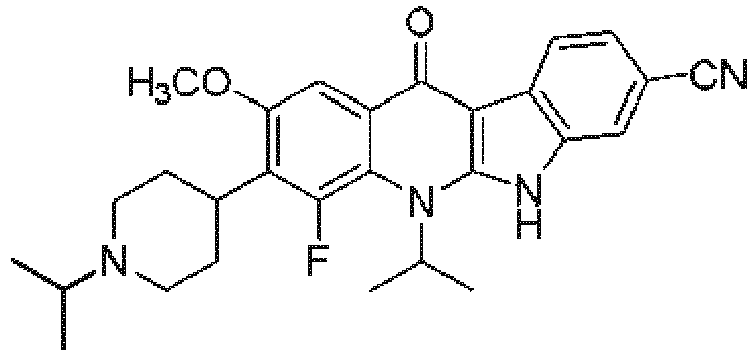
-

- Step A: Methyl 6-cyano-2-((2-fluoro-3-(1-isopropylpiperidin-4-yl)-4-methoxyphenyl)(isopropyl)amino)-1H-indole-3-carboxylate. TFA (1 mL) was added to a solution of Methyl 2-((3-(1-(tert-butoxycarbonyl)piperidin-4-yl)-2-fluoro-4-methoxyphenyl)(isopropyl)amino)-6-cyano-1H-indole-3-carboxylate (365 mg, 0.647 mmol) in DCM (5 mL) and the mixture was stirred at RT for 12 hr. Solvent was removed under reduced pressure and the residue was nutrilized with NaHCO3 and extracted with EtOAc. EtOAc was removed under reduced pressure and the residue was dissolved in DCM (5 mL). Acetone(113 mg, 1.94 mmol), Acetic acid (58 mg, 0.97 mmol), and NaBH(OAc)3 (206 mg, 0.97 mmol) were then added and the reaction mixture was stirred at RT for 12 hr. Solvent was removed under reduced pressure and the product was extracted with EtOAc. EtOAc was evaporated under reduced pressure and the residue was purified by silica gel chromatography (EA:MeOH=80:20) to afford Methyl 6-cyano-2-((2-fluoro-3-(1-isopropylpiperidin-4-yl)4-methoxyphenyl)(isopropyl)amino)-1H-indole-3-carboxylate (150 mg, 46% yield). 1H NMR (300 MHz, CDCl3) δ ppm 7.98-7.90 (m, 2H), 7.35 (dd, J=8.3, 1.4 Hz, 1H), 7.31 (d, J=1.4 Hz, 1H), 7.16 (t, J=8.8 Hz, 1H), 6.72 (d, J=8.8 Hz, 1H), 4.95-4.80 (m, 1H), 3.87 (s, 6H), 3.20-2.75 (m, 4H), 2.40-2.20 (m, 4H), 1.75-1.55 (m, 2H), 1.19 (d, J=6.4 Hz, 6H), 1.08 (d, J=6.5 Hz, 6H).

- Step B: 4-Fluoro-5-isopropyl-3-(1-isopropylpiperidin-4-yl)-2-methoxy-11-oxo-6,11-dihydro-5H-indolo[2,3-b]quinoline-8-carbonitrile. Methyl 6-cyano-2-((2-fluoro-3-(1-isopropylpiperidin-4-yl)-4-methoxyphenyl)(isopropyl)amino)-1H-indole-3-carboxylate (150 mg, 0.296 mmol) was dissolved in Diphenyl ether (10 mL) and the solution was refluxed for 1 hr. The mixture was cooled to RT. Hexane (20 mL) was added and the precipitate was collected by filtration. The precipitate was purified by preparative-HPLC to afford 4-Fluoro-5-isopropyl-3-(1-isopropylpiperidin-4-yl)-2-methoxy-11-oxo-6,11-dihydro-5H-indolo[2,3-b]quinoline-8-carbonitrile (35 mg, 25% yield). 1H NMR (300 MHz, CD3OD) δ ppm 8.26 (d, J=8.0 Hz, 1H), 7.76 (s, 1H), 7.68 (s, 1H), 7.44 (d, J=8.0 Hz, 1H), 5.10-5.00 (m, 1H), 4.03 (s, 3H), 3.80-3.50 (m, 4H), 3.30-3.20 (m, 2H), 2.80-2.60 (m, 2H), 2.15-2.03 (m, 2H), 1.73 (dd, J=7.0, 2.0 Hz, 6H), 1.45 (d, J=6.7 Hz, 6H).
-

-

- Step A: Methyl 6-cyano-2-((2-fluoro-4-methoxy-3-(1-(tetrahydro-2H-pyran-4-yl)piperidin-4-yl)phenyl)(isopropyl)amino)-1H-indole-3-carboxylate. TFA (1 mL) was added to a solution of Methyl 2-((3-(1-(tert-butoxycarbonyl)piperidin-4-yl)-2-fluoro-4-methoxyphenyl)(isopropyl)amino)-6-cyano-1H-indole-3-carboxylate (365 mg, 0.647 mmol) in DCM (5 mL) and the mixture was stirred at RT for 12 hr. Solvent was removed under reduced pressure and the residue was nutrilized with NaHCO3 and extracted with EtOAc. EtOAc was removed under reduced pressure and the residue was dissolved in DCM (5 mL). Dihydro-2H-pyran-4(3H)-one (194 mg, 1.94 mmol), Acetic acid (58 mg, 0.97 mmol), and NaBH(OAc)3 (206 mg, 0.97 mmol) were then added and the reaction mixture was stirred at RT for 12 hr. Solvent was removed under reduced pressure and the product was extracted with EtOAc. EtOAc was evaporated under reduced pressure and the residue was purified by silica gelchromatography (EA:MeOH=80:20) to afford Methyl 6-cyano-2-((2-fluoro-4-methoxy-3-(1-(tetrahydro-2H-pyran-4-yl)piperidin-4-yl)phenyl)(isopropyl)amino)-1H-indole-3-carboxylate (140 mg, 39% yield). 1H NMR (300 MHz, CDCl3) δ ppm 8.55 (s, 1H), 7.95 (d, J=8.3 Hz, 1H), 7.40-7.27 (m, 2H), 7.16 (t, J=8.7 Hz, 1H), 6.70 (d, J=8.7Hz, 1H), 4.95-4.75 (m, 1H), 4.12-4.00 (m, 2H), 3.84 (s, 3H), 3.82 (s, 3H), 3.45-3.25 (m, 2H), 3.15-3.02 (m, 3H), 2.75-227 (m, 5H), 1.80-1.60 (m, 6H), 1.20 (d, J=6.5 Hz, 6H).

- Step B: 4-Fluoro-5-isopropyl-2-methoxy-11-oxo-3-(1-(tetrahydro-2H-pyran-4-yl)piperidin-4-yl)-6,11-dihydro-5H-indolo[2,3-b]quinoline-8-carbonitrile. Methyl 6-cyano-2-((2-fluoro-4-methoxy-3-(1-(tetrahydro-2H-pyran-4-yl)piperidin-4-yl)phenyl)(isopropyl)amino)-1H-indole-3-carboxylate (140 mg, 0.255 mmol) was dissolved in Diphenyl ether (10 mL) and the solution was refluxed for 1 hr. The mixture was cooled to RT. Hexane (20 mL) was added and the precipitate was collected by filtration. The precipitate was purified by preparative-HPLC to afford 4-Fluoro-5-isopropyl-2-methoxy-11-oxo-3-(1-(tetrahydro-2H-pyran-4-yl)piperidin-4-yl)-6,11-dihydro-5H-indolo[2,3-b]quinoline-8-carbonitrile (70 mg, 53% yield). 1H NMR (300 MHz, CD3OD) δ ppm 8.25 (d, J=8.0 Hz, 1H), 7.75 (s, 1H), 7.66 (s, 1H), 7.43 (d, J=8.0 Hz, 1H), 5.15-4.95 (m, 1H), 4.20-4.07 (m, 2H), 4.03 (s, 3H), 3.82-3.70 (m, 3H), 3.60-3.40 (m, 3H), 3.30-320 (m, 2H), 2.80-2.60 (m, 2H), 2.20-1.80 (m, 6H), 1.73 (dd, J=6.9, 1.8 Hz, 6H).
-

-

- Step A: Methyl 2-((3-(1-(2-((tert-butyldimethysilyl)oxy)ethyl)piperidin-4-yl)-2-fluoro-4-methoxyphenyl)(isopropyl)amino)-6-cyano-1H-indole-3-carboxylate. TFA (1 mL) was added to a solution of Methyl 2-((3-(1-(tert-butoxycarbonyl)piperidin-4-yl)-2-fluoro-4-methoxyphenyl)(isopropyl)amino)-6-cyano-1H-indole-3-carboxylate (365 mg, 0.647 mmol) in DCM (5 mL) and the mixture was stirred at RT for 12 hr. Solvent was removed under reduced pressure and the residue was nutrilized with NaHCO3 and extracted with EtOAc. EtOAc was removed under reduced pressure and the residue was dissolved in DCM (5 mL). 2-((tert-Butyldimethylsilyl)oxy)acetaldehyde(164 mg, 0.97 mmol), Acetic acid (58 mg, 0.97 mmol), and NaBH(OAc)3 (206 mg, 0.97 mmol) were then added and the reaction mixture was stirred at RT for 6 hr. Solvent was removed under reduced pressure and the product was extracted with EtOAc. EtOAc was evaporated under reduced pressure and the residue was purified by silica gel chromatography (EtOAc) to afford Methyl 2-((3-(1-(2-((tert-butyldimethylsilyl)oxy)ethyl)piperidin-4-yl)-2-fluoro-4-methoxyphenyl)(isopropyl)amino)-6-cyano-1H-indole-3-carboxylate (180 mg, 45% yield). 1H NMR (300 MHz, CDCl3) δ ppm 8.61 (s, 1H), 7.95 (d, J=8.3 Hz, 1H), 7.40-7.30 (m, 2H), 7.15 (t, J=8.7 Hz, 1H), 6.69 (d, J=8.7 Hz, 1H), 4.95-4.78 (m, 1H), 3.90-3.75 (m, 8H), 3.20-3.05 (m, 3H), 2.62 (t, J=6.3 Hz, 2H), 2.45-2.20 (m, 4H), 1.70-1.55 (m, 2H), 1.20 (d, J=6.5 Hz, 6H), 0.89 (s, 9H), 0.06 (s, 6H).

- Step B: 4-Fluoro-3-(1-(2-hydroxyethyl)piperidin-4-yl)-5-isopropyl-2-methoxy-11-oxo-6,11-dihydro-5H-indolo[2,3-b]quinoline-8-carbonitrile. Methyl 2-((3-(1-(2-((tert-butyldimethylsilyl)oxy)ethyl)piperidin-4-yl)-2-fluoro-4-methoxyphenyl)(isopropyl)amino)-6-cyano-1H-indole-3-carboxylate (180 mg, 0.29 mmol) was dissolved in Diphenyl ether (10 mL) and the solution was refluxed for 1 hr. The mixture was cooled to RT. Hexane (20 mL) was added and the precipitate was collected by filtration. The precipitate was dissolved in MeOH (10 mL) and the solution was treated with KHSO4 (197 mg, 1.45 mmol). The mixture was stirred at RT for 12 hr. Solvent was removed under reduced pressure and the residue was purified by preparative-HPLC to afford 4-Fluoro-3-(1-(2-hydroxyethyl)piperidin-4-yl)-5-isopropyl-2-methoxy-11-oxo-6,11-dihydro-5H-indolo[2,3-b]quinoline-8-carbonitrile (80 mg, 58% yield). 1H NMR (300 MHz, CD3OD) δ ppm 8.26 (d, J=8.0 Hz, 1H), 7.75 (s, 1H), 7.68 (s, 1H), 7.44 (d, J=8.0 Hz, 1H), 5.20-5.02 (m, 1H), 4.03 (s, 3H), 4.00-3.84 (m, 2H), 3.80-3.60 (m, 3H), 3.35-3.20 (m, 4H), 2.80-2.60 (m, 2H), 2.15-2.00 (m, 2H), 1.73 (dd, J=6.9, 1.6 Hz, 6H).
- The cytoplasmic domain (amino acid 1058-1620) of wild-type human ALK protein expressed as N-terminal GST-fusion protein was purchased from Carna Biosciences, Inc (Japan). Mutated ALK proteins were expressed in SF9 insect cells with N-terminal tags cleaved after purification. Kinase activities of all enzymes were assessed using a Lance TR-FRET assay kit from Perkin Elmer Life Sciences (Waltham, MA). 2.5 µL of compound solution and 5 µL of protein solution were added into a black low volume 384 well microtiterplate which was incubated for 15 minutes with gentle shaking at room temperature, followed by adding 2.5 µL of fluorescently labeled peptide substrate (Ulight-CKKSRGDYMTMQIG) and ATP mixture solution. The kinase reaction was performed in 50 mM HEPES (pH 7.5) with 1 mM EGTA, 1 mM MgCl2, and 2 mM DTT, 0.01% Tween-20 added right before the assay. Final concentrations of ATP, substrates, and DMSO were 100 µM, 20 nM, and 0.5%, respectively. Concentrations of different ALK proteins were adjusted accordingly to achieve comparable enzymatic activities for both wild-type and all mutated ALK proteins. Final ALK concentrations were 1 nM, 1 nM, 1nM, 128 nM, and 2 nM for wild-type, F1174L, L1196M, S1206Y, and G1269A, respectively. The reaction was allowed to perform for 90 minutes in dark with gentle shaking at room temperature after which 10 µL of 20 mM EDTA and 2 nM Eu-W1024 anti-phosphotyrosineantibody (PT66) mixture solution in the detection buffer from the manufacturer was added to terminate the reaction and detect the phosphorylation of the peptide substrate. Final mixture was incubated in the dark for 1 hour before the plate was read on a Tecan Infinite M-1000 multi-mode plate reader (Tecan, Durham NC) with an excitation wavelength of 320 nm. Emission intensities were measured at both 620 and 665 nm with the intensity ratio between 665 and 620 nm corresponding to the peptide substrate phosphorylation. IC50 values of inhibitors were obtained by fitting the ratio of 665/620 nm vs inhibitor concentrations in a sigmoidal dose-response curve (variable slope) with a non-linear regression.
- The following table (Table 1) includes ALK IC50 values against wild-type ALK obtained using the procedure set forth above.
Table1. Inhibitory activity against wild-type ALK Compound ALK IC50 (nM) Compound ALK IC50 (nM) ALK-18 1510 CJ-2096 >50,000 ALK-20 33.1 CJ-2113 1510 ALK-21 23.6 CJ-2172-2 2.0 ALK-22 661 CJ-2173-2 0.71,1.5 ALK-23 309 CJ-2200 Not tested ALK-24 5.3 CJ-2204 0.26 ALK-25 17.8 CJ-2212 0.49 ALK-30 >10000 CJ-2217 0.52 ALK-31 >10000 CJ-2224 5.5 ALK-32 >10000 CJ-2225 2.5 ALK-33 >10000 CJ-2226 1.3 ALK-34 12.1 CJ-2227 0.62 ALK-35 4.5 CJ-2238 2.6 ALK-36 5.4 CJ-2239 0.77 ALK-37 16.5 CJ-2240 0.78 ALK-38 7.7 CJ-2241 0.32 ALK-39 6.1 ALK-62 0.26, 0.34 ALK-40 29.7 ALK-63 1.1 ALK-41 13.0 ALK-64 0.79,1.1 ALK-42 24.7 ALK-66 5.8 ALK-43 28.5 ALK-67 1.4 ALK-44 16.4 ALK-68 2.6 ALK-45 1.8, 5.1 ALK-69 0.87 ALK-46 1.8, 1.5 ALK-70 1.6 ALK-47 1.4, 1.1 ALK-71 0.31 ALK-48 15.1 ALK-72 0.67 ALK-49 1.9, 2.8 ALK-73 4.0 ALK-50 18.2 ALK-74 8.4 ALK-51 20.5 ALK-75 3.6 ALK-52 51.0, 60.9 ALK-76 2.5 ALK-53 4.4, 7.2 ALK-77 1.1 ALK-54 24.7 ALK-78 0.7 ALK-55 3.3, 6.0 ALK-79 0.11 ALK-56 2.9, 3.5 ALK-80 0.22 ALK-57 50.4 ALK-81 0.10 ALK-58 3.4 ALK-82 2.3 ALK-59 1.6 ALK-83 2.0 ALK-60 6.6 ALK-85 22.9 ALK-61 1.4 ALK-86 5.8 - The following table (Table 2) includes IC50 values for representative inhibitors against mutated ALK proteins obtained using the procedure set forth above.
Table 2.Inhibitory activity (IC50) against wild-type and mutated ALK proteins Compound ALK-62 ALK-64 ALK-69 ALK-70 ALK-71 ALK-72 AP-26113 CH5424802 Crizotinib ALK Wild-type 0.26, 0.34 0.79, 1.1 0.87 1.6 0.31 0.67 1.5±0.3 3.1±0.9 34.5±5.0 IC50 (nM) ALK mutant (L1196M) 1.5, 0.93 4.4, 3.2 5.3, 4.8 0.95, 0.66 2.2, 2.2 3.5, 1.9 7.2, 6.1 529, 427 ALK mutant (F1174L) 0.63 1.4 5.2 1.3 1.9 2.4 6.0 66.0 ALK mutant (G1269A) 2.0 1.7 2.9 0.47 2.4 1.6 8.5 821 0.55 6.5 580 ALK mutant (S1206Y) 2.2 2.1 3.2 1.3 2.8 5.4 8.1 200 - The effect of compounds on cell viability was determined in a 4-day proliferation assay. Cells were maintained in RPMI1640 culture medium with 10% FBS at 37°C and an atmosphere of 5% CO2. Kappas-299 and H3122 were used within three months of thawing fresh vials. Cells were seeded in 96-well plates at a density of 3,000-10,000 cells/well in 75 µl of culture medium. Compounds were serially diluted in the appropriate medium, and 75 µl of the diluted compounds were added to the appropriate wells of the cell plate. After the addition of compounds, the cells were incubated at 37°C in an atmosphere of 5% CO2 for 4 days. Cell viability was determined using the CellTiter-Glo® Luminescent Cell Viability Assay Kit (Promega, Madison, WI) (for KARPAS-299 cells) or WST (2-(2-methoxy-4-nitrophenyl)-3-(4-nitrophenyl)-5-(2,4-disulfophenyl)-2H-tetrazolium, monosodium salt) Cell Counting-8 Kit (Dojindo Molecular Technologies, Inc., Rockville, MD) (for H3122 cells) according to the manufacturers' instructions.
- For WST assay, WST-8 reagent was added to each well at a final concentration of 10% (v/v), and then the plates were incubated at 37°C for 1-2 hours for color development. The absorbance was measured at 450 nm using a SPECTRAmax PLUS plate reader (Molecular Devices, Sunnyvale, CA). The readings were normalized to the DMSO-treated cells and the half maximal inhibitory concentration (IC50) was calculated by nonlinear regression analysis using the GraphPad Prism 5 software (GraphPad Software, La Jolla, CA).
- For CellTiter-Glo assay, 100 µl of CellTiter-Glo® Reagent was added to each well, and then the plates were incubated at room temperature for 10-20 minutes. The luminescent signal was measured using a Tecan Infinite M1000 multimode microplate reader (Tecan, Morrisville, NC). The readings were normalized to the DMSO-treated cells and the IC50 was calculated by nonlinear regression analysis using the GraphPad Prism 5 software.
- The following table (Table 3) includes the inhibition of cell growth in the Kappas-299 cell line. Cells were treated for four days and cell growth was determind using a CellTiter-Glo assay.
Table 3. Inhibition of cell growth in Kappas-299 cells containing NPM-ALK fusion protein. Multiple values were obtained from independent experiments. Compound Kappas-299 IC50 (nM) Compound Kappas-299 IC50 (nM) ALK-20 515 CJ-2212 9.7 ALK-21 982 CJ-2217 14 ALK-22 90.3 CJ-2224 33 ALK-24 207 CJ-2225 17 ALK-25 137 CJ-2226 1030 ALK-34 138 CJ-2227 36 ALK-35 130, 136 CJ-2238 231 ALK-36 88, 152 CJ-2239 16 ALK-37 9884 CJ-2240 35 ALK-38 272, 173 CJ-2241 292 ALK-39 148, 96 ALK-62 24 ALK-40 415 ALK-63 24 ALK-41 1772 ALK-64 73 ALK-42 >1000 ALK-66 48 ALK-43 266, 261 ALK-67 61 ALK-44 >1000 ALK-68 20 ALK-45 35, 62 ALK-69 46 ALK-46 60, 102 ALK-70 66 ALK-47 29, 604 ALK-71 31 ALK-48 70, 84 ALK-72 52 ALK-49 317, 546 ALK-73 4018 ALK-50 86, 103 ALK-74 98 ALK-51 70, 99 ALK-75 22 ALK-52 123 ALK-76 35 ALK-53 46 ALK-77 31 ALK-54 63 ALK-78 25 ALK-55 36 ALK-79 9.6 ALK-56 37 ALK-80 7.6 ALK-57 152 ALK-81 440 ALK-58 140 ALK-82 46 ALK-59 447 ALK-83 21 ALK-60 66 ALK-85 66 ALK-61 >1000 ALK-86 31 CJ-2204 768 - The following table (Table 4) includes the inhibition of cell growth in the H3122 non-small-cell lung cell line containing the EML4-ALK fusion gene. Cells were treated for four days and cell growth was determind using a WST assay.
Table 4. Inhibition of cell growth in H3122 non-small cell lung cancer cell line harboring the EML4-ALK fusion gene. Cells were treated by different concentrations of the inhibitors for 4 days. Compound IC50 (nM) in Inhibition of Tumor Cell Growth H3122 Cell line Compound IC50 (nM) in Inhibition of Tumor Cell Growth H3122 Cell line ALK-68 63±34 CJ-2212 19±6 ALK-73 86±37 CJ-2217 17±8 ALK-74 84 CJ-2224 241 ALK-75 35.93 CJ-2225 30±13 ALK-76 85±11 CJ-2226 61±14 ALK-77 25.92 CJ-2227 64 ALK-78 13.08 CJ-2238 1038 ALK-79 2±1 CJ-2239 36±13 ALK-80 3±1 CJ-2240 33±12 ALK-83 8.8 CJ-2241 154 ALK-85 148±26 Critozinib 43±20 ALK-86 161 CH-5424802 71±47 - The pharmacokinetic (PK) parameters in SD rats for selected compounds with intravenous (IV) and oral (PO) administrations are provided in the following table (Table 5).
Table 5. Pharmacokinetic Profiles of Selected Inhibitors Compound Tmax (h) Cmax(ng/mL) AUC0-t(ng·hlmL) t 1/2 (h) Oral Bioavailability (F) IV PO IV PO IV PO IV PO ALK83 0.083 4.0 346 548 1102 4426 5.24 4.10 78.8% ALK86 0.083 4.0 261 258 1079 2445 5.23 5.11 44.6% CJ-2226 0.083 4.67 296 230 1002 2370 4.37 4.99 47.3% CJ-2212 0.083 5.33 169 208 574 2064 4.78 4.08 70.6% CJ-2224 0.083 0.67 959 1169 2344 9636 4.71 3.86 81.5% CJ-2225 0.222 5.33 212 225 1108 2336 4.54 4.31 41.7%
Claims (12)
- A compound of formula (I), and/or a pharmaceutically acceptable salt thereof:
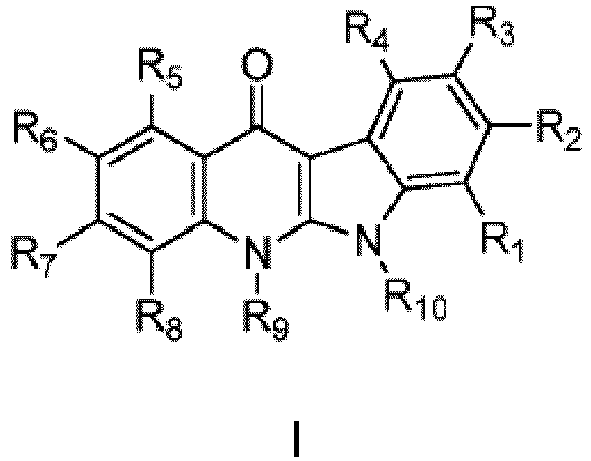 wherein R1, R3, R4, R5 and R8 are independently selected from hydrogen, alkyl and halo;R2 is CN, and R7 is selected from piperidinyl and piperazinyl, each being optionally substituted with at least one group independently selected from alkyl, cycloalkyl and heterocyclyl, each of the alkyl, cycloalkyl and heterocyclyl is optionally substituted with hydroxyl;R6 is selected from hydrogen, alkyl, alkynyl, alkenyl, alkoxy, halo, hydroxyl, -CN, -COORb, -CONRbRc, -NRbRc, -NO2, -O- cycloalkyl, -O-heterocyclyl, -O-aryl, -O-heteroaryl, cycloalkyl, heterocyclyl, aryl, and heteroaryl,R9 and R10 are independently selected from hydrogen, alkyl, cycloalkyl, heterocyclyl, aryl, and heteroaryl,wherein the alkyl, alkynyl, alkenyl, alkoxy, cycloalkyl, heterocyclyl, aryl, and heteroaryl are each optionally substituted with at least one group independently selected from Ra,Ra is selected from alkyl, alkoxy, halo, hydroxyl, -CN, alkenyl, alkynyl, cycloalkyl, heterocyclyl, aryl, heteroaryl, -COORb, -CONRbRc, -NRbRc, and oxo, each of the alkyl, alkoxy, alkenyl, alkynyl, cycloalkyl, heterocyclyl, aryl, heteroaryl being optionally substituted with at least one group independently selected from alkyl, hydroxyl, alkoxy, halo, -COORb, -CONRbRc, and -NRbRc, andRb and Rc are each independently selected from hydrogen, alkyl, alkenyl, cycloalkyl, heterocyclyl, aryl, and heteroaryl.
 - The compound of claim 1 and/or a pharmaceutically acceptable salt thereof, wherein R1, R4 and R5 is hydrogen.
- The compound of claim 1 and/or a pharmaceutically acceptable salt thereof, wherein R6 is selected from hydrogen, halo, alkyl, alkynyl, alkenyl, alkoxy, and cycloalkyl, the alkyl, alkynyl, alkenyl, alkoxy, and cycloalkyl being unsubstituted.
- The compound of claim 1 and/or a pharmaceutically acceptable salt thereof, wherein R8 is selected from hydrogen, chloro, and fluoro.
- The compound of claim 1 and/or a pharmaceutically acceptable salt thereof, wherein Rg is selected from alkyl and cycloalkyl, each of the alkyl and cycloalkyl being optionally substituted with at least one group independently selected from Ra, Ra being the same as defined in claim 1.
- The compound of claim 1 and/or a pharmaceutically acceptable salt thereof, wherein the compound of formula (I) is selected from compounds of formula (II):
 wherein R2 is CN, R5 and R8 are independently selected from hydrogen, alkyl and halo , R6 is independently selected from hydrogen, alkyl, alkynyl, alkenyl, alkoxy, halo, hydroxyl, and -CN, the alkyl, alkynyl, alkenyl, alkoxy, and cycloalkyl being each optionally substituted with at least one group independently selected from Ra, Ra being the same as defined in claim 1,wherein R7 is optionally substituted piperidinyl or piperazinyl,
andRg is selected from alkyl and cycloalkyl, each of the alkyl and cycloalkyl being optionally substituted with at least one group independently selected from Ra, Ra being the same as defined in claim 1; or wherein the compound of formula (I) is selected from compounds of formula (III): wherein R5 and R8 are independently selected from hydrogen, alkyl and halo , R6 is independently selected from hydrogen, alkyl, alkynyl, alkenyl, alkoxy, halo, hydroxyl, and -CN, the alkyl, alkynyl, alkenyl, alkoxy, and cycloalkyl being each optionally substituted with at least one group independently selected from Ra, Ra being the same as defined in claim 1,wherein R7 is optionally substituted piperidinyl or piperazinyl,
andRg is selected from alkyl and cycloalkyl, each of the alkyl and cycloalkyl being optionally substituted with at least one group independently selected from Ra, Ra being the same as defined in claim 1; or wherein the compound of formula (I) is selected from compounds of formula (IV): wherein R8 is independently selected from hydrogen, alkyl and halo, R6 is independently selected from hydrogen, alkyl, alkynyl, alkenyl, alkoxy, halo, hydroxyl, and -CN, the alkyl, alkynyl, alkenyl, alkoxy, and cycloalkyl being each optionally substituted with at least one group independently selected from Ra, Ra being the same as defined in claim 1,wherein R7 is optionally substituted piperidinyl or piperazinyl,
andRg is selected from alkyl and cycloalkyl, each of the alkyl and cycloalkyl being optionally substituted with at least one group independently selected from Ra, Ra being the same as defined in claim 1; or wherein the compound of formula (I) is selected from compounds of formula (V): wherein R6 is independently selected from hydrogen, alkyl, alkynyl, alkenyl, alkoxy, halo, hydroxyl, and -CN, the alkyl, alkynyl, alkenyl, alkoxy, and cycloalkyl being each optionally substituted with at least one group independently selected from Ra, Ra being the same as defined in claim 1,wherein R7 is optionally substituted piperidinyl or piperazinyl,
andRg is selected from alkyl and cycloalkyl, each of the alkyl and cycloalkyl being optionally substituted with at least one group independently selected from Ra, Ra being the same as defined in claim 1. - The compound of claim 1 and/or a pharmaceutically acceptable salt thereof, wherein the compound is selected from the following compounds:


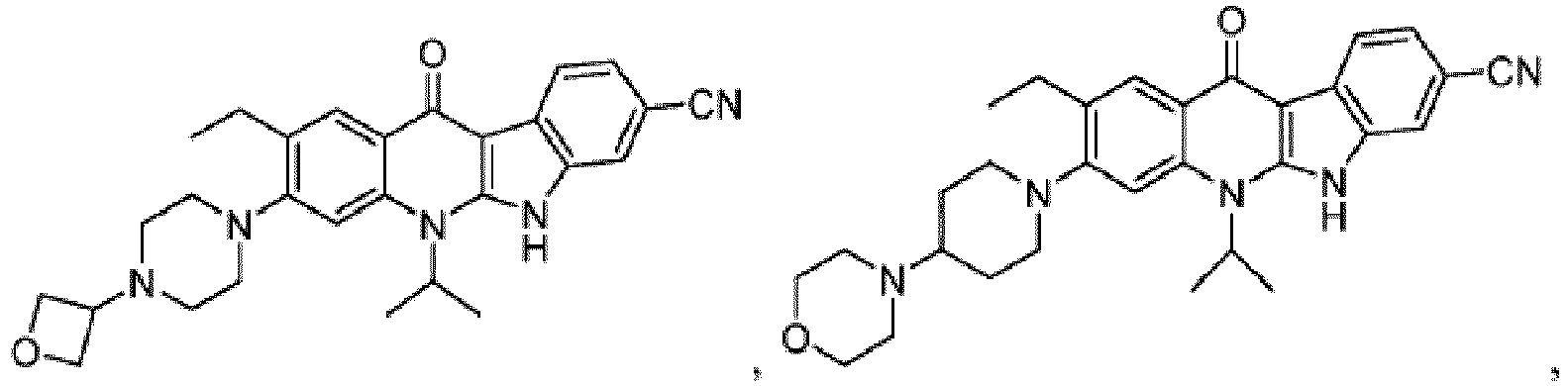


- A pharmaceutical composition comprising at least one pharmaceutically acceptable carrier and as an active ingredient a therapeutically effective amount of the compound and/or a pharmaceutical acceptable salt thereof according to claim 1.
- The compound and/or pharmaceutically acceptable salt thereof according to claim 1 for use in treating a cancer responsive to inhibition of ALK.
- The compound and/or pharmaceutically acceptable salt thereof for use according to claim 9, wherein the cancer contains an ALK fusion gene or wherein the cancer is selected from anaplastic large cell lymphomas, squamous cell carcinoma, diffuse large B-cell lymphoma, and non-small-cell lung cancer containing an ALK fusion gene.
- The compound and/or pharmaceutically acceptable salt thereof according to claim 1 for use in treating a cancer responsive to inhibition of ROS 1.
- The compound and/or pharmaceutically acceptable salt thereof according to claim 1 for use in treating a cancer, wherein the cancer is chosen from lung cancer, pancreatic cancer, skin cancer, bone cancer, head and neck cancer, uterine cancer, ovarian cancer, rectal cancer, breast cancer, colorectal cancer, stomach cancer, colon cancer, acute or chronic leukemia, adenocarcinoma, lymphoma, melanoma, prostate cancer, bladder cancer, kidney cancer, brain tumor, Hodgkin's Disease, neoplasms of the central nervous system (CNS), primary CNS lymphoma, mesothelioma, small intestine cancer, and esophagus cancer, optionally wherein the cancer is chosen from lung cancer and brain cancer; or for use in treating a cancer wherein the cancer is chosen from lung adenocarcinoma, cholangiocarcinoma, ovarian cancer, gastric adenocarcinoma, colorectal cancer, inflammatory myofibroblastic tumor, angiosarcoma, and epithelioid hemangioendothelioma.
Applications Claiming Priority (1)
| Application Number | Priority Date | Filing Date | Title |
|---|---|---|---|
| PCT/CN2014/072650 WO2015127629A1 (en) | 2014-02-27 | 2014-02-27 | Indoloquinolone compounds as anaplastic lymphoma kinase (alk) inhibitors |
Related Child Applications (1)
| Application Number | Title | Priority Date | Filing Date |
|---|---|---|---|
| EP19216174.3 Division-Into | 2019-12-13 |
Publications (3)
| Publication Number | Publication Date |
|---|---|
| EP3110815A1 EP3110815A1 (en) | 2017-01-04 |
| EP3110815A4 EP3110815A4 (en) | 2017-08-02 |
| EP3110815B1 true EP3110815B1 (en) | 2020-02-19 |
Family
ID=54008145
Family Applications (1)
| Application Number | Title | Priority Date | Filing Date |
|---|---|---|---|
| EP14883866.7A Active EP3110815B1 (en) | 2014-02-27 | 2014-02-27 | Indoloquinolone compounds as anaplastic lymphoma kinase (alk) inhibitors |
Country Status (7)
| Country | Link |
|---|---|
| US (1) | US9783539B2 (en) |
| EP (1) | EP3110815B1 (en) |
| JP (1) | JP6348190B2 (en) |
| KR (1) | KR102205354B1 (en) |
| CN (1) | CN106459033B (en) |
| AU (1) | AU2014384476B2 (en) |
| WO (1) | WO2015127629A1 (en) |
Families Citing this family (6)
| Publication number | Priority date | Publication date | Assignee | Title |
|---|---|---|---|---|
| US10781208B2 (en) * | 2016-11-18 | 2020-09-22 | The Regents Of The University Of Michigan | 5,6-dihydro-11H-indolo[2,3-B]quinolin-11-ones as alk inhibitors |
| CN110294750A (en) * | 2018-03-21 | 2019-10-01 | 密执安州立大学董事会 | 5,6- dihydro -11H- indoles as ALK inhibitor simultaneously [2,3-B] quinoline -11- ketone compound |
| EP3942045A1 (en) | 2019-03-21 | 2022-01-26 | Onxeo | A dbait molecule in combination with kinase inhibitor for the treatment of cancer |
| EP4054579A1 (en) | 2019-11-08 | 2022-09-14 | Institut National de la Santé et de la Recherche Médicale (INSERM) | Methods for the treatment of cancers that have acquired resistance to kinase inhibitors |
| WO2021148581A1 (en) | 2020-01-22 | 2021-07-29 | Onxeo | Novel dbait molecule and its use |
| WO2022076409A1 (en) * | 2020-10-06 | 2022-04-14 | Dana-Farber Cancer Institute, Inc. | Potent and selective covalent inhibitors of serine-arginine protein kinase (srpk) 1 and srpk2 and uses thereof |
Family Cites Families (2)
| Publication number | Priority date | Publication date | Assignee | Title |
|---|---|---|---|---|
| DE2113343A1 (en) * | 1971-03-19 | 1972-09-21 | Thiemann Chem Pharm Fab | Indolo- (2,3) - quinolones - prepd by reaction of keto-indoles and anthranilates, followed by dehydration |
| JP6108696B2 (en) * | 2011-10-28 | 2017-04-05 | 国立大学法人 岡山大学 | Indolequinoline derivative, method for producing the derivative, and antimalarial agent and anticancer agent containing the derivative |
-
2014
- 2014-02-27 KR KR1020167026250A patent/KR102205354B1/en not_active Expired - Fee Related
- 2014-02-27 AU AU2014384476A patent/AU2014384476B2/en not_active Ceased
- 2014-02-27 US US15/121,847 patent/US9783539B2/en not_active Expired - Fee Related
- 2014-02-27 CN CN201480076401.3A patent/CN106459033B/en active Active
- 2014-02-27 JP JP2016571453A patent/JP6348190B2/en not_active Expired - Fee Related
- 2014-02-27 WO PCT/CN2014/072650 patent/WO2015127629A1/en not_active Ceased
- 2014-02-27 EP EP14883866.7A patent/EP3110815B1/en active Active
Non-Patent Citations (1)
| Title |
|---|
| None * |
Also Published As
| Publication number | Publication date |
|---|---|
| EP3110815A4 (en) | 2017-08-02 |
| US20170066761A1 (en) | 2017-03-09 |
| EP3110815A1 (en) | 2017-01-04 |
| AU2014384476A1 (en) | 2016-09-15 |
| KR102205354B1 (en) | 2021-01-20 |
| CN106459033B (en) | 2018-12-21 |
| AU2014384476B2 (en) | 2017-12-21 |
| JP2017506673A (en) | 2017-03-09 |
| JP6348190B2 (en) | 2018-06-27 |
| US9783539B2 (en) | 2017-10-10 |
| CN106459033A (en) | 2017-02-22 |
| WO2015127629A1 (en) | 2015-09-03 |
| KR20170016316A (en) | 2017-02-13 |
Similar Documents
| Publication | Publication Date | Title |
|---|---|---|
| EP3337787B1 (en) | 1h-pyrazolo[3,4-b]pyridine, 1h-thieno[2,3-c]pyrazole and 1h-indazole carboxamide derivatives and related compounds as extracellular signal-regulated kinases (erk) inhibitors for treating cancer | |
| JP6806342B2 (en) | Novel 5- or 8-substituted imidazole [1,5-a] pyridines as indoleamine and / or tryptophan 2,3-dioxygenase | |
| US10479791B2 (en) | Heterocyclic compounds as ERK inhibitors | |
| RU2638540C1 (en) | Dna-pk inhibitors | |
| KR20080038278A (en) | RAF inhibitor compounds and methods of use thereof | |
| JP2016521273A (en) | Fused heterocyclic compounds as protein kinase inhibitors | |
| AU2014384476B2 (en) | Indoloquinolone compounds as anaplastic lymphoma kinase (ALK) inhibitors | |
| TWI762534B (en) | IMIDAZO[1,5-A]PYRAZINE DERIVATIVES AS PI3Kdelta INHIBITORS | |
| CN117561058A (en) | CDK2 inhibitors and methods of use | |
| EP4153571A1 (en) | Receptor-interacting protein 1 inhibitors including piperazine heterocyclic amide ureas | |
| CA2987963C (en) | Heterocyclic compounds for treating psoriasis | |
| HK1232540A1 (en) | Indoloquinolone compounds as anaplastic lymphoma kinase (alk) inhibitors | |
| HK1232540B (en) | Indoloquinolone compounds as anaplastic lymphoma kinase (alk) inhibitors | |
| HK40014846A (en) | Novel 8-substituted imidazo[1, 5-a] pyridines as ido1 and/or tdo inhibitor | |
| HK1263053A1 (en) | Fused tricyclic urea compounds as raf kinase and/or raf kinase dimer inhibitors | |
| BR102019005173A2 (en) | FIVE-ELEMENT AROMATIC RING PIRID COMPOUND, METHOD OF PREPARATION OF THE SAME AND USE OF THE SAME | |
| WO2024084448A2 (en) | Fused bicyclic compounds and their use as mer and axl inhibitors | |
| HK40003421A (en) | Benzimidazole compound kinase inhibitor, preparation method therefor and application thereof | |
| HK40003421B (en) | Benzimidazole compound kinase inhibitor, preparation method therefor and application thereof | |
| HK1257531B (en) | Pyrazolo fused heterocyclic compounds as erk inhibitors | |
| HK1210166A1 (en) | Fused tricyclic amide compounds as multiple kinase inhibitors | |
| BR112019010674B1 (en) | COMPOUND, PHARMACEUTICAL COMPOSITION, USE OF A COMPOUND, AND, DERIVATIVE OF PYRIDO[3,4-D]PYRIMIDINE | |
| HK1210166B (en) | Fused tricyclic amide compounds as multiple kinase inhibitors | |
| HK40002986A (en) | Pyridopyrimdinone cdk2/4/6 inhibitors | |
| HK1235779A1 (en) | Heterocyclic compounds for treating psoriasis |
Legal Events
| Date | Code | Title | Description |
|---|---|---|---|
| PUAI | Public reference made under article 153(3) epc to a published international application that has entered the european phase |
Free format text: ORIGINAL CODE: 0009012 |
|
| STAA | Information on the status of an ep patent application or granted ep patent |
Free format text: STATUS: REQUEST FOR EXAMINATION WAS MADE |
|
| 17P | Request for examination filed |
Effective date: 20160826 |
|
| AK | Designated contracting states |
Kind code of ref document: A1 Designated state(s): AL AT BE BG CH CY CZ DE DK EE ES FI FR GB GR HR HU IE IS IT LI LT LU LV MC MK MT NL NO PL PT RO RS SE SI SK SM TR |
|
| AX | Request for extension of the european patent |
Extension state: BA ME |
|
| RIN1 | Information on inventor provided before grant (corrected) |
Inventor name: YANG, CHAO-YIE Inventor name: LIU, LIU Inventor name: QIAN, XU Inventor name: YANG, DAJUN Inventor name: WANG, SHAOMENG Inventor name: JING, YU Inventor name: CHEN, JIANYONG Inventor name: GUO, MING Inventor name: JIAO, LINGLING Inventor name: MCEACHERN, DONNA Inventor name: ZHOU, YUNLONG Inventor name: BAI, LONGCHUAN |
|
| DAX | Request for extension of the european patent (deleted) | ||
| A4 | Supplementary search report drawn up and despatched |
Effective date: 20170703 |
|
| RIC1 | Information provided on ipc code assigned before grant |
Ipc: A61K 31/4745 20060101ALI20170627BHEP Ipc: C07D 471/04 20060101AFI20170627BHEP Ipc: A61P 35/00 20060101ALI20170627BHEP |
|
| REG | Reference to a national code |
Ref country code: HK Ref legal event code: DE Ref document number: 1232540 Country of ref document: HK |
|
| STAA | Information on the status of an ep patent application or granted ep patent |
Free format text: STATUS: EXAMINATION IS IN PROGRESS |
|
| 17Q | First examination report despatched |
Effective date: 20190205 |
|
| GRAP | Despatch of communication of intention to grant a patent |
Free format text: ORIGINAL CODE: EPIDOSNIGR1 |
|
| STAA | Information on the status of an ep patent application or granted ep patent |
Free format text: STATUS: GRANT OF PATENT IS INTENDED |
|
| INTG | Intention to grant announced |
Effective date: 20190930 |
|
| GRAS | Grant fee paid |
Free format text: ORIGINAL CODE: EPIDOSNIGR3 |
|
| GRAA | (expected) grant |
Free format text: ORIGINAL CODE: 0009210 |
|
| STAA | Information on the status of an ep patent application or granted ep patent |
Free format text: STATUS: THE PATENT HAS BEEN GRANTED |
|
| AK | Designated contracting states |
Kind code of ref document: B1 Designated state(s): AL AT BE BG CH CY CZ DE DK EE ES FI FR GB GR HR HU IE IS IT LI LT LU LV MC MK MT NL NO PL PT RO RS SE SI SK SM TR |
|
| REG | Reference to a national code |
Ref country code: CH Ref legal event code: EP |
|
| REG | Reference to a national code |
Ref country code: DE Ref legal event code: R096 Ref document number: 602014061364 Country of ref document: DE |
|
| REG | Reference to a national code |
Ref country code: AT Ref legal event code: REF Ref document number: 1234849 Country of ref document: AT Kind code of ref document: T Effective date: 20200315 |
|
| REG | Reference to a national code |
Ref country code: IE Ref legal event code: FG4D |
|
| REG | Reference to a national code |
Ref country code: NL Ref legal event code: MP Effective date: 20200219 |
|
| PG25 | Lapsed in a contracting state [announced via postgrant information from national office to epo] |
Ref country code: RS Free format text: LAPSE BECAUSE OF FAILURE TO SUBMIT A TRANSLATION OF THE DESCRIPTION OR TO PAY THE FEE WITHIN THE PRESCRIBED TIME-LIMIT Effective date: 20200219 Ref country code: NO Free format text: LAPSE BECAUSE OF FAILURE TO SUBMIT A TRANSLATION OF THE DESCRIPTION OR TO PAY THE FEE WITHIN THE PRESCRIBED TIME-LIMIT Effective date: 20200519 Ref country code: FI Free format text: LAPSE BECAUSE OF FAILURE TO SUBMIT A TRANSLATION OF THE DESCRIPTION OR TO PAY THE FEE WITHIN THE PRESCRIBED TIME-LIMIT Effective date: 20200219 |
|
| RAP2 | Party data changed (patent owner data changed or rights of a patent transferred) |
Owner name: ASCENTAGE PHARMA (SUZHOU) CO., LTD. |
|
| REG | Reference to a national code |
Ref country code: LT Ref legal event code: MG4D |
|
| PG25 | Lapsed in a contracting state [announced via postgrant information from national office to epo] |
Ref country code: GR Free format text: LAPSE BECAUSE OF FAILURE TO SUBMIT A TRANSLATION OF THE DESCRIPTION OR TO PAY THE FEE WITHIN THE PRESCRIBED TIME-LIMIT Effective date: 20200520 Ref country code: HR Free format text: LAPSE BECAUSE OF FAILURE TO SUBMIT A TRANSLATION OF THE DESCRIPTION OR TO PAY THE FEE WITHIN THE PRESCRIBED TIME-LIMIT Effective date: 20200219 Ref country code: SE Free format text: LAPSE BECAUSE OF FAILURE TO SUBMIT A TRANSLATION OF THE DESCRIPTION OR TO PAY THE FEE WITHIN THE PRESCRIBED TIME-LIMIT Effective date: 20200219 Ref country code: LV Free format text: LAPSE BECAUSE OF FAILURE TO SUBMIT A TRANSLATION OF THE DESCRIPTION OR TO PAY THE FEE WITHIN THE PRESCRIBED TIME-LIMIT Effective date: 20200219 Ref country code: IS Free format text: LAPSE BECAUSE OF FAILURE TO SUBMIT A TRANSLATION OF THE DESCRIPTION OR TO PAY THE FEE WITHIN THE PRESCRIBED TIME-LIMIT Effective date: 20200619 Ref country code: BG Free format text: LAPSE BECAUSE OF FAILURE TO SUBMIT A TRANSLATION OF THE DESCRIPTION OR TO PAY THE FEE WITHIN THE PRESCRIBED TIME-LIMIT Effective date: 20200519 |
|
| PG25 | Lapsed in a contracting state [announced via postgrant information from national office to epo] |
Ref country code: NL Free format text: LAPSE BECAUSE OF FAILURE TO SUBMIT A TRANSLATION OF THE DESCRIPTION OR TO PAY THE FEE WITHIN THE PRESCRIBED TIME-LIMIT Effective date: 20200219 |
|
| REG | Reference to a national code |
Ref country code: CH Ref legal event code: PL |
|
| REG | Reference to a national code |
Ref country code: BE Ref legal event code: MM Effective date: 20200229 |
|
| PG25 | Lapsed in a contracting state [announced via postgrant information from national office to epo] |
Ref country code: LT Free format text: LAPSE BECAUSE OF FAILURE TO SUBMIT A TRANSLATION OF THE DESCRIPTION OR TO PAY THE FEE WITHIN THE PRESCRIBED TIME-LIMIT Effective date: 20200219 Ref country code: PT Free format text: LAPSE BECAUSE OF FAILURE TO SUBMIT A TRANSLATION OF THE DESCRIPTION OR TO PAY THE FEE WITHIN THE PRESCRIBED TIME-LIMIT Effective date: 20200712 Ref country code: SK Free format text: LAPSE BECAUSE OF FAILURE TO SUBMIT A TRANSLATION OF THE DESCRIPTION OR TO PAY THE FEE WITHIN THE PRESCRIBED TIME-LIMIT Effective date: 20200219 Ref country code: ES Free format text: LAPSE BECAUSE OF FAILURE TO SUBMIT A TRANSLATION OF THE DESCRIPTION OR TO PAY THE FEE WITHIN THE PRESCRIBED TIME-LIMIT Effective date: 20200219 Ref country code: CZ Free format text: LAPSE BECAUSE OF FAILURE TO SUBMIT A TRANSLATION OF THE DESCRIPTION OR TO PAY THE FEE WITHIN THE PRESCRIBED TIME-LIMIT Effective date: 20200219 Ref country code: LU Free format text: LAPSE BECAUSE OF NON-PAYMENT OF DUE FEES Effective date: 20200227 Ref country code: RO Free format text: LAPSE BECAUSE OF FAILURE TO SUBMIT A TRANSLATION OF THE DESCRIPTION OR TO PAY THE FEE WITHIN THE PRESCRIBED TIME-LIMIT Effective date: 20200219 Ref country code: DK Free format text: LAPSE BECAUSE OF FAILURE TO SUBMIT A TRANSLATION OF THE DESCRIPTION OR TO PAY THE FEE WITHIN THE PRESCRIBED TIME-LIMIT Effective date: 20200219 Ref country code: EE Free format text: LAPSE BECAUSE OF FAILURE TO SUBMIT A TRANSLATION OF THE DESCRIPTION OR TO PAY THE FEE WITHIN THE PRESCRIBED TIME-LIMIT Effective date: 20200219 Ref country code: SM Free format text: LAPSE BECAUSE OF FAILURE TO SUBMIT A TRANSLATION OF THE DESCRIPTION OR TO PAY THE FEE WITHIN THE PRESCRIBED TIME-LIMIT Effective date: 20200219 |
|
| REG | Reference to a national code |
Ref country code: AT Ref legal event code: MK05 Ref document number: 1234849 Country of ref document: AT Kind code of ref document: T Effective date: 20200219 |
|
| REG | Reference to a national code |
Ref country code: DE Ref legal event code: R097 Ref document number: 602014061364 Country of ref document: DE |
|
| PG25 | Lapsed in a contracting state [announced via postgrant information from national office to epo] |
Ref country code: LI Free format text: LAPSE BECAUSE OF NON-PAYMENT OF DUE FEES Effective date: 20200229 Ref country code: MC Free format text: LAPSE BECAUSE OF FAILURE TO SUBMIT A TRANSLATION OF THE DESCRIPTION OR TO PAY THE FEE WITHIN THE PRESCRIBED TIME-LIMIT Effective date: 20200219 Ref country code: CH Free format text: LAPSE BECAUSE OF NON-PAYMENT OF DUE FEES Effective date: 20200229 |
|
| PLBE | No opposition filed within time limit |
Free format text: ORIGINAL CODE: 0009261 |
|
| STAA | Information on the status of an ep patent application or granted ep patent |
Free format text: STATUS: NO OPPOSITION FILED WITHIN TIME LIMIT |
|
| 26N | No opposition filed |
Effective date: 20201120 |
|
| PG25 | Lapsed in a contracting state [announced via postgrant information from national office to epo] |
Ref country code: IE Free format text: LAPSE BECAUSE OF NON-PAYMENT OF DUE FEES Effective date: 20200227 Ref country code: IT Free format text: LAPSE BECAUSE OF FAILURE TO SUBMIT A TRANSLATION OF THE DESCRIPTION OR TO PAY THE FEE WITHIN THE PRESCRIBED TIME-LIMIT Effective date: 20200219 Ref country code: AT Free format text: LAPSE BECAUSE OF FAILURE TO SUBMIT A TRANSLATION OF THE DESCRIPTION OR TO PAY THE FEE WITHIN THE PRESCRIBED TIME-LIMIT Effective date: 20200219 |
|
| PG25 | Lapsed in a contracting state [announced via postgrant information from national office to epo] |
Ref country code: SI Free format text: LAPSE BECAUSE OF FAILURE TO SUBMIT A TRANSLATION OF THE DESCRIPTION OR TO PAY THE FEE WITHIN THE PRESCRIBED TIME-LIMIT Effective date: 20200219 Ref country code: BE Free format text: LAPSE BECAUSE OF NON-PAYMENT OF DUE FEES Effective date: 20200229 Ref country code: PL Free format text: LAPSE BECAUSE OF FAILURE TO SUBMIT A TRANSLATION OF THE DESCRIPTION OR TO PAY THE FEE WITHIN THE PRESCRIBED TIME-LIMIT Effective date: 20200219 |
|
| PGFP | Annual fee paid to national office [announced via postgrant information from national office to epo] |
Ref country code: GB Payment date: 20220106 Year of fee payment: 9 Ref country code: DE Payment date: 20220105 Year of fee payment: 9 |
|
| PG25 | Lapsed in a contracting state [announced via postgrant information from national office to epo] |
Ref country code: TR Free format text: LAPSE BECAUSE OF FAILURE TO SUBMIT A TRANSLATION OF THE DESCRIPTION OR TO PAY THE FEE WITHIN THE PRESCRIBED TIME-LIMIT Effective date: 20200219 Ref country code: MT Free format text: LAPSE BECAUSE OF FAILURE TO SUBMIT A TRANSLATION OF THE DESCRIPTION OR TO PAY THE FEE WITHIN THE PRESCRIBED TIME-LIMIT Effective date: 20200219 Ref country code: CY Free format text: LAPSE BECAUSE OF FAILURE TO SUBMIT A TRANSLATION OF THE DESCRIPTION OR TO PAY THE FEE WITHIN THE PRESCRIBED TIME-LIMIT Effective date: 20200219 |
|
| PGFP | Annual fee paid to national office [announced via postgrant information from national office to epo] |
Ref country code: FR Payment date: 20220118 Year of fee payment: 9 |
|
| PG25 | Lapsed in a contracting state [announced via postgrant information from national office to epo] |
Ref country code: MK Free format text: LAPSE BECAUSE OF FAILURE TO SUBMIT A TRANSLATION OF THE DESCRIPTION OR TO PAY THE FEE WITHIN THE PRESCRIBED TIME-LIMIT Effective date: 20200219 Ref country code: AL Free format text: LAPSE BECAUSE OF FAILURE TO SUBMIT A TRANSLATION OF THE DESCRIPTION OR TO PAY THE FEE WITHIN THE PRESCRIBED TIME-LIMIT Effective date: 20200219 |
|
| REG | Reference to a national code |
Ref country code: DE Ref legal event code: R119 Ref document number: 602014061364 Country of ref document: DE |
|
| GBPC | Gb: european patent ceased through non-payment of renewal fee |
Effective date: 20230227 |
|
| PG25 | Lapsed in a contracting state [announced via postgrant information from national office to epo] |
Ref country code: GB Free format text: LAPSE BECAUSE OF NON-PAYMENT OF DUE FEES Effective date: 20230227 |
|
| PG25 | Lapsed in a contracting state [announced via postgrant information from national office to epo] |
Ref country code: GB Free format text: LAPSE BECAUSE OF NON-PAYMENT OF DUE FEES Effective date: 20230227 Ref country code: FR Free format text: LAPSE BECAUSE OF NON-PAYMENT OF DUE FEES Effective date: 20230228 Ref country code: DE Free format text: LAPSE BECAUSE OF NON-PAYMENT OF DUE FEES Effective date: 20230901 |