EP3110230A1 - Mobile communication device with public transportation detection for determining hands free mode settings - Google Patents
Mobile communication device with public transportation detection for determining hands free mode settings Download PDFInfo
- Publication number
- EP3110230A1 EP3110230A1 EP16173942.0A EP16173942A EP3110230A1 EP 3110230 A1 EP3110230 A1 EP 3110230A1 EP 16173942 A EP16173942 A EP 16173942A EP 3110230 A1 EP3110230 A1 EP 3110230A1
- Authority
- EP
- European Patent Office
- Prior art keywords
- mobile communication
- communication device
- transportation
- wlan
- transportation model
- Prior art date
- Legal status (The legal status is an assumption and is not a legal conclusion. Google has not performed a legal analysis and makes no representation as to the accuracy of the status listed.)
- Granted
Links
Images


Classifications
-
- H—ELECTRICITY
- H04—ELECTRIC COMMUNICATION TECHNIQUE
- H04W—WIRELESS COMMUNICATION NETWORKS
- H04W4/00—Services specially adapted for wireless communication networks; Facilities therefor
- H04W4/02—Services making use of location information
- H04W4/025—Services making use of location information using location based information parameters
- H04W4/027—Services making use of location information using location based information parameters using movement velocity, acceleration information
-
- H—ELECTRICITY
- H04—ELECTRIC COMMUNICATION TECHNIQUE
- H04M—TELEPHONIC COMMUNICATION
- H04M1/00—Substation equipment, e.g. for use by subscribers
- H04M1/72—Mobile telephones; Cordless telephones, i.e. devices for establishing wireless links to base stations without route selection
- H04M1/724—User interfaces specially adapted for cordless or mobile telephones
- H04M1/72448—User interfaces specially adapted for cordless or mobile telephones with means for adapting the functionality of the device according to specific conditions
- H04M1/72454—User interfaces specially adapted for cordless or mobile telephones with means for adapting the functionality of the device according to specific conditions according to context-related or environment-related conditions
-
- H—ELECTRICITY
- H04—ELECTRIC COMMUNICATION TECHNIQUE
- H04B—TRANSMISSION
- H04B1/00—Details of transmission systems, not covered by a single one of groups H04B3/00 - H04B13/00; Details of transmission systems not characterised by the medium used for transmission
- H04B1/38—Transceivers, i.e. devices in which transmitter and receiver form a structural unit and in which at least one part is used for functions of transmitting and receiving
- H04B1/3822—Transceivers, i.e. devices in which transmitter and receiver form a structural unit and in which at least one part is used for functions of transmitting and receiving specially adapted for use in vehicles
-
- H—ELECTRICITY
- H04—ELECTRIC COMMUNICATION TECHNIQUE
- H04L—TRANSMISSION OF DIGITAL INFORMATION, e.g. TELEGRAPHIC COMMUNICATION
- H04L41/00—Arrangements for maintenance, administration or management of data switching networks, e.g. of packet switching networks
- H04L41/14—Network analysis or design
- H04L41/145—Network analysis or design involving simulating, designing, planning or modelling of a network
-
- H—ELECTRICITY
- H04—ELECTRIC COMMUNICATION TECHNIQUE
- H04M—TELEPHONIC COMMUNICATION
- H04M1/00—Substation equipment, e.g. for use by subscribers
- H04M1/72—Mobile telephones; Cordless telephones, i.e. devices for establishing wireless links to base stations without route selection
- H04M1/724—User interfaces specially adapted for cordless or mobile telephones
- H04M1/72448—User interfaces specially adapted for cordless or mobile telephones with means for adapting the functionality of the device according to specific conditions
- H04M1/72457—User interfaces specially adapted for cordless or mobile telephones with means for adapting the functionality of the device according to specific conditions according to geographic location
-
- H—ELECTRICITY
- H04—ELECTRIC COMMUNICATION TECHNIQUE
- H04W—WIRELESS COMMUNICATION NETWORKS
- H04W4/00—Services specially adapted for wireless communication networks; Facilities therefor
- H04W4/02—Services making use of location information
- H04W4/025—Services making use of location information using location based information parameters
-
- H—ELECTRICITY
- H04—ELECTRIC COMMUNICATION TECHNIQUE
- H04W—WIRELESS COMMUNICATION NETWORKS
- H04W4/00—Services specially adapted for wireless communication networks; Facilities therefor
- H04W4/02—Services making use of location information
- H04W4/029—Location-based management or tracking services
-
- H—ELECTRICITY
- H04—ELECTRIC COMMUNICATION TECHNIQUE
- H04W—WIRELESS COMMUNICATION NETWORKS
- H04W4/00—Services specially adapted for wireless communication networks; Facilities therefor
- H04W4/30—Services specially adapted for particular environments, situations or purposes
- H04W4/38—Services specially adapted for particular environments, situations or purposes for collecting sensor information
-
- H—ELECTRICITY
- H04—ELECTRIC COMMUNICATION TECHNIQUE
- H04W—WIRELESS COMMUNICATION NETWORKS
- H04W4/00—Services specially adapted for wireless communication networks; Facilities therefor
- H04W4/30—Services specially adapted for particular environments, situations or purposes
- H04W4/40—Services specially adapted for particular environments, situations or purposes for vehicles, e.g. vehicle-to-pedestrians [V2P]
- H04W4/42—Services specially adapted for particular environments, situations or purposes for vehicles, e.g. vehicle-to-pedestrians [V2P] for mass transport vehicles, e.g. buses, trains or aircraft
-
- H—ELECTRICITY
- H04—ELECTRIC COMMUNICATION TECHNIQUE
- H04W—WIRELESS COMMUNICATION NETWORKS
- H04W84/00—Network topologies
- H04W84/02—Hierarchically pre-organised networks, e.g. paging networks, cellular networks, WLAN [Wireless Local Area Network] or WLL [Wireless Local Loop]
- H04W84/10—Small scale networks; Flat hierarchical networks
- H04W84/12—WLAN [Wireless Local Area Networks]
-
- G—PHYSICS
- G01—MEASURING; TESTING
- G01C—MEASURING DISTANCES, LEVELS OR BEARINGS; SURVEYING; NAVIGATION; GYROSCOPIC INSTRUMENTS; PHOTOGRAMMETRY OR VIDEOGRAMMETRY
- G01C21/00—Navigation; Navigational instruments not provided for in groups G01C1/00 - G01C19/00
- G01C21/26—Navigation; Navigational instruments not provided for in groups G01C1/00 - G01C19/00 specially adapted for navigation in a road network
- G01C21/34—Route searching; Route guidance
- G01C21/3453—Special cost functions, i.e. other than distance or default speed limit of road segments
- G01C21/3484—Personalized, e.g. from learned user behaviour or user-defined profiles
-
- H—ELECTRICITY
- H04—ELECTRIC COMMUNICATION TECHNIQUE
- H04W—WIRELESS COMMUNICATION NETWORKS
- H04W64/00—Locating users or terminals or network equipment for network management purposes, e.g. mobility management
-
- H—ELECTRICITY
- H04—ELECTRIC COMMUNICATION TECHNIQUE
- H04W—WIRELESS COMMUNICATION NETWORKS
- H04W88/00—Devices specially adapted for wireless communication networks, e.g. terminals, base stations or access point devices
- H04W88/02—Terminal devices
- H04W88/06—Terminal devices adapted for operation in multiple networks or having at least two operational modes, e.g. multi-mode terminals
Definitions
- the present disclosure relates generally to mobile communications devices such as mobile telephones that incorporate hands free operation using text-to-voice capability and speaker phone capability.
- Mobile communication devices are increasingly being integrated with additional sensors. These sensors provide a variety of functionality such that mobile communication devices are becoming more powerful in determining a user's context and providing meaningful actions based on the determined context.
- a mobile communication device can determine whether a user is in a moving vehicle or not by using sensor data from one or more of an accelerometer and audio sensor and location data. After the mobile communication device makes a determination that the user is in a vehicle, it can adjust settings for hands-free mode and to facilitate the user focusing on the road while driving.
- some existing mobile communication devices can announce a caller's name and read out a text message for the user if the determined context is that the user is in a vehicle.
- This context detection response is desirable if the user is driving a car, because it facilitates the driver keeping her eyes on the road rather than being tempted to look at the mobile communication device.
- public transportation such as a bus or train
- the same response would be awkward because the user may not want her caller's name or text message to be read out in front of other people around her.
- current in-vehicle context detection methods fail to distinguish between when the user is driving a car and riding on public transportation. This is because the data used for this purpose appears similar with respect to a private car and public transportation vehicles.
- Google's activity recognition system available at: http://developer.android.com/training/location/activity-recognition.html. This system which is based on the Android TM operating system can recognize various user activities and includes determining when the mobile communication device is in-vehicle. However, the system cannot distinguish whether a user is in a personal car or is riding on public transportation.
- Zheng Another known system for in-vehicle context detection in a mobile communication device is described by Zheng et al in "Understanding Mobility Based on GPS Data," ACM International Joint Conference on Pervasive and Ubiquitous Computing (2008) [hereinafter "Zheng”].
- Zheng describes an approach for distinguishing among four classes that include walking, driving, bicycling and riding a bus, and uses GPS logs to make an inference of the class.
- Zheng does not provide any way to discriminate between a car and a bus, which is a form of public transportation, because the mobility patterns exhibited by GPS data are similar for a car and public transportation.
- Stenneth Another known system for in-vehicle context detection in a mobile communication device is described by Stenneth et al in "Transportation Mode Detection using Mobile Phones and GIS Information," Proceedings of the 19th ACM SIGSPATIAL International Conference on Advances in Geographic Information Systems (2011) [hereinafter "Stenneth”].
- Stenneth describes an approach to detect different transportation modes including car, train, bus etc. by using accelerometer data in addition to GPS data and also using specific transportation network information.
- Stenneth requires the transportation network information, noting that the GPS and accelerometer readings are similar for cars, trains and buses.
- the present disclosure provides a mobile communication device and methods for determining whether a user is riding in a personal car or on public transportation such as a bus or train.
- the methods of the present disclosure do not require knowledge of the underlying transportation network (such as knowledge of real time bus locations, and spatial bus stop information) which are time-consuming to obtain in advance.
- One aspect of the present disclosure is a mobile communication device that includes wireless local area network (WLAN) baseband hardware with at least one WLAN transceiver; non-volatile, non-transitory memory that stores a transportation model based on aggregated basic service set identification (BSSID) information collected from a plurality of WLAN access points; at least one sensor that is operative to detect motion of the mobile communication device; and at least one processor, operatively coupled to the WLAN baseband hardware, the memory and to the at least one sensor.
- the at least one processor is operative to determine that the mobile communication device is located on public transportation using the transportation model in response to a motion detection signal received from the at least one sensor.
- the transportation model may include a histogram for BSSIDs collected and aggregated from the plurality of WLAN access points.
- the at least one processor is further operative to determine that the mobile communication device is located on public transportation using the transportation model by identifying persistent BSSIDs using the histogram.
- the at least one processor is also operative to determine that the mobile communication device is located in private transportation using the transportation model by identifying a lack of persistent BSSIDs using the histogram.
- the at least one processor may also adjust settings of the mobile communication device in response to determining that the mobile communication device is located on public transportation.
- Another aspect of the present disclosure is a method of operating a mobile communication device.
- the method includes determining that the mobile communication device is in motion based on mobile communication device sensor data; scanning for wireless local area network (WLAN) access points; accessing a transportation model based on aggregated BSSID information collected from a plurality of WLAN access points; and determining that the mobile communication device is located on public transportation using the transportation model.
- WLAN wireless local area network
- Another aspect of the present disclosure is a method of generating a transportation model.
- the method includes collecting WLAN BSSID information from a plurality of mobile devices; determining a number of occurrences of each detected BSSID; performing a classification operation on the number of occurrences; and generating a transportation model using the classification operation for predicting that a mobile communication device is on public transportation or private transportation.
- the transportation model may then be stored in non-volatile, non-transitory memory on a mobile communication device.
- the step of performing a classification operation includes applying the Random Forest algorithm to the number of occurrences.
- FIG. 1 illustrates a private or personal car 103 and a public transportation vehicle, i.e. a bus 113, traveling on a road 100.
- a public transportation vehicle i.e. a bus 113
- mobile communication devices within the vehicles will encounter various WLAN access points 109, assuming that their respective WLAN radio hardware is turned on and scanning for networks.
- a mobile communication device 101 that is owned and operated by the driver of the car 103 will obtain WLAN information 107 from the various WLAN access points 109 over a WLAN wireless link 105.
- a passenger on the bus 113 may operate a mobile communication device 111 which also scans the various WLAN access points 109 and also receives WLAN information 107.
- the mobile communication device 101 will be able to determine that it is located in a car 103 while the mobile communication device 111 will be able to determine that it is on a bus 113.
- FIG. 2 is diagram showing how both the mobile communication device 101 and the mobile communication device 111 may communicate with a server in accordance with an embodiment.
- Another example mobile communication device 200 may collect WLAN information 107 from various WLAN access points 109 encountered while the mobile communication device 200 user is traveling in a car or on public transportation such as a bus or train.
- a process is started to collect WLAN information 107 from any WLAN access points 109 and any WLAN hotspots encountered along the traveled route.
- the WLAN information 107 is used by the server 209 to build a transportation model database 211. In some embodiments, this process may be always running in the background and may begin to collect WLAN information 107 whenever the mobile communication device 200 determines that it is in motion.
- the user may receive a prompt on the display requesting that the user identify their mode of transportation, i.e. whether they are in a car, or on a bus or a train.
- the mobile communication device 200 establishes an Internet Protocol (IP) connection 201 with the server 209 on the Internet 207 and sends histogram information 203 to the server 209.
- the histogram information 203 is created by the mobile communication device 200 from the collected WLAN information 107 and includes WLAN BSSID (basic service set identification) information for detected WLAN access points 109.
- the IP connection 201 may be established over a WLAN wireless link or over a wireless wide area network (WAN) such as a wireless telephone network.
- the server 209 includes or can access a transportation model database 211 which contains one or more transportation models.
- a transportation model may be pre-stored in the mobile communication device 200 based a location related to the mobile communication device 200 network service area.
- a transportation model may be downloaded or pushed to the mobile communication device 200 by the server 209 as a transportation model update 205.
- transportation model updates 205 may be occasionally sent to the mobile communication device 200 by the server 209 as the mobile communication device 200 travels through routes having different WLAN access points 109.
- the mobile communication device 200 includes an application or component that performs the data collection of WLAN information 107. More specifically, the mobile communication device 200 is operative to collect labeled training data from WLAN scans. The user is prompted by the application to designate whether the user is in a car, on a bus or on a train prior to the WLAN information 107 collection process.
- the server 209 is operative to collect the data from a group of mobile communication devices and to perform feature extraction using machine learning. The server 209 extracts discriminative features from collected WLAN information.
- the features are calculated based on a histogram of the WLAN BSSID (basic service set identification) duration in a monitoring window.
- the value of the k-th feature is assigned as the total number of BSSIDs which appear exactly k times.
- the server 209 aggregates all collected mobile communication device data and applies feature extraction.
- the extracted discriminative features are determined using a histogram of the BSSID occurrences during the scans. In one example embodiment, a time window of 30 seconds may be used, with WLAN BSSID collection every 5 seconds such that 6 WLAN scans are conducted during the time window. In other words, the server 209 looks for how many unique BSSIDs appear in these scans, and then the total number of BSSIDs.
- a classification algorithm is then applied, for example Random Forest, to build a transportation model using the feature values obtained above. The transportation model created is then provided to the mobile communication devices for use in real-time public transportation detection.
- FIG. 3 is a block diagram of an example mobile communication device 300.
- the mobile communication device 300 includes one or more processors 301, a display 305 which is used to show a prompt to the user to provide a transportation type, user interface 307, audio equipment 308, one or more wide area network transceivers 309 (such as, but not limited to CDMA, UMTS, GSM, etc.), WLAN baseband hardware 311, camera equipment 313, GPS hardware 315, and memory 303. All of the components shown are operatively coupled to the one or more processors 301 by one or more internal communication buses 302.
- a separate sensor processor 339 monitors sensor data from various sensors including a gyroscope 341 and an accelerometer 343 as well as other sensors 345.
- the gyroscope 341 and accelerometer 343 may be separate or may be combined into a single integrated unit.
- the audio equipment 308 may include, among other things, at least one microphone, at least one speaker, signal amplification, analog-to-digital conversion/digital audio sampling, echo cancellation, and other audio processing components, etc., which may be applied to one or more microphones and/or one or more speakers of the mobile communication device 300.
- the memory 303 is non-volatile and non-transitory and stores executable code for an operating system 331 that, when executed by the one or more processors 301, provides an application layer (or user space) 317, libraries 318 (also referred to herein as "application programming interfaces" or “APIs") and a kernel 319.
- the memory 303 also stores executable code for various applications 333, training data 335 and a transportation model 337.
- the memory 303 may be operatively coupled to the one or more processors 301 via the internal communications buses 302 as shown, may be integrated with the one or more processors 301, or may be some combination of operatively coupled memory and integrated memory.
- the one or more processors 301 are operative to launch and execute the applications 333 including a motion detection determination module 321, and an application 320 in accordance with the embodiments.
- the example application 320 may include a data collection module 323, and a classification module 325.
- the application 320 can be implemented in other ways that are contemplated by the present disclosure and that the example shown in FIG. 3 is only one possible implementation.
- the data collection module 323 and the classification module 325 may be separate applications or components or may be integrated together in some embodiments, etc.
- the classification module 325 is operatively coupled to a hands free module 327 and is operative to change settings that impact operation of the mobile communication device 300.
- the classification module 325 may provide control signals and make settings changes to various components of the mobile communication device 300 and the hands free module 327 is only one example of a component that may receive control signals or commands.
- the control signals or commands may be sent over operative coupling that may be implemented via hardware connectivity in some embodiments or by appropriate APIs in embodiments where one or more components are implemented as software.
- the hands free module 327 is operative to control when the mobile communication device 300 provides audible notifications and text-to-voice playback features, and when it can receive voice commands from the user among other settings.
- the data collection module 323 which can communicate with the WLAN baseband hardware 311 over the internal communication buses 302.
- the data collection module 323 may control the WLAN baseband hardware 311 to scan for networks and obtain WLAN information 107 including BSSID information.
- the application 320 may also access the GPS hardware 315 to obtain location information in some embodiments. Location information obtained over the WLAN may be an alternative in situations where GPS location information may not be available such as when indoors or other locations where GPS satellite data cannot be accessed. The location information may be used to geotag the WLAN information 107.
- the application 320 may proceed as shown in FIG. 2 and may send histogram information 203 to the server 209 over an IP connection 201.
- the transportation model 337 may be pre-stored in memory 303 as part of the application 320 installation. Otherwise, the mobile communication device 300 may obtain the transportation model 337 (or a transportation model update 205) over an IP connection 201 the server 209 described with respect to FIG. 2 .
- the transportation model 337 or update may be obtained by a downloading operation, a server 209 push operation or any other appropriate mechanism.
- the application 320 is operative to obtain the transportation model 337, or a transportation model update 205, from the server 209 and to store them in the memory 303.
- the transportation model 337 provides information used by the classification module 325 to make predictions of whether the mobile communication device 300 is in a car (i.e. private transportation), or is on a bus or train (i.e. public transportation) such that mobile communication device 300 settings may be adjusted in response to the determination, accordingly. For example, if the mobile communication device 300 is determined to be in private transportation, the classification module 325 will control the hands free module 327 such that a caller's name, text messages and notifications may be read out loud to the user using a text-to-voice application within applications 333.
- the classification module 325 determines that the mobile communication device 300 is on public transportation, the above mode settings would be prevented. In other words, the classification module 325 prevents the user's private information from being read aloud by text-to-voice over the audio equipment 308 speakers if the user is determined to be in a public setting.
- any of the components shown in FIG. 3 including without limitation the application 320, motion detection determination module 321, data collection module 323, classification module 325 and/or the hands free module 327 may be implemented as executable instructions executed by the one or more processors 301, or may be implemented as hardware, or as a combination of hardware and software/firmware.
- the executable instructions may be stored in the operatively coupled, non-volatile, non-transitory memory 303, that may be accessed by the one or more processors 301 as needed.
- any of the above described example components in the example mobile communication device 300 may be implemented as software (i.e. executable instructions or executable code) or firmware (or a combination of software and firmware) executing on one or more processors, or using ASICs (application-specific-integrated-circuits), DSPs (digital signal processors), hardwired circuitry (logic circuitry), state machines, FPGAs (field programmable gate arrays) or combinations thereof. Therefore the mobile communication device 300 illustrated in FIG. 3 and described herein provides just one example embodiment and is not to be construed as a limitation on the various other possible implementations that may be used in accordance with the various embodiments.
- the data collection module 323 and/or the classification module 325 may be a single component or may be implemented as any combination of DSPs, ASICs, FPGAs, CPUs running executable instructions, hardwired circuitry, state machines, etc., without limitation. Therefore, as one example, the data collection module 323 and the classification module 325 may be integrated together and may be implemented using an ASIC or an FPGA that may be operatively coupled to a separate motion detection determination module 321 and to the hands free module 327. Likewise the hands free module 327 may be executed as code or may be implemented using an ASIC or an FPGA operatively coupled to the classification module 325 where the classification module 325 is also implemented using an ASIC or an FPGA. These example embodiments and other embodiments are contemplated by the present disclosure.
- the motion detection determination module 321 monitors the sensor processor 339 for a motion trigger.
- the motion trigger may occur in response to sensor data received by the gyroscope 341, the accelerometer 343, the other sensors 345, or various combinations of sensor data that may be used to determine that the mobile communication device 300 is in motion and is likely within a vehicle.
- decision block 403 if a motion trigger is not detected, then the motion detection determination module 321 will continue to monitor for the motion trigger in operation block 401.
- the motion detection determination module 321 will invoke the data collection module 323 using an appropriate API from the libraries 318.
- the data collection module 323 will access any needed APIs from libraries 318 and communicate with the kernel 319 to determine if the WLAN baseband hardware 311 is turned on or not. If in decision block 405, the WLAN baseband hardware 311 is off, the data collection module 323 will send a command to activate the WLAN baseband hardware 311 and turn on the radio equipment as shown in operation block 407. Otherwise, if the WLAN baseband hardware 311 is already turned on in decision block 405, the data collection module 323 will begin to collect WLAN scan results 329 as shown in operation block 409.
- the data collection module 323 builds a histogram of any detected unique BSSIDs.
- the WLAN scan results 329 contain the WLAN information 107 discussed with respect to FIG. 1 .
- the data collection module 323 will pass information as necessary to the classification module 325. More particularly, the data collection module 323 will send the histogram representation to the classification module 325.
- the classification module 325 will use the transportation model 337 contained in memory 303, and will assess the WLAN scan results 329 histogram using the transportation model 337.
- the classification module 325 performs analysis of the WLAN scan results 329 and predicts the transportation type using the transportation model 337.
- the prediction that the transportation model 337 provides will depend on the classification algorithm utilized. For example, if Random Forest is used to builed the transportation model 337, then the final prediction will be based on a majority vote of the predictions from each individual decision tree.
- the classification module 325 will access an appropriate API and will communicate with a hands-free module 327 and/or other components of the mobile communication device 300 and will change the settings accordingly. For example, if the transportation type is determined to be public transportation in decision block 413, the process will proceed to operation block 417 and adjust the settings for public transportation. Similarly, if the transportation type in decision block 413 is determined to be private transportation such as a car, the process will proceed to operation block 415 and will adjust settings for private transportation. The process then ends as shown.
- the classification module 325 in FIG. 3 may control any settings of the mobile communication device 300 including notification settings.
- the classification module 325 may determine that the transportation type is public transportation.
- the settings adjusted in operation block 417 may include notification settings such that the user may be notified when an appropriate public transportation stop, such as bus stop, has been reached. Therefore if the mobile communication device 300 user is daydreaming or sleeping and not paying attention to the location of the bus, the mobile communication device 300 may produce an audible notification such that the user does not miss their bus stop.
- FIG. 5 is a flow chart showing operation of a server in accordance with various embodiments.
- the flowchart illustrates how the data collection module 323 from various mobile communication devices may be used by the server 209 shown in FIG. 2 to construct the transportation model database 211.
- the data collection module 323 may be invoked by a motion trigger detected by the motion detection determination module 321 as was discussed previously with respect to FIG. 4 .
- the data collection module 323 may then collect WLAN information 107 for various WLAN access points 109 encountered along a roadway or route as was discussed with respect to FIG. 1 .
- the data collection module 323 may interact with the display 305 to show a prompt to the user such that the user may indicate (by providing input to the user interface 307) whether they are riding in a car, a bus or a train.
- a car is considered to be "private transportation”
- a bus or a train are considered to be “public transportation.”
- a taxicab which is typically also a car, is considered to be private transportation for purposes of the present disclosure even though more than one passenger may be present in the taxicab.
- the server 209 receives histogram information 203 from one or more mobile communication devices 200 and aggregates the collected WLAN data.
- the server 209 determines the unique number of BSSID occurrences in each of the scans and develops further data records and aggregation.
- the server 209 runs a classification algorithm on the data.
- the classification algorithm may be for example Random Forest, which provides a way of averaging multiple deep decision trees which in this case are trained on different parts of the same WLAN BSSID training data with the purpose of, among other things, reducing the variance obtained on these multiple identical training data sets.
- the server 209 In operation block 509, the server 209 generates transportation model and stores it to the transportation model database 211. After the transportation model database 211 has been developed, the server 209 may send transportation model updates 205 to any of the participating mobile communication devices such as mobile communication device 200. The mobile communication devices may therefore use the transportation model updates 205 to update the local transportation model 337 that each of the mobile communication devices maintains stored in memory 303.
- FIG. 6 An example histogram 600 for an example set of wireless local area network scans in accordance with various embodiments is illustrated in FIG. 6 .
- the histogram bins along the horizontal axis represent the number of times a BSSID appears in a scan set and the vertical axis value is the number of unique BSSIDs per each bin, i.e. bin six is related to the number of BSSIDs detected six times, etc.
- the example scan results are as follows: scan 1 detected a1, a2, a3 and a4; scan 2 detected a1, a2 and a5; scan 3 detected a1 and a3; scan 4 detected a1 and a2; scan 5 detected a1, a3 and a6; and scan 6 detected a1, a3 and a7.
- bin one the number of BSSIDs that were detected only once is four (i.e. a4, a5, a6 and a7) therefore the vertical axis value for bin six is four.
- the second bin the number of BSSIDs that appeared twice is zero, therefore the vertical axis value for bin two is zero.
- bin three only a2 appeared three times and for bin four only a4 appeared four times, therefore bins three and four have a vertical axis value of one. There were no BSSIDs appearing five times so the vertical axis value for bin five is zero.
- BSSID a1 was the only BSSID detected six times therefore the vertical axis value for bin six is one. Accordingly the histogram 600 is generated for the six scans of the example.
Landscapes
- Engineering & Computer Science (AREA)
- Computer Networks & Wireless Communication (AREA)
- Signal Processing (AREA)
- Environmental & Geological Engineering (AREA)
- Human Computer Interaction (AREA)
- Aviation & Aerospace Engineering (AREA)
- Mobile Radio Communication Systems (AREA)
- Telephone Function (AREA)
Abstract
Description
- The present disclosure relates generally to mobile communications devices such as mobile telephones that incorporate hands free operation using text-to-voice capability and speaker phone capability.
- Mobile communication devices are increasingly being integrated with additional sensors. These sensors provide a variety of functionality such that mobile communication devices are becoming more powerful in determining a user's context and providing meaningful actions based on the determined context.
- One such context determination is in-vehicle usage. A mobile communication device can determine whether a user is in a moving vehicle or not by using sensor data from one or more of an accelerometer and audio sensor and location data. After the mobile communication device makes a determination that the user is in a vehicle, it can adjust settings for hands-free mode and to facilitate the user focusing on the road while driving.
- For example, some existing mobile communication devices can announce a caller's name and read out a text message for the user if the determined context is that the user is in a vehicle. This context detection response is desirable if the user is driving a car, because it facilitates the driver keeping her eyes on the road rather than being tempted to look at the mobile communication device. However, if the user is on public transportation such as a bus or train, the same response would be awkward because the user may not want her caller's name or text message to be read out in front of other people around her. Unfortunately, current in-vehicle context detection methods fail to distinguish between when the user is driving a car and riding on public transportation. This is because the data used for this purpose appears similar with respect to a private car and public transportation vehicles.
- One known system for in-vehicle context detection in a mobile communication device is Google's activity recognition system (available at: http://developer.android.com/training/location/activity-recognition.html). This system which is based on the Android™ operating system can recognize various user activities and includes determining when the mobile communication device is in-vehicle. However, the system cannot distinguish whether a user is in a personal car or is riding on public transportation.
- Another known system for in-vehicle context detection in a mobile communication device is described by Zheng et al in "Understanding Mobility Based on GPS Data," ACM International Joint Conference on Pervasive and Ubiquitous Computing (2008) [hereinafter "Zheng"]. Zheng describes an approach for distinguishing among four classes that include walking, driving, bicycling and riding a bus, and uses GPS logs to make an inference of the class. However, Zheng does not provide any way to discriminate between a car and a bus, which is a form of public transportation, because the mobility patterns exhibited by GPS data are similar for a car and public transportation.
- Another known system for in-vehicle context detection in a mobile communication device is described by Stenneth et al in "Transportation Mode Detection using Mobile Phones and GIS Information," Proceedings of the 19th ACM SIGSPATIAL International Conference on Advances in Geographic Information Systems (2011) [hereinafter "Stenneth"]. Stenneth describes an approach to detect different transportation modes including car, train, bus etc. by using accelerometer data in addition to GPS data and also using specific transportation network information. Stenneth requires the transportation network information, noting that the GPS and accelerometer readings are similar for cars, trains and buses.
-
-
FIG. 1 is a diagram of a private or personal car and a public transportation vehicle traveling on a road. -
FIG. 2 is diagram of a mobile communication device in communication with a server in accordance with an embodiment. -
FIG. 3 is block diagram of a mobile communication device in accordance with an embodiment. -
FIG. 4 is a flow chart showing operation of a mobile communication device in accordance with various embodiments. -
FIG. 5 is a flow chart showing operation of a server in accordance with various embodiments. -
FIG. 6 is an example histogram for an example set of wireless local area network scans in accordance with various embodiments. - The present disclosure provides a mobile communication device and methods for determining whether a user is riding in a personal car or on public transportation such as a bus or train. Among other advantages, the methods of the present disclosure do not require knowledge of the underlying transportation network (such as knowledge of real time bus locations, and spatial bus stop information) which are time-consuming to obtain in advance.
- One aspect of the present disclosure is a mobile communication device that includes wireless local area network (WLAN) baseband hardware with at least one WLAN transceiver; non-volatile, non-transitory memory that stores a transportation model based on aggregated basic service set identification (BSSID) information collected from a plurality of WLAN access points; at least one sensor that is operative to detect motion of the mobile communication device; and at least one processor, operatively coupled to the WLAN baseband hardware, the memory and to the at least one sensor. The at least one processor is operative to determine that the mobile communication device is located on public transportation using the transportation model in response to a motion detection signal received from the at least one sensor.
- The transportation model may include a histogram for BSSIDs collected and aggregated from the plurality of WLAN access points. The at least one processor is further operative to determine that the mobile communication device is located on public transportation using the transportation model by identifying persistent BSSIDs using the histogram. The at least one processor is also operative to determine that the mobile communication device is located in private transportation using the transportation model by identifying a lack of persistent BSSIDs using the histogram. The at least one processor may also adjust settings of the mobile communication device in response to determining that the mobile communication device is located on public transportation.
- Another aspect of the present disclosure is a method of operating a mobile communication device. The method includes determining that the mobile communication device is in motion based on mobile communication device sensor data; scanning for wireless local area network (WLAN) access points; accessing a transportation model based on aggregated BSSID information collected from a plurality of WLAN access points; and determining that the mobile communication device is located on public transportation using the transportation model.
- Another aspect of the present disclosure is a method of generating a transportation model. The method includes collecting WLAN BSSID information from a plurality of mobile devices; determining a number of occurrences of each detected BSSID; performing a classification operation on the number of occurrences; and generating a transportation model using the classification operation for predicting that a mobile communication device is on public transportation or private transportation. The transportation model may then be stored in non-volatile, non-transitory memory on a mobile communication device. In some embodiments, the step of performing a classification operation includes applying the Random Forest algorithm to the number of occurrences.
- Turning now to the drawings
FIG. 1 illustrates a private orpersonal car 103 and a public transportation vehicle, i.e. abus 113, traveling on aroad 100. As the two types of vehicles progressed down theroad 100, mobile communication devices within the vehicles will encounter variousWLAN access points 109, assuming that their respective WLAN radio hardware is turned on and scanning for networks. Amobile communication device 101 that is owned and operated by the driver of thecar 103 will obtainWLAN information 107 from the variousWLAN access points 109 over a WLANwireless link 105. Similarly, a passenger on thebus 113 may operate amobile communication device 111 which also scans the variousWLAN access points 109 and also receivesWLAN information 107. In accordance with the embodiments, themobile communication device 101 will be able to determine that it is located in acar 103 while themobile communication device 111 will be able to determine that it is on abus 113. -
FIG. 2 is diagram showing how both themobile communication device 101 and themobile communication device 111 may communicate with a server in accordance with an embodiment. Another examplemobile communication device 200 may collectWLAN information 107 from variousWLAN access points 109 encountered while themobile communication device 200 user is traveling in a car or on public transportation such as a bus or train. When themobile communication device 200 detects that it is in motion and is likely in a vehicle, a process is started to collectWLAN information 107 from anyWLAN access points 109 and any WLAN hotspots encountered along the traveled route. TheWLAN information 107 is used by theserver 209 to build a transportation model database 211. In some embodiments, this process may be always running in the background and may begin to collectWLAN information 107 whenever themobile communication device 200 determines that it is in motion. The user may receive a prompt on the display requesting that the user identify their mode of transportation, i.e. whether they are in a car, or on a bus or a train. - The
mobile communication device 200 establishes an Internet Protocol (IP)connection 201 with theserver 209 on the Internet 207 and sendshistogram information 203 to theserver 209. Thehistogram information 203 is created by themobile communication device 200 from the collectedWLAN information 107 and includes WLAN BSSID (basic service set identification) information for detectedWLAN access points 109. TheIP connection 201 may be established over a WLAN wireless link or over a wireless wide area network (WAN) such as a wireless telephone network. Theserver 209 includes or can access a transportation model database 211 which contains one or more transportation models. - In some embodiments, a transportation model may be pre-stored in the
mobile communication device 200 based a location related to themobile communication device 200 network service area. Alternatively, a transportation model may be downloaded or pushed to themobile communication device 200 by theserver 209 as atransportation model update 205. Additionally,transportation model updates 205 may be occasionally sent to themobile communication device 200 by theserver 209 as themobile communication device 200 travels through routes having differentWLAN access points 109. - The
mobile communication device 200 includes an application or component that performs the data collection ofWLAN information 107. More specifically, themobile communication device 200 is operative to collect labeled training data from WLAN scans. The user is prompted by the application to designate whether the user is in a car, on a bus or on a train prior to theWLAN information 107 collection process. Theserver 209 is operative to collect the data from a group of mobile communication devices and to perform feature extraction using machine learning. Theserver 209 extracts discriminative features from collected WLAN information. - The features are calculated based on a histogram of the WLAN BSSID (basic service set identification) duration in a monitoring window. The value of the k-th feature is assigned as the total number of BSSIDs which appear exactly k times. The
server 209 aggregates all collected mobile communication device data and applies feature extraction. The extracted discriminative features are determined using a histogram of the BSSID occurrences during the scans. In one example embodiment, a time window of 30 seconds may be used, with WLAN BSSID collection every 5 seconds such that 6 WLAN scans are conducted during the time window. In other words, theserver 209 looks for how many unique BSSIDs appear in these scans, and then the total number of BSSIDs. A classification algorithm is then applied, for example Random Forest, to build a transportation model using the feature values obtained above. The transportation model created is then provided to the mobile communication devices for use in real-time public transportation detection. - Further details of an embodiment are provided in
FIG. 3 which is a block diagram of an examplemobile communication device 300. Themobile communication device 300 includes one ormore processors 301, adisplay 305 which is used to show a prompt to the user to provide a transportation type,user interface 307,audio equipment 308, one or more wide area network transceivers 309 (such as, but not limited to CDMA, UMTS, GSM, etc.),WLAN baseband hardware 311,camera equipment 313,GPS hardware 315, andmemory 303. All of the components shown are operatively coupled to the one ormore processors 301 by one or moreinternal communication buses 302. In some embodiments, aseparate sensor processor 339 monitors sensor data from various sensors including agyroscope 341 and anaccelerometer 343 as well as other sensors 345. Thegyroscope 341 andaccelerometer 343 may be separate or may be combined into a single integrated unit. Theaudio equipment 308 may include, among other things, at least one microphone, at least one speaker, signal amplification, analog-to-digital conversion/digital audio sampling, echo cancellation, and other audio processing components, etc., which may be applied to one or more microphones and/or one or more speakers of themobile communication device 300. - The
memory 303 is non-volatile and non-transitory and stores executable code for an operating system 331 that, when executed by the one ormore processors 301, provides an application layer (or user space) 317, libraries 318 (also referred to herein as "application programming interfaces" or "APIs") and akernel 319. Thememory 303 also stores executable code forvarious applications 333,training data 335 and atransportation model 337. Thememory 303 may be operatively coupled to the one ormore processors 301 via theinternal communications buses 302 as shown, may be integrated with the one ormore processors 301, or may be some combination of operatively coupled memory and integrated memory. - The one or
more processors 301 are operative to launch and execute theapplications 333 including a motiondetection determination module 321, and anapplication 320 in accordance with the embodiments. Theexample application 320 may include adata collection module 323, and aclassification module 325. However it is to be understood that theapplication 320 can be implemented in other ways that are contemplated by the present disclosure and that the example shown inFIG. 3 is only one possible implementation. For example thedata collection module 323 and theclassification module 325 may be separate applications or components or may be integrated together in some embodiments, etc. - The
classification module 325 is operatively coupled to a handsfree module 327 and is operative to change settings that impact operation of themobile communication device 300. Theclassification module 325 may provide control signals and make settings changes to various components of themobile communication device 300 and the handsfree module 327 is only one example of a component that may receive control signals or commands. The control signals or commands may be sent over operative coupling that may be implemented via hardware connectivity in some embodiments or by appropriate APIs in embodiments where one or more components are implemented as software. In the example ofFIG. 3 , the handsfree module 327 is operative to control when themobile communication device 300 provides audible notifications and text-to-voice playback features, and when it can receive voice commands from the user among other settings. - Obtaining and sending the
WLAN information 107 to theserver 209 as shown inFIG. 2 is handled by thedata collection module 323 which can communicate with theWLAN baseband hardware 311 over theinternal communication buses 302. In some embodiments, when theapplication 320 is launched, thedata collection module 323 may control theWLAN baseband hardware 311 to scan for networks and obtainWLAN information 107 including BSSID information. Theapplication 320 may also access theGPS hardware 315 to obtain location information in some embodiments. Location information obtained over the WLAN may be an alternative in situations where GPS location information may not be available such as when indoors or other locations where GPS satellite data cannot be accessed. The location information may be used to geotag theWLAN information 107. - After obtaining
WLAN information 107 using theWLAN baseband hardware 311, theapplication 320 may proceed as shown inFIG. 2 and may sendhistogram information 203 to theserver 209 over anIP connection 201. In some embodiments, thetransportation model 337 may be pre-stored inmemory 303 as part of theapplication 320 installation. Otherwise, themobile communication device 300 may obtain the transportation model 337 (or a transportation model update 205) over anIP connection 201 theserver 209 described with respect toFIG. 2 . Thetransportation model 337 or update may be obtained by a downloading operation, aserver 209 push operation or any other appropriate mechanism. - The
application 320 is operative to obtain thetransportation model 337, or atransportation model update 205, from theserver 209 and to store them in thememory 303. Thetransportation model 337 provides information used by theclassification module 325 to make predictions of whether themobile communication device 300 is in a car (i.e. private transportation), or is on a bus or train (i.e. public transportation) such thatmobile communication device 300 settings may be adjusted in response to the determination, accordingly. For example, if themobile communication device 300 is determined to be in private transportation, theclassification module 325 will control the handsfree module 327 such that a caller's name, text messages and notifications may be read out loud to the user using a text-to-voice application withinapplications 333. Likewise, if motion is detected by the motion detection determination module 321 (which would under default conditions also set the handsfree module 327 as described above) and theclassification module 325 determines that themobile communication device 300 is on public transportation, the above mode settings would be prevented. In other words, theclassification module 325 prevents the user's private information from being read aloud by text-to-voice over theaudio equipment 308 speakers if the user is determined to be in a public setting. - Any of the components shown in
FIG. 3 including without limitation theapplication 320, motiondetection determination module 321,data collection module 323,classification module 325 and/or the handsfree module 327 may be implemented as executable instructions executed by the one ormore processors 301, or may be implemented as hardware, or as a combination of hardware and software/firmware. In embodiments in which one or more of these components is implemented as software, or partially in software/firmware, the executable instructions may be stored in the operatively coupled, non-volatile,non-transitory memory 303, that may be accessed by the one ormore processors 301 as needed. - It is to be understood that any of the above described example components in the example
mobile communication device 300 may be implemented as software (i.e. executable instructions or executable code) or firmware (or a combination of software and firmware) executing on one or more processors, or using ASICs (application-specific-integrated-circuits), DSPs (digital signal processors), hardwired circuitry (logic circuitry), state machines, FPGAs (field programmable gate arrays) or combinations thereof. Therefore themobile communication device 300 illustrated inFIG. 3 and described herein provides just one example embodiment and is not to be construed as a limitation on the various other possible implementations that may be used in accordance with the various embodiments. - More particularly, the
data collection module 323 and/or theclassification module 325 may be a single component or may be implemented as any combination of DSPs, ASICs, FPGAs, CPUs running executable instructions, hardwired circuitry, state machines, etc., without limitation. Therefore, as one example, thedata collection module 323 and theclassification module 325 may be integrated together and may be implemented using an ASIC or an FPGA that may be operatively coupled to a separate motiondetection determination module 321 and to the handsfree module 327. Likewise the handsfree module 327 may be executed as code or may be implemented using an ASIC or an FPGA operatively coupled to theclassification module 325 where theclassification module 325 is also implemented using an ASIC or an FPGA. These example embodiments and other embodiments are contemplated by the present disclosure. - The various operations of the example
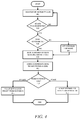
mobile communication device 300 shown inFIG. 3 are best understood in conjunction with the flowcharts ofFIG. 4 . Turning toFIG. 4 , inoperation block 401, the motiondetection determination module 321 monitors thesensor processor 339 for a motion trigger. The motion trigger may occur in response to sensor data received by thegyroscope 341, theaccelerometer 343, the other sensors 345, or various combinations of sensor data that may be used to determine that themobile communication device 300 is in motion and is likely within a vehicle. Indecision block 403, if a motion trigger is not detected, then the motiondetection determination module 321 will continue to monitor for the motion trigger inoperation block 401. However if the motion trigger is detected indecision block 403, the motiondetection determination module 321 will invoke thedata collection module 323 using an appropriate API from thelibraries 318. Thedata collection module 323 will access any needed APIs fromlibraries 318 and communicate with thekernel 319 to determine if theWLAN baseband hardware 311 is turned on or not. If indecision block 405, theWLAN baseband hardware 311 is off, thedata collection module 323 will send a command to activate theWLAN baseband hardware 311 and turn on the radio equipment as shown inoperation block 407. Otherwise, if theWLAN baseband hardware 311 is already turned on indecision block 405, thedata collection module 323 will begin to collect WLAN scan results 329 as shown inoperation block 409. Also inoperation block 409, thedata collection module 323 builds a histogram of any detected unique BSSIDs. The WLAN scan results 329 contain theWLAN information 107 discussed with respect toFIG. 1 . Thedata collection module 323 will pass information as necessary to theclassification module 325. More particularly, thedata collection module 323 will send the histogram representation to theclassification module 325. Inoperation block 411, theclassification module 325 will use thetransportation model 337 contained inmemory 303, and will assess the WLAN scan results 329 histogram using thetransportation model 337. - As shown in
decision block 413, theclassification module 325 performs analysis of the WLAN scan results 329 and predicts the transportation type using thetransportation model 337. The prediction that thetransportation model 337 provides will depend on the classification algorithm utilized. For example, if Random Forest is used to builed thetransportation model 337, then the final prediction will be based on a majority vote of the predictions from each individual decision tree. Depending on whether the transportation type is determined to be public transportation or private transportation, theclassification module 325 will access an appropriate API and will communicate with a hands-free module 327 and/or other components of themobile communication device 300 and will change the settings accordingly. For example, if the transportation type is determined to be public transportation indecision block 413, the process will proceed to operation block 417 and adjust the settings for public transportation. Similarly, if the transportation type indecision block 413 is determined to be private transportation such as a car, the process will proceed to operation block 415 and will adjust settings for private transportation. The process then ends as shown. - It is to be understood that although the
classification module 325 inFIG. 3 is shown communicating with the hands-free module 327, theclassification module 325 and theapplication 320 may control any settings of themobile communication device 300 including notification settings. For example, in some embodiments theclassification module 325 may determine that the transportation type is public transportation. The settings adjusted inoperation block 417 may include notification settings such that the user may be notified when an appropriate public transportation stop, such as bus stop, has been reached. Therefore if themobile communication device 300 user is daydreaming or sleeping and not paying attention to the location of the bus, themobile communication device 300 may produce an audible notification such that the user does not miss their bus stop. -
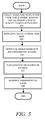
FIG. 5 is a flow chart showing operation of a server in accordance with various embodiments. The flowchart illustrates how thedata collection module 323 from various mobile communication devices may be used by theserver 209 shown inFIG. 2 to construct the transportation model database 211. Beginning in operation block 501, thedata collection module 323 may be invoked by a motion trigger detected by the motiondetection determination module 321 as was discussed previously with respect toFIG. 4 . Thedata collection module 323 may then collectWLAN information 107 for variousWLAN access points 109 encountered along a roadway or route as was discussed with respect toFIG. 1 . - For the presently discussed application of the
data collection module 323, thedata collection module 323 may interact with thedisplay 305 to show a prompt to the user such that the user may indicate (by providing input to the user interface 307) whether they are riding in a car, a bus or a train. In the present disclosure, a car is considered to be "private transportation," while a bus or a train are considered to be "public transportation." A taxicab, which is typically also a car, is considered to be private transportation for purposes of the present disclosure even though more than one passenger may be present in the taxicab. - In
operation block 503, theserver 209 receiveshistogram information 203 from one or moremobile communication devices 200 and aggregates the collected WLAN data. Inoperation block 505, theserver 209 determines the unique number of BSSID occurrences in each of the scans and develops further data records and aggregation. Inoperation block 507, theserver 209 runs a classification algorithm on the data. The classification algorithm may be for example Random Forest, which provides a way of averaging multiple deep decision trees which in this case are trained on different parts of the same WLAN BSSID training data with the purpose of, among other things, reducing the variance obtained on these multiple identical training data sets. - In
operation block 509, theserver 209 generates transportation model and stores it to the transportation model database 211. After the transportation model database 211 has been developed, theserver 209 may send transportation model updates 205 to any of the participating mobile communication devices such asmobile communication device 200. The mobile communication devices may therefore use the transportation model updates 205 to update thelocal transportation model 337 that each of the mobile communication devices maintains stored inmemory 303. - An
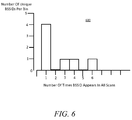
example histogram 600 for an example set of wireless local area network scans in accordance with various embodiments is illustrated inFIG. 6 . The histogram bins along the horizontal axis represent the number of times a BSSID appears in a scan set and the vertical axis value is the number of unique BSSIDs per each bin, i.e. bin six is related to the number of BSSIDs detected six times, etc. For example if six scans are conducted for a given scan interval, and using a simplified BSSID format "aN" for purposes of this example, the example scan results are as follows: scan 1 detected a1, a2, a3 and a4; scan 2 detected a1, a2 and a5; scan 3 detected a1 and a3; scan 4 detected a1 and a2; scan 5 detected a1, a3 and a6; and scan 6 detected a1, a3 and a7. Counting the number of times each detected BSSID appeared in the total six scans: a1 appeared six times; a2 appeared three times; a3 appeared four times; and a4, a5, a6 and a7 each appeared only one time. - In bin one, the number of BSSIDs that were detected only once is four (i.e. a4, a5, a6 and a7) therefore the vertical axis value for bin six is four. For the second bin, the number of BSSIDs that appeared twice is zero, therefore the vertical axis value for bin two is zero. For bin three, only a2 appeared three times and for bin four only a4 appeared four times, therefore bins three and four have a vertical axis value of one. There were no BSSIDs appearing five times so the vertical axis value for bin five is zero. For the sixth bin, BSSID a1 was the only BSSID detected six times therefore the vertical axis value for bin six is one. Accordingly the
histogram 600 is generated for the six scans of the example. - While various embodiments have been illustrated and described, it is to be understood that the invention is not so limited. Numerous modifications, changes, variations, substitutions and equivalents will occur to those skilled in the art without departing from the scope of the present invention as defined by the appended claims.
Claims (13)
- A mobile communication device comprising:wireless local area network (WLAN) baseband hardware comprising at least one WLAN transceiver;non-volatile, non-transitory memory, storing a transportation model based on aggregated basic service set identification (BSSID) information collected from a plurality of WLAN access points;at least one sensor, operative to detect motion of the mobile communication device; andat least one processor, operatively coupled to the WLAN baseband hardware, the memory and to the at least one sensor, the at least one processor operative to:determine that the mobile communication device is located on public transportation using the transportation model in response to a motion detection signal received from the at least one sensor.
- The mobile communication device of claim 1, wherein the transportation model comprises a histogram for BSSIDs collected and aggregated from the plurality of WLAN access points.
- The mobile communication device of claim 1 or claim 2, wherein the at least one processor is further operative to determine that the mobile communication device is located on public transportation using the transportation model by identifying persistent BSSIDs using the histogram.
- The mobile communication device of claim 2 or claim 3, wherein the at least one processor is further operative to determine that the mobile communication device is located in private transportation using the transportation model by identifying a lack of persistent BSSIDs using the histogram.
- The mobile communication device of any of claims 1 to 4, wherein the at least one processor is further operative to adjust settings of the mobile communication device in response to determining that the mobile communication device is located on public transportation.
- A method of operating a mobile communication device comprising:determining that the mobile communication device is in motion based on mobile communication device sensor data;scanning for wireless local area network (WLAN) access points;accessing a transportation model based on aggregated basic service set identification (BSSID) information collected from a plurality of WLAN access points; anddetermining that the mobile communication device is located on public transportation using the transportation model.
- The method of claim 6, wherein scanning for WLAN access points further comprises:generating a histogram of detected BSSIDs from a plurality of WLAN access points detected during scanning.
- The method of claim 7, further comprising:determining that the mobile communication device is located on public transportation using the transportation model by identifying persistent BSSIDs using the histogram.
- The method of claim 7, further comprising:determining that the mobile communication device is located in private transportation using the transportation model by identifying a lack of persistent BSSIDs using the histogram.
- The method of any of claims 6 to 9, further comprising:adjusting settings of the mobile communication device in response to determining that the mobile communication device is located on public transportation.
- A method comprising:collecting WLAN BSSID information from a plurality of mobile devices;determining a number of occurrences of each detected BSSID;performing a classification operation on the number of occurrences; andgenerating a transportation model using the classification operation for predicting that a mobile communication device is on public transportation or private transportation.
- The method of claim 11, further comprising:storing the transportation model in non-volatile, non-transitory memory on a mobile communication device.
- The method of claim 11 or claim 12, wherein performing a classification operation comprises:applying the Random Forest algorithm to the number of occurrences.
Applications Claiming Priority (1)
| Application Number | Priority Date | Filing Date | Title |
|---|---|---|---|
| US14/748,910 US9571627B2 (en) | 2015-06-24 | 2015-06-24 | Mobile communication device with public transportation detection for determining hands free mode settings |
Publications (2)
| Publication Number | Publication Date |
|---|---|
| EP3110230A1 true EP3110230A1 (en) | 2016-12-28 |
| EP3110230B1 EP3110230B1 (en) | 2021-12-15 |
Family
ID=56289296
Family Applications (1)
| Application Number | Title | Priority Date | Filing Date |
|---|---|---|---|
| EP16173942.0A Active EP3110230B1 (en) | 2015-06-24 | 2016-06-10 | Mobile communication device with public transportation detection for determining hands free mode settings |
Country Status (3)
| Country | Link |
|---|---|
| US (1) | US9571627B2 (en) |
| EP (1) | EP3110230B1 (en) |
| CN (1) | CN106301429B (en) |
Cited By (1)
| Publication number | Priority date | Publication date | Assignee | Title |
|---|---|---|---|---|
| US20210409976A1 (en) * | 2020-06-28 | 2021-12-30 | Ambeent Inc. | Optimizing utilization and performance of wi-fi networks |
Families Citing this family (10)
| Publication number | Priority date | Publication date | Assignee | Title |
|---|---|---|---|---|
| US10891947B1 (en) * | 2017-08-03 | 2021-01-12 | Wells Fargo Bank, N.A. | Adaptive conversation support bot |
| US20190206009A1 (en) * | 2017-12-29 | 2019-07-04 | Lyft, Inc. | Dynamically forecasting and dispatching transportation vehicles to travelers on mass-transit vehicles |
| US10831923B2 (en) | 2018-06-08 | 2020-11-10 | The Toronto-Dominion Bank | System, device and method for enforcing privacy during a communication session with a voice assistant |
| US10839811B2 (en) | 2018-06-08 | 2020-11-17 | The Toronto-Dominion Bank | System, device and method for enforcing privacy during a communication session with a voice assistant |
| US11321641B2 (en) * | 2018-08-21 | 2022-05-03 | International Business Machines Corporation | Managing seat occupancy details of one or more passengers |
| US10978063B2 (en) * | 2018-09-27 | 2021-04-13 | The Toronto-Dominion Bank | Systems, devices and methods for delivering audible alerts |
| US11023200B2 (en) * | 2018-09-27 | 2021-06-01 | The Toronto-Dominion Bank | Systems, devices and methods for delivering audible alerts |
| US10715957B2 (en) * | 2018-10-29 | 2020-07-14 | Here Global B.V. | Identifying mobile radio nodes and determining use of public transport vehicle |
| CN111355787B (en) * | 2020-02-20 | 2022-11-15 | 北京汽车集团有限公司 | Information transmission method and device and electronic equipment |
| US12418784B2 (en) * | 2020-05-07 | 2025-09-16 | Lg Electronics Inc. | Method and device for generating user identification model on basis of wireless sensing |
Citations (1)
| Publication number | Priority date | Publication date | Assignee | Title |
|---|---|---|---|---|
| WO2014083676A1 (en) * | 2012-11-30 | 2014-06-05 | 富士通株式会社 | Mobile terminal, control method, and control program |
Family Cites Families (4)
| Publication number | Priority date | Publication date | Assignee | Title |
|---|---|---|---|---|
| US9002416B2 (en) * | 2008-12-22 | 2015-04-07 | Google Technology Holdings LLC | Wireless communication device responsive to orientation and movement |
| US9113434B2 (en) * | 2010-09-10 | 2015-08-18 | Nokia Technologies Oy | Signal strength profiling |
| US20150168174A1 (en) * | 2012-06-21 | 2015-06-18 | Cellepathy Ltd. | Navigation instructions |
| US9307361B2 (en) * | 2014-03-24 | 2016-04-05 | Zos Communications, Llc | Start and stop moving notification triggers for location based tracking |
-
2015
- 2015-06-24 US US14/748,910 patent/US9571627B2/en active Active
-
2016
- 2016-06-10 EP EP16173942.0A patent/EP3110230B1/en active Active
- 2016-06-24 CN CN201610471179.8A patent/CN106301429B/en active Active
Patent Citations (2)
| Publication number | Priority date | Publication date | Assignee | Title |
|---|---|---|---|---|
| WO2014083676A1 (en) * | 2012-11-30 | 2014-06-05 | 富士通株式会社 | Mobile terminal, control method, and control program |
| US20150257108A1 (en) * | 2012-11-30 | 2015-09-10 | Fujitsu Limited | Mobile terminal device, control method, and computer product |
Non-Patent Citations (2)
| Title |
|---|
| STENNETH ET AL.: "Transportation Mode Detection using Mobile Phones and GIS Information", PROCEEDINGS OF THE 19TH ACM SIGSPATIAL INTERNATIONAL CONFERENCE ON ADVANCES IN GEOGRAPHIC INFORMATION SYSTEMS, 2011 |
| ZHENG ET AL.: "Understanding Mobility Based on GPS Data", ACM INTERNATIONAL JOINT CONFERENCE ON PERVASIVE AND UBIQUITOUS COMPUTING, 2008 |
Cited By (2)
| Publication number | Priority date | Publication date | Assignee | Title |
|---|---|---|---|---|
| US20210409976A1 (en) * | 2020-06-28 | 2021-12-30 | Ambeent Inc. | Optimizing utilization and performance of wi-fi networks |
| US11570636B2 (en) * | 2020-06-28 | 2023-01-31 | Ambeent Inc. | Optimizing utilization and performance of Wi-Fi networks |
Also Published As
| Publication number | Publication date |
|---|---|
| US9571627B2 (en) | 2017-02-14 |
| CN106301429A (en) | 2017-01-04 |
| EP3110230B1 (en) | 2021-12-15 |
| CN106301429B (en) | 2019-06-04 |
| US20160381205A1 (en) | 2016-12-29 |
Similar Documents
| Publication | Publication Date | Title |
|---|---|---|
| EP3110230B1 (en) | Mobile communication device with public transportation detection for determining hands free mode settings | |
| US11568496B1 (en) | Risk behavior detection methods based on tracking handset movement within a moving vehicle | |
| US11871313B2 (en) | System and method for vehicle sensing and analysis | |
| US9374709B2 (en) | Methods and systems for base station detection | |
| US9608952B2 (en) | Systems and methods for user device interaction | |
| US10424176B2 (en) | AMBER alert monitoring and support | |
| CN106464747B (en) | Vehicle safety system and method for operating a driver's cell phone | |
| CN108632347A (en) | Use the collision detection of GNSS tachometric surveys and bus monitoring | |
| CN110049445A (en) | The method and relevant apparatus of equipment reporting position information | |
| CN109993944B (en) | A kind of danger early warning method, mobile terminal and server | |
| US20180364722A1 (en) | Road hazard detection | |
| CN106959430B (en) | Determining vehicle position via signal strength and signal fading events | |
| US10957200B1 (en) | Transport parking space availability detection | |
| WO2017110526A1 (en) | Mobile terminal and vehicle | |
| US10212274B2 (en) | Systems and methodologies for controlling an electronic device within a vehicle | |
| CN115457682A (en) | Unlocking method, device and storage medium | |
| JP6379305B1 (en) | User context detection using mobile devices based on wireless signal characteristics | |
| US20180132100A1 (en) | Wireless communication apparatus and wireless communication method | |
| CN108040178A (en) | Call processing method, device, storage medium and electronic equipment | |
| CN107743177B (en) | Call control method, device, mobile terminal and readable storage medium | |
| JP2016517207A (en) | Driver distraction detection and reporting | |
| CN103929829A (en) | Telematics Control Using Relational Formulas | |
| CN108055393A (en) | Speed based reminding method, device and computer readable storage medium | |
| JP7093268B2 (en) | Information processing equipment, information processing methods, and information processing programs | |
| US10264115B1 (en) | Determining if a mobile device is being used by a driver of a vehicle |
Legal Events
| Date | Code | Title | Description |
|---|---|---|---|
| PUAI | Public reference made under article 153(3) epc to a published international application that has entered the european phase |
Free format text: ORIGINAL CODE: 0009012 |
|
| STAA | Information on the status of an ep patent application or granted ep patent |
Free format text: STATUS: THE APPLICATION HAS BEEN PUBLISHED |
|
| AK | Designated contracting states |
Kind code of ref document: A1 Designated state(s): AL AT BE BG CH CY CZ DE DK EE ES FI FR GB GR HR HU IE IS IT LI LT LU LV MC MK MT NL NO PL PT RO RS SE SI SK SM TR |
|
| AX | Request for extension of the european patent |
Extension state: BA ME |
|
| STAA | Information on the status of an ep patent application or granted ep patent |
Free format text: STATUS: REQUEST FOR EXAMINATION WAS MADE |
|
| 17P | Request for examination filed |
Effective date: 20170628 |
|
| RBV | Designated contracting states (corrected) |
Designated state(s): AL AT BE BG CH CY CZ DE DK EE ES FI FR GB GR HR HU IE IS IT LI LT LU LV MC MK MT NL NO PL PT RO RS SE SI SK SM TR |
|
| STAA | Information on the status of an ep patent application or granted ep patent |
Free format text: STATUS: EXAMINATION IS IN PROGRESS |
|
| 17Q | First examination report despatched |
Effective date: 20190118 |
|
| GRAP | Despatch of communication of intention to grant a patent |
Free format text: ORIGINAL CODE: EPIDOSNIGR1 |
|
| STAA | Information on the status of an ep patent application or granted ep patent |
Free format text: STATUS: GRANT OF PATENT IS INTENDED |
|
| RIC1 | Information provided on ipc code assigned before grant |
Ipc: H04W 88/06 20090101ALN20210303BHEP Ipc: H04W 4/02 20180101AFI20210303BHEP Ipc: H04W 84/12 20090101ALN20210303BHEP |
|
| RIC1 | Information provided on ipc code assigned before grant |
Ipc: H04W 4/02 20180101AFI20210309BHEP Ipc: H04W 84/12 20090101ALN20210309BHEP Ipc: H04W 88/06 20090101ALN20210309BHEP |
|
| INTG | Intention to grant announced |
Effective date: 20210326 |
|
| RIC1 | Information provided on ipc code assigned before grant |
Ipc: H04W 4/02 20180101AFI20210315BHEP Ipc: H04W 84/12 20090101ALN20210315BHEP Ipc: H04W 88/06 20090101ALN20210315BHEP |
|
| GRAJ | Information related to disapproval of communication of intention to grant by the applicant or resumption of examination proceedings by the epo deleted |
Free format text: ORIGINAL CODE: EPIDOSDIGR1 |
|
| STAA | Information on the status of an ep patent application or granted ep patent |
Free format text: STATUS: EXAMINATION IS IN PROGRESS |
|
| REG | Reference to a national code |
Ref country code: DE Ref legal event code: R079 Ref document number: 602016067314 Country of ref document: DE Free format text: PREVIOUS MAIN CLASS: H04W0088000000 Ipc: H04W0004020000 |
|
| GRAP | Despatch of communication of intention to grant a patent |
Free format text: ORIGINAL CODE: EPIDOSNIGR1 |
|
| STAA | Information on the status of an ep patent application or granted ep patent |
Free format text: STATUS: GRANT OF PATENT IS INTENDED |
|
| INTC | Intention to grant announced (deleted) | ||
| RIC1 | Information provided on ipc code assigned before grant |
Ipc: H04W 4/02 20180101AFI20210616BHEP Ipc: H04W 84/12 20090101ALN20210616BHEP Ipc: H04W 88/06 20090101ALN20210616BHEP |
|
| INTG | Intention to grant announced |
Effective date: 20210705 |
|
| GRAS | Grant fee paid |
Free format text: ORIGINAL CODE: EPIDOSNIGR3 |
|
| GRAA | (expected) grant |
Free format text: ORIGINAL CODE: 0009210 |
|
| STAA | Information on the status of an ep patent application or granted ep patent |
Free format text: STATUS: THE PATENT HAS BEEN GRANTED |
|
| AK | Designated contracting states |
Kind code of ref document: B1 Designated state(s): AL AT BE BG CH CY CZ DE DK EE ES FI FR GB GR HR HU IE IS IT LI LT LU LV MC MK MT NL NO PL PT RO RS SE SI SK SM TR |
|
| REG | Reference to a national code |
Ref country code: GB Ref legal event code: FG4D Ref country code: CH Ref legal event code: EP |
|
| REG | Reference to a national code |
Ref country code: IE Ref legal event code: FG4D Ref country code: DE Ref legal event code: R096 Ref document number: 602016067314 Country of ref document: DE |
|
| REG | Reference to a national code |
Ref country code: AT Ref legal event code: REF Ref document number: 1456387 Country of ref document: AT Kind code of ref document: T Effective date: 20220115 |
|
| REG | Reference to a national code |
Ref country code: LT Ref legal event code: MG9D |
|
| REG | Reference to a national code |
Ref country code: NL Ref legal event code: MP Effective date: 20211215 |
|
| PG25 | Lapsed in a contracting state [announced via postgrant information from national office to epo] |
Ref country code: RS Free format text: LAPSE BECAUSE OF FAILURE TO SUBMIT A TRANSLATION OF THE DESCRIPTION OR TO PAY THE FEE WITHIN THE PRESCRIBED TIME-LIMIT Effective date: 20211215 Ref country code: LT Free format text: LAPSE BECAUSE OF FAILURE TO SUBMIT A TRANSLATION OF THE DESCRIPTION OR TO PAY THE FEE WITHIN THE PRESCRIBED TIME-LIMIT Effective date: 20211215 Ref country code: FI Free format text: LAPSE BECAUSE OF FAILURE TO SUBMIT A TRANSLATION OF THE DESCRIPTION OR TO PAY THE FEE WITHIN THE PRESCRIBED TIME-LIMIT Effective date: 20211215 Ref country code: BG Free format text: LAPSE BECAUSE OF FAILURE TO SUBMIT A TRANSLATION OF THE DESCRIPTION OR TO PAY THE FEE WITHIN THE PRESCRIBED TIME-LIMIT Effective date: 20220315 |
|
| REG | Reference to a national code |
Ref country code: AT Ref legal event code: MK05 Ref document number: 1456387 Country of ref document: AT Kind code of ref document: T Effective date: 20211215 |
|
| PG25 | Lapsed in a contracting state [announced via postgrant information from national office to epo] |
Ref country code: SE Free format text: LAPSE BECAUSE OF FAILURE TO SUBMIT A TRANSLATION OF THE DESCRIPTION OR TO PAY THE FEE WITHIN THE PRESCRIBED TIME-LIMIT Effective date: 20211215 Ref country code: NO Free format text: LAPSE BECAUSE OF FAILURE TO SUBMIT A TRANSLATION OF THE DESCRIPTION OR TO PAY THE FEE WITHIN THE PRESCRIBED TIME-LIMIT Effective date: 20220315 Ref country code: LV Free format text: LAPSE BECAUSE OF FAILURE TO SUBMIT A TRANSLATION OF THE DESCRIPTION OR TO PAY THE FEE WITHIN THE PRESCRIBED TIME-LIMIT Effective date: 20211215 Ref country code: HR Free format text: LAPSE BECAUSE OF FAILURE TO SUBMIT A TRANSLATION OF THE DESCRIPTION OR TO PAY THE FEE WITHIN THE PRESCRIBED TIME-LIMIT Effective date: 20211215 Ref country code: GR Free format text: LAPSE BECAUSE OF FAILURE TO SUBMIT A TRANSLATION OF THE DESCRIPTION OR TO PAY THE FEE WITHIN THE PRESCRIBED TIME-LIMIT Effective date: 20220316 |
|
| PG25 | Lapsed in a contracting state [announced via postgrant information from national office to epo] |
Ref country code: NL Free format text: LAPSE BECAUSE OF FAILURE TO SUBMIT A TRANSLATION OF THE DESCRIPTION OR TO PAY THE FEE WITHIN THE PRESCRIBED TIME-LIMIT Effective date: 20211215 |
|
| PG25 | Lapsed in a contracting state [announced via postgrant information from national office to epo] |
Ref country code: SM Free format text: LAPSE BECAUSE OF FAILURE TO SUBMIT A TRANSLATION OF THE DESCRIPTION OR TO PAY THE FEE WITHIN THE PRESCRIBED TIME-LIMIT Effective date: 20211215 Ref country code: SK Free format text: LAPSE BECAUSE OF FAILURE TO SUBMIT A TRANSLATION OF THE DESCRIPTION OR TO PAY THE FEE WITHIN THE PRESCRIBED TIME-LIMIT Effective date: 20211215 Ref country code: RO Free format text: LAPSE BECAUSE OF FAILURE TO SUBMIT A TRANSLATION OF THE DESCRIPTION OR TO PAY THE FEE WITHIN THE PRESCRIBED TIME-LIMIT Effective date: 20211215 Ref country code: PT Free format text: LAPSE BECAUSE OF FAILURE TO SUBMIT A TRANSLATION OF THE DESCRIPTION OR TO PAY THE FEE WITHIN THE PRESCRIBED TIME-LIMIT Effective date: 20220418 Ref country code: ES Free format text: LAPSE BECAUSE OF FAILURE TO SUBMIT A TRANSLATION OF THE DESCRIPTION OR TO PAY THE FEE WITHIN THE PRESCRIBED TIME-LIMIT Effective date: 20211215 Ref country code: EE Free format text: LAPSE BECAUSE OF FAILURE TO SUBMIT A TRANSLATION OF THE DESCRIPTION OR TO PAY THE FEE WITHIN THE PRESCRIBED TIME-LIMIT Effective date: 20211215 Ref country code: CZ Free format text: LAPSE BECAUSE OF FAILURE TO SUBMIT A TRANSLATION OF THE DESCRIPTION OR TO PAY THE FEE WITHIN THE PRESCRIBED TIME-LIMIT Effective date: 20211215 |
|
| PG25 | Lapsed in a contracting state [announced via postgrant information from national office to epo] |
Ref country code: PL Free format text: LAPSE BECAUSE OF FAILURE TO SUBMIT A TRANSLATION OF THE DESCRIPTION OR TO PAY THE FEE WITHIN THE PRESCRIBED TIME-LIMIT Effective date: 20211215 Ref country code: AT Free format text: LAPSE BECAUSE OF FAILURE TO SUBMIT A TRANSLATION OF THE DESCRIPTION OR TO PAY THE FEE WITHIN THE PRESCRIBED TIME-LIMIT Effective date: 20211215 |
|
| REG | Reference to a national code |
Ref country code: DE Ref legal event code: R097 Ref document number: 602016067314 Country of ref document: DE |
|
| PG25 | Lapsed in a contracting state [announced via postgrant information from national office to epo] |
Ref country code: IS Free format text: LAPSE BECAUSE OF FAILURE TO SUBMIT A TRANSLATION OF THE DESCRIPTION OR TO PAY THE FEE WITHIN THE PRESCRIBED TIME-LIMIT Effective date: 20220415 |
|
| PLBE | No opposition filed within time limit |
Free format text: ORIGINAL CODE: 0009261 |
|
| STAA | Information on the status of an ep patent application or granted ep patent |
Free format text: STATUS: NO OPPOSITION FILED WITHIN TIME LIMIT |
|
| PG25 | Lapsed in a contracting state [announced via postgrant information from national office to epo] |
Ref country code: DK Free format text: LAPSE BECAUSE OF FAILURE TO SUBMIT A TRANSLATION OF THE DESCRIPTION OR TO PAY THE FEE WITHIN THE PRESCRIBED TIME-LIMIT Effective date: 20211215 Ref country code: AL Free format text: LAPSE BECAUSE OF FAILURE TO SUBMIT A TRANSLATION OF THE DESCRIPTION OR TO PAY THE FEE WITHIN THE PRESCRIBED TIME-LIMIT Effective date: 20211215 |
|
| 26N | No opposition filed |
Effective date: 20220916 |
|
| PG25 | Lapsed in a contracting state [announced via postgrant information from national office to epo] |
Ref country code: SI Free format text: LAPSE BECAUSE OF FAILURE TO SUBMIT A TRANSLATION OF THE DESCRIPTION OR TO PAY THE FEE WITHIN THE PRESCRIBED TIME-LIMIT Effective date: 20211215 |
|
| PG25 | Lapsed in a contracting state [announced via postgrant information from national office to epo] |
Ref country code: MC Free format text: LAPSE BECAUSE OF FAILURE TO SUBMIT A TRANSLATION OF THE DESCRIPTION OR TO PAY THE FEE WITHIN THE PRESCRIBED TIME-LIMIT Effective date: 20211215 |
|
| REG | Reference to a national code |
Ref country code: CH Ref legal event code: PL |
|
| REG | Reference to a national code |
Ref country code: BE Ref legal event code: MM Effective date: 20220630 |
|
| PG25 | Lapsed in a contracting state [announced via postgrant information from national office to epo] |
Ref country code: LU Free format text: LAPSE BECAUSE OF NON-PAYMENT OF DUE FEES Effective date: 20220610 Ref country code: LI Free format text: LAPSE BECAUSE OF NON-PAYMENT OF DUE FEES Effective date: 20220630 Ref country code: IE Free format text: LAPSE BECAUSE OF NON-PAYMENT OF DUE FEES Effective date: 20220610 Ref country code: FR Free format text: LAPSE BECAUSE OF NON-PAYMENT OF DUE FEES Effective date: 20220630 Ref country code: CH Free format text: LAPSE BECAUSE OF NON-PAYMENT OF DUE FEES Effective date: 20220630 |
|
| PG25 | Lapsed in a contracting state [announced via postgrant information from national office to epo] |
Ref country code: IT Free format text: LAPSE BECAUSE OF FAILURE TO SUBMIT A TRANSLATION OF THE DESCRIPTION OR TO PAY THE FEE WITHIN THE PRESCRIBED TIME-LIMIT Effective date: 20211215 Ref country code: BE Free format text: LAPSE BECAUSE OF NON-PAYMENT OF DUE FEES Effective date: 20220630 |
|
| P01 | Opt-out of the competence of the unified patent court (upc) registered |
Effective date: 20230627 |
|
| PG25 | Lapsed in a contracting state [announced via postgrant information from national office to epo] |
Ref country code: HU Free format text: LAPSE BECAUSE OF FAILURE TO SUBMIT A TRANSLATION OF THE DESCRIPTION OR TO PAY THE FEE WITHIN THE PRESCRIBED TIME-LIMIT; INVALID AB INITIO Effective date: 20160610 |
|
| PG25 | Lapsed in a contracting state [announced via postgrant information from national office to epo] |
Ref country code: MK Free format text: LAPSE BECAUSE OF FAILURE TO SUBMIT A TRANSLATION OF THE DESCRIPTION OR TO PAY THE FEE WITHIN THE PRESCRIBED TIME-LIMIT Effective date: 20211215 Ref country code: CY Free format text: LAPSE BECAUSE OF FAILURE TO SUBMIT A TRANSLATION OF THE DESCRIPTION OR TO PAY THE FEE WITHIN THE PRESCRIBED TIME-LIMIT Effective date: 20211215 |
|
| PG25 | Lapsed in a contracting state [announced via postgrant information from national office to epo] |
Ref country code: MT Free format text: LAPSE BECAUSE OF FAILURE TO SUBMIT A TRANSLATION OF THE DESCRIPTION OR TO PAY THE FEE WITHIN THE PRESCRIBED TIME-LIMIT Effective date: 20211215 |
|
| PGFP | Annual fee paid to national office [announced via postgrant information from national office to epo] |
Ref country code: DE Payment date: 20250626 Year of fee payment: 10 |
|
| PGFP | Annual fee paid to national office [announced via postgrant information from national office to epo] |
Ref country code: GB Payment date: 20250617 Year of fee payment: 10 |
|
| PG25 | Lapsed in a contracting state [announced via postgrant information from national office to epo] |
Ref country code: TR Free format text: LAPSE BECAUSE OF FAILURE TO SUBMIT A TRANSLATION OF THE DESCRIPTION OR TO PAY THE FEE WITHIN THE PRESCRIBED TIME-LIMIT Effective date: 20211215 |