EP3110116A1 - Method for automatically adjusting volume, volume adjustment apparatus and electronic device - Google Patents
Method for automatically adjusting volume, volume adjustment apparatus and electronic device Download PDFInfo
- Publication number
- EP3110116A1 EP3110116A1 EP14888498.4A EP14888498A EP3110116A1 EP 3110116 A1 EP3110116 A1 EP 3110116A1 EP 14888498 A EP14888498 A EP 14888498A EP 3110116 A1 EP3110116 A1 EP 3110116A1
- Authority
- EP
- European Patent Office
- Prior art keywords
- electronic device
- semantic
- volume adjustment
- evaluation
- voice signal
- Prior art date
- Legal status (The legal status is an assumption and is not a legal conclusion. Google has not performed a legal analysis and makes no representation as to the accuracy of the status listed.)
- Granted
Links
Images

Classifications
-
- H—ELECTRICITY
- H04—ELECTRIC COMMUNICATION TECHNIQUE
- H04M—TELEPHONIC COMMUNICATION
- H04M1/00—Substation equipment, e.g. for use by subscribers
- H04M1/60—Substation equipment, e.g. for use by subscribers including speech amplifiers
-
- H—ELECTRICITY
- H04—ELECTRIC COMMUNICATION TECHNIQUE
- H04M—TELEPHONIC COMMUNICATION
- H04M2250/00—Details of telephonic subscriber devices
- H04M2250/74—Details of telephonic subscriber devices with voice recognition means
Definitions
- the present invention relates to the field of electronic devices, and in particular, to an automatic volume adjustment method, a volume adjustment apparatus, and an electronic device.
- a call party feels unsatisfactory with call volume due to an environmental or human factor.
- the call party usually adjusts output volume of an electronic device in a manual manner, so that the call volume meets a requirement of the call party.
- the present invention mainly resolves a technical problem of how to automatically, quickly, and conveniently adjust volume according to an actual situation, so as to improve call experience of a user.
- the present invention proposes an automatic volume adjustment method, a volume adjustment apparatus, and an electronic device, with which volume can be automatically adjusted according to a semantic of a call party, thereby improving call experience of a user.
- an embodiment of the present invention provides an automatic volume adjustment method, where the method includes: receiving, by a first electronic device, a voice signal after a call connection is established; performing identification on the voice signal and performing a semantic analysis to obtain a semantic identification result; performing matching between the semantic identification result and a prestored evaluation semantic to acquire a volume adjustment rule; and automatically adjusting a volume output mode of the electronic device according to the volume adjustment rule.
- the voice signal includes a voice signal received by the first electronic device by using a microphone; or a voice signal received by the first electronic device and sent by a second electronic device.
- the prestored evaluation semantic is an evaluation of voice being too small, and a corresponding volume adjustment rule is turning up earpiece volume of the first electronic device; or the prestored evaluation semantic is an evaluation of voice being too loud, and a corresponding volume adjustment rule is turning down earpiece volume of the first electronic device; or the prestored evaluation semantic is an evaluation of being in a noisy environment, and a corresponding volume adjustment rule is switching earpiece output to speaker output.
- the prestored evaluation semantic is an evaluation of voice being too small, and a corresponding volume adjustment rule is increasing a microphone gain of the first electronic device so as to increase microphone volume; or the prestored evaluation semantic is an evaluation of voice being too loud, and a corresponding volume adjustment rule is decreasing a microphone gain of the first electronic device so as to lower microphone volume.
- an embodiment of the present invention provides a volume adjustment apparatus, where the volume adjustment apparatus includes a receiving module, an identification module, a match module, and a volume adjustment module, and the volume adjustment apparatus is applied to a first electronic device, where the receiving module is configured to receive a voice signal after the electronic device establishes a call connection; the identification module is configured to perform identification on the voice signal received by the receiving module, and perform a semantic analysis to obtain a semantic identification result; the match module is configured to perform matching between the voice identification result obtained by the identification module by means of identification and a prestored evaluation semantic to acquire a volume adjustment rule; and the volume adjustment module is configured to automatically adjust a volume output mode of the electronic device according to the volume adjustment rule acquired by the match module.
- the volume adjustment apparatus is applied to the first electronic device, and the voice signal includes a voice signal received by the first electronic device by using a microphone; or a voice signal received by the first electronic device and sent by a second electronic device.
- the prestored evaluation semantic is an evaluation of voice being too small, and a corresponding volume adjustment rule is turning up earpiece volume of the first electronic device; or the prestored evaluation semantic is an evaluation of voice being too loud, and a corresponding volume adjustment rule is turning down earpiece volume of the first electronic device; or the prestored evaluation semantic is an evaluation of being in a noisy environment, and a corresponding volume adjustment rule is switching earpiece output to speaker output.
- the prestored evaluation semantic is an evaluation of voice being too small, and a corresponding volume adjustment rule is increasing a microphone gain of the first electronic device so as to increase microphone volume; or the prestored evaluation semantic is an evaluation of voice being too loud, and a corresponding volume adjustment rule is decreasing a microphone gain of the first electronic device so as to lower microphone volume.
- an embodiment of the present invention provides an electronic device, where the electronic device includes a processor, a memory, and a receiver, where the processor is separately coupled to the memory and the receiver, and the electronic device is a first electronic device, where the receiver is configured to receive a voice signal after the electronic device establishes a call connection; the processor performs identification on the voice signal received by the receiver and performs a semantic analysis to obtain a semantic identification result, performs matching between the semantic identification result and a prestored evaluation semantic to acquire a volume adjustment rule, and automatically adjusts a volume output mode of the electronic device according to the volume adjustment rule; and the memory is configured to store the evaluation semantic.
- the receiver includes a microphone or a wireless transceiver; when the receiver is the microphone, the voice signal is a voice signal received by the first electronic device by using the microphone; or when the receiver is the wireless transceiver, the voice signal is a voice signal received by the first electronic device and sent by a second electronic device.
- the prestored evaluation semantic is an evaluation of voice being too small, and a corresponding volume adjustment rule is turning up earpiece volume of the first electronic device; or the prestored evaluation semantic is an evaluation of voice being too loud, and a corresponding volume adjustment rule is turning down earpiece volume of the first electronic device; or the prestored evaluation semantic is an evaluation of being in a noisy environment, and a corresponding volume adjustment rule is switching earpiece output to speaker output.
- the prestored evaluation semantic is an evaluation of voice being too small, and a corresponding volume adjustment rule is increasing the microphone gain of the first electronic device so as to increase the microphone volume; or the prestored evaluation semantic is an evaluation of voice being too loud, and a corresponding volume adjustment rule is decreasing the microphone gain of the first electronic device so as to lower the microphone volume.
- Embodiments of the present invention provide an automatic volume adjustment method and an electronic device.
- a voice signal is received, identification is performed and a semantic analysis is performed to obtain a semantic identification result, matching is performed between the semantic identification result and a prestored evaluation semantic to acquire a volume adjustment rule, and a volume output mode at an electronic device end is automatically adjusted according to the volume adjustment rule.
- a volume adjustment can be automatically performed based on the semantic identification result of the voice signal, without requiring manual intervention, which avoids impact on a call process and improves call experience of a call party.
- FIG. 1 is a flowchart of an automatic volume adjustment method according to an embodiment of the present invention. In this embodiment, description is performed in a perspective of an electronic device.
- the automatic volume adjustment method in this embodiment includes the following steps:
- the electronic device receives the voice signal after the electronic device establishes a call with another electronic device.
- the electronic device is defined as a first electronic device
- the another electronic device that establishes the call with the electronic device is defined as a second electronic device.
- the voice signal herein may be a voice signal received by the electronic device by using a microphone, or may be a voice signal received by the electronic device and sent by the second electronic device.
- S102 Perform identification on the voice signal, and perform a semantic analysis to obtain a semantic identification result.
- Voice identification is performed on the received voice signal to obtain a voice identification result
- a semantic analysis is further performed on the voice identification result to obtain the semantic identification result.
- the semantic analysis refers to extracting a keyword from the voice identification result, and performing an analysis and an understanding to obtain a meaning that a user expects to convey, so as to provide the semantic identification result. For example, if the voice signal received from a first electronic device end is "ah, how come the voice is so small", the voice identification result is "ah, how come the voice is so small”.
- the semantic analysis refers to extracting keywords such as "voice” and "small” from “ah, how come the voice is so small”, and performing an analysis and an understanding to obtain the semantic identification result, which may be "voice being too small”.
- the semantic analysis may be performed according to a preset rule. For example, as long as the extracted keywords include “voice” and “small”, it is considered that the semantic identification result is "voice being too small”; or as long as the extracted keywords include “loud” and "voice”, it is considered that the semantic identification result is "voice being too loud”.
- S103 Perform matching between the semantic identification result and a prestored evaluation semantic to acquire a volume adjustment rule.
- the semantic identification result is obtained by means of semantic identification
- matching is performed between the semantic identification result and the prestored evaluation semantic, where the evaluation semantic is prestored and is used to perform an evaluation on volume.
- Each prestored evaluation semantic corresponds to one volume adjustment rule.
- the volume adjustment rule corresponding to the matched prestored evaluation semantic is acquired.
- Table 1 Correspondence between a prestored evaluation semantic and a volume adjustment rule Prestored evaluation semantic Volume adjustment rule Voice being too small Turning up earpiece volume of an electronic device Voice being too loud Turning down earpiece volume of an electronic device Being in a noisy environment Switching earpiece output to speaker output
- the foregoing correspondence between an evaluation semantic and a volume adjustment rule may be prestored in a database.
- the foregoing correspondence between an evaluation semantic and a volume adjustment rule may be prestored in a database 1. That is, as long as the received voice signal is the voice signal originated from the first electronic device end, when the semantic identification result is obtained by performing identification on the voice signal and performing the semantic analysis, matching is performed between the semantic identification result and the evaluation semantic in the database 1.
- Table 2 Another correspondence between a prestored evaluation semantic and a volume adjustment rule Prestored evaluation semantic Volume adjustment rule Voice being too small Increasing a microphone gain of an electronic device Voice being too loud Decreasing a microphone gain of an electronic device
- the foregoing correspondence between an evaluation semantic and a volume adjustment rule may be prestored in a database.
- the foregoing correspondence between an evaluation semantic and a volume adjustment rule may be prestored in a database 2. That is, as long as the received voice signal is the voice signal originated from a second electronic device end, when the semantic identification result is obtained by performing identification on the voice signal and performing the semantic analysis, matching is performed between the semantic identification result and the evaluation semantic in the database 2.
- correspondences between a prestored evaluation semantic and a volume adjustment rule in the foregoing two application scenarios are separately described and saved for ease of differentiation.
- the correspondences between a prestored evaluation semantic and a volume adjustment rule for the foregoing two application scenarios may also be stored in a same database.
- correspondences between an evaluation semantic and a volume adjustment rule are merely examples.
- another correspondence may also be used, which may be determined voluntarily according to a requirement of a user, and is not limited in the present invention.
- S104 Automatically adjust a volume output mode of the electronic device according to the volume adjustment rule.
- the volume output mode of the electronic device is adjusted according to the volume adjustment rule.
- amplitude of the volume adjustment may be adjusted according to a preset adjustment threshold.
- a preset adjustment threshold For example, when the semantic expresses voice being too small, earpiece volume of the electronic device is automatically turned up by one threshold; when the semantic expresses voice being too loud, the earpiece volume of the electronic device is automatically turned down by one threshold.
- This threshold is a value preset according to experience, which, for example, may be one bar, two bars, three bars, or the like. That is, when the threshold is set to one bar, each time volume is turned up or down according to a volume adjustment rule, current earpiece volume is turned up or down by one bar.
- a user may also voluntarily set an adjustment threshold according to the user's own requirement, which is not limited in the present invention.
- a voice signal is received, identification is performed and a semantic analysis is performed to obtain a semantic identification result, matching is performed between the semantic identification result and a prestored evaluation semantic to acquire a volume adjustment rule, and a volume output mode of an electronic device end is automatically adjusted according to the volume adjustment rule.
- a corresponding volume adjustment can be automatically performed based on the semantic identification result of the voice signal, without requiring manual intervention, which avoids impact on a call process and improves call experience of a call party.
- a and B use mobile phones to make a call, where a mobile phone at an end of A is the foregoing first electronic device. After the call is connected, assuming that A says "how come your voice is so small", the mobile phone at the end of A obtains a semantic identification result "voice being too small” after voice and semantic analyses.
- a matched corresponding volume adjustment rule is turning up earpiece volume of the first electronic device, that is, turning up earpiece volume of the mobile phone at the end of A.
- a matched corresponding volume adjustment rule is switching earpiece output of the first electronic device to speaker output, that is, switching an earpiece output mode of the mobile phone at the end of A to a speaker output mode.
- FIG. 2 is a schematic structural diagram of a first type of volume adjustment apparatus according to an embodiment of the present invention.
- a volume adjustment apparatus 100 in this embodiment includes a receiving module 11, an identification module 12, a match module 13, and a volume adjustment module 14.
- the volume adjustment apparatus in this embodiment is a first volume adjustment apparatus.
- the receiving module 11 is configured to receive a voice signal after an electronic device establishes a call connection.
- the receiving module 11 receives the voice signal after the electronic device establishes a call connection with another electronic device.
- the electronic device is defined as a first electronic device
- the another electronic device that establishes a call with the first electronic device is defined as a second electronic device.
- the volume adjustment apparatus 100 in this embodiment is applied to the first electronic device.
- the voice signal herein may be a voice signal received by the first electronic device by using a microphone, or may be a voice signal received by the first electronic device and sent by the second electronic device.
- the identification module 12 is configured to perform identification on the voice signal received by the receiving module 11, and perform a semantic analysis to obtain a semantic identification result.
- the identification module 12 performs voice identification on the received voice signal to obtain a voice identification result, and further performs a semantic analysis on the voice identification result to obtain a semantic identification result.
- the semantic analysis refers to extracting a keyword from the voice identification result, and performing an analysis and an understanding to obtain a meaning that a user expects to convey, so as to provide the semantic identification result. For example, if a call party at a first electronic device end says "here is noisy", the voice identification result obtained after the voice identification is "here is noisy”, and the semantic identification result obtained after the semantic analysis is further performed may be "environment being noisy".
- the match module 13 is configured to perform matching between the voice identification result obtained by the identification module 12 by means of identification and a prestored evaluation semantic to acquire a volume adjustment rule.
- the semantic identification result is obtained by means of semantic identification
- matching is performed between the semantic identification result and the prestored evaluation semantic, where the evaluation semantic is prestored and is used to perform an evaluation on volume.
- Each prestored evaluation semantic corresponds to one volume adjustment rule.
- the volume adjustment rule corresponding to the matched prestored evaluation semantic is acquired.
- the volume adjustment module 14 is configured to automatically adjust a volume output module of the electronic device according to the volume adjustment rule acquired by the match module 13.
- the volume output mode of the electronic device is adjusted according to the volume adjustment rule.
- amplitude of the volume adjustment may be adjusted according to a preset adjustment threshold.
- a preset adjustment threshold For example, when the semantic expresses voice being too small, earpiece volume of the electronic device is automatically turned up by one threshold; when the semantic expresses voice being too loud, the earpiece volume of the electronic device is automatically turned down by one threshold.
- This threshold is a value preset according to experience, which, for example, may be one bar, two bars, three bars, or the like. That is, when the threshold is set to one bar, each time volume is turned up or down according to a volume adjustment rule, current earpiece volume is turned up or down by one bar.
- a user may also voluntarily set an adjustment threshold according to the user's own requirement, which is not limited in the present invention.
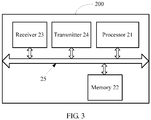
- FIG. 3 is a schematic structural diagram of a first type of electronic device according to an embodiment of the present invention.
- An electronic device 200 in this embodiment includes a processor 21, a memory 22, a receiver 23, a transmitter 24, and a bus system 25.
- the electronic device is this embodiment is a first electronic device.
- the processor 21 controls an operation of the electronic device 200, and the processor 21 may further be referred to as a CPU (Central Processing Unit, central processing unit).
- the processor 21 may be an integrated circuit chip and has a signal processing capability.
- the processor 21 may further be a general purpose processor, a digital signal processor (DSP, Digital Signal Processing), an application-specific integrated circuit (ASIC, Application Specific Integrated Circuit), a field programmable gate array (FPGA, Field-Programmable Gate Array), or another programmable logical device, a discrete gate or a transistor logical device, or a discrete hardware component.
- DSP digital signal processor
- ASIC Application Specific Integrated Circuit
- FPGA Field-Programmable Gate Array
- the general purpose processor may be a microprocessor, or the processor may also be any conventional processor or the like.
- the memory 22 may include a read-only memory and a random access memory, and provides an instruction and data for the processor 21.
- a part of the memory 22 may further include a nonvolatile random access memory (NVRAM).
- NVRAM nonvolatile random access memory
- bus system 25 includes a data bus, and may further include a power bus, a control bus, a state signal bus, and the like.
- the bus system may be an ISA (Industry Standard Architecture, industry standard architecture) bus, a PCI (Peripheral Component Interconnect, peripheral component interconnect) bus, an EISA (Extended Industry Standard Architecture, Extended Industry Standard Architecture) bus, or the like.
- the bus may be one or more physical lines. In a case with multiple physical lines, the bus may be categorized into an address bus, a data bus, a control bus, and so on.
- the processor 21, the memory 22, the receiver 23, and the transmitter 24 may also be directly connected by using a communication line. However, for clarity of description, various buses are marked as the bus system 25 in the diagram.
- the memory 22 stores the following elements: an executable module or data structure, a subset of the executable module or data structure, or an extended set of the executable module or data structure.
- An operation instruction includes various operation instructions, which are used to implement various operations.
- An operating system includes various system programs, which are used to implement various basic services and process hardware-based tasks.
- the processor 21 calls an operation instruction stored in the memory 22 (the operation instruction may be stored in the operating system).
- the receiver 23 is configured to receive a voice signal after a call connection is established.
- the processor 21 controls the receiver 23 to receive the voice signal after the first electronic device establishes a call with another electronic device.
- the electronic device is defined as the first electronic device
- the another electronic device that establishes the call with the first electronic device is defined as a second electronic device.
- the receiver 23 may be a microphone, or may be a wireless receiver.
- the voice signal herein is a voice signal received by the first electronic device by using the microphone;
- the receiver 23 is a wireless receiver, the voice signal is a voice signal received by the first electronic device and sent by the second electronic device, and is played by using an earpiece of the first electronic device.
- the processor 21 performs voice identification on the voice signal received by the receiver 23 and performs a semantic analysis to obtain a semantic identification result, performs matching between the semantic identification result and a prestored evaluation semantic to acquire a volume adjustment rule, and automatically adjusts a volume output mode of the electronic device according to the volume adjustment rule.
- the processor 21 performs voice identification on the voice signal received by the receiver 23 to obtain a voice identification result, and further performs a semantic analysis on the voice identification result to obtain the semantic identification result.
- the semantic analysis refers to extracting a keyword from the voice identification result, and performing an analysis and an understanding to obtain a meaning that a user expects to convey, so as to provide the semantic identification result. For example, if the voice signal received from a first electronic device end is "ah, how come the voice is so small", the voice identification result is "ah, how come the voice is so small”.
- the semantic analysis refers to extracting keywords such as "voice” and "small” from “ah, how come the voice is so small”, and performing an analysis and an understanding to obtain the semantic identification result, which may be "voice being too small”.
- the semantic analysis may be performed according to a preset rule. For example, as long as the extracted keywords include “voice” and “small”, it is considered that the semantic identification result is "voice being too small”; or as long as the extracted keywords include “loud” and "voice”, it is considered that the semantic identification result is "voice being too loud”.
- the processor 21 When the semantic identification result is obtained by means of semantic identification, the processor 21 performs matching between the semantic identification result and the prestored evaluation semantic, where the evaluation semantic is prestored and is used to perform an evaluation on volume. Each prestored evaluation semantic corresponds to one volume adjustment rule.
- the volume adjustment rule corresponding to the prestored evaluation semantic is acquired, and the processor 21 adjusts the volume output mode of the electronic device according to the volume adjustment rule.
- the correspondences between a prestored evaluation semantic and a volume adjustment rule in the two application scenarios are separately stored in different databases correspondingly. Certainly, the correspondences may also be stored in a same database. When matching is performed, if the matching is unsuccessful, a volume adjustment action is not performed.
- correspondences between an evaluation semantic and a volume adjustment rule are merely examples.
- another correspondence may also be used, which may be determined voluntarily according to a requirement of a user, and is not limited in the present invention.
- the memory 22 is configured to store an evaluation semantic.
- the transmitter 24 is configured to send data externally.
- the method disclosed in the foregoing embodiment of the present invention may be applied to the processor 21, or implemented by the processor 21.
- steps of the foregoing method may be completed by using an integrated logical circuit of hardware of the processor 21 or an instruction in a form of software.
- Methods, steps, and logical block diagrams disclosed in the embodiments of the present invention may be implemented or executed.
- the steps of the methods disclosed in the embodiments of the present invention may be directly executed by a hardware decoding processor, or executed by a combination of hardware and a software module in a decoding processor.
- the software module may be located in a mature storage medium in the art, such as a random access memory, a flash memory, a read-only memory, a programmable read-only memory or an electrically erasable programmable memory, or a register.
- the storage medium is located in the memory 22.
- the processor 21 reads information from the memory 22, and completes the steps of the foregoing method in combination with the hardware of the processor 21.
- a voice signal is received, identification is performed and a semantic analysis is performed to obtain a semantic identification result, matching is performed between the semantic identification result and a prestored evaluation semantic to acquire a volume adjustment rule, and a volume output mode of an electronic device end is automatically adjusted according to the volume adjustment rule.
- a volume adjustment can be automatically performed based on the semantic identification result of the voice signal, without requiring manual intervention, which avoids impact on a call process and improves call experience of a call party.
- the disclosed system, apparatus, and method may be implemented in other manners.
- the described apparatus embodiment is merely exemplary.
- the module or unit division is merely logical function division and may be other division in actual implementation.
- a plurality of units or components may be combined or integrated into another system, or some features may be ignored or not performed.
- the displayed or discussed mutual couplings or direct couplings or communication connections may be implemented through some interfaces.
- the indirect couplings or communication connections between the apparatuses or units may be implemented in electronic, mechanical, or other forms.
- the units described as separate parts may or may not be physically separate, and parts displayed as units may or may not be physical units, may be located in one position, or may be distributed on a plurality of network units. Some or all of the units may be selected according to actual needs to achieve the objectives of the solutions of the embodiments.
- functional units in the embodiments of the present invention may be integrated into one processing unit, or each of the units may exist alone physically, or two or more units are integrated into one unit.
- the integrated unit may be implemented in a form of hardware, or may be implemented in a form of a software functional unit.
- the integrated unit When the integrated unit is implemented in the form of a software functional unit and sold or used as an independent product, the integrated unit may be stored in a computer-readable storage medium. Based on such an understanding, the technical solutions of the present invention essentially, or the part contributing to the prior art, or all or a part of the technical solutions may be implemented in the form of a software product.
- the software product is stored in a storage medium and includes several instructions for instructing a computer device (which may be a personal computer, a server, or a network device) or a processor (processor) to perform all or a part of the steps of the methods described in the embodiments of the present invention.
- the foregoing storage medium includes: any medium that can store program code, such as a USB flash drive, a removable hard disk, a read-only memory (ROM, Read-Only Memory), a random access memory (RAM, Random Access Memory), a magnetic disk, or an optical disc.
- program code such as a USB flash drive, a removable hard disk, a read-only memory (ROM, Read-Only Memory), a random access memory (RAM, Random Access Memory), a magnetic disk, or an optical disc.
Landscapes
- Engineering & Computer Science (AREA)
- Signal Processing (AREA)
- Telephone Function (AREA)
Abstract
Description
- The present invention relates to the field of electronic devices, and in particular, to an automatic volume adjustment method, a volume adjustment apparatus, and an electronic device.
- With social development, electronic devices such as a mobile phone and a tablet computer become increasingly popular, and almost everyone has an electronic device in hand.
- In a process of making a call by using an electronic device, it is possible that sometimes a call party feels unsatisfactory with call volume due to an environmental or human factor. Generally, in a call process, if a call party feels not very satisfactory with current call volume, the call party usually adjusts output volume of an electronic device in a manual manner, so that the call volume meets a requirement of the call party.
- However, such an adjustment manner is usually complex, and it is possible that the current call may be interfered.
- The present invention mainly resolves a technical problem of how to automatically, quickly, and conveniently adjust volume according to an actual situation, so as to improve call experience of a user.
- In view of this, the present invention proposes an automatic volume adjustment method, a volume adjustment apparatus, and an electronic device, with which volume can be automatically adjusted according to a semantic of a call party, thereby improving call experience of a user.
- According to a first aspect, an embodiment of the present invention provides an automatic volume adjustment method, where the method includes: receiving, by a first electronic device, a voice signal after a call connection is established; performing identification on the voice signal and performing a semantic analysis to obtain a semantic identification result; performing matching between the semantic identification result and a prestored evaluation semantic to acquire a volume adjustment rule; and automatically adjusting a volume output mode of the electronic device according to the volume adjustment rule.
- With reference to the first aspect, in a first possible implementation manner of the first aspect, the voice signal includes a voice signal received by the first electronic device by using a microphone; or a voice signal received by the first electronic device and sent by a second electronic device.
- With reference to the first possible implementation manner of the first aspect, in a second possible implementation manner of the first aspect, when the voice signal is the voice signal received by the first electronic device by using the microphone, the prestored evaluation semantic is an evaluation of voice being too small, and a corresponding volume adjustment rule is turning up earpiece volume of the first electronic device; or the prestored evaluation semantic is an evaluation of voice being too loud, and a corresponding volume adjustment rule is turning down earpiece volume of the first electronic device; or the prestored evaluation semantic is an evaluation of being in a noisy environment, and a corresponding volume adjustment rule is switching earpiece output to speaker output.
- With reference to the second possible implementation manner of the first aspect, in a third possible implementation manner of the first aspect, when the voice signal is the voice signal received by the first electronic device and sent by the second electronic device, the prestored evaluation semantic is an evaluation of voice being too small, and a corresponding volume adjustment rule is increasing a microphone gain of the first electronic device so as to increase microphone volume; or the prestored evaluation semantic is an evaluation of voice being too loud, and a corresponding volume adjustment rule is decreasing a microphone gain of the first electronic device so as to lower microphone volume.
- According to a second aspect, an embodiment of the present invention provides a volume adjustment apparatus, where the volume adjustment apparatus includes a receiving module, an identification module, a match module, and a volume adjustment module, and the volume adjustment apparatus is applied to a first electronic device, where the receiving module is configured to receive a voice signal after the electronic device establishes a call connection; the identification module is configured to perform identification on the voice signal received by the receiving module, and perform a semantic analysis to obtain a semantic identification result; the match module is configured to perform matching between the voice identification result obtained by the identification module by means of identification and a prestored evaluation semantic to acquire a volume adjustment rule; and the volume adjustment module is configured to automatically adjust a volume output mode of the electronic device according to the volume adjustment rule acquired by the match module.
- With reference to the second aspect, in a first possible implementation manner of the second aspect, the volume adjustment apparatus is applied to the first electronic device, and the voice signal includes a voice signal received by the first electronic device by using a microphone; or a voice signal received by the first electronic device and sent by a second electronic device.
- With reference to the first possible implementation manner of the second aspect, in a second possible implementation manner of the second aspect, when the voice signal is the voice signal received by the first electronic device by using the microphone, the prestored evaluation semantic is an evaluation of voice being too small, and a corresponding volume adjustment rule is turning up earpiece volume of the first electronic device; or the prestored evaluation semantic is an evaluation of voice being too loud, and a corresponding volume adjustment rule is turning down earpiece volume of the first electronic device; or the prestored evaluation semantic is an evaluation of being in a noisy environment, and a corresponding volume adjustment rule is switching earpiece output to speaker output.
- With reference to the first possible implementation manner of the second aspect, in a third possible implementation manner of the second aspect, when the voice signal is the voice signal originated from the second electronic device that is undergoing a call with the first electronic device, the prestored evaluation semantic is an evaluation of voice being too small, and a corresponding volume adjustment rule is increasing a microphone gain of the first electronic device so as to increase microphone volume; or the prestored evaluation semantic is an evaluation of voice being too loud, and a corresponding volume adjustment rule is decreasing a microphone gain of the first electronic device so as to lower microphone volume.
- According to a third aspect, an embodiment of the present invention provides an electronic device, where the electronic device includes a processor, a memory, and a receiver, where the processor is separately coupled to the memory and the receiver, and the electronic device is a first electronic device, where the receiver is configured to receive a voice signal after the electronic device establishes a call connection; the processor performs identification on the voice signal received by the receiver and performs a semantic analysis to obtain a semantic identification result, performs matching between the semantic identification result and a prestored evaluation semantic to acquire a volume adjustment rule, and automatically adjusts a volume output mode of the electronic device according to the volume adjustment rule; and the memory is configured to store the evaluation semantic.
- With reference to the third aspect, in a first possible implementation manner of the third aspect, the receiver includes a microphone or a wireless transceiver; when the receiver is the microphone, the voice signal is a voice signal received by the first electronic device by using the microphone; or when the receiver is the wireless transceiver, the voice signal is a voice signal received by the first electronic device and sent by a second electronic device.
- With reference to the first possible implementation manner of the third aspect, in a second possible implementation manner of the third aspect, when the voice signal is the voice signal received by the first electronic device by using the microphone, the prestored evaluation semantic is an evaluation of voice being too small, and a corresponding volume adjustment rule is turning up earpiece volume of the first electronic device; or the prestored evaluation semantic is an evaluation of voice being too loud, and a corresponding volume adjustment rule is turning down earpiece volume of the first electronic device; or the prestored evaluation semantic is an evaluation of being in a noisy environment, and a corresponding volume adjustment rule is switching earpiece output to speaker output.
- With reference to the first possible implementation manner of the third aspect, in a third possible implementation manner of the third aspect, when the voice signal is the voice signal originated from a second electronic device that is undergoing a call with the first electronic device, the prestored evaluation semantic is an evaluation of voice being too small, and a corresponding volume adjustment rule is increasing the microphone gain of the first electronic device so as to increase the microphone volume; or the prestored evaluation semantic is an evaluation of voice being too loud, and a corresponding volume adjustment rule is decreasing the microphone gain of the first electronic device so as to lower the microphone volume.
- Embodiments of the present invention provide an automatic volume adjustment method and an electronic device. A voice signal is received, identification is performed and a semantic analysis is performed to obtain a semantic identification result, matching is performed between the semantic identification result and a prestored evaluation semantic to acquire a volume adjustment rule, and a volume output mode at an electronic device end is automatically adjusted according to the volume adjustment rule. By using the foregoing manner, a volume adjustment can be automatically performed based on the semantic identification result of the voice signal, without requiring manual intervention, which avoids impact on a call process and improves call experience of a call party.
-
-
FIG. 1 is a flowchart of an automatic volume adjustment method according to an embodiment of the present invention; -
FIG. 2 is a schematic structural diagram of a first type of volume adjustment apparatus according to an embodiment of the present invention; and -
FIG. 3 is a schematic structural diagram of a first type of electronic device according to an embodiment of the present invention. - With reference to
FIG. 1, FIG. 1 is a flowchart of an automatic volume adjustment method according to an embodiment of the present invention. In this embodiment, description is performed in a perspective of an electronic device. The automatic volume adjustment method in this embodiment includes the following steps: - S101: The electronic device receives a voice signal after establishing a call connection.
- The electronic device receives the voice signal after the electronic device establishes a call with another electronic device. For ease of description, in this embodiment of the present invention, for ease of description, the electronic device is defined as a first electronic device, and the another electronic device that establishes the call with the electronic device is defined as a second electronic device. The voice signal herein may be a voice signal received by the electronic device by using a microphone, or may be a voice signal received by the electronic device and sent by the second electronic device.
- S102: Perform identification on the voice signal, and perform a semantic analysis to obtain a semantic identification result.
- Voice identification is performed on the received voice signal to obtain a voice identification result, and a semantic analysis is further performed on the voice identification result to obtain the semantic identification result. The semantic analysis refers to extracting a keyword from the voice identification result, and performing an analysis and an understanding to obtain a meaning that a user expects to convey, so as to provide the semantic identification result. For example, if the voice signal received from a first electronic device end is "ah, how come the voice is so small", the voice identification result is "ah, how come the voice is so small". The semantic analysis refers to extracting keywords such as "voice" and "small" from "ah, how come the voice is so small", and performing an analysis and an understanding to obtain the semantic identification result, which may be "voice being too small". The semantic analysis may be performed according to a preset rule. For example, as long as the extracted keywords include "voice" and "small", it is considered that the semantic identification result is "voice being too small"; or as long as the extracted keywords include "loud" and "voice", it is considered that the semantic identification result is "voice being too loud".
- S103: Perform matching between the semantic identification result and a prestored evaluation semantic to acquire a volume adjustment rule.
- When the semantic identification result is obtained by means of semantic identification, matching is performed between the semantic identification result and the prestored evaluation semantic, where the evaluation semantic is prestored and is used to perform an evaluation on volume. Each prestored evaluation semantic corresponds to one volume adjustment rule. When the semantic identification result successfully matches the prestored evaluation semantic, the volume adjustment rule corresponding to the matched prestored evaluation semantic is acquired.
- When the voice signal is the voice signal received by the first electronic device by using the microphone, a correspondence between a prestored evaluation semantic and a volume adjustment rule is shown in Table 1.
Table 1: Correspondence between a prestored evaluation semantic and a volume adjustment rule Prestored evaluation semantic Volume adjustment rule Voice being too small Turning up earpiece volume of an electronic device Voice being too loud Turning down earpiece volume of an electronic device Being in a noisy environment Switching earpiece output to speaker output - The foregoing correspondence between an evaluation semantic and a volume adjustment rule may be prestored in a database. For ease of differentiation, herein, the foregoing correspondence between an evaluation semantic and a volume adjustment rule may be prestored in a database 1. That is, as long as the received voice signal is the voice signal originated from the first electronic device end, when the semantic identification result is obtained by performing identification on the voice signal and performing the semantic analysis, matching is performed between the semantic identification result and the evaluation semantic in the database 1.
- When the voice signal is the voice signal received by the first electronic device and sent by the second electronic device, a correspondence between a prestored evaluation semantic and a volume adjustment rule is shown in Table 2.
Table 2: Another correspondence between a prestored evaluation semantic and a volume adjustment rule Prestored evaluation semantic Volume adjustment rule Voice being too small Increasing a microphone gain of an electronic device Voice being too loud Decreasing a microphone gain of an electronic device - The foregoing correspondence between an evaluation semantic and a volume adjustment rule may be prestored in a database. For ease of differentiation, herein, the foregoing correspondence between an evaluation semantic and a volume adjustment rule may be prestored in a database 2. That is, as long as the received voice signal is the voice signal originated from a second electronic device end, when the semantic identification result is obtained by performing identification on the voice signal and performing the semantic analysis, matching is performed between the semantic identification result and the evaluation semantic in the database 2.
- The correspondences between a prestored evaluation semantic and a volume adjustment rule in the foregoing two application scenarios are separately described and saved for ease of differentiation. Actually, the correspondences between a prestored evaluation semantic and a volume adjustment rule for the foregoing two application scenarios may also be stored in a same database. When matching is performed, if the matching is unsuccessful, a volume adjustment action is not performed.
- Certainly, the foregoing correspondences between an evaluation semantic and a volume adjustment rule are merely examples. In a case in which an objective of the present invention can be implemented, another correspondence may also be used, which may be determined voluntarily according to a requirement of a user, and is not limited in the present invention.
- S104: Automatically adjust a volume output mode of the electronic device according to the volume adjustment rule.
- The volume output mode of the electronic device is adjusted according to the volume adjustment rule. It should be noted that, when volume is specifically adjusted, amplitude of the volume adjustment may be adjusted according to a preset adjustment threshold. For example, when the semantic expresses voice being too small, earpiece volume of the electronic device is automatically turned up by one threshold; when the semantic expresses voice being too loud, the earpiece volume of the electronic device is automatically turned down by one threshold. This threshold is a value preset according to experience, which, for example, may be one bar, two bars, three bars, or the like. That is, when the threshold is set to one bar, each time volume is turned up or down according to a volume adjustment rule, current earpiece volume is turned up or down by one bar. Certainly, a user may also voluntarily set an adjustment threshold according to the user's own requirement, which is not limited in the present invention.
- According to descriptions in the foregoing embodiment, it may be understood that, by using the automatic volume adjustment method provided in this embodiment of the present invention, a voice signal is received, identification is performed and a semantic analysis is performed to obtain a semantic identification result, matching is performed between the semantic identification result and a prestored evaluation semantic to acquire a volume adjustment rule, and a volume output mode of an electronic device end is automatically adjusted according to the volume adjustment rule. By using the foregoing manner, a corresponding volume adjustment can be automatically performed based on the semantic identification result of the voice signal, without requiring manual intervention, which avoids impact on a call process and improves call experience of a call party.
- In the following, a specific embodiment is used to describe the automatic volume adjustment method of the present invention in detail. For example, A and B use mobile phones to make a call, where a mobile phone at an end of A is the foregoing first electronic device. After the call is connected, assuming that A says "how come your voice is so small", the mobile phone at the end of A obtains a semantic identification result "voice being too small" after voice and semantic analyses. According to the correspondence between an evaluation semantic and a volume adjustment rule in the foregoing scenario in which the voice signal originates from the first electronic device, a matched corresponding volume adjustment rule is turning up earpiece volume of the first electronic device, that is, turning up earpiece volume of the mobile phone at the end of A. At this time, the mobile phone at the end of A automatically turns up the earpiece volume, so that A can hear clearly a voice transmitted by using a mobile phone at an end of B. However, if A says "here is noisy", the mobile phone at the end of A obtains a semantic identification result "environment being noisy" after voice and semantic analyses. According to the correspondence between an evaluation semantic and a volume adjustment rule in the foregoing scenario in which the voice signal originates from the first electronic device, a matched corresponding volume adjustment rule is switching earpiece output of the first electronic device to speaker output, that is, switching an earpiece output mode of the mobile phone at the end of A to a speaker output mode. Assuming that B says "ah, how come the voice is so small", the mobile phone at the end of A obtains a semantic identification result "voice being too small" after voice and semantic analyses. According to the correspondence between an evaluation semantic and a volume adjustment rule in the foregoing scenario in which the voice signal originates from the second electronic device, a matched corresponding volume adjustment rule is increasing a microphone gain of the first electronic device, so that the voice of A is turned up and then transmitted to the mobile phone at the end of B. Other scenarios are analogized, which are not described one by one by using examples in the present invention.
- With reference to
FIG. 2, FIG. 2 is a schematic structural diagram of a first type of volume adjustment apparatus according to an embodiment of the present invention. Avolume adjustment apparatus 100 in this embodiment includes a receivingmodule 11, anidentification module 12, amatch module 13, and avolume adjustment module 14. The volume adjustment apparatus in this embodiment is a first volume adjustment apparatus. - The receiving
module 11 is configured to receive a voice signal after an electronic device establishes a call connection. - The receiving
module 11 receives the voice signal after the electronic device establishes a call connection with another electronic device. For ease of description, in this embodiment of the present invention, the electronic device is defined as a first electronic device, and the another electronic device that establishes a call with the first electronic device is defined as a second electronic device. Thevolume adjustment apparatus 100 in this embodiment is applied to the first electronic device. The voice signal herein may be a voice signal received by the first electronic device by using a microphone, or may be a voice signal received by the first electronic device and sent by the second electronic device. - The
identification module 12 is configured to perform identification on the voice signal received by the receivingmodule 11, and perform a semantic analysis to obtain a semantic identification result. - The
identification module 12 performs voice identification on the received voice signal to obtain a voice identification result, and further performs a semantic analysis on the voice identification result to obtain a semantic identification result. The semantic analysis refers to extracting a keyword from the voice identification result, and performing an analysis and an understanding to obtain a meaning that a user expects to convey, so as to provide the semantic identification result. For example, if a call party at a first electronic device end says "here is noisy", the voice identification result obtained after the voice identification is "here is noisy", and the semantic identification result obtained after the semantic analysis is further performed may be "environment being noisy". - The
match module 13 is configured to perform matching between the voice identification result obtained by theidentification module 12 by means of identification and a prestored evaluation semantic to acquire a volume adjustment rule. - When the semantic identification result is obtained by means of semantic identification, matching is performed between the semantic identification result and the prestored evaluation semantic, where the evaluation semantic is prestored and is used to perform an evaluation on volume. Each prestored evaluation semantic corresponds to one volume adjustment rule. When the semantic identification result successfully matches the prestored evaluation semantic, the volume adjustment rule corresponding to the matched prestored evaluation semantic is acquired.
- In the two different application scenarios in which the voice signal originates from the first electronic device or originates from the second electronic device, for a correspondence between an evaluation semantic and a volume adjustment rule, refer to detailed descriptions in the foregoing embodiment, which is not described herein again.
- The
volume adjustment module 14 is configured to automatically adjust a volume output module of the electronic device according to the volume adjustment rule acquired by thematch module 13. - The volume output mode of the electronic device is adjusted according to the volume adjustment rule. It should be noted that, when volume is specifically adjusted, amplitude of the volume adjustment may be adjusted according to a preset adjustment threshold. For example, when the semantic expresses voice being too small, earpiece volume of the electronic device is automatically turned up by one threshold; when the semantic expresses voice being too loud, the earpiece volume of the electronic device is automatically turned down by one threshold. This threshold is a value preset according to experience, which, for example, may be one bar, two bars, three bars, or the like. That is, when the threshold is set to one bar, each time volume is turned up or down according to a volume adjustment rule, current earpiece volume is turned up or down by one bar. Certainly, a user may also voluntarily set an adjustment threshold according to the user's own requirement, which is not limited in the present invention.
- With reference to
FIG. 3, FIG. 3 is a schematic structural diagram of a first type of electronic device according to an embodiment of the present invention. Anelectronic device 200 in this embodiment includes aprocessor 21, amemory 22, areceiver 23, atransmitter 24, and abus system 25. The electronic device is this embodiment is a first electronic device. - The
processor 21 controls an operation of theelectronic device 200, and theprocessor 21 may further be referred to as a CPU (Central Processing Unit, central processing unit). Theprocessor 21 may be an integrated circuit chip and has a signal processing capability. Theprocessor 21 may further be a general purpose processor, a digital signal processor (DSP, Digital Signal Processing), an application-specific integrated circuit (ASIC, Application Specific Integrated Circuit), a field programmable gate array (FPGA, Field-Programmable Gate Array), or another programmable logical device, a discrete gate or a transistor logical device, or a discrete hardware component. The general purpose processor may be a microprocessor, or the processor may also be any conventional processor or the like. - The
memory 22 may include a read-only memory and a random access memory, and provides an instruction and data for theprocessor 21. A part of thememory 22 may further include a nonvolatile random access memory (NVRAM). - Components of the
electronic device 200 are coupled together by using thebus system 25, where thebus system 25 includes a data bus, and may further include a power bus, a control bus, a state signal bus, and the like. The bus system may be an ISA (Industry Standard Architecture, industry standard architecture) bus, a PCI (Peripheral Component Interconnect, peripheral component interconnect) bus, an EISA (Extended Industry Standard Architecture, Extended Industry Standard Architecture) bus, or the like. The bus may be one or more physical lines. In a case with multiple physical lines, the bus may be categorized into an address bus, a data bus, a control bus, and so on. In some other embodiments of the present invention, theprocessor 21, thememory 22, thereceiver 23, and thetransmitter 24 may also be directly connected by using a communication line. However, for clarity of description, various buses are marked as thebus system 25 in the diagram. - The
memory 22 stores the following elements: an executable module or data structure, a subset of the executable module or data structure, or an extended set of the executable module or data structure. - An operation instruction includes various operation instructions, which are used to implement various operations.
- An operating system includes various system programs, which are used to implement various basic services and process hardware-based tasks.
- In this embodiment of the present invention, the
processor 21 calls an operation instruction stored in the memory 22 (the operation instruction may be stored in the operating system). - The
receiver 23 is configured to receive a voice signal after a call connection is established. - The
processor 21 controls thereceiver 23 to receive the voice signal after the first electronic device establishes a call with another electronic device. For ease of description, in this embodiment of the present invention, the electronic device is defined as the first electronic device, and the another electronic device that establishes the call with the first electronic device is defined as a second electronic device. - In specific implementation, the
receiver 23 may be a microphone, or may be a wireless receiver. When thereceiver 23 is a microphone, the voice signal herein is a voice signal received by the first electronic device by using the microphone; when thereceiver 23 is a wireless receiver, the voice signal is a voice signal received by the first electronic device and sent by the second electronic device, and is played by using an earpiece of the first electronic device. - The
processor 21 performs voice identification on the voice signal received by thereceiver 23 and performs a semantic analysis to obtain a semantic identification result, performs matching between the semantic identification result and a prestored evaluation semantic to acquire a volume adjustment rule, and automatically adjusts a volume output mode of the electronic device according to the volume adjustment rule. - The
processor 21 performs voice identification on the voice signal received by thereceiver 23 to obtain a voice identification result, and further performs a semantic analysis on the voice identification result to obtain the semantic identification result. The semantic analysis refers to extracting a keyword from the voice identification result, and performing an analysis and an understanding to obtain a meaning that a user expects to convey, so as to provide the semantic identification result. For example, if the voice signal received from a first electronic device end is "ah, how come the voice is so small", the voice identification result is "ah, how come the voice is so small". The semantic analysis refers to extracting keywords such as "voice" and "small" from "ah, how come the voice is so small", and performing an analysis and an understanding to obtain the semantic identification result, which may be "voice being too small". The semantic analysis may be performed according to a preset rule. For example, as long as the extracted keywords include "voice" and "small", it is considered that the semantic identification result is "voice being too small"; or as long as the extracted keywords include "loud" and "voice", it is considered that the semantic identification result is "voice being too loud". - When the semantic identification result is obtained by means of semantic identification, the
processor 21 performs matching between the semantic identification result and the prestored evaluation semantic, where the evaluation semantic is prestored and is used to perform an evaluation on volume. Each prestored evaluation semantic corresponds to one volume adjustment rule. - When the semantic identification result matches the prestored evaluation semantic, the volume adjustment rule corresponding to the prestored evaluation semantic is acquired, and the
processor 21 adjusts the volume output mode of the electronic device according to the volume adjustment rule. - When the voice signal is the voice signal received by the first electronic device by using the microphone, refer to Table 1 for a correspondence between a prestored evaluation semantic and a volume adjustment rule; when the voice signal is the voice signal received by the first electronic device and sent by the second electronic device, refer to Table 2 for a correspondence between a prestored evaluation semantic and a volume adjustment rule.
- For ease of differentiation, the correspondences between a prestored evaluation semantic and a volume adjustment rule in the two application scenarios are separately stored in different databases correspondingly. Certainly, the correspondences may also be stored in a same database. When matching is performed, if the matching is unsuccessful, a volume adjustment action is not performed.
- Certainly, the foregoing correspondences between an evaluation semantic and a volume adjustment rule are merely examples. In a case in which an objective of the present invention can be implemented, another correspondence may also be used, which may be determined voluntarily according to a requirement of a user, and is not limited in the present invention.
- The
memory 22 is configured to store an evaluation semantic. - The
transmitter 24 is configured to send data externally. - The method disclosed in the foregoing embodiment of the present invention may be applied to the
processor 21, or implemented by theprocessor 21. In an implementation process, steps of the foregoing method may be completed by using an integrated logical circuit of hardware of theprocessor 21 or an instruction in a form of software. Methods, steps, and logical block diagrams disclosed in the embodiments of the present invention may be implemented or executed. The steps of the methods disclosed in the embodiments of the present invention may be directly executed by a hardware decoding processor, or executed by a combination of hardware and a software module in a decoding processor. The software module may be located in a mature storage medium in the art, such as a random access memory, a flash memory, a read-only memory, a programmable read-only memory or an electrically erasable programmable memory, or a register. The storage medium is located in thememory 22. Theprocessor 21 reads information from thememory 22, and completes the steps of the foregoing method in combination with the hardware of theprocessor 21. - According to descriptions in the foregoing embodiments, by using the automatic volume adjustment method and the electronic device provided in the embodiments of the present invention, a voice signal is received, identification is performed and a semantic analysis is performed to obtain a semantic identification result, matching is performed between the semantic identification result and a prestored evaluation semantic to acquire a volume adjustment rule, and a volume output mode of an electronic device end is automatically adjusted according to the volume adjustment rule. By using the foregoing manner, a volume adjustment can be automatically performed based on the semantic identification result of the voice signal, without requiring manual intervention, which avoids impact on a call process and improves call experience of a call party.
- In the several embodiments provided in the present invention, it should be understood that the disclosed system, apparatus, and method may be implemented in other manners. For example, the described apparatus embodiment is merely exemplary. For example, the module or unit division is merely logical function division and may be other division in actual implementation. For example, a plurality of units or components may be combined or integrated into another system, or some features may be ignored or not performed. In addition, the displayed or discussed mutual couplings or direct couplings or communication connections may be implemented through some interfaces. The indirect couplings or communication connections between the apparatuses or units may be implemented in electronic, mechanical, or other forms.
- The units described as separate parts may or may not be physically separate, and parts displayed as units may or may not be physical units, may be located in one position, or may be distributed on a plurality of network units. Some or all of the units may be selected according to actual needs to achieve the objectives of the solutions of the embodiments.
- In addition, functional units in the embodiments of the present invention may be integrated into one processing unit, or each of the units may exist alone physically, or two or more units are integrated into one unit. The integrated unit may be implemented in a form of hardware, or may be implemented in a form of a software functional unit.
- When the integrated unit is implemented in the form of a software functional unit and sold or used as an independent product, the integrated unit may be stored in a computer-readable storage medium. Based on such an understanding, the technical solutions of the present invention essentially, or the part contributing to the prior art, or all or a part of the technical solutions may be implemented in the form of a software product. The software product is stored in a storage medium and includes several instructions for instructing a computer device (which may be a personal computer, a server, or a network device) or a processor (processor) to perform all or a part of the steps of the methods described in the embodiments of the present invention. The foregoing storage medium includes: any medium that can store program code, such as a USB flash drive, a removable hard disk, a read-only memory (ROM, Read-Only Memory), a random access memory (RAM, Random Access Memory), a magnetic disk, or an optical disc.
- The foregoing descriptions are merely embodiments of the present invention, and the protection scope of the present invention is not limited thereto. All equivalent structure or process changes made according to the content of this specification and accompanying drawings in the present invention or by directly or indirectly applying the present invention in other related technical fields shall fall within the protection scope of the present invention.
Claims (12)
- An automatic volume adjustment method, wherein the method comprises:receiving, by a first electronic device, a voice signal after a call connection is established;performing identification on the voice signal, and performing a semantic analysis to obtain a semantic identification result;performing matching between the semantic identification result and a prestored evaluation semantic to acquire a volume adjustment rule; andadjusting a volume output mode of the electronic device according to the volume adjustment rule.
- The method according to claim 1, wherein the voice signal comprises a voice signal received by the first electronic device by using a microphone; or
a voice signal received by the first electronic device and sent by a second electronic device. - The method according to claim 2, wherein when the voice signal is the voice signal received by the first electronic device by using the microphone,
the prestored evaluation semantic is an evaluation of voice being too small, and a corresponding volume adjustment rule is turning up earpiece volume of the first electronic device; or
the prestored evaluation semantic is an evaluation of voice being too loud, and a corresponding volume adjustment rule is turning down earpiece volume of the first electronic device; or
the prestored evaluation semantic is an evaluation of being in a noisy environment, and a corresponding volume adjustment rule is switching earpiece output to speaker output. - The method according to claim 2, wherein when the voice signal is the voice signal received by the first electronic device and sent by the second electronic device,
the prestored evaluation semantic is an evaluation of voice being too small, and a corresponding volume adjustment rule is increasing a microphone gain of the first electronic device so as to increase microphone volume; or
the prestored evaluation semantic is an evaluation of voice being too loud, and a corresponding volume adjustment rule is decreasing a microphone gain of the first electronic device so as to lower microphone volume. - A volume adjustment apparatus, wherein the volume adjustment apparatus comprises a receiving module, an identification module, a match module, and a volume adjustment module, and the volume adjustment apparatus is applied to a first electronic device, wherein
the receiving module is configured to receive a voice signal after the first electronic device establishes a call connection;
the identification module is configured to perform identification on the voice signal received by the receiving module, and perform a semantic analysis to obtain a semantic identification result;
the match module is configured to perform matching between the voice identification result obtained by the identification module by means of identification and a prestored evaluation semantic to acquire a volume adjustment rule; and
the volume adjustment module is configured to adjust a volume output mode of the electronic device according to the volume adjustment rule acquired by the match module. - The volume adjustment apparatus according to claim 5, wherein the volume adjustment apparatus is applied to the first electronic device, and the voice signal comprises a voice signal received by the first electronic device by using a microphone; or
a voice signal received by the first electronic device and sent by a second electronic device. - The volume adjustment apparatus according to claim 6, wherein when the voice signal is the voice signal received by the first electronic device by using the microphone,
the prestored evaluation semantic is an evaluation of voice being too small, and a corresponding volume adjustment rule is turning up earpiece volume of the first electronic device; or
the prestored evaluation semantic is an evaluation of voice being too loud, and a corresponding volume adjustment rule is turning down earpiece volume of the first electronic device; or
the prestored evaluation semantic is an evaluation of being in a noisy environment, and a corresponding volume adjustment rule is switching earpiece output to speaker output. - The electronic device according to claim 6, wherein when the voice signal is the voice signal received by the first electronic device and sent by the second electronic device,
the prestored evaluation semantic is an evaluation of voice being too small, and a corresponding volume adjustment rule is increasing a microphone gain of the first electronic device so as to increase microphone volume; or
the prestored evaluation semantic is an evaluation of voice being too loud, and a corresponding volume adjustment rule is decreasing a microphone gain of the first electronic device so as to lower microphone volume. - An electronic device, wherein the electronic device comprises a processor, a memory, and a receiver, wherein the processor is separately coupled to the memory and the receiver, and the electronic device is a first electronic device, wherein
the receiver is configured to receive a voice signal after the electronic device establishes a call connection;
the processor performs identification on the voice signal received by the receiver and performs a semantic analysis to obtain a semantic identification result, performs matching between the semantic identification result and a prestored evaluation semantic to acquire a volume adjustment rule, and adjusts a volume output mode of the electronic device according to the volume adjustment rule; and
the memory is configured to store the evaluation semantic. - The electronic device according to claim 9, wherein the receiver comprises a microphone or a wireless receiver;
when the receiver is the microphone, the voice signal is a voice signal received by the first electronic device by using the microphone; and
when the receiver is the wireless receiver, the voice signal is a voice signal received by the first electronic device by using the wireless receiver and sent by a second electronic device. - The electronic device according to claim 10, wherein when the voice signal is the voice signal received by the first electronic device by using the microphone,
the prestored evaluation semantic is an evaluation of voice being too small, and a corresponding volume adjustment rule is turning up earpiece volume of the first electronic device; or
the prestored evaluation semantic is an evaluation of voice being too loud, and a corresponding volume adjustment rule is turning down earpiece volume of the first electronic device; or
the prestored evaluation semantic is an evaluation of being in a noisy environment, and a corresponding volume adjustment rule is switching earpiece output to speaker output. - The electronic device according to claim 10, wherein when the voice signal is the voice signal received by the first electronic device and sent by the second electronic device,
the prestored evaluation semantic is an evaluation of voice being too small, and a corresponding volume adjustment rule is increasing the microphone gain of the first electronic device so as to increase the microphone volume; or
the prestored evaluation semantic is an evaluation of voice being too loud, and a corresponding volume adjustment rule is decreasing the microphone gain of the first electronic device so as to lower the microphone volume.
Applications Claiming Priority (1)
| Application Number | Priority Date | Filing Date | Title |
|---|---|---|---|
| PCT/CN2014/074821 WO2015149359A1 (en) | 2014-04-04 | 2014-04-04 | Method for automatically adjusting volume, volume adjustment apparatus and electronic device |
Publications (3)
| Publication Number | Publication Date |
|---|---|
| EP3110116A1 true EP3110116A1 (en) | 2016-12-28 |
| EP3110116A4 EP3110116A4 (en) | 2017-03-22 |
| EP3110116B1 EP3110116B1 (en) | 2019-09-25 |
Family
ID=52408647
Family Applications (1)
| Application Number | Title | Priority Date | Filing Date |
|---|---|---|---|
| EP14888498.4A Active EP3110116B1 (en) | 2014-04-04 | 2014-04-04 | Method for automatically adjusting volume, volume adjustment apparatus and electronic device |
Country Status (3)
| Country | Link |
|---|---|
| EP (1) | EP3110116B1 (en) |
| CN (1) | CN104335559B (en) |
| WO (1) | WO2015149359A1 (en) |
Families Citing this family (20)
| Publication number | Priority date | Publication date | Assignee | Title |
|---|---|---|---|---|
| CN105825854B (en) * | 2015-10-19 | 2019-12-03 | 维沃移动通信有限公司 | A voice signal processing method, device and mobile terminal |
| CN105657165A (en) * | 2015-12-30 | 2016-06-08 | 广东欧珀移动通信有限公司 | Method and device for adjusting call volume |
| CN105609104A (en) * | 2016-01-22 | 2016-05-25 | 北京云知声信息技术有限公司 | Information processing method and apparatus, and intelligent voice router controller |
| KR102050580B1 (en) * | 2016-06-03 | 2020-01-08 | 노바 프로덕츠 게엠베하 | Ear ornaments with headset |
| CN106201426B (en) * | 2016-07-14 | 2019-04-02 | 北京元心科技有限公司 | Volume control method and device |
| CN107785013A (en) * | 2016-08-24 | 2018-03-09 | 中兴通讯股份有限公司 | Sound control method and device |
| CN106506809A (en) * | 2016-10-11 | 2017-03-15 | 合网络技术(北京)有限公司 | A kind of based on the method for dialog context automatic regulating volume, system and equipment |
| CN108702411B (en) | 2017-03-21 | 2021-12-14 | 华为技术有限公司 | A method, terminal and computer-readable storage medium for controlling a call |
| CN106782544A (en) * | 2017-03-29 | 2017-05-31 | 联想(北京)有限公司 | Interactive voice equipment and its output intent |
| CN107395849B (en) * | 2017-08-09 | 2021-09-07 | 维沃移动通信有限公司 | A calling method, mobile terminal and computer-readable storage medium |
| CN107968969B (en) * | 2017-09-13 | 2019-08-20 | 深圳中泰智丰物联网科技有限公司 | A kind of response method of user speech, device and terminal device |
| CN108076226B (en) * | 2017-12-22 | 2020-08-21 | Oppo广东移动通信有限公司 | Method for adjusting call quality, mobile terminal and storage medium |
| CN108419109A (en) * | 2018-03-06 | 2018-08-17 | 杭州政信金服互联网科技有限公司 | A kind of meeting live streaming sound adjusting method and system |
| CN111724774B (en) * | 2019-03-22 | 2024-05-17 | 斑马智行网络(香港)有限公司 | Voice interaction and vehicle-mounted voice interaction method, device, equipment and storage medium |
| CN112185369B (en) * | 2019-07-04 | 2024-04-26 | 百度在线网络技术(北京)有限公司 | Volume adjusting method, device, equipment and medium based on voice control |
| CN110738995B (en) * | 2019-10-11 | 2022-11-11 | 北京地平线机器人技术研发有限公司 | Sound signal acquisition method and device |
| CN113223519B (en) * | 2021-04-23 | 2024-06-04 | 深圳创维-Rgb电子有限公司 | Far-field volume control method, device, storage medium and computer program product |
| CN113488024B (en) * | 2021-05-31 | 2023-06-23 | 杭州摸象大数据科技有限公司 | A phone interruption recognition method and system based on semantic recognition |
| CN115273855A (en) * | 2022-07-29 | 2022-11-01 | 中国银行股份有限公司 | Call volume adjusting method and related equipment |
| CN119182849A (en) * | 2024-02-29 | 2024-12-24 | 华为技术有限公司 | Audio processing method, electronic device and computer readable storage medium |
Family Cites Families (15)
| Publication number | Priority date | Publication date | Assignee | Title |
|---|---|---|---|---|
| KR100345537B1 (en) * | 1999-07-27 | 2002-07-26 | 삼성전자 주식회사 | Transmitting/receiving voice and key tone level control method for cellular phone |
| JP2004013084A (en) * | 2002-06-11 | 2004-01-15 | Sharp Corp | Volume control device |
| JP4654651B2 (en) * | 2004-10-13 | 2011-03-23 | トヨタ自動車株式会社 | In-vehicle hands-free call system |
| CN1952541A (en) * | 2005-10-21 | 2007-04-25 | 乐金电子(天津)电器有限公司 | Refrigerator for controlling TV operation by user voice signal |
| US20110044474A1 (en) * | 2009-08-19 | 2011-02-24 | Avaya Inc. | System and Method for Adjusting an Audio Signal Volume Level Based on Whom is Speaking |
| US9380142B2 (en) * | 2011-10-07 | 2016-06-28 | Nokia Technologies Oy | Framework for user-created device applications |
| KR101467519B1 (en) * | 2011-11-21 | 2014-12-02 | 주식회사 케이티 | Server and method for searching contents using voice information |
| WO2013134929A1 (en) * | 2012-03-13 | 2013-09-19 | Motorola Solutions, Inc. | Method and apparatus for multi-stage adaptive volume control |
| CN103369112A (en) * | 2012-03-30 | 2013-10-23 | 富泰华工业(深圳)有限公司 | A mode management system and a management method thereof |
| CN102710838B (en) * | 2012-04-25 | 2015-01-21 | 华为技术有限公司 | Volume regulation method and device as well as electronic equipment |
| CN102915753B (en) * | 2012-10-23 | 2015-09-30 | 华为终端有限公司 | A kind of method of Based Intelligent Control volume of electronic equipment and implement device |
| CN202889458U (en) * | 2012-11-02 | 2013-04-17 | 姚西 | Automatic call volume regulation mobile phone based on environmental noise |
| CN103973870B (en) * | 2013-01-28 | 2017-02-08 | 联想(北京)有限公司 | Information processing device and information processing method |
| CN103200329A (en) * | 2013-04-10 | 2013-07-10 | 威盛电子股份有限公司 | Voice control method, mobile terminal device and voice control system |
| CN103685757B (en) * | 2013-12-19 | 2016-03-23 | 闻泰通讯股份有限公司 | Mobile phone voice communication control system and method |
-
2014
- 2014-04-04 CN CN201480001379.6A patent/CN104335559B/en active Active
- 2014-04-04 EP EP14888498.4A patent/EP3110116B1/en active Active
- 2014-04-04 WO PCT/CN2014/074821 patent/WO2015149359A1/en not_active Ceased
Also Published As
| Publication number | Publication date |
|---|---|
| EP3110116B1 (en) | 2019-09-25 |
| EP3110116A4 (en) | 2017-03-22 |
| CN104335559A (en) | 2015-02-04 |
| WO2015149359A1 (en) | 2015-10-08 |
| CN104335559B (en) | 2018-06-05 |
Similar Documents
| Publication | Publication Date | Title |
|---|---|---|
| EP3110116B1 (en) | Method for automatically adjusting volume, volume adjustment apparatus and electronic device | |
| CN108985212B (en) | Face recognition method and device | |
| US10379732B2 (en) | Method for adjusting screen brightness and user terminal | |
| CN108650671B (en) | Method, device, mobile terminal, storage medium and system for establishing Bluetooth connection | |
| WO2021135604A1 (en) | Voice control method and apparatus, server, terminal device, and storage medium | |
| CN107277207B (en) | Self-adaptive call method, device, mobile terminal and storage medium | |
| US10204639B2 (en) | Method and device for processing sound signal for communications device | |
| AU2015395527A1 (en) | Method and terminal for configuring noise reduction earphone, and noise reduction earphone | |
| CN107172255A (en) | Speech signal adaptive adjustment method, device, mobile terminal and storage medium | |
| CN104506702A (en) | Volume adjusting method | |
| CN106708240B (en) | Power saving method, server and power saving system | |
| CN108810260A (en) | antenna switching control method and related product | |
| WO2022001348A1 (en) | Data transmitting method and device, storage medium, and electronic device | |
| CN111356117A (en) | A kind of voice interaction method and bluetooth device | |
| CN107395883A (en) | Speech signal adjustment method, communication terminal, and computer-readable storage medium | |
| CN107682553B (en) | Call signal sending method and device, mobile terminal and storage medium | |
| CN104486483A (en) | Terminal | |
| CN104464746A (en) | Voice filtering method and device and electron equipment | |
| US20180260303A1 (en) | Method and device for determining usage log | |
| CN105847497A (en) | Voice signal processing method and voice signal processing device | |
| CN105895099A (en) | Control method and control device for automatically stretching selfie stick and smart terminal | |
| CN107957899B (en) | Screen recording method, device, computer-readable storage medium, and a mobile terminal | |
| WO2024099359A1 (en) | Voice detection method and apparatus, electronic device and storage medium | |
| CN107800832A (en) | A kind of audio-frequency processing method, device and mobile terminal | |
| CN107889031B (en) | Audio control method, audio control device and electronic equipment |
Legal Events
| Date | Code | Title | Description |
|---|---|---|---|
| PUAI | Public reference made under article 153(3) epc to a published international application that has entered the european phase |
Free format text: ORIGINAL CODE: 0009012 |
|
| STAA | Information on the status of an ep patent application or granted ep patent |
Free format text: STATUS: REQUEST FOR EXAMINATION WAS MADE |
|
| 17P | Request for examination filed |
Effective date: 20160921 |
|
| AK | Designated contracting states |
Kind code of ref document: A1 Designated state(s): AL AT BE BG CH CY CZ DE DK EE ES FI FR GB GR HR HU IE IS IT LI LT LU LV MC MK MT NL NO PL PT RO RS SE SI SK SM TR |
|
| AX | Request for extension of the european patent |
Extension state: BA ME |
|
| A4 | Supplementary search report drawn up and despatched |
Effective date: 20170220 |
|
| RIC1 | Information provided on ipc code assigned before grant |
Ipc: H04M 1/725 20060101AFI20170214BHEP Ipc: H04M 1/60 20060101ALN20170214BHEP Ipc: G10L 15/08 20060101ALN20170214BHEP Ipc: G10L 15/22 20060101ALN20170214BHEP Ipc: G10L 15/00 20130101ALN20170214BHEP |
|
| DAX | Request for extension of the european patent (deleted) | ||
| STAA | Information on the status of an ep patent application or granted ep patent |
Free format text: STATUS: EXAMINATION IS IN PROGRESS |
|
| RAP1 | Party data changed (applicant data changed or rights of an application transferred) |
Owner name: HUAWEI DEVICE (DONGGUAN) CO., LTD. |
|
| 17Q | First examination report despatched |
Effective date: 20171114 |
|
| GRAP | Despatch of communication of intention to grant a patent |
Free format text: ORIGINAL CODE: EPIDOSNIGR1 |
|
| STAA | Information on the status of an ep patent application or granted ep patent |
Free format text: STATUS: GRANT OF PATENT IS INTENDED |
|
| RAP1 | Party data changed (applicant data changed or rights of an application transferred) |
Owner name: HUAWEI DEVICE CO., LTD. |
|
| RIC1 | Information provided on ipc code assigned before grant |
Ipc: G10L 15/08 20060101ALN20190325BHEP Ipc: H04M 1/725 20060101AFI20190325BHEP Ipc: H04M 1/60 20060101ALN20190325BHEP Ipc: G10L 15/22 20060101ALN20190325BHEP Ipc: G10L 15/00 20130101ALN20190325BHEP |
|
| RIC1 | Information provided on ipc code assigned before grant |
Ipc: G10L 15/08 20060101ALN20190404BHEP Ipc: G10L 15/22 20060101ALN20190404BHEP Ipc: H04M 1/60 20060101ALN20190404BHEP Ipc: H04M 1/725 20060101AFI20190404BHEP Ipc: G10L 15/00 20130101ALN20190404BHEP |
|
| INTG | Intention to grant announced |
Effective date: 20190425 |
|
| GRAS | Grant fee paid |
Free format text: ORIGINAL CODE: EPIDOSNIGR3 |
|
| GRAA | (expected) grant |
Free format text: ORIGINAL CODE: 0009210 |
|
| STAA | Information on the status of an ep patent application or granted ep patent |
Free format text: STATUS: THE PATENT HAS BEEN GRANTED |
|
| AK | Designated contracting states |
Kind code of ref document: B1 Designated state(s): AL AT BE BG CH CY CZ DE DK EE ES FI FR GB GR HR HU IE IS IT LI LT LU LV MC MK MT NL NO PL PT RO RS SE SI SK SM TR |
|
| REG | Reference to a national code |
Ref country code: GB Ref legal event code: FG4D |
|
| REG | Reference to a national code |
Ref country code: CH Ref legal event code: EP |
|
| REG | Reference to a national code |
Ref country code: AT Ref legal event code: REF Ref document number: 1184954 Country of ref document: AT Kind code of ref document: T Effective date: 20191015 |
|
| REG | Reference to a national code |
Ref country code: IE Ref legal event code: FG4D |
|
| REG | Reference to a national code |
Ref country code: DE Ref legal event code: R096 Ref document number: 602014054394 Country of ref document: DE |
|
| REG | Reference to a national code |
Ref country code: NL Ref legal event code: MP Effective date: 20190925 |
|
| PG25 | Lapsed in a contracting state [announced via postgrant information from national office to epo] |
Ref country code: SE Free format text: LAPSE BECAUSE OF FAILURE TO SUBMIT A TRANSLATION OF THE DESCRIPTION OR TO PAY THE FEE WITHIN THE PRESCRIBED TIME-LIMIT Effective date: 20190925 Ref country code: BG Free format text: LAPSE BECAUSE OF FAILURE TO SUBMIT A TRANSLATION OF THE DESCRIPTION OR TO PAY THE FEE WITHIN THE PRESCRIBED TIME-LIMIT Effective date: 20191225 Ref country code: HR Free format text: LAPSE BECAUSE OF FAILURE TO SUBMIT A TRANSLATION OF THE DESCRIPTION OR TO PAY THE FEE WITHIN THE PRESCRIBED TIME-LIMIT Effective date: 20190925 Ref country code: NO Free format text: LAPSE BECAUSE OF FAILURE TO SUBMIT A TRANSLATION OF THE DESCRIPTION OR TO PAY THE FEE WITHIN THE PRESCRIBED TIME-LIMIT Effective date: 20191225 Ref country code: FI Free format text: LAPSE BECAUSE OF FAILURE TO SUBMIT A TRANSLATION OF THE DESCRIPTION OR TO PAY THE FEE WITHIN THE PRESCRIBED TIME-LIMIT Effective date: 20190925 Ref country code: LT Free format text: LAPSE BECAUSE OF FAILURE TO SUBMIT A TRANSLATION OF THE DESCRIPTION OR TO PAY THE FEE WITHIN THE PRESCRIBED TIME-LIMIT Effective date: 20190925 |
|
| REG | Reference to a national code |
Ref country code: LT Ref legal event code: MG4D |
|
| PG25 | Lapsed in a contracting state [announced via postgrant information from national office to epo] |
Ref country code: LV Free format text: LAPSE BECAUSE OF FAILURE TO SUBMIT A TRANSLATION OF THE DESCRIPTION OR TO PAY THE FEE WITHIN THE PRESCRIBED TIME-LIMIT Effective date: 20190925 Ref country code: RS Free format text: LAPSE BECAUSE OF FAILURE TO SUBMIT A TRANSLATION OF THE DESCRIPTION OR TO PAY THE FEE WITHIN THE PRESCRIBED TIME-LIMIT Effective date: 20190925 Ref country code: GR Free format text: LAPSE BECAUSE OF FAILURE TO SUBMIT A TRANSLATION OF THE DESCRIPTION OR TO PAY THE FEE WITHIN THE PRESCRIBED TIME-LIMIT Effective date: 20191226 |
|
| REG | Reference to a national code |
Ref country code: AT Ref legal event code: MK05 Ref document number: 1184954 Country of ref document: AT Kind code of ref document: T Effective date: 20190925 |
|
| PG25 | Lapsed in a contracting state [announced via postgrant information from national office to epo] |
Ref country code: ES Free format text: LAPSE BECAUSE OF FAILURE TO SUBMIT A TRANSLATION OF THE DESCRIPTION OR TO PAY THE FEE WITHIN THE PRESCRIBED TIME-LIMIT Effective date: 20190925 Ref country code: AL Free format text: LAPSE BECAUSE OF FAILURE TO SUBMIT A TRANSLATION OF THE DESCRIPTION OR TO PAY THE FEE WITHIN THE PRESCRIBED TIME-LIMIT Effective date: 20190925 Ref country code: NL Free format text: LAPSE BECAUSE OF FAILURE TO SUBMIT A TRANSLATION OF THE DESCRIPTION OR TO PAY THE FEE WITHIN THE PRESCRIBED TIME-LIMIT Effective date: 20190925 Ref country code: PL Free format text: LAPSE BECAUSE OF FAILURE TO SUBMIT A TRANSLATION OF THE DESCRIPTION OR TO PAY THE FEE WITHIN THE PRESCRIBED TIME-LIMIT Effective date: 20190925 Ref country code: PT Free format text: LAPSE BECAUSE OF FAILURE TO SUBMIT A TRANSLATION OF THE DESCRIPTION OR TO PAY THE FEE WITHIN THE PRESCRIBED TIME-LIMIT Effective date: 20200127 Ref country code: RO Free format text: LAPSE BECAUSE OF FAILURE TO SUBMIT A TRANSLATION OF THE DESCRIPTION OR TO PAY THE FEE WITHIN THE PRESCRIBED TIME-LIMIT Effective date: 20190925 Ref country code: IT Free format text: LAPSE BECAUSE OF FAILURE TO SUBMIT A TRANSLATION OF THE DESCRIPTION OR TO PAY THE FEE WITHIN THE PRESCRIBED TIME-LIMIT Effective date: 20190925 Ref country code: AT Free format text: LAPSE BECAUSE OF FAILURE TO SUBMIT A TRANSLATION OF THE DESCRIPTION OR TO PAY THE FEE WITHIN THE PRESCRIBED TIME-LIMIT Effective date: 20190925 Ref country code: EE Free format text: LAPSE BECAUSE OF FAILURE TO SUBMIT A TRANSLATION OF THE DESCRIPTION OR TO PAY THE FEE WITHIN THE PRESCRIBED TIME-LIMIT Effective date: 20190925 |
|
| PG25 | Lapsed in a contracting state [announced via postgrant information from national office to epo] |
Ref country code: SM Free format text: LAPSE BECAUSE OF FAILURE TO SUBMIT A TRANSLATION OF THE DESCRIPTION OR TO PAY THE FEE WITHIN THE PRESCRIBED TIME-LIMIT Effective date: 20190925 Ref country code: CZ Free format text: LAPSE BECAUSE OF FAILURE TO SUBMIT A TRANSLATION OF THE DESCRIPTION OR TO PAY THE FEE WITHIN THE PRESCRIBED TIME-LIMIT Effective date: 20190925 Ref country code: IS Free format text: LAPSE BECAUSE OF FAILURE TO SUBMIT A TRANSLATION OF THE DESCRIPTION OR TO PAY THE FEE WITHIN THE PRESCRIBED TIME-LIMIT Effective date: 20200224 Ref country code: SK Free format text: LAPSE BECAUSE OF FAILURE TO SUBMIT A TRANSLATION OF THE DESCRIPTION OR TO PAY THE FEE WITHIN THE PRESCRIBED TIME-LIMIT Effective date: 20190925 |
|
| REG | Reference to a national code |
Ref country code: DE Ref legal event code: R097 Ref document number: 602014054394 Country of ref document: DE |
|
| PG2D | Information on lapse in contracting state deleted |
Ref country code: IS |
|
| PG25 | Lapsed in a contracting state [announced via postgrant information from national office to epo] |
Ref country code: DK Free format text: LAPSE BECAUSE OF FAILURE TO SUBMIT A TRANSLATION OF THE DESCRIPTION OR TO PAY THE FEE WITHIN THE PRESCRIBED TIME-LIMIT Effective date: 20190925 Ref country code: IS Free format text: LAPSE BECAUSE OF FAILURE TO SUBMIT A TRANSLATION OF THE DESCRIPTION OR TO PAY THE FEE WITHIN THE PRESCRIBED TIME-LIMIT Effective date: 20200126 |
|
| PLBE | No opposition filed within time limit |
Free format text: ORIGINAL CODE: 0009261 |
|
| STAA | Information on the status of an ep patent application or granted ep patent |
Free format text: STATUS: NO OPPOSITION FILED WITHIN TIME LIMIT |
|
| 26N | No opposition filed |
Effective date: 20200626 |
|
| PG25 | Lapsed in a contracting state [announced via postgrant information from national office to epo] |
Ref country code: SI Free format text: LAPSE BECAUSE OF FAILURE TO SUBMIT A TRANSLATION OF THE DESCRIPTION OR TO PAY THE FEE WITHIN THE PRESCRIBED TIME-LIMIT Effective date: 20190925 Ref country code: MC Free format text: LAPSE BECAUSE OF FAILURE TO SUBMIT A TRANSLATION OF THE DESCRIPTION OR TO PAY THE FEE WITHIN THE PRESCRIBED TIME-LIMIT Effective date: 20190925 |
|
| REG | Reference to a national code |
Ref country code: CH Ref legal event code: PL |
|
| PG25 | Lapsed in a contracting state [announced via postgrant information from national office to epo] |
Ref country code: CH Free format text: LAPSE BECAUSE OF NON-PAYMENT OF DUE FEES Effective date: 20200430 Ref country code: LI Free format text: LAPSE BECAUSE OF NON-PAYMENT OF DUE FEES Effective date: 20200430 Ref country code: LU Free format text: LAPSE BECAUSE OF NON-PAYMENT OF DUE FEES Effective date: 20200404 |
|
| REG | Reference to a national code |
Ref country code: BE Ref legal event code: MM Effective date: 20200430 |
|
| PG25 | Lapsed in a contracting state [announced via postgrant information from national office to epo] |
Ref country code: BE Free format text: LAPSE BECAUSE OF NON-PAYMENT OF DUE FEES Effective date: 20200430 |
|
| PG25 | Lapsed in a contracting state [announced via postgrant information from national office to epo] |
Ref country code: IE Free format text: LAPSE BECAUSE OF NON-PAYMENT OF DUE FEES Effective date: 20200404 |
|
| PG25 | Lapsed in a contracting state [announced via postgrant information from national office to epo] |
Ref country code: TR Free format text: LAPSE BECAUSE OF FAILURE TO SUBMIT A TRANSLATION OF THE DESCRIPTION OR TO PAY THE FEE WITHIN THE PRESCRIBED TIME-LIMIT Effective date: 20190925 Ref country code: MT Free format text: LAPSE BECAUSE OF FAILURE TO SUBMIT A TRANSLATION OF THE DESCRIPTION OR TO PAY THE FEE WITHIN THE PRESCRIBED TIME-LIMIT Effective date: 20190925 Ref country code: CY Free format text: LAPSE BECAUSE OF FAILURE TO SUBMIT A TRANSLATION OF THE DESCRIPTION OR TO PAY THE FEE WITHIN THE PRESCRIBED TIME-LIMIT Effective date: 20190925 |
|
| PG25 | Lapsed in a contracting state [announced via postgrant information from national office to epo] |
Ref country code: MK Free format text: LAPSE BECAUSE OF FAILURE TO SUBMIT A TRANSLATION OF THE DESCRIPTION OR TO PAY THE FEE WITHIN THE PRESCRIBED TIME-LIMIT Effective date: 20190925 |
|
| PGFP | Annual fee paid to national office [announced via postgrant information from national office to epo] |
Ref country code: DE Payment date: 20250305 Year of fee payment: 12 |
|
| PGFP | Annual fee paid to national office [announced via postgrant information from national office to epo] |
Ref country code: GB Payment date: 20260310 Year of fee payment: 13 |
|
| PGFP | Annual fee paid to national office [announced via postgrant information from national office to epo] |
Ref country code: FR Payment date: 20260309 Year of fee payment: 13 |