EP3109778A1 - Computer-implemented method of performing parallelized electronic-system level simulations - Google Patents
Computer-implemented method of performing parallelized electronic-system level simulations Download PDFInfo
- Publication number
- EP3109778A1 EP3109778A1 EP15305989.4A EP15305989A EP3109778A1 EP 3109778 A1 EP3109778 A1 EP 3109778A1 EP 15305989 A EP15305989 A EP 15305989A EP 3109778 A1 EP3109778 A1 EP 3109778A1
- Authority
- EP
- European Patent Office
- Prior art keywords
- kernel
- simulation
- level
- processes
- discrete event
- Prior art date
- Legal status (The legal status is an assumption and is not a legal conclusion. Google has not performed a legal analysis and makes no representation as to the accuracy of the status listed.)
- Granted
Links
Images




Classifications
-
- G—PHYSICS
- G06—COMPUTING OR CALCULATING; COUNTING
- G06F—ELECTRIC DIGITAL DATA PROCESSING
- G06F30/00—Computer-aided design [CAD]
- G06F30/30—Circuit design
- G06F30/32—Circuit design at the digital level
- G06F30/33—Design verification, e.g. functional simulation or model checking
- G06F30/3308—Design verification, e.g. functional simulation or model checking using simulation
-
- G—PHYSICS
- G06—COMPUTING OR CALCULATING; COUNTING
- G06F—ELECTRIC DIGITAL DATA PROCESSING
- G06F9/00—Arrangements for program control, e.g. control units
- G06F9/06—Arrangements for program control, e.g. control units using stored programs, i.e. using an internal store of processing equipment to receive or retain programs
- G06F9/46—Multiprogramming arrangements
- G06F9/50—Allocation of resources, e.g. of the central processing unit [CPU]
- G06F9/5061—Partitioning or combining of resources
- G06F9/5066—Algorithms for mapping a plurality of inter-dependent sub-tasks onto a plurality of physical CPUs
-
- G—PHYSICS
- G06—COMPUTING OR CALCULATING; COUNTING
- G06F—ELECTRIC DIGITAL DATA PROCESSING
- G06F30/00—Computer-aided design [CAD]
- G06F30/20—Design optimisation, verification or simulation
-
- G—PHYSICS
- G06—COMPUTING OR CALCULATING; COUNTING
- G06F—ELECTRIC DIGITAL DATA PROCESSING
- G06F30/00—Computer-aided design [CAD]
- G06F30/30—Circuit design
- G06F30/32—Circuit design at the digital level
- G06F30/33—Design verification, e.g. functional simulation or model checking
-
- G—PHYSICS
- G06—COMPUTING OR CALCULATING; COUNTING
- G06F—ELECTRIC DIGITAL DATA PROCESSING
- G06F9/00—Arrangements for program control, e.g. control units
- G06F9/06—Arrangements for program control, e.g. control units using stored programs, i.e. using an internal store of processing equipment to receive or retain programs
- G06F9/46—Multiprogramming arrangements
-
- G—PHYSICS
- G06—COMPUTING OR CALCULATING; COUNTING
- G06F—ELECTRIC DIGITAL DATA PROCESSING
- G06F9/00—Arrangements for program control, e.g. control units
- G06F9/06—Arrangements for program control, e.g. control units using stored programs, i.e. using an internal store of processing equipment to receive or retain programs
- G06F9/46—Multiprogramming arrangements
- G06F9/52—Program synchronisation; Mutual exclusion, e.g. by means of semaphores
-
- G—PHYSICS
- G06—COMPUTING OR CALCULATING; COUNTING
- G06F—ELECTRIC DIGITAL DATA PROCESSING
- G06F2115/00—Details relating to the type of the circuit
- G06F2115/02—System on chip [SoC] design
Definitions
- the invention relates to the field of tools and methodologies for digital design, e.g. for designing systems-on-chip (SoC). More specifically, the invention relates to a computer-implemented method of performing Electronic System Level simulation using a multi-core computing system and parallel programming techniques, and to a computer program product for carrying out such a method.
- SoC systems-on-chip
- ESL Electronic System Level
- SystemC Transactional Level Modeling
- TLM Transactional Level Modeling
- the SystemC kernel is composed of five main phases which are carried out sequentially and iteratively: (1) SystemC process evaluation; (2) immediate notification, (3) update; (4) delta notification and (5) timed notification.
- the first three phases form a so-called "delta-cycle”.
- a SystemC process is a function or software task describing the behavior of a part of a module of the system.
- the delta notification phase begins. It mainly consists in putting in the evaluation queue all the processes sensitive to events linked to delta notifications. For instance, if a signal is written, all the processes sensitive to this signal are put in the queue to be evaluated in the following iteration of the evaluation phase.
- timed notification phase takes place. It involves triggering the evaluation of processes sensitive to timed events and updating the simulation step.
- a SystemC simulation stops when the simulation step has reached a preset value, corresponding to the wanted simulation time.
- a different approach which is the one followed by the present invention, consists in accelerating Electronic System Level simulations without reduction in accuracy by allowing the efficient parallel execution of an ESL simulation on multiple computing host cores, so that software and hardware prototypes can remain unified.
- the invention aims at overcoming the drawbacks of the prior art by providing an efficient and scalable parallelization of Electronic System Level simulations on multi-core computing systems.
- An object of the present invention is a computer-implemented method of performing Electronic System Level simulation using a multi-core computing system, comprising the steps of:
- Another object of the invention is a computer program product including a hardware description Application Program Interface and a Discrete Event Simulation kernel adapted for carrying out such a method.
- simulation and “modeling” will be considered synonyms, albeit strictly speaking a simulation results from the execution of a model.
- kernel will be used with two different meanings.
- OS Operating System
- simulation kernel i.e. the program responsible for scheduling the evaluation of simulation processes and handling the notification cases.
- the process evaluation phase is processed by executing SystemC processes inside respective OS-kernel-level thread.
- These Posix threads named workers, are used as containers to locally execute SystemC processes, and more precisely SC_METHOD and SC_THREAD processes. It is recalled that both SC_METHOD and SC_THREAD are SystemC processes inheriting from a common class. The main difference between them is that only SC-THREAD processes have an execution context allowing them to be preempted.
- SC_METHOD processes are functions called by the worker and SC_THREAD processes are user-level threads using ucontext primitives executed inside a worker's context. The whole simulation remains into a single Linux process.
- processes are associated to a given worker and cannot switch to another one; this is named worker affinity (alternative embodiments are possible, such as "work stealing", wherein workers compete for executing processes).
- worker affinity alternative embodiments are possible, such as "work stealing", wherein workers compete for executing processes.
- sc_spawn Only the worker affinity of dynamic processes (sc_spawn) can be set at run-time but cannot change afterwards.
- Each worker can access two waiting queues to perform evaluations: one for SC_METHOD and one for SC_THREAD processes.
- each worker is statically attached to a unique logical host core ("core affinity"), while a different core is uniquely dedicated to run the simulation kernel.
- sc_worker_pkg has been developed to support the management of workers.
- a set of 25 member functions enables queue access and management, the evaluation of SystemC processes or the allocation on host cores.
- a specific kernel-level thread is reserved for the execution of the SystemC kernel on the logical host core 0 ("CPU 0").
- This logical host core is reserved for this purpose, and does not execute workers.
- This thread is in charge of the initialization, the elaboration and the execution of the update, the immediate and the timed notification phases, as labeled in the SystemC standard.
- At the beginning of each evaluation phase it distributes the ready-to-be-evaluated SC_METHOD and SC_THREAD processes into different worker queues.
- This thread is also in charge of updating the global time, forcing all workers to synchronize their current time every quantum.
- Figure 1 is a flow-chart of a simulation method according to the invention, implementing the principles outlined above.
- a simple mechanism can be used to implement the wait statement in order to prevent the risk of deadlocks if a transaction is preempted: each process owns a local mutex list to store all taken mutexes during a communication; this list is automatically updated when new SystemC lock and unlock functions are called; when a process is preempted, all mutexes in the list are automatically released by the kernel; the same mutexes will be taken again before the kernel resumes it.
- FIG. 2 is a flow-chart of the process evaluation phase carried out by each worker running on a logical host core.
- a worker initializes itself (I), creates a stack and an overflow handler (II), gets an ID (III), sets its CPU affinity (IV), sets up local storage (V). Then it enters an "active" wait (VI), wherein it regularly reads a memory location (preferably a different location for each worker) to look for a value indicating that it can start execution of its execution queues; this is similar to the kernel mechanism described above, cf. reference viii of figure 1 . Then the worker evaluates successively the SC_METHOD and the SC_THREAD processes.
- SC_METHOD processes terminate themselves (they have a beginning and an end according to the SystemC standard), so the worker only has to call them one after the other.
- SC_THREADprocesses on the contrary, have no end, and their execution is performed cooperatively.
- Each SC_THREASD process contains a call to the yield() function (called by the function 'wait()') which forces its pre-emption and enable the evaluation of another SC_THREAD process.
- a message is sent to the kernel of SystemC to inform the kernel that the worker has finished its evaluation phase (IX) and it will then be placed back into its active waiting state (VII).
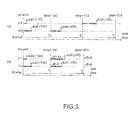
- the synchronization of the concurrent processes of the simulation has a very relevant impact on the simulation time.
- the second evaluations of P0 and P1 will be performed at different times, making parallelization useless.
- temporal decoupling makes use of a system global quantum, which synchronizes all SC_THREAD processes on regular synchronization times - see Figure 3 , panel (b).
- the wait statement is constant for each SC_THREAD process (100 time units, in the example of the figure), which guarantees a full parallel evaluation of processes.
- the process waits for the quantum value and keeps the time difference as a time offset. The next time the process is scheduled, the local time starts at the offset value to maintain a high accuracy. For instance, in the example of figure 3 , the offset of P1 takes the value 10 after the second evaluation of the process and 2 after its third evaluation, while that of P0 takes the value 0 after the second evaluation and 8 after the third one.
- An advantageous feature of the invention is that parallelization is almost transparent to the user. If the simulator is known by the designer, only few minutes of work are necessary to adapt an existing Accellera SystemC simulation environment.
- the number of maximum workers must be set with the primitive sc_set_nb_worker_max(uint32_t val) and Posix mutexes must be created to protect specific resources if necessary.
- One simple way is to integrate theses mutexes in the transport interfaces of SystemC modules that must be protected.
- each SystemC process must be associated to a worker with the primitive worker_affinity; with dynamic sc_spawn processes, the option member set_worker_affinity(uint32_t worker_id) has to be called.
- a simulation method can be carried out using a computer program product including instruction code for implementing a Discrete Event Simulation kernel supporting parallel evaluation of SystemC processes, as discussed above with reference to figure 1 , and a suitable hardware description Application Program Interface (API).
- a computer program product including instruction code for implementing a Discrete Event Simulation kernel supporting parallel evaluation of SystemC processes, as discussed above with reference to figure 1 , and a suitable hardware description Application Program Interface (API).
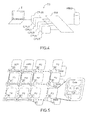
- Such a computer program product, together with an executable ESL model based on it, may be stored in a mass-memory device MMD (e.g. a hard disk) of a multi-core computing system whose simplified architecture is illustrated on figure 4 .
- This multi-core computing system CS comprises a plurality of host cores CPU0 - CPU5 having access to a shared memory SM; a terminal T is connected to one of these cores.
- the simulation kernel runs on CPU0, while workers run on CPU1 - CPU5.
- the host cores may be co-localized, in which case the multi-core computing system is a parallel computer, or they may be spatially distributed and interconnected through a telecommunication network.
- the shared memory can be co-localized with one or more of the cores, or not; it may even be distributed.
- the computer program product and the executable model may even be distributed among several, possibly non co-localized, mass-memory devices.
- the simulated architecture is a 2D-mesh manycore architecture using a physically-distributed shared memory.
- This architecture comprises a bi-dimensional array of tiles interconnected by an interconnection network.
- Each tile comprises a processing unit PU and a portion MEM of the shared memory, both connected to the network through a respective network interconnect NI and a router R.
- Each processing unit PU in turn, comprises a Core, an instruction cache (IC), a data cache (DC) and a translation lookaside buffer (TLB).
- a Central Control Manager CCP and a Memory Management Unit MMU also connected to the interconnection network through respective routers, are used for task management and memory allocation, respectively. It is important to differentiate the simulated manycore architecture of figure 5 from the multi-core computing system which is used to run the simulation.
- SESAM uses functional Instruction Set Simulators (ISS) based on the ArchC Hardware Description Language and provides a set of timed/untimed/functional or cycle- accurate IPs (NoC, memory controllers, etc.).
- ISS Instruction Set Simulators
- SESAM uses a temporal-decoupling technique, based on a system global quantum, to model timings and limit synchronizations with the SystemC kernel.
- a (un)timed 2D-mesh parallel NoC with multiple shared-resource locks in slave wrappers to protect memory banks will be considered.
- the equivalent cycle-accurate NoC will also be used for comparison with Accellera SystemC.
- MIPS 32 R2 processing cores are considered.
- SimSoC The second environment, named SimSoC, is a System-C/TLM 2.0 simulation framework using ISSes with Dynamic Binary Translation (DBT). Only DMI was used, and therefore ISSes directly communicate with a single shared memory allocated on the host, instead of multiple memory banks. With SimSoC, PowerPC processing cores are chosen.
- DBT Dynamic Binary Translation
- the processing unit composed of the core, its instruction and data caches, and its TLB were integrated into one worker to minimize communications between shared-resources. All other SystemC processes were gathered in another single worker. Concerning SimSoC, only DBT with no specialization (mode M1) was considered because it ensures a more regular execution time between the workers and then better parallelization. In order to evaluate the performances of the invention, five 62-task parallel shared-memory applications of approximately 1 billion instructions each were considered:
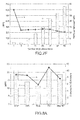
- Figures 6A - 6C represent the results obtained with Accellera SystemC.
- Accelera SystemC does not scale with the number of cores.
- the number of MIPS remains the same and simulation speed is approximately divided by the number of simulated cores. This result is the same with non-DBT or DBT ISS even if the latter significantly reduces simulation time by reaching about 32MIPS instead of 2.4MIPS.
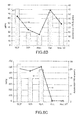
- Figures 7A - 7F show the theoretical results that could be obtained with SESAM and SimSoC using SCale.
- the quantum has a direct impact on simulation speed (acceleration of 4.8x and 6.1x). Indeed, the quantum value changes the maximum number of simulation cycles, and simulated instructions, between two synchronizations with the kernel. In the following experiments, a quantum of 10K will be considered as a good trade-off between performance and accuracy.
- Figures 7B and 7E show the performance obtained when increasing the number of workers.
- the maximum numbers of MIPS obtained with SESAM and SimSoC are 88MIPS and 675MIPS. This represents an acceleration of 36x and 21 x compared to the same simulation with Accellera SystemC.
- Figures 7C and 7F depict the maximum number of MIPS obtained with 63 workers with SESAM and SimSoC when increasing the number of simulated cores. As expected, the number of MIPS per simulated cores remain very high and constant, whatever the simulation environment is. The maximum numbers of MIPS per ISS is about 1.4 with SESAM and 13.2 with SimSoC. A little degradation appears when using more than one core for cache pollution reason.
- Figures 8A - 8C depict the simulation performances of the invention compared to Accellera SystemC when executing different applications on our many-core model.
- simulation speed slows down by approximately 4 times.
- the benchmarks with more memory contentions (DPI and Mult) are the most impacted.
- workers need to synchronize more often with the kernel since the quantum value is more quickly reached.
- the maximum acceleration remains between 12.2x and 39.3x compared to Accellera SystemC while keeping an accuracy higher than 99.5 %.
- the number of MIPS varies between 23.4 (Mult) and 80.6 (NOP) on 63 workers. Even with shared-memory applications, high simulation speed can be reached with SESAM.
Landscapes
- Engineering & Computer Science (AREA)
- Theoretical Computer Science (AREA)
- Physics & Mathematics (AREA)
- General Engineering & Computer Science (AREA)
- General Physics & Mathematics (AREA)
- Software Systems (AREA)
- Computer Hardware Design (AREA)
- Evolutionary Computation (AREA)
- Geometry (AREA)
- Management, Administration, Business Operations System, And Electronic Commerce (AREA)
- Debugging And Monitoring (AREA)
Abstract
A) Running a Discrete Event Simulation kernel on a core of said multi-core computing system, within a dedicated OS-kernel-level thread;
B) Using said Discrete Event Simulation kernel for generating a plurality of OS-kernel-level threads, each associated to a respective core, and for distributing a plurality of concurrent processes of said simulation among them;
C) Carrying out parallel evaluation of said concurrent processes within the corresponding threads using respective cores; and then
D) Using said Discrete Event Simulation kernel for processing event notifications, updating a simulation time and scheduling next processes to be evaluated;
said steps C) and D) being carried out iteratively until the end of the simulation.
Description
- The invention relates to the field of tools and methodologies for digital design, e.g. for designing systems-on-chip (SoC). More specifically, the invention relates to a computer-implemented method of performing Electronic System Level simulation using a multi-core computing system and parallel programming techniques, and to a computer program product for carrying out such a method.
- A complex digital electronic system such as a SoC comprises application code designed to run on a specific hardware platform. Because of the high costs associated to design and manufacturing, the entire system must be validated as early as possible in the development flow, and in any case well before the hardware platform is manufactured. This is made possible by high-level - "Electronic System Level" or "ESL" - modeling and simulation tools, which allow modeling and co-developing the hardware and software parts of a complex system, software prototyping and even architectural exploration. These tools may also allow simulating user interfaces to accompany application development to the final product.
- A large majority of these Electronic System Level simulation tools are based on a hardware description language called SystemC and on its extension named Transactional Level Modeling (TLM), which are part of the IEEE 1666 standard - 2011. They have been developed by major EDA (Electronic Design Automation) vendors through the Accellera Systems Initiative and are widely used in the integrated circuit (IC) industry. SystemC comprises a specific C/C++ library and a Discrete Event Simulation (DES) kernel.
- The SystemC kernel is composed of five main phases which are carried out sequentially and iteratively: (1) SystemC process evaluation; (2) immediate notification, (3) update; (4) delta notification and (5) timed notification. The first three phases form a so-called "delta-cycle".
- A SystemC process is a function or software task describing the behavior of a part of a module of the system.
- During the evaluation phase, all the processes present in a queue are evaluated, and each of them can write on signals or output ports (delta notification), notify an event to wake up other dependent processes (immediate notification) and/or generate a timed event (timed notification).
- Immediate notifications have the effect of immediately putting in the evaluation queue the sensitive dependent processes.
- In the following update phase, all the signals and output ports which have been written upon by processes during the evaluation phase are updated. Indeed, as in any hardware description language, it is important that the statuses of signals and ports are only updated at the end of the evaluation phase, in order to emulate true concurrency.
- Then, at the end of the update phase, the delta notification phase begins. It mainly consists in putting in the evaluation queue all the processes sensitive to events linked to delta notifications. For instance, if a signal is written, all the processes sensitive to this signal are put in the queue to be evaluated in the following iteration of the evaluation phase.
- If the queue is not empty following the delta notification phase, the delta cycle is restarted.
- Finally, the timed notification phase takes place. It involves triggering the evaluation of processes sensitive to timed events and updating the simulation step. In general, a SystemC simulation stops when the simulation step has reached a preset value, corresponding to the wanted simulation time.
- Until a few years ago, the design of a complex digital system comprised the implementation of a software prototype of the hardware platform, capable of running the application code and supporting architectural exploration. So, a single model served as a platform for designing both hardware and software. These simulators allowed a unified design flow from application to hardware.
- More recently, however, the increasing complexity of modern ICs, which may comprise billion of transistors, has made such hardware prototypes (more exactly: software models of hardware platforms) too slow for application development. This is particularly true for multiprocessor systems (MPSoC), wherein the number of simulated instructions per core is directly divided by the number of cores of the modeled system. For instance, a SystemC simulator with a speed of 2 MIPS (Millions simulated instructions per second) comprising a single-core SoC running at 1 GHz requires 8 minutes of "real", or physical, time to simulate 1 second of operation of the modeled system, but if the same simulator is used to model a 100-core MPSoC also running at a 1 GHz, the simulation duration reaches 13 hours, which is clearly unacceptable for architecture exploration or software development.
- This has led to a situation where two distinct software platforms are used: an accurate (but slow) one for hardware development and a faster (but less accurate) one for software development. Unfortunately, this approach has its limitations. Indeed, as the systems become increasingly complex, it is not always possible to improve the simulation speed by reducing its accuracy. Furthermore, the loss of information and accuracy of models used for software development necessarily introduces errors in the design flow. Some tools try to ensure the compatibility of the different prototypes, but they are limited to specific platforms, with pre-designed models. It will then become more and more difficult for designers to develop proprietary platforms in acceptable times.
- A different approach, which is the one followed by the present invention, consists in accelerating Electronic System Level simulations without reduction in accuracy by allowing the efficient parallel execution of an ESL simulation on multiple computing host cores, so that software and hardware prototypes can remain unified.
- As far as SystemC is concerned - but indeed this remark is more general - parallelization is only possible during the process evaluation phase. The difficulty then lies in the implementation of such parallelization to ensure a high level of performance. The parallelization of the process evaluation phase of SystemC simulation has already been proposed in the following publications:
- P. Ezudheen et al. "Parallelizing SystemC kernel for fast hardware simulation on SMP machines", in Workshop on Principles of Advanced and Distributed Simulation (PADS), pages 80-87, Lake Placid, New York, USA, June 2009 (hereafter: Ezudheen);
- C. Schumacher, R. Leupers, D. Petras and A. Hoffmann "parSC: Synchronous Parallel SystemC Simulation on Multi-Core Host Architectures", in CODES+ISSS, pages 241-246, Scottsdale, Arizona, USA, October 2010 (hereafter: Schumacher); and
- M.-K. Chung, J.-K. Kim, and S. Ryu "SimParallel: A High Performance Parallel SystemC Simulator Using Hierarchical Multi-threading", in International Symposium on Circuits and Systems (ISCAS), Melbourne, Australia, June 2014 (hereafter: Chung).
- However, the simulation speed of these approaches is limited since the SystemC standard was never designed for a parallel implementation. They cannot efficiently handle multiple host cores, exhibit limited scalability and do not support TLM 2.0 and dynamic process creation. Moreover, Chung is not compliant with the standard as it does not support immediate events.
- The invention aims at overcoming the drawbacks of the prior art by providing an efficient and scalable parallelization of Electronic System Level simulations on multi-core computing systems.
- An object of the present invention is a computer-implemented method of performing Electronic System Level simulation using a multi-core computing system, comprising the steps of:
- A) Running a Discrete Event Simulation kernel on a core of said multi-core computing system, within a dedicated OS-kernel-level thread;
- B) Using said Discrete Event Simulation kernel for generating a plurality of OS-kernel-level threads, each associated to a respective core of the multi-core computing system, other than the core on which said Discrete Event Simulation kernel is running, and for distributing a plurality of concurrent processes of said Electronic System Level simulation among said OS-kernel-level threads;
- C) Carrying out parallel evaluation of said concurrent processes within the corresponding OS-kernel-level threads, using respective cores of the multi-core computing system; and then
- D) Using said Discrete Event Simulation kernel for updating signal and ports ensuring communication between processes, processing event notifications, updating a simulation time and scheduling next processes to be evaluated;
- According to particular embodiments of such a method:
- step C) may comprise: synchronizing at a single and shared predetermined synchronization time processes evaluated by different cores of said multi-core computing system; and, within each of said concurrent processes of said Electronic System Level simulation, keeping track of an offset between a local simulation time and said preset synchronization time.
- Each of said concurrent processes of said Electronic System Level simulation may include a local time offset variable, and said step C) may comprise, for each of said processes: evaluating an instruction of the corresponding process of said Electronic System Level simulation and incrementing said local time offset variable by a value corresponding to a simulated execution time; and if the incremented local time offset variable exceeds a preset value, identical for all of said threads, decrementing it by said preset value, and waiting a time corresponding to said preset value before evaluating the following instruction.
- Inactive OS-kernel-level threads may enter an active waiting state to avoid preemption from an operating system of said multi-core computing system. In particular, after each iteration of said step C), and before its first iteration, each of said OS-kernel-level threads other than the OS-kernel-level thread dedicated to the Discrete Event Simulation kernel may enter said active waiting state, wherein it polls a respective memory location until it reads a predetermined value; after each iteration of said step D), except the last one, and after completion of said step B, the kernel may write said predetermined value in said predetermined memory locations; and when an OS-kernel-level threads other than the OS-kernel-level thread dedicated to the Discrete Event Simulation kernel reads said predetermined value from said predetermined memory locations, it may exit said active waiting state and perform an iteration of said step C). Even more particularly: after each iteration of said step D), the OS-kernel-level thread dedicated to the Discrete Event Simulation kernel may enter said active waiting state, wherein it polls a plurality of predetermined memory locations until it reads a predetermined value in each of them; after completing each iteration of said step C), each of said OS-kernel-level threads other than the OS-kernel-level thread dedicated to the Discrete Event Simulation kernel may write said predetermined value in a respective one of said predetermined memory locations; and when the OS-kernel-level thread dedicated to the Discrete Event Simulation kernel reads said predetermined value from each of said predetermined memory locations, it may exit said active waiting state and perform another iteration of said step D) or ends the simulation.
- Kernel resources shared between a plurality of OS-kernel-level threads may duplicated so that each OS-kernel-level thread has a private access to said resources.
- The method may be performed using SystemC. In this case, said step C) may comprise, for each of said OS-kernel-level threads other than the OS-kernel-level thread dedicated to the Discrete Event Simulation kernel: performing successive evaluation of SC_METHOD processes; and then performing cooperative evaluation of SC_THREAD processes.
- Another object of the invention is a computer program product including a hardware description Application Program Interface and a Discrete Event Simulation kernel adapted for carrying out such a method.
- Additional features and advantages of the present invention will become apparent from the subsequent description, taken in conjunction with the accompanying drawings, wherein:
-
Figure 1 is a flow-chart of a parallelized ESL simulation according to an embodiment of the invention; -
Figure 2 is a flow-chart of the process evaluation phase executed on a host core of the multi-core computing system used to implement the invention; -
Figure 3 illustrates the implementation of temporal decoupling according to an embodiment of the invention; -
Figure 4 is a schematic representation of a multi-core computing system suitable to carry out a method according to an embodiment of the invention; -
Figure 5 is a representation of an MPSoC architecture using a physically-distributed shared memory, which can be modeled according to the invention; -
Figures 6A, 6B and6C are graphs illustrating the performances of Accellera SystemC in modeling an MPSoC having the architecture represented onfigure 5 ; -
Figures 7A - 7F and8A - 8C are graphs illustrating the performances of an embodiment of the invention in modeling an MPSoC having the architecture represented onfigure 5 . - In the following description, the terms "simulation" and "modeling" will be considered synonyms, albeit strictly speaking a simulation results from the execution of a model.
- Moreover, in the following description the term "kernel" will be used with two different meanings. On the one hand, it can refer to the Operating System (OS) kernel, on the other hand in can refer to the simulation kernel, i.e. the program responsible for scheduling the evaluation of simulation processes and handling the notification cases.
- Albeit only the case of SystemC is considered in the description below, this is not limiting and other existing or future ESL languages may benefit from the invention. Only an implementation working under the Linux Operating System will be considered, but again this is not limiting.
- According to the invention, the process evaluation phase is processed by executing SystemC processes inside respective OS-kernel-level thread. These Posix threads, named workers, are used as containers to locally execute SystemC processes, and more precisely SC_METHOD and SC_THREAD processes. It is recalled that both SC_METHOD and SC_THREAD are SystemC processes inheriting from a common class. The main difference between them is that only SC-THREAD processes have an execution context allowing them to be preempted.
- SC_METHOD processes are functions called by the worker and SC_THREAD processes are user-level threads using ucontext primitives executed inside a worker's context. The whole simulation remains into a single Linux process.
- According to a preferred embodiment of the invention, processes are associated to a given worker and cannot switch to another one; this is named worker affinity (alternative embodiments are possible, such as "work stealing", wherein workers compete for executing processes). Only the worker affinity of dynamic processes (sc_spawn) can be set at run-time but cannot change afterwards. Each worker can access two waiting queues to perform evaluations: one for SC_METHOD and one for SC_THREAD processes. Moreover, each worker is statically attached to a unique logical host core ("core affinity"), while a different core is uniquely dedicated to run the simulation kernel.
- In a specific implementation, a new C++ class named sc_worker_pkg has been developed to support the management of workers. A set of 25 member functions enables queue access and management, the evaluation of SystemC processes or the allocation on host cores. An operator << working with SC_METHOD and SC_THREADcan be used at process instantiation to inform the kernel about their worker affinity. By defaults, all processes are attached to
worker 0. In the example below, the process do_count will be executed on the worker ID_WORKER.
SC_THREAD (do_count)
Dont_initialize ();
sc_sensitive << clock.pos ();
sc_affinity << ID_WORKER; - As mentioned above, a specific kernel-level thread is reserved for the execution of the SystemC kernel on the logical host core 0 ("
CPU 0"). This logical host core is reserved for this purpose, and does not execute workers. This thread is in charge of the initialization, the elaboration and the execution of the update, the immediate and the timed notification phases, as labeled in the SystemC standard. At the beginning of each evaluation phase, it distributes the ready-to-be-evaluated SC_METHOD and SC_THREAD processes into different worker queues. This thread is also in charge of updating the global time, forcing all workers to synchronize their current time every quantum. -
Figure 1 is a flow-chart of a simulation method according to the invention, implementing the principles outlined above. - At the initialization of the kernel (i), and after the binding and the elaboration phase - i.e. the instantiation and dynamical creation of the model to be simulated (ii), all workers are created and attached to different host logical cores (iii). Then, the allocation of the main SystemC kernel is forced on the logical core 0 - also called CPU 0 - (iv) and all registered processes are pushed in their respective worker queue (v). After their initializations, the ready Posix semaphores are set to allow the workers to start in parallel the evaluation of their process queues (vi). Each worker starts by sequentially evaluating (i.e. executing, or running, these terms being synonyms) all its SC_METHOD processes and then cooperatively executes all its SC_THREADones (vii). During the parallel evaluation of all SystemC processes by workers, the kernel performs low-latency polling, preferably, on different memory locations (one for each worker) through the call of atomic functions (viii). This active barrier guarantees that the host OS will never yield the kernel thread, which could generate low kernel reactivity and therefore a significant overhead. The other steps of the simulation are conventional:
- if immediate notifications are present (ix), then the processes woken up by these notifications are put into the corresponding worker queues (x); otherwise:
- if delta notifications are present (xi), then the processes woken-up by these notifications are put into the corresponding worker queues (xvii); otherwise:
- unless the simulation is terminated (xii), it is checked if timed notifications are present (xiii) and, in the affirmative, the closest time event is found (xiv) and the current simulation time is updated (xv), otherwise the simulation is terminated. Then, if the simulation is not terminated (xvi), the processes which remain to be evaluated are pushed into their worker queues (xvii).
- Concerning parallel data accesses inside the model, the SystemC processes themselves must ensure the global coherency and integrity of shared resources. As soon as a global variable or an attribute of a class is modified during a transaction, this resource has to be protected. Indeed, different transactions can transit through the same resource in parallel on two different host cores. Then, protection based on Posix mutexes is conveniently added to guarantee the integrity of the simulator. Multiple locks can be taken when calling a transport function. For instance, the use of a hierarchical NoC (Network on a Chip) could require the availability of multiple mutexes before accessing the final target. A simple mechanism can be used to implement the wait statement in order to prevent the risk of deadlocks if a transaction is preempted: each process owns a local mutex list to store all taken mutexes during a communication; this list is automatically updated when new SystemC lock and unlock functions are called; when a process is preempted, all mutexes in the list are automatically released by the kernel; the same mutexes will be taken again before the kernel resumes it.
-
Figure 2 is a flow-chart of the process evaluation phase carried out by each worker running on a logical host core. First of all, a worker initializes itself (I), creates a stack and an overflow handler (II), gets an ID (III), sets its CPU affinity (IV), sets up local storage (V). Then it enters an "active" wait (VI), wherein it regularly reads a memory location (preferably a different location for each worker) to look for a value indicating that it can start execution of its execution queues; this is similar to the kernel mechanism described above, cf. reference viii offigure 1 . Then the worker evaluates successively the SC_METHOD and the SC_THREAD processes. SC_METHOD processes terminate themselves (they have a beginning and an end according to the SystemC standard), so the worker only has to call them one after the other. SC_THREADprocesses, on the contrary, have no end, and their execution is performed cooperatively. Each SC_THREASD process contains a call to the yield() function (called by the function 'wait()') which forces its pre-emption and enable the evaluation of another SC_THREAD process. When the evaluation of all the processes has been carried out, a message is sent to the kernel of SystemC to inform the kernel that the worker has finished its evaluation phase (IX) and it will then be placed back into its active waiting state (VII). - The synchronization of the concurrent processes of the simulation (or "temporal decoupling") has a very relevant impact on the simulation time. The conventional solution, illustrated on panel (a) of
figure 3 , consists in synchronizing SC_THREAD processes when their local time offsets reach a given maximum equal to a global quantum. This can cause a drastic parallelism reduction. Indeed, the timed notification phase looks for the nearest timed event to wake-up all the sensitive processes. If the processes do not wait for the same timed event, they cannot be executed on workers in parallel. Onfigure 3a , for example, at first processes P0 and P1 are executed in parallel, but then P1 waits until time=110, while process P0 only waits until time=100. As a consequence, the second evaluations of P0 and P1 will be performed at different times, making parallelization useless. Similarly, the third evaluation of P1 will only begins at time = 216 (106+110), well after the beginning of the third evaluation of P0, at time = 208 (108+100). - According to a preferred embodiment of the invention, temporal decoupling makes use of a system global quantum, which synchronizes all SC_THREAD processes on regular synchronization times - see
Figure 3 , panel (b). According to this implementation, the wait statement is constant for each SC_THREAD process (100 time units, in the example of the figure), which guarantees a full parallel evaluation of processes. When the local simulation time is higher than the quantum value, the process waits for the quantum value and keeps the time difference as a time offset. The next time the process is scheduled, the local time starts at the offset value to maintain a high accuracy. For instance, in the example offigure 3 , the offset of P1 takes thevalue 10 after the second evaluation of the process and 2 after its third evaluation, while that of P0 takes thevalue 0 after the second evaluation and 8 after the third one. - In pseudo-code:
 Increment (local_time_offset) //after each instruction, the local time offset
                                 //is incremented by a value corresponding to
                                 //the execution time of the instruction.
                                 While(local_time_offset > quantum)
       {
       Wait (quantum);
       local/_time_offset -= quantum;
       } // If the local simulation time exceeds the quantum, then
                    // the process waits for the quantum time and the local
                    //time offset is decremented by the same value.
- NOP is based on multiple loops of NoP operations and has been chosen to highlight the maximum acceleration that can be reached.
- DPI is the lightweight deep packet inspection (DPI) application distributed by Packetwerk GmbH, which consists in analyzing multi-protocol Ethernet packets.
- Mult. is a parallel matrix multiplying application.
- Der. is a parallel Deriche image application based on a fast 2D-Gaussian convolution IIR approximation.
- Neu:NT is a road sign detection application based on Conventional Neural Network (CNN).
Claims (10)
- A computer-implemented method of performing Electronic System Level simulation using a multi-core computing system (CS), comprising the steps of:A) Running a Discrete Event Simulation kernel on a core (CPU0) of said multi-core computing system, within a dedicated OS-kernel-level thread;B) Using said Discrete Event Simulation kernel for generating a plurality of OS-kernel-level threads, each associated to a respective core (CPU1 - CPU5) of the multi-core computing system, other than the core on which said Discrete Event Simulation kernel is running, and for distributing a plurality of concurrent processes of said Electronic System Level simulation among said OS-kernel-level threads;C) Carrying out parallel evaluation of said concurrent processes within the corresponding OS-kernel-level threads, using respective cores of the multi-core computing system; and thenD) Using said Discrete Event Simulation kernel for updating signal and ports ensuring communication between processes, processing event notifications, updating a simulation time and scheduling next processes to be evaluated;
said steps C) and D) being carried out iteratively until the end of the simulation. - A method according to claim 1 wherein step C) comprises:- synchronizing at a single and shared predetermined synchronization time processes evaluated by different cores of said multi-core computing system; and- within each of said concurrent processes of said Electronic System Level simulation, keeping track of an offset between a local simulation time and said preset synchronization time.
- A method according to claim 2 wherein each of said concurrent processes of said Electronic System Level simulation includes a local time offset variable, and wherein said step C) comprises, for each of said processes:- evaluating an instruction of the corresponding process of said Electronic System Level simulation and incrementing said local time offset variable by a value corresponding to a simulated execution time;- if the incremented local time offset variable exceeds a preset value, identical for all of said threads, decrementing it by said preset value, and waiting a time corresponding to said preset value before evaluating the following instruction.
- A method according to any of the preceding claims wherein inactive OS-kernel-level threads enter an active waiting state to avoid preemption from an operating system of said multi-core computing system.
- A method according to claim 4 wherein:- after each iteration of said step C), and before its first iteration, each of said OS-kernel-level threads other than the OS-kernel-level thread dedicated to the Discrete Event Simulation kernel enters said active waiting state, wherein it polls a respective memory location until it reads a predetermined value;- after each iteration of said step D), except the last one, and after completion of said step B, the kernel writes said predetermined value in said predetermined memory locations; and- when an OS-kernel-level threads other than the OS-kernel-level thread dedicated to the Discrete Event Simulation kernel reads said predetermined value from said predetermined memory locations, it exits said active waiting state and performs an iteration of said step C).
- A method according to any of claims 4 or 5 wherein:- after each iteration of said step D), the OS-kernel-level thread dedicated to the Discrete Event Simulation kernel enters said active waiting state, wherein it polls a plurality of predetermined memory locations until it reads a predetermined value in each of them;- after completing each iteration of said step C), each of said OS-kernel-level threads other than the OS-kernel-level thread dedicated to the Discrete Event Simulation kernel writes said predetermined value in a respective one of said predetermined memory locations; and- when the OS-kernel-level thread dedicated to the Discrete Event Simulation kernel reads said predetermined value from each of said predetermined memory locations, it exits said active waiting state and performs another iteration of said step D) or ends the simulation.
- A method according to any of the preceding claims wherein kernel resources shared between a plurality of OS-kernel-level threads are duplicated so that each OS-kernel-level thread has a private access to said resources.
- A method according to any of the preceding claims, performed using SystemC.
- A method according to claim 8 wherein said step C) comprises, for each of said OS-kernel-level threads other than the OS-kernel-level thread dedicated to the Discrete Event Simulation kernel:- performing successive evaluation of SC_METHOD processes; and then- performing cooperative evaluation of SC_THREAD processes.
- A computer program product including a hardware description Application Program Interface and a Discrete Event Simulation kernel adapted for carrying out a method according to any of the preceding claims.
Priority Applications (3)
| Application Number | Priority Date | Filing Date | Title |
|---|---|---|---|
| EP15305989.4A EP3109778B1 (en) | 2015-06-25 | 2015-06-25 | Computer-implemented method of performing parallelized electronic-system level simulations |
| US15/736,273 US10789397B2 (en) | 2015-06-25 | 2016-06-22 | Computer-implemented method of performing parallelized electronic-system level simulations |
| PCT/EP2016/064475 WO2016207249A1 (en) | 2015-06-25 | 2016-06-22 | Computer-implemented method of performing parallelized electronic-system level simulations |
Applications Claiming Priority (1)
| Application Number | Priority Date | Filing Date | Title |
|---|---|---|---|
| EP15305989.4A EP3109778B1 (en) | 2015-06-25 | 2015-06-25 | Computer-implemented method of performing parallelized electronic-system level simulations |
Publications (2)
| Publication Number | Publication Date |
|---|---|
| EP3109778A1 true EP3109778A1 (en) | 2016-12-28 |
| EP3109778B1 EP3109778B1 (en) | 2018-07-04 |
Family
ID=53546185
Family Applications (1)
| Application Number | Title | Priority Date | Filing Date |
|---|---|---|---|
| EP15305989.4A Not-in-force EP3109778B1 (en) | 2015-06-25 | 2015-06-25 | Computer-implemented method of performing parallelized electronic-system level simulations |
Country Status (3)
| Country | Link |
|---|---|
| US (1) | US10789397B2 (en) |
| EP (1) | EP3109778B1 (en) |
| WO (1) | WO2016207249A1 (en) |
Cited By (1)
| Publication number | Priority date | Publication date | Assignee | Title |
|---|---|---|---|---|
| CN112764940A (en) * | 2021-04-12 | 2021-05-07 | 北京一流科技有限公司 | Multi-stage distributed data processing and deploying system and method thereof |
Families Citing this family (9)
| Publication number | Priority date | Publication date | Assignee | Title |
|---|---|---|---|---|
| US11465640B2 (en) * | 2010-06-07 | 2022-10-11 | Affectiva, Inc. | Directed control transfer for autonomous vehicles |
| CN109101456B (en) * | 2018-08-30 | 2021-10-15 | 浪潮电子信息产业股份有限公司 | A method, device and terminal for data interactive communication in a simulated SSD |
| FR3103595B1 (en) | 2019-11-27 | 2023-10-27 | Commissariat Energie Atomique | Quick simulator of a calculator and software implemented by this calculator |
| CN113569373B (en) * | 2020-04-29 | 2024-09-27 | 顺丰科技有限公司 | Business simulation method, device, computer equipment and storage medium |
| US12481522B2 (en) * | 2021-12-09 | 2025-11-25 | International Business Machines Corporation | User-level threading for simulating multi-core processor |
| US12401492B1 (en) * | 2022-02-28 | 2025-08-26 | Meta Platforms, Inc. | Network clock synchronization with quantum systems in an entangled state |
| CN115185718B (en) * | 2022-09-14 | 2022-11-25 | 北京云枢创新软件技术有限公司 | Multithreading data transmission system based on SystemC and C + + |
| CN119903791B (en) * | 2025-03-28 | 2025-07-01 | 山东云海国创云计算装备产业创新中心有限公司 | A hardware simulation system, control method, electronic device and storage medium |
| CN121187812B (en) * | 2025-11-20 | 2026-03-03 | 广州市金其利信息科技有限公司 | A method and system for predicting and dynamically intervening in mutex deadlock risk |
Citations (3)
| Publication number | Priority date | Publication date | Assignee | Title |
|---|---|---|---|---|
| US6466898B1 (en) * | 1999-01-12 | 2002-10-15 | Terence Chan | Multithreaded, mixed hardware description languages logic simulation on engineering workstations |
| US20090222250A1 (en) * | 2008-02-28 | 2009-09-03 | Oki Electric Industry Co., Ltd. | Hard/Soft Cooperative Verifying Simulator |
| US20150058859A1 (en) * | 2013-08-20 | 2015-02-26 | Synopsys, Inc. | Deferred Execution in a Multi-thread Safe System Level Modeling Simulation |
Family Cites Families (2)
| Publication number | Priority date | Publication date | Assignee | Title |
|---|---|---|---|---|
| US9817771B2 (en) * | 2013-08-20 | 2017-11-14 | Synopsys, Inc. | Guarded memory access in a multi-thread safe system level modeling simulation |
| US9898348B2 (en) * | 2014-10-22 | 2018-02-20 | International Business Machines Corporation | Resource mapping in multi-threaded central processor units |
-
2015
- 2015-06-25 EP EP15305989.4A patent/EP3109778B1/en not_active Not-in-force
-
2016
- 2016-06-22 US US15/736,273 patent/US10789397B2/en not_active Expired - Fee Related
- 2016-06-22 WO PCT/EP2016/064475 patent/WO2016207249A1/en not_active Ceased
Patent Citations (3)
| Publication number | Priority date | Publication date | Assignee | Title |
|---|---|---|---|---|
| US6466898B1 (en) * | 1999-01-12 | 2002-10-15 | Terence Chan | Multithreaded, mixed hardware description languages logic simulation on engineering workstations |
| US20090222250A1 (en) * | 2008-02-28 | 2009-09-03 | Oki Electric Industry Co., Ltd. | Hard/Soft Cooperative Verifying Simulator |
| US20150058859A1 (en) * | 2013-08-20 | 2015-02-26 | Synopsys, Inc. | Deferred Execution in a Multi-thread Safe System Level Modeling Simulation |
Non-Patent Citations (7)
| Title |
|---|
| "IFIP Advances in Information and Communication Technology", vol. 310, 1 January 2009, ISSN: 1868-4238, article RAUF SALIMI KHALIGH ET AL: "Efficient Parallel Transaction Level Simulation by Exploiting Temporal Decoupling", pages: 149 - 158, XP055234827, DOI: 10.1007/978-3-642-04284-3_14 * |
| BRINGMANN OLIVER ET AL: "The next generation of virtual prototyping: Ultra-fast yet accurate simulation of HW/SW systems", 2015 DESIGN, AUTOMATION & TEST IN EUROPE CONFERENCE & EXHIBITION (DATE), EDAA, 9 March 2015 (2015-03-09), pages 1698 - 1707, XP032765878 * |
| C. SCHUMACHER; R. LEUPERS; D. PETRAS; A. HOFFMANN: "parSC: Synchronous Parallel SystemC Simulation on Multi-Core Host Architectures", CODES+ISSS, October 2010 (2010-10-01), pages 241 - 246 |
| HAETZER BASTIAN ET AL: "A comparison of parallel systemc simulation approaches at RTL", PROCEEDINGS OF THE 2013 FORUM ON SPECIFICATION AND DESIGN LANGUAGES (FDL), EUROPEAN ELECTRONIC CHIPS & SYSTEMS DESIGN INITIATIVE - ECSI, vol. 978-2-9530504-9-3, 14 October 2014 (2014-10-14), pages 1 - 8, XP032783369, ISSN: 1636-9874, [retrieved on 20150605], DOI: 10.1109/FDL.2014.7119355 * |
| M.-K. CHUNG; J.-K. KIM; S. RYU: "SimParallel: A High Performance Parallel SystemC Simulator Using Hierarchical Multi-threading", IN INTERNATIONAL SYMPOSIUM ON CIRCUITS AND SYSTEMS (ISCAS), MELBOURNE, AUSTRALIA, June 2014 (2014-06-01) |
| P. EZUDHEEN ET AL.: "Parallelizing SystemC kernel for fast hardware simulation on SMP machines", WORKSHOP ON PRINCIPLES OF ADVANCED AND DISTRIBUTED SIMULATION (PADS, June 2009 (2009-06-01), pages 80 - 87, XP058191459, DOI: doi:10.1109/PADS.2009.25 |
| WEIWEI CHEN ET AL: "ESL design and multi-core validation using the System-on-Chip Environment", HIGH LEVEL DESIGN VALIDATION AND TEST WORKSHOP (HLDVT), 2010 IEEE INTERNATIONAL, IEEE, PISCATAWAY, NJ, USA, 10 June 2010 (2010-06-10), pages 142 - 147, XP031698536, ISBN: 978-1-4244-7805-7 * |
Cited By (1)
| Publication number | Priority date | Publication date | Assignee | Title |
|---|---|---|---|---|
| CN112764940A (en) * | 2021-04-12 | 2021-05-07 | 北京一流科技有限公司 | Multi-stage distributed data processing and deploying system and method thereof |
Also Published As
| Publication number | Publication date |
|---|---|
| EP3109778B1 (en) | 2018-07-04 |
| US20180173825A1 (en) | 2018-06-21 |
| WO2016207249A1 (en) | 2016-12-29 |
| US10789397B2 (en) | 2020-09-29 |
Similar Documents
| Publication | Publication Date | Title |
|---|---|---|
| EP3109778B1 (en) | Computer-implemented method of performing parallelized electronic-system level simulations | |
| Biondi et al. | A framework for supporting real-time applications on dynamic reconfigurable FPGAs | |
| Schumacher et al. | parSC: Synchronous parallel SystemC simulation on multi-core host architectures | |
| Ezudheen et al. | Parallelizing SystemC kernel for fast hardware simulation on SMP machines | |
| CA2397302C (en) | Multithreaded hdl logic simulator | |
| Huang et al. | Taskflow: a general-purpose parallel and heterogeneous task programming system | |
| US9612863B2 (en) | Hardware device for accelerating the execution of a systemC simulation in a dynamic manner during the simulation | |
| Mack et al. | User-space emulation framework for domain-specific soc design | |
| Ventroux et al. | A new parallel SystemC kernel leveraging manycore architectures | |
| Ventroux et al. | Sesam: An mpsoc simulation environment for dynamic application processing | |
| Ventroux et al. | Highly-parallel special-purpose multicore architecture for SystemC/TLM simulations | |
| Weinstock et al. | Parallel SystemC simulation for ESL design | |
| US20170004232A9 (en) | Device and method for accelerating the update phase of a simulation kernel | |
| Ji et al. | DERCA: DetERministic cycle-level accelerator on reconfigurable platforms in DNN-enabled real-time safety-critical systems | |
| Bertacco et al. | On the use of GP-GPUs for accelerating compute-intensive EDA applications | |
| Yoo et al. | Hardware/software cosimulation from interface perspective | |
| Peterson et al. | Reducing overhead in the Uintah framework to support short-lived tasks on GPU-heterogeneous architectures | |
| Razaghi et al. | Host-compiled multicore RTOS simulator for embedded real-time software development | |
| Mooney III | Hardware/Software co-design of run-time systems | |
| Villaescusa et al. | M2OS-Mc: An RTOS for Many-Core Processors | |
| Beck | Evaluation and analysis of Linux-based applications on multicore processor in a space environment | |
| Helmstetter et al. | Fast and accurate TLM simulations using temporal decoupling for FIFO-based communications | |
| Gamatié | Design of streaming applications on MPSoCs using abstract clocks | |
| Kim et al. | Scalable and retargetable simulation techniquesfor multiprocessor systems | |
| Nanda et al. | The Influence of Soft faults on Robust Configurable System Design Utilizing Real-Time Operating network |
Legal Events
| Date | Code | Title | Description |
|---|---|---|---|
| PUAI | Public reference made under article 153(3) epc to a published international application that has entered the european phase |
Free format text: ORIGINAL CODE: 0009012 |
|
| STAA | Information on the status of an ep patent application or granted ep patent |
Free format text: STATUS: THE APPLICATION HAS BEEN PUBLISHED |
|
| AK | Designated contracting states |
Kind code of ref document: A1 Designated state(s): AL AT BE BG CH CY CZ DE DK EE ES FI FR GB GR HR HU IE IS IT LI LT LU LV MC MK MT NL NO PL PT RO RS SE SI SK SM TR |
|
| AX | Request for extension of the european patent |
Extension state: BA ME |
|
| STAA | Information on the status of an ep patent application or granted ep patent |
Free format text: STATUS: REQUEST FOR EXAMINATION WAS MADE |
|
| 17P | Request for examination filed |
Effective date: 20170620 |
|
| RBV | Designated contracting states (corrected) |
Designated state(s): AL AT BE BG CH CY CZ DE DK EE ES FI FR GB GR HR HU IE IS IT LI LT LU LV MC MK MT NL NO PL PT RO RS SE SI SK SM TR |
|
| GRAP | Despatch of communication of intention to grant a patent |
Free format text: ORIGINAL CODE: EPIDOSNIGR1 |
|
| STAA | Information on the status of an ep patent application or granted ep patent |
Free format text: STATUS: GRANT OF PATENT IS INTENDED |
|
| INTG | Intention to grant announced |
Effective date: 20180316 |
|
| GRAS | Grant fee paid |
Free format text: ORIGINAL CODE: EPIDOSNIGR3 |
|
| GRAA | (expected) grant |
Free format text: ORIGINAL CODE: 0009210 |
|
| STAA | Information on the status of an ep patent application or granted ep patent |
Free format text: STATUS: THE PATENT HAS BEEN GRANTED |
|
| AK | Designated contracting states |
Kind code of ref document: B1 Designated state(s): AL AT BE BG CH CY CZ DE DK EE ES FI FR GB GR HR HU IE IS IT LI LT LU LV MC MK MT NL NO PL PT RO RS SE SI SK SM TR |
|
| REG | Reference to a national code |
Ref country code: GB Ref legal event code: FG4D |
|
| REG | Reference to a national code |
Ref country code: CH Ref legal event code: EP |
|
| REG | Reference to a national code |
Ref country code: AT Ref legal event code: REF Ref document number: 1015270 Country of ref document: AT Kind code of ref document: T Effective date: 20180715 |
|
| REG | Reference to a national code |
Ref country code: IE Ref legal event code: FG4D |
|
| REG | Reference to a national code |
Ref country code: DE Ref legal event code: R096 Ref document number: 602015012979 Country of ref document: DE |
|
| REG | Reference to a national code |
Ref country code: NL Ref legal event code: MP Effective date: 20180704 |
|
| REG | Reference to a national code |
Ref country code: LT Ref legal event code: MG4D |
|
| REG | Reference to a national code |
Ref country code: AT Ref legal event code: MK05 Ref document number: 1015270 Country of ref document: AT Kind code of ref document: T Effective date: 20180704 |
|
| PG25 | Lapsed in a contracting state [announced via postgrant information from national office to epo] |
Ref country code: NL Free format text: LAPSE BECAUSE OF FAILURE TO SUBMIT A TRANSLATION OF THE DESCRIPTION OR TO PAY THE FEE WITHIN THE PRESCRIBED TIME-LIMIT Effective date: 20180704 |
|
| PG25 | Lapsed in a contracting state [announced via postgrant information from national office to epo] |
Ref country code: CZ Free format text: LAPSE BECAUSE OF FAILURE TO SUBMIT A TRANSLATION OF THE DESCRIPTION OR TO PAY THE FEE WITHIN THE PRESCRIBED TIME-LIMIT Effective date: 20180704 Ref country code: FI Free format text: LAPSE BECAUSE OF FAILURE TO SUBMIT A TRANSLATION OF THE DESCRIPTION OR TO PAY THE FEE WITHIN THE PRESCRIBED TIME-LIMIT Effective date: 20180704 Ref country code: RS Free format text: LAPSE BECAUSE OF FAILURE TO SUBMIT A TRANSLATION OF THE DESCRIPTION OR TO PAY THE FEE WITHIN THE PRESCRIBED TIME-LIMIT Effective date: 20180704 Ref country code: AT Free format text: LAPSE BECAUSE OF FAILURE TO SUBMIT A TRANSLATION OF THE DESCRIPTION OR TO PAY THE FEE WITHIN THE PRESCRIBED TIME-LIMIT Effective date: 20180704 Ref country code: IS Free format text: LAPSE BECAUSE OF FAILURE TO SUBMIT A TRANSLATION OF THE DESCRIPTION OR TO PAY THE FEE WITHIN THE PRESCRIBED TIME-LIMIT Effective date: 20181104 Ref country code: NO Free format text: LAPSE BECAUSE OF FAILURE TO SUBMIT A TRANSLATION OF THE DESCRIPTION OR TO PAY THE FEE WITHIN THE PRESCRIBED TIME-LIMIT Effective date: 20181004 Ref country code: SE Free format text: LAPSE BECAUSE OF FAILURE TO SUBMIT A TRANSLATION OF THE DESCRIPTION OR TO PAY THE FEE WITHIN THE PRESCRIBED TIME-LIMIT Effective date: 20180704 Ref country code: GR Free format text: LAPSE BECAUSE OF FAILURE TO SUBMIT A TRANSLATION OF THE DESCRIPTION OR TO PAY THE FEE WITHIN THE PRESCRIBED TIME-LIMIT Effective date: 20181005 Ref country code: BG Free format text: LAPSE BECAUSE OF FAILURE TO SUBMIT A TRANSLATION OF THE DESCRIPTION OR TO PAY THE FEE WITHIN THE PRESCRIBED TIME-LIMIT Effective date: 20181004 Ref country code: LT Free format text: LAPSE BECAUSE OF FAILURE TO SUBMIT A TRANSLATION OF THE DESCRIPTION OR TO PAY THE FEE WITHIN THE PRESCRIBED TIME-LIMIT Effective date: 20180704 Ref country code: PL Free format text: LAPSE BECAUSE OF FAILURE TO SUBMIT A TRANSLATION OF THE DESCRIPTION OR TO PAY THE FEE WITHIN THE PRESCRIBED TIME-LIMIT Effective date: 20180704 |
|
| PG25 | Lapsed in a contracting state [announced via postgrant information from national office to epo] |
Ref country code: AL Free format text: LAPSE BECAUSE OF FAILURE TO SUBMIT A TRANSLATION OF THE DESCRIPTION OR TO PAY THE FEE WITHIN THE PRESCRIBED TIME-LIMIT Effective date: 20180704 Ref country code: LV Free format text: LAPSE BECAUSE OF FAILURE TO SUBMIT A TRANSLATION OF THE DESCRIPTION OR TO PAY THE FEE WITHIN THE PRESCRIBED TIME-LIMIT Effective date: 20180704 Ref country code: HR Free format text: LAPSE BECAUSE OF FAILURE TO SUBMIT A TRANSLATION OF THE DESCRIPTION OR TO PAY THE FEE WITHIN THE PRESCRIBED TIME-LIMIT Effective date: 20180704 Ref country code: ES Free format text: LAPSE BECAUSE OF FAILURE TO SUBMIT A TRANSLATION OF THE DESCRIPTION OR TO PAY THE FEE WITHIN THE PRESCRIBED TIME-LIMIT Effective date: 20180704 |
|
| REG | Reference to a national code |
Ref country code: DE Ref legal event code: R097 Ref document number: 602015012979 Country of ref document: DE |
|
| PG25 | Lapsed in a contracting state [announced via postgrant information from national office to epo] |
Ref country code: RO Free format text: LAPSE BECAUSE OF FAILURE TO SUBMIT A TRANSLATION OF THE DESCRIPTION OR TO PAY THE FEE WITHIN THE PRESCRIBED TIME-LIMIT Effective date: 20180704 Ref country code: IT Free format text: LAPSE BECAUSE OF FAILURE TO SUBMIT A TRANSLATION OF THE DESCRIPTION OR TO PAY THE FEE WITHIN THE PRESCRIBED TIME-LIMIT Effective date: 20180704 Ref country code: EE Free format text: LAPSE BECAUSE OF FAILURE TO SUBMIT A TRANSLATION OF THE DESCRIPTION OR TO PAY THE FEE WITHIN THE PRESCRIBED TIME-LIMIT Effective date: 20180704 |
|
| PLBE | No opposition filed within time limit |
Free format text: ORIGINAL CODE: 0009261 |
|
| STAA | Information on the status of an ep patent application or granted ep patent |
Free format text: STATUS: NO OPPOSITION FILED WITHIN TIME LIMIT |
|
| PG25 | Lapsed in a contracting state [announced via postgrant information from national office to epo] |
Ref country code: DK Free format text: LAPSE BECAUSE OF FAILURE TO SUBMIT A TRANSLATION OF THE DESCRIPTION OR TO PAY THE FEE WITHIN THE PRESCRIBED TIME-LIMIT Effective date: 20180704 Ref country code: SM Free format text: LAPSE BECAUSE OF FAILURE TO SUBMIT A TRANSLATION OF THE DESCRIPTION OR TO PAY THE FEE WITHIN THE PRESCRIBED TIME-LIMIT Effective date: 20180704 Ref country code: SK Free format text: LAPSE BECAUSE OF FAILURE TO SUBMIT A TRANSLATION OF THE DESCRIPTION OR TO PAY THE FEE WITHIN THE PRESCRIBED TIME-LIMIT Effective date: 20180704 |
|
| 26N | No opposition filed |
Effective date: 20190405 |
|
| PG25 | Lapsed in a contracting state [announced via postgrant information from national office to epo] |
Ref country code: SI Free format text: LAPSE BECAUSE OF FAILURE TO SUBMIT A TRANSLATION OF THE DESCRIPTION OR TO PAY THE FEE WITHIN THE PRESCRIBED TIME-LIMIT Effective date: 20180704 |
|
| REG | Reference to a national code |
Ref country code: DE Ref legal event code: R079 Ref document number: 602015012979 Country of ref document: DE Free format text: PREVIOUS MAIN CLASS: G06F0017500000 Ipc: G06F0030000000 |
|
| PG25 | Lapsed in a contracting state [announced via postgrant information from national office to epo] |
Ref country code: MC Free format text: LAPSE BECAUSE OF FAILURE TO SUBMIT A TRANSLATION OF THE DESCRIPTION OR TO PAY THE FEE WITHIN THE PRESCRIBED TIME-LIMIT Effective date: 20180704 |
|
| REG | Reference to a national code |
Ref country code: CH Ref legal event code: PL |
|
| GBPC | Gb: european patent ceased through non-payment of renewal fee |
Effective date: 20190625 |
|
| REG | Reference to a national code |
Ref country code: BE Ref legal event code: MM Effective date: 20190630 |
|
| PG25 | Lapsed in a contracting state [announced via postgrant information from national office to epo] |
Ref country code: TR Free format text: LAPSE BECAUSE OF FAILURE TO SUBMIT A TRANSLATION OF THE DESCRIPTION OR TO PAY THE FEE WITHIN THE PRESCRIBED TIME-LIMIT Effective date: 20180704 |
|
| PG25 | Lapsed in a contracting state [announced via postgrant information from national office to epo] |
Ref country code: GB Free format text: LAPSE BECAUSE OF NON-PAYMENT OF DUE FEES Effective date: 20190625 Ref country code: IE Free format text: LAPSE BECAUSE OF NON-PAYMENT OF DUE FEES Effective date: 20190625 |
|
| PG25 | Lapsed in a contracting state [announced via postgrant information from national office to epo] |
Ref country code: LI Free format text: LAPSE BECAUSE OF NON-PAYMENT OF DUE FEES Effective date: 20190630 Ref country code: CH Free format text: LAPSE BECAUSE OF NON-PAYMENT OF DUE FEES Effective date: 20190630 Ref country code: LU Free format text: LAPSE BECAUSE OF NON-PAYMENT OF DUE FEES Effective date: 20190625 Ref country code: BE Free format text: LAPSE BECAUSE OF NON-PAYMENT OF DUE FEES Effective date: 20190630 |
|
| PG25 | Lapsed in a contracting state [announced via postgrant information from national office to epo] |
Ref country code: PT Free format text: LAPSE BECAUSE OF FAILURE TO SUBMIT A TRANSLATION OF THE DESCRIPTION OR TO PAY THE FEE WITHIN THE PRESCRIBED TIME-LIMIT Effective date: 20181104 |
|
| PG25 | Lapsed in a contracting state [announced via postgrant information from national office to epo] |
Ref country code: CY Free format text: LAPSE BECAUSE OF FAILURE TO SUBMIT A TRANSLATION OF THE DESCRIPTION OR TO PAY THE FEE WITHIN THE PRESCRIBED TIME-LIMIT Effective date: 20180704 |
|
| PG25 | Lapsed in a contracting state [announced via postgrant information from national office to epo] |
Ref country code: HU Free format text: LAPSE BECAUSE OF FAILURE TO SUBMIT A TRANSLATION OF THE DESCRIPTION OR TO PAY THE FEE WITHIN THE PRESCRIBED TIME-LIMIT; INVALID AB INITIO Effective date: 20150625 Ref country code: MT Free format text: LAPSE BECAUSE OF FAILURE TO SUBMIT A TRANSLATION OF THE DESCRIPTION OR TO PAY THE FEE WITHIN THE PRESCRIBED TIME-LIMIT Effective date: 20180704 |
|
| PG25 | Lapsed in a contracting state [announced via postgrant information from national office to epo] |
Ref country code: MK Free format text: LAPSE BECAUSE OF FAILURE TO SUBMIT A TRANSLATION OF THE DESCRIPTION OR TO PAY THE FEE WITHIN THE PRESCRIBED TIME-LIMIT Effective date: 20180704 |
|
| PGFP | Annual fee paid to national office [announced via postgrant information from national office to epo] |
Ref country code: FR Payment date: 20230626 Year of fee payment: 9 Ref country code: DE Payment date: 20230620 Year of fee payment: 9 |
|
| REG | Reference to a national code |
Ref country code: DE Ref legal event code: R119 Ref document number: 602015012979 Country of ref document: DE |
|
| PG25 | Lapsed in a contracting state [announced via postgrant information from national office to epo] |
Ref country code: DE Free format text: LAPSE BECAUSE OF NON-PAYMENT OF DUE FEES Effective date: 20250101 |
|
| PG25 | Lapsed in a contracting state [announced via postgrant information from national office to epo] |
Ref country code: FR Free format text: LAPSE BECAUSE OF NON-PAYMENT OF DUE FEES Effective date: 20240630 |