EP3109229B1 - Water-soluble propofol derivatives and uses thereof - Google Patents
Water-soluble propofol derivatives and uses thereof Download PDFInfo
- Publication number
- EP3109229B1 EP3109229B1 EP15749516.9A EP15749516A EP3109229B1 EP 3109229 B1 EP3109229 B1 EP 3109229B1 EP 15749516 A EP15749516 A EP 15749516A EP 3109229 B1 EP3109229 B1 EP 3109229B1
- Authority
- EP
- European Patent Office
- Prior art keywords
- propofol
- acid
- hydrochloride
- amino
- water soluble
- Prior art date
- Legal status (The legal status is an assumption and is not a legal conclusion. Google has not performed a legal analysis and makes no representation as to the accuracy of the status listed.)
- Active
Links
- 0 N*1C*(C2)CC2C1 Chemical compound N*1C*(C2)CC2C1 0.000 description 5
Classifications
-
- C—CHEMISTRY; METALLURGY
- C07—ORGANIC CHEMISTRY
- C07C—ACYCLIC OR CARBOCYCLIC COMPOUNDS
- C07C229/00—Compounds containing amino and carboxyl groups bound to the same carbon skeleton
- C07C229/02—Compounds containing amino and carboxyl groups bound to the same carbon skeleton having amino and carboxyl groups bound to acyclic carbon atoms of the same carbon skeleton
- C07C229/04—Compounds containing amino and carboxyl groups bound to the same carbon skeleton having amino and carboxyl groups bound to acyclic carbon atoms of the same carbon skeleton the carbon skeleton being acyclic and saturated
- C07C229/20—Compounds containing amino and carboxyl groups bound to the same carbon skeleton having amino and carboxyl groups bound to acyclic carbon atoms of the same carbon skeleton the carbon skeleton being acyclic and saturated the carbon skeleton being further substituted by halogen atoms or by nitro or nitroso groups
-
- A—HUMAN NECESSITIES
- A61—MEDICAL OR VETERINARY SCIENCE; HYGIENE
- A61P—SPECIFIC THERAPEUTIC ACTIVITY OF CHEMICAL COMPOUNDS OR MEDICINAL PREPARATIONS
- A61P23/00—Anaesthetics
-
- C—CHEMISTRY; METALLURGY
- C07—ORGANIC CHEMISTRY
- C07C—ACYCLIC OR CARBOCYCLIC COMPOUNDS
- C07C69/00—Esters of carboxylic acids; Esters of carbonic or haloformic acids
- C07C69/62—Halogen-containing esters
- C07C69/63—Halogen-containing esters of saturated acids
-
- C—CHEMISTRY; METALLURGY
- C07—ORGANIC CHEMISTRY
- C07C—ACYCLIC OR CARBOCYCLIC COMPOUNDS
- C07C69/00—Esters of carboxylic acids; Esters of carbonic or haloformic acids
- C07C69/66—Esters of carboxylic acids having esterified carboxylic groups bound to acyclic carbon atoms and having any of the groups OH, O—metal, —CHO, keto, ether, acyloxy, groups, groups, or in the acid moiety
- C07C69/67—Esters of carboxylic acids having esterified carboxylic groups bound to acyclic carbon atoms and having any of the groups OH, O—metal, —CHO, keto, ether, acyloxy, groups, groups, or in the acid moiety of saturated acids
-
- C—CHEMISTRY; METALLURGY
- C07—ORGANIC CHEMISTRY
- C07D—HETEROCYCLIC COMPOUNDS
- C07D203/00—Heterocyclic compounds containing three-membered rings with one nitrogen atom as the only ring hetero atom
- C07D203/04—Heterocyclic compounds containing three-membered rings with one nitrogen atom as the only ring hetero atom not condensed with other rings
- C07D203/06—Heterocyclic compounds containing three-membered rings with one nitrogen atom as the only ring hetero atom not condensed with other rings having no double bonds between ring members or between ring members and non-ring members
- C07D203/08—Heterocyclic compounds containing three-membered rings with one nitrogen atom as the only ring hetero atom not condensed with other rings having no double bonds between ring members or between ring members and non-ring members with only hydrogen atoms, hydrocarbon or substituted hydrocarbon radicals, directly attached to the ring nitrogen atom
-
- C—CHEMISTRY; METALLURGY
- C07—ORGANIC CHEMISTRY
- C07D—HETEROCYCLIC COMPOUNDS
- C07D295/00—Heterocyclic compounds containing polymethylene-imine rings with at least five ring members, 3-azabicyclo [3.2.2] nonane, piperazine, morpholine or thiomorpholine rings, having only hydrogen atoms directly attached to the ring carbon atoms
- C07D295/04—Heterocyclic compounds containing polymethylene-imine rings with at least five ring members, 3-azabicyclo [3.2.2] nonane, piperazine, morpholine or thiomorpholine rings, having only hydrogen atoms directly attached to the ring carbon atoms with substituted hydrocarbon radicals attached to ring nitrogen atoms
- C07D295/14—Heterocyclic compounds containing polymethylene-imine rings with at least five ring members, 3-azabicyclo [3.2.2] nonane, piperazine, morpholine or thiomorpholine rings, having only hydrogen atoms directly attached to the ring carbon atoms with substituted hydrocarbon radicals attached to ring nitrogen atoms substituted by carbon atoms having three bonds to hetero atoms with at the most one bond to halogen, e.g. ester or nitrile radicals
- C07D295/145—Heterocyclic compounds containing polymethylene-imine rings with at least five ring members, 3-azabicyclo [3.2.2] nonane, piperazine, morpholine or thiomorpholine rings, having only hydrogen atoms directly attached to the ring carbon atoms with substituted hydrocarbon radicals attached to ring nitrogen atoms substituted by carbon atoms having three bonds to hetero atoms with at the most one bond to halogen, e.g. ester or nitrile radicals with the ring nitrogen atoms and the carbon atoms with three bonds to hetero atoms attached to the same carbon chain, which is not interrupted by carbocyclic rings
- C07D295/15—Heterocyclic compounds containing polymethylene-imine rings with at least five ring members, 3-azabicyclo [3.2.2] nonane, piperazine, morpholine or thiomorpholine rings, having only hydrogen atoms directly attached to the ring carbon atoms with substituted hydrocarbon radicals attached to ring nitrogen atoms substituted by carbon atoms having three bonds to hetero atoms with at the most one bond to halogen, e.g. ester or nitrile radicals with the ring nitrogen atoms and the carbon atoms with three bonds to hetero atoms attached to the same carbon chain, which is not interrupted by carbocyclic rings to an acyclic saturated chain
-
- C—CHEMISTRY; METALLURGY
- C07—ORGANIC CHEMISTRY
- C07F—ACYCLIC, CARBOCYCLIC OR HETEROCYCLIC COMPOUNDS CONTAINING ELEMENTS OTHER THAN CARBON, HYDROGEN, HALOGEN, OXYGEN, NITROGEN, SULFUR, SELENIUM OR TELLURIUM
- C07F9/00—Compounds containing elements of Groups 5 or 15 of the Periodic Table
- C07F9/02—Phosphorus compounds
- C07F9/06—Phosphorus compounds without P—C bonds
- C07F9/08—Esters of oxyacids of phosphorus
- C07F9/09—Esters of phosphoric acids
- C07F9/091—Esters of phosphoric acids with hydroxyalkyl compounds with further substituents on alkyl
-
- C—CHEMISTRY; METALLURGY
- C07—ORGANIC CHEMISTRY
- C07F—ACYCLIC, CARBOCYCLIC OR HETEROCYCLIC COMPOUNDS CONTAINING ELEMENTS OTHER THAN CARBON, HYDROGEN, HALOGEN, OXYGEN, NITROGEN, SULFUR, SELENIUM OR TELLURIUM
- C07F9/00—Compounds containing elements of Groups 5 or 15 of the Periodic Table
- C07F9/02—Phosphorus compounds
- C07F9/06—Phosphorus compounds without P—C bonds
- C07F9/08—Esters of oxyacids of phosphorus
- C07F9/09—Esters of phosphoric acids
- C07F9/094—Esters of phosphoric acids with arylalkanols
-
- C—CHEMISTRY; METALLURGY
- C07—ORGANIC CHEMISTRY
- C07F—ACYCLIC, CARBOCYCLIC OR HETEROCYCLIC COMPOUNDS CONTAINING ELEMENTS OTHER THAN CARBON, HYDROGEN, HALOGEN, OXYGEN, NITROGEN, SULFUR, SELENIUM OR TELLURIUM
- C07F9/00—Compounds containing elements of Groups 5 or 15 of the Periodic Table
- C07F9/02—Phosphorus compounds
- C07F9/06—Phosphorus compounds without P—C bonds
- C07F9/08—Esters of oxyacids of phosphorus
- C07F9/141—Esters of phosphorous acids
- C07F9/145—Esters of phosphorous acids with hydroxyaryl compounds
-
- C—CHEMISTRY; METALLURGY
- C07—ORGANIC CHEMISTRY
- C07F—ACYCLIC, CARBOCYCLIC OR HETEROCYCLIC COMPOUNDS CONTAINING ELEMENTS OTHER THAN CARBON, HYDROGEN, HALOGEN, OXYGEN, NITROGEN, SULFUR, SELENIUM OR TELLURIUM
- C07F9/00—Compounds containing elements of Groups 5 or 15 of the Periodic Table
- C07F9/02—Phosphorus compounds
- C07F9/28—Phosphorus compounds with one or more P—C bonds
- C07F9/38—Phosphonic acids [RP(=O)(OH)2]; Thiophosphonic acids ; [RP(=X1)(X2H)2(X1, X2 are each independently O, S or Se)]
- C07F9/3804—Phosphonic acids [RP(=O)(OH)2]; Thiophosphonic acids ; [RP(=X1)(X2H)2(X1, X2 are each independently O, S or Se)] not used, see subgroups
- C07F9/3808—Acyclic saturated acids which can have further substituents on alkyl
-
- C—CHEMISTRY; METALLURGY
- C07—ORGANIC CHEMISTRY
- C07F—ACYCLIC, CARBOCYCLIC OR HETEROCYCLIC COMPOUNDS CONTAINING ELEMENTS OTHER THAN CARBON, HYDROGEN, HALOGEN, OXYGEN, NITROGEN, SULFUR, SELENIUM OR TELLURIUM
- C07F9/00—Compounds containing elements of Groups 5 or 15 of the Periodic Table
- C07F9/02—Phosphorus compounds
- C07F9/28—Phosphorus compounds with one or more P—C bonds
- C07F9/38—Phosphonic acids [RP(=O)(OH)2]; Thiophosphonic acids ; [RP(=X1)(X2H)2(X1, X2 are each independently O, S or Se)]
- C07F9/40—Esters thereof
- C07F9/4071—Esters thereof the ester moiety containing a substituent or a structure which is considered as characteristic
- C07F9/4087—Esters with arylalkanols
-
- C—CHEMISTRY; METALLURGY
- C07—ORGANIC CHEMISTRY
- C07C—ACYCLIC OR CARBOCYCLIC COMPOUNDS
- C07C2601/00—Systems containing only non-condensed rings
- C07C2601/02—Systems containing only non-condensed rings with a three-membered ring
-
- C—CHEMISTRY; METALLURGY
- C07—ORGANIC CHEMISTRY
- C07C—ACYCLIC OR CARBOCYCLIC COMPOUNDS
- C07C2601/00—Systems containing only non-condensed rings
- C07C2601/06—Systems containing only non-condensed rings with a five-membered ring
- C07C2601/08—Systems containing only non-condensed rings with a five-membered ring the ring being saturated
-
- C—CHEMISTRY; METALLURGY
- C07—ORGANIC CHEMISTRY
- C07C—ACYCLIC OR CARBOCYCLIC COMPOUNDS
- C07C2601/00—Systems containing only non-condensed rings
- C07C2601/12—Systems containing only non-condensed rings with a six-membered ring
- C07C2601/14—The ring being saturated
Definitions
- the present invention relates to the field of pharmacy, specifically to water soluble propofol derivatives, anesthetization method using the same, use thereof as prodrugs and use thereof in the preparation of intravenous anesthetics.
- a prodrug also referred to as a precursor of a drug, refers to a compound which achieves pharmacological action after the conversion in an organism.
- a prodrug per se has no or little bioactivity, and releases an active agent after metabolism in vivo.
- the purpose of investigating and preparing a prodrug is to increase the bioavailability, modify the solubility, enhance the targeting properties, or reduce the toxicity or side effects of the parent drug. It is advantageous for many drugs, especially those having low bioavailability, poor water solubility or high toxic side effects, to be prepared into prodrugs.
- it is required in clinic that a prodrug can be quickly dissociated into a ligand and a parent drug after entering the body, and the ligand is non-toxic. The parent drug thus released can exert pharmaceutical effects, and the non-toxic ligand is of no harm to the body.
- Propofol i.e., 2,6-diisopropylphenol, also referred to as propofolum
- Propofolum is a short-acting intravenous general anesthetic, having the advantages of rapid onset, no clear accumulation, and rapid and complete recovery. An injection of propofol is used to induce and maintain general anesthesia in clinic.
- propofol is difficult to be formulated as a suitable preparation due to its poor water solubility, and thus it has to be administered as an emulsion via injection in clinic.
- the propofol preparations currently available have the following disadvantages: 1) they have poor physical stability; 2) they may cause vascular embolization due to large oil drop; 3) they will induce pain in patients due to injection; 4) they can only be mixed with a few injectable products before administration; 5) bacteria tend to grow in an emulsion; and 6) they may cause cardiac toxic and side effects, etc.
- the application of propofol in clinic is highly limited by these disadvantages.
- Fospropofol reported by Stella et al. (see Water-Soluble Prodrugs of Hindered Alcohols, US6451776 ).
- This drug which is administered via endoscope, is marked by Eisai in 2009.
- hydrolysis of fospropofol in vivo results in not only release of propofol but also production of formaldehyde, which has high toxicity. As such, it was pulled out the market not long after being marketed.
- US 2013/0085120 A1 discloses a phosphate ester compound of a hydroxy acid substituted phenyl ester, a preparation method and medical use thereof.
- Patani, G.A., and LaVoie, E.J., Chem. Rev. (1996) 96, 3147-3176 is a review providing an overview of bioisosteres that have been used in drug development, that is suitable derivatives of lead compounds that provide safer and more clinically effective reagents.
- CN 102391137 A discloses water-soluble propofol derivatives, their synthesis, and uses thereof.
- CN 101633671 A discloses a phospholipid-based propofol derivative, its synthesis, and an oral preparation that contains the derivative.
- the present invention relates to a water soluble propofol derivative as defined in appended claim 1.
- a carboxylic acid derivative or salt thereof useful as a ligand for the preparation of a water soluble propofol prodrug which has good water solubility and can be quickly dissociated in vivo to release the parent drug, so as to exert effects.
- the carboxylic acid derivative has the following general formula (III): wherein,
- Y is F or C 1-6 alkyl substituted with one or more fluorine atoms.
- Y is F, CF 3 or CHF 2 .
- R 1' and/or R 2' are each independently C 1-6 alkyl, such as methyl, ethyl, propyl, isopropyl, butyl or isobutyl.
- R 1' and/or R 2' are each independently C 3-6 cycloalkyl, such as cyclopropyl, cyclobutyl, cyclopentyl or cyclohexyl.
- R 1' and/or R 2' are each independently C 1-6 alkoxycarbonyl optionally substituted with phenyl, such as benzyloxycarbonyl or tert -butyloxycarbonyl.
- R 1' and/or R 2' are each independently benzyl.
- R 1' , R 2' are each independently H, methyl, ethyl, propyl, isopropyl, butyl, isobutyl, cyclopropyl, cyclobutyl, cyclopentyl, cyclohexyl, benzyloxycarbonyl, tert -butyloxycarbonyl or benzyl.
- the acid B is an acid which can form a salt with amine, such as hydrochloric acid, hydrobromic acid, sulfuric acid, phosphoric acid, trifluoroacetic acid, difluoroacetic acid, fluoroacetic acid, acetic acid, benzensulfonic acid or p -toluene sulfonic acid.
- amine such as hydrochloric acid, hydrobromic acid, sulfuric acid, phosphoric acid, trifluoroacetic acid, difluoroacetic acid, fluoroacetic acid, acetic acid, benzensulfonic acid or p -toluene sulfonic acid.
- R 7 is C 1-6 alkyl optionally substituted with one or more phenyls, such as methyl, ethyl, diphenylmethyl, triphenylmethyl or benzyl.
- the carbon atom to which both X and Y are attached is in a single R configuration, in a single S configuration, or in both R and S configurations.
- the carboxylic acid derivative is selected from the group consisting of:
- a water soluble propofol derivative in a second aspect, there is disclosed a water soluble propofol derivative.
- the propofol derivative has stable chemical properties and good water solubility, and can be dissociated quickly in blood plasma to release propofol, so as to quickly exert an anesthestic effect in vivo.
- the propofol derivative of the present invention is a very suitable prodrug for a propofol drug.
- the water soluble propofol derivative has the following general formula (I): wherein,
- W is W 1 .
- R 1 and/or R 2 are each independently C 1-6 alkyl optionally substituted with phenyl, such as methyl, ethyl, propyl, isopropyl, butyl, isobutyl or benzyl.
- R 1 and/or R 2 are each independently C 3-6 cycloalkyl, such as cyclopropyl, cyclobutyl, cyclopentyl or cyclohexyl.
- R 1 , R 2 are each independently H, methyl, ethyl, propyl, isopropyl, butyl, isobutyl, benzyl, cyclopropyl, cyclobutyl, cyclopentyl or cyclohexyl.
- R 1 , R 2 are not H at the same time.
- A is hydrochloric acid, hydrobromic acid, sulfuric acid, phosphoric acid, carbonic acid, acetic acid, propionic acid, methanesulfonic acid, lactic acid, benzensulfonic acid, p -toluene sulfonic acid, succinic acid, maleic acid, fumaric acid, tartaric acid, citric acid or malic acid.
- W is W 2 .
- M is an alkali metal ion, such as a lithium ion, a sodium ion or a potassium ion, an alkaline earth metal ion, such as a magnesium ion, zinc ion or calcium ion, or a trivalent metal ion, such as an aluminum ion.
- alkali metal ion such as a lithium ion, a sodium ion or a potassium ion
- an alkaline earth metal ion such as a magnesium ion, zinc ion or calcium ion
- a trivalent metal ion such as an aluminum ion.
- M is an ammonium ion represented by formula (NR 3 R 4 R 5 R 6 ) + or wherein R 3 , R 4 , R 5 , R 6 are each independently H, alkyl optionally substituted with phenyl, or cycloalkyl; and p is 0, 1, 2 or 3.
- R 3 , R 4 , R 5 , R 6 are each independently H, C 1-6 alkyl optionally substituted with phenyl, or C3-6 cycloalkyl.
- R 3 , R 4 , R 5 , R 6 are each independently H, methyl, ethyl, propyl, isopropyl, butyl, isobutyl, benzyl, cyclopropyl, cyclobutyl, cyclopentyl or cyclohexyl.
- R 3 , R 4 are each independently H, methyl or ethyl.
- M is arginine+H + , lysine+H + or histidine+H + .
- the water soluble propofol derivative has following general formula (I-1): wherein, X, Y, n, R 1 , R 2 and A are as defined above for the compound of general formula (I).
- the water soluble propofol derivative has following general formula (I-2): wherein, X, Y, n, m and A are as defined above for the compound of general formula (I).
- the water soluble propofol derivative has following general formula (I-3): wherein, X, Y, n, M and t are as defined above for the compound of general formula (I).
- the water soluble propofol derivative has following general formula (I-4): wherein,
- the carbon atom to which both X and Y are attached is in a single R configuration, in a single S configuration, or in both R and S configurations.
- the water soluble propofol derivative is selected from the group consisting of:
- Disclosed water soluble propofol derivatives are furthermore ⁇ 1-[3-(2,6-diiso-propylphenoxy)-3-oxo-2-(R)-fluoropropyl] ⁇ phosphate monoester dipotassium salt;
- a water soluble propofol of the present invention for use as intravenous anesthetics.
- anesthetic method comprising intravenous administration of a water soluble propofol derivative of the present invention to a patient.
- a water soluble propofol derivative disclosed herein in the preparation of an intravenous anesthetic.
- C 1-6 alkyl refers to a saturated, linear or branched hydrocarbon group having 1-6 carbon atoms, such as methyl, ethyl, propyl, isopropyl, n-butyl, isobutyl, sec -butyl, tert-butyl, n -pentyl, isopentyl, neo-pentyl, n-hexyl, isohexyl and the like, preferably methyl, ethyl, propyl, isopropyl, butyl or isobutyl, more preferably methyl, ethyl or propyl.
- C 3-6 cycloalkyl refers to a saturated monocyclic hydrocarbon group having 3-6 carbon atoms, such as cyclopropyl, cyclobutyl, cyclopentyl or cyclohexyl.
- an protecting group for amino refers to a protecting group for preventing an amino group from undergoing undesired chemical reactions, including but not limited to an alkoxycarbonyl protecting group, such as methoxycarbonyl, ethoxycarbonyl, propoxycarbonyl, tert -butyloxycarbonyl, benzyloxycarbonyl and the like, and an alkyl protecting group, such as benzyl with or without substitution on the phenyl ring, and the like.
- an alkoxycarbonyl protecting group such as methoxycarbonyl, ethoxycarbonyl, propoxycarbonyl, tert -butyloxycarbonyl, benzyloxycarbonyl and the like
- an alkyl protecting group such as benzyl with or without substitution on the phenyl ring, and the like.
- a protecting group for carboxyl or hydroxyl in phosphoric acid refers to a protecting group for preventing a carboxyl or the hydroxyl group in phosphoric acid from undergoing undesired chemical reactions, including but not limited to methyl, ethyl, propyl, diphenylmethyl, triphenylmethyl, benzyl and the like.
- an acid which can form a salt with an amine refers to an inorganic or organic acid commonly used in the field of organic chemistry which can form a salt with an amine.
- the inorganic acid includes, but is not limited to, hydrochloric acid, hydrobromic acid, hydroiodic acid, sulfuric acid, pyrosulfuric acid, phosphoric acid, nitric acid and the like.
- the organic acid includes, but is not limited to, formic acid, acetic acid, propionic acid, butyric acid, pivalic acid, trifluoroacetic acid, difluoroacetic acid, fluoroacetic acid, acetoacetic acid, benzoic acid, methanesulfonic acid, ethanesulfonic acid, trifluoromethanesulfonic acid, benzensulfonic acid, p -toluene sulfonic acid, naphthalenesulfonic acid, camphorsulfonic acid, and the like.
- pharmaceutically acceptable acid refers to an acid which can be used in the medical field, such as hydrochloric acid, hydrobromic acid, sulfuric acid, phosphoric acid, carbonic acid, acetic acid, propionic acid, methanesulfonic acid, lactic acid, benzensulfonic acid, p -toluene sulfonic acid, succinic acid, maleic acid, fumaric acid, tartaric acid, citric acid or malic acid.
- C 1-6 alkoxycarbonyl refers to an alkoxy group linked to the remainder of a molecule via a carbonyl having 1-6 carbon atoms in total, such as methoxycarbonyl, ethoxycarbonyl, propoxycarbonyl, tert -butyloxycarbonyl, pentyloxycarbonyl, etc.
- basic amino acid refers to an amino acid which results in more hydroxyl anion than hydrogen cation after hydrolysis, such as arginine+H + , lysine+H + or histidine+H + .
- the compound of general formula (Ia) is prepared by reacting the compound of formula (II) with the compound of formula (III) (wherein the variables are each as defined as in the section of "Summary of the Invention") in the presence of reagent (IV) in an organic solvent at -100-40°C.
- the reagent (IV) is a nitrogen-containing basic organic reagent or a mixed reagent consisting of a nitrogen-containing basic organic reagent and a compound having a carbodiimide structure.
- the nitrogen-containing basic organic reagent is an organic base, such as triethylamine, pyridine, 4-N,N-dimethylpyridine or 4-PPY (4-pyrrolidinylpyridine), and the compound having a carbodiimide structure is DCC (dicyclohexylcarbodiimide) or EDC (1-(3-dimethylaminopropyl)-3- ethylcarbodiimide).
- the reagent (IV) is a nitrogen-containing basic organic reagent, and the molar ratio of the compound of formula (II), the compound of formula (III) and the reagent (IV), i.e., (II):(III):(IV)), is 1:(1-12.0):(1-15.0).
- the reagent (IV) is a mixed reagent consisting of a nitrogen-containing basic organic reagent and a compound having a carbodiimide structure in a molar ratio of 1:(1-5), and the molar ratio of the compound of formula (II), the compound of formula (III) and the reagent (IV), i.e., (II):(III):(IV)), is 1:(1-12.0):(1-15.0) (wherein the amount of the reagent (IV) is based on the amount of the nitrogen-containing basic organic reagent).
- W' in the compound of general formula (Ia) is NR 1' R 2' ⁇ B or wherein R 1' , R 2' are each independently alkyl (especially C 1-6 alkyl, such as methyl, ethyl, propyl, isopropyl, butyl or isobutyl), cycloalkyl (especially C 3-6 cycloalkyl, such as cyclopropyl, cyclobutyl, cyclopentyl or cyclohexyl) or benzyl, the compound of general formula (Ia) can be dissolved in an organic solvent, and then the organic layer is washed with a saturated aqueous solution of a salt of acid A which is adjusted to below pH 5 with acid A to obtain a compound of general formula (I).
- R 1' , R 2' are each independently alkyl (especially C 1-6 alkyl, such as methyl, ethyl, propyl, isopropyl, butyl or isobutyl
- W' in the compound of general formula (Ia) is NR 1' R 2' ⁇ B, COOR 7 , or PO(OR 7 )2, wherein R 1' is hydrogen, alkyl (especially C 1-6 alkyl, such as methyl, ethyl, propyl, isopropyl, butyl or isobutyl), cycloalkyl (especially C 3-6 cycloalkyl, such as cyclopropyl, cyclobutyl, cyclopentyl or cyclohexyl) or benzyl, R 2' is a protecting group for amino (especially C 1-6 alkoxycarbonyl optionally substituted with phenyl, such as benzyloxycarbonyl or tert -butyloxycarbonyl or benzyl), and R 7 is a protecting group for carboxyl or hydroxyl in phosphoric acid (especially C 1-6 alkyl optionally substituted with one or more phenyls, such as methyl, eth
- the deprotection method refers to a conventional method in the art to remove a protecting group for amino acid, carboxyl or the hydroxyl in phosphoric acid.
- the organic solvent as mentioned above refers to an aprotic organic solvent which can dissolve the compound of general formula (Ia) or the compound of general formula (Ib), e.g., a chlorinated hydrocarbon organic solvent (such as dichloromethane, chloroform, 1,2-dichloroethane, chlorobenzene), an ether organic solvent (such as tetrahydrofuran, dioxane, diethyl ether, methylethyl ether), acetonitrile, DMF, DMSO and the like.
- a chlorinated hydrocarbon organic solvent such as dichloromethane, chloroform, 1,2-dichloroethane, chlorobenzene
- an ether organic solvent such as tetrahydrofuran, dioxane, diethyl ether, methylethyl ether
- acetonitrile DMF, DMSO and the like.
- the carboxylic acid derivative of general formula (III) of the present invention (i.e., one of the starting materials in Reaction Scheme 1) can be prepared as follows.
- the compounds of formulae (IIIa), (IIIb) and (IIIc), which all belong to the compound of general formula (III), are obtained by reacting the compound of general formula (V) with an alkylating agent for amino (C 1 or C 3 ) or a protecting reagent for amino (C 2 ), wherein, R 1' , X, Y, n and B are as defined above;
- C 1 is an alkylating agent for amino, such as formic acid/formaldehyde, dimethyl sulfate, bromoethane, bromopropane, chlorobutane, acetone, butanone, cyclopentanone, cyclohexanone, benzaldehyde and the like;
- C2 is a protecting reagent for amino, such as benzyl chloroformate, di- tert -butyloxycarbonylcarbonic anhydride, benzyl chloride, benzyl bromide and the like;
- C 3 is
- the compounds of formulae (IIId), (IIIe) and (IIIf), which all belong to the compound of general formula (III), are obtained by the following steps: preparing the compounds of formulae (VIIa), (VIIb) and (VIIc) by reacting the compounds of formulae (VIa), (VIb) and (VIc) with D 1 (a protecting agent for the carboxyl at position 1), respectively, then preparing the compounds of formulae (VIIIa), (VIIIb) and (VIIIc) by protecting the terminal carboxyl or the hydroxyl in the phosphoric acid with the protecting agent D 2 , and finally preparing the compounds of formulae (Id), (Ie) and (If) by removing R 8 (the protecting group for the carboxyl at position 1), wherein, R 7 , X, Y and n are as defined above; D 1 , the protecting agent for the carboxyl at position 1, is selected from the group consisting of methanol, methanol substituted with silyl, 9-flu
- a corresponding acyl halide compound can be prepared from a starting material wherein D is hydroxyl via a halogenating reaction.
- the water soluble propofol of the present invention as a prodrug, has the following beneficial effects:
- the water soluble propofol derivative can be formed through structural modification on the phenolic hydroxyl in propofol without altering the pharmacological activity of the parent drug.
- the water soluble propofol derivative is relatively stable in chemical properties, and the aqueous solution thereof can release the parent drug to exert an anesthetic effect after injection.
- the water soluble propofol derivative of the present invention has good water solubility, can be formulated as a suitable water soluble preparation, and can be easily dissociated in vivo to release propofol.
- the water soluble propofol derivative of the present invention can overcome the following disadvantages of currently available propofol preparations which have to be administered as an emulsion: they have poor physical stability; they may cause vascular embolization due to large oil drop; they will induce pain in patients due to injection; they can only be mixed with a few injectable products before administration; bacteria tend to grow in an emulsion; and they may cause cardiac toxic and side effects, etc. Also, the water soluble propofol derivative of the present invention has good human compliance and can be easily stored. As demonstrated by pharmacodynamic and pharmacokinetic tests, the water soluble propofol derivative of the present invention has a low toxicity in vivo, and is very suitable as a novel anesthetic.
- the title compound was prepared according to the method of Example 2, using 4-amino-2-(R,S)-difluoromethylbutyric acid hydrochloride (1.90 g, 10 mmol) and butanone (15 ml) as starting materials, and a white solid (1.1 g, yield: 45%) was obtained.
- methyl 4-benzyloxy-4-oxo-2-(R,S)-fluorobutyrate 7 mmol was dissolved in methanol (10 ml), 1 N NaOH solution (1 ml) was added, and the reaction was carried out under ice cooling for 1 h. Methanol was removed by evaporation under reduced pressure, water (10 ml) was added, and the pH of the reaction was neutralized to below 1 with 1 N hydrochloric acid. The aqueous layer was extracted with diethyl ether, and the diethyl ether layers were combined, dried over anhydrous sodium sulfate, and filtered.
- E2 was prepared according to the method of Example 17, using 4-N,N-dimethylamino-2-(R)-fluorobutyric acid hydrochloride (10 mmol), propofol (4.5 mmol) and DMAP (10 mmol) as starting materials (yield: 87%, purity: 99.4%).
- 1 H-NMR (CDCl 3 ) ⁇ 1.22 (9H, d, Me), 2.10 (3H, m, Me), 2.88 (6H, m, NMe), 3.32 (2H, m, CH 2 ), 5.43 (1H, m, F-CH), 7.21 (3H, m, Ph); ESI-MS [M+H] + 310.1.
- reaction mixture was poured into an aqueous solution of hydrochloric acid (pH 1, 25 ml).
- the oil layer was separated after fully stirring, washed with an aqueous solution of hydrochloric acid (pH 1, 15 ml), and dried over anhydrous sodium sulfate before filtration.
- the filtrate was evaporated to dryness, and the product thus obtained was dissolved in anhydrous tetrahydrofuran (45 ml), and subjected to hydrogenolysis under the catalysis of Pd/C.
- the oil layer was separated after fully stirring, washed with an aqueous solution of hydrochloric acid (pH 1, 15 ml), and dried over anhydrous sodium sulfate before filtration.
- the filtrate was evaporated to dryness, and the product thus obtained was dissolved in anhydrous tetrahydrofuran (45 ml), and subjected to hydrogenolysis under the catalysis of Pd/C.
- Pd/C was removed by filtration, and a solution of sodium tert -butoxide (3 mmol) in tert -butanol (15 ml) was slowly added to the filtrate in an ice bath until a solid precipitated out.
- reaction mixture was poured into an aqueous solution of hydrochloric acid (pH 1, 25 ml).
- the oil layer was separated after fully stirring, washed with an aqueous solution of hydrochloric acid (pH 1, 15 ml), and dried over anhydrous sodium sulfate before filtration.
- the filtrate was evaporated to dryness, and the product thus obtained was dissolved in anhydrous tetrahydrofuran (45 ml), and subjected to hydrogenolysis under the catalysis of Pd/C.
- dibenzyl ⁇ 1-[3-(2,6-diisopropylphenoxy)-3-oxo-2-(R)-fluoropropyl] ⁇ phosphate triester was prepared according to the method of Example 20, using dibenzyl ⁇ 1-[3-chloro-3-oxo-2-(R)-fluoropropyl] ⁇ phosphate triester (prepared according to example 17.1, using dibenzyl [1-(3-(R)-fluoro-3-carboxy)propyl] phosphate triester (prepared according to example 13) as a starting material) (7 mmol), propofol (5 mmol) and DMAP (10 mmol) as starting materials (yield: 72%).
- the compound thus obtained was dissolved in tetrahydrofuran (35 ml), and subjected to hydrogenolysis under the catalysis of Pd/C. After completion of hydrogenolysis detected by TLC, Pd/C was removed by filtration, and a solution of potassium tert -butoxide (4 mmol) in tert -butanol (15 ml) was slowly added to the filtrate in an ice bath until a solid precipitated out.
- the inventors provide the following experimental examples to show the surprising and unexpected beneficial effects of the water soluble propofol derivative of the present invention.
- the obtained water soluble propofol derivatives were formulated as 1 mg/ml solutions in physiological saline.
- 0.1 ml samples were taken from each of the solutions, added respectively to 1 ml of blood plasma of rabbit (taken from New Zealand white rabbits, treated according to conventional methods, anticoagulated with heparin) or 1 ml of blood plasma of rat (taken from live SD rats, processed according to conventional methods, anticoagulated with heparin), homogeneously mixed, and placed in a thermostatic water bath at 37°C for incubation with time being recorded. Samples were taken at different time points after the experiment began, and 2 ml of acetonitrile was immediately added.
- test compounds E2, F1, F7, and G2 were weighed out, and a certain amount of physiological saline was added thereto, so as to form 3 mg/ml or 6 mg/ml solutions, which were then sonicated to dissolve the compounds.
- Test samples for the experiment on rabbit were formulated to have corresponding concentrations based on the results from a preliminary test.
- a fat emulsion injection of propofol (commercially available, 10 mg/ml) was diluted to 3 mg/ml with physiological saline.
- Rats and mice were administered with samples having a fixed concentration of drugs, while the volume of administration altered according to actual situation. The volume of administration to rabbits was 1 mL/kg body weight.
- ED 50 and LD 50 values concerning anesthesia were determined using a sequential method. Healthy KM mice (male), SD rats (male) and New Zealand White rabbits were used for test. For rats and mice, the compounds were administered by injection at a constant rate via caudal vein for 10 seconds. For rabbits, the compounds were administered by injection at a constant rate via ear vein for 30 seconds. Before the test, a preliminary test was conducted to determine an approximate dosage (volume of administration) that leads to anesthetization (or death) of animals, which was set as the middle dosage in the formal test. 2-3 Dosage groups were set above and below the middle dosage group with an interval of 0.8. The disappearance of righting reflex or death was used as indicators of pharmacological efficacy or toxicity, respectively.
- Values marked with * are data from the first test. The remaining data are from the confirmation test.
- the water soluble propofol derivatives of the present invention have good water solubility, can be formulated as suitable water soluble preparations, can be easily dissociated in vivo to release propofol, have low toxicity in vivo, and is very suitable as prodrugs of propofol.
Landscapes
- Chemical & Material Sciences (AREA)
- Organic Chemistry (AREA)
- Health & Medical Sciences (AREA)
- Life Sciences & Earth Sciences (AREA)
- General Health & Medical Sciences (AREA)
- Biochemistry (AREA)
- Molecular Biology (AREA)
- Chemical Kinetics & Catalysis (AREA)
- Anesthesiology (AREA)
- General Chemical & Material Sciences (AREA)
- Medicinal Chemistry (AREA)
- Nuclear Medicine, Radiotherapy & Molecular Imaging (AREA)
- Pharmacology & Pharmacy (AREA)
- Animal Behavior & Ethology (AREA)
- Public Health (AREA)
- Veterinary Medicine (AREA)
- Pharmaceuticals Containing Other Organic And Inorganic Compounds (AREA)
- Organic Low-Molecular-Weight Compounds And Preparation Thereof (AREA)
- Acyclic And Carbocyclic Compounds In Medicinal Compositions (AREA)
Description
- The present invention relates to the field of pharmacy, specifically to water soluble propofol derivatives, anesthetization method using the same, use thereof as prodrugs and use thereof in the preparation of intravenous anesthetics.
- A prodrug, also referred to as a precursor of a drug, refers to a compound which achieves pharmacological action after the conversion in an organism. A prodrug per se has no or little bioactivity, and releases an active agent after metabolism in vivo. The purpose of investigating and preparing a prodrug is to increase the bioavailability, modify the solubility, enhance the targeting properties, or reduce the toxicity or side effects of the parent drug. It is advantageous for many drugs, especially those having low bioavailability, poor water solubility or high toxic side effects, to be prepared into prodrugs. In general, it is required in clinic that a prodrug can be quickly dissociated into a ligand and a parent drug after entering the body, and the ligand is non-toxic. The parent drug thus released can exert pharmaceutical effects, and the non-toxic ligand is of no harm to the body.
- Propofol (i.e., 2,6-diisopropylphenol, also referred to as propofolum) is a short-acting intravenous general anesthetic, having the advantages of rapid onset, no clear accumulation, and rapid and complete recovery. An injection of propofol is used to induce and maintain general anesthesia in clinic.
- Despite the excellent anaesthetic effect, propofol is difficult to be formulated as a suitable preparation due to its poor water solubility, and thus it has to be administered as an emulsion via injection in clinic. In view of the above, the propofol preparations currently available have the following disadvantages: 1) they have poor physical stability; 2) they may cause vascular embolization due to large oil drop; 3) they will induce pain in patients due to injection; 4) they can only be mixed with a few injectable products before administration; 5) bacteria tend to grow in an emulsion; and 6) they may cause cardiac toxic and side effects, etc. The application of propofol in clinic is highly limited by these disadvantages.
- As such, pharmacists have been trying to eliminate these disadvantages by structural modification, so as to obtain a prodrug having good water solubility while maintaining the anesthetic effect of propofol (see International Journal of Pharmaceutics, 1998, 175:195-204;
WO9958555 CN1907954A ; andCN102020574 ). - Among the prodrugs of propofol investigated thus far, the most successful one is Fospropofol reported by Stella et al. (see Water-Soluble Prodrugs of Hindered Alcohols,
US6451776 ). This drug, which is administered via endoscope, is marked by Eisai in 2009. However, hydrolysis of fospropofol in vivo results in not only release of propofol but also production of formaldehyde, which has high toxicity. As such, it was pulled out the market not long after being marketed. -
US 2013/0085120 A1 discloses a phosphate ester compound of a hydroxy acid substituted phenyl ester, a preparation method and medical use thereof. - Patani, G.A., and LaVoie, E.J., Chem. Rev. (1996) 96, 3147-3176 is a review providing an overview of bioisosteres that have been used in drug development, that is suitable derivatives of lead compounds that provide safer and more clinically effective reagents.
-
CN 102391137 A discloses water-soluble propofol derivatives, their synthesis, and uses thereof. -
CN 101633671 A discloses a phospholipid-based propofol derivative, its synthesis, and an oral preparation that contains the derivative. - The present invention relates to a water soluble propofol derivative as defined in appended claim 1.
- In a first aspect, there is furthermore disclosed a carboxylic acid derivative or salt thereof useful as a ligand for the preparation of a water soluble propofol prodrug which has good water solubility and can be quickly dissociated in vivo to release the parent drug, so as to exert effects.
- The carboxylic acid derivative has the following general formula (III):

- X is H or F;
- Y is F or alkyl substituted with one or more F;
- n is 1, 2, 3, 4, 5 or 6;
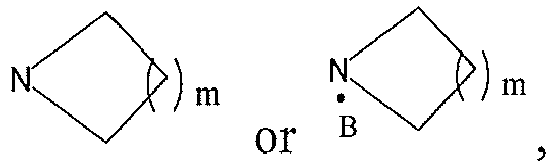
- W' is NR1'R2', NR1'R2'·B,

- R1', R2' are each independently H, alkyl, cycloalkyl, or a protecting group for amino;
- m is 0, 1, 2 or 3;
- B is an acid;
- R7 is H, or a protecting group for carboxyl or hydroxyl in phosphoric acid;
- D is hydroxyl, Cl or Br.
- According to an example, Y is F or C1-6 alkyl substituted with one or more fluorine atoms. Preferably, Y is F, CF3 or CHF2.
- According to an example, R1' and/or R2' are each independently C1-6 alkyl, such as methyl, ethyl, propyl, isopropyl, butyl or isobutyl.
- According to an example, R1' and/or R2' are each independently C3-6 cycloalkyl, such as cyclopropyl, cyclobutyl, cyclopentyl or cyclohexyl.
- According to an example, R1' and/or R2' are each independently C1-6 alkoxycarbonyl optionally substituted with phenyl, such as benzyloxycarbonyl or tert-butyloxycarbonyl.
- According to an example, R1' and/or R2' are each independently benzyl.
- According to an example, R1', R2' are each independently H, methyl, ethyl, propyl, isopropyl, butyl, isobutyl, cyclopropyl, cyclobutyl, cyclopentyl, cyclohexyl, benzyloxycarbonyl, tert-butyloxycarbonyl or benzyl.
- According to an example, the acid B is an acid which can form a salt with amine, such as hydrochloric acid, hydrobromic acid, sulfuric acid, phosphoric acid, trifluoroacetic acid, difluoroacetic acid, fluoroacetic acid, acetic acid, benzensulfonic acid or p-toluene sulfonic acid.
- According to an example, R7 is C1-6 alkyl optionally substituted with one or more phenyls, such as methyl, ethyl, diphenylmethyl, triphenylmethyl or benzyl.
- According to an example, when X and Y are different (i.e., the α-C of the carboxyl in the carboxylic acid derivative is a chiral atom), the carbon atom to which both X and Y are attached is in a single R configuration, in a single S configuration, or in both R and S configurations.
- According to an example, the carboxylic acid derivative is selected from the group consisting of:
- 4-N,N-dimethylamino-2-(R)-fluorobutyric acid hydrochloride;
- 4-N-isopropylamino-2-(R,S)-fluorobutyric acid hydrochloride;
- 4-N,N-diethylamino-2-(R,S)-trifluoromethylbutyric acid hydrochloride;
- 4-N-benzylamino-2,2-difluorobutyric acid hydrochloride;
- 4-N-isobutylamino-2-(R,S)-difluoromethylbutyric acid hydrochloride;
- 4-N-(aziridin-1-yl)-2-(R, S)-difluoromethylbutyric acid hydrochloride;
- 4-N-(pyrrolidin-1-yl)-2-(R,S)-fluorobutyric acid hydrochloride;
- 3-N-benzylamino-2-(R,S)-(1,1-difluoromethyl)propionic acid hydrochloride;
- 6-N-cyclohexylamino-2-(R,S)-trifluoromethylhexanoic acid hydrochloride;
- 4-benzyloxy-4-oxo-2-(R,S)-fluorobutyric acid;
- 5-benzyloxy-5-oxo-2-(R)-fluoroglutaric acid;
- 6-benzyloxy-6-oxo-2-(S)-fluorohexanoic acid;
- dibenzyl [1-(3-(R,S)-fluoro-3-carboxy)propyl] phosphate triester;
- dibenzyl [1-(5-(S)-fluoro-5-carboxy)pentyl] phosphate triester;
- 4-(dibenzyloxy)phosphoryl-2-(R,S)-fluorobutyric acid;
- 5-(dibenzyloxy)phosphoryl-2-(R)-fluoropentanoic acid;
- 4-benzyloxy-4-oxo-2-(R, S)-fluorobutyryl chloride;
- sodium 5-benzyloxy-5-oxo-2-(R)-fluorovalerate;
- dibenzyl [1-(3-(R,S)-fluoro-4-oxo-4-chloro)butyl] phosphate triester;
- dibenzyl [potassium 1-(4-(S)-fluoro-5-carboxylate)pentyl] phosphate triester;
- 4-(dibenzyloxy)phosphoryl-2-(R,S)-fluorobutyryl chloride;
- sodium 4-N,N-dimethylamino-2-(R,S)-fluorobutyrate;
- calcium 4-N,N-diethylamino-2-(R,S)-fluorobutyrate;
- aluminum 3-N-benzylamino-2-(R,S)-benzyloxypropionate;
- 4-N,N-dimethylamino-2-(R,S)-fluorobutyryl chloride hydrochloride;
- 4-N-benzylamino-2,2-difluorobutyryl chloride hydrochloride;
- 4-N,N-dimethylamino-2-(R,S)-fluorobutyric acid; and
- 4-N,N-dimethylamino-2-(S)-fluorobutyric acid hydrochloride.
- In a second aspect, there is disclosed a water soluble propofol derivative. The propofol derivative has stable chemical properties and good water solubility, and can be dissociated quickly in blood plasma to release propofol, so as to quickly exert an anesthestic effect in vivo. Thus, the propofol derivative of the present invention is a very suitable prodrug for a propofol drug.
- The water soluble propofol derivative has the following general formula (I):

- X, Y and n are as defined above for the compound of general formula (III);
- W is W1 or W2;
- W1 is NR1R2·A or

- R1, R2 are each independently H, alkyl optionally substituted with phenyl, or cycloalkyl;
- m is as defined above for the compound of general formula (III);
- A is a pharmaceutically acceptable acid;
- W2 is COOM1/t or OPO3(M)2/t or PO3(M)2/t;
- M is a metal ion, an ammonium ion or a basic amino acid cation which can form a salt with an acid radical; and
- t is the charge number of M.
- According to an embodiment of the present invention, W is W1.
- According to an embodiment of the present invention, R1 and/or R2 are each independently C1-6 alkyl optionally substituted with phenyl, such as methyl, ethyl, propyl, isopropyl, butyl, isobutyl or benzyl.
- According to an embodiment of the present invention, R1 and/or R2 are each independently C3-6 cycloalkyl, such as cyclopropyl, cyclobutyl, cyclopentyl or cyclohexyl.
- According to an embodiment of the present invention, R1, R2 are each independently H, methyl, ethyl, propyl, isopropyl, butyl, isobutyl, benzyl, cyclopropyl, cyclobutyl, cyclopentyl or cyclohexyl.
- According to an embodiment of the present invention, R1, R2 are not H at the same time.
- According to an embodiment of the present invention, A is hydrochloric acid, hydrobromic acid, sulfuric acid, phosphoric acid, carbonic acid, acetic acid, propionic acid, methanesulfonic acid, lactic acid, benzensulfonic acid, p-toluene sulfonic acid, succinic acid, maleic acid, fumaric acid, tartaric acid, citric acid or malic acid.
- According to example of the disclosure, W is W2.
- According to an embodiment of the present invention, M is an alkali metal ion, such as a lithium ion, a sodium ion or a potassium ion, an alkaline earth metal ion, such as a magnesium ion, zinc ion or calcium ion, or a trivalent metal ion, such as an aluminum ion.
- According to an embodiment of the present invention, M is an ammonium ion represented by formula (NR3R4R5R6)+ or

- According to an embodiment of the present invention, M is arginine+H+, lysine+H+ or histidine+H+.
- According to an embodiment of the present invention, the water soluble propofol derivative has following general formula (I-1):

X, Y, n, R1, R2 and A are as defined above for the compound of general formula (I). - According to an embodiment of the present invention, the water soluble propofol derivative has following general formula (I-2):

X, Y, n, m and A are as defined above for the compound of general formula (I). - According to an embodiment of the present invention, the water soluble propofol derivative has following general formula (I-3):

X, Y, n, M and t are as defined above for the compound of general formula (I). - According to an embodiment of the present invention, the water soluble propofol derivative has following general formula (I-4):

- X, Y, n, M and t are as defined above for the compound of general formula (I); and
- q is 0.
- When X and Y are different (i.e., the α-C of carboxyl in a carboxylic acid derivative is a chiral atom), the carbon atom to which both X and Y are attached is in a single R configuration, in a single S configuration, or in both R and S configurations.
- According to an embodiment of the present invention, the water soluble propofol derivative is selected from the group consisting of:
- propofol 4-(N,N-dimethyl)amino-2-(R,S)-fluorobutyrate hydrochloride;
- propofol 4-(N,N-dimethyl)amino-2-(R)-fluorobutyrate hydrochloride;
- propofol 3-N-isopropylamino-2-(R,S)-fluoropropionate hydrochloride;
- propofol-2-(R,S)-fluoropentanoate monoester sodium salt;
- propofol-2-(R,S)-fluorobutyrate monoester sodium salt;
- propofol-2-(R)-fluoropropionate monoester sodium salt;
- propofol 4-(N,N-dimethyl)amino-2-(R)-fluorobutyrate hydrochloride;
- propofol 4-(N,N-dimethyl)amino-2-(R)-2-trifluoromethylbutyrate hydrochloride;
- propofol 4-(N-methyl-N-ethyl)amino-2-(R,S)-2-fluorobutyrate hydrochloride;
- propofol 5-(N-methyl-N-benzyl)amino-2-(S)-2-fluorovalerate hydrochloride;
- propofol 3-(N-isopropyl)amino-2-(R,S)-2-monofluoromethylpropionate methanesulfonate;
- propofol 4-(aziridin-1-yl)-2-(S)-2-fluorobutyrate hydrochloride;
- propofol 4-(pyrrolidin-1-yl)-2-(R)-2-fluorobutyrate hydrochloride;
- propofol 3-(N,N-diethyl)amino-2-(R,S)-fluoropropionate hydrochloride;
- propofol 4-(N-methyl-N-benzyl)amino-2-(R,S)-trifluoromethylbutyrate hydrochloride;
- propofol 4-(N-cyclopropyl-N-methyl)amino-2-(R)-difluoromethylbutyrate hydrochloride;
- propofol 3-(pyrrolidin-1-yl)-2-(S)-trifluoromethyl propionate hydrochloride;
- propofol δ-(N,N-dimethyl)amino-2-(R)-fluorovalerate hydrochloride;
- propofol 3-N-methyl-N-cyclohexylamino-2-(R,S)-fluoropropionate hydrochloride;
- propofol 4-(N-methyl-N-isopropyl)amino-2-(R,S)-fluorobutyrate methanesulfonate;
- propofol 5-N-cyclopentylamino-2,2-difluorovalerate hydrochloride;
- propofol 4-(N,N-dimethyl)amino-2-(R)-trifluoromethylbutyrate hydrochloride;
- propofol 4-N-methyl-N-benzylamino-2-(R)-fluorobutyrate hydrochloride;
- propofol 4-carboxyl-2-(S)-fluorovalerate potassium salt;
- propofol 4-carboxyl-2-(R)-2-trifluoromethylvalerate lithium salt;
- di[propofol 7-carboxyl-2-(R,S)-fluorocaprylate] calcium salt;
- di[propofol 5-carboxyl-2-(S)-fluorohexanoate] zinc salt;
- tri[propofol 8-carboxyl-2-(R,S)-monofluoromethylpelargonate] aluminum salt;
- propofol 4-carboxyl-2-(S)-trifluoromethylbutyrate ammonium salt;
- propofol 4-carboxyl-2-(R,S)-difluoromethylvalerate potassium salt;
- {1-[4-(2,6-diisopropylphenoxy)-4-oxo-3-(R)-3-trifluoromethyl-1-butyl]} phosphate monoester dilithium salt;
- propofol 4-phosphoryl-2-(R,S)-fluorobutyrate calcium salt;
- propofol 5-phosphoryl-2-(S)-fluorovalerate zinc salt;
- tri[propofol 3-phosphoryl-2-(R,S)-2-monofluoromethylpropionate] dialuminum salt;
- propofol 4-phosphoryl-2-(R)-fluorobutyrate disodium salt; and
- propofol 3-phosphoryl-2-(R,S)-fluoropropionate zinc salt.
- Disclosed water soluble propofol derivatives are furthermore {1-[3-(2,6-diiso-propylphenoxy)-3-oxo-2-(R)-fluoropropyl]} phosphate monoester dipotassium salt;
- {1-[4-(2,6-diisopropylphenoxy)-4-oxo-3-(R,S)-3-fluoro-1-butyl]} phosphate monoester dipotassium salt,
- {1-[4-(2,6-diisopropylphenoxy)-4-oxo-3-(S)-3-fluoro-1- butyl]} phosphate monoester disodium salt, and
- {1-[4-(2,6-diisopropylphenoxy)-4-oxo-2-(R)-trifluoromethylbutyl]} phosphate monoester dilithium salt.
- According to a third aspect of the disclosure, it provides a water soluble propofol of the present invention for use as intravenous anesthetics.
- According to a fourth aspect, there is disclosed an anesthetic method, comprising intravenous administration of a water soluble propofol derivative of the present invention to a patient.
- According to a fifth aspect, there is disclosed the use of a water soluble propofol derivative disclosed herein in the preparation of an intravenous anesthetic.
- The term "C1-6 alkyl" as used herein refers to a saturated, linear or branched hydrocarbon group having 1-6 carbon atoms, such as methyl, ethyl, propyl, isopropyl, n-butyl, isobutyl, sec-butyl, tert-butyl, n-pentyl, isopentyl, neo-pentyl, n-hexyl, isohexyl and the like, preferably methyl, ethyl, propyl, isopropyl, butyl or isobutyl, more preferably methyl, ethyl or propyl.
- The term "C3-6 cycloalkyl" as used herein refers to a saturated monocyclic hydrocarbon group having 3-6 carbon atoms, such as cyclopropyl, cyclobutyl, cyclopentyl or cyclohexyl.
- The term "an protecting group for amino" as used herein refers to a protecting group for preventing an amino group from undergoing undesired chemical reactions, including but not limited to an alkoxycarbonyl protecting group, such as methoxycarbonyl, ethoxycarbonyl, propoxycarbonyl, tert-butyloxycarbonyl, benzyloxycarbonyl and the like, and an alkyl protecting group, such as benzyl with or without substitution on the phenyl ring, and the like.
- The term "a protecting group for carboxyl or hydroxyl in phosphoric acid" as used herein refers to a protecting group for preventing a carboxyl or the hydroxyl group in phosphoric acid from undergoing undesired chemical reactions, including but not limited to methyl, ethyl, propyl, diphenylmethyl, triphenylmethyl, benzyl and the like.
- The term "an acid which can form a salt with an amine" as used herein refers to an inorganic or organic acid commonly used in the field of organic chemistry which can form a salt with an amine. The inorganic acid includes, but is not limited to, hydrochloric acid, hydrobromic acid, hydroiodic acid, sulfuric acid, pyrosulfuric acid, phosphoric acid, nitric acid and the like. The organic acid includes, but is not limited to, formic acid, acetic acid, propionic acid, butyric acid, pivalic acid, trifluoroacetic acid, difluoroacetic acid, fluoroacetic acid, acetoacetic acid, benzoic acid, methanesulfonic acid, ethanesulfonic acid, trifluoromethanesulfonic acid, benzensulfonic acid, p-toluene sulfonic acid, naphthalenesulfonic acid, camphorsulfonic acid, and the like.
- The term "pharmaceutically acceptable acid" as used herein refers to an acid which can be used in the medical field, such as hydrochloric acid, hydrobromic acid, sulfuric acid, phosphoric acid, carbonic acid, acetic acid, propionic acid, methanesulfonic acid, lactic acid, benzensulfonic acid, p-toluene sulfonic acid, succinic acid, maleic acid, fumaric acid, tartaric acid, citric acid or malic acid.
- The term "C1-6 alkoxycarbonyl" as used herein refers to an alkoxy group linked to the remainder of a molecule via a carbonyl having 1-6 carbon atoms in total, such as methoxycarbonyl, ethoxycarbonyl, propoxycarbonyl, tert-butyloxycarbonyl, pentyloxycarbonyl, etc.
- The term "basic amino acid" as used herein refers to an amino acid which results in more hydroxyl anion than hydrogen cation after hydrolysis, such as arginine+H+, lysine+H+ or histidine+H+.
- The water soluble propofol derivative of general formula (I) of the present invention can be prepared according to following Reaction Scheme 1:

- The compound of general formula (Ia) is prepared by reacting the compound of formula (II) with the compound of formula (III) (wherein the variables are each as defined as in the section of "Summary of the Invention") in the presence of reagent (IV) in an organic solvent at -100-40°C.
- The reagent (IV) is a nitrogen-containing basic organic reagent or a mixed reagent consisting of a nitrogen-containing basic organic reagent and a compound having a carbodiimide structure. The nitrogen-containing basic organic reagent is an organic base, such as triethylamine, pyridine, 4-N,N-dimethylpyridine or 4-PPY (4-pyrrolidinylpyridine), and the compound having a carbodiimide structure is DCC (dicyclohexylcarbodiimide) or EDC (1-(3-dimethylaminopropyl)-3- ethylcarbodiimide).
- When D in the compound of general formula (III) is Cl or Br, the reagent (IV) is a nitrogen-containing basic organic reagent, and the molar ratio of the compound of formula (II), the compound of formula (III) and the reagent (IV), i.e., (II):(III):(IV)), is 1:(1-12.0):(1-15.0).
- When D in the compound of general formula (III) is OH, the reagent (IV) is a mixed reagent consisting of a nitrogen-containing basic organic reagent and a compound having a carbodiimide structure in a molar ratio of 1:(1-5), and the molar ratio of the compound of formula (II), the compound of formula (III) and the reagent (IV), i.e., (II):(III):(IV)), is 1:(1-12.0):(1-15.0) (wherein the amount of the reagent (IV) is based on the amount of the nitrogen-containing basic organic reagent).
- When W' in the compound of general formula (Ia) is NR1'R2'·B or

- When W' in the compound of general formula (Ia) is NR1'R2'·B,


- The deprotection method refers to a conventional method in the art to remove a protecting group for amino acid, carboxyl or the hydroxyl in phosphoric acid.
- When W" in the compound of general formula (Ib) is NR1R2·B or

- When W" in the compound of general formula (Ib) is COOH, or PO(OH)2, a basic solution containing M ion is added to the compound of general formula (Ib), so as to prepare a compound of general formula (I).
- The organic solvent as mentioned above refers to an aprotic organic solvent which can dissolve the compound of general formula (Ia) or the compound of general formula (Ib), e.g., a chlorinated hydrocarbon organic solvent (such as dichloromethane, chloroform, 1,2-dichloroethane, chlorobenzene), an ether organic solvent (such as tetrahydrofuran, dioxane, diethyl ether, methylethyl ether), acetonitrile, DMF, DMSO and the like.
- The carboxylic acid derivative of general formula (III) of the present invention (i.e., one of the starting materials in Reaction Scheme 1) can be prepared as follows.
- When D is OH and W' is NR1'R2', NR1'R2'·B,
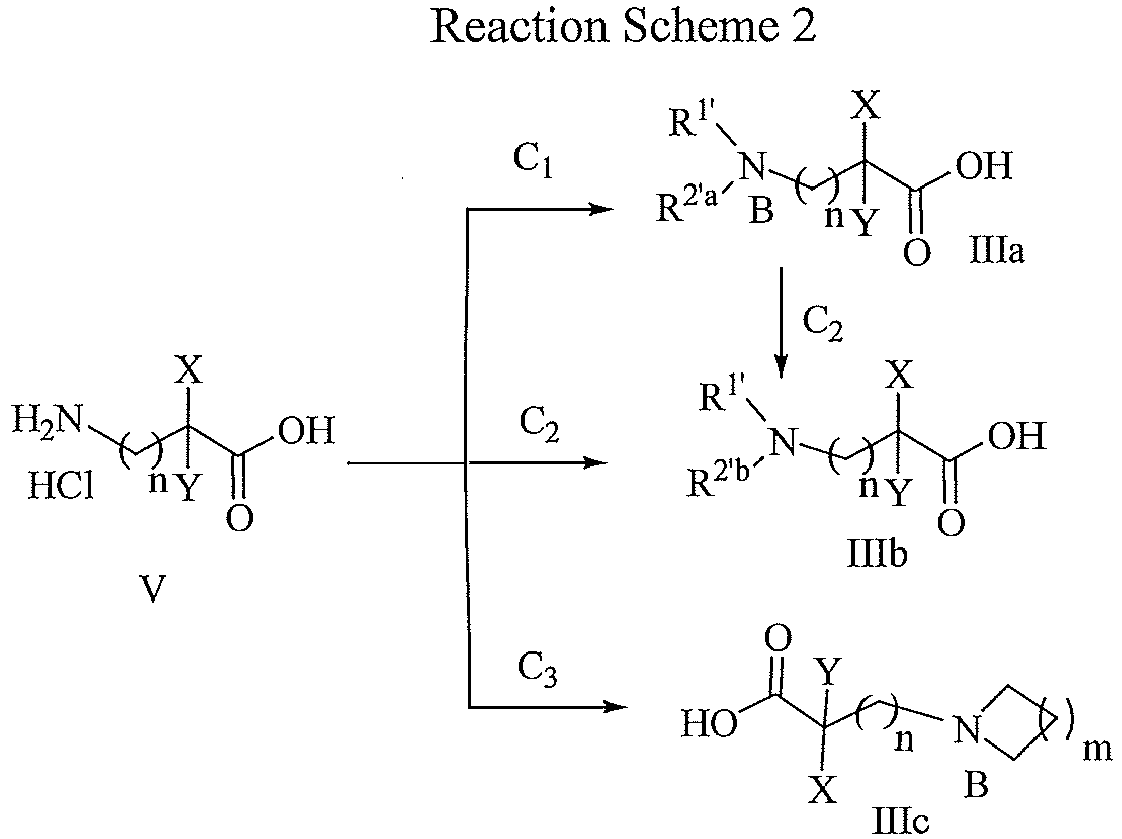
- In the above Reaction Scheme 2, the compounds of formulae (IIIa), (IIIb) and (IIIc), which all belong to the compound of general formula (III), are obtained by reacting the compound of general formula (V) with an alkylating agent for amino (C1 or C3) or a protecting reagent for amino (C2),
wherein,
R1', X, Y, n and B are as defined above;
C1 is an alkylating agent for amino, such as formic acid/formaldehyde, dimethyl sulfate, bromoethane, bromopropane, chlorobutane, acetone, butanone, cyclopentanone, cyclohexanone, benzaldehyde and the like;
C2 is a protecting reagent for amino, such as benzyl chloroformate, di-tert-butyloxycarbonylcarbonic anhydride, benzyl chloride, benzyl bromide and the like;
C3 is another alkylating agent for amino, such as 1-chloro-2-bromoethane, 1-chloro-4-bromobutane, 1-chloro-5-bromopentane and the like;
R2'a is alkyl or cycloalkyl, especially C1-6 alkyl, such as methyl, ethyl, propyl, isopropyl, butyl or isobutyl, or C3-6 cycloalkyl, such as cyclopropyl, cyclobutyl, cyclopentyl or cyclohexyl.
R2'b is a protecting group for amino, especially C1-6 alkoxycarbonyl optionally substituted with phenyl (such as benzyloxycarbonyl or tert-butyloxycarbonyl) or benzyl. - When D is OH and W' is COOR7, or PO(OR7)2, the carboxylic acid derivative of general formula (III) of the present invention can be prepared according to following Reaction Scheme 3:

- In the above Reaction Scheme 3, the compounds of formulae (IIId), (IIIe) and (IIIf), which all belong to the compound of general formula (III), are obtained by the following steps: preparing the compounds of formulae (VIIa), (VIIb) and (VIIc) by reacting the compounds of formulae (VIa), (VIb) and (VIc) with D1 (a protecting agent for the carboxyl at position 1), respectively, then preparing the compounds of formulae (VIIIa), (VIIIb) and (VIIIc) by protecting the terminal carboxyl or the hydroxyl in the phosphoric acid with the protecting agent D2, and finally preparing the compounds of formulae (Id), (Ie) and (If) by removing R8 (the protecting group for the carboxyl at position 1),
wherein,
R7, X, Y and n are as defined above;
D1, the protecting agent for the carboxyl at position 1, is selected from the group consisting of methanol, methanol substituted with silyl, 9-fluorenylmethanol, 2-iodo-2-methylpropane, benzyl halide and the like;
D2, the protecting agent for the terminal carboxyl or the hydroxyl in the phosphoric acid, is selected from the group consisting of iodomethane, benzophenone hydrazone, triphenylmethyl iodide, benzyl halide and the like;
R8 is a protecting group for the carboxyl group at position 1, such as methyl, alkyl substituted with silyl, 9-fluorenylmethyl, tert-butyl, benzyl and the like. - When D in the compound of formula (III) is Cl or Br, a corresponding acyl halide compound can be prepared from a starting material wherein D is hydroxyl via a halogenating reaction.
- The compounds of general formulae (V) and (VI) (including the compounds of general formulae (VIa), (VIb) and (VIc)) in the above reaction schemes can be obtained by methods reported in relevant references, e.g. [1] Chencomm, 1999:1739-1740; [2] J. Med. Chem, 2011, 44:2849-2856; [3] JCS Perkin I 1980:2029-2032; [4] Journal of Fluorine Chemistry (23), 1983:241-259; [5] Journal of Fluorine Chemistry, 2004, vol. 125 (4): 509 - 515; [6] Phosphorus, Sulfur and Silicon and the Related Elements, 1995, 105 (1-4): 205 - 212; [7] Tetrahedron Letters, 2007, 48 (4): 711 - 714; [8] Helvetica Chimica Acta, 1958, 1163, 1167; and [9] Justus Liebigs Annalen der Chemie, 1962, 655:70 - 80.
- The water soluble propofol of the present invention, as a prodrug, has the following beneficial effects:
According to the present application, the water soluble propofol derivative can be formed through structural modification on the phenolic hydroxyl in propofol without altering the pharmacological activity of the parent drug. The water soluble propofol derivative is relatively stable in chemical properties, and the aqueous solution thereof can release the parent drug to exert an anesthetic effect after injection. In addition, surprisingly, the water soluble propofol derivative of the present invention has good water solubility, can be formulated as a suitable water soluble preparation, and can be easily dissociated in vivo to release propofol. In view of the above advantages, the water soluble propofol derivative of the present invention can overcome the following disadvantages of currently available propofol preparations which have to be administered as an emulsion: they have poor physical stability; they may cause vascular embolization due to large oil drop; they will induce pain in patients due to injection; they can only be mixed with a few injectable products before administration; bacteria tend to grow in an emulsion; and they may cause cardiac toxic and side effects, etc. Also, the water soluble propofol derivative of the present invention has good human compliance and can be easily stored. As demonstrated by pharmacodynamic and pharmacokinetic tests, the water soluble propofol derivative of the present invention has a low toxicity in vivo, and is very suitable as a novel anesthetic. - To make the purpose and technical solutions of the present invention more clear, the preferable examples of the present invention are described in detail as follows. It should be noted that the following examples are provided merely for further illustration of the present invention, but should not be construed to limit the scope of the present invention.
- 4-amino-2-(R)-fluorobutyric acid hydrochloride (1.1 g, 7.0 mmol) was added to a round bottom flask, a saturated aqueous Na2CO3 solution was added to adjust the pH value to 8, and then 88% formic acid (6 ml) and 35% aqueous formaldehyde solution (5 ml) were added. The reaction mixture was warmed slowly to 80°C, and was allowed to react for 15 hours. The reaction mixture was cooled to room temperature, and 6 N hydrochloric acid (2 ml) was added followed by concentration under reduced pressure to give a light yellow solid. The solid was dissolved in methanol (10 ml), and the resulting solution was cooled in an ice bath with stirring for 30 min. Then the resulting mixture was filtered, and the filtrate was concentrated. The residue was refluxed in 6 N hydrochloric acid (100 ml) for 4 hours, and the liquid was removed by rotary evaporation. The solid thus obtained was treated with acetonitrile to obtain a white solid (1.1 g, yield: 85%).
- m.p.:136-138°C;
- 1H-NMR (400 MHz, D2O):δ 4.72 (ddd, 1H), 2.90 (dtd, 2H), 2.43 (s, 6H), 1.93 (m, 2H);
- 13C-NMR (600 MHz, D2O):δ 173.13, 86.90, 53.49, 42.83, 26.91;
- ESI-MS m/z [M+H]+ 150.13.
- 4-amino-2-(R,S)-fluorobutyric acid hydrochloride (1.1 g, 7.0 mmol) was added to a round bottom flask (50 ml), a saturated aqueous Na2CO3 solution was added to adjust the pH to 8, and then acetone (15 ml) and 5% Pd-C (100 mg) were added. Air was replaced with nitrogen, which was then replaced with hydrogen. The reaction was carried out for 6 hours at room temperature. Pd-C was removed through filtration, and the pH of the solution was adjusted to be acidic with 6 N hydrochloric acid. The solution was concentrated under reduced pressure to give a light yellow solid. The solid was dissolved in methanol (10 ml), and the resulting solution was cooled in an ice bath with stirring for 30 min. Then the resulting mixture was filtered, and the filtrate was concentrated. The residue was refluxed in 6 N hydrochloric acid (100 ml) for 4 hours, and the solvent was removed by rotary evaporation. The solid thus obtained was treated with acetonitrile to obtain a white solid (1.05 g, yield: 75%).
ESI-MS m/z [M+H]+ 164.12. - 4-amino-2-(R,S)-trifluoromethylbutyric acid hydrochloride (2.07 g, 10 mmol) was added to a round bottom flask (50 ml), and 1 N aqueous NaHCO3 solution was added to adjust the pH value to 8. Acetonitrile (50 ml) was added, and a mixed solution (10 ml) of bromoethane (2.18 g, 20 mmol) and acetonitrile was added dropwise. The pH of the reaction solution was maintained at 7-8 with a solution of sodium bicarbonate. Hydrochloric acid was added to adjust the pH to below 5 after completion of the reaction, and the solution was concentrated under reduced pressure to give a light yellow solid. Methanol (10 ml) was added, the resulting solution was stirred for 30 min before filtration, and the filtrate was concentrated. The residue was refluxed in 6 N hydrochloric acid (100 ml) for 4 hours, the solvent was removed by rotary evaporation, and a white solid (yield: 13%) was obtained.
ESI-MS m/z [M+H]+ 228.16. - The title compound was prepared according to the method of Example 2, using 4-amino-2,2-difluorobutyric acid hydrochloride (1.1 g, 5.6 mmol) and benzaldehyde as starting materials.
ESI-MS m/z [M+H]+ 230.06. - The title compound was prepared according to the method of Example 2, using 4-amino-2-(R,S)-difluoromethylbutyric acid hydrochloride (1.90 g, 10 mmol) and butanone (15 ml) as starting materials, and a white solid (1.1 g, yield: 45%) was obtained.
- m.p.:141-142°C;
- ESI-MS m/z [M+H]+ 210.1.
- 4-amino-2-(R,S)-difluoromethylbutyric acid hydrochloride (1.90 g, 10 mmol) was added to a round bottom flask (50 ml), an aqueous NaHCO3 solution was added to adjust the pH to 7-8, and acetonitrile (15 ml) and 1-chloro-2-bromoethane (10 mmol) were added. The reaction was carried out at ambient temperature for 0.5 h, and then the reaction mixture was heated to reflux and was allowed to react under reflux for 2 h. The solvent was removed by evaporation under reduced pressure, and methanol (10 ml) was added to the residue. The resulting solution was then cooled in an ice bath with stirring for 30 min before filtration, and the filtrate was concentrated. The residue was refluxed in 6 N hydrochloric acid (100 ml) for 4 hours, the solvent was removed by rotary evaporation, and a white solid (0.7 g) was obtained.
ESI-MS m/z [M+H]+ 180.14. - The title compound was prepared according to the method of Example 6, using 4-amino-2-(R,S)-fluorobutyric acid and 1-chloro-4-bromobutane as starting materials.
ESI-MS m/z [M+H]+ 176.1. - The title compound was prepared according to the method of Example 2, using 3-amino-2-(R,S)-(1,1-difluoromethyl)propionic acid hydrochloride and benzaldehyde as starting materials.
ESI-MS m/z [M+H]+ 230.19. - The title compound was prepared according to the method of Example 2, using 6-amino-2-(R,S)-trifluoromethylhexanoic acid hydrochloride and cyclohexanone as starting materials.
ESI-MS m/z [M+H]+ 282.08. - At room temperature, 2-(R,S)-fluorosuccinic acid (10 mmol) was dissolved in methanol (30 ml), and the resulting solution was stirred for 2 h. The solvent was removed by evaporation under reduced pressure, and 1-methyl 2-(R,S)-fluorosuccinate was obtained.
ESI-MS m/z [M-H]-149.01. - At room temperature, 1-methyl 2-(R,S)-fluorosuccinate (5 mmol) was dissolved in dry dichloromethane (20 ml), and thionyl chloride (0.3 ml) was added. The reaction mixture was heated slowly to reflux, and was allowed to react for 3 h. The remaining thionyl chloride and solvent were removed by evaporation under reduced pressure, and fluorobutyryl chloride was obtained.
- Under cooling in an ice bath, a solution of fluorobutyryl chloride (4 mmol) in dichloromethane (5 ml) was added dropwise to a solution of benzyl alcohol (4 mmol) and pyridine (5 mmol) in dichloromethane (10 ml), and the reaction was carried out under ice cooling for 1 h. The organic layer was washed with an aqueous solution of hydrochloric acid (pH 3), and was dried over anhydrous sodium sulfate. The solvent was removed by evaporation under reduced pressure, and methyl 4-benzyloxy-4-oxo-2-(R,S)-fluorobutyrate was obtained.
ESI-MS m/z [M + H]+241.18. - Under cooling in an ice bath, methyl 4-benzyloxy-4-oxo-2-(R,S)-fluorobutyrate (7 mmol) was dissolved in methanol (10 ml), 1 N NaOH solution (1 ml) was added, and the reaction was carried out under ice cooling for 1 h. Methanol was removed by evaporation under reduced pressure, water (10 ml) was added, and the pH of the reaction was neutralized to below 1 with 1 N hydrochloric acid. The aqueous layer was extracted with diethyl ether, and the diethyl ether layers were combined, dried over anhydrous sodium sulfate, and filtered. The solvent was removed by evaporation under reduced pressure, and 4-benzyloxy-4-oxo-2-(R,S)-fluorobutyric acid (yield: 40%) was obtained.
ESI-MS m/z [M-H]-225.18. - The title compound was prepared according to the method of Example 10, using 2-(R)-fluoroglutaric acid as a starting material.
ESI-MS m/z [M-H]-239.19. - The title compound was prepared according to the method of Example 10, using 2-(S)-fluoroadipic acid as a starting material.
ESI-MS m/z [M-H]-253.17 - At room temperature, [1-(3-(R,S)-fluoro-3-carboxy)propyl] phosphate monoester (10 mmol) was dissolved in methanol (10 ml), and the resulting solution was stirred for 1 h. Methanol was removed by evaporation under reduced pressure, and [1-(3-(R,S)-fluoro-4-oxo-4-methoxy)butyl] phosphate monoester was obtained.
ESI-MS m/z [M-H]-215.07. - At room temperature, [1-(3-(R,S)-fluoro-4-oxo-4-methoxy)butyl] phosphate monoester (7 mmol) was dissolved in dry acetonitrile (20 ml), anhydrous potassium carbonate (17 mmol) and benzyl bromide (17 mmol) were added, and the reaction mixture was heated slowly to reflux. After completion of the reaction as monitored by TLC, the reaction mixture was cooled and filtered, and the solvent was removed by rotary evaporation. The residue was purified by column chromatography (EA:PE= 1:3), and dibenzyl [1-(3-(R,S)-fluoro-4-oxo-4-methoxy)butyl] phosphate triester was obtained.
ESI-MS m/z [M + H]+ 397.08. - Under cooling in an ice bath, dibenzyl [1-(3-(R,S)-fluoro-4-oxo-4-methoxy)-butyl] phosphate triester (10 mmol) was dissolved in tetrahydrofuran (10 ml), 1 N NaOH solution (1 ml) was added slowly, and the reaction mixture was stirred under ice cooling for 1 h until a white solid precipitated. The reaction mixture was filtered, the filter cake was dissolved in water (10 ml), and the pH was adjusted to below 1 with concentrated hydrochloric acid. The aqueous layer was extracted with diethyl ether, and the diethyl ether layers were combined and dried over anhydrous sodium sulfate. Diethyl ether was removed by rotary evaporation to obtain the product (yield: 63.5%).
ESI-MS m/z [M-H]-381.29. - Preparation of dibenzyl [1-(5-(S)-fluoro-5-carboxy)pentyl] phosphate triester The title compound was prepared according to the method of Example 13, using [1-(5-(S)-fluoro-5-carboxy)pentyl] phosphate monoester as a starting material.
ESI-MS m/z [M-H]-409.29 - The title compound was prepared according to the method of Example 13, using 4-(dihydroxy)phosphoryl-2-(R,S)-fluorobutyric acid as a starting material.
ESI-MS m/z [M-H]-365.28 - The title compound was prepared according to the method of Example 13, using 5-(dihydroxy)phosphoryl-2-(R)-fluoropentanoic acid as a starting material.
ESI-MS m/z [M-H]-379.31. - According to the methods of the above examples, the inventors also prepared the following compounds:
- 4-benzyloxy-4-oxo-2-(R,S)-fluorobutyryl chloride (ESI-MS m/z [M-H]245.01);
- sodium 5-benzyloxy-5-oxo-2-(R)-fluorovalerate (ESI-MS m/z [M-H]240.05);
- dibenzyl [1-(3-(R,S)-fluoro-4-oxo-4-chloro)butyl] phosphate triester (ESI-MS m/z [M-H]401.02) (not according to the invention);
- dibenzyl [potassium 1-(4-(S)-fluoro-5-carboxylate)pentyl] phosphate triester (ESI-MS m/z [M-H]396.01) (not according to the invention);
- 4-(dibenzyloxy)phosphoryl-2-(R,S)-fluorobutyryl chloride (ESI-MS m/z [M-H]385.04);
- sodium 4-N,N-dimethylamino-2-(R,S)-fluorobutyrate (ESI-MS m/z [M-H] 149.03);
- calcium 4-N,N-diethylamino-2-(R,S)-fluorobutyrate (ESI-MS m/z [M-H] 177.08);
- aluminum 3-N-benzylamino-2-(R,S)-benzyloxypropionate (ESI-MS m/z [M-H] 197.04);
- 4-N,N-dimethylamino-2-(R,S)-fluorobutyryl chloride hydrochloride (ESI-MS m/z [M-H]168.01);
- 4-N-benzylamino-2,2-difluorobutyryl chloride hydrochloride (ESI-MS m/z [M-H]248.03);
- 4-N,N-dimethylamino-2-(R,S)-fluorobutyric acid (ESI-MS m/z [M-H]150.08); and
- 4-N,N-dimethylamino-2-(S)-fluorobutyric acid hydrochloride (ESI-MS m/z [M-H]150.11).
-

-
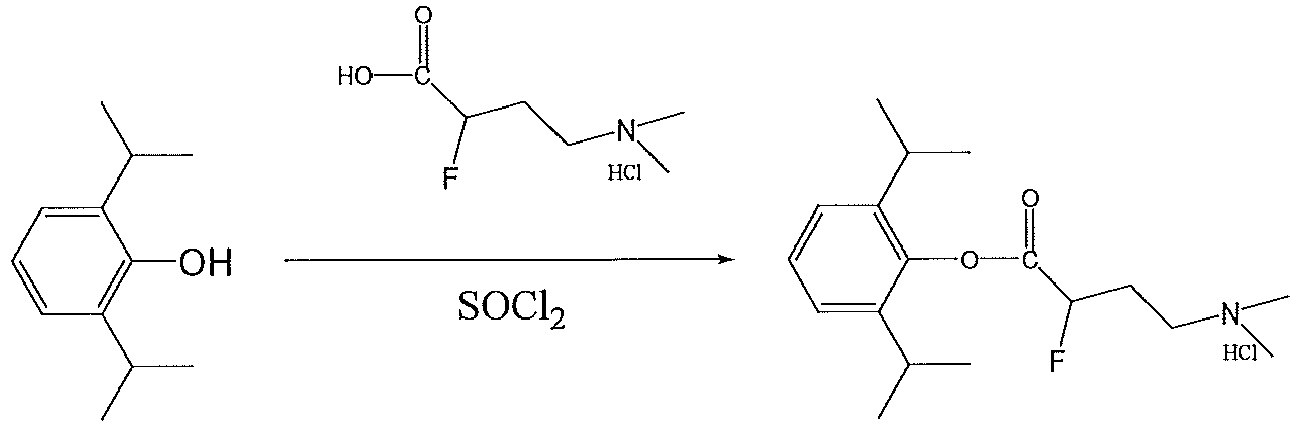
- 1) Preparation of 4-N,N-dimethylamino-2-(R,S)-fluorobutyryl chloride hydrochloride: 4-N,N-dimethylamino-2-(R,S)-fluorobutyric acid hydrochloride (prepared according to the method of Example 1) (10 mmol) was placed in thionyl chloride (10 ml). The reaction mixture was warmed slowly to 40°C, and was allowed to react for 4 h. Thionyl chloride was removed by evaporation under reduced pressure, anhydrous dichloromethane (DCM, 15 ml) was added, and the solvent was removed by evaporation under reduced pressure after stirring. Anhydrous dichloromethane (60 ml) was added to the residue for the next step.
- 2) A solution of propofol (4.5 mmol) in dichloromethane (5 ml) was added dropwise to the solution of 4-N,N-dimethylamino-2-(R,S)-fluorobutyryl chloride hydrochloride in dichloromethane prepared in step 1) at -78°C. Then, a solution of 4-N,N-dimethylpyridine (8.2 mmol) in dichloromethane (20 ml) was slowly added. The reaction was monitored by HPLC. Upon the reaction was complete, the DCM layer was washed with aqueous hydrochloric acid solution (the pH of which is about 1.0), dried over anhydrous sodium sulfate, and filtered. Most DCM was removed by rotary evaporation, and diethyl ether was slowly added dropwise until a large amount of solid precipitated out. The resulting mixture was frozen for crystallization, filtered and dried to obtain a white solid (yield: 83%).
- At -10°C, E2 was prepared according to the method of Example 17, using 4-N,N-dimethylamino-2-(R)-fluorobutyric acid hydrochloride (10 mmol), propofol (4.5 mmol) and DMAP (10 mmol) as starting materials (yield: 87%, purity: 99.4%).
1H-NMR (CDCl3) δ 1.22 (9H, d, Me), 2.10 (3H, m, Me), 2.88 (6H, m, NMe), 3.32 (2H, m, CH2), 5.43 (1H, m, F-CH), 7.21 (3H, m, Ph);
ESI-MS [M+H]+ 310.1. -
- 1) Preparation of 3-N-isopropylamino-2-(R,S)-fluoropropionic acid: 3-N-isopropylamino-2-(R,S)-fluoropropionic acid hydrochloride (1.0 g) was dissolved in a 1 N NaOH solution (40 ml), tetrahydrofuran (THF, 20 ml) was added, and benzyl chloroformate (Cbz-Cl, 4.5 g) was added dropwise at room temperature for about half an hour. The reaction solution was allowed to react at room temperature for 4 hours with the pH of the reaction solution adjusted to 8-9 with 1 N NaOH during the reaction. THF was removed under reduced pressure, and the aqueous layer was extracted with ethyl acetate (15 ml × 3). The aqueous layer was adjusted to pH 3 with hydrochloric acid, and was extracted with diethyl ether (20 × 3). The diethyl ether layers were combined, dried over anhydrous sodium sulfate, and filtered, and the filtrate was concentrated under reduced pressure to obtain 3-N-Cbz-N-isopropyl amino-2-(R,S)-fluoropropionic acid (1.5 g).
- 2) Propofol (2.8 mmol) was dissolved in pyridine (1.5 ml), and a solution of 3-N-Cbz-N-isopropylamino-2-(R,S)-fluoropropionyl chloride (prepared according to the method of Example 17.1, using 3-N-Cbz-N-isopropylamino-2-(R,S)-fluoropropionic acid as a starting material) (5 mmol) in dichloromethane (10 ml) was added dropwise under cooling in an ice bath. After addition, the reaction mixture was allowed to react at room temperature for more than 1 h with stirring. After completion of the reaction, a HCl solution was added until the pH reaches about 3. The reaction solution was washed with water to neutral. The organic layer was dried over anhydrous sodium sulfate, and filtered, and the solvent was removed by evaporation under reduced pressure. The residue was purified by column chromatography (silica gel: 200-300 mesh), and the solvent was removed by evaporation under reduced pressure to obtain an oil (0.86 g, yield: 69%).
- 3) Propofol 3-N-isopropylamino-2-(R,S)-fluoropropionate hydrochloride: propofol (2 g) and 3-N-Cbz-N-isopropylamino-2-(R,S)-fluoropropionate (4.5 mmol) were dissolved in acetic acid (10 ml), 10% Pd-C (0.5 g) was added, and hydrogen was introduced at room temperature for 3 h. After completion of the reaction, water (5 ml) was added, and the mixture was filtered. Solid NaHCO3 was added to the filtrate under cooling in an ice bath until no bubble was produced. The mixture was extracted with diethyl ether (15 ml × 3), and the diethyl ether layer was dried over anhydrous sodium sulfate, and filtered. The diethyl ether layer was concentrated to 6 ml. With stirring under cooling in an ice bath, a saturated diethyl ether solution of HCl was added dropwise until a white solid precipitated out. The resulting mixture was filtered, dried under reduced pressure at room temperature, and a white solid (0.81 g, yield: 52%) was obtained.
-

- 4-Benzyloxy-4-oxo-2-(R,S)-fluoropentanoyl chloride (prepared according to Example 17.1, using 4-benzyloxy-4-oxo-2-(R,S)-fluoropentanoic acid as a starting material) (7.2 mmol) was dissolved in dichloromethane (30 ml). In an ice-salt bath at -20°C, a solution of 4-N,N-dimethylpyridine (10 mmol) in dichloromethane (20 mmol) was slowly added. Propofol (7 mmol) was added dropwise, and the solution was further stirred at -40°C. After completion of the reaction detected by TLC, the reaction mixture was poured into an aqueous solution of hydrochloric acid (pH 1, 25 ml). The oil layer was separated after fully stirring, washed with an aqueous solution of hydrochloric acid (pH 1, 15 ml), and dried over anhydrous sodium sulfate before filtration. The filtrate was evaporated to dryness, and the product thus obtained was dissolved in anhydrous tetrahydrofuran (45 ml), and subjected to hydrogenolysis under the catalysis of Pd/C. After completion of hydrogenolysis, Pd/C was removed by filtration, and a solution of sodium tert-butoxide (3 mmol) in tert-butanol (15 ml) was slowly added to the filtrate in an ice bath until a solid precipitated out. The precipitated solid was filtered, and the filter cake was washed with a little tetrahydrofuran and dried to obtain propofol-2-(R)-fluoropentanoate monoester sodium salt as a white solid (yield: 48%).
ESI-MS [M-H]- 309.14. - 4-Benzyloxy-4-oxo-2-(R,S)-fluorobutyryl chloride (7.2 mmol) was dissolved in dichloromethane (30 ml). In an ice-salt bath at -20°C, a solution of 4-N,N-dimethylpyridine (10 mmol) in dichloromethane (20 ml) was slowly added. Propofol (7 mmol) was added dropwise, and the solution was further stirred at -40°C. After completion of the reaction detected by TLC, the reaction mixture was poured into an aqueous solution of hydrochloric acid (pH 1, 25 ml). The oil layer was separated after fully stirring, washed with an aqueous solution of hydrochloric acid (pH 1, 15 ml), and dried over anhydrous sodium sulfate before filtration. The filtrate was evaporated to dryness, and the product thus obtained was dissolved in anhydrous tetrahydrofuran (45 ml), and subjected to hydrogenolysis under the catalysis of Pd/C. After completion of hydrogenolysis, Pd/C was removed by filtration, and a solution of sodium tert-butoxide (3 mmol) in tert-butanol (15 ml) was slowly added to the filtrate in an ice bath until a solid precipitated out. The precipitated solid was filtered, and the filter cake was washed with a little tetrahydrofuran and dried to obtain propofol-2-(R)-fluorobutyrate monoester sodium salt as a white solid (yield: 48%).
ESI-MS [M-H]- 295.11;
1H -NMR (400 MHz, CHCl3) δ 7.34 - 7.14 (m, 3H), 5.61 (ddd, J = 46.9, 7.2, 4.6 Hz, 1H), 3.38 - 3.13 (m, 2H), 2.90 (dt, J = 13.6, 6.8 Hz, 2H), 1.34 -1.13 (m, 12H). - 3-Benzyloxy-3-oxo-2-(R)-fluoropropionyl chloride (prepared according to Example 17.1, using 3-benzyloxy-3-oxo-2-(R)-fluoropropionic acid as a starting material) (7.2 mmol) was dissolved in dichloromethane (30 ml). In an ice-salt bath at -20°C, a solution of 4-N,N-dimethylpyridine (10 mmol) in dichloromethane (20 ml) was slowly added. Propofol (7 mmol) was added dropwise, and the solution was further stirred at -20°C. After completion of the reaction detected by TLC, the reaction mixture was poured into an aqueous solution of hydrochloric acid (pH 1, 25 ml). The oil layer was separated after fully stirring, washed with an aqueous solution of hydrochloric acid (pH 1, 15 ml), and dried over anhydrous sodium sulfate before filtration. The filtrate was evaporated to dryness, and the product thus obtained was dissolved in anhydrous tetrahydrofuran (45 ml), and subjected to hydrogenolysis under the catalysis of Pd/C. After completion of hydrogenolysis, Pd/C was removed by filtration, and a solution of sodium tert-butoxide (3 mmol) in tert-butanol (15 ml) was slowly added to the filtrate in an ice bath until a solid precipitated out. The precipitated solid was filtered, and the filter cake was washed with a little tetrahydrofuran and dried to obtain propofol-2-(R)-fluoropropionate monoester sodium salt as a white solid (yield: 51%).
ESI-MS [M-H]- 281.09. -

- At -30°C, dibenzyl {1-[3-(2,6-diisopropylphenoxy)-3-oxo-2-(R)-fluoropropyl]} phosphate triester was prepared according to the method of Example 20, using dibenzyl {1-[3-chloro-3-oxo-2-(R)-fluoropropyl]} phosphate triester (prepared according to example 17.1, using dibenzyl [1-(3-(R)-fluoro-3-carboxy)propyl] phosphate triester (prepared according to example 13) as a starting material) (7 mmol), propofol (5 mmol) and DMAP (10 mmol) as starting materials (yield: 72%).
- The compound thus obtained was dissolved in tetrahydrofuran (35 ml), and subjected to hydrogenolysis under the catalysis of Pd/C. After completion of hydrogenolysis detected by TLC, Pd/C was removed by filtration, and a solution of potassium tert-butoxide (4 mmol) in tert-butanol (15 ml) was slowly added to the filtrate in an ice bath until a solid precipitated out. The precipitated solid was filtered, and the filter cake was washed with a little tetrahydrofuran and dried to obtain 1-[3-(2,6-diisopropylphenoxy)-3-oxo-2-(R)-fluoropropyl]} phosphate monoester dipotassium salt as a white solid (yield: 34%).
ESI-MS m/z [M-2K+H]1+ 347.24. - The compounds of types E, F and G listed in Table 1 were prepared according to the above examples (G1-G3, G8 are not according to the invention).
Table 1. Water soluble propofol derivatives of types E, F and G Compd. No. Name of target compound Main starting materials MS data E2 propofol 4-N,N-dimethylamino-2-(R)-fluorobutyrate hydrochloride 4-N,N-dimethylamino-2-(R)-fluorobutyryl chloride hydrochloride, propofol, DMAP ESI-MS [M+H]+ 310.1 E3 propofol 4-N,N-dimethylamino-2-(R)-2-trifluoromethylbutyrate hydrochloride 4-N,N-dimethylamino-2-(R)-2-trifluoromethylbutyry 1 chloride hydrochloride, propofol, DMAP ESI-MS [M+H]+360.18 E4 propofol 4-N-methyl-N-ethylamino-2-(R,S)-2-fluorobutyrate hydrochloride 4-N,N-dimethylamino-2-(R)-2-trifluoromethylbutyry 1 chloride hydrochloride, propofol, DMAP ESI-MS [M+H]+324.21 E5 propofol 5-N-methyl-N-benzylamin o-2-(S)-2-fluorovalerate hydrochloride 5-N-methyl-N-benzylamin o-2-(S)-2-fluoropentanoyl chloride hydrochloride, propofol, DMAP ESI-MS [M+H]+ 400.24 E6 propofol 3-N-isopropylamino-2-(R,S)-2-monofluoromethylpropionate methanesulfonate 3-N-isopropylamino-2-(R,S)-2-monofluoromethylpropionyl chloride hydrochloride, propofol,DMAP ESI-MS [M+H]+ 324.22 E7 propofol 4-(aziridin-1-yl)-2-(S)-2-fluorobutyrate hydrochloride 4-(aziridin-1-yl)-2-(S)-2-fluorobutyryl chloride hydrochloride, propofol, DMAP ESI-MS [M+H]+ 308.15 E8 propofol 4-(pyrrolidin-1-yl)-2-(R)-2-fluorobutyrate hydrochloride 4-(pyrrolidin-1-yl)-2-(R)-2-fluorobutyryl chloride hydrochloride, propofol, DMAP ESI-MS [M+H]+ 336.19 E9 propofol 3-N,N-diethylamino-2-(R,S)-fluoropropionate hydrochloride 3-N,N-diethylamino-2-(R,S)-fluoropropionyl chloride hydrochloride, propofol, DMAP ESI-MS [M+H]+ 324.17 E10 propofol 4-N-methyl-N-benzylamino-2-(R,S)-trifluoromethylbutyrate hydrochloride 4-N-methyl-N-benzylamino-2-(R,S)-trifluoromethylbutyryl chloride hydrochloride, propofol, DMAP ESI-MS [M+H]+ 436.18 E11 propofol 4-N-cyclopropyl-N-methylamino-2-(R)-difluoromethylbutyrate hydrochloride 4-N-cyclopropyl-N-methylamino-2-(R)-difluoromethylbutyryl chloride hydrochloride, propofol,DMAP ESI-MS [M+H]+ 368.09 E12 propofol 3-(pyrrolidin-1-yl)-2-(S)-trifluoromethyl propionate hydrochloride 3-(pyrrolidin-1-yl)-2-(S)-trifluoromethylpropionyl chloride hydrochloride, propofol, DMAP ESI-MS [M+H]+ 372.28 E13 propofol δ-N,N-dimethylamino-2-(R)-fluorovalerate hydrochloride δ-N,N-dimethylamino-2-(R)-fluoropentanoyl chloride hydrochloride, propofol, 4-PPY ESI-MS [M+H]+ 324.12 E14 propofol 3-N-methyl-N-cyclohexylamino-2-(R,S)-fluoropropionate hydrochloride 3-N-methyl-N-cyclohexylamino-2-(R,S)-fluoropropionyl chloride hydrochloride, propofol, pyridine ESI-MS [M+H]+ 364.16 E15 propofol 4-N-methyl-N-isopropylamino-2-(R,S)-fluorobutyrate methanesulfonate propofol 4-N-methyl-N-isopropylamino-2-(R,S)-fluorobutyrate hydrochloride, sodium methanesulfonate ESI-MS [M+H]+ 338.18 E16 propofol 5-N-cyclopentylamino-2,2-difluorovalerate hydrochloride 5-N-Cbz-N-cyclopentylamino-2,2-difluoropentanoyl chloride, propofol, triethylamine ESI-MS [M+H]+ 382.15 E17 propofol 4-N,N-dimethylamino-2-(R)-trifluoromethylbutyrate hydrochloride 4-N,N-dimethylamino-2-(R)-trifluoromethylbutyric acid hydrochloride, propofol, DMAP ESI-MS [M+H]+ 360.16 E18 propofol 4-N-methyl-N-benzylamino-2-(R)-fluorobutyrate hydrochloride 4-N-methyl-N-benzylamino-2-(R)-fluorobutyric acid hydrochloride, propofol, DMAP, EDCI ESI-MS [M+H]+ 386.13 F2 propofol 4-carboxyl-2-(S)-fluorovalerate potassium salt 2-(S)-fluoro-5-benzyloxy-5 -oxo-pentanoyl chloride, propofol, 4-N,N-dimethylpyridine ESI-MS [M-H]-309.11 F3 propofol 4-carboxyl-2-(R)-2-trifluoromethyl valerate lithium salt 2-(R)-trifluoromethyl-5-benzyloxy-5-oxo-pentanoyl chloride, propofol, 4-N,N-dimethylpyridine ESI-MS [M-H]-359.11 F4 di[propofol 7-carboxyl-2-(R,S)-fluorocaprylate] calcium salt 2-(R,S)-fluoro-8-benzyloxy-8-oxo-octanoyl chloride, propofol, 4-N,N-dimethylpyridine ESI-MS [M-H]- 351.14 F5 di[propofol 5-carboxyl-2-(S)-fluorohex anoate] zinc salt 2-(S)-fluoro-6-benzyloxy-6 -oxo-hexanoyl chloride, propofol, 4-N,N-dimethylpyridine ESI-MS [M-H]- 323.12 F6 tri[propofol 8-carboxyl-2-(R,S)-monofluoromethylpelargonate] aluminum salt 2-(R,S)-monofluoromethyl -9-benzyloxy-9-oxo-nonanoyl chloride, propofol, 4-N,N-dimethylpyridine ESI-MS [M-H]- 379.18 F9 propofol 4-carboxyl-2-(S)-trifluoromethylbutyrate ammonium salt 2-(S)-trifluoromethyl -4benzyloxy-4-oxo-butyryl chloride, propofol, 4-N,N-dimethylpyridine ESI-MS [M-H]-345.29 F10 propofol 4-carboxyl-2-(R,S)-difluoromethylvalerate potassium salt 2-(R,S)-difluoromethyl-5-benzyloxy-5-oxo-pentanoyl chloride, propofol, 4-N,N-dimethylpyridine ESI-MS [M-H]-341.32 G1 {1-[4-(2,6-diisopropylphenoxy)-4-oxo-3-(R,S)-3-fluoro-1-butyl]} phosphate monoester dipotassium salt dibenzyl {1-[4-chloro-4-oxo-3-(R,S)-3-fluoro-1-butyl]} phosphate triester, propofol, DMAP ESI-MS m/z [M-2K+H]1- 361.13 G2 {1-[4-(2,6-diisopropylphenoxy)-4-oxo-3-(S)-3-fluoro-1-butyl]} phosphate monoester disodium salt dibenzyl {1-[4-chloro-4-oxo-3-(S)-3 -fluoro-1-butyl]} phosphate triester, propofol, DMAP ESI-MS m/z [M-2Na+H]1- 361.13 G3 {1-[4-(2,6-diisopropylphenoxy)-4-oxo-3-(R)-3-trifluoromethyl-1-butyl]} phosphate monoester dilithium salt dibenzyl {1-[4-chloro-4-oxo-3-(R)-3 -trifluoromethyl-1-butyl]} phosphate triester, propofol, DMAP ESI-MS m/z [M-2Li+H]1- 411.13 G4 propofol 4-phosphoryl-2-(R,S)-fluor obutyrate calcium salt 4-phosphoryl-2-(R,S)-fluor obutyryl chloride, propofol, DMAP ESI-MS m/z [M-Ca+H]1- 345.13 G5 propofol 5-phosphoryl-2-(S)-fluorovalerate zinc salt 5-phosphoryl-2-(S)-fluorop entanoyl chloride, propofol, DMAP ESI-MS m/z [M-Zn+H]1- 359.15 G6 tri[propofol 3-phosphoryl-2-(R,S)-2-monofluoromethylpropionate] dialuminum salt 3-phosphoryl-2-(R,S)-2-m onofluoromethylpropionyl chloride, propofol, DMAP ESI-MS m/z [M-2/3Al+H]1- 345.16 G8 {1-[4-(2,6-diisopropylphenoxy)-4-oxo-2-(R)-trifluoromethyl-butyl]} phosphate monoester dilithium salt dibenzyl {1-[4-chloro-4-oxo-2-(R)-trifluoromethyl-butyl]}phosphate triester, propofol, DMAP ESI-MS m/z [M-2Li+H]1- 411.31 G9 propofol 4-phosphoryl-2-(R)-fluorobutyrate disodium salt 4-(dibenzyloxy)phosphoryl -2-(R)-fluorobutyryl chloride, propofol, DMAP ESI-MS m/z [M-2Na+H]1- 345.29 G10 propofol 3-phosphoryl-2-(R,S)-fluor opropionate zinc salt 3-(dibenzyloxy)phosphoryl -2-(R,S)-fluoropropionyl chloride, propofol, DMAP ESI-MS m/z [M-zn+H]1- 331.24 - The inventors tested the above propofol derivatives, and found that the solubility of all the above compounds was higher than 5 mg/ml in physiological saline (especially compounds E1-E8 and F7, the solubility of which is higher than 20 mg/ml). That is, the propofol derivatives of the present invention have good water solubility.
- The inventors provide the following experimental examples to show the surprising and unexpected beneficial effects of the water soluble propofol derivative of the present invention.
- The obtained water soluble propofol derivatives were formulated as 1 mg/ml solutions in physiological saline. 0.1 ml samples were taken from each of the solutions, added respectively to 1 ml of blood plasma of rabbit (taken from New Zealand white rabbits, treated according to conventional methods, anticoagulated with heparin) or 1 ml of blood plasma of rat (taken from live SD rats, processed according to conventional methods, anticoagulated with heparin), homogeneously mixed, and placed in a thermostatic water bath at 37°C for incubation with time being recorded. Samples were taken at different time points after the experiment began, and 2 ml of acetonitrile was immediately added. The samples were shaken and centrifuged for 5 min (15,000 rpm), and the supernatant was then taken for HPLC analysis. The results are presented as follows:
Table 2. The dissociation percent of amino acid-based propofol derivatives of formula E in the blood plasma of rabbit or rat E n R9 R10 X Y C* A Plasma Dissociation percent 5s 15s 30s E1 2 Me Me H F R,S HCl Rabbit 67.5 85.5 Rat 75.1 83.2 96.7 E2 2 Me Me H F R HCl Rabbit 97.7 100 Rat 100 E3 2 Me Me H CF3 R HCl Rabbit 51.7 67.2 Rat 77.5 E4 2 Me Et H F R,S HCl Rabbit 58.3 70.4 Rat 70.2 E5 3 Me Bn H F S HCl Rabbit 48.4 69.7 Rat 72.3 97.3 E 6 1 H i-Pro H CH2F R,S MeSO3H Rabbit 27.1 44.3 Rat 24.2 40.1 E7 2 -CH2 -CH2- H F S HCl Rabbit 89.4 94.4 Rat 92.3 E8 2 -CH2CH2CH2CH2- H F R HCl Rabbit 91.1 98.2 Rat 95.6 Table 3. The dissociation percent of diacid monoester-based propofol derivatives of formula F in the blood plasma of rabbit or rat F n M t X Y C* Plasma Dissociation percent 5s 15s 30s F1 2 Na 1 H F R,S Rabbit 47.5 75.5 Rat 64.1 70.2 86.7 F2 2 K 1 H F S Rabbit 73.4 94.8 Rat 92.3 F3 2 Li 1 H CF3 R Rabbit 28.4 47.9 Rat 47.4 F4 5 Ca 2 H F R,S Rabbit 48.3 61.7 Rat 63.8 F5 3 Zn 2 H F S Rabbit 34.9 58.8 Rat 63.2 80.3 F6 6 Al 3 H CH2F R,S Rabbit 37.1 58.3 Rat 34.2 55.7 F7 1 Na 1 H F R Rabbit 46.3 72.8 Rat 58.8 71.3 85.4 F8 0 Na 1 H F S Rabbit 41.2 70.4 Rat 55.5 69.3 83.3 Table 4. The dissociation percent of organic phosphate-based propofol derivatives of formula G in the blood plasma of rabbit or rat (G2, G3 not according to the invention) Dissociation G n q M t X Y C* Plasma percent 5 S 15 S 30S G1 2 1 K 1 H F R,S Rabbit 43.7 68.7 Rat 54.1 67.4 86.9 G2 2 1 Na 1 H F S Rabbit 37.2 54.3 Rat 48.5 69.7 G3 2 1 Li 1 H CF3 R Rabbit 21.7 43.6 Rat 38.7 G4 2 0 Ca 2 H F R,S Rabbit 43.3 54.8 Rat 47.2 G5 3 0 Zn 2 H F S Rabbit 33.8 56.3 Rat 32.9 57.6 G6 1 0 Al 3 H CH2F R,S Rabbit 27.1 44.3 Rat 22.1 39.7 - An appropriate amount of test compounds (E2, F1, F7, and G2) were weighed out, and a certain amount of physiological saline was added thereto, so as to form 3 mg/ml or 6 mg/ml solutions, which were then sonicated to dissolve the compounds. Test samples for the experiment on rabbit were formulated to have corresponding concentrations based on the results from a preliminary test. As a control, a fat emulsion injection of propofol (commercially available, 10 mg/ml) was diluted to 3 mg/ml with physiological saline. Rats and mice were administered with samples having a fixed concentration of drugs, while the volume of administration altered according to actual situation. The volume of administration to rabbits was 1 mL/kg body weight.
- ED50 and LD50 values concerning anesthesia were determined using a sequential method. Healthy KM mice (male), SD rats (male) and New Zealand White rabbits were used for test. For rats and mice, the compounds were administered by injection at a constant rate via caudal vein for 10 seconds. For rabbits, the compounds were administered by injection at a constant rate via ear vein for 30 seconds. Before the test, a preliminary test was conducted to determine an approximate dosage (volume of administration) that leads to anesthetization (or death) of animals, which was set as the middle dosage in the formal test. 2-3 Dosage groups were set above and below the middle dosage group with an interval of 0.8. The disappearance of righting reflex or death was used as indicators of pharmacological efficacy or toxicity, respectively. The formal test began with the administration of the middle dosage. If animals were anesthetized, a lower dosage was administered; if animals were not anesthetized, a higher dosage was administered, until the cycle was repeated for 3-4 times. LD50 and ED50 were calculated by a sequential method aot425 software. TI was calculated according to the following equation: TI = LD50/ ED50.
-
Table 5. Test results of LD50/ED50 and TI index of the compounds in rats/mice (n = 10-20) (G2 not according to the invention) Compd. No. and Concentration Mouse Rat TI LD50 (mg/kg) ED50 (mg/kg) LD50 (mg/kg) ED50 (mg/kg) Mouse Rat E2 (3 mg/ml) 71.8(51.1-150)* 17.9(13.7-21.9)* 37.5 (30.9-40.9) 9.8 (8.3-11.7) 4* 3.8 46.9 (41.3-59.9) 15.4 (11.7-21.7) 3 E2 (6 mg/ml) 55.1(42.4-67.8)* 15.2 (7.4-20.6)* 30.7 (28.3-36.2) 10.1 (9.3-12.3) 3.6* 3.1 48.0 (43.6-51.2) 13.0 (11.8-15.7) 3.7 F1 (3 mg/ml) 63.4(48.7-138.4)* 20.8(15.6-22.7)* 44.1 (39.3-47.2) 14.6 (10.2-16.7) 3* 3.0 52.3 (42.5-56.4) 18.6 (15.4-21.8) 2.8 F1 (6 mg/ml) 49.7 (33.7-64.2)* 18.2(15.3-23.4)* 42.3 (39.6-44.2) 11.3 (9.5-13.4) 2.7* 3.7 55.4 (51.8-58.3) 16.7 (14.4-18.8) 3.3 F7 (3 mg/ml) 59.8(50.3-135.9)* 21.4(17.1-23.8)* 47.4 (41.5-51.7) 15.7 (12.1-18.9) 2.8* 3.0 51.6 (41.2-57.4) 19.2 (17.3-22.8) 2.6 F7 (6 mg/ml) 51.2 (35.3-65.8)* 20.7(15.9-26.7)* 44.4 (40.7-47.2) 12.5 (10.3-14.8) 2.4* 3.5 56.6 (53.4-60.4) 18.1 (14.9-21.3) 3.1 G2 (3 mg/ml) 65.7(49.4-141.2)* 23.7(15.6-32.3)* 55.4 (52.7-57.1) 16.7 (14.2-18.3) 2.8* 3.3 60.4 (56.4-62.3) 19.8 (18.4-21.5) 3.0 G2 (6 mg/ml) 48.7 (38.7-67.2)* 25.6(14.3-29.8)* 60.1 (58.2-62.4) 21.1 (19.2-23.4) 1.9* 2.8 53.6 (60.2-66.3) 22.8 (17.8-22.3) 2.3 Propofol (3 mg/ml) 38.4 (29.2-54.3) 7.9 (6.5-9.6) 21.5 (19.2-24) 3.91 (0.6-5.5) 4.9 5.5 Propofol (6 mg/ml) 42.9 (38.4-48.0) 11.3 (10.1-12.6) 17.4 (16.1-18.4) 3.5 (0.4-4.3) 3.8 4.9 - Values marked with * are data from the first test. The remaining data are from the confirmation test.
- Conclusion: the water soluble propofol derivatives of the present invention achieved an anesthetic effect in both rats and mice.
-
Table 6. Test results of LD 50 /ED 50 and TI index of the compounds in rabbits (G2 not according to the invention) Compd. No. LD50 (mg/kg) ED50 (mg/kg) TI index E2 28 (23.0-34.2) 8 (5.7-10.5) 3.5 F1 34.4 (32.1-36.5) 12.2 (10.6-14.6) 2.8 F7 36.7 (33.8-39.4) 13.9 (11.1-16.8) 2.6 G2 38.7 (35.1-41.3) 14.7 (12.6-19.1) 2.6 - Conclusion: the water soluble propofol derivatives of the present invention achieved an anesthetic effect in rabbits.
- Kunming mice (male, 5 per group) were administered with test compounds by injection at a constant rate via tail intravenous for 10 seconds. The periods during which the righting reflex of mice disappeared (latent period) and recovered (persistent period) were recorded.
Table 7. Test results of latent period and persistent period for anesthesia of compounds in mice (mice, mg/kg, n = 5) (G2 not according to the invention) Compd. No. Dosage (mg/kg) Latent Period (s) Persistent period (s) E2 (3 mg/ml) 36 (2*ED50) 14.6 ± 0.9 383.6 ± 242.1 E2 (6mg/ml) 30 (2*ED50) 14.2 ± 1.9 543 ± 231 F1 (3 mg/ml) 42 (2*ED50) 18.6 ± 0.7 349.7 ± 229.4 F1 (6mg/ml) 36 (2*ED50) 15.2 ± 1.4 523 ± 248 F7 (3 mg/ml) 43 (2*ED50) 20.2 ± 0.6 335.5 ± 218.1 F7 (6mg/ml) 41 (2*ED50) 16.2 ± 2.2 517 ± 231 G2 (3 mg/ml) 47 (2*ED50) 16.3 ± 0.8 383.6 ± 242.1 G2 (6mg/ml) 51 (2*ED50) 15.7 ± 2.3 571± 173 Propofol (3 mg/ml) 25 (2*ED50) 8.4 ± 1.1 324.8±98.9 - Conclusion: the water soluble propofol derivatives of the present invention achieve a rapid onset of anesthesia and a short persistent period.
- As demonstrated by the above test results, the water soluble propofol derivatives of the present invention have good water solubility, can be formulated as suitable water soluble preparations, can be easily dissociated in vivo to release propofol, have low toxicity in vivo, and is very suitable as prodrugs of propofol.
ESI-MS [M+H]+ 310.1.
Claims (14)
- A water soluble propofol derivative of general formula (I):
 X is H or F;Y is F or alkyl substituted with one or more F;n is 1, 2, 3, 4, 5 or 6;W is W1 or W2;W1 isNR1R2·A or
 R1, R2 are each independently H, alkyl optionally substituted with phenyl, or cycloalkyl;m is 0, 1, 2 or 3;A is a pharmaceutically acceptable acid;W2 is COOM1/t or PO3(M)2/t;M is a metal ion, an ammonium ion or a basic amino acid cation which can form a salt with an acid radical; andt is the charge number of M.
 - The water soluble propofol derivative according to claim 1, characterized in that the water soluble propofol derivative has following general formula:

X, Y, n, R1, R2 and A are as defined in claim 1;
X, Y, n, m and A are as defined in claim 1;
X, Y, n, M and t are as defined in claim 1; or X, Y, n, M and t are as defined in claim 1;q is 0.
 - The water soluble propofol derivative according to claim 1 or 2, characterized in that the metal ion is an alkali metal ion, preferably a lithium ion, a sodium ion or a potassium ion; an alkaline earth metal ion, preferably a magnesium ion, a zinc ion or a calcium ion; or a trivalent metal ion, preferably an aluminum ion.
- The water soluble propofol derivative according to claim 1 or 2, characterized in that the ammonium ion is (NR3R4R5R6)+ or
 R3, R4, R5, R6 are each independently H, alkyl optionally substituted with phenyl, or cycloalkyl;p is 0, 1, 2 or 3.
 - The water soluble propofol derivative according to claim 4, characterized in that R3, R4, R5, R6 are each independently H, C1-6 alkyl optionally substituted with phenyl, or C3-6 cycloalkyl; preferably, R3, R4, R5 and R6 are each independently H, methyl, ethyl, propyl, isopropyl, butyl, isobutyl, benzyl, cyclopropyl, cyclobutyl, cyclopentyl or cyclohexyl.
- The water soluble propofol derivative according to claim 5, characterized in that R3 and R4 are each independently H, methyl or ethyl.
- The water soluble propofol derivative according to claim 1 or 2, characterized in that the basic amino acid cation is arginine+H+, lysine+H+ or histidine+H+.
- The water soluble propofol derivative according to claim 1 or 2, characterized in that Y is F or C1-6 alkyl substituted with one or more F; preferably, Y is F, CF3 or CHF2.
- The water soluble propofol derivative according to claim 1 or 2, characterized in that R1, R2 are each independently H, C1-6 alkyl optionally substituted with phenyl, or C3-6 cycloalkyl; preferably, R1 and R2 are each independently H, methyl, ethyl, propyl, isopropyl, butyl, isobutyl, benzyl, cyclopropyl, cyclobutyl, cyclopentyl or cyclohexyl.
- The water soluble propofol derivative according to claim 1 or 2, characterized in that R1 and R2 are not H at the same time.
- The water soluble propofol derivative according to claim 1 or 2, characterized in that the pharmaceutically acceptable acid is hydrochloric acid, hydrobromic acid, sulfuric acid, phosphoric acid, carbonic acid, acetic acid, propionic acid, methanesulfonic acid, lactic acid, benzenesulfonic acid, p-toluene sulfonic acid, succinic acid, maleic acid, fumaric acid, tartaric acid, citric acid or malic acid.
- The water soluble propofol derivative according to claim 1 or 2, characterized in that when X and Y are different, the carbon atom to which both X and Y are attached is in a single R configuration, in a single S configuration, or in both R and S configurations.
- The water soluble propofol derivative according to claim 1, which is selected from the group consisting of:propofol 4-(N,N-dimethyl)amino-2-(R,S)-fluorobutyrate hydrochloride;propofol 4-(N,N-dimethyl)amino-2-(R)-fluorobutyrate hydrochloride;propofol 3-N-isopropylamino-2-(R,S)-fluoropropionate hydrochloride;propofol-2-(R,S)-fluoropentanoate monoester sodium salt;propofol-2-(R,S)-fluorobutyrate monoester sodium salt;propofol-2-(R)-fluoropropionate monoester sodium salt;propofol 4-(N,N-dimethyl)amino-2-(R)-fluorobutyrate hydrochloride;propofol 4-(N,N-dimethyl)amino-2-(R)-2-trifluoromethylbutyrate hydrochloride;propofol 4-(N-methyl-N-ethyl)amino-2-(R,S)-2-fluorobutyrate hydrochloride;propofol 5-(N-methyl-N-benzyl)amino-2-(S)-2-fluorovalerate hydrochloride;propofol 3-(N-isopropyl)amino-2-(R,S)-2-monofluoromethylpropionate methanesulfonate;propofol 4-(aziridin-1-yl)-2-(S)-2-fluorobutyrate hydrochloride;propofol 4-(pyrrolidin-1-yl)-2-(R)-2-fluorobutyrate hydrochloride;propofol 3-(N,N-diethyl)amino-2-(R,S)-fluoropropionate hydrochloride;propofol 4-(N-methyl-N-benzyl)amino-2-(R,S)-trifluoromethylbutyrate hydrochloride;propofol 4-(N-cyclopropyl-N-methyl)amino-2-(R)-difluoromethylbutyrate hydrochloride;propofol 3-(pyrrolidin-1-yl)-2-(S)-trifluoromethylpropionate hydrochloride;propofol δ-(N,N-dimethyl)amino-2-(R)-fluorovalerate hydrochloride;propofol 3-N-methyl-N-cyclohexylamino-2-(R,S)-fluoropropionate hydrochloride;propofol 4-(N-methyl-N-isopropyl)amino-2-(R,S)-fluorobutyrate methanesulfonate;propofol 5-N-cyclopentylamino-2,2-difluorovalerate hydrochloride;propofol 4-(N,N-dimethyl)amino-2-(R)-trifluoromethylbutyrate hydrochloride;propofol 4-N-methyl-N-benzylamino-2-(R)-fluorobutyrate hydrochloride;propofol 4-carboxyl-2-(S)-fluorovalerate potassium salt;propofol 4-carboxyl-2-(R)-2-trifluoromethylvalerate lithium salt;di[propofol 7-carboxyl-2-(R,S)-fluorocaprylate] calcium salt;di[propofol 5-carboxyl-2-(S)-fluorohexanoate] zinc salt;tri[propofol 8-carboxyl-2-(R,S)-monofluoromethylpelargonate] aluminum salt;propofol 4-carboxyl-2-(S)-trifluoromethylbutyrate ammonium salt;propofol 4-carboxyl-2-(R,S)-difluoromethylvalerate potassium salt;propofol 4-phosphoryl-2-(R,S)-fluorobutyrate calcium salt;propofol 5-phosphoryl-2-(S)-fluorovalerate zinc salt;tri[propofol 3-phosphoryl-2-(R,S)-2-monofluoromethylpropionate] dialuminum salt;propofol 4-phosphoryl-2-(R)-fluorobutyrate disodium salt;propofol 3-phosphoryl-2-(R,S)-fluoropropionate zinc salt.
- The water soluble propofol derivative according to any one of claims 1-13 for use as an intravenous anesthetic.
Applications Claiming Priority (5)
| Application Number | Priority Date | Filing Date | Title |
|---|---|---|---|
| CN201410053877 | 2014-02-17 | ||
| CN201410053129 | 2014-02-17 | ||
| CN201410154956 | 2014-04-17 | ||
| CN201410154994 | 2014-04-17 | ||
| PCT/CN2015/073171 WO2015120821A1 (en) | 2014-02-17 | 2015-02-16 | Water-soluble propofol derivatives and uses thereof |
Publications (3)
| Publication Number | Publication Date |
|---|---|
| EP3109229A1 EP3109229A1 (en) | 2016-12-28 |
| EP3109229A4 EP3109229A4 (en) | 2017-07-12 |
| EP3109229B1 true EP3109229B1 (en) | 2019-06-05 |
Family
ID=53799610
Family Applications (1)
| Application Number | Title | Priority Date | Filing Date |
|---|---|---|---|
| EP15749516.9A Active EP3109229B1 (en) | 2014-02-17 | 2015-02-16 | Water-soluble propofol derivatives and uses thereof |
Country Status (4)
| Country | Link |
|---|---|
| US (1) | US9643917B2 (en) |
| EP (1) | EP3109229B1 (en) |
| CN (1) | CN106132922B (en) |
| WO (1) | WO2015120821A1 (en) |
Families Citing this family (9)
| Publication number | Priority date | Publication date | Assignee | Title |
|---|---|---|---|---|
| EP3109230B1 (en) * | 2014-02-17 | 2019-11-20 | Li, Qingeng | Class of carboxylic acid derivatives and use thereof in preparation of prodrugs |
| US11478490B1 (en) | 2021-03-30 | 2022-10-25 | Epalex Corporation | Fospropofol formulations |
| US11547714B2 (en) | 2020-02-05 | 2023-01-10 | Epalex Corporation | Fospropofol salts, methods and compositions |
| US11439653B1 (en) | 2021-03-30 | 2022-09-13 | Epalex Corporation | Fospropofol formulations |
| US11628178B2 (en) | 2019-03-26 | 2023-04-18 | Epalex Corporation | Fospropofol methods and compositions |
| CN112694414B (en) * | 2019-10-22 | 2023-02-28 | 四川大学华西医院 | A class of N-containing derivatives of substituted phenol hydroxy esters, preparation and use |
| CN116472264A (en) * | 2020-12-21 | 2023-07-21 | 加拿大力邦制药有限公司 | Drug conjugate, preparation method and application thereof |
| CN116023284B (en) * | 2021-10-26 | 2023-09-22 | 中山万汉制药有限公司 | Addition salts of propofol derivatives with pharmaceutically acceptable acids, compositions and uses thereof |
| WO2025262221A1 (en) * | 2024-06-19 | 2025-12-26 | Biohalo Aps | Biologically-produced fluorinated monomers and polymers |
Family Cites Families (13)
| Publication number | Priority date | Publication date | Assignee | Title |
|---|---|---|---|---|
| US6254853B1 (en) | 1998-05-08 | 2001-07-03 | Vyrex Corporation | Water soluble pro-drugs of propofol |
| ZA200504940B (en) | 2003-01-28 | 2006-09-27 | Xenoport Inc | Amino acid derived prodrugs of propofol, compositions and uses thereof |
| US8173840B2 (en) * | 2003-07-29 | 2012-05-08 | Signature R&D Holdings, Llc | Compounds with high therapeutic index |
| WO2005023204A2 (en) | 2003-09-09 | 2005-03-17 | Xenoport, Inc. | Aromatic prodrugs of propofol, compositions and uses thereof |
| WO2006017351A1 (en) * | 2004-07-12 | 2006-02-16 | Xenoport, Inc. | Prodrugs of propofol, compositions and uses thereof |
| KR100735639B1 (en) * | 2004-12-29 | 2007-07-04 | 한미약품 주식회사 | Quinazoline derivatives inhibiting the growth of cancer cell and preparation thereof |
| CN1907954B (en) | 2006-08-16 | 2011-11-23 | 重庆医科大学医药研究所 | Water-soluble derivative of anesthetic 2,6-diisopropyl phenol and preparation method thereof |
| CN101313890A (en) | 2007-05-28 | 2008-12-03 | 重庆医科大学医药研究所 | N,N-di-alkyl aminophenol ester salt injection of 2,6-di-isopropyl phynol |
| CN101361730A (en) * | 2008-09-19 | 2009-02-11 | 重庆医科大学医药研究所 | Use of propofol succinic acid monoester sodium salt in preparing anti-tumor medicine |
| CN101633671B (en) * | 2009-07-13 | 2011-10-05 | 杭州奥默医药技术有限公司 | Phosphoryl carboxylic acid propofol ester derivative and preparation method thereof |
| CN101885735B (en) * | 2010-06-23 | 2012-09-12 | 四川大学华西医院 | Phosphate ester compound of substituted phenol hydroxy acid ester, preparation method and application in medicine |
| CN102391137A (en) * | 2011-09-26 | 2012-03-28 | 成都一平医药科技发展有限公司 | Water-soluble amino acid ester derivative of propofol and application thereof |
| EP3109230B1 (en) * | 2014-02-17 | 2019-11-20 | Li, Qingeng | Class of carboxylic acid derivatives and use thereof in preparation of prodrugs |
-
2015
- 2015-02-16 US US15/119,596 patent/US9643917B2/en active Active
- 2015-02-16 EP EP15749516.9A patent/EP3109229B1/en active Active
- 2015-02-16 WO PCT/CN2015/073171 patent/WO2015120821A1/en not_active Ceased
- 2015-02-16 CN CN201580008926.8A patent/CN106132922B/en active Active
Non-Patent Citations (1)
| Title |
|---|
| None * |
Also Published As
| Publication number | Publication date |
|---|---|
| CN106132922B (en) | 2018-12-04 |
| CN106132922A (en) | 2016-11-16 |
| WO2015120821A1 (en) | 2015-08-20 |
| EP3109229A1 (en) | 2016-12-28 |
| EP3109229A4 (en) | 2017-07-12 |
| US20170050920A1 (en) | 2017-02-23 |
| US9643917B2 (en) | 2017-05-09 |
Similar Documents
| Publication | Publication Date | Title |
|---|---|---|
| US9643917B2 (en) | Water-soluble propofol derivatives and uses thereof | |
| EP3109230B1 (en) | Class of carboxylic acid derivatives and use thereof in preparation of prodrugs | |
| US8003634B2 (en) | Analogs of benzoquinone-containing ansamycins and methods of use thereof | |
| US10308632B2 (en) | Antifungal compounds and processes for making | |
| JP3499905B2 (en) | Guanidine alkyl-1,1-bisphosphonic acid derivatives, their preparation and use | |
| EP3271347B1 (en) | Antifungal compounds and processes for making | |
| ES2975302T3 (en) | Pyridyl imidazobenzodiazepine propionate compound and synthesis and use thereof | |
| HU204061B (en) | Process for producing ascrobic acid-2-phosphate esters | |
| MX2014014563A (en) | Solid forms of an antiviral compound. | |
| AU2021273632A1 (en) | N-acylethanolamide derivatives and uses thereof | |
| JP2003534313A (en) | Diphenylmethane derivative | |
| JP2024524250A (en) | Crystalline potassium salt of 1-ethyl-N-((1,2,3,5,6,7-hexahydro-S-indacen-4-yl)carbamoyl)piperidine-4-sulfonamide | |
| WO2022140705A1 (en) | Prodrugs of pharmaceutical agents | |
| US20160304441A1 (en) | Benzamide derivatives useful in the treatment of muscular disorders and pain and for controlling spasticity and tremors | |
| EP4041744B1 (en) | 2-methoxyestradiol derivatives and medical uses thereof | |
| JPH06329674A (en) | 4-Substituted cyclohexylamino-pyrrolo [2,3-d] pyrimidine | |
| JPH06329673A (en) | 4-alkylamino-substituted-pyrrolo(2,3-d) pyrimidine derivative | |
| MXPA00003047A (en) | Tricyclic triazolobenzazepine derivatives, process for producing the same, and antiallergic |
Legal Events
| Date | Code | Title | Description |
|---|---|---|---|
| PUAI | Public reference made under article 153(3) epc to a published international application that has entered the european phase |
Free format text: ORIGINAL CODE: 0009012 |
|
| STAA | Information on the status of an ep patent application or granted ep patent |
Free format text: STATUS: REQUEST FOR EXAMINATION WAS MADE |
|
| 17P | Request for examination filed |
Effective date: 20160906 |
|
| AK | Designated contracting states |
Kind code of ref document: A1 Designated state(s): AL AT BE BG CH CY CZ DE DK EE ES FI FR GB GR HR HU IE IS IT LI LT LU LV MC MK MT NL NO PL PT RO RS SE SI SK SM TR |
|
| AX | Request for extension of the european patent |
Extension state: BA ME |
|
| DAX | Request for extension of the european patent (deleted) | ||
| A4 | Supplementary search report drawn up and despatched |
Effective date: 20170612 |
|
| RIC1 | Information provided on ipc code assigned before grant |
Ipc: A61K 31/222 20060101ALI20170606BHEP Ipc: C07C 69/67 20060101ALI20170606BHEP Ipc: A61K 31/225 20060101ALI20170606BHEP Ipc: C07F 9/40 20060101ALI20170606BHEP Ipc: C07D 203/08 20060101ALI20170606BHEP Ipc: C07F 9/09 20060101ALI20170606BHEP Ipc: C07C 227/18 20060101AFI20170606BHEP Ipc: A61K 31/40 20060101ALI20170606BHEP Ipc: C07C 229/20 20060101ALI20170606BHEP Ipc: A61K 31/661 20060101ALI20170606BHEP Ipc: A61P 23/00 20060101ALI20170606BHEP Ipc: C07C 69/63 20060101ALI20170606BHEP Ipc: C07F 9/38 20060101ALI20170606BHEP Ipc: C07F 9/145 20060101ALI20170606BHEP Ipc: C07C 67/30 20060101ALI20170606BHEP Ipc: C07D 295/15 20060101ALI20170606BHEP |
|
| STAA | Information on the status of an ep patent application or granted ep patent |
Free format text: STATUS: EXAMINATION IS IN PROGRESS |
|
| 17Q | First examination report despatched |
Effective date: 20180423 |
|
| GRAP | Despatch of communication of intention to grant a patent |
Free format text: ORIGINAL CODE: EPIDOSNIGR1 |
|
| STAA | Information on the status of an ep patent application or granted ep patent |
Free format text: STATUS: GRANT OF PATENT IS INTENDED |
|
| INTG | Intention to grant announced |
Effective date: 20190108 |
|
| GRAS | Grant fee paid |
Free format text: ORIGINAL CODE: EPIDOSNIGR3 |
|
| GRAA | (expected) grant |
Free format text: ORIGINAL CODE: 0009210 |
|
| STAA | Information on the status of an ep patent application or granted ep patent |
Free format text: STATUS: THE PATENT HAS BEEN GRANTED |
|
| AK | Designated contracting states |
Kind code of ref document: B1 Designated state(s): AL AT BE BG CH CY CZ DE DK EE ES FI FR GB GR HR HU IE IS IT LI LT LU LV MC MK MT NL NO PL PT RO RS SE SI SK SM TR |
|
| REG | Reference to a national code |
Ref country code: GB Ref legal event code: FG4D |
|
| REG | Reference to a national code |
Ref country code: CH Ref legal event code: EP |
|
| REG | Reference to a national code |
Ref country code: AT Ref legal event code: REF Ref document number: 1139838 Country of ref document: AT Kind code of ref document: T Effective date: 20190615 |
|
| REG | Reference to a national code |
Ref country code: IE Ref legal event code: FG4D |
|
| REG | Reference to a national code |
Ref country code: DE Ref legal event code: R096 Ref document number: 602015031408 Country of ref document: DE |
|
| REG | Reference to a national code |
Ref country code: NL Ref legal event code: MP Effective date: 20190605 |
|
| REG | Reference to a national code |
Ref country code: LT Ref legal event code: MG4D |
|
| PG25 | Lapsed in a contracting state [announced via postgrant information from national office to epo] |
Ref country code: SE Free format text: LAPSE BECAUSE OF FAILURE TO SUBMIT A TRANSLATION OF THE DESCRIPTION OR TO PAY THE FEE WITHIN THE PRESCRIBED TIME-LIMIT Effective date: 20190605 Ref country code: LT Free format text: LAPSE BECAUSE OF FAILURE TO SUBMIT A TRANSLATION OF THE DESCRIPTION OR TO PAY THE FEE WITHIN THE PRESCRIBED TIME-LIMIT Effective date: 20190605 Ref country code: AL Free format text: LAPSE BECAUSE OF FAILURE TO SUBMIT A TRANSLATION OF THE DESCRIPTION OR TO PAY THE FEE WITHIN THE PRESCRIBED TIME-LIMIT Effective date: 20190605 Ref country code: ES Free format text: LAPSE BECAUSE OF FAILURE TO SUBMIT A TRANSLATION OF THE DESCRIPTION OR TO PAY THE FEE WITHIN THE PRESCRIBED TIME-LIMIT Effective date: 20190605 Ref country code: NO Free format text: LAPSE BECAUSE OF FAILURE TO SUBMIT A TRANSLATION OF THE DESCRIPTION OR TO PAY THE FEE WITHIN THE PRESCRIBED TIME-LIMIT Effective date: 20190905 Ref country code: HR Free format text: LAPSE BECAUSE OF FAILURE TO SUBMIT A TRANSLATION OF THE DESCRIPTION OR TO PAY THE FEE WITHIN THE PRESCRIBED TIME-LIMIT Effective date: 20190605 Ref country code: FI Free format text: LAPSE BECAUSE OF FAILURE TO SUBMIT A TRANSLATION OF THE DESCRIPTION OR TO PAY THE FEE WITHIN THE PRESCRIBED TIME-LIMIT Effective date: 20190605 |
|
| PG25 | Lapsed in a contracting state [announced via postgrant information from national office to epo] |
Ref country code: BG Free format text: LAPSE BECAUSE OF FAILURE TO SUBMIT A TRANSLATION OF THE DESCRIPTION OR TO PAY THE FEE WITHIN THE PRESCRIBED TIME-LIMIT Effective date: 20190905 Ref country code: GR Free format text: LAPSE BECAUSE OF FAILURE TO SUBMIT A TRANSLATION OF THE DESCRIPTION OR TO PAY THE FEE WITHIN THE PRESCRIBED TIME-LIMIT Effective date: 20190906 Ref country code: RS Free format text: LAPSE BECAUSE OF FAILURE TO SUBMIT A TRANSLATION OF THE DESCRIPTION OR TO PAY THE FEE WITHIN THE PRESCRIBED TIME-LIMIT Effective date: 20190605 Ref country code: LV Free format text: LAPSE BECAUSE OF FAILURE TO SUBMIT A TRANSLATION OF THE DESCRIPTION OR TO PAY THE FEE WITHIN THE PRESCRIBED TIME-LIMIT Effective date: 20190605 |
|
| REG | Reference to a national code |
Ref country code: AT Ref legal event code: MK05 Ref document number: 1139838 Country of ref document: AT Kind code of ref document: T Effective date: 20190605 |
|
| PG25 | Lapsed in a contracting state [announced via postgrant information from national office to epo] |
Ref country code: EE Free format text: LAPSE BECAUSE OF FAILURE TO SUBMIT A TRANSLATION OF THE DESCRIPTION OR TO PAY THE FEE WITHIN THE PRESCRIBED TIME-LIMIT Effective date: 20190605 Ref country code: AT Free format text: LAPSE BECAUSE OF FAILURE TO SUBMIT A TRANSLATION OF THE DESCRIPTION OR TO PAY THE FEE WITHIN THE PRESCRIBED TIME-LIMIT Effective date: 20190605 Ref country code: SK Free format text: LAPSE BECAUSE OF FAILURE TO SUBMIT A TRANSLATION OF THE DESCRIPTION OR TO PAY THE FEE WITHIN THE PRESCRIBED TIME-LIMIT Effective date: 20190605 Ref country code: PT Free format text: LAPSE BECAUSE OF FAILURE TO SUBMIT A TRANSLATION OF THE DESCRIPTION OR TO PAY THE FEE WITHIN THE PRESCRIBED TIME-LIMIT Effective date: 20191007 Ref country code: NL Free format text: LAPSE BECAUSE OF FAILURE TO SUBMIT A TRANSLATION OF THE DESCRIPTION OR TO PAY THE FEE WITHIN THE PRESCRIBED TIME-LIMIT Effective date: 20190605 Ref country code: CZ Free format text: LAPSE BECAUSE OF FAILURE TO SUBMIT A TRANSLATION OF THE DESCRIPTION OR TO PAY THE FEE WITHIN THE PRESCRIBED TIME-LIMIT Effective date: 20190605 Ref country code: RO Free format text: LAPSE BECAUSE OF FAILURE TO SUBMIT A TRANSLATION OF THE DESCRIPTION OR TO PAY THE FEE WITHIN THE PRESCRIBED TIME-LIMIT Effective date: 20190605 |
|
| PG25 | Lapsed in a contracting state [announced via postgrant information from national office to epo] |
Ref country code: IS Free format text: LAPSE BECAUSE OF FAILURE TO SUBMIT A TRANSLATION OF THE DESCRIPTION OR TO PAY THE FEE WITHIN THE PRESCRIBED TIME-LIMIT Effective date: 20191005 Ref country code: SM Free format text: LAPSE BECAUSE OF FAILURE TO SUBMIT A TRANSLATION OF THE DESCRIPTION OR TO PAY THE FEE WITHIN THE PRESCRIBED TIME-LIMIT Effective date: 20190605 Ref country code: IT Free format text: LAPSE BECAUSE OF FAILURE TO SUBMIT A TRANSLATION OF THE DESCRIPTION OR TO PAY THE FEE WITHIN THE PRESCRIBED TIME-LIMIT Effective date: 20190605 |
|
| REG | Reference to a national code |
Ref country code: DE Ref legal event code: R097 Ref document number: 602015031408 Country of ref document: DE |
|
| PG25 | Lapsed in a contracting state [announced via postgrant information from national office to epo] |
Ref country code: TR Free format text: LAPSE BECAUSE OF FAILURE TO SUBMIT A TRANSLATION OF THE DESCRIPTION OR TO PAY THE FEE WITHIN THE PRESCRIBED TIME-LIMIT Effective date: 20190605 |
|
| PLBE | No opposition filed within time limit |
Free format text: ORIGINAL CODE: 0009261 |
|
| STAA | Information on the status of an ep patent application or granted ep patent |
Free format text: STATUS: NO OPPOSITION FILED WITHIN TIME LIMIT |
|
| PG25 | Lapsed in a contracting state [announced via postgrant information from national office to epo] |
Ref country code: PL Free format text: LAPSE BECAUSE OF FAILURE TO SUBMIT A TRANSLATION OF THE DESCRIPTION OR TO PAY THE FEE WITHIN THE PRESCRIBED TIME-LIMIT Effective date: 20190605 Ref country code: DK Free format text: LAPSE BECAUSE OF FAILURE TO SUBMIT A TRANSLATION OF THE DESCRIPTION OR TO PAY THE FEE WITHIN THE PRESCRIBED TIME-LIMIT Effective date: 20190605 |
|
| 26N | No opposition filed |
Effective date: 20200306 |
|
| PG25 | Lapsed in a contracting state [announced via postgrant information from national office to epo] |
Ref country code: SI Free format text: LAPSE BECAUSE OF FAILURE TO SUBMIT A TRANSLATION OF THE DESCRIPTION OR TO PAY THE FEE WITHIN THE PRESCRIBED TIME-LIMIT Effective date: 20190605 |
|
| REG | Reference to a national code |
Ref country code: CH Ref legal event code: PL |
|
| REG | Reference to a national code |
Ref country code: BE Ref legal event code: MM Effective date: 20200229 |
|
| PG25 | Lapsed in a contracting state [announced via postgrant information from national office to epo] |
Ref country code: MC Free format text: LAPSE BECAUSE OF FAILURE TO SUBMIT A TRANSLATION OF THE DESCRIPTION OR TO PAY THE FEE WITHIN THE PRESCRIBED TIME-LIMIT Effective date: 20190605 Ref country code: LU Free format text: LAPSE BECAUSE OF NON-PAYMENT OF DUE FEES Effective date: 20200216 |
|
| PG25 | Lapsed in a contracting state [announced via postgrant information from national office to epo] |
Ref country code: CH Free format text: LAPSE BECAUSE OF NON-PAYMENT OF DUE FEES Effective date: 20200229 Ref country code: LI Free format text: LAPSE BECAUSE OF NON-PAYMENT OF DUE FEES Effective date: 20200229 |
|
| PG25 | Lapsed in a contracting state [announced via postgrant information from national office to epo] |
Ref country code: IE Free format text: LAPSE BECAUSE OF NON-PAYMENT OF DUE FEES Effective date: 20200216 |
|
| PG25 | Lapsed in a contracting state [announced via postgrant information from national office to epo] |
Ref country code: BE Free format text: LAPSE BECAUSE OF NON-PAYMENT OF DUE FEES Effective date: 20200229 |
|
| PG25 | Lapsed in a contracting state [announced via postgrant information from national office to epo] |
Ref country code: MT Free format text: LAPSE BECAUSE OF FAILURE TO SUBMIT A TRANSLATION OF THE DESCRIPTION OR TO PAY THE FEE WITHIN THE PRESCRIBED TIME-LIMIT Effective date: 20190605 Ref country code: CY Free format text: LAPSE BECAUSE OF FAILURE TO SUBMIT A TRANSLATION OF THE DESCRIPTION OR TO PAY THE FEE WITHIN THE PRESCRIBED TIME-LIMIT Effective date: 20190605 |
|
| PG25 | Lapsed in a contracting state [announced via postgrant information from national office to epo] |
Ref country code: MK Free format text: LAPSE BECAUSE OF FAILURE TO SUBMIT A TRANSLATION OF THE DESCRIPTION OR TO PAY THE FEE WITHIN THE PRESCRIBED TIME-LIMIT Effective date: 20190605 |
|
| PGFP | Annual fee paid to national office [announced via postgrant information from national office to epo] |
Ref country code: GB Payment date: 20260126 Year of fee payment: 12 |
|
| PGFP | Annual fee paid to national office [announced via postgrant information from national office to epo] |
Ref country code: DE Payment date: 20260217 Year of fee payment: 12 |
|
| PGFP | Annual fee paid to national office [announced via postgrant information from national office to epo] |
Ref country code: FR Payment date: 20260126 Year of fee payment: 12 |