EP3108631B1 - Buffer bloat control - Google Patents
Buffer bloat control Download PDFInfo
- Publication number
- EP3108631B1 EP3108631B1 EP14706016.4A EP14706016A EP3108631B1 EP 3108631 B1 EP3108631 B1 EP 3108631B1 EP 14706016 A EP14706016 A EP 14706016A EP 3108631 B1 EP3108631 B1 EP 3108631B1
- Authority
- EP
- European Patent Office
- Prior art keywords
- tcp
- data packets
- flow
- transmission
- proxy
- Prior art date
- Legal status (The legal status is an assumption and is not a legal conclusion. Google has not performed a legal analysis and makes no representation as to the accuracy of the status listed.)
- Active
Links
Images

Classifications
-
- H—ELECTRICITY
- H04—ELECTRIC COMMUNICATION TECHNIQUE
- H04L—TRANSMISSION OF DIGITAL INFORMATION, e.g. TELEGRAPHIC COMMUNICATION
- H04L47/00—Traffic control in data switching networks
- H04L47/10—Flow control; Congestion control
- H04L47/41—Flow control; Congestion control by acting on aggregated flows or links
-
- H—ELECTRICITY
- H04—ELECTRIC COMMUNICATION TECHNIQUE
- H04L—TRANSMISSION OF DIGITAL INFORMATION, e.g. TELEGRAPHIC COMMUNICATION
- H04L49/00—Packet switching elements
- H04L49/10—Packet switching elements characterised by the switching fabric construction
- H04L49/103—Packet switching elements characterised by the switching fabric construction using a shared central buffer; using a shared memory
-
- H—ELECTRICITY
- H04—ELECTRIC COMMUNICATION TECHNIQUE
- H04L—TRANSMISSION OF DIGITAL INFORMATION, e.g. TELEGRAPHIC COMMUNICATION
- H04L69/00—Network arrangements, protocols or services independent of the application payload and not provided for in the other groups of this subclass
- H04L69/16—Implementation or adaptation of Internet protocol [IP], of transmission control protocol [TCP] or of user datagram protocol [UDP]
Definitions
- the present disclosure relates to a method and device for transferring TCP data packets from a plurality of server nodes to a client node.
- the disclosure relates to a method and a device for reducing latency of TCP data packet transmission in a wireless network environment.
- TCP short for Transmission Control Protocol is the most dominant protocol used in computer networking and on the Internet. In TCP network congestion is generally indicated by packet loss - overloaded network nodes will drop packets, which will signal the TCP sender to slow down the connection.
- the TCP congestion avoidance algorithm relies on packet drops to determine the bandwidth available. It speeds up the data transfer until packets start to drop, then slows down the connection. Ideally it speeds up and slows down until it finds equilibrium equal to the speed of the link. However, for this to work the packet drops must occur in a timely manner, so that the algorithm can select a suitable transfer speed.
- the TCP/IP protocol continues to send more and more data without waiting for any of that data to be acknowledged until either the TCP receiver's buffer is full, or some packets are dropped by the network.
- the TCP receiver's buffer is full, or some packets are dropped by the network.
- This queue then causes problems for interactive TCP/IP traffic running towards the same host. Interactive service packets are queued for sometimes many seconds.
- WO 2011/079381 A1 discloses a method for increasing the performance of TCP sessions.
- the described invention solves the buffer bloat problem by inserting a transparent TCP proxy between the client node and the server nodes, and by actively managing the volume of outstanding data for each flow going to the client node TCP flows going to a client node to ensure that no single TCP flow.
- a proxy node for transferring transmission control protocol, TCP, data packets in TCP flows from a plurality of server nodes to a client node.
- the proxy node captures all TCP data packets of the TCP flows, buffers the captured TCP data packets and updates an active TCP flow list in a subscriber record representing the client node.
- the method for transferring the TCP data packets comprises estimating a current proxy scheduling capacity from a current maximum amount of data allowed concurrently in transmission in one or more TCP flows to the client node.
- a TCP data packet data packet retrieved from the TCP stack is scheduled in accordance with the estimated current proxy scheduling capacity and order given by the TCP active flow list for the subscriber.
- One or more TCO data packets from the scheduled flow is transmitted to the client node.
- the active flow list is updated. Scheduling a TCP flow for transmission is then repeated until the current proxy scheduling capacity has been reached or there are no TCP flows in the active flow list.
- the disclosed method provides an advantageous solution for reducing latency of TCP/IP data transmission and alleviates the buffer bloat problem. It is an advantage of the disclosed method that it is performed in an intermediary proxy node that decouples the connection from the plurality of server nodes to the client node. Furthermore, performing the method in a central location requires no update in the transmitting server nodes nor in the receiving client node. Estimating the capacity by means of a current maximum amount of data allowed concurrently in transmission for active flows, is particularly advantageous for a client node that switches from slower transmission technology to a fast transmission technology, for example from HSPA+ to UMTS.
- the estimating of a current proxy scheduling capacity further includes determining a roundtrip time for one or more transmitted TCP data packets; and adjusting the estimated current proxy scheduling capacity based on the roundtrip time, the amount of data in transmission at the time of transmission of the one or more TCP data packets, and/or one or more predetermined adjustment factors.
- the step of adjusting the estimated current proxy scheduling capacity comprises applying a speed-up or slow-down factor.
- the use of predetermined speed-up or slow-down factors provides an enhanced configurability of latency reducing solution.
- the method further comprises storing the determined roundtrip time as a previous roundtrip time when exceeding a predetermined roundtrip time threshold.
- the current roundtrip time is compared to the previous roundtrip time.
- the proxy scheduling capacity is maintained.
- the step of storing a previous roundtrip time and comparing the current roundtrip time to the previous during estimation of proxy scheduling capacity provides the advantage of compensating for effect of network freezes, e.g. cellular network freezes.
- the proxy node is configured to capture user datagram protocol, UDP, data packets and forward the captured UDP data packets.
- the method further comprising interleaving the UDP data packets with the TCP data packets during the step of scheduling.
- a data stream comprising the interleaved TCP and UDP packets is inspected and an amount of remaining UDP data packets is determined from the delivery information. The determined amount is used to improve the scheduling.
- TCP and UDP data packets enables an improved handling of latency sensitive applications such as games and video-conferencing that often use UDP instead of TCP.
- the disclosure relates to a proxy node for transferring transmission control protocol, TCP, data packets in TCP flows from a plurality of server nodes to a client node.
- the proxy node comprises a receiver configured to receive TCP data packets destined for the client node.
- a memory of the proxy node is configured to store the received TCP data packets and to update an active TCP flow list in a subscriber record representing the client node.
- the proxy node also includes a processor configured to schedule a TCP data packet of a TCP flow based on an order given by the TCP active flow list for the subscriber, initiate transmission of one or more TCP data packets from the scheduled flow, update the active flow list and repeat the step of scheduling a TCP flow for transmission until the current proxy scheduling capacity has been reached or there are no TCP flows in the active flow list.
- the proxy node also comprises a transmitter configured to transmit the TCP data packet.
- the proxy node displays advantages corresponding to the advantages already described in relation to the method.
- the disclosure also relates to a computer program comprising computer program code which, when executed in a proxy node causes the proxy node to execute the disclosed method.
- the object of the present disclosure is to overcome at least some of the disadvantages of known technology as described above and below.
- the general idea of the disclosure is to improve the perceived latency of a destination node communicating with multiple source nodes in an IP network, in particular in an IP network where the destination node is a wireless device.
- Embodiments of the present disclosure relate, in general, to the field of TCP packets. However, it must be understood that the same principles are applicable for other types of packets, e.g encapsulated packets in a radio network.
- the technical solution involves a performance enhancing proxy implementing a transparent store-and-forward TCP policy and taking over the end-to-end responsibility for delivery of TCP data packets.
- the proxy responds directly to TCP data packets by sending a synthesized ACK packet to the sender. It stores the data packet, and eventually forwards it to the recipient. If a TCP retransmission of a data packet is required, it will be done by the proxy.
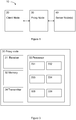
- FIG. 1 schematically illustrates an IP network 10.
- the network 10 comprises server node(s) 40 and a client node 20, e.g. a user equipment in a wireless access network.
- the network further comprises a proxy node 30 arranged between the server node(s) 40 and the client node 20 in the network 10.
- FIG. 2 illustrates a method performed in a proxy node 30 for transferring transmission control protocol, TCP, data packets in TCP flows from a plurality of server nodes 40 to a client node 20.
- the proxy node 30 captures all TCP data packets of the TCP flows, buffers the captured TCP data packets in a TCP stack and updates an active TCP flow list in a subscriber record representing the client node.
- the disclosed per-client scheduling routine is used whenever TCP data packets would normally be sent for a TCP flow to the receiving client.
- a current proxy scheduling capacity is estimated from a current maximum amount of data allowed concurrently in transmission in one or more TCP flows to the client node.
- the capacity is estimated as bytes in flight toward the client, i.e. the actual amount of bytes and not the rate of sending bytes.
- the current capacity estimate is stored in the subscriber record, e.g as a field 'max-bytes-in-flight'.
- Triggering events include any known reason to transmit a data packet to the receiving client, e.g receiving an acknowledgement of some data, opening some congestion window or receipt of some data from any of the sending servers. However, transmits caused either due to a retransmit time-out or a TCP fast retransmit do not trigger packet scheduling.
- the subscriber record contains a list of active TCP flows.
- a flow is in the active list if the proxy has currently unsent data buffered for the flow.
- the subscriber record also includes a list of passive TCP flows.
- the passive list represents TCP flows that are not in the active list.
- new data is received for a flow on the passive list, it moves to the active list, e.g. to the beginning of the active list.
- new data is received for a flow on the active list, it remains in its old position.
- all buffered data has been sent from a flow, the flow is moved to the beginning of the passive list.
- the order of the flows listed in the passive flow basically does not matter, but list may be ordered according to a time of entry on the passive flow list or with any other choice of order.
- the proxy node may also have configurable limits.
- a per-subscriber limit determines a minimum amount of bytes allowed in transmission for a specific client, 'min-subscriber-in-flight-bytes'.
- a per-flow limit determines a minimum amount of bytes allowed in transmission for a specific flow, 'min-flow-in-flight-bytes'.
- a scheduling routine comprises iterating through the active list of flows.
- transmission of a packet from the flow is enabled when the flow has fewer than a predetermined minimum amount of bytes in transmission 'min-flow-in-flight-bytes'. Furthermore the total amount of bytes in transmission toward the client should be lower than a proxy scheduling capacity, i.e. the current maximum amount of data allowed concurrently in transmission toward the client, e.g. as defined in the field 'max-bytes-in-flight'. Transmission of data is also conditioned by predetermined minimum amount of data per subscriber..
- One or more packets are transmitted for a flow if one or more of the following conditions are assessed to be true:
- the scheduled TCP data packet or data packets are transmitted in step S23.
- the active flow list is subsequently updated in step S24. If TCP data packets were transmitted for a specific flow, the flow is moved to the end of the active flow list and will be handled again at some point during the same single execution of the scheduling routine. According to an aspect of the disclosure, if no un-sent data remains buffered for the specific flow the flow is moved to a passive flow list; thus resulting in an updated passive flow list.
- the proxy node checks whether there is an odd number of TCP data packets in transmission/flight toward the client node. If so, the proxy node allows transmission of an extra packet to make sure that the client always receives a pair of packets, reducing the impact of the standard TCP delayed acknowledgement mechanism.
- step S25 Following the update of the active flow list, it is verified in step S25 that there is still unsent data buffered for one or more flows on the active flow list or that the current proxy scheduling capacity has not been reached.
- the scheduling procedure is then repeated for another flow on the active flow list, starting with the estimating S20 of a current proxy scheduling capacity.
- estimating the current proxy scheduling capacity in step S20 comprises estimating the capacity as bytes in transmission/flight toward the client, preferably as an amount of bytes.
- the estimated capacity is stored in the proxy node, preferably in a field 'max-bytes-in-flight' in a subscriber record in the proxy node.
- Each TCP data packet has an associated metadata record, which contains a 'transmit-timestamp' field containing the time when the data packets was last transmitted and a 'bytes-in-flight-when-transmitted' field including the amount of bytes towards the client when the TCP data packet was last transmitted.
- a TCP data packet is transmitted the field 'tcp-bytes-in-flight' is incremented by the size of the packet.
- delivery of the TCP data packet is acknowledged, the field 'tcp bytes in flight' is decreased by the size of the packet.
- the field 'tcp bytes in flight' is also decremented by the size of the packet, when the TCP data packet is considered lost, e.g. due to a retransmit time-out. Control packets, e.g. TCP acknowledgements, do not affect the capacity estimate.
- the estimating of a current proxy scheduling capacity also includes determining S20a a roundtrip time for one or more transmitted TCP data packets.
- the estimated current proxy scheduling capacity is adjusted S20b based on the determined roundtrip and the amount of data in transmission when transmitting the one or more TCP data packets, i.e. bytes in flight toward the client and/or one or more predetermined adjustment factors.
- estimated current proxy scheduling capacity is adjusted based on the 'bytes-in-flight-when-transmitted' field and a speedup factor C1, of e.g 1.2 or any other speedup factor suitable for the purpose of improving latency in TCP data transmission.
- the estimated current proxy scheduling capacity is adjusted based on the 'bytes-in-flight-when-transmitted' field and by a slowdown factor C2, e.g. of 0.9 or any other value suitable for maintaining an acceptable latency during TCP data transmission from the server nodes to the client nodes.
- a slowdown factor C2 e.g. of 0.9 or any other value suitable for maintaining an acceptable latency during TCP data transmission from the server nodes to the client nodes.
- a known failure mode of modern cellular connections are intermittent connection freezes, where no data gets delivered for several tenths of a second or even full seconds, after which many packets arrive packed together. These events does not signal latency, but are caused by random radio events. As such, they should be ignored when computing capacity estimates.
- an aspect of the disclosed method for transferring TCP data packets comprises storing the determined roundtrip time as a previous roundtrip time, previous-rtt.
- the proxy scheduling capacity is maintained. Consequently, a long roundtrip time is only taken as evidence of queuing if the previous packet also exceeds the threshold and the previous packet had a lower roundtrip time than the current.
- the value of previous-rtt is updated to the roundtrip time determined for the handled TCP data packet.
- the proxy node is capable of scheduling TCP packet data and lacks awareness of other IP traffic flowing from the one or more server nodes, e.g user datagram protocol, UDP, traffic. However, the proxy node is configured to capture and forward captured UDP data packets as well as TCP packets. Since UDP doesn't have a protocol level acknowledgement system, the proxy node is incapable of determining if the UDP data was actually delivered. When the volume of UDP data is significant and varies over time, latency measurements only relating to TCP data packets may be skewed. This is particularly problematic for latency-sensitive applications such as games and video-conferencing that often use UDP instead of TCP.
- UDP user datagram protocol
- the method when the proxy node is configured to capture and forward user datagram protocol, UDP, data packets, the method further comprising interleaving the UDP data packets with the TCP data packets during the step of scheduling S22, transmitting the data packets and estimating current proxy scheduling capacity based on the combination of TCP and UDP data packets.
- TCP packet A Assume that the following packets are sent by the proxy toward the client, TCP packet A, interleaved UDP packet B and TCP packet C. Acknowledgement of packet A is taken to contain no information about the status of B. Acknowledgement of TCP packet C is taken to imply delivery of the UDP packet B as well. The presumption is only used for getting a more accurate estimate of the amount of data that is actually in flight, but the presumed delivery of UDP packets is not used as a trigger to adjust the capacity estimate.
- UDP-handling solution uses a subscriber record with two 64 bit unsigned integer fields, in the following denominated as 'udp-global-seqnr-sent' and 'udp-global-seqnr-acked'.
- Each segment record i.e., metadata associated with the TCP packet, contains the field 'udp-global-seqnr-when-sent.
- the proxy node captures a non-TCP packet sent to the client, the content of the field 'udp-global-seqnr-sent' is incremented by the size of the packet.
- the segment's field 'udp-global-seqnr-when-sent' is set to the value of the subscriber record field 'udp-global-seqnr-sent'.
- the amount of bytes in transmission will be determined including an assessment of the UDP bytes as well as the TCP bytes in transmission.
- the value of the field 'tcp-bytes-in-flight-when transmitted' will be set to 'tcp bytes-in-flight' +('udp-global-seqnr-sent' - 'udp-global-seqnr-acked').
- the 'udp-global-seqnr-acked' is set to max('udp-global-seqnr-sent, udp-global-seqnr-when-sent).
- the buffer-bloat compensating proxy node and the disclosed method is beneficial in any type of network environment suffering from latency of TCP/IP data transmission, but particularly so in a wireless network environment.
- the client node is a wireless device capable of receiving TCP data packets over a plurality of radio access technologies, e.g. HSPA, UMTS, GPRS or Wi-Fi.
- FIG. 3 schematically discloses a proxy node 30 for transferring transmission control protocol, TCP, data packets in TCP flows from a plurality of server nodes (40) to a client node (20).
- the proxy node comprises a receiver 31 configured to receive TCP data packets destined for the client node.
- a memory 32 in the proxy node is configured to store the received TCP data packets and to update an active TCP flow list in a subscriber record representing the client node.
- the memory may include a buffering TCP stack.
- the proxy node also includes a processor 33 configured to schedule TCP flow for transmission based on an order given by the TCP active flow list for the subscriber upon receipt of a TCP data packet transmission triggering event.
- the processor is further configured to initiate transmission of one or more TCP data packets from the scheduled TCP flow.
- a transmitter 34 is configured to transmit the TCP data packet to a receiving client node.
- the processor is configured to update the active flow list and to repeat the step of scheduling a TCP flow for transmission until the current proxy scheduling capacity has been reached or there are no TCP flows in the active flow list.
- the processor 33 of the proxy node includes a capacity estimating entity 331 configured to estimate a current proxy scheduling capacity from a current maximum amount of data allowed concurrently in transmission in one or more TCP flows to the client node; and a packet scheduling entity 332 configured to schedule a TCP data packet of a TCP flow according to the estimated current proxy scheduling capacity and an order given by the active flow list.
- the processor also comprises a packet size determining entity 333 configured to determine a amount data delivered to the client node; and a roundtrip determination entity (334) configured to determine a roundtrip time for one or more transmitted TCP data packets.
- the roundtrip determination entity 334 may also be configured to configured to compare a roundtrip time to a predetermined roundtrip time threshold, to store the roundtrip time as a previous roundtrip time when exceeding the predetermined roundtrip time threshold, to compare a current roundtrip time to the previous roundtrip time and to instruct the packet scheduling entity to maintain the proxy scheduling capacity when the previous roundtrip time is greater than the current round-trip time and current roundtrip time exceeds the predetermined roundtrip time threshold.
- the processor may also include a per-subscriber limiter 335 configured to adjust the scheduling to a pre-configured per-subscriber limit set for the client node and/or a per-flow limiter 336 configured to adjust the scheduling to a preconfigured per-flow limit.
- a per-subscriber limiter 335 configured to adjust the scheduling to a pre-configured per-subscriber limit set for the client node
- a per-flow limiter 336 configured to adjust the scheduling to a preconfigured per-flow limit.
- the receiver (31), is further configured to store receive user datagram protocol, UDP, data packets and the packet scheduling entity 332 of the processor 32 is further configured to schedule UDP packets interleaved with the TCP data packets.
- the disclosure also relates to a computer program comprising computer program code which, when executed in a proxy node 30 causes the proxy node 30 to execute the disclosed method.
- the disclosed entities 331-336 of the processor are implemented in hardware or in software or in a combination thereof.
- the entities are according to one aspect implemented as a computer program stored in the memory 32 which run on the processor 33.
- the proxy node 30 is further configured to implement all the aspects of the disclosure as described in relation to the methods above and it also comprises the corresponding entities.
- the disclosure further relates to the above mentioned computer program, comprising computer readable code which, when run on a proxy node causes the proxy node to perform any of the aspects of the method described above.
Landscapes
- Engineering & Computer Science (AREA)
- Computer Networks & Wireless Communication (AREA)
- Signal Processing (AREA)
- Computer Security & Cryptography (AREA)
- Data Exchanges In Wide-Area Networks (AREA)
- Mobile Radio Communication Systems (AREA)
Description
- The present disclosure relates to a method and device for transferring TCP data packets from a plurality of server nodes to a client node. In particular, the disclosure relates to a method and a device for reducing latency of TCP data packet transmission in a wireless network environment.
- TCP short for Transmission Control Protocol is the most dominant protocol used in computer networking and on the Internet. In TCP network congestion is generally indicated by packet loss - overloaded network nodes will drop packets, which will signal the TCP sender to slow down the connection.
- In modern cellular networks the final cellular link uses aggressive error correction and retransmission to hide any radio problems from the TCP layer. The TCP congestion avoidance algorithm relies on packet drops to determine the bandwidth available. It speeds up the data transfer until packets start to drop, then slows down the connection. Ideally it speeds up and slows down until it finds equilibrium equal to the speed of the link. However, for this to work the packet drops must occur in a timely manner, so that the algorithm can select a suitable transfer speed.
- For TCP connections with a large congestion window, this also implies buffering relatively large amounts of data for a connection in the nodeB; buffering up to 30s of data has been observed. With a large buffer that has been filled, the packets will arrive at their destination, but with a higher latency. This buffering directly causes long round trip times, in an effect known as buffer bloat. Since there is no packet loss on the link, just delays, standard TCP algorithms will never slow down the connection and the buffers just keep on growing. Newly arriving packets are dropped only when the buffer is fully saturated. This effect is particularly problematic for an internet connection being shared by multiple users, e.g. where one or more users are doing a large batch transfers while others are trying to use the connection interactively. In a first-in first-out queuing system, larger buffers result in longer queues and higher latency, but do not improve network throughput and may reduce throughput to zero.
- Thus, it is a problem with prior art solutions that the TCP/IP protocol continues to send more and more data without waiting for any of that data to be acknowledged until either the TCP receiver's buffer is full, or some packets are dropped by the network. As a result it is common for large numbers of packets to be queued up in the network towards a TCP end point. This queue then causes problems for interactive TCP/IP traffic running towards the same host. Interactive service packets are queued for sometimes many seconds.
-
WO 2011/079381 A1 discloses a method for increasing the performance of TCP sessions. - The invention is defined by claims 1, 9 and 15.
- The described invention solves the buffer bloat problem by inserting a transparent TCP proxy between the client node and the server nodes, and by actively managing the volume of outstanding data for each flow going to the client node TCP flows going to a client node to ensure that no single TCP flow.
- This is achieved by the disclosed method in a proxy node for transferring transmission control protocol, TCP, data packets in TCP flows from a plurality of server nodes to a client node. The proxy node captures all TCP data packets of the TCP flows, buffers the captured TCP data packets and updates an active TCP flow list in a subscriber record representing the client node. The method for transferring the TCP data packets comprises estimating a current proxy scheduling capacity from a current maximum amount of data allowed concurrently in transmission in one or more TCP flows to the client node. When a TCP data packet transmission triggering event is received, a TCP data packet data packet retrieved from the TCP stack is scheduled in accordance with the estimated current proxy scheduling capacity and order given by the TCP active flow list for the subscriber. One or more TCO data packets from the scheduled flow is transmitted to the client node. Following transmission, the active flow list is updated. Scheduling a TCP flow for transmission is then repeated until the current proxy scheduling capacity has been reached or there are no TCP flows in the active flow list.
- The disclosed method provides an advantageous solution for reducing latency of TCP/IP data transmission and alleviates the buffer bloat problem. It is an advantage of the disclosed method that it is performed in an intermediary proxy node that decouples the connection from the plurality of server nodes to the client node. Furthermore, performing the method in a central location requires no update in the transmitting server nodes nor in the receiving client node. Estimating the capacity by means of a current maximum amount of data allowed concurrently in transmission for active flows, is particularly advantageous for a client node that switches from slower transmission technology to a fast transmission technology, for example from HSPA+ to UMTS.
- In accordance with an aspect of the disclosure, the estimating of a current proxy scheduling capacity further includes determining a roundtrip time for one or more transmitted TCP data packets; and adjusting the estimated current proxy scheduling capacity based on the roundtrip time, the amount of data in transmission at the time of transmission of the one or more TCP data packets, and/or one or more predetermined adjustment factors.
- In accordance with a further aspect of the disclosure, the step of adjusting the estimated current proxy scheduling capacity comprises applying a speed-up or slow-down factor. The use of predetermined speed-up or slow-down factors provides an enhanced configurability of latency reducing solution.
- In accordance with a further aspect of the disclosure, the method further comprises storing the determined roundtrip time as a previous roundtrip time when exceeding a predetermined roundtrip time threshold. The current roundtrip time is compared to the previous roundtrip time. When the previous roundtrip time is greater than the current round-trip time and current roundtrip time exceeds the predetermined roundtrip time threshold, the proxy scheduling capacity is maintained.
- The step of storing a previous roundtrip time and comparing the current roundtrip time to the previous during estimation of proxy scheduling capacity, provides the advantage of compensating for effect of network freezes, e.g. cellular network freezes.
- In accordance with yet an aspect of the disclosure, the proxy node is configured to capture user datagram protocol, UDP, data packets and forward the captured UDP data packets. When the proxy node handles UDP data packets, the method further comprising interleaving the UDP data packets with the TCP data packets during the step of scheduling. A data stream comprising the interleaved TCP and UDP packets is inspected and an amount of remaining UDP data packets is determined from the delivery information. The determined amount is used to improve the scheduling.
- The interleaved handling of TCP and UDP data packets enables an improved handling of latency sensitive applications such as games and video-conferencing that often use UDP instead of TCP.
- In accordance with a further embodiment, the disclosure relates to a proxy node for transferring transmission control protocol, TCP, data packets in TCP flows from a plurality of server nodes to a client node. The proxy node comprises a receiver configured to receive TCP data packets destined for the client node. A memory of the proxy node is configured to store the received TCP data packets and to update an active TCP flow list in a subscriber record representing the client node. The proxy node also includes a processor configured to schedule a TCP data packet of a TCP flow based on an order given by the TCP active flow list for the subscriber, initiate transmission of one or more TCP data packets from the scheduled flow, update the active flow list and repeat the step of scheduling a TCP flow for transmission until the current proxy scheduling capacity has been reached or there are no TCP flows in the active flow list. The proxy node also comprises a transmitter configured to transmit the TCP data packet.
- The proxy node displays advantages corresponding to the advantages already described in relation to the method.
- In accordance with a further embodiment, the disclosure also relates to a computer program comprising computer program code which, when executed in a proxy node causes the proxy node to execute the disclosed method.
- With the above in mind, the object of the present disclosure is to overcome at least some of the disadvantages of known technology as described above and below.
- The present technique will be more readily understood through the study of the following detailed description of the embodiments/aspects together with the accompanying drawings, of which:
- Figure 1
- schematically illustrates a schematic network configuration including the proxy node
- Figure 2
- schematically illustrates a flow chart of method steps according to embodiments of the disclosure
- Figure 3
- schematically illustrates a block diagram of a proxy node.
- The general object or idea of embodiments of the present disclosure is to address at least one or some of the disadvantages with the prior art solutions described above as well as below. The various steps described below in connection with the figures should be primarily understood in a logical sense, while each step may involve the communication of one or more specific messages depending on the implementation and protocols used.
- The general idea of the disclosure is to improve the perceived latency of a destination node communicating with multiple source nodes in an IP network, in particular in an IP network where the destination node is a wireless device. Embodiments of the present disclosure relate, in general, to the field of TCP packets. However, it must be understood that the same principles are applicable for other types of packets, e.g encapsulated packets in a radio network.
- The technical solution involves a performance enhancing proxy implementing a transparent store-and-forward TCP policy and taking over the end-to-end responsibility for delivery of TCP data packets. The proxy responds directly to TCP data packets by sending a synthesized ACK packet to the sender. It stores the data packet, and eventually forwards it to the recipient. If a TCP retransmission of a data packet is required, it will be done by the proxy.
-
Figure 1 schematically illustrates anIP network 10. Thenetwork 10 comprises server node(s) 40 and aclient node 20, e.g. a user equipment in a wireless access network. The network further comprises aproxy node 30 arranged between the server node(s) 40 and theclient node 20 in thenetwork 10. -
Figure 2 illustrates a method performed in aproxy node 30 for transferring transmission control protocol, TCP, data packets in TCP flows from a plurality ofserver nodes 40 to aclient node 20. Theproxy node 30 captures all TCP data packets of the TCP flows, buffers the captured TCP data packets in a TCP stack and updates an active TCP flow list in a subscriber record representing the client node. The disclosed per-client scheduling routine is used whenever TCP data packets would normally be sent for a TCP flow to the receiving client. - In a first step S20 performed in the
proxy node 30, a current proxy scheduling capacity is estimated from a current maximum amount of data allowed concurrently in transmission in one or more TCP flows to the client node. The capacity is estimated as bytes in flight toward the client, i.e. the actual amount of bytes and not the rate of sending bytes. The current capacity estimate is stored in the subscriber record, e.g as a field 'max-bytes-in-flight'. - When a TCP data packet transmission triggering event is received S21, scheduling S22 of a TCP data packet retrieved from the TCP stack is performed in accordance with the estimated current proxy scheduling capacity and order given by the active flow list; Triggering events include any known reason to transmit a data packet to the receiving client, e.g receiving an acknowledgement of some data, opening some congestion window or receipt of some data from any of the sending servers. However, transmits caused either due to a retransmit time-out or a TCP fast retransmit do not trigger packet scheduling.
- The subscriber record contains a list of active TCP flows. A flow is in the active list if the proxy has currently unsent data buffered for the flow. In accordance with an aspect of the disclosure, the subscriber record also includes a list of passive TCP flows. The passive list represents TCP flows that are not in the active list. When new data is received for a flow on the passive list, it moves to the active list, e.g. to the beginning of the active list. When new data is received for a flow on the active list, it remains in its old position. When all buffered data has been sent from a flow, the flow is moved to the beginning of the passive list. The order of the flows listed in the passive flow basically does not matter, but list may be ordered according to a time of entry on the passive flow list or with any other choice of order.
- In addition to the estimated current proxy scheduling capacity, the proxy node may also have configurable limits. A per-subscriber limit determines a minimum amount of bytes allowed in transmission for a specific client, 'min-subscriber-in-flight-bytes'. A per-flow limit determines a minimum amount of bytes allowed in transmission for a specific flow, 'min-flow-in-flight-bytes'.
- According to an aspect of the disclosure, a scheduling routine comprises iterating through the active list of flows.
- For each flow, transmission of a packet from the flow is enabled when the flow has fewer than a predetermined minimum amount of bytes in transmission 'min-flow-in-flight-bytes'. Furthermore the total amount of bytes in transmission toward the client should be lower than a proxy scheduling capacity, i.e. the current maximum amount of data allowed concurrently in transmission toward the client, e.g. as defined in the field 'max-bytes-in-flight'. Transmission of data is also conditioned by predetermined minimum amount of data per subscriber..
- One or more packets are transmitted for a flow if one or more of the following conditions are assessed to be true:
- There are currently fewer than a min-flow-in-flight bytes in flight toward the TCP flow.
- The current total amount of bytes in flight toward the client is lower than the proxy scheduling capacity
- The current total amount of bytes in flight toward the client is lower than a min-subscriber-in-flight bytes.
- If no data was transmitted for the flow, the assessment is repeated for the next flow in the active flow list.
- Following performance of the scheduling routine for a flow, the scheduled TCP data packet or data packets are transmitted in step S23. The active flow list is subsequently updated in step S24. If TCP data packets were transmitted for a specific flow, the flow is moved to the end of the active flow list and will be handled again at some point during the same single execution of the scheduling routine. According to an aspect of the disclosure, if no un-sent data remains buffered for the specific flow the flow is moved to a passive flow list; thus resulting in an updated passive flow list.
- Advantageously, any time a packet is transmitted, the proxy node checks whether there is an odd number of TCP data packets in transmission/flight toward the client node. If so, the proxy node allows transmission of an extra packet to make sure that the client always receives a pair of packets, reducing the impact of the standard TCP delayed acknowledgement mechanism.
- Following the update of the active flow list, it is verified in step S25 that there is still unsent data buffered for one or more flows on the active flow list or that the current proxy scheduling capacity has not been reached. The scheduling procedure is then repeated for another flow on the active flow list, starting with the estimating S20 of a current proxy scheduling capacity.
- As mentioned above, estimating the current proxy scheduling capacity in step S20 comprises estimating the capacity as bytes in transmission/flight toward the client, preferably as an amount of bytes. In accordance with an aspect of the disclosure, the estimated capacity is stored in the proxy node, preferably in a field 'max-bytes-in-flight' in a subscriber record in the proxy node.
- Each TCP data packet has an associated metadata record, which contains a 'transmit-timestamp' field containing the time when the data packets was last transmitted and a 'bytes-in-flight-when-transmitted' field including the amount of bytes towards the client when the TCP data packet was last transmitted. When a TCP data packet is transmitted the field 'tcp-bytes-in-flight' is incremented by the size of the packet. When delivery of the TCP data packet is acknowledged, the field 'tcp bytes in flight' is decreased by the size of the packet. The field 'tcp bytes in flight' is also decremented by the size of the packet, when the TCP data packet is considered lost, e.g. due to a retransmit time-out. Control packets, e.g. TCP acknowledgements, do not affect the capacity estimate.
- As further illustrated in
Figure 2 , the estimating of a current proxy scheduling capacity also includes determining S20a a roundtrip time for one or more transmitted TCP data packets. The estimated current proxy scheduling capacity is adjusted S20b based on the determined roundtrip and the amount of data in transmission when transmitting the one or more TCP data packets, i.e. bytes in flight toward the client and/or one or more predetermined adjustment factors. - When the roundtrip time is below a minimum threshold for roundtrip times, rtt-min, estimated current proxy scheduling capacity is adjusted based on the 'bytes-in-flight-when-transmitted' field and a speedup factor C1, of e.g 1.2 or any other speedup factor suitable for the purpose of improving latency in TCP data transmission.
   - If rtt<rtt-min
       max-bytes-in-flight = max(max-bytes-in-flight, bytes-in-flight-when-
       transmitted*C1)
where max-bytes-in-flight is the estimate of a current proxy scheduling capacity, bytes-in-flight-when-transmitted is the amount of bytes in flight toward the client when the delivered packet was originally transmitted and C1 is a speed-up factor.
   - If rtt>rtt-max
       max-bytes-in-flight = min(max-bytes-in-flight, bytes-in-flight-when-
       transmitted*C2)
where max-bytes-in-flight is the estimate of a current proxy scheduling capacity, bytes-in-flight-when-transmitted is the amount of bytes in flight toward the client when the delivered packet was originally transmitted and C2 is a slow-down factor.
Claims (15)
- Method performed in a proxy node (30) for transferring transmission control protocol, TCP, data packets in TCP flows from a plurality of server nodes (40) to a client node (20), wherein the proxy node captures the TCP data packets of the TCP flows, buffers the captured TCP data packets and updates a TCP active flow list in a subscriber record representing the client node, wherein a TCP flow is in the TCP active flow list if there are unsent TCP data packets buffered for the TCP flow, the method comprising:estimating (S20) a current proxy scheduling capacity from a current maximum total data amount allowed concurrently in transmission in one or more of the TCP flows to the client node;until the current proxy scheduling capacity has been reached or there are no TCP flows in the TCP active flow list, scheduling (S22) a TCP flow in the TCP active flow list for transmission when a TCP data packet transmission triggering event is received (S21), the scheduling based on an order given by the TCP active flow list;transmitting (S23) one or more of the buffered TCP data packets from the scheduled TCP flow to the client node;updating (S24) the TCP active flow list; andrepeating the step of scheduling (S22) a TCP flow for transmission.
- The method of claim 1, wherein the estimating of a current proxy scheduling capacity further includes:determining (S20a) a roundtrip time for one or more transmitted TCP data packets; andadjusting (S20b) the estimated current proxy scheduling capacity based on the roundtrip time, the data amount in transmission when transmitting the one or more TCP data packets, and/or one or more predetermined adjustment factors.
- The method of any of the preceding claims, wherein the client node is a wireless device capable of receiving TCP data packets over a plurality of radio access technologies, e.g. HSPA, UMTS, GPRS or Wi-Fi.
- The method of any of the preceding claims, further comprising storing the determined roundtrip time as a previous roundtrip time when exceeding a predetermined roundtrip time threshold, comparing a current roundtrip time to the previous roundtrip time and maintaining a proxy scheduling capacity when the previous roundtrip time is greater than the current round-trip time and the current roundtrip time exceeds the predetermined roundtrip time threshold.
- The method of any of the preceding claims, wherein the subscriber record contains a list of active TCP flows and a list of passive TCP flows, wherein a flow is in the list of active TCP flows if there is unsent TCP data packets buffered for the flow and in the passive list if there are no unsent TCP data packets buffered for the flow and wherein a flow is moved from the list of passive TCP flows to the list of active TCP flows when one or more TCP packets are received from the server nodes and when a flow is moved to the list of passive TCP flows when all buffered TCP data packets for a flow has been transmitted to the client node.
- The method of any of the preceding claims, wherein the step of transmitting (S23) TCP data packets further includes allowing transmission of a scheduled TCP flow, when the data amount in transmission is below to a pre-configured per-subscriber limit set for the client node.
- The method of any of the preceding claims, wherein the step of transmitting (S23) TCP data packets further includes allowing transmission of a scheduled TCP flow, when the data amount in transmission is below a pre-configured per-flow limit.
- The method of any of the preceding claims, wherein the proxy node is configured to capture user datagram protocol, UDP, data packets and forward the captured UDP data packets, the method further comprising interleaving the UDP data packets with the TCP data packets during the step of scheduling (S22), inspecting a data stream comprising the interleaved TCP and UDP data packets, determining an amount of remaining UDP data packets from the delivery information and using the determined amount to improve the scheduling.
- A proxy node (30) for transferring transmission control protocol, TCP, data packets in TCP flows from a plurality of server nodes (40) to a client node (20); the proxy node comprising:a receiver (31) configured to receive the TCP data packets destined for the client node;a memory (32) configured to store the received TCP data packets and to update a TCP active flow list in a subscriber record representing the client node, wherein a TCP flow is in the TCP active flow list if there are unsent TCP data packets buffered for the TCP flow;a processor (33) configured to:estimate a current proxy scheduling capacity from a current maximum total data amount allowed concurrently in transmission in one or more of the TCP flows to the client node;until the current proxy scheduling capacity has been reached or there are no TCP flows in the TCP active flow list, schedule a TCP flow in the TCP active flow list for transmission when a TCP data packet transmission triggering event is received, the scheduling based on an order given by the TCP active flow list for the subscriber;initiate transmission of one or more of the stored TCP data packets from the scheduled TCP flow to the client node;update the TCP active flow list; andrepeat the step of scheduling a TCP flow for transmission.
- The proxy node (30) of claim 9, wherein the processor further is configured to:determine a roundtrip time for one or more transmitted TCP data packets; andadjust the estimated current proxy scheduling capacity based on the roundtrip time, the data amount in transmission when transmitting the one or more TCP data packets, and/or one or more predetermined adjustment factors.
- The proxy node (30) of claim 9 or 10, wherein the processor is further configured to:
allow transmission of a scheduled TCP flow, when the data amount in transmission is below to a pre-configured per-subscriber limit set for the client node. - The proxy node (30) of any of claims 9-11, wherein the processor is further configured to:
allow transmission of a scheduled TCP flow, when the data amount in transmission is below a pre-configured per-flow limit. - The proxy node (30) of any of claims 9-12, wherein the processor is further configured to compare a roundtrip time to a predetermined roundtrip time threshold, to store the roundtrip time as a previous roundtrip time when exceeding the predetermined roundtrip time threshold, to compare a current roundtrip time to the previous roundtrip time and to instruct the packet scheduling entity to maintain the proxy scheduling capacity when the previous roundtrip time is greater than the current round-trip time and current roundtrip time exceeds the predetermined roundtrip time threshold.
- The proxy node (30) of any of claims 9-13, wherein the receiver (31), is further configured to store received user datagram protocol, UDP, data packets, the memory (32) is further configured to store UDP data packets, and the processor (33) is further configured to interleave the UDP data packets with the TCP data packets during the step of scheduling, inspect a data stream comprising the interleaved TCP and UDP data packets, determine an amount of remaining UPD data packets from the delivery information and use the determined amount to improve the scheduling.
- A computer program comprising computer program code which, when executed in a proxy node (30) causes the proxy node (30) to execute the method claimed in any of claims 1-8.
Applications Claiming Priority (1)
| Application Number | Priority Date | Filing Date | Title |
|---|---|---|---|
| PCT/EP2014/053319 WO2015124187A1 (en) | 2014-02-20 | 2014-02-20 | Buffer bloat control |
Publications (2)
| Publication Number | Publication Date |
|---|---|
| EP3108631A1 EP3108631A1 (en) | 2016-12-28 |
| EP3108631B1 true EP3108631B1 (en) | 2020-01-01 |
Family
ID=50156758
Family Applications (1)
| Application Number | Title | Priority Date | Filing Date |
|---|---|---|---|
| EP14706016.4A Active EP3108631B1 (en) | 2014-02-20 | 2014-02-20 | Buffer bloat control |
Country Status (4)
| Country | Link |
|---|---|
| US (1) | US10063489B2 (en) |
| EP (1) | EP3108631B1 (en) |
| CA (1) | CA2940077C (en) |
| WO (1) | WO2015124187A1 (en) |
Families Citing this family (4)
| Publication number | Priority date | Publication date | Assignee | Title |
|---|---|---|---|---|
| US10154431B2 (en) * | 2016-09-27 | 2018-12-11 | Verizon Patent And Licensing Inc. | Congestion mitigation based on user device and base station condition information |
| WO2019004013A1 (en) | 2017-06-26 | 2019-01-03 | 日本電気株式会社 | Data transmission device, method and recording medium |
| US11050650B1 (en) * | 2019-05-23 | 2021-06-29 | Juniper Networks, Inc. | Preventing traffic outages during address resolution protocol (ARP) storms |
| US12470492B2 (en) | 2022-09-14 | 2025-11-11 | Fortra, Llc | Data communication with transmission rate adjustment |
Family Cites Families (14)
| Publication number | Priority date | Publication date | Assignee | Title |
|---|---|---|---|---|
| DE60236691D1 (en) * | 2002-04-19 | 2010-07-22 | Ericsson Telefon Ab L M | METHOD AND DEVICES FOR ADAPTIVE PROXY-PROCESSING OF RIVERS |
| US20030212739A1 (en) * | 2002-05-09 | 2003-11-13 | Antoine Boucher | Store and forward architecture |
| US7418494B2 (en) | 2002-07-25 | 2008-08-26 | Intellectual Ventures Holding 40 Llc | Method and system for background replication of data objects |
| US7161947B1 (en) * | 2002-07-30 | 2007-01-09 | Cisco Technology, Inc. | Methods and apparatus for intercepting control and data connections |
| US8270423B2 (en) | 2003-07-29 | 2012-09-18 | Citrix Systems, Inc. | Systems and methods of using packet boundaries for reduction in timeout prevention |
| US8437284B2 (en) | 2003-07-29 | 2013-05-07 | Citrix Systems, Inc. | Systems and methods for additional retransmissions of dropped packets |
| US20070008884A1 (en) * | 2003-10-08 | 2007-01-11 | Bob Tang | Immediate ready implementation of virtually congestion free guarantedd service capable network |
| US7760642B2 (en) | 2007-03-12 | 2010-07-20 | Citrix Systems, Inc. | Systems and methods for providing quality of service precedence in TCP congestion control |
| US7706266B2 (en) | 2007-03-12 | 2010-04-27 | Citrix Systems, Inc. | Systems and methods of providing proxy-based quality of service |
| WO2010042578A1 (en) | 2008-10-08 | 2010-04-15 | Citrix Systems, Inc. | Systems and methods for real-time endpoint application flow control with network structure component |
| US20120327779A1 (en) | 2009-06-12 | 2012-12-27 | Cygnus Broadband, Inc. | Systems and methods for congestion detection for use in prioritizing and scheduling packets in a communication network |
| CA2785842A1 (en) | 2009-12-31 | 2011-07-07 | Bce Inc. | Method and system for increasing performance of transmission control protocol sessions in data networks |
| WO2011143094A2 (en) | 2010-05-09 | 2011-11-17 | Citrix Systems, Inc. | Systems and methods for allocation of classes of service to network connections corresponding to virtual channels |
| US8433783B2 (en) | 2010-09-29 | 2013-04-30 | Citrix Systems, Inc. | Systems and methods for providing quality of service via a flow controlled tunnel |
-
2014
- 2014-02-20 EP EP14706016.4A patent/EP3108631B1/en active Active
- 2014-02-20 WO PCT/EP2014/053319 patent/WO2015124187A1/en not_active Ceased
- 2014-02-20 US US15/120,503 patent/US10063489B2/en active Active
- 2014-02-20 CA CA2940077A patent/CA2940077C/en active Active
Non-Patent Citations (1)
| Title |
|---|
| None * |
Also Published As
| Publication number | Publication date |
|---|---|
| CA2940077A1 (en) | 2015-08-27 |
| US20170070442A1 (en) | 2017-03-09 |
| US10063489B2 (en) | 2018-08-28 |
| CA2940077C (en) | 2022-05-31 |
| EP3108631A1 (en) | 2016-12-28 |
| WO2015124187A1 (en) | 2015-08-27 |
Similar Documents
| Publication | Publication Date | Title |
|---|---|---|
| EP2887595B1 (en) | Method and node for retransmitting data packets in a tcp connection | |
| EP2540042B1 (en) | Communication transport optimized for data center environment | |
| CN110661723B (en) | Data transmission method, computing device, network device and data transmission system | |
| US9467390B2 (en) | Method and device for data transmission | |
| CN109120544B (en) | A transmission control method based on host-side traffic scheduling in a data center network | |
| US6535482B1 (en) | Congestion notification from router | |
| US8379515B1 (en) | TCP throughput control by imposing temporal delay | |
| US11012367B2 (en) | Technologies for managing TCP/IP packet delivery | |
| US7782758B2 (en) | Efficient loss recovery architecture for loss-decoupled TCP | |
| US8811419B2 (en) | Communication device | |
| US20060203730A1 (en) | Method and system for reducing end station latency in response to network congestion | |
| CN101971578B (en) | Tcp packet spacing | |
| US20150271081A1 (en) | Flow Aware Buffer Management for Data Center Switches | |
| CN100534069C (en) | Acceleration methods for asymmetric and multi-concurrent networks | |
| JP4924285B2 (en) | Communication apparatus, communication system, transfer efficiency improvement method, and transfer efficiency improvement program | |
| US20210273889A1 (en) | Communication control apparatus, method, program, and non-transitory computer readable recording medium | |
| CN106936730A (en) | A kind of file transmitting method, TCP agent and TCP Client | |
| CN113242183A (en) | Data stream sending control method and device, intelligent terminal and storage medium | |
| CA2940077C (en) | Buffer bloat control | |
| CN101141393B (en) | Communication terminal and communication control method | |
| KR20080023176A (en) | Communication terminal, communication control method and communication control program | |
| JP4930275B2 (en) | Communication system, communication method, transmitter, receiver, rate calculation method, and program | |
| Al-Saadi et al. | Characterising LEDBAT performance through bottlenecks using PIE, FQ-CoDel and FQ-PIE active queue management | |
| Shimonishi et al. | A congestion control algorithm for data center area communications | |
| Chan et al. | A threshold controlled TCP for data center networks |
Legal Events
| Date | Code | Title | Description |
|---|---|---|---|
| PUAI | Public reference made under article 153(3) epc to a published international application that has entered the european phase |
Free format text: ORIGINAL CODE: 0009012 |
|
| STAA | Information on the status of an ep patent application or granted ep patent |
Free format text: STATUS: REQUEST FOR EXAMINATION WAS MADE |
|
| 17P | Request for examination filed |
Effective date: 20160901 |
|
| AK | Designated contracting states |
Kind code of ref document: A1 Designated state(s): AL AT BE BG CH CY CZ DE DK EE ES FI FR GB GR HR HU IE IS IT LI LT LU LV MC MK MT NL NO PL PT RO RS SE SI SK SM TR |
|
| AX | Request for extension of the european patent |
Extension state: BA ME |
|
| DAX | Request for extension of the european patent (deleted) | ||
| GRAP | Despatch of communication of intention to grant a patent |
Free format text: ORIGINAL CODE: EPIDOSNIGR1 |
|
| STAA | Information on the status of an ep patent application or granted ep patent |
Free format text: STATUS: GRANT OF PATENT IS INTENDED |
|
| RIC1 | Information provided on ipc code assigned before grant |
Ipc: H04L 29/06 20060101AFI20190614BHEP Ipc: H04L 12/891 20130101ALI20190614BHEP Ipc: H04W 80/06 20090101ALI20190614BHEP |
|
| INTG | Intention to grant announced |
Effective date: 20190716 |
|
| GRAS | Grant fee paid |
Free format text: ORIGINAL CODE: EPIDOSNIGR3 |
|
| GRAJ | Information related to disapproval of communication of intention to grant by the applicant or resumption of examination proceedings by the epo deleted |
Free format text: ORIGINAL CODE: EPIDOSDIGR1 |
|
| GRAL | Information related to payment of fee for publishing/printing deleted |
Free format text: ORIGINAL CODE: EPIDOSDIGR3 |
|
| STAA | Information on the status of an ep patent application or granted ep patent |
Free format text: STATUS: REQUEST FOR EXAMINATION WAS MADE |
|
| GRAP | Despatch of communication of intention to grant a patent |
Free format text: ORIGINAL CODE: EPIDOSNIGR1 |
|
| STAA | Information on the status of an ep patent application or granted ep patent |
Free format text: STATUS: GRANT OF PATENT IS INTENDED |
|
| GRAA | (expected) grant |
Free format text: ORIGINAL CODE: 0009210 |
|
| STAA | Information on the status of an ep patent application or granted ep patent |
Free format text: STATUS: THE PATENT HAS BEEN GRANTED |
|
| INTC | Intention to grant announced (deleted) | ||
| INTG | Intention to grant announced |
Effective date: 20191118 |
|
| AK | Designated contracting states |
Kind code of ref document: B1 Designated state(s): AL AT BE BG CH CY CZ DE DK EE ES FI FR GB GR HR HU IE IS IT LI LT LU LV MC MK MT NL NO PL PT RO RS SE SI SK SM TR |
|
| REG | Reference to a national code |
Ref country code: GB Ref legal event code: FG4D |
|
| REG | Reference to a national code |
Ref country code: CH Ref legal event code: EP Ref country code: AT Ref legal event code: REF Ref document number: 1221242 Country of ref document: AT Kind code of ref document: T Effective date: 20200115 |
|
| REG | Reference to a national code |
Ref country code: IE Ref legal event code: FG4D |
|
| REG | Reference to a national code |
Ref country code: DE Ref legal event code: R096 Ref document number: 602014059236 Country of ref document: DE |
|
| REG | Reference to a national code |
Ref country code: NL Ref legal event code: MP Effective date: 20200101 |
|
| REG | Reference to a national code |
Ref country code: LT Ref legal event code: MG4D |
|
| PG25 | Lapsed in a contracting state [announced via postgrant information from national office to epo] |
Ref country code: FI Free format text: LAPSE BECAUSE OF FAILURE TO SUBMIT A TRANSLATION OF THE DESCRIPTION OR TO PAY THE FEE WITHIN THE PRESCRIBED TIME-LIMIT Effective date: 20200101 Ref country code: NO Free format text: LAPSE BECAUSE OF FAILURE TO SUBMIT A TRANSLATION OF THE DESCRIPTION OR TO PAY THE FEE WITHIN THE PRESCRIBED TIME-LIMIT Effective date: 20200401 Ref country code: NL Free format text: LAPSE BECAUSE OF FAILURE TO SUBMIT A TRANSLATION OF THE DESCRIPTION OR TO PAY THE FEE WITHIN THE PRESCRIBED TIME-LIMIT Effective date: 20200101 Ref country code: CZ Free format text: LAPSE BECAUSE OF FAILURE TO SUBMIT A TRANSLATION OF THE DESCRIPTION OR TO PAY THE FEE WITHIN THE PRESCRIBED TIME-LIMIT Effective date: 20200101 Ref country code: PT Free format text: LAPSE BECAUSE OF FAILURE TO SUBMIT A TRANSLATION OF THE DESCRIPTION OR TO PAY THE FEE WITHIN THE PRESCRIBED TIME-LIMIT Effective date: 20200527 Ref country code: LT Free format text: LAPSE BECAUSE OF FAILURE TO SUBMIT A TRANSLATION OF THE DESCRIPTION OR TO PAY THE FEE WITHIN THE PRESCRIBED TIME-LIMIT Effective date: 20200101 Ref country code: RS Free format text: LAPSE BECAUSE OF FAILURE TO SUBMIT A TRANSLATION OF THE DESCRIPTION OR TO PAY THE FEE WITHIN THE PRESCRIBED TIME-LIMIT Effective date: 20200101 |
|
| PG25 | Lapsed in a contracting state [announced via postgrant information from national office to epo] |
Ref country code: HR Free format text: LAPSE BECAUSE OF FAILURE TO SUBMIT A TRANSLATION OF THE DESCRIPTION OR TO PAY THE FEE WITHIN THE PRESCRIBED TIME-LIMIT Effective date: 20200101 Ref country code: GR Free format text: LAPSE BECAUSE OF FAILURE TO SUBMIT A TRANSLATION OF THE DESCRIPTION OR TO PAY THE FEE WITHIN THE PRESCRIBED TIME-LIMIT Effective date: 20200402 Ref country code: SE Free format text: LAPSE BECAUSE OF FAILURE TO SUBMIT A TRANSLATION OF THE DESCRIPTION OR TO PAY THE FEE WITHIN THE PRESCRIBED TIME-LIMIT Effective date: 20200101 Ref country code: LV Free format text: LAPSE BECAUSE OF FAILURE TO SUBMIT A TRANSLATION OF THE DESCRIPTION OR TO PAY THE FEE WITHIN THE PRESCRIBED TIME-LIMIT Effective date: 20200101 Ref country code: IS Free format text: LAPSE BECAUSE OF FAILURE TO SUBMIT A TRANSLATION OF THE DESCRIPTION OR TO PAY THE FEE WITHIN THE PRESCRIBED TIME-LIMIT Effective date: 20200501 Ref country code: BG Free format text: LAPSE BECAUSE OF FAILURE TO SUBMIT A TRANSLATION OF THE DESCRIPTION OR TO PAY THE FEE WITHIN THE PRESCRIBED TIME-LIMIT Effective date: 20200401 |
|
| REG | Reference to a national code |
Ref country code: CH Ref legal event code: PL |
|
| REG | Reference to a national code |
Ref country code: DE Ref legal event code: R097 Ref document number: 602014059236 Country of ref document: DE |
|
| REG | Reference to a national code |
Ref country code: BE Ref legal event code: MM Effective date: 20200229 |
|
| PG25 | Lapsed in a contracting state [announced via postgrant information from national office to epo] |
Ref country code: ES Free format text: LAPSE BECAUSE OF FAILURE TO SUBMIT A TRANSLATION OF THE DESCRIPTION OR TO PAY THE FEE WITHIN THE PRESCRIBED TIME-LIMIT Effective date: 20200101 Ref country code: RO Free format text: LAPSE BECAUSE OF FAILURE TO SUBMIT A TRANSLATION OF THE DESCRIPTION OR TO PAY THE FEE WITHIN THE PRESCRIBED TIME-LIMIT Effective date: 20200101 Ref country code: SM Free format text: LAPSE BECAUSE OF FAILURE TO SUBMIT A TRANSLATION OF THE DESCRIPTION OR TO PAY THE FEE WITHIN THE PRESCRIBED TIME-LIMIT Effective date: 20200101 Ref country code: EE Free format text: LAPSE BECAUSE OF FAILURE TO SUBMIT A TRANSLATION OF THE DESCRIPTION OR TO PAY THE FEE WITHIN THE PRESCRIBED TIME-LIMIT Effective date: 20200101 Ref country code: LU Free format text: LAPSE BECAUSE OF NON-PAYMENT OF DUE FEES Effective date: 20200220 Ref country code: DK Free format text: LAPSE BECAUSE OF FAILURE TO SUBMIT A TRANSLATION OF THE DESCRIPTION OR TO PAY THE FEE WITHIN THE PRESCRIBED TIME-LIMIT Effective date: 20200101 Ref country code: MC Free format text: LAPSE BECAUSE OF FAILURE TO SUBMIT A TRANSLATION OF THE DESCRIPTION OR TO PAY THE FEE WITHIN THE PRESCRIBED TIME-LIMIT Effective date: 20200101 Ref country code: SK Free format text: LAPSE BECAUSE OF FAILURE TO SUBMIT A TRANSLATION OF THE DESCRIPTION OR TO PAY THE FEE WITHIN THE PRESCRIBED TIME-LIMIT Effective date: 20200101 |
|
| PLBE | No opposition filed within time limit |
Free format text: ORIGINAL CODE: 0009261 |
|
| STAA | Information on the status of an ep patent application or granted ep patent |
Free format text: STATUS: NO OPPOSITION FILED WITHIN TIME LIMIT |
|
| REG | Reference to a national code |
Ref country code: AT Ref legal event code: MK05 Ref document number: 1221242 Country of ref document: AT Kind code of ref document: T Effective date: 20200101 |
|
| PG25 | Lapsed in a contracting state [announced via postgrant information from national office to epo] |
Ref country code: CH Free format text: LAPSE BECAUSE OF NON-PAYMENT OF DUE FEES Effective date: 20200229 Ref country code: LI Free format text: LAPSE BECAUSE OF NON-PAYMENT OF DUE FEES Effective date: 20200229 |
|
| 26N | No opposition filed |
Effective date: 20201002 |
|
| PG25 | Lapsed in a contracting state [announced via postgrant information from national office to epo] |
Ref country code: AT Free format text: LAPSE BECAUSE OF FAILURE TO SUBMIT A TRANSLATION OF THE DESCRIPTION OR TO PAY THE FEE WITHIN THE PRESCRIBED TIME-LIMIT Effective date: 20200101 Ref country code: IE Free format text: LAPSE BECAUSE OF NON-PAYMENT OF DUE FEES Effective date: 20200220 Ref country code: IT Free format text: LAPSE BECAUSE OF FAILURE TO SUBMIT A TRANSLATION OF THE DESCRIPTION OR TO PAY THE FEE WITHIN THE PRESCRIBED TIME-LIMIT Effective date: 20200101 |
|
| PG25 | Lapsed in a contracting state [announced via postgrant information from national office to epo] |
Ref country code: PL Free format text: LAPSE BECAUSE OF FAILURE TO SUBMIT A TRANSLATION OF THE DESCRIPTION OR TO PAY THE FEE WITHIN THE PRESCRIBED TIME-LIMIT Effective date: 20200101 Ref country code: BE Free format text: LAPSE BECAUSE OF NON-PAYMENT OF DUE FEES Effective date: 20200229 Ref country code: SI Free format text: LAPSE BECAUSE OF FAILURE TO SUBMIT A TRANSLATION OF THE DESCRIPTION OR TO PAY THE FEE WITHIN THE PRESCRIBED TIME-LIMIT Effective date: 20200101 |
|
| REG | Reference to a national code |
Ref country code: DE Ref legal event code: R079 Ref document number: 602014059236 Country of ref document: DE Free format text: PREVIOUS MAIN CLASS: H04L0029060000 Ipc: H04L0065000000 |
|
| PG25 | Lapsed in a contracting state [announced via postgrant information from national office to epo] |
Ref country code: TR Free format text: LAPSE BECAUSE OF FAILURE TO SUBMIT A TRANSLATION OF THE DESCRIPTION OR TO PAY THE FEE WITHIN THE PRESCRIBED TIME-LIMIT Effective date: 20200101 Ref country code: MT Free format text: LAPSE BECAUSE OF FAILURE TO SUBMIT A TRANSLATION OF THE DESCRIPTION OR TO PAY THE FEE WITHIN THE PRESCRIBED TIME-LIMIT Effective date: 20200101 Ref country code: CY Free format text: LAPSE BECAUSE OF FAILURE TO SUBMIT A TRANSLATION OF THE DESCRIPTION OR TO PAY THE FEE WITHIN THE PRESCRIBED TIME-LIMIT Effective date: 20200101 |
|
| PG25 | Lapsed in a contracting state [announced via postgrant information from national office to epo] |
Ref country code: MK Free format text: LAPSE BECAUSE OF FAILURE TO SUBMIT A TRANSLATION OF THE DESCRIPTION OR TO PAY THE FEE WITHIN THE PRESCRIBED TIME-LIMIT Effective date: 20200101 Ref country code: AL Free format text: LAPSE BECAUSE OF FAILURE TO SUBMIT A TRANSLATION OF THE DESCRIPTION OR TO PAY THE FEE WITHIN THE PRESCRIBED TIME-LIMIT Effective date: 20200101 |
|
| PGFP | Annual fee paid to national office [announced via postgrant information from national office to epo] |
Ref country code: GB Payment date: 20260227 Year of fee payment: 13 |
|
| PGFP | Annual fee paid to national office [announced via postgrant information from national office to epo] |
Ref country code: DE Payment date: 20260227 Year of fee payment: 13 |
|
| PGFP | Annual fee paid to national office [announced via postgrant information from national office to epo] |
Ref country code: FR Payment date: 20260225 Year of fee payment: 13 |