EP3107005B1 - Method and device for recovering checkpoint in copy on write based file system - Google Patents
Method and device for recovering checkpoint in copy on write based file system Download PDFInfo
- Publication number
- EP3107005B1 EP3107005B1 EP14893559.6A EP14893559A EP3107005B1 EP 3107005 B1 EP3107005 B1 EP 3107005B1 EP 14893559 A EP14893559 A EP 14893559A EP 3107005 B1 EP3107005 B1 EP 3107005B1
- Authority
- EP
- European Patent Office
- Prior art keywords
- checkpoint
- reclaim
- data blocks
- moment
- data
- Prior art date
- Legal status (The legal status is an assumption and is not a legal conclusion. Google has not performed a legal analysis and makes no representation as to the accuracy of the status listed.)
- Active
Links
Images







Classifications
-
- G—PHYSICS
- G06—COMPUTING OR CALCULATING; COUNTING
- G06F—ELECTRIC DIGITAL DATA PROCESSING
- G06F16/00—Information retrieval; Database structures therefor; File system structures therefor
- G06F16/10—File systems; File servers
- G06F16/11—File system administration, e.g. details of archiving or snapshots
- G06F16/128—Details of file system snapshots on the file-level, e.g. snapshot creation, administration, deletion
-
- G—PHYSICS
- G06—COMPUTING OR CALCULATING; COUNTING
- G06F—ELECTRIC DIGITAL DATA PROCESSING
- G06F16/00—Information retrieval; Database structures therefor; File system structures therefor
-
- G—PHYSICS
- G06—COMPUTING OR CALCULATING; COUNTING
- G06F—ELECTRIC DIGITAL DATA PROCESSING
- G06F16/00—Information retrieval; Database structures therefor; File system structures therefor
- G06F16/10—File systems; File servers
- G06F16/11—File system administration, e.g. details of archiving or snapshots
- G06F16/119—Details of migration of file systems
Definitions
- the present invention relates to the field of data processing, and in particular, to a checkpoint reclaim method and apparatus in a copy-on-write file system.
- Copy on write means that when data in a file system is to be altered, the original data is not really altered, and instead, the to-be-altered data is copied to a blank area of a magnetic disk. It can be seen that, because the original data is not damaged during a write process, data consistency can be guaranteed without write-twice penalty, and a problem of a small throughput of written data brought by the write-twice penalty is avoided. Therefore, COW file systems are applied increasingly widely.
- a COW file system every time when a checkpoint or a snapshot is generated, traversal is performed downwards from a root of the checkpoint or the snapshot to perform reference count addition. If a reference count of a data block is not greater than 1 after being added by 1, traversal continues to be performed downwards; or if a reference count of a data block is greater than 1 after being added by 1, traversal is no longer performed downwards.
- an uppermost layer including a reference tree is a super block (sb for short; English: super block), and what is referenced by a super block may be a checkpoint, a snapshot, a root area (ROOT), an index node (inode), or the like.
- FIG. 1A is a schematic reference diagram of a COW file system with a checkpoint 1 in the prior art.
- the checkpoint 1 includes eight data blocks numbered A to H. After a reference count addition traversal operation is performed on the checkpoint 1, it can be known that reference counts of the data blocks are: Data Block Number Reference Count A 1 B 1 C 1 C 1 D 1 E 1 F 1 G 1 H 1
- FIG. 1B is a schematic diagram of generating a checkpoint 2 on the basis of the checkpoint 1 in the prior art.
- the COW file system modifies a sub-block on the right of an index node 2 (that is, H is modified as L), and generates the checkpoint 2.
- H is modified as L
- reference counts of data blocks are: Data Block Number Reference Count I 1 J 1 K 1 L 1 C 2 G 2
- traversal When a checkpoint or a snapshot is to be deleted, traversal needs to be performed downwards from a root of the checkpoint or the snapshot to perform a reference count subtraction operation. If a reference count of a data block is 0 after being subtracted by 1, traversal continues to be performed downwards; or if a reference count of a data block is greater than 0 after being subtracted by 1, traversal is no longer performed downwards, where the data block whose reference count is 0 is a data block that needs to be reclaimed.
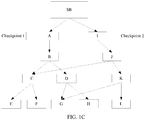
- FIG. 1C is a schematic diagram of deleting the checkpoint 1 in the prior art. As shown in FIG. 1C , after a reference count subtraction traversal operation is performed on the checkpoint 1, it can be known that reference counts of data blocks are: Data Block Number Reference Count A 0 B 0 C 1 C 1 D 0 E 1 F 1 G 1 H 0
- Embodiments of the present invention provide a checkpoint reclaim method and apparatus in a copy-on-write file system, which are used to resolve a technical problem in the prior art that a traversing scale and an amount of data that is calculated during traversal are both relatively large in a COW file system.
- a corresponding data amount is reduced when a traversal operation is performed on the data block that needs to be reclaimed in the data blocks generated between the moment of the previous checkpoint reclaim and the moment of the current checkpoint reclaim in the COW file system, and a traversing scale is reduced when the COW file system reclaims space.
- FIG. 2 is a flowchart of a checkpoint reclaim method according to an embodiment of the present invention. As shown in FIG. 2 , the method includes:
- the checkpoint reclaim method provided by this embodiment of the present invention is implemented in multiple implementation manners. In the following parts, two implementation manners are described in detail.
- FIG. 3 is a schematic diagram of data blocks reserved at a moment of a previous checkpoint reclaim in a COW file system according to an embodiment of the present invention.
- the COW file system reserves a snapshot 1 and a checkpoint 1 at the moment of the previous checkpoint reclaim.
- the snapshot 1 includes four data blocks numbered A, B, C, and D; in other words, data blocks numbered A, B, C, and D are referenced by the snapshot 1.
- the checkpoint 1 includes four data blocks numbered E, F, C, and G; in other words, four data blocks numbered E, F, C, and G are referenced by the checkpoint 1.
- An addition operation with a fixed step is performed separately on the data blocks referenced by the snapshot 1 and the checkpoint 1.
- a reference count addition traversal operation is performed and first referential reference counts at the moment of the previous checkpoint reclaim may be obtained.
- the fixed step is 1.
- all reference counts are presented in a table form, and the first referential reference counts are as follows: Table 1 Data Block Number Reference Count A 1 B 1 C 2 D 1 E 1 F 1 G 1
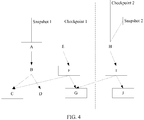
- FIG. 4 is a schematic diagram of a first-time modification of the data blocks reserved at the moment of the previous checkpoint reclaim in the COW file system according to this embodiment of the present invention.
- the data block C is modified to J.
- a checkpoint 2 is generated.
- a snapshot is taken for the checkpoint 2, and then, a snapshot 2 shown in FIG. 4 may be generated.
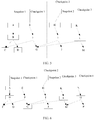
- FIG. 5 is a schematic diagram of a second-time modification of the data blocks reserved at the moment of the previous checkpoint reclaim in the COW file system according to this embodiment of the present invention.
- the data block J is modified to M.
- a checkpoint 3 is generated.
- FIG. 6 is a schematic diagram of a third-time modification of the data blocks reserved at the moment of the previous checkpoint reclaim in the COW file system according to this embodiment of the present invention.
- the data block numbered G is modified to a data block numbered P.
- a checkpoint 4 (Checkpoint 4) is generated.
- the COW file system receives a checkpoint reclaim instruction at this time.
- generation of the checkpoint reclaim instruction may be manually triggered by a user, or may be triggered by a reclaim policy of the COW file system, which is not limited herein.
- step S1 of obtaining, according to a checkpoint reclaim instruction, M data blocks allocated by the file system between a moment of a previous checkpoint reclaim and a moment of a current checkpoint reclaim where M is an integer not less than 1, and the M data blocks are data blocks allocated for at least one of a checkpoint or a snapshot generated between the moment of the previous checkpoint reclaim and the moment of the current checkpoint reclaim, specifically, the M data blocks allocated by the COW file system between the moment of the previous checkpoint reclaim and the moment of the current checkpoint reclaim may be obtained by using a data block allocation module in the COW file system.
- the data block allocation module in the COW file system allocates corresponding numbers to data blocks that are corresponding to the at least one of the checkpoint or the snapshot. It can be known from FIG. 3 to FIG. 6 that, one checkpoint or snapshot corresponds to multiple data blocks. Therefore, M is an integer not less than 1.
- allocate in this embodiment means that, when the copy-on-write file system generates a checkpoint or a snapshot and when the checkpoint or the snapshot references data blocks corresponding to an existing checkpoint or snapshot, the data blocks are also data blocks allocated for the newly generated checkpoint or snapshot.
- information that numbers of data blocks already allocated between the moment of the previous checkpoint reclaim and the moment of the current checkpoint reclaim are G to P can be obtained from the data block allocation module in the COW file system. Because consecutive data block numbers are allocated by the data block allocation module in the COW file system, the data block allocation module may record only the first data block number and the last data block number that are allocated by the COW file system between the moment of the previous checkpoint reclaim and the moment of the current checkpoint reclaim, and such record manner occupies small space.
- the COW file system generally reserves all snapshots and also reserves only a last generated checkpoint, in this embodiment, referring to FIG. 3 , FIG. 4 , FIG. 5, and FIG. 6 , the snapshot 2 and the checkpoint 4 need to be reserved. Therefore, the addition operation with the fixed step needs to be performed on reference counts of K data blocks corresponding to the snapshot 2 and the checkpoint 4, to obtain first reference counts of the K data blocks. Specifically, a reference count addition traversal operation is performed on the K data blocks corresponding to the snapshot 2 and the checkpoint 4, so as to obtain the first reference counts of the data blocks corresponding to the snapshot number and the checkpoint number.
- numbers of the data blocks allocated for the snapshot 2 and the checkpoint 4 are G, H, I, J, M, N, O, and P.
- the first reference counts of the data blocks referenced by the snapshot 2 and the checkpoint 4 can be obtained: Table 2 Data Block Number Reference Count G 1 H 1 I 1 J 1 M 1 N 1 O 1 P 1
- the numbers of the data blocks that are already allocated by the COW file system between the moment of the previous checkpoint reclaim and the moment of the current checkpoint reclaim and that are obtained in step S1 are G to P. Therefore, with reference to the first reference counts, it can be determined that numbers, of data blocks that can be reclaimed, in the numbers of the data blocks already allocated by the COW file system between the moment of the previous checkpoint reclaim and the moment of the current checkpoint reclaim are K and L (because they are referenced by neither the checkpoint 4 nor the snapshot 2 that needs to be reserved), that is, numbers of first data blocks are K and L.
- both the checkpoint and the snapshot are generated between the moment of the previous checkpoint reclaim and the moment of the current checkpoint reclaim. Therefore, according to the steps introduced in the foregoing part, the numbers of the data blocks allocated for the snapshot 2 and the checkpoint 4 are G, H, I, J, M, N, O, and P, so that the first data block that needs to be reclaimed can be determined in the data blocks of the M data blocks except the K data blocks.
- the checkpoint 3 because the checkpoint 3 needs to be reclaimed, it is determined from data blocks numbered K and L that, numbers of data blocks that need to be reclaimed are K and L.
- a first data block may be determined in data blocks of M data blocks except the K data blocks. Details are not described herein again.
- step S3 is performed: determining, in N data blocks allocated for at least one of a checkpoint or a snapshot reserved at the moment of the previous checkpoint reclaim, a second data block that needs to be reclaimed, where N is an integer not less than 1.
- step S3 may include: performing a subtraction operation with the fixed step on reference counts of L data blocks, in the N data blocks, allocated for a checkpoint reserved at the moment of the previous checkpoint reclaim, and determining current reference counts of the L data blocks, where the fixed step is 1 herein; before the first reference counts of data blocks referenced by the snapshot 2 and the checkpoint 4 are obtained, reference counts of the N data blocks are first referential reference counts; and determining the second data block in the N data blocks according to the first reference counts, the current reference counts of the L data blocks, and the first referential reference counts.
- Table 1 lists the first referential reference counts at the moment of the previous checkpoint reclaim in the COW file system.
- the subtraction operation with the fixed step may be performed on the reference counts of the L data blocks, in the N data blocks, allocated for the checkpoint reserved at the moment of the previous checkpoint reclaim, where the fixed step is 1 herein. That is, a reference count subtraction traversal operation is performed on the L data blocks corresponding to the checkpoint. For example, referring to FIG.
- the subtraction operation with the fixed step is performed on the data blocks, corresponding to the checkpoint 1, in the data blocks reserved at the moment of the previous checkpoint reclaim, that is, the reference count subtraction traversal operation is performed, to obtain second reference counts of the four data blocks, allocated for the checkpoint 1, in the N data blocks, as shown in the following table: Table 3 Data Block Number Reference Count C -1 E -1 F -1 G -1
- the second data block can be determined in the N data blocks according to the first referential reference counts (Table 1), the first reference counts (Table 2), and the second reference counts (Table 3). Specifically, the first referential reference counts, the first reference counts, and the second reference counts may be merged.
- “merging the first referential reference counts, the first reference counts, and the second counts” means merging reference counts, of a same data block, in the first referential reference counts, the first reference counts, and the second reference counts, and reserving reference counts of a different data block. Results are shown in the following table: Table 4 Data Block Number Reference Count A 1 B 1 C 1 D 1 E 0 F 0 G 1 H 1 I 1 J 1 M 1 N 1 O 1 P 1
- data blocks numbered E and F in the data blocks reserved at the moment of the previous checkpoint reclaim are data blocks that need to be reclaimed, that is, second data blocks are E and F.
- a corresponding data amount is reduced when a traversal operation is performed on the data block that needs to be reclaimed in the data blocks generated between the moment of the previous checkpoint reclaim and the moment of the current checkpoint reclaim in the COW file system, and a traversing scale is reduced when the COW file system reclaims space.
- the checkpoint reclaim method further includes: determining a reference count of a data block that needs to be reserved for the current checkpoint reclaim as a current first referential reference count according to the first reference counts of the K data blocks, the first referential reference counts of the N data blocks, and the current reference counts of the L data blocks.
- the reference count of the data block that needs to be reserved for the current checkpoint reclaim can be determined as the current first referential reference count (that is, content shown in Table 4) according to the first reference counts, the second reference counts, and the first referential reference counts, so as to be used by the COW file system for a next checkpoint reclaim. Details are not described herein again.
- step S4 is performed: reclaiming the first data block and the second data block.
- step S4 the data blocks numbered E and F are reclaimed and the data blocks numbered K and L are reclaimed; details are not described herein again.
- FIG. 7 is a schematic diagram of a COW file system that includes a cut-off root area at a moment of a previous checkpoint reclaim, a cut-off root area at a moment of a current checkpoint reclaim, and a real-time root area according to an embodiment of the present invention. As shown in FIG. 7,
- the cut-off root area at the moment of the previous checkpoint reclaim is a root area in which N data blocks are indexed
- the real-time root area is a root area in which K data blocks are indexed
- the cut-off root area at the moment of the current checkpoint reclaim is a root area in which the file system copies, when obtaining the checkpoint reclaim instruction, an indexing relationship that is in the real-time root area.
- generation and deletion of a snapshot or a checkpoint in the COW file system are implemented by means of insertion and deletion of a tree of the COW file system, where the snapshot or the checkpoint mounts a root area of the COW file system, so as to ensure that no missing occurs when space corresponding to a data block that needs to be reclaimed is reclaimed according to the tree of the COW file system.
- data in the cut-off root area at the moment of the previous checkpoint reclaim is indexes for data blocks reserved at a moment of the previous checkpoint reclaim in the COW file system. Because there is only a checkpoint at the moment of the previous checkpoint reclaim in the COW file system, numbers of data blocks referenced by the reserved checkpoint include A, B, C, D, E, F, and G. In this embodiment, that data in the real-time root area is indexes for data blocks allocated for a newly generated checkpoint by the COW file system after the moment of the previous checkpoint reclaim is used as an example.
- FIG. 8 is a schematic diagram of the COW file system at a moment of the current checkpoint reclaim according to this embodiment of the present invention. As shown in FIG.
- the COW file system undergoes some transactions and generates another checkpoint at the moment of the current checkpoint reclaim, where numbers of data blocks allocated for the newly generated checkpoint are B, C, D, F, G, and I, and an index for the data block numbered I is in the real-time root area.
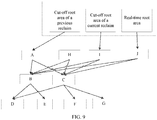
- FIG. 9 is a schematic diagram of the COW file system after receiving a checkpoint reclaim instruction according to this embodiment of the present invention.
- the COW file system copies data in the real-time root area shown in FIG. 8 to the cut-off root area of the current checkpoint reclaim.
- the data in the real-time root area refers to the index for the data block numbered I and indexes for data blocks directly or indirectly referenced by the data block numbered I shown in FIG. 8 , that is, indexes for the data blocks numbered B, C, D, F, G, and I.
- the COW file system continues to index, in the real-time root area according to a running status of the COW file system, a data block newly added after the moment of the current checkpoint reclaim, for example, a data block numbered J shown in FIG. 9 . Details are not described herein again.
- a reference count addition traversal operation can be performed on the data blocks in the cut-off root area at the moment of the current checkpoint reclaim (it should be noted that, impact of the real-time root area does not need to be considered at this time, that is, a reference relationship of the data block numbered J is not counted).
- Obtained reference counts of the data blocks are as follows: Table 5 Data Block Number Reference Count I 1 B 2 C 2 D 1 E 1 F 1 G 1
- step S1 M data blocks already allocated by the COW file system between the moment of the previous checkpoint reclaim and the moment of the current checkpoint reclaim are obtained.
- the M data blocks may also be obtained by using a data block allocation module of the COW file system.
- step S2 is performed: performing an addition operation with a fixed step on a reference count of a data block that needs to be reserved in the M data blocks, and determining, in the M data blocks, a first data block that needs to be reclaimed.
- numbers of data blocks referenced by the latest checkpoint are B, C, D, F, G, and I. Therefore, in the M data blocks, data blocks numbered B, C, D, F, G, and I need to be reserved, and a data block numbered H is a data block that can be reclaimed.
- the data block numbered H is a first data block that needs to be reclaimed.
- the reference count addition traversal operation is performed on data blocks indexed in the cut-off root area at the moment of the current checkpoint reclaim, because not being referenced, the data block numbered H does not need to be reserved; in addition, the reference count addition traversal operation does not need to be performed on the data block numbered H, and a reference count subtraction traversal operation does not need to be performed on the data block numbered H during the reclaim either.
- the reference count addition traversal operation and the reference count subtraction traversal operation are separately performed on the data block numbered H.
- step S3 is performed: determining, in N data blocks allocated for at least one of a checkpoint or a snapshot reserved at the moment of the previous checkpoint reclaim, a second data block that needs to be reclaimed, where N is an integer not less than 1.
- the reference count subtraction traversal operation may be performed on data blocks referenced by a checkpoint indexed in the cut-off root area of the previous checkpoint reclaim, and results are as follows: Table 6 Data Block Number Reference Count A 0 B 1 C 1 D 1 E 1 F 1 G 1
- a data block numbered A is a data block that is no longer referenced, and the data block numbered A is a data block that needs to be reclaimed, that is, A is a number of the second data block.
- step S4 is performed: reclaiming the first data block and the second data block.
- reclaiming first space corresponding to the number of the first data block is reclaiming space corresponding to the data block numbered H
- reclaiming second space corresponding to the number of the second data block is reclaiming space corresponding to the data block numbered A.
- the method further includes: deleting data in the cut-off root area at the moment of the previous checkpoint reclaim; and copying data in the cut-off root area at the moment of the current checkpoint reclaim to the cut-off root area at the moment of the previous checkpoint reclaim.
- the cut-off root area at the moment of the previous checkpoint reclaim is cleared, for example, indexes in the cut-off root area at the moment of the previous checkpoint reclaim are deleted; and the data in the cut-off root area at the moment of the current checkpoint reclaim such as index information of a data block is copied to the cut-off root area at the moment of the previous checkpoint reclaim, so as to be used by the COW file system during a next space reclaim.
- FIG. 10 FIG.
- FIG. 10 is a schematic diagram of copying the data in the cut-off root area at the moment of the current checkpoint reclaim to the cut-off root area at the moment of the previous checkpoint reclaim according to this embodiment of the present invention, and details are not described herein again.
- a checkpoint or a snapshot is already deleted, its index no longer exists in the cut-off root area at the moment of the current checkpoint reclaim (for example, after a new checkpoint is generated, an old checkpoint is no longer indexed).
- a reference count subtraction traversal operation is performed downwards from the cut-off root area at the moment of the previous checkpoint reclaim, it is found that a reference count of the checkpoint or the snapshot is 0, and subtraction continues to be performed downwards.
- a checkpoint or a snapshot is currently reserved (for example, if a snapshot is not deleted after being generated, an index for the snapshot always exists in the real-time root area), its index exists in the cut-off root area at the moment of the current checkpoint reclaim.
- the reference count subtraction traversal operation is performed downwards from the cut-off root area at the moment of the previous checkpoint reclaim, it is found that a reference count of the checkpoint or the snapshot is not 0, and subtraction is no longer performed downwards. Therefore, after receiving the checkpoint reclaim instruction, the COW file system canreclaim complete space reclaim according to an index status in the real-time root area without knowing which checkpoint or snapshot needs to be reclaimed.
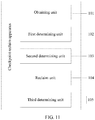
- FIG. 11 is a module diagram of the apparatus according to this embodiment of the present invention. As shown in FIG. 11 , the apparatus includes:
- the first determining unit 102 is specifically configured to: when only a checkpoint is generated between the moment of the previous checkpoint reclaim and the moment of the current checkpoint reclaim, perform the addition operation with the fixed step on reference counts of K data blocks allocated for a latest currently generated checkpoint, to obtain first reference counts of the K data blocks, and determine the first data block in data blocks of the M data blocks except the K data blocks; or when both a checkpoint and a snapshot are generated between the moment of the previous checkpoint reclaim and the moment of the current checkpoint reclaim, perform the addition operation with the fixed step on reference counts of K data blocks allocated for the snapshot generated between the moment of the previous checkpoint reclaim and the moment of the current checkpoint reclaim and for a latest currently generated checkpoint, to obtain first reference counts of the K data blocks, and determine the first data block in data blocks of the M data blocks except the K data blocks.
- the second determining unit 103 is specifically configured to: perform a subtraction operation with the fixed step on reference counts of L data blocks, in the N data blocks, allocated for a checkpoint reserved at the moment of the previous checkpoint reclaim, and determine current second counts of the L data blocks, where before the obtaining first reference counts of the K data blocks, reference counts of the N data blocks are first referential reference counts; and determine the second data block in the N data blocks according to the first reference counts, the second reference counts, and the first referential reference counts.
- the apparatus further includes a third determining unit 105, where the third determining unit 105 is configured to determine a reference count of a data block that needs to be reserved for the current checkpoint reclaim as a current first referential reference count according to the first reference counts, the second reference counts, and the first referential reference counts.
- the cut-off root area of the previous checkpoint reclaim is a root area in which the N data blocks are indexed
- the real-time root area is a root area in which the K data blocks are indexed
- the cut-off root area of the current checkpoint reclaim is a root area in which the file system copies
- the reclaim unit 104 is further specifically configured to: delete data in the cut-off root area of the previous checkpoint reclaim, and copy data in the cut-off root area of the current checkpoint reclaim to the cut-off root area of the previous checkpoint reclaim.
- a symbol representing a quantity of data blocks is the same as a symbol representing a number of a data block, but each has an independent meaning.
- the symbol representing a quantity of data blocks is used to represent a quantity of data blocks, while the symbol representing a number of a data block is only used to distinguish different data blocks.
- a number of a data block may also be represented in another form, for example, a digit or a character string.
- the step may be 1.
- a meaning of performing the addition operation with the fixed step on the data block is the same as a meaning of performing a reference count addition operation on the data block
- a meaning of performing the subtraction operation with the fixed step on the data block is the same as a meaning of performing a reference count subtraction operation on the data block.
- the reference count addition operation is performed on a data block referenced by a snapshot and/or a checkpoint that needs to be reserved, that is, when the data block is referenced by the snapshot or the checkpoint once, a reference count is added by 1, and the data block is a data block allocated for the snapshot or checkpoint.
- the embodiments of the present invention may be provided as a method, a system, or a computer program product. Therefore, the present invention may use a form of hardware only embodiments, software only embodiments, or embodiments with a combination of software and hardware. Moreover, the present invention may use a form of a computer program product that is implemented on one or more computer-usable storage media (including but not limited to a disk memory, a CD-ROM, an optical memory, and the like) that include computer-usable program code.
- computer-usable storage media including but not limited to a disk memory, a CD-ROM, an optical memory, and the like
- These computer program instructions may be provided for a general-purpose computer, a dedicated computer, an embedded processor, or a processor of any other programmable data processing device to generate a machine, so that the instructions executed by a computer or a processor of any other programmable data processing device generate an apparatus for implementing a specific function in one or more processes in the flowcharts and/or in one or more blocks in the block diagrams.
- These computer program instructions may also be stored in a computer readable memory that can instruct the computer or any other programmable data processing device to work in a specific manner, so that the instructions stored in the computer readable memory generate an artifact that includes an instruction apparatus.
- the instruction apparatus implements a specific function in one or more processes in the flowcharts and/or in one or more blocks in the block diagrams.
- These computer program instructions may also be loaded onto a computer or another programmable data processing device, so that a series of operations and steps are performed on the computer or the another programmable device, thereby generating computer-implemented processing. Therefore, the instructions executed on the computer or the another programmable device provide steps for implementing a specific function in one or more processes in the flowcharts and/or in one or more blocks in the block diagrams.
Landscapes
- Engineering & Computer Science (AREA)
- Theoretical Computer Science (AREA)
- Data Mining & Analysis (AREA)
- Databases & Information Systems (AREA)
- Physics & Mathematics (AREA)
- General Engineering & Computer Science (AREA)
- General Physics & Mathematics (AREA)
- Retry When Errors Occur (AREA)
- Information Retrieval, Db Structures And Fs Structures Therefor (AREA)
Description
- The present invention relates to the field of data processing, and in particular, to a checkpoint reclaim method and apparatus in a copy-on-write file system.
- Copy on write (COW for short) means that when data in a file system is to be altered, the original data is not really altered, and instead, the to-be-altered data is copied to a blank area of a magnetic disk. It can be seen that, because the original data is not damaged during a write process, data consistency can be guaranteed without write-twice penalty, and a problem of a small throughput of written data brought by the write-twice penalty is avoided. Therefore, COW file systems are applied increasingly widely.
- In a COW file system, every time when a checkpoint or a snapshot is generated, traversal is performed downwards from a root of the checkpoint or the snapshot to perform reference count addition. If a reference count of a data block is not greater than 1 after being added by 1, traversal continues to be performed downwards; or if a reference count of a data block is greater than 1 after being added by 1, traversal is no longer performed downwards. In the COW file system, an uppermost layer including a reference tree is a super block (sb for short; English: super block), and what is referenced by a super block may be a checkpoint, a snapshot, a root area (ROOT), an index node (inode), or the like.
- Referring to
FIG. 1A, FIG. 1A is a schematic reference diagram of a COW file system with acheckpoint 1 in the prior art. As shown inFIG. 1A , thecheckpoint 1 includes eight data blocks numbered A to H. After a reference count addition traversal operation is performed on thecheckpoint 1, it can be known that reference counts of the data blocks are:Data Block Number Reference Count A 1 B 1 C 1 C 1 D 1 E 1 F 1 G 1 H 1 - Referring to
FIG. 1B, FIG. 1B is a schematic diagram of generating acheckpoint 2 on the basis of thecheckpoint 1 in the prior art. As shown inFIG. 1B , the COW file system modifies a sub-block on the right of an index node 2 (that is, H is modified as L), and generates thecheckpoint 2. After a reference count addition traversal operation is performed from a root of thecheckpoint 2, it can be known that reference counts of data blocks are:Data Block Number Reference Count I 1 J 1 K 1 L 1 C 2 G 2 - When a checkpoint or a snapshot is to be deleted, traversal needs to be performed downwards from a root of the checkpoint or the snapshot to perform a reference count subtraction operation. If a reference count of a data block is 0 after being subtracted by 1, traversal continues to be performed downwards; or if a reference count of a data block is greater than 0 after being subtracted by 1, traversal is no longer performed downwards, where the data block whose reference count is 0 is a data block that needs to be reclaimed.
- Deleting the
checkpoint 1 shown inFIG. 1B is used as an example. Referring toFIG. 1C, FIG. 1C is a schematic diagram of deleting thecheckpoint 1 in the prior art. As shown inFIG. 1C , after a reference count subtraction traversal operation is performed on thecheckpoint 1, it can be known that reference counts of data blocks are:Data Block Number Reference Count A 0 B 0 C 1 C 1 D 0 E 1 F 1 G 1 H 0 - After a reference count subtraction traversal operation is performed on the
checkpoint 1, it can be known that, after thecheckpoint 1 is deleted, data blocks with numbers A, B, D, and H respectively have a reference count of 0 and need to be reclaimed; in this way, space occupied by these data blocks can be released. Prior artUS 8533158 discloses a solution for reclaiming data space by rewriting metadata. - It can be seen that, in a COW file system, a reference count addition traversal operation needs to be performed on each generated checkpoint and each generated snapshot, and a reference count subtraction traversal operation needs to be performed on each deleted checkpoint and each deleted snapshot. As a result, a traversing scale and an amount of data that is calculated during traversal are both relatively large.
- Embodiments of the present invention are defined in appended claims 1-8.
- One or more technical solutions provided by the embodiments of the present invention have at least the following technical effects or advantages:
- Because the following technical solution is used: obtaining, according to a checkpoint reclaim instruction, M data blocks allocated by the file system between a moment of a previous checkpoint reclaim and a moment of a current checkpoint reclaim, where M is an integer not less than 1, and the M data blocks are data blocks allocated for at least one of a checkpoint or a snapshot generated between the moment of the previous checkpoint reclaim and the moment of the current checkpoint reclaim, performing an addition operation with a fixed step on a reference count of a data block that needs to be reserved in the M data blocks, determining, in the M data blocks, a first data block that needs to be reclaimed, determining, in N data blocks allocated for at least one of a checkpoint or a snapshot reserved at the moment of the previous checkpoint reclaim, a second data block that needs to be reclaimed, where N is an integer not less than 1, and reclaiming the first data block and the second data block, no traversal operation needs to be performed on a data block that needs to be reclaimed in data blocks generated between the moment of the previous checkpoint reclaim and the moment of the current checkpoint reclaim in the COW file system; instead, a traversal operation needs to be performed only on a data block that needs to be reserved. Therefore, the following technical effects are achieved: a corresponding data amount is reduced when a traversal operation is performed on the data block that needs to be reclaimed in the data blocks generated between the moment of the previous checkpoint reclaim and the moment of the current checkpoint reclaim in the COW file system, and a traversing scale is reduced when the COW file system reclaims space.
-
-
FIG. 1A is a schematic reference diagram of a COW file system with acheckpoint 1 in the prior art; -
FIG. 1B is a schematic diagram of generating acheckpoint 2 on the basis of acheckpoint 1 in the prior art; -
FIG. 1C is a schematic diagram of deleting acheckpoint 1 in the prior art; -
FIG. 2 is a flowchart of a checkpoint reclaim method according to an embodiment of the present invention; -
FIG. 3 is a schematic diagram of data blocks reserved at a moment of a previous checkpoint reclaim in a COW file system according to an embodiment of the present invention; -
FIG. 4 is a schematic diagram of a first-time modification of data blocks reserved at a moment of a previous checkpoint reclaim in a COW file system according to an embodiment of the present invention; -
FIG. 5 is a schematic diagram of a second-time modification of data blocks reserved at a moment of a previous checkpoint reclaim in a COW file system according to an embodiment of the present invention; -
FIG. 6 is a schematic diagram of a third-time modification of data blocks reserved at a moment of a previous checkpoint reclaim in a COW file system according to an embodiment of the present invention; -
FIG. 7 is a schematic diagram of a COW file system that includes a cut-off root area at a moment of a previous checkpoint reclaim, a cut-off root area and a real-time root area at a moment of a current checkpoint reclaim according to an embodiment of the present invention; -
FIG. 8 is a schematic diagram of a COW file system at a moment of a current checkpoint reclaim according to an embodiment of the present invention; -
FIG. 9 is a schematic diagram of a COW file system after receiving a checkpoint reclaim instruction according to an embodiment of the present invention; -
FIG. 10 is a schematic diagram of copying content in a cut-off root area at a moment of a current checkpoint reclaim to a cut-off root area at a moment of a previous checkpoint reclaim according to an embodiment of the present invention; and -
FIG. 11 is a structural diagram of a checkpoint reclaim apparatus according to an embodiment of the present invention. - Embodiments of the present invention provide a checkpoint reclaim method and apparatus in a copy-on-write file system, which are used to resolve a technical problem in the prior art that a traversing scale and an amount of data that is calculated during traversal are both relatively large in a COW file system.
- Technical solutions in the embodiments of the present invention are used to resolve the foregoing technical problem, and a general idea is as follows:
- The embodiments of the present invention provide a checkpoint reclaim method in a copy-on-write file system. The method includes: obtaining, according to a checkpoint reclaim instruction, M data blocks allocated by the file system between a moment of a previous checkpoint reclaim and a moment of a current checkpoint reclaim, where M is an integer not less than 1, and the M data blocks are data blocks allocated for at least one of a checkpoint or a snapshot generated between the moment of the previous checkpoint reclaim and the moment of the current checkpoint reclaim; performing an addition operation with a fixed step on a reference count of a data block that needs to be reserved in the M data blocks, and determining, in the M data blocks, a first data block that needs to be reclaimed; determining, in N data blocks allocated for at least one of a checkpoint or a snapshot reserved at the moment of the previous checkpoint reclaim, a second data block that needs to be reclaimed, where N is an integer not less than 1; and reclaiming the first data block and the second data block.
- It can be seen from the foregoing part that, because the following technical solution is used: obtaining, according to a checkpoint reclaim instruction, M data blocks allocated by the file system between a moment of a previous checkpoint reclaim and a moment of a current checkpoint reclaim, where M is an integer not less than 1, and the M data blocks are data blocks allocated for at least one of a checkpoint or a snapshot generated between the moment of the previous checkpoint reclaim and the moment of the current checkpoint reclaim, performing an addition operation with a fixed step on a reference count of a data block that needs to be reserved in the M data blocks, determining, in the M data blocks, a first data block that needs to be reclaimed, determining, in N data blocks allocated for at least one of a checkpoint or a snapshot reserved at the moment of the previous checkpoint reclaim, a second data block that needs to be reclaimed, where N is an integer not less than 1, and reclaiming the first data block and the second data block, no traversal operation needs to be performed on a data block that needs to be reclaimed in data blocks generated between the moment of the previous checkpoint reclaim and the moment of the current checkpoint reclaim in the COW file system; instead, a traversal operation needs to be performed only on a data block that needs to be reserved. Therefore, the following technical effects are achieved: a corresponding data amount is reduced when a traversal operation is performed on the data block that needs to be reclaimed in the data blocks generated between the moment of the previous checkpoint reclaim and the moment of the current checkpoint reclaim in the COW file system, and a traversing scale is reduced when the COW file system reclaims space.
- For a better understanding of the foregoing technical solution, the following describes the foregoing technical solution in detail with reference to the accompanying drawings in the specification and specific implementation manners.
- Referring to
FIG. 2, FIG. 2 is a flowchart of a checkpoint reclaim method according to an embodiment of the present invention. As shown inFIG. 2 , the method includes: - S1: Obtain, according to a checkpoint reclaim instruction, M data blocks allocated by a file system between a moment of a previous checkpoint reclaim and a moment of a current checkpoint reclaim, where M is an integer not less than 1, and the M data blocks are data blocks allocated for at least one of a checkpoint or a snapshot generated between the moment of the previous checkpoint reclaim and the moment of the current checkpoint reclaim.
- S2: Perform an addition operation with a fixed step on a reference count of a data block that needs to be reserved in the M data blocks, and determine, in the M data blocks, a first data block that needs to be reclaimed.
- S3: Determine, in N data blocks allocated for at least one of a checkpoint or a snapshot reserved at the moment of the previous checkpoint reclaim, a second data block that needs to be reclaimed, where N is an integer not less than 1.
- S4: Reclaim the first data block and the second data block.
- In a specific implementation process, the checkpoint reclaim method provided by this embodiment of the present invention is implemented in multiple implementation manners. In the following parts, two implementation manners are described in detail.
- Referring to
FIG. 3, FIG. 3 is a schematic diagram of data blocks reserved at a moment of a previous checkpoint reclaim in a COW file system according to an embodiment of the present invention. As shown inFIG. 3 , the COW file system reserves asnapshot 1 and acheckpoint 1 at the moment of the previous checkpoint reclaim. Thesnapshot 1 includes four data blocks numbered A, B, C, and D; in other words, data blocks numbered A, B, C, and D are referenced by thesnapshot 1. Thecheckpoint 1 includes four data blocks numbered E, F, C, and G; in other words, four data blocks numbered E, F, C, and G are referenced by thecheckpoint 1. An addition operation with a fixed step is performed separately on the data blocks referenced by thesnapshot 1 and thecheckpoint 1. Here, a reference count addition traversal operation is performed and first referential reference counts at the moment of the previous checkpoint reclaim may be obtained. In this embodiment of the present invention, if a data block is referenced by thesnapshot 1 or thecheckpoint 1 once, a reference count is added by 1, that is, the fixed step is 1. In this embodiment, all reference counts are presented in a table form, and the first referential reference counts are as follows:Table 1 Data Block Number Reference Count A 1 B 1 C 2 D 1 E 1 F 1 G 1 - Referring to
FIG. 4, FIG. 4 is a schematic diagram of a first-time modification of the data blocks reserved at the moment of the previous checkpoint reclaim in the COW file system according to this embodiment of the present invention. As shown inFIG. 4 , the data block C is modified to J. In this case, acheckpoint 2 is generated. A snapshot is taken for thecheckpoint 2, and then, asnapshot 2 shown inFIG. 4 may be generated. - Referring to
FIG. 5, FIG. 5 is a schematic diagram of a second-time modification of the data blocks reserved at the moment of the previous checkpoint reclaim in the COW file system according to this embodiment of the present invention. As shown inFIG. 5 , the data block J is modified to M. In this case, acheckpoint 3 is generated. - Referring to
FIG. 6, FIG. 6 is a schematic diagram of a third-time modification of the data blocks reserved at the moment of the previous checkpoint reclaim in the COW file system according to this embodiment of the present invention. As shown inFIG. 6 , the data block numbered G is modified to a data block numbered P. In this case, a checkpoint 4 (Checkpoint 4) is generated. - It is assumed that the COW file system receives a checkpoint reclaim instruction at this time. In a specific implementation process, generation of the checkpoint reclaim instruction may be manually triggered by a user, or may be triggered by a reclaim policy of the COW file system, which is not limited herein.
- Certainly, it should be noted that, in this embodiment, from the moment of the previous checkpoint reclaim in the COW file system to a moment at which the COW file system receives the checkpoint reclaim instruction, neither a traversal operation nor a reference count update operation is performed on the data blocks.
- In step S1 of obtaining, according to a checkpoint reclaim instruction, M data blocks allocated by the file system between a moment of a previous checkpoint reclaim and a moment of a current checkpoint reclaim, where M is an integer not less than 1, and the M data blocks are data blocks allocated for at least one of a checkpoint or a snapshot generated between the moment of the previous checkpoint reclaim and the moment of the current checkpoint reclaim, specifically, the M data blocks allocated by the COW file system between the moment of the previous checkpoint reclaim and the moment of the current checkpoint reclaim may be obtained by using a data block allocation module in the COW file system. When the at least one of the checkpoint or the snapshot is generated between the moment of the previous checkpoint reclaim and the moment of the current checkpoint reclaim, the data block allocation module in the COW file system allocates corresponding numbers to data blocks that are corresponding to the at least one of the checkpoint or the snapshot. It can be known from
FIG. 3 to FIG. 6 that, one checkpoint or snapshot corresponds to multiple data blocks. Therefore, M is an integer not less than 1. - It should be noted that, "allocate" in this embodiment means that, when the copy-on-write file system generates a checkpoint or a snapshot and when the checkpoint or the snapshot references data blocks corresponding to an existing checkpoint or snapshot, the data blocks are also data blocks allocated for the newly generated checkpoint or snapshot.
- In this embodiment, referring to
FIG. 3 ,FIG. 4 ,FIG. 5, and FIG. 6 , information that numbers of data blocks already allocated between the moment of the previous checkpoint reclaim and the moment of the current checkpoint reclaim are G to P can be obtained from the data block allocation module in the COW file system. Because consecutive data block numbers are allocated by the data block allocation module in the COW file system, the data block allocation module may record only the first data block number and the last data block number that are allocated by the COW file system between the moment of the previous checkpoint reclaim and the moment of the current checkpoint reclaim, and such record manner occupies small space. - In step S2 of performing an addition operation with a fixed step on a reference count of a data block that needs to be reserved in the M data blocks, and determining, in the M data blocks, a first data block that needs to be reclaimed, specifically, when only a checkpoint is generated between the moment of the previous checkpoint reclaim and the moment of the current checkpoint reclaim, the addition operation with the fixed step is performed on reference counts of K data blocks allocated for a latest currently generated checkpoint, where the step is 1 herein, to obtain first reference counts of the K data blocks, and the first data block is determined in data blocks of the M data blocks except the K data blocks; or when both a checkpoint and a snapshot are generated between the moment of the previous checkpoint reclaim and the moment of the current checkpoint reclaim, the addition operation with the fixed step is performed on reference counts of K data blocks allocated for the snapshot generated between the moment of the previous checkpoint reclaim and the moment of the current checkpoint reclaim and for a latest currently generated checkpoint, where the fixed step is 1 herein, to obtain first reference counts of the K data blocks, and the first data block is determined in data blocks of the M data blocks except the K data blocks.
- Because the COW file system generally reserves all snapshots and also reserves only a last generated checkpoint, in this embodiment, referring to
FIG. 3 ,FIG. 4 ,FIG. 5, and FIG. 6 , thesnapshot 2 and thecheckpoint 4 need to be reserved. Therefore, the addition operation with the fixed step needs to be performed on reference counts of K data blocks corresponding to thesnapshot 2 and thecheckpoint 4, to obtain first reference counts of the K data blocks. Specifically, a reference count addition traversal operation is performed on the K data blocks corresponding to thesnapshot 2 and thecheckpoint 4, so as to obtain the first reference counts of the data blocks corresponding to the snapshot number and the checkpoint number. In this embodiment of the present invention, numbers of the data blocks allocated for thesnapshot 2 and thecheckpoint 4 are G, H, I, J, M, N, O, and P. After the reference count addition traversal operation is performed on the data blocks corresponding to thesnapshot 2 and thecheckpoint 4, the first reference counts of the data blocks referenced by thesnapshot 2 and thecheckpoint 4 can be obtained:Table 2 Data Block Number Reference Count G 1 H 1 I 1 J 1 M 1 N 1 O 1 P 1 - The numbers of the data blocks that are already allocated by the COW file system between the moment of the previous checkpoint reclaim and the moment of the current checkpoint reclaim and that are obtained in step S1 are G to P. Therefore, with reference to the first reference counts, it can be determined that numbers, of data blocks that can be reclaimed, in the numbers of the data blocks already allocated by the COW file system between the moment of the previous checkpoint reclaim and the moment of the current checkpoint reclaim are K and L (because they are referenced by neither the
checkpoint 4 nor thesnapshot 2 that needs to be reserved), that is, numbers of first data blocks are K and L. - Certainly, as introduced in the foregoing part, in this embodiment, both the checkpoint and the snapshot are generated between the moment of the previous checkpoint reclaim and the moment of the current checkpoint reclaim. Therefore, according to the steps introduced in the foregoing part, the numbers of the data blocks allocated for the
snapshot 2 and thecheckpoint 4 are G, H, I, J, M, N, O, and P, so that the first data block that needs to be reclaimed can be determined in the data blocks of the M data blocks except the K data blocks. In this embodiment of the present invention, because thecheckpoint 3 needs to be reclaimed, it is determined from data blocks numbered K and L that, numbers of data blocks that need to be reclaimed are K and L. In another embodiment, when only a checkpoint is generated between the moment of the previous checkpoint reclaim and the moment of the current checkpoint reclaim, an addition operation with a fixed step is performed only on reference counts of K data blocks allocated for a latest currently generated checkpoint, where the fixed step is 1, so as to obtain first reference counts of the K data blocks. Therefore, a first data block may be determined in data blocks of M data blocks except the K data blocks. Details are not described herein again. - After step S2 of determining, in the M data blocks, a first data block that needs to be reclaimed, in this embodiment of the present invention, step S3 is performed: determining, in N data blocks allocated for at least one of a checkpoint or a snapshot reserved at the moment of the previous checkpoint reclaim, a second data block that needs to be reclaimed, where N is an integer not less than 1.
- Specifically, step S3 may include: performing a subtraction operation with the fixed step on reference counts of L data blocks, in the N data blocks, allocated for a checkpoint reserved at the moment of the previous checkpoint reclaim, and determining current reference counts of the L data blocks, where the fixed step is 1 herein; before the first reference counts of data blocks referenced by the
snapshot 2 and thecheckpoint 4 are obtained, reference counts of the N data blocks are first referential reference counts; and determining the second data block in the N data blocks according to the first reference counts, the current reference counts of the L data blocks, and the first referential reference counts. - In this embodiment, specifically, as introduced in the foregoing part, Table 1 lists the first referential reference counts at the moment of the previous checkpoint reclaim in the COW file system. After the first referential reference counts are obtained, the subtraction operation with the fixed step may be performed on the reference counts of the L data blocks, in the N data blocks, allocated for the checkpoint reserved at the moment of the previous checkpoint reclaim, where the fixed step is 1 herein. That is, a reference count subtraction traversal operation is performed on the L data blocks corresponding to the checkpoint. For example, referring to
FIG. 6 , the subtraction operation with the fixed step is performed on the data blocks, corresponding to thecheckpoint 1, in the data blocks reserved at the moment of the previous checkpoint reclaim, that is, the reference count subtraction traversal operation is performed, to obtain second reference counts of the four data blocks, allocated for thecheckpoint 1, in the N data blocks, as shown in the following table:Table 3 Data Block Number Reference Count C -1 E -1 F -1 G -1 - After the second reference counts are obtained, the second data block can be determined in the N data blocks according to the first referential reference counts (Table 1), the first reference counts (Table 2), and the second reference counts (Table 3). Specifically, the first referential reference counts, the first reference counts, and the second reference counts may be merged. In this embodiment, "merging the first referential reference counts, the first reference counts, and the second counts" means merging reference counts, of a same data block, in the first referential reference counts, the first reference counts, and the second reference counts, and reserving reference counts of a different data block. Results are shown in the following table:
Table 4 Data Block Number Reference Count A 1 B 1 C 1 D 1 E 0 F 0 G 1 H 1 I 1 J 1 M 1 N 1 O 1 P 1 - It can be determined from Table 4 that, data blocks numbered E and F in the data blocks reserved at the moment of the previous checkpoint reclaim are data blocks that need to be reclaimed, that is, second data blocks are E and F.
- It can be seen from the foregoing part that, compared with a traversing scale in a COW file system in the prior art, in the checkpoint reclaim method provided by this embodiment of the present invention, no traversal operation needs to be performed on a data block that needs to be reclaimed in data blocks generated between a moment of a previous checkpoint reclaim and a moment of a current checkpoint reclaim in a COW file system; instead, a traversal operation needs to be performed only on a data block that needs to be reserved. Therefore, the following technical effects are achieved: a corresponding data amount is reduced when a traversal operation is performed on the data block that needs to be reclaimed in the data blocks generated between the moment of the previous checkpoint reclaim and the moment of the current checkpoint reclaim in the COW file system, and a traversing scale is reduced when the COW file system reclaims space.
- After the second data block is determined, the checkpoint reclaim method provided by this embodiment of the present invention further includes: determining a reference count of a data block that needs to be reserved for the current checkpoint reclaim as a current first referential reference count according to the first reference counts of the K data blocks, the first referential reference counts of the N data blocks, and the current reference counts of the L data blocks. That is, after the COW file system determines the first data block and the second data block that need to be reclaimed, the reference count of the data block that needs to be reserved for the current checkpoint reclaim can be determined as the current first referential reference count (that is, content shown in Table 4) according to the first reference counts, the second reference counts, and the first referential reference counts, so as to be used by the COW file system for a next checkpoint reclaim. Details are not described herein again.
- After a number of the first data block that needs to be reclaimed is determined in step S2 and a number of the second data block that needs to be reclaimed is determined in step S3, in the checkpoint reclaim method provided by this embodiment of the present invention, step S4 is performed: reclaiming the first data block and the second data block.
- That is, in step S4, the data blocks numbered E and F are reclaimed and the data blocks numbered K and L are reclaimed; details are not described herein again.
- The foregoing technical solution in this embodiment of the present invention has at least the following technical effects or advantages:
- Because the following technical solution is used: obtaining, according to a checkpoint reclaim instruction, M data blocks allocated by the file system between a moment of a previous checkpoint reclaim and a moment of a current checkpoint reclaim, where M is an integer not less than 1, and the M data blocks are data blocks allocated for at least one of a checkpoint or a snapshot generated between the moment of the previous checkpoint reclaim and the moment of the current checkpoint reclaim, performing an addition operation with a fixed step on a reference count of a data block that needs to be reserved in the M data blocks, determining, in the M data blocks, a first data block that needs to be reclaimed, determining, in N data blocks allocated for at least one of a checkpoint or a snapshot reserved at the moment of the previous checkpoint reclaim, a second data block that needs to be reclaimed, where N is an integer not less than 1, and reclaiming the first data block and the second data block, no traversal operation needs to be performed on a data block that needs to be reclaimed in data blocks generated between the moment of the previous checkpoint reclaim and the moment of the current checkpoint reclaim in the COW file system; instead, a traversal operation needs to be performed only on a data block that needs to be reserved. Therefore, the following technical effects are achieved: a corresponding data amount is reduced when a traversal operation is performed on the data block that needs to be reclaimed in the data blocks generated between the moment of the previous checkpoint reclaim and the moment of the current checkpoint reclaim in the COW file system, and a traversing scale is reduced when the COW file system reclaims space.
- Referring to
FIG. 7, FIG. 7 is a schematic diagram of a COW file system that includes a cut-off root area at a moment of a previous checkpoint reclaim, a cut-off root area at a moment of a current checkpoint reclaim, and a real-time root area according to an embodiment of the present invention. As shown inFIG. 7 , the cut-off root area at the moment of the previous checkpoint reclaim is a root area in which N data blocks are indexed, the real-time root area is a root area in which K data blocks are indexed, and the cut-off root area at the moment of the current checkpoint reclaim is a root area in which the file system copies, when obtaining the checkpoint reclaim instruction, an indexing relationship that is in the real-time root area. Certainly, it should be noted that, in this embodiment, generation and deletion of a snapshot or a checkpoint in the COW file system are implemented by means of insertion and deletion of a tree of the COW file system, where the snapshot or the checkpoint mounts a root area of the COW file system, so as to ensure that no missing occurs when space corresponding to a data block that needs to be reclaimed is reclaimed according to the tree of the COW file system. - As shown in
FIG. 7 , data in the cut-off root area at the moment of the previous checkpoint reclaim is indexes for data blocks reserved at a moment of the previous checkpoint reclaim in the COW file system. Because there is only a checkpoint at the moment of the previous checkpoint reclaim in the COW file system, numbers of data blocks referenced by the reserved checkpoint include A, B, C, D, E, F, and G. In this embodiment, that data in the real-time root area is indexes for data blocks allocated for a newly generated checkpoint by the COW file system after the moment of the previous checkpoint reclaim is used as an example. Numbers of the data blocks allocated for the newly generated checkpoint after the moment of the previous checkpoint reclaim are B, C, D, F, G, and H, and numbers of data blocks directly or indirectly referenced by a data block numbered H are B, C, D, E, F, and G. Referring toFIG. 8, FIG. 8 is a schematic diagram of the COW file system at a moment of the current checkpoint reclaim according to this embodiment of the present invention. As shown inFIG. 8 , compared with the moment of the previous checkpoint reclaim, the COW file system undergoes some transactions and generates another checkpoint at the moment of the current checkpoint reclaim, where numbers of data blocks allocated for the newly generated checkpoint are B, C, D, F, G, and I, and an index for the data block numbered I is in the real-time root area. - Referring to
FIG. 9, FIG. 9 is a schematic diagram of the COW file system after receiving a checkpoint reclaim instruction according to this embodiment of the present invention. As shown inFIG. 9 , after receiving the checkpoint reclaim instruction, the COW file system copies data in the real-time root area shown inFIG. 8 to the cut-off root area of the current checkpoint reclaim. The data in the real-time root area refers to the index for the data block numbered I and indexes for data blocks directly or indirectly referenced by the data block numbered I shown inFIG. 8 , that is, indexes for the data blocks numbered B, C, D, F, G, and I. Certainly, as shown inFIG. 9 , after receiving the checkpoint reclaim instruction, the COW file system continues to index, in the real-time root area according to a running status of the COW file system, a data block newly added after the moment of the current checkpoint reclaim, for example, a data block numbered J shown inFIG. 9 . Details are not described herein again. - As shown in
FIG. 9 , after the data in the real-time root area is copied to the cut-off root area at the moment of the current checkpoint reclaim, a reference count addition traversal operation can be performed on the data blocks in the cut-off root area at the moment of the current checkpoint reclaim (it should be noted that, impact of the real-time root area does not need to be considered at this time, that is, a reference relationship of the data block numbered J is not counted). Obtained reference counts of the data blocks are as follows:Table 5 Data Block Number Reference Count I 1 B 2 C 2 D 1 E 1 F 1 G 1 - In step S1, M data blocks already allocated by the COW file system between the moment of the previous checkpoint reclaim and the moment of the current checkpoint reclaim are obtained. Specifically, similar to the process in
Embodiment 1, the M data blocks may also be obtained by using a data block allocation module of the COW file system. A detailed process is already introduced inEmbodiment 1, and details are not described herein again for conciseness of the specification. - In this embodiment, it can be known from the data block allocation module of the COW file system that, numbers of the M data blocks already allocated by the COW file system between the moment of the previous checkpoint reclaim and the moment of the current checkpoint reclaim are B to I respectively.
- After the data blocks already allocated by the COW file system between the moment of the previous checkpoint reclaim and the moment of the current checkpoint reclaim are obtained in step S1, in a checkpoint reclaim method provided by this embodiment of the present invention, step S2 is performed: performing an addition operation with a fixed step on a reference count of a data block that needs to be reserved in the M data blocks, and determining, in the M data blocks, a first data block that needs to be reclaimed. As shown in
FIG. 9 , because only the checkpoint is generated, only a latest checkpoint needs to be reserved. In a cut-off root area, numbers of data blocks referenced by the latest checkpoint are B, C, D, F, G, and I. Therefore, in the M data blocks, data blocks numbered B, C, D, F, G, and I need to be reserved, and a data block numbered H is a data block that can be reclaimed. - In this embodiment, because the numbers of the data blocks already allocated by the COW file system between the moment of the previous checkpoint reclaim and the moment of the current checkpoint reclaim are B to I, with reference to Table 5, it can be known that the data block numbered H is a first data block that needs to be reclaimed. When the reference count addition traversal operation is performed on data blocks indexed in the cut-off root area at the moment of the current checkpoint reclaim, because not being referenced, the data block numbered H does not need to be reserved; in addition, the reference count addition traversal operation does not need to be performed on the data block numbered H, and a reference count subtraction traversal operation does not need to be performed on the data block numbered H during the reclaim either. Nevertheless, in the prior art, the reference count addition traversal operation and the reference count subtraction traversal operation are separately performed on the data block numbered H.
- After a number of the first data block that needs to be reclaimed is determined in step S2, in the checkpoint reclaim method provided by this embodiment of the present invention, step S3 is performed: determining, in N data blocks allocated for at least one of a checkpoint or a snapshot reserved at the moment of the previous checkpoint reclaim, a second data block that needs to be reclaimed, where N is an integer not less than 1.
- Specifically, in this embodiment, because there is only a checkpoint, the reference count subtraction traversal operation may be performed on data blocks referenced by a checkpoint indexed in the cut-off root area of the previous checkpoint reclaim, and results are as follows:
Table 6 Data Block Number Reference Count A 0 B 1 C 1 D 1 E 1 F 1 G 1 - It can be seen from Table 6 that, a data block numbered A is a data block that is no longer referenced, and the data block numbered A is a data block that needs to be reclaimed, that is, A is a number of the second data block.
- After the first data block that needs to be reclaimed is determined in step S2 and the second data block that needs to be reclaimed is determined in step S3, in the checkpoint reclaim method provided by this embodiment of the present invention, step S4 is performed: reclaiming the first data block and the second data block.
- Similar to
Embodiment 1, in this embodiment, reclaiming first space corresponding to the number of the first data block is reclaiming space corresponding to the data block numbered H, and reclaiming second space corresponding to the number of the second data block is reclaiming space corresponding to the data block numbered A. For conciseness of the specification, details are not described herein again. - In a specific implementation process, after the first space corresponding to the number of the first data block and the second space corresponding to the number of the second data block are reclaimed, the method further includes: deleting data in the cut-off root area at the moment of the previous checkpoint reclaim; and copying data in the cut-off root area at the moment of the current checkpoint reclaim to the cut-off root area at the moment of the previous checkpoint reclaim.
- Specifically, still referring to
FIG. 9 , as shown inFIG. 9 , after the COW file system completes the checkpoint reclaim, the cut-off root area at the moment of the previous checkpoint reclaim is cleared, for example, indexes in the cut-off root area at the moment of the previous checkpoint reclaim are deleted; and the data in the cut-off root area at the moment of the current checkpoint reclaim such as index information of a data block is copied to the cut-off root area at the moment of the previous checkpoint reclaim, so as to be used by the COW file system during a next space reclaim. Referring toFIG. 10, FIG. 10 is a schematic diagram of copying the data in the cut-off root area at the moment of the current checkpoint reclaim to the cut-off root area at the moment of the previous checkpoint reclaim according to this embodiment of the present invention, and details are not described herein again. - In a specific implementation process, if a checkpoint or a snapshot is already deleted, its index no longer exists in the cut-off root area at the moment of the current checkpoint reclaim (for example, after a new checkpoint is generated, an old checkpoint is no longer indexed). When a reference count subtraction traversal operation is performed downwards from the cut-off root area at the moment of the previous checkpoint reclaim, it is found that a reference count of the checkpoint or the snapshot is 0, and subtraction continues to be performed downwards. Besides, if a checkpoint or a snapshot is currently reserved (for example, if a snapshot is not deleted after being generated, an index for the snapshot always exists in the real-time root area), its index exists in the cut-off root area at the moment of the current checkpoint reclaim. When the reference count subtraction traversal operation is performed downwards from the cut-off root area at the moment of the previous checkpoint reclaim, it is found that a reference count of the checkpoint or the snapshot is not 0, and subtraction is no longer performed downwards. Therefore, after receiving the checkpoint reclaim instruction, the COW file system canreclaim complete space reclaim according to an index status in the real-time root area without knowing which checkpoint or snapshot needs to be reclaimed.
- The foregoing technical solution in this embodiment of the present invention has at least the following technical effects or advantages:
- Because the following technical solution is used: obtaining, according to a checkpoint reclaim instruction, M data blocks allocated by a file system between a moment of a previous checkpoint reclaim and a moment of a current checkpoint reclaim, where M is an integer not less than 1, and the M data blocks are data blocks allocated for at least one of a checkpoint or a snapshot generated between the moment of the previous checkpoint reclaim and the moment of the current checkpoint reclaim, performing an addition operation with a fixed step on a reference count of a data block that needs to be reserved in the M data blocks, determining, in the M data blocks, a first data block that needs to be reclaimed, determining, in N data blocks allocated for at least one of a checkpoint or a snapshot reserved at the moment of the previous checkpoint reclaim, a second data block that needs to be reclaimed, where N is an integer not less than 1, and reclaiming the first data block and the second data block, no traversal operation needs to be performed on a data block that needs to be reclaimed in data blocks generated between the moment of the previous checkpoint reclaim and the moment of the current checkpoint reclaim in the COW file system; instead, a traversal operation needs to be performed only on a data block that needs to be reserved. Therefore, the following technical effects are achieved: a corresponding data amount is reduced when a traversal operation is performed on the data block that needs to be reclaimed in the data blocks generated between the moment of the previous checkpoint reclaim and the moment of the current checkpoint reclaim in the COW file system, and a traversing scale is reduced when the COW file system reclaims space.
- Based on the same invention idea, an embodiment of the present invention further provides a checkpoint reclaim apparatus in a copy-on-write file system. Referring to
FIG. 11, FIG. 11 is a module diagram of the apparatus according to this embodiment of the present invention. As shown inFIG. 11 , the apparatus includes: - an obtaining
unit 101, configured to obtain, according to a checkpoint reclaim instruction, M data blocks allocated by the file system between a moment of a previous checkpoint reclaim and a moment of a current checkpoint reclaim, where M is an integer not less than 1, and the M data blocks are data blocks allocated for at least one of a checkpoint or a snapshot generated between the moment of the previous checkpoint reclaim and the moment of the current checkpoint reclaim; - a first determining
unit 102, configured to perform an addition operation with a fixed step on a reference count of a data block that needs to be reserved in the M data blocks, and determine, in the M data blocks, a first data block that needs to be reclaimed; - a second determining
unit 103, configured to determine, in N data blocks allocated for at least one of a checkpoint or a snapshot reserved at the moment of the previous checkpoint reclaim, a second data block that needs to be reclaimed, where N is an integer not less than 1; and - a reclaim
unit 104, configured to reclaim the first data block and the second data block. - In a specific implementation process, the first determining
unit 102 is specifically configured to: when only a checkpoint is generated between the moment of the previous checkpoint reclaim and the moment of the current checkpoint reclaim, perform the addition operation with the fixed step on reference counts of K data blocks allocated for a latest currently generated checkpoint, to obtain first reference counts of the K data blocks, and determine the first data block in data blocks of the M data blocks except the K data blocks; or when both a checkpoint and a snapshot are generated between the moment of the previous checkpoint reclaim and the moment of the current checkpoint reclaim, perform the addition operation with the fixed step on reference counts of K data blocks allocated for the snapshot generated between the moment of the previous checkpoint reclaim and the moment of the current checkpoint reclaim and for a latest currently generated checkpoint, to obtain first reference counts of the K data blocks, and determine the first data block in data blocks of the M data blocks except the K data blocks. - In a specific implementation process, the second determining
unit 103 is specifically configured to: perform a subtraction operation with the fixed step on reference counts of L data blocks, in the N data blocks, allocated for a checkpoint reserved at the moment of the previous checkpoint reclaim, and determine current second counts of the L data blocks, where before the obtaining first reference counts of the K data blocks, reference counts of the N data blocks are first referential reference counts; and determine the second data block in the N data blocks according to the first reference counts, the second reference counts, and the first referential reference counts. - In a specific implementation process, the apparatus further includes a third determining
unit 105, where the third determiningunit 105 is configured to determine a reference count of a data block that needs to be reserved for the current checkpoint reclaim as a current first referential reference count according to the first reference counts, the second reference counts, and the first referential reference counts. - In a specific implementation process, when the file system includes a cut-off root area of the previous checkpoint reclaim, a cut-off root area of the current checkpoint reclaim, and a real-time root area, the cut-off root area of the previous checkpoint reclaim is a root area in which the N data blocks are indexed, the real-time root area is a root area in which the K data blocks are indexed, and the cut-off root area of the current checkpoint reclaim is a root area in which the file system copies, when obtaining the checkpoint reclaim instruction, an indexing relationship that is in the real-time root area.
- In a specific implementation process, the reclaim
unit 104 is further specifically configured to: delete data in the cut-off root area of the previous checkpoint reclaim, and copy data in the cut-off root area of the current checkpoint reclaim to the cut-off root area of the previous checkpoint reclaim. - It should be noted that, the apparatus in this embodiment and the method in the foregoing embodiments are two aspects based on the same invention idea. An implementation process of the method has been described in detail above. Therefore, a person skilled in the art can clearly understand a structure and an implementation process of the apparatus in this embodiment according to the foregoing description. For conciseness of the specification, details are not described herein again.
- In this embodiment of the present invention, a symbol representing a quantity of data blocks is the same as a symbol representing a number of a data block, but each has an independent meaning. The symbol representing a quantity of data blocks is used to represent a quantity of data blocks, while the symbol representing a number of a data block is only used to distinguish different data blocks. A number of a data block may also be represented in another form, for example, a digit or a character string. Besides, for the addition operation with the fixed step and the subtraction operation with the fixed step, performed on the data block, mentioned in this embodiment of the present invention, the step may be 1. A meaning of performing the addition operation with the fixed step on the data block is the same as a meaning of performing a reference count addition operation on the data block, and a meaning of performing the subtraction operation with the fixed step on the data block is the same as a meaning of performing a reference count subtraction operation on the data block. Specifically, when the reference count addition operation is performed on a data block referenced by a snapshot and/or a checkpoint that needs to be reserved, that is, when the data block is referenced by the snapshot or the checkpoint once, a reference count is added by 1, and the data block is a data block allocated for the snapshot or checkpoint.
- A person skilled in the art should understand that the embodiments of the present invention may be provided as a method, a system, or a computer program product. Therefore, the present invention may use a form of hardware only embodiments, software only embodiments, or embodiments with a combination of software and hardware. Moreover, the present invention may use a form of a computer program product that is implemented on one or more computer-usable storage media (including but not limited to a disk memory, a CD-ROM, an optical memory, and the like) that include computer-usable program code.
- The present invention is described with reference to the flowcharts and/or block diagrams of the method, the device (system), and the computer program product according to the embodiments of the present invention. It should be understood that computer program instructions may be used to implement each process and/or each block in the flowcharts and/or the block diagrams and a combination of a process and/or a block in the flowcharts and/or the block diagrams. These computer program instructions may be provided for a general-purpose computer, a dedicated computer, an embedded processor, or a processor of any other programmable data processing device to generate a machine, so that the instructions executed by a computer or a processor of any other programmable data processing device generate an apparatus for implementing a specific function in one or more processes in the flowcharts and/or in one or more blocks in the block diagrams.
- These computer program instructions may also be stored in a computer readable memory that can instruct the computer or any other programmable data processing device to work in a specific manner, so that the instructions stored in the computer readable memory generate an artifact that includes an instruction apparatus. The instruction apparatus implements a specific function in one or more processes in the flowcharts and/or in one or more blocks in the block diagrams.
- These computer program instructions may also be loaded onto a computer or another programmable data processing device, so that a series of operations and steps are performed on the computer or the another programmable device, thereby generating computer-implemented processing. Therefore, the instructions executed on the computer or the another programmable device provide steps for implementing a specific function in one or more processes in the flowcharts and/or in one or more blocks in the block diagrams.
Claims (8)
- A checkpoint reclaim method in a copy-on-write file system, comprising:obtaining (S1), according to a checkpoint reclaim instruction, M data blocks allocated by the file system between a moment of a previous checkpoint reclaim and a moment of a current checkpoint reclaim, wherein M is an integer not less than 1, and the M data blocks are data blocks allocated for at least one of a checkpoint or a snapshot generated between the moment of the previous checkpoint reclaim and the moment of the current checkpoint reclaim;performing (S2) an addition operation with a fixed step on a reference count of a data block that needs to be reserved in the M data blocks, and determining, in the M data blocks, a first data block that needs to be reclaimed;determining (S3), in N data blocks allocated for at least one of a checkpoint or a snapshot reserved at the moment of the previous checkpoint reclaim, a second data block that needs to be reclaimed, wherein N is an integer not less than 1; andreclaiming (S4) the first data block and the second data block;wherein the performing an addition operation with a fixed step on a reference count of a data block that needs to be reserved in the M data blocks, and determining, in the M data blocks, a first data block that needs to be reclaimed specifically comprises:when only a checkpoint is generated between the moment of the previous checkpoint reclaim and the moment of the current checkpoint reclaim, performing the addition operation with the fixed step on reference counts of K data blocks allocated for a latest currently generated checkpoint, to obtain first reference counts of the K data blocks; and determining the first data block in data blocks of the M data blocks except the K data blocks;when both a checkpoint and a snapshot are generated between the moment of the previous checkpoint reclaim and the moment of the current checkpoint reclaim, performing the addition operation with the fixed step on reference counts of K data blocks allocated for the snapshot generated between the moment of the previous checkpoint reclaim and the moment of the current checkpoint reclaim and for a latest currently generated checkpoint, to obtain first reference counts of the K data blocks; and determining the first data block in data blocks of the M data blocks except the K data blocks;wherein the determining, in N data blocks allocated for at least one of a checkpoint or a snapshot reserved at the moment of the previous checkpoint reclaim, a second data block that needs to be reclaimed specifically comprises:performing a subtraction operation with the fixed step on reference counts of L data blocks, in the N data blocks, allocated for a checkpoint reserved at the moment of the previous checkpoint reclaim, and determining second reference counts of the L data blocks, wherein before the obtaining first reference counts of the K data blocks, reference counts of the N data blocks are first referential reference counts; anddetermining the second data block in the N data blocks according to the first reference counts, the second reference counts, and the first referential reference counts.
- The method according to claim 1, wherein the method further comprises:determining a reference count of a data block that needs to be reserved for the current checkpoint reclaim as a current first referential reference count according to the first reference counts, the second reference counts, and the first referential reference counts.
- The method according to claim 1, wherein when the file system comprises a cut-off root area of the previous checkpoint reclaim, a cut-off root area of the current checkpoint reclaim, and a real-time root area, the cut-off root area of the previous checkpoint reclaim is a root area in which the N data blocks are indexed, the real-time root area is a root area in which the K data blocks are indexed, and the cut-off root area of the current checkpoint reclaim is a root area in which the file system copies, when obtaining the checkpoint reclaim instruction, an indexing relationship that is in the real-time root area.
- The method according to claim 3, wherein after the reclaiming the first data block and the second data block, the method further comprises:deleting data in the cut-off root area of the previous checkpoint reclaim; andcopying data in the cut-off root area of the current checkpoint reclaim to the cut-off root area of the previous checkpoint reclaim.
- A checkpoint reclaim apparatus in a copy-on-write file system, comprising:an obtaining unit (101), configured to obtain, according to a checkpoint reclaim instruction, M data blocks allocated by the file system between a moment of a previous checkpoint reclaim and a moment of a current checkpoint reclaim, wherein M is an integer not less than 1, and the M data blocks are data blocks allocated for at least one of a checkpoint or a snapshot generated between the moment of the previous checkpoint reclaim and the moment of the current checkpoint reclaim;a first determining unit (102), configured to perform an addition operation with a fixed step on a reference count of a data block that needs to be reserved in the M data blocks, and determine, in the M data blocks, a first data block that needs to be reclaimed;a second determining unit (103), configured to determine, in N data blocks allocatedfor at least one of a checkpoint or a snapshot reserved at the moment of the previous checkpoint reclaim, a second data block that needs to be reclaimed, wherein N is an integer not less than 1; anda reclaim unit (104), configured to reclaim the first data block and the second data block;wherein the first determining unit (102) is specifically configured to: when only a checkpoint is generated between the moment of the previous checkpoint reclaim and the moment of the current checkpoint reclaim, perform the addition operation with the fixed step on reference counts of K data blocks allocated for a latest currently generated checkpoint, to obtain first reference counts of the K data blocks, and determine the first data block in data blocks of the M data blocks except the K data blocks; when both a checkpoint and a snapshot are generated between the moment of the previous checkpoint reclaim and the moment of the current checkpoint reclaim, perform the addition operation with the fixed step on reference counts of K data blocks allocated for the snapshot generated between the moment of the previous checkpoint reclaim and the moment of the current checkpoint reclaim and for a latest currently generated checkpoint, to obtain first reference counts of the K data blocks, and determine the first data block in data blocks of the M data blocks except the K data blocks;wherein the second determining unit (103) is specifically configured to: perform a subtraction operation with the fixed step on reference counts of L data blocks, in the N data blocks, allocated for a checkpoint reserved at the moment of the previous checkpoint reclaim, and determine second reference counts of the L data blocks, wherein before the obtaining first reference counts of the K data blocks, reference counts of the N data blocks are first referential reference counts; and determine the second data block in the N data blocks according to the first reference counts, the second reference counts, and the first referential reference counts.
- The apparatus according to claim 5, wherein the apparatus further comprises a third determining unit (105), wherein the third determining unit (105) is configured to determine a reference count of a data block that needs to be reserved for the current checkpoint reclaim as a current first referential reference count according to the first reference counts, the second reference counts, and the first referential reference counts.
- The apparatus according to claim 5, wherein when the file system comprises a cut-off root area of the previous checkpoint reclaim, a cut-off root area of the current checkpoint reclaim, and a real-time root area, the cut-off root area of the previous checkpoint reclaim is a root area in which the N data blocks are indexed, the real-time root area is a root area in which the K data blocks are indexed, and the cut-off root area of the current checkpoint reclaim is a
root area in which the file system copies, when obtaining the checkpoint reclaim instruction, an indexing relationship that is in the real-time root area. - The apparatus according to claim 7, wherein the reclaim unit (104) is further specifically configured to: after the first data block and the second data block are reclaimed, delete data in the cut-off root area of the previous checkpoint reclaim, and copy data in the cut-off root area of the current checkpoint reclaim to the cut-off root area of the previous checkpoint reclaim.
Applications Claiming Priority (2)
| Application Number | Priority Date | Filing Date | Title |
|---|---|---|---|
| CN201410231326.5A CN103984609B (en) | 2014-05-28 | 2014-05-28 | A kind of method and apparatus that checkpoint is reclaimed in file system based on copy-on-write |
| PCT/CN2014/089458 WO2015180394A1 (en) | 2014-05-28 | 2014-10-24 | Method and device for recovering checkpoint in copy on write based file system |
Publications (3)
| Publication Number | Publication Date |
|---|---|
| EP3107005A1 EP3107005A1 (en) | 2016-12-21 |
| EP3107005A4 EP3107005A4 (en) | 2017-03-01 |
| EP3107005B1 true EP3107005B1 (en) | 2018-03-14 |
Family
ID=51276599
Family Applications (1)
| Application Number | Title | Priority Date | Filing Date |
|---|---|---|---|
| EP14893559.6A Active EP3107005B1 (en) | 2014-05-28 | 2014-10-24 | Method and device for recovering checkpoint in copy on write based file system |
Country Status (4)
| Country | Link |
|---|---|
| US (1) | US20170031933A1 (en) |
| EP (1) | EP3107005B1 (en) |
| CN (1) | CN103984609B (en) |
| WO (1) | WO2015180394A1 (en) |
Families Citing this family (9)
| Publication number | Priority date | Publication date | Assignee | Title |
|---|---|---|---|---|
| CN103984609B (en) * | 2014-05-28 | 2017-06-16 | 华为技术有限公司 | A kind of method and apparatus that checkpoint is reclaimed in file system based on copy-on-write |
| CN106294357B (en) * | 2015-05-14 | 2019-07-09 | 阿里巴巴集团控股有限公司 | Data processing method and stream calculation system |
| CN106326039A (en) * | 2016-08-24 | 2017-01-11 | 浪潮(北京)电子信息产业有限公司 | Method and device for cloning logical volume in disk and disk |
| US10452496B2 (en) * | 2017-10-06 | 2019-10-22 | Vmware, Inc. | System and method for managing storage transaction requests |
| CN109213636A (en) * | 2018-09-25 | 2019-01-15 | 郑州云海信息技术有限公司 | A kind of storage snapshot creation method, device, equipment and storage medium |
| US20230092177A1 (en) * | 2021-09-17 | 2023-03-23 | Vmware, Inc. | Efficient method for managing storage space and snapshots |
| CN115269734B (en) * | 2022-09-27 | 2022-11-29 | 北京奥星贝斯科技有限公司 | Storage management method and device for distributed database |
| US12406056B2 (en) * | 2023-02-06 | 2025-09-02 | Dell Products L.P. | Providing quality of service for secure workspaces having copy-on-write layers |
| CN115826878B (en) * | 2023-02-14 | 2023-05-16 | 浪潮电子信息产业股份有限公司 | Copy-on-write method, device, equipment and computer readable storage medium |
Family Cites Families (9)
| Publication number | Priority date | Publication date | Assignee | Title |
|---|---|---|---|---|
| US6748504B2 (en) * | 2002-02-15 | 2004-06-08 | International Business Machines Corporation | Deferred copy-on-write of a snapshot |
| CN1258715C (en) * | 2003-03-20 | 2006-06-07 | 中国科学院计算技术研究所 | Virtual shared storage device and method |
| US7769723B2 (en) * | 2006-04-28 | 2010-08-03 | Netapp, Inc. | System and method for providing continuous data protection |
| US8533158B1 (en) * | 2006-09-28 | 2013-09-10 | Emc Corporation | Reclaiming data space by rewriting metadata |
| US8849876B2 (en) * | 2009-12-28 | 2014-09-30 | Wenguang Wang | Methods and apparatuses to optimize updates in a file system based on birth time |
| US8224780B2 (en) * | 2010-06-15 | 2012-07-17 | Microsoft Corporation | Checkpoints for a file system |
| CN102968381A (en) * | 2012-11-19 | 2013-03-13 | 浪潮电子信息产业股份有限公司 | Method for improving snapshot performance by using solid state disk |
| CN103678715B (en) * | 2013-12-31 | 2017-06-23 | 无锡城市云计算中心有限公司 | The metadata information management method of snapshot is supported in a kind of distributed file system |
| CN103984609B (en) * | 2014-05-28 | 2017-06-16 | 华为技术有限公司 | A kind of method and apparatus that checkpoint is reclaimed in file system based on copy-on-write |
-
2014
- 2014-05-28 CN CN201410231326.5A patent/CN103984609B/en active Active
- 2014-10-24 EP EP14893559.6A patent/EP3107005B1/en active Active
- 2014-10-24 WO PCT/CN2014/089458 patent/WO2015180394A1/en not_active Ceased
-
2016
- 2016-10-12 US US15/291,249 patent/US20170031933A1/en not_active Abandoned
Non-Patent Citations (1)
| Title |
|---|
| None * |
Also Published As
| Publication number | Publication date |
|---|---|
| EP3107005A1 (en) | 2016-12-21 |
| CN103984609A (en) | 2014-08-13 |
| CN103984609B (en) | 2017-06-16 |
| US20170031933A1 (en) | 2017-02-02 |
| WO2015180394A1 (en) | 2015-12-03 |
| EP3107005A4 (en) | 2017-03-01 |
Similar Documents
| Publication | Publication Date | Title |
|---|---|---|
| EP3107005A1 (en) | Method and device for recovering checkpoint in copy on write based file system | |
| US10901861B2 (en) | Systems and methods of restoring a dataset of a database for a point in time | |
| EP3035197B1 (en) | File migration method and apparatus and storage device | |
| US10656859B2 (en) | Efficient deduplication for storage systems | |
| US7774541B2 (en) | Storage apparatus using non-volatile memory as cache and method of managing the same | |
| US11226934B2 (en) | Storage system garbage collection and defragmentation | |
| KR102303814B1 (en) | Swat command and appication programming interface for automic swap and trim of lbas | |
| US10452496B2 (en) | System and method for managing storage transaction requests | |
| GB2520361A (en) | Method and system for a safe archiving of data | |
| US8019953B2 (en) | Method for providing atomicity for host write input/outputs (I/Os) in a continuous data protection (CDP)-enabled volume using intent log | |
| CN113767378B (en) | File system metadata deduplication | |
| US10061697B2 (en) | Garbage collection scope detection for distributed storage | |
| US20150178297A1 (en) | Method to Preserve Shared Blocks when Moved | |
| JP6788386B2 (en) | File access provision methods, computers, and software products | |
| CN102929976A (en) | Backup data accessing method and device | |
| CN114546244B (en) | Cache space filtering method based on block-level continuous data protection | |
| US9740632B1 (en) | Snapshot efficiency | |
| US10289307B1 (en) | Method for handling block errors on a deduplicated storage system | |
| US10740015B2 (en) | Optimized management of file system metadata within solid state storage devices (SSDs) | |
| CN103886070A (en) | Method and device for recycling data of file system |
Legal Events
| Date | Code | Title | Description |
|---|---|---|---|
| PUAI | Public reference made under article 153(3) epc to a published international application that has entered the european phase |
Free format text: ORIGINAL CODE: 0009012 |
|
| STAA | Information on the status of an ep patent application or granted ep patent |
Free format text: STATUS: REQUEST FOR EXAMINATION WAS MADE |
|
| 17P | Request for examination filed |
Effective date: 20160916 |
|
| AK | Designated contracting states |
Kind code of ref document: A1 Designated state(s): AL AT BE BG CH CY CZ DE DK EE ES FI FR GB GR HR HU IE IS IT LI LT LU LV MC MK MT NL NO PL PT RO RS SE SI SK SM TR |
|
| AX | Request for extension of the european patent |
Extension state: BA ME |
|
| A4 | Supplementary search report drawn up and despatched |
Effective date: 20170130 |
|
| RIC1 | Information provided on ipc code assigned before grant |
Ipc: G06F 17/30 20060101AFI20170124BHEP |
|
| DAX | Request for extension of the european patent (deleted) | ||
| GRAP | Despatch of communication of intention to grant a patent |
Free format text: ORIGINAL CODE: EPIDOSNIGR1 |
|
| STAA | Information on the status of an ep patent application or granted ep patent |
Free format text: STATUS: GRANT OF PATENT IS INTENDED |
|
| INTG | Intention to grant announced |
Effective date: 20170922 |
|
| RAP1 | Party data changed (applicant data changed or rights of an application transferred) |
Owner name: HUAWEI TECHNOLOGIES CO., LTD. |
|
| RIN1 | Information on inventor provided before grant (corrected) |
Inventor name: XIE, YONG Inventor name: FU, XUDONG Inventor name: LI, YUGUO Inventor name: ZHONG, YANHUI |
|
| GRAS | Grant fee paid |
Free format text: ORIGINAL CODE: EPIDOSNIGR3 |
|
| GRAA | (expected) grant |
Free format text: ORIGINAL CODE: 0009210 |
|
| STAA | Information on the status of an ep patent application or granted ep patent |
Free format text: STATUS: THE PATENT HAS BEEN GRANTED |
|
| AK | Designated contracting states |
Kind code of ref document: B1 Designated state(s): AL AT BE BG CH CY CZ DE DK EE ES FI FR GB GR HR HU IE IS IT LI LT LU LV MC MK MT NL NO PL PT RO RS SE SI SK SM TR |
|
| REG | Reference to a national code |
Ref country code: GB Ref legal event code: FG4D |
|
| REG | Reference to a national code |
Ref country code: CH Ref legal event code: EP Ref country code: AT Ref legal event code: REF Ref document number: 979530 Country of ref document: AT Kind code of ref document: T Effective date: 20180315 |
|
| REG | Reference to a national code |
Ref country code: IE Ref legal event code: FG4D |
|
| REG | Reference to a national code |
Ref country code: DE Ref legal event code: R096 Ref document number: 602014022469 Country of ref document: DE |
|
| REG | Reference to a national code |
Ref country code: NL Ref legal event code: MP Effective date: 20180314 |
|
| REG | Reference to a national code |
Ref country code: LT Ref legal event code: MG4D |
|
| PG25 | Lapsed in a contracting state [announced via postgrant information from national office to epo] |
Ref country code: NO Free format text: LAPSE BECAUSE OF FAILURE TO SUBMIT A TRANSLATION OF THE DESCRIPTION OR TO PAY THE FEE WITHIN THE PRESCRIBED TIME-LIMIT Effective date: 20180614 Ref country code: CY Free format text: LAPSE BECAUSE OF FAILURE TO SUBMIT A TRANSLATION OF THE DESCRIPTION OR TO PAY THE FEE WITHIN THE PRESCRIBED TIME-LIMIT Effective date: 20180314 Ref country code: LT Free format text: LAPSE BECAUSE OF FAILURE TO SUBMIT A TRANSLATION OF THE DESCRIPTION OR TO PAY THE FEE WITHIN THE PRESCRIBED TIME-LIMIT Effective date: 20180314 Ref country code: FI Free format text: LAPSE BECAUSE OF FAILURE TO SUBMIT A TRANSLATION OF THE DESCRIPTION OR TO PAY THE FEE WITHIN THE PRESCRIBED TIME-LIMIT Effective date: 20180314 Ref country code: HR Free format text: LAPSE BECAUSE OF FAILURE TO SUBMIT A TRANSLATION OF THE DESCRIPTION OR TO PAY THE FEE WITHIN THE PRESCRIBED TIME-LIMIT Effective date: 20180314 |
|
| REG | Reference to a national code |
Ref country code: AT Ref legal event code: MK05 Ref document number: 979530 Country of ref document: AT Kind code of ref document: T Effective date: 20180314 |
|
| PG25 | Lapsed in a contracting state [announced via postgrant information from national office to epo] |
Ref country code: RS Free format text: LAPSE BECAUSE OF FAILURE TO SUBMIT A TRANSLATION OF THE DESCRIPTION OR TO PAY THE FEE WITHIN THE PRESCRIBED TIME-LIMIT Effective date: 20180314 Ref country code: SE Free format text: LAPSE BECAUSE OF FAILURE TO SUBMIT A TRANSLATION OF THE DESCRIPTION OR TO PAY THE FEE WITHIN THE PRESCRIBED TIME-LIMIT Effective date: 20180314 Ref country code: LV Free format text: LAPSE BECAUSE OF FAILURE TO SUBMIT A TRANSLATION OF THE DESCRIPTION OR TO PAY THE FEE WITHIN THE PRESCRIBED TIME-LIMIT Effective date: 20180314 Ref country code: GR Free format text: LAPSE BECAUSE OF FAILURE TO SUBMIT A TRANSLATION OF THE DESCRIPTION OR TO PAY THE FEE WITHIN THE PRESCRIBED TIME-LIMIT Effective date: 20180615 Ref country code: BG Free format text: LAPSE BECAUSE OF FAILURE TO SUBMIT A TRANSLATION OF THE DESCRIPTION OR TO PAY THE FEE WITHIN THE PRESCRIBED TIME-LIMIT Effective date: 20180614 |
|
| REG | Reference to a national code |
Ref country code: FR Ref legal event code: PLFP Year of fee payment: 5 |
|
| PG25 | Lapsed in a contracting state [announced via postgrant information from national office to epo] |
Ref country code: ES Free format text: LAPSE BECAUSE OF FAILURE TO SUBMIT A TRANSLATION OF THE DESCRIPTION OR TO PAY THE FEE WITHIN THE PRESCRIBED TIME-LIMIT Effective date: 20180314 Ref country code: PL Free format text: LAPSE BECAUSE OF FAILURE TO SUBMIT A TRANSLATION OF THE DESCRIPTION OR TO PAY THE FEE WITHIN THE PRESCRIBED TIME-LIMIT Effective date: 20180314 Ref country code: AL Free format text: LAPSE BECAUSE OF FAILURE TO SUBMIT A TRANSLATION OF THE DESCRIPTION OR TO PAY THE FEE WITHIN THE PRESCRIBED TIME-LIMIT Effective date: 20180314 Ref country code: IT Free format text: LAPSE BECAUSE OF FAILURE TO SUBMIT A TRANSLATION OF THE DESCRIPTION OR TO PAY THE FEE WITHIN THE PRESCRIBED TIME-LIMIT Effective date: 20180314 Ref country code: EE Free format text: LAPSE BECAUSE OF FAILURE TO SUBMIT A TRANSLATION OF THE DESCRIPTION OR TO PAY THE FEE WITHIN THE PRESCRIBED TIME-LIMIT Effective date: 20180314 Ref country code: RO Free format text: LAPSE BECAUSE OF FAILURE TO SUBMIT A TRANSLATION OF THE DESCRIPTION OR TO PAY THE FEE WITHIN THE PRESCRIBED TIME-LIMIT Effective date: 20180314 Ref country code: NL Free format text: LAPSE BECAUSE OF FAILURE TO SUBMIT A TRANSLATION OF THE DESCRIPTION OR TO PAY THE FEE WITHIN THE PRESCRIBED TIME-LIMIT Effective date: 20180314 |
|
| REG | Reference to a national code |
Ref country code: DE Ref legal event code: R079 Ref document number: 602014022469 Country of ref document: DE Free format text: PREVIOUS MAIN CLASS: G06F0017300000 Ipc: G06F0016000000 |
|
| PG25 | Lapsed in a contracting state [announced via postgrant information from national office to epo] |
Ref country code: SK Free format text: LAPSE BECAUSE OF FAILURE TO SUBMIT A TRANSLATION OF THE DESCRIPTION OR TO PAY THE FEE WITHIN THE PRESCRIBED TIME-LIMIT Effective date: 20180314 Ref country code: CZ Free format text: LAPSE BECAUSE OF FAILURE TO SUBMIT A TRANSLATION OF THE DESCRIPTION OR TO PAY THE FEE WITHIN THE PRESCRIBED TIME-LIMIT Effective date: 20180314 Ref country code: SM Free format text: LAPSE BECAUSE OF FAILURE TO SUBMIT A TRANSLATION OF THE DESCRIPTION OR TO PAY THE FEE WITHIN THE PRESCRIBED TIME-LIMIT Effective date: 20180314 Ref country code: AT Free format text: LAPSE BECAUSE OF FAILURE TO SUBMIT A TRANSLATION OF THE DESCRIPTION OR TO PAY THE FEE WITHIN THE PRESCRIBED TIME-LIMIT Effective date: 20180314 |
|
| REG | Reference to a national code |
Ref country code: DE Ref legal event code: R097 Ref document number: 602014022469 Country of ref document: DE |
|
| PG25 | Lapsed in a contracting state [announced via postgrant information from national office to epo] |
Ref country code: PT Free format text: LAPSE BECAUSE OF FAILURE TO SUBMIT A TRANSLATION OF THE DESCRIPTION OR TO PAY THE FEE WITHIN THE PRESCRIBED TIME-LIMIT Effective date: 20180716 |
|
| PLBE | No opposition filed within time limit |
Free format text: ORIGINAL CODE: 0009261 |
|
| STAA | Information on the status of an ep patent application or granted ep patent |
Free format text: STATUS: NO OPPOSITION FILED WITHIN TIME LIMIT |
|
| PG25 | Lapsed in a contracting state [announced via postgrant information from national office to epo] |
Ref country code: DK Free format text: LAPSE BECAUSE OF FAILURE TO SUBMIT A TRANSLATION OF THE DESCRIPTION OR TO PAY THE FEE WITHIN THE PRESCRIBED TIME-LIMIT Effective date: 20180314 |
|
| 26N | No opposition filed |
Effective date: 20181217 |
|
| PG25 | Lapsed in a contracting state [announced via postgrant information from national office to epo] |
Ref country code: SI Free format text: LAPSE BECAUSE OF FAILURE TO SUBMIT A TRANSLATION OF THE DESCRIPTION OR TO PAY THE FEE WITHIN THE PRESCRIBED TIME-LIMIT Effective date: 20180314 |
|
| REG | Reference to a national code |
Ref country code: CH Ref legal event code: PL |
|
| REG | Reference to a national code |
Ref country code: BE Ref legal event code: MM Effective date: 20181031 |
|
| PG25 | Lapsed in a contracting state [announced via postgrant information from national office to epo] |
Ref country code: MC Free format text: LAPSE BECAUSE OF FAILURE TO SUBMIT A TRANSLATION OF THE DESCRIPTION OR TO PAY THE FEE WITHIN THE PRESCRIBED TIME-LIMIT Effective date: 20180314 Ref country code: LU Free format text: LAPSE BECAUSE OF NON-PAYMENT OF DUE FEES Effective date: 20181024 |
|
| REG | Reference to a national code |
Ref country code: IE Ref legal event code: MM4A |
|
| PG25 | Lapsed in a contracting state [announced via postgrant information from national office to epo] |
Ref country code: CH Free format text: LAPSE BECAUSE OF NON-PAYMENT OF DUE FEES Effective date: 20181031 Ref country code: BE Free format text: LAPSE BECAUSE OF NON-PAYMENT OF DUE FEES Effective date: 20181031 Ref country code: LI Free format text: LAPSE BECAUSE OF NON-PAYMENT OF DUE FEES Effective date: 20181031 |
|
| PG25 | Lapsed in a contracting state [announced via postgrant information from national office to epo] |
Ref country code: IE Free format text: LAPSE BECAUSE OF NON-PAYMENT OF DUE FEES Effective date: 20181024 |
|
| PG25 | Lapsed in a contracting state [announced via postgrant information from national office to epo] |
Ref country code: MT Free format text: LAPSE BECAUSE OF NON-PAYMENT OF DUE FEES Effective date: 20181024 |
|
| PG25 | Lapsed in a contracting state [announced via postgrant information from national office to epo] |
Ref country code: TR Free format text: LAPSE BECAUSE OF FAILURE TO SUBMIT A TRANSLATION OF THE DESCRIPTION OR TO PAY THE FEE WITHIN THE PRESCRIBED TIME-LIMIT Effective date: 20180314 |
|
| PG25 | Lapsed in a contracting state [announced via postgrant information from national office to epo] |
Ref country code: HU Free format text: LAPSE BECAUSE OF FAILURE TO SUBMIT A TRANSLATION OF THE DESCRIPTION OR TO PAY THE FEE WITHIN THE PRESCRIBED TIME-LIMIT; INVALID AB INITIO Effective date: 20141024 Ref country code: MK Free format text: LAPSE BECAUSE OF NON-PAYMENT OF DUE FEES Effective date: 20180314 |
|
| PG25 | Lapsed in a contracting state [announced via postgrant information from national office to epo] |
Ref country code: IS Free format text: LAPSE BECAUSE OF FAILURE TO SUBMIT A TRANSLATION OF THE DESCRIPTION OR TO PAY THE FEE WITHIN THE PRESCRIBED TIME-LIMIT Effective date: 20180714 |
|
| REG | Reference to a national code |
Ref country code: GB Ref legal event code: 732E Free format text: REGISTERED BETWEEN 20220203 AND 20220209 |
|
| REG | Reference to a national code |
Ref country code: DE Ref legal event code: R081 Ref document number: 602014022469 Country of ref document: DE Owner name: XFUSION DIGITAL TECHNOLOGIES CO., LTD., ZHENGZ, CN Free format text: FORMER OWNER: HUAWEI TECHNOLOGIES CO., LTD., SHENZHEN, GUANGDONG, CN |
|
| PGFP | Annual fee paid to national office [announced via postgrant information from national office to epo] |
Ref country code: DE Payment date: 20251007 Year of fee payment: 12 |
|
| PGFP | Annual fee paid to national office [announced via postgrant information from national office to epo] |
Ref country code: GB Payment date: 20251016 Year of fee payment: 12 |
|
| PGFP | Annual fee paid to national office [announced via postgrant information from national office to epo] |
Ref country code: FR Payment date: 20251008 Year of fee payment: 12 |